EP1369804A2 - Method for controlling the propagation of metadata items - Google Patents
Method for controlling the propagation of metadata items Download PDFInfo
- Publication number
- EP1369804A2 EP1369804A2 EP03291213A EP03291213A EP1369804A2 EP 1369804 A2 EP1369804 A2 EP 1369804A2 EP 03291213 A EP03291213 A EP 03291213A EP 03291213 A EP03291213 A EP 03291213A EP 1369804 A2 EP1369804 A2 EP 1369804A2
- Authority
- EP
- European Patent Office
- Prior art keywords
- metadata items
- recording medium
- metadata
- propagation
- recording media
- Prior art date
- Legal status (The legal status is an assumption and is not a legal conclusion. Google has not performed a legal analysis and makes no representation as to the accuracy of the status listed.)
- Granted
Links
Images


Classifications
-
- G—PHYSICS
- G06—COMPUTING OR CALCULATING; COUNTING
- G06F—ELECTRIC DIGITAL DATA PROCESSING
- G06F16/00—Information retrieval; Database structures therefor; File system structures therefor
- G06F16/40—Information retrieval; Database structures therefor; File system structures therefor of multimedia data, e.g. slideshows comprising image and additional audio data
- G06F16/48—Retrieval characterised by using metadata, e.g. metadata not derived from the content or metadata generated manually
- G06F16/483—Retrieval characterised by using metadata, e.g. metadata not derived from the content or metadata generated manually using metadata automatically derived from the content
-
- G—PHYSICS
- G11—INFORMATION STORAGE
- G11B—INFORMATION STORAGE BASED ON RELATIVE MOVEMENT BETWEEN RECORD CARRIER AND TRANSDUCER
- G11B20/00—Signal processing not specific to the method of recording or reproducing; Circuits therefor
- G11B20/10—Digital recording or reproducing
-
- G—PHYSICS
- G06—COMPUTING OR CALCULATING; COUNTING
- G06F—ELECTRIC DIGITAL DATA PROCESSING
- G06F16/00—Information retrieval; Database structures therefor; File system structures therefor
- G06F16/40—Information retrieval; Database structures therefor; File system structures therefor of multimedia data, e.g. slideshows comprising image and additional audio data
-
- G—PHYSICS
- G06—COMPUTING OR CALCULATING; COUNTING
- G06F—ELECTRIC DIGITAL DATA PROCESSING
- G06F3/00—Input arrangements for transferring data to be processed into a form capable of being handled by the computer; Output arrangements for transferring data from processing unit to output unit, e.g. interface arrangements
- G06F3/06—Digital input from, or digital output to, record carriers, e.g. RAID, emulated record carriers or networked record carriers
- G06F3/0601—Interfaces specially adapted for storage systems
Definitions
- the present invention relates to a method for controlling the propagation of metadata items to recording media and/or to devices for reading from and/or writing to recording media, and to a device and a recording medium for performing the method.
- the future of home entertainment will be characterised by two important developments.
- the first development is that an increasing amount of metadata items will be available.
- the metadata items will contain all kind of additional data related to multimedia objects, recording media and consumer electronic devices.
- the second development is that consumer electronic devices will increasingly be connected to networks allowing for communication and data exchange between the devices.
- Metadata items When dealing with metadata items in an environment of removable recording media and consumer electronic devices connected to a network, an important aspect is how the metadata items shall propagate between the involved devices and/or recording media.
- Known metadata schemes make no assumptions about metadata propagation. Their approach with respect to propagation of metadata is completely static. Any propagation of metadata items must be explicitly initiated by the user. However, it would be very efficient and user friendly if certain metadata items could be automatically propagated in a controlled way. A straightforward solution for this purpose is not available, since a propagation behaviour appropriate for one kind of metadata item might be inappropriate for a different kind of metadata item.
- an object of the present invention to propose a method for enabling and controlling automatic propagation of metadata items to recording media and to devices for reading from and/or writing to recording media.
- a method according to a first aspect of the invention comprises the steps of:
- the propagation property assumes one or more of a plurality of predefined values.
- different schemes for propagating metadata items can be realised.
- the so-called "storage states” must be defined.
- the rules specify what shall be performed on a metadata item with a certain storage state in case a certain device state has been reached.
- Possible values for the propagation property include:
- a "global" metadata item is meant to propagate to any accessible storage location, i.e. from a recording medium to all devices the recording medium ever gets inserted into, or from a device to all recording media ever inserted there.
- a "recording medium only” metadata item is meant to be confined to the recording medium it resides on, except for an eventual temporary storage in a device. As soon as the recording medium is removed from the device, the copy of the metadata item temporarily stored in the device has to be removed as well.
- An “all devices” metadata item is similar to a “recording medium only” metadata item, with the difference that the metadata item will propagate to any device the recording medium ever is inserted into, and it will remain stored in the device even after removal of the recording medium. However, it will never propagate from any of these devices back to any other recording medium.
- a “device only” metadata item is meant to never leave a device, but to remain in the device even if the device is powered down.
- a device only metadata item will never exist on any recording medium.
- An “all recording media” metadata item behaves similar to a “device only” metadata item, with the difference that the metadata item will propagate to any recording medium ever inserted into the device. However, the metadata item will never propagate from any of these recording media back to any other device, except for temporary storage.
- Temporary metadata item can only exist in a device, which it will never leave. Temporary metadata items will cease to exist after powe'r down of the device. They can, for example, be useful during manipulations of metadata items.
- a method according to a second aspect of the invention comprises the steps of:
- the method further comprises the step of changing the propagation property of the propagated copies of the metadata items to the second propagation property value.
- changing the propagation property to "passive” the process of propagation is not recursive and will stop after one duplication step. No further provisions are necessary to prevent unwanted spreading of a metadata item. A copy of an "active" metadata item will always be “passive”.
- the methods according to the invention further comprise the step of temporarily storing into a first memory of the device for reading from and/or writing to recording media all metadata items accessible in a second memory of the device or reduced versions of these metadata items when the device is powered up and all metadata items accessible on a recording medium or reduced versions of these metadata items whenever such recording medium is inserted into the device.
- all accessible metadata items are stored in the first memory.
- the first memory therefore, always contains the totality of metadata items from the device and from all recording media inserted therein.
- the first memory actually emulates all inserted recording media and the second memory. This enables an easy manipulation, handling and re-classification of metadata items.
- the first and the second memory are a volatile memory and a permanent memory, respectively.
- the first memory can also be realized as a permanent memory.
- metadata items stored in a volatile memory are accessible much faster than those stored in a permanent memory. If only reduced versions of the metadata items are stored in the volatile memory, they can be quickly accessed, whereas any access to those parts of a metadata item which is not contained in the reduced version necessitates an additional and potentially slower access to the full-size metadata item retained in the permanent memory.
- the compromise between access speed and memory usage can be optimized for any given application. For example, information like "creation date”, "author”, “last access”, etc. does not necessarily need to be stored in the volatile memory.
- any mentioning of "metadata item” shall always be understood to include the cases of reduced version of a metadata item as well as full-size metadata item.
- the methods further comprise the step of retrieving additional metadata items from a network and at least temporally storing these metadata items in the device.
- additional metadata items can be obtained from other devices of the network.
- network denotes any number of devices which are connected in a way that enables data exchange between the devices, including fixed wire and wireless connections.
- the methods further comprise the step of adding a location identifier to the metadata items upon storage, the location identifier indicating to which storage location the propagation property of a metadata item applies.
- the "recording medium only” metadata items and the “all devices” metadata items stored in the first memory must consistently be written back to the recording medium they came from.
- “all recording media” metadata items it is necessary to distinguish between those that are resident in the device (and will persist there and be written to any inserted recording medium), and those which are temporarily stored in the first memory because they have been found on one of the inserted recording media, to which they have been previously written by a different device.
- the metadata items stored in the first memory coming from different recording media must consistently be written back to the recording media they came from. At the same time the correct propagation property has to be preserved. By adding a location identifier to the metadata items upon storage, all of the above problems are easily solved.
- the methods according to the invention further comprise the step of modifying the propagation properties of stored metadata items.
- This modifying of propagation properties can either be performed automatically or by user intervention. In this way further possibilities for managing the propagation behaviour of metadata items are provided.
- the methods further comprise the steps of writing back the metadata items in accordance with the propagation property and the location identifier from the first memory of the device to a recording medium at least when the recording medium is removed from the device, or from the first memory of the device into the second memory of the device at least when the device is powered down.
- this writing back must be understood to encompass a step of referencing and outputting the full-size metadata items such that no parts of metadata items get lost when leaving the system.
- the step of writing back ensures that all metadata items are written to the location indicated by their propagation property, and that both, the recording medium and the device, are provided with the most recent metadata items in case changes have been made to the metadata items.
- the methods further comprise the step of sending metadata items stored in the device to a network. This allows to provide helpful metadata items to other devices in the network.
- the steps of writing metadata items back to the recording medium, of moving metadata items to the second memory, and/or of sending metadata items to the network comprise overwriting of the metadata items existing on the recording medium, in the second memory, and/or in the network.
- the methods according to the invention further comprise the step of providing at least some of the metadata items with an expiration property for limiting the propagation of the metadata items.
- This expiration property can, for example, be a time limit, a limit in the number of propagation steps or any other property, which might inhibit or otherwise limit propagation.
- Such an expiration property becomes especially important in case of a "global" metadata item, which could otherwise develop a "virus-like" nature.
- the methods further comprise the step of providing the recording medium and/or the device for reading from and/or writing to recording media with a protection property for preventing the propagation and/or alteration of metadata items.
- the propagation property is meant to be superseded by the protection property, i.e. any act of copying as demanded by the propagation property will be performed only as far as the protection property of the involved recording media, devices, and/or metadata items allows. This enables, for example, prevention of an undesired propagation of metadata items.
- the protection property either provides for a protection against export, against import, or against both export and import of the metadata items from/to the recording medium and/or the device for reading from and/or writing to recording media.
- a user can decide and easily put into effect whether a device or a recording medium shall be protected from propagating metadata items to other recording media and/or devices, or from receiving metadata items from other recording media or devices, or both.
- a device for reading from and/or writing to recording media comprises means for performing a method according to the invention.
- Such a device provides a user with a very efficient and user-friendly way of controlling metadata propagation.
- a recording medium comprises metadata items having a propagation property for performing a method according to the invention.
- Such a recording medium optimally supports the inventive method.
- a data stream comprises metadata items having a propagation property for performing a method according to the invention.
- This data stream for example, is optimally suitable for a network comprising a device according to the invention.
- Fig. 1 shows a metadata propagation scheme according to the present invention. Depicted is the propagation of metadata items between a first recording medium 1 and a first and a second device 3,4 for reading from and/or writing to recording media, and between the first device 3 and a second recording medium 2.
- the figure is limited to “global” (solid arrow), “all recording media” (short dashed arrow) and “all devices” (dash dotted arrow) metadata items, since in the case of "recording medium only” and “device only” metadata items no actual propagation occurs between the devices 3, 4 and the recording media 1', 2.
- a “global” metadata item can reside either on a recording medium 1, 2 or on a device 3, 4 for reading from and/or writing to recording media.
- An "all recording media” metadata item can only propagate from a device 3, 4 for reading from and/or writing to recording media to a recording medium 1, 2 inserted therein. It is stored on the recording medium 1, 2, but contrary to a "global” metadata item it will not continue to propagate from the recording medium 1, 2 to other devices 3, 4.
- An "all devices” metadata item can only propagate from a recording medium 1, 2 to a device 3, 4 for reading from and/or writing to recording media. It will be stored in any device 3, 4 the recording medium 1, 2 is inserted into, but it will not propagate from the device 3, 4 to any other recording medium 1, 2.
- Fig. 2 shows the propagation of metadata items using a scheme of device state transitions. Depicted are three main states: A first state “power off” 10, a second state “power on, no recording medium recognized” 12, and a third state “power on, recording medium recognized” 14. It is assumed that the transition to the "power off” state 10 is always through the “power on, no recording medium recognized” state 12. The transition from the first state 10 to the second state 12 is through a “power up” step 11. Correspondingly, the transition between the second state 12 and the first state 10 is through a “power down” step 16. A state transition from the second state 12 to the third state 14 occurs through a "recording medium welcome" step 13. The step 13 comprises at least two cases:
- Fig. 3 shows a metadata item 5 according to the invention as present on a recording medium 1, 2 or in the permanent memory 31, 41 of a device 3, 4 for reading from and/or writing to recording media.
- the metadata item 5 comprises a propagation property 6 and a protection property 7, but no location identifier. It is, of course, also possible to include a location identifier if needed.
- Fig. 4 shows a metadata item 5 according to the invention as present in the volatile memory 32, 42 of a device 3, 4 for reading from and/or writing to recording media.
- the metadata item 5 further comprises a location identifier 8.
- This allows to store several copies 5, 9 of the same metadata item, having different propagation properties 6 and location identifiers 8, together in the same volatile memory 32, 42.
- This can, for example, be realized by storing a single metadata item 5 with a table of propagation properties 6 and the respective location identifiers 8, or by storing individual metadata items 5, 9 each having a single propagation property 6 and location identifier 8.
- the first solution is preferable, since changes to the content of a metadata item 5 need only be made once.
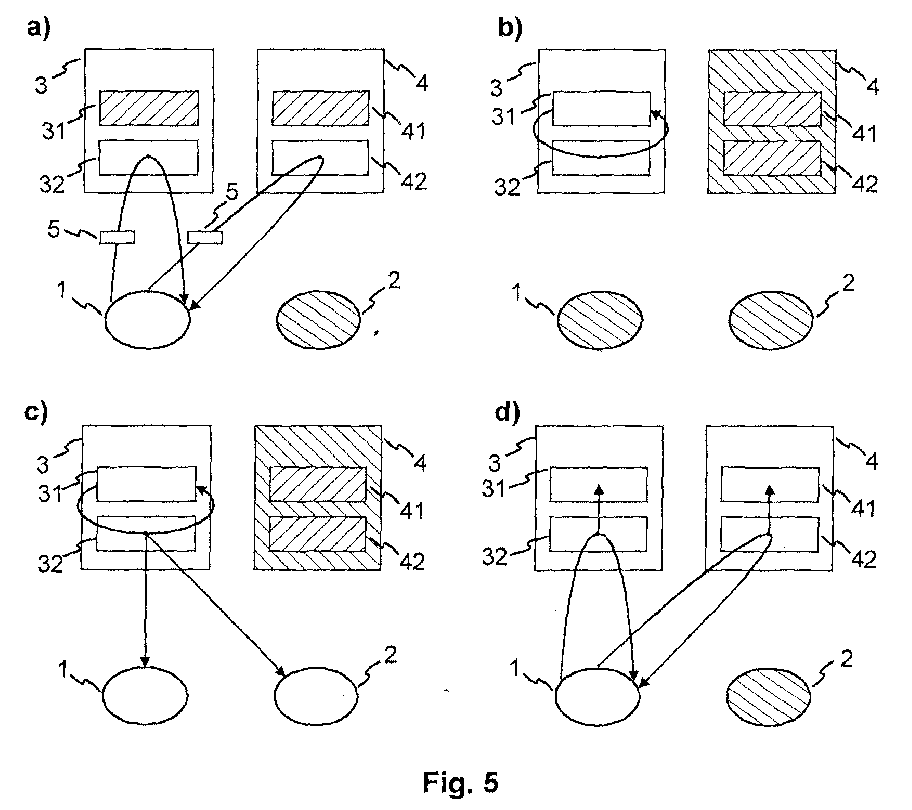
- Fig. 5 shows a propagation scheme for metadata items 5 having different propagation properties using a volatile memory. Depicted are similar to Fig. 1 a first and a second recording medium 1, 2 and a first and a second device 3, 4 for reading from and/or writing to recording media, each device 3, 4 comprising a permanent memory 31, 41 and a volatile memory 32, 42. Inactive parts of the devices 3, 4 and inactive recording media 1, 2 are hatched, inactive meaning that they do not take part in metadata propagation.
- Fig. 5 shall be explained for metadata items having propagation properties according to the first aspect of the invention.
- Fig. 5a the handling of a "recording medium only” metadata item 5 resident on the first recording medium 1 is shown.
- the recording medium 1 is inserted into the device 3, 4, the "recording medium only” metadata item 5 is copied to the volatile device memory 32, 42.
- the copy of the "recording medium only” metadata item 5 is written back to the recording medium 1 and removed from the volatile memory 32, 42.
- no copy of the metadata item 5 remains, therefore the "recording medium only” metadata item 5 cannot propagate to the second recording medium 2 either.
- Fig. 5b depicts the handling of a "device only” metadata item resident in the permanent memory 31 of the first device 3.
- the "device only” metadata item is copied from the permanent memory 31 to the volatile memory 32.
- the metadata item is written back to the permanent memory 31 and removed from the volatile memory 32. No copy of the "device only” metadata item leaves the device 3, i.e. no copy is written to the recording medium 1, 2.
- Fig. 5c shows the handling of an "all recording media” metadata item resident in the permanent memory 31 of the first device 3.
- a copy of the metadata item is written to the volatile memory 32.
- an additional copy of the "all recording media metadata item” in the volatile memory 32 is written to the recording medium 1, 2.
- a "power down” state transition the copy of the metadata item in the volatile memory 32 is removed and written back to the permanent memory 31.
- the copy of the "all recording media” metadata item on the recording medium 1, 2 does not propagate to any other device the recording medium 1, 2 is inserted into.
- Fig. 5 shall now be explained for metadata items according to the second aspect of the invention, i.e. metadata items being either “active” or “passive”.
- Fig. 5a the handling of a "passive" metadata item 5 resident on the first recording medium 1 is shown.
- the recording medium 1 is inserted into the device 3, 4, it is determined whether the metadata item 5 already exists in the volatile device memory 32, 42. If this is not the case, the "passive" metadata item 5 is copied as a "passive” copy to the volatile device memory 32, 42 with a location identifier "medium 1".
- the copy of the "passive” metadata item 5 is written back to the recording medium 1 and removed from the volatile memory 32, 42. In the device 3, 4 no copy of the metadata item remains, therefore the "passive" metadata item 5 cannot propagate to the second recording medium 2 either.
- Fig. 5b depicts the handling of a "passive" metadata item resident in the permanent memory 31 of the first device 3.
- the "passive” metadata item is copied as a “passive” copy from the permanent memory 31 to the volatile memory 32 with a location identifier "device 1".
- the metadata item is written back to the permanent memory 31 and removed from the volatile memory 32. No copy of the "passive” metadata item leaves the device 3, i.e. no copy is written to the recording medium 1, 2.
- Fig. 5c shows the handling of an "active" metadata item resident in the permanent memory 31 of the first device 3.
- an "active" copy of the metadata item is written to the volatile memory 32 with a location identifier "device 1".
- a "passive” copy of the metadata item is written to any recording medium 1, 2 present in the device in case the metadata item does not yet exist on the specific recording medium 1, 2.
- Corresponding "passive” copies are written to the volatile device memory 32 with the respective location identifiers.
- the respective copy of the "passive” metadata item in the volatile memory 32 is written back to the recording medium 1, 2 and removed from the volatile memory 32.
Landscapes
- Engineering & Computer Science (AREA)
- Theoretical Computer Science (AREA)
- General Physics & Mathematics (AREA)
- Databases & Information Systems (AREA)
- Physics & Mathematics (AREA)
- General Engineering & Computer Science (AREA)
- Data Mining & Analysis (AREA)
- Multimedia (AREA)
- Library & Information Science (AREA)
- Signal Processing (AREA)
- Information Retrieval, Db Structures And Fs Structures Therefor (AREA)
- Signal Processing For Digital Recording And Reproducing (AREA)
- Management Or Editing Of Information On Record Carriers (AREA)
- Two-Way Televisions, Distribution Of Moving Picture Or The Like (AREA)
- Storage Device Security (AREA)
Abstract
Description
- global
- recording medium only
- all recording media
- device only
- all devices
- temporary.
The method has the advantage that it becomes easy for a device to visualize and for a user to understand the effect the different propagation properties have on the permanent and non-permanent storage of metadata items on the recording media and in the devices.
Considering the method according to the second aspect of the invention, in the first memory of the device several copies of a metadata item can exist coming from different locations and having different propagation properties. For example, an "active" metadata item from a first recording medium will be copied as a "passive" metadata item to the first memory of the device, i.e. having a propagation property "passive" and a location identifier "device". In addition, a further copy of the same metadata item will exist in the first memory having a propagation property "active" and a location identifier "medium 1". Other copies coming from further recording media might also be present. The metadata items stored in the first memory coming from different recording media must consistently be written back to the recording media they came from. At the same time the correct propagation property has to be preserved. By adding a location identifier to the metadata items upon storage, all of the above problems are easily solved.
- Fig. 1
- shows a metadata propagation scheme according to the first aspect of the invention;
- Fig. 2
- shows a scheme of device state transitions;
- Fig. 3
- shows a metadata item according to the invention;
- Fig. 4
- shows a metadata item inside a volatile memory having more than one propagation property; and
- Fig. 5
- shows a propagation scheme for metadata items having different propagation properties using a volatile memory.
In case the "global" metadata item resides in either
A state transition from the
- recognition of a recording medium after it is inserted into the device or into one of a plurality of ports of the device; and
- recognition of a recording medium, physically already
present in the device, after power up.
Correspondingly, the transition between thethird state 14 and thesecond state 12 occurs through a "recording medium farewell"step 15. As before, also the "recording medium farewell"step 15 comprises at least two cases:
- farewell of a recording medium prior to imminent removal of the recording medium from the device; and
- farewell of a recording medium, which physically remains in the device, prior to imminent power down.
In Fig. 5a), the handling of a "recording medium only"
In Fig. 5a), the handling of a "passive"
Claims (17)
- Method for controlling the distribution of metadata items (5) to recording media (1, 2) and/or to devices (3, 4) for reading from and/or writing to recording media, characterized in that it comprises the steps of:providing the metadata items (5) with a propagation property (6), the propagation property (6) defining to which recording media (1, 2) and/or to which devices (3, 4) the metadata items (5) shall propagate and on which recording media (1, 2) and/or in which devices (3, 4) the metadata items (5) shall be stored, andautomatically propagating and storing the metadata items (5) in accordance with the propagation property (6) at least when a recording medium (1, 2) is inserted into or removed from a device (3, 4), or when the device is powered up or down.
- Method according to claim 1, characterized in that the propagation property (6) assumes one or more of a plurality of predefined values.
- Method for controlling the distribution of metadata items to recording media (1, 2) and/or to devices (3, 4) for reading from and/or writing to recording media, characterized in that it comprises the steps of:providing the metadata items (5) with a propagation property (6), the propagation property (6) assuming a first or a second value,automatically propagating copies of such metadata items (5), which have the first propagation property value, from a device (3, 4) to a recording medium (1, 2) and vice versa, if and only if they do not yet exist in the respective other location (1, 2, 3, 4), at least when the recording medium (1, 2) is inserted into or removed from the device (3, 4), or when the device (3, 4) is powered up or down.
- Method according to claim 3, further comprising the step of changing the propagation property (6) of the propagated copies of the metadata items (5) to the second propagation property value.
- Method according to one of claims 1 to 4, further comprising the step of
temporarily storing into a first memory (32, 42) of the device (3, 4) for reading from and/or writing to recording media all metadata items (5) accessible in a second memory (31, 41) of the device (3, 4) or reduced versions of these metadata items (5) at least when the device (3, 4) is powered up and all metadata items accessible on a recording medium (1, 2) at least whenever such recording medium is inserted into the device (3, 4). - Method according to one of claims 1-5, further comprising the step of
retrieving additional metadata items (5) from a network and at least temporally storing the additional metadata items (5) or reduced versions thereof in the device (3, 4). - Method according to either of claims 5 or 6, further comprising the step of
adding a location identifier (8) to the metadata items (5) or reduced versions thereof upon storage, the location identifier (8) indicating to which storage location the propagation property (6) of a metadata item (5) or of a reduced version thereof applies. - Method according to any of claims 5-7, further comprising the step of
changing the propagation properties (6) of stored metadata items (5). - Method according to any of claims 5-8, further comprising the steps of
writing back the metadata items (5), in accordance with the propagation property (6) and the location identifier (8), from the first memory (32, 42) of the device (3, 4) to a recording medium (1, 2) at least when the recording medium (1, 2) is removed from the device (3, 4), and/or moving the metadata items (5) from the first memory (32, 42) of the device (3, 4) into the second memory (31, 41) of the device (3, 4) in accordance with the propagation property (6) and the location identifier (8) at least when the device (3, 4) is powered down. - Method according to claim 9, further comprising the step of
sending metadata items (5) stored in the device (3, 4) to a network. - Method according to either of claims 9 or 10, characterized in that the step of writing the metadata items (5) back to the recording medium (1, 2), the step of moving the metadata items (5) to the second memory (31, 41), and/or the step of sending metadata items (5) to the network comprise overwriting of the metadata items (5) existing on the recording medium (1, 2), in the second memory (31, 41), and/or in the network, respectively.
- Method according to any of the preceding claims, further comprising the step of providing the metadata items (5) with an expiration property for limiting the propagation of the metadata items (5).
- Method according to any of the preceding claims, further comprising the step of providing the recording medium (1, 2), the device (3, 4) for reading from and/or writing to recording media, and/or the metadata items (5) or the reduced versions thereof with a protection property (7) for preventing the propagation and/or alteration of metadata items (5).
- Method according to claim 13, characterized in that the protection property (7) provides for either a protection against export, against import, or against both export and import of the metadata items (5) or of reduced versions thereof from/to the recording medium (1, 2) and/or the device (3, 4) for reading from and/or writing to recording media.
- Device (3, 4) for reading from and/or writing to recording media, characterized in that it comprises means for performing a method according to anyone of claims 1-14.
- Recording medium (1, 2), characterized in that it comprises metadata items (5) having a propagation property (6) for performing a method according to anyone of claims 1-14.
- Data stream, characterized in that it comprises metadata items (5) having a propagation property (6) for performing a method according to anyone of claims 1-14.
Priority Applications (1)
| Application Number | Priority Date | Filing Date | Title |
|---|---|---|---|
| EP03291213A EP1369804B1 (en) | 2002-06-03 | 2003-05-22 | Method for controlling the propagation of metadata items |
Applications Claiming Priority (5)
| Application Number | Priority Date | Filing Date | Title |
|---|---|---|---|
| EP02012190 | 2002-06-03 | ||
| EP02012190A EP1369795A1 (en) | 2002-06-03 | 2002-06-03 | Method for controlling the propagation of metadata items |
| EP02016630A EP1385107A1 (en) | 2002-07-25 | 2002-07-25 | Simplified method for controlling the propagation of metadata items |
| EP02016630 | 2002-07-25 | ||
| EP03291213A EP1369804B1 (en) | 2002-06-03 | 2003-05-22 | Method for controlling the propagation of metadata items |
Publications (3)
| Publication Number | Publication Date |
|---|---|
| EP1369804A2 true EP1369804A2 (en) | 2003-12-10 |
| EP1369804A3 EP1369804A3 (en) | 2005-08-24 |
| EP1369804B1 EP1369804B1 (en) | 2007-11-14 |
Family
ID=29585694
Family Applications (1)
| Application Number | Title | Priority Date | Filing Date |
|---|---|---|---|
| EP03291213A Expired - Lifetime EP1369804B1 (en) | 2002-06-03 | 2003-05-22 | Method for controlling the propagation of metadata items |
Country Status (9)
| Country | Link |
|---|---|
| US (1) | US7934195B2 (en) |
| EP (1) | EP1369804B1 (en) |
| JP (1) | JP4954435B2 (en) |
| KR (1) | KR101050249B1 (en) |
| CN (1) | CN100592403C (en) |
| DE (1) | DE60317405T2 (en) |
| MX (1) | MXPA03004842A (en) |
| MY (1) | MY137174A (en) |
| TW (1) | TWI221964B (en) |
Cited By (1)
| Publication number | Priority date | Publication date | Assignee | Title |
|---|---|---|---|---|
| EP1646206A1 (en) | 2004-10-08 | 2006-04-12 | Thomson Licensing | Method for establishing communication between peer-groups |
Families Citing this family (4)
| Publication number | Priority date | Publication date | Assignee | Title |
|---|---|---|---|---|
| EP1942470A1 (en) * | 2006-12-29 | 2008-07-09 | Legic Identsystems AG | Authentication system |
| US9465937B1 (en) * | 2008-05-30 | 2016-10-11 | Symantec Corporation | Methods and systems for securely managing file-attribute information for files in a file system |
| JP6357770B2 (en) * | 2013-12-26 | 2018-07-18 | オムロン株式会社 | Control device and communication control method |
| US11074275B2 (en) * | 2019-04-09 | 2021-07-27 | International Business Machines Corporation | Automatically propagating tagging of content items in a content management system environment |
Family Cites Families (35)
| Publication number | Priority date | Publication date | Assignee | Title |
|---|---|---|---|---|
| US3882618A (en) * | 1973-09-17 | 1975-05-13 | William S Hart | Advertising and display device |
| JPS60215262A (en) * | 1984-04-11 | 1985-10-28 | Nec Corp | Semiconductor memory system |
| JPS6371721A (en) * | 1986-09-13 | 1988-04-01 | Fujitsu Ltd | Ram disk operating system |
| EP0481508B1 (en) | 1990-10-18 | 1997-04-09 | Seiko Epson Corporation | Back-up/restore information processing system |
| US5666530A (en) * | 1992-12-02 | 1997-09-09 | Compaq Computer Corporation | System for automatic synchronization of common file between portable computer and host computer via communication channel selected from a plurality of usable channels there between |
| JPH07326166A (en) * | 1994-05-30 | 1995-12-12 | Ricoh Co Ltd | Optical disc access device |
| US5610893A (en) | 1994-06-02 | 1997-03-11 | Olympus Optical Co., Ltd. | Information recording and reproducing apparatus for copying information from exchangeable master recording medium to a plurality of other exchangeable recording media |
| JP3560642B2 (en) * | 1994-06-02 | 2004-09-02 | オリンパス株式会社 | Information recording / reproducing device |
| JPH086833A (en) * | 1994-06-23 | 1996-01-12 | Ricoh Co Ltd | Document filing device |
| JPH08190533A (en) * | 1995-01-09 | 1996-07-23 | Mitsubishi Electric Corp | Data server |
| US5664228A (en) * | 1995-08-09 | 1997-09-02 | Microsoft Corporation | Portable information device and system and method for downloading executable instructions from a computer to the portable information device |
| JPH10156043A (en) * | 1996-12-04 | 1998-06-16 | Denso:Kk | Game machine and game data storage medium provided with fee collection device |
| US6493720B1 (en) * | 1998-01-26 | 2002-12-10 | International Business Machines Corporation | Method and system for synchronization of metadata in an information catalog |
| US6611812B2 (en) * | 1998-08-13 | 2003-08-26 | International Business Machines Corporation | Secure electronic content distribution on CDS and DVDs |
| US6240416B1 (en) * | 1998-09-11 | 2001-05-29 | Ambeo, Inc. | Distributed metadata system and method |
| JP2000099487A (en) * | 1998-09-25 | 2000-04-07 | Nippon Telegr & Teleph Corp <Ntt> | Broadcasting method, transmitting / receiving apparatus, transmitting apparatus and receiving apparatus in multiprocessor system, and recording medium recording this method |
| JP2000183916A (en) * | 1998-12-18 | 2000-06-30 | Fujitsu Ltd | ATM device and recording medium recording transfer control program in ATM device |
| JP3763992B2 (en) | 1999-03-30 | 2006-04-05 | 富士通株式会社 | Data processing apparatus and recording medium |
| JP2000293458A (en) * | 1999-04-09 | 2000-10-20 | Canon Inc | Data distribution device, data receiving device, and control method thereof |
| JP3438663B2 (en) * | 1999-08-23 | 2003-08-18 | 日本電気株式会社 | Switch device |
| JP4284774B2 (en) | 1999-09-07 | 2009-06-24 | ソニー株式会社 | Transmission device, reception device, communication system, transmission method, and communication method |
| US7383320B1 (en) * | 1999-11-05 | 2008-06-03 | Idom Technologies, Incorporated | Method and apparatus for automatically updating website content |
| US6681323B1 (en) * | 1999-11-29 | 2004-01-20 | Toshiba America Information Systems, Inc. | Method and system for automatically installing an initial software configuration including an operating system module from a library containing at least two operating system modules based on retrieved computer identification data |
| JP2001318832A (en) * | 2000-05-12 | 2001-11-16 | Nec Corp | Disk cache control system |
| JP3766259B2 (en) * | 2000-06-01 | 2006-04-12 | 株式会社日立製作所 | Packet transfer device |
| JP2002077134A (en) * | 2000-08-31 | 2002-03-15 | Toshiba Corp | Server / client system, data server, data client, data providing / using method, and recording medium |
| US20040015822A1 (en) * | 2001-03-23 | 2004-01-22 | Linton Samuel W. | Method and apparatus for dynamic assembly and verification of software components into flexible applications |
| US7191190B2 (en) * | 2001-03-27 | 2007-03-13 | Microsoft Corporation | Meta data management for media content objects |
| US20030028870A1 (en) * | 2001-08-01 | 2003-02-06 | Weisman Mitchell T. | Distribution of downloadable software over a network |
| US7310821B2 (en) * | 2001-08-27 | 2007-12-18 | Dphi Acquisitions, Inc. | Host certification method and system |
| US7730446B2 (en) * | 2003-03-12 | 2010-06-01 | Microsoft Corporation | Software business process model |
| US7448022B1 (en) * | 2004-02-10 | 2008-11-04 | Prasad Ram | Dynamic software composition in a component-based software system |
| US8423954B2 (en) * | 2006-03-31 | 2013-04-16 | Sap Ag | Interactive container of development components and solutions |
| US9147080B2 (en) * | 2008-02-06 | 2015-09-29 | International Business Machines Corporation | System and methods for granular access control |
| US8413256B2 (en) * | 2008-08-26 | 2013-04-02 | Cox Communications, Inc. | Content protection and digital rights management (DRM) |
-
2003
- 2003-05-22 DE DE60317405T patent/DE60317405T2/en not_active Expired - Lifetime
- 2003-05-22 EP EP03291213A patent/EP1369804B1/en not_active Expired - Lifetime
- 2003-05-28 KR KR1020030034067A patent/KR101050249B1/en not_active Expired - Fee Related
- 2003-05-29 TW TW092114501A patent/TWI221964B/en not_active IP Right Cessation
- 2003-05-30 MX MXPA03004842A patent/MXPA03004842A/en active IP Right Grant
- 2003-06-02 CN CN03140954A patent/CN100592403C/en not_active Expired - Fee Related
- 2003-06-02 MY MYPI20032035A patent/MY137174A/en unknown
- 2003-06-03 US US10/453,035 patent/US7934195B2/en not_active Expired - Fee Related
- 2003-06-03 JP JP2003157844A patent/JP4954435B2/en not_active Expired - Fee Related
Cited By (1)
| Publication number | Priority date | Publication date | Assignee | Title |
|---|---|---|---|---|
| EP1646206A1 (en) | 2004-10-08 | 2006-04-12 | Thomson Licensing | Method for establishing communication between peer-groups |
Also Published As
| Publication number | Publication date |
|---|---|
| US7934195B2 (en) | 2011-04-26 |
| TWI221964B (en) | 2004-10-11 |
| KR101050249B1 (en) | 2011-07-19 |
| DE60317405D1 (en) | 2007-12-27 |
| CN1471099A (en) | 2004-01-28 |
| US20030225792A1 (en) | 2003-12-04 |
| CN100592403C (en) | 2010-02-24 |
| KR20030093990A (en) | 2003-12-11 |
| JP4954435B2 (en) | 2012-06-13 |
| EP1369804B1 (en) | 2007-11-14 |
| MY137174A (en) | 2009-01-30 |
| EP1369804A3 (en) | 2005-08-24 |
| TW200401974A (en) | 2004-02-01 |
| JP2004252933A (en) | 2004-09-09 |
| MXPA03004842A (en) | 2005-09-08 |
| DE60317405T2 (en) | 2008-10-02 |
Similar Documents
| Publication | Publication Date | Title |
|---|---|---|
| US8595202B2 (en) | Method and system for intra-document object locking in collaborative authoring | |
| EP2113860A1 (en) | Right information moving method, content player, and semiconductor device | |
| JP2006294031A (en) | A storage drive for operation on a network, a method for accessing file data on a sequential access storage medium from a network, a storage logic including logic for translating file-based commands and logic for storing a TOC, magnetic tape , And logic to access the data and TOC area of the tape | |
| JP2005503623A (en) | Method for processing the information part of recorded data | |
| US7647361B2 (en) | Automatically maintaining metadata in a file backup system | |
| US20110235481A1 (en) | Storage system and method for generating file system in the storage system | |
| JP2005537599A (en) | Entry point for digital rights management data | |
| US20070162707A1 (en) | Information recording medium data processing apparatus and data recording method | |
| EP1369804B1 (en) | Method for controlling the propagation of metadata items | |
| KR20130028903A (en) | Data streaming for interactive decision-oriented software applications | |
| CN112036133B (en) | File storage method and device, electronic equipment and storage medium | |
| CN102737171B (en) | Method and device for storing virus file and storage equipment | |
| EP1385107A1 (en) | Simplified method for controlling the propagation of metadata items | |
| EP1369795A1 (en) | Method for controlling the propagation of metadata items | |
| JPWO2005041050A1 (en) | Recording medium, data processing apparatus, and data processing method | |
| CN109144948A (en) | Method, apparatus, electronic equipment and the memory of application file positioning | |
| CN111090396A (en) | File processing method and device and electronic equipment | |
| CN114328417A (en) | Case data quick access system | |
| CN114124421B (en) | ACL rule processing method, ACL rule processing device, computer equipment and readable medium | |
| JP2014191524A (en) | Information recording and reproduction system and information recording and reproduction method | |
| CN102112956B (en) | Apparatus and method for storing raw point-in-time data | |
| JP2009048749A (en) | File system management method, file system management device, and recording medium with file system management program recorded thereon | |
| CN119938359A (en) | A three-dimensional model loading method, device and medium based on shared memory | |
| CN116360701A (en) | Method, device, equipment and medium for reading data pointer of RAID (redundant array of independent disks) | |
| JPH06110763A (en) | File system |
Legal Events
| Date | Code | Title | Description |
|---|---|---|---|
| PUAI | Public reference made under article 153(3) epc to a published international application that has entered the european phase |
Free format text: ORIGINAL CODE: 0009012 |
|
| AK | Designated contracting states |
Kind code of ref document: A2 Designated state(s): AT BE BG CH CY CZ DE DK EE ES FI FR GB GR HU IE IT LI LU MC NL PT RO SE SI SK TR |
|
| AX | Request for extension of the european patent |
Extension state: AL LT LV MK |
|
| PUAL | Search report despatched |
Free format text: ORIGINAL CODE: 0009013 |
|
| AK | Designated contracting states |
Kind code of ref document: A3 Designated state(s): AT BE BG CH CY CZ DE DK EE ES FI FR GB GR HU IE IT LI LU MC NL PT RO SE SI SK TR |
|
| AX | Request for extension of the european patent |
Extension state: AL LT LV MK |
|
| RAP1 | Party data changed (applicant data changed or rights of an application transferred) |
Owner name: THOMSON LICENSING |
|
| 17P | Request for examination filed |
Effective date: 20060209 |
|
| AKX | Designation fees paid |
Designated state(s): DE FR GB IT |
|
| GRAP | Despatch of communication of intention to grant a patent |
Free format text: ORIGINAL CODE: EPIDOSNIGR1 |
|
| RIC1 | Information provided on ipc code assigned before grant |
Ipc: G06Q 10/00 20060101AFI20070604BHEP |
|
| GRAS | Grant fee paid |
Free format text: ORIGINAL CODE: EPIDOSNIGR3 |
|
| GRAA | (expected) grant |
Free format text: ORIGINAL CODE: 0009210 |
|
| AK | Designated contracting states |
Kind code of ref document: B1 Designated state(s): DE FR GB IT |
|
| REG | Reference to a national code |
Ref country code: GB Ref legal event code: FG4D |
|
| REF | Corresponds to: |
Ref document number: 60317405 Country of ref document: DE Date of ref document: 20071227 Kind code of ref document: P |
|
| ET | Fr: translation filed | ||
| PLBE | No opposition filed within time limit |
Free format text: ORIGINAL CODE: 0009261 |
|
| STAA | Information on the status of an ep patent application or granted ep patent |
Free format text: STATUS: NO OPPOSITION FILED WITHIN TIME LIMIT |
|
| 26N | No opposition filed |
Effective date: 20080815 |
|
| PG25 | Lapsed in a contracting state [announced via postgrant information from national office to epo] |
Ref country code: IT Free format text: LAPSE BECAUSE OF NON-PAYMENT OF DUE FEES Effective date: 20080531 |
|
| REG | Reference to a national code |
Ref country code: FR Ref legal event code: PLFP Year of fee payment: 14 |
|
| REG | Reference to a national code |
Ref country code: FR Ref legal event code: PLFP Year of fee payment: 15 |
|
| REG | Reference to a national code |
Ref country code: DE Ref legal event code: R082 Ref document number: 60317405 Country of ref document: DE Representative=s name: DEHNS, DE Ref country code: DE Ref legal event code: R082 Ref document number: 60317405 Country of ref document: DE Representative=s name: HOFSTETTER, SCHURACK & PARTNER PATENT- UND REC, DE |
|
| REG | Reference to a national code |
Ref country code: FR Ref legal event code: PLFP Year of fee payment: 16 |
|
| REG | Reference to a national code |
Ref country code: FR Ref legal event code: TP Owner name: THOMSON LICENSING DTV, FR Effective date: 20180830 |
|
| REG | Reference to a national code |
Ref country code: GB Ref legal event code: 732E Free format text: REGISTERED BETWEEN 20180927 AND 20181005 |
|
| REG | Reference to a national code |
Ref country code: DE Ref legal event code: R082 Ref document number: 60317405 Country of ref document: DE Representative=s name: DEHNS, DE Ref country code: DE Ref legal event code: R081 Ref document number: 60317405 Country of ref document: DE Owner name: INTERDIGITAL MADISON PATENT HOLDINGS, FR Free format text: FORMER OWNER: THOMSON LICENSING, BOULOGNE BILLANCOURT, FR |
|
| PGFP | Annual fee paid to national office [announced via postgrant information from national office to epo] |
Ref country code: DE Payment date: 20190418 Year of fee payment: 17 |
|
| PGFP | Annual fee paid to national office [announced via postgrant information from national office to epo] |
Ref country code: FR Payment date: 20190419 Year of fee payment: 17 |
|
| PGFP | Annual fee paid to national office [announced via postgrant information from national office to epo] |
Ref country code: GB Payment date: 20190423 Year of fee payment: 17 |
|
| REG | Reference to a national code |
Ref country code: DE Ref legal event code: R119 Ref document number: 60317405 Country of ref document: DE |
|
| GBPC | Gb: european patent ceased through non-payment of renewal fee |
Effective date: 20200522 |
|
| PG25 | Lapsed in a contracting state [announced via postgrant information from national office to epo] |
Ref country code: GB Free format text: LAPSE BECAUSE OF NON-PAYMENT OF DUE FEES Effective date: 20200522 Ref country code: FR Free format text: LAPSE BECAUSE OF NON-PAYMENT OF DUE FEES Effective date: 20200531 |
|
| PG25 | Lapsed in a contracting state [announced via postgrant information from national office to epo] |
Ref country code: DE Free format text: LAPSE BECAUSE OF NON-PAYMENT OF DUE FEES Effective date: 20201201 |