Technical Field
The present invention relates to novel oil-extended
1, 2-polybutadiene which has excellent functions characterizing
conventional 1,2-polybutadiene and is excellent in wear
resistance, fluidity (processability), coloring properties
(high distinctness of image), flexibility and attachability,
and a method for producing the same; and a composition thereof
and a formed article having no flow mark and excellent in
appearance. Particularly, the invention relates to
oil-extended 1,2-polybutadiene useful as various formed
articles such as automobile parts, building material parts,
footwear, toys, miscellaneous goods and sporting and health goods,
various sheets and films, other industrial goods, buffer
materials and packaging materials, and a method for producing
the same; and a composition thereof and a formed article, a shoe
sole material excellent in flexibility, wear resistance and
lightness in weight, a laminate which can be uniformly laminated
even to a base layer having a complicated shape and is excellent
in vibration-damping properties, antivibration properties,
sound insulating properties, sound absorbing properties,
soundproofing properties and sealing properties, and a method
for producing the same.
Further, the present invention relates to a
high-performance master batch containing a novel oil-extended
1,2-polybutadiene and excellent in fluidity and dispersibility.
Background Art
1,2-Polybutadiene controlled to appropriate
crystallinity has not only a function as a thermoplastic
elastomer, because it has a structure comprising a
crystalline-rich region and an amorphous part, but also a
function as a thermoplastic resin or rubber increased in
crosslinking density for producing a conventional crosslinked
formed article, because it has a carbon-carbon double bond high
in chemical reactivity in its molecule. Further, this
1,2-polybutadiene has excellent processability, so that it has
been applied as a modifier for other resins and thermoplastic
elastomers, and as a polymer material for medical use.
Now, it has come to be needed that the 1,2-polybutadiene
controlled in crystallinity has higher performances
(particularly, wear resistance), in addition to its excellent
processability.
Further, when 1,2-polybutadiene is used for various new
applications, lack of fluidity and low coloring properties have
come to be pointed out.
Furthermore, a block copolymer of an aromatic vinyl
compound and a conjugated diene compound can be processed as
a thermoplastic elastomer by forming techniques similar to those
employed for general thermoplastic resins. In that case, the
copolymer has the advantages of not particularly needing
compounding of a crosslinking agent and a heat crosslinking
process,and moreover,having moderate elasticity. Accordingly,
a shoe sole material has been produced by injection molding or
the like, using the block copolymer of the aromatic vinyl compound
and the conjugated diene compound, in the field of shoe production.
However, the above-mentioned copolymer has the disadvantage of
generating flow marks on a surface of a formed article to cause
poor appearance, because of its poor fluidity in forming.
Then, in order to improve poor appearance of the formed
article, it has been carried out that 1,2-polybutadiene is
blended with the block copolymer of the aromatic vinyl compound
and the conjugated diene compound. The use of this method
improves poor appearance of the formed article, but raises the
problem of deteriorating wear resistance, an important
performance as the shoe sole material.
The shoe sole material tends to save weight, and for the
purpose of weight saving, a foam has been mostly used. At present,
as a method for producing the sole material from the foam, there
has been used (1) a method of producing a plate-like foam with
a plate-like mold and stamping out it to a shoe sole shape to
use, (2) a method of using a shoe sole-shaped foam produced with
a shoe sole-shaped mold, or a method of stamping out a shoe
sole-shaped foam produced to a shoe sole shape to use, using
a crosslinking (curing) press which has hitherto been used. Such
methods are suitable for limited production of a wide variety
of products, but unsuitable for mass production. Accordingly,
the process of producing the shoe sole material from the foam
contributes to a rise in cost of the shoe sole material.
A crosslinked foam using an ethylene-vinyl acetate
copolymer (EVA), natural rubber, synthetic rubber or the like
has hitherto been used as the shoe sole material. Of these,
the crosslinked foam using the EVA is large in deformation
(permanent set in fatigue) in use, and at the same time, wet
skid resistance most important as the shoe sole material is not
sufficient. On the other hand, the crosslinked foam of the rubber
family using natural rubber or synthetic rubber such as
styrene-butadiene rubber or polybutadiene rubber is better in
permanent set in fatigue and wet skid resistance than the EVA
foam. However, a product largely shrinks after crosslinking
and foaming, which causes high percent defective due to
variations in product size, resulting in a factor of a rise in
cost. It has been therefore required that the cost is lowered.
As such a shoe sole material excellent in wet skid
resistance and low in the degree of shrinkage of the product
after crosslinking and foaming, 1,2-polybutadiene controlled
to appropriate crystallinity has come to be used.
1,2-Polybutadiene is also good in mechanical strength (TB, EB) ,
interlaminar shear strength, permanent compressive strain and
the like, and has become to be widely utilized. However, when
this 1,2-polybutadiene is used for various new applications,
it has come to be pointed out that fluidity (processability),
formability and coloring properties are not sufficient.
Further, in the fields of sound insulating materials,
soundproofing materials, vibration-damping materials, steel
plate-reinforcing materials, clearance-filling materials,
antivibration materials, sealing materials, thermoset plastic
dampers and the like, various techniques for laminating a rubber
composition to a metal base layer such as a steel plate or filling
it between metal base layers have hitherto come in practice.
For example, there are "a rubber composition for antibivration,
soundproofing and sound insulating materials" described in
Japanese Patent Laid-Open Publication (Hei) 1-139534 and "a
low-temperature curing type high foaming sealer" described in
Japanese Patent Laid-Open Publication (Sho) 62-62882. However,
these fill only with open cell sponge, and condensed water
generated in the sponge transfers into a continuous foam
structure to come into contact with a metal surface, which causes
metal corrosion. Thus, a technique for producing a material
filling a clearance without metal corrosion and excellent in
vibration-damping properties, sound absorbing properties and
sealing properties in a satisfying form has been required.
Utilizing the characteristics of 1,2-polybutadiene
controlled to appropriate crystallinity, the present applicant
for patent has proposed a high hard crosslinked product
containing the polybutadiene, crosslinkable by a heating medium
and useful for vibration-damping materials, sound insulating
materials and thermoset plastic dampers, (Japanese Patent
Laid-Open Publication (Hei) 1-297443) and a laminate containing
the polybutadiene (Japanese Patent Laid-Open Publication (Hei)
2-57340). However, when this 1,2-polybutadiene is used for
various new applications, the problem is encountered that
fluidity is insufficient in filling a clearance, resulting in
insufficient attachability to a base layer.
In recent years, as a master batch used in producing a
(co)polymer composition, needs for a granular master batch of
rubber chemicals in the market have become strong. The reasons
for this include the following (1) to (3):
In order to solve the above-mentioned (1) and (2), for
example, sheet-like master batches of rubber chemicals using
ordinary rubber and rubber chemicals treated with oil have
hitherto been known. However, there has recently been a growing
demand for a granular master batch of chemicals from the
viewpoints of automatic measurement of rubber chemicals and
advantages for handling.
As a technique relating to the master batch of chemicals
for rubber, a composition of compounding agents for rubber
comprising three components of chemicals for rubber, rubber and
an ethylene-vinyl acetate copolymer, and oils is proposed in
Japanese Patent Laid-Open Publication (Hei) 1-223130. However,
some kind of chemical for rubber or some composition ratio of
three components gives stickiness to the composition, which
causes a problem in processing or in storage of the composition.
For example, when a sheet-like master batch is produced, sheeting
is carried out with rolls. In this case, when the stickiness
of a composition is high, the sheet sticks to surfaces of the
rolls to cause poor releasability, resulting in significantly
impaired workability in some cases. Further, for the purpose
of rationalizing the measurement of a mixed composition, granules
are formed with an extrusion granulator in some cases. When
the stickiness of the composition is high, the granules stick
to one another by their own weight (blocking) to form a block
during storage of the granulated product, thereby impairing the
functions thereof. In particular, in storage in the summer
season when the outside air temperature is elevated, this
tendency is significant.
On the other hand, Japanese Patent Laid-Open Publication
(Sho) 53-41342 describes that a rubber is selected as a binder
and a process oil for rubber is selected as an oil in producing
a master batch according to a composition comprising a rubber,
a vulcanization accelerator and the like. However, in this
master batch, there is also the problem of the stickiness of
itself, and there is the above-mentioned problem of blocking.
In order to solve the above-mentioned problem, Japanese
Patent Laid-Open Publication (Hei) 7-224188 proposes a master
batch of chemicals for rubber or plastics comprising the
chemicals for rubber or plastics, 1,2-polybutadiene and a
softening agent as indispensable components, maintaining a good
shape which is an essential object of a master batch, and further
preventing the stickiness of the composition without impairing
good dispersibility in a rubber, an elastomer, a plastic and
the like, thereby improving roll processability or blocking
during storage. However, this master batch has the problems
that fluidity is not sufficient, so that the dispersibility of
various chemicals is not said to be sufficient yet, that it is
difficult to disperse a large amount of chemicals in the master
batch, and that a technique is required to prepare the master
batch and a long period of time is required for the preparation.
Disclosure of the Invention
The present inventors have intensively studied in view
of the present state as described above. As a result, the
inventors have accomplished the present invention by providing
novel oil-extended 1,2-polybutadiene which has excellent
functions characterizing conventional 1, 2-polybutadiene and is
excellent in wear resistance, fluidity (processability),
coloring properties (high distinctness of image), flexibility
and attachability, and a method for producing the same; and a
composition thereof and a formed article, a shoe sole material
having no flow mark and excellent in appearance, and excellent
in flexibility, wear resistance and lightness in weight, a
laminate which can be uniformly laminated even to a base layer
having a complicated shape and is excellent in vibration-damping
properties, antivibration properties, sound insulating
properties, sound absorbing properties and sealing properties,
and a method for producing the same.
Best Mode for Carrying Out the Invention
1. Oil-extended 1,2-polybutadiene containing (e) an
extender oil in an amount of 1 to 200 parts by weight based on
100 parts by weight of (a) 1,2-polybutadiene.
2. The oil-extended 1,2-polybutadiene described in the
above 1, in which (a) the 1,2-polybutadiene is syndiotactic
1,2-polybutadiene.
3. The oil-extended 1,2-polybutadiene described in the
above 1 or 2, in which (a) the 1,2-polybutadiene has a weight
average molecular weight of 10,000 to 5, 000, 000, and a 1,2-vinyl
bond content of 70% or more.
4. The oil-extended 1,2-polybutadiene described in any
one of the above 1 to 3, in which (e) the extender oil has a
viscosity gravity constant (V. G. C. value) of 0.790 to 0.999.
5. A method for producing oil-extended 1, 2-polybutadiene
comprising a first step of mixing 1 to 200 parts by weight of
(e) an extender oil with 100 parts by weight (converted to solid
content) of a 1,2-polybutadiene solution in a solution state,
and a second step of conducting desolvation.
6. An oil-extended 1,2-polybutadiene composition
containing (C) foaming agent in an amount of 1 to 300 parts by
weight based on 100 parts by weight of (A) the oil-extended
1,2-polybutadiene described in any one of the above 1 to 4.
7. A master batch containing 2 to 95% by weight of the
(A) component described in any one of the above 1 to 4 and 98
to 5% by weight of (G) a functional compound for rubber or plastics
[with the proviso that (A)+(G) = 100% by weight].
8. The master batch described in the above 7, in which
(G) the functional compound described above is (C) a foaming
agent, (D) a crosslinking agent, (E) a softening agent and (F)
at least one component selected from the group consisting of
a filling agent, a bituminous material, an activator, a flame
retardant, an antioxidant, an antiaging agent, a lubricant, a
coloring agent, an ultraviolet absorber, an antistatic agent,
a thermal stabilizer, a processing aid, a light
(weather) -resisting agent and an antimicrobial agent, excluding
the above-mentioned (C) to (E) components.
9. A thermoplastic polymer composition containing 1 to
99 parts by weight of (A) the oil-extended 1,2-polybutadiene
described in any one of the above 1 to 4 and 99 to 1 part by
weight of (B) at least one selected from the group consisting
of a thermoplastic resin, a thermoplastic elastomer, a natural
rubber and a synthetic rubber other than the above-mentioned
(A) component [with the proviso that (A)+(B) = 100 parts by
weight].
10. The thermoplastic polymer composition described in
the above 9 further containing (C) a foaming agent in an amount
of 1 to 300 parts by weight based on 100 parts by weight of the
total amount of the (A) component and the (B) component.
11. The thermoplastic polymer composition described in
the above 9 or 10 further containing (D-1) at least one selected
from the group consisting of a combination of sulfur or a compound
producing sulfur by heating and a vulcanization accelerator,
an organic peroxide or a combination of an organic peroxide and
a multifunctional monomer, and a combination of a silanol
compound and an aqueous agent.
12. A formed article obtained by forming the oil-extended
1,2-polybutadiene described in any one of the above 1 to 4.
13. A shoe sole material obtained by foaming the
oil-extended 1,2-polybutadiene composition described in the
above 6.
14. A shoe sole material obtained by crosslinking and
forming the oil-extended 1,2-polybutadiene composition
described in the above 6.
15. A shoe sole material obtained by crosslinking and
forming the thermoplastic polymer composition described in any
one of the above 9 to 11.
16. A laminate comprising a base layer having laminated
thereon a resin layer containing the oil-extended
1,2-polybutadiene composition described in the above 6.
17. The laminate described in the above 16, in which an
asphalt layer is allowed to intervene between the base layer
and the resin layer.
18. A method for producing a laminate which comprises
filling the oil-extended 1,2-polybutadiene composition
described in the above 6 in a clearance between a plurality of
base layers, and crosslinking and foaming it.
19. A method for producing a laminate which comprises
filling the thermoplastic polymer composition described in any
one of the above 9 to 11 in a clearance between a plurality of
base layers, and crosslinking and foaming it.
20. An automobile interior constituent in which the
oil-extended 1,2-polybutadiene composition described in the
above 6 is integrated with woven fabric and/or nonwoven fabric.
(A) Oil-Extended 1,2-Polybutadiene
(a) 1,2-Polybutadiene
The 1,2-polybutadiene used in the present invention may
be any 1,2-polybutadiene. However, preferred is one obtained
by polymerizing butadiene in the presence of a catalyst
containing a cobalt compound and an aluminoxane.
The 1,2-vinyl bond content in butadiene bond units of the
1,2-polybutadiene of the invention is preferably 70% or more,
more preferably 80% or more, and particularly preferably 90%
or more.
The 1,2-polybutadiene of the invention exhibits
properties as a good thermoplastic elastomer by that the
1,2-vinyl bond content is 70% or more.
The 1,2-polybutadiene of the invention is preferably
1,2-polybutadiene having crystallinity, and the melting point
thereof is preferably within the range of 50 to 130°C, and more
preferably within the range of 60 to 120°C. The melting point
within this range results in an excellent balance between
mechanical strength such as tensile strength or tearing strength
and flexibility.
The 1,2-polybutadiene of the invention may be
copolymerized with a small amount of a conjugated diene other
than butadiene. The conjugated dienes other than butadiene
include 1,3-pentadiene, a higher alkyl group-substituted
1,3-butadiene derivative, a 2-alkyl-substituted 1, 3-butadiene
and the like. Of these, the higher alkyl group-substituted
1,3-butadiene derivatives include 1-pentyl-1,3-butadiene,
1-hexyl-1,3-butadiene, 1-heptyl-1,3-butadiene,
1-octyl-1,3-butadiene and the like.
Here, typical examples of the 2-alkyl-substituted
1,3-butadienes include 2-methyl-1,3-butadiene (isoprene),
2-ethyl-1,3-butadiene, 2-propyl-1,3-butadiene,
2-isopropyl-1,3-butadiene, 2-butyl-1,3-butadiene,
2-isobutyl-1,3-butadiene, 2-amyl-1,3-butadiene,
2-isoamyl-1,3-butadiene, 2-hexyl-1, 3-butadiene,
2-cyclohexyl-1,3-butadiene, 2-isohexyl-1,3-butadiene,
2-heptyl-1,3-butadiene, 2-isoheptyl-1,3-butadiene,
2-octyl-1,3-butadiene, 2-isooctyl-1,3-butadiene and the like.
Of these conjugated dienes, preferred examples of the conjugated
dienes copolymerized with butadiene include isoprene and
1, 3-pentadiene. The content of butadiene in monomer components
subjected to polymerization is preferably 50 mol% or more, and
particularly 70 mol% or more.
The 1,2-polybutadiene of the invention is obtained by
polymerizing butadiene preferably in the presence of the catalyst
containing the cobalt compound and the aluminoxane, as described
above. The above-mentioned cobalt compounds include preferably
an organic acid salt of cobalt having 4 or more carbon atoms.
Specific examples of the organic acid salts of cobalt include
a butyrate, a hexanoate, a heptylate, an octylate of an acid
such as 2-ethyl-hexylic acid, a decanoate, a salt of a higher
fatty acid such as stearic acid, oleic acid or erucic acid, a
benzoate, an alkyl-, aralkyl- or allyl-substituted benzoate of
an acid such as a tolylate, a xylylate or an ethylbenzoic acid,
a naphthoate and an alkyl-, aralkyl- or allyl-substituted
naphthoate. Of these, 2-ethylhexylic acid or a so-called octyl
acid salt, a stearate and a benzoate are preferred for excellent
solubility in a hydrocarbon solvent.
The above-mentioned aluminoxanes include, for example,
one represented by the following general formula (I) or general
formula (II):
In the aluminoxane represented by general formula (I) or
(II), R is a hydrocarbon group such as a methyl group, an ethyl
group, a propyl group or a butyl group, preferably a methyl group
or an ethyl group, and particularly preferably a methyl group.
m is an integer of 2 or more, preferably an integer of 5 or more,
and more preferably an integer of 10 to 100. Specific examples
of the aluminoxanes include methylaluminoxane, ethyl-aluminoxane,
propylaluminoxane, butylaluminoxane and the like,
and methylaluminoxane is particularly preferred.
It is very preferred that the polymerization catalyst
contains a phosphine compound, in addition to the above-mentioned
cobalt compound and aminoxane. The phosphine compound is a
component effective for the control of activation of the
polymerization catalyst, the vinyl bond structure and
crystallinity, and preferably includes an organic phosphorus
compound represented by the following general formula (III):
P(Ar)n(R)3-n
In general formula (III), Ar represents a group shown
below:
(In the above-mentioned group, R1, R2 and R3, which may
be the same or different, each represent a hydrogen atom, an
alkyl group preferably having 1 to 6 carbon atoms, a halogen
atom, an alkoxyl group preferably having 1 to 6 carbon atoms
or an aryl group preferably having 6 to 12 carbon atoms.)
Further, in general formula (III), R represents a
cycloalkyl group or an alkyl-substituted cycloalkyl group, and
n is an integer of 0 to 3.
Specific examples of the phosphine compounds represented
by general formula (III) include tri-(3-methylphenyl) phosphine,
tri-(3-ethylphenyl)phosphine, tri-(3,5-dimethyl-phenyl)phosphine,
tri-(3,4-dimethylphenyl)phosphine,
tri-(3-isopropylphenyl)phosphine, tri-(3-t-butylphenyl)-phosphine,
tri-(3,5-diethylphenyl)phosphine,
tri-(3-methyl-5-ethylphenyl)phosphine,
tri-(3-phenylphenyl)phosphine,
tri-(3,4,5-trimethylphenyl)phosphine, tri-(4-methoxy-3,5-dimethylphenyl)phosphine,
tri-(4-ethoxy-3,5-di-ethylphenyl)phosphine,
tri-(4-butoxy-3,5-dibutylphenyl)-phosphine,
tri (p-methoxyphenyl)phosphine, tricyclohexylphosphine,
dicyclohexylphenylphosphine, tribenzylphosphine,
tri(4-methylphenylphosphine), tri(4-ethylphenylphosphine)
and the like. Of these, particularly preferred examples thereof
include triphenylphosphine, tri-(3-methylphenyl)phosphine,
tri-(4-methoxy-3,5-dimethylphenyl)phosphine and the like.
Further, as the cobalt compound, a compound represented
by the following general formula (IV) can be used.
In general formula (IV), R1, R2 and R3 are the same as R1,
R2 and R3 in the above-mentioned general formula (III).
The compound represented by the above-mentioned general
formula (IV) is a complex having a phosphine compound in which
n is 3 in the above-mentioned general formula (III), as a ligand
to cobalt chloride. In using this cobalt compound, one
previously synthesized may be used, or a method of contacting
cobalt chloride with the phosphine compound in a polymerization
system may be used. The amount of 1,2-vinyl bonds and
crystallinity of the resulting 1,2-polybutadiene can be
controlled by variously selecting the phosphine compound in the
complex.
Specific examples of the cobalt compounds represented by
the above-mentioned general formula (IV) include cobalt
bis(triphenylphosphine)dichloride, cobalt bis[tris(3methylphenylphosphine)]dichloride,
cobalt bis[tris(3-ethylphenylphosphine)]dichloride,
cobalt bis[tris(4-methylphenylphosphine)]dichloride,
cobalt bis[tris(3,5-dimethylphenylphosphine)]dichloride,
cobalt bis [tris(3,4-dimethylphenylphosphine)]dichloride,
cobalt bis[tris(3-isopropylphenylphosphine)]
dichloride, cobalt bis[tris(3-t-butylphenylphosphine)]dichloride,
cobalt bis[tris(3,5-diethylphenylphosphine)]dichloride,
cobalt bis[tris(3-methyl-5-ethylphenylphosphine)]dichloride,
cobalt bis[tris(3-phenylphenylphosphine)]dichloride,
cobalt bis[tris(3,4,5-trimethylphenylphosphine)]dichloride,
cobalt bis[tris(4-methoxy-3,5-dimethylphenylphosphine)]dichloride,
cobalt
bis[tris(4-ethoxy-3,5-diethylphenylphosphine)] dichloride,
cobalt bis[tris(4-butoxy-3,5-dibutylphenylphosphine)]dichloride,
cobalt bis[tris(4-methoxyphenylphosphine)]dichloride,
cobalt bis [tris(3-methoxyphenylphosphine)] dichloride,
cobalt bis[tris(4-dodecylphenylphosphine)]dichloride,
cobalt bis [tris (4-ethylphenylphosphine)]dichloride
and the like.
Of these, particularly preferred are cobalt bis(triphenylphosphine)dichloride,
cobalt bis[tris(3-methylphenylphosphine)]dichloride,
cobalt bis[tris(3,5-dimethylphenylphosphine)]dichloride,
cobalt bis[tris(4-methoxy-3,5-dimethylphenylphosphine)]dichloride
and the like.
As the amount of the catalyst used, the cobalt compound
is used in an amount of 0.001 to 1 mmol, preferably about 0.01
to about 0.5 mol, in terms of a cobalt atom per mole of butadiene
for homopolymerization of butadiene, and per mole of the total
amount of butadiene and a conjugated diene other than butadiene
for copolymerization. Further, the amount of the phosphine
compound used is usually from 0.1 to 50, preferably from 0.5
to 20, and more preferably from 1 to 20, as the atomic ratio
of phosphorus to cobalt (P/Co) . Furthermore, the amount of the
aluminoxane used is usually from 4 to 107, and preferably from
10 to 106, as the atomic ratio of aluminum to cobalt of the cobalt
compound (Al/Co). When the complex represented by general
formula (IV) is used, the amount of the aluminoxane used follows
the above description, taking the amount of the phosphine
compound used as 2 by the atomic ratio of phosphorus to cobalt
(P/Co).
Inert organic solvents used as polymerization solvents
include, for example, aromatic hydrocarbon solvents such as
benzene, toluene, xylene and cumene, aliphatic hydrocarbon
solvents such as n-pentane, n-hexane and n-butane, alicyclic
hydrocarbon solvents such as cyclopentane, methylcyclopentane
and cyclohexane, and mixtures thereof.
The polymerization temperature is usually from-50 to 120°C,
and preferably from -20 to 100°C. The polymerization reaction
may be either batch-wise or continuous. The monomer
concentration in the solvent is usually from 5 to 50% by weight,
and preferably from 10 to 35% by weight. Further, for producing
the polymer, in order not to inactivate the catalyst and polymer
of the invention, such consideration as contamination with a
compound having an inactivating function such as oxygen, water
or carbon dioxide in a polymerization system is decreased to
the utmost is necessary. When the polymerization reaction
proceeds to a desired stage, an alcohol, another polymerization
terminator, an antiaging agent, an antioxidant, an ultraviolet
absorber and the like are added to the reaction mixture, and
then, the polymer formed is separated, washed and dried according
to conventional methods to be able to obtain 1,2-polybutadiene
used in the invention.
The weight average molecular weight (Mw) of (a) the
1,2-polybutadiene used in the invention is preferably from 10, 000
to 5,000,000, more preferably from 10,000 to 1,500,000, and
particularly preferably from 50, 000 to 1, 000, 000. When the Mw
is less than 10,000, fluidity after oil extension is extremely
high, and subsequent processing becomes very difficult. On the
other hand, exceeding 5, 000, 000 results in extremely low fluidity
after oil extension, and processing unfavorably becomes very
difficult.
Since (a) the 1, 2-polybutadiene used in the invention alone
has sufficient strength even in a state where crosslinking is
not conducted, it is suitable for injection molding, extrusion
molding and non-crosslinking forming applications such as
industrial parts and film applications. Further, it is also
excellent in crosslinking reactivity, so that it is also suitably
used for crosslinked polymer applications, reaction aid
applications for a polymer for vulcanization and the like. In
that case, there is no particular limitation on the processing
method, and mixing by melt kneading and the like using a roll,
a kneader, a Banbury mixer, a screw extruder, a feeder ruder
extruder and the like used in ordinary resin and rubber processing
is possible.
(e) Extender Oils
There is no particular limitation on the extender oil used
for oil extending (a) the 1,2-polybutadiene described above to
prepare the oil-extended 1,2-polybutadiene of the invention,
as long as it is an extender oil or a softening agent ordinarily
used in a diene polymer. Preferred examples thereof include
extender oils of the mineral oil family.
As the extender oil of the mineral oil family, preferred
is one having a viscosity gravity constant (hereinafter referred
to as "V. G. C." for brevity) of 0.790 to 0.999. More preferred
is one having a V. G. C. of 0.790 to 0.949, and particularly
preferred is one having a V. G. C. of 0.790 to 0.912.
As the extender oils, aromatic extender oils, naphthenic
extender oils and paraffinic extender oils are generally known.
Of these, the aromatic extender oils satisfying the
above-mentioned viscosity gravity constant include Diana
Process Oil AC-12, AC460, AH-16 and AH-58 manufactured by
Idemitsu Kosan Co., Ltd., Mobile Sol K, Mobile Sol 22 and Mobile
Sol 130 manufactured by Exxon Mobil Co., Kyoseki Process X50,
X100 and X140 manufactured by Nikko Kyoseki Co., Ltd., Rezox
No. 3 and Dutorex 729UK manufactured by Shell Chemicals Co.,
Ltd., Koumorex 200, 300, 500 and 700 manufactured by Nippon Oil
Co., Ltd., Esso Process Oil 110 and Esso Process Oil 120
manufactured by Exxon Mobil Co., Mitsubishi 34 Heavy Process
Oil, Mitsubishi 44 Heavy Process Oil, Mitsubishi 38 Heavy Process
Oil and Mitsubishi 39 Heavy Process Oil manufactured by
Mitsubishi Oil Co., Ltd., and the like.
Further, the naphthenic extender oils satisfying the
above-mentioned viscosity gravity constant include Diana
Process Oil NS-24, NS-100, NM-26, NM-280 and NP-24 manufactured
by Idemitsu Kosan Co., Ltd., Naprex 38 manufactured by Exxon
Mobil Co., Fukkol FLEX #1060N, #1150N, #1400N, #2040N and #2050N
manufactured by Fuji Kosan Co., Ltd., Kyoseki Process R25, R50,
R200 and R1000 manufactured by Nikko Kyoseki Co. , Ltd., Shellflex
371JY, Shellflex 371N, Shellflex 451, Shellflex N-40, Shellflex
22, Shellflex 22R, Shellflex 32R, Shellflex 100R, Shellflex 100S,
Shellflex 100SA, Shellflex 220RS, Shellflex 220S, Shellflex 260,
Shellflex 320R and Shellflex 680 manufactured by Shell Chemicals
Co., Ltd., Koumorex No. 2 Process Oil manufactured by Nippon
Oil Co., Esso Process Oil L-2 and Esso Process Oil 765 manufactured
by Exxon Mobil Co., Mitsubishi 20 Light Process Oil manufactured
by Mitsubishi Oil Co., Ltd., and the like.
Furthermore, the paraffinic extender oils satisfying the
above-mentioned viscosity gravity constant include Diana
Process Oil PW-90, PW-380, PS-32, PS-90 and PS-430 manufactured
by Idemitsu Kosan Co., Ltd., Fukkol Process P-100, P-200, P-300,
P400 and P-500 manufactured by Fuji Kosan Co., Ltd., Kyoseki
Process P-200, P-300, P-500, Kyoseki EPT 750, Kyoseki EPT 1000
and Kyoseki Process S90 manufactured by Nikko Kyoseki Co., Ltd.,
Lubrex 26, Lubrex 100 and Lubrex 460 manufactured by Shell
Chemicals Co., Ltd., Esso Process Oil 815, Esso Process Oil 845
and Esso Process Oil B-1 manufactured by Exxon Mobil Co., Naprex
32 manufactured by Exxon Mobil Co., Mitsubishi 10 Light Process
Oil manufactured by Mitsubishi Oil Co., Ltd., and the like.
Thus, (a) the 1,2-polybutadiene is oil extended with (e)
the extender oil, which makes it possible to finely disperse
(C) the foaming agent, (D) the crosslinking agent and further
the filler such as carbon black or silica in the (a) component,
homogeneously and in large amounts, thereby being able to improve
various characteristics such as processability and mechanical
strength of the formed article. In addition, surprisingly, this
can improves (A) the resulting oil-extended 1,2-polybutadiene
in attachability, clearance-filling properties, fluidity, wear
resistance, mechanical strength such as rigidity
(vibration-damping properties and steel plate-reinforcing
properties) and foaming properties. Further, forming
appearance and coloring properties (high distinctness of image)
of the resulting formed article become more excellent by blending
with the following (B) component with this (A) component.
The compounding amount of (e) the extender oil used in
the invention is from 1 to 200 parts by weight, preferably from
10 to 100 parts by weight, more preferably from 15 to 80 parts
by weight, and particularly preferably from 20 to 70 parts by
weight, based on 100 parts by weight of (a) the 1,2-polybutadiene.
Less than 1 part by weight results in poor wear
resistance-improving effect, attachability, fluidity,
dispersibility, kneading processability (master batch
cohesiveness) processability and formability, whereas
exceeding 200 parts by weight causes significant softening,
resulting in poor processability.
Production Method of (A) Oil-Extended 1,2-Polybutadiene
There is no particular limitation on the production method
of the (A) component, which includes, for example, a method of
adding (e) the extender oil to a polymerization solution of (a)
the 1,2-polybutadiene, followed by mixing in a solution state.
This method can omit a process of mixing the (a) component and
the (e) component, and is preferred because of excellent mixing
uniformity of both. When (e) the extender oil is added to the
polymerization solution of the (a) component, it is preferably
added after the termination of polymerization, for example, after
the addition of a terminal modifier or after the addition of
the polymerization terminator.
The method of adding the (e) component to a polymerization
solution of the (a) component, followed by mixing in a solution
state includes a method comprising, for example, the following
first to third steps. A necessary amount of (e) the extender
oil is added to the polymerization solution containing an organic
solvent, and mixed well in a solution state (first step) . Then,
(i) clam is obtained by the steam stripping method of directly
blowing steam into the polymerization solution containing (e)
the extender oil, or (ii) the polymer solution containing the
extender oil is directly desolvated by means such as an extruder
or a devolatilizer to separate the oil-extended
1,2-polybutadiene from the solvent (second step). The
resulting oil-extended 1,2-polybutadiene is dried with a vacuum
drier, a hot air dryer, a roll or the like as needed (third step),
hereby being able to isolate the desired (A) component.
Further, it is also possible to blend the (a) component
and the (e) component in a molten state to prepare the (A) component.
In this case, as a blending process, there is employed a
single-screw extruder, a twin-screw extruder, a Banbury mixer,
a roll, a kneader, a plastomill or the like, and the melt kneading
temperature is suitably from 140 to 160°C.
Oil-Extended 1,2-Polybutadiene Compositions
The (A) component of the invention may be used as the
oil-extended 1,2-polybutadiene composition or the
thermoplastic polymer composition (hereinafter also briefly
referred to as the "composition") containing (C) the foaming
agent in an amount of 1 to 300 parts by weight based on 100 parts
by weight of the (A) component or based on 100 parts by weight
of the total of the (A) component and the (B) component when
the following (B) component is used.
(C) Foaming Agents
As (C) the foaming agent, there can be used, for example,
a known inorganic foaming agent or organic foaming agent,
although it varies depending on the composition of the (A)
component and the (B) component. Specific examples of the
foaming agents include sodium bicarbonate, ammonium bicarbonate,
sodium carbonate, ammonium carbonate, azodicarbonamide,
dinitrosopentamethylenetetramine, dinitrosoterephthalamide,
azobisisobutyronitrile, barium azodicarboxylate,
sulfonylhydrazides such as toluenesulfonylhydrazide, and the
like. Further, thermally expansive capsules known as Expancel
(trade name) can also be used.
Azodicarbonamide, dinitrosopentamethylenetetramine and
sulfonylhydrazides are more preferred among others.
These foaming agents may be used in combination with a
known foaming agent such as urea or a urea derivative.
The compounding amount of the foaming agent is from 1 to
300 parts by weight, preferably from 2 to 300 parts by weight
and more preferably from 3 to 50 parts by weight, based on 100
parts by weight of the (A) component or based on 100 parts by
weight of the total of the (A) component and the (B) component
when the following (B) component is used, although it varies
depending on the kind of polymer of the forming material and
the use of the formed article. When the amount of the foaming
agent used is less than 1 part by weight, only a foam having
low expansion ratio is obtained. On the other hand, when it
exceeds 300 parts by weight, a gas generated by decomposition
of the foaming agent is increased to extraordinarily elevate
the gas pressure, which causes the generation of cracks in some
cases.
Methods for foaming the (A) component of the invention
or the composition thereof include a method of allowing carbon
dioxide, water and the like to be contained in specific amounts,
and obtaining a foam-formed article by various forming methods.
For example, in the case of forming by ordinary injection molding,
the composition containing carbon dioxide in an amount of about
0.5 part by weight based on 100 parts by weight of the (A) component
or based on 100 parts by weight of the total of the (A) component
and the (B) component when the following (B) component is used,
is not foamed by high temperature and high pressure, when it
is in a metering portion in a plasticized/molten state. However,
when a mold is filled with it by injection molding, carbon dioxide
contained is vaporized by a reduction in pressure, thereby being
able to obtain a shaped article the inside of which is foamed.
The (A) component of the invention and the composition
thereof may further contain (D) the crosslinking agent, (E) the
softening agent and (F) at least one component selected from
the group consisting of a filling agent, a bituminous material,
a flame retardant, an antioxidant, an antiaging agent, a
lubricant, a coloring agent, an ultraviolet absorber, an
antistatic agent, a thermal stabilizer, a processing aid, a light
(weather) -resisting agent, an antimicrobial agent and the like,
excluding the above-mentioned (C) to (E) components.
(D) Crosslinking Agents
In the invention, (D) the crosslinking agent includes a
crosslinking agent and a crosslinking aid used as needed.
Examples thereof include at least one selected from the group
consisting of a combination of (D-1) sulfur or a compound
generating sulfur by heating and a vulcanization accelerator,
a combination of an organic oxide or an organic peroxide and
a multifunctional monomer and a combination of a silanol compound
and an aqueous agent, as well as a combination of a multifunctional
monomer and electron beam irradiation, a combination of a
photosensitizer and ultraviolet irradiation, a combination of
a multifunctional monomer and a sensitizer, a combination of
an organic peroxide and a sensitizer, and the like.
As sulfur, there can be used powdered sulfur, precipitated
sulfur, colloidal sulfur, surface-treated sulfur and the like.
Further, the compounds generating sulfur by heating include
tetramethylthiuram disulfide (TMTD), tetraethylthiuram
disulfide (TETD) and the like.
Further, the crosslinking aids (vulcanization
accelerators) used in combination with sulfur or the compounds
generating sulfur by heating include a sulfenamide-based
compound, a guanidine-based compound, a thiuram-based compound
and the like. For example, they are tetramethylthiuram
disulfide (TMTD), N-oxydiethylene-2-benzothiazolylsulfenamide
(OBS), N-cyclohexyl-2-benzothiazylsulfenamide (CBS),
dibenzothiazyl disulfide (MBTS), 2-mercaptobenzothiazole (MBT),
zinc di-n-butyldithiocarbamate (ZnBDC), zinc dimethylthiocarbamate
(ZnMDC) and the like.
Here, the amount of the vulcanization accelerator used
is usually from 0.1 to 300 parts by weight, and preferably from
0.5 to 200 parts by weight, based on 100 parts by weight of sulfur
or the compound generating sulfur by heating.
As the organic peroxide, there can be used dicumyl peroxide,
di-t-butylperoxy-3,3,5-trimethylcyclohexane,
α,α'-di-t-butylperoxy-di-p-diisopropylbenzene, n-butyl-4,4-bis-t-butyl
peroxyvalerate, t-butyl peroxybenzoate,
t-butylperoxyisopropyl carbonate, 2,5-dimethyl-2,5-di-methyl-2,5-di(t-butylperoxy)hexane
and the like.
Further, when the organic peroxide is used as the
crosslinking agent, various multifunctional monomers and the
like may be added at the same time. Specific examples of the
multifunctional monomers are trimethylolpropane
trimethacrylate, ethylene glycol dimethacrylate, triallyl
isocyanate, diallyl phthalate and the like. The organic
peroxide/multifunctional monomer (molar ratio) in this case is
usually from 1/1 to 1/50, and preferably from 1/2 to 1/40.
When the combination of the silanol compound and the
aqueous agent is employed, it has the operation and effect of
water crosslinking. Here, the silanol compounds include
vinylmethoxysilane, vinylethoxysilane, vinyltriacetoxysilane,
vinyldimethoxymethylsilane, vinyldiethoxymethylsilane,
vinylmethoxydimethylsilane, vinylethoxydimethylsilane and the
like. These may be used either alone or as a mixture of two
or more of them. Further, as the aqueous agent, there can be
used water or water vapor.
A silanol condensation catalyst is preferably used in the
combination of the silanol compound and the aqueous agent. As
the silanol condensation catalyst, there is a metal salt of a
carboxylic acid, an organic base, an inorganic acid, a metal
salt of an organic acid and the like. Further, an organic
peroxide is also used in combination with it as needed.
The silanol compound/aqueous agent (molar ratio) is
usually from 1/0.01 to 1/ 100, and preferably from 1/0.05 to
1/90.
The amount of the silanol compound used is from 0.01 to
50 parts by weight based on 100 parts by weight of the (A) component
or based on 100 parts by weight of the total of the (A) component
and the (B) component when the following (B) component is used.
The above-mentioned multifunctional monomer can also be
combined when the electron beam irradiation is carried out as
a crosslinking means.
The amount of the multifunctional monomer used when the
electron beam irradiation is carried out is from 0.01 to 50 parts
by weight based on 100 parts by weight of the (A) component or
based on 100 parts by weight of the total of the (A) component
and the (B) component when the following (B) component is used.
As an electron beam apparatus used for electron
crosslinking, there is used, for example, a scanning type (scan
type) or a curtain type (linear cathode type or ion plasma type) .
As the conditions of the electron beam irradiation, the
processing capacity is from 2 to 3,000 Mrad·m/min, and the
accelerating voltage is from 10 kV to 3,000 kV.
When the ultraviolet irradiation is carried out as the
crosslinking means, the combination with the photosensitizer
can provide efficient crosslinking. As the photosensitizer,
preferred is one sensitized at 260 to 400 nm, the wavelength
region of a high-pressure mercury lamp, and having affinity for
the (A) oil-extended 1,2-polybutadiene or the (A) component and
the (B) component when the following (B) component is used.
As specific examples of the photosensitizers, aromatic
ketones such as benzophenone, p,p'-dimethoxybenzophenone,
P,P'-dichlorobenzophenone, p,p'-dimethylbenzophenone,
acetophenone and acetonaphthone give good results, and
additionally, they also include an aromatic aldehyde such as
terephthalaldehyde and a quinone such as methylquinone. The
amount added is from 0.1 to 30 parts by weight, and preferably
from 0.3 to 20 parts by weight, based on 100 parts by weight
of the invention or the composition thereof. Further, the amount
added when a sponge (foam) is prepared is from 0.1 to 3.0 parts
by weight, and preferably from 0.3 to 1.0 part by weight. As
the conditions of the electron beam irradiation, ultraviolet
irradiation is carried out with a 1-kW high-pressure mercury
lamp from a distance of 20 cm for 20 minutes.
When ultraviolet irradiation processing is carried out
to produce the foam, the above-mentioned ultraviolet treatment
is applied to a thin-layer sheet in which the foaming agent is
previously contained in a specific amount, and the resulting
thin-layer sheet is subjected to treatment at a temperature of
150 to 250°C
When the combination of the multifunctional monomer and
the sensitizer or the combination of the organic peroxide and
the sensitizer is used as (D) the crosslinking agent, the
above-mentioned multifunctional monomers, organic peroxides
and sensitizers can be appropriately used.
The amount of the above (D) component used is, for example,
preferably from 0.001 to 50 parts by weight, more preferably
from 0.01 to 40 parts by weight, still more preferably from 0.1
to 40 parts by weight, particularly preferably from 0.5 to 10
parts by weight and most preferably from 1 to 6 parts by weight,
in terms of the compound weight, based on 100 parts by weight
of the (A) component or based on 100 parts by weight of the total
of the (A) component and the (B) component when the following
(B) component is used. The (D) component is appropriately
increased or decreased within this range to use depending on
the combination with the vulcanization accelerator, the
multifunctional monomer, the electron beam irradiation, the
ultraviolet irradiation or the like. Less than 0.001 part by
weight results in insufficient crosslinking with unsatisfied
heat resistance, mechanical strength, compressive permanent set
(compression set) and rigidity (vibration-damping properties
and steel plate-reinforcing properties). On the other hand,
exceeding 50 parts by weight results in deteriorated storage
stability and excess crosslinking at the same time, which makes
a crosslinked product brittle. Evaluation is therefore
impossible, and the formed article can not be obtained.
The (A) component of the invention and the composition
thereof can be used as a formed article, particularly a shoe
sole material, even when (D) the crosslinking is not used.
However, after the composition containing the (D) component is
shaped, the above-mentioned crosslinking may be carried out as
needed.
The following components may be further mixed with the
(A) component of the invention and the composition thereof as
needed.
(E) Softening Agents
(E) The softening agent is an extender oil other than the
(e) component used in the (A) component, and can be mixed with
the (A) component of the invention or the composition thereof,
separately. The extender oils include the same kind of extender
oil as (e) the extender oil used in the (A) component. In this
case, the amount of the (E) component compounded is preferably
from 0 to 1,000 parts by weight, more preferably from 0 to 300
parts by weight, and particularly preferably from 1 to 100 parts
by weight, based on 100 parts by weight of the (A) component
or based on 100 parts by weight of the total of the (A) component
and the (B) component when the following (B) component is used.
(F) Components
The (F) component is at least one selected from the group
consisting of a filling agent, a bituminous material, a flame
retardant, an antioxidant, an antiaging agent, a lubricant, a
coloring agent, an ultraviolet absorber, an antistatic agent,
a thermal stabilizer, a processing aid, a light (weather)--resisting
agent and an antimicrobial agent, excluding the
above-mentioned (C) to (E) components.
The filling agents (reinforcing agents) include, for
example, carbon black, silica, carbon-silica dual phase filler
(dual phase filler: carbon-silica double phase filler), clay,
calcium carbonate, magnesium carbonate, glass fiber, glass beads,
potassium titanate, talc, mica, barium sulfate and the like.
Calcium carbonate, the combined use of calcium carbonate and
mica, the combined use of carbon black and silica, the use of
carbon-silica dual phase filler or the combined use of
carbon-silica dual phase filler and/or silica is preferred among
others.
The amount of the filling agent compounded is usually from
0 to 1,000 parts by weight, preferably from 1 to 1,000 parts
by weight, more preferably from 5 to 300 parts by weight, and
particularly preferably from 5 t 200 parts by weight, based on
100 parts by weight of the (A) component or based on 100 parts
by weight of the total of the (A) component and the (B) component
when the following (B) component is used.
Calcium carbonate includes, for example, calcium
carbonate heavy, calcium carbonate light and the like, and one
having a particle size of 0.04 to 5 µm and a specific gravity
of 2.5 to 2.8 is preferred.
The amount of calcium carbonate compounded is preferably
from 2 to 1,000 parts by weight, and more preferably from 5 to
500 parts by weight, based on 100 parts by weight of the (A)
component or based on 100 parts by weight of the total of the
(A) component and the (B) component when the following (B)
component is used.
As the carbon black, preferred is carbon blackmanufactured
by the furnace process and having a nitrogen adsorption specific
surface area of 50 to 200 m2/g and a DBP oil absorption of 80
to 200 ml/100 g, and examples thereof include one of the FEF
class, the HAF class, the ISAF class, the SAF class or the like.
One of a high aggregation type is preferred among others.
Amount of the carbon black compounded is preferably from
2 to 1,000 parts by weight, and more preferably from 5 to 500
parts by weight, based on 100 parts by weight of the (A) component
or based on 100 parts by weight of the total of the (A) component
and the (B) component when the following (B) component is used.
The silica includes, for example, wet process silica, dry
process silica, synthetic silicate-based silica and the like.
High in reinforcing effect is silica having small particle size.
One of a small particle size and high aggregation type (high
surface area, high oil absorption) is good in dispersibility
in the polymer, so that it is preferred in respect to physical
properties and processability. The average particle size of
the silica is preferably from 5 to 60 µm, and more preferably
from 10 to 35 µm, by the primary particle size. Further, the
specific surface area (BET method) thereof is preferably from
45 to 280 m2/g.
The amount of the silica compounded is preferably from
2 to 1,000 parts by weight, and more preferably from 10 to 500
parts by weight, based on 100 parts by weight of the (A) component
or based on 100 parts by weight of the total of the (A) component
and the (B) component when the following (B) component is used.
Further, it is also possible to compound the carbon black
and the silica together to use in combination. In that case,
the amount compounded is preferably from 2 to 1,000 parts by
weight, and more preferably from 10 to 500 parts by weight, as
the total amount of the carbon black and the silica, based on
100 parts by weight of the (A) component or based on 100 parts
by weight of the total of the (A) component and the (B) component
when the following (B) component is used.
The above-mentioned carbon black and silica are mixed with
the oil-extended 1,2-polybutadiene of the invention within the
above-mentioned range, whereby these filling agents having a
reinforcing function can be uniformly finely dispersed in the
polymer to give excellent roll processability and extrusion
properties, to improve the mechanical strength of the formed
article and to provide one excellent in wear resistance.
Further, the carbon-silica dual phase filler can be mixed
with the (A) composition of the invention or the composition
thereof, either alone or together with the carbon black and/or
the silica. The compounding of the carbon-silica dual phase
filler provides excellent advantages similar to those obtained
when the carbon black and the silica are used in combination
therewith, even when it is used alone. The carbon-silica dual
phase filler is so-called silica coating carbon black in which
silica is chemically bonded to the surface of carbon black.
Specific examples thereof include CRX2000, CRX2002 and CRX2006
(trade name) manufactured by Cabot Corporation. The amount of
the carbon-silica dual phase filler compounded is preferably
from 2 to 1,000 parts by weight, and more preferably from 10
to 500 parts by weight, based on 100 parts by weight of the (A)
component or based on 100 parts by weight of the total of the
(A) component and the (B) component when the following (B)
component is used.
Further, the carbon-silica dual phase filler can be used
in combination with a filling agent other than that. There is
no particular limitation on the filling agent which is
simultaneously usable, and examples thereof include the
above-mentioned carbon black and/or silica, clay, calcium
carbonate, magnesium carbonate and the like. The carbon black
and/or silica is preferred among others. The amount of the
filling agent which is simultaneously usable, together with the
carbon-silica dual phase filler, is preferably from 2 to 1,000
parts by weight, and more preferably from 10 to 500 parts by
weight, based on 100 parts by weight of the (A) component or
based on 100 parts by weight of the total of the (A) component
and the (B) component when the following (B) component is used.
When the silica is mixed as the above-mentioned filling
agent, and when the carbon-silica dual phase filler is mixed,
a silane coupling agent is preferably mixed. The amount thereof
compounded is preferably from 1 to 20 parts by weight, and more
preferably from 5 to 15 parts by weight, based on 100 parts by
weight of the silica and/or the carbon-silica dual phase filler.
As the silane coupling agent, preferred is one having both
a functional group reactable with the silica surface such as
an alkoxyl group and a functional group reactable with a
carbon-carbon double bond of the polymer such as a polysulfide,
a mercapto group or an epoxy group, in its molecule. Examples
thereof include bis-(3-triethoxysilylpropyl)tetrasulfide,
bis-(2-triethoxysilylethyl)tetrasulfide, 3-mercaptopropyl-trimethoxysilane,
3-triethoxysilylpropyl-N,N-dimethylthio-carbamoyltetrasulfide,
3-triethoxysilylpropylbenzothiazole-tetrasulfide
and the like. The use of such a silane coupling
agent can enhance its reinforcing effect, when the carbon black
and the silica are used simultaneously as the filling agent,
or when the carbon-silica dual phase filler is used as the filling
agent.
The bituminous materials usable in the invention include
straight asphalt frequently used for automobile damping
materials, blown asphalt and a compound thereof with an inorganic
material.
As the active agent usable in the invention, preferred
is zinc oxide, magnesium oxide, zinc stearate, triethanolamine,
an organic amine, ethylene glycol or diethylene glycol.
The flame retardants usable in the invention include a
halogen flame retardant, a phosphorus flame retardant and an
inorganic flame retardant. However, considering the dioxin
problem, a phosphorus flame retardant and an inorganic flame
retardant containing no halogen are preferred.
As the phosphorus flame retardants, there can be
exemplified triphenyl phosphate, tricresyl phosphate,
trixylenyl phosphate, cresylphenyl phosphate, xylenyldiphenyl
phosphate, resorcinol-bis-(diphenyl phosphate), 2-ethylhexyl
diphenylphosphate, dimethyl methylphosphate, triallyl
phosphate and the like, and condensation products thereof,
ammonium phosphate and condensation products thereof, diethyl
N,N-bis(2-hydroxyethyl) aminomethylphosphonate and the like.
As the inorganic flame retardants, there can be exemplified
magnesium hydroxide, aluminum hydroxide, zinc borate, barium
borate, kaolin clay, calcium carbonate, alunite, basic magnesium
carbonate, calcium hydroxide, antimony trioxide and the like.
The above-mentioned flame retardants include a so-called
flame retarding aid which is low in flame retardance-exhibiting
effect of itself, but synergistically exhibits more excellent
effect by using in combination with another flame retardant.
In the composition of the invention, it is possible to
prolong product life by the use of the antioxidant. Although
the antioxidants used in this case include a phenolic antioxidant,
a sulfur antioxidant, an amine antioxidant and the like, a
phenolic antioxidant is particularly preferred.
Specific examples of the above-mentioned phenolic
antioxidants include styrenated phenol, 2,6-di-t-butyl-4-methylphenol,
2,6-di-t-butyl-p-ethylphenol, 2,4,6-tri-t-butylphenol,
butylhydroxyanisole, 1-hydroxy-3-methyl-4-iso-propylbenzene,
mono-t-butyl-p-cresol, mono-t-butyl-m-cresol,
2,4-dimethyl-6-t-butylphenol, butyrated bisphenol A,
2,2'-methylene-bis-(4-methyl-6-t-butylphenol), 2,2'-methylene-bis-(4-ethyl-6-t-butylphenol),
2,2'-methylene-bis(4-methyl-6-t-nonylphenol),
2,2'-isobutylidene-bis(4,6-dimethylphenol),
4,4'-butylidene-bis(3-methyl-6-t-butylphenol),
4,4'-methylene-bis-(2,6-di-t-butylphenol),
2,2-thio-bis-(4-methyl-6-t-butylphenol), 4,4'-thio-bis-(3-methyl-6-t-butylphenol),
4,4'-thio-bis-(2-methyl-6-t-butylphenol),
4,4'-thio-bis-(6-t-butyl-3-methylphenol), bis(3-methyl-4-hydroxy-5-t-butylbenzene)sulfide,
2,2-thio[diethyl-bis-3-(3,5-di-t-butyl-4-hydroxyphenol)
propionate,
bis[3,3-bis(4'-hydroxy-3'-t-butylphenol)butyric acid] glycol
ester, bis[2-(2-hydroxy-5-methyl-3-t-butylbenzene)-4-methyl-6-t-butylphenyl]
terephthalate, 1,3,5-tris(3',5'-di-t-butyl-4'-hydroxybenzyl)
isocyanurate, N,N'-hexamethylene-bis(3,5-di-t-butyl-4-hydroxy-hydroxyamide),
N-octadecyl-3-(4'-hydroxy-3',5'-di-t-butylphenol)
propionate, tetrakis[methylene-(3',5'-di-t-butyl-4-hydroxyphenyl)
propionate]methane,
1,1'-bis(4-hydroxyphenyl)cyclohexane,
mono(α-methylbenzene)phenol, di(α-methylbenzyl)phenol,
tri(α-methylbenzyl)phenol, bis(2'-hydroxy-3'-t-butyl-5'-methylbenzyl)4-methyl-phenol,
2,5-di-t-amylhydroquinone,
2,6-di-butyl-α-dimethylamino-p-cresol, 2,5-di-t-butylhydroquinone,
diethyl ester of 3,5-di-t-butyl-4-hydroxybenzylphosphoric
acid and the like.
These antioxidants can be used either alone or as a
combination of two or more of them. The amount of the antioxidant
compounded is preferably from 0.1 to 10 parts by weight, and
particularly preferably from 0.2 to 5 parts by weight, based
on 100 parts by weight of the (A) component or based on 100 parts
by weight of the total of the (A) component and the (B) component
when the following (B) component is used.
The lubricants usable in the invention include a paraffinic
and hydrocarbon resins generally used for imparting extrusion
stability, a metal soap, a fatty acid represented by stearic
acid, a fatty acid amide, a fatty acid ester, an aliphatic metal
salt and the like.
The coloring agent can be appropriately selected from known
inorganic pigments and organic pigment to use. Examples thereof
include carbon black, titanium oxide, red iron oxide, cobalt
blue, cadmium yellow and the like.
The ultraviolet absorbers include a salicylic acid
derivative such as phenyl salicilate, a benzophenone compound
such as 2,4-dihydroxybenzophenone, a benzotriazole compound
such as 2-(2'-hydroxy-5'-methyl-phenyl)benzotriazole, and the
like.
The antistatic agents include a cationic active agent,
an anionic active agent, a nonionic active agent and the like.
The antiaging agents include a naphthylamine compound,
a diphenylamine compound, a p-phenylenediamine compound, a
quinoline compound, a hydroquinone derivative, a monophenolic
compound, a bis-, tris- and polyphenolic compounds, a
thiobisphenolic compound, hindered phenolic compound, a
phosphite compound and the like.
Although there is no particular limitation on the
compounding ratio of the above (F) component, the (F) component
excluding the filling agent is usually from 0 to 300 parts by
weight, preferably from 1 to 300 parts by weight, more preferably
from 1 to 200 parts by weight, still more preferably from 0 to
80 parts by weight, particularly preferably from 0 to 20 parts
by weight, and most preferably from 1 to 15 parts by weight,
based on 100 parts by weight of the (A) component or based on
100 parts by weight of the total of the (A) component and the
(B) component when the following (B) component is used.
Further, the total amount of (E) the softening agent and
the (F) component is preferably from 0. 0001 to 600 parts by weight,
more preferably from 0.001 to 500 parts by weight, and
particularly preferably from 0.001 to 100 parts by weight, based
on 100 parts by weight of the (A) component or based on 100 parts
by weight of the total of the (A) component and the (B) component
when the following (B) component is used.
Known additives other than the above-mentioned (B) to (F)
components can be appropriately added to the composition of the
invention.
Thermoplastic Polymer Compositions
With (A) the oil-extended 1,2-polybutadiene of the
invention, (B) at least one selected from the group consisting
of a thermoplastic resin, a thermoplastic elastomer, a natural
rubber and a synthetic rubber other than the above-mentioned
(A) component (hereinafter also referred to as "another
(co)polymer") and various compounding agents are mixed, thereby
being able to obtain a thermoplastic resin composition. The
polymer composition prepared is formed to a desired shape, and
then, subjected to crosslinking (curing) treatment to be able
to obtain a formed article.
The thermoplastic resin used as the (B) component can be
used without particular limitation, as long as it is a
thermoplastic resin having a plasticizing temperature of 50 to
450°C. Examples thereof include one kind alone or a mixture
of two or more of non-oil-extended polybutadiene, a styrenic
resin (for example, polystyrene, a butadiene-styrene copolymer,
an acrylonitrile-styrene copolymer, an acrylonitrile-butadiene-styrene
copolymer or the like), an ABS resin, an AES
resin, an AAS resin, an olefinic resin, an ethylene-ethyl
acrylate resin, polyvinyl chloride, polyvinylidene chloride,
a polycarbonate, a polyacetal, polyphenylene oxide, polymethyl
methacrylate, a saturated polyester resin (for example, a
hydroxycarboxylic acid condensation product such as polylactic
acid, a condensation product of a diol and a dicarboxylic acid
such as polybutylene succinate, or the like), a polyamide resin,
a fluororesin, polysulfone, polyethersulfone, polyarylate,
polyetheretherketone, a liquid crystal polymer and the like.
The above-mentioned olefinic resin is a resin obtained
by (co)polymerizing an aliphatic unsaturated hydrocarbon
monomer. Examples thereof include a polypropylene (PP) resin
such as a propylene homopolymer, a propylene block copolymer
or a propylene random copolymer, a 4-methyl-1-pentene polymer,
a polyethylene (PE) resin such as an ethylene homopolymer,
low-density polyethylene, linear low-density polyethylene
(LLDPE) or high-density polyethylene, and the like. Preferably,
polypropylene is used. These olefinic resins can be used either
alone or as a mixture of two or more of them.
The melt flow rate (MFR) (conditions: 230°C, 2.16 kg) of
the olefinic resin is preferably from 01 to 60 g/10 minutes.
Less than 0.1 g/10 minutes results in poor processability,
whereas exceeding 60 g/10 minutes results in poor mechanical
strength of the resulting composition.
Of the thermoplastic resins, preferred are polystyrene,
a butadiene-styrene copolymer, an acrylonitrile-styrene
copolymer, an ABS resin, an AES resin, an AAS resin, an olefinic
resin, polyvinyl chloride, a saturated polyester resin and a
polyamide resin.
Further, the thermoplastic elastomers include, for
example, according to the classification by the chemical
composition of hard segments, a styrenic thermoplastic elastomer
(referred to as SBC for brevity, hereinafter, symbols in
parentheses indicates abbreviation), an olefinic thermoplastic
elastomer (TPO), a urethanic thermoplastic elastomer (TPU), an
esteric thermoplastic elastomer (TPEE), an amidic thermoplastic
elastomer (TPAE) and the like. In addition, there are vinyl
chloride-based thermoplastic elastomer (TPVC), ion cluster type
thermoplastic elastomer (ionomer), a fluorine thermoplastic
elastomer containing a fluorine resin as a restricting block,
and the like. Of the thermoplastic elastomers by resin/rubber
blending, TPO by dynamic crosslinking is called TPV in some cases
in which a rubber component acting as a soft segment is kneaded
while crosslinking to reduce the size of dispersed rubber
particles, thereby improving the performances. These
thermoplastic elastomers include only one kind of them or a
mixture of tow or more of them.
Preferred as SBC is a styrene-butadiene-styrene block
copolymer (SBS), a styrene-isoprene-styrene block copolymer
(SIS), a styrene-isoprene-butadiene block copolymer (SIB), a
styrene-ethylene·butylene-styrene block copolymer (SEBS), a
functional group-imparting type SEBS (f-SEBS), a
styrene-ethylene·propylene-styrene block copolymer (SEPS) or
a hydrogen addition type styrene·butadiene polymer (HSBR) of
a random type.
Preferred examples of TPO include simple blend type TPO
of polyolefins such as PP and PE (s-TPO), reactor made (i-TPO),
dynamic curing type TPO (TPV) and the following olefinic rubber.
s-TPO is one obtained by mixing elastomers such as an
ethylene-propylene copolymer (EPM), an ethylene-propylene-diene
copolymer (EPDM), an ethylene-butadiene-methylene
copolymer (EBM) and an ethylene-butadiene-diene-methylene
copolymer (EBDM), and compounding the mixture with a mixer such
as a Banbury or a plastomill. i-TPO is one obtained by
polymerizing an olefin monomer, a hard segment, and then,
polymerizing an olefin monomer, a soft segment, in the same plant
or the same reactor vessel (the order of polymerization may be
reversed).
TPV is one prepared by curing the rubber concurrently with
mixing with a mixer such as a Banbury or a plastomill. Preferred
as TPV is PP-EPDM (hereinafter, the description on the left
indicates a hard segment, and the description on the right
indicates a soft segment) in which PP as a hard segment and EPDM
as a soft segment are combined, PP-nitrile rubber (NBR),
PP-acrylic rubber (ACM), PP-natural rubber (NR), PP-butyl rubber
(IIR), PE-EPDM, PE-NR, nylon-NBR, nylon-ACM,
polyester-chloroprene (CR) and PVC-NBR.
The olefinic rubbers include, for example, an ethylenic
copolymer composed of ethylene, an α-olefin having 3 to 20 carbon
atoms and a non-conjugated polyene, in which the molar ratio
of ethylene to the α-olefin (ethylene/α-olefin) is from 40/60
to 93/7, and the iodine value of the non-conjugated polyene is
with in the range of 10 to 40.
The α-olefins having 3 to 20 carbon atoms used herein
include, for example, propylene,1-butene, 1-pentene, 1-hexene,
1-heptene, 1-octene, 1-decene and the like. Preferably,
propylene, 1-butene, 1-hexene, and 1-octene are used, and more
preferably, propylene and 1-butene are used. These α-olefins
can be used either alone or as a mixture of two or more of them.
The molar ratio of ethylene to the α-olefin
(ethylene/α-olefin) ranges from 40/60 to 93/7, preferably from
50/50 to 85/15, and more preferably from 60/40 to 80/20. Amolar
ratio within the above-mentioned range suitably maintains
mechanical strength and permanent compressive strain in a
balanced manner.
Further, the non-conjugated polyenes constituting the
olefinic rubbers include, for example, a cyclic polyene such
as 5-ethylidene-2-norbornene, dicyclopentadiene,
5-propylidene-2-norbornene, 5-vinyl-2-norbornene,
2,5-norbornadiene, 1,4-cyclohexadiene, 1,4-cyclooctadiene or
1,5-cyclooctadiene, a chain polyene having 6 to 15 carbon atoms
and an internal unsaturated bond such as 1,4-hexadiene,
4-methyl-1,4-hexadiene, 5-methyl-1,4-hexadiene, 5-methyl-1,5-heptadiene,
6-methyl-1,5-heptadiene, 6-methyl-1,6-octadiene,
7-methyl-1,6-octadiene, 5,7-dimethyl-1,6-octadiene,
7-methyl-1,7-nonadiene, 8-methyl-1,7-nonadiene,
8-methyl-1,8-decadiene, 9-methyl-1,8-decadiene,
4-ethylidene-1,6-octadiene, 7-methyl-4-ethylidene-1,6-octadiene,
7-methyl-4-ethylidene-1,6-nonadiene, 7-ethyl-4-ethylidene-1,6-nonadiene,
6,7-dimethyl-4-ethylidene-i, 6-octadiene
and 6,7-dimethyl-4-ethylidene-1,6-nonadiene, and an
α, ω-diene such as 1, 5-hexadiene, 1,6-heptadiene, 1,7-octadiene,
1,8-nonadiene, 1,9-decadiene, 1,10-undecadiene,
1,11-dodecadiene, 1,12-tridecadiene and 1,13-tetradecadiene,
and preferably include 5-ethylidene-2-norbornene, dicyclopentadiene,
5-vinyl-2-norbornene, 7-methyl-1,6-octadiene and
5-methyl-1,4-hexadiene. More preferably, 5-ethylidene-2-norbornene,
dicyclopentadiene and 5-vinyl-2-norbornene are
used. these non-conjugated polyenes can be used either alone
or as a mixture of two or more of them.
The iodine value of the non-conjugated polyene ranges from
10 to 40, and preferably from 20 to 35. In this case, when the
iodine value is less than 10, the mechanical strength of the
resulting formed article is poor. On the other hand, exceeding
40 results in impairment of the rubber elasticity of the resulting
formed article.
The Mooney viscosity (ML1+4, 100°C) of the olefinic rubber
is preferably within the range of 25 to 350, and more preferably
within the range of 40 to 300. When the Mooney viscosity is
less than 25, the mechanical strength of the resulting formed
article tends to decrease. On the other hand, exceeding 350
results in poor processing characteristics of the resulting
composition.
The above-mentioned olefinic rubber can be produced by
appropriate processes such as a vapor phase polymerization
process, a solution polymerization process and a slurry
polymerization process. These operations can be conducted
either in a batch system or in a continuous system
In the above-mentioned solution polymerization process
or slurry polymerization process, an inactive hydrocarbon is
ordinarily used as a reaction solvent.
Such inactive hydrocarbons include, for example, an
aliphatic hydrocarbon such as n-pentane, n-hexane, n-heptane,
n-octane, n-decane or n-dodecane; an alicyclic hydrocarbon such
as cyclohexane or methylcyclohexane; an aromatic hydrocarbon
such as benzene, toluene or xylene; and the like. These
hydrocarbon solvents can be used either alone or as a mixture
of two or more of them. Further, it is also possible to use
a raw material monomer as the hydrocarbon solvent.
Polymerization catalysts used in producing the
above-mentioned olefinic rubbers include, for example, anolefin
polymerization catalyst comprising a compound of a transition
metal selected from V, Ti, Zr and Hf and an organic metal compound.
The above-mentioned transition metal compounds and organic metal
compounds can each be used either alone or as a mixture of two
or more of them.
Particularly preferred examples of such olefin
polymerization catalysts include a metallocene catalyst
comprising a metallocene compound and an organic aluminum
compound or an ionic compound reacting with a metallocene
compound to form an ionic complex, or a Ziegler-Natta catalyst
comprising a vanadium compound and an organic aluminum compound.
As TPU, preferred is one in which a diisocyanate used as
a hard segment is at least one selected from the group consisting
of toluene diisocyanate, 4,4'-diphenylmethane diisocyanate,
1,6-hexamethylene diisocyanate, 2,2,4 (2,4,4)-trimethyl-hexamethylene
diisocyanate, p-phenylene diisocyanate,
4,4'-dicyclohexylmethane diisocyanate, 3,3'-dimethyl-diphenyl-4,4'-diisocyanate,
1,5'-naphthalene diisocyanate,
trans-1,4-cyclohexyl diisocyanate and lysine diisocyanate.
As TPEE, preferred is polyester·polyether type TPEE in
which a hard segment is an aromatic crystalline polyester and
a polyether is used as a soft segment, polyester.polyester type
TPEE in which a hard segment is an aromatic crystalline polyester
and an aliphatic polyester is used as a soft segment, or liquid
crystalline TPEE in which a hard segment is a liquid crystal
molecule and a soft segment is an aliphatic polyester. As
polyester·polyether type TPEE, more preferred is one in which
a hard segment is any one of a condensation product of butanediol
and dimethyl terephthalate, a condensation product of ethylene
glycol and dimethyl terephthalate, a condensation product of
butanediol and 2,6-naphthalenedicarboxylic acid and a
condensation product of ethylene glycol and
2,6-naphthalenedicarboxylic acid or a mixture thereof, and a
soft segment is any one of polytetramethylene ether glycol,
poly(1,2-propylene oxide) glycol and poly(ethylene oxide)
glycol, or a mixture thereof. As polyester·polyester type TPEE,
more preferred is one in which a hard segment is the same as
with polyester·polyether type TPEE, but a soft segment is an
aliphatic polyester of a polylactone type.
Further, as liquid crystalline TPEE, preferred is a
multi-block copolymer in which a hard segment is a thermotropic
liquid crystal polymer, particularly using a low-molecular
liquid crystal compound such as dihydroxy-para quarter-phenyl,
and an aliphatic polyester is used as a soft segment.
As TPAE, preferred is a multiblock copolymer in which a
hard segment is a polyamide, and a polyether or polyester having
low Tg is used as a soft segment. More preferably, the hard
segment is nylon-6, nylon-6,6, nylon-6,10, nylon-11 or nylon-12,
and the soft segment is a polyether diol or a polyester diol.
Particularly preferably, the soft segment is diol
poly(oxytetramethylene) glycol, poly(oxypropylene) glycol,
poly(ethylene adipate) glycol or poly(butylene-1,4-adipate)
glycol.
As TPVC, preferred is one kind alone or a mixture of two
or more of one in which polyvinyl chloride (hereinafter referred
to as PVC for brevity) having high molecular weight is used as
a hard segment to allow it to have the action of a crosslinking
point at a microcrystal portion and PVC plasticized with a
plasticizer is used as a soft segment, one in which partial
crosslinking- or branched structure-introduced PVC is used as
a hard segment and PVC plasticized with a plasticizer is used
as a soft segment, and one in which PVC is used as a hard segment
and a rubber such as partially crosslinked NBR and/or TPE such
as TPU or TPEE is used as a soft segment.
Further, the natural rubber (NR) can be used without
particular limitation, and examples thereof include one kind
alone or a mixture of two or more of gum arabic, Indian gum and
the like.
Still further, the synthetic rubber can be used without
particular limitation, and examples thereof include one kind
alone or a mixture of two or more of cis-1,4-polybutadiene,
trans-1, 4-polybutadiene, a conjugated diolefin-vinyl aromatic
compound copolymer other than the (a) component, low- to high-vinyl
polybutadiene (1,2-vinyl bond content: 10 to 90%),
cis-1,4-polyisoprene, 3,4-polyisoprene, an acrylonitrile/butadiene
copolymer, chloroprene rubber, isobutylene-isoprene
rubber, an ethylene-α-olefin-(diene) copolymer (for example,
EPM (ethylene propylene copolymer), EBM, EOM, EPDM, EBDM or the
like), an aromatic vinyl compound-conjugated diene
compound-(α-olefin) copolymer (for example, styrenebutadiene-rubber
(SBR), SBS, SEBS or the like), acrylonitrile-butadiene
rubber, fluororubber, silicone rubber, halogenated butyl rubber
(for example, chlorinated butyl rubber, brominated butyl rubber
or the like), liquid butadiene rubber, liquid acrylonitrile-butadiene
rubber and the like.
The above-mentioned (B) components can be used either alone
or as a mixture of two or more of them.
The Mooney viscosity (ML1+4, 100°C) of the (B) component
is preferably from 20 to 200, and more preferably from 25 to
150. The use of the above-mentioned (B) component within the
above-mentioned Mooney viscosity range makes it possible to
produce the polymer composition of the invention at low cost
without substantially impairing the performances of the (A)
component of the invention.
As for the compounding ratio of (A) the oil-extended
1,2-polybutadiene and the (B) component in the polymer
composition of the invention, the (A) component is from 1 to
99 parts by weight, preferably from 5 to 95 parts by weight,
and more preferably from 10 to 90 parts by weigh, and the (B)
component is from 99 to 1 parts by weight, preferably from 95
to 5 parts by weight, and more preferably from 90 to 10 parts
by weight [with the proviso that (A) + (B) = 100 parts by weight] .
The use of such a (B) component within the above-mentioned range
can provide the polymer composition of the invention excellent
in heat resistance, tensile strength and compression set, the
resin layer for a laminate and the clearance-filling resin layer
excellent in vibration-damping properties, steel plate-reinforcing
properties, sound insulating properties and sealing
properties, and the like.
When the olefinic resin and the olefinic rubber are used
as the (B) component, as for the compounding ratio of the (A)
component, the olefinic resin and the olefinic rubber, the (A)
component/olefinic resin/olefinic rubber is preferably 5 to 90%
by weight/5 to 60% by weight/5 to 90% by weight, more preferably
5 to 50% by weight/10 to 50% by weight/20 to 80% by weight, and
particularly preferably 5 to 30% by weight/15 to 50% by weight/50
to 80% by weight, taking the total as 100% by weight. When the
(A) component exceeds 90% by weight, the mechanical strength
is deteriorated. On the other hand, less than 5% by weight also
unfavorably results in poor mechanical strength. Further, when
the amount of the olefinic resin is more than 60% by weight,
the processability of the resulting composition. On the other
hand, less than 5% by weight results in lowered mechanical
strength of the resulting formed article. Furthermore, when
the amount of the olefinic rubber exceeds 90% by weight, the
processability of the resulting composition is unfavorably
deteriorated. On the other hand, less than 5% by weight results
in poor flexibility of the resulting composition.
Further, when the olefinic resin and/or the olefinic rubber
is used as the (B) component, the content of other (co)polymers
except the (A) component, the olefinic resin and the olefinic
rubber is preferably 30 parts by weight or less, and more
preferably about 20 parts by weight or less, based on 100 parts
by weight of the total of the (A) component, the olefinic resin
and the olefinic rubber.
Furthermore, when the polymer composition is used as the
shoe sole material, as for the compounding ratio of the (A)
component and the (B) component, the (A) component is from 1
to 99 parts by weight, preferably from 2 to 50 parts by weight,
and more preferably from 3 to 30 parts by weigh, and the (B)
component is from 99 to 1 parts by weight, preferably from 98
to 50 parts by weight, and more preferably from 97 to 70 parts
by weight [with the proviso that (A) + (B) = 100 parts by weight] .
The use of the (A) component within the above-mentioned range
can provide the polymer composition of the invention excellent
in processability, formability, coloring properties (high
distinctness of image), forming appearance, flexibility, wear
resistance, lightness in weight and mechanical strength
characteristics.
The (A) compound of the invention and the composition
thereof are excellent in processability, formability, coloring
properties and fluidity, so that it is possible to smoothly fill
the inside of a mold with the composition using an injection
molding machine or a transfer molding machine. Moreover, a
crosslinked foam obtained by heating the mold is high in expansion
ratio and has a uniform and fine foam structure.
Such a crosslinked foam is low in shrinkage after
crosslinking and foaming, and excellent in mechanical strength
(TB, EB), interlayer tear strength, compressive permanent set
and wet skid resistance. Accordingly, the crosslinked foam
obtained from the polymer composition of the invention is
suitably used as a shoe sole material.
Further, the crosslinked foam of the invention is excellent
in dimensional accuracy and also excellent in durability and
cushioning properties, so that it can also be applied to a
thermoformed sponge. The thermoformed sponge as used herein
is one prepared by previously cutting the foam to a desired shape,
heating and pressurizing it in a mold heated at a temperature
equal to or higher than the melting temperature of the (A)
component or the (A) component and the (B) component, preferably
at 100 to 150°C, to form a firm melt coating on an outer surface
of the foam, then, cooling the mold and taken out the foam.
The thermoplastic polymer composition of the invention
may further contain (D) the crosslinking agent, in addition to
the above (A) and (B) components, as needed. (D) the crosslinking
agent includes a crosslinking agent and a crosslinking aid used
as needed, similarly to the above. For example, it may be
prepared by compounding at least one selected from the group
consisting of a combination of (D-1) the above-mentioned sulfur
or compound generating sulfur by heating and a vulcanization
accelerator, a combination of an organic peroxide or an organic
peroxide and a multifunctional monomer and a combination of a
silanol compound and an aqueous agent, as well as a combination
of a multifunctional monomer and electron beam irradiation, a
combination of a photosensitizer and ultraviolet irradiation,
a combination of a multifunctional monomer and a sensitizer,
a combination of an organic peroxide and a sensitizer, and the
like. The thermoplastic polymer composition of the invention
prepared can be formed to a desired shape.
The thermoplastic polymer composition of the invention
may further contain (C) the foaming agent, (E) the softening
agent and (F) at least one component selected from the group
consisting of a filling agent, a bituminous material, an active
agent, a flame retardant, an antioxidant, an antiaging agent,
a lubricant, a coloring agent, an ultraviolet absorber, an
antistatic agent, a thermal stabilizer, a processing aid, a light
(weather) -resisting agent and an antimicrobial agent, excluding
the above-mentioned (C) to (E) components, other additives and
the like, as well as the above-mentioned (A) and (B) components
and the (D) component used as needed.
In preparing the composition of the invention, a Banbury
mixer, a kneader such as mixing roll, an extruder, a crosslinking
(curing) apparatus and the like which have hitherto been known
can be used.
The composition of the invention can be prepared by
kneading the (A) component and the (B) component, (C) the foaming
agent, (E) the softening agent, the (F) component and the like
which are used as needed, at a temperature of 140 to 180°C with
a kneader. After the mixture obtained by kneading is cooled,
(D) the crosslinking agent is further mixed using a Banbury mixer
or a mixing roll. The resulting mixture is formed to a specified
shape, and then, crosslinked (cured) at a temperature of 14 to
180°C, therebybeingabletoproduceacrosslinked (cured) product
having an arbitrary shape, that is to say, a formed article.
Further, examples thereof include but are not limited to
a method of previously melt blending the (A) component or the
(A) component and the (B) component usually at 50 to 120°C,
preferably at 60 to 100°C, using an extruder, a Banbury mixer
or the like, mixing (E) the softening agent, (F) the filling
agent and the like therewith using a Banbury mixer or the like,
and then, adding (C) the foaming agent, (D) the crosslinking
agent and the like.
The composition of the invention is formed to the formed
article by injection molding, press molding, extrusion molding
such as sheet extrusion or profile extrusion, blow molding,
rotational molding, slushmolding, powder slushmolding, dipping
molding or the like.
The crosslinked formed article which is crosslinked
(cured) and foamed can be produced, for example, by a technique
of placing the formed article composed of the (A) component of
the invention or the composition thereof in a mold, and elevating
the temperature thereof to conduct crosslinking (curing) and
foaming, or forming the non-crosslinked composition of the
invention to an arbitrary shape (for example, a sheet shape)
using a calender roll, an extrusion molding machine or the like,
and then, heating it in a heating (curing) tank to conduct
crosslinking (curing) and foaming, after the above-mentioned
molding, such a technique being applied to the ordinary
production of crosslinked (cured) rubber.
For crosslinking (curing) and foaming conditions in this
case, the heating temperature is from 130 to 300°C, and from
150 to 200°C, and the heating time is from 3 to 120 minutes,
and preferably from 5 to 60 minutes. In the case of the foamed
formed article, the density thereof is usually from 0.1 to 1.1
Mg/m3, and preferably from 0.1 to 0.9 Mg/m3.
Further, there is also no particular limitation on the
method for preparing the composition for forming the shoe sole
material of the invention, and a mixing method using a kneader
used for general rubber compounding such as a Banbury type mixer,
a pressure kneader or an open roll may be used. The kneading
is preferably carried out at a temperature ranging from 70 to
130°C.
Injection molding or transfer molding is usually employed
for the forming of the composition for the shoe sole material.
There is no particular limitation on the shape of the composition
supplied to an injection molding machine or a transfer molding
machine, and it may be a shape suitable for a molding machine
used, such as a ribbon-like shape, a square pellet-like shape
or a round pellet-like shape.
There is no particular limitation on the forming machine
for the forming of the composition for the shoe sole material.
For example, an injection molding machine or a transfer molding
machine used for thermoplastic resins or rubber is used in which
each portion of a cylinder, a nozzle and mold is equipped with
a temperature controller. Although the temperature conditions
of these molding machines vary depending on the composition,
usually, it is preferred that the cylinder portion is set to
70 to 100°C, the nozzle portion to 80 to 120°C, and the mold
portion to 140 to 200°C.
Crosslinking and foaming for obtaining the shoe sole
material proceeds by heating the mold portion in the temperature
range described above for 3 to 10 minutes, thereby decomposing
the foaming agent in the mold having a specified shape to develop
a gas and crosslinking the composition. It is necessary that
the mold clamping pressure of the mold is higher than the expansion
pressure of the gas developed by decomposition of the foaming
agent. Usually, the specific pressure applied to a cavity of
the mold is preferably 7 MPa or more. When the specific pressure
is low, the air bubble diameter of the formed article increases,
and a fin is produced on the foam, resulting in poor appearance.
After heating and pressurizing for a given period of time, the
mold is opened, and the crosslinked foam, a product, is obtained.
In the case of the foamed formed article (foamed shoe sole
material), the density thereof is usually from 0.1 to 1.1 Mg/m3,
and preferably from 0.1 to 0.9 Mg/m3.
Master Batch
The oil-extended 1,2-polybutadiene composition of the
invention can be produced using a master batch containing 2 to
95% by weight of the (A) component and 98 to 5% by weight of
(G) a functional compound for rubber or plastics [with the proviso
that (A)+(G) = 100% by weight].
Further, the thermoplastic polymer composition of the
invention can be produced using a master batch containing 2 to
95% by weight of the total of the (A) component and the (B)
component and 98 to 5% by weight of the (G) component [with the
proviso that (A)+(B)+(G) = 100% by weight].
(G) the functional compound of the above-mentioned master
batch may be (C) the foaming agent, (D) the crosslinking agent,
(E) the softening agent or the (F) component described above,
or another known additive.
When the master batch is used, (C) the foaming agents
include azodicarbonamide, dinitrosopentamethylenetetramine
and p,p'-oxybisbenzenesulfonylhydrazine.
The master batch of the invention containing (D) the
crosslinking agent is preferably, for example, a master batch
containing only one kind of (D) crosslinking agent such as sulfur
alone or the vulcanization accelerator alone. However, when
no change in quality occurs in the production and storage, it
may be a master batch containing two or more kinds of (D)
crosslinking agents for simplification.
As the type of usage at the time when the master batch
is used, the (G) component can be sealed in a packaging material
such as a sheet or a film composed of the (A) component or the
(A) and (B) components and also used as the master batch of the
invention.
(G) the functional compounds described above can be used
either alone or as a combination of two or more of them. However,
a combination of two or more kinds of compounds so as to react
with each other or to change in quality under production
conditions and ordinary storage conditions of the master batch
is unfavorable.
In the master batch of the invention containing the (A)
component and the (G) component, as for the compounding ratio
of the (A) and (G) compounds described above, the (A)
component/the (G) component is 2 to 95/98 to 5% by weight,
preferably 10 to 90/90 to 10% by weight, and more preferably
10 to 60/90 to 40% by weight [with the proviso that (A)+(G) =
100% by weight].
When the (A) component is less than 2% by weight [the (G)
component exceeds 98% by weight], the composition is poor in
fluidity in preparing the master batch, resulting in poor
dispersibility of the functional compound, further, a technique
is required for kneading processing, and a long period of time
is required as the processing time. On the other hand, when
it exceeds 95% by weight [the (G) component is less than 5% by
weight], the concentration of the functional compound is dilute.
It is therefore necessary to add the master batch in large amounts
for manifesting the performances. Accordingly, a problem
arises with regard to economical efficiency. Further, when the
master batch is added in large amounts, an influence on the base
material is not negligible, which causes a problem.
For the compounding ratio in the master batch of the
invention containing the (A) component, the (B) component and
the (G) component, compounding is performed adjusting the total
amount as the (A) component and the (B) component in place of
the above-mentioned (A) component. It is not necessary that
the (B) component is used together with the (A) component. They
may be added separately to prepare one master batch or separate
master batches.
As a method for producing the master batch of the invention,
the above-mentioned (A) and (G) components, and the (B) component
and other additives as needed, are compounded, thereby being
able to produce the master batch. As a compounding method, the
above-mentioned components may be added all at once and mixed
using a mixer, or added in parts and mixed. As the mixers, there
can be used various rolls, kneaders, extruders, mixers and the
like.
As the shape of the master batch, it can be formed to various
shapes such as pellet, granule, particle, chip-like, rod-like,
foil, sheet and band shapes. However, the pellet-like master
batch is preferred from the point of automatic measurement, and
in the case of a roll operation, the sheet-like master batch
is preferred.
In this case, the blend temperature is usually from 40
to 110°C, and preferably from 50 to 100°C.
Laminates
The invention relates to a laminate in which a resin layer
containing the above-mentioned (A) component or the composition
thereof is laminated on a base layer.
Materials of the base layers constituting the laminates
of the invention include plastics, rubber, metals such as steel
plates, wood, paper, cloth, concrete, stone and the like, and
preferred are metals. Further, the shapes of the base layers
include, for example, planar, three-dimensional, dot, lattice,
linear, helicoidal, spherical, concave and convex forms, and
a combined use or combination thereof. Specific examples of
the base layers include steel plates for automobiles and the
like. The thickness of the base layer is preferably from 0.2
to 2 mm, and more preferably from 0.3 to 1.8 mm.
The hardness measured according to JIS K 6301 (type C)
of a crosslinked product of a resin layer used in the laminate
of the invention is preferably from 50 to 98, and more preferably
from 60 to 96. When it is less than 50, vibration-damping
properties and steel plate-reinforcing properties do not satisfy
the contents of the present patent. On the other hand, exceeding
98 results in brittleness, which unfavorably causes the problem
of damages in actual use. The hardness of the crosslinkedproduct
can be easily adjusted with (D) the crosslinking agent.
The resin layer used in the invention is excellent in
attachability. This attachability are measured by a method
shown in Examples, and the vertex angle of a specified jig to
which the resin layer fits is preferably from 30 degrees to 120
degrees, and more preferably from less than 30 degrees to 120
degrees. Exceeding 120 degrees results in poor attachability.
This attachability can be easily adjusted with the (A), (B),
(D) and (E) components.
The laminate of the invention is obtained by attaching
a non-crosslinked sheet obtained from the above-mentioned (A)
composition or the composition thereof onto one or both sides
of the base layer, and conducting crosslinking (and foaming)
in a heating medium. As the heating medium, there can be used
a hot gas such as hot air or hot nitrogen, a hot fluid such as
hot liquid paraffin, hot fine grained particles such as fine
grained glass beads or the like. A hot gas, particularly hot
air, is preferred among others. Further, heating by microwaves
may be used. The heating temperature is usually from 120 to
250°C, and preferably from 140 to 180°C, and the heating time
is from 15 to 120 minutes, and preferably from 20 to 90 minutes.
The thickness of the resin layer (crosslinked foam)
obtained by crosslinking (foaming) is usually from 0.1 to 20
mm, and preferably from about 0.2 to about 15 mm, by the dry
film thickness. The (A) component of the invention or the
composition thereof is excellent in fluidity and attachability,
so that the effects are achieved that the resulting laminate
is excellent in vibration-damping properties, sound absorbing
properties, sound insulating properties, sealing properties and
steel plate-reinforcing properties.
In the laminate of the invention, an asphalt layer may
be allowed to intervene between the above-mentioned base layer
and the resin layer containing the (A) component of the invention
or the composition thereof. The asphalt includes straight
asphalt, blown asphalt-applied asphalt for vibration-damping
materials and the like. The intervention of the asphalt layer
gives the effects of the assistance to the vibration-damping
performance and cost down.
The thickness of the asphalt layer is usually from 0.1
to 20 mm, and preferably from 0.2 to 15 mm.
Methods for Producing Laminate (Clearance-Filling
Methods)
Methods for producing the laminate of the invention
(clearance-filling methods) include, for example, a method
comprising the steps of the following (1) to (3) . (1) The sheet
obtained from the (A) component of the invention or the
composition thereof is attached onto one or both of faces of
the base layer such as a metal having one face or faces opposite
to each other. (2) The base layers are laminated to each other
with the attached sheets sandwiched therebetween. (3)
Crosslinking and foaming are conducted under the same heating
conditions as described above to fill a specified clearance.
In addition, the clearance-filling methods of the
invention include a method of filling a clearance such as a concave
portion constituted by the base layer with the resin layer by
a means such as attaching or standing, and crosslinking and
foaming the filled resin layer under the same heating conditions
as described above, a method of compressing an already formed
open cell sponge in the inside of the resin layer, thereby allowing
it to perform the assistance to foaming, a method of applying
the base layer to a lower portion of the resin layer so that
the resin layer is efficiently foamed, in the case of vertical
plane foaming, thereby preventing sagging, and the like.
According to the clearance-filling method of the invention,
the resin layer of the invention can fill the clearance to manifest
the sound insulating, sound absorbing, soundproofing and heat
insulation effects. The expansion ratio of the crosslinked foam
is from 1.5 to 30 times, and preferably from 2 to 25 times.
Examples
Specific embodiments to which the present invention is
applied will be illustrated below. The invention should not
be construed as being limited to the following examples, and
it should goes without saying that any changes are possible within
the scope not departing from the gist of the invention. Various
measurements in examples are based on the following methods,
and "parts" means parts by weight, unless otherwise indicated.
Various measurements in examples are based on the following
methods:
(1) 1,2-Vinyl Bond Content
The content was determined by the infrared absorption
spectrum method (Morero method).
(2) Weight Average Molecular Weight (Mw)
The Mw was determined in terms of polystyrene by gel
permeation chromatography (GPC) (Type 244, manufactured by
Waters Co.).
(3) Wear Resistance
For Examples 1 to 5 and Comparative Example 1, the DIN
wear amount (mm3) was evaluated.
For Examples 21 to 27 and Comparative Examples 20 to 26,
a composition was press molded at a mold temperature of 160°C
at 100 kgf/cm2, and measurement was made based on DIN 53516.
As for measuring conditions, the granularity was 60, the drum
rotation was 40 rpm, the load was 10 N, and the moving distance
was 40 m. Evaluation criteria are as follows: o ○: Less than
200. ○: 200 to less than 300. Δ: 300 to less than 400. ×:
400 or more.
For examples 28 to 30 and Comparative Examples 27 to 29,
measurement was made by the Akron abrasion method using an Akron
abrasion rotating tester under the following conditions:
(4) Melt Flow Rate (MFR) (Processability)
According to ASTM D1238, measurement was made at a
measuring temperature of 150°C. The unit is g/10 min. The load
is 2.16 kg for Examples 1 to 5 and Comparative Example 1, 5 kg
for Examples 12 and 13 and Comparative Examples 5 and 6, and
21.2 N for Examples 16 to 18 and 21 to 42 and Comparative Examples
9 to 13 and 20 to 43. Evaluation criteria are as follows: o ○:
4 or more. ○: 3 to less than 4. Δ: 2 to less than 3. ×: Less
than 2.
(5) Forming Appearance
For Examples 6 to 10, Examples 21 to 27 and Comparative
Examples 2, 3 and 20 to 26, a flowmark, surface roughness, brushing,
a silver steak, bluing and the like on a surface of a formed
article obtained by injection molding under the following molding
conditions were visually observed. The molding conditions are
as follows: molding machine: an in-line screw type injection
molding machine, mold: a flat plate of a direct gate of 2X70X150
mm (thickness X width X length), molding temperature: 150°C,
injectionpressure: 660 kg/cm2, flowcontrol: medium, injection:
10 seconds, cooling: 50 seconds, and mold temperature: 30°C.
Evaluation criteria are as follows: o ○: A beautiful forming
appearance is shown. ○ : Usable but inferior in the
above-mentioned characteristics. Δ: Slightly poor. ×: Unfit
for use, improper.
For Example 11 and Comparative Example 4, a kneaded
granulated product was molded under the following conditions,
and the thin wall molding appearance was evaluated.
The molding conditions are as follows: injection molding
machine: IS170FA3 (manufactured by Toshiba Machine Co., Ltd.),
mold: a mold of a cavity of 1.5X80X150 mm (thickness X width
X length) (one point gate), molding temperature: 140°C, mold
temperature: 20°C. primary injection pressure: 140 kgf/cm2
(gauge pressure), injection speed: medium speed, and cooling:
20 seconds.
Evaluation criteria are as follows: o ○: Both a weld and
a flow mark were not observed at all, and an excellent forming
appearance was observed. ○: A weld was unremarkable, but some
flow marks were observed. Δ: Some welds and flow marks were
observed. ×: Remarkable welds and flow marks were observed.
For Examples 19 and 20 and Comparative Example 14 to 19,
the processability was evaluated by the appearance of a formed
article.
The molding conditions are as follows: molding machine:
an injection molding machine, cylinder temperature: 230°C, mold
temperature: 30°C, and mold: a 2-mm thick sheet-like cavity.
The appearance of the formed article was visually evaluated.
Evaluation criteria are as follows: o ○: No flow mark is observed
at all, good. ×: A flow mark is observed, poor.
For Examples 31 to 36 and Comparative Example 30 to 35,
the surface (foamed) appearance of a sample for evaluating the
expansion ratio described below was evaluated according to the
following criteria: o ○: Traces of foaming outgassing are rarely
found, and a round conical shape is taken. ○: Foaming outgassing
is conspicuous, but a round conical shape is taken. Δ: Foaming
outgassing is conspicuous, and the foaming shape is bad. ×:
outgassing is much, and foaming is scarcely performed.
(6) Impact Embrittlement Temperature
Using the above-mentioned injection-molded formed
article as a test piece, measurement was made according to the
method of JIS K 6261. The unit is °C.
(7) Mold Releasability
1 ○ A kneaded composition sheet adjusted to 2.3-2.4X19X99
mm (thickness X width X length) was placed on a hard chrome plated
lower mold of 2X20X100 mm wherein a part of lower face of the
sheet was covered with a 0.1X21X20-mm fluorine release film
placed along a short 20mm edge of cavity, and another fluorine
release film was placed on the whole surface on the upper side
of the sheet. After an upper plate of the mold was placed thereon,
the mold was introduced into a heat board stabilized at 160°C
of an upper stair of a compression molding machine (50 tons),
and heated in a non-pressure state for 10 minutes (compression
molding). 2 ○ The mold was introduced into a cooling board stabilized
at 20°C of a lower stair of the compression molding machine,
and cooled for solidification at 150 kgf/cm2 (gauge pressure)
for 10 minutes. 3 ○ After the lower mold was fixed, the mold was opened,
and the upper release film was removed. 4 ○ A sheet end in a portion where the lower face is covered
with the release film was taken up, and a opening having diameter
of 2 mm was formed. 5 ○ A hook of a spring balance having a maximum load of
1 kg was hooked in the opening portion, and straightly pulled
upward (90-degree separation direction) to measure the initial
separation load. 6 ○ The resulting separation load value was used.
Evaluation criteria are as follows: ○: Less than 50 g/20
mm. Δ: 50 to 199 g/20 mm. ×: 200 g/20 mm or more.
(8) Hardness
A kneaded composition sheet was placed on a mold having
a cavity size of 2X130X140 mm (thickness X width X length), and
an upper mold was closed. Then, compression molding was
conducted in the same manner as with (7) mold releasability
evaluation described above to obtain a formed article. After
standing at 23±2°C for 16 hours, four formed sheets were laid
one over another, and the hardness of a surface thereof was
measured with a Shore D hardness tester or a JIS A hardness tester.
For Examples 21 to 27 and Comparative Examples 20 to 26,
the softness was judged based on JIS K 6301 (type A), using the
sample used for evaluation of the forming appearance.
Evaluation criteria are as follows: o ○: Less than 80. ○: 80
to less than 90. Δ: 90 to less than 95. ×: 95 or more.
(9) Tensile Strength
Using a formed article obtained by compression molding
in the same manner as with (7) mold releasability evaluation
described above, the tensile strength was measured based on JIS
K 6251.
(10) Breaking Elongation
Using a formed article obtained by compression molding
in the same manner as with (7) mold releasability evaluation
described above, the breaking elongation was measured based on
JIS K 6251.
(11) Bleeding Properties
A formed article obtained by compression molding in the
same manner as with (7) mold releasability evaluation described
above was allowed to stand in a thermostat at 50°C for 10 hours,
and the surface appearance of the formed article was judged.
Evaluation criteria are as follows: ○: No bleed is observed
on a sheet surface with the naked eye, and there is no slimy
feeling even when touched. Δ: No bleed is observed on a sheet
surface with the naked eye, but there is a slimy feeling when
touched. ×: A bleed is observed on a sheet surface with the
naked eye, and a slimy feeling is significant.
(12) Coloring Properties
For Examples 12 and 13 and Comparative Examples 5 and 6,
taking as a standard color a mixture of 100 parts of polyethylene
(YF-30, manufactured by Nippon Polyolefin Co., Ltd.) and 0.5
part of red iron oxide, the color difference was measured using
a formed article obtained by compression molding in the same
manner as with the above (7).
For Examples 16 to 18 and 21 to 30 and Comparative Examples
9 to 13 and 20 to 29, taking as a standard color a 2-mm thick
sheet that sheeted by open two roll mills obtained by mixing
1% of cobalt blue (manufactured by Kyoritsu Kagaku K.K.) with
polystyrene excellent in transparency (G120K, manufactured by
Nippon Polystyrene Co., Ltd.), the color difference was measured.
Evaluation criteria are as follows: ○: The color difference
from the standard color is less than 1.5. Δ: The color difference
from the standard color is from 1.5 to 3.0. ×: The color
difference from the standard color exceeds 3.0.
(13) Pattern Transferability
Respective components were mixed at a rate shown the table
with a pressure kneader to obtain a composition. Using a roll
machine having a roll surface having "textured patterns" (three
kinds of rough, medium and fine) of specified roughness for
evaluating pattern transferability, a sheet (thickness: 2.5 mm)
to which the patterns were transferred was prepared from the
resulting composition, and a surface of the sheet was visually
judged. Evaluation criteria are as follows: ○: The three kinds
of pattern are all transferred. Δ : Of the three kinds of patterns,
the fine pattern is insufficiently transferred. x: Of the three
kinds of patterns, the fine and medium patterns are
insufficiently transferred.
(14) Dimensional Stability
The sheet obtained in (13) pattern transferability
described above was cut to a square form 40 cm on a side, and
heated at 60°C for 2 hours. After immersion in water at ordinary
temperature for 2 hours, it was heated gain at 60°C for 2 hours.
After cooling to ordinary temperature, the dimension was measured.
The rate (%) of change in dimension before and after the treatment
described above was determined and indicated. The lower value
shows the better dimensional stability.
(15) Bending Properties
The sheet obtained in (13) pattern transferability
described above was cut to a square form 40 cm on a side, and
allowed to stand at an atmosphere temperature of 5°C for 2 hours.
The sheet was bent through 180 degrees, and after 3 minutes,
the presence or absence of a crack at a bent portion was evaluated.
Evaluation criteria are as follows: ○: No crack was observed.
×: A crack was observed.
(16) Roll Wrapping Properties
Roll used: a labo 10-inch test roll machine, surface
temperature: 90±5°C, roll distance: 2.0 mm, guide width: 250
mm, number of revolutions: front roll/back roll = 24 rpm/20 rpm.
It was evaluated by the time taken until 1 kg of a compound
cooled to room temperature wrapped around a roll tightly.
Evaluation criteria are as follows: o ○: The compound wraps around
within 5 minutes. ○: The compound wraps around within 7 minutes
exceeding 5 minutes. Δ: The compound wraps around within 10
minutes exceeding 7 minutes. ×: The compound does not wrap around
within 10 minutes.
(17) Formability
It was evaluated by the thickness of a flash at the time
when crosslinked using a mold of 2X150X150 mm (thickness X width
X length). Evaluation criteria are as follows: o ○: 0.02 mm or
less. ○: Exceeding 0.02 mm to 0.05 mm. Δ: Exceeding 0.05 mm
to 0.08 mm. ×: Exceeding 0.08 mm.
(18) (Linear) Expansion Ratio
The line (linear direction) ratio in a width direction
of a sample crosslinked, foamed and allowed to stand a whole
day and night was evaluated. The reference is the length (220
mm) in a width direction of the sample before crosslinking and
foaming. Mold used: 8X120X220 mm (thickness X width X length).
(19) (Clearance-Filling) Expansion Ratio
The ratio of the thickness of a product crosslinked, foamed
and allowed to stand a whole day and night was evaluated. The
reference is the thickness of the sample before crosslinking
and foaming. Amain factor of the (clearance-filling) expansion
ratio is the viscosity in foaming, so that the correlation with
the fluidity (MFR) of the composition in foaming was strong.
Accordingly, this also becomes an index of the fluidity of the
composition. Evaluation criteria are as follows: o ○: 10 times
or more. ○: 5 times to less than 10 times. Δ: 2 times to less
than 5 times. ×: Less than 2 times.
(20) Density
It was based on JIS K 7112. Evaluation criteria in Table
8 to 10 are as follows (the unit is g/cm3) : ○: 0.940 or less.
Δ: 0.941 to 0.950. ×: 0.951 or more.
(21) Heat Resistance
Based on ASTM D1525, the Vicat softening point was
measured.
(22) Compressive Permanent Set
It was based on JIS K 6262. Conditions are 70°C and 22
hours.
(23) Flexibility
Based on JIS K 6253, one having a hardness exceeding 98
was taken as x (poor), and one having a hardness of 98 or less
was taken as ○ (good).
(24) Crosslinking Hardness
It was based on JIS K 6301, the spring hardness test (type
C). Evaluation criteria are as follows: o ○: 70 or more. ○: 60
to 69. Δ: 50 to 59. ×: Less than 50.
(25) Attachability (Index of Fluidity of Sample)
Steel plates having a length of 150 mm, a width of 100
mm and a thickness of 1 mm were processed to conical shapes having
vertex angles of 30°, 45°, 60°, 90° and 120°, respectively. The
sample was placed on each vertex angle, and a state in which
the sample fitted to the vertex angle was judged. Evaluation
criteria are as follows: o ○: The sample fits to an angle of 30°
to less than 120°, and the visual shape of the sample is in good
order. ○: The sample fits to an angle of 45° to less than 120°,
and the visual shape of the sample is in good order. Δ: The
sample fits to an angle of 90° to less than 120°, and the visual
shape of the sample is in good order. ×: The sample does not
fit to an angle of less than 120°.
(26) Steel Plate Adhesion (Oil Face)
An antirust oil was applied onto a steel plate having a
smooth surface (applied three times with a gauze impregnated
with the oil to such a degree that the oil did not drip off),
a sample of 2X40X40 mm (thickness X width X length) was placed
thereon, and treatment (crosslinking and foaming) was conducted
in an atmosphere of 150°C for 30 minutes. Then, the sample allowed
to stand at room temperature for 2 hours was separated by a force
of 3 kg/cm at a rate of 50 mm/min. Evaluation criteria are as
follows: o ○ : Cohesive failure occurs without occurrence of
interfacial separation. ○: Cohesive failure almost occurs,
although interfacial separation partly occurs. Δ: Half is
interfacial failure. ×: All is interfacial failure.
(27) Vibration-Damping Properties
Using a laminate of SPC steel plate/foamed asphalt/resin
layer (0.8 mm in thickness/3mm in thickness/2 mm in thickness),
the coefficient of loss was determined by the impedance method
(JAS method). Evaluation criteria are as follows: o ○: 0.4 or
more. ○: 0.3 to 0.39. Δ: 0.2 to 0.29. ×: Less than 0.2.
(28) Fitting Ability Test (Evaluation of Crosslinking
Fluidity)
A sample of 2X100X100 mm (thickness X width X length) was
placed on a 1-mm steel plate (provided with support rods) cut
out a circular opening of 60 mm, and crosslinking fluidity was
evaluated under conditions of 150°C X 30 minutes. Judgment was
made by the distance between a surface of the sample adhered
to the steel plate and a vertex which fell in the opening.
Evaluation criteria are as follows: o ○: Exceeding 15 mm. ○: 10
to 15 mm. Δ: 5 to 10 mm. ×: Less than 5 mm.
(29) Blocking Properties of Master Batch
A granulated product was packed in a plastic bag, and
allowed to stand in a thermostat at 40°C for 1 week, applying
a constant load (25 g/cm2), to judge blocking properties.
Evaluation criteria are as follows: ○: No blocking occurs. ×:
Blocking occurs in storage.
(30) Shape of Master Batch (Sheet and Pellets)
The shape of a master batch was evaluated according to
the following judging criteria: ○: Good (a functional material
is cohesive, a sheet is smooth, the shape and form of pellets
are uniform) . Δ: Somewhat poor (Although a functional material
is cohesive, the shape and form of pellets are non-uniform).
×: Poor (Fixation of a functional material is insufficient, and
the shape and form of pellets are non-uniform).
(31) Dispersibility of Master Batch to Rubber (in Roll
Operation)
The following SBR compound was wrapped around a 10-inch
roll (roll temperature: 50°C), and a crosslinking (curing),
vulcanization accelerator master batch was added to judge the
dispersibility. A compound of 100 parts of a SBR compound (SBR
1500 manufactured by JSR Corporation), 50 parts of HAF black,
9 parts of an aromatic process oil (Diana Process Oil AH-58
manufactured by Idemitsu Kosan Co., Ltd.), 3 parts of stearic
acid and 4 parts of Zinc Oxide No. 1.
Evaluation criteria are as follows. Uniform dispersion
means a state in which no fish eye remains, when a milling sheet
obtained at a 0. 5-mm clearance sheeting is held up to a fluorescent
lamp to visually observe the state of dispersion. ○: Good (the
sheet or pellet form disappears immediately after the addition
of the master batch, which is uniformly dispersed in a roll
operation within 1 minute). Δ : Somewhat poor (in a roll
operation for about 1 minute after the addition of the master
batch, the sheet or pellet form partly remains, and the master
batch is uniformly dispersed within 3 minutes exceeding 1 minute) .
×: Poor (the sheet or pellet form does not disappear even when
a roll operation is conducted exceeding 3 minutes after the
addition of the master batch).
Further, components used in Examples and Comparative
Examples are as follows:
(e) Extender Oils
(e-1) Diana Process Oil PS-32 (manufactured by Idemitsu
Kosan Co., Ltd.), a paraffinic process oil, V.G.C. = 0.8133
(e-2) Diana Process Oil PW-380 (manufactured by Idemitsu
Kosan Co., Ltd.), a paraffinic process oil, V.G.C. = 0.7972
(e-3) Fukkol FLEX #2050N (manufactured by Fuji Kosan Co.,
Ltd.), a naphthenic process oil, V.G.C. = 0.8376
(e-4) Diana Process Oil AH-58 (manufactured by Idemitsu
Kosan Co., Ltd.), an aromatic process oil, V.G.C. = 0.7972
(B) Other Polymers
(B-1) TR1600: Manufactured by JSR Corporation, an
oil-extended styrene-butadiene-styrene block copolymer,
binding styrene (ST) amount = 32%, oil extension amount = 45
PHR, oil species = paraffinic series, MFR (based on ASTM D1238,
200°C, 5 kg) = 18.5 g/10 min.
(B-2) TR1086: Manufactured by JSR Corporation, an
oil-extended styrene-butadiene-styrene block copolymer,
binding ST amount = 45%, oil extension amount = 50 PHR, oil species
= paraffinic series, MFR (based on ASTM D1238, 200°C, 5 kg) =
10.5 g/10 min
(B-3) TR1000: Manufactured by JSR Corporation, an
oil-extended styrene-butadiene-styrene block copolymer
(B-4) HSR0061: Manufactured by JSR Corporation,
high-styrene rubber
(B-5) IR2200: Manufactured by JSR Corporation,
polyisoprene rubber, Mw =800,000
(B-6) SBR1502: Manufactured by JSR Corporation,
polystyrene butadiene rubber, binding ST amount = 23.5%, Mw =
450,000
(B-7) LF25R: Manufactured by Nippon Polychem Corp.,
polypropylene, MFR = 23 g/10 min
(B-8) EP504EC: Manufactured by JSR Corporation, olefinic
rubber
(B-9) 120K: Manufactured by Nihon Polystyrene Co., Ltd.,
polystyrene
(B-10) BR01: Manufactured by JSR Corporation,
polybutadiene rubber, cis-1,4 bond content = 96%, Mw =580,000
(B-11) TR2000: Manufactured by JSR Corporation, a
styrene-butadiene block polymer, binding ST amount = 40%,
multiblock type
(B-12) R-45M: Manufactured by Idemitsu Petrochemical Co.,
Ltd., liquid polybutadiene, Mn = 3,000 to 4,000
(B-13) SBR1507: Manufactured by JSR Corporation,
styrene-butadiene rubber, binding ST amount = 23.5%, Mooney
viscosity = 35 (ML1+4, 100°C)
(B-14) SBR1500: Manufactured by JSR Corporation,
styrene-butadiene rubber, binding ST amount = 23.5%, Mooney
viscosity = 52 (ML1+4, 100°C)
Filling Agents
Calcium carbonate heavy (CaCO3): Manufactured by Nitto
Funka Kogyo K.K., average particle size; 5 µm
Calciumcarbonate light (CaCO3) : Manufactured by Shiraishi
Kogyo Kaisha, Ltd., trade name "Silver W", average particle size;
1.4 µm
Calcium carbonate (CaCO3) : Manufactured by Maruo Calcium
Co., Ltd., "Super S", oil absorption; 23 cc/100 g, average
particle size; 1.8 µm
Mica: Manufactured by Repco, Inc., a scale-like filling
agent (average length; 150 µm, average thickness; 5 µm)
Silica: Manufactured by Nippon Silica Industrial Co., Ltd.,
Nipseal VN3
Hard clay: Manufactured by Vanderbilt (USA), Dixie Clay
Talc (hydrated magnesium silicate): Manufactured by
Nippon Talc Co., Ltd., Talc SW
FEF carbon black: Manufactured by Asahi Carbon Co., Ltd.,
Asahi #60
HAF carbon black: Manufactured by Asahi Carbon Co., Ltd.,
Asahi #70
Bitumen
Straight asphalt: Manufactured by Showa Shell Sekiyu K.K.,
penetration; 60 to 80
Active Agents
Zinc oxide: Manufactured by Sakai Chemical Industry Co.
Ltd., Zinc Oxide No. 1
Zinc oxide: Manufactured by Sakai Chemical Industry Co.
Ltd., Zinc Oxide No. 2
Diethylene glycol: Manufactured by Nippon Shokubai Kagaku
Kogyo Co., Ltd., SG 1.18
Antioxidants
TNT (Trinonylated phenylphosphite): Manufactured by
Ouchishinko Chemical Industrial Co., Ltd., NOCRAC TNP
BHT (2,6-di-t-butyl-4-methylphenol): Manufactured by
Ouchishinko Chemical Industrial Co., Ltd., NOCRAC 200
Organic Peroxides
Percumyl D (di-cumyl peroxide): Manufactured by Nippon
Oil and Fats Co., Ltd., half time; 117°C
Perhexa 25B-40 (2,5-dimethyl-2,5-di(t-butylperoxy)-hexane):
Manufactured by Nippon Oil and Fats Co., Ltd., half
time; 118°C
Perhexa 3M (1,1-di-t-butylperoxy-3,3,5-trimethyl-cyclohexane):
Manufactured by Nippon Oil and Fats Co., Ltd.,
half time; 90 to 95°C
Multifunctional Monomer
Hicross M (trimethylolpropane trimethacrylate)
Manufactured by Seiko Chemical Co., Ltd.
Foaming Aid
Cellpaste K5: Manufactured by Eiwa Chemical Ind. Co., Ltd.
Foaming Agents
ADCA: Manufactured by Eiwa Chemical md. Co., Ltd., Vinyfor
AC #3
DNPT: Manufactured by Eiwa Chemical Ind. Co., Ltd.,
Cellular D
Curing (Crosslinking) Agent
Sulfur powder (insoluble): Manufactured by Tsurumi
Chemical Ind. Co., Ltd., "Golden Flower" sulfur powder
Vulcanization Accelerators (Crosslinking Aids)
MBTS (dibenzothiazyldisulfide) : Manufactured by
Ouchishinko Chemical Industrial Co., Ltd., Nocceler DM
TMTD (tetramethylthiuramdisulfide): Manufactured by
Ouchishinko Chemical Industrial Co., Ltd., Nocceler TT
MBT (2-mercaptobenzothiazole): Manufactured by
Ouchishinko Chemical Industrial Co., Ltd., Nocceler M
CBS (N-cyclohexyl-2-benzothiazylsulfeneamide):
Manufactured by Ouchishinko Chemical Industrial Co., Ltd.,
Nocceler CZ
Lubricant
Stearic Acid: Manufactured by Asahi Denka Kogyo K.K.,
melting point; 71 to 72°C, white powder
Reference Examples 1 (Preparation of (a-1))
To a vertical reactor vessel having an internal volume
of 20 liters and equipped with a stirrer, 8,000 g of a
cyclohexane/n-heptane (weight ratio: 80:20) mixed solvent and
1, 600 g of 1,3-butadiene were added, and 6.58 g (1, 3-butadiene/Al
molar ratio: 1, 350) of a toluene solution of methylaluminoxane
and 1.50 g (1,3-butadiene/Comolar ratio: 180,000) of a methylene
chloride solution of cobalt bis[tris(4-methylphenyl)-phosphine]dichloride
were added with a syringe. Then,
polymerization was started at a polymerization temperature of
45°C. After the reaction for 120 minutes, a small amount of
ethanol containing 2,6-di-t-butyl-p-cresol as a reaction
terminator was injected , thereby terminating the polymerization
reaction. The yield of the resulting polymer (a-1) was 90% (1.44
kg as the polymer weight). The molecular weight of polymer (a-1)
was about 400,000, and the 1,2-vinyl bond content was 93%.
Example 1
In a 5-liter SUS-made vessel equipped with a stirrer, 2, 000
g (300 g as polymer (a-1)) of the polymer solution obtained in
Reference Example 1 was placed, and 52.9 g of (e-1) was further
addedas (e) the extender oil. The mixture was uniformly stirred.
Then, using a solvent recovery apparatus, steam stripping was
carried out for about one hour. After a polymer mass was cooled,
it was dried to obtain (A-1) oil-extended 1,2-polybutadiene
having the specified oil extension amount shown in Table 1.
Results are shown in the following table.
Examples 2 to 5 and Comparative Example 1
Using the polymer solution of polymer (a-1) obtained in
Reference Example 1, (e) extender oils were added according to
compounding formulations shown in the table to obtain (A-2) to
(A-5) oil-extended 1,2-polybutadienes in the same manner as with
Example 1. In Comparative Example 1, no extender oil was added
to polymer (a-1). Results are shown in the table. (A)
oil-extended 1,2-polybutadienes obtained (Examples 1 to 5) had
excellent wear resistance and processability. In contrast,
wear resistance and processability were lowered in Comparative
Example 1.
Examples 6 to 10 and Comparative Examples 2 and 3
Further, (B-1) TR1600 was blended as (B) another polymer
with these (A) oil-extended 1,2-polybutadienes, respectively,
of which content is 20%, as shown in Table 2, and the forming
appearance by injection molding was evaluated. Comparative
Example 2 shows the forming appearance of (B-1) TR1600 alone,
which is extremely poor. Further, Comparative Example 3 shows
a system in which 1,2-polybutadiene not oil-extended (polymer
(a-1) alone) was blended in the same manner as with Examples,
and the forming appearance thereof was inferior to that of
Examples 6 to 10 in which the (A) component was used.
| | Example | Comparative Example |
| | 1 | 2 | 3 | 4 | 5 | 1 |
| Composition | A-1 | A-2 | A-3 | A-4 | A-5 | a-1 |
| Compounding Ratio (parts) |
| (a-1) | 85 | 70 | 50 | 70 | 70 | 100 |
| (e-1) | 15 | 30 | 50 | 0 | 0 | 0 |
| (e-2) | 0 | 0 | 0 | 30 | 0 | 0 |
| (e-3) | 0 | 0 | 0 | 0 | 30 | 0 |
| Results of Evaluation |
| Wear Resistance (DIN wear amount) mm3 | 167 | 159 | 152 | 157 | 153 | 221 |
| Processability (MFR) g/10 min | 0.4 | 1.6 | 14.0 | 1.0 | 0.8 | <0.1 |
| | Example | Comparative Example |
| | 6 | 7 | 8 | 9 | 10 | 2 | 3 |
| Compounding Ratio (parts) |
| (A-1) | 20 | 0 | 0 | 0 | 0 | 0 | 0 |
| (A-2) | 0 | 20 | 0 | 0 | 0 | 0 | 0 |
| (A-3) | 0 | 0 | 20 | 0 | 0 | 0 | 0 |
| (A-4) | 0 | 0 | 0 | 20 | 0 | 0 | 0 |
| (A-5) | 0 | 0 | 0 | 0 | 20 | 0 | 0 |
| (a-1) | 0 | 0 | 0 | 0 | 0 | 0 | 20 |
| (B-1) TR1600 | 80 | 80 | 80 | 80 | 80 | 100 | 100 |
| Appearance of Formed | o ○ | o ○ | o ○ | o ○ | o ○ | × | ○ |
| Article |
As shown in the following Table 3, (B-1) TR1600 was mixed
as another thermoplastic resin with (A-2) oil-extended
1,2-polybutadiene at a rate shown in the table (Example 11) to
obtain a composition most suitable for the mudguard application.
Comparative Example 4 shows a system in which (a-3) RB830 was
used as 1,2-polybutadiene not oil-extended. This maintains an
impact embrittlement temperature of -50°C suitable for the
mudguard application, but is poor in thin wall molding
appearance.
Further, as shown in Table 4, (B-2) TR1086 was mixed as
another thermoplastic resin with (A-2) oil-extended
1,2-polybutadiene at a rate shown in Table 4 (Examples 12 and
13) to obtain a composition most suitable for the toy application.
Comparative Examples 5 and 6 show a system in which (a-3) RB830
was used as 1,2-polybutadiene not oil-extended. This has mold
releasability, fluidity, mechanical characteristics and
bleeding properties, but is poor in coloring properties.
Furthermore, as shown in Table 4, (B-3) TR1000 was mixed
as another thermoplastic resin, calcium carbonate and mica as
filling agents, a process oil as a plasticizer with (A-2)
oil-extended 1,2-polybutadiene at a rate shown in the table
(Examples 14 and 15) to obtain a composition most suitable for
the backing material application. Comparative Examples 7 and
8 show a system in which (a-2) RB820 was used as 1, 2-polybutadiene
not oil-extended. This has hardness, dimensional stability and
bending properties suitable for the backing material application,
but is poor in pattern transferability.
| | Example 11 | Comparative Example 3 |
| Compounding Ratio (parts) |
| (A-2) | 20 | 0 |
| (B-1) TR1600 | 80 | 80 |
| (a-3) RB830 | 0 | 20 |
| Results of Evaluation |
| Thin Wall Molding Appearance | o ○ | ○ |
| Impact embrittlement temperature (°C) | <-50 | <-50 |
The following were prepared as the (A) component.
(A-6) oil-extended 1,2-polybutadiene: 1,2-vinyl bond
content = 90%, Mw = 400,000, extender oil (e-1) amount = 30%,
(1,2-polybutadiene amount = 70%, since the total amount of
1,2-polybutadiene and extender oil is 100%, the
1,2-polybutadiene amount is hereinafter omitted.), MFR = 1.6
(A-7) 1, 2-vinyl bond content = 90%, Mw = 300, 000, extender
oil (e-1) amount = 20%, MFR = 4.5
Examples 16 and 17, Comparative Examples 9 to 11 (the above,
solid compounding), Example 18 and Comparative Examples 12 and
13 (the above, sponge compounding)
According to compounding formulations shown in Tables 5
and 6, compounding agents excluding a crosslinking agent, a
vulcanization accelerator and (a foaming agent) were kneaded
by the use of a Banbury mixer at a temperature of 90 to 120°C
for 5 minutes, and then, a specified amount of agents was added
with a 10-inch test roll machine to prepare a non-crosslinked
compound.
The non-crosslinked compound prepared was formed to a
specified shape, and crosslinked with a 150T steam-curing
(crosslinking) press machine according to conditions shown in
the tables to obtain a crosslinked formed article. Results are
shown in Tables 5 and 6.
Table 5 shows examples of solid compounding. Examples
16 and 17 are examples using (A-6) oil-extended RB of the invention,
and in processability, the decrease of the time necessary for
room temperature cooled compound to tightly wrap around a roll
machine results in dissolving the conventional disadvantage that
the processing time is long, compared to Comparative Examples
9 and 10 using conventional (a-3) RB830. Further, also for
crosslinking formability, a flash of the formed article becomes
substantially thin, so that the dimensional accuracy of the
formed article is improved. Furthermore, the formed article
is excellent in coloring properties, and can be applied to a
product requiring brilliant colors. As for tensile strength,
heat resistance and compressive permanent set improved by
crosslinking, Examples 16 and 17 and Comparative Examples 9 and
10 are both good, and there is no difference therebetween.
Comparative Example 11 shows a non-crosslinked
composition using (A-6) oil-extended RB of the invention, which
was good in processability similarly to Examples. However,
crosslinking forming under conditions of 160°C and 10 minutes
was impossible because no crosslinking agent was contained. It
was therefore impossible to form the composition, resulting in
failure to obtain a formed article. It was therefore impossible
to evaluate coloring properties. Tensile strength, heat
resistance and compressive permanent set evaluated according
to non-crosslinking forming were all inferior to those of
Examples, for example, low in strength.
On the other hand, Table 6 shows examples of sponge
compounding. Example 18 is an example using (A-7) oil-extended
RB of the invention, and similarly to the case of solid compounding,
processability was good also in sponge compounding, compared
to Comparative Example 12 using conventional (a-3) RB830. That
is to say, the the decrease of the time necessary for room
temperature cooled compound to tightly wrap around a roll machine
resulted in dissolving the conventional disadvantage that the
processing time was long. Further, also for crosslinking
formability, a flash of the formed article became substantially
thin, so that the dimensional accuracy of the formed article
was improved. Furthermore, the foaming ratio was increased when
the same amount of foaming agent was added, because of the
excellent foaming properties of (A-7) oil-extended RB of the
invention. This indicates that it becomes possible to decrease
the amount of the expensive foaming agent, which makes it possible
to reduce compounding unit cost. As for tensile strength of
crosslinked composition, Example 18 and Comparative Example 12
were both good, and there was no difference therebetween. In
Comparative Example 13, a non-crosslinked composition using
(A-7) oil-extended RB of the invention was used, so that the
processability was good similarly to Examples. However, the
force for maintaining foaming gas generated by decomposition
of the foaming agent (viscosity for maintaining gas due to
crosslinking) was weak, because sulfur and a vulcanization
accelerator were not contained. Accordingly, forming was
impossible under conditions of 165°C and 10 minutes, resulting
in failure to obtain a foamed formed article, so that all
evaluations were impossible.

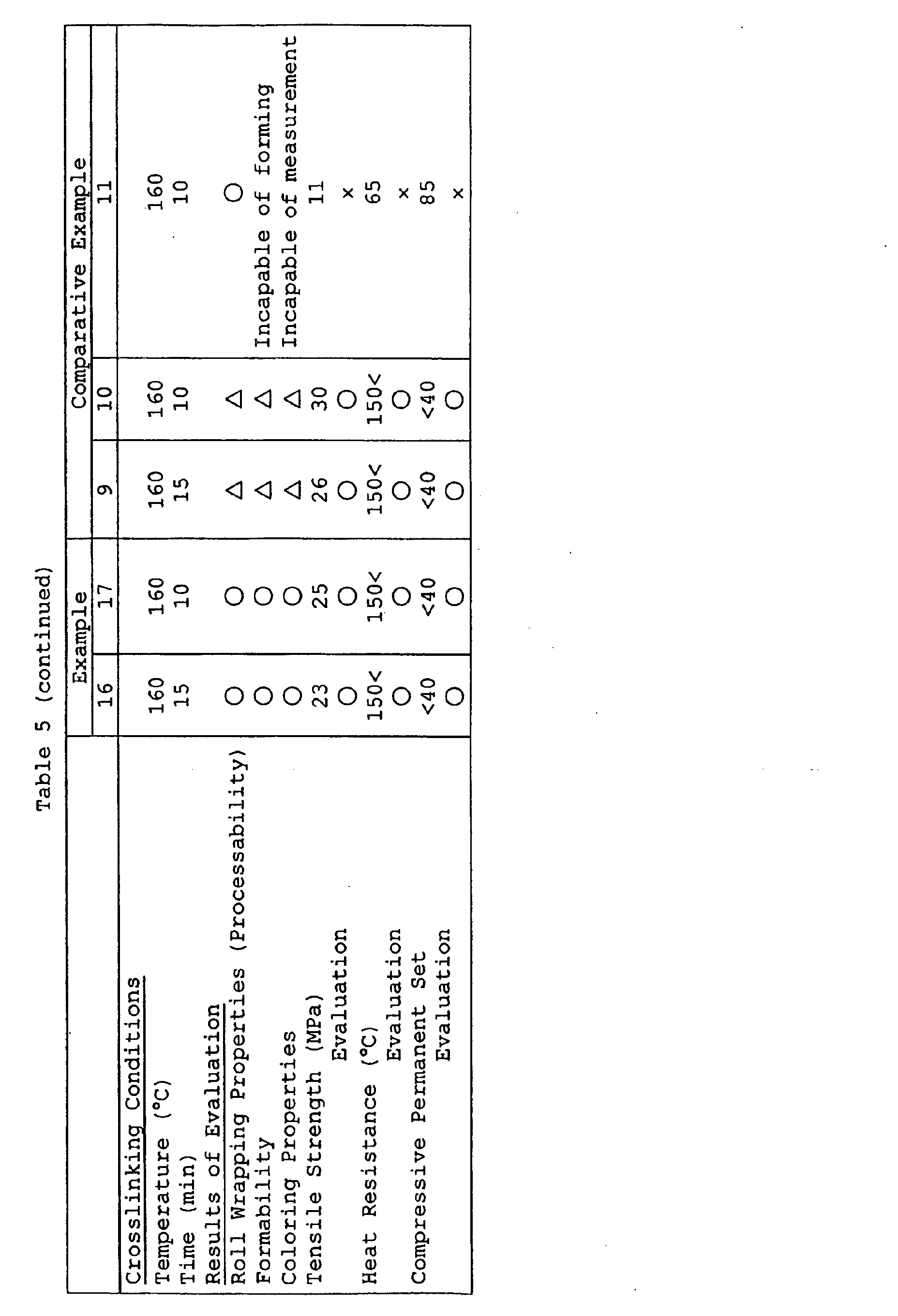
| | Example | Comparative Example |
| | 18 | 12 | 13 |
| Compounding Ratio (parts) |
| (A-7) | 60.0 | 0 | 60.0 |
| (a-3) RB830 | 0 | 60.0 | 0 |
| (B-4) HSR0061 | 10.0 | 10.0 | 10.0 |
| (B-5) IR2200 | 30.0 | 30.0 | 30.0 |
| Stearic Acid | 2.0 | 2.0 | 2.0 |
| Zinc Oxide No. 2 | 3.0 | 3.0 | 3.0 |
| Silica | 30.0 | 30.0 | 30.0 |
| Hard Clay | 20.0 | 20.0 | 20.0 |
| Diethylene Glycol | 3.0 | 3.0 | 3.0 |
| Antioxidant BHT | 1.0 | 1.0 | 1.0 |
| Titanium Oxide | 5.0 | 5.0 | 5.0 |
| Cobalt Blue | 1.0 | 1.0 | 1.0 |
| Sulfur Powder | 1.3 | 1.3 | 0 |
| Vulcanization Accelerator MBTS | 1.4 | 1.4 | 0 |
| Vulcanization Accelerator MBT | 0.3 | 0.3 | 0 |
| Foaming Aid Cellpaste K5 | 2.0 | 2.0 | 2.0 |
| Foaming Agent ADCA | 2.0 | 2.0 | 2.0 |
| Foaming Agent DNPT | 2.0 | 2.0 | 2.0 |
| Total | 174.0 | 174.0 | 171.0 |
| Crosslinking Conditions |
| Temperature (°C) | 165 | 165 | 165 |
| Time (min) | 10 | 10 | 10 |
| Results of Evaluation |
| Roll Wrapping Properties | ○ | Δ | ○ |
| (Processability) | ○ | Δ | 1) |
| Formability | ○ | Δ | 1) |
| Coloring Properties | 1.53 | 1.47 | 2) |
| Foaming Ratio (Line) (times) | 0.30 | 0.37 | 3) |
| Density (Mg/m3) | 4.5 | 5.5 | 3) |
| *(Mpa) Tensile Strength (MPa) Evaluation | ○ | ○ | × |
The following was prepared as the (A) component.
(A-8) oil-extended 1,2-polybutadiene: 1,2-vinyl bond
content = 93%, Mw = 400,000, extender oil (e-3) amount = 20%,
manufactured by JSR Corporation, a trial product
Examples 19 and 20 and Comparative Examples 14 to 19
According to compounding formulations shown in the
following table, respective components were compounded using
a 40-mm twin-screw extruder to obtain pellets. Using these
pellets, each sample piece was prepared and evaluated. Results
are shown in the following table.
The thermoplastic polymer compositions containing
oil-extended (A-8) RB, together with the olefinic resin (B-7)
and the olefinic rubber (B-8), at a specific rate were excellent
in tensile strength, forming appearance (processability) and
flexibility.
| | Example | Comparative Example |
| | 19 | 20 | 14 | 15 | 16 | 17 | 18 | 19 |
| Compounding Ratio (parts) | 10 | 6 | 10 | 10 | 2 | 95 | 43 | 1 |
| (A-8) | 20 | 35 | 70 | 2 | 28 | 4 | 55 | 4 |
| (B-7) | 70 | 59 | 20 | 88 | 70 | 1 | 2 | 95 |
| (B-8) | 0.5 | 1.5 | 0.5 | 0.5 | 0.2 | 0.5 | 0.5 | 0.5 |
| Perhexa 25B-40 |
| Results of Evaluation | 9 | 8 | 10 | 8 | 2 | 5 | 3 | 2 |
| Tensile Strength | ○ | ○ | ○ | × | ○ | ○ | ○ | × |
Forming Appearance (Processability)
Flexibility | ○ | ○ | × | ○ | ○ | ○ | × | ○ |
The following were prepared as the (A) component.
(A-9) oil-extended 1,2-polybutadiene: 1,2-vinyl bond
content = 90%, Mw = 200,000, extender oil (e-1) amount = 15%,
MFR = 9
(A-10) oil-extended 1,2-polybutadiene: 1,2-vinyl bond
content = 90%, Mw = 400,000, extender oil (e-3) amount = 50%,
MFR = 4
(A-11) oil-extended 1,2-polybutadiene: 1,2-vinyl bond
content = 90%, Mw = 170,000, extender oil (e-3) amount = 50%,
MFR = 110
Examples 21 to 27 and Comparative Examples 20 to 26
Examples 21 and 22 and Comparative Examples 20 and 21 are
shown as shoe sole characteristics of oil-extended RB and
non-oil-extended RB alone in Table 8. Each RB was directlymolded
with an injection molding machine under specific conditions,
and subjected to the evaluations.
Examples 21 and 22 are examples using oil-extended RB of
the invention, and excellent in all of formability, coloring
properties, injection molding appearance, flexibility, wear
resistance and lightness in weight important for the shoe sole
application, which reveals that the compositions are
significantly excellent for the shoe sole application. The
compositions are excellent in formability, coloring properties,
flexibility and wear resistance, compared to (a-2) RB820 and
(a-3) RB 830, Comparative Examples 20 and 21, so that Examples
21 and 22 are preferred. As for forming appearance and lightness
in weight which are excellent characteristics of RB, Examples
21 and 22 and Comparative Examples 20 and 21 are both good, and
there is no difference therebetween.
Examples 23 to 27 and Comparative Examples 22 to 26 are
shown in Tables 9 and 10.
In Table 9, after respective components were kneaded by
the use of a 40-mm open vent type single-screw extruder (screw:
front dulmage) at a temperature of 120 to 140°C, and pelletized,
the pellets were molded with an injection molding machine and
the molded article was evaluated.
Examples 23 and 24 are examples using oil-extended RB of
the invention and Comparative Examples 22 and 23 show examples
using existing (a-2) RB820 and (a-3) RB830. Examples are
preferred, because they are excellent in formability, coloring
properties and wear resistance, compared to Comparative Examples.
As for injection molding appearance and lightness in weight which
are advantages of RB, Examples 23 and 24 and Comparative Examples
22 and 23 are both good, and there is no difference therebetween.
In Table 10, after respective components were kneaded by
the use of a pressure kneader at a temperature of 120 to 150°C
for 15 minutes, the resulting mixture was pelletized through
a feeder ruder set to 160°C. Using the pellets, each sample
for evaluation was prepared by molding with an injection molding
machine under specific conditions and evaluated.
Examples 25 to 27 are examples using oil-extended RB of
the invention, Comparative Example 24 is an example using
existing (a-3) RB830, Comparative Example 25 is an example in
which the oil of Example 27 (solution blend in line after
polymerization) is blended in compound processing, and
Comparative Example 26 is an example using no RB.
Examples 25 to 27 are preferred, because they are excellent
in formability, coloring properties, injection molding
appearance and wear resistance important for the shoe sole
application, compared to Comparative Examples 24 to 26. As for
flexibility (hardness) and lightness in weight, Examples and
Comparative Examples were both good, and there was no difference
therebetween.
| | Example | Comparative Example |
| | 21 | 22 | 20 | 21 |
| RB Species | A-9 | A-10 | (a-2)
RB820 | (a-3)
RB830 |
| Results of Evaluation |
| Formability (MFR) | o ○ | o ○ | ○ | ○ |
| Coloring Properties | ○ | ○ | Δ | Δ |
| Injection Molding Appearance | o ○ | o ○ | o ○ | o ○ |
| Hardness | ○ | o ○ | Δ | Δ |
| Wear Resistance | ○ | o ○ | × | Δ |
| Lightness in Weight (density) | ○ | ○ | ○ | ○ |
| | Example | Comparative Example |
| | 23 | 24 | 22 | 23 |
| Compounding Ratio (parts) |
| (a-2) RB820 | 0 | 0 | 20 | 0 |
| (a-3) RB830 | 0 | 0 | 0 | 20 |
| (A-9) | 20 | 0 | 0 | 0 |
| (A-10) | 0 | 20 | 0 | 0 |
| (B-1) TR1600 | 80 | 80 | 80 | 80 |
| Total Amount | 100 | 100 | 100 | 100 |
| Results of Evaluation |
| Formability (MFR) | o ○ | o ○ | ○ | ○ |
| Coloring Properties | ○ | ○ | Δ | Δ |
| Injection Molding Appearance | o ○ | o ○ | o ○ | o ○ |
| Hardness | o ○ | o ○ | o ○ | o ○ |
| Wear Resistance | o ○ | o ○ | Δ | ○ |
| Lightness in Weight (density) | ○ | ○ | ○ | ○ |
| | Example | Comparative Example |
| | 25 | 26 | 27 | 24 | 25 | 26 |
| Compounding Ratio (parts) |
| (a-3) RB830 | 0 | 0 | 0 | 20 | 10 | 0 |
| (A-10) | 20 | 10 | 0 | 0 | 0 | 0 |
| (A-11) | 0 | 0 | 20 | 0 | 0 | 0 |
| (B-1) TR1600 | 100 | 100 | 100 | 100 | 100 | 100 |
| (B-9) 120K | 10 | 10 | 10 | 10 | 10 | 10 |
| Silver W | 10 | 10 | 10 | 10 | 10 | 10 |
| (e-3) | 10 | 10 | 0 | 10 | 10 | 10 |
| Total | 150 | 140 | 140 | 150 | 140 | 130 |
| Results of Evaluation |
| Formability (MFR) | o ○ | o ○ | o ○ | ○ | o ○ | ○ |
| Coloring Properties | ○ | ○ | ○ | Δ | Δ | × |
| Injection Molding Appearance | o ○ | o ○ | o ○ | o ○ | ○ | × |
| Hardness | o ○ | o ○ | o ○ | o ○ | o ○ | o ○ |
| Wear Resistance | o ○ | o ○ | o ○ | Δ | Δ | o ○ |
| Lightness in Weight (density) | ○ | ○ | ○ | ○ | ○ | ○ |
The following were prepared as the (A) component.
(A-12) oil-extended 1,2-polybutadiene: 1,2-vinyl bond
content = 90%, Mw = 400,000, extender oil (e-1) amount = 30%,
MFR = 1.6
(A-13) oil-extended 1,2-polybutadiene: 1,2-vinyl bond
content = 90%, Mw = 300,000, extender oil (e-3) amount = 20%,
MFR = 4.5
Examples 28 and 29, Comparative Examples 27 to 28 (the
above, solid compounding), Example 30 and Comparative Example
29 (the above, sponge compounding)
According to compounding formulations shown in the
following tables, compounding agents excluding a crosslinking
agent, a vulcanization accelerator and (a foaming agent) were
kneaded by the use of a Banbury mixer at a temperature of 90
to 130°C for 5 minutes, and then, a specified amount was added
with a 10-inch test roll machine to prepare a non-crosslinked
compound.
The non-crosslinked compound prepared was formed to a
specified shape, and crosslinked with a 150T vapor-curing
(crosslinking) press machine under conditions shown in the tables
to obtain each crosslinked formed article. Results are shown
in the following tables.
Table 11 shows examples of solid compounding. Examples
28 and 29 are examples using oil-extended rubber (A-12) of the
invention, and in processability, the decrease of the time
necessary for room temperature cooled compound to tightly wrap
around a roll machine resulted in dissolving the conventional
disadvantage that the processing time was long, compared to
conventional (a-3) RB830. Further, also for crosslinking
formability, a flash of the formed article became substantially
thin, so that the dimensional accuracy of the formed article
was improved. Furthermore, the formed article is excellent in
coloring properties, and can be applied to a product requiring
brilliant colors. As for wear resistance improved by
crosslinking, Examples 28 and 29 and Comparative Examples 27
and 28 were both good, and there was no difference therebetween.
On the other hand, Table 12 shows examples of sponge
compounding. Example 30 is an example using oil-extended rubber
(A-13) of the invention, and similarly to the case of solid
compounding, also in sponge compounding, in processability, the
time required until a compound cooled to room temperature was
tightly wrapped around a roll machine in processing decreased
to be able to solve the conventional disadvantage that the
processing time was long, compared to conventional (a-3) RB830.
Further, also for crosslinking formability, a flash of the formed
article became substantially thin, so that the dimensional
accuracy of the formed article was improved. Furthermore, the
foaming ratio was increased when the same amount of foaming agent
was added, because of the excellent foaming properties of
oil-extended rubber (A-13) of the invention. This indicates
that it becomes possible to decrease the amount of the expensive
foaming agent, which makes it possible to reduce compounding
unit cost. As for the wear resistance of crosslinked composition,
Example was superior to Comparative Example.
| | Example | Comparative Example |
| | 28 | 29 | 27 | 28 |
| Compounding Ratio (parts) |
| (A-12) | 60.0 | 60.0 | 0 | 0 |
| (a-3) RB830 | 0 | 0 | 60.0 | 60.0 |
| (B-5) IR2200 | 20.0 | 20.0 | 20.0 | 20.0 |
| (B-10) BR01 | 20.0 | 20.0 | 20.0 | 20.0 |
| Stearic Acid | 0.5 | 0.5 | 0.5 | 0.5 |
| Silica | 0 | 30.0 | 0 | 30.0 |
| Diethylene Glycol | 0 | 2.0 | 0 | 2.0 |
| Polyethylene Glycol | 0 | 1.0 | 0 | 1.0 |
| Antioxidant TNP | 1.0 | 1.0 | 1.0 | 1.0 |
| Percumyl D | 0.1 | 0.2 | 0.1 | 0.2 |
| Total | 100.6 | 134.7 | 100.6 | 134.7 |
| Crosslinking Conditions |
| Temperature (°C) | 160 | 160 | 160 | 160 |
| Time (min) | 15 | 10 | 15 | 10 |
| Results of Evaluation |
| Roll Wrapping Properties (Processability) | ○ | Δ | ○ | Δ |
| Formability | ○ | Δ | ○ | Δ |
| Coloring Properties | ○ | Δ | Δ | × |
| Wear Resistance (Akron abrasion method) (cc/1,000 cycles) | ○ | o ○ | ○ | o ○ |
| | Example | Comparative Example |
| | 30 | 29 |
| Compounding Ratio (parts) |
| (A-13) | 60.0 | 0 |
| (a-3) RB830 | 0 | 60.0 |
| (B-5) IR2200 | 30.0 | 30.0 |
| (B-10) BR01 | 10.0 | 10.0 |
| Stearic Acid | 2.0 | 2.0 |
| Zinc Oxide No. 2 | 3.0 | 3.0 |
| Silica | 30.0 | 30.0 |
| Hard Clay | 20.0 | 20.0 |
| Diethylene Glycol | 3.0 | 3.0 |
| Antioxidant BHT | 1.0 | 1.0 |
| Titanium Oxide | 5.0 | 5.0 |
| Sulfur Powder | 1.3 | 1.3 |
| Vulcanization Accelerator MBTS | 1.4 | 1.4 |
| Vulcanization Accelerator MBT | 0.3 | 0.3 |
| Foaming Aid Cellpaste K5 | 2.0 | 2.0 |
| Foaming Agent ADCA | 2.0 | 2.0 |
| Foaming Agent DNPT | 2.0 | 2.0 |
| Total | 173.0 | 173.0 |
| Crosslinking Conditions |
| Temperature (°C) | 165 | 165 |
| Time (min) | 10 | 10 |
| Results of Evaluation |
| Roll Wrapping Properties (Processability) | ○ | Δ |
| Formability | ○ | Δ |
| (Line) Foaming Ratio (times) | 1.53 | 1.47 |
| Density (Mg/m3) | 0.30 | 0.37 |
| Wear Resistance (Akron abrasion method) (cc/1,000 cycles) | ○ | Δ |
The followings were prepared as the (A) component.
(A-14) oil-extended 1,2-polybutadiene: 1,2-vinyl bond
content = 90%, Mw = 200,000, extender oil (e-3) amount = 30%,
MFR = 11
(A-15) oil-extended 1,2-polybutadiene: 1,2-vinyl bond
content = 90%, Mw = 150,000, extender oil (e-3) amount = 30%,
MFR = 15
(A-16) oil-extended 1,2-polybutadiene: 1,2-vinyl bond
content = 90%, Mw = 300,000, extender oil (e-3) amount = 30%,
MFR = 5
Examples 31 to 36 and Comparative Examples 30 to 35
In the following tables, Examples 31 and 32 and Comparative
Examples 30 and 31 relate to a laminate comprising a base layer
having laminated thereon a resin binding material (resin layer),
Examples 33 and 34 and Comparative Examples 32 and 33 relate
to a laminate comprising a base layer having laminated thereon
a steel reinforcing material (resin layer), and Examples 35 and
36 and Comparative Examples 34 and 35 relate to a laminate
comprising a base layer having laminated thereon a
clearance-filling material (resin layer).
According to compounding formulations shown in the
following tables, compounding agents excluding a crosslinking
agent, a vulcanization accelerator and (a foaming agent) were
kneaded by the use of a Banbury mixer at a temperature of 90
to 130°C for 5 minutes, and then, a specified amount was added
with a 10-inch roll machine to prepare a non-crosslinked resin
layer.
The non-crosslinked resin layer prepared was formed to
a specified shape, placed on a base layer, and heat treated in
a heat circulating oven at 150°C for 30 minutes to conduct
crosslinking (foaming), thereby obtaining a laminate. Results
are shown in the following tables.
Table 13 shows examples of resin binding material resin
layer compounding. Examples 31 and 32 using the resin layers
of the invention are examples using oil-extended rubber (A-14)
of the invention, and preferred because they are excellent in
kneading processability, and fitting ability test and
attachability which are an index of fluidity, compared to
conventional (a-4) RB810. As for crosslinking hardness and
vibration-damping properties improved by crosslinking,
Examples 31 and 32 and Comparative Examples 30 and 31 are both
good, and there is no difference therebetween.
Table 14 shows examples of steel reinforcing material
resin layer compounding. Examples 33 and 34 using the resin
layers of the invention are examples using oil-extended rubber
(A-15) of the invention, and preferred because they are excellent
in attachability which are an index of fluidity, compared to
conventional (a-4) RB810. As for kneading processability and
crosslinking hardness and vibration-damping properties,
Examples 33 and 34 and Comparative Examples 32 and 33 are both
good, and there is no difference therebetween.
Table 15 shows examples of clearance-filling sponge resin
layer compounding. Examples 35 and 36 using the resin layers
of the invention are examples using oil-extended rubber (A-16)
of the invention, and exhibited better results, in kneading
processability, in the time required until a compound cooled
to room temperature was tightly wrapped around a roll machine,
compared to conventional (a-4) RB810.
Examples 35 and 36 are preferred, because they are
excellent in crosslinking foaming ratio which is an index of
fluidity (the more excellent fluidity is, the more excellent
foaming properties are). As for foaming appearance, Examples
and Comparative Examples were both good, and Example 35 was
particularly preferred.
AS for steel plate adhesion improved by crosslinking,
Examples 35 and 36 were preferred, because they were superior
to Comparative Examples 34 and 35.
| | Example | Comparative Example |
| | 31 | 32 | 30 | 31 |
| Compounding Ratio (parts) |
| (A-14) | 70 | 80 | 0 | 0 |
| (a-4) RB810 | 0 | 0 | 70 | 80 |
| (B-11) TR2000 | 30 | 20 | 30 | 20 |
| Zinc Oxide No. 1 | 1 | 0 | 1 | 0 |
| Stearic Acid | 1 | 1 | 1 | 1 |
| CaCO3 Super S | 250 | 0 | 250 | 0 |
| Talc SW | 0 | 250 | 0 | 250 |
| FEF Carbon Black | 3 | 3 | 3 | 3 |
| (e-3) | 15 | 15 | 15 | 15 |
| Diethylene Glycol | 1 | 0 | 1 | 0 |
| Sulfur Powder | 30 | 0 | 30 | 0 |
| Vulcanization Accelerator TMTD | 7 | 0 | 7 | 0 |
| Vulcanization Accelerator MBTS | 4 | 0 | 4 | 0 |
| Percumyl D | 0 | 10 | 0 | 10 |
| Results of Evaluation |
| Kneading Processability | o ○ | o ○ | Δ-○ | Δ-○ |
| Fitting Ability Test | o ○ | o ○ | ○ | ○ |
| Crosslinking Hardness | 73 | 75 | 80 | 83 |
| Attachability | o ○ | o ○ | Δ | Δ |
| Vibration-Damping Properties (Coefficient of Loss) | o ○ | o ○ | o ○ | o ○ |
| | Example | Comparative Example |
| | 33 | 34 | 32 | 33 |
| Compounding Ratio (parts) |
| (A-15) | 50 | 30 | 0 | 0 |
| (a-4) RB810 | 0 | 0 | 50 | 30 |
| (B-12) Liquid Polybutadiene | 50 | 70 | 50 | 70 |
| Zinc Oxide No. 1 | 2 | 0 | 2 | 0 |
| Stearic Acid | 2 | 0 | 2 | 0 |
| CaCO3 Super S | 200 | 150 | 200 | 150 |
| Straight Asphalt | 60 | 70 | 60 | 70 |
| HAF Carbon Black | 2 | 2 | 2 | 2 |
| Sulfur Powder | 20 | 0 | 20 | 0 |
| Vulcanization Accelerator TMTD | 7 | 0 | 7 | 0 |
| Vulcanization Accelerator MBTS | 4 | 0 | 4 | 0 |
| Hicross M | 0 | 30 | 0 | 30 |
| Perhexa 3M | 0 | 10 | 0 | 10 |
| Results of Evaluation |
| Kneading Processability | o ○ | ○ | o ○ | ○ |
| Attachability | o ○ | o ○ | Δ | Δ |
| Steel Plate Adhesion | o ○ | o ○ | Δ | ○ |
| Crosslinking Hardness | o ○ | o ○ | o ○ | o ○ |
| | Example | Comparative Example |
| | 35 | 36 | 34 | 35 |
| Compounding Ratio (parts) |
| (A-16) | 60 | 40 | 0 | 0 |
| (a-4) RB810 | 0 | 0 | 60 | 40 |
| (B-13) SBR1507 | 40 | 60 | 40 | 60 |
| Zinc Oxide No. 1 | 5 | 5 | 5 | 5 |
| Stearic Acid | 2 | 2 | 2 | 2 |
| CaCO3 Super S | 40 | 40 | 40 | 40 |
| Straight Asphalt | 5 | 5 | 5 | 5 |
| FEF Carbon Black | 4 | 4 | 4 | 4 |
| Sulfur Powder | 5 | 0 | 5 | 0 |
| Vulcanization Accelerator TMTD | 0.5 | 11 | 0.5 | 11 |
| Vulcanization Accelerator MBTS | 2 | 0 | 2 | 0 |
| Vulcanization Accelerator CBS | 0 | 5 | 0 | 5 |
| Foaming Agent ADCA | 20 | 20 | 20 | 20 |
| Foaming Aid Cellpaste K5 | 10 | 10 | 10 | 10 |
| Results of Evaluation |
| Kneading Processability | o ○ | o ○ | ○ | ○ |
| Foaming Ratio | o ○ | ○ | ○ | Δ |
| Foaming Appearance | o ○ | ○ | ○ | ○ |
| Steel Plate Adhesion | o ○ | o ○ | Δ-○ | ○ |
| Attachability | o ○ | o ○ | o ○ | o ○ |
The following were prepared as the (A) component.
(A-17) oil-extended 1,2-polybutadiene: 1,2-vinyl bond
content = 90%, Mw = 150,000, extender oil (e-1) amount = 50%,
MFR = 150
(A-18) oil-extended 1,2-polybutadiene: 1,2-vinyl bond
content = 90%, Mw = 100,000, extender oil (e-1) amount = 30%,
MFR = 150
Pellet-like master batches having the following
compositions were produced by adding respective components at
once and mixing them at a blend temperature of 70°C by the use
of a pressure kneader manufactured by Moriyama Manufacturing
Co., Ltd.
Vulcanization accelerator master batches;
Master batch F: Sulfur powder/(A-17) = 50/50 Master batch G: Sulfur powder/(A-18) = 50/50 Master batch H: Sulfur powder/(a-4) = 50/50
Examples 37 to 42 and Comparative Examples 36 to 43
The roll processability of each master batch, the blocking
properties of master batch pellets, and the good or poor of the
shape and form of each sheet and pellets are shown in the following
Table 16. Examples 37 to 40 are examples using oil-extended
rubber (A-17) or oil-extended rubber (A-18) of the invention,
and preferred because they are excellent in roll processability,
anti-blocking properties and the shape of the master batch,
compared to Comparative Examples 36 and 39 using conventional
(a-4) RB810 and Comparative Examples 37 and 38 each using a
composition out of the scope of the invention.
The dispersibility of each master batch is shown in the
following Table 17. Examples 41 and 42 in which a master batch
using oil-extended rubber (A-17) or oil-extended rubber (A-18)
of the invention is added to a compounding system are preferred,
because they are excellent in dispersibility, compared to
conventional (a-4) RB810 and Comparative Examples 40 to 43 out
of the scope of the invention.
| | Example | Comparative Example |
| | 37 | 38 | 39 | 40 | 36 | 37 | 38 | 39 |
| Name of Master Batch | A | B | F | G | C | D | E | H |
| Results of Evaluation |
| Roll Wrapping Properties | ○ | ○ | ○ | ○ | ○-Δ | ○ | × | ○-Δ |
| Blocking Properties | ○ | ○ | ○ | ○ | ○ | Δ | ○ | ○ |
| Shape of Master Batch | ○ | ○ | ○ | ○ | Δ | ○ | × | Δ |
| | Example | Comparative Example |
| | 41 | 42 | 40 | 41 | 42 | 43 |
| Compounding Ratio (parts) |
| (B-14) SBR1500 | 100 | 100 | 100 | 100 | 100 | 100 |
| HAF Carbon Black | 50 | 50 | 50 | 50 | 50 | 50 |
| (e-4) | 9 | 9 | 9 | 9 | 9 | 9 |
| Stearic Acid | 3 | 3 | 3 | 3 | 3 | 3 |
| Zinc Oxide No. 1 | 4 | 4 | 4 | 4 | 4 | 4 |
| Master Batch A/F | 4/3 | 0 | 0 | 0 | 0 | 0 |
| Master Batch B/G | 0 | 4/3 | 0 | 0 | 0 | 0 |
| Master Batch C/H | 0 | 0 | 4/3 | 0 | 0 | 0 |
| Master Batch D/F | 0 | 0 | 0 | 40/3 | 0 | 0 |
| Master Batch E/F | 0 | 0 | 0 | 0 | 2/3 | 0 |
| Vulcanization Accelerator MBTS | 0 | 0 | 0 | 0 | 0 | 2 |
| Sulfur Powder | 0 | 0 | 0 | 0 | 0 | 1.5 |
| Results of Evaluation |
| Dispersibility | ○ | ○ | Δ | Δ | × | × |
The oil-extended 1,2-polybutadiene of the invention and
the composition thereof are excellent in forming processability
and mechanical strength, particularly in wear resistance,
characterizing conventional 1,2-polybutadiene, and further
excellent in fluidity, coloring properties (high distinctness
of image), flexibility and attachability. Further, of the
thermoplastic elastomers, the oil-extended 1,2-polybutadiene
of the invention has a forming temperature as low as about 150°C,
and this is advantageous from the viewpoint of energy in
production and processing.
Furthermore, the oil-extended 1,2-polybutadiene of the
invention and the composition thereof are curable with sulfur,
high in peroxide crosslinking activity, and excellent in filling
properties of fillers or chemicals, so that they are available
as crosslinking (curing) polymers or reaction aids for other
crosslinking (curing) polymers.
In addition, the formed article of the invention
crosslinked and foamed has no flow mark, and is also excellent
in dimensional accuracy, durability and cushioning properties,
so that it can also be applied to thermoformed sponges.
The oil-extended 1,2-polybutadiene of the invention and
the composition thereof are useful as various formed articles
such as automobile parts, building material parts, footwear,
toys, miscellaneous goods and sporting and health goods, various
sheets and films, other industrial goods, buffer materials and
packaging materials. They can also be used, for example, for
automobile interior and exterior goods such as tire members
including treads, sidewalls, carcasses and the like, car mats,
bumpers, mud guards, exterior lacings, gaskets for window sealing,
gaskets for door sealing, gaskets for trunk sealing, roof side
rails, emblems, weather strips and outer layers of instrument
panels; automobile interior constituents integrated with fabric
and/or non-woven fabric; industrial goods such as belts, hoses,
rubber cushions, vibration-damping materials, soundproofing
materials, wire coating materials, backing materials used for
tiles, car mats, carpets and the like, and medical goods such
as infusion tubes and syringes; and household and miscellaneous
goods such as cutting boards and grips (of kitchen knives).
The shoe sole material of the invention is excellent in
appearance, and excellent in flexibility, wear resistance and
lightness in weight. Accordingly, the shoe sole material of
the invention is also useful as shoe sole materials of the overall
footwear specifically such as men's shoes, ladies' shoes, casual
shoes, running shoes, jogging shoes, tracking shoes, various
athletic shoes, mountaineering boots, dress shoes, golf shoes,
house shoes, slippers and beach shoes.
The laminate of the invention can be uniformly laminated
even to the base layer having a complicated shape and is excellent
in vibration-damping properties, antivibration properties,
sound insulating properties, sound absorbing properties,
soundproofing properties and sealing properties. Accordingly,
the laminate of the invention is suitable as sound insulating
materials, soundproofing materials, vibration-damping
materials, steel plate-reinforcing materials,
clearance-filling materials, antivibration materials, sealing
materials, thermoset plastic dampers and the like, and can be
widely used as various linings industrial goods, automobile
interior materials, building materials, daily necessaries,
sports goods, toys and the like, as other applications.
Further, according to the clearance-filling method of the
invention, a clearance between the base layers can be easily
filled with the composition of the invention excellent in
fluidity and attachability.
In the master batch of the invention, the oil-extended
1,2-polybutadiene excellent in fluidity and anti-blocking
properties is used, so that the dispersibility of a functional
compound for rubber or plastics is good, and the functional
compound can be mixed in larger amounts, compared to conventional
functional compounds. When the functional compound is
transparent, the master batch is also excellent in transparency,
and further has functional compound-entrapping properties (high
filling properties). Further, the use of the master batch of
the invention makes it easy to conduct processing for a shorter
period of time than before, and decreases contamination of
working environment to enable efficient working, which causes
an advantage of being friendly to the environment. Further,
the use of the master batch of the invention heightens the weighing
accuracy, the dispersion accuracy and the processing accuracy,
thereby being able to obtain high-accuracy functional parts made
of rubber or plastics (such as automobile important security
parts and precision electric parts) . Like this, the master batch
of the invention exhibits the excellent effects in the production
of mater batches, plastics and rubber products.