EP1369443A2 - Gas-barrier polyurethane resin, and adhesive for laminate, film and paint containing the same - Google Patents
Gas-barrier polyurethane resin, and adhesive for laminate, film and paint containing the same Download PDFInfo
- Publication number
- EP1369443A2 EP1369443A2 EP03011983A EP03011983A EP1369443A2 EP 1369443 A2 EP1369443 A2 EP 1369443A2 EP 03011983 A EP03011983 A EP 03011983A EP 03011983 A EP03011983 A EP 03011983A EP 1369443 A2 EP1369443 A2 EP 1369443A2
- Authority
- EP
- European Patent Office
- Prior art keywords
- gas
- barrier
- compound
- polyurethane resin
- film
- Prior art date
- Legal status (The legal status is an assumption and is not a legal conclusion. Google has not performed a legal analysis and makes no representation as to the accuracy of the status listed.)
- Granted
Links
- 229920005749 polyurethane resin Polymers 0.000 title claims abstract description 119
- 239000003973 paint Substances 0.000 title claims abstract description 73
- 239000000853 adhesive Substances 0.000 title claims abstract description 65
- 230000001070 adhesive effect Effects 0.000 title claims abstract description 65
- 150000001875 compounds Chemical class 0.000 claims abstract description 326
- 239000005056 polyisocyanate Substances 0.000 claims abstract description 210
- 229920001228 polyisocyanate Polymers 0.000 claims abstract description 210
- UFHFLCQGNIYNRP-UHFFFAOYSA-N Hydrogen Chemical compound [H][H] UFHFLCQGNIYNRP-UHFFFAOYSA-N 0.000 claims abstract description 112
- 239000001257 hydrogen Substances 0.000 claims abstract description 112
- 229910052739 hydrogen Inorganic materials 0.000 claims abstract description 112
- 239000000203 mixture Substances 0.000 claims abstract description 74
- 238000013007 heat curing Methods 0.000 claims abstract description 53
- 239000007788 liquid Substances 0.000 claims abstract description 37
- 239000011342 resin composition Substances 0.000 claims abstract description 35
- 238000000576 coating method Methods 0.000 claims description 85
- 239000011248 coating agent Substances 0.000 claims description 83
- 150000003077 polyols Chemical class 0.000 claims description 76
- -1 isocyanate compound Chemical class 0.000 claims description 53
- 229920005989 resin Polymers 0.000 claims description 52
- 239000011347 resin Substances 0.000 claims description 52
- 229920005862 polyol Polymers 0.000 claims description 48
- 230000035699 permeability Effects 0.000 claims description 45
- 229920000768 polyamine Polymers 0.000 claims description 42
- QVGXLLKOCUKJST-UHFFFAOYSA-N atomic oxygen Chemical compound [O] QVGXLLKOCUKJST-UHFFFAOYSA-N 0.000 claims description 40
- 239000001301 oxygen Substances 0.000 claims description 40
- 229910052760 oxygen Inorganic materials 0.000 claims description 40
- 238000003475 lamination Methods 0.000 claims description 30
- 150000001412 amines Chemical class 0.000 claims description 25
- 125000002723 alicyclic group Chemical group 0.000 claims description 23
- 125000003118 aryl group Chemical group 0.000 claims description 23
- 239000012948 isocyanate Substances 0.000 claims description 22
- PEDCQBHIVMGVHV-UHFFFAOYSA-N Glycerine Chemical compound OCC(O)CO PEDCQBHIVMGVHV-UHFFFAOYSA-N 0.000 claims description 21
- 239000002131 composite material Substances 0.000 claims description 20
- 125000001931 aliphatic group Chemical group 0.000 claims description 19
- 239000007795 chemical reaction product Substances 0.000 claims description 17
- FKTHNVSLHLHISI-UHFFFAOYSA-N 1,2-bis(isocyanatomethyl)benzene Chemical compound O=C=NCC1=CC=CC=C1CN=C=O FKTHNVSLHLHISI-UHFFFAOYSA-N 0.000 claims description 14
- 239000000047 product Substances 0.000 claims description 14
- 150000001735 carboxylic acids Chemical class 0.000 claims description 12
- 125000003368 amide group Chemical group 0.000 claims description 11
- LFQSCWFLJHTTHZ-UHFFFAOYSA-N Ethanol Chemical compound CCO LFQSCWFLJHTTHZ-UHFFFAOYSA-N 0.000 claims description 9
- ZFSLODLOARCGLH-UHFFFAOYSA-N isocyanuric acid Chemical class OC1=NC(O)=NC(O)=N1 ZFSLODLOARCGLH-UHFFFAOYSA-N 0.000 claims description 9
- 229920006254 polymer film Polymers 0.000 claims description 9
- QXRRAZIZHCWBQY-UHFFFAOYSA-N 1,1-bis(isocyanatomethyl)cyclohexane Chemical compound O=C=NCC1(CN=C=O)CCCCC1 QXRRAZIZHCWBQY-UHFFFAOYSA-N 0.000 claims description 7
- 238000001723 curing Methods 0.000 claims description 7
- GKXVJHDEWHKBFH-UHFFFAOYSA-N [2-(aminomethyl)phenyl]methanamine Chemical compound NCC1=CC=CC=C1CN GKXVJHDEWHKBFH-UHFFFAOYSA-N 0.000 claims description 6
- 239000002253 acid Substances 0.000 claims description 6
- AVWRKZWQTYIKIY-UHFFFAOYSA-N urea-1-carboxylic acid Chemical class NC(=O)NC(O)=O AVWRKZWQTYIKIY-UHFFFAOYSA-N 0.000 claims description 6
- 150000007513 acids Chemical class 0.000 claims description 5
- WXZMFSXDPGVJKK-UHFFFAOYSA-N pentaerythritol Chemical compound OCC(CO)(CO)CO WXZMFSXDPGVJKK-UHFFFAOYSA-N 0.000 claims description 5
- 150000001298 alcohols Chemical class 0.000 claims description 3
- QXJQHYBHAIHNGG-UHFFFAOYSA-N trimethylolethane Chemical compound OCC(C)(CO)CO QXJQHYBHAIHNGG-UHFFFAOYSA-N 0.000 claims description 2
- ATUOYWHBWRKTHZ-UHFFFAOYSA-N Propane Chemical compound CCC ATUOYWHBWRKTHZ-UHFFFAOYSA-N 0.000 claims 2
- 239000001294 propane Substances 0.000 claims 1
- 238000011282 treatment Methods 0.000 abstract description 49
- 238000009835 boiling Methods 0.000 abstract description 22
- 239000005022 packaging material Substances 0.000 abstract description 16
- 229910052751 metal Inorganic materials 0.000 abstract description 14
- 239000002184 metal Substances 0.000 abstract description 14
- 239000007789 gas Substances 0.000 abstract description 13
- 150000002739 metals Chemical class 0.000 abstract description 10
- 239000003814 drug Substances 0.000 abstract description 8
- 229940079593 drug Drugs 0.000 abstract description 8
- 229920000642 polymer Polymers 0.000 abstract description 6
- 230000000149 penetrating effect Effects 0.000 abstract description 4
- 238000005260 corrosion Methods 0.000 abstract description 3
- 230000007797 corrosion Effects 0.000 abstract description 2
- 239000010408 film Substances 0.000 description 258
- 239000010410 layer Substances 0.000 description 87
- 238000000034 method Methods 0.000 description 81
- 239000000463 material Substances 0.000 description 72
- 230000000052 comparative effect Effects 0.000 description 56
- 229940126062 Compound A Drugs 0.000 description 51
- NLDMNSXOCDLTTB-UHFFFAOYSA-N Heterophylliin A Natural products O1C2COC(=O)C3=CC(O)=C(O)C(O)=C3C3=C(O)C(O)=C(O)C=C3C(=O)OC2C(OC(=O)C=2C=C(O)C(O)=C(O)C=2)C(O)C1OC(=O)C1=CC(O)=C(O)C(O)=C1 NLDMNSXOCDLTTB-UHFFFAOYSA-N 0.000 description 51
- 239000012790 adhesive layer Substances 0.000 description 49
- IJGRMHOSHXDMSA-UHFFFAOYSA-N Atomic nitrogen Chemical compound N#N IJGRMHOSHXDMSA-UHFFFAOYSA-N 0.000 description 44
- CSCPPACGZOOCGX-UHFFFAOYSA-N Acetone Chemical compound CC(C)=O CSCPPACGZOOCGX-UHFFFAOYSA-N 0.000 description 33
- XEKOWRVHYACXOJ-UHFFFAOYSA-N Ethyl acetate Chemical compound CCOC(C)=O XEKOWRVHYACXOJ-UHFFFAOYSA-N 0.000 description 33
- 238000006243 chemical reaction Methods 0.000 description 30
- LYCAIKOWRPUZTN-UHFFFAOYSA-N Ethylene glycol Chemical compound OCCO LYCAIKOWRPUZTN-UHFFFAOYSA-N 0.000 description 27
- 239000003960 organic solvent Substances 0.000 description 27
- 239000000243 solution Substances 0.000 description 27
- ZWEHNKRNPOVVGH-UHFFFAOYSA-N 2-Butanone Chemical compound CCC(C)=O ZWEHNKRNPOVVGH-UHFFFAOYSA-N 0.000 description 24
- XLYOFNOQVPJJNP-UHFFFAOYSA-N water Chemical compound O XLYOFNOQVPJJNP-UHFFFAOYSA-N 0.000 description 23
- 238000004821 distillation Methods 0.000 description 22
- 229910052757 nitrogen Inorganic materials 0.000 description 22
- 239000011541 reaction mixture Substances 0.000 description 22
- 239000010409 thin film Substances 0.000 description 22
- YXFVVABEGXRONW-UHFFFAOYSA-N Toluene Chemical compound CC1=CC=CC=C1 YXFVVABEGXRONW-UHFFFAOYSA-N 0.000 description 21
- ZMXDDKWLCZADIW-UHFFFAOYSA-N N,N-Dimethylformamide Chemical compound CN(C)C=O ZMXDDKWLCZADIW-UHFFFAOYSA-N 0.000 description 18
- 229920005570 flexible polymer Polymers 0.000 description 18
- 238000004519 manufacturing process Methods 0.000 description 16
- VYPSYNLAJGMNEJ-UHFFFAOYSA-N Silicium dioxide Chemical compound O=[Si]=O VYPSYNLAJGMNEJ-UHFFFAOYSA-N 0.000 description 15
- 239000003054 catalyst Substances 0.000 description 15
- MTHSVFCYNBDYFN-UHFFFAOYSA-N diethylene glycol Chemical compound OCCOCCO MTHSVFCYNBDYFN-UHFFFAOYSA-N 0.000 description 15
- ZJCCRDAZUWHFQH-UHFFFAOYSA-N Trimethylolpropane Chemical compound CCC(CO)(CO)CO ZJCCRDAZUWHFQH-UHFFFAOYSA-N 0.000 description 14
- 239000004372 Polyvinyl alcohol Substances 0.000 description 13
- 239000011247 coating layer Substances 0.000 description 13
- 229920002451 polyvinyl alcohol Polymers 0.000 description 13
- 229920000219 Ethylene vinyl alcohol Polymers 0.000 description 12
- WYURNTSHIVDZCO-UHFFFAOYSA-N Tetrahydrofuran Chemical compound C1CCOC1 WYURNTSHIVDZCO-UHFFFAOYSA-N 0.000 description 12
- 239000005033 polyvinylidene chloride Substances 0.000 description 12
- CTQNGGLPUBDAKN-UHFFFAOYSA-N O-Xylene Chemical compound CC1=CC=CC=C1C CTQNGGLPUBDAKN-UHFFFAOYSA-N 0.000 description 10
- 239000004743 Polypropylene Substances 0.000 description 10
- 229920001328 Polyvinylidene chloride Polymers 0.000 description 10
- 239000002985 plastic film Substances 0.000 description 10
- 229920006255 plastic film Polymers 0.000 description 10
- 229920002647 polyamide Polymers 0.000 description 10
- 229920001155 polypropylene Polymers 0.000 description 10
- 239000007787 solid Substances 0.000 description 10
- 239000002904 solvent Substances 0.000 description 10
- 239000000080 wetting agent Substances 0.000 description 10
- 239000008096 xylene Substances 0.000 description 10
- 230000004888 barrier function Effects 0.000 description 9
- 229920002635 polyurethane Polymers 0.000 description 9
- 239000004814 polyurethane Substances 0.000 description 9
- 239000000565 sealant Substances 0.000 description 9
- HZAXFHJVJLSVMW-UHFFFAOYSA-N 2-Aminoethan-1-ol Chemical compound NCCO HZAXFHJVJLSVMW-UHFFFAOYSA-N 0.000 description 8
- 239000005057 Hexamethylene diisocyanate Substances 0.000 description 8
- JNGZXGGOCLZBFB-IVCQMTBJSA-N compound E Chemical compound N([C@@H](C)C(=O)N[C@@H]1C(N(C)C2=CC=CC=C2C(C=2C=CC=CC=2)=N1)=O)C(=O)CC1=CC(F)=CC(F)=C1 JNGZXGGOCLZBFB-IVCQMTBJSA-N 0.000 description 8
- 239000004715 ethylene vinyl alcohol Substances 0.000 description 8
- RRAMGCGOFNQTLD-UHFFFAOYSA-N hexamethylene diisocyanate Chemical compound O=C=NCCCCCCN=C=O RRAMGCGOFNQTLD-UHFFFAOYSA-N 0.000 description 8
- 238000010030 laminating Methods 0.000 description 8
- 238000002156 mixing Methods 0.000 description 8
- LVTJOONKWUXEFR-FZRMHRINSA-N protoneodioscin Natural products O(C[C@@H](CC[C@]1(O)[C@H](C)[C@@H]2[C@]3(C)[C@H]([C@H]4[C@@H]([C@]5(C)C(=CC4)C[C@@H](O[C@@H]4[C@H](O[C@H]6[C@@H](O)[C@@H](O)[C@@H](O)[C@H](C)O6)[C@@H](O)[C@H](O[C@H]6[C@@H](O)[C@@H](O)[C@@H](O)[C@H](C)O6)[C@H](CO)O4)CC5)CC3)C[C@@H]2O1)C)[C@H]1[C@H](O)[C@H](O)[C@H](O)[C@@H](CO)O1 LVTJOONKWUXEFR-FZRMHRINSA-N 0.000 description 8
- 239000005058 Isophorone diisocyanate Substances 0.000 description 7
- 239000004952 Polyamide Substances 0.000 description 7
- 229910000831 Steel Inorganic materials 0.000 description 7
- NIXOWILDQLNWCW-UHFFFAOYSA-N acrylic acid group Chemical group C(C=C)(=O)O NIXOWILDQLNWCW-UHFFFAOYSA-N 0.000 description 7
- PNEYBMLMFCGWSK-UHFFFAOYSA-N aluminium oxide Inorganic materials [O-2].[O-2].[O-2].[Al+3].[Al+3] PNEYBMLMFCGWSK-UHFFFAOYSA-N 0.000 description 7
- 239000007822 coupling agent Substances 0.000 description 7
- 239000011256 inorganic filler Substances 0.000 description 7
- 229910003475 inorganic filler Inorganic materials 0.000 description 7
- NIMLQBUJDJZYEJ-UHFFFAOYSA-N isophorone diisocyanate Chemical compound CC1(C)CC(N=C=O)CC(C)(CN=C=O)C1 NIMLQBUJDJZYEJ-UHFFFAOYSA-N 0.000 description 7
- 239000000049 pigment Substances 0.000 description 7
- 229920003023 plastic Polymers 0.000 description 7
- 239000004033 plastic Substances 0.000 description 7
- 229920000098 polyolefin Polymers 0.000 description 7
- 239000000377 silicon dioxide Substances 0.000 description 7
- 239000010959 steel Substances 0.000 description 7
- WEVYAHXRMPXWCK-UHFFFAOYSA-N Acetonitrile Chemical compound CC#N WEVYAHXRMPXWCK-UHFFFAOYSA-N 0.000 description 6
- DKPFZGUDAPQIHT-UHFFFAOYSA-N Butyl acetate Natural products CCCCOC(C)=O DKPFZGUDAPQIHT-UHFFFAOYSA-N 0.000 description 6
- NTIZESTWPVYFNL-UHFFFAOYSA-N Methyl isobutyl ketone Chemical compound CC(C)CC(C)=O NTIZESTWPVYFNL-UHFFFAOYSA-N 0.000 description 6
- UIHCLUNTQKBZGK-UHFFFAOYSA-N Methyl isobutyl ketone Natural products CCC(C)C(C)=O UIHCLUNTQKBZGK-UHFFFAOYSA-N 0.000 description 6
- FXHOOIRPVKKKFG-UHFFFAOYSA-N N,N-Dimethylacetamide Chemical compound CN(C)C(C)=O FXHOOIRPVKKKFG-UHFFFAOYSA-N 0.000 description 6
- KKEYFWRCBNTPAC-UHFFFAOYSA-N Terephthalic acid Chemical compound OC(=O)C1=CC=C(C(O)=O)C=C1 KKEYFWRCBNTPAC-UHFFFAOYSA-N 0.000 description 6
- XSQUKJJJFZCRTK-UHFFFAOYSA-N Urea Chemical compound NC(N)=O XSQUKJJJFZCRTK-UHFFFAOYSA-N 0.000 description 6
- 230000032683 aging Effects 0.000 description 6
- WERYXYBDKMZEQL-UHFFFAOYSA-N butane-1,4-diol Chemical compound OCCCCO WERYXYBDKMZEQL-UHFFFAOYSA-N 0.000 description 6
- VHRGRCVQAFMJIZ-UHFFFAOYSA-N cadaverine Chemical compound NCCCCCN VHRGRCVQAFMJIZ-UHFFFAOYSA-N 0.000 description 6
- 238000009820 dry lamination Methods 0.000 description 6
- 239000005038 ethylene vinyl acetate Substances 0.000 description 6
- NAQMVNRVTILPCV-UHFFFAOYSA-N hexane-1,6-diamine Chemical compound NCCCCCCN NAQMVNRVTILPCV-UHFFFAOYSA-N 0.000 description 6
- FUZZWVXGSFPDMH-UHFFFAOYSA-N hexanoic acid Chemical compound CCCCCC(O)=O FUZZWVXGSFPDMH-UHFFFAOYSA-N 0.000 description 6
- 238000004806 packaging method and process Methods 0.000 description 6
- 229920001200 poly(ethylene-vinyl acetate) Polymers 0.000 description 6
- 238000007639 printing Methods 0.000 description 6
- KIDHWZJUCRJVML-UHFFFAOYSA-N putrescine Chemical compound NCCCCN KIDHWZJUCRJVML-UHFFFAOYSA-N 0.000 description 6
- 238000005507 spraying Methods 0.000 description 6
- YLQBMQCUIZJEEH-UHFFFAOYSA-N tetrahydrofuran Natural products C=1C=COC=1 YLQBMQCUIZJEEH-UHFFFAOYSA-N 0.000 description 6
- XFNJVJPLKCPIBV-UHFFFAOYSA-N trimethylenediamine Chemical compound NCCCN XFNJVJPLKCPIBV-UHFFFAOYSA-N 0.000 description 6
- FDLQZKYLHJJBHD-UHFFFAOYSA-N [3-(aminomethyl)phenyl]methanamine Chemical compound NCC1=CC=CC(CN)=C1 FDLQZKYLHJJBHD-UHFFFAOYSA-N 0.000 description 5
- 229910052782 aluminium Inorganic materials 0.000 description 5
- XAGFODPZIPBFFR-UHFFFAOYSA-N aluminium Chemical compound [Al] XAGFODPZIPBFFR-UHFFFAOYSA-N 0.000 description 5
- 125000004432 carbon atom Chemical group C* 0.000 description 5
- 239000003795 chemical substances by application Substances 0.000 description 5
- 239000004567 concrete Substances 0.000 description 5
- 230000001747 exhibiting effect Effects 0.000 description 5
- 238000001125 extrusion Methods 0.000 description 5
- 239000000976 ink Substances 0.000 description 5
- 229920000728 polyester Polymers 0.000 description 5
- 230000008569 process Effects 0.000 description 5
- SVONRAPFKPVNKG-UHFFFAOYSA-N 2-ethoxyethyl acetate Chemical compound CCOCCOC(C)=O SVONRAPFKPVNKG-UHFFFAOYSA-N 0.000 description 4
- RSWGJHLUYNHPMX-UHFFFAOYSA-N Abietic-Saeure Natural products C12CCC(C(C)C)=CC2=CCC2C1(C)CCCC2(C)C(O)=O RSWGJHLUYNHPMX-UHFFFAOYSA-N 0.000 description 4
- JOYRKODLDBILNP-UHFFFAOYSA-N Ethyl urethane Chemical compound CCOC(N)=O JOYRKODLDBILNP-UHFFFAOYSA-N 0.000 description 4
- OFOBLEOULBTSOW-UHFFFAOYSA-N Malonic acid Chemical compound OC(=O)CC(O)=O OFOBLEOULBTSOW-UHFFFAOYSA-N 0.000 description 4
- 239000004698 Polyethylene Substances 0.000 description 4
- KHPCPRHQVVSZAH-HUOMCSJISA-N Rosin Natural products O(C/C=C/c1ccccc1)[C@H]1[C@H](O)[C@@H](O)[C@@H](O)[C@@H](CO)O1 KHPCPRHQVVSZAH-HUOMCSJISA-N 0.000 description 4
- QAOWNCQODCNURD-UHFFFAOYSA-N Sulfuric acid Chemical compound OS(O)(=O)=O QAOWNCQODCNURD-UHFFFAOYSA-N 0.000 description 4
- WNLRTRBMVRJNCN-UHFFFAOYSA-N adipic acid Chemical compound OC(=O)CCCCC(O)=O WNLRTRBMVRJNCN-UHFFFAOYSA-N 0.000 description 4
- 150000001334 alicyclic compounds Chemical class 0.000 description 4
- 150000007824 aliphatic compounds Chemical class 0.000 description 4
- 150000001491 aromatic compounds Chemical class 0.000 description 4
- 230000008859 change Effects 0.000 description 4
- 238000003851 corona treatment Methods 0.000 description 4
- TVIDDXQYHWJXFK-UHFFFAOYSA-N dodecanedioic acid Chemical compound OC(=O)CCCCCCCCCCC(O)=O TVIDDXQYHWJXFK-UHFFFAOYSA-N 0.000 description 4
- FVIZARNDLVOMSU-UHFFFAOYSA-N ginsenoside K Natural products C1CC(C2(CCC3C(C)(C)C(O)CCC3(C)C2CC2O)C)(C)C2C1C(C)(CCC=C(C)C)OC1OC(CO)C(O)C(O)C1O FVIZARNDLVOMSU-UHFFFAOYSA-N 0.000 description 4
- ZTQSADJAYQOCDD-UHFFFAOYSA-N ginsenoside-Rd2 Natural products C1CC(C2(CCC3C(C)(C)C(OC4C(C(O)C(O)C(CO)O4)O)CCC3(C)C2CC2O)C)(C)C2C1C(C)(CCC=C(C)C)OC(C(C(O)C1O)O)OC1COC1OCC(O)C(O)C1O ZTQSADJAYQOCDD-UHFFFAOYSA-N 0.000 description 4
- 125000004435 hydrogen atom Chemical group [H]* 0.000 description 4
- 125000002887 hydroxy group Chemical group [H]O* 0.000 description 4
- IQPQWNKOIGAROB-UHFFFAOYSA-N isocyanate group Chemical group [N-]=C=O IQPQWNKOIGAROB-UHFFFAOYSA-N 0.000 description 4
- QQVIHTHCMHWDBS-UHFFFAOYSA-N isophthalic acid Chemical compound OC(=O)C1=CC=CC(C(O)=O)=C1 QQVIHTHCMHWDBS-UHFFFAOYSA-N 0.000 description 4
- 239000011259 mixed solution Substances 0.000 description 4
- BDJRBEYXGGNYIS-UHFFFAOYSA-N nonanedioic acid Chemical compound OC(=O)CCCCCCCC(O)=O BDJRBEYXGGNYIS-UHFFFAOYSA-N 0.000 description 4
- 150000002902 organometallic compounds Chemical class 0.000 description 4
- 229920000573 polyethylene Polymers 0.000 description 4
- 229920000139 polyethylene terephthalate Polymers 0.000 description 4
- 239000005020 polyethylene terephthalate Substances 0.000 description 4
- 239000002861 polymer material Substances 0.000 description 4
- CYIDZMCFTVVTJO-UHFFFAOYSA-N pyromellitic acid Chemical compound OC(=O)C1=CC(C(O)=O)=C(C(O)=O)C=C1C(O)=O CYIDZMCFTVVTJO-UHFFFAOYSA-N 0.000 description 4
- CXMXRPHRNRROMY-UHFFFAOYSA-N sebacic acid Chemical compound OC(=O)CCCCCCCCC(O)=O CXMXRPHRNRROMY-UHFFFAOYSA-N 0.000 description 4
- TYFQFVWCELRYAO-UHFFFAOYSA-N suberic acid Chemical compound OC(=O)CCCCCCC(O)=O TYFQFVWCELRYAO-UHFFFAOYSA-N 0.000 description 4
- 239000000126 substance Substances 0.000 description 4
- 238000004381 surface treatment Methods 0.000 description 4
- 150000003512 tertiary amines Chemical class 0.000 description 4
- DVKJHBMWWAPEIU-UHFFFAOYSA-N toluene 2,4-diisocyanate Chemical compound CC1=CC=C(N=C=O)C=C1N=C=O DVKJHBMWWAPEIU-UHFFFAOYSA-N 0.000 description 4
- KHPCPRHQVVSZAH-UHFFFAOYSA-N trans-cinnamyl beta-D-glucopyranoside Natural products OC1C(O)C(O)C(CO)OC1OCC=CC1=CC=CC=C1 KHPCPRHQVVSZAH-UHFFFAOYSA-N 0.000 description 4
- ARCGXLSVLAOJQL-UHFFFAOYSA-N trimellitic acid Chemical compound OC(=O)C1=CC=C(C(O)=O)C(C(O)=O)=C1 ARCGXLSVLAOJQL-UHFFFAOYSA-N 0.000 description 4
- RTTZISZSHSCFRH-UHFFFAOYSA-N 1,3-bis(isocyanatomethyl)benzene Chemical compound O=C=NCC1=CC=CC(CN=C=O)=C1 RTTZISZSHSCFRH-UHFFFAOYSA-N 0.000 description 3
- VGHSXKTVMPXHNG-UHFFFAOYSA-N 1,3-diisocyanatobenzene Chemical compound O=C=NC1=CC=CC(N=C=O)=C1 VGHSXKTVMPXHNG-UHFFFAOYSA-N 0.000 description 3
- OHLKMGYGBHFODF-UHFFFAOYSA-N 1,4-bis(isocyanatomethyl)benzene Chemical compound O=C=NCC1=CC=C(CN=C=O)C=C1 OHLKMGYGBHFODF-UHFFFAOYSA-N 0.000 description 3
- ROHUXHMNZLHBSF-UHFFFAOYSA-N 1,4-bis(isocyanatomethyl)cyclohexane Chemical compound O=C=NCC1CCC(CN=C=O)CC1 ROHUXHMNZLHBSF-UHFFFAOYSA-N 0.000 description 3
- ALQLPWJFHRMHIU-UHFFFAOYSA-N 1,4-diisocyanatobenzene Chemical compound O=C=NC1=CC=C(N=C=O)C=C1 ALQLPWJFHRMHIU-UHFFFAOYSA-N 0.000 description 3
- CDMDQYCEEKCBGR-UHFFFAOYSA-N 1,4-diisocyanatocyclohexane Chemical compound O=C=NC1CCC(N=C=O)CC1 CDMDQYCEEKCBGR-UHFFFAOYSA-N 0.000 description 3
- RLYCRLGLCUXUPO-UHFFFAOYSA-N 2,6-diaminotoluene Chemical compound CC1=C(N)C=CC=C1N RLYCRLGLCUXUPO-UHFFFAOYSA-N 0.000 description 3
- OHKOAJUTRVTYSW-UHFFFAOYSA-N 2-[(2-aminophenyl)methyl]aniline Chemical compound NC1=CC=CC=C1CC1=CC=CC=C1N OHKOAJUTRVTYSW-UHFFFAOYSA-N 0.000 description 3
- FZZMTSNZRBFGGU-UHFFFAOYSA-N 2-chloro-7-fluoroquinazolin-4-amine Chemical compound FC1=CC=C2C(N)=NC(Cl)=NC2=C1 FZZMTSNZRBFGGU-UHFFFAOYSA-N 0.000 description 3
- RNLHGQLZWXBQNY-UHFFFAOYSA-N 3-(aminomethyl)-3,5,5-trimethylcyclohexan-1-amine Chemical compound CC1(C)CC(N)CC(C)(CN)C1 RNLHGQLZWXBQNY-UHFFFAOYSA-N 0.000 description 3
- QTBSBXVTEAMEQO-UHFFFAOYSA-N Acetic acid Chemical compound CC(O)=O QTBSBXVTEAMEQO-UHFFFAOYSA-N 0.000 description 3
- PIICEJLVQHRZGT-UHFFFAOYSA-N Ethylenediamine Chemical compound NCCN PIICEJLVQHRZGT-UHFFFAOYSA-N 0.000 description 3
- WUGQZFFCHPXWKQ-UHFFFAOYSA-N Propanolamine Chemical compound NCCCO WUGQZFFCHPXWKQ-UHFFFAOYSA-N 0.000 description 3
- HEMHJVSKTPXQMS-UHFFFAOYSA-M Sodium hydroxide Chemical compound [OH-].[Na+] HEMHJVSKTPXQMS-UHFFFAOYSA-M 0.000 description 3
- ATJFFYVFTNAWJD-UHFFFAOYSA-N Tin Chemical compound [Sn] ATJFFYVFTNAWJD-UHFFFAOYSA-N 0.000 description 3
- 108010021119 Trichosanthin Proteins 0.000 description 3
- OXIKYYJDTWKERT-UHFFFAOYSA-N [4-(aminomethyl)cyclohexyl]methanamine Chemical compound NCC1CCC(CN)CC1 OXIKYYJDTWKERT-UHFFFAOYSA-N 0.000 description 3
- ISKQADXMHQSTHK-UHFFFAOYSA-N [4-(aminomethyl)phenyl]methanamine Chemical compound NCC1=CC=C(CN)C=C1 ISKQADXMHQSTHK-UHFFFAOYSA-N 0.000 description 3
- 230000002411 adverse Effects 0.000 description 3
- 125000003277 amino group Chemical group 0.000 description 3
- XMSVKICKONKVNM-UHFFFAOYSA-N bicyclo[2.2.1]heptane-3,4-diamine Chemical compound C1CC2(N)C(N)CC1C2 XMSVKICKONKVNM-UHFFFAOYSA-N 0.000 description 3
- 239000004202 carbamide Substances 0.000 description 3
- 230000007547 defect Effects 0.000 description 3
- 239000011888 foil Substances 0.000 description 3
- 239000002994 raw material Substances 0.000 description 3
- 239000007858 starting material Substances 0.000 description 3
- 229920005992 thermoplastic resin Polymers 0.000 description 3
- RUELTTOHQODFPA-UHFFFAOYSA-N toluene 2,6-diisocyanate Chemical compound CC1=C(N=C=O)C=CC=C1N=C=O RUELTTOHQODFPA-UHFFFAOYSA-N 0.000 description 3
- DNIAPMSPPWPWGF-VKHMYHEASA-N (+)-propylene glycol Chemical compound C[C@H](O)CO DNIAPMSPPWPWGF-VKHMYHEASA-N 0.000 description 2
- YPFDHNVEDLHUCE-UHFFFAOYSA-N 1,3-propanediol Substances OCCCO YPFDHNVEDLHUCE-UHFFFAOYSA-N 0.000 description 2
- 229940035437 1,3-propanediol Drugs 0.000 description 2
- RYHBNJHYFVUHQT-UHFFFAOYSA-N 1,4-Dioxane Chemical compound C1COCCO1 RYHBNJHYFVUHQT-UHFFFAOYSA-N 0.000 description 2
- PXGZQGDTEZPERC-UHFFFAOYSA-N 1,4-cyclohexanedicarboxylic acid Chemical compound OC(=O)C1CCC(C(O)=O)CC1 PXGZQGDTEZPERC-UHFFFAOYSA-N 0.000 description 2
- 229940043375 1,5-pentanediol Drugs 0.000 description 2
- ALVZNPYWJMLXKV-UHFFFAOYSA-N 1,9-Nonanediol Chemical compound OCCCCCCCCCO ALVZNPYWJMLXKV-UHFFFAOYSA-N 0.000 description 2
- SXFJDZNJHVPHPH-UHFFFAOYSA-N 3-methylpentane-1,5-diol Chemical compound OCCC(C)CCO SXFJDZNJHVPHPH-UHFFFAOYSA-N 0.000 description 2
- 229920002292 Nylon 6 Polymers 0.000 description 2
- 229920002302 Nylon 6,6 Polymers 0.000 description 2
- ALQSHHUCVQOPAS-UHFFFAOYSA-N Pentane-1,5-diol Chemical compound OCCCCCO ALQSHHUCVQOPAS-UHFFFAOYSA-N 0.000 description 2
- 239000004793 Polystyrene Substances 0.000 description 2
- 239000006087 Silane Coupling Agent Substances 0.000 description 2
- FAPWRFPIFSIZLT-UHFFFAOYSA-M Sodium chloride Chemical compound [Na+].[Cl-] FAPWRFPIFSIZLT-UHFFFAOYSA-M 0.000 description 2
- KDYFGRWQOYBRFD-UHFFFAOYSA-N Succinic acid Natural products OC(=O)CCC(O)=O KDYFGRWQOYBRFD-UHFFFAOYSA-N 0.000 description 2
- UWHCKJMYHZGTIT-UHFFFAOYSA-N Tetraethylene glycol, Natural products OCCOCCOCCOCCO UWHCKJMYHZGTIT-UHFFFAOYSA-N 0.000 description 2
- RTAQQCXQSZGOHL-UHFFFAOYSA-N Titanium Chemical compound [Ti] RTAQQCXQSZGOHL-UHFFFAOYSA-N 0.000 description 2
- YWMLORGQOFONNT-UHFFFAOYSA-N [3-(hydroxymethyl)phenyl]methanol Chemical compound OCC1=CC=CC(CO)=C1 YWMLORGQOFONNT-UHFFFAOYSA-N 0.000 description 2
- YIMQCDZDWXUDCA-UHFFFAOYSA-N [4-(hydroxymethyl)cyclohexyl]methanol Chemical compound OCC1CCC(CO)CC1 YIMQCDZDWXUDCA-UHFFFAOYSA-N 0.000 description 2
- BWVAOONFBYYRHY-UHFFFAOYSA-N [4-(hydroxymethyl)phenyl]methanol Chemical compound OCC1=CC=C(CO)C=C1 BWVAOONFBYYRHY-UHFFFAOYSA-N 0.000 description 2
- 239000001361 adipic acid Substances 0.000 description 2
- 235000011037 adipic acid Nutrition 0.000 description 2
- 238000007754 air knife coating Methods 0.000 description 2
- 150000001408 amides Chemical class 0.000 description 2
- 150000004945 aromatic hydrocarbons Chemical class 0.000 description 2
- 239000012267 brine Substances 0.000 description 2
- KDYFGRWQOYBRFD-NUQCWPJISA-N butanedioic acid Chemical compound O[14C](=O)CC[14C](O)=O KDYFGRWQOYBRFD-NUQCWPJISA-N 0.000 description 2
- 150000001732 carboxylic acid derivatives Chemical class 0.000 description 2
- 239000010960 cold rolled steel Substances 0.000 description 2
- 230000009193 crawling Effects 0.000 description 2
- XBZSBBLNHFMTEB-UHFFFAOYSA-N cyclohexane-1,3-dicarboxylic acid Chemical compound OC(=O)C1CCCC(C(O)=O)C1 XBZSBBLNHFMTEB-UHFFFAOYSA-N 0.000 description 2
- FOTKYAAJKYLFFN-UHFFFAOYSA-N decane-1,10-diol Chemical compound OCCCCCCCCCCO FOTKYAAJKYLFFN-UHFFFAOYSA-N 0.000 description 2
- 238000005034 decoration Methods 0.000 description 2
- 238000000151 deposition Methods 0.000 description 2
- 230000006866 deterioration Effects 0.000 description 2
- 238000007865 diluting Methods 0.000 description 2
- 238000003618 dip coating Methods 0.000 description 2
- SZXQTJUDPRGNJN-UHFFFAOYSA-N dipropylene glycol Chemical compound OCCCOCCCO SZXQTJUDPRGNJN-UHFFFAOYSA-N 0.000 description 2
- 239000012153 distilled water Substances 0.000 description 2
- 238000001035 drying Methods 0.000 description 2
- 230000000694 effects Effects 0.000 description 2
- 230000007613 environmental effect Effects 0.000 description 2
- 150000002148 esters Chemical class 0.000 description 2
- 150000002170 ethers Chemical class 0.000 description 2
- 238000000605 extraction Methods 0.000 description 2
- 230000002349 favourable effect Effects 0.000 description 2
- 125000000524 functional group Chemical group 0.000 description 2
- 239000011521 glass Substances 0.000 description 2
- 238000007646 gravure printing Methods 0.000 description 2
- SXCBDZAEHILGLM-UHFFFAOYSA-N heptane-1,7-diol Chemical compound OCCCCCCCO SXCBDZAEHILGLM-UHFFFAOYSA-N 0.000 description 2
- XXMIOPMDWAUFGU-UHFFFAOYSA-N hexane-1,6-diol Chemical compound OCCCCCCO XXMIOPMDWAUFGU-UHFFFAOYSA-N 0.000 description 2
- 125000004356 hydroxy functional group Chemical group O* 0.000 description 2
- 150000002576 ketones Chemical class 0.000 description 2
- 150000002611 lead compounds Chemical class 0.000 description 2
- 238000005259 measurement Methods 0.000 description 2
- 239000010445 mica Substances 0.000 description 2
- 229910052618 mica group Inorganic materials 0.000 description 2
- RXOHFPCZGPKIRD-UHFFFAOYSA-N naphthalene-2,6-dicarboxylic acid Chemical compound C1=C(C(O)=O)C=CC2=CC(C(=O)O)=CC=C21 RXOHFPCZGPKIRD-UHFFFAOYSA-N 0.000 description 2
- SLCVBVWXLSEKPL-UHFFFAOYSA-N neopentyl glycol Chemical compound OCC(C)(C)CO SLCVBVWXLSEKPL-UHFFFAOYSA-N 0.000 description 2
- 150000002825 nitriles Chemical class 0.000 description 2
- 229920006284 nylon film Polymers 0.000 description 2
- OEIJHBUUFURJLI-UHFFFAOYSA-N octane-1,8-diol Chemical compound OCCCCCCCCO OEIJHBUUFURJLI-UHFFFAOYSA-N 0.000 description 2
- 238000007645 offset printing Methods 0.000 description 2
- 239000005011 phenolic resin Substances 0.000 description 2
- IEQIEDJGQAUEQZ-UHFFFAOYSA-N phthalocyanine Chemical compound N1C(N=C2C3=CC=CC=C3C(N=C3C4=CC=CC=C4C(=N4)N3)=N2)=C(C=CC=C2)C2=C1N=C1C2=CC=CC=C2C4=N1 IEQIEDJGQAUEQZ-UHFFFAOYSA-N 0.000 description 2
- 229920001296 polysiloxane Polymers 0.000 description 2
- 229920002223 polystyrene Polymers 0.000 description 2
- 229920000166 polytrimethylene carbonate Polymers 0.000 description 2
- 238000002360 preparation method Methods 0.000 description 2
- 125000002924 primary amino group Chemical group [H]N([H])* 0.000 description 2
- HPALAKNZSZLMCH-UHFFFAOYSA-M sodium;chloride;hydrate Chemical compound O.[Na+].[Cl-] HPALAKNZSZLMCH-UHFFFAOYSA-M 0.000 description 2
- 239000000454 talc Substances 0.000 description 2
- 229910052623 talc Inorganic materials 0.000 description 2
- 150000003505 terpenes Chemical class 0.000 description 2
- 235000007586 terpenes Nutrition 0.000 description 2
- 150000003606 tin compounds Chemical class 0.000 description 2
- 239000010936 titanium Substances 0.000 description 2
- 229910052719 titanium Inorganic materials 0.000 description 2
- ZIBGPFATKBEMQZ-UHFFFAOYSA-N triethylene glycol Chemical compound OCCOCCOCCO ZIBGPFATKBEMQZ-UHFFFAOYSA-N 0.000 description 2
- 239000002699 waste material Substances 0.000 description 2
- NPHULPIAPWNOOH-UHFFFAOYSA-N 2-[4-[2-(2,3-dihydro-1H-inden-2-ylamino)pyrimidin-5-yl]-3-(2,3-dihydroindol-1-ylmethyl)pyrazol-1-yl]-1-(2,4,6,7-tetrahydrotriazolo[4,5-c]pyridin-5-yl)ethanone Chemical compound C1C(CC2=CC=CC=C12)NC1=NC=C(C=N1)C=1C(=NN(C=1)CC(=O)N1CC2=C(CC1)NN=N2)CN1CCC2=CC=CC=C12 NPHULPIAPWNOOH-UHFFFAOYSA-N 0.000 description 1
- CNPURSDMOWDNOQ-UHFFFAOYSA-N 4-methoxy-7h-pyrrolo[2,3-d]pyrimidin-2-amine Chemical compound COC1=NC(N)=NC2=C1C=CN2 CNPURSDMOWDNOQ-UHFFFAOYSA-N 0.000 description 1
- WTFUTSCZYYCBAY-SXBRIOAWSA-N 6-[(E)-C-[[4-[2-(2,3-dihydro-1H-inden-2-ylamino)pyrimidin-5-yl]piperazin-1-yl]methyl]-N-hydroxycarbonimidoyl]-3H-1,3-benzoxazol-2-one Chemical compound C1C(CC2=CC=CC=C12)NC1=NC=C(C=N1)N1CCN(CC1)C/C(=N/O)/C1=CC2=C(NC(O2)=O)C=C1 WTFUTSCZYYCBAY-SXBRIOAWSA-N 0.000 description 1
- 239000004925 Acrylic resin Substances 0.000 description 1
- XGDMEKFSRPVJRM-UHFFFAOYSA-M C1(=CC=CC=C1)C.[OH-].[Na+].C(C)(=O)O Chemical compound C1(=CC=CC=C1)C.[OH-].[Na+].C(C)(=O)O XGDMEKFSRPVJRM-UHFFFAOYSA-M 0.000 description 1
- RYGMFSIKBFXOCR-UHFFFAOYSA-N Copper Chemical compound [Cu] RYGMFSIKBFXOCR-UHFFFAOYSA-N 0.000 description 1
- XDTMQSROBMDMFD-UHFFFAOYSA-N Cyclohexane Chemical compound C1CCCCC1 XDTMQSROBMDMFD-UHFFFAOYSA-N 0.000 description 1
- 239000004593 Epoxy Substances 0.000 description 1
- IAYPIBMASNFSPL-UHFFFAOYSA-N Ethylene oxide Chemical compound C1CO1 IAYPIBMASNFSPL-UHFFFAOYSA-N 0.000 description 1
- 239000004606 Fillers/Extenders Substances 0.000 description 1
- GOOHAUXETOMSMM-UHFFFAOYSA-N Propylene oxide Chemical compound CC1CO1 GOOHAUXETOMSMM-UHFFFAOYSA-N 0.000 description 1
- 238000010521 absorption reaction Methods 0.000 description 1
- 239000002390 adhesive tape Substances 0.000 description 1
- JGCWKVKYRNXTMD-UHFFFAOYSA-N bicyclo[2.2.1]heptane;isocyanic acid Chemical compound N=C=O.N=C=O.C1CC2CCC1C2 JGCWKVKYRNXTMD-UHFFFAOYSA-N 0.000 description 1
- 230000015572 biosynthetic process Effects 0.000 description 1
- 238000009435 building construction Methods 0.000 description 1
- 239000002734 clay mineral Substances 0.000 description 1
- 230000015271 coagulation Effects 0.000 description 1
- 238000005345 coagulation Methods 0.000 description 1
- 238000004040 coloring Methods 0.000 description 1
- 239000011889 copper foil Substances 0.000 description 1
- 239000002537 cosmetic Substances 0.000 description 1
- 238000005520 cutting process Methods 0.000 description 1
- 125000005442 diisocyanate group Chemical group 0.000 description 1
- 150000002013 dioxins Chemical class 0.000 description 1
- 238000007598 dipping method Methods 0.000 description 1
- 238000003912 environmental pollution Methods 0.000 description 1
- 229940117927 ethylene oxide Drugs 0.000 description 1
- 239000000945 filler Substances 0.000 description 1
- 150000002484 inorganic compounds Chemical class 0.000 description 1
- 229910010272 inorganic material Inorganic materials 0.000 description 1
- 230000003993 interaction Effects 0.000 description 1
- 150000002513 isocyanates Chemical class 0.000 description 1
- 229920000092 linear low density polyethylene Polymers 0.000 description 1
- 239000004707 linear low-density polyethylene Substances 0.000 description 1
- 229920001684 low density polyethylene Polymers 0.000 description 1
- 239000004702 low-density polyethylene Substances 0.000 description 1
- 239000002075 main ingredient Substances 0.000 description 1
- UMRZSTCPUPJPOJ-KNVOCYPGSA-N norbornane Chemical compound C1C[C@H]2CC[C@@H]1C2 UMRZSTCPUPJPOJ-KNVOCYPGSA-N 0.000 description 1
- TWNQGVIAIRXVLR-UHFFFAOYSA-N oxo(oxoalumanyloxy)alumane Chemical compound O=[Al]O[Al]=O TWNQGVIAIRXVLR-UHFFFAOYSA-N 0.000 description 1
- 229920006280 packaging film Polymers 0.000 description 1
- 239000012785 packaging film Substances 0.000 description 1
- 239000012188 paraffin wax Substances 0.000 description 1
- 229920001225 polyester resin Polymers 0.000 description 1
- 239000004645 polyester resin Substances 0.000 description 1
- 239000002952 polymeric resin Substances 0.000 description 1
- 229920005672 polyolefin resin Polymers 0.000 description 1
- 238000011417 postcuring Methods 0.000 description 1
- 238000000746 purification Methods 0.000 description 1
- 238000011160 research Methods 0.000 description 1
- 238000007127 saponification reaction Methods 0.000 description 1
- 239000012812 sealant material Substances 0.000 description 1
- 229910052814 silicon oxide Inorganic materials 0.000 description 1
- 239000011780 sodium chloride Substances 0.000 description 1
- 239000007921 spray Substances 0.000 description 1
- 238000003756 stirring Methods 0.000 description 1
- 229920003002 synthetic resin Polymers 0.000 description 1
- 229920002725 thermoplastic elastomer Polymers 0.000 description 1
- 230000005641 tunneling Effects 0.000 description 1
- 238000004804 winding Methods 0.000 description 1
Classifications
-
- C—CHEMISTRY; METALLURGY
- C08—ORGANIC MACROMOLECULAR COMPOUNDS; THEIR PREPARATION OR CHEMICAL WORKING-UP; COMPOSITIONS BASED THEREON
- C08G—MACROMOLECULAR COMPOUNDS OBTAINED OTHERWISE THAN BY REACTIONS ONLY INVOLVING UNSATURATED CARBON-TO-CARBON BONDS
- C08G18/00—Polymeric products of isocyanates or isothiocyanates
- C08G18/06—Polymeric products of isocyanates or isothiocyanates with compounds having active hydrogen
- C08G18/70—Polymeric products of isocyanates or isothiocyanates with compounds having active hydrogen characterised by the isocyanates or isothiocyanates used
- C08G18/72—Polyisocyanates or polyisothiocyanates
- C08G18/77—Polyisocyanates or polyisothiocyanates having heteroatoms in addition to the isocyanate or isothiocyanate nitrogen and oxygen or sulfur
- C08G18/78—Nitrogen
- C08G18/79—Nitrogen characterised by the polyisocyanates used, these having groups formed by oligomerisation of isocyanates or isothiocyanates
- C08G18/791—Nitrogen characterised by the polyisocyanates used, these having groups formed by oligomerisation of isocyanates or isothiocyanates containing isocyanurate groups
- C08G18/792—Nitrogen characterised by the polyisocyanates used, these having groups formed by oligomerisation of isocyanates or isothiocyanates containing isocyanurate groups formed by oligomerisation of aliphatic and/or cycloaliphatic isocyanates or isothiocyanates
-
- C—CHEMISTRY; METALLURGY
- C08—ORGANIC MACROMOLECULAR COMPOUNDS; THEIR PREPARATION OR CHEMICAL WORKING-UP; COMPOSITIONS BASED THEREON
- C08G—MACROMOLECULAR COMPOUNDS OBTAINED OTHERWISE THAN BY REACTIONS ONLY INVOLVING UNSATURATED CARBON-TO-CARBON BONDS
- C08G18/00—Polymeric products of isocyanates or isothiocyanates
- C08G18/06—Polymeric products of isocyanates or isothiocyanates with compounds having active hydrogen
- C08G18/08—Processes
- C08G18/10—Prepolymer processes involving reaction of isocyanates or isothiocyanates with compounds having active hydrogen in a first reaction step
-
- C—CHEMISTRY; METALLURGY
- C08—ORGANIC MACROMOLECULAR COMPOUNDS; THEIR PREPARATION OR CHEMICAL WORKING-UP; COMPOSITIONS BASED THEREON
- C08G—MACROMOLECULAR COMPOUNDS OBTAINED OTHERWISE THAN BY REACTIONS ONLY INVOLVING UNSATURATED CARBON-TO-CARBON BONDS
- C08G18/00—Polymeric products of isocyanates or isothiocyanates
- C08G18/06—Polymeric products of isocyanates or isothiocyanates with compounds having active hydrogen
- C08G18/28—Polymeric products of isocyanates or isothiocyanates with compounds having active hydrogen characterised by the compounds used containing active hydrogen
- C08G18/30—Low-molecular-weight compounds
- C08G18/32—Polyhydroxy compounds; Polyamines; Hydroxyamines
- C08G18/3203—Polyhydroxy compounds
- C08G18/3206—Polyhydroxy compounds aliphatic
-
- C—CHEMISTRY; METALLURGY
- C08—ORGANIC MACROMOLECULAR COMPOUNDS; THEIR PREPARATION OR CHEMICAL WORKING-UP; COMPOSITIONS BASED THEREON
- C08G—MACROMOLECULAR COMPOUNDS OBTAINED OTHERWISE THAN BY REACTIONS ONLY INVOLVING UNSATURATED CARBON-TO-CARBON BONDS
- C08G18/00—Polymeric products of isocyanates or isothiocyanates
- C08G18/06—Polymeric products of isocyanates or isothiocyanates with compounds having active hydrogen
- C08G18/28—Polymeric products of isocyanates or isothiocyanates with compounds having active hydrogen characterised by the compounds used containing active hydrogen
- C08G18/30—Low-molecular-weight compounds
- C08G18/32—Polyhydroxy compounds; Polyamines; Hydroxyamines
- C08G18/3271—Hydroxyamines
- C08G18/329—Hydroxyamines containing aromatic groups
-
- C—CHEMISTRY; METALLURGY
- C08—ORGANIC MACROMOLECULAR COMPOUNDS; THEIR PREPARATION OR CHEMICAL WORKING-UP; COMPOSITIONS BASED THEREON
- C08G—MACROMOLECULAR COMPOUNDS OBTAINED OTHERWISE THAN BY REACTIONS ONLY INVOLVING UNSATURATED CARBON-TO-CARBON BONDS
- C08G18/00—Polymeric products of isocyanates or isothiocyanates
- C08G18/06—Polymeric products of isocyanates or isothiocyanates with compounds having active hydrogen
- C08G18/70—Polymeric products of isocyanates or isothiocyanates with compounds having active hydrogen characterised by the isocyanates or isothiocyanates used
- C08G18/72—Polyisocyanates or polyisothiocyanates
- C08G18/74—Polyisocyanates or polyisothiocyanates cyclic
- C08G18/75—Polyisocyanates or polyisothiocyanates cyclic cycloaliphatic
- C08G18/751—Polyisocyanates or polyisothiocyanates cyclic cycloaliphatic containing only one cycloaliphatic ring
- C08G18/752—Polyisocyanates or polyisothiocyanates cyclic cycloaliphatic containing only one cycloaliphatic ring containing at least one isocyanate or isothiocyanate group linked to the cycloaliphatic ring by means of an aliphatic group
-
- C—CHEMISTRY; METALLURGY
- C08—ORGANIC MACROMOLECULAR COMPOUNDS; THEIR PREPARATION OR CHEMICAL WORKING-UP; COMPOSITIONS BASED THEREON
- C08G—MACROMOLECULAR COMPOUNDS OBTAINED OTHERWISE THAN BY REACTIONS ONLY INVOLVING UNSATURATED CARBON-TO-CARBON BONDS
- C08G18/00—Polymeric products of isocyanates or isothiocyanates
- C08G18/06—Polymeric products of isocyanates or isothiocyanates with compounds having active hydrogen
- C08G18/70—Polymeric products of isocyanates or isothiocyanates with compounds having active hydrogen characterised by the isocyanates or isothiocyanates used
- C08G18/72—Polyisocyanates or polyisothiocyanates
- C08G18/74—Polyisocyanates or polyisothiocyanates cyclic
- C08G18/75—Polyisocyanates or polyisothiocyanates cyclic cycloaliphatic
- C08G18/751—Polyisocyanates or polyisothiocyanates cyclic cycloaliphatic containing only one cycloaliphatic ring
- C08G18/752—Polyisocyanates or polyisothiocyanates cyclic cycloaliphatic containing only one cycloaliphatic ring containing at least one isocyanate or isothiocyanate group linked to the cycloaliphatic ring by means of an aliphatic group
- C08G18/753—Polyisocyanates or polyisothiocyanates cyclic cycloaliphatic containing only one cycloaliphatic ring containing at least one isocyanate or isothiocyanate group linked to the cycloaliphatic ring by means of an aliphatic group containing one isocyanate or isothiocyanate group linked to the cycloaliphatic ring by means of an aliphatic group having a primary carbon atom next to the isocyanate or isothiocyanate group
- C08G18/755—Polyisocyanates or polyisothiocyanates cyclic cycloaliphatic containing only one cycloaliphatic ring containing at least one isocyanate or isothiocyanate group linked to the cycloaliphatic ring by means of an aliphatic group containing one isocyanate or isothiocyanate group linked to the cycloaliphatic ring by means of an aliphatic group having a primary carbon atom next to the isocyanate or isothiocyanate group and at least one isocyanate or isothiocyanate group linked to a secondary carbon atom of the cycloaliphatic ring, e.g. isophorone diisocyanate
-
- C—CHEMISTRY; METALLURGY
- C08—ORGANIC MACROMOLECULAR COMPOUNDS; THEIR PREPARATION OR CHEMICAL WORKING-UP; COMPOSITIONS BASED THEREON
- C08G—MACROMOLECULAR COMPOUNDS OBTAINED OTHERWISE THAN BY REACTIONS ONLY INVOLVING UNSATURATED CARBON-TO-CARBON BONDS
- C08G18/00—Polymeric products of isocyanates or isothiocyanates
- C08G18/06—Polymeric products of isocyanates or isothiocyanates with compounds having active hydrogen
- C08G18/70—Polymeric products of isocyanates or isothiocyanates with compounds having active hydrogen characterised by the isocyanates or isothiocyanates used
- C08G18/72—Polyisocyanates or polyisothiocyanates
- C08G18/74—Polyisocyanates or polyisothiocyanates cyclic
- C08G18/76—Polyisocyanates or polyisothiocyanates cyclic aromatic
- C08G18/7614—Polyisocyanates or polyisothiocyanates cyclic aromatic containing only one aromatic ring
- C08G18/7621—Polyisocyanates or polyisothiocyanates cyclic aromatic containing only one aromatic ring being toluene diisocyanate including isomer mixtures
-
- C—CHEMISTRY; METALLURGY
- C08—ORGANIC MACROMOLECULAR COMPOUNDS; THEIR PREPARATION OR CHEMICAL WORKING-UP; COMPOSITIONS BASED THEREON
- C08G—MACROMOLECULAR COMPOUNDS OBTAINED OTHERWISE THAN BY REACTIONS ONLY INVOLVING UNSATURATED CARBON-TO-CARBON BONDS
- C08G18/00—Polymeric products of isocyanates or isothiocyanates
- C08G18/06—Polymeric products of isocyanates or isothiocyanates with compounds having active hydrogen
- C08G18/70—Polymeric products of isocyanates or isothiocyanates with compounds having active hydrogen characterised by the isocyanates or isothiocyanates used
- C08G18/72—Polyisocyanates or polyisothiocyanates
- C08G18/74—Polyisocyanates or polyisothiocyanates cyclic
- C08G18/76—Polyisocyanates or polyisothiocyanates cyclic aromatic
- C08G18/7614—Polyisocyanates or polyisothiocyanates cyclic aromatic containing only one aromatic ring
- C08G18/7628—Polyisocyanates or polyisothiocyanates cyclic aromatic containing only one aromatic ring containing at least one isocyanate or isothiocyanate group linked to the aromatic ring by means of an aliphatic group
- C08G18/7642—Polyisocyanates or polyisothiocyanates cyclic aromatic containing only one aromatic ring containing at least one isocyanate or isothiocyanate group linked to the aromatic ring by means of an aliphatic group containing at least two isocyanate or isothiocyanate groups linked to the aromatic ring by means of an aliphatic group having a primary carbon atom next to the isocyanate or isothiocyanate groups, e.g. xylylene diisocyanate or homologues substituted on the aromatic ring
Definitions
- the present invention relates to a gas-barrier polyurethane resin, and an adhesive for laminate, a gas-barrier film and a paint that contain such a resin. More specifically, the invention relates to (A) a two-part liquid curable polyurethane resin composition capable of exhibiting not only a high gas-barrier property but also a high adhesion property, especially an excellent adhesion property to various polymers, papers, metals, etc., after boiling and retort treatments, as well as an adhesive for gas-barrier laminate containing such a composition; (B) a heat-curing gas-barrier polyurethane resin that is useful as a packaging material for foodstuffs or drugs for the purpose of preserving contents thereof by preventing various gases such as oxygen, water vapor and gaseous aroma components from penetrating therethrough, and not only maintains a high gas-barrier property especially even after boiling and retort treatments under a high humidity condition, but also exhibits an excellent adhesion property to a base film, as
- the composite flexible films generally include an outer layer made of a thermoplastic resin film, etc., serving for protecting goods, and a sealant layer made of a thermoplastic resin film, etc. These layers are laminated by a dry-lamination method in which the sealant layer is bonded to the laminated film layer via an adhesive applied to the film layer, or by an extrusion lamination method in which the sealant layer made of molten plastic film is press-bonded to the laminated film layer on which an anchor coat agent may be applied, if required.
- two-part liquid polyurethane-based adhesives usually composed of a main ingredient containing an active hydrogen-containing group such as hydroxyl group, and an isocyanate group-containing curing agent, in view of a high adhesion property thereof .
- the conventional polyurethane-based adhesives in themselves exhibit no gas-barrier property. Therefore, when these adhesives are applied to packaging materials requiring a gas-barrier property, it is necessary to separately laminate various gas-barrier layers such as a polyvinylidene chloride (PVDC) coating layer, a polyvinyl alcohol (PVA) coating layer, an ethylene-vinyl alcohol copolymer (EVOH) film layer, a meta-xylyleneadipamide film layer and an inorganic deposited film layer on which alumina (Al 2 O 3 ), silica (Si) or the like is vapor-deposited.
- PVDC polyvinylidene chloride
- PVA polyvinyl alcohol
- EVOH ethylene-vinyl alcohol copolymer
- Si silica
- the PVDC-coated film is known as a laminated film having a high barrier property to oxygen and water vapor and, therefore, have been extensively used as various packaging materials for foodstuffs.
- the PVDC-containing packaging materials generate dioxins upon disposal thereof. Therefore, it has been strongly required to replace the PVDC materials with other materials.
- plastic films or containers are predominantly used as packaging materials for preserving contents, because of good transparency, light weight, inexpensiveness, etc.
- the plastic films used for packaging foodstuffs, drugs, cosmetics, etc. are required to have a gas-barrier property to various gases, transparency, resistance to retort treatment, impact resistance, flexibility, heat sealability and the like.
- the films are required to show a high gas-barrier property to oxygen and water vapor even under a high humidity condition or after retort treatment.
- Such gas-barrier packaging materials are usually constituted by a laminate including a flexible polymer film base layer, a gas-barrier layer, a flexible polymer film sealant layer, etc. It is known that among these layers, the gas-barrier layer is made of a gas-barrier material such as polyvinylidene chloride (PVDC) coat or film, an ethylene-vinyl alcohol copolymer (EVOH resin) film, a meta-xylyleneadipamide film, an inorganic deposited film deposited with alumina (Al 2 O 3 ), silica (Si) or the like, a polyvinyl alcohol (PVA) coat, etc.
- PVDC polyvinylidene chloride
- EVOH resin ethylene-vinyl alcohol copolymer
- a meta-xylyleneadipamide film an inorganic deposited film deposited with alumina (Al 2 O 3 ), silica (Si) or the like, a polyvinyl alcohol (PVA) coat
- gas-barrier materials are selectively used according to properties thereof, kinds of contents to be packaged, or applications thereof.
- the PVDC-coated films have a high gas-barrier property to oxygen and water vapor. Since PVDC shows substantially no water vapor absorption and a good gas-barrier property even under a high humidity condition, various base films are coated with the PVDC irrespective of their water vapor permeability, and the PVDC-coated films are employed for packaging various foodstuffs in the form of either dried or hydrated products.
- These packaging materials for domestic use are disposed of after use as ordinary wastes. In order to provide packaging materials that are favorable in view of both disposal costs and environmental protection, it has been strongly required to develop new resins that are excellent in both gas barrier property and adhesion property.
- the inorganic deposited film whose gas barrier layer is formed by depositing hard inorganic compounds thereon tends to undergo formation of pinholes in the gas barrier layer upon flexing, resulting in remarkable deterioration in its gas-barrier property. Further, the production of such a vacuum-deposited film requires a large scale apparatus as compared to the production of ordinary coating films or laminated films, thereby leading to high production costs.
- the polyurethane resins exhibit many excellent properties such as good adhesion to various base materials, heat resistance, chemical resistance, electric properties, mechanical properties and anti-weathering property by themselves, as compared to other resins, and are, therefore, extensively used in various applications such as paints for rust-proofing, corrosion-resisting and aesthetic decorating purposes, adhesives for civil engineering or building construction, etc. Since the polyurethane resins usually used for paints have substantially no gas-barrier property, the polyurethane resin paint must be coated with a large thickness, laminated with other materials, or used together with fillers in order to prevent corrosive factors from penetrating therethrough.
- Japanese Patent Application Laid-open No. 2001-98047 discloses a gas-barrier polyurethane resin and a gas-barrier film containing the resin
- Japanese Patent Application Laid-open No. 7-112518 (1995) discloses a gas-barrier laminated stretched film using a polyurethane-based thermoplastic elastomer
- Japanese Patent Application Laid-open No. 10-168305 discloses a polyurethane composite material that is enhanced in gas-barrier property by adding layered clay mineral thereto.
- Japanese Patent Application Laid-open Nos. 7-112518 (1995) and 10-168305 (1998) are still insufficient in gas-barrier property when applied to packaging films, and are deteriorated in gas-barrier property especially when used under a high humidity condition. Therefore, it is desirable to further improve the gas-barrier property of these resins.
- Japanese Patent Application Laid-open No. 2001-98047 discloses the gas-barrier polyurethane resin capable of showing an improved gas-barrier property even under a high humidity condition, as well as a gas-barrier film containing such a resin.
- the polyurethane resin is a thermoplastic resin and, therefore, fails to exhibit a sufficient gas-barrier property when exposed to a still higher humidity condition or after boiling and retort treatments under a high humidity condition.
- the polyurethane resin is a thermoplastic resin and, therefore, fails to exhibit a sufficient gas-barrier property when exposed to a still higher humidity condition or after boiling and retort treatments under a high humidity condition.
- no alternative materials that are usable instead of PVDC have been obtained in view of properties and production costs thereof.
- a first object of the present invention is to provide an adhesive for gas-barrier polyurethane resin laminate which exhibits not only a high gas-barrier property but also a high adhesion property, especially an excellent adhesion property to various polymers, papers, metals, etc., after boiling and retort treatments.
- a second object of the present invention is to provide a gas-barrier polyurethane resin film exhibiting an extremely high gas-barrier property to oxygen, water vapor, gaseous aroma components, etc., in particular, maintaining its high gas-barrier property even after boiling and retort treatments under a high humidity condition, and further having an excellent adhesion property to a base film.
- a third object of the present invention is to provide a paint not only exhibiting excellent properties inherent to polyurethane resins such as rust-proofing property, a corrosion resistance and aesthetic decoration property, but also being applicable to a packaging material for foodstuffs or drugs requiring a high gas-barrier property by preventing various gases such as oxygen, water vapor and gaseous aroma components from penetrating therethrough.
- the polyurethane resin having a specific backbone structure is excellent in both gas-barrier property and adhesion property, and can provide an adhesive for laminate, a film and a paint which are also excellent in both the properties.
- the present invention provides a polyurethane resin produced by reacting a component comprising mainly (A) an active hydrogen-containing compound with a component comprising mainly (B) an organic polyisocyanate compound, said resin containing a backbone structure represented by the formula (1): in an amount of 20% by weight or higher, as well as an adhesive for laminate and a gas-barrier film containing the resin.
- the adhesive composed mainly of a two-part liquid polyurethane resin composition containing the above specific backbone structure exhibits not only a high gas-barrier property, but also a high adhesion property, especially a good adhesion property to various polymers, papers, metals, etc., after boiling and retort treatments.
- a two-part liquid curable polyurethane resin composition comprising a component comprising mainly (A) an active hydrogen-containing compound and a component comprising mainly (B) an organic polyisocyanate compound, said components (A) and (B) being reacted with each other to form a cured product containing a backbone structure represented by the above formula (1) in an amount of 20% by weight or higher, as well as an adhesive for gas-barrier laminate containing the composition.
- the present inventors have found that the polyurethane resin containing the above specific backbone structure and compounds is used to produce a film material that is free from environmental pollution and adverse influences on human body, and exhibits an extremely excellent gas-barrier property, especially maintains the high gas-barrier property even after boiling and retort treatments under a high humidity condition, and also have an excellent adhesion property to a base film.
- a heat-curing gas-barrier polyurethane resin comprising a cured resin produced by reacting (A) an active hydrogen-containing compound with (B) an organic polyisocyanate compound, said cured product containing the backbone structure represented by the above formula (1) in an amount of 20% by weight or higher, and the components (A) and (B) containing tri- or more functional compounds in an amount of 7% by weight or higher based on a total weight of the components (A) and (B), as well as a gas-barrier film containing the resin.
- the present inventors have found that the paint composition containing the above specific backbone structure not only exhibits excellent properties inherent to the polyurethane resin, but also is applicable to a packaging material requiring a high gas-barrier property.
- the present invention has been accomplished on the basis of these findings
- a gas-barrier paint comprising as a film-forming component, a gas-barrier paint composition containing (A) an active hydrogen-containing compound and (B) an organic polyisocyanate compound as main components, said composition being cured into a coating film containing the backbone structure represented by the above formula (1) in an amount of 20% by weight or higher, as well as a coating film produced from the paint.
- the two-part liquid curable polyurethane resin composition according to the first aspect of the present invention includes a component comprising mainly (A) an active hydrogen-containing compound and a component comprising mainly (B) an organic polyisocyanate compound.
- the cure product obtained by reacting the components (A) and (B) with each other contains the backbone structure represented by the above formula (1) in an amount of 20% by weight or higher. Since the cured resin contains a large amount of the backbone structure represented by the above formula (1), an adhesive layer formed by the cure resin can exhibit a high gas-barrier property and a good adhesion property.
- the active hydrogen-containing compound (A) and the organic polyisocyanate compound (B) constituting the two-part liquid curable polyurethane resin composition are described below.
- the active hydrogen-containing compound (A) is at least one compound selected from the group consisting of (1) alkyleneoxide adducts of polyamine, (2) amido-containing polyols, (3) polyol adducts of polyisocyanate compound, and (4) polyols. These compounds may be in the form of either an aliphatic compound, an alicyclic compound, an aroaliphatic compound or an aromatic compound, and may be appropriately selected therefrom according to applications and properties required in the applications.
- active hydrogen-containing compounds containing aromatic moieties or alicyclic moieties in a molecule thereof preferred are such active hydrogen-containing compounds containing the backbone structure represented by the above formula (1).
- the active hydrogen-containing compound contains amino and/or hydroxy end groups, and the' total number of active hydrogen atoms contained therein is 2 or more.
- the total number of active hydrogen atoms contained in the active hydrogen-containing compound is preferably 3 or more and more preferably 4 or more.
- polyamine of the alkyleneoxide adduct of polyamine (1) examples include aliphatic polyamines such as ethylenediamine, trimethylenediamine, tetramethylenediamine, pentamethylenediamine, hexamethylenediamine, ethanolamine and propanolamine; alicyclic polyamines such as 1,3- or 1,4-bis(aminomethyl)cyclohexane, 4,4'-, 2,4'- or 2,2'-dicyclohexylmethanediamine, isophoronediamine and norbornanediamine; aroaliphatic polyamines such as m- or p-xylylenediamine, 1,3- or 1,4-tetramethylxylylenediamine; and aromatic polyamines such as 2,4- or 2,6-tolylenediamine and 4,4'-, 2,4'- or 2,2'-diaminodiphenylmethane.
- aliphatic polyamines such as ethylenediamine,
- amido-containing polyol (2) examples include hydroxyalkylamides or the like.
- polyisocyanate compound of the polyol adduct of polyisocyanate compound (3) examples include aromatic polyisocyanates such as m- or p-phenylenediisocyanate, 2,4- or 2,6-tolylenediisocyanate, 4,4'-, 2,4'- or 2,2'-diphenylmethanediisocyanate, 4,4'-toluidinediisocyanate, 4,4'-diphenyletherdiisocyanate and 1,5- or 2,6-naphthalenediisocyanate; aroaliphatic polyisocyanates such as m- or p-xylylenediisocyanate and 1,3- or 1,4-tetramethylxylylenediisocyanate; alicyclic polyisocyanates such as 1,3- or 1,4-cyclohexanediisocyanate, isophoronediisocyanate, 1,3- or 1,4-bis(isocyanatomethyl)cycl
- polyol (4) examples include aliphatic polyols such as ethylene glycol, 1,2- or 1,3-propane diol, 1,3- or 1,4-butane diol, 1,5-pentane diol, 3-methyl-1,5-pentane diol, 1,6-hexane diol, 1,7-heptane diol, 1,8-octane diol, 1,9-nonane diol, 1,10-decane diol, diethylene glycol, triethylene glycol, tetraethylene glycol, dipropylene glycol, neopentyl glycol, glycerol, trimethylol propane and pentaerythritol; alicyclic polyols such as 1,3- or 1,4-cyclohexane dimethanol; and aroaliphatic polyols such as m- or p-xylylene glycol.
- aliphatic polyols such as ethylene glycol,
- the alkyleneoxide contained in the alkyleneoxide adduct of polyamine (1) may contain an optional number of carbon atoms to obtain a composition having a high gas-barrier property and a good adhesion property.
- the number of carbon atoms of the alkyleneoxide is preferably 2 to 4.
- the molar ratio of the alkyleneoxide to the polyamine reacted may also be optional in order to attain the gas-barrier property.
- the molar ratio ([alkyleneoxide]/[polyamine]) is preferably in the range of 2 to 16.
- the polyol added to the polyisocyanate compound may be any compound belonging to the polyol (4).
- the equivalent ratio between the polyisocyanate compound and the polyol to be reacted may be optional to attain a high gas-barrier property and a good adhesion property.
- the equivalent ratio ([polyol]/[polyisocyanate compound] is preferably in the range of 2 to 20.
- the order of addition of these components is optional, and the respective components may be added by various conventionally known methods such as method of sequentially or simultaneously mixing whole amounts of the components, method of appropriately adding again the organic polyisocyanate compound, if required, during the reaction, or the like.
- the above reaction may be performed in the presence of an organic solvent, if required.
- the organic solvent include toluene, xylene, ethyl acetate, butyl acetate, cellosolve acetate, acetone, methyl ethyl ketone, methyl isobutyl ketone, tetrahydrofuran, dimethylformamide, dimethylacetamide, etc.
- reaction may also be performed in the presence of a reaction promoter such as known organometallic compounds (e.g., organolead or organotin compounds) and tertiary amines, if required.
- a reaction promoter such as known organometallic compounds (e.g., organolead or organotin compounds) and tertiary amines, if required.
- the above active hydrogen-containing compounds (A) may be used singly or in the form of a mixture obtained by blending two or more compounds together at an appropriate mixing ratio.
- alkyleneoxide adducts of aroaliphatic polyamine in order to attain a still higher gas-barrier property and a good adhesion property, preferred are alkyleneoxide adducts of aroaliphatic polyamine, polyol adducts of aroaliphatic polyisocyanate compound and aroaliphatic polyols, and more preferred are alkyleneoxide adducts of aroaliphatic polyamine.
- the organic polyisocyanate compound (B) is a reaction product obtained by reacting (a) a polyfunctional isocyanate compound with (b) a polyfunctional alcohol, or a reaction product obtained by reacting (a) the polyfunctional isocyanate compound, (b) the polyfunctional alcohol and (c) a polyfunctional amine and/or a polyfunctional carboxylic acid with each other, and has two or more NCO end groups.
- the organic polyisocyanate compound (B) may be in the form of either an aliphatic compound, an alicyclic compound, an aroaliphatic compound or an aromatic compound, and may be appropriately selected therefrom according to application thereof and properties required for the applications.
- organic polyisocyanate compounds in order to attain a still higher gas-barrier property and a good adhesion property, preferred are organic polyisocyanate compounds containing aromatic moieties or alicyclic moieties in a molecule thereof, and more preferred are organic polyisocyanate compounds containing the backbone structure represented by the above formula (1) in a molecule thereof.
- the equivalent ratio between the components (a) and (b) or between (a), (b) and (c) that are reacted with each other, may be optional to attain a high gas-barrier property and an adhesion property.
- the equivalent ratio ([component (a)]/[component (b)] or [component (a)]/[component (b) + component (c)] is preferably in the range of 2 to 30.
- the reaction method for producing the organic polyisocyanate compound (B) may be any of various methods conventionally used for this purpose. More specifically, the order of addition of the respective components is not particularly limited, for example, whole amounts of the respective components may be added and mixed together either sequentially or simultaneously, or the polyfunctional isocyanate compound may be appropriately added again, if required, during the reaction. The above reaction may be performed in the presence of an organic solvent, if required.
- organic solvent examples include toluene, xylene, ethyl acetate, butyl acetate, cellosolve acetate, acetone, methyl ethyl ketone, methyl isobutyl ketone, tetrahydrofuran, dimethylformamide, dimethylacetamide, etc. These organic solvents may be used singly or in combination of any two or more thereof. Further, the reaction may also be performed in the presence of a reaction promoter such as known organometallic compounds (e.g., organolead or organotin compounds) and tertiary amines, if required.
- organometallic compounds e.g., organolead or organotin compounds
- tertiary amines if required.
- reaction product of the components (a) and (b) or the reaction product of the components (a), (b) and (c) contains an excessive amount of unreacted component (a)
- the reaction product may be subjected to known purification processes such as thin-film distillation and extraction to remove the unreacted component (a) therefrom.
- polyfunctional isocyanate compound (a) examples include aromatic polyfunctional isocyanate compounds such as m- or p-phenylenediisocyanate, 2,4- or 2,6-tolylenediisocyanate, 4,4'-, 2,4'- or 2,2'-diphenylmethanediisocyanate, 4,4'-toluidinediisocyanate, 4,4'-diphenyletherdiisocyanate and 1,5- or 2,6-naphthalenediisocyanate; aroaliphatic polyfunctional isocyanate compounds such as m- or p-xylylenediisocyanate and 1,3- or 1,4-tetramethylxylylenediisocyanate; alicyclic polyfunctional isocyanate compounds such as 1,3- or 1,4-cyclohexanediisocyanate, isophoronediisocyanate, 1,3- or 1,4-bis(isocyanatomethyl)cyclohexane, 4,
- the component (b) is at least one polyfunctional alcohol selected from the group consisting of C 2 to C 10 polyfunctional alcohols, and may be appropriately selected therefrom according to applications thereof and properties required in the applications.
- the polyfunctional alcohol (b) include aliphatic polyols such as ethylene glycol, 1,2- or 1,3-propane diol, 1,3- or 1,4-butane diol, 1,5-pentane diol, 3-methyl-1,5-pentane diol, 1,6-hexane diol, 1,7-heptane diol, 1,8-octane diol, 1,9-nonane diol, 1,10-decane diol, diethylene glycol, triethylene glycol, tetraethylene glycol, dipropylene glycol, neopentyl glycol, glycerol, trimethylol propane and pentaerythritol; alicyclic polyols such as 1,3- or 1,4-cyclo
- the component (c) is at least one compound selected from the group consisting of aromatic polyfunctional amines, aroaliphatic polyfunctional amines, alicyclic polyfunctional amines, aliphatic polyfunctional amines, aliphatic alkanol amines, aromatic polyfunctional carboxylic acids, alicyclic polyfunctional carboxylic acids and aliphatic polyfunctional carboxylic acids, and may be appropriately selected therefrom according to applications thereof and properties required in the applications.
- Examples of the aromatic polyfunctional amines include 2,4- or 2,6-tolylenediamine, 4,4'-, 2,4'- or 2,2'-diaminodiphenylmethane or the like.
- Examples of the aroaliphatic polyfunctional amines include m- or p-xylylenediamine, 1,3- or 1,4-tetramethylxylylenediamine or the like.
- Examples of the alicyclic polyfunctional amines include 1,3- or 1,4-bis(aminomethyl)cyclohexane, 4,4'-, 2,4'- or 2,2'-dicyclohexylmethanediamine, isophoronediamine, norbornanediamine or the like.
- Examples of the aliphatic polyfunctional amines include ethylenediamine, trimethylenediamine, tetramethylenediamine, pentamethylenediamine, hexamethylenediamine or the like.
- Examples of the aliphatic alkanol amines include ethanolamine, propanolamine, or the like.
- Examples of the aromatic polyfunctional carboxylic acids include isophthalic acid, terephthalic acid, 2,6-naphthalenedicarboxylic acid, p-phenylenedicarboxylic acid, trimellitic acid, pyromellitic acid or the like.
- Examples of the alicyclic polyfunctional carboxylic acids include 1,3-cyclohexanedicarboxylic acid, 1,4-cyclohexanedicarboxylic acid or the like.
- Examples of the aliphatic polyfunctional carboxylic acids include malonic acid, succinic acid, adipic acid, suberic acid, azelaic acid, sebacic acid, dodecanedioic acid or the like.
- the polyfunctional isocyanate compound (a) used for production of the organic polyisocyanate compound is preferably at least one compound selected from the group consisting of xylylenediisocyanate and derivatives of xylylenediisocyanate, more specifically buret compounds, allophanate compounds, urethodione compounds and isocyanurate compounds of xylylenediisocyanate, and more preferably xylylenediisocyanate.
- the components (A) and (B) contained in the two-part liquid curable polyurethane resin composition according to the first aspect of the present invention are reacted with each other to form a cured resin.
- the cured resin contains the backbone structure represented by the formula (1) in an amount of 20% by weight or higher, preferably 25% by weight or higher and more preferably 30% by weight or higher.
- the cured resin containing the backbone structure represented by the formula (1) in an amount of 20% by weight or higher can exhibit a high gas-barrier property and a good adhesion property.
- the two-part liquid curable polyurethane resin composition according to the first aspect of the present invention is usable as an adhesive for gas-barrier laminate.
- the blending ratios of the components (A) and (B) as main components of the adhesive may be within a normal range ordinarily used for producing the cured product of the two-part liquid curable polyurethane resin composition by reacting the component composed mainly of the active hydrogen-containing compound with the component composed mainly of the organic polyisocyanate compound. More specifically, the ratio of the number of isocyanate groups contained in the organic polyisocyanate compound (B) to the total number of hydroxyl and amino groups contained in the active hydrogen-containing compound (A) is in the range of 0.8 to 2.0, preferably 0.9 to 1.7.
- the laminated film prepared using the adhesive for laminate according to the present invention preferably exhibits an initial adhesion strength of 30 g/15 mm or more, more preferably 40 g/15 mm or more and most preferably 50 g/15 mm or more as measured by subjecting films laminated through the adhesive to T-peel test at a peel velocity of 300 mm/min immediately after the lamination.
- the initial adhesion strength is insufficient, the resultant laminated film tends to suffer from tunneling or winding defect upon rolling-up the film.
- the organic polyisocyanate compound (B) is preferably made of a reaction product obtained by reacting (a) a polyfunctional isocyanate compound with (b) a polyfunctional alcohol, or a reaction product obtained by reacting (a) the polyfunctional isocyanate compound, (b) the polyfunctional alcohol and (c) a polyfunctional amine and/or a polyfunctional carboxylic acid, and the reaction product preferably contains oligomers having an increased average molecular weight .
- the adhesive for laminate according to the present invention may contain, if required, a wetting agent such as silicone and acrylic compounds as an assistant for moistening the surface of various film materials upon applying the adhesive thereonto.
- a wetting agent such as silicone and acrylic compounds
- suitable wetting agent include BYK331, BYK333, BYK348 and BYK381 all available from BYK Chemie GmbH, etc.
- the wetting agent is added in an amount of preferably 0.01 to 2.0% by weight based on the total weight of the adhesive composition.
- the adhesive for laminate according to the present invention may also contain, if required, an adhesion-imparting agent such as xylene resins, terpene resins, phenol resins, rosin resins, etc., in order to improve an adhesion to various film materials immediately after applying the adhesive thereto.
- an adhesion-imparting agent such as xylene resins, terpene resins, phenol resins, rosin resins, etc.
- the adhesion-imparting agent is added in an amount of preferably 0.01 to 5.0% by weight based on the total weight of the adhesive composition.
- an inorganic filler such as silica, alumina, mica, talc, aluminum flakes and glass flakes may be added to the adhesive for laminate.
- Such an inorganic filler preferably has a flat plate shape in view of a good transparency of the obtained film.
- the amount of the inorganic filler added is preferably 0.01 to 10.0% by weight based on the total weight of the adhesive composition.
- the adhesive for laminate according to the present invention may contain a coupling agent such as silane coupling agent and titanium coupling agent in order to improve the adhesion strength of the adhesive layer formed of the adhesive for laminate to various film materials such as plastic films, metal foils and papers.
- the amount of the coupling agent added is preferably 0.01 to 5.0% by weight based on the total weight of the adhesive composition.
- Examples of the film materials to be laminated through the adhesive for laminate according to the present invention include polyolefin-based films such as polyethylene and polypropylene films, polyester-based films such as polyethylene terephthalate film, polyamide-based films such as nylon 6, nylon 6,6 and meta-xylyleneadipamide films, poly(meth)acrylic films, polystyrene-based films, ethylene-vinyl acetate copolymer saponificated product (EVOH)-based films, polyvinyl alcohol-based films, papers such as carton, metal foils such as aluminum and copper foils, and films obtained by coating these materials with various polymers.
- These film materials have a thickness of about 10 to 300 ⁇ m, preferably about 10 to 100 m in view of practical applicability thereof.
- the film materials made of plastics may be in the form of a monoaxially or biaxially stretched film.
- the film materials may be optionally subjected to various surface treatments such as flame treatment and corona discharge treatment to form such an adhesive layer that is free from defects such as film break and crawling. These treatments promote a good adhesion of the adhesive layer to various film materials. Further, the thus surface-treated film materials may be provided thereon with a printed layer, if required.
- the printed layer may be produced by ordinary printing apparatuses conventionally used for printing on polymer films such as gravure printing machines, flexographic printing machines and offset printing machines.
- ink forming the printed layer there may also be employed various inks conventionally used for forming a printed layer on polymer films which are composed of pigments such as azo-based and phthalocyanine-based pigments, resins such as rosin, polyamides and polyurethane, and a solvent such as ethyl acetate, acetone and methyl ethyl ketone.
- pigments such as azo-based and phthalocyanine-based pigments
- resins such as rosin, polyamides and polyurethane
- solvent such as ethyl acetate, acetone and methyl ethyl ketone.
- the flexible polymer film used as the sealant layer is preferably selected from polyolefin-based films such as polyethylene film, polypropylene film and ethylene-vinyl acetate copolymer film.
- the above film has a thickness of about 10 to 300 ⁇ m, preferably about 10 to 100 ⁇ m in view of practical applicability thereof, and may be subjected to various surface treatments such as flame treatment and corona discharge treatment.
- Various film materials may be laminated using the adhesive for laminate according to the present invention by known methods such as dry lamination, non-solvent lamination and extrusion lamination.
- the laminating process of coating the adhesive for laminate according to the present invention on the film materials and laminating these film materials through the adhesive may be conducted at the concentration of the adhesive composition and the temperature that are sufficient to obtain a cured product of the two-part liquid curable polyurethane resin as the adhesive layer.
- the concentration of the adhesive composition and the temperature vary depending upon selected starting materials and laminating process. Namely, the concentration of the adhesive composition is variously changed from the condition where no solvent is used to the condition where the composition is diluted with a certain suitable organic solvent to about 5% by weight, depending upon kinds and molar ratios of the selected raw materials, laminating process, etc.
- the organic solvent used for diluting the adhesive composition is not particularly restricted as long as they are inert to the reaction.
- organic solvent examples include aromatic hydrocarbons such as toluene and xylene; ketones such as acetone, methyl ethyl ketone, methyl isobutyl ketone; ethers such as tetrahydrofuran and dioxane; esters such as ethyl acetate and butyl acetate; nitriles such as acetonitrile; and amides such as dimethylformamide and dimethylacetamide. These organic solvents may be used singly or in combination of any two or more thereof.
- the reaction for production of urethane and/or urea may be performed in the presence of suitable urethanization catalysts such as amine-based catalysts, tin-based catalysts and lead-based catalysts, if required. These urethanization catalysts may be used singly or in combination of any two or more thereof.
- the adhesive composition may be applied onto the polymer film by any coating methods ordinarily used for this purpose, such as roll-coating, spray-coating, air-knife coating, dip-coating and brush-coating. Of these methods, preferred are roll-coating and spray-coating. For example, there may be used the same roll-coating and spray-coating techniques and facilities as used for laminating polymer films through a polyurethane adhesive component coated thereon.
- the dry lamination method immediately after a dilute solution prepared by dissolving the adhesive for laminate according to the present invention in an organic solvent is applied onto a base film material using rolls such as gravure rolls and dried to remove the organic solvent therefrom, another film material is laminated thereon to form a laminated film.
- the thus obtained laminated film is aged at a temperature of from room temperature to 60°C for a predetermined time period to complete the curing reaction.
- the aging is performed for the predetermined time period, it is possible to produce a cured reaction product of the two-part liquid curable polyurethane resin composition which exhibits a high gas-barrier property, at a high yield.
- the non-solvent lamination method immediately after the adhesive for laminate according to the present invention which is previously heated to a temperature of about 40 to 100°C is applied onto a base film material using rolls such as gravure rolls, another film material is laminated thereon to form a laminated film. In this case, it is also preferred that the thus obtained laminated film is aged for a predetermined time period like the above dry lamination method.
- an adhesive assistant which contains as main components a component composed mainly of the active hydrogen -containing compound (A) and a component composed mainly of the organic polyisocyanate compound (B), with an organic solvent
- an adhesive assistant an adhesive assistant
- a polymer material melted in an extruder is laminated thereon to form a laminated film.
- polyolefin-based resins such as low-density polyethylene resin, linear low-density polyethylene resin and ethylene-vinyl acetate copolymer resin.
- the adhesive layer formed by coating various film materials with the adhesive for laminate according to the present invention, drying the coating layer, laminating the film materials via the coating layer and heat-treating the resultant laminate, has a thickness of 0.1 to 100 ⁇ m, preferably 0.5 to 10 ⁇ m in view of practical use.
- the thickness of the adhesive layer is less than 0.1 ⁇ m, the adhesive layer may fail to exhibit a sufficient gas-barrier property and adhesion property.
- the thickness of the adhesive layer is more than 100 ⁇ m, it may be difficult to form an adhesive layer having a uniform thickness.
- the adhesive for laminate according to the present invention can exhibit not only a good adhesion property to various film materials but also a high gas-barrier property. Therefore, the laminated film produced using the adhesive for laminate according to the present invention can show an extremely high gas-barrier property without using an ordinarily used gas-barrier material such as PVDC coating layer, polyvinyl alcohol (PVA) coating layer, ethylene-vinyl alcohol copolymer (EVOH) film layer, meta-xylyleneadipamide film layer and inorganic deposited film deposited with alumina (Al 2 O 3 ) or silica (Si).
- PVDC coating layer polyvinyl alcohol (PVA) coating layer
- EVOH ethylene-vinyl alcohol copolymer
- Si silica
- the adhesive for laminate according to the present invention is further used to laminate the conventional gas-barrier material and the sealant material, it is possible to obtain a laminated film that is more remarkably improved in gas-barrier property. Further, since the cured product of the two-part liquid curable polyurethane resin composition is excellent in toughness and moist heat resistance, it also becomes possible to produce a gas-barrier laminated film that is excellent in impact resistance and resistance to retort treatment.
- the adhesive for laminate according to the present invention can exhibit not only a high gas-barrier property but also a high adhesion property, especially excellent adhesion property to various film materials such as polymers, papers and metals after boiling and retort treatments. Therefore, by using the adhesive for laminate according to the present invention, it is possible to achieve a combined function as gas-barrier layer and adhesive layer merely by one layer. As a result, although the conventional packaging laminated film requires to separately form a gas-barrier layer and an adhesive layer applied between the gas barrier layer and a sealant layer, the use of the adhesive for laminate according to the present invention makes it possible to obtain a packaging laminated film having a high gas-barrier property without separately forming the gas-barrier layer.
- the adhesive for laminate according to the present invention may also be used as the adhesive layer for bonding the conventional gas-barrier film made of PVDC coating layer, polyvinyl alcohol (PVA) coating layer, ethylene-vinyl alcohol copolymer (EVOH) film layer, meta-xylyleneadipamide film layer and inorganic deposited film deposited with alumina (Al 2 O 3 ) or silica (Si) to the sealant layer, thereby enabling production of a laminated film exhibiting a more remarkably improved gas-barrier property.
- PVDC coating layer polyvinyl alcohol (PVA) coating layer
- EVOH ethylene-vinyl alcohol copolymer
- EVOH ethylene-vinyl alcohol copolymer
- Si meta-xylyleneadipamide
- the heat-curing gas-barrier polyurethane resin according to the second aspect of the present invention contains a cured resin produced by reacting (A) an active hydrogen-containing compound with (B) an organic polyisocyanate compound.
- the cured resin contains a backbone structure represented by the above formula (1) in an amount of 20% by weight or higher, and the components (A) and (B) contains tri- or more functional compounds in an amount of 7% by weight or higher based on a total amount of the components (A) and (B).
- the heat-curing gas-barrier polyurethane resin of the present invention is used for production of composite films, since the cured resin forming an intermediate layer of the composite film contains a large amount of the backbone structure represented by the above formula (1), the resultant composite film can exhibit a high gas-barrier property as well as a good adhesion property to the base film. Further, since the cured resin contains a large amount of tri- or more functional compounds, the resultant film can also maintain a high gas-barrier property even after boiling and retort treatments under a high humidity condition.
- the active hydrogen-containing compound (A) is at least one compound selected from the group consisting of (1) polyamines, (2) alkyleneoxide adducts of polyamine, (3) amido-containing polyols, (4) polycarboxylic acids and (5) polyols. These compounds may be in the form of either an aliphatic compound, an alicyclic compound, an aroaliphatic compound or an aromatic compound, and may be appropriately selected therefrom according to applications and properties required in the applications.
- active hydrogen-containing compounds containing aromatic moieties or alicyclic moieties in a molecule thereof preferred are such active hydrogen-containing compounds containing the backbone structure represented by the above formula (1) in a molecule thereof.
- the active hydrogen-containing compound contains amino and/or hydroxy end groups, and the total number of active hydrogen atoms contained therein is 2 or more.
- the total number of active hydrogen atoms contained in the active hydrogen-containing compound is preferably 3 or more.
- Examples of the polyamine (1) as well as the polyamine contained in the alkyleneoxide adduct of polyamide (2) include those compounds exemplified as the polyamide (1) for the two-part liquid curable polyurethane resin composition.
- Examples of the alkyleneoxide adduct of polyamine (2), the amido-containing polyol (3) and the polyol (5) include those compounds exemplified as the alkyleneoxide adduct of polyamine (1), the amido-containing polyol (2) and the polyol (4), respectively.
- alkyleneoxide adduct of polyamide (2) preferred are aroaliphatic polyamines similarly to those of the above two-part liquid curable polyurethane resin composition, and more preferred are alkyleneoxide adducts of xylylenediamine.
- polyol (5) preferred are polyols having 2 to 10 carbon atoms.
- polycarboxylic acid (4) examples include aromatic polycarboxylic acids such as isophthalic acid, terephthalic acid, 2,6-naphthalenedicarboxylic acid, p-phenylenedicarboxylic acid, trimellitic acid and pyromellitic acid; alicyclic polycarboxylic acids such as 1,3-cyclohexanedicarboxylic acid and 1,4-cyclohexanedicarboxylic acid; and aliphatic polycarboxylic acids such as malonic acid, succinic acid, adipic acid, suberic acid, azelaic acid, sebacic acid and dodecanedioic acid.
- aromatic polycarboxylic acids such as isophthalic acid, terephthalic acid, 2,6-naphthalenedicarboxylic acid, p-phenylenedicarboxylic acid, trimellitic acid and pyromellitic acid
- alicyclic polycarboxylic acids such as 1,3-cyclohe
- the alkyleneoxide of the alkyleneoxide adduct of polyamine (2) may contain any optional number of carbon atoms to attain a high gas-barrier property and a good adhesion property of the obtained resin.
- the number of carbon atoms contained in the alkyleneoxide is preferably 2 to 4.
- the molar ratio of the alkyleneoxide to the polyamine reacted is also optional in order to achieve the gas-barrier property.
- the molar ratio ([alkyleneoxide]/[polyamine]) is preferably in the range of 2 to 16.
- the organic polyisocyanate compound (B) used in the heat-curing gas-barrier polyurethane resin of the present invention has two or more NCO end groups, and may be in the form of either an aliphatic compound, an alicyclic compound, an aroaliphatic compound or an aromatic compound.
- the organic polyisocyanate compound (B) may be appropriately selected from these compounds according to applications thereof and properties required for the applications.
- organic polyisocyanate compounds in order to attain a still higher gas-barrier property and a good adhesion property, preferred are organic polyisocyanate compounds containing aromatic moieties or alicyclic moieties in a molecule thereof, and more preferred are organic polyisocyanate compounds containing the backbone structure represented by the above formula (1) in a molecule thereof.
- organic polyisocyanate compound (B) examples include those compounds exemplified as the organic polyisocyanate compound (B) for the above two-part liquid curable polyurethane resin composition.
- organic polyisocyanate compound (B) for the heat-curing gas-barrier polyurethane resin preferred are xylylenediisocyanate, bis(isocyanatomethyl)-cyclohexane andderivatives thereof, and more preferred are xylylenediisocyanate and derivatives thereof.
- the heat-curing gas-barrier polyurethane resin of the present invention when the tri- or more functional compounds are used as the active hydrogen-containing compound (A) or the organic polyisocyanate compound (B) to be reacted, it is effective to maintain the high gas-barrier property of the heat-curing gas-barrier polyurethane resin even after boiling and retort treatments under a high humidity condition.
- the amount of the tri- or more functional compounds used in the components (A) and (B) of the heat-curing gas-barrier polyurethane resin is 7% by weight or higher, preferably 15% by weight or higher, more preferably 20% by weight or higher based on the total weight of the components (A) and (B).
- the heat-curing gas-barrier polyurethane resin containing the tri- or more functional compounds in an amount of 7% by weight or higher can maintain its high gas-barrier property even after boiling and retort treatments under a high humidity condition.
- the tri- or more functional compound is at least one compound selected from the group consisting of buret compounds, allophanate compounds and isocyanurate compounds of aromatic, aroaliphatic, alicyclic and aliphatic diisocyanates, C 3 to C 6 polyols, alkyleneoxide adducts of polyamine and amido-containing polyols, and may be appropriately selected therefrom according to applications thereof and properties required for the applications.
- tri- or more functional compounds containing aromatic moieties or alicyclic moieties in a molecule thereof preferred are tri- or more functional compounds containing the backbone structure represented by the above formula (1) in a molecule thereof.
- Examples of the tri- or more functional compound as the active hydrogen-containing compound (A) or the organic polyisocyanate compound (B) include aromatic diisocyanate compounds such as m- or p-phenylenediisocyanate, 2,4- or 2,6-tolylenediisocyanate, 4,4'-, 2,4'- or 2,2'-diphenylmethanediisocyanate, 4,4'-toluidinediisocyanate, 4,4'-diphenyletherdiisocyanate and 1,5- or 2,6-naphthalenediisocyanate; aroaliphatic diisocyanate compounds such as m- or p-xylylenediisocyanate and 1,3- or 1, 4-te tramethylxylylenediisocyanate; alicyclic diisocyanate compounds such as 1,3- or 1,4-cyclohexanediisocyanate, isophoronediisocyanate, 1,3- or 1,4-bis
- xylylenediisocyanate preferred are xylylenediisocyanate, isocyanurate compounds of bis(isocynatomethyl)cyclohexane, glycerol, trimethylolethane, trimethylolpropane, pentaerythritol and alkyleneoxide adducts of xylylenediamine.
- the cured resin obtained by reacting the active hydrogen-containing compound (A) with the organic polyisocyanate compound (B) contains the backbone structure represented by the above formula (1) in an amount of 20% by weight or higher, preferably 25% by weight or higher, more preferably 35% by weight or higher.
- the cured resin contains the backbone structure represented by the above formula (1) in an amount of 20% by weight or higher, it can exhibit a high gas-barrier property and a good adhesion property.
- the heat-curing gas-barrier polyurethane resin of the present invention has an oxygen permeability of 500 ml/m 2 -day.MPa or lower, preferably 200 ml/m 2 .day.MPa or lower, more preferably 1 to 100 ml/m 2 .day.MPa as measured at 23°C and 60% RH with a resin thickness of 10 ⁇ m.
- the heat-curing gas-barrier polyurethane resin of the present invention exhibits an extremely low humidity dependency, and more specifically, the ratio (R 60 /R 100 ) of an oxygen permeability (R 60 ) as measured at 23°C and 60% RH with a resin thickness of 10 ⁇ m to an oxygen permeability (R 100 ) as measured at 23°C and 100% RH with a resin thickness of 10 ⁇ m is 1/1 to 1/3, preferably 1/1 to 1/2, more preferably 1/1 to 1/1.5. Therefore, the heat-curing gas-barrier polyurethane resin of the present invention is influenced by the humidity merely to an extremely small extent, and can maintain the high gas-barrier property even after boiling and retort treatments under a high humidity condition.
- the blending ratio between the active hydrogen-containing compound (A) and the organic polyisocyanate compound (B) as main components of the heat-curing gas-barrier polyurethane resin of the present invention may be in a normal range generally used for producing the heat-curing gas-barrier polyurethane resin by reacting a component composed mainly of the active hydrogen-containing compound with a component composed mainly of the organic polyisocyanate compound. More specifically, the ratio of the number of isocyanate groups contained in the organic polyisocyanate compound (B) to the total number of hydroxy and amino groups contained in the active hydrogen-containing compound (A) is in the range of 0.8 to 2.0, preferably 0.9 to 1.7.
- the reaction between the active hydrogen-containing compound (A) and the organic polyisocyanate compound (B) may be performed in the presence of an organic solvent, if required.
- organic solvent include toluene, xylene, ethyl acetate, butyl acetate, cellosolve acetate, acetone, methyl ethyl ketone, methyl isobutyl ketone, tetrahydrofuran, dimethylformamide, dimethylacetamide or the like. These organic solvents may be used singly or in combination of any two or more thereof.
- the above reaction may be performed in the presence of a reaction promoter such as known organometallic compounds, e.g., lead and tin compounds, and tertiary amines, if required.
- the organic polyisocyanate compound (B) having NCO end functional groups may be previously reacted with a part of the active hydrogen-containing compound (A) to produce a prepolymer thereof.
- the order of addition of these components is optional, and the respective components may be added by various conventionally known methods such as method of sequentially or simultaneously mixing whole amounts of the components, method of appropriately adding again the organic polyisocyanate compound, if required, during the reaction, or the like.
- the reaction for production of the prepolymer may be performed in the presence of an organic solvent, if required.
- organic solvent examples include toluene, xylene, ethyl acetate, butyl acetate, cellosolve acetate, acetone, methyl ethyl ketone, methyl isobutyl ketone, tetrahydrofuran, dimethylformamide, dimethylacetamide or the like. These organic solvents may be used singly or in combination of any two or more thereof. Further, the above reaction may be performed in the presence of a reaction promoter such as known organometallic compounds, e.g., lead and tin compounds, and tertiary amines, if required.
- a reaction promoter such as known organometallic compounds, e.g., lead and tin compounds, and tertiary amines, if required.
- the unreacted organic polyisocyanate compound (B) may be removed from the reaction product by known methods such as thin-film distillation and extraction.
- the heat-curing gas-barrier polyurethane resin of the present invention may contain, if required, a wetting agent such as silicone and acrylic compounds as an assistant for moistening the surface of various film materials upon applying the resin thereto.
- a wetting agent such as silicone and acrylic compounds as an assistant for moistening the surface of various film materials upon applying the resin thereto.
- suitable wetting agent include BYK331, BYK333, BYK348 and BYK381 all available from BYK Chemie GmbH, etc.
- the wetting agent may be added in an amount of preferably 0.01 to 2.0% by weight based on the total weight of the heat-curing gas-barrier polyurethane resin.
- an inorganic filler such as silica, alumina, mica, talc, aluminum flakes and glass flakes may be added to the heat-curing gas-barrier polyurethane resin.
- Such an inorganic filler preferably has a flat plate shape to ensure a good transparency of the obtained film.
- the amount of the inorganic filler added is preferably 0.01 to 10.0% by weight based on the total weight of the heat-curing gas-barrier polyurethane resin.
- the heat-curing gas-barrier polyurethane resin of the present invention may contain a coupling agent such as silane coupling agent and titanium coupling agent to improve adhesion strength of the gas-barrier layer made of the heat-curing gas-barrier polyurethane resin to various film materials such as plastic films, metal foils and papers.
- the amount of the coupling agent added is preferably 0.01 to 5.0% by weight based on the total weight of the heat-curing gas-barrier polyurethane resin.
- the gas-barrier film of the present invention is produced by the following method. That is, a coating solution containing as a film-forming component, a polyurethane resin obtained from the active hydrogen-containing compound (A) and the organic polyisocyanate compound (B) is first prepared. The thus prepared coating solution is applied onto the surface of a flexible polymer film, etc., as a base material and, if required, dried or heat-treated, to form a cured resin of the polyurethane resin (coating film).
- the preparation of the coating solution may be performed at a concentration of the polyurethane resin composition which is sufficient to obtain a cured resin thereof.
- the concentration of the polyurethane resin composition varies depending upon selected starting materials.
- the concentration of the polyurethane resin composition is variously changed from the condition where no solvent is used, to the condition where the composition is diluted with a certain suitable organic solvent to a concentration of about 5% by weight, depending upon kinds and molar ratios of the selected raw materials, etc.
- the organic solvent used for the preparation of the coating solution is not particularly restricted as long as they are inert to the reaction.
- the organic solvent include aromatic hydrocarbons such as toluene and xylene; ketones such as acetone, methyl ethyl ketone, methyl isobutyl ketone; ethers such as tetrahydrofuran and dioxane; esters such as ethyl acetate and butyl acetate; nitriles such as acetonitrile; and amides such as dimethylformamide and dimethylacetamide.
- aromatic hydrocarbons such as toluene and xylene
- ketones such as acetone, methyl ethyl ketone, methyl isobutyl ketone
- ethers such as tetrahydrofuran and dioxane
- esters such as ethyl acetate and butyl acetate
- nitriles such as acet
- the reaction for production of urethane and/or urea may be performed in the presence of urethanization catalysts such as amine-based catalysts, tin-based catalysts and lead-based catalysts, if required. These urethanization catalysts may be used singly or in combination of any two or more thereof.
- the heat-curing gas-barrier polyurethane resin may be applied onto the polymer film by any of ordinary coating methods such as roll-coating, spray-coating, air-knife coating, dip-coating and brush-coating. Of these methods, preferred are roll-coating and spray-coating. For example, there may be used ordinary roll-coating and spray-coating techniques and facilities for coating a polymer film with the heat-curing gas-barrier polyurethane resin.
- the heat-curing gas-barrier polyurethane resin of the present invention may be used in the form of a single film molded article or a laminate with a base material, and the final shape or configuration of the heat-curing gas-barrier polyurethane resin upon use may be selected according to applications thereof.
- the thickness of the gas-barrier layer formed by coating the heat-curing gas-barrier polyurethane resin of the present invention onto various film materials, etc., and drying or heat-treating the coating layer is practically 0.1 to 100 ⁇ m, preferably 0.5 to 50 ⁇ m. When the thickness of the gas-barrier layer is less than 0.1 ⁇ m, it is difficult to exhibit a sufficient gas-barrier property. On the other hand, when the thickness of the gas-barrier layer is more than 100 ⁇ m, it is difficult to form a gas-barrier layer having a uniform thickness.
- the flexible polymer film layer as the base film layer may be made of any suitable material as far as the gas barrier layer made of the heat-curing gas-barrier polyurethane resin of the present invention can be surely held and supported thereon.
- the flexible polymer film layer include polyolefin-based films such as polyethylene and polypropylene films, polyester-based films such as polyethylene terephthalate film, polyamide-based films such as nylon 6 and nylon 6,6 films, poly(meth)acrylic films, polystyrene-based films, ethylene-vinyl acetate copolymer saponificated product (EVOH)-based films, polyvinyl alcohol-based films, or the like. Of these film, more preferred are polyolefin-based films, polyester-based films and polyamide-based films.
- These films may be in the form of either a monoaxially stretched film or a biaxially stretched film, and have a thickness of practically about 10 to 300 ⁇ m, preferably about 10 to 100 ⁇ m.
- film materials may be desirably subjected to various surface treatments, if required, such as flame treatment and corona discharge treatment to avoid defects such as film break and crawling. These treatments enhances the adhesion of the gas-barrier layer to various film materials. Further, the thus surface-treated film materials may be provided thereon with a printed layer, if required.
- the printed layer may be produced using ordinary printing apparatuses conventionally used for printing of polymer films such as gravure printing machines, flexographic printing machines and offset printing machines.
- ink forming the printed layer there may also be used various inks conventionally used for forming a printed layer on polymer films which are composed of pigments such as azo-based and phthalocyanine-based pigments, resins such as rosin, polyamides and polyurethane, and a solvent such as ethyl acetate, acetone and methyl ethyl ketone.
- pigments such as azo-based and phthalocyanine-based pigments
- resins such as rosin, polyamides and polyurethane
- solvent such as ethyl acetate, acetone and methyl ethyl ketone.
- the flexible polymer film used as the sealant layer is preferably selected from polyolefin-based films such as polyethylene film, polypropylene film and ethylene-vinyl acetate copolymer film to ensure a good heat sealability thereof.
- polyolefin-based films such as polyethylene film, polypropylene film and ethylene-vinyl acetate copolymer film to ensure a good heat sealability thereof.
- These films have a thickness of about 10 to 300 ⁇ m, preferably about 10 to 100 ⁇ m in view of practical use thereof, and may be subjected to various surface treatments such as flame treatment and corona discharge treatment.
- the gas-barrier composite film using the heat-curing gas-barrier polyurethane resin of the present invention is composed of the flexible polymer film and the gas-barrier layer that are laminated through or without a printed layer therebetween. More specifically, the gas-barrier layer is laminated onto the surface of the flexible polymer film as a base material which may or may not be provided with the printed layer, through neither adhesive layer nor anchor coat layer. Further, another flexible polymer film is laminated on the surface of the gas-barrier layer without any adhesive layer or anchor coat layer. In addition, a metal layer such as aluminum layer, an oxygen absorbing layer, a paper (carton layer), etc., may be successively laminated on the gas barrier layer, if required.
- the reason why the composite film can exhibit a good adhesion strength between the flexible polymer film and the gas-barrier layer without the adhesive layer and anchor coat layer is that a large amount of functional groups present in the polyurethane resin cured product forming the gas-barrier layer have a strong interaction with the surface of the flexible polymer film. Since the polyurethane resin cured product forming the gas-barrier layer is excellent in toughness and moist heat resistance, the obtained gas-barrier composite film is also excellent in impact resistance, resistance to retort treatment, etc.
- the flexible polymer film layer serving as the sealant layer or the like may be laminated on the surface of the gas-barrier layer by known lamination methods such as dry lamination and extrusion lamination. Namely, in the dry lamination method, immediately after a coating solution containing the polyurethane resin as a film-forming component for the gas-barrier layer is applied onto the flexible polymer base film and then dried to remove a solvent therefrom, another flexible polymer film is laminated onto the surface of the resultant gas-barrier layer to form a laminated film. In this case, it is preferred that the thus obtained laminated film is aged at a temperature of from room temperature to 140°C for 5 seconds to 2 days for post-curing treatment thereof.
- the extrusion lamination method after a coating solution containing the polyurethane resin as a film-forming component for the gas-barrier layer is applied onto the flexible polymer base film and then dried and cured at a temperature of from room temperature to 140°C to remove the solvent therefrom, a polymer material melted in an extruder is laminated on the surface of the resultant gas-barrier layer to form a laminated film.
- a coating solution containing the polyurethane resin as a film-forming component for the gas-barrier layer is applied onto the flexible polymer base film and then dried and cured at a temperature of from room temperature to 140°C to remove the solvent therefrom, a polymer material melted in an extruder is laminated on the surface of the resultant gas-barrier layer to form a laminated film.
- the gas-barrier composite film of the present invention has such a structure that the flexible polymer film and the gas-barrier layer are laminated through or without a printed layer therebetween.
- the gas-barrier composite film can be advantageously produced at low costs with a good workability in production process thereof.
- the composite film can exhibit, in addition to high gas-barrier property, various excellent properties such as transparency, impact resistance and resistance to retort treatment, and the adhesion strength between the respective layers thereof is identical to or higher than that attained by the conventional polyurethane-based adhesive. Therefore, the composite film of the present invention can be used as a halogen-free gas-barrier material in various applications.
- the gas-barrier paint according to the third aspect of the present invention contains the active hydrogen-containing compound (A) and the organic polyisocyanate compound (B) as film-forming components.
- the cured coating film obtained from the gas-barrier paint composition composed mainly of the active hydrogen-containing compound (A) and the organic polyisocyanate compound (B) contains the backbone structure represented by the above formula (1) in an amount of 20% by weight or higher.
- the coating film prepared from the paint composition contains a large amount of the backbone structure represented by the formula (1) and, therefore, can exhibit a high gas-barrier property and a good adhesion to a base material.
- active hydrogen-containing compound (A) and the organic polyisocyanate compound (B) in the gas-barrier paint composition of the present invention there may be used the same compounds as those used for the above two-part liquid curable polyurethane resin composition.
- the blending ratios of the active hydrogen-containing compound (A) and the organic polyisocyanate compound (B) as main components of the gas-barrier paint composition may be in such a normal range as generally used for producing the polyurethane resin by reacting the active hydrogen-containing compound (A) with the organic polyisocyanate compound (B). More specifically, the ratio of the number of isocyanate groups contained in the organic polyisocyanate compound (B) to the total number of hydroxy and amino groups contained in the active hydrogen-containing compound (A) is in the range of 0.8 to 3.0, preferably 0.9 to 2.5.
- the curing reaction therebetween proceeds. Therefore, it is required to store the curable film-forming components in two or more parts separately from each other.
- the separately stored liquid components are preferably blended together immediately before use to prepare the gas-barrier paint composition.
- the curing reaction of the gas-barrier paint composition may be performed at the concentration of the composition and the temperature that are sufficient to obtain a cured reaction product thereof.
- concentration of the gas-barrier paint composition and the curing reaction temperature vary depending upon selected starting materials. Namely, the concentration of the gas-barrier paint composition is variously changed from the condition where no solvent is used, to the condition where the composition is diluted with a certain suitable organic solvent to a concentration of about 5% by weight, depending upon kinds and equivalent ratios of the selected raw materials, etc.
- the curing reaction temperature may be selected from the range of from room temperature to 140°C.
- the suitable organic solvent there may be used the same organic solvents as used for preparing the coating solution for the gas-barrier film.
- reaction for production of urethane and/or urea may be performed in the presence of urethanization catalysts such as amine-based catalysts, tin-based catalysts and lead-based catalysts, if required.
- urethanization catalysts such as amine-based catalysts, tin-based catalysts and lead-based catalysts, if required.
- urethanization catalysts may be used singly or in combination of any two or more thereof.
- the urethane group moieties introduced into the reaction product by the above reaction has a high coagulation force, and the coating film obtained from the gas-barrier paint composition contains a large amount of the backbone structure represented by the above formula (1).
- the gas-barrier paint can exhibit not only a higher oxygen-barrier property but also a good adhesion property to various base materials such as metals, concrete and plastics.
- gas-barrier paint composition may be blended, if required, with heat-curing resin compositions such as epoxy-based resin compositions, polyacrylic resin compositions and polyurethane-based resin compositions unless the effects of the present invention are adversely influenced by the addition of these compositions.
- heat-curing resin compositions such as epoxy-based resin compositions, polyacrylic resin compositions and polyurethane-based resin compositions unless the effects of the present invention are adversely influenced by the addition of these compositions.
- the composition When the gas-barrier paint composition is applied onto an ordinary base material such as metals, concrete and plastics, the composition may also contain the above-described wetting agent an assistant for moistening the surface of various base materials.
- the above-described inorganic filler may be added to the gas-barrier paint composition.
- the gas-barrier paint composition may also contain the above-described coupling agent to improve the adhesion strength of the coating film made of the gas-barrier paint composition to the base material.
- the gas-barrier paint composition can be directly used as a paint, or may be blended with a solvent or various pigments such as coloring pigments and extender pigments, if required, to prepare a paint.
- the paint obtained from the gas-barrier paint composition can also be applied to a base material such as metals and concrete which have been hitherto coated with conventional polyurethane resin paints, for the purposes of rust-proofing, anti-corrosion and aesthetic decoration thereof.
- a base material such as metals and concrete which have been hitherto coated with conventional polyurethane resin paints, for the purposes of rust-proofing, anti-corrosion and aesthetic decoration thereof.
- the gas-barrier paint of the present invention can be applied onto various gas-permeable base materials requiring a high gas-barrier property to which the conventional polyurethane resin paints are however inapplicable because of its low gas-barrier property.
- base materials include plastic films made of polyolefins , polyesters or polyamides and inorganic deposited films deposited with aluminum, aluminum oxide, or silicon oxide as well as plastic containers, etc., which are used for packaging foodstuffs or drugs.
- the gas-barrier paint of the present invention may be used as a primer.
- the primer is used, for example, between a steel base material and an outer polymer resin layer provided for preventing the base material from being damaged by outside factors which layer, however, shows a poor adhesion to the base material, in order to ensure a still higher adhesion strength therebetween.
- the primer has a function for bonding the outer layer to the base material.
- the gas-barrier paint composition may further contain a tackifier such as xylene resins, terpene resins, phenol resins and rosin resins.
- the tackfier is preferably added in an amount of 0.01 to 5.0% by weight based on the total weight of the gas-barrier paint composition.
- the gas-barrier paint of the present invention can exhibit a high gas-barrier property at such a normal blending ratio as ordinarily used for producing the cured product of polyurethane resins. For this reason, when the gas-barrier paint of the present invention is used, it becomes possible to produce a cured coating film exhibiting, in addition to inherent excellent properties of the polyurethane resins, a high gas-barrier property and a good adhesion property to the base material.
- the gas-barrier paint of the present invention can also be applied to a base material such as metals and concrete which have been hitherto coated with conventional polyurethane resin paints, for the purposes of rust-proofing and anticorrosion of metals as well as anticorrosion of concrete.
- gas-barrier paint of the present invention can be applied onto various gas-permeable base materials requiring a high gas-barrier property to which the conventional polyurethane resin paint is however inapplicable because of its low gas-barrier property.
- base materials include plastic films made of polyolefins , polyesters or polyamides as well as plastic containers, etc., which may be used for packaging foodstuffs or drugs.
- Ethylene glycol was used as the active hydrogen-containing compound E.
- active hydrogen-containing compound H 1,4-butane diol.
- the resultant reaction mixture was stirred at 80°C for 2 hours and then distilled at 180°C under a vacuum degree of 0.133kPa using a 0.03 m 2 thin-film distillation device while feeding the mixture at a velocity of 5 g/min to thereby obtain the organic polyisocyanate compound H containing residual bis(isocyanatomethyl)cyclohexane and meta-xylylenediisocyanate in a total amount of 0.5% by weight.
- the resultant reaction mixture was stirred at 80°C for 2 hours and then distilled at 180°C under a vacuum degree of 0.133kPa using a 0.03 m 2 thin-film distillation device while feeding the mixture at a velocity of 5 g/min to thereby obtain the organic polyisocyanate compound Q containing residual bis(isocyanatomethyl)cyclohexane and meta-xylylenediisocyanate in a total amount of 0.5% by weight.
- organic polyisocyanate compound T was used an isocyanurate compound of hexamethylenediisocyanate "SUMIJOULE N-3500" available from Sumitomo Bayer Urethane Co., Ltd.
- the gas-barrier property, lamination strength, etc., of the laminated film and the gas-barrier film (composite film) were measured and evaluated by the following methods.
- the oxygen permeability of the laminated film was measured at 23°C and a relative humidity (RH) of 60% using an oxygen permeability measuring device "OX-TRAN 10/50A" available from Modern Control Inc.
- the oxygen permeability of the gas-barrier film was measured at a relative humidity of each of 80%, 90% and 100%.
- the laminated film was twisted 360° 500 times by Gelbo Flex Tester available from Rigaku Kogyo Sha Co., Ltd., and the oxygen permeability thereof was measured at 23°C and a relative humidity (RH) of 60%.
- the laminated film was retort-treated at 121°C for 30 minutes using Retort Food Autoclave available from Tomy Co., Ltd., and the oxygen permeability thereof was measured at 23°C and a relative humidity (RH) of 60%.
- the water vapor permeability of the laminated film was measured at 40°C and a relative humidity (RH) of 90% according to the method prescribed in JIS Z-0208.
- the appearance of the laminated film was visually observed and evaluated.
- the laminated film was subjected to T-peel test immediately after the lamination to measure the adhesion (peel) strength thereof at a peel velocity of 300 mm/min.
- the laminated film was aged at 40°C for 3 days, and then subjected to T-peel test to measure the lamination (peel) strength thereof at a peel velocity of 300 mm/min.
- the laminated film was aged at 40°C for 3 days, dipped in warm water at 90°C for 30 minutes, and subjected to T-peel test to measure the lamination (peel) strength thereof at a peel velocity of 300 mm/min.
- the laminated film was aged at 40°C for 3 days, retort-treated at 121°C for 30 minutes using Retort Food Autoclave available from Tomy Co., Ltd., and then subjected to T-peel test to measure the lamination (peel) strength thereof at a peel velocity of 300 mm/min.
- properties of a coating film prepared from the gas-barrier paint were measured and evaluated by the following methods.
- the oxygen permeability of the coated plastic film was measured at 23°C and a relative humidity of 60% using an oxygen permeability measuring device "OX-TRAN 10/50A" available from Modern Control Inc.
- the paint solution and base material were used under the following conditions.
- Base Material Polyethylene terephthalate film ("LUMILAR” available from Toray Co., Ltd.; thickness: 100 ⁇ m) Coating: Using a bar coater No. 24 Solid content of paint solution: 40%
- the water vapor permeability of the coated plastic film was measured at 40°C and a relative humidity of 90%.
- the water vapor permeability of the coating layer formed on the plastic base film was calculated from the same formula as used for the calculation of the oxygen permeability.
- the paint solution and base material were used under the following conditions.
- Base Material Polyethylene terephthalate film ("LUMILAR” available from Toray Co., Ltd.; thickness: 100 ( ⁇ m)
- Coating Using a bar coater No. 8 Solid content of paint solution: 40%
- a steel plate was coated with the paint, and the resultant coating film was cross-cut by a cutting knife to draw 11 lines in each of transverse and vertical directions at intervals of 1 mm on the coated steel plate, thereby forming a grid including 100 squares of 1 mm 2 .
- an adhesive tape was laminated onto the coating film and rapidly peeled off therefrom.
- the adhesion strength of the coating film is expressed by the number of the squares that still remained adhered to the steel plate after the peel test (according to JIS K5600).
- the paint solution and base material were used under the following conditions.
- Base Material Cold-rolled steel plate (JIS G3141; 70 x 150 x 0.6 mm) finished by sanding (#240) and then washed with xylene Coating: Using a 200 ⁇ m doctor blade Solid content of paint solution: 75%
- the steel plate was coated with the paint, and then uncoated portions of the coated steel plate were further coated with paraffin.
- the thus formed coated steel plate was successively dipped in distilled water, 10% sulfuric acid, 10% acetic acid, 10% sodium hydroxide, and toluene at 23°C, or sprayed with brine (5 wt. % sodium chloride) at 35°C, and allowed to stand for observing the change in appearance thereof after one week.
- brine 5 wt. % sodium chloride
- Base Material Cold-rolled steel plate (JIS G3141; 70 x 150 x 0.6 mm) finished by sanding (#240) and then washed with xylene Coating: Using a 200 ⁇ m doctor blade Solid content of paint solution: 75%
- One hundred parts by weight of the active hydrogen-containing compound A and 342 parts by weight of the organic polyisocyanate compound A were mixed with each other, and then a mixed solution containing acetone and ethyl acetate at a ratio of 1:0.3 was added to the mixture to prepare a liquid mixture having a solid content of 35% by weight.
- the obtained liquid mixture was mixed with 0.02 part by weight of an acrylic wetting agent "BYK381" available from BYK Chemie GmbH, and intimately stirred together to prepare a coating solution.
- the thus obtained coating solution was applied onto a 20 ⁇ m-thick stretched polypropylene film using a bar coater No. 6 in a coating amount of 3 g/m 2 (solid content), dried at 85°C for 10 seconds, laminated on a 30 ⁇ m-thick polypropylene film using nip rolls, and then aged at 40°C for 3 days to obtain a laminated film. It was confirmed that the content of the backbone structure represented by the formula (1) in the adhesive layer was 55.3% by weight.
- the thus obtained laminated film was tested to evaluate a gas barrier property before treatments, a gas-barrier property after Gelbo treatment, a water vapor permeability and an adhesion strength immediately after lamination. The results are shown in Table 1.
- the above coating solution was applied onto a 25 ⁇ m-thick stretched nylon film using a bar coater No. 6 in a coating amount of 3 g/m 2 (solid content), dried at 85°C for 10 seconds, laminated on a 70 ⁇ m-thick polypropylene film using nip rolls, and then aged at 40°C for 3 days to obtain a laminated film. It was confirmed that the content of the backbone structure represented by the formula (1) in the adhesive layer was 55.3% by weight.
- One hundred parts by weight of the active hydrogen-containing compound A and 342 parts by weight of the organic polyisocyanate compound A were mixed with a mixed solution containing acetone and ethyl acetate at a ratio of 1:0.3 to prepare a liquid mixture having a solid content of 35% by weight.
- the obtained liquid mixture was mixed with 0.02 part by weight of an acrylic wetting agent "BYK381" available from BYK Chemie GmbH, and intimately stirred together to prepare a coating solution. It was confirmed that the content of tri- or more functional compounds in the coating solution was 26.5% by weight based on the total weight of the active hydrogen-containing compound and the organic polyisocyanate compound.
- the thus obtained coating solution was applied onto a 20 ⁇ m-thick stretched polypropylene film using a bar coater No. 6 in a coating amount of 3 g/m 2 (solid content), dried at 85°C for 10 seconds, laminated on a 30 ⁇ m-thick polypropylene film using nip rolls, and then aged at 40°C for 3 days to obtain a composite film. It was confirmed that the content of the backbone structure represented by the formula (1) in the gas-barrier layer was 55.3% by weight.
- the thus obtained composite film was tested to evaluate a gas-barrier property before treatments, a gas-barrier property after Gelbo treatment, a water vapor permeability, a gas-barrier property after retort treatment and an adhesion strength immediately after lamination.
- the results are shown in Tables 3 and 4.
- the above coating solution was applied onto a 25 ⁇ m-thick stretched nylon film using a bar coater No. 6 in a coating amount of 3 g/m 2 (solid content), dried at 85°C for 10 seconds, laminated on a 70 ⁇ m-thick polypropylene film using nip rolls, and then aged at 40°C for 3 days to obtain a composite film. It was confirmed that the content of the backbone structure represented by the formula (1) in the adhesive layer was 55.3% by weight.
- One hundred parts by weight of the active hydrogen-containing compound A and 442 parts by weight of the organic polyisocyanate compound L were mixed with each other, and 0.02 part by weight of an acrylic wetting agent "BYK381" available from BYK Chemie GmbH was added thereto. Then, a mixed solution containing acetone and ethyl acetate at a ratio of 1:0.3 was added to the mixture, and the obtained liquid mixture was intimately stirred together to prepare a coating solution.
- the thus obtained coating solution was applied onto various base materials, then cured at 60°C for 1 hour and successively at 120°C for 30 minutes to prepare a coating film thereon. It was confirmed that the content of the backbone structure represented by the formula (1) in the coating film was 58.3% by weight.
- the thus obtained coating film was tested to evaluate various properties thereof.
- the results for measurements of oxygen permeability, water vapor permeability and adhesion strength of the coating film are shown in Table 6, and the results for measurement of chemical resistance are shown in Table 7.
Landscapes
- Chemical & Material Sciences (AREA)
- Health & Medical Sciences (AREA)
- Chemical Kinetics & Catalysis (AREA)
- Medicinal Chemistry (AREA)
- Polymers & Plastics (AREA)
- Organic Chemistry (AREA)
- Laminated Bodies (AREA)
- Polyurethanes Or Polyureas (AREA)
- Adhesives Or Adhesive Processes (AREA)
Abstract
Description
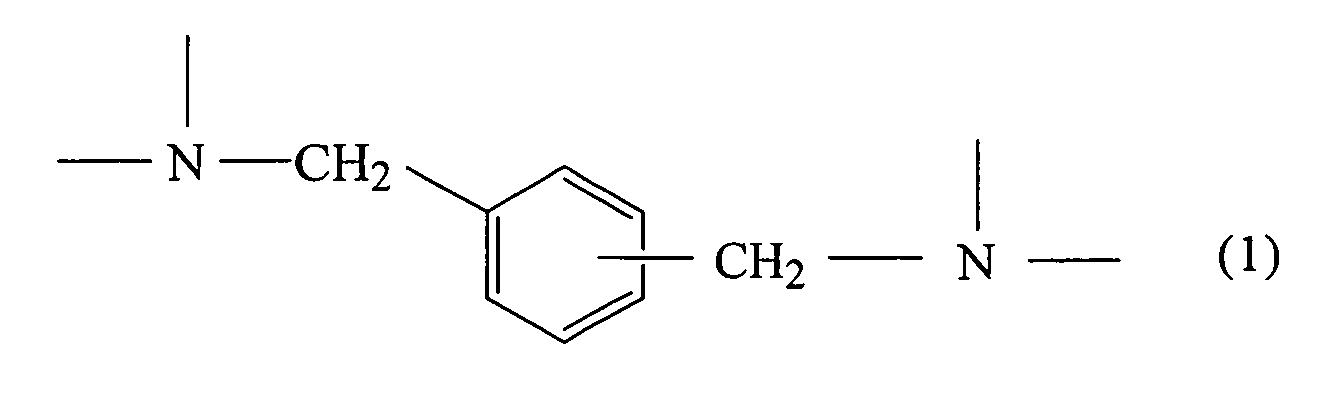
Coating: Using a bar coater No. 24
Solid content of paint solution: 40%
Coating: Using a bar coater No. 8
Solid content of paint solution: 40%
Coating: Using a 200 µm doctor blade
Solid content of paint solution: 75%
Coating: Using a 200 µm doctor blade
Solid content of paint solution: 75%
| Appearance | Oxygen permeability (ml/m2.day.MPa) | Water vapor permeability (g/m2.day) | |
| Example 1 | Transparent | 100 | 4 |
| Example 2 | Transparent | 140 | 4 |
| Example 3 | Transparent | 130 | 4 |
| Example 4 | Transparent | 160 | 4 |
| Example 5 | Transparent | 120 | |
| Example 6 | Transparent | 200 | 4 |
| Example 7 | Transparent | 250 | 4 |
| Example 8 | Transparent | 150 | 4 |
| Example 9 | Transparent | 160 | 4 |
| Example 10 | Transparent | 100 | 4 |
| Example 11 | Transparent | 150 | 4 |
| Comparative Example 1 | Transparent | 1,260 | 4 |
| Comparative Example 2 | Transparent | 2,700 | 4 |
| Comparative Example 3 | Transparent | 2,000 | 4 |
| Comparative Example 4 | Transparent | 10,000 | 200 |
| Oxygen permeability after Gelbo treatment (ml/m2.day.MPa) | Oxygen permeability after retort treatment (ml/m2.day.MPa) | Initial adhesion strength (g/15 mm) | |
| Example 1 | 120 | 100 | 40 |
| Example 2 | 140 | 140 | 60 |
| Example 3 | 140 | 130 | 100 |
| Example 4 | 160 | 160 | 70 |
| Example 5 | 130 | 120 | 60 |
| Example 6 | 200 | 200 | 80 |
| Example 7 | 250 | 250 | 120 |
| Example 8 | 160 | 150 | 50 |
| Example 9 | 160 | 160 | 60 |
| Example 10 | 110 | 100 | 90 |
| Example 11 | 150 | 150 | 110 |
| Comparative Example 1 | 5,600 | 1,500 | 20 |
| Comparative Example 2 | 5,800 | 3,300 | 30 |
| Comparative Example 3 | 2,200 | 2,500 | 10 |
| Comparative Example 4 | 10,000 | >10,000 | 110 |
| Lamination strength after aging (g/15 mm) | Lamination strength after boiling treatment (g/15 mm) | Lamination strength after retort treatment (g/15 mm) | |
| Example 1 | 850 | 800 | 750 |
| Example 2 | 900 | 800 | 800 |
| Example 3 | 900 | 850 | 800 |
| Example 4 | 850 | 800 | 850 |
| Example 5 | 950 | 900 | 900 |
| Example 6 | 800 | 750 | 800 |
| Example 7 | 850 | 800 | 850 |
| Example 8 | 900 | 800 | 850 |
| Example 9 | 850 | 750 | 800 |
| Example 10 | 850 | 800 | 800 |
| Example 11 | 800 | 700 | 800 |
| Comparative Example 1 | 400 | 200 | 200 |
| Comparative Example 2 | 300 | 100 | 150 |
| Comparative Example 3 | 200 | 100 | 100 |
| Comparative Example 4 | 800 | 500 | 600 |
| Appearance | Oxygen permeability (ml/m2-day-MPa) 60% RH | Oxygen permeability (ml/m2.day.MPa) 80% RH | |
| Example 12 | Transparent | 100 | 100 |
| Example 13 | Transparent | 140 | 140 |
| Example 14 | Transparent | 130 | 130 |
| Example 15 | Transparent | 160 | 160 |
| Example 16 | Transparent | 120 | 120 |
| Example 17 | Transparent | 200 | 200 |
| Example 18 | Transparent | 250 | 250 |
| Example 19 | Transparent | 150 | 150 |
| Example 20 | Transparent | 160 | 160 |
| Example 21 | Transparent | 100 | 100 |
| Example 22 | Transparent | 150 | 150 |
| Comparative Example 5 | Transparent | 1,260 | 1,260 |
| Comparative Example 6 | Transparent | 2,700 | 2,700 |
| Comparative Example 7 | Transparent | 2,000 | 2,000 |
| Comparative Example 8 | Transparent | 10,000 | >10,000 |
| Oxygen permeability (ml/m2.day.MPa) 90% RH | Oxygen permeability (ml/m2.day.MPa) 100% RH | |
| Example 12 | 100 | 150 |
| Example 13 | 140 | 200 |
| Example 14 | 130 | 130 |
| Example 15 | 160 | 200 |
| Example 16 | 120 | 160 |
| Example 17 | 200 | 200 |
| Example 18 | 250 | 250 |
| Example 19 | 150 | 200 |
| Example 20 | 160 | 220 |
| Example 21 | 100 | 300 |
| Example 22 | 150 | 250 |
| Comparative Example 5 | 1,260 | 1,260 |
| Comparative Example 6 | 2,700 | 2,700 |
| Comparative Example 7 | 2,000 | 2,000 |
| Comparative Example 8 | >10,000 | >10,000 |
| Water vapor permeability (g/m2·day) | Oxygen permeability after Gelbo treatment (ml/m2·day·MPa) | Oxygen permeability after retort treatment (ml/m2·day·MPa) | Initial adhesion strength (g/15 mm) | |
| Example 12 | 4 | 120 | 100 | 40 |
| Example 13 | 4 | 140 | 140 | 60 |
| Example 14 | 4 | 140 | 130 | 100 |
| Example 15 | 4 | 160 | 160 | 70 |
| Example 16 | 4 | 130 | 120 | 60 |
| Example 17 | 4 | 200 | 200 | 80 |
| Example 18 | 4 | 250 | 250 | 120 |
| Example 19 | 4 | 160 | 150 | 50 |
| Example 20 | 4 | 160 | 160 | 60 |
| Example 21 | 4 | 110 | 100 | 90 |
| Example 22 | 4 | 150 | 150 | 110 |
| Comparative Example 5 | 4 | 5,600 | 1,500 | 20 |
| Comparative Example 6 | 4 | 5,800 | 3,300 | 30 |
| Comparative Example 7 | 4 | 2,200 | 2,500 | 10 |
| Comparative Example 8 | 200 | 10,000 | >10,000 | 110 |
| Lamination strength after aging (g/15 mm) | Lamination strength after boiling treatment (g/15 mm) | Lamination strength after retort treatment (g/15 mm) | |
| Example 12 | 850 | 800 | 750 |
| Example 13 | 900 | 800 | 800 |
| Example 14 | 900 | 850 | 800 |
| Example 15 | 850 | 800 | 850 |
| Example 16 | 950 | 900 | 900 |
| Example 17 | 800 | 750 | 800 |
| Example 18 | 850 | 800 | 850 |
| Example 19 | 900 | 800 | 850 |
| Example 20 | 850 | 750 | 800 |
| Example 21 | 850 | 800 | 800 |
| Example 22 | 800 | 700 | 800 |
| Comparative Example 5 | 400 | 200 | 200 |
| Comparative Example 6 | 300 | 100 | 150 |
| Comparative Example 7 | 200 | 100 | 100 |
| Comparative Example 8 | 800 | 500 | 600 |
| Oxygen permeability (ml.mm/m2·day·MPa) | Water vapor permeability (g·mm /m2.day) | Adhesion strength of coating film /100 | |
| Example 23 | 0.28 | 0.6 | 100 |
| Example 24 | 0.40 | 0.6 | 100 |
| Example 25 | 0.34 | 0.4 | 100 |
| Example 26 | 0.60 | 0.4 | 100 |
| Example 27 | 0.30 | 0.6 | 100 |
| Example 28 | 0.40 | 0.5 | 100 |
| Example 29 | 0.55 | 0.6 | 100 |
| Example 30 | 0.80 | 0.5 | 100 |
| Comparative Example 9 | 2.6 | 1.5 | 80 |
| Comparative Example 10 | 6.0 | 1.8 | 30 |
| Comparative Example 11 | 8.5 | 3.0 | 50 |
| Comparative Example 12 | 400 | 1.0 | 100 |
| Distilled water | Spray with brine | Sulfuric acid | |
| Example 23 | Ex | Ex | Ex |
| Example 24 | Ex | Ex | Ex |
| Example 25 | Ex | Ex | Ex |
| Example 26 | Ex | Ex | Ex |
| Example 27 | Ex | Ex | Ex |
| Example 28 | Ex | Ex | Ex |
| Example 29 | Ex | Ex | Ex |
| Example 30 | Ex | Ex | Ex |
| Comparative Example 9 | Ex | P | Ex |
| Comparative Example 10 | Ex | P | F |
| Comparative Example 11 | Ex | P | F |
| Comparative Example 12 | Ex | Ex | Ex |
| Acetic acid | Sodium hydroxide | Toluene | |
| Example 23 | Ex | G | Ex |
| Example 24 | Ex | Ex | Ex |
| Example 25 | Ex | G | Ex |
| Example 26 | Ex | Ex | Ex |
| Example 27 | Ex | G | Ex |
| Example 28 | Ex | G | Ex |
| Example 29 | Ex | G | Ex |
| Example 30 | Ex | G | Ex |
| Comparative Example 9 | P | F | F |
| Comparative Example 10 | F | P | Ex |
| Comparative Example 11 | Ex | F | Ex |
| Comparative Example 12 | Ex | G | Ex |
Claims (40)
- A polyurethane resin produced by reacting a component comprising mainly (A) an active hydrogen-containing compound and a component comprising mainly (B) an organic polyisocyanate compound, said polyurethane resin containing a backbone structure represented by the formula (1):in an amount of 20% by weight or higher.
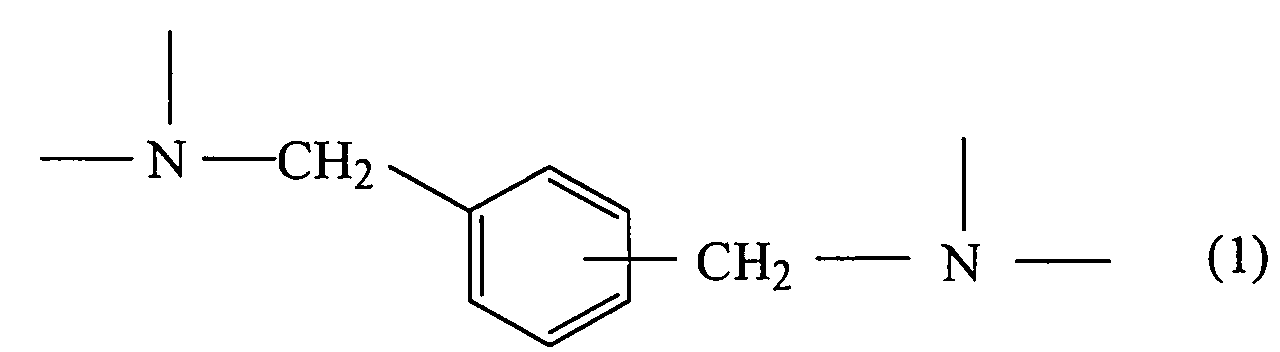
- A two-part liquid curable polyurethane resin composition comprising:a component comprising mainly (A) an active hydrogen-containing compound; anda component comprising mainly (B) an organic polyisocyanate compound,said components (A) and (B) being reacted with each other to form a cured product containing a backbone structure represented by the formula (1):in an amount of 20% by weight or higher.
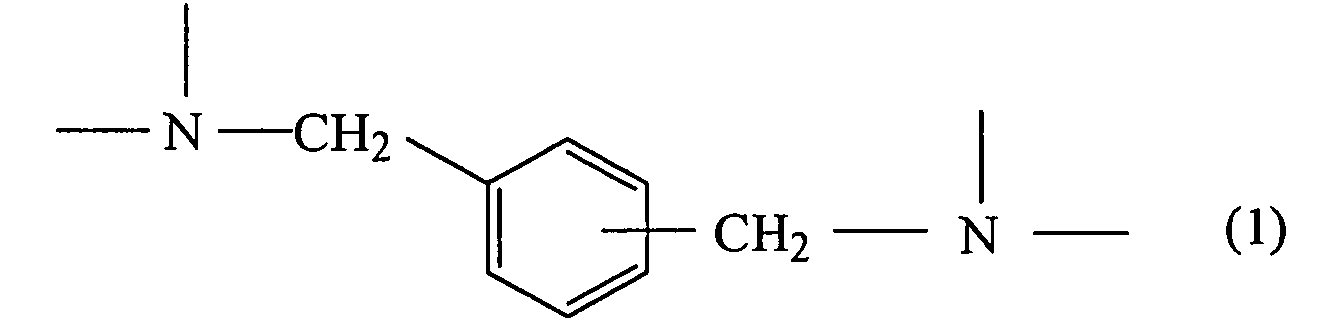
- The two-part liquid curable polyurethane resin composition according to claim 2, wherein said active hydrogen-containing compound (A) is at least one compound selected from the group consisting of alkyleneoxide adducts of polyamine, amido-containing polyols, polyol adducts of polyisocyanate compound, and polyols.
- The two-part liquid curable polyurethane resin composition according to claim 2, wherein said active hydrogen-containing compound (A) is at least one compound selected from the group consisting of alkyleneoxide adducts of aroaliphatic polyamine, polyol adducts of aroaliphatic polyisocyanate compound, and aroaliphatic polyols.
- The two-part liquid curable polyurethane resin composition according to claim 2, wherein said active hydrogen-containing compound (A) is an alkyleneoxide adduct of aroaliphatic polyamine.
- The two-liquid curable polyurethane resin composition according to claim 2, wherein said active hydrogen-containing compound (A) is an alkyleneoxide adduct of xylylenediamine.
- The two-part liquid curable polyurethane resin composition according to any of claims 3 to 6, wherein said alkyleneoxide adduct is at least one compound selected from the group consisting of C2 to C4 alkyleneoxide adducts.
- The two-part liquid curable polyurethane resin composition according to any of claims 2 to 7, wherein said organic polyisocyanate compound (B) is a reaction product obtained by reacting (a) a polyfunctional isocyanate compound and (b) at least one polyfunctional alcohol selected from the group consisting of C2 to C10 polyfunctional alcohols, or a reaction product obtained by reacting (a) the polyfunctional isocyanate compound, (b) the at least one polyfunctional alcohol and (c) at least one compound selected from the group consisting of aromatic polyfunctional amines, aroaliphatic polyfunctional amines, alicyclic polyfunctional amines, aliphatic polyfunctional amines, aliphatic alkanol amines, aromatic polyfunctional carboxylic acids, alicyclic polyfunctional carboxylic acids and aliphatic polyfunctional carboxylic acids, and has two or more NCO end groups.
- The two-part liquid curable polyurethane resin composition according to claim 8, wherein said polyfunctional isocyanate compound (a) is at least one compound selected from the group consisting of xylylenediisocyanate and derivatives of xylylenediisocyanate.
- The two-part liquid curable polyurethane resin composition according to claim 8, wherein said polyfunctional isocyanate compound (a) is xylylenediisocyanate.
- An adhesive for gas-barrier laminate comprising the two-part liquid curable polyurethane resin composition as claimed in any of claims 2 to 10.
- The adhesive according to claim 11, having an initial adhesion strength of 30 g/15 mm or higher as measured by subjecting polymer films laminated through said adhesive to T-peel test immediately after the lamination at a peel velocity of 300 mm/min.
- An adhesive assistant comprising the adhesive for gas-barrier laminate as claimed in claim 11 or 12.
- A heat-curing gas-barrier polyurethane resin comprising:a cured resin produced by reacting (A) an active hydrogen-containing compound with (B) an organic polyisocyanate compound, said cured resin containing a backbone structure represented by the formula (1):in an amount o 20% by weight or higher, and the components (A) and (B) containing tri- or more functional compounds in an amount of 7% by weight or higher based on a total weight of the components (A) and (B).

- The heat-curing gas-barrier polyurethane resin according to claim 14, wherein said resin has an oxygen permeability of 500 ml/m2-day-MPa or higher as measured at 23°C and 60% RH with a resin thickness of 10 µm.
- The heat-curing gas-barrier polyurethane resin according to claim 14 or 15, wherein a ratio (R60/R100) of an oxygen permeability (R60) as measured at 23°C and 60% RH with a resin thickness of 10 µm to an oxygen permeability (R100) as measured at 23°C and 100% RH with a resin thickness of 10 µm is 1/1 to 1/3.
- The heat-curing gas-barrier polyurethane resin according to any of claims 14 to 16, wherein said active hydrogen-containing compound (A) is at least one compound selected from the group consisting of (1) polyamines, (2) alkyleneoxide adducts of polyamine, (3) amido-containing polyols, (4) polycarboxylic acids and (5) polyols.
- The heat-curing gas-barrier polyurethane resin according to claim 17, wherein said alkyleneoxide adducts of polyamine (2) are alkyleneoxide adducts of aroaliphatic polyamine.
- The heat-curing gas-barrier polyurethane resin according to claim 18, wherein said alkyleneoxide adduct of aroaliphatic polyamine is xylylenediamine.
- The heat-curing gas-barrier polyurethane resin according to claim 17 or 18, wherein said alkyleneoxide adduct of polyamine (2) is at least one compound selected from C2 to C4 alkyleneoxide adducts of polyamine.
- The heat-curing gas-barrier polyurethane resin according to claim 17, wherein said polyols (5) are C2 to C10 polyols.
- The heat-curing gas-barrier polyurethane resin according to any of claims 14 to 21, wherein said organic polyisocyanate compound (B) is at least one compound selected from the group consisting of aromatic, aroaliphatic, alicyclic and aliphatic diisocyanates and derivatives thereof.
- The heat-curing gas-barrier polyurethane resin according to claim 22, wherein said organic polyisocyanate compound (B) is at least one compound selected from the group consisting of xylenediisocyanate, bis(isocyanatomethyl) cyclohexane and derivatives thereof.
- The heat-curing gas-barrier polyurethane resin according to claim 23, wherein said organic polyisocyanate compound (B) is at least one compound selected from the group consisting of xylenediisocyanate and derivatives thereof.
- The heat-curing gas-barrier polyurethane resin according to any of claims 14 to 24, wherein said tri- or more functional compound is at least one compound selected from the group consisting of buret compounds, allophanate compounds and isocyanurate compounds of aromatic, aroaliphatic, alicyclic and aliphatic diisocyanates, C3 to C6 polyols, alkyleneoxide adducts of polyamine, and amido-containing polyols.
- The heat-curing gas-barrier polyurethane resin according to claim 25, wherein said tri- or more functional compound is at least one compound selected from the group consisting of isocyanurate compounds of aroaliphatic and alicyclic diisocyanates, C3 to C6 polyols and alkyleneoxide adducts of aroaliphatic polyamine.
- The heat-curing gas-barrier polyurethane resin according to claim 25 or 26, wherein said tri- or more functional compound is at least one compound selected from the group consisting of isocyanurate compounds of xylylenediisocyanate and bis(isocyanatomethyl)cyclohexane, glycerol, trimethylol ethane, tirmethylol propane, pentaerythritol, and alkyleneoxide adducts of xylylenediamine.
- A gas-barrier film prepared by forming the heat-curing gas-barrier polyurethane resin as claimed in any of claims 14 to 27 into a film shape.
- A gas-barrier composite film comprising a base film layer, and a layer containing the heat-curing gas-barrier polyurethane resin as claimed in any of claims 14 to 28.
- A gas-barrier paint comprising as a film-forming component, a gas-barrier paint composition containing (A) an active hydrogen-containing compound and (B) an organic polyisocyanate compound as main components, said composition being cured into a coating film containing a backbone structure represented by the formula (1):in an amount of 20% by weight or higher.
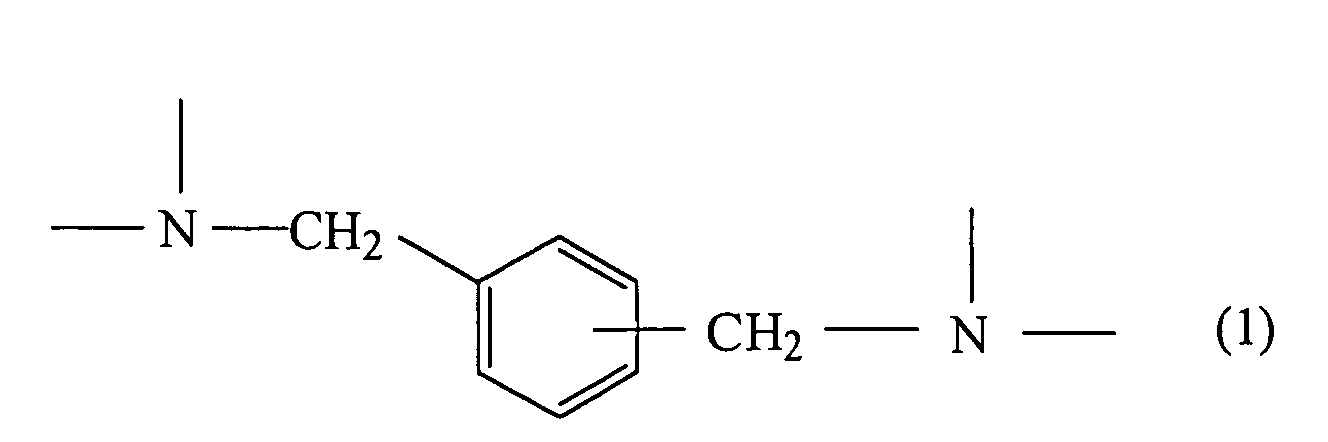
- The gas-barrier paint according to claim 30, wherein said active hydrogen-containing compound (A) is at least one compound selected from the group consisting of alkyleneoxide adducts of polyamine, amido-containing polyols, polyol adducts of polyisocyanate compound, and polyols.
- The gas-barrier paint according to claim 30, wherein said active hydrogen-containing compound (A) is at least one compound selected from the group consisting of alkyleneoxide adducts of aroaliphatic polyamine, polyol adducts of aroaliphatic polyisocyanate compound, and aroaliphatic polyols.
- The gas-barrier paint according to claim 30, wherein said active hydrogen-containing compound (A) is an alkyleneoxide adduct of aroaliphatic polyamine.
- The gas-barrier paint according to claim 30, wherein said active hydrogen-containing compound (A) is an alkyleneoxide adduct of xylylenediamine.
- The gas-barrier paint according to any of claims 31 to 34, wherein said alkyleneoxide is at least one compound selected from the group consisting of C2 to C4 alkyleneoxides
- The gas-barrier paint according to any of claims 30 to 35, wherein said organic polyisocyanate compound (B) is a reaction product of (a) a polyfunctional isocyanate compound and (b) at least one polyfunctional alcohol selected from the group consisting of C2 to C10 polyfunctional alcohols, or a reaction product of the compounds (a) and (b) with (c) at least one compound selected from the group consisting of aromatic polyfunctional amines, aroaliphatic polyfunctional amines, alicyclic polyfunctional amines, aliphatic polyfunctional amines, aliphatic alkanol amines, aromatic polyfunctional carboxylic acids, alicyclic polyfunctional carboxylic acids and aliphatic polyfunctional carboxylic acids, and has two or more NCO end groups.
- The gas-barrier paint according to claim 36, wherein said polyfunctional isocyanate compound (a) is at least one compound selected from the group consisting of xylylenediisocyanate and derivatives of xylylenediisocyanate.
- The gas-barrier paint according to claim 36, wherein said polyfunctional isocyanate compound (a) is xylylenediisocyanate.
- The gas-barrier paint according to any of claims 30 to 38, wherein said paint is a primer.
- A gas-barrier coating film formed by curing a gas-barrier paint composition containing (A) an active hydrogen-containing compound and (B) an organic polyisocyanate compound as main components, said coating film containing a backbone structure represented by the formula (1):in an amount of 20% by weight or higher.

Applications Claiming Priority (4)
| Application Number | Priority Date | Filing Date | Title |
|---|---|---|---|
| JP2002162743A JP4092549B2 (en) | 2002-06-04 | 2002-06-04 | Two-component curable polyurethane resin composition and gas barrier laminating adhesive |
| JP2002162744 | 2002-06-04 | ||
| JP2002162744A JP4054972B2 (en) | 2002-06-04 | 2002-06-04 | Thermosetting gas barrier polyurethane resin and gas barrier film containing the resin |
| JP2002162743 | 2002-06-04 |
Publications (3)
| Publication Number | Publication Date |
|---|---|
| EP1369443A2 true EP1369443A2 (en) | 2003-12-10 |
| EP1369443A3 EP1369443A3 (en) | 2004-01-07 |
| EP1369443B1 EP1369443B1 (en) | 2007-04-04 |
Family
ID=29552384
Family Applications (1)
| Application Number | Title | Priority Date | Filing Date |
|---|---|---|---|
| EP03011983A Expired - Lifetime EP1369443B1 (en) | 2002-06-04 | 2003-05-28 | Gas-barrier polyurethane resin, and adhesive for laminate, film and paint containing the same |
Country Status (4)
| Country | Link |
|---|---|
| US (1) | US6887966B2 (en) |
| EP (1) | EP1369443B1 (en) |
| CN (1) | CN100513452C (en) |
| DE (1) | DE60312924T2 (en) |
Cited By (9)
| Publication number | Priority date | Publication date | Assignee | Title |
|---|---|---|---|---|
| EP1437371A1 (en) * | 2003-01-07 | 2004-07-14 | Mitsubishi Gas Chemical Company, Inc. | Pneumatic tire comprising polyurethane skin layer with gas barrier properties |
| EP1443067A1 (en) * | 2003-01-29 | 2004-08-04 | Mitsubishi Gas Chemical Company, Inc. | Gas barrier polyurethane coated film having xylylenediamine structural units |
| WO2005093001A1 (en) * | 2004-03-05 | 2005-10-06 | Ppg Industries Ohio, Inc. | Barrier coating comprising a polyurethane dispersion and elastomeric material |
| EP2172500A4 (en) * | 2007-07-24 | 2010-08-04 | Mitsubishi Gas Chemical Co | POLYURETHANE RESIN COMPOSITION |
| EP2695900A1 (en) * | 2012-08-06 | 2014-02-12 | Novachem Industriale S.r.l. | Process for preparing a two-component polyurethane adhesive system |
| EP3101044A4 (en) * | 2014-01-28 | 2017-09-20 | Mitsui Chemicals, Inc. | Polyisocyanate composition, two-pack-type curable polyurethane resin, coating material, adhesive, and process for producing polyisocyanate composition |
| CN107793544A (en) * | 2017-10-24 | 2018-03-13 | 佛山市精信汇明科技有限公司 | A kind of environment-friendly polyurethane curing agent and its preparation method and application |
| EP3519475A4 (en) * | 2016-09-29 | 2019-09-11 | DIC Corporation | ADHESIVE, LAMINATE FILM USING THE SAME, AND ADHESIVE POLYOL COMPOSITION |
| EP4265701A4 (en) * | 2020-12-21 | 2024-06-05 | POSCO Co., Ltd | Adhesive coating composition for electrical steel sheet, electrical steel sheet laminate and manufacturing method therefor |
Families Citing this family (28)
| Publication number | Priority date | Publication date | Assignee | Title |
|---|---|---|---|---|
| US20090148640A1 (en) * | 2005-08-24 | 2009-06-11 | Sakata Inx Corp. | Gas barrier composite film for hydrothermally processable package and packaging bag obtained by using same |
| JP5612570B2 (en) * | 2008-06-10 | 2014-10-22 | ダウ グローバル テクノロジーズ エルエルシー | Methylene bis (cyclohexylamine) initiated polyol and rigid polyurethane foam made from the polyol |
| US20100028684A1 (en) * | 2008-07-31 | 2010-02-04 | Jose Mariscal | Conductive multilayer stack |
| KR101837207B1 (en) * | 2009-09-29 | 2018-03-09 | 다우 글로벌 테크놀로지스 엘엘씨 | Polyol mixtures containing a 1,3- and/or 1,4-bis(aminomethyl)cyclohexane-initiated polyol and at least one of a methylene bis(cyclohexylamine)-initiated polyol and a cyclohexanediamine-initiated polyol, and polyurethanes made therefrom |
| JP5570170B2 (en) * | 2009-09-29 | 2014-08-13 | 富士フイルム株式会社 | Gas barrier unit, back sheet for solar cell module, and solar cell module |
| US9382704B2 (en) | 2009-09-30 | 2016-07-05 | Sealanttech | Protective air barrier sealant for conditioned and unconditioned building walls |
| US9309589B2 (en) | 2011-06-21 | 2016-04-12 | Ppg Industries Ohio, Inc. | Outboard durable transparent conductive coating on aircraft canopy |
| JP5440892B2 (en) * | 2011-08-24 | 2014-03-12 | Dic株式会社 | Resin composition for adhesive containing plate-like inorganic compound, and adhesive |
| JP5962004B2 (en) * | 2011-12-22 | 2016-08-03 | Dic株式会社 | Gas barrier cured resin composition and adhesive |
| WO2013118562A1 (en) * | 2012-02-10 | 2013-08-15 | 三井化学株式会社 | Adhesive agent for laminate, and laminate |
| JPWO2014103994A1 (en) | 2012-12-26 | 2017-01-12 | Dic株式会社 | Polyester resin composition, adhesive, and film |
| WO2015076231A1 (en) * | 2013-11-22 | 2015-05-28 | 三菱瓦斯化学株式会社 | Polyfunctional urethane (meth)acrylate and curable resin composition containing same |
| JP5765510B1 (en) * | 2013-11-27 | 2015-08-19 | Dic株式会社 | Resin composition for gas barrier adhesive and adhesive |
| EP3115390B1 (en) * | 2014-03-04 | 2019-11-06 | Mitsui Chemicals, Inc. | Isocyanurate composition |
| DE102014212999A1 (en) * | 2014-07-04 | 2016-01-07 | Henkel Ag & Co. Kgaa | Polyurethane laminating adhesive containing fillers |
| EP3309189B1 (en) | 2015-06-12 | 2026-03-04 | Mitsui Chemicals, Inc. | Polyisocyanate composition, polyurethane resin, two-liquid curable polyurethane composition, and coating material |
| EP3309185B1 (en) * | 2015-06-12 | 2020-01-29 | Mitsui Chemicals, Inc. | Polyisocyanate composition, polyurethane resin and two-component curable polyurethane composition |
| US10689481B2 (en) | 2015-06-12 | 2020-06-23 | Mitsui Chemicals, Inc. | Polyisocyanate composition, polyurethane resin, two-component curable polyurethane composition, and coating material |
| WO2016199795A1 (en) | 2015-06-12 | 2016-12-15 | 三井化学株式会社 | Polyisocyanate composition, polyurethane resin, two-liquid curable polyurethane composition, coating material, and adhesive material |
| CN110023360B (en) * | 2016-11-30 | 2022-03-04 | 昭和电工材料株式会社 | Two-component curable polyurethane composition |
| JP7113628B2 (en) * | 2018-02-16 | 2022-08-05 | サカタインクス株式会社 | Barrier coating composition and composite film |
| CN109054621A (en) * | 2018-06-27 | 2018-12-21 | 滁州环球聚氨酯科技有限公司 | A kind of preparation method for the packaging film polyurethane coating extending effective period of food quality |
| WO2020003780A1 (en) * | 2018-06-27 | 2020-01-02 | Dic株式会社 | Urethane resin composition, surface treatment agent, and article |
| CN110497680A (en) * | 2019-07-25 | 2019-11-26 | 无锡市振飞新型包装材料有限公司 | A kind of high temperature resistant high barrier polypropylene screen and preparation method thereof |
| CN110564325A (en) * | 2019-08-17 | 2019-12-13 | 江苏翔腾新材料有限公司 | Mirror surface adhesive tape and PP foam box using same |
| CN110655635A (en) * | 2019-09-09 | 2020-01-07 | 浙江凯色丽科技发展有限公司 | Polyurethane composite emulsion containing mica-based conductive material and preparation method thereof |
| US20240076491A1 (en) * | 2022-08-16 | 2024-03-07 | Nano And Advanced Materials Institute Limited | Non-porous, breathable and waterproof transparent elastomer film and method for manufacturing the same |
| CN120158204B (en) * | 2023-12-14 | 2025-12-30 | 万华化学集团股份有限公司 | High-barrier water-based paint for flexible package, preparation method and application thereof |
Family Cites Families (10)
| Publication number | Priority date | Publication date | Assignee | Title |
|---|---|---|---|---|
| GB2093049B (en) * | 1981-02-09 | 1985-01-23 | Takeda Chemical Industries Ltd | A method of curing compounds containing isocyanate groups |
| JPH0271876A (en) * | 1988-09-05 | 1990-03-12 | Kansai Paint Co Ltd | Method for coating frp molded product |
| US6112201A (en) * | 1995-08-29 | 2000-08-29 | Oracle Corporation | Virtual bookshelf |
| US5918236A (en) * | 1996-06-28 | 1999-06-29 | Oracle Corporation | Point of view gists and generic gists in a document browsing system |
| JPH1067964A (en) * | 1996-08-29 | 1998-03-10 | Asahi Glass Co Ltd | Surface finish coating composition and its application method |
| US6353824B1 (en) * | 1997-11-18 | 2002-03-05 | Apple Computer, Inc. | Method for dynamic presentation of the contents topically rich capsule overviews corresponding to the plurality of documents, resolving co-referentiality in document segments |
| JP4029231B2 (en) * | 1998-03-19 | 2008-01-09 | 三菱瓦斯化学株式会社 | Binder for printing ink |
| US6397213B1 (en) * | 1999-05-12 | 2002-05-28 | Ricoh Company Ltd. | Search and retrieval using document decomposition |
| JP4524463B2 (en) * | 1999-07-27 | 2010-08-18 | 三井化学株式会社 | Gas barrier polyurethane resin and gas barrier film containing the same |
| JP2002249745A (en) * | 2001-02-27 | 2002-09-06 | Mitsui Takeda Chemicals Inc | Two-part curable solventless adhesive composition |
-
2003
- 2003-05-28 DE DE60312924T patent/DE60312924T2/en not_active Expired - Lifetime
- 2003-05-28 EP EP03011983A patent/EP1369443B1/en not_active Expired - Lifetime
- 2003-06-03 CN CNB031406866A patent/CN100513452C/en not_active Expired - Fee Related
- 2003-06-04 US US10/453,609 patent/US6887966B2/en not_active Expired - Lifetime
Cited By (14)
| Publication number | Priority date | Publication date | Assignee | Title |
|---|---|---|---|---|
| US7240708B2 (en) | 2003-01-07 | 2007-07-10 | Mitsubishi Gas Chemical Company, Inc. | Pneumatic tire |
| EP1437371A1 (en) * | 2003-01-07 | 2004-07-14 | Mitsubishi Gas Chemical Company, Inc. | Pneumatic tire comprising polyurethane skin layer with gas barrier properties |
| EP1443067A1 (en) * | 2003-01-29 | 2004-08-04 | Mitsubishi Gas Chemical Company, Inc. | Gas barrier polyurethane coated film having xylylenediamine structural units |
| US8716402B2 (en) | 2004-03-05 | 2014-05-06 | Rodger G. Temple | Barrier coating comprising a polyurethane dispersion and elastomeric material |
| WO2005093001A1 (en) * | 2004-03-05 | 2005-10-06 | Ppg Industries Ohio, Inc. | Barrier coating comprising a polyurethane dispersion and elastomeric material |
| EP2172500A4 (en) * | 2007-07-24 | 2010-08-04 | Mitsubishi Gas Chemical Co | POLYURETHANE RESIN COMPOSITION |
| US8394501B2 (en) | 2007-07-24 | 2013-03-12 | Mitsubishi Gas Chemical Company, Inc. | Polyurethane resin composition |
| EP2695900A1 (en) * | 2012-08-06 | 2014-02-12 | Novachem Industriale S.r.l. | Process for preparing a two-component polyurethane adhesive system |
| EP3101044A4 (en) * | 2014-01-28 | 2017-09-20 | Mitsui Chemicals, Inc. | Polyisocyanate composition, two-pack-type curable polyurethane resin, coating material, adhesive, and process for producing polyisocyanate composition |
| EP3519475A4 (en) * | 2016-09-29 | 2019-09-11 | DIC Corporation | ADHESIVE, LAMINATE FILM USING THE SAME, AND ADHESIVE POLYOL COMPOSITION |
| US11180685B2 (en) | 2016-09-29 | 2021-11-23 | Dic Corporation | Adhesive, laminated film using thereof and polyol composition for adhesive |
| US11739242B2 (en) | 2016-09-29 | 2023-08-29 | Dic Corporation | Adhesive, laminated film using thereof and polyol composition for adhesive |
| CN107793544A (en) * | 2017-10-24 | 2018-03-13 | 佛山市精信汇明科技有限公司 | A kind of environment-friendly polyurethane curing agent and its preparation method and application |
| EP4265701A4 (en) * | 2020-12-21 | 2024-06-05 | POSCO Co., Ltd | Adhesive coating composition for electrical steel sheet, electrical steel sheet laminate and manufacturing method therefor |
Also Published As
| Publication number | Publication date |
|---|---|
| EP1369443A3 (en) | 2004-01-07 |
| CN100513452C (en) | 2009-07-15 |
| CN1473861A (en) | 2004-02-11 |
| DE60312924D1 (en) | 2007-05-16 |
| US6887966B2 (en) | 2005-05-03 |
| US20030229194A1 (en) | 2003-12-11 |
| EP1369443B1 (en) | 2007-04-04 |
| DE60312924T2 (en) | 2007-09-06 |
Similar Documents
| Publication | Publication Date | Title |
|---|---|---|
| US6887966B2 (en) | Gas-barrier polyurethane resin, and adhesive for laminate, gas-barrier film and paint containing the same | |
| US7485681B2 (en) | Aqueous coating compositions based on polyurethane dispersions | |
| TWI323267B (en) | Aqueous coating agent | |
| US7534493B2 (en) | Gas-barriering coated film | |
| EP3312208B1 (en) | Two-part curable composition, two-part-type adhesive agent, two-part-type coating agent, and laminate | |
| JP4092549B2 (en) | Two-component curable polyurethane resin composition and gas barrier laminating adhesive | |
| US12036771B2 (en) | Flexibilized polyurethanes for flexible packaging adhesive without aromatic amine migration | |
| EP3421231A1 (en) | Laminated film | |
| US20240101748A1 (en) | Polyurethane dispersion, gas barrier coating material, and laminate | |
| WO2021119091A1 (en) | Adhesives produced using aspartate-terminated prepolymers | |
| JP2003342344A (en) | Polyurethane resin | |
| JP4054972B2 (en) | Thermosetting gas barrier polyurethane resin and gas barrier film containing the resin | |
| WO2010098210A1 (en) | Primer composition | |
| JP4196199B2 (en) | Gas barrier hollow container | |
| JP7671636B2 (en) | Polyurethane dispersion, gas barrier coating material and laminate | |
| JP2021024986A (en) | Gas barrier polyurethane resin composition and laminate | |
| KR20250120340A (en) | Polyurethane dispersion, gas barrier coating material, and method for producing polyurethane dispersion | |
| JP2007217642A (en) | Two-component curable gas barrier polyurethane resin and laminated film | |
| EP3854857B1 (en) | Organic polymer, composition containing same and method for producing same | |
| JP2004231731A (en) | Gas barrier paint | |
| US20250153469A1 (en) | Laminate | |
| EP4656382A1 (en) | Laminate | |
| JPH11293220A (en) | Thermosetting laminate can adhesive composition and laminate metallic sheet and metallic can | |
| KR100586132B1 (en) | Laminate Adhesives | |
| JP2010215866A (en) | Primer composition for spray coating |
Legal Events
| Date | Code | Title | Description |
|---|---|---|---|
| PUAI | Public reference made under article 153(3) epc to a published international application that has entered the european phase |
Free format text: ORIGINAL CODE: 0009012 |
|
| PUAL | Search report despatched |
Free format text: ORIGINAL CODE: 0009013 |
|
| AK | Designated contracting states |
Kind code of ref document: A2 Designated state(s): AT BE BG CH CY CZ DE DK EE ES FI FR GB GR HU IE IT LI LU MC NL PT RO SE SI SK TR |
|
| AX | Request for extension of the european patent |
Extension state: AL LT LV MK |
|
| RIC1 | Information provided on ipc code assigned before grant |
Ipc: 7C 08G 18/10 B Ipc: 7C 08G 18/50 B Ipc: 7C 08G 18/32 B Ipc: 7C 08G 18/76 A |
|
| AK | Designated contracting states |
Kind code of ref document: A3 Designated state(s): AT BE BG CH CY CZ DE DK EE ES FI FR GB GR HU IE IT LI LU MC NL PT RO SE SI SK TR |
|
| AX | Request for extension of the european patent |
Extension state: AL LT LV MK |
|
| 17P | Request for examination filed |
Effective date: 20040616 |
|
| AKX | Designation fees paid |
Designated state(s): DE FR |
|
| GRAP | Despatch of communication of intention to grant a patent |
Free format text: ORIGINAL CODE: EPIDOSNIGR1 |
|
| GRAS | Grant fee paid |
Free format text: ORIGINAL CODE: EPIDOSNIGR3 |
|
| GRAA | (expected) grant |
Free format text: ORIGINAL CODE: 0009210 |
|
| AK | Designated contracting states |
Kind code of ref document: B1 Designated state(s): DE FR |
|
| REF | Corresponds to: |
Ref document number: 60312924 Country of ref document: DE Date of ref document: 20070516 Kind code of ref document: P |
|
| ET | Fr: translation filed | ||
| PLBE | No opposition filed within time limit |
Free format text: ORIGINAL CODE: 0009261 |
|
| STAA | Information on the status of an ep patent application or granted ep patent |
Free format text: STATUS: NO OPPOSITION FILED WITHIN TIME LIMIT |
|
| 26N | No opposition filed |
Effective date: 20080107 |
|
| REG | Reference to a national code |
Ref country code: FR Ref legal event code: PLFP Year of fee payment: 14 |
|
| PGFP | Annual fee paid to national office [announced via postgrant information from national office to epo] |
Ref country code: DE Payment date: 20160524 Year of fee payment: 14 |
|
| PGFP | Annual fee paid to national office [announced via postgrant information from national office to epo] |
Ref country code: FR Payment date: 20160412 Year of fee payment: 14 |
|
| REG | Reference to a national code |
Ref country code: DE Ref legal event code: R119 Ref document number: 60312924 Country of ref document: DE |
|
| REG | Reference to a national code |
Ref country code: FR Ref legal event code: ST Effective date: 20180131 |
|
| PG25 | Lapsed in a contracting state [announced via postgrant information from national office to epo] |
Ref country code: DE Free format text: LAPSE BECAUSE OF NON-PAYMENT OF DUE FEES Effective date: 20171201 |
|
| PG25 | Lapsed in a contracting state [announced via postgrant information from national office to epo] |
Ref country code: FR Free format text: LAPSE BECAUSE OF NON-PAYMENT OF DUE FEES Effective date: 20170531 |