EP1369425A1 - Thiopeptide compounds - Google Patents
Thiopeptide compounds Download PDFInfo
- Publication number
- EP1369425A1 EP1369425A1 EP02702910A EP02702910A EP1369425A1 EP 1369425 A1 EP1369425 A1 EP 1369425A1 EP 02702910 A EP02702910 A EP 02702910A EP 02702910 A EP02702910 A EP 02702910A EP 1369425 A1 EP1369425 A1 EP 1369425A1
- Authority
- EP
- European Patent Office
- Prior art keywords
- compounds
- thiopeptide
- pharmaceutically acceptable
- acid
- thiocillin
- Prior art date
- Legal status (The legal status is an assumption and is not a legal conclusion. Google has not performed a legal analysis and makes no representation as to the accuracy of the status listed.)
- Withdrawn
Links
Images


Classifications
-
- C—CHEMISTRY; METALLURGY
- C07—ORGANIC CHEMISTRY
- C07K—PEPTIDES
- C07K5/00—Peptides containing up to four amino acids in a fully defined sequence; Derivatives thereof
- C07K5/04—Peptides containing up to four amino acids in a fully defined sequence; Derivatives thereof containing only normal peptide links
- C07K5/06—Dipeptides
- C07K5/06139—Dipeptides with the first amino acid being heterocyclic
-
- A—HUMAN NECESSITIES
- A61—MEDICAL OR VETERINARY SCIENCE; HYGIENE
- A61P—SPECIFIC THERAPEUTIC ACTIVITY OF CHEMICAL COMPOUNDS OR MEDICINAL PREPARATIONS
- A61P31/00—Antiinfectives, i.e. antibiotics, antiseptics, chemotherapeutics
- A61P31/04—Antibacterial agents
-
- C—CHEMISTRY; METALLURGY
- C12—BIOCHEMISTRY; BEER; SPIRITS; WINE; VINEGAR; MICROBIOLOGY; ENZYMOLOGY; MUTATION OR GENETIC ENGINEERING
- C12N—MICROORGANISMS OR ENZYMES; COMPOSITIONS THEREOF; PROPAGATING, PRESERVING, OR MAINTAINING MICROORGANISMS; MUTATION OR GENETIC ENGINEERING; CULTURE MEDIA
- C12N1/00—Microorganisms; Compositions thereof; Processes of propagating, maintaining or preserving microorganisms or compositions thereof; Processes of preparing or isolating a composition containing a microorganism; Culture media therefor
- C12N1/20—Bacteria; Culture media therefor
- C12N1/205—Bacterial isolates
-
- C—CHEMISTRY; METALLURGY
- C12—BIOCHEMISTRY; BEER; SPIRITS; WINE; VINEGAR; MICROBIOLOGY; ENZYMOLOGY; MUTATION OR GENETIC ENGINEERING
- C12P—FERMENTATION OR ENZYME-USING PROCESSES TO SYNTHESISE A DESIRED CHEMICAL COMPOUND OR COMPOSITION OR TO SEPARATE OPTICAL ISOMERS FROM A RACEMIC MIXTURE
- C12P17/00—Preparation of heterocyclic carbon compounds with only O, N, S, Se or Te as ring hetero atoms
- C12P17/18—Preparation of heterocyclic carbon compounds with only O, N, S, Se or Te as ring hetero atoms containing at least two hetero rings condensed among themselves or condensed with a common carbocyclic ring system, e.g. rifamycin
- C12P17/185—Heterocyclic compounds containing sulfur atoms as ring hetero atoms in the condensed system
-
- A—HUMAN NECESSITIES
- A61—MEDICAL OR VETERINARY SCIENCE; HYGIENE
- A61K—PREPARATIONS FOR MEDICAL, DENTAL OR TOILETRY PURPOSES
- A61K38/00—Medicinal preparations containing peptides
-
- C—CHEMISTRY; METALLURGY
- C12—BIOCHEMISTRY; BEER; SPIRITS; WINE; VINEGAR; MICROBIOLOGY; ENZYMOLOGY; MUTATION OR GENETIC ENGINEERING
- C12R—INDEXING SCHEME ASSOCIATED WITH SUBCLASSES C12C - C12Q, RELATING TO MICROORGANISMS
- C12R2001/00—Microorganisms ; Processes using microorganisms
- C12R2001/01—Bacteria or Actinomycetales ; using bacteria or Actinomycetales
- C12R2001/07—Bacillus
Definitions
- the present invention relates to remedies for infections with multidrug-resistant bacteria such as MRSA and VRE, which comprise a thiopeptide compound an the active ingredient thereof. It also relates to novel thiopeptide compounds QN3323 and their production, and to drugs that contain any of them as and active ingredient thereof.
- antibiotics that are produced by microorganisms, including, for example, ⁇ -lactam antibiotics such as penicillin, cephalosporin, carbapenem; macrolide antibiotics such as erythromycin, josamycin, rokitamycin; and aminoglycoside antibiotics such as kanamycin, gentamycin, tobramycin, etc.
- ⁇ -lactam antibiotics such as penicillin, cephalosporin, carbapenem
- macrolide antibiotics such as erythromycin, josamycin, rokitamycin
- aminoglycoside antibiotics such as kanamycin, gentamycin, tobramycin, etc.
- MRSA methicillin-resistant Staphylococcus aureus
- enterococci of high resistance to vancomycin that has been much used for remedies to MRSA (vancomycin-resistant Enterococcus - hereinafter referred to as VRE) were separated from a clinical case.
- VRE vancomycin-resistant Enterococcus -
- Pseudomonas aeruginosa and Klebsiella pneumoniae are known to have high resistance to various drugs.
- These bacteria are referred to as multidrug-resistant bacteria, and are now specifically problematic in the field of clinical medicine. Therefore, it is much desired to develop antibiotics that are effective against such multidrug-resistant bacteria.
- Macrocyclic compounds having a thiazole as the ring constitutive component are generically referred to as thiopeptide compounds, and various compounds of the type have been reported. They differ, for example, in the number of the ring-constituting atoms in them and in the elements that constitutes their rings. Concretely, there are reported monocyclic macrocyclic-structured compounds such as thiocillin I, and tricyclic macrocyclic-structured compounds such as glycothiohexide- ⁇ ( J. Antibiotics 47 : 894, 1994), and they differ in their ring structures.
- Thiocillin I, thiocillin II and micrococcin P2 are compounds having a monocyclic macrocyclic structure common to them, and their antibacterial activity against gram-positive bacteria has been reported ( J. Antibiotics 29: 366-374, 1976; J. Chem. Soc., Chem. Commun ., 1978(6), 256-8; International Patent Publication WO97/48408). However, no report has heretofore been made until now relating to the antibacterial activity of these compounds against multidrug-resistant bacteria such as MRSA, VRE.
- glycothiohexide ⁇ is a compound having a tricyclic macrocyclic structure.
- Amythiamicin A, sulfomycin and promoinducin have a monocyclic macrocyclic structure, but differ from the above-mentioned thiocillins in the type of the amino acids that constitute their rings, and, in addition, the number of the atoms that constitute the ring of the former macrocyclic compounds is larger than that of thiocillins.
- the present inventors have assiduously studied for the purpose of seeking antibiotics that naturally existing microorganisms will produce, and, as a result, have found that cells of a type that belongs to the genus Bacillus may produce compounds having an antibacterial activity against bacteria that include multidrug-resistant bacteria such as MRSA, VRE.
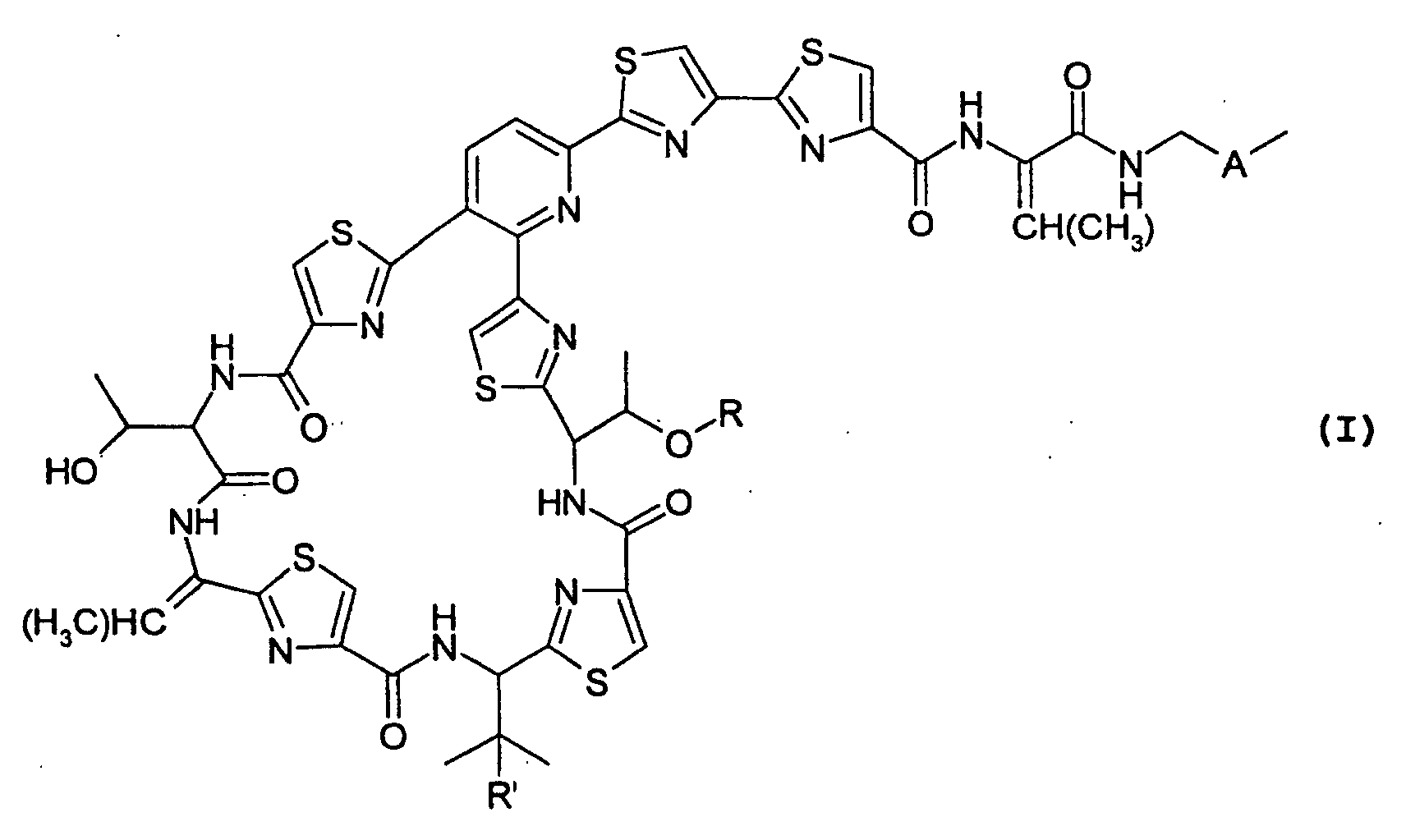
- the invention relates to remedies for infections with multidrug-resistant bacteria, especially those for infections with MRSA or VRE, which contain, as an active ingredient thereof, a thiopeptide compound of the following formula (I) or a pharmaceutically acceptable salt thereof.
- R represents H or CH 3 ;
- R' represents H or OH.
- the invention also relates to a method for producing the thiopeptide compounds, which comprises cultivating cells of Bacillus sp. QN03323 (FERM BP-7864) that belongs to the genus Bacillus followed by collecting the thiopeptide compounds of formula (I) from the culture of the cells.
- a method for producing the thiopeptide compounds which comprises cultivating cells of Bacillus sp. QN03323 (FERM BP-7864) that belongs to the genus Bacillus followed by collecting the thiopeptide compounds of formula (I) from the culture of the cells.
- R represents H or CH 3
- R a and R b each represent H or CH 3 ; provided that when R a is H, then R b is CH 3 ; when R a is CH 3 , then R b is H; when A is CH-OH, then R a is H and R b is CH 3 .
- the invention still further relates to a method for producing the thiopeptide compounds, which comprises cultivating microorganisms belonging to the genus Bacillus and having the ability to produce the thiopeptide compounds of formula (I'), followed by collecting the thiopeptide compounds from the culture of the cells.
- the invention still further relates to a medicine, especially an antibacterial agent that contains, as the active ingredient thereof, the thiopeptide compound of formula (I') or its pharmaceutically acceptable salt.
- the thiopeptide compounds (I) of the invention are obtained in an ordinary method that comprises cultivating cells belonging to the genus Bacillus and having the ability to produce the compounds in a nutrient medium followed by collecting the compounds from the culture where the compounds have accumulated.
- the microorganisms that are used in the method of producing the compounds may be any ones that belong to the genus Bacillus and have the ability to produce the compounds.
- One example of the microorganisms of the type is a gram-positive strain QN03323 belonging to the genus Bacillus, which was separated from unidentified sponge collected at the seaside of Taketomi-cho, Yaeyama-gun, Okinawa-ken (Iriomote Island).
- the bacterial properties of the strain are as follows:
- This strain is a gram-positive bacillus and is motile.
- the size of the cell is from 1 to 1.7 ⁇ 5 to 8 ⁇ m.
- One cell has one oval spore formed therein.
- the physiological property of QN03323 is as follows: Nitrate Reduction positive Dinitrification negative MR Test negative VP Test positive Indole Production negative Hydrogen Sulfide Production negative Starch Hydrolysis positive Citric Acid Utilization negative Nitrate Utilization negative Ammonium Salt Utilization negative Water-Soluble Fluorescent Dye Production negative Urease positive Oxidase positive Catalase negative Growing Temperature Range 10 to 45°C Optimum Growing Temperature 28 to 40°C pH Range for Growth pH 5 to 9 Optimum pH for Growth pH 6 to 8 Growth under Anaerobic Condition positive Arginine Dihydrolase positive Growth in 3 % NaCl-added broth medium positive Growth in 6 % NaCl-added broth medium positive
- the above-mentioned microorganismic properties of the strain are summarized.
- the strain is a gram-positive facultative anaerobic bacillus, and is motile. Its growing temperature range falls between 10 and 45°C; it is positive in nitrate reduction, starch hydrolysis, urease, oxidase test, gelatin liquefying reaction and arginine dihydrolase; and it produces acid from D-glucose, D-mannose, D-fructose, sucrose, maltose, trehalose, glycerin and starch. On the other hand, it is negative in denitrification, indole production, hydrogen sulfide production, citric acid utilization, inorganic nitrogen source utilization and catalase test.
- the strain was looked up in BERGEY's Manual of Systematic Bacteriology, 1989 and other references, and, as a result, it was identified as a type of bacteria belonging to the genus Bacillus, and was named Bacillus sp. QN03323.
- Bacillus sp. QN03323 is now in international deposition in the National Institute of Advanced Industrial Science and Technology, International Patent Organism Depositary Center (Tsukuba Central 6, 1-1-1, Higashi, Tsukuba, Ibaraki, Japan, 305-8566) under FERM BP-7864 (as of deposition date, February 14, 2001).
- microorganisms may artificially or naturally mutate. Therefore, Bacillus sp. QN03323 for use in the invention shall include not only the microorganisms separated from natural matters but also those artificially mutated from them through exposure to UV rays, radiations or chemicals and their natural mutants.
- the compounds of the invention may be obtained by cultivating the microorganisms belonging to the genus Bacillus and having the ability to produce the compounds of the invention.
- the cultivation of the microorganisms may be effected in any ordinary manner of cultivating ordinary microorganisms.
- the medium to be used for the cultivation may be any one that contains nutrient sources for the microorganisms having the ability to produce the compounds of the invention (e.g., Bacillus sp. QN03323).
- nutrient sources for the microorganisms having the ability to produce the compounds of the invention e.g., Bacillus sp. QN03323
- it may be any of synthetic media, semi-synthetic media or natural media.
- the carbon source thereof includes, for example, L-arabinose, D-xylose, D-glucose, D-fructose, sucrose, inositol, L-rhamnose, raffinose, D-mannitol, mannose, melibiose, lactose, D-galactose, maltose, trehalose, salicin, xanthine, chitin, starch, glucose, dextrin, glycerin, vegetable oil; and the nitrogen source thereof includes, for example, broth, peptone, gluten meal, cotton seed refuse, soybean meal, peanut meal, fish meal, corn steep liquor, dry yeast, yeast extract, ammonium chloride, ammonium sulfate, ammonium nitrate, uric acid and other organic and inorganic nitrogen compounds.
- Metal salts may be optionally in the medium, including, for example, sodium, potassium, magnesium, calcium, zinc, iron or cobalt sulf
- the medium may also contain growth promoters or defoaming agents such as methionine, cysteine, cystine, thiosulfates, methyl oleate, lard oil, silicone oil, surfactant.
- growth promoters or defoaming agents such as methionine, cysteine, cystine, thiosulfates, methyl oleate, lard oil, silicone oil, surfactant.
- the cells are cultivated under an aerobic condition.
- the temperature for cultivation may fall between 10 and 45°C, preferably between 25 and 30°C or so.
- the pH of the medium may fall approximately between 5 and 9, preferably approximately between 6 and 8 for better results.
- the cultivation period shall be suitably determined depending on the composition and of the medium used and the temperature for cultivation. In general, it may be approximately from 1 to 20 days, preferably approximately from 2 to 5 days.
- the intended compounds are extracted out of the culture with a suitable solvent, and the effective substances are isolated and purified from the resulting extracts.
- the compounds of the invention may be isolated and purified in any ordinary method that is used in producing ordinary physiologically active substances by utilizing the solubility and the solubility difference of the substances in suitable solvents. These methods may be used singly, if desired, or may be combined in any desired manner for repetition.
- the compounds of the invention may form acid addition salts, and the salts are pharmaceutically acceptable salts. Concretely, they include acid-addition salts with inorganic acids such as hydrochloric acid, hydrobromic acid, hydroiodic acid, sulfuric acid, nitric acid, phosphoric acid; or with organic acids such as formic acid, acetic acid, propionic acid, oxalic acid, malonic acid, succinic acid, fumaric acid, maleic acid, lactic acid, malic acid, tartaric acid, citric acid, methanesulfonic acid, ethanesulfonic acid, aspartic acid, glutamic acid.
- the salts of the compounds of the invention may be obtained in any ordinary salt formation from the compounds of the invention that have been isolated and purified or during the stage of isolation and purification of the compounds from the cultures.
- the thiopeptide compounds (I) or their pharmaceutically acceptable salts of the invention have an asymmetric carbon and a double bond, and therefore includes optical isomers and geometrical isomers based on these.
- the compounds of the invention encompass mixtures of these isomers and isolated isomers. Further, the invention also encompasses various hydrates and solvates of the thiopeptide compounds (I) or their pharmaceutically acceptable salts, as well as their crystals and crystal polymorphic substances.
- the compounds of the invention include pharmaceutically acceptable prodrugs thereof.
- the pharmaceutically acceptable prodrugs are compounds that have a group capable of being converted into OH or the like in the compounds of the invention through solvolysis or under physiological condition. The groups capable of forming such prodrugs are described in, for example, Prog. Med., 6, 2157-2161 (1958); Pharmaceutical Research and Development (by Hirokawa Publishing Company, 1990), Vol. 7, Drug Design, 163-198.
- Fig. 1 is a 1 H-NMR chart of QN3323-Y1 in DMSO- d 6 ; and Fig. 2 is a 13 C-NMR chart of QN3323-Y1 in DMSO- d 6 .
- the compounds (I) of the invention have antibacterial activity against multidrug-resistant bacteria such as MRSA and VRE, and are therefore useful as remedies for infections with multidrug-resistant bacteria, especially for infections with MRSA or VRE.
- the novel compounds (I') of the invention are useful as active ingredients for pharmaceutical preparations. In particular, since they have antibacterial activity, they are useful as antibacterial agents.
- compositions that contain, as the active ingredient thereof, one or more of the compounds or their salts of the invention may be prepared by the use of carriers, vehicles and other additives that are generally used in formulating ordinary pharmaceutical preparations.
- the administration route for the preparations may be any of oral administration with tablets, pills, capsules, granules, powders or liquids, or parenteral administration with intravenous or intramuscular injections, suppositories, subcutaneous preparations, nasal preparations or inhalations.
- the solid composition for oral administration in the invention includes tablets, powders and granules.
- one or more active substances are mixed with at least one inert vehicle such as lactose, mannitol, glucose, hydroxypropyl cellulose, microcrystalline cellulose, starch, polyvinylpyrrolidone, magnesium metasilicate aluminate.
- the compositions may contain any inert additives, for example, lubricant such as magnesium stearate, disintegrator such as sodium carboxymethyl starch, and dissolution promoter.
- the tablets and the pills may be coated with a sugar film or with a gastric-soluble or intestinal-soluble coating agent.
- the liquid compositions for oral administration may contain pharmaceutically acceptable emulsion, liquid, suspension, syrup, elixir, as well as any other ordinary inert solvent such as pure water, ethanol.
- the composition may further contain auxiliary agents such as solubilizer, wetting agent, suspending agent, as well as sweetener, flavoring, aroma and preservative.
- the injections for parenteral administration contain germ-free aqueous or non-aqueous liquid, suspension or emulsion.
- the aqueous solvent may be, for example, distilled water for injections and physiological saline.
- the non-aqueous solvent includes, for example, propylene glycol, polyethylene glycol, vegetable oil such as olive oil, alcohols such as ethanol, and Polysorbate 80 (trade name).
- These compositions may further contain isotonizer, preservative, wetting agent, emulsifier, dispersant, stabilizer and dissolution promoter. These are sterilized, for example, through filtration through bacteria-trapping filters, or through addition of bactericide thereto, or through irradiation.
- germ-free solid compositions are prepared, and they may be dissolved or suspended in germ-free water or germ-free solvent for injections before use.
- the dose of the active ingredient compound in the invention may be suitably determined, depending on the condition, the age and the sex of the cases to which it is administered, but is, in general, approximately from 0.1 to 1000 mg/adult/day for oral administration, and is approximately from 0.1 to 500 mg/adult/day for parenteral administration. This may be administered all at a time or in multiple times.
- the dose shall vary depending on various conditions.
- a medium containing 10 g of glucose, 20 g of potato starch, 5 g of polypeptone, 5 g of yeast extract, 4 g of calcium carbonate and 1 liter of distilled water (having a pH of 7.0 before sterilization) was prepared, put into 500-ml Erlenmeyer flasks with 100 ml each therein, and sterilized at 121°C for 20 minutes.
- the cells of Bacillus sp. QN03323 that had been well grown on a Bennett-agar medium were scraped out and inoculated onto the medium, and cultivated with shaking at 220 rpm at 28°C for 3 days to prepare a seed culture.
- a medium containing 5g of glucose, 5 g of Bactopeptone (by Difco), 2 g of yeast extract and 1 liter of distilled water (having a pH of 7.5 before sterilization) was prepared and put into 500-ml Erlenmeyer flasks with 100 ml each therein. 100 flasks with the medium therein were thus prepared, and these were sterilized at 121°C for 20 minutes. 2 ml of the seed culture was inoculated onto the medium of every flask, and cultivated with shaking at 220 rpm at 28°C for 3 days.
- the active fraction was subjected to silica gel thin-layer chromatography (with Kieselgel 60F254, 20 mm ⁇ 20 mm, by Merck), developed with chloroform/methanol (15/1), and the active fraction was scraped out.
- the active fraction was then subjected to ODS column chromatography ( ⁇ 20 ⁇ 250 mm, Develosilpack, by Nomura Chemical), and an active substance to give a peak was fractionated with an elution solvent of aqueous 70 % methanol solution, at a flow rate of 9.0 ml/min and a detection wavelength of 210 nm. From it, the compounds of the invention, QN3323-A (5.0 mg) and QN3323-B (1.5 mg) were isolated. Similarly, known compounds, thiocillin I (11 mg) and thiocillin II (5.3 mg) were isolated.
- Example 2 100 liters of a culture that had been obtained in the same manner as in Example 1 was centrifuged, and the supernatant was subjected to column chromatography with Diaion HP-20 (by Mitsubishi Chemical) (10 liters). The deposit was extracted with aqueous 80 % acetone solution (25 liters) and concentrated under reduced pressure to remove acetone. Then, this was again subjected to column chromatography with Diaion HP-20 as above. The HP-20 column was washed with water (30 liters) and aqueous 30 % acetone solution (30 liters), and then eluted with aqueous 90 % acetone solution (30 liters). The eluate fraction was concentrated under reduced pressure to remove acetone through evaporation.
- Diaion HP-20 by Mitsubishi Chemical
- the resulting concentrate was extracted twice with 10 liters of ethyl acetate, and the ethyl acetate layer was concentrated to dryness under reduced pressure.
- the resulting solid was then subjected to silica gel column chromatography (with Kieselgel 60 by Merck, ⁇ 65 mm ⁇ 130 mm), and eluted with chloroform/methanol (9/1 and 5/1) solutions.
- the active fraction was concentrated, and then subjected to middle-pressure silica gel column chromatography (ULTRAPACK SI-40C by Yamazen, ⁇ 37 mm ⁇ 300 mm), and eluted with chloroform/methanol (20/1) solution to fractionate active fractions.
- the active fraction obtained through the middle-pressure silica gel column chromatography was further subjected to ODS HPLC (Develosil C30 UG-5 by Nomura Chemical, ⁇ 20 mm ⁇ 250 mm), and eluted with aqueous 50 % acetonitrile solution to fractionate active fractions. This is micrococcin P2 (4.1 mg).
- the physical data of the compounds of the invention QN3323-A, QN3323-B and QN3323-Y1 are given in Tables 1 to 3 and Figs. 1 and 2.
- the physical data of the other isolated thiocillin I, thiocillin II and micrococcin P2 were measured, and it was confirmed that the compounds isolated herein were the same as the known compounds from those data.
- QN3323-A and QN3323-B differ from thiocillin I and thiocillin II in that the C(36)-position in the former is carbonyl.
- QM3323-Y1 differs from thiocillin I in that the double bond between C(10) and C(43) in the former is of E -type.
- MRSA Enterococcus faecium CAY09_2(VRE)
- MIC minimal inhibitory concentration
- the compounds of the invention QN3323-A, QN3323-B, thiocillin I and thiocillin II were tried to infected mouse model for remedial effect thereof.
- cells of Staphylococcus aureus Smith cultivated for 16 hours at 37°C were suspended in 3 % butamutin (by Tokyo Kasei), and the resulting cell suspension was intraabdominally infected into 4-weeks male ICR(CD-1) mice (from Charles River of Japan, SPF) (about 3 ⁇ 10 6 CFU/mouse).
- novel thiopeptide compounds (I') of the invention have good antibacterial activity especially even against multidrug-resistant bacteria such as MRSA and VRE, and therefore the compounds are useful for medicines, especially for antibacterial agents, more particularly for preventives and remedies for infections with multidrug-resistant bacteria.
- known compounds, thiocillin I, thiocillin II and micrococcin P2 have good antibacterial activity against MRSA and VRE, and are useful for preventives and remedies for infections with multidrug-resistant bacteria, especially for MRSA or VRE infections.
Landscapes
- Chemical & Material Sciences (AREA)
- Health & Medical Sciences (AREA)
- Life Sciences & Earth Sciences (AREA)
- Organic Chemistry (AREA)
- Engineering & Computer Science (AREA)
- Genetics & Genomics (AREA)
- General Health & Medical Sciences (AREA)
- Wood Science & Technology (AREA)
- Zoology (AREA)
- Bioinformatics & Cheminformatics (AREA)
- Medicinal Chemistry (AREA)
- Biotechnology (AREA)
- Biochemistry (AREA)
- Microbiology (AREA)
- General Engineering & Computer Science (AREA)
- General Chemical & Material Sciences (AREA)
- Chemical Kinetics & Catalysis (AREA)
- Proteomics, Peptides & Aminoacids (AREA)
- Tropical Medicine & Parasitology (AREA)
- Biomedical Technology (AREA)
- Pharmacology & Pharmacy (AREA)
- Animal Behavior & Ethology (AREA)
- Public Health (AREA)
- Veterinary Medicine (AREA)
- Biophysics (AREA)
- Molecular Biology (AREA)
- Virology (AREA)
- Immunology (AREA)
- Epidemiology (AREA)
- Communicable Diseases (AREA)
- Oncology (AREA)
- Nuclear Medicine, Radiotherapy & Molecular Imaging (AREA)
- Medicines That Contain Protein Lipid Enzymes And Other Medicines (AREA)
- Peptides Or Proteins (AREA)
- Preparation Of Compounds By Using Micro-Organisms (AREA)
- Nitrogen And Oxygen Or Sulfur-Condensed Heterocyclic Ring Systems (AREA)
- Pharmaceuticals Containing Other Organic And Inorganic Compounds (AREA)
Abstract
Description
- The present invention relates to remedies for infections with multidrug-resistant bacteria such as MRSA and VRE, which comprise a thiopeptide compound an the active ingredient thereof. It also relates to novel thiopeptide compounds QN3323 and their production, and to drugs that contain any of them as and active ingredient thereof.
- Heretofore well known are various antibiotics that are produced by microorganisms, including, for example, β-lactam antibiotics such as penicillin, cephalosporin, carbapenem; macrolide antibiotics such as erythromycin, josamycin, rokitamycin; and aminoglycoside antibiotics such as kanamycin, gentamycin, tobramycin, etc. Some of these antibiotics and those chemicosynthetically modified from them are extremely effective as bactericides and antibacterial, and many of them are now actually put into clinical use.
- Recently, however, methicillin-resistant Staphylococcus aureus (hereinafter referred to as MRSA) of high resistance to these antibiotics has much appeared in the field of clinical medicine, and it is now a serious social problem. In 1996, in addition, it was reported in Japan that enterococci of high resistance to vancomycin that has been much used for remedies to MRSA (vancomycin-resistant Enterococcus - hereinafter referred to as VRE) were separated from a clinical case. Apart from these, some type of Pseudomonas aeruginosa and Klebsiella pneumoniae are known to have high resistance to various drugs. These bacteria are referred to as multidrug-resistant bacteria, and are now specifically problematic in the field of clinical medicine. Therefore, it is much desired to develop antibiotics that are effective against such multidrug-resistant bacteria.
- Macrocyclic compounds having a thiazole as the ring constitutive component are generically referred to as thiopeptide compounds, and various compounds of the type have been reported. They differ, for example, in the number of the ring-constituting atoms in them and in the elements that constitutes their rings. Concretely, there are reported monocyclic macrocyclic-structured compounds such as thiocillin I, and tricyclic macrocyclic-structured compounds such as glycothiohexide-α (J. Antibiotics 47: 894, 1994), and they differ in their ring structures. Thiocillin I, thiocillin II and micrococcin P2 are compounds having a monocyclic macrocyclic structure common to them, and their antibacterial activity against gram-positive bacteria has been reported (J. Antibiotics 29: 366-374, 1976; J. Chem. Soc., Chem. Commun., 1978(6), 256-8; International Patent Publication WO97/48408). However, no report has heretofore been made until now relating to the antibacterial activity of these compounds against multidrug-resistant bacteria such as MRSA, VRE.

- Regarding thiopeptide compounds, anti-MRSA or anti-VRE activity of glycothiohexide α (J. Antibiotics 47:894, 1994), amythiamicin A (J. Antibiotics 47: 668, 1994; ibid. 47:1153, 1994), sulfomycin (J. Nat. Prod., 62:1562, 1999) and promoinducin (Biosci. Biotechnol. Biochem. 59:876, 1995) has been reported. Glycothiohexide α is a compound having a tricyclic macrocyclic structure. Amythiamicin A, sulfomycin and promoinducin have a monocyclic macrocyclic structure, but differ from the above-mentioned thiocillins in the type of the amino acids that constitute their rings, and, in addition, the number of the atoms that constitute the ring of the former macrocyclic compounds is larger than that of thiocillins.
- We, the present inventors have assiduously studied for the purpose of seeking antibiotics that naturally existing microorganisms will produce, and, as a result, have found that cells of a type that belongs to the genus Bacillus may produce compounds having an antibacterial activity against bacteria that include multidrug-resistant bacteria such as MRSA, VRE. Further, we have studied in detail the culture of the cells and have succeeded in isolating novel thiopeptide compounds QN3323-A, QN3323-B and QN3323-Y1 and known thiopeptide compounds thiocillin I, thiocillin II and micrococcin P2 from the culture of the cells, and, in addition, have found that these compounds have anti-MRSA activity and anti-VRE activity, and have completed the present invention.
- Specifically, the invention relates to remedies for infections with multidrug-resistant bacteria, especially those for infections with MRSA or VRE, which contain, as an active ingredient thereof, a thiopeptide compound of the following formula (I) or a pharmaceutically acceptable salt thereof.wherein A represents CH-OH or C=O; R represents H or CH3;

R' represents H or OH. - The invention also relates to a method for producing the thiopeptide compounds, which comprises cultivating cells of Bacillus sp. QN03323 (FERM BP-7864) that belongs to the genus Bacillus followed by collecting the thiopeptide compounds of formula (I) from the culture of the cells.
- The invention further relates to novel thiopeptide compounds of the following formula (I') or their pharmaceutically acceptable salts:wherein A represents CH-OH or C=O; R represents H or CH3;

Ra and Rb each represent H or CH3;
provided that when Ra is H, then Rb is CH3; when Ra is CH3, then Rb is H; when A is CH-OH, then Ra is H and Rb is CH3. - Preferred are the following compounds:
- (1) A is C=O; R is H; Ra is CH3; and Rb is H (QN3323-A),
- (2) A is C=O; R is CH3; Ra is CH3; and Rb is H (QN3323-B), or
- (3) A is CH-OH; R is H; Ra is H; and Rb is CH3 (QN3323-Y1).
-
- The invention still further relates to a method for producing the thiopeptide compounds, which comprises cultivating microorganisms belonging to the genus Bacillus and having the ability to produce the thiopeptide compounds of formula (I'), followed by collecting the thiopeptide compounds from the culture of the cells.
- The invention still further relates to a medicine, especially an antibacterial agent that contains, as the active ingredient thereof, the thiopeptide compound of formula (I') or its pharmaceutically acceptable salt.
- The invention is described in detail hereinunder.
- The thiopeptide compounds (I) of the invention are obtained in an ordinary method that comprises cultivating cells belonging to the genus Bacillus and having the ability to produce the compounds in a nutrient medium followed by collecting the compounds from the culture where the compounds have accumulated. The microorganisms that are used in the method of producing the compounds may be any ones that belong to the genus Bacillus and have the ability to produce the compounds. One example of the microorganisms of the type is a gram-positive strain QN03323 belonging to the genus Bacillus, which was separated from unidentified sponge collected at the seaside of Taketomi-cho, Yaeyama-gun, Okinawa-ken (Iriomote Island). The bacterial properties of the strain are as follows:
- This strain is a gram-positive bacillus and is motile. The size of the cell is from 1 to 1.7 × 5 to 8 µm. One cell has one oval spore formed therein.
- This forms white colonies on a meat extract agar medium. Each colony is circular, its surface is not glossy, and its periphery is rough. In static culture in meat extract broth, the culture with the cells growing therein is completely cloudy or the cells sink down, and no film is formed on the surface of the medium. In stab culture in broth gelatin, the cells liquefy the gelatin. In culture with litmus milk, the culture is peptonized and is neutral, and this is not coagulated.
- The physiological property of QN03323 is as follows:
Nitrate Reduction positive Dinitrification negative MR Test negative VP Test positive Indole Production negative Hydrogen Sulfide Production negative Starch Hydrolysis positive Citric Acid Utilization negative Nitrate Utilization negative Ammonium Salt Utilization negative Water-Soluble Fluorescent Dye Production negative Urease positive Oxidase positive Catalase negative Growing Temperature Range 10 to 45°C Optimum Growing Temperature 28 to 40°C pH Range for Growth pH 5 to 9 Optimum pH for Growth pH 6 to 8 Growth under Anaerobic Condition positive Arginine Dihydrolase positive Growth in 3 % NaCl-added broth medium positive Growth in 6 % NaCl-added broth medium positive -
L-arabinose negative D-galactose negative D-xylose negative Maltose positive D-glucose positive Trehalose positive D-mannose positive Lactose negative D-fructose positive D-sorbitol negative Sucrose positive Glycerin positive Inositol negative Starch positive D-mannitol negative - The above-mentioned microorganismic properties of the strain are summarized. The strain is a gram-positive facultative anaerobic bacillus, and is motile. Its growing temperature range falls between 10 and 45°C; it is positive in nitrate reduction, starch hydrolysis, urease, oxidase test, gelatin liquefying reaction and arginine dihydrolase; and it produces acid from D-glucose, D-mannose, D-fructose, sucrose, maltose, trehalose, glycerin and starch. On the other hand, it is negative in denitrification, indole production, hydrogen sulfide production, citric acid utilization, inorganic nitrogen source utilization and catalase test.
- Based on the above-mentioned properties thereof, the strain was looked up in BERGEY's Manual of Systematic Bacteriology, 1989 and other references, and, as a result, it was identified as a type of bacteria belonging to the genus Bacillus, and was named Bacillus sp. QN03323.
- This strain Bacillus sp. QN03323 is now in international deposition in the National Institute of Advanced Industrial Science and Technology, International Patent Organism Depositary Center (
Tsukuba Central 6, 1-1-1, Higashi, Tsukuba, Ibaraki, Japan, 305-8566) under FERM BP-7864 (as of deposition date, February 14, 2001). In general, microorganisms may artificially or naturally mutate. Therefore, Bacillus sp. QN03323 for use in the invention shall include not only the microorganisms separated from natural matters but also those artificially mutated from them through exposure to UV rays, radiations or chemicals and their natural mutants. - The compounds of the invention may be obtained by cultivating the microorganisms belonging to the genus Bacillus and having the ability to produce the compounds of the invention. The cultivation of the microorganisms may be effected in any ordinary manner of cultivating ordinary microorganisms.
- The medium to be used for the cultivation may be any one that contains nutrient sources for the microorganisms having the ability to produce the compounds of the invention (e.g., Bacillus sp. QN03323). For example, it may be any of synthetic media, semi-synthetic media or natural media. Regarding the composition of the medium, the carbon source thereof includes, for example, L-arabinose, D-xylose, D-glucose, D-fructose, sucrose, inositol, L-rhamnose, raffinose, D-mannitol, mannose, melibiose, lactose, D-galactose, maltose, trehalose, salicin, xanthine, chitin, starch, glucose, dextrin, glycerin, vegetable oil; and the nitrogen source thereof includes, for example, broth, peptone, gluten meal, cotton seed refuse, soybean meal, peanut meal, fish meal, corn steep liquor, dry yeast, yeast extract, ammonium chloride, ammonium sulfate, ammonium nitrate, uric acid and other organic and inorganic nitrogen compounds. Metal salts may be optionally in the medium, including, for example, sodium, potassium, magnesium, calcium, zinc, iron or cobalt sulfates, nitrates, carbonates and phosphates.
- Further if desired, the medium may also contain growth promoters or defoaming agents such as methionine, cysteine, cystine, thiosulfates, methyl oleate, lard oil, silicone oil, surfactant.
- Preferably, the cells are cultivated under an aerobic condition. The temperature for cultivation may fall between 10 and 45°C, preferably between 25 and 30°C or so. The pH of the medium may fall approximately between 5 and 9, preferably approximately between 6 and 8 for better results. The cultivation period shall be suitably determined depending on the composition and of the medium used and the temperature for cultivation. In general, it may be approximately from 1 to 20 days, preferably approximately from 2 to 5 days.
- For isolating and purifying the compounds of the invention from the culture, employable is any ordinary method of isolating and purifying physiological substances from ordinary microorganismic cultures. For example, the intended compounds are extracted out of the culture with a suitable solvent, and the effective substances are isolated and purified from the resulting extracts. Concretely, based on the antibacterial activity thereof as the index for isolation and purification thereof, the compounds of the invention may be isolated and purified in any ordinary method that is used in producing ordinary physiologically active substances by utilizing the solubility and the solubility difference of the substances in suitable solvents. These methods may be used singly, if desired, or may be combined in any desired manner for repetition.
- The compounds of the invention may form acid addition salts, and the salts are pharmaceutically acceptable salts. Concretely, they include acid-addition salts with inorganic acids such as hydrochloric acid, hydrobromic acid, hydroiodic acid, sulfuric acid, nitric acid, phosphoric acid; or with organic acids such as formic acid, acetic acid, propionic acid, oxalic acid, malonic acid, succinic acid, fumaric acid, maleic acid, lactic acid, malic acid, tartaric acid, citric acid, methanesulfonic acid, ethanesulfonic acid, aspartic acid, glutamic acid. The salts of the compounds of the invention may be obtained in any ordinary salt formation from the compounds of the invention that have been isolated and purified or during the stage of isolation and purification of the compounds from the cultures.
- The thiopeptide compounds (I) or their pharmaceutically acceptable salts of the invention have an asymmetric carbon and a double bond, and therefore includes optical isomers and geometrical isomers based on these. The compounds of the invention encompass mixtures of these isomers and isolated isomers. Further, the invention also encompasses various hydrates and solvates of the thiopeptide compounds (I) or their pharmaceutically acceptable salts, as well as their crystals and crystal polymorphic substances. The compounds of the invention include pharmaceutically acceptable prodrugs thereof. The pharmaceutically acceptable prodrugs are compounds that have a group capable of being converted into OH or the like in the compounds of the invention through solvolysis or under physiological condition. The groups capable of forming such prodrugs are described in, for example, Prog. Med., 6, 2157-2161 (1958); Pharmaceutical Research and Development (by Hirokawa Publishing Company, 1990), Vol. 7, Drug Design, 163-198.
- Fig. 1 is a 1H-NMR chart of QN3323-Y1 in DMSO-d 6; and Fig. 2 is a 13C-NMR chart of QN3323-Y1 in DMSO-d 6.
- The compounds (I) of the invention have antibacterial activity against multidrug-resistant bacteria such as MRSA and VRE, and are therefore useful as remedies for infections with multidrug-resistant bacteria, especially for infections with MRSA or VRE. The novel compounds (I') of the invention are useful as active ingredients for pharmaceutical preparations. In particular, since they have antibacterial activity, they are useful as antibacterial agents.
- The pharmaceutical preparations that contain, as the active ingredient thereof, one or more of the compounds or their salts of the invention may be prepared by the use of carriers, vehicles and other additives that are generally used in formulating ordinary pharmaceutical preparations.
- The administration route for the preparations may be any of oral administration with tablets, pills, capsules, granules, powders or liquids, or parenteral administration with intravenous or intramuscular injections, suppositories, subcutaneous preparations, nasal preparations or inhalations.
- The solid composition for oral administration in the invention includes tablets, powders and granules. In such solid compositions, one or more active substances are mixed with at least one inert vehicle such as lactose, mannitol, glucose, hydroxypropyl cellulose, microcrystalline cellulose, starch, polyvinylpyrrolidone, magnesium metasilicate aluminate. In an ordinary manner, the compositions may contain any inert additives, for example, lubricant such as magnesium stearate, disintegrator such as sodium carboxymethyl starch, and dissolution promoter. Optionally, the tablets and the pills may be coated with a sugar film or with a gastric-soluble or intestinal-soluble coating agent.
- The liquid compositions for oral administration may contain pharmaceutically acceptable emulsion, liquid, suspension, syrup, elixir, as well as any other ordinary inert solvent such as pure water, ethanol. Apart from such an inert solvent, the composition may further contain auxiliary agents such as solubilizer, wetting agent, suspending agent, as well as sweetener, flavoring, aroma and preservative.
- The injections for parenteral administration contain germ-free aqueous or non-aqueous liquid, suspension or emulsion. The aqueous solvent may be, for example, distilled water for injections and physiological saline. The non-aqueous solvent includes, for example, propylene glycol, polyethylene glycol, vegetable oil such as olive oil, alcohols such as ethanol, and Polysorbate 80 (trade name). These compositions may further contain isotonizer, preservative, wetting agent, emulsifier, dispersant, stabilizer and dissolution promoter. These are sterilized, for example, through filtration through bacteria-trapping filters, or through addition of bactericide thereto, or through irradiation. As the case may be, germ-free solid compositions are prepared, and they may be dissolved or suspended in germ-free water or germ-free solvent for injections before use.
- The dose of the active ingredient compound in the invention may be suitably determined, depending on the condition, the age and the sex of the cases to which it is administered, but is, in general, approximately from 0.1 to 1000 mg/adult/day for oral administration, and is approximately from 0.1 to 500 mg/adult/day for parenteral administration. This may be administered all at a time or in multiple times. The dose shall vary depending on various conditions.
- The invention is described in more detail with reference to the following Examples. The compounds of the invention should not be limited to those in the following Examples.
- A medium containing 10 g of glucose, 20 g of potato starch, 5 g of polypeptone, 5 g of yeast extract, 4 g of calcium carbonate and 1 liter of distilled water (having a pH of 7.0 before sterilization) was prepared, put into 500-ml Erlenmeyer flasks with 100 ml each therein, and sterilized at 121°C for 20 minutes. The cells of Bacillus sp. QN03323 that had been well grown on a Bennett-agar medium were scraped out and inoculated onto the medium, and cultivated with shaking at 220 rpm at 28°C for 3 days to prepare a seed culture. Next, a medium containing 5g of glucose, 5 g of Bactopeptone (by Difco), 2 g of yeast extract and 1 liter of distilled water (having a pH of 7.5 before sterilization) was prepared and put into 500-ml Erlenmeyer flasks with 100 ml each therein. 100 flasks with the medium therein were thus prepared, and these were sterilized at 121°C for 20 minutes. 2 ml of the seed culture was inoculated onto the medium of every flask, and cultivated with shaking at 220 rpm at 28°C for 3 days.
- Thus cultivated, 10 liters of the culture was controlled to have a pH of 7.0, to which was added 40 liters of acetone. The resulting extract was well stirred, and filtered, and acetone was removed from it under reduced pressure. 12 liters of ethyl acetate was added to it, and well stirred, and the ethyl acetate layer was concentrated under reduced pressure. Then, ethyl acetate was well removed from it. The residue was subjected to column chromatography with Sephadex LH-20 (by Amersham Pharmacia Biotec, 30 × 350 mm), and developed with N-hexane/dichloromethane/methanol (4/5/1) to obtain an active fraction. The active fraction was subjected to silica gel thin-layer chromatography (with Kieselgel 60F254, 20 mm × 20 mm, by Merck), developed with chloroform/methanol (15/1), and the active fraction was scraped out. The active fraction was then subjected to ODS column chromatography (20 × 250 mm, Develosilpack, by Nomura Chemical), and an active substance to give a peak was fractionated with an elution solvent of aqueous 70 % methanol solution, at a flow rate of 9.0 ml/min and a detection wavelength of 210 nm. From it, the compounds of the invention, QN3323-A (5.0 mg) and QN3323-B (1.5 mg) were isolated. Similarly, known compounds, thiocillin I (11 mg) and thiocillin II (5.3 mg) were isolated.
- 100 liters of a culture that had been obtained in the same manner as in Example 1 was centrifuged, and the supernatant was subjected to column chromatography with Diaion HP-20 (by Mitsubishi Chemical) (10 liters). The deposit was extracted with aqueous 80 % acetone solution (25 liters) and concentrated under reduced pressure to remove acetone. Then, this was again subjected to column chromatography with Diaion HP-20 as above. The HP-20 column was washed with water (30 liters) and aqueous 30 % acetone solution (30 liters), and then eluted with aqueous 90 % acetone solution (30 liters). The eluate fraction was concentrated under reduced pressure to remove acetone through evaporation. The resulting concentrate was extracted twice with 10 liters of ethyl acetate, and the ethyl acetate layer was concentrated to dryness under reduced pressure. The resulting solid was then subjected to silica gel column chromatography (with Kieselgel 60 by Merck, 65 mm × 130 mm), and eluted with chloroform/methanol (9/1 and 5/1) solutions. The active fraction was concentrated, and then subjected to middle-pressure silica gel column chromatography (ULTRAPACK SI-40C by Yamazen, 37 mm × 300 mm), and eluted with chloroform/methanol (20/1) solution to fractionate active fractions. This contained QN3323-A (91.7 mg), QN3323-B (27.3 mg), QN3323-Y1 (161 mg), thiocillin I (870 mg) and thiocillin II (305.5 mg).
- The active fraction obtained through the middle-pressure silica gel column chromatography was further subjected to ODS HPLC (Develosil C30 UG-5 by Nomura Chemical, 20 mm × 250 mm), and eluted with aqueous 50 % acetonitrile solution to fractionate active fractions. This is micrococcin P2 (4.1 mg).
- Of the compounds that had been extracted, purified and isolated according to the process mentioned above, the physical data of the compounds of the invention QN3323-A, QN3323-B and QN3323-Y1 are given in Tables 1 to 3 and Figs. 1 and 2. In addition, the physical data of the other isolated thiocillin I, thiocillin II and micrococcin P2 were measured, and it was confirmed that the compounds isolated herein were the same as the known compounds from those data.
Physicochemical properties of QN3323-A and QN3323-B QN3323-A QN3323-B QN3323-Y1 Property Colorless powder Colorless powder Melting point (dec.) >220°C >220°C [α]D 25 (MeOH) 64.7° (c0.37) 60.9° (c 0.15) Molecular formula C48H47N13O10S6 C49H49N13O10S6 C48H49N13O10S6 Mass Spectroemtry : ESI-MS (M+H)+ 1158 1172 1160 TOFHR-MS Found (m/z) 1180.1795 1194.1933 1160.2130 (M+Na)+ (M+Na)+ (M+H)+ Calculated 1180.1791 1194.1948 1160.2128 (m/z) (M+Na)+ (M+Na)+ (M+H)+ 213 (79833), 215 (100963), 207 (207000), UV λmax MeOH nm (ε) 290 (sh), 290 (sh), 347 (12000) 344 (14463) 346 (29349) 3385 (OH), 3399 (OH), IR νmax KBrcm-1 1662 (CO), 1661(CO), 1534, 1481, 754 1533, 1481, 753 1H-NMR and 13C-NMR Chemical Shift of QN3323-A (δ ppm) Position 13C 1H (J/Hz) Position 13C 1H (J/Hz) 1 160.4 s - 26 168.2 s - 2 148.7 s - 27 121.6 d 8.59 s 3 125.5 d 8.37 s 28 149.3 s - 4 167.8 s - 29 161.3 s - 5 57.2 d 5.46 m 30 125.4 d 8.47 s 5-NH - 8.32 m 31 150.2 s - 6 159.7 s - 32 159.1 s - 7 148.3 s - 32-NH - 9.60 s 8 124.6 d 8.25 s 33 130.1 s - 9 166.7 s - 34 164.4 s - 10 129.3 s - 34-NH - 8.30 s 10-NH - 9.71 s 35 49.5 t 3.89 m 11 168.5 s - 36 205.2 s - 12 56.7 d 4.71 m 37 26.8 q 2.09 s 12-NH - 7.60 s 38 66.9 d 3.97 m 13 159.7 s - 39 20.9 q 1.02 d (6.0) 14 149.8 s - 40 71.3 s - 15 125.7 d 8.46 s 41 25.7 q 1.25 s 16 164.2 s - 42 27.4 q 1.23 s 17 128.3 s - 43 128.7 d 6.50 m 18 149.6 or - 44 13.6 q 1.74d (6.0) 151.0 s 19 152.9 s - 45 68.2 d 4.51 m 20 120.6 d 7.98 s 46 20.1 q 1.38 d (6.0) 21 170.4 s - 47 129.0 d 6.59 m 22 56.6 d 5.05 m 48 13.4 q 1.73 d (6.5) 22-NH 8.37 m 23 140.8 d 8.42 d (12.0) 24 118.5 d 8.33 d (6.0) 25 149.6 or - 151.0 s 1H-NMR and 13C-NMR Chemical Shift of QN3323-B (δ ppm) Position 13C 1H (J/Hz) Position 13C 1H (J/Hz) 1 160.4 s - 26 168.2 s - 2 148.5 s - 27 121.6 d 8.58 s 3 126.0 d 8.41 s 28 149.4 s - 4 168.2 s - 29 161.3 s - 5 57.2 d 5.52 m 30 125.4 d 8.47 s 5-NH - 8.22 m 31 150.3 s - 6 159.5 s - 32 159.1 s - 7 148.1 s - 32-NH - 9.58 s 8 125.0 d 8.28 s 33 130.1 s - 9 166.9 s - 34 164.4 s - 10 129.1 s - 34-NH - 8.30 s 10-NH - 9.53 s 35 49.5 t 3.89 m 11 167.6 s - 36 205.2 s - 12 56.6 d 4.73 m 37 26.8 q 2.08 s 12-NH - 7.57 s 38 75.6 d 3.89 m 13 159.4 s - 38- 55.6 q 2.90 s OCH3 14 150.0 s - 39 15.5 q 1.04 d (6.0) 15 125.4 d 8.46 s 40 71.1 s - 16 164.2 s - 41 25.6 q 1.28 s 17 128.6 s - 42 27.4 q 1.24 s 18 151.5 s - 43 128.6 d 6.49 m 19 153.8 s - 44 13.9 q 1.72d (6.0) 20 120.0 d 7.97 s 45 67.1 d 4.46 m 21 170.3 s - 46 19.0 q 1.44 d (6.5) 22 55.2 d 5.28 m 47 129.0 d 6.58 m 22-NH - 8.11 m 48 13.4 q 1.73 d (6.5) 23 140.5 d 8.46 d (6.0) 24 118.9 d 8.38 d (11.5) 25 149.5 s - From the physicochemical properties as in Tables 1 to 3 above and Figs. 1 and 2 below, the structures of the substances have been determined as in the following formulae.


- QN3323-A and QN3323-B differ from thiocillin I and thiocillin II in that the C(36)-position in the former is carbonyl. QM3323-Y1 differs from thiocillin I in that the double bond between C(10) and C(43) in the former is of E-type.
- The minimal inhibitory concentration (MIC) of the compounds of the invention obtained in Example 1, QN3323-A, QN3323-B, QN3323-Y1, thiocillin I, thiocillin II and micrococcin P2 against Staphylococcus aureus FDA209P (S. aureus), Staphylococcus epidermidis IID866 (S. epidermidis), Enterococcus faecalis IID682 (E. Faecalis) and Enterococcus faecium CAY09_1 (E. faecium), as well as against drug-resistant bacteria, Staphylococcus aureus CAY32001 (MRSA) (S. aureus (MRSA)) and Enterococcus faecium CAY09_2(VRE) (E. faecium (VRE)) was measured according to the standard method of the Chemotherapy Society of Japan (CHEMOTHERAPY, 1981, 29(1):76, revised minimal inhibitory concentration (MIC) determination method). The cells of S. aureus (MRSA) were incubated at 32°C. The data obtained are shown in Table 4.

- The compounds of the invention, QN3323-A, QN3323-B, thiocillin I and thiocillin II were tried to infected mouse model for remedial effect thereof. Concretely, cells of Staphylococcus aureus Smith cultivated for 16 hours at 37°C were suspended in 3 % butamutin (by Tokyo Kasei), and the resulting cell suspension was intraabdominally infected into 4-weeks male ICR(CD-1) mice (from Charles River of Japan, SPF) (about 3 × 10⁶ CFU/mouse). Two hours after the infection, the compound of the invention dissolved in a solvent (10 % DMSO, 10 % HCO-60 (by Nikko Chemicals), 80 % physiological saline) was subcutaneously administered to each mouse. On 4 to 7 days after the treatment, the mice were observed, and their ED50 value was calculated according to a probit method. The data are given in Table 5.
ED50 (mg/kg) QN3323-A 7.6 QN3323-B 13.2 Thiocillin I 1.4 Thiocillin II 2.2 - From the above, it is understood that the novel thiopeptide compounds (I') of the invention have good antibacterial activity especially even against multidrug-resistant bacteria such as MRSA and VRE, and therefore the compounds are useful for medicines, especially for antibacterial agents, more particularly for preventives and remedies for infections with multidrug-resistant bacteria. In addition, known compounds, thiocillin I, thiocillin II and micrococcin P2 have good antibacterial activity against MRSA and VRE, and are useful for preventives and remedies for infections with multidrug-resistant bacteria, especially for MRSA or VRE infections.
Claims (10)
- A remedy for infections with multidrug-resistant bacteria, which comprises, as the active ingredient thereof, a thiopeptide compound of the following formula (I) or a pharmaceutically acceptable salt thereof:wherein A represents CH-OH or C=O; R represents H or CH3; and R' represents H or OH.
- The remedy as claimed in claim 1, which is for infections with methicillin-resistant Staphylococcus aureus (MRSA) or vancomycin-resistant Enterococcus (VRE).
- A method for producing thiopeptide compounds (I), which comprises cultivating cells of Bacillus sp. QN03323 (FERM BP-7864) followed by collecting the thiopeptide compounds of formula (I) of claim 1 from the resulting culture.
- Thiopeptide compounds of the following formula (I') or their pharmaceutically acceptable salts:wherein A represents CH-OH or C=O; R represents H or CH3;
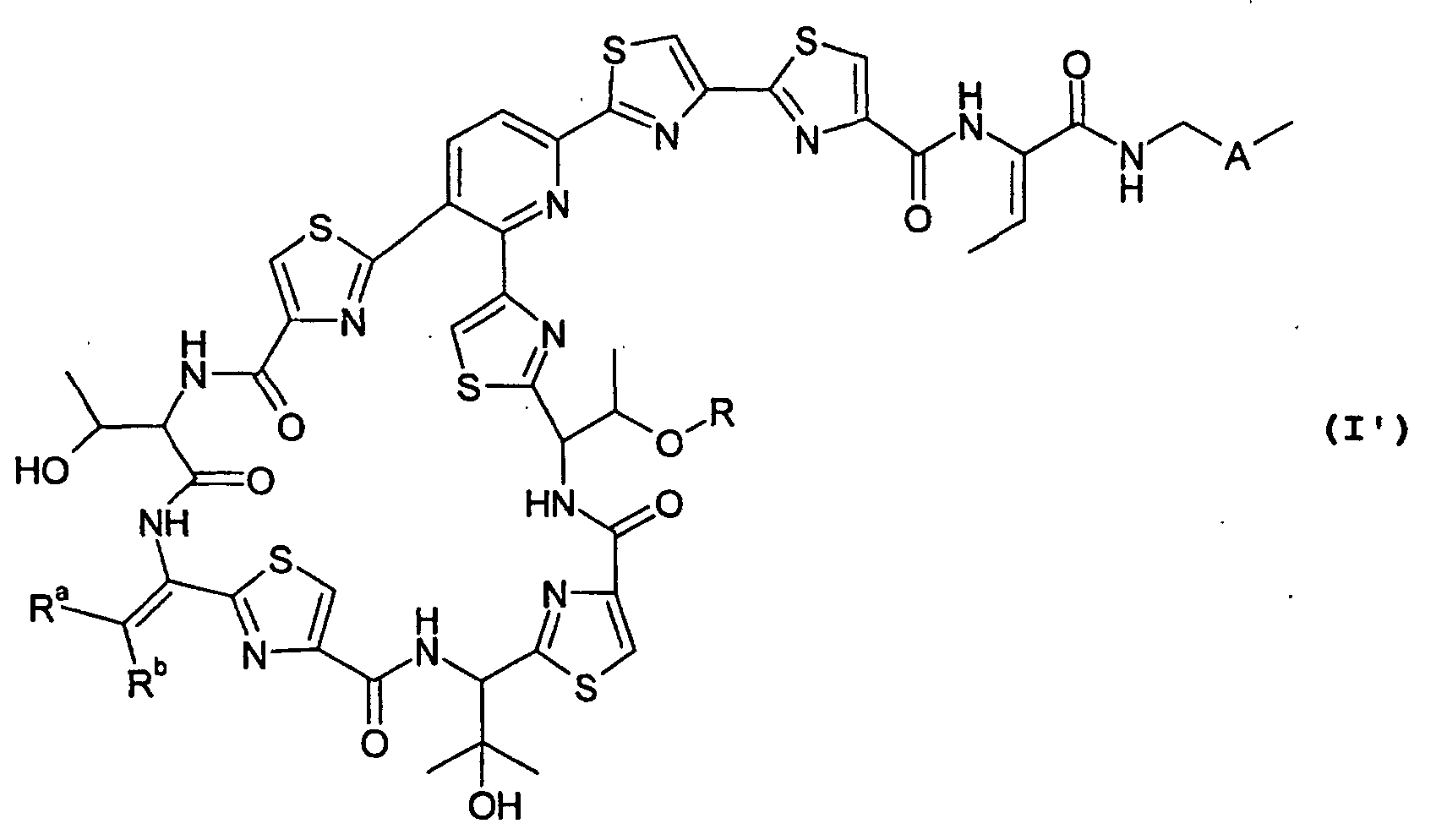
Ra and Rb each represent H or CH3;
provided that when Ra is H, then Rb is CH3; when Ra is CH3, then Rb is H; when A is CH-OH, then Ra is H and Rb is CH3. - Compounds or their pharmaceutically acceptable salts as claimed in claim 4, wherein A is C=O, R is H, Ra is CH3, and Rb is H.
- Compounds or their pharmaceutically acceptable salts as claimed in claim 4, wherein A is C=O, R is CH3, Ra is CH3, and Rb is H.
- Compounds or their pharmaceutically acceptable salts as claimed in claim 4, wherein A is CH-OH, R is H, Ra is H, and Rb is CH3.
- A method for producing the compounds of claim 4, which comprises cultivating microorganisms that belong to the genus Bacillus and have the ability to produce the compounds of claim 4, followed by collecting the compounds of claim 4 from the resulting culture.
- A medicine that comprises, as the active ingredient thereof, a compound or its pharmaceutically acceptable salt of claim 4.
- The medicine as claimed in claim 9, which is for an antibacterial agent.
Applications Claiming Priority (3)
| Application Number | Priority Date | Filing Date | Title |
|---|---|---|---|
| JP2001070705 | 2001-03-13 | ||
| JP2001070705 | 2001-03-13 | ||
| PCT/JP2002/002305 WO2002072617A1 (en) | 2001-03-13 | 2002-03-12 | Thiopeptide compounds |
Publications (1)
| Publication Number | Publication Date |
|---|---|
| EP1369425A1 true EP1369425A1 (en) | 2003-12-10 |
Family
ID=18928524
Family Applications (1)
| Application Number | Title | Priority Date | Filing Date |
|---|---|---|---|
| EP02702910A Withdrawn EP1369425A1 (en) | 2001-03-13 | 2002-03-12 | Thiopeptide compounds |
Country Status (6)
| Country | Link |
|---|---|
| US (1) | US7030085B2 (en) |
| EP (1) | EP1369425A1 (en) |
| JP (1) | JP4057426B2 (en) |
| KR (1) | KR20040000404A (en) |
| CA (1) | CA2440353A1 (en) |
| WO (1) | WO2002072617A1 (en) |
Cited By (2)
| Publication number | Priority date | Publication date | Assignee | Title |
|---|---|---|---|---|
| US12637478B2 (en) | 2020-11-19 | 2026-05-26 | A&J Science Co., Ltd. | Compound, preparation method thereof, and antibiotic composition comprising same |
| RU2864376C2 (en) * | 2020-11-19 | 2026-06-19 | ЭйЭндДжей САЙЕНС КО.,ЛТД. | New compound, method for its production and antibiotic composition containing it |
Families Citing this family (6)
| Publication number | Priority date | Publication date | Assignee | Title |
|---|---|---|---|---|
| KR100750328B1 (en) * | 2004-12-18 | 2007-08-20 | 한국생명공학연구원 | New inhibitors of peptide deformylase produced by Bionectra byssicola F120 and their antibacterial activity |
| JP2009018991A (en) * | 2005-10-25 | 2009-01-29 | Astellas Pharma Inc | Thiopeptide compound |
| EP2578597B1 (en) | 2010-05-25 | 2015-07-15 | Genome Pharmaceuticals Institute Co., Ltd. | Novel cyclic peptide compound, method for producing same, anti-infective agent, antibiotic-containing fraction, antibiotic, method for producing antibiotic, antibiotic-producing microorganism, and antibiotic produced by same |
| KR102428718B1 (en) * | 2020-11-19 | 2022-08-05 | 주식회사 에이엔제이사이언스 | Novel compounds, preparation method thereof, and antibiotic composition comprising the same |
| WO2022245150A1 (en) * | 2021-05-21 | 2022-11-24 | 주식회사 에이엔제이사이언스 | Pharmaceutical composition comprising macrocosine compound and method for preparing macrocosine compound |
| AU2025274835A1 (en) * | 2024-05-24 | 2026-04-09 | A&J Science Co.,Ltd. | Composition for preventing, alleviating, or treating nontuberculous mycobacteria infection, comprising thiopeptide compound |
Family Cites Families (1)
| Publication number | Priority date | Publication date | Assignee | Title |
|---|---|---|---|---|
| PT934075E (en) * | 1996-06-20 | 2002-08-30 | Novartis Ag | METHOD FOR THE PREVENTION AND TREATMENT OF MASTITIS |
-
2002
- 2002-03-12 US US10/471,873 patent/US7030085B2/en not_active Expired - Fee Related
- 2002-03-12 WO PCT/JP2002/002305 patent/WO2002072617A1/en not_active Ceased
- 2002-03-12 JP JP2002571530A patent/JP4057426B2/en not_active Expired - Fee Related
- 2002-03-12 KR KR10-2003-7011850A patent/KR20040000404A/en not_active Ceased
- 2002-03-12 EP EP02702910A patent/EP1369425A1/en not_active Withdrawn
- 2002-03-12 CA CA002440353A patent/CA2440353A1/en not_active Abandoned
Non-Patent Citations (1)
| Title |
|---|
| See references of WO02072617A1 * |
Cited By (2)
| Publication number | Priority date | Publication date | Assignee | Title |
|---|---|---|---|---|
| US12637478B2 (en) | 2020-11-19 | 2026-05-26 | A&J Science Co., Ltd. | Compound, preparation method thereof, and antibiotic composition comprising same |
| RU2864376C2 (en) * | 2020-11-19 | 2026-06-19 | ЭйЭндДжей САЙЕНС КО.,ЛТД. | New compound, method for its production and antibiotic composition containing it |
Also Published As
| Publication number | Publication date |
|---|---|
| WO2002072617A1 (en) | 2002-09-19 |
| US7030085B2 (en) | 2006-04-18 |
| US20040097702A1 (en) | 2004-05-20 |
| JPWO2002072617A1 (en) | 2004-07-02 |
| JP4057426B2 (en) | 2008-03-05 |
| CA2440353A1 (en) | 2002-09-19 |
| KR20040000404A (en) | 2004-01-03 |
Similar Documents
| Publication | Publication Date | Title |
|---|---|---|
| CA1339348C (en) | Novel glycopeptide antibiotics | |
| US7030085B2 (en) | Thiopeptide compounds | |
| CA1340338C (en) | Glycopeptide antibiotic pa-45052 and the production thereof | |
| EP1319666B1 (en) | Antibacterial compounds | |
| AU646615B2 (en) | Novel anti-bacterial compound | |
| AU752169B2 (en) | Macrolides with antitumor activity | |
| US5925671A (en) | Antitumor isocoumarins | |
| JP3830964B2 (en) | A novel thiodepsipeptide isolated from marine actinomycetes | |
| US4950605A (en) | FR-900493 substance, a process for its production and a pharmaceutical composition containing the same | |
| JP3851661B2 (en) | Novel physiologically active substance and method for producing the same | |
| JP2748048B2 (en) | IT-62-B substance and pharmaceutical composition containing it | |
| AU669187B2 (en) | Antibiotic stalobacins | |
| GB2159150A (en) | Antibiotics do-248-a and b and their preparation | |
| JPWO1997043434A1 (en) | Novel physiologically active substance and method for producing same | |
| US5456910A (en) | Antibiotic stalobacins | |
| JPWO1996002659A1 (en) | IT-62-B substance and pharmaceutical composition containing same | |
| HU218351B (en) | Wap-8294a antibiotics, method for preparing thereof, microorganisms producing thereof and antibacterial composition containing the antibiotics | |
| HUT63883A (en) | Physiologically active kanglemycin c, process for producing and using same | |
| JP2002212187A (en) | Isoquinocycline antibiotics | |
| JP2004196780A (en) | New antibiotic substance muraminomicin | |
| JP2003286288A (en) | New antibiotic sf2811 material, method for producing the same and application of the same | |
| JP2006213703A (en) | New fermentation products | |
| JPH0859462A (en) | Aldose reductase inhibitor | |
| JP2006111594A (en) | New antibiotic substance a-94964a | |
| WO2011136174A1 (en) | Depsipeptide compound |
Legal Events
| Date | Code | Title | Description |
|---|---|---|---|
| PUAI | Public reference made under article 153(3) epc to a published international application that has entered the european phase |
Free format text: ORIGINAL CODE: 0009012 |
|
| 17P | Request for examination filed |
Effective date: 20030828 |
|
| AK | Designated contracting states |
Kind code of ref document: A1 Designated state(s): AT BE CH CY DE DK ES FI FR GB GR IE IT LI LU MC NL PT SE TR |
|
| RAP1 | Party data changed (applicant data changed or rights of an application transferred) |
Owner name: ASTELLAS PHARMA INC. Owner name: NATIONAL INSTITUTE OF ADVANCED INDUSTRIAL SCIENCEA |
|
| RAP1 | Party data changed (applicant data changed or rights of an application transferred) |
Owner name: ASTELLAS PHARMA INC. Owner name: NATIONAL INSTITUTE OF ADVANCED INDUSTRIAL SCIENCE |
|
| STAA | Information on the status of an ep patent application or granted ep patent |
Free format text: STATUS: THE APPLICATION HAS BEEN WITHDRAWN |
|
| 18W | Application withdrawn |
Effective date: 20080313 |