EP1368413B1 - Two-layer imageable element comprising thermally reversible polymers - Google Patents
Two-layer imageable element comprising thermally reversible polymers Download PDFInfo
- Publication number
- EP1368413B1 EP1368413B1 EP01992213A EP01992213A EP1368413B1 EP 1368413 B1 EP1368413 B1 EP 1368413B1 EP 01992213 A EP01992213 A EP 01992213A EP 01992213 A EP01992213 A EP 01992213A EP 1368413 B1 EP1368413 B1 EP 1368413B1
- Authority
- EP
- European Patent Office
- Prior art keywords
- group
- imageable element
- thermally
- imageable
- polymer
- Prior art date
- Legal status (The legal status is an assumption and is not a legal conclusion. Google has not performed a legal analysis and makes no representation as to the accuracy of the status listed.)
- Expired - Lifetime
Links
- 229920000642 polymer Polymers 0.000 title claims description 59
- 230000002441 reversible effect Effects 0.000 title claims description 31
- 239000000203 mixture Substances 0.000 claims description 163
- 229920002677 supramolecular polymer Polymers 0.000 claims description 82
- 229910052739 hydrogen Inorganic materials 0.000 claims description 45
- 239000001257 hydrogen Substances 0.000 claims description 45
- 229920005989 resin Polymers 0.000 claims description 44
- 239000011347 resin Substances 0.000 claims description 44
- 239000000178 monomer Substances 0.000 claims description 35
- ISWSIDIOOBJBQZ-UHFFFAOYSA-N Phenol Chemical compound OC1=CC=CC=C1 ISWSIDIOOBJBQZ-UHFFFAOYSA-N 0.000 claims description 34
- 229920001568 phenolic resin Polymers 0.000 claims description 33
- 239000005011 phenolic resin Substances 0.000 claims description 33
- KXGFMDJXCMQABM-UHFFFAOYSA-N 2-methoxy-6-methylphenol Chemical compound [CH]OC1=CC=CC([CH])=C1O KXGFMDJXCMQABM-UHFFFAOYSA-N 0.000 claims description 31
- 125000004432 carbon atom Chemical group C* 0.000 claims description 31
- 229920001577 copolymer Polymers 0.000 claims description 29
- 239000000758 substrate Substances 0.000 claims description 28
- 125000005442 diisocyanate group Chemical group 0.000 claims description 27
- 239000000463 material Substances 0.000 claims description 27
- 229920003986 novolac Polymers 0.000 claims description 27
- 125000002887 hydroxy group Chemical group [H]O* 0.000 claims description 26
- XQCZBXHVTFVIFE-UHFFFAOYSA-N 2-amino-4-hydroxypyrimidine Chemical group NC1=NC=CC(O)=N1 XQCZBXHVTFVIFE-UHFFFAOYSA-N 0.000 claims description 25
- 125000000524 functional group Chemical group 0.000 claims description 24
- 125000003118 aryl group Chemical group 0.000 claims description 23
- 238000000034 method Methods 0.000 claims description 23
- CSCPPACGZOOCGX-UHFFFAOYSA-N Acetone Chemical compound CC(C)=O CSCPPACGZOOCGX-UHFFFAOYSA-N 0.000 claims description 20
- 229920000178 Acrylic resin Polymers 0.000 claims description 20
- 239000004925 Acrylic resin Substances 0.000 claims description 20
- WQGWDDDVZFFDIG-UHFFFAOYSA-N pyrogallol Chemical compound OC1=CC=CC(O)=C1O WQGWDDDVZFFDIG-UHFFFAOYSA-N 0.000 claims description 20
- JESXATFQYMPTNL-UHFFFAOYSA-N 2-ethenylphenol Chemical compound OC1=CC=CC=C1C=C JESXATFQYMPTNL-UHFFFAOYSA-N 0.000 claims description 19
- PPBRXRYQALVLMV-UHFFFAOYSA-N Styrene Natural products C=CC1=CC=CC=C1 PPBRXRYQALVLMV-UHFFFAOYSA-N 0.000 claims description 18
- QTWJRLJHJPIABL-UHFFFAOYSA-N 2-methylphenol;3-methylphenol;4-methylphenol Chemical compound CC1=CC=C(O)C=C1.CC1=CC=CC(O)=C1.CC1=CC=CC=C1O QTWJRLJHJPIABL-UHFFFAOYSA-N 0.000 claims description 16
- NBIIXXVUZAFLBC-UHFFFAOYSA-N Phosphoric acid Chemical compound OP(O)(O)=O NBIIXXVUZAFLBC-UHFFFAOYSA-N 0.000 claims description 16
- 229930003836 cresol Natural products 0.000 claims description 16
- 229910052757 nitrogen Inorganic materials 0.000 claims description 16
- 229940124530 sulfonamide Drugs 0.000 claims description 16
- 150000003949 imides Chemical class 0.000 claims description 15
- -1 alkenyl halogen Chemical class 0.000 claims description 13
- 229910052736 halogen Inorganic materials 0.000 claims description 13
- 125000001183 hydrocarbyl group Chemical group 0.000 claims description 13
- 125000000468 ketone group Chemical group 0.000 claims description 13
- 229930194542 Keto Natural products 0.000 claims description 12
- 229920001665 Poly-4-vinylphenol Polymers 0.000 claims description 12
- 150000001732 carboxylic acid derivatives Chemical class 0.000 claims description 12
- 150000001875 compounds Chemical class 0.000 claims description 12
- 150000002367 halogens Chemical class 0.000 claims description 12
- 239000005058 Isophorone diisocyanate Substances 0.000 claims description 11
- 125000003545 alkoxy group Chemical group 0.000 claims description 11
- 125000004093 cyano group Chemical group *C#N 0.000 claims description 11
- 125000000743 hydrocarbylene group Chemical group 0.000 claims description 11
- NIMLQBUJDJZYEJ-UHFFFAOYSA-N isophorone diisocyanate Chemical compound CC1(C)CC(N=C=O)CC(C)(CN=C=O)C1 NIMLQBUJDJZYEJ-UHFFFAOYSA-N 0.000 claims description 11
- 230000005855 radiation Effects 0.000 claims description 11
- 125000001424 substituent group Chemical group 0.000 claims description 11
- NLHHRLWOUZZQLW-UHFFFAOYSA-N Acrylonitrile Chemical compound C=CC#N NLHHRLWOUZZQLW-UHFFFAOYSA-N 0.000 claims description 10
- CERQOIWHTDAKMF-UHFFFAOYSA-N Methacrylic acid Chemical compound CC(=C)C(O)=O CERQOIWHTDAKMF-UHFFFAOYSA-N 0.000 claims description 10
- 150000002148 esters Chemical class 0.000 claims description 10
- 229940079877 pyrogallol Drugs 0.000 claims description 10
- 125000003107 substituted aryl group Chemical group 0.000 claims description 10
- 125000000217 alkyl group Chemical group 0.000 claims description 9
- FQPSGWSUVKBHSU-UHFFFAOYSA-N methacrylamide Chemical compound CC(=C)C(N)=O FQPSGWSUVKBHSU-UHFFFAOYSA-N 0.000 claims description 9
- LSNNMFCWUKXFEE-UHFFFAOYSA-M Bisulfite Chemical compound OS([O-])=O LSNNMFCWUKXFEE-UHFFFAOYSA-M 0.000 claims description 8
- UFHFLCQGNIYNRP-UHFFFAOYSA-N Hydrogen Chemical compound [H][H] UFHFLCQGNIYNRP-UHFFFAOYSA-N 0.000 claims description 8
- 229910000147 aluminium phosphate Inorganic materials 0.000 claims description 8
- 125000004429 atom Chemical group 0.000 claims description 8
- HRPVXLWXLXDGHG-UHFFFAOYSA-N Acrylamide Chemical compound NC(=O)C=C HRPVXLWXLXDGHG-UHFFFAOYSA-N 0.000 claims description 7
- 125000002947 alkylene group Chemical group 0.000 claims description 7
- 125000000732 arylene group Chemical group 0.000 claims description 7
- NNOZGCICXAYKLW-UHFFFAOYSA-N 1,2-bis(2-isocyanatopropan-2-yl)benzene Chemical compound O=C=NC(C)(C)C1=CC=CC=C1C(C)(C)N=C=O NNOZGCICXAYKLW-UHFFFAOYSA-N 0.000 claims description 6
- HIDBROSJWZYGSZ-UHFFFAOYSA-N 1-phenylpyrrole-2,5-dione Chemical compound O=C1C=CC(=O)N1C1=CC=CC=C1 HIDBROSJWZYGSZ-UHFFFAOYSA-N 0.000 claims description 6
- UPMLOUAZCHDJJD-UHFFFAOYSA-N 4,4'-Diphenylmethane Diisocyanate Chemical compound C1=CC(N=C=O)=CC=C1CC1=CC=C(N=C=O)C=C1 UPMLOUAZCHDJJD-UHFFFAOYSA-N 0.000 claims description 6
- 239000005057 Hexamethylene diisocyanate Substances 0.000 claims description 6
- WOBHKFSMXKNTIM-UHFFFAOYSA-N Hydroxyethyl methacrylate Chemical compound CC(=C)C(=O)OCCO WOBHKFSMXKNTIM-UHFFFAOYSA-N 0.000 claims description 6
- NIXOWILDQLNWCW-UHFFFAOYSA-N acrylic acid group Chemical group C(C=C)(=O)O NIXOWILDQLNWCW-UHFFFAOYSA-N 0.000 claims description 6
- 239000000539 dimer Substances 0.000 claims description 6
- 150000002009 diols Chemical class 0.000 claims description 6
- RRAMGCGOFNQTLD-UHFFFAOYSA-N hexamethylene diisocyanate Chemical compound O=C=NCCCCCCN=C=O RRAMGCGOFNQTLD-UHFFFAOYSA-N 0.000 claims description 6
- 229910052760 oxygen Inorganic materials 0.000 claims description 6
- 230000000379 polymerizing effect Effects 0.000 claims description 6
- 229910052717 sulfur Inorganic materials 0.000 claims description 6
- DVKJHBMWWAPEIU-UHFFFAOYSA-N toluene 2,4-diisocyanate Chemical compound CC1=CC=C(N=C=O)C=C1N=C=O DVKJHBMWWAPEIU-UHFFFAOYSA-N 0.000 claims description 6
- 229920002818 (Hydroxyethyl)methacrylate Polymers 0.000 claims description 5
- OEPOKWHJYJXUGD-UHFFFAOYSA-N 2-(3-phenylmethoxyphenyl)-1,3-thiazole-4-carbaldehyde Chemical compound O=CC1=CSC(C=2C=C(OCC=3C=CC=CC=3)C=CC=2)=N1 OEPOKWHJYJXUGD-UHFFFAOYSA-N 0.000 claims description 5
- OMIGHNLMNHATMP-UHFFFAOYSA-N 2-hydroxyethyl prop-2-enoate Chemical compound OCCOC(=O)C=C OMIGHNLMNHATMP-UHFFFAOYSA-N 0.000 claims description 5
- GNSFRPWPOGYVLO-UHFFFAOYSA-N 3-hydroxypropyl 2-methylprop-2-enoate Chemical compound CC(=C)C(=O)OCCCO GNSFRPWPOGYVLO-UHFFFAOYSA-N 0.000 claims description 5
- QZPSOSOOLFHYRR-UHFFFAOYSA-N 3-hydroxypropyl prop-2-enoate Chemical compound OCCCOC(=O)C=C QZPSOSOOLFHYRR-UHFFFAOYSA-N 0.000 claims description 5
- WRAOTAKMQKVAMM-UHFFFAOYSA-N C(=C)C1=NN(NC(=C1)N)N Chemical compound C(=C)C1=NN(NC(=C1)N)N WRAOTAKMQKVAMM-UHFFFAOYSA-N 0.000 claims description 5
- GYCMBHHDWRMZGG-UHFFFAOYSA-N Methylacrylonitrile Chemical compound CC(=C)C#N GYCMBHHDWRMZGG-UHFFFAOYSA-N 0.000 claims description 5
- XTXRWKRVRITETP-UHFFFAOYSA-N Vinyl acetate Chemical compound CC(=O)OC=C XTXRWKRVRITETP-UHFFFAOYSA-N 0.000 claims description 5
- BZHJMEDXRYGGRV-UHFFFAOYSA-N Vinyl chloride Chemical compound ClC=C BZHJMEDXRYGGRV-UHFFFAOYSA-N 0.000 claims description 5
- QYKIQEUNHZKYBP-UHFFFAOYSA-N Vinyl ether Chemical compound C=COC=C QYKIQEUNHZKYBP-UHFFFAOYSA-N 0.000 claims description 5
- 125000005396 acrylic acid ester group Chemical group 0.000 claims description 5
- 125000003368 amide group Chemical group 0.000 claims description 5
- 125000005397 methacrylic acid ester group Chemical group 0.000 claims description 5
- WFKDPJRCBCBQNT-UHFFFAOYSA-N n,2-dimethylprop-2-enamide Chemical compound CNC(=O)C(C)=C WFKDPJRCBCBQNT-UHFFFAOYSA-N 0.000 claims description 5
- YPHQUSNPXDGUHL-UHFFFAOYSA-N n-methylprop-2-enamide Chemical compound CNC(=O)C=C YPHQUSNPXDGUHL-UHFFFAOYSA-N 0.000 claims description 5
- 125000000449 nitro group Chemical group [O-][N+](*)=O 0.000 claims description 5
- 239000004645 polyester resin Substances 0.000 claims description 5
- 229920001225 polyester resin Polymers 0.000 claims description 5
- 229920005749 polyurethane resin Polymers 0.000 claims description 5
- PEEHTFAAVSWFBL-UHFFFAOYSA-N Maleimide Chemical compound O=C1NC(=O)C=C1 PEEHTFAAVSWFBL-UHFFFAOYSA-N 0.000 claims description 4
- 125000003710 aryl alkyl group Chemical group 0.000 claims description 4
- 125000002843 carboxylic acid group Chemical group 0.000 claims description 4
- VEXUEHUEBUMVPI-UHFFFAOYSA-N 1h-triazine-2,6-diamine Chemical group NN1NC(N)=CC=N1 VEXUEHUEBUMVPI-UHFFFAOYSA-N 0.000 claims description 3
- 125000002252 acyl group Chemical group 0.000 claims description 3
- 125000004453 alkoxycarbonyl group Chemical group 0.000 claims description 3
- 125000002877 alkyl aryl group Chemical group 0.000 claims description 3
- 125000004104 aryloxy group Chemical group 0.000 claims description 3
- 125000003917 carbamoyl group Chemical group [H]N([H])C(*)=O 0.000 claims description 3
- 125000004122 cyclic group Chemical group 0.000 claims description 3
- 125000005462 imide group Chemical group 0.000 claims description 3
- UBQKCCHYAOITMY-UHFFFAOYSA-N pyridin-2-ol Chemical group OC1=CC=CC=N1 UBQKCCHYAOITMY-UHFFFAOYSA-N 0.000 claims description 3
- 150000002431 hydrogen Chemical class 0.000 claims 3
- 238000000576 coating method Methods 0.000 description 193
- 239000011248 coating agent Substances 0.000 description 192
- 239000010410 layer Substances 0.000 description 112
- 239000000243 solution Substances 0.000 description 38
- 238000009472 formulation Methods 0.000 description 26
- XLYOFNOQVPJJNP-UHFFFAOYSA-N water Substances O XLYOFNOQVPJJNP-UHFFFAOYSA-N 0.000 description 25
- 235000013824 polyphenols Nutrition 0.000 description 24
- 238000007639 printing Methods 0.000 description 21
- ZMANZCXQSJIPKH-UHFFFAOYSA-N Triethylamine Chemical compound CCN(CC)CC ZMANZCXQSJIPKH-UHFFFAOYSA-N 0.000 description 18
- 230000015572 biosynthetic process Effects 0.000 description 18
- OZAIFHULBGXAKX-UHFFFAOYSA-N 2-(2-cyanopropan-2-yldiazenyl)-2-methylpropanenitrile Chemical compound N#CC(C)(C)N=NC(C)(C)C#N OZAIFHULBGXAKX-UHFFFAOYSA-N 0.000 description 17
- 125000004435 hydrogen atom Chemical group [H]* 0.000 description 17
- 238000003786 synthesis reaction Methods 0.000 description 17
- 238000004566 IR spectroscopy Methods 0.000 description 16
- 238000006243 chemical reaction Methods 0.000 description 16
- FXHOOIRPVKKKFG-UHFFFAOYSA-N N,N-Dimethylacetamide Chemical compound CN(C)C(C)=O FXHOOIRPVKKKFG-UHFFFAOYSA-N 0.000 description 15
- 239000002243 precursor Substances 0.000 description 15
- OZAIFHULBGXAKX-VAWYXSNFSA-N AIBN Substances N#CC(C)(C)\N=N\C(C)(C)C#N OZAIFHULBGXAKX-VAWYXSNFSA-N 0.000 description 14
- 239000000975 dye Substances 0.000 description 14
- IQPQWNKOIGAROB-UHFFFAOYSA-N isocyanate group Chemical group [N-]=C=O IQPQWNKOIGAROB-UHFFFAOYSA-N 0.000 description 13
- LFQSCWFLJHTTHZ-UHFFFAOYSA-N Ethanol Chemical compound CCO LFQSCWFLJHTTHZ-UHFFFAOYSA-N 0.000 description 12
- 238000003756 stirring Methods 0.000 description 12
- WYURNTSHIVDZCO-UHFFFAOYSA-N Tetrahydrofuran Chemical compound C1CCOC1 WYURNTSHIVDZCO-UHFFFAOYSA-N 0.000 description 11
- ARXJGSRGQADJSQ-UHFFFAOYSA-N 1-methoxypropan-2-ol Chemical compound COCC(C)O ARXJGSRGQADJSQ-UHFFFAOYSA-N 0.000 description 10
- WEVYAHXRMPXWCK-UHFFFAOYSA-N Acetonitrile Chemical compound CC#N WEVYAHXRMPXWCK-UHFFFAOYSA-N 0.000 description 9
- 238000003384 imaging method Methods 0.000 description 9
- 239000012948 isocyanate Substances 0.000 description 9
- 150000002513 isocyanates Chemical class 0.000 description 9
- RLSSMJSEOOYNOY-UHFFFAOYSA-N m-methyl-PhOH Natural products CC1=CC=CC(O)=C1 RLSSMJSEOOYNOY-UHFFFAOYSA-N 0.000 description 9
- 0 *C1CCCCC1 Chemical compound *C1CCCCC1 0.000 description 8
- IJGRMHOSHXDMSA-UHFFFAOYSA-N Atomic nitrogen Chemical compound N#N IJGRMHOSHXDMSA-UHFFFAOYSA-N 0.000 description 8
- RYGMFSIKBFXOCR-UHFFFAOYSA-N Copper Chemical compound [Cu] RYGMFSIKBFXOCR-UHFFFAOYSA-N 0.000 description 8
- 229910052802 copper Inorganic materials 0.000 description 8
- 239000010949 copper Substances 0.000 description 8
- 230000008569 process Effects 0.000 description 8
- 239000002904 solvent Substances 0.000 description 8
- KAVKUZZRBQNSGV-UHFFFAOYSA-N 4-(2-methylprop-2-enoylamino)benzoic acid Chemical compound CC(=C)C(=O)NC1=CC=C(C(O)=O)C=C1 KAVKUZZRBQNSGV-UHFFFAOYSA-N 0.000 description 7
- 239000000126 substance Substances 0.000 description 7
- 238000012360 testing method Methods 0.000 description 7
- OKKJLVBELUTLKV-UHFFFAOYSA-N Methanol Chemical compound OC OKKJLVBELUTLKV-UHFFFAOYSA-N 0.000 description 6
- 239000002253 acid Substances 0.000 description 6
- 230000003993 interaction Effects 0.000 description 6
- 239000012299 nitrogen atmosphere Substances 0.000 description 6
- KWXIPEYKZKIAKR-UHFFFAOYSA-N 2-amino-4-hydroxy-6-methylpyrimidine Chemical compound CC1=CC(O)=NC(N)=N1 KWXIPEYKZKIAKR-UHFFFAOYSA-N 0.000 description 5
- UKLDJPRMSDWDSL-UHFFFAOYSA-L [dibutyl(dodecanoyloxy)stannyl] dodecanoate Chemical compound CCCCCCCCCCCC(=O)O[Sn](CCCC)(CCCC)OC(=O)CCCCCCCCCCC UKLDJPRMSDWDSL-UHFFFAOYSA-L 0.000 description 5
- XAGFODPZIPBFFR-UHFFFAOYSA-N aluminium Chemical compound [Al] XAGFODPZIPBFFR-UHFFFAOYSA-N 0.000 description 5
- 229910052782 aluminium Inorganic materials 0.000 description 5
- 238000001035 drying Methods 0.000 description 5
- YLQBMQCUIZJEEH-UHFFFAOYSA-N tetrahydrofuran Natural products C=1C=COC=1 YLQBMQCUIZJEEH-UHFFFAOYSA-N 0.000 description 5
- 238000001931 thermography Methods 0.000 description 5
- SMZOUWXMTYCWNB-UHFFFAOYSA-N 2-(2-methoxy-5-methylphenyl)ethanamine Chemical compound COC1=CC=C(C)C=C1CCN SMZOUWXMTYCWNB-UHFFFAOYSA-N 0.000 description 4
- ZWEHNKRNPOVVGH-UHFFFAOYSA-N 2-Butanone Chemical compound CCC(C)=O ZWEHNKRNPOVVGH-UHFFFAOYSA-N 0.000 description 4
- IYMZEPRSPLASMS-UHFFFAOYSA-N 3-phenylpyrrole-2,5-dione Chemical compound O=C1NC(=O)C(C=2C=CC=CC=2)=C1 IYMZEPRSPLASMS-UHFFFAOYSA-N 0.000 description 4
- PLIKAWJENQZMHA-UHFFFAOYSA-N 4-aminophenol Chemical compound NC1=CC=C(O)C=C1 PLIKAWJENQZMHA-UHFFFAOYSA-N 0.000 description 4
- PLXMOAALOJOTIY-FPTXNFDTSA-N Aesculin Natural products OC[C@@H]1[C@@H](O)[C@H](O)[C@@H](O)[C@H](O)[C@H]1Oc2cc3C=CC(=O)Oc3cc2O PLXMOAALOJOTIY-FPTXNFDTSA-N 0.000 description 4
- 239000007864 aqueous solution Substances 0.000 description 4
- 238000004132 cross linking Methods 0.000 description 4
- 238000011161 development Methods 0.000 description 4
- 239000012153 distilled water Substances 0.000 description 4
- 150000002085 enols Chemical class 0.000 description 4
- 238000011156 evaluation Methods 0.000 description 4
- 230000005660 hydrophilic surface Effects 0.000 description 4
- IWDCLRJOBJJRNH-UHFFFAOYSA-N p-cresol Chemical compound CC1=CC=C(O)C=C1 IWDCLRJOBJJRNH-UHFFFAOYSA-N 0.000 description 4
- 238000002360 preparation method Methods 0.000 description 4
- 239000000047 product Substances 0.000 description 4
- 238000004448 titration Methods 0.000 description 4
- XEYLAWVXYZUVDD-UHFFFAOYSA-N 2-hydroxy-5-(2-methylprop-2-enoylamino)benzoic acid Chemical compound CC(=C)C(=O)NC1=CC=C(O)C(C(O)=O)=C1 XEYLAWVXYZUVDD-UHFFFAOYSA-N 0.000 description 3
- WFDIJRYMOXRFFG-UHFFFAOYSA-N Acetic anhydride Chemical compound CC(=O)OC(C)=O WFDIJRYMOXRFFG-UHFFFAOYSA-N 0.000 description 3
- KFZMGEQAYNKOFK-UHFFFAOYSA-N Isopropanol Chemical compound CC(C)O KFZMGEQAYNKOFK-UHFFFAOYSA-N 0.000 description 3
- HEMHJVSKTPXQMS-UHFFFAOYSA-M Sodium hydroxide Chemical compound [OH-].[Na+] HEMHJVSKTPXQMS-UHFFFAOYSA-M 0.000 description 3
- YXFVVABEGXRONW-UHFFFAOYSA-N Toluene Chemical compound CC1=CC=CC=C1 YXFVVABEGXRONW-UHFFFAOYSA-N 0.000 description 3
- 125000003342 alkenyl group Chemical group 0.000 description 3
- 239000008199 coating composition Substances 0.000 description 3
- 239000013078 crystal Substances 0.000 description 3
- ZXJXZNDDNMQXFV-UHFFFAOYSA-M crystal violet Chemical compound [Cl-].C1=CC(N(C)C)=CC=C1[C+](C=1C=CC(=CC=1)N(C)C)C1=CC=C(N(C)C)C=C1 ZXJXZNDDNMQXFV-UHFFFAOYSA-M 0.000 description 3
- RIFGWPKJUGCATF-UHFFFAOYSA-N ethyl chloroformate Chemical compound CCOC(Cl)=O RIFGWPKJUGCATF-UHFFFAOYSA-N 0.000 description 3
- 238000010438 heat treatment Methods 0.000 description 3
- 238000007654 immersion Methods 0.000 description 3
- 229920002521 macromolecule Polymers 0.000 description 3
- XZSZONUJSGDIFI-UHFFFAOYSA-N n-(4-hydroxyphenyl)-2-methylprop-2-enamide Chemical compound CC(=C)C(=O)NC1=CC=C(O)C=C1 XZSZONUJSGDIFI-UHFFFAOYSA-N 0.000 description 3
- VLKZOEOYAKHREP-UHFFFAOYSA-N n-Hexane Chemical compound CCCCCC VLKZOEOYAKHREP-UHFFFAOYSA-N 0.000 description 3
- 239000007787 solid Substances 0.000 description 3
- 230000007928 solubilization Effects 0.000 description 3
- 238000005063 solubilization Methods 0.000 description 3
- VOZKAJLKRJDJLL-UHFFFAOYSA-N 2,4-diaminotoluene Chemical compound CC1=CC=C(N)C=C1N VOZKAJLKRJDJLL-UHFFFAOYSA-N 0.000 description 2
- XNWFRZJHXBZDAG-UHFFFAOYSA-N 2-METHOXYETHANOL Chemical compound COCCO XNWFRZJHXBZDAG-UHFFFAOYSA-N 0.000 description 2
- FVXCTHJRLASLPG-UHFFFAOYSA-N 2-[(4-hydroxyphenyl)carbamoylamino]ethyl 2-methylprop-2-enoate Chemical compound CC(=C)C(=O)OCCNC(=O)NC1=CC=C(O)C=C1 FVXCTHJRLASLPG-UHFFFAOYSA-N 0.000 description 2
- UWDHESVDMJZCAI-UHFFFAOYSA-N 2-pyridin-2-yl-4h-pyridin-3-one Chemical class O=C1CC=CN=C1C1=CC=CC=N1 UWDHESVDMJZCAI-UHFFFAOYSA-N 0.000 description 2
- 229920001342 Bakelite® Polymers 0.000 description 2
- OKTJSMMVPCPJKN-UHFFFAOYSA-N Carbon Chemical group [C] OKTJSMMVPCPJKN-UHFFFAOYSA-N 0.000 description 2
- NINIDFKCEFEMDL-UHFFFAOYSA-N Sulfur Chemical compound [S] NINIDFKCEFEMDL-UHFFFAOYSA-N 0.000 description 2
- QVGXLLKOCUKJST-UHFFFAOYSA-N atomic oxygen Chemical compound [O] QVGXLLKOCUKJST-UHFFFAOYSA-N 0.000 description 2
- 239000004637 bakelite Substances 0.000 description 2
- 230000001588 bifunctional effect Effects 0.000 description 2
- 125000001951 carbamoylamino group Chemical group C(N)(=O)N* 0.000 description 2
- 230000000052 comparative effect Effects 0.000 description 2
- 239000002131 composite material Substances 0.000 description 2
- 238000001816 cooling Methods 0.000 description 2
- 238000007334 copolymerization reaction Methods 0.000 description 2
- JQVDAXLFBXTEQA-UHFFFAOYSA-N dibutylamine Chemical compound CCCCNCCCC JQVDAXLFBXTEQA-UHFFFAOYSA-N 0.000 description 2
- 238000005530 etching Methods 0.000 description 2
- 239000003112 inhibitor Substances 0.000 description 2
- 229910052816 inorganic phosphate Inorganic materials 0.000 description 2
- 150000002576 ketones Chemical class 0.000 description 2
- 239000001301 oxygen Substances 0.000 description 2
- 238000006116 polymerization reaction Methods 0.000 description 2
- 239000011541 reaction mixture Substances 0.000 description 2
- 238000010992 reflux Methods 0.000 description 2
- 239000002356 single layer Substances 0.000 description 2
- 238000003860 storage Methods 0.000 description 2
- 239000011593 sulfur Substances 0.000 description 2
- 239000004094 surface-active agent Substances 0.000 description 2
- 229920001897 terpolymer Polymers 0.000 description 2
- 229920002554 vinyl polymer Polymers 0.000 description 2
- KEZYHIPQRGTUDU-UHFFFAOYSA-N 2-[dithiocarboxy(methyl)amino]acetic acid Chemical compound SC(=S)N(C)CC(O)=O KEZYHIPQRGTUDU-UHFFFAOYSA-N 0.000 description 1
- YTTFFPATQICAQN-UHFFFAOYSA-N 2-methoxypropan-1-ol Chemical compound COC(C)CO YTTFFPATQICAQN-UHFFFAOYSA-N 0.000 description 1
- XLLXMBCBJGATSP-UHFFFAOYSA-N 2-phenylethenol Chemical compound OC=CC1=CC=CC=C1 XLLXMBCBJGATSP-UHFFFAOYSA-N 0.000 description 1
- ALYNCZNDIQEVRV-UHFFFAOYSA-N 4-aminobenzoic acid Chemical compound NC1=CC=C(C(O)=O)C=C1 ALYNCZNDIQEVRV-UHFFFAOYSA-N 0.000 description 1
- LPEKGGXMPWTOCB-UHFFFAOYSA-N 8beta-(2,3-epoxy-2-methylbutyryloxy)-14-acetoxytithifolin Natural products COC(=O)C(C)O LPEKGGXMPWTOCB-UHFFFAOYSA-N 0.000 description 1
- NIXOWILDQLNWCW-UHFFFAOYSA-M Acrylate Chemical compound [O-]C(=O)C=C NIXOWILDQLNWCW-UHFFFAOYSA-M 0.000 description 1
- 229910016455 AlBN Inorganic materials 0.000 description 1
- 235000007119 Ananas comosus Nutrition 0.000 description 1
- 244000099147 Ananas comosus Species 0.000 description 1
- BVKZGUZCCUSVTD-UHFFFAOYSA-M Bicarbonate Chemical class OC([O-])=O BVKZGUZCCUSVTD-UHFFFAOYSA-M 0.000 description 1
- 241001301450 Crocidium multicaule Species 0.000 description 1
- KCXVZYZYPLLWCC-UHFFFAOYSA-N EDTA Chemical class OC(=O)CN(CC(O)=O)CCN(CC(O)=O)CC(O)=O KCXVZYZYPLLWCC-UHFFFAOYSA-N 0.000 description 1
- 206010073306 Exposure to radiation Diseases 0.000 description 1
- 238000005033 Fourier transform infrared spectroscopy Methods 0.000 description 1
- 241000282596 Hylobatidae Species 0.000 description 1
- CERQOIWHTDAKMF-UHFFFAOYSA-M Methacrylate Chemical compound CC(=C)C([O-])=O CERQOIWHTDAKMF-UHFFFAOYSA-M 0.000 description 1
- QECVIPBZOPUTRD-UHFFFAOYSA-N N=S(=O)=O Chemical group N=S(=O)=O QECVIPBZOPUTRD-UHFFFAOYSA-N 0.000 description 1
- BPQQTUXANYXVAA-UHFFFAOYSA-N Orthosilicate Chemical compound [O-][Si]([O-])([O-])[O-] BPQQTUXANYXVAA-UHFFFAOYSA-N 0.000 description 1
- ABLZXFCXXLZCGV-UHFFFAOYSA-N Phosphorous acid Chemical compound OP(O)=O ABLZXFCXXLZCGV-UHFFFAOYSA-N 0.000 description 1
- 238000002679 ablation Methods 0.000 description 1
- WETWJCDKMRHUPV-UHFFFAOYSA-N acetyl chloride Chemical compound CC(Cl)=O WETWJCDKMRHUPV-UHFFFAOYSA-N 0.000 description 1
- 239000012346 acetyl chloride Substances 0.000 description 1
- 230000021736 acetylation Effects 0.000 description 1
- 238000006640 acetylation reaction Methods 0.000 description 1
- 239000008346 aqueous phase Substances 0.000 description 1
- 230000008901 benefit Effects 0.000 description 1
- 239000001045 blue dye Substances 0.000 description 1
- 239000001055 blue pigment Substances 0.000 description 1
- QHIWVLPBUQWDMQ-UHFFFAOYSA-N butyl prop-2-enoate;methyl 2-methylprop-2-enoate;prop-2-enoic acid Chemical compound OC(=O)C=C.COC(=O)C(C)=C.CCCCOC(=O)C=C QHIWVLPBUQWDMQ-UHFFFAOYSA-N 0.000 description 1
- 239000004202 carbamide Substances 0.000 description 1
- STIAPHVBRDNOAJ-UHFFFAOYSA-N carbamimidoylazanium;carbonate Chemical compound NC(N)=N.NC(N)=N.OC(O)=O STIAPHVBRDNOAJ-UHFFFAOYSA-N 0.000 description 1
- 125000003178 carboxy group Chemical group [H]OC(*)=O 0.000 description 1
- 239000002738 chelating agent Substances 0.000 description 1
- 125000003636 chemical group Chemical group 0.000 description 1
- 238000005253 cladding Methods 0.000 description 1
- 238000005260 corrosion Methods 0.000 description 1
- 230000007797 corrosion Effects 0.000 description 1
- 229920006037 cross link polymer Polymers 0.000 description 1
- 230000007423 decrease Effects 0.000 description 1
- 230000001419 dependent effect Effects 0.000 description 1
- 230000004069 differentiation Effects 0.000 description 1
- 238000004090 dissolution Methods 0.000 description 1
- ODQWQRRAPPTVAG-GZTJUZNOSA-N doxepin Chemical compound C1OC2=CC=CC=C2C(=C/CCN(C)C)/C2=CC=CC=C21 ODQWQRRAPPTVAG-GZTJUZNOSA-N 0.000 description 1
- 125000005678 ethenylene group Chemical group [H]C([*:1])=C([H])[*:2] 0.000 description 1
- SUPCQIBBMFXVTL-UHFFFAOYSA-N ethyl 2-methylprop-2-enoate Chemical compound CCOC(=O)C(C)=C SUPCQIBBMFXVTL-UHFFFAOYSA-N 0.000 description 1
- XYIBRDXRRQCHLP-UHFFFAOYSA-N ethyl acetoacetate Chemical compound CCOC(=O)CC(C)=O XYIBRDXRRQCHLP-UHFFFAOYSA-N 0.000 description 1
- 229940044631 ferric chloride hexahydrate Drugs 0.000 description 1
- 239000013505 freshwater Substances 0.000 description 1
- 229920001002 functional polymer Polymers 0.000 description 1
- 229960001235 gentian violet Drugs 0.000 description 1
- 230000017525 heat dissipation Effects 0.000 description 1
- 230000002209 hydrophobic effect Effects 0.000 description 1
- 150000004679 hydroxides Chemical class 0.000 description 1
- 125000001841 imino group Chemical group [H]N=* 0.000 description 1
- 230000009878 intermolecular interaction Effects 0.000 description 1
- 230000008863 intramolecular interaction Effects 0.000 description 1
- NQXWGWZJXJUMQB-UHFFFAOYSA-K iron trichloride hexahydrate Chemical compound O.O.O.O.O.O.[Cl-].Cl[Fe+]Cl NQXWGWZJXJUMQB-UHFFFAOYSA-K 0.000 description 1
- 238000002955 isolation Methods 0.000 description 1
- 238000004519 manufacturing process Methods 0.000 description 1
- KBOPZPXVLCULAV-UHFFFAOYSA-N mesalamine Chemical compound NC1=CC=C(O)C(C(O)=O)=C1 KBOPZPXVLCULAV-UHFFFAOYSA-N 0.000 description 1
- 229960004963 mesalazine Drugs 0.000 description 1
- 229920003145 methacrylic acid copolymer Polymers 0.000 description 1
- RBQRWNWVPQDTJJ-UHFFFAOYSA-N methacryloyloxyethyl isocyanate Chemical compound CC(=C)C(=O)OCCN=C=O RBQRWNWVPQDTJJ-UHFFFAOYSA-N 0.000 description 1
- 229940057867 methyl lactate Drugs 0.000 description 1
- 239000003960 organic solvent Chemical class 0.000 description 1
- 125000004430 oxygen atom Chemical group O* 0.000 description 1
- 239000002245 particle Substances 0.000 description 1
- 230000035699 permeability Effects 0.000 description 1
- WVDDGKGOMKODPV-ZQBYOMGUSA-N phenyl(114C)methanol Chemical class O[14CH2]C1=CC=CC=C1 WVDDGKGOMKODPV-ZQBYOMGUSA-N 0.000 description 1
- 229920003023 plastic Polymers 0.000 description 1
- 239000004033 plastic Substances 0.000 description 1
- 229920000058 polyacrylate Polymers 0.000 description 1
- 239000002861 polymer material Substances 0.000 description 1
- 239000013047 polymeric layer Substances 0.000 description 1
- 150000004033 porphyrin derivatives Chemical class 0.000 description 1
- 239000002244 precipitate Substances 0.000 description 1
- 238000001556 precipitation Methods 0.000 description 1
- 238000010926 purge Methods 0.000 description 1
- 238000002390 rotary evaporation Methods 0.000 description 1
- 150000003839 salts Chemical class 0.000 description 1
- 238000006748 scratching Methods 0.000 description 1
- 230000002393 scratching effect Effects 0.000 description 1
- 238000002791 soaking Methods 0.000 description 1
- 150000003456 sulfonamides Chemical class 0.000 description 1
- 239000002344 surface layer Substances 0.000 description 1
- 238000007651 thermal printing Methods 0.000 description 1
- KSBAEPSJVUENNK-UHFFFAOYSA-L tin(ii) 2-ethylhexanoate Chemical compound [Sn+2].CCCCC(CC)C([O-])=O.CCCCC(CC)C([O-])=O KSBAEPSJVUENNK-UHFFFAOYSA-L 0.000 description 1
- 125000000391 vinyl group Chemical group [H]C([*])=C([H])[H] 0.000 description 1
- 230000000007 visual effect Effects 0.000 description 1
- 238000010626 work up procedure Methods 0.000 description 1
Classifications
-
- B—PERFORMING OPERATIONS; TRANSPORTING
- B41—PRINTING; LINING MACHINES; TYPEWRITERS; STAMPS
- B41C—PROCESSES FOR THE MANUFACTURE OR REPRODUCTION OF PRINTING SURFACES
- B41C1/00—Forme preparation
- B41C1/10—Forme preparation for lithographic printing; Master sheets for transferring a lithographic image to the forme
- B41C1/1008—Forme preparation for lithographic printing; Master sheets for transferring a lithographic image to the forme by removal or destruction of lithographic material on the lithographic support, e.g. by laser or spark ablation; by the use of materials rendered soluble or insoluble by heat exposure, e.g. by heat produced from a light to heat transforming system; by on-the-press exposure or on-the-press development, e.g. by the fountain of photolithographic materials
- B41C1/1016—Forme preparation for lithographic printing; Master sheets for transferring a lithographic image to the forme by removal or destruction of lithographic material on the lithographic support, e.g. by laser or spark ablation; by the use of materials rendered soluble or insoluble by heat exposure, e.g. by heat produced from a light to heat transforming system; by on-the-press exposure or on-the-press development, e.g. by the fountain of photolithographic materials characterised by structural details, e.g. protective layers, backcoat layers or several imaging layers
-
- C—CHEMISTRY; METALLURGY
- C08—ORGANIC MACROMOLECULAR COMPOUNDS; THEIR PREPARATION OR CHEMICAL WORKING-UP; COMPOSITIONS BASED THEREON
- C08G—MACROMOLECULAR COMPOUNDS OBTAINED OTHERWISE THAN BY REACTIONS ONLY INVOLVING UNSATURATED CARBON-TO-CARBON BONDS
- C08G73/00—Macromolecular compounds obtained by reactions forming a linkage containing nitrogen with or without oxygen or carbon in the main chain of the macromolecule, not provided for in groups C08G12/00 - C08G71/00
- C08G73/02—Polyamines
- C08G73/0273—Polyamines containing heterocyclic moieties in the main chain
-
- C—CHEMISTRY; METALLURGY
- C08—ORGANIC MACROMOLECULAR COMPOUNDS; THEIR PREPARATION OR CHEMICAL WORKING-UP; COMPOSITIONS BASED THEREON
- C08G—MACROMOLECULAR COMPOUNDS OBTAINED OTHERWISE THAN BY REACTIONS ONLY INVOLVING UNSATURATED CARBON-TO-CARBON BONDS
- C08G73/00—Macromolecular compounds obtained by reactions forming a linkage containing nitrogen with or without oxygen or carbon in the main chain of the macromolecule, not provided for in groups C08G12/00 - C08G71/00
- C08G73/06—Polycondensates having nitrogen-containing heterocyclic rings in the main chain of the macromolecule
- C08G73/0683—Polycondensates containing six-membered rings, condensed with other rings, with nitrogen atoms as the only ring hetero atoms
- C08G73/0694—Polycondensates containing six-membered rings, condensed with other rings, with nitrogen atoms as the only ring hetero atoms with only two nitrogen atoms in the ring, e.g. polyquinoxalines
-
- C—CHEMISTRY; METALLURGY
- C09—DYES; PAINTS; POLISHES; NATURAL RESINS; ADHESIVES; COMPOSITIONS NOT OTHERWISE PROVIDED FOR; APPLICATIONS OF MATERIALS NOT OTHERWISE PROVIDED FOR
- C09D—COATING COMPOSITIONS, e.g. PAINTS, VARNISHES OR LACQUERS; FILLING PASTES; CHEMICAL PAINT OR INK REMOVERS; INKS; CORRECTING FLUIDS; WOODSTAINS; PASTES OR SOLIDS FOR COLOURING OR PRINTING; USE OF MATERIALS THEREFOR
- C09D133/00—Coating compositions based on homopolymers or copolymers of compounds having one or more unsaturated aliphatic radicals, each having only one carbon-to-carbon double bond, and at least one being terminated by only one carboxyl radical, or of salts, anhydrides, esters, amides, imides, or nitriles thereof; Coating compositions based on derivatives of such polymers
- C09D133/24—Homopolymers or copolymers of amides or imides
-
- C—CHEMISTRY; METALLURGY
- C09—DYES; PAINTS; POLISHES; NATURAL RESINS; ADHESIVES; COMPOSITIONS NOT OTHERWISE PROVIDED FOR; APPLICATIONS OF MATERIALS NOT OTHERWISE PROVIDED FOR
- C09D—COATING COMPOSITIONS, e.g. PAINTS, VARNISHES OR LACQUERS; FILLING PASTES; CHEMICAL PAINT OR INK REMOVERS; INKS; CORRECTING FLUIDS; WOODSTAINS; PASTES OR SOLIDS FOR COLOURING OR PRINTING; USE OF MATERIALS THEREFOR
- C09D163/00—Coating compositions based on epoxy resins; Coating compositions based on derivatives of epoxy resins
-
- C—CHEMISTRY; METALLURGY
- C09—DYES; PAINTS; POLISHES; NATURAL RESINS; ADHESIVES; COMPOSITIONS NOT OTHERWISE PROVIDED FOR; APPLICATIONS OF MATERIALS NOT OTHERWISE PROVIDED FOR
- C09D—COATING COMPOSITIONS, e.g. PAINTS, VARNISHES OR LACQUERS; FILLING PASTES; CHEMICAL PAINT OR INK REMOVERS; INKS; CORRECTING FLUIDS; WOODSTAINS; PASTES OR SOLIDS FOR COLOURING OR PRINTING; USE OF MATERIALS THEREFOR
- C09D201/00—Coating compositions based on unspecified macromolecular compounds
-
- B—PERFORMING OPERATIONS; TRANSPORTING
- B41—PRINTING; LINING MACHINES; TYPEWRITERS; STAMPS
- B41C—PROCESSES FOR THE MANUFACTURE OR REPRODUCTION OF PRINTING SURFACES
- B41C2210/00—Preparation or type or constituents of the imaging layers, in relation to lithographic printing forme preparation
- B41C2210/04—Negative working, i.e. the non-exposed (non-imaged) areas are removed
-
- B—PERFORMING OPERATIONS; TRANSPORTING
- B41—PRINTING; LINING MACHINES; TYPEWRITERS; STAMPS
- B41C—PROCESSES FOR THE MANUFACTURE OR REPRODUCTION OF PRINTING SURFACES
- B41C2210/00—Preparation or type or constituents of the imaging layers, in relation to lithographic printing forme preparation
- B41C2210/06—Developable by an alkaline solution
-
- B—PERFORMING OPERATIONS; TRANSPORTING
- B41—PRINTING; LINING MACHINES; TYPEWRITERS; STAMPS
- B41C—PROCESSES FOR THE MANUFACTURE OR REPRODUCTION OF PRINTING SURFACES
- B41C2210/00—Preparation or type or constituents of the imaging layers, in relation to lithographic printing forme preparation
- B41C2210/14—Multiple imaging layers
-
- B—PERFORMING OPERATIONS; TRANSPORTING
- B41—PRINTING; LINING MACHINES; TYPEWRITERS; STAMPS
- B41C—PROCESSES FOR THE MANUFACTURE OR REPRODUCTION OF PRINTING SURFACES
- B41C2210/00—Preparation or type or constituents of the imaging layers, in relation to lithographic printing forme preparation
- B41C2210/22—Preparation or type or constituents of the imaging layers, in relation to lithographic printing forme preparation characterised by organic non-macromolecular additives, e.g. dyes, UV-absorbers, plasticisers
-
- B—PERFORMING OPERATIONS; TRANSPORTING
- B41—PRINTING; LINING MACHINES; TYPEWRITERS; STAMPS
- B41C—PROCESSES FOR THE MANUFACTURE OR REPRODUCTION OF PRINTING SURFACES
- B41C2210/00—Preparation or type or constituents of the imaging layers, in relation to lithographic printing forme preparation
- B41C2210/24—Preparation or type or constituents of the imaging layers, in relation to lithographic printing forme preparation characterised by a macromolecular compound or binder obtained by reactions involving carbon-to-carbon unsaturated bonds, e.g. acrylics, vinyl polymers
-
- B—PERFORMING OPERATIONS; TRANSPORTING
- B41—PRINTING; LINING MACHINES; TYPEWRITERS; STAMPS
- B41C—PROCESSES FOR THE MANUFACTURE OR REPRODUCTION OF PRINTING SURFACES
- B41C2210/00—Preparation or type or constituents of the imaging layers, in relation to lithographic printing forme preparation
- B41C2210/26—Preparation or type or constituents of the imaging layers, in relation to lithographic printing forme preparation characterised by a macromolecular compound or binder obtained by reactions not involving carbon-to-carbon unsaturated bonds
- B41C2210/262—Phenolic condensation polymers, e.g. novolacs, resols
-
- B—PERFORMING OPERATIONS; TRANSPORTING
- B41—PRINTING; LINING MACHINES; TYPEWRITERS; STAMPS
- B41C—PROCESSES FOR THE MANUFACTURE OR REPRODUCTION OF PRINTING SURFACES
- B41C2210/00—Preparation or type or constituents of the imaging layers, in relation to lithographic printing forme preparation
- B41C2210/26—Preparation or type or constituents of the imaging layers, in relation to lithographic printing forme preparation characterised by a macromolecular compound or binder obtained by reactions not involving carbon-to-carbon unsaturated bonds
- B41C2210/264—Polyesters; Polycarbonates
-
- B—PERFORMING OPERATIONS; TRANSPORTING
- B41—PRINTING; LINING MACHINES; TYPEWRITERS; STAMPS
- B41C—PROCESSES FOR THE MANUFACTURE OR REPRODUCTION OF PRINTING SURFACES
- B41C2210/00—Preparation or type or constituents of the imaging layers, in relation to lithographic printing forme preparation
- B41C2210/26—Preparation or type or constituents of the imaging layers, in relation to lithographic printing forme preparation characterised by a macromolecular compound or binder obtained by reactions not involving carbon-to-carbon unsaturated bonds
- B41C2210/266—Polyurethanes; Polyureas
-
- C—CHEMISTRY; METALLURGY
- C08—ORGANIC MACROMOLECULAR COMPOUNDS; THEIR PREPARATION OR CHEMICAL WORKING-UP; COMPOSITIONS BASED THEREON
- C08F—MACROMOLECULAR COMPOUNDS OBTAINED BY REACTIONS ONLY INVOLVING CARBON-TO-CARBON UNSATURATED BONDS
- C08F220/00—Copolymers of compounds having one or more unsaturated aliphatic radicals, each having only one carbon-to-carbon double bond, and only one being terminated by only one carboxyl radical or a salt, anhydride ester, amide, imide or nitrile thereof
- C08F220/02—Monocarboxylic acids having less than ten carbon atoms; Derivatives thereof
- C08F220/52—Amides or imides
-
- C—CHEMISTRY; METALLURGY
- C08—ORGANIC MACROMOLECULAR COMPOUNDS; THEIR PREPARATION OR CHEMICAL WORKING-UP; COMPOSITIONS BASED THEREON
- C08F—MACROMOLECULAR COMPOUNDS OBTAINED BY REACTIONS ONLY INVOLVING CARBON-TO-CARBON UNSATURATED BONDS
- C08F222/00—Copolymers of compounds having one or more unsaturated aliphatic radicals, each having only one carbon-to-carbon double bond, and at least one being terminated by a carboxyl radical and containing at least one other carboxyl radical in the molecule; Salts, anhydrides, esters, amides, imides, or nitriles thereof
- C08F222/36—Amides or imides
- C08F222/40—Imides, e.g. cyclic imides
-
- C—CHEMISTRY; METALLURGY
- C08—ORGANIC MACROMOLECULAR COMPOUNDS; THEIR PREPARATION OR CHEMICAL WORKING-UP; COMPOSITIONS BASED THEREON
- C08G—MACROMOLECULAR COMPOUNDS OBTAINED OTHERWISE THAN BY REACTIONS ONLY INVOLVING UNSATURATED CARBON-TO-CARBON BONDS
- C08G83/00—Macromolecular compounds not provided for in groups C08G2/00 - C08G81/00
- C08G83/008—Supramolecular polymers
Definitions
- the present invention relates to a two-layer imageable element including a substrate, a top layer including a first thermally imageable composition including a first thermally sensitive supramolecular polymer; and disposed between the substrate and the top layer, a bottom layer including a second thermally imageable composition including a second thermally sensitive supramolecular polymer.
- the thermally sensitive supramolecular polymer which includes at least one covalently bonded unit and at least one thermally reversible non-covalently bonded unit that includes a two or more centered H-bond within each non-covalently bonded unit More particularly, the present invention relates to a method of producing a two-layer imaged element
- WO 98/14504 discloses a supramolecular polymer containing monomeric units, which in pairs, form at least 4 H-bridges with one another.
- the article in J. Org. Chem., 53, 5787-9 (1988 ) discloses bifunctional compounds that can associate into polymers or oligomers by 2-center H-bond units.
- Supramolecular polymers based on 3-center H-bond units are disclosed in Macromolecules, 28, 782-83 (1995 ). None of the above references discloses the use of these polymers in thermal imaging.
- EP 969 966 discloses phenolic polymers together with a non-photosensitive solubility inhibitor which provides acceptor sites for H-bonding and EP 985 166 discloses the corresponding methods.
- the present invention is directed to a supramolecular polymer having non-covalent interactions, such as H-bonding, as an integral part of the polymer structure.
- the H-bonding in the present invention is not between a H-donor polymer and a solubility inhibitor having H-acceptor sites, but is an integral part of the polymer structure.
- WO 99/01795 discloses phenolic polymers, which are modified with groups that provide acceptor sites for H-bonding with other phenolic polymers.
- the present invention is directed to a supramolecular polymer having non-covalent interactions as an integral part of the polymer structure.
- U.S. Patent 6,143,464 describes a thermal positive image forming material in a single layer system.
- the photosensitive layer has sea/island structure.
- Photosensitive composition includes a co-polymer including 10 mol% or more of at least one of: (a) a monomer having in the molecule a sulfonamide NH group, (b) a monomer having in the molecule an active imino group and (c) acrylamide, methacrylamide, acrylate, methacrylate or hydroxy styrene, each having a phenolic hydoxyl group.
- JP 2000-330265-A describes a thermal positive image forming composition in a single layer system.
- the photosensitive composition includes a resin, which has a urea bond on a side chain.
- the resin is dissolved into alkaline aqueous solution.
- EP 908305 describes a thermal positive photosensitive composition in a double layer system.
- the top layer is sensitive to IR-radiation.
- Bottom layer includes a resin, which is soluble in an alkaline aqueous solution.
- EP 909657 describes a thermal positive image forming material in a double layer system.
- Top layer includes a resin having phenolic hydroxyl groups and an IR-dye.
- the bottom layer includes co-polymer having sulfonyl amide group.
- EP 919868 discloses another type of positive working image-forming material.
- the present invention describes a 2 layer system, wherein both top and bottom layers have a thermally sensitive supramolecular polymer containing a non-covalently bonded unit, such as, a quadruple hydrogen bonding (QHB) unit.
- a thermally sensitive supramolecular polymer containing a non-covalently bonded unit such as, a quadruple hydrogen bonding (QHB) unit.
- QHB quadruple hydrogen bonding
- the present invention includes a two-layer imageable element including:
- the present invention also includes a method of producing an imaged element.
- the method includes the steps of:
- the image areas are reinforced with strong two or more centered H-bond links. Therefore, the image areas exhibit long press life and increased resistance to press chemicals when compared with the systems of the prior art, which include relatively weak single H-bond units.
- the thermally reversible polymers of the present invention can have relatively strong bonds and provide thermal solubilization systems that have enhanced differentiation between exposed and non-exposed areas. These polymers can undergo thermal solubilization and provide a durable, non-exposed area, corresponding to the etch resist in a PCB or to the image area in a printing plate.
- the two-layer thermal positive working "computer-to-plate” systems, here after “CTP plates,' according to the present invention have excellent solvent resistance, high run lengths and wide developer latitudes.
- the imagewise exposure and development steps of the present invention do not require an intermediate pre-development heating step.
- superior press life is achieved without the need of a post-development bake because of the strength of the two or more centered H-bond links, such as, 4-centered H-bond units, in the image areas.
- the superior press life resulting from the strongly bonded image is unexpected for a two-layer, no-preheat, digitally imaged composition.
- the inventive element of the present invention is relatively simple to manufacture. Accordingly, the present invention provides thermally reversible polymers that can be used in simple and cost effective methods that are useful in thermal imaging of lithographic plates and circuit boards.
- Lithographic printing is based on the immiscibility of oil and water.
- Ink receptive areas are generated on the surface of a hydrophilic surface. When the surface is moistened with water and then ink is applied, the hydrophilic background areas retain the water and repel the ink. The ink receptive areas accept the ink and repel the water.
- the ink is transferred to the surface of a material upon which the image is to be reproduced. Typically, the ink is first transferred to an intermediate blanket, which in turn transfers the ink to the surface of the material upon which the image is thereafter reproduced.
- Lithographic printing plate precursors i.e., imageable elements
- the present invention is useful in positive-working printing plates, which include a substrate, a bottom layer coated on the substrate and a top layer coated on the bottom layer.
- the surface of the substrate underlying the thermally imageable layers is hydrophilic.
- Solvent resistance of thermal positive CTP plates is generally, poor.
- the present inventors have found that solvent resistance of two-layer thermal positive CTP plates can be improved by using a quatruple hydrogen bonding (QHB) functional polymer in the bottom layer.
- QHB quatruple hydrogen bonding
- the two-layer thermal positive plates according to the present invention also had good developing latitudes and high run lengths.
- the top layer can include either (a) a first thermally imageable composition including a first thermally sensitive supramolecular polymer which exhibits an increased solubility in an aqueous developer solution upon exposure to heat, or (b) a thermally imageable composition free of the first thermally sensitive supramolecular polymer.
- the first thermally sensitive supramolecular polymer includes at least one covalently bonded unit and at least one thermally reversible non-covalently bonded unit, which includes a two or more centered H-bond within each non-covalently bonded unit.
- the thermally imageable composition that is free of the first thermally sensitive supramolecular polymer can be any suitable composition that is free of the first thermally sensitive supramolecular polymer.
- the composition that is free of the first thermally sensitive supramolecular polymer includes a novolak resin and an infrared dye.
- the bottom layer which is disposed between the substrate and the top layer, includes a second thermally imageable composition including a second thermally sensitive supramolecular polymer which exhibits an increased solubility in an aqueous developer solution upon exposure to heat.
- the second thermally sensitive supramolecular polymer includes at least one covalently bonded unit; and at least one thermally reversible non-covalently bonded unit, which includes a two or more centered H-bond within each non-covalently bonded unit.
- unit in the context of the present invention refers to any chemical group, moiety or functionality.
- units include covalently bonded units, such as those derived from novolak resins, and non-covalently bonded units, i.e., two or more centered H-bond links, such as those derived from 4-centered H-bonded units.
- Such 4-centered H-bonded units in a preferred embodiment have a structure resulting from association of the two sites capable of quadruple hydrogen bonding, namely two isocytosine units.
- the association of the two quadruple hydrogen bonding sites and the quadruple hydrogen bonded unit resulting therefrom, i.e., the 4-centered H-bonded unit, is schematically represented below for the "keto" tautomer, which is one of the two possible tautomeric forms of the isocytosine ring system.
- the schematic representation is for an isocytosine having the substituent -CH 2 CH 2 CH 2 -R:
- the 4-centered H-bonded unit can result from the association of two sites that are in the "enol” tautomeric form in which the hydrogen is on the oxygen atom instead of being on the nitrogen.
- the "keto” and “enol” tautomeric forms of an isocytosine derivative are described and proposed structures shown in the previously cited WO 98/14504 . Accordingly, whenever a composition of present invention is represented by the formula of the "keto" form, it should be understood that the actual compound will exist either in the “keto” or in the “enol” tautomeric forms or in a combination of the "keto” and “enol” tautomeric forms.
- silica in the context of the present invention refers to a polymer which derives it's polymeric properties through a combination of covalent bonds and specific secondary interactions, which includes hydrogen bonding, particularly two or more centered H-bond links. Such secondary interactions provide high bond strength and contribute substantially to the polymeric behavior.
- the non-covalently bonded unit includes at least a two-centered H-bond within each unit.
- the non-covalently bonded unit incudes a two, three or four centered H-bond within each unit. H-bonds that are higher than four centered can also be useful in the present invention.
- the non-covalently bonded unit in the thermally imageable compositions of the present invention further includes one or more additional secondary interactions, such as, van der Waals associations, hydrophobic associations, ionic associations and a combination thereof.
- the thermally sensitive supramolecular polymer itself can have additional intermolecular or intramolecular interactions, including intermolecular or intramolecular H-bonding.
- the thermally reversible non-covalently bonded unit in the top layer is a two-, three or four-centered H-bonded unit.
- the thermally reversible non-covalently bonded unit includes a two-centered H-bonded unit, which includes two 2-pyridone groups.
- the thermally reversible non-covalently bonded unit includes a three-centered H-bonded unit, which includes a cyclic imide group and a 2,6-diaminotriazine groups.
- the thermally reversible non-covalently bonded unit includes a four-centered H-bonded unit, which includes two isocytosine groups.
- the thermally sensitive supramolecular polymer in the thermally imageable compositions must have at least one base-soluble functional group having a pKa of less than 14.
- base-soluble functional groups include, for example, carboxylic, sulfonic, imide, N-acyl sulfonamide and phenolic hydroxy groups.
- hydrocarbyl in the context of the present invention refers to a linear, branched or cyclic alkyl, alkenyl, aryl, aralkyl or alkaryl of 1 to 22 carbon atoms, substituted derivatives thereof, wherein the substituent group is selected from halogen, hydroxy, hydrocarbyloxy, carboxyl, ester, ketone, cyano, amino, amido and nitro groups.
- Hydrocarbyl groups in which the carbon chain is interrupted by oxygen, nitrogen or sulfur are also included in the term "hydrocarbyl".
- hydrocarbylene in the context of the present invention refers to a linear, branched or cyclic alkylene, vinylene, arylene, aralkylene or alkarylene of 1 to 22 carbon atoms, substituted derivatives thereof, wherein the substituent group is halogen, hydroxy, carboxyl, hydrocarbyloxy, ester, ketone, cyano, amino, amido and nitro groups.
- Hydrocarbylene groups in which the carbon chain is interrupted by oxygen, nitrogen or sulfur are also included in the term "hydrocarbylene".
- Bifunctional compounds which can associate into an oligomer or polymer by two centered H-bond units are disclosed in J. Org. Chem., 53, 5787-9 (1988 ).
- Supramolecular polymers based on three centered H-bond units are disclosed in Macromolecules, 28, 782-83 (1995 ).
- bipyridone derivatives such as those disclosed in the previously cited J. Org. Chem., 53, 5787-9 (1988 ), provided that such systems have at least one base-soluble functional group, such as, carboxylic, sulfonic, imide, N-acyl sulfonamide or phenolic hydroxy groups.
- the non-covalently bonded unit in this embodiment includes a bridged bipyridone derivative capable of forming a two-centered H-bond.
- the thermally sensitive supramolecular polymer in the first thermally imageable composition according to the present invention includes a supramolecular polymer derived from monomers represented by the formula: wherein each R' and R" can independently be H, linear, branched or cyclic alkyl, aryl, aralkyl, alkaryl substituted aryl, alkenyl, halogen, cyano, nitro, alkoxy, aryloxy, alkoxycarbonyl, amido, acyl, aminocarbonyl, carboxylic, sulfonic, imide, N-acyl sulfonamide or phenolic hydroxy, provided that at least one of the R' and R" groups is carboxylic, sulfonic, imide, N-acyl sulfonamide or phenolic hydroxy.
- maleimide/styrene copolymers associated with 4-vinyl-2,6-diaminotriazine/ styrene copolymers such as those disclosed in the previously cited Macromolecules, 28, 782-83 (1995 ), provided that such copolymers have at least one base-soluble functional groups, such as, carboxylic, sulfonic, imide, N-acyl sulfonamide or phenolic hydroxy groups.
- the non-covatentty bonded unit in this embodiment can be a group capable of forming one or more three centered H-bonds with another same or different such group to form a three centered H-bonded pair.
- the thermally sensitive supramolecular polymer in the first thermally imageable composition according to the present invention includes a supramolecular polymer derived from maleimide/styrene copolymers associated with 4-vinyl-2,6-diaminotriazine/ styrene copolymers. Terpolymers thereof are also suitable for use as the thermally sensitive supramolecular polymer in the thermally imageable composition according to the present invention.
- N, N'-diacetyl-2,6-diaminotriazine and copolymers thereof can also be readily converted into the corresponding N, N'-diacetyl derivatives by conventional acetylation techniques, using acetyl chloride or acetic anhydride.
- Such N, N'-diacetyl-2,6-diaminotriazine groups are capable of self-associating into four centered H-bonds, as described in Chem. Commun., 287-288 (2001 ) for porphyrin derivatives.
- the covalently bonded unit according to the present invention is derived from a polyfunctional material covalently bonded to sites that are also bonded to the non-covalently bonded units. At least one, preferably more than one, same or different polyfunctional materials can be bonded to such sites.
- the supramolecular polymer can be any polymer or resin that is capable of producing properties required for thermal imaging.
- the polyfunctional material has at least one base-soluble functional group having a pKa of less than 14.
- base-soluble functional groups include, for example, carboxylic, sulfonic, imide, N-acyl sulfonamide and phenolic hydroxy groups.
- the preferred polyfunctional materials include polyfunctional phenolic resins, acrylic resins, polyester resins, polyurethane resins, and combinations thereof.
- the polyfunctional phenolic resin is a phenol/cresol novolak, polyvinyl phenol polymer, vinyl phenol/hydrocarbyl acrylate copolymer, pyrogallol/acetone polymer or a mixture thereof.
- the thermally sensitive polymer in the top layer is a supramolecular polymer represented by the formula: wherein each R 1 and R 2 is independently selected from the group consisting of: hydrogen and hydrocarbyl; Y is a hydrocarbylene derived from a diisocyanate represented by the formula Y(NCO) 2 ; R 3 is a phenolic residue derived from a polyfunctional phenolic resin represented by the formula R 3 (OH) n ; and n is at least 1.
- the polyfunctional phenolic resin in the top layer is phenol/cresol novolak, polyvinyl phenol polymer, vinyl phenol/hydrocarbyl acrylate copolymer, pyrogallol/acetone polymer and a mixture thereof.
- the diisocyanates that are suitable for use in the top layer of the present invention include any diisocyanates, also referred to herein as "difunctional isocyanates.”
- the diisocyanate is selected from isophorone diisocyanate, methylene-bis-phenyl diisocyanate, toluene diisocyanate, hexamethylene diisocyanate, tetramethylxylylene diisocyanate, dimers thereof, adducts thereof with diols, and mixtures thereof.
- n 1, 2 or 3.
- n 2 in the above preferred embodiment, two hydroxy groups from a polyfunctional phenolic resin react with an equal number of isocyanate functional groups, each attached to a site bearing a non-covalently bonded unit, to produce a linear polymer in which the chain growth is the result of association of sites that are capable of four-centered hydrogen bonding to produce a quadruple hydrogen bonding unit.
- the thermally sensitive supramolecular polymer can be crosslinked.
- such crosslinks are thermally reversible.
- the thermally reversible non-covalently bonded unit in the bottom layer is a four-centered H-bonded unit, such as, a four-centered H-bond derived from two isocytosine groups.
- the thermally reversible non-covalently bonded unit in the bottom layer can also be a two- or three-centered H-bonded unit.
- the covalently bonded unit in the bottom layer is derived from a polymer, which is soluble or dispersible in an aqueous developer.
- the polymer should have at least one base soluble functional group, such as, a hydroxyl group, preferably an aromatic hydroxyl group, such as, a phenolic hydroxyl, a carboxylic acid, sulfonic acid, phosphoric acid, imide, N-acyl sulfonamide or a combination thereof.
- the thermally sensitive polymer in the bottom layer can be formed by polymerizing a monomer mixture, which includes one or more of an ethylenically unsaturated monomer having a functional group, such as, hydroxyl, carboxylic acid, sulfonic acid, phosphoric acid or a combination thereof.
- a monomer mixture which includes one or more of an ethylenically unsaturated monomer having a functional group, such as, hydroxyl, carboxylic acid, sulfonic acid, phosphoric acid or a combination thereof.
- the ethylenically unsaturated monomer in the bottom layer can be compounds represented by the formula: or a mixture thereof.
- Each Q 1 and Q 2 in the formulas can independently be hydroxyl or carboxylic acid groups.
- R 4 can be hydrogen, linear, branched or cyclic alkyl of 1 to 22 carbon atoms, linear, branched or cyclic substituted alkyl of 1 to 22 carbon atoms, aryl of 6 to 24 carbon atoms or substituted aryl of 6 to 24 atoms, wherein the substituent can be alkyl, aryl, halogen, keto, ester, alkoxy or cyano.
- X can be O, S and NR 5 wherein R 5 is hydrogen, linear, branched or cyclic alkyl of 1 to 22 carbon atoms, linear, branched or cyclic substituted alkyl of 1 to 22 carbon atoms, aryl of 6 to 24 carbon atoms or substituted aryl of 6 to 24 atoms, wherein the substituent can be alkyl, aryl, halogen, keto, ester, alkoxy and cyano.
- Y is linear, branched or cyclic alkylene of 1-22 carbon atoms, alkyleneoxyalkylene, poly(alkyleneoxy) alkylene, a ureido-containing group, such as, alkylene-NHCON(R 5 )- or it can be a bond.
- Z can be hydrogen, hydroxyl, carboxylic acid, or a group represented by the formula: or
- Examples of the ethylenically unsaturated monomers having one or more base soluble functional group include compounds represented by a the formula: and a combination thereof.
- the monomer mixture can further include an ethylenically unsaturated comonomer.
- ethylenically unsaturated comonomers include acrylic acid, methacrylic acid, acrylic acid ester, methacrylic acid ester, hydroxyethyl acrylate, hydroxyethyl methacrylate, hydroxypropyl acrylate, hydroxypropyl methacrylate, acrylamide, methacrylamide, N-methylacrylamide, N-methylmethacrylamide, acrylonitrile, methacrylonitrile, vinyl chloride, vinylidene chloride, vinyl acetate, vinyl ether, styrene, N-phemylmaleimide and a mixture thereof.
- the second thermally sensitive supramolecular polymer which is included in the bottom layer, is represented by the formula: wherein each R 1 and R 2 is independently hydrogen or hydrocarbyl; wherein Y is a hydrocarbylene derived from a diisocyanate represented by the formula Y(NCO) 2 ; wherein P is a residue derived from an n functional aqueous developer soluble or dispersible polymer represented by the formula P(OH) n wherein n is at least 1.
- n functional aqueous developer soluble or dispersible polymer can be formed by polymerizing a monomer mixture, which includes one or more of an ethylenically unsaturated monomer having a functional group such as hydroxyl, preferably aromatic hydroxyl, such as, phenolic hydroxyls, carboxylic acid, sulfonic acid, phosphoric acid or a combination thereof.
- a monomer mixture which includes one or more of an ethylenically unsaturated monomer having a functional group such as hydroxyl, preferably aromatic hydroxyl, such as, phenolic hydroxyls, carboxylic acid, sulfonic acid, phosphoric acid or a combination thereof.
- aqueous developer soluble or dispersible polymers are preferably formed from the following ethylenically unsaturated monomers: or a mixture thereof; wherein each Q 1 and Q 2 is independently selected from the group consisting of: hydroxyl and carboxylic acid groups;
- R 4 is hydrogen, linear, branched or cyclic alkyl of 1 to 22 carbon atoms, linear, branched or cyclic substituted alkyl of 1 to 22 carbon atoms, aryl of 6 to 24 carbon atoms or substituted aryl of 6 to 24 atoms, wherein the substituent is alkyl, aryl, halogen, keto, ester, alkoxy and cyano;
- X is O, S and NR 5 wherein R 5 is hydrogen, linear, branched or cyclic alkyl of 1 to 22 carbon atoms, linear, branched or cyclic substituted alkyl of 1 to 22 carbon atoms, aryl of 6 to 24 carbon atoms or substituted aryl
- Examples of the ethylenically unsaturated monomers having one or more base soluble functional group include compounds represented by a the formula: and a combination thereof.
- the preferred ethylenically unsaturated comonomers include acrylic acid, methacrylic acid, acrylic acid ester, methacrylic acid ester, hydroxyethyl acrylate, hydroxyethyl methacrylate, hydroxypropyl acrylate, hydroxypropyl methacrylate, acrylamide, methacrylamide, N-methylacrylamide, N-methylmethacrylamide, acrylonitrile, methacrylonitrile, vinyl chloride, vinylidene chloride, vinyl acetate, vinyl ether, styrene, N-phenylmaleimide and a mixture thereof.
- the diisocyanates that are suitable for use in the bottom layer of the present invention can be the same or different than the diisocyanates used in the top layer, and can include any diisocyanate.
- the diisocyanate is selected from isophorone diisocyanate, methylene-bis-phenyl diisocyanate, toluene diisocyanate, hexamethylene diisocyanate, tetramethylxylylene diisocyanate, dimers thereof, adducts thereof with diols, and mixtures thereof.
- the first and/or second thermally imageable composition of the present invention further includes a photothermal converter material.
- the supramolecular polymer can be prepared by a process including the steps of:
- the hydrocarbyl groups in the above process are independently alkyl groups of 1 to 22 carbon atoms and the diisocyanate is isophorone diisocyanate, methylene-bis-phenyl diisocyanate, toluene diisocyanate, hexamethylene diisocyanate, tetramethylxylylene diisocyanate, dimers thereof, adducts thereof with diols, or mixtures thereof.
- the polyfunctional phenolic resin can be phenol/cresol novolak, polyvinyl phenol polymer, vinyl phenol/hydrocarbyl acrylate copolymer, pyrogallol/acetone polymer or a mixture thereof.
- the isocytosine/isocyanate mono-adduct can be in a monomeric or quadruple hydrogen bonded dimeric form having a quadruple hydrogen bonded unit.
- the monomeric form is represented by the formula: wherein each R 1 and R 2 can independently be hydrogen and hydrocarbyl; Y is a hydrocarbylene derived from a diisocyanate represented by the formula Y(NCO) 2 , the diisocyanate being selected from isophorone diisocyanate, methylene-bis-phenyl diisocyanate, toluene diisocyanate, hexamethylene diisocyanate, tetramethylxylylene diisocyanate, dimers thereof, adducts thereof with diols, and mixtures thereof.
- the dimeric form of the isocytosine/isocyanate mono-adduct has a structure resulting from association of the two sites capable of quadruple hydrogen bonding, namely two isocytosine units.
- the association of the two quadruple hydrogen bonding sites and the quadruple hydrogen bonded unit resulting therefrom, i.e., the 4-centered H-bonded unit, is schematically represented below for a related system in which the -Y-NCO group is replaced with the group -CH 2 CH 2 CH 2 -R:
- the isocytosine/isocyanate bis-adduct can be in a monomeric form or it can be in a quadruple hydrogen bonded oligomeric or polymeric form.
- the quadruple hydrogen bonded oligomeric or polymeric form results from association of two sites capable of quadruple hydrogen bonding, each from a different isocytosine/isocyanate bis-adduct, to produce an oligomer or polymer having repeating units of associated quadruple hydrogen bonding units, i.e., the 4-centered H-bonded units.
- the monomeric form of the isocytosine/isocyanate bis-adduct is represented by the formula: wherein each R 1 and R 2 can independently be hydrogen and hydrocarbyl and Y is a hydrocarbylene derived from a diisocyanate represented by the formula Y(NCO) 2 .
- isocytosine i.e., about 10-20 % molar excess
- isocytosine can further react with the mono-adduct, which can also dimerize spontaneously to give a diisocyanate bis-adduct having two or more thermally reversible 4-center H-bonds.
- isocytosine is added slowly to the diisocyanate to ensure that an excess diisocyanate is present at the early stages of the reaction.
- the present invention is suitable for use in multilayer thermally imageable elements that are useful in lithographic printing, including lithographic printing plates that can be thermally imaged by imagewise exposure with a laser or a thermal printing head.
- the multilayer thermally imageable element is useful as a precursor for a lithographic printing member.
- the thermally imageable element has a top layer and a bottom layer. While different, the thermally sensitive supramolecular polymers of both the top and bottom layers include at least one covalently bonded unit; and at least one thermally reversible non-covalently bonded unit, which includes a two or more centered H-bond within each of the non-covalently bonded units.
- the top layer includes a thermally sensitive supramolecular polymer.
- the bottom layer includes one or more QHB-functionalized materials, including: (1) QHB-functionalized supramolecular polymers or copolymers derived from polymerization or copolymerization of suitably functionalized monomers; and optionally (2) QHB-functionalized phenolic supramolecular polymers.
- the QHB-functionalized top and bottom layer polymeric materials are not very soluble in aqueous alkaline developer prior to exposure to heat.
- both top and bottom layers exhibit an increased solubility in an aqueous developer solution upon exposure to heat, i.e., they both become soluble in the aqueous alkaline developer following thermal exposure and thereby, they become penetrable to the aqueous alkaline developer.
- the bottom layer of the imageable element can further include a QHB-functionalized phenolic supramolecular polymer, such as, a polyfunctional phenolic resin, including a QHB-functionalized phenol/cresol novolak, QHB-functionalized polyvinyl phenol polymer, QHB-functionalized vinyl phenol/hydrocarbyl acrylate copolymer, QHB-functionalized pyrogallol/acetone polymer or a mixture thereof.
- a QHB-functionalized phenolic supramolecular polymer such as, a polyfunctional phenolic resin, including a QHB-functionalized phenol/cresol novolak, QHB-functionalized polyvinyl phenol polymer, QHB-functionalized vinyl phenol/hydrocarbyl acrylate copolymer, QHB-functionalized pyrogallol/acetone polymer or a mixture thereof.
- the bottom layer of the imageable element includes both a QHB-functionalized phenolic supramolecular polymer and a QHB-functionalized supramolecular polymers or copolymers derived from polymerization or copolymerization of suitably functionalized monomers.
- the bottom layer of the imageable element can still further include an acrylic polymer, which can be formed by polymerizing one or more ethylenically unsaturated monomers and comonomers including acrylic acid, methacrylic acid, acrylic acid ester, methacrylic acid ester, hydroxyethyl acrylate, hydroxyethyl methacrylate, hydroxypropyl acrylate, hydroxypropyl methacrylate, acrylonitrile, methacrylonitrile, acrylamide, methacrylamide, N-methylacrylamide, N-methylmethacrylamide, vinyl chloride, vinylidene chloride, vinyl acetate, vinyl ether, styrene, N-phemylmaleimide and a mixture thereof.
- the bottom layer can contain a polymeric material, such as, a terpolymer of methacrylic acid, acrylamide and N-phenyl maleimide, which is not a supramolecular polymer.
- the thermally imageable element can have additional layers, such as, an underlying layer.
- additional layers such as, an underlying layer. Possible functions of an underlying layer include:
- thermal insulating polymeric layer prevents otherwise rapid heat dissipation, for example, through the heat conducting aluminum substrate. This allows more efficient thermal imaging throughout of the thermally imageable layer, particularly in the lower sections.
- the underlying layer should be soluble or at least dispersible in the developer and, preferably, have a relatively low thermal conductivity coefficient.
- the thermally imageable element can further have an overlying layer.
- Possible functions of an overlying layer include:
- the present invention still further includes a method of producing an imaged element.
- the method includes the steps of:
- the method can further includes a photothermal converting material and the step of exposing the imageable element to thermal radiation is preferably carried out using an infrared laser, typically for a period of time up to 1 hour, with a pixel dwell time of not more than 100 ⁇ s.
- a photothermal converting material typically for a period of time up to 1 hour, with a pixel dwell time of not more than 100 ⁇ s.
- the developer composition is dependent on the nature of the polymeric substance, but is preferably an aqueous composition.
- aqueous developers include surfactants, chelating agents, such as, salts of ethylenediamine tetraacetic acid, organic solvents, such as, benzyl alcohol, and alkaline components, such as, inorganic metasilicates, organic metasilicates, hydroxides and bicarbonates.
- the aqueous developer is an alkaline developer containing inorganic metasilicates or organic metasilicates when the polymeric substance is a phenolic resin.
- the step of exposing the imageable element to thermal radiation is carried out using an infrared laser.
- an infrared laser such as visible or UV laser imaging
- a photoconverter i.e., a photothermal converter
- the composition generally includes a photothermal converting material.
- the thermal radiation in the method of the present invention preferably has a pixel dwell time of not more than 100 ⁇ s.
- a characteristic feature of this process is transiency of thermal solubilization in that developability decreases with time following exposure.
- imageable elements should preferably be developed within up to 1 hour, more preferably within up to 30 minutes, most preferably within up to 10 minutes following exposure.
- the period of time between the steps of exposing and treating with a developer is preferably less than about 10 minutes.
- the method of the present invention can be used in one or two layer systems.
- the bottom layer is soluble or dispersible in a developer, whereas the top layer is insoluble in the developer.
- Imagewise thermal exposure of such composite layer increases the rate of removal of the exposed areas of both layers.
- the rate of removal of the exposed areas can be increased by enhanced rate of dissolution or dispersibility of the bottom layer and by enhanced permeability of the top layer.
- the supramolecular polymers of the present invention can be used in the top layer.
- the thermally imageable element of the present invention is useful in digital imaging applications, including printing plates and printed circuit boards.
- the QHB-functional phenolic resin and quadruple H-bonded unit resulting therefrom are represented schematically below. Phenolics having 2 QHB units will undergo chain extension, whereas phenolics having 3 or more QHB units are capable of undergoing crosslinking.
- the QHB group can form a four centered H-bond as shown below:
- the product was isolated by precipitation into water.
- the mixture was slowly poured as a thin stream into 5 litres of vigorously stirred distilled water using a Silverson/Rotamix mixer. Initially, the product precipitated as a sticky viscous mass, but tended to harden and crumble with further stirring as the tetrahydrofurane (THF) was extracted from the polymer.
- THF tetrahydrofurane
- the aqueous phase was decanted and replaced with fresh water and left over-night.
- the mixture was again vigorously stirred to form a fine precipitate, which was washed with water while being filtered, using a Buchner funnel.
- the damp cake was crumbled into a drying tray and dried at 40°C until constant weight was obtained.
- Formulation A and B solution concentrations were selected to provide the specified dry film compositions with coating weights of 2 g/m 2 after thorough drying, at 100°C for 90 seconds in a Mathis oven.
- the substrate used was an aluminum sheet that had been electrograined and anodised and post-anodically treated with an aqueous solution of an inorganic phosphate.
- the coating solutions were coated onto the substrate by use of a wire wound bar.
- RESIN A (see Table A) and IR dye B were used in the ratio of 98:2 (w:w).
- IR dye B for formulation B, Paris Blue, and RESIN A (at a ratio of 1:4, w:w) were ball milled together for 4 days such that the dispersed mill base had a solids content of 30 wt% in 1-methoxypropan-2-ol and a particle size of ⁇ 10 microns as determined by grind gauge.
- the formulation B coating was prepared as a solution on 1-methoxypropan-2-ol.
- Formulation A B Parts by Weight RESIN A 98 80 IR dye B 2 Paris Blue 20
- the precursors were imaged using an internal test pattern, on a Creo Trendsetter at an imaging energy density of 250 mJ/cm 2 . They were then processed using a Kodak Polychrome Graphics Mercury Mark V processor containing developer A at 22.5°C at a process speed of 750 mm/min. Performance was assessed by comparing actual screen densities with expected densities using a Gretag D19C densitometer (available from Colour Data Systems Ltd, The Wirral, UK)
- the printing forms were press tested on a Heidelberg Speed Master 52 printing press, using Duo laser 80 g paper, Gibbons Geneva A1 colour ink and a standard fount solution (including 87% water, 10.5% isopropyl alcohol and 2.5% Goldfount surfactants). Each printing form ran cleanly, with no inking in background areas. Density tests were carried out on the solid image areas (100% screen areas) at a range of runlengths. Formulations A and B maintained 100% screen density beyond 23,500 impressions and the plates ran cleanly on press. There was no evidence of coating failure throughout the printing test.
- Coating formulation C was prepared as a solution in 1-methoxypropan-2-ol.
- the solution concentration was selected to provide the specified dry film composition of 2% IR dye B and 98% RESIN A with a coating weight of 2 g/m 2 after thorough drying at 100°C for 90 seconds.
- the precursor was then imaged using an internal test pattern with 100% coverage, on a Creo Trendsetter 3244 at an imaging energy density of 220 mJ/cm 2 . Next, separate samples of this precursor were cut up and the time between imaging and developing was increased (0, 1, 2, 3 and 4 hours). Additional samples were stored at elevated temperature (40°C) for 0, 4 and 21 hours.
- Formulation C Time between imaging and developing / hours 0 1 2 3 4 Expected dot readings / % Actual dot readings / % 0 0 62 70 86 96
- Formulation C Time between imaging and developing / hours 0 4 21 Expected dot readings /% Actual dot readings / % 0 0 100 100
- the solution concentrations were selected to provide the specified dry film compositions with coating weights of 2 g/m 2 after thorough drying, at 100°C for 90 seconds in a Mathis oven.
- the substrate used was an aluminum sheet that had been electrograined and anodised and post-anodically treated with an aqueous solution of an inorganic phosphate.
- the coating solutions were coated onto the substrate by use of a wire wound bar.
- Formulation D E F Parts by Weight RESIN A 98 98 100 IR dye B 2 Oxonol Blue 2 Formulation G H I Parts by Weight RESIN B 98 98 100 IR dye B 2 Oxonol Blue 2 Formulation J K L Parts by Weight RESIN C 98 98 100 IR dye B 2 Oxonol Blue 2
- Precursor samples were then developed for increasing amounts of time at different ages, with developer A at 25°C and a visual assessment was made of whether any coating remained, ie was the coating resisting the developer.
- Formulations G through I were not tested. All coating was removed from Formulations J through L.
- the QHBE/phenol group equivalent ratio is about 1/24 in these formulations.
- Developer resistance as a function of QHBE level was also determined, using a series of derivatives of LB6564 of different QHB level shown in the table below and compared with unmodified LB6564.
- Novolac resin LB-6564 (110.8 g) and tin octoate (0.4 g) were dissolved in dry MEK in a 1-L flask, followed by the addition of QHBE (48.5 g, corresponding to 40 wt% of the stage 1 product) (0.04 mol) over a period of 1 hr with stirring. After heating under N 2 for 8 hr at 80°C, all of the NCO functionality was reacted, as determined by titration.
- the MEK was removed by rotary evaporation and replaced by 2-methoxyethanol (100 g).
- the resulting mixture was slowly poured as a thin stream into distilled water (5 L), which was vigorously stirred using a Silverson/Rotamix mixer.
- the resulting damp cake was dried at 40°C to provide the QHB-functional phenolic resin, UR 4309.
- the plate substrate had been electrolytically grained, anodized and hydrophilized with polyvinyl phosphonic acid prior to coating.
- the composite printing plate precursor was further dried for at 95°C for 3 min and imagewise exposed to a dose of 150 mJ/cm 2 , using a Creo trendsetter 3244 at a 10W power setting.
- the imaged plate precursor was processed in a PC32 processor (available from Kodak Polychrome Graphics), using Kodak Polychrome Graphics developer 956.
- One pass through the processor at a speed of 2 m/min resulted in complete removal of the imagewise exposed areas and provided the imaged plate having an excellent image and a clean background.
- the image quality remained good after a second pass through the processor, which demonstrated good processor latitude.
- the plate precursor was also shown to be white-light safe.
- Vazo-64 Azo-bis-isobutyronitrile
- reaction mixture was slowly poured onto a mixture of ethanol (1.22 kg) and distilled water (250 g) contained in a 2-gallon plastic container over a period of 45 min and then stirred for 30 min.
- the precipitated product was filtered, re-suspended in ethanol (920 g), filtered and dried at 40°C overnight.
- the coating formulation M was prepared as a solution in 1-methoxypropan-2-ol /DMF (75% : 25%, v:v).
- the substrate used was copper substrate A.
- the coating solution was coated onto one side of the copper substrate by means of a wire wound bar.
- the solution concentration was selected to provide the specified dry film composition with a coating weight of 4 g/m 2 after thorough drying at 130°C for 150 seconds.
- a sample of the printed circuit board precursor was imaged on the Trendsetter 3244, using the internal test pattern, plot 0 at 400 mJ/cm 2 .
- the exposed precursor was then processed by immersion in developer B for 30 seconds at 20°C. At this imaging and developing condition, the 50% dots laid down by the imagesetter were complete 50% dots on the substrate.
- the precursor was then etched (uncovered copper removed) by immersion in the etching solution A, diluted with water (50% w:w) which was constantly being stirred, for between 5 and 10 minutes at 40°C. The precursor was then rinsed with water.
- the precursor was cleaned by immersion in Stripper A diluted with water (20% w:w) (to remove the remaining coating) at 20°C for 60 seconds.
- the printed circuit board sample had a copper pattern remaining that was an accurate copy of the precursor above after the development stages.
- the mixture was heated to 100 °C an 0.15 g of AIBN was added at intervals of 1 hour till a viscosity of B ⁇ C (Gardner density) was obtained.
- the mixture was cooled to 80 °C and 10.7 g of QHBE solution, 0.05 g of di-n-butyltin dilaurate and 0.1 g of triethylamine were added and the mixture was allowed to react for 8 hours.
- the progress of the reaction was monitored using GPC by determining the amount of isocyanate functionality present in the mixture.
- the reaction was complete, the mixture was poured into 1.5 liter of water. The deposit was filtered , washed and dried to produce 34.1g of QHB-functional acrylic resin CC (Acid Value:115).
- the mixture was heated at 100 °C and 0.15 g of AIBN was added at intervals of 1 hour till a viscosity of B ⁇ C (Gardner density) was obtained.
- the mixture was cooled to 80 °C.
- 5.4 g of QHBE solution, 0.05 g of di-n-butyltin dilaurate and 0.1 g of triethylamine were added and was reacted for 8 hours.
- the progress of the reaction was monitored using GPC by determining the amount of isocyanate functionality present in the mixture.
- the reaction was complete, the mixture was poured into 1.5 liter of water. The deposit was filtered, washed and dried to produce 33.1 g of QHB-functional acrylic resin DD (Acid Value:115).
- the mixture was cooled to 80 °C and 13.4 g of QHBE solution and 0.05 g of din-butyltin dilaurate were added. The mixture was allowed to react for 8 hours. The progress of the reaction was monitored using GPC by determining the amount of isocyanate functionality present in the mixture. After THE USUAL workup, a 36.6 g of QHB-functional acrylic resin EE (Acid Value:115) was obtained.
- the coating solutions were applied using a roll-coater and the coatings produced were dried for 2 minutes at 100 °C. Coating weight of the top layer and bottom layer were 0.7g/m 2 and 1.5g/m 2 , respectively.
- the aluminum sheet substrate of was electrolytically grained, anodized and treated with silicate.
- Press life was evaluated as follows: the printing plates were affixed to a ROLAND R-700 printing machine, and printing was carried out with the UV ink DICURE Scepter-Black (manufactured by Dainippon Ink & Chemicals, Inc.), and 100 part diluted solutions of fountain solution NA-108W (manufactured by Dainippon Ink & Chemicals, Inc.). Evaluation was made based on the final number of printed pages obtained that had accurate printing.
- Solvent resistance was evaluated by soaking the printing plates in Daicure washer and Daicure roller washer (manufactured by Dainippon Ink & Chemicals, Inc.) for 30 min., and evaluating the degree of corrosion of the printing plates.
Landscapes
- Chemical & Material Sciences (AREA)
- Engineering & Computer Science (AREA)
- Organic Chemistry (AREA)
- Life Sciences & Earth Sciences (AREA)
- Materials Engineering (AREA)
- Wood Science & Technology (AREA)
- Medicinal Chemistry (AREA)
- Chemical Kinetics & Catalysis (AREA)
- Health & Medical Sciences (AREA)
- Polymers & Plastics (AREA)
- Physics & Mathematics (AREA)
- Optics & Photonics (AREA)
- Thermal Sciences (AREA)
- Manufacturing & Machinery (AREA)
- Addition Polymer Or Copolymer, Post-Treatments, Or Chemical Modifications (AREA)
- Printing Plates And Materials Therefor (AREA)
- Materials For Photolithography (AREA)
Description
- The present invention relates to a two-layer imageable element including a substrate, a top layer including a first thermally imageable composition including a first thermally sensitive supramolecular polymer; and disposed between the substrate and the top layer, a bottom layer including a second thermally imageable composition including a second thermally sensitive supramolecular polymer. The thermally sensitive supramolecular polymer, which includes at least one covalently bonded unit and at least one thermally reversible non-covalently bonded unit that includes a two or more centered H-bond within each non-covalently bonded unit More particularly, the present invention relates to a method of producing a two-layer imaged element
-
WO 98/14504 -
EP 969 966 EP 985 166 -
WO 99/01795 - An article by B. J. B. Folmer et al., Advanced Materials, Vol. 12 (No. 12), pages 874-878 (2000), discloses supramolecular polymer materials. The article does not disclose polymers derived from polyfunctional materials, such as, polyfunctional phenolic resin, acrylic resin, polyester resin or polyurethane resin, nor does it disclose the use thereof in thermal imaging.
-
U.S. Patent 6,143,464 describes a thermal positive image forming material in a single layer system. The photosensitive layer has sea/island structure. Photosensitive composition includes a co-polymer including 10 mol% or more of at least one of: (a) a monomer having in the molecule a sulfonamide NH group, (b) a monomer having in the molecule an active imino group and (c) acrylamide, methacrylamide, acrylate, methacrylate or hydroxy styrene, each having a phenolic hydoxyl group. -
JP 2000-330265-A -
EP 908305 -
EP 909657 -
EP 919868 - The present invention describes a 2 layer system, wherein both top and bottom layers have a thermally sensitive supramolecular polymer containing a non-covalently bonded unit, such as, a quadruple hydrogen bonding (QHB) unit.
- The present invention includes a two-layer imageable element including:
- a substrate;
- a top layer including a thermally imageable composition, which includes: (a) a first thermally imageable composition including a first thermally sensitive supramolecular polymer which exhibits an increased solubility in an aqueous developer solution upon exposure to heat; the first thermally sensitive supramolecular polymer including: at least one covalently bonded unit; and at least one thermally reversible non-covalently bonded unit, which includes a two or more centered H-bond within each the non-covalently bonded unit or (b) a thermally imageable composition free of the first thermally sensitive supramolecular polymer; and
- disposed between the substrate and the top layer, a bottom layer including a second thermally imageable composition including a second thermally sensitive supramolecular polymer which exhibits an increased solubility in an aqueous developer solution upon exposure to heat; the second thermally sensitive supramolecular polymer including: at least one covalently bonded unit; and at least one thermally reversible non-covalently bonded unit, which includes a two or more centered H-bond within each non-covalently bonded unit,
wherein the thermally sensitive supramolecular polymer in the thermally imageable compositions has at least one base-soluble functional group having a pKa of less than 14. - The present invention also includes a method of producing an imaged element. The method includes the steps of:
- providing a two-layer imageable element as defined above
- exposing the two-layer imageable element to thermal radiation to produce imagewise exposed regions; and
- contacting the exposed two-layer imageable element and a developer within a period of time after the exposing step to remove the exposed regions and thereby produce the imaged element.
- In the present invention, the image areas are reinforced with strong two or more centered H-bond links. Therefore, the image areas exhibit long press life and increased resistance to press chemicals when compared with the systems of the prior art, which include relatively weak single H-bond units. Thus, the thermally reversible polymers of the present invention can have relatively strong bonds and provide thermal solubilization systems that have enhanced differentiation between exposed and non-exposed areas. These polymers can undergo thermal solubilization and provide a durable, non-exposed area, corresponding to the etch resist in a PCB or to the image area in a printing plate.
- The two-layer thermal positive working "computer-to-plate" systems, here after "CTP plates,' according to the present invention have excellent solvent resistance, high run lengths and wide developer latitudes. The imagewise exposure and development steps of the present invention do not require an intermediate pre-development heating step. In addition, superior press life is achieved without the need of a post-development bake because of the strength of the two or more centered H-bond links, such as, 4-centered H-bond units, in the image areas. The superior press life resulting from the strongly bonded image is unexpected for a two-layer, no-preheat, digitally imaged composition. In addition, the inventive element of the present invention is relatively simple to manufacture. Accordingly, the present invention provides thermally reversible polymers that can be used in simple and cost effective methods that are useful in thermal imaging of lithographic plates and circuit boards.
- Lithographic printing is based on the immiscibility of oil and water. Ink receptive areas are generated on the surface of a hydrophilic surface. When the surface is moistened with water and then ink is applied, the hydrophilic background areas retain the water and repel the ink. The ink receptive areas accept the ink and repel the water. The ink is transferred to the surface of a material upon which the image is to be reproduced. Typically, the ink is first transferred to an intermediate blanket, which in turn transfers the ink to the surface of the material upon which the image is thereafter reproduced.
- Lithographic printing plate precursors, i.e., imageable elements, typically include a radiation-sensitive coating applied over the hydrophilic surface of a support material. If after exposure to radiation, the exposed regions of the coating become soluble and are removed in the developing process, revealing the underlying hydrophilic surface of the support, the plate is called a positive-working printing plate. Conversely, if exposed regions of the plate become insoluble in the developer and the unexposed regions are removed by the developing process, the plate is called a negative-working plate. In each instance, the regions of the radiation-sensitive layer that remain (i.e., the image areas) are ink-receptive and the regions of the hydrophilic surface revealed by the developing process accept water and repel ink.
- The present invention is useful in positive-working printing plates, which include a substrate, a bottom layer coated on the substrate and a top layer coated on the bottom layer. Preferably, the surface of the substrate underlying the thermally imageable layers is hydrophilic.
- Solvent resistance of thermal positive CTP plates is generally, poor. The present inventors have found that solvent resistance of two-layer thermal positive CTP plates can be improved by using a quatruple hydrogen bonding (QHB) functional polymer in the bottom layer. The two-layer thermal positive plates according to the present invention also had good developing latitudes and high run lengths.
- The top layer can include either (a) a first thermally imageable composition including a first thermally sensitive supramolecular polymer which exhibits an increased solubility in an aqueous developer solution upon exposure to heat, or (b) a thermally imageable composition free of the first thermally sensitive supramolecular polymer. The first thermally sensitive supramolecular polymer includes at least one covalently bonded unit and at least one thermally reversible non-covalently bonded unit, which includes a two or more centered H-bond within each non-covalently bonded unit. The thermally imageable composition that is free of the first thermally sensitive supramolecular polymer can be any suitable composition that is free of the first thermally sensitive supramolecular polymer. Preferably, the composition that is free of the first thermally sensitive supramolecular polymer includes a novolak resin and an infrared dye.
- The bottom layer, which is disposed between the substrate and the top layer, includes a second thermally imageable composition including a second thermally sensitive supramolecular polymer which exhibits an increased solubility in an aqueous developer solution upon exposure to heat. The second thermally sensitive supramolecular polymer includes at least one covalently bonded unit; and at least one thermally reversible non-covalently bonded unit, which includes a two or more centered H-bond within each non-covalently bonded unit.
- The term "unit" in the context of the present invention refers to any chemical group, moiety or functionality. Examples of such units include covalently bonded units, such as those derived from novolak resins, and non-covalently bonded units, i.e., two or more centered H-bond links, such as those derived from 4-centered H-bonded units.
- Such 4-centered H-bonded units in a preferred embodiment have a structure resulting from association of the two sites capable of quadruple hydrogen bonding, namely two isocytosine units. The association of the two quadruple hydrogen bonding sites and the quadruple hydrogen bonded unit resulting therefrom, i.e., the 4-centered H-bonded unit, is schematically represented below for the "keto" tautomer, which is one of the two possible tautomeric forms of the isocytosine ring system. The schematic representation is for an isocytosine having the substituent -CH2CH2CH2-R:

- The 4-centered H-bonded unit can result from the association of two sites that are in the "enol" tautomeric form in which the hydrogen is on the oxygen atom instead of being on the nitrogen. The "keto" and "enol" tautomeric forms of an isocytosine derivative are described and proposed structures shown in the previously cited
WO 98/14504 - As an example, the formation of such a 4-centered H-bonded unit according to the present invention resulting from a 4-centered H-bonding interaction of two 6-methylisocytosinyl groups, each attached to a group R, is schematically represented below:
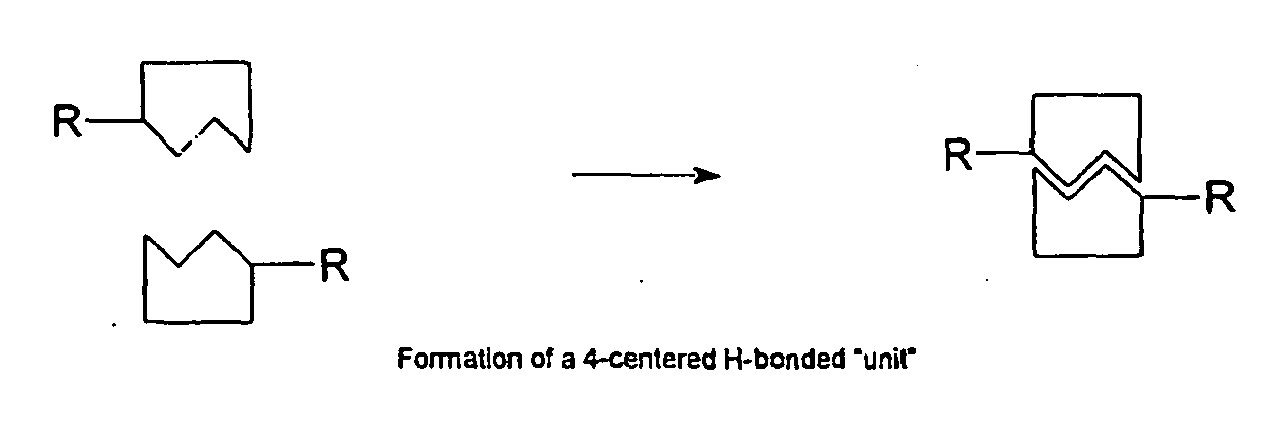
- The term "supramolecular polymer" in the context of the present invention refers to a polymer which derives it's polymeric properties through a combination of covalent bonds and specific secondary interactions, which includes hydrogen bonding, particularly two or more centered H-bond links. Such secondary interactions provide high bond strength and contribute substantially to the polymeric behavior.
- The non-covalently bonded unit acording to the present invention includes at least a two-centered H-bond within each unit. Preferably, the non-covalently bonded unit incudes a two, three or four centered H-bond within each unit. H-bonds that are higher than four centered can also be useful in the present invention.
- In addition to the two or more centered H-bonding, the non-covalently bonded unit in the thermally imageable compositions of the present invention further includes one or more additional secondary interactions, such as, van der Waals associations, hydrophobic associations, ionic associations and a combination thereof. Furthermore, in addition to the two or more centered H-bonded units, the thermally sensitive supramolecular polymer itself can have additional intermolecular or intramolecular interactions, including intermolecular or intramolecular H-bonding.
- Preferably, the thermally reversible non-covalently bonded unit in the top layer is a two-, three or four-centered H-bonded unit. In one embodiment, the thermally reversible non-covalently bonded unit includes a two-centered H-bonded unit, which includes two 2-pyridone groups. In another embodiment, the thermally reversible non-covalently bonded unit includes a three-centered H-bonded unit, which includes a cyclic imide group and a 2,6-diaminotriazine groups. In yet another embodiment, the thermally reversible non-covalently bonded unit includes a four-centered H-bonded unit, which includes two isocytosine groups.
- To achieve developability, the thermally sensitive supramolecular polymer in the thermally imageable compositions must have at least one base-soluble functional group having a pKa of less than 14. Such base-soluble functional groups include, for example, carboxylic, sulfonic, imide, N-acyl sulfonamide and phenolic hydroxy groups.
- The term "hydrocarbyl" in the context of the present invention refers to a linear, branched or cyclic alkyl, alkenyl, aryl, aralkyl or alkaryl of 1 to 22 carbon atoms, substituted derivatives thereof, wherein the substituent group is selected from halogen, hydroxy, hydrocarbyloxy, carboxyl, ester, ketone, cyano, amino, amido and nitro groups. Hydrocarbyl groups in which the carbon chain is interrupted by oxygen, nitrogen or sulfur are also included in the term "hydrocarbyl".
- The term "hydrocarbylene" in the context of the present invention refers to a linear, branched or cyclic alkylene, vinylene, arylene, aralkylene or alkarylene of 1 to 22 carbon atoms, substituted derivatives thereof, wherein the substituent group is halogen, hydroxy, carboxyl, hydrocarbyloxy, ester, ketone, cyano, amino, amido and nitro groups. Hydrocarbylene groups in which the carbon chain is interrupted by oxygen, nitrogen or sulfur are also included in the term "hydrocarbylene".
- Bifunctional compounds, which can associate into an oligomer or polymer by two centered H-bond units are disclosed in J. Org. Chem., 53, 5787-9 (1988). Supramolecular polymers based on three centered H-bond units are disclosed in Macromolecules, 28, 782-83 (1995).
- Representative of the compounds that can associate into an oligomer or polymer by two centered H-bond units are bridged bipyridone derivatives such as those disclosed in the previously cited J. Org. Chem., 53, 5787-9 (1988), provided that such systems have at least one base-soluble functional group, such as, carboxylic, sulfonic, imide, N-acyl sulfonamide or phenolic hydroxy groups.
- The non-covalently bonded unit in this embodiment includes a bridged bipyridone derivative capable of forming a two-centered H-bond. The thermally sensitive supramolecular polymer in the first thermally imageable composition according to the present invention includes a supramolecular polymer derived from monomers represented by the formula:

- Representative of the compounds that can associate by three centered H-bond units are maleimide/styrene copolymers associated with 4-vinyl-2,6-diaminotriazine/ styrene copolymers, such as those disclosed in the previously cited Macromolecules, 28, 782-83 (1995), provided that such copolymers have at least one base-soluble functional groups, such as, carboxylic, sulfonic, imide, N-acyl sulfonamide or phenolic hydroxy groups.
- The non-covatentty bonded unit in this embodiment can be a group capable of forming one or more three centered H-bonds with another same or different such group to form a three centered H-bonded pair.
- In one embodiment, the thermally sensitive supramolecular polymer in the first thermally imageable composition according to the present invention includes a supramolecular polymer derived from maleimide/styrene copolymers associated with 4-vinyl-2,6-diaminotriazine/ styrene copolymers. Terpolymers thereof are also suitable for use as the thermally sensitive supramolecular polymer in the thermally imageable composition according to the present invention.
- 4-Vinyl-2,6-diaminotriazine and copolymers thereof can also be readily converted into the corresponding N, N'-diacetyl derivatives by conventional acetylation techniques, using acetyl chloride or acetic anhydride. Such N, N'-diacetyl-2,6-diaminotriazine groups are capable of self-associating into four centered H-bonds, as described in Chem. Commun., 287-288 (2001) for porphyrin derivatives.
- The covalently bonded unit according to the present invention is derived from a polyfunctional material covalently bonded to sites that are also bonded to the non-covalently bonded units. At least one, preferably more than one, same or different polyfunctional materials can be bonded to such sites.
- The supramolecular polymer can be any polymer or resin that is capable of producing properties required for thermal imaging. For example, to achieve developability, the polyfunctional material has at least one base-soluble functional group having a pKa of less than 14. Such base-soluble functional groups include, for example, carboxylic, sulfonic, imide, N-acyl sulfonamide and phenolic hydroxy groups.
- The preferred polyfunctional materials include polyfunctional phenolic resins, acrylic resins, polyester resins, polyurethane resins, and combinations thereof. Preferably, the polyfunctional phenolic resin is a phenol/cresol novolak, polyvinyl phenol polymer, vinyl phenol/hydrocarbyl acrylate copolymer, pyrogallol/acetone polymer or a mixture thereof.
- In a preferred embodiment, the thermally sensitive polymer in the top layer is a supramolecular polymer represented by the formula:

- Preferably, the polyfunctional phenolic resin in the top layer is phenol/cresol novolak, polyvinyl phenol polymer, vinyl phenol/hydrocarbyl acrylate copolymer, pyrogallol/acetone polymer and a mixture thereof. The diisocyanates that are suitable for use in the top layer of the present invention include any diisocyanates, also referred to herein as "difunctional isocyanates." Preferably, the diisocyanate is selected from isophorone diisocyanate, methylene-bis-phenyl diisocyanate, toluene diisocyanate, hexamethylene diisocyanate, tetramethylxylylene diisocyanate, dimers thereof, adducts thereof with diols, and mixtures thereof.
- Because the polyfunctional phenolic resin in the top layer has n functional groups, up to n hydroxy groups can react with an equal number of isocyanate functional groups, each attached to a site bearing a non-covalently bonded unit. Preferably, in the above-described supramolecular polymer n is 1, 2 or 3.
- Thus, when n=2 in the above preferred embodiment, two hydroxy groups from a polyfunctional phenolic resin react with an equal number of isocyanate functional groups, each attached to a site bearing a non-covalently bonded unit, to produce a linear polymer in which the chain growth is the result of association of sites that are capable of four-centered hydrogen bonding to produce a quadruple hydrogen bonding unit.
- When n=3, three hydroxy groups from a polyfunctional phenolic resin react with an equal number of isocyanate functional groups, each attached to a site bearing a non-covalently bonded unit, to produce a crosslinked polymer in which crosslinking is achieved through association of sites that are capable of four-centered hydrogen bonding to produce three quadruple hydrogen bonding units. Thus, the thermally sensitive supramolecular polymer can be crosslinked. Preferably, such crosslinks are thermally reversible.
- Preferably, the thermally reversible non-covalently bonded unit in the bottom layer is a four-centered H-bonded unit, such as, a four-centered H-bond derived from two isocytosine groups. However, the thermally reversible non-covalently bonded unit in the bottom layer can also be a two- or three-centered H-bonded unit.
- Preferably, the covalently bonded unit in the bottom layer is derived from a polymer, which is soluble or dispersible in an aqueous developer. To be soluble or dispersible in an aqueous developer, the polymer should have at least one base soluble functional group, such as, a hydroxyl group, preferably an aromatic hydroxyl group, such as, a phenolic hydroxyl, a carboxylic acid, sulfonic acid, phosphoric acid, imide, N-acyl sulfonamide or a combination thereof.
- The thermally sensitive polymer in the bottom layer can be formed by polymerizing a monomer mixture, which includes one or more of an ethylenically unsaturated monomer having a functional group, such as, hydroxyl, carboxylic acid, sulfonic acid, phosphoric acid or a combination thereof.
- The ethylenically unsaturated monomer in the bottom layer can be compounds represented by the formula:


- Each Q1 and Q2 in the formulas can independently be hydroxyl or carboxylic acid groups.
- R4 can be hydrogen, linear, branched or cyclic alkyl of 1 to 22 carbon atoms, linear, branched or cyclic substituted alkyl of 1 to 22 carbon atoms, aryl of 6 to 24 carbon atoms or substituted aryl of 6 to 24 atoms, wherein the substituent can be alkyl, aryl, halogen, keto, ester, alkoxy or cyano.
- X can be O, S and NR5 wherein R5 is hydrogen, linear, branched or cyclic alkyl of 1 to 22 carbon atoms, linear, branched or cyclic substituted alkyl of 1 to 22 carbon atoms, aryl of 6 to 24 carbon atoms or substituted aryl of 6 to 24 atoms, wherein the substituent can be alkyl, aryl, halogen, keto, ester, alkoxy and cyano.
- Y is linear, branched or cyclic alkylene of 1-22 carbon atoms, alkyleneoxyalkylene, poly(alkyleneoxy) alkylene, a ureido-containing group, such as, alkylene-NHCON(R5)- or it can be a bond.
- Z can be hydrogen, hydroxyl, carboxylic acid, or a group represented by the formula:


- Examples of the ethylenically unsaturated monomers having one or more base soluble functional group include compounds represented by a the formula:


- The monomer mixture can further include an ethylenically unsaturated comonomer. Examples of such ethylenically unsaturated comonomers include acrylic acid, methacrylic acid, acrylic acid ester, methacrylic acid ester, hydroxyethyl acrylate, hydroxyethyl methacrylate, hydroxypropyl acrylate, hydroxypropyl methacrylate, acrylamide, methacrylamide, N-methylacrylamide, N-methylmethacrylamide, acrylonitrile, methacrylonitrile, vinyl chloride, vinylidene chloride, vinyl acetate, vinyl ether, styrene, N-phemylmaleimide and a mixture thereof.
- The second thermally sensitive supramolecular polymer, which is included in the bottom layer, is represented by the formula:

wherein Y is a hydrocarbylene derived from a diisocyanate represented by the formula Y(NCO)2;
wherein P is a residue derived from an n functional aqueous developer soluble or dispersible polymer represented by the formula P(OH)n wherein n is at least 1. - The above n functional aqueous developer soluble or dispersible polymer can be formed by polymerizing a monomer mixture, which includes one or more of an ethylenically unsaturated monomer having a functional group such as hydroxyl, preferably aromatic hydroxyl, such as, phenolic hydroxyls, carboxylic acid, sulfonic acid, phosphoric acid or a combination thereof.
- The above n functional aqueous developer soluble or dispersible polymers are preferably formed from the following ethylenically unsaturated monomers:


wherein each Q1 and Q2 is independently selected from the group consisting of: hydroxyl and carboxylic acid groups;
R4 is hydrogen, linear, branched or cyclic alkyl of 1 to 22 carbon atoms, linear, branched or cyclic substituted alkyl of 1 to 22 carbon atoms, aryl of 6 to 24 carbon atoms or substituted aryl of 6 to 24 atoms, wherein the substituent is alkyl, aryl, halogen, keto, ester, alkoxy and cyano;
X is O, S and NR5 wherein R5 is hydrogen, linear, branched or cyclic alkyl of 1 to 22 carbon atoms, linear, branched or cyclic substituted alkyl of 1 to 22 carbon atoms, aryl of 6 to 24 carbon atoms or substituted aryl of 6 to 24 atoms, wherein the substituent is alkyl, aryl, halogen, keto, ester, alkoxy and cyano;
Y is linear, branched or cyclic alkylene of 1-22 carbon atoms, alkyleneoxyalkylene, poly(alkyleneoxy) alkylene or a bond; and
Z is hydrogen, hydroxyl, carboxylic acid, or a group represented by the formula:


- Examples of the ethylenically unsaturated monomers having one or more base soluble functional group include compounds represented by a the formula:


- The preferred ethylenically unsaturated comonomers include acrylic acid, methacrylic acid, acrylic acid ester, methacrylic acid ester, hydroxyethyl acrylate, hydroxyethyl methacrylate, hydroxypropyl acrylate, hydroxypropyl methacrylate, acrylamide, methacrylamide, N-methylacrylamide, N-methylmethacrylamide, acrylonitrile, methacrylonitrile, vinyl chloride, vinylidene chloride, vinyl acetate, vinyl ether, styrene, N-phenylmaleimide and a mixture thereof.
- The diisocyanates that are suitable for use in the bottom layer of the present invention can be the same or different than the diisocyanates used in the top layer, and can include any diisocyanate. Preferably, the diisocyanate is selected from isophorone diisocyanate, methylene-bis-phenyl diisocyanate, toluene diisocyanate, hexamethylene diisocyanate, tetramethylxylylene diisocyanate, dimers thereof, adducts thereof with diols, and mixtures thereof.
- In another preferred embodiment, the first and/or second thermally imageable composition of the present invention further includes a photothermal converter material.
- The supramolecular polymer can be prepared by a process including the steps of:
- contacting a hydrocarbyl-substituted isocytosine and a diisocyanate to produce an isocytosine/isocyanate mono-adduct; and contacting the isocytosine/isocyanate mono-adduct and
- (1) a polyfunctional material, such as, a polyfunctional phenolic resin, acrylic resin, polyester resin, polyurethane resin, and a combination thereof, for the top layer; or
- (2) a polymer formed by polymerizing a monomer mixture, which includes one or more of an ethylenically unsaturated monomer having a functional group, such as, hydroxyl, carboxylic acid, sulfonic acid, phosphoric acid or a combination thereof, and optionally a comonomer, for the bottom layer;
- Preferably, the hydrocarbyl groups in the above process are independently alkyl groups of 1 to 22 carbon atoms and the diisocyanate is isophorone diisocyanate, methylene-bis-phenyl diisocyanate, toluene diisocyanate, hexamethylene diisocyanate, tetramethylxylylene diisocyanate, dimers thereof, adducts thereof with diols, or mixtures thereof. The polyfunctional phenolic resin can be phenol/cresol novolak, polyvinyl phenol polymer, vinyl phenol/hydrocarbyl acrylate copolymer, pyrogallol/acetone polymer or a mixture thereof.
- The isocytosine/isocyanate mono-adduct can be in a monomeric or quadruple hydrogen bonded dimeric form having a quadruple hydrogen bonded unit. The monomeric form is represented by the formula:

- The dimeric form of the isocytosine/isocyanate mono-adduct has a structure resulting from association of the two sites capable of quadruple hydrogen bonding, namely two isocytosine units. The association of the two quadruple hydrogen bonding sites and the quadruple hydrogen bonded unit resulting therefrom, i.e., the 4-centered H-bonded unit, is schematically represented below for a related system in which the -Y-NCO group is replaced with the group -CH2CH2CH2-R:

- The isocytosine/isocyanate bis-adduct can be in a monomeric form or it can be in a quadruple hydrogen bonded oligomeric or polymeric form. The quadruple hydrogen bonded oligomeric or polymeric form results from association of two sites capable of quadruple hydrogen bonding, each from a different isocytosine/isocyanate bis-adduct, to produce an oligomer or polymer having repeating units of associated quadruple hydrogen bonding units, i.e., the 4-centered H-bonded units.
- The monomeric form of the isocytosine/isocyanate bis-adduct is represented by the formula:

- Reaction of 1 mole of an isocytosine derivative with 1 mole of diisocyanate, such as isophorone diisocyanate, produces the isocytosine/isocyanate 1:1 adduct, which will spontaneously dimerize to form a dimeric mono-adduct having a thermally reversible 4-center H-bond. The resulting dimeric mono-adduct has free isocyanate groups on each end. This dimeric mono-adduct can then be used to form thermally reversible crosslinks with phenolic polymers. Any unreacted diisocyanate, such as isophorone diisocyanate, can also crosslink the phenolic polymers, however such crosslinking is not reversible.
- To avoid crosslinking by the unreacted diisocyanate, an excess of isocytosine, i.e., about 10-20 % molar excess, is preferably used. Excess isocytosine can further react with the mono-adduct, which can also dimerize spontaneously to give a diisocyanate bis-adduct having two or more thermally reversible 4-center H-bonds.
- Using "I" for the diisocyanate and "M" for isocytosine derivative, the reactions can be illustrated as follows:

- To maximize the formation of lower order adducts, isocytosine is added slowly to the diisocyanate to ensure that an excess diisocyanate is present at the early stages of the reaction.
- The present invention is suitable for use in multilayer thermally imageable elements that are useful in lithographic printing, including lithographic printing plates that can be thermally imaged by imagewise exposure with a laser or a thermal printing head. The multilayer thermally imageable element is useful as a precursor for a lithographic printing member. In a multilayer thermally imageable system, the thermally imageable element has a top layer and a bottom layer. While different, the thermally sensitive supramolecular polymers of both the top and bottom layers include at least one covalently bonded unit; and at least one thermally reversible non-covalently bonded unit, which includes a two or more centered H-bond within each of the non-covalently bonded units. The top layer includes a thermally sensitive supramolecular polymer. The bottom layer includes one or more QHB-functionalized materials, including: (1) QHB-functionalized supramolecular polymers or copolymers derived from polymerization or copolymerization of suitably functionalized monomers; and optionally (2) QHB-functionalized phenolic supramolecular polymers.
- In their hydrogen bonded form, the QHB-functionalized top and bottom layer polymeric materials are not very soluble in aqueous alkaline developer prior to exposure to heat. However, both top and bottom layers exhibit an increased solubility in an aqueous developer solution upon exposure to heat, i.e., they both become soluble in the aqueous alkaline developer following thermal exposure and thereby, they become penetrable to the aqueous alkaline developer.
- The bottom layer of the imageable element can further include a QHB-functionalized phenolic supramolecular polymer, such as, a polyfunctional phenolic resin, including a QHB-functionalized phenol/cresol novolak, QHB-functionalized polyvinyl phenol polymer, QHB-functionalized vinyl phenol/hydrocarbyl acrylate copolymer, QHB-functionalized pyrogallol/acetone polymer or a mixture thereof.
- Preferably, the bottom layer of the imageable element includes both a QHB-functionalized phenolic supramolecular polymer and a QHB-functionalized supramolecular polymers or copolymers derived from polymerization or copolymerization of suitably functionalized monomers.
- The bottom layer of the imageable element can still further include an acrylic polymer, which can be formed by polymerizing one or more ethylenically unsaturated monomers and comonomers including acrylic acid, methacrylic acid, acrylic acid ester, methacrylic acid ester, hydroxyethyl acrylate, hydroxyethyl methacrylate, hydroxypropyl acrylate, hydroxypropyl methacrylate, acrylonitrile, methacrylonitrile, acrylamide, methacrylamide, N-methylacrylamide, N-methylmethacrylamide, vinyl chloride, vinylidene chloride, vinyl acetate, vinyl ether, styrene, N-phemylmaleimide and a mixture thereof. More particularly, the bottom layer can contain a polymeric material, such as, a terpolymer of methacrylic acid, acrylamide and N-phenyl maleimide, which is not a supramolecular polymer.
- In addition to the thermally imageable layer, the thermally imageable element can have additional layers, such as, an underlying layer. Possible functions of an underlying layer include:
- (1) to enhance developability of the imagewise unexposed areas; and
- (2) to act as a thermal insulating layer for the imagewise exposed areas.
- Such thermal insulating polymeric layer prevents otherwise rapid heat dissipation, for example, through the heat conducting aluminum substrate. This allows more efficient thermal imaging throughout of the thermally imageable layer, particularly in the lower sections. In accordance with these functions, the underlying layer should be soluble or at least dispersible in the developer and, preferably, have a relatively low thermal conductivity coefficient.
- The thermally imageable element can further have an overlying layer. Possible functions of an overlying layer include:
- (1) to prevent damage, such as scratching, of the surface layer during handling prior to imagewise exposure; and
- (2) to prevent damage to the surface of the imagewise exposed areas, for example, by over-exposure which could result in partial ablation. The overlying layer should be soluble, dispersible or at least permeable to the developer.
- The present invention still further includes a method of producing an imaged element. The method includes the steps of:
- exposing the two-layer imageable element to thermal radiation to produce imagewise exposed regions; and
- contacting the exposed two-layer imageable element and a developer within a period of time after the exposing step to remove the exposed regions and thereby produce the imaged element
- Preferably, the method can further includes a photothermal converting material and the step of exposing the imageable element to thermal radiation is preferably carried out using an infrared laser, typically for a period of time up to 1 hour, with a pixel dwell time of not more than 100 µs.
- The developer composition is dependent on the nature of the polymeric substance, but is preferably an aqueous composition. Common components of aqueous developers include surfactants, chelating agents, such as, salts of ethylenediamine tetraacetic acid, organic solvents, such as, benzyl alcohol, and alkaline components, such as, inorganic metasilicates, organic metasilicates, hydroxides and bicarbonates. Preferably, the aqueous developer is an alkaline developer containing inorganic metasilicates or organic metasilicates when the polymeric substance is a phenolic resin.
- Typically, the step of exposing the imageable element to thermal radiation is carried out using an infrared laser. However, other methods such as visible or UV laser imaging may also be used, provided that a photoconverter, i.e., a photothermal converter, is present. Thus, for exposure with such visible or UV radiation sources, the composition generally includes a photothermal converting material.
- The Applicants have unexpectedly discovered that despite the strong multi-centered H-bonding, it was possible to thermally reverse such bonding during IR laser exposure in which the pixel dwell time of the laser is less than 100 µs. Thermally reversing the bonding by exposing at a pixel dwell time of not more than 100 µs enables one to produce an imaged element economically and within a short period of time, thereby providing a significant cost advantage over methods that require exposures at a pixel dwell time of more than 100 µs. Accordingly, the thermal radiation in the method of the present invention preferably has a pixel dwell time of not more than 100 µs. Furthermore, despite the expected ease of reformation of strong multi-centered H-bonding, the Applicants have discovered surprisingly that, following exposure, it was possible to remove the exposed areas with an aqueous developer prior to reformation of the multi-centered H-bonded units.
- A characteristic feature of this process is transiency of thermal solubilization in that developability decreases with time following exposure. Based on the examples, imageable elements should preferably be developed within up to 1 hour, more preferably within up to 30 minutes, most preferably within up to 10 minutes following exposure. For example, in the case of infrared laser imaging, the period of time between the steps of exposing and treating with a developer is preferably less than about 10 minutes. As mentioned above, the method of the present invention can be used in one or two layer systems.
- In the two layer systems, the bottom layer is soluble or dispersible in a developer, whereas the top layer is insoluble in the developer. Imagewise thermal exposure of such composite layer increases the rate of removal of the exposed areas of both layers.
- The rate of removal of the exposed areas can be increased by enhanced rate of dissolution or dispersibility of the bottom layer and by enhanced permeability of the top layer. The supramolecular polymers of the present invention can be used in the top layer.
- The thermally imageable element of the present invention is useful in digital imaging applications, including printing plates and printed circuit boards.
- In the following preferred embodiment of the present application are summarized:
- 1. A two-layer imageable element comprising:
- a substrate;
- a top layer comprising a thermally imageable composition comprising: (a) a first thermally imageable composition comprising a first thermally sensitive supramolecular polymer which exhibits an increased solubility in an aqueous developer solution upon exposure to heat; said first thermally sensitive supramolecular polymer comprising: at least one covalently bonded unit; and at least one thermally reversible non-covalently bonded unit, which includes a two or more centered H-bond within each non-covalently bonded unit or (b) a thermally imageable composition free of said first thermally sensitive supramolecular polymer, and
- disposed between said substrate and said top layer, a bottom layer comprising a second thermally imageable composition comprising a second thermally sensitive supramolecular Polymer which exhibits an increased solubility in an aqueous developer solution upon exposure to heat; said second thermally sensitive supramolecular polymer comprising: at least one covalently bonded unit; and at least one thermally reversible non-covalently bonded unit, which includes a two or more centered H-bond within each said non-covalently bonded unit;
- 2. The imageable element of item 1, wherein said two or more centered H-bond in said top layer is a four centered H-bond.
- 3. The imageable element of item 2, wherein said four-centered H-bond in said top layer comprises two isocytosine groups.
- 4. The imageable element of item 1, wherein said covalently bonded unit in said top layer is derived from a polyfunctional material that is soluble or dispersible in an aqueous developer solution.
- 5. The imageable element of item 4, wherein said polyfunctional material is selected from the group consisting of: polyfunctional phenolic resin, acrylic resin, polyester resin, polyurethane resin, and a combination thereof.
- 6. The imageable element of item 5, wherein said polyfunctional phenolic resin is selected from the group consisting of: phenol/cresol novolak, polyvinyl phenol polymer, vinyl phenol/hydrocarbyl acrylate copolymer, pyrogallol/acetone polymer and a mixture thereof.
- 7. The imageable element of item 1, wherein said first thermally sensitive supramolecular polymer in said top layer comprises a supramolecular polymer derived from monomers represented by the formula:

wherein Y is a hydrocarbylene derived from a diisocyanate represented by the formula Y(NCO)2;
wherein R3 is a phenolic residue derived from a polyfunctional phenolic resin represented by the formula R3(OH)n; and
wherein n is at least 1. - 8. The imageable element of item 7, wherein said polyfunctional phenolic resin is selected from the group consisting of: phenol/cresol novolak, polyvinyl phenol polymer, vinyl phénol/hydrocarbyl acrylate copolymer, pyrogallol/acetone polymer and a mixture thereof.
- 9. The imageable element of item 7, wherein said diisocyanate is selected from the group consisting of: isophorone diisocyanate, methylene-bis-phenyl diisocyanate, toluene diisocyanate, hexamethylene diisocyanate, tetramethylxylylene diisocyanate, dimers thereof, adducts thereof with diols, and mixtures thereof.
- 10. The imageable element of item 7, wherein n is 1, 2 or 3.
- 11. The imageable element of item 1, wherein said thermally reversible non-covalently bonded unit in said top layer includes a two-centered H-bond, which comprises two 2-pyridone groups.
- 12. The imageable element of item 11, wherein said first thermally sensitive supramolecular polymer comprises a supramolecular polymer derived from monomers represented by the formula:
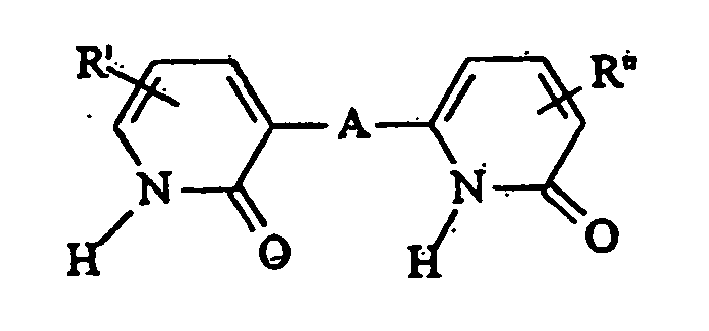
- 13. The imageable element of item 1, wherein said thermally reversible non-covalently bonded unit in said top layer includes a three-centered H-bond, which comprises a cyclic imide group and a 2,6-diaminotriazine group.
- 14. The imageable element of item 1, wherein said first thermally sensitive supramolecular polymer in said top layer comprises a maleimide/styrene copolymer associated with a 4-vinyl-2,6-diaminotriazine/ styrene copolymer, with the proviso that said copolymers comprise at least one base-soluble functional group selected from the group consisting of: carboxylic, sulfonic, imide, N-acyl sulfonamide and phenolic hydroxy.
- 15. The imageable element of item 2, wherein said four centered H-bond comprises two N, N'-diaoetyl-2,6-diaminotriazine units.
- 16. The imageable element of item 15, wherein said four centered H-bond comprises two N, N'-diacetyl-2,6-diaminotriazine units.
- 17. The imageable element of item 1, wherein said two or more centered H-bond in said bottom layer is a four centered H-bond.
- 18. The imageable element of item 17, wherein said four-centered H-bond in said bottom layer comprises two isocytosine groups.
- 19. The imageable element of item 1, wherein said covalently bonded unit in said bottom layer is derived from a polymer, which is soluble or dispersible in an aqueous developer.
- 20. The imageable element of item 19, wherein said polymer comprises at least one base soluble functional group.
- 21. The imageable element of item 20, wherein said base soluble functional group is selected from the group consisting of: hydroxyl, carboxylic acid, sulfonic acid, phosphoric acid, imide, N-acyl sulfonamide and a combination thereof.
- 22. The imageable element of item 21, wherein said hydroxyl group is an aromatic hydroxyl group.
- 23. The imageable element of item 19, wherein said polymer is formed by polymerizing a monomer mixture comprising one or more of an ethylenically unsaturated monomer having a functional group selected from the group consisting of: hydroxyl, carboxylic acid, sulfonic acid, phosphoric acid and a combination thereof.
- 24. The imageable element of item 23, wherein said ethylenically unsaturated monomer is selected from the group consisting of compounds represented by the formula:


wherein:- each Q1 and Q2 is independently selected from the group consisting of: hydroxyl and carboxylic acid groups;
- R4 is selected from the group consisting of: hydrogen, linear, branched or cyclic alkyl of 1 to 22 carbon atoms, linear, branched or cyclic substituted alkyl of 1 to 22 carbon atoms, aryl of 6 to 24 carbon atoms and substituted aryl of 6 to 24 atoms, wherein said substituent is selected from the group consisting of: alkyl, aryl, halogen, keto, ester, alkoxy and cyano;
- X is selected from the group consisting of: O, S and NR5 wherein R5 is selected from the group consisting of: hydrogen, linear, branched or cyclic alkyl of 1 to 22 carbon atoms, linear, branched or cyclic substituted alkyl of 1 to 22 carbon atoms, aryl of 6 to 24 carbon atoms and substituted aryl of 6 to 24 atoms, wherein the substituent is selected from the group consisting of: alkyl, aryl, halogen, keto, ester, alkoxy and cyano;
- Y is selected from the group consisting of: linear, branched or cyclic alkylene of 1-22 carbon atoms, alkyleneoxyalkylene, poly(alkyleneoxy) alkylene, alkylene-NHCON(R5)- and a bond; and
- Z is selected from the group consisting of: hydrogen, hydroxyl, carboxylic acid and a group represented by the formula:


- 25. The imageable element of item 24, wherein said ethylenically unsaturated monomer is selected from the group consisting of compounds represented by a the formula:


- 26. The imageable element of item 23, wherein said monomer mixture further comprises an ethylenically unsaturated comonomer.
- 27. The imageable element of item 26, wherein said ethylenically unsaturated comonomer is selected from the group consisting of: acrylic acid, methacrylic acid, acrylic acid ester, methacrylic acid ester, hydroxyethyl acrylate, hydroxyethyl methacrylate, hydroxypropyl acrylate, hydroxypropyl methacrylate, acrylamide, methacrylamide, N-methylacrylamide, N-methylmethacrylamide, acrylonitrile, methacrylonitrile, vinyl chloride, vinylidene chloride, vinyl acetate, vinyl ether, styrene, N-phenylmaleimide and a mixture thereof.
- 28. The imageable element of item 1, wherein said bottom layer further comprises a polyfunctional phenolic resin represented by the formula:

wherein Y is a hydrocarbylene derived from a diisocyanate represented by the formula Y(NCO)2;
wherein R3 is a phenolic residue derived from a polyfunctional phenolic resin represented by the formula R3(OH)n; and
wherein n is at least 1. - 29. The imageable element of item 28, wherein said polyfunctional phenolic resin is selected from the group consisting of:
- phenol/cresol novolak, polyvinyl phenol polymer, vinyl phenol/hydrocarbyl
- acrylate copolymer, pyrogallol/acetone polymer and a mixture thereof.
- 30. The imageable element of item 1, further comprising a photothermal converter material.
- 31. The imageable element of item 1, wherein the thermally imageable composition that is free of said first thermally sensitive supramolecular polymer comprises a novolak resin and an infrared dye.
- 32. The imageable element of item 1, wherein said first and said second thermally sensitive supramolecular polymers are the same.
- 33. The imageable element of item 1, wherein said first and said second thermally sensitive supramolecular polymers are different thermally sensitive supramolecular polymers.
- 34. The two-layer imageable element of item 1, wherein
the top layer comprising a first thermally imageable composition comprising a first thermally sensitive supramolecular polymer which exhibits an increased solubility in an aqueous developer solution upon exposure to heat; said first thermally sensitive supramolecular polymer comprising: at least one covalently bonded unit; and at least one thermally reversible non-covalently bonded unit, which includes a two or more centered H-bond within each said non-covalently bonded unit. - 35. The two-layer imageable element of item 34
wherein said covalently bonded unit in said top layer is derived from a polyfunctional material that is soluble or dispersible in an aqueous developer solution. - 36. A method of producing an imaged element comprising the steps of:
- providing a two-layer imageable element as defined on any of items 1 to 35 exposing said two-layer imageable element to thermal radiation to produce imagewise exposed regions; and
- contacting said exposed two-layer imageable element and a developer within a period cf time after said exposing step to remove said exposed regions and thereby produce said imaged element.
- The synthetic route describes in detail the synthesis of "RESIN A". Further syntheses were undertaken to produce "RESIN B" and "RESIN C" as described in table A.
- Into a 250 ml flask were added 100 g of dried tetrahydrofuran (THF) and 13.78 g (0.11mole) of dried 6-methylisocytosine. To this mixture was added 22.24 g (0.1 mole) of isophorone diisocyanate and the flask sealed from atmospheric moisture with a conical stopper. The mixture was left at ambient temperature for five days. The resulting mixture represented 0.1 mole of the quadruple hydrogen bonding entity, which would then be reacted with polymers containing phenolic -OH functionality (see Science, 278, 1601-1604 (1997) and in J. Polym. Sci., Part A: Polym. Chem., 37, 3657-3670 (1999).
- 110.75 g of Bakelite resin LB6564 was dissolved into 400 g of dried tetrahydrofuran (THF) in a 1 litre flask and 40% of the stage 1 mixture (0.04moles of QHBE) added slowly with stirring. Slow stirring was continued for 1 - 2 days at ambient temperature. The mixture was tested for isocyanate functionality using FT-IR. The reaction was considered to be complete when the presence of an isocyanate functionality could no longer be detected by Infrared Spectroscopy (IR).
- The QHB-functional phenolic resin and quadruple H-bonded unit resulting therefrom are represented schematically below. Phenolics having 2 QHB units will undergo chain extension, whereas phenolics having 3 or more QHB units are capable of undergoing crosslinking.

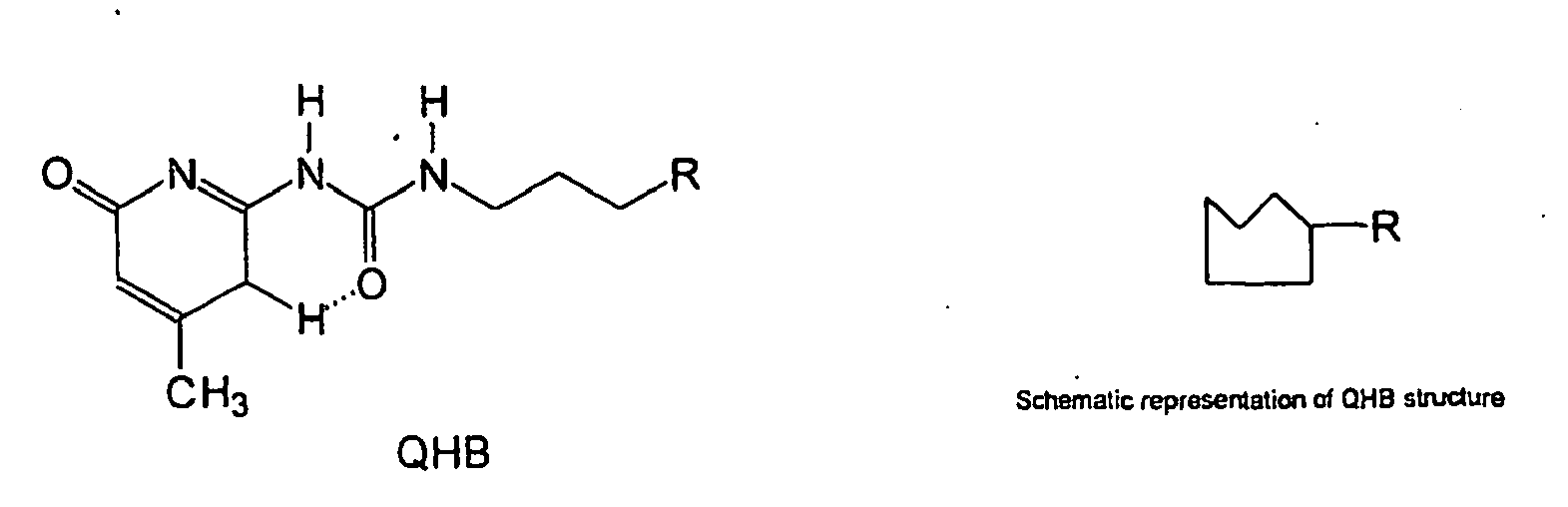
- The QHB group can form a four centered H-bond as shown below:


- The product was isolated by precipitation into water. The mixture was slowly poured as a thin stream into 5 litres of vigorously stirred distilled water using a Silverson/Rotamix mixer. Initially, the product precipitated as a sticky viscous mass, but tended to harden and crumble with further stirring as the tetrahydrofurane (THF) was extracted from the polymer. The aqueous phase was decanted and replaced with fresh water and left over-night. The mixture was again vigorously stirred to form a fine precipitate, which was washed with water while being filtered, using a Buchner funnel. The damp cake was crumbled into a drying tray and dried at 40°C until constant weight was obtained.
Table A Resin LB6564 Lyncur M(S-1) Lyncur CBA Phenolic Resin (equiv. wt) 116.43 108.14 262.15 Phenolic Resin (equivalents) 0.9512 0.476 0.238 Resin weight (g) 110.75 51.43 62.34 QHBE (moles) 0.04 0.02 0.01 QHBE weight (g) 13.91 6.954 3.477 QHBE Solvent T.H.F. T.H.F. T.H.F. PHENOL/QHBE equiv ratio 23.78 23.78 23.78 Solvent T.H.F. T.H.F. T.H.F. Solvent weight (g). 400 200 250 Yield (g). 119.7 32 46.4 Batch name RESIN A RESIN B RESIN C -
- 1. LB6564: a phenol/cresol novolak marketed by Bakelite, UK.
- 2. M(S-1): Lyncur M(S-1), a polyvinylphenol polymer having Mw = 1600 to 2400 and Mn = 1100 to 1500, as supplied by Siber Hegner, Beckenham, UK.
- 3. CBA: Lyncur CBA (PVPh-butylacrylate), a copolymer of polyvinylphenol having the structure:

- 4. RESIN A: the resin obtained when 110.75 g of LB6565 is reacted with 13.91 g of QHBE.
- 5. RESIN B: the resin obtained when 51.43 g of M(S-1) is reacted with 6.954 g of QHBE.
- 6. RESIN C: the resin obtained when 62.34 g of Lyncur CBA resin is reacted with 3.477 g of QHBE.
- 7. KF654B PINA: an IR dye as supplied by Riedel de Haan Ltd, Middlesex, UK, having the following structure:

- 8. IR dye B: an IR dye having the structure:

- 9. Crystal violet: basic violet 3, C.I. 42555, Gentian violet, as supplied by Aldrich Chemical Company, Dorset, UK.
- 10. Oxonol Blue: a blue dye having the structure:
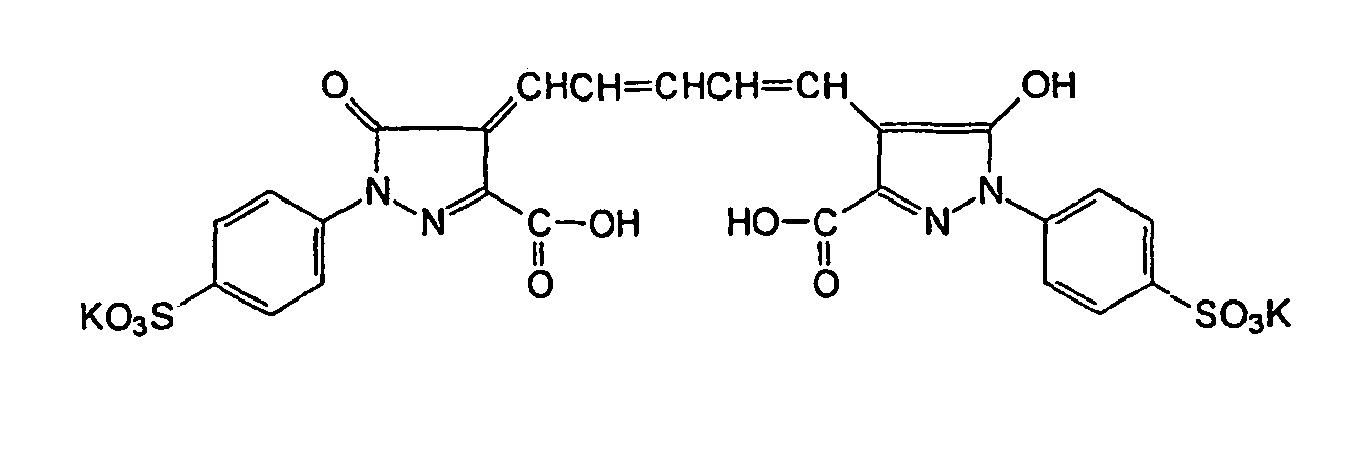
- 11. Paris Blue: a blue pigment supplied by Kremer Pigmente, Aichstetten, Germany.
- 12. Developer A: 14%wt sodium metasilicate pentahydrate in water.
- 13. Developer B: 0.2M NaOH in water.
- 14. Copper substrate A: double sided copper laminate of overall thickness 254 microns, having copper cladding 18 microns thick on each side of an insulating substrate, catalogue number N4105-2, 0.008, H/H THE, as supplied by New England Laminates (UK) Ltd of Skelmersdale, UK. The copper substrate is then brush grained using a mechanical grainer, stock number 4428, supplied by PCB machinery Ltd, Haslingden, Rossendale, UK, rinsed with distilled water for 10 seconds and allowed to air dry, prior to coating.
- 15. Etching solution A: Ferric chloride hexahydrate crystals, catalogue no. 551-227 as supplied by RS components, Corby, UK.
- 16. Stripper A: Catalogue no. 690-855 as supplied by RS components.
- Formulation A and B solution concentrations were selected to provide the specified dry film compositions with coating weights of 2 g/m2 after thorough drying, at 100°C for 90 seconds in a Mathis oven. In each case the substrate used was an aluminum sheet that had been electrograined and anodised and post-anodically treated with an aqueous solution of an inorganic phosphate. The coating solutions were coated onto the substrate by use of a wire wound bar.
- For formulation A, RESIN A (see Table A) and IR dye B were used in the ratio of 98:2 (w:w). For formulation B, Paris Blue, and RESIN A (at a ratio of 1:4, w:w) were ball milled together for 4 days such that the dispersed mill base had a solids content of 30 wt% in 1-methoxypropan-2-ol and a particle size of <10 microns as determined by grind gauge. Thus, the formulation B coating was prepared as a solution on 1-methoxypropan-2-ol.
Formulation A B Parts by Weight RESIN A 98 80 IR dye B 2 Paris Blue 20 - The precursors were imaged using an internal test pattern, on a Creo Trendsetter at an imaging energy density of 250 mJ/cm2. They were then processed using a Kodak Polychrome Graphics Mercury Mark V processor containing developer A at 22.5°C at a process speed of 750 mm/min. Performance was assessed by comparing actual screen densities with expected densities using a Gretag D19C densitometer (available from Colour Data Systems Ltd, The Wirral, UK)
-
Expected Dot Readings / % Actual Dot Readings /% Formulation A Formulation B 2 2 1 5 6 5 10 10 10 20 21 20 30 31 30 40 40 40 50 51 50 60 57 59 70 72 69 80 81 79 90 92 90 95 97 95 - The printing forms were press tested on a Heidelberg Speed Master 52 printing press, using Duo laser 80 g paper, Gibbons Geneva A1 colour ink and a standard fount solution (including 87% water, 10.5% isopropyl alcohol and 2.5% Goldfount surfactants). Each printing form ran cleanly, with no inking in background areas. Density tests were carried out on the solid image areas (100% screen areas) at a range of runlengths. Formulations A and B maintained 100% screen density beyond 23,500 impressions and the plates ran cleanly on press. There was no evidence of coating failure throughout the printing test.
- Coating formulation C was prepared as a solution in 1-methoxypropan-2-ol. The solution concentration was selected to provide the specified dry film composition of 2% IR dye B and 98% RESIN A with a coating weight of 2 g/m2 after thorough drying at 100°C for 90 seconds. The precursor was then imaged using an internal test pattern with 100% coverage, on a Creo Trendsetter 3244 at an imaging energy density of 220 mJ/cm2. Next, separate samples of this precursor were cut up and the time between imaging and developing was increased (0, 1, 2, 3 and 4 hours). Additional samples were stored at elevated temperature (40°C) for 0, 4 and 21 hours. Samples were then processed using a Kodak Polychrome Graphics Mercury Mark V processor containing developer A at 22.5°C at a process speed of 750 mm/min. In this way, the latent image stability of the formulation was evaluated using a Gretag densitometer.
-
Formulation C Time between imaging and developing / hours 0 1 2 3 4 Expected dot readings / % Actual dot readings / % 0 0 62 70 86 96 -
Formulation C Time between imaging and developing / hours 0 4 21 Expected dot readings /% Actual dot readings / % 0 0 100 100 - The solution concentrations were selected to provide the specified dry film compositions with coating weights of 2 g/m2 after thorough drying, at 100°C for 90 seconds in a Mathis oven. In each case the substrate used was an aluminum sheet that had been electrograined and anodised and post-anodically treated with an aqueous solution of an inorganic phosphate. The coating solutions were coated onto the substrate by use of a wire wound bar.
Formulation D E F Parts by Weight RESIN A 98 98 100 IR dye B 2 Oxonol Blue 2 Formulation G H I Parts by Weight RESIN B 98 98 100 IR dye B 2 Oxonol Blue 2 Formulation J K L Parts by Weight RESIN C 98 98 100 IR dye B 2 Oxonol Blue 2 - Precursor samples were then developed for increasing amounts of time at different ages, with developer A at 25°C and a visual assessment was made of whether any coating remained, ie was the coating resisting the developer.
-
Time exposed to developer / s 30 60 90 120 150 180 Formulation D Coating visible Coating visible Coating visible Coating visible Some coating left All coating removed E Coating visible Coating visible Coating visible Some coating left All coating removed All coating removed F Coating visible Coating visible Coating visible Coating visible Some coating left All coating removed G All coating removed All coating removed All coating removed All coating removed All coating removed All coating removed H All coating removed All coating removed All coating removed All coating removed All coating removed All coating removed I All coating removed All coating removed All coating removed All coating removed All coating removed All coating removed J All coating removed All coating removed All coating removed All coating removed All coating removed All coating removed K All coating removed All coating removed All coating removed All coating removed All coating removed All coating removed L All coating removed All coating removed All coating removed All coating removed All coating removed All coating removed "Coating visible" = coating is unattacked by developer
"Some coating left" = coating is partially dissolved by developer
"All coating is removed" = developer has dissolved coating away -
Time exposed to developer / s 120 150 180 210 240 270 300 330 360 Formu lation D Coating visible Coating visible Coating visible Coating visible Some coating left Some coating left Some coating left Some coating left All coating removed E Some coating left Some coating left Some coating left Some coating left Some coating left Some coating left All coating removed All coating removed All coating removed F Coating visible Coating visible Coating visible Coating visible Coating visible Some coating left All coating removed All coating removed All coating removed - All coating was removed from Formulations G through L.
-
Time exposed to developer / s 120 150 180 210 240 270 300 330 360 Formu lation D Coating visible Coating visible Coating visible Coating visible Coating visible Coating visible Coating visible Coating visible Some coating left E Coating visible Coating visible Coating visible Some coating left Some coating left Some coating left Some coating left Some coating left Some coating left F Coating visible Coating visible Coating visible Coating visible Coating visible Coating visible Some coating left Some coating left Some coating left - All coating was removed from Formulations G through L.
-
Time exposed to developer / s 120 150 180 210 240 270 300 330 360 Formul ation D Coating visible Coating visible Coating visible Coating visible Coating visible Coating visible Coating visible Coating visible Coating visible E Coating visible Coating visible Coating visible Coating visible Coating visible Some coating left Some coating left Some coating left Some coating left F Coating visible Coating visible Coating visible Coating visible Coating visible Coating visible Coating visible Coating visible Coating visible - All coating was removed from Formulations G through L.
-
Time exposed to developer / s 120 150 180 210 240 270 300 330 350 Formu lation D Coating visible Coating visible Coating visible Coating visible Coating visible Coating visible Coating visible Coating visible Coating visible E Coating visible Coating visible Coating visible Coating visible Coating visible Some coating left Some coating left Some coating left Some coating left F Coating visible Coating visible Coating visible Coating visible Coating visible Coating visible Coating visible Coating visible Coating visible - Formulations G through I were not tested. All coating was removed from Formulations J through L.
- As shown in Table A, the QHBE/phenol group equivalent ratio is about 1/24 in these formulations. Developer resistance as a function of QHBE level was also determined, using a series of derivatives of LB6564 of different QHB level shown in the table below and compared with unmodified LB6564.
QHBE:phenolic OH ratio (LB6564) 01:05 01:08.4 01:14 01:24 01:40 LB6564 Resin % 98 98 98 98 98 98 IR dye B % 2 2 2 2 2 2 Goldstar removal time (seconds) >300 >300 >300 180 70 5 - These results show that increasing levels of QHBE enhance developer resistance. Accordingly, those skilled in the art will be able to adjust the QHB/Resin ratio to provide an appropriate resistance for resins used in practicing the present invention, such as resins C and D.
- Dry 6-methylisocytosine (13.78 g) (0.11 mole) and dry 2-butanone (MEK) (100 g) were charged into a 250-mL flask under N2 atmosphere. With the temperature held constant at 30°C, isophorone diisocyanate (22.24 g) (0.1 mole) was added dropwise, after which the temperature was raised to 45°C and the reaction was continued for 8 hr. The % unreacted NCO was determined by titration to be 13.0 (11.7 theoretical), corresponding to 0.1 mole QHBE (26.5% solids).
- Novolac resin LB-6564 (110.8 g) and tin octoate (0.4 g) were dissolved in dry MEK in a 1-L flask, followed by the addition of QHBE (48.5 g, corresponding to 40 wt% of the stage 1 product) (0.04 mol) over a period of 1 hr with stirring. After heating under N2 for 8 hr at 80°C, all of the NCO functionality was reacted, as determined by titration.
- The MEK was removed by rotary evaporation and replaced by 2-methoxyethanol (100 g). The resulting mixture was slowly poured as a thin stream into distilled water (5 L), which was vigorously stirred using a Silverson/Rotamix mixer. The resulting damp cake was dried at 40°C to provide the QHB-functional phenolic resin, UR 4309.
- A formulation of copolymer ACR-1478 (described below) (4.25 g) and IR dye B (0.75 g), dissolved in a mixture of dioxalane (43 g), methanol (43 g) and methyl lactate (14 g) was spin coated onto a lithographic aluminum substrate to provide a dry coating wt of 1.4 g/m2. The plate substrate had been electrolytically grained, anodized and hydrophilized with polyvinyl phosphonic acid prior to coating.
- A solution of the QHB-phenolic resin UR 4309 (3 g) in a mixture of toluene (70 g) and 2-methoxypropanol (30 g) was spin coated onto the above coated substrate to provide a second layer, having a dry coating wt of 0.7 g/m2
- The composite printing plate precursor was further dried for at 95°C for 3 min and imagewise exposed to a dose of 150 mJ/cm2, using a Creo trendsetter 3244 at a 10W power setting. The imaged plate precursor was processed in a PC32 processor (available from Kodak Polychrome Graphics), using Kodak Polychrome Graphics developer 956.
- One pass through the processor at a speed of 2 m/min resulted in complete removal of the imagewise exposed areas and provided the imaged plate having an excellent image and a clean background.
- The image quality remained good after a second pass through the processor, which demonstrated good processor latitude. The plate precursor was also shown to be white-light safe.
- Dioxalane (75 g), 95% ethanol (75 g), methacrylic acid (14.7 g), N-phenylmaleimide (59.1 g) and methacrylamide (26 g), followed by dioxalane (75 g) and ethanol (75 g), were charged into a 4-neck, 4-L flask, equipped with a mechanical stirrer, condenser, temperature controller and nitrogen purge. The reaction mixture was heated to 60°C, using a heating mantle. Azo-bis-isobutyronitrile (Vazo-64, from DuPont) (0.135 g) was added and the reaction was maintained at 60°C for 22 hr. After cooling to room temperature, the reaction mixture was slowly poured onto a mixture of ethanol (1.22 kg) and distilled water (250 g) contained in a 2-gallon plastic container over a period of 45 min and then stirred for 30 min. The precipitated product was filtered, re-suspended in ethanol (920 g), filtered and dried at 40°C overnight.
- The ACR-1478 copolymer of methacrylic acid : N-phenylmaleimide : methacrylamide (20.9 : 41.6 : 37.4 mol%) exhibited an acid number of about 96.
- The coating formulation M was prepared as a solution in 1-methoxypropan-2-ol /DMF (75% : 25%, v:v). The substrate used was copper substrate A. The coating solution was coated onto one side of the copper substrate by means of a wire wound bar. The solution concentration was selected to provide the specified dry film composition with a coating weight of 4 g/m2 after thorough drying at 130°C for 150 seconds.
-
Component Parts by Weight RESIN BB 40 CBA, 30k 57.65 Crystal violet 1 KF654B 1.35 - A sample of the printed circuit board precursor was imaged on the Trendsetter 3244, using the internal test pattern, plot 0 at 400 mJ/cm2. The exposed precursor was then processed by immersion in developer B for 30 seconds at 20°C. At this imaging and developing condition, the 50% dots laid down by the imagesetter were complete 50% dots on the substrate.
- The precursor was then etched (uncovered copper removed) by immersion in the etching solution A, diluted with water (50% w:w) which was constantly being stirred, for between 5 and 10 minutes at 40°C. The precursor was then rinsed with water.
- Finally, the precursor was cleaned by immersion in Stripper A diluted with water (20% w:w) (to remove the remaining coating) at 20°C for 60 seconds. The printed circuit board sample had a copper pattern remaining that was an accurate copy of the precursor above after the development stages.
-
Components of the Top Layer (wt%) T1 T2 T3 1-Methoxy-2-propanol 64.7 64.7 64.7 Methanol 27.7 27.7 27.7 QHB-functional Cresol Novolak (RESIN 1) 7.1 QHB-functional Cresol Novolak (RESIN 2) 7.1 Cresol Novolak 7.1 D-11 0.1 0.1 0.1 DC190 (10% PGME sol.) 0.4 0.4 0.4 Components of the Bottom Layer (wt%) B1 B2 B3 B4 B5 B6 B7 B8 Methyl Cellosolve 90.6 90.6 90.6 90.6 90.6 90.6 90.6 90.6 Pure Water 0.9 0.9 0.9 0.9 0.9 0.9 0.9 0.9 QHB-functional Cresol Novolak (RESIN 1) 2.0 2.0 2.0 2.0 2.0 7.0 Acrylic Resin (RESIN AA) 5.0 QHB-functional Acrylic Resin (RESIN BB) 5.0 QHB-functional Acrylic Resin (RESIN CC) 5.0 QHB-functional Acrylic Resin (RESIN DD) 5.0 QHB-functional Acrylic Resin (RESIN EE) 5.0 5.0 Cresol Novolak 2.0 7.0 D-11 0.1 0.1 0.1 0.1 0.1 0.1 0.1 0.1 DC190 (10% PGME sol.) 0.4 0.4 0.4 0.4 0.4 0.4 0.4 0.4 KF654 (pts) 1.0 1.0 1.0 1.0 1.0 1.0 1.0 1.0 - Into a 1 liter flask 600 ml of dried Ethanol and 91.89 g (0.51 mol) of Guanidine Carbonate and 146.1 g (1.11 mol) of ethyl acetoacetate were added. The reaction solution was gradually heated to reflux temperature and stirred overnight. 300ml of Ethanol was evaporated and reaction solution was heated under reflux for two hours. After cooling, 300 ml of Hexane was added. Deposit was filtered, washed and dried. 119.3 g of 6-methylisocytosine was obtained.
- Into a 300 ml flask 200 g of dried N,N-dimethylacetamide (DMA) and 27.56 g (0.22 mol) of 6-methylisocytosine were added. To this mixture 46.65 g (0.21 mol) of isophorone diisocyanate was added and the flask was sealed from atmospheric moisture with a conical stopper. The mixture was left at ambient temperatures for five days.
- 27.7 g of m/p-cresole novolak (m/p ratio of 6:4; weight average molecular weight: 5,600) was dissolved into 100 ml of dried N,N-dimethyl acetamide in a 200 ml flask. 40% of the stage 1 mixture (0.04 mole of QHBE) and 0.05 g of di-n-butyltin dilaurate were added slowly with stirring. Stirring was continued for 1 day at 80 °C. The mixture was tested for isocyanate functionality using back titration by addition of N,N-dibutylamine. The mixture was poured into 1 liter of water. The deposit was filtered, washed and dried to produce 27.8 g of QHB-functional m/p-cresol novolak.
- 27.7 g of m-cresole novolak (weight average molecular weight: 5,300) was dissolved into 100 ml of dried N,N-dimethyl acetamide in a 200 ml flask. 40% of the stage 1 mixture (0.04 mole of QHBE) and 0.05 g of di-n-butyltin dilaurate were added slowly with stirring. Stirring was continued for 1 day at 80 °C. The mixture was tested for isocyanate functionality using back titration by addition of N,N-dibutylamine. The mixture was poured into 1 liter of water. The deposit was filtered, washed and dried to produce 31.07 g of QHB-functional m-cresol novolak.
- Into a 1 liter flask 600 ml of acetonitrile, 95.2 g (1.1 mol) of methacrylic acid and 120.1 g (1.1 mol) of chloroformic acid ethyl ester were added. To this mixture 111.8 g (1.1 mol) of triethylamine was added over a period of 1 hour in a cold bath. Stirring was continued for 1 hour at room temperature. 137.1 g (1 mol) of 4-aminobezoic acid was added to the mixture. The mixture was heated for 2 hours at 50 °C. The mixture was poured into 5 liter of 1 % HCl solution. The deposit was filtered, washed and dried to produce 170.9 g of N-(4-carboxyphenyl)-methacrylamide.
- Into a 1 liter fask 500 g of N,N-dimethylacetamide and 173.5 g (1.6 mole) of p-aminophenol were added. This mixture was placed in cold bath and 234.9 g (1.5 mole) of methacryloyl oxyethyl isocyanate was added over a period of 1 hour. After the addition was complete, stirring was continued for 5 hours at room temperature. The mixture was tested for isocyanate functionality using IR spectroscopy. 30 ml of concentrated HCl was added to the mixture and was stirred for 15 minutes. The mixture was poured into 4.5 liter of water. The deposit was filtered, washed and dried to produce 370 g of 2-(N'-(4-hydroxyphenyl)ureido)ethyl methacrylate.
- Into a 1 liter flask were added 600 ml of acetonitrile, 95.2 g (1.1 mol) of methacrylic acid and 120.1 g (1.1 mol) of chloroformic acid ethyl ester. To this mixture 111.8 g (1.1 mol) of triethylamine was added over a period of 1 hour in a cold bath. Stirring was continued for 1 hour at room temperature and 141.2 g (1 mol) of 5-aminosalicylic acid was added. The mixture was heated for 2 hours at 60°C. The mixture was poured into 5 liter of 1 % HCl solution. The deposit was filtered, washed and dried to produce 164.7 g of N-(3-carboxy-4-hydroxyphenyl)methacrylamide.
- Into a 1 liter flask 600 ml of acetonitrile, 95.2 g (1.1 mol) of methacrylic acid and 120.1 g (1.1 mol) of chloroformic acid ethyl ester were added. To this mixture 111.8 g (1.1 mol) of triethylamine was added over a period of 1 hour in cool bath. Stirring was continued for 1 hour at room temperature and 120.0 g (1mol) of p-aminophenol was added. The mixture was heated for 5 hours at 50 °C. The mixture was poured into 5 liter of 1 % HCl solution. The deposit was filtered, washed and dried to produce 99.35 g of N-(4-hydroxyphenyl)methacrylamide.
- Into a 200ml flask 46.7 g of N,N-dimethylacetamide was added and heated at 85 °C. Then, 0.15 g of AIBN was added under a nitrogen atmosphere. A mixture of 46.7 g of N,N-dimethylacetamide, 15.6 g of N-(4-carboxyphenyl)methacrylamide, 18.5 g of acrylonitrile, 1.5 g of methacrylamide, 1.5 g of phenylmaleimide and 0.45 g of AIBN was added over a period of 1 hour. The mixture was then heated at 100 °C and 0.15 g of AlBN was added at intervals of 1 hour till viscosity B-C (Gardner density) was obtained. The mixture was poured into1.5 liter of water, the deposit was filtered, washed and dried to produce 34.25 g of acrylic resin AA (Acid Value:115).
- Into a 200 ml flask 46.7 g of N,N-dimethyl acetoamide was added and heated to 85 °C. Under nitrogen atmosphere 0.15 g of AIBN was added. Next, a mixture of 46.7 g of N,N-dimethyl acetamide, 16.7 g of N-(4-carboxyphenyl)methacrylamide, 16.7 g of acrylonitrile, 1.7 g of phenylmaleimide, 2.0 g of 2-(N'-(4-hydroxyphenyl)ureido)ethyl methacrylate and 0.45 g of AIBN was added over a period of 1 hour. After the addition was complete, the mixture was heated to 100 °C and 0.15 g of AIBN was added at 1 hour intervals till a viscosity of B-C (Gardner density) was obtained. The mixture was cooled to 80 °C. 4.3 g of QHBE solution, 0.05 g of di-n-butyltin dilaurate and 0.1 g of triethylamine were added and the mixture was allowed to react for 8 hours. The progress of the reaction was monitored using GPC by determining the amount of isocyanate functionality present in the mixture. When the reaction was complete, the mixture was poured into 1.5 liter of water. The deposit was filtered, washed and dried to produce 32.7 g of QHB-functional acrylic resin BB (Acid Value: 115).
- Into a 200 ml flask 46.7g of N,N-dimethylacetamide was added and heated at 85 °C. 0.15 g of AIBN was added under a nitrogen atmosphere. A mixture of 46.7 g of N,N-dimethylacetamide, 14.5 g of N-(4-carboxyphenyl)methacrylamide, 16.7 g of acrylonitrile, 1.7 g of phenylmaleimide, 4.2 g of N-(3-carboxy-4-hydroxyphenyl) methacrylamide and 0.45g of AIBN was then added over a period of 1 hour. The mixture was heated to 100 °C an 0.15 g of AIBN was added at intervals of 1 hour till a viscosity of B~C (Gardner density) was obtained. The mixture was cooled to 80 °C and 10.7 g of QHBE solution, 0.05 g of di-n-butyltin dilaurate and 0.1 g of triethylamine were added and the mixture was allowed to react for 8 hours. The progress of the reaction was monitored using GPC by determining the amount of isocyanate functionality present in the mixture. When the reaction was complete, the mixture was poured into 1.5 liter of water. The deposit was filtered , washed and dried to produce 34.1g of QHB-functional acrylic resin CC (Acid Value:115).
- Into a 200 ml flask 46.7 g of N,N-dimethylacetamide and heated at 85 °C was added. 0.15 g of AIBN was then added under a nitrogen atmosphere. A mixture of 46.7 g of N,N-dimethylacetamide, 17.0 g of N-(4-carboxyphenyl)methacrylamide, 16.7 g of acrylonitrile, 1.7 g of phenylmaleimide, 4.2 g of N-(4-hydroxyphenyl)methacrylamide and 0.45 g of AIBN was added over a period of 1 hour. The mixture was heated at 100 °C and 0.15 g of AIBN was added at intervals of 1 hour till a viscosity of B~C (Gardner density) was obtained. The mixture was cooled to 80 °C. 5.4 g of QHBE solution, 0.05 g of di-n-butyltin dilaurate and 0.1 g of triethylamine were added and was reacted for 8 hours. The progress of the reaction was monitored using GPC by determining the amount of isocyanate functionality present in the mixture. When the reaction was complete, the mixture was poured into 1.5 liter of water. The deposit was filtered, washed and dried to produce 33.1 g of QHB-functional acrylic resin DD (Acid Value:115).
- Into a 200 ml flask was added 46.7 g of N,N-dimethylacetamide and heated at 85 °C. 0.15 g of AIBN was added under a nitrogen atmosphere. A mixture of 46.7 g of N,N-dimethylacetamide, 17.0 g of N-(4-carboxyphenyl)methacrylamide, 18.9 g of acrylonitrile, 3.1 g of 2-hydroxyethyl methacrylate and 0.45 g of AIBN was added over 1 hour. The mixture was heated to 100 °C and 0.15 g of AIBN was added at 1 hour intervals till a viscosity of B~C (Gardner density) was obtained. The mixture was cooled to 80 °C and 13.4 g of QHBE solution and 0.05 g of din-butyltin dilaurate were added. The mixture was allowed to react for 8 hours. The progress of the reaction was monitored using GPC by determining the amount of isocyanate functionality present in the mixture. After THE USUAL workup, a 36.6 g of QHB-functional acrylic resin EE (Acid Value:115) was obtained.
- The coating solutions were applied using a roll-coater and the coatings produced were dried for 2 minutes at 100 °C. Coating weight of the top layer and bottom layer were 0.7g/m2 and 1.5g/m2, respectively. The aluminum sheet substrate of was electrolytically grained, anodized and treated with silicate.
- These plates were exposed to IR radiation (Trendsetter 3244: 9W, 150 rpm) and developed by PD-1(1/5~1/11)(30 °C, 20 sec).
Evaluation Developing Latitude Press Life (sheet) Solvent Resistance Top Layer Bottom Layer Example 1 T1 B1 3-4 ≥ 100,000 5 Example 2 T1 B2 4 ≥ 100,000 4 Example 3 T1 B3 4 ≥ 100,000 4 Example 4 T1 B4 4 ≥ 100,000 4 Example 5 T1 B5 5 ≥ 100,000 5 Example 6 T1 B6 4 80,000 2 Example 7 T1 B7 3-4 ≥100,000 5 Example 8 T2 B5 3-4 ≥100,000 5 Example 9 T3 B1 3 ≥100,000 5 Comparative example 1 T1 B8 2 40,000 1 Comparative example 2 T3 B8 1 20,000 1 - Developing latitude was evaluated by density difference of 50%dot developed by 6 part diluted solutions (A) of PD-1 and 12 part diluted solutions (B) of PD-1. Therefore, if density difference (B-A) of 50%dot evaluated by (A) and (B) was small, the influence of the developer concentration was also small, which meant that the printing plate had a wide developing latitude.
- Press life was evaluated as follows: the printing plates were affixed to a ROLAND R-700 printing machine, and printing was carried out with the UV ink DICURE Scepter-Black (manufactured by Dainippon Ink & Chemicals, Inc.), and 100 part diluted solutions of fountain solution NA-108W (manufactured by Dainippon Ink & Chemicals, Inc.). Evaluation was made based on the final number of printed pages obtained that had accurate printing.
- Solvent resistance was evaluated by soaking the printing plates in Daicure washer and Daicure roller washer (manufactured by Dainippon Ink & Chemicals, Inc.) for 30 min., and evaluating the degree of corrosion of the printing plates.
Claims (36)
- A two-layer imageable element comprising:a substrate;a top layer comprising a thermally imageable composition comprising: (a) a first thermally imageable composition comprising a first thermally sensitive supramolecular polymer which exhibits an increased solubility in an aqueous developer solution upon exposure to heat; said first thermally sensitive supramolecular polymer comprising: at least one covalently bonded unit; and at least one thermally reversible non-covalently bonded unit, which includes a two or more centered H-bond within each non-covalently bonded unit or (b) a thermally imageable composition free of said first thermally sensitive supramolecular polymer, anddisposed between said substrate and said top layer, a bottom layer comprising a second thermally imageable composition comprising a second thermally sensitive supramolecular polymer which exhibits an increased solubility in an aqueous developer solution upon exposure to heat; said second thermally sensitive supramolecular polymer comprising:wherein the thermally sensitive supramolecular polymer in the thermally imageable compositions has at least one base-soluble functional group having a pKa of less than 14.at least one covalently bonded unit, and at least one thermally reversible non-covalently bonded unit, which includes a two or more centered H-bond within each said non-covalently bonded unit,
- The imageable element of claim 1, wherein said two or more centered H-bond in said top layer is a four centered H-bond.
- The imageable element of claim 2, wherein said four-centered H-bond in said top layer comprises two isocytosine groups.
- The imageable element of claim 1, wherein said covalently bonded unit in said top layer is derived from a polyfunctional material that is soluble or dispersible in an aqueous developer solution.
- The imageable element of claim 4, wherein said polyfunctional material is selected from the group consisting of: polyfunctional phenolic resin, acrylic resin, polyester resin, polyurethane resin, and a combination thereof.
- The imageable element of claim 5, wherein said polyfunctional phenolic resin is selected from the group consisting of: phenol/cresol novolak, polyvinyl phenol polymer, vinyl phenol/hydrocarbyl acrylate copolymer, pyrogallol/acetone polymer and a mixture thereof.
- The imageable element of claim 1. wherein said first thermally sensitive supramolecular polymer in said top layer comprises a supramolecular polymer derived from monomers represented by the formula:

wherein Y is a hydrocarbylene derived from a diisocyanate represented by the formula Y(NCO)2:
wherein R3 is a phenolic residue derived from a polyfunctional phenolic resin represented by the formula R3(OH)n; and
wherein n is at least 1. - The imageable element of claim 7, Wherein said polyfunctional phenolic resin is selected from the group consisting of: phenol/cresol novolak, polyvinyl phenol power, vinyl phenol/hydrocarbyl acrylate copolymer, pyrogallol/acetone polymer and a mixture thereof.
- The imageable element of claim 7, wherein said diisocyanate is selected from the group consisting of: isophorone diisocyanate, methylene-bis-phenyl diisocyanate, toluene diisocyanate, hexamethylene diisocyanate, tetramethylxylylene diisocyanate, dimers thereof, adducts thereof with diols, and mixtures thereof.
- The imageable element of claim 7, wherein n is 1, 2 or 3.
- The imageable element of claim 1, wherein said thermally reversible non-covalently bonded unit in said top layer includes a two-centered H-bond, which comprises two 2-pyridone groups.
- The imageable element of claim 11, wherein said first thermally sensitive supramolecular polymer comprises a supramolecular polymer derived from monomers represented by the formula:

- The imageable element of claim 1, wherein said thermally reversible non-covalently bonded unit in said top layer includes a three-centered H-bond, which comprises a cyclic imide group and a 2,6-diaminotriazine group.
- The imageable element of claim 1, wherein said first thermally sensitive supramolecular polymer in said top layer comprises a maleimide/styrene copolymer associated with a 4-vinyl-2,6-diaminotriazine/ styrene copolymer, with the proviso that said copolymers comprise at least one base-soluble functional group selected from the group consisting of: carboxylic, sulfonic, imide, N-acyl sulfonamide and phenolic hydroxy.
- The imageable element of claim 2, wherein said four centered H-bond comprises two N, N'-diacetyl-2,6-diaminotriazine units.
- The imageable element of claim 15, wherein said four centered H-bond comprises two N, N'-diacetyl-2,6-diaminotriazine units.
- The imageable element of claim 1, wherein said two or more centered H-bond in said bottom layer is a four centered H-bond.
- The imageable element of claim 17, wherein said four-centered H-bond in said bottom layer comprises two isocytosine groups.
- The imageable element of claim 1, wherein said covalently bonded unit in said bottom layer is derived from a polymer, which is soluble or dispersible in an aqueous developer.
- The imageable element of claim 19, wherein said polymer comprises at least one base soluble functional group.
- The imageable element of claim 20, wherein said base soluble functional group is selected from the group consisting of: hydroxyl, carboxylic acid, sulfonic acid, phosphoric acid, imide, N-acyl sulfonamide and a combination thereof.
- The imageable element of claim 21, wherein said hydroxyl group is an aromatic hydroxyl group.
- The imageable element of claim 19, wherein said polymer is formed by polymerizing a monomer mixture comprising one or more of an ethylenically unsaturated monomer having a functional group selected from the group consisting of: hydroxyl, carboxylic acid, sulfonic acid, phosphoric acid and a combination thereof.
- The imageable element of claim 23, wherein said ethylenically unsaturated monomer is selected from the group consisting of compounds represented by the formula:


wherein:each Q1 and Q2 is independently selected from the group consisting of: hydroxyl and carboxylic acid groups;R4 is selected from the group consisting of: hydrogen, linear, branched or cyclic alkyl of 1 to 22 carbon atoms, linear, branched or cyclic substituted alkyl of 1 to 22 carbon atoms, aryl of 6 to 24 carbon atoms and substituted aryl of 6 to 24 atoms, wherein said substituent is selected from the group consisting of: alkyl, aryl, halogen, keto, ester, alkoxy and cyano;X is selected from the group consisting of: O, S and NR5 wherein R6 is selected from the group consisting of: hydrogen, linear, branched or cyclic alkyl of 1 to 22 carbon atoms, linear, branched or cyclic substituted alkyl of 1 to 22 carbon atoms, aryl of 6 to 24 carbon atoms and substituted aryl of 6 to 24 atoms, wherein the substituent is selected from the group consisting of: alkyl, aryl, halogen, keto, ester, alkoxy and cyano;Y is selected from the group consisting of: linear, branched or cyclic alkylene of 1-22 carbon atoms, alkyleneoxyalkylene, poly(alkyleneoxy) alkylene, alkylene-NHCON(R5)- and a bond; andZ is selected from the group consisting of: hydrogen, hydroxyl, carboxylic acid and a group represented by the formula:


- The imageable element of claim 24, wherein said ethylenically unsaturated monomer is selected from the group consisting of compounds represented by the formula:


- The imageable element of claim 23, wherein said monomer mixture further comprises an ethylenically unsaturated comonomer.
- The imageable element of claim 26, wherein said ethylenically unsaturated comonomer is selected from the group consisting of acrylic acid, methacrylic acid, acrylic acid ester, methacrylic acid ester, hydroxyethyl acrylate, hydroxyethyl methacrylate, hydroxypropyl acrylate, hydroxypropyl methacrylate, acrylamide, methacrylamide, N-methylacrylamide, N-methylmethacrylamide, acrylonitrile, methacrylonitrile, vinyl chloride, vinylidene chloride, vinyl acetate, vinyl ether, styrene, N-phenylmaleimide and a mixture thereof.
- The imageable element of claim 1, wherein said bottom layer further comprises a polyfunctional phenolic resin represented by the formula:

wherein Y is a hydrocarbylene derived from a diisocyanate represented by the formula Y(NCO)2;
wherein R3 is a phenolic residue derived from a polyfunctional phenolic resin represented by the formula R3(OH)n: and
wherein n is at least 1. - The imageable element of claim 28, wherein said polyfunctional phenolic resin is selected from the group consisting of: phenol/cresol novolak, polyvinyl phenol polymer, vinyl phenol/hydrocarbyl acrylate copolymer, pyrogallol/acetone polymer and a mixture thereof.
- The imageable element of claim 1, further comprising a photothermal converter material.
- The imageable element of claim 1, wherein the thermally imageable composition that is free of said first thermally sensitive supramolecular polymer comprises a novolak resin and an infrared dye.
- The imageable element of claim 1, wherein said first and said second thermally sensitive supramolecular polymers are the same.
- The imageable element of claim 1, wherein said first and said second thermally sensitive supramolecular polymers are different thermally sensitive supramolecular polymers.
- The two-layer imageable element of claim 1, wherein
the stop layer comprising a first thermally imageable composition comprising a first thermally sensitive supramolecular polymer which exhibits an increased solubility in an aqueous developer solution upon exposure to heat; said first thermally sensitive supramolecular polymer comprising: at least one covalently bonded unit; and at least one thermally reversible non-covalently bonded unit, which includes a two or more centered H-bond within each said non-covalently bonded unit. - The two-layer imageable element of claim 34,
wherein said covalently bonded unit in said top layer is derived from a polyfunctional material that is soluble or dispersible in an aqueous developer solution. - A method of producing an imaged element comprising the steps of:providing an imageable element as defined in any one of claims 1 to 35;exposing said element to thermal radiation to produce imagewise exposed regions; andcontacting said exposed element and a developer after said exposing step to remove said exposed regions and thereby produce said imaged element.
Applications Claiming Priority (5)
| Application Number | Priority Date | Filing Date | Title |
|---|---|---|---|
| US09/751,650 US6506536B2 (en) | 2000-12-29 | 2000-12-29 | Imageable element and composition comprising thermally reversible polymers |
| US751650 | 2000-12-29 | ||
| PCT/US2001/032120 WO2002053626A1 (en) | 2000-12-29 | 2001-10-15 | Imageable element and composition comprising thermally reversible polymers |
| WOPCT/US01/32120 | 2001-10-15 | ||
| PCT/US2001/049475 WO2002053627A1 (en) | 2000-12-29 | 2001-12-28 | Two-layer imageable element comprising thermally reversible polymers |
Publications (3)
| Publication Number | Publication Date |
|---|---|
| EP1368413A1 EP1368413A1 (en) | 2003-12-10 |
| EP1368413A4 EP1368413A4 (en) | 2006-08-02 |
| EP1368413B1 true EP1368413B1 (en) | 2008-07-23 |
Family
ID=26680580
Family Applications (1)
| Application Number | Title | Priority Date | Filing Date |
|---|---|---|---|
| EP01992213A Expired - Lifetime EP1368413B1 (en) | 2000-12-29 | 2001-12-28 | Two-layer imageable element comprising thermally reversible polymers |
Country Status (3)
| Country | Link |
|---|---|
| EP (1) | EP1368413B1 (en) |
| JP (1) | JP4177106B2 (en) |
| WO (1) | WO2002053627A1 (en) |
Cited By (5)
| Publication number | Priority date | Publication date | Assignee | Title |
|---|---|---|---|---|
| US8110338B2 (en) | 2006-02-28 | 2012-02-07 | Agfa Graphics Nv | Heat-sensitive positive-working lithographic printing plate precursor |
| US8192918B2 (en) | 2007-04-27 | 2012-06-05 | Agfa Graphics Nv | Lithographic printing plate precursor |
| US8304166B2 (en) | 2008-09-02 | 2012-11-06 | Agfa Graphics Nv | Heat sensitive positive-working lithographic printing plate precursor |
| US8889340B2 (en) | 2007-08-14 | 2014-11-18 | Agfa Graphics, N.V. | Method for making a lithographic printing plate |
| US8978554B2 (en) | 2009-01-30 | 2015-03-17 | Agfa Graphics N.V. | Alkali soluble resin |
Families Citing this family (17)
| Publication number | Priority date | Publication date | Assignee | Title |
|---|---|---|---|---|
| US6858359B2 (en) † | 2002-10-04 | 2005-02-22 | Kodak Polychrome Graphics, Llp | Thermally sensitive, multilayer imageable element |
| US6899992B2 (en) | 2002-11-08 | 2005-05-31 | Kodak Polychrome Graphics Llc | Polymerizable compounds with quadruple hydrogen bond forming groups |
| DE10302111A1 (en) * | 2003-01-21 | 2004-08-19 | Kodak Polychrome Graphics Gmbh | Imageable elements and compositions for imaging by means of UV radiation |
| EP1705003B1 (en) * | 2005-03-21 | 2007-10-24 | Agfa Graphics N.V. | Processless lithographic printing plates |
| US7291440B2 (en) | 2005-05-16 | 2007-11-06 | Eastman Kodak Company | Bakeable multi-layer imageable element |
| US7678533B2 (en) | 2005-06-30 | 2010-03-16 | Agfa Graphics, N.V. | Heat-sensitive lithographic printing plate precursor |
| WO2007099053A1 (en) | 2006-02-28 | 2007-09-07 | Agfa Graphics Nv | Method for making a lithographic printing plate |
| WO2007099108A1 (en) | 2006-02-28 | 2007-09-07 | Agfa Graphics Nv | Method for making a lithographic printing plate |
| ES2367179T3 (en) | 2006-03-17 | 2011-10-31 | Agfa Graphics N.V. | METHOD OF PREPARATION OF A LITHOGRAPHIC PRINT PLATE. |
| WO2009154023A1 (en) * | 2008-06-18 | 2009-12-23 | コニカミノルタエムジー株式会社 | Lithographic printing material |
| JP2013079292A (en) * | 2010-02-12 | 2013-05-02 | Mitsui Chemicals Inc | Phenol resin composition, cured product using the same, and friction material |
| ES2427137T3 (en) | 2011-02-18 | 2013-10-29 | Agfa Graphics N.V. | Precursor of lithographic printing plate |
| EP2753981B1 (en) | 2011-09-08 | 2015-10-14 | AGFA Graphics NV | Method of making a lithographic printing plate |
| EP3170662B1 (en) | 2015-11-20 | 2019-08-14 | Agfa Nv | A lithographic printing plate precursor |
| WO2021202623A1 (en) | 2020-04-03 | 2021-10-07 | Dsm Ip Assets B.V. | Self-healing optical fibers and the compositions used to create the same |
| JPWO2022249994A1 (en) * | 2021-05-28 | 2022-12-01 | ||
| CN115558072A (en) * | 2022-09-14 | 2023-01-03 | 湘潭大学 | Polyurethane explosion-proof material and its preparation method and application |
Family Cites Families (9)
| Publication number | Priority date | Publication date | Assignee | Title |
|---|---|---|---|---|
| FR2655651B1 (en) * | 1989-12-13 | 1992-03-20 | Rhone Poulenc Chimie | POLYMOLECULAR ASSOCIATIONS POSSIBLY THERMOTROPIC, OF WHICH THE BASIC MONOMERS ARE LINKED TO THEM THROUGH HYDROGEN LINKS, A PROCESS FOR PREPARING THEM AND THE BASIC MONOMERS INTENDED FOR CARRYING OUT THIS PROCESS. |
| US5994431A (en) * | 1996-05-03 | 1999-11-30 | 3M Innovative Properties Company | Amide functional ultraviolet light absorbers for polyolefins |
| NL1004192C2 (en) * | 1996-10-04 | 1998-04-07 | Dsm Nv | Supramolecular polymer. |
| US6090532A (en) * | 1997-03-21 | 2000-07-18 | Kodak Polychrome Graphics Llc | Positive-working infrared radiation sensitive composition and printing plate and imaging method |
| US6083662A (en) * | 1997-05-30 | 2000-07-04 | Kodak Polychrome Graphics Llc | Methods of imaging and printing with a positive-working infrared radiation sensitive printing plate |
| BR9810545A (en) * | 1997-07-05 | 2000-09-05 | Kodak Polychrome Graphics Llc | Methods for configuration training |
| US6013738A (en) * | 1997-09-23 | 2000-01-11 | Board Of Supervisors Of Louisiana State University And Agricultural And Mechanical College | Composition and method for chiral separations |
| JP3810538B2 (en) * | 1997-11-28 | 2006-08-16 | 富士写真フイルム株式会社 | Positive image forming material |
| US6172128B1 (en) * | 1999-04-09 | 2001-01-09 | Honeywell International Inc. | Nanoporous polymers crosslinked via cyclic structures |
-
2001
- 2001-12-28 EP EP01992213A patent/EP1368413B1/en not_active Expired - Lifetime
- 2001-12-28 WO PCT/US2001/049475 patent/WO2002053627A1/en not_active Ceased
- 2001-12-28 JP JP2002555145A patent/JP4177106B2/en not_active Expired - Fee Related
Cited By (5)
| Publication number | Priority date | Publication date | Assignee | Title |
|---|---|---|---|---|
| US8110338B2 (en) | 2006-02-28 | 2012-02-07 | Agfa Graphics Nv | Heat-sensitive positive-working lithographic printing plate precursor |
| US8192918B2 (en) | 2007-04-27 | 2012-06-05 | Agfa Graphics Nv | Lithographic printing plate precursor |
| US8889340B2 (en) | 2007-08-14 | 2014-11-18 | Agfa Graphics, N.V. | Method for making a lithographic printing plate |
| US8304166B2 (en) | 2008-09-02 | 2012-11-06 | Agfa Graphics Nv | Heat sensitive positive-working lithographic printing plate precursor |
| US8978554B2 (en) | 2009-01-30 | 2015-03-17 | Agfa Graphics N.V. | Alkali soluble resin |
Also Published As
| Publication number | Publication date |
|---|---|
| EP1368413A1 (en) | 2003-12-10 |
| WO2002053627A1 (en) | 2002-07-11 |
| JP2004532745A (en) | 2004-10-28 |
| EP1368413A4 (en) | 2006-08-02 |
| JP4177106B2 (en) | 2008-11-05 |
Similar Documents
| Publication | Publication Date | Title |
|---|---|---|
| US6902860B2 (en) | Two-layer imageable element comprising thermally reversible polymers | |
| EP1368413A1 (en) | Two-layer imageable element comprising thermally reversible polymers | |
| CN101395003B (en) | Heat-sensitive positive-working lithographic printing plate precursor, process for producing the same, and method for improving chemical resistance of coating layer by using the same | |
| CN101528465B (en) | Multi-layer imageable element with improved properties | |
| EP2941349B1 (en) | (ethylene, vinyl acetal) copolymers and their use in lithographic printing plate precursors | |
| US20040023155A1 (en) | Composition for a thermal lithographic printing plate and lithographic printing plate comprising the composition | |
| US8192918B2 (en) | Lithographic printing plate precursor | |
| EP2794274B1 (en) | Positive working lithographic printing plate precursor and process for preparing lithographic printing plate | |
| US10649337B2 (en) | Positive type lithographic printing plate precursor, method of producing same, and method of preparing lithographic printing plate | |
| WO2008063387A1 (en) | Multilayer element with low ph developer solubility | |
| EP2566900B1 (en) | Copolymers for near-infrared radiation-sensitive coating compositions for positive-working thermal lithographic printing plates | |
| CN110007564B (en) | Multi-coat infrared radiation sensitive positive working lithographic printing plate precursor and method of forming image | |
| JP2016156968A (en) | Positive lithographic printing plate precursor and method for manufacturing lithographic printing plate | |
| WO2020111050A1 (en) | Original plate for lithographic printing plate and method for manufacturing lithographic printing plate | |
| HK1176368B (en) | Copolymers for near-infrared radiation-sensitive coating compositions for positive-working thermal lithographic printing plates |
Legal Events
| Date | Code | Title | Description |
|---|---|---|---|
| PUAI | Public reference made under article 153(3) epc to a published international application that has entered the european phase |
Free format text: ORIGINAL CODE: 0009012 |
|
| 17P | Request for examination filed |
Effective date: 20030729 |
|
| AK | Designated contracting states |
Kind code of ref document: A1 Designated state(s): AT BE CH CY DE DK ES FI FR GB GR IE IT LI LU MC NL PT SE TR |
|
| AX | Request for extension of the european patent |
Extension state: AL LT LV MK RO SI |
|
| RAP1 | Party data changed (applicant data changed or rights of an application transferred) |
Owner name: KODAK POLYCHROME GRAPHICS LLC |
|
| RBV | Designated contracting states (corrected) |
Designated state(s): AT BE CH CY DE DK ES FR GB IT LI NL |
|
| RAP1 | Party data changed (applicant data changed or rights of an application transferred) |
Owner name: KODAK POLYCHROME GRAPHICS, LLC |
|
| A4 | Supplementary search report drawn up and despatched |
Effective date: 20060629 |
|
| RIC1 | Information provided on ipc code assigned before grant |
Ipc: C08G 77/26 20060101ALI20060623BHEP Ipc: C08G 83/00 20060101ALI20060623BHEP Ipc: B41C 1/10 20060101AFI20060623BHEP Ipc: C08G 77/54 20060101ALI20060623BHEP Ipc: C07D 239/46 20060101ALI20060623BHEP Ipc: C08G 85/00 20060101ALI20060623BHEP Ipc: C08G 77/388 20060101ALI20060623BHEP |
|
| RAP1 | Party data changed (applicant data changed or rights of an application transferred) |
Owner name: EASTMAN KODAK COMPANY |
|
| 17Q | First examination report despatched |
Effective date: 20070222 |
|
| GRAP | Despatch of communication of intention to grant a patent |
Free format text: ORIGINAL CODE: EPIDOSNIGR1 |
|
| GRAS | Grant fee paid |
Free format text: ORIGINAL CODE: EPIDOSNIGR3 |
|
| RIN1 | Information on inventor provided before grant (corrected) |
Inventor name: HAYAKAWA, EIJI Inventor name: ISHIZUKA, YASUHIRO Inventor name: PAPPAS, S., PETER Inventor name: ASAWA, YASUHIRO |
|
| RBV | Designated contracting states (corrected) |
Designated state(s): DE ES FR GB IT NL |
|
| GRAA | (expected) grant |
Free format text: ORIGINAL CODE: 0009210 |
|
| AK | Designated contracting states |
Kind code of ref document: B1 Designated state(s): DE ES FR GB IT NL |
|
| REG | Reference to a national code |
Ref country code: GB Ref legal event code: FG4D |
|
| REF | Corresponds to: |
Ref document number: 60135028 Country of ref document: DE Date of ref document: 20080904 Kind code of ref document: P |
|
| PG25 | Lapsed in a contracting state [announced via postgrant information from national office to epo] |
Ref country code: ES Free format text: LAPSE BECAUSE OF FAILURE TO SUBMIT A TRANSLATION OF THE DESCRIPTION OR TO PAY THE FEE WITHIN THE PRESCRIBED TIME-LIMIT Effective date: 20081103 |
|
| PLBE | No opposition filed within time limit |
Free format text: ORIGINAL CODE: 0009261 |
|
| STAA | Information on the status of an ep patent application or granted ep patent |
Free format text: STATUS: NO OPPOSITION FILED WITHIN TIME LIMIT |
|
| 26N | No opposition filed |
Effective date: 20090424 |
|
| PGFP | Annual fee paid to national office [announced via postgrant information from national office to epo] |
Ref country code: IT Payment date: 20101021 Year of fee payment: 10 |
|
| PGFP | Annual fee paid to national office [announced via postgrant information from national office to epo] |
Ref country code: FR Payment date: 20111005 Year of fee payment: 11 |
|
| PGFP | Annual fee paid to national office [announced via postgrant information from national office to epo] |
Ref country code: DE Payment date: 20121031 Year of fee payment: 12 |
|
| PGFP | Annual fee paid to national office [announced via postgrant information from national office to epo] |
Ref country code: GB Payment date: 20121128 Year of fee payment: 12 |
|
| PGFP | Annual fee paid to national office [announced via postgrant information from national office to epo] |
Ref country code: NL Payment date: 20121008 Year of fee payment: 12 |
|
| REG | Reference to a national code |
Ref country code: FR Ref legal event code: ST Effective date: 20130830 |
|
| PG25 | Lapsed in a contracting state [announced via postgrant information from national office to epo] |
Ref country code: FR Free format text: LAPSE BECAUSE OF NON-PAYMENT OF DUE FEES Effective date: 20130102 |
|
| PG25 | Lapsed in a contracting state [announced via postgrant information from national office to epo] |
Ref country code: IT Free format text: LAPSE BECAUSE OF NON-PAYMENT OF DUE FEES Effective date: 20121228 |
|
| REG | Reference to a national code |
Ref country code: DE Ref legal event code: R119 Ref document number: 60135028 Country of ref document: DE |
|
| REG | Reference to a national code |
Ref country code: NL Ref legal event code: V1 Effective date: 20140701 |
|
| GBPC | Gb: european patent ceased through non-payment of renewal fee |
Effective date: 20131228 |
|
| REG | Reference to a national code |
Ref country code: DE Ref legal event code: R119 Ref document number: 60135028 Country of ref document: DE Effective date: 20140701 |
|
| PG25 | Lapsed in a contracting state [announced via postgrant information from national office to epo] |
Ref country code: DE Free format text: LAPSE BECAUSE OF NON-PAYMENT OF DUE FEES Effective date: 20140701 Ref country code: NL Free format text: LAPSE BECAUSE OF NON-PAYMENT OF DUE FEES Effective date: 20140701 |
|
| PG25 | Lapsed in a contracting state [announced via postgrant information from national office to epo] |
Ref country code: GB Free format text: LAPSE BECAUSE OF NON-PAYMENT OF DUE FEES Effective date: 20131228 |