EP1367733A2 - Effizienter Enwurf zur Berechnung der extrinsischen Information für einen soft-in-soft-out Dekoder - Google Patents
Effizienter Enwurf zur Berechnung der extrinsischen Information für einen soft-in-soft-out Dekoder Download PDFInfo
- Publication number
- EP1367733A2 EP1367733A2 EP03012459A EP03012459A EP1367733A2 EP 1367733 A2 EP1367733 A2 EP 1367733A2 EP 03012459 A EP03012459 A EP 03012459A EP 03012459 A EP03012459 A EP 03012459A EP 1367733 A2 EP1367733 A2 EP 1367733A2
- Authority
- EP
- European Patent Office
- Prior art keywords
- extrinsic
- values
- bits
- bit
- functional block
- Prior art date
- Legal status (The legal status is an assumption and is not a legal conclusion. Google has not performed a legal analysis and makes no representation as to the accuracy of the status listed.)
- Withdrawn
Links
Images




























Classifications
-
- H—ELECTRICITY
- H04—ELECTRIC COMMUNICATION TECHNIQUE
- H04L—TRANSMISSION OF DIGITAL INFORMATION, e.g. TELEGRAPHIC COMMUNICATION
- H04L1/00—Arrangements for detecting or preventing errors in the information received
- H04L1/004—Arrangements for detecting or preventing errors in the information received by using forward error control
- H04L1/0045—Arrangements at the receiver end
- H04L1/0047—Decoding adapted to other signal detection operation
- H04L1/005—Iterative decoding, including iteration between signal detection and decoding operation
-
- G—PHYSICS
- G11—INFORMATION STORAGE
- G11B—INFORMATION STORAGE BASED ON RELATIVE MOVEMENT BETWEEN RECORD CARRIER AND TRANSDUCER
- G11B20/00—Signal processing not specific to the method of recording or reproducing; Circuits therefor
- G11B20/10—Digital recording or reproducing
- G11B20/18—Error detection or correction; Testing, e.g. of drop-outs
-
- H—ELECTRICITY
- H03—ELECTRONIC CIRCUITRY
- H03M—CODING; DECODING; CODE CONVERSION IN GENERAL
- H03M13/00—Coding, decoding or code conversion, for error detection or error correction; Coding theory basic assumptions; Coding bounds; Error probability evaluation methods; Channel models; Simulation or testing of codes
- H03M13/03—Error detection or forward error correction by redundancy in data representation, i.e. code words containing more digits than the source words
- H03M13/05—Error detection or forward error correction by redundancy in data representation, i.e. code words containing more digits than the source words using block codes, i.e. a predetermined number of check bits joined to a predetermined number of information bits
- H03M13/11—Error detection or forward error correction by redundancy in data representation, i.e. code words containing more digits than the source words using block codes, i.e. a predetermined number of check bits joined to a predetermined number of information bits using multiple parity bits
- H03M13/1102—Codes on graphs and decoding on graphs, e.g. low-density parity check [LDPC] codes
-
- H—ELECTRICITY
- H03—ELECTRONIC CIRCUITRY
- H03M—CODING; DECODING; CODE CONVERSION IN GENERAL
- H03M13/00—Coding, decoding or code conversion, for error detection or error correction; Coding theory basic assumptions; Coding bounds; Error probability evaluation methods; Channel models; Simulation or testing of codes
- H03M13/25—Error detection or forward error correction by signal space coding, i.e. adding redundancy in the signal constellation, e.g. Trellis Coded Modulation [TCM]
- H03M13/256—Error detection or forward error correction by signal space coding, i.e. adding redundancy in the signal constellation, e.g. Trellis Coded Modulation [TCM] with trellis coding, e.g. with convolutional codes and TCM
-
- H—ELECTRICITY
- H03—ELECTRONIC CIRCUITRY
- H03M—CODING; DECODING; CODE CONVERSION IN GENERAL
- H03M13/00—Coding, decoding or code conversion, for error detection or error correction; Coding theory basic assumptions; Coding bounds; Error probability evaluation methods; Channel models; Simulation or testing of codes
- H03M13/25—Error detection or forward error correction by signal space coding, i.e. adding redundancy in the signal constellation, e.g. Trellis Coded Modulation [TCM]
- H03M13/258—Error detection or forward error correction by signal space coding, i.e. adding redundancy in the signal constellation, e.g. Trellis Coded Modulation [TCM] with turbo codes, e.g. Turbo Trellis Coded Modulation [TTCM]
-
- H—ELECTRICITY
- H03—ELECTRONIC CIRCUITRY
- H03M—CODING; DECODING; CODE CONVERSION IN GENERAL
- H03M13/00—Coding, decoding or code conversion, for error detection or error correction; Coding theory basic assumptions; Coding bounds; Error probability evaluation methods; Channel models; Simulation or testing of codes
- H03M13/29—Coding, decoding or code conversion, for error detection or error correction; Coding theory basic assumptions; Coding bounds; Error probability evaluation methods; Channel models; Simulation or testing of codes combining two or more codes or code structures, e.g. product codes, generalised product codes, concatenated codes, inner and outer codes
- H03M13/2957—Turbo codes and decoding
-
- H—ELECTRICITY
- H03—ELECTRONIC CIRCUITRY
- H03M—CODING; DECODING; CODE CONVERSION IN GENERAL
- H03M13/00—Coding, decoding or code conversion, for error detection or error correction; Coding theory basic assumptions; Coding bounds; Error probability evaluation methods; Channel models; Simulation or testing of codes
- H03M13/37—Decoding methods or techniques, not specific to the particular type of coding provided for in groups H03M13/03 - H03M13/35
- H03M13/39—Sequence estimation, i.e. using statistical methods for the reconstruction of the original codes
- H03M13/41—Sequence estimation, i.e. using statistical methods for the reconstruction of the original codes using the Viterbi algorithm or Viterbi processors
- H03M13/4161—Sequence estimation, i.e. using statistical methods for the reconstruction of the original codes using the Viterbi algorithm or Viterbi processors implementing path management
-
- H—ELECTRICITY
- H04—ELECTRIC COMMUNICATION TECHNIQUE
- H04L—TRANSMISSION OF DIGITAL INFORMATION, e.g. TELEGRAPHIC COMMUNICATION
- H04L1/00—Arrangements for detecting or preventing errors in the information received
- H04L1/004—Arrangements for detecting or preventing errors in the information received by using forward error control
- H04L1/0056—Systems characterized by the type of code used
- H04L1/0059—Convolutional codes
- H04L1/006—Trellis-coded modulation
-
- H—ELECTRICITY
- H04—ELECTRIC COMMUNICATION TECHNIQUE
- H04L—TRANSMISSION OF DIGITAL INFORMATION, e.g. TELEGRAPHIC COMMUNICATION
- H04L1/00—Arrangements for detecting or preventing errors in the information received
- H04L1/004—Arrangements for detecting or preventing errors in the information received by using forward error control
- H04L1/0056—Systems characterized by the type of code used
- H04L1/0064—Concatenated codes
- H04L1/0066—Parallel concatenated codes
-
- H—ELECTRICITY
- H04—ELECTRIC COMMUNICATION TECHNIQUE
- H04L—TRANSMISSION OF DIGITAL INFORMATION, e.g. TELEGRAPHIC COMMUNICATION
- H04L1/00—Arrangements for detecting or preventing errors in the information received
- H04L1/004—Arrangements for detecting or preventing errors in the information received by using forward error control
- H04L1/0056—Systems characterized by the type of code used
- H04L1/0067—Rate matching
- H04L1/0068—Rate matching by puncturing
-
- H—ELECTRICITY
- H04—ELECTRIC COMMUNICATION TECHNIQUE
- H04L—TRANSMISSION OF DIGITAL INFORMATION, e.g. TELEGRAPHIC COMMUNICATION
- H04L1/00—Arrangements for detecting or preventing errors in the information received
- H04L1/004—Arrangements for detecting or preventing errors in the information received by using forward error control
- H04L1/0056—Systems characterized by the type of code used
- H04L1/0071—Use of interleaving
-
- H—ELECTRICITY
- H04—ELECTRIC COMMUNICATION TECHNIQUE
- H04L—TRANSMISSION OF DIGITAL INFORMATION, e.g. TELEGRAPHIC COMMUNICATION
- H04L1/00—Arrangements for detecting or preventing errors in the information received
- H04L2001/0092—Error control systems characterised by the topology of the transmission link
- H04L2001/0097—Relays
Definitions
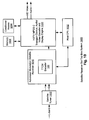
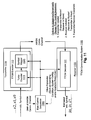
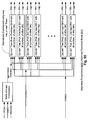
- the extrinsic calculation functional block comprises a plurality of extrinsic min* trees; and each extrinsic min* tree being operable to calculate a probability of an input bit of the plurality of input bits of the symbol within the plurality of symbols comprising a value of a 1 or a 0.
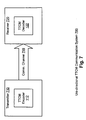
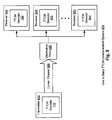
- the SISO is contained within a turbo trellis coded modulation (TTCM) decoder; and the TTCM decoder is contained within at least one of a satellite receiver, a high definition television (HDTV) set top box receiver, a mobile receiver, a base station receiver, a receiver, and a transceiver.
- TTCM turbo trellis coded modulation
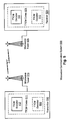
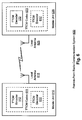
- the wired media by which the bi-directional communication channel 899 may be implemented are varied, including coaxial cable, fiber-optic cabling, and copper cabling, among other types of "wiring.”
- the wireless manners in which the bi-directional communication channel 899 may be implemented are varied, including satellite communication, cellular communication, microwave communication, and radio communication, among other types of wireless communication.
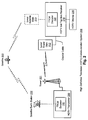
- the advanced modulation satellite receiver 1010 is a single-chip digital satellite receiver supporting the TTCM decoder 122 and variable code rate operation. Several of the many embodiments of the variable code rate operation are described in even more detail below. Multiple modulations (constellations and mappings) are supported with iteratively (turbo) decoded error correction coding within the TTCM decoder 122.
- the advanced modulation satellite receiver 1010 is operable to receive communication provided to it from a transmitter device that includes a TTCM encoder according to the invention.
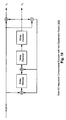
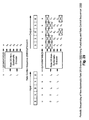
- FIG. 14 is a diagram illustrating an embodiment of a systematic encoder 1400 that is built according to the invention.
- the systematic encoder 1400 shows an encoder that encodes "a" input bits (shown as i 0 , i 1 , ..., and i (a-1) ).
- the systematic encoder 1400 is a rate a/b encoder where "a" input bits are provided and "b" output bits are output.
- the "b” output bits include "x" number of redundancy bits (shown as c x , c (x-1) , ..., and c 0 ) that are coded as a function of one or more of the "a” input bits as well as each of the "a” input bits themselves.
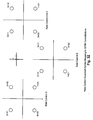
- FIG. 15 is a diagram illustrating an embodiment of a non-systematic encoder 1500 that is built according to the invention.
- the non-systematic encoder 1500 shows an encoder that encodes "a" input bits (shown as i 0 , i 1 ..., and i (a-1) ) to provide "b" output bits (shown as c (b-1) , c (b-2) , ..., and c 0 ).
- a non-systematic encoder may be viewed as being an encoder where the input bits are not explicitly represented and available in the output of the encoder.
- one or more uncoded bits u may be provided as output of the encoder without having undergone any encoding at all.
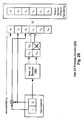
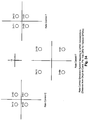
- the non-systematic rate 2/5 encoder 2000 may then cycle through the rate control sequence defined by the (RC 0, a RC 9, and RC 1) a predetermined number of times within a data frame. Alternatively, the non-systematic rate 2/5 encoder 2000 may adaptively select a new rate control sequence based on operating conditions of the communication system in which the non-systematic rate 2/5 encoder 2000 is implemented.
- Each of the individual RCs may be viewed as being functionality supported by distinct encoders, yet a single device is operable to support all of these encoders according to the variable code rate functionality described herein. The above-referenced comments are also applicable to the cases presented below in the Figures 25 and 26.
- the possible value of the uncoded bit indexed by (x 1 x 0 ) will be 0 if M r (0 x 1 x 0 ) ⁇ M r (1 x 1 x 0 ), otherwise the possible value of the uncoded bit indexed by ( x 1 x 0 ) will be 1 if M r (0 x 1 x 0 ) ⁇ M r (1 x 1 x 0 ).
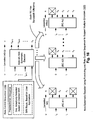
- the rate control sequence to be employed when encoding and subsequently decoding information may be selected based on the given bandwidth of a communication channel.
- the rate control sequence is then selected, based on the bandwidth of the communication channel, as including the RCs that provide for the best performance (such as the grouping of RCs that provides for the lowest Bit Error Rate (BER)).
- BER Bit Error Rate
- This selection of which rate control sequence to employ may also be performed based on the application that is being used. For example, in some data applications, a slight latency in the delivery of information may sometimes be tolerated. However, in other applications, such as video or Voice over Internet Protocol (VOIP) applications, the latency will degrade the performance significantly.
- the inclusion of such parameters may be employed when selecting which RCs to be employed within a given rate control sequence.
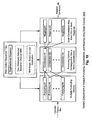
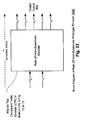
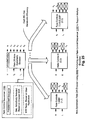
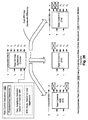
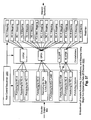
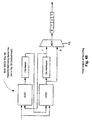
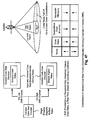
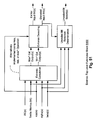
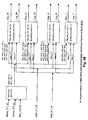
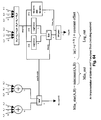
- FIG. 59 is a diagram illustrating an embodiment of an extrinsic min* tree that is built according to the invention.
- an extrinsic max* tree may also be employed without departing from the scope and spirit of the invention.
- This embodiment of the extrinsic min* tree may be implemented to accommodate the calculation of the probability of a bit, of an input symbol, being 0 or 1.
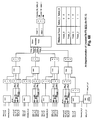
- a multiplexor (MUX) whose selection is made based on the RCs, may be employed to select the appropriate app+metric outputs, the appropriate alphas, and appropriate betas.
- the min* processing may be performed in two separate stages to accommodate the min* processing that includes these three variables: app+metric output, alphas, and betas.
Landscapes
- Engineering & Computer Science (AREA)
- Physics & Mathematics (AREA)
- Probability & Statistics with Applications (AREA)
- Signal Processing (AREA)
- Theoretical Computer Science (AREA)
- Computer Networks & Wireless Communication (AREA)
- Error Detection And Correction (AREA)
- Compression, Expansion, Code Conversion, And Decoders (AREA)
Applications Claiming Priority (8)
| Application Number | Priority Date | Filing Date | Title |
|---|---|---|---|
| US38470202P | 2002-05-31 | 2002-05-31 | |
| US38469802P | 2002-05-31 | 2002-05-31 | |
| US384702P | 2002-05-31 | ||
| US384698P | 2002-05-31 | ||
| US10/264,486 US7093187B2 (en) | 2002-05-31 | 2002-10-04 | Variable code rate and signal constellation turbo trellis coded modulation codec |
| US10/264,766 US7032164B2 (en) | 2002-05-31 | 2002-10-04 | Efficient design to calculate extrinsic information for soft-in-soft-out (SISO) decoder |
| US264486 | 2002-10-04 | ||
| US264766 | 2002-10-04 |
Publications (2)
| Publication Number | Publication Date |
|---|---|
| EP1367733A2 true EP1367733A2 (de) | 2003-12-03 |
| EP1367733A3 EP1367733A3 (de) | 2005-01-26 |
Family
ID=29424740
Family Applications (1)
| Application Number | Title | Priority Date | Filing Date |
|---|---|---|---|
| EP03012459A Withdrawn EP1367733A3 (de) | 2002-05-31 | 2003-05-30 | Effizienter Enwurf zur Berechnung der extrinsischen Information für einen soft-in-soft-out Dekoder |
Country Status (1)
| Country | Link |
|---|---|
| EP (1) | EP1367733A3 (de) |
Families Citing this family (1)
| Publication number | Priority date | Publication date | Assignee | Title |
|---|---|---|---|---|
| CN109217912B (zh) * | 2018-08-31 | 2021-07-09 | 航天东方红卫星有限公司 | 一种基于数据安全监管的多模式中继转发方法 |
Family Cites Families (1)
| Publication number | Priority date | Publication date | Assignee | Title |
|---|---|---|---|---|
| US7242726B2 (en) * | 2000-09-12 | 2007-07-10 | Broadcom Corporation | Parallel concatenated code with soft-in soft-out interactive turbo decoder |
-
2003
- 2003-05-30 EP EP03012459A patent/EP1367733A3/de not_active Withdrawn
Also Published As
| Publication number | Publication date |
|---|---|
| EP1367733A3 (de) | 2005-01-26 |
Similar Documents
| Publication | Publication Date | Title |
|---|---|---|
| US8898547B2 (en) | Rate control adaptable communications | |
| US6704368B1 (en) | Coding and modulation method and apparatus for its implementation | |
| CA2266108C (en) | Iterative demapping | |
| US8473822B2 (en) | True bit level decoding of TTCM (turbo trellis coded modulation) of variable rates and signal constellations | |
| EP1553705A1 (de) | Iterative Demodulation und Decodierung von multi-level Turbo oder LDPC (low-density parity-check) codierten Modulationssignalen | |
| EP0998087A1 (de) | Mehrpegelübertragungssystem und -Verfahren mit adaptiver Abbildung | |
| US7406650B2 (en) | Variable code rate and signal constellation turbo trellis coded modulation codec | |
| US7062700B2 (en) | 16 QAM and 16 APSK TTCM (Turbo Trellis Coded Modulation) with minimum bandwidth efficiency of 3 bit/s/Hz using a rate 2/4 constituent encoder | |
| EP1119109A1 (de) | Bandbreite effizienter verketteter trelliskodierter Modulationsdekoder und Dekodierungsverfahren dafür | |
| US20120057641A1 (en) | Transmitting method and a receiving method of a modulated data stream | |
| JP3979105B2 (ja) | 多元接続システム | |
| US7032164B2 (en) | Efficient design to calculate extrinsic information for soft-in-soft-out (SISO) decoder | |
| US7065695B2 (en) | Metric calculation design for variable code rate decoding of broadband trellis, TCM, or TTCM | |
| EP0998045A1 (de) | Verfahren und System zur digitalen Übertragung | |
| US7210092B1 (en) | Symbol by symbol variable constellation type and/or mapping capable communication device | |
| US7188301B1 (en) | Parallel concatenated turbo code modulation encoder | |
| US7472335B1 (en) | Symbol by symbol variable code rate capable communication device | |
| Clevorn et al. | Turbo decodulation: Iterative combined demodulation and source-channel decoding | |
| EP1367758A2 (de) | Metrikberechnung zur Decodierung von Codes mit variabler Rate | |
| EP1367733A2 (de) | Effizienter Enwurf zur Berechnung der extrinsischen Information für einen soft-in-soft-out Dekoder | |
| US7321633B1 (en) | Determination of variable code rates for a rate control sequence | |
| Hewitt | Turbo product codes for LMDS | |
| US7107512B2 (en) | TTCM decoder design | |
| EP1367732A2 (de) | Entwurf eines Turbo-trellis-kodierten-modulation (TTKM) Dekoders | |
| CN110266322A (zh) | 一种甚高频数据交换系统的迭代译码方法 |
Legal Events
| Date | Code | Title | Description |
|---|---|---|---|
| PUAI | Public reference made under article 153(3) epc to a published international application that has entered the european phase |
Free format text: ORIGINAL CODE: 0009012 |
|
| AK | Designated contracting states |
Kind code of ref document: A2 Designated state(s): AT BE BG CH CY CZ DE DK EE ES FI FR GB GR HU IE IT LI LU MC NL PT RO SE SI SK TR |
|
| AX | Request for extension of the european patent |
Extension state: AL LT LV MK |
|
| PUAL | Search report despatched |
Free format text: ORIGINAL CODE: 0009013 |
|
| RIC1 | Information provided on ipc code assigned before grant |
Ipc: 7H 03M 13/29 B Ipc: 7H 03M 13/25 B Ipc: 7H 03M 13/45 A |
|
| AK | Designated contracting states |
Kind code of ref document: A3 Designated state(s): AT BE BG CH CY CZ DE DK EE ES FI FR GB GR HU IE IT LI LU MC NL PT RO SE SI SK TR |
|
| AX | Request for extension of the european patent |
Extension state: AL LT LV MK |
|
| 17P | Request for examination filed |
Effective date: 20050726 |
|
| AKX | Designation fees paid |
Designated state(s): DE FR GB |
|
| RAP1 | Party data changed (applicant data changed or rights of an application transferred) |
Owner name: BROADCOM CORPORATION |
|
| STAA | Information on the status of an ep patent application or granted ep patent |
Free format text: STATUS: THE APPLICATION IS DEEMED TO BE WITHDRAWN |
|
| 18D | Application deemed to be withdrawn |
Effective date: 20120828 |