EP1367546B1 - Geldechtheitsprüfer - Google Patents
Geldechtheitsprüfer Download PDFInfo
- Publication number
- EP1367546B1 EP1367546B1 EP02253587.6A EP02253587A EP1367546B1 EP 1367546 B1 EP1367546 B1 EP 1367546B1 EP 02253587 A EP02253587 A EP 02253587A EP 1367546 B1 EP1367546 B1 EP 1367546B1
- Authority
- EP
- European Patent Office
- Prior art keywords
- currency
- data
- tester
- item
- banknote
- Prior art date
- Legal status (The legal status is an assumption and is not a legal conclusion. Google has not performed a legal analysis and makes no representation as to the accuracy of the status listed.)
- Expired - Lifetime
Links
Images

Classifications
-
- G—PHYSICS
- G07—CHECKING-DEVICES
- G07D—HANDLING OF COINS OR VALUABLE PAPERS, e.g. TESTING, SORTING BY DENOMINATIONS, COUNTING, DISPENSING, CHANGING OR DEPOSITING
- G07D7/00—Testing specially adapted to determine the identity or genuineness of valuable papers or for segregating those which are unacceptable, e.g. banknotes that are alien to a currency
- G07D7/06—Testing specially adapted to determine the identity or genuineness of valuable papers or for segregating those which are unacceptable, e.g. banknotes that are alien to a currency using wave or particle radiation
- G07D7/12—Visible light, infrared or ultraviolet radiation
- G07D7/128—Viewing devices
-
- G—PHYSICS
- G07—CHECKING-DEVICES
- G07D—HANDLING OF COINS OR VALUABLE PAPERS, e.g. TESTING, SORTING BY DENOMINATIONS, COUNTING, DISPENSING, CHANGING OR DEPOSITING
- G07D7/00—Testing specially adapted to determine the identity or genuineness of valuable papers or for segregating those which are unacceptable, e.g. banknotes that are alien to a currency
- G07D7/06—Testing specially adapted to determine the identity or genuineness of valuable papers or for segregating those which are unacceptable, e.g. banknotes that are alien to a currency using wave or particle radiation
- G07D7/12—Visible light, infrared or ultraviolet radiation
Definitions
- the invention relates to a method of classifying currency items and to a currency validator.
- currency is used to mean coins, banknotes, and other similar items of value such as value sheets and coupons. Except where specifically stated otherwise, it covers genuine and forged currency items.
- Known currency validators operate by measuring certain characteristics of currency items using sensors, and then using the measured values to classify the currency item, that is, to determine whether or not the currency item is an example of a known target denomination or forgery.
- Various methods of classifying currency items are known including, for example, comparing a n-dimensional vector derived from n measurements of a currency item with a region defining valid examples of a target denomination in n-dimensional space.
- An example of a specific method of classifying currency involves using the mahalanobis distance, and comparing the mahalanobis distance with a threshold, which essentially defines an ellipse around the known population for each denomination, such as described in EP-A-0 924 658 .
- the calculation of a mahalanobis distance involves using the mean and covariance matrix of the population distribution for each target denomination together with the n-dimensional vector derived from the measurements of a currency item.
- Measurements are collected in the laboratory using samples of target denominations, and one or more sample validators.
- the target denominations may include known forgeries.
- the sample currency items are inserted into the sample validators and the measurements are used to derive a population distribution. The distribution is modelled statistically and the mean and covariance matrix is derived.
- Product validators are programmed to calculate mahalanobis distances using the mean and covariance matrix values for each target denomination calculated as outlined above.
- a problem with the prior art discussed above is that, especially when n is large, the amount of processing involved in calculating the mahalanobis distance can be large, which increases processing cost and time and the time involved in the classification.
- Another problem is the variation in components, such as sensors, in the product validators and the resulting variations in measurements compared with the results obtained in the laboratory. It is known to make adaptations to take account of variations in each product but this can be time-consuming and increase costs. Another option to compensate for variations between products is to have a large acceptance threshold at the beginning of the product life, to achieve the best acceptance rate, but this is at the cost of an increased risk of accepting forgeries.
- the embodiment is a banknote validator.
- the banknote validator includes an optical sensing device having a pair of linear arrays of light sources, each array arranged above the transfer path of a banknote, for emitting light towards the banknote, and a detector in the form of a linear array of photodetectors arranged above the transfer path for sensing light reflected by the banknote.
- the light source arrays have a number of groups of light sources, each group generating light of a different wavelength.
- the groups of light sources are energised in succession to illuminate a banknote with a sequence of different wavelengths of light.
- the response of the banknote to the light of the different parts of the spectrum is sensed by the detector array. Because each of the photodetectors in the array receives light from a different area on the banknote, the spectral response of the different sensed parts of the banknote can be determined and processed for comparison with stored reference data to validate the banknote.
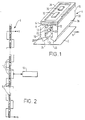
- a banknote 2 is sensed by an optical sensing module 4 as it passes along a predetermined transport plane in the direction of arrow 6.
- the sensing module 4 has two linear arrays of light sources 8, 10 and a linear array of photodetectors 12 directly mounted on the underside of a printed circuit board 14.
- a control unit 32 and first stage amplifiers 33 for each of the photodetectors are mounted directly on the upper surface of the printed circuit board 14.
- Printed circuit board 14 is provided with a frame 38 made of a rigid material such as metal on the upper surface and around the peripheral edges of the board.
- the frame 38 is provided with a connector 40 whereby the control unit 32 communicates with other components (not shown) of the banknote validator, such as a position sensor, a banknote sorting mechanism, an external control unit and the like.
- the optical sensing module 4 has two unitary light guides 16 and 18 for conveying light produced by source arrays 8 and 10 towards and onto a strip of the banknote 2.
- the light guides 16 and 18 are made from a moulded plexiglass material.
- Each light guide consists of an upper vertical portion and a lower portion which is angled with respect to the upper portion.
- the angled lower portions of the light guides 16, 18 direct light that has been internally reflected with a light guide 16,18 towards an illuminated strip on the banknote 2 which is centrally located between the light guides 16 and 18.
- Lenses 20 are mounted between the light guides in a linear array corresponding to the detector array 12. One lens 20 is provided per detector in the detector array 12. Each lens 20 delivers light collected from a discrete area on the banknote, larger than the effective area of a detector, to the corresponding detector. The lenses 20 are fixed in place by an optical support 22 located between the light guides 16 and 18.
- the light-emitting ends 24 and 26 of the light guides 16 and 18, and the lenses 20, are arranged so that only diffusely-reflected light is transmitted to the detector array 12.
- the source arrays 8 and 10, the detector array 12 and the linear lens array 20 extend across the width of the light guides 16 and 18, from one lateral side 28 to the other, so as to be able to sense the reflective characteristics of the banknote 2 across its entire width.
- the light detector array 12 is made up of a linear array of a large number of, for example thirty, individual detectors, in the form of pin diodes, which each sense discrete parts of the banknote 2 located along the strip illuminated by the light guides 16 and 18. Adjacent detectors, supplied with diffusely reflected light by respective adjacent lenses 20, detect adjacent, and discrete areas of the banknote 2.
- Figure 2 illustrates one of the source arrays 8 as mounted on the printed circuit board 14.
- the arrangement of the other source array 10 is identical.
- the source array 8 consists of a large number of discrete sources 9, in the form of unencapsulated LEDs.
- the source array 8 is made up of a number of different groups of the light sources 9, each group generating light at a different peak wavelength. An example of such an arrangement is described in Swiss patent number 634411 .
- each such group consisting of four groups of sources generating light at four different infra-red wavelengths, and two groups of sources generating light at two different visible wavelengths (red and green).
- the wavelengths used are chosen with a view to obtain a great amount of sensitivity to banknote printing inks, hence to provide for a high degree of discrimination between different banknote types, and/or between genuine banknotes and other documents.
- the sources of each colour group are dispersed throughout the linear source array 8.
- the sources 9 are arranged in the sets 11 of six sources, all sets 11 being aligned end-to-end to form a repetitive colour sequence spanning the source array 8.
- Each colour group in the source array 8 is made up of two series of ten sources 9 connected in parallel to a current generator 13. Although only one current generator 13 is illustrated, seven such generators are therefore provided for the whole array 8.
- the colour groups are energised in sequence by a local sequencer in a control unit 32, which is mounted on the upper surface of printed circuit board 13. The sequential illumination of different colour groups of a source array is described in more detail in United States patent No. 5,304,813 and British patent application No. 1470737 .
- the detectors 12 effectively scan the diffuse reflectance characteristics at each of the six predetermined wavelengths of a series of pixels located across the entire width of the banknote 2 during a series of individual detector illumination periods.
- an entire surface of the banknote 2 is sensed by repetitive scanning of strips of the banknote 2 at each of the six wavelengths.
- the outputs of the sensors are processed by the control unit 32 as described in more detail below.
- the acquired data representative of the banknote is processed in control unit 32, as described in more detail below.
- control unit 32 By monitoring the position of the banknote during sensing with an optical position sensor located at the entrance to the transport mechanism used, predetermined areas of the banknote 2 which have optimum reflectance characteristics for evaluation are identified.
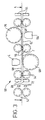
- Figure 3 illustrates a banknote validator including optical sensing modules as illustrated in Figure 1 . Components already described in relation to Figure 1 will be referred to by identical reference numerals.
- FIG. 3 shows a banknote validator 50 similar to that described in International patent application No. WO 96/10808 .
- the apparatus has an entrance defined by nip rollers 52, a transport path defined by further nip rollers 54, 56 and 58, upper wire screen 60 and lower wire screen 62, and an exit defined by frame members 64 to which the wire screens are attached at one end.
- Frame members 66 support the other end of the wire screens 60 and 62.
- An upper sensing module 4 is located above the transport path to read the upper surface of the banknote 2, and a lower sensing module 104 is located, horizontally spaced from said upper sensing module 4 by nip rollers 56, below the transport path of the banknote 2 to read the lower surface of the banknote 2.
- Reference drums 68 and 70 are located opposedly to the sensing modules 4 and 104 respectively so as to provide reflective surfaces whereby the sensing devices 4 and 104 can be calibrated.
- Each of nip rollers 54, 56 and 58 and reference drums 68 and 70 are provided with regularly-spaced grooves accommodating upper and lower wire screens 60 and 62.
- An edge detecting module 72 consisting of an elongate light source (consisting of an array of LEDs and diffusing means) located below the transport plane of the apparatus 50, a CCD array (with a self-focussing fibre-optic lens array) located above the transport plane and an associated processing unit, is located between entrance nip rollers 52 and the entrance wire supports 66.
- a document is transported past sensing module 4 by means of the transport rollers 54.
- light of the respective wavelength is emitted from each group of sources 9 in sequence, and light of each wavelength reflected from the banknote is sensed by each of the detectors, corresponding to a discrete area of the banknote.
- Each group of sources is driven by a respective current generator 13 which is controlled by the control unit 32.
- light from the respective group of sources 9 is mixed in the optical mixer before being output towards the document. In that way, diffuse light is spread more uniformly across the whole width of the document.
- Light reflected from the document, which has been modified in accordance with the pattern on the document, is sensed by the detector array and the output signals are processed in the control unit 32.
- a set of six measurements are derived, corresponding to the six wavelengths of emitted light.
- a specific area of a banknote is pre-selected as a zone.
- the zone may be a specific linear, or 1-dimensional, region of a banknote, or a 2-dimensional region such as a square or a rectangle, or the whole banknote.
- the zone may be selected to correspond to a known security feature in a given banknote. Different zones may be selected for different denominations.
- a zone may be defined by a set of measurements spots for a set of wavelengths.
- Measurements are taken from at least parts of a banknote including the specified zones using a banknote sensing device, for example, as described above, resulting in measurements for different wavelengths for each measurement spot corresponding to a sensor.
- Normalisation can be done, for example, by using data from another zone, including a zone corresponding to the whole of a banknote. This can be considered as a type of data pre-processing.
- Data for a banknote is derived using local normalised data for a zone or zones and absolute data, such as data for the whole banknote or the zone used for normalisation.
- the local normalised data and the absolute data is combined to form a data vector X for the zone.
- the vector of the data is: (z 1 , z 2 , z 3 , g 1 , g 2 , g 3 ) t .
- the Mahalanobis distance uses the covariance matrix and the mean for a given denomination. It gives the distance of a fed banknote using the statistics designed from the statistical model of set of sample data analysed, for example, in the laboratory, as mentioned in the introduction.
- the notation x t means the transpose of the vector x.
- the calculation of the mahalanobis distance using the above formula involves the use of data based on absolute measurements of samples. However, as mentioned above, the absolute measurements are validator dependent.
- the present embodiment transforms the data of the fed banknote to reduce the effects of the validator of the measurements. This is done using characteristics of distributions.
- the covariance matrix of X can be written with four blocks ⁇ 11 ⁇ 12 ⁇ 21 ⁇ 22 . Let us denote by ⁇ 1 ⁇ 2 the mean of X. Generally X1 and X2 are not independent and so the Mahalanobis distance of X is not equivalent to a sum of the Mahalanobis distances of X1 and X2.
- Y1 is based on local normalised data, whereas Y2 involves absolute data, which is validator dependent.
- the mahalanobis distance is compared to a threshold.
- the threshold can be predefined and fixed or made variable in time in conjunction with q for example. A possibility is to choose the fixed threshold value according to the desired final value.
- samples of banknotes of each denomination are tested in validators in the laboratory according to known statistical procedures to derive values for the mean and covariances matrix for X, using a predetermined zone or zones and normalising factors for each target denomination.
- the mahalanobis distance is to be calculated according to the equation (9) above, that is, using the mean and covariance matrix of Y, using X data transformed according to equation (6).
- the mean and covariance matrix for Y and the transform are calculated using the equations above from the measured values for X, and these values are stored in a memory in the validator.
- X1 has 24 variables and X2 has 6 variables
- the covariance matrix is size 30x30 and can be decomposed in blocks ⁇ 11 ⁇ 12 ⁇ 21 ⁇ 22 with a size 24 ⁇ x ⁇ 24 24 ⁇ x ⁇ 6 6 ⁇ x ⁇ 24 6 ⁇ x ⁇ 6 .
- the matrix ⁇ 21 ⁇ 11 - 1 with a size of 6x24 is needed.
- the mean vector mean Y mean Y ⁇ 1 mean Y ⁇ 2 is required and the inverse of the covariance matrices of Y1 and Y2.
- This data is loaded into the memory of the validator product, for example, in the factory.
- 3 matrices of size 24x24, 6x6 and 6x24 and two vectors of means with a size 24 and 6 are stored.
- a preliminary value for q is also stored.
- a banknote is fed to the validator and measurements of the banknote are taken from the sensor and used to derive X.
- the X vector is transformed according to equation (6) and the mahalanobis distance is calculated using equation (9).
- the value of the mahalanobis distance is compared with a threshold mahT. If the value of the mahalanobis distance is less than or equal to the threshold, the banknote is accepted as a genuine example. If the value is greater than the threshold, the banknote is rejected as a forgery.
- the threshold is determined in the laboratory using known techniques and programmed into the validator in the factory or in the field. For example, the threshold can be computed empirically or experimentally or based on results of simulations using statistical models. The threshold can be varied depending on the desired percentage of genuine bills it is desired to accept. For example, the threshold can be set so that a certain percentage, say 99%, of genuine banknotes are accepted, based on the statistical analysis of known banknotes.
- X1 and X2 are described as local normalised data and absolute data.
- the invention is not limited to this.
- the mahalanobis calculation is split into a mahalanobis calculation on subsets of data, which are essentially independent.
- the subsets of data can correspond to various types of data.
- the embodiment takes advantage of the mahalanobis in parts to weight the part of the mahalanobis calculation which is validator dependent. Another example of using the mahalanobis in parts calculation based on sets or subsets of data is described below.
- a currency validator is set up to operate using a data vector X1. It may become desirable to use other data values, X2, for example, relating to another zone on a banknote. However, the validator is not initially tuned to the measurements X2.
- X (X1, X2)
- X' (X1, X3)
- Y2 is weighted by q because it depends on measurements X3 and the validator is not initially tuned to X3.
- the above approach could be used if a new useful feature of a banknote appears or is discovered later, or to replace a feature by another known feature.
- the approach can be used to switch from one feature to another while keeping base features, that is statistically adapted unchanged variables that are adapted to the validator.
- the above embodiment is a reflective system, that is, light is sensed after reflection from the surface of the banknote.
- the invention is also applicable to other systems such as a transmissive system, where light is sensed after transmission through a banknote.
- the sensing system is not limited to a one-dimensional linear array of light sources and detectors, and other sensing systems can be used, such as two-dimensional arrays of sources and detectors corresponding to the whole or a part of a banknote.
- the embodiment operates using specific regions of banknotes.
- the regions can be identified in various ways such as by using position or edge sensors, or by counting pixels.
- the invention has been described in the context of a banknote validator but it is also applicable to coin validators.
- the sensors used in coin validators are different from those in banknote validators, but can be arranged to derive a plurality of local and global measurements from a coin, which can then be processed as described above.
- the term "light” is not limited to visible light, but covers the electromagnetic spectrum.
- currency covers, for example, banknotes, bills, coins, value sheets or coupons, cards and the like, genuine or counterfeit, and other items such as tokens, slugs and washers, all of which might be used in a currency handling apparatus.
- the weighting factor q is varied over the life of the product. This is especially useful when a validator is modified according to measurements derived from banknotes which are accepted as valid examples. Briefly, the data stored in the validator about a given target denomination, which is representative of the distribution as explained above, can be updated using the actual values derived from banknotes measured in the field. Clearly, the actual measurements derived by the specific validator are validator dependent, and by using them to update the data derived in the laboratory compensates for validator variations, and tunes the data to the specific validator. Accordingly, the absolute data becomes more reliable and so the weighting factor q, which weights a contribution to mahalanobis distance from absolute data, can be increased. Similarly, the weighting factor may be decreased.
- the weighting factor q may be varied, for example, according to time, or number of currency items measured, such as accepted and/or rejected, or number of data adaptations from measured currency items or according to other factors. If q is varied accordingly to number of currently items, this number may be for each target denomination, genuine or fake, or a total value, ie irrespective of denomination.
- the threshold used in validation or denomination may be fixed, or it may be varied, over time, number of operations, number of measured banknotes for example, if the data stored in the validator is updated according to measured banknotes.
- the threshold may be set on the basis of the original distribution of X. Alternatively, the threshold may be set taking the original value of q into account, and the threshold may vary in use with q.
- the threshold value, including the original threshold value, may also be determined in the field.
- Fig. 4 is a flow chart illustrating adjustment of q and the associated threshold mahT.
- the weighting factor q is set to its initial value, say 0.5.
- the number of currency items accepted of each denomination in operation is counted, as variable m.
- step 150 Next q is compared with 1 (step 150). If q is less than 1, m is set to 0 and counting of accepted currency items begins again (step 160). If q is equal to 1, it cannot go higher, so adjustment of q and the corresponding acceptance threshold is stopped, and the validator is adapted.
- the threshold t is variable, and affects the speed of the adaptation of q and mahT.
- target denominations may include known fake examples of accepted denominations, in which case q and mahT may be adjusted in a similar manner, for example, by counting the number of currency items rejected as examples of the known fakes.
- the mahalanobis calculation is split into two independent parts.
- the calculation can be split into more parts.
- the components of vector Y1 or Y2 can be split, or sub-divided, into independent parts, and the mahalanobis calculation done as the sum of more than two independent mahalanobis distances.
- mahalanobis distance is used to validate a given banknote.
- mahalanobis distance can also be used to denominate a banknote, that is, to determine which target denomination or denominations a fed banknote is likely to belong to, without actually determining if the banknote is a valid example of that denomination or denominations.
- a denomination test can, for example, be followed by a stricter validation test, which may use mahalanobis distance or another validation test.
- the sets of components of the data vector are local data and absolute data, and as a result of the data transformation, the contribution of the absolute data can be weighted.
- the original data vector could be made up of different sets of data components, such as data from different zones of a banknote which are combined to form the original data vector, and the contribution of data from one zone is weighted, perhaps progressively.
Landscapes
- Health & Medical Sciences (AREA)
- General Health & Medical Sciences (AREA)
- Toxicology (AREA)
- Physics & Mathematics (AREA)
- General Physics & Mathematics (AREA)
- Inspection Of Paper Currency And Valuable Securities (AREA)
- Testing Of Coins (AREA)
Claims (25)
- Verfahren zum Klassifizieren eines Zahlungsmittels (2) unter Verwendung eines Währungstesters (50), wobei das Verfahren die folgenden Schritte umfasst:Abtasten variabler Eigenschaften eines Zahlungsmittels (2) und Ableiten eines Datenvektors (X) unter Verwendung von Werten der abgetasteten Eigenschaften, wobei der Datenvektor einen normierten Datenteil und einen absoluten Datenteil beinhaltet, undTransformieren des Datenvektors, so dass die Variablen, die durch mindestens erste und zweite Sätze von Komponenten (Y1, Y2) des transformierten Vektors dargestellt werden im Wesentlichen unabhängig sind, wobei der erste Satz an Komponenten (Y1) auf dem normierten Datenteil des Datenvektors basiert und der zweite Satz (Y2) an Komponenten auf den normierten und den absoluten Datenteilen des Datenvektors basiert, so dass die Mahalanobis-Distanz des Datenvektors (X) im Wesentlichen gleich der Summe der Mahalanobis-Distanzen der Komponenten (Y1, Y2) ist, und Berechnen einer Mahalanobis-Distanz in mindestens zwei Teilen unter Verwendung der ersten und zweiten Sätze an Komponenten.
- Verfahren gemäß Anspruch 1, wobei mindestens einer der Sätze von Komponenten nach einem Gewichtungswert gewichtet wird.
- Verfahren nach Anspruch 1, wobei der zweite Satz (Y2) von Komponenten nach einem Gewichtungswert gewichtet wird.
- Verfahren gemäß Anspruch 2 oder Anspruch 3, umfassend Variieren des Gewichtungswerts.
- Verfahren gemäß Anspruch 4, umfassend gleichbleibendes Erhöhen oder Vermindern des Gewichtungswerts.
- Verfahren gemäß Anspruch 4 oder Anspruch 5, umfassend Variieren des Gewichtungswerts zwischen 0 und 1.
- Verfahren gemäß irgendeinem der Ansprüche 4 bis 6, wobei der Gewichtungswert in entsprechend einem oder mehreren aus Zeit, der Anzahl von getesteten Zahlungsmitteln (2), der Anzahl von akzeptierten Zahlungsmitteln und der Anzahl von abgelehnten Zahlungsmitteln, entweder im Gesamten oder für einen spezifischen Zielnennwert der Währung, variiert wird.
- Verfahren gemäß irgendeinem der vorhergehenden Ansprüche, umfassend Abtasten eines Zahlungsmittels unter Verwendung eines oder mehrerer Sensoren um Sensorwerte zu generieren und Ableiten des Datenvektors der eine Vielzahl von Komponenten umfasst.
- Verfahren gemäß irgendeinem der Ansprüche 1 bis 8, wobei sich mindestens eines der Teile auf ein erstes Merkmal eines Zahlungsmittels (2) bezieht und sich mindestens ein weiteres der Teile auf ein anderes Merkmal eines Zahlungsmittels (2) bezieht.
- Verfahren gemäß irgendeinem der vorhergehenden Ansprüche, umfassend das Vergleichen der resultierenden Mahalanobis-Distanz mit einem fixen oder variablen Grenzwert.
- Verfahren gemäß Anspruch 10, wobei der Grenzwert in Abhängigkeit entsprechend einem oder mehreren aus Zeit, der Anzahl von getesteten Zahlungsmitteln, der Anzahl von akzeptierten Zahlungsmitteln und der Anzahl von abgelehnten Zahlungsmitteln, entweder im Gesamten oder für einen spezifischen Zielnennwert der Währung, variiert wird.
- Verfahren gemäß Anspruch 10 oder Anspruch 11 abhängig von Anspruch 3 oder irgendeinem Anspruch der abhängig von Anspruch 3 ist, wobei sich die Variation des Grenzwerts mit der Variation des Gewichtungswerts zusammenhängt.
- Verfahren gemäß irgendeinem der Ansprüche 10 bis 12, wobei der Grenzwert mittels Hotelling Test berechnet wird.
- Verfahren gemäß irgendeinem der vorhergehenden Ansprüche, umfassend Erhöhen oder Vermindern der Dimensionen der Mahalanobis-Berechnung.
- Verfahren gemäß irgendeinem der vorhergehenden Ansprüche zum Validieren und/oder Benennen eines Zahlungsmittels (2).
- Verfahren zum Betreiben eines Währungstesters (50) umfassend Berechnen einer Mahalanobis-Distanz zur Klassifizierung eines Zahlungsmittels (2) mittels gemessener Merkmale des Zahlungsmittels durch errechnen der Mahalanobis-Distanz in Teilen unter Verwendung eines Verfahrens gemäß irgendeinem der vorhergehenden Ansprüche, wobei zunächst die Mahalanobis-Distanz in Teilen errechnet wird mittels Daten, die sich auf einen ersten Satz von Merkmalen des Zahlungsmittels beziehen, und anschließend die Mahalanobis-Distanz in Teilen errechnet wird mittels Daten, die sich auf einen zweiten Satz von Merkmalen des Zahlungsmittels beziehen.
- Verfahren gemäß Anspruch 16, wobei der erste und der zweite Satz von Merkmalen überlappen.
- Verfahren gemäß Anspruch 17, wobei die gemeinsamen Merkmale Merkmale sind, die an den Währungstester (50) angepasst sind.
- Verfahren gemäß Ansprüche 16 bis 18, wobei der zweite Satz von dem ersten Satz abgeleitet ist durch entweder Hinzufügen eines oder mehrerer Merkmale, Entfernen eines oder mehrerer Merkmale oder Austauschen eines oder mehrerer Merkmale.
- Verfahren für die Programmierung eins Währungstesters (50) umfassend Speichern von Daten zum Ausführen eines Verfahrens gemäß irgendeinem der vorhergehenden Ansprüche in einem Währungstester.
- Verfahren gemäß Anspruch 20 umfassend, Ableitung eines Annahme-Grenzwerts für ein Zahlungsmittel mittels Hotelling Test.
- Währungstester (50) umfassend Mittel zum Ausführen eines Verfahrens gemäß irgendeinem der Ansprüche 1 bis 19.
- Währungstester (50) gemäß Anspruch 22 umfassend einen oder mehrere Sensoren zum Abtasten der Eigenschaften von Zahlungsmitteln, Datenverarbeitungsmitteln und Datenspeicherungsmitteln.
- Währungstester (50) gemäß Anspruch 22 oder Anspruch 23 umfassend einen Banknotentester.
- Währungstester (50) gemäß irgendeinem der Ansprüche 22 bis 24 umfassend einen Münztester.
Priority Applications (7)
| Application Number | Priority Date | Filing Date | Title |
|---|---|---|---|
| ES02253587T ES2426416T3 (es) | 2002-05-22 | 2002-05-22 | Dispositivo de validación de moneda |
| EP02253587.6A EP1367546B1 (de) | 2002-05-22 | 2002-05-22 | Geldechtheitsprüfer |
| US10/441,809 US7000754B2 (en) | 2002-05-22 | 2003-05-20 | Currency validator |
| AU2003204290A AU2003204290B2 (en) | 2002-05-22 | 2003-05-20 | Currency validator |
| CN2008101874854A CN101533535B (zh) | 2002-05-22 | 2003-05-22 | 货币确认器 |
| JP2003144247A JP4537017B2 (ja) | 2002-05-22 | 2003-05-22 | 貨幣評価装置 |
| CN03140949A CN1459765A (zh) | 2002-05-22 | 2003-05-22 | 货币确认器 |
Applications Claiming Priority (1)
| Application Number | Priority Date | Filing Date | Title |
|---|---|---|---|
| EP02253587.6A EP1367546B1 (de) | 2002-05-22 | 2002-05-22 | Geldechtheitsprüfer |
Publications (2)
| Publication Number | Publication Date |
|---|---|
| EP1367546A1 EP1367546A1 (de) | 2003-12-03 |
| EP1367546B1 true EP1367546B1 (de) | 2013-06-26 |
Family
ID=29414806
Family Applications (1)
| Application Number | Title | Priority Date | Filing Date |
|---|---|---|---|
| EP02253587.6A Expired - Lifetime EP1367546B1 (de) | 2002-05-22 | 2002-05-22 | Geldechtheitsprüfer |
Country Status (6)
| Country | Link |
|---|---|
| US (1) | US7000754B2 (de) |
| EP (1) | EP1367546B1 (de) |
| JP (1) | JP4537017B2 (de) |
| CN (2) | CN1459765A (de) |
| AU (1) | AU2003204290B2 (de) |
| ES (1) | ES2426416T3 (de) |
Families Citing this family (15)
| Publication number | Priority date | Publication date | Assignee | Title |
|---|---|---|---|---|
| DE60329596D1 (de) | 2002-06-19 | 2009-11-19 | Mei Inc | Währungsvalidierer |
| US20070140551A1 (en) * | 2005-12-16 | 2007-06-21 | Chao He | Banknote validation |
| KR100754042B1 (ko) * | 2006-06-30 | 2007-08-31 | 노틸러스효성 주식회사 | 지폐감별장치의 간격유지구조 |
| US8503796B2 (en) * | 2006-12-29 | 2013-08-06 | Ncr Corporation | Method of validating a media item |
| US8611665B2 (en) | 2006-12-29 | 2013-12-17 | Ncr Corporation | Method of recognizing a media item |
| JP4609530B2 (ja) * | 2008-06-11 | 2011-01-12 | 三菱電機株式会社 | 画像読取装置 |
| JP5202160B2 (ja) * | 2008-07-28 | 2013-06-05 | 株式会社ユニバーサルエンターテインメント | 紙葉類処理装置 |
| CN102138165B (zh) * | 2008-07-29 | 2014-04-30 | 梅伊有限公司 | 基于通货项的谱响应来分类和区分通货项 |
| JP5361274B2 (ja) * | 2008-08-05 | 2013-12-04 | 株式会社東芝 | 汚損判定装置、紙葉類処理装置、および、汚損判定方法 |
| JP5405245B2 (ja) * | 2009-09-09 | 2014-02-05 | リコーエレメックス株式会社 | 画像検査方法及び画像検査装置 |
| US9036890B2 (en) | 2012-06-05 | 2015-05-19 | Outerwall Inc. | Optical coin discrimination systems and methods for use with consumer-operated kiosks and the like |
| US9734648B2 (en) * | 2012-12-11 | 2017-08-15 | Ncr Corporation | Method of categorising defects in a media item |
| US8739955B1 (en) * | 2013-03-11 | 2014-06-03 | Outerwall Inc. | Discriminant verification systems and methods for use in coin discrimination |
| US9443367B2 (en) | 2014-01-17 | 2016-09-13 | Outerwall Inc. | Digital image coin discrimination for use with consumer-operated kiosks and the like |
| CN109840984B (zh) * | 2017-11-28 | 2020-12-25 | 南京造币有限公司 | 一种硬币表面质量检查系统、方法和装置 |
Family Cites Families (5)
| Publication number | Priority date | Publication date | Assignee | Title |
|---|---|---|---|---|
| DE3785197T2 (de) * | 1987-06-08 | 1993-07-15 | Nippon Electric Co | Briefmarken-identifizierungsgeraet. |
| GB2254949B (en) * | 1991-04-18 | 1994-09-28 | Mars Inc | Method and apparatus for validating money |
| JPH04346187A (ja) * | 1991-05-23 | 1992-12-02 | Matsushita Electric Ind Co Ltd | 被検出物の良否判定方法 |
| CH684222A5 (de) * | 1992-03-10 | 1994-07-29 | Mars Inc | Einrichtung zur Klassifizierung eines Musters, insbesondere von einer Banknote oder von einer Münze. |
| GB2300746B (en) * | 1995-05-09 | 1999-04-07 | Mars Inc | Validation |
-
2002
- 2002-05-22 EP EP02253587.6A patent/EP1367546B1/de not_active Expired - Lifetime
- 2002-05-22 ES ES02253587T patent/ES2426416T3/es not_active Expired - Lifetime
-
2003
- 2003-05-20 US US10/441,809 patent/US7000754B2/en not_active Expired - Fee Related
- 2003-05-20 AU AU2003204290A patent/AU2003204290B2/en not_active Ceased
- 2003-05-22 CN CN03140949A patent/CN1459765A/zh active Pending
- 2003-05-22 CN CN2008101874854A patent/CN101533535B/zh not_active Expired - Fee Related
- 2003-05-22 JP JP2003144247A patent/JP4537017B2/ja not_active Expired - Fee Related
Also Published As
| Publication number | Publication date |
|---|---|
| CN101533535A (zh) | 2009-09-16 |
| US20030217906A1 (en) | 2003-11-27 |
| AU2003204290A1 (en) | 2003-12-11 |
| EP1367546A1 (de) | 2003-12-03 |
| CN101533535B (zh) | 2013-08-21 |
| US7000754B2 (en) | 2006-02-21 |
| AU2003204290B2 (en) | 2009-01-15 |
| JP2003346209A (ja) | 2003-12-05 |
| JP4537017B2 (ja) | 2010-09-01 |
| CN1459765A (zh) | 2003-12-03 |
| ES2426416T3 (es) | 2013-10-23 |
Similar Documents
| Publication | Publication Date | Title |
|---|---|---|
| EP1367546B1 (de) | Geldechtheitsprüfer | |
| EP1217589B1 (de) | Geldechtheitsprüfer | |
| EP1484719B1 (de) | Geldüberprüfung | |
| US6573983B1 (en) | Apparatus and method for processing bank notes and other documents in an automated banking machine | |
| JP5175210B2 (ja) | メディアの確認装置および確認方法 | |
| EP1490828B1 (de) | Währungsverifikation | |
| US6588571B1 (en) | Classification method and apparatus | |
| WO2011126411A9 (ru) | Способ обработки банкнот (варианты) | |
| US9978196B2 (en) | Banknote acceptor with visual checking | |
| CN1225730A (zh) | 验钞机 | |
| AU2003247029B2 (en) | Currency validator | |
| EP2054844B1 (de) | Klassifikation unter verwendung von unterstützungsvektormaschinen und variablenauswahl | |
| US6604636B2 (en) | Document counter | |
| JP3187698B2 (ja) | 紙葉類認識装置 | |
| EP2304650B1 (de) | Währungsunterscheidung | |
| MXPA99004375A (en) | Universal bank note denominator and validator |
Legal Events
| Date | Code | Title | Description |
|---|---|---|---|
| PUAI | Public reference made under article 153(3) epc to a published international application that has entered the european phase |
Free format text: ORIGINAL CODE: 0009012 |
|
| AK | Designated contracting states |
Kind code of ref document: A1 Designated state(s): AT BE CH CY DE DK ES FI FR GB GR IE IT LI LU MC NL PT SE TR |
|
| AX | Request for extension of the european patent |
Extension state: AL LT LV MK RO SI |
|
| 17P | Request for examination filed |
Effective date: 20040601 |
|
| AKX | Designation fees paid |
Designated state(s): DE ES GB IT |
|
| 17Q | First examination report despatched |
Effective date: 20040728 |
|
| RAP1 | Party data changed (applicant data changed or rights of an application transferred) |
Owner name: MEI, INC. |
|
| APBN | Date of receipt of notice of appeal recorded |
Free format text: ORIGINAL CODE: EPIDOSNNOA2E |
|
| 111Z | Information provided on other rights and legal means of execution |
Free format text: DEESGBIT Effective date: 20061103 |
|
| APBR | Date of receipt of statement of grounds of appeal recorded |
Free format text: ORIGINAL CODE: EPIDOSNNOA3E |
|
| APAF | Appeal reference modified |
Free format text: ORIGINAL CODE: EPIDOSCREFNE |
|
| 111Z | Information provided on other rights and legal means of execution |
Free format text: DE ES GB IT Effective date: 20070802 |
|
| APBT | Appeal procedure closed |
Free format text: ORIGINAL CODE: EPIDOSNNOA9E |
|
| APBV | Interlocutory revision of appeal recorded |
Free format text: ORIGINAL CODE: EPIDOSNIRAPE |
|
| R11X | Information provided on other rights and legal means of execution (corrected) |
Free format text: DE ES GB IT Effective date: 20070802 |
|
| GRAP | Despatch of communication of intention to grant a patent |
Free format text: ORIGINAL CODE: EPIDOSNIGR1 |
|
| RAP1 | Party data changed (applicant data changed or rights of an application transferred) |
Owner name: MEI, INC. |
|
| GRAS | Grant fee paid |
Free format text: ORIGINAL CODE: EPIDOSNIGR3 |
|
| GRAA | (expected) grant |
Free format text: ORIGINAL CODE: 0009210 |
|
| RIN1 | Information on inventor provided before grant (corrected) |
Inventor name: BAUDAT, GASTON Inventor name: ANOUAR, FATIHA |
|
| AK | Designated contracting states |
Kind code of ref document: B1 Designated state(s): DE ES GB IT |
|
| REG | Reference to a national code |
Ref country code: GB Ref legal event code: FG4D |
|
| RIN2 | Information on inventor provided after grant (corrected) |
Inventor name: ANOUAR, FATIHA Inventor name: BAUDAT, GASTON |
|
| REG | Reference to a national code |
Ref country code: DE Ref legal event code: R096 Ref document number: 60245141 Country of ref document: DE Effective date: 20130822 |
|
| REG | Reference to a national code |
Ref country code: ES Ref legal event code: FG2A Ref document number: 2426416 Country of ref document: ES Kind code of ref document: T3 Effective date: 20131023 |
|
| PLBE | No opposition filed within time limit |
Free format text: ORIGINAL CODE: 0009261 |
|
| STAA | Information on the status of an ep patent application or granted ep patent |
Free format text: STATUS: NO OPPOSITION FILED WITHIN TIME LIMIT |
|
| 26N | No opposition filed |
Effective date: 20140327 |
|
| REG | Reference to a national code |
Ref country code: DE Ref legal event code: R097 Ref document number: 60245141 Country of ref document: DE Effective date: 20140327 |
|
| REG | Reference to a national code |
Ref country code: DE Ref legal event code: R082 Ref document number: 60245141 Country of ref document: DE Representative=s name: PETERREINS SCHLEY PATENT- UND RECHTSANWAELTE P, DE Ref country code: DE Ref legal event code: R082 Ref document number: 60245141 Country of ref document: DE Representative=s name: PETERREINS SCHLEY PATENT- UND RECHTSANWAELTE, DE |
|
| PGFP | Annual fee paid to national office [announced via postgrant information from national office to epo] |
Ref country code: GB Payment date: 20160518 Year of fee payment: 15 Ref country code: DE Payment date: 20160518 Year of fee payment: 15 Ref country code: ES Payment date: 20160414 Year of fee payment: 15 |
|
| PGFP | Annual fee paid to national office [announced via postgrant information from national office to epo] |
Ref country code: IT Payment date: 20160524 Year of fee payment: 15 |
|
| REG | Reference to a national code |
Ref country code: DE Ref legal event code: R119 Ref document number: 60245141 Country of ref document: DE |
|
| GBPC | Gb: european patent ceased through non-payment of renewal fee |
Effective date: 20170522 |
|
| PG25 | Lapsed in a contracting state [announced via postgrant information from national office to epo] |
Ref country code: GB Free format text: LAPSE BECAUSE OF NON-PAYMENT OF DUE FEES Effective date: 20170522 Ref country code: DE Free format text: LAPSE BECAUSE OF NON-PAYMENT OF DUE FEES Effective date: 20171201 |
|
| PG25 | Lapsed in a contracting state [announced via postgrant information from national office to epo] |
Ref country code: IT Free format text: LAPSE BECAUSE OF NON-PAYMENT OF DUE FEES Effective date: 20170522 |
|
| REG | Reference to a national code |
Ref country code: ES Ref legal event code: FD2A Effective date: 20180704 |
|
| PG25 | Lapsed in a contracting state [announced via postgrant information from national office to epo] |
Ref country code: ES Free format text: LAPSE BECAUSE OF NON-PAYMENT OF DUE FEES Effective date: 20170523 |