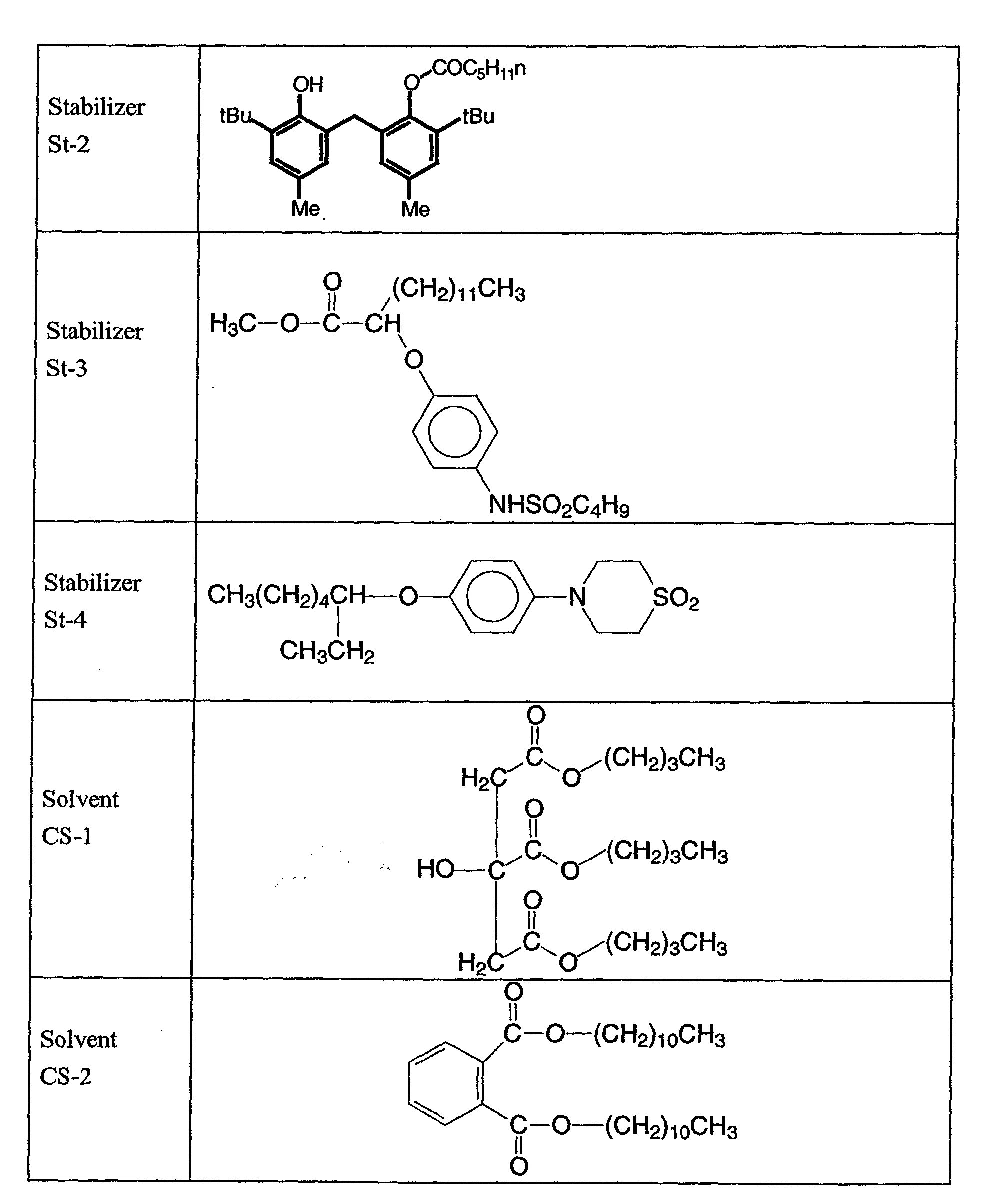
This invention relates to aqueous coating solutions comprising
gelatin which is prepared by the hydrolysis of ossein using sodium or potassium
hydroxide, where the coating solution contains a colloidal particle dispersed
material phase at a volume fraction of at least 0.01.
Imaging elements, particularly photographic silver halide imaging
elements, commonly use a hydrophilic colloid as a film forming binder for layers
thereof, most commonly ossein. The layers of such imaging elements are typically
coated employing multilayer slide bead coating processes such as described in
U.S. Pat. No. 2,716,419 and multilayer slide curtain coating processes such as
described in U.S. Pat. No. 3,508,947. The binder of choice in most cases is
gelatin, prepared from various sources of collagen (see, e.g., P. I. Rose, The
Theory of Photographic Process, 4th Edition, edited by T. H. James (Macmillan
Publishing Company, New York, 1977) p. 51-65). The binder is expected to
provide several functions, primarily to provide an element with some level of
mechanical integrity and contain all the materials within the imaging element,
which are required to provide an image.
The various layers of imaging elements comprising gelatin are
typically coated from aqueous coating solutions. In addition to serving as a
binder, gelatin also functions as a stabilizer to dispersed aqueous insoluble
materials of colloidal dimensions which may also be present in the aqueous
coating solutions. Such materials can include photographically-useful materials
such as coupler drops, UV-absorbers, scavengers of oxidized developer, silver
halide grains, dye particles or materials needed for other functions, such as
polymer latexes and silica particles. A colloidal dispersed material particle has at
least one dimension in the range 1 nm to 1 µm. The viscosity of fluids containing
gelatin and such colloidal materials is an important parameter affecting the
efficiency of the manufacture of imaging materials such as photographic products.
The most important impact of viscosity is on the coating process. If the viscosity
is too high, then the fluid cannot be pumped sufficiently fast. If the viscosity is
too low then defects may arise due to ripple, flow on the web after coating and
failure of the multilayer pack to gel thermally (chill set). Coating fluid viscosity
increases with gelatin and dispersed phase concentrations, as the mean molecular
weight of the gelatin increases, and as the size of dispersed colloidal particles
decreases. One of the most expensive processes in manufacturing of multilayer
photographic products is drying of water after coating. If the concentration of
solids within the coating fluid can be increased, then less water is coated and less
drying is required at a given coating speed (or the coating speed can be increased
without increasing the throughput capacity of the dryers). However, as the
concentration increases, the viscosity of the coating fluid may become too high to
pump easily and the coating fluids may exhibit too much shear thinning (viscosity
decreasing as shear rate increases) to give uniform laydown across the web.
It is well recognised that the presence of sub-micron colloidal
particles increases the viscosity of gelatin solutions. For a given volume fraction
of colloidal material, the viscosity increases as the particle size of the colloid is
reduced. The affect arises through adsorption of gelatin to the surfaces of the
dispersed particles leading to an increase in the effective volume occupied by the
colloid. Examples are given, e.g., in the following references: Howe AM, Clarke
A and Whitesides TH, "Viscosity of Emulsions of Polydisperse Droplets with a
Thick Adsorbed Layer" Langmuir 13:2617-2626 (1997); Dreja M, Heine K,
Tieke B and Junkers G, "Effects of functionalized latex particles and anionic
surfactants on the flow behavior of aqueous gelatin dispersions" J. Colloid
Interface Sci. 191(1):131-140 (1997); Vaynberg KA, Wagner NJ, Sharma R and
Martic P, "Structure and extent of adsorbed gelatin on acrylic latex and
polystyrene colloidal particles" J. Colloid Interface Sci., 205:131-140 (1998);
Hone JHE, Howe AM and Whitesides TH, "Rheology of polystyrene latexes with
adsorbed and free gelatin" Colloids Surfaces 161:283-306 (2000); Vaynberg KA
and Wagner NJ, "Rheology of polyampholyte (gelatin)-stabilised colloidal
dispersions: The tertiary electroviscous effect" J. Rheology 45(2):451-466 (2001).
For various applications, it would be desirable to be able to
increase the concentration of a coating fluid containing gelatin and dispersed sub-micron
colloidal materials, reduce the size of the sub-micron colloidal materials in
such a coating fluid, and/or enable the inclusion of higher molecular weight
gelatin in such a coating fluid without detrimentally increasing the viscosity. For
other applications, it would be desirable to be able to reduce the viscosity of an
aqueous coating fluid containing gelatin and dispersed insoluble colloidal material
without needing to reduce the concentration of gelatin or colloidal materials,
increase the size of the sub-micron colloidal materials, and/or reduce the
molecular weight of the gelatin. It would further be desirable to be able to make
such changes, either singly or in combinations thereof, without fundamentally
changing the composition of the materials in the coating fluid, or otherwise having
to use undesirable conditions with respect to temperature (viscosity typically
decreases with increasing T), pH (viscosity typically decreases with reducing pH)
or ionic strength (adding salts typically causes viscosity to decrease).
High purity gelatins are generally required for imaging
applications. Currently the most commonly employed manufacturing process for
obtaining high purity gelatins involves demineralization of a collagen containing
material, typically cattle bone (ossein), followed by extended alkaline treatment
(liming) and finally gelatin extractions with water of increasing temperature as
described in U.S. Pat. Nos. 3,514,518 and 4,824,939. The gelatin produced by this
process, commonly referred to as lime processed ossein gelatin, has existed with
various modifications throughout the gelatin industry for a number of years. The
liming step of this process requires up to 60 days or more, the longest step in the
approximately 3 month process of producing gelatin. The hydrolyzed collagen is
extracted in a series of steps to obtain several gelatin fractions with varying
molecular weights. In order to obtain gelatin of desired molecular weight to
provide suitable coating solution viscosities, these fractions can be further
hydrolyzed by high temperature hydrolysis. The fractions are then blended to
obtain the appropriate molecular weight for photographic use. US 5,908,921
describes a relatively new process for the preparation of photographic grade
gelatin, where the agent for hydrolysis is a strong alkali, such as sodium or
potassium hydroxide. The reaction rate is disclosed to be from 10 to 120 hours
(substantially faster than the prior lime processes), after which a single extraction
step yields a single batch of gelatin, which is then purified and deionized. The
characteristics of the gelatin produced are that it has a high gel strength and
narrow molecular weight distribution compared to gelatins produced by the
conventional process where lime is used as the agent for hydrolysis. There is no
disclosure in US 5,908,921, however, regarding any possible impact use of the
gelatin produced by such process may have on aqueous coating fluids containing
such gelatin and dispersed colloidal material.
In accordance with the invention, an aqueous coating fluid is
described comprising gelatin at a concentration of at least 1 wt% and a colloidal
particle dispersed material phase at a volume fraction of at least 0.01, wherein at
least 20% of the gelatin comprises a gelatin prepared from hydrolysis of ossein
using sodium or potassium hydroxide.
The present invention enables increasing the concentrations of a
coating fluid containing gelatin and dispersed sub-micron colloidal materials,
reducing the size of the sub-micron colloidal materials in such a coating fluid,
and/or including higher molecular weight gelatin in such a coating fluid without
detrimentally increasing the viscosity of such fluids. The invention further enables
reducing the viscosity of an aqueous coating fluid containing gelatin and dispersed
insoluble colloidal material, without needing to reduce the concentration of gelatin
or colloidal materials, increase the size of the sub-micron colloidal materials,
and/or reduce the molecular weight of the gelatin. Each such advantage may be
achieved either individually, or in combinations to varying extents, without the
need to fundamentally change the composition of the materials in the coating
fluid.
Aqueous coating fluids in accordance with the invention comprise
at least 1 wt% gelatin, and at least 0.01 volume fraction of a colloidal particle
dispersed material phase. The dispersed material may be a dispersion of any
colloidal organic or inorganic material useful in imaging elements, and in
particular photographically useful materials, such as dispersed photographic
coupler drops, UV-absorbers, scavengers of oxidized developer, silver halide
grains, dye particles or other materials needed for other functions in an imaging
element, such as polymer latexes and silica particles. The invention is particularly
useful with respect to coating fluids comprising a colloidal dispersed material
phase wherein the number mean particle diameter of dispersed colloidal material
comprising at least 0.01 volume fraction is less than 1 micrometer, and more
particularly less than 0.3 micrometer, and more preferably where dispersed
colloidal material of such mean particle sizes comprise a volume fraction of the
coating fluid of at least 0.03, as such coating fluids are generally more liable to
otherwise result in higher than desired coating viscosities as a result of
interactions between the gelatin and the dispersed material phase. Preparation of
colloidal dispersions of hydrophic materials for use in the coating fluids of the
invention is itself not critical, and any known dispersion forming techniques (e.g.,
high pressure emulsification, mill grinding, precipitation, etc.) may be used.
High purity gelatins are required for imaging/photographic
applications. One gelatin property of interest is absorbance at 420 nm (A420),
commonly know as color. The lower the A420 of gelatin the clearer the gelatin
layer is in coated products. The A420 of gelatin is one of the defining factors for
determining applicability of the gelatin for imaging applications. Edible gelatins
are typically higher than photographic gelatins in A420. Two other gelatin
properties critical to imaging applications are viscosity and gel strength or Bloom.
Ideally, use of a gelatin with relatively high gel strength and low viscosity would
be advantageous to coated products, in that high gel strength is desired for gelatin
setting properties, while coating speeds could be increased with lower viscosity
gelatins (through lower viscosity at same concentration increasing the onset of air
entrainment or lower wet laydown at same low-shear viscosity reducing the
energy required to remove the water). Due to variable bond breakage during
manufacture, gelatin is composed of a distribution of polypeptides of varying
molecular weights. Aqueous size exclusion chromotagraphy provides a method of
analysis for determining the gelatin molecular weight distribution. This
distribution is described as containing the following fractions; high molecular
weight or HMW ( > 250 kD); Beta (250-150 kD); Alpha (150- 50 kD); Subalpha
(50-20 kD); and low molecular weight or LMW (20-4 kD). In general, high gel
strength correlates with high gelatin alpha fraction content, and high viscosity
correlates with high gelatin HMW fraction content. The viscosity of a gelatin
solution at a specified concentration is itself often used to characterize the mean
molecular weight of a particular gelatin sample. Typical alkaline processed bone
gelatins contain relatively high gel strength and high viscosity. Gelatin viscosity
can be controlled during the gelatin manufacturing process with heat treatment.
Heat treatment, however, reduces both gel strength and viscosity. Typical gel
strengths are from 250 to 300 Bloom and typical viscosities are from 5 to 15
mPa.s (for a 6.16 wt% gelatin solution, measured at 40C).
At least 20% of the gelatin of an aqueous coating fluid comprising
gelatin and a colloidal dispersed material phase in accordance with the invention
comprises a gelatin prepared from a process comprising hydrolysis of ossein
utilizing a caustic sodium or potassium hydroxide solution to produce gelatin from
a collagen containing material, such as described in US 5,908,921. The process
for the manufacture of gelatin as taught in US 5,908,921 includes providing a
collagen containing material and demineralizing the collagen containing material
to produce ossein which is homogenized or ground. The ossein is added to a water
solution of sodium hydroxide or potassium hydroxide at a concentration of at least
4% by weight and a swelling restraining salt (ie. sodium sulfate) at a concentration
of at least 3% by weight for a time sufficient (typically 10 to 120 hours) to form a
reacted slurry. The slurry is heated at a temperature of at least 45C for a time
sufficient (typically at least 30 minutes) to produce a gelatin containing solution.
The gelatin containing solution is clarified by raising the pH of the solution to
greater than 9.8. A sulfate salt of a divalent or trivalent metal is added to the
gelatin solution to reduce the pH to between 7.0 and 8.0. An acid, preferably
phosphoric, is added to the solution to reduce the pH to between 5.0 and 6.0. A
polymeric flocculant is added to the gelatin containing solution at a weight percent
of 0.1 based on the dry weight of the gelatin to form a floc which is removed.
Following extraction and clarification the gelatin solution is filtered, oxidized or
deionized to achieve desired levels of microconstituents, prior to concentration
and drying. The rate of reaction with the collagen is a function of caustic
concentration, salt concentration, temperature and time. The process is further
specifically illustrated by Example 1 of US 5,908,921.
Typical collagen containing materials include skins, bones and
hides (i.e., any connective tissue of an animal body). Sources of animal bodies
include cattle, pigs and sheep. Cattle bone is preferred, although other sources of
bone can be effectively utilized in the present invention. A continuous process for
leaching cattle bone is described in U.S. Pat. No. 4,824. In this process the bovine
bone is placed into contact with an acid, typically hydrochloric acid. The acid
reacts with the minerals contained in the bone to form soluble products, such as
calcium chloride and phosphoric acid. These products are leached out of the bone
and removed, typically as calcium hydrogen phosphate dihydrate. The
demineralized bone or ossein is one source of collagen from which gelatin can be
extracted.
A gelatin prepared by hydrolysis of ossein using sodium or
potassium hydroxide as described above and which is employed in the coating
fluids of the invention is hereafter referred to as a "solubilized collagen" gelatin,
as collagen from the source material is completely solubilized. Gelatin obtained
therefrom is dissolved in a single extraction, and the described process
advantageously creates a very uniform gelatin with minimal time and energy. The
extracted gelatin may be purified through the use of a clarification process and
desalted, typically using ultrafiltration or electrodialysis technology. Although the
molecular weight of the gelatin obtained may be relatively high (such as obtained
in US 5,908,921 Example 1), the proteolytic degradation of gelatin (such as
disclosed, e.g., in US patents 5,919,906, 6,080,843, and 6,100,381) can be
advantageously used to reduce the molecular weight to a desired range. The
characteristics of the gelatin produced, using these methods is that it has a
relatively high gel strength and narrow molecular weight distribution compared to
gelatins produced by the conventional process where lime is used as the agent for
hydrolysis. It has been surprisingly found that use of solubilized collagen gelatin
with such relatively narrow molecular weight distribution in aqueous coating
fluids with a colloidal dispersed material phase in accordance with the invention
enables relative improvements in obtaining a desired coating fluid viscosity.
In a particular embodiment of the invention, coating fluids
comprising a colloidal particle dispersed material phase and a solubilized collagen
gelatin which has a solution viscosity of greater than 3 mPa.s, more preferably
greater than 4 mPa.s, where the solution viscosity is that of a 6.16 wt% gelatin
solution, measured at 40C, may advantageously be formulated without generating
an undesirable coating fluid visosity observed with use of solely conventional
lime-processed gelatins of similar solution viscosities in such coating fluids.
While aqueous coatings fluids in accordance with the invention
comprise at least 1 wt% gelatin, the advantages provided by the invention are
particularly applicable to higher concentration coating fluids, such as coating
fluids comprising 3 wt% gelatin or more, preferably 4 wt % gelatin or more, and
especially 5 wt% gelatin or more, which contain a colloidal particle dispersed
material phase at a volume fraction of at least 0.01, preferably at least 0.03.
Replacement of the gelatin in a coating fluid with a solubilized collagen gelatin in
accordance with the invention provides a manufacturing improvement
proportional to the fraction of solubilized collagen gelatin present. Thus, while
the present invention is broadly directed towards the use of solubilized collagen
gelatin in an amount of at least 20% of the gelatin in the coating fluid, it is
preferable to have at least 30%, more preferably at least 40%, and most preferable
at least 50% of solubilized collagen gelatin as the gelatin in the coating fluids of
the invention. In a specific embodiment of the invention, the coating fluid may
further comprise an anionic polymeric thickener where desired, e.g., at a
concentration above 0.01% wt%. The advantages of the invention are applicable
to coating fluids prepared for multilayer slide bead coating processes such as
described in U.S. Pat. No. 2,716,419 as well as multilayer slide curtain coating
processes such as described in U.S. Pat. No. 3,508,947.
Gelatin layers of imaging elements are frequently desirably crosslinked
or hardened by reaction with a gelatin hardener in order to improve the
physical properties of the layer. In addition to providing coating fluid viscosity
advantages, the use of solubilized collagen gelatin in combination with certain
effective amounts of gelatin hardener in imaging elements has been found to
enable relative improvements in the wet mechanical strength of an imaging
element comprising gelatin as a binder, without needing to increase the amount of
chemical crosslinker with respect to the gelatin. Imaging elements comprising a
specified level of solubilized collagen gelatin in one or more hydrophilic colloid
layer thereof in combination with a specified effective level of gelatin hardener
per gram of gelatin are described in commonly assigned, concurrently-filed, co-pending
application USSN 10/158,656. The hardener in such imaging elements
may be delivered through the coating fluid comprising the solubilized collagen
gelatin, or a separate hardener-bearing layer coated therewith.
Coating fluids comprising gelatin and a colloidal particle dispersed
hydrophic material phase in accordance with the invention may additionally
comprise effective levels of any conventional hardener. A further advantage to
the use of solubilized collagen gelatin in aqueous coating fluids is that for coating
fluids comprising gelatin and gelatin hardener which have similar concentrations
and viscosities, the time for formation of gel slugs to be formed in a hardener-bearing
coating fluid may be significantly extended when a solubilized collagen
gelatin is employed rather than a conventional lime processed gelatin. Coating
fluids containing specified levels of solubilized collagen gelatin and gelatin
hardener are described in commonly assigned, concurrently-filed, co-pending
application USSN 10/158,681.
Coating fluids of the invention may be employed in the
manufacture of many different types of imaging elements, depending on the
particular use for which they are intended. Details with respect to the composition
and function of a wide variety of different imaging elements are provided in U.S.
Pat. No. 5,300,676 and references described therein. Such elements include, for
example, photographic, electrophotographic, electrostatographic,
photothermographic, migration, electrothermographic, dielectric recording and
thermal-dye-transfer imaging elements. Layers of imaging elements other than the
image-forming layer are commonly referred to auxiliary layers. There are many
different types of auxiliary layers such as, for example, subbing layers, backing
layers, interlayers, overcoat layers, receiving layers, stripping layers, antistatic
layers, transparent magnetic layers, and the like.
The coating fluids of this invention in particular may be used in the
manufacture of photographic elements, such as photographic films, photographic
papers or photographic glass plates, in which the image- forming layer is a
radiation-sensitive silver halide emulsion layer. The thickness of the support is not
critical. Film support thickness of 2 to 10 mil (0.06 to 0.30 millimeters), and
thicker paper supports, e.g., typically can be used. The supports typically employ
an undercoat or subbing layer well known in the art that comprises, for example,
for polyester support a vinylidene chloride/methyl acrylate/itaconic acid
terpolymer or vinylidene chloride/acrylonitrile/acrylic acid terpolymer. The
emulsion layers typically comprise a film-forming hydrophilic colloid. The most
commonly used of these is gelatin and a solubilized collagen gelatin as described
above is a particularly preferred material for use in photographic emulsion layers
in such embodiments.
Photographic imaging elements can be black and white, single
color or multicolor photographic elements. Multicolor elements contain dye
image-forming units sensitive to each of the three primary regions of the
spectrum. Each unit can be comprised of a single emulsion layer or of multiple
emulsion layers sensitive to a given region of the spectrum. The layers of the
element, including the layers of the image-forming units, can be arranged in
various orders as known in the art. In an alternative format, the emulsions
sensitive to each of the three primary regions of the spectrum can be disposed as a
single segmented layer. Depending upon the dye-image-providing material
employed in the photographic element, it can be incorporated in the silver halide
emulsion layer or in a separate layer associated with the emulsion layer. The dye-image-providing
material can be any of a number known in the art, such as dye-forming
couplers, bleachable dyes, dye developers and redox dye-releasers, and
the particular one employed will depend on the nature of the element, and the type
of image desired. Dye-image-providing materials employed with conventional
color photographic materials designed for processing with a separate developing
solution are preferably dye-forming couplers; i.e., compounds which couple with
oxidized developing agent to form a dye. Preferred couplers which form cyan dye
images are phenols and naphthols. Preferred couplers which form magenta dye
images are pyrazolones and pyrazolotriazoles. Preferred couplers which form
yellow dye images are benzoylacetanilides and pivalylacetanilides.
A typical multicolor photographic element comprises a support
bearing a cyan dye image-forming unit comprised of at least one red- sensitive
silver halide emulsion layer having associated therewith at least one cyan dye-forming
coupler, a magenta dye image-forming unit comprising at least one green-sensitive
silver halide emulsion layer having associated therewith at least one
magenta dye-forming coupler, and a yellow dye image-forming unit comprising at
least one blue- sensitive silver halide emulsion layer having associated therewith
at least one yellow dye-forming coupler. The element can contain additional
layers, such as filter layers, interlayers, overcoat layers, subbing layers, and the
like. All of these can be coated on a support which can be transparent or reflective
(for example, a paper support). Photographic elements may also usefully include a
magnetic recording material as described in Research Disclosure, Item 34390,
November 1992, or a transparent magnetic recording layer such as a layer
containing magnetic particles on the underside of a transparent support as in U.S.
Pat. Nos. 4,279,945 and 4,302,523. The element typically will have a total
thickness (excluding the support) of from 5 to 30 microns. While the order of the
color sensitive layers can be varied, they will normally be red-sensitive, green-sensitive
and blue-sensitive, in that order on a transparent support, (that is, blue
sensitive furthest from the support) and the reverse order on a reflective support
being typical. The present invention also contemplates the use of photographic
imaging elements in accordance with of the present invention in what are often
referred to as single use cameras (or "film with lens" units). These cameras are
sold with film preloaded in them and the entire camera is returned to a processor
with the exposed film remaining inside the camera. Such cameras may have glass
or plastic lenses through which the photographic element is exposed.
In the following discussion of suitable materials for use in imaging
elements, reference will be made to Research Disclosure, September 1994,
Number 365, Item 36544, which will be identified hereafter by the term "Research
Disclosure I." The Sections hereafter referred to are Sections of the Research
Disclosure I unless otherwise indicated. All Research Disclosures referenced are
published by Kenneth Mason Publications, Ltd., Dudley Annex, 12a North Street,
Emsworth, Hampshire P010 7DQ, ENGLAND
Silver halide emulsions which may be employed in photographic
imaging elements may be negative working, such as surface sensitive emulsions
or unfogged internal latent image forming emulsions, or positive working
emulsions of internal latent image forming emulsions (that are either fogged in the
element or fogged during processing). With negative working silver halide a
negative image can be formed; optionally, a positive (or reversal) image can be
formed although a negative image is typically first formed in the reversal process.
Suitable emulsions and their preparation as well as methods of chemical and
spectral sensitization are described in Sections I through V. Color materials and
development modifiers are described in Sections V through XX. Vehicles (which
can be used in combination with solubilized collagen gelatin in photographic
imaging elements in accordance with the invention) are described in Section II,
and various additives such as brighteners, antifoggants, stabilizers, light absorbing
and scattering materials, hardeners, coating aids, plasticizers, lubricants and
matting agents are described, for example, in Sections VI through XIII.
Manufacturing methods are described in all of the sections, layer arrangements
particularly in Section XI, exposure alternatives in Section XVI, and processing
methods and agents in Sections XIX and XX.
Photographic imaging elements may also use colored couplers (e.g.
to adjust levels of interlayer correction) and masking couplers such as those
described in EP 213 490; Japanese Published Application 58-172,647; U.S. Pat.
No. 2,983,608; German Application DE 2,706,117C; U.K. Patent 1,530,272;
Japanese Application A- 113935; U.S. Pat. No. 4,070,191 and German
Application DE 2,643,965. The masking couplers may be shifted or blocked.
Photographic imaging elements may also contain materials that
accelerate or otherwise modify the processing steps of bleaching or fixing to
improve the quality of the image. Bleach accelerators described in EP 193 389; EP
301 477; U.S. Pat. Nos. 4,163,669; 4,865,956; and 4,923,784 are particularly
useful. Also contemplated is the use of nucleating agents, development
accelerators or their precursors (UK Patent 2,097,140; U.K. Patent 2,131,188);
electron transfer agents (U.S. Pat. Nos. 4,859,578; 4,912,025); antifogging and
anti color-mixing agents such as derivatives of hydroquinones, aminophenols,
amines, gallic acid; catechol; ascorbic acid; hydrazides; sulfonamidophenols; and
non color-forming couplers.
Imaging elements may also contain other filter dye layers
comprising colloidal silver sol or yellow and/or magenta filter dyes and/or
antihalation dyes (particularly in an undercoat beneath all light sensitive layers or
in the side of the support opposite that on which all light sensitive layers are
located) either as oil in water dispersions, latex dispersions or as solid particle
dispersions. Additionally, they may be used with "smearing" couplers (e.g. as
described in U.S. Pat. No. 4,366,237; EP 096 570; U.S. Pat. Nos. 4,420, 556; and
4,543,323.) Also, the couplers maybe blocked or coated in protected form as
described, for example, in Japanese Application 61/258, 249 or U.S. Pat. No.
5,019,492.
Photographic imaging elements may further contain other image-modifying
compounds such as "Developer Inhibitor-Releasing" compounds
(DIR's). Useful additional DIR's for elements of the present invention are known
in the art and examples are described in U.S. Pat. Nos. 3,137, 578; 3,148,022;
3,148,062; 3,227,554; 3,384,657; 3,379,529; 3,615,506; 3, 617,291; 3,620,746;
3,701,783; 3,733,201; 4,049,455; 4,095,984; 4,126, 459; 4,149,886; 4,150,228;
4,211,562; 4,248,962; 4,259,437; 4,362,878; 4, 409,323; 4,477,563; 4,782,012;
4,962,018; 4,500,634; 4,579,816; 4,607, 004; 4,618,571; 4,678,739; 4,746,600;
4,746,601; 4,791,049; 4,857,447; 4, 865,959; 4,880,342; 4,886,736; 4,937,179;
4,946,767; 4,948,716; 4,952, 485; 4,956,269; 4,959,299; 4,966,835; 4,985,336 as
well as in patent publications GB 1,560,240; GB 2,007,662; GB 2,032,914; GB
2,099,167; DE 2,842,063, DE 2,937,127; DE 3,636,824; DE 3,644,416 as well as
the following European Patent Publications: 272,573; 335,319; 336,411; 346, 899;
362, 870; 365,252; 365,346; 373,382; 376,212; 377,463; 378,236; 384, 670;
396,486; 401,612; 401,613. DIR compounds are also disclosed in "Developer-Inhibitor-
Releasing (DIR) Couplers for Color Photography," C. R. Barr, J. R.
Thirtle and P. W. Vittum in Photographic Science and Engineering, Vol. 13, p.
174(1969).
It is also contemplated that the present invention may be employed
to obtain reflection color prints as described in Research Disclosure, November
1979, Item 18716, available from Kenneth Mason Publications, Ltd, Dudley
Annex, 12a North Street, Emsworth, Hampshire P0101 7DQ, England. The
emulsions and materials to form imaging elements may be coated on pH adjusted
support as described in U.S. Pat. No. 4,917, 994; with epoxy solvents (EP 0 164
961); with additional stabilizers (as described, for example, in U.S. Pat. Nos.
4,346,165; 4,540,653 and 4,906, 559); with ballasted chelating agents such as
those in U.S. Pat. No. 4, 994,359 to reduce sensitivity to polyvalent cations such
as calcium; and with stain reducing compounds such as described in U.S. Pat.
Nos. 5,068, 171 and 5,096,805. Other compounds useful in imaging elements are
disclosed in Japanese Published Applications 83-09,959; 83- 62,586; 90-072,629,
90-072,630; 90-072,632; 90-072,633; 90-072,634; 90- 077,822; 90-078,229; 90-078,230;
90-079,336; 90-079,338; 90-079,690; 90- 079,691; 90-080,487; 90-080,489;
90-080,490; 90-080,491; 90-080,492; 90- 080,494; 90-085,928; 90-086,669;
90-086,670; 90-087,361; 90-087,362; 90- 087,363; 90-087,364; 90-088,096;
90-088,097; 90-093,662; 90-093,663; 90- 093,664; 90-093,665; 90-093,666;
90-093,668; 90-094,055; 90-094,056; 90- 101,937; 90-103,409; 90-151,577.
Silver halide used in photographic imaging elements may be silver
iodobromide, silver bromide, silver chloride, silver chlorobromide, silver
chloroiodobromide, and the like. For example, in one particular embodiment, the
silver halide used in photographic imaging elements of the present invention may
contain at least 90 mole% silver chloride or more (for example, at least 95%, 98%,
99% or 100% silver chloride). The type of silver halide grains preferably include
polymorphic, cubic, and octahedral. The grain size of the silver halide may have
any distribution known to be useful in photographic compositions, and may be
either polydipersed or monodispersed.
Tabular grain silver halide emulsions may also be used. Tabular
grains are those with two parallel major faces each clearly larger than any
remaining grain face (e.g., ECD/t is at least 2, where ECD is the diameter of a
circle having an area equal to grain projected area and t is tabular grain thickness),
and tabular grain emulsions are those in which the tabular grains account for at
least 50 percent, preferably at least 70 percent and optimally at least 90 percent of
total grain projected area. The tabular grains can account for substantially all (e.g.,
greater than 97 percent) of total grain projected area. The tabular grain emulsions
can be high aspect ratio tabular grain emulsions--i.e., ECD/t > 8; intermediate
aspect ratio tabular grain emulsions--i.e., ECD/t = 5 to 8; or low aspect ratio
tabular grain emulsions--i.e., ECD/t = 2 to 5. The emulsions preferably typically
exhibit high tabularity (T), where T (i.e., ECD/t2) > 25 and ECD and t are both
measured in micrometers (µm). The tabular grains can be of any thickness
compatible with achieving an aim average aspect ratio and/or average tabularity of
the tabular grain emulsion. Preferably the tabular grains satisfying projected area
requirements are those having thicknesses of < 0.3 µm, thin ( < 0.2 (µm) tabular
grains being specifically preferred and ultrathin ( < 0.07 µm) tabular grains being
contemplated for maximum tabular grain performance enhancements. When the
native blue absorption of iodohalide tabular grains is relied upon for blue speed,
thicker tabular grains, typically up to 0.5 µm in thickness, are contemplated.
Tabular grains formed of silver halide(s) that form a face centered cubic (rock salt
type) crystal lattice structure can have either {100} or {111 } major faces.
Silver halide grains may be prepared according to methods known
in the art, such as those described in Research Disclosure I and James, The Theory
of the Photographic Process. These include methods such as ammoniacal
emulsion making, neutral or acidic emulsion making, and others known in the art.
These methods generally involve mixing a water soluble silver salt with a water
soluble halide salt in the presence of a protective colloid, and controlling the
temperature, pAg, pH values, etc, at suitable values during formation of the silver
halide by precipitation.
Silver halide grains may be advantageously subjected to chemical
sensitization with noble metal (for example, gold) sensitizers, middle chalcogen
(for example, sulfur) sensitizers, reduction sensitizers and others known in the art.
Compounds and techniques useful for chemical sensitization of silver halide are
known in the art and described in Research Disclosure I and the references cited
therein.
Photographic imaging elements provide the silver halide in the
form of an emulsion. Photographic emulsions generally include a vehicle for
coating the emulsion as a layer of a photographic element. Useful vehicles include
both naturally occurring substances such as proteins, protein derivatives, cellulose
derivatives (e.g., cellulose esters), gelatin (e.g., alkali-treated gelatin such as cattle
bone or hide gelatin, or acid treated gelatin such as pigskin gelatin), gelatin
derivatives (e.g., acetylated gelatin, phthalated gelatin, and the like), and others as
described in Research Disclosure I. Also useful as vehicles or vehicle extenders
are hydrophilic water-permeable colloids. These include synthetic polymeric
peptizers, carriers, and/or binders such as poly(vinyl alcohol), poly(vinyl lactams),
acrylamide polymers, polyvinyl acetals, polymers of alkyl and sulfoalkyl acrylates
and methacrylates, hydrolyzed polyvinyl acetates, polyamides, polyvinyl pyridine,
methacrylamide copolymers, and the like, as described in Research Disclosure I.
The vehicle can be present in the emulsion in any amount useful in photographic
emulsions. The emulsion can also include any of the addenda known to be useful
in photographic emulsions. These include chemical sensitizers, such as active
gelatin, sulfur, selenium, tellurium, gold, platinum, palladium, iridium, osmium,
rhenium, phosphorous, or combinations thereof. Chemical sensitization is
generally carried out at pAg levels of from 5 to 10, pH levels of from 5 to 8, and
temperatures of from 30 to 80C, as described in Research Disclosure I, Section IV
(pages 510-511) and the references cited therein.
The silver halide may be sensitized by sensitizing dyes by any
method known in the art, such as described in Research Disclosure I. The dye may
be added to an emulsion of the silver halide grains and a hydrophilic colloid at any
time prior to (e.g., during or after chemical sensitization) or simultaneous with the
coating of the emulsion on a photographic element. The dyes may, for example,
be added as a solution in water or an alcohol. The dye/silver halide emulsion may
be mixed with a dispersion of color image-forming coupler immediately before
coating or in advance of coating (for example, 2 hours).
Photographic imaging elements are preferably imagewise exposed
using any of the known techniques, including those described in Research
Disclosure I, section XVI. This typically involves exposure to light in the visible
region of the spectrum, and typically such exposure is of a live image through a
lens, although exposure can also be exposure to a stored image (such as a
computer stored image) by means of light emitting devices (such as light emitting
diodes, CRT and the like).
Photographic imaging elements can be processed in any of a
number of well-known photographic processes utilizing any of a number of well-known
processing compositions, described, for example, in Research Disclosure I,
or in T. H. James, editor, The Theory of the Photographic Process, 4th Edition,
Macmillan, N.Y., 1977. In the case of processing a negative working element, the
element is treated with a color developer (that is one which will form the colored
image dyes with the color couplers), and then with a oxidizer and a solvent to
remove silver and silver halide. In the case of processing a reversal color element,
the element is first treated with a black and white developer (that is, a developer
which does not form colored dyes with the coupler compounds) followed by a
treatment to fog silver halide (usually chemical fogging or light fogging),
followed by treatment with a color developer. Preferred color developing agents
are p-phenylenediamines. Especially preferred are: 4-amino N,N-diethylaniline
hydrochloride, 4-amino-3-methyl-N,N-diethylaniline hydrochloride, 4-amino-3-methyl-N-ethyl-N-(b-(methanesulfonamido)
ethylaniline sesquisulfate hydrate, 4-amino-3-methyl-N-ethyl-N-(b-hydroxyethyl)aniline
sulfate, 4-amino-3-b-(methanesulfonamido)ethyl-N,N-diethylaniline
hydrochloride and 4-amino-N-ethyl-N-(2-methoxyethyl)-m-toluidine
di-p-toluene sulfonic acid. Development is
followed by bleach-fixing, to remove silver or silver halide, washing and drying.
EXAMPLES
The following procedures were used to evaluate hydrophilic colloid
coating fluid compositions, as described in the examples set forth below.
In the examples, the viscosity of aqueous gelatin solution coating
fluids containing dispersed insoluble colloidal materials were compared for
coating fluids containing conventionally-manufactured lime-hydrolysed ossein
gelatin and solubilized collagen gelatin that had been manufactured by a strong-alkali
process as described in US 5,908,921. During manufacture, all conventional
gelatins and solubilized collagen gelatins samples had been deionised with mix-bed
ion-exchange resins and had been adjusted from the isoelectric pH at 4.9 to
pH 5.65 - 5.85 with NaOH or KOH. The gelatins contain approximately 11%
moisture, which has not been accounted for in the concentrations quoted.
The viscosity of a gelatin solution is controlled primarily by the
gelatin concentration and the gelatin mean molecular weight. The mean
molecular weight can be difficult to determine precisely. Here, the viscosity of a
20% w/w gelatin solution at 45°C (η20%) is used to characterise the mean
molecular weight (MW). The gelatins may also be characterised by the gel
strength or bloom. The gel strength is measured for a 6.16% dry weight gelatin
after 24 hours hold at 10.0°C. It is the weight in grams required to depress a
plunger (of 0.5" diameter, with a 1/64th"radius of curvature at the bottom) by
4mm.
Measurement of viscosity of fluids containing gelatin and colloidal particles.
The viscosity at 45°C was measured as a function of applied shear
(from a stress of 0.05 Pa to a rate approaching 10,000 s
-1) with a Bohlin CS50
controlled-stress rheometer using a bob-and-cup (Bohlin C2.3/26) geometry. All
fluids studied had a Newtonian viscosity at low shear. For materials which also
exhibited shear thinning, the data were fitted with the Carreau-Yasuda model and
the value of the limiting low-shear Newtonian viscosity, η(0), is quoted.
| η(y) η(0)[1 + (λγ)a](n-1/a | Carreau-Yasuda model |
Where the η(γ) is viscosity at shear rate γ, λ is is the relaxation time, n is the power-law
index and a is an exponent describing the transition from Newtonian to shear-thinning
behavior.
In this example, viscosity measurements were made for coating
fluids comprising a small colloidal polymer latex and gelatin at constant solids
composition for gelatins of a wide range of different mean molecular weight,
where the viscosity of gelatin in solution is used as an indication of the mean
molecular weight.
Two sets of gelatins were prepared for evaluating the viscosities in
a first series (Series 1) of coating fluids containing a polymer latex. The first set
was prepared from a parent gelatin A that was obtained using the solubilized
collagen process described in US 5,908,921. The second set was prepared from a
parent gelatin B manufactured by the conventional lime hydrolysis process. The
gelatins were also characterized by η6%, the viscosity of a 6.16% dry weight
gelatin solution measured at 40°C using a capillary viscometer.
Each parent gelatin was further hydrolyzed in order to prepare the
two sets of gelatins of different solution viscosity. In each case, the method of
hydrolysis employed was by enzymes. The specific enzyme used was a protease
(Neutrase, manufactured by Novo Nordisk). The procedure used is as follows: A
20% solution of the parent gelatin is prepared at 50°C. 10ppm of the Neutrase
was added and the viscosity of the gelatin solution was monitored. When the
desired viscosity was reached the solution temperature was raised to 80°C and
held for 10 minutes to deactivate the enzyme. The gelatins obtained were
characterized using the above methods and their properties are shown in Table 1 a.
| Properties of gelatins used in Series 1 |
| Gelatin Sample | η6% (mPa.s) | Gel strength (g) | η20% (mPa.s) |
| Solubilized collagen gelatin |
| A1 | 8.67 | 299 | 108 |
| A2 | 7.21 | 317 | 63.7 |
| A3 | 5.76 | 323 | 47.7 |
| A4 | 4.51 | 278 | 35.1 |
| A5 | 3.46 | 141 | 19.2 |
| Conventional lime processed gelatin |
| B1 1 | 9.57 | 209 | 155 |
| B2 | 7.67 | 205 | 105 |
| B3 | 6.35 | 203 | 75.4 |
| B4 | 4.96 | 189 | 38.0 |
| B5 | 4.41 | 176 | 34.0 |
| B6 | 3.21 | 82 | 15.2 |
The coating fluids in the first series each contain 6% w/w gelatin
and 14% w/w polymer latex (volume fraction approximately 14%), where the
latex polymer is a random tri-co-polymer of the monomers: n-butyl acrylate, 2-acrylamido-2-methylpropane
sulfonic acid, and 2-acetoacetoxyethyl methacrylate.
In the first series, the diameter of the latex in water was measured to be 58 nm by
photon correlation spectroscopy. A second series (Series 2) of coating fluids was
made comprising another polymer latex dispersion of the same polymer
composition, and either a solubilized collagen gelatin or a conventional lime
processed gelatin similarly as in the first series. The coating fluid viscosity and
the corresponding gelatin solution viscosity measured at 45°C are given in Table
1 and Table 1c for the first and second series of experiments, respectively.
While the latex particle size in the second series was not directly measured, the
coating fluid viscosities were higher for a given gelatin solution viscosity in the
first series of experiments, which behavior is consistent with the mean latex
particle size being smaller in the first series than in the second series.
| Viscosity of conventional gelatins and solubilized collagen gelatins compared as 20% w/w solution (η20%) and in coating fluid (η(0)) of 6% w/w gelatin with 14% w/w polymer latex. First series - gelatin characteristics given in Table 1a. |
| Gelatin Sample | Solution viscosity, η20% (mPa.s) | Coating fluid viscosity η(0) (mPa.s) |
| Solubilized collagen gelatin |
| A1 | 108 | 52.4 |
| A2 | 63.7 | 30.2 |
| A3 | 47.7 | 18.6 |
| A4 | 35.1 | 11.5 |
| AS | 19.2 | 6.0 |
| Conventional lime processed gelatin |
| B1 | 155 | 133 |
| B2 | 105 | 80.2 |
| B3 | 75.4 | 42.1 |
| B4 | 38.0 | 19.1 |
| B5 | 34.0 | 14.6 |
| B6 | 15.2 | 6.4 |
| Viscosity of conventional gelatins and solubilized collagen gelatins compared as 20% w/w solution (η20%) and in coating fluid (η(0)) of 6% w/w gelatin with 14% w/w polymer latex. Second series. |
| Gelatin Sample | Solution viscosity, 1120% (mPa.s) | | Coating fluid viscosity η(0) (mPa.s) |
| Solubilized collagen gelatin |
| A6 | 173 | 72.7 |
| A7 | 152 | 54.4 |
| A8 | 146 | 50.3 |
| A9 | 93.5 | 33.8 |
| A10 | 79.9 | 27.9 |
| All 1 | 71.2 | 20.3 |
| A12 | 62.3 | 20.3 |
| A13 | 38.7 | 11.4 |
| A14 | 37.2 | 11.2 |
| Conventional lime processed gelatin |
| B7 | 162 | 92.9 |
| B8 | 147 | 93.6 |
| B9 | 125 | 69.9 |
| B10 | 100 | 53.2 |
| B11 | 67.2 | 28.1 |
| B12 | 56.6 | 22.0 |
| B13 | 54.1 | 22.4 |
| B14 | 44.6 | 17.2 |
When comparisons are made within the same series (i.e. with the
same batch of polymer latex), the coating fluids made with solubilized collagen
gelatin have lower viscosity than those with conventional gelatins of the same
solution viscosity (i.e., for a given solution viscosity η20%, the low-shear
viscosity of the corresponding coating fluid is higher with conventional gelatins
than with solubilized collagen gelatin).
Example 2. Viscosity of similar MW selatins with colloidal silica
Coating fluids were made with a dispersion of colloidal silica of 12
nm particle diameter with an aluminised surface. The viscosity was compared of
coating fluids made with conventional gelatin and solubilized collagen gelatin.
These gelatin samples were chosen to have an identical solution viscosity 1120%
of 157 mPa.s. The gel strength of the conventional gelatin was 280 g and that of
the solubilized collagen gelatin 335 g. The silica was in the form of a 30% w/w
(volume fraction = 0.16) suspension (Ludox AM, supplied by du Pont). The ionic
content of the conventional gelatin had been adjusted to be identical to that of the
solubilized collagen.
2a) Constant ratio of silica to gelatin.
Suspensions or coating solutions were prepared by mixing 77.8 g
of 20% gelatin solution with 22.2 g Ludox AM and then diluting to the final
concentration with water. The ratio of gelatin to silica in these fluids was 7:3
w/w. The low-shear viscosity values are given in Table 2a.
| Low-shear viscosity of coating fluids at 7:3 gelatin: silica. |
| Gelatin (wt%) | Silica Volume fraction | Low-shear viscosity (mPa.s) | Viscosity Ratio (Conventional: Solubilized collagen) |
| | | Conventional | Solubilized collagen |
| 15.5 | 0.035 | 455 | 368 | 1.24 |
| 15.0 | 0.034 | 398 | 319 | 1.25 |
| 12.5 | 0.029 | 200 | 155 | 1.29 |
| 10.0 | 0.023 | 92 | 71 | 1.29 |
| 7.5 | 0.017 | 38 | 33 | 1.14 |
| 5 | 0.01 | 16 | 14 | 1.13 |
Although solutions of the conventional gelatin and solubilized
collagen gelatin under identical measurement conditions had the same viscosity,
when small colloidal particles were introduced, the fluid containing the
conventional gelatin had typically 10 - 30% higher viscosities at low shear.
Therefore, when matching the viscosity of the samples at this gelatin:silica ratio,
the concentration of the solubilized collagen gelatin-containing sample could be
increased by approximately 7%, or a 7% water reduction could be realized.
2b) Constant gelatin concentration.
Suspensions or coating fluids were prepared by adding colloidal
silica (Ludox AM) and water to a 20% gelatin solution as described above. Here,
the gelatin concentration was maintained at 10% w/w and the silica concentration
varied. Solutions were made with the same gelatins described in 2a. The low-shear
viscosity values are given in Table 2b.
| Low-shear viscosity of coating fluids at 10% gelatin with different added silica concentrations. |
| Silica (wt%) | Silica Volume fraction | Low-shear viscosity (mPa.s) | Viscosity Ratio (Conventional: Solubilized collagen) |
| | | Conventional | Solubilized collagen |
| 10 | 0.053 | 1110 | 535 | 2.08 |
| 8 | 0.044 | 447 | 234 | 1.91 |
| 6 | 0.032 | 182 | 106 | 1.72 |
| 4 | 0.021 | 82 | 51.3 | 1.60 |
| 2 | 0.01 | 36.7 | 29.5 | 1.24 |
| 0 | 0.00 | 19 | 20.6 | 0.92 |
The viscosity of the coating fluids made with the conventional
gelatin was higher than those made with solubilized collagen gelatin. The
difference in viscosity between the coating fluids increased with the silica
concentration. Thus the use of solubilized collagen gelatins enables the reduction
of the viscosity of coating fluids without having to reduce the mean molecular
weight of the gelatin and is especially effective when the amount of dispersed
particles is high.
Example 3. Comparison of rheoloegyof color paper photographic element
dispersion coating fluids made with conventional gelatin and solubilized
Collagen gelatin of identical viscosity.
The low-shear viscosity of coating fluids containing oil-in-water
dispersions of organic photographically-useful materials (PUMs), such as color
couplers, UV absorbers, etc., was determined. The parent PUM dispersions
("makes") had been formulated with conventional deionized (DI) gelatin. The
"makes" were diluted with "bulk" gelatin and water to form a coating fluid. Two
"bulk" gelatin samples with identical solution viscosity (1120% = 112 mPa.s) were
used for dilution: one conventional gelatin and one solubilized collagen gelatin.
As the solubilized collagen gelatin sample contained a higher level of ions than
the conventional gelatin, a second comparison coating fluid was made using
conventional gelatin to which potassium had been added at 3480 ppm to the
gelatin. The potassium was in the form of potassium sulphate, to match that in the
solubilized collagen gelatin. Using this method, the dispersion component
(volume fraction, particle size etc.) was constant and differences in viscosity were
due to the effects of the different manufacturing processes (conventional and
solubilized collagen) used in making the 'bulk' gelatin.
Sample composition
A series of coating fluids was made comprising various PUM
dispersions used in manufacture of a color paper photographic material. To these
dispersion makes were added solutions of the conventional gelatin and the
solubilized collagen gelatin to give separate sets of coating fluids identical in all
but the process of manufacture of the added bulk gelatin. Structures for the
various referenced compounds are given at the end of the specification.
Dispersion 1: A dispersion of interlayer scavenger compound
DMBHQ was prepared by dissolving DMBHQ in solvent CS-2 (weight ratio of
1:1.829) and heating to 110° C. This oil phase was added to an aqueous gelatin
solution containing deionized lime-processed bone gelatin, surfactant Alkanol-XC™
(Dupont), held at 80°C. The resulting mixture was subjected to a
Brinkmann rotor-stator mixer, set at 8000 rpm for 2 minutes, and then
homogenized by passing once through a multiple orifice device at 352 kg/cm2, at a
temperature of 80°C. The resulting dispersion had a concentration of DMBHQ of
8.08 % w/w, 8.56% w/w gelatin, and 0.625% Alkanol-XC™, and had a particle
size of 0.35 microns.
Dispersion 2: A dispersion of ultraviolet absorber compounds was
prepared in a similar manner as Dispersion 1 by dissolving UV-1 (Tinuvin 328®),
UV-2 (Tinuvin 328®), and DMBHQ in CS-6 (weight ratio of
1:0.1765:0.322:0.3918 respectively) and heating to 116° C. The resulting
dispersion had a concentration of UV-1 of 11.09 % w/w, 8.70% w/w gelatin, and
0.70% Alkanol-XC™, and had a particle size of 0.33 microns.
Dispersion 3: A dispersion of cyan coupler was prepared in a
similar manner as Dispersion 1 by dissolving coupler CC-1, coupler CC-2, and
UV-1 in solvents CS-3 and CS-4, (weight ratio of 1:0.1111:1.530:0.625:1.879
respectively) at 145°C. The resulting dispersion had a concentration of CC-1 of
3.89 % w/w, 8.00% w/w gelatin, and 0.90% Alkanol-XC™, and had a particle
size of 0.2 microns.
Dispersion 4: A dispersion of magenta coupler was prepared in a
similar manner as Dispersion 1 by dissolving coupler MC-1, stabilizers St-4 and
St-3 in a mixture of solvents CS-2 and CS-5 (weight ratio of
1:0.192:1.317:1.048:0.538 respectively) at 135°C. The resulting dispersion had a
concentration of MC-1 of 5.37 % w/w, 7.90 % w/w gelatin, and 0.625% Alkanol-XC™,
and had a a particle size of 0.2 microns.
Each of Dispersions 1-4 was chill-set and stored at 5°C for later
use.
Aqueous coating fluids A through D were prepared by combining
chill-set Dispersions 1-4 (containing gelatin of the prior art), respectively, with
gelatin (20% w/w aqueous solution), heated to 50°C until molten and uniformly
mixed. The general formula for these solutions is shown in Table 3a. The gelatins
used in combination with the dispersions were lime-processed gelatin (i.e.,
conventional bulk gelatin), lime-processed gelatin with additional salts, or a
solubilized collagen gelatin in accordance with the invention, as specified in Table
3b.
| Composition of coating fluids. |
| Coating Coating fluid | Component | Mass of component in 100g of coating fluid (g) | Gelatin in make (% w/w) | Total gelatin in coating fluid (% w/w) | Bulk gelatin as % of total gelatin (% w/w) | Colloidal material in coating fluid (% w/w) | Gelatin: Colloid wt Ratio |
| A | Total | | | 16.132 | 84.9% | 6.52 | 2.474 |
| Dispersion 1 | 28.53 | 8.56 | 2.44 |
| 20% bulk gelatin | 68.46 | | 13.692 |
| WATER | 3.01 |
| B | Total | | | 15.916 | 80.6% | 7.44 | 2.139 |
| Dispersion 2 2 | 35.49 | 8.70 | 3.09 |
| 20% bulk gelatin | 64.13 | | 12.826 |
| WATER | 0.38 |
| C | Total | | | 9.45 | 39.2% | 14.38 | 0.657 |
| Dispersion 3 | 71.93 | 8.00 | 5.75 |
| 20% bulk gelatin | 18.5 | | 3.7 |
| WATER | 9.57 |
| D | Total | | | 11.304 | 57.3% | 9.51 | 1.189 |
| Dispersion 4 | 61.1 | 7.90 | 4.83 |
| 20% bulk gelatin | 32.37 | | 6.474 |
| WATER | 6.53 |
Viscosity was measured as a function of applied shear at 45°C. All
coating fluids exhibited shear thinning behavior and the data fitted with the
Carreau-Yasuda model. The low-shear viscosity values are given in Table 3b.
| Low shear viscosity (mPa.s) of coating fluids made with iso-viscous solutions of conventional gelatin or solubilized collagen gelatin as 'bulk' gelatin. |
| Coating fluid | Low-shear viscosity (mPa.s) |
| | Solubilized collagen bulk gelatin | Conventional + K2SO4 bulk gelatin | Conventional bulk gelatin |
| A | 111 | 114 | 118 |
| B | 114 | 134 | 132 |
| C | 120 | 222 | 312 |
| D | 109 | 120 | 135 |
The above data indicate the viscosity of the coating fluids was 3 -
85% higher when conventional gelatin was used in place of solubilized collagen
gelatin as a 'bulk' gelatin. The difference was smallest at the lowest level of
added colloid.
To give an estimate of the reduction in water content potentially
available due to use of solubilized collagen gelatin in coating fluids in accordance
with the invention, the sample of coating fluid C containing the conventional
gelatin was diluted to give the same low-shear viscosity as that containing
solubilized collagen gelatin. As shown in Table 3c, a water saving of
approximately 5% may be obtained by changing the 39% of the total gelatin in
the coating fluid from conventional to solubilized collagen of the same solution
viscosity. The diluted coating fluids made with conventional gelatin were more
shear thinning (had a lower power-law index) than that of the same η(0) with
solubilized collagen gelatin as the 'bulk' gelatin (Table 3c), with or without the
compensating potassium levels.
| Carreau-Yasuda fit parameters to describe the shear-thinning behavior of coating fluid C. The formulation with conventional gelatin was diluted to give the same low-shear viscosity as when the bulk gelatin was made by the solubilized collagen gelatin process. |
| Bulk gelatin | η(0) at 45°C (mPa.s) | Dilution (% water added) | λ (s) | a | n |
| Conventional | 127 | 11 | 1.49E-01 | 1.1 | 0.814 |
| Conventional + K2SO4 | 126 | 5 | 1.93E-01 | 1.1 | 0.834 |
| Solubilized collagen | 120 | 0 | 1.08E-01 | 1.5 | 0.849 |
Thus the use of solubilized collagen gelatins enables the reduction
in water content of coating fluids containing colloidal materials without having to
increase the viscosity of the coating fluid or to change the viscosity-mean
molecular weight of the gelatin.
Example 4. Color paper photographic element made with coating fluids
comprising solubilized collagen gelatin.
A color-negative imaging element on reflective support is prepared
by coating aqueous coating solutions of the following layers on a resin-coated
paper support. In the coating structure, a blue imaging layer comprising a yellow
coupler mixed with a blue-sensitive chloro-iodide cubic emulsion (0.2 mole%
iodide, 0.6 µm cubic edge length average grain size) is the first layer of a three-color
photographic recording material on the support. The subsequent layers
comprise, in order, a layer containing a scavenger for oxidized developer, a green
imaging layer, a second scavenger layer, a red imaging layer, a uv absorbing layer
and a protective gelatin super-coat. The green imaging layer comprises a
dispersion of magenta coupler mixed with a green-sensitive chloride cubic
emulsion (0.3 µm cubic edge length average grain size) while red-sensitized
chloride emulsion (0.4 µm cubic edge length average grain size) is mixed with a
dispersion of cyan couplers to form the red imaging layer. Details of the structure
of the multilayer coating, including component coverages in each layer, are shown
below.
Coating fluid A described in Example 3 is combined with a
polymeric thickener solution and a hardener solution to form a final aqueous
coating fluid in accordance with the invention for coating Layer 4 (Interlayer B).
The hardener solution comprised bis(vinylsulphonyl)methane (BVSM) and the
thickener solution comprised a water-soluble co-polymer of acrylamide (20%
w/w) and sodium 2-acrylamido-2-methylpropane sulfonate (80% w/w). The final
coating fluid contained a total of 6.93% w/w gelatin, of which 1.03% w/w was
conventional DI gelatin from the parent dispersion 1, and 5.90% w/w gelatin was
solubilized collagen gelatin. There was 2.80% w/w colloidally-dispersed organic
material (approximately 2.8% volume fraction). The BVSM hardener was present
at 55 micromoles per gram of coating fluid (796 micromoles per gram of gelatin).
Coating fluid B described in Example 3 in accordance with the
invention is used directly for coating Layer 6 (UV layer).
Aqueous coating fluids C and D described in Example 3
comprising photographic couplers were combined in approximately 1:1 w/w ratios
with molten gelatin solutions containing the above described silver chloride
emulsions, sensitized to red and green light, respectively, to form final coating
fluids for emulsion Layer 5 and Layer 3, respectively. The advantageous
properties of the coating fluid of the invention are preserved.