EP1367412A1 - Ink for dyeing plastic lens and method for dyeing plastic lens using the ink - Google Patents
Ink for dyeing plastic lens and method for dyeing plastic lens using the ink Download PDFInfo
- Publication number
- EP1367412A1 EP1367412A1 EP02702750A EP02702750A EP1367412A1 EP 1367412 A1 EP1367412 A1 EP 1367412A1 EP 02702750 A EP02702750 A EP 02702750A EP 02702750 A EP02702750 A EP 02702750A EP 1367412 A1 EP1367412 A1 EP 1367412A1
- Authority
- EP
- European Patent Office
- Prior art keywords
- ink
- dye
- dyeing
- lens
- plastic lens
- Prior art date
- Legal status (The legal status is an assumption and is not a legal conclusion. Google has not performed a legal analysis and makes no representation as to the accuracy of the status listed.)
- Granted
Links
Images

Classifications
-
- G—PHYSICS
- G02—OPTICS
- G02B—OPTICAL ELEMENTS, SYSTEMS OR APPARATUS
- G02B1/00—Optical elements characterised by the material of which they are made; Optical coatings for optical elements
- G02B1/10—Optical coatings produced by application to, or surface treatment of, optical elements
-
- B—PERFORMING OPERATIONS; TRANSPORTING
- B29—WORKING OF PLASTICS; WORKING OF SUBSTANCES IN A PLASTIC STATE IN GENERAL
- B29D—PRODUCING PARTICULAR ARTICLES FROM PLASTICS OR FROM SUBSTANCES IN A PLASTIC STATE
- B29D11/00—Producing optical elements, e.g. lenses or prisms
- B29D11/00009—Production of simple or compound lenses
-
- B—PERFORMING OPERATIONS; TRANSPORTING
- B29—WORKING OF PLASTICS; WORKING OF SUBSTANCES IN A PLASTIC STATE IN GENERAL
- B29D—PRODUCING PARTICULAR ARTICLES FROM PLASTICS OR FROM SUBSTANCES IN A PLASTIC STATE
- B29D11/00—Producing optical elements, e.g. lenses or prisms
- B29D11/00865—Applying coatings; tinting; colouring
- B29D11/00894—Applying coatings; tinting; colouring colouring or tinting
- B29D11/00903—Applying coatings; tinting; colouring colouring or tinting on the surface
-
- B—PERFORMING OPERATIONS; TRANSPORTING
- B29—WORKING OF PLASTICS; WORKING OF SUBSTANCES IN A PLASTIC STATE IN GENERAL
- B29D—PRODUCING PARTICULAR ARTICLES FROM PLASTICS OR FROM SUBSTANCES IN A PLASTIC STATE
- B29D11/00—Producing optical elements, e.g. lenses or prisms
- B29D11/00865—Applying coatings; tinting; colouring
- B29D11/00923—Applying coatings; tinting; colouring on lens surfaces for colouring or tinting
-
- C—CHEMISTRY; METALLURGY
- C09—DYES; PAINTS; POLISHES; NATURAL RESINS; ADHESIVES; COMPOSITIONS NOT OTHERWISE PROVIDED FOR; APPLICATIONS OF MATERIALS NOT OTHERWISE PROVIDED FOR
- C09D—COATING COMPOSITIONS, e.g. PAINTS, VARNISHES OR LACQUERS; FILLING PASTES; CHEMICAL PAINT OR INK REMOVERS; INKS; CORRECTING FLUIDS; WOODSTAINS; PASTES OR SOLIDS FOR COLOURING OR PRINTING; USE OF MATERIALS THEREFOR
- C09D11/00—Inks
- C09D11/30—Inkjet printing inks
- C09D11/32—Inkjet printing inks characterised by colouring agents
-
- C—CHEMISTRY; METALLURGY
- C09—DYES; PAINTS; POLISHES; NATURAL RESINS; ADHESIVES; COMPOSITIONS NOT OTHERWISE PROVIDED FOR; APPLICATIONS OF MATERIALS NOT OTHERWISE PROVIDED FOR
- C09D—COATING COMPOSITIONS, e.g. PAINTS, VARNISHES OR LACQUERS; FILLING PASTES; CHEMICAL PAINT OR INK REMOVERS; INKS; CORRECTING FLUIDS; WOODSTAINS; PASTES OR SOLIDS FOR COLOURING OR PRINTING; USE OF MATERIALS THEREFOR
- C09D11/00—Inks
- C09D11/30—Inkjet printing inks
- C09D11/32—Inkjet printing inks characterised by colouring agents
- C09D11/328—Inkjet printing inks characterised by colouring agents characterised by dyes
-
- D—TEXTILES; PAPER
- D06—TREATMENT OF TEXTILES OR THE LIKE; LAUNDERING; FLEXIBLE MATERIALS NOT OTHERWISE PROVIDED FOR
- D06P—DYEING OR PRINTING TEXTILES; DYEING LEATHER, FURS OR SOLID MACROMOLECULAR SUBSTANCES IN ANY FORM
- D06P5/00—Other features in dyeing or printing textiles, or dyeing leather, furs, or solid macromolecular substances in any form
- D06P5/003—Transfer printing
- D06P5/004—Transfer printing using subliming dyes
-
- D—TEXTILES; PAPER
- D06—TREATMENT OF TEXTILES OR THE LIKE; LAUNDERING; FLEXIBLE MATERIALS NOT OTHERWISE PROVIDED FOR
- D06P—DYEING OR PRINTING TEXTILES; DYEING LEATHER, FURS OR SOLID MACROMOLECULAR SUBSTANCES IN ANY FORM
- D06P5/00—Other features in dyeing or printing textiles, or dyeing leather, furs, or solid macromolecular substances in any form
- D06P5/003—Transfer printing
- D06P5/004—Transfer printing using subliming dyes
- D06P5/006—Transfer printing using subliming dyes using specified dyes
-
- D—TEXTILES; PAPER
- D06—TREATMENT OF TEXTILES OR THE LIKE; LAUNDERING; FLEXIBLE MATERIALS NOT OTHERWISE PROVIDED FOR
- D06P—DYEING OR PRINTING TEXTILES; DYEING LEATHER, FURS OR SOLID MACROMOLECULAR SUBSTANCES IN ANY FORM
- D06P5/00—Other features in dyeing or printing textiles, or dyeing leather, furs, or solid macromolecular substances in any form
- D06P5/30—Ink jet printing
-
- G—PHYSICS
- G02—OPTICS
- G02C—SPECTACLES; SUNGLASSES OR GOGGLES INSOFAR AS THEY HAVE THE SAME FEATURES AS SPECTACLES; CONTACT LENSES
- G02C7/00—Optical parts
- G02C7/10—Filters, e.g. for facilitating adaptation of the eyes to the dark; Sunglasses
Definitions
- the present invention relates to an ink for dyeing a plastic lens and a method of dyeing a plastic lens using the ink.
- a method of dyeing a plastic lens As a method of dyeing a plastic lens, a method of immersing a lens in a dyeing liquid (solution) for a predetermined time (dip dyeing method) has been known. However, this method involves problems such as poor working circumstance and difficulty for the dyeing of a lens at high refractive index.
- the present applicant has already proposed a dyeing method of applying (outputting) a sublimatable dye to paper (base body) by an ink jet printer and placing the same in vacuum in noncontact with a lens as disclosed in Japanese Patent unexamined publication No. 2001-59950 (hereinafter referred to as a vapor-deposition transfer dyeing method).
- the present invention has been made in view of the above circumstances and has an object to provide an ink for dyeing a plastic lens capable of appropriately dyeing a plastic lens by the vapor-deposition transfer dyeing method, and a method of dyeing a plastic lens by using the ink.
- the present invention has the following constructions.
- Fig. 1 is a schematic view showing the flow of a vapor deposition transfer dyeing method
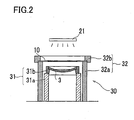
- Fig. 2 is a schematic structural view of a dyeing jig.
- Fig. 1 is a schematic view showing the flow of a vapor deposition transfer dyeing method.
- a dyeing ink used in an ink jet printer is prepared.
- dyes for three colors of YELLOW, RED and BLUE material for dyeing
- Any dye having a sublimation property can be used and hydrophobic disperse dyes are used preferably.
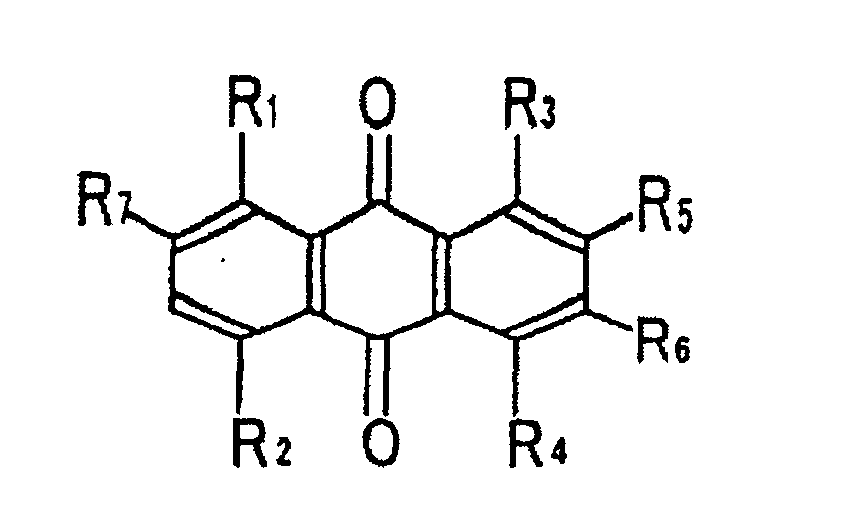
- the dye since the dye is sublimated by heating the dye at a predetermined temperature, it is necessary to use a dye capable of resisting the heat during sublimation. Taking the foregoings into consideration, an anthraquinone disperse dye represented by the following formula (1) or quinophthalone disperse dye represented by the following formula (2) is used preferably as the YELLOW dye.
- R1, R2 each represents hydrogen, an alkyl group of 1 to 3 carbon atoms, an amino group or imino group.
- R3, R4 each represents hydrogen, a halogen group, an alkyl group of 1 to 3 carbon atoms, a hydroxy group, an amino group or imino group.
- R5, R6 each represents hydrogen, an alkyl group of 1 to 3 carbon atoms, sulfonate group, amino group, imino group, halogen group or ether group (having a structural formula -O-R, in which R represents, for example, an alkyl group of 1 to 10 carbon atoms, a phenyl alkyl group of 1 to 10 carbon atoms or a phenyl group).
- R7 represents hydrogen or a sulfonate group.
- R8, R9 each represents hydrogen, a hydroxyl group, a halogen group or an alkyl group of 1 to 3 carbon atoms.
- color ID number (C. I. Disperse, hereinafter referred to as C.I. number) YELLOW 13, YELLOW 51, YELLOW 51, or YELLOW 64 can be used suitably.
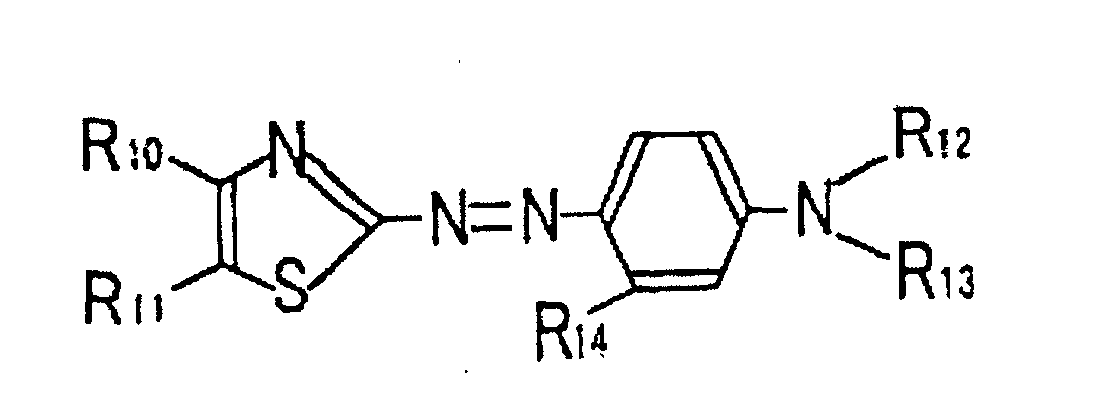
- an anthraquinone disperse dye represented by the formula (1) or an azo disperse dye of thiazole type represented by the following formula (3) is used preferably as the RED dye.
- R10, R11 each represents hydrogen, an alkyl group of 1 to 3 carbon atoms, an alkenyl group of 1 to 3 carbon atoms or an ether group (having a structural formula: -O-R in which R represents, for example, an alkyl group of 1 to 10 carbon atoms, a phenyl alkyl group of 1 to 10 carbon atoms, or a phenyl group).
- R12, R13 each represents an alkyl group of 1 to 3 carbon atoms, alcohols of 1 to 3 carbon atoms, carboxylic acid of 1 to 3 carbon atoms or esters thereof.
- R14 represents hydrogen, an alkyl group of 1 to 3 carbon atoms or an imino group.
- C.I. Numbers RED 4, RED 11, RED 15, RED 55, RED 58, RED 60, RED 86, RED 91, RED 92, RED 127, RED 152, RED 189, RED 229 or RED 302 is used preferably.
- an anthraquinone disperse dye represented by the formula (1) or an azo disperse dye of thiazole type represented by the formula (3) is used preferably as the BLUE dye.
- C.I. Numbers BLUE 56, or BLUE 73 can be used suitably.
- the average particle diameter of the dye is, preferably, from 0.05 ⁇ m to 1 ⁇ m and the maximum particle diameter is 3 ⁇ m or less, further preferably, 0.05 ⁇ m to 0.5 ⁇ m and the maximum particle diameter is 1 ijm or less. If the particle diameter of the dye is greater than that described above, clogging may possibly be caused upon discharging the ink from the ink jet printer.
- the inks of three colors of YELLOW, RED and BLUE are individually prepared.
- the dyes for respective colors are put in separate vessels, a dispersant and pure water (or ion exchanged water) are added to each vessel and agitated sufficiently.
- the ratio of the dye in the ink prescription or formulation is, preferably, from 0.1% by weight to 20.0% by weight, more preferably, 1.0% by weight to 20.0% by weight and, further preferably, 2.0% by weight to 20.0% by weight. If the dye is less than 0.1% by weight, a desired color density can not be often obtained. Further, if the dye exceeds 20.0% by weight, the dispersibility of the dye becomes poor.
- the dispersant used is not thermally decomposed and has a heat resistance but those decomposed by heat may also be used so long as they give no undesired defect on the dyeing.
- Each of the vessels in which the dye and the dispersant are sufficiently agitated is placed in a container containing cooling water and treated by a bead mill for a specified period of time to finely disperse the particles of the dye. Then, each liquid (solution) is filtrated under suction through a filter of a pore size of about 1 ⁇ m (glass fiber filter paper GF/B) to remove particles of larger size and dusts. Subsequently, pure water or ion exchange water is added for regulation to attain a specified ink density, to complete ink preparation.
- the inks of three colors prepared as described above are contained in commercially available ink cartridges 41 for the ink jet printer and they are mounted to the ink jet printer 40.
- a commercially available printer may be used as the printer 40.
- hue and density thereof are controlled by using a commercial personal computer (hereinafter referred to as PC) 50. Since the control for the hue is conducted by a drawing software of the PC 50, data on the desired hue can be stored in the PC 50 and printing can be conducted repeatedly with an identical hue as required. Further, since the density of the hue is also digitally controlled, printing can be made repeatedly at the same density as required.
- PC commercial personal computer
- A4 size paper 1 is used as a base body on which the ink (sublimatable dye) is printed.
- the paper 1 is not limited to paper and there is no restriction so long as it is printable by the printer 40. Since it is heated in the vapor deposition transfer dyeing, it is preferable to use paper or the like having one or both black-colored faces for the purpose of enhancing the efficiency of heat absorption.
- the paper 1 is set in the printer 40, and printing is conducted on the paper 1 at a predetermined hue and density by operating the PC 50.
- An ink-applied print area (colored layer) 2 is printed in a circular form on the paper 1. It is preferable that the print area has a diameter somewhat larger than the diameter of a lens to be dyed.
- the paper 1 formed with the print area 2 is used as a print base body 10.
- FIG. 2 is a schematic structural view (cross sectional view) of a dyeing jig 30.
- the material for the plastic lens 3 to be dyed usual materials used for spectacle lenses are used including, for example, a polycarbonate resin (e.g., diethylene glycol bisallyl carbonate polymer (CR ⁇ 39)), a polyurethane resin, an allyl resin (e.g., allyl diglycol carbonate and its copolymer, and diallyl phthalate and its copolymer), a fumaric acid resin (e.g., benzyl fumarate copolymer), a styrene resin, a polymethyl acrylate resin, a fiber resin (e.g., cellulose propionate), etc.
- a polycarbonate resin e.g., diethylene glycol bisallyl carbonate polymer (CR ⁇ 39)
- a polyurethane resin e.g., allyl diglycol carbonate and its copolymer, and diallyl phthalate and its copolymer
- a fumaric acid resin e.g., benzy
- the transfer device 20 is provided, at the front, with a take-out port not shown for taking in and out the lens 3 and the print base body 10.
- Numeral 21 is a halogen lamp for heating to sublimate a dye in the print area 2.
- Numeral 22 is a rotary pump which is used to produce almost a vacuum in the transfer device 20.
- Numeral 23 is a leak valve which is opened to introduce outside air into the substantially evacuated transfer device 20 to recover the atmospheric pressure.
- Numeral 30 denotes a dyeing jig for placing the lens 3 and the print base body 10 in the transfer device 20.
- the jig 30 includes a lens placing part 31 for placing the lens 3 and a base body placing part 32 for placing the print base body 10.
- the lens placing part 31 includes a cylindrical support 31a for supporting the lens 3 at a predetermined height and a cylindrical holder 31b for holding the lens 3.
- the lens 3 can be placed at a predetermined height when the holder 31b holding the lens 3 on a convex surface side thereof is put on the support 31a as shown in Fig 2.
- a base body placing part 32 includes a cylindrical support 32a for supporting the print base body 10 and a cylindrical retainer 32b for retaining the print base body 10 from above. As shown in Fig. 2, the support 32a is located such that the lens placing part 31 is positioned inside the support 32a. The print base body 10 put on the support 32a is securely fixed and held between the retainer 32b and the support 32a. In this state, the print area 2 of the print base body 10 faces to the lens 3 side (a lower side) in noncontact with the lens 3.
- the lens 3 is dyed by the following operations.
- the transfer device 20 is sealed and the pump 22 is operated to produce almost a vacuum in the device 20.
- the vacuum in this case is such a state depressurized to about 0.1 kPa to 5 kPa. It may be below 0.1 kPa, but it will require a high-powered exhauster.
- the lamp 21 When a predetermined vacuum degree is reached in the transfer device 20, the lamp 21 is turned on to heat the print base body 10 from above. It is preferable to set the heating temperature on the print base body 10 at a temperature as high as possible within a range not causing denaturation of the dye or deformation of the lens 3.
- the heating temperature is made as high as possible in sublimation, because the heating time for color development to a desired hue and density can be shortened to improve the productivity.
- the dye is sublimated and evaporated from the print area 2 and deposited on the lens 3 on the concave surface side.
- the print base body 10 is heated till almost of the dye of the print base body 2 is sublimated and evaporated.
- the lamp 21 is turned off and the valve 22 is opened to recover the normal pressure in the transfer device 20, and the lens 3 is taken out.
- the dye has been vapor-deposited on the lens 3, it is liable to come off in this state.
- the lens 3 is put in an oven 60 and heated to fix the dye under normal pressures.
- the step (coloring step) is executed in the sequence of heating the inside of the oven 60, and then taking out the lens 3 from the oven 60 after a lapse of a predetermined time for obtaining a desired hue and density.
- the heating temperature in the oven 60 is desirably as high as possible within a range not causing denaturation of the dye and deformation of the lens 3.
- the heating temperature is from 50°C to 150°C and the heating time is from 30 min. to 1 hour.
- a disperse dye having a hydrophobic property and also a sublimating property is used for the dyeing ink, and a humectant and a controlling agent for preventing clogging of the ink caused by drying or the like in the cartridge of the ink jet printer or controlling the viscosity, the surface tension, etc. of the ink can also be added to the ink.
- humectants of polyhydric alcohols are used preferably. Specifically, they can include, for example, ethylene glycol, diethylene glycol, polyethylene glycol, propylene glycol, dipropylene glycol, polypropylene glycol or glycerine. Further, as other humectants, pyrrolidones such as N-methyl-2-pyrrolidone or 2-pyrrolidone, or dimethylsulfoxide or amides such as imidazolidinone may also be used.
- the humectants described above are liquid moisturizing agents (humectants) and alternatively solid moisturizing agents (humectants), for example, trimethylol methane and pentose may also be used.
- the humectant is sublimated and evaporated, and deposited onto the lens 3 together with the dye.
- the lens 3 with the humectant is heated (in a color developing step), cohesion of the sublimated dye or the like is caused under the effect of the humectant to bring about unevenness in the dyeing.
- a hydrophilic polymeric material is added to the ink for preventing deposition of the humectant on the lens 3 during sublimation of the dye.
- a hydrophilic polymeric material may previously be applied on the printing surface of the paper 1.
- the hydrophilic polymeric material to be used is preferably those preventing the sublimation of the humectant and not deteriorating the dispersion stability of the dye, and not deteriorating the dispersion stability of the polymer of a molecular weight of 1,000 or more and 1,000,000 or less, and those polymers of a molecular weight of 1,000 or more and 1,000,000 or less are used preferably.
- the hydrophilic polymeric material used can include natural polymers, semi-synthesis polymers or entirely synthesized polymers.
- the natural polymers can include, for example, plant-derived polymers such as gum arabic, tragacanth gum, and guar gum, see weed type polymers such as alginic acid or carrageenan, animal-derived polymers such as gelatin, casein and albumin, or bacteria type polymers such as xanthen gum or dextrane.
- plant-derived polymers such as gum arabic, tragacanth gum, and guar gum
- weed type polymers such as alginic acid or carrageenan
- animal-derived polymers such as gelatin, casein and albumin
- bacteria type polymers such as xanthen gum or dextrane.
- the semi-synthesis polymers can include, for example, cellulosic polymers such as methyl cellulose, ethyl cellulose, hdyroxyethyl cellulose, and carboxyethyl cellulose, starch series polymers such as sodium starch glycolate, sodium starch phosphate ester, or see weed type polymers such as sodium alginate and propylene glycol ester alginate esters.
- cellulosic polymers such as methyl cellulose, ethyl cellulose, hdyroxyethyl cellulose, and carboxyethyl cellulose
- starch series polymers such as sodium starch glycolate, sodium starch phosphate ester
- see weed type polymers such as sodium alginate and propylene glycol ester alginate esters.
- the entirely synthesized polymers can include, for example, vinylic polymers such as polyvinyl alcohol, polyvinyl pyrrolidone and polyvinyl ethyl ether, or acrylic resins such as non-crosslinked polyacrylamide, polyacrylic acids and alkali metal salts thereof, water soluble styrene and acrylic resins.
- vinylic polymers such as polyvinyl alcohol, polyvinyl pyrrolidone and polyvinyl ethyl ether
- acrylic resins such as non-crosslinked polyacrylamide, polyacrylic acids and alkali metal salts thereof, water soluble styrene and acrylic resins.
- the viscosity at a room temperature is preferably 1.1 cps to 3.0 cps, and more preferably, 1.1 cps to 2.0 cps.
- the surface tension is, preferably, 20 x 10 -3 N/m to 60 x 10 -3 N/m and, further preferably, 30 x 10 -3 N/m to 50 x 10 -3 N/m.
- lens dyeing was conducted by the vapor transfer dyeing method using various dyes and the results of dyeing were evaluated.
- Example 1 a plastic lens of S-2.00 (refractive index 1.74) was used.
- the dye Dianix Yellow F-3GE (Yellow 64) made by DyStar Japan Co., Ltd. was used. Further, Demol MS made by Kao Corporation was used for the dispersing agent.
- the composition ratio for dye, dispersion agent and pure water was set to 5.0% by weight of dye, 2.5% by weight of dispersant and 92.5% by weight of pure water.
- the dispersion agent and pure water at the composition ratio described above into the vessel After putting the dye, the dispersion agent and pure water at the composition ratio described above into the vessel, this mixture was agitated for 10 min. or more. Subsequently, the mixture was treated by a beads mill for a specified time (30 min. treatment for about 100 g) to finely granulate the particles of the dye into primary grains. Then, the liquid (solution) was filtrated under suction by a filter of about 1 ⁇ m pore size (glass fiber filter paper GF/B) to remove particles of larger particle diameter and dusts. Subsequently, an appropriate amount of pure water was added and the density was adjusted to prepare an ink. When the average particle diameter of the dye was measured by the particle diameter distribution measuring apparatus (SALD-2000, Shimadzu Corporation), the average particle diameter was 0.3 ⁇ m.
- SALD-2000 particle diameter distribution measuring apparatus
- the prepared ink (YELLOW) was injected into an ink jet printer (RJ-1300V2, Mutoh Industries Ltd.) and commercial paper (gloss paper (black) made by Mitsubishi Paper Mills Limited) was used to produce a print base body.
- the print base body was produced such that a circular print area of ⁇ 95 in diameter was formed on a paper (base body) by using a software (Microsoft Word) in the PC and a printing control software. Further, printing was conducted while controlling the ink discharge amount to 50%. The ink was discharged with no clogging from the printer 40.
- the print base body was dried and the transfer dyeing operation from the print base body to the lens was conducted by using the transfer device, the jig, and the like.
- the vacuum degree in the transfer device was 1 kPa and the temperature on the print base body was 250°C in this case.
- the lens was put in the oven for fixing the dye and heated at 140°C for 2 hours to complete the color developing operation.
- the dyed lens after the completion of the color developing operation was evaluated for the hue, the color developing property, the sublimation property and the presence or absence of unevenness.
- Hue evaluation The hue was evaluated as " ⁇ ” in a case where the chromaticness (chroma saturation) was high and colored in a single color and as " ⁇ " in a case where the hue was a mixed color.
- Color development evaluation After color development, the lens was wiped with an acetone-immersed cloth and evaluated as " ⁇ ” in a case where the dye was not peeled, as " ⁇ ” in a case where it was slightly peeled, and as "X” in a case where it was peeled greatly.
- Sublimation evaluation It was evaluated as " ⁇ ” in a case where the dye did not remain on the base body after transfer, as " ⁇ ” in a case where it remained slightly, and as "X” in a case where it remained to such an extent as showing no substantial difference with that upon printing.
- Presence or absence of unevenness It was evaluated as " ⁇ " in a case where the lens was uniformly dyed and as "X” in a case where it was dyed unevenly.
- Table 1 shows the results of the evaluations as described above.
- a plastic lens was dyed by using the same composition ratio and the dyeing method as those in Example 1 except for using the dye of Palanil Yellow FD-3GE (Yellow 54) made by Mitsui BASF Dye Co.
- the dyed lens after completion of the color developing operation was evaluated for the hue, the color developing property, the sublimation property and presence or absence of unevenness. Table 1 shows the results of the evaluations.
- a plastic lens was dyed by using the same composition ratio and the dyeing method as those in Example 1 except for using the dye of Sumikaron UL Yellow 4GF (Yellow 51) made by Sumitomo Chemical Co., Ltd.
- the dyed lens after completion of the color developing operation was evaluated for the hue, the color developing property, the sublimation property and presence or absence of unevenness. Table 1 shows the results of the evaluations.
- a plastic lens was dyed by using the same composition ratio and the dyeing method as those in Example 1 except for using the dye of Kayaron AQ-LE (Kayaron Microester AQ-LE) made by Nippon Kayaku Co., Ltd.
- the dyed lens after completion of the color developing operation was evaluated for the hue, the color developing property, the sublimation property and presence or absence of unevenness. Table 1 shows the results of the evaluations.
- a plastic lens was dyed by using the same composition ratio and the dyeing method as those in Example 1 except for using the dye of Terasil Pink 3G (Red 302) made by Ciba Specialty Chemicals K.K.
- the dyed lens after completion of the color developing operation was evaluated for the hue, the color developing property, the sublimation property and presence or absence of unevenness. Table 1 shows the results of the evaluations.
- a plastic lens was dyed by using the same composition ratio and the dyeing method as those in Example 1 except for using the dye of Palanil Red C-BEL (Red 92) made by Mitsui BASF Dye Co.
- the dyed lens after completion of the color developing operation was evaluated for the hue, the color developing property, the sublimation property and presence or absence of unevenness. Table 1 shows the results of the evaluations.
- a plastic lens was dyed by using the same composition ratio and the dyeing method as those in Example 1 except for using the dye of Sumikaron Red E-FBL (Red 60) made by Sumitomo Chemical Co., Ltd.
- the dyed lens after completion of the color developing operation was evaluated for the hue, the color developing property, the sublimation property and presence or absence of unevenness. Table 1 shows the results of the evaluations.
- a plastic lens was dyed by using the same composition ratio and the dyeing method as those in Example 1 except for using the dye of Kayaron Light Red B-S (BS-200 (Red 152 )) made by Nippon Kayaku Co., Ltd.
- the dyed lens after completion of the color developing operation was evaluated for the hue, the color developing property, the sublimation property and presence or absence of unevenness. Table 1 shows the results of the evaluations.
- a plastic lens was dyed by using the same composition ratio and the dyeing method as those in Example 1 except for using the dye of Sumikaron Blue E-FBL (Blue 56) made by Sumitomo Chemical Co., Ltd.
- the dyed lens after completion of the color developing operation was evaluated for the hue, the color developing property, the sublimation property and presence or absence of unevenness. Table 1 shows the results of the evaluations.
- a plastic lens was dyed by using the same composition ratio and the dyeing method as those in Example 1 except for using the dye of Sumikaron Blue S-BG (Blue 73) made by Sumitomo Chemical Co., Ltd.
- the dyed lens after completion of the color developing operation was evaluated for the hue, the color developing property, the sublimation property and presence or absence of unevenness. Table 1 shows the results of the evaluations.
- a plastic lens was dyed by using the same composition ratio and the dyeing method as those in Example 1 except for using the dye of Dianix Blue AC-E (a main component; anthraquinone dye) made by DyStar Japan Co., Ltd.
- the dyed lens after completion of the color developing operation was evaluated for the hue, the color developing property, the sublimation property and presence or absence of unevenness.
- Table 1 shows the results of the evaluations.
- a plastic lens was dyed by using the same composition ratio and the dyeing method as those in Example 1 except for using the dye of Dianix Brilliant Yellow 5G-E (Yellow 71) made by DyStar Japan Co., Ltd.
- the dyed lens after completion of the color developing operation was evaluated for the hue, the color developing property, the sublimation property and presence or absence of unevenness. Table 1 shows the results of the evaluations.
- a plastic lens was dyed by using the same composition ratio and the dyeing method as those in Example 1 except for using the dye of Dianix Yellow AM-42 (Yellow 42) made by DyStar Japan Co., Ltd.
- the dyed lens after completion of the color developing operation was evaluated for the hue, the color developing property, the sublimation property and presence or absence of unevenness. Table 1 shows the results of the evaluations.
- a plastic lens was dyed by using the same composition ratio and the dyeing method as those in Example 1 except for using the dye of Terasil Yellow 4G (Yellow 211) made by Ciba Specialty Chemicals K.K.
- the dyed lens after completion of the color developing operation was evaluated for the hue, the color developing property, the sublimation property and presence or absence of unevenness. Table 1 shows the results of the evaluations.
- a plastic lens was dyed by using the same composition ratio and the dyeing method as those in Example 1 except for using the dye of Sumikaron Rubine SE-GL (Red 73) made by Sumitomo Chemical Co., Ltd.
- the dyed lens after completion of the color developing operation was evaluated for the hue, the color developing property, the sublimation property and presence or absence of unevenness. Table 1 shows the results of the evaluations.
- a plastic lens was dyed by using the same composition ratio and the dyeing method as those in Example 1 except for using the dye of Dianix Red KB-SE made by DyStar Japan Co., Ltd.
- the dyed lens after completion of the color developing operation was evaluated for the hue, the color developing property, the sublimation property and presence or absence of unevenness. Table 1 shows the results of the evaluations.
- a plastic lens was dyed by using the same composition ratio and the dyeing method as those in Example 1 except for using the dye of Dianix Red S-4G made by DyStar Japan Co., Ltd.
- the dyed lens after completion of the color developing operation was evaluated for the hue, the color developing property, the sublimation property and presence or absence of unevenness. Table 1 shows the results of the evaluations.
- a plastic lens was dyed by using the same composition ratio and the dyeing method as those in Example 1 except for using the dye of Kayalon Polyester Red TL-SF (Red 323) made by Nippon Kayaku Co., Ltd.
- the dyed lens after completion of the color developing operation was evaluated for the hue, the color developing property, the sublimation property and presence or absence of unevenness. Table 1 shows the results of the evaluations.
- a plastic lens was dyed by using the same composition ratio and the dyeing method as those in Example 1 except for using the dye of Dianix Navy Blue BG-SE200 made by DyStar Japan Co., Ltd.
- the dyed lens after completion of the color developing operation was evaluated for the hue, the color developing property, the sublimation property and presence or absence of unevenness. Table 1 shows the results of the evaluations.
- Example 1 (S ⁇ 2.00, refractive index 1.74) was dyed by the dyeing method using the dyes used in Examples 1 to 9 and Comparative Examples 1 to 8, but the lens was dyed only slightly and could not be dyed in a desired density.
- the dyeing density for the lens in a case of variously changing the density of the dye in the ink was evaluated.
- the ink prescription (composition ratio) for the condition A was: 1.0% by weight of dye, 0.5% by weight of dispersant and 98.5% by weight of pure water.
- the ink was prepared by the same procedures as those in Example 1.
- a print base body was prepared by an ink jet printer (Super-mechie, made by Intack Corporation). Further, the discharge amount from each of the ink discharge heads for printing on the paper (base body) was at 100% for each color in case of outputting in a single color and at 50% for each color in case of outputting in a mixed color.
- the transfer dyeing operations were performed using CR-39 for the plastic lens under the color developing condition of 135°C, for 1 hour, and in the same manner as in Example 1.
- the chromaticity of the dyed plastic lens was measured by using a color measuring device (DOT-3, manufactured by Murakami Color Research Laboratory). Table 2 shows the results thereof.
- the condition was identical with the condition A except for changing the composition ratio of the ink to 2.0% by weight of dye, 1.0% by weight of dispersant and 97.0% by weight of pure water.
- the chromaticity of the dyed plastic lens (after color development) obtained in the same manner as the condition A was measured by using the color measuring device. Table 2 shows the results thereof.
- the condition was identical with the condition A except for changing the composition ratio of the ink to 5.0% by weight of dye, 2.5% by weight of dispersant and 92.5% by weight of pure water.
- the chromaticity of the dyed plastic lens (after color development) obtained in the same manner as the condition A was measured by using the color measuring device. Table 2 shows the results thereof.
- the condition was identical with the condition A except for changing the composition ratio of the ink to 10.0% by weight of dye, 5.0% by weight of dispersant and 85.0% by weight of pure water.
- the chromaticity of the dyed plastic lens (after color development) obtained in the same manner as the condition A was measured by using the color measuring device. Table 2 shows the results thereof.
- the condition was identical with the condition A except for changing the composition ratio of the ink to 20.0% by weight of dye, 10.0% by weight of dispersant and 70.0% by weight of pure water.
- the chromaticity of the dyed plastic lens (after color development) obtained in the same manner as the condition A was measured by using the color measuring device. Table 2 shows the results thereof.
- the condition was identical with the condition A except for changing the composition ratio of the ink to 30.0% by weight of dye, 15.0% by weight of dispersant and 55.0% by weight of pure water.
- the viscosity was high and therefore stable printing could not be performed. In addition, cohesion of the dye was also observed.
- Condition A Condition B Condition C Condition D Condition E Condition F Composition ratio Dye 1.00% 2.00% 5.00% 10.00% 20.00% 30.00% Dispersant 0.50% 1.00% 2.50% 5.00% 10.00% 15.00% Pure water 98.50% 97.00% 92.50% 85.00% 70.00% 55.00% Chromaticity (Red) Y 70.05 54.6 35.45 25.28 17.15 L* 87.02 78.81 66.08 57.35 48.45 a* 17.92 38.43 62.64 75.04 78.65 b* ⁇ 2.94 -6.76 -6.15 1.06 7.96 Chromaticity (Yellow) Y 92.51 91.98 90.97 89.81 82.53 L* 97.03 96.81 96.4 95.92 92.81 a* -1.86 -4.58 -9.41 -14.01 -16.73 b* 8.56 11.69 25.64 42.35 58.42 Chromaticity (Blue) Y
- the lens could be dyed at about 20% of the dyeing density in the mixed color (50% output for each color).
- the ink prescription under the condition A can be applied only to about 10% of all the products correspondingly dyed by the dip dyeing method.
- the lens could be dyed at about 40% of the dyeing density in the mixed color.
- the ink prescription under the condition B can be applied to about 30% of all the products correspondingly dyed by the dip dyeing method.
- the lens could be dyed at about 60% of the dyeing density in the mixed color.
- the ink prescription under the condition C can be applied to about 70% of all the products correspondingly dyed by the dip dyeing method.
- the lens could be dyed at about 75% of the dyeing density in the mixed color.
- the ink prescription under the condition D can be applied to about 90% of all the products correspondingly dyed by the dip dyeing method.
- the lens could be dyed at about 85% of the dyeing density in the mixed color.
- the ink prescription under the condition E can be applied to almost all the products which is correspondingly dyed by the dip dyeing method.
- the dyeing density can be brought to 60% to 70% by repeating the transfer dyeing operations twice or three times.
- the dye concentration is lowered as far as 1.0% (condition A)
- the dyeing density does not sometimes reach 70% unless the transfer dyeing operation is repeated by 5 to 10 times.
- Such a method is actually poor in view of the operation performance and is not practical.
- Example 12 a CR-39 lens was used.
- the used dyes were Kayaron AQ-LE (YELLOW), Kayaron Light RED B-S (RED), Dianix BLUE AC-E (BLUE).
- the used dispersant was Demol-MS made by Kao.
- Table 3 shows the composition for each ink put in each cartridge.
- each composition as shown in Table 3 After putting the dye, the dispersant and pure water in each composition as shown in Table 3 into each vessel, these mixtures were agitated for 10 min. or more. Subsequently, they were treated by an ultrasonic homogenizer for a specified time (30 min. treatment for about 100 g) to finely granulate the particles of the dye into primary particles. Then, each liquid (solution) was filtrated under suction by a filter of about 1 ⁇ m pore size (glass fiber filter paper GF/B) to remove particles of larger particle size and dusts. An appropriate amount of pure water was further added for regulation of the density to prepare inks. When the average particle diameter of the dye was measured by the particle diameter distribution measuring apparatus (SALD-2000, manufactured by Shimadzu Corporation), the average particle diameter was 0.3 ⁇ m.
- SALD-2000 particle diameter distribution measuring apparatus
- Each of the prepared inks was injected into an ink jet printer (RJ-1300V2, manufactured by Mutoh Industries Ltd.) and commercial paper (gloss paper (black) made by Mitsubishi Paper Mills Limited) was used to produce a print base body.
- the print base body was produced such that a circular print area of ⁇ 95 in diameter was formed on the paper (base body) by using the PC's software (Microsoft Word) and a printing control soft. Further, the hue was set to R150, G100 and B50.
- the print base body was dried, and the transfer dyeing operation from the print base body to the lens was conducted by using the transfer device, the jig, and the like described above.
- the vacuum degree in the transfer device was 1 kPa and the temperature on the print base body was 250°C in this case. It was confirmed that almost of the dye sublimated from the print area of the print base body and deposited on the lens.
- the lens was placed in the oven for fixing the dye and heated at 135°C for 1 hour to complete the color developing operation.
- Example 13 inks added with the humectant and the polymeric material were used.
- Glycerin was used for the humectant and methyl cellulose 25 was used for the hydrophilic polymeric material.
- Table 4 shows the composition for each ink filled into each ink cartridge.
- RED YELLOW BLUE Dye 1.0% 3.0% 3.0% Dispersant 0.5% 0.5% 0.5% Pure water 78.3% 76.3% 76.3% Glycerine 20.0% 20.0% 20.0% Methyl cellulose 0.2% 0.2% 0.2% In this table, “%” means “% by weight”.
- each mixture was agitated for 10 min. or more. Then, each mixture was treated for a specified time by the ultrasonic homogenizer (30 min. treatment for about 100 g), filtered under suction through a filter, and pure water was further added by an appropriate amount to regulate the concentration to prepare inks.
- the average particle diameter was 0.3 ⁇ m.
- Each prepared ink was injected into each ink cartridge of an ink jet printer (MJ-520C manufactured by EPSON) and the print base body was produced by the same procedures as in Example 12 and the transfer dyeing operation to the lens was conducted.
- MJ-520C manufactured by EPSON
- the ink discharge port (head portion) of the ink cartridge was smaller in the printer used in Example 13 compared with the printer used in Example 12, it was concerned about the clogging due to the drying of the ink.
- the humectant to the ink, printing on the paper could be conducted, thus producing the print base body with no clogging due to drying even in a case of using the printer repetitively.
- the transfer dyeing operation and the color developing operation were conducted under the same conditions as those in Example 12.
- Example 14 inks prepared by adding a humectant (glycerine) to each ink in Example 12 were used.
- Table 5 shows an ink prescription.
- the inks were prepared in the same manner as in Example 12 to complete the inks. Further, a polymeric material was coated to the paper used for the print base body (gloss paper (black) made by Mitsubishi Paper Mills Limited) on the side of a surface to be printed. Methyl cellulose 400 was used for the polymeric material, which was dissolved into water as a 10% solution and then coated with no unevenness on the side of the printing surface by a brush, followed by drying.
- gloss paper black
- Methyl cellulose 400 was used for the polymeric material, which was dissolved into water as a 10% solution and then coated with no unevenness on the side of the printing surface by a brush, followed by drying.
- Example 12 After setting the paper coated with methyl cellulose in an ink jet printer (MJ-520C, manufactured by EPSON), a print base body was produced by the same procedures as those in Example 12. Printing was conducted with no clogging from the printer to the paper, and the print base body could be produced. After drying the print base body, the transfer dyeing operation and the color developing operation were conducted under the same conditions as those in Example 12.
- Example 9 the polymeric material was not used and a print base body was produced by using the ink in Example 14 (ink prescription in Table 5). The transfer dyeing operation and the color developing operation were conducted with other conditions being identical with those in Example 12. When the lenses after color development were observed, it was found that the lenses were dyed unevenly.
- the plastic lens can be dyed favorably by the vapor deposition transfer dyeing method.
Landscapes
- Engineering & Computer Science (AREA)
- Chemical & Material Sciences (AREA)
- Textile Engineering (AREA)
- Wood Science & Technology (AREA)
- Physics & Mathematics (AREA)
- Life Sciences & Earth Sciences (AREA)
- Organic Chemistry (AREA)
- Materials Engineering (AREA)
- Health & Medical Sciences (AREA)
- Manufacturing & Machinery (AREA)
- Ophthalmology & Optometry (AREA)
- Mechanical Engineering (AREA)
- General Physics & Mathematics (AREA)
- Optics & Photonics (AREA)
- Coloring (AREA)
- Eyeglasses (AREA)
- Inks, Pencil-Leads, Or Crayons (AREA)
Abstract
Description
wherein the ink includes at least one sublimatable disperse dye of an anthraquinone dye, a quinophthalone dye, and an azo dye of thiazole type.


| Condition A | Condition B | Condition C | Condition D | Condition E | Condition F | ||
| Composition ratio | |||||||
| Dye | 1.00% | 2.00% | 5.00% | 10.00% | 20.00% | 30.00% | |
| Dispersant | 0.50% | 1.00% | 2.50% | 5.00% | 10.00% | 15.00% | |
| Pure water | 98.50% | 97.00% | 92.50% | 85.00% | 70.00% | 55.00% | |
| Chromaticity (Red) | Y | 70.05 | 54.6 | 35.45 | 25.28 | 17.15 | |
| L* | 87.02 | 78.81 | 66.08 | 57.35 | 48.45 | ||
| a* | 17.92 | 38.43 | 62.64 | 75.04 | 78.65 | ||
| b* | ·2.94 | -6.76 | -6.15 | 1.06 | 7.96 | ||
| Chromaticity (Yellow) | Y | 92.51 | 91.98 | 90.97 | 89.81 | 82.53 | |
| L* | 97.03 | 96.81 | 96.4 | 95.92 | 92.81 | ||
| a* | -1.86 | -4.58 | -9.41 | -14.01 | -16.73 | ||
| b* | 8.56 | 11.69 | 25.64 | 42.35 | 58.42 | ||
| Chromaticity (Blue) | Y | 84.25 | 80.25 | 66.77 | 47.4 | 29.47 | |
| L* | 93.56 | 91.8 | 85.39 | 74.45 | 61.19 | ||
| a* | -1.40 | -3.77 | -7.73 | -12.34 | -12.03 | ||
| b* | -4.32 | -7.1 | -16.31 | -31.99 | -45.3 | ||
| Chromaticity (Mixed color) | Y | 76.77 | 56.56 | 39.74 | 19.13 | 11.04 | |
| L* | 90.22 | 79.93 | 69.28 | 50.84 | 39.65 | ||
| a* | 8.38 | 15.82 | 28.33 | 43.5 | 46.65 | ||
| b* | -0.68 | -1.25 | -2.61 | 0.04 | 2.67 | ||
| Dyeing density | about 30% | about 50% | about 65% | about 75% | about 85% |
| RED | YELLOW | BLUE | |
| Dye | 1.0% | 3.0% | 3.0% |
| Dispersant | 0.5% | 0.5% | 0.5% |
| Pure water | 98.5% | 96.5% | 96.5% |
| RED | YELLOW | BLUE | |
| Dye | 1.0% | 3.0% | 3.0% |
| Dispersant | 0.5% | 0.5% | 0.5% |
| Pure water | 78.3% | 76.3% | 76.3% |
| Glycerine | 20.0% | 20.0% | 20.0% |
| Methyl cellulose | 0.2% | 0.2% | 0.2% |
| In this table, "%" means "% by weight". |
| RED | YELLOW | BLUE | |
| Dye | 1.0% | 3.0% | 3.0% |
| Dispersant | 0.5% | 0.5% | 0.5% |
| Pure water | 78.5% | 76.5% | 76.5% |
| Glycerine | 20.0% | 20.0% | 20.0% |
Claims (9)
- An ink for dyeing a plastic lens, the ink being to be applied to a base body by an ink jet printer, and sublimated in vacuum and deposited on the plastic lens to dye the lens,
wherein the ink includes at least one sublimatable disperse dye of an anthraquinone dye, a quinophthalone dye, and an azo dye of thiazole type. - The ink for dyeing a plastic lens according to claim 1 further including a dispersant for dispersing the dye in an aqueous system.
- The ink for dyeing a plastic lens according to claim 2 further including a humectant used for keeping the ink moistened and a hydrophilic polymeric material for preventing sublimation of the humectant.
- The ink for dyeing a plastic lens according to claim 1, wherein a compounding ratio of the dye is in a range of 2.0% by weight to 20.0% by weight.
- The ink for dyeing a plastic lens according to claim 1, wherein a particle diameter of the dye is 1 µm or less.
- A plastic lens dyeing method of dyeing a plastic lens by sublimating a plastic lens dyeing ink in vacuum and depositing the ink on the lens, including:a step of forming a print area by applying the ink to a base body by an ink jet printer, the ink including at least one sublimatable disperse dye of an anthraquinone dye, a quinophthalone dye, and an azo dye of thiazole type;a step of placing the thus formed print area and the lens to face each other in noncontact relation anda step of heating at least the print area to sublimate and deposit the dye on the lens.
- The plastic lens dyeing method according to claim 6 further including a step of heating the lens on which the dye has been deposited, at a predetermined temperature.
- The plastic lens dyeing method according to claim 6, wherein the ink includes a humectant used for keeping the ink moistened and a hydrophilic polymeric material for preventing sublimation of the humectant.
- The plastic lens dyeing method according to claim 6, wherein the ink includes a humectant used for keeping the ink moistened and a surface of the base body to be applied with the ink is previously coated with a hydrophilic polymeric material.
Applications Claiming Priority (5)
| Application Number | Priority Date | Filing Date | Title |
|---|---|---|---|
| JP2001061765A JP4268767B2 (en) | 2001-03-06 | 2001-03-06 | Plastic lens dyeing method |
| JP2001061765 | 2001-03-06 | ||
| JP2001383814 | 2001-12-17 | ||
| JP2001383814A JP4365060B2 (en) | 2001-12-17 | 2001-12-17 | Plastic lens dyeing method and plastic lens dyeing ink used in the method |
| PCT/JP2002/002053 WO2002071108A1 (en) | 2001-03-06 | 2002-03-06 | Ink for dyeing plastic lens and method for dyeing plastic lens using the ink |
Publications (3)
| Publication Number | Publication Date |
|---|---|
| EP1367412A1 true EP1367412A1 (en) | 2003-12-03 |
| EP1367412A4 EP1367412A4 (en) | 2005-03-23 |
| EP1367412B1 EP1367412B1 (en) | 2009-11-25 |
Family
ID=26610690
Family Applications (1)
| Application Number | Title | Priority Date | Filing Date |
|---|---|---|---|
| EP02702750A Expired - Lifetime EP1367412B1 (en) | 2001-03-06 | 2002-03-06 | Ink for dyeing plastic lens and method for dyeing plastic lens using the ink |
Country Status (7)
| Country | Link |
|---|---|
| US (1) | US7077874B2 (en) |
| EP (1) | EP1367412B1 (en) |
| CN (1) | CN100403061C (en) |
| AT (1) | ATE449975T1 (en) |
| DE (1) | DE60234506D1 (en) |
| ES (1) | ES2337343T3 (en) |
| WO (1) | WO2002071108A1 (en) |
Cited By (2)
| Publication number | Priority date | Publication date | Assignee | Title |
|---|---|---|---|---|
| EP3629079A1 (en) | 2018-09-27 | 2020-04-01 | Essilor International | An ophthalmic lens for improving night driving vision and a method for obtaining the same |
| WO2020064963A1 (en) | 2018-09-27 | 2020-04-02 | Essilor International | An ophthalmic lens for improving vision |
Families Citing this family (10)
| Publication number | Priority date | Publication date | Assignee | Title |
|---|---|---|---|---|
| JP3682465B2 (en) * | 1999-03-31 | 2005-08-10 | 独立行政法人産業技術総合研究所 | Resin molded product surface layer modification method and apparatus therefor, and resin molded product with modified surface layer, resin molded product surface layer colored method and apparatus and surface molded resin product with colored surface layer, and Resin molded product with added functionality by modifying the surface layer |
| JP4988404B2 (en) * | 2006-09-29 | 2012-08-01 | 株式会社ニデック | Plastic lens dyeing method and plastic lens dyeing substrate producing apparatus |
| JP2010281964A (en) * | 2009-06-03 | 2010-12-16 | Nidek Co Ltd | Dyeing optical component manufacturing method and dyeing semi-finished lens |
| JP2011048340A (en) * | 2009-07-31 | 2011-03-10 | Hoya Corp | Process for producing dyed plastic lens |
| US20120162332A1 (en) * | 2010-12-22 | 2012-06-28 | Hong Kong Applied Science and Technology Research Institute Company Limited | Sublimation inks for thermal inkjet printers using thermally stable dye particles |
| JP5834553B2 (en) * | 2011-07-06 | 2015-12-24 | 株式会社ニデック | Method for dyeing silicone molded products or polyurethane molded products |
| KR20180048611A (en) * | 2015-08-31 | 2018-05-10 | 산요 시키소 가부시키가이샤 | Aqueous dye dispersion for aqueous ink and aqueous ink |
| US10543577B2 (en) | 2018-01-23 | 2020-01-28 | Clear and Dark Ltd. | Systems, methods, and apparatus for forming optical articles, and optical articles formed by the same |
| KR102287990B1 (en) * | 2019-12-19 | 2021-08-10 | 주식회사 세코닉스 | Small camera lens with improved internal reflection |
| CN111361301B (en) * | 2020-04-01 | 2021-06-15 | 杭州美迪凯光电科技股份有限公司 | Ink-jet printing preparation method of LENS functional film |
Family Cites Families (14)
| Publication number | Priority date | Publication date | Assignee | Title |
|---|---|---|---|---|
| JPS496939A (en) * | 1972-05-08 | 1974-01-22 | ||
| CA1233302A (en) * | 1983-04-11 | 1988-03-01 | Miles W. Press | Tinted hydrogel plastic articles and method of tinting them |
| NZ225876A (en) * | 1987-08-21 | 1990-11-27 | Basf Australia | Method of transfer printing of fibres using a temporary support |
| EP0507028A1 (en) * | 1991-04-04 | 1992-10-07 | Malden Mills Industries, Inc. | Treating velvet-like fabric |
| JPH08112566A (en) | 1994-08-26 | 1996-05-07 | Seiko Epson Corp | Method for dyeing hydrous contact lenses |
| US5580410A (en) * | 1994-12-14 | 1996-12-03 | Delta Technology, Inc. | Pre-conditioning a substrate for accelerated dispersed dye sublimation printing |
| JPH1018184A (en) * | 1996-05-02 | 1998-01-20 | Canon Inc | Ink-jet printing method and printed matter |
| US5746816A (en) * | 1996-08-01 | 1998-05-05 | Sawgrass Systems, Inc. | Liquid ink process and printing method |
| JPH10298476A (en) | 1997-04-30 | 1998-11-10 | Toyo Ink Mfg Co Ltd | Ink jet recording liquid and method for producing the same |
| JPH11131000A (en) | 1997-10-27 | 1999-05-18 | Mitsui Chem Inc | Ink jet ink |
| JPH11293164A (en) * | 1998-04-08 | 1999-10-26 | Ricoh Co Ltd | Water-based ink |
| JP3819178B2 (en) * | 1998-08-27 | 2006-09-06 | 株式会社ニデック | Plastic lens dyeing method |
| JP4038305B2 (en) | 1999-05-31 | 2008-01-23 | 株式会社ニデック | Eyeglass lens dyeing system |
| US6536893B2 (en) * | 2001-01-16 | 2003-03-25 | Hewlett-Packard Company | Waterfast and smearfast inks using ink jet delivered dye sublimation dyes |
-
2002
- 2002-03-06 CN CNB028057880A patent/CN100403061C/en not_active Expired - Lifetime
- 2002-03-06 AT AT02702750T patent/ATE449975T1/en not_active IP Right Cessation
- 2002-03-06 ES ES02702750T patent/ES2337343T3/en not_active Expired - Lifetime
- 2002-03-06 DE DE60234506T patent/DE60234506D1/en not_active Expired - Lifetime
- 2002-03-06 EP EP02702750A patent/EP1367412B1/en not_active Expired - Lifetime
- 2002-03-06 WO PCT/JP2002/002053 patent/WO2002071108A1/en not_active Ceased
- 2002-03-06 US US10/467,806 patent/US7077874B2/en not_active Expired - Lifetime
Cited By (4)
| Publication number | Priority date | Publication date | Assignee | Title |
|---|---|---|---|---|
| EP3629079A1 (en) | 2018-09-27 | 2020-04-01 | Essilor International | An ophthalmic lens for improving night driving vision and a method for obtaining the same |
| WO2020064640A1 (en) | 2018-09-27 | 2020-04-02 | Essilor International | An ophthalmic lens for improving night driving vision and a method for obtaining the same |
| WO2020064963A1 (en) | 2018-09-27 | 2020-04-02 | Essilor International | An ophthalmic lens for improving vision |
| US12372813B2 (en) | 2018-09-27 | 2025-07-29 | Essilor International | Ophthalmic lens for improving night driving vision and a method for obtaining the same |
Also Published As
| Publication number | Publication date |
|---|---|
| ATE449975T1 (en) | 2009-12-15 |
| CN100403061C (en) | 2008-07-16 |
| US7077874B2 (en) | 2006-07-18 |
| CN1494660A (en) | 2004-05-05 |
| EP1367412B1 (en) | 2009-11-25 |
| ES2337343T3 (en) | 2010-04-23 |
| US20040075724A1 (en) | 2004-04-22 |
| WO2002071108A1 (en) | 2002-09-12 |
| EP1367412A4 (en) | 2005-03-23 |
| DE60234506D1 (en) | 2010-01-07 |
Similar Documents
| Publication | Publication Date | Title |
|---|---|---|
| US7077874B2 (en) | Ink for dyeing a plastic lens and method of dyeing a plastic lens using the ink | |
| US6554873B2 (en) | Dyeing method of dyeing plastic lens, dyeing device and dyeing jig | |
| US6534443B2 (en) | Dyeing method of dyeing plastic lens and base body to be used for dyeing plastic lens | |
| US7261407B2 (en) | Process and printing apparatus for ink jet printing on cloth using ultraviolet ray curable ink | |
| US9028055B2 (en) | Nonaqueous ink composition for ink jet recording and ink jet recording method | |
| US6736863B2 (en) | Method of dyeing a plastic lens, a plastic lens obtained by use of the dyeing method, and a dyeing system, a dyeing device, and a dyeing jig for a plastic lens | |
| EP4375734A2 (en) | Method for tinting a spectacle lens substrate and spectacle lens substrate | |
| JP4365060B2 (en) | Plastic lens dyeing method and plastic lens dyeing ink used in the method | |
| JP4359445B2 (en) | Plastic lens dyeing method and plastic lens dyeing ink used in the method | |
| US6656231B2 (en) | Dyeing method of dyeing plastic lens | |
| JP4421176B2 (en) | Plastic lens dyeing method, dyeing device and dyeing lens | |
| JP4268767B2 (en) | Plastic lens dyeing method | |
| EP3461945B1 (en) | Dyeing method and manufacturing method of dyeing base body | |
| EP1388607B1 (en) | Dyeing method of plastic lens and dyeing device | |
| Xu | Dye sublimation inkjet inks and applications | |
| JP7306396B2 (en) | Manufacturing method of functional resin body | |
| EP4036190B1 (en) | Method of producing photochromic resin body | |
| JP4236003B2 (en) | Plastic lens dyeing method | |
| Xu | Dye‐Sublimation Inkjet Ink | |
| JP4068310B2 (en) | Method for producing plastic lens having ultraviolet absorbing effect and ultraviolet absorbing ink used in the method | |
| JP2506618B2 (en) | Ink Jet Coloring Discharge Method | |
| JP2019148044A (en) | Manufacturing method of coloring resin body with function | |
| EP3761081B1 (en) | Method for manufacturing multifunctional resin body | |
| JP2019058892A (en) | Printing device and ink container of carrier agent ink | |
| JP2019059205A (en) | Carrier agent ink |
Legal Events
| Date | Code | Title | Description |
|---|---|---|---|
| PUAI | Public reference made under article 153(3) epc to a published international application that has entered the european phase |
Free format text: ORIGINAL CODE: 0009012 |
|
| 17P | Request for examination filed |
Effective date: 20030813 |
|
| AK | Designated contracting states |
Kind code of ref document: A1 Designated state(s): AT BE CH CY DE DK ES FI FR GB GR IE IT LI LU MC NL PT SE TR |
|
| AX | Request for extension of the european patent |
Extension state: AL LT LV MK RO SI |
|
| A4 | Supplementary search report drawn up and despatched |
Effective date: 20050208 |
|
| 17Q | First examination report despatched |
Effective date: 20070605 |
|
| GRAP | Despatch of communication of intention to grant a patent |
Free format text: ORIGINAL CODE: EPIDOSNIGR1 |
|
| GRAS | Grant fee paid |
Free format text: ORIGINAL CODE: EPIDOSNIGR3 |
|
| GRAA | (expected) grant |
Free format text: ORIGINAL CODE: 0009210 |
|
| AK | Designated contracting states |
Kind code of ref document: B1 Designated state(s): AT BE CH CY DE DK ES FI FR GB GR IE IT LI LU MC NL PT SE TR |
|
| REG | Reference to a national code |
Ref country code: GB Ref legal event code: FG4D |
|
| REG | Reference to a national code |
Ref country code: CH Ref legal event code: EP |
|
| REG | Reference to a national code |
Ref country code: IE Ref legal event code: FG4D |
|
| REF | Corresponds to: |
Ref document number: 60234506 Country of ref document: DE Date of ref document: 20100107 Kind code of ref document: P |
|
| REG | Reference to a national code |
Ref country code: SE Ref legal event code: TRGR |
|
| REG | Reference to a national code |
Ref country code: CH Ref legal event code: NV Representative=s name: NOVAGRAAF INTERNATIONAL SA |
|
| REG | Reference to a national code |
Ref country code: NL Ref legal event code: VDEP Effective date: 20091125 |
|
| REG | Reference to a national code |
Ref country code: ES Ref legal event code: FG2A Ref document number: 2337343 Country of ref document: ES Kind code of ref document: T3 |
|
| PG25 | Lapsed in a contracting state [announced via postgrant information from national office to epo] |
Ref country code: FI Free format text: LAPSE BECAUSE OF FAILURE TO SUBMIT A TRANSLATION OF THE DESCRIPTION OR TO PAY THE FEE WITHIN THE PRESCRIBED TIME-LIMIT Effective date: 20091125 Ref country code: PT Free format text: LAPSE BECAUSE OF FAILURE TO SUBMIT A TRANSLATION OF THE DESCRIPTION OR TO PAY THE FEE WITHIN THE PRESCRIBED TIME-LIMIT Effective date: 20100325 |
|
| PG25 | Lapsed in a contracting state [announced via postgrant information from national office to epo] |
Ref country code: CY Free format text: LAPSE BECAUSE OF FAILURE TO SUBMIT A TRANSLATION OF THE DESCRIPTION OR TO PAY THE FEE WITHIN THE PRESCRIBED TIME-LIMIT Effective date: 20091125 |
|
| PG25 | Lapsed in a contracting state [announced via postgrant information from national office to epo] |
Ref country code: BE Free format text: LAPSE BECAUSE OF FAILURE TO SUBMIT A TRANSLATION OF THE DESCRIPTION OR TO PAY THE FEE WITHIN THE PRESCRIBED TIME-LIMIT Effective date: 20091125 Ref country code: AT Free format text: LAPSE BECAUSE OF FAILURE TO SUBMIT A TRANSLATION OF THE DESCRIPTION OR TO PAY THE FEE WITHIN THE PRESCRIBED TIME-LIMIT Effective date: 20091125 |
|
| PG25 | Lapsed in a contracting state [announced via postgrant information from national office to epo] |
Ref country code: NL Free format text: LAPSE BECAUSE OF FAILURE TO SUBMIT A TRANSLATION OF THE DESCRIPTION OR TO PAY THE FEE WITHIN THE PRESCRIBED TIME-LIMIT Effective date: 20091125 Ref country code: DK Free format text: LAPSE BECAUSE OF FAILURE TO SUBMIT A TRANSLATION OF THE DESCRIPTION OR TO PAY THE FEE WITHIN THE PRESCRIBED TIME-LIMIT Effective date: 20091125 |
|
| PLBE | No opposition filed within time limit |
Free format text: ORIGINAL CODE: 0009261 |
|
| STAA | Information on the status of an ep patent application or granted ep patent |
Free format text: STATUS: NO OPPOSITION FILED WITHIN TIME LIMIT |
|
| PG25 | Lapsed in a contracting state [announced via postgrant information from national office to epo] |
Ref country code: GR Free format text: LAPSE BECAUSE OF FAILURE TO SUBMIT A TRANSLATION OF THE DESCRIPTION OR TO PAY THE FEE WITHIN THE PRESCRIBED TIME-LIMIT Effective date: 20100226 Ref country code: MC Free format text: LAPSE BECAUSE OF NON-PAYMENT OF DUE FEES Effective date: 20100331 |
|
| 26N | No opposition filed |
Effective date: 20100826 |
|
| PG25 | Lapsed in a contracting state [announced via postgrant information from national office to epo] |
Ref country code: IE Free format text: LAPSE BECAUSE OF NON-PAYMENT OF DUE FEES Effective date: 20100306 |
|
| REG | Reference to a national code |
Ref country code: CH Ref legal event code: PFA Owner name: NIDEK CO., LTD. Free format text: NIDEK CO., LTD.#7-9, SAKAE-CHO#GAMAGORI-SHI, AICHI 443-0035 (JP) -TRANSFER TO- NIDEK CO., LTD.#7-9, SAKAE-CHO#GAMAGORI-SHI, AICHI 443-0035 (JP) |
|
| PG25 | Lapsed in a contracting state [announced via postgrant information from national office to epo] |
Ref country code: LU Free format text: LAPSE BECAUSE OF NON-PAYMENT OF DUE FEES Effective date: 20100306 |
|
| PG25 | Lapsed in a contracting state [announced via postgrant information from national office to epo] |
Ref country code: TR Free format text: LAPSE BECAUSE OF FAILURE TO SUBMIT A TRANSLATION OF THE DESCRIPTION OR TO PAY THE FEE WITHIN THE PRESCRIBED TIME-LIMIT Effective date: 20091125 |
|
| PGFP | Annual fee paid to national office [announced via postgrant information from national office to epo] |
Ref country code: IT Payment date: 20150220 Year of fee payment: 14 |
|
| PGFP | Annual fee paid to national office [announced via postgrant information from national office to epo] |
Ref country code: SE Payment date: 20150311 Year of fee payment: 14 |
|
| REG | Reference to a national code |
Ref country code: FR Ref legal event code: PLFP Year of fee payment: 15 |
|
| REG | Reference to a national code |
Ref country code: SE Ref legal event code: EUG |
|
| PG25 | Lapsed in a contracting state [announced via postgrant information from national office to epo] |
Ref country code: SE Free format text: LAPSE BECAUSE OF NON-PAYMENT OF DUE FEES Effective date: 20160307 |
|
| REG | Reference to a national code |
Ref country code: FR Ref legal event code: PLFP Year of fee payment: 16 |
|
| PG25 | Lapsed in a contracting state [announced via postgrant information from national office to epo] |
Ref country code: IT Free format text: LAPSE BECAUSE OF NON-PAYMENT OF DUE FEES Effective date: 20160306 |
|
| REG | Reference to a national code |
Ref country code: FR Ref legal event code: PLFP Year of fee payment: 17 |
|
| PGFP | Annual fee paid to national office [announced via postgrant information from national office to epo] |
Ref country code: FR Payment date: 20210210 Year of fee payment: 20 Ref country code: CH Payment date: 20210317 Year of fee payment: 20 |
|
| PGFP | Annual fee paid to national office [announced via postgrant information from national office to epo] |
Ref country code: GB Payment date: 20210225 Year of fee payment: 20 Ref country code: DE Payment date: 20210224 Year of fee payment: 20 |
|
| PGFP | Annual fee paid to national office [announced via postgrant information from national office to epo] |
Ref country code: ES Payment date: 20210407 Year of fee payment: 20 |
|
| REG | Reference to a national code |
Ref country code: DE Ref legal event code: R071 Ref document number: 60234506 Country of ref document: DE |
|
| REG | Reference to a national code |
Ref country code: CH Ref legal event code: PL |
|
| REG | Reference to a national code |
Ref country code: GB Ref legal event code: PE20 Expiry date: 20220305 |
|
| PG25 | Lapsed in a contracting state [announced via postgrant information from national office to epo] |
Ref country code: GB Free format text: LAPSE BECAUSE OF EXPIRATION OF PROTECTION Effective date: 20220305 |
|
| REG | Reference to a national code |
Ref country code: ES Ref legal event code: FD2A Effective date: 20220624 |
|
| PG25 | Lapsed in a contracting state [announced via postgrant information from national office to epo] |
Ref country code: ES Free format text: LAPSE BECAUSE OF EXPIRATION OF PROTECTION Effective date: 20220307 |