EP1367387A2 - Solid electrolyte sensor for detecting a sulfurous component in a gas stream - Google Patents
Solid electrolyte sensor for detecting a sulfurous component in a gas stream Download PDFInfo
- Publication number
- EP1367387A2 EP1367387A2 EP03011890A EP03011890A EP1367387A2 EP 1367387 A2 EP1367387 A2 EP 1367387A2 EP 03011890 A EP03011890 A EP 03011890A EP 03011890 A EP03011890 A EP 03011890A EP 1367387 A2 EP1367387 A2 EP 1367387A2
- Authority
- EP
- European Patent Office
- Prior art keywords
- detecting
- sulfur
- electrode
- solid electrolyte
- gas stream
- Prior art date
- Legal status (The legal status is an assumption and is not a legal conclusion. Google has not performed a legal analysis and makes no representation as to the accuracy of the status listed.)
- Granted
Links
Images




Classifications
-
- G—PHYSICS
- G01—MEASURING; TESTING
- G01N—INVESTIGATING OR ANALYSING MATERIALS BY DETERMINING THEIR CHEMICAL OR PHYSICAL PROPERTIES
- G01N27/00—Investigating or analysing materials by the use of electric, electrochemical, or magnetic means
- G01N27/26—Investigating or analysing materials by the use of electric, electrochemical, or magnetic means by investigating electrochemical variables; by using electrolysis or electrophoresis
- G01N27/403—Cells and electrode assemblies
- G01N27/4035—Combination of a single ion-sensing electrode and a single reference electrode
-
- G—PHYSICS
- G01—MEASURING; TESTING
- G01N—INVESTIGATING OR ANALYSING MATERIALS BY DETERMINING THEIR CHEMICAL OR PHYSICAL PROPERTIES
- G01N27/00—Investigating or analysing materials by the use of electric, electrochemical, or magnetic means
- G01N27/26—Investigating or analysing materials by the use of electric, electrochemical, or magnetic means by investigating electrochemical variables; by using electrolysis or electrophoresis
- G01N27/403—Cells and electrode assemblies
- G01N27/406—Cells and probes with solid electrolytes
- G01N27/407—Cells and probes with solid electrolytes for investigating or analysing gases
- G01N27/4073—Composition or fabrication of the solid electrolyte
- G01N27/4074—Composition or fabrication of the solid electrolyte for detection of gases other than oxygen
-
- G—PHYSICS
- G01—MEASURING; TESTING
- G01N—INVESTIGATING OR ANALYSING MATERIALS BY DETERMINING THEIR CHEMICAL OR PHYSICAL PROPERTIES
- G01N33/00—Investigating or analysing materials by specific methods not covered by groups G01N1/00 - G01N31/00
- G01N33/0004—Gaseous mixtures, e.g. polluted air
- G01N33/0009—General constructional details of gas analysers, e.g. portable test equipment
- G01N33/0027—General constructional details of gas analysers, e.g. portable test equipment concerning the detector
- G01N33/0036—General constructional details of gas analysers, e.g. portable test equipment concerning the detector specially adapted to detect a particular component
- G01N33/0044—Sulphides, e.g. H2S
Definitions
- the invention relates to a sensor and a device for detecting sulfur and, more particularly, to a sensor and a device for detecting a sulfurous component contained in a substantially oxygen-free gas stream.
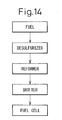
- a platinum electrode 104 as a reference electrode, is formed on the other side of the substrate 100, and a silver-containing electrode 106 is formed on the surface of the detecting electrode 102.
- the platinum electrode 104 and the silver-containing electrode 106 are connected to a voltmeter 112 via platinum wires 110 and 108.
- platinum 116 which is produced by the pyrolysis of a platinum compound, is present.
- the portion including the detecting electrode 102 of the sensor shown in Fig. 13 is inserted in a pipe 114, into which a flue gas stream is introduced, and the portion including the platinum electrode 104 is located outside the pipe 114.
- the senor shown in Fig. 13 can detect sulfur in an oxygen-containing gas stream, such as an exhaust gas stream from a flue of a boiler, it cannot detect sulfur in a substantially oxygen-free gas stream, such as sulfur in a gas stream processed in a reforming process for reforming a commercial fuel gas or gasoline to feed hydrogen gas to a fuel cell for domestic or automobile use.
- an oxygen-containing gas stream such as an exhaust gas stream from a flue of a boiler
- a substantially oxygen-free gas stream such as sulfur in a gas stream processed in a reforming process for reforming a commercial fuel gas or gasoline to feed hydrogen gas to a fuel cell for domestic or automobile use.
- a gasified fuel stream is fed to a desulfurizer to remove sulfur compounds therefrom, in order to remove the sulfur compounds contained in a gasoline which contains sulfur compounds originated from a crude oil, or a commercial fuel gas to which a sulfur compound is added to give it an unpleasant smell.
- the fuel gas stream, from which the sulfur compounds are removed is then hydrogenated in a reformer, and the hydrogen is passed through a shifter, in which contained CO is converted to CO 2 , and is fed to a fuel cell.
- a measuring means which can detect the sulfur in the fuel gas stream desulfurized in the desulfurizer, is provided between the desulfurizer and the reformer.
- a measuring means must be a measuring means capable of continuously detect sulfurous components in a substantially oxygen-free gas stream.
- the invention resides in a sulfur-detecting sensor for detecting a sulfurous component contained in a substantially oxygen-free gas stream, the sensor being characterized by comprising a solid electrolyte substrate through which oxygen ions can move, and electrodes for detecting a difference in potential induced by a electrochemical reaction of oxygen ions moving through the solid electrolyte substrate with a component constituting the gas stream, which electrodes for detecting a difference in potential include a detecting electrode formed on one side of the solid electrolyte substrate and brought into contact with the gas stream, and a reference electrode formed on the other side of the solid electrolyte substrate and brought into contact with an oxygen-containing fluid, the detecting electrode being formed from a transition metal having an enthalpy of formation of sulfide of not smaller than -250 kJ/mol at 25°C, or an oxide thereof.
- the detecting electrode by forming the detecting electrode from a transition metal having an enthalpy of formation of oxide of not smaller than -650 kJ/mol at 25°C, or an oxide thereof, the change in potential difference between the detecting electrode and the reference electrode caused by a reaction of the sulfurous component contained in the gas stream with the metal forming the detecting electrode can be definitely known in the case where the potential difference between the detecting electrode and the reference electrode is measured by a closed circuit, as described below.
- the detecting electrode from a metal selected from the group consisting of Rh, Ni, Cu, Ag, Sn and Zn, or an oxide thereof.
- the detecting electrode formed from such a metal prefferably contains platinum, which can accelerate the reaction rate in the detecting electrode.
- the reference electrode from a metal material containing platinum makes it easy to convert oxygen in the air to oxygen ions.
- a sintered body of yttria-stabilized zirconia, a sintered body of scandia-stabilized zirconia, a sintered body of ceria to which samaria is added, or a sintered body of scandia-stabilized zirconia to which ceria is added can be suitably used.
- the invention also resides in a sulfur-detecting device for detecting a sulfurous component contained in a substantially oxygen-free gas stream, characterized by comprising the aforementioned sulfur-detecting sensor, and further comprising a voltmeter for measuring a potential difference between the detecting electrode and the reference electrode of the sulfur-detecting sensor.
- the detecting electrode, the reference electrode and the voltmeter by using, as a circuit made of the solid electrolyte substrate, the detecting electrode, the reference electrode and the voltmeter, a closed circuit to which an electric current is supplied from a unit generating a constant current so that the current density at the detecting electrode is at a constant value, the amount of current between the detecting electrode and the reference electrode can be constant, and the change in potential difference between the detecting electrode and the reference electrode caused by a reaction of the sulfurous component contained in the gas stream with the metal forming the detecting electrode can be definitely known.
- an inexpensive sulfur-detecting device can be provided.
- a sulfurous component contained in a substantially oxygen-free gas stream can be detected.
- the sulfur-detecting device of the invention is provided with a solid electrolyte substrate through which oxygen ions are capable of moving, a detecting electrode formed on one side of the solid electrolyte substrate and brought into contact with a gas stream, and a reference electrode formed on the other side of the solid electrolyte substrate and brought into contact with an oxygen-containing fluid.
- a detecting electrode formed on one side of the solid electrolyte substrate and brought into contact with a gas stream
- a reference electrode formed on the other side of the solid electrolyte substrate and brought into contact with an oxygen-containing fluid.
- a sulfide or the like is readily formed in the detecting electrode, and inhibits the electrochemical reaction in the detecting electrode, resulting in the change in potential difference occurring between the detecting electrode and the reference electrode. Consequently, by measuring the amount of change in potential difference, the amount of sulfurous component in the gas stream can be measured.
- FIG. 1 shows an embodiment of the sulfur-detecting device of the invention.
- a sulfur-detecting sensor S constituting the sulfur-detecting device shown in Fig. 1 uses, as a solid electrolyte substrate 10 (sometimes simply called substrate 10 hereinafter), a sintered body of yttria-stabilized zirconia (YSZ) solid electrolyte material.
- a detecting electrode 12 is provided on one side of the substrate 10, and a reference electrode 14 made from platinum is provided on the other side of the substrate 10.
- Each of the detecting electrode 12 and the reference electrode 14 of the sulfur-detecting sensor S is connected with one end of each of platinum wires 16 and 18, and the other end of each of the platinum wires 16 and 18 is connected to a voltmeter 22 for measuring a potential difference between the detecting electrode 12 and the reference electrode 14.
- the wires 16 and 18 are supplied, in the midst thereof, with a current from a unit 31 generating a constant current, so as to make the current density in the detecting electrode 12 constant.
- the circuit made up of the substrate 10, the detecting electrode 12, the reference electrode 14, and the voltmeter 22 forms a closed circuit.
- the detecting electrode 12 in the sulfur-detecting sensor S shown in Fig. 1 is formed from a metal which easily reacts with a sulfurous component in a gas stream.
- the detecting electrode 12 is formed from a transition metal having an enthalpy of formation of sulfide at 25°C of not smaller than -250 kJ/mol (preferably not smaller than -210 kJ/mol, and particularly preferably not smaller than -206 kJ/mol), or an oxide thereof.
- the sulfur-detecting sensor S has a sensitivity, for a concentration of sulfurous component contained in a gas stream, which tends to be low.
- the transition metal for the detecting electrode may have an enthalpy of formation of sulfide at 25°C of not smaller than -250 kJ/mol and less than 0 kJ/mol, in general.
- the metal forming the detecting electrode 12 is a transition metal having an enthalpy of formation of oxide at 25°C of not smaller than -650 kJ/mol (preferably not smaller than -600 kJ/mol, and especially not smaller than -581 kJ/mol), or an oxide thereof.
- the metal forming the detecting electrode 12 may be a transition metal having an enthalpy of formation of oxide at 25°C of not smaller than -650 kJ/mol (preferably not smaller than -600 kJ/mol, and especially not smaller than -581 kJ/mol), or an oxide thereof.
- the transition metal may have an enthalpy of formation of oxide at 25°C of not smaller than -650 kJ/mol and less than 0 kJ/mol, in general.
- the metal for the formation of the detecting electrode 12 may be a metal selected from the group consisting of rhodium (Rh), nickel (Ni), copper (Cu), silver (Ag), Tin (Sn) and zinc (Zn), or an oxide thereof.
- the detecting electrode 12 formed from such a metal material may contain another metal which is chemically stable at an operating temperature and in an operating atmosphere of the sulfur-detecting sensor S shown in Fig. 1. Particularly, platinum can accelerate a reaction rate in the detecting electrode 12, which is preferred.
- YSZ yttia-stabilized zirconia
- Each of the detecting electrode 12 and the reference electrode 14 of the sulfur-detecting sensor S thus formed is connected to one end of each of wires 16 and 18 of platinum, and a voltmeter 22 is connected to the respective other ends of the wires 16 and 18.
- the wires 16 and 18 are connected, in the midst thereof, with a constant-current generating unit 31, which supplies an electrical current so as to make the current density in the detecting electrode 12 constant.
- the sulfur-detecting sensor S is installed into a pipe 30 through which a gas stream containing a sulfurous component flows in the direction of the arrow A, as shown in Fig. 1, in such a manner that the detecting electrode 12 is brought into contact with the gas stream containing a sulfurous component, and the reference electrode 14 is brought into contact with the air.
- an electromotive force is generated by an electrochemical reaction of the component of the gas stream diffused through the detecting electrode 12 with the oxygen ion (O 2- ) moving through the substrate 10, resulting in the occurrence of a potential difference between the detecting electrode 12 and the reference electrode 14.
- the resultant potential difference can be measured by the voltmeter 22.
- the sulfide or the like produced blocks the electrochemical reaction in the detecting electrode 12 of the component of the gas stream with the oxygen ion (O 2- ) moving through the substrate 10, to thereby increase the internal resistance of the sulfur-detecting sensor S, resulting in the change in potential difference generated between the detecting electrode 12 and the reference electrode 14. Accordingly, the concentration of sulfurous component in the gas stream can be determined by measuring the change in potential difference generated between the detecting electrode 12 and the reference electrode 14.
- the hydrogen of the hydrogen sulfide (H 2 S) diffused through the detecting electrode 12 reacts with oxygen ion (O 2- ) moving through the substrate 10 to yield sulfur, and the resultant sulfur is then adsorbed by the metal forming the detecting electrode 12, or reacts with the metal forming the detecting electrode 12 to form a sulfide.
- the sulfur adsorbed by the metal or the sulfide formed blocks the electrochemical reaction of hydrogen with oxygen ion (O 2- ) in the detecting electrode 12 to thereby lower the electromotive force, so that the potential difference between the detecting electrode 12 and the reference electrode 14 is lowered.
- the rate of electrochemical reaction in the detecting electrode 12 can be stabilized by supplying a current by the constant-current generating unit 31 provided in the midst of the loop of the wires 16, 18, in such a manner that the current density in the detecting electrode 12 is constant.
- the amount of current supplied is adjusted by the constant-current generating unit 31 in such a manner that the current density in the detecting electrode 12 is constant.
- the electrochemical reaction smoothly proceeds in the portions capable of contributing to the electrochemical reaction in the detecting electrode 12. Consequently, a potential difference can be stably created between the detecting electrode 12 and the reference electrode 14, depending on the portions (or areas) capable of contributing to the electrochemical reaction in the detecting electrode 12.
- the rate of electrochemical reaction in the detecting electrode 12 is stabilized by the provision of constant-current generating unit 31 in the sulfur-detecting device shown in Fig. 1.
- a sulfur-detecting device shown in Fig. 2 can be used.
- a substrate 12, a detecting electrode 12, a reference electrode 14, and a voltmeter 22 form an open circuit to which a current is not externally supplied.
- the sulfur-detecting device shown in Fig. 2 has a simple structure compared to the sulfur-detecting device shown in Fig. 1 having the constant-current generating unit 31 provided.
- metals used for the detecting electrode 12 of the sulfur-detecting sensor S for the sulfur-detecting devices shown in Figs. 1 and 2 metals, the formation of sulfide of which, or the adsorption of a sulfurous component to which, reaches equilibrium in a short time while the formed sulfide of which or the sulfurous component adsorbed to which is lost with a lapse of time, are suitable for applications in which momentary change in concentration of a sulfurous component in a gas stream is measured.
- such metals include rhodium (Rh) and nickel (Ni), and oxides thereof can be used.
- metals the formation of sulfide of which, or the adsorption of a sulfurous component to which, takes a long time until it reaches equilibrium while the formed sulfide of which or the sulfurous component adsorbed to which is hard to lose, are suitable for applications in which an accumulated amount of sulfurous component in a gas stream having passed over a detecting electrode made from the metal is measured.
- Such metals include copper (Cu) and zinc(Zn), and oxides thereof may be used.
- the detecting electrode 12 is formed from a metal which easily reacts with a sulfurous component.
- a gas stream contains a sulfurous component, a sulfide or the like is easily formed in the detecting electrode 12, and inhibits an electrochemical reaction in the detecting electrode 12, resulting in the change in potential difference occurring between the detecting electrode 12 and the reference electrode 14. Consequently, by measuring an amount of the change in potential difference, an amount of sulfurous component in a gas stream can be measured and, as a result, this makes it possible to measure an amount of sulfurous component in a gas stream in a substantially oxygen-free state, which could not measured by a conventional sulfur-detecting sensor.
- the sintered body of yttria-stabilized zirconia is used as the substrate 10
- it may be replaced with a sintered body of scandia-stabilized zirconia, a sintered body of ceria to which samaria is added, or a sintered body of scandia-stabilized zirconia to which ceria is added.
- a sulfur-detecting sensor S shown in Fig. 1 was made by applying a mixed paste of rhodium oxide and a platinum paste in a volume ratio of 1:2 to 1:3 on one side of a substrate 10 made from yttria-stabilized zirconia (YSZ) solid electrolyte material, applying a platinum paste on the other side of the substrate 10, and then firing the applied materials.
- the resultant sulfur-detecting sensor S had a substrate 10, one side of which a porous detecting electrode 12 of mixed rhodium oxide and platinum was formed, and the other side of which a porous reference electrode 14 of platinum was formed.
- a sulfur-detecting device as shown in Fig. 1 was then fabricated using the resultant sulfur-detecting sensor S.
- the detecting electrode 12 and the reference electrode 14 are connected with a voltmeter 22 through wires 16 and 18, respectively, and each of wires 16 and 18 is connected with a constant-current generating unit 31 in the midst thereof.
- the constant-current generating unit 31 supplies a current to a circuit consisting of the substrate 10, the detecting electrode 12, the reference electrode 14 and the voltmeter 22, in such a manner that the current density in the detecting electrode 12 is constant.
- the sulfur-detecting sensor S was installed to a pipe 30 as shown in Fig. 1, and was placed in an electric furnace (not shown) along with the pipe 30, while the voltmeter 22 and the constant-current generating unit 31 were outside the furnace.
- a stream of hydrogen gas (hydrogen gas concentration of 4% by volume, and nitrogen gas concentration of 96% by volume) was introduced in the pipe 30 in the direction of the arrow A to be passed over the detecting electrode 12, and air was passed over the reference electrode 14 outside the pipe 30, while the atmosphere in the furnace was heated to 600°C at which the substrate 10 develops ion conductivity.
- the constant-current generating unit 31 supplied a current to the circuit of the substrate 10, the detecting electrode 12, the reference electrode 14 and the voltmeter 22, so that the current density in the detecting electrode 12 was 1600 microamperes per square centimeter.
- the potential difference between the detecting electrode 12 and the reference electrode 14 measured by the voltmeter 22 under the above conditions was about -0.6 volt, as shown as a closed circuit voltage in Fig. 3.
- the sulfur-detecting sensor showing a characteristic represented in Fig. 3 is suitable for a sensor for measuring the change in H 2 S concentration in a hydrogen gas stream.
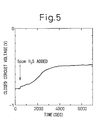
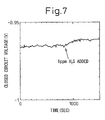
- Sulfur-detecting sensors were made in the same manner as in Example 1 except that the rhodium oxide in Example 1 was replaced with nickel oxide, copper, zinc oxide, tin oxide and silver, respectively.
- Table 1 summarizes enthalpies of formation of sulfide at 25°C and enthalpies of formation of oxide at 25°C of these metals.
- a concentration of H 2 S contained in the stream of hydrogen was 5 ppm or 1 ppm.
- Figs. 4 to 8 specify the concentrations of H 2 S used.
- the sulfur-detecting sensor showing the characteristic represented in Fig. 4 is suitable for a sensor for measuring the change in H2S concentration in a hydrogen gas stream, as is the sulfur-detecting sensor showing the characteristic represented in Fig. 3.
- the sulfur-detecting sensors showing the characteristics represented in Figs. 5 to 8 are suitable for a sensor for measuring the accumulated amount of H 2 S in a stream of hydrogen gas having passed over the sensor.
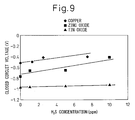
- the results are shown in Fig. 9.
- the values of potential difference between the detecting electrode and the reference electrode (closed circuit voltage) shown in Fig. 9 were obtained 10 minutes after the initiation of introduction of H 2 S in the hydrogen gas stream.
- sulfur-detecting sensors S similar to that of Example 1, sulfur-detecting devices as shown in Fig. 2 were fabricated.
- the detecting electrodes were made from, in addition to platinum, rhodium oxide, zinc oxide, and tin oxide, respectively.
- the detecting electrode 12 and the reference electrode 14 of the sulfur-detecting sensor S were connected with a voltmeter 22 through wires 16 and 18 of platinum, respectively, and a constant-current generating unit 31 was not provided.
- the sulfur-detecting sensor S was installed into a pipe 30 as shown in Fig. 2, and was placed in an electric furnace (not shown) along with the pipe 30.
- a stream of hydrogen gas (hydrogen gas concentration of 4% by volume, and nitrogen gas concentration of 96% by volume) was introduced in the pipe 30 in the direction of the arrow A to be passed over the detecting electrode 12, and air was passed over the reference electrode 14 outside the pipe 30, while the atmosphere in the furnace was heated to 600°C at which the substrate 10 develops ion conductivity.
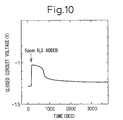
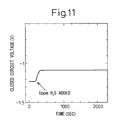
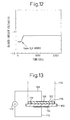
- Figs. 10 to 12 show open circuit voltages measured as the potential differences between the detecting electrode 12 and the reference electrode 14 by the voltmeter 22 under the above conditions.
- the data in Figs. 10 to 12 were obtained from the sensors having the detecting electrodes of platinum and rhodium oxide, platinum and zinc oxide, and platinum and tin oxide, respectively.
- the open circuit voltage was dramatically decreased (the potential difference was decreased) with the introduction of H2S to the hydrogen gas stream, but was gradually restored after a lapse of a certain time while the introduction of H 2 S to the hydrogen gas stream was continued. It is inferred that, in the sulfur-detecting sensor, the measured result of which is shown in Fig. 10, although a sulfide or the like rapidly occurred in the detecting electrode 12 with the introduction of H 2 S in the hydrogen gas stream, the resultant sulfide or the like was rapidly lost after a lapse of a certain time, resulting in the gradual restoration of the electrochemical reaction of hydrogen with oxygen ion (O 2- ).
- the sulfur-detecting sensor is suitable for a sensor for measuring the change in concentration of H 2 S in a stream of hydrogen gas.
- the open circuit voltage was gradually increased (the potential difference was decreased) with the introduction of H 2 S to the hydrogen gas stream, as shown in Fig. 11 or 12. It is inferred that this was caused by the occurrence of a sulfide or the like in the detecting electrode taking a long time to reach equilibrium and the occurred sulfide or the like being hard to lose.
- the sulfur-detecting sensors the measured results of which are shown in Figs. 11 and 12, is suitable for applications in which an accumulated amount of H 2 S in a hydrogen gas stream having passed over the sensor is measured.
- the sulfur-detecting sensor and the sulfur-detecting device of the invention can make it possible to measure an amount of sulfurous component in a substantially oxygen-free gas stream, which could not be measured by a prior sulfur-detecting sensor.
- an amount of sulfurous component in a gas stream can be accumulatively measured in a process for reforming gasoline or the like to produce a hydrogen gas stream to be fed to a fuel cell.
- the sulfur-detecting sensor and the sulfur-detecting device of the invention are compact, and can be employed in a reforming process for a fuel cell for domestic or automobile use.
Landscapes
- Chemical & Material Sciences (AREA)
- Life Sciences & Earth Sciences (AREA)
- Health & Medical Sciences (AREA)
- Physics & Mathematics (AREA)
- Chemical Kinetics & Catalysis (AREA)
- Electrochemistry (AREA)
- Molecular Biology (AREA)
- Analytical Chemistry (AREA)
- Biochemistry (AREA)
- General Health & Medical Sciences (AREA)
- General Physics & Mathematics (AREA)
- Immunology (AREA)
- Pathology (AREA)
- Measuring Oxygen Concentration In Cells (AREA)
Abstract
Description
| Sulfide Formation | Oxide Formation | Current Density | |
| Metals | Enthalpies (kJ/mol) | Enthalpies (kJ/mol) | (µA/cm2) |
| Nickel | -82 (NiS) | -240 (NiO) | 350 |
| Copper | -53 (CuS) | -169 (Cu2O) | 350 |
| Silver | -33 (Ag2S) | -31 (Ag2O) | 350 |
| Zinc | -206 (ZnS) | -348 (ZnO) | 3.5 |
| Tin | -100 (SnS) | -581 (SnO2) | 180 |
Claims (14)
- A sulfur-detecting sensor for detecting a sulfurous component contained in a substantially oxygen-free gas stream, the sensor comprising a solid electrolyte substrate through which oxygen ions can move, and electrodes for detecting a difference in potential induced by a electrochemical reaction of oxygen ion moving through the solid electrolyte substrate with a component constituting the gas stream, which electrodes for detecting a difference in potential include a detecting electrode formed on one side of the solid electrolyte substrate and brought into contact with the gas stream, and a reference electrode formed on the other side of the solid electrolyte substrate and brought into contact with an oxygen-containing fluid, the detecting electrode being formed from a transition metal having an enthalpy of formation of sulfide of not smaller than -250 kJ/mol at 25°C, or an oxide thereof.
- The sulfur-detecting sensor of claim 1, wherein the detecting electrode is formed from a transition metal having an enthalpy of formation of oxide of not smaller than -650 kJ/mol at 25°C, or an oxide thereof.
- The sulfur-detecting sensor of claim 1 or 2, wherein the detecting electrode is formed from a metal selected from the group consisting of Rh, Ni, Cu, Ag, Sn and Zn, or an oxide thereof.
- The sulfur-detecting sensor of any of the preceding claims wherein the detecting electrode contains platinum.
- The sulfur-detecting sensor of any of the preceding claims, wherein the reference electrode contains platinum.
- The sulfur-detecting sensor of any of the preceding claims, wherein the solid electrolyte substrate is a sintered body of yttria-stabilized zirconia, a sintered body of scandia-stabilized zirconia, a sintered body of ceria to which samaria is added, or a sintered body of scandia-stabilized zirconia to which ceria is added.
- A sulfur-detecting device for detecting a sulfurous component contained in a substantially oxygen-free gas stream, the device comprising a sulfur-detecting sensor, which comprises a solid electrolyte substrate through which oxygen ions can move, and electrodes for detecting a difference in potential induced by a electrochemical reaction of oxygen ions moving through the solid electrolyte substrate with a component constituting the gas stream, the electrodes for detecting a difference in potential including a detecting electrode formed on one side of the solid electrolyte substrate and brought into contact with the gas stream, and a reference electrode formed on the other side of the solid electrolyte substrate and brought into contact with an oxygen-containing fluid, the detecting electrode being formed from a transition metal having an enthalpy of formation of sulfide of not smaller than -250 kJ/mol at 25°C, or an oxide thereof, and the device further comprising a voltmeter for measuring a potential difference between the detecting electrode and the reference electrode of the sulfur-detecting sensor.
- The sulfur-detecting device of claim 7, which further comprises a constant-current generating unit connected with a closed circuit formed of the solid electrolyte substrate, the detecting electrode, the reference electrode and the voltmeter, the constant-current generating unit supplying a current to the circuit so that the current density in the detecting electrode is constant.
- The sulfur-detecting device of claim 7 or 8, wherein the solid electrolyte substrate, the detecting electrode, the reference electrode and the voltmeter form an open circuit to which a current is not externally supplied.
- The sulfur-detecting device of one of claims 7 to 9, wherein the detecting electrode is formed from a transition metal having an enthalpy of formation of oxide of not smaller than -650 kJ/mol at 25°C, or an oxide thereof.
- The sulfur-detecting device of one of claims 7 to 10, wherein the detecting electrode is formed from a metal selected from the group consisting of Rh, Ni, Cu, Ag, Sn and Zn, or an oxide thereof.
- The sulfur-detecting device of one of claims 7 to 11, wherein the detecting electrode contains platinum.
- The sulfur-detecting device of one of claims 7 to 12, wherein the reference electrode contains platinum.
- The sulfur-detecting device of one of claims 7 to 13, wherein the solid electrolyte substrate is a sintered body of yttria-stabilized zirconia, a sintered body of scandia-stabilized zirconia, a sintered body of ceria to which samaria is added, or a sintered body of scandia-stabilized zirconia to which ceria is added.
Applications Claiming Priority (2)
| Application Number | Priority Date | Filing Date | Title |
|---|---|---|---|
| JP2002152939 | 2002-05-27 | ||
| JP2002152939 | 2002-05-27 |
Publications (3)
| Publication Number | Publication Date |
|---|---|
| EP1367387A2 true EP1367387A2 (en) | 2003-12-03 |
| EP1367387A3 EP1367387A3 (en) | 2006-01-18 |
| EP1367387B1 EP1367387B1 (en) | 2014-11-12 |
Family
ID=29417157
Family Applications (1)
| Application Number | Title | Priority Date | Filing Date |
|---|---|---|---|
| EP03011890.5A Expired - Lifetime EP1367387B1 (en) | 2002-05-27 | 2003-05-27 | Solid electrolyte sensor for detecting a sulfurous component in a gas stream |
Country Status (3)
| Country | Link |
|---|---|
| US (1) | US20030217922A1 (en) |
| EP (1) | EP1367387B1 (en) |
| CA (1) | CA2429977A1 (en) |
Families Citing this family (11)
| Publication number | Priority date | Publication date | Assignee | Title |
|---|---|---|---|---|
| EP1707951A1 (en) * | 2005-03-31 | 2006-10-04 | Micronas GmbH | Gas-sensitive field effect transistor for detecting hydrogen sulphide |
| JP2007093572A (en) * | 2005-08-29 | 2007-04-12 | Shinko Electric Ind Co Ltd | Solid electrolyte gas sensor |
| JP2009519470A (en) * | 2005-12-12 | 2009-05-14 | ネクステック、マテリアルズ、リミテッド | Ceramic H2S sensor |
| US8742775B2 (en) * | 2009-07-17 | 2014-06-03 | Caterpillar Inc. | Zinc oxide sulfur sensor |
| US8653839B2 (en) * | 2009-07-17 | 2014-02-18 | Caterpillar Inc. | Zinc oxide sulfur sensors and method of using said sensors |
| US8638111B2 (en) * | 2010-06-17 | 2014-01-28 | Caterpillar Inc. | Zinc oxide sulfur sensor measurement system |
| US9097661B2 (en) * | 2011-01-27 | 2015-08-04 | Caterpillar, Inc. | Electrochemical sulfur sensor and the method of making the same |
| US8840775B2 (en) * | 2011-12-16 | 2014-09-23 | Utc Fire & Security Corporation | Regenerative gas sensor |
| WO2013109588A1 (en) * | 2012-01-20 | 2013-07-25 | Caterpillar Inc. | Zinc oxide sulfur sensors and methods of manufacture thereof |
| WO2013109840A1 (en) * | 2012-01-20 | 2013-07-25 | Caterpillar Inc. | Zinc oxide sulfur sensor measurement system |
| JP7185541B2 (en) * | 2019-01-24 | 2022-12-07 | Koa株式会社 | Sulfurization detection resistor |
Family Cites Families (11)
| Publication number | Priority date | Publication date | Assignee | Title |
|---|---|---|---|---|
| US3622488A (en) * | 1968-09-09 | 1971-11-23 | Dynasciences Corp | Apparatus for measuring sulfur dioxide concentrations |
| GB2094005B (en) * | 1981-02-03 | 1985-05-30 | Coal Industry Patents Ltd | Electrochemical gas sensor |
| DD206232A1 (en) * | 1981-12-11 | 1984-01-18 | Adw Ddr | DEVICE FOR THE CONTINUOUS TRACE DETERMINATION OF HYDROGEN AND HYDROGEN-SAFE POLLUTION IN THE AIR |
| JP2938514B2 (en) * | 1990-04-25 | 1999-08-23 | 三菱電機株式会社 | Gas sensor |
| US5429727A (en) * | 1993-09-30 | 1995-07-04 | Arch Development Corporation | Electrocatalytic cermet gas detector/sensor |
| JP3541968B2 (en) * | 1994-08-30 | 2004-07-14 | フィガロ技研株式会社 | Hydrogen sulfide gas sensor |
| DE69735302T8 (en) * | 1996-09-17 | 2007-03-01 | Kabushiki Kaisha Riken | GAS SENSOR |
| JP3874947B2 (en) * | 1997-12-01 | 2007-01-31 | 日本碍子株式会社 | Sulfur dioxide gas sensor |
| JP3823520B2 (en) * | 1998-03-11 | 2006-09-20 | 日産化学工業株式会社 | Anhydrous zinc antimonate semiconductor gas sensor and method for manufacturing the same |
| JP3560316B2 (en) * | 1998-11-25 | 2004-09-02 | 日本特殊陶業株式会社 | Gas sensor, method of manufacturing the same, and gas sensor system |
| JP3686282B2 (en) * | 1999-05-21 | 2005-08-24 | 田中貴金属工業株式会社 | Sulfide oxidation catalyst body and sulfide concentration measuring device using the catalyst body |
-
2003
- 2003-05-26 CA CA002429977A patent/CA2429977A1/en not_active Abandoned
- 2003-05-27 EP EP03011890.5A patent/EP1367387B1/en not_active Expired - Lifetime
- 2003-05-27 US US10/445,020 patent/US20030217922A1/en not_active Abandoned
Also Published As
| Publication number | Publication date |
|---|---|
| US20030217922A1 (en) | 2003-11-27 |
| EP1367387B1 (en) | 2014-11-12 |
| EP1367387A3 (en) | 2006-01-18 |
| CA2429977A1 (en) | 2003-11-27 |
Similar Documents
| Publication | Publication Date | Title |
|---|---|---|
| Yamazoe et al. | Effects of additives on semiconductor gas sensors | |
| Tamaki et al. | CuO-SnO2 element for highly sensitive and selective detection of H2S | |
| Lee et al. | The stability, sensitivity and response transients of ZnO, SnO2 and WO3 sensors under acetone, toluene and H2S environments | |
| EP1367387B1 (en) | Solid electrolyte sensor for detecting a sulfurous component in a gas stream | |
| US6051123A (en) | Multi-functional and NOx sensor for combustion systems | |
| US20130233728A1 (en) | Amperometric electrochemical sensors, sensor systems and detection methods | |
| Wang et al. | Effect of strontium concentration on sulfur poisoning of LSCF cathodes | |
| US9666871B2 (en) | Sulfur tolerant anode for solid oxide fuel cell | |
| JP2011513735A (en) | Amperometric electrochemical cells and sensors | |
| US12222311B2 (en) | Selective real-time gas sensing | |
| CN107709228A (en) | NOx gas sensor | |
| US20080006531A1 (en) | Ceramic H2S sensor | |
| RU2464554C1 (en) | Gas sensor for detecting nitrogen and carbon oxides | |
| Hyodo et al. | Potentiometric carbon monoxide sensors using an anion-conducting polymer electrolyte and Au-loaded SnO2 electrodes | |
| US6423209B1 (en) | Acid gas measuring sensors and method of using same | |
| Azad et al. | Behavior of a new ZrO2‐MoO3 sensor for carbon monoxide detection | |
| Yamamoto et al. | The effect of reducing gases on the conductivities of metal oxide semiconductors | |
| JP2017517838A (en) | Sulfur management and utilization in molten metal anode solid oxide fuel cells. | |
| WO1997042495A1 (en) | Solid state electrochemical cell for measuring components of a gas mixture, and related measurement method | |
| Yan et al. | Potentiometric Sensor Using Stabilized Zirconia and Tungsten Oxide for Hydrogen Sulfide. | |
| Xiong et al. | High-selectivity mixed-potential NO2 sensor incorporating Au and CuO+ CuCr2O4 electrode couple | |
| JP4231733B2 (en) | Sulfur detection sensor and sulfur detection device | |
| Wiemhöfer et al. | Fundamentals and principles of potentiometric gas sensors based upon solid electrolytes | |
| Sathe et al. | Highly sensitive nanostructured platinum electrocatalysts for CO oxidation: Implications for CO sensing and fuel cell performance | |
| JP3541968B2 (en) | Hydrogen sulfide gas sensor |
Legal Events
| Date | Code | Title | Description |
|---|---|---|---|
| PUAI | Public reference made under article 153(3) epc to a published international application that has entered the european phase |
Free format text: ORIGINAL CODE: 0009012 |
|
| AK | Designated contracting states |
Kind code of ref document: A2 Designated state(s): AT BE BG CH CY CZ DE DK EE ES FI FR GB GR HU IE IT LI LU MC NL PT RO SE SI SK TR |
|
| AX | Request for extension of the european patent |
Extension state: AL LT LV MK |
|
| PUAL | Search report despatched |
Free format text: ORIGINAL CODE: 0009013 |
|
| RIC1 | Information provided on ipc code assigned before grant |
Ipc: G01N 27/407 19900101AFI20030903BHEP Ipc: G01N 27/403 19900101ALI20051121BHEP |
|
| AK | Designated contracting states |
Kind code of ref document: A3 Designated state(s): AT BE BG CH CY CZ DE DK EE ES FI FR GB GR HU IE IT LI LU MC NL PT RO SE SI SK TR |
|
| AX | Request for extension of the european patent |
Extension state: AL LT LV MK |
|
| 17P | Request for examination filed |
Effective date: 20060606 |
|
| AKX | Designation fees paid |
Designated state(s): DE FR GB |
|
| 17Q | First examination report despatched |
Effective date: 20080311 |
|
| GRAP | Despatch of communication of intention to grant a patent |
Free format text: ORIGINAL CODE: EPIDOSNIGR1 |
|
| INTG | Intention to grant announced |
Effective date: 20140701 |
|
| RIN1 | Information on inventor provided before grant (corrected) |
Inventor name: WATANABE, MISA Inventor name: SUGANUMA, SHIGEAKI Inventor name: HORIUCHI, MICHIO |
|
| GRAS | Grant fee paid |
Free format text: ORIGINAL CODE: EPIDOSNIGR3 |
|
| GRAA | (expected) grant |
Free format text: ORIGINAL CODE: 0009210 |
|
| AK | Designated contracting states |
Kind code of ref document: B1 Designated state(s): DE FR GB |
|
| REG | Reference to a national code |
Ref country code: GB Ref legal event code: FG4D |
|
| REG | Reference to a national code |
Ref country code: DE Ref legal event code: R096 Ref document number: 60346972 Country of ref document: DE Effective date: 20141224 |
|
| REG | Reference to a national code |
Ref country code: DE Ref legal event code: R097 Ref document number: 60346972 Country of ref document: DE |
|
| PLBE | No opposition filed within time limit |
Free format text: ORIGINAL CODE: 0009261 |
|
| STAA | Information on the status of an ep patent application or granted ep patent |
Free format text: STATUS: NO OPPOSITION FILED WITHIN TIME LIMIT |
|
| 26N | No opposition filed |
Effective date: 20150813 |
|
| GBPC | Gb: european patent ceased through non-payment of renewal fee |
Effective date: 20150527 |
|
| REG | Reference to a national code |
Ref country code: FR Ref legal event code: ST Effective date: 20160129 |
|
| PG25 | Lapsed in a contracting state [announced via postgrant information from national office to epo] |
Ref country code: GB Free format text: LAPSE BECAUSE OF NON-PAYMENT OF DUE FEES Effective date: 20150527 |
|
| PG25 | Lapsed in a contracting state [announced via postgrant information from national office to epo] |
Ref country code: FR Free format text: LAPSE BECAUSE OF NON-PAYMENT OF DUE FEES Effective date: 20150601 |
|
| PGFP | Annual fee paid to national office [announced via postgrant information from national office to epo] |
Ref country code: DE Payment date: 20200512 Year of fee payment: 18 |
|
| REG | Reference to a national code |
Ref country code: DE Ref legal event code: R119 Ref document number: 60346972 Country of ref document: DE |
|
| PG25 | Lapsed in a contracting state [announced via postgrant information from national office to epo] |
Ref country code: DE Free format text: LAPSE BECAUSE OF NON-PAYMENT OF DUE FEES Effective date: 20211201 |