EP1366897A1 - Method of shaping a deformable material in an envelope - Google Patents
Method of shaping a deformable material in an envelope Download PDFInfo
- Publication number
- EP1366897A1 EP1366897A1 EP03076640A EP03076640A EP1366897A1 EP 1366897 A1 EP1366897 A1 EP 1366897A1 EP 03076640 A EP03076640 A EP 03076640A EP 03076640 A EP03076640 A EP 03076640A EP 1366897 A1 EP1366897 A1 EP 1366897A1
- Authority
- EP
- European Patent Office
- Prior art keywords
- temperature
- envelope
- shaping
- portions
- arranging
- Prior art date
- Legal status (The legal status is an assumption and is not a legal conclusion. Google has not performed a legal analysis and makes no representation as to the accuracy of the status listed.)
- Granted
Links
Images



Classifications
-
- A—HUMAN NECESSITIES
- A23—FOODS OR FOODSTUFFS; TREATMENT THEREOF, NOT COVERED BY OTHER CLASSES
- A23G—COCOA; COCOA PRODUCTS, e.g. CHOCOLATE; SUBSTITUTES FOR COCOA OR COCOA PRODUCTS; CONFECTIONERY; CHEWING GUM; ICE-CREAM; PREPARATION THEREOF
- A23G3/00—Sweetmeats; Confectionery; Marzipan; Coated or filled products
- A23G3/34—Sweetmeats, confectionery or marzipan; Processes for the preparation thereof
- A23G3/50—Sweetmeats, confectionery or marzipan; Processes for the preparation thereof characterised by shape, structure or physical form, e.g. products with supported structure
-
- A—HUMAN NECESSITIES
- A23—FOODS OR FOODSTUFFS; TREATMENT THEREOF, NOT COVERED BY OTHER CLASSES
- A23G—COCOA; COCOA PRODUCTS, e.g. CHOCOLATE; SUBSTITUTES FOR COCOA OR COCOA PRODUCTS; CONFECTIONERY; CHEWING GUM; ICE-CREAM; PREPARATION THEREOF
- A23G3/00—Sweetmeats; Confectionery; Marzipan; Coated or filled products
- A23G3/0002—Processes of manufacture not relating to composition and compounding ingredients
- A23G3/0004—Processes specially adapted for manufacture or treatment of sweetmeats or confectionery
- A23G3/0019—Shaping of liquid, paste, powder; Manufacture of moulded articles, e.g. modelling, moulding, calendering
- A23G3/0025—Processes in which the material is shaped at least partially in a mould in the hollows of a surface, a drum, an endless band, or by a drop-by-drop casting or dispensing of the material on a surface, e.g. injection moulding, transfer moulding
-
- A—HUMAN NECESSITIES
- A23—FOODS OR FOODSTUFFS; TREATMENT THEREOF, NOT COVERED BY OTHER CLASSES
- A23G—COCOA; COCOA PRODUCTS, e.g. CHOCOLATE; SUBSTITUTES FOR COCOA OR COCOA PRODUCTS; CONFECTIONERY; CHEWING GUM; ICE-CREAM; PREPARATION THEREOF
- A23G9/00—Frozen sweets, e.g. ice confectionery, ice-cream; Mixtures therefor
- A23G9/04—Production of frozen sweets, e.g. ice-cream
- A23G9/22—Details, component parts or accessories of apparatus insofar as not peculiar to a single one of the preceding groups
- A23G9/221—Moulds
-
- A—HUMAN NECESSITIES
- A23—FOODS OR FOODSTUFFS; TREATMENT THEREOF, NOT COVERED BY OTHER CLASSES
- A23G—COCOA; COCOA PRODUCTS, e.g. CHOCOLATE; SUBSTITUTES FOR COCOA OR COCOA PRODUCTS; CONFECTIONERY; CHEWING GUM; ICE-CREAM; PREPARATION THEREOF
- A23G9/00—Frozen sweets, e.g. ice confectionery, ice-cream; Mixtures therefor
- A23G9/44—Frozen sweets, e.g. ice confectionery, ice-cream; Mixtures therefor characterised by shape, structure or physical form
-
- A—HUMAN NECESSITIES
- A23—FOODS OR FOODSTUFFS; TREATMENT THEREOF, NOT COVERED BY OTHER CLASSES
- A23P—SHAPING OR WORKING OF FOODSTUFFS, NOT FULLY COVERED BY A SINGLE OTHER SUBCLASS
- A23P30/00—Shaping or working of foodstuffs characterised by the process or apparatus
- A23P30/10—Moulding
Definitions
- the present invention relates to a method for shaping a deformable material, which comprises the following steps of:
- ZAT zero adhesion technology
- the invention has for its object to propose an alternative method whereby the above stated problems are obviated and with which shaped end products are obtained which have a surface which is not damaged.
- the method according to the present invention for shaping a deformable material is distinguished in that the second temperature is lower than a determined temperature which lies in a range round the glass transition temperature, at which second temperature the envelope can be peeled from the material.
- the great advantage of this method is that when the material is at the second temperature the envelope can be easily removed without the surface of the shaped product being damaged.
- the glass transition temperature is the temperature at which the material passes into the glass phase.
- a glass is a solid which is not in equilibrium and is metastable, amorphous and disordered with an extremely high viscosity, which also depends on the temperature and the material composition.
- the transition to the glass phase involves a decreased molecular movement, whereby there is an enormous decrease in the translation mobility.
- the envelope In the glass phase of the shaped material the envelope can thus be removed the surface of the material without danger of damage.
- the extremely high viscosity of the material in the glass phase ensures that no surface particles of the formed whole remain adhered to the foil.
- Figure 4 shows schematically a phase diagram, wherein the X-axis represents the percentage of solid in the solution and the Y-axis represents the temperature.
- the glass transition curve GC shows the glass transition temperature as a function of the concentration
- the freezing curve VC shows the solidification temperature, again as a function of the concentration.
- the solution In the region below the glass transition curve GC the solution is in the glass phase GF, possibly with the presence of ice. Above GC the solution is in the liquid phase VF, with ice being present under the freezing curve.
- the second temperature may be higher than the glass transition temperature of the material, without the surface of the shaped portion being damaged when the envelope is removed.
- the second temperature will generally be chosen between the solidification temperature and the glass transition temperature, and such that the envelope can be peeled from the material without damage.
- the second temperature was measured immediately prior to the envelope being peeled off, and at a determined depth in the material. During cooling the surface layer was at or below the glass transition temperature and the throughput times will therefore also play a part in determining the parameters influencing the second temperature.
- the temperature at which the material for shaping is sufficiently hard, so that the envelope can be removed without damaging the surface will usually be determined empirically in practice.
- the solidification temperature follows a path running from -8 to - 12°C and the glass transition temperature Tg 2 is -40°C. It was determined empirically that the method according to the invention is possible at a temperature of -28°C.
- the first temperature is just the ambient temperature.
- the deformable material in the preferred embodiment is often a foodstuff such as marzipan or dairy products.
- Shaping in the preferred method of the invention takes place by compressing the material and the thin envelope. These are for instance pressed between a two-part mould, whereby the whole takes on the shape of the mould.
- the arranging of the envelope around the portions of material takes place by arranging the portions of material between two foils.
- the invention likewise relates to a device for shaping a deformable material, wherein the device is provided with
- the means for arranging the envelope around the portions comprise a supply roll for a lower foil and a supply roll for an upper foil.
- the peeling means preferably further comprise a roll-up system for the lower and upper foil.
- the portions can first be enveloped by the upper and lower foil from the supply rolls, whereupon the portions are deformed and the lower and upper foil are removed by the foil roll-up system.
- the shaping means consist of a multi-part mould in which is placed the envelope in which the material is received, whereafter the different parts of the mould are compressed in order to bring the product into shape.
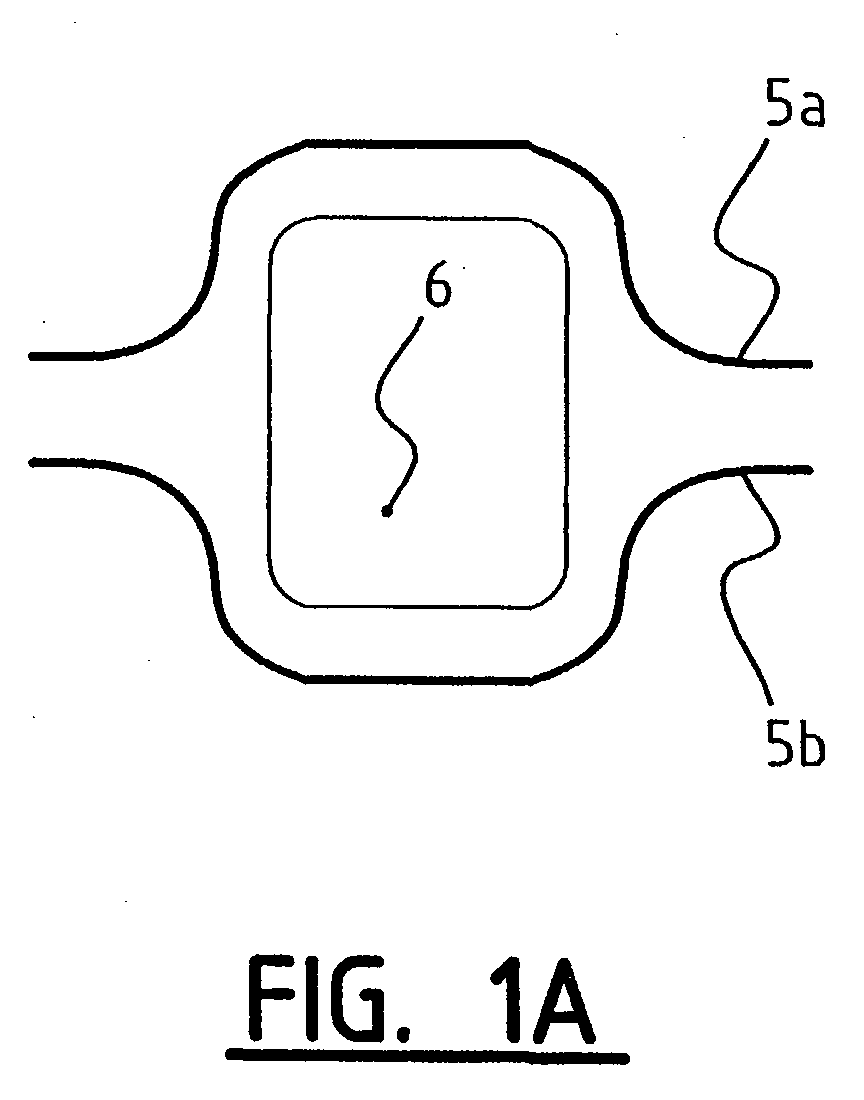
- an envelope 5a, 5b is arranged around the portion of material for deforming 6. This envelope 5a, 5b is sufficiently large to be able to cover the entire surface of the interior of the mould.
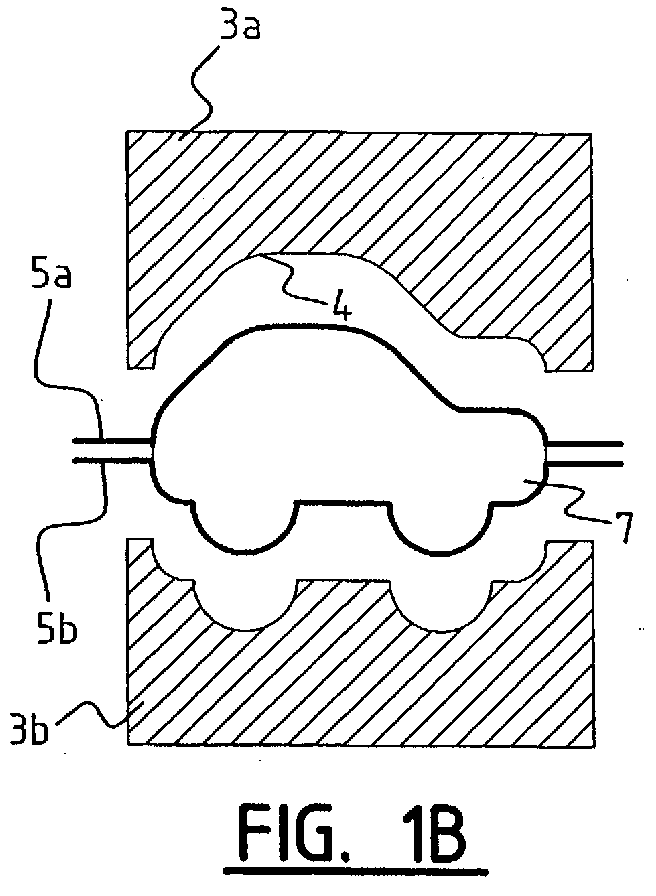
- step 2 the material 6 enclosed by envelope 5a, 5b is compressed between a two-part mould 3a, 3b, wherein envelope 5a, 5b comes to adhere to the material 6 but not to the inner wall 4 of the mould.
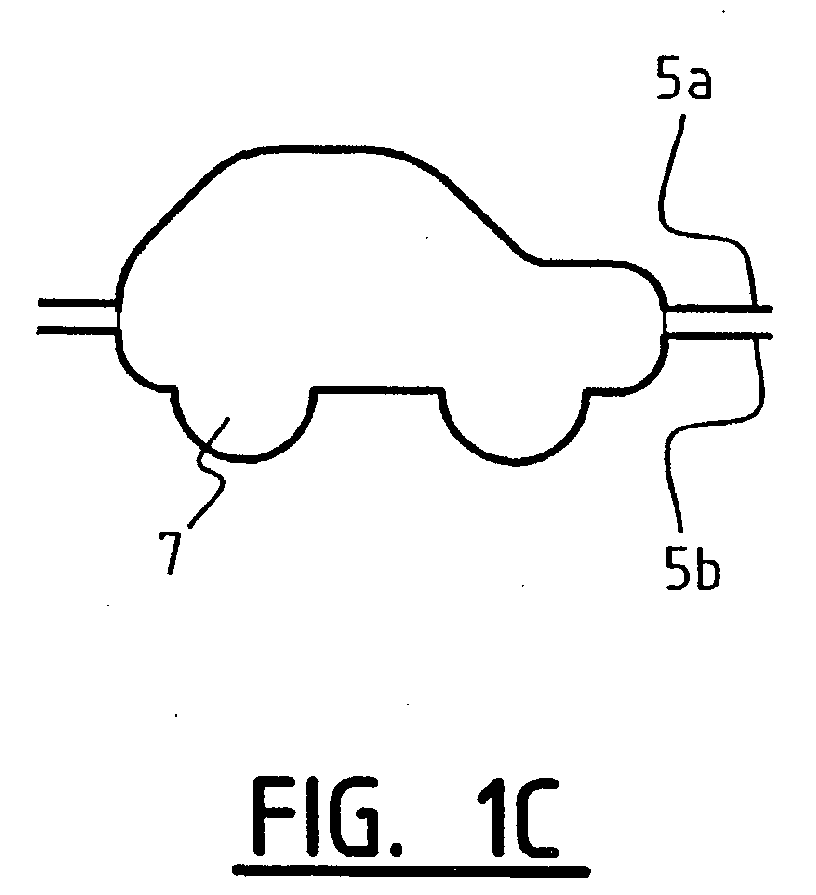
- step 3 of figure 1 the portion 7 enclosed and shaped by envelope 5a, 5b is cooled to a temperature which is sufficiently low to avoid damaging the shaped surface of the material, but which lies above the glass transition temperature of the product and which for this application for instance amounts to -55°C.
- envelope 5a, 5b is removed in step 4 of figure 1.
- Figure 2 shows the preferred embodiment of the device according to the invention.
- the portions of material for deforming are supplied by supply means 1 on a surface 13 in an environment at a first temperature.
- the envelope consists of an upper and lower foil 5a, 5b, which are unrolled from upper and lower supply rolls 2a, 2b using guide rollers in order to envelope the supplied portions 6. This is shown in detail in figure 3.
- the shaping means comprise a mould in two parts 3a, 3b, which are moved together using a compressed air cylinder 4.
- Figure 2 shows how the shaped, enveloped portions 7 are carried through a space 11 in which a second temperature is set lower than the first temperature.
- this freezing tunnel 12 the shaped, enveloped portions 7 are sufficiently cooled to peel off the envelope without damaging the surface.
- the peeling means comprise a roll-up system 9a, 9b consisting of an upper and lower roll for rolling up respectively the upper and lower foil, and at least one upper and lower guide roller 14a, 14b. After removal of these foils, the formed products 8 are discharged.
- the invention is not limited to the above described embodiments or those illustrated in the drawing.
- the envelope can thus be arranged in many different ways.
- the envelope could for instance first be placed in the mould and the material then arranged therein, wherein the material, if it is a reasonably viscous material, can optionally be cast or injected.
Landscapes
- Engineering & Computer Science (AREA)
- Life Sciences & Earth Sciences (AREA)
- Chemical & Material Sciences (AREA)
- Food Science & Technology (AREA)
- Polymers & Plastics (AREA)
- Manufacturing & Machinery (AREA)
- Confectionery (AREA)
- Dairy Products (AREA)
- Formation And Processing Of Food Products (AREA)
Abstract
- arranging a thin envelope around a portion of the material for deforming,
- bringing into shape the whole of the portion of material and envelope at a first temperature, at which temperature the material is deformable and adheres to the envelope,
- bringing the whole to a second temperature, at which temperature the envelope can be peeled off the material,
- peeling off the envelope.
Description
- The present invention relates to a method for shaping a deformable material, which comprises the following steps of:
- arranging a thin envelope around a portion of the material for deforming,
- bringing into shape the whole of the portion of material and envelope at a first temperature, at which temperature the material is deformable and adheres to the envelope,
- bringing to a second temperature at least one surface layer of the whole,
- peeling off the envelope.
- Such a method is known from the patent WO 93/25098. This document describes a method of shaping pasty foodstuffs, wherein the foodstuff is arranged between two foils and then placed in a two-part mould. After the shaping in the mould, the foodstuff is cooled to the solidification or curing temperature, whereafter the foils are removed. This method has the drawback that at this temperature of the foodstuffs (for instance butter or ice cream) they still adhere to the foil, and that when the foil is removed the surface of the shaped product is damaged.
- According to another technique use is made in shaping a determined material of one or more moulds in which a portion of material is arranged. During the removal from the mould the problem is often encountered that particles of the material remain adhered to the wall, whereby the shape is not perfect. Envisaged here for instance is butter or ice cream, which tend to stick in the mould partly due to adhesion with the wall.
- The known zero adhesion technology (ZAT) is applied in some cases to obviate this problem. This results in a method wherein the moulds are for instance pre-filled with LIN (cryogenic liquid nitrogen), whereby the contact surface between the material and the mould is brought to an extremely low temperature and the product is easily released from the mould.
- Such a method has the drawback that operations must take place at extremely low temperatures and that the products required for this purpose are relatively expensive.
- The invention has for its object to propose an alternative method whereby the above stated problems are obviated and with which shaped end products are obtained which have a surface which is not damaged. The method according to the present invention for shaping a deformable material is distinguished in that the second temperature is lower than a determined temperature which lies in a range round the glass transition temperature, at which second temperature the envelope can be peeled from the material.
- The great advantage of this method is that when the material is at the second temperature the envelope can be easily removed without the surface of the shaped product being damaged.
- The glass transition temperature is the temperature at which the material passes into the glass phase. A glass is a solid which is not in equilibrium and is metastable, amorphous and disordered with an extremely high viscosity, which also depends on the temperature and the material composition. The transition to the glass phase involves a decreased molecular movement, whereby there is an enormous decrease in the translation mobility.
- In the glass phase of the shaped material the envelope can thus be removed the surface of the material without danger of damage. The extremely high viscosity of the material in the glass phase ensures that no surface particles of the formed whole remain adhered to the foil.
- On the basis of the phase diagram shown in figure 4, there will be further elucidation of the factors which are important for the glass transition temperature. For more details about this, reference is made to the publications of Prof. Douglas Goff, University of Guelp, Canada.
- Figure 4 shows schematically a phase diagram, wherein the X-axis represents the percentage of solid in the solution and the Y-axis represents the temperature. The glass transition curve GC shows the glass transition temperature as a function of the concentration, and the freezing curve VC shows the solidification temperature, again as a function of the concentration. In the region below the glass transition curve GC the solution is in the glass phase GF, possibly with the presence of ice. Above GC the solution is in the liquid phase VF, with ice being present under the freezing curve.
- Use is made of a solution of a solid in water with an initial concentration C1 at a first temperature T1 (point A) is taken as a starting point. If no phase separation (ice formation) were to occur when the temperature is decreased, the glass transition temperature is then given by Tg1 (point B). When the temperature is lowered slowly however, ice formation will take place, whereby the concentration of solid in the solution increases and the solidification point thereof decreases in accordance with freezing curve VC (path C), and the glass transition temperature increases in accordance with the glass transition curve GC (path C').
- Since co-crystallization does not generally take place at point E (the eutectic temperature), more ice formation will take place as the temperature is reduced further, and the concentration of solid will be further increased up to point D, where the solution passes into the glass phase at a temperature Tg2. This temperature Tg2 would be higher than the glass transition temperature if no phase formation were to take place (Tg1) .
- Experience has shown that the second temperature may be higher than the glass transition temperature of the material, without the surface of the shaped portion being damaged when the envelope is removed. The second temperature will generally be chosen between the solidification temperature and the glass transition temperature, and such that the envelope can be peeled from the material without damage.
- Note that the second temperature was measured immediately prior to the envelope being peeled off, and at a determined depth in the material. During cooling the surface layer was at or below the glass transition temperature and the throughput times will therefore also play a part in determining the parameters influencing the second temperature.
- The temperature at which the material for shaping is sufficiently hard, so that the envelope can be removed without damaging the surface, will usually be determined empirically in practice. For ice cream for instance, the solidification temperature follows a path running from -8 to - 12°C and the glass transition temperature Tg2 is -40°C. It was determined empirically that the method according to the invention is possible at a temperature of -28°C.
- In a possible method according to the invention the first temperature is just the ambient temperature. Many foodstuffs, such as dairy products, are readily deformable at ambient temperature.
- Although the method according to the invention can also be used for non-foodstuffs such as clay, the deformable material in the preferred embodiment is often a foodstuff such as marzipan or dairy products.
- Shaping in the preferred method of the invention takes place by compressing the material and the thin envelope. These are for instance pressed between a two-part mould, whereby the whole takes on the shape of the mould.
- In the preferred embodiment of the method according to the invention, the arranging of the envelope around the portions of material takes place by arranging the portions of material between two foils.
- The invention likewise relates to a device for shaping a deformable material, wherein the device is provided with
- supply means for portions of material for deforming, in an environment at a first temperature;
- means for arranging an envelope around the supplied portions;
- means for shaping the supplied, enveloped portions;
- means for feeding the shaped, enveloped portions through a space which can be set to a second temperature, wherein this second temperature is lower than the first temperature;
- means for peeling the envelope from the shaped, enveloped portions which have been brought to the second temperature.
- In the preferred embodiment of the device according to the invention, the means for arranging the envelope around the portions comprise a supply roll for a lower foil and a supply roll for an upper foil.
- The peeling means preferably further comprise a roll-up system for the lower and upper foil. In this manner the portions can first be enveloped by the upper and lower foil from the supply rolls, whereupon the portions are deformed and the lower and upper foil are removed by the foil roll-up system.
- In the preferred device according to the invention the shaping means consist of a multi-part mould in which is placed the envelope in which the material is received, whereafter the different parts of the mould are compressed in order to bring the product into shape.
- The invention will be further elucidated with reference to the annexed drawing and the figure description below. In the drawing:
- figure 1 shows the principle of the method according to the invention which is for instance used to deform butter or ice cream;
- figure 2 shows a schematic perspective view of the preferred embodiment of the device according to the invention;
- figure 3 shows a schematic detail view in cross-section of the enveloping and shaping means of the device according to the invention;
- figure 4 shows schematically a phase diagram, wherein the x-axis represents the percentage of solid in the solution and the y-axis represents the temperature.
-
- In the first step shown in figure 1, an
envelope envelope - In
step 2 thematerial 6 enclosed byenvelope part mould envelope material 6 but not to theinner wall 4 of the mould. - During
step 3 of figure 1, theportion 7 enclosed and shaped byenvelope - Finally,
envelope step 4 of figure 1. - Figure 2 shows the preferred embodiment of the device according to the invention. The portions of material for deforming are supplied by supply means 1 on a surface 13 in an environment at a first temperature. The envelope consists of an upper and
lower foil lower supply rolls portions 6. This is shown in detail in figure 3. - In this embodiment the shaping means comprise a mould in two
parts compressed air cylinder 4. - Figure 2 then shows how the shaped, enveloped
portions 7 are carried through a space 11 in which a second temperature is set lower than the first temperature. In this freezingtunnel 12 the shaped, envelopedportions 7 are sufficiently cooled to peel off the envelope without damaging the surface. - The peeling means comprise a roll-up
system lower guide roller products 8 are discharged. - The invention is not limited to the above described embodiments or those illustrated in the drawing. The envelope can thus be arranged in many different ways. The envelope could for instance first be placed in the mould and the material then arranged therein, wherein the material, if it is a reasonably viscous material, can optionally be cast or injected.
Claims (11)
- Method for shaping a deformable material, which comprises the following steps of:characterized in that the second temperature is lower than a determined temperature which lies in a range round the glass transition temperature, at which second temperature the envelope can be peeled from the material.arranging a thin envelope around a portion of the material for deforming,bringing into shape the whole of the portion of material and envelope at a first temperature, at which temperature the material is deformable and adheres to the envelope,bringing to a second temperature at least one surface layer of the whole,peeling off the envelope,
- Method as claimed in claim 1, characterized in that the second temperature is higher than the glass transition temperature of the material.
- Method as claimed in either of the foregoing claims, characterized in that the first temperature is the ambient temperature.
- Method as claimed in any of the foregoing claims, characterized in that the deformable material is a foodstuff such as marzipan or a dairy product.
- Method as claimed in any of the foregoing claims, characterized in that shaping takes place by compressing the material and the thin envelope.
- Method as claimed in any of the foregoing claims, characterized in that the arranging of the envelope around the portion of material consists of arranging said portion between two foils.
- Method as claimed in any of the foregoing claims, characterized in that the deformable material is ice cream, and that the second temperature lies between the solidification point and the glass transition temperature.
- Device for shaping a deformable material as according to the method of any of the foregoing claims, characterized in that the device is provided withsupply means for portions of material for deforming, in an environment at a first temperature;means for arranging an envelope around the supplied portions;means for shaping the enveloped portions;means for feeding the shaped, enveloped portions through a space which can be set to a second temperature, wherein this second temperature is lower than the first temperature;means for peeling the envelope from the shaped, enveloped portions which have been brought to the second temperature.
- Device as claimed in claim 8 for shaping a deformable material as according to the method of claim 7, characterized in that the means for arranging the envelope around the portions comprise a supply roll for a lower foil and a supply roll for an upper foil.
- Device as claimed in claim 8 or 9, characterized in that the peeling means comprise a roll-up system for the lower and upper foil.
- Device as claimed in any of the claims 8-10, characterized in that the shaping means consist of a multi-part mould.
Applications Claiming Priority (2)
| Application Number | Priority Date | Filing Date | Title |
|---|---|---|---|
| BE200200352 | 2002-05-30 | ||
| BE2002/0352A BE1014855A5 (en) | 2002-05-30 | 2002-05-30 | THE SHAPING in a housing. |
Publications (2)
| Publication Number | Publication Date |
|---|---|
| EP1366897A1 true EP1366897A1 (en) | 2003-12-03 |
| EP1366897B1 EP1366897B1 (en) | 2011-02-02 |
Family
ID=29408924
Family Applications (1)
| Application Number | Title | Priority Date | Filing Date |
|---|---|---|---|
| EP03076640A Expired - Lifetime EP1366897B1 (en) | 2002-05-30 | 2003-05-28 | Method of shaping a deformable material in an envelope |
Country Status (3)
| Country | Link |
|---|---|
| EP (1) | EP1366897B1 (en) |
| BE (1) | BE1014855A5 (en) |
| DE (1) | DE60335929D1 (en) |
Cited By (4)
| Publication number | Priority date | Publication date | Assignee | Title |
|---|---|---|---|---|
| EP1661466A1 (en) * | 2004-11-24 | 2006-05-31 | Heinz-Joachim Leonhard | Mould and method for moulding frozen confectionery |
| WO2007128658A1 (en) * | 2006-05-05 | 2007-11-15 | Unilever Plc | Process and an apparatus for moulding frozen edible products |
| WO2013076060A1 (en) | 2011-11-21 | 2013-05-30 | Unilever Plc | Process for producing shaped frozen confections |
| FR3141841A1 (en) * | 2022-11-16 | 2024-05-17 | System B | MOLD FOR MANUFACTURING A FOOD PRODUCT COMPRISING IN PARTICULAR TWO MOLD PARTS AND A DEFORMABLE SHEET |
Citations (12)
| Publication number | Priority date | Publication date | Assignee | Title |
|---|---|---|---|---|
| US3410699A (en) * | 1964-10-21 | 1968-11-12 | Peters Leo | Method of and means for embossment and packaging of cold butter |
| US3728136A (en) * | 1969-10-30 | 1973-04-17 | Nat Sea Prod Ltd | Process and apparatus for shaping frozen flesh |
| US4413461A (en) * | 1981-07-20 | 1983-11-08 | O. G. Hoyer A/S | Apparatus for shaping frozen confections |
| US4970044A (en) * | 1988-03-30 | 1990-11-13 | General Electric Company | Compression molding using insulating films |
| WO1993025098A1 (en) * | 1992-06-17 | 1993-12-23 | Juergen Sellmann | Process for producing shaped bodies from pasty foodstuffs |
| EP0665584A1 (en) * | 1994-01-27 | 1995-08-02 | " 3P" Licensing B.V. | Method for encasing an electronic component with a hardening plastic, electronic components with plastic encasement obtained by this method, and mould for carrying out the method |
| WO1996008971A1 (en) * | 1994-09-19 | 1996-03-28 | General Mills, Inc. | Food item fabricating apparatus and methods |
| EP0827696A2 (en) * | 1996-08-30 | 1998-03-11 | Air Products And Chemicals, Inc. | Method and apparatus for moulding a food product |
| JPH10113946A (en) * | 1996-10-15 | 1998-05-06 | Apic Yamada Kk | Resin mold apparatus employing release film |
| JPH1140593A (en) * | 1997-07-16 | 1999-02-12 | Towa Kk | Resin encapsulation molding method and mold for electronic parts |
| EP0971401A2 (en) * | 1998-07-10 | 2000-01-12 | Apic Yamada Corporation | Method of manufacturing semiconductor devices and a resin molding machine therefor |
| US6289683B1 (en) * | 1999-12-03 | 2001-09-18 | Ice Cast Engineering, Inc. | Mold, process and system for producing ice sculptures |
-
2002
- 2002-05-30 BE BE2002/0352A patent/BE1014855A5/en active
-
2003
- 2003-05-28 EP EP03076640A patent/EP1366897B1/en not_active Expired - Lifetime
- 2003-05-28 DE DE60335929T patent/DE60335929D1/en not_active Expired - Lifetime
Patent Citations (12)
| Publication number | Priority date | Publication date | Assignee | Title |
|---|---|---|---|---|
| US3410699A (en) * | 1964-10-21 | 1968-11-12 | Peters Leo | Method of and means for embossment and packaging of cold butter |
| US3728136A (en) * | 1969-10-30 | 1973-04-17 | Nat Sea Prod Ltd | Process and apparatus for shaping frozen flesh |
| US4413461A (en) * | 1981-07-20 | 1983-11-08 | O. G. Hoyer A/S | Apparatus for shaping frozen confections |
| US4970044A (en) * | 1988-03-30 | 1990-11-13 | General Electric Company | Compression molding using insulating films |
| WO1993025098A1 (en) * | 1992-06-17 | 1993-12-23 | Juergen Sellmann | Process for producing shaped bodies from pasty foodstuffs |
| EP0665584A1 (en) * | 1994-01-27 | 1995-08-02 | " 3P" Licensing B.V. | Method for encasing an electronic component with a hardening plastic, electronic components with plastic encasement obtained by this method, and mould for carrying out the method |
| WO1996008971A1 (en) * | 1994-09-19 | 1996-03-28 | General Mills, Inc. | Food item fabricating apparatus and methods |
| EP0827696A2 (en) * | 1996-08-30 | 1998-03-11 | Air Products And Chemicals, Inc. | Method and apparatus for moulding a food product |
| JPH10113946A (en) * | 1996-10-15 | 1998-05-06 | Apic Yamada Kk | Resin mold apparatus employing release film |
| JPH1140593A (en) * | 1997-07-16 | 1999-02-12 | Towa Kk | Resin encapsulation molding method and mold for electronic parts |
| EP0971401A2 (en) * | 1998-07-10 | 2000-01-12 | Apic Yamada Corporation | Method of manufacturing semiconductor devices and a resin molding machine therefor |
| US6289683B1 (en) * | 1999-12-03 | 2001-09-18 | Ice Cast Engineering, Inc. | Mold, process and system for producing ice sculptures |
Non-Patent Citations (1)
| Title |
|---|
| PATENT ABSTRACTS OF JAPAN vol. 1998, no. 10 31 August 1998 (1998-08-31) * |
Cited By (6)
| Publication number | Priority date | Publication date | Assignee | Title |
|---|---|---|---|---|
| EP1661466A1 (en) * | 2004-11-24 | 2006-05-31 | Heinz-Joachim Leonhard | Mould and method for moulding frozen confectionery |
| WO2007128658A1 (en) * | 2006-05-05 | 2007-11-15 | Unilever Plc | Process and an apparatus for moulding frozen edible products |
| WO2013076060A1 (en) | 2011-11-21 | 2013-05-30 | Unilever Plc | Process for producing shaped frozen confections |
| US9339050B2 (en) | 2011-11-21 | 2016-05-17 | Conopco, Inc. | Process for producing shaped frozen confections |
| FR3141841A1 (en) * | 2022-11-16 | 2024-05-17 | System B | MOLD FOR MANUFACTURING A FOOD PRODUCT COMPRISING IN PARTICULAR TWO MOLD PARTS AND A DEFORMABLE SHEET |
| EP4371420A1 (en) * | 2022-11-16 | 2024-05-22 | System B | Mould for manufacturing a food product comprising in particular two mould parts and a deformable sheet |
Also Published As
| Publication number | Publication date |
|---|---|
| BE1014855A5 (en) | 2004-05-04 |
| EP1366897B1 (en) | 2011-02-02 |
| DE60335929D1 (en) | 2011-03-17 |
Similar Documents
| Publication | Publication Date | Title |
|---|---|---|
| CA2213898C (en) | Method and apparatus for moulding a food product | |
| US5156008A (en) | Method and arrangement for freezing | |
| EP0730827A2 (en) | Moulding of chocolate | |
| US20020034569A1 (en) | Apparatus and procedures for forming an extruded frozen novelty with high inclusions from a mouldable material | |
| WO2004002229A3 (en) | Method and moulding devices for moulding three-dimensional products | |
| DK0981280T4 (en) | A process for the manufacture of edible products | |
| DK1372405T3 (en) | Process for the manufacture of frozen products of a characteristic form from at least one liquid type of material, device and use thereof | |
| EP1366897B1 (en) | Method of shaping a deformable material in an envelope | |
| US20080118618A1 (en) | Process and an apparatus for moulding frozen edible products | |
| EP2162014B1 (en) | Process and apparatus for producing shaped frozen confections | |
| US5403051A (en) | Plastic stick for forming ice confections | |
| EP1389049B1 (en) | Apparatus and method for filling of ice cream to a carrier element | |
| EP2434903B1 (en) | Process and apparatus for producing multi-layer frozen confections | |
| HU194716B (en) | Method and device for producing ice-cream | |
| JP3663812B2 (en) | Frozen food manufacturing method and frozen food | |
| EP2434902B1 (en) | Process and apparatus for producing frozen confections | |
| JPH03153322A (en) | Mold release method and mold release device for filling molding | |
| JPH0499443A (en) | Production of bite-sized cheeses | |
| NZ330759A (en) | Forming ice cream or similar novelty products with filling nozzle coacting with carousel to cause shearing of material | |
| EP2255670A1 (en) | Process and apparatus for producing frozen confections |
Legal Events
| Date | Code | Title | Description |
|---|---|---|---|
| PUAI | Public reference made under article 153(3) epc to a published international application that has entered the european phase |
Free format text: ORIGINAL CODE: 0009012 |
|
| AK | Designated contracting states |
Kind code of ref document: A1 Designated state(s): AT BE BG CH CY CZ DE DK EE ES FI FR GB GR HU IE IT LI LU MC NL PT RO SE SI SK TR |
|
| AX | Request for extension of the european patent |
Extension state: AL LT LV MK SI |
|
| 17P | Request for examination filed |
Effective date: 20040603 |
|
| AKX | Designation fees paid |
Designated state(s): BE DE FR IT LU NL |
|
| 17Q | First examination report despatched |
Effective date: 20050107 |
|
| 17Q | First examination report despatched |
Effective date: 20050107 |
|
| GRAP | Despatch of communication of intention to grant a patent |
Free format text: ORIGINAL CODE: EPIDOSNIGR1 |
|
| GRAS | Grant fee paid |
Free format text: ORIGINAL CODE: EPIDOSNIGR3 |
|
| RIC1 | Information provided on ipc code assigned before grant |
Ipc: A23P 1/10 20060101AFI20101026BHEP Ipc: A23G 9/22 20060101ALI20101026BHEP |
|
| GRAA | (expected) grant |
Free format text: ORIGINAL CODE: 0009210 |
|
| AK | Designated contracting states |
Kind code of ref document: B1 Designated state(s): BE DE FR IT LU NL |
|
| REF | Corresponds to: |
Ref document number: 60335929 Country of ref document: DE Date of ref document: 20110317 Kind code of ref document: P |
|
| REG | Reference to a national code |
Ref country code: DE Ref legal event code: R096 Ref document number: 60335929 Country of ref document: DE Effective date: 20110317 |
|
| REG | Reference to a national code |
Ref country code: NL Ref legal event code: T3 |
|
| PLBE | No opposition filed within time limit |
Free format text: ORIGINAL CODE: 0009261 |
|
| STAA | Information on the status of an ep patent application or granted ep patent |
Free format text: STATUS: NO OPPOSITION FILED WITHIN TIME LIMIT |
|
| 26N | No opposition filed |
Effective date: 20111103 |
|
| REG | Reference to a national code |
Ref country code: DE Ref legal event code: R097 Ref document number: 60335929 Country of ref document: DE Effective date: 20111103 |
|
| PG25 | Lapsed in a contracting state [announced via postgrant information from national office to epo] |
Ref country code: LU Free format text: LAPSE BECAUSE OF NON-PAYMENT OF DUE FEES Effective date: 20110528 |
|
| PGFP | Annual fee paid to national office [announced via postgrant information from national office to epo] |
Ref country code: NL Payment date: 20140530 Year of fee payment: 12 Ref country code: DE Payment date: 20140530 Year of fee payment: 12 Ref country code: IT Payment date: 20140529 Year of fee payment: 12 |
|
| PGFP | Annual fee paid to national office [announced via postgrant information from national office to epo] |
Ref country code: BE Payment date: 20140528 Year of fee payment: 12 |
|
| PGFP | Annual fee paid to national office [announced via postgrant information from national office to epo] |
Ref country code: FR Payment date: 20140530 Year of fee payment: 12 |
|
| REG | Reference to a national code |
Ref country code: DE Ref legal event code: R119 Ref document number: 60335929 Country of ref document: DE |
|
| PG25 | Lapsed in a contracting state [announced via postgrant information from national office to epo] |
Ref country code: IT Free format text: LAPSE BECAUSE OF NON-PAYMENT OF DUE FEES Effective date: 20150528 |
|
| REG | Reference to a national code |
Ref country code: NL Ref legal event code: MM Effective date: 20150601 |
|
| REG | Reference to a national code |
Ref country code: FR Ref legal event code: ST Effective date: 20160129 |
|
| PG25 | Lapsed in a contracting state [announced via postgrant information from national office to epo] |
Ref country code: NL Free format text: LAPSE BECAUSE OF NON-PAYMENT OF DUE FEES Effective date: 20150601 Ref country code: DE Free format text: LAPSE BECAUSE OF NON-PAYMENT OF DUE FEES Effective date: 20151201 |
|
| PG25 | Lapsed in a contracting state [announced via postgrant information from national office to epo] |
Ref country code: FR Free format text: LAPSE BECAUSE OF NON-PAYMENT OF DUE FEES Effective date: 20150601 |
|
| PG25 | Lapsed in a contracting state [announced via postgrant information from national office to epo] |
Ref country code: BE Free format text: LAPSE BECAUSE OF NON-PAYMENT OF DUE FEES Effective date: 20150531 |