EP1366752A1 - Hair dye composition - Google Patents
Hair dye composition Download PDFInfo
- Publication number
- EP1366752A1 EP1366752A1 EP02011605A EP02011605A EP1366752A1 EP 1366752 A1 EP1366752 A1 EP 1366752A1 EP 02011605 A EP02011605 A EP 02011605A EP 02011605 A EP02011605 A EP 02011605A EP 1366752 A1 EP1366752 A1 EP 1366752A1
- Authority
- EP
- European Patent Office
- Prior art keywords
- group
- ring
- hetero
- aryl
- groups
- Prior art date
- Legal status (The legal status is an assumption and is not a legal conclusion. Google has not performed a legal analysis and makes no representation as to the accuracy of the status listed.)
- Withdrawn
Links
- 0 CC(C1*)C(CCCCCC=C)*C1C(C1C)=CC[C@]1C=CC Chemical compound CC(C1*)C(CCCCCC=C)*C1C(C1C)=CC[C@]1C=CC 0.000 description 9
Classifications
-
- A—HUMAN NECESSITIES
- A61—MEDICAL OR VETERINARY SCIENCE; HYGIENE
- A61Q—SPECIFIC USE OF COSMETICS OR SIMILAR TOILETRY PREPARATIONS
- A61Q5/00—Preparations for care of the hair
- A61Q5/06—Preparations for styling the hair, e.g. by temporary shaping or colouring
- A61Q5/065—Preparations for temporary colouring the hair, e.g. direct dyes
-
- A—HUMAN NECESSITIES
- A61—MEDICAL OR VETERINARY SCIENCE; HYGIENE
- A61K—PREPARATIONS FOR MEDICAL, DENTAL OR TOILETRY PURPOSES
- A61K8/00—Cosmetics or similar toiletry preparations
- A61K8/18—Cosmetics or similar toiletry preparations characterised by the composition
- A61K8/30—Cosmetics or similar toiletry preparations characterised by the composition containing organic compounds
- A61K8/46—Cosmetics or similar toiletry preparations characterised by the composition containing organic compounds containing sulfur
- A61K8/466—Cosmetics or similar toiletry preparations characterised by the composition containing organic compounds containing sulfur containing sulfonic acid derivatives; Salts
-
- A—HUMAN NECESSITIES
- A61—MEDICAL OR VETERINARY SCIENCE; HYGIENE
- A61K—PREPARATIONS FOR MEDICAL, DENTAL OR TOILETRY PURPOSES
- A61K8/00—Cosmetics or similar toiletry preparations
- A61K8/18—Cosmetics or similar toiletry preparations characterised by the composition
- A61K8/30—Cosmetics or similar toiletry preparations characterised by the composition containing organic compounds
- A61K8/49—Cosmetics or similar toiletry preparations characterised by the composition containing organic compounds containing heterocyclic compounds
-
- A—HUMAN NECESSITIES
- A61—MEDICAL OR VETERINARY SCIENCE; HYGIENE
- A61K—PREPARATIONS FOR MEDICAL, DENTAL OR TOILETRY PURPOSES
- A61K8/00—Cosmetics or similar toiletry preparations
- A61K8/18—Cosmetics or similar toiletry preparations characterised by the composition
- A61K8/30—Cosmetics or similar toiletry preparations characterised by the composition containing organic compounds
- A61K8/49—Cosmetics or similar toiletry preparations characterised by the composition containing organic compounds containing heterocyclic compounds
- A61K8/4906—Cosmetics or similar toiletry preparations characterised by the composition containing organic compounds containing heterocyclic compounds with one nitrogen as the only hetero atom
- A61K8/4913—Cosmetics or similar toiletry preparations characterised by the composition containing organic compounds containing heterocyclic compounds with one nitrogen as the only hetero atom having five membered rings, e.g. pyrrolidone carboxylic acid
-
- A—HUMAN NECESSITIES
- A61—MEDICAL OR VETERINARY SCIENCE; HYGIENE
- A61K—PREPARATIONS FOR MEDICAL, DENTAL OR TOILETRY PURPOSES
- A61K8/00—Cosmetics or similar toiletry preparations
- A61K8/18—Cosmetics or similar toiletry preparations characterised by the composition
- A61K8/30—Cosmetics or similar toiletry preparations characterised by the composition containing organic compounds
- A61K8/49—Cosmetics or similar toiletry preparations characterised by the composition containing organic compounds containing heterocyclic compounds
- A61K8/4906—Cosmetics or similar toiletry preparations characterised by the composition containing organic compounds containing heterocyclic compounds with one nitrogen as the only hetero atom
- A61K8/4913—Cosmetics or similar toiletry preparations characterised by the composition containing organic compounds containing heterocyclic compounds with one nitrogen as the only hetero atom having five membered rings, e.g. pyrrolidone carboxylic acid
- A61K8/492—Cosmetics or similar toiletry preparations characterised by the composition containing organic compounds containing heterocyclic compounds with one nitrogen as the only hetero atom having five membered rings, e.g. pyrrolidone carboxylic acid having condensed rings, e.g. indol
-
- A—HUMAN NECESSITIES
- A61—MEDICAL OR VETERINARY SCIENCE; HYGIENE
- A61K—PREPARATIONS FOR MEDICAL, DENTAL OR TOILETRY PURPOSES
- A61K8/00—Cosmetics or similar toiletry preparations
- A61K8/18—Cosmetics or similar toiletry preparations characterised by the composition
- A61K8/30—Cosmetics or similar toiletry preparations characterised by the composition containing organic compounds
- A61K8/49—Cosmetics or similar toiletry preparations characterised by the composition containing organic compounds containing heterocyclic compounds
- A61K8/4906—Cosmetics or similar toiletry preparations characterised by the composition containing organic compounds containing heterocyclic compounds with one nitrogen as the only hetero atom
- A61K8/4926—Cosmetics or similar toiletry preparations characterised by the composition containing organic compounds containing heterocyclic compounds with one nitrogen as the only hetero atom having six membered rings
-
- A—HUMAN NECESSITIES
- A61—MEDICAL OR VETERINARY SCIENCE; HYGIENE
- A61K—PREPARATIONS FOR MEDICAL, DENTAL OR TOILETRY PURPOSES
- A61K8/00—Cosmetics or similar toiletry preparations
- A61K8/18—Cosmetics or similar toiletry preparations characterised by the composition
- A61K8/30—Cosmetics or similar toiletry preparations characterised by the composition containing organic compounds
- A61K8/49—Cosmetics or similar toiletry preparations characterised by the composition containing organic compounds containing heterocyclic compounds
- A61K8/494—Cosmetics or similar toiletry preparations characterised by the composition containing organic compounds containing heterocyclic compounds with more than one nitrogen as the only hetero atom
-
- A—HUMAN NECESSITIES
- A61—MEDICAL OR VETERINARY SCIENCE; HYGIENE
- A61K—PREPARATIONS FOR MEDICAL, DENTAL OR TOILETRY PURPOSES
- A61K8/00—Cosmetics or similar toiletry preparations
- A61K8/18—Cosmetics or similar toiletry preparations characterised by the composition
- A61K8/30—Cosmetics or similar toiletry preparations characterised by the composition containing organic compounds
- A61K8/49—Cosmetics or similar toiletry preparations characterised by the composition containing organic compounds containing heterocyclic compounds
- A61K8/494—Cosmetics or similar toiletry preparations characterised by the composition containing organic compounds containing heterocyclic compounds with more than one nitrogen as the only hetero atom
- A61K8/4953—Cosmetics or similar toiletry preparations characterised by the composition containing organic compounds containing heterocyclic compounds with more than one nitrogen as the only hetero atom containing pyrimidine ring derivatives, e.g. minoxidil
Definitions
- the present invention relates to a hair dye composition that provides high dyeing power, can strongly impart the hair with extremely vivid colour, has less colour fade over time and can deliver a wide range of colours.
- Hair dyes can be classified by the dye to be used or by whether they have any bleaching action on melanin.
- Typical examples include a two-part permanent hair dye composed of a first part containing an alkali agent, an oxidation dye and optionally a direct dye such as a nitro dye and a second part containing an oxidizing agent; and a one-part semi-permanent hair dye containing an organic acid or an alkali agent, and at least one direct dye such as an acid dye, a basic dye or a nitro dye.
- the above-described permanent hair dye is however accompanied with the drawbacks that the colour tone imparted by an oxidation dye is not so vivid and that the colour of the hair dyed with a vivid-colour producing nitro dye ordinarily employed as a direct dye markedly fades over time and becomes dull quickly even if the colour tone immediately after dyeing is very vivid (Japanese Patent Application Laid-Open ( Kokai ) No. Hei 6-271435) .
- An object of the present invention is to provide a hair dye composition
- a hair dye composition comprising a dissociative azo dye which can strongly impart the hair with a vivid colour without decomposition of the dye upon hair dyeing, has excellent resistance to light, washing, perspiration, friction and heat, is stable against an alkalising agent and an oxidizing agent, has high hair dyeing power and shows less colour fade over time.
- Another object is to provide a hair dyeing method by applying the above mentioned azo dye to the hair.
- the present inventors have found that dissociative azo dyes of the general structure (I) below and the resulting dyeing composition can strongly impart the hair with a vivid colour selected from a wide range of different colours without decomposition of the dye upon hair dyeing, and exhibits excellent resistance to fading from light, washing, perspiration, friction and heat.
- a hair dye composition comprising an azo dye represented by the following general formula (1):
- the monovalent hetero-ring group represented by "A” is preferably a 5-membered or 6-membered hetero-ring including at least one hetero atom selected from oxygen atom, sulfur atom or nitrogen atom within the ring. More preferably, the monovalent hetero-ring is an aromatic hetero-ring.
- the monovalent hetero-ring represented by "A” may be a ring condensed with another ring. Among such condensed groups, preferably, ring-condensed groups with a 5-membered or 6-membered ring are preferable.
- the number of carbon atoms in the hetero-ring that may include substituents on the hetero-ring is preferably 2 to 20, more preferably 2 to 10.
- the monovalent hetero-ring group represented by "A” is preferably derived from a diazo component.
- the diazo component means a partial structure introduced by converting a hetero-ring compound containing an amino substituent to a diazo compound, subjecting a diazo-coupling reaction with the resulting diazo compound and a coupler, which belongs to a concept commonly used in the field of azo dyes.
- the diazo component means a substituent prepared by eliminating an amino group from an amino-substituted hetero-ring compound possibly subjected to diazo reaction, to render the resulting product that is a monovalent group.
- the hetero-ring group represented by "A” may contain one or more substituents, wherein 2 or more substituents may be the same or different groups.
- substituents include for example halogen atom, alkyl group (including cycloalkyl group), alkenyl group (including cycloalkenyl group), alkynyl group, aryl group, hetero-ring group, cyano group, hydroxyl group, nitro group, alkoxyl group, aryloxy group, silyloxy group, hetero-ring oxy group, acyloxy group, carbamoyloxy group, alkoxycarbonyloxy group, aryloxycarbonyloxy, amino group (including anilino group), acylamino group, aminocarbonylamino group, alkoxycarbonylamino group, aryloxycarbonylamino group, sulfamoylamino group, alkylsulfonylamino group, arylsulfonylamin
- the substituent includes for example halogen atom (for example, chlorine atom, bromine atom, iodine atom), alkyl group (linear or branched or cyclic alkyl group with one to 10 carbon atoms, preferably one to 6 carbon atoms, for example, methyl, ethyl, n-propyl, isopropyl, t-butyl, n-octyl, 2-chloroethyl, 2-cyanoethyl, 2-ethylhexyl, cyclopropyl, cyclopentyl), alkenyl group (linear or branched or cyclic alkenyl group with 2 to 10 carbon atoms, preferably 2 to 6 carbon atoms, for example, vinyl, allyl, prenyl, cyclopenten-1-yl), alkynyl group (alkynyl group with 2 to 10 carbon atoms, preferably 2 to 6 carbon atoms, for example, e
- these groups may further contain substituents, and preferably, such substituents then include the groups with the same meaning as described as the preferable substituent for the hetero-ring group represented by A.
- substituents may be the same or different.
- the substituent for the hetero-ring group represented by A is halogen atom, alkyl group, aryl group, hetero-ring group, cyano group, hydroxyl group, nitro group, alkoxy group, aryloxy group, amino group (including anilino group), acylamino group, aminocarbonylamino group, alkoxycarbonylamino group, alkylsulfonylamino group, arylsulfonylamino group, alkylthio group, arylthio group, hetero-ring thio group, sulfamoyl group, alkylsulfonyl group, arylsulfonyl group, acyl group, alkoxycarbonyl group, and carbamoyl group; more preferably, the substituent is halogen atom, alkyl group, cyano group, hydroxyl group, nitro group, alkoxy group, amino group (including anilino group), acylamino group,
- R 21 to R 50 independently represent hydrogen atom or a substituent.
- the substituent represents a group with the same meaning, as listed as the substituent for the hetero-ring group represented by A, and the substituent preferably includes halogen atom, alkyl group, aryl group, hetero-ring group, cyano group, hydroxyl group, nitro group, alkoxy group, aryloxy group, amino group (including anilino group), acylamino group, aminocarbonylamino group, alkoxycarbonylamino group, alkylsulfonylamino group, arylsulfonylamino group, alkylthio group, arylthio group, hetero-ring thio group, sulfamoyl group, alkylsulfonyl group, arylsulfon
- groups adjacent to each other as represented by R 21 to R 50 may combine together to form a ring structure.
- the resulting ring structure formed may be a hetero-ring or a carbon ring, and it may be a saturated ring or an unsaturated ring.
- the total number of the carbon atoms and the hetero atoms is 3 to 6, preferably 5 or 6.
- R 21 to R 50 in the formulas (A-1) to (A-25) are groups with a possibility of additional substitution
- R 21 to R 50 may further contain a substituent and the substituent in that case is the same as listed as the substituent for the hetero-ring group represented by "A".
- the hetero-ring group represented by A is preferably (A-1), (A-5), (A-8), (A-9), (A-10), (A-11), (A-12), (A-13), (A-14), (A-15), (A-17), (A-19), (A-22), (A-23), (A-24), and (A-25), more preferably (A-10), (A-11), (A-12), (A-14), (A-22), (A-23), and (A-25).
- B in the azo dye represented by the general formula (1) represents an atomic group essential for the formation of a dissociative azo dye from the compound represented by the general formula (1) and is preferably derived from a coupler component.
- the coupler component means a partial structure derived from a coupler compound capable of reacting with a diazonium salt to give an azo dye.
- the concept is commonly used in the field of azo dye.
- B in the azo dye represented by the general formula (1) has preferably 3 to 30 carbon atoms, more preferably 3 to 20 carbon atoms, most preferably 3 to 12 carbon atoms, inclusive of the substituents therein.
- B is a 5 or 6 membered heterocyclic or heterocyclic condensed ring, containing at least one heteroatom selected from sulfur, nitrogen and oxygen atom; a 5 or 6 membered optionally condensed aromatic ring, a C 1-6 -alkyl, C 2-6 -alkenyl or C 2-6 -alkynyl group wherein these groups optionally contain -CO-group, wherein each of the above rings or groups may contain one or more substituent(s).
- the coupler component is preferably a coupler component known in the field of silver halide colour photographic materials, and as such, use can be made of the backbone moiety of a coupler for silver halide colour photographic materials (the moiety serving as a dye chromophore via coupling with an oxidized aromatic amine-based developer as a principal developing agent, such as p-phenylenediamine), which is described in detail in Research Disclosure 37038 (February 1995), page 80-85, and 87-89.
- a coupler component known in the field of silver halide colour photographic materials, and as such, use can be made of the backbone moiety of a coupler for silver halide colour photographic materials (the moiety serving as a dye chromophore via coupling with an oxidized aromatic amine-based developer as a principal developing agent, such as p-phenylenediamine), which is described in detail in Research Disclosure 37038 (February 1995), page 80-85, and 87-89.
- the coupler known as a coupler forming yellow-coloured image in the field of silver halide colour photographic materials includes for example couplers of pivaloylacetamide type, benzoylacetamide type, malondiester type, malondiamide type, dibenzoylmethane type, benzothiazolylacetamide type, malonestermonoamide type, benzoxazolylacetamide type, benzimidazolylacetamide type, cyanoacetamide type, cycloalkylcarbonylacetamide type, indolin-2-ylacetamide type, quinazolin-4-on-2-ylacetamide type described in USP 5,021,332, and the benzo-1,2,4-thiadiazine-1,1,-dioxid-3-ylacetamide type described in USP 5,021,330, the coupler described in EP 421221A, the coupler described in USP 5,455,149, the coupler described in EPA 0622673, the couplers of 3-indoloylacetamide type
- the coupler known as a coupler forming magenta-coloured image in the field of silver halide colour photographic materials includes for example couplers of 5-pyrazolone type, 1H-pyrazolo[1,5-a]benzimidazole type, 1H-pyrazolo [5,1-c] [1,2,4]triazole type, 1H-pyrazolo [1, 5-b][1,2,4]triazole type, 1H-imidazo [1, 2-b] pyrazole type, cyanoacetophenone type, the active propene type described in WO 93/01523, and the enamine type described in WO 93/07534, the lH-imidazo[1,2-b][1,2,4]triazole type coupler and the coupler described in USP 4,871,652, as preferable coupler backbones.
- the coupler known as a coupler forming cyan-coloured image in the field of silver halide colour photographic materials includes for example couplers of phenol type, naphthol type, the 2,5-diphenylimidazole type 1H-pyrrolo[1,2-b] [1,2,4]triazole type, and 1H-pyrrolo[2,1-c][1,2,4]triazole type as described in EPA 0249453, the pyrrole type described in Japanese Patent Laid-open Nos. 188137/1992 and 190347/1992, 3-hydroxypyridine type described in Japanese Patent Laid-open No. 315736/1989, pyrrolopyrazole type described in Japanese Patent Laid-open No.
- the group represented by B in the azo dye represented by the general formula (1) preferably includes groups represented by the following structures (B-1) to (B-11).
- R 101 represents halogen atom, alkyl group, aryl group, hetero-ring group, cyano group, alkoxy group, amino group (including anilino group), acylamino group, alkylsulfonylamino group, arylsulfonylamino group, alkylthio group, arylthio group, sulfamoyl group, alkylsulfonyl group, or carbamoyl group.
- R 102 represents cyano group, alkylsulfonyl group, arylsulfonyl group, acyl group, alkoxycarbonyl group, aryloxycarbonyl group, or carbamoyl group.
- Z 1 represents oxygen atom, sulfur atom, or -N (R 103 ) - .
- R 103 represents hydrogen atom, alkyl group, aryl group or hetero-ring group.
- "v” represents an integer of 0 to 4. Provided that v is more than 1, the R 101 groups in the number "v” may be the same or different.
- R 101 is preferably halogen atom, acylamino group, alkylsulfonylamino group, sulfamoyl group, and carbamoyl group.
- R 102 is preferably cyano group, and carbamoyl group.
- Z 1 is preferably oxygen atom, sulfur atom, or -N(R 103 )- where R 103 is an alkyl group.
- R 104 represents cyano group, alkylsulfonyl group, arylsulfonyl group, acyl group, alkoxycarbonyl group, aryloxycarbonyl group, or carbamoyl group;
- R 105 and R 106 independently represent hydrogen atom, alkyl group, aryl group, or hetero-ring group.
- R 104 is cyano group, acyl group, and carbamoyl group, while one of R 105 and R 106 is preferably hydrogen atom.
- R 107 represents hydrogen atom, alkyl group, aryl group, hetero-ring group, alkoxy group, aryloxy group, amino group (including anilino group), acylamino group, alkylsulfonylamino group, arylsulfonylamino group, alkylthio group, arylthio group, alkylsulfonyl group, arylsulfonyl group, or carbamoyl group;
- R 108 represents alkyl group, aryl group, hetero-ring group, alkylthio group, arylthio group, alkoxycarbonyl group, or carbamoyl group.
- R 108 groups may be the same or different or may bind together to form a carbon ring or a hetero-ring.
- R 107 is preferably hydrogen atom, alkyl group and aryl group, more preferably hydrogen atom and alkyl group, and R 108 is preferably alkyl group, aryl group, and hetero-ring group, more preferably alkyl group.
- R 109 represents alkyl group, aryl group or hetero-ring group
- R 110 represents hydrogen atom, alkyl group, aryl group, hetero-ring group, acyl group, alkylsulfonyl group or arylsulfonyl group.
- R 109 is preferably alkyl group and aryl group
- R 110 is preferably hydrogen atom and alkyl group.
- R 111 represents alkyl group, aryl group, alkoxy group, amino group (including anilino group), alkoxycarbonyl group, cyano group, acylamino group, or carbamoyl group
- R 112 represents hydrogen atom, alkyl group, aryl group, or hetero-ring group
- R 113 represents hydroxyl group or amino group.
- R 111 is preferably alkoxycarbonyl group, cyano group, and carbamoyl group;
- R 112 is preferably alkyl group and aryl group.
- R 114 represents halogen atom, alkyl group, aryl group, hetero-ring group, nitro group, alkoxy group, aryloxy group, amino group (including anilino group), acylamino group, alkoxycarbonylamino group, aminocarbonylamino group, alkylsulfonylamino group, arylsulfonylamino group, alkylthio group, arylthio group, hetero-ring thio group, alkoxycarbonyl group, or carbamoyl group; "w” represents an integer of 0 to 4. Provided that "w” is 2 to 4, the R 114 groups may be the same or different.
- R 114 is preferably halogen atom, alkyl group, acylamino group, alkoxycarbonylamino group, aminocarbonylamino group, alkylsulfonylamino group, arylsulfonylamino group, and carbamoyl group, more preferably halogen atom, alkyl group, acylamino group, and alkylsulfonylamino group.
- R 115 represents halogen atom, alkyl group, aryl group, hetero-ring group, nitro group, alkoxy group, aryloxy group, amino group (including anilino group), acylamino group, alkoxycarbonylamino group, aminocarbonylamino group, alkylsulfonylamino group, arylsulfonylamino group, alkylthio group, arylthio group, hetero-ring thio group, alkoxycarbonyl group, carbamoyl group, or "x" represents an integer of 0 to 6. Provided that "x" is 2 to 6, the R 115 groups may be the same or different.
- R 115 is preferably halogen atom, acylamino group, alkoxycarbonylamino group, aminocarbonylamino group, alkylsulfonylamino group, arylsulfonylamino group, and carbamoyl group, more preferably acylamino group, alkylsulfonylamino group, and carbamoyl group.
- R 116 , R 117 , R 118 , and R 119 independently represents alkyl group or aryl group, and these groups are preferably the same to each other.
- R 120 and R 121 independently represents alkyl group, aryl group, hetero-ring group, cyano group, alkylsulfonyl group, arylsulfonyl group, alkoxycarbonyl group, or carbamoyl group;
- R 122 represents hydrogen atom, alkyl group, aryl group, hetero-ring group, acylamino group, alkylsulfonylamino group, or arylsulfonylamino group.
- R 120 and R 121 are alkyl group, aryl group, hetero-ring group, and cyano group.
- R 122 is hydrogen atom, alkyl group, aryl group, acylamino group, and alkylsulfonylamino group.
- R 123 and R 124 independently represents alkyl group, aryl group, hetero-ring group, cyano group, alkylsulfonyl group, arylsulfonyl group, alkoxycarbonyl group, or carbamoyl group;
- Z 4 represents a non-metal atomic group forming a 5-membered or 6-membered ring, together with the two nitrogen atoms and optionally one carbon atom.
- R 125 represents alkyl group, aryl group, alkoxy group, amino group, acylamino group, alkylsulfonylamino group, arylsulfonylamino group, alkylthio group, arylthio group, acyl group, alkoxycarbonyl group, or carbamoyl group; "y" represents an integer of 0 to 2, provided that Z 4 forms a 5-membered ring; and “y” represents an integer of 0 to 3, provided that Z 4 forms a 6-membered ring.
- R 123 is alkyl group, aryl group, hetero-ring group, and cyano group.
- R 124 is alkylsulfonyl group, arylsulfonyl group, alkoxycarbonyl group, and carbamoyl group.
- R 125 is preferably alkyl group, aryl group, alkylthio group, amino group, and acylamino group.
- R 126 represents alkyl group or aryl group
- R 101 to R 126 in the formulas (B-1) to (B-12) are groups with a possibility of additional substitution
- R 101 to R 126 may further have a substituent, and the substituent in that case is the same as the substituent listed for the hetero-ring group represented by A.
- Dyes represented by the following formulas DS-1 to DS-9 among compounds represented by the general formula (1) are particularly preferable.
- "A” in the general formulas DS-1 to DS-9 represents a group with the same meaning as that of "A” in the general formula (1).
- R 201 represents alkyl group, aryl group, alkoxy group, amino group (including anilino group), alkoxycarbonyl group, cyano group, acylamino group, or carbamoyl group
- R 202 represents hydrogen atom, alkyl group, aryl group, or hetero-ring group.
- R 201 is alkoxycarbonyl group, cyano group, and carbamoyl group
- R 202 is alkyl group and aryl group.
- R 203 represents hydrogen atom, alkyl group, aryl group, hetero-ring group, alkoxy group, aryloxy group, amino group (including anilino group), acylamino group, alkylsulfonylamino group, arylsulfonylamino group, alkylthio group, arylthio group, alkylsulfonyl group, arylsulfonyl group, or carbamoyl group; R 204 represents alkyl group, aryl group, or hetero-ring group.
- R 203 is preferably hydrogen atom and alkyl group, and the alkyl group particularly preferably includes methyl group, ethyl group, isopropyl group, and t-butyl group.
- R 204 is most preferably alkyl group.
- R 205 represents hydrogen atom, alkyl group, aryl group, hetero-ring group, alkoxy group, aryloxy group, amino group (including anilino group), acylamino group, alkylsulfonylamino group, arylsulfonylamino group, alkylthio group, arylthio group, alkylsulfonyl group, arylsulfonyl group, or carbamoyl group;
- R 206 represents alkyl group, aryl group, hetero-ring group, alkylthio group, arylthio group, alkoxycarbonyl group, or carbamoyl group.
- R 205 is preferably hydrogen atom and alkyl group, and the alkyl group particularly preferably includes methyl group, ethyl group, isopropyl group, and t-butyl group.
- R 206 is preferably alkyl group, aryl group, or alkylthio group, most preferably alkyl group.
- R 207 represents hydrogen atom, alkyl group, aryl group, hetero-ring group, alkoxy group, aryloxy group, amino group (including anilino group), acylamino group, alkylsulfonylamino group, arylsulfonylamino group, alkylthio group, arylthio group, alkylsulfonyl group, arylsulfonyl group, or carbamoyl group;
- R 208 represents halogen atom, alkyl group, aryl group, hetero-ring group, alkoxy group, aryloxy group, amino group (including anilino group), acylamino group, alkylsulfonylamino group, arylsulfonylamino group, alkylthio group, arylthio group, alkylsulfonyl group, arylsulfonyl group, alkoxycarbonyl group, or carbamo
- R 207 is hydrogen atom and alkyl group, and the alkyl group particularly preferably includes methyl group, ethyl group, isopropyl group, and t-butyl group.
- R 208 is preferably halogen atom, alkyl group, alkoxy group, acylamino group, and alkylsulfonylamino group.
- R 210 and R 211 represent hydrogen atom, halogen atom, alkyl group, aryl group, acylamino group, alkoxycarbonyl group, aminocarbonylamino group, alkylsulfonylamino group, arylsulfonylamino group, alkoxycarbonylamino group, or carbamoyl group;
- R 212 and R 213 represent hydrogen atom, halogen atom, alkyl group, alkoxy group, or acylamino group.
- R 210 and R 211 preferably represent hydrogen atom, chlorine atom, bromine atom, alkyl group, and acylamino group, and more preferably at least one of R 210 and R 211 is hydrogen atom.
- R 214 and R 215 independently represents hydrogen atom, alkyl group, aryl group, or hetero-ring group, and one of R 214 and R 215 is preferably hydrogen atom.
- R 216 represents halogen atom, alkyl group, aryl group, hetero-ring group, cyano group, alkoxy group, amino group (including anilino group), acylamino group, alkylsulfonylamino group, arylsulfonylamino group, alkylthio group, arylthio group, sulfamoyl group, alkylsulfonyl group, or carbamoyl group;
- Z 5 represents oxygen atom, sulfur atom, or -N(R 217 )-, where R 217 represents hydrogen atom, alkyl group, aryl group, or hetero-ring group.
- "bb" represents an integer of 1 to 4.
- R 216 groups may be the same or different.
- R 216 is preferably halogen atom, acylamino group, alkylsulfonylamino group, sulfamoyl group, and carbamoyl group.
- Z 5 is oxygen atom, sulfur atom, and -N(R 217 )-, where R 217 is alkyl group. More preferably, Z 5 is oxygen atom and sulfur atom.
- R 218 represents hydrogen atom, halogen atom, alkyl group, aryl group, acylamino group, alkylsulfonylamino group, arylsulfonylamino group, alkoxycarbonyl group, aminocarbonylamino group, carbamoyl group, or sulfamoyl group
- R 220 and R 223 represents hydrogen atom, halogen atom, acylamino group, alkoxycarbonylamino group, aminocarbonylamino group, alkylsulfonylamino group, or arylsulfonylamino group
- R 219 , R 221 , and R 222 represents hydrogen atom, chlorine atom, bromine atom, alkyl group, and acylamino group.
- R 218 is preferably hydrogen atom, acylamino group, alkylsulfonylamino group, arylsulfonylamino group, alkoxycarbonyl group, aminocarbonylamino group, carbamoyl group, and sulfamoyl group.
- R 220 and R 223 are preferably hydrogen atom, acylamino group, alkoxycarbonylamino group, and alkylsulfonylamino group.
- R 219 , R 221 , and R 222 are preferably hydrogen atom.
- R 224 represents alkyl group or aryl group
- R 201 to R 224 in the formulas DS-1 to DS-9 are groups with a possibility of additional substitution, R 201 to R 224 may have additional substituents.
- the substituents then are the same as those listed in the description of the substituent for the hetero-ring group represented by "A".
- the pKa of azo dyes represented by the formula (I) is preferably in the range 1.5 to 9, more preferably 2 to 8 and most preferably 2 to 7.5.
- the pKa of the azo dyes is one possibility for determining the dyeing power of the dyes.
- a hair dyeing method comprising applying the above-described azo dye to the hair.
- One or more of the above mentioned, particularly preferred azo direct dyes can be used. Alternatively it may be used in combination with another direct dye or with oxidative dyes
- Examples of additional direct dyes that can be used in combination with the direct dyes of the invention include, Basic Blue 7 (C.I. 42595), Basic Blue 26 (C.I. 44045), Basic Blue 99 (C.I. 56059), Basic Violet 10 (C.I. 45170), Basic Violet 14 (C.I. 42515), Basic Brown 16 (C.I. 12250), Basic Brown 17 (C.I. 12251), Basic Red 2 (C.I. 50240), Basic Red 12 (C.I. 48070), Basic Red 22 (C.I. 11055), Basic Red 46 (C.I. 110825), Basic Red 76 (C.I. 12245), Basic Red 118 (C.I. 12251:1), Basic Yellow 28 (C.I.
- the azo dyes represented by the formula (I) are preferably added in an amount of 0.0001 to 20 wt.%, more preferably 0.001 to 20 wt.%, further preferably 0.05 to 10 wt.%, especially 0.1 to 5 wt.% based on the whole composition (after mixing of all the component parts when the composition is a two part or three part composition; this will be applied equally hereinafter).
- the total amount of this dye together with the direct dye (I) is 0.001 to 20 wt.%, preferably 0.01 to 20 wt.%, more preferably in the range from 0.05 to 10 wt.%, especially 0.1 to 5 wt.%, based on the whole composition.
- the direct dye (I) exhibits high storage stability within a wide pH range from 2 to 11 which is a pH range employed ordinarily for hair dyes, so that the hair dye composition can be used freely in the above-described pH range. Use in a pH range of 5 or greater is however preferred from the viewpoint of dyeing property. Moreover, owing to high stability of the direct dye against an alkali agent, the hair dye composition can be used at a pH above 8, particularly 8 to 11 which permits a high dyeing power, and even after storage for a long period of time, it exhibits high dyeing power without decomposition of the direct dye.
- alkali agent examples include ammonia, alkanolamines such as monoethanolamine and isopropanolamine or salts thereof, guanidium salts such as guanidine carbonate and hydroxide salts such as sodium hydroxide.
- the alkali agent is preferably added in an amount of 0.01 to 20 wt.%, more preferably 0.1 to 10 wt.%, especially 0.5 to 5 wt.% based on the whole composition.
- the direct dye (I) Since in the hair dye composition of the present invention, the direct dye (I), has high stability against an oxidizing agent, it can be applied to the hair after mixing with an oxidizing agent. In other words, it can be provided in the form composed of a first component part containing the direct dye (I) and a second component part containing an oxidizing agent. In this case, hair dyeing and bleaching can be carried out simultaneously, which facilitates more vivid hair dyeing.
- the oxidizing agent include hydrogen peroxide, persulfates such as ammonium persulfate, potassium persulfate and sodium persulfate, perborates such as sodium perborate, percarbonates such as sodium percarbonate and bromates such as sodium bromate and potassium bromate.
- Hydrogen peroxide is especially preferred for hair bleaching property, stability of the dye and availability. It is also preferred to use a combination of hydrogen peroxide with at least one of the above mentioned other oxidizing agents.
- the oxidizing agent is preferably added in an amount of 0.5 to 10 wt.%, especially 1 to 8 wt.%, based on the whole composition.
- the mixing ratio of the first component part containing the direct dye (I) with the oxidizing-agent-containing second component part preferably ranges from 2:1 to 1:3 in terms of a volume ratio.
- the direct dye (I) can also be used in combination with one or more oxidation dyes.
- the combined use attains a markedly more vivid and stronger colour which is not possible by the use of an oxidation dye alone.
- known developers and couplers ordinarily employed for an oxidation type hair dye can be used.
- Examples of the developer include paraphenylenediamine, toluene-2,5-diamine, 2-chloro-paraphenylenediamine, N-methoxyethyl-paraphenylenediamine, N,N-bis(2-hydroxyethyl)-paraphenylenediamine, 2- (2-hydroxyethyl)-paraphenylenediamine, 2,6-dimethylparaphenylenediamine, 4,4'-diaminodiphenylamine, 1,3-bis(N-(2-hydroxyethyl)-N-(4-aminophenyl)amino)-2-propanol, PEG-3,2,2'-paraphenylenediamine, paraaminophenol, paramethylaminophenol, 3-methyl-4-aminophenol, 2-aminomethyl-4-aminophenol, 2-(2-hydroxyethylaminomethyl)-4-aminophenol, orthoaminophenol, 2-amino-5-methylphenol, 2-amino-6
- coupler examples include metaphenylenediamine, 2,4-diaminophenoxyethanol, 2-amino-4-(2-hydroxyethylamino)anisole, 2,4-diamino-5-methylphenetole, 2,4-diamino-5-(2-hydroxyethoxy)toluene, 2,4-dimethoxy-1,3-diaminobenzene, 2,6-bis(2-hydroxyethylaminotoluene, 2,4-diamino-5-fluorotoluene, 1,3-bis(2,4-diaminophenoxy)propane, metaaminophenol, 2-methyl-5-aminophenol, 2-methyl-5-(2-hydroxyethylamino)phenol, 2,4-dichloro-3-aminophenol, 2-chloro-3-amino-6-methylphenol, 2-methyl-4-chloro-5-aminophenol, N-cyclopentylmetaaminophenol, 2-methyl-4-meth
- At least one of the above-exemplified ones can be used as the developer and coupler.
- the amount of each of the developer and coupler is preferably 0.01 to 20 wt.%, especially 0.5 to 10 wt. %each based on the whole composition.
- a known autoxidation dye typified by an indole or an indoline, or a known direct dye such as a nitro dye or a disperse dye can also be added.
- Addition of a polyol, polyol alkyl ether, cationic or amphoteric polymer or silicone to the hair dye composition of the present invention is preferred, because the resulting composition can dye the hair uniformly and has improved cosmetic effects of the hair.
- those ordinarily employed as a raw material for cosmetics can be added to the hair dye composition of the present invention.
- an optional component include hydrocarbons, animal or vegetable fats and oils, higher fatty acids, organic solvents, penetration promoters, cationic surfactants, natural or synthetic polymers, higher alcohols, ethers, amphoteric surfactants, nonionic surfactants, anionic surfactants, protein derivatives, amino acids, antiseptics, chelating agents, stabilizing agents, antioxidants, plant extracts, crude drug extracts, vitamins, colourants, perfumes and ultraviolet absorbers.
- the hair dye composition of the present invention can be prepared in a conventional manner into a one-part composition, a two-part composition having a first component part containing an alkali agent and a second component part containing an oxidizing agent, or a three-part composition having, in addition to these two component parts, a powdery oxidizing agent such as persulfate.
- the direct dye (I) may be incorporated in either one or both of these component parts of the two-part or three-part composition.
- the hair dye composition of the present invention No particular limitation is imposed on the form of the hair dye composition of the present invention.
- Examples include powder, transparent liquid, emulsion, cream, gel, paste, aerosol, and aerosol foam. It preferably has a viscosity of 2000 to 100000 mPa.s in the stage of application to the hair (after mixing of all the component parts when the composition is a two-part or three-part type). The viscosity is measured at 20°C by using a Brookfield rotary viscosimeter with a spindle No. 5 at 5 rpm.
- the compound was synthetically prepared according to the following scheme.
- 2-Amino-1,3,4-thiadiazole (4.30 g; 42.5 mmol) was added to phosphoric acid (120 ml), and the resulting mixture was agitated under cooling in ice water.
- Sodium nitrite (2.84 g; 41.1 mmol) in crystal form was added to the mixture, which was agitated for 1.5 hours.
- 2-Acetylaminophenol (4.70 g; 31.1 mmol) was added to methanol (60 ml), and the resulting mixture was agitated under cooling in ice water, to which was then gradually added the diazo solution prepared above in a dividend manner over 2 hours.
- dyes of the invention were compared with that of dyes not covered by the invention.
- dyes D-82, A * and B * as shown below were used in the composition of the above mentioned general Formulation A and applied to undamaged white goat hair and undamaged human blonde hair for 15mins at 50°C (see Table 2a and 2b.) Colour uptake on undamaged white goat hair Dye Colour L a b Delta E (D-82) Very Intense Yellow 77 7 76 63 (A) Pale Yellow 86 -6 41 42 (B) Pale Yellow 85 -5 42 43 Colour uptake undamaged Blonde human hair Dye Colour L a b Delta E (D-82) Very Intense Gold 53 10 44 26 (A) Pale Yellow 55 7 26 13 (B) Pale Yellow 55 6 26 13
- the washing protocol consisted of applying 0.1g of shampoo per 1g of hair and milking into the hair for 30 seconds followed by rinsing the tresses for 30 seconds with 40C water. This process was repeated 20 times. The tresses were then dried and the change in colour measured as a delta E value, using the Minolta Colorimeter. The results are shown in Table 4. Washfastness of Dye of the Invention compared to Cationic Dyes not of the invention Dye Example Delta E fade from 20 Washes D-37 4 D-41 2 Cationic Direct Dye 19
- pKa values of the dyes D-3 to D-6 and D-10 were determined by the following method; The dye was dissolved in a solution of a DMF/water (1/1) volume ratio to a final concentration of 2 ⁇ 10 -5 mol/1. After the resulting solution was adjusted to pH 2, using 1.0 mol/1 hydrochloric acid, the solution was titrated with aqueous 1.0 mol/1 sodium hydroxide solution. Recording the change of the visible ultra-violet absorption spectrum, the inflection point was determined by regression analysis. Table 5 shows the results.
- Dye pKa value determined D-34 4.39 D-30 3.05 D-37 6.37 D-40 4.46 D-41 5.02 D-39 5.52 D-38 3.50 D-45 2.28 D-56 3.56 D-46 5.15 D-29 6.04 D-43 3.90 D-49 5.39
Landscapes
- Life Sciences & Earth Sciences (AREA)
- Health & Medical Sciences (AREA)
- Animal Behavior & Ethology (AREA)
- General Health & Medical Sciences (AREA)
- Public Health (AREA)
- Veterinary Medicine (AREA)
- Birds (AREA)
- Epidemiology (AREA)
- Cosmetics (AREA)
- Coloring (AREA)
Abstract
The present invention is directed to a hair dyeing
composition comprising an azo dye of the following general
formula (I)
A - N = N - B
where A = monovalent, optionally substituted
heterocyclic group binding via the carbon atom to the azo
group, that does not contain carboxy (-CO2H) or sulfo
groups (SO3H) or quaternary ammonium groups and B =
heterocyclic, aromatic or alkyl group containing a
dissociative proton and, which is free of carboxy (-CO2H)
or sulfo groups (-SO3H) or quaternary ammonium groups.
Additionally, the present invention describes a method of
dyeing human or animal hair by using such a dye and the
use of this direct azo dye for dyeing human or animal
hair. The use of this direct azo dye can impart the hair
with an extremely vivid colour and has a less colour fade
over the time.
Description
- The present invention relates to a hair dye composition that provides high dyeing power, can strongly impart the hair with extremely vivid colour, has less colour fade over time and can deliver a wide range of colours.
- Hair dyes can be classified by the dye to be used or by whether they have any bleaching action on melanin. Typical examples include a two-part permanent hair dye composed of a first part containing an alkali agent, an oxidation dye and optionally a direct dye such as a nitro dye and a second part containing an oxidizing agent; and a one-part semi-permanent hair dye containing an organic acid or an alkali agent, and at least one direct dye such as an acid dye, a basic dye or a nitro dye.
- The above-described permanent hair dye is however accompanied with the drawbacks that the colour tone imparted by an oxidation dye is not so vivid and that the colour of the hair dyed with a vivid-colour producing nitro dye ordinarily employed as a direct dye markedly fades over time and becomes dull quickly even if the colour tone immediately after dyeing is very vivid (Japanese Patent Application Laid-Open (Kokai) No. Hei 6-271435) .
- It is common practice to combine direct dyes and oxidative dyes in permanent products to provide more vivid colour, however currently available direct dyes do not usually perform satisfactorily. The number of direct dyestuff that can be used in combination with oxidative dyes is limited by the necessity that they must be stable to alkaline peroxide during the dyeing process.
- A variety of cationic direct dyes and nitro dyes have been used in permanent hair dye products to add brilliance and vividness to shades. However, in both cases the colour fades very quickly due to the loss of the direct dye from washing and light, especially on damaged or porous hair.
- An object of the present invention is to provide a hair dye composition comprising a dissociative azo dye which can strongly impart the hair with a vivid colour without decomposition of the dye upon hair dyeing, has excellent resistance to light, washing, perspiration, friction and heat, is stable against an alkalising agent and an oxidizing agent, has high hair dyeing power and shows less colour fade over time.
- Another object is to provide a hair dyeing method by applying the above mentioned azo dye to the hair.
- The present inventors have found that dissociative azo dyes of the general structure (I) below and the resulting dyeing composition can strongly impart the hair with a vivid colour selected from a wide range of different colours without decomposition of the dye upon hair dyeing, and exhibits excellent resistance to fading from light, washing, perspiration, friction and heat.
- In one aspect of the present invention, there is thus provided a hair dye composition comprising an azo dye represented by the following general formula (1):
- General formula (1)
-
- The monovalent hetero-ring group represented by "A" is preferably a 5-membered or 6-membered hetero-ring including at least one hetero atom selected from oxygen atom, sulfur atom or nitrogen atom within the ring. More preferably, the monovalent hetero-ring is an aromatic hetero-ring. The monovalent hetero-ring represented by "A" may be a ring condensed with another ring. Among such condensed groups, preferably, ring-condensed groups with a 5-membered or 6-membered ring are preferable. The number of carbon atoms in the hetero-ring that may include substituents on the hetero-ring, is preferably 2 to 20, more preferably 2 to 10.
- The monovalent hetero-ring group represented by "A" is preferably derived from a diazo component.
- Herein, the diazo component means a partial structure introduced by converting a hetero-ring compound containing an amino substituent to a diazo compound, subjecting a diazo-coupling reaction with the resulting diazo compound and a coupler, which belongs to a concept commonly used in the field of azo dyes.
- In other words, the diazo component means a substituent prepared by eliminating an amino group from an amino-substituted hetero-ring compound possibly subjected to diazo reaction, to render the resulting product that is a monovalent group.
- In the general formula (1), the hetero-ring group represented by "A" may contain one or more substituents, wherein 2 or more substituents may be the same or different groups. Examples of the substituents include for example halogen atom, alkyl group (including cycloalkyl group), alkenyl group (including cycloalkenyl group), alkynyl group, aryl group, hetero-ring group, cyano group, hydroxyl group, nitro group, alkoxyl group, aryloxy group, silyloxy group, hetero-ring oxy group, acyloxy group, carbamoyloxy group, alkoxycarbonyloxy group, aryloxycarbonyloxy, amino group (including anilino group), acylamino group, aminocarbonylamino group, alkoxycarbonylamino group, aryloxycarbonylamino group, sulfamoylamino group, alkylsulfonylamino group, arylsulfonylamino group, mercapto group, alkylthio group, arylthio group, hetero-ring thio group, sulfamoyl group, alkylsulfinyl group, arylsulfinyl group, alkylsulfonyl group, arylsulfonyl group, acyl group, alkoxycarbonyl group, aryloxycarbonyl group, carbamoyl group, arylazo group, hetero-ring azo group, imide group, phosphino group, phosphinyl group, phosphinyloxy group, phosphinylamino group, and silyl group. More specifically, the substituent includes for example halogen atom (for example, chlorine atom, bromine atom, iodine atom), alkyl group (linear or branched or cyclic alkyl group with one to 10 carbon atoms, preferably one to 6 carbon atoms, for example, methyl, ethyl, n-propyl, isopropyl, t-butyl, n-octyl, 2-chloroethyl, 2-cyanoethyl, 2-ethylhexyl, cyclopropyl, cyclopentyl), alkenyl group (linear or branched or cyclic alkenyl group with 2 to 10 carbon atoms, preferably 2 to 6 carbon atoms, for example, vinyl, allyl, prenyl, cyclopenten-1-yl), alkynyl group (alkynyl group with 2 to 10 carbon atoms, preferably 2 to 6 carbon atoms, for example, ethynyl, propargyl), aryl group (aryl group with 6 to 12 carbon atoms, preferably 6 to 8 carbon atoms, for example, phenyl, p-tolyl, naphthyl, 3-chlorophenyl, 2-aminophenyl), hetero-ring group (monovalent group with one to 12 carbon atoms, preferably 2 to 6 carbon atoms, which is recovered by eliminating one hydrogen atom from an aromatic or non-aromatic hetero-ring compound, 5-membered or 6-membered; for example, 1-pyrazolyl, 1-imidazolyl, 2-furyl, 2-thienyl, 4-pyrimidinyl, 2-benzothiazolyl), cyano group, hydroxyl group, nitro group, alkoxy group (linear or branched or cyclic alkoxy group with one to 10 carbon atoms, preferably one to 6 carbon atoms, for example, methoxy, ethoxy, isopropoxy, t-butoxy, cyclopentyloxy, 2-buten-1-yloxy, 2-methoxyethoxy), aryloxy group (aryloxy group with 6 to 12 carbon atoms, preferably 6 to 8 carbon atoms, for example, phenoxy, 2-methylphenoxy, 4-t-butylphenoxy, 3-nitrophenoxy), silyloxy group (silyloxy group with 3 to 10 carbon atoms, preferably 3 to 6 carbon atoms, for example, trimethylsilyloxy, t-butyldimethylsilyloxy), hetero-ring oxy group (hetero-ring oxy group with one to 12 carbon atoms, preferably 2 to 6 carbon atoms, for example, 1-phenyltetrazole-5-oxy, 2-tetrahydropyranyloxy), acyloxy group (acyloxy group with one to 12 carbon atoms, preferably one to 8 carbon atoms, for example,, formyloxy group, acetyloxy, pivaloyloxy, benzoyloxy, p-methoxyphenylcarbonyloxy), carbamoyloxy group (carbamoyloxy group with one to 10 carbon atoms, preferably one to 6 carbon atoms, for example, N,N-dimethylcarbamoyloxy, N,N-diethylcarbamoyloxy, morpholinocarbonyloxy, N-n-octylcarbamoyloxy), alkoxycarbonyloxy group (alkoxycarbonyloxy group with 2 to 10 carbon atoms, preferably 2 to 6 carbon atoms, for example, methoxycarbonyloxy, ethoxycarbonyloxy, t-butoxycarbonyloxy, n-octyloxycarbonyloxy), aryloxycarbonyloxy group (aryloxycarbonyloxy group with 7 to 12 carbon atoms, preferably 7 to 10 carbon atoms, for example, phenoxycarbonyloxy, p-methoxyphenoxycarbonyloxy), amino group (amino group, alkylamino group with one to 10 carbon atoms, preferably one to 6 carbon atoms, anilino group with 6 to 12 carbon atoms, preferably 6 to 8 carbon atoms, or hetero-ring amino group with one to 12 carbon atoms, preferably 2 to 6 carbon atoms, including for example amino, methylamino, dimethylamino, anilino, N-methyl-anilino, diphenylamino, imidazol-2-ylamino, pyrazol-3-ylamino), acylamino group (alkylcarbonylamino group with one to 10 carbon atoms, preferably one to 6 carbon atoms, arylcarbonylamino group with 6 to 12 carbon atoms, preferably 6 to 8 carbon atoms, or hetero-ring carbonylamino group with 2 to 12 carbon atoms, preferably 2 to 6 carbon atoms, including for example formylamino, acetylamino, pivaloylamino, benzoylamino, pyridine-4-carbonylamino, thiophene-2-carbonylamino), aminocarbonylamino group (aminocarbonylamino with one to 12 carbon atoms, preferably one to 6 carbon atoms, for example, carbamoylamino, N,N-dimethylaminocarbonylamino, N,N-diethylaminocarbonylamino, morpholin-4-ylcarbonylamino), alkoxycarbonylamino group (alkoxycarbonylamino group with 2 to 10 carbon atoms, preferably 2 to 6 carbon atoms, for example, methoxycarbonylamino, ethoxycarbonylamino, t-butoxycarbonylamino), aryloxycarbonylamino group (aryloxycarbonylamino group with 7 to 12 carbon atoms, preferably 7 to 9 carbon atoms, for example, phenoxycarbonylamino, p-chlorophenoxycarbonylamino, 4-methoxyphenoxycarbonylamino), sulfamoylamino group (sulfamoylamino group with zero to 10 carbon atoms, preferably zero to 6 carbon atoms, for example sulfamoylamino, N,N-dimethylaminosulfonylamino, N- (2-hydroxyethyl)sulfamoylamino), alkylsulfonylamino group (alkylsulfonylamino group with one to 10 carbon atoms, preferably one to 6 carbon atoms, for example, methylsulfonylamino, butylsulfonylamino), arylsulfonylamino group (arylsulfonylamino group with 6 to 12 carbon atoms, preferably 6 to 8 carbon atoms, for example, phenylsulfonylamino, 2,3,5-trichlorophenylsulfonylamino group, p-methylphenylsulfonylamino), mercapto group, alkylthio group (alkylthio group with one to 10 carbon atoms, preferably one to 6 carbon atoms, for example methylthio, ethylethio, butylthio), arylthio group (arylthio with 6 to 12 carbon atoms, preferably 6 to 8 carbon atoms, for example, phenylthio, p-chlorophenylthio, m-methoxythio), hetero-ring thio group (hetero-ring thio group with 2 to 10 carbon atoms, preferably one to 6 carbon atoms, for example 2-benzothiazolylthio, 1-phenyltetrazol-5-ylthio), sulfamoyl group (sulfamoyl group with zero to 10 carbon atoms, preferably zero to 6 carbon atoms, for example, sulfamoyl, N-ethylsulfamoyl, N,N-dimethylsulfamoyl, N-acetylsulfamoyl, N-benzoylsulfamoyl), alkylsulfinyl group (alkylsulfinyl group with one to 10 carbon atoms, preferably one to 6 carbon atoms, for example, methylsulfinyl, ethylsulfinyl), arylsulfinyl group (arylsulfinyl group with 6 to 12 carbon atoms, preferably 6 to 8 carbon atoms, for example, phenylsulfinyl, p-methylphenylsulfinyl), alkylsulfonyl group (alkylsulfonyl group with one to 10 carbon atoms, preferably one to 6 carbon atoms, for example, methylsulfonyl, ethylsulfonyl), arylsulfonyl group (arylsulfonyl group with 6 to 12 carbon atoms, preferably 6 to 8 carbon atoms, for example, phenylsulfonyl, p-chlorophenylsulfonyl), acyl group (formyl group, alkylcarbonyl group with 2 to 10 carbon atoms, preferably 2 to 6 carbon atoms, or arylcarbonyl group with 7 to 12 carbon atoms, preferably 7 to 9 carbon atoms, including for example acetyl, pivaloyl, 2-chloroacetyl, benzoyl, 2,4-dichlorobenzoyl), alkoxycarbonyl group (alkoxycarbonyl group with 2 to 10 carbon atoms, preferably 2 to 6 carbon atoms, for example, methoxycarbonyl, ethoxycarbonyl, t-butoxycarbonyl, isobutyloxycarbonyl), aryloxycarbonyl group (aryloxycarbonyl group with 7 to 12 carbon atoms, preferably 7 to 9 carbon atoms, for example, phenoxycarbonyl, 2-chlorophenoxycarbonyl, 3-nitrophenoxycarbonyl, 4-t-butylphenoxycarbonyl), carbamoyl group (carbamoyl group with one to 10 carbon atoms, preferably one to 6 carbon atoms, for example, carbamoyl, N-methylcarbamoyl, N,N-dimethylcarbamoyl, N-(2-hydroxyethyl)carbamoyl, N-(methylsulfonyl)carbamoyl), arylazo group (arylazo group with 6 to 12 carbon atoms, preferably 6 to 8 carbon atoms, for example phenylazo, p-chlorophenylazo), hetero-ring azo group (hetero-ring azo group with one to 10 carbon atoms, preferably one to 6 carbon atoms, for example, pyrazol-3-ylazo, thiazol-2-ylazo, 5-ethylthio-1,3,4-thiadiazol-2-ylazo), imide group (imide group with 2 to 10 carbon atoms, preferably 4 to 8 carbon atoms, for example, N-succinimide, N-phthalimide), phosphino group (phosphino group with 2 to 12 carbon atoms, preferably 2 to 6 carbon atoms, for example, dimethylphosphino, diphenylphosphino, methylphenoxyphosphino), phophinyl group (phosphinyl group with 2 to 12 carbon atoms, preferably 2 to 6 carbon atoms, for example phosphinyl, diethoxyphosphinyl), phosphinyloxy group (phosphinyloxy group with 2 to 12 carbon atoms, preferably 2 to 6 carbon atoms, for example, diphenoxyphosphinyloxy, dibutoxyphosphinyloxy), phosphinylamino group (phosphinylamino group with 2 to 12 carbon atoms, preferably 2 to 6 carbon atoms, for example, dimethoxyphosphinylamino, dimethylaminophosphinylamino), and silyl group (silyl group with 3 to 12 carbon atoms, preferably 3 to 8 carbon atoms, for example, trimethylsilyl, t-butyldimethylsilyl, phenyldimethylsilyl). In case that these groups are groups with a possibility of additional substitution, these groups may further contain substituents, and preferably, such substituents then include the groups with the same meaning as described as the preferable substituent for the hetero-ring group represented by A. In case that these groups are substituted with 2 or more substituents, the substituents may be the same or different.
- Particularly preferably, the substituent for the hetero-ring group represented by A is halogen atom, alkyl group, aryl group, hetero-ring group, cyano group, hydroxyl group, nitro group, alkoxy group, aryloxy group, amino group (including anilino group), acylamino group, aminocarbonylamino group, alkoxycarbonylamino group, alkylsulfonylamino group, arylsulfonylamino group, alkylthio group, arylthio group, hetero-ring thio group, sulfamoyl group, alkylsulfonyl group, arylsulfonyl group, acyl group, alkoxycarbonyl group, and carbamoyl group; more preferably, the substituent is halogen atom, alkyl group, cyano group, hydroxyl group, nitro group, alkoxy group, amino group (including anilino group), acylamino group, alkylsulfonylamino group and carbamoyl group.
- Specific examples (A-1 to A-25) of the monovalent hetero-ring group binding via the carbon atom to the azo group, as represented by "A" in the general formula (1), are described below, but the invention is not at all limited there to.

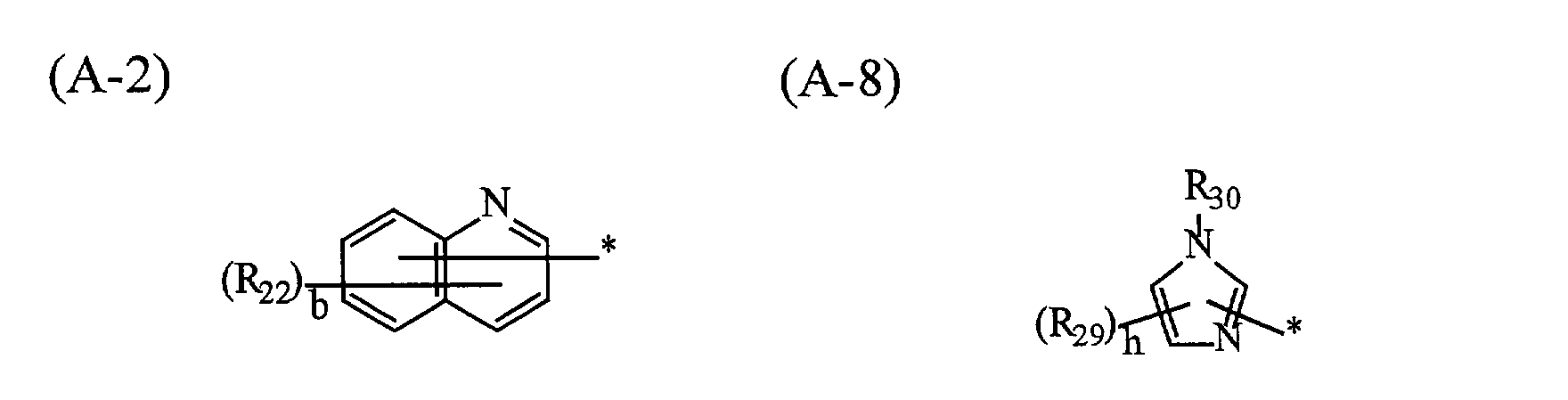
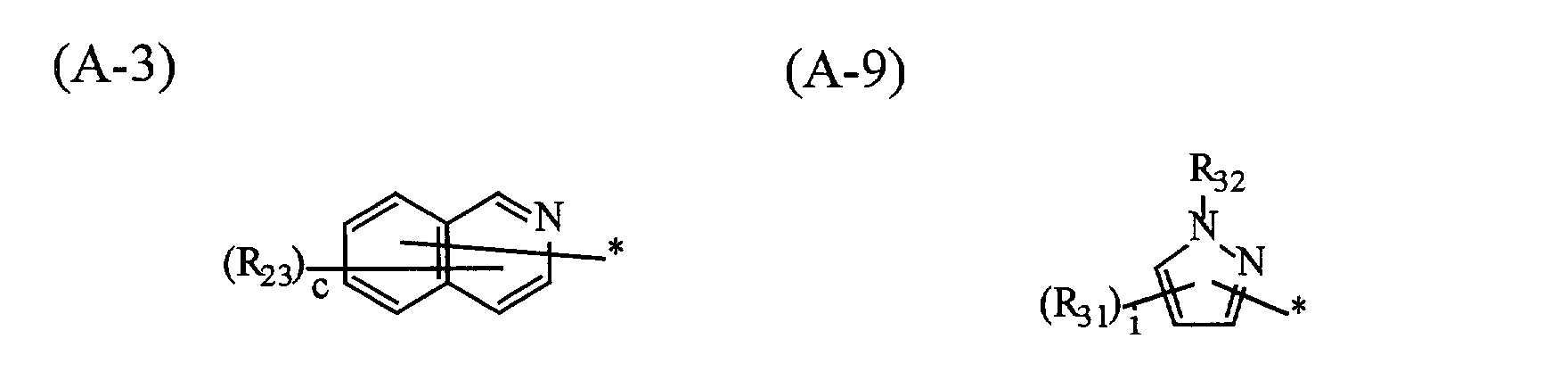
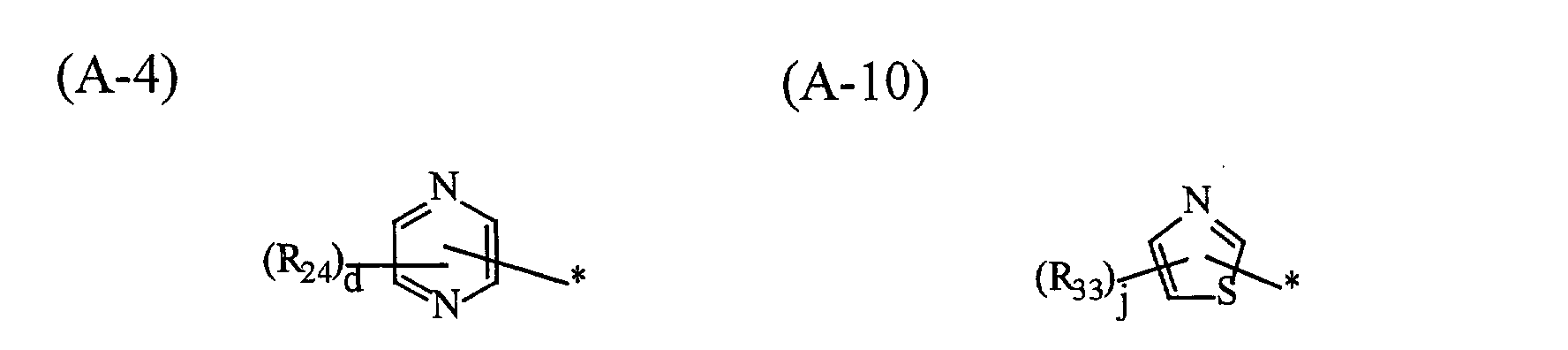
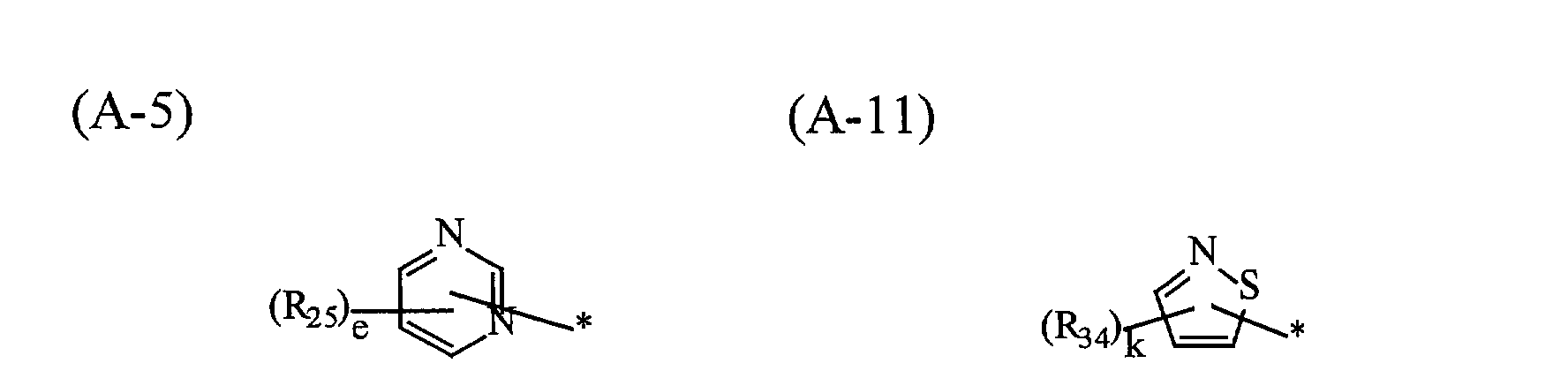
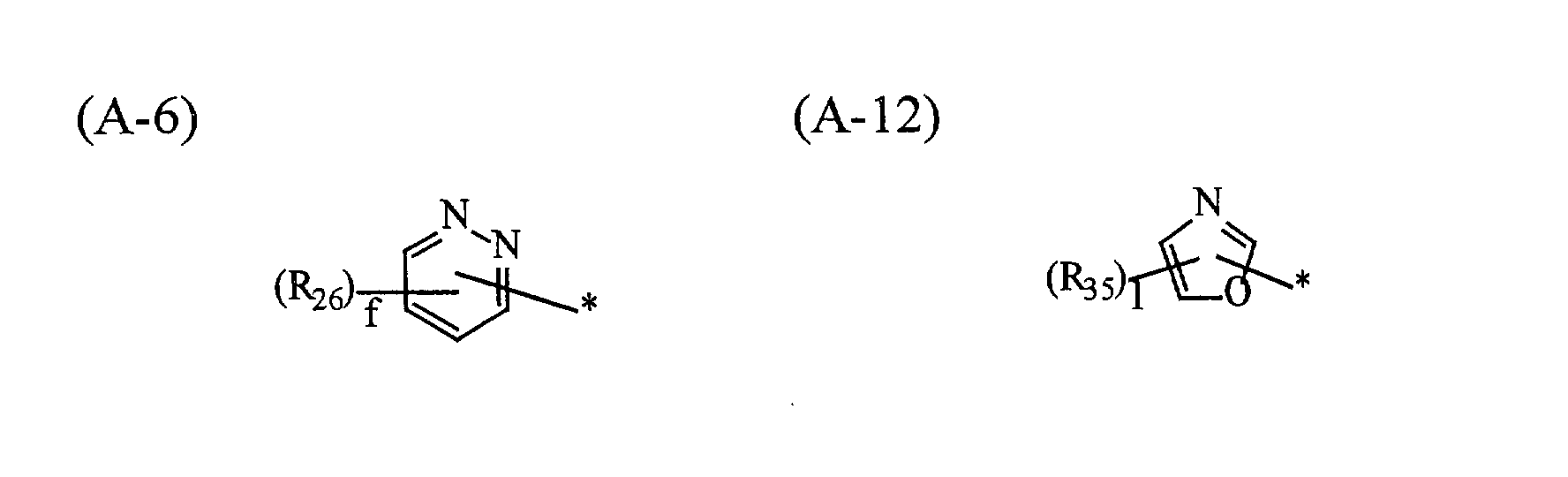


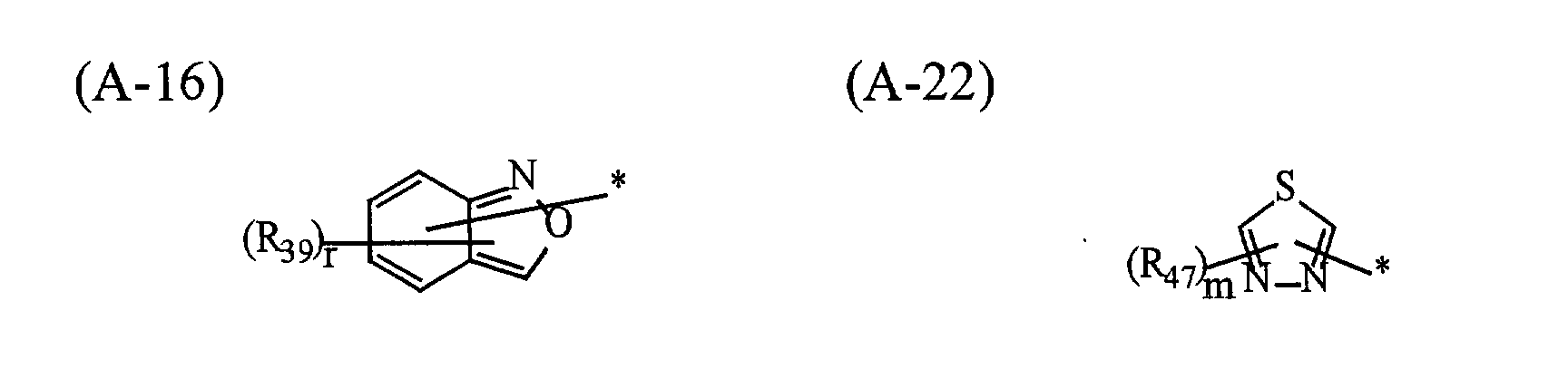


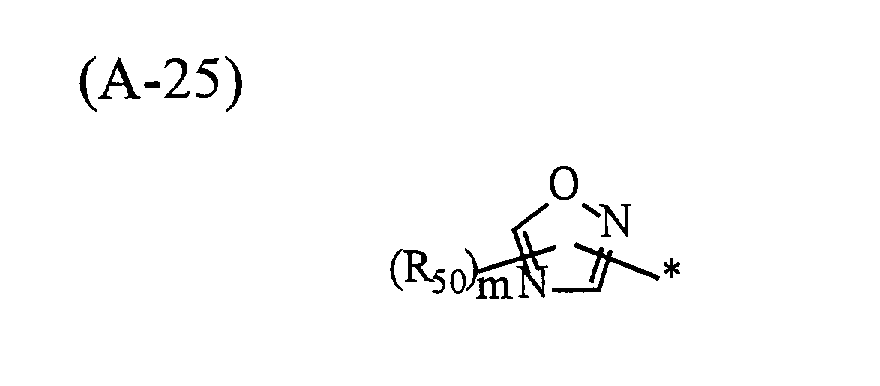
- In the specific examples (A-1) to (A-25) , the symbol "*" expresses the position in the general formula (1), at which the hetero-ring group binds to the azo group; R21 to R50 independently represent hydrogen atom or a substituent. The substituent represents a group with the same meaning, as listed as the substituent for the hetero-ring group represented by A, and the substituent preferably includes halogen atom, alkyl group, aryl group, hetero-ring group, cyano group, hydroxyl group, nitro group, alkoxy group, aryloxy group, amino group (including anilino group), acylamino group, aminocarbonylamino group, alkoxycarbonylamino group, alkylsulfonylamino group, arylsulfonylamino group, alkylthio group, arylthio group, hetero-ring thio group, sulfamoyl group, alkylsulfonyl group, arylsulfonyl group, acyl group, alkoxycarbonyl group, and carbamoyl group; more preferably, the substituent is halogen atom, alkyl group, cyano group, hydroxyl group, nitro group, alkoxy group, amino group (including anilino group), acylamino group, alkylsulfonylamino group, and carbamoyl group. "a, p, q, r, s" represent an integer of 0 to 4. "b, c" represent an integer of 0 to 6. "d, e, f, g, t, u" represent an integer of 0 to 3. "h, i, j, k, 1, o" represent an integer of 0 to 2. "m" represent an integer of 0 to 1. When "a" to "u" represent an integer of 2 or more, groups represented by R21 to R50, which exist in a number of 2 or more, may be the same or different to each other.
- Further, groups adjacent to each other as represented by R21 to R50 may combine together to form a ring structure. The resulting ring structure formed may be a hetero-ring or a carbon ring, and it may be a saturated ring or an unsaturated ring. The total number of the carbon atoms and the hetero atoms is 3 to 6, preferably 5 or 6.
- In case that R21 to R50 in the formulas (A-1) to (A-25) are groups with a possibility of additional substitution, R21 to R50 may further contain a substituent and the substituent in that case is the same as listed as the substituent for the hetero-ring group represented by "A".
- In the compound represented by the general formula (1) in accordance with the invention, the hetero-ring group represented by A is preferably (A-1), (A-5), (A-8), (A-9), (A-10), (A-11), (A-12), (A-13), (A-14), (A-15), (A-17), (A-19), (A-22), (A-23), (A-24), and (A-25), more preferably (A-10), (A-11), (A-12), (A-14), (A-22), (A-23), and (A-25).
- B in the azo dye represented by the general formula (1) represents an atomic group essential for the formation of a dissociative azo dye from the compound represented by the general formula (1) and is preferably derived from a coupler component. Herein, the coupler component means a partial structure derived from a coupler compound capable of reacting with a diazonium salt to give an azo dye. The concept is commonly used in the field of azo dye. B in the azo dye represented by the general formula (1) has preferably 3 to 30 carbon atoms, more preferably 3 to 20 carbon atoms, most preferably 3 to 12 carbon atoms, inclusive of the substituents therein.
- Preferably B is a 5 or 6 membered heterocyclic or heterocyclic condensed ring, containing at least one heteroatom selected from sulfur, nitrogen and oxygen atom; a 5 or 6 membered optionally condensed aromatic ring, a C1-6 -alkyl, C2-6-alkenyl or C2-6-alkynyl group wherein these groups optionally contain -CO-group, wherein each of the above rings or groups may contain one or more substituent(s).
- The coupler component is preferably a coupler component known in the field of silver halide colour photographic materials, and as such, use can be made of the backbone moiety of a coupler for silver halide colour photographic materials (the moiety serving as a dye chromophore via coupling with an oxidized aromatic amine-based developer as a principal developing agent, such as p-phenylenediamine), which is described in detail in Research Disclosure 37038 (February 1995), page 80-85, and 87-89.
- The coupler known as a coupler forming yellow-coloured image in the field of silver halide colour photographic materials includes for example couplers of pivaloylacetamide type, benzoylacetamide type, malondiester type, malondiamide type, dibenzoylmethane type, benzothiazolylacetamide type, malonestermonoamide type, benzoxazolylacetamide type, benzimidazolylacetamide type, cyanoacetamide type, cycloalkylcarbonylacetamide type, indolin-2-ylacetamide type, quinazolin-4-on-2-ylacetamide type described in USP 5,021,332, and the benzo-1,2,4-thiadiazine-1,1,-dioxid-3-ylacetamide type described in USP 5,021,330, the coupler described in EP 421221A, the coupler described in USP 5,455,149, the coupler described in EPA 0622673, the couplers of 3-indoloylacetamide type described in EPA 0953871, 0953872 and 0953873, as preferable coupler backbones.
- The coupler known as a coupler forming magenta-coloured image in the field of silver halide colour photographic materials includes for example couplers of 5-pyrazolone type, 1H-pyrazolo[1,5-a]benzimidazole type, 1H-pyrazolo [5,1-c] [1,2,4]triazole type, 1H-pyrazolo [1, 5-b][1,2,4]triazole type, 1H-imidazo [1, 2-b] pyrazole type, cyanoacetophenone type, the active propene type described in WO 93/01523, and the enamine type described in WO 93/07534, the lH-imidazo[1,2-b][1,2,4]triazole type coupler and the coupler described in USP 4,871,652, as preferable coupler backbones.
- The coupler known as a coupler forming cyan-coloured image in the field of silver halide colour photographic materials includes for example couplers of phenol type, naphthol type, the 2,5-diphenylimidazole type 1H-pyrrolo[1,2-b] [1,2,4]triazole type, and 1H-pyrrolo[2,1-c][1,2,4]triazole type as described in EPA 0249453, the pyrrole type described in Japanese Patent Laid-open Nos. 188137/1992 and 190347/1992, 3-hydroxypyridine type described in Japanese Patent Laid-open No. 315736/1989, pyrrolopyrazole type described in Japanese Patent Laid-open No. 174429/1992, the pyrroloimidazole type described in Japanese Patent Laid-open No. 174429/1992, and the pyrazolopyrimidine type described in USP 4,950,585, and the pyrrolotriazine type coupler described in Japanese Patent Laid-open No. 204730/1992, the coupler described in USP 5,104,783, the coupler described in USP, 5,162,196, and the coupler described in EP 0556700, as preferable coupler backbones.
- The group represented by B in the azo dye represented by the general formula (1) preferably includes groups represented by the following structures (B-1) to (B-11).

- In the formulas, the symbol "**" expresses the position where the groups bind to the azo group in the general formula (1).
- In the formula (B-1), R101 represents halogen atom, alkyl group, aryl group, hetero-ring group, cyano group, alkoxy group, amino group (including anilino group), acylamino group, alkylsulfonylamino group, arylsulfonylamino group, alkylthio group, arylthio group, sulfamoyl group, alkylsulfonyl group, or carbamoyl group. R102 represents cyano group, alkylsulfonyl group, arylsulfonyl group, acyl group, alkoxycarbonyl group, aryloxycarbonyl group, or carbamoyl group. Z1 represents oxygen atom, sulfur atom, or -N (R103) - . R103 represents hydrogen atom, alkyl group, aryl group or hetero-ring group. "v" represents an integer of 0 to 4. Provided that v is more than 1, the R101 groups in the number "v" may be the same or different. R101 is preferably halogen atom, acylamino group, alkylsulfonylamino group, sulfamoyl group, and carbamoyl group. R102 is preferably cyano group, and carbamoyl group. Z1 is preferably oxygen atom, sulfur atom, or -N(R103)- where R103 is an alkyl group.
- In the formula (B-2), R104 represents cyano group, alkylsulfonyl group, arylsulfonyl group, acyl group, alkoxycarbonyl group, aryloxycarbonyl group, or carbamoyl group; R105 and R106 independently represent hydrogen atom, alkyl group, aryl group, or hetero-ring group. Preferably, R104 is cyano group, acyl group, and carbamoyl group, while one of R105 and R106 is preferably hydrogen atom.
- In the formula (B-3), R107 represents hydrogen atom, alkyl group, aryl group, hetero-ring group, alkoxy group, aryloxy group, amino group (including anilino group), acylamino group, alkylsulfonylamino group, arylsulfonylamino group, alkylthio group, arylthio group, alkylsulfonyl group, arylsulfonyl group, or carbamoyl group; Z2 and Z3 independently represent -C(R108)= , or -N=; R108 represents alkyl group, aryl group, hetero-ring group, alkylthio group, arylthio group, alkoxycarbonyl group, or carbamoyl group. Provided that Z2 and Z3 both represent - C(R108)= , two R108 groups may be the same or different or may bind together to form a carbon ring or a hetero-ring. R107 is preferably hydrogen atom, alkyl group and aryl group, more preferably hydrogen atom and alkyl group, and R108 is preferably alkyl group, aryl group, and hetero-ring group, more preferably alkyl group.
- In the formula (B-4), R109 represents alkyl group, aryl group or hetero-ring group, and R110 represents hydrogen atom, alkyl group, aryl group, hetero-ring group, acyl group, alkylsulfonyl group or arylsulfonyl group. R109 is preferably alkyl group and aryl group, and R110 is preferably hydrogen atom and alkyl group.
- In the formula (B-5), R111 represents alkyl group, aryl group, alkoxy group, amino group (including anilino group), alkoxycarbonyl group, cyano group, acylamino group, or carbamoyl group; R112 represents hydrogen atom, alkyl group, aryl group, or hetero-ring group; R113 represents hydroxyl group or amino group. R111 is preferably alkoxycarbonyl group, cyano group, and carbamoyl group; R112 is preferably alkyl group and aryl group.
- In the formula (B-6), R114 represents halogen atom, alkyl group, aryl group, hetero-ring group, nitro group, alkoxy group, aryloxy group, amino group (including anilino group), acylamino group, alkoxycarbonylamino group, aminocarbonylamino group, alkylsulfonylamino group, arylsulfonylamino group, alkylthio group, arylthio group, hetero-ring thio group, alkoxycarbonyl group, or carbamoyl group; "w" represents an integer of 0 to 4. Provided that "w" is 2 to 4, the R114 groups may be the same or different. R114 is preferably halogen atom, alkyl group, acylamino group, alkoxycarbonylamino group, aminocarbonylamino group, alkylsulfonylamino group, arylsulfonylamino group, and carbamoyl group, more preferably halogen atom, alkyl group, acylamino group, and alkylsulfonylamino group.
- In the formula (B-7), R115 represents halogen atom, alkyl group, aryl group, hetero-ring group, nitro group, alkoxy group, aryloxy group, amino group (including anilino group), acylamino group, alkoxycarbonylamino group, aminocarbonylamino group, alkylsulfonylamino group, arylsulfonylamino group, alkylthio group, arylthio group, hetero-ring thio group, alkoxycarbonyl group, carbamoyl group, or "x" represents an integer of 0 to 6. Provided that "x" is 2 to 6, the R115 groups may be the same or different. R115 is preferably halogen atom, acylamino group, alkoxycarbonylamino group, aminocarbonylamino group, alkylsulfonylamino group, arylsulfonylamino group, and carbamoyl group, more preferably acylamino group, alkylsulfonylamino group, and carbamoyl group.
- In the formulas (B-8) and (B-9) , R116, R117, R118, and R119 independently represents alkyl group or aryl group, and these groups are preferably the same to each other.
- In the formula (B-10) , R120 and R121 independently represents alkyl group, aryl group, hetero-ring group, cyano group, alkylsulfonyl group, arylsulfonyl group, alkoxycarbonyl group, or carbamoyl group; R122 represents hydrogen atom, alkyl group, aryl group, hetero-ring group, acylamino group, alkylsulfonylamino group, or arylsulfonylamino group. Preferably, R120 and R121 are alkyl group, aryl group, hetero-ring group, and cyano group. Preferably, R122 is hydrogen atom, alkyl group, aryl group, acylamino group, and alkylsulfonylamino group.
- In the formula (B-11), R123 and R124 independently represents alkyl group, aryl group, hetero-ring group, cyano group, alkylsulfonyl group, arylsulfonyl group, alkoxycarbonyl group, or carbamoyl group; Z4 represents a non-metal atomic group forming a 5-membered or 6-membered ring, together with the two nitrogen atoms and optionally one carbon atom. R125 represents alkyl group, aryl group, alkoxy group, amino group, acylamino group, alkylsulfonylamino group, arylsulfonylamino group, alkylthio group, arylthio group, acyl group, alkoxycarbonyl group, or carbamoyl group; "y" represents an integer of 0 to 2, provided that Z4 forms a 5-membered ring; and "y" represents an integer of 0 to 3, provided that Z4 forms a 6-membered ring. Preferably, R123 is alkyl group, aryl group, hetero-ring group, and cyano group. Preferably, R124 is alkylsulfonyl group, arylsulfonyl group, alkoxycarbonyl group, and carbamoyl group. R125 is preferably alkyl group, aryl group, alkylthio group, amino group, and acylamino group. In the formula (B-12), R126 represents alkyl group or aryl group
- In the formulas (B-1) to (B-12), preferable carbon numbers and specific examples of the individual groups listed in the descriptions of the groups represented by R101 to R125 are the same as those listed in the description of the substituent for the hetero-ring group represented by A.
- In case that R101 to R126 in the formulas (B-1) to (B-12) are groups with a possibility of additional substitution, R101 to R126 may further have a substituent, and the substituent in that case is the same as the substituent listed for the hetero-ring group represented by A.
- Dyes represented by the following formulas DS-1 to DS-9 among compounds represented by the general formula (1) are particularly preferable. "A" in the general formulas DS-1 to DS-9 represents a group with the same meaning as that of "A" in the general formula (1).
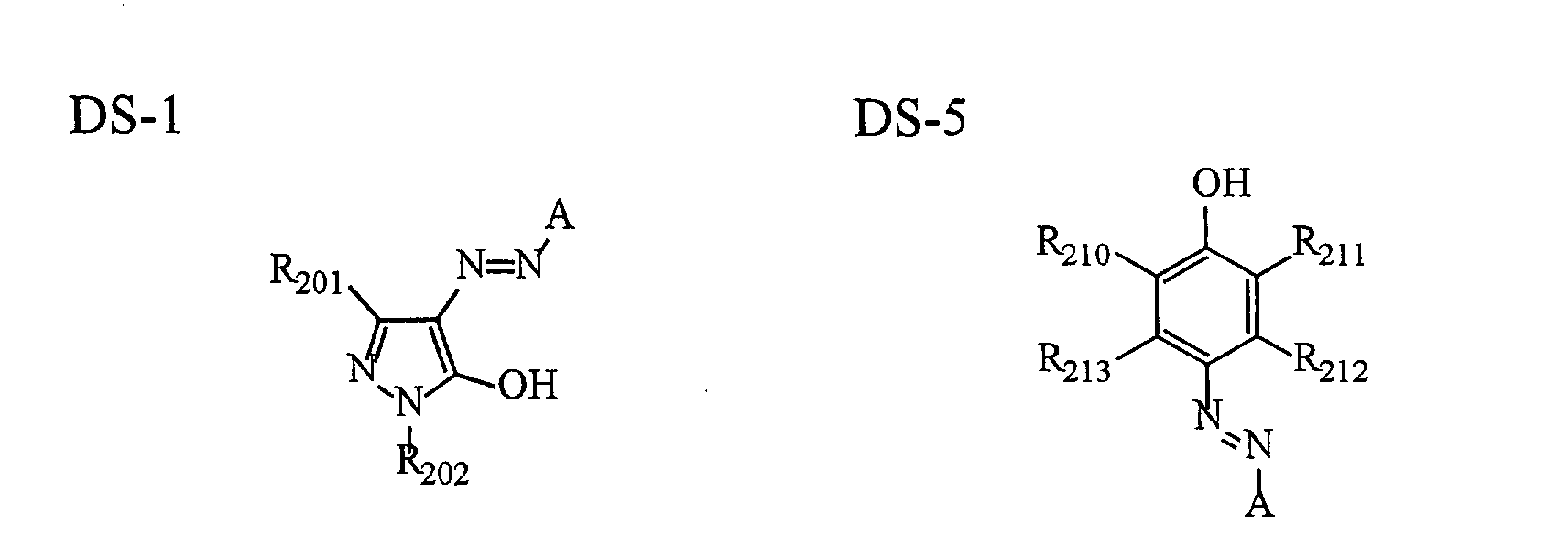


- In the formula DS-1, R201 represents alkyl group, aryl group, alkoxy group, amino group (including anilino group), alkoxycarbonyl group, cyano group, acylamino group, or carbamoyl group; R202 represents hydrogen atom, alkyl group, aryl group, or hetero-ring group. Preferably, R201 is alkoxycarbonyl group, cyano group, and carbamoyl group and R202 is alkyl group and aryl group.
- In the formula DS-2, R203 represents hydrogen atom, alkyl group, aryl group, hetero-ring group, alkoxy group, aryloxy group, amino group (including anilino group), acylamino group, alkylsulfonylamino group, arylsulfonylamino group, alkylthio group, arylthio group, alkylsulfonyl group, arylsulfonyl group, or carbamoyl group; R204 represents alkyl group, aryl group, or hetero-ring group. R203 is preferably hydrogen atom and alkyl group, and the alkyl group particularly preferably includes methyl group, ethyl group, isopropyl group, and t-butyl group. R204 is most preferably alkyl group.
- In the formula DS-3, R205 represents hydrogen atom, alkyl group, aryl group, hetero-ring group, alkoxy group, aryloxy group, amino group (including anilino group), acylamino group, alkylsulfonylamino group, arylsulfonylamino group, alkylthio group, arylthio group, alkylsulfonyl group, arylsulfonyl group, or carbamoyl group; R206 represents alkyl group, aryl group, hetero-ring group, alkylthio group, arylthio group, alkoxycarbonyl group, or carbamoyl group. R205 is preferably hydrogen atom and alkyl group, and the alkyl group particularly preferably includes methyl group, ethyl group, isopropyl group, and t-butyl group. R206 is preferably alkyl group, aryl group, or alkylthio group, most preferably alkyl group.
- In the formula DS-4, R207 represents hydrogen atom, alkyl group, aryl group, hetero-ring group, alkoxy group, aryloxy group, amino group (including anilino group), acylamino group, alkylsulfonylamino group, arylsulfonylamino group, alkylthio group, arylthio group, alkylsulfonyl group, arylsulfonyl group, or carbamoyl group; R208 represents halogen atom, alkyl group, aryl group, hetero-ring group, alkoxy group, aryloxy group, amino group (including anilino group), acylamino group, alkylsulfonylamino group, arylsulfonylamino group, alkylthio group, arylthio group, alkylsulfonyl group, arylsulfonyl group, alkoxycarbonyl group, or carbamoyl group; "aa" represents an integer of 0 to 4. Preferably, R207 is hydrogen atom and alkyl group, and the alkyl group particularly preferably includes methyl group, ethyl group, isopropyl group, and t-butyl group. R208 is preferably halogen atom, alkyl group, alkoxy group, acylamino group, and alkylsulfonylamino group.
- In the formula DS-5, R210 and R211 represent hydrogen atom, halogen atom, alkyl group, aryl group, acylamino group, alkoxycarbonyl group, aminocarbonylamino group, alkylsulfonylamino group, arylsulfonylamino group, alkoxycarbonylamino group, or carbamoyl group; R212 and R213 represent hydrogen atom, halogen atom, alkyl group, alkoxy group, or acylamino group. R210 and R211 preferably represent hydrogen atom, chlorine atom, bromine atom, alkyl group, and acylamino group, and more preferably at least one of R210 and R211 is hydrogen atom.
- In the formula DS-6, R214 and R215 independently represents hydrogen atom, alkyl group, aryl group, or hetero-ring group, and one of R214 and R215 is preferably hydrogen atom.
- In the formula DS-7, R216 represents halogen atom, alkyl group, aryl group, hetero-ring group, cyano group, alkoxy group, amino group (including anilino group), acylamino group, alkylsulfonylamino group, arylsulfonylamino group, alkylthio group, arylthio group, sulfamoyl group, alkylsulfonyl group, or carbamoyl group; Z5 represents oxygen atom, sulfur atom, or -N(R217)-, where R217 represents hydrogen atom, alkyl group, aryl group, or hetero-ring group. "bb" represents an integer of 1 to 4. Provided that "bb" is 2 to 4, the R216 groups may be the same or different. R216 is preferably halogen atom, acylamino group, alkylsulfonylamino group, sulfamoyl group, and carbamoyl group. Preferably, Z5 is oxygen atom, sulfur atom, and -N(R217)-, where R217 is alkyl group. More preferably, Z5 is oxygen atom and sulfur atom.
- In the formula DS-8, R218 represents hydrogen atom, halogen atom, alkyl group, aryl group, acylamino group, alkylsulfonylamino group, arylsulfonylamino group, alkoxycarbonyl group, aminocarbonylamino group, carbamoyl group, or sulfamoyl group; R220 and R223 represents hydrogen atom, halogen atom, acylamino group, alkoxycarbonylamino group, aminocarbonylamino group, alkylsulfonylamino group, or arylsulfonylamino group; R219, R221, and R222 represents hydrogen atom, chlorine atom, bromine atom, alkyl group, and acylamino group. R218 is preferably hydrogen atom, acylamino group, alkylsulfonylamino group, arylsulfonylamino group, alkoxycarbonyl group, aminocarbonylamino group, carbamoyl group, and sulfamoyl group. R220 and R223 are preferably hydrogen atom, acylamino group, alkoxycarbonylamino group, and alkylsulfonylamino group. R219, R221, and R222 are preferably hydrogen atom.
- In the formula DS-9, R224 represents alkyl group or aryl group
- In the formulas DS-1 to DS-9, preferable carbon numbers and specific examples of the individual groups listed in the descriptions of the groups represented by R201 to R224 are the same as those listed in the description of the substituent for the hetero-ring group represented by "A" .
- Provided that R201 to R224 in the formulas DS-1 to DS-9 are groups with a possibility of additional substitution, R201 to R224 may have additional substituents. The substituents then are the same as those listed in the description of the substituent for the hetero-ring group represented by "A".
- Specific compound examples of the azo dye represented by the general formula (1) in accordance with the invention are described below, but the invention is not limited to these examples.


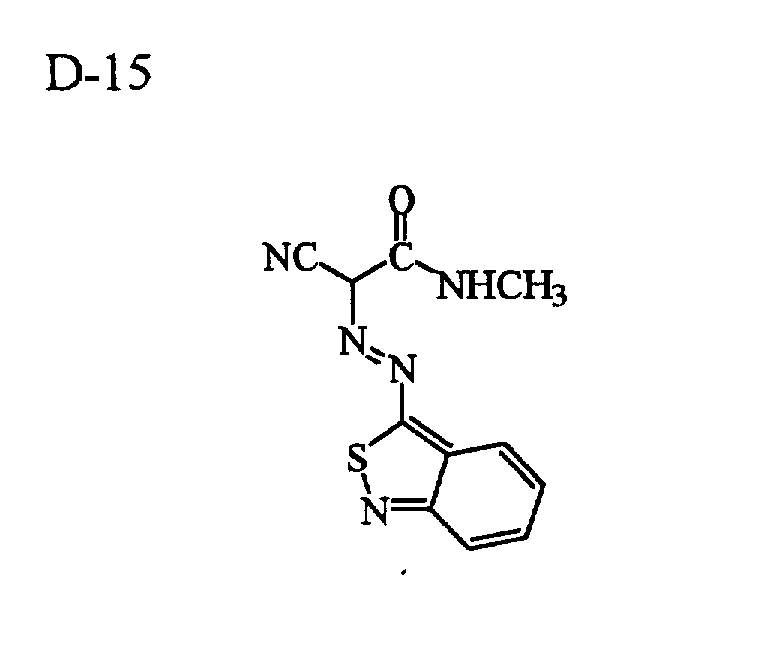
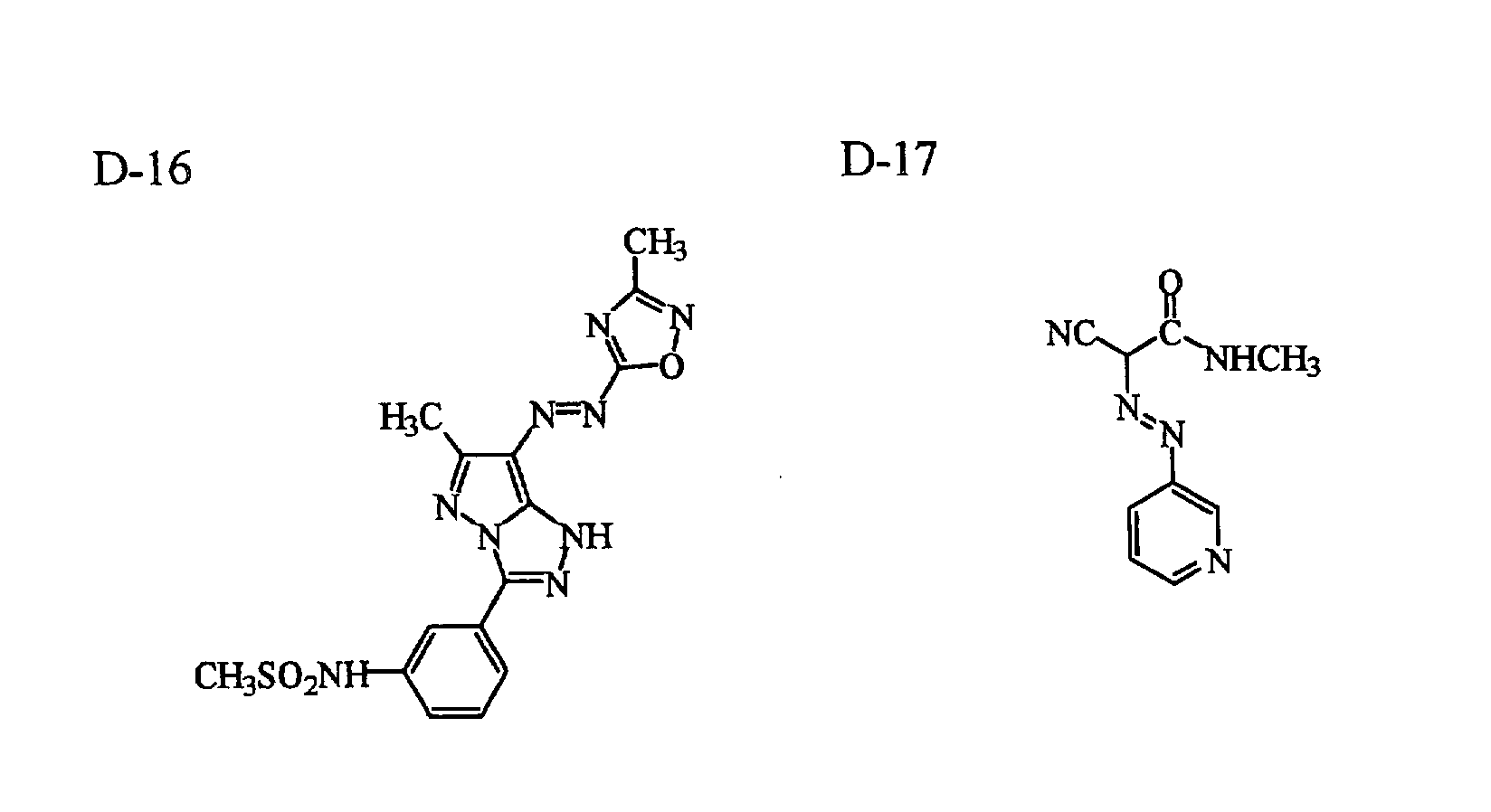

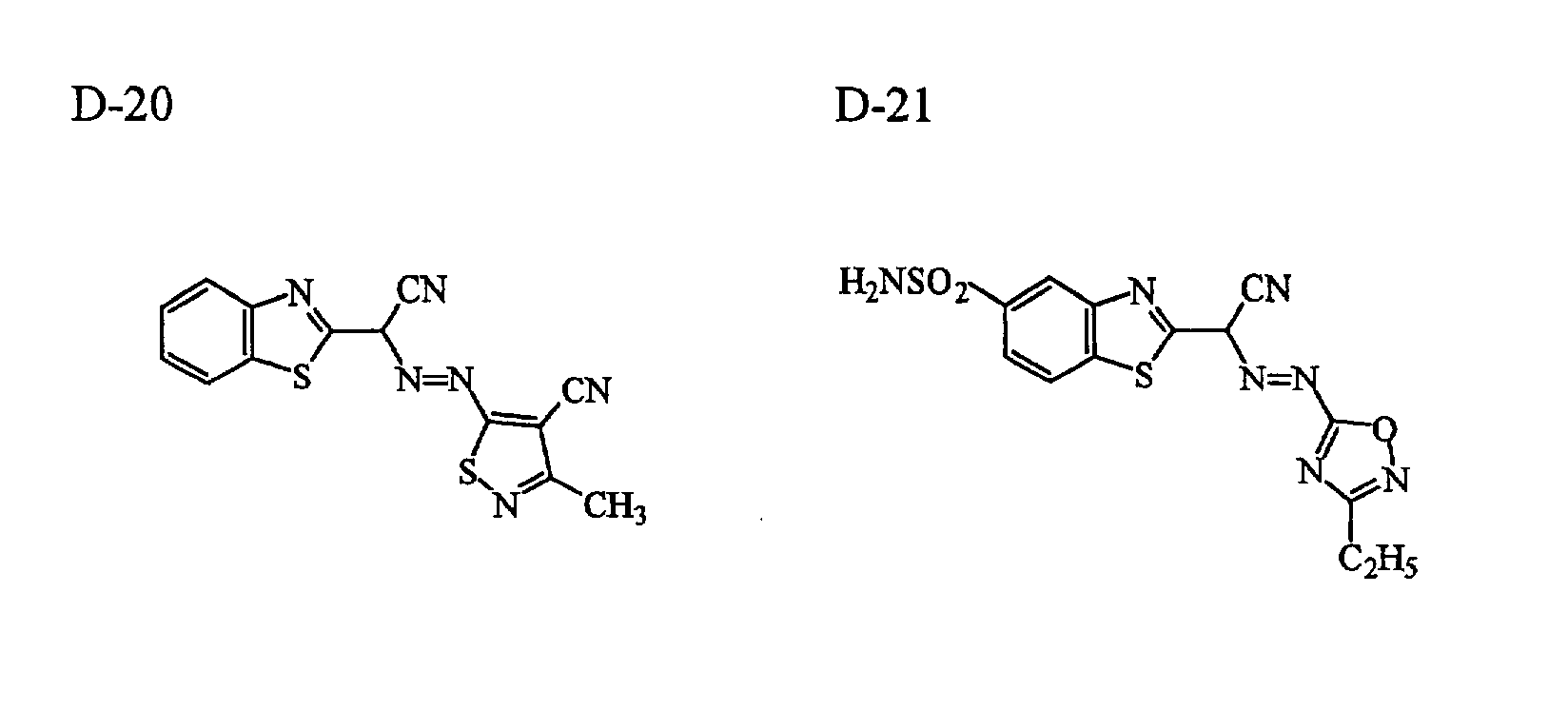
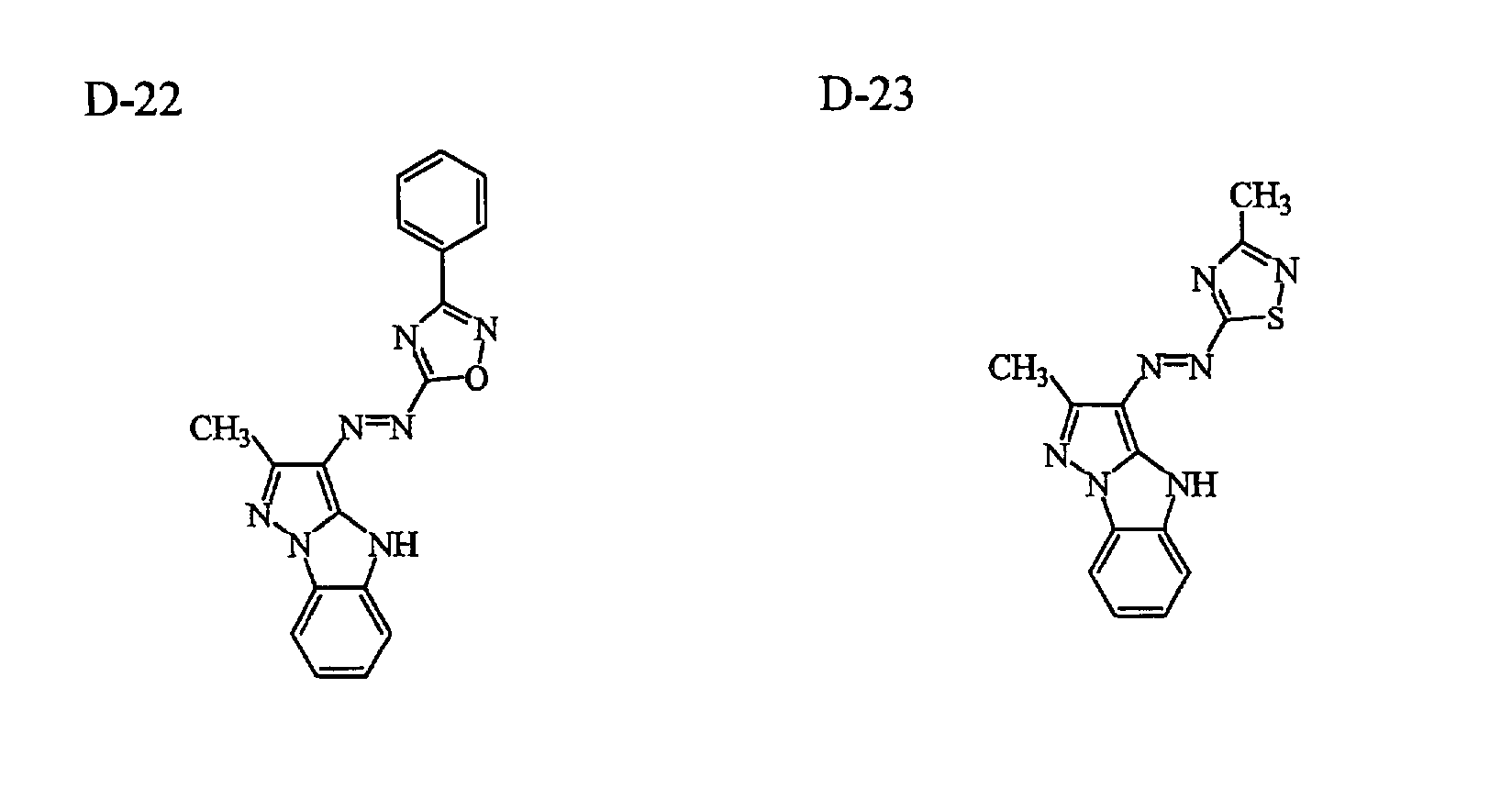

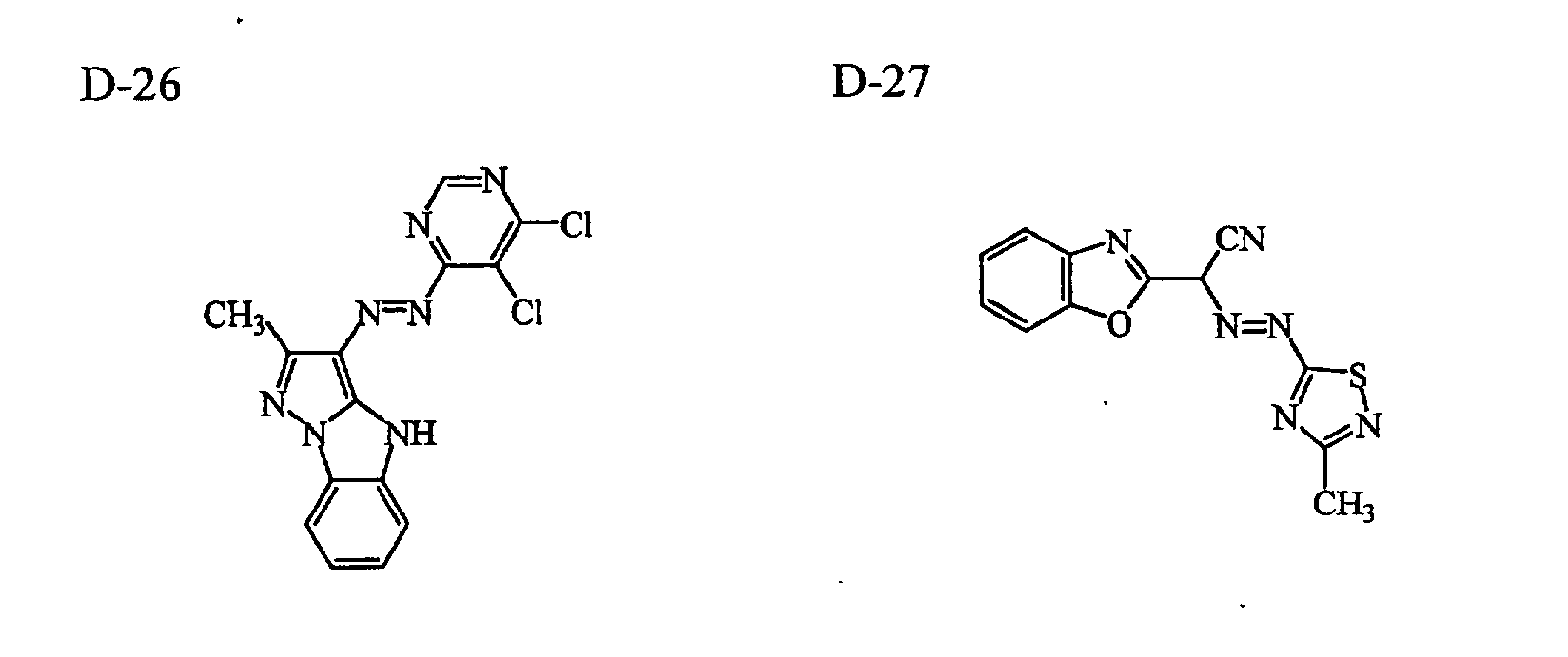

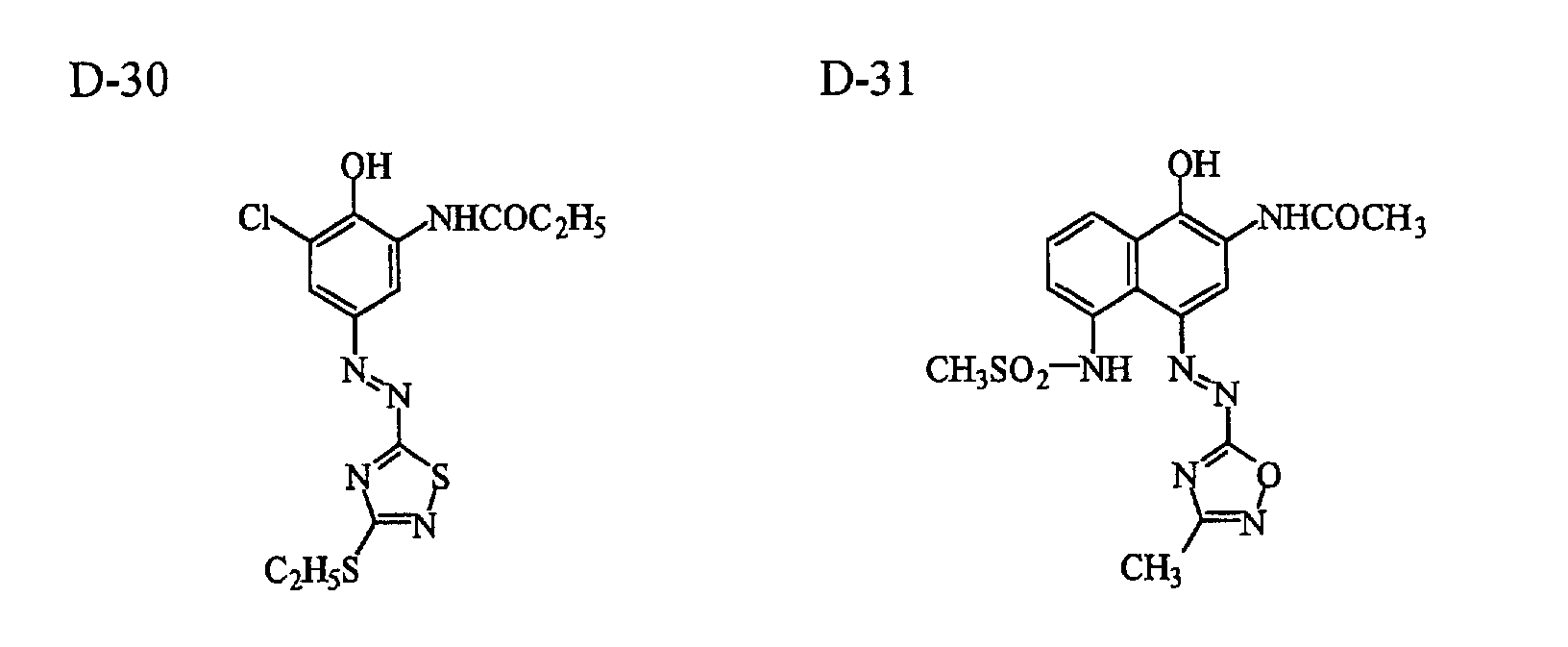


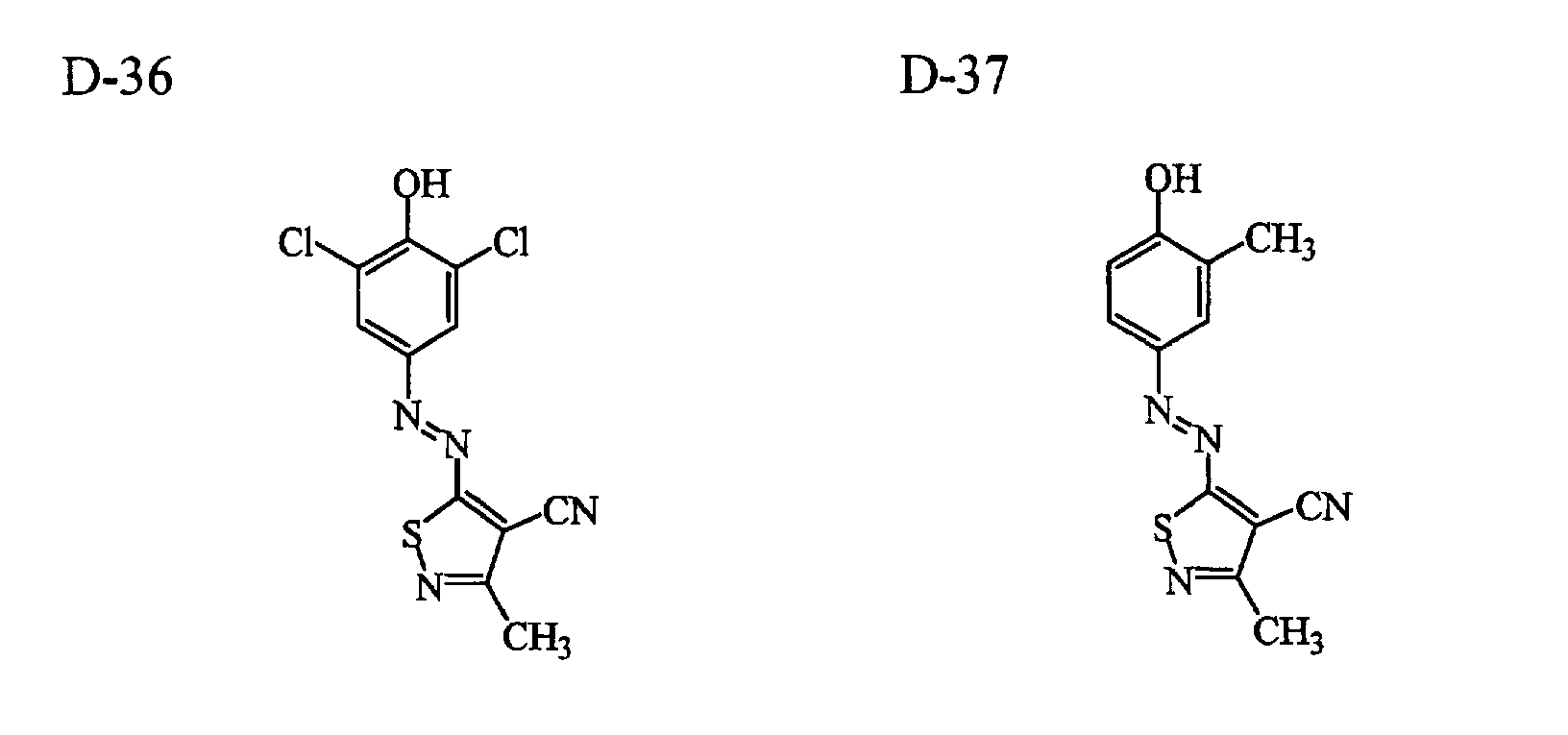

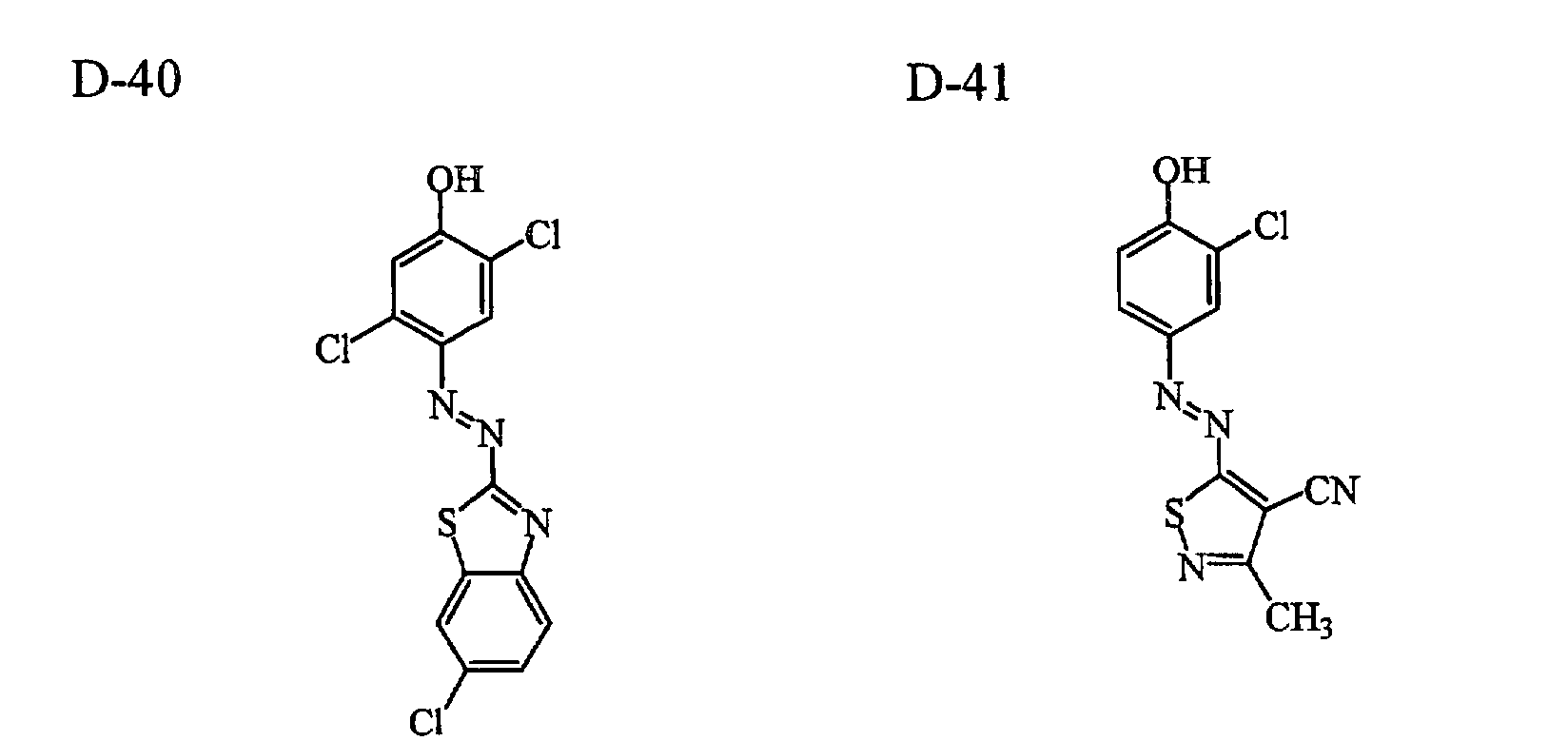


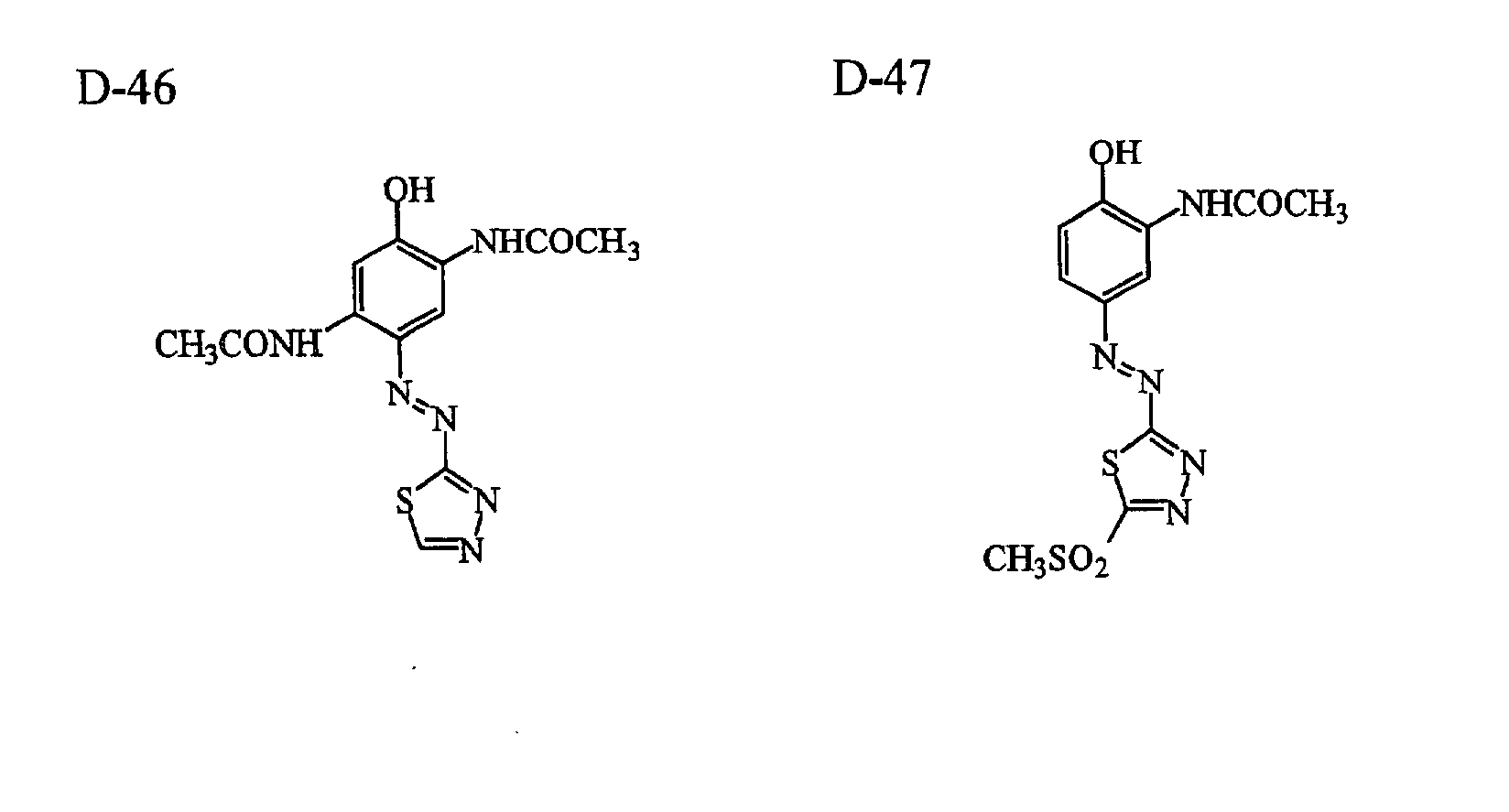
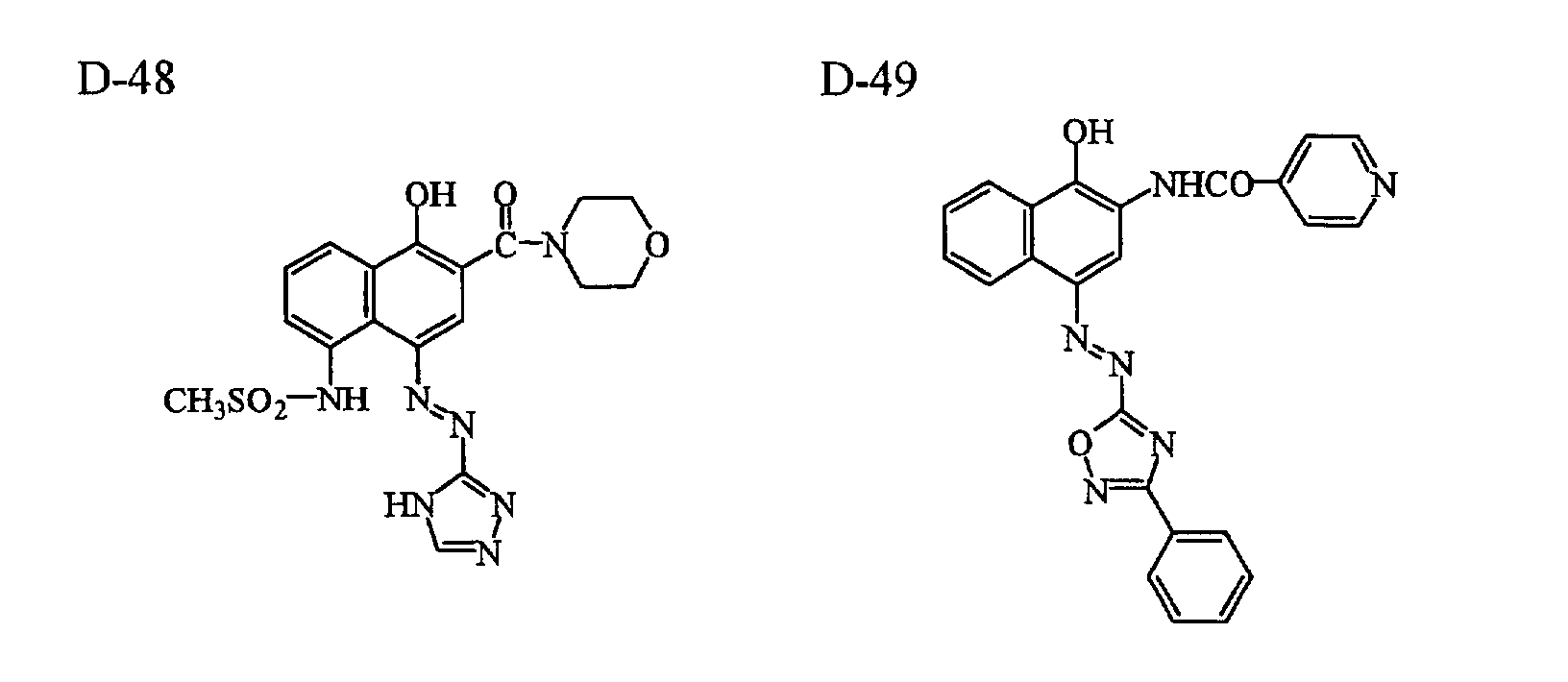
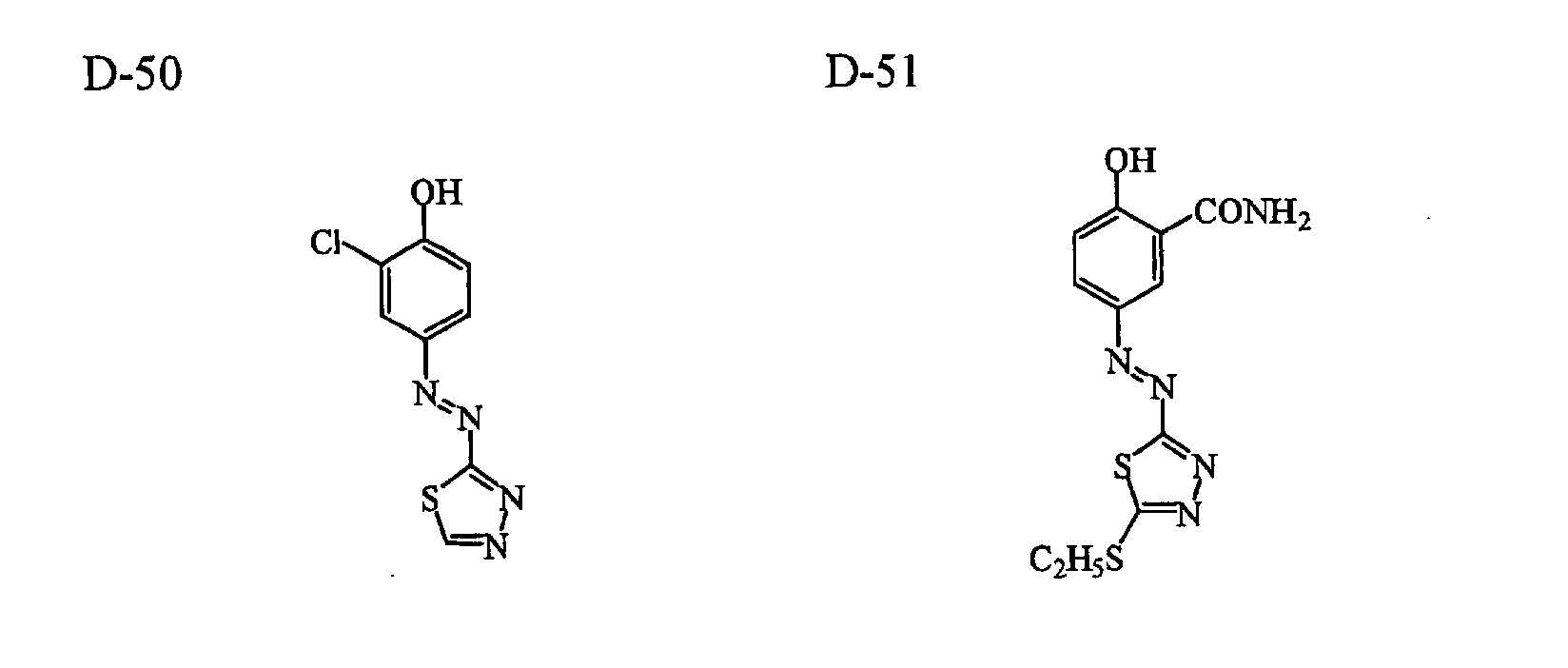
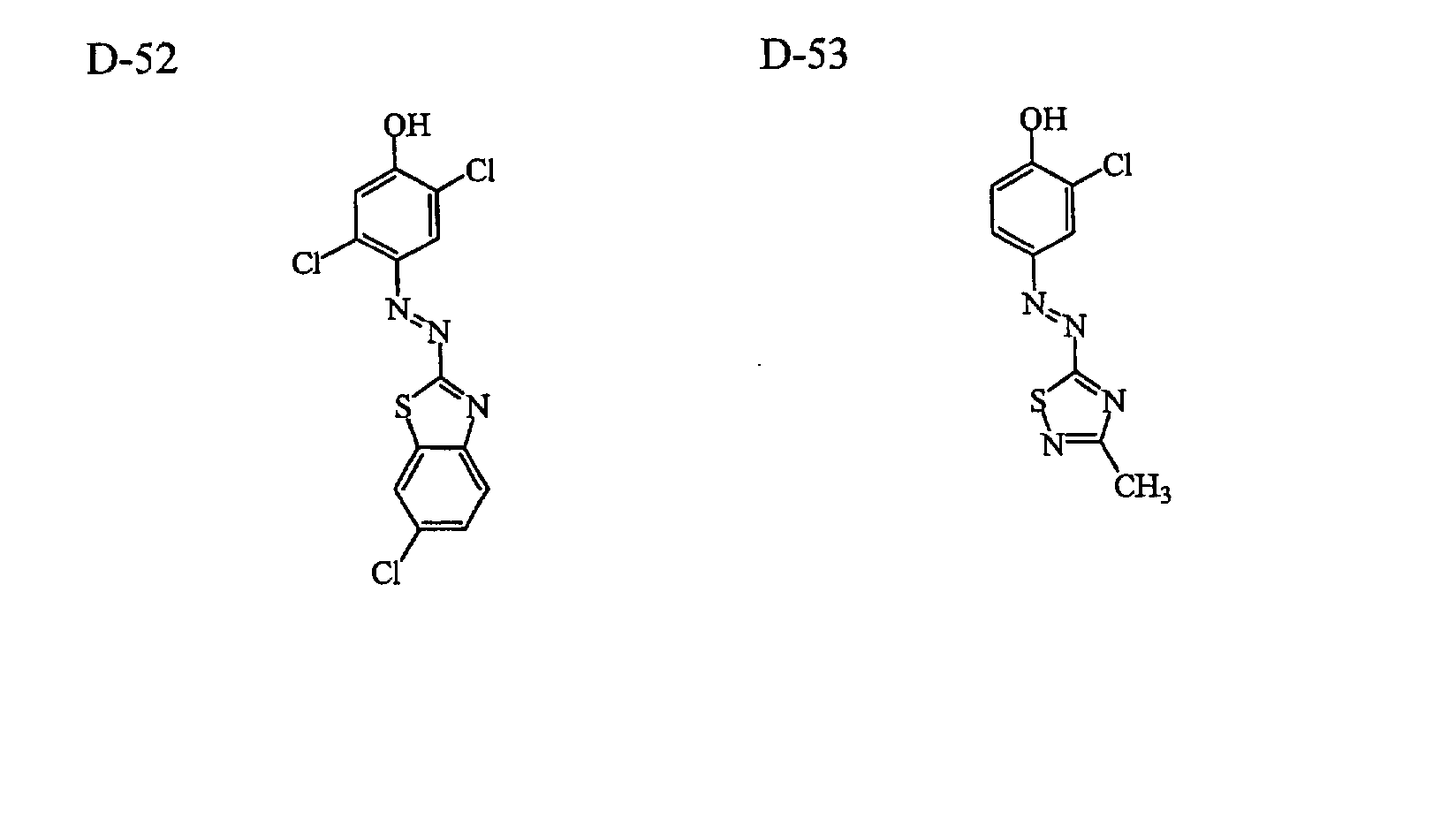

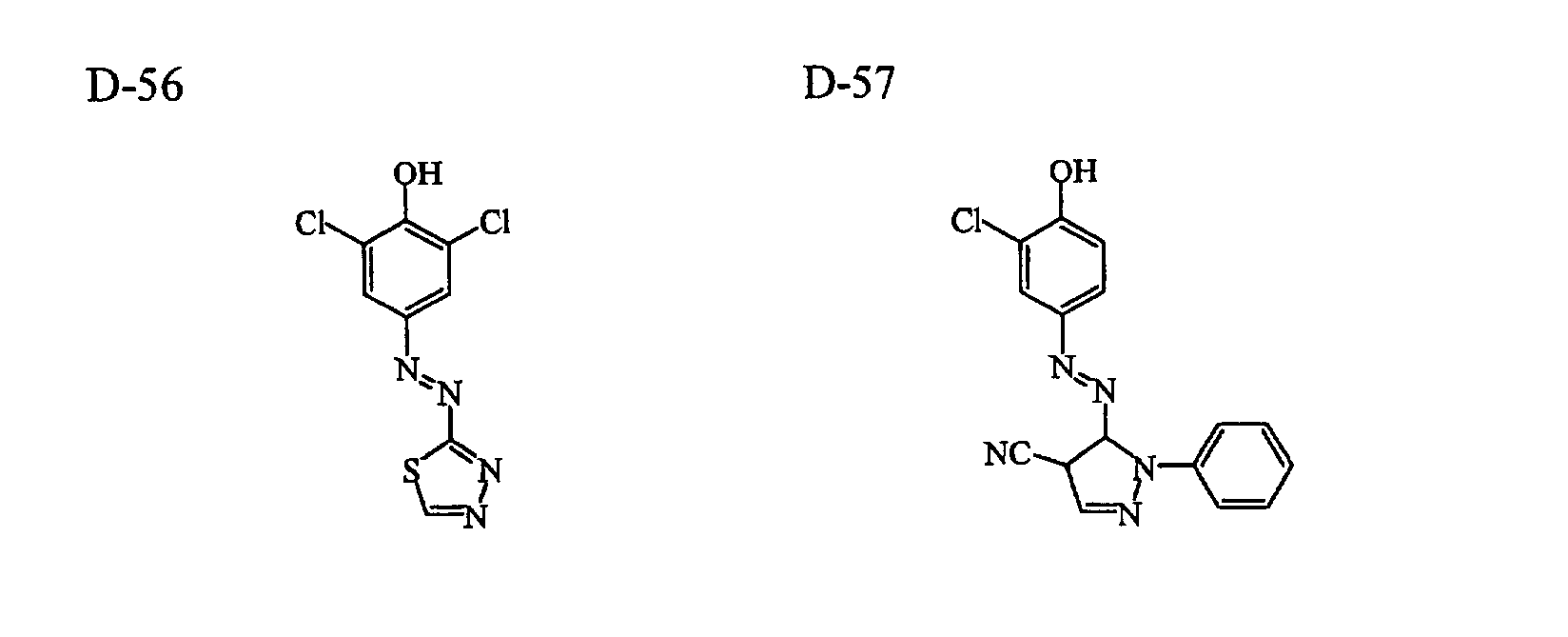

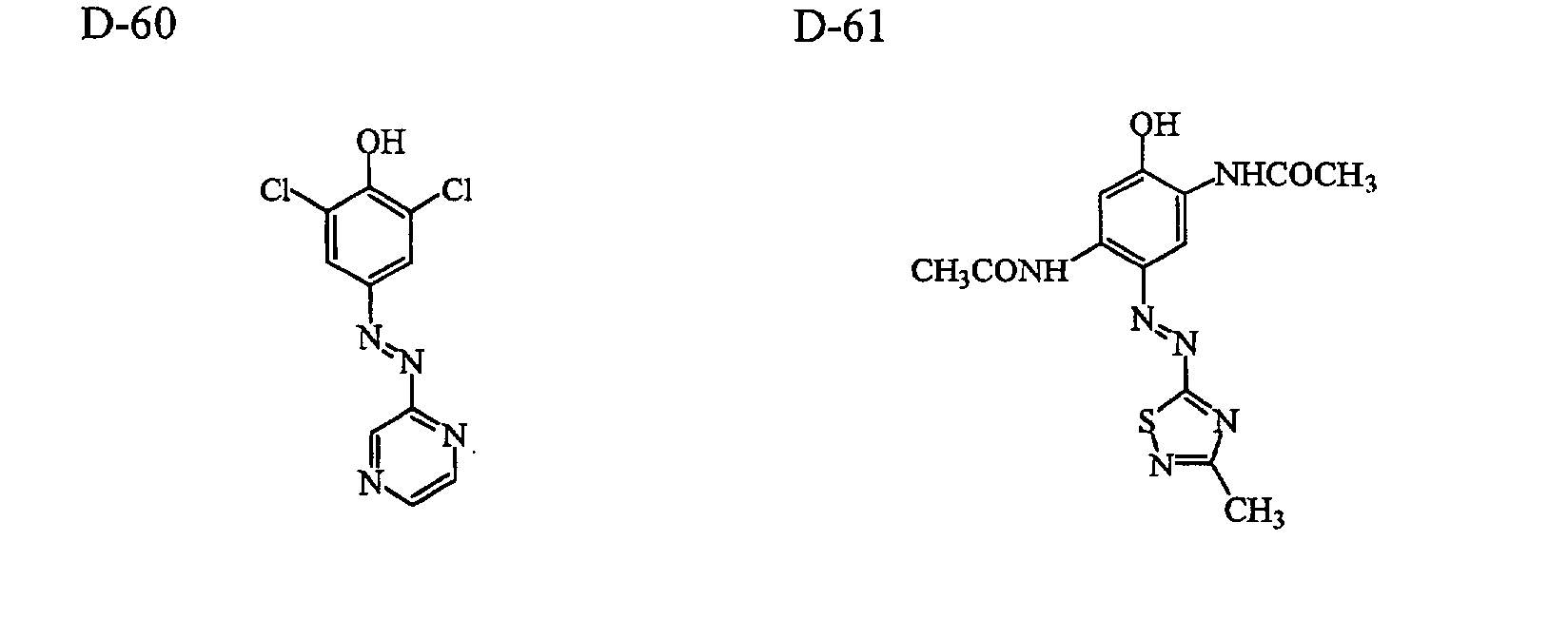
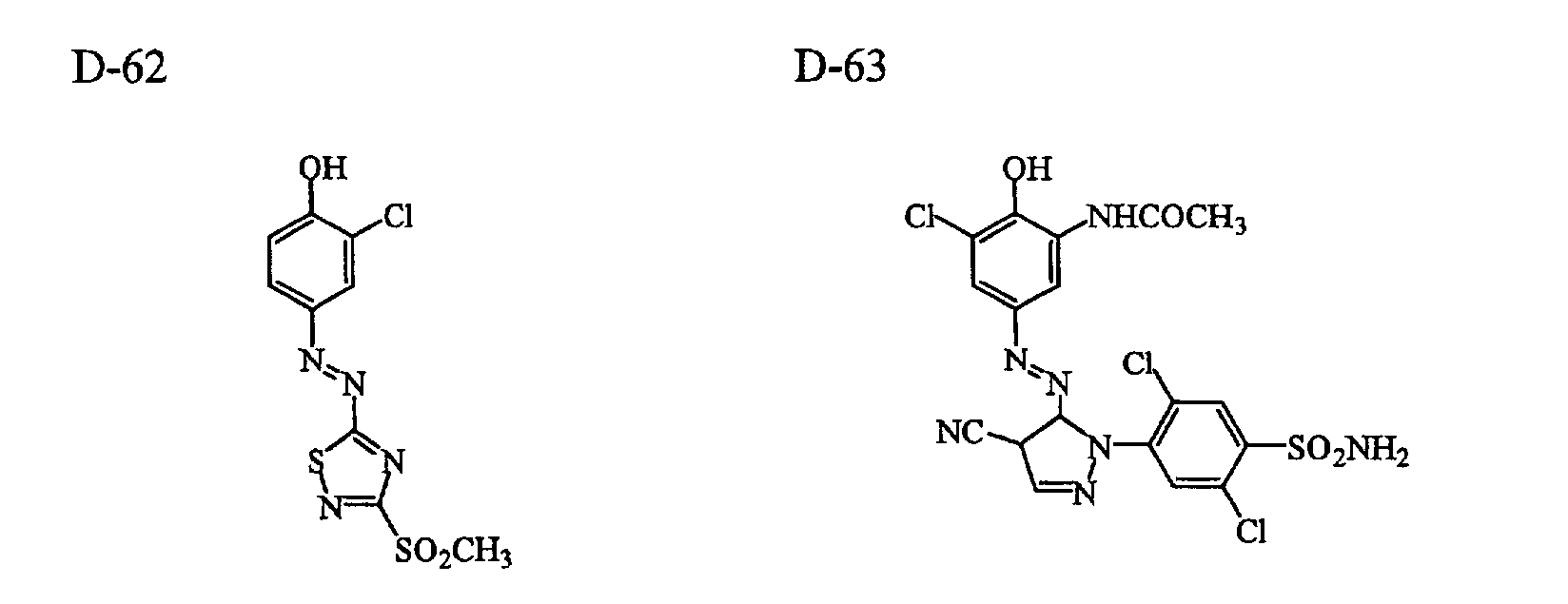


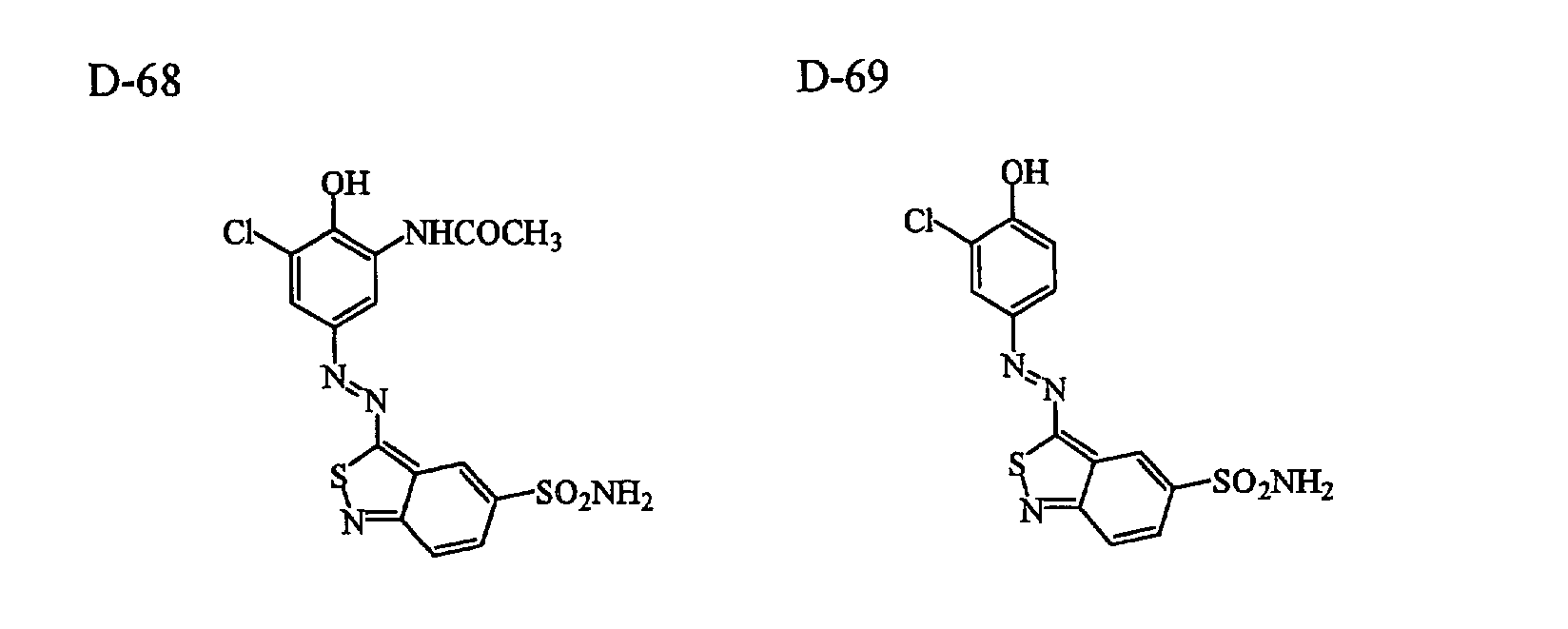
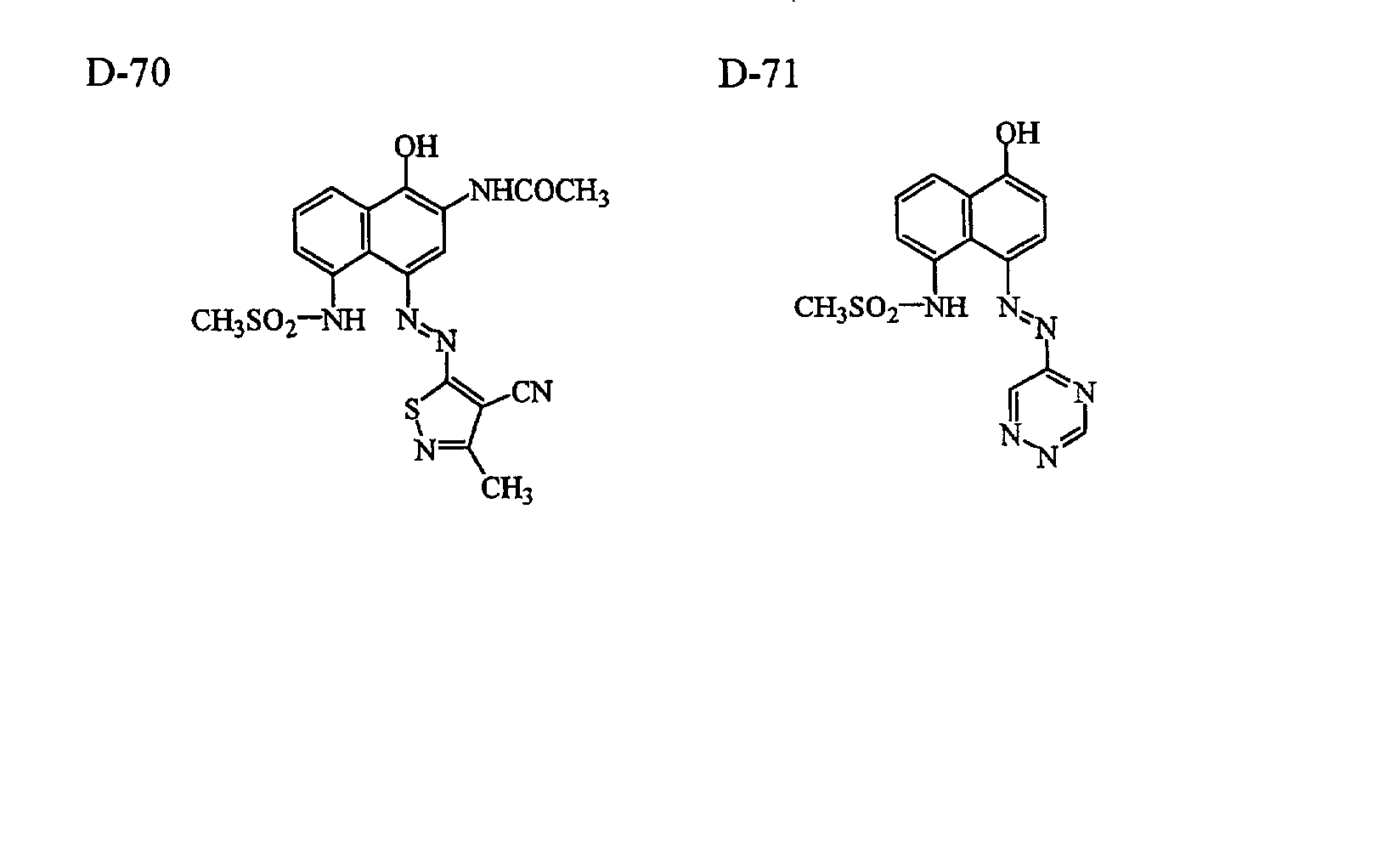
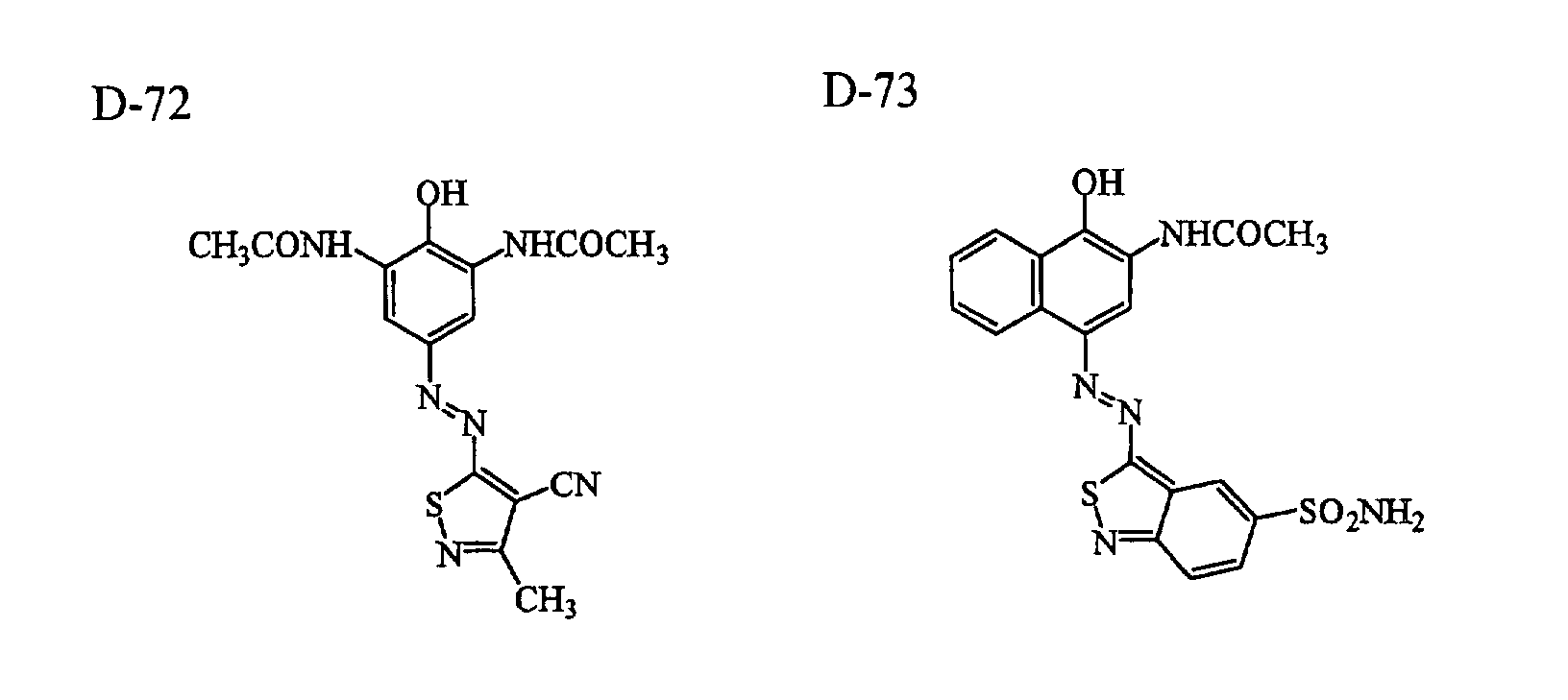
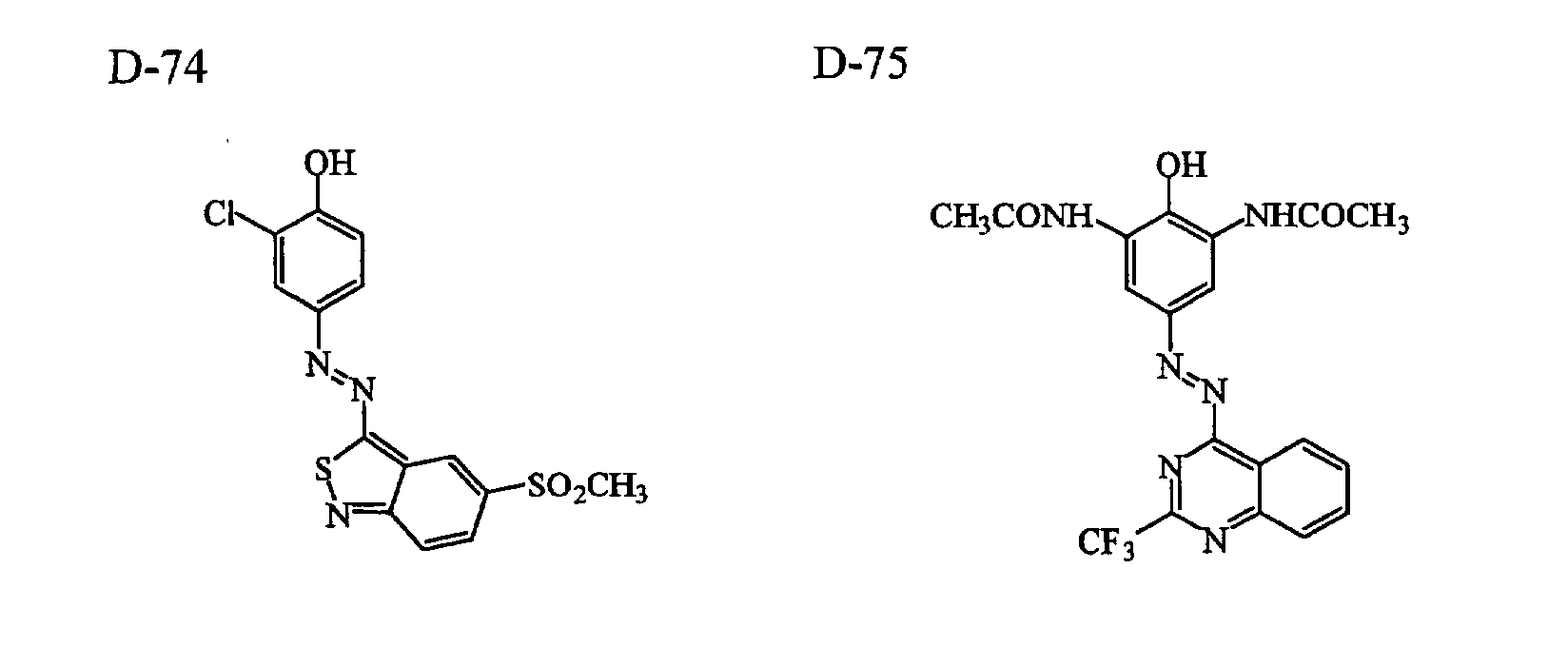
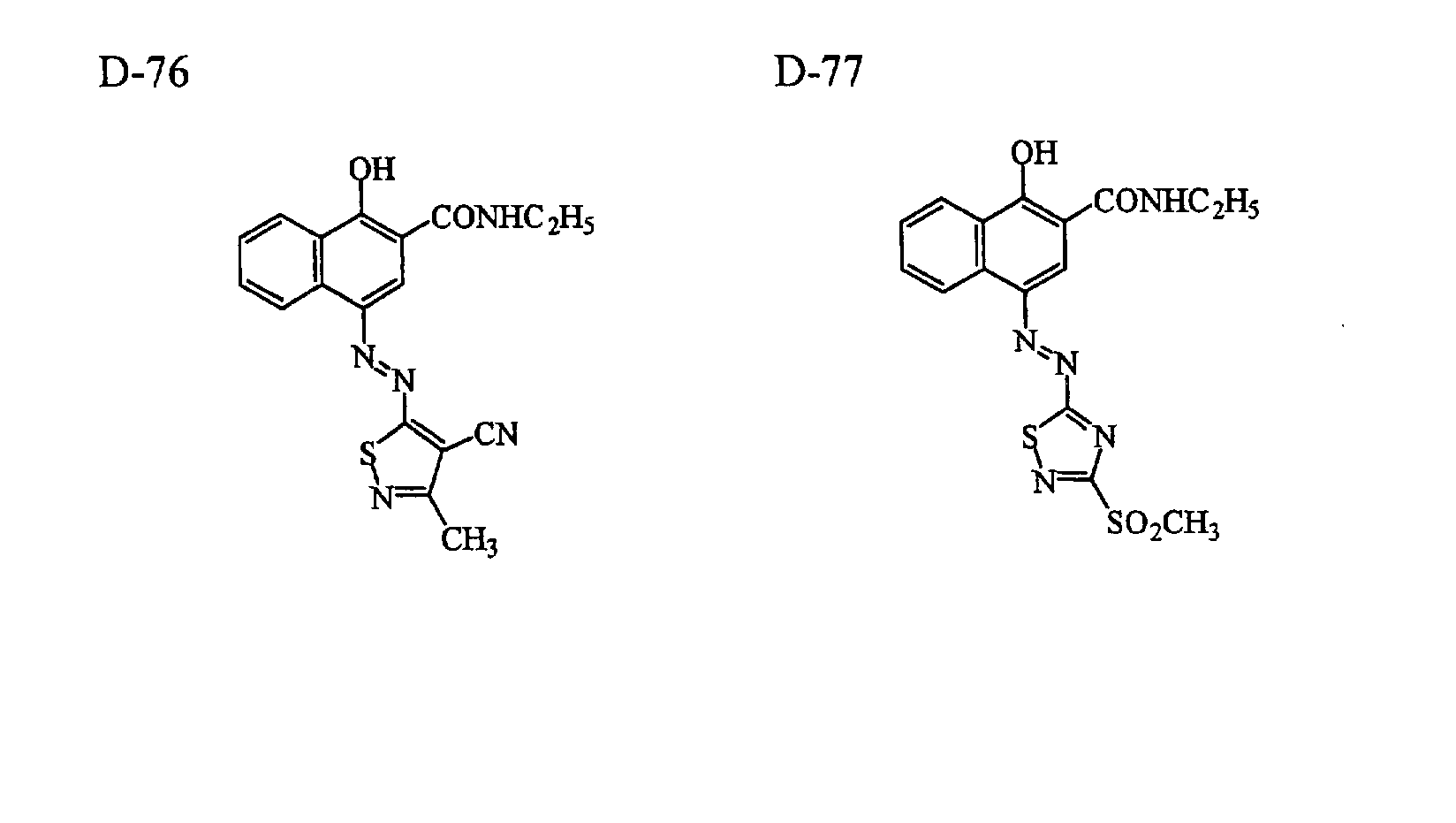


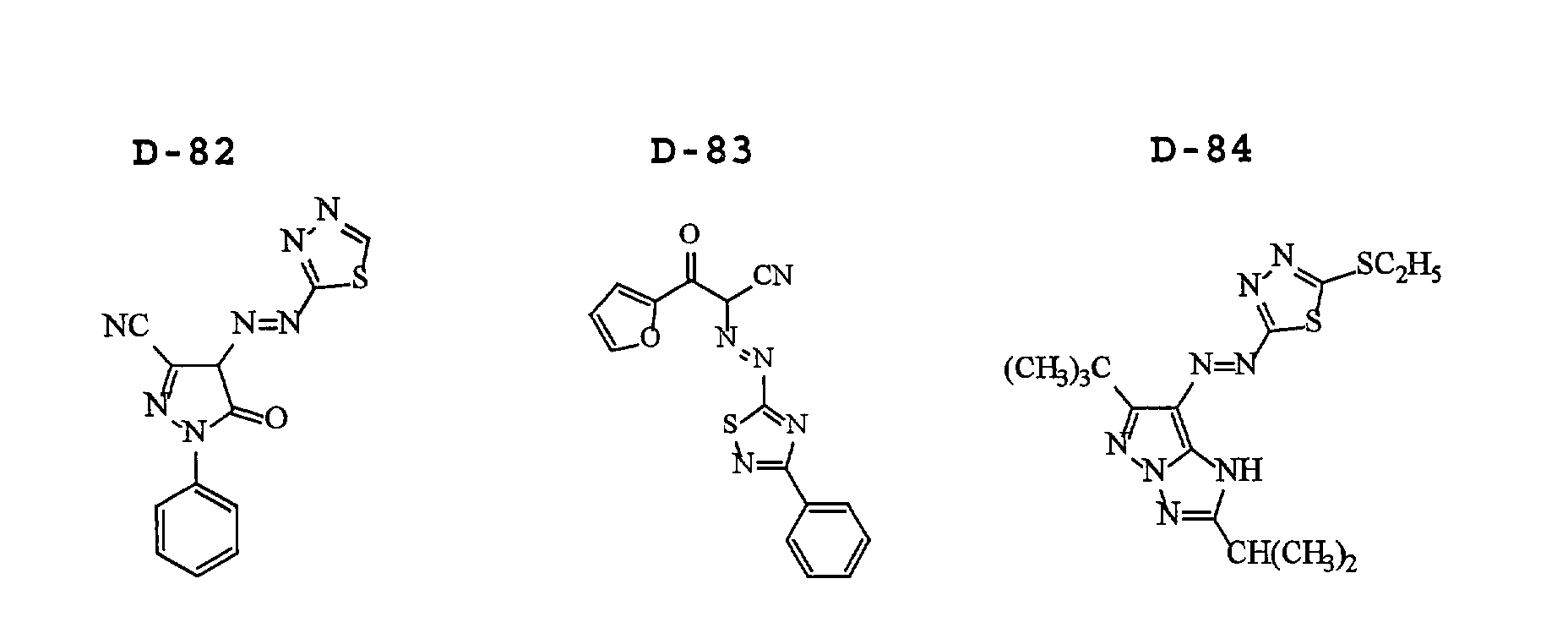
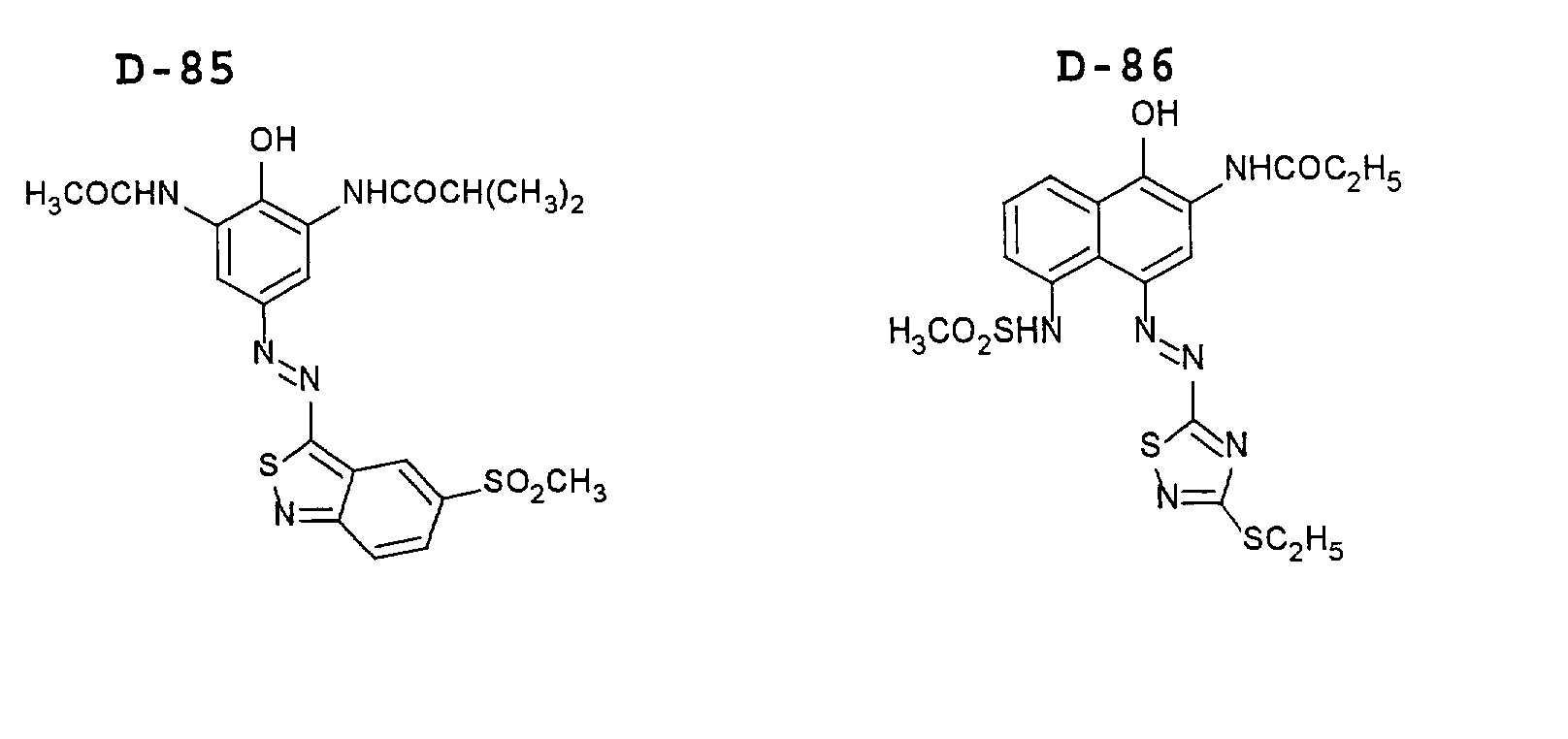


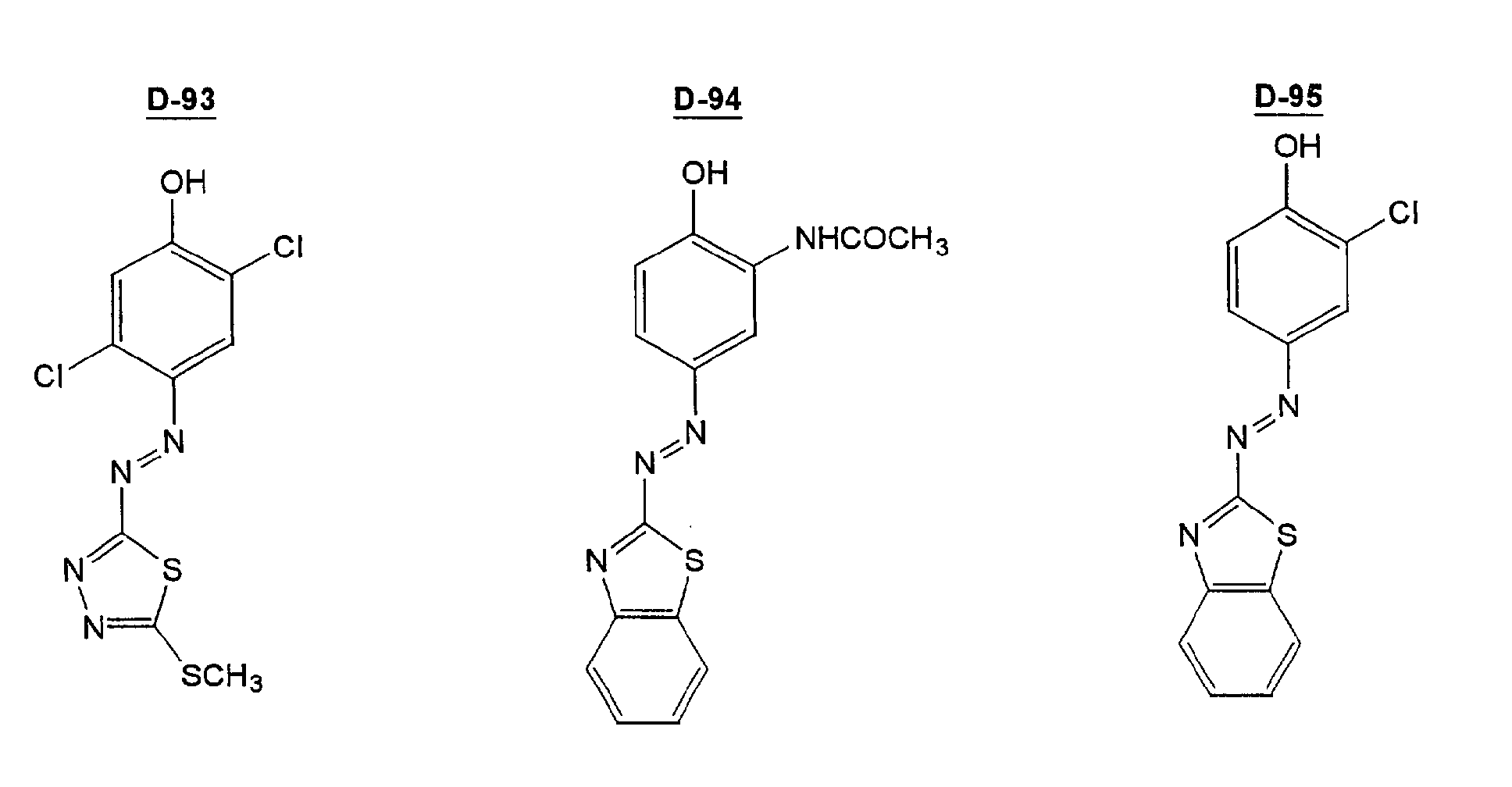

- The pKa of azo dyes represented by the formula (I) is preferably in the range 1.5 to 9, more preferably 2 to 8 and most preferably 2 to 7.5. The pKa of the azo dyes is one possibility for determining the dyeing power of the dyes.
- In another aspect of the present invention, there is also provided a hair dyeing method comprising applying the above-described azo dye to the hair.
- One or more of the above mentioned, particularly preferred azo direct dyes (D-1 to D-89) can be used. Alternatively it may be used in combination with another direct dye or with oxidative dyes
- Examples of additional direct dyes that can be used in combination with the direct dyes of the invention include, Basic Blue 7 (C.I. 42595), Basic Blue 26 (C.I. 44045), Basic Blue 99 (C.I. 56059), Basic Violet 10 (C.I. 45170), Basic Violet 14 (C.I. 42515), Basic Brown 16 (C.I. 12250), Basic Brown 17 (C.I. 12251), Basic Red 2 (C.I. 50240), Basic Red 12 (C.I. 48070), Basic Red 22 (C.I. 11055), Basic Red 46 (C.I. 110825), Basic Red 76 (C.I. 12245), Basic Red 118 (C.I. 12251:1), Basic Yellow 28 (C.I. 48054) and Basic Yellow 57 (C.I. 12719); cationic dyes as described in Japanese Patent Publication No. Sho 58-2204, Japanese Patent Application Laid-Open (kokai) No. Hei 9-118832, Japanese Language Laid-Open Publications (PCT)Nos. Hei 8-501322 and Hei 8-507545; and methine type cationic dyes having a cyanine structure represented by the below-described formulas.

- The azo dyes represented by the formula (I) are preferably added in an amount of 0.0001 to 20 wt.%, more preferably 0.001 to 20 wt.%, further preferably 0.05 to 10 wt.%, especially 0.1 to 5 wt.% based on the whole composition (after mixing of all the component parts when the composition is a two part or three part composition; this will be applied equally hereinafter). When another direct dye is used in combination, the total amount of this dye together with the direct dye (I) is 0.001 to 20 wt.%, preferably 0.01 to 20 wt.%, more preferably in the range from 0.05 to 10 wt.%, especially 0.1 to 5 wt.%, based on the whole composition.
- In the hair dye composition of the present invention, the direct dye (I) exhibits high storage stability within a wide pH range from 2 to 11 which is a pH range employed ordinarily for hair dyes, so that the hair dye composition can be used freely in the above-described pH range. Use in a pH range of 5 or greater is however preferred from the viewpoint of dyeing property. Moreover, owing to high stability of the direct dye against an alkali agent, the hair dye composition can be used at a pH above 8, particularly 8 to 11 which permits a high dyeing power, and even after storage for a long period of time, it exhibits high dyeing power without decomposition of the direct dye. Examples of the alkali agent that may be used in the dyeing composition include ammonia, alkanolamines such as monoethanolamine and isopropanolamine or salts thereof, guanidium salts such as guanidine carbonate and hydroxide salts such as sodium hydroxide. The alkali agent is preferably added in an amount of 0.01 to 20 wt.%, more preferably 0.1 to 10 wt.%, especially 0.5 to 5 wt.% based on the whole composition.
- Since in the hair dye composition of the present invention, the direct dye (I), has high stability against an oxidizing agent, it can be applied to the hair after mixing with an oxidizing agent. In other words, it can be provided in the form composed of a first component part containing the direct dye (I) and a second component part containing an oxidizing agent. In this case, hair dyeing and bleaching can be carried out simultaneously, which facilitates more vivid hair dyeing. Examples of the oxidizing agent include hydrogen peroxide, persulfates such as ammonium persulfate, potassium persulfate and sodium persulfate, perborates such as sodium perborate, percarbonates such as sodium percarbonate and bromates such as sodium bromate and potassium bromate. Hydrogen peroxide is especially preferred for hair bleaching property, stability of the dye and availability. It is also preferred to use a combination of hydrogen peroxide with at least one of the above mentioned other oxidizing agents. The oxidizing agent is preferably added in an amount of 0.5 to 10 wt.%, especially 1 to 8 wt.%, based on the whole composition. The mixing ratio of the first component part containing the direct dye (I) with the oxidizing-agent-containing second component part preferably ranges from 2:1 to 1:3 in terms of a volume ratio.
- In the hair dye composition of the present invention, the direct dye (I) can also be used in combination with one or more oxidation dyes. The combined use attains a markedly more vivid and stronger colour which is not possible by the use of an oxidation dye alone. For the oxidation dye, known developers and couplers ordinarily employed for an oxidation type hair dye can be used.
- Examples of the developer include paraphenylenediamine, toluene-2,5-diamine, 2-chloro-paraphenylenediamine, N-methoxyethyl-paraphenylenediamine, N,N-bis(2-hydroxyethyl)-paraphenylenediamine, 2- (2-hydroxyethyl)-paraphenylenediamine, 2,6-dimethylparaphenylenediamine, 4,4'-diaminodiphenylamine, 1,3-bis(N-(2-hydroxyethyl)-N-(4-aminophenyl)amino)-2-propanol, PEG-3,2,2'-paraphenylenediamine, paraaminophenol, paramethylaminophenol, 3-methyl-4-aminophenol, 2-aminomethyl-4-aminophenol, 2-(2-hydroxyethylaminomethyl)-4-aminophenol, orthoaminophenol, 2-amino-5-methylphenol, 2-amino-6-methylphenol, 2-amino-5-acetamidophenol, 3,4-diaminobenzoic acid, 5-aminosalicylic acid, 2,4,5,6-tetraaminopyrimidine, 2,5,6-triamino-4-hydroxypyrimidine and 4,5-diamino-1-(4'-chlorobenzyl)pyrazole and salts thereof.
- Examples of the coupler include metaphenylenediamine, 2,4-diaminophenoxyethanol, 2-amino-4-(2-hydroxyethylamino)anisole, 2,4-diamino-5-methylphenetole, 2,4-diamino-5-(2-hydroxyethoxy)toluene, 2,4-dimethoxy-1,3-diaminobenzene, 2,6-bis(2-hydroxyethylaminotoluene, 2,4-diamino-5-fluorotoluene, 1,3-bis(2,4-diaminophenoxy)propane, metaaminophenol, 2-methyl-5-aminophenol, 2-methyl-5-(2-hydroxyethylamino)phenol, 2,4-dichloro-3-aminophenol, 2-chloro-3-amino-6-methylphenol, 2-methyl-4-chloro-5-aminophenol, N-cyclopentylmetaaminophenol, 2-methyl-4-methoxy-5- (2-hydroxyethylamino)phenol, 2-methyl-4-fluoro-5-aminophenol, resorcin, 2-methylresorcin, 4-chlororesorcin, 1-naphthol, 1,5-dihydroxynaphthalene, 1,7-dihydroxynaphthalene, 2,7-dihydroxynaphthalene, 2-isopropyl-5-methylphenol, 4-hydroxyindole, 5-hydroxyindole, 6-hydroxyindole, 7-hydroxyindole, 6-hydroxybenzomorpholine, 3,4-methylenedioxyphenol, 2-bromo-4,5-methylenedioxyphenol, 3,4-methylenedioxyaniline, 1-(2-hydroxyethyl)amino-3,4-methylenedioxybenzene, 2,6-dihydroxy-3,4-dimethylpyridine, 2,6-dimethoxy-3,5-diaminopyridine, 2,3-diamino-6-methoxypyridine, 2-methylamino-3-amino-6-methoxypyridine, 2-amino-3-hydroxypyridine, and 2,6-diaminopyridine and salts thereof.
- At least one of the above-exemplified ones can be used as the developer and coupler. The amount of each of the developer and coupler is preferably 0.01 to 20 wt.%, especially 0.5 to 10 wt. %each based on the whole composition.
- To the hair dye composition of the present invention, a known autoxidation dye typified by an indole or an indoline, or a known direct dye such as a nitro dye or a disperse dye can also be added.
- Addition of a polyol, polyol alkyl ether, cationic or amphoteric polymer or silicone to the hair dye composition of the present invention is preferred, because the resulting composition can dye the hair uniformly and has improved cosmetic effects of the hair.
- In addition to the above-described components, those ordinarily employed as a raw material for cosmetics can be added to the hair dye composition of the present invention. Examples of such an optional component include hydrocarbons, animal or vegetable fats and oils, higher fatty acids, organic solvents, penetration promoters, cationic surfactants, natural or synthetic polymers, higher alcohols, ethers, amphoteric surfactants, nonionic surfactants, anionic surfactants, protein derivatives, amino acids, antiseptics, chelating agents, stabilizing agents, antioxidants, plant extracts, crude drug extracts, vitamins, colourants, perfumes and ultraviolet absorbers.
- The hair dye composition of the present invention can be prepared in a conventional manner into a one-part composition, a two-part composition having a first component part containing an alkali agent and a second component part containing an oxidizing agent, or a three-part composition having, in addition to these two component parts, a powdery oxidizing agent such as persulfate. The direct dye (I) may be incorporated in either one or both of these component parts of the two-part or three-part composition. When the hair dye composition of the present invention is one-part type, it is applied to the hair directly, while the two- or three-part type is applied to the hair after mixing these parts upon hair dyeing.
- No particular limitation is imposed on the form of the hair dye composition of the present invention. Examples include powder, transparent liquid, emulsion, cream, gel, paste, aerosol, and aerosol foam. It preferably has a viscosity of 2000 to 100000 mPa.s in the stage of application to the hair (after mixing of all the component parts when the composition is a two-part or three-part type). The viscosity is measured at 20°C by using a Brookfield rotary viscosimeter with a spindle No. 5 at 5 rpm.
- The present invention will be described in greater detail by referring to the examples and comparative examples.
- Specific synthetic examples of the compound represented by the general formula (1) in accordance with the invention will be described below.
- The compound was synthetically prepared according to the following scheme.

- 5-Amino-3-ethylthio-1,2,4-thiadiazole (1.93 g; 12.0 mmol) was added to phosphoric acid (50 ml), and the resulting mixture was agitated under cooling in ice water. Sodium nitrite (1.0 g) in crystal form was added to the mixture, which was agitated for one hour. 2,5-Dichlorophenol (1.63 g; 10.0 mmol) was added to methanol (60 ml), and the resulting mixture was agitated under cooling in ice water, to which was then gradually added the diazo solution prepared above. After agitation under cooling for one hour and agitation at room temperature for another hour, water (150 ml) and ethyl acetate (80 ml) were added to the reaction mixture, for extraction. Then, the organic layer was rinsed twice in aqueous saturated saline (60 ml). The organic layer was concentrated under reduced pressure and was purified by silica gel column chromatography, to recover the listed compound D-38 in an amount of 1.88 g (yield of 56 %) .
- Synthetically prepared according to the following scheme.
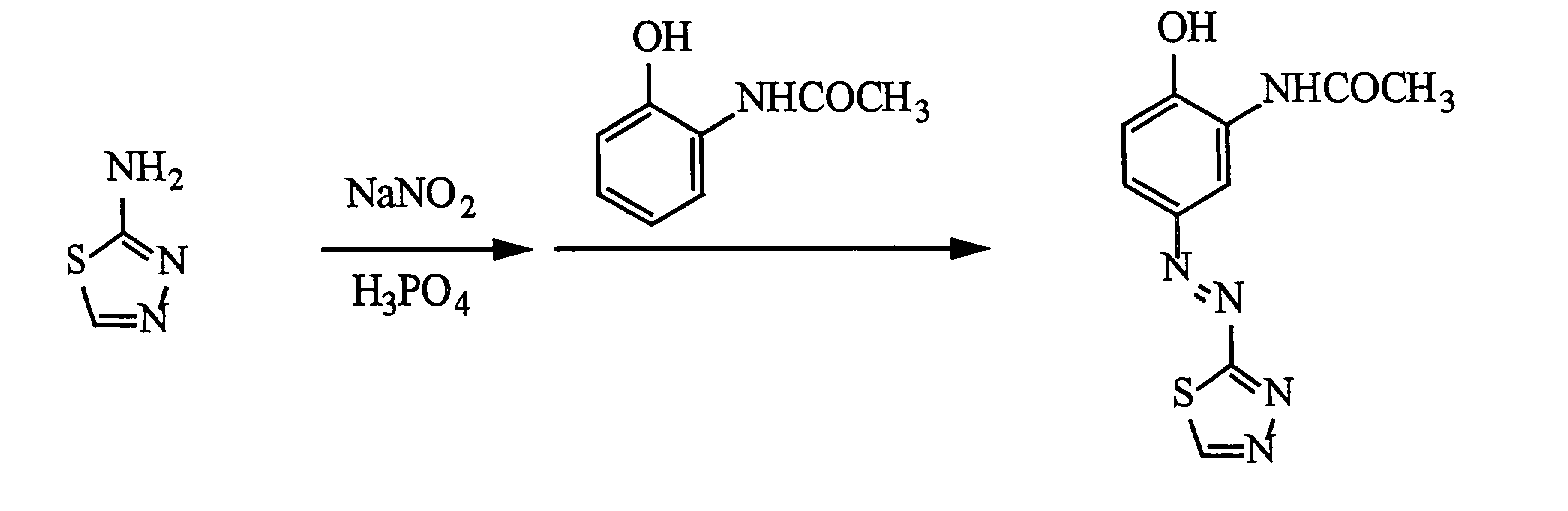
- 2-Amino-1,3,4-thiadiazole (4.30 g; 42.5 mmol) was added to phosphoric acid (120 ml), and the resulting mixture was agitated under cooling in ice water. Sodium nitrite (2.84 g; 41.1 mmol) in crystal form was added to the mixture, which was agitated for 1.5 hours. 2-Acetylaminophenol (4.70 g; 31.1 mmol) was added to methanol (60 ml), and the resulting mixture was agitated under cooling in ice water, to which was then gradually added the diazo solution prepared above in a dividend manner over 2 hours. After agitation under cooling for one hour and agitation at room temperature for another hour, water (240 ml) was added to the reaction mixture, for agitation for 2 hours. The deposited crystal was filtered, rinsed in water and dried, to recover the listed compound D-29 as crystals in an amount of 7.9 g (yield of 96 %) .
- The dyes listed in Tables 1a and 1b were dissolved into a mainly aqueous formulation containing alkaline peroxide and applied in the form of a composition having the general formulation A to goat hair and human hair, respectively
General Formulation A General Dyestuff (I) 0.2g Benzyl Alcolohol 5.0g Sodium Lauryl Sulphate 0.01g Ammonium Hydroxide (25%) 5.0g Hydrogen Peroxide (50%) 6.0g Water upto up to 100g pH 10.0 - The dye mixture was applied to undamaged white goat hair and undamaged human blonde hair at 50°C for 15min. 1.5-2.0g of formulation A was applied per gram of hair. After the dyeing time (approx. 15 to 30 minutes) was complete, the tresses were rinsed with water, shampoo washed and then dried. The colour of the tresses was then recorded. L, a and b values of the tresses before and after the colouring treatment were measured by Minolta colour-measuring instrument and the value of delta E, which is a known measure for the chroma, was calculated according to the following equation:
The results are shown in Table 1a (Goat Hair) and Table 1b (Human Hair.)Color on Undamaged White Goat Hair Dye Example Colour of Dyed Hair L a b Delta E D-89 Bright Pink/Magenta 53 44 -16 63 D-30 Intense Magenta 50 47 -19 67 D-37 Dark Intense Magenta 29 50 -4 76 D-41 Intense Magenta 35 57 -9 79 D-39 Bright Violet 29 48 -25 83 D-38 Intense Red/Magenta 44 57 6 70 D-56 Bright Intense Orange 64 43 35 51 D-46 Bright Pink Red 57 53 6 60 D-29 Bright Intense Red 46 63 23 73 D-43 Intense Magenta 49 50 -8 65 D-78 Intense Yellow 77 14 76 64 D-79 Intense Gold 77 12 74 61 D-80 Intense Yellow 79 11 57 45 D-81 Intense Yellow 84 -4 60 46 D-82 Intense Yellow 77 7 76 63 D-83 Intense Yellow-Orange 80 0 79 66 D-84 Very Intense Yellow 79 8 84 71 D-85 Intense Cyan 47 26 -33 66 D-86 Intense Blue 59 -10 -21 45 D-87 Intense Blue 47 -5 -24 55 D-88 Intense Blue 43 -2 -33 64 D-91 Bight Magenta 38 61 3 77 D-94 Dark Magenta 30 51 -1 75 D-95 Bright Red 51 52 14 62 D-96 Bright Yellow 78 11 88 75 D-97 Dark Blue-Violet 29 34 -43 85 D-98 Dark Blue 27 23 -37 80 Color on Undamaged Human Blonde Hair Dye Example Colour of Dyed Hair L a b Delta E D-89 Pink Red 41 24 6 21 D-30 Dark Pink 39 26 6 23 D-37 Intense Red Magenta 29 33 3 33 D-41 Intense Pink Magenta 30 35 1 35 D-39 Intense Violet 27 26 -7 34 D-38 Intense Red Pink 34 33 10 29 D-56 Bright Intense Orange 45 23 25 19 D-46 Bright Pink 43 21 15 15 D-29 Bright Intense Red 38 37 17 31 D-43 Intense Magenta 37 29 8 24 D-78 Intense Yellow Gold 68 6 31 26 D-79 Intense Gold 56 9 40 25 D-80 Intense Yellow 62 7 25 19 D-81 Intense Yellow Gold 62 5 25 18 D-82 Intense Gold Yellow 60 6 38 26 D-83 Intense Gold Orange 71 2 19 26 D-84 Intense Yellow 61 6 40 27 D-85 Intense Cyan 36 10 -1 20 D-86 Intense Blue 44 -8 8 17 D-87 Intense Blue 38 -8 0 23 D-88 Intense Blue 33 -8 -6 29 D-91 Bright Magenta 50 32 3 33 D-94 Dark Magenta 46 23 1 36 D-95 Bright Red 60 18 8 20 D-96 Bright Yellow 58 8 46 32 D-97 Dark Blue-Violet 29 5 -12 34 D-98 Dark Blue 32 8 -11 35 - The performance of dyes of the invention were compared with that of dyes not covered by the invention. Thus dyes D-82, A* and B* as shown below were used in the composition of the above mentioned general Formulation A and applied to undamaged white goat hair and undamaged human blonde hair for 15mins at 50°C (see Table 2a and 2b.)

Colour uptake on undamaged white goat hair Dye Colour L a b Delta E (D-82) Very Intense Yellow 77 7 76 63 (A) Pale Yellow 86 -6 41 42 (B) Pale Yellow 85 -5 42 43 Colour uptake undamaged Blonde human hair Dye Colour L a b Delta E (D-82) Very Intense Gold 53 10 44 26 (A) Pale Yellow 55 7 26 13 (B) Pale Yellow 55 6 26 13 - Similarly, the performance of (D-85) and (C)* were also compared by using the composition of the General Formulation A. The results are summarised in Table 3a and 3b.
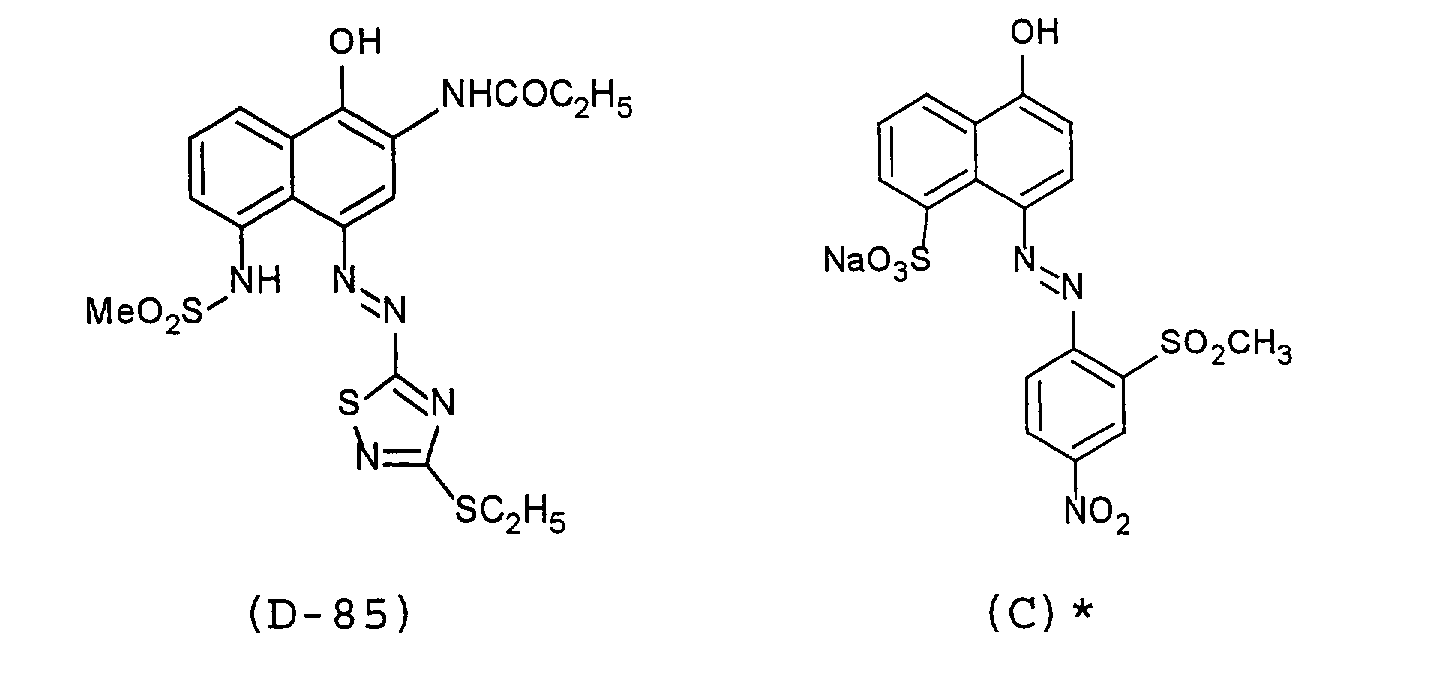
Colour uptake on undamaged white goat hair Dye Colour L a b Delta E (D-85) Intense Violet Blue 47 26 -33 66 (C) Pale Cyan 65 -13 2 23 Colour uptake on undamaged Blonde human hair Dye Colour L a b Delta E (D-85) Violet Blue 36 10 -1 20 (C) Pale Blonde 51 2 19 7 - Clearly, the presence of a -COOH or a -SO3H group, drastically reduces performance and thus these groups are excluded from the invention.
- In order to assess the performance of the dyes of general formula I as defined, in terms of resistance to fading from washing, Dyes D-37 and D-41 were compared with a diazo dye containing a quaternary ammonium group (D)*.

- Using the same formulation as described above (General Formulation A), the dyes were applied for 15mins at 50°C to damaged (permed) white goat hair. After the dyeing process was complete, the tresses were washed and dried and the colour noted. The tresses were then put through a wash fade protocol, to measure the resistance to shampoo washing.
- The washing protocol consisted of applying 0.1g of shampoo per 1g of hair and milking into the hair for 30 seconds followed by rinsing the tresses for 30 seconds with 40C water. This process was repeated 20 times. The tresses were then dried and the change in colour measured as a delta E value, using the Minolta Colorimeter. The results are shown in Table 4.
Washfastness of Dye of the Invention compared to Cationic Dyes not of the invention Dye Example Delta E fade from 20 Washes D-37 4 D-41 2 Cationic Direct Dye 19 - Clearly, the presence of a quaternary ammonium group drastically reduces the durability of the dyestuffs to shampoo washing. Thus, these cationic substituents are excluded from the invention.
- pKa values of the dyes D-3 to D-6 and D-10 were determined by the following method; The dye was dissolved in a solution of a DMF/water (1/1) volume ratio to a final concentration of 2 × 10⁻⁵ mol/1. After the resulting solution was adjusted to pH 2, using 1.0 mol/1 hydrochloric acid, the solution was titrated with aqueous 1.0 mol/1 sodium hydroxide solution. Recording the change of the visible ultra-violet absorption spectrum, the inflection point was determined by regression analysis. Table 5 shows the results.
Dye pKa value determined D-34 4.39 D-30 3.05 D-37 6.37 D-40 4.46 D-41 5.02 D-39 5.52 D-38 3.50 D-45 2.28 D-56 3.56 D-46 5.15 D-29 6.04 D-43 3.90 D-49 5.39
Claims (12)
- Hair dye composition comprising an azo dye represented by the formula (I)
- The hair dye composition according to claim 1, wherein A is selected from the following groups (A-1 to A-25) which are monovalent hetero-ring groups binding via symbol * to the azo group:

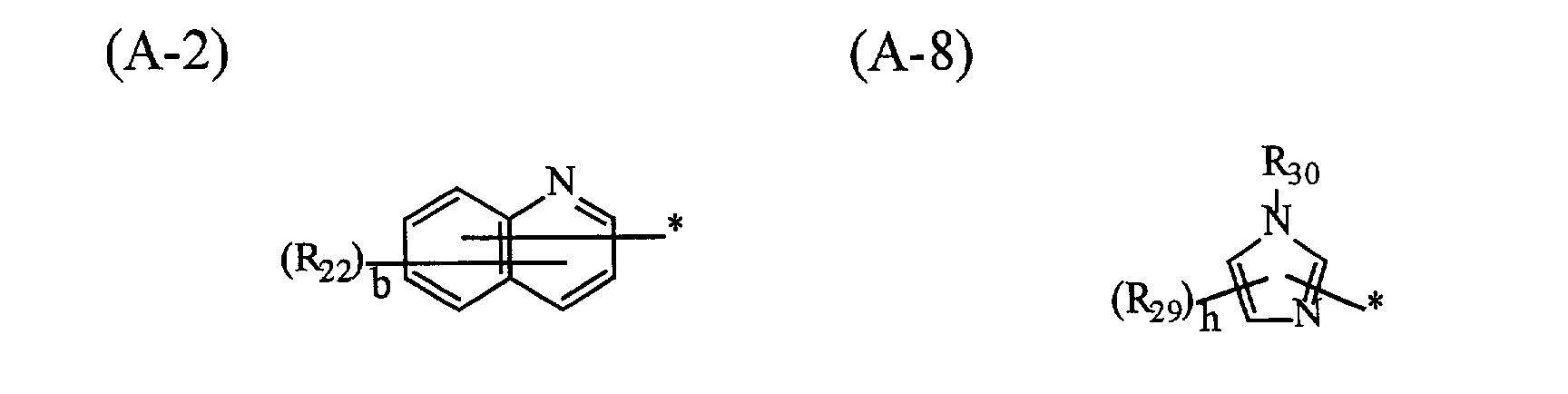
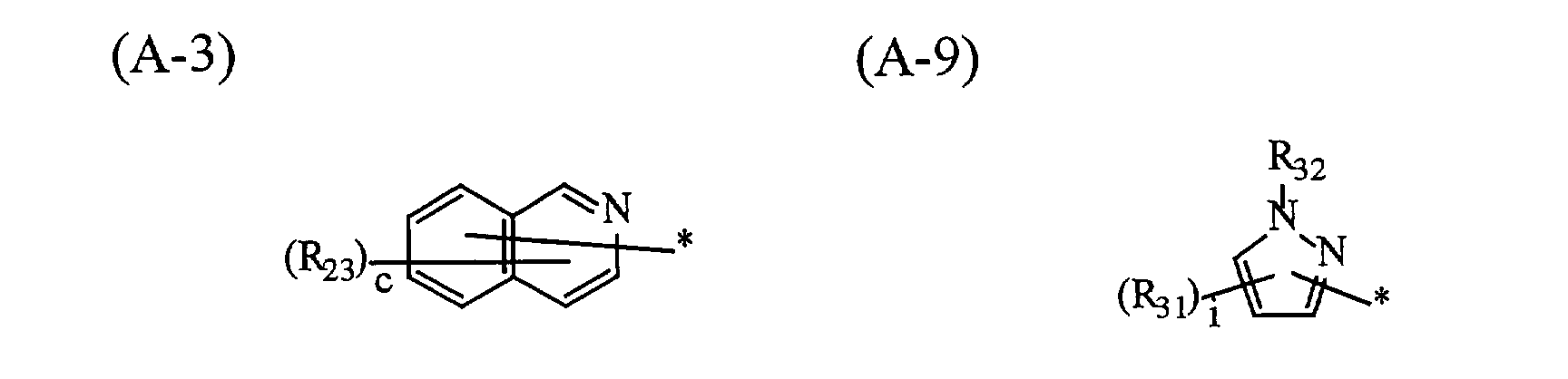


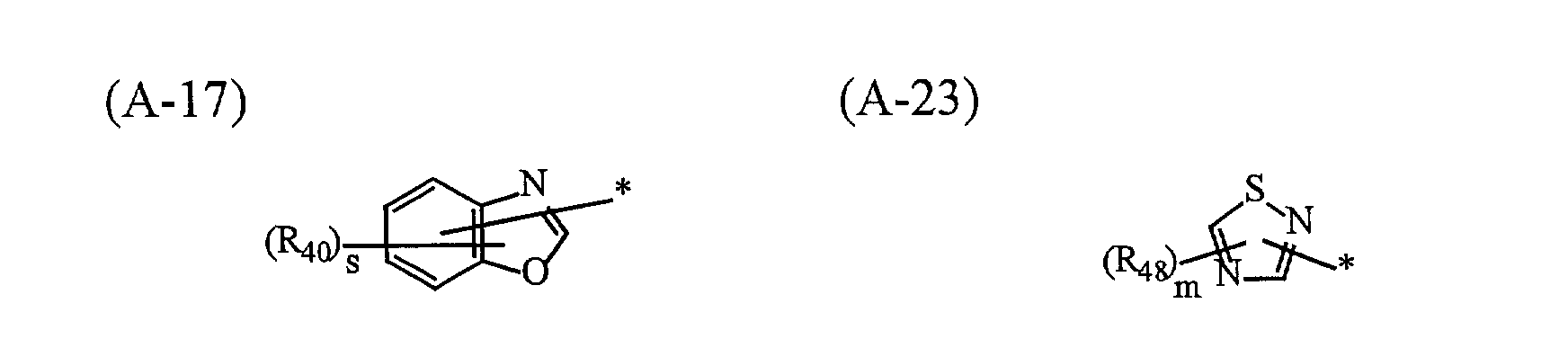
 wherein; R21 to R50 independently represent hydrogen atom, halogen atom, alkyl group, aryl group, hetero-ring group, cyano group, hydroxyl group, nitro group, alkoxy group, aryloxy group, amino group (including anilino group), acylamino group, aminocarbonylamino group, alkoxycarbonylamino group, alkylsulfonylamino group, arylsulfonylamino group, alkylthio group, arylthio group, hetero-ring thio group, sulfamoyl group, alkylsulfonyl group, arylsulfonyl group, acyl group, alkoxycarbonyl group, and carbamoyl group; or wherein, groups adjacent to each other as represented by R21 to R50 can bind together to form a saturated or unsaturated 5- or 6- membered ring structure "a, p, q, r, s" represent an integer of 0 to 4, "b, c" represent an integer of 0 to 6, "d, e, f, g, t, u" represent an integer of 0 to 3, "h, i, j, k, 1, o" represent an integer of 0 to 2, "m" represent an integer of 0 to 1., wherein 2 or more groups represented by R21 to R50 in the same molecule can be the same or different to each other,
and wherein when R21 to R50 in the formulas (A-1) to (A-25) are groups with a possibility of additional substitution, R21 to R50 can further contain a substituent and the substituents are the same as listed as the substituent for the hetero-ring group represented by "A". - Hair dye composition according to claim 1 or 2 wherein B is selected from the following groups (B-1) to (B-11) binding via symbol ** to the azo group:
 wherein R101 represents halogen atom, alkyl group, aryl group, hetero-ring group, cyano group, alkoxy group, amino group (including anilino group), acylamino group, alkylsulfonylamino group, arylsulfonylamino group, alkylthio group, arylthio group, sulfamoyl group, alkylsulfonyl group, or carbamoyl group, R102 and R104 each independently represent cyano group, alkylsulfonyl group, arylsulfonyl group, acyl group, alkoxycarbonyl group, aryloxycarbonyl group, or carbamoyl group. Z1 represents oxygen atom, sulfur atom, or -N(R103)-, wherein R103 represents hydrogen atom, alkyl group, aryl group or hetero-ring group, "v" represents an integer of 0 to 4, wherein several R101 groups may be the same or different;
R107 represents hydrogen atom, alkyl group, aryl group, hetero-ring group, alkoxy group, aryloxy group, amino group (including anilino group), acylamino group, alkylsulfonylamino group, arylsulfonylamino group, alkylthio group, arylthio group, alkylsulfonyl group, arylsulfonyl group, or carbamoyl group; Z2 and Z3 independently represent -C (R108) = , or -N=; R108 represents alkyl group, aryl group, hetero-ring group, alkylthio group, arylthio group, alkoxycarbonyl group, or carbamoyl group, wherein if Z2 and Z3 both represent -C(R108)= , two R108 groups may be the same or different or may bind together to form a carbon ring or a hetero-ring;
R109 represents alkyl group, aryl group or hetero-ring group, and R110 represents hydrogen atom, alkyl group, aryl group, hetero-ring group, acyl group, alkylsulfonyl group or arylsulfonyl group,
R111 represents alkyl group, aryl group, alkoxy group, amino group (including anilino group), alkoxycarbonyl group, cyano group, acylamino group, or carbamoyl group; R112 represents hydrogen atom, alkyl group, aryl group, or hetero-ring group; R113 represents hydroxyl group or amino group,
R114 represents halogen atom, alkyl group, aryl group, hetero-ring group, nitro group, alkoxy group, aryloxy group, amino group (including anilino group), acylamino group, alkoxycarbonylamino group, aminocarbonylamino group, alkylsulfonylamino group, arylsulfonylamino group, alkylthio group, arylthio group, hetero-ring thio group, alkoxycarbonyl group, or carbamoyl group; "w" represents an integer of 0 to 4, wherein several R114 groups in the number "w" may be the same or different,
R115 alkoxyhas the meanings of R114 or is a; "x" represents an integer of 0 to 6, wherein several R115 groups in the number "x" may be the same or different,
R116' R117, R118' and R119 independently represents alkyl group or aryl group, R120 and R121 independently represents alkyl group, aryl group, hetero-ring group, cyano group, alkylsulfonyl group, arylsulfonyl group, alkoxycarbonyl group, or carbamoyl group; R122 represents hydrogen atom, alkyl group, aryl group, hetero-ring group, acylamino group, alkylsulfonylamino group, or arylsulfonylamino group.
R123 and R124 independently represents alkyl group, aryl group, hetero-ring group, cyano group, alkylsulfonyl group, arylsulfonyl group, alkoxycarbonyl group, or carbamoyl group; Z4 represents a non-metal atomic group forming a 5-membered or 6-membered ring, together with the two nitrogen atoms and one carbon atom, R125 represents alkyl group, aryl group, alkoxy group, amino group, acylamino group, alkylsulfonylamino group, arylsulfonylamino group, alkylthio group, arylthio group, acyl group, alkoxycarbonyl group, or carbamoyl group; "y" represents an integer of 0 to 2, when Z4 forms a 5-membered ring; and "y" represents an integer of 0 to 3, when Z4 forms a 6-membered ring,
R126 represents alkyl group and aryl group. - A hair dye composition according to any one of the claims 1 to 3 whereby the structure of the dye is represented by DS-1 to DS-8.
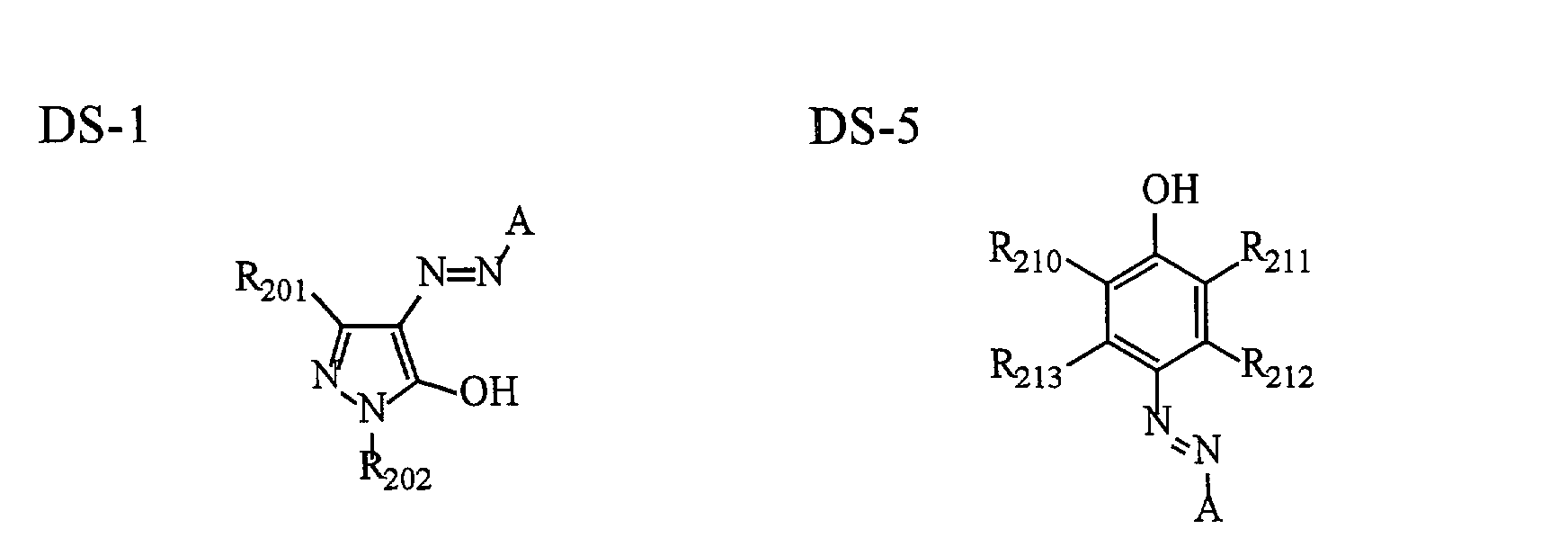
 wherein "A" in the general formulas DS-1 to DS-7 represents a group with the same meaning as that of "A" in the general formula (1) according to claim 2,
R201 represents alkyl group, aryl group, alkoxy group, amino group (including anilino group), alkoxycarbonyl group, cyano group, acylamino group, or carbamoyl group; R202 represents hydrogen atom, alkyl group, aryl group, or hetero-ring group,
R203, R205 and R207 independently represent hydrogen atom, alkyl group, aryl group, hetero-ring group, alkoxy group, aryloxy group, amino group (including anilino group), acylamino group, alkylsulfonylamino group, arylsulfonylamino group, alkylthio group, arylthio group, alkylsulfonyl group, arylsulfonyl group, or carbamoyl group; R204 represents alkyl group, aryl group, or hetero-ring group,
R206 represents alkyl group, aryl group, hetero-ring group, alkylthio group, arylthio group, alkoxycarbonyl group, or carbamoyl group,
R208 represents halogen atom, alkyl group, aryl group, hetero-ring group, alkoxy group, aryloxy group, amino group (including anilino group), acylamino group, alkylsulfonylamino group, arylsulfonylamino group, alkylthio group, arylthio group, alkylsulfonyl group, arylsulfonyl group, alkoxycarbonyl group, or carbamoyl group; "aa" represents an integer of 0 to 4.
R210 and R211 independently represent hydrogen atom, halogen atom, alkyl group, aryl group, acylamino group, alkoxycarbonyl group, aminocarbonylamino group, alkylsulfonylamino group, arylsulfonylamino group, or carbamoyl group; wherein at least one of R210 and R211 is hydrogen atom, R212 and R213 represent hydrogen atom, halogen atom, alkyl group, alkoxy group, or acylamino group,
R214 and R215 independently represents hydrogen atom, alkyl group, aryl group, or hetero-ring group,
R216 represents halogen atom, alkyl group, aryl group, hetero-ring group, cyano group, alkoxy group, amino group (including anilino group), acylamino group, alkylsulfonylamino group, arylsulfonylamino group, alkylthio group, arylthio group, sulfamoyl group, alkylsulfonyl group, or carbamoyl group; Z5 represents oxygen atom, sulfur atom, or -N(R217)-, where R217 represents hydrogen atom, alkyl group, aryl group, or hetero-ring group, "bb" represents an integer of 0 to 4, wherein several R216 groups in the number "bb" may be the same or different,
R218 has the meaning of R210, or sulfamoyl group; R220 and R223 represents hydrogen atom, halogen atom, acylamino group, alkoxycarbonylamino group, aminocarbonylamino group, alkylsulfonylamino group, or arylsulfonylamino group; R219, R221, and R222 represents hydrogen atom, chlorine atom, bromine atom, alkyl group, and acylamino group,
R224 represents alkyl group or aryl group,
wherein when R201 to R224 in the formulas DS-1 to DS-9 are groups with a possibility of additional substitution, R201 to R223 may have additional substituents, the substituents are the same as those listed in the description of the substituent for the hetero-ring group represented by "A" according to claim 2. - A hair dyeing composition according to any one of the claims 1 to 4, wherein the pKa of the dye is in the range 1.5 to 9.0.
- Hair dyeing composition according to any one of the claims 1 - 5, wherein the azo dye of the formula (I) is present in an amount of 0.0001 to 20 wt.%, based on the whole composition.
- The hair dyeing composition according to any one of the claims 1 - 6, further containing at least one direct dye other than the azo dye of general formula (I) and/or at least one oxidative dye.
- The hair dyeing composition as claimed in claim 7, wherein the total amount of the dyes present in said composition is 0.001 - 20 wt.%, based on the whole composition.
- The hair dyeing composition according to any one of the claims 1 - 8, further containing an alkaline agent in an amount of 0.01 to 20 wt.%, based on the whole composition.
- The hair dyeing composition as defined in anyone of the claims 7 - 9, being a one part composition, a two part composition or a three part composition, wherein the two part composition comprises a first part containing an alkaline agent and a second part containing an oxidative agent, and wherein the three part composition contains the said first and second parts and additionally a third part containing a powdery oxidizing agent, wherein in each of the said composition the direct dye having the formula (I) may be contained in either one of the respective parts or in each part.
- Method for dyeing human or animal hair, comprising applying an azo dye represented by the formula (I) to the hair, rinsing the hair after completion of the dyeing and drying the hair.
- Use of an azo dye represented by the formula (I)
Priority Applications (5)
| Application Number | Priority Date | Filing Date | Title |
|---|---|---|---|
| EP02011605A EP1366752A1 (en) | 2002-05-28 | 2002-05-28 | Hair dye composition |
| EP03012105A EP1369105B1 (en) | 2002-05-28 | 2003-05-28 | Use and method for dyeing hair |
| JP2003150761A JP4080947B2 (en) | 2002-05-28 | 2003-05-28 | Hair dye composition |
| US10/445,819 US7083655B2 (en) | 2002-05-28 | 2003-05-28 | Hair dye composition |
| DE60319772T DE60319772T2 (en) | 2002-05-28 | 2003-05-28 | Use and method of hair coloring |
Applications Claiming Priority (1)
| Application Number | Priority Date | Filing Date | Title |
|---|---|---|---|
| EP02011605A EP1366752A1 (en) | 2002-05-28 | 2002-05-28 | Hair dye composition |
Publications (1)
| Publication Number | Publication Date |
|---|---|
| EP1366752A1 true EP1366752A1 (en) | 2003-12-03 |
Family
ID=29414692
Family Applications (1)
| Application Number | Title | Priority Date | Filing Date |
|---|---|---|---|
| EP02011605A Withdrawn EP1366752A1 (en) | 2002-05-28 | 2002-05-28 | Hair dye composition |
Country Status (4)
| Country | Link |
|---|---|
| US (1) | US7083655B2 (en) |
| EP (1) | EP1366752A1 (en) |
| JP (1) | JP4080947B2 (en) |
| DE (1) | DE60319772T2 (en) |
Cited By (16)
| Publication number | Priority date | Publication date | Assignee | Title |
|---|---|---|---|---|
| EP1627626A1 (en) | 2004-08-16 | 2006-02-22 | L'oreal | Dyestuff composition comprising a particular hydrophobic colourant and an acid |
| EP1634622A1 (en) | 2004-08-16 | 2006-03-15 | L'oreal | Process of colouring keratin fibres with a composition containing a hydrophobic colourant |
| WO2009005139A3 (en) * | 2007-06-29 | 2009-03-05 | Kao Corp | Hair dye composition |
| EP1975202A3 (en) * | 2007-03-27 | 2009-07-22 | FUJIFILM Corporation | Novel azo compound and azo dye |
| EP2108406A1 (en) | 2008-04-11 | 2009-10-14 | DyStar Textilfarben GmbH & Co. Deutschland KG | Anionic dyes and hair dye compositions containing them |
| EP1847249A4 (en) * | 2005-02-04 | 2015-06-03 | Kao Corp | Hairdye composition |
| EP3165524A4 (en) * | 2014-07-03 | 2017-05-10 | Fujifilm Corporation | Novel azo compound and azo dye |
| CN112225733A (en) * | 2020-11-25 | 2021-01-15 | 湖南科技大学 | A kind of preparation method containing 1,3,4-thiadiazole pyridin-2-one derivative and application as anticancer drug |
| WO2022056204A1 (en) * | 2020-09-14 | 2022-03-17 | Milliken & Company | Oxidative hair cream composition containing thiophene azo colorant |
| WO2022069280A1 (en) | 2020-09-30 | 2022-04-07 | Kao Corporation | Dyeing composition for keratin fibers comprising a direct dye and an organic alkalizing agent, method for dyeing; and kit-of-parts thereof |
| WO2022069282A1 (en) | 2020-09-30 | 2022-04-07 | Kao Corporation | Bleaching and coloring composition for keratin fibers comprising direct dyes |
| WO2022069281A1 (en) | 2020-09-30 | 2022-04-07 | Kao Corporation | Hair dyeing composition comprising blue dyes |
| WO2022069279A1 (en) | 2020-09-30 | 2022-04-07 | Kao Corporation | Hair dyeing composition with improved durability |
| US11344492B2 (en) | 2020-09-14 | 2022-05-31 | Milliken & Company | Oxidative hair cream composition containing polymeric colorant |
| WO2023118103A1 (en) | 2021-12-23 | 2023-06-29 | Kao Corporation | Dyeing method for keratin fibers comprising a direct azo-dye and an organic alkalizing agent, and kit-of-parts thereof |
| US12377033B2 (en) | 2020-09-14 | 2025-08-05 | Milliken & Company | Hair care composition containing polymeric colorant |
Families Citing this family (46)
| Publication number | Priority date | Publication date | Assignee | Title |
|---|---|---|---|---|
| JP2005139364A (en) * | 2003-11-07 | 2005-06-02 | Fuji Photo Film Co Ltd | Azo dye |
| DE102004005768A1 (en) * | 2004-02-05 | 2005-08-25 | Wella Ag | Pearlescent dye for keratin fibers |
| DE102004005767A1 (en) * | 2004-02-05 | 2005-09-01 | Wella Ag | Colorant for keratin fibers with pearlescent |
| WO2006060570A2 (en) * | 2004-12-02 | 2006-06-08 | The Procter & Gamble Company | Hair colouring compositions |
| JP4705367B2 (en) * | 2004-12-24 | 2011-06-22 | 花王株式会社 | Hair dye composition |
| JP4723874B2 (en) * | 2005-02-18 | 2011-07-13 | 花王株式会社 | Hair dye composition |
| JP2007326810A (en) | 2006-06-07 | 2007-12-20 | Kao Corp | One-part hair dye composition |
| JP5363703B2 (en) | 2006-06-07 | 2013-12-11 | 花王株式会社 | One-part hair dye composition |
| US7857863B2 (en) | 2006-06-07 | 2010-12-28 | Kao Corporation | One-part hair dye composition |
| JP2007326818A (en) * | 2006-06-08 | 2007-12-20 | Kao Corp | Hair dye composition |
| US8475778B2 (en) * | 2006-10-06 | 2013-07-02 | L'oreal | Aqueous polyamine-containing anti-frizz composition for hair |
| EP1975204B1 (en) | 2007-03-27 | 2013-10-02 | FUJIFILM Corporation | Azo dye and azo compound |
| JP5192728B2 (en) * | 2007-03-27 | 2013-05-08 | 富士フイルム株式会社 | Novel azo compounds and azo dyes |
| JP2008248211A (en) * | 2007-03-30 | 2008-10-16 | Fujifilm Corp | Azo dyes and azo compounds |
| US7699897B2 (en) | 2007-09-14 | 2010-04-20 | L'oreal | Method of coloring hair |
| US8658140B2 (en) * | 2007-09-14 | 2014-02-25 | L'oreal | Compositions and methods for treating keratinous substrates |
| US20090071493A1 (en) * | 2007-09-14 | 2009-03-19 | L'oreal | Compositions and methods for conditioning hair |
| EP2067467A3 (en) | 2007-09-14 | 2012-12-12 | L'Oréal | Compositions and methods for treating keratinous substrates |
| EP2329809A4 (en) | 2008-08-19 | 2015-04-15 | Kao Corp | Hair dye composition |
| IT1397303B1 (en) * | 2010-01-07 | 2013-01-04 | Lamberti Spa | POLYCALACTOMANNAN PURIFIED CATIONIC FREE FROM GLIOSSAL. |
| CN103079532B (en) * | 2010-08-31 | 2015-03-25 | 花王株式会社 | Two-Part Foam Hair Color |
| JP6403443B2 (en) * | 2014-06-06 | 2018-10-10 | 花王株式会社 | Hair dye composition |
| JP6403442B2 (en) * | 2014-06-06 | 2018-10-10 | 花王株式会社 | Hair dye composition |
| JP6403441B2 (en) * | 2014-06-06 | 2018-10-10 | 花王株式会社 | Hair dye composition |
| US10485747B2 (en) * | 2014-06-06 | 2019-11-26 | Kao Corporation | Hair-dye composition |
| EP3653198A1 (en) | 2014-06-06 | 2020-05-20 | Kao Corporation | Hair-dye composition |
| JP6334277B2 (en) * | 2014-06-06 | 2018-05-30 | 花王株式会社 | Hair dye composition |
| SG10201806680XA (en) * | 2014-06-06 | 2018-09-27 | Kao Corp | Hair dye composition |
| CN106661339B (en) * | 2014-09-02 | 2019-03-26 | 富士胶片株式会社 | Azo pigment composition and method for producing the same |
| JP2016084421A (en) * | 2014-10-27 | 2016-05-19 | 富士フイルム株式会社 | Alkali metal salts, alkaline earth metal salts and tautomers thereof, coloring compositions, dyeing methods and dyed articles of azo dyes |
| US10478643B2 (en) * | 2015-04-16 | 2019-11-19 | Kao Germany Gmbh | Hair dyeing composition |
| JP6443888B2 (en) * | 2015-07-09 | 2018-12-26 | 富士フイルム株式会社 | Dye mixture and method for producing the same, hair dye, and hair dye solution |
| US10463589B2 (en) * | 2015-11-13 | 2019-11-05 | Kao Corporation | Hair dye composition |
| JP7102143B2 (en) * | 2017-06-30 | 2022-07-19 | 小林製薬株式会社 | Denture cleaner |
| BR112020005506A2 (en) * | 2017-09-20 | 2020-10-06 | Kao Corporation | hair treatment method |
| EP3684473A1 (en) * | 2017-09-20 | 2020-07-29 | Kao Corporation | Powder hair dye composition |
| WO2019059253A1 (en) | 2017-09-20 | 2019-03-28 | 花王株式会社 | Liquid hair dye composition |
| WO2019059263A1 (en) | 2017-09-20 | 2019-03-28 | Kao Corporation | Hair dyeing method |
| EP3684328A1 (en) | 2017-09-20 | 2020-07-29 | Kao Corporation | Liquid hair dye composition |
| RU2020113606A (en) | 2017-09-20 | 2021-10-20 | Као Корпорейшн | LIQUID COMPOSITION FOR HAIR COLORING |
| CN111432790A (en) | 2017-11-20 | 2020-07-17 | 花王株式会社 | Hair Cosmetics |
| EP3747956A4 (en) | 2018-01-31 | 2021-08-18 | FUJIFILM Corporation | Staining composition, stained article, and azo dye |
| TWI829837B (en) * | 2019-03-19 | 2024-01-21 | 日商花王股份有限公司 | Liquid hair dye composition |
| US20250025405A1 (en) | 2021-11-30 | 2025-01-23 | Kao Corporation | Method for treating keratin substance or fiber for head ornamental product |
| CN118302149A (en) | 2021-11-30 | 2024-07-05 | 花王株式会社 | Method for treating keratinous materials or fibers for headwear |
| CN120676928A (en) | 2023-01-30 | 2025-09-19 | 花王株式会社 | Method for treating hair |
Citations (6)
| Publication number | Priority date | Publication date | Assignee | Title |
|---|---|---|---|---|
| GB1296857A (en) * | 1968-11-12 | 1972-11-22 | ||
| US4055556A (en) * | 1973-09-06 | 1977-10-25 | Sandoz Ltd. | Monoazo and disazo compounds having optionally further substituted 2-acyl-, carboxy- or cyano-benzothienyl diazo component radicals |
| US5324826A (en) * | 1991-08-12 | 1994-06-28 | Sandoz Ltd. | Azo disperse dyes having 1,2,4-triazol-5-yl diazo component radicals having electron-withdrawing substituents in the 3-positions |
| US5691458A (en) * | 1996-09-18 | 1997-11-25 | Polaroid Corporation | Benzoisothiazole azo dyes |
| US5889163A (en) * | 1995-11-30 | 1999-03-30 | Fuji Photo Film Co., Ltd. | Method for producing azo dye compounds |
| DE10028686A1 (en) * | 2000-06-09 | 2001-12-13 | Dystar Textilfarben Gmbh & Co | New hydroxypyridone methide azo dyes, useful in e.g. dyeing and printing hydrophobic fibers, ink-jet printing and color filters |
Family Cites Families (1)
| Publication number | Priority date | Publication date | Assignee | Title |
|---|---|---|---|---|
| DE19515903C2 (en) * | 1995-04-29 | 1998-04-16 | Wella Ag | Means and methods for oxidative coloring of hair |
-
2002
- 2002-05-28 EP EP02011605A patent/EP1366752A1/en not_active Withdrawn
-
2003
- 2003-05-28 DE DE60319772T patent/DE60319772T2/en not_active Expired - Lifetime
- 2003-05-28 US US10/445,819 patent/US7083655B2/en not_active Expired - Lifetime
- 2003-05-28 JP JP2003150761A patent/JP4080947B2/en not_active Expired - Lifetime
Patent Citations (6)
| Publication number | Priority date | Publication date | Assignee | Title |
|---|---|---|---|---|
| GB1296857A (en) * | 1968-11-12 | 1972-11-22 | ||
| US4055556A (en) * | 1973-09-06 | 1977-10-25 | Sandoz Ltd. | Monoazo and disazo compounds having optionally further substituted 2-acyl-, carboxy- or cyano-benzothienyl diazo component radicals |
| US5324826A (en) * | 1991-08-12 | 1994-06-28 | Sandoz Ltd. | Azo disperse dyes having 1,2,4-triazol-5-yl diazo component radicals having electron-withdrawing substituents in the 3-positions |
| US5889163A (en) * | 1995-11-30 | 1999-03-30 | Fuji Photo Film Co., Ltd. | Method for producing azo dye compounds |
| US5691458A (en) * | 1996-09-18 | 1997-11-25 | Polaroid Corporation | Benzoisothiazole azo dyes |
| DE10028686A1 (en) * | 2000-06-09 | 2001-12-13 | Dystar Textilfarben Gmbh & Co | New hydroxypyridone methide azo dyes, useful in e.g. dyeing and printing hydrophobic fibers, ink-jet printing and color filters |
Non-Patent Citations (2)
| Title |
|---|
| DATABASE CA [online] CHEMICAL ABSTRACTS SERVICE, COLUMBUS, OHIO, US; YAMADA, NAMIHEI ET AL: "Benzothiazole pyrazolobenzimidazole azo dyes", XP002219140, retrieved from STN Database accession no. 71:62277 * |
| SHREVE, RN; SWANEY, MW; RIECHERS, EH: "Studies in Azo Dyes", JOURNAL OF THE AMERICAN CHEMICAL SOCIETY, vol. 65, 1943, pages 2241 - 2243, XP002219139 * |
Cited By (30)
| Publication number | Priority date | Publication date | Assignee | Title |
|---|---|---|---|---|
| EP1627626A1 (en) | 2004-08-16 | 2006-02-22 | L'oreal | Dyestuff composition comprising a particular hydrophobic colourant and an acid |
| EP1634622A1 (en) | 2004-08-16 | 2006-03-15 | L'oreal | Process of colouring keratin fibres with a composition containing a hydrophobic colourant |
| US7364596B2 (en) | 2004-08-16 | 2008-04-29 | L'oreal S.A. | Dye compositions comprising at least one hydrophobic direct dye and at least one acid |
| EP1847249A4 (en) * | 2005-02-04 | 2015-06-03 | Kao Corp | Hairdye composition |
| EP1975202A3 (en) * | 2007-03-27 | 2009-07-22 | FUJIFILM Corporation | Novel azo compound and azo dye |
| WO2009005139A3 (en) * | 2007-06-29 | 2009-03-05 | Kao Corp | Hair dye composition |
| US7896931B2 (en) | 2007-06-29 | 2011-03-01 | Kao Corporation | Hair dye composition |
| EP2108406A1 (en) | 2008-04-11 | 2009-10-14 | DyStar Textilfarben GmbH & Co. Deutschland KG | Anionic dyes and hair dye compositions containing them |
| EP3165524A4 (en) * | 2014-07-03 | 2017-05-10 | Fujifilm Corporation | Novel azo compound and azo dye |
| US11684560B2 (en) | 2020-09-14 | 2023-06-27 | Milliken & Company | Oxidative hair cream composition containing polymeric colorant |
| US11458089B2 (en) | 2020-09-14 | 2022-10-04 | Milliken & Company | Oxidative hair cream composition containing polymeric colorant |
| US12377033B2 (en) | 2020-09-14 | 2025-08-05 | Milliken & Company | Hair care composition containing polymeric colorant |
| US12042556B2 (en) | 2020-09-14 | 2024-07-23 | Milliken & Company | Oxidative hair cream composition containing polymeric colorant |
| WO2022056204A1 (en) * | 2020-09-14 | 2022-03-17 | Milliken & Company | Oxidative hair cream composition containing thiophene azo colorant |
| US11633344B2 (en) | 2020-09-14 | 2023-04-25 | Miliken & Company | Oxidative hair cream composition containing thiophene azo colorant |
| US11344492B2 (en) | 2020-09-14 | 2022-05-31 | Milliken & Company | Oxidative hair cream composition containing polymeric colorant |
| US11351106B2 (en) | 2020-09-14 | 2022-06-07 | Milliken & Company | Oxidative hair cream composition containing thiophene azo colorant |
| CN116322619A (en) * | 2020-09-30 | 2023-06-23 | 花王株式会社 | Hair coloring composition with improved durability |
| WO2022069279A1 (en) | 2020-09-30 | 2022-04-07 | Kao Corporation | Hair dyeing composition with improved durability |
| WO2022069281A1 (en) | 2020-09-30 | 2022-04-07 | Kao Corporation | Hair dyeing composition comprising blue dyes |
| WO2022069282A1 (en) | 2020-09-30 | 2022-04-07 | Kao Corporation | Bleaching and coloring composition for keratin fibers comprising direct dyes |
| US12102703B2 (en) | 2020-09-30 | 2024-10-01 | Kao Corporation | Hair dyeing composition comprising blue dyes |
| US12121605B2 (en) | 2020-09-30 | 2024-10-22 | Kao Corporation | Dyeing composition for keratin fibers comprising a direct dye and an organic alkalizing agent, method for dyeing; and kit-of-parts thereof |
| US12233141B2 (en) | 2020-09-30 | 2025-02-25 | Kao Corporation | Bleaching and coloring composition for keratin fibers comprising direct dyes |
| US12357550B2 (en) | 2020-09-30 | 2025-07-15 | Kao Corporation | Hair dyeing composition with improved durability |
| WO2022069280A1 (en) | 2020-09-30 | 2022-04-07 | Kao Corporation | Dyeing composition for keratin fibers comprising a direct dye and an organic alkalizing agent, method for dyeing; and kit-of-parts thereof |
| CN112225733B (en) * | 2020-11-25 | 2022-12-09 | 湖南科技大学 | Preparation method of 1,3, 4-thiadiazole pyridine-2-ketone derivative and application of derivative as anti-cancer drug |
| CN112225733A (en) * | 2020-11-25 | 2021-01-15 | 湖南科技大学 | A kind of preparation method containing 1,3,4-thiadiazole pyridin-2-one derivative and application as anticancer drug |
| WO2023118103A1 (en) | 2021-12-23 | 2023-06-29 | Kao Corporation | Dyeing method for keratin fibers comprising a direct azo-dye and an organic alkalizing agent, and kit-of-parts thereof |
| US12383480B2 (en) | 2021-12-23 | 2025-08-12 | Kao Corporation | Dyeing method for keratin fibers comprising a direct azo-dye and an organic alkalizing agent, and kit-of-parts thereof |
Also Published As
| Publication number | Publication date |
|---|---|
| JP2003342139A (en) | 2003-12-03 |
| US20040019982A1 (en) | 2004-02-05 |
| DE60319772T2 (en) | 2009-04-02 |
| JP4080947B2 (en) | 2008-04-23 |
| US7083655B2 (en) | 2006-08-01 |
| DE60319772D1 (en) | 2008-04-30 |
Similar Documents
| Publication | Publication Date | Title |
|---|---|---|
| US7083655B2 (en) | Hair dye composition | |
| EP1398020A1 (en) | Hair dye composition comprising an azo dye containing a dissociative proton, method and use | |
| WO2009005139A2 (en) | Hair dye composition | |
| EP1369105A1 (en) | Hair dye composition | |
| EP1535599B1 (en) | Method effecting a reversible colour change of dyed hair | |
| KR102887444B1 (en) | How to Lighten Keratin Fibers | |
| EP1407756B2 (en) | Hair dye composition comprising methine dye | |
| JP4723874B2 (en) | Hair dye composition | |
| EP1398021B1 (en) | Hair dye composition | |
| JP4705367B2 (en) | Hair dye composition | |
| JP4136722B2 (en) | Hair dye composition | |
| JP4463833B2 (en) | Hair dye composition | |
| CN117355287A (en) | Compositions for simultaneously bleaching and dyeing keratin fibers and methods of using the same | |
| JP7754930B2 (en) | Composition for simultaneously bleaching and dyeing keratin fibers and method of using the composition | |
| KR102887445B1 (en) | How to Lighten Keratin Fibers | |
| JP2004155746A (en) | Hair dye composition | |
| CN118524823A (en) | Method for lightening keratin fibres or for simultaneously bleaching and dyeing keratin fibres | |
| JP2004189649A (en) | Hair dye composition | |
| JP2007077056A (en) | Hair cosmetics containing self-assembling compounds | |
| FR2912909A1 (en) | Composition, useful for coloring human keratinous fibers, preferably hair, comprises cationic azo compound and heterocyclic base having substituted 4-amino-dihydro-pyrazolone compound or substituted pyrazol-4-ylamine compound | |
| JP2004107223A (en) | Hair dye composition |
Legal Events
| Date | Code | Title | Description |
|---|---|---|---|
| PUAI | Public reference made under article 153(3) epc to a published international application that has entered the european phase |
Free format text: ORIGINAL CODE: 0009012 |
|
| AK | Designated contracting states |
Kind code of ref document: A1 Designated state(s): AT BE CH CY DE DK ES FI FR GB GR IE IT LI LU MC NL PT SE TR |
|
| AX | Request for extension of the european patent |
Extension state: AL LT LV MK RO SI |
|
| AKX | Designation fees paid | ||
| REG | Reference to a national code |
Ref country code: DE Ref legal event code: 8566 |
|
| STAA | Information on the status of an ep patent application or granted ep patent |
Free format text: STATUS: THE APPLICATION IS DEEMED TO BE WITHDRAWN |
|
| 18D | Application deemed to be withdrawn |
Effective date: 20040604 |