EP1365570A2 - Management method for service for storing data from memory card in external storage device and system for carrying out the service - Google Patents
Management method for service for storing data from memory card in external storage device and system for carrying out the service Download PDFInfo
- Publication number
- EP1365570A2 EP1365570A2 EP03252249A EP03252249A EP1365570A2 EP 1365570 A2 EP1365570 A2 EP 1365570A2 EP 03252249 A EP03252249 A EP 03252249A EP 03252249 A EP03252249 A EP 03252249A EP 1365570 A2 EP1365570 A2 EP 1365570A2
- Authority
- EP
- European Patent Office
- Prior art keywords
- data
- storage device
- memory card
- card
- storage
- Prior art date
- Legal status (The legal status is an assumption and is not a legal conclusion. Google has not performed a legal analysis and makes no representation as to the accuracy of the status listed.)
- Withdrawn
Links
Images




Classifications
-
- G—PHYSICS
- G06—COMPUTING OR CALCULATING; COUNTING
- G06F—ELECTRIC DIGITAL DATA PROCESSING
- G06F15/00—Digital computers in general; Data processing equipment in general
-
- H—ELECTRICITY
- H04—ELECTRIC COMMUNICATION TECHNIQUE
- H04N—PICTORIAL COMMUNICATION, e.g. TELEVISION
- H04N1/00—Scanning, transmission or reproduction of documents or the like, e.g. facsimile transmission; Details thereof
- H04N1/00127—Connection or combination of a still picture apparatus with another apparatus, e.g. for storage, processing or transmission of still picture signals or of information associated with a still picture
- H04N1/00132—Connection or combination of a still picture apparatus with another apparatus, e.g. for storage, processing or transmission of still picture signals or of information associated with a still picture in a digital photofinishing system, i.e. a system where digital photographic images undergo typical photofinishing processing, e.g. printing ordering
- H04N1/00137—Transmission
-
- H—ELECTRICITY
- H04—ELECTRIC COMMUNICATION TECHNIQUE
- H04N—PICTORIAL COMMUNICATION, e.g. TELEVISION
- H04N1/00—Scanning, transmission or reproduction of documents or the like, e.g. facsimile transmission; Details thereof
- H04N1/00127—Connection or combination of a still picture apparatus with another apparatus, e.g. for storage, processing or transmission of still picture signals or of information associated with a still picture
-
- H—ELECTRICITY
- H04—ELECTRIC COMMUNICATION TECHNIQUE
- H04N—PICTORIAL COMMUNICATION, e.g. TELEVISION
- H04N1/00—Scanning, transmission or reproduction of documents or the like, e.g. facsimile transmission; Details thereof
- H04N1/00127—Connection or combination of a still picture apparatus with another apparatus, e.g. for storage, processing or transmission of still picture signals or of information associated with a still picture
- H04N1/00132—Connection or combination of a still picture apparatus with another apparatus, e.g. for storage, processing or transmission of still picture signals or of information associated with a still picture in a digital photofinishing system, i.e. a system where digital photographic images undergo typical photofinishing processing, e.g. printing ordering
- H04N1/00148—Storage
- H04N1/00151—Storage with selective access
-
- H—ELECTRICITY
- H04—ELECTRIC COMMUNICATION TECHNIQUE
- H04N—PICTORIAL COMMUNICATION, e.g. TELEVISION
- H04N1/00—Scanning, transmission or reproduction of documents or the like, e.g. facsimile transmission; Details thereof
- H04N1/00127—Connection or combination of a still picture apparatus with another apparatus, e.g. for storage, processing or transmission of still picture signals or of information associated with a still picture
- H04N1/00281—Connection or combination of a still picture apparatus with another apparatus, e.g. for storage, processing or transmission of still picture signals or of information associated with a still picture with a telecommunication apparatus, e.g. a switched network of teleprinters for the distribution of text-based information, a selective call terminal
- H04N1/00315—Connection or combination of a still picture apparatus with another apparatus, e.g. for storage, processing or transmission of still picture signals or of information associated with a still picture with a telecommunication apparatus, e.g. a switched network of teleprinters for the distribution of text-based information, a selective call terminal with a radio transmission apparatus
-
- H—ELECTRICITY
- H04—ELECTRIC COMMUNICATION TECHNIQUE
- H04N—PICTORIAL COMMUNICATION, e.g. TELEVISION
- H04N1/00—Scanning, transmission or reproduction of documents or the like, e.g. facsimile transmission; Details thereof
- H04N1/00127—Connection or combination of a still picture apparatus with another apparatus, e.g. for storage, processing or transmission of still picture signals or of information associated with a still picture
- H04N1/00132—Connection or combination of a still picture apparatus with another apparatus, e.g. for storage, processing or transmission of still picture signals or of information associated with a still picture in a digital photofinishing system, i.e. a system where digital photographic images undergo typical photofinishing processing, e.g. printing ordering
-
- H—ELECTRICITY
- H04—ELECTRIC COMMUNICATION TECHNIQUE
- H04N—PICTORIAL COMMUNICATION, e.g. TELEVISION
- H04N1/00—Scanning, transmission or reproduction of documents or the like, e.g. facsimile transmission; Details thereof
- H04N1/00127—Connection or combination of a still picture apparatus with another apparatus, e.g. for storage, processing or transmission of still picture signals or of information associated with a still picture
- H04N1/00281—Connection or combination of a still picture apparatus with another apparatus, e.g. for storage, processing or transmission of still picture signals or of information associated with a still picture with a telecommunication apparatus, e.g. a switched network of teleprinters for the distribution of text-based information, a selective call terminal
-
- H—ELECTRICITY
- H04—ELECTRIC COMMUNICATION TECHNIQUE
- H04N—PICTORIAL COMMUNICATION, e.g. TELEVISION
- H04N1/00—Scanning, transmission or reproduction of documents or the like, e.g. facsimile transmission; Details thereof
- H04N1/00127—Connection or combination of a still picture apparatus with another apparatus, e.g. for storage, processing or transmission of still picture signals or of information associated with a still picture
- H04N1/00281—Connection or combination of a still picture apparatus with another apparatus, e.g. for storage, processing or transmission of still picture signals or of information associated with a still picture with a telecommunication apparatus, e.g. a switched network of teleprinters for the distribution of text-based information, a selective call terminal
- H04N1/00307—Connection or combination of a still picture apparatus with another apparatus, e.g. for storage, processing or transmission of still picture signals or of information associated with a still picture with a telecommunication apparatus, e.g. a switched network of teleprinters for the distribution of text-based information, a selective call terminal with a mobile telephone apparatus
-
- H—ELECTRICITY
- H04—ELECTRIC COMMUNICATION TECHNIQUE
- H04N—PICTORIAL COMMUNICATION, e.g. TELEVISION
- H04N2201/00—Indexing scheme relating to scanning, transmission or reproduction of documents or the like, and to details thereof
- H04N2201/0077—Types of the still picture apparatus
- H04N2201/0087—Image storage device
Definitions
- the present invention relates to a management method for a service for storing data from a memory card in an external storage device and a system for carrying out the service.
- a memory technology has made a remarkable advance, and a storage capacity of a memory has been increasing year after year.
- a memory card such as a PC card or a CF card has been spread to the general public.
- the above-mentioned memory card is often used for a photographing apparatus or the like such as a digital camera or a video camera.
- a capacity of such a memory card is proportional to costs for manufacturing the memory card. Therefore, for example, a user of a digital camera purchases and uses a memory card with an arbitrary data capacity taking into account a balance between the costs and the capacity. In addition, since a capacity of a memory card does not change if it is purchased once, in general, the user purchases a memory card with a little larger capacity, taking into account a maximum capacity which will be required in future.
- the user once transfers image data recorded in the memory card to a hard disk or the like of a computer, browses the image data on a display of the computer, and prints it.
- a concern of the present invention is to provide a system so that a registration of a right to use an external device such as a data server for storing an image may be made by using a device that is different from a device from which an image is transferred.
- Another concern of the present invention is to allow a virtual memory of a memory card to be arbitrarily set and changed in its capacity.
- Another concern of the present invention is to allow a virtual memory of a memory card to be set in its capacity in accordance with a rate.
- Another concern of the present invention is to enable a user to reduce the cost for purchasing the memory.
- the present invention relates to a virtual memory wireless communication system which connects a memory space of a data server installed in a remote place with a communication terminal using a wireless communication unit and uses the memory space as if the same memory space as that in a memory of the data server exists in the communication terminal.
- this virtual memory system can be applied to various devices using a memory card without worrying about a communication function.
- Fig. 1 is a view showing a virtual memory communication system MCS1 in accordance with a first embodiment of the present invention.
- the virtual memory communication system MCS1 is used for a digital camera 201. That is, a virtual memory card 202 is attached to a CF card slot of the digital camera 201.
- the virtual memory card 202 is a CF (Compact Flash) card type in its appearance.
- the virtual memory card 202 is provided with a wireless communication function, and can be connected to a telephone network 210 via a first base station 208 and is capable of communicating with a data server 203.
- the data server 203 is connected to the telephone network 210 by a not-shown communication unit and has a large capacity storage unit 204 for storing an image received from the digital camera 201.
- a cellular phone 205 having a browser function can make a connection with the telephone network 210 via a second base station 209 and is capable of accessing a portal site 207 of a telephone exchange station 206.
- the data server 203 and the telephone exchange station 206 are connected to the Internet 211.
- a user registration page for which an administrator of the data server 203 has entered into an agreement with a telephone company, is set in the portal site 207 in advance.
- a user uses the browser function of the cellular phone 205, accesses the user registration page of the portal site 207, and registers an ID, thereby registering a right to use the virtual memory card 202.
- the right to use registered in the user registration page of the portal site 207 is communicated to the data server 203 via the telephone network 210 or the Internet 211. Then, an access right for each user (virtual memory card 202) for accessing the large capacity storage device 204 is approved.
- the virtual memory card 202 When the digital camera 201 accesses the virtual memory card 202, the virtual memory card 202 communicates and makes a connection with the data server 203 via the telephone network 210. Then, an access to the large capacity storage device 204 is executed.
- image data of the photographed image is wirelessly sent via the virtual memory card 202 and stored in the large capacity storage device 204.
- the image data stored in the large capacity storage device 204 is wirelessly sent to the virtual memory card 202 and displayed on the digital cameral 201.
- the data server 203 is also connected to the Internet 211.
- the image data stored in the large capacity storage device 204 is converted into a home page in the HTML format, which can be browsed from a browser terminal apparatus such as a PC connected to the Internet 211.
- the cellular phone 205 is provided with an Internet connection function and can make a connection with the Internet 211 via the telephone exchange station 206. Thus, the image can be browsed with the cellular phone 205.
- An access right for accessing the data server 203 is registered only for a period set in advance and lapses when the period has lapsed.
- Fig. 2 is a flowchart showing a basic function from registration to lapse of a right to use concerning the virtual memory communication system MCS1.
- the virtual memory card 202 if the user attaches the virtual memory card 202 to a PC card slot or a CF card slot of the PC or the like, it is possible to write data in and read it from the large capacity storage device 204 as in the digital camera 201. It is also possible to utilize the PC or the like before the time T2 lapses to transfer the data to a hard disk or the like in a personal PC.
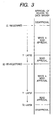
- Fig. 3 is a flowchart showing a function for continuously registering the right to use the virtual memory communication system MCS1.
- a user accesses the portal site 207 from the cellular phone 205 to register the ID of the virtual memory card 202. Consequently, a use area is secured in the large capacity storage device 204 of the data server 203, and an access right for writing data in and reading data from the large capacity storage device 204 is approved.
- time T2 lapses after the time T1 lapsed when the user accesses the portal site 207 from the cellular phone 205 again to re-register the ID of the virtual memory card 202
- an access right for accessing the use area secured in the large capacity storage device 204 is approved, and the writing of data and the reading of data becomes possible until the time T1 lapses from the re-registration of the ID.
- the access right is extended by the time T1 from the third-time registration of the ID.
- the access right is secured for a total time of a remaining time of the first time T1 and a new time T1.
- the user can confirm a remaining time of the access right by accessing the user registration page of the portal site 207.
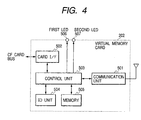
- Fig. 4 is a block diagram showing the internal structure of the virtual memory card 202.
- the virtual memory card 202 includes: a communication unit 501 for performing wireless communication; a card interface 502 connected to a bus of a CF card standard; a control unit 503 for controlling the entire virtual memory card 202; an ID unit 504 having ID values different from each other recorded therein; a memory 505; a first LED 506 indicating that it is possible to write data in or read data from the virtual memory card 202; and a second LED 507 indicating that communication is possible.
- the communication unit 501 connects a wireless communication path between the communication unit 501 and the first base station 208 to establish a communication path to and from the data server 203.
- the communication unit 501 always monitors a wireless connection state between the communication unit 501 and the first base station 208. When it is possible to make a connection with the first base station 208, the communication unit 501 lights the second LED 507 to visually indicate to the user that wireless connection is possible. Therefore, the user can easily confirm whether the wireless communication is possible or impossible according to whether the second LED 507 is lighted or not lighted. When the wireless communication is impossible, the user cannot use the virtual memory card 202.
- the card interface 502 is provided with a function for connecting the control unit 503 to a CF card bus in accordance with a specification of a CF card (CF + and Compact Flash Specification).
- CF + and Compact Flash Specification a specification of a CF card
- the "ATA card” is an I/O card provided with a protocol complying with AT Attachment Interface for Disk Drive of the ANSI standard which is a standard for hard disks. It is defined in detail from a register structure to a protocol as a CF-ATA Drive in the specification of a CF card (CF + and Compact Flash Specification).
- the ATA card is recognized as a memory card which can be used with the same control as used for the hard disk. Data is read from and written in the ATA card according to an ATA control command.
- the ATA control command written in the ATA card from the CF card bus side is received by the control unit 503 once and sent to the data server 203 via the communication unit 501 and the first base station 208.
- the ATA control command is processed as an access command for accessing the large capacity storage device 204.
- data requested to be written in the ATA card from the CF card bus side is transferred to the data server 203 and written in the large capacity storage device 204.
- Data requested to be read from the ATA card from the CF card bus side is read from the large capacity storage device 204 and transferred to the CF card bus side.
- the ID unit 504 has been assigned an individual number (ID value) which is different for each virtual memory card.
- ID value an individual number which is different for each virtual memory card.
- This ID value is printed on an external surface of the virtual memory card 202, and the user registers an ID from the cellular phone 205 in accordance with the ID value.
- the memory 505 is a nonvolatile memory and stores a parameter corresponding to a state after access every time the large capacity storage device 204 is accessed.
- the first LED 506 is an LED for indicating whether or not the virtual memory card 202 is usable.
- the first LED 506 lights off when an ID is not registered.
- the first LED 506 illuminates blue when the ID is registered and the time T1 has not lapsed, illuminates red before the time T2 lapses after the ID was registered and time T1 has lapsed, and lights off after the time T2 has lapsed.
- the user can recognize that it is possible to write data in and read data from the data server 203. While the first LED 506 illuminates red, the user can recognize that it is possible only to read data from the data server 203 and the right to use will lapse soon. In addition, when the first LED 506 lights off, the user can recognize that the ID is not registered.
- Figs. 5A to 5D illustrate the operation method of the cellular phone 205 at the time when the user uses the cellular phone 205 to register an ID.
- the figures show display screens at the time when the cellular phone 205 is connected to the user registration page of the portal site 207 in which a right to use the data server 203 is registered.
- the time T1 is one month
- the time T2 is ten days
- a used capacity is 30 MB
- a monthly rate is 500 yen.
- a screen on which an ID value is inputted is displayed.
- the user inputs an ID value printed on the external surface of the virtual memory card 202.
- a screen is displayed on which a desired used capacity in the large capacity storage device 204 is selected.
- a final confirmation screen as shown in Fig. 5C is displayed.
- a message as shown in Fig. 5D is displayed, and the user can confirm an expiration date for use.
- the telephone company managing the portal site 207 collects the rate registered as described above together with telephone charges of the cellular phone 205 and pays the rate to a company operating the data server 203.
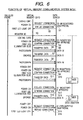
- Fig. 6 is a flowchart showing in detail a sequence of registering the ID of the virtual memory card 202, and writing data in and reading data from the data server 203.
- the virtual memory card 202 when the virtual memory card 202 is loaded in the digital camera 201 and a power supply is turned on in a state in which the ID is not registered, the virtual memory card 202 establishes a wireless communication path between the virtual memory card 202 and the data server 203 and requests connection in accordance with an ID value (S1).
- the data server 203 checks whether or not the ID value of the connection request (S1) is registered. Since the ID value is unregistered at this point, the data server 203 returns connection refusal (S2) to the virtual memory card 202.
- the virtual memory card 202 having received the connection refusal (S2) leaves the first LED, which indicates a state of an access right, lighted off.
- the digital camera 201 judges that the virtual memory card 202 is not loaded.
- the user accesses the portal site 207 from the cellular phone 205 and registers an ID in order to secure an access right as described above (S3) in the user registration page. Then, information on the registration of the ID is communicated to the data server 203, an access to the data server 203 with the registered ID becomes possible, and monitoring of a T1 timer for counting the time T1 is started.
- the virtual memory card 202 establishes a wireless communication path between the virtual memory card 202 and the digital server 203 and requests connection in accordance with the ID value (S4).
- the data server 203 confirms that the ID value is registered. Since the T1 timer shows a time within the time T1, the data server 203, with a connection confirmation message, notifies the virtual memory card 201 that it is possible to write data in and read data from the large capacity storage device 204 (S5).
- the first LED 506 of the virtual memory card 202 illuminates blue.
- image data is written in the virtual memory card 202 from the digital camera 201 using the ATA control command.
- the virtual memory card 202 wirelessly sends the written image data to the data server 203 via the communication unit 501 and transfers the data to the large capacity storage device 204 (S6).
- image data of the image is received by the virtual memory card 202 from the large capacity storage device 204 of the data server 203 via the wireless communication path and is transferred to the digital camera 201 (S7).
- image data is written in the virtual memory card 202 from the digital camera 201 using the ATA control command and is transferred to the data server 203 via the communication unit 501 (S8).
- the writing of the image data is performed until the monitoring of the T1 timer, which started at the time of ID registration, reaches timer out. It is possible to write data in and read data from the large capacity storage device 204 until an amount of data reaches a maximum permissible amount of data secured in the large capacity storage device 204.
- the virtual memory card 202 sends a connection request (S9) to the data server 203 in order to confirm ID registration and to confirm access restrictions according to the T1 timer and the T2 timer, receives a connection confirmation message from the data server 203, and lights or lights off the first LED 506 according to a result of the connection confirmation.
- the virtual memory card 202 lights the first LED 506 blue.
- the virtual memory card 202 transfers image data to the data server 203 through the wireless communication path (S11).
- connection confirmation message (S13) the first LED 506 of the virtual memory card 202 illuminates red which indicates that only the reading of data from the large capacity storage device 204 is possible.
- the user learns that it is possible to only browse the image data written in the virtual memory card 202.
- image data of the image is received by the virtual memory card 202 from the large capacity storage device 204 of the data server 203 via the wireless communication path and is transferred to the digital camera 201 (S14).
- the access right of the data server 203 is deleted, and image data of the ID stored in the large capacity storage device 204 is deleted.
- connection refusal message (S16)
- the first LED 506 of the virtual memory card 202 comes into a state of light off which indicates that the ID is not registered.
- a time of the T1 timer out and a time of the T2 timer out are measured as a lapsed time from setting an access right regardless of whether or not an access is performed. Instead of this, it is also possible to accumulate a time during which the virtual memory card 202 is connected to the data server 203 and measure the time of the T1 timer out and the time of the T2 timer out as a lapsed time of the accumulation.
- an expiration date for use of the virtual memory communication system MCS1 is defined by the time T1 and the time T2.
- an expiration date for use in terms of time it is also possible to set the expiration date for use of the virtual memory communication system MSC1 according to an amount of packets read and written.
- a system structure is the same as that of the virtual memory communication system MSC1 shown in Fig. 1, and a structure of the virtual memory card 202 is the same as the structure shown in Fig. 4.
- Fig. 7 is a flowchart showing a function for setting an expiration date for use of the virtual memory communication system MSC1 according to an amount of packets read and written.
- the data server 203 After the ID registration for the access right, the data server 203 accumulates data packets sent and received according to accesses from the virtual memory card 202 and, when an accumulated packet amount is over A1, the writing of data is disapproved and only the reading of data is possible.
- the user When the user desires storage of data, the user is capable of reading the data through the Internet 211 using a PC or the like and storing it in the PC.
- the above-mentioned embodiments can be grasped as an invention of a method. That is, the above-mentioned embodiments are examples of a virtual memory wireless communication method which includes the step of: providing a memory interface and a wireless communication unit in a memory card; connecting the memory card and a data storage device provided in a remote place with a wireless line; registering identification information of the memory card in the data storage device; writing data from the memory card in the data storage device while the identification information of the memory card is registered in the data storage device; reading data written in the data storage device and transferring the read data to the memory card while the identification information of the memory card is registered in the data storage device; and setting, from another device such as a cellular phone, a capacity for allowing the data from the memory card to be written in the data storage device.
- a virtual memory wireless communication method which includes the step of: providing a memory interface and a wireless communication unit in a memory card; connecting the memory card and a data storage device provided in a remote place with a wireless line;
- the card can be used even if it is inserted in another device, and unnecessary expenditures for the user can be reduced.
- the access right and the writing and reading of data are managed according to individual information of an apparatus such as a digital camera or a computer
- the user has to enter into an agreement for a right to use a storage device for each apparatus.
- a right to use a large capacity storage device is managed according to individual information of a memory card as in the present invention, the user only has to enter into an agreement for the right to use the large capacity storage device according to the individual information of the memory card.
Landscapes
- Engineering & Computer Science (AREA)
- Multimedia (AREA)
- Signal Processing (AREA)
- Computer Networks & Wireless Communication (AREA)
- Human Computer Interaction (AREA)
- Theoretical Computer Science (AREA)
- General Physics & Mathematics (AREA)
- General Engineering & Computer Science (AREA)
- Physics & Mathematics (AREA)
- Computer Hardware Design (AREA)
- Mobile Radio Communication Systems (AREA)
- Information Retrieval, Db Structures And Fs Structures Therefor (AREA)
- Studio Devices (AREA)
- Storage Device Security (AREA)
- Control Of Vending Devices And Auxiliary Devices For Vending Devices (AREA)
- Telephonic Communication Services (AREA)
Abstract
Description
Claims (21)
- A data storage system comprising:wherein, when the information processing device registers identification information via a network, a memory card of the registered identification information can store data in the storage device.a memory card which has a memory interface and communication means;a storage device which stores data sent by the communication means of the memory card; andan information processing device which registers a right to use the storage device;
- A data storage system according to claim 1,
wherein the registration of the right to use performed by the information processing device also includes setting of a memory capacity for allowing data to be stored in the storage device. - A data storage system according to claim 1,
wherein, in the registration of the right to use performed by the information processing device, the memory capacity for allowing data to be stored in the storage device is determined according to a rate for using the storage device. - A data storage system according to claim 1,
wherein the information processing device is a portable terminal. - A data storage system according to claim 1,
wherein the information processing device accesses a portal site for performing user registration in the storage device and performs registration of the identification information. - A data storage system according to claim 1,
wherein the memory card is inserted in a card slot of a digital camera and used and sends a photographed image which is subjected to writing processing by the digital camera via the memory interface with the communication means. - A data storage system according to claim 1,
wherein the right to use the storage device is managed according to a first parameter for managing storage of data in and reading of data from the storage device and a second parameter for managing the reading of data from the storage device. - A data storage system according to claim 1,
wherein the right to use the storage device is managed such that the storage of data in the storage device and the reading of data from the storage device are possible utilizing the communication means of the memory card until a first time lapses after the right to use is registered from the information processing device, the reading of data from the storage device is possible utilizing the communication means of the memory card and the storage of data in the storage device is impossible until a second time lapses after the first time has lapsed, and the storage of data in and the reading of data from the storage device are impossible after the lapse of the second time. - A method of managing a service for storing data from a memory card, which has a memory interface and communication means, in an external storage device, the method comprising:registering identification information of the memory card with an information processing device via a network and registering a right to use the storage device, andallowing the memory card, for which the identification information is registered, to store data in the storage device.
- A method according to claim 9,
wherein the registration of the right to use performed by the information processing device also includes setting of a memory capacity for allowing data to be stored in the storage device. - A method according to claim 9,
wherein, in the registration of the right to use performed by the information processing device, the memory capacity for allowing data to be stored in the storage device is determined according to a rate for using the storage device. - A method according to claim 9,
wherein the information processing device is a portable terminal. - A method according to claim 9,
wherein the information processing device accesses a portal site for performing user registration in the storage device and performs registration of the identification information. - A method according to claim 9,
wherein the memory card is inserted in a card slot of a digital camera and used and sends a photographed image which is subjected to writing processing by the digital camera via the memory interface with the communication means. - A method according to claim 9,
wherein the right to use the storage device is managed according to a first parameter for managing storage of data in and reading of data from the storage device and a second parameter for managing the reading of data from the storage device. - A method according to claim 9,
wherein the right to use the storage device is managed such that the storage of data in the storage device and the reading of data from the storage device are possible utilizing the communication means of the memory card until a first time lapses after the right to use is registered from the information processing device, the reading of data from the storage device is possible utilizing the communication means of the memory card and the storage of data in the storage device is impossible until a second time lapses after the first time has lapsed, and the storage of data in and the reading of data from the storage device are impossible after the lapse of the second time. - A memory card mountable in a digital camera, the card comprising interface means (502) for connecting the card to an output bus of a digital camera in which the card is mounted, a wireless communication unit (501) for carrying out communication between the memory card and a data server, and control means for controlling the operation of the card and characterised in that the card interface when accessed by the output bus of a digital camera in which the card is mounted is adapted to identify the card as a hard disc memory.
- A memory card according to claim 17, and including indication means for indicating whether or not the communication means can connect the card to a data server.
- A memory card according to claim 17 or claim 18, and including means for indicating if the card can be used to access connected data server or not.
- A memory card according to any one of claims 17 to 19 and including means storing identification data individual to the card for validating the card when connected by the communication means to a data server.
- A memory card according to any one of claims 17 to 20 in combination with a digital camera, and wherein the camera has a CF card bus and is adapted to recognise the memory card as an ATA card.
Applications Claiming Priority (2)
| Application Number | Priority Date | Filing Date | Title |
|---|---|---|---|
| JP2002127080A JP3937905B2 (en) | 2002-04-26 | 2002-04-26 | Virtual memory wireless communication system and data storage service management method |
| JP2002127080 | 2002-04-26 |
Publications (2)
| Publication Number | Publication Date |
|---|---|
| EP1365570A2 true EP1365570A2 (en) | 2003-11-26 |
| EP1365570A3 EP1365570A3 (en) | 2006-04-12 |
Family
ID=29267634
Family Applications (1)
| Application Number | Title | Priority Date | Filing Date |
|---|---|---|---|
| EP03252249A Withdrawn EP1365570A3 (en) | 2002-04-26 | 2003-04-09 | Management method for service for storing data from memory card in external storage device and system for carrying out the service |
Country Status (5)
| Country | Link |
|---|---|
| US (1) | US7502628B2 (en) |
| EP (1) | EP1365570A3 (en) |
| JP (1) | JP3937905B2 (en) |
| KR (1) | KR100563678B1 (en) |
| CN (1) | CN100416516C (en) |
Cited By (2)
| Publication number | Priority date | Publication date | Assignee | Title |
|---|---|---|---|---|
| EP1628463A1 (en) * | 2004-07-22 | 2006-02-22 | Lucent Technologies Inc. | Electronic card for a digital camera |
| EP1724689A4 (en) * | 2004-02-23 | 2008-04-02 | Nec Corp | Portal site providing system, and server, method, and program used for the same |
Families Citing this family (28)
| Publication number | Priority date | Publication date | Assignee | Title |
|---|---|---|---|---|
| US20050114619A1 (en) * | 2002-10-04 | 2005-05-26 | Takashi Matsuo | Data management system, data management method, virtual memory device, virtual memory control method, reader/writer device, ic module access device and ic module access control method |
| DE60331107D1 (en) * | 2003-06-30 | 2010-03-11 | Nokia Corp | METHOD AND DEVICE FOR AUTOMATIC CONNECTING A MOBILE TERMINAL TO A MOBILE NETWORK SERVER BY MEANS OF AN INTERCHANGEABLE MEMORY |
| JP3981066B2 (en) | 2003-11-07 | 2007-09-26 | 株式会社東芝 | Host device, memory card, memory capacity changing method, and memory capacity changing program |
| US7275165B2 (en) * | 2004-03-22 | 2007-09-25 | Dell Products L.P. | Information handling system including wireless scanning feature |
| KR100754173B1 (en) * | 2005-03-24 | 2007-09-03 | 삼성전자주식회사 | System and method for sharing content data within a network |
| US7720981B2 (en) * | 2005-05-11 | 2010-05-18 | Sony Corporation | Processing device, method for establishing processing device communication session, program, and recording medium |
| JP4792251B2 (en) * | 2005-07-22 | 2011-10-12 | ソフトバンクテレコム株式会社 | Network storage access terminal and remote data storage system using the same |
| US7702821B2 (en) | 2005-09-15 | 2010-04-20 | Eye-Fi, Inc. | Content-aware digital media storage device and methods of using the same |
| CN101454746B (en) * | 2006-05-29 | 2012-03-28 | 帕夏利斯·帕帕格利高利欧 | A method of communication with multi-function memory card |
| JP4910517B2 (en) * | 2006-07-05 | 2012-04-04 | 富士通株式会社 | Wireless connection device and wireless communication device |
| US7978246B2 (en) * | 2007-03-13 | 2011-07-12 | Osann Jr Robert | Electronic mirror |
| US20090024805A1 (en) * | 2007-07-16 | 2009-01-22 | Harold Lee Peterson | System, method and computer-readable medium for enabling access to additional memory capacity |
| US20090282212A1 (en) * | 2007-07-16 | 2009-11-12 | Digital Delivery Networks, Inc. | System for enabling access to additional memory and storage capacity |
| US8195233B2 (en) * | 2007-07-30 | 2012-06-05 | Motorola Mobility, Inc. | Methods and systems for identity management in wireless devices |
| JP2009205294A (en) * | 2008-02-26 | 2009-09-10 | Hitachi Ltd | Information storage system |
| US8055723B2 (en) * | 2008-04-04 | 2011-11-08 | International Business Machines Corporation | Virtual array site configuration |
| US8271612B2 (en) * | 2008-04-04 | 2012-09-18 | International Business Machines Corporation | On-demand virtual storage capacity |
| US9946493B2 (en) * | 2008-04-04 | 2018-04-17 | International Business Machines Corporation | Coordinated remote and local machine configuration |
| CA2732006A1 (en) * | 2008-07-31 | 2010-02-04 | Koolspan, Inc. | System for and method of remote secure backup |
| KR101087667B1 (en) | 2009-10-12 | 2011-11-30 | 에스케이플래닛 주식회사 | Terminal control method using subscriber identification device and subscriber identification device |
| WO2011068464A1 (en) | 2009-12-01 | 2011-06-09 | T-Data Systems (S) Pte Ltd | Memory card and method for storage and wireless transceiving of data |
| US20110208927A1 (en) * | 2010-02-23 | 2011-08-25 | Mcnamara Donald J | Virtual memory |
| KR101657738B1 (en) * | 2010-03-01 | 2016-09-19 | 티-데이터 시스템스 (에스) 피티이 엘티디 | A memory card |
| CN103391535B (en) * | 2013-07-31 | 2017-02-01 | 华为技术有限公司 | Method for allowing multiple terminals to share virtual SIM (subscriber identity module) card, as well as terminals, server and system |
| JP6446952B2 (en) * | 2014-09-26 | 2019-01-09 | 株式会社リコー | Information processing system, information storage device, and program |
| CN108073360B (en) | 2016-11-15 | 2024-01-23 | 三星电子株式会社 | Computing device including storage device and method of operating computing device |
| CN106693347A (en) * | 2016-12-06 | 2017-05-24 | 北京体育大学 | Exercise load system for intelligently measuring heart function |
| JP2021099641A (en) * | 2019-12-20 | 2021-07-01 | パナソニックIpマネジメント株式会社 | Detachable communication device and information storage system |
Family Cites Families (23)
| Publication number | Priority date | Publication date | Assignee | Title |
|---|---|---|---|---|
| JPH10304293A (en) | 1997-03-24 | 1998-11-13 | Mitsubishi Electric Inf Technol Center America Inc | Image collection system |
| JPH10289557A (en) * | 1997-04-10 | 1998-10-27 | Sony Corp | Recording and playback device |
| JPH11308588A (en) * | 1998-04-23 | 1999-11-05 | Nec Telecom Syst Ltd | Transmission system for image data |
| JPH11355854A (en) | 1998-06-10 | 1999-12-24 | Matsushita Electric Ind Co Ltd | Digital data transmitting / receiving method, base station apparatus used for transmitting / receiving digital data, and mobile terminal apparatus used for transmitting / receiving digital data |
| US6353848B1 (en) * | 1998-07-31 | 2002-03-05 | Flashpoint Technology, Inc. | Method and system allowing a client computer to access a portable digital image capture unit over a network |
| US6509910B1 (en) * | 1998-11-18 | 2003-01-21 | Eastman Kodak Company | Method and system for interfacing with a digital media frame network |
| KR100722172B1 (en) | 1999-03-03 | 2007-05-29 | 소니 가부시끼 가이샤 | Data processing device, data processing method, terminal device and data processing device transmission method |
| US6405278B1 (en) * | 1999-05-20 | 2002-06-11 | Hewlett-Packard Company | Method for enabling flash memory storage products for wireless communication |
| JP2001042442A (en) * | 1999-07-30 | 2001-02-16 | Sony Corp | Print order delivery system and method, digital camera, registration device, print order terminal device, and print system |
| JP4202546B2 (en) | 1999-08-20 | 2008-12-24 | 富士フイルム株式会社 | Imaging apparatus and method |
| JP4348790B2 (en) * | 1999-09-20 | 2009-10-21 | ソニー株式会社 | Semiconductor memory device and semiconductor memory device operation setting method |
| US6950800B1 (en) * | 1999-12-22 | 2005-09-27 | Eastman Kodak Company | Method of permitting group access to electronically stored images and transaction card used in the method |
| WO2001058138A1 (en) * | 2000-02-07 | 2001-08-09 | Broadcloud Communications, Inc. | Digital image transfer system and method |
| WO2001059622A2 (en) * | 2000-02-08 | 2001-08-16 | Sony Corporation Of America | Method, system and devices for wireless data storage on a server and data retrieval |
| JP2001344215A (en) | 2000-06-01 | 2001-12-14 | Denso Corp | Information communication system and information communication terminal using memory card |
| US20020032618A1 (en) * | 2000-08-31 | 2002-03-14 | Seiko Epson Corporation | Information disclosing control method and its system, and computer program |
| JP2002094924A (en) * | 2000-09-12 | 2002-03-29 | Fuji Photo Film Co Ltd | Image data recording apparatus and method and image data reproducing apparatus and method |
| JP2002099475A (en) | 2000-09-25 | 2002-04-05 | Toshiba Corp | Wireless device, data management system and data management method |
| CN1346110A (en) * | 2000-09-30 | 2002-04-24 | 刘耀民 | Network platform based software protection and sales system |
| US20020097259A1 (en) * | 2000-12-29 | 2002-07-25 | Hallmark Cards Incorporated | System for compiling memories materials to automatically generate a memories product customized for a recipient |
| US6574716B2 (en) * | 2001-05-30 | 2003-06-03 | Hewlett-Packard Development Company, L.P. | Unifying data storage in a distributed network |
| FR2830950A1 (en) * | 2001-10-11 | 2003-04-18 | Archos | MASS STORAGE SYSTEM AND METHOD, AND AUTONOMOUS AND PORTABLE MASS STORAGE UNIT USED IN SUCH A SYSTEM |
| US7028075B2 (en) * | 2002-04-23 | 2006-04-11 | Flashpoint Technology, Inc. | Method and system for sharing digital images over a network |
-
2002
- 2002-04-26 JP JP2002127080A patent/JP3937905B2/en not_active Expired - Fee Related
-
2003
- 2003-04-09 EP EP03252249A patent/EP1365570A3/en not_active Withdrawn
- 2003-04-10 US US10/411,566 patent/US7502628B2/en not_active Expired - Fee Related
- 2003-04-25 KR KR1020030026306A patent/KR100563678B1/en not_active Expired - Fee Related
- 2003-04-25 CN CNB031232930A patent/CN100416516C/en not_active Expired - Fee Related
Cited By (2)
| Publication number | Priority date | Publication date | Assignee | Title |
|---|---|---|---|---|
| EP1724689A4 (en) * | 2004-02-23 | 2008-04-02 | Nec Corp | Portal site providing system, and server, method, and program used for the same |
| EP1628463A1 (en) * | 2004-07-22 | 2006-02-22 | Lucent Technologies Inc. | Electronic card for a digital camera |
Also Published As
| Publication number | Publication date |
|---|---|
| EP1365570A3 (en) | 2006-04-12 |
| KR20030084760A (en) | 2003-11-01 |
| US20040204093A1 (en) | 2004-10-14 |
| KR100563678B1 (en) | 2006-03-28 |
| JP2003324379A (en) | 2003-11-14 |
| JP3937905B2 (en) | 2007-06-27 |
| CN100416516C (en) | 2008-09-03 |
| CN1453709A (en) | 2003-11-05 |
| US7502628B2 (en) | 2009-03-10 |
Similar Documents
| Publication | Publication Date | Title |
|---|---|---|
| US7502628B2 (en) | Management method for service for storing data from memory card in external storage device and system for carrying out the service | |
| US6337712B1 (en) | System for storing and utilizing picture image data recorded by digital camera | |
| US7551210B2 (en) | Image data transfer method, digital camera, and program | |
| US20040109063A1 (en) | Image transmission system, image relay apparatus and electronic image device | |
| KR20040044668A (en) | On-line digital picture processing system for digital camera rental system | |
| JP2002094726A (en) | System and apparatus for automatically forwarding digital image to service provider | |
| EP1437005A2 (en) | Recyclable, digital one time use camera | |
| US20020126160A1 (en) | Printing service system and print service method | |
| US7092010B2 (en) | Image photographing system | |
| JP2002351944A (en) | Image data handling system, printing system, and recording medium recording system | |
| US20040051787A1 (en) | Camera system | |
| US8005464B2 (en) | Portable cellular phone system, and portable cellular phone terminal device, and information transmitting center used in same system | |
| JP4130949B2 (en) | Print service system and print service method | |
| JP4240856B2 (en) | Digital camera | |
| JP4491169B2 (en) | Image storage service system and image storage management server | |
| JP2004356972A (en) | Photo image service system, ID card and digital camera | |
| JP4471172B2 (en) | Photo image data storage and utilization system, digital camera and image server | |
| JP4190783B2 (en) | Image shooting terminal device | |
| JP4190784B2 (en) | Temporary image storage server and photographic image data storage and utilization system | |
| JP2005100214A (en) | Image managing method and system and image storage managing server and acceptance terminal equipment | |
| JP2003150690A (en) | Image browsing and distributing system, image browsing and distributing method and image browsing and distributing program | |
| JP2003122935A (en) | Data storage system | |
| KR20030022823A (en) | Digital picture image edit service through internet | |
| JP2003125329A (en) | Picture storing system | |
| HK1056069A (en) | System for storing and utilizing picture image data recorded by digital camera |
Legal Events
| Date | Code | Title | Description |
|---|---|---|---|
| PUAI | Public reference made under article 153(3) epc to a published international application that has entered the european phase |
Free format text: ORIGINAL CODE: 0009012 |
|
| AK | Designated contracting states |
Kind code of ref document: A2 Designated state(s): AT BE BG CH CY CZ DE DK EE ES FI FR GB GR HU IE IT LI LU MC NL PT RO SE SI SK TR |
|
| AX | Request for extension of the european patent |
Extension state: AL LT LV MK |
|
| PUAL | Search report despatched |
Free format text: ORIGINAL CODE: 0009013 |
|
| AK | Designated contracting states |
Kind code of ref document: A3 Designated state(s): AT BE BG CH CY CZ DE DK EE ES FI FR GB GR HU IE IT LI LU MC NL PT RO SE SI SK TR |
|
| AX | Request for extension of the european patent |
Extension state: AL LT LV MK |
|
| 17P | Request for examination filed |
Effective date: 20061012 |
|
| AKX | Designation fees paid |
Designated state(s): DE FI FR GB SE |
|
| 17Q | First examination report despatched |
Effective date: 20071126 |
|
| STAA | Information on the status of an ep patent application or granted ep patent |
Free format text: STATUS: THE APPLICATION HAS BEEN WITHDRAWN |
|
| 18W | Application withdrawn |
Effective date: 20140123 |