EP1365331A2 - Bestimmung eines semantischen Schnappschusses - Google Patents
Bestimmung eines semantischen Schnappschusses Download PDFInfo
- Publication number
- EP1365331A2 EP1365331A2 EP03076553A EP03076553A EP1365331A2 EP 1365331 A2 EP1365331 A2 EP 1365331A2 EP 03076553 A EP03076553 A EP 03076553A EP 03076553 A EP03076553 A EP 03076553A EP 1365331 A2 EP1365331 A2 EP 1365331A2
- Authority
- EP
- European Patent Office
- Prior art keywords
- document
- list
- semantic
- words
- word
- Prior art date
- Legal status (The legal status is an assumption and is not a legal conclusion. Google has not performed a legal analysis and makes no representation as to the accuracy of the status listed.)
- Withdrawn
Links
Images
Classifications
-
- G—PHYSICS
- G06—COMPUTING OR CALCULATING; COUNTING
- G06F—ELECTRIC DIGITAL DATA PROCESSING
- G06F16/00—Information retrieval; Database structures therefor; File system structures therefor
- G06F16/30—Information retrieval; Database structures therefor; File system structures therefor of unstructured textual data
- G06F16/31—Indexing; Data structures therefor; Storage structures
- G06F16/316—Indexing structures
- G06F16/319—Inverted lists
Definitions
- the invention relates to a method of characterising a document, particularly for the recognition, organisation or relating of documents, wherein a series of statistical properties of the text in the document is determined.
- the invention also relates to a computer program product for characterising a document, and to a data signal.
- the invention also relates to apparatus for processing documents, which apparatus comprises a module for characterising a document by means of a series of statistical properties of the text of the document, particularly for the recognition, organisation or relating of documents.
- US-A 5 418 951 describes a method of identifying, retrieving or sorting documents by language or subject.
- a series of n-grams is determined for each document, an n-gram being a combination of n letters or spaces.
- the frequency of each n-gram is determined, i.e., how often the n-gram occurs in the document.
- the series of n-grams and frequencies is processed further by standardising the frequency and removing a common component.
- the language is determined in which the document was (probably) written, by comparing with known series from documents in that language. Also, a possible relationship of an unknown document to known documents in a database may be determined by comparing the series of n-grams.
- the object of the invention inter alia is to provide a system with which a better distinction can be made between documents.
- a method according to the preamble is characterised in that a list of words occurring in the document is determined and in that a frequency of occurrence is determined for each word in the list, and in that the series is built up of pairs respectively of one word from the list and the frequency of that word, the series forming a semantic snapshot of the document.
- an arrangement of the type referred to in the opening paragraph is characterised in that the module is adapted to determine a list of words occurring in the document, and to determine a frequency of occurrence for each word in the list, and to build up the series from pairs of respectively one word from the list and the frequency of that word, the series forming a semantic snapshot of the document.
- the steps according to the invention have, inter alia, the advantage that the semantic snapshot is related to the content and subject of the document.
- highly similar documents such as adapted versions of one and the same document, there is a very distinct correspondence between the semantic snapshots. In this way it is possible automatically to obtain clustering and order of large quantities of documents based on the semantic snapshot.
- the invention is also based on the realisation that the human language can be approached at different levels by automated analyses.
- the statistical approach in US-A 5 418 951 is based on an analysis of the occurrence of letter combinations.
- the analysis provides an indication as to the language and type of document.
- the inventor has realised that an automated statistical analysis on the higher semantic level of whole words intended in principle for the human reader is possible, and even gives a much better indicator.
- This indicator, the so-called semantic snapshot has been found to be very suitable both for relating different documents by subject, and for putting closely related documents in order.
- the list of words is processed by omitting words shorter than a predetermined length. This has the effect that short words which occur frequently and give little information as to the nature of the document, are omitted from the semantic snapshot. This increases the distinctive power of the semantic snapshot.
- the list of words is processed by sorting by at least one of the following criteria: sequence of occurrence, alphabetical sequence, sequence of word length, sequence of frequency.
- the list of words is processed by combining or replacing words based on correcting incorrectly or differently spelt words, on reduction of verbs or nouns to a basic form, on recognition of homonyms, or synonyms, and/or on a database of technical terms, or else the list of words is processed by translating words into another language.
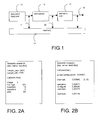
- Fig. 1 shows an apparatus for determining a semantic snapshot.
- the apparatus comprises a document input unit 11 for inputting documents in electronic form, for example a disk drive for reading document files from a data support such as a floppy disk or CD.
- the input unit 11 is coupled to a text extraction unit 12 in which the text present in the document is collected. In the process the text is deprived of layout and form characteristics, such as the font. The result is a plain text version of the document.
- the output of the text extraction unit 12 is coupled to a semantic unit 13 which determines a series of statistical properties of the text in the document. First, a list of words occurring in the document is determined. A frequency of occurrence is determined for each word in the constructed list by counting the number of times that the word occurs in the text.
- a semantic snapshot is a frequency spectrum diagram of the words.
- the semantic snapshot is used for comparing documents with one another or for comparing with a semantic snapshot of a specific area of attention or subject, so that the relevance of the document for that subject is determined. If both the word list and the frequency diagram of different documents exhibit considerable conformity, then there is a fair chance that the documents are variations of one another. They will (at least) be related in content. With the semantic snapshot it is possible to form associations between different documents or between different versions of one and the same document. In the latter case, the frequency diagrams will be very similar to one another, certainly if only minor amendments or additions are concerned.
- the list is restricted to words longer than a specific length.
- Longer words that occur frequently can also be omitted for a better semantic distinctive effect, for example "having" or "being”.
- the semantic unit 13 is arranged for processing the text and/or the list of words and/or the semantic snapshot in the manners described hereinafter.
- the semantic snapshot is based on the plain text of a document.
- the quality of the semantic snapshot can be improved by the following techniques. Firstly, different words can be combined or replaced on the basis of semantic relationship. Suitable possibilities are reduction of verbs and/or nouns to their basic form.
- the combining step can also be formed by recognizing homonyms or synonyms or by making use of technical term databases.
- a semantic snapshot contains a word list and the frequencies of occurrence for each word. The ⁇ word, freq ⁇ tuples can be sorted in a predetermined manner.
- Suitable manners are chronological, namely by the first occurrence of a word in the text, or alphabetically (case sensitive or otherwise).
- One manner which has good distinctive power is sorting by word length (for example long words first, these are rarer), or by frequency, rising or falling (low frequencies discriminate better).
- Different sorting criteria can also be combined, for example first by length and then words of the same length by frequency.
- Semantic snapshots can be processed or compared with one another more efficiently by these different sorting operations.
- Another possibility is translating the words in a semantic snapshot, for example from English to Dutch. In this way, documents in different languages can be related. This is a specific advantage of semantic snapshots of documents.
- the semantic snapshot is complemented by the use of known recognisable semantic structures such as author, department, subject, etc.
- these data can often be derived by the fact that they are stored separately in combination with the document.
- the frequency of occurrence is converted by standardisation.
- the frequency is a whole number that indicates the absolute number, but it can be normalized by division by the total number of words. In this normalization, information concerning the length of the document is lost. For most types of comparison this does not have an adverse effect.
- the length of the document can also be added separately as a parameter to the semantic snapshot.
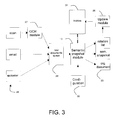
- Fig. 2a shows a first example of a semantic snapshot.
- This is a data structure containing a series of word + frequency pairs, indicated here by 'List(word, freq)'.
- the list is sorted by alphabetical order.
- the following elements have also been added: the name of the original document ' ⁇ doc.Name:test.doc ⁇ ', the length of the document 'Length_doc', and the length of the word list 'Length_list'.
- Fig. 2b shows a second example of a semantic snapshot.
- the semantic snapshot can be kept on a data support with the document, for example on a hard disk or CD-R. If the document is adapted and given a new date, then a semantic snapshot has to be re-determined. It is also possible to store or send the semantic snapshot as a separate data signal, for example via the Internet. In this way a receiver can on the basis of a limited quantity of data determine whether a relevant document is present at the source.
- semantic snapshot It is also possible to limit the quantity of data for the semantic snapshot by using a predetermined "dictionary" of words, and allocating each word therein a code, for example a serial number.
- the semantic snapshot then consists of a list of pairs of respectively a word code and the frequency. If required, word codes can be used for just part of the list, while words occurring less frequently are completely included in the semantic snapshot.
- the semantic snapshot can be used in many areas. For example, many reports are collected in a database. These reports are coded by hand by expensive professionals. The object of these encodings was to group related reports. With the semantic snapshot related documents can automatically be clustered together. Another case is plagiarism. A semantic snapshot is made of books, web documents or other documents. If these resemble one another greatly, there may be a case of plagiarism. If they clearly do not resemble one another then there is no case of plagiarism. Also, a frequently occurring problem is version management, i.e., possibly different versions of unknown sequence may exist of a document. By determining the semantic snapshot of the documents and their mutual distances, or alternatively the distance from the average document, it is possible to estimate what the version sequence of the documents was. In this connection a document in handwritten form can also be recognised as an equivalent of the same document in the typed form.
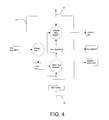
- Fig. 3 shows an architecture for building up a database on the basis of semantic snapshots.
- document sources 28 are indicated with modules such as 'application', wherein an application program delivers a document, or alternatively e-mail, or alternatively a scanner for optically scanning a document on paper.
- OCR module 27 Optical Character Recognition
- All the incoming documents are stored (temporarily) in a memory 29 in which the 'new documents queue' is present.
- Each document is then routed to a semantic snapshot module 13 in which the semantic snapshot is determined, for example as described above in connection with Fig. 1.
- the configuration is used in determining the semantic snapshot, such as the sorting sequence or the synonyms used, are fixed in a configuration unit 30 coupled to the semantic unit 13.
- the semantic snapshot After the semantic snapshot has been determined it can be stored in a database memory 25, in which, for example, the original document (or a reference thereto), the calculated semantics snapshot and a possible list with relationships to other documents are stored, for example in separate sections.
- the semantic module 13 is also coupled to the archive 31, in which the data from other documents are stored for comparison with the current document.
- the archive is regularly updated with the newly processed documents via an update module 26. In the updating process, the relation list of the new document is read and the semantic snapshot, and the other relationships in the archive are adapted thereto.
- One practical implementation of the described architecture is a digital copier and/or scanner coupled to a computer system, e.g. via a local area network.
- a computer system the database and the archive of documents present in a company are maintained. If a document is entered for copying or scanning in the machine, a bitmap is prepared and (after an OCR intermediate step) the text is extracted therefrom. The semantic snapshot is then calculated.
- the module for this function can be incorporated in the digital copier and/or scanner, or else this function can be performed by a software program in the computer.
- Fig. 4 shows a module for determining a semantic snapshot.
- This module corresponds to the semantic unit 13 in Fig. 3. It is constructed as a processor with instructions for the operations indicated hereinafter, for example a standard computer with a software program or a specifically (partly hard-) programmed processor.
- the action of the module is as follows.
- a first "extract text” step the plain text is isolated from a new document.
- a second 'make freq. diagram' step a word list and the associated frequencies are determined.
- the parameters used in this step are set via the 'read config' input 35. These parameters relate, for example, to the minimum word length, a limitation of the frequency, or options such as translation or the use of specific lists with synonyms or technical terms.
- the semantic snapshot is available via the 'freq. diagram' output and the original document and/or the plain text version is available via the 'original document' output.
- the plain text is only required temporarily and if necessary can be re-extracted from the original document.
- the semantic module 13 is provided with a third step 'compare freq.diagrams' for comparing the semantic snapshot of the new document and the known semantic snapshots.
- the semantic module 13 is provided with a data bus 36 for reading in known semantic snapshots.
- a list of relations with other documents or known subjects is available via the 'relation list' output.
- the corresponding words in the two semantic snapshots are first determined and then the associated frequencies are compared.
- the differences or correspondences in frequency found can be allocated a weighting, for example in dependence on the location in the sorted list. In this way a relationship index is calculated for the entire document.
- the invention comprises any new characteristic or combination of characteristics indicated hereinbefore.
- the invention can also be constructed as a unit for determining the semantic snapshot of documents already present in a storage system or already having a convenient characterisation. The semantic snapshot can then be used to apply a more detailed clustering.
- the word "comprise” does not preclude the presence of elements or steps other than those mentioned, that the word “one” does not exclude a plurality, that the reference numbers do not limit the claims, that the invention can be performed both (partly) in hardware and (partly) in software, and that different means or functions can be embodied by the same hardware or software element.
Landscapes
- Engineering & Computer Science (AREA)
- Theoretical Computer Science (AREA)
- Software Systems (AREA)
- Data Mining & Analysis (AREA)
- Databases & Information Systems (AREA)
- Physics & Mathematics (AREA)
- General Engineering & Computer Science (AREA)
- General Physics & Mathematics (AREA)
- Machine Translation (AREA)
- Information Retrieval, Db Structures And Fs Structures Therefor (AREA)
- Character Discrimination (AREA)
Applications Claiming Priority (2)
| Application Number | Priority Date | Filing Date | Title |
|---|---|---|---|
| NL1020670 | 2002-05-24 | ||
| NL1020670A NL1020670C2 (nl) | 2002-05-24 | 2002-05-24 | Het bepalen van een semantische afbeelding. |
Publications (2)
| Publication Number | Publication Date |
|---|---|
| EP1365331A2 true EP1365331A2 (de) | 2003-11-26 |
| EP1365331A3 EP1365331A3 (de) | 2003-12-17 |
Family
ID=29398577
Family Applications (1)
| Application Number | Title | Priority Date | Filing Date |
|---|---|---|---|
| EP03076553A Withdrawn EP1365331A3 (de) | 2002-05-24 | 2003-05-15 | Bestimmung eines semantischen Schnappschusses |
Country Status (4)
| Country | Link |
|---|---|
| US (1) | US20030221160A1 (de) |
| EP (1) | EP1365331A3 (de) |
| JP (1) | JP2004038944A (de) |
| NL (1) | NL1020670C2 (de) |
Families Citing this family (5)
| Publication number | Priority date | Publication date | Assignee | Title |
|---|---|---|---|---|
| US20080250007A1 (en) * | 2003-10-21 | 2008-10-09 | Hiroaki Masuyama | Document Characteristic Analysis Device for Document To Be Surveyed |
| EP1876541A1 (de) * | 2005-04-21 | 2008-01-09 | Intellectual Property Bank Corp. | Einrichtung zum extrahieren des indexworts in einem zu untersuchenden dokument |
| JP4799936B2 (ja) * | 2005-07-11 | 2011-10-26 | 株式会社日立製作所 | 条件別スナップショット取得方法及びシステム |
| US9165056B2 (en) * | 2008-06-19 | 2015-10-20 | Microsoft Technology Licensing, Llc | Generation and use of an email frequent word list |
| US9201905B1 (en) * | 2010-01-14 | 2015-12-01 | The Boeing Company | Semantically mediated access to knowledge |
Family Cites Families (10)
| Publication number | Priority date | Publication date | Assignee | Title |
|---|---|---|---|---|
| GB9220404D0 (en) * | 1992-08-20 | 1992-11-11 | Nat Security Agency | Method of identifying,retrieving and sorting documents |
| US5924108A (en) * | 1996-03-29 | 1999-07-13 | Microsoft Corporation | Document summarizer for word processors |
| GB9701866D0 (en) * | 1997-01-30 | 1997-03-19 | British Telecomm | Information retrieval |
| US6137911A (en) * | 1997-06-16 | 2000-10-24 | The Dialog Corporation Plc | Test classification system and method |
| US5974412A (en) * | 1997-09-24 | 1999-10-26 | Sapient Health Network | Intelligent query system for automatically indexing information in a database and automatically categorizing users |
| US6272456B1 (en) * | 1998-03-19 | 2001-08-07 | Microsoft Corporation | System and method for identifying the language of written text having a plurality of different length n-gram profiles |
| GB2338089A (en) * | 1998-06-02 | 1999-12-08 | Sharp Kk | Indexing method |
| US6189002B1 (en) * | 1998-12-14 | 2001-02-13 | Dolphin Search | Process and system for retrieval of documents using context-relevant semantic profiles |
| AUPR033800A0 (en) * | 2000-09-25 | 2000-10-19 | Telstra R & D Management Pty Ltd | A document categorisation system |
| US6938025B1 (en) * | 2001-05-07 | 2005-08-30 | Microsoft Corporation | Method and apparatus for automatically determining salient features for object classification |
-
2002
- 2002-05-24 NL NL1020670A patent/NL1020670C2/nl active Search and Examination
-
2003
- 2003-05-08 JP JP2003130235A patent/JP2004038944A/ja not_active Withdrawn
- 2003-05-15 EP EP03076553A patent/EP1365331A3/de not_active Withdrawn
- 2003-05-22 US US10/443,229 patent/US20030221160A1/en not_active Abandoned
Also Published As
| Publication number | Publication date |
|---|---|
| US20030221160A1 (en) | 2003-11-27 |
| NL1020670C2 (nl) | 2003-11-25 |
| JP2004038944A (ja) | 2004-02-05 |
| EP1365331A3 (de) | 2003-12-17 |
Similar Documents
| Publication | Publication Date | Title |
|---|---|---|
| US6826576B2 (en) | Very-large-scale automatic categorizer for web content | |
| CN102576358B (zh) | 单词对取得装置、单词对取得方法及其程序 | |
| US5960383A (en) | Extraction of key sections from texts using automatic indexing techniques | |
| EP0804767B1 (de) | Verfahren und vorrichtungen zur verarbeitung einer zweisprachigen datenbank | |
| US8391614B2 (en) | Determining near duplicate “noisy” data objects | |
| US9195639B2 (en) | Computer-based system and method for generating, classifying, searching, and analyzing standardized text templates and deviations from standardized text templates | |
| US8738552B2 (en) | Method and system for classifying documents | |
| US20070230787A1 (en) | Method for automated processing of hard copy text documents | |
| US9852122B2 (en) | Method of automated analysis of text documents | |
| JPH09101991A (ja) | 情報フィルタリング装置 | |
| Dai et al. | A new statistical formula for Chinese text segmentation incorporating contextual information | |
| US20040122660A1 (en) | Creating taxonomies and training data in multiple languages | |
| EP1365331A2 (de) | Bestimmung eines semantischen Schnappschusses | |
| KR20210105626A (ko) | 기술문서 번역 지원 시스템 | |
| CN120407772A (zh) | 一种告警信息的处理方法、设备及存储介质 | |
| CN119829773A (zh) | 一种文书当事人属性提取方法及系统 | |
| JPH06282587A (ja) | 文書の自動分類方法及び装置並びに分類用の辞書作成方法及び装置 | |
| CN113642327A (zh) | 一种标准知识库的构建方法及装置 | |
| CN118942104A (zh) | 一种结构化信息的提取方法及系统 | |
| EA002016B1 (ru) | Способ поиска хранимых на устройствах хранения данных электронных документов и их фрагментов | |
| Junker et al. | Evaluating ocr and non-ocr text representations for learning document classifiers | |
| US12602409B2 (en) | Information search system | |
| CN121119449B (zh) | 金融机构制度信息的冲突检测方法、装置、设备及介质 | |
| CN121390034A (zh) | 一种半结构化自然语言的解析方法 | |
| CN115146724A (zh) | 数据类型的确定方法、装置、电子设备及存储介质 |
Legal Events
| Date | Code | Title | Description |
|---|---|---|---|
| PUAI | Public reference made under article 153(3) epc to a published international application that has entered the european phase |
Free format text: ORIGINAL CODE: 0009012 |
|
| PUAL | Search report despatched |
Free format text: ORIGINAL CODE: 0009013 |
|
| AK | Designated contracting states |
Kind code of ref document: A2 Designated state(s): AT BE BG CH CY CZ DE DK EE ES FI FR GB GR HU IE IT LI LU MC NL PT RO SE SI SK TR |
|
| AX | Request for extension of the european patent |
Extension state: AL LT LV MK |
|
| AK | Designated contracting states |
Kind code of ref document: A3 Designated state(s): AT BE BG CH CY CZ DE DK EE ES FI FR GB GR HU IE IT LI LU MC NL PT RO SE SI SK TR |
|
| AX | Request for extension of the european patent |
Extension state: AL LT LV MK |
|
| 17P | Request for examination filed |
Effective date: 20040617 |
|
| AKX | Designation fees paid |
Designated state(s): AT BE BG CH CY CZ DE DK EE ES FI FR GB GR HU IE IT LI LU MC NL PT RO SE SI SK TR |
|
| STAA | Information on the status of an ep patent application or granted ep patent |
Free format text: STATUS: THE APPLICATION HAS BEEN WITHDRAWN |
|
| 18W | Application withdrawn |
Effective date: 20060804 |