EP1365038B1 - Yttrium modified amorphous alloy - Google Patents
Yttrium modified amorphous alloy Download PDFInfo
- Publication number
- EP1365038B1 EP1365038B1 EP03010770A EP03010770A EP1365038B1 EP 1365038 B1 EP1365038 B1 EP 1365038B1 EP 03010770 A EP03010770 A EP 03010770A EP 03010770 A EP03010770 A EP 03010770A EP 1365038 B1 EP1365038 B1 EP 1365038B1
- Authority
- EP
- European Patent Office
- Prior art keywords
- atomic
- alloy
- amorphous
- ppm
- cast
- Prior art date
- Legal status (The legal status is an assumption and is not a legal conclusion. Google has not performed a legal analysis and makes no representation as to the accuracy of the status listed.)
- Expired - Lifetime
Links
Images

Classifications
-
- C—CHEMISTRY; METALLURGY
- C22—METALLURGY; FERROUS OR NON-FERROUS ALLOYS; TREATMENT OF ALLOYS OR NON-FERROUS METALS
- C22C—ALLOYS
- C22C45/00—Amorphous alloys
- C22C45/10—Amorphous alloys with molybdenum, tungsten, niobium, tantalum, titanium, or zirconium or Hf as the major constituent
-
- C—CHEMISTRY; METALLURGY
- C22—METALLURGY; FERROUS OR NON-FERROUS ALLOYS; TREATMENT OF ALLOYS OR NON-FERROUS METALS
- C22C—ALLOYS
- C22C1/00—Making non-ferrous alloys
- C22C1/11—Making amorphous alloys
Definitions
- the present invention relates to amorphous metallic alloys and their manufacture.
- Amorphous metallic alloys are known which have essentially no crystalline microstructure when rapidly cooled to a temperature below the alloy glass transition temperature before appreciable grain nucleation and growth occurs.
- US Patent 5 735 975 discloses amorphous metallic alloys represented by the alloy composition, (Zr,Hf) a (Al,Zn) b (Ti,Nb) c (Cu x ,Fe y (Ni,Co) 2 ) d that can be rapidly solidified to produce an amorphous body.
- the patent indicates that an appreciable amount of oxygen may dissolve in the metallic glass without significantly shifting the crystallization curve.
- the amorphous metallic alloys described in above US Patent 5 735 975 typically are made from pure, laboratory grade components and have a low bulk oxygen impurity content of less than about 200 ppm by weight (or 800 ppm oxygen on an atomic basis).
- the present invention arose from attempts to make amorphous alloys described in the above US Patent 5 735 975 using commercially available raw materials and conventional vacuum die casting equipment.
- the inventor discovered that bulk oxygen impurity concentrations achievable in the alloy using commercially available raw materials and conventional vacuum melting/die casting equipment were well above the low bulk oxygen impurity concentration of 200 ppm by weight oxygen (800 ppm oxygen on atomic basis) typically present in the patented alloys.
- the inventor also discovered that such amorphous alloys having a relatively high bulk oxygen impurity concentration could be conventionally vacuum die cast in a plate specimen configuration up to a plate cross-sectional thickness of only 0.1 inch while retaining a bulk (substantially 100%) amorphous microstructure.
- An embodiment of the present invention involves an amorphous alloy of the type set forth in the '975 patent made from commercially available raw materials that can be conventionally cast to a substantially greater thickness while retaining a bulk amorphous microstructure.
- the invention involves providing an intentional addition of yttrium (Y) in the alloy that exceeds zero yet does not exceed about 0.5 atomic % based on the alloy composition, and preferably is in the range of about 0.2 to about 0.4 atomic % Y based on the alloy composition.
- Y addition to such amorphous alloys having a relatively high bulk oxygen impurity concentration after the alloy is melted and cast increases alloy resistance to crystallization such that bulk amorphous products with greater dimensions can be made using commercially available raw materials and conventional casting processes.
- a Zr based amorphous alloy having an alloy composition, in atomic %, consisting essentially of about 54 to about 57% Zr, about 2 to about 4% Ti, about 2 to about 4% Nb, about 8 to about 12% Al, about 14 to about 18% Cu, and about 12 to about 15% Ni, and about 0.2 to about 0.4% Y with an alloy bulk oxygen impurity concentration of at least about 1000 ppm on an atomic basis.
- the present invention involves modifying an amorphous alloy of the type having a composition consisting essentially of about 45 to about 65 atomic % of at least one of Zr and Hf, about 4 to about 7.5 atomic % of least one of Ti and Nb, and about 5 to about 15 atomic % of at least one of Al and Zn.
- the balance of the alloy composition comprises Cu, Co, Ni and up to about 10 atomic % Fe and incidental impurities.
- the ratio of Cu to Ni and/or Co is in the range of from 1:2 to 2:1.
- Such an amorphous alloy is described in US Patent 5 735 975 , the teachings of which are incorporated herein by reference.
- the amorphous alloy is modified pursuant to the present invention by being made using commercially available raw materials that, in combination with subsequent conventional vacuum melting and casting, can result in a relatively high bulk oxygen impurity concentration in the range of about 300 to about 600 ppm by weight (about 1000 to about 2000 ppm oxygen on atomic basis) after the alloy is melted and cast.
- raw materials typically include the following commercially available alloy charge components which are melted to form the alloy: Zr sponge having 100 to 300 ppm ⁇ impurity, Ti sponge having 600 ppm ⁇ impurity, Ni shot having 50 ppm ⁇ impurity, and a Ni-Nb master alloy having 300 to 500 ppm ⁇ impurity (ppm's by weight).
- the bulk oxygen impurity concentration is the oxygen concentration of the melted and cast alloy resulting from the raw materials that are melted together, from the melting process, and from the casting process to make a cast body or product.
- additional oxygen impurities can be introduced into the alloy from residual oxygen present in the melting chamber and/or in a die or mold cavity in which the molten alloy is cast to form a cast body or product, and/or by reaction of the molten alloy with a ceramic material (metal oxide), such as zirconia, forming a crucible in which the alloy is melted and/or a mold in which the molten alloy is cast.
- a ceramic material such as zirconia
- the above charge components can be melted in an induction melting crucible that comprises graphite, zirconia, and/or other suitable refractory material and present in appropriate proportions to yield the desired alloy composition.
- the charge components can be first melted in a graphite or zirconia crucible at a temperature in the range of 2700 to 3000 degrees F under a gas (e.g. inert gas) partial pressure to reduce aluminum volatilization, cooled to a lower temperature where a vacuum of about 2 to about 20 microns, such as 2 to 5 microns, is established, and then remelted at 1800 to 2100 degrees F under the vacuum followed by casting.
- the invention is not limited to any particular melting technique and can be practiced using other melting techniques such as cold wall induction melting (in a water-cooled copper crucible) , vacuum arc remelting, electrical resistance melting, and others in one or multiple melting steps.
- the amorphous alloy is also modified pursuant to the present invention in that an intentional addition of yttrium (Y) is made to the alloy composition.
- Y yttrium
- the Y addition is greater than zero yet does not exceed about 0.5 atomic % based on the alloy composition, and preferably is in the range of about 0.2 to about 0.4 atomic % Y based on the alloy composition.
- the Y addition typically is made by including with the above commercially available raw material charge components, a Y-bearing charge component comprising a Y-bearing master alloy, such as a commercially available Al-Y master alloy, Ni-Y master alloy or others, and/or elemental Y, although the invention is not limited in the way in which Y can be introduced.
- the Y addition to the above amorphous alloy having a relatively high bulk oxygen impurity concentration (about 300 to about 600 ppm by weight) increases alloy resistance to crystallization such that bulk amorphous cast products with greater dimensions can be made by conventional vacuum casting processes.
- Such conventional casting processes will provide cooling rates of the molten alloy typically of 100 2 to 100 3 degrees C per second and lower.
- Vacuum die casting is an illustrative conventional casting process for use in practicing the invention as described below, although the invention can be practiced using other conventional casting processes including, but not limited to, vacuum gravity casting, and is not limited in this regard.
- Amorphous cast products made pursuant to the invention typically will have at least 50% by volume of the amorphous or glassy phase. This is effectively a microscopic and/or macroscopic mixture of amorphous and crystalline phases in the cast product or body.
- bulk amorphous cast products or bodies made pursuant to the invention typically have between about 80% and about 90% by volume of the amorphous or glassy phase, and even more preferably about 95% by volume or more of the amorphous or glassy phase.
- a Zr based amorphous alloy having an alloy composition, in atomic %, consisting essentially of about 54 to about 57% Zr, about 2 to about 4% Ti, about 2 to about 4% Nb, about 8 to about 12% Al, about 14 to about 18% Cu, and about 12 to about 15% Ni, and about 0.2 to about 0.4% Y.
- Such an alloy has a bulk oxygen impurity concentration that typically is about 300 to about 600 ppm by weight (about 1000 to about 2000 ppm on atomic basis) after melting and/or casting as a result of oxygen impurities being introduced into the alloy from the raw materials, the melting process, and the casting process.
- Such a Zr based amorphous alloy can be conventionally vacuum die cast to form a bulk amorphous cast plate having a cross-sectional thickness, which typically is at least twice the thickness achievable without Y being present in the alloy composition.
- Zr based amorphous test alloys were made having an alloy composition, in atomic %, consisting essentially of 55% Zr, 2% Ti, 3% Nb, 10% Al, 16.5% Cu, 13.5% Ni, with various Y concentrations of 0%, 0.2%, 0.4%, 0.5%, and 2.0% Y.
- the test alloys were made using the above-described commercially available raw materials.
- the test alloys had a relatively high bulk oxygen impurity concentration in the range of 300 to 600 ppm by weight (1000 to 2000 ppm on atomic basis) for all alloys tested after die casting.
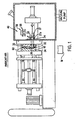
- the above raw materials were first melted in a graphite crucible 54 in a vacuum melting chamber 40 of a vacuum die casting machine of the type shown schematically in Figure 1 and described in Colvin US Patent 6 070 643 , the teachings of which are incorporated herein by reference.
- the raw materials were melted at a temperature in the range of 2700 to 3000 degrees F under an argon partial pressure of 200 torr, then cooled to about 1500 degrees F where a vacuum of 5 microns was established in chamber 40, and then remelted at 1800 to 2100 degrees F under the vacuum followed by die casting.
- die cavity 30 was defined between first and second dies 32, 34 and communicated to the shot sleeve via entrance gate or passage 36.
- a seal 60 was present between dies 32, 34.
- the dies 32, 34 comprised steel and were disposed in ambient air without any internal die cooling.
- the die cavity 30 was evacuated to 5 microns through the shot sleeve 27 and was configured to produce rectangular plates (5 inches width by 14 inches length) with a different plate thickness being produced in different casting trials.
- the plunger speed was in the range of 20-60 feet/second.
- the plunger tip 27a comprised a copper alloy. The alloy casting was held in the die cavity 30 for 10 seconds and then ejected into ambient air and quenched in water in container M.
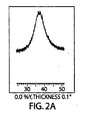
- FIG. 2A shows a diffraction pattern for the 0.1 inch bulk amorphous cast plate comprising the test alloy with 0% Y. If the plate thickness was increased above 0.1 inch, then the vacuum die cast plate of the test alloy with 0% Y exhibited a crystalline core within an outer amorphous shell.
- FIGS. 2B and 2C show respective diffraction patterns for the 0.1 inch and 0.2 inch bulk amorphous cast plates comprising the test alloy with 0.2 atomic % Y.
- Figure 2B represents a diffraction typical of a bulk amorphous microstructure at a plate thickness of 0.1 inch.
- Figure 2C represents a diffraction indicating a non-bulk amorphous microstructure at a plate thickness of 0.2 inch where a crystalline phase comprising an intermetallic compound was present and indicated by presence of secondary diffraction peaks.
- FIGS. 2D and 2E show respective diffraction patterns for the 0.1 inch and 0.2 inch bulk amorphous plates comprising the test alloy with 0.4 atomic % Y.
- Figures 2D and 2E both represent a diffraction pattern typical of a bulk amorphous microstructure at a plate thickness of 0.1 inch and 0.2 inch.
- the vacuum die cast plates made of the test alloy having 0.5 atomic % Y and 2.0 atomic % Y produced a deleterious brittle, crystalline second phase in an amorphous cast microstructure at a plate thickness of 0.1 inch and 0.2 inch. These cast plates were brittle and fractured easily.
Landscapes
- Chemical & Material Sciences (AREA)
- Engineering & Computer Science (AREA)
- Materials Engineering (AREA)
- Mechanical Engineering (AREA)
- Metallurgy (AREA)
- Organic Chemistry (AREA)
- Continuous Casting (AREA)
Description
- The present invention relates to amorphous metallic alloys and their manufacture.
- Amorphous metallic alloys are known which have essentially no crystalline microstructure when rapidly cooled to a temperature below the alloy glass transition temperature before appreciable grain nucleation and growth occurs. For example,
US Patent 5 735 975 discloses amorphous metallic alloys represented by the alloy composition, (Zr,Hf)a(Al,Zn)b(Ti,Nb)c(Cux,Fey(Ni,Co)2)d that can be rapidly solidified to produce an amorphous body. The patent indicates that an appreciable amount of oxygen may dissolve in the metallic glass without significantly shifting the crystallization curve. However, the amorphous metallic alloys described in aboveUS Patent 5 735 975 typically are made from pure, laboratory grade components and have a low bulk oxygen impurity content of less than about 200 ppm by weight (or 800 ppm oxygen on an atomic basis). - The present invention arose from attempts to make amorphous alloys described in the above
US Patent 5 735 975 using commercially available raw materials and conventional vacuum die casting equipment. The inventor discovered that bulk oxygen impurity concentrations achievable in the alloy using commercially available raw materials and conventional vacuum melting/die casting equipment were well above the low bulk oxygen impurity concentration of 200 ppm by weight oxygen (800 ppm oxygen on atomic basis) typically present in the patented alloys. The inventor also discovered that such amorphous alloys having a relatively high bulk oxygen impurity concentration could be conventionally vacuum die cast in a plate specimen configuration up to a plate cross-sectional thickness of only 0.1 inch while retaining a bulk (substantially 100%) amorphous microstructure. - An embodiment of the present invention involves an amorphous alloy of the type set forth in the '975 patent made from commercially available raw materials that can be conventionally cast to a substantially greater thickness while retaining a bulk amorphous microstructure. The invention involves providing an intentional addition of yttrium (Y) in the alloy that exceeds zero yet does not exceed about 0.5 atomic % based on the alloy composition, and preferably is in the range of about 0.2 to about 0.4 atomic % Y based on the alloy composition. The Y addition to such amorphous alloys having a relatively high bulk oxygen impurity concentration after the alloy is melted and cast increases alloy resistance to crystallization such that bulk amorphous products with greater dimensions can be made using commercially available raw materials and conventional casting processes.
- In an illustrative embodiment of the invention, a Zr based amorphous alloy is provided having an alloy composition, in atomic %, consisting essentially of about 54 to about 57% Zr, about 2 to about 4% Ti, about 2 to about 4% Nb, about 8 to about 12% Al, about 14 to about 18% Cu, and about 12 to about 15% Ni, and about 0.2 to about 0.4% Y with an alloy bulk oxygen impurity concentration of at least about 1000 ppm on an atomic basis. Such an amorphous alloy can be conventionally vacuum melted and die cast to form a bulk amorphous cast plate having a cross-sectional thickness up to 0.2 inch NG 1 inch = 25.9 mn, which is twice the thickness achievable without Y being present in the alloy, despite having relatively high bulk oxygen concentration after melting and casting.
- The above and other advantages of the present invention will become more readily apparent from the following drawings taken in conjunction with the following detailed description.
-
-
Figure 1 is schematic view of a vacuum die casting machine used to cast plate test specimens. -
Figure 2A ,2B, 2C, 2D and 2E are x-ray diffraction patterns of Zr based amorphous alloys with different Y concentrations and vacuum die cast to different plate thicknesses shown. - The present invention involves modifying an amorphous alloy of the type having a composition consisting essentially of about 45 to about 65 atomic % of at least one of Zr and Hf, about 4 to about 7.5 atomic % of least one of Ti and Nb, and about 5 to about 15 atomic % of at least one of Al and Zn. The balance of the alloy composition comprises Cu, Co, Ni and up to about 10 atomic % Fe and incidental impurities. The ratio of Cu to Ni and/or Co is in the range of from 1:2 to 2:1. Such an amorphous alloy is described in
US Patent 5 735 975 , the teachings of which are incorporated herein by reference. A preferred alloy composition can be expressed as:
- The amorphous alloy is modified pursuant to the present invention by being made using commercially available raw materials that, in combination with subsequent conventional vacuum melting and casting, can result in a relatively high bulk oxygen impurity concentration in the range of about 300 to about 600 ppm by weight (about 1000 to about 2000 ppm oxygen on atomic basis) after the alloy is melted and cast. For purposes of illustration and not limitation, such raw materials typically include the following commercially available alloy charge components which are melted to form the alloy: Zr sponge having 100 to 300 ppm ○ impurity, Ti sponge having 600 ppm ○ impurity, Ni shot having 50 ppm ○ impurity, and a Ni-Nb master alloy having 300 to 500 ppm ○ impurity (ppm's by weight). The bulk oxygen impurity concentration is the oxygen concentration of the melted and cast alloy resulting from the raw materials that are melted together, from the melting process, and from the casting process to make a cast body or product. For example, in addition to oxygen impurities introduced into the alloy from the raw materials, additional oxygen impurities can be introduced into the alloy from residual oxygen present in the melting chamber and/or in a die or mold cavity in which the molten alloy is cast to form a cast body or product, and/or by reaction of the molten alloy with a ceramic material (metal oxide), such as zirconia, forming a crucible in which the alloy is melted and/or a mold in which the molten alloy is cast.
- For purposes of illustration and not limitation, the above charge components can be melted in an induction melting crucible that comprises graphite, zirconia, and/or other suitable refractory material and present in appropriate proportions to yield the desired alloy composition. For purposes of illustration and not limitation, the charge components can be first melted in a graphite or zirconia crucible at a temperature in the range of 2700 to 3000 degrees F under a gas (e.g. inert gas) partial pressure to reduce aluminum volatilization, cooled to a lower temperature where a vacuum of about 2 to about 20 microns, such as 2 to 5 microns, is established, and then remelted at 1800 to 2100 degrees F under the vacuum followed by casting. The invention is not limited to any particular melting technique and can be practiced using other melting techniques such as cold wall induction melting (in a water-cooled copper crucible) , vacuum arc remelting, electrical resistance melting, and others in one or multiple melting steps.
- The amorphous alloy is also modified pursuant to the present invention in that an intentional addition of yttrium (Y) is made to the alloy composition. The Y addition is greater than zero yet does not exceed about 0.5 atomic % based on the alloy composition, and preferably is in the range of about 0.2 to about 0.4 atomic % Y based on the alloy composition. The Y addition typically is made by including with the above commercially available raw material charge components, a Y-bearing charge component comprising a Y-bearing master alloy, such as a commercially available Al-Y master alloy, Ni-Y master alloy or others, and/or elemental Y, although the invention is not limited in the way in which Y can be introduced.
- The Y addition to the above amorphous alloy having a relatively high bulk oxygen impurity concentration (about 300 to about 600 ppm by weight) increases alloy resistance to crystallization such that bulk amorphous cast products with greater dimensions can be made by conventional vacuum casting processes. Such conventional casting processes will provide cooling rates of the molten alloy typically of 1002 to 1003 degrees C per second and lower. Vacuum die casting is an illustrative conventional casting process for use in practicing the invention as described below, although the invention can be practiced using other conventional casting processes including, but not limited to, vacuum gravity casting, and is not limited in this regard.
- Amorphous cast products made pursuant to the invention typically will have at least 50% by volume of the amorphous or glassy phase. This is effectively a microscopic and/or macroscopic mixture of amorphous and crystalline phases in the cast product or body. Preferably, bulk amorphous cast products or bodies made pursuant to the invention typically have between about 80% and about 90% by volume of the amorphous or glassy phase, and even more preferably about 95% by volume or more of the amorphous or glassy phase.
- Pursuant to an illustrative embodiment of the present invention, a Zr based amorphous alloy is provided having an alloy composition, in atomic %, consisting essentially of about 54 to about 57% Zr, about 2 to about 4% Ti, about 2 to about 4% Nb, about 8 to about 12% Al, about 14 to about 18% Cu, and about 12 to about 15% Ni, and about 0.2 to about 0.4% Y. Such an alloy has a bulk oxygen impurity concentration that typically is about 300 to about 600 ppm by weight (about 1000 to about 2000 ppm on atomic basis) after melting and/or casting as a result of oxygen impurities being introduced into the alloy from the raw materials, the melting process, and the casting process. Such a Zr based amorphous alloy can be conventionally vacuum die cast to form a bulk amorphous cast plate having a cross-sectional thickness, which typically is at least twice the thickness achievable without Y being present in the alloy composition.
- The following example is offered to further illustrate but not limit the invention.
- Zr based amorphous test alloys were made having an alloy composition, in atomic %, consisting essentially of 55% Zr, 2% Ti, 3% Nb, 10% Al, 16.5% Cu, 13.5% Ni, with various Y concentrations of 0%, 0.2%, 0.4%, 0.5%, and 2.0% Y. The test alloys were made using the above-described commercially available raw materials. The test alloys had a relatively high bulk oxygen impurity concentration in the range of 300 to 600 ppm by weight (1000 to 2000 ppm on atomic basis) for all alloys tested after die casting.
- For the test alloys, the above raw materials were first melted in a
graphite crucible 54 in avacuum melting chamber 40 of a vacuum die casting machine of the type shown schematically inFigure 1 and described in ColvinUS Patent 6 070 643 , the teachings of which are incorporated herein by reference. The raw materials were melted at a temperature in the range of 2700 to 3000 degrees F under an argon partial pressure of 200 torr, then cooled to about 1500 degrees F where a vacuum of 5 microns was established inchamber 40, and then remelted at 1800 to 2100 degrees F under the vacuum followed by die casting. Each melted test alloy was poured fromcrucible 54 through opening 58 into ashot sleeve 24 and then immediately injected byplunger 27 into adie cavity 30. Diecavity 30 was defined between first andsecond dies passage 36. Aseal 60 was present betweendies dies die cavity 30 was evacuated to 5 microns through theshot sleeve 27 and was configured to produce rectangular plates (5 inches width by 14 inches length) with a different plate thickness being produced in different casting trials. The plunger speed was in the range of 20-60 feet/second. Theplunger tip 27a comprised a copper alloy. The alloy casting was held in thedie cavity 30 for 10 seconds and then ejected into ambient air and quenched in water in container M. - The vacuum die casting trials revealed that amorphous plates made of the test alloy devoid of Y (0% Y) could be vacuum die cast with a bulk amorphous microstructure to a plate thickness up to only 0.1 inch.
Figure 2A shows a diffraction pattern for the 0.1 inch bulk amorphous cast plate comprising the test alloy with 0% Y. If the plate thickness was increased above 0.1 inch, then the vacuum die cast plate of the test alloy with 0% Y exhibited a crystalline core within an outer amorphous shell. - The vacuum die casting trails also revealed that amorphous plates made of the test alloys having 0.2 atomic % Y could be vacuum die cast with a bulk amorphous microstructure to a plate thickness up to 0.1 inch.
Figures 2B and 2C show respective diffraction patterns for the 0.1 inch and 0.2 inch bulk amorphous cast plates comprising the test alloy with 0.2 atomic % Y.Figure 2B represents a diffraction typical of a bulk amorphous microstructure at a plate thickness of 0.1 inch.Figure 2C represents a diffraction indicating a non-bulk amorphous microstructure at a plate thickness of 0.2 inch where a crystalline phase comprising an intermetallic compound was present and indicated by presence of secondary diffraction peaks. - The vacuum die casting trails further revealed that amorphous plates made of the test alloys having 0.4 atomic % Y could be vacuum die cast with a bulk amorphous microstructure to a plate thickness up to 0.2 inch.
Figures 2D and 2E show respective diffraction patterns for the 0.1 inch and 0.2 inch bulk amorphous plates comprising the test alloy with 0.4 atomic % Y.Figures 2D and 2E both represent a diffraction pattern typical of a bulk amorphous microstructure at a plate thickness of 0.1 inch and 0.2 inch. Thus, at a Y concentration of 0.4 atomic % in the test alloy, a bulk amorphous microstructure was obtained at a plate thickness of 0.1 inch and 0.2 inch, which is twice the bulk amorphous thickness achievable without Y being present in the test alloy. - The vacuum die cast plates made of the test alloy having 0.5 atomic % Y and 2.0 atomic % Y produced a deleterious brittle, crystalline second phase in an amorphous cast microstructure at a plate thickness of 0.1 inch and 0.2 inch. These cast plates were brittle and fractured easily.
Claims (13)
- An amorphous alloy having a composition consisting essentially of about 45 to about 65 atomic % of at least one of Zr and Hf, about 4 to about 7.5 atomic % of at least one of Ti and Nb, about 5 to about 15 atomic % of at least one of Al and Zn, and the balance including a metal selected from the group consisting of Cu, Co, Ni, and up to about 10 atomic % Fe, and Y in an amount exceeding zero and not exceeding about 0.5 atomic %.
- The alloy of claim 1 wherein Y is present in an amount from about 0.2 to about 0.4 atomic %.
- The alloy of claim 1 having a bulk oxygen impurity concentration in the range of about 1000 to about 2000 ppm on atomic basis.
- The alloy of one of claims 1 to 3 consisting essentially of, in atomic %, about 54 to about 57% Zr, about 2 to about 4% Ti, about 2 to about 4% Nb, about 8 to about 12% Al, about 14 to about 18% Cu, and about 12 to about 15% Ni, and about 0.2 to about 0.4% Y with said alloy having a bulk oxygen impurity concentration of at least about 1000 ppm on atomic basis.
- A bulk amorphous cast body having a composition consisting essentially of about 45 to about 65 atomic % of at least one of Zr and Hf, about 4 to about 7.5 atomic % of at least one of Ti and Nb, about 5 to about 15 atomic % of least one of Al and Zn, and the balance including a metal selected from the group consisting of Cu, Co, Ni, and up to about 10 atomic % Fe, a bulk oxygen impurity concentration of at least about 1000 ppm on an atomic basis, and Y in an amount exceeding zero and not exceeding about 0.5 atomic %.
- The cast body of claim 5 wherein Y is present in an amount from about 0.2 to about 0.4 atomic %.
- The cast body of claim 5 wherein said bulk oxygen impurity concentration is in the range of about 1000 to about 2000 ppm on atomic basis.
- The cast body of claim 5 which is die cast.
- The cast body of one of claims 5 to 8 having a composition consisting essentially of, in atomic %, about 54 to about 57% Zr, about 2 to about 4% Ti, about 2 to about 4% Nb, about 8 to about 12% Al, about 14 to about 18% Cu, and about 12 to about 15% Ni, and about 0.2 to about 0.4% Y with said cast body having a bulk oxygen impurity concentration of at least about 1000 ppm on atomic basis.
- A method of making an amorphous alloy casting, providing a molten alloy with a composition, consisting essentially of about 45 to about 65 atomic % of at least one of Zr and Hf, about 4 to about 7.5 atomic % of at least one of Ti and Nb, about 5 to about 15 atomic % of at least one of Al and Zn, and the balance including a metal selected from the group consisting of Cu, Co, Ni, and up to about 10 atomic % Fe, and Y in an amount exceeding zero and not exceeding about 0.5 atomic %, and casting said alloy in a cavity.
- The method of claim 10 wherein Y is present in an amount from about 0.2 to about 0.4 atomic %.
- The method of claim 10 wherein said alloy has a bulk oxygen impurity concentration in the range of about 1000 to about 2000 ppm on an atomic basis after said casting.
- The method of claim 10 wherein said alloy is die cast in said cavity.
Applications Claiming Priority (2)
| Application Number | Priority Date | Filing Date | Title |
|---|---|---|---|
| US154453 | 2002-05-22 | ||
| US10/154,453 US6805758B2 (en) | 2002-05-22 | 2002-05-22 | Yttrium modified amorphous alloy |
Publications (2)
| Publication Number | Publication Date |
|---|---|
| EP1365038A1 EP1365038A1 (en) | 2003-11-26 |
| EP1365038B1 true EP1365038B1 (en) | 2011-08-03 |
Family
ID=29400557
Family Applications (1)
| Application Number | Title | Priority Date | Filing Date |
|---|---|---|---|
| EP03010770A Expired - Lifetime EP1365038B1 (en) | 2002-05-22 | 2003-05-14 | Yttrium modified amorphous alloy |
Country Status (5)
| Country | Link |
|---|---|
| US (2) | US6805758B2 (en) |
| EP (1) | EP1365038B1 (en) |
| JP (1) | JP4653388B2 (en) |
| KR (1) | KR100783995B1 (en) |
| TW (1) | TWI319016B (en) |
Families Citing this family (31)
| Publication number | Priority date | Publication date | Assignee | Title |
|---|---|---|---|---|
| AU2001261172A1 (en) * | 2000-05-03 | 2001-11-12 | California Institute Of Technology | Fractional variation to improve bulk metallic glass forming capability |
| US6805758B2 (en) * | 2002-05-22 | 2004-10-19 | Howmet Research Corporation | Yttrium modified amorphous alloy |
| US7645350B1 (en) * | 2004-04-06 | 2010-01-12 | The United States Of America As Represented By The Secretary Of The Army | High-density metallic glass alloys |
| US8163109B1 (en) | 2004-04-06 | 2012-04-24 | The United States Of America As Represented By The Secretary Of The Army | High-density hafnium-based metallic glass alloys that include six or more elements |
| TWI268289B (en) * | 2004-05-28 | 2006-12-11 | Tsung-Shune Chin | Ternary and multi-nary iron-based bulk glassy alloys and nanocrystalline alloys |
| KR100784915B1 (en) | 2006-05-08 | 2007-12-11 | 학교법인연세대학교 | Zirconium / Titanium Based Amorphous Amorphous Alloys |
| KR100784916B1 (en) | 2006-05-10 | 2007-12-11 | 학교법인연세대학교 | Abnormally separated zirconium / titanium based amorphous alloys for various applications |
| JP2010521250A (en) * | 2007-03-16 | 2010-06-24 | ビエン−エアー ホールディング エスアー | Handpiece for dental or surgical use |
| CN101886232B (en) | 2009-05-14 | 2011-12-14 | 比亚迪股份有限公司 | Amorphous alloy-based composite material and preparation method thereof |
| CN101906598B (en) * | 2009-06-08 | 2012-05-02 | 比亚迪股份有限公司 | A zirconium-based amorphous alloy and its preparation method |
| CN102041461B (en) * | 2009-10-22 | 2012-03-07 | 比亚迪股份有限公司 | Zr-based amorphous alloy and preparation method thereof |
| CN102041462B (en) * | 2009-10-26 | 2012-05-30 | 比亚迪股份有限公司 | Zirconium-based amorphous alloy and preparation method thereof |
| CN102051533A (en) * | 2009-10-29 | 2011-05-11 | 鸿富锦精密工业(深圳)有限公司 | Zirconium-based amorphous alloy, spectacle frame and manufacturing method thereof |
| CN102154596A (en) * | 2009-10-30 | 2011-08-17 | 比亚迪股份有限公司 | Zirconium-based amorphous alloy and preparation method thereof |
| WO2011057552A1 (en) | 2009-11-11 | 2011-05-19 | Byd Company Limited | Zirconium-based amorphous alloy, preparing method and recycling method thereof |
| EP2597166B1 (en) * | 2011-11-24 | 2014-10-15 | Universität des Saarlandes | Bulk metallic glass forming alloy |
| US9353428B2 (en) | 2012-03-29 | 2016-05-31 | Washington State University | Zirconium based bulk metallic glasses with hafnium |
| US9334553B2 (en) * | 2012-03-29 | 2016-05-10 | Washington State University | Zirconium based bulk metallic glasses |
| US8833432B2 (en) * | 2012-09-27 | 2014-09-16 | Apple Inc. | Injection compression molding of amorphous alloys |
| EP3041621B1 (en) * | 2013-10-23 | 2019-03-06 | BYD Company Limited | Metal forming apparatus |
| CN103624232B (en) * | 2013-12-02 | 2015-08-19 | 东莞宜安科技股份有限公司 | A kind of efficient high vacuum melting pressure casting method and former thereof |
| CN104209491B (en) * | 2014-09-26 | 2017-02-15 | 东莞台一盈拓科技股份有限公司 | Product taking-out device and method of vacuum die casting machine and vacuum die casting machine |
| US9938605B1 (en) | 2014-10-01 | 2018-04-10 | Materion Corporation | Methods for making zirconium based alloys and bulk metallic glasses |
| US10668529B1 (en) | 2014-12-16 | 2020-06-02 | Materion Corporation | Systems and methods for processing bulk metallic glass articles using near net shape casting and thermoplastic forming |
| CN104451469B (en) * | 2014-12-29 | 2017-02-01 | 东莞帕姆蒂昊宇液态金属有限公司 | Amorphous alloy spectacle frame and glass and production method thereof |
| CN104690245A (en) * | 2015-03-18 | 2015-06-10 | 东莞台一盈拓科技股份有限公司 | Horizontal die casting machine for amorphous alloy |
| EP3128035B1 (en) * | 2015-08-03 | 2020-03-04 | The Swatch Group Research and Development Ltd. | Bulk amorphous alloy made of nickel-free zirconium |
| US20180029241A1 (en) * | 2016-07-29 | 2018-02-01 | Liquidmetal Coatings, Llc | Method of forming cutting tools with amorphous alloys on an edge thereof |
| JP6449211B2 (en) * | 2016-11-07 | 2019-01-09 | クルーシブル インテレクチュアル プロパティ エルエルシーCrucible Intellectual Property Llc | Injection molding of amorphous alloys using an injection molding system |
| JP7119641B2 (en) * | 2018-06-26 | 2022-08-17 | 日本製鉄株式会社 | steel manufacturing method |
| CN110666395B (en) * | 2019-10-21 | 2021-10-15 | 中国航发北京航空材料研究院 | Solder material for brazing titanium-containing material, preparation method and brazing method |
Family Cites Families (26)
| Publication number | Priority date | Publication date | Assignee | Title |
|---|---|---|---|---|
| US4050931A (en) | 1975-08-13 | 1977-09-27 | Allied Chemical Corporation | Amorphous metal alloys in the beryllium-titanium-zirconium system |
| US3989517A (en) | 1974-10-30 | 1976-11-02 | Allied Chemical Corporation | Titanium-beryllium base amorphous alloys |
| US4126449A (en) | 1977-08-09 | 1978-11-21 | Allied Chemical Corporation | Zirconium-titanium alloys containing transition metal elements |
| US4171992A (en) | 1977-08-09 | 1979-10-23 | Allied Chemical Corporation | Preparation of zirconium alloys containing transition metal elements |
| WO1981000861A1 (en) | 1979-09-21 | 1981-04-02 | Hitachi Metals Ltd | Amorphous alloys |
| US4440585A (en) | 1982-01-19 | 1984-04-03 | Olympus Optical Co., Ltd. | Amorphous magnetic alloy |
| JPH07122120B2 (en) | 1989-11-17 | 1995-12-25 | 健 増本 | Amorphous alloy with excellent workability |
| US5288344A (en) | 1993-04-07 | 1994-02-22 | California Institute Of Technology | Berylllium bearing amorphous metallic alloys formed by low cooling rates |
| US5368659A (en) | 1993-04-07 | 1994-11-29 | California Institute Of Technology | Method of forming berryllium bearing metallic glass |
| US5567251A (en) | 1994-08-01 | 1996-10-22 | Amorphous Alloys Corp. | Amorphous metal/reinforcement composite material |
| JPH08199318A (en) | 1995-01-25 | 1996-08-06 | Res Dev Corp Of Japan | Rod-shaped or cylindrical Zr-based amorphous alloy cast by molding and manufacturing method |
| US5618359A (en) | 1995-02-08 | 1997-04-08 | California Institute Of Technology | Metallic glass alloys of Zr, Ti, Cu and Ni |
| US5711363A (en) * | 1996-02-16 | 1998-01-27 | Amorphous Technologies International | Die casting of bulk-solidifying amorphous alloys |
| US5735975A (en) | 1996-02-21 | 1998-04-07 | California Institute Of Technology | Quinary metallic glass alloys |
| US5980652A (en) | 1996-05-21 | 1999-11-09 | Research Developement Corporation Of Japan | Rod-shaped or tubular amorphous Zr alloy made by die casting and method for manufacturing said amorphous Zr alloy |
| US5772803A (en) | 1996-08-26 | 1998-06-30 | Amorphous Technologies International | Torsionally reacting spring made of a bulk-solidifying amorphous metallic alloy |
| US5797443A (en) * | 1996-09-30 | 1998-08-25 | Amorphous Technologies International | Method of casting articles of a bulk-solidifying amorphous alloy |
| JPH1171660A (en) | 1997-08-29 | 1999-03-16 | Akihisa Inoue | High strength amorphous alloy and method for producing the same |
| US6070643A (en) | 1997-09-12 | 2000-06-06 | Howmet Research Corporation | High vacuum die casting |
| US6010580A (en) | 1997-09-24 | 2000-01-04 | California Institute Of Technology | Composite penetrator |
| JP4515548B2 (en) * | 1999-02-15 | 2010-08-04 | 株式会社東芝 | Bulk amorphous alloy and high strength member using the same |
| AU2001261172A1 (en) * | 2000-05-03 | 2001-11-12 | California Institute Of Technology | Fractional variation to improve bulk metallic glass forming capability |
| KR101202587B1 (en) * | 2001-10-03 | 2012-11-19 | 크루서블 인텔렉츄얼 프라퍼티 엘엘씨. | Method of improving bulk-solidifying amorphous alloy compositions and cast articles made of the same |
| US6682611B2 (en) * | 2001-10-30 | 2004-01-27 | Liquid Metal Technologies, Inc. | Formation of Zr-based bulk metallic glasses from low purity materials by yttrium addition |
| US6805758B2 (en) * | 2002-05-22 | 2004-10-19 | Howmet Research Corporation | Yttrium modified amorphous alloy |
| US6896750B2 (en) * | 2002-10-31 | 2005-05-24 | Howmet Corporation | Tantalum modified amorphous alloy |
-
2002
- 2002-05-22 US US10/154,453 patent/US6805758B2/en not_active Expired - Lifetime
-
2003
- 2003-04-15 TW TW092108666A patent/TWI319016B/en not_active IP Right Cessation
- 2003-04-24 JP JP2003119399A patent/JP4653388B2/en not_active Expired - Fee Related
- 2003-05-14 EP EP03010770A patent/EP1365038B1/en not_active Expired - Lifetime
- 2003-05-20 KR KR1020030031878A patent/KR100783995B1/en not_active Expired - Fee Related
-
2004
- 2004-06-01 US US10/859,813 patent/US7153376B2/en not_active Expired - Lifetime
Also Published As
| Publication number | Publication date |
|---|---|
| KR100783995B1 (en) | 2007-12-07 |
| EP1365038A1 (en) | 2003-11-26 |
| TWI319016B (en) | 2010-01-01 |
| JP2003342701A (en) | 2003-12-03 |
| US20030217790A1 (en) | 2003-11-27 |
| TW200407440A (en) | 2004-05-16 |
| US6805758B2 (en) | 2004-10-19 |
| KR20030091698A (en) | 2003-12-03 |
| US20040216812A1 (en) | 2004-11-04 |
| JP4653388B2 (en) | 2011-03-16 |
| US7153376B2 (en) | 2006-12-26 |
Similar Documents
| Publication | Publication Date | Title |
|---|---|---|
| US7153376B2 (en) | Yttrium modified amorphous alloy | |
| US6896750B2 (en) | Tantalum modified amorphous alloy | |
| EP0693567B1 (en) | High-strength, high-ductility cast aluminum alloy and process for producing the same | |
| KR101863573B1 (en) | Fire-resistant magnesium alloy and production method therefor | |
| Zhang et al. | Interface formation and strengthening mechanisms of Al/Mg bimetallic composite via compound casting with rare earth Ce introduction | |
| EP2494084B1 (en) | Zr-BASED AMORPHOUS ALLOY AND PREPARING METHOD THEREOF | |
| EP2885437B1 (en) | Al-nb-b master alloy for grain refining | |
| JP4224532B2 (en) | Method for producing Al-Sc master alloy and Al-Sc master alloy obtained by the method | |
| AU6628794A (en) | Formation of beryllium containing metallic glasses | |
| EP1640466A1 (en) | Magnesium alloy and production process thereof | |
| US20260117345A1 (en) | Aluminum-erbium alloy powder for additive manufacturing and preparation method therefor | |
| JP2020531683A (en) | Copper-based alloys for the production of bulk metallic glasses | |
| JP7362052B2 (en) | Flame retardant magnesium alloy and its manufacturing method | |
| JP4515596B2 (en) | Bulk amorphous alloy, method for producing bulk amorphous alloy, and high strength member | |
| EP0540055B1 (en) | High-strength and high-toughness aluminum-based alloy | |
| JP2003239051A (en) | High strength Zr-based metallic glass | |
| Bakkal et al. | Manufacturing techniques of bulk metallic glasses | |
| JP2024155480A (en) | Ingot | |
| JPH1068048A (en) | High rigidity and high toughness steel and method of manufacturing the same | |
| JPH10317082A (en) | Al-based alloy for target material and method for producing the same | |
| EP0540054A1 (en) | High-strength and high-toughness aluminum-based alloy | |
| Sikka et al. | Processing and properties of Nb-Ti-base alloys | |
| RU2184164C2 (en) | Method of manufacturing silicon-based products | |
| JPH04120225A (en) | Manufacture of ti-al series alloy | |
| Senkov et al. | New calcium based bulk metallic glasses |
Legal Events
| Date | Code | Title | Description |
|---|---|---|---|
| PUAI | Public reference made under article 153(3) epc to a published international application that has entered the european phase |
Free format text: ORIGINAL CODE: 0009012 |
|
| AK | Designated contracting states |
Kind code of ref document: A1 Designated state(s): AT BE BG CH CY CZ DE DK EE ES FI FR GB GR HU IE IT LI LU MC NL PT RO SE SI SK TR |
|
| AX | Request for extension of the european patent |
Extension state: AL LT LV MK |
|
| 17P | Request for examination filed |
Effective date: 20040319 |
|
| AKX | Designation fees paid |
Designated state(s): DE FR GB |
|
| 17Q | First examination report despatched |
Effective date: 20100727 |
|
| GRAP | Despatch of communication of intention to grant a patent |
Free format text: ORIGINAL CODE: EPIDOSNIGR1 |
|
| RIN1 | Information on inventor provided before grant (corrected) |
Inventor name: WOLTER, GEORGE W. |
|
| RAP1 | Party data changed (applicant data changed or rights of an application transferred) |
Owner name: HOWMET CORPORATION |
|
| GRAS | Grant fee paid |
Free format text: ORIGINAL CODE: EPIDOSNIGR3 |
|
| GRAA | (expected) grant |
Free format text: ORIGINAL CODE: 0009210 |
|
| AK | Designated contracting states |
Kind code of ref document: B1 Designated state(s): DE FR GB |
|
| REG | Reference to a national code |
Ref country code: GB Ref legal event code: FG4D |
|
| REG | Reference to a national code |
Ref country code: DE Ref legal event code: R096 Ref document number: 60337884 Country of ref document: DE Effective date: 20110929 |
|
| PLBE | No opposition filed within time limit |
Free format text: ORIGINAL CODE: 0009261 |
|
| STAA | Information on the status of an ep patent application or granted ep patent |
Free format text: STATUS: NO OPPOSITION FILED WITHIN TIME LIMIT |
|
| 26N | No opposition filed |
Effective date: 20120504 |
|
| REG | Reference to a national code |
Ref country code: DE Ref legal event code: R097 Ref document number: 60337884 Country of ref document: DE Effective date: 20120504 |
|
| REG | Reference to a national code |
Ref country code: DE Ref legal event code: R082 Ref document number: 60337884 Country of ref document: DE Representative=s name: HOEGER, STELLRECHT & PARTNER PATENTANWAELTE MB, DE |
|
| REG | Reference to a national code |
Ref country code: FR Ref legal event code: PLFP Year of fee payment: 14 |
|
| REG | Reference to a national code |
Ref country code: FR Ref legal event code: PLFP Year of fee payment: 15 |
|
| REG | Reference to a national code |
Ref country code: FR Ref legal event code: PLFP Year of fee payment: 16 |
|
| PGFP | Annual fee paid to national office [announced via postgrant information from national office to epo] |
Ref country code: DE Payment date: 20180522 Year of fee payment: 16 |
|
| PGFP | Annual fee paid to national office [announced via postgrant information from national office to epo] |
Ref country code: FR Payment date: 20180522 Year of fee payment: 16 |
|
| PGFP | Annual fee paid to national office [announced via postgrant information from national office to epo] |
Ref country code: GB Payment date: 20180518 Year of fee payment: 16 |
|
| REG | Reference to a national code |
Ref country code: DE Ref legal event code: R082 Ref document number: 60337884 Country of ref document: DE Representative=s name: HOEGER, STELLRECHT & PARTNER PATENTANWAELTE MB, DE |
|
| REG | Reference to a national code |
Ref country code: DE Ref legal event code: R119 Ref document number: 60337884 Country of ref document: DE |
|
| GBPC | Gb: european patent ceased through non-payment of renewal fee |
Effective date: 20190514 |
|
| PG25 | Lapsed in a contracting state [announced via postgrant information from national office to epo] |
Ref country code: GB Free format text: LAPSE BECAUSE OF NON-PAYMENT OF DUE FEES Effective date: 20190514 Ref country code: DE Free format text: LAPSE BECAUSE OF NON-PAYMENT OF DUE FEES Effective date: 20191203 |
|
| PG25 | Lapsed in a contracting state [announced via postgrant information from national office to epo] |
Ref country code: FR Free format text: LAPSE BECAUSE OF NON-PAYMENT OF DUE FEES Effective date: 20190531 |