EP1364955A1 - Phosphorothionates - Google Patents
Phosphorothionates Download PDFInfo
- Publication number
- EP1364955A1 EP1364955A1 EP03250621A EP03250621A EP1364955A1 EP 1364955 A1 EP1364955 A1 EP 1364955A1 EP 03250621 A EP03250621 A EP 03250621A EP 03250621 A EP03250621 A EP 03250621A EP 1364955 A1 EP1364955 A1 EP 1364955A1
- Authority
- EP
- European Patent Office
- Prior art keywords
- phosphorothionate
- lubricant composition
- bis
- derivative
- reaction mixture
- Prior art date
- Legal status (The legal status is an assumption and is not a legal conclusion. Google has not performed a legal analysis and makes no representation as to the accuracy of the status listed.)
- Granted
Links
Classifications
-
- C—CHEMISTRY; METALLURGY
- C10—PETROLEUM, GAS OR COKE INDUSTRIES; TECHNICAL GASES CONTAINING CARBON MONOXIDE; FUELS; LUBRICANTS; PEAT
- C10M—LUBRICATING COMPOSITIONS; USE OF CHEMICAL SUBSTANCES EITHER ALONE OR AS LUBRICATING INGREDIENTS IN A LUBRICATING COMPOSITION
- C10M169/00—Lubricating compositions characterised by containing as components a mixture of at least two types of ingredient selected from base-materials, thickeners or additives, covered by the preceding groups, each of these compounds being essential
- C10M169/04—Mixtures of base-materials and additives
-
- C—CHEMISTRY; METALLURGY
- C07—ORGANIC CHEMISTRY
- C07F—ACYCLIC, CARBOCYCLIC OR HETEROCYCLIC COMPOUNDS CONTAINING ELEMENTS OTHER THAN CARBON, HYDROGEN, HALOGEN, OXYGEN, NITROGEN, SULFUR, SELENIUM OR TELLURIUM
- C07F9/00—Compounds containing elements of Groups 5 or 15 of the Periodic Table
- C07F9/02—Phosphorus compounds
- C07F9/06—Phosphorus compounds without P—C bonds
- C07F9/16—Esters of thiophosphoric acids or thiophosphorous acids
- C07F9/165—Esters of thiophosphoric acids
- C07F9/18—Esters of thiophosphoric acids with hydroxyaryl compounds
-
- C—CHEMISTRY; METALLURGY
- C10—PETROLEUM, GAS OR COKE INDUSTRIES; TECHNICAL GASES CONTAINING CARBON MONOXIDE; FUELS; LUBRICANTS; PEAT
- C10M—LUBRICATING COMPOSITIONS; USE OF CHEMICAL SUBSTANCES EITHER ALONE OR AS LUBRICATING INGREDIENTS IN A LUBRICATING COMPOSITION
- C10M137/00—Lubricating compositions characterised by the additive being an organic non-macromolecular compound containing phosphorus
- C10M137/02—Lubricating compositions characterised by the additive being an organic non-macromolecular compound containing phosphorus having no phosphorus-to-carbon bond
- C10M137/04—Phosphate esters
- C10M137/10—Thio derivatives
-
- C—CHEMISTRY; METALLURGY
- C10—PETROLEUM, GAS OR COKE INDUSTRIES; TECHNICAL GASES CONTAINING CARBON MONOXIDE; FUELS; LUBRICANTS; PEAT
- C10M—LUBRICATING COMPOSITIONS; USE OF CHEMICAL SUBSTANCES EITHER ALONE OR AS LUBRICATING INGREDIENTS IN A LUBRICATING COMPOSITION
- C10M169/00—Lubricating compositions characterised by containing as components a mixture of at least two types of ingredient selected from base-materials, thickeners or additives, covered by the preceding groups, each of these compounds being essential
-
- C—CHEMISTRY; METALLURGY
- C10—PETROLEUM, GAS OR COKE INDUSTRIES; TECHNICAL GASES CONTAINING CARBON MONOXIDE; FUELS; LUBRICANTS; PEAT
- C10M—LUBRICATING COMPOSITIONS; USE OF CHEMICAL SUBSTANCES EITHER ALONE OR AS LUBRICATING INGREDIENTS IN A LUBRICATING COMPOSITION
- C10M2223/00—Organic non-macromolecular compounds containing phosphorus as ingredients in lubricant compositions
- C10M2223/02—Organic non-macromolecular compounds containing phosphorus as ingredients in lubricant compositions having no phosphorus-to-carbon bonds
- C10M2223/04—Phosphate esters
- C10M2223/047—Thioderivatives not containing metallic elements
-
- C—CHEMISTRY; METALLURGY
- C10—PETROLEUM, GAS OR COKE INDUSTRIES; TECHNICAL GASES CONTAINING CARBON MONOXIDE; FUELS; LUBRICANTS; PEAT
- C10N—INDEXING SCHEME ASSOCIATED WITH SUBCLASS C10M RELATING TO LUBRICATING COMPOSITIONS
- C10N2010/00—Metal present as such or in compounds
- C10N2010/02—Groups 1 or 11
-
- C—CHEMISTRY; METALLURGY
- C10—PETROLEUM, GAS OR COKE INDUSTRIES; TECHNICAL GASES CONTAINING CARBON MONOXIDE; FUELS; LUBRICANTS; PEAT
- C10N—INDEXING SCHEME ASSOCIATED WITH SUBCLASS C10M RELATING TO LUBRICATING COMPOSITIONS
- C10N2010/00—Metal present as such or in compounds
- C10N2010/04—Groups 2 or 12
-
- C—CHEMISTRY; METALLURGY
- C10—PETROLEUM, GAS OR COKE INDUSTRIES; TECHNICAL GASES CONTAINING CARBON MONOXIDE; FUELS; LUBRICANTS; PEAT
- C10N—INDEXING SCHEME ASSOCIATED WITH SUBCLASS C10M RELATING TO LUBRICATING COMPOSITIONS
- C10N2010/00—Metal present as such or in compounds
- C10N2010/08—Groups 4 or 14
-
- C—CHEMISTRY; METALLURGY
- C10—PETROLEUM, GAS OR COKE INDUSTRIES; TECHNICAL GASES CONTAINING CARBON MONOXIDE; FUELS; LUBRICANTS; PEAT
- C10N—INDEXING SCHEME ASSOCIATED WITH SUBCLASS C10M RELATING TO LUBRICATING COMPOSITIONS
- C10N2030/00—Specified physical or chemical properties which is improved by the additive characterising the lubricating composition, e.g. multifunctional additives
- C10N2030/06—Oiliness; Film-strength; Anti-wear; Resistance to extreme pressure
-
- C—CHEMISTRY; METALLURGY
- C10—PETROLEUM, GAS OR COKE INDUSTRIES; TECHNICAL GASES CONTAINING CARBON MONOXIDE; FUELS; LUBRICANTS; PEAT
- C10N—INDEXING SCHEME ASSOCIATED WITH SUBCLASS C10M RELATING TO LUBRICATING COMPOSITIONS
- C10N2030/00—Specified physical or chemical properties which is improved by the additive characterising the lubricating composition, e.g. multifunctional additives
- C10N2030/10—Inhibition of oxidation, e.g. anti-oxidants
Definitions
- This invention relates to thermally stable phosphorothionates for use as thermally stable, antioxidant, antiwear and extreme pressure additives in a lubricant composition.
- the said additive is used as a lubricant controls wear on metal parts and enhances its load carrying properties.
- Lubrication involves the process of friction reduction, accomplished by maintaining a film of a lubricant between two surfaces, which are moving with respect to each other.
- the lubricant prevents contact of the moving surfaces, thus greatly lowering the coefficient of friction.
- numerous additives have been developed to establish or enhance various properties of lubricants. Representative types of additives, which are used, include viscosity improvers, detergents, dispersants, antioxidants, extreme pressure additives, corrosion inhibitors and others. Frequently, combinations of additives are required.
- antiwear agents are antiwear agents, many of which function by a process of interaction with the surfaces, thereby providing a chemical film which prevents metal-to-metal contact under high load conditions.
- Wear inhibitors which are useful under extremely high load conditions, are frequently called "extreme pressure agents".
- These extreme pressure agents are frequently selected from the following chemical types: zinc organodithiophosphates; sulfurized olefins, chlorinated waxes; amine salts of phosphate esters; phosphites; and others. Certain of these materials, however, must be used judiciously in certain applications due to their property of accelerating corrosion of metal parts, such as bearings. In addition, some applications require very low concentrations of certain elements, such as phosphorus, which restricts the utility of otherwise quite useful extreme pressure agents.
- antiwear and extreme pressure additives are: sulfur-and/or phosphorous-and/or halogen-containing compounds, such as sulfurized olefins and vegetable oils, zinc dialkyldithiophosphates, tritolyl phosphate, tricresyl phosphate, chlorinated paraffins, alkyl and aryl di- and trisulfides, amine salts of mono- and dialkyl phosphates, amine salts of methylphosphonic acid, diethanolaminomethyl tolyltriazole , di(2-ethylhexyl)- aminomethyltolyltriazole, derivatives of 2,5-dimercapto-1,3,4-thiadiazole, triphenylthiophosphate (triphenyl phosphorothioate), diphenylmonononylphenyl phosphorothioate, isobutylphenyl
- the object of the present invention is to provide for a thermally stable, antioxidant, antiwear and extreme pressure lubricant additive.
- Another object of the present invention is to provide for a lubricant additive derived from CNSL, a renewable and biodegradable product from vegetable sources and often available at very low price, which would amount to substantial overall reduction in the cost of quality, energy efficient lubricant/fuel formulations.
- Yet another object of the present invention is to provide for a lubricant composition and more particularly, to lubricant compositions comprising oils of lubricating viscosity or greases thereof containing a minor thermally stable antioxidant, antiwear and extreme pressure additive derived from cashew nut shell liquid.
- Cashew nut shell liquid occurs as a reddish brown viscous liquid in the soft honeycomb structure of the shell of cashewnut, a plantation product obtained from the cashew tree, Anacardium Occidentale L. Native to Brazil, the tree grows in the coastal areas of Asia & Africa.
- Cashewnut attached to cashew apple is grey colored, kidney shaped and 2.5-4 cm long.
- the shell is about 0.3 cm thick, having a soft leathery outer skin and a thin hard inner skin. Between these skins is the honeycomb structure containing the phenolic material popularly called CNSL.
- the kernel wrapped in a thin brown skin known as the testa.
- the nut thus consists of the kernel (20-25%), the shell liquid (20-25%) and the testa (2%), the rest being the shell.
- CNSL extracted with low boiling petroleum ether, contains about 90% anacardic acid and about 10% cardol.
- CNSL on distillation, gives the pale yellow phenolic derivatives, which are a mixture of biodegradable unsaturated m-alkylphenols, including cardanol. Catalytic hydrogenation of these phenols gives a white waxy material, predominantly rich in tetrahydroanacardol.
- CNSL and its derivatives have been known for producing high temperature phenolic resins and friction elements, as exemplified in U.S. Pat. Nos. 4,395,498 and 5,218,038. Friction lining production from CNSL is also reported in U.S. Pat. No. 5,433,774. Likewise, it is also known to form different types of friction materials, mainly for use in brake lining system of automobiles and coating resins from CNSL. However, the first application of CNSL in making lubricating oil additives was disclosed by us in US patents 5,916,850 and 5,910,468.
- the present invention provides for phosphorothionates. It also provides for a process for the preparation of phosphorothionates for use as an thermally stable, antioxidant, antiwear and extreme pressure additive in a lubricant composition, comprising the steps of hydrogenating distilled technical cashew nut shell liquid (CNSL) with a catalyst as herein described to fully hydrogenate the olefinic chain and reacting said cashew nut shell liquid with phosphorus trihalides and sulphur, the reaction being carried out at a temperature ranging from 20 to 220°C.
- CNSL distilled technical cashew nut shell liquid
- the materials of the present invention are useful as additives for lubricants in which they can function primarily as thermally stable antiwear, antiscuff, and/or extreme pressure agents. They may be employed in a variety of lubricants based on diverse oils of lubricating viscosity, including natural and synthetic lubricating oils and mixtures thereof. These lubricants include crankcase lubricating oils for spark-ignited and compression-ignited internal combustion engines, including automobile and truck engines, two-cycle engines, aviation piston engines, marine and railroad diesel engines, and the like. They can also be used in gas engines, stationary power engines and turbines and the like.
- Automatic or manual transmission fluids, transaxle lubricants, gear lubricants, including open and enclosed gear lubricants, tractor lubricants, metal-working lubricants, hydraulic fluids and other lubricating oil and grease compositions can also benefit from the incorporation therein of the compositions of the present invention. They may also be used as wirerope, walking cam, way, rock drill, chain and conveyor belt, worm gear, bearing, and rail and flange lubricants.
- the compounds of the invention can be incorporated into lubricating oils and power transmitting oils as an antiwear additive in an amount from between about 0.01 to 5 wt. %, preferably from between about 0.1 to 1.5 wt. %, most preferably from between about 0.2 to 1.0 wt. %.
- the oleaginous materials may be formulated to contain other additives such as viscosity modifiers, auxiliary antioxidants, friction modifiers, dispersants, antifoaming agents, auxiliary antiwear agents, pour point depressants, detergents, rust inhibitors and the like.
- compositions containing the above additives are typically blended into base oils in amounts sufficient to provide their normal attendant function.
- amounts in which these additives are conventionally to lubricating oils are as follows: Additive Wt. % (broad) Wt. % (preferred) Viscosity Modifier 0.01-12 0.01-4 Corrosion Inhibitor 0.01-5 0.01-1.5 Oxidation Inhibitor 0.01-5.0 0.01-1.5 Pour Point Depressant 0.01-5.0 0.01-1.5 Dispersant 0.1-20.0 0.1-8.0 Anti-Foaming Agents 0.01-3.0 0.01-0.15 Anti-Wear Agents 0.01-5.0 0.01-2.0 Friction Modifiers 0.01-5.0 0.01-2.5 Detergents 0.01-10.0 0.01-3.0 Rust Inhibitors 0.01-4.0 0.01-2.0 Base Oil Balance Balance Balance Balance Balance
- the additives can be incorporated into the lubricating oil in any convenient manner. Thus, they can be added directly to the oil by dispersing or dissolving same in the oil. Such blending can be performed at room temperature or at elevated temperatures. Alternatively, the additives may be first formed into concentrates, which are subsequently blended with the oil. The final formulations may typically contain from between about 2 wt. % to 20 wt. % of additives.
- Suitable dispersants include hydrocarbyl succinimides, hydrocarbyl succinamides, mixed ester/amides of hydrocarbyl substituted succinic acid, hydroxyesters of hydrocarbyl-substituted succinic acid, amides of aromatic acids and Mannich condensation products of hydrocarbyl-substituted phenols, formaldehyde and polyamines. Mixtures of such dispersants can also be employed.
- the preferred dispersant for use in combination with the phosphorothionate additives of the present invention are alkenyl succinimides. These acyclic hydrocarbyl substituted succinimides are formed with various amines, polyamines and amine derivatives, and are well known to those of ordinary skill in the art.
- a particularly suitable dispersant is the polyisobutenyl succinimide reaction product of polyisobutylene succinic anhydride, wherein the polyisobutene moiety preferably has a number average molecular weight in the range from between about 500 to 5000, preferably from between about 800 to 2500 and an alkylene polyamine such as triethylene tetramine or tetraethylene pentamine or mixtures of polyamines containing 3 to 12 nitrogen atoms per molecule, known in the art as PAM.
- PAM polyisobutenyl succinimide reaction product of polyisobutylene succinic anhydride
- alkenyl succinimides that have been treated with an inorganic acid of phosphorus (or an anhydride thereof) and a boronating agent are also suitable for use in combination with the compounds of the invention and are more compatible with elastomeric seals made from such substances as fluoroelastomers and silicon elastomers.
- Suitable antioxidants for use in combination with the additives of the present invention include amine-type and phenolic antioxidants.
- amine-type antioxidants include phenyl alpha napthylamine, phenyl beta naphthalyamine and bis- alkylated diphenyl amines (e.g., p,p'-bis(alkylphenyl)-amines wherein the alkyl groups each contain from 8 to 12 carbon atoms).
- Phenolic antioxidants include stearically hindered phenols (e.g., 2,6-di-tert-butylphenol, 4-methyl-2,6-di-tert-butylphenol) and bis-phenols (e.g., 4,4"-methylenebis(2,6-di-tert-butylphenol).
- Phosphorous compounds, such as ZDDP, or phosphites are also commonly added to automatic transmission fluids (ATF) and passenger car motor oils (PCMO) as antioxidants.
- ATF automatic transmission fluids
- PCMO passenger car motor oils
- the compounds of the present invention provide antioxidant credits to lubricating compositions, allowing for the formulation of lubricating compositions with a reduced amount, or no amount, of dedicated antioxidant additive.
- Suitable friction modifiers are molecules having a polar head group and an oleophilic tail group.
- the polar head groups cause the molecule to be adsorbed onto the friction surface. These groups can be, but are not limited to, amines, mono and diethoxylated amines, carboxylic acids, amides, imides, alcohols, phenols, thiols, sulfonic acids, phosphites, phosphates, esters and combinations thereof.
- the oleophilic groups are typically alkyl groups, normally linear alkyl groups. These alkyl groups range in carbon number from between about C.sub.8 to C.sub.30, preferably from C.sub.12 to C.sub.20. They may be saturated or unsaturated, and may contain heteroatoms such as nitrogen or sulfur providing that the hetero atoms do not adversely affect the ability of the molecule to function as a friction modifier.
- friction modifiers suitable for use with the antiwear additives of the invention include oleamide, tallow amine, diethoxylated tallow amine, N,N-bis(2-hydroxyethyl)-octadecyl amine, N,N-bis(2-hydroxyethyl)-stearyloxypropylamine, oleic acid, N,N-hydroxyethyl,N-(N',N'-bis(2-hydroxyethyl)ethylamine)-stearylamine and the diamide produced from isostearic acid and tetraethylene pentamine, molybdenum dithiocarbamates and molybdenum dithiophosphates.
- Suitable compounds for use as viscosity modifiers are generally high molecular weight hydrocarbon polymers, including polyesters.
- Oil soluble viscosity modifying polymers generally have weight average molecular weights from about 10,000 to 1,000,000, preferably from about 20,000 to 500,000, as determined by gel permeation chromatography or light scattering methods.
- suitable viscosity modifiers are polyisobutylene, copolymers of ethylene and propylene and higher alpha-olefins, polymethacrylates, polyalkylmethacrylates, methacrylate copolymers, copolymers of unsaturated dicarboxylic acid and vinyl compound, inter polymers of styrene and acrylic esters, and partially hydrogenated copolymers of styrene/isoprene, styrene/butadiene and isoprene/butadiene, as well as partially hydrogenated homopolymers of butadiene and isoprene and isoprene/divinylbenzene.
- Lubricating oils and power transmission oils incorporating the antiwear additives of the invention may also contain rust inhibitors such as nonionic polyoxyalkylene polyols and esters thereof, polyoxyalkylene phenols, phenoxyacetic acids and anionic alkyl sulfonic acids, as well as corrosion inhibitors, such as thiadiazole polysulfides containing from between about 5 to 50 carbon atoms, their derivatives and polymers thereof; derivatives of 1,3,4-thiadiazoles; and thio and polythio sulfenamides of thiadiazoles.
- rust inhibitors such as nonionic polyoxyalkylene polyols and esters thereof, polyoxyalkylene phenols, phenoxyacetic acids and anionic alkyl sulfonic acids, as well as corrosion inhibitors, such as thiadiazole polysulfides containing from between about 5 to 50 carbon atoms, their derivatives and polymers thereof; derivatives of 1,3,4-thiadiazoles;
- Such oils may also contain an antifoamant, including polyacrylate-type antifoamants, polysiloxane-type antifoamants and fluorosilicone-type antifoamants, and detergents, such as overbased and neutral calcium sulfonate, calcium phenate, magnesium sulfonate and magnesium phenate.
- an antifoamant including polyacrylate-type antifoamants, polysiloxane-type antifoamants and fluorosilicone-type antifoamants, and detergents, such as overbased and neutral calcium sulfonate, calcium phenate, magnesium sulfonate and magnesium phenate.
- cashew nut shell liquid is distilled at reduced pressure to yield a mixture of biodegradable olefinic phenols.
- Such a mixture is converted to their saturated C 15 phenol derivatives by catalytic reduction in the presence of a palladium or platinum or nickel hydrogenation catalyst.
- the alkyl phenol is treated with phosphorus trihalides and sulphur in the presence of a solvent. After the completion of the reaction, the solvent is removed and product extracted with another organic solvent to yield the desired phosphorothionate derivatives.
- Triaryl thiophosphates are known plasticizing and flame retardant agents for polymers.
- symmetrical triaryl thiophosphates e.g triphenyl phosphate
- crystalline solids This detracts from their use as plasticizers as they have a tendency to crystallize and bloom to the surface of the plasticized composition. As solids, these compounds are difficult to process and handle. They also have a disagreeable H 2 S odor.
- composition of the invention can also be prepared by forming a mixture of cashew nut shell liquid and phenol or substituted phenol. This cardanol mixture is then reacted with a phosphorous trihalide, e.g. chloride or bromide, in an amount sufficient to completely substitute to halide cites though more or less can be used. Generally 3.0-3.5 molecular equivalents ( ⁇ 5-15% excess) of the phenols as per molecular equivalent of phosphorous trihalide is used. The reaction is carried out by heating mixture of reactants to a temperature at which hydrogen halide is involved, i.e. between about 30°C and about 200°C. If desired, a nitrogen sparge and a catalyst such as a metal or metallic chloride catalyst can be employed.
- a phosphorous trihalide e.g. chloride or bromide
- the triaryl phosphite/mixed triaryl phosphite product can then be reacted directly with sulphur to form the triaryl thiophosphate/ mixed triaryl thiophosphate final product.
- the reaction with the sulphur is generally carried out by heating the reactants with an amount of sulphur, preferably powdered sulphur, equimolar to the phosphite at temperature ranging from about 140°C to about 250°C for a sufficient time to accomplish the reaction depending on temp and reactants, e.g. for about 1-3 hours, to yield phosphorothionates.
- the compounds of the invention can also be prepared by reacting thiophosphoryl chloride with the cardanol and mixed phenol blend.
- the sulfurization step can be avoided though the other steps apply.
- thiophosphoryl chloride it is again important to the operation of the invention that any distillation be prior to the base washing and mild drying.
- Distilled technical CNSL was charged to a Parr Reactor with about 1% of Nickel hydrogenation catalyst (containing 25% Nickel) or about 0.2% of Palladium on carbon (containing 10% Pd) or about 0.2% of Platinum on alumina.
- the reactor was charged with hydrogen at 200 Psi and at 130°C for about 5 hours.
- the reaction was monitored by NMR & GC to check the reduction of olefinic chain, while controlling the conditions so as not to reduce the phenolic ring.
- the catalyst was filtered out and saturated cardanol phenol was isolated.
- thermometer pocket,N 2 inlet and condensor take 0.6 mole of cardanol. Raise temperature to 55°C under N 2 atmosphere and add 0.172 mol of PCl 3 dropwise such that temperature of the reaction mixture does not exceed 70°C. Raise temperature to 150°C and maintain for 2 h. Stop heating ,cool the reaction mixture to room temperature, add toluene as the diluent. Wash the reaction mixture with 5% NaOH soln. and brine solution. Recover solvent to obtain triarylphosphite (yield 80%).
- thermometer pocket,N 2 inlet and condensor take 0.3 mole of cardanol. Raise temperature to 55°C under N 2 atmosphere and add 0.086 mol of PCl 3 dropwise such that temperature of the reaction mixture does not exceed 70°C. Raise temperature to 150°C and maintain for 2 h.. To the reaction mixture add 0.08 mole of elemental sulfur ,raise temperature to 180°C and maintain for 3.5 h Stop heating ,cool the reaction mixture to room temperature, add methyl ethyl ketone as the diluent. Wash the reaction mixture with 5% NaOH soln. and brine solution. Dry the solvent over anhyd.
- thermometer pocket,N 2 inlet and condensor take 0.4 mole of cardanol and 0.2 mole of phenol.
- N 2 atmosphere add 0.180 mol of thiophosphoryl chloride dropwise Raise temperature to 150°C ,maintain for 2 h. and then raise temperature to 180°C and maintain for 3 h. Stop heating ,cool the reaction mixture to room temperature, add toluene as the diluent. Wash the reaction mixture with 5% NaOH soln. and brine solution. Dry the solvent over anhyd.
- thermometer pocket,N 2 inlet and condensor take 0.4 mole of cardanol and 0.2 mole of m-cresol.
- N 2 atmosphere add 0.180 mol of thiophosphorylchloride dropwise Raise temperature to 150°C ,maintain for 2 h. and then raise temperature to 180°C and maintain for 4 h. Stop heating ,cool the reaction mixture to room temperature, add toluene as the diluent. Wash the reaction mixture with 5% NaOH soln. and brine solution. Dry the solvent over anhyd.
- TGA Thermal gravimetric analysis
- TGA scans were used to measure the thermal stability of a series of phosphorothionates shown previously by formulae (I), (II)and (III). The percentage weight loss of the starting phosphorothionate was determined as a function of temperature.
- Antioxidant performance of the blends was determined by differential scanning calorimetry (DSC), adopting temperature range of 100-350.degree. C., heating rate of 10.degree. C. per minute and oxygen flow rate of 60-80 ml/minute. The temperature at the onset of oxidation was taken as the criterion for assessment of antioxidant performance.
- claimed triarylphosphorothionates increased the temperature of the onset of oxidation by 65-95°C, w.r.t. unformulated base oil (Table-2).
- Antifriction properties were measured by an oscillating friction and wear test apparatus, under the point contact conditions. The minimum stabilised value of the coefficient of the friction, recorded during the continuous run, was taken as a criterion for friction. Synthesised triarylphosphorothionates, at 0.5-1.0% level, reduced coefficient of friction by 35-55%, as compared to base oil (Table-2).
Landscapes
- Chemical & Material Sciences (AREA)
- Organic Chemistry (AREA)
- Chemical Kinetics & Catalysis (AREA)
- General Chemical & Material Sciences (AREA)
- Oil, Petroleum & Natural Gas (AREA)
- Health & Medical Sciences (AREA)
- Life Sciences & Earth Sciences (AREA)
- Biochemistry (AREA)
- General Health & Medical Sciences (AREA)
- Molecular Biology (AREA)
- Lubricants (AREA)
- Pharmaceuticals Containing Other Organic And Inorganic Compounds (AREA)
Abstract

Description
- This invention relates to thermally stable phosphorothionates for use as thermally stable, antioxidant, antiwear and extreme pressure additives in a lubricant composition. The said additive is used as a lubricant controls wear on metal parts and enhances its load carrying properties.
- Lubrication involves the process of friction reduction, accomplished by maintaining a film of a lubricant between two surfaces, which are moving with respect to each other. The lubricant prevents contact of the moving surfaces, thus greatly lowering the coefficient of friction. Since lubricants for different uses operate under different conditions, numerous additives have been developed to establish or enhance various properties of lubricants. Representative types of additives, which are used, include viscosity improvers, detergents, dispersants, antioxidants, extreme pressure additives, corrosion inhibitors and others. Frequently, combinations of additives are required.
- Of particular importance in many applications are antiwear agents, many of which function by a process of interaction with the surfaces, thereby providing a chemical film which prevents metal-to-metal contact under high load conditions. Wear inhibitors, which are useful under extremely high load conditions, are frequently called "extreme pressure agents". These extreme pressure agents are frequently selected from the following chemical types: zinc organodithiophosphates; sulfurized olefins, chlorinated waxes; amine salts of phosphate esters; phosphites; and others. Certain of these materials, however, must be used judiciously in certain applications due to their property of accelerating corrosion of metal parts, such as bearings. In addition, some applications require very low concentrations of certain elements, such as phosphorus, which restricts the utility of otherwise quite useful extreme pressure agents.
- An exhaustive literature review was conducted to examine the types of chemistries in use as antiwear and EP additives. Example of antiwear and extreme pressure additives are: sulfur-and/or phosphorous-and/or halogen-containing compounds, such as sulfurized olefins and vegetable oils, zinc dialkyldithiophosphates, tritolyl phosphate, tricresyl phosphate, chlorinated paraffins, alkyl and aryl di- and trisulfides, amine salts of mono- and dialkyl phosphates, amine salts of methylphosphonic acid, diethanolaminomethyl tolyltriazole , di(2-ethylhexyl)- aminomethyltolyltriazole, derivatives of 2,5-dimercapto-1,3,4-thiadiazole, triphenylthiophosphate (triphenyl phosphorothioate), diphenylmonononylphenyl phosphorothioate, isobutylphenyl diphenyl phosphorothioate, derivatives of 2-mercaptobenzothiazole and ethoxycarbonyl 5-octyldithiocarbamate.
- The object of the present invention is to provide for a thermally stable, antioxidant, antiwear and extreme pressure lubricant additive.
- Another object of the present invention is to provide for a lubricant additive derived from CNSL, a renewable and biodegradable product from vegetable sources and often available at very low price, which would amount to substantial overall reduction in the cost of quality, energy efficient lubricant/fuel formulations.
- Yet another object of the present invention is to provide for a lubricant composition and more particularly, to lubricant compositions comprising oils of lubricating viscosity or greases thereof containing a minor thermally stable antioxidant, antiwear and extreme pressure additive derived from cashew nut shell liquid.
- Cashew nut shell liquid (CNSL) occurs as a reddish brown viscous liquid in the soft honeycomb structure of the shell of cashewnut, a plantation product obtained from the cashew tree, Anacardium Occidentale L. Native to Brazil, the tree grows in the coastal areas of Asia & Africa. Cashewnut attached to cashew apple is grey colored, kidney shaped and 2.5-4 cm long. The shell is about 0.3 cm thick, having a soft leathery outer skin and a thin hard inner skin. Between these skins is the honeycomb structure containing the phenolic material popularly called CNSL. Inside the shell is the kernel wrapped in a thin brown skin, known as the testa.
- The nut thus consists of the kernel (20-25%), the shell liquid (20-25%) and the testa (2%), the rest being the shell. CNSL, extracted with low boiling petroleum ether, contains about 90% anacardic acid and about 10% cardol. CNSL, on distillation, gives the pale yellow phenolic derivatives, which are a mixture of biodegradable unsaturated m-alkylphenols, including cardanol. Catalytic hydrogenation of these phenols gives a white waxy material, predominantly rich in tetrahydroanacardol.
- CNSL and its derivatives have been known for producing high temperature phenolic resins and friction elements, as exemplified in U.S. Pat. Nos. 4,395,498 and 5,218,038. Friction lining production from CNSL is also reported in U.S. Pat. No. 5,433,774. Likewise, it is also known to form different types of friction materials, mainly for use in brake lining system of automobiles and coating resins from CNSL. However, the first application of CNSL in making lubricating oil additives was disclosed by us in US patents 5,916,850 and 5,910,468.
- Our U.S. Pat. 5,916,850 described development of multifunctional additives from cashew nut shell liquid or from saturated alkylphenols derived from cashew nut shell liquid. The patent relates to a process for preparing tri (alkylaryl) phosphorodithioate. The products of this invention were found to have better antifriction, extreme pressure and antiwear properties. In another US patent, 5,910,468, cashew nut shell liquid has been exploited for developing overbased calcium phenate detergents as additives for lubricant formulations. In another US Patent 6,339,052, additives derived from cashew nut shell liquid were exploited in lubricant compositions for internal combustion engines.
- To achieve the said objects, the present invention provides for phosphorothionates. It also provides for a process for the preparation of phosphorothionates for use as an thermally stable, antioxidant, antiwear and extreme pressure additive in a lubricant composition, comprising the steps of hydrogenating distilled technical cashew nut shell liquid (CNSL) with a catalyst as herein described to fully hydrogenate the olefinic chain and reacting said cashew nut shell liquid with phosphorus trihalides and sulphur, the reaction being carried out at a temperature ranging from 20 to 220°C.
- The materials of the present invention are useful as additives for lubricants in which they can function primarily as thermally stable antiwear, antiscuff, and/or extreme pressure agents. They may be employed in a variety of lubricants based on diverse oils of lubricating viscosity, including natural and synthetic lubricating oils and mixtures thereof. These lubricants include crankcase lubricating oils for spark-ignited and compression-ignited internal combustion engines, including automobile and truck engines, two-cycle engines, aviation piston engines, marine and railroad diesel engines, and the like. They can also be used in gas engines, stationary power engines and turbines and the like. Automatic or manual transmission fluids, transaxle lubricants, gear lubricants, including open and enclosed gear lubricants, tractor lubricants, metal-working lubricants, hydraulic fluids and other lubricating oil and grease compositions can also benefit from the incorporation therein of the compositions of the present invention. They may also be used as wirerope, walking cam, way, rock drill, chain and conveyor belt, worm gear, bearing, and rail and flange lubricants.
- The compounds of the invention can be incorporated into lubricating oils and power transmitting oils as an antiwear additive in an amount from between about 0.01 to 5 wt. %, preferably from between about 0.1 to 1.5 wt. %, most preferably from between about 0.2 to 1.0 wt. %. The oleaginous materials may be formulated to contain other additives such as viscosity modifiers, auxiliary antioxidants, friction modifiers, dispersants, antifoaming agents, auxiliary antiwear agents, pour point depressants, detergents, rust inhibitors and the like.
- Compositions containing the above additives are typically blended into base oils in amounts sufficient to provide their normal attendant function. Representative examples of amounts in which these additives are conventionally to lubricating oils are as follows:
Additive Wt. % (broad) Wt. % (preferred) Viscosity Modifier 0.01-12 0.01-4 Corrosion Inhibitor 0.01-5 0.01-1.5 Oxidation Inhibitor 0.01-5.0 0.01-1.5 Pour Point Depressant 0.01-5.0 0.01-1.5 Dispersant 0.1-20.0 0.1-8.0 Anti-Foaming Agents 0.01-3.0 0.01-0.15 Anti-Wear Agents 0.01-5.0 0.01-2.0 Friction Modifiers 0.01-5.0 0.01-2.5 Detergents 0.01-10.0 0.01-3.0 Rust Inhibitors 0.01-4.0 0.01-2.0 Base Oil Balance Balance - The additives can be incorporated into the lubricating oil in any convenient manner. Thus, they can be added directly to the oil by dispersing or dissolving same in the oil. Such blending can be performed at room temperature or at elevated temperatures. Alternatively, the additives may be first formed into concentrates, which are subsequently blended with the oil. The final formulations may typically contain from between about 2 wt. % to 20 wt. % of additives.
- Suitable dispersants include hydrocarbyl succinimides, hydrocarbyl succinamides, mixed ester/amides of hydrocarbyl substituted succinic acid, hydroxyesters of hydrocarbyl-substituted succinic acid, amides of aromatic acids and Mannich condensation products of hydrocarbyl-substituted phenols, formaldehyde and polyamines. Mixtures of such dispersants can also be employed.
- The preferred dispersant for use in combination with the phosphorothionate additives of the present invention are alkenyl succinimides. These acyclic hydrocarbyl substituted succinimides are formed with various amines, polyamines and amine derivatives, and are well known to those of ordinary skill in the art. An example of a particularly suitable dispersant is the polyisobutenyl succinimide reaction product of polyisobutylene succinic anhydride, wherein the polyisobutene moiety preferably has a number average molecular weight in the range from between about 500 to 5000, preferably from between about 800 to 2500 and an alkylene polyamine such as triethylene tetramine or tetraethylene pentamine or mixtures of polyamines containing 3 to 12 nitrogen atoms per molecule, known in the art as PAM. The use of alkenyl succinimides that have been treated with an inorganic acid of phosphorus (or an anhydride thereof) and a boronating agent are also suitable for use in combination with the compounds of the invention and are more compatible with elastomeric seals made from such substances as fluoroelastomers and silicon elastomers.
- Suitable antioxidants for use in combination with the additives of the present invention include amine-type and phenolic antioxidants. Examples of amine-type antioxidants include phenyl alpha napthylamine, phenyl beta naphthalyamine and bis- alkylated diphenyl amines (e.g., p,p'-bis(alkylphenyl)-amines wherein the alkyl groups each contain from 8 to 12 carbon atoms). Phenolic antioxidants include stearically hindered phenols (e.g., 2,6-di-tert-butylphenol, 4-methyl-2,6-di-tert-butylphenol) and bis-phenols (e.g., 4,4"-methylenebis(2,6-di-tert-butylphenol). Phosphorous compounds, such as ZDDP, or phosphites are also commonly added to automatic transmission fluids (ATF) and passenger car motor oils (PCMO) as antioxidants. In addition to providing antiwear properties, the compounds of the present invention provide antioxidant credits to lubricating compositions, allowing for the formulation of lubricating compositions with a reduced amount, or no amount, of dedicated antioxidant additive.
- Suitable friction modifiers are molecules having a polar head group and an oleophilic tail group. The polar head groups cause the molecule to be adsorbed onto the friction surface. These groups can be, but are not limited to, amines, mono and diethoxylated amines, carboxylic acids, amides, imides, alcohols, phenols, thiols, sulfonic acids, phosphites, phosphates, esters and combinations thereof. The oleophilic groups are typically alkyl groups, normally linear alkyl groups. These alkyl groups range in carbon number from between about C.sub.8 to C.sub.30, preferably from C.sub.12 to C.sub.20. They may be saturated or unsaturated, and may contain heteroatoms such as nitrogen or sulfur providing that the hetero atoms do not adversely affect the ability of the molecule to function as a friction modifier.
- Examples of friction modifiers suitable for use with the antiwear additives of the invention include oleamide, tallow amine, diethoxylated tallow amine, N,N-bis(2-hydroxyethyl)-octadecyl amine, N,N-bis(2-hydroxyethyl)-stearyloxypropylamine, oleic acid, N,N-hydroxyethyl,N-(N',N'-bis(2-hydroxyethyl)ethylamine)-stearylamine and the diamide produced from isostearic acid and tetraethylene pentamine, molybdenum dithiocarbamates and molybdenum dithiophosphates.
- Suitable compounds for use as viscosity modifiers are generally high molecular weight hydrocarbon polymers, including polyesters. Oil soluble viscosity modifying polymers generally have weight average molecular weights from about 10,000 to 1,000,000, preferably from about 20,000 to 500,000, as determined by gel permeation chromatography or light scattering methods.
- Representative examples of suitable viscosity modifiers are polyisobutylene, copolymers of ethylene and propylene and higher alpha-olefins, polymethacrylates, polyalkylmethacrylates, methacrylate copolymers, copolymers of unsaturated dicarboxylic acid and vinyl compound, inter polymers of styrene and acrylic esters, and partially hydrogenated copolymers of styrene/isoprene, styrene/butadiene and isoprene/butadiene, as well as partially hydrogenated homopolymers of butadiene and isoprene and isoprene/divinylbenzene.
- Lubricating oils and power transmission oils incorporating the antiwear additives of the invention may also contain rust inhibitors such as nonionic polyoxyalkylene polyols and esters thereof, polyoxyalkylene phenols, phenoxyacetic acids and anionic alkyl sulfonic acids, as well as corrosion inhibitors, such as thiadiazole polysulfides containing from between about 5 to 50 carbon atoms, their derivatives and polymers thereof; derivatives of 1,3,4-thiadiazoles; and thio and polythio sulfenamides of thiadiazoles. Such oils may also contain an antifoamant, including polyacrylate-type antifoamants, polysiloxane-type antifoamants and fluorosilicone-type antifoamants, and detergents, such as overbased and neutral calcium sulfonate, calcium phenate, magnesium sulfonate and magnesium phenate.
- Generally speaking, the process of manufacturing the additives in accordance with this invention may be carried out as follows:
- Specifically, cashew nut shell liquid is distilled at reduced pressure to yield a mixture of biodegradable olefinic phenols. The components of CNSL contain a phenolic hydroxyl group and an C15H31-n unsaturated side chain, where n=0,2,4 or 6. Such a mixture is converted to their saturated C15 phenol derivatives by catalytic reduction in the presence of a palladium or platinum or nickel hydrogenation catalyst. The alkyl phenol is treated with phosphorus trihalides and sulphur in the presence of a solvent. After the completion of the reaction, the solvent is removed and product extracted with another organic solvent to yield the desired phosphorothionate derivatives.
- Triaryl thiophosphates are known plasticizing and flame retardant agents for polymers. However, symmetrical triaryl thiophosphates e.g triphenyl phosphate, are crystalline solids. This detracts from their use as plasticizers as they have a tendency to crystallize and bloom to the surface of the plasticized composition. As solids, these compounds are difficult to process and handle. They also have a disagreeable H2S odor.
- The composition of the invention can also be prepared by forming a mixture of cashew nut shell liquid and phenol or substituted phenol. This cardanol mixture is then reacted with a phosphorous trihalide, e.g. chloride or bromide, in an amount sufficient to completely substitute to halide cites though more or less can be used. Generally 3.0-3.5 molecular equivalents (~ 5-15% excess) of the phenols as per molecular equivalent of phosphorous trihalide is used. The reaction is carried out by heating mixture of reactants to a temperature at which hydrogen halide is involved, i.e. between about 30°C and about 200°C. If desired, a nitrogen sparge and a catalyst such as a metal or metallic chloride catalyst can be employed. Any excess phenol can be stripped under vacuum. The triaryl phosphite/mixed triaryl phosphite product can then be reacted directly with sulphur to form the triaryl thiophosphate/ mixed triaryl thiophosphate final product. The reaction with the sulphur is generally carried out by heating the reactants with an amount of sulphur, preferably powdered sulphur, equimolar to the phosphite at temperature ranging from about 140°C to about 250°C for a sufficient time to accomplish the reaction depending on temp and reactants, e.g. for about 1-3 hours, to yield phosphorothionates.
- The compounds of the invention can also be prepared by reacting thiophosphoryl chloride with the cardanol and mixed phenol blend. The sulfurization step can be avoided though the other steps apply. When using thiophosphoryl chloride it is again important to the operation of the invention that any distillation be prior to the base washing and mild drying.
- The following examples illustrate the invention, but without intending to imply any limitation thereon.
- Distilled technical CNSL was charged to a Parr Reactor with about 1% of Nickel hydrogenation catalyst (containing 25% Nickel) or about 0.2% of Palladium on carbon (containing 10% Pd) or about 0.2% of Platinum on alumina. The reactor was charged with hydrogen at 200 Psi and at 130°C for about 5 hours. The reaction was monitored by NMR & GC to check the reduction of olefinic chain, while controlling the conditions so as not to reduce the phenolic ring. On completion of the reaction, the catalyst was filtered out and saturated cardanol phenol was isolated.
- In a multinecked round bottom flask fitted with stirrer, thermometer pocket,N2 inlet and condensor take 0.6 mole of cardanol. Raise temperature to 55°C under N2 atmosphere and add 0.172 mol of PCl3 dropwise such that temperature of the reaction mixture does not exceed 70°C. Raise temperature to 150°C and maintain for 2 h. Stop heating ,cool the reaction mixture to room temperature, add toluene as the diluent. Wash the reaction mixture with 5% NaOH soln. and brine solution. Recover solvent to obtain triarylphosphite (yield 80%). To 0.1 mole of phosphite add 0.10 mole of elemental sulfur ,raise temperature to 180°C and maintain for 3 h to obtain compound I(yield 75%,viscous liquid).
31P NMR spectra shows single peak at 52.97 ppm corresponding to pentavalent phosphorus. IR spectra shows stretch at 691.2 cm-1 corresponding to P=S group. m/e = 972 confirming formation of the product.
- In a similar set up as above take 0.4 mole of cardanol and 0.2 mol of phenol. Raise temperature to 55°C under N2 atmosphere and add 0.172 mol of PCl3 dropwise such that temperature of the reaction mixture does not exceed 70°C. Raise temperature to 150°C and maintain for 3 h. Stop heating ,cool the reaction mixture to room temperature, add methyl ethyl ketone so as to thin the compound Wash the reaction mixture with 5% NaOH soln. and brine solution. Recover solvent to obtain the corresponding phosphite (yield 85%). To 0.13 mole of phosphite add 0.13 mole of elemental sulfur, raise temperature to 180°C and maintain for 3 h to obtain compound II (yield 75%,viscous liquid).31P NMR spectra shows single peak at 53.5 ppm, IR spectra shows stretch at 694.1 cm-1 corresponding to P=S group and m/e = 764 confirming formation of the product.
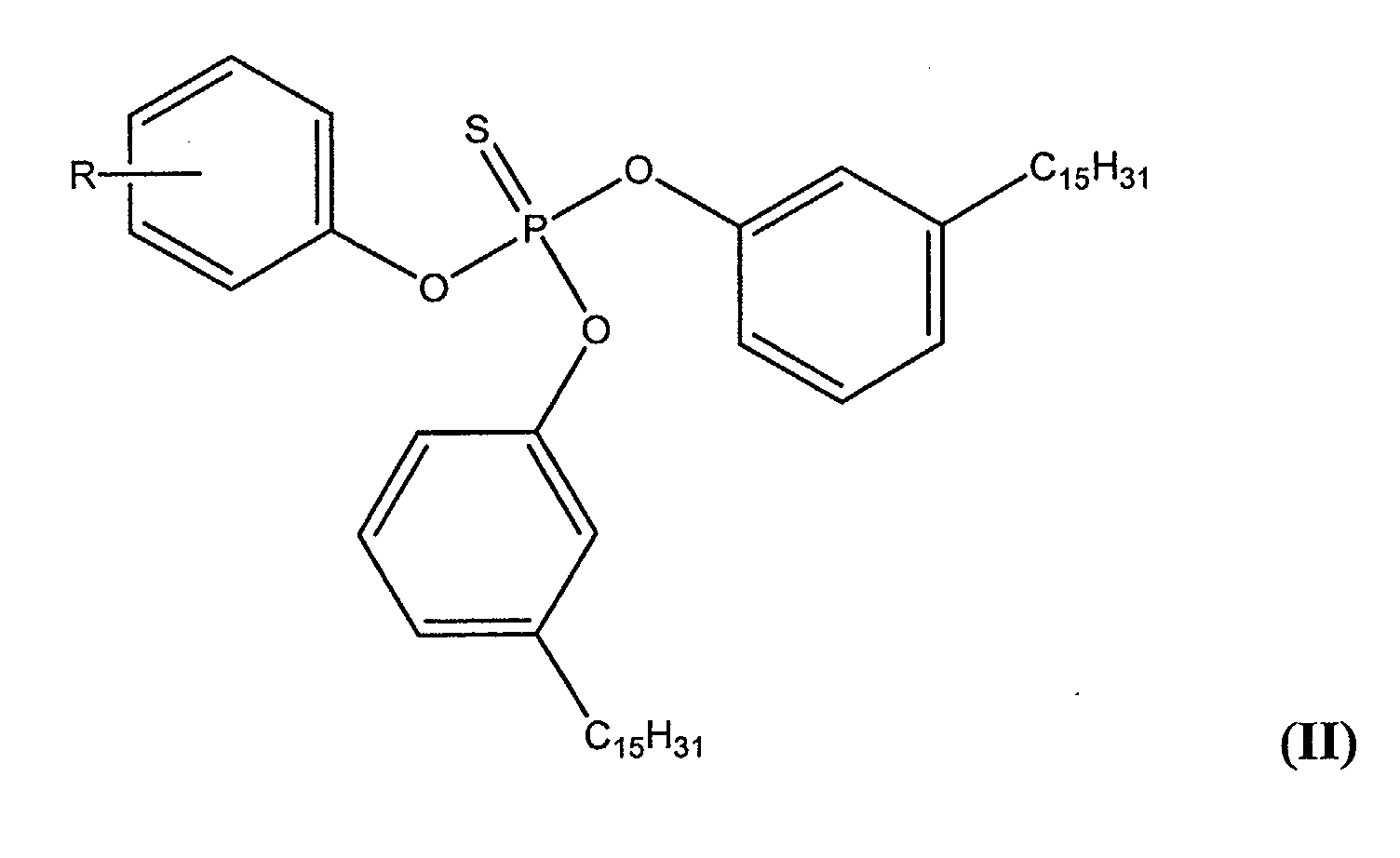
- Take 0.1 mole of cardanol.and 0.2 mol of phenol in a multinecked round bottom flask fitted with stirrer, thermometer pocket,N2 inlet and condensor. Raise temperature to 55°C under N2 atmosphere and add 0.086 mol of PCl3 dropwise. After completion of addition raise temperature of the reaction mixture to 150°C and maintain for 2 h. Stop heating, cool the reaction mixture to room temperature, add toluene as a diluent. Wash the reaction mixture with 10% NaOH soln. and water. Recover solvent to obtain the phosphite (yield 78%). To 0.06 mole of phosphite add 0.06 mole of elemental sulfur ,raise temperature to 180°C and maintain for 4 h to obtain compound III (yield 80%,viscous liquid).
31P NMR spectra shows single peak at 52.8 ppm corresponding to pentavalent phosphorus. IR spectra shows stretch at 691.0 cm-1 corresponding to P=S group. m/e = 552 confirming formation of the product.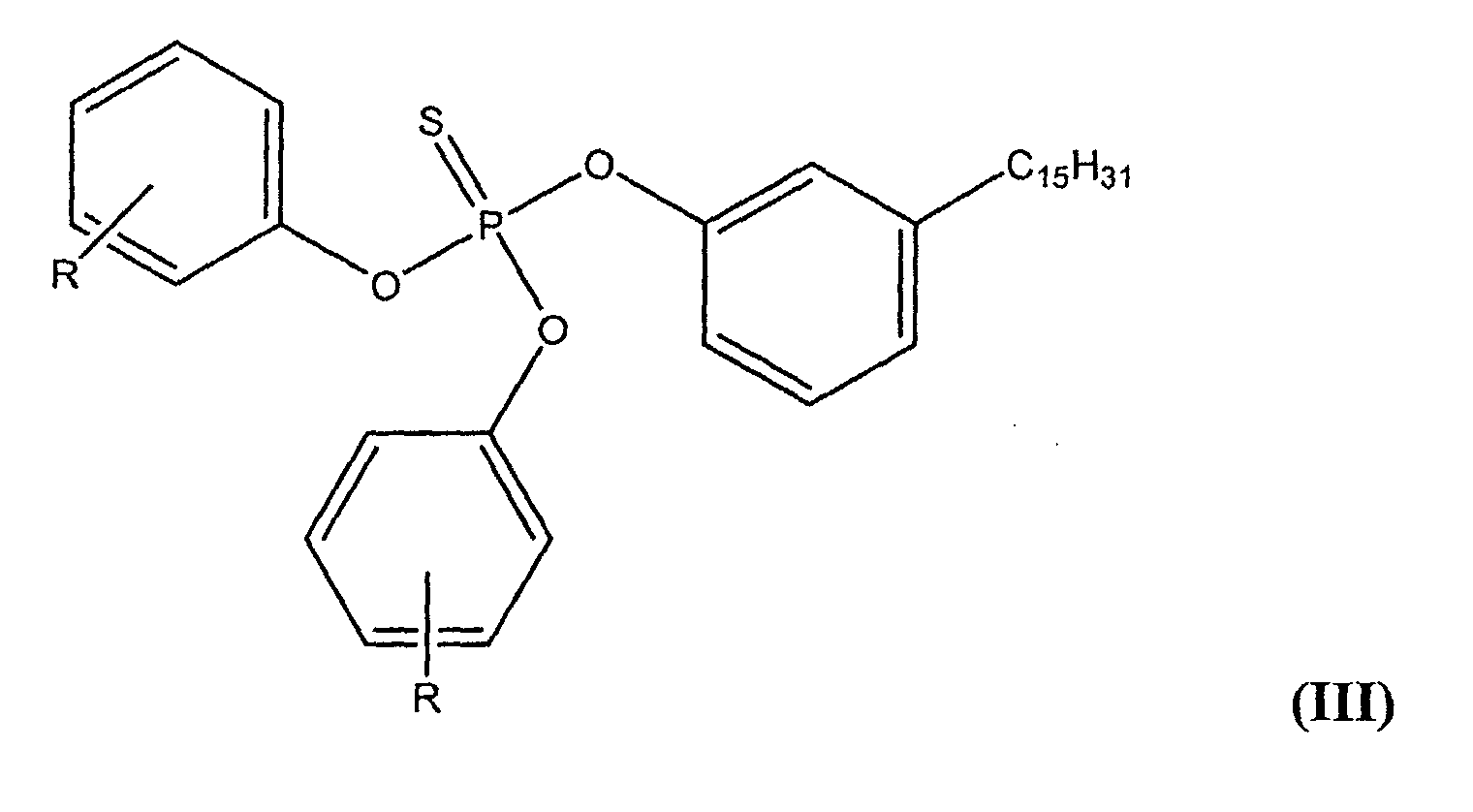
- In a similar set up as above take 0.4 mole of cardanol and 0.2 mol of m-cresol. Raise temperature to 55°C under N2 atmosphere and add 0.172 mol of PCl3 dropwise such that temperature of the reaction mixture does not exceed 70°C. Raise temperature to 150°C and maintain for 3 h. Stop heating ,cool the reaction mixture to room temperature, add methyl ethyl ketone so as to thin the compound Wash the reaction mixture with 5% NaOH soln. and brine solution. Recover solvent to obtain the corresponding phosphite (yield 83%). To 0.12 mole of phosphite add 0.12 mole of elemental sulfur, raise temperature to 180°C and maintain for 4 h to obtain compound II (yield 80 %,viscous liquid).
31P NMR spectra shows single peak at 54.1 ppm , IR spectra shows stretch at 690.5 cm-1 corresponding to P=S group and m/e = 776 confirming formation of the product. - Take 0.1 mole of cardanol.and 0.2 mol of m-cresol in a multinecked round bottom flask fitted with stirrer, thermometer pocket,N2 inlet and condensor. Raise temperature to 55°C under N2 atmosphere and add 0.0.086 mol of PCl3 dropwise. After completion of addition raise temperature of the reaction mixture to 150°C and maintain for 2 h. Stop heating ,cool the reaction mixture to room temperature, add toluene as a diluent. Wash the reaction mixture with 10% NaOH soln. and water. Recover solvent to obtain the phosphite (yield 88%). To 0.06 mole of phosphite add 0.06 mole of elemental sulfur ,raise temperature to 180°C and maintain for 4 h to obtain compound III (yield 80%,viscous liquid).
31p NMR spectra shows single peak at 53.8 ppm corresponding to pentavalent phosphorus. IR spectra shows stretch at 691.0 cm-1 corresponding to P=S group. m/e = 580 confirming formation of the product. - In a multinecked round bottom flask fitted with stirrer, thermometer pocket,N2 inlet and condensor take 0.3 mole of cardanol. Raise temperature to 55°C under N2 atmosphere and add 0.086 mol of PCl3 dropwise such that temperature of the reaction mixture does not exceed 70°C. Raise temperature to 150°C and maintain for 2 h.. To the reaction mixture add 0.08 mole of elemental sulfur ,raise temperature to 180°C and maintain for 3.5 h Stop heating ,cool the reaction mixture to room temperature, add methyl ethyl ketone as the diluent. Wash the reaction mixture with 5% NaOH soln. and brine solution. Dry the solvent over anhyd. sodium sulfate Recover it to obtain compound I (yield 85%) 31p NMR spectra shows single peak at 52.8 ppm corresponding to pentavalent phosphorus. IR spectra shows stretch at 691.9 cm-1 corresponding to P=S group, m/e = 971 confirming formation of 1.
- In a setup as for example 2, take 0.2 mole of cardanol and 0.1 mole of phenol . Raise temperature to 55°C under N2 atmosphere and add 0.086 mol of PCl3 dropwise.After completion of addition raise temperature of the reaction mixture to 150°C and maintain for 2 h.. To the reaction mixture add 0.09 mole of elemental sulfur ,raise temperature to 180°C and maintain for 3 h Stop heating ,cool the reaction mixture to room temperature, add methyl ethyl ketone as the diluent. Wash the reaction mixture with 5% NaOH soln. and brine solution. Dry the solvent over anhyd. sodium sulfate and recover it to obtain compound II (yield 80%) 31P NMR spectra shows single peak at 53.5 ppm corresponding to pentavalent phosphorus. IR spectra shows stretch at 694.5 cm-1 corresponding to P=S group, m/e = 764.
- In a setup as for example 2, take 0.1 mole of cardanol and 0.2 mole of phenol . Raise temperature to 55°C under N2 atmosphere and add 0.086 mol of PCl3 dropwise such that temperature of the reaction mixture does not exceed 70°C. Raise temperature to 150°C and maintain for 1 h.. To the reaction mixture add 0.08 mole of elemental sulfur ,raise temperature to 180°C and maintain for 2 h Stop heating ,cool the reaction mixture to room temperature, add toluene as the diluent. Wash the reaction mixture with 5% NaOH soln. and brine solution. Dry the solvent over anhyd. sodium sulfate Recover it to obtain compound III (yield 85%) 31P NMR spectra shows single peak at 52.8 ppm corresponding to pentavalent phosphorus. IR spectra shows stretch at 691.
- In a setup as for example 2, take 0.2 mole of cardanol and 0.1 mole of m-cresol. Raise temperature to 55°C under N2 atmosphere and add 0.086 mol of PCl3 dropwise.After completion of addition raise temperature of the reaction mixture to 150°C and maintain for 2 h.. To the reaction mixture add 0.09 mole of elemental sulfur ,raise temperature to 180°C and maintain for 3 h Stop heating ,cool the reaction mixture to room temperature, add methyl ethyl ketone as the diluent. Wash the reaction mixture with 5% NaOH soln. and brine solution. Dry the solvent over anhyd. sodium sulfate and recover it to obtain compound II (yield 85%) 31P NMR spectra shows single peak at 54.0 ppm corresponding to pentavalent phosphorus. IR spectra shows stretch at 690.5 cm-1 corresponding to P=S group, m/e = 776.
- Take 0.1 mole of cardanol and 0.2 mole of m-cresol in a multinecked round bottom flask fitted with stirrer, thermometer pocket,N2 inlet. Add 0.086 mol of PCl3 dropwise such that temperature of the reaction mixture does not exceed 70°C. Raise temperature to 150°C and maintain for 2 h.. To the reaction mixture add 0.08 mole of elemental sulfur ,raise temperature to 180°C and maintain for 2 h Stop heating ,cool the reaction mixture to room temperature, add toluene as solvent. Wash the reaction mixture with 10% NaOH soln. and brine solution. Dry the solvent over anhyd. sodium sulfate Recover it to obtain compound III (yield 80%) 31P NMR spectra shows single peak at 52.0 ppm corresponding to pentavalent phosphorus. IR spectra shows stretch at 685.9 cm-1 corresponding to P=S group, m/e = 580 confirming formation of desired product.
- Take 0.6 mole of phenol in a multinecked round bottom flask fitted with stirrer, thermometer pocket,N2 inlet and condensor. Under N2 atmosphere add 0.180 mol of thiophosphorylchloride dropwise such that temperature of the reaction mixture does not exceed 55°C. Raise temperature to 150°C ,maintain for 2 h. and then raise temperature to 180°C and maintain for 3 h. Stop heating ,cool the reaction mixture to room temperature, add toluene as the diluent. Wash the reaction mixture with 5% NaOH soln. and brine solution. Dry the solvent over anhyd. sodium sulfate. Recover it to obtain compound I (yield 85%). 31P NMR spectra shows single peak at 53.0 ppm corresponding to pentavalent phosphorus. IR spectra shows stretch at 691.6 cm-1 corresponding to P=S group, m/e = 971 confirming formation of the product.
- In a multinecked round bottom flask fitted with stirrer, thermometer pocket,N2 inlet and condensor take 0.4 mole of cardanol and 0.2 mole of phenol. Under N2 atmosphere add 0.180 mol of thiophosphoryl chloride dropwise Raise temperature to 150°C ,maintain for 2 h. and then raise temperature to 180°C and maintain for 3 h. Stop heating ,cool the reaction mixture to room temperature, add toluene as the diluent. Wash the reaction mixture with 5% NaOH soln. and brine solution. Dry the solvent over anhyd. sodium sulfate and recover it to obtain compound II (yield 80%) 31P NMR spectra shows single peak at 53.4 ppm IR spectra shows stretch at 693.0 cm-1 corresponding to P=S group, and m/e = 764.
- Take 0.1 mole of cardanol and 0.2 mole of phenol in a multinecked round bottom flask fitted with stirrer, thermometer pocket, N2 inlet and condensor. Under N2 atmosphere add 0.086 mol of thiophosphorylchloride dropwise such that temperature of the reaction mixture does not exceed 55°C. Raise temperature to 150°C ,maintain for 2 h. and then raise temperature to 180°C and maintain for 3 h. Stop heating ,cool the reaction mixture to room temperature, add toluene as the diluent. Wash the reaction mixture with 5% NaOH soln. and brine solution. Dry the solvent over anhyd. sodium sulfate Recover it to obtain compound III (yield 80%) 31P NMR spectra shows single peak at 53.0 ppm corresponding to pentavalent phosphorus. IR spectra shows stretch at 691.5 cm-1 corresponding to P=S group, m/e = 552 confirming formation of the product.
- In a multinecked round bottom flask fitted with stirrer, thermometer pocket,N2 inlet and condensor take 0.4 mole of cardanol and 0.2 mole of m-cresol. Under N2 atmosphere add 0.180 mol of thiophosphorylchloride dropwise Raise temperature to 150°C ,maintain for 2 h. and then raise temperature to 180°C and maintain for 4 h. Stop heating ,cool the reaction mixture to room temperature, add toluene as the diluent. Wash the reaction mixture with 5% NaOH soln. and brine solution. Dry the solvent over anhyd. sodium sulfate and recover it to obtain compound II (yield 85%) 31P NMR spectra shows single peak at 53.0 ppm IR spectra shows stretch at 690.5 cm-1 corresponding to P=S group, and m/e = 776.
- Take 0.1 mole of cardanol and 0.2 mole of m-cresol in a multinecked round bottom flask fitted with stirrer, thermometer pocket,N2 inlet and condensor. Under N2 atmosphere add 0.086 mol of thiophosphorylchloride dropwise such that temperature of the reaction mixture does not exceed 55°C. Raise temperature to 150°C ,maintain for 2 h. and then raise temperature to 180°C and maintain for 3 h. Stop heating ,cool the reaction mixture to room temperature, add methyl ethyl ketone as the diluent. Wash the reaction mixture with 5% NaOH soln. and brine solution. Dry the solvent over anhyd. sodium sulfate Recover it to obtain compound III (yield 80%) 31P NMR spectra shows single peak at 53.2 ppm corresponding to pentavalent phosphorus. IR spectra shows stretch at 691.5 cm-1 corresponding to P=S group, m/e = 580 confirming formation of the product.
- In a setup as for example 2, take 0.1 mole of cardanol, 0.1 mole of m-cresol and 0.1 mole of 0.1 mole of p-nonyl phenol . Raise temperature to 55°C under N2 atmosphere and add 0.09 mol of PCl3 dropwise such that temperature of the reaction mixture does not exceed 70°C. Raise temperature to 150°C and maintain for 1 h.. To the reaction mixture add 0.08 mole of elemental sulfur, raise temperature to 180°C and maintain for 2 h. Stop heating, cool the reaction mixture to room temperature and add toluene as the diluent. Wash the reaction mixture with 5% NaOH soln. and brine solution. Dry the solvent over anhyd. sodium sulfate and purified by column chromatography to obtain compound III R1=m-CH3 and R2=p-C9H19) (yield 85%). 31P NMR spectra shows single peak at 53.1 ppm corresponding to pentavalent phosphorus. IR spectra shows stretch at 691 cm-1 for P=S functionality and m/e=692 confirming formation of the desired product.
- Cost and time prohibit real-life testing of stabilizer systems, therefore laboratory tests have been developed to simulate conditions under which degradation occurs. Thermal gravimetric analysis (TGA) is a sensitive technique used to follow the weight change of a sample as a function of temperature, thereby providing information about the thermal stability, volatility and decomposition temperature of the additive studied. The test simulates conditions which the additive would experience during operation and usage.
- As shown in Table I, TGA scans were used to measure the thermal stability of a series of phosphorothionates shown previously by formulae (I), (II)and (III). The percentage weight loss of the starting phosphorothionate was determined as a function of temperature.
Thermal stability of Triarylphosphorothionates by Thermal Gravimetric Analysis(TGA) % Weight loss Additive (I) Additive II R=H) Additive (III, R1=R2= H) Additive (III, R1=R2=m -CH3) Additive (III, R1=p-C9H19, R2= m-CH3) Ref. Additive (Triphenyl Phosphorot hionate) Temp (°C) Temp (°C) Temp (°C) Temp (°C ) Temp (°C) Temp (°C) 5 250 250 250 240 240 210 10 320 290 280 280 250 230 15 380 320 310 310 280 235 20 430 350 330 340 330 240 25 440 380 350 360 340 250 30 450 400 370 370 350 250 35 455 420 390 390 380 255 40 460 430 400 410 390 260 45 465 435 410 420 405 270 50 465 440 415 430 410 270 55 470 450 425 440 420 275 60 475 455 430 450 430 275 65 475 460 440 460 435 280 70 480 460 445 465 420 280 75 485 470 450 470 440 285 80 490 475 460 480 450 285 85 495 480 470 485 460 290 90 500 490 480 500 470 295 95 510 500 490 510 500 300 98 730 730 730 740 740 310 - As shown in Table-I, monocardanol diphenyl phosphorothionates are more thermally stable than triphenyl phosphorothionates. With the addition of second and third CNSL phenol, the thermal stability further enhances. Tricardanol phosphorothionates gets fully decomposed at 730°C, vis-à-vis 310°C in the case of triphenylphosphorothionates.
- The synthesised CNSL phosphorothionate derivatives were evaluated in a solvent refined, highly paraffinic, 150 neutral grade, mineral base oil having a kinematic viscosity of 28.8 at 40°C. and 5.0 cSt at 100°C, for their antiwear and load carrying properties. The results of these tests are given in Table 2.
- A four ball machine was used for studying antiwear properties, involving measurement of wear scar on the ball at 196N load, 55.degree. C. temperature and 1800 rpm for one hour. In general, triarylphosphorothionates reduced wear scar over unformulated base oil, by 20-60% at 0.5-1.0% dosage (Table-2).
- Extreme pressure properties were determined by measuring the weld load, in duplicate, on a four ball machine according to ASTM D-2783 test method, while increasing the load in stages of 981N, 1099N, 1236N, 1570N, 1766N, 1962N and 2206N. Synthesised triarylphosphorothionates showed an increase in weld load from 25-50% at additive dosage of 0.5-2.0% (Table-1).
- Antioxidant performance of the blends was determined by differential scanning calorimetry (DSC), adopting temperature range of 100-350.degree. C., heating rate of 10.degree. C. per minute and oxygen flow rate of 60-80 ml/minute. The temperature at the onset of oxidation was taken as the criterion for assessment of antioxidant performance. In general, claimed triarylphosphorothionates increased the temperature of the onset of oxidation by 65-95°C, w.r.t. unformulated base oil (Table-2).
- Antifriction properties were measured by an oscillating friction and wear test apparatus, under the point contact conditions. The minimum stabilised value of the coefficient of the friction, recorded during the continuous run, was taken as a criterion for friction. Synthesised triarylphosphorothionates, at 0.5-1.0% level, reduced coefficient of friction by 35-55%, as compared to base oil (Table-2).
- The above data clearly demonstrates that additive amounts of the triarylphosphorothionates, derived from CNSL, in premium quality automotive and industrial lubricants significantly enhance the lubricant's energy efficiency, antiwear, antioxidant and extreme pressure properties. The unique additives described in this patent application are useful at low concentrations, are non-metallic and do not contain any potentially corrosive sulfur. These salts can be readily prepared in a one pot process. Furthermore, development and use of these multifunctional lubricant/fuel additives, derived from CNSL, a renewable and biodegradable product from vegetable sources and often available at very low price, would amount to substantial overall reduction in the cost of quality, energy efficient lubricant/fuel formulations.
Performance evaluation of CNSL Phosphorothionates Compound Dosage (% wt) Weld load Wear Scar Dia.@20kg Onset Oxid.Temp (°C) Coefficient of Friction ADDITIVE I 0.5 140 0.60 271 0.105 ADDITIVE I 1.0 160 0.80 275 0.10 ADDITIVE II 0.5 140 0.70 245 0.11 (R=H) ADDITIVE II 1.0 160 0.70 264 0.105 (R =H) ADDITIVE III 0.5 126 1.0 261 0.11 (R1=R2=H) ADDITIVE III 1.0 160 0.50 266 0.105 (R1=R2=H) Additive 0.5 149 0.70 253 0.110 (III, R1 =R2 =m-CH3) Additive 1.0 160 0.55 267 0.105 (III, R1=R2=m-CH3) Additive 0.5 140 0.65 271 0.105 (III, R1=p-C9H19, R2= m-CH3) Additive 1.0 160 0.50 289 0.10 (III, R1=p-C9H19, R2=m-CH3) Triphenyl Phosphorothionate 0.5 126 0.60 191 0.115 Triphenyl Phosphorothionate 1.0 140 0.40 190 0.11 Base oil 126 0.95 180 scuffed - The above data clearly demonstrates that additive amounts of novel phosphorothionates, in premium quality automotive and industrial lubricants significantly control the wear and oxidation. The unique additives described in this patent application are useful at low concentrations, are non-metallic and do not contain any potentially corrosive sulfur. These salts can be readily prepared in a one pot process. Furthermore, development and use of these antiwear and antioxidant lubricant/fuel additives, derived from CNSL, a renewable and biodegradable product from vegetable sources and often available at very low price, would amount to substantial overall reduction in the cost of quality, energy efficient lubricant/fuel formulations.
Claims (29)
- A novel phosphorothionate derivative of formula:wherein R1 and R2 are each independently H or alkyl or cycloalkyl or aryl at the ortho, meta or para position, with both R1 and R2 could be same or different.

- A phosphorothionate derivative as claimed in claim 1 wherein R2 is C15H31 and R1 is H or alkyl or cycloalkyl or aryl at ortho, meta or para positions of formula

- A phosphorothionate derivative as claimed in claim 1 wherein R1 = R2 is C15H31 and the compound is., O,O',O"-tris(3-pentadecylphenyl)phosphorothioate, of formula

- A phosphorothionate derivative as claimed in claim 1 wherein R2 is m-C15H31; R1 is H and the compound O,O'-bis(3-pentadecylphenyl) O"-phenylphosphorothioate,.
- A phosphorothionate derivative as claimed in claim 1 wherein R1= R2 is H and the compound is O,O'-bis(phenyl) O"-3-pentadecylphenylphosphorothioate,
- A phosphorothionate derivative as claimed in claim 1 wherein R1 = R2 is m-CH3 and the compound is., O,O'-bis(3-methylphenyl) O"-3-pentadecylphenylphosphorothioate.
- A phosphorothionate derivative as claimed in claim 1 wherein R2=p-C9H19; R1 = m-CH3 and the compound isO-3-methylphenyl, O'-4-nonylphenyl O"-3-pentadecylphenylphosphorothioate.
- A mixture of two or more phosphorothionate derivatives as claimed in any of claims 1 to 7
- A process for the preparation of a phosphorothionate derivative, as claimed in any one of claims 1-8, comprising the steps of:(a) partially hydrogenating distilled technical cashew nut shell liquid (CNSL) with a catalyst to fully hydrogenate the olefinic chain and(b) reacting said hydrogenated cashew nut shell liquid with phosphorus trihalide and sulphur, the reaction being carried out at a temperature of from 20 to 140°C.
- The process as claimed in claim 9 wherein said catalyst includes palladium, platinum or nickel.
- , The process as claimed in claim 9 or claim 10, wherein the phosphorus trihalide includes phosphrous trichloride or phosphorus tribromide or phosphorus tri-iodide.
- The process as claimed in any one of claims 9 to 11, wherein the reaction is carried out in the presence of a solvent.
- A process for the preparation of a phosphorothionate derivative, as claimed in any one of claims 1-8, composition comprising the steps of:reacting a cardanol mixture with a phosphorous trihalide in a predetermined amount sufficient to completely substitute halide sites at a temperature between about 30°C to about 200°C andsulfurization of the reaction product at a temperature ranging between about 140 °C to about 250 °C.
- A process as claimed in claim 13 wherein the cardanol mixture comprises a mixture of cashew nut shell liquid and a phenol or substituted phenol.
- A process as claimed in claim 14 wherein about 3.0 to 3.5 molecular equivalents of phenols per molecular equivalent of phosphorus trihalide is used.
- A lubricant composition comprising:a major proportion of a material selected from the group consisting of an oil of lubricating viscosity and a grease and a minor proportion of at least one an additive comprising phosphorothionate of any one of claims 1 to 8.
- The lubricant composition as claimed in claim 16, wherein the additive is present in an amount of from 0.01 to 5 wt %.
- The lubricant composition as claimed in claim 17, wherein the additive is present in an amount of from 0.03 - 3 wt %.
- The lubricant composition as claimed in claim 16, wherein the oil of lubricating viscosity is a mineral oil, a synthetic oil, or a mixture thereof.
- The lubricant composition as claimed in claim 19 wherein said synthetic oil include polypropylene glycol, a trimethylol propane ester, a neopentyl or pentaerythritol ester, a polyethylene glycol, a di(2-ethylhexyl) adipate, a fluorocarbons, a siloxane, a phenoxy phenyl ether a poly alphaolefin or a mixture of two or more thereof.
- The lubricant as claimed in claim 16, wherein grease is selected from the group lithium grease, a calcium grease, a sodium grease, a clay, or a titanium grease.
- The lubricant composition as claimed in claim 16 further comprising one or more of a viscosity modifier, a auxiliary antioxidant, a friction modifier, a dispersant, a antifoaming agent, a auxiliary antiwear agent, a pour point depressant, a detergent, a rust inhibitor.
- The lubricant composition as claimed in claim 221 wherein said dispersants include a hydrocarbyl succinimide, a hydrocarbyl succinamide, mixed ester/amides of hydrocarbyl substituted succinic acid, hydroxyesters of hydrocarbyl-substituted succinic acid, amides of aromatic acids and Mannich condensation products of hydrocarbyl-substituted phenols, formaldehyde and polyamines or mixtures thereof.
- The lubricant composition as claimed in claim 22 wherein said antioxidants includes an amine-type or a phenolic antioxidant.
- The lubricant composition as claimed in claim 24 wherein said amine-type antioxidant include one or more phenyl alpha napthylamine, phenyl beta naphthalyamine and bis- alkylated diphenyl amines (e.g., p,p'-bis(alkylphenyl)-amines wherein the alkyl groups each contain from 8 to 12 carbon atoms), sterically hindered phenols, bis-phenols, Phosphorous compounds or phosphites
- The lubricant composition as claimed in claim 21 wherein said friction modifiers includes one or more of oleamide, tallow amine, diethoxylated tallow amine, N,N-bis(2-hydroxyethyl)-octadecyl amine, N,N-bis(2-hydroxyethyl)-stearyloxypropylamine, oleic acid, N,N-hydroxyethyl,N-(N,N'-bis(2-hydroxyethyl)ethylamine)-stearylamine and the diamide produced from isostearic acid and tetraethylene pentamine, molybdenum dithiocarbamates and molybdenum dithiophosphates.
- The lubricant composition as claimed in claim 221 wherein said viscosity modifier is a high molecular weight hydrocarbon polymer
- The lubricant composition as claimed in claim 27 wherein said viscosity modifier includes any one or more of polyisobutylene, copolymers of ethylene and propylene and higher alpha-olefins, polymethacrylates, polyalkylmethacrylates, methacrylate copolymers, copolymers of unsaturated dicarboxylic acid and vinyl compound, inter polymers of styrene and acrylic esters, and partially hydrogenated copolymers of styrene/isoprene, styrene/butadiene and isoprene/butadiene, as well as partially hydrogenated homopolymers of butadiene and isoprene and isoprene/divinylbenzene.
- The use of a compound as claimed in any one of claims 1 to 8 as an anti-oxidant or a lubricant.
Applications Claiming Priority (2)
| Application Number | Priority Date | Filing Date | Title |
|---|---|---|---|
| INMU04592002 | 2002-05-24 | ||
| IN459MU2002 | 2002-05-24 |
Publications (2)
| Publication Number | Publication Date |
|---|---|
| EP1364955A1 true EP1364955A1 (en) | 2003-11-26 |
| EP1364955B1 EP1364955B1 (en) | 2005-04-13 |
Family
ID=29287803
Family Applications (1)
| Application Number | Title | Priority Date | Filing Date |
|---|---|---|---|
| EP03250621A Expired - Lifetime EP1364955B1 (en) | 2002-05-24 | 2003-01-27 | Phosphorothionates |
Country Status (5)
| Country | Link |
|---|---|
| US (1) | US6660696B1 (en) |
| EP (1) | EP1364955B1 (en) |
| AT (1) | ATE293116T1 (en) |
| BR (1) | BR0202545A (en) |
| DE (1) | DE60300494T2 (en) |
Cited By (8)
| Publication number | Priority date | Publication date | Assignee | Title |
|---|---|---|---|---|
| EP1900797A1 (en) * | 2006-08-28 | 2008-03-19 | Afton Chemical Corporation | Lubricant composition |
| EP1939272A1 (en) * | 2006-11-29 | 2008-07-02 | Afton Chemical Corporation | Food grade lubricant compositions |
| EP2025737A1 (en) * | 2007-08-01 | 2009-02-18 | Afton Chemical Corporation | Environmentally-friendly fuel compositions |
| EP2169016A1 (en) * | 2008-09-30 | 2010-03-31 | Xerox Corporation | Phase change inks |
| CN110205193A (en) * | 2018-02-28 | 2019-09-06 | 中国石油天然气股份有限公司 | Gas phase corrosion resistant water-glycol flame-retardant hydraulic fluid composition and preparation method thereof |
| EP3546549A1 (en) * | 2018-03-27 | 2019-10-02 | Infineum International Limited | Lubricating oil composition |
| CN111154541A (en) * | 2019-12-31 | 2020-05-15 | 山东天瑞重工有限公司 | Hydraulic rock drill power medium optimizing liquid and preparation process thereof |
| CN117903860A (en) * | 2022-10-19 | 2024-04-19 | 中国石油化工股份有限公司 | Lubricating grease and preparation method thereof |
Families Citing this family (13)
| Publication number | Priority date | Publication date | Assignee | Title |
|---|---|---|---|---|
| US20060277820A1 (en) * | 2005-06-13 | 2006-12-14 | Puri Suresh K | Synergistic deposit control additive composition for gasoline fuel and process thereof |
| US20060277819A1 (en) * | 2005-06-13 | 2006-12-14 | Puri Suresh K | Synergistic deposit control additive composition for diesel fuel and process thereof |
| US8222180B2 (en) * | 2005-08-01 | 2012-07-17 | Indian Oil Corporation Limited | Adsorbent composition for removal of refractory sulphur compounds from refinery streams and process thereof |
| JP2013018872A (en) * | 2011-07-11 | 2013-01-31 | Idemitsu Kosan Co Ltd | Lubricating oil composition and mechanical apparatus |
| CN102718796A (en) * | 2012-06-16 | 2012-10-10 | 南雄志一精细化工有限公司 | Preparation method of novel environment-friendly phosphite ester antioxidant |
| RU2505591C1 (en) * | 2012-09-06 | 2014-01-27 | Общество с ограниченной ответственностью "ЛЛК-Интернешнл" | Lubricating oil for gas turbines |
| CN106701298A (en) * | 2016-12-21 | 2017-05-24 | 天津市润杰创新环保科技股份公司 | Environment-friendly waterborne guide rail lubricating medium with good compatibility with cutting fluid |
| RU2656345C1 (en) * | 2017-12-19 | 2018-06-05 | Публичное акционерное общество "КАМАЗ" | Application of tri(benzylphenyl) phosphorothionate as anti-wear additive for lubricating oils |
| CN108976332B (en) * | 2018-04-19 | 2020-09-15 | 利和知信新材料技术有限公司 | Dispersing agent for polyolefin catalyst |
| CN109232976B (en) * | 2018-09-05 | 2020-06-12 | 中国林业科学研究院林产化学工业研究所 | Nitrogen-phosphorus synergistic flame retardant containing cardanol base, and preparation method and application thereof |
| CN111057103B (en) * | 2018-10-16 | 2023-03-10 | 中国石油化工股份有限公司 | A kind of phosphonothioate compound and its preparation method and application |
| CN114292684B (en) * | 2022-03-08 | 2022-05-31 | 泰奥星(天津)有限公司 | High-temperature-resistant lubricating grease, and preparation method and application thereof |
| CN114958453A (en) * | 2022-06-11 | 2022-08-30 | 唐华 | Lubricating oil antiwear agent |
Citations (3)
| Publication number | Priority date | Publication date | Assignee | Title |
|---|---|---|---|---|
| US3480700A (en) * | 1965-11-01 | 1969-11-25 | Ethyl Corp | Tris(3,5-dihydrocarbyl-4-hydroxyphenyl)phosphothionates |
| PL139033B1 (en) * | 1983-12-19 | 1986-11-29 | Jedlicze Rafineria Nafty | Method of obtaining a lubricant additive |
| EP0915097A1 (en) * | 1997-11-07 | 1999-05-12 | INDIAN OIL CORPORATION Ltd. | Multifunctional additives from cashew nut shell liquid |
Family Cites Families (8)
| Publication number | Priority date | Publication date | Assignee | Title |
|---|---|---|---|---|
| US4395498A (en) | 1981-09-18 | 1983-07-26 | Minnesota Mining And Manufacturing Company | High temperature phenolic resins and friction elements prepared therefrom |
| US5433774A (en) | 1990-08-02 | 1995-07-18 | Miba Frictec Gesellschaft M.B.H. | Friction lining and process for the production thereof |
| US5218038A (en) | 1991-11-14 | 1993-06-08 | Borden, Inc. | Phenolic resin coated proppants with reduced hydraulic fluid interaction |
| EP0667389B1 (en) * | 1994-02-11 | 2000-12-27 | The Lubrizol Corporation | Metal free hydraulic fluid with amine salt |
| US5916850A (en) | 1997-11-06 | 1999-06-29 | Indian Oil Corporaton Limited | Multifunctional additives from cashew nut shell liquid |
| US5910468A (en) | 1998-04-06 | 1999-06-08 | Indian Oil Corporation Ltd. | Process for the preparation of calcium phenate detergents from cashew nut shell liquid |
| EP1137620A1 (en) * | 1998-12-10 | 2001-10-04 | Cardolite Corp. | Cardanol derivative and method of making the cardanol derivative |
| US6339052B1 (en) | 2000-06-30 | 2002-01-15 | Indian Oil Corporation Limited | Lubricant compositions for internal combustion engines |
-
2002
- 2002-06-20 US US10/189,374 patent/US6660696B1/en not_active Expired - Lifetime
- 2002-07-04 BR BR0202545-0A patent/BR0202545A/en not_active IP Right Cessation
-
2003
- 2003-01-27 EP EP03250621A patent/EP1364955B1/en not_active Expired - Lifetime
- 2003-01-27 DE DE60300494T patent/DE60300494T2/en not_active Expired - Lifetime
- 2003-01-27 AT AT03250621T patent/ATE293116T1/en not_active IP Right Cessation
Patent Citations (3)
| Publication number | Priority date | Publication date | Assignee | Title |
|---|---|---|---|---|
| US3480700A (en) * | 1965-11-01 | 1969-11-25 | Ethyl Corp | Tris(3,5-dihydrocarbyl-4-hydroxyphenyl)phosphothionates |
| PL139033B1 (en) * | 1983-12-19 | 1986-11-29 | Jedlicze Rafineria Nafty | Method of obtaining a lubricant additive |
| EP0915097A1 (en) * | 1997-11-07 | 1999-05-12 | INDIAN OIL CORPORATION Ltd. | Multifunctional additives from cashew nut shell liquid |
Non-Patent Citations (2)
| Title |
|---|
| CHEMICAL ABSTRACTS, vol. 114, no. 18, 6 May 1991, Columbus, Ohio, US; abstract no. 167630, TAJBER, TADEUSZ ET AL: "Method of obtaining a lubricant additive" XP002062193 * |
| CHEMICAL ABSTRACTS, vol. 76, no. 26, 26 June 1972, Columbus, Ohio, US; abstract no. 154399, GHATGE, NANASAHEB D. ET AL: "Mono- and polyisocyanates" XP002251001 * |
Cited By (13)
| Publication number | Priority date | Publication date | Assignee | Title |
|---|---|---|---|---|
| US7833953B2 (en) | 2006-08-28 | 2010-11-16 | Afton Chemical Corporation | Lubricant composition |
| EP1900797A1 (en) * | 2006-08-28 | 2008-03-19 | Afton Chemical Corporation | Lubricant composition |
| EP1939272A1 (en) * | 2006-11-29 | 2008-07-02 | Afton Chemical Corporation | Food grade lubricant compositions |
| EP2025737A1 (en) * | 2007-08-01 | 2009-02-18 | Afton Chemical Corporation | Environmentally-friendly fuel compositions |
| US9234109B2 (en) | 2008-09-30 | 2016-01-12 | Xerox Corporation | Phase change inks |
| CN101712821B (en) * | 2008-09-30 | 2014-08-27 | 施乐公司 | Phase change inks |
| EP2169016A1 (en) * | 2008-09-30 | 2010-03-31 | Xerox Corporation | Phase change inks |
| CN110205193A (en) * | 2018-02-28 | 2019-09-06 | 中国石油天然气股份有限公司 | Gas phase corrosion resistant water-glycol flame-retardant hydraulic fluid composition and preparation method thereof |
| EP3546549A1 (en) * | 2018-03-27 | 2019-10-02 | Infineum International Limited | Lubricating oil composition |
| KR20190113613A (en) * | 2018-03-27 | 2019-10-08 | 인피늄 인터내셔날 리미티드 | Lubricating oil composition |
| CN111154541A (en) * | 2019-12-31 | 2020-05-15 | 山东天瑞重工有限公司 | Hydraulic rock drill power medium optimizing liquid and preparation process thereof |
| CN111154541B (en) * | 2019-12-31 | 2022-03-15 | 山东天瑞重工有限公司 | Hydraulic rock drill power medium optimizing liquid and preparation process thereof |
| CN117903860A (en) * | 2022-10-19 | 2024-04-19 | 中国石油化工股份有限公司 | Lubricating grease and preparation method thereof |
Also Published As
| Publication number | Publication date |
|---|---|
| BR0202545A (en) | 2004-05-18 |
| EP1364955B1 (en) | 2005-04-13 |
| US6660696B1 (en) | 2003-12-09 |
| DE60300494D1 (en) | 2005-05-19 |
| ATE293116T1 (en) | 2005-04-15 |
| DE60300494T2 (en) | 2006-02-23 |
Similar Documents
| Publication | Publication Date | Title |
|---|---|---|
| EP1364955B1 (en) | Phosphorothionates | |
| US5338470A (en) | Alkylated citric acid adducts as antiwear and friction modifying additives | |
| JP4109428B2 (en) | Oil-soluble molybdenum additives from reaction products of fatty oils and monosubstituted alkylenediamines | |
| EP1136497B1 (en) | Oil soluble molybdenum-containing compositions | |
| AU777392B2 (en) | Molybdenum containing compounds as additives for lubricant compositions | |
| JP2007528440A (en) | Lubricant and fuel composition containing hydroxycarboxylic acid and ester of hydroxypolycarboxylic acid | |
| JPH0832709B2 (en) | Boron-containing compositions, and lubricants and fuels containing them | |
| EP0546357A1 (en) | Organic molybdenum complexes | |
| CA2281606A1 (en) | Antiwear agents for lubricating compositions | |
| AU2003200475A1 (en) | Molybdenum-containing lubricant additive compositions, and processes for making and using same | |
| CA2635151A1 (en) | Improved friction stability in lubricating oils comprising amide additives | |
| EP0020037A1 (en) | Oil-soluble friction-reducing additive, process for the preparation thereof, and lubricating oil or fuel composition containing the additive | |
| JP2004068021A (en) | Methods and compositions for reducing wear of internal combustion engines lubricated with low phosphorus lubricating oils | |
| CN102952609A (en) | Lubricant compositions containing a functionalized dispersant | |
| EP0874040A1 (en) | Synergistic organomolybdenum compositions and lubricating compositions containing same | |
| CA2635150C (en) | Boron-containing lubricating oils having improved friction stability | |
| JPS6281396A (en) | Molybdenum dithiocarbamate | |
| EP0556404A1 (en) | Lubricating oil composition | |
| JP2972386B2 (en) | Antioxidant composition | |
| JPH0832904B2 (en) | Compositions, concentrates, lubricant compositions, fuel compositions, and methods of reducing fuel consumption in internal combustion engines | |
| CA3141033C (en) | Less corrosive organic compounds as lubricant additives | |
| US6638898B2 (en) | Process of preparing multi-functional amino di(alkylcyclohexyl) phosphordithioate additive for lubricant composition from saturated cashew nut shell liquid | |
| US5916850A (en) | Multifunctional additives from cashew nut shell liquid | |
| US5084069A (en) | Multifunctional additives for lubricants and fuels | |
| KR102791322B1 (en) | Organic molybdenum compounds with low corrosiveness as lubricant additives |
Legal Events
| Date | Code | Title | Description |
|---|---|---|---|
| PUAI | Public reference made under article 153(3) epc to a published international application that has entered the european phase |
Free format text: ORIGINAL CODE: 0009012 |
|
| AK | Designated contracting states |
Kind code of ref document: A1 Designated state(s): AT BE BG CH CY CZ DE DK EE ES FI FR GB GR HU IE IT LI LU MC NL PT SE SI SK TR |
|
| AX | Request for extension of the european patent |
Extension state: AL LT LV MK RO |
|
| 17P | Request for examination filed |
Effective date: 20040213 |
|
| GRAP | Despatch of communication of intention to grant a patent |
Free format text: ORIGINAL CODE: EPIDOSNIGR1 |
|
| AKX | Designation fees paid |
Designated state(s): AT BE BG CH CY CZ DE DK EE ES FI FR GB GR HU IE IT LI LU MC NL PT SE SI SK TR |
|
| GRAS | Grant fee paid |
Free format text: ORIGINAL CODE: EPIDOSNIGR3 |
|
| GRAA | (expected) grant |
Free format text: ORIGINAL CODE: 0009210 |
|
| AK | Designated contracting states |
Kind code of ref document: B1 Designated state(s): AT BE BG CH CY CZ DE DK EE ES FI FR GB GR HU IE IT LI LU MC NL PT SE SI SK TR |
|
| PG25 | Lapsed in a contracting state [announced via postgrant information from national office to epo] |
Ref country code: IT Free format text: LAPSE BECAUSE OF FAILURE TO SUBMIT A TRANSLATION OF THE DESCRIPTION OR TO PAY THE FEE WITHIN THE PRESCRIBED TIME-LIMIT;WARNING: LAPSES OF ITALIAN PATENTS WITH EFFECTIVE DATE BEFORE 2007 MAY HAVE OCCURRED AT ANY TIME BEFORE 2007. THE CORRECT EFFECTIVE DATE MAY BE DIFFERENT FROM THE ONE RECORDED. Effective date: 20050413 Ref country code: NL Free format text: LAPSE BECAUSE OF FAILURE TO SUBMIT A TRANSLATION OF THE DESCRIPTION OR TO PAY THE FEE WITHIN THE PRESCRIBED TIME-LIMIT Effective date: 20050413 Ref country code: FI Free format text: LAPSE BECAUSE OF FAILURE TO SUBMIT A TRANSLATION OF THE DESCRIPTION OR TO PAY THE FEE WITHIN THE PRESCRIBED TIME-LIMIT Effective date: 20050413 Ref country code: AT Free format text: LAPSE BECAUSE OF FAILURE TO SUBMIT A TRANSLATION OF THE DESCRIPTION OR TO PAY THE FEE WITHIN THE PRESCRIBED TIME-LIMIT Effective date: 20050413 Ref country code: BE Free format text: LAPSE BECAUSE OF FAILURE TO SUBMIT A TRANSLATION OF THE DESCRIPTION OR TO PAY THE FEE WITHIN THE PRESCRIBED TIME-LIMIT Effective date: 20050413 Ref country code: SI Free format text: LAPSE BECAUSE OF FAILURE TO SUBMIT A TRANSLATION OF THE DESCRIPTION OR TO PAY THE FEE WITHIN THE PRESCRIBED TIME-LIMIT Effective date: 20050413 Ref country code: CZ Free format text: LAPSE BECAUSE OF FAILURE TO SUBMIT A TRANSLATION OF THE DESCRIPTION OR TO PAY THE FEE WITHIN THE PRESCRIBED TIME-LIMIT Effective date: 20050413 Ref country code: CH Free format text: LAPSE BECAUSE OF FAILURE TO SUBMIT A TRANSLATION OF THE DESCRIPTION OR TO PAY THE FEE WITHIN THE PRESCRIBED TIME-LIMIT Effective date: 20050413 Ref country code: LI Free format text: LAPSE BECAUSE OF FAILURE TO SUBMIT A TRANSLATION OF THE DESCRIPTION OR TO PAY THE FEE WITHIN THE PRESCRIBED TIME-LIMIT Effective date: 20050413 Ref country code: SK Free format text: LAPSE BECAUSE OF FAILURE TO SUBMIT A TRANSLATION OF THE DESCRIPTION OR TO PAY THE FEE WITHIN THE PRESCRIBED TIME-LIMIT Effective date: 20050413 |
|
| REG | Reference to a national code |
Ref country code: GB Ref legal event code: FG4D |
|
| REG | Reference to a national code |
Ref country code: CH Ref legal event code: EP |
|
| REG | Reference to a national code |
Ref country code: IE Ref legal event code: FG4D |
|
| REF | Corresponds to: |
Ref document number: 60300494 Country of ref document: DE Date of ref document: 20050519 Kind code of ref document: P |
|
| PG25 | Lapsed in a contracting state [announced via postgrant information from national office to epo] |
Ref country code: GR Free format text: LAPSE BECAUSE OF FAILURE TO SUBMIT A TRANSLATION OF THE DESCRIPTION OR TO PAY THE FEE WITHIN THE PRESCRIBED TIME-LIMIT Effective date: 20050713 Ref country code: DK Free format text: LAPSE BECAUSE OF FAILURE TO SUBMIT A TRANSLATION OF THE DESCRIPTION OR TO PAY THE FEE WITHIN THE PRESCRIBED TIME-LIMIT Effective date: 20050713 Ref country code: BG Free format text: LAPSE BECAUSE OF FAILURE TO SUBMIT A TRANSLATION OF THE DESCRIPTION OR TO PAY THE FEE WITHIN THE PRESCRIBED TIME-LIMIT Effective date: 20050713 Ref country code: SE Free format text: LAPSE BECAUSE OF FAILURE TO SUBMIT A TRANSLATION OF THE DESCRIPTION OR TO PAY THE FEE WITHIN THE PRESCRIBED TIME-LIMIT Effective date: 20050713 |
|
| PG25 | Lapsed in a contracting state [announced via postgrant information from national office to epo] |
Ref country code: HU Free format text: LAPSE BECAUSE OF FAILURE TO SUBMIT A TRANSLATION OF THE DESCRIPTION OR TO PAY THE FEE WITHIN THE PRESCRIBED TIME-LIMIT Effective date: 20050714 |
|
| PG25 | Lapsed in a contracting state [announced via postgrant information from national office to epo] |
Ref country code: ES Free format text: LAPSE BECAUSE OF FAILURE TO SUBMIT A TRANSLATION OF THE DESCRIPTION OR TO PAY THE FEE WITHIN THE PRESCRIBED TIME-LIMIT Effective date: 20050724 |
|
| PG25 | Lapsed in a contracting state [announced via postgrant information from national office to epo] |
Ref country code: PT Free format text: LAPSE BECAUSE OF FAILURE TO SUBMIT A TRANSLATION OF THE DESCRIPTION OR TO PAY THE FEE WITHIN THE PRESCRIBED TIME-LIMIT Effective date: 20050913 |
|
| NLV1 | Nl: lapsed or annulled due to failure to fulfill the requirements of art. 29p and 29m of the patents act | ||
| REG | Reference to a national code |
Ref country code: CH Ref legal event code: PL |
|
| PG25 | Lapsed in a contracting state [announced via postgrant information from national office to epo] |
Ref country code: IE Free format text: LAPSE BECAUSE OF NON-PAYMENT OF DUE FEES Effective date: 20060127 |
|
| PG25 | Lapsed in a contracting state [announced via postgrant information from national office to epo] |
Ref country code: LU Free format text: LAPSE BECAUSE OF NON-PAYMENT OF DUE FEES Effective date: 20060131 Ref country code: MC Free format text: LAPSE BECAUSE OF NON-PAYMENT OF DUE FEES Effective date: 20060131 |
|
| PLBE | No opposition filed within time limit |
Free format text: ORIGINAL CODE: 0009261 |
|
| STAA | Information on the status of an ep patent application or granted ep patent |
Free format text: STATUS: NO OPPOSITION FILED WITHIN TIME LIMIT |
|
| ET | Fr: translation filed | ||
| 26N | No opposition filed |
Effective date: 20060116 |
|
| REG | Reference to a national code |
Ref country code: IE Ref legal event code: MM4A |
|
| PG25 | Lapsed in a contracting state [announced via postgrant information from national office to epo] |
Ref country code: EE Free format text: LAPSE BECAUSE OF FAILURE TO SUBMIT A TRANSLATION OF THE DESCRIPTION OR TO PAY THE FEE WITHIN THE PRESCRIBED TIME-LIMIT Effective date: 20050413 |
|
| PG25 | Lapsed in a contracting state [announced via postgrant information from national office to epo] |
Ref country code: TR Free format text: LAPSE BECAUSE OF FAILURE TO SUBMIT A TRANSLATION OF THE DESCRIPTION OR TO PAY THE FEE WITHIN THE PRESCRIBED TIME-LIMIT Effective date: 20050413 |
|
| PG25 | Lapsed in a contracting state [announced via postgrant information from national office to epo] |
Ref country code: CY Free format text: LAPSE BECAUSE OF FAILURE TO SUBMIT A TRANSLATION OF THE DESCRIPTION OR TO PAY THE FEE WITHIN THE PRESCRIBED TIME-LIMIT Effective date: 20050413 |
|
| PGFP | Annual fee paid to national office [announced via postgrant information from national office to epo] |
Ref country code: FR Payment date: 20100217 Year of fee payment: 8 |
|
| PGFP | Annual fee paid to national office [announced via postgrant information from national office to epo] |
Ref country code: DE Payment date: 20100126 Year of fee payment: 8 Ref country code: GB Payment date: 20100115 Year of fee payment: 8 |
|
| GBPC | Gb: european patent ceased through non-payment of renewal fee |
Effective date: 20110127 |
|
| REG | Reference to a national code |
Ref country code: FR Ref legal event code: ST Effective date: 20110930 |
|
| PG25 | Lapsed in a contracting state [announced via postgrant information from national office to epo] |
Ref country code: FR Free format text: LAPSE BECAUSE OF NON-PAYMENT OF DUE FEES Effective date: 20110131 |
|
| PG25 | Lapsed in a contracting state [announced via postgrant information from national office to epo] |
Ref country code: GB Free format text: LAPSE BECAUSE OF NON-PAYMENT OF DUE FEES Effective date: 20110127 |
|
| REG | Reference to a national code |
Ref country code: DE Ref legal event code: R119 Ref document number: 60300494 Country of ref document: DE Effective date: 20110802 |
|
| PG25 | Lapsed in a contracting state [announced via postgrant information from national office to epo] |
Ref country code: DE Free format text: LAPSE BECAUSE OF NON-PAYMENT OF DUE FEES Effective date: 20110802 |