EP1363909B1 - Tricyclic androgen receptor modulator compounds - Google Patents
Tricyclic androgen receptor modulator compounds Download PDFInfo
- Publication number
- EP1363909B1 EP1363909B1 EP02702589.9A EP02702589A EP1363909B1 EP 1363909 B1 EP1363909 B1 EP 1363909B1 EP 02702589 A EP02702589 A EP 02702589A EP 1363909 B1 EP1363909 B1 EP 1363909B1
- Authority
- EP
- European Patent Office
- Prior art keywords
- quinolin
- pyrrolo
- trifluoromethyl
- trifluoroethyl
- methyl
- Prior art date
- Legal status (The legal status is an assumption and is not a legal conclusion. Google has not performed a legal analysis and makes no representation as to the accuracy of the status listed.)
- Expired - Lifetime
Links
- 150000001875 compounds Chemical class 0.000 title claims description 327
- 239000000849 selective androgen receptor modulator Substances 0.000 title description 5
- LISFMEBWQUVKPJ-UHFFFAOYSA-N quinolin-2-ol Chemical compound C1=CC=C2NC(=O)C=CC2=C1 LISFMEBWQUVKPJ-UHFFFAOYSA-N 0.000 claims description 351
- 125000002023 trifluoromethyl group Chemical group FC(F)(F)* 0.000 claims description 78
- 108010080146 androgen receptors Proteins 0.000 claims description 53
- 102000001307 androgen receptors Human genes 0.000 claims description 53
- 125000000217 alkyl group Chemical group 0.000 claims description 36
- 229910052739 hydrogen Inorganic materials 0.000 claims description 32
- 239000001257 hydrogen Substances 0.000 claims description 32
- 125000003118 aryl group Chemical group 0.000 claims description 31
- 125000004404 heteroalkyl group Chemical group 0.000 claims description 24
- 238000000034 method Methods 0.000 claims description 24
- 150000002431 hydrogen Chemical class 0.000 claims description 23
- 125000001188 haloalkyl group Chemical group 0.000 claims description 19
- 125000001072 heteroaryl group Chemical group 0.000 claims description 19
- 125000004178 (C1-C4) alkyl group Chemical group 0.000 claims description 16
- 102000005962 receptors Human genes 0.000 claims description 15
- 108020003175 receptors Proteins 0.000 claims description 15
- 229940088597 hormone Drugs 0.000 claims description 14
- 239000005556 hormone Substances 0.000 claims description 14
- 239000008194 pharmaceutical composition Substances 0.000 claims description 14
- 239000003814 drug Substances 0.000 claims description 12
- 125000004765 (C1-C4) haloalkyl group Chemical group 0.000 claims description 11
- 239000000284 extract Substances 0.000 claims description 11
- 238000004519 manufacturing process Methods 0.000 claims description 10
- 238000012360 testing method Methods 0.000 claims description 10
- 230000001419 dependent effect Effects 0.000 claims description 9
- 229940079593 drug Drugs 0.000 claims description 9
- UFHFLCQGNIYNRP-UHFFFAOYSA-N Hydrogen Chemical compound [H][H] UFHFLCQGNIYNRP-UHFFFAOYSA-N 0.000 claims description 8
- 230000004913 activation Effects 0.000 claims description 8
- 230000005764 inhibitory process Effects 0.000 claims description 8
- 206010028980 Neoplasm Diseases 0.000 claims description 7
- SOZWGURBGSRPAM-UHFFFAOYSA-N 6-ethyl-5-methyl-7-(2,2,2-trifluoroethyl)-4-(trifluoromethyl)-3,7-dihydro-1h-pyrrolo[3,2-f]quinolin-2-one Chemical compound CC1=C2N(CC)C(CC(F)(F)F)C=CC2=C2CC(=O)NC2=C1C(F)(F)F SOZWGURBGSRPAM-UHFFFAOYSA-N 0.000 claims description 6
- KYDMYMDPFMJMOU-UHFFFAOYSA-N 6-ethyl-7-(2,2,2-trifluoroethyl)-4-(trifluoromethyl)-3,7-dihydro-1h-pyrrolo[3,2-f]quinolin-2-one Chemical compound C1=C2N(CC)C(CC(F)(F)F)C=CC2=C2CC(=O)NC2=C1C(F)(F)F KYDMYMDPFMJMOU-UHFFFAOYSA-N 0.000 claims description 6
- 206010006895 Cachexia Diseases 0.000 claims description 6
- 206010058359 Hypogonadism Diseases 0.000 claims description 6
- 150000003839 salts Chemical class 0.000 claims description 6
- YZVHBKGYCGBKCG-UHFFFAOYSA-N 5,6-dimethyl-7-(2,2,2-trifluoroethyl)-4-(trifluoromethyl)-3,7-dihydro-1h-pyrrolo[3,2-f]quinolin-2-one Chemical compound CC1=C2N(C)C(CC(F)(F)F)C=CC2=C2CC(=O)NC2=C1C(F)(F)F YZVHBKGYCGBKCG-UHFFFAOYSA-N 0.000 claims description 5
- PVWCYYGIRKRZMY-UHFFFAOYSA-N 5-ethyl-6-methyl-7-(2,2,2-trifluoroethyl)-4-(trifluoromethyl)-3,7-dihydro-1h-pyrrolo[3,2-f]quinolin-2-one Chemical compound CN1C(CC(F)(F)F)C=CC2=C(CC(=O)N3)C3=C(C(F)(F)F)C(CC)=C21 PVWCYYGIRKRZMY-UHFFFAOYSA-N 0.000 claims description 5
- 208000002874 Acne Vulgaris Diseases 0.000 claims description 5
- 201000004384 Alopecia Diseases 0.000 claims description 5
- 206010004446 Benign prostatic hyperplasia Diseases 0.000 claims description 5
- 206010020112 Hirsutism Diseases 0.000 claims description 5
- 208000001132 Osteoporosis Diseases 0.000 claims description 5
- 208000004403 Prostatic Hyperplasia Diseases 0.000 claims description 5
- 208000010399 Wasting Syndrome Diseases 0.000 claims description 5
- 206010000496 acne Diseases 0.000 claims description 5
- 206010068168 androgenetic alopecia Diseases 0.000 claims description 5
- 229910052801 chlorine Inorganic materials 0.000 claims description 5
- 229910052731 fluorine Inorganic materials 0.000 claims description 5
- 238000002657 hormone replacement therapy Methods 0.000 claims description 5
- 239000000829 suppository Substances 0.000 claims description 5
- RHSDLMBUTNIWJR-UHFFFAOYSA-N 5-(ethoxymethyl)-6-ethyl-7-(2,2,2-trifluoroethyl)-4-(trifluoromethyl)-3,7-dihydro-1h-pyrrolo[3,2-f]quinolin-2-one Chemical compound CCN1C(CC(F)(F)F)C=CC2=C(CC(=O)N3)C3=C(C(F)(F)F)C(COCC)=C21 RHSDLMBUTNIWJR-UHFFFAOYSA-N 0.000 claims description 4
- RLVUOEJSKJGGAK-UHFFFAOYSA-N 5-methyl-7-(2,2,2-trifluoroethyl)-4-(trifluoromethyl)-1,3-dihydropyrrolo[3,2-f]quinolin-2-one Chemical compound C12=CC=C(CC(F)(F)F)N=C2C(C)=C(C(F)(F)F)C2=C1CC(=O)N2 RLVUOEJSKJGGAK-UHFFFAOYSA-N 0.000 claims description 4
- YTEQSJQWEJXVIC-UHFFFAOYSA-N 6-ethyl-5-methyl-3,7-dihydro-1h-pyrrolo[3,2-f]quinolin-2-one Chemical compound CC1=C2N(CC)CC=CC2=C2CC(=O)NC2=C1 YTEQSJQWEJXVIC-UHFFFAOYSA-N 0.000 claims description 4
- AVINJAPZKKVDRS-UHFFFAOYSA-N 6-methyl-4-(trifluoromethyl)-3,7-dihydro-1h-pyrrolo[3,2-f]quinolin-2-one Chemical compound C1=C2N(C)CC=CC2=C2CC(=O)NC2=C1C(F)(F)F AVINJAPZKKVDRS-UHFFFAOYSA-N 0.000 claims description 4
- BBKJRYCGGJWJQW-UHFFFAOYSA-N 6-methyl-5-propan-2-yl-4-(trifluoromethyl)-3,7-dihydro-1h-pyrrolo[3,2-f]quinolin-2-one Chemical compound CN1CC=CC2=C(CC(=O)N3)C3=C(C(F)(F)F)C(C(C)C)=C21 BBKJRYCGGJWJQW-UHFFFAOYSA-N 0.000 claims description 4
- PACNHCPRNAEZOS-UHFFFAOYSA-N 7-(2,2-difluoroethenyl)-5,6-dimethyl-4-(trifluoromethyl)-3,7-dihydro-1h-pyrrolo[3,2-f]quinolin-2-one Chemical compound CC1=C2N(C)C(C=C(F)F)C=CC2=C2CC(=O)NC2=C1C(F)(F)F PACNHCPRNAEZOS-UHFFFAOYSA-N 0.000 claims description 4
- 201000001880 Sexual dysfunction Diseases 0.000 claims description 4
- 230000011132 hemopoiesis Effects 0.000 claims description 4
- 201000001881 impotence Diseases 0.000 claims description 4
- 238000000338 in vitro Methods 0.000 claims description 4
- 230000001404 mediated effect Effects 0.000 claims description 4
- 231100000872 sexual dysfunction Toxicity 0.000 claims description 4
- 230000000638 stimulation Effects 0.000 claims description 4
- 125000004169 (C1-C6) alkyl group Chemical group 0.000 claims description 3
- 125000000171 (C1-C6) haloalkyl group Chemical group 0.000 claims description 3
- 125000006716 (C1-C6) heteroalkyl group Chemical group 0.000 claims description 3
- VYPOTRDMCVJWEX-UHFFFAOYSA-N 5-(4-fluorophenyl)-6-methyl-7-(2,2,2-trifluoroethyl)-4-(trifluoromethyl)-3,7-dihydro-1h-pyrrolo[3,2-f]quinolin-2-one Chemical compound C=12N(C)C(CC(F)(F)F)C=CC2=C2CC(=O)NC2=C(C(F)(F)F)C=1C1=CC=C(F)C=C1 VYPOTRDMCVJWEX-UHFFFAOYSA-N 0.000 claims description 3
- ZSLNQIKJJHERGN-UHFFFAOYSA-N 5-(4-methoxyphenyl)-6-methyl-4-(trifluoromethyl)-3,7-dihydro-1h-pyrrolo[3,2-f]quinolin-2-one Chemical compound C1=CC(OC)=CC=C1C1=C(N(C)CC=C2)C2=C(CC(=O)N2)C2=C1C(F)(F)F ZSLNQIKJJHERGN-UHFFFAOYSA-N 0.000 claims description 3
- CVNWWMOVNFFLLI-UHFFFAOYSA-N 6-(1-methoxyethyl)-5-methyl-7-(2,2,2-trifluoroethyl)-4-(trifluoromethyl)-3,7-dihydro-1h-pyrrolo[3,2-f]quinolin-2-one Chemical compound CC1=C2N(C(C)OC)C(CC(F)(F)F)C=CC2=C2CC(=O)NC2=C1C(F)(F)F CVNWWMOVNFFLLI-UHFFFAOYSA-N 0.000 claims description 3
- HZPODNYQZHYFKA-UHFFFAOYSA-N 6-ethyl-5-(hydroxymethyl)-7-(2,2,2-trifluoroethyl)-4-(trifluoromethyl)-3,7-dihydro-1h-pyrrolo[3,2-f]quinolin-2-one Chemical compound OCC1=C2N(CC)C(CC(F)(F)F)C=CC2=C2CC(=O)NC2=C1C(F)(F)F HZPODNYQZHYFKA-UHFFFAOYSA-N 0.000 claims description 3
- AVNPNKABQWGLNQ-UHFFFAOYSA-N 6-ethyl-5-methyl-7-(2,2,2-trifluoroethyl)-3,7-dihydro-1h-pyrrolo[3,2-f]quinolin-2-one Chemical compound CC1=C2N(CC)C(CC(F)(F)F)C=CC2=C2CC(=O)NC2=C1 AVNPNKABQWGLNQ-UHFFFAOYSA-N 0.000 claims description 3
- SDNJLYFYVPGGRA-UHFFFAOYSA-N 6-methyl-4-(trifluoromethyl)-5-[3-(trifluoromethyl)phenyl]-3,7-dihydro-1h-pyrrolo[3,2-f]quinolin-2-one Chemical compound C=12N(C)CC=CC2=C2CC(=O)NC2=C(C(F)(F)F)C=1C1=CC=CC(C(F)(F)F)=C1 SDNJLYFYVPGGRA-UHFFFAOYSA-N 0.000 claims description 3
- JNCMHMUGTWEVOZ-UHFFFAOYSA-N F[CH]F Chemical compound F[CH]F JNCMHMUGTWEVOZ-UHFFFAOYSA-N 0.000 claims description 3
- 238000009165 androgen replacement therapy Methods 0.000 claims description 3
- XAXKLEGSYMWFPO-UHFFFAOYSA-N ethyl 3-[6-methyl-2-oxo-7-(2,2,2-trifluoroethyl)-4-(trifluoromethyl)-3,7-dihydro-1h-pyrrolo[3,2-f]quinolin-5-yl]propanoate Chemical compound CN1C(CC(F)(F)F)C=CC2=C(CC(=O)N3)C3=C(C(F)(F)F)C(CCC(=O)OCC)=C21 XAXKLEGSYMWFPO-UHFFFAOYSA-N 0.000 claims description 3
- VUWZPRWSIVNGKG-UHFFFAOYSA-N fluoromethane Chemical compound F[CH2] VUWZPRWSIVNGKG-UHFFFAOYSA-N 0.000 claims description 3
- 238000002560 therapeutic procedure Methods 0.000 claims description 3
- BHNJJNUDJROMFT-UHFFFAOYSA-N 5-ethyl-6-propyl-7-(2,2,2-trifluoroethyl)-4-(trifluoromethyl)-3,7-dihydro-1h-pyrrolo[3,2-f]quinolin-2-one Chemical compound CCC1=C2N(CCC)C(CC(F)(F)F)C=CC2=C2CC(=O)NC2=C1C(F)(F)F BHNJJNUDJROMFT-UHFFFAOYSA-N 0.000 claims description 2
- 239000003937 drug carrier Substances 0.000 claims description 2
- 238000011200 topical administration Methods 0.000 claims description 2
- 201000011510 cancer Diseases 0.000 claims 2
- TZVYUGNMVYLUIQ-UHFFFAOYSA-N 5-methyl-2-oxo-7-(2,2,2-trifluoroethyl)-4-(trifluoromethyl)-3,7-dihydro-1h-pyrrolo[3,2-f]quinoline-6-carbaldehyde Chemical compound O=CN1C(CC(F)(F)F)C=CC2=C(CC(=O)N3)C3=C(C(F)(F)F)C(C)=C21 TZVYUGNMVYLUIQ-UHFFFAOYSA-N 0.000 claims 1
- LWWDROIPUAJLMW-UHFFFAOYSA-N 5-methyl-7-(2,2,2-trifluoroethyl)-4-(trifluoromethyl)-5-[3-(trifluoromethyl)phenyl]-3,7-dihydro-1H-pyrrolo[3,2-f]quinolin-2-one Chemical compound FC(C=1C=C(C=CC=1)C1(C(=C2C(=C3C=CC(N=C13)CC(F)(F)F)CC(N2)=O)C(F)(F)F)C)(F)F LWWDROIPUAJLMW-UHFFFAOYSA-N 0.000 claims 1
- 238000002372 labelling Methods 0.000 claims 1
- HEDRZPFGACZZDS-MICDWDOJSA-N Trichloro(2H)methane Chemical compound [2H]C(Cl)(Cl)Cl HEDRZPFGACZZDS-MICDWDOJSA-N 0.000 description 76
- 125000002496 methyl group Chemical group [H]C([H])([H])* 0.000 description 66
- 238000005481 NMR spectroscopy Methods 0.000 description 61
- XEKOWRVHYACXOJ-UHFFFAOYSA-N Ethyl acetate Chemical compound CCOC(C)=O XEKOWRVHYACXOJ-UHFFFAOYSA-N 0.000 description 48
- -1 alkyl radical Chemical class 0.000 description 39
- 125000004206 2,2,2-trifluoroethyl group Chemical group [H]C([H])(*)C(F)(F)F 0.000 description 37
- VLKZOEOYAKHREP-UHFFFAOYSA-N n-Hexane Chemical compound CCCCCC VLKZOEOYAKHREP-UHFFFAOYSA-N 0.000 description 36
- 239000000556 agonist Substances 0.000 description 31
- 210000004027 cell Anatomy 0.000 description 27
- 125000001495 ethyl group Chemical group [H]C([H])([H])C([H])([H])* 0.000 description 27
- 239000000203 mixture Substances 0.000 description 25
- 101150041968 CDC13 gene Proteins 0.000 description 24
- 235000019439 ethyl acetate Nutrition 0.000 description 24
- 239000005557 antagonist Substances 0.000 description 23
- 230000000694 effects Effects 0.000 description 22
- 239000007787 solid Substances 0.000 description 21
- IAZDPXIOMUYVGZ-WFGJKAKNSA-N Dimethyl sulfoxide Chemical compound [2H]C([2H])([2H])S(=O)C([2H])([2H])[2H] IAZDPXIOMUYVGZ-WFGJKAKNSA-N 0.000 description 20
- 238000003556 assay Methods 0.000 description 19
- 239000000243 solution Substances 0.000 description 17
- 229910001868 water Inorganic materials 0.000 description 17
- XLYOFNOQVPJJNP-UHFFFAOYSA-N water Substances O XLYOFNOQVPJJNP-UHFFFAOYSA-N 0.000 description 16
- OKKJLVBELUTLKV-UHFFFAOYSA-N Methanol Chemical compound OC OKKJLVBELUTLKV-UHFFFAOYSA-N 0.000 description 15
- 108060001084 Luciferase Proteins 0.000 description 14
- 239000005089 Luciferase Substances 0.000 description 14
- VYPSYNLAJGMNEJ-UHFFFAOYSA-N silicon dioxide Inorganic materials O=[Si]=O VYPSYNLAJGMNEJ-UHFFFAOYSA-N 0.000 description 14
- 125000004432 carbon atom Chemical group C* 0.000 description 13
- CSCPPACGZOOCGX-UHFFFAOYSA-N Acetone Chemical compound CC(C)=O CSCPPACGZOOCGX-UHFFFAOYSA-N 0.000 description 12
- IJGRMHOSHXDMSA-UHFFFAOYSA-N Atomic nitrogen Chemical compound N#N IJGRMHOSHXDMSA-UHFFFAOYSA-N 0.000 description 12
- 239000003446 ligand Substances 0.000 description 12
- 108090000623 proteins and genes Proteins 0.000 description 12
- 102000005969 steroid hormone receptors Human genes 0.000 description 12
- NVKAWKQGWWIWPM-ABEVXSGRSA-N 17-β-hydroxy-5-α-Androstan-3-one Chemical compound C1C(=O)CC[C@]2(C)[C@H]3CC[C@](C)([C@H](CC4)O)[C@@H]4[C@@H]3CC[C@H]21 NVKAWKQGWWIWPM-ABEVXSGRSA-N 0.000 description 11
- QTBSBXVTEAMEQO-UHFFFAOYSA-N Acetic acid Chemical compound CC(O)=O QTBSBXVTEAMEQO-UHFFFAOYSA-N 0.000 description 11
- 108010085012 Steroid Receptors Proteins 0.000 description 11
- 125000003710 aryl alkyl group Chemical group 0.000 description 11
- 102000003998 progesterone receptors Human genes 0.000 description 11
- 108090000468 progesterone receptors Proteins 0.000 description 11
- WFDIJRYMOXRFFG-UHFFFAOYSA-N Acetic anhydride Chemical compound CC(=O)OC(C)=O WFDIJRYMOXRFFG-UHFFFAOYSA-N 0.000 description 10
- 229960003473 androstanolone Drugs 0.000 description 10
- 230000003647 oxidation Effects 0.000 description 10
- 238000007254 oxidation reaction Methods 0.000 description 10
- 239000000047 product Substances 0.000 description 10
- 239000011541 reaction mixture Substances 0.000 description 10
- 239000003826 tablet Substances 0.000 description 10
- CSNNHWWHGAXBCP-UHFFFAOYSA-L Magnesium sulfate Chemical compound [Mg+2].[O-][S+2]([O-])([O-])[O-] CSNNHWWHGAXBCP-UHFFFAOYSA-L 0.000 description 8
- RJKFOVLPORLFTN-LEKSSAKUSA-N Progesterone Chemical compound C1CC2=CC(=O)CC[C@]2(C)[C@@H]2[C@@H]1[C@@H]1CC[C@H](C(=O)C)[C@@]1(C)CC2 RJKFOVLPORLFTN-LEKSSAKUSA-N 0.000 description 8
- UIIMBOGNXHQVGW-UHFFFAOYSA-M Sodium bicarbonate Chemical compound [Na+].OC([O-])=O UIIMBOGNXHQVGW-UHFFFAOYSA-M 0.000 description 8
- 238000012761 co-transfection Methods 0.000 description 8
- 125000004122 cyclic group Chemical group 0.000 description 8
- 102000027411 intracellular receptors Human genes 0.000 description 8
- 108091008582 intracellular receptors Proteins 0.000 description 8
- 239000004031 partial agonist Substances 0.000 description 8
- 239000012279 sodium borohydride Substances 0.000 description 8
- 229910000033 sodium borohydride Inorganic materials 0.000 description 8
- 0 *c(c([N+]([O-])=O)ccc1)c1O Chemical compound *c(c([N+]([O-])=O)ccc1)c1O 0.000 description 7
- 238000005160 1H NMR spectroscopy Methods 0.000 description 7
- LIMFPAAAIVQRRD-BCGVJQADSA-N N-[2-[(3S,4R)-3-fluoro-4-methoxypiperidin-1-yl]pyrimidin-4-yl]-8-[(2R,3S)-2-methyl-3-(methylsulfonylmethyl)azetidin-1-yl]-5-propan-2-ylisoquinolin-3-amine Chemical compound F[C@H]1CN(CC[C@H]1OC)C1=NC=CC(=N1)NC=1N=CC2=C(C=CC(=C2C=1)C(C)C)N1[C@@H]([C@H](C1)CS(=O)(=O)C)C LIMFPAAAIVQRRD-BCGVJQADSA-N 0.000 description 7
- 125000003342 alkenyl group Chemical group 0.000 description 7
- 125000000304 alkynyl group Chemical group 0.000 description 7
- 239000012267 brine Substances 0.000 description 7
- 239000000843 powder Substances 0.000 description 7
- HPALAKNZSZLMCH-UHFFFAOYSA-M sodium;chloride;hydrate Chemical compound O.[Na+].[Cl-] HPALAKNZSZLMCH-UHFFFAOYSA-M 0.000 description 7
- 125000004172 4-methoxyphenyl group Chemical group [H]C1=C([H])C(OC([H])([H])[H])=C([H])C([H])=C1* 0.000 description 6
- PEDCQBHIVMGVHV-UHFFFAOYSA-N Glycerine Chemical compound OCC(O)CO PEDCQBHIVMGVHV-UHFFFAOYSA-N 0.000 description 6
- KDLHZDBZIXYQEI-UHFFFAOYSA-N Palladium Chemical compound [Pd] KDLHZDBZIXYQEI-UHFFFAOYSA-N 0.000 description 6
- NINIDFKCEFEMDL-UHFFFAOYSA-N Sulfur Chemical compound [S] NINIDFKCEFEMDL-UHFFFAOYSA-N 0.000 description 6
- 125000004429 atom Chemical group 0.000 description 6
- QVGXLLKOCUKJST-UHFFFAOYSA-N atomic oxygen Chemical compound [O] QVGXLLKOCUKJST-UHFFFAOYSA-N 0.000 description 6
- 230000027455 binding Effects 0.000 description 6
- 230000015572 biosynthetic process Effects 0.000 description 6
- 238000004587 chromatography analysis Methods 0.000 description 6
- 229910052681 coesite Inorganic materials 0.000 description 6
- 229910052906 cristobalite Inorganic materials 0.000 description 6
- 230000009260 cross reactivity Effects 0.000 description 6
- 208000037265 diseases, disorders, signs and symptoms Diseases 0.000 description 6
- HQKMJHAJHXVSDF-UHFFFAOYSA-L magnesium stearate Chemical compound [Mg+2].CCCCCCCCCCCCCCCCCC([O-])=O.CCCCCCCCCCCCCCCCCC([O-])=O HQKMJHAJHXVSDF-UHFFFAOYSA-L 0.000 description 6
- 229910052943 magnesium sulfate Inorganic materials 0.000 description 6
- 229910052757 nitrogen Inorganic materials 0.000 description 6
- 239000001301 oxygen Substances 0.000 description 6
- 229910052760 oxygen Inorganic materials 0.000 description 6
- 230000004044 response Effects 0.000 description 6
- 229910000030 sodium bicarbonate Inorganic materials 0.000 description 6
- 229910052682 stishovite Inorganic materials 0.000 description 6
- 229910052717 sulfur Inorganic materials 0.000 description 6
- 239000011593 sulfur Substances 0.000 description 6
- 238000001890 transfection Methods 0.000 description 6
- 229910052905 tridymite Inorganic materials 0.000 description 6
- SRELXHHYRGGSBI-UHFFFAOYSA-N 6-methyl-7-(2,2,2-trifluoroethyl)-4-(trifluoromethyl)-3,7-dihydro-1h-pyrrolo[3,2-f]quinolin-2-one Chemical compound C1=C2N(C)C(CC(F)(F)F)C=CC2=C2CC(=O)NC2=C1C(F)(F)F SRELXHHYRGGSBI-UHFFFAOYSA-N 0.000 description 5
- 229920002472 Starch Polymers 0.000 description 5
- LOKCTEFSRHRXRJ-UHFFFAOYSA-I dipotassium trisodium dihydrogen phosphate hydrogen phosphate dichloride Chemical compound P(=O)(O)(O)[O-].[K+].P(=O)(O)([O-])[O-].[Na+].[Na+].[Cl-].[K+].[Cl-].[Na+] LOKCTEFSRHRXRJ-UHFFFAOYSA-I 0.000 description 5
- 102000015694 estrogen receptors Human genes 0.000 description 5
- 108010038795 estrogen receptors Proteins 0.000 description 5
- 238000003818 flash chromatography Methods 0.000 description 5
- 230000014509 gene expression Effects 0.000 description 5
- 125000004029 hydroxymethyl group Chemical group [H]OC([H])([H])* 0.000 description 5
- 239000005457 ice water Substances 0.000 description 5
- 239000004615 ingredient Substances 0.000 description 5
- VKHAHZOOUSRJNA-GCNJZUOMSA-N mifepristone Chemical compound C1([C@@H]2C3=C4CCC(=O)C=C4CC[C@H]3[C@@H]3CC[C@@]([C@]3(C2)C)(O)C#CC)=CC=C(N(C)C)C=C1 VKHAHZOOUSRJNA-GCNJZUOMSA-N 0.000 description 5
- 239000002953 phosphate buffered saline Substances 0.000 description 5
- 239000013612 plasmid Substances 0.000 description 5
- 235000019698 starch Nutrition 0.000 description 5
- 239000000725 suspension Substances 0.000 description 5
- 238000003786 synthesis reaction Methods 0.000 description 5
- 125000004205 trifluoroethyl group Chemical group [H]C([H])(*)C(F)(F)F 0.000 description 5
- 239000004215 Carbon black (E152) Substances 0.000 description 4
- YMWUJEATGCHHMB-UHFFFAOYSA-N Dichloromethane Chemical compound ClCCl YMWUJEATGCHHMB-UHFFFAOYSA-N 0.000 description 4
- LFQSCWFLJHTTHZ-UHFFFAOYSA-N Ethanol Chemical compound CCO LFQSCWFLJHTTHZ-UHFFFAOYSA-N 0.000 description 4
- CSCPPACGZOOCGX-WFGJKAKNSA-N acetone d6 Chemical compound [2H]C([2H])([2H])C(=O)C([2H])([2H])[2H] CSCPPACGZOOCGX-WFGJKAKNSA-N 0.000 description 4
- 230000002378 acidificating effect Effects 0.000 description 4
- 239000004480 active ingredient Substances 0.000 description 4
- 108010005774 beta-Galactosidase Proteins 0.000 description 4
- 230000037396 body weight Effects 0.000 description 4
- 239000002775 capsule Substances 0.000 description 4
- 239000011203 carbon fibre reinforced carbon Substances 0.000 description 4
- 239000006071 cream Substances 0.000 description 4
- 239000003480 eluent Substances 0.000 description 4
- 230000006870 function Effects 0.000 description 4
- 239000003163 gonadal steroid hormone Substances 0.000 description 4
- 229930195733 hydrocarbon Natural products 0.000 description 4
- 238000005984 hydrogenation reaction Methods 0.000 description 4
- 238000001727 in vivo Methods 0.000 description 4
- 229910052740 iodine Inorganic materials 0.000 description 4
- 125000001449 isopropyl group Chemical group [H]C([H])([H])C([H])(*)C([H])([H])[H] 0.000 description 4
- NUJOXMJBOLGQSY-UHFFFAOYSA-N manganese dioxide Chemical compound O=[Mn]=O NUJOXMJBOLGQSY-UHFFFAOYSA-N 0.000 description 4
- FDPIMTJIUBPUKL-UHFFFAOYSA-N pentan-3-one Chemical compound CCC(=O)CC FDPIMTJIUBPUKL-UHFFFAOYSA-N 0.000 description 4
- 125000001997 phenyl group Chemical group [H]C1=C([H])C([H])=C(*)C([H])=C1[H] 0.000 description 4
- 239000000186 progesterone Substances 0.000 description 4
- 229960003387 progesterone Drugs 0.000 description 4
- 125000001436 propyl group Chemical group [H]C([*])([H])C([H])([H])C([H])([H])[H] 0.000 description 4
- 102000004169 proteins and genes Human genes 0.000 description 4
- 238000000746 purification Methods 0.000 description 4
- 238000007363 ring formation reaction Methods 0.000 description 4
- 238000000926 separation method Methods 0.000 description 4
- 239000000741 silica gel Substances 0.000 description 4
- 229910002027 silica gel Inorganic materials 0.000 description 4
- LPXPTNMVRIOKMN-UHFFFAOYSA-M sodium nitrite Chemical compound [Na+].[O-]N=O LPXPTNMVRIOKMN-UHFFFAOYSA-M 0.000 description 4
- 239000008107 starch Substances 0.000 description 4
- ZCYVEMRRCGMTRW-UHFFFAOYSA-N 7553-56-2 Chemical group [I] ZCYVEMRRCGMTRW-UHFFFAOYSA-N 0.000 description 3
- IYHHRZBKXXKDDY-UHFFFAOYSA-N BI-605906 Chemical compound N=1C=2SC(C(N)=O)=C(N)C=2C(C(F)(F)CC)=CC=1N1CCC(S(C)(=O)=O)CC1 IYHHRZBKXXKDDY-UHFFFAOYSA-N 0.000 description 3
- UHNRLQRZRNKOKU-UHFFFAOYSA-N CCN(CC1=NC2=C(N1)C1=CC=C(C=C1N=C2N)C1=NNC=C1)C(C)=O Chemical compound CCN(CC1=NC2=C(N1)C1=CC=C(C=C1N=C2N)C1=NNC=C1)C(C)=O UHNRLQRZRNKOKU-UHFFFAOYSA-N 0.000 description 3
- WSFSSNUMVMOOMR-UHFFFAOYSA-N Formaldehyde Chemical compound O=C WSFSSNUMVMOOMR-UHFFFAOYSA-N 0.000 description 3
- 101000928259 Homo sapiens NADPH:adrenodoxin oxidoreductase, mitochondrial Proteins 0.000 description 3
- SMWDFEZZVXVKRB-UHFFFAOYSA-N Quinoline Chemical class N1=CC=CC2=CC=CC=C21 SMWDFEZZVXVKRB-UHFFFAOYSA-N 0.000 description 3
- ZMANZCXQSJIPKH-UHFFFAOYSA-N Triethylamine Chemical compound CCN(CC)CC ZMANZCXQSJIPKH-UHFFFAOYSA-N 0.000 description 3
- 239000002253 acid Substances 0.000 description 3
- 238000005917 acylation reaction Methods 0.000 description 3
- 125000003545 alkoxy group Chemical group 0.000 description 3
- 125000004414 alkyl thio group Chemical group 0.000 description 3
- 230000029936 alkylation Effects 0.000 description 3
- 238000005804 alkylation reaction Methods 0.000 description 3
- 150000005010 aminoquinolines Chemical class 0.000 description 3
- 238000004458 analytical method Methods 0.000 description 3
- 125000005110 aryl thio group Chemical group 0.000 description 3
- WQZGKKKJIJFFOK-FPRJBGLDSA-N beta-D-galactose Chemical compound OC[C@H]1O[C@@H](O)[C@H](O)[C@@H](O)[C@H]1O WQZGKKKJIJFFOK-FPRJBGLDSA-N 0.000 description 3
- 239000006227 byproduct Substances 0.000 description 3
- 239000002299 complementary DNA Substances 0.000 description 3
- 125000000753 cycloalkyl group Chemical group 0.000 description 3
- 201000010099 disease Diseases 0.000 description 3
- 208000035475 disorder Diseases 0.000 description 3
- 239000012091 fetal bovine serum Substances 0.000 description 3
- 238000009472 formulation Methods 0.000 description 3
- 125000000623 heterocyclic group Chemical group 0.000 description 3
- 102000046818 human AR Human genes 0.000 description 3
- 235000013675 iodine Nutrition 0.000 description 3
- 150000002576 ketones Chemical class 0.000 description 3
- 235000019359 magnesium stearate Nutrition 0.000 description 3
- 125000002950 monocyclic group Chemical group 0.000 description 3
- 230000009871 nonspecific binding Effects 0.000 description 3
- 229910052763 palladium Inorganic materials 0.000 description 3
- 239000001267 polyvinylpyrrolidone Substances 0.000 description 3
- 229920000036 polyvinylpyrrolidone Polymers 0.000 description 3
- 235000013855 polyvinylpyrrolidone Nutrition 0.000 description 3
- 239000002244 precipitate Substances 0.000 description 3
- 238000000159 protein binding assay Methods 0.000 description 3
- 230000009467 reduction Effects 0.000 description 3
- 238000006722 reduction reaction Methods 0.000 description 3
- 125000006413 ring segment Chemical group 0.000 description 3
- 230000009870 specific binding Effects 0.000 description 3
- 239000007858 starting material Substances 0.000 description 3
- 125000001424 substituent group Chemical group 0.000 description 3
- OIIOPWHTJZYKIL-PMACEKPBSA-N (5S)-5-[[[5-[2-chloro-3-[2-chloro-3-[6-methoxy-5-[[[(2S)-5-oxopyrrolidin-2-yl]methylamino]methyl]pyrazin-2-yl]phenyl]phenyl]-3-methoxypyrazin-2-yl]methylamino]methyl]pyrrolidin-2-one Chemical compound C1(=C(N=C(C2=C(C(C3=CC=CC(=C3Cl)C3=NC(OC)=C(N=C3)CNC[C@H]3NC(=O)CC3)=CC=C2)Cl)C=N1)OC)CNC[C@H]1NC(=O)CC1 OIIOPWHTJZYKIL-PMACEKPBSA-N 0.000 description 2
- LBUJPTNKIBCYBY-UHFFFAOYSA-N 1,2,3,4-tetrahydroquinoline Chemical compound C1=CC=C2CCCNC2=C1 LBUJPTNKIBCYBY-UHFFFAOYSA-N 0.000 description 2
- WFWKNGZODAOLEO-UHFFFAOYSA-N 1-(4-Methoxyphenyl)-2-propanone Chemical compound COC1=CC=C(CC(C)=O)C=C1 WFWKNGZODAOLEO-UHFFFAOYSA-N 0.000 description 2
- 125000004066 1-hydroxyethyl group Chemical group [H]OC([H])([*])C([H])([H])[H] 0.000 description 2
- IHCCAYCGZOLTEU-UHFFFAOYSA-N 3-furoic acid Chemical compound OC(=O)C=1C=COC=1 IHCCAYCGZOLTEU-UHFFFAOYSA-N 0.000 description 2
- YYPNJNDODFVZLE-UHFFFAOYSA-N 3-methylbut-2-enoic acid Chemical compound CC(C)=CC(O)=O YYPNJNDODFVZLE-UHFFFAOYSA-N 0.000 description 2
- VHYFNPMBLIVWCW-UHFFFAOYSA-N 4-Dimethylaminopyridine Chemical compound CN(C)C1=CC=NC=C1 VHYFNPMBLIVWCW-UHFFFAOYSA-N 0.000 description 2
- GVCLNACSYKYUHP-UHFFFAOYSA-N 4-amino-7-(2-hydroxyethoxymethyl)pyrrolo[2,3-d]pyrimidine-5-carbothioamide Chemical compound C1=NC(N)=C2C(C(=S)N)=CN(COCCO)C2=N1 GVCLNACSYKYUHP-UHFFFAOYSA-N 0.000 description 2
- HCFAJYNVAYBARA-UHFFFAOYSA-N 4-heptanone Chemical compound CCCC(=O)CCC HCFAJYNVAYBARA-UHFFFAOYSA-N 0.000 description 2
- HFAMWBDOQITJAT-UHFFFAOYSA-N 5-methyl-2-oxo-7-(2,2,2-trifluoroethyl)-3,7-dihydro-1H-pyrrolo[3,2-f]quinoline-6-carbaldehyde Chemical compound C(=O)N1C(C=CC2=C3C(=CC(=C12)C)NC(C3)=O)CC(F)(F)F HFAMWBDOQITJAT-UHFFFAOYSA-N 0.000 description 2
- KHZPWXIOPMHEDK-UHFFFAOYSA-N 6-(1-hydroxyethyl)-5-methyl-7-(2,2,2-trifluoroethyl)-4-(trifluoromethyl)-3,7-dihydro-1h-pyrrolo[3,2-f]quinolin-2-one Chemical compound CC1=C2N(C(O)C)C(CC(F)(F)F)C=CC2=C2CC(=O)NC2=C1C(F)(F)F KHZPWXIOPMHEDK-UHFFFAOYSA-N 0.000 description 2
- BXXSCBCILYHKRB-UHFFFAOYSA-N 6-amino-1h-quinolin-2-one Chemical class N1C(=O)C=CC2=CC(N)=CC=C21 BXXSCBCILYHKRB-UHFFFAOYSA-N 0.000 description 2
- PWGCAMCTLWQXAR-UHFFFAOYSA-N 6-methyl-7-(2,2,2-trifluoroethyl)-4-(trifluoromethyl)-5-[3-(trifluoromethyl)phenyl]-3,7-dihydro-1h-pyrrolo[3,2-f]quinolin-2-one Chemical compound C=12N(C)C(CC(F)(F)F)C=CC2=C2CC(=O)NC2=C(C(F)(F)F)C=1C1=CC=CC(C(F)(F)F)=C1 PWGCAMCTLWQXAR-UHFFFAOYSA-N 0.000 description 2
- HBAQYPYDRFILMT-UHFFFAOYSA-N 8-[3-(1-cyclopropylpyrazol-4-yl)-1H-pyrazolo[4,3-d]pyrimidin-5-yl]-3-methyl-3,8-diazabicyclo[3.2.1]octan-2-one Chemical class C1(CC1)N1N=CC(=C1)C1=NNC2=C1N=C(N=C2)N1C2C(N(CC1CC2)C)=O HBAQYPYDRFILMT-UHFFFAOYSA-N 0.000 description 2
- IKHGUXGNUITLKF-UHFFFAOYSA-N Acetaldehyde Chemical compound CC=O IKHGUXGNUITLKF-UHFFFAOYSA-N 0.000 description 2
- 229940123407 Androgen receptor antagonist Drugs 0.000 description 2
- 206010006187 Breast cancer Diseases 0.000 description 2
- 208000026310 Breast neoplasm Diseases 0.000 description 2
- PTHCMJGKKRQCBF-UHFFFAOYSA-N Cellulose, microcrystalline Chemical compound OC1C(O)C(OC)OC(CO)C1OC1C(O)C(O)C(OC)C(CO)O1 PTHCMJGKKRQCBF-UHFFFAOYSA-N 0.000 description 2
- RYGMFSIKBFXOCR-UHFFFAOYSA-N Copper Chemical compound [Cu] RYGMFSIKBFXOCR-UHFFFAOYSA-N 0.000 description 2
- 108020004414 DNA Proteins 0.000 description 2
- RTZKZFJDLAIYFH-UHFFFAOYSA-N Diethyl ether Chemical compound CCOCC RTZKZFJDLAIYFH-UHFFFAOYSA-N 0.000 description 2
- 239000006144 Dulbecco’s modified Eagle's medium Substances 0.000 description 2
- 108090000331 Firefly luciferases Proteins 0.000 description 2
- 108090000079 Glucocorticoid Receptors Proteins 0.000 description 2
- 101000836540 Homo sapiens Aldo-keto reductase family 1 member B1 Proteins 0.000 description 2
- 101000809450 Homo sapiens Amphiregulin Proteins 0.000 description 2
- SIKJAQJRHWYJAI-UHFFFAOYSA-N Indole Chemical compound C1=CC=C2NC=CC2=C1 SIKJAQJRHWYJAI-UHFFFAOYSA-N 0.000 description 2
- LKJPYSCBVHEWIU-UHFFFAOYSA-N N-[4-cyano-3-(trifluoromethyl)phenyl]-3-[(4-fluorophenyl)sulfonyl]-2-hydroxy-2-methylpropanamide Chemical compound C=1C=C(C#N)C(C(F)(F)F)=CC=1NC(=O)C(O)(C)CS(=O)(=O)C1=CC=C(F)C=C1 LKJPYSCBVHEWIU-UHFFFAOYSA-N 0.000 description 2
- POFVJRKJJBFPII-UHFFFAOYSA-N N-cyclopentyl-5-[2-[[5-[(4-ethylpiperazin-1-yl)methyl]pyridin-2-yl]amino]-5-fluoropyrimidin-4-yl]-4-methyl-1,3-thiazol-2-amine Chemical compound C1(CCCC1)NC=1SC(=C(N=1)C)C1=NC(=NC=C1F)NC1=NC=C(C=C1)CN1CCN(CC1)CC POFVJRKJJBFPII-UHFFFAOYSA-N 0.000 description 2
- 239000004264 Petrolatum Substances 0.000 description 2
- GLUUGHFHXGJENI-UHFFFAOYSA-N Piperazine Chemical compound C1CNCCN1 GLUUGHFHXGJENI-UHFFFAOYSA-N 0.000 description 2
- NBBJYMSMWIIQGU-UHFFFAOYSA-N Propionic aldehyde Chemical compound CCC=O NBBJYMSMWIIQGU-UHFFFAOYSA-N 0.000 description 2
- 206010060862 Prostate cancer Diseases 0.000 description 2
- 208000000236 Prostatic Neoplasms Diseases 0.000 description 2
- JUJWROOIHBZHMG-UHFFFAOYSA-N Pyridine Chemical compound C1=CC=NC=C1 JUJWROOIHBZHMG-UHFFFAOYSA-N 0.000 description 2
- 108091027981 Response element Proteins 0.000 description 2
- FAPWRFPIFSIZLT-UHFFFAOYSA-M Sodium chloride Chemical compound [Na+].[Cl-] FAPWRFPIFSIZLT-UHFFFAOYSA-M 0.000 description 2
- MUMGGOZAMZWBJJ-DYKIIFRCSA-N Testostosterone Chemical compound O=C1CC[C@]2(C)[C@H]3CC[C@](C)([C@H](CC4)O)[C@@H]4[C@@H]3CCC2=C1 MUMGGOZAMZWBJJ-DYKIIFRCSA-N 0.000 description 2
- 229920004890 Triton X-100 Polymers 0.000 description 2
- 239000013504 Triton X-100 Substances 0.000 description 2
- XSQUKJJJFZCRTK-UHFFFAOYSA-N Urea Chemical compound NC(N)=O XSQUKJJJFZCRTK-UHFFFAOYSA-N 0.000 description 2
- HCHKCACWOHOZIP-UHFFFAOYSA-N Zinc Chemical compound [Zn] HCHKCACWOHOZIP-UHFFFAOYSA-N 0.000 description 2
- 125000002777 acetyl group Chemical group [H]C([H])([H])C(*)=O 0.000 description 2
- 230000010933 acylation Effects 0.000 description 2
- 125000004423 acyloxy group Chemical group 0.000 description 2
- 150000001299 aldehydes Chemical class 0.000 description 2
- QBYJBZPUGVGKQQ-SJJAEHHWSA-N aldrin Chemical compound C1[C@H]2C=C[C@@H]1[C@H]1[C@@](C3(Cl)Cl)(Cl)C(Cl)=C(Cl)[C@@]3(Cl)[C@H]12 QBYJBZPUGVGKQQ-SJJAEHHWSA-N 0.000 description 2
- 239000003263 anabolic agent Substances 0.000 description 2
- 229940124325 anabolic agent Drugs 0.000 description 2
- 239000003098 androgen Substances 0.000 description 2
- 229940027991 antiseptic and disinfectant quinoline derivative Drugs 0.000 description 2
- 125000004104 aryloxy group Chemical group 0.000 description 2
- 229910052794 bromium Inorganic materials 0.000 description 2
- 239000000872 buffer Substances 0.000 description 2
- CREMABGTGYGIQB-UHFFFAOYSA-N carbon carbon Chemical compound C.C CREMABGTGYGIQB-UHFFFAOYSA-N 0.000 description 2
- 125000005518 carboxamido group Chemical group 0.000 description 2
- 239000000969 carrier Substances 0.000 description 2
- 229940097647 casodex Drugs 0.000 description 2
- 238000006243 chemical reaction Methods 0.000 description 2
- 239000003638 chemical reducing agent Substances 0.000 description 2
- 239000003795 chemical substances by application Substances 0.000 description 2
- 150000008371 chromenes Chemical class 0.000 description 2
- 238000012875 competitive assay Methods 0.000 description 2
- 238000009833 condensation Methods 0.000 description 2
- 230000005494 condensation Effects 0.000 description 2
- 229910052802 copper Inorganic materials 0.000 description 2
- 239000010949 copper Substances 0.000 description 2
- JHIVVAPYMSGYDF-UHFFFAOYSA-N cyclohexanone Chemical compound O=C1CCCCC1 JHIVVAPYMSGYDF-UHFFFAOYSA-N 0.000 description 2
- BGTOWKSIORTVQH-UHFFFAOYSA-N cyclopentanone Chemical compound O=C1CCCC1 BGTOWKSIORTVQH-UHFFFAOYSA-N 0.000 description 2
- 229940127089 cytotoxic agent Drugs 0.000 description 2
- XBDQKXXYIPTUBI-UHFFFAOYSA-N dimethylselenoniopropionate Natural products CCC(O)=O XBDQKXXYIPTUBI-UHFFFAOYSA-N 0.000 description 2
- ZUOUZKKEUPVFJK-UHFFFAOYSA-N diphenyl Chemical compound C1=CC=CC=C1C1=CC=CC=C1 ZUOUZKKEUPVFJK-UHFFFAOYSA-N 0.000 description 2
- 231100000673 dose–response relationship Toxicity 0.000 description 2
- OCJKUQIPRNZDTK-UHFFFAOYSA-N ethyl 4,4,4-trifluoro-3-oxobutanoate Chemical compound CCOC(=O)CC(=O)C(F)(F)F OCJKUQIPRNZDTK-UHFFFAOYSA-N 0.000 description 2
- 125000002485 formyl group Chemical group [H]C(*)=O 0.000 description 2
- 239000007903 gelatin capsule Substances 0.000 description 2
- 239000008187 granular material Substances 0.000 description 2
- 125000000262 haloalkenyl group Chemical group 0.000 description 2
- 125000004438 haloalkoxy group Chemical group 0.000 description 2
- 125000000232 haloalkynyl group Chemical group 0.000 description 2
- CATSNJVOTSVZJV-UHFFFAOYSA-N heptan-2-one Chemical compound CCCCCC(C)=O CATSNJVOTSVZJV-UHFFFAOYSA-N 0.000 description 2
- 125000004446 heteroarylalkyl group Chemical group 0.000 description 2
- 125000005368 heteroarylthio group Chemical group 0.000 description 2
- 125000005842 heteroatom Chemical group 0.000 description 2
- QAMFBRUWYYMMGJ-UHFFFAOYSA-N hexafluoroacetylacetone Chemical compound FC(F)(F)C(=O)CC(=O)C(F)(F)F QAMFBRUWYYMMGJ-UHFFFAOYSA-N 0.000 description 2
- 238000001794 hormone therapy Methods 0.000 description 2
- 125000004435 hydrogen atom Chemical group [H]* 0.000 description 2
- 230000003993 interaction Effects 0.000 description 2
- 238000001990 intravenous administration Methods 0.000 description 2
- 239000011630 iodine Substances 0.000 description 2
- 125000000959 isobutyl group Chemical group [H]C([H])([H])C([H])(C([H])([H])[H])C([H])([H])* 0.000 description 2
- KQNPFQTWMSNSAP-UHFFFAOYSA-N isobutyric acid Chemical compound CC(C)C(O)=O KQNPFQTWMSNSAP-UHFFFAOYSA-N 0.000 description 2
- 238000005259 measurement Methods 0.000 description 2
- 229960003248 mifepristone Drugs 0.000 description 2
- 238000002156 mixing Methods 0.000 description 2
- LPOIGVZLNWEGJG-UHFFFAOYSA-N n-benzyl-5-(4-methylpiperazin-1-yl)-2-nitroaniline Chemical compound C1CN(C)CCN1C1=CC=C([N+]([O-])=O)C(NCC=2C=CC=CC=2)=C1 LPOIGVZLNWEGJG-UHFFFAOYSA-N 0.000 description 2
- 125000000449 nitro group Chemical group [O-][N+](*)=O 0.000 description 2
- 239000003921 oil Substances 0.000 description 2
- 239000012044 organic layer Substances 0.000 description 2
- 239000008188 pellet Substances 0.000 description 2
- XNLICIUVMPYHGG-UHFFFAOYSA-N pentan-2-one Chemical compound CCCC(C)=O XNLICIUVMPYHGG-UHFFFAOYSA-N 0.000 description 2
- 229940066842 petrolatum Drugs 0.000 description 2
- 235000019271 petrolatum Nutrition 0.000 description 2
- 230000000144 pharmacologic effect Effects 0.000 description 2
- DTUQWGWMVIHBKE-UHFFFAOYSA-N phenylacetaldehyde Chemical compound O=CCC1=CC=CC=C1 DTUQWGWMVIHBKE-UHFFFAOYSA-N 0.000 description 2
- XHXFXVLFKHQFAL-UHFFFAOYSA-N phosphoryl trichloride Chemical compound ClP(Cl)(Cl)=O XHXFXVLFKHQFAL-UHFFFAOYSA-N 0.000 description 2
- 125000003367 polycyclic group Chemical group 0.000 description 2
- 230000003389 potentiating effect Effects 0.000 description 2
- 238000002360 preparation method Methods 0.000 description 2
- 239000003755 preservative agent Substances 0.000 description 2
- 210000002307 prostate Anatomy 0.000 description 2
- 229930185107 quinolinone Natural products 0.000 description 2
- 125000002943 quinolinyl group Chemical group N1=C(C=CC2=CC=CC=C12)* 0.000 description 2
- 230000009257 reactivity Effects 0.000 description 2
- 229940075993 receptor modulator Drugs 0.000 description 2
- 238000005932 reductive alkylation reaction Methods 0.000 description 2
- 229920006395 saturated elastomer Polymers 0.000 description 2
- 229940095743 selective estrogen receptor modulator Drugs 0.000 description 2
- 239000000333 selective estrogen receptor modulator Substances 0.000 description 2
- 239000000377 silicon dioxide Substances 0.000 description 2
- 239000011734 sodium Substances 0.000 description 2
- 229910052708 sodium Inorganic materials 0.000 description 2
- 229910000104 sodium hydride Inorganic materials 0.000 description 2
- KSAVQLQVUXSOCR-UHFFFAOYSA-M sodium lauroyl sarcosinate Chemical compound [Na+].CCCCCCCCCCCC(=O)N(C)CC([O-])=O KSAVQLQVUXSOCR-UHFFFAOYSA-M 0.000 description 2
- 230000003595 spectral effect Effects 0.000 description 2
- 150000003431 steroids Chemical class 0.000 description 2
- 239000000454 talc Substances 0.000 description 2
- 229910052623 talc Inorganic materials 0.000 description 2
- 238000013518 transcription Methods 0.000 description 2
- 230000035897 transcription Effects 0.000 description 2
- 238000005303 weighing Methods 0.000 description 2
- VCGRFBXVSFAGGA-UHFFFAOYSA-N (1,1-dioxo-1,4-thiazinan-4-yl)-[6-[[3-(4-fluorophenyl)-5-methyl-1,2-oxazol-4-yl]methoxy]pyridin-3-yl]methanone Chemical compound CC=1ON=C(C=2C=CC(F)=CC=2)C=1COC(N=C1)=CC=C1C(=O)N1CCS(=O)(=O)CC1 VCGRFBXVSFAGGA-UHFFFAOYSA-N 0.000 description 1
- NRQHBNNTBIDSRK-YRNVUSSQSA-N (4e)-4-[(4-methoxyphenyl)methylidene]-2-methyl-1,3-oxazol-5-one Chemical compound C1=CC(OC)=CC=C1\C=C\1C(=O)OC(C)=N/1 NRQHBNNTBIDSRK-YRNVUSSQSA-N 0.000 description 1
- DBLOJPKZEOYNBN-SQNIBIBYSA-N (8s,13s,14s)-13-methyl-2,6,7,8,11,12,14,15,16,17-decahydro-1h-cyclopenta[a]phenanthren-3-one Chemical compound C1CC2=CC(=O)CCC2=C2[C@@H]1[C@@H]1CCC[C@@]1(C)CC2 DBLOJPKZEOYNBN-SQNIBIBYSA-N 0.000 description 1
- ZUEKIIWSVFBTCM-UHFFFAOYSA-N 1-(4-fluorophenyl)propan-2-one Chemical compound CC(=O)CC1=CC=C(F)C=C1 ZUEKIIWSVFBTCM-UHFFFAOYSA-N 0.000 description 1
- GEWWCWZGHNIUBW-UHFFFAOYSA-N 1-(4-nitrophenyl)propan-2-one Chemical compound CC(=O)CC1=CC=C([N+]([O-])=O)C=C1 GEWWCWZGHNIUBW-UHFFFAOYSA-N 0.000 description 1
- JPHQCDCEBDRIOL-UHFFFAOYSA-N 1-[3-(trifluoromethyl)phenyl]propan-2-one Chemical compound CC(=O)CC1=CC=CC(C(F)(F)F)=C1 JPHQCDCEBDRIOL-UHFFFAOYSA-N 0.000 description 1
- KENMJKBNEAGGND-UHFFFAOYSA-N 1-[4-(dimethylamino)phenyl]propan-2-one Chemical compound CN(C)C1=CC=C(CC(C)=O)C=C1 KENMJKBNEAGGND-UHFFFAOYSA-N 0.000 description 1
- VOXZDWNPVJITMN-ZBRFXRBCSA-N 17β-estradiol Chemical compound OC1=CC=C2[C@H]3CC[C@](C)([C@H](CC4)O)[C@@H]4[C@@H]3CCC2=C1 VOXZDWNPVJITMN-ZBRFXRBCSA-N 0.000 description 1
- OGFKTAMJLKHRAZ-UHFFFAOYSA-N 2,2-dimethoxyacetaldehyde Chemical compound COC(OC)C=O OGFKTAMJLKHRAZ-UHFFFAOYSA-N 0.000 description 1
- ZWEHNKRNPOVVGH-UHFFFAOYSA-N 2-Butanone Chemical compound CCC(C)=O ZWEHNKRNPOVVGH-UHFFFAOYSA-N 0.000 description 1
- QTMAZYGAVHCKKX-UHFFFAOYSA-N 2-[(4-amino-5-bromopyrrolo[2,3-d]pyrimidin-7-yl)methoxy]propane-1,3-diol Chemical compound NC1=NC=NC2=C1C(Br)=CN2COC(CO)CO QTMAZYGAVHCKKX-UHFFFAOYSA-N 0.000 description 1
- PAYROHWFGZADBR-UHFFFAOYSA-N 2-[[4-amino-5-(5-iodo-4-methoxy-2-propan-2-ylphenoxy)pyrimidin-2-yl]amino]propane-1,3-diol Chemical compound C1=C(I)C(OC)=CC(C(C)C)=C1OC1=CN=C(NC(CO)CO)N=C1N PAYROHWFGZADBR-UHFFFAOYSA-N 0.000 description 1
- OAWAZQITIZDJRB-UHFFFAOYSA-N 2-chloro-2,2-difluoroacetic acid Chemical compound OC(=O)C(F)(F)Cl OAWAZQITIZDJRB-UHFFFAOYSA-N 0.000 description 1
- 125000000094 2-phenylethyl group Chemical group [H]C1=C([H])C([H])=C(C([H])=C1[H])C([H])([H])C([H])([H])* 0.000 description 1
- 125000003903 2-propenyl group Chemical group [H]C([*])([H])C([H])=C([H])[H] 0.000 description 1
- SERVTOXIOYSDQO-UHFFFAOYSA-N 2h-chromen-2-ol Chemical class C1=CC=C2C=CC(O)OC2=C1 SERVTOXIOYSDQO-UHFFFAOYSA-N 0.000 description 1
- WRANTHLMINRHTR-UHFFFAOYSA-N 3,4-dihydro-2h-chromen-2-amine Chemical compound C1=CC=C2OC(N)CCC2=C1 WRANTHLMINRHTR-UHFFFAOYSA-N 0.000 description 1
- WFOVEDJTASPCIR-UHFFFAOYSA-N 3-[(4-methyl-5-pyridin-4-yl-1,2,4-triazol-3-yl)methylamino]-n-[[2-(trifluoromethyl)phenyl]methyl]benzamide Chemical compound N=1N=C(C=2C=CN=CC=2)N(C)C=1CNC(C=1)=CC=CC=1C(=O)NCC1=CC=CC=C1C(F)(F)F WFOVEDJTASPCIR-UHFFFAOYSA-N 0.000 description 1
- RTZZCYNQPHTPPL-UHFFFAOYSA-N 3-nitrophenol Chemical class OC1=CC=CC([N+]([O-])=O)=C1 RTZZCYNQPHTPPL-UHFFFAOYSA-N 0.000 description 1
- HRDCVMSNCBAMAM-UHFFFAOYSA-N 3-prop-2-ynoxyprop-1-yne Chemical class C#CCOCC#C HRDCVMSNCBAMAM-UHFFFAOYSA-N 0.000 description 1
- GSDQYSSLIKJJOG-UHFFFAOYSA-N 4-chloro-2-(3-chloroanilino)benzoic acid Chemical compound OC(=O)C1=CC=C(Cl)C=C1NC1=CC=CC(Cl)=C1 GSDQYSSLIKJJOG-UHFFFAOYSA-N 0.000 description 1
- 229960000549 4-dimethylaminophenol Drugs 0.000 description 1
- 125000001255 4-fluorophenyl group Chemical group [H]C1=C([H])C(*)=C([H])C([H])=C1F 0.000 description 1
- DANDEJPAZFBPAS-UHFFFAOYSA-N 5-amino-1h-quinolin-2-one Chemical compound OC1=CC=C2C(N)=CC=CC2=N1 DANDEJPAZFBPAS-UHFFFAOYSA-N 0.000 description 1
- RNDVGJZUHCKENF-UHFFFAOYSA-N 5-hexen-2-one Chemical compound CC(=O)CCC=C RNDVGJZUHCKENF-UHFFFAOYSA-N 0.000 description 1
- IJRKLHTZAIFUTB-UHFFFAOYSA-N 5-nitro-2-(2-phenylethylamino)benzoic acid Chemical compound OC(=O)C1=CC([N+]([O-])=O)=CC=C1NCCC1=CC=CC=C1 IJRKLHTZAIFUTB-UHFFFAOYSA-N 0.000 description 1
- WZKZEZFAQBPURG-UHFFFAOYSA-N 6-acetyl-5-methyl-7-(2,2,2-trifluoroethyl)-4-(trifluoromethyl)-3,7-dihydro-1h-pyrrolo[3,2-f]quinolin-2-one Chemical compound CC1=C2N(C(=O)C)C(CC(F)(F)F)C=CC2=C2CC(=O)NC2=C1C(F)(F)F WZKZEZFAQBPURG-UHFFFAOYSA-N 0.000 description 1
- CBIHUSUTJPWVPT-UHFFFAOYSA-N 6-methyl-2-oxo-7-(2,2,2-trifluoroethyl)-4-(trifluoromethyl)-3,7-dihydro-1h-pyrrolo[3,2-f]quinoline-5-carbaldehyde Chemical compound O=CC1=C2N(C)C(CC(F)(F)F)C=CC2=C2CC(=O)NC2=C1C(F)(F)F CBIHUSUTJPWVPT-UHFFFAOYSA-N 0.000 description 1
- OYLJUJGLDPDXHP-UHFFFAOYSA-N 6-nitro-1h-quinolin-2-one Chemical compound N1C(=O)C=CC2=CC([N+](=O)[O-])=CC=C21 OYLJUJGLDPDXHP-UHFFFAOYSA-N 0.000 description 1
- CYJRNFFLTBEQSQ-UHFFFAOYSA-N 8-(3-methyl-1-benzothiophen-5-yl)-N-(4-methylsulfonylpyridin-3-yl)quinoxalin-6-amine Chemical compound CS(=O)(=O)C1=C(C=NC=C1)NC=1C=C2N=CC=NC2=C(C=1)C=1C=CC2=C(C(=CS2)C)C=1 CYJRNFFLTBEQSQ-UHFFFAOYSA-N 0.000 description 1
- HGFMFKSDOFFKRV-UHFFFAOYSA-N 8h-pyrano[2,3-h]quinoline Chemical class C1=CC=NC2=C(C=CCO3)C3=CC=C21 HGFMFKSDOFFKRV-UHFFFAOYSA-N 0.000 description 1
- QTBSBXVTEAMEQO-UHFFFAOYSA-M Acetate Chemical compound CC([O-])=O QTBSBXVTEAMEQO-UHFFFAOYSA-M 0.000 description 1
- PQSUYGKTWSAVDQ-ZVIOFETBSA-N Aldosterone Chemical compound C([C@@]1([C@@H](C(=O)CO)CC[C@H]1[C@@H]1CC2)C=O)[C@H](O)[C@@H]1[C@]1(C)C2=CC(=O)CC1 PQSUYGKTWSAVDQ-ZVIOFETBSA-N 0.000 description 1
- PQSUYGKTWSAVDQ-UHFFFAOYSA-N Aldosterone Natural products C1CC2C3CCC(C(=O)CO)C3(C=O)CC(O)C2C2(C)C1=CC(=O)CC2 PQSUYGKTWSAVDQ-UHFFFAOYSA-N 0.000 description 1
- QGZKDVFQNNGYKY-UHFFFAOYSA-O Ammonium Chemical compound [NH4+] QGZKDVFQNNGYKY-UHFFFAOYSA-O 0.000 description 1
- 108091003079 Bovine Serum Albumin Proteins 0.000 description 1
- COVZYZSDYWQREU-UHFFFAOYSA-N Busulfan Chemical compound CS(=O)(=O)OCCCCOS(C)(=O)=O COVZYZSDYWQREU-UHFFFAOYSA-N 0.000 description 1
- BGGALFIXXQOTPY-NRFANRHFSA-N C1(=C(C2=C(C=C1)N(C(C#N)=C2)C[C@@H](N1CCN(CC1)S(=O)(=O)C)C)C)CN1CCC(CC1)NC1=NC(=NC2=C1C=C(S2)CC(F)(F)F)NC Chemical compound C1(=C(C2=C(C=C1)N(C(C#N)=C2)C[C@@H](N1CCN(CC1)S(=O)(=O)C)C)C)CN1CCC(CC1)NC1=NC(=NC2=C1C=C(S2)CC(F)(F)F)NC BGGALFIXXQOTPY-NRFANRHFSA-N 0.000 description 1
- OYPRJOBELJOOCE-UHFFFAOYSA-N Calcium Chemical compound [Ca] OYPRJOBELJOOCE-UHFFFAOYSA-N 0.000 description 1
- OKTJSMMVPCPJKN-UHFFFAOYSA-N Carbon Chemical compound [C] OKTJSMMVPCPJKN-UHFFFAOYSA-N 0.000 description 1
- 241000282552 Chlorocebus aethiops Species 0.000 description 1
- 101100007328 Cocos nucifera COS-1 gene Proteins 0.000 description 1
- 102000004127 Cytokines Human genes 0.000 description 1
- 108090000695 Cytokines Proteins 0.000 description 1
- 241000588724 Escherichia coli Species 0.000 description 1
- 229940102550 Estrogen receptor antagonist Drugs 0.000 description 1
- 238000006783 Fischer indole synthesis reaction Methods 0.000 description 1
- 208000036119 Frailty Diseases 0.000 description 1
- 102000003676 Glucocorticoid Receptors Human genes 0.000 description 1
- 102100033417 Glucocorticoid receptor Human genes 0.000 description 1
- 108010081348 HRT1 protein Hairy Proteins 0.000 description 1
- 102100021881 Hairy/enhancer-of-split related with YRPW motif protein 1 Human genes 0.000 description 1
- 241000282412 Homo Species 0.000 description 1
- 101000775732 Homo sapiens Androgen receptor Proteins 0.000 description 1
- 101000926939 Homo sapiens Glucocorticoid receptor Proteins 0.000 description 1
- 101001071608 Homo sapiens Glutathione reductase, mitochondrial Proteins 0.000 description 1
- 101000574060 Homo sapiens Progesterone receptor Proteins 0.000 description 1
- 101000738977 Homo sapiens Reverse transcriptase/ribonuclease H Proteins 0.000 description 1
- BVVFOLSZMQVDKV-KXQIQQEYSA-N ICI-164384 Chemical compound C1C[C@]2(C)[C@@H](O)CC[C@H]2[C@@H]2[C@H](CCCCCCCCCCC(=O)N(C)CCCC)CC3=CC(O)=CC=C3[C@H]21 BVVFOLSZMQVDKV-KXQIQQEYSA-N 0.000 description 1
- DGAQECJNVWCQMB-PUAWFVPOSA-M Ilexoside XXIX Chemical compound C[C@@H]1CC[C@@]2(CC[C@@]3(C(=CC[C@H]4[C@]3(CC[C@@H]5[C@@]4(CC[C@@H](C5(C)C)OS(=O)(=O)[O-])C)C)[C@@H]2[C@]1(C)O)C)C(=O)O[C@H]6[C@@H]([C@H]([C@@H]([C@H](O6)CO)O)O)O.[Na+] DGAQECJNVWCQMB-PUAWFVPOSA-M 0.000 description 1
- 102000014150 Interferons Human genes 0.000 description 1
- 108010050904 Interferons Proteins 0.000 description 1
- 102000015696 Interleukins Human genes 0.000 description 1
- 108010063738 Interleukins Proteins 0.000 description 1
- 238000006945 Knorr synthesis reaction Methods 0.000 description 1
- 239000004166 Lanolin Substances 0.000 description 1
- WHXSMMKQMYFTQS-UHFFFAOYSA-N Lithium Chemical compound [Li] WHXSMMKQMYFTQS-UHFFFAOYSA-N 0.000 description 1
- FYYHWMGAXLPEAU-UHFFFAOYSA-N Magnesium Chemical compound [Mg] FYYHWMGAXLPEAU-UHFFFAOYSA-N 0.000 description 1
- 241000713333 Mouse mammary tumor virus Species 0.000 description 1
- 229910019213 POCl3 Inorganic materials 0.000 description 1
- ZLMJMSJWJFRBEC-UHFFFAOYSA-N Potassium Chemical compound [K] ZLMJMSJWJFRBEC-UHFFFAOYSA-N 0.000 description 1
- 238000005614 Skraup synthesis reaction Methods 0.000 description 1
- KEAYESYHFKHZAL-UHFFFAOYSA-N Sodium Chemical compound [Na] KEAYESYHFKHZAL-UHFFFAOYSA-N 0.000 description 1
- 235000021355 Stearic acid Nutrition 0.000 description 1
- 102000040945 Transcription factor Human genes 0.000 description 1
- 108091023040 Transcription factor Proteins 0.000 description 1
- OKJPEAGHQZHRQV-UHFFFAOYSA-N Triiodomethane Natural products IC(I)I OKJPEAGHQZHRQV-UHFFFAOYSA-N 0.000 description 1
- DFPAKSUCGFBDDF-ZQBYOMGUSA-N [14c]-nicotinamide Chemical compound N[14C](=O)C1=CC=CN=C1 DFPAKSUCGFBDDF-ZQBYOMGUSA-N 0.000 description 1
- NOGVJUZTQDNULY-UHFFFAOYSA-N [6-ethyl-5-(hydroxymethyl)-7-(2,2,2-trifluoroethyl)-4-(trifluoromethyl)-7,8-dihydropyrrolo[3,2-f]quinolin-2-yl] acetate Chemical compound FC(F)(F)C1=C2N=C(OC(C)=O)C=C2C2=CCC(CC(F)(F)F)N(CC)C2=C1CO NOGVJUZTQDNULY-UHFFFAOYSA-N 0.000 description 1
- DXGTUUQHTDOFFQ-UHFFFAOYSA-N [N].C1=CC=C2NC=CC2=C1 Chemical group [N].C1=CC=C2NC=CC2=C1 DXGTUUQHTDOFFQ-UHFFFAOYSA-N 0.000 description 1
- 238000005903 acid hydrolysis reaction Methods 0.000 description 1
- 239000012190 activator Substances 0.000 description 1
- 125000002252 acyl group Chemical group 0.000 description 1
- 150000001266 acyl halides Chemical class 0.000 description 1
- 150000001298 alcohols Chemical class 0.000 description 1
- 229960002478 aldosterone Drugs 0.000 description 1
- 125000003282 alkyl amino group Chemical group 0.000 description 1
- 150000001350 alkyl halides Chemical class 0.000 description 1
- HSFWRNGVRCDJHI-UHFFFAOYSA-N alpha-acetylene Natural products C#C HSFWRNGVRCDJHI-UHFFFAOYSA-N 0.000 description 1
- 229940058934 aminoquinoline antimalarials Drugs 0.000 description 1
- 238000010719 annulation reaction Methods 0.000 description 1
- 230000003042 antagnostic effect Effects 0.000 description 1
- 239000002246 antineoplastic agent Substances 0.000 description 1
- 229940111121 antirheumatic drug quinolines Drugs 0.000 description 1
- VMWNQDUVQKEIOC-CYBMUJFWSA-N apomorphine Chemical compound C([C@H]1N(C)CC2)C3=CC=C(O)C(O)=C3C3=C1C2=CC=C3 VMWNQDUVQKEIOC-CYBMUJFWSA-N 0.000 description 1
- 150000005840 aryl radicals Chemical class 0.000 description 1
- 206010003549 asthenia Diseases 0.000 description 1
- ZYGHJZDHTFUPRJ-UHFFFAOYSA-N benzo-alpha-pyrone Natural products C1=CC=C2OC(=O)C=CC2=C1 ZYGHJZDHTFUPRJ-UHFFFAOYSA-N 0.000 description 1
- 125000000499 benzofuranyl group Chemical group O1C(=CC2=C1C=CC=C2)* 0.000 description 1
- 125000004196 benzothienyl group Chemical group S1C(=CC2=C1C=CC=C2)* 0.000 description 1
- 125000001797 benzyl group Chemical group [H]C1=C([H])C([H])=C(C([H])=C1[H])C([H])([H])* 0.000 description 1
- 102000005936 beta-Galactosidase Human genes 0.000 description 1
- 125000002619 bicyclic group Chemical group 0.000 description 1
- 239000011230 binding agent Substances 0.000 description 1
- 230000004071 biological effect Effects 0.000 description 1
- 230000033228 biological regulation Effects 0.000 description 1
- 239000004305 biphenyl Substances 0.000 description 1
- 235000010290 biphenyl Nutrition 0.000 description 1
- 125000001246 bromo group Chemical group Br* 0.000 description 1
- 125000004369 butenyl group Chemical group C(=CCC)* 0.000 description 1
- 125000000484 butyl group Chemical group [H]C([*])([H])C([H])([H])C([H])([H])C([H])([H])[H] 0.000 description 1
- 125000000480 butynyl group Chemical group [*]C#CC([H])([H])C([H])([H])[H] 0.000 description 1
- ZTQSAGDEMFDKMZ-UHFFFAOYSA-N butyric aldehyde Natural products CCCC=O ZTQSAGDEMFDKMZ-UHFFFAOYSA-N 0.000 description 1
- 239000011575 calcium Substances 0.000 description 1
- 229910052791 calcium Inorganic materials 0.000 description 1
- 239000001506 calcium phosphate Substances 0.000 description 1
- 229910000389 calcium phosphate Inorganic materials 0.000 description 1
- 235000011010 calcium phosphates Nutrition 0.000 description 1
- 239000004202 carbamide Substances 0.000 description 1
- 125000003917 carbamoyl group Chemical group [H]N([H])C(*)=O 0.000 description 1
- 229910052799 carbon Inorganic materials 0.000 description 1
- 125000002915 carbonyl group Chemical group [*:2]C([*:1])=O 0.000 description 1
- 125000003178 carboxy group Chemical group [H]OC(*)=O 0.000 description 1
- 239000003054 catalyst Substances 0.000 description 1
- 239000001913 cellulose Substances 0.000 description 1
- 229920002678 cellulose Polymers 0.000 description 1
- 238000005119 centrifugation Methods 0.000 description 1
- 239000003610 charcoal Substances 0.000 description 1
- 239000003153 chemical reaction reagent Substances 0.000 description 1
- 238000004296 chiral HPLC Methods 0.000 description 1
- 238000010568 chiral column chromatography Methods 0.000 description 1
- 235000017168 chlorine Nutrition 0.000 description 1
- 125000001309 chloro group Chemical group Cl* 0.000 description 1
- VZWXIQHBIQLMPN-UHFFFAOYSA-N chromane Chemical compound C1=CC=C2CCCOC2=C1 VZWXIQHBIQLMPN-UHFFFAOYSA-N 0.000 description 1
- 125000004230 chromenyl group Chemical group O1C(C=CC2=CC=CC=C12)* 0.000 description 1
- 230000001684 chronic effect Effects 0.000 description 1
- 238000000975 co-precipitation Methods 0.000 description 1
- 239000008294 cold cream Substances 0.000 description 1
- 239000003086 colorant Substances 0.000 description 1
- 238000004440 column chromatography Methods 0.000 description 1
- 238000002648 combination therapy Methods 0.000 description 1
- 230000009137 competitive binding Effects 0.000 description 1
- 230000000536 complexating effect Effects 0.000 description 1
- 238000001816 cooling Methods 0.000 description 1
- 235000001671 coumarin Nutrition 0.000 description 1
- 125000000332 coumarinyl group Chemical class O1C(=O)C(=CC2=CC=CC=C12)* 0.000 description 1
- 238000005859 coupling reaction Methods 0.000 description 1
- 125000001995 cyclobutyl group Chemical group [H]C1([H])C([H])([H])C([H])(*)C1([H])[H] 0.000 description 1
- CGZZMOTZOONQIA-UHFFFAOYSA-N cycloheptanone Chemical compound O=C1CCCCCC1 CGZZMOTZOONQIA-UHFFFAOYSA-N 0.000 description 1
- 125000000113 cyclohexyl group Chemical group [H]C1([H])C([H])([H])C([H])([H])C([H])(*)C([H])([H])C1([H])[H] 0.000 description 1
- 125000001511 cyclopentyl group Chemical group [H]C1([H])C([H])([H])C([H])([H])C([H])(*)C1([H])[H] 0.000 description 1
- YMGUBTXCNDTFJI-UHFFFAOYSA-N cyclopropanecarboxylic acid Chemical compound OC(=O)C1CC1 YMGUBTXCNDTFJI-UHFFFAOYSA-N 0.000 description 1
- 125000001559 cyclopropyl group Chemical group [H]C1([H])C([H])([H])C1([H])* 0.000 description 1
- 125000004186 cyclopropylmethyl group Chemical group [H]C([H])(*)C1([H])C([H])([H])C1([H])[H] 0.000 description 1
- 239000000824 cytostatic agent Substances 0.000 description 1
- 230000001085 cytostatic effect Effects 0.000 description 1
- 239000002254 cytotoxic agent Substances 0.000 description 1
- 231100000599 cytotoxic agent Toxicity 0.000 description 1
- 238000011161 development Methods 0.000 description 1
- 230000018109 developmental process Effects 0.000 description 1
- UREBDLICKHMUKA-CXSFZGCWSA-N dexamethasone Chemical compound C1CC2=CC(=O)C=C[C@]2(C)[C@]2(F)[C@@H]1[C@@H]1C[C@@H](C)[C@@](C(=O)CO)(O)[C@@]1(C)C[C@@H]2O UREBDLICKHMUKA-CXSFZGCWSA-N 0.000 description 1
- 229960003957 dexamethasone Drugs 0.000 description 1
- 125000004663 dialkyl amino group Chemical group 0.000 description 1
- HPNMFZURTQLUMO-UHFFFAOYSA-N diethylamine Chemical compound CCNCC HPNMFZURTQLUMO-UHFFFAOYSA-N 0.000 description 1
- 125000005044 dihydroquinolinyl group Chemical group N1(CC=CC2=CC=CC=C12)* 0.000 description 1
- 125000005594 diketone group Chemical group 0.000 description 1
- 239000003085 diluting agent Substances 0.000 description 1
- 125000002147 dimethylamino group Chemical group [H]C([H])([H])N(*)C([H])([H])[H] 0.000 description 1
- 239000000839 emulsion Substances 0.000 description 1
- 239000006274 endogenous ligand Substances 0.000 description 1
- 150000002148 esters Chemical group 0.000 description 1
- 229960005309 estradiol Drugs 0.000 description 1
- 229930182833 estradiol Natural products 0.000 description 1
- 230000006203 ethylation Effects 0.000 description 1
- 238000006200 ethylation reaction Methods 0.000 description 1
- 125000002534 ethynyl group Chemical group [H]C#C* 0.000 description 1
- 238000011156 evaluation Methods 0.000 description 1
- 238000002474 experimental method Methods 0.000 description 1
- 210000002950 fibroblast Anatomy 0.000 description 1
- 239000000945 filler Substances 0.000 description 1
- 239000000706 filtrate Substances 0.000 description 1
- 238000001914 filtration Methods 0.000 description 1
- 239000000796 flavoring agent Substances 0.000 description 1
- 235000019000 fluorine Nutrition 0.000 description 1
- 125000001153 fluoro group Chemical group F* 0.000 description 1
- 235000013355 food flavoring agent Nutrition 0.000 description 1
- 238000001640 fractional crystallisation Methods 0.000 description 1
- 239000012737 fresh medium Substances 0.000 description 1
- 125000002541 furyl group Chemical group 0.000 description 1
- 230000002068 genetic effect Effects 0.000 description 1
- 150000002334 glycols Chemical class 0.000 description 1
- 239000003979 granulating agent Substances 0.000 description 1
- 239000000122 growth hormone Substances 0.000 description 1
- 229910052736 halogen Inorganic materials 0.000 description 1
- 150000002367 halogens Chemical class 0.000 description 1
- 238000010438 heat treatment Methods 0.000 description 1
- 125000003187 heptyl group Chemical group [H]C([*])([H])C([H])([H])C([H])([H])C([H])([H])C([H])([H])C([H])([H])C([H])([H])[H] 0.000 description 1
- 125000004051 hexyl group Chemical group [H]C([H])([H])C([H])([H])C([H])([H])C([H])([H])C([H])([H])C([H])([H])* 0.000 description 1
- 238000012203 high throughput assay Methods 0.000 description 1
- 230000007062 hydrolysis Effects 0.000 description 1
- 238000006460 hydrolysis reaction Methods 0.000 description 1
- 239000008311 hydrophilic ointment Substances 0.000 description 1
- YPQLFJODEKMJEF-UHFFFAOYSA-N hydroxyflutamide Chemical compound CC(C)(O)C(=O)NC1=CC=C([N+]([O-])=O)C(C(F)(F)F)=C1 YPQLFJODEKMJEF-UHFFFAOYSA-N 0.000 description 1
- 125000002883 imidazolyl group Chemical group 0.000 description 1
- 230000001900 immune effect Effects 0.000 description 1
- 238000010348 incorporation Methods 0.000 description 1
- 238000011534 incubation Methods 0.000 description 1
- PZOUSPYUWWUPPK-UHFFFAOYSA-N indole Natural products CC1=CC=CC2=C1C=CN2 PZOUSPYUWWUPPK-UHFFFAOYSA-N 0.000 description 1
- RKJUIXBNRJVNHR-UHFFFAOYSA-N indolenine Natural products C1=CC=C2CC=NC2=C1 RKJUIXBNRJVNHR-UHFFFAOYSA-N 0.000 description 1
- 150000002475 indoles Chemical class 0.000 description 1
- 125000003406 indolizinyl group Chemical group C=1(C=CN2C=CC=CC12)* 0.000 description 1
- 125000001041 indolyl group Chemical group 0.000 description 1
- 239000003112 inhibitor Substances 0.000 description 1
- 229940047124 interferons Drugs 0.000 description 1
- 229940047122 interleukins Drugs 0.000 description 1
- 239000000543 intermediate Substances 0.000 description 1
- 238000007918 intramuscular administration Methods 0.000 description 1
- INQOMBQAUSQDDS-UHFFFAOYSA-N iodomethane Chemical compound IC INQOMBQAUSQDDS-UHFFFAOYSA-N 0.000 description 1
- FMKOJHQHASLBPH-UHFFFAOYSA-N isopropyl iodide Chemical compound CC(C)I FMKOJHQHASLBPH-UHFFFAOYSA-N 0.000 description 1
- 210000003734 kidney Anatomy 0.000 description 1
- 229940039717 lanolin Drugs 0.000 description 1
- 235000019388 lanolin Nutrition 0.000 description 1
- 239000010410 layer Substances 0.000 description 1
- 239000007788 liquid Substances 0.000 description 1
- 239000008297 liquid dosage form Substances 0.000 description 1
- 229910052744 lithium Inorganic materials 0.000 description 1
- 230000007774 longterm Effects 0.000 description 1
- 239000000314 lubricant Substances 0.000 description 1
- 239000006166 lysate Substances 0.000 description 1
- 239000011777 magnesium Substances 0.000 description 1
- 229910052749 magnesium Inorganic materials 0.000 description 1
- 108020004999 messenger RNA Proteins 0.000 description 1
- 239000002207 metabolite Substances 0.000 description 1
- 125000000956 methoxy group Chemical group [H]C([H])([H])O* 0.000 description 1
- 125000000250 methylamino group Chemical group [H]N(*)C([H])([H])[H] 0.000 description 1
- 230000011987 methylation Effects 0.000 description 1
- 238000007069 methylation reaction Methods 0.000 description 1
- 230000003278 mimic effect Effects 0.000 description 1
- 239000003607 modifier Substances 0.000 description 1
- 230000003020 moisturizing effect Effects 0.000 description 1
- 125000004108 n-butyl group Chemical group [H]C([H])([H])C([H])([H])C([H])([H])C([H])([H])* 0.000 description 1
- 125000004123 n-propyl group Chemical group [H]C([H])([H])C([H])([H])C([H])([H])* 0.000 description 1
- 125000001624 naphthyl group Chemical group 0.000 description 1
- 238000006396 nitration reaction Methods 0.000 description 1
- QJGQUHMNIGDVPM-UHFFFAOYSA-N nitrogen group Chemical group [N] QJGQUHMNIGDVPM-UHFFFAOYSA-N 0.000 description 1
- QIQXTHQIDYTFRH-UHFFFAOYSA-N octadecanoic acid Chemical compound CCCCCCCCCCCCCCCCCC(O)=O QIQXTHQIDYTFRH-UHFFFAOYSA-N 0.000 description 1
- OQCDKBAXFALNLD-UHFFFAOYSA-N octadecanoic acid Natural products CCCCCCCC(C)CCCCCCCCC(O)=O OQCDKBAXFALNLD-UHFFFAOYSA-N 0.000 description 1
- 125000002347 octyl group Chemical group [H]C([*])([H])C([H])([H])C([H])([H])C([H])([H])C([H])([H])C([H])([H])C([H])([H])C([H])([H])[H] 0.000 description 1
- 239000002674 ointment Substances 0.000 description 1
- 239000003883 ointment base Substances 0.000 description 1
- 239000006186 oral dosage form Substances 0.000 description 1
- 239000008184 oral solid dosage form Substances 0.000 description 1
- 125000002971 oxazolyl group Chemical group 0.000 description 1
- 125000004043 oxo group Chemical group O=* 0.000 description 1
- 238000007911 parenteral administration Methods 0.000 description 1
- 125000006340 pentafluoro ethyl group Chemical group FC(F)(F)C(F)(F)* 0.000 description 1
- 125000001147 pentyl group Chemical group C(CCCC)* 0.000 description 1
- PNJWIWWMYCMZRO-UHFFFAOYSA-N pent‐4‐en‐2‐one Natural products CC(=O)CC=C PNJWIWWMYCMZRO-UHFFFAOYSA-N 0.000 description 1
- 229940100595 phenylacetaldehyde Drugs 0.000 description 1
- WLJVXDMOQOGPHL-UHFFFAOYSA-N phenylacetic acid Chemical compound OC(=O)CC1=CC=CC=C1 WLJVXDMOQOGPHL-UHFFFAOYSA-N 0.000 description 1
- 229920001296 polysiloxane Polymers 0.000 description 1
- 230000029279 positive regulation of transcription, DNA-dependent Effects 0.000 description 1
- 239000011591 potassium Substances 0.000 description 1
- 229910052700 potassium Inorganic materials 0.000 description 1
- 125000002924 primary amino group Chemical group [H]N([H])* 0.000 description 1
- 230000008569 process Effects 0.000 description 1
- 239000002379 progesterone receptor modulator Substances 0.000 description 1
- RIZZXCJMFIGMON-UHFFFAOYSA-N prop-2-ynyl acetate Chemical compound CC(=O)OCC#C RIZZXCJMFIGMON-UHFFFAOYSA-N 0.000 description 1
- 125000004368 propenyl group Chemical group C(=CC)* 0.000 description 1
- 235000019260 propionic acid Nutrition 0.000 description 1
- 125000002568 propynyl group Chemical group [*]C#CC([H])([H])[H] 0.000 description 1
- 125000000561 purinyl group Chemical group N1=C(N=C2N=CNC2=C1)* 0.000 description 1
- 125000003373 pyrazinyl group Chemical group 0.000 description 1
- 125000003226 pyrazolyl group Chemical group 0.000 description 1
- UMJSCPRVCHMLSP-UHFFFAOYSA-N pyridine Natural products COC1=CC=CN=C1 UMJSCPRVCHMLSP-UHFFFAOYSA-N 0.000 description 1
- 125000004076 pyridyl group Chemical group 0.000 description 1
- WUKKREVJKMPFTB-UHFFFAOYSA-N pyrrolo[2,3-h]quinolin-2-one Chemical class C1=C2N=CC=C2C2=NC(=O)C=CC2=C1 WUKKREVJKMPFTB-UHFFFAOYSA-N 0.000 description 1
- 125000000168 pyrrolyl group Chemical group 0.000 description 1
- IUVKMZGDUIUOCP-BTNSXGMBSA-N quinbolone Chemical compound O([C@H]1CC[C@H]2[C@H]3[C@@H]([C@]4(C=CC(=O)C=C4CC3)C)CC[C@@]21C)C1=CCCC1 IUVKMZGDUIUOCP-BTNSXGMBSA-N 0.000 description 1
- 238000001959 radiotherapy Methods 0.000 description 1
- 230000002829 reductive effect Effects 0.000 description 1
- 230000001105 regulatory effect Effects 0.000 description 1
- 238000013391 scatchard analysis Methods 0.000 description 1
- 125000002914 sec-butyl group Chemical group [H]C([H])([H])C([H])([H])C([H])(*)C([H])([H])[H] 0.000 description 1
- 239000004017 serum-free culture medium Substances 0.000 description 1
- 150000003384 small molecules Chemical class 0.000 description 1
- 239000012312 sodium hydride Substances 0.000 description 1
- 238000001228 spectrum Methods 0.000 description 1
- LXMSZDCAJNLERA-ZHYRCANASA-N spironolactone Chemical compound C([C@@H]1[C@]2(C)CC[C@@H]3[C@@]4(C)CCC(=O)C=C4C[C@H]([C@@H]13)SC(=O)C)C[C@@]21CCC(=O)O1 LXMSZDCAJNLERA-ZHYRCANASA-N 0.000 description 1
- 229960002256 spironolactone Drugs 0.000 description 1
- 239000008117 stearic acid Substances 0.000 description 1
- 239000008223 sterile water Substances 0.000 description 1
- 108020003113 steroid hormone receptors Proteins 0.000 description 1
- 230000003637 steroidlike Effects 0.000 description 1
- 239000000021 stimulant Substances 0.000 description 1
- 238000007920 subcutaneous administration Methods 0.000 description 1
- 239000000126 substance Substances 0.000 description 1
- 125000005346 substituted cycloalkyl group Chemical group 0.000 description 1
- 238000006467 substitution reaction Methods 0.000 description 1
- 235000000346 sugar Nutrition 0.000 description 1
- 150000008163 sugars Chemical class 0.000 description 1
- 238000001356 surgical procedure Methods 0.000 description 1
- 239000000375 suspending agent Substances 0.000 description 1
- 230000008685 targeting Effects 0.000 description 1
- 125000000999 tert-butyl group Chemical group [H]C([H])([H])C(*)(C([H])([H])[H])C([H])([H])[H] 0.000 description 1
- 229960003604 testosterone Drugs 0.000 description 1
- 150000003530 tetrahydroquinolines Chemical class 0.000 description 1
- 125000001544 thienyl group Chemical group 0.000 description 1
- 230000000699 topical effect Effects 0.000 description 1
- 231100000419 toxicity Toxicity 0.000 description 1
- 230000001988 toxicity Effects 0.000 description 1
- 230000009466 transformation Effects 0.000 description 1
- QORWJWZARLRLPR-UHFFFAOYSA-H tricalcium bis(phosphate) Chemical compound [Ca+2].[Ca+2].[Ca+2].[O-]P([O-])([O-])=O.[O-]P([O-])([O-])=O QORWJWZARLRLPR-UHFFFAOYSA-H 0.000 description 1
- 125000000876 trifluoromethoxy group Chemical group FC(F)(F)O* 0.000 description 1
- LENZDBCJOHFCAS-UHFFFAOYSA-N tris Chemical compound OCC(N)(CO)CO LENZDBCJOHFCAS-UHFFFAOYSA-N 0.000 description 1
- 125000000391 vinyl group Chemical group [H]C([*])=C([H])[H] 0.000 description 1
- 230000005186 women's health Effects 0.000 description 1
- 239000011701 zinc Substances 0.000 description 1
- 229910052725 zinc Inorganic materials 0.000 description 1
Classifications
-
- C—CHEMISTRY; METALLURGY
- C07—ORGANIC CHEMISTRY
- C07D—HETEROCYCLIC COMPOUNDS
- C07D471/00—Heterocyclic compounds containing nitrogen atoms as the only ring hetero atoms in the condensed system, at least one ring being a six-membered ring with one nitrogen atom, not provided for by groups C07D451/00 - C07D463/00
- C07D471/02—Heterocyclic compounds containing nitrogen atoms as the only ring hetero atoms in the condensed system, at least one ring being a six-membered ring with one nitrogen atom, not provided for by groups C07D451/00 - C07D463/00 in which the condensed system contains two hetero rings
- C07D471/04—Ortho-condensed systems
-
- A—HUMAN NECESSITIES
- A61—MEDICAL OR VETERINARY SCIENCE; HYGIENE
- A61P—SPECIFIC THERAPEUTIC ACTIVITY OF CHEMICAL COMPOUNDS OR MEDICINAL PREPARATIONS
- A61P1/00—Drugs for disorders of the alimentary tract or the digestive system
- A61P1/14—Prodigestives, e.g. acids, enzymes, appetite stimulants, antidyspeptics, tonics, antiflatulents
-
- A—HUMAN NECESSITIES
- A61—MEDICAL OR VETERINARY SCIENCE; HYGIENE
- A61P—SPECIFIC THERAPEUTIC ACTIVITY OF CHEMICAL COMPOUNDS OR MEDICINAL PREPARATIONS
- A61P13/00—Drugs for disorders of the urinary system
- A61P13/08—Drugs for disorders of the urinary system of the prostate
-
- A—HUMAN NECESSITIES
- A61—MEDICAL OR VETERINARY SCIENCE; HYGIENE
- A61P—SPECIFIC THERAPEUTIC ACTIVITY OF CHEMICAL COMPOUNDS OR MEDICINAL PREPARATIONS
- A61P15/00—Drugs for genital or sexual disorders; Contraceptives
-
- A—HUMAN NECESSITIES
- A61—MEDICAL OR VETERINARY SCIENCE; HYGIENE
- A61P—SPECIFIC THERAPEUTIC ACTIVITY OF CHEMICAL COMPOUNDS OR MEDICINAL PREPARATIONS
- A61P15/00—Drugs for genital or sexual disorders; Contraceptives
- A61P15/08—Drugs for genital or sexual disorders; Contraceptives for gonadal disorders or for enhancing fertility, e.g. inducers of ovulation or of spermatogenesis
-
- A—HUMAN NECESSITIES
- A61—MEDICAL OR VETERINARY SCIENCE; HYGIENE
- A61P—SPECIFIC THERAPEUTIC ACTIVITY OF CHEMICAL COMPOUNDS OR MEDICINAL PREPARATIONS
- A61P15/00—Drugs for genital or sexual disorders; Contraceptives
- A61P15/10—Drugs for genital or sexual disorders; Contraceptives for impotence
-
- A—HUMAN NECESSITIES
- A61—MEDICAL OR VETERINARY SCIENCE; HYGIENE
- A61P—SPECIFIC THERAPEUTIC ACTIVITY OF CHEMICAL COMPOUNDS OR MEDICINAL PREPARATIONS
- A61P15/00—Drugs for genital or sexual disorders; Contraceptives
- A61P15/16—Masculine contraceptives
-
- A—HUMAN NECESSITIES
- A61—MEDICAL OR VETERINARY SCIENCE; HYGIENE
- A61P—SPECIFIC THERAPEUTIC ACTIVITY OF CHEMICAL COMPOUNDS OR MEDICINAL PREPARATIONS
- A61P17/00—Drugs for dermatological disorders
-
- A—HUMAN NECESSITIES
- A61—MEDICAL OR VETERINARY SCIENCE; HYGIENE
- A61P—SPECIFIC THERAPEUTIC ACTIVITY OF CHEMICAL COMPOUNDS OR MEDICINAL PREPARATIONS
- A61P17/00—Drugs for dermatological disorders
- A61P17/08—Antiseborrheics
-
- A—HUMAN NECESSITIES
- A61—MEDICAL OR VETERINARY SCIENCE; HYGIENE
- A61P—SPECIFIC THERAPEUTIC ACTIVITY OF CHEMICAL COMPOUNDS OR MEDICINAL PREPARATIONS
- A61P17/00—Drugs for dermatological disorders
- A61P17/10—Anti-acne agents
-
- A—HUMAN NECESSITIES
- A61—MEDICAL OR VETERINARY SCIENCE; HYGIENE
- A61P—SPECIFIC THERAPEUTIC ACTIVITY OF CHEMICAL COMPOUNDS OR MEDICINAL PREPARATIONS
- A61P17/00—Drugs for dermatological disorders
- A61P17/14—Drugs for dermatological disorders for baldness or alopecia
-
- A—HUMAN NECESSITIES
- A61—MEDICAL OR VETERINARY SCIENCE; HYGIENE
- A61P—SPECIFIC THERAPEUTIC ACTIVITY OF CHEMICAL COMPOUNDS OR MEDICINAL PREPARATIONS
- A61P19/00—Drugs for skeletal disorders
- A61P19/08—Drugs for skeletal disorders for bone diseases, e.g. rachitism, Paget's disease
- A61P19/10—Drugs for skeletal disorders for bone diseases, e.g. rachitism, Paget's disease for osteoporosis
-
- A—HUMAN NECESSITIES
- A61—MEDICAL OR VETERINARY SCIENCE; HYGIENE
- A61P—SPECIFIC THERAPEUTIC ACTIVITY OF CHEMICAL COMPOUNDS OR MEDICINAL PREPARATIONS
- A61P3/00—Drugs for disorders of the metabolism
- A61P3/02—Nutrients, e.g. vitamins, minerals
-
- A—HUMAN NECESSITIES
- A61—MEDICAL OR VETERINARY SCIENCE; HYGIENE
- A61P—SPECIFIC THERAPEUTIC ACTIVITY OF CHEMICAL COMPOUNDS OR MEDICINAL PREPARATIONS
- A61P35/00—Antineoplastic agents
-
- A—HUMAN NECESSITIES
- A61—MEDICAL OR VETERINARY SCIENCE; HYGIENE
- A61P—SPECIFIC THERAPEUTIC ACTIVITY OF CHEMICAL COMPOUNDS OR MEDICINAL PREPARATIONS
- A61P43/00—Drugs for specific purposes, not provided for in groups A61P1/00-A61P41/00
-
- A—HUMAN NECESSITIES
- A61—MEDICAL OR VETERINARY SCIENCE; HYGIENE
- A61P—SPECIFIC THERAPEUTIC ACTIVITY OF CHEMICAL COMPOUNDS OR MEDICINAL PREPARATIONS
- A61P5/00—Drugs for disorders of the endocrine system
- A61P5/24—Drugs for disorders of the endocrine system of the sex hormones
-
- A—HUMAN NECESSITIES
- A61—MEDICAL OR VETERINARY SCIENCE; HYGIENE
- A61P—SPECIFIC THERAPEUTIC ACTIVITY OF CHEMICAL COMPOUNDS OR MEDICINAL PREPARATIONS
- A61P5/00—Drugs for disorders of the endocrine system
- A61P5/24—Drugs for disorders of the endocrine system of the sex hormones
- A61P5/26—Androgens
-
- A—HUMAN NECESSITIES
- A61—MEDICAL OR VETERINARY SCIENCE; HYGIENE
- A61P—SPECIFIC THERAPEUTIC ACTIVITY OF CHEMICAL COMPOUNDS OR MEDICINAL PREPARATIONS
- A61P7/00—Drugs for disorders of the blood or the extracellular fluid
-
- A—HUMAN NECESSITIES
- A61—MEDICAL OR VETERINARY SCIENCE; HYGIENE
- A61P—SPECIFIC THERAPEUTIC ACTIVITY OF CHEMICAL COMPOUNDS OR MEDICINAL PREPARATIONS
- A61P7/00—Drugs for disorders of the blood or the extracellular fluid
- A61P7/06—Antianaemics
-
- C—CHEMISTRY; METALLURGY
- C07—ORGANIC CHEMISTRY
- C07D—HETEROCYCLIC COMPOUNDS
- C07D491/00—Heterocyclic compounds containing in the condensed ring system both one or more rings having oxygen atoms as the only ring hetero atoms and one or more rings having nitrogen atoms as the only ring hetero atoms, not provided for by groups C07D451/00 - C07D459/00, C07D463/00, C07D477/00 or C07D489/00
- C07D491/02—Heterocyclic compounds containing in the condensed ring system both one or more rings having oxygen atoms as the only ring hetero atoms and one or more rings having nitrogen atoms as the only ring hetero atoms, not provided for by groups C07D451/00 - C07D459/00, C07D463/00, C07D477/00 or C07D489/00 in which the condensed system contains two hetero rings
- C07D491/04—Ortho-condensed systems
-
- C—CHEMISTRY; METALLURGY
- C07—ORGANIC CHEMISTRY
- C07D—HETEROCYCLIC COMPOUNDS
- C07D493/00—Heterocyclic compounds containing oxygen atoms as the only ring hetero atoms in the condensed system
- C07D493/02—Heterocyclic compounds containing oxygen atoms as the only ring hetero atoms in the condensed system in which the condensed system contains two hetero rings
- C07D493/04—Ortho-condensed systems
Definitions
- This invention relates to non-steroidal compounds of formula I of claim 1 pharmaceutically acceptable salts thereof, pharmaceutical compositions comprising the compound of formula I, the use of the compound of formula I and an in vitro method as well as a method for purifying a sample using compound I of formula I.
- Intracellular receptors form a class of structurally-related genetic regulators scientists have named "ligand dependent transcription factors" (R. M. Evans, Science, 240: 889,1988). Sex steroid hormone receptors are a recognized subset of the IRs, including androgen receptor (AR), progesterone receptor (PR) and estrogen receptor (ER).
- AR androgen receptor
- PR progesterone receptor
- ER estrogen receptor
- the natural hormones for sex steroid receptors have been known for a long time, such as testosterone for AR and progesterone for PR.
- a compound that binds to a receptor and mimics the effect of the native hormone is referred to as an"agonist", while a compound that inhibits the effect of the native hormone is called an"antagonist".
- modulators refers to compounds that are agonists, partial agonists or antagonists.
- Synthetic female sex hormones have been widely used in oral contraception, hormone replacement therapy and the treatment of hormone-dependent disorders.
- SERMs selective estrogen receptor modulators
- AR modulators e. g., U. S. Patent No. 5,696,130 .
- This group of AR modulators was developed by using cell-based high-throughput assays, termed cotransfection assays.
- WO 96/19458 is related to steroid receptor modulator compounds and methods for making and use of such compounds.
- the present invention is directed to a compound of formula (I): wherein:
- alkyl refers to an optionally substituted straight-chain or branched-chain alkyl radical having from 1 to about 12 carbon atoms.
- the term also includes substituted straight-chain or branched-chain alkyl radicals having from 1 to about 6 carbon atoms as well as those having from 1 to about 4 carbon atoms.
- alkyl radicals include methyl, ethyl, n-propyl, isopropyl, n-butyl, isobutyl, sec-butyl, tert-butyl, tert-amyl, pentyl, hexyl, heptyl, octyl and the like.
- alkenyl refers to an optionally substituted straight-chain or branched-chain hydrocarbon radical having one or more carbon-carbon double-bonds and having from 2 to about 18 carbon atoms.
- the term also includes substituted straight-chain or branched-chain hydrocarbon radicals having one or more carbon-carbon double bonds and having from 2 to about 6 carbon atoms as well as those having from 2 to about 4 carbon atoms.
- alkenyl radicals include ethenyl, propenyl, butenyl, 1,4-butadienyl and the like.
- alkynyl refers to an optionally substituted straight-chain or branched-chain hydrocarbon radical having one or more carbon-carbon triple-bonds and having from 2 to about 12 carbon atoms.
- the term also includes substituted straight-chain or branched-chain hydrocarbon radicals having one or more carbon-carbon triple bonds and having from 2 to about 6 carbon atoms as well as those having from 2 to about 4 carbon atoms.
- alkynyl radicals include ethynyl, propynyl, butynyl and the like.
- heteroalkyl refers to alkyl groups, as described above, in which one or more skeletal atoms are oxygen, nitrogen, sulfur or combinations thereof.
- heteroalkyl also includes alkyl groups in which one 1 to about 6 skeletal atoms are oxygen, nitrogen, sulfur or combinations thereof, as well as those in which 1 to 4 skeletal atoms are oxygen, nitrogen, sulfur or combinations thereof and those in which 1 to 2 skeletal atoms are oxygen, nitrogen, sulfur or combinations thereof.
- alkoxy refers to an alkyl ether radical, alkyl O-, wherein the term alkyl is defined as above.
- alkoxy radicals include methoxy, ethoxy, n-propoxy, isopropoxy, n-butoxy, iso-butoxy, sec-butoxy, tert-butoxy and the like.
- aryloxy alone or in combination, refers to an aryl ether radical wherein the term aryl is defined as below. Examples of aryloxy radicals include phenoxy, benzyloxy and the like.
- alkylthio refers to an alkyl thio radical, alkyl-S-, wherein the term alkyl is defined as above.
- arylthio refers to an aryl thio radical, aryl-S-, wherein the term aryl is defined as below.
- aryl refers to an optionally substituted aromatic ring system.
- aryl includes monocyclic aromatic rings, polyaromatic rings and polycyclic aromatic ring systems containing from six to about twenty carbon atoms.
- aryl also includes monocyclic aromatic rings, polyaromatic rings and polycyclic ring systems containing from 6 to about 12 carbon atoms, as well as those containing from 6 to about 10 carbon atoms.
- the polyaromatic and polycyclic aromatic rings systems may contain from two to four rings. Examples of aryl groups include, without limitation, phenyl, biphenyl, naphthyl and anthryl ring systems.
- heteroaryl refers to optionally substituted aromatic ring systems containing from about five to about 20 skeletal ring atoms and having one or more heteroatoms such as, for example, oxygen, nitrogen and sulfur.
- heteroaryl also includes optionally substituted aromatic ring systems having from 5 to about 12 skeletal ring atoms, as well as those having from 5 to about 10 skeletal ring atoms.
- heteroaryl may include five-or six-membered heterocyclic rings, polycyclic heteroaromatic ring systems and polyheteroaromatic ring systems where the ring system has two, three or four rings.
- heterocyclic, polycyclic heteroaromatic and polyheteroaromatic include ring systems containing optionally substituted heteroaromatic rings having more than one heteroatom as described above (e. g., a six membered ring with two nitrogens), including polyheterocyclic ring systems of from two to four rings.
- heteroaryl includes ring systems such as, for example, furanyl, benzofuranyl, chromenyl, pyridyl, pyrrolyl, indolyl, quinolinyl, N-alkyl pyrrolyl, pyridyl-N-oxide, pyrimidoyl, pyrazinyl, imidazolyl, pyrazolyl, oxazolyl, benzothiophenyl, purinyl, indolizinyl, thienyl and the like.
- ring systems such as, for example, furanyl, benzofuranyl, chromenyl, pyridyl, pyrrolyl, indolyl, quinolinyl, N-alkyl pyrrolyl, pyridyl-N-oxide, pyrimidoyl, pyrazinyl, imidazolyl, pyrazolyl, oxazolyl, benzothiophenyl
- heteroarylalkyl refers to a C 1 -C 4 alkyl group containing a heteroaryl group, each of which may be optionally substituted.
- heteroarylthio refers to the group-S-heteroaryl.
- acyloxy refers to the ester group-OC (O)-R, where R is hydrogen, alkyl, alkenyl, alkynyl, aryl, or arylalkyl, wherein the alkyl, alkenyl, alkynyl and arylalkyl groups may be optionally substituted.
- carboxy esters refers to-C (O) OR where R is alkyl, aryl or arylalkyl, wherein the alkyl, aryl and arylalkyl groups may be optionally substituted.
- R and R' each independently is selected from the group of hydrogen, alkyl, aryl and arylalkyl, wherein the alkyl, aryl and arylalkyl groups may be optionally substituted.
- cycloalkyl refers to a monocyclic, bicyclic or tricyclic alkyl radical wherein each cyclic moiety has from 3 to about 8 carbon atoms.
- cycloalkyl radicals include cyclopropyl, cyclobutyl, cyclopentyl, cyclohexyl and the like.
- arylalkyl refers to an alkyl radical as defined above in which one hydrogen atom is replaced by an aryl radical as defined above, such as, for example, benzyl, 2-phenylethyl and the like.
- haloalkyl, haloalkenyl, haloalkynyl and haloalkoxy include alkyl, alkenyl, alkynyl and alkoxy structures, as described above, that are substituted with one or more fluorines, chlorines, bromines or iodines, or with combinations thereof.
- cycloalkyl, aryl, arylalkyl, heteroaryl, alkyl, alkynyl, alkenyl, haloalkyl and heteroalkyl include optionally substituted cycloalkyl, aryl, arylalkyl, heteroaryl, alkyl, alkynyl, alkenyl, haloalkyl and heteroalkyl groups.
- carbocycle includes optionally substituted, saturated or unsaturated, three-to eight-membered cyclic structures in which all of the skeletal atoms are carbon.
- heterocycle includes optionally substituted, saturated or unsaturated, three-to eight-membered cyclic structures in which one or more skeletal atoms is oxygen, nitrogen, sulfur, or combinations thereof.
- acyl includes alkyl, aryl, heteroaryl, arylalkyl or heteroarylalkyl substituents attached to a compound via a carbonyl functionality (e. g.,-CO-alkyl,-COaryl, -CO-arylalkyl or-CO-heteroarylalkyl, etc.).
- Optionally substituted groups may be substituted or unsubstituted.
- the substituents of an "optionally substituted” group may include, without limitation, one or more substituents independently selected from the following groups or designated subsets thereof alkyl, alkenyl, alkynyl, heteroalkyl, haloalkyl, haloalkenyl, haloalkynyl, cycloalkyl, aryl, heteroaryl, arylalkyl, heteroarylalkyl, alkoxy, aryloxy, haloalkoxy, amino, alkylamino, dialkylamino, alkylthio, arylthio, heteroarylthio, oxo, carboxyesters, carboxamido, acyloxy, hydrogen, F, Cl, Br, I, CN, NO 2 , NH 2 , N 3 , NHCH 3 , N (CH 3 ) 2 , SH, SCH 3 , OH, OCH 3
- An optionally substituted group may be unsubstituted (e. g.,-CH 2 CH 3 ), fully substituted (e. g.,-CF 2 CF 3 ), monosubstituted (e. g.,-CH 2 CH 2 F) or substituted at a level anywhere in-between fully substituted and monosubstututed (e. g.,-CH 2 CF 3 ).
- halogen includes F, Cl, Br and I.
- conditions mediated by an androgen receptor are those in which an androgen receptor plays a role.
- Androgen receptors are known to play a role in conditions including, for example, acne, male-pattern baldness, sexual dysfunction, impotence, wasting diseases, hirsutism, hypogonadism, prostatic hyperplasia, osteoporosis, cancer cachexia, and hormonedependent cancers.
- selective refers to compounds that display reactivity towards a particular receptor (e. g., an androgen receptor) without displaying substantial crossreactivity towards another receptor (e. g., glucocorticoid receptor).
- a particular receptor e. g., an androgen receptor
- another receptor e. g., glucocorticoid receptor
- selective compounds of the present invention may display reactivity towards androgen receptors without displaying substantial cross-reactivity towards glucocorticoid receptors.
- the compound according to formula I has the formula: wherein:
- R 9 and R 10 in the compound according to formula I are hydrogen.
- R 5 and R 7 in the compound according to formula I are of hydrogen and C1-C4 alkyl.
- compositions may be synthesized as pharmaceutically acceptable salts for incorporation into various pharmaceutical compositions.
- pharmaceutically acceptable salts include, but are not limited to, hydrochloric, hydrobromic, hydroiodic, hydrofluoric, sulfuric, citric, maleic, acetic, lactic, nicotinic, succinic, oxalic, phosphoric, malonic, salicylic, phenylacetic, stearic, pyridine, ammonium, piperazine, diethylamine, nicotinamide, formic, urea, sodium, potassium, calcium, magnesium, zinc, lithium, cinnamic, methylamino, methanesulfonic, picric, tartaric, triethylamino, dimethylamino and tris (hydroxymethyl) aminomethane and the like and suitable combination of any two or more thereof. Additional pharmaceutically acceptable salts are known to those skilled in the art.
- AR agonist, partial agonist and antagonist compounds of the present invention may be useful in the treatment of conditions including, but not limited to, hypogonadism, frailty, wasting diseases, cachexia, osteoporosis, hirsutism, acne, male-pattern baldness, prostatic hyperplasia, various hormone-dependent disorders and cancers, including, without limitation, prostate and breast cancer.
- the compounds of the present invention may also prove useful in male hormone replacement therapy, female androgen replacement therapy, stimulation of hematopoiesis, and as anabolic agents and libido stimulants.
- the compounds of the present invention can be used in a wide variety of combination therapies to treat the conditions and diseases described above.
- the compounds of the present invention can be used in combination with other hormones and other therapies, including, without limitation, chemotherapeutic agents such as cytostatic and cytotoxic agents, immunological modifiers such as interferons, interleukins, growth hormones and other cytokines, hormone therapies, surgery and radiation therapy.
- AR modulator compounds i. e., agonists, partial agonists and antagonists
- Representative AR modulator compounds include:
- 6-nitro-2-quinolinone structure 1
- alkyl halide such as 2-iodopropane
- CsF palladium catalyzed hydrogenation
- CuCl copper catalyzed coupling reaction of structure 2 and propargyl acetate
- a copper catalyzed cyclization regioselectively afford tricyclic quinoline derivatives of structure 4.
- Reduction of dihydroquinolines of structure 4 with NaBH4 gives tetrahydroquinolines of structure 5.
- Scheme II describes the synthesis of angular and linear indole/indoline analogues of structures 13-17.
- Treatment of 6-amino-2-quinolinones of structure 8 with NaNO 2 in strongly acidic conditions such as concentrated HCl generates hydrozines of structure 9.
- Reaction of compound of structure 9 with a ketone such as structure 10 in acidic conditions affords a mixture of pyrroloquinolinones of structures 11 and 12, which can be separated by chromatography.
- Reductive alkylation of the indole nitrogen atom in structure 11 or 12 with an acid or aldehyde in the presence of a reducing agent such as NaBH 4 results in the formation of the reduced and alkylated products of structure 13 or 14.
- Oxidation of structure 13 or 14 provides analogues of structure 15,16 or 17.
- Scheme III describes side chain manipulation of compounds of structure 18.
- Scheme IV describes the preparation of tricyclic compounds of structure 26 by Fischer indole synthesis.
- Treatment of the 5-aminoquinolinone of structure 24 with NaNO 2 in acidic conditions provides the hydrozine intermediates of structure 25.
- Condensation of the hydrozine (structure 25) and a ketone of structure 10 followed by acid catalyzed cyclization afford compounds of structure 26.
- Scheme V describes the preparation of tricyclic analogues from 6aminoquinolinones of structure 8.
- Skraup reaction of an aminoquinoline of structure 8 in acetone at high temperature affords compounds of structures 27 or 28 that depends on the substituent R 1 .
- Treatment of compounds of structure 27 under a reductive alkylation condition such as NaBH 4 in TFA provides compounds of structure 29.
- Condensation of the aminoquinolines of structure 8 with 1, 1, 1, 5,5,5-hexafluoro-2,4-pentadione affords compounds of structure 30.
- Scheme VI describes the synthesis of the tricyclic compounds of structures 34 and 34a. Nitration of a tetrahydroquinoline of structure 31 provides compounds of structure 32. Palladium catalyzed hydrogenation of compounds of structure 32 followed by the Knorr reaction afford the mixture compounds of structures 33 and 33a. Selective alkylation of compounds of structures 33 and 33a gives compounds of structures 34 and 34a.
- Scheme VII describes the synthesis of the tricyclic pyranoquinolines of structures 39 and 41. Alkylation of 3-nitrophenols of structure 35 gives compounds of structure 36.
- Scheme VIII describes the synthesis of the tricyclic coumarins of structure 47.
- Annulation to form compounds of structure 44 is accomplished by heating 1,3-resorcinol and 3,3-dimethylacrylic acid in TFA.
- Grignard addition to chromenones of structure 44 affords compounds of structure 45, which is dehydrated under acidic condition to give chromenes of structure 46.
- Treatment of the hydroxychromenes of structure 46 with a ketoester such as ethyl 4,4,4-trifluoroacetoacetate in the presence of POCl 3 affords compounds of structure 47.
- Scheme IX describes the general procedure to convert the 2-quinolinone derivatives to the typical 2-substituted quinoline derivatives.
- Treatment of compounds of structures 48 and 49 with a haloalkyl in the presence of a catalyst such as CsF produces the corresponding 2-alkoxy quinoline compounds of structures 50 and 51.
- the compounds of the present invention also include racemates, stereoisomers, optically pure enantiomers and mixtures of said compounds, including isotopically-labeled and radio-labeled compounds.
- Such isomers can be isolated by standard resolution techniques, including fractional crystallization and chiral column chromatography.
- the androgen receptor modulator compounds of the present invention can be combined in a mixture with a pharmaceutically acceptable carrier to provide pharmaceutical compositions useful for treating the biological conditions or disorders noted herein in mammalian and particularly in human patients.
- a pharmaceutically acceptable carrier employed in these pharmaceutical compositions may take a wide variety of forms depending upon the type of administration desired. Suitable administration routes include enteral (e. g., oral), topical, suppository and parenteral (e. g., intravenous, intramuscular and subcutaneous).
- compositions in oral liquid dosage forms e. g., suspensions, elixirs and solutions
- typical pharmaceutical media such as water, glycols, oils, alcohols, flavoring agents, preservatives, coloring agents and the like
- carriers such as starches, sugars, diluents, granulating agents, lubricants, binders, disintegrating agents and the like may be employed. Due to their ease of administration, tablets and capsules represent a desirable oral dosage form for the pharmaceutical compositions of the present invention.
- the carrier typically will include sterile water, although other ingredients that aid in solubility or serve as preservatives, may also be included.
- injectable suspensions may also be prepared, in which case appropriate liquid carriers, suspending agents and the like may be employed.
- the compounds of the present invention may be formulated using bland, moisturizing bases, such as ointments or creams.
- suitable ointment bases are petrolatum, petrolatum plus volatile silicones, lanolin and water in oil emulsions such as EucerinTM, available from Beiersdorf (Cincinnati, Ohio).
- suitable cream bases are impression Cream, available from Beiersdorf (Cincinnati, Ohio), cold cream (USP), Purpose Cream, available from Johnson & Johnson (New Brunswick, New Jersey), hydrophilic ointment (USP) and LubridermTM, available from Warner-Lambert (Morris Plains, New Jersey).
- the pharmaceutical compositions and compounds of the present invention generally will be administered in the form of a dosage unit (e. g., tablet, capsule, etc.).
- the compounds of the present invention generally are administered in a daily dosage of from about 1 ⁇ g/kg of body weight to about 500 mg/kg of body weight.
- the compounds of the present invention are administered in a daily dosage of from about 10 ⁇ g/kg to about 250 mg/kg of body weight.
- the compounds of the present invention are administered in a daily dosage of from about 20 ⁇ g/kg to about 100 mg/kg body weight.
- the particular quantity of pharmaceutical composition according to the present invention administered to a patient will depend upon a number of factors, including, without limitation, the biological activity desired, the condition of the patient and the patient's tolerance for the drug.
- the compounds of this invention also have utility when labeled (e. g., radiolabeled, isotopically-labeled and the like) as ligands for use in assays to determine the presence of AR in a cell background or extract. They are particularly useful due to their ability to selectively activate androgen receptors and can therefore be used to determine the presence of such receptors in the presence of other steroid receptors or related intracellular receptors.
- labeled e. g., radiolabeled, isotopically-labeled and the like
- These invention methods comprise contacting the cell or cell extract with the compounds of the present invention which have been labeled and testing the contacted cell or cell extract to determine the presence of AR. Testing can be accomplished via testing for activation of androgen receptor (s) (e. g., via elevated presence of the product of androgen mediated process (es)), via separation of the bound compound/receptor combination and the like, which techniques are known to those of skill in the art.
- androgen receptor e. g., via elevated presence of the product of androgen mediated process (es)
- these compounds can be used to purify samples of steroid receptors in vitro.
- Such purification can be carried out by mixing samples containing steroid receptors with one or more of the compounds of the present invention so that the compounds bind to the receptors of choice and then isolating the bound ligand/receptor combination by separation techniques which are known to those of skill in the art. These techniques include column separation, filtration, centrifugation, tagging and physical separation and antibody complexing, among others.
- the compounds and pharmaceutical compositions of the present invention can be used in the treatment of the diseases and conditions described herein.
- the compounds and compositions of the present invention may prove particularly useful as modulators of male sex steroid-dependent diseases and conditions such as the treatment of hypogonadism, sexual dysfunction, acne, male-pattern baldness, wasting diseases, hirsutism, prostatic hyperplasia, osteoporosis, impotence, cancer cachexia, various hormone-dependent cancers, including, without limitation, prostate and breast cancer.
- the compounds of the present invention may also prove useful in male hormone replacement therapy, stimulation of hematopoiesis, male contraception and as anabolic agents.
- the compounds of the present invention may be extremely potent activators of AR, displaying 50% maximal activation of AR (e. g., activation of AR, determined by measurement of luciferase production levels compared to levels achieved by dihydrotestosterone (DHT)) at a concentration of less than 100 nM (Cotransfection assay concentration), at a concentration of less than 50 nM, at a concentration of less than 20 nM, or even at a concentration of 10 nM or less. (See, for example, Biological Examples.)
- the compounds of the present invention may be extremely potent inhibitors of AR, displaying 50% maximal inhibition of AR (e.
- inhibition of AR determined by measurement of luciferase production levels compared to levels achieved by dihydrotestosterone (DHT) at a concentration of less than 100 nM (Cotransfection assay concentration), at a concentration of less than 50 nM, at a concentration of less than 20 nM, or even at a concentration of 10 nM or less.
- DHT dihydrotestosterone
- the selective compounds of the present invention generally do not display undesired cross-reactivity with other steroid receptors, as is seen with the compound mifepristone (RU486; Roussel Uclaf), a known PR antagonist that displays an undesirable cross reactivity on GR and AR, thereby limiting its use in long-term, chronic administration.
- mifepristone RU486; Roussel Uclaf
- the reaction mixture was heated to 95 C and stirred for 6 h.
- the reaction mixture was diluted with EtOAc (50 mL) and poured onto ice-water (50 mL), neutralized with NaHCO 3 powder to pH 7 and extracted with EtOAc (2 x 100 mL).
- the combined extracts were washed with H 2 O(150 mL) and brine (150 mL), dried (MgSO 4 ), filtered and concentrated in vacuo.
- the mixture was diluted with an equal volume of water while still hot and allowed to cool to rt.
- the precipitate was filtered and washed with water to give the indole as a mixture of regioisomers.
- the ratio of angular and linear isomers was determined by 1 H NMR.
- the mixture of regioisomers could be separated by chromatography (Silica gel, hex/EtOAc 1: 1 to 0 : 1 gradient).
- the compounds of the present invention were tested and found to have strong, specific activity as agonists, partial agonists and antagonists of AR.
- This assay is described in further detail in U. S. Patent Nos. 4,981,784 and 5,071,773 .
- the co-transfection assay provides a method for identifying functional agonists and partial agonists which mimic, or antagonists which inhibit, the effect of native hormones and quantifying their activity for responsive IR proteins. In this regard, the cotransfection assay mimics an in vivo system in the laboratory.
- a cloned cDNA for an IR e. g., human PR, AR or GR
- a constitutive promoter e. g., the SV 40 promoter
- transfection a procedure to induce cells to take up foreign genes
- This introduced gene directs the recipient cells to make the IR protein of interest.
- a second gene is also introduced (co-transfected) into the same cells in conjunction with the IR gene.
- This second gene comprising the cDNA for a reporter protein, such as firefly luciferase (LUC), controlled by an appropriate hormone responsive promoter containing a hormone response element (HRE).
- This reporter plasmid functions as a reporter for the transcription-modulating activity of the target IR.
- the reporter acts as a surrogate for the products (mRNA then protein) normally expressed by a gene under control of the target receptor and its native hormone.
- the co-transfection assay can detect small molecule agonists or antagonists of target IRs. Exposing the transfected cells to an agonist ligand compound increases reporter activity in the transfected cells. This activity can be conveniently measured, e. g., by increasing luciferase production, which reflects compound-dependent, IR-mediated increases in reporter transcription.
- a partial agonist's activity can be detected in a manner similar to that of the full agonist, except that the maximum measured activity, e. g., luciferase production, is less than that of an agonist standard. For example, for AR, a partial agonist can be detected by measuring increased luciferase production, but the maximum effect at high concentration is less than the maximum effect for dihydrotestosterone.
- the co-transfection assay is carried out in the presence of a constant concentration of an agonist to the target IR (e. g., progesterone for PR) known to induce a defined reporter signal. Increasing concentrations of a suspected antagonist will decrease the reporter signal (e. g., luciferase production).
- the cotransfection assay is therefore useful to detect both agonists and antagonists of specific IRs. Furthermore, it determines not only whether a compound interacts with a particular IR, but whether this interaction mimics (agonizes) or blocks (antagonizes) the effects of the native regulatory molecules on target gene expression, as well as the specificity and strength of this interaction.
- Co-transfection assay CV-1 cells African green monkey kidney fibroblasts
- DMEM Dulbecco's Modified Eagle Medium
- charcoal resin-stripped fetal bovine serum then transferred to 96-well microtiter plates one day prior to transfection.
- the CV-1 cells were transiently transfected by calcium phosphate coprecipitation according to the procedure of Berger et al., 41 J. Steroid Biochem. Mol. Biol., 733 (1992 ) with the following plasmids: pShAR (5 ng/well), MTV-LUC reporter (100 ng/well), pRS-13-Gal (50 ng/well) and filler DNA (pGEM ; 45 ng/well).
- the receptor plasmid, pRShAR contains the human AR under constitutive control of the SV-40 promoter, as more fully described in J. A. Simental et al.,"Transcriptional activation and nuclear targeting signals of the human androgen receptor", 266 J. Biol. Chem., 510 (1991 ).
- the reporter plasmid, MTV-LUC contains the cDNA for firefly luciferase (LUC) under control of the mouse mammary tumor virus (MTV) long terminal repeat, a conditional promoter containing an androgen response element. See e. g., Berger et al. supra.
- MTV mouse mammary tumor virus
- pRS-B-Gal coding for constitutive expression of E. coli ⁇ -galactosidase ( ⁇ -Gal) was included as an internal control for evaluation of transfection efficiency and compound toxicity.
- PBS phosphate-buffered saline
- Media containing reference compounds i. e. progesterone as a PR agonist, mifepristone ((11 ⁇ ,17 ⁇ )-11-[4-(dimethylamina)phenyl]-17hydroxy-17-(1-propynyl) estra-4,9-dien-3-one: RU486; Roussel Uclaf) as a PR antagonist; dihydrotestosterone (DHT; Sigma Chemical) as an AR agonist and 2-OH-flutamide (the active metabolite of 2-methyl-N-[4-nitro-3-(trifluoromethyl)phenyl] pronanamide; Schering-Plough) as an AR antagonist; estradiol (Sigma) as an ER agonist and ICI 164,384 (N-butyl-3,17-dihydroxy-N-methyl-(7- ⁇ ,17 ⁇ -)-estra-1,
- NR normalized response
- the mean and standard error of the mean (SEM) of the NR were calculated. Data was plotted as the response of the compound compared to the reference compounds over the range of the dose-response curve.
- the effective concentration that produced 50% of the maximum response (EC 50 ) was quantified.
- Agonist efficacy was a function (%) of LUC expression relative to the maximum LUC production by the reference agonist for PR, AR, ER, GR or MR.
- Antagonist activity was determined by testing the amount of LUC expression in the presence of a fixed amount of DHT as an AR agonist and progesterone as a PR agonist at the ECso concentration.
- the concentration of test compound that inhibited 50% of LUC expression induced by the reference agonist was quantified (IC 50 ).
- the efficacy of antagonists was determined as a function (%) of maximal inhibition.
- COS-1 cells in 96-well microtiter plates containing DMEM-10% FBS were transfected as described above with the following plasmid DNA: pRShAR (2 ng/well), pRS-B-Gal (50 ng/well) and pGEM (48 ng/well).
- pRShAR 2 ng/well
- pRS-B-Gal 50 ng/well
- pGEM 48 ng/well
- IC 50 values were determined.
- the IC 50 value is defined as the concentration of competing ligand needed to reduce specific binding by 50%.
- the ICI value was determined graphically from a log-logit plot of the data.
- the Ki values were determined by application of the Cheng-Prusoff equation to the ICso values, the labeled ligand concentration and the Kd of the labeled ligand.
- agonist, antagonist and binding activity assay results of selected androgen receptor modulator compounds of present invention and the standard reference compounds on AR, as well as the cross-reactivity of selected compounds on the PR, ER, MR and GR receptors are shown in Tables 1-2 below. Efficacy is reported as the percent maximal response observed for each compound relative to the reference agonist and antagonist compounds indicated above. Also reported in Tables 1-2 for each compound is its antagonist potency or IC 50 (which is the concentration (nM), required to reduce the maximal response by 50%), its agonist potency or EC 50 (nM).
- Table 1 (Cotransfection and competitive binding data of selected androgen receptor modulator compounds of present invention and the reference agonist compound, dihydrotestosterone (DHT) and reference antagonists compound, 2-hydroxyflutamide (Flut) and Casodex (Cas), on AR.
- DHT dihydrotestosterone
- Flut 2-hydroxyflutamide
- Casodex Cas
- the androgen or progesterone receptor modulator compounds of the present invention can be readily utilized in pharmacological applications where AR or PR antagonist or agonist activity is desired and where it is desired to minimize cross reactivities with other steroid receptor related IRs.
- In vivo applications of the invention include administration of the disclosed compounds to mammalian subjects and in particular to humans.
- Example provides illustrative pharmaceutical composition formulations:
- Hard gelatin capsules are prepared using the following ingredients: Quantity (mg/capsule) COMPOUND 153 140 Starch, dried 100 Magnesium stearate 10 Total 250 mg
- the above ingredients are mixed and filled into hard gelatin capsules in 250 mg quantities.
- a tablet is prepared using the ingredients below: Quantity (mg/tablet) COMPOUND 153 140 Cellulose, microcrystalline 200 Silicon dioxide, fumed 10 Stearic acid 10 Total 360 mg
- Tablets each containing 60 mg of active ingredient, are made as follows: Quantity (mg/tablet) COMPOUND 153 60 Starch 45 Cellulose, microcrystalline 35 Polyvinylpyrrolidone (PVP) (as 10% solution in water) 4 Sodium carboxymethyl starch (SCMS) 4.5 Magnesium stearate 0.5 Talc 1.0 Total 150 mg
- the active ingredient, starch and cellulose are passed through a No. 45 mesh U. S. sieve and mixed thoroughly.
- the solution of PVP is mixed with the resultant powders, which are then passed through a No. 14 mesh U. S. sieve.
- the granules so produced are dried at 50 C and passed through a No. 18 mesh U. S. sieve.
- Suppositories each containing 225 mg of active ingredient, may be made as follows: Quantity (mg/suppository) COMPOUND 153 225 Saturated fatty acid glycerides 2,000 Total 2,225 mg
- the active ingredient is passed through a No. 60 mesh U. S. sieve and suspended in the saturated fatty acid glycerides previously melted using the minimum heat necessary. The mixture is then poured into a suppository mold of normal 2 g capacity and allowed to cool.
- An intravenous formulation may be prepared as follows: Quantity COMPOUND 153 100 mg isotonic saline 1000 mL glycerol 100 mL The compound is dissolved in the glycerol and then the solution is slowly diluted with isotonic saline. The solution of the above ingredients is then administered intravenously at a rate of 1 mL per minute to a patient.
Landscapes
- Health & Medical Sciences (AREA)
- Chemical & Material Sciences (AREA)
- Organic Chemistry (AREA)
- Veterinary Medicine (AREA)
- Chemical Kinetics & Catalysis (AREA)
- General Chemical & Material Sciences (AREA)
- Medicinal Chemistry (AREA)
- Nuclear Medicine, Radiotherapy & Molecular Imaging (AREA)
- Pharmacology & Pharmacy (AREA)
- Life Sciences & Earth Sciences (AREA)
- Animal Behavior & Ethology (AREA)
- General Health & Medical Sciences (AREA)
- Public Health (AREA)
- Engineering & Computer Science (AREA)
- Bioinformatics & Cheminformatics (AREA)
- Endocrinology (AREA)
- Reproductive Health (AREA)
- Diabetes (AREA)
- Dermatology (AREA)
- Hematology (AREA)
- Physical Education & Sports Medicine (AREA)
- Gynecology & Obstetrics (AREA)
- Rheumatology (AREA)
- Nutrition Science (AREA)
- Orthopedic Medicine & Surgery (AREA)
- Obesity (AREA)
- Pregnancy & Childbirth (AREA)
- Urology & Nephrology (AREA)
- Pharmaceuticals Containing Other Organic And Inorganic Compounds (AREA)
- Nitrogen Condensed Heterocyclic Rings (AREA)
- Heterocyclic Carbon Compounds Containing A Hetero Ring Having Oxygen Or Sulfur (AREA)
- Acyclic And Carbocyclic Compounds In Medicinal Compositions (AREA)
- Quinoline Compounds (AREA)
Description
- This invention relates to non-steroidal compounds of formula I of claim 1 pharmaceutically acceptable salts thereof, pharmaceutical compositions comprising the compound of formula I, the use of the compound of formula I and an in vitro method as well as a method for purifying a sample using compound I of formula I.
- Intracellular receptors (IRs) form a class of structurally-related genetic regulators scientists have named "ligand dependent transcription factors" (R. M. Evans, Science, 240: 889,1988). Sex steroid hormone receptors are a recognized subset of the IRs, including androgen receptor (AR), progesterone receptor (PR) and estrogen receptor (ER).
- Regulation of a gene by such factors requires both the receptor itself and a corresponding ligand, which has the ability to selectively bind to the receptor in a way that affects gene transcription.
- The natural hormones for sex steroid receptors have been known for a long time, such as testosterone for AR and progesterone for PR. A compound that binds to a receptor and mimics the effect of the native hormone is referred to as an"agonist", while a compound that inhibits the effect of the native hormone is called an"antagonist". The term "modulators" refers to compounds that are agonists, partial agonists or antagonists.
- Synthetic female sex hormones have been widely used in oral contraception, hormone replacement therapy and the treatment of hormone-dependent disorders. The development of new generations of selective estrogen receptor modulators (SERMs) significantly improved women's health. On the other hand, similar hormone therapy for men has not been fully explored due to lack of availability of selective, orally administered, safe agents.
- A group of hydroquinoline derivatives was recently described as AR modulators (e. g.,
U. S. Patent No. 5,696,130 ). This group of AR modulators was developed by using cell-based high-throughput assays, termed cotransfection assays. -
WO 96/19458 - The present invention is directed to
a compound of formula (I):
- R1 is selected from the group of hydrogen, F, and optionally substituted C1-C2 alkyl;
- R2 is selected from the group of F, Cl, CF3, CHF2, CH2F and CF2Cl;
- R5 and R7 each independently is selected from the group of hydrogen, C1-C4 alkyl, C1-C4 haloalkyl and C1-C4 heteroalkyl, wherein the alkyl, haloalkyl, heteroaryl and aryl may be optionally substituted; or
- R5 and R7 taken together form a bond; or
- R6 is selected from the group of hydrogen, C1-C4 alkyl, C1-C4 haloalkyl, C1-C4 heteroalkyl, heteroaryl and aryl, wherein alkyl, haloalkyl, heteroaryl and aryl may be optionally substituted;
- R8 is selected from the group of hydrogen, C1-C6 alkyl, C1-C6 haloalkyl and C1-C6 heteroalkyl, wherein the alkyl, haloalkyl and heteroalkyl groups may be optionally substituted;
- R9 and R10 each independently is selected from the group of hydrogen, F and CH3;
- R12 is selected from the group of hydrogen, C1-C4 alkyl, C1-C4 haloalkyl and C1-C4 heteroalkyl, wherein the alkyl, haloalkyl and heteroalkyl groups may be optionally substituted;
- X is NH;
- Y is O;
- Z is N{R12}; and
- n is 0;
- In accordance with the present invention and as used herein, the following terms are defined with the following meanings, unless explicitly stated otherwise.
- The term "alkyl", alone or in combination, refers to an optionally substituted straight-chain or branched-chain alkyl radical having from 1 to about 12 carbon atoms. The term also includes substituted straight-chain or branched-chain alkyl radicals having from 1 to about 6 carbon atoms as well as those having from 1 to about 4 carbon atoms. Examples of alkyl radicals include methyl, ethyl, n-propyl, isopropyl, n-butyl, isobutyl, sec-butyl, tert-butyl, tert-amyl, pentyl, hexyl, heptyl, octyl and the like.
- The term"alkenyl", alone or in combination, refers to an optionally substituted straight-chain or branched-chain hydrocarbon radical having one or more carbon-carbon double-bonds and having from 2 to about 18 carbon atoms. The term also includes substituted straight-chain or branched-chain hydrocarbon radicals having one or more carbon-carbon double bonds and having from 2 to about 6 carbon atoms as well as those having from 2 to about 4 carbon atoms. Examples of alkenyl radicals include ethenyl, propenyl, butenyl, 1,4-butadienyl and the like.
- The term"alkynyl", alone or in combination, refers to an optionally substituted straight-chain or branched-chain hydrocarbon radical having one or more carbon-carbon triple-bonds and having from 2 to about 12 carbon atoms. The term also includes substituted straight-chain or branched-chain hydrocarbon radicals having one or more carbon-carbon triple bonds and having from 2 to about 6 carbon atoms as well as those having from 2 to about 4 carbon atoms. Examples of alkynyl radicals include ethynyl, propynyl, butynyl and the like.
- The term"heteroalkyl", refers to alkyl groups, as described above, in which one or more skeletal atoms are oxygen, nitrogen, sulfur or combinations thereof. The term heteroalkyl also includes alkyl groups in which one 1 to about 6 skeletal atoms are oxygen, nitrogen, sulfur or combinations thereof, as well as those in which 1 to 4 skeletal atoms are oxygen, nitrogen, sulfur or combinations thereof and those in which 1 to 2 skeletal atoms are oxygen, nitrogen, sulfur or combinations thereof.
- The term "alkoxy", alone or in combination, refers to an alkyl ether radical, alkyl O-, wherein the term alkyl is defined as above. Examples of alkoxy radicals include methoxy, ethoxy, n-propoxy, isopropoxy, n-butoxy, iso-butoxy, sec-butoxy, tert-butoxy and the like. The term"aryloxy", alone or in combination, refers to an aryl ether radical wherein the term aryl is defined as below. Examples of aryloxy radicals include phenoxy, benzyloxy and the like.
- The term"alkylthio", alone or in combination, refers to an alkyl thio radical, alkyl-S-, wherein the term alkyl is defined as above.
- The term"arylthio", alone or in combination, refers to an aryl thio radical, aryl-S-, wherein the term aryl is defined as below.
- The term"oxo"refers to =O.
- The term"aryl", alone or in combination, refers to an optionally substituted aromatic ring system. The term aryl includes monocyclic aromatic rings, polyaromatic rings and polycyclic aromatic ring systems containing from six to about twenty carbon atoms. The term aryl also includes monocyclic aromatic rings, polyaromatic rings and polycyclic ring systems containing from 6 to about 12 carbon atoms, as well as those containing from 6 to about 10 carbon atoms. The polyaromatic and polycyclic aromatic rings systems may contain from two to four rings. Examples of aryl groups include, without limitation, phenyl, biphenyl, naphthyl and anthryl ring systems.
- The term"heteroaryl", refers to optionally substituted aromatic ring systems containing from about five to about 20 skeletal ring atoms and having one or more heteroatoms such as, for example, oxygen, nitrogen and sulfur. The term heteroaryl also includes optionally substituted aromatic ring systems having from 5 to about 12 skeletal ring atoms, as well as those having from 5 to about 10 skeletal ring atoms. The term heteroaryl may include five-or six-membered heterocyclic rings, polycyclic heteroaromatic ring systems and polyheteroaromatic ring systems where the ring system has two, three or four rings. The terms heterocyclic, polycyclic heteroaromatic and polyheteroaromatic include ring systems containing optionally substituted heteroaromatic rings having more than one heteroatom as described above (e. g., a six membered ring with two nitrogens), including polyheterocyclic ring systems of from two to four rings. The term heteroaryl includes ring systems such as, for example, furanyl, benzofuranyl, chromenyl, pyridyl, pyrrolyl, indolyl, quinolinyl, N-alkyl pyrrolyl, pyridyl-N-oxide, pyrimidoyl, pyrazinyl, imidazolyl, pyrazolyl, oxazolyl, benzothiophenyl, purinyl, indolizinyl, thienyl and the like.
- The term"heteroarylalkyl", refers to a C1-C4 alkyl group containing a heteroaryl group, each of which may be optionally substituted.
- The term"heteroarylthio", refers to the group-S-heteroaryl.
- The term"acyloxy", refers to the ester group-OC (O)-R, where R is hydrogen, alkyl, alkenyl, alkynyl, aryl, or arylalkyl, wherein the alkyl, alkenyl, alkynyl and arylalkyl groups may be optionally substituted.
- The term"carboxy esters", refers to-C (O) OR where R is alkyl, aryl or arylalkyl, wherein the alkyl, aryl and arylalkyl groups may be optionally substituted.
- The term"carboxamido", refers to

- The term"cycloalkyl", alone or in combination, refers to a monocyclic, bicyclic or tricyclic alkyl radical wherein each cyclic moiety has from 3 to about 8 carbon atoms.
- Examples of cycloalkyl radicals include cyclopropyl, cyclobutyl, cyclopentyl, cyclohexyl and the like.
- The term"arylalkyl", alone or in combination, refers to an alkyl radical as defined above in which one hydrogen atom is replaced by an aryl radical as defined above, such as, for example, benzyl, 2-phenylethyl and the like.
- The terms haloalkyl, haloalkenyl, haloalkynyl and haloalkoxy include alkyl, alkenyl, alkynyl and alkoxy structures, as described above, that are substituted with one or more fluorines, chlorines, bromines or iodines, or with combinations thereof.
- The terms cycloalkyl, aryl, arylalkyl, heteroaryl, alkyl, alkynyl, alkenyl, haloalkyl and heteroalkyl include optionally substituted cycloalkyl, aryl, arylalkyl, heteroaryl, alkyl, alkynyl, alkenyl, haloalkyl and heteroalkyl groups.
- The term"carbocycle", includes optionally substituted, saturated or unsaturated, three-to eight-membered cyclic structures in which all of the skeletal atoms are carbon.
- The term"heterocycle", includes optionally substituted, saturated or unsaturated, three-to eight-membered cyclic structures in which one or more skeletal atoms is oxygen, nitrogen, sulfur, or combinations thereof.
- The term"acyl", includes alkyl, aryl, heteroaryl, arylalkyl or heteroarylalkyl substituents attached to a compound via a carbonyl functionality (e. g.,-CO-alkyl,-COaryl, -CO-arylalkyl or-CO-heteroarylalkyl, etc.).
- "Optionally substituted", groups may be substituted or unsubstituted. The substituents of an "optionally substituted" group may include, without limitation, one or more substituents independently selected from the following groups or designated subsets thereof alkyl, alkenyl, alkynyl, heteroalkyl, haloalkyl, haloalkenyl, haloalkynyl, cycloalkyl, aryl, heteroaryl, arylalkyl, heteroarylalkyl, alkoxy, aryloxy, haloalkoxy, amino, alkylamino, dialkylamino, alkylthio, arylthio, heteroarylthio, oxo, carboxyesters, carboxamido, acyloxy, hydrogen, F, Cl, Br, I, CN, NO2, NH2, N3, NHCH3, N (CH3)2, SH, SCH3, OH, OCH3, OCF3, CH3, CF3, C (O) CH3, CO2CH3, CO2H, C(O)NH2, OR9, SR9 and NR10R11. An optionally substituted group may be unsubstituted (e. g.,-CH2CH3), fully substituted (e. g.,-CF2CF3), monosubstituted (e. g.,-CH2CH2F) or substituted at a level anywhere in-between fully substituted and monosubstututed (e. g.,-CH2CF3).
- The term"halogen" includes F, Cl, Br and I.
- The term"mediate" means affect or influence. Thus, for example, conditions mediated by an androgen receptor are those in which an androgen receptor plays a role. Androgen receptors are known to play a role in conditions including, for example, acne, male-pattern baldness, sexual dysfunction, impotence, wasting diseases, hirsutism, hypogonadism, prostatic hyperplasia, osteoporosis, cancer cachexia, and hormonedependent cancers.
- The term"selective"refers to compounds that display reactivity towards a particular receptor (e. g., an androgen receptor) without displaying substantial crossreactivity towards another receptor (e. g., glucocorticoid receptor). Thus, for example, selective compounds of the present invention may display reactivity towards androgen receptors without displaying substantial cross-reactivity towards glucocorticoid receptors.
- Compounds of the present invention may be represented by the formulae:

- R1 is selected from the group of hydrogen, F, and optionally substituted C1-C2 alkyl;
- R2 is selected from the group of F, Cl, CF3, CHF2, CH2F and CF2Cl;
- R5 and R7 each independently is selected from the group of hydrogen, C1-C4 alkyl, C1-C4 haloalkyl and C1-C4 heteroalkyl, wherein the alkyl, haloalkyl, heteroaryl and aryl maybe optionally substituted; or
- R5 and R7 taken together form a bond; or
- R6 is selected from the group of hydrogen, C1-C4 alkyl, C1-C4 haloalkyl, C1-C4 heteroalkyl, heteroaryl and aryl, wherein alkyl, haloalkyl, heteroaryl and aryl may be optionally substituted;
- R8 is selected from the group of hydrogen, C1-C6 alkyl, C1-C6 haloalkyl and C1-C6 heteroalkyl, wherein the alkyl, haloalkyl and heteroalkyl groups may be optionally substituted;
- R9 and R10 each independently is selected from the group of hydrogen, F and CH3;
- R12 is selected from the group of hydrogen, C1-C4 alkyl, C1-C4 haloalkyl and C1-C4 heteroalkyl, wherein the alkyl, haloalkyl and heteroalkyl groups may be optionally substituted;
- X is NH;
- YisO;
- Z is N{R12}; and
- n is 0.
- In preferred embodiments of the present invention the compound according to formula I has the formula:

- In other preferred embodiments of the present invention the compound according to formula I has the formula:

- R7 is selected from among hydrogen and C1-C4 alkyl;
- R8 is selected from among hydrogen and C1-C2 alkyl; and
- R12 is selected from among hydrogen, C1-C4 alkyl and C1-C4 haloalkyl and C1-C4 heteroalkyl, wherein the alkyl, haloalkyl and heteroalkyl groups may be optionally substituted.
- In other preferred embodiments of the present invention R9 and R10 in the compound according to formula I are hydrogen.
- In other preferred embodiments of the present invention R5 and R7 in the compound according to formula I are of hydrogen and C1-C4 alkyl.
- In other preferred embodiments of the present invention in the compound according to formula I is selected from the group of:
- 6-Methyl-4-trifluoromethyl-7H-pyrrolo[3,2-f]quinolin-2(1H)-one;
- 5-Isopropyl-6-methyl-4-trifluoromethyl-7H-pyrrolo[3,2-f]quinolin-2(1H)-one;
- 5-(4-Methoxyphenyl)-6-methyl-4-trifluoromethyl-7H-pyrrolo[3,2-f]quinolin-2(1H)-one;
- 5-(3-Trifluoromethylphenyl)-6-methyl-4-trifluoromethyl-7H-pyrrolo[3,2-f]quinolin-2(1H)-one;
- (±)-5,6-Dihydro-5,6-cis-dimethyl-7-trifluoroethyl-4-trifluoromethyl-7H-pyrrolo[3,2-f]-quinolin-2(1H)-one;
- (±)-5,6-cis-Dihydro-6-ethyl-5-methyl-7-(2,2,2-trifluoroethyl)-4-trifluoromethyl-7H-pyrrolo[3,2-f]quinolin-2(1H)-one;
- (±)-5,6-cis-Dihydro-5-butyl-6-methyl-7-(2,2,2-trifluoroethyl)-4-trifluoromethyl-7H-pyrrolo[3,2-f]quinolin-2(1H)-one;
- (±)-5,6-cis-Dihydro-5-(4-nitrophenyl)-6-methyl-7-(2,2,2-trifluoroethyl)-4-trifluoromethyl-7H-pyrrolo[3,2-f]quinolin-2(1H)-one;
- (±)-5,6-cis-Dihydro-5-(4-dimethylaminophenyl)-6-methyl-7-(2,2,2-trifluoroethyl)-4-trifluoromethyl-7H-pyrrolo[3,2-f]quinolin-2(1H)-one;
- (±)-5,6-cis-Dihydro-5-(4-methoxyphenyl)-6-methyl-7-(2,2,2-trifluoroethyl)-4-trifluoro-methyl-7H-pyrrolo[3,2-f]quinolin-2(1H)-one;
- (±)-5,6-cis-Dihydro-5-(3-trifluoromethylphenyl)-6-methyl-7-(2,2,2-trifluoroethyl)-4-trifluoromethyl-7H-pyrrolo[3,2-f]quinolin-2(1H)-one;
- (±)-5,6-cis-Dihydro-5-(4-fluorophenyl)-6-methyl-7-(2,2,2-trifluoroethy-1)-4-trifluoromethyl-7H-pyrrolo[3,2-f]quinolin-2(1H)-one;
- (±)-5,6-Dihydro-5-phenyl-7-(2,2,2-trifluoroethyl)-4-trifluoromethyl-7H-pyrrolo[3,2-f]-quinolin-2(1H)-one;
- (±)-5,6-cis-Dihydro-5-(4-methoxyphenyl)-6-methyl-4-trifluoromethyl-7H-pyrrolo[3,2-f]-quinolin-2(1H)-one;
- (±)-5,6-cis-Dihydro-5-(4-methoxyphenyl)-6-methyl-7-(2,2-dimethoxyethy)-)-4-trifluoro-methyl-7H-pyrrolo[3,2-f]quinolin-2(1H)-one;
- (±)-5,6-cis-Dihydro-5-isopropyl-6-methyl-7-(2,2,2-trifluoroethyl)-4-trifluoromethyl-7H-pyrrolo[3,2-f]quinolin-2(1H)-one;
- (±)-5,6-Dihydro-5-ethyl-6-methyl-7-(2,2,2-trifluoroethyl)-4-trifluoromethyl-7H-pyrrolo-[3,2-f]quinolin-2(1H)-one;
- (±)-5,6-Dihydro-5-ethyl-6-propyl-7-(2,2,2-trifluoroethyl)-4-trifluoromethyl-7H-pyrrolo-[3,2-f]quinolin-2(1H)-one;
- (±)-5,6-Dihydro-5-(2-ethoxycarbonylethyl)-6-methyl-7-(2,2,2-trifluoroethyl)-4-trifluoro-methyl-7H-pyrrolo[3,2-f]quinolin-2(1H)-one;
- 5,6-Dimethyl-7-(2,2,2-trifluoroethyl)-4-trifluoromethyl-7H-pyrrolo[3,2-f]quinolin-2(1H)-one;
- 6-Methyl-7-(2,2,2-trifluoroethyl)-4-trifluoromethyl-7H-pyrrolo[3,2-f]quinolin-2(1H)-one;
- 6-Ethyl-5-methyl-7-(2,2,2-trifluoroethyl)-4-trifluoromethyl-7H-pyrrolo[3,2-f]-quinolin-2(1H)-one;
- 5-Ethyl-6-methyl-7-(2,2,2-trifluoroethyl)-4-trifluoromethyl-7H-pyrrolo[3,2-f]-quinolin-2(1H)-one;
- 5-Ethyl-6-propyl-7-(2,2,2-trifluoroethyl)-4-trifluoromethyl-7H-pyrrolo[3,2-f]quinolin-2(H)one;
- 5-(3-Trifluoromethylphenyl)-6-methyl-7-(2,2,2-trifluoroethyl)-4-trifluoromethyl-7H-pyrrolo[3,2-f]quinolin-2(1H)-one;
- 5-(4-Fluorophenyl)-6-methyl-7-(2,2,2-trifluoroethyl)-4-trifluoromethyl-7H-pyrrolo-[3,2-f]-quinolin-2(1H)-one;
- 5-(2-Ethoxycarbonylethyl)-6-methyl-7-(2,2,2-trifluoroethyl)-4-trifluoromethyl-7H-pyrrolo[3,2-f]quinolin-2(1H)-one;
- 5-Hydroxymethyl-6-ethyl-7-(2,2,2-trifluoroethyl)-4-trifluoromethyl-7H-pyrrolo[3,2-f]-quinolin-2(1H)-one;
- 5-Methyl-6-(1-hydroxyethyl)-7-(2,2,2-trifluoroethyl)-4-trifluoromethyl-7H-pyrrolo-[3,2-f]-quinolin-2(1H)-one;
- 6-Ethyl-7-(2,2,2-trifluoroethyl)-4-trifluoromethyl-7H-pyrrolo[3,2-f]quinolin-2(1H)-one;
- 5-Ethoxymethyl-6-ethyl-7-(2,2,2-trifluoroethyl)-4-trifluoromethyl-7H-pyrrolo[3,2-f]-quinolin-2(1H)-one;
- 6-(1-Methoxyethyl)-5-methyl-7-(2,2,2-trifluoroethyl)-4-trifluoromethyl-7H-pyrrolo-[3,2-f]quinolin-2(1H)-one;
- (±)-5,6-Dihydro-6-hydroxymethyl-4-trifluoromethylpyrrolo[3,2-f]quinolin-2(1H)-one;
- (±)-5,6-Dihydro-7-ethyl-6-hydroxymethyl-4-trifluoromethylpyrrolo[3,2-f]quinolin-2(1H)-one; and
- 5-Methyl-7-(2,2,2-trifluoroethyl)-4-trifluoromethylpyrrolo[3,2-f]quinolin-2(1H)-one;
- (±)-5,6-Dihydro-5,6-cis-dimethyl-7-trifluoroethyl-4-trifluoromethyl-7H-pyrrolo[3,2-f]-quinolin-2(1H)-one;
- (±)-5,6-cis-Dihydro-6-ethyl-5-methyl-7-(2,2,2-trifluoroethyl)-4-trifluoromethyl-7H-pyrrolo[3,2-f]quinolin-2(1H)-one;
- (±)-5,6-cis-Dihydro-5-butyl-6-methyl-7-(2,2,2-trifluoroethyl)-4-trifluoromethyl-7H-pyrrolo[3,2-f]quinolin-2(1H)-one;
- (±)-5,6-Dihydro-5-ethyl-6-methyl-7-(2,2,2-trifluoroethyl)-4-trifluoromethyl-7H-pyrrolo[3,2-f]quinolin-2(1H)-one;
- (±)-5,6-Dihydro-5-ethyl-6-propyl-7-(2,2,2-trifluoroethyl)-4-trifluoromethyl-7H-pyrrolo[3,2-f]quinolin-2(1H)-one;
- (±)-5,6-cis-Dihydro-5-methyl-6-ethyl-7-(2,2,2-trifluoroethyl)-7H-pyrrolo[3,2-f]-quinolin-2(1H)-one;
- 5,6-Dimethyl-7-(2,2,2-trifluoroethyl)-4-trifluoromethyl-7H-pyrrolo[3,2-f]quinolin-2(1H)-one;
- 6-Methyl-7-(2,2,2-trifluoroethyl)-4-trifluoromethyl-7H-pyrrolo[3,2-f]quinolin-2(1H)-one;
- 6-Ethyl-5-methyl-7-(2,2,2-trifluoroethyl)-4-trifluoromethyl-7H-pyrrolo[3,2-f]-quinolin-2(1H)-one;
- 5-Ethyl-6-methyl-7-(2,2,2-trifluoroethyl)-4-trifluoromethyl-7H-pyrrolo[3,2-f]-quinolin-2(1H)-one; and
- 6-Ethyl-7-(2,2,2-trifluoroethyl)-4-trifluoromethyl-7H-pyrrolo[3,2-f]quinolin-2(1H)-one.
- In other preferred embodiments of the present invention in the compound according to formula I is selected from the group of:
- 5,6,7,8-Tetrahydro-7,7-dimethyl-4-trifluoromethylpyridino[3,2-f]quinolin-2(1H)-one;
- 5,6,7,8-Tetrahydro-7,7-diethyl-4-trifluoromethylpyridino[3,2-f]quinolin-2(1H)-one;
- 5,6,7,8-Tetrahydro-7,7,8-trimethyl-4-trifluoromethylpyridino[3,2-f]quinolin-2(1H)-one;
- 8-Ethyl-5,6,7,8-tetrahydro-7,7-dimethyl-4-trifluoromethylpyridino[3,2-f]quinolin-2 (1H)- one;
- 5,6,7,8-Tetrahydro-7,7-dimethyl-4-trifluoromethyl-8-propylpyridino[3,2-f]quinolin-2(1H)-one; and
- 8-(2,2,2-Trifluoroethyl)-5,6,7,8-tetrahydro-7,7-dimethyl-4-trifluoromethylpyridino-[3,2-f]-quinolin-2(1H)-one.
- In other preferred embodiments of the present invention in the compound according to formula I is selected from the group of :
- 5-Methyl-6-acetyl-7-(2,2,2-trifluoroethyl)-4-trifluoromethyl-7H-pyrrolo[3,2f]quinolin-2(1H)-one;
- 5-Formyl-6-methyl-7-(2,2,2-trifluoroethyl)-4-trifluoromethyl-7H-pyrrolo[3,2f]quinolin-2(1H)-one; and
- 6-Formyl-5-methyl-7-(2,2,2-trifluoroethyl)-7H-pyrrolo[3,2-f]quinolin-2(1H)-one.
- In other preferred embodiments of the present invention in the compound according to formula I is selected from the group of:
- 5-Allyl-6-methyl-4-trifluoromethyl-7H-pyrrolo[3,2-f]quinolin-2(1H)-one;
- 4-Trifluoromethyl-5,6,7,8-tetrahydrocyclopentano[g]pyrrolo[3,2-f]quinolin-2(1H)-one;
- 4-Trifluoromethyl-5,6,7,8,9,10-hexahydrocycloheptano[g]pyrrolo[3,2-f]quinolin-2(H)-one;
- (±)-4c,5,6,7,7a(cis)-8-Hexahydro-8-trifluoroethyl-4-trifluoromethylcyclopentano - [g]pyrrolo[3,2-f]quinolin-2(1H)-one;
- (±)-4c,5,6,7,7a(cis)-8-Hexahydro-8-ethyl-4-trifluoromethylcyclopentano-[g]pyrrolo[3,2-f]quinolin-2(1H)-one;
- (±)-4c,5,6,7,7a(cis)-8-Hexahydro-8-propyl-4-trifluoromethylcyclopentano-[g]pyrrolo[3,2-f]quinolin-2(1H)-one;
- (±)-4c,5,6,7,7a(cis)-8-Hexahydro-8-(3-furanylmethyl)-4-trifluoromethylcyclopentano-[g]pyrrolo[3,2-f]quinolin-2(1H)-one;
- (±)-4c,5,6,7,7a(cis)-8-Hexahydro-8-(3-thiophenemethyl)-4-trifluoromethylcyclopentano-[g]pyrrolo[3,2-f]quinolin-2(1H)-one;
- (±)-4c,5,6,7,7a(cis)-8-Hexahydro-8-(2-methylpropyl)-4-trifluoromethylcyclopentano-[g]pyrrolo[3,2-f]quinolin-2(1H)-one;
- (±)-4c,5,6,7,7a(cis)-8-Hexahydro-8-(2,2,2-chlorodifluoro-ethyl)-4-trifluoromethylcyclopentano-[g]pyrrolo[3,2-f]quinolin-2(1H)-one;
- (±)-4c,5,6,7,7a(cis)-8-Hexahydro-8-cyclopropylmethyl-4-trifluoromethylcyclopentano-[g]pyrrolo[3,2-f]quinolin-2(1H)-one;
- (±)-4c,5,6,7,7a(cis)-8-Hexahydro-8-(2,2-dimethoxyethyl)-4-trifluoromethylcyclopentano-[g]pyrrolo[3,2-f]quinolin-2(1H)-one;
- (±)-4c,5,6,7,7a(cis)-8-Hexahydro-8-(2,2,2-trifluoroethyl)-4-trifluoromethylcyclopentano-[g]pyrrolo[3,2-f]quinolin-2(1H)-one;
- (±)-4c,5,6,7,8,9,9a(cis)-10-Octahydro-10-(2,2,2-trifluoroethyl)-4-trifluoromethylcycloheptano-[g]pyrrolo[3,2-f]quinolin-2(1H)-one;
- 6-Ethyl-5-methyl-7H-pyrrolo[3,2-f]quinolin-2(1H)-one;
- (±)-5,6-cis-Dihydro-5-methyl-6-ethyl-7-(2,2,2-trifluomethyl)-7H-pyrrolo[3,2-f]quinolin-2(1H)-one;
- 6-Ethyl-5-methyl-7-(2,2,2-trifluoroethyl)-7H-pyrrolo[3,2-f]quinolin-2(1H)-one;
- 5,6,7,8-Tetrahydro-8-trifluoroethyl-4-trifluoromethylcyclopentano-[g]pyrrolo[3,2-f]quinolin-2(1H)-one;
- 9-Trifluoroethyl-4-trifluoromethyl-9H-benzo-[g]pyrrolo[3,2-f]quinolin-2(1H)-one;
- 2-Acetyloxy-5-hydroxymethyl-6-ethyl-7-(2,2,2-trifluoroethyl)-4-trifluoromethyl-7H-pyrrolo[3,2-f]quinolin-2(1H)-one;
- (+)-4c,5,6,7,7a(cis)-8-Hexahydro-8-trifluoroethyl-4-trifluoromethylcyclopentano-[g]pyrrolo[3,2-f]quinolin-2(1H)-one;
- (-)-4c,5,6,7,7a(cis)-8-Hexahydro-8-trifluoroethyl-4-trifluoromethylcyclopentano-[g]pyrrolo[3,2-f]quinolin-2(1H)-one;
- 4-Trifluoromethyl-6,7-dihydro-7,7,9-trimethylpyrido[2,3-g]quinoli-2(1H)-one;
- 8-(2,2,2-Trifluoroethyl)-5,6,7,8-tetrahydro-5,7,7-trimethylpyrido[3,2-f]quinolin-2(1H)-one;
- 5,6-Dimethyl-7-(2,2-difluorovinyl)-4-trifluoromethyl-7H-pyrrolo[3,2-f]quinolin-2(1H)-one; and
- 7,8-Dihydro-7,7-dimethyl-4-trifluoromethylpyridino[3,2-f]quinolin-2(1H)-one.
- The compounds of the present invention may be synthesized as pharmaceutically acceptable salts for incorporation into various pharmaceutical compositions. As used herein, pharmaceutically acceptable salts include, but are not limited to, hydrochloric, hydrobromic, hydroiodic, hydrofluoric, sulfuric, citric, maleic, acetic, lactic, nicotinic, succinic, oxalic, phosphoric, malonic, salicylic, phenylacetic, stearic, pyridine, ammonium, piperazine, diethylamine, nicotinamide, formic, urea, sodium, potassium, calcium, magnesium, zinc, lithium, cinnamic, methylamino, methanesulfonic, picric, tartaric, triethylamino, dimethylamino and tris (hydroxymethyl) aminomethane and the like and suitable combination of any two or more thereof. Additional pharmaceutically acceptable salts are known to those skilled in the art.
- AR agonist, partial agonist and antagonist compounds of the present invention may be useful in the treatment of conditions including, but not limited to, hypogonadism, frailty, wasting diseases, cachexia, osteoporosis, hirsutism, acne, male-pattern baldness, prostatic hyperplasia, various hormone-dependent disorders and cancers, including, without limitation, prostate and breast cancer. The compounds of the present invention may also prove useful in male hormone replacement therapy, female androgen replacement therapy, stimulation of hematopoiesis, and as anabolic agents and libido stimulants.
- It is understood by those skilled in the art that although the compounds of the present invention may be typically employed as selective agonists, partial agonists or antagonists, there may be instances where a compound with a mixed steroid receptor profile is desirable.
- Furthermore, it is understood by those skilled in the art that the compounds of the present invention, as well as pharmaceutical compositions and formulations containing these compounds, can be used in a wide variety of combination therapies to treat the conditions and diseases described above. Thus, the compounds of the present invention can be used in combination with other hormones and other therapies, including, without limitation, chemotherapeutic agents such as cytostatic and cytotoxic agents, immunological modifiers such as interferons, interleukins, growth hormones and other cytokines, hormone therapies, surgery and radiation therapy.
- Representative AR modulator compounds (i. e., agonists, partial agonists and antagonists) according to the present invention include:
- 6-Methyl-4-trifluoromethyl-7H-pyrrolo[3,2-f]quinolin-2(1H)-one;
- 5-Isopropyl-6-methyl-4-trifluoromethyl-7H-pyrrolo[3,2-f]quinolin-2(1H)-one;
- 5-(4-Methoxyphenyl)-6-methyl-4-trifluoromethyl-7H-pyrrolo[3,2-f]quinolin-2(1H)-one;
- 5-(3-Trifluoromethylphenyl)-6-methyl-4-trifluoromethyl-7H-pyrrolo[3,2-f]quinolin-2(1H)-one;
- (±)-5,6-Dihydro-5,6-cis-dimethyl-7-trifluoroethyl-4-trifluoromethyl-7H-pyrrolo[3,2-f]-quinolin-2(1H)-one;
- (±)-5,6-cis-Dihydro-6-ethyl-5-methyl-7-(2,2,2-trifluoroethyl)-4-trifluoromethyl-7H-pyrrolo[3,2-f]quinolin-2(1H)-one;
- (±)-5,6-cis-Dihydro-5-butyl-6-methyl-7-(2,2,2-trifluoroethyl)-4-trifluoromethyl-7H-pyrrolo[3,2-f]quinolin-2(1H)-one;
- (±)-5,6-cis-Dihydro-5-(4-nitrophenyl)-6-methyl-7-(2,2,2-trifluoroethyl)-4-trifluoromethyl-7H-pyrrolo[3,2-f]quinolin-2(1H)-one;
- (±)-5,6-cis-Dihydro-5-(4-dimethylaminophenyl)-6-methyl-7-(2,2,2-trifluoroethyl)-4-trifluoromethyl-7H-pyrrolo[3,2-f]quinolin-2(1H)-one;
- (±)-5,6-cis-Dihydro-5-(4-methoxyphenyl)-6-methyl-7-(2,2,2-trifluoroethyl)-4-trifluoro-methyl-7H-pyrrolo[3,2-f]quinolin-2(1H)-one;
- (±)-5,6-cis-Dihydro-5-(3-trifluoromethylphenyl)-6-methyl-7-(2,2,2-trifluoroethyl)-4-trifluoromethyl-7H-pyrrolo[3,2-f]quinolin-2(1H)-one;
- (±)-5,6-cis-Dihydro-5-(4-fluorophenyl)-6-methyl-7-(2,2,2-trifluoroethy-1)-4-trifluoromethyl-7H-pyrrolo[3,2-f]quinolin-2(1H)-one;
- (±)-5,6-Dihydro-5-phenyl-7-(2,2,2-trifluoroethyl)-4-trifluoromethyl-7H-pyrrolo[3,2-f]-quinolin-2(1H)-one;
- (±)-5,6-cis-Dihydro-5-(4-methoxyphenyl)-6-methyl-4-trifluoromethyl-7H-pyrrolo[3,2-f]-quinolin-2(1H)-one;
- (±)-5,6-cis-Dihydro-5-(4-methoxyphenyl)-6-methyl-7-(2,2-dimethoxyethyl-)-4-trifluoro-methyl-7H-pyrrolo[3,2-f]quinolin-2(1H)-one;
- (±)-5,6-cis-Dihydro-5-isopropy]-6-methyl-7-(2,2,2-trifluoroethyl)-4-trifluoromethyl-7H-pyrrolo[3,2-f]quinolin-2(1H)-one;
- (±)-5,6-Dihydro-5-ethyl-6-methyl-7-(2,2,2-trifluoroethyl)-4-trifluoromethyl-7H-pyrrolo-[3,2-f]quinolin-2(1H)-one;
- (±)-5,6-Dihydro-5-ethyl-6-propyl-7-(2,2,2-trifluoroethyl)-4-trifluoromethyl-7H-pyrrolo-[3,2-f]quinolin-2(H)-one;
- (±)-5,6-Dihydro-5-(2-ethoxycarbonylethyl)-6-methyl-7-(2,2,2-trifluoroethyl)-4-trifluoro-methyl-7H-pyrrolo[3,2-f]quinolin-2(1H)-one;
- 5,6-Dimethyl-7-(2,2,2-trifluoroethyl)-4-trifluoromethyl-7H-pyrrolo[3,2-f]quinolin-2(1H)-one;
- 6-Methyl-7-(2,2,2-trifluoroethyl)-4-trifluoromethyl-7H-pyrrolo[3,2-f]quinolin-2(1H)-one;
- 6-Ethyl-5-methyl-7-(2,2,2-trifluoroethyl)-4-trifluoromethyl-7H-pyrrolo[3,2-f]-quinolin-2(1H)-one;
- 5-Ethyl-6-methyl-7-(2,2,2-trifluoroethyl)-4-trifluoromethyl-7H-pyrrolo[3,2-f]-quinolin-2(1H)-one;
- 5-Ethyl-6-propyl-7-(2,2,2-trifluoroethyl)-4-trifluoromethyl-7H-pyrrolo[3,2-f]quinolin-2(1H)one;
- 5-(3-Trifluoromethylphenyl)-6-methyl-7-(2,2,2-trifluoroethyl)-4-trifluoromethyl-7H-pyrrolo[3,2-f]quinolin-2(1H)-one;
- 5-(4-Fluorophenyl)-6-methyl-7-(2,2,2-trifluoroethyl)-4-trifluoromethyl-7H-pyrrolo-[3,2-f]-quinolin-2(1H)-one;
- 5-(2-Ethoxycarbonylethyl)-6-methyl-7-(2,2,2-trifluoroethyl)-4-trifluoromethyl-7H-pyrrolo[3,2-f]quinolin-2(1H)-one;
- 5-Hydroxymethyl-6-ethyl-7-(2,2,2-trifluoroethyl)-4-trifluoromethyl-7H-pyrrolo[3,2-f]-quinolin-2(1H)-one;
- 5-Methyl-6-(1-hydroxyethyl)-7-(2,2,2-trifluoroethyl)-4-trifluoromethyl-7H-pyrrolo-[3,2-f]-quinolin-2(1H)-one;
- 6-Ethyl-7-(2,2,2-trifluoroethyl)-4-trifluoromethyl-7H-pyrrolo[3,2-f]quinolin-2(1H)-one;
- 5-Ethoxymethyl-6-ethyl-7-(2,2,2-trifluoroethyl)-4-trifluoromethyl-7H-pyrrolo[3,2-f]-quinolin-2(1H)-one;
- 6-(1-Methoxyethyl)-5-methyl-7-(2,2,2-trifluoroethyl)-4-trifluoromethyl-7H-pyrrolo-[3,2-f]quinolin-2(1H)-one;
- (±)-5,6-Dihydro-6-hydroxymethyl-4-trifluoromethylpyrrolo[3,2-f]quinolin-2(1H)-one;
- (±)-5,6-Dihydro-7-ethyl-6-hydroxymethyl-4-trifluoromethylpyrrolo[3,2-f]quinolin-2(1H)-one; and
- 5-Methyl-7-(2,2,2-trifluoroethyl)-4-trifluoromethylpyrrolo[3,2-f]quinolin-2(1H)-one; (±)-5,6-Dihydro-5,6-cis-dimethyl-7-trifluoroethyl-4-trifluoromethyl-7H-pyrrolo[3,2-f]-quinolin-2(1H)-one;
- (±)-5,6-cis-Dihydro-6-ethyl-5-methyl-7-(2,2,2-trifluoroethyl)-4-trifluoromethyl-7H-pyrrolo[3,2-f]quinolin-2(1H)-one;
- (±)-5,6-cis-Dihydro-5-butyl-6-methyl-7-(2,2,2-trifluoroethyl)-4-trifluoromethyl-7H-pyrrolo[3,2-f]quinolin-2(1H)-one;
- (±)-5,6-Dihydro-5-ethyl-6-methyl-7-(2,2,2-trifluoroethyl)-4-trifluoromethyl-7H-pyrrolo[3,2-f]quinolin-2(1H)-one;
- (±)-5,6-Dihydro-5-ethyl-6-propyl-7-(2,2,2-trifluoroethyl)-4-trifluoromethyl-7H-pyrrolo[3,2-f]quinolin-2(1H)-one;
- (±)-5,6-cis-Dihydro-5-methyl-6-ethyl-7-(2,2,2-trifluoroethyl)-7H-pyrrolo[3,2-f]-quinolin-2(1H)-one;
- 5,6-Dimethyl-7-(2,2,2-trifluoroethyl)-4-trifluoromethyl-7H-pyrrolo[3,2-f]quinolin-2(1H)-one;
- 6-Methyl-7-(2,2,2-trifluoroethyl)-4-trifluoromethyl-7H-pyrrolo[3,2-f]quinolin-2(1H)-one;
- 6-Ethyl-5-methyl-7-(2,2,2-trifluoroethyl)-4-trifluoromethyl-7H-pyrrolo[3,2-f]-quinolin-2(1H)-one;
- 5-Ethyl-6-methyl-7-(2,2,2-trifluoroethyl)-4-trifluoromethyl-7H-pyrrolo[3,2-f]-quinolin-2(1H)-one; and
- 6-Ethyl-7-(2,2,2-trifluoroethyl)-4-trifluoromethyl-7H-pyrrolo[3,2-f]quinolin-2(1H)-one.
- 5,6,7,8-Tetrahydro-7,7-dimethyl-4-trifluoromethylpyridino[3,2-f]quinolin-2(1H)-one;
- 5,6,7,8-Tetrahydro-7,7-diethyl-4-trifluoromethylpyridino[3,2-f]quinolin-2(1H)-one;
- 5,6,7,8-Tetrahydro-7,7,8-trimethy]-4-trifluoromethylpyridino[3,2-f]quinolin-2(1H)-one;
- 8-Ethyl-5,6,7,8-tetrahydro-7,7-dimethyl-4-trifluoromethylpyridino[3,2-f]quinolin-2 (1H)- one;
- 5,6,7,8-Tetrahydro-7,7-dimethyl-4-trifluoromethyl-8-propylpyridino[3,2-f]quinolin-2(1H)-one; and
- 8-(2,2,2-Trifluoroethyl)-5,6,7,8-tetrahydro-7,7-dimethyl-4-trifluoromethylpyridino-[3,2-f]-quinolin-2(1H)-one.
- 5-Methyl-6-acetyl-7-(2,2,2-trifluoroethyl)-4-trifluoromethyl-7H-pyrrolo[3,2f]quinolin-2(1H)-one;
- 5-Formyl-6-methyl-7-(2,2,2-trifluoroethyl)-4-trifluoromethyl-7H-pyrrolo[3,2f]quinolin-2(1H)-one; and
- 6-Formyl-5-methyl-7-(2,2,2-trifluoroethyl)-7H-pyrrolo[3,2-f]quinolin-2(1H)-one;
- 5-Allyl-6-methyl-4-trifluoromethyl-7H-pyrrolo[3,2-f]quinolin-2(1H)-one;
- 4-Trifluoromethyl-5,6,7,8-tetrahydrocyclopentano[g]pyrrolo[3,2-f]quinolin-2(1H)-one;
- 4-Trifluoromethyl-5,6,7,8,9,10-hexahydrocycloheptano[g]pyrrolo[3,2-f]quinolin-2(1H)-one;
- (±)-4c,5,6,7,7a(cis)-8-Hexahydro-8-trifluoroethyl-4-trifluoromethylcyclopentano - [g]pyrrolo[3,2-f]quinolin-2(1H)-one;
- (±)-4c,5,6,7,7a(cis)-8-Hexahydro-8-ethyl-4-trifluoromethylcyclopentano-[g]pyrrolo[3,2-f]quinolin-2(1H)-one;
- (±)-4c,5,6,7,7a(cis)-8-Hexahydro-8-propyl-4-trifluoromethylcyclopentano-[g]pyrrolo[3,2-f]quinolin-2(1H)-one;
- (±)-4c,5,6,7,7a(cis)-8-Hexahydro-8-(3-furanylmethyl)-4-trifluoromethylcyclopentano-[g]pyrrolo[3,2-f]quinolin-2(1H)-one;
- (±)-4c,5,6,7,7a(cis)-8-Hexahydro-8-(3-thiophenemethyl)-4-trifluoromethylcyclopentano-[g]pyrrolo[3,2-f]quinolin-2(1H)-one;
- (±)-4c,5,6,7,7a(cis)-8-Hexahydro-8-(2-methylpropyl)-4-trifluoromethylcyclopentano-[g]pyrrolo[3,2-f]quinolin-2(1H)-one;
- (±)-4c,5,6,7,7a(cis)-8-Hexahydro-8-(2,2,2-chlorodifluoro-ethyl)-4-trifluoromethylcyclopentano-[g]pyrrolo[3,2-f]quinolin-2(1H)-one;
- (±)-4c,5,6,7,7a(cis)-8-Hexahydro-8-cyclopropylmethyl-4-trifluoromethylcyclopentano-[g]pyrrolo[3,2-f]quinolin-2(1H)-one;
- (±)-4c,5,6,7,7a(cis)-8-Hexahydro-8-(2,2-dimethoxyethyl)-4-trifluoromethylcyclopentano-[g]pyrrolo[3,2-f]quinolin-2(1H)-one;
- (±)-4c,5,6,7,7a(cis)-8-Hexahydro-8-(2,2,2-trifluoroethyl)-4-trifluoromethylcyclopentano-[g]pyrrolo[3,2-f]quinolin-2(1H)-one;
- (±)-4c,5,6,7,8,9,9a(cis)-10-Octahydro-10-(2,2,2-trifluoroethyl)-4-trifluoromethylcycloheptano-[g]pyrrolo[3,2-f]quinolin-2(1H)-one;
- 6-Ethyl-5-methyl-7H-pyrrolo[3,2-f]quinolin-2(1H)-one;
- (±)-5,6-cis-Dihydro-5-methyl-6-ethyl-7-(2,2,2-trifluoroethyl)-7H-pyrrolo[3,2-f]quinolin-2(1H)-one;
- 6-Ethyl-5-methyl-7-(2,2,2-trifluoroethyl)-7H-pyrrolo[3,2-f]quinolin-2(1H)-one;
- 5,6,7,8-Tetrahydro-8-trifluoroethyl-4-trifluoromethylcyclopentano-[g]pyrrolo[3,2-f]quinolin-2(1H)-one;
- 9-Trifluoroethyl-4-trifluoromethyl-9H-benzo-[g]pyrrolo[3,2-f]quinolin-2(1H)-one;
- 2-Acetyloxy-5-hydroxymethyl-6-ethyl-7-(2,2,2-trrifluoroethyl)-4-trifluoromethyl-7H-pyrrolo[3,2-f]quinolin-2(1H)-one;
- (+)-4c,5,6,7,7a(cis)-8-Hexahydro-8-trifluoroethyl-4-trifluoromethylcyclopentano-[g]pyrrolo[3,2-f]quinolin-2(1H)-one;
- (-)-4c,5,6,7,7a(cis)-8-Hexahydro-8-trifluoroethyl-4-trifluoromethylcyclopentano-[g]pyrrolo[3,2-f]quinolin-2(1H)-one;
- 4-Trifluoromethyl-6,7-dihydro-7,7,9-trimethylpyrido[2,3-g]quinoli-2(1H)-one;
- 8-(2,2,2-Trifluoroethyl)-5,6,7,8-tetrahydro-5,7,7-trimethylpyrido[3,2-f]quinolin-2(1H)-one;
- 5,6-Dimethyl-7-(2,2-difluorovinyl)-4-trifluoromethyl-7H-pyrrolo[3,2-f]quinolin-2(1H)-one; and
- 7,8-Dihydro-7,7-dimethyl-4-trifluoromethylpyridino[3,2-f]quinolin-2(1H)-one.
- The sequences of steps for several general schemes to synthesize the compounds of the present invention are shown below. In each of the Schemes the R groups (e. g., R1, R2, etc.) correspond to the specific substitution patterns noted in the Examples.

- Scheme I describes the synthesis of the tricyclic quinolinones of structure 7.
- Treatment of 6-nitro-2-quinolinone (structure 1) with alkyl halide such as 2-iodopropane in the presence of CsF followed by a palladium catalyzed hydrogenation provide aminoquinoline of structure 2. Copper catalyzed coupling reaction of structure 2 and propargyl acetate such as structure 3 followed by a copper catalyzed cyclization regioselectively afford tricyclic quinoline derivatives of structure 4. Reduction of dihydroquinolines of structure 4 with NaBH4 gives tetrahydroquinolines of structure 5.
- Acid catalyzed hydrolysis of structure 5 provides quinolinones of structure 6. Selective alkylation at 8-position with an aldehyde or acid in the presence of a reducing agent such as NaBH4 afford compounds of structure 7.

- Scheme II describes the synthesis of angular and linear indole/indoline analogues of structures 13-17. Treatment of 6-amino-2-quinolinones of structure 8 with NaNO2 in strongly acidic conditions such as concentrated HCl generates hydrozines of structure 9.
- Reaction of compound of structure 9 with a ketone such as structure 10 in acidic conditions affords a mixture of pyrroloquinolinones of structures 11 and 12, which can be separated by chromatography. Reductive alkylation of the indole nitrogen atom in structure 11 or 12 with an acid or aldehyde in the presence of a reducing agent such as NaBH4 results in the formation of the reduced and alkylated products of structure 13 or 14.
- Oxidation of structure 13 or 14 provides analogues of structure 15,16 or 17.

- Scheme III describes side chain manipulation of compounds of structure 18.
- Treatment of compounds of structure 18 with an oxidating reagent such as DDQ or MnO2 affords products of structure 19. Acylation of compounds of structure 19 with acetyl anhydride in the presence of DMAP generates compounds of structures 20 and 23.
- Compounds of structure 21 is a by-product of the acylation reaction. Treatment of compounds of structure 19 with HCl in methanol gives the ether products of structure 22.

- Scheme IV describes the preparation of tricyclic compounds of structure 26 by Fischer indole synthesis. Treatment of the 5-aminoquinolinone of structure 24 with NaNO2 in acidic conditions provides the hydrozine intermediates of structure 25. Condensation of the hydrozine (structure 25) and a ketone of structure 10 followed by acid catalyzed cyclization afford compounds of structure 26.
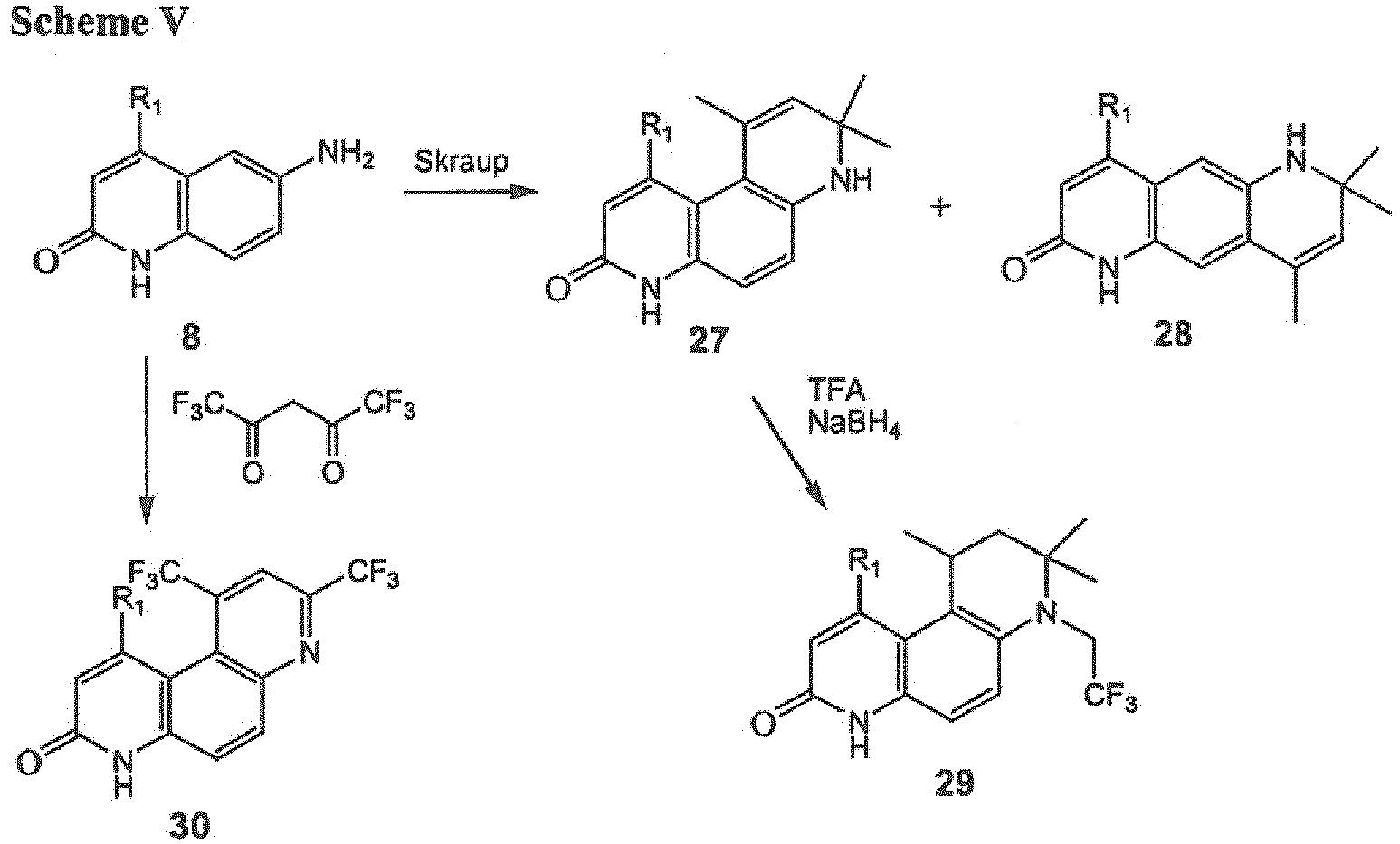
- Scheme V describes the preparation of tricyclic analogues from 6aminoquinolinones of structure 8. Skraup reaction of an aminoquinoline of structure 8 in acetone at high temperature affords compounds of structures 27 or 28 that depends on the substituent R1. Treatment of compounds of structure 27 under a reductive alkylation condition such as NaBH4 in TFA provides compounds of structure 29. Condensation of the aminoquinolines of structure 8 with 1, 1, 1, 5,5,5-hexafluoro-2,4-pentadione affords compounds of structure 30.

- Scheme VI describes the synthesis of the tricyclic compounds of structures 34 and 34a. Nitration of a tetrahydroquinoline of structure 31 provides compounds of structure 32. Palladium catalyzed hydrogenation of compounds of structure 32 followed by the Knorr reaction afford the mixture compounds of structures 33 and 33a. Selective alkylation of compounds of structures 33 and 33a gives compounds of structures 34 and 34a.

- Scheme VII describes the synthesis of the tricyclic pyranoquinolines of structures 39 and 41. Alkylation of 3-nitrophenols of structure 35 gives compounds of structure 36.
- Thermal cyclization of the propargyl ethers of structure 36 affords the chromenes of structure 37. Reduction of the nitro group by hydrogenation provides the aminochromans of structure 38. An alternate route starts with reduction of the nitro group in compounds of structure 36 with zinc powder followed by acylation to give the compound of structure 36a. Cyclization at high temperature, followed by palladium catalyzed hydrogenation, provides the chroman of structure 38a. Hydrolysis of the acetyl group affords aminochroman of structure 38. Treatment of compounds of structure 38 with a ketoester such as ethyl 4,4,4-trifluoro-3-ketobutyrate under Knorr condition gives compounds of structures 39 and 40. In the case when the diketone of structure 42a is used, a quinoline of structure 42 is the product. Methylation of compounds of structure 39 with iodomethane and sodium hydride affords compounds of structure 41.

- Scheme VIII describes the synthesis of the tricyclic coumarins of structure 47.
- Annulation to form compounds of structure 44 is accomplished by heating 1,3-resorcinol and 3,3-dimethylacrylic acid in TFA. Grignard addition to chromenones of structure 44 affords compounds of structure 45, which is dehydrated under acidic condition to give chromenes of structure 46. Treatment of the hydroxychromenes of structure 46 with a ketoester such as ethyl 4,4,4-trifluoroacetoacetate in the presence of POCl3 affords compounds of structure 47.

- Scheme IX describes the general procedure to convert the 2-quinolinone derivatives to the typical 2-substituted quinoline derivatives. Treatment of compounds of structures 48 and 49 with a haloalkyl in the presence of a catalyst such as CsF produces the corresponding 2-alkoxy quinoline compounds of structures 50 and 51. Treatment of compounds of structures 48 and 49 with an acyl halide in the presence of a base, such as triethylamine, affords the 2-acyloxy quinolines of structures 52 and 53.
- The compounds of the present invention also include racemates, stereoisomers, optically pure enantiomers and mixtures of said compounds, including isotopically-labeled and radio-labeled compounds. Such isomers can be isolated by standard resolution techniques, including fractional crystallization and chiral column chromatography.
- As noted above, the androgen receptor modulator compounds of the present invention can be combined in a mixture with a pharmaceutically acceptable carrier to provide pharmaceutical compositions useful for treating the biological conditions or disorders noted herein in mammalian and particularly in human patients. The particular carrier employed in these pharmaceutical compositions may take a wide variety of forms depending upon the type of administration desired. Suitable administration routes include enteral (e. g., oral), topical, suppository and parenteral (e. g., intravenous, intramuscular and subcutaneous).
- In preparing the compositions in oral liquid dosage forms (e. g., suspensions, elixirs and solutions), typical pharmaceutical media, such as water, glycols, oils, alcohols, flavoring agents, preservatives, coloring agents and the like can be employed. Similarly, when preparing oral solid dosage forms (e. g., powders, tablets and capsules), carriers such as starches, sugars, diluents, granulating agents, lubricants, binders, disintegrating agents and the like may be employed. Due to their ease of administration, tablets and capsules represent a desirable oral dosage form for the pharmaceutical compositions of the present invention.
- For parenteral administration, the carrier typically will include sterile water, although other ingredients that aid in solubility or serve as preservatives, may also be included. Furthermore, injectable suspensions may also be prepared, in which case appropriate liquid carriers, suspending agents and the like may be employed.
- For topical administration, the compounds of the present invention may be formulated using bland, moisturizing bases, such as ointments or creams. Examples of suitable ointment bases are petrolatum, petrolatum plus volatile silicones, lanolin and water in oil emulsions such as EucerinTM, available from Beiersdorf (Cincinnati, Ohio).
- Examples of suitable cream bases are Niveau Cream, available from Beiersdorf (Cincinnati, Ohio), cold cream (USP), Purpose Cream, available from Johnson & Johnson (New Brunswick, New Jersey), hydrophilic ointment (USP) and LubridermTM, available from Warner-Lambert (Morris Plains, New Jersey).
- The pharmaceutical compositions and compounds of the present invention generally will be administered in the form of a dosage unit (e. g., tablet, capsule, etc.). The compounds of the present invention generally are administered in a daily dosage of from about 1 µg/kg of body weight to about 500 mg/kg of body weight. Typically, the compounds of the present invention are administered in a daily dosage of from about 10 µg/kg to about 250 mg/kg of body weight. Most often, the compounds of the present invention are administered in a daily dosage of from about 20 µg/kg to about 100 mg/kg body weight. As recognized by those skilled in the art, the particular quantity of pharmaceutical composition according to the present invention administered to a patient will depend upon a number of factors, including, without limitation, the biological activity desired, the condition of the patient and the patient's tolerance for the drug.
- The compounds of this invention also have utility when labeled (e. g., radiolabeled, isotopically-labeled and the like) as ligands for use in assays to determine the presence of AR in a cell background or extract. They are particularly useful due to their ability to selectively activate androgen receptors and can therefore be used to determine the presence of such receptors in the presence of other steroid receptors or related intracellular receptors.
- These invention methods comprise contacting the cell or cell extract with the compounds of the present invention which have been labeled and testing the contacted cell or cell extract to determine the presence of AR. Testing can be accomplished via testing for activation of androgen receptor (s) (e. g., via elevated presence of the product of androgen mediated process (es)), via separation of the bound compound/receptor combination and the like, which techniques are known to those of skill in the art.
- Due to the selective specificity of the compounds of this invention for steroid receptors, these compounds can be used to purify samples of steroid receptors in vitro.
- Such purification can be carried out by mixing samples containing steroid receptors with one or more of the compounds of the present invention so that the compounds bind to the receptors of choice and then isolating the bound ligand/receptor combination by separation techniques which are known to those of skill in the art. These techniques include column separation, filtration, centrifugation, tagging and physical separation and antibody complexing, among others.
- The compounds and pharmaceutical compositions of the present invention can be used in the treatment of the diseases and conditions described herein. In this regard, the compounds and compositions of the present invention may prove particularly useful as modulators of male sex steroid-dependent diseases and conditions such as the treatment of hypogonadism, sexual dysfunction, acne, male-pattern baldness, wasting diseases, hirsutism, prostatic hyperplasia, osteoporosis, impotence, cancer cachexia, various hormone-dependent cancers, including, without limitation, prostate and breast cancer. The compounds of the present invention may also prove useful in male hormone replacement therapy, stimulation of hematopoiesis, male contraception and as anabolic agents.
- The compounds of the present invention may be extremely potent activators of AR, displaying 50% maximal activation of AR (e. g., activation of AR, determined by measurement of luciferase production levels compared to levels achieved by dihydrotestosterone (DHT)) at a concentration of less than 100 nM (Cotransfection assay concentration), at a concentration of less than 50 nM, at a concentration of less than 20 nM, or even at a concentration of 10 nM or less. (See, for example, Biological Examples.) Alternatively, the compounds of the present invention may be extremely potent inhibitors of AR, displaying 50% maximal inhibition of AR (e. g., inhibition of AR, determined by measurement of luciferase production levels compared to levels achieved by dihydrotestosterone (DHT)) at a concentration of less than 100 nM (Cotransfection assay concentration), at a concentration of less than 50 nM, at a concentration of less than 20 nM, or even at a concentration of 10 nM or less. (See, for example, Biological Examples.)
- In one embodiment, the selective compounds of the present invention generally do not display undesired cross-reactivity with other steroid receptors, as is seen with the compound mifepristone (RU486; Roussel Uclaf), a known PR antagonist that displays an undesirable cross reactivity on GR and AR, thereby limiting its use in long-term, chronic administration.
- The invention will be further illustrated by reference to the following Examples.
- In a 250-mL r. b. flask, a solution of compound 103 (3.97g, 11.7 mmol) in AcOH (50 mL) was treated with conc. HCl (50 mL). The reaction mixture was heated to 95 C and stirred for 4 h. After cooling to rt, the reaction mixture was poured onto ice-water, neutralized with NaHCO3 powder to pH 7 and extracted with EtOAc (3 x 500 mL). The combined extracts were washed with H2O (500 mL) and brine (500 mL), dried (MgSO4), filtered and concentrated in vacuo. The residue was purified by recrystallizing from EtOAc/hexane to afford 3.42 g (98%) of compound 104 as a yellow-orange solid. IH NMR (400 MHz, CDC13) 10.35 (br. s, 1H), 7.27 (d, 1H, J= 8.6), 7.25 (s, 1H), 6.82 (d, 1H, J= 8.6), 3.80 (s, 1H), 3.03 (t, 2H, J= 6.5), 1.67 (t, 2H, J= 6.5), 1.24 (s, 6H).
- This compound was prepared in a similar fashion as described in Example3 from compound 102 and 2', 2'-diethylpropargyl acetate (structure 3 of Scheme I, where R1= R2 = ethyl. Spectral data for compound 105 : IH NMR (400 MHz, CDCl3) 7.22 (s, 1H), 7.14 (d, J= 8.7,1H), 6.83 (d, J= 8.7,1H), 3.78 (bs, 1H), 2.98 (t, J= 6.5, 2H), 1.67 (t, J= 6.5,2H), 1.49 (q, J= 7. 4,6H), 0.89 (t, J= 7.4,4H).
- This compound was prepared in a similar fashion as that described in Example 3 from compound 101. Spectral data for compound 106 : IH NMR (500 MHz, acetone-d6) 11.0 (bs, 1H), 7.24 (d, J= 8.8,1H), 7.05 (d, J= 8.8,1H), 6.98 (s, 1H), 6.78 (d, J= 10.3, 1H), 5.62 (bs, 1H), 5.558 (dd, J= 9.8,1.9,1H), 1.30 (s, 6H).
- In a 25-mL r. b. flask, a solution of compound 104 (structure 6 of Scheme I, where R1 = R2 = methyl, 41 mg, 0.15 mmol) in MeOH (5 mL) was treated with formaldehyde (5 mL, 37 wt. % solution in water), AcOH (2 mL) and NaCNBH3 (excess). The reaction mixture was stirred at rt for 24 h. The reaction mixture was poured onto ice-water (50 mL), neutralized with NaHC03 powder to pH 7 and extracted with EtOAc (3 x 50 mL).
- The combined extracts were washed with H2O (50 mL) and brine (50 mL), dried (MgSO4), filtered and concentrated in vacuo. The residue was purified by flash column chromatography (Si O2, 1 x 20 cm, 50% EtOAc in hexane as eluent) to afford 32 mg (75%) of 107 as an orange solid: Rf 0.40 (Si02, 2: 1 = EtOAc: hexane) ; IH NMR (400 MHz, CDC13) 11.45 (br. s, 1H), 7.23 (d, 1H, J= 9.1), 7.22 (s, 1H), 7.05 (d, 1H, J= 9.1), 2.97 (t, 2H, J= 6.2), 2.88 (s, 3H), 1.71 (t, 2H, J= 6.2), 1.27 (s, 6H).
- 8-Ethyl-5, 6,7,8-tetrahydro-7,7-dimethyl-4-trifluoromethylpyridino[3,2-f]quinolin-2(1H)one (Compound 108, Structure 7 of Scheme 1, where R1 = R2 = methyl, R3 = ethyl) In a 25-mL r. b. flask, a solution of compound 104 (structure 6 of Scheme I, where R1 = R2 = methyl) (35. 3 mg, 0.119 mmol) in MeOH (5 mL) was treated with acetaldehyde (2 mL), AcOH (2 mL) and NaCNBH3 (excess). The reaction mixture was stirred at rt for 24 h. The reaction mixture was poured onto ice-water (50 mL), neutralized with NaHC03 powder to pH 7 and extracted with EtOAc (3 x 50 mL). The combined extracts were washed with H20 (50 mL) and brine (50 mL), dried (MgS04), filtered and concentrated in vacuo. The residue was purified by flash column chromatography (Si02, 1 x 20 cm, 50%
EtOAc in hexane as eluent) to afford 19.1 mg (50%) of compound 108 as an orange solid: Rf 0.51 (Si02, 2: 1 = EtOAc: hexane) ; IH NMR (400 MHz, CDC13) 11.42 (br. s, 1H), 7.23 (d, 1H, J= 9.2), 7.21 (s, 1H), 7.05 (d, 1H, J= 9.2), 3.38 (q, 2H, J= 7.0), 2.97 (t, 2H, J= 6.2), 1.71 (t, 2H, J= 6. 2), 1.27 (s, 6H), 1.17 (t, 3H, J= 7.0). - In a 25-mL r. b. flask, a solution of compound 104 (structure 6 of Scheme I, where R1 = R2 = methyl) (34 mg, 0.115 mmol) in MeOH (5 mL) was treated with propionaldehyde (2 mL), AcOH (2 mL) and NaCNBH3 (excess). The reaction mixture was stirred at rt for 24 h. The reaction mixture was poured onto ice-water (50 mL), neutralized with NaHCO3 powder to pH 7 and extracted with EtOAc (3 x 50 mL). The combined extracts were washed with H20 (50 mL) and brine (50 mL), dried (MgS O4), filtered and concentrated in vacuo. The residue was purified by flash column chromatography (Si O2, 1 x 20 cm, 50% EtOAc in hexane as eluent) to afford 13.2 mg (34%) of compound 109 as an orange solid: Rf 0.51 (SiO2, 2: 1 = EtOAc: hexane); IH NMR (400 MHz, CDC 13) 10.89 (br. s, 1H), 7.28 (d, 1H, J= 9.0), 7.21 (s, 1H), 7.01 (d, 1H, J= 9.0), 3.20 (t, 2H, J= 7.7), 2.96 (t, 2H, J= 6.1), 1.70 (t, 2H, J= 6.1), 1.60-1.50 (m, 2H), 1.25 (s, 6H), 0.92 (t, 3H, J= 7.3).
- In a 100-mL r. b. flask, a solution of compound 104 (structure 6 of Scheme I, where R1 = R2=methyl) (0.59 g, 2.0 mmol) in TFA (15 mL) was treated with NaBH4 (6.0 g).
- The reaction mixture was heated to 95 C and stirred for 6 h. The reaction mixture was diluted with EtOAc (50 mL) and poured onto ice-water (50 mL), neutralized with NaHCO3 powder to pH 7 and extracted with EtOAc (2 x 100 mL). The combined extracts were washed with H2O(150 mL) and brine (150 mL), dried (MgSO4), filtered and concentrated in vacuo. The residue was purified by flash column chromatography (SiO2, 3 x 20 cm, 50% EtOAc in hexane as eluent) to afford 0.62 g (81%) of compound 110 as a yellow solid: Rf 0.56 (Si02, 2: 1 = EtOAc: hexane) ; 1H NMR (400 MHz, Acetone-d6) 11.0 (s, 1H), 7.43 (d, 1H, J= 9. 2), 7.35 (d, 1H, J= 9.2), 7.05 (s, 1H), 4.22 (q, 2H, J= 9.0), 2.98 (t, 2H, J= 6.1), 1.77 (t, 2H, J= 6.1), 1.31 (s, 6H).
- To the crude suspension of compound 111 (-0. 4 M) in aqueous HCl was added a solution of acetone (structure 10 of Scheme II, 2-5 eq.) in an equal volume of EtOH and the mixture was heated in a sealed tube at 130 C for 2 h. Then the mixture was diluted with an equal volume of water while still hot and allowed to cool to rt. The precipitate was filtered and washed with water to give compound 112 as a yellow solid : 1H NMR (500 MHz, acetone-d6) 11. 1 (bs, 1 H), 10.6 (bs, 1 H), 7.69 (d, J= 8.8,1 H), 7.25 (d, J= 8.8,1 H), 6.94 (s, 1 H), 6.64 (s, 1 H), 2.51 (s, 3 H).
- To the crude suspension of compound 111 (structure 9 of Scheme II, where R1 = trifluoromethyl) (-0. 4 M) in aqueous HCl was added a solution of a ketone (structure 10 of Scheme II) (2-5 eq.) in an equal volume of EtOH and the mixture was refluxed for 2 h.
- Then the mixture was diluted with an equal volume of water while still hot and allowed to cool to rt. The precipitate was filtered and washed with water to give the indole as a mixture of regioisomers. The ratio of angular and linear isomers was determined by 1H NMR. The mixture of regioisomers could be separated by chromatography (Silica gel, hex/EtOAc 1: 1 to 0 : 1 gradient). Spectra data for compound 113 : 1H NMR (500 MHz, DMSO-d6) 12.2 (bs, 1H), 11.3 (bs, 1H), 7.52 (d, J= 8.8,1H), 7.03 (d, J= 8.8,1H), 6.87 (s, 1H), 3.30-3.24 (m, 1H), 6.64 (s, 1H), 2.48 (s, 3H), 1.22 (d, J= 6.8,6H).
- This compound was prepared in a similar fashion as that described in Example 12 from compound 111 (structure 9 of Scheme II, where R1 = trifluoromethyl) and 5-hexen-2-one (structure 10 of Scheme II) as a yellow solid : IH NMR (500 MHz, DMSO-d6) 12.3 (bs, 1H), 11.5 (bs, 1H), 7.59 (d, J= 8.8,1H), 7.10 (d, J= 8.8,1H), 6.89 (s, 1H), 5.82-5.76 (m, 1H), 4.85 (dd, J= 10.8,2.0,1H), 4.76 (dd, J= 17.1,2.0,1H), 3.50 (d, J= 5.9,2H), 2.33 (s, 3H).
- This compound was prepared in a similar fashion as that described in Example 12 from compound 111 (structure 9 of Scheme II, where R1 = trifluoromethyl) and 1- (4-methoxyphenyl) acetone (structure 10 of Scheme II) as a yellow solid : IH NMR (500 MHz, DMSO-d6) 12.3 (bs, 1 H), 11.7 (bs, 1 H), 7.64 (d, J= 8.8,1 H), 7.14 (d, J= 8.8,1 H), 7.06 (d, J = 8. 8,2 H), 6.91 (d, J = 8. 8,2 H), 6.68 (s, 1 H), 3.77 (s, 3 H), 2.22 (s, 3 H).
- This compound was prepared in a similar fashion as that described in Example 12 from compound 111 (structure 9 of Scheme II, where R1 = trifluoromethyl) and 1- (3-trifluoromethylphenyl) acetone (structure 10 of Scheme II) as a yellow solid: 'H NMR (500 MHz, DMSO-d6) 12.4 (bs, 1H), 11.9 (bs, 1H), 7.69 (d, J= 8.8,1H), 7.62-7.59 (m, 2H), 7.53 (bd, J= 4.9,1H), 7.41 (s, 1H), 7.21 (d, J= 8.8,2H), 6.73 (s, 1 H), 2.27 (s, 3H).
- (Compound 117, Structure 11 of Scheme II, where R3,R2 =-CH2CH2CH2-, R1= trifluoromethyl). This compound was prepared in a similar fashion as that described in Example 12 from compound 111 (structure 9 of Scheme II, where R1= trifluoromethyl) and cyclopentanone (structure 10 of Scheme II) as a yellow solid : 1H NMR (500 MHz, DMSO-d6) 11.6 (bs, 1H), 10.5 (bs, 1H), 7.73 (d, J= 8.8.1H), 7.26 (d, J= 8.8,1H), 6.92 (s, 1H), 3.05-3.02 (m, 2H), 2.91-2.88 (m, 2H), 2.47-2.43 (m, 2H).
- (Compound 118, Structure 11 of Scheme II, where R3, R2 = -(CH2)5-, R1 = trifluoromethyl) This compound was prepared in a similar fashion as that described in Example 12 from compound 111 (structure 9 of Scheme II, where R1 = trifluoromethyl) and cycloheptanone (structure 10 of Scheme II) as a yellow solid : IH NMR (500 MHz, DMSO-d6 ) 11.4 (bs, 1H), 10.5 (bs, 1H), 7.63 (d, J= 8.3,1H), 7.17 (d, J= 8.3,1H), 6.91 (s, 1H), 2.98-2.94 (m, 2 H), 2.91-2.87 (m, 2 H), 1.92-1.86 (m, 2H). 1.81-1.75 (m, 2H), 1.69-1.63 (m, 2H).
- (±)-4c, 5, 6, 7, 7a (cis), 8-Hexahydro-8- (2, 2, 2-trifluoroethyl)-4-trifluoromethylcyclopentano- [g]pyrrolo[3,2-f]quinolin-2(1H)-one (Compound 119, Structure 13 of Scheme II, where R2,R3 =-(CH2)3 R1 = trifluoromethyl, R4 = 2, 2, 2-trifluoroethyl) To a solution of compound 117 (structure 11 of Scheme II, where R2,R3 =-(CH2)3 -, 1.30 g, 4.45 mmol) in TFA (40 mL) in a 250 mL r. b. flask was added a pellet (-0. 75 g, 22 mmol) of NaBH4. Two more pellets of NaBH4 were added with 30 min intervals and the mixture was stirred at for 16 h until the starting material was consumed. Water was carefully added (-150 mL) and the yellow precipitate was filtered and washed with water. The yellow solid was purified by column chromatography (Silica gel, hex: EtOAc, 7: 3) to give compound 119 (1.27 g, 76%) as a yellow solid :'H NMR (500 MHz, CDC13) 12.3 (bs, 1H), 7.28 (d, I= 8.8,1H), 7.19 (s, 1H), 6.87 (d, J= 8.8,1H), 4.30 (d, J=4.9,2H), 4.06-4.02 (m, 2H), 3.74-3.58 (m, 2H), 2.15-2.13 (m, 2H), 1.77-1.66 (m, 3H), 1.58-1.53 (m, 1H).
- (±)-4c, 5, 6, 7, 7a (cis), 8-Hexahvdro-8-ethvl-4-trifluoromethylcyclopentano- [g] pyrrolo [3, 2-flquinolin-2 (1H)-one (Compound 121 Structure 13 of Scheme II, where R3, R2 =-(CH2)3-) RI = trifluoromethyl R4 = ethyl)
- This compound was prepared in a similar fashion as that described in Example 18 from Compound 117 (structure 11 of Scheme II, where R3, R2 =-(CH2)3-)and acetic acid. IH NMR (500 MHz, CDC13) 12.0 (bs, 1H), 7.21 (d, J= 8.3,1H), 7.19 (s, 1H), 6.87 (d, J= 8.8,1H), 4.30 (d, J= 4.9,2H), 4.06-4.02 (m, 2H), 3.74-3. 58 (m, 2H), 2.15-2.13 (m, 2H), 1.77-1.66 (m, 3H), 1.58-1.53 (m, 1H).
- (±)-5,6-Dihydro-5,6-cis-dimethyl-7-(2,2,2-trrifluoroethyl)-4-trifluoromethyl-7H-pyrrolo [3,2-f]quinolin-2(H)-one (Compound 123, Structure 13 of Scheme II, where R3= R2 = methyl, R1 = trifluoromethyl, R4 = 2, 2, 2-trifluoroethyl)
- This compound was prepared in a similar fashion as that described in Examples 12 and 18 from Compound 111 (Structure 9 of Scheme II, where R1 = trifluoromethyl) and 2-butanone. IH NMR (500 MHz, CDC13) 12.3 (bs, 1H), 7.32 (d, J= 8.8,1H), 7.21 (s, 1H), 6.95 (d, J= 8.8,1H), 3.75-3.53 (m, 4H), 1.38 (d, J= 6.8,3H), 0.98 (d, J= 6.8,3H).
- (±)-4c,5,6,7,7a(cis), 8-Hexahydro-8-propyl-4-trifluoromethylcyclopentano-[g]pyrrolo-[3, 2flquinolin-2 1H)-one (Compound 125, Structure 13 of Scheme II, where R3, R2 = -(CH2)3R1 = trifluoromethyl, R4 = propyl)
- This compound was prepared in a similar fashion as that described in Example 18 from Compound 117 (structure 11 of Scheme II, where R3, R2 =-(CH2)3-) and propionic acid. IH NMR (500 MHz, CDCl3) 10.4 (bs, 1H), 7.31 (dd, J= 8.8, 1.8,1H), 7.20 (s, 1H), 6.78 (d, J= 8.8,1H), 4.28-4.26 (m, 1H), 3.96-3.95 (m, 1H), 3.143.05 (m, 2H), 2.06-2.03 (m, 2H), 1.72-1.51 (m, 6H), 0.95 (t, J= 7.3,3H).
- This compound was prepared in a similar fashion as that described in Example 18 from Compound 117 (structure 11 of Scheme II, where R3, R2 =-(CH2)3-) and 3-furoic acid. IH NMR (500 MHz, CDC13) 12.2 (bs, 1H), 7.36-7.35 (m, 1H), 7.29 (s, 1H), 7.22 (d, J= 8.8,1H), 7.16 (s, 1 H), 6.82 (d, J= 8.3,1H), 6.26 (d, J=1. 0,1H), 4.27-4.22 (m, 2H), 4.08 (d, J= 16.1,1H), 3.97-3.91 (m, 1H), 2.12-2.08 (m, 1H), 2.03-2.01 (m, 1H), 1.72-1.70 (m, 3H), 1.60-1.58 (m, 1H).
- This compound was prepared in a similar fashion as that described in Example 18 from Compound 117 (structure 11 of Scheme II, where R3, R2 =-(CH2)3-) and 3-thiophenecarboxylic acid. IH NMR (500 MHz, CDC 13) 10.9 (bs, 1H), 7.29 (dd, J= 5.4, 2.9,1H), 7.13 (s, 1H), 7.07 (d, J= 8.3,1 H), 7.06 (s, 1H), 6.96 (dd, J = 5.4,1.5,1H), 7.127.04 (m, 1H), 6.72 (d, J= 8.3,1H), 4.38 (d, J= 16.1,1H), 4.26 (d, J= 16.1,1H), 4.274.25 (m, 1H), 3.98-3.94 (m, 1H), 2.16-2.07 (m, 1H), 2.04-2.22 (m, 1H), 1.78-1.68 (m, 3H), 1.60-1.54 (m, 1H).
- (±)-4c,5,6,7,7a(cis,8-Hexahydro-8-(2-methylpropyl-4-trifluoromethylcyclopentano[g]pyrrolo[3,2-f]quinolin-2(1H)-one (Compound 128, Structure 13 of Scheme II, where R3, R2 = -(CH2)3-, R1 = trifluoromethyl, R4 = 2-methylpropyl). This compound was prepared in a similar fashion as that described in Example 18 from Compound 117 (structure 11 of Scheme II, where R3, R2 =(CH2)3-)and isobutyric acid. IH NMR (500 MHz, CDCl3) 12.2 (bs, 1H), 7.20 (d, J= 8.8,1H), 7.15 (s, 1H), 6.74 (d, J= 8.8,1H), 4.22-4.19 (m, 1H), 3.98-3.93 (m, 1H), 2.93 (dd, J = 14. 3,7.3,1H), 2.81 (dd, J= 14.3,7.9,1H), 2.14-2.00 (m, 3H), 1.72-1.63 (m, 3H), 1.56-1.52 (m, 1 H), 0.97 (d, J= 6.7,3H), 0.92 (d, J= 6.7,3H).
- (±)-4c,5,6,7,7a(cis),8-Hexahydro-8-(2,2,2,-chlorodifluoroethyl)-4trifluoromethylcyclopentano[g]pyrrolo[3,2-f]quinolin-2(1H)-one (Compound 129, Structure 13 of Scheme II, where R3, R2 = -(CH2)3-, R1 = trifluoromethyl, R4= 2, 2,2chlorodifluoroethyl). This compound was prepared in a similar fashion as that described in Example 18 from Compound 117 (structure 11 of Scheme II, where R3, R2 =-(CH2)3-) and chlorodifluoroacetic acid. 1H NMR (500 MHz, CDCl3) 12.3 (bs, 1H), 7.38 (d, J= 8.8,1 H), 7.29 (s, 1H), 7.00 (d, J= 8.8,1H), 4.46-4.44 (m, 1H), 4.09-4.05 (m, 1H), 3.94-3.81 (m, 2H), 2.21-2.12 (m, 2H), 1.81-1.74 (m,2H), 1.69-1.63 (m, 1H), 1.56-1.52 (m, 1 H).
- This compound was prepared in a similar fashion as that described in Example 18 from Compound 117 (structure 11 of Scheme II, where R3, R2 =-(CH2)3-) and cyclopropanecarboxylic acid.IH NMR (500 MHz, CDCl3) 12.4 (bs, 1H), 7.25 (d, J= 8.8, 1H), 7.16 (s, 1H), 6.84 (d, J = 8.8, 1H), 4.41-4.38 (m, 1H), 3.97-3.92 (m, 1 H), 3.18 (dd, J = 14. 9,5.5,1H), 2.90 (dd, J=14. 9,7.3,1H), 2.14-2.04 (m, 2H), 1.78-1.66 (m, 3H), 1.551.49 (m, 1H), 0.97-0.92 (m, 1H), 0.61-0.55 (m, 1H), 0.53-0.47 (m, 1H), 0.28-0.22 (m, 1H), 0.19-0.14 (m, 1H).
- This compound was prepared in a similar fashion as that described in Example 18 from Compound 117 (structure 11 of Scheme II, where R3, R2 =-(CH2)3-) and dimethoxyacetaldehyde. 1H NMR (500 MHz, CDCl3) 11.1 (bs, 1H), 7.14 (s, 1H), 7.12 (d, J= 8.8,1H), 6.91 (d, J = 8.8,1H), 4.43 (dd, J= 5.9,4.4,1H), 4.31-4.30 (m, 1H), 3.943.93 (m, 1H), 3.41 (s, 6H), 3.30 (dd, J= 15.1,5.9,1H), 3.21 (dd, J = 15.1,4.4,1H), 2.122.09 (m, 2H), 1.72-1.55 (m, 4H).
- This compound was prepared in a similar fashion as that described in Examples 12 and 18 from Compound 111 (structure 9 of Scheme II, where R1 = trifluoromethyl) and cyclohexanone. IH NMR (500 MHz, CDC13) 12.1 (bs, 1H), 7.29 (d, J= 8. 8,1H), 7.19 (s, 1H), 7.02 (d, J = 8,8,1H), 3.70-3.60 (m, 2H), 3.56 (m, 1H), 3.41-3. 38 (m, 1H), 2.14 (d, J = 14.6,1H), 1.75-1.67 (m, 3H), 1.61-1.56 (m, 2H), 1.31-1.25 (m, 1H), 1.05-0.98 (m, 1H).
- This compound was prepared in a similar fashion as that described in Example 18 from Compound 118 (structure 11 of Scheme II, where R3, R2 =-(CH2)5-). IH NMR (500 MHz, CDC13) 12.0 (bs, 1H), 7.32 (d, J= 8.8,1H), 7.25 (s, 1H), 6.98 (d, J= 8.8,1H), 3.963.91 (m, 1H), 3.73-3.62 (m, 3H), 2.36-2.26 (m, 2H), 1.93-1.86 (m, 3H), 1.78-1.69 (m, 2H), 1.48-1.36 (m, 3H).
- This compound was prepared in a similar fashion as that described in Examples 12 and 18 from Compound 111 (structure 9 of Scheme II, where R1 = trifluoromethyl) and 3- pentanone. IH NMR (500 MHz, CDCl3) 11.6 (bs, 1H), 7.26 (d, J= 8.3,1H), 7.15 (s, 1H), 6.74 (d, J= 8. 3,1H), 4.25 (dd, J= 7.3,3.4, 1H), 3.96-3.91 (m, 1H), 3.29 (dq, J= 7.3,7.3, 1H), 3.16 (dq, J= 7.3,7.3,1H), 1.965-1.85 (m, 2H), 1.08 (t, J= 7.3,3H), 0.98 (d, J= 6.3, 3H).
- This compound was prepared in a similar fashion as that described in Examples 12 and 18 from Compound 111 (structure 9 of Scheme II, where R1 = trifluoromethyl) and 2-heptanone. IH NMR (500 MHz, CDCl3) 12.1 (bs, 1H), 7.29 (d, J= 8. 8,1H), 7.20 (s, 1H), 6.94 (d, J= 8.8,1H), 3.76-3.68 (m, 1H), 3.67-3.57 (m, 2H), 3.47-3.43 (m, 1H), 1.74-1.66 (m, 1H), 1.44 (d, J= 6.8,3H), 1.36-1.29 (m, 1H), 1.28-1.20 (m, 1H), 1.20-1.12 (m, 3H), 0.81 (t, J= 7. 3,3 H).
- This compound was prepared in a similar fashion as that described in Examples 12 and 18 from Compound 111 (Structure 9 of Scheme II, where R1 = trifluoromethyl) and 4-nitrophenylacetone. IH NMR (500 MHz, CDC13) 12.1 (bs, 1H), 8.05 (d, J= 8.3,2H), 7.47 (d, J= 8.8,1H), 7.13 (d, J= 8.8,1H), 7.13 (s, 1H), 6.90 (bs, 2H), 4.79 (d, J= 7.3,1H), 4.11 (dq, J= 7. 3,6.3,1H), 3.78-3.61 (m, 2H), 0.96 (d, J= 6.3,3H).
- (±)-5,6-cis-Dihydro-5-(4-dimethylaminophenyl)-6-methyl-7-(2,2,2-trifluoroethyl)-4trifluoroemthyl-7H-pyrrolo[3,2-f]quinolin-2(1H)-one (Compound 137, Structure 13 of Scheme II, where R3 = 4-dimethylaminophenyl, R2 = methyl, R1 = trifluoromethyl, R4 = 2 2, 2-trifluoroethyl). This compound was prepared in a similar fashion as that described in Examples 12 and 18 from Compound 111 (Structure 9 of Scheme II, where R1 = trifluoromethyl) and 4-dimethylaminophenylacetone. IH NMR (500 MHz, ICI3) 12.3 (bs, 1H), 7.40 (d, J= 8.8, 1H), 7.09 (s, 1H), 7.06 (d, J= 8.8,1H), 6.56-6.52 (m, 4H), 4.59 (d, J= 7.3,1 H), 3.96 (dq, J= 7.3,6.3,1H), 3.77-3.67 (m, 1H), 3.67-3.57 (m, 1H), 2.86 (s, 6H), 0.95 (d, J= 6.3,3H).
- (±)-5 6-cis-Dihydro-5-(4-methoxyphenyl)-6-methyl-7-(2,2,2-trifluoroethyl)-4-trifluoromethyl-7H-pyrrolo[3,2-f]quinolin-2(1H)-one (Compound 138 Structure 13 of Scheme II, where R3 = 4-methoxyphenyl, R2 = methyl, R1 = trifluoromethyl, R4 = 2,2,2-trifluoroethyl). This compound was prepared in a similar fashion as that described in Example 18 from Compound 115 (Structure 11 of Scheme II, where R3 = 4-methoxyphenyl, R2 = methyl, R1 = trifluoromethyl). IH NMR (500 MHz, CDC13) 11.6 (bs, 1H), 7.36 (d, J= 8.8, 1H), 7.09 (s, 1H), 7.07 (d, J= 8.8,1H), 6.71 (d, J= 8.8,2H), 6.63 (bs, 2H), 4.63 (d, J= 7.3,1H), 3.99 (dq, J= 7.3,6.3,1H), 3.74-3.58 (m, 2H), 3.73 (s, 3H), 0.94 (d, J= 6.3,3H).
- (±)-5 6-cis-Dihydro-5-(3-trifluoromethylphenyl)-6-methyl-7-(2,2,2-trifluoroethyl)-4-trifluoromethyl-7H-pyrrolo[3,2-f]quinolin-2(1H)-one (Compound 139, Structure 13 of Scheme II, where R3 = 3-trifluoromethylphenyl, R2 = methyl, R1 = trifluoromethyl, R4 = 2, 2, 2-trifluoroethyl- This compound was prepared in a similar fashion as that described in Example 18 from Compound 116 (Structure 11 of Scheme II, where R3 = 3-trifluoromethylphenyl, R2 = methyl, R1 = trifluoromethyl). IH NMR (500 MHz, CDCl3) 12.8 (bs, 1H), 7.51 (d, J= 8.8, 1H), 7.43 (d, J= 7.8, 1H), 7.30-7.26 (m, 1H), 7.14 (s, 1H), 7.12 (d, J= 8.8, 1H), 7.127.04 (m, 1H), 6.92-6.78 (bs, 1H), 4.74 (d, J= 6.8,1H), 4.08 (dq, J= 6.8,6.3,1H), 3.783.60 (m, 2H), 0.93 (d, J= 6.3,3H).
- (±)-5,6-cis-Dihydro-5-(4-fluorophenyl)-6-methyl-7-(2,2,2-_trifluoroethyl)-4trifluoromethyl-7H-pyrrolo[3,2-f]quinolin-2(1H)-one (Compound 140, Structure 13 of Scheme IL where R3 = 4-fluorophenyl, R2 = methyl, R1 = trifluoromethyl, R4 = 2,2,2trifluoroethyl). This compound was prepared in a similar fashion as that described in Examples 12 and 18 from Compound 111 (Structure 9 of Scheme II, where R1 = trifluoromethyl) and 4-fluorophenylacetone. IH NMR (500 MHz, CDC13) 10.6 (bs, 1H), 7.28 (d, J= 8.8,1H), 7.08 (s, 1H), 7.07 (d, J= 8.8,1H), 6.88-6.85 (m, 2H), 6.68 (bs, 2H), 4.66 (d, J= 6.8,1 H), 4.01 (dq, J= 6.8,6.3,1H), 3.73-3.67 (m, 2H), 3.67-3.60 (m, 1H), 0.94 (d, J= 6.3,3H).
- (±)-5,6-Dihydro-5-phenyl-7-(2,2,2-trifluoroethyl)-4-trifluoromethyl-7H-pyrrolor3,2-/] quinolin-2 (1/'f)-one (Compound 141. Structure 13 of Scheme II, where R3 = phenyl, R2 = H, R1 = trifluoromethyl, R4 = 2,2,2-trifluoromethyl). This compound was prepared in a similar fashion as that described in Examples 12 and 18 from Compound 111 (Structure 9 of Scheme II, where R1 = trifluoromethyl) and phenylacetaldehyde. IH NMR (500 MHz, CDCl3) 12.6 (bs, 1H), 7.48 (d, J= 8.8,1H), 7.20-7.14 (m, 3H), 7.14 (s, 1H), 7.05 (d, J= 8.8,1H), 6.76-6.74 (m, 2H), 4.89 (d, J= 8.3, 2H), 3.93 (dd, J= 8.3,8.3,1H), 3.84-3.77 (m, 1H), 3.64-3.56 (m, 1H), 3.55 (d, J= 8.8, 1H).
- (±)-5,6-cis-Diydro-5-(4-methoxyphenyl)-6-methyl-4-trifluoromethyl-7H-pyrrolo[3,2f]qinolin-2(1H)-one (Compound 142, Structure 13 of Scheme II, where R3 = 4-methoxyphenyl, R2 = methyl, R1 = trifluoromethyl, R4=H) This compound was isolated as a minor product from the same reaction described in Examples 37. IH NMR (500 MHz, CDC13) 12.0 (bs, 1H), 7.32 (d, J= 8.8,1H), 7.09 (s, 1H), 7.14 (d, J= 8.8,1H), 7.08 (s, 1H), 6.73 (d, J= 8.8,2H), 6.65 (bs, 2H), 4.60 (d, J= 7.3,1H), 4.21 (dq, J= 7. 3,6.3,1H), 3.73 (s, 3H), 1.25 (bs, 1H), 0.92 (d, J= 6.3,3H).
- (±)-5,6-cis-Dihydro-5-(4-methoxyphenyl)-6-methyl-7-2,2-dimethoxyethyl)-4-trifluoromethyl-7H-pyrrolo[3,2-f]quinolin-2(1H)-one (Compound 143, Structure 13 of Scheme II, where R3 = 4-methoxyphenyl, R2 = methyl, R1 = trifluoromethyl, R4 = 2,2-dimethoxyethyl) This compound was prepared in a similar fashion as that described in Example 30 from Compound 115 (Structure 11 of Scheme II, where R3 = 4-methoxyphenyl, R2 = methyl, R1 = trifluoromethyl). IH NMR (500 MHz, CDC13) 11.7 (bs, 1H), 7.33 (d, J= 8.8, 1H), 7.17 (d, J= 8. 8,1H), 7.07 (s, 1H), 6.69 (bd, J= 8.8,2H), 6.63 (bs, 2H), 4.58 (d, J= 7.3,1H), 4.31 (dd, J= 5.9,3.9,1H), 3.93 (dq, J= 7.3,6.8,1H), 3.73 (s, 3H), 3.41 (s, 3H), 3.37 (s, 3H), 3.27 (dd, J= 15.1,3.9,1H), 3.22 (dq, J= 15.1,5.9,1H), 0.92 (d, J= 6.8, 3H).
- (±)-5,6-cis-Dihydro-5-isopropyl-6-methyl-7-(2,2,2-trifluoroethyl)-4-trifluoromethyl-7Hpyrrolo[3,2-f]quinolin-2-(1H)-one (Compound 144, Structure 13 of Scheme II, where R3-isopropyl, R2 = methyl, R1 = trifluoromethyl, R4 = 2, 2, 2-trifluoroethyl). This compound was prepared in a similar fashion as that described in Example 18 from Compound 113 (Structure 11 of Scheme II, where R3 = isopropyl, R2 = methyl, R1 = trifluoromethyl). IH NMR (500 MHz, CDCl3) 11.6 (bs, 1H), 7.25 (d, J= 8.3,1H), 7.17 (s, 1H), 6.93 (d, J = 8. 3,1H), 3.80 (dq, J= 6. 8,6.8,1H), 3.69-3.52 (m, 2H), 3.40 (dd, J= 6. 8, 5.4,1H), 1.96-1.88 (m, 1H), 1.53 (d, J= 6.8,3H), 0.83 (d, J= 6.8,1H), 0.79 (d, J= 7.3, 3H).
- (±)-5,6-DIhydro-5-ethyl-6-methyl-7-(2,2,2-trifluoroethyl)-4-trifluoromethyl-7Hpyrralor3,2-f]quinolin-2(1H)-one (Compound 145, Structure 13 of Scheme II, where R3=ethyl, R2 = methyl R1 = trifluoromethyl, R4 = 2, 2, 2-trifluoroethyl) This compound was prepared in a similar fashion as that described in Examples 12 and 18 from Compound 111 (Structure 9 of Scheme II, where R, = trifluoromethyl) and 2- pentanone. IH NMR (500 MHz, CDCl3) 12.3 (bs, 1H), 7.29 (d, J= 8.8.1H), 7.23 (s, 1H), 6.98 (d, J= 8. 8,1 H), 3.84-3.78 (m, 1H), 3.71-3.59 (m, 2H), 3.46-3.43 (m, 1H), 1.78-1.70 (m, 2H), 1.47 (d, J= 6.8,3H), 0.86 (t, J= 7.3,3H).
- (±)-5,6-Dihydro-5-ethyl-6-propyl-7-(2,2,2-trifluoroethyl)-4-trifluoromethyl-7Hpyrrolo[3,2-f]quinolin-2(1H)-one (Compound 146, Structure 13 of Scheme II, where R3=ethyl, R2 = propyl, R1 = trifluoromethyl, R4 = 2, 2, 2-trifluoroethyl) This compound was prepared in a similar fashion as that described in Examples 12 and 18 from Compound 111 (Structure 9 of Scheme II, where R1 = trifluoromethyl) and 4-heptanone. IH NMR (500 MHz, CDCl3) 12.1 (bs, 1H), 7.30 (d, J= 8.8.1H), 7.19 (s, 1H), 6.95 (d, J= 8. 8,1H), 3.70-3.51 (m, 4H), 1.88-1.53 (m, 4H), 1.47-1.36 (m, 2H), 1.05 (t, J= 7.3,3H), 0.70 (t, J= 7.3,3H).
- (±)-5,6-Dihydro-5-(2-ethoxycarbonylethyl)-6-methyl-7-(2,2,2-trifluoroethyl)-4-trifluoromethyl-7H-pyrrolo[3,2-f]quinolin-2(1H)-one (Compound 147m, Structure 13 of Scheme II, where R3 = 2-ethoxycarbonylethyl R2 = methyl, R1 = trifluoromethyl, R4= 2, 2, 2-trifluoroethyl) This compound was prepared in a similar fashion as that described in Examples 12 and 18. IH NMR (500 MHz, CDC13) 11.6 (bs, 1H), 7.27 (d, J= 8.8,1H), 7.20 (s, 1H), 6.95 (d, J= 8.8,1H), 4.01 (q, J= 7.3,2H), 3.82-3.76 (m, 1H), 3.70-3.58 (m, 2H), 3.563.52 (m, 1H), 2.40-2.32 (m, 1H), 2.15-2.08 (m, 1H), 2.05-1.98 (m, 1H), 1.70-1.62 (m, 1H), 1.46 (d, J= 6. 4,3H), 1.18 (t, J = 7. 3,3H).
- 6-Ethyl-5-methyl-7H-pyrrolo[3,2-f]quinolin-2(1H)-one (Compound 148, Structure 11 of Scheme II, where R3 = methyl, R2 = ethyl, R1 = H). This compound was prepared in a similar fashion as that described in Example 12 from structure 9 of Scheme II (where R1 = H) and 3-pentanone as a yellow solid : IH NMR (500 MHz, DMSO-d6) 11.23 (s, 1H), 8.58 (d, I= 9.5,1H), 7.56 (d, J= 8.6,1H), 7.14 (d, J = 8.6,1H), 6.69 (d, J= 9.5,1H), 2.76 (q, J= 7. 5,1 H), 2.50 (s, 1H), 2.44 (s, 3H), 1.23 (t, J = 7.5,3H).
- (±)-5,6-cis-Dihydro-5-methyl-6-ethyl-7-(2,2,2-trifluoroethyl)-7H-pyrrolo3,2-Jquinolin-2 (1hO-one) (Compound 149, Structure 13 of Scheme II, where R3 = methyl, R2 = ethyl, R1 = H, R4 = 2, 2, 2-trifluoroethyl). This compound was prepared in a similar fashion as that described in Example 18 from Compound 148 (Structure 11 of Scheme II, where R3 = methyl, R2 = ethyl, R1 = H). IH NMR (500 MHz, CDC13) 11.16 (s, 1H), 7.75 (d, J= 9.5,1H), 6.81 (d, J= 8.5,1H), 6.71 (d, J = 9. 6,1H), 3.60-3.45 (m, 3H), 3.44-3.31 (m, 1H), 1.89-1.75 (m, 2H), 1. 11 (d, J = 6. 8,3H), 1.06 (t, J = 7. 3,3H).
- (Compound 150, Structure 15 of Scheme II, where R2 = R3 = methyl, R1 =trifluoromethyl, R4 = 2, 2, 2-trifluoroethyl) ,To a solution of Compound 123 (Structure 13 of Scheme II, where R3 = R2 = methyl, R1 = trifluoromethyl, R4 = 2,2,2-trifluoroethyl) (0.35 g, 0.97 mmol) in 30 mL CH2Cl2 was added DDQ (0.35 g, 1.5 mmol, 1.5 eq) in small portions. The resulting green mixture was stirred at rt for about 60 min until almost no more starting material was visible on TLC. Then 5% aq. NaH CO3 (30 mL) was added and the mixture was extracted with EtOAc (3 x 50 mL) and the combined organic layers were washed with 5% aq. NaHCO3 (30 mL) and brine, dried over MgSO4 and concentrated. Purification by chromatography (Silica gel, hexane: EtOAc 2: 1 to 0: 1 gradient) afforded Compound 150 (195 mg, 56%) as a slightly yellow solid : IH NMR (500 MHz, CDC13) 11.4 (bs, 1H), 7.55 (d, J= 8.8,1H), 7.17 (d, J= 8.8,1H), 7.16 (s, 1H), 4.71 (q, JH-F = 8.3,2H), 2.43 (s, 3H), 2.33 (s, 3H).
- An alternate oxidation method was also used as described as follow:
- To a solution of Compound 123 (10 mg, 0.03 mmol) in 10 mL CH2Cl2 was added MnO2 (approx. 0.3 g, 3.5 mmol, 100 eq) in portions until no more starting material was visible on TLC. Then EtOAc (10 mL) was added and the suspension was filtered through a short pad of celite. The solids were rinsed several times with EtOAc and the combined filtrates were concentrated. Purification by chromatography (Silica gel, hexane: EtOAc 2: 1 to 0: 1 gradient) afforded Compound 150 as a slightly yellow solid.
- 6-Ehyl-5-methyl-7-(2,2,2-trifluorethyl)-7H-pyrrolo[3,2-f]quinolin-2-(1H)-one (Compound 151, Structure 15 of Scheme II, where R3 = methyl, R2 = ethyl, R1 = H, R4 = 2,2,2-trifluorethyl)This compound was prepared in a similar fashion as that described in Example 49 from Compound 149 (Structure 13 of Scheme 11, where R3 = methyl, R2 = ethyl, R1 = H, R4 = 2,2,2-trifluoroethyl). IH NMR (500 MHz, CDCl3) 11.20 (s, 1H), 8.54 (d, J= 9.7, 1H), 7.46 (d, J = 8.6,1H), 7.16 (d, J = 8.7,1H), 6.77 (d, J = 9.7,1H), 4.69 (q, J= 8.4,2H), 2.83 (q, J= 7.6,2H), 2.56 (s, 3H), 1.23 (t, J= 7.6,3H).
- 6-Methyl-7-(2,2,2-trifluorethyl)-4-trifluoromethyl-7H-pyrrolo[3,2-f]quinolin-2(1H)-one (Compound 152, Structure 15 of Scheme II, where R3 = H, R2 = methyl. R1 = trifluoromethyl, R4 = 2, 2, 2-trifluoroethyl)This compound was prepared in a similar fashion as that described in Examples 18 and 49 from Compound 112 (Structure 11 of Scheme II, where R3 = H, R2 = methyl, R1 = trifluoromethyl). IH NMR (500 MHz, CDCl3) 11.1 (bs, 1H), 7.92 (d, J= 8.8,1H), 7.39 (d, J= 8.8,1H)"6.99 (s, 1H), 6.80 (s, 1H), 5.18 (q, JH-F = 8.8,1H), 2.58 (s, 3H).
- 6-Ethyl-5-methyl-7-(2,2,2-trifluorethyl)-4-trifluoromethyl-7H-pyrrolo[3,2-f]quinolin2(1H)-one (Compound 153. Structure 15 of Scheme II, where R3 = methyl, R2 = ethyl, R1 = trifluoromethyl, R4 = 2, 2, 2-trifluoroethyl) This compound was prepared in a similar fashion as that described in Example 49 from Compound 134 (Structure 13 of Scheme II, where R3 = methyl, R2 = ethyl, R1 = trifluoromethyl, R4 = 2,2,2-trifluoroethyl). IH NMR (500 MHz, CDCl3) 12.2 (bs, 1H), 7.57 (d, J= 8.8,1H), 7.25 (d, J= 8.8,1H), 7.18 (s, 1H), 4.62 (q, JH-F = 8. 3,2H), 2.45 (q, J = 7. 8,2H), 2.34 (d, J= 1. 9,3H), 1.24 (t, J = 7. 8,3H).
- 5-Ethyl-6-methyl-7-(2,2,2-trifluoroethyl)-4-trifluoroemthyl-7H-pyrrolo[3,2-f]quinolin2(1H)-one (Compound 154, Structure 15 of Scheme II, where R3 = ethyl, R2=methyl, R1 = trifluoromethyl, R4 = 2,2,2-trifluorethyl) This compound was prepared in a similar fashion as that described in Example 49 from Compound 145 (Structure 13 of Scheme II, where R3 = ethyl, R2 = methyl, R1 = trifluoromethyl, R4 = 2,2,2-trifluoroethyl). IH NMR (500 MHz, CDC13) 12.6 (bs, 1H), 7.56 (d, J= 8.8.1H), 7.28 (d, J= 8.8,1H), 7.17 (s, 1H), 4.70 (q, JH-F = 8. 3,2H), 2.89 (q, I = 7. 3,2H), 2.46 (s, 3H), 1. 01 (t, J= 7.3,3H).
- 5-Ethyl-6-propyl-7-(2,2,2-trifluoroethyl)-4-trifluoroemthyl-7H-pyrrolo[3,2-f]quinolin2(1H)-one (Compound 155, Structure 15 of Scheme II, where R3 = ethyl, R2 = propyl, R1= trifluoromethyl, R4 = 2, 2, 2-trifluoroethyl)This compound was prepared in a similar fashion as that described in Example 49 from Compound 146 (Structure 13 of Scheme II, R3 = ethyl, R2 = methyl, R1 = trifluoromethyl, R4 = 2,2,2-trifluoroethyl). IH NMR (500 MHz, CDCl3) 11.7 (bs, 1 H), 7.55 (d, J= 8.8,1H), 7.19 (d, J= 8.8,1H), 7.15 (s, 1H), 4.71 (q, JH-F = 8.3,2H), 2.88 (q, J = 7.3,2H), 2.79 (t, J= 7.8,2H), 1.64-1.58 (m, 2H), 1.06 (t, J= 7.3,3H), 0.98 (t, J= 7. 3, 3H).
- 5,6,7,8-Tetrahydro-8-trifluoroethyl-4-trifluoromethylcyclopentano[glpyrrolo[3, 2f]quinolin-2(1H)-one (Compound 156, Structure 15 of Scheme II, where R3, R2 =- (CH2)3-R1 = trifluoromethyl, R4 = trifluoroethyl) This compound was prepared in a similar fashion as that described in Example 49 from Compound 119 (Structure 13 of Scheme II, where R3, R2 = - (CH2)3 -; R1 = trifluoromethyl, R4 = trifluoroethyl). IH NMR (500 MHz, CDC13) 11.3 (bs, 1H), 7.57 (d, J= 8.8,1H), 7.21 (d, J= 8.8,1H), 7.20 (s, 1H), 4.66 (q, JH-F = 8.3,2H), 3.16-3.14 (m, 2H), 2.93-2.90 (m, 2H), 2.53-2.49 (m, 2H).
- 9-Trifluoroethyl-4-trifluoromethyl-9H-benzo[g]pyrrolo[3,2-f]quinolin-2-(1H)-one (Compound 158, Structure 15 of Scheme II, where R3 , R2 = -(CH=CH)2-, R1= trifluoromethyl, R4 = trifluoroethyl). This compound was prepared in a similar fashion as that described in Example 49 from Compound 132 (Structure 13 of Scheme II, where R3, R2 = - (CH2)4-, R1 = trifluoromethyl, R4 = 2,2,2-trifluoroethyl). IH NMR (500 MHz, CDCl3) 11.4 (bs, 1H), 8.39 (d, J= 8.8,1H), 8.19 (d, J= 8.8,1H), 7.82 (d, J= 8.3,1H), 7.76 (d, J= 9.3,1H), 7.57 (t, J= 7.3,1H), 7.34 (t, J= 8.3,1H), 7.21 (s, 1H), 5.46 (q, JH-F= 8.3,2H).
- 5-(3-Trifluoromethylphenyl)-6-methyl-7-(2,2,2-trifluoroethyl)-4-trifluoromethyl-7Hpyrrolo 2-flquinolin-2 (1H)-one (Compound 160, Structure 15 of Scheme II, where R3= 3-trifluoromethylphenyl, R2 = methyl, R1 = trifluoromethyl. R4 = 2,2,2-trifluoroethyl) This compound was prepared in a similar fashion as that described in Example 49 from Compound 139 (Structure 13 of Scheme II, where R3 = 3-trifluoromethylphenyl, R2 = methyl, R1 = trifluoromethyl, R4 = 2,2,2-trifluoroethyl). IH NMR (500 MHz, CDCl3) 12.8 (bs, 1H), 7.65 (d, J= 8.8,1H), 7.60 (d, J= 8.3,1H), 7.53 (dd, J= 8.3,8.3,1H), 7.46 (s, 1H), 7.45 (d, J= 8.3,1H), 7.39 (d, J= 8. 8,1H), 7.00 (s, 1H), 4.78 (q, jH-F = 8.3,2H), 2.33 (s, 3H).
- 5-(2-Ethoxycarbonylethyl)-6-methyl-7-(2,2,2-trifluoroethyl)-4-trifluoromethyl-7Hpyrrolo[3, 2-flquinolin-2(1H)-one (Compound 162, Structure 15 of Scheme II, where R3 = 2-ethoxycarbonylethyl, R2 = methyl, R1 = trifluoromethyl, R4 = 2,2,2-trifluoroethyl) This compound was prepared in a similar fashion as that described in Example 49 from Compound 147 (Structure 13 of Scheme II, where R3 = 2-ethoxycarbonylethyl, R2 = methyl, R1 = trifluoromethyl, R4 = 2,2,2-trifluoroethyl). IH NMR (500 MHz, CDC13) 11.7 (bs, 1H), 7. 55 (d, J= 8.3,1H), 7.21 (d, J= 8.8,1H), 7.17 (s, 1H), 4.71 (q, JH-F = 7. 8,2H), 3.94 (q, J= 7.3,2H), 3.24 (t, J = 7. 3,2H), 2.49 (s, 3H), 2.38 (t, J= 7.3,3H), 1.07 (t, J= 7.3,3H).
- 5-Hydroxymethyl-6-ethyl-7-(2,2,2-trifluoroethyl)-4-trifluoromethyl-7H-pyrrolo[3, 2flquinolin-2 (1H)-one (Compound 164, Structure 19 of Scheme III, where R3= hydroxymethyl, R4 = ethyl, R5 = 2,2, 2-trifluoroethyl)This compound was prepared by the general oxidation procedure described in Example 49 from Compound 153 (Structure 18 of Scheme III, where R2 = ethyl). IH NMR (500 MHz, CDC13) 12.4 (bs, 1H), 7.84 (d, J= 8.8,1H), 7.24 (d, J= 8.8,1H), 7.02 (s, 1H), 5.10 (q, JH-F = 8.8,2H), 4.92 (s, 2H), 4.85 (bs, 1H), 3.00 (q, J= 7.3,2H), 1.29 (t, J= 7.3, 3H).
- 5-Methyl-6-(1-hydroxyethyl)-7-(2,2,2-trifluoroethyl)-4-trifluoromethyl-7H-pyrrolo[3, 2f]quinolin-2(1H)-one (Compound 165, Structure 19 of Scheme III, where R3 = methyl, R4 = 1-hydroxyethyl, R5 = 2,2,2-trifluoroethyl)This compound was prepared by the general oxidation procedure described inExample 49 from Compound 153 (Structure 18 of Scheme III, where R2 = ethyl). IH NMR (500 MHz, CDC13) 11.2 (bs, 1H), 7.89 (d, J= 8.8,1H), 7.33 (d, J= 8.8,1H), 6.96 (s, 1H), 5.63-5.54 (m, 1H), 5.49-5.44 (m, 1H), 5.37-5.28 (m, 1H), 4.81-4.77 (m, 1H), 2.37 (d, J= 2.4,3H), 1.62 (d, J= 6.8,3H).
- 5-Methyl-6-acetyl-7-(2,2,2-trifluoroethyl)-4-trifluoromethyl-7H-pyrrolo[3,2-f]quinolin2(1H)-one (Compound 166, Structure 19 of Scheme III, where R3 = methyl, R4= acetyl, R5 = 2, 2, 2-trifluoroethyl) This compound was isolated as an over oxidized product in Example 64. IH NMR (500 MHz, CDCl3) 10.5 (bs, 1H), 7.64 (d, J= 8.8,1H), 7.31 (s, 1H), 7.20 (d, J= 8. 8,1H), 5.39 (q, JH-F = 7. 8,2H), 2.72 (s, 3H), 2.64 (s, 3H).
- 5-Formyl-6-methyl-7-(2,2,2-trifluoroethyl)-4-trifluoromethyl-7H-pyrrolo[3,2-f]quinolin2(1H)-one (Compound 167, Structure 19 of Scheme III, where R3 = formyl, R4 = methyl, R5 = 2, 2, 2-trifluoroethyl) This compound was prepared by the general oxidation procedure described in Example 49 from Compound 150 (Structure 18 of Scheme III, where R1 = R2 = methyl). IH NMR (500 MHz, CDCl3) 11.9 (bs, 1H), 10.16 (d, J= 1.5,1H), 8.04 (d, J= 8.8,1H), 7.49 (d, J= 8.8,1H), 7.00 (s, 1H), 5.37 (q, JH-F = 8.8,2H), 2.85 (s, 3H).
- This compound was prepared by treatment of Compound 164 (Structure 19 of Scheme III, where R3 = hydroxymethyl, R4= ethyl, R5 = 2,2,2-trifluoroethyl) with acetic anhydride in Example 67. IH NMR (500 MHz, CDCl3) 7.79 (s, 2 H), 7.57 (s, 1H), 4.98 (s, 2H), 4.82 (q,. JH-F = 8.3,2H), 3.03 (q, J= 7.8,2H), 2.43 (s, 3H), 1.33 (t, J= 7.8,3H).
- (Compound 170, Structure 21 of Scheme III). This compound was isolated as a by-product in the treatment of Compound 164 (Structure 19 of Scheme III, where R3 = hydroxymethyl, R4 = ethyl, R5 = 2,2,2-trifluoroethyl) with acetic anhydride in Example 67. IH NMR (500 MHz, CDC13) 11.2 (bs, 1H), 7.94 (d, J= 8.8,1H), 7.39 (d, J= 8.8, 1H), 7.00 (s, 1H), 6.82 (d, J= 2.0, 1H), 5.19 (q, JH-F = 8.8,2H), 2.94 (q, J= 7.3,2H), 1.42 (t, J= 7.3,3H).
- 5-Ethoxymethyl-6-ethyl-7-(2,2,2-trifluoroethyl)-4-trifluoromethyl-7H-pyrrolo[3,2-f]-quinolin-2(1H)-one (Compound 171, Structure 20 of Scheme III). This compound was isolated as a by-product in the treatment of Compound 164 (Structure 19 of Scheme III, where R3 = hydroxymethyl, R4 = ethyl, R5 = 2,2,2-trifluoroethyl) with acetic anhydride in Example 67. IH NMR (500 MHz, CDCl3) 11.3 (bs, 1H), 7.92 (d, J= 8.8,1H), 7.34 (d, J= 8.8, 1H), 6.95 (s, 1H), 5.22 (q, JH-F = 8.8,2H), 4.72 (s, 2H), 3.37 (q, J= 6.8,2H), 3.00 (q, J= 7.3,2H), 1.29 (t, J= 7.3,3H), 1.07 (t, J= 6.8, 3H).
- In a 50 mL r. b. flask, a solution of 5 mg (0.01 mmol) of Compound 165 (Structure 19 of Scheme III, where R3 = methyl, R4 = 1-hydroxyethyl, R5 = 2,2,2-trifluoroethyl) in 5 mL MeOH was treated with aqueous 2.5 N HCl (2 mL, 5 mmol). The mixture was stirred at rt for 20 h and then 30 mL water was added and the water layer was extracted with EtOAc (2 x 30 mL). The combined organic layers were washed with brine and dried over MgS04. Concentration followed by purification by flash chromatography (hexane: EtOAc 2: 1 to 1 : 1 gradient) afforded 4.2 mg of Compound 172 as a slightly yellow solid. IH NMR (500 MHz, CDCl3) 13.2 (bs, 1H), 7.64 (d, J= 8.8,1H), 7.39 (d, J= 8.8,1H), 7.20 (s, 1H), 5.27-5.20 (m, 1H), 4.69-4.85 (m, 2H), 3.25 (s, 3H), 2.37 (d, J= 1.8,3H), 1.63 (d, J= 7. 0, 3H).
- (+)-4c,5,6,7,7a(cis)-8-Hexahydro-8-trifluoroethyl-4-trifluoromethylcyclopentano-[g]pyrrolo[3,2-f]quinolin-2(1H)-one (Compound 178, Structure 13 of Scheme II, where R3, R2 = -(CH2)3-, R1 = trifluoromethyl, R4 = trifluoroethyl) and (-)-4c,5,6,7, 7a (cis), 8-Hexahydro-8-trifluoroethyl-4-trifluoromethylcyclopentano-[g] pyrrolor 3,2-f]quinolin-2(1H)-one ((-)-4c,5,6,7,7a(cis)-8-Hexahydro-8-trifluoroethyl-4-trifluoromethylcyclopentano-[g]pyrrolo[3,2-f]quinolin-2(1H)-one, Compound 179, Structure 13 of Scheme II, where R3, R2 = -(CH2)3-, R1 = trifluoromethyl, R4 = trifluoroethyl)
- Compounds 178 and 179 were enantiomers of Compound 119 and separated by chiral HPLC.
- 4-Trifluoromethyl-6,7-dihydro-7,7,9-trimethylpyrido[2,3-g]quinoli-2(1H)-one (Compound 180, Structure 28 of Scheme V, where R1 = trifluoromethyl)
- A mixture of Compound 181 (Structure 8 of Scheme V, where R1 = trifluoromethyl), iodine and acetone in a sealed tube was heated at 135 C overnight and the mixture was concentrated. Chromatography of the crude mixture afforded Compound 180 as a yellow solid. IH NMR (500 MHz, CDCl3) 7.21 (s, 1H), 6.83 (m, 1H), 6.77 (s, 1H), 5.68 (s, 1H), 5.46 (bs, 1H), 2.02 (s, 3H) and 1.31 (s, 6H).
- (Compound 182, Structure 29 of Scheme V, where R1 = H) A mixture of Compound 183 (Structure 8 of Scheme V, where R1 = H), iodine and acetone in a sealed tube was heated at 135 C overnight and the mixture was concentrated. Chromatography of the crude mixture afforded Compound 184 (Structure 27 of Scheme V, where R1 = H) as a yellow solid.
Compound 184 was treated with TFA and NaBH4 in a similar fashion as that described in Example 18 to afford Compound 182 as a yellow solid. IH NMR (400 MHz, CDCl3) 11.29 (s, 1H), 7.96 (d, J= 9. 9,1H), 7.15 (d, J= 9.1,1H), 7.06 (d, J= 9.1,1H), 6.69 (d, J= 9.8,1H), 3.84 (q, J= 8.7,2H), 3.41- 3.47 (m, 1H), 2.08 (dd, J= 13.6,7.3, 1H), 1.88 (dd, J= 13. 6,7.3,1H), 1.39 (s, 3H), 1.35 (d, J= 6. 7,3H), 1.08 (s, 3H). - (Compound 228, Structure 33a of Scheme VI, where R1 = hydroxmethyl, n = 0): IH NMR (500 MHz, acetone-d6) 11.02 (bs, 1H), 7.39 (d, J= 8.8,1H), 7.10 (d, J= 8.8,1H), 7.01 (s, 1H), 3.94 (m, 2H), 3.86 (m, 1H), 3.55 (m, 1H), 1.42 (d, J= 6. 1, 2H).
- (Compound 229. Structure 34a of Scheme VI, where R1 = hydroxymethyl, R2 = ethyl, n=0) Compound 229 was prepared by ethylation of Compound 228 : IH NMR (500 MHz, CDC13) 11.71 (bs, 1H), 7.21 (d, J= 8. 5,1H), 7.15 (s, 1H), 6.80 (d, J= 8.5,1H), 3.74 (m, 1H), 3.48 (m, 1H), 3.32 (m, 1H), 3.19 (m, 1H), 2.78 (m, 1H), 1.34 (d, J= 5.9,2H), l. lu (t, J= 6. 5,3H).
- (Compound 233. Structure 19 of Scheme III, where R4 = H, R3 = methyl, R5 = 2, 2, 2-trifluoroethyl). This compound was isolated as an over oxidation product of Compound 150 (Structure 18 of Scheme III. where R2 = methyl) by the general oxidation procedure described in Example 49 : IH NMR (500 MHz, DMSO-d6) 12.2 (bs, 1H), 7.95 (d, J = 8.8,1H), 7.27 (d, J = 8. 8, 1H), 6.99 (s, 1H), 6.66 (s, 1H), 5.27 (q, JHF=8. 8,2H), 2.53 (s, 3H).
- 6-Formyl-5-methyl-7-(2,2,2-trifluoroethyl)-4-trifluoromethyl-7H-pyrrolo[3,2f]quinolin-2 1H-one (Compound 234. Structure 19 of Scheme III, where R4 = formyl, R3 = methyl, R5 = 2, 2, 2-trifluoroethyl) This compound was prepared by the general oxidation procedure described in Example 49 from Compound 150 (Structure 18 of Scheme III, where R1 = R2 = methyl). IH NMR (500 MHz, DMSO-d6) 11.9 (bs, 1H), 10. 18 (s, 1H), 8.06 (d, J= 8.8,1H), 7.52 (d, J= 8.8,1H), 7.07 (s, 1H), 5.65 (q, JH-F= 8. 8,2H), 2.62 (s, 3H).
- (Compound 235, Structure 19 of Scheme III. where R4 = R3 = methyl, R5 = 2, 2-difluorovinyl) This compound was isolated as an over oxidation product of Compound 150 (Structure 18 of Scheme III, where R1 = R2 = methyl) by the general oxidation procedure described in Example 49 : IH NMR (500 MHz, DMSO-d6) 12.4 (bs, 1H), 7.76 (d, J= 8.8, 1H), 7.65 (d, J= 8.8,1H), 7.16 (s, 1H), 5.05-5.00 (m, 1H), 2.45 (d, J= 0.9,3H), 1.96 (s, 3H).
- Utilizing the"cis-trans"or"co-transfection"assay described by Evans et al., Science, 240: 889-95 (May 13,1988), , the compounds of the present invention were tested and found to have strong, specific activity as agonists, partial agonists and antagonists of AR. This assay is described in further detail in
U. S. Patent Nos. 4,981,784 and5,071,773 , The co-transfection assay provides a method for identifying functional agonists and partial agonists which mimic, or antagonists which inhibit, the effect of native hormones and quantifying their activity for responsive IR proteins. In this regard, the cotransfection assay mimics an in vivo system in the laboratory. Importantly, activity in the co-transfection assay correlates very well with known in vivo activity, such that the cotransfection assay functions as a qualitative and quantitative predictor of a tested compounds in vivo pharmacology. See, ez., T. Berger et al. 41 J. Steroid Biochem. Molec. Biol. 773 (1992), the disclosure of which is herein incorporated by reference. - In the co-transfection assay, a cloned cDNA for an IR (e. g., human PR, AR or GR) under the control of a constitutive promoter (e. g., the SV 40 promoter) is introduced by transfection (a procedure to induce cells to take up foreign genes) into a background cell substantially devoid of endogenous IRs. This introduced gene directs the recipient cells to make the IR protein of interest. A second gene is also introduced (co-transfected) into the same cells in conjunction with the IR gene. This second gene, comprising the cDNA for a reporter protein, such as firefly luciferase (LUC), controlled by an appropriate hormone responsive promoter containing a hormone response element (HRE). This reporter plasmid functions as a reporter for the transcription-modulating activity of the target IR.
- Thus, the reporter acts as a surrogate for the products (mRNA then protein) normally expressed by a gene under control of the target receptor and its native hormone.
- The co-transfection assay can detect small molecule agonists or antagonists of target IRs. Exposing the transfected cells to an agonist ligand compound increases reporter activity in the transfected cells. This activity can be conveniently measured, e. g., by increasing luciferase production, which reflects compound-dependent, IR-mediated increases in reporter transcription. A partial agonist's activity can be detected in a manner similar to that of the full agonist, except that the maximum measured activity, e. g., luciferase production, is less than that of an agonist standard. For example, for AR, a partial agonist can be detected by measuring increased luciferase production, but the maximum effect at high concentration is less than the maximum effect for dihydrotestosterone. To detect antagonists, the co-transfection assay is carried out in the presence of a constant concentration of an agonist to the target IR (e. g., progesterone for PR) known to induce a defined reporter signal. Increasing concentrations of a suspected antagonist will decrease the reporter signal (e. g., luciferase production). The cotransfection assay is therefore useful to detect both agonists and antagonists of specific IRs. Furthermore, it determines not only whether a compound interacts with a particular IR, but whether this interaction mimics (agonizes) or blocks (antagonizes) the effects of the native regulatory molecules on target gene expression, as well as the specificity and strength of this interaction.
- The activity of selected steroid receptor modulator compounds of the present invention were evaluated utilizing the co-transfection assay and in standard IR binding assays, according to the following illustrative Examples.
- Co-transfection assay CV-1 cells (African green monkey kidney fibroblasts) were cultured in the presence of Dulbecco's Modified Eagle Medium (DMEM) supplemented with 10% charcoal resin-stripped fetal bovine serum then transferred to 96-well microtiter plates one day prior to transfection.
- To determine AR agonist and antagonist activity of the compounds of the present invention, the CV-1 cells were transiently transfected by calcium phosphate coprecipitation according to the procedure of Berger et al., 41 J. Steroid Biochem. Mol. Biol., 733 (1992) with the following plasmids: pShAR (5 ng/well), MTV-LUC reporter (100 ng/well), pRS-13-Gal (50 ng/well) and filler DNA (pGEM ; 45 ng/well). The receptor plasmid, pRShAR, contains the human AR under constitutive control of the SV-40 promoter, as more fully described in J. A. Simental et al.,"Transcriptional activation and nuclear targeting signals of the human androgen receptor", 266 J. Biol. Chem., 510 (1991).
- The reporter plasmid, MTV-LUC, contains the cDNA for firefly luciferase (LUC) under control of the mouse mammary tumor virus (MTV) long terminal repeat, a conditional promoter containing an androgen response element. See e. g., Berger et al. supra. In addition, pRS-B-Gal, coding for constitutive expression of E. coli β-galactosidase (β-Gal), was included as an internal control for evaluation of transfection efficiency and compound toxicity.
- Six hours after transfection, media was removed and the cells were washed with phosphate-buffered saline (PBS). Media containing reference compounds (i. e. progesterone as a PR agonist, mifepristone ((11β,17β)-11-[4-(dimethylamina)phenyl]-17hydroxy-17-(1-propynyl) estra-4,9-dien-3-one: RU486; Roussel Uclaf) as a PR antagonist; dihydrotestosterone (DHT; Sigma Chemical) as an AR agonist and 2-OH-flutamide (the active metabolite of 2-methyl-N-[4-nitro-3-(trifluoromethyl)phenyl] pronanamide; Schering-Plough) as an AR antagonist; estradiol (Sigma) as an ER agonist and ICI 164,384 (N-butyl-3,17-dihydroxy-N-methyl-(7-α,17β-)-estra-1,3,5(10)-triene-7undecanamide; ICI Americas) as an ER antagonist; dexamethasone (Sigma) as a GR agonist and RU486 as a GR antagonist; and aldosterone (Sigma) as a MR agonist and spironolactone ((7-α-[acetylthio]-17-α-hydroxy-3-oxopregn-4-ene-21-carboxylic acid-γ-lactone; Sigma) as an MR antagonist) and/or the modulator compounds of the present invention in concentrations ranging from 10-12 to 10-5 M were added to the cells. Three to four replicates were used for each sample.
- Transfections and subsequent procedures were performed on a Biomek 1000 automated laboratory work station.
- After 40 hours, the cells were washed with PBS, lysed with a Triton X-100-based buffer and assayed for LUC and B-Gal activities using a luminometer or spectrophotometer, respectively. For each replicate, the normalized response (NR) was calculated as:
- LUC response/ β-Gal rate where β-Gal rate = -GallxlO∼5M-Gal incubation time.
- The mean and standard error of the mean (SEM) of the NR were calculated. Data was plotted as the response of the compound compared to the reference compounds over the range of the dose-response curve. For agonist experiments, the effective concentration that produced 50% of the maximum response (EC50) was quantified. Agonist efficacy was a function (%) of LUC expression relative to the maximum LUC production by the reference agonist for PR, AR, ER, GR or MR. Antagonist activity was determined by testing the amount of LUC expression in the presence of a fixed amount of DHT as an AR agonist and progesterone as a PR agonist at the ECso concentration. The concentration of test compound that inhibited 50% of LUC expression induced by the reference agonist was quantified (IC50). In addition, the efficacy of antagonists was determined as a function (%) of maximal inhibition.
- AR Binding For the whole cell binding assay, COS-1 cells in 96-well microtiter plates containing DMEM-10% FBS were transfected as described above with the following plasmid DNA: pRShAR (2 ng/well), pRS-B-Gal (50 ng/well) and pGEM (48 ng/well). Six hours after transfection, media was removed, the cells were washed withb PBS and fresh media was added. The next day, the media was changed to DMEM-serum free to remove any endogenous ligand that might be complexed with the receptor in the cells.
- After 24 hours in serum-free media, either a saturation analysis to determine the Kd for tritiated dihydrotestosterone (3H-DHT) on human AR or a competitive binding assay to evaluate the ability of test compounds to compete with 3H-DHT for AR was performed. For the saturation analysis, media (DMEM-0.2% CA-FBS) containing 3H DHT (in concentrations ranging from 12 nM to 0.24 nM) in the absence (total binding) or presence (non-specific binding) of a 100-fold molar excess of unlabeled DHT were added to the cells. For the competitive binding assay, media containing 1 nM 3H-DHT and test compounds in concentrations ranging from 10-10 to 10-6 M were added to the cells.
- Three replicates were used for each sample. After three hours at 37 C, an aliquot of the total binding media at each concentration of 3H-DHT was removed to estimate the amount of free 3H-DHT. The remaining media was removed, the cells were washed three times with PBS to remove unbound ligand and cells were lysed with a Triton X-100-based buffer. The lysates were assayed for amount of bound 3H-DHT and 13-Gal activity using a scintillation counter or spectrophotometer, respectively.
- For the saturation analyses, the difference between the total binding and the nonspecific binding, normalized by the 13-Gal rate, was defined as specific binding. The specific binding was evaluated by Scatchard analysis to determine the Kd for 3H-DHT.
- See e. g, D. Rodbard, "Mathematics and statistics of ligand assays: an illustrated guide" In: J. Langon and J. J. Clapp, eds., Ligand Assay, Masson Publishing U. S. A., Inc., New York, pp. 45-99, (1981),. For the competition studies, the data was plotted as the amount of 3H-DHT (% of control in the absence of test compound) remaining over the range of the dose-response curve for a given compound. The concentration of test compound that inhibited 50% of the amount of 3H-DHT bound in the absence of competing ligand was quantified (TC50) after log-logit transformation. The Ki values were determined by application of the Cheng-Prusoff equation to the IC50 values, where:

- After correcting for non-specific binding, IC50 values were determined. The IC50 value is defined as the concentration of competing ligand needed to reduce specific binding by 50%. The ICI value was determined graphically from a log-logit plot of the data. The Ki values were determined by application of the Cheng-Prusoff equation to the ICso values, the labeled ligand concentration and the Kd of the labeled ligand.
- The agonist, antagonist and binding activity assay results of selected androgen receptor modulator compounds of present invention and the standard reference compounds on AR, as well as the cross-reactivity of selected compounds on the PR, ER, MR and GR receptors, are shown in Tables 1-2 below. Efficacy is reported as the percent maximal response observed for each compound relative to the reference agonist and antagonist compounds indicated above. Also reported in Tables 1-2 for each compound is its antagonist potency or IC50 (which is the concentration (nM), required to reduce the maximal response by 50%), its agonist potency or EC50 (nM).
Table 1: (Cotransfection and competitive binding data of selected androgen receptor modulator compounds of present invention and the reference agonist compound, dihydrotestosterone (DHT) and reference antagonists compound, 2-hydroxyflutamide (Flut) and Casodex (Cas), on AR. Cmpd AR Agonist CV-1 Cells AR Antagonist CV-1 Cells AR Binding No. Efficacy (%) Potency (nM) Efficacy (%) Potency (nM) Ki (nM) 104 78 183 50 1.8 15 105 57 32 na na 45 106 108 12 na na 45 108 66 24 na na 6.7 109 97 13 na na 1.2 110 106 21 na na 21 112 na na 75 10 119 113 na na 65 316 529 114 na na 81 6.6 81 119 94 2.5 na na 2.6 120 117 4.5 na na 12 121 97 43 na na 7.6 122 59 34 na na 21 123 104 1.4 na na 14 125 121 38 na na 1.3 126 53 11 na na 2.3 127 66 25 na na 6.3 129 79 1.6 na na 3.2 132 70 4.8 na na 21 134 70 4.2 na na 6.8 137 77 145 na na 107 141 46 86 44 34 97 144 na na 53 23 1000 146 38 49 66 1 75 149 na na 81 25 127 150 95 2.1 na na 4.0 151 36 120 57 5.9 48 152 74 4.9 na na 67 153 76 7.6 na na 1.7 155 59 9.4 na na 7.4 158 59 7.9 na na 7.1 159 na na 66 15 989 161 27 238 66 10 30 162 71 20 na na 113 163 na na 37 8.2 1000 166 96 24 na na 17 172 89 19 na na 12 173 41 138 56 1 80 175 na na 78 11 239 177 na na 98 790 31 178 24 21 48 50 900 179 91 1.3 na na 4.1 182 na an 81 13 1000 195 78 11 na na 20 197 66 12 na na 79 198 47 1.7 na na 58 199 70 42 na na 236 201 76 11 na na 10 202 na na 92 146 1000 206 na na 90 175 1000 215 28 2070 77 17 47 216 55 11 28 4300 8.1 217 na na 85 64 1000 218 82 10 na na 4.1 220 na na 67 23 1000 221 na na 78 311 29 223 na na 66 41 37 227 na na 75 25 33 HO-Flut na na 83 25 34 Casodex na na 81 201 117 DHT 100 4.3 na na 1.7 na = not active (i.e. efficacy of 20 and potency of> 10,000); nd = not determined. - As will be discernible to those skilled in the art, the androgen or progesterone receptor modulator compounds of the present invention can be readily utilized in pharmacological applications where AR or PR antagonist or agonist activity is desired and where it is desired to minimize cross reactivities with other steroid receptor related IRs. In vivo applications of the invention include administration of the disclosed compounds to mammalian subjects and in particular to humans.
- The following Example provides illustrative pharmaceutical composition formulations:
- Hard gelatin capsules are prepared using the following ingredients:
Quantity (mg/capsule) COMPOUND 153 140 Starch, dried 100 Magnesium stearate 10 Total 250 mg - The above ingredients are mixed and filled into hard gelatin capsules in 250 mg quantities.
- A tablet is prepared using the ingredients below:
Quantity (mg/tablet) COMPOUND 153 140 Cellulose, microcrystalline 200 Silicon dioxide, fumed 10 Stearic acid 10 Total 360 mg - The components are blended and compressed to form tablets each weighing 360 mg.
Tablets, each containing 60 mg of active ingredient, are made as follows: Quantity (mg/tablet) COMPOUND 153 60 Starch 45 Cellulose, microcrystalline 35 Polyvinylpyrrolidone (PVP) (as 10% solution in water) 4 Sodium carboxymethyl starch (SCMS) 4.5 Magnesium stearate 0.5 Talc 1.0 Total 150 mg - The active ingredient, starch and cellulose are passed through a No. 45 mesh U. S. sieve and mixed thoroughly. The solution of PVP is mixed with the resultant powders, which are then passed through a No. 14 mesh U. S. sieve. The granules so produced are dried at 50 C and passed through a No. 18 mesh U. S. sieve. The SCMS, magnesium stearate and talc, previously passed through a No. 60 mesh U. S. sieve and then added to the granules which, after mixing, are compressed on a tablet machine to yield tablets each weighing 150mg.
- Suppositories, each containing 225 mg of active ingredient, may be made as follows:
Quantity (mg/suppository) COMPOUND 153 225 Saturated fatty acid glycerides 2,000 Total 2,225 mg - The active ingredient is passed through a No. 60 mesh U. S. sieve and suspended in the saturated fatty acid glycerides previously melted using the minimum heat necessary. The mixture is then poured into a suppository mold of normal 2 g capacity and allowed to cool.
- An intravenous formulation may be prepared as follows:
Quantity COMPOUND 153 100 mg isotonic saline 1000 mL glycerol 100 mL
Claims (23)
- A compound of formula (I):
 R1 is selected from the group of hydrogen, F, and optionally substituted C1-C2 alkyl;R2 is selected from the group of F, Cl, CF3, CHF2, CH2F and CF2Cl;R5 and R7 each independently is selected from the group of hydrogen, C1-C4 alkyl, C1-C4 haloalkyl and C1-C4 heteroalkyl, wherein the alkyl, haloalkyl, heteroaryl and aryl may be optionally substituted; orR5 and R7 taken together form a bond; orR6 is selected from the group of hydrogen, C1-C4 alkyl, C1-C4 haloalkyl, C1-C4 heteroalkyl, heteroaryl and aryl, wherein alkyl, haloalkyl, heteroaryl and aryl may be optionally substituted;R8 is selected from the group of hydrogen, C1-C6 alkyl, C1-C6 haloalkyl and C1-C6 heteroalkyl, wherein the alkyl, haloalkyl and heteroalkyl groups may be optionally substituted;R9 and R10 each independently is selected from the group of hydrogen, F and CH3;R12 is selected from the group of hydrogen, C1-C4 alkyl, C1-C4 haloalkyl and C1-C4 heteroalkyl, wherein the alkyl, haloalkyl and heteroalkyl groups may be optionally substituted;X is NH;Y is O;Z is N{R12}; andn is 0;and pharmaceutically acceptable salts thereof.
 - A compound according to claim 1, wherein the compound has the formula:

- A compound that has the formula:
 R7 is selected from among hydrogen and C1-C4 alkyl;R8 is selected from among hydrogen and C1-C2 alkyl; andR12 is selected from among hydrogen, C1-C4 alkyl and C1-C4 haloalkyl and C1-C4 heteroalkyl, wherein the alkyl, haloalkyl and heteroalkyl groups may be optionally substituted.
 - A compound according to claim 1, wherein R9 and R10 are hydrogen.
- A compound according to claim 1, wherein R5 and R7 each independently is selected from the group of hydrogen and C1-C4 alkyl.
- A compound according to claim 1, wherein the compound is selected from the group of:6-Methyl-4-trifluoromethyl-7H-pyrrolo[3,2-f]quinolin-2(1H)-one;5-Isopropyl-6-methyl-4-trifluoromethyl-7H-pyrrolo[3,2-f]quinolin-2(1H)-one;5-(4-Methoxyphenyl)-6-methyl-4-trifluoromethyl-7H-pyrrolo[3,2-f]quinolin-2(1H)-one;5-(3-Trifluoromethylphenyl)-6-methyl-4-trifluoromethyl-7H-pyrrolo[3,2-f]quinolin-2(1H)-one;(±)-5,6-Dihydro-5,6-cis-dimethyl-7-trifluoroethyl-4-trifluoromethyl-7H-pyrrolo[3,2-f]-quinolin-2(1H)-one;(±)-5,6-cis-Dihydro-6-ethyl-5-methyl-7-(2,2,2-trifluoroethyl)-4-trifluoromethyl-7H-pyrrolo[3,2-f]quinolin-2(1H)-one;(±)-5,6-cis-Dihydro-5-butyl-6-methyl-7-(2,2,2-trifluoroethyl)-4-trifluoromethyl-7H-pyrrolo[3,2-f]quinolin-2(1H)-one;(±)-5,6-cis-Dihydro-5-(4-nitrophenyl)-6-methyl-7-(2,2,2-trifluoroethyl)-4-trifluoromethyl-7H-pyrrolo[3,2-f]quinolin-2(1H)-one;(±)-5,6-cis-Dihydro-5-(4-dimethylaminophenyl)-6-methyl-7-(2,2,2-trifluoroethyl)-4-trifluoromethyl-7H-pyrrolo [3,2-f]quinolin-2(1H)-one;(±)-5,6-cis-Dihydro-5-(4-methoxyphenyl)-6-methyl-7-(2,2,2-trifluoroethyl)-4-trifluoro-methyl-7H-pyrrolo[3,2-f]quinolin-2(1H)-one;(±)-5,6-cis-Dihydro-5-(3-trifluoromethylphenyl)-6-methyl-7-(2,2,2-trifluoroethyl)-4-trifluoromethyl-7H-pyrrolo[3,2-f]quinolin-2(1H)-one;(±)-5,6-cis-Dihydro-5-(4-fluorophenyl)-6-methyl-7-(2,2,2-trifluoroethyl)-4-trifluoro-methyl-7H-pyrrolo[3,2-f]quinolin-2(1H)-one;(±)-5,6-Dihydro-5-phenyl-7-(2,2,2-trifluoroethyl)-4-trifluoromethyl-7H-pyrrolo[3,2-f]-quinolin-2(1H)-one;(±)-5,6-cis-Dihydro-5-(4-methoxyphenyl)-6-methyl-4-trifluoromethyl-7H-pyrrolo[3,2-f]-quinolin-2(1H)-one;(±)-5,6-cis-Dihydro-5-(4-methoxyphenyl)-6-methyl-7-(2,2-dimethoxyethyl-)-4-trifluoro-methyl-7H-pyrrolo[3,2-f]quinolin-2(1H)-one;(±)-5,6-cis-Dihydro-5-isopropyl-6-methyl-7-(2,2,2-trifluoroethyl)-4-trifluoromethyl-7H-pyrrolo[3,2-f]quinolin-2(1H)-one;(±)-5,6-Dihydro-5-ethyl-6-methyl-7-(2,2,2-trifluoroethyl)-4-trifluoromethyl-7H-pyrrolo-[3,2-f]quinolin-2(1H)-one;(±)-5,6-Dihydro-5-ethyl-6-propyl-7-(2,2,2-trifluoroethyl)-4-trifluoromethyl-7H-pyrrolo-[3,2-f]quinolin-2(1H)-one;(±)-5,6-Dihydro-5-(2-ethoxycarbonylethyl)-6-methyl-7-(2,2,2-trifluoroethyl)-4-trifluoro-methyl-7H-pyrrolo[3,2-f]quinolin-2(1H)-one;5,6-Dimethyl-7-(2,2,2-trifluoroethyl)-4-trifluoromethyl-7H-pyrrolo[3,2-f]quinolin-2(1H)-one;6-Methyl-7-(2,2,2-trifluoroethyl)-4-trifluoromethyl-7H-1-pyrrolo[3,2-f]quinolin-2(1H)-one;6-Ethyl-5-methyl-7-(2,2,2-trifluoroethyl)-4-trifluoromethyl-7H-pyrrolo[3,2-f]-quinolin-2(1H)-one;5-Ethyl-6-methyl-7-(2,2,2-trifluoroethyl)-4-trifluoromethyl-7H-pyrrolo[3,2-f]-quinolin-2(1H)-one;5-Ethyl-6-propyl-7-(2,2,2-trifluoroethyl)-4-trifluoromethyl-7H-pyrrolo[3,2-f]quinolin-2(1H)one;5-(3-Trifluoromethylphenyl)-5-methyl-7-(2,2,2-trifluoroethyl)-4-trifluoromethyl-7H-pyrrolo[3,2-f]quinolin-2(1H)-one;5-(4-Fluorophenyl)-6-methyl-7-(2,2,2-trifluoroethyl)-4-trifluoromethyl-7H-pyrrolo-[3,2-f]-quinolin-2(1H)-one;5-(2-Ethoxycarbonylethyl)-6-methyl-7-(2,2,2-trifluoroethyl)-4-trifluoromethyl-7H-pyrrolo[3,2-f]quinolin-2(1H)-one;5-Hydroxymethyl-6-ethyl-7-(2,2,2-trifluoroethyl)-4-trifluoromethyl-7H-pyrrolo[3,2-f]-quinolin-2(1H)-one;5-Methyl-6-(1-hydroxyethy])-7-(2,2,2-trifluoroethyl)-4-trifluoromethyl-7H-pyrrolo-[3,2-f]-quinolin-2(1H)-one;6-Ethyl-7-(2,2,2-trifluoroethyl)-4-trifluoromethyl-7H-pyrrolo[3,2-f]quinolin-2(1H)-one;5-Ethoxymethyl-6-ethyl-7-(2,2,2-trifluoroethyl)-4-trifluoromethyl-7H pyrrolo[3,2-f]-quinolin-2(1H)-one;6-(1-Methoxyethyl)-5-methyl-7-(2,2,2-trifluoroethyl)-4-trifluoromethyl-7H-pyrrolo-[3,2-f]quinolin-2(1H)-one;(±)-5,6-Dihydro-6-hydroxymethyl-4-trifluoromethylpyrrolo[3,2-f]quinolin-2(1H)-one;(±)-5,6-Dihydro-7-ethyl-6-hydroxymethyl-4-trifluoromethylpyrrolo[3,2-f]quinolin-2(1H)-one;5-Methyl-7-(2,2,2-trifluoroethyl)-4-trifluoromethylpyrrolo[3,2-f]quinolin-2(1H)-one; and(±)-5,6-cis-Dihydro-5-methyl-6-ethyl-7-(2,2,2-trifluoroethyl)-7H-pyrrolo[3,2-f]-quinolin-2(1H)-one.
- A compound according to claim 3, wherein the compound is selected from the group of:5,6,7,8-Tetrahydro-7,7-dimethyl-4-trifluoromethylpyridino[3,2-f]quinolin-2(1H)-one;5,6,7,8-Tetrahydro-7,7-diethyl-4-trifluoromethylpyridino[3,2-f]quinolin-2(1H)-one;5,6,7,8-Tetrahydro-7,7,8-trimethyl-4-trifluoromethylpyridino[3,2-f]quinolin-2(1H)-one;8-Ethyl-5,6,7,8-tetrahydro-7,7-dimethyl-4-trifluoromethylpyridino[3,2-f]quinolin-2(1H)-one;5,5,7,8-Tetrahydro-7,7-dimethyl-4-trifluoromethyl-8-propylpyridino[3,2-f]quinolin-2(1H)-one; and8-(2,2,2-Trifluoroethyl)-5,6,7,8-tetrahydro-7,7-dimethyl-4-trifluoromethylpyridino-[3,2-f]-quinolin-2(1H)-one.
- A compound according to claim 1, wherein the compound is selected from the group of:5-Methyl-6-acetyl-7-(2,2,2-trifluoroethyl)-4-trifluoromethyl-7H-pyrrolo[3,2f]quinolin-2(1H)-one;5-Formyl-6-methyl-7-(2,2,2-trifluoroethyl)-4-trifluoromethyl-7H-pyrrolo[3,2f]quinolin-2(1H)-one; and6-Formyl-5-methyl-7-(2,2,2-trifluoroethyl)-4-trifluoromethyl-7H-pyrrolo[3,2-f]quinolin-2(1H)-one.
- A compound selected from the group of:5-Allyl-5-methyl-4-trifluoromethyl-7H-pyrrolo[3,2-f]quinolin-2(1H)-one;4-Trifluoromethyl-5,6,7,8-tetrahydrocyclopentano[g]pyrrolo[3,2-f]quinolin-2(1H)-one;4-Trifluoromethyl-5,6,7,8,9,10-hexahydrocycloheptano[g]pyrrolo[3,2-f]quinolin-2(1H)-one;(±)-4c,5,6,7,7a(cis)-8-Hexahydro-8-trifluoroethyl-4-trifluoromethylcyclopentano -[g]pyrrolo[3,2-f]quinolin-2(1H)-one;(±)-4c,5,6,7,7a(cis)-8-Hexahydro-8-ethyl-4-trifluoromethylcyclopentano-[g]pyrrolo[3,2-f]quinolin-2(1H)-one;(±)-4c,5,6,7,7a(cis)-8-Hexahydro-8-propyl-4-trifluoromethylcyclopentano-[g]pyrrolo[3,2-f]quinolin-2(1H)-one;(±)-4c,5,6,7,7a(cis)-8-Hexahydro-8-(3-furanylmethyl)-4-trifluoromethylcyclopentano-[g]pyrrolo[3,2-f]quinolin-2(1H)-one;(±)-4c,5,6,7,7a(cis)-8-Hexahydro-8-(3-thiophenemethyl)-4-trifluoromethylcyclopentano-[g]pyrrolo[3,2-f]quinolin-2(1H)-one;(±)-4c,5,6,7,7a(cis)-8-Hexahydro-8-(2-methylpropyl)-4-trifluoromethylcyclopentano-[g]pyrrolo[3,2-f]quinolin-2(1H)-one;(±)-4c,5,6,7,7a(cis)-8-Hexahydro-8-(2,2,2-chlorodifluoro-ethyl)-4-trifluoromethylcyclopentano-[g]pyrrolo[3,2-f]quinolin-2(1H)-one;(±)-4c,5,6,7,7a(cis)-8-Hexahydro-8-cyclopropylmethyl-4-trifluoromethylcyclopentano-[g]pyrrolo[3,2-f]quinolin-2(1H)-one;(±)-4c,5,6,7,7a(cis)-8-Hexahydro-8-(2,2-dimethoxyethyl)-4-trifluoromethylcyclopentano-[g]pyrrolo[3,2-f]quinolin-2(1H)-one;(±)-4c,5,6,7,7a(cis)-8-Hexahydro-8-(2,2,2-trifluoroethyl)-4-trifluoromethylcyclopentano-[g]pyrrolo[3,2-f]quinolin-2(1H)-one;(±)-4c,5,6,7,8,3,9a(cis)-10-Octahydro-10-(2,2,2-trifluoroethyl)-4-trifluoromethylcyclo-heptano-[g]pyrrolo[3,2-f]quinolin-2(1H)-one;6-Ethyl-5-methyl-7H-pyrrolo[3,2-f]quinolin-2(1H)-one;6-Ethyl-5-methyl-7-(2,2,2-trifluoroethyl)-7H-pyrrolo[3,2-f]quinolin-2(1H)-one;5,6,7,8-Tetrahydro-8-trifluoroethyl-4-trifluoromethylyclopentano-[g]pyrrolo[3,2-f]quinolin-2(1H)-one;9-Trifluoroethyl-4-trifluoromethyl-9H-benzo-[g]pyrrolo[3,2-f]quinolin-2(1H)-one;2-Acetyloxy-5-hydroxymethyl-5-ethyl-7-(2,2,2-trifluoroethyl)-4-trifluoromethyl-7H-pyrrolo[3,2-f]quinolin-2(1H)-one;(+)-4c,5,6,7,7a(cis)-8-Hexahydro-8-trifluoroethyl-4-trifluoromethylcyclopentano-[g]pyrrolo[3,2-f]quinolin-2(1H)-one;(-)-4c,5,6,7,7a(cis)-8-Hexahydro-8-trifluoroethyl-4-trifluoromethylcyclopentano-[g]pyrrolo[3,2-f]quinolin-2(1H)-one;4-Trifluoromethyl-6,7-dihydro-7,7,9-trimethylpyrido[2,3-g]quinoli-2(1H)-one;8-(2,2,2-Trifluoroethyl)-5,6,7,8-tetrahydro-5,7,7-trimethylpyrido[3,2-f]quinolin-2(1H)-one;5,6-Dimethyl-7-(2,2-difluorovinyl)-4-trifluoromethyl-7H-pyrrolo[3,2-f]quinolin-2(1H)-one; and7,8-Dihydro-7,7-dimethyl-4-trifluoromethylpyridino[3,2-f]quinolin-2(1H)-one.
- A pharmaceutical composition, comprising:a pharmaceutically acceptable carrier; and a compound of any one of claims 1-9.
- A pharmaceutical composition according to claim 10, wherein the carrier is suitable for enteral, parenteral, suppository, or topical administration.
- Use of a compound according to any one of claims 1-9 for the manufacture of a medicament for treating an individual having a condition mediated by an androgen receptor comprising administering to said individual a pharmaceutically effective amount of said compound, wherein said condition is selected from the group consisting of acne, male-pattern baldness, impotence, sexual dysfunction, wasting diseases, hirsutism, hypogonadism, prostatic hyperplasia, osteoporosis, cancer cachexia and hormone-dependent cancers; or wherein said condition is alleviated with a therapy selected from the group consisting of male hormone replacement therapy, female androgen replacement therapy and stimulation of hematopoiesis.
- Use of a compound according to any one of claims 1-9 for the manufacture of a medicament for modulating an androgen receptor in an individual comprising administering to said individual an androgen receptor modulating effective amount of said compound, wherein said individual has a condition selected from the group consisting of acne, male-pattern baldness, impotence, sexual dysfunction, wasting diseases, hirsutism, hypogonadism, prostatic hyperplasia, osteoporosis, cancer cachexia and hormone-dependent cancers; or wherein said individual has a condition that is alleviated with a therapy selected from the group consisting of male hormone replacement therapy, female androgen replacement therapy and stimulation of hematopoiesis.
- The use according to claim 13, wherein said modulation is activation.
- The use according to claim 14, wherein said compound provides 50% maximal activation of AR at a drug concentration of less than 100 nM, or provides 50% maximal activation of AR at a drug concentration of less than 50 nM, or provides 50% maximal activation of AR at a drug concentration of less than 20 nM, or provides 50% maximal activation of AR at a drug concentration of less than 10 nM.
- The use according to claim 13, wherein said modulation is inhibition.
- The use according to claim 12 or 13, wherein said condition is hypogonadism.
- The use according to claims 12 or 13, wherein said condition is cancer cachexia.
- The use according to claims 12 or 13, wherein said condition is a hormone-dependent cancer.
- The use according to claim 16, wherein said compound provides 50% maximal inhibition of AR at a drug concentration of less than 100 nM, or provides 50% maximal inhibition of AR at a drug concentration of less than 50 nM, or provides 50% maximal inhibition of AR at a drug concentration of less than 20 nM, or provides 50% maximal inhibition of AR at a drug concentration of less than 10 nM.
- Use of a compound according to any one of claims 1-9 for the manufacture of a medicament for treating cancer, comprising administering to a patient in need thereof a pharmaceutically effective amount of said compound.
- A method of determining the presence of an androgen receptor (AR) in a cell or cell extract comprising: (a) labeling a compound according to any one of claims 1-9; (b) contacting the cell or cell extract with said labeled compound; and (c) testing the contacted cell or cell extract to determine the presence of AR.
- A method for purifying a sample containing an androgen receptor in vitro, comprising: (a) contacting said sample with a compound according to any one of claims 1-9; (b) allowing said compound to bind to said androgen receptor to form a bound compound/receptor combination; and (c) isolating said bound compound/receptor combination.
Applications Claiming Priority (3)
| Application Number | Priority Date | Filing Date | Title |
|---|---|---|---|
| US27118901P | 2001-02-23 | 2001-02-23 | |
| US271189P | 2001-02-23 | ||
| PCT/IB2002/000537 WO2002066475A2 (en) | 2001-02-23 | 2002-02-23 | Tricyclic androgen receptor modulator compounds |
Publications (2)
| Publication Number | Publication Date |
|---|---|
| EP1363909A2 EP1363909A2 (en) | 2003-11-26 |
| EP1363909B1 true EP1363909B1 (en) | 2016-10-12 |
Family
ID=23034558
Family Applications (1)
| Application Number | Title | Priority Date | Filing Date |
|---|---|---|---|
| EP02702589.9A Expired - Lifetime EP1363909B1 (en) | 2001-02-23 | 2002-02-23 | Tricyclic androgen receptor modulator compounds |
Country Status (9)
| Country | Link |
|---|---|
| US (3) | US7026484B2 (en) |
| EP (1) | EP1363909B1 (en) |
| JP (3) | JP4578053B2 (en) |
| CN (2) | CN101215286A (en) |
| AU (1) | AU2002236114A1 (en) |
| BR (1) | BR0207549A (en) |
| CA (1) | CA2434299C (en) |
| MX (1) | MXPA03007421A (en) |
| WO (1) | WO2002066475A2 (en) |
Families Citing this family (30)
| Publication number | Priority date | Publication date | Assignee | Title |
|---|---|---|---|---|
| US6566372B1 (en) | 1999-08-27 | 2003-05-20 | Ligand Pharmaceuticals Incorporated | Bicyclic androgen and progesterone receptor modulator compounds and methods |
| PL353792A1 (en) * | 1999-08-27 | 2003-12-01 | Ligand Pharmaceuticals Incorporatedligand Pharmaceuticals Incorporated | Androgen receptor modulator compounds and methods |
| US7214690B2 (en) * | 2001-02-23 | 2007-05-08 | Ligand Pharmaceuticals Incorporated | Tricyclic quinolinone and tricyclic quinoline androgen receptor modulator compounds and methods |
| US7026484B2 (en) * | 2001-02-23 | 2006-04-11 | Ligand Pharmaceuticals Incorporated | Tricyclic androgen receptor modulator compounds and methods |
| FR2825268B1 (en) | 2001-05-31 | 2004-09-17 | Oreal | COSMETIC COMPOSITION COMPRISING CALCIUM CARBONATE PARTICLES AND CONDITIONERS |
| CA2463311A1 (en) * | 2001-10-19 | 2003-05-01 | Paul J. Coleman | Androgen receptor modulators and methods of use thereof |
| AU2003214879B2 (en) * | 2002-01-22 | 2008-02-07 | The Regents Of The University Of California | Non-steroidal ligands for the glucocorticoid receptor, compositions and uses thereof |
| AU2003230869B2 (en) * | 2002-04-26 | 2010-02-25 | Ortho-Mcneil Pharmaceutical, Inc. | 2-(quinolonyl)-fused heterocycles as androgen receptor modulators |
| JPWO2004066994A1 (en) * | 2003-01-28 | 2006-05-18 | 関西ティー・エル・オー株式会社 | Anticancer drug |
| US7227023B2 (en) | 2003-04-30 | 2007-06-05 | Wyeth | Quinoline 3-amino chroman derivatives |
| JP4709759B2 (en) * | 2003-08-22 | 2011-06-22 | リガンド・ファーマシューティカルズ・インコーポレイテッド | 6-cycloamino-2-quinolinone derivatives as androgen receptor modulator compounds |
| US8519158B2 (en) * | 2004-03-12 | 2013-08-27 | Ligand Pharmaceuticals Incorporated | Androgen receptor modulator compounds and methods |
| CN104803916B (en) * | 2004-11-16 | 2017-08-11 | 詹森药业有限公司 | Hete rocyclic derivatives as SARM (SARMS) |
| BRPI0609191B8 (en) * | 2005-06-17 | 2021-05-25 | Ligand Pharm Inc | androgen receptor modulating methods and compounds |
| WO2007025303A2 (en) * | 2005-08-26 | 2007-03-01 | The Regents Of The University Of California | Non-steroidal antiandrogens |
| DE102006029445A1 (en) * | 2006-06-21 | 2007-12-27 | Bayer Schering Pharma Ag | New 3-cyano-quinolines as kinase inhibitors |
| DE102006029446A1 (en) * | 2006-06-21 | 2007-12-27 | Bayer Schering Pharma Ag | New 3-substituted quinolines as kinase inhibitors |
| DE602007012155D1 (en) * | 2007-03-16 | 2011-03-03 | Ericsson Telefon Ab L M | INTERFACE SELECTION IN A MOBILE NETWORK |
| JP5539221B2 (en) | 2007-12-21 | 2014-07-02 | リガンド・ファーマシューティカルズ・インコーポレイテッド | Selective androgen receptor modulator (SARM) and uses thereof |
| EP2130831A1 (en) | 2008-06-06 | 2009-12-09 | InterMed Discovery GmbH | CDC25 inhibitors |
| WO2011014649A1 (en) | 2009-07-29 | 2011-02-03 | Duke University | Compositions and methods for inhibiting hair growth |
| ES2586655T3 (en) | 2011-01-31 | 2016-10-18 | Toray Industries, Inc. | (-) - 17- (cyclopropylmethyl) -3,14 beta-dihydroxy-4,5alpha-epoxy-6 beta-[N-methyl-trans-3- (3-furyl) acrylamido] morphinan for use in the treatment or prevention of cancer cachexia |
| TWI537274B (en) * | 2011-03-14 | 2016-06-11 | 橘生藥品工業股份有限公司 | Novel octahydrothienoquinoline derivatives, pharmaceutical compositions containing the same, and uses thereof |
| CN106543197B (en) * | 2016-11-09 | 2018-07-20 | 中国科学院新疆理化技术研究所 | A kind of psoralen Schiff bases derivative and purposes |
| CN106565734B (en) * | 2016-11-09 | 2018-07-03 | 中国科学院新疆理化技术研究所 | A kind of psoralen ester derivative and purposes |
| CA3112325A1 (en) | 2018-09-27 | 2020-04-02 | Chevron Phillips Chemical Company Lp | Processes for producing fluorided solid oxides and uses thereof in metallocene-based catalyst systems |
| KR20220003554A (en) | 2019-04-19 | 2022-01-10 | 리간드 파마슈티칼스 인코포레이티드 | Crystalline Forms of Compounds and Methods of Preparing Crystalline Forms |
| BR112022005457A2 (en) | 2019-10-24 | 2022-06-21 | Toray Industries | Therapeutic or prophylactic agent for cachexia |
| CN115955979B (en) * | 2020-06-24 | 2025-12-05 | 新基公司 | Cereblon-binding compounds, their compositions and methods of use for treatment |
| TWI893157B (en) | 2020-06-30 | 2025-08-11 | 日商東麗股份有限公司 | Use of a compound having a morphinan skeleton or a pharmacologically acceptable acid addition salt thereof |
Family Cites Families (60)
| Publication number | Priority date | Publication date | Assignee | Title |
|---|---|---|---|---|
| DE2126811A1 (en) | 1971-05-29 | 1972-12-14 | Basf Ag | Fluorescent pigments dyes - of the coumarin series for synthetic fibres and plastics |
| BE795696A (en) * | 1972-02-28 | 1973-08-21 | Agfa Gevaert Nv | FOR HEAT SENSITIVE MATERIALS |
| US3919238A (en) | 1973-06-06 | 1975-11-11 | Morton Norwich Products Inc | 9-(Substituted amino)imidazo(4,5-f) quinolines |
| JPS5025595A (en) | 1973-07-09 | 1975-03-18 | ||
| SU548608A1 (en) * | 1975-07-16 | 1977-02-28 | Московский Ордена Ленина И Ордена Трудового Красного Знамени Государственный Университет Им.М.В.Ломоносова | Method for preparing substituted pyrroquinolines |
| JPS58170506A (en) * | 1982-03-30 | 1983-10-07 | Sumitomo Chem Co Ltd | Treatment of mutagenic substance |
| JPH0615036B2 (en) * | 1984-03-27 | 1994-03-02 | 住友化学工業株式会社 | Silica gel bonded with phthalocyanine and method for treating polycyclic organic substance using the same |
| US5071773A (en) * | 1986-10-24 | 1991-12-10 | The Salk Institute For Biological Studies | Hormone receptor-related bioassays |
| US4777052A (en) * | 1987-01-06 | 1988-10-11 | American Health Foundation | Method of treating a foodstuff to inhibit the development of mutagens and related product |
| US4981784A (en) * | 1987-12-02 | 1991-01-01 | The Salk Institute For Biological Studies | Retinoic acid receptor method |
| WO1989007441A1 (en) | 1988-02-10 | 1989-08-24 | The Regents Of The University Of California | 6-amino-1,2-benzopyrone antitumorigenic agents and method |
| WO1990008529A2 (en) * | 1989-01-23 | 1990-08-09 | Lehigh University | 7-alkoxycoumarins, dihydropsoralens, and benzodipyranones as photo-activated therapeutic agents and inhibitors of epidermal growth factor |
| ES2061923T3 (en) * | 1989-12-27 | 1994-12-16 | Nestle Sa | PROCEDURE FOR THE REACTION OF A GRAFTED DEXTRANOMER AND OF A PHTHALOCIANINIC DYE AND ITS USE. |
| JP3047434B2 (en) | 1990-03-27 | 2000-05-29 | 株式会社トクヤマ | Photochromic molding |
| JP3406600B2 (en) * | 1992-05-01 | 2003-05-12 | 興和株式会社 | Quinoline derivatives or salts thereof, and therapeutic agents for heart disease containing the same |
| CA2160135A1 (en) | 1993-04-07 | 1994-10-13 | Donald P. Mcdonnell | Method for screening for receptor agonists |
| JP2822848B2 (en) | 1993-06-28 | 1998-11-11 | 株式会社ニコン | Photochromic plastic lens and method of manufacturing the same |
| US5677336A (en) * | 1993-10-21 | 1997-10-14 | Ligand Pharmaceuticals Incorporated | Non-steroid androgen receptor antagonist compounds and methods |
| US5696130A (en) * | 1994-12-22 | 1997-12-09 | Ligand Pharmaceuticals Incorporated | Tricyclic steroid receptor modulator compounds and methods |
| US6696459B1 (en) * | 1994-12-22 | 2004-02-24 | Ligand Pharmaceuticals Inc. | Steroid receptor modulator compounds and methods |
| WO1996019458A2 (en) * | 1994-12-22 | 1996-06-27 | Ligand Pharmaceuticals Incorporated | Steroid receptor modulator compounds and methods |
| ES2141978T3 (en) | 1994-12-30 | 2000-04-01 | Ligand Pharm Inc | TRICYCLIC RETINOIDS, METHODS FOR THEIR PRODUCTION AND USE. |
| JP3805790B2 (en) * | 1995-04-04 | 2006-08-09 | コモンウェルス サイエンティフィック アンド インダストリアル リサーチ オーガニゼーション | Cell growth matrix polymer |
| WO1996036230A1 (en) | 1995-05-16 | 1996-11-21 | The Salk Institute For Biological Studies | Modulators for new members of the steroid/thyroid superfamily of receptors |
| WO1996041013A1 (en) | 1995-06-07 | 1996-12-19 | Ligand Pharmaceuticals Incorporated | Method for screening for receptor agonists and antagonists |
| BR9610875A (en) | 1995-10-06 | 1999-07-13 | Ligand Pharm Inc | Selective rxr modules - dimers and processes for your use |
| AU728178B2 (en) | 1996-06-27 | 2001-01-04 | Ligand Pharmaceuticals Incorporated | Androgen receptor modulator compounds and methods |
| CA2259031C (en) | 1996-06-27 | 2006-10-24 | Ligand Pharmaceuticals Incorporated | Androgen receptor modulator compounds and methods |
| US6017924A (en) * | 1996-06-27 | 2000-01-25 | Ligand Pharmaceuticals Incorporated | Androgen receptor modulator compounds and methods |
| ID18046A (en) * | 1996-08-20 | 1998-02-19 | Takeda Chemical Industries Ltd | COMPOUND, MIXED CYCLE, MANUFACTURE AND USE OF IT. |
| CA2285402A1 (en) * | 1997-04-25 | 1998-11-05 | Kohei Notoya | Amide derivatives, their production and use |
| JPH1129471A (en) * | 1997-07-04 | 1999-02-02 | Nippon Chemiphar Co Ltd | A therapeutic agent for liver disease containing a coumarin derivative as a medicinal ingredient |
| US6506766B1 (en) * | 1998-02-13 | 2003-01-14 | Abbott Laboratories | Glucocortiocoid-selective antinflammatory agents |
| US6380207B2 (en) * | 1998-02-13 | 2002-04-30 | Abbott Laboratories | Glucocortiocoid-selective antiinflammatory agents |
| US6001846A (en) * | 1998-02-17 | 1999-12-14 | Ligand Pharmaceuticals Incorporated | Process for the preparation of 1,2-dihydroquinolines |
| WO1999058486A1 (en) | 1998-05-11 | 1999-11-18 | Novo Nordisk A/S | New compounds, their preparation and use |
| US6093826A (en) * | 1998-06-08 | 2000-07-25 | Ligand Pharmaceuticals Incorporated | Process for the preparation of C(5)-substituted 1,2-dihydro-5H-chromeno[3,4-f] quinolines |
| GB9819019D0 (en) * | 1998-09-01 | 1998-10-28 | Cerebrus Ltd | Chemical compounds II |
| US6255324B1 (en) * | 1998-11-25 | 2001-07-03 | Ned D. Heindel | Amino-and mercurio-substituted 4′,5'-dihydropsoralens and therapeutical uses thereof |
| US6358948B1 (en) * | 1999-05-04 | 2002-03-19 | American Home Products Corporation | Quinazolinone and benzoxazine derivatives as progesterone receptor modulators |
| US6566372B1 (en) * | 1999-08-27 | 2003-05-20 | Ligand Pharmaceuticals Incorporated | Bicyclic androgen and progesterone receptor modulator compounds and methods |
| PL353792A1 (en) | 1999-08-27 | 2003-12-01 | Ligand Pharmaceuticals Incorporatedligand Pharmaceuticals Incorporated | Androgen receptor modulator compounds and methods |
| US6667313B1 (en) * | 1999-08-27 | 2003-12-23 | Ligand Pharmaceuticals Inc. | 8-substituted-6-triflouromethyl-9-pyrido [3,2-G] quinoline compounds as androgen receptor modulators |
| US6172241B1 (en) * | 1999-10-15 | 2001-01-09 | Ligand Pharmaceuticals Incorporated | Process for the preparation of 1,2-dihydroquinolines |
| KR100397950B1 (en) | 2000-01-24 | 2003-09-19 | 주식회사 겟웰바이오 | Analgesic composition comprising decursinol or derivative thereof |
| CA2420279C (en) * | 2000-08-24 | 2011-07-19 | The University Of Tennessee Research Corporation | Selective androgen receptor modulators and methods of use thereof |
| US7214690B2 (en) | 2001-02-23 | 2007-05-08 | Ligand Pharmaceuticals Incorporated | Tricyclic quinolinone and tricyclic quinoline androgen receptor modulator compounds and methods |
| US7026484B2 (en) | 2001-02-23 | 2006-04-11 | Ligand Pharmaceuticals Incorporated | Tricyclic androgen receptor modulator compounds and methods |
| WO2003011824A1 (en) * | 2001-07-31 | 2003-02-13 | Bristol-Myers Squibb Company | Bicyclic modulators of androgen receptor function |
| DE20301728U1 (en) * | 2002-10-11 | 2004-03-11 | Ligand Pharmaceuticals, Inc., San Diego | 5-substituted-7,9-difluoro-5H-chromeno (3,4-f) quinoline compounds as selective progesterone receptor modulator compounds |
| EP1551845A1 (en) * | 2002-10-11 | 2005-07-13 | Ligand Pharmaceuticals, Inc. | 5-CYCLOALKENYL 5 i H /i -CHROMENO 3,4-F QUINOLINE DERIV ATIVES AS SELECTIVE PROGESTERONE RECEPTOR MODULATOR COMPOUNDS |
| AU2003258047A1 (en) * | 2002-10-11 | 2004-05-04 | Ligand Pharmaceuticals Incorporated | 5-(1',1'-CYCLOALKYL/ALKENYL)METHYLIDENE 1,2-DIHYDRO-5H-CHROMENO(3,4-f)QUINOLINES AS SELECTIVE PROGESTERONE RECEPTOR MODULATOR COMPOUNDS |
| EP1567487A4 (en) | 2002-11-15 | 2005-11-16 | Bristol Myers Squibb Co | Open chain prolyl urea-related modulators of androgen receptor function |
| JP4709759B2 (en) | 2003-08-22 | 2011-06-22 | リガンド・ファーマシューティカルズ・インコーポレイテッド | 6-cycloamino-2-quinolinone derivatives as androgen receptor modulator compounds |
| US20090105292A9 (en) * | 2004-02-25 | 2009-04-23 | Ligand Pharmaceuticals Incorporated | Glucocorticoid Receptor Modulator Compounds and Methods |
| US8519158B2 (en) | 2004-03-12 | 2013-08-27 | Ligand Pharmaceuticals Incorporated | Androgen receptor modulator compounds and methods |
| BRPI0609191B8 (en) * | 2005-06-17 | 2021-05-25 | Ligand Pharm Inc | androgen receptor modulating methods and compounds |
| US20090227571A1 (en) * | 2005-07-01 | 2009-09-10 | Ligand Pharmaceuticals Incorporated | Androgen Receptor Modulator Compounds and Methods |
| US20090203725A1 (en) * | 2005-12-21 | 2009-08-13 | Cornelis Arjan Van Oeveren | Androgen Receptor Modulator Compounds and Methods |
| JP5539221B2 (en) | 2007-12-21 | 2014-07-02 | リガンド・ファーマシューティカルズ・インコーポレイテッド | Selective androgen receptor modulator (SARM) and uses thereof |
-
2002
- 2002-02-22 US US10/080,926 patent/US7026484B2/en not_active Expired - Lifetime
- 2002-02-23 WO PCT/IB2002/000537 patent/WO2002066475A2/en not_active Ceased
- 2002-02-23 CN CNA2008100023811A patent/CN101215286A/en active Pending
- 2002-02-23 MX MXPA03007421A patent/MXPA03007421A/en active IP Right Grant
- 2002-02-23 JP JP2002565989A patent/JP4578053B2/en not_active Expired - Fee Related
- 2002-02-23 CA CA2434299A patent/CA2434299C/en not_active Expired - Fee Related
- 2002-02-23 BR BR0207549-0A patent/BR0207549A/en active Search and Examination
- 2002-02-23 EP EP02702589.9A patent/EP1363909B1/en not_active Expired - Lifetime
- 2002-02-23 CN CN02805528A patent/CN100590124C/en not_active Expired - Fee Related
- 2002-02-23 AU AU2002236114A patent/AU2002236114A1/en not_active Abandoned
-
2006
- 2006-01-31 US US11/344,690 patent/US7727980B2/en not_active Expired - Fee Related
-
2009
- 2009-03-09 JP JP2009055087A patent/JP2009161550A/en active Pending
-
2010
- 2010-03-19 US US12/661,610 patent/US20100210678A1/en not_active Abandoned
-
2012
- 2012-10-22 JP JP2012232596A patent/JP2013040197A/en active Pending
Non-Patent Citations (4)
| Title |
|---|
| FRANKE, THEORETICAL DRUG DESIGN METHODS, 1984, pages 47 - 59 * |
| MORRISON/BOYD: "Organic Chemistry", 1983, pages: 86 - 91, 4th ed * |
| PATANI & LAVOIE, CHEM. REV., vol. 96, 1996, pages 3147 - 3176 * |
| THORNBER, CHEM. SOC. REV., vol. 8, 1979, pages 563 - 580 * |
Also Published As
| Publication number | Publication date |
|---|---|
| JP2009161550A (en) | 2009-07-23 |
| JP2004524309A (en) | 2004-08-12 |
| CN101215286A (en) | 2008-07-09 |
| MXPA03007421A (en) | 2003-12-04 |
| CA2434299C (en) | 2011-01-25 |
| EP1363909A2 (en) | 2003-11-26 |
| US20020183346A1 (en) | 2002-12-05 |
| US7026484B2 (en) | 2006-04-11 |
| AU2002236114A1 (en) | 2002-09-04 |
| JP2013040197A (en) | 2013-02-28 |
| CN1492869A (en) | 2004-04-28 |
| CA2434299A1 (en) | 2002-08-29 |
| US20060128740A1 (en) | 2006-06-15 |
| WO2002066475A3 (en) | 2003-01-23 |
| CN100590124C (en) | 2010-02-17 |
| WO2002066475A2 (en) | 2002-08-29 |
| US7727980B2 (en) | 2010-06-01 |
| US20070293528A9 (en) | 2007-12-20 |
| JP4578053B2 (en) | 2010-11-10 |
| US20100210678A1 (en) | 2010-08-19 |
| BR0207549A (en) | 2004-08-03 |
Similar Documents
| Publication | Publication Date | Title |
|---|---|---|
| US7727980B2 (en) | Tricyclic androgen receptor modulator compounds and methods | |
| US6667313B1 (en) | 8-substituted-6-triflouromethyl-9-pyrido [3,2-G] quinoline compounds as androgen receptor modulators | |
| US7214690B2 (en) | Tricyclic quinolinone and tricyclic quinoline androgen receptor modulator compounds and methods | |
| EP0918774B1 (en) | Androgen receptor modulator compounds and methods | |
| US6017924A (en) | Androgen receptor modulator compounds and methods | |
| EP0800519B1 (en) | Steroid receptor modulator compounds and methods | |
| JP2021512049A (en) | Nitrogen-containing benzoheterocyclic compound containing a carboxylic acid group, its preparation method and use | |
| EP1551845A1 (en) | 5-CYCLOALKENYL 5 i H /i -CHROMENO 3,4-F QUINOLINE DERIV ATIVES AS SELECTIVE PROGESTERONE RECEPTOR MODULATOR COMPOUNDS | |
| EP1558618A1 (en) | 5-(1 ,1 -CYCLOALKYL/ALKENYL)METHYLIDENE 1,2-DIHYDRO- 5H /-CHROMENO[3,4-f ] QUINOLINES AS SELECTIVE PROGESTERONE RECEPTOR MODULATOR COMPOUNDS | |
| Cui et al. | Total synthesis and chemoproteomics connect curcusone diterpenes with oncogenic protein BRAT1 | |
| KR100470192B1 (en) | Androgen Receptor Modulators Compounds and Methods | |
| TW202430505A (en) | Naphthamide compound, preparation method and application thereof | |
| MXPA98010831A (en) | Compounds and modulators of androge receiver | |
| EP4441034A1 (en) | Fused pyrazole urea analogs as glucosylceramide synthase inhibitors |
Legal Events
| Date | Code | Title | Description |
|---|---|---|---|
| PUAI | Public reference made under article 153(3) epc to a published international application that has entered the european phase |
Free format text: ORIGINAL CODE: 0009012 |
|
| 17P | Request for examination filed |
Effective date: 20030805 |
|
| AK | Designated contracting states |
Kind code of ref document: A2 Designated state(s): AT BE CH CY DE DK ES FI FR GB GR IE IT LI LU MC NL PT SE TR |
|
| AX | Request for extension of the european patent |
Extension state: AL LT LV MK RO SI |
|
| RIN1 | Information on inventor provided before grant (corrected) |
Inventor name: VAN OEVEREN, CORNELIS, ARJAN Inventor name: HIGUCHI, ROBERT, I. Inventor name: ZHI, LIN Inventor name: CHEN, JYUN-HUNG |
|
| 17Q | First examination report despatched |
Effective date: 20090310 |
|
| GRAP | Despatch of communication of intention to grant a patent |
Free format text: ORIGINAL CODE: EPIDOSNIGR1 |
|
| INTG | Intention to grant announced |
Effective date: 20150528 |
|
| GRAS | Grant fee paid |
Free format text: ORIGINAL CODE: EPIDOSNIGR3 |
|
| INTG | Intention to grant announced |
Effective date: 20151123 |
|
| GRAP | Despatch of communication of intention to grant a patent |
Free format text: ORIGINAL CODE: EPIDOSNIGR1 |
|
| INTG | Intention to grant announced |
Effective date: 20160513 |
|
| GRAS | Grant fee paid |
Free format text: ORIGINAL CODE: EPIDOSNIGR3 |
|
| GRAA | (expected) grant |
Free format text: ORIGINAL CODE: 0009210 |
|
| RAP1 | Party data changed (applicant data changed or rights of an application transferred) |
Owner name: LIGAND PHARMACEUTICALS INCORPORATED |
|
| AK | Designated contracting states |
Kind code of ref document: B1 Designated state(s): AT BE CH CY DE DK ES FI FR GB GR IE IT LI LU MC NL PT SE TR |
|
| REG | Reference to a national code |
Ref country code: GB Ref legal event code: FG4D |
|
| REG | Reference to a national code |
Ref country code: CH Ref legal event code: EP |
|
| REG | Reference to a national code |
Ref country code: AT Ref legal event code: REF Ref document number: 836396 Country of ref document: AT Kind code of ref document: T Effective date: 20161015 |
|
| REG | Reference to a national code |
Ref country code: IE Ref legal event code: FG4D |
|
| REG | Reference to a national code |
Ref country code: DE Ref legal event code: R096 Ref document number: 60248404 Country of ref document: DE |
|
| REG | Reference to a national code |
Ref country code: FR Ref legal event code: PLFP Year of fee payment: 16 |
|
| REG | Reference to a national code |
Ref country code: NL Ref legal event code: MP Effective date: 20161012 |
|
| REG | Reference to a national code |
Ref country code: AT Ref legal event code: MK05 Ref document number: 836396 Country of ref document: AT Kind code of ref document: T Effective date: 20161012 |
|
| PG25 | Lapsed in a contracting state [announced via postgrant information from national office to epo] |
Ref country code: GR Free format text: LAPSE BECAUSE OF FAILURE TO SUBMIT A TRANSLATION OF THE DESCRIPTION OR TO PAY THE FEE WITHIN THE PRESCRIBED TIME-LIMIT Effective date: 20170113 Ref country code: SE Free format text: LAPSE BECAUSE OF FAILURE TO SUBMIT A TRANSLATION OF THE DESCRIPTION OR TO PAY THE FEE WITHIN THE PRESCRIBED TIME-LIMIT Effective date: 20161012 |
|
| PG25 | Lapsed in a contracting state [announced via postgrant information from national office to epo] |
Ref country code: PT Free format text: LAPSE BECAUSE OF FAILURE TO SUBMIT A TRANSLATION OF THE DESCRIPTION OR TO PAY THE FEE WITHIN THE PRESCRIBED TIME-LIMIT Effective date: 20170213 Ref country code: NL Free format text: LAPSE BECAUSE OF FAILURE TO SUBMIT A TRANSLATION OF THE DESCRIPTION OR TO PAY THE FEE WITHIN THE PRESCRIBED TIME-LIMIT Effective date: 20161012 Ref country code: FI Free format text: LAPSE BECAUSE OF FAILURE TO SUBMIT A TRANSLATION OF THE DESCRIPTION OR TO PAY THE FEE WITHIN THE PRESCRIBED TIME-LIMIT Effective date: 20161012 Ref country code: ES Free format text: LAPSE BECAUSE OF FAILURE TO SUBMIT A TRANSLATION OF THE DESCRIPTION OR TO PAY THE FEE WITHIN THE PRESCRIBED TIME-LIMIT Effective date: 20161012 Ref country code: AT Free format text: LAPSE BECAUSE OF FAILURE TO SUBMIT A TRANSLATION OF THE DESCRIPTION OR TO PAY THE FEE WITHIN THE PRESCRIBED TIME-LIMIT Effective date: 20161012 Ref country code: BE Free format text: LAPSE BECAUSE OF FAILURE TO SUBMIT A TRANSLATION OF THE DESCRIPTION OR TO PAY THE FEE WITHIN THE PRESCRIBED TIME-LIMIT Effective date: 20161012 |
|
| REG | Reference to a national code |
Ref country code: DE Ref legal event code: R097 Ref document number: 60248404 Country of ref document: DE |
|
| PG25 | Lapsed in a contracting state [announced via postgrant information from national office to epo] |
Ref country code: DK Free format text: LAPSE BECAUSE OF FAILURE TO SUBMIT A TRANSLATION OF THE DESCRIPTION OR TO PAY THE FEE WITHIN THE PRESCRIBED TIME-LIMIT Effective date: 20161012 |
|
| PLBE | No opposition filed within time limit |
Free format text: ORIGINAL CODE: 0009261 |
|
| STAA | Information on the status of an ep patent application or granted ep patent |
Free format text: STATUS: NO OPPOSITION FILED WITHIN TIME LIMIT |
|
| PG25 | Lapsed in a contracting state [announced via postgrant information from national office to epo] |
Ref country code: IT Free format text: LAPSE BECAUSE OF FAILURE TO SUBMIT A TRANSLATION OF THE DESCRIPTION OR TO PAY THE FEE WITHIN THE PRESCRIBED TIME-LIMIT Effective date: 20161012 |
|
| 26N | No opposition filed |
Effective date: 20170713 |
|
| PG25 | Lapsed in a contracting state [announced via postgrant information from national office to epo] |
Ref country code: MC Free format text: LAPSE BECAUSE OF FAILURE TO SUBMIT A TRANSLATION OF THE DESCRIPTION OR TO PAY THE FEE WITHIN THE PRESCRIBED TIME-LIMIT Effective date: 20161012 |
|
| REG | Reference to a national code |
Ref country code: CH Ref legal event code: PL |
|
| PG25 | Lapsed in a contracting state [announced via postgrant information from national office to epo] |
Ref country code: LI Free format text: LAPSE BECAUSE OF NON-PAYMENT OF DUE FEES Effective date: 20170228 Ref country code: CH Free format text: LAPSE BECAUSE OF NON-PAYMENT OF DUE FEES Effective date: 20170228 |
|
| REG | Reference to a national code |
Ref country code: IE Ref legal event code: MM4A |
|
| PG25 | Lapsed in a contracting state [announced via postgrant information from national office to epo] |
Ref country code: LU Free format text: LAPSE BECAUSE OF NON-PAYMENT OF DUE FEES Effective date: 20170223 |
|
| REG | Reference to a national code |
Ref country code: FR Ref legal event code: PLFP Year of fee payment: 17 |
|
| PG25 | Lapsed in a contracting state [announced via postgrant information from national office to epo] |
Ref country code: IE Free format text: LAPSE BECAUSE OF NON-PAYMENT OF DUE FEES Effective date: 20170223 |
|
| PGFP | Annual fee paid to national office [announced via postgrant information from national office to epo] |
Ref country code: DE Payment date: 20190212 Year of fee payment: 18 Ref country code: GB Payment date: 20190220 Year of fee payment: 18 Ref country code: FR Payment date: 20190111 Year of fee payment: 18 |
|
| PG25 | Lapsed in a contracting state [announced via postgrant information from national office to epo] |
Ref country code: CY Free format text: LAPSE BECAUSE OF NON-PAYMENT OF DUE FEES Effective date: 20161012 |
|
| PG25 | Lapsed in a contracting state [announced via postgrant information from national office to epo] |
Ref country code: TR Free format text: LAPSE BECAUSE OF FAILURE TO SUBMIT A TRANSLATION OF THE DESCRIPTION OR TO PAY THE FEE WITHIN THE PRESCRIBED TIME-LIMIT Effective date: 20161012 |
|
| REG | Reference to a national code |
Ref country code: DE Ref legal event code: R119 Ref document number: 60248404 Country of ref document: DE |
|
| GBPC | Gb: european patent ceased through non-payment of renewal fee |
Effective date: 20200223 |
|
| PG25 | Lapsed in a contracting state [announced via postgrant information from national office to epo] |
Ref country code: FR Free format text: LAPSE BECAUSE OF NON-PAYMENT OF DUE FEES Effective date: 20200229 Ref country code: GB Free format text: LAPSE BECAUSE OF NON-PAYMENT OF DUE FEES Effective date: 20200223 Ref country code: DE Free format text: LAPSE BECAUSE OF NON-PAYMENT OF DUE FEES Effective date: 20200901 |