EP1363876B1 - Glucocorticoid receptor modulators - Google Patents
Glucocorticoid receptor modulators Download PDFInfo
- Publication number
- EP1363876B1 EP1363876B1 EP02714910A EP02714910A EP1363876B1 EP 1363876 B1 EP1363876 B1 EP 1363876B1 EP 02714910 A EP02714910 A EP 02714910A EP 02714910 A EP02714910 A EP 02714910A EP 1363876 B1 EP1363876 B1 EP 1363876B1
- Authority
- EP
- European Patent Office
- Prior art keywords
- amino
- methyl
- benzyl
- phenoxy
- phenyl
- Prior art date
- Legal status (The legal status is an assumption and is not a legal conclusion. Google has not performed a legal analysis and makes no representation as to the accuracy of the status listed.)
- Expired - Lifetime
Links
- 0 CC(C1*)=CI=CC=*[C@@](c2ccccc2)N1c1c(*)c(N(*)*)c(*)c(*)c1* Chemical compound CC(C1*)=CI=CC=*[C@@](c2ccccc2)N1c1c(*)c(N(*)*)c(*)c(*)c1* 0.000 description 6
Classifications
-
- C—CHEMISTRY; METALLURGY
- C07—ORGANIC CHEMISTRY
- C07D—HETEROCYCLIC COMPOUNDS
- C07D295/00—Heterocyclic compounds containing polymethylene-imine rings with at least five ring members, 3-azabicyclo [3.2.2] nonane, piperazine, morpholine or thiomorpholine rings, having only hydrogen atoms directly attached to the ring carbon atoms
- C07D295/04—Heterocyclic compounds containing polymethylene-imine rings with at least five ring members, 3-azabicyclo [3.2.2] nonane, piperazine, morpholine or thiomorpholine rings, having only hydrogen atoms directly attached to the ring carbon atoms with substituted hydrocarbon radicals attached to ring nitrogen atoms
- C07D295/08—Heterocyclic compounds containing polymethylene-imine rings with at least five ring members, 3-azabicyclo [3.2.2] nonane, piperazine, morpholine or thiomorpholine rings, having only hydrogen atoms directly attached to the ring carbon atoms with substituted hydrocarbon radicals attached to ring nitrogen atoms substituted by singly bound oxygen or sulfur atoms
- C07D295/084—Heterocyclic compounds containing polymethylene-imine rings with at least five ring members, 3-azabicyclo [3.2.2] nonane, piperazine, morpholine or thiomorpholine rings, having only hydrogen atoms directly attached to the ring carbon atoms with substituted hydrocarbon radicals attached to ring nitrogen atoms substituted by singly bound oxygen or sulfur atoms with the ring nitrogen atoms and the oxygen or sulfur atoms attached to the same carbon chain, which is not interrupted by carbocyclic rings
- C07D295/088—Heterocyclic compounds containing polymethylene-imine rings with at least five ring members, 3-azabicyclo [3.2.2] nonane, piperazine, morpholine or thiomorpholine rings, having only hydrogen atoms directly attached to the ring carbon atoms with substituted hydrocarbon radicals attached to ring nitrogen atoms substituted by singly bound oxygen or sulfur atoms with the ring nitrogen atoms and the oxygen or sulfur atoms attached to the same carbon chain, which is not interrupted by carbocyclic rings to an acyclic saturated chain
-
- A—HUMAN NECESSITIES
- A61—MEDICAL OR VETERINARY SCIENCE; HYGIENE
- A61P—SPECIFIC THERAPEUTIC ACTIVITY OF CHEMICAL COMPOUNDS OR MEDICINAL PREPARATIONS
- A61P11/00—Drugs for disorders of the respiratory system
- A61P11/02—Nasal agents, e.g. decongestants
-
- A—HUMAN NECESSITIES
- A61—MEDICAL OR VETERINARY SCIENCE; HYGIENE
- A61P—SPECIFIC THERAPEUTIC ACTIVITY OF CHEMICAL COMPOUNDS OR MEDICINAL PREPARATIONS
- A61P11/00—Drugs for disorders of the respiratory system
- A61P11/06—Antiasthmatics
-
- A—HUMAN NECESSITIES
- A61—MEDICAL OR VETERINARY SCIENCE; HYGIENE
- A61P—SPECIFIC THERAPEUTIC ACTIVITY OF CHEMICAL COMPOUNDS OR MEDICINAL PREPARATIONS
- A61P19/00—Drugs for skeletal disorders
- A61P19/02—Drugs for skeletal disorders for joint disorders, e.g. arthritis, arthrosis
-
- A—HUMAN NECESSITIES
- A61—MEDICAL OR VETERINARY SCIENCE; HYGIENE
- A61P—SPECIFIC THERAPEUTIC ACTIVITY OF CHEMICAL COMPOUNDS OR MEDICINAL PREPARATIONS
- A61P3/00—Drugs for disorders of the metabolism
- A61P3/04—Anorexiants; Antiobesity agents
-
- A—HUMAN NECESSITIES
- A61—MEDICAL OR VETERINARY SCIENCE; HYGIENE
- A61P—SPECIFIC THERAPEUTIC ACTIVITY OF CHEMICAL COMPOUNDS OR MEDICINAL PREPARATIONS
- A61P3/00—Drugs for disorders of the metabolism
- A61P3/08—Drugs for disorders of the metabolism for glucose homeostasis
- A61P3/10—Drugs for disorders of the metabolism for glucose homeostasis for hyperglycaemia, e.g. antidiabetics
-
- A—HUMAN NECESSITIES
- A61—MEDICAL OR VETERINARY SCIENCE; HYGIENE
- A61P—SPECIFIC THERAPEUTIC ACTIVITY OF CHEMICAL COMPOUNDS OR MEDICINAL PREPARATIONS
- A61P37/00—Drugs for immunological or allergic disorders
- A61P37/02—Immunomodulators
- A61P37/06—Immunosuppressants, e.g. drugs for graft rejection
-
- A—HUMAN NECESSITIES
- A61—MEDICAL OR VETERINARY SCIENCE; HYGIENE
- A61P—SPECIFIC THERAPEUTIC ACTIVITY OF CHEMICAL COMPOUNDS OR MEDICINAL PREPARATIONS
- A61P37/00—Drugs for immunological or allergic disorders
- A61P37/08—Antiallergic agents
-
- A—HUMAN NECESSITIES
- A61—MEDICAL OR VETERINARY SCIENCE; HYGIENE
- A61P—SPECIFIC THERAPEUTIC ACTIVITY OF CHEMICAL COMPOUNDS OR MEDICINAL PREPARATIONS
- A61P5/00—Drugs for disorders of the endocrine system
- A61P5/38—Drugs for disorders of the endocrine system of the suprarenal hormones
- A61P5/46—Drugs for disorders of the endocrine system of the suprarenal hormones for decreasing, blocking or antagonising the activity of glucocorticosteroids
-
- A—HUMAN NECESSITIES
- A61—MEDICAL OR VETERINARY SCIENCE; HYGIENE
- A61P—SPECIFIC THERAPEUTIC ACTIVITY OF CHEMICAL COMPOUNDS OR MEDICINAL PREPARATIONS
- A61P9/00—Drugs for disorders of the cardiovascular system
- A61P9/12—Antihypertensives
-
- C—CHEMISTRY; METALLURGY
- C07—ORGANIC CHEMISTRY
- C07C—ACYCLIC OR CARBOCYCLIC COMPOUNDS
- C07C307/00—Amides of sulfuric acids, i.e. compounds having singly-bound oxygen atoms of sulfate groups replaced by nitrogen atoms, not being part of nitro or nitroso groups
- C07C307/04—Diamides of sulfuric acids
- C07C307/10—Diamides of sulfuric acids having nitrogen atoms of the sulfamide groups bound to carbon atoms of six-membered aromatic rings
-
- C—CHEMISTRY; METALLURGY
- C07—ORGANIC CHEMISTRY
- C07C—ACYCLIC OR CARBOCYCLIC COMPOUNDS
- C07C311/00—Amides of sulfonic acids, i.e. compounds having singly-bound oxygen atoms of sulfo groups replaced by nitrogen atoms, not being part of nitro or nitroso groups
- C07C311/01—Sulfonamides having sulfur atoms of sulfonamide groups bound to acyclic carbon atoms
- C07C311/02—Sulfonamides having sulfur atoms of sulfonamide groups bound to acyclic carbon atoms of an acyclic saturated carbon skeleton
- C07C311/08—Sulfonamides having sulfur atoms of sulfonamide groups bound to acyclic carbon atoms of an acyclic saturated carbon skeleton having the nitrogen atom of at least one of the sulfonamide groups bound to a carbon atom of a six-membered aromatic ring
-
- C—CHEMISTRY; METALLURGY
- C07—ORGANIC CHEMISTRY
- C07C—ACYCLIC OR CARBOCYCLIC COMPOUNDS
- C07C2601/00—Systems containing only non-condensed rings
- C07C2601/02—Systems containing only non-condensed rings with a three-membered ring
-
- C—CHEMISTRY; METALLURGY
- C07—ORGANIC CHEMISTRY
- C07C—ACYCLIC OR CARBOCYCLIC COMPOUNDS
- C07C2601/00—Systems containing only non-condensed rings
- C07C2601/06—Systems containing only non-condensed rings with a five-membered ring
- C07C2601/08—Systems containing only non-condensed rings with a five-membered ring the ring being saturated
-
- C—CHEMISTRY; METALLURGY
- C07—ORGANIC CHEMISTRY
- C07C—ACYCLIC OR CARBOCYCLIC COMPOUNDS
- C07C2601/00—Systems containing only non-condensed rings
- C07C2601/12—Systems containing only non-condensed rings with a six-membered ring
- C07C2601/14—The ring being saturated
-
- C—CHEMISTRY; METALLURGY
- C07—ORGANIC CHEMISTRY
- C07C—ACYCLIC OR CARBOCYCLIC COMPOUNDS
- C07C2601/00—Systems containing only non-condensed rings
- C07C2601/18—Systems containing only non-condensed rings with a ring being at least seven-membered
Definitions
- the present invention relates to non-steroidal compounds which are selective modulators of steroid receptors, in particular, the glucocorticoid receptor.
- the present invention is directed to compounds and methods for using such compounds to treat mammals requiring glucocorticoid receptor modulation.
- Glucocorticoids are lipid soluble hormones synthesized in the adrenal cortex ( Neville and O'Hare, The Adrenal Gland, James, Ed. New York, Raven, 1-65, (1979 )). These molecules readily pass through cell membranes and enter the cytoplasm of target tissues, where they bind to glucocorticoid receptors sequestered in the cytoplasm by complexation with heat shock proteins. Upon binding of the hormone to its receptor, the receptor undergoes a conformational change which results in dissociation of heat shock proteins, and translocation of the ligand bound glucocorticoid receptor into the nucleus where it can either initiate or repress specific gene transcription.
- Transcriptional activation occurs when the ligand bound receptor complex homodimerizes, and the homodimeric receptor ligand complex binds to chromosomal deoxyribonucleic acid (DNA) at sequence specific sites in the promoter region of regulated genes ( Beato, Cell, 56, 335-344 (1989 ); and Yamamato, Annu. Rev. Genet., 19, 209-215 (1989 )).
- Excesses or deficiencies of these ligands can have profound physiological consequences. As an example, glucocorticoid excess results in Cushing's Syndrome, while glucocorticoid insufficiency results in Addison's Disease.
- glucocorticoid receptor agonists include cortisol and corticosterone. Many synthetic glucocorticoid receptor agonists exist including dexamethasone, prednisone and prednisilone. By definition, glucocorticoid receptor antagonists bind to the receptor and prevent glucocorticoid receptor agonists from binding and eliciting GR mediated events, including transcription.
- RU486 is an example of a non-selective glucocorticoid receptor antagonist.
- Type II diabetes also referred to as non insulin-dependent Diabetes Mellitus
- Type II diabetes is a debilitating disease characterized by an abnormal elevation of blood glucose levels driven by three factors: increased hepatic glucose production, inadequate clearance of glucose via insulin mediated pathways, and decreased uptake of circulating glucose by tissues ( DeFronzo, Diabetes Review 5(3), 177-269, (1997 )).
- Administration of agents that decrease hepatic glucose production are a fundamental approach to controlling blood glucose ( De Feo et al., Am. J. Physiol. 257, E35-E42 (1989 ); Rooney, et al., J. Clin. Endocrinol. Metab. 77, 1180-1183 (1994 ); and Dinneen et al., J. Clin.
- Glucocorticoids have been shown to have major influences on glucose production. Glucocorticoid excess aggravates established diabetes while glucocorticoid deficiency reduces blood glucose and improves glucose control in diabetic mice ( Boyle, Diabetes Review, 1(3), 301-308, (1993 ); Naeser, Diabetologia, 9, 376-379 (1973 ); and Solomon et al., Horm, Metab. Res., 9, 152-156 (1977 )). The underlying mechanism responsible for these effects is the glucocorticoid-induced upregulation of key hepatic enzymes required for gluconeogenesis ( Exton et al., Recent Prog. Horm. Res., 26, 411-457 (1970 ); and Kraus-Friedmann, Physiol. Rev., 64, 170-259 (1984 )).
- glucocorticoids up-regulate are several genes that play key roles in gluconeogenesis and glycogenolysis, particularly phosphoenolpyruvyl carboxykinase (PEPCK) and glucose-6-phosphatase ( Hanson and Patel, Adv. Enzymol., Meister, Ed. New York, John Wiley and Sons, Inc., 203-281 (1994 ); and Argaud et al., Diabetes 45, 1563-1571 (1996 )).
- PEPCK phosphoenolpyruvyl carboxykinase
- glucose-6-phosphatase Hanson and Patel, Adv. Enzymol., Meister, Ed. New York, John Wiley and Sons, Inc., 203-281 (1994 ); and Argaud et al., Diabetes 45, 1563-1571 (1996 )
- Mifepristone (RU486), a potent GR antagonist reduces messenger ribonucleic acid (mRNA), levels of PEPCK and glucose-6-phosphate in the liver, and causes a 50% reduction of plasma glucose levels in obese diabetic db/db transgenic mice ( Friedman et al., J. Biol. Chem. 272(50), 31475-31481 (1997 )). While steroid-based GR antagonists have been useful in demonstrating efficacy for in vivo glucose lowering effects, the utility of such agents is limited due to side effects resulting from potent cross-reactivity with other steroid receptors, in particular progesterone receptor (PR) and mineralocorticoid receptor (MR).
- PR progesterone receptor
- MR mineralocorticoid receptor
- US 5,929,058 discloses a method for treating type II diabetes by administering a combination of steroidal-agents that exhibit mineralcorticoid receptor agonist activity and glucocorticoid receptor antagonist activity.
- Pharmaceutical agents that function as glucocorticoid receptor (GR) antagonists represent a novel approach to controlling type II diabetes.
- proteins that interact with the glucocorticoid receptor are the transcription factors AP-1 and NFk-B. Such interactions result in inhibition of AP-1- and NFk-B- mediated transcription and are believed to be responsible for some of the anti-inflammatory activity of endogenously administered glucocorticoids. In addition, glucocorticoids may also exert physiologic effects independent of nuclear transcription.
- Glucocorticoid selective non-steroidal agents that antagonize functional activity mediated by the glucocorticoid receptor may be useful for treating mammals suffering from type II diabetes and for treating symptoms of type II diabetes including hyperglycemia, inadequate glucose clearance, obesity, hyperinsulinemia, hypertriglyceridemia and high circulating glucocorticoid levels.
- glucocorticoid receptor modulators are useful to treat diseases such as obesity, Syndrome X, Cushing's Syndrome, Addison's disease, inflammatory diseases such as asthma, rhinitis and arthritis, allergy, autoimmune disease, immunodeficiency, anorexia, cachexia, bone loss or bone frailty, and wound healing.
- US Patent No. 5,929,058 discloses a method for treating type II diabetes by administering a combination of steroidal-agents that exhibit mineralcorticoid receptor agonist activity and glucocorticoid receptor antagonist activity.
- US Patent No 6,166,013 discloses certain compounds which are selective for glucocorticoid receptors, pharmaceutical compositions comprising those compounds, and methods for treating immune, autoimmune, inflammatory, adrenal imbalance, cognitive, and behavioral diseases.
- compounds of the present invention have formula (I) wherein L A is a covalent bond; L D is a covalent bond; A is aryl; D is aryl; and R A1 , R A2 , R A3 , R A4 , R A3 , R B1 , R B2 , R B3 , R B4 , R B5 , R C1 , R C2 , R C3 , R C4 , R C5 , R D1 , R D2 , R D3 , R D4 , R D5 , R E1 , R E2 , R E3 , R E4 , R E5 , R F1 , R F2 , R F3 , R F4 , R F5 , R 1 , R 2 , R 3 , R 4 , R 5 , R 6, L B , L C , L E , L F , B, C, E, and F are as defined in formula (I).
- compounds of the present invention have formula (I) wherein L A is C(X A1 )(X A2 ); L D is a covalent bond; A is aryl; D is aryl; and X A1 , X A2 , R A1 , R A2 , R A3 , R A4 , R A5 , R B1 , R B2 , R B3 , R B4 , R B5 , R C1 , R C2 , R C3 , R C4 , R C5 , R D1 , R D2 , R D3 , R D4 , R D5 , R E1 , R E2 , R E3 , R E4 , R E5 , R F1 , R F2 , R F3 , R F4 , R F5 , R 1 , R 2 , R 3 , R 4 , R 5 , R 6 , L B , L C , L E , L F5 , R
- compounds of the present invention have formula (I) wherein L A is C(X A1 )(X A2 ); L D is a covalent bond; A is heterocycle; D is aryl; and X A1 , X A2 , R A1 , R A2 , R A3 , R A4 , R A5 , R B1 , R B2 , R B3 , R B4 , P B5 , R C1 , R C2 , R C3 , R C4 , R C5 , R D1 , R D2 , R D3 , R D4 , R D5 , R E1 , R E2 , R E3 , R E4 , R E5 , R F1 , R F2 , R F3 , R F4 , P F5 , R 1 , R 2 , R 3 , R 4 , R 5 , R 6 , L B , L C , L E , L F , P F5
- compounds of the present invention have formula (I) wherein L A is C(X A1 )(X A2 ); L D is a covalent bond; A is heterocycle; D is heterocycle; and X A1 , X A2 , R A1 , R A2 , R A3 , R A4 , R A5 , R B1 , R B2 , R B3 , R B4 , R B5 , R C1 , R C2 , R C3 , R C4 , R C5 , R D1 , R D2 , R D3 , R D4 , R D5 , R E1 , R E2 , R E3 , R E4 , R E5 , R F1 , R F2 , R F3 , R F4 , R F5 , R 1 , R 2 , R 3 , R 4 , R 5 , R 6 , L B , L C , L E , L F , B , R
- compounds of the present invention have formula (I) wherein L A is C(X A1 )(X A2 ); L D is a covalent bond; A is aryl; D is heterocycle; and X A1 , X A2 , R A1 , R A2 , R A3 , R A4 , R A5 , R B1 , R B2 , R B3 , R B4 , R B5 , R C1 , R C2 , R C3 , R C4 , R C5 , R D1 , R D2 , R D3 , R D4 , R D5 , R E1 , R E2 , R E3 , R E4 , R E5 , R F1 , R F2 , R F3 , R F4 , R F5 , R 1 , R 2 , R 3 , R 4 , R 5 , R 6 , L B , L C , L E , L F , R 1
- compounds of the present invention have formula (I) wherein L A is C(X A1 )(X A2 ); L D is C(X D1 )(X D2 ); A is heterocycle; D is heterocycle; and X A1 , X A2 , X D1 , X D2 , R A1 , R A2 , R A3 , R A4 , R A5 , R B1 , R B2 , R B3 , R B4 , P B5 , R C1 , R C2 , R C3 , R C4 , R C5 , R D1 , R D2 , R D3 , R D4 , R D5 , R E1 , R E2 , R E3 , R E4 , R E5 , R F1 , R F2 , R F3 , R F4 , R F5 , R 1 , R 2 , R 3 , R 4 , R 5 , R 5
- compounds of the present invention have formula (I) wherein L A is C(X A1 )(X A2 ); L D is C(X D1 )(X D2 ); A is aryl; D is heterocycle; and X A1 , X A2 , X D1 , X D2 , R A1 , R A2 , R A3 , R A4 , R A5 , R B1 , R B2 , R B3 , R B4 , R B5 , R C1 , R C2 , R C3 , R C4 , R C5 , R D1 , R D2 , R D3 , R D4 , R D5 , R E1 , R E2 , R E3 , R E4 , R E5 , R F1 , R F2 , R F3 , R F4 , R F5 , R 1 , R 2 , R 3 , R 4 , R 5 , R
- compounds of the present invention have formula (I) wherein L A is C(X A1 )(X A2 ); L D is C(X D1 )(X D2 ); A is aryl; D is aryl; and X A1 , X A2 , X D1 , X D2 , R A1 , R A2 , R A3 , R A4 , R A5 , R B1 , R B2 , R B3 , R B4 , R B5 , R C1 , R C2 , R C3 , R C4 , R C5 , R D1 , R D2 , R D3 , R D4 , R D5 , R E1 , R E2 , R E3 , R E4 , R E5 , R F1 , R F2 , R F3 , R F4 , R F5 , R 1 , R 2 , R 3 , R 4 , R 5 ,
- module refers to a chemical entity, whether a synthesized chemical entity or a natural endogenous chemical entity, that interacts with a steroid receptor, wherein said interation elicits a response by the receptor or blocks the response of the receptor when interacted with by a natural endogenous chemical entity, i.e., cortisol or corticosterone.
- alkenyl refers to a straight or branched chain hydrocarbon containing from 2 to 10 carbons and containing at least one carbon-carbon double bond formed by the removal of two hydrogens.
- Representative examples of alkenyl include, but are not limited to, ethenyl, 2-propenyl, 2-methyl-2-propenyl, 3-butenyl, 4-pentenyl, 5-hexenyl, 2-heptenyl, 2-methyl-1-heptenyl, and 3-decenyl.
- alkenyloxy refers to an alkenyl group, as defined herein, appended to the parent molecular moiety through an oxygen atom.
- Representative examples of alkenyloxy include, but are not limited to, allyloxy, 2-butenyloxy, 3-butenyloxy and 3-pentenyloxy.
- alkenylthio refers to an alkenyl group, as defined herein, appended to the parent molecular moiety through a sulfur atom.
- Representative examples of alkenylthio include, but are not limited, allylsulfanyl, 2-butenylsulfanyl, 3-butenylsulfanyl and 3-pentenylsulfanyl.
- alkenylene denotes a divalent group derived from a straight or branched chain hydrocarbon of from 2 to 10 carbon atoms containing at least one double bond.
- alkoxy refers to an alkyl group, as defined herein, appended to the parent molecular moiety through an oxygen atom.
- Representative examples of alkoxy include, but are not limited to, methoxy, ethoxy, propoxy, 2-propoxy, butoxy, tert-butoxy, pentyloxy, and hexyloxy.
- alkoxyalkenyl refers to an alkoxy group, as defined herein, appended to the parent molecular moiety through an alkenyl group, as defined herein.
- alkoxyalkenyl include, but are not limited to, 3-methoxy-1-propenyl and 4-methoxy-1-butenyl.
- alkoxyalkoxy refers to an alkoxy group, as defined herein, appended to the parent molecular moiety through another alkoxy group, as defined herein.
- Representative examples of alkoxyalkoxy include, but are not limited to, tert-butoxymethoxy, 2-ethoxyethoxy, 2-methoxyethoxy, and methoxymethoxy.
- alkoxyalkoxyalkoxy refers to an alkoxyalkoxy group, as defined herein, appended to the parent molecular moiety through another alkoxy group, as defined herein.
- Representative examples of alkoxyalkoxyalkoxy include, but are not limited to, (2-methoxyethoxy)methoxy and (2-methoxyethoxy)ethoxy.
- alkoxyalkoxyalkyl refers to an alkoxyalkoxy group, as defined herein, appended to the parent molecular moiety through an alkyl group, as defined herein.
- Representative examples of alkoxyalkoxyalkyl include, but are not limited to, tert-butoxymethoxymethyl, ethoxymethoxymethyl, (2-methoxyethoxy)methyl, and 2-(2-methoxyethoxy)ethyl.
- alkoxyalkyl refers to an alkoxy group, as defined herein, appended to the parent molecular moiety through an alkyl group, as defined herein.
- alkoxyalkyl include, but are not limited to, tert-butoxymethyl, 2-ethoxyethyl, 2-methoxyethyl, and methoxymethyl.
- alkoxyalkynyl refers to an alkoxy group, as defined herein, appended to the parent molecular moiety through an alkynyl group, as defined herein.
- Representative examples of alkoxyalkynyl include, but are not limited to, 3-ethoxy-1-propynyl and 4-methoxy-1-butynyl.
- alkoxycarbonyl refers to an alkoxy group, as defined herein, appended to the parent molecular moiety through a carbonyl group, as defined herein.
- Representative examples of alkoxycarbonyl include, but are not limited to, methoxycarbonyl, ethoxycarbonyl, and tert-butoxycarbonyl.
- alkoxycarbonylalkenyl refers to an alkoxycarbonyl group, as defined herein, appended to the parent molecular moiety through an alkenyl group, as defined herein.
- alkoxycarbonylalkenyl include, but are not limited to, 3-methoxy-3-oxo-1-propenyl and 3-ethoxy-3-oxo-1-propenyl.
- alkoxycarbonylalkoxy refers to an alkoxycarbonyl group, as defined herein, appended to the parent molecular moiety through an alkoxy group, as defined herein.
- Representative examples of alkoxycarbonylalkoxy include, but are not limited to, 3-methoxy-3-oxopropoxy, 3-ethoxy-3-oxopropoxy, 2-methoxy-2-oxoethoxy and 4-methoxy-4-oxobutoxy.
- alkoxycarbonylalkyl refers to an alkoxycarbonyl group, as defined herein, appended to the parent molecular moiety through an alkyl group, as defined herein.
- alkoxycarbonylalkyl include, but are not limited to, 3-methoxycarbonylpropyl, 4-ethoxycarbonylbutyl, and 2-tert-butoxycarbonylethyl.
- alkoxycarbonylalkynyl refers to an alkoxycarbonyl group, as defined herein, appended to the parent molecular moiety through an alkenyl group, as defined herein.
- alkoxycarbonylalkynyl include, but are not limited to, 3-methoxy-3-oxo-1-propynyl and 3-ethoxy-3-oxo-1-propynyl.
- alkoxysulfonyl refers to an alkoxy group, as defined herein, appended appended to the parent molecular moiety through a sulfonyl group, as defined herein.
- Representative examples of alkoxysulfonyl include, but are not limited to, methoxysulfonyl, ethoxysulfonyl and propoxysulfonyl.
- alkyl refers to a straight or branched chain hydrocarbon containing from 1 to 10 carbon atoms.
- Representative examples of alkyl include, but are not limited to, methyl, ethyl, n-propyl, iso-propyl, n-butyl, sec-butyl, iso-butyl, tert-butyl, n-pentyl, isopentyl, neopentyl, n-hexyl, 3-methylhexyl, 2,2-dimethylpentyl, 2,3-dimethylpentyl, n-heptyl, n-octyl, n-nonyl, and n-decyl.
- alkylcarbonyl refers to an alkyl group, as defined herein, appended to the parent molecular moiety through a carbonyl group, as defined herein.
- Representative examples of alkylcarbonyl include, but are not limited to, acetyl, 1-oxopropyl, 2,2-dimethyl-1-oxopropyl, 1-oxobutyl, and 1-oxopentyl.
- alkylcarbonylalkenyl refers to an alkylcarbonyl group, as defined herein, appended to the parent molecular moiety through an alkenyl group, as defined herein.
- alkylcarbonylalkenyl include, but are not limited to, 3-oxo-1-butenyl and 3-oxo-1-pentenyl.
- alkylcarbonylalkoxy refers to an alkylcarbonyl group, as defined herein, appended to the parent molecular moiety through an alkoxy group, as defined herein.
- alkylcarbonylalkoxy include, but are not limited to, 3-oxopentyloxy, 3-oxobutoxy and 2-oxopropoxy.
- alkylcarbonylalkyl refers to an alkylcarbonyl group, as defined herein, appended to the parent molecular moiety through an alkyl group, as defined herein.
- Representative examples of alkylcarbonylalkyl include, but are not limited to, 2-oxopropyl, 3,3-dimethyl-2-oxopropyl, 3-oxobutyl, and 3-oxopentyl.
- alkylcarbonylalkynyl refers to an alkylcarbonyl group, as defined herein, appended to the parent molecular moiety through an alkynyl group, as defined herein.
- Representative examples of alkylcarbonylalkynyl include, but are not limited to, 3-oxo-1-pentynyl and 3-oxo-1-pentenyl.
- alkylcarbonylalkylthio refers to an alkylcarbonylalkyl group, as defined herein, appended to the parent molecular moiety through a sulfur atom, as defined herein.
- Representative examples of alkylcarbonylalkylthio include, but are not limited to, (2-oxopropyl)sulfanyl, (3-oxobutyl)sulfanyl and (3-oxopentyl)sulfanyl.
- alkylcarbonyloxy refers to an alkylcarbonyl group, as defined herein, appended to the parent molecular moiety through an oxygen atom.
- Representative examples of alkylcarbonyloxy include, but are not limited to, acetyloxy, ethylcarbonyloxy, and tert-butylcarbonyloxy.
- alkylcarbonylthio refers to an alkylcarbonyl group, as defined herein, appended to the parent molecular moiety through a sulfur atom.
- Representative examples of alkylcarbonylthio include, but are not limited to, acetylsulfanyl, propionylsulfanyl and (2,2-dimethylpropanoyl)sulfanyl.
- alkylene denotes a divalent group derived from a straight or branched chain hydrocarbon of from 1 to 10 carbon atoms.
- Representative examples of alkylene include, but are not limited to, -CH 2 -, -CH 2 CH 2 -, -CH 2 CH 2 CH 2 -, -CH 2 CH 2 CH 2 CH 2 -, and -CH 2 CH(CH 3 )CH 2 -.
- alkylsulfinyl refers to an alkyl group, as defined herein, appended to the parent molecular moiety through a sulfinyl group, as defined herein.
- Representative examples of alkylsulfinyl include, but are not limited to, methylsulfinyl and ethylsulfinyl.
- alkylsulfinylalkyl refers to an alkylsulfinyl group, as defined herein, appended to the parent molecular moiety through an alkyl group, as defined herein.
- Representative examples of alkylsulfinylalkyl include, but are not limited to, methylsulfinylmethyl and ethylsulfinylmethyl.
- alkylsulfonyl refers to an alkyl group, as defined herein, appended to the parent molecular moiety through a sulfonyl group, as defined herein.
- Representative examples of alkylsulfonyl include, but are not limited to, methylsulfonyl and ethylsulfonyl.
- alkylsulfonylalkyl refers to an alkylsulfonyl group, as defined herein, appended to the parent molecular moiety through an alkyl group, as defined herein.
- Representative examples of alkylsulfonylalkyl include, but are not limited to, methylsulfonylmethyl and ethylsulfonylmethyl.
- alkylthio refers to an alkyl group, as defined herein, appended to the parent molecular moiety through a sulfur atom.
- Representative examples of alkylthio include, but are not limited, methylsulfanyl, ethylsulfanyl, tert-butylsulfanyl, and hexylsulfanyl.
- alkylthioalkoxy refers to an alkylthio group, as defined herein, appended to the parent molecular moiety through an alkoxy group, as defined herein.
- alkylthioalkoxy include, but are not limited, 2-methylsulfanylethoxy and 2-ethylsulfanylethoxy.
- alkylthioalkyl refers to an alkylthio group, as defined herein, appended to the parent molecular moiety through an alkyl group, as defined herein.
- Representative examples of alkylthioalkyl include, but are not limited, methylsulfanylmethyl and 2-(ethylsulfanyl)ethyl.
- alkynyl refers to a straight or branched chain hydrocarbon group containing from 2 to 10 carbon atoms and containing at least one carbon-carbon triple bond.
- Representative examples of alkynyl include, but are not limited, to acetylenyl, 1-propynyl, 2-propynyl, 3-butynyl, 2-pentynyl, and 1-butynyl.
- alkynyloxy refers to an alkynyl group, as defined herein, appended to the parent molecular moiety through an oxygen atom.
- Representative examples of alkynyloxy include, but are not limited to, 3-pentynyloxy, 3-butynyloxy and 2-propynyloxy.
- alkynylene denotes a divalent group derived from a straight or branched chain hydrocarbon of from 2 to 10 carbon atoms containing at least one triple bond.
- Representative examples of alkynylene include, but are not limited to, -C ⁇ C-, -CH 2 C ⁇ C-, -CH(CH 3 )CH 2 C ⁇ C-, -C ⁇ CCH 2 -, and -C ⁇ CCH(CH 3 )CH 2 -.
- aryl refers to a monocyclic-ring system or a bicyclic-ring system wherein one or more of the fused rings are aromatic.
- Representative examples of aryl include, but are not limited to, anthracenyl, azulenyl, fluorenyl, indanyl, indenyl, naphthyl, phenyl, and tetrahydronaphthyl.
- aryl groups of this invention can be substituted with 1, 2, 3, 4 or 5 substituents independently selected from alkenyl, alkenylthio, alkenyloxy, alkoxy, alkoxyalkoxy, alkoxyalkoxyalkoxy, alkoxyalkoxyalkyl, alkoxyalkyl, alkoxycarbonyl, alkoxycarbonylalkoxy, alkoxycarbonylalkyl, alkoxysulfonyl, alkyl, alkylcarbonyl, alkylcarbonylalkoxy, alkylcarbonylalkyl, alkylcarbonylalkylthio, alkylcarbonyloxy, alkylcarbonylthio, alkylsulfinyl, alkylsulfinylalkyl, alkyl sulfonyl, alkylsulfonylalkyl, alkylthio, alkylthioalkyl, alkylthioalkoxy, alkynyl,
- arylalkoxy refers to an aryl group, as defined herein, appended to the parent molecular moiety through an alkoxy group, as defined herein.
- Representative examples of arylalkoxy include, but are not limited to, 2-phenylethoxy, 3-naphth-2-ylpropoxy, and 5-phenylpentyloxy.
- arylalkyl refers to an aryl group, as defined herein, appended to the parent molecular moiety through an alkyl group, as defined herein.
- Representative examples of arylalkyl include, but are not limited to, benzyl, 2-phenylethyl, 3-phenylpropyl, and 2-naphth-2-ylethyl.
- aryloxy refers to an aryl group, as defined herein, appended to the parent molecular moiety through an oxy moiety, as defined herein.
- Representative examples of aryloxy include, but are not limited to, phenoxy, naphthyloxy, 3-bromophenoxy, 4-chlorophenoxy, 4-methylphenoxy, and 3,5-dimethoxyphenoxy.
- carbonyl refers to a -C(O)- group.
- carboxyalkenyl refers to a carboxy group, as defined herein, appended to the parent molecular moiety through an alkenyl group, as defined herein.
- Representative examples of carboxyalkenyl include, but are not limited to, carboxymethoxy, carboxyethenyl and 3-carboxy-1-propenyl.
- carboxyalkoxy refers to a carboxy group, as defined herein, appended to the parent molecular moiety through an alkoxy group, as defined herein.
- Representative examples of carboxyalkoxy include, but are not limited to, carboxymethoxy, 2-carboxyethoxy and 3-carboxypropoxy.
- carboxyalkyl refers to a carboxy group, as defined herein, appended to the parent molecular moiety through an alkyl group, as defined herein.
- Representative examples of carboxyalkyl include, but are not limited to, carboxymethyl, 2-carboxyethyl, and 3-carboxypropyl.
- cyano refers to a -CN group.
- cyanoalkoxy refers to a cyano group, as defined herein, appended to the parent molecular moiety through an alkoxy group, as defined herein.
- Representative examples of cyanoalkoxy include, but are not limited to, cyanomethoxy, 2-cyanoethoxy and 3-cyanopropoxy.
- cyanoalkyl refers to a cyano group, as defined herein, appended to the parent molecular moiety through an alkyl group, as defined herein.
- Representative examples of cyanoalkyl include, but are not limited to, cyanomethyl, 2-cyanoethyl, and 3-cyanopropyl.
- cyanoalkylthio refers to a cyanoalkyl group, as defined herein, appended to the parent molecular moiety through a sulfur atom, as defined herein.
- Representative examples of cyanoalkylthio include, but are not limited to, cyanomethylsulfanyl, 2-cyanoethylsulfanyl and 3-cyanopropylsulfanyl.
- cycloalkyl refers to a saturated cyclic hydrocarbon group containing from 3 to 8 carbons.
- examples of cycloalkyl include cyclopropyl, cyclobutyl, cyclopentyl, cyclohexyl, cycloheptyl, and cyclooctyl.
- cycloalkyl groups of this invention can be substituted with 1, 2, 3, 4 or 5 substituents independently selected from alkenyl, alkenylthio, alkenyloxy, alkoxy, alkoxyalkoxy, alkoxyalkoxyalkoxy, alkoxyalkoxyalkyl, alkoxyalkyl, alkoxycarbonyl, alkoxycarbonylalkoxy, alkoxycarbonylalkyl, alkoxysulfonyl, alkyl, alkylcarbonyl, alkylcarbonylalkoxy, alkylcarbonylalkyl, alkylcarbonylalkylthio, alkylcarbonyloxy, alkylcarbonylthio, alkylsulfinyl, alkylsulfinylalkyl, alkyl sulfonyl, alkylsulfonylalkyl, alkylthio, alkylthioalkyl, alkylthioalkoxy, alkyn
- cycloalkylalkoxy refers to a cycloalkyl group, as defined herein, appended to the parent molecular moiety through an alkoxy group, as defined herein.
- Representative examples of cycloalkylalkoxy include, but are not limited to, cyclopropylmethoxy, 2-cyclobutylethoxy, 2-cyclopropylethoxy, cyclopentylmethoxy, cyclohexylmethoxy, and 4-cycloheptylbutyl.
- cycloalkylalkyl refers to a cycloalkyl group, as defined herein, appended to the parent molecular moiety through an alkyl group, as defined herein.
- Representative examples of cycloalkylalkyl include, but are not limited to, cyclopropylmethyl, 2-cyclobutylethyl, cyclopentylmethyl, cyclohexylmethyl, and 4-cycloheptylbutyl.
- cycloalkyloxy refers to cycloalkyl group, as defined herein, appended to the parent molecular moiety through an oxy group, as defined herein.
- Representative examples of cycloalkyloxy include, but are not limited to, cyclopropyloxy and cyclobutyloxy.
- ethylenedioxy refers to a -O(CH 2 ) 2 O- group wherein the oxygen atoms of the ethylenedioxy group are attached to two adjacent carbon atoms of the parent molecular moiety forming a six membered ring.
- formylalkoxy refers to a formyl group, as defined herein, appended to the parent molecular moiety through an oxygen atom, as defined herein.
- Representative examples of formylalkoxy include, but are not limited to, 2-formylethoxy and 3-formylpropoxy.
- formylalkyl refers to a formyl group, as defined herein, appended to the parent molecular moiety through an alkyl group, as defined herein.
- Representative examples of formylalkyl include, but are not limited to, formylmethyl and 2-formylethyl.
- halo or halogen, refers to -Cl, -Br, -I or -F.
- haloalkenyl refers to at least one halogen, as defined herein, appended to the parent molecular moiety through an alkenyl group, as defined herein.
- Representative examples of haloalkenyl include, but are not limited to, 2-bromoethenyl, 3-bromo-2-propenyl and 1-bromo-2-propenyl.
- haloalkenyloxy refers to at least one halogen, as defined herein, appended to the parent molecular moiety through an alkenyloxy group, as defined herein.
- Representative examples of haloalkenyloxy include, but are not limited to, 3-bromo-2-propenyloxy and 4-bromo-3-butenyloxy.
- haloalkoxy refers to at least one halogen, as defined herein, appended to the parent molecular moiety through an alkoxy group, as defined herein.
- Representative examples of haloalkoxy include, but are not limited to, chloromethoxy, 2-fluoroethoxy, trifluoromethoxy, and pentafluoroethoxy.
- haloalkyl refers to at least one halogen, as defined herein, appended to the parent molecular moiety through an alkyl group, as defined herein.
- Representative examples of haloalkyl include, but are not limited to, chloromethyl, 2-fluoroethyl, trifluoromethyl, pentafluoroethyl, and 2-chloro-3-fluoropentyl.
- haloalkynyl refers to at least one halogen, as defined herein, appended to the parent molecular moiety through an alkynyl group, as defined herein.
- Representative examples of haloalkynyl include, but are not limited to, 2-bromoethynyl, 3-bromo-2-propynyl and 1-bromo-2-propynyl.
- haloalkynyloxy refers to at least one halogen, as defined herein, appended to the parent molecular moiety through an alkynyloxy group, as defined herein.
- Representative examples of haloalkynyloxy include, but are not limited to, (3-bromo-2-propynyl)oxy and (4-bromo-3-butynyl)oxy.
- heterocycle refers to a monocyclic or bicyclic ring system.
- Monocyclic ring systems are exemplified by any 3- or 4-membered ring containing a heteroatom independently selected from oxygen, nitrogen and sulfur; or a 5-, 6- or 7-membered ring containing one, two or three heteroatoms wherein the heteroatoms are independently selected from nitrogen, oxygen and sulfur.
- the 5-membered ring has from 0-2 double bonds and the 6- and 7-membered rings have from 0-3 double bonds.
- monocyclic ring systems include, but are not limited to, azetidinyl, azepinyl, aziridinyl, diazepinyl, 1,3-dioxolanyl, dioxanyl, dithianyl, furyl, imidazolyl, imidazolinyl, imidazolidinyl, isothiazolyl, isothiazolinyl; isothiazolidinyl, isoxazolyl, isoxazolinyl, isoxazolidinyl, morpholinyl, oxadiazolyl, oxadiazolinyl, oxadiazolidinyl, oxazolyl, oxazolinyl, oxazolidinyl, piperazinyl, piperidinyl, pyranyl, pyrazinyl, pyrazolyl, pyrazolinyl, pyrazolidinyl, pyridyl,
- Bicyclic ring systems are exemplified by any of the above monocyclic ring systems fused to an aryl group as defined herein, a cycloalkyl group as defined herein, or another heterocyclic monocyclic ring system.
- Representative examples of bicyclic ring systems include but are not limited to, for example, benzimidazolyl, benzothiazolyl, benzothienyl, benzoxazolyl, benzofuranyl, benzopyranyl, benzothiopyranyl, benzodioxinyl, 1,3-benzodioxolyl, cinnolinyl, indazolyl, indolyl, indolinyl, indolizinyl, naphthyridinyl, isobenzofuranyl, isobenzothienyl, isoindolyl, isoindolinyl, isoquinolinyl, phthalazinyl, pyranopyridyl,
- heterocycles of this invention can be substituted with 1, 2 or 3 substituents independently selected from alkenyl, alkenylthio, alkenyloxy, alkoxy, alkoxyalkoxy, alkoxyalkoxyalkoxy, alkoxyalkoxyalkyl, alkoxyalkyl, alkoxycarbonyl, alkoxycarbonylalkoxy, alkoxycarbonylalkyl, alkoxysulfonyl, alkyl, alkylcarbonyl, alkylcarbonylalkoxy, alkylcarbonylalkyl, alkylcarbonylalkylthio, alkylcarbonyloxy, alkylcarbonylthio, alkylsulfinyl, alkylsulfinylalkyl, alkyl sulfonyl, alkylsulfonylalkyl, alkylthio, alkylthioalkyl, alkylthioalkoxy, alkynyl, alkyn
- heterocyclealkyl refers to a heterocycle, as defined herein, appended to the parent molecular moiety through an alkyl group, as defined herein.
- Representative examples of heterocyclealkyl include, but are not limited to, pyridin-3-ylmethyl and 2-pyrimidin-2-ylpropyl.
- hydroxy refers to an -OH group.
- hydroxyalkoxy refers to a hydroxy group, as defined herein, appended to the parent molecular moiety through an alkoxy group, as defined herein, wherein the alkyl portion of the alkoxy group is optionally substituted with one or two hydroxy groups.
- Representative examples of hydroxyalkoxy include, but are not limited to, 2-hydroxyethoxy, 3-hydroxypropoxy and 2-ethyl-4-hydroxyheptyloxy.
- hydroxyalkyl refers to a hydroxy group, as defined herein, appended to the parent molecular moiety through an alkyl group, as defined herein.
- Representative examples of hydroxyalkyl include, but are not limited to, hydroxymethyl, 2-hydroxyethyl, 3-hydroxypropyl, and 2-ethyl-4-hydroxyheptyl.
- mercapto refers to a -SH group.
- mercaptoalkoxy refers to a mercapto group, as defined herein, appended to the parent molecular moiety through an alkoxy group, as defined herein.
- Representative examples of mercaptoalkoxy include, but are not limited to, 2-mercaptoethoxy and 3-mercaptopropoxy.
- mercaptoalkyl refers to a mercapto group, as defined herein, appended to the parent molecular moiety through an alkyl group, as defined herein.
- Representative examples of mercaptoalkyl include, but are not limited to, 2-mercaptoethyl and 3-mercaptopropyl.
- methylenedioxy refers to a -OCH 2 O- group wherein the oxygen atoms of the methylenedioxy are attached to the parent molecular moiety through two adjacent carbon atoms.
- nitrogen protecting group or "N-protecting group,” refers to groups intended to protect an amino group against undersirable reactions during synthetic procedures. Commonly used nitrogen protecting groups are disclosed in T.W. Greene and P.G.M. Wuts, Protective Groups in Organic Synthesis, 3rd edition, John Wiley & Sons, New York (1999 ). Preferred nitrogen protecting groups are formyl, acetyl, benzoyl, pivaloyl, t-butylacetyl, phenylsulfonyl, benzyl, t-butoxycarbonyl (Boc), and benzyloxycarbonyl (Cbz).
- nitro refers to a -NO 2 group.
- sulfinyl refers to a -S(O)- group.
- sulfonyl refers to a -SO 2 - group.
- compounds of the present invention have formula (II) or a pharmaceutically acceptable salt thereof, wherein X A1 , X D1 , R A1 , R A2 , R A3 , R A4 , R A5 , R D1 , R D2 , R D3 , R D4 , R D5 , R 1 , R 2 , R 3 , R 4 , R 5 and R 6 are as defined in formula (I).
- compounds of the present invention have formula (II) wherein R 1 , R 2 , R 3 , R 5 , X A1 and X D1 are each hydrogen; R 4 is alkyl; R 6 is alkylsulfonyl; and R A1 , R A2 , R A3 , R A4 , R A5 , R D1 , R D2 , R D3 , R D4 and R D5 are as defined in formula (I).
- compounds of the present invention have formula (II) wherein R 1 , R 2 , R 3 , R 5 , X A1 and X D1 are each hydrogen; R 4 is alkyl; R 6 is (NR 12 R 13 )sulfonyl; and R 12 , R 13 , R A1 , R A2 , R A3 , R A4 , R A5 , R D1 , R D2 , R D3 , R D4 and R D5 are as defined in formula (I).
- compounds of the present invention have formula (II) wherein R 2 , R 3 , R 4 , R 5 , X A1 and X D1 are each hydrogen; R 1 is alkoxy; R 6 is alkylsulfonyl and R A1 , R A2 , R A3 , R A4 , R A5 , R D1 , R D2 , R D3 , R D4 and R D5 are as defined in formula (I).
- compounds of the present invention have formula (II) wherein R 1 , R 2 , R 3 , R 5 and X D1 are each hydrogen; X A1 is cyano; R 4 is alkyl; R 6 is alkylsulfonyl; and R A1 , R A2 , R A3 , R A4 , R A5 , R D1 , R D2 , R D3 , R D4 and R D5 are as defined in formula (I).
- compounds of the present invention have formula (II) wherein R 1 , R 2 , R 3 , R 5 , X A1 and X D1 are each hydrogen; R 4 is selected from alkenyl, alkoxyalkyl, alkoxycarbonylalkenyl and hydroxyalkyl; R 6 is alkylsulfonyl; and R A1 , R A2 , R A3 , R A4 , R A5 , R D1 , R D2 , R D3 , R D4 and R D5 are as defined in formula (I).
- Representative compounds of formula (II) include, but are not limited to: N- ⁇ 3-[bis(2-bromobenzyl)amino]-2-methylphenyl ⁇ methanesulfonamide; N-[3-(dibenzylamino)-2-methylphenyl]methanesulfonamide; N-[3-(dibenzylamino)-2-methylphenyl]ethanesulfonamide; N-[3-(dibenzylamino)-2-methylphenyl]-2-propanesulfonamide; N- ⁇ 3-[benzyl(4-methoxycarbonylbenzyl)amino]-2-methylphenyl ⁇ methanesulfonamide; N- ⁇ 3-[benzyl(2-bromobenzyl)amino]-2-methylphenyl ⁇ methanesulfonamide; N- ⁇ 3-[benzyl(4-nitrobenzyl)amino]-2-methylphenyl ⁇ methane
- compounds of the present invention have formula (III) or a pharmaceutically acceptable salt thereof wherein X A1 , X D1 , R A1 , R A2 , R A3 , R A4 , R B1 , R B2 , R B3 , R B4 , R B5 , R D1 , R D2 , R D3 , R D4 , R D5 , R 1 , R 2 , R 3 , R 4 , R 5 , R 6 , L B and B are as defined in formula (I).
- compounds of the present invention have formula (III) wherein B is aryl wherein said aryl is phenyl; L B is -(CH 2 ) m O(CH 2 ) n -; m and n are each 0; R 1 , R 2 , R 3 , R 5 , X A1 and X D1 are each hydrogen; R 4 is alkyl; R 6 is alkylsulfonyl and R A1 , R A2 , R A3 , R A4 , R B1 , R B2 , R B3 , R B4 , R B5 , R D1 , R D2 , R D3 , R D4 and R D5 are as defined in formula (I).
- compounds of the present invention have formula (III) wherein B is aryl wherein said aryl is phenyl; L B is -(CH 2 ) m O(CH 2 ) n -; m is 0; n is 1-6; R 1 , R 2 , R 3 , R 5 , X A1 and X D1 are each hydrogen; R 4 is alkyl; R 6 is alkylsulfonyl; and R A1 , R A2 , R A3 , R A4 , R B1 , R B2 , R B3 , R B4 , R B5 , R D1 , R D2 , R D3 , R D4 and R D5 are as defined in formula (I).
- compounds of the present invention have formula (III) wherein B is heterocycle; L B is -(CH 2 ) m O(CH 2 ) n -; m is 0; n is 1-6; R 1 , R 2 , R 3 , R 5 , X A1 and X D1 are each hydrogen; R 4 is alkyl; R 6 is alkylsulfonyl; and R A1 , R A2 , R A3 , R A4 , R B1 , R B2 , R B3 , R B4 , R B5 , R D1 , R D2 , R D3 , R D4 and R D5 are as defined in formula (I).
- compounds of the present invention have formula (III) wherein B is heterocycle; L B is -(CH 2 ) m O(CH 2 ) n -; m is 0; n is 1-6; R 1 , R 2 , R 3 , R 5 , X A1 , X D1 are each hydrogen; R 4 is alkyl; and R 6 is alkylsulfonyl, and R A1 , R A2 , R A3 , R A4 , R B1 , R B2 , R B3 , R B4 , R B5 , R D1 , R D2 , R D3 , R D4 and R D5 are as defined in formula (I).
- compounds of the present invention have formula (III) wherein B is aryl wherein said aryl is phenyl; L B is -(CH 2 ) m C(O)(CH 2 ) n -; R 1 , R 2 , R 3 , R 5 , X A1 and X D1 are each hydrogen; R 4 is alkyl; R 6 is alkylsulfonyl and m, n, R A1 , R A2 , R A3 , R A4 , R B1 , R B2 , R B3 , R B4 , R B5 , R D1 , R D2 , R D3 , R D4 and R D5 are as defined in formula (I).
- compounds of the present invention have formula (III) wherein B is aryl wherein said aryl is phenyl; L B is -(CH 2 ) m S(CH 2 ) n -; R 1 , R 2 , R 3 , R 5 , X A1 and X D1 are each hydrogen; R 4 is alkyl; R 6 is alkylsulfonyl; and m, n, R A1 , R A2 , R A3 , R A4 , R B1 , R B2 , R B3 , R B4 , R B5 , R D1 , R D2 , R D3 , R D4 and R D5 are as defined in formula (I).
- compounds of the present invention have formula (III) wherein B is aryl wherein said aryl is phenyl; L B is alkylene; R 1 , R 2 , R 3 , R 5 , X A1 and X D1 are each hydrogen; R 4 is alkyl; R 6 is alkylsulfonyl; and R A1 , R A2 , R A3 , R A4 , R B1 , R B2 , R B3 , R B4 , R B5 , R D1 , R D2 , R D3 , R D4 and R D5 are as defined in formula (I).
- compounds of the present invention have formula (III) wherein B is aryl wherein said aryl is phenyl; L B is -(CH 2 ) m C(OH)(CH 2 ) n -; R 1 , R 2 , R 3 , R 5 , X A1 and X D1 are each hydrogen; R 4 is alkyl; R 6 is alkylsulfonyl; and m, n, R A1 , R A2 , R A3 , R A4 , R B1 , R B2 , R B3 , R B4 , R B5 , R D1 , R D2 , R D3 , R D4 and R D5 are as defined in formula (I).
- compounds of the present invention have formula (III) wherein B is cycloalkyl; L B is -(CH 2 ) m O(CH 2 ) n -; R 1 , R 2 , R 3 , R 5 , X A1 and X D1 are each hydrogen; R 4 is alkyl; R 6 is alkylsulfonyl; and m, n, R A1 , R A2 , R A3 , R A4 , R B1 , R B2 , R B3 , R B4 , R B5 , R D1 , R D2 , R D3 , R D4 and R D5 are as defined in formula (I).
- compounds of the present invention have formula (III) wherein B is heterocycle; L B is -(CH 2 ) m C(O)(CH 2 ) n -; R 1 , R 2 , R 3 , R 5 , X A1 and X D1 are each hydrogen; R 4 is alkyl; R 6 is alkylsulfonyl; and m, n, R A1 , R A2 , R A3 , R A4 , R B1 , R B2 , R B3 , R B4 , R B5 , R D1 , R D2 , R D3 , R D4 and R D5 are as defined in formula (I).
- Representative compounds of formula (III) include, but are not limited to:
- compounds of the present invention have formula (IV) or a pharmaceutically acceptable salt thereof, wherein X A1 , X D1 , R A1 , R A2 , R A3 , R A4 , R B1 , R B2 , R B3 , R B4 , R C1 , R C2 , R C3 , R C4 , R C5 , R D1 , R D2 , R D3 , R D4 , R D5 , R 1 , R 2 , R 3 , R 4 , R 5 , R 6 , L B , L C , B and C are as defined in formula (I).
- compounds of the present invention have formula (IV) wherein B is aryl wherein said aryl is phenyl; C is aryl wherein said aryl is phenyl; L B is-(CH 2 ) m O(CH 2 ) n -; L C is -(CH 2 ) p O(CH 2 ) q -; R 1 , R 2 , R 3 , R 5 , X A1 and X D1 are each hydrogen; R 4 is alkyl; and R 6 is alkylsulfonyl; and m, n, p, q, R A1 R A2 , R A3 , R A4 , R B1 , R B2 , R B3 , R B4 , R C1 , R C2 , R C3 , R C4 , R C5 , R D1 , R D2 , R D3 , R D4 and R D5 are as defined in formula (I).
- compounds of the present invention have formula (IV) wherein B is aryl wherein said aryl is phenyl; C is heterocycle; L B is -(CH 2 ) m O(CH 2 ) n -; L C is -(CH 2 ) p O(CH 2 ) q -; R 1 , R 2 , R 3 , R 5 , X A1 , and X D1 are each hydrogen; R 4 is alkyl; R 6 is alkylsulfony; and m, n, p, q, R A1 , R A2 .
- R A3 , R A4 , R B1 , R B2 , R B3, R B4, R C1 , R C2, R C3 , R C4 , R C5 , R D1, R D2 , R D3 , R D4 and R D5 are as defined in formula (I).
- compounds of the present invention have formula (IV) wherein B is aryl wherein said aryl is phenyl; C is cycloalkyl; L B is -(CH 2 ) m O(CH 2 ) n -; L C is -(CH 2 ) p O(CH 2 ) q -; R 1 , R 2 , R 3 , R 5 , X A1 and X D1 are each hydrogen; R 4 is alkyl; R 6 is alkylsulfonyl, and m, n, p, q, R A1 , R A2 , R A3 , R A4 , R B1 , R B2 , R B3 , R B4 , R C1 , R C2 , R C3 , R C4 , R C5 , R D1 , R D2 , R D3 , R D4 and R D5 are as defined in formula (I).
- compounds of the present invention have formula (IV) wherein B is aryl wherein said aryl is phenyl; C is aryl wherein said aryl is phenyl; L B is - (CH 2 ) m O(CH 2 ) n -; L C is -(CH 2 ) p C(O)O(CH 2 ) q -; R 1 , R 2 , R 3 , R 5 , X A1 and X D1 are each hydrogen; R 4 is alkyl; R 6 is alkylsulfonyl; and m, n, p, q, R A1 , R A2 , R A3 , R A4 , R B1 , R B2 , R B3 , R B4 , R C1 , R C2 , R C3 , R C4 , R C5 , R D1 , R D2 , R D3 , R D4 and R D5 are as defined in formula (
- compounds of the present invention have formula (IV) wherein B is aryl wherein said aryl is phenyl; C is heterocycle; L B is -(CH 2 ) m O(CH 2 ) n -; Lc is -(CH 2 ) p C(O)(CH 2 ) q -; R 1 , R 2 , R 3 , R 5 , X A1 and X D1 are each hydrogen, R 4 is alkyl; R 6 is alkylsulfonyl, and m, n, p, q, R A1 , R A2 , R A3 , R A4 , R B1 , R B2 , R B3 , R B4 , R C1 , R C2 , R C3 , R C4 , R C5 , R D1 , R D2 , R D3 , R D4 and R D5 are as defined in formula (I).
- compounds of the present invention have formula (IV) wherein B is aryl wherein said aryl is phenyl; C is heterocycle; L B is -(CH 2 ) m O(CH 2 ) n -; L C is -O(CH 2 ) p C(O)(CH 2 ) q -; R 1 , R 2 , R 3 , R 5 , X A1 and X D1 are each hydrogen; R 4 is alkyl; R 6 is alkylsulfonyl, and m, n, p, q, R A1, R A2 , R A3 , R A4 , R B1 , R B2 , R B3 , R B4 , R C1 , R C2 , R C3 , R C4 , R C5 , R D1 , R D2 , R D3 , R D4 and R D5 are as defined in formula (I).
- compounds of the present invention have formula (IV) wherein B is aryl wherein said aryl is phenyl; C is aryl wherein said aryl is phenyl; L B is - (CH 2 ) m O(CH 2 ) n -; L C is -(CH 2 ) p C(O)N(R 7 ) (CH 2 ) q -; R 1 , R 2 , R 3 , R 5 , X A1 and X D1 are each hydrogen; R 4 is alkyl;.
- R 6 is alkylsulfonyl; and m, n, p, q, R A1 , R A2 , R A3 , R A4 , R B1 , R B2 , R B3 , R B4 , R C1 , R C2 , R C3 , R C4 , R C5 , R D1 , R D2 , R D3 .
- R D4 and R D5 are as defined in formula (I).
- compounds of the present invention have formula (IV) wherein B is aryl wherein said aryl is phenyl; C is heterocycle; L B is -(CH 2 ) m O(CH 2 ) n -; Lc is -(CH 2 ) p C(O)N(R 7 ) (CH 2 ) q -; R 1 , R 2 , R 3 , R 5 , X A1 and X D1 are each hydrogen; R 4 is alkyl; R 6 is alkylsulfonyl, and m, n, p, q, R A1 , R A2 , R A3 , R A4 , R B1, R B2 , R B3 , R B4 , R C1 , R C2 . R C3 , R C4 , R C5 , R D1 , R D2 , R D3 , R D4 and R D5 are as defined in formula (I).
- compounds of the present invention have formula (IV) wherein B is aryl wherein said aryl is phenyl; C is heterocycle; L B is -(CH 2 ) m O(CH 2 ) n -; Lc is -O(CH 2 ) p C(O)N(R 7 ) (CH 2 ) q -; R 1 , R 2 , R 3 , R 5 , X A1 and X D1 are each hydrogen; R 4 is alkyl; R 6 is alkylsulfonyl, and m, n, p, q, R A1 , R A2 , R A3 , R A4 , R B1 , R B2 , R B3 , R B4 , R C1 , R C2 , R C3 , R C4 , R C5 , R D1 , R D2 , R D3 , R D4 and R D5 are as defined in formula (I).
- compounds of the present invention have formula (IV) wherein B is aryl wherein said aryl is phenyl; C is aryl wherein said aryl is phenyl; L B is - (CH 2 ) m C(O)(CH 2 ) n -; L C is -(CH 2 ) p O(CH 2 ) q- ; R 1 , R 2 , R 3 , R 5 , X A1 and X D1 are each hydrogen; R 4 is alkyl; R 6 is alkylsulfonyl, and m, n, p, q, R A1 , R A2 , R A3 , R A4 , R B1 , R B2 , R B3 , R B4 , R C1 , R C2 , R C3 , R C4 , R C5 , R D1 , R D2 , R D3 , R D4 and R D5 are as defined in formula (I
- compounds of the present invention have formula (IV) wherein B is aryl wherein said aryl is phenyl; C is heterocycle; L B is -(CH 2 ) m C(O)(CH 2 ) n -; L C is -(CH 2 ) p O(CH 2 ) q -; R 1 , R 2 , R 3 , R 5 , X A1 and X D1 , are each hydrogen; R 4 is alkyl; R 6 is alkylsulfonyl, and m, n, p, q, R A1 , R A2 , R A3 , R A4 , R B1 , R B2 , R B3 , R B4 , R C1 , R C2 , R C3 , R C4 , R C5 , R D1 , R D2 , R D3 , R D4 and R D5 are as defined in formula (I).
- compounds of the present invention have formula (V) or a pharmaceutically acceptable salt thereof, wherein X A1 ,X D1 , R A1 , R A2 , R A3 , R A4 , R B1 , R B2 , R B3 , R B4 , R B5 , R E1, R E2 , R E3 , R E4, R E5, R D1, R D2 , R D3 , R D4 , R D5, R 1 , R 2 , R 3 , R 4 , R 5 , R 6 , L B , L E , B and E are as defined in formula (I).
- compounds of the present invention have formula (V) wherein B is aryl wherein said aryl is phenyl; E is aryl wherein said aryl is phenyl; L B is-(CH 2 ) m O(CH 2 ) n -;m and n are each O; L E is -(CH 2 ) r C(O)(CH 2 ) s -; and s are each O; R 1 , R 2 , R 3 , R 5 , X A1 and X D1 are each hydrogen; R 4 is alkyl; R 6 is alkylsulfonyl; and R A1 , R A2 , R A3 , R A4 , R B1 , R B2 , R B3 , R B4 . R B5 , R E1 R E2 , R E3, R E4 , R E5 , R D1 , R D2 , R D3 , R D4 and R D5 are as defined in
- compositions comprising a therapeutically effective amount of a compound of formula (I-IV) in combination with a pharmaceutically acceptable carrier.
- Compounds of the present invention find use in a method of selectively modulating the antagonism effects of the glucocorticoid receptor in a mammal comprising administering an effective amount of a compound of formula (I-IV).
- Compounds of the present invention find use in method of treating type II diabetes in a mammal comprising administering a therapeutically effective amount of a compound of formula (I-IV).
- Compounds of the present invention find use in a method of treating type II diabetes in a mammal comprising administering a therapeutically effective amount of a glucocorticoid receptor antagonist.
- Compounds of the present invention find use in a method of treating symptoms of type II diabetes including, but not limited to, hyperglycemia, hyperinsulinemia, inadequate, glucose clearance, obesity, hypertension and high glucocorticoid levels in a mammal comprising administering a therapeutically effective amount of a compound of formula (I-IV).
- 3 [H]-dexamethasone (TRK 645) hereafter referred to as 3 [H]-dex was purchased from Pharmacia Amersham, Uppsala, Sweden.
- Dexamethasone hereafter referred to as dex was purchased from SIGMA.
- the Costar 96-well polypropylene plates (3794 or 3365) were purchased from Life Technologies AB, Täby, Sweden.
- the GF/B filter (1450-521), filter cassette (1450-104), MeltiLex scintillating wax (1450-441), sample bag (1450-42), MicrobetaTM 1450-PLUS and Microsealer 1495-021 were all purchased from Wallac Oy, Turkku, Finland.
- Human glucocorticoid receptors were extracted from Sf9 cells infected with a recombinant baculovirus transfer vector containing the cloned hGR genes.
- Recombinant baculovirus was generated utilizing the BAC-TO-BAC expression system (Life Technologies) in accordance to instruction from the supplier.
- the hGR coding sequences were cloned into a baculovirus transfer vector by standard techniques.
- the recombinant baculoviruses expressing hGR were amplified and used to infect Sf9 cells. Infected cells were harvested 48hrs post infection.
- the receptors were extracted from the cell pellet with a phosphate buffer (1mM EDTA, 20mM KPO 4 (pH8), 8.6% Glycerol, 12mM MTG, 20mM Na 2 MoO 4 ).
- concentration of hGR in the extract was measured as specific 3 [H]-dex binding with the G25-assay as described in J. Steroid Biochem. Molec. Biol. 50, No. 5/6, 313-318, 1994 and estimated to approximately 25nM.
- the extract was aliquoted and stored at -70°C.
- the filter binding assay Dilution series of the test compounds and dex as reference were made from 10mM (1mM dex) stock solutions in DMSO. 10 ⁇ l of the dilutions was added in duplicates to the wells. The cell extracts were diluted 10 fold in EPMo + MTG buffer (1mM EDTA, HPO 4 20mM (pH8), 6mM MTG). The diluted extract was added to the wells (110 ⁇ l). 3 [H]-dex were diluted from the stock solution to 10-10.8nM in EPMo + MTG buffer. 110 ⁇ l of the diluted 3 [H]-dex were added to the wells. The final concentration of hGR in the experiment was estimated to 1nM. All preparations were made in ambient temperature (20-25°C) on ice and with +4°C temperated buffers. The plates were incubated over night at +4°C (15-20 hours).
- the incubation was stopped by filtration through GF/B filter on the Tomtec Cellharvester.
- the filtration on the Tomtec Cellharvester was programmed as follows: 1) Preparation before filtration with EP buffer (1mM EDTA 20mM HPO 4 (pH8)) 2x[Wash/Asp 0.6sec., Asp 0.5spec.] ; 2) Prewet of GF/B filter with EP + PEI buffer (EP buffer, 0.3% Polyethylenimine) [Asp 0.8sec.]; 3) Filtration/harvesting of the 96-well incubation plate 3x[Wash/Asp 0.6sec., Asp 0.5sec.].
- the GF/B filter was dried for at least 1 hour at 65°C.
- a MeltiLex scintillation wax was melted onto the filter with the Microsealer.
- the filter was placed in a samplebag, which was thereafter trimmed with scissors to fit the filter cassette.
- the cassette were placed in the Microbeta and measured for 1min /position, returning ccpm (corrected counts per minute).
- regular scintillation counting in a Wallac Rackbeta 1214 was performed using the scintillation cocktail SupermixTM (Wallac).
- the Microbeta-instrument generates the mean cpm (counts per minute) value /minute and corrects for individual variations between the detectors thus generating corrected cpm values. It was found that the counting efficiency between detectors differed with less than five percent.
- Table 1 indicates that the compounds of the present invention are selective for binding to glucocorticoid receptors over progesterone receptors and therefore may be useful for the treatment of type II diabetes and related metabolic disorders.
- Compounds of the present invention may be used for the treatment of diseases associated with an excess or deficiency of glucocorticoids.
- diseases include but are not limited to the following: diabetes, obesity, Syndrome X, Cushing's Syndrome, Addison's disease, inflammatory diseases such as asthma, rhinitis and arthritis, allergy, autoimmune disease, immunodeficiency, anorexia, cachexia, bone loss or bone frailty, and wound healing.
- agents of the present invention may be used alone, or in combination with any existing anti-diabetic agent.
- Agents which may be used in combination with the compounds of the present invention include, but are not limited to insulin, an insulin analog such as mecasermin and the like, an insulin secretagogue such as nateglinide and the like, a biguanide such as metformin and the like, a sulfonylurea such chlorpropamide, glipizide, glyburide, and the like, an insulin sensitizing agent such as troglitazone, pioglitazone, rosiglitazone, and the like, an ⁇ -glucosidase inhibitor such as acarbose, voglibose, miglitol and the like, an aldose reductase inhibitor such as zopolrestat and the like, a metiglinide such as repaglinide and the like, or a glycogen phosphorylase inhibitor
- compounds of the present invention may be used alone, or in combination with any existing anti-obesity agent.
- Agents which may be used in combination with the compounds of the present invention include, but are not limited to fatty acid uptake inhibitors such as orlistat and the like, monoamine reuptake inhibitors such as sibutramine and the like, anorectic agents such as dexfenfluramine, bromocryptine, and the like, sympathomimetics such as phentermine, phendimetrazine, mazindol, and the like, or thyromimetic agents.
- Other such anti-obesity agents are known to one skilled in the art.
- compounds of the present invention may be used alone, or in combination with any existing anti-inflammatory agent.
- Agents which may be used in combination with the compounds of the present invention include, but are not limited to glucocorticoid receptor agonists such as prednisolone, cortisone, dexamethasone and the like, or non-steroidal anti-inflammatory agents such as ibuprofen, ketoprofen, diclofenac, and the like.
- Other such anti-inflammatory agents are known to one skilled in the art.
- the ability of the compounds of the present invention to treat inflammatory disease, alone or in combination with another agent can be demonstrated according to the methods described by Taraye, J.P., M.
- the compounds of this invention can be prepared by a variety of procedures and synthetic routes. Representative procedures and synthetic routes are shown in, but are not limited to, Schemes 1-20.
- Diaminobenzenes of general formula (7) wherein R 1 , R 2 , R 3 , R 4 , R 6 , R A1 , R A2 , R A3 , R A4 , R A5 , R D1 , R D2 , R D3 , R D4 and R D5 are as defined in formula I, may be prepared as described in Scheme 1.
- Nitroanilines of general formula (1) purchased or prepared using methodology known to those in the art, may be treated with alkylating agents such as benzyl halides, mesylates, tosylates or triflates of general formula (2) and a base such as diisopropylamine to provide benzyl compounds of general formula (3).
- Benzyl compounds of general formula (3) may be treated with alkylating agents such as benzyl halides, mesylates, tosylates or triflates of general formula (4) and a base such as diisopropylamine to provide dibenzyl compounds of general formula (5).
- Dibenzyl compounds of general formula (5) may be reduced with a metal like iron or zinc or reduced by hydrogenation using a catalyst containing Pd, Rh or Pt to provide diamino compounds of general formula (6).
- Diamino compounds of general formula (6) may be alkylated, acylated, or sulfonylated with alkyl halides, acid chlorides or sulfonyl chlorides to provide diaminobenzenes of general formula (7).
- nitroanilines of general formula (1) may be treated with 2.0 equivalents (or greater than 2.0 equivalents) of alkylating agents such as benzyl halides, mesylates, tosylates or triflates of general formula (2) or (4) in the presence of a base such as diisopropylamine to provide symmetrical dibenzyl compounds of general formula (5) directly.
- alkylating agents such as benzyl halides, mesylates, tosylates or triflates of general formula (2) or (4) in the presence of a base such as diisopropylamine to provide symmetrical dibenzyl compounds of general formula (5) directly.
- Diaminobenzenes of general formula (7) wherein R 1 , R 2 , R 3 , R 4 , R 6 , R A1 , R A2 , R A3 , R A4 , R A5 , R D1 , R D2 , R D3 , R D4 and R D5 are as defined in formula I, may be prepared as described in Scheme 2.
- Nitroanilines of general formula (1) may be treated with benzaldehydes of general formula (9) under reductive amination conditions well known to those in the art, for example in the presence of a hydride reducing agent like sodium borohydride, sodium cyanoborohydride, sodium triacetoxyborohydride or lithium aluminum hydride, to provide benzyl compounds of general formula (3).
- Benzaldehydes of general formula (9) may be purchased or prepared, for example from benzoic acids or benzyl alcohols, using methodology well known to those in the art.
- Benzyl compounds of general formula (3) may be treated with benzaldehydes of general formula (10) under reductive amination conditions well known to those in the art to provide dibenzyl compounds of general formula (5).
- Dibenzyl compounds of general formula (5) may be processed as described in Scheme 1 to provide diaminobenzenes of general formula (7).
- Nitroanilines of general formula (1) may also be treated with 2.0 equivalents (or greater than 2.0 equivalents) of benzaldehydes of general formula (9) or (10) under reductive amination conditions to provide symmetrical dibenzyl compounds of general formula (5) directly.
- Diaminobenzenes of general formula (7) wherein R 1 , R 2 , R 3 , R 4 , R 6 , R A1 , R A2 , R A3 , R A4 , R A5 , R D1 , R D2 , R D3 , R D4 and R D5 are as defined in formula I, may be prepared as described in Scheme 3.
- Nitroanilines of general formula (1) may be treated with benzaldehydes of general formula (9) under reductive amination conditions as described in Scheme 2 to provide benzyl compounds of general formula (3).
- Benzyl compounds of general formula (3) may then be treated with alkylating agents such as benzyl halides, mesylates, tosylates or triflates of general formula (2) and a base such as diisopropylamine to provide dibenzyl compounds of general formula (5).
- alkylating agents such as benzyl halides, mesylates, tosylates or triflates of general formula (2) and a base such as diisopropylamine to provide dibenzyl compounds of general formula (5).
- Dibenzyl compounds of general formula (5) may be processed as described in Scheme 1 to provide diaminobenzenes of general formula (7).
- Nitroanilines of general formula (1) may also be monoalkylated first and the alkylation product subjected to reductive amination conditions second to provide dibenzyl compounds of general formula (5).
- Diaminobenzenes of general formula (7) wherein R 1 , R 2 , R 3 , R 4 , R 6 , R A1 , R A2 , R A3 , R A4 , R A5 , R D1 , R D2 , R D3 , R D4 and R D5 are as defined in formula I, may also be prepared as described in Scheme 4.
- Nitroanilines of general formula (11) may be alkylated, acylated, or sulfonylated with alkyl halides, acid chlorides or sulfonyl chlorides to provide nitrobenzenes of general formula (12).
- Nitrobenzenes of general formula (12) may be reduced with a metal like iron or zinc or reduced by hydrogenation using a catalyst containing Pd, Rh or Pt to provide diamino compounds of general formula (13).
- Diamino compounds of general formula (13) may be processed as described in Schemes 1, 2 or 3 to provide diaminobenzenes of general formula (7).
- Diaminobenzenes of general formula (19), wherein R 1 , R 2 , R 3 , R 4 , R 6 , R A1 , R A2 , R A3 , R A4 , R D1 , R D2 , R D3 , R D4 , R D5 , R B1 , R B2 , R B3 , R B4 and R B5 are as defined in Formula (I), may be prepared as described in Scheme 5.
- Nitroanilines of general formula (14), prepared as described in Schemes 1-3, may be deprotected to provide (15).
- a preferred protecting group is allyl which can be removed with tetrakis(triphenylphosphine)palladium(0) and phenylsilane.
- Phenol (15) may be treated with an aryl group of general formula (16), copper(II) acetate and a base such as triethylamine to provide Nitrobenzenes of general formula (17).
- phenol (15) may be treated with aryl halides (18), palladium salts, ligands, and bases to provide nitrobenzenes of general stucture (17).
- Nitrobenzenes of general formula (17) may be processed as described in Scheme 1 to provide diaminobenzenes of general formula (19).
- Nitroanilines of general formula (15), prepared as described in Schemes 1-5, may be treated with a base such as sodium hydride and an alkylating agent to provide nitrobenzenes of general formula (18).
- a base such as sodium hydride and an alkylating agent
- Mitsunobu reaction of phenols (15) with an alcohol ROH, trialkyl phosphine (like triphenylphosphine), and dialkyl azodicarboxylate (like diethyl azodicarboxylate) can be used to prepare nitrobenzenes of general formula (20).
- Nitrobenzenes of general formula (20) may be processed as described in Scheme 1 to provide diaminobenzenes of general formula (21).
- Diaminobenzenes of general formula (23) and of general formula (24), wherein R 1 , R 2 , R 3 , R 4 , R 6 are as defined in Formula (I), Ar 1 and Ar 2 are each independently aryl, as defined herein, and Het 1 and Het 2 are each independently heterocycle, as defined herein, may be prepared as described in Scheme 7.
- Diaminobenzenes of general formula (13), prepared as described in Scheme 4 or purchased commercially, may be treated an aryl or heterocyclic halide or triflate under Buchwald coupling conditions ( Wagaw and Buchwald, JOC (1996) 61, 7240-7241 ; Yang and Buchwald, J.
- Secondary amines of general formula (22) may be resubjected to Buchwald conditions to provide diamines of general formula (23), or may be treated with a benzylic or heterocyclicmethyl halide in the presence of a base such as sodium carbonate or triethylamine to provide diamines of general formula (24).
- Phenols of general formula (25), purchased or prepared using methodology known to those in the art, may be treated with alkylating agents such as benzyl halides, mesylates, tosylates or triflates and a base such as potassium carbonate to provide ethers of general formula (26).
- alkylating agents such as benzyl halides, mesylates, tosylates or triflates and a base such as potassium carbonate
- a Mitsunobu reaction can be used to prepare ethers (26) from phenols (25) and an alcohol (ROH).
- Aldehydes of general formula (26) may be processed as described in Scheme 3 to provide dibenzyl compounds of general formula (27).
- Dibenzyl compounds of general formula (27) may be processed as described in Scheme 1 to provide compounds of general formula (28).
- Diaminobenzenes of general formula (37), wherein R 1 , R 2 , R 3 , R 4 , R 6 , R A1 , R A2 , R A3 , R A4 , R A5 , R D1 , R D2 , R D3 , R D4 and R D5 are as defined in Formula (I), may be prepared as described in Scheme 9.
- Phenols of general formula (30), purchased or prepared using methodology known to those in the art, may be treated with electrophilic agents such as 1-(chloromethyl)-4-fluoro-1,4-diazoniabicyclo[2.2.2]octane bis(tetrafluoroborate) to provide compounds of general formula (31).
- Compounds of general formula (31) may be may be protected on oxygen to provide dibenzyl compounds of general formula (32).
- An allyl protecting group is preferred and other potential protecting groups are listed in T. W. Greene and P. G. M. Wuts, Protective Groups in Organic Synthesis, John Wiley & Sons, Inc., New York, 1999 .
- Compounds of general formula (31) may be alkylated directly using an alkylating agent like allyl bromide and a base like potassium carbonate to give phenols 32.
- one phenol can be reacted with TsCl and the other with an alkylating agent like allyl bromide and a base like potassium carbonate.
- the Ts group can then be removed by hydrolysis to give compounds of general formula (32).
- Phenols of general formula (33) may be purchased, prepared as in the preparation of compounds (32), or prepared using methodology known to those in the art. Phenols of general formula (33) can be reacted with aldehydes (34) to provide ethers of general formula (35). Ethers of general formula (35) may be processed as described in Scheme 3 to provide diaminobenzenes of general formula (36). Compounds of general formula (36) may be processed as described in Scheme 1 to provide diaminobenzenes of general formula (37).
- L is selected from those groups delineated for R B1-B4 but has two attachment sites.
- P is a protecting group and allyl is preferred. Representative protecting groups are described in T. W. Greene and P. G. M. Wuts, Protective Groups in Organic Synthesis, John Wiley & Sons, Inc., New York, 1999 . Nitroaromatics of general formula (38), prepared via methods described in Scheme 9 or using methodology known to those in the art, may be deprotected to provide phenols of general formula (39).
- a preferred protecting group is allyl which can be removed with tetrakis(triphenylphosphine)palladium(0) and phenylsilane.
- Phenols of general formula (39) may be alkylated as described in Scheme 6 to provide dibenzyl compounds of general formula (40).
- Dibenzyl compounds of general formula (40) may be reduced and N-substituted as described in Scheme 1 to provide diamino compounds of general formula (41).
- compounds of general formula (39) may be subjected to aryl substitution reactions as described in Scheme 6 to provide esters of general formula (42).
- Esters (42) may be processed as described in Scheme 1 followed by hydrolysis of the ester to provide diamino acids compounds of general formula (43).
- alkylating agents such as benzyl halides, mesylates, tosylates or triflates and a base to provide compounds of general formula (44).
- X is a halogen like chlorine, bromine, iodine.
- Halides of general formula (48), prepared according to Schemes 5 or 9, or using methodology known to those in the art, may be treated with zinc reagents such as 3-ethoxy-3-oxopropylzinc bromide of general formula (49) and a palladium catalyst such as tetrakis(triphenylphosphine)palladium (0) to provide compounds of general formula (50).
- zinc reagents such as 3-ethoxy-3-oxopropylzinc bromide of general formula (49) and a palladium catalyst such as tetrakis(triphenylphosphine)palladium (0)
- Compounds of general formula (50) that contain an ester may optionally be hydrolyzed to provide dibenzyl diamino acids of general formula (51), or may optionally be reduced with diisobutylaluminum hydride or another reducing reagent to provide dibenzyl diamino alcohols of general formula (52).
- L is-selected from those groups delineated for R B1-B4 but has two attachment sites.
- Phenols of general formula (53) prepared using the methods described in Scheme 10 or using methodology known to those in the art, may be coupled with phthalimidoalkyl alcohols or phthalimidoalkyl halides as described in Schemes 6 and 1 to provide compounds of general formula (54).
- Phthalimide compounds of general formula (54) may be treated with hydrazine to provide primary amines of general formula (55).
- Amine compounds of general formula (55) may be alkylated, acylated, or sulfonylated with alkyl halides, acid chlorides or sulfonyl chlorides to provide diaminobenzenes of general formula (56).
- Diaminobenzenes of general formula (57) wherein R 1 , R 2 , R 3 , R 4 , R 6 , R A1 , R A2 , R A3 , R A4 , R B1 , R B2 , R B3 , R B4 , R D1 , R D2 , R D3 , R D4 and R D5 are as defined in formula I, L is a linker group, and P is an optional protecting group, and (59), wherein R 7 and R 8 are selected from alkenyl, alkoxyalkoxyalkyl, alkoxyalkyl, alkoxycarbonyl, alkoxycarbonylalkyl, alkoxysulfonyl, alkyl, alkylcarbonyl, alkylcarbonylalkyl, alkylthioalkyl, alkynyl, cyanoalkyl, haloalkenyl, haloalkyl, haloalkynyl, (NR 8
- L is selected from those groups delineated for R B1-B4 but has two attachment sites.
- Representative protecting groups are described in T. W. Greene and P. G. M. Wuts, Protective Groups in Organic Synthesis, John Wiley & Sons, Inc., New York, 1999 .
- Phenols of general formula (53) may be coupled with protected diols or protected hydroxyalkyl halides as described in Schemes 6 and 1 to provide compounds of general formula (57).
- Compounds of general formula (57) may be deprotected as described in Scheme 5 to the corresponding alcohol and the alcohols converted to the corresponding halide or alkylsulfonate, for example by treatment with triphenylphosphine and carbon tetrabromide or p-toluenesulfonyl chloride or the like, to provide compounds of general formula (58).
- Compounds of general formula (58) may be reacted with a primary or secondary amine to provide compounds of general formula (59).
- Diaminobenzenes of general formula (63), wherein R 1 , R 2 , R 3 , R 4 , R 6 , R A1 , R A2 , R A3 , R A4 , R B1 , R B2 , R B3 , R B4 , R D1 , R D2 , R D3 , R D4 and R D5 are as defined in formula I, may be prepared as described in Scheme 15.
- Nitroanilines of general formula (1) purchased or prepared using methodology known to those in the art, may be treated with aldehydes ( 35) and processed as described in Scheme 3 to provide compounds of general formula (60).
- Compounds of general formula (61) may be deprotected as described in Scheme 5 and the resultant alcohol alkylated as described in Scheme 6 to provide compounds of general formula (61).
- Compounds of general formula (61) may be N-alkylated as described in Schemes 1, 2, or 3 to provide compounds of general formula (62).
- Nitroaromatic compounds of general formula (62) may be reduced and alkylated, acylated, or sulfonylated with alkyl halides, acid chlorides or sulfonyl chlorides as described in Scheme 1. Hydrolysis of the ester moiety provides diaminobenzenes of general formula (63).
- Diaminobenzenes of general formula (66) and (67), wherein R 1 , R 2 , R 3 , R 4 , R 6 , R A1 , R A2 , R A3 , R A4 , R B1 , R B2 , R B3 , R B4 , R D1 , R D2 , R D3 , R D4 and R D5 are as defined in formula I, may be prepared as described in Scheme 16.
- Dinitrohalides of general formula (64), purchased or prepared using methodology known to those in the art, may be treated with tin reagents such as trimethyl or tri-n-butyl stannanes, a palladium catalyst (palladium salt plus ligand), copper salt, and LiCl in a Stille reaction to provide nitroaromatic compounds of general formula (65).
- the dinitrohalides of general formula (65) may be reduced using methodology known to those in the art to provide nitroanilines of general formula (1).
- Compounds of general formula (1) may be processed as described in Schemes 1, 2, or 3 to provide diamino compounds of general formula (66).
- Compounds of general formula (1) may also be processed as described in Schemes 1, 2, 3, or 9 to provide diamino compounds of general formula (67).
- R B1 , R B2 , R B3 , R B4 , R B5 , R D1 , R D2 , R D3 , R D4 and R D5 are as defined in formula I, and P is an optional protecting group, may be prepared as described in Scheme 17.
- Nitroanilines of general formula (1) purchased or prepared using methodology known to those in the art, may be processed as described in Schemes 1, 2, or 3 to provide ester compounds of general formula (68). Ester compounds of general formula (68) may be hydrolyzed and subjected to amide forming coupling conditions in the presence of N , O -dimethylhydroxylamine hydrochloride to provide compounds of general formula (69).
- ester compounds of general formula (68) may be treated with the reagent derived from N,O- dimethylhydroxylamine hydrochloride and trimethylaluminum to provide compounds of general formula (69).
- Compounds of general formula (69) may be treated with aryl lithium or aryl Grignard compounds, prepared using methodology known to those in the art, to provide diamino ketones of general formula (71).
- diamino compounds of general formula (72) may be protected on the anilino nitrogen (mesylate protecting group is preferred) for example using methanesulfonyl chloride or the like, and deprotected on oxygen as described in Scheme 5, to provide diaminobenzenes of general formula (73).
- Phenol compounds of general formula (73) may be reacted with alcohols or alkyl halides as described in Scheme 6 to give pheyl ethers; after hydrolysis, or other deprotection, to provide diphenylketones of general structure (74). Cleavage of the preferred mesylate protecting group occurs under basic hydrolytic conditions.
- L is selected from those groups delineated for R B1-B4 but has two attachment sites.
- Compounds of general formula (53) may be reacted with protected diols or protected hydroxyalkyl halides according to Scheme 6 to provide nitroaromatic compounds of general formula (75).
- Nitroaromatic compounds of general formula (75) may be deprotected to provide alcohol compounds of general formula (76).
- Alcoholl-compounds of general formula (76) may be reacted with alcohols or alkyl halides according to Schemes 6 and 1 to provide diamino compounds of general formula (77).
- alcohol compounds of general formula (76) may be mesylated with mesyl chloride to provide mesylates of general formula (78).
- Mesylates of general formula (78) may be reacted with primary or secondary amines according to Scheme 14 to provide diamino compounds of general formula (79).
- Phenols of general formula (53) may be treated with N-protected pyrollidinol mesylates of general formula (80) and a base to provide compounds of general formula (81).
- Compounds of general formula (81) may be deprotected to provide amine compounds of general formula (82).
- esters of general formula (84) prepared by methods described in Scheme 9 or by using methodology known to those in the art, may be hydrolyzed to provide acids of general formula (85).
- Acid compounds of general formula (85) may be coupled with amines of general formula (86) using appropriate coupling reagents, for example an acid anhydride or sulfonyl halide or carbodiimine reagent or the like, to provide compounds of general formula (87).
- the resultant ester compounds of general formula (88) may be hydrolyzed to provide acid compounds of general formula (89).
- Example 1B The product from Example 1B (1.525 g, 7.625 mmoles) and 2-bromobenzaldehyde (1.5 mL, 12.96 mmoles) in dichloroethane (26.7mL) were treated with glacial acetic acid (1.75 mL, 30.5 mmoles). The yellow reaction was stirred for 4 hours at room temperature and was treated with sodium triacetoxyborohydride (3.23 g, 15.25 mmoles). After stirring overnight at room temperature, the mixture was poured into saturated aqueous NaHCO 3 (200 mL), extracted with diethyl ether (200 mL) and the phases separated.
- Example 2A The product from Example 2A (3.4 g, 16.2 mmoles) in acetic acid (20 mL) was treated with zinc powder (2.68 g, 41 mmoles, purchased from Aldrich) and stirred for 48 hours. An additional portion of zinc (1.0g, 15.3 mmoles) was added and stirring continued for 4 hours. The reaction was filtered through a pad of Celite with CH 2 Cl 2 and concentrated. Purification by flash chromatography (silica gel, 4:1 hexanes:ethyl acetate) provided the title compound as a yellow solid (1.98 g, 64%).
- Example 2B The product from Example 2B was processed as described in Example 1A. The residue was purified by flash chromatography (silica gel, 1:1 hexanes:ethyl acetate) to provide the title compound as a brown solid.
- Example 2B The product from Example 2B (0.03 g, 0.1 mmoles) in pyridine (2 mL) at 0 °C was treated with ethanesulfonyl chloride (0.01 g, 0.12 mmoles). The reaction mixture was quenched after 1 hour with water (2 mL), extracted with diethyl ether (5 mL), washed with water (2 x 2 mL), rinsed with brine (2 mL), dried (Na 2 SO 4 ), filtered, and the filtrate concentrated under reduced pressure. The residue was purified by preparative HPLC (CH 3 CN:0.1% TFA in H 2 O) on a YMC ODS Guardpak column to provide the title compound.
- Example 2B The product from Example 2B and isopropylsulfonylchloride were processed as described in Example 3 to provide the title compound.
- Example 2B The product from Example 2B and N,N-dimethylsulfamoylchloride were processed as described in Example 3 to provide the title compound.
- Example 6A The product from Example 6A (0.92 g, 3.8 mmoles) and diisopropylethylamine (1.7 mL, 9.5 mmoles) in DMF (9.5 mL) were treated with methyl 4-(bromomethyl)benzoate (0.74 g, 7.6 mmoles) and heated for 18 hours at 90 °C. After cooling to room temperature, the mixture was diluted with diethyl ether (200 mL). The mixture was washed with saturated ammonium chloride (200 mL), water (2x200 mL), brine (150 mL), dried (Na 2 SO 4 ), filtered and the filtrate was concentrated under reduced pressure. The residue was purified by flash chromatography (silica gel, 10:1 ⁇ 4:1 hexanes:ethyl acetate) to provide the title compound as a yellow solid (1.26 g, 85%).
- Example 6B The product from Example 6B (1.43 g, 3.67 mmoles) and NH 4 Cl (0.14 g, 2.57 mmoles) in ethanol (18.4 mL) and water (6.4 mL) were treated with iron powder (1.43 g, 25.7 mmoles) and heated at 80 °C for one hour. The reaction mixture was allowed to cool to room temperature, diluted with CH 2 Cl 2 (100 mL), filtered through Celite with ethyl acetate, and the filtrate was concentrated under reduced pressure to provide the title compound which was used without further purification.
- the residue was purified by flash chromatography (silica gel, 4:1 ⁇ 1:1 hexanes:ethyl acetate) to provide the title compound as a yellow solid (1.33 g, 83%).
- a small portion of the residue (0.1 g) was repurified by preparative HPLC (CH 3 CN:0.1% TFA in H 2 O) on a YMC ODS Guardpak column.
- Example 1B The product from Example 1B and benzaldehyde were processed as described in Example 1C to provide the title compound.
- Glacial acetic acid (0.37 mL, 6.4 mmoles) was added to a solution of Example 8A (0.46 g, 1.6 mmoles) and 4-nitrobenzaldehyde (0.48 g, 3.2 mmoles) in dichloroethane (3.2 mL) and CH 3 CN (4.0 mL).
- the reaction was stirred for 4 hours at room temperature and was treated with sodium triacetoxyborohydride (0.68 g, 3.2 mmoles).
- the reaction mixture was stirred overnight at room temperature.
- the mixture was poured into saturated aqueous NaHCO 3 (150 mL) and extracted with diethyl ether (150 mL).
- Example 8A and 4-fluorobenzaldehyde were processed as described in Example 1C to provide the title compound.
- 1 H NMR 300 MHz, CDCl 3 ) ⁇ 7.07-7.32 (m, 9H), 7.00-6.85 (m, 3H), 6.10 (s, 1H), 4.03 (s, 2H), 4.02 (s, 2H), 2.95 (s, 3H), 2.33 (s, 3H); MS (ESI+) m/z 399 (M+H) + ; Analysis calculated for C 22 H 23 FN 2 O 2 S 0.75 TFA: C, 58.26; H, 4.95; N, 5.79. Found: C, 58.26; H, 5.17; N, 5.63.
- Example 8A and 2,4-difluorobenzaldehyde were processed as described in Example 1C to provide the title compound.
- 1 H NMR 300 MHz, CDCl 3 ) ⁇ 7.40-7.18 (m, 6H), 7.11 (m, 2H), 6.92 (m, 1H), 6.72 (m, 2H), 6.07 (s, 1H), 4.07 (s, 4H), 2.93 (s, 3H), 2.30 (s, 3H); MS(ESI+) m/z 417 (M+H) + .
- Example 6A and 1-(bromomethyl)-2-cyanobenzene were processed as described in Examples 6B-D to provide the title compound.
- Example 8A and 2-fluorobenzaldehyde were processed as described in Example 1C to provide the title compound.
- Example 19A The product from Example 19A and 2,4-difluorobenzyl bromide were processed as described in Example 6B to provide the title compound.
- Example 20A The product from Example 20A was processed as described in Examples 6C and 6D to provide the title compound.
- Example 21 A The product from Example 21 A and 2-(bromomethyl)benzonitrile were processed as described in Examples 6B-D to provide the title compound.
- Example 22A and 4-methoxybenzyl chloride were processed as described in Examples 6B-D to provide the title compound.
- Example 22A and 2-fluorobenzyl bromide were processed as described in Examples 6B-D to provide the title compound.
- Example 22A and 2,4-difluorobenzyl bromide were processed as described in Examples 6B-D to provide the title compound.
- Example 26A The product from Example 26A and benzyl bromide were processed as described in Examples 6B-D to provide the title compound.
- Example 6A The product from Example 6A and 1-(bromomethyl)-2-methylbenzene were processed as described in Examples 6B-D to provide the title compound.
- Example 6A The product from Example 6A and 1-(bromomethyl)-4-methylbenzene were processed as described in Examples 6B-D to provide the title compound.
- Example 6A The product from Example 6A and 4-chlorobenzyl bromide were processed as described in Examples 6B-D to provide the title compound.
- 1 H NMR 500 MHz, DMSO-d 6 ) ⁇ 2.39 (s, 3H), 2.92 (s, 3H), 4.05 (br.s, 4H), 6.98 (m, 3H), 7.27(m, 9H), 8.95 (s, 1H); MS-(APCI+) m/z 415 (M+H) + .
- Example 6A and 4-trifluoromethylbenzyl bromide were processed as described in Examples 6B-D to provide the title compound.
- Example 20A The product from Example 20A (1.19 g, 2.81 mmoles) and Pd(PPh 3 ) 4 (0.16 g, 0.14 mmoles) in CH 2 Cl 2 (11.2 mL) was treated with phenylsilane (0.7 mL, 5.63 mmoles) and allowed to stir for 2 hours at room temperature. The residue was purified by flash chromatography (silica gel, 4:1 hexanes:ethyl acetate) to provide the title compound as a yellow oil (1.03 g, 96%).
- Example 33A The product from Example 33A (0.1 g, 26 mmoles) in DMF (0.65 mL) was treated with sodium hydride (0.011 g, 0.26 mmoles). After 10 minutes, the reaction mixture was treated with cinnamyl bromide (0.10 g, 0.52 mmoles) and shaken overnight. The mixture was diluted with diethyl ether (50 mL), washed with saturated ammonium chloride (50 mL) and water (2x50 mL), brine (50 mL), dried (Na 2 SO 4 ), filtered and the filtrate concentrated under reduced pressure to provide the title compound which was used in the next step without further purification.
- Example 33B The crude product from Example 33B was processed as described in Examples 6C and 6D to provide the title compound as a brown solid (0.020 g, 14%).
- Example 33A The product from Example 33A and benzyl bromide were processed as described in Example 33B to provide the title compound.
- Example 34A The product from Example 34A was processed as described in Examples 6C and 6D to provide the title compound.
- Example 33A The product from Example 33A and 1,3-dibromo-1-propene were processed as described in Example 33B to provide the title compound.
- Example 35A The product from Example 35A was processed as described in Examples 6C and 6D to provide the title compound.
- Example 36A The product from Example 36A was processed as described in Examples 6C and 6D to provide the title compound.
- Example 1C The major product from Example 1C (0.21 g), potassium cyanide (0.10 g, 1.06 mmoles), and benzaldehyde (0.14 mL, 1.41 mmoles) in methanol (1.86 mL) and acetonitrile (1.0 mL) were treated with acetic acid (0.86 mL). The reaction was shaken vigorously overnight and was then concentrated under reduced pressure. The residue was purified by flash chromatography (silica gel, 4:1 ⁇ 1:1 hexanes:ethyl acetate) to provide the title compound as a brown solid (0.22 g, 83%).
- Example 6B The product from Example 6B (0.55 g, 1.4 mmoles) in THF (3.5 mL) was treated with diisobutylaluminum hydride (DIBAL) (2.94 mL, 2.94 mmoles, 1.0M in hexanes) dropwise at -78 °C. After 30 minutes, an additional portion of DIBAL (1.5 mL) was added dropwise. After an additional 30 minutes, the acetone/dry ice bath was removed and the reaction mixture was carefully quenched with saturated NH 4 Cl. The mixture was diluted with diethyl ether (200 mL) and saturated sodium potassium tartrate (250 mL) and stirred vigorously for 2.5 hours.
- DIBAL diisobutylaluminum hydride
- Example 38A The product from Example 38A (0.1 g, 0.276 mmoles) in DMF (0.7 mL) was treated with sodium hydride (0.012 g, 0.3 mmoles, 60% dispersion). After 10 minutes, the reaction mixture was treated with iodomethane (0.02 mL, 0.36 mmoles) and then stirred overnight at room temperature. The mixture was diluted with diethyl ether (100 mL), washed with saturated ammonium chloride (50 mL) and water (50 mL) twice, washed with brine (50 mL), dried (Na 2 SO 4 ), filtered and concentrated under reduced pressure to provide the title compound which was used in the next step without further purification.
- Example 38B The crude product from Example 38B was processed as described in Examples 6C and 6D to provide the title compound as a brown oil (0.056 g, 48%).
- Example 6D The product from Example 6D and diisobutylaluminum hydride were processed as described in Example 38A to provide the title compound.
- Benzyl bromide (2.14 mL, 17.98 mmoles) was added to a solution of 2-(1,3-dioxolan-2-yl)-3-nitroaniline (prepared according to Wall, M. E.; Wani, M. C.; Nicholas, A. W.; Manikumar, G.; Tele, C.; Moore, L.; Truesdale, A.; Leitner, P.; Besterman, J. M.; J. Med. Chem. 1993, 36, 2689 ) (1.888 g, 8.99 mmoles) and diisopropylethylamine (3.1 mL, 17.98 mmoles) in DMF (18.0 mL) and the reaction was heated at 85 °C overnight.
- 2-(1,3-dioxolan-2-yl)-3-nitroaniline prepared according to Wall, M. E.; Wani, M. C.; Nicholas, A. W.; Manikumar, G.; Tele, C.; Moore, L.
- Example 40A The product from Example 40A (1.51 g) was processed as described in Example 6C to provide the title compound (0.76 g, 72%).
- Example 40C The product from Example 40C was processed as described in Example 6D to provide the title compound as a brown solid. A portion of the product (0.1 g) was purified by preparative HPLC (CH 3 CN:0.1% TFA in H 2 O) on a YMC ODS Guardpak column.
- Example 19B The product from Example 19B (2.93 g, 6.72 mmoles) and 4-methyl-morpholine N-oxide (0.8660 g, 7.4 mmoles) in acetone (30 mL) and water (4.3 mL) were treated with osmium tetroxide (1.7 mL, 0.0168 mmoles, 2.5 wt % solution in 2-methyl-2-propanol) and allowed to stirr at room temperature overnight. The mixture was then treated with 1,4-Diazabicyclo[2.2.2]octane (0.05 g) and 4-methyl-morpholine N-oxide (0.8660 g, 7.4 mmoles) and allowed to stir for an additional 24 hours.
- osmium tetroxide 1.7 mL, 0.0168 mmoles, 2.5 wt % solution in 2-methyl-2-propanol
- Example 41A The product from Example 41A (0.6 g, 1.27 mmoles) in benzene (11.6 mL) and ethanol (11.6 mL) was treated with lead tetraacetate (0.6215 g, 1.4 mmoles) at 0 °C.
- the reaction mixture turned from clear and colorless to light yellow and was stirred for 15 minutes.
- the mixture was diluted with diethyl ether (100 mL), filtered through a 1 inch pad of 1:1 Celite:silica gel and the filtrate was concentrated under reduced pressure.
- the residue (0.07 g, .16 mmoles) was dissolved in ethanol (1.0 mL) and treated with sodium borohydride (0.006 g, 0.16 mmoles).
- Example 40B The product from Example 40B was processed as described in Example 6D to provide the title compound.
- Example 42A The product from Example 42A (0.017 g, .043 mmoles) in ethanol (2 mL) was treated with sodium borohydride (0.002 g, 0.053 mmoles). After stirring two hours at room temperature, the reaction mixture was quenched with saturated ammonium chloride and extracted with chloroform. The extracts were combined, dried with sodium sulfate, filtered and the filtrate concentrated under reduced pressure. The residue was purified by flash chromatography (silica gel, 30% ethyl acetate/hexanes) to provide the title compound (0.015 g, 88%).
- Example 33A The product from Example 33A and 1-iodopropane were processed as described in Example 33B to provide the title compound.
- Example 43A The product from Example 43A was processed as described in Examples 6C and 6D to provide the title compound.
- reaction mixture was degassed with nitrogen, stirred overnight at room temperature and then heated at 80 °C for 4 hours.
- the reaction mixture was then diluted with ethyl acetate and washed with water and brine.
- the organic phase was dried with sodium sulfate, filtered and the filtrate concentrated under reduced pressure.
- the residue was purified by flash chromatography (silica gel, 10% ethyl acetate/hexanes) to provide the title compound (0.669 g, 70%).
- Example 44A The product from Example 44A (0.669 g, 3.45 mmoles) in 3:1 ethanol:water (40 mL) was treated with sodium sulfide nonahydrate (1.66 g, 6.90 mmoles) and heated at reflux for 30 minutes. The mixture was allowed to cool to room temperature and then concentrated under reduced pressure. The residue was mixed with water and extracted with chloroform (2X). The chloroform extracts were combined, washed with brine, dried with sodium sulfate and the filtrate concentrated under reduced pressure. The residue was purified by flash chromatography (silica gel, 25% ethyl acetate/hexanes) to provide the title compound (0.137 g, 24%). MS (DCI) m/z 165 (M+H) + .
- Example 44B The product from Example 44B and benzyl bromide were processed as described in Example 2A to provide the title compound.
- Example 44C The product from Example 44C was processed as described in Examples 6C and 6D to provide the title compound.
- Example 44D The product from Example 44D (0.040g, 0.102 mmoles) and p-toluenesulfonhydrazide (0.150 g, 1.02 mmoles) in ethylene glycol dimethyl ether (5 mL) at reflux were treated dropwise over a four hour period with a solution of sodium acetate trihydrate (0.232 g, 1.70 mmoles) in water. After the addition, the reaction mixture was allowed to cool to room temperature, poured into water and extracted with methylene chloride (3x). The extracts were combined, dried with sodium sulfate, filtered and concentrated under reduced pressure. The residue was purified by preparative HPLC (CH 3 CN:0.1 % TFA in H 2 O) on a YMC ODS Guardpak column.
- Example 40A The product from Example 40A (1.88 g, 4.83 mmoles) in tetrahydrofuran (30 mL) was treated with an aqueous solution of 2N sulfuric acid (1.24 mL) and allowed to stirr overnight at 65 °C. The mixture was cooled to room temperature, quenched with saturated sodium bicarbonate, and concentrated under reduced pressure. The residue was mixed with diethylether and washed with water, brine, dried with sodium sulfate, filtered, and the filtrate was concentrated under reduced pressure to provide the title compound. MS (ESI+) at m/z 347 (M+H) + .
- Example 46A The product from Example 46A (1.5 g, 4.33 mmoles) in ethanol (10 mL) and tetrahydrofuran (4 mL) was treated with sodium borohydride (0.164 g, 4.33 mmoles). After stirring for 30 minutes at room temperature, the mixture was quenched with saturated ammonium chloride and diluted with diethyl ether. The diethyl ether was washed with saturated ammonium chloride, brine, dried with sodium sulfate, filtered and the filtrate concentrated under reduced pressure. The residue was purified by flash chromatography (silica gel, 10:1 to 4:1 hexanes:ethyl acetate) to provide the title compound (1.39 g, 92%). MS (ESI+) m/z 348 (M+H) + .
- Example 46B The product from Example 46B (0.12 g, 0.33 mmoles) in anhydrous N,N-dimethylformamide (1 mL) was treated with 60% sodium hydride (0.016 g, 0.40 mmoles). After stirring for 10 minutes at room temperature , the mixture was treated with iodomethane (0.031 mL, 0.50 mmoles) and allowed to stir overnight at room temperature. The reaction mixture was quenched with saturated ammonium chloride and extracted with ethyl acetate (3X). The ethyl acetate phases were combined, dried with sodium sulfate, filtered and the filtrate concentrated under reduced pressure to provide the title compound. MS (ESI+) m/z 363 (M+H) + .
- Example 46C The product from Example 46C was processed as described in Examples 6C and 6D to provide the title compound.
- Example 46B The product from Example 46B and iodoethane were processed as described in Example 46C to provide the title compound.
- Example 47A The product from Example 47A was processed as described in Examples 6C and 6D to provide the title compound.
- Example 33A The product from Example 33A (1.0 g, 2.6 mmoles), 4 ⁇ molecular sieves, Cu(OAc) 2 (0.71 g, 3.91 mmoles) and 4-bromophenylboronic acid (1.57 g, 7.81 mmoles) in CH 2 Cl 2 (20 mL) was treated with triethylamine (1.81 mL, 13.0 mmoles) and the resulting solution was stirred vigorously overnight. An additional equivalent of Cu(OAc) 2 , 4-bromophenylboronic acid, and triethylamine were added and the reaction mixture was stirred vigorously for 5 hours. The mixture was filtered through a 1 inch pad of Celite using CH 2 Cl 2 and the filtrate was concentrated under reduced pressure. The residue was purified by flash chromatography (silica gel, 10:1 hexanes:ethyl acetate) to provide the title compound as a yellow oil (0.87 g, 62%).
- Example 48A The product from Example 48A was processed as described in Examples 6C and 6D to provide the title compound.
- Example 48B The product from Example 48B (0.14 g, 0.23 mmoles) and Pd(PPh 3 ) 4 (0.027 g, 0.023 mmoles) was treated with 2-ethoxycarbonylethylzincbromide (0.5M in THF, 1.87 mL, 0.93 mmoles, purchased from Aldrich). The resulting solution was degassed and heated at 75°C overnight. The mixture was filtered through a 1 inch pad of Celite using diethyl ether and the filtrate was concentrated under reduced pressure. The residue was purified by flash chromatography (silica gel, 4:1 ⁇ 1:1 hexanes:ethyl acetate) to provide the title compound (0.11 g, 77%).
- Example 49 The product from Example 49 was treated with aqueous sodium hydroxide in methanol and allowed to stir overnight. The mixture was concentrated under reduced pressure, diluted with water and extracted with diethyl ether. The aqueous phase was acidified with 2N aqueous hydrochloric acid and extracted with ethyl acetate. The ethyl acetate phase was dried over sodium sulfate, filtered and the filtrate concentrated under reduced pressure to provide the title compound.
- Example 26A and 2,4-difluorobenzyl bromide were processed as described in Examples 6B-D to provide the title compound.
- 1 H NMR 300 MHz, CDCL 3 ) ⁇ 7.33 (m, 2 H), 7.15 (m, 6 H), 6.94 (m, 5 H), 6.72 (m, 2 H), 6.10 (s, 1H), 4.10 (s, 2 H), 4.06 (s, 2 H), 2.95 (s, 3 H), 2.30 (s, 3 H); MS (APCI) m/z 509 (M+H + ).
- Example 33A The product from Example 33A (.1520 g, .396 mmoles), methyl-4-bromobenzoate (.1702 g,. 792 mmoles), K 3 PO 4 (.1680 g, .792 mmoles), Pd(OAc) 2 (.0070 g, .032 mmoles), and 2-(di-tert-butylphosphino)biphenyl (.0140 g, .048 mmoles) was treated with toluene (1.16 mL) under a nitrogen atmosphere. The resulting red solution was degassed, stirred for 10 min, and heated to 100 °C overnight.
- the black solution was diluted with diethyl ether, extracted with sat. NH 4 Cl and sat. NaCl, dried (Na 2 SO 4 ) and concentrated under reduced pressure.
- the residue was purified by flash chromatography (10:1 hexane:ethyl acetate) on silica gel to provide the title compound (.1886 g, 92%) as a yellow oil.
- Example 52A The product from Example 52A was processed as described in Examples 6C and D to provide the title compound.
- 1 H NMR 300 MHz, CDCL 3 ) ⁇ 8.01 (m,2 H), 7.22 (m, 3 H), 7.11 (m, 2 H), 6.95 (m, 5 H), 6.73 (m, 2 H), 6.08 (s, 1 H), 4.11 (s, 2 H), 4.09 (s, 2 H), 3.90 (s, 3 H), 2.96 (s, 3 H), 2.32 (s, 3 H); MS (APCI) m/z 567 (M+H + ).
- Example 53A The product from Example 53A (6.42 g, 36.5 mmoles) in anhydrous THF (50 mL) was treated with diisobutylaluminum hydride (DIBAL) (37.0 mL, 37.0 mmoles, 1.0M in hexanes) dropwise at -78 °C. After 30 minutes, an additional portion of DIBAL (37.0 mL) was added dropwise. After an additional 30 minutes, the acetone/dry ice bath was removed, and the reaction mixture was warmed to 0°C. After an additional 30 minutes, the reaction was carefully quenched with saturated NH 4 Cl.
- DIBAL diisobutylaluminum hydride
- Example 53B The product from Example 53B and 2-methyl-3-nitroaniline were processed as described in Example 6A to provide the title compound.
- Example 53C The product from Example 53C and 2,4-diflurobenzyl bromide were processed as described in Example 6B to provide the title compound. MS (ESI+) m/z 443 (M+H) + .
- Example 53D The product from Example 53D was processed as described in Example 33A to provide the title compound. MS (ESI+) m/z 403 (M+H) + .
- Example 53E The product from Example 53E and phenylboronic acid were processed as described in Example 48A to provide the title compound.
- Example 53F The product from Example 53F was processed as described in Examples 6C and D to provide the title compound.
- 1 H NMR 300 MHz, CDCL 3 ) ⁇ 7.36 (m, 2 H), 7.16 (m, 5 H), 6.97 (m, 3 H), 6.56-6.80 (m, 4 H), 6.10 (s, 1 H), 4.11 (s, 2 H), 4.08 (s, 2 H), 2.94 (s, 3 H), 2.27 (s, 3 H); MS (APCI) m/z 527 (M+H + ).
- Example 6A The product from Example 6A and 2-fluoro-4-bromo-1-(bromomethyl)benzene were processed as described in Examples 6B-D to provide the title compound.
- 1 H NMR 500 MHz, DMSO-D6) ⁇ ppm 8.94 (s, 1 H), 7.43 (dd, 1 H), 7.30 (dd, 1 H), 7.27 (m, 4 H), 7.20 (m, 2 H), 7.04 (t, 1 H), 6.98 (d, 1 H), 6.94 (d, 1 H), 4.08 (d, 4 H), 2.89 (s, 3 H), 2.34 (s, 3 H); MS (APCI+) m/z 477 (M+H) + .
- Example 33A The product from Example 33A and 3-methoxyphenylboronic acid were processed as described in Example 48A to provide the title compound.
- Example 56A The product from Example 56A was processed as described in Examples 6C and D to provide the title compound.
- 1 H NMR 300 MHz, CDCL 3 ) ⁇ 7.00-7.25 (m, 6 H), 6.92 (m, 3 H), 6.74 (m, 2 H), 6.64 (m, 1 H), 6.54 (m, 2 H), 6.13 (s, 1 H), 4.08 (s, 2 H), 4.04 (s, 2 H), 3.77 (s, 3 H), 2.95 (s, 3 H), 2.30 (s, 3 H); MS (APCI) m/z 539 (M+H + ).
- Example 57A The product from Example 57A and 2-methyl-3-nitroaniline were processed as described in Example 6A to provide the title compound.
- Example 57B and benzyl bromide were processed as described in Examples 6B-D to provide the title compound.
- 1 H NMR 300 MHz, CDCl 3 ) ⁇ 7.25 (m, 6 H), 7.15 (m, 3 H), 6.90 (d, 1 H), 6.80 (d, 2 H), 6.30-6.50 (m, 2 H), 6.11 (s, 1 H), 4.68 (d, 2 H), 4.04 (s, 2 H), 4.00 (s, 2 H), 2.93 (s, 3 H), 2.33 (s, 3 H); MS (ESI+) m/z 515, 517 (M+H) + .
- Example 26A and 2-fluorobenzyl bromide were processed as described in Examples 6B-D to provide the title compound.
- 1 H NMR 300 MHz, CDCL 3 ) ⁇ 7.32 (m, 2 H), 7.20 (m, 5 H), 7.10 (m, 3 H), 6.95 (m, 6 H), 6.12 (s, 1 H), 4.12 (s, 2 H), 4.06 (s, 2 H), 2.93 (s, 3 H), 2.31 (s, 3 H); MS (APCI) m/z 539 (M+H + ).
- Example 26A and 4-methoxybenzyl chloride were processed as described in Examples 6B-D to provide the title compound.
- 1 H NMR 300 MHz, CDCL 3 ) ⁇ 7.32 (m, 2 H), 7.15 (m, 7 H), 6.96 (m, 3 H), 6.87 (m, 2 H), 6.77 (m, 2 H), 6.10 (s, 1 H), 4.15 (s, 2 H), 4.12 (s, 2 H), 3.77 (s, 3 H), 2.91 (s, 3 H), 2.25 (s, 3 H); MS (ESI) m/z 503 (M+H + ).
- Example 60B The product from Example 60B was processed as described in Example 6A to provide the title compound.
- Example 60C The product from Example 60C and benzyl bromide was processed as described in Example 6B to provide the title compound.
- Example 60D The product from Example 60D was processed as described in Example 33A to provide the title compound.
- Example 60F The product from Example 60F was processed as described in Examples 6C and D to provide the title compound.
- Resorcinol monoacetate (10.0 g, 65.7 mmoles) in anhydrous DMF (100 mL) was treated with K 2 CO 3 (18.2g, 131 mmoles) and allyl bromide (6.83 mL, 78.9 mmoles). The mixture was heated at 80°C overnight, cooled to room temperature, and diluted with ethyl acetate. The mixture was washed with H 2 O, brine, dried (Na 2 SO 4 ), filtered, and the filtrate concentrated under reduced pressure. The residue was purified by flash chromatography (silica gel, 8% to 10% ethyl acetate:hexanes) to provide the title compound as a colorless oil (7.19 g, 57%). MS (DCI) m/z 193 (M+H) + .
- Example 61A The product from Example 61A (7.19 g, 37.4 mmoles) in THF (30 mL) was treated with 4N NaOH (19 mL, 75 mmoles) and MeOH (5 mL). After one hour, the reaction mixture was concentrated under reduced pressure. The residue was dissolved in ethyl acetate, washed with aqueous NH 4 Cl, brine, dried (Na 2 SO 4 ) filtered, and the filtrate concentrated under reduced pressure to provide the title compound without further purification.
- Example 61C The product from Example 61C and 2-methyl-3-nitroaniline were processed as described in Example 6A to provide the title compound (7.20 g, 82%).
- Example 61 D The product from Example 61 D and benzyl bromide were processed as described in Example 6B to provide the title compound
- Example 61E The product from Example 61E was processed as described in Example 33A to provide the title compound. MS (ESI-) m/z 439 (M-H) - .
- Example 61F The product from Example 61F (0.100 g, 0.227 mmoles), polystyrene supported triphenylphosphine (0.151 g, 0.454 mmoles, 3 mmoles P/g resin), and di-t-butylazodicarboxylate (0.079 g, 0.341 mmoles) in THF (2 mL) were treated with 2-methoxyethanol (0.022 g, 0.284 mmoles). The reaction mixture was shaken overnight at room temperature. The mixture was diluted with ethyl acetate, washed with H 2 O, brine, dried (Na 2 SO 4 ), filtered, and the filtrate concentrated under reduced pressure to provide the title compound without further purification.
- Example 61 G The crude product from Example 61 G was processed as described in Examples 6C and D to provide the title compound.
- 1 H NMR 300 MHz, CDCl 3 ) ⁇ 7.25 (m, 6 H), 7.15 (m, 4 H), 6.95 (dd, 1 H), 6.89 (d, 2 H), 6.66 (ddd, 1 H), 6.57 (ddd, 1 H), 6.52 (t, 1 H), 6.15 (s, 1H), 4.14 (s, 2 H), 4.11 (s, 2 H), 4.05 (m, 2 H), 3.75 (m, 2 H), 3.44 (s, 3 H), 2.92 (s, 3 H), 2.29 (s, 3 H); MS (ESI+) m/z 547 (M+H) + .
- Example 62A The product from Example 62A was processed as described in Examples 6C and D to provide the title compound. MS (ESI+) m/z 575 (M+H) + .
- Example 62B The product from Example 62B was processed as described in Example 50 to provide the title compound.
- 1 H NMR (300 MHz, CDCl 3 ) ⁇ 7.25 (m, 7 H), 7.15 (t, 1 H), 7.05 (m, 3 H), 6.86 (d, 2 H), 6.69 (dd, 1 H), 6.65 (m, 2 H), 6.51 (t, 1 H), 4.63 (s, 2 H), 4.09 (s, 2 H), 3.99 (s, 2 H), 2.92 (s, 3 H), 2.20 (s, 3 H); MS (ESI+) m/z 547 (M+H) + .
- p-Toluenesulfonylchloride (2.14 g, 11.2 mmoles) was added to a solution of 4-bromoresorcinol (2.12 g, 11.2 mmoles) and K 2 CO 3 (10.0 g, 72.4 mmoles) in acetone (150 mL).
- the reaction was heated to 60°C overnight, treated with allyl bromide (2.6 mL, 30.3 mmoles), and heated to 60 °C for 24 h (according to Bos, M. E.; Wulff, W. D.; Miller, R. A.; Chamberlin, S.; Brandvoid, T. A. J. Am. Chem. Soc. 1991, 113, 9293 ).
- the reaction was cooled to room temperature, quenched with aqueous NH 4 Cl, and concentrated under reduced pressure.
- the crude products were diluted with diethyl ether, extracted with H 2 O, washed with brine, dried (Na 2 SO 4 ), and concentrated under reduced pressure.
- the residue was purified by flash chromatography on a prepacked Biotage colum (hexane to 4:1 hexane:ethyl acetate) on silica gel to provide the title compound (3.50 g, 81%) as a clear colorless oil.
- Example 63C The product from example 63C was processed as described in Example 6A to provide the title compound.
- Example 63D The product from example 63D and benzylbromide were processed as described in Example 6B to provide the title compound.
- Example 63E The product from example 63E was processed as described in Example 33A to provide the title compound.
- Example 63F The product from example 63F was processed as described in Example 62A substituting 2-methoxyethanol for ethyl glycolate to provide the title compound.
- Example 63G The product from Example 63G was processed as described in Examples 6C and 6D to provide the title compound.
- Example 63H The product from Example 63H was processed as described in Examples 49 and 50 to provide the title compound.
- 1 H NMR 300 MHz, CDCl 3 ) ⁇ 7.08-7.34 (m, 10 H), 7.04 (d, 1 H), 6.97 (d, 1 H), 6.86 (d, 2 H), 6.47 (m, 2 H), 6.26 (s, 1 H), 4.18 (s, 2 H), 4.15 (s, 2 H), 4.01 (t, 2 H), 3.74 (t, 2 H), 3.44 (s, 3 H), 2.90 (s, 3 H), 2.66 (t, 2 H), 2.37 (t, 2 H), 2.28 (s, 3 H), 1.93 (m, 2 H); MS (APCI) m/z 633 (M+H + ).
- Example 64A The product from Example 64A was processed as described in Example 6A to provide the title compound.
- Example 64B The product from Example 64B and benzyl bromide were processed as described in Example 6B to provide the title compound.
- Example 64C The product from Example 64C was processed as described in Examples 6C and 6D to provide the title compound.
- Example 64C The product from Example 64C was processed as described in Example 49 with 4-ethoxycarbonylbutylzincbromide to provide the title compound.
- 1 H NMR 300 MHz, CDCl 3 ) ⁇ 7.25 (m, 8 H), 7.13 (m, 4 H), 6.90 (m, 4 H), 6.11 (s, 1 H), 4.13 (dd, 2 H), 4.09 (s, 2 H), 4.05 (s, 2 H), 2.94 (s, 3 H), 2.63 (t, 2 H), 2.32 (t, 2 H), 2.32 (s, 3 H), 1.86-2.08 (m, 2 H), 1.26 (t, 3 H); MS (ESI) m/z 587 (M+H + ).
- Example 19A The product from Example 19A and benzyl bromide were processed as described in Example 6B to provide the title compound. MS (ESI+) m/z 389 (M+H) + .
- Example 65A The product from Example 65A was processed as described in Example 33A to provide the title compound.
- Example 65B The product from Example 65B and 3-bromophenylboronic acid were processed as described in Example 48A to provide the title compound. MS (ESI+) m/z 504 (M+H) + .
- Example 65C The product from Example 65C was processed as described in Example 6C and D to provide the title compound.
- Example 65D The product from Example 65D and 3-ethoxy-3-oxopropylzinc bromide (purchased from Aldrich) were processed as described in Example 49 to provide the title compound. MS (ESI+) m/z 573 (M+H) + .
- Example 65E The product from Example 65E was processed as described in Example 38A to provide the title compound.
- 1 H NMR (300 MHz, CDCl 3 ) ⁇ 7.25 (m, 7 H), 7.15 (m, 3 H), 6.94 (t, 2 H), 6.88 (d, 2 H), 6.82 (d, 1 H), 6.79 (d, 1 H), 6.24 (s, 1 H), 4.06 (s, 2 H), 4.03 (s, 2 H), 3.66 (t, 2 H), 2.93 (s, 3 H), 2.65 (m, 2 H), 2.31 (s, 3 H), 1.85 (m, 2 H), 1.35 (br.s, 1 H); MS (ESI+) m/z 531 (M+H) + .
- Example 65B The product from Example 65B (.4618 g, 1.33 mmoles), methyl-4-bromobenzoate (.5707 g, 2.65 mmoles), K 3 PO 4 (.5634 g, 2.65 mmoles), Pd(OAc) 2 (.0238 g, .106 mmoles), and 2-(di- tert -butylphosphino)biphenyl (.0475 g, .159 mmoles) was treated with toluene (3.9 mL) under a nitrogen atmosphere. The resulting red solution was degassed, stirred for 10 min, and heated to 100°C overnight. The black solution was diluted with diethyl ether, extracted with sat.
- Example 66B The product from Example 66B was processed as described in Examples 6C and 6D to provide the title compound.
- 1 H NMR 300 MHz, CDCl 3 ) ⁇ 7.83-8.11 (m, 2 H), 7.03-7.42 (m, 9 H), 6.92 (m, 5 H), 6.15 (s, 1 H), 4.11 (s, 2 H), 4.10 (s, 2 H), 3.89 (s, 3 H), 2.95 (s, 3 H), 2.34 (s, 3 H); MS (ESI) m/z 531 (M+H + ).
- Example 33A The product from Example 33A and methyl-3-bromobenzoate were processed as described in Example 52A to provide the title compound. MS (ESI+) m/z 519 (M+H) + .
- Example 67A The product from Example 67A was processed as described in Example 6C and D to provide the title compound.
- 1 H NMR 300 MHz, CDCl 3 ) ⁇ 7.74 (dt, 1 H), 7.45 (m, 1 H), 7.40 (t, 1 H), 7.25 (m, 2 H), 7.15 (m, 4 H), 7.05 (m, 1 H), 6.90 (d, 2 H), 6.75 (m, 2 H), 6.47 (s, 1 H), 4.18 (s, 2 H), 4.12 (s, 2 H), 3.91 (s, 3 H), 2.89 (s, 3 H), 2.21 (s, 3 H); MS (ESI+) m/z 567 (M+H) + .
- Example 33A The product from Example 33A and methyl-4-bromobenzoate were processed as described in Example 52A to provide the title compound. MS (ESI+) m/z 519 (M+H) + .
- Example 68A The product from Example 68A was processed as described in Example 6C and D to provide the title compound. MS (ESI+) m/z 567 (M+H) + .
- Example 68B The product from Example 68B was processed as described in Example 50 to provide the title compound.
- Example 68C The product from Example 68C (0.050 g, 0.096 mmoles), 1-hydroxybenzotriazole hydrate (0.015 g, 0.109 mmoles), and 1-[3-(dimethylamino)propyl]-3-ethylcarbodiimide hydrochloride (0.021 g, 0.109 mmoles) in DMF (1.5 mL) were treated with p-alanine ethyl ester hydrochloride (0.121 g, 0.136 mmoles) and triethylamine (0.025 mL, 0.181 mmoles). The reaction mixture was shaken at room temperature overnight.
- Example 61F The product from Example 61F and di(ethylene glycol) methyl ether were processed as described in Example 61 G to provide the title compound.
- Example 61 F The product from Example 61 F and N- (3-hydroxypropyl)phthalimide were processed as described in Example 61 G to provide the title compound.
- Example 70A The product from Example 70A was processed as described in Examples 6C and D to provide the title compound. MS (ESI+) m/z 676 (M+H) + .
- Example 70B The product from Example 70B (0.323 g, 0.479 mmoles) in EtOH (5 mL) was treated with hydrazine hydrate (0.15 mL, 4.79 mmoles). The reaction was heated overnight at 60C. Reaction mixture concentrated under reduced pressure, and residue dissolved in ethyl acetate. The mixture was washed with H 2 O (2X), brine, dried (Na 2 SO 4 ), filtered, and the filtrate concentrated under reduced pressure. The residue was purified by flash chromatography (silica gel, 10% to 20% MeOH:CHCl 3 ) to provide the title compound (0.160 g, 61 %). MS (ESI+) m/z 546 (M+H) + .
- Example 70C The product from Example 70C (0.028 g, 0.0514 mmoles) in CH2Cl2 (1 mL) was treated with acetic anhydride (0.0060 mL, 0.0617 mmmoles) and stirred overnight at room temperature. The reaction was concentrated under reduced pressure, and the residue was purified by preparative HPLC (CH 3 CN:0.1% trifluoroacetic acid in H 2 O) on a YMC ODS Guardpak column.
- Example 70C The product from Example 70C was processed as described in Examples 6D to provide the title compound.
- Example 61 G The product from Example 61 F and 1-t-butyldimethylsilyloxypropan-3-ol were processed as in Example 61 G to provide the title compound.
- Example 72A The product from Example 72A was processed as in Example 6C and D to provide the title compound. MS (ESI+) m/z 661 (M+H) + .
- Example 72B The product from Example 72B(0.368 g, 0.558 mmoles) in anhydrous THF (2 mL) was treated with 1.0 M tetrabutylammonium fluoride (0.67 mL, 0.669 mmoles) and mixed overnight at room temperature. Reaction diluted with ethyl acetate, washed with saturated NH 4 Cl, H 2 O, and brine, dried (Na 2 SO 4 ) filtered, and the filtrate concentrated under reduced pressure to provide the title compound without further purification.
- Example 72D The product from Example 72D in anhydrous THF (1 mL) was treated with 2.0 M dimethylamine (1.0 mL, 1.97 mmoles) in THF and heated to 70°C overnight. Reaction mixture concentrated under reduced pressure and the residue was purified by preparative HPLC (CH 3 CN:0.1% trifluoroacetic acid in H 2 O) on a YMC ODS Guardpak column to provide the title compound.
- Example 72D The product from Example 72D and morpholine were processed as described in Example 72E to provide the title compound.
- 1 H NMR 300 MHz, CDCl 3 ) ⁇ 7.10-7.30 (m, 11 H), 6.86 (d, 2 H), 6.63 (d, 1 H), 6.55 (m, 2 H), 6.33 (t, 1 H), 4.31 (s, 2 H), 4.28 (s, 2 H), 4.00 (m, 6 H), 3.65 (m, 2 H), 3.25 (m, 2 H), 2.95 (m, 2 H), 2.85 (s, 3 H), 2.25 (m, 2 H), 2.17 (s, 3 H); MS (ESI+) m/z 616 (M+H) + .
- Example 48B The product from Example 48B and 4-ethoxy-4-oxobutylzinc bromide (purchased from Aldrich) were processed as described in Example 49 to provide the title compound. MS (ESI+) m/z 623 (M+H) + .
- Example 74A The product from Example 74A was processed as described in Example 50 to provide the title compound.
- Example 74B and 1-(3-aminoprpyl)-2-pyrrolidinone were processed as described in Example 68D to provide the title compound.
- 1 H NMR 300 MHz, CDCl 3 ) ⁇ 7.00-7.30 (m, 8 H), 6.60-6.90 (m, 6 H), 6.25 (s, 1 H), 4.16 (s, 2 H), 4.11 (s, 2 H), 3.30-3.50 (m, 4 H), 3.20 (m, 2 H), 2.84 (s, 3 H), 2.65 (m, 2 H), 2.45 (m, 2 H), 2.24 (s, 3 H), 1.90-2.10 (m, 6 H), 1.65 (m, 2 H); MS (ESI+) m/z 719 (M+H) + .
- Example 76A The product from Example 76A and 2-methyl-3-nitroaniline were processed as described in Example 6A to provide the title compound.
- Example 76C The product from Example 76C and 2-bromobenzyl bromide were processed as described in Example 6B to provide the title compound.
- Example 76D The product from Example 76D was processed as described in Example 6C and D to provide the title compound.
- Example 76E The product from Example 76E was processed as described in Example 50 to provide the title compound.
- Example 63F The product from Example 63F and ethyl glycolate were processed as described in Example 62A to provide the title compound.
- Example 77A The product from Example 77A was processed as described in Example 6C and D to provide the title compound.
- Example 77D The product from Example 77D was processed as described in Example 50 to provide the title compound.
- Example 61 F The product from Example 61 F and N- (2-hydroxyethyl)-phthalimide were processed as described in Example 62A to provide the title compound.
- Example 78A The product from Example 78A was processed as described in Example 6C and D to provide the title compound. MS (ESI+) m/z 662 (M+H) + .
- Example 78B The product from Example 78B was processed as described in Example 70C to provide the title compound. MS (ESI+) m/z 532 (M+H) + .
- Example 78C The product from Example 78C and benzyl succinic acid were processed as described in Example 68D to provide the title compound.
- Example 78D The product from Example 78D was processed as described in Example 50 to provide the title compound.
- 1 H NMR (300 MHz, CDCl 3 ) ⁇ 7.10-7.30 (m, 10 H), 7.03 (d, 1 H), 6.87 (d, 2 H), 6.75 (m, 2 H), 6.65 (br.s, 1 H), 6.29 (s, 1 H), 6.21 (t, 1H), 4.10-4.30 (m, 4 H), 3.91 (t, 2 H), 3.65 (m, 2 H), 2.86 (s, 3 H), 2.65 (m, 2 H), 2.55 (m, 2 H), 2.25 (s, 3 H); MS (ESI+) m/z 632 (M+H) + .
- Example 78C The product from Example 78C and benzyl glutaric acid were processed as described in Example 68D to provide the title compound.
- Example 79A The product from Example 79A was processed as described in Example 50 to provide the title compound.
- 1 H NMR (300 MHz, CDCl 3 ) ⁇ 7.10-7.30 (m, 10 H), 7.04 (d, 1 H), 6.87 (d, 2 H), 6.75 (br.s, 1 H), 6.65 (m, 2 H), 6.37 (s, 1 H), 6.05 (m, 1 H), 4.10-4.30 (m, 4 H), 3.95 (t, 2 H), 3.63 (dd, 2 H), 2.87 (s, 3 H), 2.41 (t, 2 H), 2.30 (m, 2 H), 2.28 (s, 3 H), 1.95 (m, 2 H); MS (ESI+) m/z 646 (M+H) + .
- Example 78C The product from Example 78C was processed as described in Example 70D to provide the title compound.
- Example 78C The product from Example 78C was processed as described in Example 6D to provide the title compound.
- Example 78C The product from Example 78C (0.050 g, 0.0942 mmoles) in anhydrous THF (1 mL) was treated with methyl chloroformate (0.009 mL, 0.113 mmoles) and mixed overnight at room temperature. Reaction mixture concentrated under reduced pressure, and the residue was purified by preparative HPLC (CH 3 CN:0.1% trifluoroacetic acid in H 2 O) on a YMC ODS Guardpak column to provide the title compound.
- Example 61 D The product from Example 61 D was processed as described in Example 33A to provide the title compound.
- Example 83A The product from Example 83A was processed as described in Example 62A to provide the title compound.
- Example 83B The product from Example 83B and 4-chloro-2-fluorobenzyl bromide were processed as described in Example 6B to provide the title compound.
- Example 83C The product from Example 83C was processed as described in Example 6C and D to provide the title compound.
- Example 83D The product from Example 83D was processed as described in Example 50 to provide the title compound.
- 1 H NMR (300 MHz, CDCl 3 ) ⁇ 7.10 (d, 2 H), 7.10-7.30 (m, 5 H), 7.05 (m, 2 H), 6.86 (d, 2 H), 6.60-6.80 (m, 3 H), 6.48 (t, 1 H), 4.62 (s, 2 H), 4.25 (m, 2 H), 4.05 (m, 2 H), 2.89 (s, 3 H), 2.12 (s, 3 H); MS (ESI+) m/z 599 (M+H) + .
- Example 76C The product from Example 76C and 2-fluorobenzyl bromide were processed as described in Example 6B to provide the title compound.
- Example 84A The product from Example 84A was processed as described in Example 6C and D to provide the title compound.
- Example 84B The product from Example 84B was processed as described in Example 50 to provide the title compound.
- Example 76C The product from Example 76C and 4-fluorobenzyl bromide were processed as described in Example 6B to provide the title compound.
- Example 85A The product from Example 85A was processed as described in Example 6C and D to provide the title compound.
- Example 85B The product from Example 85B was processed as described in Example 50 to provide the title compound.
- 1 H NMR (300 MHz, CDCl 3 ) ⁇ 7.10-7.30 (m, 8 H), 6.80-7.00 (m, 7 H), 6.26 (s, 1 H), 4.10-4.30 (m, 4 H), 2.94 (t, 2 H), 2.90 (s, 3 H), 2.68 (t, 2 H), 2.24 (s, 3 H); MS (ESI+) m/z 563 (M+H) + .
- Example 76C The product from Example 76C and 4-chloro-2-fluorobenzyl bromide were processed as described in Example 6B to provide the title compound.
- Example 86A The product from Example 86A was processed as described in Example 6C and D to provide the title compound.
- Example 86B The product from Example 86B was processed as described in Example 50 to provide the title compound.
- Example 44B The product from Example 44B and the product from Example 61C were processed as in Example 6A to provide the title compound.
- Example 87A The product from Example 87A and 2,4-difluorobenzyl bromide were processed as described in Example 6B to provide the title compound. MS (ESI+) m/z 529 (M+H) + .
- Example 87B The product from Example 87B was processed as described in Example 33A to provide the title compound.
- Example 87C The product from Example 87C was processed as described in Example 62A to provide the title compound. MS (ESI+) m/z 575 (M+H) + .
- Example 87D The product from Example 87D (0.045 g, 0.0784 mmoles) in 1:1 ethyl acetate/THF (4 mL) was added to a degassed flask charged with 10% palladium on carbon catalyst (0.050 g). Reaction mixture was degassed again and stirred vigorously at room temperature under an atmosphere of hydrogen for one hour. The reaction mixture was filtered through a pad of celite, and filtrate concentrated under reduced pressure to provide the title compound with no further purification (0.035 g, 82%). MS (ESI+) m/z 547 (M+H) + .
- Example 87E The product from Example 87E was processed as described in Example 6D to provide the title compound.
- Example 87F The product from Example 87F was processed as described in Example 50 to provide the title compound.
- Example 6D The product from Example 6D was processed as described in Example 50 to provide the title compound.
- Example 88A The product from Example 88A and N , O -dimethylhydroxylamine hydrochloride were processed as described in Example 68D to provide the title compound.
- Example 88C The product from Example 88C (0.983 g, 3.80 mmoles) in anhydrous THF (10 mL) at -78°C was treated dropwise with 1.7 M t-butyllithium (4.46 mL, 7.59 mmoles). Reaction stirred 30 minutes at -78°C. and was then treated with the product from Example 88B (1.00 g, 1.90 mmoles. Reaction stirred 15 minutes at -78°C and then allowed to warm to 0°C. Reaction quenched with saturated NH 4 Cl and warmed to room temperature. The mixture was diluted with ethyl acetate, washed with H 2 O, brine, dried (Na 2 SO 4 ) filtered, and the filtrate concentrated under reduced pressure.
- Example 88D The product from Example 88D was processed as described in Example 6D to provide the title compound.
- Example 88E The product from Example 88E was processed as described in Example 33A to provide the title compound.
- Example 88F The product from Example 88F and ethyl glycolate were processed as described in Example 62A to provide the title compound. MS (ESI+) m/z 665 (M+H) + .
- Example 88G The product from Example 88G was processed as described in Example 50 to provide the title compound.
Landscapes
- Health & Medical Sciences (AREA)
- Organic Chemistry (AREA)
- Chemical & Material Sciences (AREA)
- Engineering & Computer Science (AREA)
- Bioinformatics & Cheminformatics (AREA)
- Chemical Kinetics & Catalysis (AREA)
- Public Health (AREA)
- General Chemical & Material Sciences (AREA)
- Medicinal Chemistry (AREA)
- Veterinary Medicine (AREA)
- Nuclear Medicine, Radiotherapy & Molecular Imaging (AREA)
- Animal Behavior & Ethology (AREA)
- Life Sciences & Earth Sciences (AREA)
- Pharmacology & Pharmacy (AREA)
- General Health & Medical Sciences (AREA)
- Diabetes (AREA)
- Immunology (AREA)
- Pulmonology (AREA)
- Obesity (AREA)
- Hematology (AREA)
- Endocrinology (AREA)
- Child & Adolescent Psychology (AREA)
- Transplantation (AREA)
- Cardiology (AREA)
- Heart & Thoracic Surgery (AREA)
- Emergency Medicine (AREA)
- Otolaryngology (AREA)
- Orthopedic Medicine & Surgery (AREA)
- Rheumatology (AREA)
- Physical Education & Sports Medicine (AREA)
- Pharmaceuticals Containing Other Organic And Inorganic Compounds (AREA)
- Acyclic And Carbocyclic Compounds In Medicinal Compositions (AREA)
- Organic Low-Molecular-Weight Compounds And Preparation Thereof (AREA)
- Steroid Compounds (AREA)
- Heterocyclic Compounds Containing Sulfur Atoms (AREA)
- Thiazole And Isothizaole Compounds (AREA)
- Furan Compounds (AREA)
- Hydrogenated Pyridines (AREA)
- Heterocyclic Carbon Compounds Containing A Hetero Ring Having Nitrogen And Oxygen As The Only Ring Hetero Atoms (AREA)
- Pyrane Compounds (AREA)
Abstract
Description
- The present invention relates to non-steroidal compounds which are selective modulators of steroid receptors, in particular, the glucocorticoid receptor. In particular, the present invention is directed to compounds and methods for using such compounds to treat mammals requiring glucocorticoid receptor modulation.
- Glucocorticoids are lipid soluble hormones synthesized in the adrenal cortex (Neville and O'Hare, The Adrenal Gland, James, Ed. New York, Raven, 1-65, (1979)). These molecules readily pass through cell membranes and enter the cytoplasm of target tissues, where they bind to glucocorticoid receptors sequestered in the cytoplasm by complexation with heat shock proteins. Upon binding of the hormone to its receptor, the receptor undergoes a conformational change which results in dissociation of heat shock proteins, and translocation of the ligand bound glucocorticoid receptor into the nucleus where it can either initiate or repress specific gene transcription. Transcriptional activation occurs when the ligand bound receptor complex homodimerizes, and the homodimeric receptor ligand complex binds to chromosomal deoxyribonucleic acid (DNA) at sequence specific sites in the promoter region of regulated genes (Beato, Cell, 56, 335-344 (1989); and Yamamato, Annu. Rev. Genet., 19, 209-215 (1989)). Excesses or deficiencies of these ligands can have profound physiological consequences. As an example, glucocorticoid excess results in Cushing's Syndrome, while glucocorticoid insufficiency results in Addison's Disease.
- Biologically relevant glucocorticoid receptor agonists include cortisol and corticosterone. Many synthetic glucocorticoid receptor agonists exist including dexamethasone, prednisone and prednisilone. By definition, glucocorticoid receptor antagonists bind to the receptor and prevent glucocorticoid receptor agonists from binding and eliciting GR mediated events, including transcription. RU486 is an example of a non-selective glucocorticoid receptor antagonist.
- Type II diabetes (also referred to as non insulin-dependent Diabetes Mellitus) is a debilitating disease characterized by an abnormal elevation of blood glucose levels driven by three factors: increased hepatic glucose production, inadequate clearance of glucose via insulin mediated pathways, and decreased uptake of circulating glucose by tissues (DeFronzo, Diabetes Review 5(3), 177-269, (1997)). Administration of agents that decrease hepatic glucose production are a fundamental approach to controlling blood glucose (De Feo et al., Am. J. Physiol. 257, E35-E42 (1989); Rooney, et al., J. Clin. Endocrinol. Metab. 77, 1180-1183 (1994); and Dinneen et al., J. Clin. Invest.,92, 2283-2290 (1993)). Glucocorticoids have been shown to have major influences on glucose production. Glucocorticoid excess aggravates established diabetes while glucocorticoid deficiency reduces blood glucose and improves glucose control in diabetic mice (Boyle, Diabetes Review, 1(3), 301-308, (1993); Naeser, Diabetologia, 9, 376-379 (1973); and Solomon et al., Horm, Metab. Res., 9, 152-156 (1977)). The underlying mechanism responsible for these effects is the glucocorticoid-induced upregulation of key hepatic enzymes required for gluconeogenesis (Exton et al., Recent Prog. Horm. Res., 26, 411-457 (1970); and Kraus-Friedmann, Physiol. Rev., 64, 170-259 (1984)).
- Among the genes that glucocorticoids up-regulate are several genes that play key roles in gluconeogenesis and glycogenolysis, particularly phosphoenolpyruvyl carboxykinase (PEPCK) and glucose-6-phosphatase (Hanson and Patel, Adv. Enzymol., Meister, Ed. New York, John Wiley and Sons, Inc., 203-281 (1994); and Argaud et al., Diabetes 45, 1563-1571 (1996)). Mifepristone (RU486), a potent GR antagonist reduces messenger ribonucleic acid (mRNA), levels of PEPCK and glucose-6-phosphate in the liver, and causes a 50% reduction of plasma glucose levels in obese diabetic db/db transgenic mice (Friedman et al., J. Biol. Chem. 272(50), 31475-31481 (1997)). While steroid-based GR antagonists have been useful in demonstrating efficacy for in vivo glucose lowering effects, the utility of such agents is limited due to side effects resulting from potent cross-reactivity with other steroid receptors, in particular progesterone receptor (PR) and mineralocorticoid receptor (MR).
US 5,929,058 discloses a method for treating type II diabetes by administering a combination of steroidal-agents that exhibit mineralcorticoid receptor agonist activity and glucocorticoid receptor antagonist activity. Pharmaceutical agents that function as glucocorticoid receptor (GR) antagonists represent a novel approach to controlling type II diabetes. - Other examples of proteins that interact with the glucocorticoid receptor are the transcription factors AP-1 and NFk-B. Such interactions result in inhibition of AP-1- and NFk-B- mediated transcription and are believed to be responsible for some of the anti-inflammatory activity of endogenously administered glucocorticoids. In addition, glucocorticoids may also exert physiologic effects independent of nuclear transcription.
- Glucocorticoid selective non-steroidal agents that antagonize functional activity mediated by the glucocorticoid receptor may be useful for treating mammals suffering from type II diabetes and for treating symptoms of type II diabetes including hyperglycemia, inadequate glucose clearance, obesity, hyperinsulinemia, hypertriglyceridemia and high circulating glucocorticoid levels. In addition to diabetes, glucocorticoid receptor modulators are useful to treat diseases such as obesity, Syndrome X, Cushing's Syndrome, Addison's disease, inflammatory diseases such as asthma, rhinitis and arthritis, allergy, autoimmune disease, immunodeficiency, anorexia, cachexia, bone loss or bone frailty, and wound healing.
-
US Patent No. 5,929,058 discloses a method for treating type II diabetes by administering a combination of steroidal-agents that exhibit mineralcorticoid receptor agonist activity and glucocorticoid receptor antagonist activity. -
US Patent No 6,166,013 discloses certain compounds which are selective for glucocorticoid receptors, pharmaceutical compositions comprising those compounds, and methods for treating immune, autoimmune, inflammatory, adrenal imbalance, cognitive, and behavioral diseases. - although there are glucocorticoid receptor therapies in the art, there is a continuing need for and a continuing search in this field of art for selective glucocorticoid receptor therapies. Thus, the identification of non-steroidal compounds which have specificity for one or more steroid receptors, but which have reduced or no cross-reactivity for other steroid or intracellular receptors, is of significant value in this field.
- In its principle embodiment, the present invention discloses compounds of formula
- (I) that are useful as glucocorticoid receptor modulators:

LA is a covalent bond or C(XA1)(XA2);
LD is a covalent bond or C(XD1)(XD2);
XA1 is selected from the group consisting of hydrogen, alkoxy, alkoxycarbonyl, alkoxyalkyl, alkyl, alkylcarbonyl, cyano, halogen, hydroxy, hydroxyalkyl, nitro and (NR10R11)carbonyl;
XA2 is selected from the group consisting of hydrogen and alkyl;
or XA1 and XA2 together are oxo;
XD1 is selected from the group consisting of hydrogen, alkoxy, alkoxycarbonyl, alkoxyalkyl, alkyl, alkylcarbonyl, cyano, halogen, hydroxy, hydroxyalkyl, nitro and (NR10R11)carbonyl;
XD2 is selected from the group consisting of hydrogen and alkyl;
or XD1 and XD2 together are oxo;
LB is absent or selected from the group consisting of a covalent bond, alkenylene, alkylene, alkynylene, -(CH2)mC(O)(CH2)n-, -(CH2)mC(O)(CH2)nCH=CH-, -(CH2)mC(O)(CH2)nC≡C-, -(CH2)mCH(OH)(CH2)n-, -(CH2)mCH(OH)(CH2)nCH2CH=CH-, - (CH2)mCH(OH)(CH2)nCH2C≡C-, -(CH2)mO(CH2)n-, -(CH2)mO(CH2)nCH2CH=CH-, -(CH2)mO(CH2)nCH2C≡C-, -(CH2)mS(CH2)n-, -(CH2)mS(O)(CH2)n-, -(CH2)mS(O)2(CH2)n-, -(CH2)mN(R7)(CH2n-, -(CH2)mN(R7)C(O)(CH2)n-, -(CH2)mC(O)N(R7)(CH2)n-, -O(CH2)mC(O)N(R7)(CH2)n-, -(CH2)mC(O)O(CH2)n-, - O(CH2)mC(O)(CH2)n-, -(CH2)mN(R7)S(O)2(CH2)n-, -(CH2)mS(O)2N(R7)(CH2)n-, - (CH2)mS(O)2O(CH2)n- and -(CH2)mOS(O)2(CH2)n- wherein each group is inserted as drawn with the left end attached to A and the right end attached to B;
m is an integer of 0-6;
n is an integer of 0-6;
LC is absent or selected from the group consisting of a covalent bond, alkenylene, alkylene, alkynylene, -(CH2)pC(O)(CH2)q-, -(CH2)pC(O)(CH2)qCH=CH-, -(CH2)pC(O)(CH2)qC≡C-, -(CH2)pCH(OH)(CH2)q-, -(CH2)pCH(OH)(CH2)qCH2CH=CH-, - (CH2)pCH(OH)(CH2)qCH2C≡C-, -(CH2)pO(CH2)q-, -(CH2)pO(CH2)qCH2CH=CH-, - (CH2)pO(CH2)qCH2C≡C-, -(CH2)pS(CH2)q-, -(CH2)pS(O)(CH2)q-, -(CH2)pS(O)2(CH2)q-, - (CH2)pN(R7)(CH2)q-, -(CH2)pN(R7)C(O)(CH2)q-, -(CH2)pC(O)N(R7)(CH2)q-, - O(CH2)pC(O)N(R7)(CH2)q-, -(CH2)pC(O)O(CH2)q-, -O(CH2)pC(O)(CH2)q-, - (CH2)pH(R7)S(O2)(CH2)q-, -(CH2)pS(O)2N(R7)(CH2)q-, -(CH2)pS(O)2O(CH2)q- and - (CH2)pOS(O)2(CH2)q- wherein each group is inserted as drawn with the left end attached to B and the right end attached to C;
p is an integer of 0-6;
q is an integer of 0-6;
LE is absent or selected from the group consisting of a covalent bond, alkenylene, alkylene, alkynylene, -(CH2)rC(O)(CH2)s-, -(CH2)rC(O)(CH2)sCH=CH-, -(CH2)rC(O)(CH2)sC≡C-, -(CH2)rCH(OH)(CH2)s-, -(CH2)rCH(OH)(CH2)sCH2CH=CH-, -(CH2)rCH(OH)(CH2)sCH2C≡C-, -(CH2)rO(CH2)s-, -(CH2)rO(CH2)sCH2CH≡CH-, -(CH2)rO(CH2)sCH2C≡C-, -(CH2)rS(CH2)s-, -(CH2)rS(O)(CH2)s-, -(CH2)rS(O)2(CH2)s-, -(CH2)rN(R7)(CH2)s-, -(CH2)rN(R7)C(O)(CH2)s-, -(CH2)rC(O)N(R7)(CH2)s-, -O(CH2)rC(O)N(R7)(CH2)s-, -(CH2)rC(O)O(CH2)s-, - O(CH2)rC(O)(CH2)s-, -(CH2)rN(R7)S(O)2(CH2)s-, -(CH2)rS(O)2N(R7)(CH2)s-, -(CH2)rS(O)2O(CH2)s- and -(CH2)rOS(O)2(CH2)s- wherein each group is inserted as drawn with the left end attached to D and the right end attached to E;
r is an integer of 0-6;
s is an integer of 0-6;
LF is absent or selected from the group consisting of a covalent bond, alkenylene, alkylene, alkynylene, -(CH2)uC(O)(CH2)v-, -(CH2)uC(O)(CH2)vCH=CH-, -(CH2)uC(O)(CH2)vC≡C-, -(CH2)uCH(OH)(CH2)v-, -(CH2)uCH(OH)(CH2)vCH2CH=CH-, -(CH2)uCH(OH)(CH2)vCH2C≡C-, -(CH2)uO(CH2)v-, -(CH2)uO(CH2)vCH2CH=CH-, -(CH2)uO(CH2)vCH2C≡C-, -(CH2)uS(CH2)v-, -(CH2)uS(O)(CH2)v-, -(CH2)uS(O)2(CH2)v-, -(CH2)uN(R7)(CH2)v-, -(CH2)uN(R7)C(O)(CH2)v-, -(CH2)uC(O)N(R7)(CH2)v-, -O(CH2)uC(O)N(R7)(CH2)v-, -(CH2)uC(O)O(CH2)v-,-O(CH2)uC(O)(CH2)v-, -(CH2)uN(R7)S(O)2(CH2)v-, -(CH2)uS(O)2N(R7)(CH2)v-, -(CH2)uS(O)2O(CH2)v- and -(CH2)uOS(O)2(CH2)v- wherein each group is inserted as drawn with the left end attached to E and the right end attached to F;
u is an integer of 0-6;
v is an integer of 0-6;
A and D are each independently selected from the group consisting of aryl, cycloalkyl and heterocycle;
B, C, E and F are each independently absent or each independently selected from the group consisting of aryl, cycloalkyl and heterocycle;
RA1, RA2, RA3, RA4, RA5, RB1, RB2, RB3, RB4, RB5, RC1, RC2, RC3, RC4, RC5, RD1, RD2, RD3, RD4, RD5, RE1, RE2, RE3, RE4, RE5, RF1, RF2, RF3, RF4 and RF5 are each independently absent or each independently selected from the group consisting of hydrogen, alkenyl, alkenylthio, alkenyloxy, alkoxy, alkoxyalkoxy, alkoxyalkoxyalkoxy, alkoxyalkoxyalkyl, alkoxyalkyl, alkoxycarbonyl, alkoxycarbonylalkoxy, alkoxycarbonylalkyl, alkoxysulfonyl, alkyl, alkylcarbonyl, alkylcarbonylalkoxy, alkylcarbonylalkyl, alkylcarbonylalkylthio, alkylcarbonyl(NR11)sulfonylalky, alkylcarbonyloxy, alkylcarbonylthio, alkylsulfinyl, alkylsulfinylalkyl, alkylsulfonyl, alkylsulfonylalkyl, alkylsulfonyl(NR10)carboxylalkyl, alkylsulfonyl(NR10)carboxylalkoxy, alkylsulfonyl(NR10)alkyl(NR11)-, alkylthio, alkylthioalkyl, alkylthioalkoxy, alkynyl, alkynyloxy, alkynylthio, carboxy, carboxyalkoxy, carboxylalkoxyalkoxy, carboxyalkyl, cyano, cyanoalkoxy, cyanoalkyl, cyanoalkylthio, cycloalkylalkoxy, cycloalkyloxy, ethylenedioxy, formyl, formylalkoxy, formylalkyl, haloalkenyl, haloalkenyloxy, haloalkoxy, haloalkyl, haloalkynyl, haloalkynyloxy, halogen, hydroxy, hydroxyalkoxy, hydroxyalkyl, mercapto, mercaptoalkoxy, mercaptoalkyl, methylenedioxy, nitro, -NR8R9, (NR8R9)alkoxy, (NR8R9)alkyl, (NR8R9)carbonyl, (NR8R9)carbonylalkoxy, (NR8R9)carbonylalkyl, (NR10R11)sulfonyl, (NR10R11)sulfonylalkyl, -NR10S(O)2R12, -NR10S(O)2NR13R14, and -S(O)2OH;
R1, R2, and R3 are each independently selected from the group consisting of hydrogen, alkoxycarbonyl, alkoxy, alkoxyalkyl, alkyl, alkylcarbonyl, carboxy, halogen, hydroxyalkyl, -NR10R11 and (NR10R11)alkyl;
R4 is selected from the group consisting of hydrogen, alkenyl, alkoxy, alkoxyalkenyl, alkoxyalkoxy, alkoxyalkyl, alkoxyalkynyl, alkoxycarbonyl, alkoxycarbonylalkoxy, alkoxycarbonylalkenyl, alkoxycarbonylalkyl, alkoxycarbonylalkynyl, alkyl, alkylcarbonyl, alkylcarbonylalkenyl, alkylcarbonylalkoxy, alkylcarbonylalkyl, alkylcarbonylalkynyl, alkynyl, carboxy, carboxyalkenyl, carboxyalkyl, carboxyalkynyl, haloalkoxy, haloalkyl, haloalkenyl, haloalkynyl, halogen, hydroxyalkyl, - NR10R11, (NR10R11)alkyl, (NR10R11)carbonyl, (NR10R11)carbonylalkyl, (NR10R11)carbonylalkenyl and (NR10R11)carbonylalkynyl;
R5 is selected from the group consisting of hydrogen and alkyl; and
R6 is selected from the group consisting of alkylsulfonyl and (NR13R14)sulfonyl;
R8 and R9 are each independently selected from the group consisting of hydrogen, alkenyl, alkoxyalkyl, alkoxycarbonyl, alkoxycarbonylalkyl, alkyl, alkylcarbonyl, alkylsulfonyl, alkynyl, carboxyalkylcarbonyl; cyanoalkyl, formyl, hydroxy, hydroxyalkyl, - NR10R11, (NR10R11)carbonyl and carboxyalkyl wherein the alkyl portion of carboxyalkyl is optionally substituted with one or two substituents selected from the group consisting of alkylthio, aryl, heterocycle, hydroxy, carboxy, -NR10R11 and (NR10R11)carboxy;
R10 and R11 are each independently selected from the group consisting of hydrogen and alkyl;
R12 is selected from the group consisting of alkoxy, alkyl, aryl, arylalkyl, cycloalkyl, cycloalkylalkyl, heterocycle and heterocyclealkyl; and
R13 and R14 are each independently selected from the group consisting of hydrogen, alkyl, aryl, arylalkyl, cycloalkyl, cycloalkylalkyl, heterocycle and heterocyclealkyl. - In another embodiment, compounds of the present invention have formula (I) wherein LA is a covalent bond; LD is a covalent bond; A is aryl; D is aryl; and RA1, RA2, RA3, RA4, RA3, RB1, RB2, RB3, RB4, RB5, RC1, RC2, RC3, RC4, RC5, RD1, RD2, RD3, RD4, RD5, RE1, RE2, RE3, RE4, RE5, RF1, RF2, RF3, RF4, RF5, R1, R2, R3, R4, R5, R6, LB, LC, LE, LF, B, C, E, and F are as defined in formula (I).
- In another embodiment, compounds of the present invention have formula (I) wherein LA is a covalent bond; LD is a covalent bond; A is heterocycle; D is aryl; and RA1, RA2, RA3, RA4, RA5, RB1, RB2, RB3, RB4, RB5, RC1, RC2, RC3, RC4, RC5, RD1, RD2, RD3, RD4, RD5, RE1, RE2, RE3, RE4, RE5, RF1, RF2, RF3, RF4, RF5, R1, R2, R3, R4, R5, R6, LB, LC, LE, LF, B, C, E, and F are as defined in formula (I).
- In another embodiment, compounds of the present invention have formula (I)
wherein LA is a covalent bond; LD is a covalent bond; A is heterocycle; D is heterocycle; and RA1, RA2, RA3, RA4, RA5, RB1, RB2, RB3, RB4, RB5, RC1, RC2, RC3, RC4, RC5, RD1, RD2, RD3, RD4, RD5, RE1, RE2, RE3, RE4, RE5, RF1, RF2, RF3, RF4, RF5, R1, R2, R3, R4, R5, R6, LB, LC, LE, LF, B, C, E, and F are as defined in formula (I). - In another embodiment, compounds of the present invention have formula (I) wherein LA is C(XA1)(XA2); LD is a covalent bond; A is aryl; D is aryl; and XA1, XA2, RA1, RA2, RA3, RA4, RA5, RB1, RB2, RB3, RB4, RB5, RC1, RC2, RC3, RC4, RC5, RD1, RD2, RD3, RD4, RD5, RE1, RE2, RE3, RE4, RE5, RF1, RF2, RF3, RF4, RF5, R1, R2, R3, R4, R5, R6, LB, LC, LE, LF, B, C, E, and F are as defined in formula (I).
- In another embodiment, compounds of the present invention have formula (I) wherein LA is C(XA1)(XA2); LD is a covalent bond; A is heterocycle; D is aryl; and XA1, XA2, RA1, RA2, RA3, RA4, RA5, RB1, RB2, RB3, RB4, PB5, RC1, RC2, RC3, RC4, RC5, RD1, RD2, RD3, RD4, RD5, RE1, RE2, RE3, RE4, RE5, RF1, RF2, RF3, RF4, PF5, R1, R2, R3, R4, R5, R6, LB, LC, LE, LF, B, C, E, and F are as defined in formula (I).
- In another embodiment, compounds of the present invention have formula (I)
wherein LA is C(XA1)(XA2); LD is a covalent bond; A is heterocycle; D is heterocycle; and XA1, XA2, RA1, RA2, RA3, RA4, RA5, RB1, RB2, RB3, RB4, RB5, RC1, RC2, RC3, RC4, RC5, RD1, RD2, RD3, RD4, RD5, RE1, RE2, RE3, RE4, RE5, RF1, RF2, RF3, RF4, RF5, R1, R2, R3, R4, R5, R6, LB, LC, LE, LF, B, C, E, and F are as defined in formula (I). - In another embodiment, compounds of the present invention have formula (I) wherein LA is C(XA1)(XA2); LD is a covalent bond; A is aryl; D is heterocycle; and XA1, XA2, RA1, RA2, RA3, RA4, RA5, RB1, RB2, RB3, RB4, RB5, RC1, RC2, RC3, RC4, RC5, RD1, RD2, RD3, RD4, RD5, RE1, RE2, RE3, RE4, RE5, RF1, RF2, RF3, RF4, RF5, R1, R2, R3, R4, R5, R6, LB, LC, LE, LF, B, C, E, and F are as defined in formula (I).
- In another embodiment, compounds of the present invention have formula (I)
wherein LA is C(XA1)(XA2); LD is C(XD1)(XD2); A is heterocycle; D is heterocycle; and XA1, XA2, XD1, XD2, RA1, RA2, RA3, RA4, RA5, RB1, RB2, RB3, RB4, PB5, RC1, RC2, RC3, RC4, RC5, RD1, RD2, RD3, RD4, RD5, RE1, RE2, RE3, RE4, RE5, RF1, RF2, RF3, RF4, RF5, R1, R2, R3, R4, R5, R5, LB, LC, LE, LF, B, C, E, and F are as defined in formula (I). - In another embodiment, compounds of the present invention have formula (I)
wherein LA is C(XA1)(XA2); LD is C(XD1)(XD2); A is aryl; D is heterocycle; and XA1, XA2, XD1, XD2, RA1, RA2, RA3, RA4, RA5, RB1, RB2, RB3, RB4, RB5, RC1, RC2, RC3, RC4, RC5, RD1, RD2, RD3, RD4, RD5, RE1, RE2, RE3, RE4, RE5, RF1, RF2, RF3, RF4, RF5, R1, R2, R3, R4, R5, R6, LB, LC, LE, LF, B, C, E, and F are as defined in formula (I). - In another embodiment, compounds of the present invention have formula (I) wherein LA is C(XA1)(XA2); LD is C(XD1)(XD2); A is aryl; D is aryl; and XA1, XA2, XD1, XD2, RA1, RA2, RA3, RA4, RA5, RB1, RB2, RB3, RB4, RB5, RC1, RC2, RC3, RC4, RC5, RD1, RD2, RD3, RD4, RD5, RE1, RE2, RE3, RE4, RE5, RF1, RF2, RF3, RF4, RF5, R1, R2, R3, R4, R5, R6, LB, LC, LE, LF, B, C, E, and F are as defined in formula (I).
- As used throughout this specification and the appended claims, the following terms have the following meanings.
- The term, "modulator," as used herein, refers to a chemical entity, whether a synthesized chemical entity or a natural endogenous chemical entity, that interacts with a steroid receptor, wherein said interation elicits a response by the receptor or blocks the response of the receptor when interacted with by a natural endogenous chemical entity, i.e., cortisol or corticosterone.
- The term "alkenyl," as used herein, refers to a straight or branched chain hydrocarbon containing from 2 to 10 carbons and containing at least one carbon-carbon double bond formed by the removal of two hydrogens. Representative examples of alkenyl include, but are not limited to, ethenyl, 2-propenyl, 2-methyl-2-propenyl, 3-butenyl, 4-pentenyl, 5-hexenyl, 2-heptenyl, 2-methyl-1-heptenyl, and 3-decenyl.
- The term "alkenyloxy," as used herein, refers to an alkenyl group, as defined herein, appended to the parent molecular moiety through an oxygen atom. Representative examples of alkenyloxy include, but are not limited to, allyloxy, 2-butenyloxy, 3-butenyloxy and 3-pentenyloxy.
- The term "alkenylthio," as used herein, refers to an alkenyl group, as defined herein, appended to the parent molecular moiety through a sulfur atom. Representative examples of alkenylthio include, but are not limited, allylsulfanyl, 2-butenylsulfanyl, 3-butenylsulfanyl and 3-pentenylsulfanyl.
- The term "alkenylene," denotes a divalent group derived from a straight or branched chain hydrocarbon of from 2 to 10 carbon atoms containing at least one double bond. Representative examples of alkenylene include, but are not limited to, -CH=CH-, -CH=CH2CH2-, -CH2-CH=CH-, -CH2CH2CH=CH- and -CH=C(CH3)CH2-.
- The term "alkoxy," as used herein, refers to an alkyl group, as defined herein, appended to the parent molecular moiety through an oxygen atom. Representative examples of alkoxy include, but are not limited to, methoxy, ethoxy, propoxy, 2-propoxy, butoxy, tert-butoxy, pentyloxy, and hexyloxy.
- The term "alkoxyalkenyl," as used herein, refers to an alkoxy group, as defined herein, appended to the parent molecular moiety through an alkenyl group, as defined herein. Representative examples of alkoxyalkenyl include, but are not limited to, 3-methoxy-1-propenyl and 4-methoxy-1-butenyl.
- The term "alkoxyalkoxy," as used herein, refers to an alkoxy group, as defined herein, appended to the parent molecular moiety through another alkoxy group, as defined herein. Representative examples of alkoxyalkoxy include, but are not limited to, tert-butoxymethoxy, 2-ethoxyethoxy, 2-methoxyethoxy, and methoxymethoxy.
- The term "alkoxyalkoxyalkoxy," as used herein, refers to an alkoxyalkoxy group, as defined herein, appended to the parent molecular moiety through another alkoxy group, as defined herein. Representative examples of alkoxyalkoxyalkoxy include, but are not limited to, (2-methoxyethoxy)methoxy and (2-methoxyethoxy)ethoxy.
- The term "alkoxyalkoxyalkyl," as used herein, refers to an alkoxyalkoxy group, as defined herein, appended to the parent molecular moiety through an alkyl group, as defined herein. Representative examples of alkoxyalkoxyalkyl include, but are not limited to, tert-butoxymethoxymethyl, ethoxymethoxymethyl, (2-methoxyethoxy)methyl, and 2-(2-methoxyethoxy)ethyl.
- The term "alkoxyalkyl," as used herein, refers to an alkoxy group, as defined herein, appended to the parent molecular moiety through an alkyl group, as defined herein. Representative examples of alkoxyalkyl include, but are not limited to, tert-butoxymethyl, 2-ethoxyethyl, 2-methoxyethyl, and methoxymethyl.
- The term "alkoxyalkynyl," as used herein, refers to an alkoxy group, as defined herein, appended to the parent molecular moiety through an alkynyl group, as defined herein. Representative examples of alkoxyalkynyl include, but are not limited to, 3-ethoxy-1-propynyl and 4-methoxy-1-butynyl.
- The term "alkoxycarbonyl," as used herein, refers to an alkoxy group, as defined herein, appended to the parent molecular moiety through a carbonyl group, as defined herein. Representative examples of alkoxycarbonyl include, but are not limited to, methoxycarbonyl, ethoxycarbonyl, and tert-butoxycarbonyl.
- The term "alkoxycarbonylalkenyl," as used herein, refers to an alkoxycarbonyl group, as defined herein, appended to the parent molecular moiety through an alkenyl group, as defined herein. Representative examples of alkoxycarbonylalkenyl include, but are not limited to, 3-methoxy-3-oxo-1-propenyl and 3-ethoxy-3-oxo-1-propenyl.
- The term "alkoxycarbonylalkoxy," as used herein, refers to an alkoxycarbonyl group, as defined herein, appended to the parent molecular moiety through an alkoxy group, as defined herein. Representative examples of alkoxycarbonylalkoxy include, but are not limited to, 3-methoxy-3-oxopropoxy, 3-ethoxy-3-oxopropoxy, 2-methoxy-2-oxoethoxy and 4-methoxy-4-oxobutoxy.
- The term "alkoxycarbonylalkyl," as used herein, refers to an alkoxycarbonyl group, as defined herein, appended to the parent molecular moiety through an alkyl group, as defined herein. Representative examples of alkoxycarbonylalkyl include, but are not limited to, 3-methoxycarbonylpropyl, 4-ethoxycarbonylbutyl, and 2-tert-butoxycarbonylethyl.
- The term "alkoxycarbonylalkynyl," as used herein, refers to an alkoxycarbonyl group, as defined herein, appended to the parent molecular moiety through an alkenyl group, as defined herein. Representative examples of alkoxycarbonylalkynyl include, but are not limited to, 3-methoxy-3-oxo-1-propynyl and 3-ethoxy-3-oxo-1-propynyl.
- The term "alkoxysulfonyl," as used herein, refers to an alkoxy group, as defined herein, appended appended to the parent molecular moiety through a sulfonyl group, as defined herein. Representative examples of alkoxysulfonyl include, but are not limited to, methoxysulfonyl, ethoxysulfonyl and propoxysulfonyl.
- The term "alkyl," as used herein, refers to a straight or branched chain hydrocarbon containing from 1 to 10 carbon atoms. Representative examples of alkyl include, but are not limited to, methyl, ethyl, n-propyl, iso-propyl, n-butyl, sec-butyl, iso-butyl, tert-butyl, n-pentyl, isopentyl, neopentyl, n-hexyl, 3-methylhexyl, 2,2-dimethylpentyl, 2,3-dimethylpentyl, n-heptyl, n-octyl, n-nonyl, and n-decyl.
- The term "alkylcarbonyl," as used herein, refers to an alkyl group, as defined herein, appended to the parent molecular moiety through a carbonyl group, as defined herein. Representative examples of alkylcarbonyl include, but are not limited to, acetyl, 1-oxopropyl, 2,2-dimethyl-1-oxopropyl, 1-oxobutyl, and 1-oxopentyl.
- The term "alkylcarbonylalkenyl," as used herein, refers to an alkylcarbonyl group, as defined herein, appended to the parent molecular moiety through an alkenyl group, as defined herein. Representative examples of alkylcarbonylalkenyl include, but are not limited to, 3-oxo-1-butenyl and 3-oxo-1-pentenyl.
- The term "alkylcarbonylalkoxy," as used herein, refers to an alkylcarbonyl group, as defined herein, appended to the parent molecular moiety through an alkoxy group, as defined herein. Representative examples of alkylcarbonylalkoxy include, but are not limited to, 3-oxopentyloxy, 3-oxobutoxy and 2-oxopropoxy.
- The term "alkylcarbonylalkyl," as used herein, refers to an alkylcarbonyl group, as defined herein, appended to the parent molecular moiety through an alkyl group, as defined herein. Representative examples of alkylcarbonylalkyl include, but are not limited to, 2-oxopropyl, 3,3-dimethyl-2-oxopropyl, 3-oxobutyl, and 3-oxopentyl.
- The term "alkylcarbonylalkynyl," as used herein, refers to an alkylcarbonyl group, as defined herein, appended to the parent molecular moiety through an alkynyl group, as defined herein. Representative examples of alkylcarbonylalkynyl include, but are not limited to, 3-oxo-1-pentynyl and 3-oxo-1-pentenyl.
- The term "alkylcarbonylalkylthio," as used herein, refers to an alkylcarbonylalkyl group, as defined herein, appended to the parent molecular moiety through a sulfur atom, as defined herein. Representative examples of alkylcarbonylalkylthio include, but are not limited to, (2-oxopropyl)sulfanyl, (3-oxobutyl)sulfanyl and (3-oxopentyl)sulfanyl.
- The term "alkylcarbonyloxy," as used herein, refers to an alkylcarbonyl group, as defined herein, appended to the parent molecular moiety through an oxygen atom. Representative examples of alkylcarbonyloxy include, but are not limited to, acetyloxy, ethylcarbonyloxy, and tert-butylcarbonyloxy.
- The term "alkylcarbonylthio," as used herein, refers to an alkylcarbonyl group, as defined herein, appended to the parent molecular moiety through a sulfur atom. Representative examples of alkylcarbonylthio include, but are not limited to, acetylsulfanyl, propionylsulfanyl and (2,2-dimethylpropanoyl)sulfanyl.
- The term "alkylene," denotes a divalent group derived from a straight or branched chain hydrocarbon of from 1 to 10 carbon atoms. Representative examples of alkylene include, but are not limited to, -CH2-, -CH2CH2-, -CH2CH2CH2-, -CH2CH2CH2CH2-, and -CH2CH(CH3)CH2-.
- The term "alkylsulfinyl," as used herein, refers to an alkyl group, as defined herein, appended to the parent molecular moiety through a sulfinyl group, as defined herein. Representative examples of alkylsulfinyl include, but are not limited to, methylsulfinyl and ethylsulfinyl.
- The term "alkylsulfinylalkyl," as used herein, refers to an alkylsulfinyl group, as defined herein, appended to the parent molecular moiety through an alkyl group, as defined herein. Representative examples of alkylsulfinylalkyl include, but are not limited to, methylsulfinylmethyl and ethylsulfinylmethyl.
- The term "alkylsulfonyl," as used herein, refers to an alkyl group, as defined herein, appended to the parent molecular moiety through a sulfonyl group, as defined herein. Representative examples of alkylsulfonyl include, but are not limited to, methylsulfonyl and ethylsulfonyl.
- The term "alkylsulfonylalkyl," as used herein, refers to an alkylsulfonyl group, as defined herein, appended to the parent molecular moiety through an alkyl group, as defined herein. Representative examples of alkylsulfonylalkyl include, but are not limited to, methylsulfonylmethyl and ethylsulfonylmethyl.
- The term "alkylthio," as used herein, refers to an alkyl group, as defined herein, appended to the parent molecular moiety through a sulfur atom. Representative examples of alkylthio include, but are not limited, methylsulfanyl, ethylsulfanyl, tert-butylsulfanyl, and hexylsulfanyl.
- The term "alkylthioalkoxy," as used herein, refers to an alkylthio group, as defined herein, appended to the parent molecular moiety through an alkoxy group, as defined herein. Representative examples of alkylthioalkoxy include, but are not limited, 2-methylsulfanylethoxy and 2-ethylsulfanylethoxy.
- The term "alkylthioalkyl," as used herein, refers to an alkylthio group, as defined herein, appended to the parent molecular moiety through an alkyl group, as defined herein. Representative examples of alkylthioalkyl include, but are not limited, methylsulfanylmethyl and 2-(ethylsulfanyl)ethyl.
- The term "alkynyl," as used herein, refers to a straight or branched chain hydrocarbon group containing from 2 to 10 carbon atoms and containing at least one carbon-carbon triple bond. Representative examples of alkynyl include, but are not limited, to acetylenyl, 1-propynyl, 2-propynyl, 3-butynyl, 2-pentynyl, and 1-butynyl.
- The term "alkynyloxy," as used herein, refers to an alkynyl group, as defined herein, appended to the parent molecular moiety through an oxygen atom. Representative examples of alkynyloxy include, but are not limited to, 3-pentynyloxy, 3-butynyloxy and 2-propynyloxy.
- The term "alkynylthio," as used herein, refers to an alkynyl group, as defined herein, appended to the parent molecular moiety through a sulfur atom. Representative examples of alkynylthio include, but are not limited, 2-propynylsulfanyl, 3-butynylsulfanyl and 3-pentynylsulfanyl.
- The term "alkynylene," denotes a divalent group derived from a straight or branched chain hydrocarbon of from 2 to 10 carbon atoms containing at least one triple bond. Representative examples of alkynylene include, but are not limited to, -C≡C-, -CH2C≡C-, -CH(CH3)CH2C≡C-, -C≡CCH2-, and -C≡CCH(CH3)CH2-.
- The term "aryl," as used herein, refers to a monocyclic-ring system or a bicyclic-ring system wherein one or more of the fused rings are aromatic. Representative examples of aryl include, but are not limited to, anthracenyl, azulenyl, fluorenyl, indanyl, indenyl, naphthyl, phenyl, and tetrahydronaphthyl.
- The aryl groups of this invention can be substituted with 1, 2, 3, 4 or 5 substituents independently selected from alkenyl, alkenylthio, alkenyloxy, alkoxy, alkoxyalkoxy, alkoxyalkoxyalkoxy, alkoxyalkoxyalkyl, alkoxyalkyl, alkoxycarbonyl, alkoxycarbonylalkoxy, alkoxycarbonylalkyl, alkoxysulfonyl, alkyl, alkylcarbonyl, alkylcarbonylalkoxy, alkylcarbonylalkyl, alkylcarbonylalkylthio, alkylcarbonyloxy, alkylcarbonylthio, alkylsulfinyl, alkylsulfinylalkyl, alkyl sulfonyl, alkylsulfonylalkyl, alkylthio, alkylthioalkyl, alkylthioalkoxy, alkynyl, alkynyloxy, alkynylthio, carboxy, carboxyalkoxy, carboxyalkyl, cyano, cyanoalkoxy, cyanoalkyl, cyanoalkylthio, ethylenedioxy, formyl, formylalkoxy, formylalkyl, haloalkenyl, haloalkenyloxy, haloalkoxy, haloalkyl, haloalkynyl, haloalkynyloxy, halogen, hydroxy, hydroxyalkoxy, hydroxyalkyl, mercapto, mercaptoalkoxy, mercaptoalkyl, methylenedioxy, nitro, -NR8R9, (NR8R9)alkoxy, (NR8R9)alkyl, (NR8R9)carbonyl, (NR8R9)carbonylalkoxy, (NR8R9)carbonylalkyl, (NR10R11)sulfonyl, (NR10R11)sulfonylalkyl, -NR10S(O)2R12, -NR10S(O)2NR13R14, and - S(O)2OH.
- The term "arylalkoxy," as used herein, refers to an aryl group, as defined herein, appended to the parent molecular moiety through an alkoxy group, as defined herein. Representative examples of arylalkoxy include, but are not limited to, 2-phenylethoxy, 3-naphth-2-ylpropoxy, and 5-phenylpentyloxy.
- The term "arylalkyl," as used herein, refers to an aryl group, as defined herein, appended to the parent molecular moiety through an alkyl group, as defined herein. Representative examples of arylalkyl include, but are not limited to, benzyl, 2-phenylethyl, 3-phenylpropyl, and 2-naphth-2-ylethyl.
- The term "aryloxy," as used herein, refers to an aryl group, as defined herein, appended to the parent molecular moiety through an oxy moiety, as defined herein. Representative examples of aryloxy include, but are not limited to, phenoxy, naphthyloxy, 3-bromophenoxy, 4-chlorophenoxy, 4-methylphenoxy, and 3,5-dimethoxyphenoxy.
- The term "carbonyl," as used herein, refers to a -C(O)- group.
- The term "carboxy," as used herein, refers to a -CO2H group.
- The term "carboxyalkenyl," as used herein, refers to a carboxy group, as defined herein, appended to the parent molecular moiety through an alkenyl group, as defined herein. Representative examples of carboxyalkenyl include, but are not limited to, carboxymethoxy, carboxyethenyl and 3-carboxy-1-propenyl.
- The term "carboxyalkoxy," as used herein, refers to a carboxy group, as defined herein, appended to the parent molecular moiety through an alkoxy group, as defined herein. Representative examples of carboxyalkoxy include, but are not limited to, carboxymethoxy, 2-carboxyethoxy and 3-carboxypropoxy.
- The term "carboxyalkyl," as used herein, refers to a carboxy group, as defined herein, appended to the parent molecular moiety through an alkyl group, as defined herein. Representative examples of carboxyalkyl include, but are not limited to, carboxymethyl, 2-carboxyethyl, and 3-carboxypropyl.
- The term "carboxyalkynyl," as used herein, refers to a carboxy group, as defined herein, appended to the parent molecular moiety through an alkynyl group, as defined herein. Representative examples of carboxyalkynyl include, but are not limited to, carboxymethoxy, carboxyethynyl and 3-carboxy-1-propynyl.
- The term "cyano," as used herein, refers to a -CN group.
- The term "cyanoalkoxy," as used herein, refers to a cyano group, as defined herein, appended to the parent molecular moiety through an alkoxy group, as defined herein. Representative examples of cyanoalkoxy include, but are not limited to, cyanomethoxy, 2-cyanoethoxy and 3-cyanopropoxy.
- The term "cyanoalkyl," as used herein, refers to a cyano group, as defined herein, appended to the parent molecular moiety through an alkyl group, as defined herein. Representative examples of cyanoalkyl include, but are not limited to, cyanomethyl, 2-cyanoethyl, and 3-cyanopropyl.
- The term "cyanoalkylthio," as used herein, refers to a cyanoalkyl group, as defined herein, appended to the parent molecular moiety through a sulfur atom, as defined herein. Representative examples of cyanoalkylthio include, but are not limited to, cyanomethylsulfanyl, 2-cyanoethylsulfanyl and 3-cyanopropylsulfanyl.
- The term "cycloalkyl," as used herein, refers to a saturated cyclic hydrocarbon group containing from 3 to 8 carbons. Examples of cycloalkyl include cyclopropyl, cyclobutyl, cyclopentyl, cyclohexyl, cycloheptyl, and cyclooctyl.
- The cycloalkyl groups of this invention can be substituted with 1, 2, 3, 4 or 5 substituents independently selected from alkenyl, alkenylthio, alkenyloxy, alkoxy, alkoxyalkoxy, alkoxyalkoxyalkoxy, alkoxyalkoxyalkyl, alkoxyalkyl, alkoxycarbonyl, alkoxycarbonylalkoxy, alkoxycarbonylalkyl, alkoxysulfonyl, alkyl, alkylcarbonyl, alkylcarbonylalkoxy, alkylcarbonylalkyl, alkylcarbonylalkylthio, alkylcarbonyloxy, alkylcarbonylthio, alkylsulfinyl, alkylsulfinylalkyl, alkyl sulfonyl, alkylsulfonylalkyl, alkylthio, alkylthioalkyl, alkylthioalkoxy, alkynyl, alkynyloxy, alkynylthio, carboxy, carboxyalkoxy, carboxyalkyl, cyano, cyanoalkoxy, cyanoalkyl, cyanoalkylthio, formyl, formylalkoxy, formylalkyl, haloalkenyl, haloalkenyloxy, haloalkoxy, haloalkyl, haloalkynyl, haloalkynyloxy, halogen, hydroxy, hydroxyalkoxy, hydroxyalkyl, mercapto, mercaptoalkoxy, mercaptoalkyl, nitro, -NR8R9, (NR8R9)alkoxy, (NR8R9)alkyl, (NR8R9)carbonyl, (NR8R9)carbonylalkoxy, (NR8R9)carbonylalkyl, (NR)10R11)sulfonyl, (NR10R11)sulfonylalkyl, -NR10S(O)2R12, -NR10S(O)2NR13R14, and -S(O)2OH.
- The term "cycloalkylalkoxy," as used herein, refers to a cycloalkyl group, as defined herein, appended to the parent molecular moiety through an alkoxy group, as defined herein. Representative examples of cycloalkylalkoxy include, but are not limited to, cyclopropylmethoxy, 2-cyclobutylethoxy, 2-cyclopropylethoxy, cyclopentylmethoxy, cyclohexylmethoxy, and 4-cycloheptylbutyl.
- The term "cycloalkylalkyl," as used herein, refers to a cycloalkyl group, as defined herein, appended to the parent molecular moiety through an alkyl group, as defined herein. Representative examples of cycloalkylalkyl include, but are not limited to, cyclopropylmethyl, 2-cyclobutylethyl, cyclopentylmethyl, cyclohexylmethyl, and 4-cycloheptylbutyl.
- The term "cycloalkyloxy," as used herein, refers to cycloalkyl group, as defined herein, appended to the parent molecular moiety through an oxy group, as defined herein. Representative examples of cycloalkyloxy include, but are not limited to, cyclopropyloxy and cyclobutyloxy.
- The term "ethylenedioxy," as used herein, refers to a -O(CH2)2O- group wherein the oxygen atoms of the ethylenedioxy group are attached to two adjacent carbon atoms of the parent molecular moiety forming a six membered ring.
- The term "formyl," as used herein, refers to a -C(O)H group.
- The term "formylalkoxy," as used herein, refers to a formyl group, as defined herein, appended to the parent molecular moiety through an oxygen atom, as defined herein. Representative examples of formylalkoxy include, but are not limited to, 2-formylethoxy and 3-formylpropoxy.
- The term "formylalkyl," as used herein, refers to a formyl group, as defined herein, appended to the parent molecular moiety through an alkyl group, as defined herein. Representative examples of formylalkyl include, but are not limited to, formylmethyl and 2-formylethyl.
- The term "halo" or "halogen," as used herein, refers to -Cl, -Br, -I or -F.
- The term "haloalkenyl," as used herein, refers to at least one halogen, as defined herein, appended to the parent molecular moiety through an alkenyl group, as defined herein. Representative examples of haloalkenyl include, but are not limited to, 2-bromoethenyl, 3-bromo-2-propenyl and 1-bromo-2-propenyl.
- The term "haloalkenyloxy," as used herein, refers to at least one halogen, as defined herein, appended to the parent molecular moiety through an alkenyloxy group, as defined herein. Representative examples of haloalkenyloxy include, but are not limited to, 3-bromo-2-propenyloxy and 4-bromo-3-butenyloxy.
- The term "haloalkoxy," as used herein, refers to at least one halogen, as defined herein, appended to the parent molecular moiety through an alkoxy group, as defined herein. Representative examples of haloalkoxy include, but are not limited to, chloromethoxy, 2-fluoroethoxy, trifluoromethoxy, and pentafluoroethoxy.
- The term "haloalkyl," as used herein, refers to at least one halogen, as defined herein, appended to the parent molecular moiety through an alkyl group, as defined herein. Representative examples of haloalkyl include, but are not limited to, chloromethyl, 2-fluoroethyl, trifluoromethyl, pentafluoroethyl, and 2-chloro-3-fluoropentyl.
- The term "haloalkynyl," as used herein, refers to at least one halogen, as defined herein, appended to the parent molecular moiety through an alkynyl group, as defined herein. Representative examples of haloalkynyl include, but are not limited to, 2-bromoethynyl, 3-bromo-2-propynyl and 1-bromo-2-propynyl.
- The term "haloalkynyloxy," as used herein, refers to at least one halogen, as defined herein, appended to the parent molecular moiety through an alkynyloxy group, as defined herein. Representative examples of haloalkynyloxy include, but are not limited to, (3-bromo-2-propynyl)oxy and (4-bromo-3-butynyl)oxy.
- The term "heterocycle" or "heterocyclic," as used herein, refers to a monocyclic or bicyclic ring system. Monocyclic ring systems are exemplified by any 3- or 4-membered ring containing a heteroatom independently selected from oxygen, nitrogen and sulfur; or a 5-, 6- or 7-membered ring containing one, two or three heteroatoms wherein the heteroatoms are independently selected from nitrogen, oxygen and sulfur. The 5-membered ring has from 0-2 double bonds and the 6- and 7-membered rings have from 0-3 double bonds. Representative examples of monocyclic ring systems include, but are not limited to, azetidinyl, azepinyl, aziridinyl, diazepinyl, 1,3-dioxolanyl, dioxanyl, dithianyl, furyl, imidazolyl, imidazolinyl, imidazolidinyl, isothiazolyl, isothiazolinyl; isothiazolidinyl, isoxazolyl, isoxazolinyl, isoxazolidinyl, morpholinyl, oxadiazolyl, oxadiazolinyl, oxadiazolidinyl, oxazolyl, oxazolinyl, oxazolidinyl, piperazinyl, piperidinyl, pyranyl, pyrazinyl, pyrazolyl, pyrazolinyl, pyrazolidinyl, pyridyl, pyrimidinyl, pyridazinyl, pyrrolyl, pyrrolinyl, pyrrolidinyl, tetrahydrofuranyl, tetrahydrothienyl, tetrazinyl, tetrazolyl, thiadiazolyl, thiadiazolinyl, thiadiazolidinyl, thiazolyl, thiazolinyl, thiazolidinyl, thienyl, thiomorpholinyl, 1,1-dioxidothiomorpholinyl (thiomorpholine sulfone), thiopyranyl, triazinyl, triazolyl, and trithianyl. Bicyclic ring systems are exemplified by any of the above monocyclic ring systems fused to an aryl group as defined herein, a cycloalkyl group as defined herein, or another heterocyclic monocyclic ring system. Representative examples of bicyclic ring systems include but are not limited to, for example, benzimidazolyl, benzothiazolyl, benzothienyl, benzoxazolyl, benzofuranyl, benzopyranyl, benzothiopyranyl, benzodioxinyl, 1,3-benzodioxolyl, cinnolinyl, indazolyl, indolyl, indolinyl, indolizinyl, naphthyridinyl, isobenzofuranyl, isobenzothienyl, isoindolyl, isoindolinyl, isoquinolinyl, phthalazinyl, pyranopyridyl, quinolinyl, quinolizinyl, quinoxalinyl, quinazolinyl, tetrahydroisoquinolinyl, tetrahydroquinolinyl, and thiopyranopyridyl.
- The heterocycles of this invention can be substituted with 1, 2 or 3 substituents independently selected from alkenyl, alkenylthio, alkenyloxy, alkoxy, alkoxyalkoxy, alkoxyalkoxyalkoxy, alkoxyalkoxyalkyl, alkoxyalkyl, alkoxycarbonyl, alkoxycarbonylalkoxy, alkoxycarbonylalkyl, alkoxysulfonyl, alkyl, alkylcarbonyl, alkylcarbonylalkoxy, alkylcarbonylalkyl, alkylcarbonylalkylthio, alkylcarbonyloxy, alkylcarbonylthio, alkylsulfinyl, alkylsulfinylalkyl, alkyl sulfonyl, alkylsulfonylalkyl, alkylthio, alkylthioalkyl, alkylthioalkoxy, alkynyl, alkynyloxy, alkynylthio, carboxy, carboxyalkoxy, carboxyalkyl, cyano, cyanoalkoxy, cyanoalkyl, cyanoalkylthio, ethylenedioxy, formyl, formylalkoxy, formylalkyl, haloalkenyl, haloalkenyloxy, haloalkoxy, haloalkyl, haloalkynyl, haloalkynyloxy, halogen, hydroxy, hydroxyalkoxy, hydroxyalkyl, mercapto, mercaptoalkoxy, mercaptoalkyl, methylenedioxy, nitro, -NR8R9, (NR8R9)alkoxy, (NR8R9)alkyl, (NR8R9)carbonyl, (NR8R9)carbonylalkoxy, (NR8R9)carbonylalkyl, (NR10R11)sulfonyl, (NR10R11)sulfonylalkyl, -NR10S(O)2R12, -NR10S(O)2NR13R14, and - S(O)2OH.
- The term "heterocyclealkyl," as used herein, refers to a heterocycle, as defined herein, appended to the parent molecular moiety through an alkyl group, as defined herein. Representative examples of heterocyclealkyl include, but are not limited to, pyridin-3-ylmethyl and 2-pyrimidin-2-ylpropyl.
- The term "hydroxy," as used herein, refers to an -OH group.
- The term "hydroxyalkoxy," as used herein, refers to a hydroxy group, as defined herein, appended to the parent molecular moiety through an alkoxy group, as defined herein, wherein the alkyl portion of the alkoxy group is optionally substituted with one or two hydroxy groups. Representative examples of hydroxyalkoxy include, but are not limited to, 2-hydroxyethoxy, 3-hydroxypropoxy and 2-ethyl-4-hydroxyheptyloxy.
- The term "hydroxyalkyl," as used herein, refers to a hydroxy group, as defined herein, appended to the parent molecular moiety through an alkyl group, as defined herein. Representative examples of hydroxyalkyl include, but are not limited to, hydroxymethyl, 2-hydroxyethyl, 3-hydroxypropyl, and 2-ethyl-4-hydroxyheptyl.
- The term "mercapto," as used herein, refers to a -SH group.
- The term "mercaptoalkoxy," as used herein, refers to a mercapto group, as defined herein, appended to the parent molecular moiety through an alkoxy group, as defined herein. Representative examples of mercaptoalkoxy include, but are not limited to, 2-mercaptoethoxy and 3-mercaptopropoxy.
- The term "mercaptoalkyl," as used herein, refers to a mercapto group, as defined herein, appended to the parent molecular moiety through an alkyl group, as defined herein. Representative examples of mercaptoalkyl include, but are not limited to, 2-mercaptoethyl and 3-mercaptopropyl.
- The term "methylenedioxy," as used herein, refers to a -OCH2O- group wherein the oxygen atoms of the methylenedioxy are attached to the parent molecular moiety through two adjacent carbon atoms.
- The term "nitrogen protecting group" or "N-protecting group,"refers to groups intended to protect an amino group against undersirable reactions during synthetic procedures. Commonly used nitrogen protecting groups are disclosed in T.W. Greene and P.G.M. Wuts, Protective Groups in Organic Synthesis, 3rd edition, John Wiley & Sons, New York (1999). Preferred nitrogen protecting groups are formyl, acetyl, benzoyl, pivaloyl, t-butylacetyl, phenylsulfonyl, benzyl, t-butoxycarbonyl (Boc), and benzyloxycarbonyl (Cbz).
- The term "nitro," as used herein, refers to a -NO2 group.
- The term "oxo, as used herein, refers to a =O moiety.
- The term "sulfinyl," as used herein, refers to a -S(O)- group.
- The term "sulfonyl," as used herein, refers to a -SO2- group.
- In one embodiment, compounds of the present invention have formula (II)

- In another embodiment, compounds of the present invention have formula (II)
wherein R1, R2, R3, R5, XA1 and XD1 are each hydrogen; R4 is alkyl; R6 is alkylsulfonyl; and RA1, RA2, RA3, RA4, RA5, RD1, RD2, RD3, RD4 and RD5 are as defined in formula (I). - In another embodiment, compounds of the present invention have formula (II)
wherein R1, R2, R3, R5, XA1 and XD1 are each hydrogen; R4 is alkyl; R6 is (NR12R13)sulfonyl; and R12, R13, RA1, RA2, RA3, RA4, RA5, RD1, RD2, RD3, RD4 and RD5 are as defined in formula (I). - In another embodiment, compounds of the present invention have formula (II)
wherein R2, R3, R4, R5, XA1 and XD1 are each hydrogen; R1 is alkoxy; R6 is alkylsulfonyl and RA1, RA2, RA3, RA4, RA5, RD1, RD2, RD3, RD4 and RD5 are as defined in formula (I). - In another embodiment, compounds of the present invention have formula (II)
wherein R1, R2, R3, R5 and XD1 are each hydrogen; XA1 is cyano; R4 is alkyl; R6 is alkylsulfonyl; and RA1, RA2, RA3, RA4, RA5, RD1, RD2, RD3, RD4 and RD5 are as defined in formula (I). - In another embodiment, compounds of the present invention have formula (II)
wherein R1, R2, R3, R5, XA1 and XD1 are each hydrogen; R4 is selected from alkenyl, alkoxyalkyl, alkoxycarbonylalkenyl and hydroxyalkyl; R6 is alkylsulfonyl; and RA1, RA2, RA3, RA4, RA5, RD1, RD2, RD3, RD4 and RD5 are as defined in formula (I).
Representative compounds of formula (II) include, but are not limited to:
N-{3-[bis(2-bromobenzyl)amino]-2-methylphenyl}methanesulfonamide;
N-[3-(dibenzylamino)-2-methylphenyl]methanesulfonamide;
N-[3-(dibenzylamino)-2-methylphenyl]ethanesulfonamide;
N-[3-(dibenzylamino)-2-methylphenyl]-2-propanesulfonamide;
N-{3-[benzyl(4-methoxycarbonylbenzyl)amino]-2-methylphenyl}methanesulfonamide;
N-{3-[benzyl(2-bromobenzyl)amino]-2-methylphenyl}methanesulfonamide;
N-{3-[benzyl(4-nitrobenzyl)amino]-2-methylphenyl}methanesulfonamide;
N-{3-[benzyl(4-fluorobenzyl)amino]-2-methylphenyl}methanesulfonamid;
N-{3-[benzyl(2,4-difluorobenzyl)amino]-2-methylphenyl}methanesulfonamide;
N-{3-[benzyl(2-cyanobenzyl)amino]-2-methylphenyl}methanesulfonamide;
N-{3-[benzyl(4-methoxybenzyl)amino]-2-methylphenyl}methanesulfonamide;
N-{3-[benzyl(4-bromobenzyl)amino]-2-methylphenyl}methanesulfonamide;
N-{3-[benzyl(3-methoxybenzyl)amino]-2-methylphenyl}methanesulfonamide;
N-{3-[(1,3-benzodioxol-5-ylmethyl)(benzyl)amino]-2-methylphenyl} methanesulfonamide;
N-{3-[benzyl(2,3-dihydro-1,4-benzodioxin-6-ylmethyl)amino]-2-methylphenyl}methanesulfonamide;
N-{3-[benzyl(2-chlorobenzyl)amino]-2-methylphenyl}methanesulfonamide;
N-{3-[benzyl(2-fluorobenzyl)amino]-2-methylphenyl}methanesulfonamide;
N-{3-[[4-(allyloxy)benzyl](benzyl)amino]-2-methylphenyl}methanesulfonamide;
N-{3-[[4-(allyloxy)benzyl](2,4-difluorobenzyl)amino]-2-methylphenyl}methanesulfonamide;
N-{3-[(2-cyanobenzyl)(2-fluoro-4-methoxybenzyl)amino]-2-methylphenyl}methanesulfonamide;
N-{3-[(2,4-difluorobenzyl)(4-methoxybenzyl)amino]-2-methylphenyl} methanesulfonamide;
N-{3-[(2,4-difluorobenzyl)(2-fluorobenzyl)amino]-2-methylphenyl}methanesulfonamide;
N-{3-[bis(2,4-difluorobenzyl)amino]-2-methylphenyl}methanesulfonamide;
N-{3-[(2-cyanobenzyl)(2,4-difluorobenzyl)amino]-2-methylphenyl}methanesulfonamide;
N-{3-[benzyl(4-phenoxybenzyl)amino]-2-methylphenyl}methanesulfonamide;
N-{3-[benzyl(2-methylbenzyl)amino]-2-methylphenyl}methanesulfonamide;
N-{3-[benzyl(4-methylbenzyl)amino]-2-methylphenyl} methanesulfonamide;
N-{3-[benzyl(4-chlorobenzyl)amino]-2-methylphenyl}methanesulfonamide;
N-(3-{benzyl[4-(trifluoromethyl)benzyl]amino}-2-methylphenyl)methanesulfonamide;
N-(3-{benzyl[2-fluoro-4-(trifluoromethyl)benzyl]amino}-2-methylphenyl)methanesulfonamide;
N-{3-[benzyl(2,4-dichlorobenzyl)amino]-2-methylphenyl}methanesulfonamide;
N-{3-[benzyl(4-{[3-bromo-2-propenyl]oxy}benzyl)amino]-2-methylphenyl}methanesulfonamide;
N-(3-{benzyl[4-(methoxymethyl)benzyl]amino}-2-methylphenyl)methanesulfonamide;
N-(3-{benzyl[4-(hydroxymethyl)benzyl]amino}-2-methylphenyl)methanesulfonamide;
N-(3-{benzyl[4-(2-hydroxyethoxy)benzyl]amino}-2-methylphenyl)methanesulfonamide;
N-{3-[(2,4-difluorobenzyl)(4-propoxybenzyl)amino]-2-methylphenyl}methanesulfonamide;
N-[3-(dibenzylamino)-2-ethylphenyl]methanesulfonamide;
N'-[3-(dibenzylamino)-2-methylphenyl]-N,N-dimethylsulfamide;
N-{3-[bis(2-bromobenzyl)amino]-4-methoxyphenyl}methanesulfonamide;
N-(3-{(2-bromobenzyl)[cyano(phenyl)methyl]amino}-2
methylphenyl)methanesulfonamide;
N-[3-(dibenzylamino)-2-((E)-3-ethoxy-3-oxo-1-propenyl)phenyl]methanesulfonamide;
N-[3-(dibenzylamino)-2-(hydroxymethyl)phenyl]methanesulfonamide;
N-[3-(dibenzylamino)-2-vinylphenyl]methanesulfonamide;
N-[3-(dibenzylamino)-2-(methoxymethyl)phenyl]methanesulfonamide; and
N-[3-(dibenzylamino)-2-(ethoxymethyl)phenyl]methanesulfonamide. - The following additional compounds, representative of formula (II), may be prepared by one skilled in the art using known synthetic methodology or by using synthetic methodology described in the Schemes and Examples contained herein.
N-{3-[benzyl(4-chloro-2-fluorobenzyl)amino]-2-methylphenyl} methanesulfonamide;
N-{3-[benzyl(2-chloro-4-fluorobenzyl)amino]-2-methylphenyl} methanesulfonamide;
N- {3-[benzyl(2,4-dichlorobenzyl)amino]-2-methylphenyl} methanesulfonamide;
N-{3-[benzyl(4-bromo-2-fluorobenzyl)amino]-2-methylphenyl} methanesulfonamide;
N-{3-[(2,4-difluorobenzyl)(4-ethoxybenzyl)amino]-2-methylphenyl} methanesulfonamide;
N-(3-{(2,4-difluorobenzyl)[4-(3-pentynyloxy)benzyl]amino}-2-methylphenyl)methanesulfonamide;
N-{3-[benzyl(4-isopropoxybenzyl)amino]-2-methylphenyl}methanesulfonamide;
N-(3-{benzyl[4-(methylsulfanyl)benzyl]amino}-2-methylphenyl)methanesulfonamide;
N-[3-((2,4-difluorobenryl){4-[(3-methyl-2-butenyl)oxy]benzyl}amino)-2-methylphenyl]methanesulfonamide;
N-{3-[[4-(3-butenyloxy)-2-fluorobenzyl](2,4-difluorobenzyl)amino]-2-methylphenyl}methanesulfonamide;
N-(3-{(2,4-difluorobenzyl)[4-(2-pentynyloxy)benzyl]amino}-2-methylphenyl)methanesulfonamide;
N-{3-[(2,4-difluorobenzyl)(4-propoxybenzyl)amino]-2-methylphenyl}methanesulfonamide; and
N-{3-[benzyl(2,4,6-trifluorobenzyl)amino]-2-methylphenyl}methanesulfonamide. - In another embodiment, compounds of the present invention have formula (III)

- In another embodiment, compounds of the present invention have formula (III)
wherein B is aryl wherein said aryl is phenyl; LB is -(CH2)mO(CH2)n-; m and n are each 0; R1, R2, R3, R5, XA1 and XD1 are each hydrogen; R4 is alkyl; R6 is alkylsulfonyl and RA1, RA2, RA3, RA4, RB1, RB2, RB3, RB4, RB5, RD1, RD2, RD3, RD4 and RD5 are as defined in formula (I). - In another embodiment, compounds of the present invention have formula (III)
wherein B is aryl wherein said aryl is phenyl; LB is -(CH2)mO(CH2)n-; m is 0; n is 1-6; R1, R2, R3, R5, XA1 and XD1 are each hydrogen; R4 is alkyl; R6 is alkylsulfonyl; and RA1, RA2, RA3, RA4, RB1, RB2, RB3, RB4, RB5, RD1, RD2, RD3, RD4 and RD5 are as defined in formula (I). - In another embodiment, compounds of the present invention have formula (III)
wherein B is heterocycle; LB is -(CH2)mO(CH2)n-; m is 0; n is 1-6; R1, R2, R3, R5, XA1 and XD1 are each hydrogen; R4 is alkyl; R6 is alkylsulfonyl; and RA1, RA2, RA3, RA4, RB1, RB2, RB3, RB4, RB5, RD1, RD2, RD3, RD4 and RD5 are as defined in formula (I). - In another embodiment, compounds of the present invention have formula (III)
wherein B is aryl wherein said aryl is phenyl; LB is -(CH2)mO(CH2)nCH2CH=CH-; m is 0; R1, R2, R3, R5, XA1 and XD1 are each hydrogen; R4 is alkyl; R6 is alkylsulfonyl; and n, RA1, RA2, RA3, RA4, RB1, RB2, RB3, RB4, RB5, RD1, RD2, RD3, RD4 and RD5 are as defined in formula (I). - In another embodiment, compounds of the present invention have formula (III)
wherein B is heterocycle; LB is -(CH2)mO(CH2)n-; m is 0; n is 1-6; R1, R2, R3, R5, XA1, XD1 are each hydrogen; R4 is alkyl; and R6 is alkylsulfonyl, and RA1, RA2, RA3, RA4, RB1, RB2, RB3, RB4, RB5, RD1, RD2, RD3, RD4 and RD5 are as defined in formula (I). - In another embodiment, compounds of the present invention have formula (III)
wherein B is aryl wherein said aryl is phenyl; LB is -(CH2)mC(O)(CH2)n-; R1, R2, R3, R5, XA1 and XD1 are each hydrogen; R4 is alkyl; R6 is alkylsulfonyl and m, n, RA1, RA2, RA3, RA4, RB1, RB2, RB3, RB4, RB5, RD1, RD2, RD3, RD4 and RD5 are as defined in formula (I). - In another embodiment, compounds of the present invention have formula (III)
wherein B is aryl wherein said aryl is phenyl; LB is -(CH2)mS(CH2)n-; R1, R2, R3, R5, XA1 and XD1 are each hydrogen; R4 is alkyl; R6 is alkylsulfonyl; and m, n, RA1, RA2, RA3, RA4, RB1, RB2, RB3, RB4, RB5, RD1, RD2, RD3, RD4 and RD5 are as defined in formula (I). - In another embodiment, compounds of the present invention have formula (III)
wherein B is aryl wherein said aryl is phenyl; LB is alkylene; R1, R2, R3, R5, XA1 and XD1 are each hydrogen; R4 is alkyl; R6 is alkylsulfonyl; and RA1, RA2, RA3, RA4, RB1, RB2, RB3, RB4, RB5, RD1, RD2, RD3, RD4 and RD5 are as defined in formula (I). - In another embodiment, compounds of the present invention have formula (III)
wherein B is aryl wherein said aryl is phenyl; LB is -(CH2)mC(OH)(CH2)n-; R1, R2, R3, R5, XA1 and XD1 are each hydrogen; R4 is alkyl; R6 is alkylsulfonyl; and m, n, RA1, RA2, RA3, RA4, RB1, RB2, RB3, RB4, RB5, RD1, RD2, RD3, RD4 and RD5 are as defined in formula (I). - In another embodiment, compounds of the present invention have formula (III)
wherein B is cycloalkyl; LB is -(CH2)mO(CH2)n-; R1, R2, R3, R5, XA1 and XD1 are each hydrogen; R4 is alkyl; R6 is alkylsulfonyl; and m, n, RA1, RA2, RA3, RA4, RB1, RB2, RB3, RB4, RB5, RD1, RD2, RD3, RD4 and RD5 are as defined in formula (I). - In another embodiment, compounds of the present invention have formula (III)
wherein B is heterocycle; LB is -(CH2)mC(O)(CH2)n-; R1, R2, R3, R5, XA1 and XD1 are each hydrogen; R4 is alkyl; R6 is alkylsulfonyl; and m, n, RA1, RA2, RA3, RA4, RB1, RB2, RB3, RB4, RB5, RD1, RD2, RD3, RD4 and RD5 are as defined in formula (I).
Representative compounds of formula (III) include, but are not limited to: - N-{3-[[4-(4-bromophenoxy)benzyl](2,4-difluorobenzyl)amino]-2-methylphenyl}methanesulfonamide;
- N-{3-[(4-(4-(3-ethoxy-3-oxopropyl)phenoxy)benzyl)(2,4-difluorobenzyl)amino]-2-methylphenyl}methanesulfonamide;
- N-{3-[(4-(4-(2-carboxyethyl)phenoxy)benzyl)(2,4-difluorobenzyl)amino]-2-methylphenyl} methanesulfonamide;
- N-{3-[[4-(benzyloxy)benzyl](2,4-difluorobenzyl)amino]-2-methylphenyl}methanesulfonamide;
- N-{3-[(2,4-difluorobenzyl)(4-{[3-phenyl-2-propenyl]oxy}benzyl)amino]-2-methylphenyl}methanesulfonamide;
- N-{3-[(2,4-difluorobenzyl)(4-phenoxybenzyl)amino]-2-methylphenyl}methanesulfonamide;
- methyl 4-{4-[((2,4-difluorobenzyl){2-methyl-3-[(methylsulfonyl)amino]phenyl}amino)methyl]phenoxy}benzoate;
- N-{3-[(2,4-difluorobenzyl)(2-fluoro-4-phenoxybenzyl)amino]-2-methylphenyl}methanesulfonamide;
- N-(3-{(2,4-difluorobenzyl)[4-(3-methoxyphenoxy)benzyl]amino}-2-methylphenyl)methanesulfonamide;
- N-{3-[(2-fluorobenzyl)(4-phenoxybenzyl)amino]-2-methylphenyl}methanesulfonamide;
- N-{3-[(4-methoxybenzyl)(4-phenoxybenzyl)amino]-2-methylphenyl}methanesulfonamide;
- 3-(4-{4-[((2,4-difluorobenzyl){2-methyl-3-[(methylsulfonyl)amino]phenyl}amino)methyl]phenoxy}phenyl)propanoic acid;
- N-[3-(benzyl{4-[3-(2-methoxyethoxy)phenoxy]benzyl}amino)-2-methylphenyl]methanesulfonamide;
- (3-{4-[(benzyl{2-methyl-3-[(methylsulfonyl)amino]phenyl}amino)methyl]phenoxy}phenoxy)acetic acid;
- 4-[4-{4-[(benzyl{2-methyl-3-[(methylsulfonyl)amino]phenyl}amino)methyl]phenoxy}-2-(2-methoxyethoxy)phenyl]butanoic acid;
- ethyl 4-(4-{4-[(benzyl{2-methyl-3-[(methylsulfonyl)amino]phenyl}amino)methyl]phenoxy}phenyl)butanoate;
- N-[3-(benzyl{4-[3-(3-hydroxypropyl)phenoxy]benzyl}amino)-2-methylphenyl]methanesulfonamide;
- methyl 4-{4-[(benzyl{2-methyl-3-[(methylsulfonyl)amino]phenyl}amino)methyl]phenoxy}benzoate;
- ethyl N-(4-{4-[((2,4-difluorobenzyl){2-methyl-3-[(methylsulfonyl)amino]phenyl}amino)methyl]phenoxy}benzoyl)-beta-alaninate;
- methyl 3-{4-[((2,4-difluorobenzyl){2-methyl-3-[(methylsulfonyl)amino]phenyl}amino)methyl]phenoxy}benzoate;
- N-{3-[benzyl(4-{3-[2-(2-methoxyethoxy)ethoxy]phenoxy}benzyl)amino]-2-methylphenyl}methanesulfonamide;
- N-[3-(3-{4-[(benzyl{2-methyl-3-[(methylsulfonyl)amino]phenyl}amino)methyl]phenoxy}phenoxy)propyl]acetamide;
- N-[3-(3-{4-[(benzyl{2-methyl-3-[(methylsulfonyl)amino]phenyl}amino)methyl]phenoxy}phenoxy)propyl]methanesulfonami de;
- N-{3-[benzyl(4-{3-[3-(dimethylamino)propoxy]phenoxy}benzyl)amino]-2-methylphenyl}methanesulfonamide;
- 4-(4-{4-[((2,4-difluorobenzyl) {2-methyl-3-[(methylsulfonyl)amino]phenyl}amino)methyl]phenoxy}phenyl)butanoic acid;
- 3-(4-{4-[((2-bromobenzyl){2-methyl-3-[(methylsulfonyl)amino]phenyl}amino)methyl]phenoxy}phenyl)propanoic acid;
- (5-{4-[(benzyl{2-methyl-3-[(methylsulfonyl)amino]phenyl}amino)methyl]phenoxy}-2-bromophenoxy)acetic acid;
- 4-{[2-(3-{4-[(benzyl{2-methyl-3-[(methylsulfonyl)amino]phenyl}amino)methyl]phenoxy}phenoxy)ethyl]amino}-4-oxobutanoic acid;
- 5-{[2-(3-{4-[(benzyl{2-methyl-3-[(methylsulfonyl)amino]phenyl}amino)methyl]phenoxy}phenoxy)ethyl]amino}-5-oxopentanoic acid;
- N-[2-(3-{4-[(benzyl{2-methyl-3-[(methylsulfonyl)amino]phenyl}amino)methyl]phenoxy}phenoxy)ethyl]acetamide;
- N-[2-(3-{4-[(benzyl{2-methyl-3-[(methylsulfonyl)amino]phenyl}amino)methyl]phenoxy}phenoxy)ethyl]methanesulfonamid e;
- methyl 2-(3-{4-[(benzyl{2-methyl-3-[(methylsulfonyl)amino]phenyl}amino)methyl]phenoxy}phenoxy)ethylcarbamate;
- (3-{4-[((4-chloro-2-fluorobenzyl){2-methyl-3-[(methylsulfonyl)amino]phenyl}amino)methyl]phenoxy}phenoxy)acetic acid;
- 3-(4-{4-[((2-fluorobenzyl){2-methyl-3-[(methylsulfonyl)amino]phenyl}amino)methyl]phenoxy}phenyl)propanoic acid;
- 3-(4-{4-[((4-fluorobenzyl){2-methyl-3-[(methylsulfonyl)amino]phenyl}amino)methyl]phenoxy}phenyl)propanoic acid;
- 3-(4-{4-[((4-chloro-2-fluorobenzyl){2-methyl-3-[(methylsulfonyl)amino]phenyl}amino)methyl]phenoxy}phenyl)propanoic acid;
- (3-{4-[((2,4-difluorobenzyl){2-ethyl-3-[(methylsulfonyl)amino]phenyl}amino)methyl]phenoxy}phenoxy)acetic acid;
- (3-{4-[((2,4-difluorobenzyl){2-methyl-3-[(methylsulfonyl)amino]phenyl}amino)methyl]phenoxy}-5-methylphenoxy)acetic acid;
- (3-{4-[((2,4-difluorobenzyl){2-methyl-3-[(methylsulfonyl)amino]phenyl}amino)methyl]phenoxy}-5-methoxyphenoxy)acetic acid;
- (2-chloro-5-{4-[((2,4-difluorobenzyl){2-methyl-3-[(methylsulfonyl)amino]phenyl}amino)methyl]phenoxy}phenoxy)acetic acid;
- (4-{4-[(benzyl{2-methyl-3-[(methylsulfonyl)amino]phenyl}amino)methyl]phenoxy}phenoxy)acetic acid;
- 4-{4-[(benzyl{2-methyl-3-[(methylsulfonyl)amino]phenyl}amino)methyl]phenoxy}benzoic acid;
- N-[3-(benzyl{4-[4-(methoxymethoxy)phenoxy]benzyl}amino)-2-methylphenyl]methanesulfonamide;
- N-[3-(benzyl{4-[4-(3-hydroxypropyl)phenoxy]benzyl}amino)-2-methylphenyl]methanesulfonamide;
- 4-(4-{4-[(benzyl{2-methyl-3-[(methylsulfonyl)amino]phenyl}amino)methyl]phenoxy}phenyl)butanoic acid;
- N-[3-(benzyl{4-[4-(4-hydroxybutyl)phenoxy]benzyl}amino)-2-methylphenyl]methanesulfonamide;
- N-{3-[(3-bromobenzyl)(4-phenoxybenzyl)amino]-2-methylphenyl}methanesulfonamide
- N-{3-[(4-bromobenzyl)(4-phenoxybenzyl)amino]-2-methylphenyl}methanesulfonamide;
- N-[3-(4-{4-[(benzyl{2-methyl-3-[(methylsulfonyl)amino]phenyl}amino)methyl]phenoxy}phenyl)propanoyl]glycine;
- N-[3-(4-{4-[(benzyl{2-methyl-3-[(methylsulfonyl)amino]phenyl}amino)methyl]phenoxy}phenyl)propanoyl]-beta-alanine;
- 4-{[3-(4-{4-[(benzyl{2-methyl-3-[(methylsulfonyl)amino]phenyl}amino)methyl]phenoxy}phenyl)propanoyl]amino}butanoic acid;
- N-[4-(4-{4-[(benzyl{2-methyl-3-[(methylsulfonyl)amino]phenyl}amino)methyl]phenoxy}phenyl)butanoyl]glycine;
- N-[4-(4-{4-[(benzyl{2-methyl-3-[(methylsulfonyl)amino]phenyl}amino)methyl]phenoxy}phenyl)butanoyl]-beta-alanine;
- 4-{[4-(4-{4-[(benzyl{2-methyl-3-[(methylsulfonyl)amino]phenyl}amino)methyl]phenoxy}phenyl)butanoyl]amino}butanoic acid;
- (3-{4-[((2,4-difluorobenzyl){2-methyl-3-[(methylsulfonyl)amino]phenyl}amino)methyl]phenoxy}phenoxy)acetic acid;
- 2-(3-{4-[(benzyl{2-methyl-3-[(methylsulfonyl)amino]phenyl}amino)methyl]phenoxy}phenoxy)propanoic acid;
- 2-(3-{4-[(benzyl{2-methyl-3-[(methylsulfonyl)amino]phenyl}amino)methyl]phenoxy}phenoxy)-4-hydroxybutanoic acid;
- N-(3-{benzyl[4-(3-hydroxyphenoxy)benzyl]amino}-2-methylphenyl)methanesulfonamide;
- 4-(3-{4-[(benzyl{2-methyl-3-[(methylsulfonyl)amino]phenyl}amino)methyl]phenoxy}phenoxy)butanoic acid;
- 5-(3-{4-[(benzyl{2-methyl-3-[(methylsulfonyl)amino]phenyl}amino)methyl]phenoxy}phenoxy)pentanoic acid;
- N-[3-(4-{4-[(benzyl{2-methyl-3-[(methylsulfonyl)amino]phenyl}amino)methyl]phenoxy}phenyl)propanoyl]-N-methylglycine;
- N-[4-(4-{4-[(benzyl{2-methyl-3-[(methylsulfonyl)amino]phenyl}amino)methyl]phenoxy}phenyl)butanoyl]-N-methylglycine;
- 4-(3-{4-[((2,4-difluorobenzyl){2-methyl-3-[(methylsulfonyl)amino]phenyl}amino)methyl]phenoxy}phenoxy)butanoic acid;
- 5-(3-{4-[((2,4-difluorobenzyl){2-methyl-3-[(methylsulfonyl)amino]phenyl}amino)methyl]phenoxy}phenoxy)pentanoic acid;
- N-[(3-{4-[(benzyl{2-methyl-3-[(methylsulfonyl)amino]phenyl}amino)methyl]phenoxy}phenoxy)acetyl]glycine;
- N-[(3-{4-[(benzyl{2-methyl-3-[(methylsulfonyl)amino]phenyl}amino)methyl]phenoxy}phenoxy)acetyl]-beta-alanine;
- N-[(3-{4-[(benzyl{2-methyl-3-[(methylsulfonyl)amino]phenyl}amino)methyl]phenoxy}phenoxy)acetyl]-N-methylglycine;
- 4-{[(3-{4-[(benzyl{2-methyl-3-[(methylsulfonyl)amino]phenyl}amino)methyl]phenoxy}phenoxy)acetyl]amino}butanoic acid;
- ethyl 4-(3-{4-[(benzyl{2-methyl-3-[(methylsulfonyl)amino]phenyl}amino)methyl]phenoxy}phenoxy)butanoate;
- ethyl 5-(3-{4-[(benzyl{2-methyl-3-[(methylsulfonyl)amino]phenyl}amino)methyl]phenoxy}phenoxy)pentanoate;
- N-[4-(3-{4-[(benzyl{2-methyl-3-[(methylsulfonyl)amino]phenyl}amino)methyl]phenoxy}phenoxy)butanoyl]glycine;
- N-[4-(3-{4-[(benzyl{2-methyl-3-[(methylsulfonyl)amino]phenyl}amino)methyl]phenoxy}phenoxy)butanoyl]-beta-alanine;
- 4-{[4-(3-{4-[(benzyl{2-methyl-3-[(methylsulfonyl)amino]phenyl}amino)methyl]phenoxy}phenoxy)butanoyl]amino}butanoic acid;
- N-[5-(3-{4-[(benzyl{2-methyl-3-[(methylsulfonyl)amino]phenyl}amino)methyl]phenoxy}phenoxy)pentanoyl]glycine;
- N-[5-(3-{4-[(benzyl{2-methyl-3-[(methylsulfonyl)amino]phenyl}amino)methyl]phenoxy}phenoxy)pentanoyl]-beta-alanine;
- 4-{[5-(3-{4-[(benzyl{2-methyl-3-[(methylsulfonyl)amino]phenyl}amino)methyl]phenoxy}phenoxy)pentanoyl]amino}butanoi c acid;
- N-[3-(benzyl{4-[3-(2-hydroxyethoxy)phenoxy]benzyl}amino)-2-methylphenyl]methanesulfonamide;
- [2-(3-{4-[(benzyl{2-methyl-3-[(methylsulfonyl)amino]phenyl}amino)methyl]phenoxy}phenoxy)ethoxy]acetic acid;
- 2,4-dideoxy-6-O-(3-{4-[((2,4-difluorobenzyl){2-methyl-3-[(methylsulfonyl)amino]phenyl}amino)methyl]phenoxy}phenyl)-D-erythro-hexonic acid;
- (3-{4-[((2-bromobenzyl){2-methyl-3-[(methylsulfonyl)amino]phenyl}amino)methyl]phenoxy}phenoxy)acetic acid;
- N-{3-[[4-(3-acetylphenoxy)benzyl](2,4-difluorobenzyl)amino]-2-methylphenyl}methanesulfonamide;
- N-(3-{(2,4-difluorobenzyl)[4-(3,4-dimethoxyphenoxy)benzyl]amino}-2-methylphenyl)methanesulfonamide;
- N-(3-{(2,4-difluorobenzyl)[4-(pent-3-ynyloxy)benzyl]amino}-2-methylphenyl)methanesulfonamide;
- N-(3-{(4-chloro-2-fluorobenzyl)[4-(methylthio)benzyl]amino}-2-methylphenyl)methanesulfonamide;
- N-{3-[(4-chloro-2-fluorobenzyl)(2-fluorobenzyl)amino]-2-methylphenyl}methanesulfonamide;
- N-(3-{benzyl[(2'-cyano-1,1'-biphenyl-4-yl)methyl]amino}-2-methylphenyl)methanesulfonamide;
- 3-(4-{4-[(benzyl{2-methyl-3-[(methylsulfonyl)amino]phenyl}amino)methyl]phenoxy}phenyl)-N-(5-hydroxypentyl)propanamide;
- 3-(4-{4-[(benzyl{2-methyl-3-[(methylsulfonyl)amino]phenyl}amino)methyl]phenoxy}phenyl)-N-(4-hydroxybutyl)propanamide;
- 3-(4-{4-[(benzyl{2-methyl-3-[(methylsulfonyl)amino]phenyl}amino)methyl]phenoxy}phenyl)-N-(3-hydroxypropyl)propanamide;
- 3-(4-{4-[(benzyl{2-methyl-3-[(methylsulfonyl)amino]phenyl}amino)methyl]phenoxy}phenyl)-N-(2-hydroxyethyl)propanamide;
- 3-(4-{4-[(benzyl{2-methyl-3-[(methylsulfonyl)amino]phenyl}amino)methyl]phenoxy}phenyl)-N-(6-hydroxyhexyl)propanamide;
- N-(3-{benzyl[4-(3-isopropoxyphenoxy)benzyl]amino}-2-methylphenyl)methanesulfonamide;
- N-[3-(benzyl {4-[3-(cyclobutyloxy)phenoxy]benzyl}amino)-2-methylphenyl]methanesulfonamide;
- N-(3- { benzyl [4-(3-sec-butoxyphenoxy)benzyl] amino } -2-methylphenyl)methanesulfonamide;
- N-[3-(benzyl {4-[3-(cyclopentyloxy)phenoxy]benzyl } amino)-2-methylphenyl]methanesulfonamide;
- N-[3-(benzyl{4-[3-(1-methylbutoxy)phenoxy]benzyl}amino)-2-methylphenyl]methanesulfonamide;
- N-[3-(benzyl{4-[3-(2-methoxy-1-methylethoxy)phenoxy]benzyl}amino)-2-methylphenyl]methanesulfonamide;
- N-[3-(benzyl{4-[3-(cyclohexyloxy)phenoxy]benzyl}amino)-2-methylphenyl]methanesulfonamide;
- N-{3-[benzyl(4-{3-[(3-methylcyclopentyl)oxy]phenoxy}benzyl)ainino]-2-methylphenyl}methanesulfonamide;
- N-[3-(benzyl{4-[3-(2-ethoxy-1-methylethoxy)phenoxy]benzyl}amino)-2-methylphenyl]methanesulfonamide;
- N-{3-[benzyl(4-{3-[(4-methylcyclohexyl)oxy]phenoxy}benzyl)amino]-2-methylphenyl}methanesulfonamide;
- N-[3-(benzyl{4-[3-(cycloheptyloxy)phenoxy]benzyl}amino)-2-methylphenyl]methanesulfonamide;
- N-(3-{benzyl[4-(3-methoxyphenoxy)benzyl]amino}-2-methylphenyl)methanesulfonamide;
- N-(3-{benzyl[4-(3-ethoxyphenoxy)benzyl]amino}-2-methylphenyl)methanesulfonamide;
- N-(3-{benzyl[4-(3-propoxyphenoxy)benzyl]amino}-2-methylphenyl)methanesulfonamide;
- N-[3-(benzyl{4-[3-(cyclopropylmethoxy)phenoxy]benzyl}amino)-2-methylphenyl]methanesulfonamide;
- N-(3-{benzyl[4-(3-butoxyphenoxy)benzyl]amino}-2-methylphenyl)methanesulfonamide;
- N-(3-{benzyl[4-(3-isobutoxyphenoxy)benzyl]amino}-2-methylphenyl)methanesulfonamide;
- N-[3-(benzyl {4-[3-(pent-3-ynyloxy)phenoxy]benzyl } amino)-2-methylphenyl]methanesulfonamide;
- N-{3-[benzyl(4-{3-[(2E)-pent-2-enyloxy]phenoxy}benzyl)amino]-2-methylphenyl}methanesulfonamide;
- N-{3-[benzyl(4-{3-[(1-methylcyclopropyl)methoxy]phenoxy}benzyl)amino]-2-methylphenyl } methanesulfonamide;
- N-[3-(benzyl {4-[3-(cyclobutylmethoxy)phenoxy]benzyl} amino)-2-methylphenyl]methanesulfonamide;
- N-[3-(benzyl {4-[3-(2-cyclopropylethoxy)phenoxy]benzyl}amino)-2-methylphenyl]methanesulfonamide;
- N-[3-(benzyl{4-[3-(pentyloxy)phenoxy]benzyl}amino)-2-methylphenyl]methanesulfonamide;
- N-[3-(benzyl{4-[3-(2-methylbutoxy)phenoxy]benzyl}amino)-2-methylphenyl]methanesulfonamide;
- N-[3-(benzyl{4-[3-(3-methylbutoxy)phenoxy]benzyl}amino)-2-methylphenyl]methanesulfonamide;
- N-[3-(benzyl{4-[3-(2-ethoxyethoxy)phenoxy]benzyl}amino)-2-methylphenyl]methanesulfonamide;
- N-{3-[benzyl(4-{3-[2-(methylthio)ethoxy]phenoxy}benzyl)amino]-2-methylphenyl}methanesulfonamide;
- N-[3-(benzyl{4-[3-(cyclopentylmethoxy)phenoxy]benzyl}amino)-2-methylphenyl]methanesulfonamide;
- N-[3-(benzyl{4-[3-(hexyloxy)phenoxy]benzyl}amino)-2-methylphenyl]methanesulfonamide;
- N-[3-(benzyl{4-[3-(3,3-dimethylbutoxy)phenoxy]benzyl}amino)-2-methylphenyl]methanesulfonamide;
- N-[3-(benzyl{4-[3-(2-isopropoxyethoxy)phenoxy]benzyl}amino)-2-methylphenyl]methanesulfonamide;
- N-[3-(benzyl{4-[3-(cyclohexylmethoxy)phenoxy]benzyl}amino)-2-methylphenyl]methanesulfonamide;
- N-[3-(benzyl{4-[3-(3-methoxy-3-methylbutoxy)phenoxy]benzyl}amino)-2-methylphenyl]methanesulfonamide;
- (3-{4-[((2-methylbenzyl) {2-methyl-3-[(methylsulfonyl)amino]phenyl}amino)methyl]phenoxy}phenoxy)acetic acid;
- (3-{4-[((4-methylbenzyl){2-methyl-3-[(methylsulfonyl)amino]phenyl}amino)methyl]phenoxy}phenoxy)acetic acid;
- (3-{4-[((2,4-dichlorobenzyl){2-methyl-3-[(methylsulfonyl)amino]phenyl}amino)methyl]phenoxy}phenoxy)acetic acid;
- (3-{4-[((2-chloro-4-fluorobenzyl){2-methyl-3-[(methylsulfonyl)amino]phenyl}amino)methyl]phenoxy}phenoxy)acetic acid;
- (3-{4-[((3,4-difluorobenzyl){2-methyl-3-[(methylsulfonyl)amino]phenyl}amino)methyl]phenoxy}phenoxy)acetic acid;
- N-[3-(benzyl{4-[4-(4-hydrazino-4-oxobutyl)phenoxy]benzyl}amino)-2-methylphenyl]methanesulfonamide;
- N~2~-[4-(4-{4-[(benzyl{2-methyl-3-[(methylsulfonyl)amino]phenyl}amino)methyl]phenoxy}phenyl)butanoyl]-L-asparagine;
- N-[4-(4-{4-[(benzyl{2-methyl-3-[(methylsulfonyl)amino]phenyl}amino)methyl]phenoxy}phenyl)butanoyl]-D-valine;
- N-[4-(4-{4-[(benzyl{2-methyl-3-[(methylsulfonyl)amino]phenyl}amino)methyl]phenoxy}phenyl)butanoyl]-L-tyrosine;
- N-[4-(4-{4-[(benzyl{2-methyl-3-[(methylsulfonyl)amino]phenyl}amino)methyl]phenoxy}phenyl)butanoyl]-L-methionine;
- N~2~-[4-(4-{4-[(benzyl{2-methyl-3-[(methylsulfonyl)amino]phenyl}amino)methyl]phenoxy}phenyl)butanoyl]-L-lysine;
- N-[4-(4-{4-[(benzyl{2-methyl-3-[(methylsulfonyl)amino]phenyl}amino)methyl]phenoxy}phenyl)butanoyl]-L-serine;
- N-[4-(4-{4-[(benzyl{2-methyl-3-[(methylsulfonyl)amino]phenyl}amino)methyl]phenoxy}phenyl)butanoyl]-L-phenylalanine;
- N-[4-(4-{4-[(benzyl{2-methyl-3-[(methylsulfonyl)amino]phenyl}amino)methyl]phenoxy}phenyl)butanoyl]-D-tyrosine;
- N~2~-[4-(4-{4-[(benzyl{2-methyl-3-[(methylsulfonyl)amino]phenyl}amino)methyl]phenoxy}phenyl)butanoyl]-L-glutamine;
- N-[4-(4-{4-[(benzyl{2-methyl-3-[(methylsulfonyl)amino]phenyl}amino)methyl]phenoxy}phenyl)butanoyl]-L-isoleucine;
- N-[4-(4-{4-[(benzyl{2-methyl-3-[(methylsulfonyl)amino]phenyl}amino)methyl]phenoxy}phenyl)butanoyl]-D-glutamic acid;
- N-[4-(4-{4-[(benzyl{2-methyl-3-[(methylsulfonyl)amino]phenyl}amino)methyl]phenoxy}phenyl)butanoyl]-D-histidine;
- N-[4-(4-{4-[(benzyl{2-methyl-3-[(methylsulfonyl)amino]phenyl}amino)methyl]phenoxy}phenyl)butanoyl]-L-valine;
- N-[4-(4-{4-[(benzyl{2-methyl-3-[(methylsulfonyl)amino]phenyl}amino)methyl]phenoxy}phenyl)butanoyl]-L-aspartic acid;
- ethyl 4-(4-{4-[(benzyl{2-methyl-3-[(methylsulfonyl)amino]phenyl}amino)methyl]phenoxy}phenoxy)butanoate;
- 4-(4-{4-[(benzyl{2-methyl-3-[(methylsulfonyl)amino]phenyl}amino)methyl]phenoxy}phenoxy)butanoic acid;
- 5-(4-{4-[(benryl{2-methyl-3-[(methylsulfonyl)amino]phenyl}amino)methyl]phenoxy}phenoxy)pentanoic acid;
- (5-{4-[((2,4-difluorobenzyl){2-methyl-3-[(methylsulfonyl)amino]phenyl}amino)methyl]phenoxy}-2-ethylphenoxy)acetic acid;
- ethyl 4-{[4-(3-{4-[(benzyl{2-methyl-3-[(methylsulfonyl)amino]phenyl}amino)methyl]phenoxy}phenoxy)butanoyl]amino}butanoat e;
- (5-{4-[((2,4-difluorobenzyl){2-methyl-3-[(methylsulfonyl)amino]phenyl}amino)methyl]phenoxy}-2-hexylphenoxy)acetic acid;
- ethyl N-[4-(3-{4-[(benzyl{2-methyl-3-[(methylsulfonyl)amino]phenyl}amino)methyl]phenoxy}phenoxy)butanoyl]-N-methylglycinate;
- N-[4-(3-{4-[(benzyl{2-methyl-3-[(methylsulfonyl)amino]phenyl}amino)methyl]phenoxy}phenoxy)butanoyl]-N-methylglycine;
- ethyl (2-chloro-5-{4-[((2,4-difluorobenzyl){2-methyl-3-[(methylsulfonyl)amino]phenyl}amino)methyl]phenoxy}phenoxy)acetate;
- N-[4-(4-{4-[(benzyl{2-methyl-3-[(methylsulfonyl)amino]phenyl}amino)methyl]phenoxy}phenoxy)butanoyl]glycine;
- N-[4-(4-{4-[(benzyl{2-methyl-3-[(methylsulfonyl)amino]phenyl}amino)methyl]phenoxy}phenoxy)butanoyl]-beta-alanine;
- 4-{[4-(4-{4-[(benzyl{2-methyl-3-[(methylsulfonyl)amino]phenyl}amino)methyl]phenoxy}phenoxy)butanoyl]amino}butanoic acid;
- N-[4-(4-{4-[(benzyl{2-methyl-3-[(methylsulfonyl)amino]phenyl}amino)methyl]phenoxy}phenoxy)butanoyl]-N-methylglycine;
- N-[4-(4-{4-[(benzyl{2-methyl-3-[(methylsulfonyl)amino]phenyl}amino)methyl]phenoxy}phenoxy)butanoyl]-L-glutamic acid;
- N-[4-(4-{4-[(benzyl{2-methyl-3-[(methylsulfonyl)amino]phenyl}amino)methyl]phenoxy}phenoxy)butanoyl]-L-valine;
- N-[4-(4-{4-[(benzyl{2-methyl-3-[(methylsulfonyl)amino]phenyl}amino)methyl]phenoxy}phenoxy)butanoyl]-L-serine;
- N-[4-(4-{4-[(benzyl{2-methyl-3-[(methylsulfonyl)amino]phenyl}amino)methyl]phenoxy}phenoxy)butanoyl]-L-isoleucine;
- N~2~-[4-(4-{4-[(benzyl{2-methyl-3-[(methylsulfonyl)amino]phenyl}amino)methyl]phenoxy}phenoxy)butanoyl]-L-glutamine;
- N-[5-(4-{4-[(benzyl{2-methyl-3-[(methylsulfonyl)amino]phenyl}amino)methyl]phenoxy}phenoxy)pentanoyl]glycine;
- N-[5-(4-{4-[(benzyl{2-methyl-3-[(methylsulfonyl)amino]phenyl}amino)methyl]phenoxy}phenoxy)pentanoyl]-beta-alanine;
- 4-{[5-(4-{4-[(benzyl{2-methyl-3-[(methylsulfonyl)amino]phenyl}amino)methyl]phenoxy}phenoxy)pentanoyl]amino}butanoi c acid;
- N-[5-(4-{4-[(benzyl{2-methyl-3-[(methylsulfonyl)amino]phenyl}amino)methyl]phenoxy}phenoxy)pentanoyl]-N-methylglycine;
- N-[5-(4-{4-[(benzyl{2-methyl-3-[(methylsulfonyl)amino]phenyl}amino)methyl]phenoxy}phenoxy)pentanoyl]-L-glutamic acid;
- N-[5-(4-{4-[(benzyl{2-methyl-3-[(methylsulfonyl)amino]phenyl}amino)methyl]phenoxy}phenoxy)pentanoyl]-L-valine;
- N-[5-(4-{4-[(benzyl{2-methyl-3-[(methylsulfonyl)amino]phenyl}amino)methyl]phenoxy}phenoxy)pentanoyl]-L-serine;
- N-[5-(4-{4-[(benzyl{2-methyl-3-[(methylsulfonyl)amino]phenyl}amino)methyl]phenoxy}phenoxy)pentanoyl]-L-isoleucine;
- 4-{[(4-{4-[(benzyl{2-methyl-3-[(methylsulfonyl)amino]phenyl}amino)methyl]phenoxy}phenoxy)acetyl]amino}butanoic acid;
- N-[(4-{4-[(benzyl{2-methyl-3-[(methylsulfonyl)amino]phenyl}amino)methyl]phenoxy}phenoxy)acetyl]-N-methylglycine;
- N-[(4-{4-[(benzyl{2-methyl-3-[(methylsulfonyl)amino]phenyl}amino)methyl]phenoxy}phenoxy)acetyl]-L-valine;
- N-[(4-{4-[(benzyl{2-methyl-3-[(methylsulfonyl)amino]phenyl}amino)methyl]phenoxy}phenoxy)acetyl]-L-serine;
- N~2~-[(4-{4-[(benzyl{2-methyl-3-[(methylsulfonyl)amino]phenyl}amino)methyl]phenoxy}phenoxy)acetyl]-L-asparagine;
- N-[3-(benzyl{4-[4-(2-hydrazino-2-oxoethoxy)phenoxy]benzyl}amino)-2-methylphenyl]methanesulfonamide;
- N-(3-{benzyl[4-(3-{[(2R)-2,3-dihydroxypropyl]oxy}phenoxy)benzyl]amino}-2-methylphenyl)methanesulfonamide;
- N-[4-(3-{4-[(benzyl{2-methyl-3-[(methylsulfonyl)amino]phenyl}amino)methyl]phenoxy}phenoxy)butanoyl]-L-glutamic acid;
- N-[4-(3-{4-[(benzyl{2-methyl-3-[(methylsulfonyl)amino]phenyl}amino)methyl]phenoxy}phenoxy)butanoyl]-L-leucine;
- N-[4-(3-{4-[(benzyl{2-methyl-3-[(methylsulfonyl)amino]phenyl}amino)methyl]phenoxy}phenoxy)butanoyl]-L-aspartic acid;
- N-[4-(3-{4-[(benzyl {2-methyl-3-[(methylsulfonyl)amino]phenyl}amino)methyl]phenoxy}phenoxy)butanoyl]-L-valine;
- N-[4-(3-{4-[(benzyl{2-methyl-3-[(methylsulfonyl)amino]phenyl}amino)methyl]phenoxy}phenoxy)butanoyl]-L-serine;
- N~2~-[4-(3-{4-[(benzyl{2-methyl-3-[(methylsulfonyl)amino]phenyl}amino)methyl]phenoxy}phenoxy)butanoyl]-L-glutamine;
- (5-(4-(((2,4-difluorobenzyl)(2-methyl-3-((methylsulfonyl)amino)phenyl)amino)methyl)phenoxy)-2-fluorophenoxy)acetic acid;
- (2-chloro-5-(4-(((2-fluorobenzyl)(2-methyl-3-((methylsulfonyl)amino)phenyl)amino)methyl)phenoxy)phenoxy)acetic acid;
- (5-(4-(((2-bromobenzyl)(2-methyl-3-((methylsulfonyl)amino)phenyl)amino)methyl)phenoxy)-2-chlorophenoxy)acetic acid;
- (5-(4-(((4-bromobenzyl)(2-methyl-3-((methylsulfonyl)amino)phenyl)amino)methyl)phenoxy)-2-chlorophenoxy)acetic acid;
- (2-chloro-5-(4-(((2,4-dichlorobenzyl)(2-methyl-3-((methylsulfonyl)amino)phenyl)amino)methyl)phenoxy)phenoxy)acetic acid;
- (2-chloro-5-(4-(((4-chloro-2-fluorobenzyl)(2-methyl-3-((methylsulfonyl)amino)phenyl)amino)methyl)phenoxy)phenoxy)acetic acid;
- (2-chloro-5-(4-(((2-chloro-4-fluorobenzyl)(2-methyl-3-((methylsulfonyl)amino)phenyl)amino)methyl)phenoxy)phenoxy)acetic acid;
- (5-(4-(((2-bromo-4-chlorobenzyl)(2-methyl-3-((methylsulfonyl)amino)phenyl)amino)methyl)phenoxy)-2-chlorophenoxy)acetic acid;
- (2-chloro-5-(4-(((3,4-difluorobenzyl)(2-methyl-3-((methylsulfonyl)amino)phenyl)amino)methyl)phenoxy)phenoxy)acetic acid;
- (5-(4-(((4-bromo-2-fluorobenzyl)(2-methyl-3-((methylsulfonyl)amino)phenyl)amino)methyl)phenoxy)-2-chlorophenoxy)acetic acid;
- N-((2-chloro-5-(4-(((2,4-difluorobenzyl)(2-methyl-3-((methylsulfonyl)amino)phenyl)amino)methyl)phenoxy)phenoxy)acetyl)glycine;
- N-((2-chloro-5-(4-(((2,4-difluorobenzyl)(2-methyl-3-((methylsulfonyl)amino)phenyl)amino)methyl)phenoxy)phenoxy)acetyl)-beta-alanine;
- 4-(((2-chloro-5-(4-(((2,4-difluorobenzyl)(2-methyl-3-((methylsulfonyl)amino)phenyl)amino)methyl)phenoxy)phenoxy)acetyl)amino)butanoic acid;
- 4-((4-(5-(4-((benzyl(2-methyl-3-((methylsulfonyl)amino)phenyl)amino)methyl)phenoxy)-2-chlorophenoxy)butanoyl)amino)butanoic acid;
- 4-((4-(2-chloro-5-(4-(((2,4-difluorobenzyl)(2-methyl-3-((methylsulfonyl)amino)phenyl)amino)methyl)phenoxy)phenoxy)butanoyl)amino)butanoic acid;
- (2R)-2-(2-chloro-5-(4-(((2,4-difluorobenzyl)(2-methyl-3-((methylsulfonyl)amino)phenyl)amino)methyl)phenoxy)phenoxy)propanoic acid;
- N-(3-((4-(4-chloro-3-hydroxyphenoxy)benzyl)(2,4-difluorobenzyl)amino)-2-methylphenyl)methanesulfonamide;
- (2-bromo-5-(4-(((2,4-difluorobenzyl)(2-methyl-3-((methylsulfonyl)amino)phenyl)amino)methyl)phenoxy)phenoxy)acetic acid;
- N-(4-(3-(4-(((2,4-difluorobenzyl)(2-methyl-3-((methylsulfonyl)amino)phenyl)amino)methyl)phenoxy)phenoxy)butanoyl)-beta-alanine;
- 4-((4-(3-(4-(((2,4-difluorobenzyl)(2-methyl-3-((methylsulfonyl)amino)phenyl)amino)methyl)phenoxy)phenoxy)butanoyl)amino)butanoic acid;
- N-(4-(3-(4-(((2,4-difluorobenzyl)(2-methyl-3-((methylsulfonyl)amino)phenyl)amino)methyl)phenoxy)phenoxy)butanoyl)-N-methylglycine;
- N-(3-{(2,4-difluorobenzyl)[4-(2-phenylethoxy)benzyl]amino}-2-methylphenyl)methanesulfonamide;
- N-(3-{(2,4-difluorobenzyl)[4-(3-furylmethoxy)benzyl]amino}-2-methylphenyl)methanesulfonamide;
- N-(3-{(2,4-difluorobenzyl)[4-(2-furylmethoxy)benzyl]amino}-2-methylphenyl)methanesulfonamide;
- N-{3-[[4-(1,3-benzodioxol-5-ylmethoxy)benzyl](2,4-difluorobenzyl)amino]-2-methylphenyl}methanesulfonamide ;
- N-{3-[{4-[(6-chloro-1,3-benzodioxol-5-yl)methoxy]benzyl}(2,4-difluorobenzyl)amino]-2-methylphenyl}methanesulfonamide;
- (3-{4-[(benzyl{2-methyl-3-[(methylsulfonyl)amino]phenyl}amino)methyl]benzoyl}phenoxy)acetic acid;
- N-{3-[(4-benzoylbenzyl)(benzyl)amino]-2-methylphenyl}methanesulfonamide;
- N-[3-(benzyl{4-[3-(2-cyclopropylethoxy)benzoyl]benzyl}amino)-2-methylphenyl]methanesulfonamide;
- N-[3-(benzyl{4-[3-(cyclopentylmethoxy)benzoyl]benzyl}amino)-2-methylphenyl]methanesulfonamide;
- N-(3-{benzyl[4-(4-{[(2R)-2,3-dihydroxypropyl]oxy}benzoyl)benzyl]amino}-2-methylphenyl)methanesulfonamide; and N-(3-{benzyl[4-(phenylthio)benzyl]amino}-2-methylphenyl)methanesulfonamide.
- The following additional compounds, representative of formula (III), may be prepared by one skilled in the art using known synthetic methodology or by using synthetic methodology described in the Schemes and Examples contained herein.
N-[3-(benzyl {4-[3-(2-methoxyethoxy)phenoxy]benzyl}amino)-2-methylphenyl]methanesulfonamide;
N-[3-(benzyl{4-[4-(methoxycarbonyl)phenoxy]benzyl}amino)-2-methylphenyl]methanesulfonamide;
N-[3-(benzyl{4-[4-(3-hydroxypropyl)phenoxy]benzyl}amino)-2-methylphenyl]methanesulfonamide;
N-(3-{(2,4-difluorobenzyl)[4-(3,4-dimethoxyphenoxy)benzyl]amino}-2-methylphenyl)methanesulfonamide;
N-{3-[benzyl(4-{3-[2-(2-methoxyethoxy)ethoxy]phenoxy}benzyl)amino]-2-methylphenyl}methanesulfonamide;
N-{3-[(4-methoxybenzyl)(4-phenoxybenzyl)amino]-2-methylphenyl}methanesulfonamide;
N-(3-{benzyl[4-(4-(3-carboxypropyl)phenoxy)benzyl]amino}-2-methylphenyl)methanesulfonamide;
N-{3-[(2-fluorobenzyl)(4-phenoxybenzyl)amino]-2-methylphenyl}methanesulfonamide;
N-(3-{benzyl[4-(4-(4-ethoxy-4-oxobutyl)phenoxy)benzyl]amino}-2-methylphenyl)methanesulfonamide;
N-(3-{(2,4-difluorobenzyl)[4-(3-methoxyphenoxy)benzyl]amino}-2-methylphenyl)methanesulfonamide;
N-{3-[(4-benzoylbenzyl)(benzyl)amino]-2-methylphenyl}methanesulfonamide;
N-[3- {(2,4-difluorobenzyl){4-[4-(methoxycarbonyl)phenoxy]benzyl}amino}-2-methylphenyl]methanesulfonamide;
N-[3-(benzyl{4-[4-carboxyphenoxy]benzyl}amino)-2-methylphenyl]methanesulfonamide;
N-[3-(benzyl{4-[3-(3-hydroxypropyl)phenoxy]benzyl}amino)-2-methylphenyl]methanesulfonamide;
N-{3-[[4-(3-acetylphenoxy)benzyl](2,4-difluorobenzyl)amino]-2-methylphenyl}methanesulfonamide;
N-[3-(benzyl {4-[4-(methoxymethoxy)phenoxy]benzyl}amino)-2-methylphenyl]methanesulfonamide;
N-(3-{benzyl[4-(phenylsulfanyl)benzyl]amino}-2-methylphenyl)methanesulfonamide;
N-[3-(benzyl {4-[4-(4-hydroxybutyl)phenoxy]benzyl}amino)-2-methylphenyl]methanesulfonamide;
N-{3-[(2,4-difluorobenzyl)(4-phenoxybenzyl)amino]-2-methylphenyl}methanesulfonamide;
N-{3-[(2,4-difluorobenzyl)(2-fluoro-4-phenoxybenzyl)amino]-2-methylphenyl}methanesulfonamide;
N-[3-{(2,4-difluorobenzyl){4-[3-(methoxycarbonyl)phenoxy]benzyl}amino}-2-methylphenyl]methanesulfonamide;
ethyl 3-({4-[4-({(2,4-difluorobenzyl)-2-methyl-3-[(methylsulfonyl)amino]anilino}methyl)phenoxy]benzoyl}amino)propanoate;
N-(3-{(2,4-difluorobenzyl)[4-(4-methoxyphenoxy)benzyl]amino}-2-methylphenyl)methanesulfonamide;
N-{3-[[4-(4-acetylphenoxy)benzyl](2,4-difluorobenzyl)amino]-2-methylphenyl}methanesulfonamide;
N-(3-{(2,4-difluorobenzyl)[4-(3-ethoxyphenoxy)benzyl]amino}-2-methylphenyl)methanesulfonamide;
N-(3-{(2,4-difluorobenzyl)[4-(3,5-dimethylphenoxy)benzyl]amino}-2-methylphenyl)methanesulfonamide;
N-(3-{benzyl[4-(4-(2-carboxyethyl)phenoxy)benzyl]amino}-2-methylphenyl)methanesulfonamide;
4-[4-({(2,4-difluorobenzyl)-2-methyl-3-[(methylsulfonyl)amino]anilino}methyl)phenoxy]-N-(2-hydroxyethyl)benzamide;
4-[4-({(2,4-difluorobenzyl)-2-methyl-3-[(methylsulfonyl)amino]anilino}methyl)phenoxy]-N-(3-hydroxypropyl)benzamide;
N-{3-[(2,4-difluorobenzyl)(4-{[3-phenyl-2-propenyl]oxy}benzyl)amino]-2-methylphenyl}methanesulfonamide;
N-{3-[[4-(2-cyclopropylethoxy)benzyl](2,4-difluorobenzyl)amino]-2-methylphenyl}methanesulfonamide;
N-(3-{benzyl[4-(3-(2-carboxyethyl)phenoxy)benzyl]amino}-2-methylphenyl)methanesulfonamide;
N-[3-((2,4-difluorobenzyl){4-[4-hydroxymethyl)phenoxy]benzyl}amino)-2-methylphenyl]methanesulfonamide;
N-{3-[{4-[4-(3-aminopropoxy)phenoxy]benzyl}(benzyl)amino]-2-methylphenyl}methanesulfonamide;
2-(5-(4-(((2,4-difluorobenzyl)(2-methyl-3-((methylsulfonyl)amino)phenyl)amino)methyl)phenoxy)-2-fluorophcnoxy)-N-(methylsulfonyl)acetamide;
N-(3-((2,4-difluorobenzyl)(4-(4-fluoro-3-(2H-tetraazol-5-ylmethoxy)phenoxy)benzyl)amino)-2-methylphenyl)methanesulfonamide - In another embodiment, compounds of the present invention have formula (IV)

- In another embodiment, compounds of the present invention have formula (IV)
wherein B is aryl wherein said aryl is phenyl; C is aryl wherein said aryl is phenyl; LB is-(CH2)mO(CH2)n-; LC is -(CH2)pO(CH2)q-; R1, R2, R3, R5, XA1 and XD1 are each hydrogen; R4 is alkyl; and R6 is alkylsulfonyl; and m, n, p, q, RA1 RA2, RA3, RA4, RB1, RB2, RB3, RB4, RC1, RC2, RC3, RC4, RC5, RD1, RD2, RD3, RD4 and RD5 are as defined in formula (I). - In another embodiment, compounds of the present invention have formula (IV)
wherein B is aryl wherein said aryl is phenyl; C is heterocycle; LB is -(CH2)mO(CH2)n-; LC is -(CH2)pO(CH2)q-; R1, R2, R3, R5, XA1, and XD1 are each hydrogen; R4 is alkyl; R6 is alkylsulfony; and m, n, p, q, RA1, RA2. RA3, RA4, RB1, RB2, RB3, RB4, RC1, RC2, RC3, RC4, RC5, RD1, RD2, RD3, RD4 and RD5 are as defined in formula (I). - In another embodiment, compounds of the present invention have formula (IV)
wherein B is aryl wherein said aryl is phenyl; C is cycloalkyl; LB is -(CH2)mO(CH2)n-; LC is -(CH2)pO(CH2)q-; R1, R2, R3, R5, XA1 and XD1 are each hydrogen; R4 is alkyl; R6 is alkylsulfonyl, and m, n, p, q, RA1, RA2, RA3, RA4, RB1, RB2, RB3, RB4, RC1, RC2, RC3, RC4, RC5, RD1, RD2, RD3, RD4 and RD5 are as defined in formula (I). - In another embodiment, compounds of the present invention have formula (IV)
wherein B is aryl wherein said aryl is phenyl; C is aryl wherein said aryl is phenyl; LB is - (CH2)mO(CH2)n-; LC is -(CH2)pC(O)O(CH2)q-; R1, R2, R3, R5, XA1 and XD1 are each hydrogen; R4 is alkyl; R6 is alkylsulfonyl; and m, n, p, q, RA1, RA2, RA3, RA4, RB1, RB2, RB3, RB4, RC1, RC2, RC3, RC4, RC5, RD1, RD2, RD3, RD4 and RD5 are as defined in formula (I). - In another embodiment, compounds of the present invention have formula (IV)
wherein B is aryl wherein said aryl is phenyl; C is heterocycle; LB is -(CH2)mO(CH2)n-; Lc is -(CH2)pC(O)(CH2)q-; R1, R2, R3, R5, XA1 and XD1 are each hydrogen, R4 is alkyl; R6 is alkylsulfonyl, and m, n, p, q, RA1, RA2, RA3, RA4, RB1, RB2, RB3, RB4, RC1, RC2, RC3, RC4, RC5, RD1, RD2, RD3, RD4 and RD5 are as defined in formula (I). - In another embodiment, compounds of the present invention have formula (IV)
wherein B is aryl wherein said aryl is phenyl; C is heterocycle; LB is -(CH2)mO(CH2)n-; LC is -O(CH2)pC(O)(CH2)q-; R1, R2, R3, R5, XA1 and XD1 are each hydrogen; R4 is alkyl; R6 is alkylsulfonyl, and m, n, p, q, RA1, RA2, RA3, RA4, RB1, RB2, RB3, RB4, RC1, RC2, RC3, RC4, RC5, RD1, RD2, RD3, RD4 and RD5 are as defined in formula (I). - In another embodiment, compounds of the present invention have formula (IV)
wherein B is aryl wherein said aryl is phenyl; C is aryl wherein said aryl is phenyl; LB is - (CH2)mO(CH2)n-; LC is -(CH2)pC(O)N(R7) (CH2)q-; R1, R2, R3, R5, XA1 and XD1 are each hydrogen; R4 is alkyl;. R6 is alkylsulfonyl; and m, n, p, q, RA1, RA2, RA3, RA4, RB1, RB2, RB3, RB4, RC1, RC2, RC3, RC4, RC5, RD1, RD2, RD3. RD4 and RD5 are as defined in formula (I). - In another embodiment, compounds of the present invention have formula (IV)
wherein B is aryl wherein said aryl is phenyl; C is heterocycle; LB is -(CH2)mO(CH2)n-; Lc is -(CH2)pC(O)N(R7) (CH2)q-; R1, R2, R3, R5, XA1 and XD1 are each hydrogen; R4 is alkyl; R6 is alkylsulfonyl, and m, n, p, q, RA1, RA2, RA3, RA4, RB1, RB2, RB3, RB4, RC1, RC2. RC3, RC4, RC5, RD1, RD2, RD3, RD4 and RD5 are as defined in formula (I). - In another embodiment, compounds of the present invention have formula (IV)
wherein B is aryl wherein said aryl is phenyl; C is heterocycle; LB is -(CH2)mO(CH2)n-; Lc is -O(CH2)pC(O)N(R7) (CH2)q-; R1, R2, R3, R5, XA1 and XD1 are each hydrogen; R4 is alkyl; R6 is alkylsulfonyl, and m, n, p, q, RA1, RA2, RA3, RA4, RB1, RB2, RB3, RB4, RC1, RC2, RC3, RC4, RC5, RD1, RD2, RD3, RD4 and RD5 are as defined in formula (I). - In another embodiment, compounds of the present invention have formula (IV)
wherein B is aryl wherein said aryl is phenyl; C is aryl wherein said aryl is phenyl; LB is - (CH2)mC(O)(CH2)n-; LC is -(CH2)pO(CH2)q-; R1, R2, R3, R5, XA1 and XD1 are each hydrogen; R4 is alkyl; R6 is alkylsulfonyl, and m, n, p, q, RA1, RA2, RA3, RA4, RB1, RB2, RB3, RB4, RC1, RC2, RC3, RC4, RC5, RD1, RD2, RD3, RD4 and RD5 are as defined in formula (I). - In another embodiment, compounds of the present invention have formula (IV)
wherein B is aryl wherein said aryl is phenyl; C is heterocycle; LB is -(CH2)mC(O)(CH2)n-; LC is -(CH2)pO(CH2)q-; R1, R2, R3, R5, XA1 and XD1, are each hydrogen; R4 is alkyl; R6 is alkylsulfonyl, and m, n, p, q, RA1, RA2, RA3, RA4, RB1, RB2, RB3, RB4, RC1, RC2, RC3, RC4, RC5, RD1, RD2, RD3, RD4 and RD5 are as defined in formula (I). - The following compounds, representative of formula (IV), may be prepared by one skilled in the art using known synthetic methodology or by using synthetic methodology described in the Schemes and Examples contained herein.
N-[3-(benzyl{4-[3-(2-phenylethoxy)phenoxy]benzyl}amino)-2-methylphenyl]methanesulfonamide;
N-{3-[{4-[3-(1,3-benzodioxol-5-ylmethoxy)phenoxy]benzyl}(benzyl)amino]-2-methylphenyl}methanesulfonamide; and
N-[3-(benzyl{4-[3-(benzyloxy)phenoxy]benzyl}amino)-2-methylphenyl]methanesulfonamide N-[3-{benzyl{4-[3-{3-morpholin-4-ylpropoxy)phenoxy]benzyl}amino)-2-methylphenyl]methanesulfonamide;
1-[2-(3-{4-[(benzyl{2-methyl-3-[(methylsulfonyl)amino]phenyl}amino)methyl]phenoxy}phenoxy)ethyl]piperidine-2-carboxylic acid;
N-{3-[benzyl(4-{3-[(1-methylpyrrolidin-3-yl)methoxy]phenoxy}benzyl)amino]-2-methylphenyl}methanesulfonamide;
N-{3-[(4-{3-[(1-acetylpyrrolidin-3-yl)methoxy]phenoxy}benzyl)(benzyl)amino]-2-methylphenyl}methanesulfonamide;
N-{3-[benzyl(4-{3-[(2-oxotetrahydrofuran-3-yl)oxy]phenoxy}benzyl)amino]-2-methylphenyl} methanesulfonamide;
N-[3-(benzyl{4-[3-(tetrahydrofuran-2-ylmethoxy)phenoxy]benzyl} amino)-2-methylphenyl]methanesulfonamide;
N-[3-(benzyl{4-[3-(tetrahydrofuran-3-ylmethoxy)phenoxy]benzyl}amino)-2-methylphenyl]methanesulfonamide;
N-[3-(benzyl{4-[3-(3-furylmethoxy)phenoxy]benzyl}amino)-2-methylphenyl]methanesulfonamide;
N-[3-(benzyl{4-[3-(2-furylmethoxy)phenoxy]benzyl} amino)-2-methylphenyl]methanesulfonamide;
N-[3-(benzyl{4-[3-(thien-3-ylmethoxy)phenoxy]benzyl}amino)-2-methylphenyl]methanesulfonamide;
N-[3-(benzyl{4-[3-(2-thien-3-ylethoxy)phenoxy]benzyl}amino)-2-methylphenyl]methanesulfonamide;
N-[3-(benzyl{4-[3-(thien-2-ylmethoxy)phenoxy]benzyl}amino)-2-methylphenyl]methanesulfonamide;
N-[3-(benzyl {4-[3-(2-thien-2-ylethoxy)phenoxy]benzyl}amino)-2-methylphenyl]methanesulfonamide;
N-{3-[benzyl(4-{3-[2-(4-methyl-1,3-thiazol-5-yl)ethoxy]phenoxy}benzyl)amino]-2-methylphenyl}methanesulfonamide;
N-{3-[benzyl(4-{3-[2-(2-oxopyrrolidin-1-yl)ethoxy]phenoxy}benzyl)amino]-2-methylphenyl}methanesulfonamide;
N-[3-(benzyl{4-[3-(2-morpholin-4-ylethoxy)phenoxy]benzyl}amino)-2-methylphenyl]methanesulfonamide;
N-(3-((2,4-difluorobenzyl)(4-(3-(((2S,4R)-6-oxo-4-hydroxytetrahydro-2H-pyran-2-yl)methoxy)phenoxy)benzyl)amino)-2-methylphenyl)methanesulfonamide;
N-(3-(benzyl(4-(4-(((2S, 4R)-6-oxo-4hydroxytetrahydro-2H-pyran-2-yl)methoxy)phenoxy)benzyl)amino)-2-methylphenyl)methanesulfonamide;
N-(3-{benzyl[4-(3-{[(2S)-5-oxopyrrolidin-2-yl]methoxy}phenoxy)benzyl]amino}-2-methylphenyl)methanesulfonamide;
N-{3-[benzyl(4-{3-[(3-methyloxetan-3-yl)methoxy]phenoxy}benzyl)amino]-2-methylphenyl}methanesulfonamide;
N-[3-(benzyl{4-[3-(tetrahydro-2H-pyran-4-yloxy)phenoxy]benzyl}amino)-2-methylphenyl]methanesulfonamide;
N-[3-(benzyl{4-[3-(tetrahydrofuran-3-yloxy)phenoxy]benzyl}amino)-2-methylphenyl]methanesulfonamide;
N-(3-{benzyl[4-(3-{ [(2S)-1-methylpyrrolidin-2-yl]methoxy}phenoxy)benzyl]amino}-2-methylphenyl)methanesulfonamide;
N-[3-(benzyl{4-[3-(pyridin-3-ylmethoxy)phenoxy]benzyl}amino)-2-methylphenyl]methanesulfonamide;
N-{3-[benzyl(4-{3-[(2S)-pyrrolidin-2-ylmethoxy]phenoxy}benzyl)amino]-2-methylphenyl}methanesulfonamide;
N-{3-[benzyl(4-{3-[(1-methylpyrrolidin-3-yl)oxy]phenoxy}benzyl)amino]-2-methylphenyl}methanesulfonamide 2-[(3-{4-[(benzyl{2-methyl-3-[(methylsulfonyl)amino]phenyl}amino)methyl]phenoxy}phenoxy)methyl]cyclopropanecarb oxylic acid;
4-(3-{4-[(benzyl {2-methyl-3-[(methylsulfonyl)amino]phenyl}amino)methyl]phenoxy}phenoxy)cyclohexanecarboxylic acid benzyl 3-(4-{4-[(benzyl{2-methyl-3-[(methylsulfonyl)amino]phenyl}amino)methyl]phenoxy}phenyl)propanoate 1-[4-(4-{4-[(benzyl{2-methyl-3-[(methylsulfonyl)amino]phenyl}amino)methyl]phenoxy}phenyl)butanoyl]-L-proline 1-[5-(4-{4-[(benzyl{2-methyl-3-[(methylsulfonyl)amino]phenyl}amino)methyl]phenoxy}phenoxy)pentanoyl]-L-proline;
1-[4-(3-{4-[(benzyl{2-methyl-3-[(methylsulfonyl)amino]phenyl}amino)methyl]phenoxy}phenoxy)butanoyl]piperidine-3-carboxylic acid;
1-[4-(3-{4-[(benzyl{2-methyl-3-[(methylsulfonyl)amino]phenyl}amino)methyl]phenoxy}phenoxy)butanoyl]piperidine-4-carboxylic acid;
1-[4-(3-{4-[(benzyl{2-methyl-3-[(methylsulfonyl)amino]phenyl}amino)methyl]phenoxy}phenoxy)butanoyl]piperidine-2-carboxylic acid;
1-[4-(3-{4-[(benzyl{2-methyl-3-[(methylsulfonyl)amino]phenyl}amino)methyl]phenoxy}phenoxy)butanoyl]proline;
1-[(2-chloro-5-{4-[((2,4-difluorobenzyl){2-methyl-3-[(methylsulfonyl)amino]phenyl}amino)methyl]phenoxy}phenoxy)acetyl]piperidine-4-carboxamide; 4-(4-{4-[((2,4-difluorobenzyl){2-methyl-3-[(methylsulfonyl)amino]phenyl} amino)methyl]phenoxy}phenyl)-N-[3-(2-oxopyrrolidin-1-yl)propyl]butanamide;
3-(4-{4-[(benzyl{2-methyl-3-[(methylsulfonyl)amino]phenyl}amino)methyl]phenoxy}phenyl)-N-(2-morpholin-4-ylethyl)propanamide;
3-(4-{4-[(benzyl{2-methyl-3-[(methylsulfonyl)amino]phenyl}amino)methyl]phenoxy}phenyl)-N-[3-(2-oxopyrrolidin-1-yl)propyl]propanamide;
4-{[4-(4-{4-[(benzyl{2-methyl-3-[(methylsulfonyl)amino]phenyl}amino)methyl]phenoxy}phenyl)butanoyl]amino}-1-methyl-1H-pyrrole-2-carboxylic acid;
4-(4-{4-[(benzyl{2-methyl-3-[(methylsulfonyl)amino]phenyl}amino)methyl]phenoxy}phenyl)-N-(2-oxotetrahydrofuran-3-yl)butanamide 2-(3-{4-[(benzyl{2-methyl-3-[(methylsulfonyl)amino]phenyl}amino)methyl]phenoxy}phenoxy)-N-[3-(2-oxopyrrolidin-1-yl)propyl]acetamide;
4-{[4-(4-{4-[(benzyl {2-methyl-3-[(methylsulfonyl)amino]phenyl}amino)methyl]phenoxy}phenoxy)butanoyl]amino}-1-methyl-1H-pyrrole-2-carboxylic acid;
5-(4-{4-[(benzyl{2-methyl-3-[(methylsulfonyl)amino]phenyl}amino)methyl]phenoxy}phenoxy)-N-(2-oxotetrahydrofuran-3-yl)pentanamide;
2-(4-{4-[(benzyl{2-methyl-3-[(methylsulfonyl)amino]phenyl}amino)methyl]phenoxy}phenoxy)-N-(2-oxotetrahydrofuran-3-yl)acetamide;
4-(3-{4-[(benzyl{2-methyl-3-[(methylsulfonyl)amino]phenyl}amino)methyl]phenoxy}phenoxy)-N-(2-oxotetrahydrofuran-3-yl)butanamide;
2-(2-chloro-5-{4-[((2,4-difluorobenzyl){2-methyl-3-[(methylsulfonyl)amino]phenyl}amino)methyl]phenoxy}phenoxy)-N-[3-(2-oxopyrrolidin-1-yl)propyl]acetamide;
2-(2-chloro-5-{4-[((2,4-difluorobenzyl){2-methyl-3-[(methylsulfonyl)amino]phenyl}amino)methyl]phenoxy}phenoxy)-N-(1,3-thiazol-5-ylmethyl)acetamide;
2-(2-chloro-5-{4-[((2,4-difluorobenzyl){2-methyl-3-[(methylsulfonyl)amino]phenyl}amino)methyl]phenoxy}phenoxy)-N-(3-morpholin-4-ylpropyl)acetamide;
N-[3-(benzyl {4-[3-(2-phenylethoxy)benzoyl]benzyl}amino)-2-methylphenyl]methanesulfonamide; and
N-[3-(benzyl{4-[3-(benzyloxy)benzoyl]benzyl}amino)-2-methylphenyl]methanesulfonamide N-[3-(benzyl{4-[3-(tetrahydrofuran-2-ylmethoxy)benzoyl]benzyl}amino)-2-methylphenyl]methanesulfonamide;
N-[3-(benzyl{4-[3-(tetrahydrofuran-3-ylmethoxy)benzoyl]benzyl}amino)-2-methylphenyl]methanesulfonamide;
N-{3-[benzyl(4-{3-[2-(2-oxopyrrolidin-1-yl)ethoxy]benzoyl}benzyl)amino]-2-methylphenyl}methanesulfonamide; and
N-{3-[benzyl(4-{3-[2-(4-methyl-1,3-thiazol-5-yl)ethoxy]benzoyl}benzyl)amino]-2-methylphenyl}methanesulfonamide.
N-{3-[benzyl(4-(4-(3-benzyloxy-3-oxopropyl)phenoxy)benzyl)amino]-2-methylphenyl}methanesulfonamide; and
N-benzy-4-[4-({(2,4-difluorobenzyl)-2-methyl-3-[(methylsulfonyl)amino]anilino}methyl)phenoxy]benzamide. - In another embodiment, compounds of the present invention have formula (V)

- In another embodiment, compounds of the present invention have formula (V)
wherein B is aryl wherein said aryl is phenyl; E is aryl wherein said aryl is phenyl; LB is-(CH2)mO(CH2)n-;m and n are each O; LE is -(CH2)rC(O)(CH2)s-; and s are each O; R1, R2, R3, R5, XA1 and XD1 are each hydrogen; R4 is alkyl; R6 is alkylsulfonyl; and RA1, RA2, RA3, RA4, RB1, RB2, RB3, RB4. RB5, RE1 RE2, RE3, RE4, RE5, RD1, RD2, RD3, RD4 and RD5 are as defined in formula (I). - The following compounds, representative of formula (V), may be prepared by one skilled in the art using known synthetic methodology or by using synthetic methodology described in the Schemes and Examples contained herein.
(3-(4-[((4-benzoylbenzyl)(2-methyl-3-[(methylsulfonyl)amino]phenyl) amino)methyl]phenoxy)phenoxy)acetic acid; and
(5-(4-(((4-benzoylbenzylx2-methyl-3-((methylsulfonyl)amino)phenyl)amino)methyl)phenoxy)-2-chlorophenoxy)acetic acid. - Another embodiment of the present invention relates to pharmaceutical compositions comprising a therapeutically effective amount of a compound of formula (I-IV) in combination with a pharmaceutically acceptable carrier. Compounds of the present invention find use in a method of selectively modulating the antagonism effects of the glucocorticoid receptor in a mammal comprising administering an effective amount of a compound of formula (I-IV). Compounds of the present invention find use in method of treating type II diabetes in a mammal comprising administering a therapeutically effective amount of a compound of formula (I-IV). Compounds of the present invention find use in a method of treating type II diabetes in a mammal comprising administering a therapeutically effective amount of a glucocorticoid receptor antagonist. Compounds of the present invention find use in a method of treating symptoms of type II diabetes including, but not limited to, hyperglycemia, hyperinsulinemia, inadequate, glucose clearance, obesity, hypertension and high glucocorticoid levels in a mammal comprising administering a therapeutically effective amount of a compound of formula (I-IV).
- 3[H]-dexamethasone (TRK 645) hereafter referred to as 3[H]-dex was purchased from Pharmacia Amersham, Uppsala, Sweden. Dexamethasone hereafter referred to as dex was purchased from SIGMA. The Costar 96-well polypropylene plates (3794 or 3365) were purchased from Life Technologies AB, Täby, Sweden. The GF/B filter (1450-521), filter cassette (1450-104), MeltiLex scintillating wax (1450-441), sample bag (1450-42), Microbeta™ 1450-PLUS and Microsealer 1495-021 were all purchased from Wallac Oy, Turkku, Finland. Human glucocorticoid receptors were extracted from Sf9 cells infected with a recombinant baculovirus transfer vector containing the cloned hGR genes. Recombinant baculovirus was generated utilizing the BAC-TO-BAC expression system (Life Technologies) in accordance to instruction from the supplier. The hGR coding sequences were cloned into a baculovirus transfer vector by standard techniques. The recombinant baculoviruses expressing hGR were amplified and used to infect Sf9 cells. Infected cells were harvested 48hrs post infection. The receptors were extracted from the cell pellet with a phosphate buffer (1mM EDTA, 20mM KPO4 (pH8), 8.6% Glycerol, 12mM MTG, 20mM Na2MoO4). The concentration of hGR in the extract was measured as specific 3[H]-dex binding with the G25-assay as described in J. Steroid Biochem. Molec. Biol. 50, No. 5/6, 313-318, 1994 and estimated to approximately 25nM. The extract was aliquoted and stored at -70°C.
- The filter binding assay: Dilution series of the test compounds and dex as reference were made from 10mM (1mM dex) stock solutions in DMSO. 10µl of the dilutions was added in duplicates to the wells. The cell extracts were diluted 10 fold in EPMo + MTG buffer (1mM EDTA, HPO4 20mM (pH8), 6mM MTG). The diluted extract was added to the wells (110µl). 3[H]-dex were diluted from the stock solution to 10-10.8nM in EPMo + MTG buffer. 110µl of the diluted 3[H]-dex were added to the wells. The final concentration of hGR in the experiment was estimated to 1nM. All preparations were made in ambient temperature (20-25°C) on ice and with +4°C temperated buffers. The plates were incubated over night at +4°C (15-20 hours).
- The incubation was stopped by filtration through GF/B filter on the Tomtec Cellharvester. The filtration on the Tomtec Cellharvester was programmed as follows: 1) Preparation before filtration with EP buffer (1mM EDTA 20mM HPO4 (pH8)) 2x[Wash/Asp 0.6sec., Asp 0.5spec.] ; 2) Prewet of GF/B filter with EP + PEI buffer (EP buffer, 0.3% Polyethylenimine) [Asp 0.8sec.]; 3) Filtration/harvesting of the 96-well incubation plate 3x[Wash/Asp 0.6sec., Asp 0.5sec.]. The GF/B filter was dried for at least 1 hour at 65°C. A MeltiLex scintillation wax was melted onto the filter with the Microsealer. The filter was placed in a samplebag, which was thereafter trimmed with scissors to fit the filter cassette. The cassette were placed in the Microbeta and measured for 1min /position, returning ccpm (corrected counts per minute).
- For compounds able to displace the 3[H]-dex from the receptor an IC50-value (the concentration required to inhibit 50% of the binding of 3[H]-dex) was determined by a nonlinear four parameter logistic model;

where b is the amount of bound ligand as measured by tritium counting, I is added concentration of binding inhibitor, IC50 is the concentration for inhibitor at half maximal binding and S is a slope factor (Haggblad, J., Carlsson, B., Kivelä, P., Siitari H., (1995) Biotechniques 18, 146-151). For determinations of the concentration of 3[H]-dex in the solutions, regular scintillation counting in a Wallac Rackbeta 1214 was performed using the scintillation cocktail Supermix™ (Wallac). - The Microbeta-instrument generates the mean cpm (counts per minute) value /minute and corrects for individual variations between the detectors thus generating corrected cpm values. It was found that the counting efficiency between detectors differed with less than five percent.
- A similar protocol was employed to measure affinity of the compounds of the present invention for progesterone receptor (PR).
- Compounds of the present invention are active in the GR binding assay described above, and show selectivity for GR over PR, as indicated in Table 1.
Table 1 Glucocorticoid Receptor and Progesterone Receptor Binding Example
NumberGR Binding
(% Inhibition at 1.7 µM)PR Binding
(IC50, nM)1 88.1 600 2 91.3 7,610 3 85.3 ND 4 78.2 ND 5 75.2 ND 6 74.1 ND 7 87.6 ND 8 75.9 ND 9 88.5 4,050 10 90.8 2,310 11 88.6 >10,000 12 86.6 1,000 13 84.0 1,860 14 82.5 2,230 15 77.9 ND 16 75.6 ND 17 88.9 1,070 18 92.6 1,390 19 91.0 ND 20 84.2 430 21 71.5 ND 22 91.0 1,480 23 92.0 920 24 92.1 2,590 25 87.5 1,790 26 94.6 1,320 27 88.9 560 28 91.3 990 29 92.4 >10,000 30 73.8 ND 31 76.9 ND 32 91.7 1,730 33 92.7 >10,000 34 90.0 > 10,000 35 92.3 > 10,000 36 85.5 1,200 37 72.5 ND 38 79.6 ND 39 84.5 ND 40 87.0 > 10,000 41 81.2 ND 42 85.8 27,200 43 91.1 660 44 89.2 ND 45 92.0 1,720 46 81.0 ND 47 76.2 ND 48 ND ND 49 84.7 ND 50 92.9 190 62 89.1 246 63 96.2 648 64 93.5 1178 65 94.0 633 66 92.3 ND 67 89.0 667 68 90.4 ND 69 86.9 122 70 93.6 251 71 95.2 537 72 92.0 462 73 95.0 ND 74 97.2 ND 75 98.3 2352 76 96.5 149 77 97.1 249 78 97.3 >1000 79 97.2 1103 80 97.1 >1000 81 96.2 622 82 96.9 ND 83 98.1 177 84 97.9 468 85 96.9 351 86 97.5 216 96 88.0 >1000 97 90.1 772 98 87.4 ND 99 92.0 ND 100 92.7 788 101 92.9 1032 102 ND ND 103 92.4 78.3 104 95.7 583 105 96.2 685 106 96.0 1292 107 95.9 743 108 96.1 362 109 96.6 642 110 96.5 214 111 95.3 773 112 96.9 ND 113 96.4 ND 114 96.7 1373 115 96.4 165 116 95.3 ND 117 98.1 ND 138 91.8 ND 139 92.5 ND 140 88.1 ND 141 85.4 8050 142 90.4 ND 143 89.3 > 10000 144 94.7 1300 145 94.0 357 146 28.1 ND 147 93.5 1326 148 95.6 1275 149 94.7 4287 150 94.3 2554 151 94.3 551 152 94.3 896 153 91.7 255 154 92.3 921 155 92.8 499 156 94.9 ND 157 91.8 ND 158 93.1 ND 231 96.0 ND 232 94.9 ND 233 96.8 ND 234 96.1 ND 235 96.7 ND 236 96.1 ND 237 96.7 ND 238 94.2 ND 239 93.4 ND 240 93.3 ND 241 90.6 ND 242 94.1 ND 243 92.0 ND 244 95.3 ND 245 96.3 ND 246 88.6 ND 247 90.9 ND 248 96.7 ND 249 95.4 ND 250 92.9 ND 251 94.2 ND 252 91.9 ND 253 93.2 ND 254 92.8 ND 255 93.6 ND 256 92.6 ND 257 90.6 ND 258 91.6 ND 259 91.2 ND 260 91.3 ND 261 91.5 ND 262 92.2 ND 263 91.7 ND 264 89.5 ND 265 90.0 ND 266 90.7 ND 267 92.2 ND 268 90.8 ND 269 90.7 ND 270 91.1 ND 271 91.0 ND 272 90.2 ND 273 91.2 ND 274 89.9 ND 275 90.5 ND 276 89.2 ND 277 90.6 ND 278 90.1 ND 279 91.7 ND 280 89.5 ND 281 90.0 ND 282 89.9 ND 283 89.7 ND 284 89.6 ND 285 89.7 ND 286 92.6 ND 287 89.2 ND 288 89.8 ND 289 87.8 ND 290 89.1 ND 291 87.7 ND 292 89.4 ND 305 96.6 8.9 306 97.0 ND 307 97.0 ND 308 95.7 ND 309 97.4 ND 310 97.5 ND 311 97.4 ND 312 97.3 ND 313 96.3 ND 314 96.6 ND 315 97.0 ND 316 96.3 ND 317 96.5 ND 318 95.1 ND 319 96.4 ND 320 96.8 ND 321 96.4 ND 322 98.5 360.5 323 98.2 66.6 324 97.4 122.9 325 97.7 122.2 326 97.0 183.3 - The data in Table 1 indicates that the compounds of the present invention are selective for binding to glucocorticoid receptors over progesterone receptors and therefore may be useful for the treatment of type II diabetes and related metabolic disorders.
- Compounds of the present invention may be used for the treatment of diseases associated with an excess or deficiency of glucocorticoids. Such diseases include but are not limited to the following: diabetes, obesity, Syndrome X, Cushing's Syndrome, Addison's disease, inflammatory diseases such as asthma, rhinitis and arthritis, allergy, autoimmune disease, immunodeficiency, anorexia, cachexia, bone loss or bone frailty, and wound healing.
- For the treatment of diabetes or Syndrome X, compounds of the present invention may be used alone, or in combination with any existing anti-diabetic agent. Agents which may be used in combination with the compounds of the present invention include, but are not limited to insulin, an insulin analog such as mecasermin and the like, an insulin secretagogue such as nateglinide and the like, a biguanide such as metformin and the like, a sulfonylurea such chlorpropamide, glipizide, glyburide, and the like, an insulin sensitizing agent such as troglitazone, pioglitazone, rosiglitazone, and the like, an α-glucosidase inhibitor such as acarbose, voglibose, miglitol and the like, an aldose reductase inhibitor such as zopolrestat and the like, a metiglinide such as repaglinide and the like, or a glycogen phosphorylase inhibitor. Other such anti-diabetic agents are known to one skilled in the art. The ability of the compounds of the present invention to treat diabetes, alone or in combination with another agent, can be demonstrated according to the methods described by Friedman, J.E., Y. Sun, T. Ishizuka, C. J. Farrell, S.E. McCormack, L.M. Herron, P. Hakimi, P. Lechner, and J.S. Yun, in J. Biol. Chem. 272 (50): 31475-31481, 1997; or, according to the methods described herein.
- For the treatment of obesity, compounds of the present invention may be used alone, or in combination with any existing anti-obesity agent. Agents which may be used in combination with the compounds of the present invention include, but are not limited to fatty acid uptake inhibitors such as orlistat and the like, monoamine reuptake inhibitors such as sibutramine and the like, anorectic agents such as dexfenfluramine, bromocryptine, and the like, sympathomimetics such as phentermine, phendimetrazine, mazindol, and the like, or thyromimetic agents. Other such anti-obesity agents are known to one skilled in the art. The ability of the compounds of the present invention to treat obesity, alone or in combination with another agent, can be demonstrated according to the methods described by Walker, H.C., and D.R. Romsos, in Am. J. Physiol. 262 (Endocrinol. Metab. 25): E110-E117, 1992; or according to the methods described by Langley, S.C., and D.A. York, in Am. J. Physiol. 259 (Regulaory Integrative Comp. Physiol. 28): R539-R544, 1990.
- For the treatment of inflammatory diseases such as asthma, rhinitis and arthritis, compounds of the present invention may be used alone, or in combination with any existing anti-inflammatory agent. Agents which may be used in combination with the compounds of the present invention include, but are not limited to glucocorticoid receptor agonists such as prednisolone, cortisone, dexamethasone and the like, or non-steroidal anti-inflammatory agents such as ibuprofen, ketoprofen, diclofenac, and the like. Other such anti-inflammatory agents are known to one skilled in the art. The ability of the compounds of the present invention to treat inflammatory disease, alone or in combination with another agent, can be demonstrated according to the methods described by Taraye, J.P., M. Barbara, M. Aliaga, and J. Tisne-Versailles, in Arzneim.-Forsch./Drug Res. 40 (II)Nr. 10: 1125-1131, 1990. The ability of the compounds of the present invention to treat arthritis, alone or in combination with another agent, can be demonstrated according to the methods described by Smith, R.J., and L.M. Sly, in J. Pharmacol. Exp. Ther. 277 (3): 1801-1813, 1996. The ability of the compounds of the present invention to treat asthma, alone or in combination THF for tetrahydrofuran; and Ts for tosylate or -S(O)2-(para-CH3Ph).
- The compounds and processes of the present invention will be better understood in connection with the following synthetic schemes and methods which illustrate a means by which the compounds of the invention can be prepared.
- The compounds of this invention can be prepared by a variety of procedures and synthetic routes. Representative procedures and synthetic routes are shown in, but are not limited to, Schemes 1-20.

- Diaminobenzenes of general formula (7), wherein R1, R2, R3, R4, R6, RA1, RA2, RA3, RA4, RA5, RD1, RD2, RD3, RD4 and RD5 are as defined in formula I, may be prepared as described in Scheme 1. Nitroanilines of general formula (1), purchased or prepared using methodology known to those in the art, may be treated with alkylating agents such as benzyl halides, mesylates, tosylates or triflates of general formula (2) and a base such as diisopropylamine to provide benzyl compounds of general formula (3). Benzyl compounds of general formula (3) may be treated with alkylating agents such as benzyl halides, mesylates, tosylates or triflates of general formula (4) and a base such as diisopropylamine to provide dibenzyl compounds of general formula (5). Dibenzyl compounds of general formula (5) may be reduced with a metal like iron or zinc or reduced by hydrogenation using a catalyst containing Pd, Rh or Pt to provide diamino compounds of general formula (6). Diamino compounds of general formula (6) may be alkylated, acylated, or sulfonylated with alkyl halides, acid chlorides or sulfonyl chlorides to provide diaminobenzenes of general formula (7).
- Alternatively, nitroanilines of general formula (1) may be treated with 2.0 equivalents (or greater than 2.0 equivalents) of alkylating agents such as benzyl halides, mesylates, tosylates or triflates of general formula (2) or (4) in the presence of a base such as diisopropylamine to provide symmetrical dibenzyl compounds of general formula (5) directly.

- Diaminobenzenes of general formula (7), wherein R1, R2, R3, R4, R6, RA1, RA2, RA3, RA4, RA5, RD1, RD2, RD3, RD4 and RD5 are as defined in formula I, may be prepared as described in Scheme 2. Nitroanilines of general formula (1) may be treated with benzaldehydes of general formula (9) under reductive amination conditions well known to those in the art, for example in the presence of a hydride reducing agent like sodium borohydride, sodium cyanoborohydride, sodium triacetoxyborohydride or lithium aluminum hydride, to provide benzyl compounds of general formula (3). Benzaldehydes of general formula (9) may be purchased or prepared, for example from benzoic acids or benzyl alcohols, using methodology well known to those in the art. Benzyl compounds of general formula (3) may be treated with benzaldehydes of general formula (10) under reductive amination conditions well known to those in the art to provide dibenzyl compounds of general formula (5). Dibenzyl compounds of general formula (5) may be processed as described in Scheme 1 to provide diaminobenzenes of general formula (7).
- Nitroanilines of general formula (1) may also be treated with 2.0 equivalents (or greater than 2.0 equivalents) of benzaldehydes of general formula (9) or (10) under reductive amination conditions to provide symmetrical dibenzyl compounds of general formula (5) directly.

- Diaminobenzenes of general formula (7), wherein R1, R2, R3, R4, R6, RA1, RA2, RA3, RA4, RA5, RD1, RD2, RD3, RD4 and RD5 are as defined in formula I, may be prepared as described in Scheme 3. Nitroanilines of general formula (1) may be treated with benzaldehydes of general formula (9) under reductive amination conditions as described in Scheme 2 to provide benzyl compounds of general formula (3). Benzyl compounds of general formula (3) may then be treated with alkylating agents such as benzyl halides, mesylates, tosylates or triflates of general formula (2) and a base such as diisopropylamine to provide dibenzyl compounds of general formula (5). Dibenzyl compounds of general formula (5) may be processed as described in Scheme 1 to provide diaminobenzenes of general formula (7).
- Nitroanilines of general formula (1) may also be monoalkylated first and the alkylation product subjected to reductive amination conditions second to provide dibenzyl compounds of general formula (5).

- Diaminobenzenes of general formula (7), wherein R1, R2, R3, R4, R6, RA1, RA2, RA3, RA4, RA5, RD1, RD2, RD3, RD4 and RD5 are as defined in formula I, may also be prepared as described in Scheme 4. Nitroanilines of general formula (11) may be alkylated, acylated, or sulfonylated with alkyl halides, acid chlorides or sulfonyl chlorides to provide nitrobenzenes of general formula (12). Nitrobenzenes of general formula (12) may be reduced with a metal like iron or zinc or reduced by hydrogenation using a catalyst containing Pd, Rh or Pt to provide diamino compounds of general formula (13). Diamino compounds of general formula (13) may be processed as described in Schemes 1, 2 or 3 to provide diaminobenzenes of general formula (7).

- Diaminobenzenes of general formula (19), wherein R1, R2, R3, R4, R6, RA1, RA2, RA3, RA4, RD1, RD2, RD3, RD4, RD5, RB1, RB2, RB3, RB4 and RB5 are as defined in Formula (I), may be prepared as described in Scheme 5. Nitroanilines of general formula (14), prepared as described in Schemes 1-3, may be deprotected to provide (15). A preferred protecting group is allyl which can be removed with tetrakis(triphenylphosphine)palladium(0) and phenylsilane. Other potential protecting groups are listed in T. W. Greene and P. G. M. Wuts, Protective Groups in Organic Synthesis, John Wiley & Sons, Inc., New York, 1999. Phenol (15) may be treated with an aryl group of general formula (16), copper(II) acetate and a base such as triethylamine to provide Nitrobenzenes of general formula (17). Alternatively, phenol (15) may be treated with aryl halides (18), palladium salts, ligands, and bases to provide nitrobenzenes of general stucture (17). Nitrobenzenes of general formula (17) may be processed as described in Scheme 1 to provide diaminobenzenes of general formula (19).

- Diaminobenzenes of general formula (21), wherein R is selected from alkenyl, alkoxyalkoxyalkyl, alkoxyalkyl, alkoxycarbonyl, alkoxycarbonylalkyl, alkoxysulfonyl, alkyl, alkylcarbonyl, alkylcarbonylalkyl; alkylthioalkyl, alkynyl, cyanoalkyl, haloalkenyl, haloalkyl, haloalkynyl, (NR8R9)carbonyl, (NR8R9)carbonylalkyl, (NR10R11)sulfonyl and (NR10R11)sulfonylalkyl and R1, R2, R3, R4, R6, RA1, RA2, RA3, RA4, RD1, RD2, RD3, RD4, RD5, R8, R9, R10 and R11 are as defined in formula (I), may be prepared as described in Scheme 6. Nitroanilines of general formula (15), prepared as described in Schemes 1-5, may be treated with a base such as sodium hydride and an alkylating agent to provide nitrobenzenes of general formula (18). Alternatively, Mitsunobu reaction of phenols (15) with an alcohol ROH, trialkyl phosphine (like triphenylphosphine), and dialkyl azodicarboxylate (like diethyl azodicarboxylate) can be used to prepare nitrobenzenes of general formula (20). Nitrobenzenes of general formula (20) may be processed as described in Scheme 1 to provide diaminobenzenes of general formula (21).
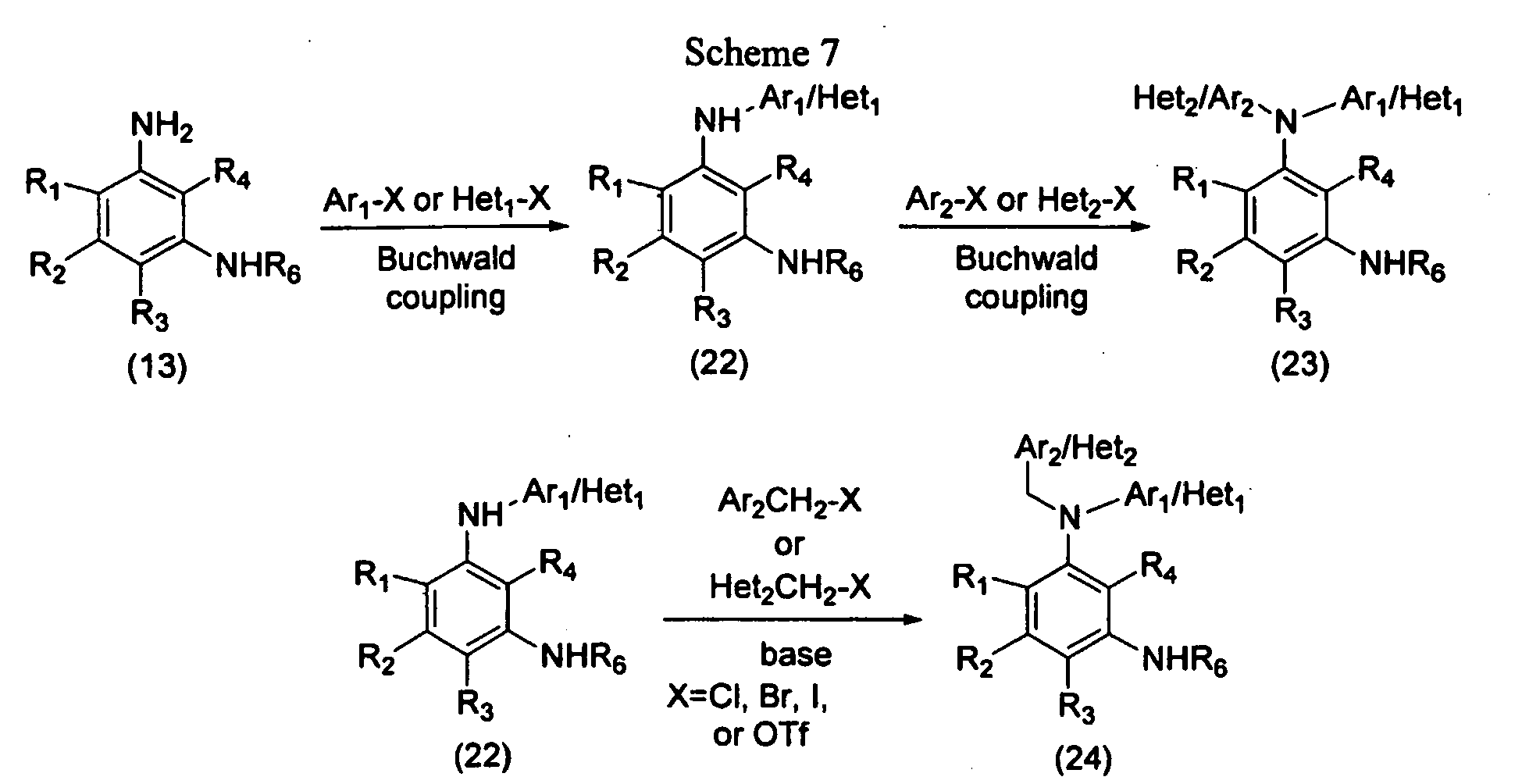
- Diaminobenzenes of general formula (23) and of general formula (24), wherein R1, R2, R3, R4, R6 are as defined in Formula (I), Ar1 and Ar2 are each independently aryl, as defined herein, and Het1 and Het2 are each independently heterocycle, as defined herein, may be prepared as described in Scheme 7. Diaminobenzenes of general formula (13), prepared as described in Scheme 4 or purchased commercially, may be treated an aryl or heterocyclic halide or triflate under Buchwald coupling conditions (Wagaw and Buchwald, JOC (1996) 61, 7240-7241; Yang and Buchwald, J. Organometallic Chem., (1999) 576, 125-146; and Harris, Geis and Buchwald, JOC (1999) 64, 6016-6022) to provide secondary amines of general formula (22). Secondary amines of general formula (22) may be resubjected to Buchwald conditions to provide diamines of general formula (23), or may be treated with a benzylic or heterocyclicmethyl halide in the presence of a base such as sodium carbonate or triethylamine to provide diamines of general formula (24).


- Diaminobenzenes of general formula (28) wherein R is selected from alkenyl, alkoxyalkoxyalkyl, alkoxyalkyl, alkoxycarbonyl, alkoxycarbonylalkyl, alkoxysulfonyl, alkyl, alkylcarbonyl, alkylcarbonylalkyl, alkylthioalkyl, alkynyl, cyanoalkyl, haloalkenyl, haloalkyl, haloalkynyl, (NR8R9)carbonyl, (NR8R9)carbonylalkyl, (NR10R11)sulfonyl and (NR10R11)sulfonylalkyl and R1, R2, R3, R4, R6, RA1, RA2, RA3, RA4, RA5, RD1, RD2, RD3, RD4 and RD5 are as defined in Formula (I), and diaminobenzenes of general formula (29), wherein R1, R2, R3, R4, R6, RA1, RA2, RA3, RA4, RA5, RD1, RD2, RD3, RD4, RD5, RB1, RB2, RB3, RB4 and RB5 are as defined in formula I, may be prepared as described in Scheme 8. Phenols of general formula (25), purchased or prepared using methodology known to those in the art, may be treated with alkylating agents such as benzyl halides, mesylates, tosylates or triflates and a base such as potassium carbonate to provide ethers of general formula (26). Alternatively, a Mitsunobu reaction can be used to prepare ethers (26) from phenols (25) and an alcohol (ROH). Aldehydes of general formula (26) may be processed as described in Scheme 3 to provide dibenzyl compounds of general formula (27). Dibenzyl compounds of general formula (27) may be processed as described in Scheme 1 to provide compounds of general formula (28). Compounds of general formula (27) may be deprotected as described in Scheme 5 to provide diaminobenzenes of general formula (15). Compounds of general formula (15) may be processed as described in Scheme 5 to provide diaminobenzenes of general formula (29).

- Diaminobenzenes of general formula (37), wherein R1, R2, R3, R4, R6, RA1, RA2, RA3, RA4, RA5, RD1, RD2, RD3, RD4 and RD5 are as defined in Formula (I), may be prepared as described in Scheme 9. Phenols of general formula (30), purchased or prepared using methodology known to those in the art, may be treated with electrophilic agents such as 1-(chloromethyl)-4-fluoro-1,4-diazoniabicyclo[2.2.2]octane bis(tetrafluoroborate) to provide compounds of general formula (31). Compounds of general formula (31) may be may be protected on oxygen to provide dibenzyl compounds of general formula (32). An allyl protecting group is preferred and other potential protecting groups are listed in T. W. Greene and P. G. M. Wuts, Protective Groups in Organic Synthesis, John Wiley & Sons, Inc., New York, 1999. Compounds of general formula (31) may be alkylated directly using an alkylating agent like allyl bromide and a base like potassium carbonate to give phenols 32. Alternatively, one phenol can be reacted with TsCl and the other with an alkylating agent like allyl bromide and a base like potassium carbonate. The Ts group can then be removed by hydrolysis to give compounds of general formula (32). Phenols of general formula (33) may be purchased, prepared as in the preparation of compounds (32), or prepared using methodology known to those in the art. Phenols of general formula (33) can be reacted with aldehydes (34) to provide ethers of general formula (35). Ethers of general formula (35) may be processed as described in Scheme 3 to provide diaminobenzenes of general formula (36). Compounds of general formula (36) may be processed as described in Scheme 1 to provide diaminobenzenes of general formula (37).


- Diaminobenzenes of general formula (41) wherein R is selected from alkenyl, alkoxyalkoxyalkyl, alkoxyalkyl, alkoxycarbonyl, alkoxycarbonylalkyl, alkoxysulfonyl, alkyl, alkylcarbonyl, alkylcarbonylalkyl, alkylthioalkyl, alkynyl, cyanoalkyl, haloalkenyl, haloalkyl, haloalkynyl, (NR8R9)carbonyl, (NR8R9)carbonylalkyl, (NR10R11)sulfonyl and (NR10R11)sulfonylalkyl and R1, R2, R3, R4, R6, RA1, RA2, RA3, RA4, RA5, RB1, RB2, RB3, RB4, RD1, RD2, RD3, RD4 and RD5 are as defined in formula I, and diaminobenzenes of general formula (43), wherein R1, R2, R3, R4, R6, RA1, RA2, RA3, RA4, RA5, RB1, RB2, RB3, RB4, RD1, RD2, RD3, RD4 and RD5 are as defined in formula I, L is a linker group, and Y is an alkyl group, may be prepared as described in Scheme 10. L is selected from those groups delineated for RB1-B4 but has two attachment sites. P is a protecting group and allyl is preferred. Representative protecting groups are described in T. W. Greene and P. G. M. Wuts, Protective Groups in Organic Synthesis, John Wiley & Sons, Inc., New York, 1999. Nitroaromatics of general formula (38), prepared via methods described in Scheme 9 or using methodology known to those in the art, may be deprotected to provide phenols of general formula (39). A preferred protecting group is allyl which can be removed with tetrakis(triphenylphosphine)palladium(0) and phenylsilane. Phenols of general formula (39) may be alkylated as described in Scheme 6 to provide dibenzyl compounds of general formula (40). Dibenzyl compounds of general formula (40) may be reduced and N-substituted as described in Scheme 1 to provide diamino compounds of general formula (41). Alternatively, compounds of general formula (39) may be subjected to aryl substitution reactions as described in Scheme 6 to provide esters of general formula (42). Esters (42) may be processed as described in Scheme 1 followed by hydrolysis of the ester to provide diamino acids compounds of general formula (43).


- Diaminobenzenes of general formula (45) and (47), wherein R1, R2, R3, R4, R6, RA1, RA2, RA3, RA4, RA5, RD1, RD2, RD3, RD4, RD5, RB1, RB2, RB3 and RB4 are as defined in formula I, may be prepared as described in Scheme 11. Nitrophenols of general formula (39) may be treated with alkylating agents such as benzyl halides, mesylates, tosylates or triflates and a base to provide compounds of general formula (44). Reduction of the nitro group followed by reaction of the resultant amine is accomplished as described in Scheme 1; treatment with an acid like aqueous hydrochloric acid or trifluoroacetic acid of the like to remove the acetonide protecting group followed by hydrolysis of the ester for example using hydroxide anion in an alcholic solvent provides dibenzyl dihydroxyacids of general formula (45). Alternatively dibenzyl compounds of general formula (44) may be reduced and reacted on nitrogen as described in Scheme 1 to provide diamino compounds of general formula (46). Removal of the acetonide under acidic conditions followed by acid-catalyzed lactonization provides diaminobenzenes hydroxylactones of general formula (47).


- Diaminobenzenes of general formula (51) and (52), wherein R1, R2, R3, R4, R6, RA1, RA2, RA3, RA4, RB1, RB2, RB3, RB4, RD1, RD2, RD3, RD4 and RD5 are as defined in formula I, and L is a linker group, may be prepared as described in Scheme 12. L is-selected from those groups delineated for RB1-B4 but has two attachment sites. X is a halogen like chlorine, bromine, iodine. Halides of general formula (48), prepared according to Schemes 5 or 9, or using methodology known to those in the art, may be treated with zinc reagents such as 3-ethoxy-3-oxopropylzinc bromide of general formula (49) and a palladium catalyst such as tetrakis(triphenylphosphine)palladium (0) to provide compounds of general formula (50). Compounds of general formula (50) that contain an ester may optionally be hydrolyzed to provide dibenzyl diamino acids of general formula (51), or may optionally be reduced with diisobutylaluminum hydride or another reducing reagent to provide dibenzyl diamino alcohols of general formula (52).

- Diaminobenzenes of general formula (55) and (56), wherein R7 and R8 are selected from alkenyl, alkoxyalkoxyalkyl, alkoxyalkyl, alkoxycarbonyl, alkoxycarbonylalkyl, alkoxysulfonyl, alkyl, alkylcarbonyl, alkylcarbonylalkyl, alkylthioalkyl, alkynyl, cyanoalkyl, haloalkenyl, haloalkyl, haloalkynyl, (NR8R9)carbonyl, (NR8R9)carbonylalkyl, (NR10R11)sulfonyl and (NR10R11)sulfonylalkyl and R1, R2, R3, R4, R6, RA1, RA2, RA3, RA4, RB1, RB2, RB3, RB4, RD1, RD2, RD3, RD4 and RD5 are as defined in formula I, and L is a linker group, may be prepared as described in Scheme 13.. L is-selected from those groups delineated for RB1-B4 but has two attachment sites. Phenols of general formula (53), prepared using the methods described in Scheme 10 or using methodology known to those in the art, may be coupled with phthalimidoalkyl alcohols or phthalimidoalkyl halides as described in Schemes 6 and 1 to provide compounds of general formula (54). Phthalimide compounds of general formula (54) may be treated with hydrazine to provide primary amines of general formula (55). Amine compounds of general formula (55) may be alkylated, acylated, or sulfonylated with alkyl halides, acid chlorides or sulfonyl chlorides to provide diaminobenzenes of general formula (56).

- Diaminobenzenes of general formula (57) , wherein R1, R2, R3, R4, R6, RA1, RA2, RA3, RA4, RB1, RB2, RB3, RB4, RD1, RD2, RD3, RD4 and RD5 are as defined in formula I, L is a linker group, and P is an optional protecting group, and (59), wherein R7 and R8 are selected from alkenyl, alkoxyalkoxyalkyl, alkoxyalkyl, alkoxycarbonyl, alkoxycarbonylalkyl, alkoxysulfonyl, alkyl, alkylcarbonyl, alkylcarbonylalkyl, alkylthioalkyl, alkynyl, cyanoalkyl, haloalkenyl, haloalkyl, haloalkynyl, (NR8R9)carbonyl, (NR8R9)carbonylalkyl, (NR10R11)sulfonyl and (NR10R11)sulfonylalkyl and R1, R2, R3, R4, R6, RA1, RA2, RA3, RA4,RD1, RD2, RD3, RD4 and RD5 are as defined in formula I, and L is a linker group, may be prepared as described in Scheme 14. L is selected from those groups delineated for RB1-B4 but has two attachment sites. Representative protecting groups are described in T. W. Greene and P. G. M. Wuts, Protective Groups in Organic Synthesis, John Wiley & Sons, Inc., New York, 1999. Phenols of general formula (53) may be coupled with protected diols or protected hydroxyalkyl halides as described in Schemes 6 and 1 to provide compounds of general formula (57). Compounds of general formula (57) may be deprotected as described in Scheme 5 to the corresponding alcohol and the alcohols converted to the corresponding halide or alkylsulfonate, for example by treatment with triphenylphosphine and carbon tetrabromide or p-toluenesulfonyl chloride or the like, to provide compounds of general formula (58). Compounds of general formula (58) may be reacted with a primary or secondary amine to provide compounds of general formula (59).

- Diaminobenzenes of general formula (63), wherein R1, R2, R3, R4, R6, RA1, RA2, RA3, RA4, RB1, RB2, RB3, RB4, RD1, RD2, RD3, RD4 and RD5 are as defined in formula I, may be prepared as described in Scheme 15. Nitroanilines of general formula (1), purchased or prepared using methodology known to those in the art, may be treated with aldehydes ( 35) and processed as described in Scheme 3 to provide compounds of general formula (60). Compounds of general formula (61) may be deprotected as described in Scheme 5 and the resultant alcohol alkylated as described in Scheme 6 to provide compounds of general formula (61). Compounds of general formula (61) may be N-alkylated as described in Schemes 1, 2, or 3 to provide compounds of general formula (62). Nitroaromatic compounds of general formula (62) may be reduced and alkylated, acylated, or sulfonylated with alkyl halides, acid chlorides or sulfonyl chlorides as described in Scheme 1. Hydrolysis of the ester moiety provides diaminobenzenes of general formula (63).

- Diaminobenzenes of general formula (66) and (67), wherein R1, R2, R3, R4, R6, RA1, RA2, RA3, RA4, RB1, RB2, RB3, RB4, RD1, RD2, RD3, RD4 and RD5 are as defined in formula I, may be prepared as described in Scheme 16. Dinitrohalides of general formula (64), purchased or prepared using methodology known to those in the art, may be treated with tin reagents such as trimethyl or tri-n-butyl stannanes, a palladium catalyst (palladium salt plus ligand), copper salt, and LiCl in a Stille reaction to provide nitroaromatic compounds of general formula (65). The dinitrohalides of general formula (65) may be reduced using methodology known to those in the art to provide nitroanilines of general formula (1). Compounds of general formula (1) may be processed as described in Schemes 1, 2, or 3 to provide diamino compounds of general formula (66). Compounds of general formula (1) may also be processed as described in Schemes 1, 2, 3, or 9 to provide diamino compounds of general formula (67).

- Diaminobenzenes of general formula (71, 72, 73, and 74), wherein R is selected from alkenyl, alkoxyalkoxyalkyl, alkoxyalkyl, alkoxycarbonyl, alkoxycarbonylalkyl, alkoxysulfonyl, alkyl, alkylcarbonyl, alkylcarbonylalkyl, alkylthioalkyl, alkynyl, cyanoalkyl, haloalkenyl, haloalkyl, haloalkynyl, (NR8R9)carbonyl, (NR8R9)carbonylalkyl, (NR10R11)sulfonyl and (NR10R11)sulfonylalkyl and R1, R2, R3, R4, R6, RA1, RA2, RA3, RA4,
- RB1, RB2, RB3, RB4, RB5, RD1, RD2, RD3, RD4 and RD5 are as defined in formula I, and P is an optional protecting group, may be prepared as described in Scheme 17. Nitroanilines of general formula (1), purchased or prepared using methodology known to those in the art, may be processed as described in Schemes 1, 2, or 3 to provide ester compounds of general formula (68). Ester compounds of general formula (68) may be hydrolyzed and subjected to amide forming coupling conditions in the presence of N,O-dimethylhydroxylamine hydrochloride to provide compounds of general formula (69). Alternatively ester compounds of general formula (68) may be treated with the reagent derived from N,O-dimethylhydroxylamine hydrochloride and trimethylaluminum to provide compounds of general formula (69). Compounds of general formula (69) may be treated with aryl lithium or aryl Grignard compounds, prepared using methodology known to those in the art, to provide diamino ketones of general formula (71). For the specific case where RB5 is an alcohol, diamino compounds of general formula (72) may be protected on the anilino nitrogen (mesylate protecting group is preferred) for example using methanesulfonyl chloride or the like, and deprotected on oxygen as described in Scheme 5, to provide diaminobenzenes of general formula (73). Phenol compounds of general formula (73) may be reacted with alcohols or alkyl halides as described in Scheme 6 to give pheyl ethers; after hydrolysis, or other deprotection, to provide diphenylketones of general structure (74). Cleavage of the preferred mesylate protecting group occurs under basic hydrolytic conditions.


- Diaminobenzenes of general formula (77) wherein R is selected from alkenyl, alkoxyalkoxyalkyl, alkoxyalkyl, alkoxycarbonyl, alkoxycarbonylalkyl, alkoxysulfonyl, alkyl, alkylcarbonyl, alkylcarbonylalkyl, alkylthioalkyl, alkynyl, cyanoalkyl, haloalkenyl, haloalkyl, haloalkynyl, (NR8R9)carbonyl, (NR8R9)carbonylalkyl, (NR10R11)sulfonyl and (NR10R11)sulfonylalkyl-R1, R2, R3, R4, R6, RA1, RA2, RA3, RA4, RB1, RB2, RB3, RB4, RD1, RD2, RD3, RD4 and RD5 are as defined in formula I, and L is a linker group, and (79), wherein R7 and R8 are selected from alkenyl, alkoxyalkoxyalkyl, alkoxyalkyl, alkoxycarbonyl, alkoxycarbonylalkyl, alkoxysulfonyl, alkyl, alkylcarbonyl, alkylcarbonylalkyl, alkylthioalkyl, alkynyl, cyanoalkyl, haloalkenyl, haloalkyl, haloalkynyl, (NR8R9)carbonyl, (NR8R9)carbonylalkyl, (NR10R11)sulfonyl and (NR10R11)sulfonylalkyl and R1, R2, R3, R4, R6, RA1, RA2, RA3, RA4, RB1, RB2, RB3, RB4, RD1, RD2, RD3, RD4 and RD5 are as defined in formula I, and L is a linker group, may be prepared as described in Scheme 18. L is selected from those groups delineated for RB1-B4 but has two attachment sites. Compounds of general formula (53) may be reacted with protected diols or protected hydroxyalkyl halides according to Scheme 6 to provide nitroaromatic compounds of general formula (75). Nitroaromatic compounds of general formula (75) may be deprotected to provide alcohol compounds of general formula (76). Alcoholl-compounds of general formula (76) may be reacted with alcohols or alkyl halides according to Schemes 6 and 1 to provide diamino compounds of general formula (77). Alternatively, alcohol compounds of general formula (76) may be mesylated with mesyl chloride to provide mesylates of general formula (78). Mesylates of general formula (78) may be reacted with primary or secondary amines according to Scheme 14 to provide diamino compounds of general formula (79).


- Diaminobenzenes of general formula (82) and (83), wherein R is selected from alkenyl, alkoxyalkoxyalkyl, alkoxyalkyl, alkoxycarbonyl, alkoxycarbonylalkyl, alkoxysulfonyl, alkyl, alkylcarbonyl, alkylcarbonylalkyl, alkylthioalkyl, alkynyl, cyanoalkyl, haloalkenyl, haloalkyl, haloalkynyl, (NR8R9)carbonyl, (NR8R9)carbonylalkyl, (NR10R11)sulfonyl and (NR10R11)sulfonylalkyl and R1, R2, R3, R4, R6, RA1, RA2, RA3, RA4, RB1, RB2, RB3, RB4, RD1, RD2, RD3, RD4 and RD5 are as defined in formula I, and P is a protecting group, may be prepared as described in Scheme 19. Phenols of general formula (53) may be treated with N-protected pyrollidinol mesylates of general formula (80) and a base to provide compounds of general formula (81). Compounds of general formula (81) may be deprotected to provide amine compounds of general formula (82). The pyrrolidine moiety in the amine compounds of general formula (82) may be alkylated, acylated, or sulfonylated with alkyl halides, acid chlorides or sulfonyl chlorides as described in Schemes 1, 2, or 3; reduction of the nitro group and reaction of the resultant amine with alkyl halides, acid chlorides or sulfonyl chlorides as described in Scheme 1 provides compounds of general formula (83).


- Diaminobenzenes of general formula (85, 87, 88, and 89), wherein R7 and R8 are selected from alkenyl, alkoxyalkoxyalkyl, alkoxyalkyl, alkoxycarbonyl, alkoxycarbonylalkyl, alkoxysulfonyl, alkyl, alkylcarbonyl, alkylcarbonylalkyl, alkylthioalkyl, alkynyl, cyanoalkyl, haloalkenyl, haloalkyl, haloalkynyl, (NR8R9)carbonyl, (NR8R9)carbonylalkyl, (NR10R11)sulfonyl and (NR10R11)sulfonylalkyl and R1, R2, R3, R4, R6, RA1, RA2, RA3, RA4, RB1, RB2, RB3, RB4, RD1, RD2, RD3, RD4 and RD5 are as defined in formula I, and L1 and L2 are independently linkers, may be prepared as described in Scheme 20. L1 and L2 are selected from those groups delineated for RB1-B4 but have two attachment sites. Esters of general formula (84), prepared by methods described in Scheme 9 or by using methodology known to those in the art, may be hydrolyzed to provide acids of general formula (85). Acid compounds of general formula (85) may be coupled with amines of general formula (86) using appropriate coupling reagents, for example an acid anhydride or sulfonyl halide or carbodiimine reagent or the like, to provide compounds of general formula (87). For the specific case where the compounds of formula (86) are amino esters, the resultant ester compounds of general formula (88) may be hydrolyzed to provide acid compounds of general formula (89).
- The compounds and processes of the present invention will be better understood by reference to the following examples, which are intended as an illustration of and not a limitation upon the scope of the invention.
- 2-Methyl-3-nitroaniline (10.0 g, 65.7 mmoles, purchased from Aldrich) in pyridine (70 mL) was treated with methanesulfonyl chloride (5.09 mL, 65.7 mmoles) at 0° C. The reaction mixture was allowed warmed to room temperature and stirred for 2 hours. The reaction mixture was concentrated under reduced pressure and the crude products were diluted with diethyl ether (700 mL). The mixture was washed with 1N HCl (250 mL), water (250 mL) and brine (250 mL). The organic layer was dried (Na2SO4), filtered, and concentrated under reduced pressure to provide the title compound which was used in the next step without further purification.
- The crude product from Example 1A and 10% palladium on carbon (1.4 g) were stirred vigorously in ethyl acetate (70 mL) for 24 hours under one atmosphere of hydrogen. The reaction was placed under a nitrogen atmosphere, filtered through a 1 inch pad of 1:1 Celite:silica gel eluting with ethyl acetate and the filtrate was concentrated under reduced pressure. The residue was purified by flash chromatography (silica gel, ethyl acetate) to provide the title compound as a brown solid (11.06 g, 84%).
- The product from Example 1B (1.525 g, 7.625 mmoles) and 2-bromobenzaldehyde (1.5 mL, 12.96 mmoles) in dichloroethane (26.7mL) were treated with glacial acetic acid (1.75 mL, 30.5 mmoles). The yellow reaction was stirred for 4 hours at room temperature and was treated with sodium triacetoxyborohydride (3.23 g, 15.25 mmoles). After stirring overnight at room temperature, the mixture was poured into saturated aqueous NaHCO3 (200 mL), extracted with diethyl ether (200 mL) and the phases separated. The organic phase was washed with brine (100 mL), dried (Na2SO4), filtered and concentrated under reduced pressure. The residue was purified by flash chromatography (silica gel, 5:2→1:1 hexanes:ethyl acetate) to provide two products. The title compound, a brown solid, was isolated as the minor product (0.29 g, 7% yield). The major product isolated was the monobenzylated analogue, N-{3-[(2-bromobenzyl)amino]-2-methylphenyl}methanesulfonamide. A portion of the minor product was repurified by preparative HPLC (CH3CN:0.1% TFA in H2O) on a YMC ODS Guardpak column. 1H NMR (300 MHz, CDCl3) δ 7.50 (dd, J=8.0, 0.7 Hz, 2H), 7.35 (d, J=8.1 Hz, 2H), 7.18 (m, 2H), 7.07 (m, 2H), 6.03 (s, 1H), 4.30 (s, 4H), 2.90 (s, 3H), 2.16 (s, 3H); MS (APCI+) m/z 539 (M+H)+.
- 2-Methyl-3-nitroaniline (3.4 g, 22.3 mmoles, purchased from Aldrich) and diisopropylethylamine (19.5 mL, 112 mmoles) in DMF (34 mL) were treated with benzyl bromide (8.0 mL, 67 mmoles) and heated for 18 hours at 90 °C. After cooling to room temperature, the mixture was diluted with diethyl ether (800 mL). The mixture was washed with saturated ammonium chloride (400 mL), water (2x400 mL), brine (400 mL), dried (Na2SO4), filtered and the filtrate was concentrated under reduced pressure. The residue was purified by flash chromatography (silica gel, 10:1 hexanes:ethyl acetate) to provide the title compound as a yellow oil (6.38 g, 86%).
- The product from Example 2A (3.4 g, 16.2 mmoles) in acetic acid (20 mL) was treated with zinc powder (2.68 g, 41 mmoles, purchased from Aldrich) and stirred for 48 hours. An additional portion of zinc (1.0g, 15.3 mmoles) was added and stirring continued for 4 hours. The reaction was filtered through a pad of Celite with CH2Cl2 and concentrated. Purification by flash chromatography (silica gel, 4:1 hexanes:ethyl acetate) provided the title compound as a yellow solid (1.98 g, 64%).
- The product from Example 2B was processed as described in Example 1A. The residue was purified by flash chromatography (silica gel, 1:1 hexanes:ethyl acetate) to provide the title compound as a brown solid. 1H NMR (300 MHz, CDCl3) δ 7.24 (m, 11H), 7.12 (t, J=8.0 Hz, 1H), 6.90 (d, J=7.8 Hz, 1H), 6.18 (s, 1H), 4.05 (s, 4H), 2.93 (s, 3H), 2.34 (s, 3H); MS (APCI+) m/z 381 (M+H)+; HRMS (CI) m/z (calcd for C22H24N2O5S1) 380.1558, observed. 380.155.
- The product from Example 2B (0.03 g, 0.1 mmoles) in pyridine (2 mL) at 0 °C was treated with ethanesulfonyl chloride (0.01 g, 0.12 mmoles). The reaction mixture was quenched after 1 hour with water (2 mL), extracted with diethyl ether (5 mL), washed with water (2 x 2 mL), rinsed with brine (2 mL), dried (Na2SO4), filtered, and the filtrate concentrated under reduced pressure. The residue was purified by preparative HPLC (CH3CN:0.1% TFA in H2O) on a YMC ODS Guardpak column to provide the title compound. 1H NMR (500 MHz, DMSO-d6) δ 1.22 (t, 3H, J=7.3 Hz), 2.40 (s, 3H), 3.02 (dd, 2H, J=14.6, 7.5 Hz), 4.05 (s, 4H), 6.94 (m, 2H), 7.01 (m, 1H), 7.20 (m, 2H), 7.27 (m, 7H), 8.92 (s, 1H); MS (APCI+) m/z 395 (M+H)+.
- The product from Example 2B and isopropylsulfonylchloride were processed as described in Example 3 to provide the title compound. 1H NMR (500 MHz, DMSO-d6) δ 1.23 (d, 6H, J=6.5 Hz), 2.39 (s, 3H), 3.18 (m, 1H), 4.04 (s, 4H), 6.91 (dd, 1H, J=7.5, 1.6 Hz), 6.97 (m, 2H), 7.19 (m, 2H), 7.26 (m, 8H), 8.86 (s, 1H); MS (APCI+) m/z 409 (M+H)+.
- The product from Example 2B and N,N-dimethylsulfamoylchloride were processed as described in Example 3 to provide the title compound. 1H NMR (500MHz, DMSO-d6) δ 2.25 (s, 3H), 2.33 (m, 6H), 3.88 (s, 4H), 6.72 (dd, 1H, J=7.7, 1.5 Hz), 6.82 (m, 2H), 7.03 (m, 2H), 7.10 (m, 8H), 8.73 (s, 1H); MS (APCI+) m/z 410 (M+H)+.
- 2-Methyl-3-nitroaniline (3.40 g, 22.3 mmoles) and benzaldehyde (3.9 mL, 38 mmoles) in dichloroethane (78 mL) were treated with glacial acetic acid (5.1 mL, 89 mmoles). The yellow reaction mixture was stirred for 4 hours at room temperature, treated with sodium triacetoxyborohydride (9.5 g, 44.6 mmoles) and allowed to stir overnight at room temperature. The mixture was poured into saturated aqueous NaHCO3 (400 mL), extracted with diethyl ether (400 mL) and the phases separated. The organic phase was washed with brine (200 mL), dried (Na2SO4), filtered, and the filtrate was concentrated under reduced pressure. The residue was purified by flash chromatography (silica gel, 10:1→4:1 hexanes:ethyl acetate) to provide the title compound as a yellow solid (4.72 g, 87%).
- The product from Example 6A (0.92 g, 3.8 mmoles) and diisopropylethylamine (1.7 mL, 9.5 mmoles) in DMF (9.5 mL) were treated with methyl 4-(bromomethyl)benzoate (0.74 g, 7.6 mmoles) and heated for 18 hours at 90 °C. After cooling to room temperature, the mixture was diluted with diethyl ether (200 mL). The mixture was washed with saturated ammonium chloride (200 mL), water (2x200 mL), brine (150 mL), dried (Na2SO4), filtered and the filtrate was concentrated under reduced pressure. The residue was purified by flash chromatography (silica gel, 10:1→4:1 hexanes:ethyl acetate) to provide the title compound as a yellow solid (1.26 g, 85%).
- The product from Example 6B (1.43 g, 3.67 mmoles) and NH4Cl (0.14 g, 2.57 mmoles) in ethanol (18.4 mL) and water (6.4 mL) were treated with iron powder (1.43 g, 25.7 mmoles) and heated at 80 °C for one hour. The reaction mixture was allowed to cool to room temperature, diluted with CH2Cl2 (100 mL), filtered through Celite with ethyl acetate, and the filtrate was concentrated under reduced pressure to provide the title compound which was used without further purification.
- The crude product from Example 6C in pyridine (8.8 mL) was treated with methanesulfonyl chloride (0.28 mL, 3.60 mmoles) at 0 °C. The reaction mixture turned from clear and colorless to yellow. After 30 minutes, the mixture was quenched with water (5.0 mL) and was concentrated under reduced pressure. The residue was dissolved in diethyl ether (200 mL), washed with water (2x100 mL), brine (100 mL), dried (Na2SO4), filtered, and the filtrate was concentrated under reduced pressure. The residue was purified by flash chromatography (silica gel, 4:1→1:1 hexanes:ethyl acetate) to provide the title compound as a yellow solid (1.33 g, 83%). A small portion of the residue (0.1 g) was repurified by preparative HPLC (CH3CN:0.1% TFA in H2O) on a YMC ODS Guardpak column. 1H NMR (300 MHz, CDCl3) δ 7.92 (d, J=6.8 Hz, 2H), 7.21 (m, 8H), 7.11 (t, J=8.0 Hz, 1H), 6.89 (d, J=8.0 Hz, 1H), 6.11 (s, 1H), 4.12 (s, 2H), 4.05 (s, 2H), 3.90 (s, 3H), 2.95 (s, 3H), 2.34 (s, 3H); MS (APCI+) m/z 439 (M+H)+.
- The product from Example 6A and 1-bromo-2-(bromomethyl)benzene were processed as described in Examples 6B-D to provide the title compound. 1H NMR (300 MHz, CDCl3) δ 7.50 (dd, J=8.0, 1.1 Hz, 1H), 7.34 (dd, J=7.4, 1.7 Hz, 1H), 7.03-7.29 (m, 9H), 7.01 (dd, J=8.0, 1.2 Hz, 1H), 6.04 (s, 1H), 4.20 (s, 2H), 4.13 (s, 2H), 2.90 (s, 3H), 2.23 (s, 3H); MS (ESI+) m/z 461 (M+H)+.
- The product from Example 1B and benzaldehyde were processed as described in Example 1C to provide the title compound.
- Glacial acetic acid (0.37 mL, 6.4 mmoles) was added to a solution of Example 8A (0.46 g, 1.6 mmoles) and 4-nitrobenzaldehyde (0.48 g, 3.2 mmoles) in dichloroethane (3.2 mL) and CH3CN (4.0 mL). The reaction was stirred for 4 hours at room temperature and was treated with sodium triacetoxyborohydride (0.68 g, 3.2 mmoles). The reaction mixture was stirred overnight at room temperature. The mixture was poured into saturated aqueous NaHCO3 (150 mL) and extracted with diethyl ether (150 mL). The organic phase was washed with brine (150 mL), dried (Na2SO4), filtered, and the filtrate concentrated under reduced pressure. The residue was purified by flash chromatography (5:2→1:1 hexanes:ethyl acetate) to provide the title compound as a brown solid (0.034 g, 5% yield). 1H NMR (300 MHz, CDCl3) δ 8.12 (d, J=8.9 Hz, 2H), 7.37 (d, J=8.9 Hz, 2H), 7.27 (m, 6H), 7.12 (t, J=7.8 Hz, 1H), 6.87 (d, J=8.1 Hz, 1H), 6.14 (s, 1H); 4.18 (s, 2H), 4.06 (s, 2H), 2.99 (s, 3H), 2.38 (s, 3H); MS (APCI+) m/z 426 (M+H)+.
- The product from Example 8A and 4-fluorobenzaldehyde were processed as described in Example 1C to provide the title compound. 1H NMR (300 MHz, CDCl3) δ 7.07-7.32 (m, 9H), 7.00-6.85 (m, 3H), 6.10 (s, 1H), 4.03 (s, 2H), 4.02 (s, 2H), 2.95 (s, 3H), 2.33 (s, 3H); MS (ESI+) m/z 399 (M+H)+; Analysis calculated for C22H23FN2O2S 0.75 TFA: C, 58.26; H, 4.95; N, 5.79. Found: C, 58.26; H, 5.17; N, 5.63.
- The product from Example 8A and 2,4-difluorobenzaldehyde were processed as described in Example 1C to provide the title compound. 1H NMR (300 MHz, CDCl3) δ 7.40-7.18 (m, 6H), 7.11 (m, 2H), 6.92 (m, 1H), 6.72 (m, 2H), 6.07 (s, 1H), 4.07 (s, 4H), 2.93 (s, 3H), 2.30 (s, 3H); MS(ESI+) m/z 417 (M+H)+.
- The product from Example 6A and 1-(bromomethyl)-2-cyanobenzene were processed as described in Examples 6B-D to provide the title compound. 1H NMR (300 MHz, CDCl3) δ 7.58 (d, J=7.2 Hz, 1H), 7.46 (m, 2H), 7.24 (m, 8H), 7.13 (t, J=8.0 Hz, 1H), 6.97 (dd, J=7.8, 1.0 Hz, 1H), 6.13 (s, 1H), 4.32 (s, 2H), 4.12 (s, 2H), 2.93 (s, 3H), 2.29 (s, 3H); MS (APCI+) m/z 406 (M+H)+.
- The product from Example 6A and 1-(chloromethyl)-4-methoxybenzene were processed as described in Examples 6B-D to provide the title compound. 1H NMR (300 MHz, CDCl3) δ 7.22 (m, 6H), 7.11 (t, J=8.1 Hz, 1H), 7.08 (d, J=8.9 Hz, 2H), 6.92 (dd, J=8.2, 1.2 Hz, 1H), 6.78 (d, J=8.9 Hz, 2H), 6.10 (s, 1H), 4.10 (s, 2H), 4.05 (s, 2H), 3.77 (s, 3H), 2.92 (s, 3H), 2.29 (s, 3H); MS (APCI+) m/z 411 (M+H)+.
- The product from Example 6A and 1-(bromomethyl)-4-bromobenzene were processed as described in Examples 6B-D to provide the title compound. 1H NMR (300 MHz, CDCl3) δ 7.37 (d, J=8.1 Hz, 2H), 7.21 (m, 6H), 7.12 (t, J=8.0 Hz, 1H), 7.05 (d, J=8.1 Hz, 2H), 6.89 (dd, J=8.1,1.0 Hz, 1H), 6.11 (s, 1H), 4.06 (s, 2H), 4.03 (s, 2H), 2.95 (s, 3H), 2.31 (s, 3H); MS (APCI+) m/z 460 (M+H)+.
- The product from Example 6A and 1-(chloromethyl)-3-methoxybenzene were processed as described in Examples 6B-D to provide the title compound. 1H NMR (300 MHz, CDCl3) δ 7.21 (m, 7H), 7.12 (t, J=8.0 Hz, 1H), 6.92 (dd, J=8.0, 1.1 Hz, 1H), 6.78 (m, 3H), 6.14 (s, 1H), 4.11 (s, 2H), 4.08 (s, 2H), 3.74 (s, 3H), 2.94 (s, 3H), 2.33 (s, 3H); MS (APCI+) m/z 411 (M+H)+.
- 2-Methyl-3-nitroaniline and 1,3-benzodioxole-5-carbaldehyde were processed as described in Example 1C to provide the title compound.
- The product from Example 15A and benzyl bromide were processed as described in Examples 6B-D to provide the title compound. 1H NMR (300 MHz, CDCl3) δ 7.16-7.37 (m, 7H), 7.05 (d, J=8.1 Hz, 1H), 6.70 (s, 1 H), 6.67 (s, 2H), 6.10 (s, 1H), 5.91 (s, 2H), 4.35 (s, 2H), 4.29 (s, 2H), 2.86 (s, 3H), 2.17 (s, 3H); MS (ESI+) m/z 425 (M+H)+; Analysis calculated for C23H24N2O4S 0.90 TFA: C, 56.51; H, 4.76; N, 5.31. Found: C, 56.59; H, 4.68; N, 5.24.
- 2-Methyl-3-nitroaniline and 2,3-dihydro-1,4-benzodioxine-6-carbaldehyde were processed as described in Example 1C to provide the title compound.
- The product from Example 16A and benzyl bromide were processed as described in Examples 6B-D to provide the title compound. 1H NMR (300 MHz, CDCl3) δ 7.30-7.25 (m, 6H), 7.10 (t, J=8.0 Hz, 1H), 6.89 (dd, J=7.8, 1.0 Hz, 1H), 6.75 (m, 2H), 6.66 (dd, J=8.1, 2.0 Hz, 1H), 6.11 (s, 1H), 4.23 (s, 4H), 4.04 (s, 2H), 3.93 (s, 2H), 2.95 (s, 3H), 2.35 (s, 3H); MS (ESI+) m/z 439 (M+H)+; Analysis calculated for C24H26N2O4S 0.25 CHCl3: C; 62.19, H, 5.65; N, 5.98. Found: C, 62.18; H, 5.66; N, 5.88.
- The product from Example 6A and 1-(bromomethyl)-2-chlorobenzene were processed as described in Examples 6B-D to provide the title compound. 1H NMR (300 MHz, CDCl3) δ 7.08-7.37 (m, 11H), 7.01 (dd, J=7.9, 1.2 Hz, 1H), 6.09 (s, 1H), 4.24 (s, 2H), 4.14 (s, 2H), 2.90 (s, 3H), 2.24 (s, 3H); MS (ESI+) m/z 415 (M+H)+; Analysis calculated for C22H23ClN2O2S 0.25 TFA: C, 60.94; H, 5.28; N, 6.32. Found: C, 60.99; H, 5.53; N, 6.17.
- The product from Example 8A and 2-fluorobenzaldehyde were processed as described in Example 1C to provide the title compound. 1H NMR (300 MHz, CDCl3) δ 7.22 (m, 8H), 7.10 (t, J=8.0 Hz, 1H), 6.98 (m, 3H), 6.11 (s, 1H), 4.13 (s, 2H), 4.10 (s, 2H), 2.91 (s, 3H), 2.31 (s, 3H); MS (ESI+) m/z 399 (M+H)+; Analysis calculated for C22H23FN2O2S 0.20 TFA: C, 63.96; H, 5.55; N, 6.65. Found: C, 64.11; H, 5.69; N, 6.61.
- 2-Methyl-3-nitroaniline and 4-allyloxybenzaldehyde were processed as described in Example 1C to provide the title compound.
- The product from Example 19A and benzyl bromide were processed as described in Examples 6B-D to provide the title compound. 1H NMR (300 MHz, CDCl3) δ 7.21 (m, 6H), 7.11 (t, J=8.0 Hz, 1H), 7.08 (d, J=8.5 Hz, 2H), 6.89 (dd, J=8.1,1.0 Hz, 1H), 6.81 (d, J=8.8, Hz, 2H), 6.09 (s, 1H), 6.04 (m, 1H), 5.40 (ddd, J=17.3, 3.4,1.7 Hz, 1H), 5.28 (ddd, J=10.5, 2.7,1.4 Hz, 1H), 4.50 (dt, J=5.4, 1.4 Hz, 2H), 4.04 (s, 2H), 3.49 (s, 2H), 2.94 (s, 3H), 2.32 (s, 3H); MS (APCI+) m/z 437 (M+H)+.
- The product from Example 19A and 2,4-difluorobenzyl bromide were processed as described in Example 6B to provide the title compound.
- The product from Example 20A was processed as described in Examples 6C and 6D to provide the title compound. 1H NMR (300 MHz, CDCl3) δ 7.20 (d, J=7.1 Hz, 1H), 7.11 (m, 4H), 6.89 (d, J=7.5 Hz, 1H), 6.82 (d, J=8.8 Hz, 2H), 6.71 (m, 2H), 6.15 (s, 1H), 6.02 (s, 1H), 5.40 (ddd, J=17.3, 3.1, 1.3 Hz, 1H), 5.28 (ddd, J=10.5, 2.7,1.4 Hz), 4.51 (dt, J=5.4, 1.5 Hz), 4.05 (s, 2H), 3.99 (s, 2H), 2.93 (s, 3H), 2.30 (s, 3H); MS (APCI+) m/z 473 (M+H)+.
- 2-Methyl-3-nitroaniline and 2-fluoro-4-methoxy-benzaldehyde were processed as described in Example 1C to provide the title compound.
- The product from Example 21 A and 2-(bromomethyl)benzonitrile were processed as described in Examples 6B-D to provide the title compound. 1H NMR (300 MHz, CDCl3) δ 7.58 (d, J=7.8 Hz, 1H), 7.49 (m, 2H), 7.31 (m, 1H), 7.23 (dd, J=8.1, 1.0 Hz, 1H), 7.12 (t, J=8.0 Hz, 1H), 6.96 (m, 2H), 6.54 (m, 2H), 6.09 (s, 1H), 4.33 (s, 2H), 4.08 (s, 2H), 3.76 (s, 3H), 2.92 (s, 3H), 2.27 (s, 3H); MS (APCI+) m/z 454 (M+H)+.
- 2-Methyl-3-nitroaniline and 2,4-difluorobenzaldehyde were processed as described in Example 1C to provide the title compound.
- The product from Example 22A and 4-methoxybenzyl chloride were processed as described in Examples 6B-D to provide the title compound. 1H NMR (300 MHz, CDCl3) δ 7.21 (dd, J=8.0, 1.0 Hz. 1H). 7.12 (m, 4H), 6.91 (d, J=8.1 Hz, 1H), 6.79 (d, J=8.8 Hz, 2H), 6.71 (m, 2H), 6.10 (s, 1H), 4.10 (s, 2H), 4.04 (s, 2H), 3.78 (s, 3H), 2.93 (s, 3H), 2.28 (s, 3H); MS (APCI+) m/z 447 (M+H)+.
- The product from Example 22A and 2-fluorobenzyl bromide were processed as described in Examples 6B-D to provide the title compound. 1H NMR (300 MHz, CDCl3) δ 7.21 (m, 4H), 7.11 (t, J=8.1 Hz, 1H), 6.94 (m, 3H), 6.72 (m, 2H), 6.13 (s, 1H), 4.15 (s, 2H), 4.13 (s, 2H), 2.91 (s, 3H), 2.25 (s, 3H); MS (APCI+) m/z 435 (M+H)+.
- The product from Example 22A and 2,4-difluorobenzyl bromide were processed as described in Examples 6B-D to provide the title compound. 1H NMR (300 MHz, CDCl3) δ 7.21 (m, 1H), 7.14 (m, 3H), 6.99 (dd, J=8.1, 1.0 Hz, 1H), 6.72 (m, 4H), 6.14 (s, 1H), 4.09 (s, 4H), 2.93 (s, 3H), 2.25 (s, 3H); MS (APCI+) m/z 453 (M+H)+.
- The product from Example 22A and 2-(bromomethyl)benzonitrile were processed as described in Examples 6B-D to provide the title compound. 1H NMR (CDCl3, 300 MHz) δ 7.59 (m, 1H), 7.48 (m, 2H), 7.32 (m, 1H), 7.24 (m, 1H), 7.11 (m, 2H), 6.95 (m, 1H), 6.10 (s, 1H), 4.32 (s, 2H), 4.13 (s, 2H), 2.93 (s, 3H), 2.26 (s, 3H); MS (APCI+) m/z 442 (M+H)+.
- 2-Methyl-3-nitroaniline and 4-phenoxybenzaldehyde were processed as described in Example 1C to provide the title compound.
- The product from Example 26A and benzyl bromide were processed as described in Examples 6B-D to provide the title compound. 1H NMR (300 MHz, CDCl3) δ 7.33 (m, 2H), 7.21 (m, 6H), 7.14 (m, 4H), 6.97 (m, 3H), 6.88 (d, J=8.5 Hz,, 2H), 6.10 (s, 1H), 4.18 (s, 2H), 4.15 (s, 2H), 2.91 (s, 3H), 2.27 (s, 3H); MS (ESI+) m/z 473 (M+H)+.
- The product from Example 6A and 1-(bromomethyl)-2-methylbenzene were processed as described in Examples 6B-D to provide the title compound. 1H NMR (500 MHz, DMSO-d6) δ 2.16 (s, 3H), 2.28 (s, 3H), 2.88 (s, 3H), 4.06 (d, 4H, J=17.8 Hz), 7.03 (m, 6H), 7.24 (m, 6H), 8.91 (s, 1H); MS (APCI+) m/z 395 (M+H)+.
- The product from Example 6A and 1-(bromomethyl)-4-methylbenzene were processed as described in Examples 6B-D to provide the title compound. 1H NMR (500 MHz, DMSO-d6) δ 2.24 (s, 3H), 2.39 (s, 3H), 2.91 (s, 3H), 4.01 (d, 4H, J=18.7 Hz), 6.90-7.30 (m, 12H), 8.94 (s, 1H); MS (APCI+) (M+H)+ at m/z 395.
- The product from Example 6A and 4-chlorobenzyl bromide were processed as described in Examples 6B-D to provide the title compound. 1H NMR (500 MHz, DMSO-d6) δ 2.39 (s, 3H), 2.92 (s, 3H), 4.05 (br.s, 4H), 6.98 (m, 3H), 7.27(m, 9H), 8.95 (s, 1H); MS-(APCI+) m/z 415 (M+H)+.
- The product from Example 6A and 4-trifluoromethylbenzyl bromide were processed as described in Examples 6B-D to provide the title compound. 1H NMR (500 MHz, DMSO-d6) δ 2.40 (s, 3H), 2.92 (s, 3H), 4.07 (s, 2H), 4.16 (s, 2H), 7.00 (m, 3H), 7.25 (m, 5H), 7.49 (d, 2H, J=8.1 Hz), 7.63 (d, 2H, J=8.1 Hz), 8.95 (s, 1H); MS (APCI+) m/z 448 (M+H)+.
- The product from Example 6A and 2-fluoro-4-trifluoromethylbenzyl bromide were processed as described in Examples 6B-D to provide the title compound. 1H NMR (500 MHz, DMSO-d6) δ 2.34 (s, 3H), 2.88 (s, 3H), 4.11 (s, 2H), 4.21 (s, 2H), 6.98 (m, 2H), 7.05 (t, 1H, J=8.0 Hz)), 7.22 (m, 1H), 7.28 (d, 4H, J=4.4 Hz), 7.50 (m, 2H), 7.56 (d, 1H, J=9.4 Hz), 8.96 (s, 1H); MS (APCI+) m/z 467 (M+H)+.
- 2,4-Dichloro-1-(chloromethyl)benzene (0.8 mmoles) in acetone (2 mL) was treated with NaI (0.48 g) and stirred at room temperature overnight. The solvent was removed under reduced pressure and the residue extracted with DMF to provide the title compound.
- The product from Example 6A and the product from Example 32A were processed as described in Examples 6B-D to provide the title compound. 1H NMR (500 MHz, DMSO-d6) δ 2.32 (s, 3H), 2.89 (s, 3H), 4.12 (s, 2H), 4.16 (s, 2H), 6.98 (t, 2H, J=8.0 Hz), 7.05 (t, 1H, J=7.8 Hz), 7.24 (m, 5H), 7.33 (dd, 1H, J=8.2, 2.0 Hz), 7.40 (d, 1H, J=8.1 Hz), 7.52 (d, 1H, J=1.9 Hz), 8.83-9.05 (br.s, 1H); MS (APCI+) m/z 450 (M+H)+.
- The product from Example 20A (1.19 g, 2.81 mmoles) and Pd(PPh3)4 (0.16 g, 0.14 mmoles) in CH2Cl2 (11.2 mL) was treated with phenylsilane (0.7 mL, 5.63 mmoles) and allowed to stir for 2 hours at room temperature. The residue was purified by flash chromatography (silica gel, 4:1 hexanes:ethyl acetate) to provide the title compound as a yellow oil (1.03 g, 96%).
- The product from Example 33A (0.1 g, 26 mmoles) in DMF (0.65 mL) was treated with sodium hydride (0.011 g, 0.26 mmoles). After 10 minutes, the reaction mixture was treated with cinnamyl bromide (0.10 g, 0.52 mmoles) and shaken overnight. The mixture was diluted with diethyl ether (50 mL), washed with saturated ammonium chloride (50 mL) and water (2x50 mL), brine (50 mL), dried (Na2SO4), filtered and the filtrate concentrated under reduced pressure to provide the title compound which was used in the next step without further purification.
- The crude product from Example 33B was processed as described in Examples 6C and 6D to provide the title compound as a brown solid (0.020 g, 14%). 1H NMR (300 MHz, CDCl3) δ 7.50 (m, 2H), 7.33 (m, 2H), 7.21 (m, 2H), 7.13 (m, 3H), 6.94 (d, J=7.8 Hz, 1H), 6.85 (d, J=8.8 Hz, 2H), 6.21 (m, 2H), 6.39 (dt, J=15.9, 5.8 Hz, 1H), 6.09 (s, 1H), 4.67 (dd, J=5.9, 1.5 Hz, 2H), 4.15 (s, 2H), 4.08 (s, 2H), 2.91 (s, 3H), 2.26 (s, 3H); MS (APCI+) m/z 549 (M+H)+.
- The product from Example 33A and benzyl bromide were processed as described in Example 33B to provide the title compound.
- The product from Example 34A was processed as described in Examples 6C and 6D to provide the title compound. 1H NMR (300 MHz, CDCl3) δ 7.38 (m, 3H), 7.23 (m, 1H), 7.13 (m, 3H), 6.97 (d, J=7.1 Hz, 1H), 6.86 (d, J=8.8 Hz, 2H), 6.73 (m, 2H), 6.08 (s, 1H), 5.02 (s, 2H), 4.22 (s, 2H), 4.14 (s, 2H), 2.89 (s, 3H), 2.21 (s, 3H); MS(ESI+) m/z 523 (M+H)+.
- The product from Example 33A and 1,3-dibromo-1-propene were processed as described in Example 33B to provide the title compound.
- The product from Example 35A was processed as described in Examples 6C and 6D to provide the title compound. 1H NMR (300 MHz, CDCl3,) δ 7.24 (m, 5H), 7.19 (d, J=7.8 Hz, 2H), 7.08 (d, J=8.8 Hz, 2H), 6.87 (m, 1H), 6.78 (d, J=8.8 Hz, 1H), 6.44 (m, 2H), 6.14 (s, 1H), 4.45 (d, J=4.4 Hz, 2H), 4.03 (s, 2H), 3.98 (s, 2H), 2.95 (s, 3H), 2.34 (s, 3H); MS (APCI+) m/z 515 (M)+.
- 2-Methoxy-5-nitroaniline and 1-bromo-2-(bromomethyl)benzene were processed as described in Example 2A to provide the title compound.
- The product from Example 36A was processed as described in Examples 6C and 6D to provide the title compound. 1H NMR (300 MHz, CDCl3) δ 7.55-7.45 (m, 4H), 7.22 (td, J=7.5, 1.1 Hz, 2H), 7.07 (td, J=7.7, 1.7 Hz, 2H), 6.90 (dd, J=8.6, 2.5 Hz, 1H), 6.82 (d, J=8.8 Hz, 1H), 6.60 (d, J=2.0 Hz, 1H), 6.03 (bs, 1H), 4.48 (s, 4H), 3.80 (s, 3H), 2.58 (s, 3H); MS (ESI+) m/z 555 (M+H)+; Analysis calculated for C22H22Br2N2O3S 0.40 TFA: C, 45.65; H, 3.76; N, 4.67. Found: C, 45.66; H, 3.84; N, 4.67.
- The major product from Example 1C (0.21 g), potassium cyanide (0.10 g, 1.06 mmoles), and benzaldehyde (0.14 mL, 1.41 mmoles) in methanol (1.86 mL) and acetonitrile (1.0 mL) were treated with acetic acid (0.86 mL). The reaction was shaken vigorously overnight and was then concentrated under reduced pressure. The residue was purified by flash chromatography (silica gel, 4:1→1:1 hexanes:ethyl acetate) to provide the title compound as a brown solid (0.22 g, 83%). A portion of the product (0.1 g) was repurified by preparative HPLC (CH3CN:0.1% TFA in H2O) on a YMC ODS Guardpak column. 1H NMR (300 MHz, CDCl3) δ 7.66 (dd, J=7.1, 2.0 Hz, 1H), 7.50 (d, J=7.1 Hz, 1H), 7.32 (m, 7H), 7.08 (m, 3H), 5.91 (s, 1H), 5.25 (s, 1H), 4.56 (d, J=13.6 Hz, 1H), 4.21 (d, J=13.6 Hz, 1H), 2.78 (s, 3H), 1.84 (s, 3H); MS (APCI+) m/z 486 (M+H)+.
- The product from Example 6B (0.55 g, 1.4 mmoles) in THF (3.5 mL) was treated with diisobutylaluminum hydride (DIBAL) (2.94 mL, 2.94 mmoles, 1.0M in hexanes) dropwise at -78 °C. After 30 minutes, an additional portion of DIBAL (1.5 mL) was added dropwise. After an additional 30 minutes, the acetone/dry ice bath was removed and the reaction mixture was carefully quenched with saturated NH4Cl. The mixture was diluted with diethyl ether (200 mL) and saturated sodium potassium tartrate (250 mL) and stirred vigorously for 2.5 hours. The two phases were separated and the organic phase was washed with brine, dried (Na2SO4), filtered, and the filtrate concentrated under reduced pressure. The residue was purified by flash chromatography (silica gel, 4:1→1:1 hexanes:ethyl acetate) to provide the title compound as a yellow oil (0.46 g, 91%).
- The product from Example 38A (0.1 g, 0.276 mmoles) in DMF (0.7 mL) was treated with sodium hydride (0.012 g, 0.3 mmoles, 60% dispersion). After 10 minutes, the reaction mixture was treated with iodomethane (0.02 mL, 0.36 mmoles) and then stirred overnight at room temperature. The mixture was diluted with diethyl ether (100 mL), washed with saturated ammonium chloride (50 mL) and water (50 mL) twice, washed with brine (50 mL), dried (Na2SO4), filtered and concentrated under reduced pressure to provide the title compound which was used in the next step without further purification.
- The crude product from Example 38B was processed as described in Examples 6C and 6D to provide the title compound as a brown oil (0.056 g, 48%). 1H NMR (300 MHz, CDCl3) δ 7.20 (m, 10H), 7.10 (t, J=8.0 Hz, 1H), 6.89 (d, J=7.5 Hz, 1H), 6.10 (s, 1H), 4.41 (s, 2H), 4.05 (s, 4H), 3.39 (s, 3H), 2.95 (s, 3H), 2.34 (s, 3H); MS (APCI+) m/z 425 (M+H)+.
- The product from Example 6D and diisobutylaluminum hydride were processed as described in Example 38A to provide the title compound. 1H NMR (300 MHz, CDCl3) δ 7.21 (m, 10H), 7.97 (t, J=8.0 Hz, 1H), 6.88 (dd, J=8.5, 1.0 Hz, 1H), 6.12 (s, 1H), 4.67 (d, J=8 Hz, 2H), 4.05 (s, 2H), 4.03 (s, 2H), 2. 96 (s, 3H), 2.37 (s, 3H); MS (APCI+) m/z 411 (M+H)+.
- Benzyl bromide (2.14 mL, 17.98 mmoles) was added to a solution of 2-(1,3-dioxolan-2-yl)-3-nitroaniline (prepared according to Wall, M. E.; Wani, M. C.; Nicholas, A. W.; Manikumar, G.; Tele, C.; Moore, L.; Truesdale, A.; Leitner, P.; Besterman, J. M.; J. Med. Chem. 1993, 36, 2689) (1.888 g, 8.99 mmoles) and diisopropylethylamine (3.1 mL, 17.98 mmoles) in DMF (18.0 mL) and the reaction was heated at 85 °C overnight. After cooling to room temperature, the mixture was diluted with diethyl ether (250 mL), washed with saturated ammonium chloride (200 mL), water (2x200 mL), brine (150 mL), dried (Na2SO4), filtered, and the filtrate concentrated under reduced pressure. The residue was purified by flash chromatography (silica gel, 4:1 hexanes:ethyl acetate) to provide the title compound (1.51 g, 43%) as a black oil.
- The product from Example 40A (1.51 g) was processed as described in Example 6C to provide the title compound (0.76 g, 72%).
- Sodium hydride (0.046 g, 1.14 mmoles, 60% dispersion) was added to a solution of triethylphosphonoacetate (0.23 mL, 1.14 mmoles) in THF (1.4 mL) at 0 °C. After 15 minutes, the product from Example 40B (0.3 g, 0.95 mmoles) in THF (1.4 mL) was added dropwise and the reaction mixture was stirred overnight. The mixture was diluted with diethyl ether (150 mL), washed with water (100 mL), brine (100 mL), dried (Na2SO4), filtered, and the filtrate concentrated under reduced pressure. The residue was purified by flash chromatography (silica gel, 4:1 hexanes:ethyl acetate) to provide the title compound (0.29 g, 78%).
- The product from Example 40C was processed as described in Example 6D to provide the title compound as a brown solid. A portion of the product (0.1 g) was purified by preparative HPLC (CH3CN:0.1% TFA in H2O) on a YMC ODS Guardpak column. 1H-NMR (300 MHz, CDCl3) δ 8.06 (d, J=17.0 Hz), 7.22 (m, 12H), 6.85 (dd, J=7.8, 1.0 Hz, 1H), 6.78 (s, 1H), 6.27 (d, J=17.0, 1H), 4.29 (s, 4H), 2.99 (s, 3H); MS (APCI+) m/z 465 (M+H)+.
- The product from Example 19B (2.93 g, 6.72 mmoles) and 4-methyl-morpholine N-oxide (0.8660 g, 7.4 mmoles) in acetone (30 mL) and water (4.3 mL) were treated with osmium tetroxide (1.7 mL, 0.0168 mmoles, 2.5 wt % solution in 2-methyl-2-propanol) and allowed to stirr at room temperature overnight. The mixture was then treated with 1,4-Diazabicyclo[2.2.2]octane (0.05 g) and 4-methyl-morpholine N-oxide (0.8660 g, 7.4 mmoles) and allowed to stir for an additional 24 hours. Saturated NaHSO3 (250 mL) and ethyl acetate (250 mL) were added and the reaction mixture was stirred vigorously for 2.5 hours. The mixture was partitioned and the organic phase washed with brine, dried (Na2SO4), filtered and the filtrate concentrated under reduced pressure. The residue was purified by flash chromatography (silica gel, ethyl acetate) to provide the title compound as a yellow oil (3.0 g, 95%).
- The product from Example 41A (0.6 g, 1.27 mmoles) in benzene (11.6 mL) and ethanol (11.6 mL) was treated with lead tetraacetate (0.6215 g, 1.4 mmoles) at 0 °C. The reaction mixture turned from clear and colorless to light yellow and was stirred for 15 minutes. The mixture was diluted with diethyl ether (100 mL), filtered through a 1 inch pad of 1:1 Celite:silica gel and the filtrate was concentrated under reduced pressure. The residue (0.07 g, .16 mmoles) was dissolved in ethanol (1.0 mL) and treated with sodium borohydride (0.006 g, 0.16 mmoles). After 30 minutes, the reaction mixture was filtered through silica gel using 2:1 ethyl acetate:hexanes and concentrated under reduced pressure. The residue was purified by preparative HPLC (CH3CN:0.1% TFA in H2O) on a YMC ODS Guardpak column to provide the title compound as a brown oil (0.055 g). 1H NMR (300 MHz, CDCl3) δ 7.21 (m, 10H), 6.75 (dd, J=8.8, 1.7 Hz, 2H), 6.04 (s, 1H); 4.66 (dd, J=5.4, 3.7 Hz, 1H), 4.57 (d, J=10.3 Hz, 2H), 4.52 (d, J=10.3 Hz, 2H), 4.21 (m, 1H), 4.02 (m, 1H), 3.95 (m, 1H), 3.72 (s, 1H), 2.76 (s, 3H), 1.98 (s, 3H); MS (APCI+) m/z 441 (M+H)+.
- The product from Example 40B was processed as described in Example 6D to provide the title compound.
- The product from Example 42A (0.017 g, .043 mmoles) in ethanol (2 mL) was treated with sodium borohydride (0.002 g, 0.053 mmoles). After stirring two hours at room temperature, the reaction mixture was quenched with saturated ammonium chloride and extracted with chloroform. The extracts were combined, dried with sodium sulfate, filtered and the filtrate concentrated under reduced pressure. The residue was purified by flash chromatography (silica gel, 30% ethyl acetate/hexanes) to provide the title compound (0.015 g, 88%). 1H NMR (300 MHz, CDCl3) δ 7.63 (s, 1H), 7.12-7.38 (m, 13H), 4.67 (s, 2H), 4.06 (s, 4H), 2.85 (s, 3H); MS (ESI+) m/z 397 (M+H)+.
- The product from Example 33A and 1-iodopropane were processed as described in Example 33B to provide the title compound.
- The product from Example 43A was processed as described in Examples 6C and 6D to provide the title compound. 1H NMR (300 MHz, CDCl3) δ 7.30-7.10 (m, 4H), 6.96 (m, 1H), 6.63-6.83 (m, 5H), 6.07 (s, 1H), 3.96-4.32 (m, 4H), 3.87 (t, J=6.6 Hz, 2H), 2.88 (s, 3H), 2.26 (s, 3H), 1.78 (m, 2H), 1.02 (t, J=7.5 Hz, 3H); MS (ESI+) m/z 475 (M+H)+.
- 1-Chloro-2,6-dinitrobenzene (1.00 g, 4.94 mmoles, purchased from Lancaster) tris(dibenzylideneacetone)dipalladium (0.113 g, 0.123 mmoles), tri-2-furylphosphine (0.229 g, 0.987 mmoles), copper(I) iodide (0.094 g, 0.494 mmoles), and lithium chloride (0.628 g, 14.8 mmoles) in N,N-dimethylformamide (15 mL) were treated with tributylethenylstannane (2.90 mL, 9.87 mmmoles). The reaction mixture was degassed with nitrogen, stirred overnight at room temperature and then heated at 80 °C for 4 hours. The reaction mixture was then diluted with ethyl acetate and washed with water and brine. The organic phase was dried with sodium sulfate, filtered and the filtrate concentrated under reduced pressure. The residue was purified by flash chromatography (silica gel, 10% ethyl acetate/hexanes) to provide the title compound (0.669 g, 70%). MS (DCI) m/z 194 (M+H)+.
- The product from Example 44A (0.669 g, 3.45 mmoles) in 3:1 ethanol:water (40 mL) was treated with sodium sulfide nonahydrate (1.66 g, 6.90 mmoles) and heated at reflux for 30 minutes. The mixture was allowed to cool to room temperature and then concentrated under reduced pressure. The residue was mixed with water and extracted with chloroform (2X). The chloroform extracts were combined, washed with brine, dried with sodium sulfate and the filtrate concentrated under reduced pressure. The residue was purified by flash chromatography (silica gel, 25% ethyl acetate/hexanes) to provide the title compound (0.137 g, 24%). MS (DCI) m/z 165 (M+H)+.
- The product from Example 44B and benzyl bromide were processed as described in Example 2A to provide the title compound.
- The product from Example 44C was processed as described in Examples 6C and 6D to provide the title compound. 1H NMR (300 MHz, CDCl3) δ 7.10-7.32 (m, 13H), 6.96 (dd, J=18.6, 11.6 Hz, 1H), 6.75 (dd, J=8.2, 1.0 Hz, 1H), 5.77 (dd, J=11.5, 1.4 Hz, 1H), 5.51 (dd, J=18.5, 1.2 Hz, 1H), 2.95 (s, 4H), 1.53 (s, 3H); MS (ESI+) m/z 393 (M+H)+.
- The product from Example 44D (0.040g, 0.102 mmoles) and p-toluenesulfonhydrazide (0.150 g, 1.02 mmoles) in ethylene glycol dimethyl ether (5 mL) at reflux were treated dropwise over a four hour period with a solution of sodium acetate trihydrate (0.232 g, 1.70 mmoles) in water. After the addition, the reaction mixture was allowed to cool to room temperature, poured into water and extracted with methylene chloride (3x). The extracts were combined, dried with sodium sulfate, filtered and concentrated under reduced pressure. The residue was purified by preparative HPLC (CH3CN:0.1 % TFA in H2O) on a YMC ODS Guardpak column. 1H NMR (300 MHz, CDCl3) δ 7.32 (dd, J=8.0, 1.2 Hz, 1H), 7.35-7.15 (m, 11H), 7.09 (dd, J=8.0, 1.2 Hz, 1H), 6.14 (s, 1H), 4.09 (s, 4H), 2.85 (s, 3H), 2.74 (q, J=7.6 Hz, 2H), 1.00 (t, J=7.6 Hz, 3H); MS (ESI+) m/z 395 (M+H)+.
- The product from Example 40A (1.88 g, 4.83 mmoles) in tetrahydrofuran (30 mL) was treated with an aqueous solution of 2N sulfuric acid (1.24 mL) and allowed to stirr overnight at 65 °C. The mixture was cooled to room temperature, quenched with saturated sodium bicarbonate, and concentrated under reduced pressure. The residue was mixed with diethylether and washed with water, brine, dried with sodium sulfate, filtered, and the filtrate was concentrated under reduced pressure to provide the title compound. MS (ESI+) at m/z 347 (M+H)+.
- The product from Example 46A (1.5 g, 4.33 mmoles) in ethanol (10 mL) and tetrahydrofuran (4 mL) was treated with sodium borohydride (0.164 g, 4.33 mmoles). After stirring for 30 minutes at room temperature, the mixture was quenched with saturated ammonium chloride and diluted with diethyl ether. The diethyl ether was washed with saturated ammonium chloride, brine, dried with sodium sulfate, filtered and the filtrate concentrated under reduced pressure. The residue was purified by flash chromatography (silica gel, 10:1 to 4:1 hexanes:ethyl acetate) to provide the title compound (1.39 g, 92%). MS (ESI+) m/z 348 (M+H)+.
- The product from Example 46B (0.12 g, 0.33 mmoles) in anhydrous N,N-dimethylformamide (1 mL) was treated with 60% sodium hydride (0.016 g, 0.40 mmoles). After stirring for 10 minutes at room temperature , the mixture was treated with iodomethane (0.031 mL, 0.50 mmoles) and allowed to stir overnight at room temperature. The reaction mixture was quenched with saturated ammonium chloride and extracted with ethyl acetate (3X). The ethyl acetate phases were combined, dried with sodium sulfate, filtered and the filtrate concentrated under reduced pressure to provide the title compound. MS (ESI+) m/z 363 (M+H)+.
- The product from Example 46C was processed as described in Examples 6C and 6D to provide the title compound. 1H NMR (300 MHz, CDCl3) δ 7.99 (s, 1H), 7.32 (d, J=8.1 Hz, 1H), 7.30-7.10 (m, 11H), 6.96 (d, J=7.7 Hz, 1H), 4.64 (s, 2H), 4.09 (s, 4H), 3.25 (s, 3H), 2.90 (s, 3H); MS (ESI+) m/z 411 (M+H)+.
- The product from Example 46B and iodoethane were processed as described in Example 46C to provide the title compound.
- The product from Example 47A was processed as described in Examples 6C and 6D to provide the title compound. 1H NMR (300 MHz, CDCl3) δ 8.17 (s, 1H), 7.34 (d, J=7.8 Hz, 1H), 7.10-7.31 (m, 11H), 6.98 (d, J=8.4 Hz, 1H), 4.66 (s, 2H), 4.14 (bs, 4H), 3.39 (q, J=7.0 Hz, 2H), 2.87 (s, 3H), 1.17 (t, J=6.9 Hz, 3H); MS (ESI+) m/z 425 (M+H)+.
- The product from Example 33A (1.0 g, 2.6 mmoles), 4Å molecular sieves, Cu(OAc)2 (0.71 g, 3.91 mmoles) and 4-bromophenylboronic acid (1.57 g, 7.81 mmoles) in CH2Cl2 (20 mL) was treated with triethylamine (1.81 mL, 13.0 mmoles) and the resulting solution was stirred vigorously overnight. An additional equivalent of Cu(OAc)2, 4-bromophenylboronic acid, and triethylamine were added and the reaction mixture was stirred vigorously for 5 hours. The mixture was filtered through a 1 inch pad of Celite using CH2Cl2 and the filtrate was concentrated under reduced pressure. The residue was purified by flash chromatography (silica gel, 10:1 hexanes:ethyl acetate) to provide the title compound as a yellow oil (0.87 g, 62%).
- The product from Example 48A was processed as described in Examples 6C and 6D to provide the title compound. 1H NMR (300 MHz, CDCl3) δ 7.42 (m, 2H), 7.20 (m, 6H), 7.05-7.19 (m, 2H), 6.90 (d, J=8.8 Hz, 2H), 6.84 (m, 2H), 6.68-6.76 (m, 2H), 6.11 (s, 1H), 4.07 (s, 2H), 4.05 (s, 2H), 2.96 (s, 3H), 2.32 (s, 3H); MS(ESI+) (M)+ at m/z 587.
- The product from Example 48B (0.14 g, 0.23 mmoles) and Pd(PPh3)4 (0.027 g, 0.023 mmoles) was treated with 2-ethoxycarbonylethylzincbromide (0.5M in THF, 1.87 mL, 0.93 mmoles, purchased from Aldrich). The resulting solution was degassed and heated at 75°C overnight. The mixture was filtered through a 1 inch pad of Celite using diethyl ether and the filtrate was concentrated under reduced pressure. The residue was purified by flash chromatography (silica gel, 4:1→1:1 hexanes:ethyl acetate) to provide the title compound (0.11 g, 77%). 1H NMR (300 MHz, CDCl3) δ 7.06-7.22 (m, 8H), 6.86-6.93 (m, 4H), 6.69-6.77 (m, 2H), 6.09 (s, 1H), 4.12 (q, J=7.1 Hz, 2H), 4.07 (s, 2H), 4.03 (s, 2H), 2.95 (s, 3H), 2.93 (t, J=8.1 Hz, 2H), 2.61 (t, J=8.1 Hz, 2H), 2.31 (s, 3H), 1.24 (t, J=7.1 Hz, 3H); MS (APCI+) (M+H)+ at m/z 609.
- The product from Example 49 was treated with aqueous sodium hydroxide in methanol and allowed to stir overnight. The mixture was concentrated under reduced pressure, diluted with water and extracted with diethyl ether. The aqueous phase was acidified with 2N aqueous hydrochloric acid and extracted with ethyl acetate. The ethyl acetate phase was dried over sodium sulfate, filtered and the filtrate concentrated under reduced pressure to provide the title compound. 1H NMR (CDCl3, 300 MHz) δ 7.09-7.23 (m, 8H), 6.87-6.94 (m, 4H), 6.68-6.77 (m, 2H), 6.14 (s, 1H), 4.10 (s, 2H), 4.05 (s, 2H), 2.95 (t, J=7.6 Hz, 2H), 2.94 (s, 3H), 2.68 (t, J=7.6 Hz, 2H), 2.28 (s, 3H); MS (APCI+) (M+H)+ at m/z 581.
- The product from Example 26A and 2,4-difluorobenzyl bromide were processed as described in Examples 6B-D to provide the title compound. 1H NMR (300 MHz, CDCL3) δ 7.33 (m, 2 H), 7.15 (m, 6 H), 6.94 (m, 5 H), 6.72 (m, 2 H), 6.10 (s, 1H), 4.10 (s, 2 H), 4.06 (s, 2 H), 2.95 (s, 3 H), 2.30 (s, 3 H); MS (APCI) m/z 509 (M+H+).
- The product from Example 33A (.1520 g, .396 mmoles), methyl-4-bromobenzoate (.1702 g,. 792 mmoles), K3PO4 (.1680 g, .792 mmoles), Pd(OAc)2 (.0070 g, .032 mmoles), and 2-(di-tert-butylphosphino)biphenyl (.0140 g, .048 mmoles) was treated with toluene (1.16 mL) under a nitrogen atmosphere. The resulting red solution was degassed, stirred for 10 min, and heated to 100 °C overnight. The black solution was diluted with diethyl ether, extracted with sat. NH4Cl and sat. NaCl, dried (Na2SO4) and concentrated under reduced pressure. The residue was purified by flash chromatography (10:1 hexane:ethyl acetate) on silica gel to provide the title compound (.1886 g, 92%) as a yellow oil.
- The product from Example 52A was processed as described in Examples 6C and D to provide the title compound. 1H NMR (300 MHz, CDCL3) δ 8.01 (m,2 H), 7.22 (m, 3 H), 7.11 (m, 2 H), 6.95 (m, 5 H), 6.73 (m, 2 H), 6.08 (s, 1 H), 4.11 (s, 2 H), 4.09 (s, 2 H), 3.90 (s, 3 H), 2.96 (s, 3 H), 2.32 (s, 3 H); MS (APCI) m/z 567 (M+H+).
- 2-Fluoro-4-hydroxybenzonitrile (5.00 g, 36.5 mmoles) and allyl bromide (3.47 mL, 40.1 mmoles) in anhydrous DMF (40 mL) were treated with K2CO3 (10.0 g, 72.9 mmoles) and stirred overnight at 80°C. Reaction mixture cooled and diluted with ethyl acetate, washed with H2O (2X) and brine, dried (Na2SO4), filtered, and concentrated under reduced pressure to provide the title compound with no further purification.
- The product from Example 53A (6.42 g, 36.5 mmoles) in anhydrous THF (50 mL) was treated with diisobutylaluminum hydride (DIBAL) (37.0 mL, 37.0 mmoles, 1.0M in hexanes) dropwise at -78 °C. After 30 minutes, an additional portion of DIBAL (37.0 mL) was added dropwise. After an additional 30 minutes, the acetone/dry ice bath was removed, and the reaction mixture was warmed to 0°C. After an additional 30 minutes, the reaction was carefully quenched with saturated NH4Cl. The mixture was diluted with diethyl ether (200 mL) and saturated sodium potassium tartrate (250 mL) and stirred vigorously for 2.0 hours. The two phases were separated, and the organic phase was washed with brine, dried (Na2SO4) filtered, and the filtrate concentrated under reduced pressure to provide the title compound with no further purification. MS (DCI) m/z 181 (M+H)+.
- The product from Example 53B and 2-methyl-3-nitroaniline were processed as described in Example 6A to provide the title compound. MS (ESI-) m/z 315 (M-H)-.
- The product from Example 53C and 2,4-diflurobenzyl bromide were processed as described in Example 6B to provide the title compound. MS (ESI+) m/z 443 (M+H)+.
- The product from Example 53D was processed as described in Example 33A to provide the title compound. MS (ESI+) m/z 403 (M+H)+.
- The product from Example 53E and phenylboronic acid were processed as described in Example 48A to provide the title compound.
- The product from Example 53F was processed as described in Examples 6C and D to provide the title compound. 1H NMR (300 MHz, CDCL3) δ 7.36 (m, 2 H), 7.16 (m, 5 H), 6.97 (m, 3 H), 6.56-6.80 (m, 4 H), 6.10 (s, 1 H), 4.11 (s, 2 H), 4.08 (s, 2 H), 2.94 (s, 3 H), 2.27 (s, 3 H); MS (APCI) m/z 527 (M+H+).
- The product from Example 6A and 2-fluoro-4-bromo-1-(bromomethyl)benzene were processed as described in Examples 6B-D to provide the title compound. 1H NMR (500 MHz, DMSO-D6) δ ppm 8.94 (s, 1 H), 7.43 (dd, 1 H), 7.30 (dd, 1 H), 7.27 (m, 4 H), 7.20 (m, 2 H), 7.04 (t, 1 H), 6.98 (d, 1 H), 6.94 (d, 1 H), 4.08 (d, 4 H), 2.89 (s, 3 H), 2.34 (s, 3 H); MS (APCI+) m/z 477 (M+H)+.
- The product from Example 6A and 2-chloro-4-fluoro-1-(bromomethyl)benzene were processed as described in Examples 6B-D to provide the title compound. 1H NMR (500 MHz, DMSO-D6) δ ppm 8.93 (s, 1 H), 7.41 (dd, 1 H), 7.34 (dd, 1 H), 7.26 (m, 4 H), 7.21 (m, 1 H), 7.12 (t, 1 H), 7.05 (t, 1 H), 6.98 (d, 2 H), 4.13 (d, 4 H), 2.89 (s, 3 H), 2.31 (s, 3 H); MS (APCI+) m/z 433 (M+H)+.
- The product from Example 33A and 3-methoxyphenylboronic acid were processed as described in Example 48A to provide the title compound.
- The product from Example 56A was processed as described in Examples 6C and D to provide the title compound. 1H NMR (300 MHz, CDCL3) δ 7.00-7.25 (m, 6 H), 6.92 (m, 3 H), 6.74 (m, 2 H), 6.64 (m, 1 H), 6.54 (m, 2 H), 6.13 (s, 1 H), 4.08 (s, 2 H), 4.04 (s, 2 H), 3.77 (s, 3 H), 2.95 (s, 3 H), 2.30 (s, 3 H); MS (APCI) m/z 539 (M+H+).
- 4-Hydroxybenzaldehyde and 1,3-dibromo-1-propene were processed as described in Example 33B to provide the title compound.
- The product from Example 57A and 2-methyl-3-nitroaniline were processed as described in Example 6A to provide the title compound.
- The product from Example 57B and benzyl bromide were processed as described in Examples 6B-D to provide the title compound. 1H NMR (300 MHz, CDCl3) δ 7.25 (m, 6 H), 7.15 (m, 3 H), 6.90 (d, 1 H), 6.80 (d, 2 H), 6.30-6.50 (m, 2 H), 6.11 (s, 1 H), 4.68 (d, 2 H), 4.04 (s, 2 H), 4.00 (s, 2 H), 2.93 (s, 3 H), 2.33 (s, 3 H); MS (ESI+) m/z 515, 517 (M+H)+.
- The product from Example 26A and 2-fluorobenzyl bromide were processed as described in Examples 6B-D to provide the title compound. 1H NMR (300 MHz, CDCL3) δ 7.32 (m, 2 H), 7.20 (m, 5 H), 7.10 (m, 3 H), 6.95 (m, 6 H), 6.12 (s, 1 H), 4.12 (s, 2 H), 4.06 (s, 2 H), 2.93 (s, 3 H), 2.31 (s, 3 H); MS (APCI) m/z 539 (M+H+).
- The product from Example 26A and 4-methoxybenzyl chloride were processed as described in Examples 6B-D to provide the title compound. 1H NMR (300 MHz, CDCL3) δ 7.32 (m, 2 H), 7.15 (m, 7 H), 6.96 (m, 3 H), 6.87 (m, 2 H), 6.77 (m, 2 H), 6.10 (s, 1 H), 4.15 (s, 2 H), 4.12 (s, 2 H), 3.77 (s, 3 H), 2.91 (s, 3 H), 2.25 (s, 3 H); MS (ESI) m/z 503 (M+H+).
- Allyl iodide (8.2 mL, 89 mmoles) was added to a solution of hydroquinone (7.84 g, 71.2 mmoles) and K2CO3 (19.7 g, 142.4 mmoles) in acetone (102 mmoles). The resulting mixture was heated to 40°C overnight and concentrated under reduced pressure. The crude products were filtered through a pad of silica with 1:1 hexanes:ethyl acetate. The residue was purified by flash chromatography on a prepacked Biotage colum (hexane to 1:1 hexane:ethyl acetate) on silica gel to provide the title compound (4.40 g, 41%).
- 4-Fluorobenzaldehyde (3.8 mL, 35.1 mmoles) was added to a solution of the product from Example 60A (4.39 g, 29.3 mmoles) and K2CO3 (8.90 g, 64.4 mmoles) in DMF (29.3 mL). The resulting mixture was heated to 100°C for 2.5 days and then cooled to room temperature. The crude products were diluted with diethyl ether, extracted with sat. NH4Cl, extracted with H2O (2X), washed with brine, dried (Na2SO4), and concentrated under reduced pressure. The residue was purified by flash chromatography on a prepacked Biotage colum (hexane→9:1 hexane:ethyl acetate) on silica gel to provide the title compound (3.50 g, 81%) as a clear colorless oil.
- The product from Example 60B was processed as described in Example 6A to provide the title compound.
- The product from Example 60C and benzyl bromide was processed as described in Example 6B to provide the title compound.
- The product from Example 60D was processed as described in Example 33A to provide the title compound.
- A solution of the product from Example 60E (.2411 g, .55 mmoles), (3R, 5S)-6-[methylsulfonyl)oxy]-3,5-O-isopropylidene-3,5-dihydroxyhexanoic acid tert-butyl ester (prepared according to Jendralla, H.; Granzer, B.; Kerekjarto, B. v.; Krause, R.; Schacht, U.; Baader, E.; Bartmann, W.; Beck, G.; Bergmann, A.; Kesseler, D.; Wess, G.; Chen, L.-J.; Granata, S.; Herchen, J.; Kleine, H.; Schüssler, H.; Wagner, K. J. Med. Chem. 1991, 34, 2962) (.1852 g, .55 mmoles), K2CO3 (.1515 g, 1.1 mmoles), and 18-Crown-6 (.0072 g, .027 mmoles) in DMSO (1.62 mL) under a nitrogen atmosphere was heated to 80°C for 18 h.. The crude products were diluted with diethyl ether, extracted with sat. NH4Cl, extracted with H2O (2X), washed with brine, dried (Na2SO4), and concentrated under reduced pressure. The residue was purified by flash chromatography (4:1 hexane:ethyl acetate→3:1 hexane:ethyl acetate) on silica gel to provide the title compound (.2460 g, 62%) as a yellow oil.
- The product from Example 60F was processed as described in Examples 6C and D to provide the title compound.
- A solution of the product from Example 60G (.3000 g, .41 mmoles) in EtOH (2.0 mL) and THF (1.0 mL) was treated with 3N HCl (.15 mL). The resulting mixture was stirred at rt overnight, neutralized with pH 7 buffer and extracted with ethyl acetate (2x). The combined organic layers were rinsed with H2O and brine, dried (Na2SO4), and concentrated under reduced pressure. Half of the crude products were dissolved in EtOH (2.3 mL) and treated with 3 M NaOH (.14 mL). After 2.5 h, the reaction was concentrated under reduced pressure, diluted with CH3CN and H2O, and purified by preparative HPLC (CH3CN:0.1 % TRIFLUOROACETIC ACID in H2O) on a YMC ODS Guardpak column. The procedure yielded the title compound (.0937g, 72%) as a white solid. 1H NMR (300 MHz, DMSO-d6) δ 7.22 (m, 11 H), 6.98 (m, 4 H), 6.82 (d, 2 H), 4.04 (s, 2 H), 3.99 (s, 2 H), 3.94 (m, 2 H), 3.82 (m, 2 H), 2.91 (s, 3 H), 2.39 (s, 3 H), 2.23 (m, 1 H), 2.08 (m, 1 H), 1.89 (s, 3 H), 1.56 (m, 2 H); MS (ESI) m/z 635 (M+H+).
- Resorcinol monoacetate (10.0 g, 65.7 mmoles) in anhydrous DMF (100 mL) was treated with K2CO3 (18.2g, 131 mmoles) and allyl bromide (6.83 mL, 78.9 mmoles). The mixture was heated at 80°C overnight, cooled to room temperature, and diluted with ethyl acetate. The mixture was washed with H2O, brine, dried (Na2SO4), filtered, and the filtrate concentrated under reduced pressure. The residue was purified by flash chromatography (silica gel, 8% to 10% ethyl acetate:hexanes) to provide the title compound as a colorless oil (7.19 g, 57%). MS (DCI) m/z 193 (M+H)+.
- The product from Example 61A (7.19 g, 37.4 mmoles) in THF (30 mL) was treated with 4N NaOH (19 mL, 75 mmoles) and MeOH (5 mL). After one hour, the reaction mixture was concentrated under reduced pressure. The residue was dissolved in ethyl acetate, washed with aqueous NH4Cl, brine, dried (Na2SO4) filtered, and the filtrate concentrated under reduced pressure to provide the title compound without further purification.
- The crude product from Example 61B in anhydrous DMF (40 mL) was treated with K2CO3 ( 15.5 g, 112 mmoles) and 4-fluorobenzaldehyde (4.82 mL, 44.9 mmoles). The reaction mixture was stirred overnight at 100°C. After cooling to room temperature, the reaction mixture was diluted with ethyl acetate. The mixture was washed with H2O (2X), brine, dried (Na2SO4) filtered, and the filtrate concentrated under reduced pressure. The residue was purified by flash chromatography (silica gel, 8% ethyl acetate:hexanes) to provide the title compound (5.75 g, 60%).
- The product from Example 61C and 2-methyl-3-nitroaniline were processed as described in Example 6A to provide the title compound (7.20 g, 82%).
- The product from Example 61 D and benzyl bromide were processed as described in Example 6B to provide the title compound
- The product from Example 61E was processed as described in Example 33A to provide the title compound. MS (ESI-) m/z 439 (M-H)-.
- The product from Example 61F (0.100 g, 0.227 mmoles), polystyrene supported triphenylphosphine (0.151 g, 0.454 mmoles, 3 mmoles P/g resin), and di-t-butylazodicarboxylate (0.079 g, 0.341 mmoles) in THF (2 mL) were treated with 2-methoxyethanol (0.022 g, 0.284 mmoles). The reaction mixture was shaken overnight at room temperature. The mixture was diluted with ethyl acetate, washed with H2O, brine, dried (Na2SO4), filtered, and the filtrate concentrated under reduced pressure to provide the title compound without further purification.
- The crude product from Example 61 G was processed as described in Examples 6C and D to provide the title compound. 1H NMR (300 MHz, CDCl3) δ 7.25 (m, 6 H), 7.15 (m, 4 H), 6.95 (dd, 1 H), 6.89 (d, 2 H), 6.66 (ddd, 1 H), 6.57 (ddd, 1 H), 6.52 (t, 1 H), 6.15 (s, 1H), 4.14 (s, 2 H), 4.11 (s, 2 H), 4.05 (m, 2 H), 3.75 (m, 2 H), 3.44 (s, 3 H), 2.92 (s, 3 H), 2.29 (s, 3 H); MS (ESI+) m/z 547 (M+H)+.
- The product from Example 61F (1.29 g, 2.93 mmoles), triphenylphophine (1.54 g, 5.86 mmoles), and di-t-butylazodicarboxylate (1.01 g, 4.40 mmoles) in anhydrous THF (6 mL) were treated with ethyl glycolate (0.35 mL, 3.66 mmoles). The reaction was stirred overnight at room temperature. The mixture was diluted with ethyl acetate, washed with H2O, brine, dried (Na2SO4) filtered, and the filtrate concentrated under reduced pressure. The residue was purified by chromatography on a pre-packed Biotage silica gel column (hexanes to 10% ethyl acetate:hexanes) to provide the title compound.
- The product from Example 62A was processed as described in Examples 6C and D to provide the title compound. MS (ESI+) m/z 575 (M+H)+.
- The product from Example 62B was processed as described in Example 50 to provide the title compound. 1H NMR (300 MHz, CDCl3) δ 7.25 (m, 7 H), 7.15 (t, 1 H), 7.05 (m, 3 H), 6.86 (d, 2 H), 6.69 (dd, 1 H), 6.65 (m, 2 H), 6.51 (t, 1 H), 4.63 (s, 2 H), 4.09 (s, 2 H), 3.99 (s, 2 H), 2.92 (s, 3 H), 2.20 (s, 3 H); MS (ESI+) m/z 547 (M+H)+.
- p-Toluenesulfonylchloride (2.14 g, 11.2 mmoles) was added to a solution of 4-bromoresorcinol (2.12 g, 11.2 mmoles) and K2CO3 (10.0 g, 72.4 mmoles) in acetone (150 mL). The reaction was heated to 60°C overnight, treated with allyl bromide (2.6 mL, 30.3 mmoles), and heated to 60 °C for 24 h (according to Bos, M. E.; Wulff, W. D.; Miller, R. A.; Chamberlin, S.; Brandvoid, T. A. J. Am. Chem. Soc. 1991, 113, 9293). The reaction was cooled to room temperature, quenched with aqueous NH4Cl, and concentrated under reduced pressure. The crude products were diluted with diethyl ether, extracted with H2O, washed with brine, dried (Na2SO4), and concentrated under reduced pressure. The residue was purified by flash chromatography on a prepacked Biotage colum (hexane to 4:1 hexane:ethyl acetate) on silica gel to provide the title compound (3.50 g, 81%) as a clear colorless oil.
- Potassium Hydroxide (11.2 g, 200 mmoles) was added to a solution of the product from Example 63A (3.5 g, 9.14 mmoles) in EtOH (180 mL) and H2O (180 mL). The reaction was heated to 90°C for 2 hours, cooled to room temperature, and concentrated under reduced pressure. The residue was purified by flash chromatography on a prepacked Biotage colum (hexane to 4:1 hexane:ethyl acetate) on silica gel to provide the title compound (1.76 g, 84%).
- 4-Flurorbenzaldehyde (1.15 mL, 10.76 mmoles) was added to a solution of the product from Example 63B (1.76 g, 7.69 mmoles) and K2CO3 (3.19 g, 23.1 mmoles) in DMF (7.7 mL). The reaction mixture was heated to 100°C for 14 h and was cooled to room temperature The crude products were diluted with diethyl ether, extracted with sat. NH4Cl, extracted with H2O (2x), rinsed with brine, dried (Na2SO4), and concentrated under reduced pressure. The residue was purified by flash chromatography on a prepacked Biotage colum (hexane to 4:1 hexane:ethyl acetate) on silica gel to provide the title compound (2.13 g, 83%) as a white solid.
- The product from example 63C was processed as described in Example 6A to provide the title compound.
- The product from example 63D and benzylbromide were processed as described in Example 6B to provide the title compound.
- The product from example 63E was processed as described in Example 33A to provide the title compound.
- The product from example 63F was processed as described in Example 62A substituting 2-methoxyethanol for ethyl glycolate to provide the title compound.
- The product from Example 63G was processed as described in Examples 6C and 6D to provide the title compound.
- The product from Example 63H was processed as described in Examples 49 and 50 to provide the title compound. 1H NMR (300 MHz, CDCl3) δ 7.08-7.34 (m, 10 H), 7.04 (d, 1 H), 6.97 (d, 1 H), 6.86 (d, 2 H), 6.47 (m, 2 H), 6.26 (s, 1 H), 4.18 (s, 2 H), 4.15 (s, 2 H), 4.01 (t, 2 H), 3.74 (t, 2 H), 3.44 (s, 3 H), 2.90 (s, 3 H), 2.66 (t, 2 H), 2.37 (t, 2 H), 2.28 (s, 3 H), 1.93 (m, 2 H); MS (APCI) m/z 633 (M+H+).
- 4-bromophenol was processed as described in Example 63C to provide the title compound.
- The product from Example 64A was processed as described in Example 6A to provide the title compound.
- The product from Example 64B and benzyl bromide were processed as described in Example 6B to provide the title compound.
- The product from Example 64C was processed as described in Examples 6C and 6D to provide the title compound.
- The product from Example 64C was processed as described in Example 49 with 4-ethoxycarbonylbutylzincbromide to provide the title compound. 1H NMR (300 MHz, CDCl3) δ 7.25 (m, 8 H), 7.13 (m, 4 H), 6.90 (m, 4 H), 6.11 (s, 1 H), 4.13 (dd, 2 H), 4.09 (s, 2 H), 4.05 (s, 2 H), 2.94 (s, 3 H), 2.63 (t, 2 H), 2.32 (t, 2 H), 2.32 (s, 3 H), 1.86-2.08 (m, 2 H), 1.26 (t, 3 H); MS (ESI) m/z 587 (M+H+).
- The product from Example 19A and benzyl bromide were processed as described in Example 6B to provide the title compound. MS (ESI+) m/z 389 (M+H)+.
- The product from Example 65A was processed as described in Example 33A to provide the title compound.
- The product from Example 65B and 3-bromophenylboronic acid were processed as described in Example 48A to provide the title compound. MS (ESI+) m/z 504 (M+H)+.
- The product from Example 65C was processed as described in Example 6C and D to provide the title compound.
- The product from Example 65D and 3-ethoxy-3-oxopropylzinc bromide (purchased from Aldrich) were processed as described in Example 49 to provide the title compound. MS (ESI+) m/z 573 (M+H)+.
- The product from Example 65E was processed as described in Example 38A to provide the title compound. 1H NMR (300 MHz, CDCl3) δ 7.25 (m, 7 H), 7.15 (m, 3 H), 6.94 (t, 2 H), 6.88 (d, 2 H), 6.82 (d, 1 H), 6.79 (d, 1 H), 6.24 (s, 1 H), 4.06 (s, 2 H), 4.03 (s, 2 H), 3.66 (t, 2 H), 2.93 (s, 3 H), 2.65 (m, 2 H), 2.31 (s, 3 H), 1.85 (m, 2 H), 1.35 (br.s, 1 H); MS (ESI+) m/z 531 (M+H)+.
- The product from Example 65B (.4618 g, 1.33 mmoles), methyl-4-bromobenzoate (.5707 g, 2.65 mmoles), K3PO4 (.5634 g, 2.65 mmoles), Pd(OAc)2 (.0238 g, .106 mmoles), and 2-(di-tert-butylphosphino)biphenyl (.0475 g, .159 mmoles) was treated with toluene (3.9 mL) under a nitrogen atmosphere. The resulting red solution was degassed, stirred for 10 min, and heated to 100°C overnight. The black solution was diluted with diethyl ether, extracted with sat. NH4Cl and sat. NaCl, dried (Na2SO4) and concentrated under reduced pressure. The residue was purified by flash chromatography (10:1 to 4:1 hexane:ethyl acetate) on silica gel to provide the title compound (.5904 g, 92%) as a yellow oil.
- The product from Example 66B was processed as described in Examples 6C and 6D to provide the title compound. 1H NMR (300 MHz, CDCl3) δ 7.83-8.11 (m, 2 H), 7.03-7.42 (m, 9 H), 6.92 (m, 5 H), 6.15 (s, 1 H), 4.11 (s, 2 H), 4.10 (s, 2 H), 3.89 (s, 3 H), 2.95 (s, 3 H), 2.34 (s, 3 H); MS (ESI) m/z 531 (M+H+).
- The product from Example 33A and methyl-3-bromobenzoate were processed as described in Example 52A to provide the title compound. MS (ESI+) m/z 519 (M+H)+.
- The product from Example 67A was processed as described in Example 6C and D to provide the title compound. 1H NMR (300 MHz, CDCl3) δ 7.74 (dt, 1 H), 7.45 (m, 1 H), 7.40 (t, 1 H), 7.25 (m, 2 H), 7.15 (m, 4 H), 7.05 (m, 1 H), 6.90 (d, 2 H), 6.75 (m, 2 H), 6.47 (s, 1 H), 4.18 (s, 2 H), 4.12 (s, 2 H), 3.91 (s, 3 H), 2.89 (s, 3 H), 2.21 (s, 3 H); MS (ESI+) m/z 567 (M+H)+.
- The product from Example 33A and methyl-4-bromobenzoate were processed as described in Example 52A to provide the title compound. MS (ESI+) m/z 519 (M+H)+.
- The product from Example 68A was processed as described in Example 6C and D to provide the title compound. MS (ESI+) m/z 567 (M+H)+.
- The product from Example 68B was processed as described in Example 50 to provide the title compound.
- The product from Example 68C (0.050 g, 0.096 mmoles), 1-hydroxybenzotriazole hydrate (0.015 g, 0.109 mmoles), and 1-[3-(dimethylamino)propyl]-3-ethylcarbodiimide hydrochloride (0.021 g, 0.109 mmoles) in DMF (1.5 mL) were treated with p-alanine ethyl ester hydrochloride (0.121 g, 0.136 mmoles) and triethylamine (0.025 mL, 0.181 mmoles). The reaction mixture was shaken at room temperature overnight. The mixture was diluted with ethyl acetate, washed with H2O, saturated aqueous NaHCO3 (2X), 1N H3PO4 (2X), and brine, dried (Na2SO4) filtered, and the filtrate concentrated under reduced pressure. The residue was purified by preparative HPLC (CH3CN:0.1 % trifluoroacetic acid in H2O) on a YMC ODS Guardpak column to provide the title compound. 1H NMR (300 MHz, CDCl3) δ 7.73 (d, 2 H), 7.25 (m, 2 H), 7.15 (m, 2 H), 6.95 (m, 6 H), 6.75 (m, 2 H), 6.15 (s, 1 H), 4.18 (q, 2 H), 4.13 (s, 2 H), 4.11 (s, 2 H), 3.73 (dd, 2 H), 2.96 (s, 3 H), 2.65 (t, 2 H), 2.30 (s, 3 H), 1.28 (t, 3 H); MS (ESI+) m/z 652 (M+H)+.
- The product from Example 61F and di(ethylene glycol) methyl ether were processed as described in Example 61 G to provide the title compound.
- The product from Example was processed as described in Examples 6C and D to provide the title compound. 1H NMR (300 MHz, CDCl3) δ 7.25 (m, 6 H), 7.15 (m, 4 H), 6.93 (dd, 1 H), 6.89 (d, 2 H), 6.64 (ddd, 1 H), 6.57 (ddd, 1 H), 6.51 (t, 1 H), 6.19 (s, 1 H), 4.10 (m, 4 H), 4.05 (m, 2 H), 3.85 (m, 2 H), 3.70 (m, 2 H), 3.55 (m, 2 H), 3.37 (s, 3 H), 2.93 (s, 3 H), 2.32 (s, 3 H); MS (ESI+) m/z 591 (M+H)+.
- The product from Example 61 F and N-(3-hydroxypropyl)phthalimide were processed as described in Example 61 G to provide the title compound.
- The product from Example 70A was processed as described in Examples 6C and D to provide the title compound. MS (ESI+) m/z 676 (M+H)+.
- The product from Example 70B (0.323 g, 0.479 mmoles) in EtOH (5 mL) was treated with hydrazine hydrate (0.15 mL, 4.79 mmoles). The reaction was heated overnight at 60C. Reaction mixture concentrated under reduced pressure, and residue dissolved in ethyl acetate. The mixture was washed with H2O (2X), brine, dried (Na2SO4), filtered, and the filtrate concentrated under reduced pressure. The residue was purified by flash chromatography (silica gel, 10% to 20% MeOH:CHCl3) to provide the title compound (0.160 g, 61 %). MS (ESI+) m/z 546 (M+H)+.
- The product from Example 70C (0.028 g, 0.0514 mmoles) in CH2Cl2 (1 mL) was treated with acetic anhydride (0.0060 mL, 0.0617 mmmoles) and stirred overnight at room temperature. The reaction was concentrated under reduced pressure, and the residue was purified by preparative HPLC (CH3CN:0.1% trifluoroacetic acid in H2O) on a YMC ODS Guardpak column. 1H NMR (300 MHz, CDCl3) δ 7.10-7.30 (m, 10 H), 6.96 (d, 1 H), 6.89 (d, 2 H), 6.60 (m, 2 H), 6.44 (t, 1 H), 6.29 (s, 1 H), 5.85 (br.s, 1 H), 4.09 (s, 2 H), 4.06 (s, 2 H), 3.98 (t, 2 H), 3.44 (dd, 2 H), 2.91 (s, 3 H), 2.31 (s, 3 H), 1.98 (s, 3 H), 1.90-2.10 (m, 2 H); MS (ESI+) m/z 588 (M+H)+.
- The product from Example 70C was processed as described in Examples 6D to provide the title compound. 1H NMR (300 MHz, CDCl3) δ 7.25 (m, 8 H), 7.15 (m, 3 H), 6.85 (d, 2 H), 6.65 (m, 2 H), 6.42 (s, 1 H), 6.39 (t, 1 H), 4.65 (br.s, 1 H), 4.48 (s, 2 H), 4.45 (s, 2 H), 4.01 (t, 2 H), 3.35 (m, 2 H), 2.95 (s, 3 H), 2.78 (s, 3 H), 2.09 (s, 3 H), 2.05 (m, 2 H); MS (ESI-) m/z 622 (M-H)-.
- The product from Example 61 F and 1-t-butyldimethylsilyloxypropan-3-ol were processed as in Example 61 G to provide the title compound.
- The product from Example 72A was processed as in Example 6C and D to provide the title compound. MS (ESI+) m/z 661 (M+H)+.
- The product from Example 72B(0.368 g, 0.558 mmoles) in anhydrous THF (2 mL) was treated with 1.0 M tetrabutylammonium fluoride (0.67 mL, 0.669 mmoles) and mixed overnight at room temperature. Reaction diluted with ethyl acetate, washed with saturated NH4Cl, H2O, and brine, dried (Na2SO4) filtered, and the filtrate concentrated under reduced pressure to provide the title compound without further purification.
- The crude product from Example 72C and triphenylphosphine (0.730 g, 2.78 mmoles) in anhydrous DMF (5 mL) at 0°C were treated with N-bromosuccinimide (0.396 g, 2.24 mmoles). Reaction mixed at 0°C for 30 minutes. Reaction diluted with ethyl acetate, washed with H2O (2X), brine, dried (Na2SO4), filtered, and the filtrate concentrated under reduced pressure. The residue was purified by flash chromatography (silica gel, 30% ethyl acetate:hexanes) to provide the title compound (0.214 g, 63%). MS (ESI+) m/z 609 (M+H)+.
- The product from Example 72D in anhydrous THF (1 mL) was treated with 2.0 M dimethylamine (1.0 mL, 1.97 mmoles) in THF and heated to 70°C overnight. Reaction mixture concentrated under reduced pressure and the residue was purified by preparative HPLC (CH3CN:0.1% trifluoroacetic acid in H2O) on a YMC ODS Guardpak column to provide the title compound. 1H NMR (300 MHz, CDCl3) δ 7.10-7.30 (m, 11 H), 6.86 (d, 2 H), 6.72 (s, 1 H), 6.50-6.70 (m, 2 H), 6.32 (t, 1 H), 4.39 (s, 2 H), 4.35 (s, 2 H), 3.98 (t, 2 H), 3.30 (m, 2 H), 2.91 (s, 3 H), 2.90 (s, 3 H), 2.83 (s, 3 H), 2.25 (m, 2 H), 2.13 (s, 3 H); MS (ESI+) m/z 574 (M+H)+.
- The product from Example 72D and morpholine were processed as described in Example 72E to provide the title compound. 1H NMR (300 MHz, CDCl3) δ 7.10-7.30 (m, 11 H), 6.86 (d, 2 H), 6.63 (d, 1 H), 6.55 (m, 2 H), 6.33 (t, 1 H), 4.31 (s, 2 H), 4.28 (s, 2 H), 4.00 (m, 6 H), 3.65 (m, 2 H), 3.25 (m, 2 H), 2.95 (m, 2 H), 2.85 (s, 3 H), 2.25 (m, 2 H), 2.17 (s, 3 H); MS (ESI+) m/z 616 (M+H)+.
- The product from Example 48B and 4-ethoxy-4-oxobutylzinc bromide (purchased from Aldrich) were processed as described in Example 49 to provide the title compound. MS (ESI+) m/z 623 (M+H)+.
- The product from Example 74A was processed as described in Example 50 to provide the title compound. 1H NMR (300 MHz, CDCl3) δ 7.10-7.40 (m, 8 H), 6.85 (m, 6 H), 6.16 (d, 1 H), 4.26 (s, 2 H), 4.20 (s, 2 H), 2.76 (s, 3 H), 2.65 (m, 2 H), 2.56 (s, 3 H), 2.35 (m, 2 H), 1.95 (m, 2 H); MS (ESI+) m/z 595 (M+H)+.
- The product from Example 74B and 1-(3-aminoprpyl)-2-pyrrolidinone were processed as described in Example 68D to provide the title compound. 1H NMR (300 MHz, CDCl3) δ 7.00-7.30 (m, 8 H), 6.60-6.90 (m, 6 H), 6.25 (s, 1 H), 4.16 (s, 2 H), 4.11 (s, 2 H), 3.30-3.50 (m, 4 H), 3.20 (m, 2 H), 2.84 (s, 3 H), 2.65 (m, 2 H), 2.45 (m, 2 H), 2.24 (s, 3 H), 1.90-2.10 (m, 6 H), 1.65 (m, 2 H); MS (ESI+) m/z 719 (M+H)+.
- 4-Fluorobenzaldehyde and 3-(4-hydroxyphenyl)propionic were processed as described in Example 61C to provide the title compound.
- The product from Example 76A and 2-methyl-3-nitroaniline were processed as described in Example 6A to provide the title compound.
- The product from Example 76B (9.78 g, 24.1 mmoles) in MeOH (24 mL) was treated with concentrated H2SO4 (1 mL) and heated at reflux overnight. Reaction cooled and quenched with saturated NaHCO3. Reaction mixture diluted with ethyl acetate, washed with H2O, brine, dried (Na2SO4) filtered, and the filtrate concentrated under reduced pressure. The residue was purified by flash chromatography (silica gel, 20% ethyl acetate:hexanes) to provide the title compound. MS (ESI-) m/z 419 (M-H)-.
- The product from Example 76C and 2-bromobenzyl bromide were processed as described in Example 6B to provide the title compound.
- The product from Example 76D was processed as described in Example 6C and D to provide the title compound.
- The product from Example 76E was processed as described in Example 50 to provide the title compound. 1H NMR (300 MHz, CDCl3) δ 7.49 (dd, 2 H), 7.10-7.30 (m, 6 H), 7.05 (m, 3 H), 6.85 (m, 4 H), 6.18 (s, 1 H), 4.33 (s, 2 H), 4.18 (s, 2 H), 2.95 (m, 2 H), 2.88 (s, 3 H), 2.65 (m, 2 H), 2.22 (s, 3 H); ); MS (ESI+) m/z 625 (M+H)+.
- The product from Example 63F and ethyl glycolate were processed as described in Example 62A to provide the title compound.
- The product from Example 77A was processed as described in Example 6C and D to provide the title compound.
- The product from Example 77D was processed as described in Example 50 to provide the title compound. 1H NMR (300 MHz, CDCl3) δ 7.49 (d, 1 H), 7.40 (d, 2 H), 7.25 (m, 7 H), 7.05 (m, 2 H), 6.80 (d, 2 H), 6.68 (dd, 1 H), 6.59 (d, 1 H), 4.64 (s, 2 H), 4.20-4.40 (br.s, 2 H), 4.00-4.20 (br.s, 2 H), 2.86 (s, 3 H), 2.03 (s, 3 H); MS (ESI+) m/z 625 (M+H)+.
- The product from Example 61 F and N-(2-hydroxyethyl)-phthalimide were processed as described in Example 62A to provide the title compound.
- The product from Example 78A was processed as described in Example 6C and D to provide the title compound. MS (ESI+) m/z 662 (M+H)+.
- The product from Example 78B was processed as described in Example 70C to provide the title compound. MS (ESI+) m/z 532 (M+H)+.
- The product from Example 78C and benzyl succinic acid were processed as described in Example 68D to provide the title compound.
- The product from Example 78D was processed as described in Example 50 to provide the title compound. 1H NMR (300 MHz, CDCl3) δ 7.10-7.30 (m, 10 H), 7.03 (d, 1 H), 6.87 (d, 2 H), 6.75 (m, 2 H), 6.65 (br.s, 1 H), 6.29 (s, 1 H), 6.21 (t, 1H), 4.10-4.30 (m, 4 H), 3.91 (t, 2 H), 3.65 (m, 2 H), 2.86 (s, 3 H), 2.65 (m, 2 H), 2.55 (m, 2 H), 2.25 (s, 3 H); MS (ESI+) m/z 632 (M+H)+.
- The product from Example 78C and benzyl glutaric acid were processed as described in Example 68D to provide the title compound.
- The product from Example 79A was processed as described in Example 50 to provide the title compound. 1H NMR (300 MHz, CDCl3) δ 7.10-7.30 (m, 10 H), 7.04 (d, 1 H), 6.87 (d, 2 H), 6.75 (br.s, 1 H), 6.65 (m, 2 H), 6.37 (s, 1 H), 6.05 (m, 1 H), 4.10-4.30 (m, 4 H), 3.95 (t, 2 H), 3.63 (dd, 2 H), 2.87 (s, 3 H), 2.41 (t, 2 H), 2.30 (m, 2 H), 2.28 (s, 3 H), 1.95 (m, 2 H); MS (ESI+) m/z 646 (M+H)+.
- The product from Example 78C was processed as described in Example 70D to provide the title compound. 1H NMR (300 MHz, CDCl3) δ 7.10-7.30 (m, 11 H), 7.05 (m, 1 H), 6.88 (d, 2 H), 6.55 (m, 2 H), 6.40 (s, 1 H), 5.95 (br.s, 1 H), 4.00-4.30 (m, 4 H), 3.94 (t, 2 H), 3.65 (m, 2 H), 2.88 (s, 3 H), 2.29 (s, 3 H), 2.00 (s, 3 H); MS (ESI+) m/z 574 (M+H)+.
- The product from Example 78C was processed as described in Example 6D to provide the title compound. 1H NMR (300 MHz, CDCl3) δ 7.10-7.40 (m, 10 H), 7.05 (m, 1 H), 6.87 (d, 2 H), 6.60 (m, 2 H), 6.39 (t1 H), 6.30 (s, 1 H), 4.85 (br.s, 1 H), 4.10-4.40 (m, 4 H), 4.05 (m, 2 H), 3.52 (dd, 2 H), 3.01 (s, 3 H), 2.86 (s, 3 H), 2.23 (s, 3 H); MS (ESI+) m/z 610 (M+H)+.
- The product from Example 78C (0.050 g, 0.0942 mmoles) in anhydrous THF (1 mL) was treated with methyl chloroformate (0.009 mL, 0.113 mmoles) and mixed overnight at room temperature. Reaction mixture concentrated under reduced pressure, and the residue was purified by preparative HPLC (CH3CN:0.1% trifluoroacetic acid in H2O) on a YMC ODS Guardpak column to provide the title compound. 1H NMR (300 MHz, CDCl3) δ 7.10-7.30 (m, 10 H), 6.95 (m, 1 H), 6.89 (d, 2 H), 6.55 (m, 2 H), 6.43 (s, 1 H), 6.26 (d, 1 H), 5.15 (br.s, 1 H), 4.00-4.20 (m, 4 H), 3.96 (t, 2 H), 3.68 (s, 3 H), 3.55 (m, 2 H), 2.90 (s, 3 H), 2.30 (s, 3 H); MS (ESI+) m/z 590 (M+H)+.
- The product from Example 61 D was processed as described in Example 33A to provide the title compound.
- The product from Example 83A was processed as described in Example 62A to provide the title compound.
- The product from Example 83B and 4-chloro-2-fluorobenzyl bromide were processed as described in Example 6B to provide the title compound.
- The product from Example 83C was processed as described in Example 6C and D to provide the title compound.
- The product from Example 83D was processed as described in Example 50 to provide the title compound. 1H NMR (300 MHz, CDCl3) δ 7.10 (d, 2 H), 7.10-7.30 (m, 5 H), 7.05 (m, 2 H), 6.86 (d, 2 H), 6.60-6.80 (m, 3 H), 6.48 (t, 1 H), 4.62 (s, 2 H), 4.25 (m, 2 H), 4.05 (m, 2 H), 2.89 (s, 3 H), 2.12 (s, 3 H); MS (ESI+) m/z 599 (M+H)+.
- The product from Example 76C and 2-fluorobenzyl bromide were processed as described in Example 6B to provide the title compound.
- The product from Example 84A was processed as described in Example 6C and D to provide the title compound.
- The product from Example 84B was processed as described in Example 50 to provide the title compound. 1H NMR (300 MHz, CDCl3) δ 7.10-7.30 (m, 8 H), 7.00 (m, 3 H), 6.85 (m, 4 H), 6.20 (s, 1 H), 4.22 (s, 2 H), 4.14 (s, 2 H), 2.94 (t, 2 H), 2.90 (s, 3 H), 2.68 (t, 2 H), 2.27 (s, 3 H); MS (ESI+) m/z 563 (M+H)+.
- The product from Example 76C and 4-fluorobenzyl bromide were processed as described in Example 6B to provide the title compound.
- The product from Example 85A was processed as described in Example 6C and D to provide the title compound.
- The product from Example 85B was processed as described in Example 50 to provide the title compound. 1H NMR (300 MHz, CDCl3) δ 7.10-7.30 (m, 8 H), 6.80-7.00 (m, 7 H), 6.26 (s, 1 H), 4.10-4.30 (m, 4 H), 2.94 (t, 2 H), 2.90 (s, 3 H), 2.68 (t, 2 H), 2.24 (s, 3 H); MS (ESI+) m/z 563 (M+H)+.
- The product from Example 76C and 4-chloro-2-fluorobenzyl bromide were processed as described in Example 6B to provide the title compound.
- The product from Example 86A was processed as described in Example 6C and D to provide the title compound.
- The product from Example 86B was processed as described in Example 50 to provide the title compound. 1H NMR (300 MHz, CDCl3) δ 7.10-7.30 (m, 7 H), 6.95 (m, 3 H), 6.85 (m, 4 H), 6.22 (s, 1 H), 4.21 (s, 2 H), 4.14 (s, 2 H), 2.95 (t, 2 H), 2.91 (s, 3 H), 2.68 (t, 2 H), 2.27 (s, 3 H); MS (ESI+) m/z 597 (M+H)+.
- The product from Example 44B and the product from Example 61C were processed as in Example 6A to provide the title compound.
- The product from Example 87A and 2,4-difluorobenzyl bromide were processed as described in Example 6B to provide the title compound. MS (ESI+) m/z 529 (M+H)+.
- The product from Example 87B was processed as described in Example 33A to provide the title compound.
- The product from Example 87C was processed as described in Example 62A to provide the title compound. MS (ESI+) m/z 575 (M+H)+.
- The product from Example 87D (0.045 g, 0.0784 mmoles) in 1:1 ethyl acetate/THF (4 mL) was added to a degassed flask charged with 10% palladium on carbon catalyst (0.050 g). Reaction mixture was degassed again and stirred vigorously at room temperature under an atmosphere of hydrogen for one hour. The reaction mixture was filtered through a pad of celite, and filtrate concentrated under reduced pressure to provide the title compound with no further purification (0.035 g, 82%). MS (ESI+) m/z 547 (M+H)+.
- The product from Example 87E was processed as described in Example 6D to provide the title compound.
- The product from Example 87F was processed as described in Example 50 to provide the title compound. 1H NMR (300 MHz, CDCl3) δ 7.20 (m, 2 H), 7.20-7.40 (m, 4 H), 7.10 (d, 2 H), 6.87 (d, 2 H), 6.75 (m, 2 H), 6.65 (m, 2 H), 6.59 (s, 1 H), 4.63 (s, 2 H), 4.24 (s, 2 H), 4.13 (s, 2 H), 2.91 (s, 3 H), 2.62 (q, 2 H), 0.91 (t, 3 H); MS (ESI+) m/z 597 (M+H)+.
- The product from Example 6D was processed as described in Example 50 to provide the title compound.
- The product from Example 88A and N, O-dimethylhydroxylamine hydrochloride were processed as described in Example 68D to provide the title compound. MS (ESI+) m/z 468 (M+H)+.
- 3-Bromophenol (10.0 g, 57.8 mmoles) in anhydrous DMF (60 mL) was treated with K2CO3 (24.0 g, 173 mmoles) and allyl iodide (5.81 mL, 63.6 mmoles). Reaction stirred overnight at 80°C. Reaction allowed to cool to room temperature and diluted with ethyl acetate. The mixture was washed with H2O (2X), brine, dried (Na2SO4), filtered, and the filtrate concentrated under reduced pressure to provide the title compound with no further purification.
- The product from Example 88C (0.983 g, 3.80 mmoles) in anhydrous THF (10 mL) at -78°C was treated dropwise with 1.7 M t-butyllithium (4.46 mL, 7.59 mmoles). Reaction stirred 30 minutes at -78°C. and was then treated with the product from Example 88B (1.00 g, 1.90 mmoles. Reaction stirred 15 minutes at -78°C and then allowed to warm to 0°C. Reaction quenched with saturated NH4Cl and warmed to room temperature. The mixture was diluted with ethyl acetate, washed with H2O, brine, dried (Na2SO4) filtered, and the filtrate concentrated under reduced pressure. The residue was purified by chromatography on a pre-packed Biotage silica gel column (30% ethyl acetate:hexanes) to provide the title compound (0.369 g, 36%). MS (ESI-) m/z 539 (M-H)-.
- The product from Example 88D was processed as described in Example 6D to provide the title compound.
- The product from Example 88E was processed as described in Example 33A to provide the title compound.
- The product from Example 88F and ethyl glycolate were processed as described in Example 62A to provide the title compound. MS (ESI+) m/z 665 (M+H)+.
- The product from Example 88G was processed as described in Example 50 to provide the title compound. 1H NMR (300 MHz, CDCl3) δ 7.65 (d, 2 H), 7.45 (m, 2 H), 7.10-7.30 (m, 11 H), 7.04 (d, 1 H), 6.50 (s; 1 H), 4.69 (s, 2 H), 4.21 (s, 2 H), 4.18 (s, 2 H), 2.93 (s, 3 H), 2.01 (s, 3 H); MS (ESI+) m/z 559 (M+H)+.
- Orcinol and allyl iodide were processed as described in Example 88C to provide the title compound. MS (DCI) m/z 165 (M+H)+.
- The product from Example 89A and 4-fluorobenzaldehyde were processed as in Example 61C to provide the title compound. MS (DCI) m/z 269 (M+H)+.
- The product from Example 89B and 2-methyl-3-nitroaniline were processed as in Example 6A to provide the title compound. MS (ESI-) m/z 403 (M-H)-.
- The product from Example 89C and 2,4-difluorobenzyl bromide were processed as described in Example 6B to provide the title compound.
- The product from Example 89D was processed as described in Example 33A to provide the title compound.
- The product from Example 89E and ethyl glycolate were processed as described in Example 62A to provide the title compound.
- The product from Example 89F was processed as described in Example 6C and D to provide the title compound.
- The product from Example 89G was processed as described in Example 50 to provide the title compound. 1H NMR (400 MHz, CDCl3) δ 7.15 (m, 3 H), 7.10 (d, 2 H), 7.01 (dd, 1 H), 6.86 (d, 2 H), 6.75 (m, 2 H), 6.61 (s, 1 H), 6.48 (d, 2 H), 6.28 (t, 1 H), 4.59 (s, 2 H), 4.14 (s, 2 H), 4.06 (s, 2 H), 2.91 (s, 3H), 2.28 (s, 3 H), 2.18 (s, 3 H); MS (ESI+) m/z 597 (M+H)+.
- 5-Methoxyresorcinol and allyl iodide were processed as described in Example 88C to provide the title compound. MS (DCI) m/z 181 (M+H)+.
- The product from Example 90A and 4-fluorobenzaldehyde were processed as in Example 61C to provide the title compound. MS (DCI) m/z 285 (M+H)+.
- The product from Example 90B and 2-methyl-3-nitroaniline were processed as in Example 6A to provide the title compound. MS (ESI-) m/z 419 (M-H)-.
- The product from Example 90C and 2,4-difluorobenzyl bromide were processed as described in Example 6B to provide the title compound. MS (APCI+) m/z 547 (M+H)+.
- The product from Example 90D was processed as described in Example 33A to provide the title compound.
- The product from Example 90E and ethyl glycolate were processed as described in Example 62A to provide the title compound. MS (ESI+) m/z 593 (M+H)+.
- The product from Example 90F was processed as described in Example 6C and D to provide the title compound.
- The product from Example 90G was processed as described in Example 50 to provide the title compound. 1H NMR (400 MHz, CDCl3) δ 7.25 (m, 2 H), 7.16 (t, 1 H), 7.10 (d, 2 H), 7.05 (d, 1 H), 6.87 (d, 2 H), 6.75 (m, 2 H), 6.64 (s, 1 H), 6.20 (m, 2 H), 6.03 (t, 1 H), 4.58 (s, 2 H), 4.21 (s, 2 H), 4.12 (s, 2 H), 3.74 (s, 3 H), 2.89 (s, 3 H), 2.1 S (s, 3 H); MS (ESI+) m/z 613 (M+H)+.
- 4-Chlororesorcinol was processed as described in Example 63A.
- The product from Example 91A was processed as described in Example 63B.
- The product from Example 91B and 4-fluorobenzaldehyde were processed as in Example 61C to provide the title compound. MS (DCI) m/z 289 (M+H)+.
- The product from Example 91C and 2-methyl-3-nitroaniline were processed as in Example 6A to provide the title compound. MS (ESI-) m/z 423 (M-H)-.
- The product from Example 91D and 2,4-difluorobenzyl bromide were processed as described in Example 6B to provide the title compound. MS (ESI+) m/z 573 (M+H)+.
- The product from Example 91E was processed as described in Example 33A to provide the title compound.
- The product from Example 91F and ethyl glycolate were processed as described in Example 62A to provide the title compound. MS (ESI+) m/z 597 (M+H)+.
- The product from Example 91G was processed as described in Example 6C and D to provide the title compound.
- The product from Example 91H was processed as described in Example 50 to provide the title compound. 1H NMR (300 MHz, CDCl3) δ 7.32 (d, 2 H), 7.25 (m, 3 H), 7.20 (m, 2 H), 6.96 (d, 2 H), 6.81 (d, 2 H), 6.77 (s, 1 H), 6.75 (m, 1 H), 6.62 (d, 1 H), 4.65 (s, 2 H), 4.17 (s, 2 H), 3.98 (s, 2 H), 2.91 (s, 3 H), 1.97 (s, 3 H); MS (ESI+) m/z 617 (M+H)+.
- The product from Example 61F and 2-(tetrahydro-2H-pyran-2-yloxy)ethanol (purchased from Fluka) were processed as described in Example 62A to provide the title compound.
- The product from Example 92A (0.480 g, 0.845 mmoles) in EtOH (2.0 mL) was treated with pyridinium p-toluenesulfonate (0.0106 g, 0.0422 mmoles) and heated at 55°C for four hours. The reaction was diluted with ethyl acetate, washed with H2O, brine, dried (Na2SO4) filtered, and the filtrate concentrated under reduced pressure. The residue was purified by chromatography on a pre-packed Biotage silica gel column (hexanes to 50% ethyl acetate:hexanes) to provide the title compound.
- The product from Example 92B was processed as described in Example 6C and D to provide the title compound. MS (ESI+) m/z 611 (M+H)+.
- The product from Example 92C (0.057 g, 0.0934 mmoles) in anhydrous DMF (1.0 mL) was treated with ethyl pipecolinate (0.072 mL, 0.467 mmoles) and heated at 80°C overnight. The reaction was diluted with ethyl acetate, washed with H2O (2X), brine, dried (Na2SO4) filtered, and the filtrate concentrated under reduced pressure.
- The product from Example 92D was processed as described in Example 50 to provide the title compound. 1H NMR (500 MHz, DMSO) δ 8.97 (s, 1 H), 7.25 (m, 7 H), 7.20 (m, 1 H), 7.05 (m, 1 H), 6.98 (d, 2 H), 6.93 (d, 2 H), 6.75 (dd, 1 H), 6.62 (t, 1 H), 6.56 (dd, 1 H), 4.35 (m, 2 H), 4.07 (s, 2 H), 4.04 (s, 2 H), 3.65 (m, 2 H), 3.55 (m, 2 H), 3.25 (m, 1 H), 2.92 (s, 3 H), 2.40 (s, 3 H), 2.15 (m, 1 H), 1.50-1.80 (m, 5 H); MS (ESI+) m/z 644 (M+H)+.
- N-t-butylcarbonyl-3-hydroxymethylpyrrolidine (0.220 g, 1.09 mmoles) and triethylamine (0.168 mL, 1.20 mmoles) in anhydrous CH2Cl2 at -10°C were treated dropwise with methanesulfonyl chloride (0.093 mL, 1.20 mmoles). Reaction stirred one hour at 0°C and overnight at room temperature. Reaction diluted with Na2CO3 and extracted with CH2Cl2 (2X). Combined extracts were washed with H2O, brine, dried (Na2SO4) filtered, and the filtrate concentrated under reduced pressure to provide the title compound with no further purification. MS (DCI) m/z 280 (M+H)+.
- The product from Example 93A and Example 61 F were processed as described in Example 60F MS (ESI+) m/z 624 (M+H)+.
- The product from Example 93B was processed as described in Example 6C and D to provide the title compound.
- The product from Example 93C (0.108 g, 0.161 mmoles) was treated with 4 N HCl (2.0 mL/ 8.00 mmoles) in dioxane and stirred at room temperature for one hour. Reaction quenched with saturated NaHCO3 and extracted with CH2Cl2. Extracts dried (Na2SO4), filtered, and the filtrate concentrated under reduced pressure to provide the title compound with no further purification.
- The product from Example 93D (0.030 g, 0.0525 mmoles) in 1:1 CH3CN/MeOH (2 mL) was treated with 37% aqueous formaldehyde (0.020 mL, 0.263 mmoles) and sodium cyanoborohydride (0.008 g, 0.131 mmoles).Reaction mixed overnight at room temperature. Reaction quenched with two drops acetic acid and concentrated under reduced pressure. The residue was purified by preparative HPLC (CH3CN:0.1% TRIFLUOROACETIC ACID in H2O) on a YMC ODS Guardpak column to provide the title compound. 1H NMR (500 MHz, DMSO) δ 8.96 (s, 1 H), 7.25 (m, 7 H), 7.20 (m, 1 H), 7.05 (m, 1 H), 6.97 (d, 2 H), 6.92 (d, 2 H), 6.70 (m, 1 H), 6.56 (dd, 1 H), 6.53 (dd, 1 H), 4.06 (s, 2 H), 4.03 (s, 2 H), 3.95 (m, 1 H), 3.50-3.80 (m, 1 H), 3.30-3.50 (m, 1 H), 3.00-3.20 (m, 2 H), 2.92 (s, 3 H), 2.80 (m, 5 H), 2.40 (s, 3 H), 2.00-2.30 (m, 1 H), 1.80 (m, 1 H); MS (ESI+) m/z 586 (M+H)+.
- The product from Example 93D was processed as described in Example 70D to provide the title compound. 1H NMR (400 MHz, CDCl3) δ (rotamer) 7.11 (d, 1 H), 7.10-7.30 (m, 8 H), 6.95 (m, 1 H), 6.90 (d, 2 H), 6.65 (m, 1 H), 6.60 (m, 2 H), 6.52 (6.45) (t, 1 H), 6.35 (6.22) (s, 1 H), 4.08 (s, 2 H), 4.05 (s, 2 H), 3.80-4.00 (m, 2 H), 3.50-3.80 (m, 2 H), 3.30-3.50 (m, 2 H), 2.94 (2.92) (s, 3 H), 2.70 (m, 1H), 2.33 (2.32) (s, 3 H), 2.15 (m, 1 H), 2.08 (s, 3 H), 1.80 (m, 1 H); MS (ESI+) m/z 614 (M+H)+.
- The product from Example 60E and ethyl glycolate were processed as described in Example 62A to provide the title compound. MS (ESI+) m/z 527 (M+H)+.
- The product from Example 95A was processed as described in Example 6C and D to provide the title compound. MS (ESI+) m/z 575 (M+H)+.
- The product from Example 95B was processed as described in Example 50 to provide the title compound. 1H NMR (400 MHz, CDCl3) δ 7.25 (m, 6 H), 7.15 (m, 3 H), 6.95 (m, 5 H), 6.83 (d, 2 H), 6.29 (s, 1 H), 4.66 (s, 2 H), 4.05 (s, 2 H), 4.01 (s, 2 H), 2.94 (s, 3 H), 2.33 (s, 3 H); MS (ESI+) m/z 547 (M+H)+.
- The product from Example 52 was processed as described in Example 50 to provide the title compound. 1H NMR (300 MHz, CDCl3) δ 7.91-8.22 (m, 2 H), 7.06-7.37 (m, 9 H), 6.94 (m, 5 H), 6.21 (s, 1 H), 4.08 (s, 2 H), 4.07 (s, 2 H), 3.85 (br s, 1H), 2.97 (s, 3 H), 2.37 (s, 3 H); MS (ESI) m/z 517 (M+H+).
- The product from Example 65B and methoxymethyl-4-bromophenyl ether was processed as described in Example 66A to provide the title compound.
- The product from Example 97A was processed as described in Examples 6C and 6D to provide the title compound. 1H NMR (300 MHz, CDCL3) δ 7.07-7.34 (m, 10 H), 6.92 (m, 3 H), 6.77 (ddd, 1 H), 6.66 (t, 1 H), 6.61 (ddd, 1 H), 6.15 (s, 1 H), 5.14 (s, 2 H), 4.06 (s, 2 H), 4.01 (s, 2 H), 3.47 (s, 3 H), 2.94 (s, 3 H), 2.32 (s, 3 H); MS (ESI) m/z 533 (M+H+).
- A solution of 4-hydroxyphenylpropionic acid (4.02 g, 24.2 mmoles), 4-fluorobenzaldehye (3.63 mL, 33.9 mmoles), and K2CO3 (6.69 g, 48.4 mmoles) in DMF (24.2 mL) was heated to 100°C for 48 h. The crude products were diluted with H2O, washed with diethyl ether, acidified with 3N HCl, and extracted with ethyl acetate. The organic layer was washed with H2O (2x), rinsed with brine, dried (Na2SO4), and concentrated under reduced pressure to yield crude aldehyde. The title compound was prepared as described in Example 6A using the crude aldehyde.
- The product from example 98A and benzyl bromide were processed as described in Example 6B to provide the title compound.
- The product from Example 98B was processed as described in Examples 6C and 6D to provide the title compound. 1H NMR (300 MHz, CDCL3) δ 7.02-7.45 (m, 16 H), 6.88 (m, 5 H), 6.11 (s, 1 H), 5.11 (s, 2 H), 4.04 (s, 2 H), 4.01 (s, 2 H), 2.95 (s, 3 H), 2.95 (t, 2 H), 2.67 (t2 H), 2.34 (s, 3 H); MS (ESI) m/z 634 (M +).
- The product from Example 98C was processed as described in Example 38A to provide the title compound. 1H NMR (300 MHz, CDCL3) δ 7.19 (m, 12 H), 6.90 (m, 4 H), 6.09 (s, 1 H), 3.93-4.24 (br.s, 4 H), 3.69 (t, 2 H), 2.95 (s, 3 H), 2.69 (m, 2 H), 2.32 (s, 3 H), 1.88 (m, 2 H), 1.25 (m, 1 H); MS (ESI) m/z 531 (M+H+).
- The product from Example 64E was processed as described in Example 50 to provide the title compound. 1H NMR (300 MHz, CDCL3) δ 7.08-7.31 (m, 11 H), 6.89 (m, 5 H), 6.19 (s, 1 H), 4.07 (s, 2 H), 4.03 (s, 2 H), 3.48 (dd, 1 H), 2.94 (s, 3 H), 2.66 (t, 2 H), 2.38 (t, 2 H), 2.33 (s, 3 H), 1.96 (m, 2 H); MS (ESI) m/z 559 (M+H+).
- The product from Example 64E was processed as described in Example 38A to provide the title compound. 1H NMR (300 MHz, CDCL3) δ 7.26 (m, 7 H), 7.11 (m, 5 H), 6.86 (m, 4 H), 6.11 (s, 1 H), 4.25-4.49 (m, 6 H), 3.41-3.80 (m, 3 H), 2.84 (s, 3 H), 2.63 (m, 2 H), 2.14 (s, 3 H), 1.53-1.90 (m, 2 H); MS (ESI) m/z 545 (M+H+).
- The product from Example 26A and 3-bromobenzyl bromide were processed as described in Examples 6B-D to provide the title compound. 1H NMR (300 MHz, CDCL3) δ 7.34 (m, 4 H), 7.22 (m, 1 H), 7.12 (m, 5 H), 6.99 (m, 2 H), 6.90 (m, 4 H), 6.12 (s, 1 H), 4.04 (s, 2 H), 4.02 (s, 2 H), 2.96 (s, 3 H), 2.34 (s, 3 H); MS (APCI) m/z 553 (M+H+).
- The product from Example 26A and 4-bromobenzyl bromide were processed as described in Examples 6B-D to provide the title compound. 1H NMR (300 MHz, CDCL3) δ 6.80-7.46 (m, 16 H), 6.12 (s, 1 H), 4.01 (s, 4 H), 2.96 (s, 3 H), 2.33 (s, 3 H); MS (ESI) m/z 553 (M+H+).
- The product from Example 64D was processed as described in Examples 49 and 50 to provide the title compound.
- A solution of the product from Example 104A (.065 g, .119 mmoles), glycine methyl ester hydrochloride (.0300 g, .24 mmoles), and diisopropylethylamine (.042 mL, .24 mmoles) in DMF (.3 mL) was treated with EDAC (.032 g, .167 mmoles) and HOBT (.0225 g, .167 mmoles). The resulting mixture was shaken for 12 h. The crude products were diluted with diethyl ether, extracted with sat. NH4Cl, extracted with H2O (2x), rinsed with brine, dried (Na2SO4), and concentrated under reduced pressure. The residue was purified by flash chromatography on silica gel. The product was dissolved in EtOH (.5 mL) and THF (.5 mL) and treated with 2N NaOH (1.0 mL) for 4 h. The resulting mixture was poured into 3N HCl and extracted with ethyl acetate (2x). The combined organics were rinsed with brine, dried (Na2SO4) and concentrated under reduced pressure. Purification by preparative HPLC (CH3CN:0.1% trifluoroacetic acid in H2O) on a YMC ODS Guardpak column yielded the title compound (.0625g, 87%) as a white solid. 1H NMR (300 MHz, DMSO-d6) δ 8.97 (s, 1 H), 8.18 (t, 1 H), 7.23 (m, 9 H), 7.00 (m, 3 H), 6.86 (m, 4 H), 4.05 (s, 2 H), 4.01 (s, 2 H), 3.73 (d, 2 H), 2.91 (s, 3 H), 2.79 (t, 2 H), 2.40 (m, 3 H), 2.39 (s, 3 H); MS (APCI) m/z 602 (M+H+).
- The product from Example 104A and β-alanine ethyl ester hydrochloride were processed as described in Example 104B to provide the title compound. 1H NMR (300 MHz, DMSO-d6) δ 8.97 (s, 1 H), 7.90 (t, 1 H), 7.14-7.34 (m, 8 H), 7.01 (m, 4 H), 6.87 (d, 4 H), 4.06 (s, 2 H), 4.02 (s, 2 H), 7.71 (br s, 1 H), 3.22 (dd, 2 H), 2.91 (s, 3 H), 2.77 (t, 2 H), 2.34 (m, 7 H); MS (APCI) m/z 616 (M+H+).
- The product from Example 104A and ethyl 4-aminobutyrate hydrochloride were processed as described in Example 104B to provide the title compound. 1H NMR (300 MHz, DMSO-d6) δ 8.96 (s, 1 H), 7.80 (m, 1 H), 7.14-7.35 (m, 8 H), 6.92-7.13 (m, 4 H), 6.87 (m, 4 H), 3.96-4.29 (m, 4 H), 2.96-3.16 (m, 3 H), 2.91 (s, 3 H), 2.76 (m, 2 H), 2.09-2.47 (m, 7 H), 1.49-1.69 (m, 2 H); MS (APCI) m/z 630 (M+H+).
- The product from Example 100 was processed as described in Example 104B to provide the title compound. 1H NMR (300 MHz, DMSO-d6) δ 8.97 (s, 1 H), 8.13 (t, 1 H), 7.13-7.34 (m, 8 H), 7.01 (m, 4 H), 6.89 (m, 4 H), 4.05 (s, 2 H), 4.01 (s, 2 H), 3.72 (d, 2 H), 2.91 (s, 3 H), 2.55 (t, 2 H), 2.39 (s, 3 H), 2.14 (t, 2 H), 2.07 (s, 1 H), 1.80 (m, 2 H); MS (ESI) m/z 616 (M+H+).
- The product from Example 100 and β-alanine ethyl ester hydrochloride were processed as described in Example 104B to provide the title compound. 1H NMR (300 MHz, DMSO-d6) δ 8.96 (s, 1 H), 7.88 (br.s, 1 H), 7.12-7.35 (m, 8 H), 7.02 (m, 4 H), 6.89 (m, 4 H), 4.04 (m, 4 H), 3.22 (m, 2 H), 2.91 (s, 3 H), 2.39 (s, 3 H), 2.37 (m, 5 H), 2.05 (m, 2 H), 1.76 (m, 2 H); MS (APCI) m/z 630 (M+H+).
- The product from Example 100 and ethyl 4-aminobutyrate hydrochloride were processed as described in Example 104B to provide the title compound. 1H NMR (300 MHz, DMSO-d4) δ 8.97 (s, 1 H), 7.80 (br.s, 1 H), 7.13-7.33 (m, 8 H), 7.01 (m, 4 H), 6.88 (m, 4 H), 3.94-4.16 (m, 4 H), 3.06 (m, 4 H), 2.91 (s, 3 H), 2.39 (s, 2 H), 2.20 (m, 2 H), 2.07 (m, 2 H), 1.79 (m, 2 H), 1.61 (m, 2 H); MS (APCI) m/z 644 (M+H+).
- The product from Example 83B and 2,4 difluorobenzyl bromide were processed as described in Example 6B to provide the title compound.
- The product from Example 110A was processed as described in Examples 6C, 6D, and 50 to provide the title compound. 1H NMR (300 MHz, CDCL3) δ 7.02-7.38 (m, 7 H), 6.59-7.00 (m, 7 H), 6.47 (m, 1 H), 4.62 (s, 3 H), 4.21-4.42 (br.s, 2 H), 4.15 (br.s, 2 H), 2.88 (s, 3 H), 2.68-3.05 (br.s, 1 H), 2.10 (s, 2 H); MS (APCI) m/z 583 (M+H+).
- The product from Example 61F and butyl lactate was processed as described in Example 62A to provide the title compound.
- The product from Example 111A was processed as described in Examples 6C, 6D, and 50 to provide the title compound. 1H NMR (300 MHz, DMSO-d6) δ 8.97 (s, 1 H), 7.24 (m, 8 H), 6.88-7.08 (m, 5 H), 6.61 (m, 1 H), 6.50 (ddd, 1 H), 6.44 (t, 1 H), 4.79 (q, 1 H), 4.06 (s, 2 H), 4.03 (s, 2 H), 3.92 (br.s, 1 H), 2.91 (s, 3 H), 2.40 (s, 3 H), 1.46 (d, 3 H); MS (ESI) m/z 561 (M+H+).
- The product from Example 61 F and α-hydroxy-γ-butyrolactone were processed as described in Example 62A to provide the title compound.
- The product from Example 112A was processed as described in Examples 6C and 6D to provide the title compound. 1H NMR (300 MHz, DMSO-d6) δ 8.97 (s, 1 H), 7.13-7.34 (m, 8 H), 6.89-7.12 (m, 5 H), 6.80 (dd, 1 H), 6.66 (t, 1 H), 6.56 (ddd, 1 H), 5.32 (dd, 1 H), 4.41 (td, 1 H), 4.25 (m, 1 H), 4.06 (s, 2 H), 4.03 (s, 2 H), 2.91 (s, 3 H), 2.73 (m, 1 H), 2.40 (s, 3 H), 2.23 (m, 1 H); MS (ESI) m/z 573 (M+H+).
- The product from Example 112B was processed as described in Example 50 to provide the title compound. 1H NMR (300 MHz, DMSO-d6) δ 8.97 (s, 1 H), 7.24 (m, 6 H), 6.88-7.13 (m, 5 H), 6.81 (m, 1 H), 6.41-6.70 (m, 6 H), 5.32 (m, 1 H), 4.73 (m, 1 H), 4.41 (m, 1 H), 4.06 (s, 2 H), 4.03 (s, 2 H), 3.54 (m, 1 H), 2.91 (s, 3 H), 2.40 (s, 3 H), 1.82-2.04 (m, 1 H); MS (ESI) m/z 591 (M+H+).
- The product from Example 62C and 1-(3-aminopropyl)-2-pyrolidinone was processed as described in Example 68D to provide the title compound. 1 H NMR (300 MHz, DMSO-d6) δ 8.97 (s, 1 H), 8.07 (m, 1 H), 7.23 (m, 8 H), 6.85-7.06 (m, 4 H), 6.45-6.79 (m, 4 H), 4.43 (s, 2 H), 4.08 (s, 2 H), 4.06 (s, 2 H), 2.99-3.39 (m, 6 H), 2.91 (s, 3 H), 2.40 (s, 3 H), 2.17 (m, 2 H), 1.87 (m, 2 H), 1.56 (m, 2 H); MS (APCI) m/z 671 (M+H+).
- The product from Example 61F and ethyl 3-bromopropionate was processed as described in Example 33B to provide the title compound.
- The product from Example 115A was processed as described in Examples 6C, 6D and 50 to provide the title compound. 1H NMR (300 MHz, DMSO-d6) δ 9.54 (br.s, 1 H), 8.97 (s, 1 H), 6.87-7.33 (m, 13 H), 6.51 (ddd, 1 H), 6.37 (m, 1 H), 6.32 (t, 1 H), 4.06 (s, 2 H), 4.02 (s, 2 H), 2.92 (s, 3 H), 2.40 (s, 3 H); MS (ESI) m/z 489 (M+H+).
- A solution of the product from Example 61F (.1000g, .227 mmoles) in DMF (.57 mL) was treated with NaH (.0109 g, .27 mmoles, 60% dispersion). After 15 min, ethyl 4-bromobutyrate (.039 mL, .27 mmoles) was added and the reaction was stirred overnight. The crude products were diluted with diethyl ether, washed with sat. NH4Cl, extracted with H2O (2x), washed with brine, dried (Na2SO4), and concentrated under reduced pressure. The residue was purified by flash chromatography on silica gel (hexane to 7:1 hexane:ethyl acetate) to provide the title compound as a yellow oil.
- The product from Example 116A was processed as described in Examples 6C, 6D, and 50 to provide the title compound. 1H NMR (300 MHz, DMSO-d6) δ 8.97 (s, 1 H), 7.23 (m, 8 H), 6.88-7.08 (m, 5 H), 6.68 (dd, 1 H), 6.49 (m, 2 H), 4.06 (s, 2 H), 4.02 (s, 2 H), 3.93 (t, 2 H), 3.33-3.61 (br.s, 1 H), 2.91 (s, 3 H), 2.40 (s, 3 H), 2.35 (t, 2 H), 1.90 (m, 2 H); MS (ESI) m/z 575 (M+H+).
- The product from Example 61F and ethyl 5-bromovalerate were processed as described in Example 116A to provide the title compound.
- The product from Example 117A was processed as described in Examples 6C, 6D and 50 to provide the title compound. 1H NMR (300 MHz, CDCL3) δ 7.06-7.37 (m, 8 H), 6.99 (d, 1 H), 6.89 (d, 2 H), 6.61 (ddd, 1 H), 6.50 (m, 2 H), 6.45 (t, 2 H), 3.99-4.25 (m, 4 H), 3.89 (m, 4 H), 2.89 (s, 3 H), 2.44 (m, 2 H), 2.29 (s, 3 H), 1.67-1.89 (m, 4 H); MS (ESI) m/z 589 (M+H+).
- The product from Example 104A and sarcosine ethyl ester hydrochloride were processed as described in Example 104B to provide the title compound. 1H NMR (300 MHz, DMSO-d6) δ 8.97 (s, 1 H), 7.15-7.38 (m, 8 H), 7.02 (m, 4 H), 6.87 (m, 4 H), 4.12 (s, 1 H), 4.06 (s, 2 H), 4.01 (s, 2 H), 3.99 (s, 1 H), 2.99 (s, 2 H), 2.91 (s, 3 H), 2.82 (s, 1 H), 2.76 (m, 2 H), 2.62 (m, 2 H), 2.39 (s, 3 H); MS (ESI) m/z 616 (M+H+).
- The product from Example 100 and sarcosine ethyl ester hydrochloride was processed as described in Example 104B to provide the title compound. 1H NMR (300 MHz, DMSO-d6) δ 8.97 (s, 1 H), 7.12-7.36 (m, 8 H), 7.02 (m, 4 H), 6.89 (m, 4 H), 4.08 (s, 1 H), 4.06 (s, 2 H), 4.02 (s, 2 H), 3.98 (s, 1 H), 2.97 (s, 2 H), 2.91 (s, 3 H), 2.81 (s, 1 H), 2.58 (m, 2 H), 2.39 (s, 3 H), 2.33 (m, 2 H), 2.22 (m, 1 H), 1.66-1.88 (m, 2 H); MS (ESI) m/z 630 (M+H+).
- The product from Example 61D and 2,4-difluorobenzyl bromide were processed as described in Example 6B to provide the title compound.
- The product from Example 120A was processed as described in Example 33A to provide the title compound.
- The product from Example 120B and ethyl 4-bromobutyrate were processed as described in Example 116A to provide the title compound.
- The product from Example 120C was processed as described in Examples 6C, 6D and 50 to provide the title compound. 1H NMR (300 MHz, DMSO-d6) δ 8.97 (s, 1 H), 7.28 (m, 4 H), 6.86-7.19 (m, 7 H), 6.69 (m, 1 H), 6.49 (m, 2 H), 4.08 (s, 2 H), 4.06 (s, 2 H), 3.94 (t, 2 H), 2.90 (s, 3 H), 2.38 (m, 2 H), 2.33 (s, 3 H), 1.91 (m, 2 H); MS (APCI) m/z 611 (M+H+).
- The product from Example 120B and ethyl 5-bromovalerate were processed as described in Example 116A to provide the title compound.
- The product from Example 121 A was processed as described in Examples 6C, 6D and 50 to provide the title compound. 1H NMR (300 MHz, DMSO-d6) δ 8.97 (s, 1 H), 7.28 (m, 4 H), 6.85-7.20 (m, 7 H), 6.69 (dd, 1 H), 6.47 (m, 2 H), 4.08 (s, 2 H), 4.06 (s, 2 H), 3.92 (t, 2 H), 2.90 (s, 3 H), 2.33 (s, 3 H), 2.26 (t, 2 H), 1.48-1.81 (m, 4 H); MS (ESI) m/z 625 (M+H+).
- The product from Example 62C was processed as described in Example 104B to provide the title compound. 1H NMR (300 MHz, DMSO-d6) δ 8.97 (s, 1 H), 8.37 (t, 1 H), 7.13-7.35 (m, 8 H), 6.88-7.09 (m, 5 H), 6.73 (ddd, 1 H), 6.60 (t, 1 H), 6.54 (ddd, 1 H), 4.50 (s, 2 H), 4.06 (s, 2 H), 4.03 (s, 2 H), 3.79 (d, 2 H), 2.91 (s, 3 H), 2.40 (s, 3 H); MS (APCI) m/z 604 (M+H+).
- The product from Example 62C and β-alanine ethyl ester hydrochloride were processed as described in Example 104B to provide the title compound. 1H NMR (300 MHz, DMSO-d6) δ 8.97 (s, 1 H), 8.10 (t, 1 H), 7.24 (m, 8 H), 6.99 (m, 5 H), 6.71 (m, 1 H), 6.55 (m, 2 H), 4.43 (s, 2 H), 4.06 (s, 2 H), 4.03 (s, 2 H), 3.31 (dd, 2 H), 2.88 (s, 3 H), 2.40 (t, 4 H), 2.07 (s, 2 H); MS (APCI) m/z 618 (M+H+).
- The product from Example 62C and sarcosine ethyl ester hydrochloride were processed as described in Example 104B to provide the title compound. 1H NMR (300 MHz, DMSO-d6) δ 8.97 (s, 1 H), 7.24 (m, 8 H), 6.89-7.09 (m, 5 H), 6.66 (m, 1 H), 6.54 (t, 1 H), 6.47 (m, 1 H), 4.85 (s, 1 H), 4.70 (s, 1 H), 4.14 (s, 1 H), 4.06 (s, 2 H), 4.02 (s, 2 H), 3.99 (s, 1 H), 3.91 (br.s, 2 H), 3.01 (s, 2 H), 2.91 (s, 2 H), 2.82 (s, 2 H), 2.40 (s, 2 H); MS (APCI) m/z 618 (M+H+).
- The product from Example 62C and ethyl 4-aminobutyrate hydrochloride were processed as described in Example 104B to provide the title compound. 1H NMR (300 MHz, DMSO-d6) δ 8.97 (s, 1 H), 8.10 (t, 1 H), 7.24 (m, 8 H), 6.88-7.10 (m, 5 H), 6.71 (dd, 1 H), 6.55 (m, 2 H), 4.43 (s, 2 H), 4.06 (s, 2 H), 4.03 (s, 2 H), 3.12 (dd, 2 H), 2.92 (s, 3 H), 2.40 (s, 3 H), 2.18 (t, 2 H), 1.63 (m, 2 H); MS (APCI) m/z 632 (M+H+).
- The product from Example 116A was processed as described in Examples 6C and 6D to provide the title compound. 1H NMR (300 MHz, CDCL3) δ 7.07-7.31 (m, 10 H), 6.90 (m, 3 H), 6.62 (m, 1 H), 6.54 (m, 1 H), 6.50 (t, 1 H), 6.14 (s, 1 H), 4.13 (q, 2 H), 4.07 (s, 2 H), 4.04 (s, 2 H), 3.96 (t, 2 H), 2.94 (s, 3 H), 2.49 (t, 2 H), 2.34 (s, 3 H), 2.08 (m, 2 H), 1.24 (t, 3 H); MS (APCI) m/z 603 (M+H+).
- The product from Example 117A was processed as described in Examples 6C and 6D to provide the title compound. 1H NMR (300 MHz, CDCL3) δ 7.07-7.31 (m, 10 H), 6.91 (m, 3 H), 6.61 (ddd, 1 H), 6.54 (ddd, 1 H), 6.49 (t, 1 H), 6.14 (s, 1 H), 4.12 (dd, 2 H), 4.06 (s, 2 H), 4.02 (s, 2 H), 3.92 (m, 2 H), 2.94 (s, 3 H), 2.38 (m, 2 H), 2.33 (s, 3 H), 1.80 (m, 4 H), 1.25 (t, 3 H); MS (APCI) m/z 617 (M+H+).
- The product from Example 116B was processed as described in Example 104B to provide the title compound. 1H NMR (300 MHz, DMSO-d6) δ 8.97 (s, 1 H), 8.18 (t, 1 H), 7.14-7.34 (m, 8 H), 6.88-7.09 (m, 5 H), 6.68 (ddd, 1 H), 6.49 (m, 2 H), 4.06 (s, 2 H), 4.02 (s, 2 H), 3.93 (t, 2 H), 3.82 (br.s, 1 H), 3.72 (d, 2 H), 2.91 (s, 3 H), 2.40 (s, 3 H), 2.27 (t, 2 H), 1.91 (m, 2 H); MS (APCI) m/z 630 (M-H-).
- The product from Example 116B and β-alanine ethyl ester hydrochloride were processed as described in Example 104B to provide the title compound. 1H NMR (300 MHz, DMSO-d6) δ 8.97 (s, 1 H), 7.90 (t, 1 H), 7.14-7.36 (m, 8 H), 6.85-7.12 (m, 5 H), 6.67 (ddd, 1 H), 6.48 (m, 2 H), 4.06 (s, 2 H), 4.02 (s, 2 H), 3.90 (t, 2 H), 3.80 (br.s, 1 H), 3.22 (dd, 2 H), 2.91 (s, 3 H), 2.40 (s, 3 H), 2.35 (t, 2 H), 2.19 (t, 2 H), 1.76-1.98 (m, 2 H); MS (APCI) m/z 646 (M+H+).
- The product from Example 116B and ethyl 4-aminobutyrate hydrochloride were processed as described in Example 104B to provide the title compound. 1H NMR (300 MHz, DMSO-d6) δ 8.97 (s, 1 H), 7.83 (t, 1 H), 7.13-7.34 (m, 8 H), 6.87-7.09 (m, 5 H), 6.67 (m, 1 H), 6.47 (m, 2 H), 4.27-4.62 (br.s, 1 H), 4.06 (s, 2 H), 4.03 (s, 2 H), 3.91 (t, 2 H), 3.03 (dd, 2 H), 2.91 (s, 3 H), 2.40 (s, 3 H), 2.19 (t, 4 H), 1.88 (m, 2 H), 1.59 (m, 2 H); MS (APCI) m/z 660 (M+H+).
- The product from Example 117B was processed as described in Example 104B to provide the title compound.1H NMR (300 MHz, DMSO-d6) δ 8.97 (s, 1 H), 8.12 (t, 1 H), 7.23 (m, 8 H), 6.87-7.08 (m, 5 H), 6.68 (m, 1 H), 6.48 (m, 2 H), 4.06 (s, 2 H), 4.02 (s, 2 H), 3.91 (t, 2 H), 3.90-4.23 (br.s, 1 H), 3.72 (d, 2 H), 2.91 (s, 3 H), 2.40 (s, 3 H), 2.17 (t, 2 H), 1.52-1.77 (m, 4 H); MS (APCI) m/z 646 (M+H+).
- The product from Example 117B and β-alanine ethyl ester hydrochloride were processed as described in Example 104B to provide the title compound. 1H NMR (300 MHz, DMSO-d6) δ ppm 8.97 (s, 1 H), 7.86 (t, 1 H), 7.23 (m, 8 H), 6.88-7.08 (m, 5 H), 6.67 (m, 1 H), 6.48 (m, 2 H), 4.06 (s, 2 H), 4.03 (s, 2 H), 3.91 (t, 2 H), 3.35 (br.s, 1 H), 3.22 (dd, 2 H), 2.91 (s, 3 H), 2.40 (s, 3 H), 2.35 (t, 2 H), 2.09 (t, 2 H), 1.50-1.74 (m, 4 H); MS (APCI) m/z 658 (M-H-).
- The product from Example 117B and ethyl 4-aminobutyrate hydrochloride was processed as described in Example 104B to provide the title compound. 1H NMR (300 MHz, DMSO-d6) δ ppm 8.97 (s, 1 H), 7.79 (t, 1 H), 7.24 (m, 8 H), 6.87-7.09 (m, 5 H), 6.68 (dd, 1 H), 6.48 (m, 2 H), 4.06 (s, 2 H), 4.03 (s, 2 H), 3.91 (t, 2 H), 3.27-3.53 (m, 1 H), 3.03 (dd, 2 H), 2.91 (s, 3 H), 2.40 (s, 3 H), 2.20 (t, 2 H), 2.10 (t, 2 H), 1.49-1.74 (m, 6 H); MS (APCI) m/z 674 (M+H+).
- The product from Example 92B was processed as described in Example 6C, 6D, and 50 to provide the title compound. 1H NMR (300 MHz, DMSO-d6) δ 8.97 (s, 1 H), 7.24 (m, 8 H), 6.88-7.08 (m, 5 H), 6.70 (m, 1 H), 6.49 (m, 2 H), 4.06 (s, 2 H), 4.03 (s, 2 H), 3.94 (t, 2 H), 3.67 (t, 2 H), 3.35 (br.s, 1 H), 2.92 (s, 3 H), 2.40 (s, 3 H); MS (APCI) m/z 533 (M+H+).
- The product from Example 92B and ethyl iodoacetate were processed as described in Example 116A to provide the title compound:
- The product from Example 135A was processed as described in Example 6C, 6D, and 50 to provide the title compound. 1H NMR (300 MHz, DMSO-d6) δ 8.97 (s, 1 H), 7.24 (m, 8 H), 6.88-7.09 (m, 5 H), 6.70 (m, 1 H), 6.50 (m, 2 H), 4.07 (s, 2 H), 4.06 (s, 2 H), 4.03 (s, 2 H), 3.94 (t, 1 H), 3.78 (m, 2 H), 3.67 (t, 1 H), 3.36 (br.s, 1 H), 2.92 (s, 3 H), 2.40 (s, 3 H); MS (APCI) m/z 591 (M+H+).
- The product from Example 120B was processed as described in Example 60F to provide the title compound.
- The product from Example 136A was processed as described in Examples 6C and D to provide the title compound.
- The product from Example 136B was processed as described in Example 60H to provide the title compound. 1H NMR (300 MHz, CDCL3) δ 7.00-7.21 (m, 7 H), 6.92 (m, 1 H), 6.83 (m, 2 H), 6.71 (m, 2 H), 6.53 (m, 2 H), 6.42 (s, 1 H), 4.30 (br.s, 1 H), 4.16 (br.s, 1 H), 4.05 (s, 2 H), 4.00 (s, 2 H), 3.62-3.87 (br.s, 4 H), 2.88 (s, 3 H), 2.33-2.58 (br.s, 2 H), 2.25 (s, 3 H), 2.08 (s, 1 H), 1.71 (br.s, 2 H); MS (ESI) m/z 671 (M+H+).
- The product from Example 83B and 2-bromobenzyl bromide were processed as described in Example 6B-D to provide the title compound.
- The product from Example 137A was treated with 2:1:1 2N aqueous sodium hydroxide:tetrahydrofuran:water overnight. The mixture was acidified with 2N aqueous hydrochloric acid and extracted with ethyl acetate. The ethyl acetate phase was dried over sodium sulfate, filtered and the filtrate concentrated under reduced pressure to provide the title compound. 1H NMR (500 MHz, DMSO-D6) δ 8.93 (s, 1 H), 7.55 (d, 1 H), 7.42 (d, 1 H), 7.27 (m, 4 H), 7.15 (t, 1 H), 7.07 (m, 1 H), 7.00 (m, 2 H), 6.92 (d, 2 H), 6.66 (d, 1 H), 6.51 (m, 2 H), 4.64 (s, 2 H), 4.17 (s, 2 H), 4.11 (s, 2 H), 2.89 (s, 3 H), 2.32 (s, 3 H); MS (ESI+) m/z 625 (M+H)+.
- The product from Example 6A and 4-(bromomethyl)benzophenone were processed as described in Examples 6B, 6C, and 6D to provide the title compound.1H NMR (300 MHz, CDCl3) δ 7.75 (m, 7H), 7.60 (m, 2H), 7.50 (m, 2H), 7.35 (dd, 1H), 6.25 (m, 2H), 7.10 (t, 2H), 6.9 (d, 2H), 4.15 (s, 2H), 4.10 (s, 2H), 2.97 (s, 3H), 2.39 (s, 3H); MS (ESI+) m/z 485 (M+H)+.
- 4-thiophenoxybenzaldehyde was processed as described in Example 6A to provide the title compound.
- The product from Example 139A and benzyl bromide were processed as described in Examples 6B, 6C, and 6D to provide the title compound. 1H NMR (300 MHz, CDCl3) δ 7.33 (m, 2H), 7.21 (m, 6H), 7.14 (m, 4H), 6.90 (m, 3H), 6.88 (d, 2H), 6.13 (s, 1H), 4.08 (d, 2H), 4.02 (d, 2H), 2.94 (s, 3H), 2.34 (s, 3H); MS (ESI+) m/z 487 (M+H)+,
- The product from Example 33A and 3-acetylphenylboronic acid were processed as described in Examples 48A, 6C, and 6D to provide the title compound. 1H NMR (MeOH, 500 MHz) δ 7.72 (m, 1 H), 7.49 (m, 1 H), 7.46 (d, 1 H), 7.28 (m, 2 H), 7.21 (m, 2 H), 7.09 (m, 2 H), 7.02 (m, 1 H), 6.91 (m, 2 H), 6.82 (m, 2 H), 4.15 (s, 2 H), 4.12 (s, 2 H), 2.88 (s, 3 H), 2.55 (s, 3 H), 2.36 (s, 3 H); MS(ESI, +Q1MS) m/e 551.
- The product from Example 33A and 3,4-dimethoxyphenylboronic acid were processed as described in Examples 48A, 6C, and 6D to provide the title compound. 1H NMR (MeOH, 500 MHz) δ 7.22 (m, 3 H), 7.08 (m, 2 H), 6.99 (m, 1 H), 6.91 (d, 1 H), 6.83 (m, 4 H), 6.64 (d, 1 H), 6.48 (dd, 1 H), 4.12 (s, 2 H), 4.08 (s, 2 H), 3.81 (s, 3 H), 3.76 (s, 3 H), 2.88 (s, 3 H), 2.35 (s, 3 H); MS(ESI, +Q1MS) m/e 569.
- The product from Example 33A(39 mg, 0.1 mmole) and di-t-butylazo dicarboxylate (35 mg, 0.15 mmole) in tetrahydrofuran (1.5 ml) were added to PPh3 on resin (70 mg, 0.3 mmole: loading 3 mmole/g) followed by ethanol (5.7 mg, 0.125 mmole) in 50 microlitre tetrahydrofuran. Reaction mixture was shaken at room temperature overnight. Filtered off and solvent removed. Solaris 530 organic synthesis system from PE Biosystems was used to do this reaction. The residue purified by HPLC (CH3CN:0.1 TFA in H2O) on a YMC ODS guardpak column.
- The product from Example 142A processed as described in Example 6C-D to provide the title compound. 1H NMR (500 MHz, CDCL3) δ 7.22 (d, 1 H), 7.14 (m, 4 H), 6.94 (d, 1 H), 6.78 (d, 2 H), 6.72 (m, 2 H), 6.08 (s, 1 H), 4.14 (s, 2 H), 4.06 (s, 2 H), 3.99 (q, 2 H), 2.91 (s, 3 H), 2.25 (s, 3 H), 1.39 (t, 3 H); MS (ESI+) m/z 461 (M+H)+.
- The product from Example 33A and 3-pentyn-1-ol were processed as described in Examples 142A, 6C, and 6D to provide the title compound. 1H NMR (500 MHz, CDCl3) δ 7.20 (d, 1 H), 7.11 (m, 4 H), 6.89 (d, 1 H), 6.80 (d, 2 H), 6.72 (m, 2 H), 6.06 (s, 1 H), 4.05 (s, 2 H), 4.01 (m, 4 H), 2.93 (s, 3 H), 2.58 (m, 2 H), 2.29 (s, 3 H), 1.79 (t, 3 H); MS (ESI+) m/z 499 (M+H)+.
- The product from Example 144A and 4-Methylthio-1-(iodomethyl)benzene prepared as in Example 32A were processed as described in Example 6B-D to provide the title compound. 1NMR (500 MHz, DMSO-D6) δ 8.97 (s, 1 H), 7.33 (dd, 1 H), 7.25 (t, 1 H), 7.18 (m, 5 H), 7.04 (t, 1 H), 6.98 (d, 1 H), 6.92 (d, 1 H), 4.08 (s, 2 H), 4.04 (s, 2 H), 2.90 (s, 3 H), 2.43 (s, 3 H), 2.33 (s, 3 H); MS (ESI+) m/z 479 (M+H)+.
- The product from Example 144A and 2-fluoro-1-(bromomethyl)benzene were processed as described in Examples 6B-D to provide the title compound. 1H NMR (500 MHz, DMSO-D6) δ 8.96 (s, 1 H), 7.33 (dd, 1 H), 7.26 (m, 3 H), 7.19 (dd, 1 H), 7.11 (m, 2 H), 7.05 (t, 1 H), 7.00 (d, 1 H), 6.96 (d, 1 H), 4.13 (d, 4 H), 2.87 (s, 3 H), 2.28 (s, 3 H); MS (ESI+) m/z 451 (M+H)+.
- The product from Example 6A and 4'-bromomethyl-2-cyanobiphenyl were processed as described in Examples 6B-D to provide the title compound. 1H NMR (500 MHz, DMSO-D6) δ ppm 8.97 (s, 1 H), 7.92 (d, 1 H), 7.76 (t, 1 H), 7.60 (d, 1 H), 7.56 (td, 1 H), 7.51 (d, 2 H), 7.45 (d, 2 H), 7.29 (d, 4 H), 7.21 (m, 1 H), 7.04 (m, 2 H), 6.98 (d, 1 H), 4.15 (s, 2 H), 4.10 (s, 2 H), 2.92 (s, 3 H), 2.44 (s, 3 H); MS (ESI-) m/z 480 (M-H).
- Dicyclohexylcarbodiimide on resin (70 mg) was added to a Robbin's Organic Synthesis Block (Robbins Scientific Corporation) followed by the product from Example 104A (375 microlitre of 0.13 M solution) in 20 % dimethylacetamide in 1,2-dichloroethane. Then HOAt (375 micolitre of 0.23 M solution in 20 % DME in DCE and 4-(2-aminoethyl)morpholine (375 microlitre of 0.2 M solution in 20 % DME/DCE) were added using Gilson Liquid Handler. Reaction block was covered and shaken gently at room temperature overnight. Trisamine resin (57 mg, 4.3 mmole/g loading) was added and shaken two hours. Filtered it off in a Robbin's Collection Block and washed with CH2Cl2 (4x0.5 ml). Filtrates concentrated. Residue purified by HPLC to provide the title compound. 1H NMR (500 MHz, DMSO-D6) δ 8.95 (s, 1 H), 8.11 (t, 1 H), 7.26 (m, 6 H), 7.20 (m, 3 H), 7.04 (t, 1 H), 6.97 (m, 2 H), 6.89 (m, 4 H), 4.04 (d, 4 H), 3.96 (s, 4 H), 3.63 (s, 4 H), 3.14 (t, 2 H), 3.10 (s, 2 H), 2.92 (s, 3 H), 2.81 (t, 2 H), 2.41 (m, 5 H); MS (ESI+) m/z 657 (M+H)+.
- The product from Example 104A and 1-(3-aminopropyl)-2-pyrrolidinone were processed as.described in Example 147 to provide the title compound. 1H NMR (500 MHz, CDCL3) δ 7.26 (m, 2 H), 7.19 (m, 6 H), 7.11 (m, 3 H), 6.88 (m, 5 H), 6.79 (m, 1 H), 6.16 (s, 1 H), 4.04 (d, 4 H), 3.38 (t, 2 H), 3.22 (t, 2 H), 3.16 (dd, 2 H), 2.95 (m, 5 H), 2.51 (t, 2 H), 2.42 (t, 2 H), 2.33 (s, 3 H), 2.06 (m, 2 H), 1.62 (m, 2 H); MS (ESI+) m/z 669 (M+H)+.
- The product from Example 104A and 5-amino-1-pentanol were processed as described in Example 147 to provide the title compound. 1H NMR (500 MHz, DMSO-D6) δ 8.95 (s, 1 H), 7.73 (t, 1 H), 7.26 (m, 6 H), 7.19 (m, 3 H), 7.04 (t, 1 H), 6.96 (m, 2 H), 6.87 (m, 4 H), 4.03 (d, 4 H), 3.35 (m, 2 H), 3.00 (dd, 2 H), 2.91 (s, 3 H), 2.78 (t, 2 H), 2.39 (s, 3 H), 2.33 (t, 2 H), 1.37 (m, 4 H), 1.23 (m, 2 H); MS (ESI+) m/z 630 (M+H)+.
- The product from Example 104A and 4-amino-1-butanol were processed as described in Example 147 to provide the title compound. 1H NMR (500 MHz, DMSO-D6) δ 8.95 (s, 1 H), 7.74 (t, 1 H), 7.26 (m, 6 H), 7.19 (m, 3 H), 7.04 (t, 1 H), 6.96 (m, 2 H), 6.86 (m, 4 H), 4.03 (d, 4 H), 3.35 (m, 2 H), 3.03 (m, 2 H), 2.91 (s, 3 H), 2.78 (t, 2 H), 2.39 (s, 3 H), 2.34 (m, 2 H), 1.37 (m, 4 H); MS (ESI+) m/z 616 (M+H)+.
- The product from Example 104A and 3-amino-1-propanol were processed as described in Example 147 to provide the title compound. 1H NMR (500 MHz, DMSO-D6) δ ppm 8.95 (s, 1 H), 7.75 (t, 1 H), 7.26 (m, 6 H), 7.19 (m, 3 H), 7.04 (t, 1 H), 6.96 (m, 2 H), 6.87 (m, 4 H), 4.05 (s, 2 H), 4.01 (s, 2 H), 3.35 (m, 2 H), 3.07 (dd, 2 H), 2.91 (s, 3 H), 2.78 (t, 2 H), 2.39 (s, 3 H), 2.34 (t, 2 H), 1.50 (m, 2 H); MS (ESI+) m/z 602 (M+H)+.
- The product from Example 104A and ethanolamine were processed as described in Example 147 to provide the title compound. 1H NMR (500 MHz, DMSO-D6) δ 8.95 (s, 1 H), 7.78 (t, 1 H), 7.26 (m, 6 H), 7.19 (m, 3 H), 7.04 (t, 1 H), 6.97 (m, 2 H), 6.87 (m, 4 H), 4.03 (d, 4 H), 3.35 (m, 2 H), 3.10 (dd, 2 H), 2.91 (s, 3 H), 2.78 (t, 2 H), 2.39 (s, 3 H), 2.36 (m, 2 H); MS (ESI+) m/z 588 (M+H)+.
- The product from Example 104A and 6-amino-1-hexanol processed as described in Example 147 to provide the title compound. 1H NMR (500 MHz, DMSO-D) δ 8.95 (s, 1 H), 7.73 (t, 1 H), 7.26 (m, 6 H), 7.19 (m, 3 H), 7.04 (t, 1 H), 6.96 (m, 2 H), 6.87 (m, 4 H), 4.03 (d, 4 H), 3.35 (m, 2 H), 3.00 (dd, 2 H), 2.91 (s, 3 H), 2.78 (t, 2 H), 2.39 (s, 3 H), 2.33 (t, 2 H), 1.37 (m, 4 H), 1.23 (m, 4 H); MS (APCI+) m/z 645 (M+H)+.
- The product from Example 33A and 3-furanmethanol were processed as described in Examples 142A, 6C, and 6D to provide the title compound. 1H NMR (500 MHz, CDCl3) δ 7.49 (m, 1 H), 7.43 (t, 1 H), 7.21 (d, 1 H), 7.12 (m, 4 H), 6.91 (d, 1 H), 6.86 (d, 2 H), 6.73 (m, 2 H), 6.47 (d, 1 H), 6.08 (s, 1 H), 4.91 (s, 2 H), 4.07 (s, 2 H), 4.01 (s, 2 H), 2.94 (s, 3 H), 2.29 (s, 3 H); MS (APCI-) m/z 511 (M-H).
- The product from Example 33A and furfurylalcohol were processed as described in Examples 142A, 6C, and 6D to provide the title compound. 1H NMR (500 MHz, CDCl3) δ 7.44 (m, 1 H), 7.21 (d, 1 H), 7.13 (m, 4 H), 6.92 (d, 1 H), 6.87 (d, 2 H), 6.72 (m, 2 H), 6.41 (d, 1 H), 6.38 (m, 1 H), 6.05 (s, 1 H), 4.96 (s, 2 H), 3.96-4.18 (m, 4 H), 2.90 (s, 3 H), 2.26 (s, 3 H); MS (APCI-) m/z 511 (M-H).
- The product from Example 33A and piperonylalcohol were processed as described in Examples 142A, 6C, and 6D to provide the title compound. 1H NMR (500 MHz, CDCl3) δ 7.21 (d, 1 H), 7.13 (m, 4 H), 6.92 (m, 2 H), 6.85 (m, 3 H), 6.80 (d, 1 H), 6.72 (m, 2 H), 6.05 (s, 1 H), 5.96 (s, 2 H), 4.92 (s, 2 H), 4.11 (s, 2 H), 4.03 (s, 2 H), 2.91 (s, 3 H), 2.27 (s, 3 H); MS (APCI-) m/z 565 (M-H).
- The product from Example 33A and 6-chloropiperonylalcohol were processed as described in Examples 142A, 6C, and 6D to provide the title compound. 1H NMR (500 MHz, CDCL3) δ 7.22 (d, 1 H), 7.14 (m, 3 H), 6.97 (s, 1 H), 6.94 (d, 1 H), 6.85 (d, 3 H), 6.72 (m, 2 H), 6.06 (s, 1 H), 5.97 (s, 2 H), 5.03 (s, 2 H), 4.11 (s, 2 H), 4.05 (s, 2 H), 2.91 (s, 3 H), 2.26 (s, 3 H); MS (APCI-) m/z 599 (M-H).
- The product from Example 33A and 2-phenylethylalcohol were processed as described in Examples 142A, 6C, and 6D to provide the title compound. 1H NMR (500 MHz, CDCL3) δ 7.26 (m, 6 H), 7.11 (d, 4 H), 6.90 (d, 1 H), 6.78 (d, 2 H), 6.72 (m, 2 H), 6.04 (s, 1 H), 4.13 (t, 2 H), 4.07 (s, 2 H), 4.01 (s, 2 H), 3.08 (t, 2 H), 2.89 (s, 3 H), 2.27 (s, 3 H); MS (APCI-) m/z 535 (M-H).
- The product from Example 61F (40mg, 0.09 mmole) and di-t-butylazo dicarboxylate (33.6mg, 0.14 mmole) in tetrahydrofuran (1.5 ml) were added to PPh3 on resin (63 mg, 0.19 mmole: loading 3 mmole/g) followed by isopropanol (6.8 mg, 0.113 mmole) in 50microlitre tetrahydrofuran. Reaction mixture was shaken at room temperature overnight. Filtered off and solvent removed. The residue purified by HPLC.
- The product from Example 159A processed as described in Example 6C-D to provide the title compound. 1H NMR (500 MHz, CDCL3) δ 7.10-7.32 (m, 10 H), 6.97 (br.s, 1 H), 6.89 (d, 2 H), 6.62 (m, 1 H), 6.51 (m, 2 H), 6.09 (s, 1 H), 4.49 (m, 1 H), 4.00-4.24 (br.s, 4 H), 2.90 (s, 3 H), 2.30 (s, 3 H), 1.32 (s, 3 H), 1.30 (s, 3 H); MS (ESI+) m/z 531 (M+H)+.
- The product from Example 61 F and cyclobutanol were processed as described in Examples 159A, 6C, and 6D to provide the title compound. 1H NMR (500 MHz, CDCl3) δ 7.11-7.36 (m, 10 H), 7.00 (s, 1 H), 6.88 (d, 2 H), 6.53 (m, 2 H), 6.40 (s, 1 H), 6.07 (s, 1 H), 4.59 (m, 1 H), 4.21 (Br.S., 4 H), 2.85 (s, 3 H), 2.40 (m, 2 H), 2.27 (s, 3 H), 2.15 (m, 2 H), 1.86 (m, 1 H), 1.67 (m, 1 H); MS (ESI+) m/z 543 (M+H)+.
- The product from Example 61 F and 2-butanol were processed as described in Examples 159A, 6C, and 6D to provide the title compound. 1H NMR (500 MHz, CDCl3) δ 1H NMR (500 MHz, CDCL3) δ ppm 7.20 (m, 10 H), 6.97 (s, 1 H), 6.90 (d, 2 H), 6.63 (m, 1 H), 6.51 (m, 2 H), 6.10 (s, 1 H), 4.24 (m, 1 H), 4.14 (s, 4 H), 2.90 (s, 3 H), 2.30 (s, 3 H), 1.73 (m, 1 H), 1.59 (m, 1 H), 1.27 (d, 3 H), 0.95 (t, 3 H; MS (ESI+) m/z 545 (M+H)+.
- The product from Example 61F and cyclopentanol were processed as described in Examples 159A, 6C, and 6D to provide the title compound. 1H NMR (500 MHz, CDCl3) δ ppm 7.12-7.34 (m, 10 H), 7.01 (s, 1 H), 6.88 (s, 2 H), 6.62 (m, 1 H), 6.49 (m, 2 H), 6.07 (s, 1 H), 4.67 (m, 1 H), 4.22 (s, 4 H), 2.86 (s, 3 H), 2.28 (s, 3 H), 1.73-1.93 (m, 6 H); MS (ESI+) m/z 557 (M+H)+.
- The product from Example 61F and 2-pentanol were processed as described in Example 159A to provide the title compound. 1H NMR (500 MHz, CDCl3) δ 7.12-7.33 (m, 10 H), 6.99 (s, 1 H), 6.89 (d, 2 H), 6.62 (m, 1 H), 6.50 (m, 2 H), 6.08 (s, 1 H), 4.31 (m, 1 H), 4.15 (s, 4 H), 2.88 (s, 3 H), 2.30 (s, 3 H), 1.71 (m, 1 H), 1.40 (m, 3 H), 1.27 (d, 3 H), 0.92 (t, 3 H); MS (ESI+) m/z 559 (M+H)+.
- The product from Example 61F and 1-methoxy-2-propanol were processed as described in Examples 159A, 6C, and 6D to provide the title compound. 1H NMR (500 MHz, CDCl3) δ 7.18 (m, 9 H), 6.97 (br.s, 1 H), 6.89 (d, 2 H), 6.66 (m, 1 H), 6.54 (m, 2 H), 6.14 (s, 1 H), 4.47 (m, 1 H), 4.10 (s, 4 H), 3.56 (m, 1 H), 3.46 (m, 1 H), 3.39 (s, 3 H), 2.90 (s, 3 H), 2.31 (s, 3 H), 1.28 (d, 3 H); MS (ESI+) m/z 561 (M+H)+.
- The product from Example 61F and cyclohexanol were processed as described in Examples 159A, 6C, and 6D to provide the title compound. 1H NMR (500 MHz, CDCl3) δ 7.19 (m, 9 H), 6.98 (br.s, 1 H), 6.89 (d, 2 H), 6.65 (m, 1 H), 6.64 (dd, 1 H), 6.50 (m, 2 H), 6.11 (s, 1 H), 4.05-4.30 (m, 5 H), 2.89 (s, 3 H), 2.29 (s, 3 H), 1.97 (m, 2 H), 1.70-1.91 (m, 2 H), 1.55 (m, 3 H), 1.33 (m, 3 H); MS (ESI+) m/z 571 (M+H)+.
- The product from Example 61F and 3-methylcyclopentanol were processed as described in Examples 159A, 6C, and 6D to provide the title compound. 1H NMR (500 MHz, CDCl3) δ 7.19 (m, 9 H), 6.99 (br.s, 1 H), 6.89 (d, 2 H), 6.59 (m, 1 H), 6.48 (m, 2 H), 6.08 (s, 1 H), 4.68 (m, 1 H), 4.02-4.32 (br.s, 4 H), 2.88 (s, 3 H), 2.25 (m, 4 H), 1.74-2.15 (m, 4 H), 1.38 (m, 1 H), 1.13 (m, 1 H), 1.06 (d, 1 H), 1.00 (d, 2 H); MS (ESI+) m/z 571 (M+H)+.
- The product from Example 61F and 1-ethoxy-2-propanol were processed as described in Examples 159A, 6C, and 6D to provide the title compound. 1H NMR (500 MHz, CDCl3) δ 7.18 (m, 9 H), 6.97 (br.s, 1 H), 6.89 (d, 2 H), 6.67 (m, 1 H), 6.54 (m, 2 H), 6.13 (s, 1 H), 4.46 (m, 1 H), 3.98-4.24 (br.s, 4 H), 3.60 (m, 1 H), 3.53 (m, 2 H), 3.47 (m, 1 H), 2.90 (s, 3 H), 2.31 (s, 3 H), 1.29 (d, 3 H), 1.18 (t, J= 7.0 Hz, 3 H); MS (ESI+) m/z 575 (M+H)+.
- The product from Example 61F and 4-methylcyclohexanol were processed as described in Examples 159A, 6C, and 6D to provide the title compound. 1H NMR (500 MHz, CDCl3) δ 7.18 (m, 9 H), 6.99 (br.s, 1 H), 6.88 (d, 2 H), 6.65 (m, 1 H), 6.51 (m, 2 H), 6.09 (s, 1 H), 4.43 (m, 1 H), 4.04-4.32 (br.s, 4 H), 2.88 (s, 3 H), 2.29 (s, 3 H), 1.97 (m, 2 H), 1.65-1.87 (m, 2 H), 1.23-1.59 (m, 4 H), 1.02 (m, 1 H), 0.93 (d, 2 H), 0.90 (d, 1 H); MS (ESI+) m/z 585 (M+H)+.
- The product from Example 61F and cycloheptanol were processed as described in Examples 159A, 6C, and 6D to provide the title compound. 1H NMR (500 MHz, CDCl3) δ 7.19 (m, 9 H), 6.98 (br.s, 1 H), 6.89 (d, 2 H), 6.60 (m, 1 H), 6.49 (m, 2 H), 6.10 (s, 1 H), 4.35 (m, 1 H), 3.99-4.28 (br.s, 4 H), 2.89 (s, 3 H), 2.29 (s, 3 H), 1.99 (m, 2 H), 1.74 (m, 8 H), 1.43 (m, 2 H); MS (ESI+) m/z 585 (M+H)+.
- The product from Example 61 F and methanol were processed as described in Examples 159A, 6C, and 6D to provide the title compound. 1H NMR (500 MHz, CDCl3) δ 7.10-7.35 (m, 9 H), 7.01 (br.s, 1 H), 6.88 (d, 2 H), 6.64 (dd, 1 H), 6.54 (dd, 1 H), 6.47 (s, 1 H), 6.09 (s, 1 H), 3.98-4.40 (br.s, 4 H), 3.77 (s, 3 H), 2.84 (s, 3 H), 2.28 (s, 3 H); MS (ESI+) m/z 503 (M+H)+.
- The product from Example 61 F and ethanol were processed as described in Examples 159A, 6C, and 6D to provide the title compound. 1H NMR (500 MHz, CDCl3) δ 7.20 (m, 9 H), 7.00 (br.s, 1 H), 6.88 (d, 2 H), 6.63 (dd, 1 H), 6.52 (dd, 1 H), 6.49 (t, 1 H), 6.10 (s, 1 H), 4.08-4.35 (br.s, 4 H), 3.99 (dd, 2 H), 2.87 (s, 3 H), 2.27 (s, 3 H), 1.38 (t, 3 H); MS (ESI-) m/z 515 (M-H)-.
- The product from Example 61 F and propanol were processed as described in Examples 159A, 6C, and 6D to provide the title compound. 1H NMR (500 MHz, CDCl3) δ 7.20 (m, 9 H), 7.00 (br.s, 1 H), 6.88 (d, 2 H), 6.64 (dd, 1 H), 6.52 (m, 2 H), 6.10 (s, 1 H), 4.06-4.32 (br.s, 4 H), 3.88 (t, 2 H), 2.88 (s, 3 H), 2.28 (s, 3 H), 1.70-1.93 (m, 2 H), 1.01 (t, 3 H); MS (ESI+) m/z 531 (M+H)+.
- The product from Example 61F and cyclopropylmethanol were processed as described in Examples 159A, 6C, and 6D to provide the title compound. 1H NMR (500 MHz, CDCl3) δ 7.19 (m, 9 H), 6.98 (br.s, 1 H), 6.89 (d, 2 H), 6.63 (dd, 1 H), 6.52 (m, 2 H), 6.10 (s, 1 H), 4.00-4.32 (br.s, 4 H), 3.76 (d, 2 H), 2.88 (s, 3 H), 2.29 (s, 3 H), 1.25 (m, 1 H), 0.63 (m, 2 H), 0.32 (m, 2 H); MS (ESI-) m/z 541 (M-H)-.
- The product from Example 61F and 1-butanol were processed as described in Example 159Ato provide the title compound. 1H NMR (500 MHz, CDCl3) δ 7.18 (m, 9 H), 6.99 (br.s, 1 H), 6.89 (d, 2 H), 6.64 (dd, 1 H), 6.52 (m, 2 H), 6.10 (s, 1 H), 4.06-4.38 (br.s, 4 H), 3.92 (t, 2 H), 2.88 (s, 3 H), 2.28 (s, 3 H), 1.65-1.96 (m, 2 H), 1.46 (m, 2 H), 0.96 (t, 3 H); MS (ESI+) m/z 545 (M+H)+.
- The product from Example 61F and isobutyl alcohol were processed as described in Examples 159A, 6C, and 6D to provide the title compound. 1H NMR (500 MHz, CDCl3) δ 7.11-7.34 (m, 9 H), 7.00 (br.s, 1 H), 6.88 (d, 2 H), 6.64 (dd, 1 H), 6.50 (m, 2 H), 6.07 (s, 1 H), 3.99-4.39 (br.s, 4 H), 3.67 (d, 2 H), 2.86 (s, 3 H), 2.28 (s, 3 H), 2.07 (m, 1 H), 1.00 (d, 6 H); MS (ESI+) m/z 545 (M+H)+.
- The product from Example 61F and 3-pentyn-1-ol were processed as described in Examples 159A, 6C, and 6D to provide the title compound. 1H NMR (500 MHz, CDCL3) δ 7.08-7.46 (m, 7 H), 6.84 (m, 3 H), 6.65 (m, 2 H), 6.52 (m, 2 H), 6.46 (s, 1 H), 6.04 (s, 1 H), 3.91-4.18 (m, 6 H), 2.76 (s, 3 H), 2.59 (m, 2 H), 2.21 (s, 3 H), 1.78 (t, 2 H); MS (ESI-) m/z 553 (M-H)-.
- The product from Example 61F and 2-pentyn-1-ol were processed as described in Examples 159A, 6C, and 6D to provide the title compound. 1H NMR (500 MHz, CDCl3) δ 7.20 (m, 9 H), 7.04 (br.s, 1 H), 6.88 (s, 2 H), 6.65 (dd, 1 H), 6.51 (m, 2 H), 6.06 (s, 1 H), 5.63 (m, 2 H), 4.54 (d, 2 H), 3.98-4.42 (br.s, 4 H), 2.84 (s, 3 H), 2.27 (s, 3 H), 2.10 (m, 2 H), 1.00 (m, 3 H); MS (ESI+) m/z 557 (M+H)+.
- The product from Example 61F and 2-methylcyclopropanemethanol were processed as described in Examples 159A, 6C, and 6D to provide the title compound. 1H NMR (500 MHz, CDCl3) δ 7.19 (m, 9 H), 7.01 (br.s, 1 H), 6.88 (d, 2 H), 6.63 (dd, 1 H), 6.52 (dd, 1 H), 6.49 (t, 1 H), 6.11 (s, 1 H), 4.05-4.42 (br.s, 4 H), 3.79 (m, 1 H), 3.72 (m, 1 H), 2.86 (s, 3 H), 2.26 (s, 3 H), 1.08 (d, 3 H), 0.94 (m, 1 H), 0.73 (m, 1 H), 0.47 (m, 1 H), 0.37 (m, 1 H); MS (ESI-) m/z 555 (M-H)-.
- The product from Example 61 F and cyclobutylmethanol were processed as described in Examples 159A, 6C, and 6D to provide the title compound. 1H NMR (500 MHz, CDCl3) δ 7.12-7.33 (m, 9 H), 7.01 (br.s, 1 H), 6.88 (d, 2 H), 6.64 (m, 1 H), 6.51 (m, 2 H), 6.08 (s, 1 H); 3.98-4.50 (br.s, 4 H), 3.88 (d, 2 H), 2.85 (s, 3 H), 2.74 (m, 1 H), 2.27 (s, 3 H), 2.13 (m, 2 H), 1.78-2.02 (m, 4 H); MS (ESI-) m/z 555 (M-H)-.
- The product from Example 61F and 2-cyclopropylethanol were processed as described in Examples 159A, 6C, and 6D to provide the title compound. 1H NMR (500 MHz, CDCl3) δ 7.22 (m, 9 H), 7.00 (br.s, 1 H), 6.88 (d, 2 H), 6.66 (m, 1 H), 6.51 (m, 2 H), 6.09 (s, 1 H), 4.03-4.39 (br.s, 4 H), 3.99 (t, 2 H), 2.86 (s, 3 H), 2.28 (s, 3 H), 1.65 (dd, 2 H), 0.83 (m, 1 H), 0.47 (m, 2 H), 0.10 (dd, 2 H); MS (ESI+) m/z 557 (M+H)+.
- The product from Example 61F and 1-pentanol were processed as described in Examples 159A, 6C, and 6D to provide the title compound. 1H NMR (500 MHz, CDCl3) δ 7.18 (m, 9 H), 6.99 (br.s, 1 H), 6.89 (d, 2 H), 6.64 (m, 1 H), 6.52 (m, 2 H), 6.09 (s, 1 H), 3.99-4.33 (br.s, 4 H), 3.91 (t, 2 H), 2.88 (s, 3 H), 2.30 (s, 3 H), 1.76 (m, 2 H), 1.37 (m, 4 H), 0.92 (t, 3 H); MS (ESI-) m/z 557 (M-H)-.
- The product from Example 61F and 2-methyl-1-butanol were processed as described in Examples 159A, 6C, and 6D to provide the title compound. 1H NMR (500 MHz, CDCl3) δ 7.19 (m, 9 H), 7.00 (br.s, 1 H), 6.88 (d, 2 H), 6.64 (m, 1 H), 6.51 (m, 2 H), 6.09 (s, 1 H), 3.97-4.40 (br.s, 4 H), 3.78 (m, 1 H), 3.68 (m, 1 H), 2.87 (s, 3 H), 2.29 (s, 3 H), 1.84 (m, 1 H), 1.25 (m, 2 H), 0.99 (d, 3 H), 0.93 (t, 3 H); MS (ESI+) m/z 559 (M+H)+.
- The product from Example 61F and isoamyl alcohol were processed as described in Examples 159A, 6C, and 6D to provide the title compound. 1H NMR (500 MHz, CDCl3) δ 7.19 (m, 9 H), 7.00 (br.s, 1 H), 6.88 (d, 2 H), 6.64 (m, 1 H), 6.51 (m, 2 H), 6.10 (s, 1 H), 4.00-4.40 (br.s, 4 H), 3.94 (t, 2 H), 2.87 (s, 3 H), 2.28 (s, 3 H), 1.82 (m, 1 H), 1.65 (q, 2 H), 0.94 (d, 6 H); MS (ESI+) m/z 559 (M+H)+.
- The product from Example 61F and 2-ethoxyethanol were processed as described in Examples 159A, 6C, and 6D to provide the title compound. 1H NMR (500 MHz, CDCl3) δ 7.16 (m, 9 H), 6.96 (br.s, 1 H), 6.89 (d, 2 H), 6.66 (d, 1 H), 6.55 (d, 1 H), 6.52 (s, 1 H), 6.14 (s, 1 H), 4.07 (t, 2 H), 3.94-4.25 (br.s, 4 H), 3.76 (t, 2 H), 3.58 (q, 2 H), 2.90 (s, 3 H), 2.31 1 (s, 3 H), 1.22 (t, 3 H); MS (ESI+) m/z 561 (M+H)+.
- The product from Example 61F and 2-(methylthio)ethanol were processed as described in Examples 159A, 6C, and 6D to provide the title compound. 1H NMR (500 MHz, CDCl3) δ 7.14-7.34 (m, 9 H), 7.05 (br.s, 1 H), 6.87 (d, 2 H), 6.64 (d, 1 H), 6.54 (d, 1 H), 6.48 (s, 1 H), 6.12 (s, 1 H), 4.17-4.45 (br.s, 4 H), 4.11 (t, 2 H), 2.85 (m, 5 H), 2.24 (s, 3 H), 2.20 (s, 3 H); MS (ESI+) m/z 563 (M+H)+.
- The product from Example 61F and cyclopentylmethanol were processed as described in Examples 159A, 6C, and 6D to provide the title compound. 1H NMR (500 MHz, CDCl3) δ 7.23 (m, 9 H), 7.00 (br.s, 1 H), 6.88 (d, 2 H), 6.64 (d, 1 H), 6.51 (m, 2 H), 6.09 (s, 1 H), 3.95-4.44 (br.s, 4 H), 3.78 (d, 2 H), 2.86 (s, 3 H), 2.33 (m, 1 H), 2.27 (s, 3 H), 1.81 (m, 2 H), 1.60 (m, 4 H), 1.33 (m, 2 H); MS (ESI+) m/z 571 (M+H)+.
- The product from Example 61F and tetrahydro-2-furanmethanol were processed as described in Examples 159A, 6C, and 6D to provide the title compound. 1H NMR (500 MHz, CDCl3) δ 7.11-7.39 (m, 9 H), 7.06 (br.s, 1 H), 6.87 (d, 2 H), 6.65 (dd, 1 H), 6.55 (dd, 1 H), 6.42 (br.s, 1 H), 6.27 (br.s, 1 H), 4.07-4.37 (m, 4 H), 3.91 (m, 4 H), 3.81 (m, 1 H), 2.80 (s, 3 H), 2.25 (s, 3 H), 2.06 (m, 1 H), 1.92 (m, 2 H), 1.74 (m, 1 H); MS (ESI+) m/z 573 (M+H)+.
- The product from Example 61F and tetrahydro-3-furanmethanol were processed as described in Examples 159A, 6C, and 6D to provide the title compound. 1H NMR (500 MHz, CDCl3) δ 7.22 (m, 9 H), 7.01 (br.s, 1 H), 6.88 (d, 2 H), 6.63 (dd, 1 H), 6.54 (dd, 1 H), 6.49 (s, 1 H), 6.14 (s, 1 H), 4.00-4.42 (br.s, 4 H), 3.87 (m, 4 H), 3.77 (dd, 1 H), 3.68 (m, 1 H), 2.87 (s, 3 H), 2.72 (m, 1 H), 2.28 (s, 3 H), 2.10 (m, 1 H), 1.72 (m, 1 H); MS (ESI+) m/z 573 (M+H)+.
- The product from Example 61 F and 1-hexanol were processed as described in Examples 159A, 6C, and 6D to provide the title compound. 1H NMR (500 MHz, CDCl3) δ 7.09-7.31 (m, 9 H), 6.99 (br.s, 1 H), 6.89 (d, 2 H), 6.63 (d, 1 H), 6.52 (m, 2 H), 6.10 (s, 1 H), 3.96-4.37 (br.s, 4 H), 3.91 (t, 2 H), 2.89 (s, 3 H), 2.29 (s, 3 H), 1.76 (m, 2 H), 1.43 (m, 2 H), 1.31 (m, 4 H), 0.89 (t, , 3 H); MS (ESI+) m/z 574 (M+H)+.
- The product from Example 61F and 3,3-dimethylbutanol were processed as described in Examples 159A, 6C, and 6D to provide the title compound. 1H NMR (500 MHz, CDCl3) δ 7.19 (m, 9 H), 6.99 (br.s, 1 H), 6.89 (d, 2 H), 6.64 (m, 1 H), 6.51 (m, 2 H), 6.10 (s, 1 H), 4.04-4.39 (br.s, 4 H), 3.98 (t, 2 H), 2.88 (s, 3 H), 2.28 (s, 3 H), 1.70 (t, 2 H), 0.97 (s, 9 H); MS (ESI+) m/z 573 (M+H)+.
- The product from Example 61 F and 2-isopropoxyethanol were processed as described in Examples 159A, 6C, and 6D to provide the title compound. 1H NMR (500 MHz, CDCl3) δ 7.18 (m, 9 H), 7.00 (br.s, 1 H), 6.87 (d, 2 H), 6.66 (dd, 1 H), 6.54 (dd, 1 H), 6.51 (m, 1 H), 6.13 (s, 1 H), 4.09-4.35 (br.s, 4 H), 4.05 (m, 2 H), 3.75 (t, 2 H), 3.67 (m, 1 H), 2.87 (s, 3 H), 2.27 (s, 3 H), 1.18 (d, 6 H); MS (ESI+) m/z 575 (M+H)+.
- The product from Example 61F and cyclohexylmethanol were processed as described in Examples 159A, 6C, and 6D to provide the title compound. 1H NMR (500 MHz, CDCl3) δ7.12-7.36 (m, 9 H), 7.03 (m, 1 H), 6.87 (d, 2 H), 6.64 (br.S., 1 H), 6.50 (m, 2 H), 6.07 (s, 1 H), 4.00-4.55 (br.S., 4 H), 3.70 (d, 2 H), 2.84 (s, 3 H), 2.26 (s, 3 H), 1.84 (m, 5 H), 1.14-1.36 (m, 4 H), 1.03 (m, 2 H); MS (ESI+) m/z 586 (M+H)+.
- The product from Example 61F and 3-methoxy-3-methyl-1-butanol were processed as described in Example 159A, 6C and 6D to provide the title compound. 1H NMR (500 MHz, CDCL3) δ 7.13-7.35 (m, 9 H), 7.04 (br.s, 1 H), 6.87 (s, 2 H), 6.64 (d, 1 H), 6.52 (d, 1 H), 6.49 (s, 1 H), 6.14 (s, 1 H), 4.06-4.44 (br.s, 4 H), 4.01 (t, 2 H), 3.20 (s, 3 H), 2.84 (s, 3 H), 2.27 (s, 3 H), 1.97 (t, 2 H), 1.22 (s, 6 H); MS (ESI+) m/z 589 (M+H)+.
- The product from Example 61F and 3-pentyn-1-ol were processed as described in Examples 159A, 6C, and 6D to provide the title compound. 1H NMR (500 MHz, CDCl3) δ 7.10-7.36 (m, 9 H), 6.99 (br.s, 1 H), 6.89 (d, 2 H), 6.64 (dd, 1 H), 6.52 (m, 2 H), 6.08 (s, 1 H), 5.61 (m, 1 H), 5.46 (m, 1 H), 3.97-4.29 (br.s, 4 H), 3.92 (t, 2 H), 2.89 (s, 3 H), 2.52 (dd, 2 H), 2.30 (s, 3 H), 1.64 (d, 3 H); MS (ESI-) m/z 555 (M-H)-.
- The product from Example 61F and 3-furanmethanol were processed as described in Examples 159A, 6C, and 6D to provide the title compound. 1H NMR (500 MHz, CDCl3) δ 7.46 (m, 1 H), 7.42 (m, 1 H), 7.07-7.33 (m, 9 H), 6.92 (m, 3 H), 6.70 (m, 1 H), 6.57 (m, 2 H), 6.46 (m, 1 H), 6.09 (m, 1 H), 4.89 (s, 2 H), 4.07 (d, 4 H), 2.93 (s, 3 H), 2.33 (s, 3 H); MS (ESI+) m/z 569 (M+H)+.
- The product from Example 61F and furfuryl alcohol were processed as described in Examples 159A, 6C, and 6D to provide the title compound. 1H NMR (500 MHz, CDCl3) δ 7.43 (dd, 1 H), 7.24 (m, 3 H), 7.12 (m, 5 H), 6.91 (m, 4 H), 6.71 (m, 1 H), 6.59 (m, 2 H), 6.40 (m, 1 H), 6.36 (m, 1 H), 6.09 (s, 1 H), 4.95 (s, 2 H), 4.04 (d, 4 H), 2.94 (s, 3 H), 2.34 (s, 3 H); MS (ESI+) m/z 569 (M+H)+.
- The product from Example 61F and 3-thiophenemethanol were processed as described in Examples 159A, 6C, and 6D to provide the title compound. 1H NMR (500 MHz, CDCl3) δ 7.32 (m, 1 H), 7.24 (m, 7 H), 7.13 (m, 4 H), 6.91 (m, 3 H), 6.70 (m, 1 H), 6.57 (m, 2 H), 6.10 (s, 1 H), 5.02 (s, 2 H), 4.06 (d, 4 H), 2.93 (s, 3 H), 2.33 (s, 3 H); MS (ESI+) m/z 585 (M+H)+.
- The product from Example 61F and 2-(3-thienyl)ethanol were processed as described in Examples 159A, 6C, and 6D to provide the title compound. 1H NMR (500 MHz, CDCl3) δ 7.26 (m, 2 H), 7.20 (m, 5 H), 7.13 (m, 3 H), 7.06 (d, 1 H), 7.01 (dd, 1 H), 6.91 (m, 3 H), 6.65 (dd, 1 H), 6.54 (m, 2 H), 6.09 (s, 1 H), 4.13 (t, 2 H), 4.05 (d, 4 H), 3.10 (t, 2 H), 2.93 (s, 3 H), 2.32 (s, 3 H); MS (ESI+) m/z 599 (M+H)+.
- The product from Example 61F and thiophene-2-methanol were processed as described in Examples 159A, 6C, and 6D to provide the title compound. 1H NMR (500 MHz, CDCl3) δ 7.31 (dd, 1 H), 7.27 (m, 1 H), 7.21(m, 5 H), 7.13 (m, 3 H), 7.07 (m, 1 H), 6.99 (m, 1 H), 6.91 (m, 3 H), 6.72 (m, 1 H), 6.59 (m, 2 H), 6.09 (s, 1 H), 5.17 (s, 2 H), 4.06 (d, 4 H), 2.93 (s, 3 H), 2.33 (s, 3 H); MS (ESI+) m/z 585 (M+H)+.
- The product from Example 61F and 2-(2-thienyl)ethanol were processed as described in Examples 159A, 6C, and 6D to provide the title compound. 1H NMR (500 MHz, CDCl3) δ 7.27 (m, 1 H), 7.20 (m, 5 H), 7.13 (m, 4 H), 6.91 (m, 5 H), 6.66 (m, 1 H), 6.55 (m, 2 H), 6.09 (s, 1 H), 4.15 (t, 2 H), 4.04 (d, 4 H), 3.28 (t, 2 H), 2.94 (s, 3 H), 2.33 (s, 3 H); MS (ESI+) m/z 599 (M+H)+.
- The product from Example 61F and 4-methyl-5-thiazoleethanol were processed as described in Examples 159A, 6C, and 6D to provide the title compound. 1H NMR (500 MHz, CDCl3) δ 8.77 (s, 1 H), 7.27 (m, 1 H), 7.21(m, 5 H), 7.13 (m, 3 H), 6.91 (m, 3 H), 6.63 (dd, 1 H), 6.57 (dd, 1 H), 6.52 (t, 1 H), 6.17 (s, 1 H), 4.11 (t, 2 H), 4.05 (d, 4 H), 3.23 (t, 2 H), 2.95 (s, 3 H), 2.45 (s, 3 H), 2.33 (s, 3 H); MS (ESI+) m/z 614 (M+H)+.
- The product from Example 61F and N-(2-hydroxyethyl)-2-pyrrolidone were processed as described in Examples 159A, 6C, and 6D to provide the title compound. 1H NMR (500 MHz, CDCl3) δ 7.24 (m, 6 H), 7.13 (m, 3 H), 6.96 (d, 1 H), 6.89 (d, 2 H), 6.59 (m, 2 H), 6.45 (s, 1 H), 6.42 (t, 1 H), 4.03 (m, 6 H), 3.65 (t, 2 H), 3.55 (t, 2 H), 2.93 (s, 3 H), 2.39 (t, 2 H), 2.32 (s, 3 H), 2.01 (m, 2 H); MS (ESI+) m/z 600 (M+H)+.
- The product from Example 61F and N-(2-hydroxyethyl)morpholine were processed as described in Examples 159A, 6C, and 6D to provide the title compound. 1H NMR (500 MHz, CDCl3) δ 7.20 (m, 9 H), 7.07 (m, 1 H), 6.87 (d, 2 H), 6.79 (s, 1 H), 6.66 (dd, 1 H), 6.57 (dd, 1 H), 6.28 (t, 1 H), 4.26 (m, 2 H), 4.22 (s, 2 H), 4.17 (s, 2 H), 3.99 (s, 2 H), 3.70 (d, 2 H), 3.52 (m, 2 H), 3.05 (br.s, 2 H), 2.89 (s, 3 H), 2.33-2.66 (br.s, 2 H), 2.21 (s, 3 H); MS (ESI+) m/z 602 (M+H)+.
- The product from Example 61F and 2-phenylethanol were processed as described in Examples 159A, 6C, and 6D to provide the title compound. 1H NMR (500 MHz, CDCl3) δ 7.25 (m, 1 H); 7.12 (m, 3 H), 6.90 (m, 3 H), 6.64 (dd, 1 H), 6.54 (m, 2 H), 6.09 (s, 1 H), 4.13 (t, 2 H), 4.05 (d, 4 H), 3.07 (t, 2 H), 2.94 (s, 3 H), 2.32 (s, 3 H); MS (ESI+) m/z 593 (M+H)+.
- The product from Example 61 F and piperonyl alcohol were processed as described in Examples 159A, 6C, and 6D to provide the title compound. 1H NMR (500 MHz, CDCl3) δ 7.23 (m, 5 H), 7.13 (m, 4 H), 6.91 (m, 4 H), 6.84 (m, 1 H), 6.78 (d, 1 H), 6.69 (dd, 1 H), 6.57 (m, 2 H), 6.10 (s, 1 H), 5.95 (s, 2 H), 4.90 (s, 2 H), 4.08 (d, 4 H), 2.93 (s, 3 H), 2.32 (s, 3 H); MS (ESI+) m/z 623 (M+H)+.
- The product from Example 61F and benzyl alcohol were processed as described in Examples 159A, 6C, and 6D to provide the title compound. 1H NMR (500 MHz, CDCl3) δ 7.35 (m, 5 H), 7.26 (m, 6 H), 7.13 (m, 3 H), 6.91 (m, 3 H), 6.71 (dd, 1 H), 6.60 (t, 1 H), 6.57 (dd, 1 H), 6.09 (s, 1 H), 5.02 (s, 2 H), 4.05 (d, 4 H), 2.93 (s, 3 H), 2.33 (s, 3 H); MS (ESI+) m/z 579 (M+H)+.
- The product from Example 83B and 2-methylbenzyl bromide were processed as described in Examples 6B, 6C, 6D, and 137B to provide the title compound. 1H NMR (500 MHz, DMSO-D6) δ 8.93 (s, 1 H), 7.25 (m, 4 H), 7.08 (m, 5 H), 6.99 (m, 1 H), 6.92 (d, 2 H), 6.66 (m, 1 H), 6.50 (m, 2 H), 4.58 (s, 2 H), 4.06 (s, 4 H), 2.87 (s, 3 H), 2.27 (s, 3 H), 2.17 (s, 3 H); MS (ESI)- m/z 559 (M-H)-.
- The product from Example 83B and 4-methylbenzyl bromide were processed as described in Examples 6B, 6C, 6D, and 137B to provide the title compound. 1H NMR (500 MHz, DMSO-D6) δ 8.94 (s, 1 H), 7.25 (m, 3 H), 7.13 (m, 2 H), 7.07 (m, 2 H), 7.02 (d, 1 H), 6.94 (m, 4 H), 6.66 (m, 1 H), 6.51 (m, 2 H), 4.64 (s, 2 H), 4.01 (s, 4 H), 2.91 (s, 3 H), 2.39 (s, 3 H), 2.24 (s, 3 H); MS (ESI+) m/z 562 (M+H)+.
- The product from Example 83B and 2,4-dichlorolbenzyl bromide were processed as described in Examples 6B, 6C, 6D, and 137B to provide the title compound. 1H NMR (500 MHz, DMSO-D6) δ 8.94 (s, 1 H), 7.52 (d, 1 H), 7.39 (d, 1 H), 7.32 (dd, 1 H), 7.25 (m, 3 H), 7.08 (t, 1 H), 7.01 (m, 2 H), 6.92 (d, 2 H), 6.67 (m, 1 H), 6.51 (m, 2 H), 4.64 (s, 2 H), 4.17 (s, 2 H), 4.09 (s, 2 H), 2.89 (s, 3 H), 2.30 (s, 3 H); MS (ESI+) m/z 615 (M+H)+.
- The product from Example 83B and 2-chloro-4-fluorobenzyl bromide were processed as described in Examples 6B, 6C, 6D, and 137B to provide the title compound. 1H NMR (500 MHz, DMSO-D6) δ 8.93 (s, 1 H), 7.39 (m, 1 H), 7.33 (m, 1 H), 7.25 (m, 3 H), 7.10 (m, 2 H), 7.01 (m, 2 H), 6.92 (d, 2 H), 6.67 (m, 1 H), 6.50 (m, 2 H), 4.64 (s, 2 H), 4.16 (s, 2 H), 4.09 (s, 2 H), 2.89 (s, 3 H), 2.30 (s, 3 H); MS (ESI+) m/z 599 (M+H)+.
- The product from Example 83B and 4-benzoylbenzyl bromide were processed as described in Examples 6B, 6C, 6D, and 137B to provide the title compound. 1H NMR (500 MHz, DMSO-D6) δ 9.00 (s,1 H), 7.68 (m, 4 H), 7.54 (t, 2 H), 7.47 (d, 2 H), 7.28 (d, 2 H), 7.24 (t, 1 H), 7.03 (m, 4 H), 6.93 (d, 2 H), 6.65 (d, 1 H), 6.50 (m, 2 H), 4.58 (s, 2 H), 4.18 (s, 2 H), 4.07 (s, 2 H), 2.92 (s, 3 H), 2.41 (s, 3 H); MS (ESI+) m/z 651 (M+H)+.
- The product from Example 83B and 3,4-difluorobenzyl bromide were processed as described in Examples 6B, 6C, 6D, and 137B to provide the title compound. 1H NMR (500 MHz, DMSO-D6) δ 8.97 (s, 1 H), 7.27 (m, 5 H), 7.07 (m, 2 H), 6.95 (m, 4 H), 6.66 (d, 1 H), 6.51 (m, 2 H), 4.63 (s, 2 H), 4.05 (d, 4 H), 2.92 (s, 3 H), 2.38 (s, 3 H); MS (ESI+) m/z 583 (M+H)+.
- The product from Example 100 (56mg, 0.1mmole), 1-[3-(dimethylamino)propyl]-1-ethylcarbodiimide hydrochloride (27mg, 0.14mmole) and 1-hydroxybenzotriazole hydrate (19mg, 0.14mmole) were dissolved in N,N-dimethylformamide (1.5mL) and let stand for 15 minutes at room temperature. Tert-butyl carbazate (26mg, 0.2mmole) and N,N-diisopropylethylamine (35µL, 0.2mmole) in N,N-dimethylformamide (0.5mL) were added to the reaction mixture and stirred overnight at room temperature. The reaction mixture was acidified with 1N aqueous hydrochloric acid (3mL) and extracted with dichloromethane (3mL). The organic layer was washed with saturated NaHCO3 solution (3mL) and brine (3mL), dried (Na2SO4), and concentrated under reduced pressure. The crude product was purified using HPLC.
- The purified product from Example 213A was hydrolyzed with 10% trifluoroacetic acid in dichloromethane (2mL) at room temperature for 2 hours and concentrated under reduced pressure. The crude product was purified using HPLC to provide the title compound. 1H NMR (500 MHz, DMSO-d6) δ 10.71 (s, 1 H), 8.95 (s, 1 H), 7.26 (m, 6 H), 7.19 (m, 3 H), 7.04 (m, 1 H), 6.96 (m, 2 H), 6.89 (m, 4 H), 4.06 (s, 2 H), 4.02 (s, 2 H), 2.92 (s, 3 H), 2.58 (m, 2 H), 2.39 (s, 3 H), 2.22 (m, 2 H), 1.82 (m, 2 H); MS (APCI+) m/z 573 (M+H)+.
- The product from Example 100 (56mg, 0.1mmole) and H-Asn-OtBu (38mg, 0.2mmole) were processed as in Example 213A-B to provide the title compound. 1H NMR (500 MHz, DMSO-d6) δ 12.11-12.80 (br.s, 1 H), 8.94 (s, 1 H), 7.99 (s, 1 H), 7.28 (m, 7 H), 7.18 (m, 3 H), 7.03 (m, 1 H), 6.96 (m, 2 H), 6.87 (m, 5 H), 4.50 (m, 1 H), 4.05 (s, 2 H), 4.01 (s, 2 H), 2.91 (s, 3 H), 2.55 (m, 2 H), 2.44 (m, 2 H), 2.39 (s, 3 H), 2.11 (t, 2 H), 1.76 (m, 2 H); MS (APCI+) m/z 673 (M+H)+.
- The product from Example 100 (56mg, 0.1mmole) and H-D-Val-OtBu (42mg, 0.2mmole) were processed as in Example 213A-B to provide the title compound. 1H NMR (500 MHz, DMSO-d6) δ 11.75-13.22 (br.s, 1 H), 8.95 (s, 1 H), 7.92 (d, 1 H), 7.26 (m, 6 H), 7.18 (m, 3 H), 7.04 (m, 1 H), 6.97 (m, 2 H), 6.88 (m, 4 H), 4.15 (dd, 1 H), 4.06 (s, 2 H), 4.02 (s, 2 H), 2.91 (s, 3 H), 2.54 (t, 2 H), 2.39 (s, 3 H), 2.19 (m, 2 H), 2.03 (t, 1 H), 1.78 (m, 2 H), 0.89 (s, 3 H), 0.87 (s, 3 H); MS (APCI+) m/z 659 (M+H)+.
- The product from Example 100 (56mg, 0.1mmole) and H-Tyr-OtBu (47mg, 0.2mmole) were processed as in Example 213A-B to provide the title compound. 1H NMR (500 MHz, DMSO-d6) δ 11.81-13.15 (br.s, 1 H), 8.95 (s, 1 H), 8.69-9.58 (br.s, 1 H), 8.03 (d, 1 H), 7.26 (m, 6 H), 7.19 (m, 1 H), 7.12 (d, 2 H), 7.00 (m, 5 H), 6.88 (m, 4 H), 6.64 (d, 2 H), 4.36 (m, 1 H), 4.05 (s, 2 H), 4.02 (s, 2 H), 2.94 (d, 1 H), 2.91 (s, 3 H), 2.72 (dd, 1 H), 2.44 (t, 2 H), 2.39 (s, 3 H), 2.06 (m, 2 H), 1.69 (m, 2 H); MS (APCI+) m/z 723 (M+H)+.
- The product from Example 100 (56mg, 0.1mmole) and H-Met-OtBu HCl (48mg, 0.2mmole) were processed as in Example 213A-B to provide the title compound. 1H NMR (500 MHz, DMSO-d6) δ 11.65-13.33 (br.s, 1 H), 8.95 (s, 1 H), 8.07 (d, 1 H), 7.26 (m, 6 H), 7.19 (m, 3 H), 7.04 (m, 1 H), 6.97 (m, 2 H), 6.89 (m, 4 H), 4.30 (m, 1 H), 4.05 (s, 2 H), 4.02 (s, 2 H), 2.91 (s, 3 H), 2.55 (m, 2 H), 2.46 (m, 2 H), 2.39 (s, 3 H), 2.14 (m, 2 H), 2.03 (s, 3 H), 1.95 (m, 1 H), 1.80 (m, 3 H); MS (APCI+) m/z 646 (M+H)+.
- The product from Example 100 (56mg, 0.1mmole) and H-Lys(Boc)-OtBu HCl (68mg, 0.2mmole) were processed as in Example 213A-B to provide the title compound. 1H NMR (500 MHz, DMSO-d6) δ 11.68-13.46 (br.s, 1 H), 8.95 (s, 1 H), 8.04 (d, 1 H), 7.50-7.74 (br.s, 2 H), 7.27 (m, 6 H), 7.19 (m, 3 H), 7.04 (m, 1 H), 6.97 (m, 2 H), 6.89 (m, 4 H), 4.18 (m, 1 H), 4.06 (s, 2 H), 4.02 (s, 2 H), 2.92 (s, 3 H), 2.75 (m, 2 H), 2.55 (t, 2 H), 2.39 (s, 3 H), 2.14 (t, 2 H), 1.64-1.85 (m, 3 H), 1.43-1.63 (m, 3 H), 1.22-1.43 (m, 2 H); MS (APCI+) m/z 687 (M+H)+.
- The product from Example 100 (56mg, 0.1mmole) and H-Ser(tBu)-OtBu (51mg, 0.2mmole) were processed as in Example 213A-B to provide the title compound. 1H NMR (500 MHz, DMSO-d6) δ 11.72-13.24 (br.s, 1 H), 8.95 (s, 1 H), 8.28-8.51 (br.s, 1 H), 7.91 (d, 1 H), 7.26 (m, 6 H), 7.19 (m, 3 H), 7.04 (m, 1 H), 6.96 (m, 2 H), 6.88 (m, 4 H), 4.27 (m, 1 H), 4.06 (s, 2 H), 4.02 (s, 2 H), 3.64 (m, 2 H), 2.91 (s, 3 H), 2.56 (m, 2 H), 2.39 (s, 3 H), 2.17 (m, 2 H), 1.78 (m, 2 H); MS (APCI+) m/z 646 (M+H)+.
- The product from Example 100 (56mg, 0.1mmole) and H-Phe-OtBu HCl (52mg, 0.2mmole) were processed as in Example 213A-B to provide the title compound. 1H NMR (500 MHz, DMSO-d6) δ 12.22-12.98 (br.s, 1 H), 8.95 (s, 1 H), 8.10 (d, 1 H), 7.22 (m, 12 H), 7.10 (d, 2 H), 7.04 (t, 1 H), 6.96 (m, 2 H), 6.87 (m, 4 H), 4.45 (m, 1 H), 4.06 (s, 2 H), 4.02 (s, 2 H), 3.06 (dd, 1 H), 2.91 (s, 3 H), 2.84 (dd, 1 H), 2.42 (t, 2 H), 2.39 (s, 3 H), 2.06 (m, 2 H), 1.68 (m, 2 H); MS (APCI+) m/z 706 (M+H)+.
- The product from Example 100 (56mg, 0.1mmole) and H-D-Tyr-OtBu (47mg, 0.2mmole) were processed as in Example 213A-B to provide the title compound. 1H NMR (500 MHz, DMSO-d6) δ 11.78-13.25 (br.s, 1 H), 8.95 (s, 1 H), 8.64-9.80 (br.s, 1 H), 8.03 (d, 1 H), 7.26 (m, 6 H), 7.19 (m, 1 H), 7.12 (d, 2 H), 7.00 (m, 5 H), 6.88 (m, 4 H), 6.64 (d, 2 H), 4.35 (m, 1 H), 4.06 (s, 2 H), 4.02 (s, 2 H), 2.94 (d, 1 H), 2.91 (s, 3 H), 2.72 (dd, 1 H), 2.44 (t, 2 H), 2.39 (s, 3 H), 2.06 (m, 2 H), 1.69 (m, 2 H); MS (APCI+) m/z 723 (M+H)+.
- The product from Example 100 (56mg, 0.1mmole) and H-Gln-OtBu HCl (48mg, 0.2mmole) were processed as in Example 213A-B to provide the title compound. 1H NMR (500 MHz, DMSO-d6) δ 11.53-13.22 (br.s, 1 H), 8.95 (s, 1 H), 8.06 (d, 1 H), 7.26 (m, 6 H), 7.18 (m, 3 H), 7.04 (m, 1 H), 6.96 (m, 2 H), 6.88 (m, 4 H), 6.73 (br.s, 2 H), 4.15 (m, 1 H), 4.06 (s, 2 H), 4.02 (s, 2 H), 2.91 (s, 3 H), 2.54 (t, 2 H), 2.39 (s, 3 H), 2.13 (m, 4 H), 1.93 (m, 1 H), 1.75 (m, 3 H); MS (APCI+) m/z 687 (M+H)+.
- The product from Example 100 (56mg, 0.1mmole) and H-Ile-OtBu HCl (45mg, 0.2mmole) were processed as in Example 213A-B to provide the title compound. 1H NMR (500 MHz, DMSO-d6) δ 11.81-12.98 (br.s, 1 H), 8.95 (s, 1 H), 7.93 (d, 1 H), 7.26 (m, 6 H), 7.18 (m, 3 H), 7.04 (t, 1 H), 6.96 (m, 2 H), 6.88 (d, 4 H), 4.19 (dd, 1 H), 4.05 (s, 2 H), 4.02 (s, 2 H), 2.91 (s, 3 H), 2.53 (t, 2 H), 2.39 (s, 3 H), 2.18 (m, 2 H), 1.76 (m, 3 H), 1.39 (m, 1 H), 1.20 (m, 1 H), 0.83 (m, 6 H); MS (APCI+) m/z 673 (M+H)+
- The product from Example 100 (56mg, 0.1mmole) and L-glutamic acid dimethyl ester hydrochloride (42mg, 0.2mmole) were processed as in Example 213A to give the methyl ester intermediate.
- The product from example 224A was hydrolyzed with a mixture of 2N aqueous sodium hydroxide solution (1mL), ethyl alcohol (0.5mL) and tetrahydrofuran (0.5mL) with stirring overnight at room temperature. The reaction mixture was acidified with 2N aqueous hydrochloric acid to pH 2-3 and extracted with ethyl acetate (3mL). The organic layer was washed with brine, dried over sodium sulfate, filtered, and concentrated under reduced pressure. The crude product was purified using HPLC to give the title compound. 1H NMR (500 MHz, DMSO-d6) δ 11.54-13.13 (br.s, 2 H), 8.95 (s, 1 H), 8.05 (d, 1 H), 7.26 (m, 6 H), 7.19 (m, 3 H), 7.04 (m, 1 H), 6.96 (m, 2 H), 6.89 (d, 4 H), 4.21 (m, 1 H), 4.04 (d, 4 H), 2.91 (s, 3 H), 2.54 (m, 2 H), 2.39 (s, 3 H), 2.28 (m, 2 H), 2.14 (t, 2 H), 1.96 (m, 1 H), 1.78 (m, 3 H); MS (APCI+) m/z 689 (M+H)+.
- The product from Example 100 (56mg, 0.1mmole) and H-D-His-OMe.2HCl (48mg, 0.2mmole) were processed as in Examples 213A and 224B to provide the title compound. 1H NMR (500 MHz, DMSO-d6) δ 13.88-14.43 (m, 1 H), 8.96 (d, 2 H), 8.20 (d, 1 H), 7.38 (s, 1 H), 7.26 (m, 5 H), 7.20 (m, 1 H), 7.13 (d, 4 H), 7.04 (m, 1 H), 6.96 (m, 2 H), 6.88 (m, 4 H), 4.43-4.70 (m, 1 H), 4.04 (d, 4 H), 3.14 (m, 1 H), 2.98 (m, 1 H), 2.92 (s, 3 H), 2.39 (s, 3 H), 2.36 (m, 2 H), 2.09 (m, 2 H), 1.71 (m, 2 H); MS (APCI+) m/z 696 (M+H)+.
- The product from Example 100 (56mg, 0.1mmole) and L-Proline methyl ester hydrochloride (33mg, 0.2mmole) were processed as in Examples 213A and 224B to provide the title compound. 1H NMR (500 MHz, DMSO-d6) δ 11.66-13.14 (br.s, 1 H), 8.95 (s, 1 H), 7.26 (m, 6 H), 7.18 (m, 3 H), 7.04 (m, 1 H), 6.96 (m, 2 H), 6.88 (m, 4 H), 4.22 (dd, 1 H), 4.03 (d, 4 H), 3.46 (m, 2 H), 2.91 (s, 3 H), 2.58 (t, 2 H), 2.39 (s, 3 H), 2.27 (t, 2 H), 1.97-2.24 (m, 2 H), 1.70-1.95 (m, 4 H); MS (APCI+) m/z 656 (M+H)+.
- The product from Example 100 (56mg, 0.1mmole) and L-Valine methyl ester hydrochloride (34mg, 0.2mmole) were processed as in Examples 213A and 224B to provide the title compound. 1H NMR (500 MHz, DMSO-d6) δ 12.28-12.62 (br.s, 1 H), 8.94 (s, 1 H), 7.92 (d, 1 H), 7.26 (m, 6 H), 7.18 (m, 3 H), 7.04 (m, 1 H), 6.96 (m, 2 H), 6.88 (m, 4 H), 4.15 (dd, 1 H), 4.05 (s, 2 H), 4.01 (s, 2 H), 2.91 (s, 3 H), 2.54 (t, 2 H), 2.39 (s, 3 H), 2.19 (td, 2 H), 2.02 (m, 1 H), 1.78 (m, 2 H), 0.88 (s, 3 H), 0.87 (s, 3 H); MS (APCI+) m/z 658 (M+H)+.
- The product from Example 100 (56mg, 0.1mmole) and L-Aspartic acid dimethyl ester hydrochloride (40mg, 0.2mmole) were processed as in Examples 213A and 224B to provide the title compound. 1H NMR (500 MHz, DMSO-d6) δ 11.46-13.35 (br.s, 2 H), 8.95 (s, 1 H), 8.13 (d, 1 H), 7.26 (m, 6 H), 7.18 (m, 3 H), 7.03 (m, 1 H), 6.96 (m, 2 H), 6.88 (m, 4 H), 4.54 (m, 1 H), 4.05 (s, 2 H), 4.01 (s, 2 H), 2.91 (s, 3 H), 2.69 (m, 1 H), 2.55 (m, 3 H), 2.39 (s, 3 H), 2.12 (t, 2 H), 1.76 (m, 2 H); MS (APCI+) m/z 674 (M+H)+.
- The product from Example 100 (56mg, 0.1mmole) and 4-Amino-1-methyl-1H-pyrrole-2-carboxylic acid methyl ester hydrochloride (38mg, 0.2mmole) were processed as in Examples 213A and 224B to provide the title compound. 1H NMR (500 MHz, DMSO-d6) δ 11.62-12.57 (br.s, 1 H), 9.74 (s, 1 H), 8.95 (s, 1 H), 7.24 (m, 10 H), 7.04 (m, 1 H), 6.96 (m, 2 H), 6.89 (m, 4 H), 6.65 (d, 1 H), 4.05 (s, 2 H), 4.02 (s, 2 H), 3.79 (s, 3 H), 2.91 (s, 3 H), 2.57 (t, 2 H), 2.39 (s, 3 H), 2.23 (t, 2 H), 1.84 (m, 2 H); MS (APCI+) m/z 681 (M+H)+.
- The product from Example 100 (56mg, 0.1mmole) and α-Amino-γ-butyrolactone hydrobromide (36mg, 0.2mmole) were processed as in Examples 213A and 224B to provide the title compound. 1H NMR (500 MHz, DMSO-d6) δ 8.95 (s, 1 H), 8.31 (d, 1 H), 7.26 (m, 6 H), 7.18 (m, 3 H), 7.04 (m, 1 H), 6.97 (m, 2 H), 6.88 (m, 4 H), 4.53 (dd, 1 H), 4.34 (t, 1 H), 4.20 (m, 1 H), 4.06 (s, 2 H), 4.02 (s, 2 H), 3.17 (s, 3 H), 2.91 (s, 3 H), 2.55 (t, 2 H), 2.39 (m, 2 H), 2.13 (t, 2 H), 1.67-1.90 (m, 2 H); MS (APCI+) m/z 642 (M+H)+.
- A solution of the product from Example 136B (.2098 g, .274 mmoles) and 3N HCl (.1 mL) in THF (.68 mL) and EtOH (1.4 mL) was stirred for 16 h at room temperature. The reaction mixture was diluted with pH 7 buffer (10 mL) and extracted with EtOAc (24 mL). The organic layer was rinsed with brine, dried over Na2SO4, and concentrated in vacuo.
The crude products were dissolved in CH2Cl2 (.55 mL), cooled to 0 °C, and treated with TFA (.15 mL). After warming to room temperature and stirring for 2 h, the reaction was cooled to 0 °C and quenched with NaHCO3 (.136 g). The crude products were diluted with EtOAc, extracted with pH 7 buffer, rinsed with brine, and dried over Na2SO4. After concentration in vacuo, purification by preparative HPLC (CH3CN:10 mM NH4OAc in H2O) on a YMC ODS Guardpak column yielded the titled compound (.1321g, 74%) as a white solid. 1H NMR (400 MHz, CDCL3) δ 7.16 (m, 5 H), 6.96 (m, 1 H), 6.90 (m, 2 H), 6.74 (m, 2 H), 6.61 (dt, 2 H), 6.43 (t, 1 H), 6.30 (s, 1 H), 5.04 (m, 1 H), 4.47 (m, 1 H), 4.09 (s, 2 H), 4.07 (m, 2 H), 4.04 (s, 2 H), 2.91 (s, 3 H), 2.76 (dd, 1 H), 2.67 (m, 1 H), 2.27 (s, 3 H), 2.04 (m, 2 H), 1.60 (br.s, 2 H); MS (ESI) m/z 653 (M+H+). - The product from Example 60E was processed as described in Example 116A to provide the titled compound.
- The product from Example 232A was processed as described in Examples 6C and 6D to provide the titled compound. 1H NMR (300 MHz, CDCL3) δ 7.21 (m, 5 H), 7.10 (m, 3 H), 6.87 (m, 8 H), 6.10 (s, 1 H), 4.15 (q, 2 H), 4.05 (s, 2 H), 4.00 (s, 2 H), 3.98 (t, 2 H), 2.94 (s, 3 H), 2.52 (t, 2 H), 2.33 (s, 3 H), 2.11 (m, 2 H), 1.26 (t, 3 H); MS (ESI) m/z 603 (M+H+).
- The product from Example 232B was processed as described in Example 50 to provide the titled compound. 1H NMR (300 MHz, CDCL3) δ 7.05-7.30 (m, 9 H), 6.76-6.97 (m, 7 H), 6.23 (s, 1 H), 3.88-4.19 (m, 7 H), 2.91 (s, 3 H), 2.59 (t, 2 H), 2.31 (s, 3 H), 2.13 (m, 2 H); MS (ESI) m/z 575 (M+H+).
- The product from Example 60E and ethyl-5-bromovalerate was processed as described in Example 116A to provide the titled compound.
- The product from Example 234A was processed as described in Examples 6C, 6D, and 50 to provide the titled compound. 1H NMR (300 MHz, CDCL3) δ 7.22 (m, 8 H), 7.11 (m, 2 H), 6.92 (m, 2 H), 6.82 (m, 4 H), 6.15 (s, 1 H), 4.11 (s, 2 H), 4.06 (s, 2 H), 3.95 (m, 2 H), 2.92 (s, 3 H), 2.46 (m, 2 H), 2.36 (br.s, 1 H), 2.29 (s, 3 H), 1.85 (m, 4 H); MS (APCI) m/z 589 (M+H+).
- The product from Example 60G was processed as described in Example 231 to provide the titled compound. 1H NMR (400 MHz, CDCL3) δ 7.23 (m, 7 H), 7.10 (m, 3 H), 6.88 (m, 6 H), 6.28 (s, 1 H), 5.05 (m, 1 H), 4.16 (dd, 1 H), 4.09 (dd, 1 H), 4.04 (s, 2 H), 4.00 (s, 2 H), 2.94 (s, 3 H), 2.77 (dd, 1 H), 2.68 (dd, 1 H), 2.34 (s, 3 H), 2.09 (dd, 2 H), 1.99 (s, 1 H), 1 (m, 1 H); MS (ESI) m/z 617 (M+H+).
- The product from Example 236A was processed as described in Example 63B.
- The product from Example 236B and 4-fluorobenzaldehyde were processed as in Example 61C to provide the titled compound. MS (DCI) m/z 289 (M+H)+.
- The product from Example 236C and 2-methyl-3-nitroaniline were processed as in Example 6A to provide the titled compound. MS (ESI-) m/z 423 (M-H)-.
- The product from Example 236D and 2,4-difluorobenzyl bromide were processed as described in Example 6B to provide the titled compound. MS (ESI+) m/z 573 (M+H)+.
- The product from Example 236E was processed as described in Example 33A to provide the titled compound.
- The product from Example 236F and ethyl glycolate were processed as described in Example 62A to provide the titled compound. MS (ESI+) m/z 597 (M+H)+.
- The product from Example 236G was processed as described in Example 6C and D to provide the titled compound.
- The product from Example 236H was processed as described in Example 50 to provide the titled compound. 1H NMR (300 MHz, CDCl3) δ 7.10-7.40 (m, 5 H), 6.95 (m, 3 H), 6.77 (d, J = 8.5 Hz, 2 H), 6.65 (m, 3 H), 6.43 (d, J = 2.4 Hz, 1 H), 4.60 (s, 2 H), 4.31 (s, 2 H), 4.13 (s, 2 H), 2.90 (s, 3 H), 2.50-2.80 (m, 2 H), 1.99 (s, 3 H), 1.21 (t, J= 7.5 Hz, 3 H); MS (ESI+) m/z 611 (M+H)+.
- The product from Example 116B and ethyl 4-aminobutyrate hydrochloride were processed as described in Example 68D to provide the titled compound. 1H NMR (500 MHz, CDCl3) δ 7.25 (m, 7 H), 7.15 (m, 3 H), 6.94 (d, 1 H), 6.89 (d, 2 H), 6.61 (dd, 1 H), 6.56 (dd, 1 H), 6.45 (t, 1 H), 6.31 (s, 1 H), 5.77 (s, 1 H), 4.12 (q, 2 H), 4.06 (s, 2 H), 4.02 (s, 2 H), 3.93 (t, 2 H), 3.28 (dd, 2 H), 2.93 (s, 3 H), 2.35 (m, 4 H), 2.33 (s, 3 H), 2.05 (m, 2 H), 1.80 (m, 2 H), 1.24 (t, 3 H); MS (ESI+) m/z 688 (M+H)+.
- The product from Example 238A was processed as described in Example 63B.
- The product from Example 238B and 4-fluorobenzaldehyde were processed as in Example 61C to provide the titled compound. MS (DCI) m/z 289 (M+H)+.
- The product from Example 238C and 2-methyl-3-nitroaniline were processed as in Example 6A to provide the titled compound. MS (ESI-) m/z 423 (M-H)-.
- The product from Example 238D and 2,4-difluorobenzyl bromide were processed as described in Example 6B to provide the titled compound. MS (ESI+) m/z 573 (M+H)+.
- The product from Example 238E was processed as described in Example 33A to provide the titled compound.
- The product from Example 238F and ethyl glycolate were processed as described in Example 62A to provide the titled compound. MS (ESI+) m/z 597 (M+H)+.
- The product from Example 238G was processed as described in Example 6C and D to provide the titled compound.
- The product from Example 238H was processed as described in Example 50 to provide the titled compound. 1H NMR (500 MHz, CDCl3) δ 7.25 (m, 2 H), 7.17 (t, 1 H), 7.09 (d, 2 H), 7.03 (d, 2 H), 6.80 (d, 2 H), 6.75 (m, 3 H), 6.60 (dd, 1 H), 6.42 (d, 1 H), 4.59 (s, 2 H), 4.23 (s, 2 H), 4.10 (s, 2 H), 2.90 (s, 3 H), 2.60 (t, 2 H), 2.08 (s, 3 H), 1.55 (m, 2 H), 1.30 (m, 6 H), 0.88 (t, 3 H); MS (ESI+) m/z 667 (M+H)+.
- The product from Example 116B and sarcosine hydrochloride were processed as described in Example 68D to provide the titled compound. 1H NMR (500 MHz, CDCl3) δ 7.25 (m, 7 H), 7.15 (m, 3 H), 6.95 (m, 1 H), 6.90 (d, 2 H), 6.63 (dd, 1 H), 6.55 (dd, 1 H), 6.50 (m, 1 H), 6.32 (s, 1 H), 4.17 (q, 2 H), 4.06 (s, 2 H), 4.05 (m, 2 H), 4.02 (s, 2 H), 3.95 (m, 2 H), 3.07 (s, 3 H), 2.93 (s, 3 H), 2.57 (t, 2 H), 2.34 (s, 3 H), 2.15 (m, 2 H), 1.26 (t, 3 H) ); MS (ESI+) m/z 674 (M+H)+.
- The product from Example 239 was processed as described in Example 50 to provide the titled compound. 1H NMR (500 MHz, CDCl3) δ 7.32 (d, 1 H), 7.25 (m, 9 H), 7.15 (m, 2 H), 6.86 (d, 2 H), 6.60 (m, 2 H), 6.26 (t, 1 H), 4.47 (br.s, 4 H), 4.05 (s, 2 H), 3.82 (t, 2 H), 3.07 (s, 3 H), 2.75 (s, 3 H), 2.57 (t, 2 H), 2.10 (m, 2 H), 2.08 (s, 3 H); MS (ESI+) m/z 646 (M+H)+.
- The product from Example 91G was processed as described in Example 6C and D to provide the titled compound. 1H NMR (500 MHz, CDCl3) δ 7.29 (d, 1 H), 7.20 (m, 3 H), 7.10 (m, 2 H), 6.91 (d, 1 H), 6.91 (d, 2 H), 6.75 (m, 2 H), 6.50 (m, 2 H), 6.22 (s, 1 H), 4.63 (s, 2 H), 4.23 (q, 2 H), 4.07 (s, 2 H), 4.04 (s, 2 H), 2.95 (s, 3 H), 2.31 (s, 3 H), 1.25 (t, 3 H); MS (ESI+) m/z 645 (M+H)+.
- The product from Example 88F (50mg, 0.087 mmoles) in anhydrous tetrahydrofuran (0.5 ml) was treated with triphenylphosphine (46 mg, 0.174 mmoles) in anhydrous tetrahydrofuran (0.1 ml), di-t-butylazodicarboxylate (30 mg, 0.131 mmoles) in anhydrous tetrahydrofuran (0.1 ml), 2-cyclopropylethanol (9.26 mg, 0.109 mmoles) in anhydrous tetrahydrofuran (0.109 ml) at room temperature overnight. Di-t-butylazodicarboxylate (30 mg, 0.131 mmoles) in anhydrous tetrahydrofuran (0.1 ml) and 2-cyclopropylethanol (9.26 mg, 0.109 mmoles) in anhydrous tetrahydrofuran (0.109 ml) were added and reaction was continued at room temperature overnight. Reaction mixture was diluted with ethyl acetate and washed with water and brine, dried over sodium sulfate, filtered and the filtrate concentrated in vaccuo. The residue was purified by HPLC to provide the titled compound.
- The product from Example 242A was treated with 2 2N aqueous sodium hydroxide: 1 tetrahydrofuran: 1 ethanol (4 ml) at room temperature overnight. The reaction mixture acidified with 1N hydrochloric acid, extracted with ethyl acetate. The organic layer dried over anhydrous sodium sulfate, filtered and the filtrate concentrated in vaccuo. The residue purified by HPLC to provide the titled compound. 1H NMR (500 MHz, DMSO-d6) δ 8.96 (s, 1 H), 7.66 (d, 2 H), 7.45 (m, 3 H), 7.28 (d, 4 H), 7.21 (m, 4 H), 7.01 (m, 3 H), 4.17 (s, 2 H), 4.09 (s, 2 H), 4.07 (t, 2 H), 2.92 (s, 3 H), 2.42 (s, 3 H), 1.63 (dd, 2 H), 0.83 (m, 1 H), 0.42 (m, 2 H), 0.11 (m, 2 H); MS (ESI+) m/z 569 (M+H)+.
- The product from Example 88F and cyclopentylmethanol were processed as described in Example 242A and B to provide the titled compound. 1H NMR (500 MHz, DMSO-d6) δ 8.96 (s, 1 H), 7.65 (d, 2 H), 7.45 (m, 3 H), 7.28 (d, 4 H), 7.20 (m, 4 H), 7.01 1 (m, 3 H), 4.17 (s, 2 H), 4.09 (s, 2 H), 3.89 (d, 2 H), 2.92 (s, 3 H), 2.42 (s, 3 H), 2.29 (m, 1 H), 1.77 (m, 2 H), 1.47-1.68 (m, 4 H), 1.33 (m, 2 H); MS (ESI+) m/z 583 (M+H)+.
- The product from Example 88F and tetrahydro-2-furanmethanol were processed as described in Example 242A and B to provide the titled compound. 1H NMR (500 MHz, DMSO-d6) δ 8.95 (s, 1 H), 7.66 (d, 2 H), 7.45 (m, 3 H), 7.29 (d, 4 H), 7.22 (m, 4 H), 7.01 (m, 3 H), 4.17 (s, 2 H), 4.14 (m, 1 H), 4.09 (s, 2 H), 3.99 (m, 2 H), 3.77 (m, 2 H), 2.92 (s, 3 H), 2.42 (s, 3 H), 1.99 (m, 1 H), 1.85 (m, 2 H), 1.68 (m, 1 H); MS (ESI+) m/z 585 (M+H)+.
- The product from Example 88F and tetrahydro-3-furanmethanol were processed as described in Example 242A and B to provide the titled compound. 1H NMR (500 MHz, DMSO-d6) δ 8.96 (s, 1 H), 7.66 (d, 2 H), 7.45 (m, 3 H), 7.29 (d, 4 H), 7.22 (m, 4 H), 7.01 (m, 3 H), 4.17 (s, 2 H), 4.09 (s, 2 H), 3.71-4.05 (m, 4 H), 3.64 (m, 1 H), 3.53 (m, 1 H), 2.92 (s, 3 H), 2.66 (m, 1 H), 2.42 (s, 3 H), 2.01 (m, 1 H), 1.66 (m, 1 H); MS (ESI+) m/z 585 (M+H)+.
- The product from Example 88F and 2-phenyl ethanol were processed as described in Example 242A and B to provide the titled compound. 1H NMR (500 MHz, DMSO-d6) δ 8.96 (s, 1 H), 7.65 (d, 2 H), 7.44 (m, 3 H), 7.30 (m, 8 H), 7.20 (m, 5 H), 7.01 (m, 3 H), 4.25 (t, 2 H), 4.16 (s, 2 H), 4.09 (s, 2 H), 3.04 (t, 2 H), 2.91 (s, 3 H), 2.41 (s, 3 H); MS (ESI+) m/z 605 (M+H)+.
- The product from Example 88F and benzyl alcohol were processed as described in Example 242A and B to provide the titled compound. 1H NMR (500 MHz, DMSO-d6) δ 8.96 (s, 1 H), 7.62 (d, 2 H), 7.45 (m, 5 H), 7.39 (m, 2 H), 7.31 (m, 7 H), 7.22 (m, 2 H), 7.01 (m, 3 H), 5.17 (s, 2 H), 4.17 (s, 2 H), 4.09 (s, 2 H), 2.92 (s, 3 H), 2.42 (s, 3 H); MS (ESI+) m/z 591 (M+H)+.
- The product from Example 88F and N-(2-hydroxyethyl)-2-pyrrolidone were processed as described in Example 242A and B to provide the titled compound. 1H NMR (500 MHz, DMSO-d6) δ 8.96 (s, 1 H), 7.66 (d, 2 H), 7.45 (m, 3 H), 7.28 (d, 4 H), 7.21 (m, 4 H), 7.01 (m, 3 H), 4.17 (s, 2 H), 4.13 (t, 2 H), 4.09 (s, 2 H), 3.55 (t, 2 H), 3.44 (t, 2 H), 2.92 (s, 3 H), 2.42 (s, 3 H), 2.20 (t, 2 H), 1.90 (m, 2 H); MS (ESI+) m/z 612 (M+H)+.
- The product from Example 88F and 4-methyl-5-thiazoleethanol were processed as described in Example 242A and B to provide the titled compound. 1H NMR (500 MHz, DMSO-d6) δ 8.96 (s, 1 H), 8.82 (s, 1 H), 7.65 (d, 2 H), 7.45 (m, 3 H), 7.28 (d, 4 H), 7.21 (m, 4 H), 7.01 (m, 3 H), 4.20 (t, 2 H), 4.17 (s, 2 H), 4.09 (s, 2 H), 3.23 (t, 2 H), 2.92 (s, 3 H), 2.42 (s, 3 H), 2.34 (s, 3 H); MS (ESI+) m/z 626 (M+H)+.
- 4-Bromophenol was processed as described in Example 88C to provide the title compound.
- The product Example 88B was processed as described in Example 88D using the product from Example 250A instead of 1-(allyloxy)-3-bromobenzene to provide the title compound.
- The product from Example 250B was processed as described in Example 6D to provide the title compound.
- The product from Example 250C was processed as described in Example 33A to provide the title compound.
- The product from Example 250D (50mg, 0.087mmole), (4S)-2,2-dimethyl-1,3-dioxolane-4-methanol (79.3mg, 0.6mmole), di-tert-butyl azodicarboxylate (30mg, 0.13mmole), and triphenylphosphine (45mg, 0.17mmole) were dissolved in tetrahydrofuran (2mL) in a capped test-tube and shaked at room temperature overnight. Ethyl acetate (2mL) was added to dilute the reaction mixture. Then, the diluted organic solution was washed with water (2mL) and brine (2mL), dried (Na2SO4), concentrated in vaccuo, and purified by HPLC to give the ethylene glycol protected compound. To the ethylene glycol protected compound was added 2N NaOH solution (2mL), tetrahydrofuran (1mL), and ethyl alcohol (1mL). The mixture was shaken at room temperature overnight. Then 1N HCl solution was used to adjust the PH to 2∼3. Ethyl acetate (4mL) was used to extract the product. The extraction solution was concentrated in vaccuo and purified by HPLC to provide the titled compound. 1H NMR (500 MHz, DMSO- d6) δ ppm 8.96 (s, 1 H), 7.70 (m, 2 H), 7.60 (m, 2 H), 7.44 (m, 2 H), 7.28 (m, 4 H), 7.21 (m, 1 H), 7.03 (m, 5 H), 4.17 (s, 2 H), 4.11 (m, 1 H), 4.10 (s, 2 H), 3.97 (dd, 1 H), 3.82 (m, 1 H), 3.46 (d, 2 H), 2.92 (s, 3 H), 2.42 (s, 3 H); MS (APCI+) m/z 575 (M+H)+.
- The product from Example 233 (28.7 mg, 0.05 mmoles) in anhydrous dimethylformamide (0.5 ml) was treated with 1-[3-(dimethylamino)propyl]-3-ethylcarbodiimide hydrochloride (14 mg, 0.07 mmoles) and 1-hydroxybenzotriazole hydrate (10 mg, 0.07 mmoles) at room temperature for 15 minutes. A mixture of glycine methyl ester hydrochloride (12.6 mg, 0.1mmole) and N,N-diisopropylethylamine (0.014 ml, 0.1 mmole) in anhydrous dimethylformamide (0.235 ml) was added to the reaction and shaken at room temperature overnight. The reacton mixture was acidified with 1N aqueous hydrochloric acid and extracted with dichloromethane. The organic layer was washed with saturated aqueous sodium bicarbonate solution and brine, dried over anhydrous sodium sulfate, filtered and filtrate concentrated in vacuo. The residue purified by HPLC to provide the titled compound.
- The product from Example 251 A was treated with 2 2N aqueous sodium hydroxide: 1 tetrahydrofuran: 1 ethanol (2 ml) at room temperature overnight. The reaction mixture acidified with 1N hydrochloric acid to pH 3-4, extracted with ethyl acetate. The organic layer was dried over anhydrous sodium sulfate, filtered and the filtrate concentrated in vacuo. The residue purified by HPLC to provide the titled compound. 1H NMR (500 MHz, DMSO-d6) δ 12.13-12.81 (br.s, 1 H), 8.94 (s, 1 H), 8.18 (t, 1 H), 7.14-7.34 (m, 7 H), 6.98 (m, 7 H), 6.82 (d, 2 H), 4.05 (s, 2 H), 4.00 (s, 2 H), 3.95 (t, 2 H), 3.74 (d, 2 H), 2.91 (s, 3 H), 2.38 (s, 3 H), 2.30 (t, 2 H), 1.93 (m, 2 H); MS (ESI+) m/z 632 (M+H)+.
- The product from Example 233 and beta-alanine ethyl ester hydrochloride were processed as described in Example 251A and B to provide the titled compound. 1H NMR (500 MHz, DMSO-d6) δ 11.91-12.41 (br.s, 1 H), 8.94 (s, 1 H), 7.90 (m, 1 H), 7.22 (m, 7 H), 6.88-7.09 (m, 7 H), 6.82 (d, 2 H), 4.04 (s, 2 H), 4.00 (s, 2 H), 3.92 (t, 2 H), 3.24 (dd, 2 H), 2.91 (s, 3 H), 2.38 (s, 3 H), 2.37 (t, 2 H), 2.21 (t, 2 H), 1.91 (m, 2 H); MS (ESI+) m/z 646 (M+H)+.
- The product from Example 233 and ethyl 4-aminobutyrate hydrochloride were processed as described in Example 251A and B to provide the titled compound. 1H NMR (500 MHz, DMSO-d6) δ 11.75-12.25 (br.s, 1 H), 8.94 (s, 1 H), 7.83 (t, 1 H), 7.24 (m, 7 H), 6.98 (m, 7 H), 6.82 (d, 2 H), 4.04 (s, 2 H), 4.00 (s, 2 H), 3.93 (t, 2 H), 3.05 (dd, 2 H), 2.91 (s, 3 H), 2.39 (s, 3 H), 2.20 (m, 4 H), 1.91 (m, 2 H), 1.62 (m, 2 H); MS (ESI+) m/z 660 (M+H)+.
- The product from Example 233 and N-methylglycine ethyl ester hydrochloride were processed as described in Example 251 A and B to provide the titled compound. 1H NMR (500 MHz, DMSO-d6) δ 12.13-13.26 (br.s, 1 H), 8.94 (s, 1 H), 7.23 (m, 7 H), 6.99 (m, 7 H), 6.82 (d, J= 8.7 Hz, 2 H), 4.12 (s, 1 H), 4.04 (s, 2 H), 3.96 (m, 5 H), 3.01 (s, 3 H), 3.01 (s, 2 H), 2.82 (s, 1 H), 2.50 (m, 1 H), 2.37 (m, 4 H), 1.92 (m, 2 H); MS (ESI+) m/z 646 (M+H)+.
- The product from Example 233 and L-glutamic acid dimethyl ester hydrochloride were processed as described in Example 251A and B to provide the titled compound. 1H NMR (500 MHz, DMSO-d6) δ 12.33-12.71 (br.s, 1 H), 11.89-12.26 (br.s, 1 H), 8.94 (s, 1 H), 8.12 (d, 1 H), 7.23 (m, 7 H), 6.99 (m, 7 H), 6.82 (d, 2 H), 4.22 (m, 1 H), 4.04 (s, 2 H), 4.00 (s, 2 H), 3.94 (t, 2 H), 2.91 (s, 3 H), 2.39 (s, 3 H), 2.28 (m, 4 H), 1.95 (m, 3 H), 1.77 (m, 1 H); MS (ESI+) m/z 704 (M+H)+.
- The product from Example 233 and L-valine methyl ester hydrochloride were processed as described in Example 251A and B to provide the titled compound. 1H NMR (500 MHz, DMSO-d6) δ 12.18-12.73 (br.s, 1 H), 8.94 (s, 1 H), 7.98 (d, 1 H), 7.23 (m, 7 H), 6.97 (m, 7 H), 6.82 (d, 2 H), 4.14 (m, 1 H), 4.04 (s, 2 H), 4.00 (s, 2 H), 3.94 (t, 2 H), 2.91 (s, 3 H), 2.39 (s, 3 H), 2.34 (m, 2 H), 2.03 (m, 1 H), 1.92 (m, 2 H), 0.87 (dd, 6 H); MS (ESI+) m/z 674 (M+H)+.
- The product from Example 233 and 4-amino-1-methyl-1H-pyrrole-2-carboxylic acid methyl ester hydrochloride were processed as described in Example 251A and B to provide the titled compound. 1H NMR (500 MHz, DMSO-d6) δ 11.89-12.33 (br.s, 1 H), 9.81 (s, 1 H), 8.94 (s, 1 H), 7.24 (m, 8 H), 6.98 (m, 7 H), 6.82 (d, 2 H), 6.65 (d, 1 H), 4.04 (s, 2 H), 4.00 (s, 2 H), 3.97 (t, 2 H), 3.79 (s, 3 H), 2.91 (s, 3 H), 2.38 (m, 5 H), 1.99 (m, 2 H); MS (ESI+) m/z 697 (M+H)+.
- The product from Example 233 and O-tert-butyl L-serine tert-butyl ester hydrochloride were processed as described in Example 251 A to provide the titled compound.
- The product from Example 258A was treated with 10% trifluoroacetic acid in dichloromethane (2 ml) for 5 hours at room temperature and concentrated in vacuo. Residue purified by HPLC to provide the titled compound. 1H NMR (500 MHz, DMSO-d6) δ 12.04-12.95 (br.s, 1 H), 8.94 (s, 1 H), 8.00 (d, 1 H), 7.24 (m, 7 H), 6.88-7.09 (m, 7 H), 6.82 (d, 2 H), 4.29 (m, 1 H), 4.05 (s, 2 H), 4.00 (s, 2 H), 3.95 (t, 2 H), 3.65 (m, 2 H), 2.91 (s, 3 H), 2.38 (s, 3 H), 2.32 (m, 2 H), 1.94 (m, 2 H); MS (ESI+) m/z 662 (M+H)+.
- The product from Example 233 and L-isoleucine tert-butyl ester hydrochloride were processed as described in Example 251A and 258B to provide the titled compound. 1H NMR (500 MHz, DMSO-d6) δ 12.06-12.82 (br.s, 1 H), 8.94 (s, 1 H), 7.99 (d,, 1 H), 7.23 (m, 7 H), 6.87-7.09 (m, 7 H), 6.82 (d, 2 H), 4.19 (dd, 1 H), 4.04 (s, 2 H), 4.00 (s, 2 H), 3.93 (m, 2 H), 2.91 (s, 3 H), 2.38 (s, 3 H), 2.33 (m, 2 H), 1.92 (m, 2 H), 1.76 (m, 1 H), 1.40 (m, 1 H), 1.18 (m, 1 H), 0.83 (m, 6 H); MS (ESI+) m/z 688 (M+H)+.
- The product from Example 233 and L-glutamine tert-butyl ester hydrochloride were processed as described in Example 251A and 258B to provide the titled compound. 1H NMR (500 MHz, DMSO-d6) δ 12.00-12.89 (br.s, 1 H), 8.94 (s, 1 H), 8.13 (d, 1 H), 7.24 (m, 8 H), 6.98 (m, 7 H), 6.82 (d, 2 H), 6.73 (s, 1 H), 4.16 (m, 1 H), 4.05 (s, 2 H), 4.00 (s, 2 H), 3.95 (m, 2 H), 2.91 (s, 3 H), 2.39 (s, 3 H), 2.29 (t, 2 H), 2.12 (m, 2 H), 1.94 (m, 3 H), 1.74 (m, 1 H); MS (ESI+) m/z 703 (M+H)+.
- The product from Example 234B and glycine methyl ester hydrochloride were processed as described in Example 251A and B to provide the titled compound. 1H NMR (500 MHz, DMSO-d6) δ 12.13-12.77 (br.s, 1 H), 8.94 (s, 1 H), 8.12 (t, 1 H), 7.24 (m, 7 H), 7.03 (t, 1 H), 6.94 (m, 6 H), 6.82 (d, 2 H), 4.04 (s, 2 H), 4.00 (s, 2 H), 3.93 (t, 2 H), 3.73 (d, 2 H), 2.91 (s, 3 H), 2.39 (s, 3 H), 2.19 (t, 2 H), 1.55-1.79 (m, 4 H); MS (ESI+) m/z 646 (M+H)+.
- The product from Example 234B and beta-alanine ethyl ester hydrochloride were processed as described in Example 251A and B to provide the titled compound. 1H NMR (500 MHz, DMSO-d6) δ 11.84-12.51 (br.s, 1 H), 8.94 (s, 1 H), 7.85 (t, 1 H), 7.22 (m, 7 H), 7.03 (t, J= 7.8 Hz, 1 H), 6.94 (m, 6 H), 6.82 (d, 2 H), 4.04 (s, 2 H), 4.00 (s, 2 H), 3.92 (t, 2 H), 3.23 (dd, 2 H), 2.91 (s, 3 H), 2.39 (s, 3 H), 2.36 (t, 2 H), 2.11 (t, 2 H), 1.64 (m, 4 H); MS (ESI+) m/z 660 (M+H)+.
- The product from Example 234B and ethyl 4-aminobutyrate hydrochloride were processed as described in Example 251A and B to provide the titled compound. 1H NMR (500 MHz, DMSO-d6) δ 11.33-12.51 (br.s, 1 H), 8.94 (s, 1 H), 7.79 (t, 1 H), 7.23 (m, 7 H), 7.03 (t, 1 H), 6.94 (m, 6 H), 6.82 (d, 2 H), 4.04 (s, 2 H), 4.00 (s, 2 H), 3.93 (t, 2 H), 3.04 (dd, 2 H), 2.91 (s, 3 H), 2.38 (s, 3 H), 2.21 (t, 2 H), 2.12 (t, 2 H), 1.63 (m, 6 H); MS (ESI+) m/z 674 (M+H)+.
- The product from Example 234B and N-methylglycine ethyl ester hydrochloride were processed as described in Example 251A and B to provide the titled compound. 1H NMR (500 MHz, DMSO-d6) δ 12.20-13.15 (br.s, 1 H), 8.94 (s, 1 H), 7.23 (m, 7 H), 7.03 (t, 1 H), 6.95 (m, 6 H), 6.82 (d, 2 H), 4.12 (s, 1 H), 4.04 (s, 2 H), 4.00 (s, 2 H), 3.94 (m, 3 H), 3.01 (s, 2 H), 2.91 (s, 3 H), 2.81 (s, 1 H), 2.40 (m, 4 H), 2.27 (t, 1 H), 1.58-1.79 (m, 4 H); MS (ESI+) m/z 660 (M+H)+.
- The product from Example 234B and L-glutamic acid dimethyl ester hydrochloride were processed as described in Example 251 A and B to provide the titled compound. 1H NMR (500 MHz, DMSO-d6) δ 11.60-13.04 (br.s, 2 H), 8.94 (s, 1 H), 8.06 (d, 1 H), 7.23 (m, 7 H), 7.03 (t, 1 H), 6.95 (m, 6 H), 6.82 (d, 2 H), 4.21 (m, 1 H), 4.04 (s, 2 H), 4.00 (s, 2 H), 3.93 (t, 2 H), 2.91 (s, 3 H), 2.39 (s, 3 H), 2.28 (m, 2 H), 2.19 (t, 2 H), 1.96 (m, 1 H), 1.60-1.82 (m, 5 H); MS (ESI+) m/z 718 (M+H)+.
- The product from Example 234B and L-valine methyl ester hydrochloride were processed as described in Example 251A and B to provide the titled compound. 1H NMR (500 MHz, DMSO-d6) δ 12.15-12.77 (br.s, 1 H), 8.94 (s, 1 H), 7.92 (d, 1 H), 7.23 (m, 7 H), 7.03 (t, 1 H), 6.94 (m, 6 H), 6.82 (d, 2 H), 4.15 (dd, 1 H), 4.04 (s, 2 H), 4.00 (s, 2 H), 3.94 (t, 2 H), 2.91 (s, 3 H), 2.38 (s, 3 H), 2.23 (m, 2 H), 2.04 (m, 1 H), 1.67 (m, 4 H), 0.88 (dd, 6 H); MS (ESI+) m/z 688 (M+H)+.
- The product from Example 234B and L-proline methyl ester hydrochloride were processed as described in Example 251A and B to provide the titled compound. 1H NMR (500 MHz, DMSO-d6) δ 11.95-13.15 (br.s, 1 H), 8.94 (s, 1 H), 7.23 (m, 7 H), 7.03 (t, 1 H), 6.95 (m, 6 H), 6.82 (d, 2 H), 4.21 (dd, 1 H), 4.04 (s, 2 H), 4.00 (s, 2 H), 3.93 (m, 2 H), 3.52 (m, 2 H), 2.91 (s, 3 H), 2.39 (s, 3 H), 2.34 (t, 2 H), 1.99-2.27 (m, 2 H), 1.87 (m, 2 H), 1.68 (m, 4 H; MS (ESI+) m/z 686 (M+H)+.
- The product from Example 234B and alpha-amino-gamma-butyrolactone hydrobromide were processed as described in Example 251A to provide the titled compound. 1H NMR (500 MHz, DMSO-d6) δ 8.94 (s, 1 H), 8.33 (d, 1 H), 7.23 (m, 7 H), 7.03 (t, 1 H), 6.94 (m, 6 H), 6.82 (d, 2 H), 4.53 (dd, 1 H), 4.34 (t, 1 H), 4.20 (m, 1 H), 4.04 (s, 2 H), 4.00 (s, 2 H), 3.94 (t, 2 H), 3.44 (m, 1 H), 2.91 (s, 3 H), 2.39 (s, 3 H), 2.16 (m, 3 H), 1.55-1.78 (m, 4 H); MS (ESI+) m/z 672 (M+H)+.
- The product from Example 234B and O-tert-butyl L-serine tert-butyl ester hydrochloride were processed as described in Example 251A and 258B to provide the titled compound. 1H NMR (500 MHz, DMSO-d6) δ 11.98-13.00 (br.s, 1 H), 8.95 (s, 1 H), 7.93 (d, 1 H), 7.23 (m, 7 H), 7.03 (t, 1 H), 6.94 (m, 6 H), 6.82 (d, 2 H), 4.27 (m, 1 H), 4.05 (s, 2 H), 4.00 (s, 2 H), 3.94 (t, 2 H), 3.65 (m, 2 H), 2.91 (s, 3 H), 2.38 (s, 3 H), 2.22 (m, 2 H), 1.66 (m, 4 H); MS (ESI+) m/z 676 (M+H)+.
- The product from Example 234B and L-isoleucine tert-butyl ester hydrochloride were processed as described in Example 251A and 258B to provide the titled compound. 1H NMR (500 MHz, DMSO-d6) δ 12.09-12.71 (br.s, 1 H), 8.94 (s, 1 H), 7.93 (d, 1 H), 7.23 (m, 7 H), 7.03 (t, 1 H), 6.94 (m, 6 H), 6.82 (d, 2 H), 4.19 (dd, 1 H), 4.04 (s, 2 H), 4.00 (s, 2 H), 3.93 (t, 2 H), 2.91 (s, 3 H), 2.38 (s, 3 H), 2.21 (m, 2 H), 1.59-1.80 (m, 5 H), 1.39 (m, 1 H), 1.20 (m, 1 H), 0.84 (m, 6 H); MS (ESI+) m/z 702 (M+H)+.
- The product from Example 95C and ethyl 4-aminobutyrate hydrochloride were processed as described in Example 251A and B to provide the titled compound. 1H NMR (500 MHz, DMSO-d6) δ 11.69-12.36 (br.s, 1 H), 8.94 (s, 1 H), 8.09 (t, 1 H), 7.23 (m, 7 H), 7.03 (t, 1 H), 6.96 (m, 6 H), 6.83 (d, 2 H), 4.43 (s, 2 H), 4.05 (s, 2 H), 4.00 (s, 2 H), 3.15 (m, 2 H), 2.91 (s, 3 H), 2.39 (s, 3 H), 2.20 (t, 2 H), 1.66 (m, 2 H); MS (ESI+) m/z 632 (M+H)+.
- The product from Example 95C and N-methylglycine ethyl ester hydrochloride were processed as described in Example 251A and B to provide the titled compound. 1H NMR (500 MHz, DMSO-d6) δ 12.40-13.15 (br.s, 1 H), 8.94 (s, 1 H), 7.23 (m, 7 H), 7.03 (t, 1 H), 6.93 (m, 6 H), 6.82 (dd, 2 H), 4.84 (s, 1 H), 4.69 (s, 1 H), 4.17 (s, 1 H), 4.05 (s, 2 H), 4.00 (m, 3 H), 3.04 (s, 2 H), 2.91 (s, 3 H), 2.85 (s, 1 H), 2.39 (s, 3 H); MS (ESI+) m/z 618 (M+H)+.
- The product from Example 95C and alpha-amino-gamma-butyrolactone hydrobromide were processed as described in Example 251 A to provide the titled compound. 1H NMR (500 MHz, DMSO-d6) δ 8.94 (s, 1 H), 8.62 (d, 1 H), 7.23 (m, 7 H), 7.00 (m, 7 H), 6.84 (d, 2 H), 4.69 (dd, 1 H), 4.52 (d, 2 H), 4.36 (m, 1 H), 4.23 (dd, 1 H), 4.05 (s, 2 H), 4.00 (s, 2 H), 2.91 (s, 3 H), 2.39 (m, 4 H), 2.27 (m, 1 H); MS (ESI+) m/z 630 (M+H)+.
- The product from Example 95C and O-tert-butyl L-serine tert-butyl ester hydrochloride were processed as described in Example 251 A and 258B to provide the titled compound. 1H NMR (500 MHz, DMSO-d6) δ 12.26-13.13 (br.s, 1 H), 8.94 (s, 1 H), 8.01 1 (d, 1 H), 7.23 (m, 7 H), 7.00 (m, 7 H), 6.84 (d, 2 H), 4.54 (s, 2 H), 4.36 (m, 1 H), 4.05 (s, 2 H), 4.00 (s, 2 H), 3.78 (m, 1 H), 3.68 (m, 1 H), 2.91 (s, 3 H), 2.39 (s, 3 H); MS (ESI+) m/z 634 (M+H)+.
- The product from Example 95C and L-aspargine tert-butyl ester hydrochloride were processed as described in Example 251A and 258B to provide the titled compound. 1H NMR (500 MHz, DMSO-d6) δ 12.18-13.09 (br.s, 1 H), 8.94 (s, 1 H), 8.28 (d, 1 H), 7.39 (s, 1 H), 7.23 (m, 7 H), 7.03 (t, 1 H), 6.94 (m, 6 H), 6.91 (s, 1 H), 6.84 (d, 2 H), 4.60 (dd, 1 H), 4.49 (s, 2 H), 4.05 (s, 2 H), 4.00 (s, 2 H), 2.91 (s, 3 H), 2.60 (d2 H), 2.39 (s, 3 H); MS (ESI+) m/z 661 (M+H)+.
- The product from Example 95C and tert-butyl carbazate were processed as described in Example 251A and 258B to provide the titled compound. 1H NMR (500 MHz, DMSO-d6) δ 8.94 (s, 1H), 7.22 (m, 7 H), 6.99 (m, 7 H), 6.83 (d, 2 H), 4.64 (m, 2 H), 4.05 (s, 2 H), 4.01 (s, 2 H), 2.91 (s, 3 H), 2.39 (s, 3 H); MS (ESI+) m/z 561 (M+H)+.
- The product from Example 61 F (88mg, 0.2mmole), (S)-5-(hydroxymethyl)-2-pyrrolidinone (58mg, 0.5mmole), di-tert-butyl azodicarboxylate (69mg, 0.3mmole), and triphenylphosphine (77mg, 0.3mmole) were dissolved in tetrahydrofuran (1.5mL) in a capped test-tube and shaked at room temperature overnight. Ethyl acetate (2mL) was added to dilute the reaction mixture. Then, the diluted organic solution was washed with water (2mL) and saturated sodium chloride solution (2mL), dried in vaccuo, and purified by HPLC to give the pure intermediate.
- To the product from Example 278A in a capped test-tube were added iron powder (78.4mg, 1.4moles), NH4Cl (7.5mg, 1.4moles), ethyl alcohol (3mL) and water (1mL). The reaction mixture was shaken violently at 80°C overnight. CH2Cl2 (4mL) was added to extract the product. Then, the reaction mixture was filtered. The CH2Cl2 layer was separated and dried in vaccuo.
- The dried product from example 278B was dissolved in anhydrous pyridine (3mL) at 0°C for 30 minutes. Then methanesulfonyl chloride (50µL, 6mmoles) was injected. The reaction mixture was let to stand at room temperature for 3 hours. Then the reaction mixture was dried in vaccuo, dissolved in CH2Cl2 (4mL), filtered and dried in vaccuo. The final residue was purified by HPLC to provide the titled compound. 1H NMR (500 MHz, DMSO-d6) δ 8.95 (s, 1 H), 7.76 (s, 1 H), 7.27 (m, 7 H), 7.20 (m, 1 H), 7.04 (m, 1 H), 6.95 (m, 4 H), 6.71 (m, 1 H), 6.53 (m, 2 H), 4.06 (s, 2 H), 4.03 (s, 2 H), 3.92 (m, 1 H), 3.82 (m, 2 H), 2.91 (s, 3 H), 2.39 (s, 3 H), 2.04-2.29 (m, 3 H), 1.80 (m, 1 H); MS (APCI+) m/z 586 (M+H)+.
- The product from Example 116 (57mg, 0.10mmole), 1-[3-(dimethylamino)propyl]-1-ethylcarbodiimide hydrochloride (27mg, 0.14mmole), and 1-hydroxybenzotriazole hydrate (19mg, 0.14mmole) were dissolved in N,N-dimethylformamide (1.5mL) and let stand for 15 minutes at room temperature. Ethyl nipecotate (31mg, 0.20mmole) and N,N-diisopropylethylamine (35µL, 0.20mmole) in N,N-dimethylformamide (0.5mL) were added. The reaction mixture was shaken at room temperature overnight. Then the reaction mixture was acidified with 1N hydrochloric acid (3mL) and extracted with dichloromethane (3mL). The organic layer was washed with saturated NaHCO3 solution (3mL) and brine (3mL), dried (MgSO4), and concentrated in vaccuo. The crude product was purified using HPLC to provide the ester compound.
- The product from Example 279A was treated with 2N NaOH aqueous solution (1mL), ethyl alcohol (0.5mL) and tetrahydrofuran (0.5L) at room temperature overnight. 1N hydrochloric acid was dropped to the reaction mixture until pH=2∼3. Ethyl acetate (3mL) was used to extract the product. The organic layer was separated, dried (Na2SO4), concentrated in vaccuo, and purified by HPLC to provide the titled compound.1H NMR (500 MHz, DMSO-d6) δ 12.03-12.70 (br.s, 1 H), 8.95 (s, 1 H), 7.24 (m, 8 H), 7.04 (m, 1 H), 6.94 (m, 4 H), 6.69 (m, 1 H), 6.49 (m, 2 H), 4.06 (s, 2 H), 4.03 (s, 2 H), 3.94 (t, J= 6.4 Hz, 2 H), 3.82 (m, 1 H), 3.72 (m, 1 H), 3.31 (dd, J = 13.6, 9.2 Hz, 1 H), 2.98 (t, J = 11.1 Hz, 1 H), 2.91 (s, 3 H), 2.38 (m, 5 H), 2.24 (m, 1 H), 1.90 (m, 3 H), 1.65 (m, 1 H), 1.52 (m, 1 H), 1.34 (m, 1 H); MS (APCI+) m/z 686.1 (M+H)+.
- The product from Example 116B (57mg, 0.10mmole) and ethyl isonipecotate (31mg, 0.20mmole) were processed as in Example 279A and B to provide the titled compound. 1H NMR (500 MHz, DMSO-d6 δ 12.05-12.35 (br.s, 1 H), 8.95 (s, 1 H), 7.23 (m, 8 H), 7.03 (m, 1 H), 6.94 (m, 4 H), 6.69 (dd, 1 H), 6.49 (m, 2 H), 4.20 (d, 1 H), 4.06 (s, 2 H), 4.03 (s, 2 H), 3.94 (t, 2 H), 3.77 (d, 1 H), 3.05 (t, 1 H), 2.91 (s, 3 H), 2.70 (t, 1 H), 2.47 (m, 1 H), 2.43 (m, 2 H), 2.39 (s, 3 H), 1.90 (m, 2 H), 1.79 (m, 2 H), 1.45 (m, 1 H), 1.34 (m, 1 H); MS (APCI+) m/z 686.4 (M+H)+.
- The product from Example 116B (57mg, 0.10mmole) and ethyl pipecolinate (31mg, 0.20mmole) were processed as in Example 279A and B to provide the titled compound. 1H NMR (500 MHz, DMSO-d6) δ 12.29-13.30 (br.s, 1 H), 8.95 (s, 1 H), 7.24 (m, 8 H), 7.04 (m, 1 H), 6.95 (m, 4 H), 6.69 (m, 1 H), 6.49 (m, 2 H), 5.07 (d, 1 H), 4.06 (s, 2 H), 4.03 (s, 2 H), 3.94 (m, 2 H), 3.77 (d, 1 H), 3.09 (m, 1 H), 2.91 (s, 3 H), 2.49 (m, 2 H), 2.40 (s, 3 H), 2.12 (m, 1 H), 1.90 (m, 2 H), 1.62 (m, 2 H), 1.49 (m, 1 H), 1.35 (m, 1 H), 1.21 (m, 1 H); MS (APCI+) m/z 685.9 (M+H)+.
- The product from Example 116B (57mg, 0.10mmole) and H-PRO-OME hydrochloride (33mg, 0.20mmole) were processed as in Example 279A and B to provide the titled compound. 1H NMR (500 MHz, DMSO-d6) δ 11.66-13.20 (br.s, 1 H), 8.95 (s, 1 H), 7.24 (m, 8 H), 7.04 (m, 1 H), 6.95 (m, 4 H), 6.69 (m, 1 H), 6.50 (m, 2 H), 4.46 (m, 0 H), 4.22 (m, 1 H), 4.06 (s, 2 H), 4.03 (s, 2 H), 3.93 (m, 2 H), 3.50 (m, 2 H), 2.91 (s, 3 H), 2.40 (s, 3 H), 2.39 (m, 2 H), 1.98-2.25 (m, 2 H), 1.76-1.97 (m, 4 H); MS (APCI+) m/z 672.5 (M+H)+.
- The product from Example 61F (88mg, 0.2mmole) and 3-methyl-3-oxetanemethanol (51mg, 0.5mmole) were processed as in Example 278A-C to provide the titled compound. 1H NMR (500 MHz, DMSO-d6) δ 8.95 (s, 1 H), 7.23 (m, 8 H), 7.04 (m, 1 H), 6.94 (m, 4 H), 6.72 (m, 1 H), 6.53 (m, 2 H), 4.45 (d, 1 H), 4.27 (d, 1 H), 4.06 (s, 2 H), 4.03 (s, 2 H), 4.01 (s, 1 H), 3.78 (dd, 1 H), 3.64 (dd, 1 H), 3.38 (d, , 1 H), 2.91 (s, 3 H), 2.40 (s, 3 H), 1.33 (s, 2 H), 0.99 (s, 1 H); MS (APCI+) m/z 573 (M+H)+.
- The product from Example 61F (88mg, 0.2mmole) and ethyl 2-hydroxymethyl-1-cyclopropanecarboxylate (51mg, 0.5mmole) were processed as in Example 278A-C to provide the ester compound.
- To the product from Example 284A was added 2N hydrochloric acid (1mL), tetrahydrofuran (0.5mL) and water (0.5mL). The reaction mixture was stirred at room temperature overnight. Water (2mL) was added. The solution was neutralized with 1N hydrochloric aid until pH=2∼3. The product was extracted with ethyl acetate (2mL), dried in vaccuo, and purified by HPLC to provide the titled compound. 1H NMR (500 MHz, DMSO-d6) δ 12.01-12.29 (br.s, 1 H), 8.95 (s, 1 H), 7.23 (m, 8 H), 7.03 (m, 1 H), 6.94 (m, 4 H), 6.69 (m, 1 H), 6.50 (m, 2 H), 4.06 (s, 2 H), 4.03 (s, 2 H), 3.94 (m, 1 H), 3.80 (m, 1 H), 2.91 (s, 3H), 2.40 (s, 3 H), 1.67 (m, 1 H), 1.57 (m, 1 H), 1.05 (m, 1 H), 0.92 (m, 1 H); MS (APCI+) m/z 587.1 (M+H)+
- The product from Example 61F (88mg, 0.2mmole) and (S)-(+)-2,2-dimethyl-1,3-dioxolane-4-methanol (66mg, 0.5mmole) were processed as in Example 278A-C to provide the titled compound.
- The product from Eaxmple 285A was treated with tetrafluoroacetic acid (0.20mL) and dichloromethane (1.8L). The reaction mixture was stirred for 3 hours at room temperature, then dried in vaccuo, and purified by HPLC to provide the titled compound. 1H NMR (500 MHz, DMSO-d6) δ 8.95 (s, 1 H), 7.23 (m, 8 H), 7.04 (m, 1 H), 6.94 (m, 4 H), 6.69 (m, 1 H), 6.49 (m, 2 H), 4.06 (s, 2 H), 4.03 (s, 2 H), 3.95 (m, 1 H), 3.81 (m, 1 H), 3.75 (m, 1 H), 3.41 (m, 2 H), 2.91 (s, 3 H), 2.40 (s, 3 H); MS (APCI+) m/z 563.2 (M+H)+.
- The product from Example 61F (88mg, 0.2mmole) and ethyl 4-hydroxycyclohexanecarboxylate (86mg, 0.5mmole) were processed as in Example 278 A-C and 284B to provide the title compound. 1H NMR (500 MHz, DMSO-d6) δ 11.88-12.20 (m, 1H), 8.95 (s, 1 H), 7.23 (m, 8 H), 7.03 (m, 1 H), 6.94 (m, 4 H), 6.69 (m, 1 H), 6.52 (m, 1 H), 6.46 (m, 1 H), 4.20-4.52 (m, 1 H), 4.06 (s, 2 H), 4.03 (s, 2 H), 2.91 (s, 3 H), 2.40 (s, 3 H), 2.17-2.38 (m, 1 H), 1.85-2.06 (m, 3 H), 1.57-1.83 (m, 2 H), 1.29-1.55 (m, 3 H); MS (APCI+) m/z 615.1 (M+H)+.
- The product from Example 61F (88mg, 0.2mmole) and tetrahydro-2H-pyran-4-ol (51mg, 0.5mmole) were processed as in Example 278A-C to provide the titled compound. 1H NMR (500 MHz, DMSO-d6) δ 8.95 (s, 1 H), 7.24 (m, 8 H), 7.04 (m, 1 H), 6.95 (m, 4 H), 6.73 (dd, 1 H), 6.56 (m, 1 H), 6.48 (dd, 1 H), 4.53 (m, 1 H), 4.06 (s, 2 H), 4.03 (s, 2 H), 3.81 (m, 2 H), 3.45 (m, 2 H), 2.91 (s, 3 H), 2.40 (s, 3 H), 1.92 (m, 2 H), 1.55 (m, 2 H); MS (APCI+) m/z 573.7 (M+H)+.
- The product from Example 61F (88mg, 0.2mmole) and 3-hydroxytetrahydrofuran (44mg, 0.5mmole) were processed as in Example 278A-C to provide the titled compound. 1H NMR (500 MHz, DMSO-d6) δ 8.95 (s, 1 H), 7.24 (m, 8 H), 6.99 (m, 5 H), 6.67 (m, 1 H), 6.50 (m, 2 H), 4.97 (m, 1 H), 4.06 (s, 2 H), 4.03 (s, 2 H), 3.79 (m, 4 H), 2.91 (s, 3 H), 2.39 (s, 3 H), 2.17 (m, 1 H), 1.93 (m, 1 H); MS (APCI+) m/z 559.6 (M+H)+.
- The product from Example 61F (88mg, 0.2mmole) and (S)-(-)-2-hydroxymethyl-1-methylpyrrolidine (58mg, 0.5mmole) were processed as in Example 278A-C to provide the titled compound. 1H NMR (500 MHz, DMSO-d6) δ 8.95 (s, 1 H), 7.25 (m, 8 H), 7.04 (t, 1 H), 6.95 (m, 4 H), 6.79 (d, 1 H), 6.64 (dd, 1 H), 6.58 (dd, 1 H), 4.31 (dd, 1 H), 4.16 (dd, 2 H), 4.06 (s, 2 H), 4.04 (s, 2 H), 2.93 (d, 2 H), 2.92 (s, 3 H), 2.77 (d, 2 H), 2.50 (s, 3 H), 2.40 (s, 3 H), 1.86 (m, 2 H); MS (APCI+) m/z 586 (M+H)+.
- The product from Example 61F (88mg, 0.2mmole) and pyridine-3-methanol (55mg, 0.5mmole) were processed as in Example 278A-C to provide the titled compound. 1H NMR (500 MHz, DMSO-d6) δ 8.95 (s, 1 H), 8.81 (s, 1 H), 8.71 (d, 1 H), 8.20 (d, 1 H), 7.73 (dd, 1 H), 7.28 (m, 7 H), 7.20 (m, 1 H), 7.03 (m, 1 H), 6.94 (m, 4 H), 6.81 (dd, 1 H), 6.66 (t, 1 H), 6.55 (dd, 1 H), 5.21 (s, 2 H), 4.07 (s, 2 H), 4.04 (s, 2 H), 2.91 (s, 3 H), 2.40 (s, 3 H); MS (APCI+) m/z 580 (M+H)+.
- The product from Example 61F (88mg, 0.2mmole) and 1-methyl-3-pyrrolidinol (51mg, 0.5mmole) were processed as in Example 278A-C and 285B to provide the title compound processed as in Example 278A-C and 285B to provide the title compound. 1H NMR (500 MHz, DMSO-d6) δ 8.96 (s, 1 H), 7.28 (m, 7 H), 7.20 (m, 1 H), 7.04 (m, 1 H), 6.95 (m, 4 H), 6.75 (m, 1 H), 6.58 (m, 2 H), 4.23 (m, 1 H), 4.06 (s, 2 H), 4.04 (s, 2 H), 4.03 (m, 1 H), 3.89 (m, 1 H), 3.20 (m, 2 H), 2.92 (s, 3 H), 2.40 (s, 3 H), 2.10 (m, 1 H), 1.92 (m, 2 H), 1.70 (m, 1 H); MS (APCI+) m/z 572 (M+H)+.
- The product from Example 61F (88mg, 0.2mmole) and 1-methyl-3-pyrrolidinol (51mg, 0.5mole) were processed as in Example 278A-C to provide the titled compound. 1H NMR (500 MHz, DMSO-d6) δ 8.95 (s, 1 H), 7.29 (m, 7 H), 7.20 (m, 1 H), 7.04 (m, 1 H), 6.95 (m, 4 H), 6.72 (m, 1 H), 6.56 (m, 2 H), 5.12 (m, 1 H), 4.06 (s, 2 H), 4.04 (s, 2 H), 3.33 (m, 1 H), 3.23 (m, 1 H), 3.11 (m, 1 H), 2.92 (s, 3 H), 2.85 (m, 3 H), 2.57 (m, 1 H), 2.40 (s, 3 H), 2.24 (m, 1 H), 2.03 (m, 1 H); MS (APCI+) m/z 572.6 (M+H)+.
- The product from Example 6A and 2-flouro-4-chloro-1-(bromomethyl) benzene were processed as described in Example 6B-D to provide the titled compound. 1H NMR (500 MHz, DMSO-d6) δ 8.95 (s, 1 H), 7.25 (m, 8 H), 7.04 (t, 1 H), 6.99 (d, 1 H), 6.94 (d, 1 H), 4.08 (s, 4 H), 2.89 (s, 3 H), 2.34 (s, 3 H); MS (APCI+) m/z 433 (M+H)+.
- The product from Example 116B (57mg, 0.10mmole) and H-GLU(OME)-OME hydrochloride (42mg, 0.20mmole) were processed as in Example 279 A and B to provide the titled compound. 1H NMR (500 MHz, DMSO-d6) δ 12.32-12.71 (br.s, 1 H), 11.89-12.32 (br.s, 1 H), 8.95 (s, 1 H), 8.10 (d, 1 H), 7.24 (m, 8 H), 7.04 (m, 1 H), 6.95 (m, 4 H), 6.68 (dd, 1 H), 6.49 (m, 2 H), 4.20 (m, 1 H), 4.06 (s, 2 H), 4.03 (s, 2 H), 3.93 (t, 2 H), 2.91 (s, 3 H), 2.40 (s, 3 H), 2.26 (m, 4 H), 1.93 (m, 3 H), 1.75 (m, 1 H); MS (APCI+) m/z 703.9 (M+H)+.
- The product from Example 116B (57mg, 0.10mmole) and α-Amino-γ-butyrolactone hydrobromide (36mg, 0.20mmole) were processed as in Example 279A to provide the titled compound. 1H NMR (500 MHz, DMSO-d6) δ 8.95 (s, 1 H), 8.36 (d, 1 H), 7.23 (m, 8 H), 7.04 (m, 1 H), 6.94 (m, 4 H), 6.69 (dd, 1 H), 6.50 (m, 2 H), 4.53 (d, 1 H), 4.33 (d, 1 H), 4.19 (ddd, 1 H), 4.06 (s, 2 H), 4.03 (s, 2 H), 3.94 (t, 2 H), 2.91 (s, 3 H), 2.40 (s, 3 H), 2.35 (m, 1 H), 2.27 (m, 2 H), 2.13 (m, 1 H), 1.91 (m, 2 H); MS (APCI+) m/z 702.9 (M+H)+.
- The product from Example 116B (57mg, 0.10mmole) and L-leucine methyl ester hydrochloride (36mg, 0.20mmole) were processed as in Example 279A and B to provide the titled compound. 1H NMR (500 MHz, DMSO-d6) δ 12.22-12.61 (br.s, 1 H), 8.95 (s, 1 H), 8.06 (d, 1 H), 7.24 (m, 8 H), 7.03 (m, 1 H), 6.94 (m, 4 H), 6.67 (dd, 1 H), 6.49 (m, 2 H), 4.22 (m, 1 H), 4.06 (s, 2 H), 4.03 (s, 2 H), 3.91 (m, 2 H), 2.91 (s, 3 H), 2.40 (s, 3 H), 2.26 (m, 2 H), 1.90 (m, 2 H), 1.60 (m, 1 H), 1.47 (m, 2 H), 0.85 (d, 3 H), 0.81 (d, 3 H); MS (APCI+) m/z 688.7 (M+H)+.
- The product from Example 116B (57mg, 0.10mmole) and H-ASP(OME)-OME hydrocloride (36mg, 0.20mmole) were processed as in Example 279A and B to provide the titled compound. 1H NMR (500 MHz, DMSO-d6) δ 11.68-13.28 (br.s, 2 H), 8.95 (s, 1 H), 8.18 (d, 1 H), 7.24 (m, 8 H), 7.04 (m, 1 H), 6.95 (m, 4 H), 6.68 (dd, 1 H), 6.49 (m, 2 H), 4.53 (m, 1 H), 4.06 (s, 2 H), 4.03 (s, 2 H), 3.92 (m, 2 H), 2.91 (s, 3 H), 2.68 (m, 1 H), 2.55 (m, 1 H), 2.39 (s, 3 H), 2.24 (m, 2 H), 1.89 (m, 2 H); MS-(APCI+) m/z 690.7 (M+H)+.
- The product from Example 116B (57mg, 0.10mmole) and L-valine methyl ester hydrochloride (34mg, 0.20mmole) were processed as in Example 279A and B to provide the titled compound. 1H NMR (500 MHz, DMSO-d6) δ 12.03-12.85 (br.s, 1 H), 8.95 (s, 1 H), 7.96 (d, 1 H), 7.23 (m, 8 H), 7.04 (m, 1 H), 6.94 (m, 4 H), 6.68 (dd, 1 H), 6.49 (m, 2 H), 4.14 (dd, 1 H), 4.06 (s, 2 H), 4.03 (s, 2 H), 3.92 (t, 2 H), 2.91 (s, 3 H), 2.40 (s, 3 H), 2.31 (m, 2 H), 2.02 (m, 1 H), 1.90 (m, 2 H), 0.86 (s, 3 H), 0.85 (s, 3 H); MS (APCI+) m/z 674.7 (M+H)+.
- The product from Example 91 (62 mg, 0.1 mmoles) in anhydrous dimethylformamide (1.0 ml) was treated with 1-[3-(dimethylamino)propyl]-3-ethylcarbodiimide hydrochloride (27 mg, 0.14 mmoles) and 1-hydroxybenzotriazole hydrate (19 mg, 0.14 mmoles) at room temperature for 15 minutes. A mixture of isonipecotamide (24.4 mg, 0.21mmole) and N,N-diisopropylethylamine (0.056 ml, 0.4 mmoles) in anhydrous dimethylformamide (0.2 ml) was added to the reaction and shaken at room temperature overnight. The reaction mixture was acidified with 1N aqueous hydrochloric acid and extracted with dichloromethane. The organic layer was washed with saturated aqueous sodium bicarbonate solution and brine, dried over anhydrous sodium sulfate, filtered and filtrate concentrated in vacuo. The residue purified by HPLC to provide the titled compound. 1H NMR (500 MHz, DMSO-d6) δ 8.94 (s, 1 H), 7.37 (d, 1 H), 7.26 (m, 4 H), 7.09 (m, 2 H), 6.96 (m, 5 H), 6.78 (d, 1 H), 6.75 (s, 1 H), 6.45 (dd, 1 H), 4.92 (m, 2 H), 4.23 (d, 1 H), 4.07 (d, 4 H), 3.79 (d, 1 H), 3.00 (t, 1 H), 2.90 (s, 3 H), 2.64 (m, 1 H), 2.32 (m, 4 H), 1.71 (m, 2 H), 1.51 (m, 1 H), 1.33 (m, 1 H); MS (ESI+) m/z 727 (M+H)+.
- The product from Example 91 and 1-(3-aminopropyl)-2-pyrrolidinone were processed as described in Example 299 to provide the titled compound. 1H NMR (500 MHz, DMSO-d6) δ 8.94 (s, 1 H), 7.92 (t, 1 H), 7.40 (d, 1 H), 7.26 (m, 3 H), 7.09 (m, 2 H), 6.96 (m, 5 H), 6.74 (d, 1 H), 6.51 (dd, 1 H), 4.56 (s, 2 H), 4.07 (d, 4 H), 3.27 (m, 2 H), 3.13 (t, 2 H), 3.07 (dd, 2 H), 2.90 (s, 3 H), 2.33 (s, 3 H), 2.18 (t, 2 H), 1.88 (m, 2 H), 1.56 (m, 2 H); MS (ESI+) m/z 741 (M+H)+.
- The product from Example 91 and 5-(aminomethyl)thiazole were processed as described in Example 299 to provide the titled compound. 1H NMR (500 MHz, DMSO-d6) δ 9.02 (s, 1 H), 8.95 (s, 1 H), 8.47 (t, 1 H), 7.39 (m, 2 H), 7.27 (m, 3 H), 7.09 (m, 2 H), 6.96 (m, 5 H), 6.79 (d, 1 H), 6.50 (dd, 1 H), 4.66 (s, 2 H), 4.46 (d, 2 H), 4.07 (d, 4 H), 2.90 (s, 3 H), 2.33 (s, 3 H); MS (ESI+) m/z 713 (M+H)+.
- The product from Example 91 and N-(3-aminopropyl)morpholine were processed as described in Example 299 to provide the titled compound. 1H NMR (500 MHz, DMSO-d6) δ 8.95 (s, 1 H), 8.08 (t, 1 H), 7.41 (d, 1 H), 7.26 (m, 3 H), 7.10 (m, 2 H), 6.96 (m, 5 H), 6.79 (d, 1 H), 6.50 (dd, 1 H), 4.59 (s, 2 H), 4.07 (d, 4 H), 3.96 (d, 2 H), 3.61 (m, 2 H), 3.39 (d, 2 H), 3.20 (dd, 2 H), 3.05 (m, 4 H), 2.90 (s, 3 H), 2.33 (s, 3 H), 1.82 (m, 2 H); MS (ESI+) m/z 743 (M+H)+.
- The product from Example 116 (57mg, 0.10mmole) and O-tert-butyl-L-serine tert-butyl ester hydrochloride (60mg, 0.20mmole) were processed as in Example 279A to provide the titled compound.
- The product from example 303A was treated with trifluoroacetic acid (0.2mL) and dichloromethane (1.8mL) at room temperature for about 4 hours with shaking. Saturated NaHCO3 solution (2mL) was added to neutralize the reaction mixture 1N hydrochloric acid was used to adjust the pH value to 2~3. The organic layer was separated, dried (MgSO4), concentrated in vaccuo, and purified by HPLC to provide the titled compound. 1H NMR (500 MHz, DMSO-d6) δ 11.94-12.89 (br.s, 1 H), 8.95 (s, 1 H), 7.98 (d, 1 H), 7.24 (m, 8 H), 7.03 (m, 1 H), 6.94 (m, 4 H), 6.68 (dd, 1 H), 6.49 (m, 2 H), 4.27 (m, 1 H), 4.06 (s, 2 H), 4.03 (s, 2 H), 3.94 (t, 2 H), 3.67 (dd, 1 H), 3.61 (dd, 1 H), 2.91 (s, 3 H), 2.39 (s, 3 H), 2.30 (t, 2 H), 1.90 (m, 2 H); MS (APCI+) m/z 662.1 (M+H)+.
- The product from Example 116 (57mg, 0.10mmole) and L-glutamine tert-butyl ester hydrochloride (26mg, 0.20mmole) were processed as in Example 303A and B to provide the titled compound. 1H NMR (500 MHz, DMSO-d6) δ 12.07-12.91 (br.s, 1 H), 8.95 (s, 1 H), 8.11 (d, 1 H), 7.23 (m, 9 H), 7.05 (m, 1 H), 6.95 (m, 4 H), 6.71 (m, 2 H), 6.49 (m, 2 H), 4.15 (m, 1 H), 4.06 (s, 2 H), 4.03 (s, 2 H), 3.93 (t, 2 H), 2.91 (s, 3 H), 2.40 (s, 3 H), 2.27 (t, 2 H), 2.11 (t, 2 H), 1.92 (m, 1 H), 1.90 (t, 2 H), 1.73 (m, 1 H); MS (APCI+) m/z 703.7 (M+H)+.
- [1-(Chloromethyl)-4-fluoro-1,4-diazoniabicyclo[2.2.2]octane bis(tetrafluoroborate)] (SELECTFLUOR) (1.61 g., 4.54 mmoles) in anhydrous acetonitrile (50 mL) was treated with resorcinol (0.500 g., 4.54 mmoles) and heated at 100°C overnight. The reaction was diluted with diethyl ether, washed with H2O (2X), saturated NaHCO3 (2X), brine, dried (Na2SO4), filtered, and the filtrate concentrated under reduced pressure. MS (DCI) m/z 129 (M+H)+.
- The product from Example 305A was processed as described in Example 63A. MS (DCI) m/z 300 (M+NH4)+.
- The product from Example 305B was processed as described in Example 63B. MS (DCI) m/z 168 (M+H)+.
- The product from Example 305C and 4-fluorobenzaldehyde were processed as in Example 61C to provide the title compound.
- The product from Example 305D and 2-methyl-3-nitroaniline were processed as in Example 6A to provide the title compound. MS (ESI-) m/z 407 (M-H)-.
- The product from Example 305E and 2,4-difluorobenzyl bromide were processed as described in Example 6B to provide the title compound. MS (ESI+) m/z 535 (M+H)+.
- The product from Example 305F was processed as described in Example 33A to provide the title compound.
- The product from Example 305G and ethyl glycolate were processed as described in Example 62A to provide the title compound.
- The product from Example 305H was processed as described in Example 6C and D to provide the title compound.
- The product from Example 305I was processed as described in Example 50 to provide the title compound. 1H NMR (500 MHz, DMSO) δ 8.95 (s, 1 H), 7.26 (d, 2 H), 7.21 (m, 2 H), 7.11 (m, 1 H), 7.05 (d, 1 H), 7.00 (d, 1 H), 6.95 (m, 2 H), 6.88 (d, 2 H), 6.82 (m, 1 H), 6.48 (m, 1 H), 4.75 (s, 2 H), 4.07 (s, 2 H), 4.05 (s, 2 H), 2.90 (s, 3 H), 2.33 (s, 3 H); MS (ESI+) m/z 601 (M+H)+.
- The product from Example 91D was processed as in Examples 33A and 62A to provide the title compound.
- The product from Example 306A (86 mg, 0.18 mmoles) in anhydrous dimethylformamide (1 mL) was treated with Hunig's base (0.107 mL, 0.5 mmoles) and 1-(bromomethyl)-2-fluorobenzene (0.198 mL, 0.9 mmoles) in anhydrous dimethylformamide (1 mL) and heated at 90°C for 72 hours. The reaction was diluted with ether, washed with saturated NH4Cl, water, brine, dried (Na2SO4), filtered, and filtrate concentrated under reduced pressure. The residue purified by using ethyl acetate and hexane gradient on 10 g silica column to provide the title compound.
- The product from Example 306B in ethanol (1.2 mL) and H2O (0.6mL) was treated with iron powder (100 mg, 1.8 mmoles) and NH4Cl (10 mg, 0.18 mmoles) at 80°C overnight. The reaction mixture filtered, residue washed with methanol and dichloromethane, the filtrate concentrated in vacuo to provide the title compound.
- The product from Example 306C in anhydrous pyridine (1.5 mL) was cooled at 0°C and treated with methane sulfonyl chloride (0.042 mL, 0.54 mmoles) at 0°C for 1 hour, then room temperature for 1 hour. The reaction mixture concentrated in vacuo, residue dissolved in dichloromethane, filtered and filtrate concentrated in vacuo to provide the title compound.
- The product from Example 306D was treated with 2M aqueous NaOH (2 mL), tetrahydrofuran (1 mL) and ethanol (1 mL) at room temperature overnight. The reaction was acidified with 1 M aqueous hydrochloric acid to pH 3-4, extracted with ethyl acetate, dried (Na2SO4), filtered and filtrate concentrated in vacuo. The residue was purified by HPLC to provide the title compound. 1H NMR (500 MHz, DMSO-D6) δ ppm 12.76-13.43 (br.s, 1 H), 8.94 (s, 1 H), 7.38 (d, 1 H), 7.26 (m, 4 H), 7.07 (m, 3 H), 6.95 (m, 4 H), 6.77 (d, 1 H), 6.47 (dd, 1 H), 4.78 (s, 2 H), 4.11 (s, 2 H), 4.07 (s, 2 H), 2.90 (s, 3 H), 2.35 (s, 3 H); MS (ESI+) m/z 599 (M+H).
- The product from Example 306A and 1-bromo-2-(bromomethyl)benzene were processed as described in Example 306B-E to provide the title compound. 1H NMR (500 MHz, DMSO-D6) δ ppm 8.93 (s, 1 H), 7.55 (d, 1 H), 7.42 (d, 1 H), 7.38 (d, 1 H), 7.28 (m, 3 H), 7.15 (m, 1 H), 7.15 (br.s, 1 H), 7.07 (t, 1 H), 7.00 (t, 2 H), 6.93 (d, 2 H), 6.76 (d, 1 H), 6.46 (dd, 1 H), 4.78 (s, 2 H), 4.17 (s, 2 H), 4.11 (s, 2 H), 2.89 (s, 3 H), 2.32 (s, 3 H); MS (ESI+) m/z 681 (M+22).
- The product from Example 306A and 1-bromo-4-(bromomethyl)benzene were processed as described in Example 306B-E to provide the title compound. 1H NMR (500 MHz, DMSO-D6) δ ppm 12.84-13.29 (br.s, 1 H), 8.95 (s, 1 H), 7.45 (d, 2 H), 7.38 (d, 1 H), 7.26 (d, J= 8.7 Hz, 2 H), 7.20 (d, 2 H), 7.04 (t, 1 H), 6.95 (m, 4 H), 6.76 (d, 1 H), 6.48 (dd, 1 H), 4.78 (s, 2 H), 4.03 (d, 4 H), 2.92 (s, 3 H), 2.38 (s, 3 H); MS (ESI+) m/z 661 (M+H).
- The product from Example 306A and 2,4-dichloro-1-(iodomethyl)benzene were processed as described in Example 306B-E to provide the title compound. 1H NMR (500 MHz, DMSO-D6) δ ppm 12.78-13.45 (br.s, 1 H), 8.94 (s, 1 H), 7.52 (d, 1 H), 7.38 (d, 2 H), 7.32 (dd, 1 H), 7.26 (d, 2 H), 7.07 (t, 1 H), 7.00 (d, 2 H), 6.93 (d, 2 H), 6.76 (d, 1 H), 6.46 (dd, 1 H), 4.78 (s, 2 H), 4.16 (s, 2 H), 4.09 (s, 2 H), 2.90 (s, 3 H), 2.30 (s, 3 H); MS (ESI+) m/z 651 (M+H).
- The product from Example 306A and 2-fluoro-4-chloro-1-(bromomethyl)benzene were processed as described in Example 306B-E to provide the title compound. 1H NMR (500 MHz, DMSO-D6) δ ppm 12.86-13.21 (br.s, 1 H), 8.95 (s, 1 H), 7.38 (d, 1 H), 7.28 (m, 4 H), 7.17 (d, 1 H), 7.06 (t, 1 H), 6.96 (m, 4 H), 6.77 (d, 1 H), 6.47 (dd, 1 H), 4.78 (s, 2 H), 4.07 (d, 4 H), 2.90 (s, 3 H), 2.33 (s, 3 H); MS (ESI+) m/z 633 (M+H).
- The product from Example 306A and 2-chloro-4-fluoro-1-(bromomethyl)benzene were processed as described in Example 306B-E to provide the title compound. 1H NMR (500 MHz, DMSO-D6) δ ppm 12.86-13.32 (br.s, 1 H), 8.93 (s, 1 H), 7.39 (m, 2 H), 7.34 (dd, 1 H), 7.26 (d, 2 H), 7.11 (t, 1 H), 7.07 (d, 1 H), 7.01 (t, 2 H), 6.93 (d, 2 H), 6.76 (d, 1 H), 6.46 (dd, 1 H), 4.78 (s, 2 H), 4.15 (s, 2 H), 4.09 (s, 2 H), 2.89 (s, 3 H), 2.30 (s, 3 H); MS (ESI+) m/z 633 (M+H).
- The product from Example 306A and 2-bromo-4-chloro-1-(bromomethyl)benzene were processed as described in Example 306B-E to provide the title compound. 1H NMR (500 MHz, DMSO-D6) δ ppm 12.84-13.32 (br.s, 1 H), 8.96 (s, 1 H), 7.67 (s, 1 H), 7.38 (m, 3 H), 7.24 (d, 2 H), 7.07 (d, 1 H), 7.00 (d, 2 H), 6.92 (d, 2 H), 6.74 (s, 1 H), 6.46 (dd, 1 H), 4.75 (s, 2 H), 4.15 (s, 2 H), 4.10 (s, 2 H), 2.90 (s, 3 H), 2.30 (s, 3 H); MS (ESI+) m/z 695 (M+H).
- The product from Example 306A and 3,4-difluoro-1-(bromomethyl)benzene were processed as described in Example 306B-E to provide the title compound. 1H NMR (500 MHz, DMSO-D6) δ ppm 12.91-13.25 (br.s, 1 H), 8.96 (s, 1 H), 7.38 (d, 1 H), 7.27 (m, 4 H), 7.08 (m, 2 H), 6.95 (m, 4 H), 6.76 (d, 1 H), 6.47 (dd, 1 H), 4.78 (s, 2 H), 4.05 (d, 4 H), 2.92 (s, 3 H), 2.38 (s, 3 H); MS (ESI-) m/z 695 (M+79).
- The product from Example 306A and 4-(bromomethyl)benzophenone were processed as described in Example 306B-E to provide the title compound. 1H NMR (500 MHz, DMSO-D6) δ ppm 12.76-13.43 (br.s, 1 H), 8.97 (s, 1 H), 7.67 (m, 5 H), 7.55 (t, 2 H), 7.46 (d, 2 H), 7.38 (d, 1 H), 7.29 (d, 2 H), 7.06 (t, 1 H), 7.00 (t, 2 H), 6.94 (d, 2 H), 6.76 (d, 1 H), 6.48 (dd, 1 H), 4.78 (s, 2 H), 4.18 (s, 2 H), 4.07 (s, 2 H), 2.92 (s, 3 H), 2.41 (s, 3 H); MS (ESI-) m/z 685 (M+79).
- The product from Example 306A and 2-fluoro-4-bromo-1-(bromomethyl)benzene were processed as described in Example 306B-E to provide the title compound. 1H NMR (500 MHz, DMSO-D6) δ ppm 12.67-13.36 (br.s, 1 H), 8.95 (s, 1 H), 7.43 (dd, 1 H), 7.39 (d, 1 H), 7.29 (t, 3 H), 7.18 (t, 1 H), 7.06 (t, 1 H), 7.00 (d, 1 H), 6.96 (d, 1 H), 6.93 (d, 2 H), 6.76 (d, 1 H), 6.47 (dd, 1 H), 4.78 (s, 2 H), 4.07 (d, 4 H), 2.90 (s, 3 H), 2.33 (s, 3 H); MS (ESI-) m/z 679 (M+H).
- The product from Example 91I was processed as described in Example 104B to provide the title compound. 1H NMR (300 MHz, DMSO-d6) δ 8.97 (s, 1 H), 8.18 (t, 1 H), 7.40 (d, 1 H), 6.90-7.33 (m, 11 H), 6.82 (d, 1 H), 6.49 (dd, 1 H), 4.62 (s, 2 H), 4.08 (s, 2 H), 4.06 (s, 2 H), 3.83 (d, 2 H), 2.90 (s, 3 H), 2.33 (s, 3 H); MS (ESI) m/z 674 (M+H+).
- The product from Example 91I and β-alanine ethyl ester hydrochloride was processed as described in Example 104B to provide the title compound. 1H NMR (300 MHz, DMSO-d6) δ 8.97 (s, 1 H), 7.94 (t, 1 H), 7.40 (d, 1 H), 6.87-7.35 (m, 10 H), 6.76 (d, 1 H), 6.50 (dd, 1 H), 4.56 (s, 2 H), 4.08 (s, 2 H), 4.06 (s, 2 H), 3.32 (q, 2 H), 2.90 (s, 3 H), 2.39 (t, 3 H), 2.33 (s, 3 H); MS (ESI) m/z 688 (M+H+).
- The product from Example 91I and ethyl 4-aminobutyrate hydrochloride was processed as described in Example 104B to provide the title compound. 1H NMR (300 MHz, DMSO-d6) δ 8.96 (s, 1 H), 7.97 (t, 1 H), 7.39 (d, 1 H), 6.88-7.33 (m, 11 H), 6.72 (d, 1 H), 6.49 (dd, 1 H), 4.55 (s, 2 H), 4.07 (s, 2 H), 4.05 (s, 2 H), 3.11 (q, 2 H), 2.90 (s, 3 H), 2.33 (s, 3 H), 2.19 (t, 2 H), 1.61 (m, 2 H); MS (ESI) m/z 702 (M+H+).
- The product from Example 91D and benzyl bromide was processed as described in Example 6B to provide the title compound.
- The product from Example 319A was processed as described in Examples 33A and 116A to provide the title compound.
- The product from Example 319B was processed as described in Examples 6C, 6D, and 50 to provide the title compound.
- The product from Example 319C and ethyl 4-aminobutyrate hydrochloride was processed as described in Example 104B to provide the title compound. 1H NMR (300 MHz, DMSO-d6) δ 8.97 (s, 1 H), 7.84 (t, 1 H), 7.36 (d, 1 H), 7.24 (m, 7 H), 6.99 (m, 5 H), 6.83 (d, 1 H), 6.45 (dd, 1 H), 4.06 (s, 2 H), 4.03 (s, 2 H), 3.99 (t, 2 H), 3.04 (dd, 2 H), 2.92 (s, 3 H), 2.40 (s, 3 H), 2.22 (m, 5 H), 1.92 (m, 2 H), 1.60 (m, 2 H); MS (ESI) m/z 694 (M+H+.
- The product from Example 91F was processed as described in Example 116A to provide the title compound.
- The product from Example 320A was processed as described in Examples 6C, 6D, and 50 to provide the title compound.
- The product from Example 320B and ethyl 4-aminobutyrate hydrochloride was processed as described in Example 104B to provide the title compound. 1H NMR (300 MHz, DMSO-d6) δ 12.03 (s, 1 H), 8.97 (s, 1 H), 7.85 (t, 1 H), 7.37 (d, 1 H), 6.89-7.33 (m, 10 H), 6.83 (d, 1 H), 6.45 (dd, 1 H), 4.08 (s, 2 H), 4.06 (s, 2 H), 3.99 (t, 2 H), 3.04 (m, 2 H), 2.90 (s, 3 H), 2.33 (s, 3 H), 2.21 (m, 4 H), 1.91 (m, 2 H), 1.60 (m, 2 H); MS (ESI) m/z 730 (M+H+).
- The product from Example 91F and methyl-(R)-lactate was processed as described in Example 62A to provide the title compound.
- The product from Example 321A was processed as described in Examples 6C, 6D and 50 to provide the title compound. 1H NMR (300 MHz, DMSO-d6) δ 13.12 (s, 1 H), 8.97 (s, 1 H), 7.38 (d, 1 H), 6.82-7.34 (m, 10 H), 6.66 (d, 1 H), 6.47 (dd, 1 H), 4.90 (q, 1 H), 4.07 (s, 2 H), 4.05 (s, 2 H), 2.90 (s, 3 H), 2.33 (s, 3 H), 1.51 (d, 3 H); MS (ESI) m/z 631 (M+H+).
- The product from Example 91F was processed as described in Examples 6C and 6D to provide the title compound. 1H NMR (300 MHz, CDCl3) δ 7.07-7.29 (m, 5 H), 6.91 (m, 3 H), 6.73 (m, 3 H), 6.59 (d, 1 H), 6.52 (dd, 1 H), 6.10 (s, 1 H), 5.57 (s, 1 H), 4.09 (s, 2 H), 4.06 (s, 2 H), 2.95 (s, 3 H), 2.29 (s, 3 H); MS (ESI) m/z 559 (M+H+).
- The product from Example 63D and 2,4-difluorobenzyl bromide were processed as described in Example 6B to provide the title compound. MS (ESI+) m/z 597 (M+H)+.
- The product from Example 323A was processed as described in Example 33A to provide the title compound. MS (ESI+) m/z 557 (M+H)+.
- The product from Example 323B and ethyl glycolate were processed as described in Example 62A to provide the title compound. MS (ESI+) m/z 641 (M+H)+.
- The product from Example 323C was processed as described in Example 6C and D to provide the title compound. MS (ESI+) m/z 689 (M+H)+.
- The product from Example 323D was processed as described in Example 50 to provide the title compound. 1H NMR (500 MHz, CDCl3) δ 7.48 (d, 1 H), 7.35 (dd, 1 H), 7.28 (dd, 1 H), 7.21 (m, 2 H), 7.09 (s, 1 H), 7.03 (d, 2 H), 7.03 (d, 2 H), 6.78 (dd, 1 H), 6.73 (m, 1 H), 6.63 (dd, 1 H), 6.55 (d, 1 H), 4.64 (s, 2 H), 4.35 (s, 2 H), 4.20 (s, 2 H), 2.89 (s, 3 H), 2.01 (s, 3 H)); MS (ESI+) m/z 663 (M+H)+.
- The product from Example 120D and β-alanine ethyl ester hydrochloride was processed as described in Example 104B to provide the title compound. 1H NMR (300 MHz, DMSO-d6) δ 8.97 (s, 1 H), 7.90 (t, 1 H), 6.87-7.35 (m, 11 H), 6.68 (m, 1 H), 6.48 (m, 2 H), 4.08 (s, 2 H), 4.05 (s, 2 H), 3.90 (t, 2 H), 3.64 (s, 1 H), 3.22 (dd, 2 H), 2.90 (s, 3 H), 2.35 (m, 2 H), 2.33 (s, 3 H), 2.19 (t, , 2 H), 1.87 (m, 2 H); MS (ESI) m/z 682 (M+H+).
- The product from Example 120D and ethyl 4-aminobutyrate hydrochloride was processed as described in Example 104B to provide the title compound. 1H NMR (300 MHz, DMSO-d6) δ 8.96 (s, 1 H), 7.83 (t, 1 H), 6.88-7.32 (m, 11 H), 6.68 (m, 1 H), 6.49 (m, 2 H), 4.08 (s, 2 H), 4.05 (s, 2 H), 3.91 (t, 2 H), 3.03 (dd, 2 H), 2.90 (s, 3 H), 2.33 (s, 3 H), 2.19 (t, 4 H), 2.07 (s, 1 H), 1.89 (m, 2 H), 1.59 (m, 2 H); MS (ESI) m/z 696 (M+H+).
- The product from Example 120D and sarcosine ethyl ester hydrochloride was processed as described in Example 104B to provide the title compound. 1H NMR (300 MHz, DMSO-d6) δ 8.96 (s, 1 H), 6.85-7.34 (m, 11 H), 6.69 (m, 1 H), 6.49 (m, 2 H), 4.08 (s, 2 H), 4.05 (s, 2 H), 3.94 (m, 4 H), 2.98 (s, 3 H), 2.89 (s, 3 H), 2.80 (s, 1 H), 2.50 (m, 2 H), 2.33 (s, 3 H), 1.90 (m, 2 H); MS (ESI) m/z 682 (M+H+).
- Compounds of the present invention may exist as stereoisomers wherein, asymmetric or chiral centers are present. These stereoisomers are "R" or "S" depending on the configuration of substituents around the chiral carbon atom. The terms "R" and "S" used herein are configurations as defined in IUPAC 1974 Recommendations for Section E, Fundamental Stereochemistry, Pure Appl. Chem., 1976, 45: 13-30. The present invention contemplates various stereoisomers and mixtures thereof and are specifically included within the scope of this invention. Stereoisomers include enantiomers and diastereomers, and mixtures of enantiomers or diastereomers. Individual stereoisomers of compounds of the present invention may be prepared synthetically from commercially available starting materials which contain asymmetric or chiral centers or by preparation of racemic mixtures followed by resolution well-known to those of ordinary skill in the art. These methods of resolution are exemplified by (1) attachment of a mixture of enantiomers to a chiral auxiliary, separation of the resulting mixture of diastereomers by recrystallization or chromatography and liberation of the optically pure product from the auxiliary or (2) direct separation of the mixture of optical enantiomers on chiral chromatographic columns.
- Geometric isomers can also exist in the compounds of the present invention. The present invention contemplates the various geometric isomers and mixtures thereof resulting from the arrangement of substituents around a carbon-carbon double bond or arrangement of substituents around a ring. Substituents around a carbon-carbon double bond are designated as being in the Z or E configuration where the term "Z" represents substituents on the same side of the carbon-carbon double bond and the term "E" represents substituents on opposite sides of the carbon-carbon double bond. The arrangement of substituents around a ring are designated as cis or trans where the term "cis" represents substituents on the same side of the plane of the ring and the term "trans" represents substituents on opposite sides of the plane of the ring. Mixtures of compounds where the substitutients are disposed on both the same and opposite sides of plane of the ring are designated cis/trans.
- The term "pharmaceutically acceptable prodrugs" represents those prodrugs of the compounds of the present invention which are, within the scope of sound medical judgement, suitable for use in contact with the tissues of humans and lower animals with undue toxicity, irritation, allergic response, and the like, commensurate with a reasonable benefit/risk ratio, and effective for their intended use, as well as the zwitterionic forms, where possible, of the compounds of the invention.
- The term "prodrug" represents compounds which are rapidly transformed in vivo to a compound of formula (I-IV), for example, by hydrolysis in blood. A thorough discussion is provided in T. Higuchi and V. Stella, Pro-drugs as Novel Delivery Systems, Vol. 14 of the A.C.S. Symposium Series, and in Edward B. Roche, ed., Bioreversible Carriers in Drug Design, American Pharmaceutical Association and Pergamon Press, 1987.
- The term "pharmaceutically acceptable salt" represents those salts which are, within the scope of sound medical judgement, suitable for use in contact with the tissues of humans and lower animals without undue toxicity, irritation, allergic response and the like, and are commensurate with a reasonable benefit/risk ratio. Pharmaceutically acceptable salts are well known in the art. For example, S. M. Berge, et al. describe pharmaceutically acceptable salts in detail in J. Pharmaceutical Sciences, 66:1-19 (1977). The salts can be prepared in situ during the final isolation and purification of the compounds of the invention, or separately by reacting the free base function with a suitable organic acid. Representative acid addition salts include acetate, adipate, alginate, ascorbate, aspartate, benzenesulfonate, benzoate, bisulfate, borate, butyrate, camphorate, camphersulfonate, citrate, cyclopentanepropionate, digluconate, dodecylsulfate, ethanesulfonate, fumarate, glucoheptonate, glycerophosphate, hemisulfate, heptonate, hexanoate, hydrobromide, hydrochloride, hydroiodide, 2-hydroxy-ethanesulfonate, lactobionate, lactate, laurate, lauryl sulfate, malate, maleate, malonate, methanesulfonate, 2-naphthalenesulfonate, nicotinate, nitrate, oleate, oxalate, palmitate, pamoate, pectinate, persulfate, 3-phenylpropionate, phosphate, picrate, pivalate, propionate, stearate, succinate, sulfate, tartrate, thiocyanate, toluenesulfonate, undecanoate, valerate salts, and the like. Representative alkali or alkaline earth metal salts include sodium, lithium, potassium, calcium, magnesium, and the like, as well as nontoxic ammonium, quaternary ammonium, and amine cations, including, but not limited to ammonium, tetramethylammonium, tetraethylammonium, methylamine, dimethylamine, trimethylamine, triethylamine, ethylamine, and the like.
- The term "pharmaceutically acceptable carrier," as used herein, means a non-toxic, inert solid, semi-solid or liquid filler, diluent, encapsulating material or formulation auxiliary of any type. Some examples of materials which can serve as pharmaceutically acceptable carriers are sugars such as lactose, glucose and sucrose; starches such as corn starch and potato starch; cellulose and its derivatives such as sodium carboxymethyl cellulose, ethyl cellulose and cellulose acetate; powdered tragacanth; malt; gelatin; talc; excipients such as cocoa butter and suppository waxes; oils such as peanut oil, cottonseed oil, safflower oil, sesame oil, olive oil, corn oil and soybean oil; glycols; such a propylene glycol; esters such as ethyl oleate and ethyl laurate; agar; buffering agents such as magnesium hydroxide and aluminum hydroxide; alginic acid; pyrogen-free water; isotonic saline; Ringer's solution; ethyl alcohol, and phosphate buffer solutions, as well as other non-toxic compatible lubricants such as sodium lauryl sulfate and magnesium stearate, as well as coloring agents, releasing agents, coating agents, sweetening, flavoring and perfuming agents, preservatives and antioxidants can also be present in the composition, according to the judgment of the formulator. The present invention also provides pharmaceutical compositions, which comprise compounds of the present invention formulated together with one or more non-toxic pharmaceutically acceptable carriers. The pharmaceutical compositions may be specially formulated for oral administration in solid or liquid form, for parenteral injection, or for rectal administration.
- Further included within the scope of the present invention are pharmaceutical compositions comprising one or more of the compounds of formula (I-IV) prepared and formulated in combination with one or more non-toxic pharmaceutically acceptable compositions. The pharmaceutical compositions can be formulated for oral administration in solid or liquid form, for parenteral injection or for rectal administration.
- The pharmaceutical compositions of this invention can be administered to humans and other animals orally, rectally, parenterally, intracisternally, intravaginally, intraperitoneally, topically (as by powders, ointments, or drops), bucally, or as an oral or nasal spray. The term "parenteral" administration refers to modes of administration which include intravenous, intramuscular, intraperitoneal, intrasternal, subcutaneous and intraarticular injection and infusion.
- Pharmaceutical compositions of this invention for parenteral injection comprise pharmaceutically acceptable sterile aqueous or nonaqueous solutions, dispersions, suspensions or emulsions as well as sterile powders for reconstitution into sterile injectable solutions or dispersions just prior to use. Examples of suitable aqueous and nonaqueous carriers, diluents, solvents or vehicles include water, ethanol, polyols (such as glycerol, propylene glycol, polyethylene glycol, and the like), and suitable mixtures thereof, vegetable oils (such as olive oil), and injectable organic esters such as ethyl oleate. Proper fluidity can be maintained, for example, by the use of coating materials such as lecithin, by the maintenance of the required particle size in the case of dispersions, and by the use of surfactants. Conversely, reduced particle size may maintain biological activity.
- These compositions may also contain adjuvants such as preservative, wetting agents, emulsifying agents, and dispersing agents. Prevention of the action of microorganisms may be ensured by the inclusion of various antibacterial and antifungal agents, for example, paraben, chlorobutanol, phenol sorbic acid, and the like. It may also be desirable to include isotonic agents such as sugars, sodium chloride, and the like. Prolonged absorption of the injectable pharmaceutical form may be brought about by the inclusion of agents which delay absorption such as aluminum monostearate and gelatin.
- In some cases, in order to prolong the effect of the drug, it is desirable to slow the absorption of the drug from subcutaneous or intramuscular injection. This may be accomplished by the use of a liquid suspension of crystalline or amorphous material with poor water solubility. The rate of absorption of the drug then depends upon its rate of dissolution which, in turn, may depend upon crystal size and crystalline form.
Alternatively, delayed absorption of a parenterally administered drug form is accomplished by dissolving or suspending the drug in an oil vehicle. - Injectable depot forms are made by forming microencapsule matrices of the drug in biodegradable polymers such as polylactide-polyglycolide. Depending upon the ratio of drug to polymer and the nature of the particular polymer employed, the rate of drug release can be controlled. Examples of other biodegradable polymers include poly(orthoesters) and poly(anhydrides) Depot injectable formulations are also prepared by entrapping the drug in liposomes or microemulsions which are compatible with body tissues.
- The injectable formulations can be sterilized, for example, by filtration through a bacterial-retaining filter, or by incorporating sterilizing agents in the form of sterile solid compositions which can be dissolved or dispersed in sterile water or other sterile injectable medium just prior to use.
- Solid dosage forms for oral administration include capsules, tablets, pills, powders, and granules. In such solid dosage forms, the active compound is mixed with at least one inert, pharmaceutically acceptable excipient or carrier such as sodium citrate or dicalcium phosphate and/or a) fillers or extenders such as starches, lactose, sucrose, glucose, mannitol, and silicic acid, b) binders such as, for example, carboxymethylcellulose, alginates, gelatin, polyvinylpyrrolidone, sucrose, and acacia, c) humectants such as glycerol, d) disintegrating agents such as agar-agar, calcium carbonate, potato or tapioca starch, alginic acid, certain silicates, and sodium carbonate, e) solution retarding agents such as paraffin, f) absorption accelerators such as quaternary ammonium compounds, g) wetting agents such as, for example, cetyl alcohol and glycerol monostearate, h) absorbents such as kaolin and bentonite clay, and i) lubricants such as talc, calcium stearate, magnesium stearate, solid polyethylene glycols, sodium lauryl sulfate, and mixtures thereof. In the case of capsules, tablets and pills, the dosage form may also comprise buffering agents.
- Solid compositions of a similar type may also be employed as fillers in soft and hard-filled gelatin capsules using such excipients as lactose or milk sugar as well as high molecular weight polyethylene glycols and the like.
- The solid dosage forms of tablets, dragees, capsules, pills, and granules can be prepared with coatings and shells such as enteric coatings and other coatings well known in the pharmaceutical formulating art. They may optionally contain opacifying agents and can also be of a composition that they release the active ingredient(s) only, or preferentially, in a certain part of the intestinal tract, optionally, in a delayed manner. Examples of embedding compositions which can be used include polymeric substances and waxes.
- The active compounds can also be in micro-encapsulated form, if appropriate, with one or more of the above-mentioned excipients.
- Liquid dosage forms for oral administration include pharmaceutically acceptable emulsions, solutions, suspensions, syrups and elixirs. In addition to the active compounds, the liquid dosage forms may contain inert diluents commonly used in the art such as, for example, water or other solvents, solubilizing agents and emulsifiers such as ethyl alcohol, isopropyl alcohol, ethyl carbonate, ethyl acetate, benzyl alcohol, benzyl benzoate, propylene glycol, 1,3-butylene glycol, dimethyl formamide, oils (in particular, cottonseed, groundnut, corn, germ, olive, castor, and sesame oils), glycerol, tetrahydrofurfuryl alcohol, polyethylene glycols and fatty acid esters of sorbitan, and mixtures thereof.
- Besides inert diluents, the oral compositions can also include adjuvants such as wetting agents, emulsifying and suspending agents, sweetening, flavoring, and perfuming agents.
- Suspensions, in addition to the active compounds, may contain suspending agents as, for example, ethoxylated isostearyl alcohols, polyoxyethylene sorbitol and sorbitan esters, microcrystalline cellulose, aluminum metahydroxide, bentonite, agar-agar, and tragacanth, and mixtures thereof.
- Compositions for rectal or vaginal administration are preferably suppositories which can be prepared by mixing the compounds of this invention with suitable non-irritating excipients or carriers such as cocoa butter, polyethylene glycol or a suppository wax which are solid at room temperature but liquid at body temperature and therefore melt in the rectum or vaginal cavity and release the active compound.
- Compounds of the present invention can also be administered in the form of liposomes. As is known in the art, liposomes are generally derived from phospholipids or other lipid substances. Liposomes are formed by mono- or multi-lamellar hydrated liquid crystals that are dispersed in an aqueous medium. Any non-toxic, physiologically acceptable and metabolizable lipid capable of forming liposomes can be used. The present compositions in liposome form can contain, in addition to a compound of the present invention, stabilizers, preservatives, excipients, and the like. The preferred lipids are the phospholipids and the phosphatidyl cholines (lecithins), both natural and synthetic.
- Methods to form liposomes are known in the art. See, for example, Prescott, Ed., Methods in Cell Biology, Volume XIV, Academic Press, New York, N.Y. (1976), p. 33 et seq.
- Dosage forms for topical administration of a compound of this invention include powders, sprays, ointments and inhalants. The active compound is mixed under sterile conditions with a pharmaceutically acceptable carrier and any needed preservatives, buffers, or propellants which may be required. Opthalmic formulations, eye ointments, powders and solutions are also contemplated as being within the scope of this invention.
- Actual dosage levels of active ingredients in the pharmaceutical compositions of this invention may be varied so as to obtain an amount of the active compound(s) that is effective to achieve the desired therapeutic response for a particular patient, compositions, and mode of administration. The selected dosage level will depend upon the activity of the particular compound, the route of administration, the severity of the condition being treated, and the condition and prior medical history of the patient being treated. However, it is within the skill of the art to start doses of the compound at levels lower than required for to achieve the desired therapeutic effect and to gradually increase the dosage until the desired effect is achieved.
- Generally, dosage levels of about 1 to about 50 mg/kg/day, more preferably of about 5 to about 25 mg/kg/day of active compound are administered orally to a mammalian patient. If desired, the effective daily dose may be divided into multiple doses for purposes of administration, e.g. two to four separate doses per day.
Claims (18)
- A compound having formula (I)

LA is a covalent bond or C(XA1)(XA2);
LD is a covalent bond or C(XD1)(XD2);
XA1 is selected from the group consisting of hydrogen, alkoxy, alkoxycarbonyl, alkoxyalkyl, alkyl, alkylcarbonyl, cyano, halogen, hydroxy, hydroxyalkyl, nitro and (NR10R11)carbonyl;
XA2 is selected from the group consisting of hydrogen and alkyl;
or XA1 and XA2 together are oxo;
XD1 is selected from the group consisting of hydrogen, alkoxy, alkoxycarbonyl, alkoxyalkyl, alkyl, alkylcarbonyl, cyano, halogen, hydroxy, hydroxyalkyl, nitro and (NR10R11)carbonyl;
XD2 is selected from the group consisting of hydrogen and alkyl;
or XD1 and XD2 together are oxo;
LB is absent or selected from the group consisting of a covalent bond, alkenylene, alkylene, alkynylene, -(CH2)mC(O)(CH2)n-, -(CH2)mC(O)(CH2)nCH=CH-, -(CH2)mC(O)(CH2)nC≡C-, -(CH2)mCH(OH)(CH2)n-, -(CH2)mCH(OH)(CH2)nCH2CH=CH-, - (CH2)mCH(OH)(CH2)nCH2C≡C-, -(CH2)mO(CH2)n-, -(CH2)mO(CH2)nCH2CH=CH-, -(CH2)mO(CH2)nCH2C≡C-, -(CH2)mS(CH2)n-, -(CH2)mS(O)(CH2)n-, -(CH2)mS(O)2(CH2)n-,-(CH2)mN(R7)(CH2)n-, -(CH2)mN(R7)C(O)(CH2)n-, -(CH2)mC(O)N(R7)(CH2)n-,-O(CH2)mC(O)N(R7)(CH2)n-, CH2)mC(O)O(CH2)n-, -O(CH2)mC(O)(CH2)n-,-(CH2)mN(R7)S(O)2(CH2)n-, -(CH2)mS(O)2N(R7)(CH2)n-, -(CH2)mS(O)O(CH2)n- and -(CH2)mOS(O)2(CH2)n- wherein each group is inserted as drawn with the left end attached to A and the right end attached to B;
m is an integer of 0-6;
n is an integer of 0-6;
Lc is absent or selected from the group consisting of a covalent bond, alkenylene, alkylene, alkynylene, -(CH2)pC(O)(CH2)q-, -(CH2)pC(O)(CH2)qCH=CH-, -(CH2)pC(O)(CH2)qC≡C-, -(CH2)pCH(OH)(CH2)q-, -(CH2)pCH(OH)(CH2)qCH2CH=CH-, - (CH2)pCH(OH)(CH2)qCH2C≡C-, -(CH2)pO(CH2)q-, -(CH2)pO(CH2)qCH2CH=CH-, - (CH2)pO(CH2)qCH2C≡C-, -(CH2)pS(CH2)q-, -(CH2)pS(O)(CH2)q-, -(CH2)pS(O)2(CH2)q-, - (CH2)pN(R7)(CH2)q-, -(CH2)pN(R7)C(O)(CH2)q-, -(CH2)pC(O)N(R7)(CH2)q-, - O(CH2)pC(O)N(R7)(CH2)q-, -(CH2)pC(O)O(CH2)q-, -O(CH2)pC(O)(CH2)q-, - (CH2)pN(R7)S(O)2(CH2)q-, -(CH2)pS(O)2N(R7)(CH2)q-, -(CH2)pS(O)2O(CH2)q- and - (CH2)pOS(O)2(CH2)q- wherein each group is inserted as drawn with the left end attached to B and the right end attached to C;
p is an integer of 0-6;
q is an integer of 0-6;
LE is absent or selected from the group consisting of a covalent bond, alkenylene, alkylene, alkynylene, -(CH2)rC(O)(CH2)s-, -(CH2)rC(O)(CH2)sCH=CH-, -(CH2)rC(O)(CH2)sC≡C-, -(CH2)rCH(OH)(CH2)s-, -(CH2)rCH(OH)(CH2)sCH2CH=CH-, -(CH2)rCH(OH)(CH2)sCH2C≡C-, -(CH2)rO(CH2)s-, -(CH2)rO(CH2)sCH2CH=CH-, -(CH2)rO(CH2)sCH2C≡C-, -(CH2)rS(CH2)s-, -(CH2)rS(O)(CH2)s-, -(CH2)rS(O)2(CH2)s-, -(CH2)rN(R7)(CH2)s-, -(CH2)rN(R7)C(O)(CH2)s-, -(CH2)rC(O)N(R7)(CH2)s-, -O(CH2)rC(O)N(R7)(CH2)s-, -(CH2)rC(O)O(CH2)s-, - O(CH2)rC(O)(CH2)s-, -(CH2)rN(R7)S(O)2(CH2)s-, -(CH2)rS(O)2N(R7)(CH2)s-, -(CH2)rS(O)2O(CH2)s- and -(CH2)rOS(O)2(CH2)s- wherein each group is inserted as drawn with the left end attached to D and the right end attached to E;
r is an integer of 0-6;
s is an integer of 0-6;
LF is absent or selected from the group consisting of a covalent bond, alkenylene, alkylene, alkynylene, -(CH2)uC(O)(CH2)v-, -(CH2)uC(O)(CH2)vCH=CH-, -(CH2)uC(O)(CH2)vC≡C-, -(CH2)uCH(OH)(CH2)v-, -(CH2)uCH(OH)(CH2)vCH2CH=CH-, -(CH2)uCH(OH)(CH2)vCH2C≡C-, -(CH2)uO(CH2)v-, -(CH2)uO(CH2)vCH2CH=CH-, -(CH2)uO(CH2)vCH2C≡C-, -(CH2)uS(CH2)v-, -(CH2)uS(O)(CH2)v-, -(CH2)uS(O)(CH2)v-, -(CH2)uN(R7)(CH2)v-, -(CH2)uN(R7)C(O)(CH2)v-, -(CH2)uC(O)N(R7)(CH2)v-, -O(CH2)uC(O)N(R7)(CH2)v-, -(CH2)uC(O)O(CH2)v-,-O(CH2)uC(O)(CH2)v-, -(CH2)uN(R7)S(O)2(CH2)v-, -(CH2)uS(O)2N(R7)(CH2)v-, -(CH2)uS(O)2O(CH2)v- and -(CH2)uOS(O)2(CH2)v- wherein each group is inserted as drawn with the left end attached to E and the right end attached to F;
u is an integer of 0-6;
v is an integer of 0-6;
A and D are each independently selected from the group consisting of aryl, cycloalkyl and heterocycle;
B, C, E and F are each independently absent or each independently selected from the group consisting of aryl, cycloalkyl and heterocycle;
RA1, RA2, RA3, RA4, RA5, RB1, RB2, RB3, RB4, RB5, RC1, RC2, RC3, RC4, RC5, RD1, RD2, RD3, RD4, RD5, RE1, RE2, RE3, RE4, RE5, RF1, RF2, RF3, RF4 and RF5 are each independently absent or each independently selected from the group consisting of hydrogen, alkenyl, alkenylthio, alkenyloxy, alkoxy, alkoxyalkoxy, alkoxyalkoxyalkoxy, alkoxyalkoxyalkyl, alkoxyalkyl, alkoxycarbonyl, alkoxycarbonylalkoxy, alkoxycarbonylalkyl, alkoxysulfonyl, alkyl, alkylcarbonyl, alkylcarbonylalkoxy, alkylcarbonylalkyl, alkylcarbonylalkylthio, alkylcarbonyl(NR11)sulfonylalky, alkylcarbonyloxy, alkylcarbonylthio, alkylsulfinyl, alkylsulfinylalkyl, alkylsulfonyl, alkylsulfonylalkyl, alkylsulfonyl(NR10)carboxylalkyl, alkylsulfonyl(NR10)carboxylalkoxy, alkylsulfonyl(NR10)alkyl(NR11)-, alkylthio, alkylthioalkyl, alkylthioalkoxy, alkynyl, alkynyloxy, alkynylthio, carboxy, carboxyalkoxy, carboxylalkoxyalkoxy, carboxyalkyl, cyano, cyanoalkoxy, cyanoalkyl, cyanoalkylthio, cycloalkylalkoxy, cycloalkyloxy, ethylenedioxy, formyl, formylalkoxy, formylalkyl, haloalkenyl, haloalkenyloxy, haloalkoxy, haloalkyl, haloalkynyl, haloalkynyloxy, halogen, hydroxy, hydroxyalkoxy, hydroxyalkyl, mercapto, mercaptoalkoxy, mercaptoalkyl, methylenedioxy, nitro, -NR8R9, (NR8R9)alkoxy, (NR8R9)alkyl, (NR8R9)carbonyl, (NR8R9)carbonylalkoxy, (NR8R9)carbonylalkyl, (NR10R11)sulfonyl, (NR10R11)sulfonylalkyl, -NR10S(O)2R12, -NR10S(O)2NR13R14, and -S(O)2OH;
R1, R2, and R3 are each independently selected from the group consisting of hydrogen, alkoxycarbonyl, alkoxy, alkoxyalkyl, alkyl, alkylcarbonyl, carboxy, halogen, hydroxyalkyl, -NR10R11 and (NR10R11)alkyl;
R4 is selected from the group consisting of hydrogen, alkenyl, alkoxy, alkoxyalkenyl, alkoxyalkoxy, alkoxyalkyl, alkoxyalkynyl, alkoxycarbonyl, alkoxycarbonylalkoxy, alkoxycarbonylalkenyl, alkoxycarbonylalkyl, alkoxycarbonylalkynyl, alkyl, alkylcarbonyl, alkylcarbonylalkenyl, alkylcarbonylalkoxy, alkylcarbonylalkyl, alkylcarbonylalkynyl, alkynyl, carboxy, carboxyalkenyl, carboxyalkyl, carboxyalkynyl, haloalkoxy, haloalkyl, haloalkenyl, haloalkynyl, halogen, hydroxyalkyl, - NR10R11, (NR10R11)alkyl, (NR10R11)carbonyl, (NR10R11)carbonylalkyl, (NR10R11)carbonylalkenyl and (NR10R11)carbonylalkynyl;
R5 is selected from the group consisting of hydrogen and alkyl;
R6 is selected from the group consisting of, alkylsulfonyl, and (NR13R14)sulfonyl;
R8 and R9 are each independently selected from the group consisting of hydrogen, alkenyl, alkoxyalkyl, alkoxycarbonyl, alkoxycarbonylalkyl, alkyl, alkylcarbonyl, alkylsulfonyl, alkynyl, carboxyalkylcarbonyl; cyanoalkyl, formyl, hydroxy, hydroxyalkyl, - NR10R11, (NR10R11)carbonyl and carboxyalkyl wherein the alkyl portion of carboxyalkyl is optionally substituted with one or two substituents selected from the group consisting of alkylthio, aryl, heterocycle, hydroxy, carboxy, -NR10R11 and (NR10R11)carboxy;
R10 and R11 are each independently selected from the group consisting of hydrogen and alkyl;
R12 is selected from the group consisting of alkoxy, alkyl, aryl, arylalkyl, cycloalkyl, cycloalkylalkyl, heterocycle and heterocyclealkyl; and
R13 and R14 are each independently selected from the group consisting of hydrogen, alkyl, aryl, arylalkyl, cycloalkyl, cycloalkylalkyl, heterocycle and heterocyclealkyl. - A compound according to claim 1 having the formula (II)

- A compound according to claim 2 wherein
R1, R2, R3, R5, XA1 and XD1 are each hydrogen;
R4 is alkyl; and
R6 is alkylsulfonyl. - A compound according to claim 1 having the formula (III)

- A compound according to claim 4 wherein
B is aryl wherein said aryl is phenyl;
LB is -(CH2)mO(CH2)n-;
m and n are each 0;
R1, R2, R3, R5, XA1 and XD1 are each hydrogen;
R4 is alkyl; and
R6 is alkylsulfonyl. - A compound according to claim 4 wherein
B is aryl wherein said aryl is phenyl;
LB is -(CH2)mO(CH2)n-;
m is 0;
n is 1-6;
R1, R2, R3, R5, XA1 and XD1 are each hydrogen;
R4 is alkyl; and
R6 is alkylsulfonyl. - A compound according to claim 4 wherein
B is heterocycle;
LB is -(CH2)mO(CH2)n-;
m is 0;
n is 1-6;
R1, R2, R3, R5, XA1 and XD1 are each hydrogen;
R4 is alkyl; and
R6 is alkylsulfonyl. - A compound according to claim 1 having the formula (IV)

- A compound according to claim 8 wherein
B is aryl wherein said aryl is phenyl;
C is heterocycle;
LB is -(CH2)mO(CH2)n-;
m and n are each 0;
LC is -(CH2)pO(CH2)q-;
p is 0;
R1, R2, R3, R5, XA1 and XD1 are each hydrogen;
R4 is alkyl; and
R6 is alkylsulfonyl. - A compound according to claim 1 having the formula (V)

- A compound according to claim 10 wherein
B is aryl wherein said aryl is phenyl;
E is aryl wherein said aryl is phenyl;
LB is -(CH2)mO(CH2)n-;
m and n are each 0;
LE is -(CH2)rC(O)(CH2)s
r and s are each 0;
R1, R2, R3, R5, XA1 and XD1 are each hydrogen;
R4 is alkyl; and
R6 is alkylsulfonyl. - A pharmaceutical composition comprising a therapeutically effective amount of a compound of claim 1 in combination with a pharmaceutically acceptable carrier.
- A compound of Claim 1, for use as a medicament for treating type II diabetes in a mammal by administration of a therapeutically effective amount.
- A compound of Claim 1, for use as a medicament for treating symptoms related to type II diabetes wherein said symptoms are selected from the group consisting of hyperglycemia, hyperinsulinemia, inadequate, glucose clearance, obesity, hypertension and high glucocorticoid levels in a mammal by administration of a therapeutically effective amount.
- A compound of Claim 1, for use as a medicament for treating diseases associated with an excess or deficiency of glucocorticoids, said diseases selected from the group consisting of diabetes, obesity, Syndrome X, Cushing's Syndrome, Addison's disease, inflammatory diseases such as asthma, rhinitis and arthritis, allergy, autoimmune disease, immunodeficiency, anorexia, cachexia, bone loss or bone frailty, and wound healing by administration of a therapeutically effective amount.
- A compound of Claim 1, in combination with an anti-diabetic agent, for use as a medicament for treating a disease selected from the group consisting of diabetes and Syndrome X.
- A compound of Claim 1, in combination with an anti-obesity agent, for use as a medicament for treating obesity.
- Use of a compound of claim 1, for the manufacture of a medicament for treating type II diabetes in a mammal by administration of a therapeutically effective amount.
Applications Claiming Priority (5)
| Application Number | Priority Date | Filing Date | Title |
|---|---|---|---|
| US78363601A | 2001-02-14 | 2001-02-14 | |
| US783636 | 2001-02-14 | ||
| US72548 | 2002-02-08 | ||
| US10/072,548 US6583180B2 (en) | 2001-02-14 | 2002-02-08 | Glucocorticoid receptor modulators |
| PCT/US2002/004501 WO2002064550A1 (en) | 2001-02-14 | 2002-02-12 | Glucocorticoid receptor modulators |
Publications (2)
| Publication Number | Publication Date |
|---|---|
| EP1363876A1 EP1363876A1 (en) | 2003-11-26 |
| EP1363876B1 true EP1363876B1 (en) | 2009-07-29 |
Family
ID=26753481
Family Applications (1)
| Application Number | Title | Priority Date | Filing Date |
|---|---|---|---|
| EP02714910A Expired - Lifetime EP1363876B1 (en) | 2001-02-14 | 2002-02-12 | Glucocorticoid receptor modulators |
Country Status (9)
| Country | Link |
|---|---|
| EP (1) | EP1363876B1 (en) |
| JP (1) | JP4499357B2 (en) |
| AT (1) | ATE437853T1 (en) |
| CA (1) | CA2438480C (en) |
| DE (1) | DE60233111D1 (en) |
| DK (1) | DK1363876T3 (en) |
| ES (1) | ES2328795T3 (en) |
| MX (1) | MXPA03007261A (en) |
| WO (1) | WO2002064550A1 (en) |
Families Citing this family (17)
| Publication number | Priority date | Publication date | Assignee | Title |
|---|---|---|---|---|
| IL160845A0 (en) * | 2001-09-14 | 2004-08-31 | Tularik Inc | Linked biaryl compounds |
| EP1467982B8 (en) | 2002-01-14 | 2007-04-11 | Boehringer Ingelheim Pharmaceuticals Inc. | Glucocorticoid mimetics, methods of making them, pharmaceutical formulations containing them, and uses thereof |
| EP1490317A1 (en) | 2002-03-26 | 2004-12-29 | Boehringer Ingelheim Pharmaceuticals Inc. | Glucocorticoid mimetics, methods of making them, pharmaceutical compositions, and uses thereof |
| JP4324480B2 (en) | 2002-03-26 | 2009-09-02 | ベーリンガー インゲルハイム ファーマシューティカルズ インコーポレイテッド | Glucocorticoid mimetics, their preparation, pharmaceutical compositions, and uses |
| US7186864B2 (en) | 2002-05-29 | 2007-03-06 | Boehringer Ingelheim Pharmaceuticals, Inc. | Glucocorticoid mimetics, methods of making them, pharmaceutical compositions, and uses thereof |
| US7074806B2 (en) | 2002-06-06 | 2006-07-11 | Boehringer Ingelheim Pharmaceuticals, Inc. | Glucocorticoid mimetics, methods of making them, pharmaceutical compositions, and uses thereof |
| CA2496175A1 (en) | 2002-08-21 | 2004-03-04 | Boehringer Ingelheim Pharmaceuticals, Inc. | Substituted hihydroquinolines as glucocorticoid mimetics, methods of making them, pharmaceutical compositions, and uses thereof |
| EP1583745A1 (en) | 2003-01-03 | 2005-10-12 | Boehringer Ingelheim Pharmaceuticals Inc. | 1-propanol and 1-propylamine derivatives and their use as glucocorticoid ligands |
| US8097606B2 (en) | 2003-07-23 | 2012-01-17 | Corcept Therapeutics, Inc. | Antiglucocorticoids for the treatment of catatonia |
| JP4468369B2 (en) | 2003-10-16 | 2010-05-26 | ベーリンガー インゲルハイム ファーマシューティカルズ インコーポレイテッド | Stereoselective synthesis of certain trifluoromethyl-substituted alcohols. |
| WO2005054176A1 (en) * | 2003-11-25 | 2005-06-16 | Eli Lilly And Company | Peroxisome proliferator activated receptor modulators |
| PE20060776A1 (en) | 2004-12-27 | 2006-09-26 | Boehringer Ingelheim Pharma | MIMETICS OF GLUCOCORTICOIDES, METHODS TO PREPARE THEM AND PHARMACEUTICAL COMPOSITIONS |
| JP4926955B2 (en) * | 2005-05-31 | 2012-05-09 | 興和株式会社 | Optically active PPAR activating compound and process for producing the intermediate |
| TWI410422B (en) | 2007-01-15 | 2013-10-01 | Mitsubishi Tanabe Pharma Corp | Condensed tetrahydroquinoline derivative and its medical use |
| TWI490214B (en) * | 2008-05-30 | 2015-07-01 | 艾德克 上野股份有限公司 | Benzene or thiophene derivative and use thereof as vap-1 inhibitor |
| AU2014274536B2 (en) * | 2008-05-30 | 2016-07-28 | R-Tech Ueno, Ltd. | Benzene or thiophene derivative and use thereof as vap-1 inhibitor |
| US20120220590A1 (en) | 2009-07-31 | 2012-08-30 | Thombare Pravin S | Novel compounds as modulators of glucocorticoid receptors |
Family Cites Families (11)
| Publication number | Priority date | Publication date | Assignee | Title |
|---|---|---|---|---|
| US3763141A (en) * | 1968-05-13 | 1973-10-02 | Eastman Kodak Co | Substituted azobenzene compounds |
| US4954490A (en) * | 1988-06-23 | 1990-09-04 | Research Triangle Institute | 11 β-substituted progesterone analogs |
| JP2873745B2 (en) * | 1991-04-05 | 1999-03-24 | コニカ株式会社 | Bisstyryl compound and electrophotographic photoreceptor |
| IL118974A (en) * | 1995-08-17 | 2001-09-13 | Akzo Nobel Nv | 11-(substituted phenyl)-estra-4,9-diene derivatives, their preparation and pharmaceutical compositions containing them |
| JPH1063021A (en) * | 1996-08-23 | 1998-03-06 | Ricoh Co Ltd | Electrophotographic photoreceptor |
| CN1245516A (en) * | 1996-11-27 | 2000-02-23 | 伊斯曼化学公司 | Process for preparing light-absorbing polymer compositions |
| WO1998027986A1 (en) * | 1996-12-24 | 1998-07-02 | Zymogenetics, Inc. | Treatment agents and methods for treating type ii diabetes and symptoms of type ii diabetes |
| CA2316341A1 (en) * | 1997-12-24 | 1999-07-08 | Ortho-Mcneil Pharmaceutical, Inc. | 4-[aryl(piperidin-4-yl)] aminobenzamides which bind to the delta-opioid receptor |
| WO1999063976A2 (en) * | 1998-06-08 | 1999-12-16 | Karo Bio Ab | Liver-selective glucocorticoid antagonist for treating diabetes |
| US6166013A (en) * | 1998-07-30 | 2000-12-26 | Abbott Laboratories | Glucocortiocoid-selective agents |
| WO2002074726A2 (en) * | 2001-01-22 | 2002-09-26 | Memory Pharmaceuticals Corporation | Aniline derivatives useful as phosphodiesterase 4 inhibitors |
-
2002
- 2002-02-12 DE DE60233111T patent/DE60233111D1/en not_active Expired - Lifetime
- 2002-02-12 EP EP02714910A patent/EP1363876B1/en not_active Expired - Lifetime
- 2002-02-12 JP JP2002564483A patent/JP4499357B2/en not_active Expired - Fee Related
- 2002-02-12 ES ES02714910T patent/ES2328795T3/en not_active Expired - Lifetime
- 2002-02-12 AT AT02714910T patent/ATE437853T1/en not_active IP Right Cessation
- 2002-02-12 WO PCT/US2002/004501 patent/WO2002064550A1/en not_active Ceased
- 2002-02-12 MX MXPA03007261A patent/MXPA03007261A/en unknown
- 2002-02-12 CA CA2438480A patent/CA2438480C/en not_active Expired - Fee Related
- 2002-02-12 DK DK02714910T patent/DK1363876T3/en active
Also Published As
| Publication number | Publication date |
|---|---|
| WO2002064550A1 (en) | 2002-08-22 |
| DE60233111D1 (en) | 2009-09-10 |
| DK1363876T3 (en) | 2009-11-30 |
| CA2438480C (en) | 2011-05-03 |
| WO2002064550A8 (en) | 2002-11-14 |
| CA2438480A1 (en) | 2002-08-22 |
| MXPA03007261A (en) | 2006-03-09 |
| JP2005510450A (en) | 2005-04-21 |
| JP4499357B2 (en) | 2010-07-07 |
| ES2328795T3 (en) | 2009-11-18 |
| EP1363876A1 (en) | 2003-11-26 |
| ATE437853T1 (en) | 2009-08-15 |
Similar Documents
| Publication | Publication Date | Title |
|---|---|---|
| US6583180B2 (en) | Glucocorticoid receptor modulators | |
| EP2773637B1 (en) | Benzenesulfonamide compounds and their use as therapeutic agents | |
| CA2438480C (en) | Glucocorticoid receptor modulators | |
| EP3331864B1 (en) | 1,3,4-oxadiazole derivative compounds as histone deacetylase 6 inhibitor, and the pharmaceutical composition comprising the same | |
| ES2247814T3 (en) | BETA 2-ADRENERGIC RECEIVER AGONISTS. | |
| CN102083839B (en) | compound | |
| EP1240154B1 (en) | Serine protease inhibitors | |
| JP5650781B2 (en) | New compounds | |
| US9447033B2 (en) | Potassium channel blockers | |
| ES2458615T3 (en) | Triazole derivative | |
| EP2017263A1 (en) | Heteroarylamide lower carboxylic acid derivative | |
| TW201302681A (en) | TRPV1 antagonists | |
| US20040209928A1 (en) | Glucagon receptor antagonists/inverse agonists | |
| CA3197619A1 (en) | Benzylamine or benzyl alcohol derivative and use thereof | |
| JP2012500835A (en) | Novel potassium channel blocker | |
| JP4791968B2 (en) | Amidomethyl-substituted 2- (4-sulfonylamino) -3-hydroxy-3,4-dihydro-2H-chromen-6-yl derivatives, processes and intermediate products for preparing the derivatives and pharmaceuticals containing these compounds | |
| EP2995611B1 (en) | Alpha-substituted glycineamide derivative | |
| EP3672953B1 (en) | Benzimidazole derivatives useful as potassium channel inhibitors | |
| WO2005090287A2 (en) | Phenylethanolamine derivatives as beta-2 agonists | |
| EP4493546B1 (en) | Imidazole derivatives as potassium channel inhibitors | |
| EP3506983B1 (en) | Substituted urea-derivatives for the treatment of pain | |
| WO1994018165A1 (en) | Sulfonamide compounds as opioid k-receptor agonists | |
| JP2004514708A (en) | Cyclohexyl (alkyl) propanolamine, production method and pharmaceutical composition containing the same | |
| MXPA06010257A (en) | Compounds useful for the treatment of diseases | |
| HK1029535C (en) | Beta 2-adrenergic receptor agonists |
Legal Events
| Date | Code | Title | Description |
|---|---|---|---|
| PUAI | Public reference made under article 153(3) epc to a published international application that has entered the european phase |
Free format text: ORIGINAL CODE: 0009012 |
|
| AK | Designated contracting states |
Kind code of ref document: A1 Designated state(s): AT BE CH CY DE DK ES FI FR GB GR IE IT LI LU MC NL PT SE TR |
|
| 17P | Request for examination filed |
Effective date: 20030813 |
|
| 17Q | First examination report despatched |
Effective date: 20060913 |
|
| RAP1 | Party data changed (applicant data changed or rights of an application transferred) |
Owner name: KARO BIO AB |
|
| GRAP | Despatch of communication of intention to grant a patent |
Free format text: ORIGINAL CODE: EPIDOSNIGR1 |
|
| GRAS | Grant fee paid |
Free format text: ORIGINAL CODE: EPIDOSNIGR3 |
|
| GRAA | (expected) grant |
Free format text: ORIGINAL CODE: 0009210 |
|
| AK | Designated contracting states |
Kind code of ref document: B1 Designated state(s): AT BE CH CY DE DK ES FI FR GB GR IE IT LI LU MC NL PT SE TR |
|
| REG | Reference to a national code |
Ref country code: GB Ref legal event code: FG4D |
|
| REG | Reference to a national code |
Ref country code: CH Ref legal event code: EP |
|
| REG | Reference to a national code |
Ref country code: IE Ref legal event code: FG4D |
|
| REG | Reference to a national code |
Ref country code: CH Ref legal event code: NV Representative=s name: SCHMAUDER & PARTNER AG PATENT- UND MARKENANWAELTE |
|
| REG | Reference to a national code |
Ref country code: SE Ref legal event code: TRGR |
|
| REF | Corresponds to: |
Ref document number: 60233111 Country of ref document: DE Date of ref document: 20090910 Kind code of ref document: P |
|
| REG | Reference to a national code |
Ref country code: ES Ref legal event code: FG2A Ref document number: 2328795 Country of ref document: ES Kind code of ref document: T3 |
|
| REG | Reference to a national code |
Ref country code: DK Ref legal event code: T3 |
|
| PG25 | Lapsed in a contracting state [announced via postgrant information from national office to epo] |
Ref country code: AT Free format text: LAPSE BECAUSE OF FAILURE TO SUBMIT A TRANSLATION OF THE DESCRIPTION OR TO PAY THE FEE WITHIN THE PRESCRIBED TIME-LIMIT Effective date: 20090729 |
|
| PG25 | Lapsed in a contracting state [announced via postgrant information from national office to epo] |
Ref country code: PT Free format text: LAPSE BECAUSE OF FAILURE TO SUBMIT A TRANSLATION OF THE DESCRIPTION OR TO PAY THE FEE WITHIN THE PRESCRIBED TIME-LIMIT Effective date: 20091129 |
|
| PLBE | No opposition filed within time limit |
Free format text: ORIGINAL CODE: 0009261 |
|
| STAA | Information on the status of an ep patent application or granted ep patent |
Free format text: STATUS: NO OPPOSITION FILED WITHIN TIME LIMIT |
|
| 26N | No opposition filed |
Effective date: 20100503 |
|
| PG25 | Lapsed in a contracting state [announced via postgrant information from national office to epo] |
Ref country code: MC Free format text: LAPSE BECAUSE OF NON-PAYMENT OF DUE FEES Effective date: 20100301 Ref country code: GR Free format text: LAPSE BECAUSE OF FAILURE TO SUBMIT A TRANSLATION OF THE DESCRIPTION OR TO PAY THE FEE WITHIN THE PRESCRIBED TIME-LIMIT Effective date: 20091030 |
|
| PGFP | Annual fee paid to national office [announced via postgrant information from national office to epo] |
Ref country code: CH Payment date: 20120214 Year of fee payment: 11 Ref country code: FR Payment date: 20120221 Year of fee payment: 11 Ref country code: IE Payment date: 20120210 Year of fee payment: 11 |
|
| PGFP | Annual fee paid to national office [announced via postgrant information from national office to epo] |
Ref country code: DE Payment date: 20120208 Year of fee payment: 11 |
|
| PGFP | Annual fee paid to national office [announced via postgrant information from national office to epo] |
Ref country code: DK Payment date: 20120210 Year of fee payment: 11 Ref country code: BE Payment date: 20120214 Year of fee payment: 11 Ref country code: SE Payment date: 20120215 Year of fee payment: 11 Ref country code: GB Payment date: 20120208 Year of fee payment: 11 Ref country code: FI Payment date: 20120213 Year of fee payment: 11 Ref country code: IT Payment date: 20120112 Year of fee payment: 11 |
|
| PGFP | Annual fee paid to national office [announced via postgrant information from national office to epo] |
Ref country code: NL Payment date: 20120217 Year of fee payment: 11 |
|
| PG25 | Lapsed in a contracting state [announced via postgrant information from national office to epo] |
Ref country code: CY Free format text: LAPSE BECAUSE OF FAILURE TO SUBMIT A TRANSLATION OF THE DESCRIPTION OR TO PAY THE FEE WITHIN THE PRESCRIBED TIME-LIMIT Effective date: 20090729 |
|
| PG25 | Lapsed in a contracting state [announced via postgrant information from national office to epo] |
Ref country code: LU Free format text: LAPSE BECAUSE OF NON-PAYMENT OF DUE FEES Effective date: 20100212 |
|
| PG25 | Lapsed in a contracting state [announced via postgrant information from national office to epo] |
Ref country code: TR Free format text: LAPSE BECAUSE OF FAILURE TO SUBMIT A TRANSLATION OF THE DESCRIPTION OR TO PAY THE FEE WITHIN THE PRESCRIBED TIME-LIMIT Effective date: 20090729 |
|
| PGFP | Annual fee paid to national office [announced via postgrant information from national office to epo] |
Ref country code: ES Payment date: 20120307 Year of fee payment: 11 |
|
| BERE | Be: lapsed |
Owner name: KARO BIO A.B. Effective date: 20130228 |
|
| REG | Reference to a national code |
Ref country code: NL Ref legal event code: V1 Effective date: 20130901 |
|
| REG | Reference to a national code |
Ref country code: DK Ref legal event code: EBP |
|
| REG | Reference to a national code |
Ref country code: CH Ref legal event code: PL |
|
| REG | Reference to a national code |
Ref country code: SE Ref legal event code: EUG |
|
| GBPC | Gb: european patent ceased through non-payment of renewal fee |
Effective date: 20130212 |
|
| PG25 | Lapsed in a contracting state [announced via postgrant information from national office to epo] |
Ref country code: CH Free format text: LAPSE BECAUSE OF NON-PAYMENT OF DUE FEES Effective date: 20130228 Ref country code: SE Free format text: LAPSE BECAUSE OF NON-PAYMENT OF DUE FEES Effective date: 20130213 Ref country code: NL Free format text: LAPSE BECAUSE OF NON-PAYMENT OF DUE FEES Effective date: 20130901 Ref country code: FI Free format text: LAPSE BECAUSE OF NON-PAYMENT OF DUE FEES Effective date: 20130212 Ref country code: LI Free format text: LAPSE BECAUSE OF NON-PAYMENT OF DUE FEES Effective date: 20130228 |
|
| REG | Reference to a national code |
Ref country code: FR Ref legal event code: ST Effective date: 20131031 |
|
| REG | Reference to a national code |
Ref country code: IE Ref legal event code: MM4A |
|
| REG | Reference to a national code |
Ref country code: DE Ref legal event code: R119 Ref document number: 60233111 Country of ref document: DE Effective date: 20130903 |
|
| PG25 | Lapsed in a contracting state [announced via postgrant information from national office to epo] |
Ref country code: IT Free format text: LAPSE BECAUSE OF NON-PAYMENT OF DUE FEES Effective date: 20130212 |
|
| PG25 | Lapsed in a contracting state [announced via postgrant information from national office to epo] |
Ref country code: GB Free format text: LAPSE BECAUSE OF NON-PAYMENT OF DUE FEES Effective date: 20130212 Ref country code: FR Free format text: LAPSE BECAUSE OF NON-PAYMENT OF DUE FEES Effective date: 20130228 Ref country code: BE Free format text: LAPSE BECAUSE OF NON-PAYMENT OF DUE FEES Effective date: 20130228 Ref country code: IE Free format text: LAPSE BECAUSE OF NON-PAYMENT OF DUE FEES Effective date: 20130212 Ref country code: DK Free format text: LAPSE BECAUSE OF NON-PAYMENT OF DUE FEES Effective date: 20130228 Ref country code: DE Free format text: LAPSE BECAUSE OF NON-PAYMENT OF DUE FEES Effective date: 20130903 |
|
| REG | Reference to a national code |
Ref country code: ES Ref legal event code: FD2A Effective date: 20140408 |
|
| PG25 | Lapsed in a contracting state [announced via postgrant information from national office to epo] |
Ref country code: ES Free format text: LAPSE BECAUSE OF NON-PAYMENT OF DUE FEES Effective date: 20130213 |