EP1363684B1 - Method of making anti-microbial polymeric surfaces - Google Patents
Method of making anti-microbial polymeric surfaces Download PDFInfo
- Publication number
- EP1363684B1 EP1363684B1 EP02702198A EP02702198A EP1363684B1 EP 1363684 B1 EP1363684 B1 EP 1363684B1 EP 02702198 A EP02702198 A EP 02702198A EP 02702198 A EP02702198 A EP 02702198A EP 1363684 B1 EP1363684 B1 EP 1363684B1
- Authority
- EP
- European Patent Office
- Prior art keywords
- silver
- polymeric material
- group
- polymeric
- mixtures
- Prior art date
- Legal status (The legal status is an assumption and is not a legal conclusion. Google has not performed a legal analysis and makes no representation as to the accuracy of the status listed.)
- Expired - Lifetime
Links
- 230000000845 anti-microbial effect Effects 0.000 title claims abstract description 28
- 239000004599 antimicrobial Substances 0.000 title claims abstract description 18
- 238000004519 manufacturing process Methods 0.000 title description 3
- 238000000034 method Methods 0.000 claims abstract description 67
- 239000000463 material Substances 0.000 claims abstract description 53
- 229910052709 silver Inorganic materials 0.000 claims abstract description 44
- 239000004332 silver Substances 0.000 claims abstract description 44
- 239000000178 monomer Substances 0.000 claims abstract description 35
- 239000003999 initiator Substances 0.000 claims abstract description 30
- BQCADISMDOOEFD-UHFFFAOYSA-N Silver Chemical compound [Ag] BQCADISMDOOEFD-UHFFFAOYSA-N 0.000 claims abstract description 29
- 239000000017 hydrogel Substances 0.000 claims abstract description 27
- GGCZERPQGJTIQP-UHFFFAOYSA-N sodium;9,10-dioxoanthracene-2-sulfonic acid Chemical compound [Na+].C1=CC=C2C(=O)C3=CC(S(=O)(=O)O)=CC=C3C(=O)C2=C1 GGCZERPQGJTIQP-UHFFFAOYSA-N 0.000 claims abstract description 16
- 238000010526 radical polymerization reaction Methods 0.000 claims abstract description 4
- 229920001296 polysiloxane Polymers 0.000 claims description 54
- 239000000243 solution Substances 0.000 claims description 34
- 239000000203 mixture Substances 0.000 claims description 29
- -1 polyorganosiloxanes Polymers 0.000 claims description 27
- 229920000058 polyacrylate Polymers 0.000 claims description 24
- LMEWRZSPCQHBOB-UHFFFAOYSA-M silver;2-hydroxypropanoate Chemical compound [Ag+].CC(O)C([O-])=O LMEWRZSPCQHBOB-UHFFFAOYSA-M 0.000 claims description 22
- NIXOWILDQLNWCW-UHFFFAOYSA-N 2-Propenoic acid Natural products OC(=O)C=C NIXOWILDQLNWCW-UHFFFAOYSA-N 0.000 claims description 17
- SMZOUWXMTYCWNB-UHFFFAOYSA-N 2-(2-methoxy-5-methylphenyl)ethanamine Chemical compound COC1=CC=C(C)C=C1CCN SMZOUWXMTYCWNB-UHFFFAOYSA-N 0.000 claims description 13
- 229920002635 polyurethane Polymers 0.000 claims description 11
- 239000004814 polyurethane Substances 0.000 claims description 11
- 229910021607 Silver chloride Inorganic materials 0.000 claims description 10
- 239000003795 chemical substances by application Substances 0.000 claims description 10
- HKZLPVFGJNLROG-UHFFFAOYSA-M silver monochloride Chemical compound [Cl-].[Ag+] HKZLPVFGJNLROG-UHFFFAOYSA-M 0.000 claims description 10
- 238000007654 immersion Methods 0.000 claims description 9
- CYDQOEWLBCCFJZ-UHFFFAOYSA-N 4-(4-fluorophenyl)oxane-4-carboxylic acid Chemical compound C=1C=C(F)C=CC=1C1(C(=O)O)CCOCC1 CYDQOEWLBCCFJZ-UHFFFAOYSA-N 0.000 claims description 8
- 239000007864 aqueous solution Substances 0.000 claims description 8
- 239000002131 composite material Substances 0.000 claims description 8
- SQGYOTSLMSWVJD-UHFFFAOYSA-N silver(1+) nitrate Chemical compound [Ag+].[O-]N(=O)=O SQGYOTSLMSWVJD-UHFFFAOYSA-N 0.000 claims description 8
- 239000001540 sodium lactate Substances 0.000 claims description 8
- 235000011088 sodium lactate Nutrition 0.000 claims description 8
- 229940005581 sodium lactate Drugs 0.000 claims description 8
- 239000008151 electrolyte solution Substances 0.000 claims description 7
- 229920003171 Poly (ethylene oxide) Polymers 0.000 claims description 6
- 239000007943 implant Substances 0.000 claims description 6
- KWVGIHKZDCUPEU-UHFFFAOYSA-N 2,2-dimethoxy-2-phenylacetophenone Chemical compound C=1C=CC=CC=1C(OC)(OC)C(=O)C1=CC=CC=C1 KWVGIHKZDCUPEU-UHFFFAOYSA-N 0.000 claims description 5
- 239000008273 gelatin Substances 0.000 claims description 5
- 229920000159 gelatin Polymers 0.000 claims description 5
- 229920006395 saturated elastomer Polymers 0.000 claims description 5
- 238000009738 saturating Methods 0.000 claims description 5
- ZXSQEZNORDWBGZ-UHFFFAOYSA-N 1,3-dihydropyrrolo[2,3-b]pyridin-2-one Chemical compound C1=CN=C2NC(=O)CC2=C1 ZXSQEZNORDWBGZ-UHFFFAOYSA-N 0.000 claims description 4
- JAHNSTQSQJOJLO-UHFFFAOYSA-N 2-(3-fluorophenyl)-1h-imidazole Chemical compound FC1=CC=CC(C=2NC=CN=2)=C1 JAHNSTQSQJOJLO-UHFFFAOYSA-N 0.000 claims description 4
- JKFYKCYQEWQPTM-UHFFFAOYSA-N 2-azaniumyl-2-(4-fluorophenyl)acetate Chemical compound OC(=O)C(N)C1=CC=C(F)C=C1 JKFYKCYQEWQPTM-UHFFFAOYSA-N 0.000 claims description 4
- CYUZOYPRAQASLN-UHFFFAOYSA-N 3-prop-2-enoyloxypropanoic acid Chemical compound OC(=O)CCOC(=O)C=C CYUZOYPRAQASLN-UHFFFAOYSA-N 0.000 claims description 4
- IRQWEODKXLDORP-UHFFFAOYSA-N 4-ethenylbenzoic acid Chemical compound OC(=O)C1=CC=C(C=C)C=C1 IRQWEODKXLDORP-UHFFFAOYSA-N 0.000 claims description 4
- CERQOIWHTDAKMF-UHFFFAOYSA-N Methacrylic acid Chemical compound CC(=C)C(O)=O CERQOIWHTDAKMF-UHFFFAOYSA-N 0.000 claims description 4
- 239000004952 Polyamide Substances 0.000 claims description 4
- 229910021612 Silver iodide Inorganic materials 0.000 claims description 4
- 210000003709 heart valve Anatomy 0.000 claims description 4
- LVHBHZANLOWSRM-UHFFFAOYSA-N methylenebutanedioic acid Natural products OC(=O)CC(=C)C(O)=O LVHBHZANLOWSRM-UHFFFAOYSA-N 0.000 claims description 4
- 150000002976 peresters Chemical class 0.000 claims description 4
- 229920002492 poly(sulfone) Polymers 0.000 claims description 4
- 229920002647 polyamide Polymers 0.000 claims description 4
- 229920000728 polyester Polymers 0.000 claims description 4
- 229920000570 polyether Polymers 0.000 claims description 4
- 229920001343 polytetrafluoroethylene Polymers 0.000 claims description 4
- 239000004810 polytetrafluoroethylene Substances 0.000 claims description 4
- 239000012266 salt solution Substances 0.000 claims description 4
- CQLFBEKRDQMJLZ-UHFFFAOYSA-M silver acetate Chemical compound [Ag+].CC([O-])=O CQLFBEKRDQMJLZ-UHFFFAOYSA-M 0.000 claims description 4
- 229940071536 silver acetate Drugs 0.000 claims description 4
- LKZMBDSASOBTPN-UHFFFAOYSA-L silver carbonate Substances [Ag].[O-]C([O-])=O LKZMBDSASOBTPN-UHFFFAOYSA-L 0.000 claims description 4
- 229910001958 silver carbonate Inorganic materials 0.000 claims description 4
- 229940071575 silver citrate Drugs 0.000 claims description 4
- YSVXTGDPTJIEIX-UHFFFAOYSA-M silver iodate Chemical compound [Ag+].[O-]I(=O)=O YSVXTGDPTJIEIX-UHFFFAOYSA-M 0.000 claims description 4
- 229940045105 silver iodide Drugs 0.000 claims description 4
- 229910001961 silver nitrate Inorganic materials 0.000 claims description 4
- FJOLTQXXWSRAIX-UHFFFAOYSA-K silver phosphate Chemical compound [Ag+].[Ag+].[Ag+].[O-]P([O-])([O-])=O FJOLTQXXWSRAIX-UHFFFAOYSA-K 0.000 claims description 4
- 229940019931 silver phosphate Drugs 0.000 claims description 4
- 229910000161 silver phosphate Inorganic materials 0.000 claims description 4
- 229960003600 silver sulfadiazine Drugs 0.000 claims description 4
- UEJSSZHHYBHCEL-UHFFFAOYSA-N silver(1+) sulfadiazinate Chemical compound [Ag+].C1=CC(N)=CC=C1S(=O)(=O)[N-]C1=NC=CC=N1 UEJSSZHHYBHCEL-UHFFFAOYSA-N 0.000 claims description 4
- CLDWGXZGFUNWKB-UHFFFAOYSA-M silver;benzoate Chemical compound [Ag+].[O-]C(=O)C1=CC=CC=C1 CLDWGXZGFUNWKB-UHFFFAOYSA-M 0.000 claims description 4
- MNMYRUHURLPFQW-UHFFFAOYSA-M silver;dodecanoate Chemical compound [Ag+].CCCCCCCCCCCC([O-])=O MNMYRUHURLPFQW-UHFFFAOYSA-M 0.000 claims description 4
- LTYHQUJGIQUHMS-UHFFFAOYSA-M silver;hexadecanoate Chemical compound [Ag+].CCCCCCCCCCCCCCCC([O-])=O LTYHQUJGIQUHMS-UHFFFAOYSA-M 0.000 claims description 4
- QUTYHQJYVDNJJA-UHFFFAOYSA-K trisilver;2-hydroxypropane-1,2,3-tricarboxylate Chemical compound [Ag+].[Ag+].[Ag+].[O-]C(=O)CC(O)(CC([O-])=O)C([O-])=O QUTYHQJYVDNJJA-UHFFFAOYSA-K 0.000 claims description 4
- 108010010803 Gelatin Proteins 0.000 claims description 3
- 244000028419 Styrax benzoin Species 0.000 claims description 3
- 235000000126 Styrax benzoin Nutrition 0.000 claims description 3
- 235000008411 Sumatra benzointree Nutrition 0.000 claims description 3
- WURBFLDFSFBTLW-UHFFFAOYSA-N benzil Chemical compound C=1C=CC=CC=1C(=O)C(=O)C1=CC=CC=C1 WURBFLDFSFBTLW-UHFFFAOYSA-N 0.000 claims description 3
- 150000001768 cations Chemical class 0.000 claims description 3
- BNIILDVGGAEEIG-UHFFFAOYSA-L disodium hydrogen phosphate Chemical compound [Na+].[Na+].OP([O-])([O-])=O BNIILDVGGAEEIG-UHFFFAOYSA-L 0.000 claims description 3
- 235000019800 disodium phosphate Nutrition 0.000 claims description 3
- 229910000397 disodium phosphate Inorganic materials 0.000 claims description 3
- 235000019322 gelatine Nutrition 0.000 claims description 3
- 235000011852 gelatine desserts Nutrition 0.000 claims description 3
- 235000019382 gum benzoic Nutrition 0.000 claims description 3
- 230000014759 maintenance of location Effects 0.000 claims description 3
- 239000001509 sodium citrate Substances 0.000 claims description 3
- NLJMYIDDQXHKNR-UHFFFAOYSA-K sodium citrate Chemical compound O.O.[Na+].[Na+].[Na+].[O-]C(=O)CC(O)(CC([O-])=O)C([O-])=O NLJMYIDDQXHKNR-UHFFFAOYSA-K 0.000 claims description 3
- 235000011083 sodium citrates Nutrition 0.000 claims description 3
- 239000001488 sodium phosphate Substances 0.000 claims description 3
- VMHLLURERBWHNL-UHFFFAOYSA-M Sodium acetate Chemical compound [Na+].CC([O-])=O VMHLLURERBWHNL-UHFFFAOYSA-M 0.000 claims description 2
- ZPWVASYFFYYZEW-UHFFFAOYSA-L dipotassium hydrogen phosphate Chemical compound [K+].[K+].OP([O-])([O-])=O ZPWVASYFFYYZEW-UHFFFAOYSA-L 0.000 claims description 2
- 235000019797 dipotassium phosphate Nutrition 0.000 claims description 2
- 229910000396 dipotassium phosphate Inorganic materials 0.000 claims description 2
- 239000001508 potassium citrate Substances 0.000 claims description 2
- 229960002635 potassium citrate Drugs 0.000 claims description 2
- QEEAPRPFLLJWCF-UHFFFAOYSA-K potassium citrate (anhydrous) Chemical compound [K+].[K+].[K+].[O-]C(=O)CC(O)(CC([O-])=O)C([O-])=O QEEAPRPFLLJWCF-UHFFFAOYSA-K 0.000 claims description 2
- 235000011082 potassium citrates Nutrition 0.000 claims description 2
- LWIHDJKSTIGBAC-UHFFFAOYSA-K potassium phosphate Substances [K+].[K+].[K+].[O-]P([O-])([O-])=O LWIHDJKSTIGBAC-UHFFFAOYSA-K 0.000 claims description 2
- 239000001632 sodium acetate Substances 0.000 claims description 2
- 235000017281 sodium acetate Nutrition 0.000 claims description 2
- SCVFZCLFOSHCOH-UHFFFAOYSA-M potassium acetate Chemical compound [K+].CC([O-])=O SCVFZCLFOSHCOH-UHFFFAOYSA-M 0.000 claims 2
- 239000011159 matrix material Substances 0.000 claims 1
- 230000003472 neutralizing effect Effects 0.000 claims 1
- 235000011056 potassium acetate Nutrition 0.000 claims 1
- 238000009877 rendering Methods 0.000 claims 1
- 238000000576 coating method Methods 0.000 abstract description 50
- 239000011248 coating agent Substances 0.000 abstract description 33
- 229920000642 polymer Polymers 0.000 abstract description 22
- NIXOWILDQLNWCW-UHFFFAOYSA-M acrylate group Chemical group C(C=C)(=O)[O-] NIXOWILDQLNWCW-UHFFFAOYSA-M 0.000 abstract description 9
- 238000012986 modification Methods 0.000 abstract description 7
- 230000004048 modification Effects 0.000 abstract description 7
- IJGRMHOSHXDMSA-UHFFFAOYSA-N Atomic nitrogen Chemical compound N#N IJGRMHOSHXDMSA-UHFFFAOYSA-N 0.000 description 10
- XLYOFNOQVPJJNP-UHFFFAOYSA-N water Substances O XLYOFNOQVPJJNP-UHFFFAOYSA-N 0.000 description 10
- 239000002502 liposome Substances 0.000 description 9
- LFQSCWFLJHTTHZ-UHFFFAOYSA-N Ethanol Chemical compound CCO LFQSCWFLJHTTHZ-UHFFFAOYSA-N 0.000 description 8
- 229920000435 poly(dimethylsiloxane) Polymers 0.000 description 8
- 150000003378 silver Chemical class 0.000 description 8
- 238000010559 graft polymerization reaction Methods 0.000 description 7
- 229910052757 nitrogen Inorganic materials 0.000 description 5
- GVJHHUAWPYXKBD-UHFFFAOYSA-N (±)-α-Tocopherol Chemical compound OC1=C(C)C(C)=C2OC(CCCC(C)CCCC(C)CCCC(C)C)(C)CCC2=C1C GVJHHUAWPYXKBD-UHFFFAOYSA-N 0.000 description 4
- 208000035143 Bacterial infection Diseases 0.000 description 4
- BTBUEUYNUDRHOZ-UHFFFAOYSA-N Borate Chemical compound [O-]B([O-])[O-] BTBUEUYNUDRHOZ-UHFFFAOYSA-N 0.000 description 4
- 206010017533 Fungal infection Diseases 0.000 description 4
- 208000031888 Mycoses Diseases 0.000 description 4
- FOIXSVOLVBLSDH-UHFFFAOYSA-N Silver ion Chemical compound [Ag+] FOIXSVOLVBLSDH-UHFFFAOYSA-N 0.000 description 4
- 230000001580 bacterial effect Effects 0.000 description 4
- 208000022362 bacterial infectious disease Diseases 0.000 description 4
- HVYWMOMLDIMFJA-DPAQBDIFSA-N cholesterol Chemical compound C1C=C2C[C@@H](O)CC[C@]2(C)[C@@H]2[C@@H]1[C@@H]1CC[C@H]([C@H](C)CCCC(C)C)[C@@]1(C)CC2 HVYWMOMLDIMFJA-DPAQBDIFSA-N 0.000 description 4
- 239000000499 gel Substances 0.000 description 4
- 238000011534 incubation Methods 0.000 description 4
- 208000015181 infectious disease Diseases 0.000 description 4
- 238000011068 loading method Methods 0.000 description 4
- 230000005855 radiation Effects 0.000 description 4
- 150000003254 radicals Chemical class 0.000 description 4
- 239000000758 substrate Substances 0.000 description 4
- 241000124008 Mammalia Species 0.000 description 3
- OKKJLVBELUTLKV-UHFFFAOYSA-N Methanol Chemical compound OC OKKJLVBELUTLKV-UHFFFAOYSA-N 0.000 description 3
- HEMHJVSKTPXQMS-UHFFFAOYSA-M Sodium hydroxide Chemical compound [OH-].[Na+] HEMHJVSKTPXQMS-UHFFFAOYSA-M 0.000 description 3
- 241000191967 Staphylococcus aureus Species 0.000 description 3
- 238000000026 X-ray photoelectron spectrum Methods 0.000 description 3
- 150000001718 carbodiimides Chemical class 0.000 description 3
- 239000012153 distilled water Substances 0.000 description 3
- 229940021013 electrolyte solution Drugs 0.000 description 3
- 230000001404 mediated effect Effects 0.000 description 3
- 230000000813 microbial effect Effects 0.000 description 3
- 229920001223 polyethylene glycol Polymers 0.000 description 3
- 229920000307 polymer substrate Polymers 0.000 description 3
- 238000002360 preparation method Methods 0.000 description 3
- 238000012360 testing method Methods 0.000 description 3
- KILNVBDSWZSGLL-KXQOOQHDSA-N 1,2-dihexadecanoyl-sn-glycero-3-phosphocholine Chemical compound CCCCCCCCCCCCCCCC(=O)OC[C@H](COP([O-])(=O)OCC[N+](C)(C)C)OC(=O)CCCCCCCCCCCCCCC KILNVBDSWZSGLL-KXQOOQHDSA-N 0.000 description 2
- 229920001817 Agar Polymers 0.000 description 2
- HEDRZPFGACZZDS-UHFFFAOYSA-N Chloroform Chemical compound ClC(Cl)Cl HEDRZPFGACZZDS-UHFFFAOYSA-N 0.000 description 2
- 102100026735 Coagulation factor VIII Human genes 0.000 description 2
- 101000911390 Homo sapiens Coagulation factor VIII Proteins 0.000 description 2
- WOBHKFSMXKNTIM-UHFFFAOYSA-N Hydroxyethyl methacrylate Chemical compound CC(=C)C(=O)OCCO WOBHKFSMXKNTIM-UHFFFAOYSA-N 0.000 description 2
- 239000004698 Polyethylene Substances 0.000 description 2
- 239000008156 Ringer's lactate solution Substances 0.000 description 2
- CDBYLPFSWZWCQE-UHFFFAOYSA-L Sodium Carbonate Chemical compound [Na+].[Na+].[O-]C([O-])=O CDBYLPFSWZWCQE-UHFFFAOYSA-L 0.000 description 2
- FAPWRFPIFSIZLT-UHFFFAOYSA-M Sodium chloride Chemical compound [Na+].[Cl-] FAPWRFPIFSIZLT-UHFFFAOYSA-M 0.000 description 2
- 229930003427 Vitamin E Natural products 0.000 description 2
- 208000027418 Wounds and injury Diseases 0.000 description 2
- 239000008272 agar Substances 0.000 description 2
- 238000007605 air drying Methods 0.000 description 2
- 238000004458 analytical method Methods 0.000 description 2
- 230000000844 anti-bacterial effect Effects 0.000 description 2
- 230000008901 benefit Effects 0.000 description 2
- 239000012867 bioactive agent Substances 0.000 description 2
- 230000000975 bioactive effect Effects 0.000 description 2
- 125000003178 carboxy group Chemical group [H]OC(*)=O 0.000 description 2
- 150000007942 carboxylates Chemical class 0.000 description 2
- 235000012000 cholesterol Nutrition 0.000 description 2
- 238000011109 contamination Methods 0.000 description 2
- 239000006071 cream Substances 0.000 description 2
- 238000009472 formulation Methods 0.000 description 2
- WIGCFUFOHFEKBI-UHFFFAOYSA-N gamma-tocopherol Natural products CC(C)CCCC(C)CCCC(C)CCCC1CCC2C(C)C(O)C(C)C(C)C2O1 WIGCFUFOHFEKBI-UHFFFAOYSA-N 0.000 description 2
- 229920001477 hydrophilic polymer Polymers 0.000 description 2
- 238000001727 in vivo Methods 0.000 description 2
- 230000002779 inactivation Effects 0.000 description 2
- 208000014674 injury Diseases 0.000 description 2
- 238000003780 insertion Methods 0.000 description 2
- 230000037431 insertion Effects 0.000 description 2
- 238000005259 measurement Methods 0.000 description 2
- 239000003960 organic solvent Substances 0.000 description 2
- 229920000573 polyethylene Polymers 0.000 description 2
- 239000000047 product Substances 0.000 description 2
- 229920000260 silastic Polymers 0.000 description 2
- 229920005573 silicon-containing polymer Polymers 0.000 description 2
- 229920002379 silicone rubber Polymers 0.000 description 2
- 239000004945 silicone rubber Substances 0.000 description 2
- NDVLTYZPCACLMA-UHFFFAOYSA-N silver oxide Chemical compound [O-2].[Ag+].[Ag+] NDVLTYZPCACLMA-UHFFFAOYSA-N 0.000 description 2
- 229910001923 silver oxide Inorganic materials 0.000 description 2
- 229910001415 sodium ion Inorganic materials 0.000 description 2
- 239000000725 suspension Substances 0.000 description 2
- 230000008733 trauma Effects 0.000 description 2
- 235000019165 vitamin E Nutrition 0.000 description 2
- 229940046009 vitamin E Drugs 0.000 description 2
- 239000011709 vitamin E Substances 0.000 description 2
- 229920002818 (Hydroxyethyl)methacrylate Polymers 0.000 description 1
- IFQUPKAISSPFTE-UHFFFAOYSA-N 4-benzoylbenzoic acid Chemical compound C1=CC(C(=O)O)=CC=C1C(=O)C1=CC=CC=C1 IFQUPKAISSPFTE-UHFFFAOYSA-N 0.000 description 1
- 229910001316 Ag alloy Inorganic materials 0.000 description 1
- VHUUQVKOLVNVRT-UHFFFAOYSA-N Ammonium hydroxide Chemical compound [NH4+].[OH-] VHUUQVKOLVNVRT-UHFFFAOYSA-N 0.000 description 1
- 241000894006 Bacteria Species 0.000 description 1
- 241000233866 Fungi Species 0.000 description 1
- CERQOIWHTDAKMF-UHFFFAOYSA-M Methacrylate Chemical compound CC(=C)C([O-])=O CERQOIWHTDAKMF-UHFFFAOYSA-M 0.000 description 1
- RJQXTJLFIWVMTO-TYNCELHUSA-N Methicillin Chemical compound COC1=CC=CC(OC)=C1C(=O)N[C@@H]1C(=O)N2[C@@H](C(O)=O)C(C)(C)S[C@@H]21 RJQXTJLFIWVMTO-TYNCELHUSA-N 0.000 description 1
- 229910003110 Mg K Inorganic materials 0.000 description 1
- 239000002202 Polyethylene glycol Substances 0.000 description 1
- ABBQHOQBGMUPJH-UHFFFAOYSA-M Sodium salicylate Chemical compound [Na+].OC1=CC=CC=C1C([O-])=O ABBQHOQBGMUPJH-UHFFFAOYSA-M 0.000 description 1
- RRUDCFGSUDOHDG-UHFFFAOYSA-N acetohydroxamic acid Chemical compound CC(O)=NO RRUDCFGSUDOHDG-UHFFFAOYSA-N 0.000 description 1
- 229960001171 acetohydroxamic acid Drugs 0.000 description 1
- 150000001252 acrylic acid derivatives Chemical class 0.000 description 1
- 230000002411 adverse Effects 0.000 description 1
- 230000004075 alteration Effects 0.000 description 1
- 150000001412 amines Chemical class 0.000 description 1
- 239000000908 ammonium hydroxide Substances 0.000 description 1
- CKMXBZGNNVIXHC-UHFFFAOYSA-L ammonium magnesium phosphate hexahydrate Chemical compound [NH4+].O.O.O.O.O.O.[Mg+2].[O-]P([O-])([O-])=O CKMXBZGNNVIXHC-UHFFFAOYSA-L 0.000 description 1
- 150000001450 anions Chemical class 0.000 description 1
- 239000003242 anti bacterial agent Substances 0.000 description 1
- 230000000843 anti-fungal effect Effects 0.000 description 1
- 238000013459 approach Methods 0.000 description 1
- 210000001367 artery Anatomy 0.000 description 1
- 239000012298 atmosphere Substances 0.000 description 1
- RWCCWEUUXYIKHB-UHFFFAOYSA-N benzophenone Chemical compound C=1C=CC=CC=1C(=O)C1=CC=CC=C1 RWCCWEUUXYIKHB-UHFFFAOYSA-N 0.000 description 1
- 239000012965 benzophenone Substances 0.000 description 1
- 230000003115 biocidal effect Effects 0.000 description 1
- 230000000740 bleeding effect Effects 0.000 description 1
- 229910021538 borax Inorganic materials 0.000 description 1
- 239000013590 bulk material Substances 0.000 description 1
- AXCZMVOFGPJBDE-UHFFFAOYSA-L calcium dihydroxide Chemical compound [OH-].[OH-].[Ca+2] AXCZMVOFGPJBDE-UHFFFAOYSA-L 0.000 description 1
- 239000000920 calcium hydroxide Substances 0.000 description 1
- 229910001861 calcium hydroxide Inorganic materials 0.000 description 1
- 230000004663 cell proliferation Effects 0.000 description 1
- 230000008859 change Effects 0.000 description 1
- 238000012512 characterization method Methods 0.000 description 1
- 125000003636 chemical group Chemical group 0.000 description 1
- 238000006243 chemical reaction Methods 0.000 description 1
- 239000007795 chemical reaction product Substances 0.000 description 1
- 229920001688 coating polymer Polymers 0.000 description 1
- 230000009918 complex formation Effects 0.000 description 1
- 150000001875 compounds Chemical class 0.000 description 1
- 239000000448 dental amalgam Substances 0.000 description 1
- 238000002845 discoloration Methods 0.000 description 1
- AJFXNBUVIBKWBT-UHFFFAOYSA-N disodium;boric acid;hydrogen borate Chemical compound [Na+].[Na+].OB(O)O.OB(O)O.OB(O)O.OB([O-])[O-] AJFXNBUVIBKWBT-UHFFFAOYSA-N 0.000 description 1
- 239000003937 drug carrier Substances 0.000 description 1
- 229920001971 elastomer Polymers 0.000 description 1
- 238000005538 encapsulation Methods 0.000 description 1
- 238000002474 experimental method Methods 0.000 description 1
- 238000013265 extended release Methods 0.000 description 1
- 239000000706 filtrate Substances 0.000 description 1
- 125000000524 functional group Chemical group 0.000 description 1
- 230000009036 growth inhibition Effects 0.000 description 1
- 229920001519 homopolymer Polymers 0.000 description 1
- 125000004435 hydrogen atom Chemical group [H]* 0.000 description 1
- 150000004679 hydroxides Chemical class 0.000 description 1
- 230000005764 inhibitory process Effects 0.000 description 1
- 230000000977 initiatory effect Effects 0.000 description 1
- 239000003446 ligand Substances 0.000 description 1
- 150000002632 lipids Chemical class 0.000 description 1
- 239000007788 liquid Substances 0.000 description 1
- 229960003085 meticillin Drugs 0.000 description 1
- 239000000693 micelle Substances 0.000 description 1
- 239000003094 microcapsule Substances 0.000 description 1
- 239000004005 microsphere Substances 0.000 description 1
- 238000013508 migration Methods 0.000 description 1
- 230000005012 migration Effects 0.000 description 1
- 238000006011 modification reaction Methods 0.000 description 1
- 239000002077 nanosphere Substances 0.000 description 1
- 230000000399 orthopedic effect Effects 0.000 description 1
- OTCVAHKKMMUFAY-UHFFFAOYSA-N oxosilver Chemical class [Ag]=O OTCVAHKKMMUFAY-UHFFFAOYSA-N 0.000 description 1
- 239000004584 polyacrylic acid Substances 0.000 description 1
- 238000006116 polymerization reaction Methods 0.000 description 1
- 239000011148 porous material Substances 0.000 description 1
- XAEFZNCEHLXOMS-UHFFFAOYSA-M potassium benzoate Chemical compound [K+].[O-]C(=O)C1=CC=CC=C1 XAEFZNCEHLXOMS-UHFFFAOYSA-M 0.000 description 1
- PHZLMBHDXVLRIX-UHFFFAOYSA-M potassium lactate Chemical compound [K+].CC(O)C([O-])=O PHZLMBHDXVLRIX-UHFFFAOYSA-M 0.000 description 1
- 239000001521 potassium lactate Substances 0.000 description 1
- 235000011085 potassium lactate Nutrition 0.000 description 1
- 229960001304 potassium lactate Drugs 0.000 description 1
- 230000002265 prevention Effects 0.000 description 1
- 230000008569 process Effects 0.000 description 1
- 230000000069 prophylactic effect Effects 0.000 description 1
- 108090000623 proteins and genes Proteins 0.000 description 1
- 102000004169 proteins and genes Human genes 0.000 description 1
- 230000004044 response Effects 0.000 description 1
- 230000000717 retained effect Effects 0.000 description 1
- 150000003839 salts Chemical class 0.000 description 1
- 238000005201 scrubbing Methods 0.000 description 1
- 229940100890 silver compound Drugs 0.000 description 1
- 150000003379 silver compounds Chemical class 0.000 description 1
- 238000002791 soaking Methods 0.000 description 1
- WXMKPNITSTVMEF-UHFFFAOYSA-M sodium benzoate Chemical compound [Na+].[O-]C(=O)C1=CC=CC=C1 WXMKPNITSTVMEF-UHFFFAOYSA-M 0.000 description 1
- 235000010234 sodium benzoate Nutrition 0.000 description 1
- 239000004299 sodium benzoate Substances 0.000 description 1
- 229910000029 sodium carbonate Inorganic materials 0.000 description 1
- 229960004025 sodium salicylate Drugs 0.000 description 1
- 235000010339 sodium tetraborate Nutrition 0.000 description 1
- AKHNMLFCWUSKQB-UHFFFAOYSA-L sodium thiosulfate Chemical compound [Na+].[Na+].[O-]S([O-])(=O)=S AKHNMLFCWUSKQB-UHFFFAOYSA-L 0.000 description 1
- 235000019345 sodium thiosulphate Nutrition 0.000 description 1
- 241000894007 species Species 0.000 description 1
- 238000001228 spectrum Methods 0.000 description 1
- 230000000451 tissue damage Effects 0.000 description 1
- 231100000827 tissue damage Toxicity 0.000 description 1
- 230000002485 urinary effect Effects 0.000 description 1
- 208000019206 urinary tract infection Diseases 0.000 description 1
- 210000003462 vein Anatomy 0.000 description 1
- 238000005406 washing Methods 0.000 description 1
- 238000009736 wetting Methods 0.000 description 1
Images


Classifications
-
- A—HUMAN NECESSITIES
- A61—MEDICAL OR VETERINARY SCIENCE; HYGIENE
- A61L—METHODS OR APPARATUS FOR STERILISING MATERIALS OR OBJECTS IN GENERAL; DISINFECTION, STERILISATION OR DEODORISATION OF AIR; CHEMICAL ASPECTS OF BANDAGES, DRESSINGS, ABSORBENT PADS OR SURGICAL ARTICLES; MATERIALS FOR BANDAGES, DRESSINGS, ABSORBENT PADS OR SURGICAL ARTICLES
- A61L31/00—Materials for other surgical articles, e.g. stents, stent-grafts, shunts, surgical drapes, guide wires, materials for adhesion prevention, occluding devices, surgical gloves, tissue fixation devices
- A61L31/08—Materials for coatings
- A61L31/10—Macromolecular materials
-
- A—HUMAN NECESSITIES
- A61—MEDICAL OR VETERINARY SCIENCE; HYGIENE
- A61L—METHODS OR APPARATUS FOR STERILISING MATERIALS OR OBJECTS IN GENERAL; DISINFECTION, STERILISATION OR DEODORISATION OF AIR; CHEMICAL ASPECTS OF BANDAGES, DRESSINGS, ABSORBENT PADS OR SURGICAL ARTICLES; MATERIALS FOR BANDAGES, DRESSINGS, ABSORBENT PADS OR SURGICAL ARTICLES
- A61L27/00—Materials for grafts or prostheses or for coating grafts or prostheses
- A61L27/28—Materials for coating prostheses
- A61L27/34—Macromolecular materials
-
- A—HUMAN NECESSITIES
- A61—MEDICAL OR VETERINARY SCIENCE; HYGIENE
- A61L—METHODS OR APPARATUS FOR STERILISING MATERIALS OR OBJECTS IN GENERAL; DISINFECTION, STERILISATION OR DEODORISATION OF AIR; CHEMICAL ASPECTS OF BANDAGES, DRESSINGS, ABSORBENT PADS OR SURGICAL ARTICLES; MATERIALS FOR BANDAGES, DRESSINGS, ABSORBENT PADS OR SURGICAL ARTICLES
- A61L27/00—Materials for grafts or prostheses or for coating grafts or prostheses
- A61L27/50—Materials characterised by their function or physical properties, e.g. injectable or lubricating compositions, shape-memory materials, surface modified materials
- A61L27/54—Biologically active materials, e.g. therapeutic substances
-
- A—HUMAN NECESSITIES
- A61—MEDICAL OR VETERINARY SCIENCE; HYGIENE
- A61L—METHODS OR APPARATUS FOR STERILISING MATERIALS OR OBJECTS IN GENERAL; DISINFECTION, STERILISATION OR DEODORISATION OF AIR; CHEMICAL ASPECTS OF BANDAGES, DRESSINGS, ABSORBENT PADS OR SURGICAL ARTICLES; MATERIALS FOR BANDAGES, DRESSINGS, ABSORBENT PADS OR SURGICAL ARTICLES
- A61L29/00—Materials for catheters, medical tubing, cannulae, or endoscopes or for coating catheters
- A61L29/08—Materials for coatings
- A61L29/085—Macromolecular materials
-
- A—HUMAN NECESSITIES
- A61—MEDICAL OR VETERINARY SCIENCE; HYGIENE
- A61L—METHODS OR APPARATUS FOR STERILISING MATERIALS OR OBJECTS IN GENERAL; DISINFECTION, STERILISATION OR DEODORISATION OF AIR; CHEMICAL ASPECTS OF BANDAGES, DRESSINGS, ABSORBENT PADS OR SURGICAL ARTICLES; MATERIALS FOR BANDAGES, DRESSINGS, ABSORBENT PADS OR SURGICAL ARTICLES
- A61L29/00—Materials for catheters, medical tubing, cannulae, or endoscopes or for coating catheters
- A61L29/14—Materials characterised by their function or physical properties, e.g. lubricating compositions
- A61L29/16—Biologically active materials, e.g. therapeutic substances
-
- A—HUMAN NECESSITIES
- A61—MEDICAL OR VETERINARY SCIENCE; HYGIENE
- A61L—METHODS OR APPARATUS FOR STERILISING MATERIALS OR OBJECTS IN GENERAL; DISINFECTION, STERILISATION OR DEODORISATION OF AIR; CHEMICAL ASPECTS OF BANDAGES, DRESSINGS, ABSORBENT PADS OR SURGICAL ARTICLES; MATERIALS FOR BANDAGES, DRESSINGS, ABSORBENT PADS OR SURGICAL ARTICLES
- A61L31/00—Materials for other surgical articles, e.g. stents, stent-grafts, shunts, surgical drapes, guide wires, materials for adhesion prevention, occluding devices, surgical gloves, tissue fixation devices
- A61L31/14—Materials characterised by their function or physical properties, e.g. injectable or lubricating compositions, shape-memory materials, surface modified materials
- A61L31/16—Biologically active materials, e.g. therapeutic substances
-
- A—HUMAN NECESSITIES
- A61—MEDICAL OR VETERINARY SCIENCE; HYGIENE
- A61L—METHODS OR APPARATUS FOR STERILISING MATERIALS OR OBJECTS IN GENERAL; DISINFECTION, STERILISATION OR DEODORISATION OF AIR; CHEMICAL ASPECTS OF BANDAGES, DRESSINGS, ABSORBENT PADS OR SURGICAL ARTICLES; MATERIALS FOR BANDAGES, DRESSINGS, ABSORBENT PADS OR SURGICAL ARTICLES
- A61L2300/00—Biologically active materials used in bandages, wound dressings, absorbent pads or medical devices
- A61L2300/10—Biologically active materials used in bandages, wound dressings, absorbent pads or medical devices containing or releasing inorganic materials
- A61L2300/102—Metals or metal compounds, e.g. salts such as bicarbonates, carbonates, oxides, zeolites, silicates
- A61L2300/104—Silver, e.g. silver sulfadiazine
-
- A—HUMAN NECESSITIES
- A61—MEDICAL OR VETERINARY SCIENCE; HYGIENE
- A61L—METHODS OR APPARATUS FOR STERILISING MATERIALS OR OBJECTS IN GENERAL; DISINFECTION, STERILISATION OR DEODORISATION OF AIR; CHEMICAL ASPECTS OF BANDAGES, DRESSINGS, ABSORBENT PADS OR SURGICAL ARTICLES; MATERIALS FOR BANDAGES, DRESSINGS, ABSORBENT PADS OR SURGICAL ARTICLES
- A61L2300/00—Biologically active materials used in bandages, wound dressings, absorbent pads or medical devices
- A61L2300/40—Biologically active materials used in bandages, wound dressings, absorbent pads or medical devices characterised by a specific therapeutic activity or mode of action
- A61L2300/404—Biocides, antimicrobial agents, antiseptic agents
-
- A—HUMAN NECESSITIES
- A61—MEDICAL OR VETERINARY SCIENCE; HYGIENE
- A61L—METHODS OR APPARATUS FOR STERILISING MATERIALS OR OBJECTS IN GENERAL; DISINFECTION, STERILISATION OR DEODORISATION OF AIR; CHEMICAL ASPECTS OF BANDAGES, DRESSINGS, ABSORBENT PADS OR SURGICAL ARTICLES; MATERIALS FOR BANDAGES, DRESSINGS, ABSORBENT PADS OR SURGICAL ARTICLES
- A61L2300/00—Biologically active materials used in bandages, wound dressings, absorbent pads or medical devices
- A61L2300/60—Biologically active materials used in bandages, wound dressings, absorbent pads or medical devices characterised by a special physical form
- A61L2300/606—Coatings
Definitions
- the present invention relates to methods for making modified lubricious anti-microbial polymeric surfaces. Specifically, the present invention is directed to methods for the modification of the surfaces of polymeric materials with acrylic polymer coatings that may be subsequently treated to produce a low friction anti-microbial surface. The invention also relates to anti-microbial polymeric composite products.
- polymeric medical devices In response to the problem of insertion-related trauma, polymeric medical devices have been coated with various hydrophilic polymers to produce a more low friction or lubricious coating on the device.
- the coated devices have high friction surfaces when dry, but upon wetting the device becomes slippery and can be more readily inserted into veins, arteries, and other passageways causing minimal tissue damage.
- the methods to apply hydrophilic-coating processes as well as the coatings themselves possess several distinct disadvantages, any one of which can significantly diminish the value of the end product.
- UV light has been shown to be an efficient and convenient method for modifying polymer surfaces with the added benefit of micro-regional control through the use of projection masks (12).
- One common strategy for surface photografting uses benzophenone and related molecules to abstract hydrogen atoms from the polymer surface, thereby creating surface-bound radicals capable of initiating graft polymerization of monomers in the vapour phase or in solution (13,14).
- U.S. Patent 6,248,811 discloses surface grafting of a coating polymer to a portion of the a surface of a substrate using UV radiation. The resultant surface may be antibacterial and further inhibit or promote cell proliferation.
- Silver is known to have general anti-microbial properties directed against a wide range of bacteria and fungi and has been used for many years in clinical settings and particularly on a wide range of medical devices which include coatings for catheters, cuffs, orthopedic implants, sutures, dental amalgams and wound dressings. As a coating on catheters silver has been demonstrated to reduce the incidence of infection associated with the use of such devices. Both silver alloy and silver oxide has been used to coat urinary catheters and are somewhat effective in preventing urinary tract infections (15).
- EP-A-0872512 is directed to a method for modifying surfaces of polymer substrates by grafting polymerization.
- a polymer substrate is pretreated with a photoinitiator or thermoinitiator prior to the grafting with at least one ethylenically unsaturated monomer.
- Another monomer(s) can be further grafted onto the polymer substrate. This further monomer(s) may be identical or different from the monomer first employed for the pretreatement.
- Di Tizio et. al. Biomatierials 19 (1998) is directed to a liposomal hydrogel system that comprises a polyethylene glycol-gelatin hydrogel containing liposomes sequestering an antibiotic for use on implanted medical devices.
- the hydrogel system is cross-linked to a silicone surface of a medical device.
- WO 00/09173 is directed to compositions employing silver compounds complexed with an amine associated with a hydrophilic polymer.
- the present invention provides methods for making modified lubricious and anti-microbial polymeric surfaces on polymeric materials. Specifically, the present invention provides methods for the modification of the surfaces of polymeric materials with stable polymer coatings to make the surfaces more biocompatible and lubricious and further treated with a desired silver agent or silver component in order to produce a lubricious anti-microbial surface.
- the methods of the invention preferably aim to modify the surfaces of a wide variety of polymeric materials such as for example silicone rubber that are used clinically in vivo with polymer coatings treated with silver salts for the provision of anti-microbial surfaces in order to prevent, ameliorate and treat bacterial and fungal infections in humans and mammals.
- polymeric materials such as for example silicone rubber that are used clinically in vivo with polymer coatings treated with silver salts for the provision of anti-microbial surfaces in order to prevent, ameliorate and treat bacterial and fungal infections in humans and mammals.
- the methods of the present invention have particular use for providing anti-microbial polymeric materials, preferably silicone materials and most preferably poly(dimethylsiloxane)-based polymers.
- Such polymers are typically used clinically in a variety of medical devices including in-dwelling medical devices and devices in general which include but are not limited to dressings, pins, clips, cathers, stents, implants, tubings and the like.
- the method can be conveniently used with a wide variety of silver salts leading to the slow and continued release of the silver from the surface of the device for a long effective period of time. The method conveniently loads a great amount of silver such that it can be released for a long and effective period of time.
- the scope of the present invention is defined in the appended claims.
- the invention provides polymeric composite products as such, as well as methods for making a lubricious anti-microbial modified surface on a polymeric material.
- the present invention provides a mild, efficient and effective method for permanently modifying the surface of chemically inert polymers with polyacrylate coatings which are made lubricious and endowed with anti-microbial properties.
- the method provides for a polymeric composite that has a stable hydrophilic bio-active surface which is provided to possess the characteristics of lubricity and anti-microbial properties.
- the chemically inert polymers for use in the invention are those that are used and desirable to fabricate various types of in-dwelling devices.
- in-dwelling devices include but are not limited to implants, catheters, stents, wound dressing, cardiac valves, pins, clamps, tubings and the like can be used in the practice of the invention.
- polymers that can be surface modified according to the present invention include all polymeric substrates such as polyurethanes, polyamides, polyesters, polyethers, polyorganosiloxanes, polysulfones, polytetrafluoroethylene, polysiloxanes and the like.
- the method specifically involves adding hydrophilic coatings such as polyacrylate to the surface of inert polymers such as poly (dimethylsiloxane)-based polymers (silicone) through the use of long wavelength UV radiation (300-400 nm) and a photo-initiator such as for example p-benzoyl tert-butylperbenzoate (BPB).
- hydrophilic coatings such as polyacrylate
- inert polymers such as poly (dimethylsiloxane)-based polymers (silicone)
- a photo-initiator such as for example p-benzoyl tert-butylperbenzoate (BPB).
- the method comprises an initial step of free radical-mediated graft polymerization of acrylic acid or various other acrylates on photo-initiator-coated polymer surfaces placed in aqueous solutions of monomer and exposed to UV light (365 nm).
- the photo-initiator is coated onto the surface of selected polymeric material by incubating the polymeric material in a methanolic solution of photo-initiator for a time sufficient that the photo-initiator will adhere to the polymeric surface. Any means of providing a photo-initiator coated polymeric material will work in the method of the present invention. This is followed by air-drying of the photo-initiator coated polymeric material.
- grafting levels of nearly 1 mg/cm2 are achieved with as little as 2 minutes of irradiation time using aqueous AA (5 wt%).
- level of grafting may be controlled by adjustment of photo-initiator and monomer concentrations, as well as duration of irradiation.
- the poly (AA) coating so produced is hydrophilic but not very lubricious.
- the poly (AA) coating is ionized in an aqueous base solution having a pH of greater than about 8.0.
- aqueous bases for use include but are not limited to disodium tetraborate (borate buffer), sodium carbonate, hydroxides such ammonium hydroxide, calcium hydroxide, sodium hydroxide and mixtures thereof.
- Ionization of the poly(AA) coating produces a negatively charged surface.
- the negatively charged surface is then saturated with cations to prepare the surface for coating with the antimicrobial agent.
- Saturation can be effected by immersion in an appropriate electrolyte solution such as for example but not limited to sodium lactate, sodium citrate, disodium phosphate, potassium lactate, potassium citrate, dipotassium phosphate and mixtures thereof.
- an appropriate electrolyte solution such as for example but not limited to sodium lactate, sodium citrate, disodium phosphate, potassium lactate, potassium citrate, dipotassium phosphate and mixtures thereof.
- Suitable photo-initiators for use in the methods of the invention include but are not limited to peresters, ⁇ -hydroxyketones, benzil ketals, benzoins and their derivatives and mixtures thereof.
- suitable photo-initiators may be selected from 2,2-dimethoxy-2-phenyl-acetophenone (DPA), p-benzoyl tert-butylperbenzoate (BPB) and mixtures thereof.
- DPA 2,2-dimethoxy-2-phenyl-acetophenone
- BPB p-benzoyl tert-butylperbenzoate
- One skilled in art would readily understand the type of photo-initiator that can be used in the method of the invention.
- Suitable monomers for use in the present invention for the modification of the polymeric material surfaces include but are not limited to monomers sensitive to the presence of free radicals, that is, monomers capable of free radical polymerization such as acrylic acid, methacrylic acid, 2-carboxyethyl acrylate, 4-vinylbenzoic acid, itaconic acid, and mixtures thereof.
- the preferred monomer is acrylic acid.
- the UV radiation for use in the method of the invention can be for example in the wavelength range of about 100nm to 400nm, more preferably about 200nm to 400nm, and more preferably from 300 to 400 nm.
- the photosensitive perester BPB leads to significant graft polymerization onto PDMS in a surface photografting reaction. It is further demonstrated that a BPB coating on PDMS can induce extensive graft polymerization of a number of hydrophilic monomers in an aqueous solution when exposed to 365 nm UV light.
- the surface modified material is incubated in a selected silver component such as a silver salt solution to produce an anti-microbial surface that releases silver ions.
- a selected silver component such as a silver salt solution to produce an anti-microbial surface that releases silver ions.
- the ionized poly (AA) modified polymeric material is incubated in a concentrated solution of sodium lactate (0.1M to 1.0M) for about 10 to 60 minutes, most preferably about 30 minutes.
- the materials are then transferred to a selected silver salt solution (i.e. silver lactate) for about 5 to 120 seconds, preferably about 60 seconds, in order to produce an anti-microbial surface that retains silver ions and slowly releases them over an extended period. Should a silver solution be applied directly to the ionized polyacrylate coating then surface lubricity is lost.
- sodium lactate or any suitable cation-saturating electrolyte solution such as sodium acetate, sodium citrate, sodium benzoate, sodium salicylate, sodium thiosulfate, disodium phosphate and/or their potassium salt versions as is understood by one of skill in the art prior to application of a silver solution is required to maintain surface lubricity.
- the loss of lubricity may be explained by complex formation of the ionized polyacrylate carboxyl groups with positively charged silver ions; assuming that the surface lubricity is the result of the mutual repulsion of the many ionized polyacrylate chains grafted onto the substrate surface.
- the sodium lactate immersion step results in a large excess of sodium ions present in the polyacrylate coating which compete for carboxyl binding sites and prevent all of the silver ions binding to and deactivating the polyacrylate coating.
- the inability of sodium ions to reduce lubricity of polyacrylate coatings may be due to the much stronger affinity of polyacrylate carboxylates for silver ion.
- silver ions may ligand multiple carboxylate sites.
- the invention provides an acrylate-modified silicone surface to which a silver salt-containing liposome-gelatin-polyethylene oxide hydrogel is covalently attached to release silver ions for treating, ameliorating and/or preventing bacterial and fungal infections in humans and mammals.
- Polyacrylate-coated materials are activated for covalent binding to gelatin-poly (ethylene oxide) hydrogels by initial immersion in a solution of carbodiimide. The adhesion of the hydrogel coating to a surface-modified silicone material was found to increase approximately fifty-fold relative to unmodified silicone.
- the binding of silver salts and the covalent binding of gelatin-poly (ethylene oxide) hydrogel containing silver salts encapsulated within liposomes to the surface of poly (acrylic acid)-grafted silicone samples acts to provide a source of readily available silver ions for the treatment and prevention of bacterial and fungal infections in humans and mammals.
- the manufacture and use of silver salts encapsulated within liposomes is disclosed in the co-inventor's co-pending United States Patent Application Serial No. 60/159,427 filed October 14, 1999.
- the manufacture of liposome-poly (ethylene oxide)-gelatin hydrogel for use in the methods of the present invention is disclosed in co-owned U.S. Patent No. 6,132,765.
- the adhesion of the hydrogel coating to the surface-modified silicone was found to increase approximately fifty-fold relative to unmodified silicone.
- the silver component for use in the methods of the invention is a silver salt.
- Most preferred silver salts for use in the present invention include silver phosphate, silver citrate, silver lactate and mixtures thereof.
- other silver salts are suitable for use in the present invention and include but are not limited to silver acetate, silver benzoate, silver chloride, silver carbonate, silver iodide, silver iodate, silver nitrate, silver laurate, silver sulfadiazine, silver palmitate and mixtures thereof.
- the silver may be also incorporated within the hydrogel by encapsulation or association with pharmaceutical carriers such as liposomes, micelles, microcapsules, microspheres, nanospheres and mixtures thereof.
- the methods of present invention provide a surface modified and lubricous polymeric material that has use as an in-dwelling device for a variety of different clinical applications.
- the methods are mild and efficiently modify polymeric surfaces in an easy and reliable manner.
- such surfaces are also provided as lubricious in order to facilitate their clinical in vivo use.
- the modified surfaces are made to be antibacterial and/or anti-fungal in order to ameliorate and/or prevent and minimize and bacterial and/or fungal infection that can further compromise a patient.
- Pre-weighed silicone disks (approximately 0.7 cm in diameter, 0.2 cm in thickness) or cylindrical sections (approximately 0.5 cm in diameter, 1 cm in length) were incubated in a methanol solution of photo-initiator (BPB; or p-benzoyl benzoic acid, BBA) for 1 hour followed by air drying at about 40°C for 2 hours. Samples were then suspended in vials containing 3 mL of aqueous monomer solution. When required, monomer solutions were saturated with BPB. The aqueous solubility of BPB was 4 ⁇ g/mL. All solutions were filtered through 0.22 ⁇ m pore filters prior to being flushed with nitrogen for 15 min.
- BPB photo-initiator
- BBA p-benzoyl benzoic acid
- Vials were sealed with rubber septa and placed 2.5 cm beneath a pair of UVA bulbs (15 W ea.). Radiation intensity at the sample site was 3.8 mW/cm2 as determined by UV actinometry (16). After completion of the graft polymerization reaction, samples were briefly washed under running water with occasional scrubbing to remove any signs of adsorbed homopolymer. The remaining non-grafted material was removed by overnight incubation in 50% ethanol followed by a 4 hour incubation in water. Samples were dried in a 60°C oven for 16 hours before their weights were determined using a microbalance. Quadruplicate samples of each treatment were analysed in all experiments.
- Free radical-mediated graft polymerization of AA, AM, HEMA, and PEGMA occurred on silicone surfaces when photo-initiator-coated samples were placed in aqueous solutions of monomer and exposed to UV light (Figure 1). Grafting levels of nearly 1 mg/cm2 were achieved with as little as 2 minutes of irradiation time (Figure 1A) using aqueous acrylic acid (5 wt%). The level of grafting could be controlled by adjustment of photo-initiator and monomer concentrations, as well as duration of irradiation (Figure 1B). Table 1 shows grafting of acrylic acid monomer to silicone polymer surface. The grafting of acrylic acid monomer is shown in milligrams (AA) per cm2 of silicone polymer surface.
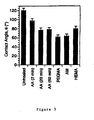
- Silicone disk samples were kept in an atmosphere of high relative humidity for 24 hours prior to room temperature water contact angle measurements using axisymmetric drop shape analysis. Images of sessile water drops were digitized and contact angles determined by minimizing the difference between the proscribed drop volume and the drop volume calculated from the contact diameter of the drop in conjunction with the Laplace equation of capillarity (17) ( Figure 3). A total of 8 measurements on four different surfaces were performed for each treatment.
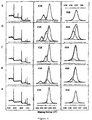
- XPS spectra were recorded on a Leybold MAX 200 XPS system utilizing an unmonochromatized Mg K x-ray source operating at 12 kV and 25 mA with a take-off angle of 90°. Energy range was calibrated against Cu 2p3/2 and Cu 3p at 932.7 eV and 75.1 eV, respectively, and scaled to place the main C peak at 285.0 eV. Binding energy determination and deconvolution of spectra were accomplished using the curve-fitting routines provided with the spectrometer. XPS spectra from two separate samples were recorded for each type of surface modification (Figure 4).
- Example 2 Preparation of modified poly-AA lubrious silicone surface and the lubricious poly-AA-silver salt modified silicone surface
- Silicone foley catheters coated with a lubricious poly (AA) coating containing silver ion was prepared in accordance with the following steps:
- the silicone material may alternatively be placed in aqueous silver lactate solution (2 - 200 mM, preferably 150 mM) and autoclaved at 15 psi for 20 minutes to yield silver lactate bound to the acrylate coating which is non-lubricious but anti-microbial acrylate coating.
- Figure 5 illustrates the anti-microbial activity of the polyacrylate-silver coating on silicone against Pseudomonasaeruginose .
- the greatest anti-microbial activities were produced by loading silver lactate in pH 5 and pH 8.5 solutions onto the surface of the silicone treated with 100% acrylate. Loading of silver salts at pH values higher or lower than those taught herein produce a surface showing substantial anti-microbial activity.
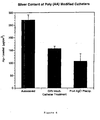
- Figure 6 shows the loading of silver salt, silver lactate, on poly-acrylic acid modified catheters.
- Example 3 Poly-AA coated silicone sheets and catheters with attached gelatin-polyethylene hydrogel containing silver chloride
- the poly (AA) coated silicone sheets and catheters with attached gelatin-polyethylene oxide hydrogel containing silver chloride were prepared as follows:
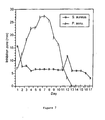
- Figure 7 illustrates the'anti-microbial activity of hydrogel coatings; liposome-150mM silver lactate hydrogel (1: liposome silver hydrogel) as compared to hydrogel without silver lactate (2: control hydrogel), hydrogel dipped in solution of 150mM silver lactate (3: silver hydrogel), and filter paper dipped in 150 mM silver lactate (4: silver filter paper), against Pseudomonasaeruginose and Methicillin resistant Staphylococcus Aureus (MRSA).
- MRSA Methicillin resistant Staphylococcus Aureus
- Poly (AA)-silver coated stents were prepared as follows:
- the modified polyurethane surface contains silver ion bound to the acrylate coating and dissolved in the water associated with the coating.
- the lubricity of the coating relative to unmodified polyurethane is illustrated in Table 2. Also, note the relatively non-lubricious nature of non-ionized poly (AA) coatings and ionized poly (AA) coatings that were not dipped in sodium lactate before immersion in silver solution. Lubricity of polyurethane stents (7 French) with and without polyacrylate (PAA) coatings. Sample Friction (N) Unmodifed 3.3 ⁇ 0.2 PAA (ionized) 0.45 ⁇ 0.08 PAA (non-ionized) 3.8 ⁇ 0.5 PAA + Ag-Lac. (10 mM)2.2 ⁇ 0.5 PAA + Na-Lac. + Ag-Lac. (10 mM)0.46 ⁇ 0.11
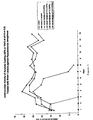
- Anti-microbial activity of polyacrylate-silver coated stents is shown in Figure 8. Growth inhibition zones were produced for extended periods with respect to both gram negative and positive species. Note that the width of stent pieces were approximately 2 mm. The same test sample was used and transferred daily to a new agar plate.
Landscapes
- Health & Medical Sciences (AREA)
- Life Sciences & Earth Sciences (AREA)
- Epidemiology (AREA)
- Veterinary Medicine (AREA)
- Public Health (AREA)
- General Health & Medical Sciences (AREA)
- Animal Behavior & Ethology (AREA)
- Medicinal Chemistry (AREA)
- Chemical & Material Sciences (AREA)
- Molecular Biology (AREA)
- Biomedical Technology (AREA)
- Engineering & Computer Science (AREA)
- Surgery (AREA)
- Oral & Maxillofacial Surgery (AREA)
- Transplantation (AREA)
- Heart & Thoracic Surgery (AREA)
- Dermatology (AREA)
- Vascular Medicine (AREA)
- Materials For Medical Uses (AREA)
- Treatments Of Macromolecular Shaped Articles (AREA)
- Prostheses (AREA)
- Addition Polymer Or Copolymer, Post-Treatments, Or Chemical Modifications (AREA)
- Coating Of Shaped Articles Made Of Macromolecular Substances (AREA)
Abstract
Description
- The present invention relates to methods for making modified lubricious anti-microbial polymeric surfaces. Specifically, the present invention is directed to methods for the modification of the surfaces of polymeric materials with acrylic polymer coatings that may be subsequently treated to produce a low friction anti-microbial surface. The invention also relates to anti-microbial polymeric composite products.
- Throughout this application, various references .are cited in parentheses to describe more fully the state of the art to which this invention pertains. Full bibliographic information for each citation is found at the end of the specification, immediately preceding the claims.
- The use of implanted medical devices is a vital component of current clinical practice, however, complications may arise from their use. Common complications are the physical trauma to the patient's tissues resulting from insertion and continued use of the device, as well as the potential for the device to serve as a focus for microbial contamination and thus, a possible source for microbial infection of the patient. In fact, these complications are often associated since the placement of a medical device, such a urethral catheter or ureteral stent, may cause tearing and bleeding of delicate tissues thereby creating an opportunity for infection through microbial contamination of the device or through subsequent migration of microbes along the device's surface. It has therefore been an object to develop better quality indwelling biomedical devices made from materials that provide for clinical advantages to a patient.
- In response to the problem of insertion-related trauma, polymeric medical devices have been coated with various hydrophilic polymers to produce a more low friction or lubricious coating on the device. The coated devices have high friction surfaces when dry, but upon wetting the device becomes slippery and can be more readily inserted into veins, arteries, and other passageways causing minimal tissue damage. However, the methods to apply hydrophilic-coating processes as well as the coatings themselves possess several distinct disadvantages, any one of which can significantly diminish the value of the end product. First, and perhaps foremost, is the inability to produce a permanent lubricious coating, as many coatings will erode after only a limited exposure to an aqueous environment (1). Also, most of the current coating processes are resource-intensive procedures since they consist of at least two steps that require multiple compounds and organic solvents to produce the lubricious layer (2-4). Finally, many processes are incompatible with the use of various bio-active agents since they involve the use of organic solvents or a high temperature curing step (5,6). Even if the bio-active agent is compatible with other components of the coating, the capacity of the lubricious coating to allow for extended release of the agent is often limited because either the coating sloughs off or there is little inherent affinity between the coating and the agent.
- Many of the polymers used to make medical devices are chemically inert requiring the introduction of reactive chemical groups to the polymeric surface in order to provide a more desirable bioactive surface. There are reports describing surface modification of polymers containing reactive functional groups introduced through the inclusion of derivatized monomers in the initial polymer formulation (7-9). While this approach may yield adequate results, there are issues of convenience and the bulk properties of the polymer may be adversely affected. Similarly, surface modification using plasma discharge (10) and γ-irradiation (11) techniques as described for example in U.S. Patent 5,885,566 may not always be practical because of the need for specialized equipment and the propensity for alteration of bulk material properties. Also, none of the above-mentioned procedures allow for precise spatial control of the surface modification reaction.
- Surface graft polymerization using long-wave ultraviolet (UV) light has been shown to be an efficient and convenient method for modifying polymer surfaces with the added benefit of micro-regional control through the use of projection masks (12). One common strategy for surface photografting uses benzophenone and related molecules to abstract hydrogen atoms from the polymer surface, thereby creating surface-bound radicals capable of initiating graft polymerization of monomers in the vapour phase or in solution (13,14). U.S. Patent 6,248,811 discloses surface grafting of a coating polymer to a portion of the a surface of a substrate using UV radiation. The resultant surface may be antibacterial and further inhibit or promote cell proliferation.
- Attempts have also been made to add and-microbial agent(s) to a surface modified polymer as is disclosed for example in U.S. 5,788,687 in which the anti-microbial agents acetohydroxamic acid and magnesium ammonium phosphate hexahydrate are released upon a change of pH from a polymer hydrogel that is coated onto a polymeric surface.
- Silver is known to have general anti-microbial properties directed against a wide range of bacteria and fungi and has been used for many years in clinical settings and particularly on a wide range of medical devices which include coatings for catheters, cuffs, orthopedic implants, sutures, dental amalgams and wound dressings. As a coating on catheters silver has been demonstrated to reduce the incidence of infection associated with the use of such devices. Both silver alloy and silver oxide has been used to coat urinary catheters and are somewhat effective in preventing urinary tract infections (15). However, the use of silver as a prophylactic against infection in general, has not found widespread application because of problems associated with inadequately coating device surfaces, poor solubility of metallic silver and silver oxides, short half-life, rapid binding of silver ions and inactivation by proteins and light-mediated inactivation and discoloration, and slow release of silver ions from the metallic complex.
- EP-A-0872512 is directed to a method for modifying surfaces of polymer substrates by grafting polymerization. In the method a polymer substrate is pretreated with a photoinitiator or thermoinitiator prior to the grafting with at least one ethylenically unsaturated monomer. Another monomer(s) can be further grafted onto the polymer substrate. This further monomer(s) may be identical or different from the monomer first employed for the pretreatement.
- Di Tizio et. al. Biomatierials 19 (1998) is directed to a liposomal hydrogel system that comprises a polyethylene glycol-gelatin hydrogel containing liposomes sequestering an antibiotic for use on implanted medical devices. The hydrogel system is cross-linked to a silicone surface of a medical device.
- WO 00/09173 is directed to compositions employing silver compounds complexed with an amine associated with a hydrophilic polymer.
- Thus, there is a need to develop a method to effectively modify the surface of polymeric materials, which form the basis for clinically used medical devices, in a manner such that the surface is lubricious and can further be modified to have anti-microbial properties in a manner that obviates at least one problem with that of the prior art.
- The present invention provides methods for making modified lubricious and anti-microbial polymeric surfaces on polymeric materials. Specifically, the present invention provides methods for the modification of the surfaces of polymeric materials with stable polymer coatings to make the surfaces more biocompatible and lubricious and further treated with a desired silver agent or silver component in order to produce a lubricious anti-microbial surface.
- The methods of the invention preferably aim to modify the surfaces of a wide variety of polymeric materials such as for example silicone rubber that are used clinically in vivo with polymer coatings treated with silver salts for the provision of anti-microbial surfaces in order to prevent, ameliorate and treat bacterial and fungal infections in humans and mammals.
- The methods of the present invention have particular use for providing anti-microbial polymeric materials, preferably silicone materials and most preferably poly(dimethylsiloxane)-based polymers. Such polymers are typically used clinically in a variety of medical devices including in-dwelling medical devices and devices in general which include but are not limited to dressings, pins, clips, cathers, stents, implants, tubings and the like. The method can be conveniently used with a wide variety of silver salts leading to the slow and continued release of the silver from the surface of the device for a long effective period of time. The method conveniently loads a great amount of silver such that it can be released for a long and effective period of time.
- The scope of the present invention is defined in the appended claims. The invention provides polymeric composite products as such, as well as methods for making a lubricious anti-microbial modified surface on a polymeric material.
- The present invention will be further understood from the following description with reference to the Figures, in which:
- Figure 1(A) shows the amount of poly (acrylic acid [AA]) grafted onto poly (dimethylsiloxane) [PDMS] as a function of UVA irradiation time. Samples were initially coated with 10 mM p-benzoyl tert-butylperbenzoate (BPB). AA concentration in the BPB-saturated aqueous solution was 50 mg/mL (694 mM). Figure 1(B) shows poly (AA) grafting extent with respect to initial monomer concentration. Samples were coated with 10 mM BPB and exposed to UVA light for 20 minutes.
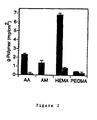
- Figure 2 shows grafting yields of various polymers onto PDMS as a function of BPB pre-coating (100 mM) or BPB presence in the monomer solution. Monomer concentration was 694 mM and samples were exposed to UVA light for 20 minutes.
- Figure 3 shows the water contact angles of various types of surface modified silicone measured by the axisymmetric drop shape analysis technique. Samples were coated with 100 mM BPB and exposed to UVA light for 20 minutes unless otherwise noted.
- Figure 4 shows low and high resolution XPS spectra of (A) PDMS, (B) PDMS-g-poly (AA), (C) PDMS-g-poly (polyethylenglycol methacrylate [PEGMA]), (D) PDMS-g-poly (hydroxyethyl methacrylate [HEMA]) and (E) PDMS-g-poly (acrylamide [AM]). Samples were obtained from 100 mM BPB pre-coating and 20 min UVA exposure time.
- Figure 5 illustrates the anti-microbial activity of the polyacrylate-silver coating on silicone against Pseudomonasaeruginose.
- Figure 6 illustrates the initial loading of silver salt on poly (AA)-modified catheters obtained by autoclaving in 150mM silver lactate (Autoclaved) solution, or incubating overnight (O/N incub.) or incubation in 150 mM Nacl overnight, followed by a 2 hour incubation in 150 mM silver lactate solution (AgCl precip.).
- Figure 7 illustrates the extended anti-microbial activity of gelatin-poly (ethylene oxide) coatings against Pseudomonasaeruginose and Staphylococcus Aureus'.
- Figure 8 illustrates the anti-microbial activity of the polyacrylate-silver coating on polyurethane stents against Pseudomonasaeruginose and Staphylococcus Aureus.
-
- In the drawings, preferred embodiments of the invention are illustrated by way of example. It is to be expressly understood that the description and drawings are for the purpose of illustration and as an aid to understanding, and are not intended as a definition of the limits of the invention.
- The present invention provides a mild, efficient and effective method for permanently modifying the surface of chemically inert polymers with polyacrylate coatings which are made lubricious and endowed with anti-microbial properties. As such, the method provides for a polymeric composite that has a stable hydrophilic bio-active surface which is provided to possess the characteristics of lubricity and anti-microbial properties.
- The chemically inert polymers for use in the invention are those that are used and desirable to fabricate various types of in-dwelling devices. Examples of in-dwelling devices include but are not limited to implants, catheters, stents, wound dressing, cardiac valves, pins, clamps, tubings and the like can be used in the practice of the invention. As such, polymers that can be surface modified according to the present invention include all polymeric substrates such as polyurethanes, polyamides, polyesters, polyethers, polyorganosiloxanes, polysulfones, polytetrafluoroethylene, polysiloxanes and the like.
- The method specifically involves adding hydrophilic coatings such as polyacrylate to the surface of inert polymers such as poly (dimethylsiloxane)-based polymers (silicone) through the use of long wavelength UV radiation (300-400 nm) and a photo-initiator such as for example p-benzoyl tert-butylperbenzoate (BPB).
- The method comprises an initial step of free radical-mediated graft polymerization of acrylic acid or various other acrylates on photo-initiator-coated polymer surfaces placed in aqueous solutions of monomer and exposed to UV light (365 nm). The photo-initiator is coated onto the surface of selected polymeric material by incubating the polymeric material in a methanolic solution of photo-initiator for a time sufficient that the photo-initiator will adhere to the polymeric surface. Any means of providing a photo-initiator coated polymeric material will work in the method of the present invention. This is followed by air-drying of the photo-initiator coated polymeric material.
- When working with silicone as the substrate polymer, grafting levels of nearly 1 mg/cm2 are achieved with as little as 2 minutes of irradiation time using aqueous AA (5 wt%). One skilled in the art can appreciate that the level of grafting may be controlled by adjustment of photo-initiator and monomer concentrations, as well as duration of irradiation. The poly (AA) coating so produced is hydrophilic but not very lubricious.
- To produce a lubricous surface, the poly (AA) coating is ionized in an aqueous base solution having a pH of greater than about 8.0. Suitable aqueous bases for use include but are not limited to disodium tetraborate (borate buffer), sodium carbonate, hydroxides such ammonium hydroxide, calcium hydroxide, sodium hydroxide and mixtures thereof.
- Ionization of the poly(AA) coating produces a negatively charged surface. The negatively charged surface is then saturated with cations to prepare the surface for coating with the antimicrobial agent. Saturation can be effected by immersion in an appropriate electrolyte solution such as for example but not limited to sodium lactate, sodium citrate, disodium phosphate, potassium lactate, potassium citrate, dipotassium phosphate and mixtures thereof. One skilled in the art would readily understand the type of cation-saturating electrolyte solution that can be used in the method of the invention. It is important to note however, that the nature of the anion of the cation saturating solution should be such that it forms a complex with silver ions that is at least slightly soluble. This is why sodium lactate works well because silver lactate is a relatively soluble salt.
- Suitable photo-initiators for use in the methods of the invention include but are not limited to peresters, α-hydroxyketones, benzil ketals, benzoins and their derivatives and mixtures thereof. Specifically, suitable photo-initiators may be selected from 2,2-dimethoxy-2-phenyl-acetophenone (DPA), p-benzoyl tert-butylperbenzoate (BPB) and mixtures thereof. One skilled in art would readily understand the type of photo-initiator that can be used in the method of the invention.
- Suitable monomers for use in the present invention for the modification of the polymeric material surfaces include but are not limited to monomers sensitive to the presence of free radicals, that is, monomers capable of free radical polymerization such as acrylic acid, methacrylic acid, 2-carboxyethyl acrylate, 4-vinylbenzoic acid, itaconic acid, and mixtures thereof. The preferred monomer is acrylic acid.
- The UV radiation for use in the method of the invention can be for example in the wavelength range of about 100nm to 400nm, more preferably about 200nm to 400nm, and more preferably from 300 to 400 nm.
- It is demonstrated that the photosensitive perester BPB leads to significant graft polymerization onto PDMS in a surface photografting reaction. It is further demonstrated that a BPB coating on PDMS can induce extensive graft polymerization of a number of hydrophilic monomers in an aqueous solution when exposed to 365 nm UV light.
- In a further embodiment of the invention the surface modified material is incubated in a selected silver component such as a silver salt solution to produce an anti-microbial surface that releases silver ions. In one aspect, the ionized poly (AA) modified polymeric material is incubated in a concentrated solution of sodium lactate (0.1M to 1.0M) for about 10 to 60 minutes, most preferably about 30 minutes. The materials are then transferred to a selected silver salt solution (i.e. silver lactate) for about 5 to 120 seconds, preferably about 60 seconds, in order to produce an anti-microbial surface that retains silver ions and slowly releases them over an extended period. Should a silver solution be applied directly to the ionized polyacrylate coating then surface lubricity is lost. Therefore, pre-soaking in sodium lactate or any suitable cation-saturating electrolyte solution such as sodium acetate, sodium citrate, sodium benzoate, sodium salicylate, sodium thiosulfate, disodium phosphate and/or their potassium salt versions as is understood by one of skill in the art prior to application of a silver solution is required to maintain surface lubricity.
- Without being constrained to any particular theory, the loss of lubricity may be explained by complex formation of the ionized polyacrylate carboxyl groups with positively charged silver ions; assuming that the surface lubricity is the result of the mutual repulsion of the many ionized polyacrylate chains grafted onto the substrate surface. Thus, the sodium lactate immersion step results in a large excess of sodium ions present in the polyacrylate coating which compete for carboxyl binding sites and prevent all of the silver ions binding to and deactivating the polyacrylate coating. The inability of sodium ions to reduce lubricity of polyacrylate coatings may be due to the much stronger affinity of polyacrylate carboxylates for silver ion. Also, silver ions may ligand multiple carboxylate sites.
- In a further embodiment, the invention provides an acrylate-modified silicone surface to which a silver salt-containing liposome-gelatin-polyethylene oxide hydrogel is covalently attached to release silver ions for treating, ameliorating and/or preventing bacterial and fungal infections in humans and mammals. Polyacrylate-coated materials are activated for covalent binding to gelatin-poly (ethylene oxide) hydrogels by initial immersion in a solution of carbodiimide. The adhesion of the hydrogel coating to a surface-modified silicone material was found to increase approximately fifty-fold relative to unmodified silicone.
- The binding of silver salts and the covalent binding of gelatin-poly (ethylene oxide) hydrogel containing silver salts encapsulated within liposomes to the surface of poly (acrylic acid)-grafted silicone samples acts to provide a source of readily available silver ions for the treatment and prevention of bacterial and fungal infections in humans and mammals. The manufacture and use of silver salts encapsulated within liposomes is disclosed in the co-inventor's co-pending United States Patent Application Serial No. 60/159,427 filed October 14, 1999. The manufacture of liposome-poly (ethylene oxide)-gelatin hydrogel for use in the methods of the present invention is disclosed in co-owned U.S. Patent No. 6,132,765. The adhesion of the hydrogel coating to the surface-modified silicone was found to increase approximately fifty-fold relative to unmodified silicone.
- The silver component for use in the methods of the invention is a silver salt. Most preferred silver salts for use in the present invention include silver phosphate, silver citrate, silver lactate and mixtures thereof. However, other silver salts are suitable for use in the present invention and include but are not limited to silver acetate, silver benzoate, silver chloride, silver carbonate, silver iodide, silver iodate, silver nitrate, silver laurate, silver sulfadiazine, silver palmitate and mixtures thereof. The silver may be also incorporated within the hydrogel by encapsulation or association with pharmaceutical carriers such as liposomes, micelles, microcapsules, microspheres, nanospheres and mixtures thereof.
- In summary, the methods of present invention provide a surface modified and lubricous polymeric material that has use as an in-dwelling device for a variety of different clinical applications. The methods are mild and efficiently modify polymeric surfaces in an easy and reliable manner. Furthermore, such surfaces are also provided as lubricious in order to facilitate their clinical in vivo use. Lastly, the modified surfaces are made to be antibacterial and/or anti-fungal in order to ameliorate and/or prevent and minimize and bacterial and/or fungal infection that can further compromise a patient.
- The examples are described for the purposes of illustration and are not intended to limit the scope of the invention.
- Methods of synthetic chemistry, biochemistry, molecular biology and histology referred to but not explicitly described in this disclosure and examples are reported in the scientific literature and are well known to those skilled in the art.
- Pre-weighed silicone disks (approximately 0.7 cm in diameter, 0.2 cm in thickness) or cylindrical sections (approximately 0.5 cm in diameter, 1 cm in length) were incubated in a methanol solution of photo-initiator (BPB; or p-benzoyl benzoic acid, BBA) for 1 hour followed by air drying at about 40°C for 2 hours. Samples were then suspended in vials containing 3 mL of aqueous monomer solution. When required, monomer solutions were saturated with BPB. The aqueous solubility of BPB was 4 µg/mL. All solutions were filtered through 0.22 µm pore filters prior to being flushed with nitrogen for 15 min. Vials were sealed with rubber septa and placed 2.5 cm beneath a pair of UVA bulbs (15 W ea.). Radiation intensity at the sample site was 3.8 mW/cm2 as determined by UV actinometry (16). After completion of the graft polymerization reaction, samples were briefly washed under running water with occasional scrubbing to remove any signs of adsorbed homopolymer. The remaining non-grafted material was removed by overnight incubation in 50% ethanol followed by a 4 hour incubation in water. Samples were dried in a 60°C oven for 16 hours before their weights were determined using a microbalance. Quadruplicate samples of each treatment were analysed in all experiments.
- Free radical-mediated graft polymerization of AA, AM, HEMA, and PEGMA occurred on silicone surfaces when photo-initiator-coated samples were placed in aqueous solutions of monomer and exposed to UV light (Figure 1). Grafting levels of nearly 1 mg/cm2 were achieved with as little as 2 minutes of irradiation time (Figure 1A) using aqueous acrylic acid (5 wt%). The level of grafting could be controlled by adjustment of photo-initiator and monomer concentrations, as well as duration of irradiation (Figure 1B). Table 1 shows grafting of acrylic acid monomer to silicone polymer surface. The grafting of acrylic acid monomer is shown in milligrams (AA) per cm2 of silicone polymer surface. In the presence of BPB grafting is 3.0 mg/cm2, 3.9 mg/cm2 and 2.3 mg/cm2 respectively, for silastic tubing, all silicone Foley catheters and a silicone rubber disk.
Grafting extent of selected samples with respect to silicone source and photo-initiator identity. Sample Photo-initiator (100 mM) Monomer (694 mM) g-Polymer (mg/cm2) Silastic Tubing BPB AA 3.0 ± 0.1 Foley Catheter BPB AA 3.9 ± 0.2 Disk BPB AA 2.3 ± 0.1 Disk BBA AA 0.05 ± 0.04 - Silicone disk samples were kept in an atmosphere of high relative humidity for 24 hours prior to room temperature water contact angle measurements using axisymmetric drop shape analysis. Images of sessile water drops were digitized and contact angles determined by minimizing the difference between the proscribed drop volume and the drop volume calculated from the contact diameter of the drop in conjunction with the Laplace equation of capillarity (17) (Figure 3). A total of 8 measurements on four different surfaces were performed for each treatment.
- XPS spectra were recorded on a
Leybold MAX 200 XPS system utilizing an unmonochromatized Mg K x-ray source operating at 12 kV and 25 mA with a take-off angle of 90°. Energy range was calibrated against Cu 2p3/2 and Cu 3p at 932.7 eV and 75.1 eV, respectively, and scaled to place the main C peak at 285.0 eV. Binding energy determination and deconvolution of spectra were accomplished using the curve-fitting routines provided with the spectrometer. XPS spectra from two separate samples were recorded for each type of surface modification (Figure 4). - Silicone foley catheters coated with a lubricious poly (AA) coating containing silver ion was prepared in accordance with the following steps:
- 1. The silicone sheet or catheter portion was incubated in methanolic solution of photo-initiator (BPB; 20 - 250 mM, preferably 75 mM) for 1 hour at room temperature in the dark.
- 2. The catheters were removed from the BPB solution and air dried at room temperature for 1 hour.
- 3. The silicone material was placed in aqueous solution containing acrylate monomer (0.1 - 1.5 M; preferably 0.7 M of acrylic acid) to which was added a small amount of BPB (10 - 50 µg/mL; preferably 20 µg/mL).
- 4. The solution was bubbled with nitrogen while exposing the silicone material to 350 nm light (from 2 to 60 minutes, preferably 10 minutes.)
- 5. The surface modified silicone was placed in 50% ethanol for one hour followed by immersion in borate buffer (pH 9.0) overnight.
- 6. The lubricious surface-modified silicone was briefly washed in distilled water and placed in sodium lactate solution (200-1000 mM, preferably 500mM) for a short period (2-120 minutes, preferably 20 minutes).
- 7. The surface- modified silicone was placed in aqueous silver lactate solution (1 - 50 mM, preferably 10mM) for 20 minutes. The modified silicone surface contains the silver salt bound to the acrylate coating and dissolved in the water associated with the coating.
-
- The silicone material may alternatively be placed in aqueous silver lactate solution (2 - 200 mM, preferably 150 mM) and autoclaved at 15 psi for 20 minutes to yield silver lactate bound to the acrylate coating which is non-lubricious but anti-microbial acrylate coating.
- Figure 5 illustrates the anti-microbial activity of the polyacrylate-silver coating on silicone against Pseudomonasaeruginose. The greatest anti-microbial activities were produced by loading silver lactate in
pH 5 and pH 8.5 solutions onto the surface of the silicone treated with 100% acrylate. Loading of silver salts at pH values higher or lower than those taught herein produce a surface showing substantial anti-microbial activity. - Figure 6 shows the loading of silver salt, silver lactate, on poly-acrylic acid modified catheters.
- The poly (AA) coated silicone sheets and catheters with attached gelatin-polyethylene oxide hydrogel containing silver chloride were prepared as follows:
- 1. The relevant silicone material portion was incubated in methanolic solution of photo-initiator (BPB; 20 - 250 mM, preferably 75 mM) for 1 hour at room temperature in the dark.
- 2. The silicone was removed from the BPB solution and air dried at room temperature for 1 hour.
- 3. The silicone was placed in aqueous solution containing acrylate monomer (0.1-1.5 M, preferably 0.7 M of acrylic acid) to which was added a small amount of BPB (10-50 µg/mL; preferably 20 µg/mL).
- 4. The solution was bubbled with nitrogen while exposing silicone to 350 nm light (from 2 to 60 minutes, preferably 10 minutes).
- 5. The surface-modified silicone was placed in 50% ethanol and left overnight at room temperature with shaking.
- 6. The silicone was washed in distilled water for 4 hours.
- 7. The silicone was placed in carbodiimide solution (2 - 20 mg/mL preferably 5 mg/mL) for 10 minutes.
- 8. The catheter was removed and placed on rotating apparatus with the long axis rotating and the silicone sheets were placed on a flat surface.
- 9. A small volume of carbodiimide solution (preferably 10µL/cm of catheter) was spread on the silicone surface.
- 10. The silver salt containing liposome hydrogel was prepared according to
the following:
Composition: DPPC (50 mg/ml) 500 mg Cholesterol 263.4 mg Vitamin E 14.7 mg Silver lactate (150 mM) 10.0 ml pH 2 with HCl to convert the silver lactate not retained within liposomes to silver chloride to which was added 10% gelatin (w/v). The mixture was then heated to 45°C until the gelatin was completely dissolved. Then 6-9% bis(nitrophenyl)polyethylene glycol 3400 (NP-PEG), preferably 9% was added and the mixture heated to 45°C to dissolve the NP-PEG. - 11. Silver chloride gel was added to the silicone surface (10 - 200 µL/cm of catheter, preferably 75 µL/cm), while rotating the catheter, or to a 10 cm x 10 cm2 silicone area was added 2-5 mL of silver chloride gel, preferably 1 mL and spread gel evenly over the surface.
- 12. Upon setting of the gel, the coated silicone was incubated at 4°C for 10 minutes.
- 13. The coated silicone was then placed in borate buffer (200 mM; pH 9.0) for 1 hour.
- 14. The catheter was washed in saline solution for 2 hours replacing washing solution after 1 hour.
-
- Figure 7 illustrates the'anti-microbial activity of hydrogel coatings; liposome-150mM silver lactate hydrogel (1: liposome silver hydrogel) as compared to hydrogel without silver lactate (2: control hydrogel), hydrogel dipped in solution of 150mM silver lactate (3: silver hydrogel), and filter paper dipped in 150 mM silver lactate (4: silver filter paper), against Pseudomonasaeruginose and Methicillin resistant Staphylococcus Aureus (MRSA). Note that the width of test hydrogel was 20 mm. The same test sample was used and transferred daily to a new agar plate. The value reported for zone of inhibition is the "actual" diameter of the zone from which 20 has been subtracted.
- Poly (AA)-silver coated stents were prepared as follows:
- 1. The polyurethane stent was incubated in methanolic solution of photo-initiator (DPA; 20 - 250 mM, preferably 100 mM) for 1 minute at room temperature in the dark.
- 2. The stents were removed from the DPA solution and air dried at room temperature for 30 minutes.
- 3. The stents was placed in a DPA-saturated aqueous solution containing acrylate monomer (0.1 - 1.5 M, preferably 0.7 M of acrylic acid).
- 4. The solution was bubbled with nitrogen while exposing the stents to 350 nm light (from 1 to 20 minutes, preferably 2 minutes.)
- 5. The surface modified silicone was washed in 50% ethanol for 1 hour followed by immersion in borate buffer (pH 9.0) overnight.
- 6. The lubricious surface-modified polyurethane material was then briefly washed in distilled water and placed in sodium lactate solution (200 - 1000 mM, preferably 500 mM) for a short period (2 - 120 minutes, preferably 20 minutes).
- 7. The surface-modified stent was immersed in aqueous silver lactate solution (1 - 50 mM, preferably 10 mM) for 1 minute.
-
- The modified polyurethane surface contains silver ion bound to the acrylate coating and dissolved in the water associated with the coating. The lubricity of the coating relative to unmodified polyurethane is illustrated in Table 2. Also, note the relatively non-lubricious nature of non-ionized poly (AA) coatings and ionized poly (AA) coatings that were not dipped in sodium lactate before immersion in silver solution.
Lubricity of polyurethane stents (7 French) with and without polyacrylate (PAA) coatings. Sample Friction (N) Unmodifed 3.3 ± 0.2 PAA (ionized) 0.45 ± 0.08 PAA (non-ionized) 3.8 ± 0.5 PAA + Ag-Lac. (10 mM)2.2 ± 0.5 PAA + Na-Lac. + Ag-Lac. (10 mM)0.46 ± 0.11 - Anti-microbial activity of polyacrylate-silver coated stents is shown in Figure 8. Growth inhibition zones were produced for extended periods with respect to both gram negative and positive species. Note that the width of stent pieces were approximately 2 mm. The same test sample was used and transferred daily to a new agar plate.
-
- 1. Ikada, Y. and Uyama, Y., Surface Grafting. In Lubricating Polymer Surfaces. Technomic, Lancaster, PA, 1993, pp. 111-137.
- 2. U.S. Pat. No. 4,585,666, Lambert, 1986.
- 3. U.S. Pat. No. 5,662,960, Hostettler, F., Rhum, D., Forman, M.R., Helmus, M.N., Ding, N., 1997.
- 4. U.S. Pat. No. 6,306,176, Whitbourne, R.J., 2001.
- 5. U.S. Pat. No. 5,160,790, Elton, R., 1992
- 6. U.S. Pat. No. 5,620,738, Fan, Y.L., Marlin, L., Bouldin, L.M., and Marino, L.M., 1997.
- 7. Saam, J. C.; Mettler, C. M.; Falender, J. R.; Dill, T. J., J. Appl. Polym. Sci. 1979,24,187.
- 8. Cameron, G. G.; Chisholm, M. S., Polymer 1985, 26,437.
- 9. Holohan, A. T.; George, M. H.; Barrie, J. A., Makromol. Chem. Phys. 1994, 195,2965.
- 10. Okada, T. and Ikada, Y., Makromol. Chem. 1991, 192, 1705.
- 11. Yang, J.-S. and Hsiue, G.-H., J. Appl. Polym. Sci. 1996, 61, 221.
- 12. Inoue, H. and Kohama, S., J. Appl. Polym. Sci. 1984, 29, 877.
- 13. Allmer, K.; Hult, A.; Ranby, B., J. Polym. Sci. A: Polym. Chem. 1988, 26, 2099.
- 14. Ulbricht, M.; Riedel, M.; Marx, U., J. Membr. Sci. 1996, 120, 239.
- 15. Saint, S; Elmore, J.G.; Sullivan, S.D.; Emerson, S.S.; Koepsell, T.D.; Am. J. Med. 1998, 105:236-241.
- 16. Zhang, J. Y.; Esrom, H.; Boyd, I. W., Appl. Surf. Sci. 1999, 138-139, 315.
- 17. Moy, E.; Chenga, P.; Policova, Z.; Treppo, S.; Kwok, D.; Mack, D. R.; Sherman, P. M.; Neumann, A. W., Colloids Surfaces 1991, 58,215.
-
Claims (34)
- A polymeric composite comprising;a polymeric body made of a polymeric material selected from the group consisting of polyurethanes, polyamides, polyesters, polyethers, polyorganosiloxanes, polysulfones, polytetrafluoroethylene and polysiloxanes, said polymeric body having a stable polyacrylate modified surface, said surface being hydrophilic, lubricious and having a silver agent rendering said surface anti-microbial.
- The polymeric composite of claim 1, wherein said polymeric material is silicone.
- The polymeric composite of claim 2, wherein said polymeric material is provided as a device selected from the group consisting of implants, catheters, stents, wound dressings, cardiac valves, tubings, pins and clips.
- The polymeric composite of claim 3, wherein said silver agent comprises a silver salt selected from the group consisting of silver lactate, silver phosphate, silver citrate, silver acetate, silver benzoate, silver chloride, silver carbonate, silver iodide, silver iodate, silver nitrate, silver laurate, silver sulfadiazine, silver palmitate and mixtures thereof.
- The polymeric composite of claim 4, wherein said stable polyacrylate modified surface is made by the free radical polymerization of a monomer selected from the group consisting of acrylic acid, methacrylic acid, 2-carboxyethyl acrylate, 4-vinylbenzoic acid, itaconic acid,.and mixtures thereof.
- A method for making a lubricious anti-microbial modified surface on a polymeric material, the method comprising:incubating a photo-initiator-coated polymeric material with an aqueous monomer capable, of free radical polymerization;exposing the incubating polymeric material to UV light creating a modified polymeric surface on said polymeric material;ionizing said modified polymeric surface; andadding a silver agent to said ionized modified polymeric surface.
- The method of claim 6, wherein said polymeric material is selected from the group consisting of polyurethanes, polyamides, polyesters, polyethers, polyorganosiloxanes, polysulfones, polytetrafluoroethylene and polysiloxanes.
- The method of claim 7, wherein said polymeric material is silicone.
- The method of claim 8, wherein said polymeric material is. provided as a device selected from the group consisting of implants, catheters, stents, wound dressings, cardiac valves, tubings, pins and clips.
- The method of claim 9, wherein said monomer is selected from the group consisting of acrylic acid, methacrylic acid, 2-carboxyethyl acrylate, 4-vinylbenzoic acid, itaconic acid, and mixtures thereof.
- The method of claim 10, wherein said photo-initiator is selected from the group consisting of peresters, α-hydroxyketones, benzil ketals, benzoins and their derivatives and mixtures thereof.
- The method of claim 11, wherein said photo-initiator is selected from the group consiting of 2,2-dimethoxy-2-phenyl-acetophenone, p-benzoyl tert-butylperbenzoate and mixtures thereof.
- The method of claim 6, wherein said aqueous monomer additionally comprises a photo-initiator.
- The method of claim 13, wherein said photo-initiator is selected from the group consisting of 2,2-dimethoxy-2-phenyl-acetophenone, p-benzoyl tert-butylperbenzoate and mixtures thereof.
- The method of claim 14, wherein said silver agent is added by immersing said ionized modified polymeric material having an ionized modified surface in a silver salt solution.
- The method of claim 14, wherein a hydrogel is covalently bound to said modified polymeric surface.
- The method of claim 16, wherein said hydrogel comprises a crosslinked matrix of gelatin and poly (ethylene oxide) sequestering a silver agent.
- The method of claim 15 or 17, wherein said silver agent comprises a silver salt selected from the group consisting of silver lactate, silver phosphate, silver citrate, silver acetate, silver benzoate, silver chloride, silver carbonate, silver iodide, silver iodate, silver nitrate, silver laurate, silver sulfadiazine, silver palmitate and mixtures thereof.
- A method for making a lubricious anti-microbial modified surface on a polymeric material, the method comprising:precoating a polymeric material with a photo-initiator;immersing the precoated polymeric material in an aqueous solution of vinyl carboxylic acid monomer and exposing the incubating polymeric material to UV light to create a modified non-lubricious polyacrylate surface on said polymeric material;ionizing said polyacrylate surface of said polymeric material by immersion in an aqueous base;saturating the polyacrylate surface with cations by immersion in an electrolyte solution;providing silver to said cation-saturated polyacrylate surface.
- The method of claim 19, wherein said precoated polymeric material is further washed and dried prior to immersion in monomer.
- The method of claim 19, wherein said polymeric material is selected from the group consisting of polyurethanes, polyamides, polyesters, polyethers, polyorganosiloxanes, polysulfones, polytetrafluoroethylene and polysiloxanes.
- The method of claim 21, wherein said polymeric material is silicone.
- The method of claim 22, wherein said polymeric material is provided as a device selected from the group consisting of implants, catheters, stents, wound dressings, cardiac valves, tubings, pins and clips.
- The method of claim 23, wherein said monomer is selected from the group consisting of acrylic acid, methacrylic acid, 2-carboxyethyl acrylate, 4-vinylbenzoic acid, itaconic acid, and mixtures thereof.
- The method of claim 24, wherein said photo-initiator is selected from the group consisting of peresters, α-hydroxyketones, benzil ketals, benzoins and their derivatives and mixtures thereof.
- The method of claim 25, wherein said photo-initiator is selected from the group consiting of 2,2-dimethoxy-2-phenyl-acetophenone, p-benzoyl tert-butylperbenzoate and mixtures thereof.
- The method of claim 26, wherein said aqueous monomer solution additionally comprises a photo-initiator.
- The method of claim 27, wherein said photo-initiator is selected from the group consisting of 2,2-dimethoxy-2-phenyl-acetophenone, p-benzoyl tert-butylperbenzoate and mixtures thereof.
- The method of claim 28, wherein silver is provided by immersing said ionized polymeric material in a silver salt solution.
- The method of claim 28, wherein silver is provided by covalently binding a hydrogel to said ionized polyacrylate surface, said hydrogel sequestering a silver salt.
- The method of claim 29 or 30, wherein said silver salt is selected from the group consisting of silver lactate, silver phosphate, silver citrate, silver acetate, silver benzoate, silver chloride, silver carbonate, silver iodide, silver iodate, silver nitrate, silver laurate, silver sulfadiazine, silver palmitate and mixtures thereof.
- The method of claim 19, wherein said neutralizing electrolyte solution has a pH of at least about 8.0.
- The method of claim 32, wherein said cation-saturating electrolyte solution is selected from the group consisting of sodium lactate, sodium acetate, sodium citrate, disodium phosphate, potassium acetate, potassium citrate, dipotassium phosphate and mixtures thereof.
- The method of claim 33, wherein said electrolyte solution is sodium lactate.
Applications Claiming Priority (3)
| Application Number | Priority Date | Filing Date | Title |
|---|---|---|---|
| US27170201P | 2001-02-28 | 2001-02-28 | |
| US271702P | 2001-02-28 | ||
| PCT/CA2002/000246 WO2002070022A2 (en) | 2001-02-28 | 2002-02-26 | Method of making anti-microbial polymeric surfaces |
Publications (2)
| Publication Number | Publication Date |
|---|---|
| EP1363684A2 EP1363684A2 (en) | 2003-11-26 |
| EP1363684B1 true EP1363684B1 (en) | 2004-11-10 |
Family
ID=23036700
Family Applications (1)
| Application Number | Title | Priority Date | Filing Date |
|---|---|---|---|
| EP02702198A Expired - Lifetime EP1363684B1 (en) | 2001-02-28 | 2002-02-26 | Method of making anti-microbial polymeric surfaces |
Country Status (8)
| Country | Link |
|---|---|
| US (2) | US8840927B2 (en) |
| EP (1) | EP1363684B1 (en) |
| JP (3) | JP2004528418A (en) |
| AT (1) | ATE281849T1 (en) |
| AU (1) | AU2002235694B2 (en) |
| CA (1) | CA2438491C (en) |
| DE (1) | DE60201889T2 (en) |
| WO (1) | WO2002070022A2 (en) |
Cited By (1)
| Publication number | Priority date | Publication date | Assignee | Title |
|---|---|---|---|---|
| CN108904868A (en) * | 2018-08-13 | 2018-11-30 | 安徽创孚医疗科技有限公司 | A kind of preparation method of duplex antibacterial and anticoagulant dressing |
Families Citing this family (97)
| Publication number | Priority date | Publication date | Assignee | Title |
|---|---|---|---|---|
| US8177762B2 (en) | 1998-12-07 | 2012-05-15 | C. R. Bard, Inc. | Septum including at least one identifiable feature, access ports including same, and related methods |
| JP3866579B2 (en) * | 2002-01-25 | 2007-01-10 | 富士フイルムホールディングス株式会社 | Thin metal film |
| US6981877B2 (en) * | 2002-02-19 | 2006-01-03 | Mti Microfuel Cells Inc. | Simplified direct oxidation fuel cell system |
| US20030195610A1 (en) | 2002-04-04 | 2003-10-16 | Herrmann Robert A. | Processes for producing polymer coatings through surface polymerization |
| US20060280785A1 (en) * | 2004-08-11 | 2006-12-14 | Easterly Clay E | Biocidal materials for treatment against pathogens |
| US20060068024A1 (en) * | 2004-09-27 | 2006-03-30 | Schroeder Kurt M | Antimicrobial silver halide composition |
| WO2006096686A1 (en) | 2005-03-04 | 2006-09-14 | C.R. Bard, Inc. | Access port identification systems and methods |
| US7947022B2 (en) | 2005-03-04 | 2011-05-24 | C. R. Bard, Inc. | Access port identification systems and methods |
| US9474888B2 (en) | 2005-03-04 | 2016-10-25 | C. R. Bard, Inc. | Implantable access port including a sandwiched radiopaque insert |
| US8029482B2 (en) | 2005-03-04 | 2011-10-04 | C. R. Bard, Inc. | Systems and methods for radiographically identifying an access port |
| WO2006097109A2 (en) * | 2005-03-17 | 2006-09-21 | Ipu, Instituttet For Produktudvikling | Article to be inserted in a body cavity having biologically inhibiting surfaces |
| EP1874393B1 (en) | 2005-04-27 | 2017-09-06 | C.R.Bard, Inc. | Infusion apparatuses |
| EP2324878B1 (en) | 2005-04-27 | 2014-08-20 | C.R. Bard, Inc. | Infusion apparatuses provided with septum |
| US10307581B2 (en) | 2005-04-27 | 2019-06-04 | C. R. Bard, Inc. | Reinforced septum for an implantable medical device |
| US20070134307A1 (en) * | 2005-06-24 | 2007-06-14 | Xiao T D | Antimicrobial composite and method of manufacture and use |
| US8828077B2 (en) * | 2006-03-15 | 2014-09-09 | Medinol Ltd. | Flat process of preparing drug eluting stents |
| US10188826B2 (en) * | 2006-09-29 | 2019-01-29 | Covidien Lp | Catheters including antimicrobial sleeve and methods of making catheters |
| JP5117702B2 (en) * | 2006-10-12 | 2013-01-16 | 日本コヴィディエン株式会社 | Medical device and method for manufacturing medical device |
| US9642986B2 (en) | 2006-11-08 | 2017-05-09 | C. R. Bard, Inc. | Resource information key for an insertable medical device |
| US9265912B2 (en) | 2006-11-08 | 2016-02-23 | C. R. Bard, Inc. | Indicia informative of characteristics of insertable medical devices |
| US7939578B2 (en) * | 2007-02-23 | 2011-05-10 | 3M Innovative Properties Company | Polymeric fibers and methods of making |
| US8376013B2 (en) | 2008-03-11 | 2013-02-19 | Duke University | Plasmonic assisted systems and methods for interior energy-activation from an exterior source |
| US8513322B2 (en) * | 2007-05-31 | 2013-08-20 | 3M Innovative Properties Company | Polymeric beads and methods of making polymeric beads |
| AU2008281278B2 (en) * | 2007-08-02 | 2012-08-09 | Covalon Technologies Ltd. | Antimicrobial photo-stable coating composition |
| DE102007036685A1 (en) * | 2007-08-03 | 2009-02-05 | Innora Gmbh | Improved drug-coated medical devices their manufacture and use |
| KR101104123B1 (en) | 2007-08-09 | 2012-01-13 | (주) 파루 | Manufacture of Conductive Ink Using Silver Nanogel |
| US8377852B2 (en) * | 2007-10-26 | 2013-02-19 | Dow Corning Corporation | Method of preparing a substrate with a composition including an organoborane initiator |
| US9579496B2 (en) | 2007-11-07 | 2017-02-28 | C. R. Bard, Inc. | Radiopaque and septum-based indicators for a multi-lumen implantable port |
| EP2227228B1 (en) * | 2007-12-12 | 2018-09-19 | 3M Innovative Properties Company | Microstructured antimicrobial film |
| US20090246258A1 (en) * | 2008-03-28 | 2009-10-01 | Piyush Shukla | Antimicrobial and odor adsorbing textile |
| WO2009131931A1 (en) * | 2008-04-21 | 2009-10-29 | 3M Innovative Properties Company | Nitric oxide-releasing compositions, devices and methods |
| CA2728286A1 (en) * | 2008-06-26 | 2009-12-30 | The University Of South Dakota | Antimicrobial polymers and coatings |
| CN102119208B (en) * | 2008-07-14 | 2013-02-13 | 3M创新有限公司 | Method for preparing cleaning solution from hydrogel cleaning concentrate and packaged cleaning concentrate |
| WO2010051494A1 (en) | 2008-10-31 | 2010-05-06 | C.R. Bard, Inc. | Systems and methods for identifying an acess port |
| US8932271B2 (en) | 2008-11-13 | 2015-01-13 | C. R. Bard, Inc. | Implantable medical devices including septum-based indicators |
| US11890443B2 (en) | 2008-11-13 | 2024-02-06 | C. R. Bard, Inc. | Implantable medical devices including septum-based indicators |
| EP2373270B8 (en) | 2009-01-07 | 2023-04-12 | entrotech life sciences, inc. | Chlorhexidine-containing antimicrobial laminates |
| US20100174245A1 (en) * | 2009-01-08 | 2010-07-08 | Ward Dean Halverson | System for pretreating the lumen of a catheter |
| US20100247600A1 (en) * | 2009-03-24 | 2010-09-30 | Warsaw Orthopedic, Inc. | Therapeutic drug eluting implant cover and method of making the same |
| US9414864B2 (en) | 2009-04-15 | 2016-08-16 | Warsaw Orthopedic, Inc. | Anterior spinal plate with preformed drug-eluting device affixed thereto |
| US9078712B2 (en) | 2009-04-15 | 2015-07-14 | Warsaw Orthopedic, Inc. | Preformed drug-eluting device to be affixed to an anterior spinal plate |
| EP2851399B1 (en) | 2009-09-29 | 2017-08-16 | Covalon Technologies Inc. | System and method for coating medical devices |
| US9079004B2 (en) | 2009-11-17 | 2015-07-14 | C. R. Bard, Inc. | Overmolded access port including anchoring and identification features |
| MX2012007209A (en) * | 2009-12-21 | 2012-07-10 | Innovative Surface Technologies Inc | Coating agents and coated articles. |
| CN102782064B (en) | 2009-12-23 | 2015-04-15 | 帝斯曼知识产权资产管理有限公司 | Method for activating the surface of silicone rubber |
| WO2011157758A1 (en) * | 2010-06-15 | 2011-12-22 | Innotere Gmbh | Bone implant comprising a magnesium-containing metallic material with reduced corrosion rate, and methods and kit for producing the bone implant |
| USD682416S1 (en) | 2010-12-30 | 2013-05-14 | C. R. Bard, Inc. | Implantable access port |
| USD676955S1 (en) | 2010-12-30 | 2013-02-26 | C. R. Bard, Inc. | Implantable access port |
| JP5690631B2 (en) | 2011-03-30 | 2015-03-25 | 日本コヴィディエン株式会社 | Lubricating medical device and method for manufacturing the same |
| WO2012165525A1 (en) * | 2011-06-03 | 2012-12-06 | 住友ゴム工業株式会社 | Surface-modifying method and elastic body with modified surface |
| WO2013006947A1 (en) * | 2011-07-08 | 2013-01-17 | Covalon Technologies Inc. | Method for treating a surface with a coating comprising a therapeutic agent and device with treated surface |
| RU2487146C1 (en) * | 2011-11-14 | 2013-07-10 | Государственное Научное Учреждение "Институт Физики Имени Б.И. Степанова Национальной Академии Наук Беларуси" | Method of producing surface-grafted polymer on surface of polymer film |
| JP5763565B2 (en) * | 2012-02-02 | 2015-08-12 | 住友ゴム工業株式会社 | Surface modification method and surface modified elastic body |
| US9352119B2 (en) | 2012-05-15 | 2016-05-31 | Becton, Dickinson And Company | Blood control IV catheter with antimicrobial properties |
| JP5812935B2 (en) * | 2012-05-16 | 2015-11-17 | 住友ゴム工業株式会社 | Surface modification method and surface modified elastic body |
| US10434210B2 (en) * | 2012-07-19 | 2019-10-08 | Innovotech, Inc. | Antimicrobial silver iodate |
| JP6063167B2 (en) * | 2012-08-02 | 2017-01-18 | 住友ゴム工業株式会社 | Surface modification method and surface modified elastic body |
| DE102012016590A1 (en) | 2012-08-14 | 2014-02-20 | Gmbu E.V., Fachsektion Dresden | Bacteria-repellent coating for bacteria-repellent finishing of e.g. biliary stents, has material produced by dissolving or dispersing cholesterol and/or cholesterol compound in fluid, and joint formed between coating and substrate materials |
| US9579486B2 (en) | 2012-08-22 | 2017-02-28 | Becton, Dickinson And Company | Blood control IV catheter with antimicrobial properties |
| JP5977120B2 (en) * | 2012-08-31 | 2016-08-24 | 住友ゴム工業株式会社 | Method for producing slidable elastic body and slidable elastic body |
| JP6247216B2 (en) * | 2012-09-10 | 2017-12-13 | 住友ゴム工業株式会社 | Surface modification method and surface modified elastic body |
| JP5620456B2 (en) | 2012-11-20 | 2014-11-05 | 住友ゴム工業株式会社 | Surface modification method and surface modified elastic body |
| JP6053482B2 (en) * | 2012-11-30 | 2016-12-27 | 住友ゴム工業株式会社 | Manufacturing method of gasket for syringe |
| JP6105292B2 (en) | 2013-01-07 | 2017-03-29 | 住友ゴム工業株式会社 | Surface modification method and surface modified elastic body |
| US9750928B2 (en) | 2013-02-13 | 2017-09-05 | Becton, Dickinson And Company | Blood control IV catheter with stationary septum activator |
| US9695323B2 (en) * | 2013-02-13 | 2017-07-04 | Becton, Dickinson And Company | UV curable solventless antimicrobial compositions |
| DE102013006185A1 (en) | 2013-04-04 | 2014-10-09 | Gmbu E.V., Fachsektion Dresden | Bacteria repellent material and method of manufacture |
| JP5816222B2 (en) | 2013-04-25 | 2015-11-18 | 住友ゴム工業株式会社 | Surface modification method and surface modified elastic body |
| JP6108615B2 (en) * | 2013-05-28 | 2017-04-05 | 住友ゴム工業株式会社 | Adhesion method and surface-modified elastic body |
| JP5797239B2 (en) | 2013-06-11 | 2015-10-21 | 住友ゴム工業株式会社 | Surface modification method for three-dimensional object and gasket for syringe |
| JPWO2014203668A1 (en) | 2013-06-20 | 2017-02-23 | 住友ゴム工業株式会社 | Surface modification method and surface modified body |
| DE102013013908A1 (en) | 2013-08-12 | 2015-02-12 | Gmbu E.V., Fachsektion Dresden | Bacteria-repellent coating and method of manufacture |
| JP5820489B2 (en) | 2014-01-06 | 2015-11-24 | 住友ゴム工業株式会社 | Surface modification method and surface modified elastic body |
| EP3131540B1 (en) | 2014-04-18 | 2023-11-22 | Entrotech, Inc. | Methods of processing chlorhexidine-containing polymerizable compositions and antimicrobial articles formed thereby |
| US9789279B2 (en) | 2014-04-23 | 2017-10-17 | Becton, Dickinson And Company | Antimicrobial obturator for use with vascular access devices |
| US9675793B2 (en) | 2014-04-23 | 2017-06-13 | Becton, Dickinson And Company | Catheter tubing with extraluminal antimicrobial coating |
| US10376686B2 (en) | 2014-04-23 | 2019-08-13 | Becton, Dickinson And Company | Antimicrobial caps for medical connectors |
| KR101675883B1 (en) * | 2014-07-08 | 2016-11-14 | 주식회사 엠아이텍 | Methods for manufacturing stent |
| US10232088B2 (en) | 2014-07-08 | 2019-03-19 | Becton, Dickinson And Company | Antimicrobial coating forming kink resistant feature on a vascular access device |
| JP6338504B2 (en) | 2014-10-02 | 2018-06-06 | 住友ゴム工業株式会社 | Surface modification method and surface modified elastic body |
| US11357651B2 (en) | 2015-03-19 | 2022-06-14 | Nanyang Technological University | Stent assembly and method of preparing the stent assembly |
| US9872938B2 (en) * | 2015-05-22 | 2018-01-23 | Orthobond, Inc. | Methods, compositions and techniques for polydimethylsiloxane surface modifications |
| JP6181710B2 (en) * | 2015-06-19 | 2017-08-16 | 住友ゴム工業株式会社 | Catheter manufacturing method |
| JP6613692B2 (en) * | 2015-08-03 | 2019-12-04 | 住友ゴム工業株式会社 | Surface modification method and surface modified elastic body |
| JP6551022B2 (en) | 2015-08-03 | 2019-07-31 | 住友ゴム工業株式会社 | Surface modification method and surface modified body |
| US10493244B2 (en) | 2015-10-28 | 2019-12-03 | Becton, Dickinson And Company | Extension tubing strain relief |
| WO2017147521A1 (en) | 2016-02-24 | 2017-08-31 | Innovative Surface Technologies, Inc. | Crystallization inhibitor compositions for implantable urological devices |
| EP3984568A1 (en) | 2016-07-14 | 2022-04-20 | Hollister Incorporated | Hygienic medical devices having hydrophilic coatings and methods of forming the same |
| ES3057442T3 (en) | 2017-03-29 | 2026-03-02 | Covalon Tech Ltd | Coating compositions, polymeric coatings, and methods |
| KR102101936B1 (en) * | 2017-10-19 | 2020-04-17 | 서울대학교병원 | Composition for suface modification of medical implants and suface modified medical implants using the same |
| EP3824790B1 (en) | 2018-07-17 | 2023-10-11 | FUJIFILM Corporation | Insertion aid tube composition, insertion aid tube, endoscope/insertion aid tube set, endoscope device, and method for producing insertion aid tube |
| WO2020248072A1 (en) | 2019-06-14 | 2020-12-17 | Covalon Technologies Inc. | Coated devices and related methods |
| CN110804201A (en) * | 2019-11-18 | 2020-02-18 | 中国科学院兰州化学物理研究所 | A kind of hydrogel lubricating catheter and preparation method thereof |
| EP4076725A4 (en) | 2019-12-17 | 2024-04-17 | Covalon Technologies Ltd. | Reactors for coating devices and related systems and methods |
| WO2021191141A1 (en) * | 2020-03-26 | 2021-09-30 | Heiq Materials Ag | Antiviral surface coating for metal and plastic surfaces |
| US20230279239A1 (en) * | 2020-04-02 | 2023-09-07 | Montanuniversität Leoben | Article having a biocidal coating, method of coating an article and use of a biocidal coating |
| CN114099789A (en) * | 2021-11-10 | 2022-03-01 | 西北工业大学 | Near-infrared light-initiated rapid sterilization lubricating anti-adhesion elastic material and preparation method thereof |
Family Cites Families (33)
| Publication number | Priority date | Publication date | Assignee | Title |
|---|---|---|---|---|
| JPS5578027A (en) | 1978-12-08 | 1980-06-12 | Kansai Paint Co Ltd | Surface modification of high polymer base material |
| SE430695B (en) | 1982-04-22 | 1983-12-05 | Astra Meditec Ab | PROCEDURE FOR THE PREPARATION OF A HYDROPHILIC COATING AND ACCORDING TO THE PROCEDURE OF MEDICAL ARTICLES |
| US4603152A (en) * | 1982-11-05 | 1986-07-29 | Baxter Travenol Laboratories, Inc. | Antimicrobial compositions |
| JPS59164342A (en) * | 1983-03-08 | 1984-09-17 | Toyobo Co Ltd | Method for treating synthetic polymer molding |
| US5410016A (en) * | 1990-10-15 | 1995-04-25 | Board Of Regents, The University Of Texas System | Photopolymerizable biodegradable hydrogels as tissue contacting materials and controlled-release carriers |
| US5160790A (en) | 1990-11-01 | 1992-11-03 | C. R. Bard, Inc. | Lubricious hydrogel coatings |
| JPH04236242A (en) * | 1991-01-18 | 1992-08-25 | Mitsubishi Rayon Co Ltd | Molded article and production thereof |
| JP2907575B2 (en) | 1991-04-05 | 1999-06-21 | 三菱製紙株式会社 | Antimicrobial film and method for producing the same |
| US5232748A (en) * | 1991-10-21 | 1993-08-03 | Polymer Research Corp. Of America | Method of grafting polymerizable monomers onto substrates |
| JPH05184665A (en) * | 1992-01-10 | 1993-07-27 | Nissho Corp | Medical guide wire |
| JP3233677B2 (en) * | 1992-05-11 | 2001-11-26 | テルモ株式会社 | Medical devices surface modified by surface polymerization |
| JP3294335B2 (en) * | 1992-10-07 | 2002-06-24 | テルモ株式会社 | Modification method of crystalline polymer material |
| US5344455A (en) | 1992-10-30 | 1994-09-06 | Medtronic, Inc. | Graft polymer articles having bioactive surfaces |
| US5800373A (en) * | 1995-03-23 | 1998-09-01 | Focal, Inc. | Initiator priming for improved adherence of gels to substrates |
| US5788687A (en) * | 1994-02-01 | 1998-08-04 | Caphco, Inc | Compositions and devices for controlled release of active ingredients |
| US5662960A (en) | 1995-02-01 | 1997-09-02 | Schneider (Usa) Inc. | Process for producing slippery, tenaciously adhering hydrogel coatings containing a polyurethane-urea polymer hydrogel commingled with a poly (n-vinylpyrrolidone) polymer hydrogel |
| US5620738A (en) | 1995-06-07 | 1997-04-15 | Union Carbide Chemicals & Plastics Technology Corporation | Non-reactive lubicious coating process |
| US6132765A (en) * | 1996-04-12 | 2000-10-17 | Uroteq Inc. | Drug delivery via therapeutic hydrogels |
| US5885566A (en) * | 1996-09-25 | 1999-03-23 | University Of Florida | Surface modified surgical instruments, medical devices, implants, contact lenses and the like |
| EP0860213A3 (en) * | 1997-01-03 | 2002-10-16 | Therapol SA | Bioactive coating on surfaces |
| US5997517A (en) | 1997-01-27 | 1999-12-07 | Sts Biopolymers, Inc. | Bonding layers for medical device surface coatings |
| DE59800682D1 (en) * | 1997-04-14 | 2001-06-13 | Degussa | Process for modifying the surface of polymer substrates by graft polymerization |
| JPH11290449A (en) * | 1998-04-08 | 1999-10-26 | Toyobo Co Ltd | Antibacterial urine introducing catheter |
| EP0893164A2 (en) | 1997-06-28 | 1999-01-27 | Hüls Aktiengesellschaft | Bioactive coating of surfaces using crosslinking agents |
| US6221425B1 (en) * | 1998-01-30 | 2001-04-24 | Advanced Cardiovascular Systems, Inc. | Lubricious hydrophilic coating for an intracorporeal medical device |
| TW473488B (en) * | 1998-04-30 | 2002-01-21 | Novartis Ag | Composite materials, biomedical articles formed thereof and process for their manufacture |
| ATE266429T1 (en) * | 1998-08-14 | 2004-05-15 | Coloplast As | STABILIZED COMPOSITIONS WITH ANTIBACTERIAL EFFECTIVENESS |
| US6358557B1 (en) * | 1999-09-10 | 2002-03-19 | Sts Biopolymers, Inc. | Graft polymerization of substrate surfaces |
| AU770404B2 (en) * | 1999-09-22 | 2004-02-19 | Surmodics, Inc. | Water-soluble coating agents bearing initiator groups and coating process |
| US6716895B1 (en) * | 1999-12-15 | 2004-04-06 | C.R. Bard, Inc. | Polymer compositions containing colloids of silver salts |
| US7348055B2 (en) * | 2001-12-21 | 2008-03-25 | Surmodics, Inc. | Reagent and method for providing coatings on surfaces |
| WO2008128647A1 (en) | 2007-04-23 | 2008-10-30 | Sanofi-Aventis | Quinoline-carboxamide derivatives as p2y12 antagonists |
| JP5184665B2 (en) | 2011-02-22 | 2013-04-17 | 京セラ株式会社 | Transmitting apparatus and transmitting method |
-
2002
- 2002-02-26 CA CA2438491A patent/CA2438491C/en not_active Expired - Lifetime
- 2002-02-26 DE DE60201889T patent/DE60201889T2/en not_active Expired - Lifetime
- 2002-02-26 EP EP02702198A patent/EP1363684B1/en not_active Expired - Lifetime
- 2002-02-26 JP JP2002569193A patent/JP2004528418A/en not_active Withdrawn
- 2002-02-26 AU AU2002235694A patent/AU2002235694B2/en not_active Ceased
- 2002-02-26 AT AT02702198T patent/ATE281849T1/en not_active IP Right Cessation
- 2002-02-26 US US10/468,438 patent/US8840927B2/en not_active Expired - Fee Related
- 2002-02-26 WO PCT/CA2002/000246 patent/WO2002070022A2/en not_active Ceased
- 2002-02-27 US US10/083,737 patent/US6808738B2/en not_active Expired - Lifetime
-
2008
- 2008-02-12 JP JP2008030333A patent/JP2008174751A/en active Pending
- 2008-10-16 JP JP2008267643A patent/JP5064350B2/en not_active Expired - Lifetime
Cited By (1)
| Publication number | Priority date | Publication date | Assignee | Title |
|---|---|---|---|---|
| CN108904868A (en) * | 2018-08-13 | 2018-11-30 | 安徽创孚医疗科技有限公司 | A kind of preparation method of duplex antibacterial and anticoagulant dressing |
Also Published As
| Publication number | Publication date |
|---|---|
| CA2438491C (en) | 2012-11-27 |
| CA2438491A1 (en) | 2002-09-12 |
| WO2002070022A3 (en) | 2003-01-16 |
| WO2002070022A2 (en) | 2002-09-12 |
| EP1363684A2 (en) | 2003-11-26 |
| AU2002235694B2 (en) | 2007-06-14 |
| US20020161065A1 (en) | 2002-10-31 |
| ATE281849T1 (en) | 2004-11-15 |
| DE60201889T2 (en) | 2006-04-06 |
| JP2008174751A (en) | 2008-07-31 |
| JP2009030074A (en) | 2009-02-12 |
| US20040086568A1 (en) | 2004-05-06 |
| JP2004528418A (en) | 2004-09-16 |
| JP5064350B2 (en) | 2012-10-31 |
| DE60201889D1 (en) | 2004-12-16 |
| US6808738B2 (en) | 2004-10-26 |
| US8840927B2 (en) | 2014-09-23 |
Similar Documents
| Publication | Publication Date | Title |
|---|---|---|
| EP1363684B1 (en) | Method of making anti-microbial polymeric surfaces | |
| AU2002235694A1 (en) | Method of making anti-microbial polymeric surfaces | |
| US20110212152A1 (en) | Modified anti-microbial surfaces, devices and methods | |
| US11912894B2 (en) | Antimicrobial and antifouling conformal hydrogel coatings | |
| CA2486003C (en) | Silane coating composition | |
| CN102947376B (en) | Coating formulations for the preparation of hydrophilic coatings | |
| JP5618460B2 (en) | Antimicrobial coatings for inhibition of bacterial adhesion and biofilm formation | |
| EP2178990B1 (en) | Antimicrobial photo-stable coating composition | |
| WO2010065960A2 (en) | Non-fouling, anti-microbial, anti-thrombogenic graft-from compositions | |
| CN101460201A (en) | Polymer matrix, use thereof and method for producing the polymer matrix | |
| NL2031339B1 (en) | Antibacterial coating formed by copolymerization of chlorhexidine and catecholamine as well as preparation method and application thereof | |
| Yazdani-Ahmadabadi et al. | Robust nanoparticle-derived lubricious antibiofilm coating for difficult-to-coat medical devices with intricate geometry | |
| CN105555806B (en) | Medical or beast medical apparatus surface modification | |
| Alvarez-Lorenzo et al. | Drug/medical device combination products with stimuli-responsive eluting surface | |
| Patra et al. | by In-situ grafting of Nanosilver Nanohydrogel | |
| Griesser et al. | Modifying biomaterial surfaces with bioactives to control infection |
Legal Events
| Date | Code | Title | Description |
|---|---|---|---|
| PUAI | Public reference made under article 153(3) epc to a published international application that has entered the european phase |
Free format text: ORIGINAL CODE: 0009012 |
|
| 17P | Request for examination filed |
Effective date: 20030827 |
|
| AK | Designated contracting states |
Kind code of ref document: A2 Designated state(s): AT BE CH CY DE DK ES FI FR GB GR IE IT LI LU MC NL PT SE TR |
|
| AX | Request for extension of the european patent |
Extension state: AL LT LV MK RO SI |
|
| 17Q | First examination report despatched |
Effective date: 20031222 |
|
| GRAP | Despatch of communication of intention to grant a patent |
Free format text: ORIGINAL CODE: EPIDOSNIGR1 |
|
| GRAS | Grant fee paid |
Free format text: ORIGINAL CODE: EPIDOSNIGR3 |
|
| GRAA | (expected) grant |
Free format text: ORIGINAL CODE: 0009210 |
|
| AK | Designated contracting states |
Kind code of ref document: B1 Designated state(s): AT BE CH CY DE DK ES FI FR GB GR IE IT LI LU MC NL PT SE TR |
|
| PG25 | Lapsed in a contracting state [announced via postgrant information from national office to epo] |
Ref country code: AT Free format text: LAPSE BECAUSE OF FAILURE TO SUBMIT A TRANSLATION OF THE DESCRIPTION OR TO PAY THE FEE WITHIN THE PRESCRIBED TIME-LIMIT Effective date: 20041110 Ref country code: BE Free format text: LAPSE BECAUSE OF FAILURE TO SUBMIT A TRANSLATION OF THE DESCRIPTION OR TO PAY THE FEE WITHIN THE PRESCRIBED TIME-LIMIT Effective date: 20041110 Ref country code: NL Free format text: LAPSE BECAUSE OF FAILURE TO SUBMIT A TRANSLATION OF THE DESCRIPTION OR TO PAY THE FEE WITHIN THE PRESCRIBED TIME-LIMIT Effective date: 20041110 Ref country code: CH Free format text: LAPSE BECAUSE OF FAILURE TO SUBMIT A TRANSLATION OF THE DESCRIPTION OR TO PAY THE FEE WITHIN THE PRESCRIBED TIME-LIMIT Effective date: 20041110 Ref country code: LI Free format text: LAPSE BECAUSE OF FAILURE TO SUBMIT A TRANSLATION OF THE DESCRIPTION OR TO PAY THE FEE WITHIN THE PRESCRIBED TIME-LIMIT Effective date: 20041110 Ref country code: TR Free format text: LAPSE BECAUSE OF FAILURE TO SUBMIT A TRANSLATION OF THE DESCRIPTION OR TO PAY THE FEE WITHIN THE PRESCRIBED TIME-LIMIT Effective date: 20041110 Ref country code: FI Free format text: LAPSE BECAUSE OF FAILURE TO SUBMIT A TRANSLATION OF THE DESCRIPTION OR TO PAY THE FEE WITHIN THE PRESCRIBED TIME-LIMIT Effective date: 20041110 |
|
| REG | Reference to a national code |
Ref country code: GB Ref legal event code: FG4D |
|
| REG | Reference to a national code |
Ref country code: CH Ref legal event code: EP |
|
| REG | Reference to a national code |
Ref country code: IE Ref legal event code: FG4D |
|
| REF | Corresponds to: |
Ref document number: 60201889 Country of ref document: DE Date of ref document: 20041216 Kind code of ref document: P |
|
| PG25 | Lapsed in a contracting state [announced via postgrant information from national office to epo] |
Ref country code: DK Free format text: LAPSE BECAUSE OF FAILURE TO SUBMIT A TRANSLATION OF THE DESCRIPTION OR TO PAY THE FEE WITHIN THE PRESCRIBED TIME-LIMIT Effective date: 20050210 Ref country code: GR Free format text: LAPSE BECAUSE OF FAILURE TO SUBMIT A TRANSLATION OF THE DESCRIPTION OR TO PAY THE FEE WITHIN THE PRESCRIBED TIME-LIMIT Effective date: 20050210 Ref country code: SE Free format text: LAPSE BECAUSE OF FAILURE TO SUBMIT A TRANSLATION OF THE DESCRIPTION OR TO PAY THE FEE WITHIN THE PRESCRIBED TIME-LIMIT Effective date: 20050210 |
|
| PG25 | Lapsed in a contracting state [announced via postgrant information from national office to epo] |
Ref country code: ES Free format text: LAPSE BECAUSE OF FAILURE TO SUBMIT A TRANSLATION OF THE DESCRIPTION OR TO PAY THE FEE WITHIN THE PRESCRIBED TIME-LIMIT Effective date: 20050221 |
|
| PG25 | Lapsed in a contracting state [announced via postgrant information from national office to epo] |
Ref country code: LU Free format text: LAPSE BECAUSE OF NON-PAYMENT OF DUE FEES Effective date: 20050226 Ref country code: CY Free format text: LAPSE BECAUSE OF FAILURE TO SUBMIT A TRANSLATION OF THE DESCRIPTION OR TO PAY THE FEE WITHIN THE PRESCRIBED TIME-LIMIT Effective date: 20050226 |
|
| PG25 | Lapsed in a contracting state [announced via postgrant information from national office to epo] |
Ref country code: MC Free format text: LAPSE BECAUSE OF NON-PAYMENT OF DUE FEES Effective date: 20050228 Ref country code: IE Free format text: LAPSE BECAUSE OF NON-PAYMENT OF DUE FEES Effective date: 20050228 |
|
| NLV1 | Nl: lapsed or annulled due to failure to fulfill the requirements of art. 29p and 29m of the patents act | ||
| REG | Reference to a national code |
Ref country code: CH Ref legal event code: PL |
|
| PLBE | No opposition filed within time limit |
Free format text: ORIGINAL CODE: 0009261 |
|
| STAA | Information on the status of an ep patent application or granted ep patent |
Free format text: STATUS: NO OPPOSITION FILED WITHIN TIME LIMIT |
|
| REG | Reference to a national code |
Ref country code: FR Ref legal event code: CD |
|
| 26N | No opposition filed |
Effective date: 20050811 |
|
| ET | Fr: translation filed | ||
| REG | Reference to a national code |
Ref country code: IE Ref legal event code: MM4A |
|
| PG25 | Lapsed in a contracting state [announced via postgrant information from national office to epo] |
Ref country code: PT Free format text: LAPSE BECAUSE OF NON-PAYMENT OF DUE FEES Effective date: 20050410 |
|
| PG25 | Lapsed in a contracting state [announced via postgrant information from national office to epo] |
Ref country code: IT Free format text: LAPSE BECAUSE OF NON-PAYMENT OF DUE FEES Effective date: 20090226 |
|
| PGRI | Patent reinstated in contracting state [announced from national office to epo] |
Ref country code: IT Effective date: 20110616 |
|
| REG | Reference to a national code |
Ref country code: FR Ref legal event code: PLFP Year of fee payment: 15 |
|
| REG | Reference to a national code |
Ref country code: FR Ref legal event code: PLFP Year of fee payment: 16 |
|
| REG | Reference to a national code |
Ref country code: FR Ref legal event code: PLFP Year of fee payment: 17 |
|
| REG | Reference to a national code |
Ref country code: DE Ref legal event code: R082 Ref document number: 60201889 Country of ref document: DE Representative=s name: MUELLER FOTTNER STEINECKE RECHTSANWALTS- UND P, DE Ref country code: DE Ref legal event code: R082 Ref document number: 60201889 Country of ref document: DE Representative=s name: WITTHOFF JAEKEL STEINECKE PATENTANWAELTE PARTG, DE |
|
| REG | Reference to a national code |
Ref country code: DE Ref legal event code: R082 Ref document number: 60201889 Country of ref document: DE Representative=s name: WITTHOFF JAEKEL STEINECKE PATENTANWAELTE PARTG, DE |
|
| PGFP | Annual fee paid to national office [announced via postgrant information from national office to epo] |
Ref country code: FR Payment date: 20210226 Year of fee payment: 20 Ref country code: IT Payment date: 20210225 Year of fee payment: 20 |
|
| PGFP | Annual fee paid to national office [announced via postgrant information from national office to epo] |
Ref country code: DE Payment date: 20210302 Year of fee payment: 20 Ref country code: GB Payment date: 20210308 Year of fee payment: 20 |
|
| REG | Reference to a national code |
Ref country code: DE Ref legal event code: R071 Ref document number: 60201889 Country of ref document: DE |
|
| REG | Reference to a national code |
Ref country code: GB Ref legal event code: PE20 Expiry date: 20220225 |
|
| PG25 | Lapsed in a contracting state [announced via postgrant information from national office to epo] |
Ref country code: GB Free format text: LAPSE BECAUSE OF EXPIRATION OF PROTECTION Effective date: 20220225 |