EP1362846A1 - Aminoethanol derivatives - Google Patents
Aminoethanol derivatives Download PDFInfo
- Publication number
- EP1362846A1 EP1362846A1 EP02710345A EP02710345A EP1362846A1 EP 1362846 A1 EP1362846 A1 EP 1362846A1 EP 02710345 A EP02710345 A EP 02710345A EP 02710345 A EP02710345 A EP 02710345A EP 1362846 A1 EP1362846 A1 EP 1362846A1
- Authority
- EP
- European Patent Office
- Prior art keywords
- compound
- group
- substituents
- ethyl
- hydroxy
- Prior art date
- Legal status (The legal status is an assumption and is not a legal conclusion. Google has not performed a legal analysis and makes no representation as to the accuracy of the status listed.)
- Withdrawn
Links
- UJPKMTDFFUTLGM-UHFFFAOYSA-N 1-aminoethanol Chemical class CC(N)O UJPKMTDFFUTLGM-UHFFFAOYSA-N 0.000 title description 4
- 150000001875 compounds Chemical class 0.000 claims abstract description 362
- 125000001424 substituent group Chemical group 0.000 claims abstract description 219
- 125000003118 aryl group Chemical group 0.000 claims abstract description 79
- 150000003839 salts Chemical class 0.000 claims abstract description 78
- 125000004435 hydrogen atom Chemical group [H]* 0.000 claims abstract description 49
- 108010061846 Cholesterol Ester Transfer Proteins Proteins 0.000 claims abstract description 39
- 102000012336 Cholesterol Ester Transfer Proteins Human genes 0.000 claims abstract description 39
- 125000002887 hydroxy group Chemical group [H]O* 0.000 claims abstract description 30
- 125000002252 acyl group Chemical group 0.000 claims abstract description 25
- 230000002401 inhibitory effect Effects 0.000 claims abstract description 25
- 239000008177 pharmaceutical agent Substances 0.000 claims abstract description 25
- 229940002612 prodrug Drugs 0.000 claims abstract description 17
- 239000000651 prodrug Substances 0.000 claims abstract description 17
- 239000008194 pharmaceutical composition Substances 0.000 claims abstract description 4
- 125000001183 hydrocarbyl group Chemical group 0.000 claims abstract 7
- 238000006243 chemical reaction Methods 0.000 claims description 183
- 239000000203 mixture Substances 0.000 claims description 170
- -1 tetrahydronaphthalenecarbonyl Chemical group 0.000 claims description 164
- 238000000034 method Methods 0.000 claims description 92
- 238000011282 treatment Methods 0.000 claims description 54
- 239000003814 drug Substances 0.000 claims description 47
- 241000124008 Mammalia Species 0.000 claims description 45
- 230000000069 prophylactic effect Effects 0.000 claims description 43
- 229940124597 therapeutic agent Drugs 0.000 claims description 42
- 238000011321 prophylaxis Methods 0.000 claims description 40
- 239000003795 chemical substances by application Substances 0.000 claims description 38
- 125000001997 phenyl group Chemical group [H]C1=C([H])C([H])=C(*)C([H])=C1[H] 0.000 claims description 38
- 125000005843 halogen group Chemical group 0.000 claims description 33
- 125000000623 heterocyclic group Chemical group 0.000 claims description 30
- 125000004169 (C1-C6) alkyl group Chemical group 0.000 claims description 29
- 125000000217 alkyl group Chemical group 0.000 claims description 27
- 108010023302 HDL Cholesterol Proteins 0.000 claims description 25
- 208000031226 Hyperlipidaemia Diseases 0.000 claims description 18
- 206010003210 Arteriosclerosis Diseases 0.000 claims description 17
- 208000011775 arteriosclerosis disease Diseases 0.000 claims description 17
- 238000004519 manufacturing process Methods 0.000 claims description 17
- 206010061216 Infarction Diseases 0.000 claims description 15
- 230000000747 cardiac effect Effects 0.000 claims description 15
- 125000000753 cycloalkyl group Chemical group 0.000 claims description 15
- 230000007574 infarction Effects 0.000 claims description 15
- 230000002093 peripheral effect Effects 0.000 claims description 13
- 206010008118 cerebral infarction Diseases 0.000 claims description 12
- 108010028554 LDL Cholesterol Proteins 0.000 claims description 11
- UFTFJSFQGQCHQW-UHFFFAOYSA-N triformin Chemical compound O=COCC(OC=O)COC=O UFTFJSFQGQCHQW-UHFFFAOYSA-N 0.000 claims description 11
- 208000031104 Arterial Occlusive disease Diseases 0.000 claims description 10
- 208000021328 arterial occlusion Diseases 0.000 claims description 10
- 208000026106 cerebrovascular disease Diseases 0.000 claims description 10
- 208000004476 Acute Coronary Syndrome Diseases 0.000 claims description 9
- 208000006011 Stroke Diseases 0.000 claims description 9
- 208000007814 Unstable Angina Diseases 0.000 claims description 9
- 230000001154 acute effect Effects 0.000 claims description 9
- 125000002541 furyl group Chemical group 0.000 claims description 9
- 125000004916 (C1-C6) alkylcarbonyl group Chemical group 0.000 claims description 8
- 125000003545 alkoxy group Chemical group 0.000 claims description 8
- 108010069201 VLDL Cholesterol Proteins 0.000 claims description 7
- 230000005764 inhibitory process Effects 0.000 claims description 7
- 125000004076 pyridyl group Chemical group 0.000 claims description 7
- 125000001544 thienyl group Chemical group 0.000 claims description 7
- 125000004191 (C1-C6) alkoxy group Chemical group 0.000 claims description 6
- 206010051113 Arterial restenosis Diseases 0.000 claims description 6
- 239000003354 cholesterol ester transfer protein inhibitor Substances 0.000 claims description 6
- LDZWPLDSNJWZJC-UHFFFAOYSA-N n-[1-(4-fluorophenyl)-1-hydroxy-3-[4-(trifluoromethyl)phenyl]propan-2-yl]-8,9-dihydro-7h-benzo[7]annulene-4-carboxamide Chemical compound C=1C=C(F)C=CC=1C(O)C(NC(=O)C=1C=2C=CCCCC=2C=CC=1)CC1=CC=C(C(F)(F)F)C=C1 LDZWPLDSNJWZJC-UHFFFAOYSA-N 0.000 claims description 5
- 125000000335 thiazolyl group Chemical group 0.000 claims description 5
- 125000004454 (C1-C6) alkoxycarbonyl group Chemical group 0.000 claims description 4
- 238000005917 acylation reaction Methods 0.000 claims description 4
- 239000003529 anticholesteremic agent Substances 0.000 claims description 4
- 229940127226 anticholesterol agent Drugs 0.000 claims description 4
- 125000005129 aryl carbonyl group Chemical group 0.000 claims description 4
- 125000004104 aryloxy group Chemical group 0.000 claims description 4
- 229940125881 cholesteryl ester transfer protein inhibitor Drugs 0.000 claims description 4
- XALHDUHYANRFNU-SFTDATJTSA-N tert-butyl n-benzyl-n-[(1s,2s)-1-hydroxy-1-(1,3-thiazol-2-yl)-3-[4-(trifluoromethyl)phenyl]propan-2-yl]carbamate Chemical compound CC(C)(C)OC(=O)N([C@@H](CC=1C=CC(=CC=1)C(F)(F)F)[C@H](O)C=1SC=CN=1)CC1=CC=CC=C1 XALHDUHYANRFNU-SFTDATJTSA-N 0.000 claims description 4
- CEWBYGOMRWKEDD-RPBOFIJWSA-N 4-fluoro-n-[(1s,2r)-1-(4-fluorophenyl)-1-hydroxy-3-[3-(1,1,2,2-tetrafluoroethoxy)phenyl]propan-2-yl]naphthalene-1-carboxamide Chemical compound C([C@H]([C@@H](O)C=1C=CC(F)=CC=1)NC(=O)C=1C2=CC=CC=C2C(F)=CC=1)C1=CC=CC(OC(F)(F)C(F)F)=C1 CEWBYGOMRWKEDD-RPBOFIJWSA-N 0.000 claims description 3
- BCLGTJWFFUBSLX-RPBOFIJWSA-N 4-fluoro-n-[(1s,2r)-1-(4-fluorophenyl)-1-hydroxy-3-[4-(trifluoromethyl)phenyl]propan-2-yl]naphthalene-1-carboxamide Chemical compound C([C@H]([C@@H](O)C=1C=CC(F)=CC=1)NC(=O)C=1C2=CC=CC=C2C(F)=CC=1)C1=CC=C(C(F)(F)F)C=C1 BCLGTJWFFUBSLX-RPBOFIJWSA-N 0.000 claims description 3
- CYWLZPNJIYMCFY-UHFFFAOYSA-N 4-fluoro-n-[1-(4-fluorophenyl)-1-hydroxy-3-(2,2,3,3-tetrafluoro-1,4-benzodioxin-6-yl)propan-2-yl]naphthalene-1-carboxamide Chemical compound C=1C=C2OC(F)(F)C(F)(F)OC2=CC=1CC(NC(=O)C=1C2=CC=CC=C2C(F)=CC=1)C(O)C1=CC=C(F)C=C1 CYWLZPNJIYMCFY-UHFFFAOYSA-N 0.000 claims description 3
- 230000003028 elevating effect Effects 0.000 claims description 3
- LOMFVKBEXAJLJI-FTJBHMTQSA-N n-[(1s,2r)-1-(4-fluorophenyl)-1-hydroxy-3-[3-(1,1,2,2-tetrafluoroethoxy)phenyl]propan-2-yl]-8,9-dihydro-7h-benzo[7]annulene-4-carboxamide Chemical compound C([C@H]([C@@H](O)C=1C=CC(F)=CC=1)NC(=O)C=1C=2C=CCCCC=2C=CC=1)C1=CC=CC(OC(F)(F)C(F)F)=C1 LOMFVKBEXAJLJI-FTJBHMTQSA-N 0.000 claims description 3
- ZXLFCMYJYAIUJH-UHFFFAOYSA-N n-[1-(2-fluoropyridin-4-yl)-1-hydroxy-3-[3-(1,1,2,2-tetrafluoroethoxy)phenyl]propan-2-yl]-8,9-dihydro-7h-benzo[7]annulene-4-carboxamide Chemical compound C=1C=NC(F)=CC=1C(O)C(NC(=O)C=1C=2C=CCCCC=2C=CC=1)CC1=CC=CC(OC(F)(F)C(F)F)=C1 ZXLFCMYJYAIUJH-UHFFFAOYSA-N 0.000 claims description 3
- VBOBPMNRCRKIRF-UHFFFAOYSA-N n-[1-(3-fluorophenyl)-1-hydroxy-3-[4-(trifluoromethyl)phenyl]propan-2-yl]-8,9-dihydro-7h-benzo[7]annulene-4-carboxamide Chemical compound C=1C=CC(F)=CC=1C(O)C(NC(=O)C=1C=2C=CCCCC=2C=CC=1)CC1=CC=C(C(F)(F)F)C=C1 VBOBPMNRCRKIRF-UHFFFAOYSA-N 0.000 claims description 3
- AKFUWMAQXYHYEU-UHFFFAOYSA-N n-[1-(4-chlorophenyl)-1-hydroxy-3-[3-(1,1,2,2-tetrafluoroethoxy)phenyl]propan-2-yl]-8,9-dihydro-7h-benzo[7]annulene-4-carboxamide Chemical compound C=1C=C(Cl)C=CC=1C(O)C(NC(=O)C=1C=2C=CCCCC=2C=CC=1)CC1=CC=CC(OC(F)(F)C(F)F)=C1 AKFUWMAQXYHYEU-UHFFFAOYSA-N 0.000 claims description 3
- SBGHCJSZBRHWPQ-UHFFFAOYSA-N n-[1-(4-fluorophenyl)-1-hydroxy-3-(4-propan-2-ylphenyl)propan-2-yl]-8,9-dihydro-7h-benzo[7]annulene-4-carboxamide Chemical compound C1=CC(C(C)C)=CC=C1CC(C(O)C=1C=CC(F)=CC=1)NC(=O)C1=CC=CC2=C1C=CCCC2 SBGHCJSZBRHWPQ-UHFFFAOYSA-N 0.000 claims description 3
- PBVTXQIGOSNNOK-UHFFFAOYSA-N n-[1-(4-fluorophenyl)-1-hydroxy-3-[3-(1,1,2,2-tetrafluoroethoxy)phenyl]propan-2-yl]-5,6-dihydronaphthalene-1-carboxamide Chemical compound C=1C=C(F)C=CC=1C(O)C(NC(=O)C=1C=2C=CCCC=2C=CC=1)CC1=CC=CC(OC(F)(F)C(F)F)=C1 PBVTXQIGOSNNOK-UHFFFAOYSA-N 0.000 claims description 3
- RTHJIIXVBUTEIV-UHFFFAOYSA-N n-[1-(4-fluorophenyl)-1-hydroxy-3-[3-(1,1,2,2-tetrafluoroethoxy)phenyl]propan-2-yl]-6,7,8,9-tetrahydro-5h-benzo[7]annulene-4-carboxamide Chemical compound C=1C=C(F)C=CC=1C(O)C(NC(=O)C=1C=2CCCCCC=2C=CC=1)CC1=CC=CC(OC(F)(F)C(F)F)=C1 RTHJIIXVBUTEIV-UHFFFAOYSA-N 0.000 claims description 3
- ACGHCLCSQLPDSA-UHFFFAOYSA-N n-[1-(4-fluorophenyl)-1-hydroxy-3-[3-(1,1,2,2-tetrafluoroethoxy)phenyl]propan-2-yl]-7,8,9,10-tetrahydrobenzo[8]annulene-4-carboxamide Chemical compound C=1C=C(F)C=CC=1C(O)C(NC(=O)C=1C=2C=CCCCCC=2C=CC=1)CC1=CC=CC(OC(F)(F)C(F)F)=C1 ACGHCLCSQLPDSA-UHFFFAOYSA-N 0.000 claims description 3
- MLRYWGNVSCQALU-UHFFFAOYSA-N n-[1-[4-(4-chloro-3-ethylphenoxy)phenyl]-1-hydroxy-3-[3-(1,1,2,2-tetrafluoroethoxy)phenyl]propan-2-yl]-8,9-dihydro-7h-benzo[7]annulene-4-carboxamide Chemical compound C1=C(Cl)C(CC)=CC(OC=2C=CC(=CC=2)C(O)C(CC=2C=C(OC(F)(F)C(F)F)C=CC=2)NC(=O)C=2C=3C=CCCCC=3C=CC=2)=C1 MLRYWGNVSCQALU-UHFFFAOYSA-N 0.000 claims description 3
- SEOPLSZCSRBPCA-UHFFFAOYSA-N n-[1-hydroxy-1-(4-phenoxyphenyl)-3-[3-(1,1,2,2-tetrafluoroethoxy)phenyl]propan-2-yl]-8,9-dihydro-7h-benzo[7]annulene-4-carboxamide Chemical compound C=1C=C(OC=2C=CC=CC=2)C=CC=1C(O)C(NC(=O)C=1C=2C=CCCCC=2C=CC=1)CC1=CC=CC(OC(F)(F)C(F)F)=C1 SEOPLSZCSRBPCA-UHFFFAOYSA-N 0.000 claims description 3
- FMZMPLQZKBGYNF-UHFFFAOYSA-N n-[1-hydroxy-1-(4-phenoxyphenyl)-3-[4-(trifluoromethyl)phenyl]propan-2-yl]-8,9-dihydro-7h-benzo[7]annulene-4-carboxamide Chemical compound C=1C=C(OC=2C=CC=CC=2)C=CC=1C(O)C(NC(=O)C=1C=2C=CCCCC=2C=CC=1)CC1=CC=C(C(F)(F)F)C=C1 FMZMPLQZKBGYNF-UHFFFAOYSA-N 0.000 claims description 3
- ZQTWLAFVLXDPPX-UHFFFAOYSA-N n-[3-(4-tert-butylphenyl)-1-(3-chlorophenyl)-1-hydroxypropan-2-yl]-5-chloronaphthalene-1-carboxamide Chemical compound C1=CC(C(C)(C)C)=CC=C1CC(C(O)C=1C=C(Cl)C=CC=1)NC(=O)C1=CC=CC2=C(Cl)C=CC=C12 ZQTWLAFVLXDPPX-UHFFFAOYSA-N 0.000 claims description 3
- 201000000054 Coronary Restenosis Diseases 0.000 claims description 2
- 206010056489 Coronary artery restenosis Diseases 0.000 claims description 2
- AOWDLTDFJQSBKZ-UHFFFAOYSA-N n-[1-(6-fluoropyridin-2-yl)-1-hydroxy-3-[3-(1,1,2,2-tetrafluoroethoxy)phenyl]propan-2-yl]-8,9-dihydro-7h-benzo[7]annulene-4-carboxamide Chemical compound C=1C=CC(F)=NC=1C(O)C(NC(=O)C=1C=2C=CCCCC=2C=CC=1)CC1=CC=CC(OC(F)(F)C(F)F)=C1 AOWDLTDFJQSBKZ-UHFFFAOYSA-N 0.000 claims description 2
- KKJUPNGICOCCDW-UHFFFAOYSA-N 7-N,N-Dimethylamino-1,2,3,4,5-pentathiocyclooctane Chemical compound CN(C)C1CSSSSSC1 KKJUPNGICOCCDW-UHFFFAOYSA-N 0.000 claims 3
- 210000004369 blood Anatomy 0.000 abstract description 20
- 239000008280 blood Substances 0.000 abstract description 20
- 239000003524 antilipemic agent Substances 0.000 abstract 1
- XEKOWRVHYACXOJ-UHFFFAOYSA-N Ethyl acetate Chemical compound CCOC(C)=O XEKOWRVHYACXOJ-UHFFFAOYSA-N 0.000 description 511
- 239000000243 solution Substances 0.000 description 277
- HEDRZPFGACZZDS-MICDWDOJSA-N Trichloro(2H)methane Chemical compound [2H]C(Cl)(Cl)Cl HEDRZPFGACZZDS-MICDWDOJSA-N 0.000 description 218
- VLKZOEOYAKHREP-UHFFFAOYSA-N n-Hexane Chemical compound CCCCCC VLKZOEOYAKHREP-UHFFFAOYSA-N 0.000 description 171
- 238000005160 1H NMR spectroscopy Methods 0.000 description 135
- 230000002829 reductive effect Effects 0.000 description 115
- 229910001868 water Inorganic materials 0.000 description 115
- OKKJLVBELUTLKV-UHFFFAOYSA-N Methanol Chemical compound OC OKKJLVBELUTLKV-UHFFFAOYSA-N 0.000 description 114
- XLYOFNOQVPJJNP-UHFFFAOYSA-N water Substances O XLYOFNOQVPJJNP-UHFFFAOYSA-N 0.000 description 106
- ZMXDDKWLCZADIW-UHFFFAOYSA-N N,N-Dimethylformamide Chemical compound CN(C)C=O ZMXDDKWLCZADIW-UHFFFAOYSA-N 0.000 description 99
- 239000000126 substance Substances 0.000 description 95
- UIIMBOGNXHQVGW-UHFFFAOYSA-M Sodium bicarbonate Chemical compound [Na+].OC([O-])=O UIIMBOGNXHQVGW-UHFFFAOYSA-M 0.000 description 94
- CSNNHWWHGAXBCP-UHFFFAOYSA-L Magnesium sulfate Chemical compound [Mg+2].[O-][S+2]([O-])([O-])[O-] CSNNHWWHGAXBCP-UHFFFAOYSA-L 0.000 description 92
- 239000013078 crystal Substances 0.000 description 87
- VEXZGXHMUGYJMC-UHFFFAOYSA-N Hydrochloric acid Chemical compound Cl VEXZGXHMUGYJMC-UHFFFAOYSA-N 0.000 description 85
- WEVYAHXRMPXWCK-UHFFFAOYSA-N Acetonitrile Chemical compound CC#N WEVYAHXRMPXWCK-UHFFFAOYSA-N 0.000 description 81
- HEMHJVSKTPXQMS-UHFFFAOYSA-M Sodium hydroxide Chemical compound [OH-].[Na+] HEMHJVSKTPXQMS-UHFFFAOYSA-M 0.000 description 75
- LFQSCWFLJHTTHZ-UHFFFAOYSA-N Ethanol Chemical compound CCO LFQSCWFLJHTTHZ-UHFFFAOYSA-N 0.000 description 72
- RTZKZFJDLAIYFH-UHFFFAOYSA-N Diethyl ether Chemical compound CCOCC RTZKZFJDLAIYFH-UHFFFAOYSA-N 0.000 description 66
- 239000002904 solvent Substances 0.000 description 66
- WYURNTSHIVDZCO-UHFFFAOYSA-N Tetrahydrofuran Chemical compound C1CCOC1 WYURNTSHIVDZCO-UHFFFAOYSA-N 0.000 description 65
- CSCPPACGZOOCGX-UHFFFAOYSA-N Acetone Chemical compound CC(C)=O CSCPPACGZOOCGX-UHFFFAOYSA-N 0.000 description 54
- OAYLNYINCPYISS-UHFFFAOYSA-N ethyl acetate;hexane Chemical compound CCCCCC.CCOC(C)=O OAYLNYINCPYISS-UHFFFAOYSA-N 0.000 description 53
- 238000010898 silica gel chromatography Methods 0.000 description 50
- HPALAKNZSZLMCH-UHFFFAOYSA-M sodium;chloride;hydrate Chemical class O.[Na+].[Cl-] HPALAKNZSZLMCH-UHFFFAOYSA-M 0.000 description 49
- 235000017557 sodium bicarbonate Nutrition 0.000 description 47
- 229910000030 sodium bicarbonate Inorganic materials 0.000 description 47
- YMWUJEATGCHHMB-UHFFFAOYSA-N Dichloromethane Chemical compound ClCCl YMWUJEATGCHHMB-UHFFFAOYSA-N 0.000 description 45
- HVYWMOMLDIMFJA-DPAQBDIFSA-N cholesterol Natural products C1C=C2C[C@@H](O)CC[C@]2(C)[C@@H]2[C@@H]1[C@@H]1CC[C@H]([C@H](C)CCCC(C)C)[C@@]1(C)CC2 HVYWMOMLDIMFJA-DPAQBDIFSA-N 0.000 description 43
- 150000002430 hydrocarbons Chemical group 0.000 description 42
- IAZDPXIOMUYVGZ-WFGJKAKNSA-N Dimethyl sulfoxide Chemical compound [2H]C([2H])([2H])S(=O)C([2H])([2H])[2H] IAZDPXIOMUYVGZ-WFGJKAKNSA-N 0.000 description 41
- ZWEHNKRNPOVVGH-UHFFFAOYSA-N 2-Butanone Chemical compound CCC(C)=O ZWEHNKRNPOVVGH-UHFFFAOYSA-N 0.000 description 36
- HEDRZPFGACZZDS-UHFFFAOYSA-N Chloroform Chemical compound ClC(Cl)Cl HEDRZPFGACZZDS-UHFFFAOYSA-N 0.000 description 36
- IAZDPXIOMUYVGZ-UHFFFAOYSA-N Dimethylsulphoxide Chemical compound CS(C)=O IAZDPXIOMUYVGZ-UHFFFAOYSA-N 0.000 description 36
- ZMANZCXQSJIPKH-UHFFFAOYSA-N Triethylamine Chemical compound CCN(CC)CC ZMANZCXQSJIPKH-UHFFFAOYSA-N 0.000 description 36
- 238000001816 cooling Methods 0.000 description 33
- 238000003756 stirring Methods 0.000 description 31
- LMDZBCPBFSXMTL-UHFFFAOYSA-N 1-Ethyl-3-(3-dimethylaminopropyl)carbodiimide Substances CCN=C=NCCCN(C)C LMDZBCPBFSXMTL-UHFFFAOYSA-N 0.000 description 28
- FPQQSJJWHUJYPU-UHFFFAOYSA-N 3-(dimethylamino)propyliminomethylidene-ethylazanium;chloride Chemical compound Cl.CCN=C=NCCCN(C)C FPQQSJJWHUJYPU-UHFFFAOYSA-N 0.000 description 28
- YLQBMQCUIZJEEH-UHFFFAOYSA-N tetrahydrofuran Natural products C=1C=COC=1 YLQBMQCUIZJEEH-UHFFFAOYSA-N 0.000 description 28
- 208000037265 diseases, disorders, signs and symptoms Diseases 0.000 description 27
- 125000003710 aryl alkyl group Chemical group 0.000 description 26
- 201000010099 disease Diseases 0.000 description 26
- 238000002360 preparation method Methods 0.000 description 26
- YLTAFCDOJIRDMT-UHFFFAOYSA-N 2-amino-1-(4-fluorophenyl)-3-[4-(trifluoromethyl)phenyl]propan-1-ol Chemical compound C=1C=C(F)C=CC=1C(O)C(N)CC1=CC=C(C(F)(F)F)C=C1 YLTAFCDOJIRDMT-UHFFFAOYSA-N 0.000 description 25
- VYPSYNLAJGMNEJ-UHFFFAOYSA-N Silicium dioxide Chemical compound O=[Si]=O VYPSYNLAJGMNEJ-UHFFFAOYSA-N 0.000 description 23
- PJUPKRYGDFTMTM-UHFFFAOYSA-N 1-hydroxybenzotriazole;hydrate Chemical compound O.C1=CC=C2N(O)N=NC2=C1 PJUPKRYGDFTMTM-UHFFFAOYSA-N 0.000 description 22
- 108010010234 HDL Lipoproteins Proteins 0.000 description 22
- 102000015779 HDL Lipoproteins Human genes 0.000 description 22
- NPZTUJOABDZTLV-UHFFFAOYSA-N hydroxybenzotriazole Substances O=C1C=CC=C2NNN=C12 NPZTUJOABDZTLV-UHFFFAOYSA-N 0.000 description 22
- 239000000741 silica gel Substances 0.000 description 22
- 229910002027 silica gel Inorganic materials 0.000 description 22
- 230000000694 effects Effects 0.000 description 20
- 230000009471 action Effects 0.000 description 19
- MKYBYDHXWVHEJW-UHFFFAOYSA-N N-[1-oxo-1-(2,4,6,7-tetrahydrotriazolo[4,5-c]pyridin-5-yl)propan-2-yl]-2-[[3-(trifluoromethoxy)phenyl]methylamino]pyrimidine-5-carboxamide Chemical compound O=C(C(C)NC(=O)C=1C=NC(=NC=1)NCC1=CC(=CC=C1)OC(F)(F)F)N1CC2=C(CC1)NN=N2 MKYBYDHXWVHEJW-UHFFFAOYSA-N 0.000 description 18
- JUJWROOIHBZHMG-UHFFFAOYSA-N Pyridine Chemical compound C1=CC=NC=C1 JUJWROOIHBZHMG-UHFFFAOYSA-N 0.000 description 18
- 235000012000 cholesterol Nutrition 0.000 description 18
- 239000007858 starting material Substances 0.000 description 18
- VHYFNPMBLIVWCW-UHFFFAOYSA-N 4-Dimethylaminopyridine Chemical compound CN(C)C1=CC=NC=C1 VHYFNPMBLIVWCW-UHFFFAOYSA-N 0.000 description 16
- QAOWNCQODCNURD-UHFFFAOYSA-N Sulfuric acid Chemical compound OS(O)(=O)=O QAOWNCQODCNURD-UHFFFAOYSA-N 0.000 description 16
- 230000015572 biosynthetic process Effects 0.000 description 16
- 239000003054 catalyst Substances 0.000 description 16
- 150000008282 halocarbons Chemical class 0.000 description 16
- 239000007788 liquid Substances 0.000 description 16
- 239000012044 organic layer Substances 0.000 description 16
- 229920006395 saturated elastomer Polymers 0.000 description 16
- RYHBNJHYFVUHQT-UHFFFAOYSA-N 1,4-Dioxane Chemical compound C1COCCO1 RYHBNJHYFVUHQT-UHFFFAOYSA-N 0.000 description 15
- KWYUFKZDYYNOTN-UHFFFAOYSA-M Potassium hydroxide Chemical compound [OH-].[K+] KWYUFKZDYYNOTN-UHFFFAOYSA-M 0.000 description 15
- 150000002170 ethers Chemical class 0.000 description 15
- 125000001495 ethyl group Chemical group [H]C([H])([H])C([H])([H])* 0.000 description 15
- 230000001965 increasing effect Effects 0.000 description 15
- 229940126585 therapeutic drug Drugs 0.000 description 15
- NEVRDUDJGHHQBM-UHFFFAOYSA-N 2-amino-1-(4-fluorophenyl)-3-[4-(trifluoromethyl)phenyl]propan-1-ol;hydrochloride Chemical compound Cl.C=1C=C(F)C=CC=1C(O)C(N)CC1=CC=C(C(F)(F)F)C=C1 NEVRDUDJGHHQBM-UHFFFAOYSA-N 0.000 description 14
- CTSLXHKWHWQRSH-UHFFFAOYSA-N oxalyl chloride Chemical compound ClC(=O)C(Cl)=O CTSLXHKWHWQRSH-UHFFFAOYSA-N 0.000 description 14
- 239000002798 polar solvent Substances 0.000 description 14
- GQHTUMJGOHRCHB-UHFFFAOYSA-N 2,3,4,6,7,8,9,10-octahydropyrimido[1,2-a]azepine Chemical compound C1CCCCN2CCCN=C21 GQHTUMJGOHRCHB-UHFFFAOYSA-N 0.000 description 13
- 150000007514 bases Chemical class 0.000 description 13
- 125000003178 carboxy group Chemical group [H]OC(*)=O 0.000 description 13
- 125000002496 methyl group Chemical group [H]C([H])([H])* 0.000 description 13
- 238000010992 reflux Methods 0.000 description 13
- JGFZNNIVVJXRND-UHFFFAOYSA-N N,N-Diisopropylethylamine (DIPEA) Chemical compound CCN(C(C)C)C(C)C JGFZNNIVVJXRND-UHFFFAOYSA-N 0.000 description 12
- 239000012043 crude product Substances 0.000 description 12
- 150000002576 ketones Chemical class 0.000 description 12
- LPXPTNMVRIOKMN-UHFFFAOYSA-M sodium nitrite Chemical compound [Na+].[O-]N=O LPXPTNMVRIOKMN-UHFFFAOYSA-M 0.000 description 12
- 238000003786 synthesis reaction Methods 0.000 description 12
- 125000004178 (C1-C4) alkyl group Chemical group 0.000 description 11
- 108010007622 LDL Lipoproteins Proteins 0.000 description 11
- 102000007330 LDL Lipoproteins Human genes 0.000 description 11
- 150000001298 alcohols Chemical class 0.000 description 11
- 150000002148 esters Chemical class 0.000 description 11
- BASFCYQUMIYNBI-UHFFFAOYSA-N platinum Chemical compound [Pt] BASFCYQUMIYNBI-UHFFFAOYSA-N 0.000 description 11
- 108090000623 proteins and genes Proteins 0.000 description 11
- 230000035484 reaction time Effects 0.000 description 11
- KDLHZDBZIXYQEI-UHFFFAOYSA-N Palladium Chemical compound [Pd] KDLHZDBZIXYQEI-UHFFFAOYSA-N 0.000 description 10
- 229910052751 metal Inorganic materials 0.000 description 10
- 239000002184 metal Substances 0.000 description 10
- 125000000449 nitro group Chemical group [O-][N+](*)=O 0.000 description 10
- BWHMMNNQKKPAPP-UHFFFAOYSA-L potassium carbonate Chemical compound [K+].[K+].[O-]C([O-])=O BWHMMNNQKKPAPP-UHFFFAOYSA-L 0.000 description 10
- 239000002244 precipitate Substances 0.000 description 10
- 239000012279 sodium borohydride Substances 0.000 description 10
- 229910000033 sodium borohydride Inorganic materials 0.000 description 10
- 238000002560 therapeutic procedure Methods 0.000 description 10
- 229960005486 vaccine Drugs 0.000 description 10
- 238000008214 LDL Cholesterol Methods 0.000 description 9
- YXFVVABEGXRONW-UHFFFAOYSA-N Toluene Chemical compound CC1=CC=CC=C1 YXFVVABEGXRONW-UHFFFAOYSA-N 0.000 description 9
- 229910052799 carbon Inorganic materials 0.000 description 9
- 208000029078 coronary artery disease Diseases 0.000 description 9
- UMJSCPRVCHMLSP-UHFFFAOYSA-N pyridine Natural products COC1=CC=CN=C1 UMJSCPRVCHMLSP-UHFFFAOYSA-N 0.000 description 9
- 238000001953 recrystallisation Methods 0.000 description 9
- 238000006722 reduction reaction Methods 0.000 description 9
- 125000000229 (C1-C4)alkoxy group Chemical group 0.000 description 8
- 239000004215 Carbon black (E152) Substances 0.000 description 8
- OKKJLVBELUTLKV-MZCSYVLQSA-N Deuterated methanol Chemical compound [2H]OC([2H])([2H])[2H] OKKJLVBELUTLKV-MZCSYVLQSA-N 0.000 description 8
- PMZURENOXWZQFD-UHFFFAOYSA-L Sodium Sulfate Chemical compound [Na+].[Na+].[O-]S([O-])(=O)=O PMZURENOXWZQFD-UHFFFAOYSA-L 0.000 description 8
- 125000003277 amino group Chemical group 0.000 description 8
- 239000003638 chemical reducing agent Substances 0.000 description 8
- 125000001153 fluoro group Chemical group F* 0.000 description 8
- 229930195733 hydrocarbon Natural products 0.000 description 8
- 125000001449 isopropyl group Chemical group [H]C([H])([H])C([H])(*)C([H])([H])[H] 0.000 description 8
- 150000002632 lipids Chemical class 0.000 description 8
- 229910052943 magnesium sulfate Inorganic materials 0.000 description 8
- 235000019341 magnesium sulphate Nutrition 0.000 description 8
- 239000000843 powder Substances 0.000 description 8
- 125000001436 propyl group Chemical group [H]C([*])([H])C([H])([H])C([H])([H])[H] 0.000 description 8
- 210000002966 serum Anatomy 0.000 description 8
- 125000000999 tert-butyl group Chemical group [H]C([H])([H])C(*)(C([H])([H])[H])C([H])([H])[H] 0.000 description 8
- ASOKPJOREAFHNY-UHFFFAOYSA-N 1-Hydroxybenzotriazole Chemical compound C1=CC=C2N(O)N=NC2=C1 ASOKPJOREAFHNY-UHFFFAOYSA-N 0.000 description 7
- 102000004190 Enzymes Human genes 0.000 description 7
- 108090000790 Enzymes Proteins 0.000 description 7
- 241000282414 Homo sapiens Species 0.000 description 7
- KEAYESYHFKHZAL-UHFFFAOYSA-N Sodium Chemical compound [Na] KEAYESYHFKHZAL-UHFFFAOYSA-N 0.000 description 7
- 108010062497 VLDL Lipoproteins Proteins 0.000 description 7
- 239000002253 acid Substances 0.000 description 7
- 125000004453 alkoxycarbonyl group Chemical group 0.000 description 7
- 125000001797 benzyl group Chemical group [H]C1=C([H])C([H])=C(C([H])=C1[H])C([H])([H])* 0.000 description 7
- 125000000484 butyl group Chemical group [H]C([*])([H])C([H])([H])C([H])([H])C([H])([H])[H] 0.000 description 7
- 229940088598 enzyme Drugs 0.000 description 7
- 208000001130 gallstones Diseases 0.000 description 7
- 238000002347 injection Methods 0.000 description 7
- 239000007924 injection Substances 0.000 description 7
- 125000006239 protecting group Chemical group 0.000 description 7
- 230000028327 secretion Effects 0.000 description 7
- 239000012312 sodium hydride Substances 0.000 description 7
- 229910000104 sodium hydride Inorganic materials 0.000 description 7
- 238000012546 transfer Methods 0.000 description 7
- VUGFKYMFQOZPSE-UHFFFAOYSA-N 2-amino-1-(4-fluorophenyl)-3-[4-(trifluoromethyl)phenyl]propan-1-one;hydrochloride Chemical compound Cl.C=1C=C(F)C=CC=1C(=O)C(N)CC1=CC=C(C(F)(F)F)C=C1 VUGFKYMFQOZPSE-UHFFFAOYSA-N 0.000 description 6
- 229960000549 4-dimethylaminophenol Drugs 0.000 description 6
- QTBSBXVTEAMEQO-UHFFFAOYSA-N Acetic acid Chemical compound CC(O)=O QTBSBXVTEAMEQO-UHFFFAOYSA-N 0.000 description 6
- WFDIJRYMOXRFFG-UHFFFAOYSA-N Acetic anhydride Chemical compound CC(=O)OC(C)=O WFDIJRYMOXRFFG-UHFFFAOYSA-N 0.000 description 6
- 229910021380 Manganese Chloride Inorganic materials 0.000 description 6
- GLFNIEUTAYBVOC-UHFFFAOYSA-L Manganese chloride Chemical compound Cl[Mn]Cl GLFNIEUTAYBVOC-UHFFFAOYSA-L 0.000 description 6
- PXHVJJICTQNCMI-UHFFFAOYSA-N Nickel Chemical compound [Ni] PXHVJJICTQNCMI-UHFFFAOYSA-N 0.000 description 6
- NBIIXXVUZAFLBC-UHFFFAOYSA-N Phosphoric acid Chemical compound OP(O)(O)=O NBIIXXVUZAFLBC-UHFFFAOYSA-N 0.000 description 6
- PXIPVTKHYLBLMZ-UHFFFAOYSA-N Sodium azide Chemical compound [Na+].[N-]=[N+]=[N-] PXIPVTKHYLBLMZ-UHFFFAOYSA-N 0.000 description 6
- WGLPBDUCMAPZCE-UHFFFAOYSA-N Trioxochromium Chemical compound O=[Cr](=O)=O WGLPBDUCMAPZCE-UHFFFAOYSA-N 0.000 description 6
- 125000003342 alkenyl group Chemical group 0.000 description 6
- 125000000304 alkynyl group Chemical group 0.000 description 6
- 239000007864 aqueous solution Substances 0.000 description 6
- 125000003917 carbamoyl group Chemical group [H]N([H])C(*)=O 0.000 description 6
- 150000001721 carbon Chemical group 0.000 description 6
- 125000004122 cyclic group Chemical group 0.000 description 6
- 239000012954 diazonium Substances 0.000 description 6
- 150000001989 diazonium salts Chemical class 0.000 description 6
- ZKQFHRVKCYFVCN-UHFFFAOYSA-N ethoxyethane;hexane Chemical compound CCOCC.CCCCCC ZKQFHRVKCYFVCN-UHFFFAOYSA-N 0.000 description 6
- 238000001914 filtration Methods 0.000 description 6
- 125000005842 heteroatom Chemical group 0.000 description 6
- 238000005984 hydrogenation reaction Methods 0.000 description 6
- 239000003112 inhibitor Substances 0.000 description 6
- 229940057995 liquid paraffin Drugs 0.000 description 6
- 239000011565 manganese chloride Substances 0.000 description 6
- 235000002867 manganese chloride Nutrition 0.000 description 6
- 239000003094 microcapsule Substances 0.000 description 6
- 229910052757 nitrogen Inorganic materials 0.000 description 6
- 125000004433 nitrogen atom Chemical group N* 0.000 description 6
- 125000004430 oxygen atom Chemical group O* 0.000 description 6
- 102000004169 proteins and genes Human genes 0.000 description 6
- 235000010288 sodium nitrite Nutrition 0.000 description 6
- 229910052717 sulfur Inorganic materials 0.000 description 6
- 125000004434 sulfur atom Chemical group 0.000 description 6
- FYSNRJHAOHDILO-UHFFFAOYSA-N thionyl chloride Chemical compound ClS(Cl)=O FYSNRJHAOHDILO-UHFFFAOYSA-N 0.000 description 6
- IMNIMPAHZVJRPE-UHFFFAOYSA-N triethylenediamine Chemical compound C1CN2CCN1CC2 IMNIMPAHZVJRPE-UHFFFAOYSA-N 0.000 description 6
- 241000283973 Oryctolagus cuniculus Species 0.000 description 5
- 206010033645 Pancreatitis Diseases 0.000 description 5
- 208000007536 Thrombosis Diseases 0.000 description 5
- 125000005115 alkyl carbamoyl group Chemical group 0.000 description 5
- 230000029936 alkylation Effects 0.000 description 5
- 238000005804 alkylation reaction Methods 0.000 description 5
- 239000005557 antagonist Substances 0.000 description 5
- 125000002619 bicyclic group Chemical group 0.000 description 5
- 210000000941 bile Anatomy 0.000 description 5
- 230000010261 cell growth Effects 0.000 description 5
- 125000000392 cycloalkenyl group Chemical group 0.000 description 5
- 239000003405 delayed action preparation Substances 0.000 description 5
- 206010012601 diabetes mellitus Diseases 0.000 description 5
- 125000002485 formyl group Chemical group [H]C(*)=O 0.000 description 5
- 239000008187 granular material Substances 0.000 description 5
- 239000012948 isocyanate Substances 0.000 description 5
- 150000002513 isocyanates Chemical class 0.000 description 5
- LXUWADIPZLQSAD-UHFFFAOYSA-N n-[1-(4-fluorophenyl)-1-hydroxy-3-[4-(trifluoromethyl)phenyl]propan-2-yl]naphthalene-1-carboxamide Chemical compound C=1C=C(F)C=CC=1C(O)C(NC(=O)C=1C2=CC=CC=C2C=CC=1)CC1=CC=C(C(F)(F)F)C=C1 LXUWADIPZLQSAD-UHFFFAOYSA-N 0.000 description 5
- 229910052697 platinum Inorganic materials 0.000 description 5
- 229910000027 potassium carbonate Inorganic materials 0.000 description 5
- 125000004309 pyranyl group Chemical group O1C(C=CC=C1)* 0.000 description 5
- 230000009467 reduction Effects 0.000 description 5
- 125000003808 silyl group Chemical group [H][Si]([H])([H])[*] 0.000 description 5
- 125000003903 2-propenyl group Chemical group [H]C([*])([H])C([H])=C([H])[H] 0.000 description 4
- MPDKZABCICDNEM-UHFFFAOYSA-N 3-(4-fluorophenyl)-3-hydroxy-2-[[4-(trifluoromethyl)phenyl]methyl]propanoic acid Chemical compound C=1C=C(F)C=CC=1C(O)C(C(O)=O)CC1=CC=C(C(F)(F)F)C=C1 MPDKZABCICDNEM-UHFFFAOYSA-N 0.000 description 4
- 125000004975 3-butenyl group Chemical group C(CC=C)* 0.000 description 4
- 125000003349 3-pyridyl group Chemical group N1=C([H])C([*])=C([H])C([H])=C1[H] 0.000 description 4
- 125000000339 4-pyridyl group Chemical group N1=C([H])C([H])=C([*])C([H])=C1[H] 0.000 description 4
- CKFZSIVTTGXXRE-UHFFFAOYSA-N 5-(4-fluorophenyl)-4-[[4-(trifluoromethyl)phenyl]methyl]-1,3-oxazolidin-2-one Chemical compound C1=CC(F)=CC=C1C1C(CC=2C=CC(=CC=2)C(F)(F)F)NC(=O)O1 CKFZSIVTTGXXRE-UHFFFAOYSA-N 0.000 description 4
- 201000001320 Atherosclerosis Diseases 0.000 description 4
- 238000006969 Curtius rearrangement reaction Methods 0.000 description 4
- 108090000695 Cytokines Proteins 0.000 description 4
- 102000004127 Cytokines Human genes 0.000 description 4
- OAKJQQAXSVQMHS-UHFFFAOYSA-N Hydrazine Chemical compound NN OAKJQQAXSVQMHS-UHFFFAOYSA-N 0.000 description 4
- KFZMGEQAYNKOFK-UHFFFAOYSA-N Isopropanol Chemical compound CC(C)O KFZMGEQAYNKOFK-UHFFFAOYSA-N 0.000 description 4
- PCLIMKBDDGJMGD-UHFFFAOYSA-N N-bromosuccinimide Chemical compound BrN1C(=O)CCC1=O PCLIMKBDDGJMGD-UHFFFAOYSA-N 0.000 description 4
- PVNIIMVLHYAWGP-UHFFFAOYSA-N Niacin Chemical compound OC(=O)C1=CC=CN=C1 PVNIIMVLHYAWGP-UHFFFAOYSA-N 0.000 description 4
- FAPWRFPIFSIZLT-UHFFFAOYSA-M Sodium chloride Chemical compound [Na+].[Cl-] FAPWRFPIFSIZLT-UHFFFAOYSA-M 0.000 description 4
- 229920002472 Starch Polymers 0.000 description 4
- 150000001266 acyl halides Chemical class 0.000 description 4
- 239000000654 additive Substances 0.000 description 4
- 239000000969 carrier Substances 0.000 description 4
- 210000004027 cell Anatomy 0.000 description 4
- 239000000306 component Substances 0.000 description 4
- 229940079593 drug Drugs 0.000 description 4
- NURTXIOOWXWSGO-UHFFFAOYSA-N ethyl 3-(4-fluorophenyl)-3-hydroxy-2-[[4-(trifluoromethyl)phenyl]methyl]propanoate Chemical compound C=1C=C(F)C=CC=1C(O)C(C(=O)OCC)CC1=CC=C(C(F)(F)F)C=C1 NURTXIOOWXWSGO-UHFFFAOYSA-N 0.000 description 4
- 125000004672 ethylcarbonyl group Chemical group [H]C([H])([H])C([H])([H])C(*)=O 0.000 description 4
- 239000000706 filtrate Substances 0.000 description 4
- 208000003532 hypothyroidism Diseases 0.000 description 4
- 230000002989 hypothyroidism Effects 0.000 description 4
- 210000004185 liver Anatomy 0.000 description 4
- NUJOXMJBOLGQSY-UHFFFAOYSA-N manganese dioxide Chemical compound O=[Mn]=O NUJOXMJBOLGQSY-UHFFFAOYSA-N 0.000 description 4
- 238000005259 measurement Methods 0.000 description 4
- BDAGIHXWWSANSR-UHFFFAOYSA-N methanoic acid Natural products OC=O BDAGIHXWWSANSR-UHFFFAOYSA-N 0.000 description 4
- 125000004674 methylcarbonyl group Chemical group CC(=O)* 0.000 description 4
- 125000004043 oxo group Chemical group O=* 0.000 description 4
- 235000011007 phosphoric acid Nutrition 0.000 description 4
- OIGNJSKKLXVSLS-VWUMJDOOSA-N prednisolone Chemical compound O=C1C=C[C@]2(C)[C@H]3[C@@H](O)C[C@](C)([C@@](CC4)(O)C(=O)CO)[C@@H]4[C@@H]3CCC2=C1 OIGNJSKKLXVSLS-VWUMJDOOSA-N 0.000 description 4
- 125000005030 pyridylthio group Chemical group N1=C(C=CC=C1)S* 0.000 description 4
- 125000004527 pyrimidin-4-yl group Chemical group N1=CN=C(C=C1)* 0.000 description 4
- 125000004528 pyrimidin-5-yl group Chemical group N1=CN=CC(=C1)* 0.000 description 4
- 238000011069 regeneration method Methods 0.000 description 4
- 235000019698 starch Nutrition 0.000 description 4
- DYHSDKLCOJIUFX-UHFFFAOYSA-N tert-butoxycarbonyl anhydride Chemical compound CC(C)(C)OC(=O)OC(=O)OC(C)(C)C DYHSDKLCOJIUFX-UHFFFAOYSA-N 0.000 description 4
- SAWSNQCOGTXMGY-UHFFFAOYSA-N tert-butyl 5-(4-fluorophenyl)-2-oxo-4-[[4-(trifluoromethyl)phenyl]methyl]-1,3-oxazolidine-3-carboxylate Chemical compound C=1C=C(F)C=CC=1C1OC(=O)N(C(=O)OC(C)(C)C)C1CC1=CC=C(C(F)(F)F)C=C1 SAWSNQCOGTXMGY-UHFFFAOYSA-N 0.000 description 4
- GNCOPKDMQFWOGY-UHFFFAOYSA-N tert-butyl n-[1-(4-fluorophenyl)-1-hydroxy-3-[4-(trifluoromethyl)phenyl]propan-2-yl]carbamate Chemical compound C=1C=C(F)C=CC=1C(O)C(NC(=O)OC(C)(C)C)CC1=CC=C(C(F)(F)F)C=C1 GNCOPKDMQFWOGY-UHFFFAOYSA-N 0.000 description 4
- 238000012360 testing method Methods 0.000 description 4
- FPGGTKZVZWFYPV-UHFFFAOYSA-M tetrabutylammonium fluoride Chemical compound [F-].CCCC[N+](CCCC)(CCCC)CCCC FPGGTKZVZWFYPV-UHFFFAOYSA-M 0.000 description 4
- 125000000391 vinyl group Chemical group [H]C([*])=C([H])[H] 0.000 description 4
- 229920002554 vinyl polymer Polymers 0.000 description 4
- VDLWTJCSPSUGOA-UHFFFAOYSA-N 1,2,3,4-tetrahydronaphthalene-1-carboxylic acid Chemical compound C1=CC=C2C(C(=O)O)CCCC2=C1 VDLWTJCSPSUGOA-UHFFFAOYSA-N 0.000 description 3
- 125000001376 1,2,4-triazolyl group Chemical group N1N=C(N=C1)* 0.000 description 3
- 125000001637 1-naphthyl group Chemical group [H]C1=C([H])C([H])=C2C(*)=C([H])C([H])=C([H])C2=C1[H] 0.000 description 3
- 125000004974 2-butenyl group Chemical group C(C=CC)* 0.000 description 3
- 125000002941 2-furyl group Chemical group O1C([*])=C([H])C([H])=C1[H] 0.000 description 3
- 125000001622 2-naphthyl group Chemical group [H]C1=C([H])C([H])=C2C([H])=C(*)C([H])=C([H])C2=C1[H] 0.000 description 3
- 125000004105 2-pyridyl group Chemical group N1=C([*])C([H])=C([H])C([H])=C1[H] 0.000 description 3
- 125000000175 2-thienyl group Chemical group S1C([*])=C([H])C([H])=C1[H] 0.000 description 3
- 125000003682 3-furyl group Chemical group O1C([H])=C([*])C([H])=C1[H] 0.000 description 3
- 125000001541 3-thienyl group Chemical group S1C([H])=C([*])C([H])=C1[H] 0.000 description 3
- CJHTYQZWLPWCSD-UHFFFAOYSA-N 4-fluoro-n-[1-(4-fluorophenyl)-1-hydroxy-3-[4-(trifluoromethyl)phenyl]propan-2-yl]benzamide Chemical compound C=1C=C(F)C=CC=1C(O)C(NC(=O)C=1C=CC(F)=CC=1)CC1=CC=C(C(F)(F)F)C=C1 CJHTYQZWLPWCSD-UHFFFAOYSA-N 0.000 description 3
- SIVYRLBDAPKADZ-UHFFFAOYSA-N 4-methylnaphthalene-1-carboxylic acid Chemical compound C1=CC=C2C(C)=CC=C(C(O)=O)C2=C1 SIVYRLBDAPKADZ-UHFFFAOYSA-N 0.000 description 3
- KDDQRKBRJSGMQE-UHFFFAOYSA-N 4-thiazolyl Chemical compound [C]1=CSC=N1 KDDQRKBRJSGMQE-UHFFFAOYSA-N 0.000 description 3
- CWDWFSXUQODZGW-UHFFFAOYSA-N 5-thiazolyl Chemical group [C]1=CN=CS1 CWDWFSXUQODZGW-UHFFFAOYSA-N 0.000 description 3
- 239000005541 ACE inhibitor Substances 0.000 description 3
- 208000024827 Alzheimer disease Diseases 0.000 description 3
- QGZKDVFQNNGYKY-UHFFFAOYSA-N Ammonia Chemical compound N QGZKDVFQNNGYKY-UHFFFAOYSA-N 0.000 description 3
- 102000013455 Amyloid beta-Peptides Human genes 0.000 description 3
- 108010090849 Amyloid beta-Peptides Proteins 0.000 description 3
- UHOVQNZJYSORNB-UHFFFAOYSA-N Benzene Chemical group C1=CC=CC=C1 UHOVQNZJYSORNB-UHFFFAOYSA-N 0.000 description 3
- 125000000882 C2-C6 alkenyl group Chemical group 0.000 description 3
- 125000005915 C6-C14 aryl group Chemical group 0.000 description 3
- OKTJSMMVPCPJKN-UHFFFAOYSA-N Carbon Chemical compound [C] OKTJSMMVPCPJKN-UHFFFAOYSA-N 0.000 description 3
- FDJCVHVKXFIEPJ-JCNFZFLDSA-N Delapril hydrochloride Chemical compound Cl.C([C@@H](C(=O)OCC)N[C@@H](C)C(=O)N(CC(O)=O)C1CC2=CC=CC=C2C1)CC1=CC=CC=C1 FDJCVHVKXFIEPJ-JCNFZFLDSA-N 0.000 description 3
- 108010061435 Enalapril Proteins 0.000 description 3
- YCKRFDGAMUMZLT-UHFFFAOYSA-N Fluorine atom Chemical compound [F] YCKRFDGAMUMZLT-UHFFFAOYSA-N 0.000 description 3
- UFHFLCQGNIYNRP-UHFFFAOYSA-N Hydrogen Chemical compound [H][H] UFHFLCQGNIYNRP-UHFFFAOYSA-N 0.000 description 3
- 206010020772 Hypertension Diseases 0.000 description 3
- DGAQECJNVWCQMB-PUAWFVPOSA-M Ilexoside XXIX Chemical compound C[C@@H]1CC[C@@]2(CC[C@@]3(C(=CC[C@H]4[C@]3(CC[C@@H]5[C@@]4(CC[C@@H](C5(C)C)OS(=O)(=O)[O-])C)C)[C@@H]2[C@]1(C)O)C)C(=O)O[C@H]6[C@@H]([C@H]([C@@H]([C@H](O6)CO)O)O)O.[Na+] DGAQECJNVWCQMB-PUAWFVPOSA-M 0.000 description 3
- 206010022489 Insulin Resistance Diseases 0.000 description 3
- FYYHWMGAXLPEAU-UHFFFAOYSA-N Magnesium Chemical compound [Mg] FYYHWMGAXLPEAU-UHFFFAOYSA-N 0.000 description 3
- 241001465754 Metazoa Species 0.000 description 3
- FQISKWAFAHGMGT-SGJOWKDISA-M Methylprednisolone sodium succinate Chemical compound [Na+].C([C@@]12C)=CC(=O)C=C1[C@@H](C)C[C@@H]1[C@@H]2[C@@H](O)C[C@]2(C)[C@@](O)(C(=O)COC(=O)CCC([O-])=O)CC[C@H]21 FQISKWAFAHGMGT-SGJOWKDISA-M 0.000 description 3
- PCZOHLXUXFIOCF-UHFFFAOYSA-N Monacolin X Natural products C12C(OC(=O)C(C)CC)CC(C)C=C2C=CC(C)C1CCC1CC(O)CC(=O)O1 PCZOHLXUXFIOCF-UHFFFAOYSA-N 0.000 description 3
- 206010028980 Neoplasm Diseases 0.000 description 3
- 206010029164 Nephrotic syndrome Diseases 0.000 description 3
- 208000001132 Osteoporosis Diseases 0.000 description 3
- MUBZPKHOEPUJKR-UHFFFAOYSA-N Oxalic acid Chemical compound OC(=O)C(O)=O MUBZPKHOEPUJKR-UHFFFAOYSA-N 0.000 description 3
- 229910006069 SO3H Inorganic materials 0.000 description 3
- 125000002777 acetyl group Chemical group [H]C([H])([H])C(*)=O 0.000 description 3
- 229910052783 alkali metal Inorganic materials 0.000 description 3
- 229910000147 aluminium phosphate Inorganic materials 0.000 description 3
- ZPBWCRDSRKPIDG-UHFFFAOYSA-N amlodipine benzenesulfonate Chemical compound OS(=O)(=O)C1=CC=CC=C1.CCOC(=O)C1=C(COCCN)NC(C)=C(C(=O)OC)C1C1=CC=CC=C1Cl ZPBWCRDSRKPIDG-UHFFFAOYSA-N 0.000 description 3
- 229940044094 angiotensin-converting-enzyme inhibitor Drugs 0.000 description 3
- HMEDEBAJARCKCT-UHFFFAOYSA-N azosemide Chemical compound C=1C=CSC=1CNC=1C=C(Cl)C(S(=O)(=O)N)=CC=1C1=NN=NN1 HMEDEBAJARCKCT-UHFFFAOYSA-N 0.000 description 3
- 125000003236 benzoyl group Chemical group [H]C1=C([H])C([H])=C(C([H])=C1[H])C(*)=O 0.000 description 3
- 125000001584 benzyloxycarbonyl group Chemical group C(=O)(OCC1=CC=CC=C1)* 0.000 description 3
- 239000011230 binding agent Substances 0.000 description 3
- 244000309464 bull Species 0.000 description 3
- MAEIEVLCKWDQJH-UHFFFAOYSA-N bumetanide Chemical compound CCCCNC1=CC(C(O)=O)=CC(S(N)(=O)=O)=C1OC1=CC=CC=C1 MAEIEVLCKWDQJH-UHFFFAOYSA-N 0.000 description 3
- 239000011575 calcium Substances 0.000 description 3
- HTQMVQVXFRQIKW-UHFFFAOYSA-N candesartan Chemical compound CCOC1=NC2=CC=CC(C(O)=O)=C2N1CC(C=C1)=CC=C1C1=CC=CC=C1C1=NN=NN1 HTQMVQVXFRQIKW-UHFFFAOYSA-N 0.000 description 3
- 150000001732 carboxylic acid derivatives Chemical class 0.000 description 3
- 238000009903 catalytic hydrogenation reaction Methods 0.000 description 3
- 239000003153 chemical reaction reagent Substances 0.000 description 3
- 239000000460 chlorine Substances 0.000 description 3
- 208000020832 chronic kidney disease Diseases 0.000 description 3
- 208000022831 chronic renal failure syndrome Diseases 0.000 description 3
- KRKNYBCHXYNGOX-UHFFFAOYSA-N citric acid Chemical compound OC(=O)CC(O)(C(O)=O)CC(O)=O KRKNYBCHXYNGOX-UHFFFAOYSA-N 0.000 description 3
- 239000012230 colorless oil Substances 0.000 description 3
- 238000007796 conventional method Methods 0.000 description 3
- MKRTXPORKIRPDG-UHFFFAOYSA-N diphenylphosphoryl azide Chemical compound C=1C=CC=CC=1P(=O)(N=[N+]=[N-])C1=CC=CC=C1 MKRTXPORKIRPDG-UHFFFAOYSA-N 0.000 description 3
- IZEKFCXSFNUWAM-UHFFFAOYSA-N dipyridamole Chemical compound C=12N=C(N(CCO)CCO)N=C(N3CCCCC3)C2=NC(N(CCO)CCO)=NC=1N1CCCCC1 IZEKFCXSFNUWAM-UHFFFAOYSA-N 0.000 description 3
- 239000007884 disintegrant Substances 0.000 description 3
- 239000002934 diuretic Substances 0.000 description 3
- 230000001882 diuretic effect Effects 0.000 description 3
- 239000002552 dosage form Substances 0.000 description 3
- OYFJQPXVCSSHAI-QFPUQLAESA-N enalapril maleate Chemical compound OC(=O)\C=C/C(O)=O.C([C@@H](C(=O)OCC)N[C@@H](C)C(=O)N1[C@@H](CCC1)C(O)=O)CC1=CC=CC=C1 OYFJQPXVCSSHAI-QFPUQLAESA-N 0.000 description 3
- 229960000309 enalapril maleate Drugs 0.000 description 3
- DZGCGKFAPXFTNM-UHFFFAOYSA-N ethanol;hydron;chloride Chemical compound Cl.CCO DZGCGKFAPXFTNM-UHFFFAOYSA-N 0.000 description 3
- 125000003754 ethoxycarbonyl group Chemical group C(=O)(OCC)* 0.000 description 3
- DQYBDCGIPTYXML-UHFFFAOYSA-N ethoxyethane;hydrate Chemical compound O.CCOCC DQYBDCGIPTYXML-UHFFFAOYSA-N 0.000 description 3
- MDKXBBPLEGPIRI-UHFFFAOYSA-N ethoxyethane;methanol Chemical compound OC.CCOCC MDKXBBPLEGPIRI-UHFFFAOYSA-N 0.000 description 3
- GRVRCHNIXXFRDX-UHFFFAOYSA-N ethyl 3-(4-fluorophenyl)-3-oxo-2-[[4-(trifluoromethyl)phenyl]methyl]propanoate Chemical compound C=1C=C(F)C=CC=1C(=O)C(C(=O)OCC)CC1=CC=C(C(F)(F)F)C=C1 GRVRCHNIXXFRDX-UHFFFAOYSA-N 0.000 description 3
- DWQLFMSPKCZOPI-UHFFFAOYSA-N ethyl 5-aminonaphthalene-1-carboxylate Chemical compound C1=CC=C2C(C(=O)OCC)=CC=CC2=C1N DWQLFMSPKCZOPI-UHFFFAOYSA-N 0.000 description 3
- 239000011737 fluorine Substances 0.000 description 3
- 229910052731 fluorine Inorganic materials 0.000 description 3
- XLYOFNOQVPJJNP-ZSJDYOACSA-N heavy water Substances [2H]O[2H] XLYOFNOQVPJJNP-ZSJDYOACSA-N 0.000 description 3
- 125000001072 heteroaryl group Chemical group 0.000 description 3
- 125000004051 hexyl group Chemical group [H]C([H])([H])C([H])([H])C([H])([H])C([H])([H])C([H])([H])C([H])([H])* 0.000 description 3
- 229910052739 hydrogen Inorganic materials 0.000 description 3
- 239000001257 hydrogen Substances 0.000 description 3
- 230000007062 hydrolysis Effects 0.000 description 3
- 238000006460 hydrolysis reaction Methods 0.000 description 3
- 125000000959 isobutyl group Chemical group [H]C([H])([H])C([H])(C([H])([H])[H])C([H])([H])* 0.000 description 3
- RLAWWYSOJDYHDC-BZSNNMDCSA-N lisinopril Chemical compound C([C@H](N[C@@H](CCCCN)C(=O)N1[C@@H](CCC1)C(O)=O)C(O)=O)CC1=CC=CC=C1 RLAWWYSOJDYHDC-BZSNNMDCSA-N 0.000 description 3
- 229960004844 lovastatin Drugs 0.000 description 3
- PCZOHLXUXFIOCF-BXMDZJJMSA-N lovastatin Chemical compound C([C@H]1[C@@H](C)C=CC2=C[C@H](C)C[C@@H]([C@H]12)OC(=O)[C@@H](C)CC)C[C@@H]1C[C@@H](O)CC(=O)O1 PCZOHLXUXFIOCF-BXMDZJJMSA-N 0.000 description 3
- QLJODMDSTUBWDW-UHFFFAOYSA-N lovastatin hydroxy acid Natural products C1=CC(C)C(CCC(O)CC(O)CC(O)=O)C2C(OC(=O)C(C)CC)CC(C)C=C21 QLJODMDSTUBWDW-UHFFFAOYSA-N 0.000 description 3
- 239000011777 magnesium Substances 0.000 description 3
- 229910052749 magnesium Inorganic materials 0.000 description 3
- ANEBWFXPVPTEET-UHFFFAOYSA-N manidipine Chemical compound COC(=O)C1=C(C)NC(C)=C(C(=O)OCCN2CCN(CC2)C(C=2C=CC=CC=2)C=2C=CC=CC=2)C1C1=CC=CC([N+]([O-])=O)=C1 ANEBWFXPVPTEET-UHFFFAOYSA-N 0.000 description 3
- 229960003963 manidipine Drugs 0.000 description 3
- 230000004060 metabolic process Effects 0.000 description 3
- 150000002739 metals Chemical class 0.000 description 3
- 125000001160 methoxycarbonyl group Chemical group [H]C([H])([H])OC(*)=O 0.000 description 3
- DDUCEEWYDOABBS-UHFFFAOYSA-N methyl 4-(hydroxymethyl)naphthalene-1-carboxylate Chemical compound C1=CC=C2C(C(=O)OC)=CC=C(CO)C2=C1 DDUCEEWYDOABBS-UHFFFAOYSA-N 0.000 description 3
- 239000012046 mixed solvent Substances 0.000 description 3
- BHRXAUJEIWDNLY-UHFFFAOYSA-N n-[1-(4-fluorophenyl)-1-hydroxy-3-[4-(trifluoromethyl)phenyl]propan-2-yl]-4-methoxybenzamide Chemical compound C1=CC(OC)=CC=C1C(=O)NC(C(O)C=1C=CC(F)=CC=1)CC1=CC=C(C(F)(F)F)C=C1 BHRXAUJEIWDNLY-UHFFFAOYSA-N 0.000 description 3
- DVYYYBLEFHZTHO-UHFFFAOYSA-N n-[1-(4-fluorophenyl)-1-hydroxy-3-[4-(trifluoromethyl)phenyl]propan-2-yl]cyclohexanecarboxamide Chemical compound C=1C=C(F)C=CC=1C(O)C(NC(=O)C1CCCCC1)CC1=CC=C(C(F)(F)F)C=C1 DVYYYBLEFHZTHO-UHFFFAOYSA-N 0.000 description 3
- QFHWDOILPNZFME-UHFFFAOYSA-N n-[1-(4-fluorophenyl)-1-hydroxy-3-[4-(trifluoromethyl)phenyl]propan-2-yl]naphthalene-2-carboxamide Chemical compound C=1C=C(F)C=CC=1C(O)C(NC(=O)C=1C=C2C=CC=CC2=CC=1)CC1=CC=C(C(F)(F)F)C=C1 QFHWDOILPNZFME-UHFFFAOYSA-N 0.000 description 3
- 229910052759 nickel Inorganic materials 0.000 description 3
- 229910052763 palladium Inorganic materials 0.000 description 3
- 125000001147 pentyl group Chemical group C(CCCC)* 0.000 description 3
- 239000000546 pharmaceutical excipient Substances 0.000 description 3
- 239000000825 pharmaceutical preparation Substances 0.000 description 3
- 125000000951 phenoxy group Chemical group [H]C1=C([H])C([H])=C(O*)C([H])=C1[H] 0.000 description 3
- UYWQUFXKFGHYNT-UHFFFAOYSA-N phenylmethyl ester of formic acid Natural products O=COCC1=CC=CC=C1 UYWQUFXKFGHYNT-UHFFFAOYSA-N 0.000 description 3
- 239000003755 preservative agent Substances 0.000 description 3
- 230000002265 prevention Effects 0.000 description 3
- 230000001681 protective effect Effects 0.000 description 3
- 125000004940 pyridazin-4-yl group Chemical group N1=NC=C(C=C1)* 0.000 description 3
- 125000000246 pyrimidin-2-yl group Chemical group [H]C1=NC(*)=NC([H])=C1[H] 0.000 description 3
- 230000008929 regeneration Effects 0.000 description 3
- 229910052703 rhodium Inorganic materials 0.000 description 3
- 239000010948 rhodium Substances 0.000 description 3
- MHOVAHRLVXNVSD-UHFFFAOYSA-N rhodium atom Chemical compound [Rh] MHOVAHRLVXNVSD-UHFFFAOYSA-N 0.000 description 3
- 125000002914 sec-butyl group Chemical group [H]C([H])([H])C([H])([H])C([H])(*)C([H])([H])[H] 0.000 description 3
- 239000011734 sodium Substances 0.000 description 3
- 229910052708 sodium Inorganic materials 0.000 description 3
- FVAUCKIRQBBSSJ-UHFFFAOYSA-M sodium iodide Chemical compound [Na+].[I-] FVAUCKIRQBBSSJ-UHFFFAOYSA-M 0.000 description 3
- PNGLEYLFMHGIQO-UHFFFAOYSA-M sodium;3-(n-ethyl-3-methoxyanilino)-2-hydroxypropane-1-sulfonate;dihydrate Chemical compound O.O.[Na+].[O-]S(=O)(=O)CC(O)CN(CC)C1=CC=CC(OC)=C1 PNGLEYLFMHGIQO-UHFFFAOYSA-M 0.000 description 3
- 239000008107 starch Substances 0.000 description 3
- 239000000725 suspension Substances 0.000 description 3
- 230000001225 therapeutic effect Effects 0.000 description 3
- 210000001519 tissue Anatomy 0.000 description 3
- 208000001072 type 2 diabetes mellitus Diseases 0.000 description 3
- 231100000216 vascular lesion Toxicity 0.000 description 3
- 235000015112 vegetable and seed oil Nutrition 0.000 description 3
- 239000008158 vegetable oil Substances 0.000 description 3
- RUDATBOHQWOJDD-UHFFFAOYSA-N (3beta,5beta,7alpha)-3,7-Dihydroxycholan-24-oic acid Natural products OC1CC2CC(O)CCC2(C)C2C1C1CCC(C(CCC(O)=O)C)C1(C)CC2 RUDATBOHQWOJDD-UHFFFAOYSA-N 0.000 description 2
- QAZWQAUUZFJKMU-UHFFFAOYSA-N (4-bromonaphthalen-1-yl)methanol Chemical compound C1=CC=C2C(CO)=CC=C(Br)C2=C1 QAZWQAUUZFJKMU-UHFFFAOYSA-N 0.000 description 2
- LBSBQWPPGNXLQH-UHFFFAOYSA-N (4-bromonaphthalen-1-yl)methyl acetate Chemical compound C1=CC=C2C(COC(=O)C)=CC=C(Br)C2=C1 LBSBQWPPGNXLQH-UHFFFAOYSA-N 0.000 description 2
- 125000006376 (C3-C10) cycloalkyl group Chemical group 0.000 description 2
- 125000001399 1,2,3-triazolyl group Chemical group N1N=NC(=C1)* 0.000 description 2
- 125000004517 1,2,5-thiadiazolyl group Chemical group 0.000 description 2
- 125000001781 1,3,4-oxadiazolyl group Chemical group 0.000 description 2
- 125000004520 1,3,4-thiadiazolyl group Chemical group 0.000 description 2
- IKSNDOVDVVPSMA-UHFFFAOYSA-N 1-(bromomethyl)-4-(trifluoromethyl)benzene Chemical compound FC(F)(F)C1=CC=C(CBr)C=C1 IKSNDOVDVVPSMA-UHFFFAOYSA-N 0.000 description 2
- 125000004972 1-butynyl group Chemical group [H]C([H])([H])C([H])([H])C#C* 0.000 description 2
- LNETULKMXZVUST-UHFFFAOYSA-N 1-naphthoic acid Chemical compound C1=CC=C2C(C(=O)O)=CC=CC2=C1 LNETULKMXZVUST-UHFFFAOYSA-N 0.000 description 2
- OZAIFHULBGXAKX-UHFFFAOYSA-N 2-(2-cyanopropan-2-yldiazenyl)-2-methylpropanenitrile Chemical compound N#CC(C)(C)N=NC(C)(C)C#N OZAIFHULBGXAKX-UHFFFAOYSA-N 0.000 description 2
- 125000003163 2-(2-naphthyl)ethyl group Chemical group [H]C1=C([H])C([H])=C2C([H])=C(C([H])=C([H])C2=C1[H])C([H])([H])C([H])([H])* 0.000 description 2
- WRODSBUASFVWKA-UHFFFAOYSA-N 2-amino-1-(4-fluorophenyl)-4-[4-(trifluoromethyl)phenyl]butan-1-ol;hydrochloride Chemical compound Cl.C=1C=C(F)C=CC=1C(O)C(N)CCC1=CC=C(C(F)(F)F)C=C1 WRODSBUASFVWKA-UHFFFAOYSA-N 0.000 description 2
- 125000000069 2-butynyl group Chemical group [H]C([H])([H])C#CC([H])([H])* 0.000 description 2
- SUBHLNMSQYABQY-UHFFFAOYSA-N 2-ethoxy-n-[1-(4-fluorophenyl)-1-oxo-3-[4-(trifluoromethyl)phenyl]propan-2-yl]naphthalene-1-carboxamide Chemical compound CCOC1=CC=C2C=CC=CC2=C1C(=O)NC(C(=O)C=1C=CC(F)=CC=1)CC1=CC=C(C(F)(F)F)C=C1 SUBHLNMSQYABQY-UHFFFAOYSA-N 0.000 description 2
- BCQPIJWERPMVPG-UHFFFAOYSA-N 2-fluoro-n-[1-(4-fluorophenyl)-1-hydroxy-3-[4-(trifluoromethyl)phenyl]propan-2-yl]benzamide Chemical compound C=1C=C(F)C=CC=1C(O)C(NC(=O)C=1C(=CC=CC=1)F)CC1=CC=C(C(F)(F)F)C=C1 BCQPIJWERPMVPG-UHFFFAOYSA-N 0.000 description 2
- 125000000094 2-phenylethyl group Chemical group [H]C1=C([H])C([H])=C(C([H])=C1[H])C([H])([H])C([H])([H])* 0.000 description 2
- CFGCSEDMZFLQLS-UHFFFAOYSA-N 3-fluoro-n-[1-(4-fluorophenyl)-1-hydroxy-3-[4-(trifluoromethyl)phenyl]propan-2-yl]naphthalene-1-carboxamide Chemical compound C=1C=C(F)C=CC=1C(O)C(NC(=O)C=1C2=CC=CC=C2C=C(F)C=1)CC1=CC=C(C(F)(F)F)C=C1 CFGCSEDMZFLQLS-UHFFFAOYSA-N 0.000 description 2
- CWFWCCCXAANHRG-UHFFFAOYSA-N 3-fluoronaphthalene-1-carboxylic acid Chemical compound C1=CC=C2C(C(=O)O)=CC(F)=CC2=C1 CWFWCCCXAANHRG-UHFFFAOYSA-N 0.000 description 2
- 125000006201 3-phenylpropyl group Chemical group [H]C1=C([H])C([H])=C(C([H])=C1[H])C([H])([H])C([H])([H])C([H])([H])* 0.000 description 2
- OSWFIVFLDKOXQC-UHFFFAOYSA-N 4-(3-methoxyphenyl)aniline Chemical compound COC1=CC=CC(C=2C=CC(N)=CC=2)=C1 OSWFIVFLDKOXQC-UHFFFAOYSA-N 0.000 description 2
- VAKAQAKPIOBUSZ-UHFFFAOYSA-N 4-(difluoromethyl)naphthalene-1-carboxylic acid Chemical compound C1=CC=C2C(C(=O)O)=CC=C(C(F)F)C2=C1 VAKAQAKPIOBUSZ-UHFFFAOYSA-N 0.000 description 2
- MHKXAAKPOUNOBQ-UHFFFAOYSA-N 4-bromo-n-[1-(4-fluorophenyl)-1-hydroxy-3-[4-(trifluoromethyl)phenyl]propan-2-yl]naphthalene-1-carboxamide Chemical compound C=1C=C(F)C=CC=1C(O)C(NC(=O)C=1C2=CC=CC=C2C(Br)=CC=1)CC1=CC=C(C(F)(F)F)C=C1 MHKXAAKPOUNOBQ-UHFFFAOYSA-N 0.000 description 2
- FIJIPZQZVLCOMB-UHFFFAOYSA-N 4-bromonaphthalene-1-carboxylic acid Chemical compound C1=CC=C2C(C(=O)O)=CC=C(Br)C2=C1 FIJIPZQZVLCOMB-UHFFFAOYSA-N 0.000 description 2
- IBXRMMBJVXLBMM-UHFFFAOYSA-N 4-butyl-n-[1-(4-fluorophenyl)-1-hydroxy-3-[4-(trifluoromethyl)phenyl]propan-2-yl]benzamide Chemical compound C1=CC(CCCC)=CC=C1C(=O)NC(C(O)C=1C=CC(F)=CC=1)CC1=CC=C(C(F)(F)F)C=C1 IBXRMMBJVXLBMM-UHFFFAOYSA-N 0.000 description 2
- WAHNAHNDXREPJP-UHFFFAOYSA-N 4-chloro-n-[1-(4-fluorophenyl)-1-hydroxy-3-[4-(trifluoromethyl)phenyl]propan-2-yl]benzamide Chemical compound C=1C=C(F)C=CC=1C(O)C(NC(=O)C=1C=CC(Cl)=CC=1)CC1=CC=C(C(F)(F)F)C=C1 WAHNAHNDXREPJP-UHFFFAOYSA-N 0.000 description 2
- ZTCBUHRFLNQKNJ-UHFFFAOYSA-N 4-chloro-n-[1-(4-fluorophenyl)-1-hydroxy-3-[4-(trifluoromethyl)phenyl]propan-2-yl]naphthalene-1-carboxamide Chemical compound C=1C=C(F)C=CC=1C(O)C(NC(=O)C=1C2=CC=CC=C2C(Cl)=CC=1)CC1=CC=C(C(F)(F)F)C=C1 ZTCBUHRFLNQKNJ-UHFFFAOYSA-N 0.000 description 2
- SHCCGXNIGGRSMX-UHFFFAOYSA-N 4-chloronaphthalene-1-carboxylic acid Chemical compound C1=CC=C2C(C(=O)O)=CC=C(Cl)C2=C1 SHCCGXNIGGRSMX-UHFFFAOYSA-N 0.000 description 2
- CKDUYPITYISIHS-UHFFFAOYSA-N 4-cyano-n-[1-(4-fluorophenyl)-1-hydroxy-3-[4-(trifluoromethyl)phenyl]propan-2-yl]naphthalene-1-carboxamide Chemical compound C=1C=C(F)C=CC=1C(O)C(NC(=O)C=1C2=CC=CC=C2C(C#N)=CC=1)CC1=CC=C(C(F)(F)F)C=C1 CKDUYPITYISIHS-UHFFFAOYSA-N 0.000 description 2
- MUWSJAJQTNFZAN-UHFFFAOYSA-N 4-cyanonaphthalene-1-carboxylic acid Chemical compound C1=CC=C2C(C(=O)O)=CC=C(C#N)C2=C1 MUWSJAJQTNFZAN-UHFFFAOYSA-N 0.000 description 2
- SQVJXORWLJZXCC-UHFFFAOYSA-N 4-fluoro-5,6,7,8-tetrahydronaphthalene-1-carboxylic acid Chemical compound C1CCCC2=C1C(F)=CC=C2C(=O)O SQVJXORWLJZXCC-UHFFFAOYSA-N 0.000 description 2
- CNSXVCUUDIBZQS-UHFFFAOYSA-N 4-fluoro-n-[1-(4-fluorophenyl)-1-hydroxy-3-[4-(trifluoromethyl)phenyl]propan-2-yl]-5,6,7,8-tetrahydronaphthalene-1-carboxamide Chemical compound C=1C=C(F)C=CC=1C(O)C(NC(=O)C=1C=2CCCCC=2C(F)=CC=1)CC1=CC=C(C(F)(F)F)C=C1 CNSXVCUUDIBZQS-UHFFFAOYSA-N 0.000 description 2
- DPWMSBYJDAUGSA-UHFFFAOYSA-N 4-fluoro-n-[1-(4-fluorophenyl)-1-hydroxy-3-[4-(trifluoromethyl)phenyl]propan-2-yl]benzenesulfonamide Chemical compound C=1C=C(F)C=CC=1C(O)C(NS(=O)(=O)C=1C=CC(F)=CC=1)CC1=CC=C(C(F)(F)F)C=C1 DPWMSBYJDAUGSA-UHFFFAOYSA-N 0.000 description 2
- LTEQLDSZGWUSBW-UHFFFAOYSA-N 4-fluoro-n-[1-(4-fluorophenyl)-1-oxo-3-[4-(trifluoromethyl)phenyl]propan-2-yl]benzenesulfonamide Chemical compound C1=CC(F)=CC=C1C(=O)C(NS(=O)(=O)C=1C=CC(F)=CC=1)CC1=CC=C(C(F)(F)F)C=C1 LTEQLDSZGWUSBW-UHFFFAOYSA-N 0.000 description 2
- GIDDWUIWEVRLPQ-UHFFFAOYSA-N 4-methoxycarbonylnaphthalene-1-carboxylic acid Chemical compound C1=CC=C2C(C(=O)OC)=CC=C(C(O)=O)C2=C1 GIDDWUIWEVRLPQ-UHFFFAOYSA-N 0.000 description 2
- OBKXEAXTFZPCHS-UHFFFAOYSA-N 4-phenylbutyric acid Chemical compound OC(=O)CCCC1=CC=CC=C1 OBKXEAXTFZPCHS-UHFFFAOYSA-N 0.000 description 2
- SRWHRQHGIZQGOO-UHFFFAOYSA-N 4-tert-butyl-n-[1-(4-fluorophenyl)-1-hydroxy-3-[4-(trifluoromethyl)phenyl]propan-2-yl]benzamide Chemical compound C1=CC(C(C)(C)C)=CC=C1C(=O)NC(C(O)C=1C=CC(F)=CC=1)CC1=CC=C(C(F)(F)F)C=C1 SRWHRQHGIZQGOO-UHFFFAOYSA-N 0.000 description 2
- RLYCZVSKMKPHMD-UHFFFAOYSA-N 5-chloro-n-[1-(4-fluorophenyl)-1-hydroxy-3-[4-(trifluoromethyl)phenyl]propan-2-yl]naphthalene-1-carboxamide Chemical compound C=1C=C(F)C=CC=1C(O)C(NC(=O)C=1C2=CC=CC(Cl)=C2C=CC=1)CC1=CC=C(C(F)(F)F)C=C1 RLYCZVSKMKPHMD-UHFFFAOYSA-N 0.000 description 2
- CPGDMBASSDNQIS-UHFFFAOYSA-N 5-chloronaphthalene-1-carboxylic acid Chemical compound C1=CC=C2C(C(=O)O)=CC=CC2=C1Cl CPGDMBASSDNQIS-UHFFFAOYSA-N 0.000 description 2
- NXRZTVRKIDAFBZ-UHFFFAOYSA-N 5-fluoro-n-[1-(4-fluorophenyl)-1-hydroxy-3-[4-(trifluoromethyl)phenyl]propan-2-yl]naphthalene-1-carboxamide Chemical compound C=1C=C(F)C=CC=1C(O)C(NC(=O)C=1C2=CC=CC(F)=C2C=CC=1)CC1=CC=C(C(F)(F)F)C=C1 NXRZTVRKIDAFBZ-UHFFFAOYSA-N 0.000 description 2
- FFZQPQHYIHFBID-UHFFFAOYSA-N 5-fluoronaphthalene-1-carboxylic acid Chemical compound C1=CC=C2C(C(=O)O)=CC=CC2=C1F FFZQPQHYIHFBID-UHFFFAOYSA-N 0.000 description 2
- XOUKDQBDXPQJJI-UHFFFAOYSA-N 5-nitronaphthalene-1-carboxylic acid Chemical compound C1=CC=C2C(C(=O)O)=CC=CC2=C1[N+]([O-])=O XOUKDQBDXPQJJI-UHFFFAOYSA-N 0.000 description 2
- OLBPEMPWWWWKHB-UHFFFAOYSA-N 6,7,8,9-tetrahydro-5h-benzo[7]annulene-4-carboxylic acid Chemical compound C1CCCCC2=C1C=CC=C2C(=O)O OLBPEMPWWWWKHB-UHFFFAOYSA-N 0.000 description 2
- ZCYVEMRRCGMTRW-UHFFFAOYSA-N 7553-56-2 Chemical compound [I] ZCYVEMRRCGMTRW-UHFFFAOYSA-N 0.000 description 2
- AHDMIYXRMBSNDF-UHFFFAOYSA-N 8,9-dihydro-7h-benzo[7]annulen-4-ylmethanol Chemical compound C1CCC=CC2=C1C=CC=C2CO AHDMIYXRMBSNDF-UHFFFAOYSA-N 0.000 description 2
- OPUUULJNKCHNAF-UHFFFAOYSA-N 8,9-dihydro-7h-benzo[7]annulene-4-carboxylic acid Chemical compound C1CCC=CC2=C1C=CC=C2C(=O)O OPUUULJNKCHNAF-UHFFFAOYSA-N 0.000 description 2
- 206010002383 Angina Pectoris Diseases 0.000 description 2
- 229940123413 Angiotensin II antagonist Drugs 0.000 description 2
- 108010039627 Aprotinin Proteins 0.000 description 2
- 239000005528 B01AC05 - Ticlopidine Substances 0.000 description 2
- LSNNMFCWUKXFEE-UHFFFAOYSA-M Bisulfite Chemical compound OS([O-])=O LSNNMFCWUKXFEE-UHFFFAOYSA-M 0.000 description 2
- 201000006474 Brain Ischemia Diseases 0.000 description 2
- WKBOTKDWSSQWDR-UHFFFAOYSA-N Bromine atom Chemical compound [Br] WKBOTKDWSSQWDR-UHFFFAOYSA-N 0.000 description 2
- 239000002083 C09CA01 - Losartan Substances 0.000 description 2
- 239000002053 C09CA06 - Candesartan Substances 0.000 description 2
- 125000003601 C2-C6 alkynyl group Chemical group 0.000 description 2
- RZZPDXZPRHQOCG-OJAKKHQRSA-O CDP-choline(1+) Chemical compound O[C@@H]1[C@H](O)[C@@H](COP(O)(=O)OP(O)(=O)OCC[N+](C)(C)C)O[C@H]1N1C(=O)N=C(N)C=C1 RZZPDXZPRHQOCG-OJAKKHQRSA-O 0.000 description 2
- OYPRJOBELJOOCE-UHFFFAOYSA-N Calcium Chemical compound [Ca] OYPRJOBELJOOCE-UHFFFAOYSA-N 0.000 description 2
- VTYYLEPIZMXCLO-UHFFFAOYSA-L Calcium carbonate Chemical compound [Ca+2].[O-]C([O-])=O VTYYLEPIZMXCLO-UHFFFAOYSA-L 0.000 description 2
- 229940127291 Calcium channel antagonist Drugs 0.000 description 2
- 206010008120 Cerebral ischaemia Diseases 0.000 description 2
- ZAMOUSCENKQFHK-UHFFFAOYSA-N Chlorine atom Chemical compound [Cl] ZAMOUSCENKQFHK-UHFFFAOYSA-N 0.000 description 2
- 102100024539 Chymase Human genes 0.000 description 2
- 108090000227 Chymases Proteins 0.000 description 2
- 229910021591 Copper(I) chloride Inorganic materials 0.000 description 2
- 241000699800 Cricetinae Species 0.000 description 2
- YVHAIVPPUIZFBA-UHFFFAOYSA-N Cyclopentylacetic acid Chemical compound OC(=O)CC1CCCC1 YVHAIVPPUIZFBA-UHFFFAOYSA-N 0.000 description 2
- FBPFZTCFMRRESA-KVTDHHQDSA-N D-Mannitol Chemical compound OC[C@@H](O)[C@@H](O)[C@H](O)[C@H](O)CO FBPFZTCFMRRESA-KVTDHHQDSA-N 0.000 description 2
- VZCYOOQTPOCHFL-OWOJBTEDSA-N Fumaric acid Chemical compound OC(=O)\C=C\C(O)=O VZCYOOQTPOCHFL-OWOJBTEDSA-N 0.000 description 2
- 206010017711 Gangrene Diseases 0.000 description 2
- WQZGKKKJIJFFOK-GASJEMHNSA-N Glucose Natural products OC[C@H]1OC(O)[C@H](O)[C@@H](O)[C@@H]1O WQZGKKKJIJFFOK-GASJEMHNSA-N 0.000 description 2
- 101000880514 Homo sapiens Cholesteryl ester transfer protein Proteins 0.000 description 2
- 206010020606 Hyperchylomicronaemia Diseases 0.000 description 2
- 206010020649 Hyperkeratosis Diseases 0.000 description 2
- 102000004877 Insulin Human genes 0.000 description 2
- 108090001061 Insulin Proteins 0.000 description 2
- 206010022562 Intermittent claudication Diseases 0.000 description 2
- SFBODOKJTYAUCM-UHFFFAOYSA-N Ipriflavone Chemical compound C=1C(OC(C)C)=CC=C(C2=O)C=1OC=C2C1=CC=CC=C1 SFBODOKJTYAUCM-UHFFFAOYSA-N 0.000 description 2
- 208000001126 Keratosis Diseases 0.000 description 2
- 108010001831 LDL receptors Proteins 0.000 description 2
- 102000004895 Lipoproteins Human genes 0.000 description 2
- 108090001030 Lipoproteins Proteins 0.000 description 2
- 108010007859 Lisinopril Proteins 0.000 description 2
- TWRXJAOTZQYOKJ-UHFFFAOYSA-L Magnesium chloride Chemical compound [Mg+2].[Cl-].[Cl-] TWRXJAOTZQYOKJ-UHFFFAOYSA-L 0.000 description 2
- 229930195725 Mannitol Natural products 0.000 description 2
- AFVFQIVMOAPDHO-UHFFFAOYSA-N Methanesulfonic acid Chemical compound CS(O)(=O)=O AFVFQIVMOAPDHO-UHFFFAOYSA-N 0.000 description 2
- IOVCWXUNBOPUCH-UHFFFAOYSA-N Nitrous acid Chemical compound ON=O IOVCWXUNBOPUCH-UHFFFAOYSA-N 0.000 description 2
- 108010011964 Phosphatidylcholine-sterol O-acyltransferase Proteins 0.000 description 2
- 102100031538 Phosphatidylcholine-sterol acyltransferase Human genes 0.000 description 2
- TUZYXOIXSAXUGO-UHFFFAOYSA-N Pravastatin Natural products C1=CC(C)C(CCC(O)CC(O)CC(O)=O)C2C(OC(=O)C(C)CC)CC(O)C=C21 TUZYXOIXSAXUGO-UHFFFAOYSA-N 0.000 description 2
- YASAKCUCGLMORW-UHFFFAOYSA-N Rosiglitazone Chemical compound C=1C=CC=NC=1N(C)CCOC(C=C1)=CC=C1CC1SC(=O)NC1=O YASAKCUCGLMORW-UHFFFAOYSA-N 0.000 description 2
- VMHLLURERBWHNL-UHFFFAOYSA-M Sodium acetate Chemical compound [Na+].CC([O-])=O VMHLLURERBWHNL-UHFFFAOYSA-M 0.000 description 2
- XSQUKJJJFZCRTK-UHFFFAOYSA-N Urea Chemical compound NC(N)=O XSQUKJJJFZCRTK-UHFFFAOYSA-N 0.000 description 2
- HCHKCACWOHOZIP-UHFFFAOYSA-N Zinc Chemical compound [Zn] HCHKCACWOHOZIP-UHFFFAOYSA-N 0.000 description 2
- SRXKIZXIRHMPFW-UHFFFAOYSA-N [4-[6-[amino(azaniumylidene)methyl]naphthalen-2-yl]oxycarbonylphenyl]-(diaminomethylidene)azanium;methanesulfonate Chemical compound CS([O-])(=O)=O.CS([O-])(=O)=O.C1=CC(N=C([NH3+])N)=CC=C1C(=O)OC1=CC=C(C=C(C=C2)C([NH3+])=N)C2=C1 SRXKIZXIRHMPFW-UHFFFAOYSA-N 0.000 description 2
- 230000009102 absorption Effects 0.000 description 2
- 238000010521 absorption reaction Methods 0.000 description 2
- 235000011054 acetic acid Nutrition 0.000 description 2
- DPXJVFZANSGRMM-UHFFFAOYSA-N acetic acid;2,3,4,5,6-pentahydroxyhexanal;sodium Chemical compound [Na].CC(O)=O.OCC(O)C(O)C(O)C(O)C=O DPXJVFZANSGRMM-UHFFFAOYSA-N 0.000 description 2
- 239000004480 active ingredient Substances 0.000 description 2
- 230000010933 acylation Effects 0.000 description 2
- 125000003282 alkyl amino group Chemical group 0.000 description 2
- 125000004414 alkyl thio group Chemical group 0.000 description 2
- 125000005530 alkylenedioxy group Chemical group 0.000 description 2
- 125000005529 alkyleneoxy group Chemical group 0.000 description 2
- HSFWRNGVRCDJHI-UHFFFAOYSA-N alpha-acetylene Natural products C#C HSFWRNGVRCDJHI-UHFFFAOYSA-N 0.000 description 2
- VSCWAEJMTAWNJL-UHFFFAOYSA-K aluminium trichloride Chemical compound Cl[Al](Cl)Cl VSCWAEJMTAWNJL-UHFFFAOYSA-K 0.000 description 2
- 230000033115 angiogenesis Effects 0.000 description 2
- 239000002333 angiotensin II receptor antagonist Substances 0.000 description 2
- 125000005428 anthryl group Chemical group [H]C1=C([H])C([H])=C2C([H])=C3C(*)=C([H])C([H])=C([H])C3=C([H])C2=C1[H] 0.000 description 2
- 230000000692 anti-sense effect Effects 0.000 description 2
- 125000005099 aryl alkyl carbonyl group Chemical group 0.000 description 2
- 125000005161 aryl oxy carbonyl group Chemical group 0.000 description 2
- 230000003143 atherosclerotic effect Effects 0.000 description 2
- 125000004429 atom Chemical group 0.000 description 2
- 229960004988 azosemide Drugs 0.000 description 2
- WPYMKLBDIGXBTP-UHFFFAOYSA-N benzoic acid Chemical compound OC(=O)C1=CC=CC=C1 WPYMKLBDIGXBTP-UHFFFAOYSA-N 0.000 description 2
- WQZGKKKJIJFFOK-VFUOTHLCSA-N beta-D-glucose Chemical compound OC[C@H]1O[C@@H](O)[C@H](O)[C@@H](O)[C@@H]1O WQZGKKKJIJFFOK-VFUOTHLCSA-N 0.000 description 2
- UREBDLICKHMUKA-DVTGEIKXSA-N betamethasone Chemical compound C1CC2=CC(=O)C=C[C@]2(C)[C@]2(F)[C@@H]1[C@@H]1C[C@H](C)[C@@](C(=O)CO)(O)[C@@]1(C)C[C@@H]2O UREBDLICKHMUKA-DVTGEIKXSA-N 0.000 description 2
- 125000006267 biphenyl group Chemical group 0.000 description 2
- 230000023555 blood coagulation Effects 0.000 description 2
- 239000003130 blood coagulation factor inhibitor Substances 0.000 description 2
- 230000037396 body weight Effects 0.000 description 2
- 210000001185 bone marrow Anatomy 0.000 description 2
- GDTBXPJZTBHREO-UHFFFAOYSA-N bromine Substances BrBr GDTBXPJZTBHREO-UHFFFAOYSA-N 0.000 description 2
- 229910052794 bromium Inorganic materials 0.000 description 2
- 229960004064 bumetanide Drugs 0.000 description 2
- 125000006251 butylcarbonyl group Chemical group 0.000 description 2
- 229910052791 calcium Inorganic materials 0.000 description 2
- 229960000932 candesartan Drugs 0.000 description 2
- KXDHJXZQYSOELW-UHFFFAOYSA-N carbonic acid monoamide Natural products NC(O)=O KXDHJXZQYSOELW-UHFFFAOYSA-N 0.000 description 2
- 230000003197 catalytic effect Effects 0.000 description 2
- 229920002678 cellulose Polymers 0.000 description 2
- 239000001913 cellulose Substances 0.000 description 2
- 229910052801 chlorine Inorganic materials 0.000 description 2
- OSVXSBDYLRYLIG-UHFFFAOYSA-N chlorine dioxide Inorganic materials O=Cl=O OSVXSBDYLRYLIG-UHFFFAOYSA-N 0.000 description 2
- OSASVXMJTNOKOY-UHFFFAOYSA-N chlorobutanol Chemical compound CC(C)(O)C(Cl)(Cl)Cl OSASVXMJTNOKOY-UHFFFAOYSA-N 0.000 description 2
- RRGUKTPIGVIEKM-UHFFFAOYSA-N cilostazol Chemical compound C=1C=C2NC(=O)CCC2=CC=1OCCCCC1=NN=NN1C1CCCCC1 RRGUKTPIGVIEKM-UHFFFAOYSA-N 0.000 description 2
- 239000003086 colorant Substances 0.000 description 2
- 238000004440 column chromatography Methods 0.000 description 2
- OXBLHERUFWYNTN-UHFFFAOYSA-M copper(I) chloride Chemical compound [Cu]Cl OXBLHERUFWYNTN-UHFFFAOYSA-M 0.000 description 2
- 238000007887 coronary angioplasty Methods 0.000 description 2
- 125000004093 cyano group Chemical group *C#N 0.000 description 2
- 231100000433 cytotoxic Toxicity 0.000 description 2
- 230000001472 cytotoxic effect Effects 0.000 description 2
- 230000002498 deadly effect Effects 0.000 description 2
- 230000003247 decreasing effect Effects 0.000 description 2
- 125000002704 decyl group Chemical group [H]C([H])([H])C([H])([H])C([H])([H])C([H])([H])C([H])([H])C([H])([H])C([H])([H])C([H])([H])C([H])([H])C([H])([H])* 0.000 description 2
- 238000011161 development Methods 0.000 description 2
- 230000018109 developmental process Effects 0.000 description 2
- CSJLBAMHHLJAAS-UHFFFAOYSA-N diethylaminosulfur trifluoride Chemical compound CCN(CC)S(F)(F)F CSJLBAMHHLJAAS-UHFFFAOYSA-N 0.000 description 2
- XBDQKXXYIPTUBI-UHFFFAOYSA-N dimethylselenoniopropionate Natural products CCC(O)=O XBDQKXXYIPTUBI-UHFFFAOYSA-N 0.000 description 2
- 229960002768 dipyridamole Drugs 0.000 description 2
- KPUWHANPEXNPJT-UHFFFAOYSA-N disiloxane Chemical compound [SiH3]O[SiH3] KPUWHANPEXNPJT-UHFFFAOYSA-N 0.000 description 2
- ADEBPBSSDYVVLD-UHFFFAOYSA-N donepezil Chemical compound O=C1C=2C=C(OC)C(OC)=CC=2CC1CC(CC1)CCN1CC1=CC=CC=C1 ADEBPBSSDYVVLD-UHFFFAOYSA-N 0.000 description 2
- 125000004185 ester group Chemical group 0.000 description 2
- IDGUHHHQCWSQLU-UHFFFAOYSA-N ethanol;hydrate Chemical compound O.CCO IDGUHHHQCWSQLU-UHFFFAOYSA-N 0.000 description 2
- SJUXLKYJKQBZLM-UHFFFAOYSA-N ethyl 3-(4-fluorophenyl)-3-oxopropanoate Chemical compound CCOC(=O)CC(=O)C1=CC=C(F)C=C1 SJUXLKYJKQBZLM-UHFFFAOYSA-N 0.000 description 2
- UWGUZZSJFJMODL-UHFFFAOYSA-N ethyl 3-aminonaphthalene-1-carboxylate Chemical compound C1=CC=C2C(C(=O)OCC)=CC(N)=CC2=C1 UWGUZZSJFJMODL-UHFFFAOYSA-N 0.000 description 2
- KIYRVIZLFQWWMR-UHFFFAOYSA-N ethyl 3-nitronaphthalene-1-carboxylate Chemical compound C1=CC=C2C(C(=O)OCC)=CC([N+]([O-])=O)=CC2=C1 KIYRVIZLFQWWMR-UHFFFAOYSA-N 0.000 description 2
- PYRFIVDVVFBYMY-UHFFFAOYSA-N ethyl 5-chloronaphthalene-1-carboxylate Chemical compound C1=CC=C2C(C(=O)OCC)=CC=CC2=C1Cl PYRFIVDVVFBYMY-UHFFFAOYSA-N 0.000 description 2
- QPADTPIHSPAZLQ-UHFFFAOYSA-N ethyl 5-nitronaphthalene-1-carboxylate Chemical compound C1=CC=C2C(C(=O)OCC)=CC=CC2=C1[N+]([O-])=O QPADTPIHSPAZLQ-UHFFFAOYSA-N 0.000 description 2
- 125000002534 ethynyl group Chemical group [H]C#C* 0.000 description 2
- 201000011110 familial lipoprotein lipase deficiency Diseases 0.000 description 2
- 229940125753 fibrate Drugs 0.000 description 2
- 239000003527 fibrinolytic agent Substances 0.000 description 2
- 239000010408 film Substances 0.000 description 2
- 235000019253 formic acid Nutrition 0.000 description 2
- ZZUFCTLCJUWOSV-UHFFFAOYSA-N furosemide Chemical compound C1=C(Cl)C(S(=O)(=O)N)=CC(C(O)=O)=C1NCC1=CC=CO1 ZZUFCTLCJUWOSV-UHFFFAOYSA-N 0.000 description 2
- DNTNDFLIKUKKOC-UHFFFAOYSA-N gabexate methanesulfonate Chemical compound CS([O-])(=O)=O.CCOC(=O)C1=CC=C(OC(=O)CCCCCN=C(N)[NH3+])C=C1 DNTNDFLIKUKKOC-UHFFFAOYSA-N 0.000 description 2
- 210000004211 gastric acid Anatomy 0.000 description 2
- 210000004051 gastric juice Anatomy 0.000 description 2
- 238000001415 gene therapy Methods 0.000 description 2
- 239000008103 glucose Substances 0.000 description 2
- ZNNLBTZKUZBEKO-UHFFFAOYSA-N glyburide Chemical compound COC1=CC=C(Cl)C=C1C(=O)NCCC1=CC=C(S(=O)(=O)NC(=O)NC2CCCCC2)C=C1 ZNNLBTZKUZBEKO-UHFFFAOYSA-N 0.000 description 2
- 230000012010 growth Effects 0.000 description 2
- 239000003102 growth factor Substances 0.000 description 2
- 238000010438 heat treatment Methods 0.000 description 2
- 229920000669 heparin Polymers 0.000 description 2
- MOTRZVVGCFFABN-UHFFFAOYSA-N hexane;2-propan-2-yloxypropane Chemical compound CCCCCC.CC(C)OC(C)C MOTRZVVGCFFABN-UHFFFAOYSA-N 0.000 description 2
- 102000052454 human CETP Human genes 0.000 description 2
- 230000003463 hyperproliferative effect Effects 0.000 description 2
- 208000006575 hypertriglyceridemia Diseases 0.000 description 2
- 208000021156 intermittent vascular claudication Diseases 0.000 description 2
- 239000011630 iodine Substances 0.000 description 2
- 229910052740 iodine Inorganic materials 0.000 description 2
- INQOMBQAUSQDDS-UHFFFAOYSA-N iodomethane Chemical compound IC INQOMBQAUSQDDS-UHFFFAOYSA-N 0.000 description 2
- 229960005431 ipriflavone Drugs 0.000 description 2
- 125000005928 isopropyloxycarbonyl group Chemical group [H]C([H])([H])C([H])(OC(*)=O)C([H])([H])[H] 0.000 description 2
- 208000017169 kidney disease Diseases 0.000 description 2
- 229960003918 levothyroxine sodium Drugs 0.000 description 2
- YDTFRJLNMPSCFM-YDALLXLXSA-M levothyroxine sodium anhydrous Chemical compound [Na+].IC1=CC(C[C@H](N)C([O-])=O)=CC(I)=C1OC1=CC(I)=C(O)C(I)=C1 YDTFRJLNMPSCFM-YDALLXLXSA-M 0.000 description 2
- SBXXSUDPJJJJLC-YDALLXLXSA-M liothyronine sodium Chemical compound [Na+].IC1=CC(C[C@H](N)C([O-])=O)=CC(I)=C1OC1=CC=C(O)C(I)=C1 SBXXSUDPJJJJLC-YDALLXLXSA-M 0.000 description 2
- 229960002018 liothyronine sodium Drugs 0.000 description 2
- 230000037356 lipid metabolism Effects 0.000 description 2
- 239000012280 lithium aluminium hydride Substances 0.000 description 2
- 102000017172 low-density lipoprotein particle receptor activity proteins Human genes 0.000 description 2
- 239000000314 lubricant Substances 0.000 description 2
- 210000002540 macrophage Anatomy 0.000 description 2
- HQKMJHAJHXVSDF-UHFFFAOYSA-L magnesium stearate Chemical compound [Mg+2].CCCCCCCCCCCCCCCCCC([O-])=O.CCCCCCCCCCCCCCCCCC([O-])=O HQKMJHAJHXVSDF-UHFFFAOYSA-L 0.000 description 2
- 239000000594 mannitol Substances 0.000 description 2
- 235000010355 mannitol Nutrition 0.000 description 2
- MTVVJFGOECJGMR-UHFFFAOYSA-N methyl 4-(acetyloxymethyl)naphthalene-1-carboxylate Chemical compound C1=CC=C2C(C(=O)OC)=CC=C(COC(C)=O)C2=C1 MTVVJFGOECJGMR-UHFFFAOYSA-N 0.000 description 2
- RIAONUASWMKZGA-UHFFFAOYSA-N methyl 4-(difluoromethyl)naphthalene-1-carboxylate Chemical compound C1=CC=C2C(C(=O)OC)=CC=C(C(F)F)C2=C1 RIAONUASWMKZGA-UHFFFAOYSA-N 0.000 description 2
- IAKNPTDHQDQDTF-UHFFFAOYSA-N methyl 4-amino-5,6,7,8-tetrahydronaphthalene-1-carboxylate Chemical compound C1CCCC2=C1C(N)=CC=C2C(=O)OC IAKNPTDHQDQDTF-UHFFFAOYSA-N 0.000 description 2
- LVGGFALNDFYXTQ-UHFFFAOYSA-N methyl 4-carbamoylnaphthalene-1-carboxylate Chemical compound C1=CC=C2C(C(=O)OC)=CC=C(C(N)=O)C2=C1 LVGGFALNDFYXTQ-UHFFFAOYSA-N 0.000 description 2
- HHBZFTGXGDEYDI-UHFFFAOYSA-N methyl 4-chloronaphthalene-1-carboxylate Chemical compound C1=CC=C2C(C(=O)OC)=CC=C(Cl)C2=C1 HHBZFTGXGDEYDI-UHFFFAOYSA-N 0.000 description 2
- YKFHEPABMWLAQJ-UHFFFAOYSA-N methyl 4-cyanonaphthalene-1-carboxylate Chemical compound C1=CC=C2C(C(=O)OC)=CC=C(C#N)C2=C1 YKFHEPABMWLAQJ-UHFFFAOYSA-N 0.000 description 2
- MVBISFJCOCKPID-UHFFFAOYSA-N methyl 4-fluoro-5,6,7,8-tetrahydronaphthalene-1-carboxylate Chemical compound C1CCCC2=C1C(F)=CC=C2C(=O)OC MVBISFJCOCKPID-UHFFFAOYSA-N 0.000 description 2
- RQODTKJVTXOAHI-UHFFFAOYSA-N methyl 4-formylnaphthalene-1-carboxylate Chemical compound C1=CC=C2C(C(=O)OC)=CC=C(C=O)C2=C1 RQODTKJVTXOAHI-UHFFFAOYSA-N 0.000 description 2
- LPLYJJXZWSVXHW-UHFFFAOYSA-N methyl 4-methylnaphthalene-1-carboxylate Chemical compound C1=CC=C2C(C(=O)OC)=CC=C(C)C2=C1 LPLYJJXZWSVXHW-UHFFFAOYSA-N 0.000 description 2
- LXCFILQKKLGQFO-UHFFFAOYSA-N methylparaben Chemical compound COC(=O)C1=CC=C(O)C=C1 LXCFILQKKLGQFO-UHFFFAOYSA-N 0.000 description 2
- 238000002156 mixing Methods 0.000 description 2
- 208000031225 myocardial ischemia Diseases 0.000 description 2
- 210000004165 myocardium Anatomy 0.000 description 2
- HHUHUZCUXSGOHP-UHFFFAOYSA-N n-[1-(4-fluorophenyl)-1-hydroxy-3-[4-(trifluoromethyl)phenyl]propan-2-yl]-1,2,3,4-tetrahydronaphthalene-1-carboxamide Chemical compound C=1C=C(F)C=CC=1C(O)C(NC(=O)C1C2=CC=CC=C2CCC1)CC1=CC=C(C(F)(F)F)C=C1 HHUHUZCUXSGOHP-UHFFFAOYSA-N 0.000 description 2
- JGDJIKPAMXGADP-UHFFFAOYSA-N n-[1-(4-fluorophenyl)-1-hydroxy-3-[4-(trifluoromethyl)phenyl]propan-2-yl]-2,2-dimethylpropanamide Chemical compound C=1C=C(F)C=CC=1C(O)C(NC(=O)C(C)(C)C)CC1=CC=C(C(F)(F)F)C=C1 JGDJIKPAMXGADP-UHFFFAOYSA-N 0.000 description 2
- WVPFYSAAONJKGZ-UHFFFAOYSA-N n-[1-(4-fluorophenyl)-1-hydroxy-3-[4-(trifluoromethyl)phenyl]propan-2-yl]-2,3,4-trimethylbenzamide Chemical compound CC1=C(C)C(C)=CC=C1C(=O)NC(C(O)C=1C=CC(F)=CC=1)CC1=CC=C(C(F)(F)F)C=C1 WVPFYSAAONJKGZ-UHFFFAOYSA-N 0.000 description 2
- HZUULHMKQPUNCC-UHFFFAOYSA-N n-[1-(4-fluorophenyl)-1-hydroxy-3-[4-(trifluoromethyl)phenyl]propan-2-yl]-2-phenylbenzamide Chemical compound C=1C=C(F)C=CC=1C(O)C(NC(=O)C=1C(=CC=CC=1)C=1C=CC=CC=1)CC1=CC=C(C(F)(F)F)C=C1 HZUULHMKQPUNCC-UHFFFAOYSA-N 0.000 description 2
- WUOLZJUHFNCLCP-UHFFFAOYSA-N n-[1-(4-fluorophenyl)-1-hydroxy-3-[4-(trifluoromethyl)phenyl]propan-2-yl]-4-(trifluoromethyl)benzamide Chemical compound C=1C=C(F)C=CC=1C(O)C(NC(=O)C=1C=CC(=CC=1)C(F)(F)F)CC1=CC=C(C(F)(F)F)C=C1 WUOLZJUHFNCLCP-UHFFFAOYSA-N 0.000 description 2
- FOTVBIMZKRFYBR-UHFFFAOYSA-N n-[1-(4-fluorophenyl)-1-hydroxy-3-[4-(trifluoromethyl)phenyl]propan-2-yl]-4-hydroxyoxane-2-carboxamide Chemical compound C=1C=C(F)C=CC=1C(O)C(NC(=O)C1OCCC(O)C1)CC1=CC=C(C(F)(F)F)C=C1 FOTVBIMZKRFYBR-UHFFFAOYSA-N 0.000 description 2
- DWOTZTGLXIWLRV-UHFFFAOYSA-N n-[1-(4-fluorophenyl)-1-hydroxy-3-[4-(trifluoromethyl)phenyl]propan-2-yl]-4-methylnaphthalene-1-carboxamide Chemical compound C12=CC=CC=C2C(C)=CC=C1C(=O)NC(C(O)C=1C=CC(F)=CC=1)CC1=CC=C(C(F)(F)F)C=C1 DWOTZTGLXIWLRV-UHFFFAOYSA-N 0.000 description 2
- PJAIHCGUNLJMTC-UHFFFAOYSA-N n-[1-(4-fluorophenyl)-1-hydroxy-3-[4-(trifluoromethyl)phenyl]propan-2-yl]-4-phenylbenzamide Chemical compound C=1C=C(F)C=CC=1C(O)C(NC(=O)C=1C=CC(=CC=1)C=1C=CC=CC=1)CC1=CC=C(C(F)(F)F)C=C1 PJAIHCGUNLJMTC-UHFFFAOYSA-N 0.000 description 2
- HQZIMTJWSHHXBS-UHFFFAOYSA-N n-[1-(4-fluorophenyl)-1-hydroxy-3-[4-(trifluoromethyl)phenyl]propan-2-yl]-6,7,8,9-tetrahydro-5h-benzo[7]annulene-4-carboxamide Chemical compound C=1C=C(F)C=CC=1C(O)C(NC(=O)C=1C=2CCCCCC=2C=CC=1)CC1=CC=C(C(F)(F)F)C=C1 HQZIMTJWSHHXBS-UHFFFAOYSA-N 0.000 description 2
- RVRYBKOEIBVKEK-UHFFFAOYSA-N n-[1-(4-fluorophenyl)-1-hydroxy-3-[4-(trifluoromethyl)phenyl]propan-2-yl]adamantane-1-carboxamide Chemical compound C=1C=C(F)C=CC=1C(O)C(NC(=O)C12CC3CC(CC(C3)C1)C2)CC1=CC=C(C(F)(F)F)C=C1 RVRYBKOEIBVKEK-UHFFFAOYSA-N 0.000 description 2
- PMRYKPBBNDZLTQ-UHFFFAOYSA-N n-[1-(4-fluorophenyl)-1-hydroxy-3-[4-(trifluoromethyl)phenyl]propan-2-yl]cyclopentanecarboxamide Chemical compound C=1C=C(F)C=CC=1C(O)C(NC(=O)C1CCCC1)CC1=CC=C(C(F)(F)F)C=C1 PMRYKPBBNDZLTQ-UHFFFAOYSA-N 0.000 description 2
- DZGFPJPEFIVUGM-UHFFFAOYSA-N n-[1-(4-fluorophenyl)-1-hydroxy-3-[4-(trifluoromethyl)phenyl]propan-2-yl]pyridine-3-carboxamide Chemical compound C=1C=C(F)C=CC=1C(O)C(NC(=O)C=1C=NC=CC=1)CC1=CC=C(C(F)(F)F)C=C1 DZGFPJPEFIVUGM-UHFFFAOYSA-N 0.000 description 2
- HWUGKDVJJGPSGK-UHFFFAOYSA-N n-[1-(4-fluorophenyl)-1-hydroxy-3-[4-(trifluoromethyl)phenyl]propan-2-yl]thiophene-2-carboxamide Chemical compound C=1C=C(F)C=CC=1C(O)C(NC(=O)C=1SC=CC=1)CC1=CC=C(C(F)(F)F)C=C1 HWUGKDVJJGPSGK-UHFFFAOYSA-N 0.000 description 2
- PGJXLBMKAKKIDC-UHFFFAOYSA-N n-[1-(4-fluorophenyl)-1-oxo-3-[4-(trifluoromethyl)phenyl]propan-2-yl]-4-methylnaphthalene-1-carboxamide Chemical compound C12=CC=CC=C2C(C)=CC=C1C(=O)NC(C(=O)C=1C=CC(F)=CC=1)CC1=CC=C(C(F)(F)F)C=C1 PGJXLBMKAKKIDC-UHFFFAOYSA-N 0.000 description 2
- CHLIFUKVYDAFGN-UHFFFAOYSA-N n-[1-(4-fluorophenyl)-1-oxo-3-[4-(trifluoromethyl)phenyl]propan-2-yl]-4-oxopyran-2-carboxamide Chemical compound C1=CC(F)=CC=C1C(=O)C(NC(=O)C=1OC=CC(=O)C=1)CC1=CC=C(C(F)(F)F)C=C1 CHLIFUKVYDAFGN-UHFFFAOYSA-N 0.000 description 2
- VPQMEMABDFQLST-UHFFFAOYSA-N n-[1-(4-fluorophenyl)-1-oxo-3-[4-(trifluoromethyl)phenyl]propan-2-yl]-4-thiophen-2-ylbutanamide Chemical compound C1=CC(F)=CC=C1C(=O)C(NC(=O)CCCC=1SC=CC=1)CC1=CC=C(C(F)(F)F)C=C1 VPQMEMABDFQLST-UHFFFAOYSA-N 0.000 description 2
- NUWBTGXMKFCHED-UHFFFAOYSA-N n-[1-(4-fluorophenyl)-1-oxo-3-[4-(trifluoromethyl)phenyl]propan-2-yl]formamide Chemical compound C1=CC(F)=CC=C1C(=O)C(NC=O)CC1=CC=C(C(F)(F)F)C=C1 NUWBTGXMKFCHED-UHFFFAOYSA-N 0.000 description 2
- UOGXWYKVQQNUAI-UHFFFAOYSA-N n-[1-(4-fluorophenyl)-1-oxo-3-[4-(trifluoromethyl)phenyl]propan-2-yl]naphthalene-1-carboxamide Chemical compound C1=CC(F)=CC=C1C(=O)C(NC(=O)C=1C2=CC=CC=C2C=CC=1)CC1=CC=C(C(F)(F)F)C=C1 UOGXWYKVQQNUAI-UHFFFAOYSA-N 0.000 description 2
- IHEODAIYBGZNAB-UHFFFAOYSA-N n-[2-(4-fluorophenyl)-2-oxoethyl]formamide Chemical compound FC1=CC=C(C(=O)CNC=O)C=C1 IHEODAIYBGZNAB-UHFFFAOYSA-N 0.000 description 2
- NSNPSJGHTQIXDO-UHFFFAOYSA-N naphthalene-1-carbonyl chloride Chemical compound C1=CC=C2C(C(=O)Cl)=CC=CC2=C1 NSNPSJGHTQIXDO-UHFFFAOYSA-N 0.000 description 2
- 229960003512 nicotinic acid Drugs 0.000 description 2
- 239000011664 nicotinic acid Substances 0.000 description 2
- 235000001968 nicotinic acid Nutrition 0.000 description 2
- 229960001597 nifedipine Drugs 0.000 description 2
- HYIMSNHJOBLJNT-UHFFFAOYSA-N nifedipine Chemical compound COC(=O)C1=C(C)NC(C)=C(C(=O)OC)C1C1=CC=CC=C1[N+]([O-])=O HYIMSNHJOBLJNT-UHFFFAOYSA-N 0.000 description 2
- 239000003921 oil Substances 0.000 description 2
- 235000019198 oils Nutrition 0.000 description 2
- 210000000056 organ Anatomy 0.000 description 2
- 230000003647 oxidation Effects 0.000 description 2
- 238000007254 oxidation reaction Methods 0.000 description 2
- 210000001819 pancreatic juice Anatomy 0.000 description 2
- 239000005426 pharmaceutical component Substances 0.000 description 2
- 229940127557 pharmaceutical product Drugs 0.000 description 2
- 230000000144 pharmacologic effect Effects 0.000 description 2
- 125000005561 phenanthryl group Chemical group 0.000 description 2
- WTJKGGKOPKCXLL-RRHRGVEJSA-N phosphatidylcholine Chemical compound CCCCCCCCCCCCCCCC(=O)OC[C@H](COP([O-])(=O)OCC[N+](C)(C)C)OC(=O)CCCCCCCC=CCCCCCCCC WTJKGGKOPKCXLL-RRHRGVEJSA-N 0.000 description 2
- 150000003904 phospholipids Chemical class 0.000 description 2
- 230000026731 phosphorylation Effects 0.000 description 2
- 238000006366 phosphorylation reaction Methods 0.000 description 2
- 230000004962 physiological condition Effects 0.000 description 2
- 239000002504 physiological saline solution Substances 0.000 description 2
- OXCMYAYHXIHQOA-UHFFFAOYSA-N potassium;[2-butyl-5-chloro-3-[[4-[2-(1,2,4-triaza-3-azanidacyclopenta-1,4-dien-5-yl)phenyl]phenyl]methyl]imidazol-4-yl]methanol Chemical compound [K+].CCCCC1=NC(Cl)=C(CO)N1CC1=CC=C(C=2C(=CC=CC=2)C2=N[N-]N=N2)C=C1 OXCMYAYHXIHQOA-UHFFFAOYSA-N 0.000 description 2
- 229960002965 pravastatin Drugs 0.000 description 2
- TUZYXOIXSAXUGO-PZAWKZKUSA-N pravastatin Chemical compound C1=C[C@H](C)[C@H](CC[C@@H](O)C[C@@H](O)CC(O)=O)[C@H]2[C@@H](OC(=O)[C@@H](C)CC)C[C@H](O)C=C21 TUZYXOIXSAXUGO-PZAWKZKUSA-N 0.000 description 2
- 229960005205 prednisolone Drugs 0.000 description 2
- 239000000047 product Substances 0.000 description 2
- 125000004742 propyloxycarbonyl group Chemical group 0.000 description 2
- QELSKZZBTMNZEB-UHFFFAOYSA-N propylparaben Chemical compound CCCOC(=O)C1=CC=C(O)C=C1 QELSKZZBTMNZEB-UHFFFAOYSA-N 0.000 description 2
- 125000002568 propynyl group Chemical group [*]C#CC([H])([H])[H] 0.000 description 2
- 239000011251 protective drug Substances 0.000 description 2
- 238000000746 purification Methods 0.000 description 2
- 125000003373 pyrazinyl group Chemical group 0.000 description 2
- 125000002206 pyridazin-3-yl group Chemical group [H]C1=C([H])C([H])=C(*)N=N1 0.000 description 2
- 125000002098 pyridazinyl group Chemical group 0.000 description 2
- VQMSRUREDGBWKT-UHFFFAOYSA-N quinoline-4-carboxylic acid Chemical compound C1=CC=C2C(C(=O)O)=CC=NC2=C1 VQMSRUREDGBWKT-UHFFFAOYSA-N 0.000 description 2
- 125000005493 quinolyl group Chemical group 0.000 description 2
- 239000011541 reaction mixture Substances 0.000 description 2
- 239000003087 receptor blocking agent Substances 0.000 description 2
- 230000002040 relaxant effect Effects 0.000 description 2
- 238000000926 separation method Methods 0.000 description 2
- 239000001632 sodium acetate Substances 0.000 description 2
- 235000017281 sodium acetate Nutrition 0.000 description 2
- 239000011780 sodium chloride Substances 0.000 description 2
- BEOOHQFXGBMRKU-UHFFFAOYSA-N sodium cyanoborohydride Chemical compound [Na+].[B-]C#N BEOOHQFXGBMRKU-UHFFFAOYSA-N 0.000 description 2
- GEHJYWRUCIMESM-UHFFFAOYSA-L sodium sulfite Chemical compound [Na+].[Na+].[O-]S([O-])=O GEHJYWRUCIMESM-UHFFFAOYSA-L 0.000 description 2
- 230000001954 sterilising effect Effects 0.000 description 2
- 238000006467 substitution reaction Methods 0.000 description 2
- 235000000346 sugar Nutrition 0.000 description 2
- BUUPQKDIAURBJP-UHFFFAOYSA-N sulfinic acid Chemical compound OS=O BUUPQKDIAURBJP-UHFFFAOYSA-N 0.000 description 2
- MBGGBVCUIVRRBF-UHFFFAOYSA-N sulfinpyrazone Chemical compound O=C1N(C=2C=CC=CC=2)N(C=2C=CC=CC=2)C(=O)C1CCS(=O)C1=CC=CC=C1 MBGGBVCUIVRRBF-UHFFFAOYSA-N 0.000 description 2
- 208000024891 symptom Diseases 0.000 description 2
- 238000010189 synthetic method Methods 0.000 description 2
- 239000003826 tablet Substances 0.000 description 2
- 239000000454 talc Substances 0.000 description 2
- 229910052623 talc Inorganic materials 0.000 description 2
- 235000012222 talc Nutrition 0.000 description 2
- VZGDMQKNWNREIO-UHFFFAOYSA-N tetrachloromethane Chemical compound ClC(Cl)(Cl)Cl VZGDMQKNWNREIO-UHFFFAOYSA-N 0.000 description 2
- 210000001685 thyroid gland Anatomy 0.000 description 2
- PHWBOXQYWZNQIN-UHFFFAOYSA-N ticlopidine Chemical compound ClC1=CC=CC=C1CN1CC(C=CS2)=C2CC1 PHWBOXQYWZNQIN-UHFFFAOYSA-N 0.000 description 2
- 229960005001 ticlopidine Drugs 0.000 description 2
- KJAMZCVTJDTESW-UHFFFAOYSA-N tiracizine Chemical compound C1CC2=CC=CC=C2N(C(=O)CN(C)C)C2=CC(NC(=O)OCC)=CC=C21 KJAMZCVTJDTESW-UHFFFAOYSA-N 0.000 description 2
- 125000003944 tolyl group Chemical group 0.000 description 2
- VZCYOOQTPOCHFL-UHFFFAOYSA-N trans-butenedioic acid Natural products OC(=O)C=CC(O)=O VZCYOOQTPOCHFL-UHFFFAOYSA-N 0.000 description 2
- 238000006276 transfer reaction Methods 0.000 description 2
- QAEDZJGFFMLHHQ-UHFFFAOYSA-N trifluoroacetic anhydride Chemical compound FC(F)(F)C(=O)OC(=O)C(F)(F)F QAEDZJGFFMLHHQ-UHFFFAOYSA-N 0.000 description 2
- CSRZQMIRAZTJOY-UHFFFAOYSA-N trimethylsilyl iodide Chemical compound C[Si](C)(C)I CSRZQMIRAZTJOY-UHFFFAOYSA-N 0.000 description 2
- 125000002221 trityl group Chemical group [H]C1=C([H])C([H])=C([H])C([H])=C1C([*])(C1=C(C(=C(C(=C1[H])[H])[H])[H])[H])C1=C([H])C([H])=C([H])C([H])=C1[H] 0.000 description 2
- 108010088854 urinastatin Proteins 0.000 description 2
- ODVKSTFPQDVPJZ-UHFFFAOYSA-N urinastatin Chemical compound C1C=CCCC11COC(C=2OC=CC=2)OC1 ODVKSTFPQDVPJZ-UHFFFAOYSA-N 0.000 description 2
- RUDATBOHQWOJDD-UZVSRGJWSA-N ursodeoxycholic acid Chemical compound C([C@H]1C[C@@H]2O)[C@H](O)CC[C@]1(C)[C@@H]1[C@@H]2[C@@H]2CC[C@H]([C@@H](CCC(O)=O)C)[C@@]2(C)CC1 RUDATBOHQWOJDD-UZVSRGJWSA-N 0.000 description 2
- 229960001661 ursodiol Drugs 0.000 description 2
- 230000002792 vascular Effects 0.000 description 2
- 210000003556 vascular endothelial cell Anatomy 0.000 description 2
- PJVWKTKQMONHTI-UHFFFAOYSA-N warfarin Chemical compound OC=1C2=CC=CC=C2OC(=O)C=1C(CC(=O)C)C1=CC=CC=C1 PJVWKTKQMONHTI-UHFFFAOYSA-N 0.000 description 2
- 229960005080 warfarin Drugs 0.000 description 2
- 239000011701 zinc Substances 0.000 description 2
- 229910052725 zinc Inorganic materials 0.000 description 2
- JIAARYAFYJHUJI-UHFFFAOYSA-L zinc dichloride Chemical compound [Cl-].[Cl-].[Zn+2] JIAARYAFYJHUJI-UHFFFAOYSA-L 0.000 description 2
- KZJWDPNRJALLNS-VPUBHVLGSA-N (-)-beta-Sitosterol Natural products O[C@@H]1CC=2[C@@](C)([C@@H]3[C@H]([C@H]4[C@@](C)([C@H]([C@H](CC[C@@H](C(C)C)CC)C)CC4)CC3)CC=2)CC1 KZJWDPNRJALLNS-VPUBHVLGSA-N 0.000 description 1
- YLTAFCDOJIRDMT-LSDHHAIUSA-N (1r,2s)-2-amino-1-(4-fluorophenyl)-3-[4-(trifluoromethyl)phenyl]propan-1-ol Chemical compound C([C@H](N)[C@H](O)C=1C=CC(F)=CC=1)C1=CC=C(C(F)(F)F)C=C1 YLTAFCDOJIRDMT-LSDHHAIUSA-N 0.000 description 1
- CSVWWLUMXNHWSU-UHFFFAOYSA-N (22E)-(24xi)-24-ethyl-5alpha-cholest-22-en-3beta-ol Natural products C1CC2CC(O)CCC2(C)C2C1C1CCC(C(C)C=CC(CC)C(C)C)C1(C)CC2 CSVWWLUMXNHWSU-UHFFFAOYSA-N 0.000 description 1
- XUFXOAAUWZOOIT-SXARVLRPSA-N (2R,3R,4R,5S,6R)-5-[[(2R,3R,4R,5S,6R)-5-[[(2R,3R,4S,5S,6R)-3,4-dihydroxy-6-methyl-5-[[(1S,4R,5S,6S)-4,5,6-trihydroxy-3-(hydroxymethyl)-1-cyclohex-2-enyl]amino]-2-oxanyl]oxy]-3,4-dihydroxy-6-(hydroxymethyl)-2-oxanyl]oxy]-6-(hydroxymethyl)oxane-2,3,4-triol Chemical compound O([C@H]1O[C@H](CO)[C@H]([C@@H]([C@H]1O)O)O[C@H]1O[C@@H]([C@H]([C@H](O)[C@H]1O)N[C@@H]1[C@@H]([C@@H](O)[C@H](O)C(CO)=C1)O)C)[C@@H]1[C@@H](CO)O[C@@H](O)[C@H](O)[C@H]1O XUFXOAAUWZOOIT-SXARVLRPSA-N 0.000 description 1
- AMNXBQPRODZJQR-DITALETJSA-N (2s)-2-cyclopentyl-2-[3-[(2,4-dimethylpyrido[2,3-b]indol-9-yl)methyl]phenyl]-n-[(1r)-2-hydroxy-1-phenylethyl]acetamide Chemical compound C1([C@@H](C=2C=CC=C(C=2)CN2C3=CC=CC=C3C3=C(C)C=C(N=C32)C)C(=O)N[C@@H](CO)C=2C=CC=CC=2)CCCC1 AMNXBQPRODZJQR-DITALETJSA-N 0.000 description 1
- ZGGHKIMDNBDHJB-NRFPMOEYSA-M (3R,5S)-fluvastatin sodium Chemical compound [Na+].C12=CC=CC=C2N(C(C)C)C(\C=C\[C@@H](O)C[C@@H](O)CC([O-])=O)=C1C1=CC=C(F)C=C1 ZGGHKIMDNBDHJB-NRFPMOEYSA-M 0.000 description 1
- 125000000008 (C1-C10) alkyl group Chemical group 0.000 description 1
- 125000004768 (C1-C4) alkylsulfinyl group Chemical group 0.000 description 1
- 125000004769 (C1-C4) alkylsulfonyl group Chemical group 0.000 description 1
- 125000006656 (C2-C4) alkenyl group Chemical group 0.000 description 1
- 125000006553 (C3-C8) cycloalkenyl group Chemical group 0.000 description 1
- METKIMKYRPQLGS-GFCCVEGCSA-N (R)-atenolol Chemical compound CC(C)NC[C@@H](O)COC1=CC=C(CC(N)=O)C=C1 METKIMKYRPQLGS-GFCCVEGCSA-N 0.000 description 1
- BJEPYKJPYRNKOW-REOHCLBHSA-N (S)-malic acid Chemical compound OC(=O)[C@@H](O)CC(O)=O BJEPYKJPYRNKOW-REOHCLBHSA-N 0.000 description 1
- KIRGLCXNEVICOG-SOFGYWHQSA-N (e)-n-ethyl-6,6-dimethyl-n-[[3-[(4-thiophen-3-ylthiophen-2-yl)methoxy]phenyl]methyl]hept-2-en-4-yn-1-amine Chemical compound CC(C)(C)C#C/C=C/CN(CC)CC1=CC=CC(OCC=2SC=C(C=2)C2=CSC=C2)=C1 KIRGLCXNEVICOG-SOFGYWHQSA-N 0.000 description 1
- ZCXLTWVZYXBHJS-UHFFFAOYSA-N 1,2-benzoxazepine Chemical class O1N=CC=CC2=CC=CC=C12 ZCXLTWVZYXBHJS-UHFFFAOYSA-N 0.000 description 1
- 125000000164 1,3-thiazinyl group Chemical group S1C(N=CC=C1)* 0.000 description 1
- 125000000183 1,4-thiazinyl group Chemical group S1C(C=NC=C1)* 0.000 description 1
- KSZMLTIQAIVJQY-UHFFFAOYSA-N 1-(4-fluorophenyl)-2-(4,4,4-trifluorobutylamino)-3-[4-(trifluoromethyl)phenyl]propan-1-ol Chemical compound C=1C=C(F)C=CC=1C(O)C(NCCCC(F)(F)F)CC1=CC=C(C(F)(F)F)C=C1 KSZMLTIQAIVJQY-UHFFFAOYSA-N 0.000 description 1
- ZDPAWHACYDRYIW-UHFFFAOYSA-N 1-(4-fluorophenyl)ethanone Chemical compound CC(=O)C1=CC=C(F)C=C1 ZDPAWHACYDRYIW-UHFFFAOYSA-N 0.000 description 1
- BOVGTQGAOIONJV-BETUJISGSA-N 1-[(3ar,6as)-3,3a,4,5,6,6a-hexahydro-1h-cyclopenta[c]pyrrol-2-yl]-3-(4-methylphenyl)sulfonylurea Chemical compound C1=CC(C)=CC=C1S(=O)(=O)NC(=O)NN1C[C@H]2CCC[C@H]2C1 BOVGTQGAOIONJV-BETUJISGSA-N 0.000 description 1
- DRBLTQNCQJXSNU-UHFFFAOYSA-N 1-benzothiophene-3-carboxylic acid Chemical compound C1=CC=C2C(C(=O)O)=CSC2=C1 DRBLTQNCQJXSNU-UHFFFAOYSA-N 0.000 description 1
- FHXASJKBBLIBAQ-UHFFFAOYSA-N 1-bromo-4-(bromomethyl)naphthalene Chemical compound C1=CC=C2C(CBr)=CC=C(Br)C2=C1 FHXASJKBBLIBAQ-UHFFFAOYSA-N 0.000 description 1
- IXPNQXFRVYWDDI-UHFFFAOYSA-N 1-methyl-2,4-dioxo-1,3-diazinane-5-carboximidamide Chemical compound CN1CC(C(N)=N)C(=O)NC1=O IXPNQXFRVYWDDI-UHFFFAOYSA-N 0.000 description 1
- PHRABVHYUHIYGY-UHFFFAOYSA-N 1-methylnaphthalene Chemical group C1=CC=C2C([CH2])=CC=CC2=C1 PHRABVHYUHIYGY-UHFFFAOYSA-N 0.000 description 1
- IIZPXYDJLKNOIY-JXPKJXOSSA-N 1-palmitoyl-2-arachidonoyl-sn-glycero-3-phosphocholine Chemical compound CCCCCCCCCCCCCCCC(=O)OC[C@H](COP([O-])(=O)OCC[N+](C)(C)C)OC(=O)CCC\C=C/C\C=C/C\C=C/C\C=C/CCCCC IIZPXYDJLKNOIY-JXPKJXOSSA-N 0.000 description 1
- 125000004214 1-pyrrolidinyl group Chemical group [H]C1([H])N(*)C([H])([H])C([H])([H])C1([H])[H] 0.000 description 1
- OONHVRVVAVOOKE-UHFFFAOYSA-N 2,3-dichloro-n-[1-(4-fluorophenyl)-1-hydroxy-3-[4-(trifluoromethyl)phenyl]propan-2-yl]benzamide Chemical compound C=1C=C(F)C=CC=1C(O)C(NC(=O)C=1C(=C(Cl)C=CC=1)Cl)CC1=CC=C(C(F)(F)F)C=C1 OONHVRVVAVOOKE-UHFFFAOYSA-N 0.000 description 1
- YBONBWJSFMTXLE-UHFFFAOYSA-N 2,3-dichlorobenzoyl chloride Chemical compound ClC(=O)C1=CC=CC(Cl)=C1Cl YBONBWJSFMTXLE-UHFFFAOYSA-N 0.000 description 1
- PFEKWHBKNFDXGP-UHFFFAOYSA-N 2-(1-bromo-4-methyl-2H-naphthalen-1-yl)acetic acid Chemical compound C1=CC=C2C(C)=CCC(Br)(CC(O)=O)C2=C1 PFEKWHBKNFDXGP-UHFFFAOYSA-N 0.000 description 1
- XUOCPUJRCBLXFS-UHFFFAOYSA-N 2-(3,3-dimethylbutylamino)-1-(4-fluorophenyl)-3-[4-(trifluoromethyl)phenyl]propan-1-ol Chemical compound C=1C=C(F)C=CC=1C(O)C(NCCC(C)(C)C)CC1=CC=C(C(F)(F)F)C=C1 XUOCPUJRCBLXFS-UHFFFAOYSA-N 0.000 description 1
- NGNBDVOYPDDBFK-UHFFFAOYSA-N 2-[2,4-di(pentan-2-yl)phenoxy]acetyl chloride Chemical compound CCCC(C)C1=CC=C(OCC(Cl)=O)C(C(C)CCC)=C1 NGNBDVOYPDDBFK-UHFFFAOYSA-N 0.000 description 1
- QKNYBSVHEMOAJP-UHFFFAOYSA-N 2-amino-2-(hydroxymethyl)propane-1,3-diol;hydron;chloride Chemical compound Cl.OCC(N)(CO)CO QKNYBSVHEMOAJP-UHFFFAOYSA-N 0.000 description 1
- ZJFWCELATJMDNO-UHFFFAOYSA-N 2-bromo-1-(4-fluorophenyl)ethanone Chemical compound FC1=CC=C(C(=O)CBr)C=C1 ZJFWCELATJMDNO-UHFFFAOYSA-N 0.000 description 1
- VFAPZPJQVMNTEX-UHFFFAOYSA-N 2-bromo-3-methoxynaphthalene Chemical compound C1=CC=C2C=C(Br)C(OC)=CC2=C1 VFAPZPJQVMNTEX-UHFFFAOYSA-N 0.000 description 1
- JNUWMEIUOHYLOS-UHFFFAOYSA-N 2-cyclopentyl-n-[1-(4-fluorophenyl)-1-hydroxy-3-[4-(trifluoromethyl)phenyl]propan-2-yl]acetamide Chemical compound C=1C=C(F)C=CC=1C(O)C(NC(=O)CC1CCCC1)CC1=CC=C(C(F)(F)F)C=C1 JNUWMEIUOHYLOS-UHFFFAOYSA-N 0.000 description 1
- IHOPJROMZJRTAP-UHFFFAOYSA-N 2-ethoxy-n-[1-(4-fluorophenyl)-1-hydroxy-3-[4-(trifluoromethyl)phenyl]propan-2-yl]naphthalene-1-carboxamide Chemical compound CCOC1=CC=C2C=CC=CC2=C1C(=O)NC(C(O)C=1C=CC(F)=CC=1)CC1=CC=C(C(F)(F)F)C=C1 IHOPJROMZJRTAP-UHFFFAOYSA-N 0.000 description 1
- MYFBSSDLYGWAHH-UHFFFAOYSA-N 2-ethoxynaphthalene-1-carboxylic acid Chemical compound C1=CC=CC2=C(C(O)=O)C(OCC)=CC=C21 MYFBSSDLYGWAHH-UHFFFAOYSA-N 0.000 description 1
- HIVUAFRBHHIGTG-UHFFFAOYSA-N 2-fluoro-n-[1-(4-fluorophenyl)-1-oxo-3-[4-(trifluoromethyl)phenyl]propan-2-yl]benzamide Chemical compound C1=CC(F)=CC=C1C(=O)C(NC(=O)C=1C(=CC=CC=1)F)CC1=CC=C(C(F)(F)F)C=C1 HIVUAFRBHHIGTG-UHFFFAOYSA-N 0.000 description 1
- 125000000389 2-pyrrolyl group Chemical group [H]N1C([*])=C([H])C([H])=C1[H] 0.000 description 1
- KLEXDBGYSOIREE-UHFFFAOYSA-N 24xi-n-propylcholesterol Natural products C1C=C2CC(O)CCC2(C)C2C1C1CCC(C(C)CCC(CCC)C(C)C)C1(C)CC2 KLEXDBGYSOIREE-UHFFFAOYSA-N 0.000 description 1
- MLMQPDHYNJCQAO-UHFFFAOYSA-N 3,3-dimethylbutyric acid Chemical compound CC(C)(C)CC(O)=O MLMQPDHYNJCQAO-UHFFFAOYSA-N 0.000 description 1
- MIDXCONKKJTLDX-UHFFFAOYSA-N 3,5-dimethylcyclopentane-1,2-dione Chemical compound CC1CC(C)C(=O)C1=O MIDXCONKKJTLDX-UHFFFAOYSA-N 0.000 description 1
- BMYNFMYTOJXKLE-UHFFFAOYSA-N 3-azaniumyl-2-hydroxypropanoate Chemical compound NCC(O)C(O)=O BMYNFMYTOJXKLE-UHFFFAOYSA-N 0.000 description 1
- TVOQTLJUSVFRTK-UHFFFAOYSA-N 3-cyclopentyl-n-[1-(4-fluorophenyl)-1-hydroxy-3-[4-(trifluoromethyl)phenyl]propan-2-yl]propanamide Chemical compound C=1C=C(F)C=CC=1C(O)C(NC(=O)CCC1CCCC1)CC1=CC=C(C(F)(F)F)C=C1 TVOQTLJUSVFRTK-UHFFFAOYSA-N 0.000 description 1
- ZRPLANDPDWYOMZ-UHFFFAOYSA-N 3-cyclopentylpropionic acid Chemical compound OC(=O)CCC1CCCC1 ZRPLANDPDWYOMZ-UHFFFAOYSA-N 0.000 description 1
- JTNZIGOFCKHWDV-UHFFFAOYSA-N 3-nitro-1-naphthoic acid Chemical compound C1=CC=C2C(C(=O)O)=CC([N+]([O-])=O)=CC2=C1 JTNZIGOFCKHWDV-UHFFFAOYSA-N 0.000 description 1
- HXLJFMRZKCSTQD-UHFFFAOYSA-N 3-oxoindane-1-carboxylic acid Chemical compound C1=CC=C2C(C(=O)O)CC(=O)C2=C1 HXLJFMRZKCSTQD-UHFFFAOYSA-N 0.000 description 1
- MFEILWXBDBCWKF-UHFFFAOYSA-N 3-phenylpropanoyl chloride Chemical compound ClC(=O)CCC1=CC=CC=C1 MFEILWXBDBCWKF-UHFFFAOYSA-N 0.000 description 1
- 125000001397 3-pyrrolyl group Chemical group [H]N1C([H])=C([*])C([H])=C1[H] 0.000 description 1
- KKNLARLTLMDINT-UHFFFAOYSA-N 4,4,4-trifluoro-2-methylbut-2-enoic acid Chemical compound OC(=O)C(C)=CC(F)(F)F KKNLARLTLMDINT-UHFFFAOYSA-N 0.000 description 1
- WTUCTMYLCMVYEX-UHFFFAOYSA-N 4,4,4-trifluorobutanoic acid Chemical compound OC(=O)CCC(F)(F)F WTUCTMYLCMVYEX-UHFFFAOYSA-N 0.000 description 1
- VYTXLSQVYGNWLV-UHFFFAOYSA-N 4-(2-thienyl)butyric acid Chemical compound OC(=O)CCCC1=CC=CS1 VYTXLSQVYGNWLV-UHFFFAOYSA-N 0.000 description 1
- NFDCGMQLYDZDTF-LOSJGSFVSA-N 4-(difluoromethyl)-n-[(1r,2s)-1-(4-fluorophenyl)-1-hydroxy-3-[4-(trifluoromethyl)phenyl]propan-2-yl]naphthalene-1-carboxamide Chemical compound C([C@@H]([C@H](O)C=1C=CC(F)=CC=1)NC(=O)C=1C2=CC=CC=C2C(C(F)F)=CC=1)C1=CC=C(C(F)(F)F)C=C1 NFDCGMQLYDZDTF-LOSJGSFVSA-N 0.000 description 1
- LUSIZUFVMKYWGX-UHFFFAOYSA-N 4-aminonaphthalene-1-carbonitrile Chemical compound C1=CC=C2C(N)=CC=C(C#N)C2=C1 LUSIZUFVMKYWGX-UHFFFAOYSA-N 0.000 description 1
- GTCAZWRERBLCFJ-UHFFFAOYSA-N 4-aminonaphthalene-1-carboxylic acid Chemical compound C1=CC=C2C(N)=CC=C(C(O)=O)C2=C1 GTCAZWRERBLCFJ-UHFFFAOYSA-N 0.000 description 1
- YELVZCCVVVXFDX-UHFFFAOYSA-N 4-aminonaphthalene-1-carboxylic acid;hydrochloride Chemical compound Cl.C1=CC=C2C(N)=CC=C(C(O)=O)C2=C1 YELVZCCVVVXFDX-UHFFFAOYSA-N 0.000 description 1
- WHLLMRPBXXWZNJ-UHFFFAOYSA-N 4-butyl-n-[1-(4-fluorophenyl)-1-oxo-3-[4-(trifluoromethyl)phenyl]propan-2-yl]benzamide Chemical compound C1=CC(CCCC)=CC=C1C(=O)NC(C(=O)C=1C=CC(F)=CC=1)CC1=CC=C(C(F)(F)F)C=C1 WHLLMRPBXXWZNJ-UHFFFAOYSA-N 0.000 description 1
- QPJQREIKNUORKE-UHFFFAOYSA-N 4-chloro-n-[1-(4-fluorophenyl)-1-oxo-3-[4-(trifluoromethyl)phenyl]propan-2-yl]benzamide Chemical compound C1=CC(F)=CC=C1C(=O)C(NC(=O)C=1C=CC(Cl)=CC=1)CC1=CC=C(C(F)(F)F)C=C1 QPJQREIKNUORKE-UHFFFAOYSA-N 0.000 description 1
- BCLGTJWFFUBSLX-UHFFFAOYSA-N 4-fluoro-n-[1-(4-fluorophenyl)-1-hydroxy-3-[4-(trifluoromethyl)phenyl]propan-2-yl]naphthalene-1-carboxamide Chemical compound C=1C=C(F)C=CC=1C(O)C(NC(=O)C=1C2=CC=CC=C2C(F)=CC=1)CC1=CC=C(C(F)(F)F)C=C1 BCLGTJWFFUBSLX-UHFFFAOYSA-N 0.000 description 1
- DXOSDOWQOXTPKP-UHFFFAOYSA-N 4-fluoro-n-[1-(4-fluorophenyl)-1-oxo-3-[4-(trifluoromethyl)phenyl]propan-2-yl]benzamide Chemical compound C1=CC(F)=CC=C1C(=O)NC(C(=O)C=1C=CC(F)=CC=1)CC1=CC=C(C(F)(F)F)C=C1 DXOSDOWQOXTPKP-UHFFFAOYSA-N 0.000 description 1
- BFXHJFKKRGVUMU-UHFFFAOYSA-N 4-fluorobenzenesulfonyl chloride Chemical compound FC1=CC=C(S(Cl)(=O)=O)C=C1 BFXHJFKKRGVUMU-UHFFFAOYSA-N 0.000 description 1
- CZKLEJHVLCMVQR-UHFFFAOYSA-N 4-fluorobenzoyl chloride Chemical compound FC1=CC=C(C(Cl)=O)C=C1 CZKLEJHVLCMVQR-UHFFFAOYSA-N 0.000 description 1
- DEWIOKQDRWFLFW-UHFFFAOYSA-N 4-fluoronaphthalene-1-carboxylic acid Chemical compound C1=CC=C2C(C(=O)O)=CC=C(F)C2=C1 DEWIOKQDRWFLFW-UHFFFAOYSA-N 0.000 description 1
- MASUJJRCIYIZGP-UHFFFAOYSA-N 4-nitro-5,6,7,8-tetrahydronaphthalene-1-carboxylic acid Chemical compound C1CCCC2=C1C([N+]([O-])=O)=CC=C2C(=O)O MASUJJRCIYIZGP-UHFFFAOYSA-N 0.000 description 1
- UFMDRPPBUAPWBK-UHFFFAOYSA-N 4-oxopyran-2-carboxylic acid Chemical compound OC(=O)C1=CC(=O)C=CO1 UFMDRPPBUAPWBK-UHFFFAOYSA-N 0.000 description 1
- OSRWCMIADPDLJW-UHFFFAOYSA-N 4-tert-butyl-n-[1-(4-fluorophenyl)-1-oxo-3-[4-(trifluoromethyl)phenyl]propan-2-yl]benzamide Chemical compound C1=CC(C(C)(C)C)=CC=C1C(=O)NC(C(=O)C=1C=CC(F)=CC=1)CC1=CC=C(C(F)(F)F)C=C1 OSRWCMIADPDLJW-UHFFFAOYSA-N 0.000 description 1
- CTUDYBNZXNBPME-UHFFFAOYSA-N 6,7,8,9-tetrahydro-5h-benzo[7]annulen-4-ylmethanol Chemical compound C1CCCCC2=C1C=CC=C2CO CTUDYBNZXNBPME-UHFFFAOYSA-N 0.000 description 1
- ASOURPMILLENAP-UHFFFAOYSA-N 6-fluoro-n-[1-(4-fluorophenyl)-1-hydroxy-3-[4-(trifluoromethyl)phenyl]propan-2-yl]naphthalene-1-carboxamide Chemical compound C=1C=C(F)C=CC=1C(O)C(NC(=O)C=1C2=CC=C(F)C=C2C=CC=1)CC1=CC=C(C(F)(F)F)C=C1 ASOURPMILLENAP-UHFFFAOYSA-N 0.000 description 1
- PRGBEFGWVMWEGQ-UHFFFAOYSA-N 6-fluoronaphthalene-1-carboxylic acid Chemical compound FC1=CC=C2C(C(=O)O)=CC=CC2=C1 PRGBEFGWVMWEGQ-UHFFFAOYSA-N 0.000 description 1
- WRZAWKSSADRYTA-UHFFFAOYSA-N 6-methoxynaphthalene-1-carboxylic acid Chemical compound OC(=O)C1=CC=CC2=CC(OC)=CC=C21 WRZAWKSSADRYTA-UHFFFAOYSA-N 0.000 description 1
- KGERWIYNIIBKLA-UHFFFAOYSA-N 6-nitronaphthalene-1-carboxylic acid Chemical compound [O-][N+](=O)C1=CC=C2C(C(=O)O)=CC=CC2=C1 KGERWIYNIIBKLA-UHFFFAOYSA-N 0.000 description 1
- VNBUMBNLPGLBML-UHFFFAOYSA-N 8-methoxy-9-methylfuro[2,3-b]quinolin-4-one Chemical compound COC1=CC=CC(C2=O)=C1N(C)C1=C2C=CO1 VNBUMBNLPGLBML-UHFFFAOYSA-N 0.000 description 1
- AFQYQSWTVCNJQT-UHFFFAOYSA-N 9-oxofluorene-4-carboxylic acid Chemical compound O=C1C2=CC=CC=C2C2=C1C=CC=C2C(=O)O AFQYQSWTVCNJQT-UHFFFAOYSA-N 0.000 description 1
- 101150037123 APOE gene Proteins 0.000 description 1
- 229940100578 Acetylcholinesterase inhibitor Drugs 0.000 description 1
- DJQOOSBJCLSSEY-UHFFFAOYSA-N Acipimox Chemical compound CC1=CN=C(C(O)=O)C=[N+]1[O-] DJQOOSBJCLSSEY-UHFFFAOYSA-N 0.000 description 1
- GUBGYTABKSRVRQ-XLOQQCSPSA-N Alpha-Lactose Chemical compound O[C@@H]1[C@@H](O)[C@@H](O)[C@@H](CO)O[C@H]1O[C@@H]1[C@@H](CO)O[C@H](O)[C@H](O)[C@H]1O GUBGYTABKSRVRQ-XLOQQCSPSA-N 0.000 description 1
- 239000005995 Aluminium silicate Substances 0.000 description 1
- VHUUQVKOLVNVRT-UHFFFAOYSA-N Ammonium hydroxide Chemical compound [NH4+].[OH-] VHUUQVKOLVNVRT-UHFFFAOYSA-N 0.000 description 1
- 102000005862 Angiotensin II Human genes 0.000 description 1
- 101800000734 Angiotensin-1 Proteins 0.000 description 1
- 102400000344 Angiotensin-1 Human genes 0.000 description 1
- 101800000733 Angiotensin-2 Proteins 0.000 description 1
- 108020005544 Antisense RNA Proteins 0.000 description 1
- 108010083590 Apoproteins Proteins 0.000 description 1
- 102000006410 Apoproteins Human genes 0.000 description 1
- BSYNRYMUTXBXSQ-UHFFFAOYSA-N Aspirin Chemical compound CC(=O)OC1=CC=CC=C1C(O)=O BSYNRYMUTXBXSQ-UHFFFAOYSA-N 0.000 description 1
- IJGRMHOSHXDMSA-UHFFFAOYSA-N Atomic nitrogen Chemical compound N#N IJGRMHOSHXDMSA-UHFFFAOYSA-N 0.000 description 1
- XUKUURHRXDUEBC-KAYWLYCHSA-N Atorvastatin Chemical compound C=1C=CC=CC=1C1=C(C=2C=CC(F)=CC=2)N(CC[C@@H](O)C[C@@H](O)CC(O)=O)C(C(C)C)=C1C(=O)NC1=CC=CC=C1 XUKUURHRXDUEBC-KAYWLYCHSA-N 0.000 description 1
- XUKUURHRXDUEBC-UHFFFAOYSA-N Atorvastatin Natural products C=1C=CC=CC=1C1=C(C=2C=CC(F)=CC=2)N(CCC(O)CC(O)CC(O)=O)C(C(C)C)=C1C(=O)NC1=CC=CC=C1 XUKUURHRXDUEBC-UHFFFAOYSA-N 0.000 description 1
- 208000023275 Autoimmune disease Diseases 0.000 description 1
- 208000005440 Basal Cell Neoplasms Diseases 0.000 description 1
- 206010004146 Basal cell carcinoma Diseases 0.000 description 1
- 239000005711 Benzoic acid Substances 0.000 description 1
- 229940078581 Bone resorption inhibitor Drugs 0.000 description 1
- 241000283690 Bos taurus Species 0.000 description 1
- 208000014644 Brain disease Diseases 0.000 description 1
- 125000006374 C2-C10 alkenyl group Chemical group 0.000 description 1
- MIXDVAFBNZTGMG-UHFFFAOYSA-N C=1C=C(F)C=CC=1C(O)C(NC(=O)C(=CC(F)(F)F)C)CC1=CC=C(C(F)(F)F)C=C1 Chemical compound C=1C=C(F)C=CC=1C(O)C(NC(=O)C(=CC(F)(F)F)C)CC1=CC=C(C(F)(F)F)C=C1 MIXDVAFBNZTGMG-UHFFFAOYSA-N 0.000 description 1
- KXDHJXZQYSOELW-UHFFFAOYSA-M Carbamate Chemical compound NC([O-])=O KXDHJXZQYSOELW-UHFFFAOYSA-M 0.000 description 1
- 229920002134 Carboxymethyl cellulose Polymers 0.000 description 1
- 241000282693 Cercopithecidae Species 0.000 description 1
- 206010008111 Cerebral haemorrhage Diseases 0.000 description 1
- 229920001268 Cholestyramine Polymers 0.000 description 1
- 102100021809 Chorionic somatomammotropin hormone 1 Human genes 0.000 description 1
- 108010004103 Chylomicrons Proteins 0.000 description 1
- LPZCCMIISIBREI-MTFRKTCUSA-N Citrostadienol Natural products CC=C(CC[C@@H](C)[C@H]1CC[C@H]2C3=CC[C@H]4[C@H](C)[C@@H](O)CC[C@]4(C)[C@H]3CC[C@]12C)C(C)C LPZCCMIISIBREI-MTFRKTCUSA-N 0.000 description 1
- 102000003780 Clusterin Human genes 0.000 description 1
- 108090000197 Clusterin Proteins 0.000 description 1
- RGJOEKWQDUBAIZ-IBOSZNHHSA-N CoASH Chemical compound O[C@@H]1[C@H](OP(O)(O)=O)[C@@H](COP(O)(=O)OP(O)(=O)OCC(C)(C)[C@@H](O)C(=O)NCCC(=O)NCCS)O[C@H]1N1C2=NC=NC(N)=C2N=C1 RGJOEKWQDUBAIZ-IBOSZNHHSA-N 0.000 description 1
- 102100023804 Coagulation factor VII Human genes 0.000 description 1
- 229920002911 Colestipol Polymers 0.000 description 1
- 208000035473 Communicable disease Diseases 0.000 description 1
- 208000028006 Corneal injury Diseases 0.000 description 1
- 229920002785 Croscarmellose sodium Polymers 0.000 description 1
- 101710095468 Cyclase Proteins 0.000 description 1
- FBPFZTCFMRRESA-FSIIMWSLSA-N D-Glucitol Natural products OC[C@H](O)[C@H](O)[C@@H](O)[C@H](O)CO FBPFZTCFMRRESA-FSIIMWSLSA-N 0.000 description 1
- FBPFZTCFMRRESA-JGWLITMVSA-N D-glucitol Chemical compound OC[C@H](O)[C@@H](O)[C@H](O)[C@H](O)CO FBPFZTCFMRRESA-JGWLITMVSA-N 0.000 description 1
- DWJXYEABWRJFSP-XOBRGWDASA-N DAPT Chemical compound N([C@@H](C)C(=O)N[C@H](C(=O)OC(C)(C)C)C=1C=CC=CC=1)C(=O)CC1=CC(F)=CC(F)=C1 DWJXYEABWRJFSP-XOBRGWDASA-N 0.000 description 1
- 108020004414 DNA Proteins 0.000 description 1
- 101100216294 Danio rerio apoeb gene Proteins 0.000 description 1
- ARVGMISWLZPBCH-UHFFFAOYSA-N Dehydro-beta-sitosterol Natural products C1C(O)CCC2(C)C(CCC3(C(C(C)CCC(CC)C(C)C)CCC33)C)C3=CC=C21 ARVGMISWLZPBCH-UHFFFAOYSA-N 0.000 description 1
- 229920001353 Dextrin Polymers 0.000 description 1
- 239000004375 Dextrin Substances 0.000 description 1
- FEWJPZIEWOKRBE-JCYAYHJZSA-N Dextrotartaric acid Chemical compound OC(=O)[C@H](O)[C@@H](O)C(O)=O FEWJPZIEWOKRBE-JCYAYHJZSA-N 0.000 description 1
- OIFBSDVPJOWBCH-UHFFFAOYSA-N Diethyl carbonate Chemical compound CCOC(=O)OCC OIFBSDVPJOWBCH-UHFFFAOYSA-N 0.000 description 1
- ZAFNJMIOTHYJRJ-UHFFFAOYSA-N Diisopropyl ether Chemical compound CC(C)OC(C)C ZAFNJMIOTHYJRJ-UHFFFAOYSA-N 0.000 description 1
- 108010067722 Dipeptidyl Peptidase 4 Proteins 0.000 description 1
- 102100025012 Dipeptidyl peptidase 4 Human genes 0.000 description 1
- 108050009340 Endothelin Proteins 0.000 description 1
- 102000002045 Endothelin Human genes 0.000 description 1
- 241000283073 Equus caballus Species 0.000 description 1
- DBVJJBKOTRCVKF-UHFFFAOYSA-N Etidronic acid Chemical compound OP(=O)(O)C(O)(C)P(O)(O)=O DBVJJBKOTRCVKF-UHFFFAOYSA-N 0.000 description 1
- 108010023321 Factor VII Proteins 0.000 description 1
- 241000282326 Felis catus Species 0.000 description 1
- 108010010803 Gelatin Proteins 0.000 description 1
- HNSCCNJWTJUGNQ-UHFFFAOYSA-N Glyclopyramide Chemical compound C1=CC(Cl)=CC=C1S(=O)(=O)NC(=O)NN1CCCC1 HNSCCNJWTJUGNQ-UHFFFAOYSA-N 0.000 description 1
- 229940121710 HMGCoA reductase inhibitor Drugs 0.000 description 1
- HTTJABKRGRZYRN-UHFFFAOYSA-N Heparin Chemical compound OC1C(NC(=O)C)C(O)OC(COS(O)(=O)=O)C1OC1C(OS(O)(=O)=O)C(O)C(OC2C(C(OS(O)(=O)=O)C(OC3C(C(O)C(O)C(O3)C(O)=O)OS(O)(=O)=O)C(CO)O2)NS(O)(=O)=O)C(C(O)=O)O1 HTTJABKRGRZYRN-UHFFFAOYSA-N 0.000 description 1
- 241000282412 Homo Species 0.000 description 1
- 101000895818 Homo sapiens Chorionic somatomammotropin hormone 1 Proteins 0.000 description 1
- 101000956228 Homo sapiens Chorionic somatomammotropin hormone 2 Proteins 0.000 description 1
- 108010016183 Human immunodeficiency virus 1 p16 protease Proteins 0.000 description 1
- 229920002153 Hydroxypropyl cellulose Polymers 0.000 description 1
- 208000035150 Hypercholesterolemia Diseases 0.000 description 1
- 208000001953 Hypotension Diseases 0.000 description 1
- CZGUSIXMZVURDU-JZXHSEFVSA-N Ile(5)-angiotensin II Chemical compound C([C@@H](C(=O)N[C@@H]([C@@H](C)CC)C(=O)N[C@@H](CC=1NC=NC=1)C(=O)N1[C@@H](CCC1)C(=O)N[C@@H](CC=1C=CC=CC=1)C([O-])=O)NC(=O)[C@@H](NC(=O)[C@H](CCCNC(N)=[NH2+])NC(=O)[C@@H]([NH3+])CC([O-])=O)C(C)C)C1=CC=C(O)C=C1 CZGUSIXMZVURDU-JZXHSEFVSA-N 0.000 description 1
- 102100025306 Integrin alpha-IIb Human genes 0.000 description 1
- 101710149643 Integrin alpha-IIb Proteins 0.000 description 1
- KKCIOUWDFWQUBT-AWEZNQCLSA-N L-thyronine Chemical compound C1=CC(C[C@H](N)C(O)=O)=CC=C1OC1=CC=C(O)C=C1 KKCIOUWDFWQUBT-AWEZNQCLSA-N 0.000 description 1
- GUBGYTABKSRVRQ-QKKXKWKRSA-N Lactose Natural products OC[C@H]1O[C@@H](O[C@H]2[C@H](O)[C@@H](O)C(O)O[C@@H]2CO)[C@H](O)[C@@H](O)[C@H]1O GUBGYTABKSRVRQ-QKKXKWKRSA-N 0.000 description 1
- 208000004552 Lacunar Stroke Diseases 0.000 description 1
- 206010051078 Lacunar infarction Diseases 0.000 description 1
- JINNGBXKBDUGQT-UHFFFAOYSA-N Manidipine dihydrochloride Chemical compound Cl.Cl.COC(=O)C1=C(C)NC(C)=C(C(=O)OCCN2CCN(CC2)C(C=2C=CC=CC=2)C=2C=CC=CC=2)C1C1=CC=CC([N+]([O-])=O)=C1 JINNGBXKBDUGQT-UHFFFAOYSA-N 0.000 description 1
- 229920000881 Modified starch Polymers 0.000 description 1
- 241000699666 Mus <mouse, genus> Species 0.000 description 1
- WHNWPMSKXPGLAX-UHFFFAOYSA-N N-Vinyl-2-pyrrolidone Chemical compound C=CN1CCCC1=O WHNWPMSKXPGLAX-UHFFFAOYSA-N 0.000 description 1
- 229930193140 Neomycin Natural products 0.000 description 1
- 108090000854 Oxidoreductases Proteins 0.000 description 1
- 102000004316 Oxidoreductases Human genes 0.000 description 1
- 102000023984 PPAR alpha Human genes 0.000 description 1
- 208000002193 Pain Diseases 0.000 description 1
- 102000019280 Pancreatic lipases Human genes 0.000 description 1
- 108050006759 Pancreatic lipases Proteins 0.000 description 1
- 206010033647 Pancreatitis acute Diseases 0.000 description 1
- 241001494479 Pecora Species 0.000 description 1
- 108091005804 Peptidases Proteins 0.000 description 1
- 241000009328 Perro Species 0.000 description 1
- 102000010752 Plasminogen Inactivators Human genes 0.000 description 1
- 108010077971 Plasminogen Inactivators Proteins 0.000 description 1
- 239000002202 Polyethylene glycol Substances 0.000 description 1
- ZLMJMSJWJFRBEC-UHFFFAOYSA-N Potassium Chemical compound [K] ZLMJMSJWJFRBEC-UHFFFAOYSA-N 0.000 description 1
- OFOBLEOULBTSOW-UHFFFAOYSA-N Propanedioic acid Natural products OC(=O)CC(O)=O OFOBLEOULBTSOW-UHFFFAOYSA-N 0.000 description 1
- 102000007327 Protamines Human genes 0.000 description 1
- 108010007568 Protamines Proteins 0.000 description 1
- 239000004365 Protease Substances 0.000 description 1
- 201000004681 Psoriasis Diseases 0.000 description 1
- 239000004373 Pullulan Substances 0.000 description 1
- 229920001218 Pullulan Polymers 0.000 description 1
- 241000700159 Rattus Species 0.000 description 1
- 108090000783 Renin Proteins 0.000 description 1
- 102100028255 Renin Human genes 0.000 description 1
- 102100037486 Reverse transcriptase/ribonuclease H Human genes 0.000 description 1
- 239000012891 Ringer solution Substances 0.000 description 1
- XSVMFMHYUFZWBK-NSHDSACASA-N Rivastigmine Chemical compound CCN(C)C(=O)OC1=CC=CC([C@H](C)N(C)C)=C1 XSVMFMHYUFZWBK-NSHDSACASA-N 0.000 description 1
- RYMZZMVNJRMUDD-UHFFFAOYSA-N SJ000286063 Natural products C12C(OC(=O)C(C)(C)CC)CC(C)C=C2C=CC(C)C1CCC1CC(O)CC(=O)O1 RYMZZMVNJRMUDD-UHFFFAOYSA-N 0.000 description 1
- 239000004280 Sodium formate Substances 0.000 description 1
- 229920002385 Sodium hyaluronate Polymers 0.000 description 1
- 102000005782 Squalene Monooxygenase Human genes 0.000 description 1
- 108020003891 Squalene monooxygenase Proteins 0.000 description 1
- 208000007107 Stomach Ulcer Diseases 0.000 description 1
- KDYFGRWQOYBRFD-UHFFFAOYSA-N Succinic acid Natural products OC(=O)CCC(O)=O KDYFGRWQOYBRFD-UHFFFAOYSA-N 0.000 description 1
- 208000001163 Tangier disease Diseases 0.000 description 1
- FEWJPZIEWOKRBE-UHFFFAOYSA-N Tartaric acid Natural products [H+].[H+].[O-]C(=O)C(O)C(O)C([O-])=O FEWJPZIEWOKRBE-UHFFFAOYSA-N 0.000 description 1
- GWEVSGVZZGPLCZ-UHFFFAOYSA-N Titan oxide Chemical compound O=[Ti]=O GWEVSGVZZGPLCZ-UHFFFAOYSA-N 0.000 description 1
- JLRGJRBPOGGCBT-UHFFFAOYSA-N Tolbutamide Chemical compound CCCCNC(=O)NS(=O)(=O)C1=CC=C(C)C=C1 JLRGJRBPOGGCBT-UHFFFAOYSA-N 0.000 description 1
- OKJPEAGHQZHRQV-UHFFFAOYSA-N Triiodomethane Natural products IC(I)I OKJPEAGHQZHRQV-UHFFFAOYSA-N 0.000 description 1
- BAECOWNUKCLBPZ-HIUWNOOHSA-N Triolein Natural products O([C@H](OCC(=O)CCCCCCC/C=C\CCCCCCCC)COC(=O)CCCCCCC/C=C\CCCCCCCC)C(=O)CCCCCCC/C=C\CCCCCCCC BAECOWNUKCLBPZ-HIUWNOOHSA-N 0.000 description 1
- PHYFQTYBJUILEZ-UHFFFAOYSA-N Trioleoylglycerol Natural products CCCCCCCCC=CCCCCCCCC(=O)OCC(OC(=O)CCCCCCCC=CCCCCCCCC)COC(=O)CCCCCCCC=CCCCCCCCC PHYFQTYBJUILEZ-UHFFFAOYSA-N 0.000 description 1
- 108060008682 Tumor Necrosis Factor Proteins 0.000 description 1
- 102000000852 Tumor Necrosis Factor-alpha Human genes 0.000 description 1
- 102000003990 Urokinase-type plasminogen activator Human genes 0.000 description 1
- 108090000435 Urokinase-type plasminogen activator Proteins 0.000 description 1
- 108010011107 Urotensins Proteins 0.000 description 1
- 102000026557 Urotensins Human genes 0.000 description 1
- 102000005789 Vascular Endothelial Growth Factors Human genes 0.000 description 1
- 108010019530 Vascular Endothelial Growth Factors Proteins 0.000 description 1
- 229930003316 Vitamin D Natural products 0.000 description 1
- QYSXJUFSXHHAJI-XFEUOLMDSA-N Vitamin D3 Natural products C1(/[C@@H]2CC[C@@H]([C@]2(CCC1)C)[C@H](C)CCCC(C)C)=C/C=C1\C[C@@H](O)CCC1=C QYSXJUFSXHHAJI-XFEUOLMDSA-N 0.000 description 1
- 101100020289 Xenopus laevis koza gene Proteins 0.000 description 1
- KNDHRUPPBXRELB-UHFFFAOYSA-M [4-[3-(4-ethylphenyl)butyl]phenyl]-trimethylazanium;chloride Chemical compound [Cl-].C1=CC(CC)=CC=C1C(C)CCC1=CC=C([N+](C)(C)C)C=C1 KNDHRUPPBXRELB-UHFFFAOYSA-M 0.000 description 1
- 229960002632 acarbose Drugs 0.000 description 1
- WETWJCDKMRHUPV-UHFFFAOYSA-N acetyl chloride Chemical compound CC(Cl)=O WETWJCDKMRHUPV-UHFFFAOYSA-N 0.000 description 1
- 230000021736 acetylation Effects 0.000 description 1
- 238000006640 acetylation reaction Methods 0.000 description 1
- 229960001138 acetylsalicylic acid Drugs 0.000 description 1
- 230000002378 acidificating effect Effects 0.000 description 1
- 150000007513 acids Chemical class 0.000 description 1
- 229960003526 acipimox Drugs 0.000 description 1
- 125000005957 acrydinyl group Chemical group 0.000 description 1
- 229940062328 actos Drugs 0.000 description 1
- 201000003229 acute pancreatitis Diseases 0.000 description 1
- 125000004442 acylamino group Chemical group 0.000 description 1
- 125000005073 adamantyl group Chemical group C12(CC3CC(CC(C1)C3)C2)* 0.000 description 1
- 230000001800 adrenalinergic effect Effects 0.000 description 1
- 239000000556 agonist Substances 0.000 description 1
- OFHCOWSQAMBJIW-AVJTYSNKSA-N alfacalcidol Chemical compound C1(/[C@@H]2CC[C@@H]([C@]2(CCC1)C)[C@H](C)CCCC(C)C)=C\C=C1\C[C@@H](O)C[C@H](O)C1=C OFHCOWSQAMBJIW-AVJTYSNKSA-N 0.000 description 1
- 229960002535 alfacalcidol Drugs 0.000 description 1
- 229910001516 alkali metal iodide Inorganic materials 0.000 description 1
- 150000001340 alkali metals Chemical class 0.000 description 1
- 229910052784 alkaline earth metal Inorganic materials 0.000 description 1
- 150000001342 alkaline earth metals Chemical class 0.000 description 1
- 150000003973 alkyl amines Chemical class 0.000 description 1
- BJEPYKJPYRNKOW-UHFFFAOYSA-N alpha-hydroxysuccinic acid Natural products OC(=O)C(O)CC(O)=O BJEPYKJPYRNKOW-UHFFFAOYSA-N 0.000 description 1
- 235000012211 aluminium silicate Nutrition 0.000 description 1
- 230000009435 amidation Effects 0.000 description 1
- 238000007112 amidation reaction Methods 0.000 description 1
- 125000004397 aminosulfonyl group Chemical group NS(=O)(=O)* 0.000 description 1
- 229960000528 amlodipine Drugs 0.000 description 1
- 229910021529 ammonia Inorganic materials 0.000 description 1
- ORWYRWWVDCYOMK-HBZPZAIKSA-N angiotensin I Chemical compound C([C@@H](C(=O)N[C@@H]([C@@H](C)CC)C(=O)N[C@@H](CC=1NC=NC=1)C(=O)N1[C@@H](CCC1)C(=O)N[C@@H](CC=1C=CC=CC=1)C(=O)N[C@@H](CC=1NC=NC=1)C(=O)N[C@@H](CC(C)C)C(O)=O)NC(=O)[C@@H](NC(=O)[C@H](CCCN=C(N)N)NC(=O)[C@@H](N)CC(O)=O)C(C)C)C1=CC=C(O)C=C1 ORWYRWWVDCYOMK-HBZPZAIKSA-N 0.000 description 1
- 229950006323 angiotensin ii Drugs 0.000 description 1
- MXMOTZIXVICDSD-UHFFFAOYSA-N anisoyl chloride Chemical compound COC1=CC=C(C(Cl)=O)C=C1 MXMOTZIXVICDSD-UHFFFAOYSA-N 0.000 description 1
- 239000000730 antalgic agent Substances 0.000 description 1
- 230000002429 anti-coagulating effect Effects 0.000 description 1
- 230000003078 antioxidant effect Effects 0.000 description 1
- 229940127218 antiplatelet drug Drugs 0.000 description 1
- 239000003443 antiviral agent Substances 0.000 description 1
- 229960004405 aprotinin Drugs 0.000 description 1
- 239000003125 aqueous solvent Substances 0.000 description 1
- 239000007900 aqueous suspension Substances 0.000 description 1
- 229940039856 aricept Drugs 0.000 description 1
- 238000003556 assay Methods 0.000 description 1
- 229960002274 atenolol Drugs 0.000 description 1
- 229960005370 atorvastatin Drugs 0.000 description 1
- 230000004888 barrier function Effects 0.000 description 1
- 239000002585 base Substances 0.000 description 1
- SRSXLGNVWSONIS-UHFFFAOYSA-N benzenesulfonic acid Chemical compound OS(=O)(=O)C1=CC=CC=C1 SRSXLGNVWSONIS-UHFFFAOYSA-N 0.000 description 1
- 229940092714 benzenesulfonic acid Drugs 0.000 description 1
- 125000004618 benzofuryl group Chemical group O1C(=CC2=C1C=CC=C2)* 0.000 description 1
- 235000010233 benzoic acid Nutrition 0.000 description 1
- 125000005872 benzooxazolyl group Chemical group 0.000 description 1
- 125000004152 benzoquinonyl group Chemical group C1(C(=CC(C=C1)=O)*)=O 0.000 description 1
- 125000001164 benzothiazolyl group Chemical group S1C(=NC2=C1C=CC=C2)* 0.000 description 1
- 125000004622 benzoxazinyl group Chemical group O1NC(=CC2=C1C=CC=C2)* 0.000 description 1
- HSDAJNMJOMSNEV-UHFFFAOYSA-N benzyl chloroformate Chemical compound ClC(=O)OCC1=CC=CC=C1 HSDAJNMJOMSNEV-UHFFFAOYSA-N 0.000 description 1
- 125000000051 benzyloxy group Chemical group [H]C1=C([H])C([H])=C(C([H])=C1[H])C([H])([H])O* 0.000 description 1
- 239000002876 beta blocker Substances 0.000 description 1
- MJVXAPPOFPTTCA-UHFFFAOYSA-N beta-Sistosterol Natural products CCC(CCC(C)C1CCC2C3CC=C4C(C)C(O)CCC4(C)C3CCC12C)C(C)C MJVXAPPOFPTTCA-UHFFFAOYSA-N 0.000 description 1
- LGJMUZUPVCAVPU-UHFFFAOYSA-N beta-Sitostanol Natural products C1CC2CC(O)CCC2(C)C2C1C1CCC(C(C)CCC(CC)C(C)C)C1(C)CC2 LGJMUZUPVCAVPU-UHFFFAOYSA-N 0.000 description 1
- NJKOMDUNNDKEAI-UHFFFAOYSA-N beta-sitosterol Natural products CCC(CCC(C)C1CCC2(C)C3CC=C4CC(O)CCC4C3CCC12C)C(C)C NJKOMDUNNDKEAI-UHFFFAOYSA-N 0.000 description 1
- 229960002537 betamethasone Drugs 0.000 description 1
- 229960000516 bezafibrate Drugs 0.000 description 1
- IIBYAHWJQTYFKB-UHFFFAOYSA-N bezafibrate Chemical compound C1=CC(OC(C)(C)C(O)=O)=CC=C1CCNC(=O)C1=CC=C(Cl)C=C1 IIBYAHWJQTYFKB-UHFFFAOYSA-N 0.000 description 1
- 229920000080 bile acid sequestrant Polymers 0.000 description 1
- 239000002617 bone density conservation agent Substances 0.000 description 1
- 210000002798 bone marrow cell Anatomy 0.000 description 1
- 238000005885 boration reaction Methods 0.000 description 1
- SISAYUDTHCIGLM-UHFFFAOYSA-N bromine dioxide Inorganic materials O=Br=O SISAYUDTHCIGLM-UHFFFAOYSA-N 0.000 description 1
- KHBXORBAOCQNMC-UHFFFAOYSA-N butan-2-yl-[2-hydroxy-2-(5,6,7,8-tetrahydronaphthalen-2-yl)ethyl]azanium;chloride Chemical compound [Cl-].C1CCCC2=CC(C(O)C[NH2+]C(C)CC)=CC=C21 KHBXORBAOCQNMC-UHFFFAOYSA-N 0.000 description 1
- KDYFGRWQOYBRFD-NUQCWPJISA-N butanedioic acid Chemical compound O[14C](=O)CC[14C](O)=O KDYFGRWQOYBRFD-NUQCWPJISA-N 0.000 description 1
- 229910000019 calcium carbonate Inorganic materials 0.000 description 1
- 235000010216 calcium carbonate Nutrition 0.000 description 1
- CJZGTCYPCWQAJB-UHFFFAOYSA-L calcium stearate Chemical compound [Ca+2].CCCCCCCCCCCCCCCCCC([O-])=O.CCCCCCCCCCCCCCCCCC([O-])=O CJZGTCYPCWQAJB-UHFFFAOYSA-L 0.000 description 1
- 235000013539 calcium stearate Nutrition 0.000 description 1
- 239000008116 calcium stearate Substances 0.000 description 1
- 201000011510 cancer Diseases 0.000 description 1
- LEMUFSYUPGXXCM-JNEQYSBXSA-N caninsulin Chemical compound [Zn].C([C@@H](C(=O)N[C@@H](CC(C)C)C(=O)N[C@H]1CSSC[C@H]2C(=O)N[C@H](C(=O)N[C@@H](CO)C(=O)N[C@H](C(=O)N[C@H](C(N[C@@H](CO)C(=O)N[C@@H](CC(C)C)C(=O)N[C@@H](CC=3C=CC(O)=CC=3)C(=O)N[C@@H](CCC(N)=O)C(=O)N[C@@H](CC(C)C)C(=O)N[C@@H](CCC(O)=O)C(=O)N[C@@H](CC(N)=O)C(=O)N[C@@H](CC=3C=CC(O)=CC=3)C(=O)N[C@@H](CSSC[C@H](NC(=O)[C@H](C(C)C)NC(=O)[C@H](CC(C)C)NC(=O)[C@H](CC=3C=CC(O)=CC=3)NC(=O)[C@H](CC(C)C)NC(=O)[C@H](C)NC(=O)[C@H](CCC(O)=O)NC(=O)[C@H](C(C)C)NC(=O)[C@H](CC(C)C)NC(=O)[C@H](CC3N=CN=C3)NC(=O)[C@H](CO)NC(=O)CNC1=O)C(=O)NCC(=O)N[C@@H](CCC(O)=O)C(=O)N[C@@H](CCCNC(N)=N)C(=O)NCC(=O)N[C@@H](CC=1C=CC=CC=1)C(=O)N[C@@H](CC=1C=CC=CC=1)C(=O)N[C@@H](CC=1C=CC(O)=CC=1)C(=O)N[C@@H]([C@@H](C)O)C(=O)N1[C@@H](CCC1)C(=O)N[C@@H](CCCCN)C(=O)N[C@@H](C(C)O)C(O)=O)C(=O)N[C@@H](CC(N)=O)C(O)=O)=O)CSSC[C@@H](C(N2)=O)NC(=O)[C@H](CCC(N)=O)NC(=O)[C@H](CCC(O)=O)NC(=O)[C@H](C(C)C)NC(=O)[C@@H](NC(=O)CN)[C@@H](C)CC)[C@@H](C)CC)[C@@H](C)O)NC(=O)[C@H](CCC(N)=O)NC(=O)[C@H](CC(N)=O)NC(=O)[C@@H](NC(=O)[C@@H](N)CC=1C=CC=CC=1)C(C)C)C1C=NC=N1 LEMUFSYUPGXXCM-JNEQYSBXSA-N 0.000 description 1
- 239000002775 capsule Substances 0.000 description 1
- 229960000830 captopril Drugs 0.000 description 1
- FAKRSMQSSFJEIM-RQJHMYQMSA-N captopril Chemical compound SC[C@@H](C)C(=O)N1CCC[C@H]1C(O)=O FAKRSMQSSFJEIM-RQJHMYQMSA-N 0.000 description 1
- 235000013736 caramel Nutrition 0.000 description 1
- 150000001715 carbamic acids Chemical class 0.000 description 1
- 239000004202 carbamide Substances 0.000 description 1
- 125000000609 carbazolyl group Chemical group C1(=CC=CC=2C3=CC=CC=C3NC12)* 0.000 description 1
- 125000004432 carbon atom Chemical group C* 0.000 description 1
- 239000001768 carboxy methyl cellulose Substances 0.000 description 1
- 235000010948 carboxy methyl cellulose Nutrition 0.000 description 1
- 150000001735 carboxylic acids Chemical class 0.000 description 1
- 229920003123 carboxymethyl cellulose sodium Polymers 0.000 description 1
- 239000008112 carboxymethyl-cellulose Substances 0.000 description 1
- 229940105329 carboxymethylcellulose Drugs 0.000 description 1
- 229940084030 carboxymethylcellulose calcium Drugs 0.000 description 1
- 229940063834 carboxymethylcellulose sodium Drugs 0.000 description 1
- 238000005119 centrifugation Methods 0.000 description 1
- 208000013677 cerebrovascular dementia Diseases 0.000 description 1
- 229960005110 cerivastatin Drugs 0.000 description 1
- SEERZIQQUAZTOL-ANMDKAQQSA-N cerivastatin Chemical compound COCC1=C(C(C)C)N=C(C(C)C)C(\C=C\[C@@H](O)C[C@@H](O)CC(O)=O)=C1C1=CC=C(F)C=C1 SEERZIQQUAZTOL-ANMDKAQQSA-N 0.000 description 1
- 229960004926 chlorobutanol Drugs 0.000 description 1
- WORJEOGGNQDSOE-UHFFFAOYSA-N chloroform;methanol Chemical compound OC.ClC(Cl)Cl WORJEOGGNQDSOE-UHFFFAOYSA-N 0.000 description 1
- 239000000812 cholinergic antagonist Substances 0.000 description 1
- 125000003016 chromanyl group Chemical group O1C(CCC2=CC=CC=C12)* 0.000 description 1
- 229950006523 cilexetil Drugs 0.000 description 1
- 229960004588 cilostazol Drugs 0.000 description 1
- 125000000259 cinnolinyl group Chemical group N1=NC(=CC2=CC=CC=C12)* 0.000 description 1
- 229960001284 citicoline Drugs 0.000 description 1
- 235000015165 citric acid Nutrition 0.000 description 1
- ACSIXWWBWUQEHA-UHFFFAOYSA-N clodronic acid Chemical compound OP(O)(=O)C(Cl)(Cl)P(O)(O)=O ACSIXWWBWUQEHA-UHFFFAOYSA-N 0.000 description 1
- 229960002286 clodronic acid Drugs 0.000 description 1
- 229960001214 clofibrate Drugs 0.000 description 1
- KNHUKKLJHYUCFP-UHFFFAOYSA-N clofibrate Chemical compound CCOC(=O)C(C)(C)OC1=CC=C(Cl)C=C1 KNHUKKLJHYUCFP-UHFFFAOYSA-N 0.000 description 1
- 230000015271 coagulation Effects 0.000 description 1
- 238000005345 coagulation Methods 0.000 description 1
- 239000011248 coating agent Substances 0.000 description 1
- RGJOEKWQDUBAIZ-UHFFFAOYSA-N coenzime A Natural products OC1C(OP(O)(O)=O)C(COP(O)(=O)OP(O)(=O)OCC(C)(C)C(O)C(=O)NCCC(=O)NCCS)OC1N1C2=NC=NC(N)=C2N=C1 RGJOEKWQDUBAIZ-UHFFFAOYSA-N 0.000 description 1
- 239000005516 coenzyme A Substances 0.000 description 1
- 229940093530 coenzyme a Drugs 0.000 description 1
- GMRWGQCZJGVHKL-UHFFFAOYSA-N colestipol Chemical compound ClCC1CO1.NCCNCCNCCNCCN GMRWGQCZJGVHKL-UHFFFAOYSA-N 0.000 description 1
- 229960002604 colestipol Drugs 0.000 description 1
- 229960001678 colestyramine Drugs 0.000 description 1
- 238000002648 combination therapy Methods 0.000 description 1
- 239000003184 complementary RNA Substances 0.000 description 1
- 238000009833 condensation Methods 0.000 description 1
- 230000005494 condensation Effects 0.000 description 1
- 235000005687 corn oil Nutrition 0.000 description 1
- 239000002285 corn oil Substances 0.000 description 1
- 239000003218 coronary vasodilator agent Substances 0.000 description 1
- 230000008878 coupling Effects 0.000 description 1
- 238000010168 coupling process Methods 0.000 description 1
- 238000005859 coupling reaction Methods 0.000 description 1
- 239000006071 cream Substances 0.000 description 1
- 229960001681 croscarmellose sodium Drugs 0.000 description 1
- 229960000913 crospovidone Drugs 0.000 description 1
- 235000010947 crosslinked sodium carboxy methyl cellulose Nutrition 0.000 description 1
- 125000001047 cyclobutenyl group Chemical group C1(=CCC1)* 0.000 description 1
- 125000001995 cyclobutyl group Chemical group [H]C1([H])C([H])([H])C([H])(*)C1([H])[H] 0.000 description 1
- NIRMDYUESATWJX-UHFFFAOYSA-N cycloheptene-1-carboxamide Chemical compound NC(=O)C1=CCCCCC1 NIRMDYUESATWJX-UHFFFAOYSA-N 0.000 description 1
- 125000001162 cycloheptenyl group Chemical group C1(=CCCCCC1)* 0.000 description 1
- 125000000582 cycloheptyl group Chemical group [H]C1([H])C([H])([H])C([H])([H])C([H])([H])C([H])(*)C([H])([H])C1([H])[H] 0.000 description 1
- RVOJTCZRIKWHDX-UHFFFAOYSA-N cyclohexanecarbonyl chloride Chemical compound ClC(=O)C1CCCCC1 RVOJTCZRIKWHDX-UHFFFAOYSA-N 0.000 description 1
- 125000000596 cyclohexenyl group Chemical group C1(=CCCCC1)* 0.000 description 1
- 125000000113 cyclohexyl group Chemical group [H]C1([H])C([H])([H])C([H])([H])C([H])(*)C([H])([H])C1([H])[H] 0.000 description 1
- VTDCYOLLYVAJSY-UHFFFAOYSA-N cyclohexyl propan-2-yl carbonate Chemical compound CC(C)OC(=O)OC1CCCCC1 VTDCYOLLYVAJSY-UHFFFAOYSA-N 0.000 description 1
- 125000000522 cyclooctenyl group Chemical group C1(=CCCCCCC1)* 0.000 description 1
- 125000000640 cyclooctyl group Chemical group [H]C1([H])C([H])([H])C([H])([H])C([H])([H])C([H])(*)C([H])([H])C([H])([H])C1([H])[H] 0.000 description 1
- 125000002433 cyclopentenyl group Chemical group C1(=CCCC1)* 0.000 description 1
- 125000001511 cyclopentyl group Chemical group [H]C1([H])C([H])([H])C([H])([H])C([H])(*)C1([H])[H] 0.000 description 1
- 125000000298 cyclopropenyl group Chemical group [H]C1=C([H])C1([H])* 0.000 description 1
- 125000001559 cyclopropyl group Chemical group [H]C1([H])C([H])([H])C1([H])* 0.000 description 1
- 125000004855 decalinyl group Chemical class C1(CCCC2CCCCC12)* 0.000 description 1
- CYQFCXCEBYINGO-IAGOWNOFSA-N delta1-THC Chemical compound C1=C(C)CC[C@H]2C(C)(C)OC3=CC(CCCCC)=CC(O)=C3[C@@H]21 CYQFCXCEBYINGO-IAGOWNOFSA-N 0.000 description 1
- KDTSHFARGAKYJN-UHFFFAOYSA-N dephosphocoenzyme A Natural products OC1C(O)C(COP(O)(=O)OP(O)(=O)OCC(C)(C)C(O)C(=O)NCCC(=O)NCCS)OC1N1C2=NC=NC(N)=C2N=C1 KDTSHFARGAKYJN-UHFFFAOYSA-N 0.000 description 1
- 238000013461 design Methods 0.000 description 1
- 235000019425 dextrin Nutrition 0.000 description 1
- 238000000502 dialysis Methods 0.000 description 1
- 235000014113 dietary fatty acids Nutrition 0.000 description 1
- QLCREOWZBXKCKP-UHFFFAOYSA-N diethyl 3,4-dihydro-2h-naphthalene-1,1-dicarboxylate Chemical compound C1=CC=C2C(C(=O)OCC)(C(=O)OCC)CCCC2=C1 QLCREOWZBXKCKP-UHFFFAOYSA-N 0.000 description 1
- 229960001079 dilazep Drugs 0.000 description 1
- VILIWRRWAWKXRW-UHFFFAOYSA-N dilazep dihydrochloride Chemical compound [Cl-].[Cl-].COC1=C(OC)C(OC)=CC(C(=O)OCCC[NH+]2CC[NH+](CCCOC(=O)C=3C=C(OC)C(OC)=C(OC)C=3)CCC2)=C1 VILIWRRWAWKXRW-UHFFFAOYSA-N 0.000 description 1
- HSUGRBWQSSZJOP-RTWAWAEBSA-N diltiazem Chemical compound C1=CC(OC)=CC=C1[C@H]1[C@@H](OC(C)=O)C(=O)N(CCN(C)C)C2=CC=CC=C2S1 HSUGRBWQSSZJOP-RTWAWAEBSA-N 0.000 description 1
- 229960004166 diltiazem Drugs 0.000 description 1
- 238000007865 diluting Methods 0.000 description 1
- 229910001873 dinitrogen Inorganic materials 0.000 description 1
- 239000002270 dispersing agent Substances 0.000 description 1
- 238000004090 dissolution Methods 0.000 description 1
- 239000012153 distilled water Substances 0.000 description 1
- 239000008298 dragée Substances 0.000 description 1
- 238000001035 drying Methods 0.000 description 1
- 229920001971 elastomer Polymers 0.000 description 1
- 239000012156 elution solvent Substances 0.000 description 1
- 230000001804 emulsifying effect Effects 0.000 description 1
- 239000000839 emulsion Substances 0.000 description 1
- 210000002889 endothelial cell Anatomy 0.000 description 1
- ZUBDGKVDJUIMQQ-UBFCDGJISA-N endothelin-1 Chemical compound C([C@@H](C(=O)N[C@@H](CC(C)C)C(=O)N[C@@H](CC(O)=O)C(=O)N[C@@H]([C@@H](C)CC)C(=O)N[C@@H]([C@@H](C)CC)C(=O)N[C@@H](CC=1C2=CC=CC=C2NC=1)C(O)=O)NC(=O)[C@H]1NC(=O)[C@H](CC=2C=CC=CC=2)NC(=O)[C@@H](CC=2C=CC(O)=CC=2)NC(=O)[C@H](C(C)C)NC(=O)[C@H]2CSSC[C@@H](C(N[C@H](CO)C(=O)N[C@@H](CO)C(=O)N[C@H](CC(C)C)C(=O)N[C@@H](CCSC)C(=O)N[C@H](CC(O)=O)C(=O)N[C@@H](CCCCN)C(=O)N[C@@H](CCC(O)=O)C(=O)N2)=O)NC(=O)[C@@H](CO)NC(=O)[C@H](N)CSSC1)C1=CNC=N1 ZUBDGKVDJUIMQQ-UBFCDGJISA-N 0.000 description 1
- 210000000871 endothelium corneal Anatomy 0.000 description 1
- 230000002255 enzymatic effect Effects 0.000 description 1
- CHNUOJQWGUIOLD-NFZZJPOKSA-N epalrestat Chemical compound C=1C=CC=CC=1\C=C(/C)\C=C1/SC(=S)N(CC(O)=O)C1=O CHNUOJQWGUIOLD-NFZZJPOKSA-N 0.000 description 1
- 229950010170 epalrestat Drugs 0.000 description 1
- 210000000981 epithelium Anatomy 0.000 description 1
- 229960001123 epoprostenol Drugs 0.000 description 1
- KAQKFAOMNZTLHT-VVUHWYTRSA-N epoprostenol Chemical compound O1C(=CCCCC(O)=O)C[C@@H]2[C@@H](/C=C/[C@@H](O)CCCCC)[C@H](O)C[C@@H]21 KAQKFAOMNZTLHT-VVUHWYTRSA-N 0.000 description 1
- 230000032050 esterification Effects 0.000 description 1
- 238000005886 esterification reaction Methods 0.000 description 1
- 229940011871 estrogen Drugs 0.000 description 1
- 239000000262 estrogen Substances 0.000 description 1
- BEFDCLMNVWHSGT-UHFFFAOYSA-N ethenylcyclopentane Chemical compound C=CC1CCCC1 BEFDCLMNVWHSGT-UHFFFAOYSA-N 0.000 description 1
- YNGYAVXHTVNYBC-UHFFFAOYSA-N ethyl 1,2,3,4-tetrahydronaphthalene-1-carboxylate Chemical compound C1=CC=C2C(C(=O)OCC)CCCC2=C1 YNGYAVXHTVNYBC-UHFFFAOYSA-N 0.000 description 1
- JVAFULLICFVDFL-UHFFFAOYSA-N ethyl 3-fluoronaphthalene-1-carboxylate Chemical compound C1=CC=C2C(C(=O)OCC)=CC(F)=CC2=C1 JVAFULLICFVDFL-UHFFFAOYSA-N 0.000 description 1
- YCYWJXUGEMTZRH-UHFFFAOYSA-N ethyl 5-fluoronaphthalene-1-carboxylate Chemical compound C1=CC=C2C(C(=O)OCC)=CC=CC2=C1F YCYWJXUGEMTZRH-UHFFFAOYSA-N 0.000 description 1
- 125000006125 ethylsulfonyl group Chemical group 0.000 description 1
- 229940009626 etidronate Drugs 0.000 description 1
- 230000029142 excretion Effects 0.000 description 1
- 229940108366 exelon Drugs 0.000 description 1
- 238000000605 extraction Methods 0.000 description 1
- 229940012413 factor vii Drugs 0.000 description 1
- 239000000194 fatty acid Substances 0.000 description 1
- 229930195729 fatty acid Natural products 0.000 description 1
- 150000004665 fatty acids Chemical class 0.000 description 1
- 229960002297 fenofibrate Drugs 0.000 description 1
- YMTINGFKWWXKFG-UHFFFAOYSA-N fenofibrate Chemical compound C1=CC(OC(C)(C)C(=O)OC(C)C)=CC=C1C(=O)C1=CC=C(Cl)C=C1 YMTINGFKWWXKFG-UHFFFAOYSA-N 0.000 description 1
- 230000001605 fetal effect Effects 0.000 description 1
- 230000003480 fibrinolytic effect Effects 0.000 description 1
- 239000007941 film coated tablet Substances 0.000 description 1
- 150000002222 fluorine compounds Chemical class 0.000 description 1
- 229960003765 fluvastatin Drugs 0.000 description 1
- 235000003599 food sweetener Nutrition 0.000 description 1
- 235000021588 free fatty acids Nutrition 0.000 description 1
- 239000001530 fumaric acid Substances 0.000 description 1
- 235000011087 fumaric acid Nutrition 0.000 description 1
- 229960003883 furosemide Drugs 0.000 description 1
- 229950000501 gabexate Drugs 0.000 description 1
- 230000002496 gastric effect Effects 0.000 description 1
- 201000005917 gastric ulcer Diseases 0.000 description 1
- 210000001035 gastrointestinal tract Anatomy 0.000 description 1
- 239000008273 gelatin Substances 0.000 description 1
- 229920000159 gelatin Polymers 0.000 description 1
- 235000019322 gelatine Nutrition 0.000 description 1
- 235000011852 gelatine desserts Nutrition 0.000 description 1
- 229960000346 gliclazide Drugs 0.000 description 1
- 206010061989 glomerulosclerosis Diseases 0.000 description 1
- 239000003163 gonadal steroid hormone Substances 0.000 description 1
- 235000021552 granulated sugar Nutrition 0.000 description 1
- 230000026030 halogenation Effects 0.000 description 1
- 238000005658 halogenation reaction Methods 0.000 description 1
- 239000007902 hard capsule Substances 0.000 description 1
- ZFGMDIBRIDKWMY-PASTXAENSA-N heparin Chemical compound CC(O)=N[C@@H]1[C@@H](O)[C@H](O)[C@@H](COS(O)(=O)=O)O[C@@H]1O[C@@H]1[C@@H](C(O)=O)O[C@@H](O[C@H]2[C@@H]([C@@H](OS(O)(=O)=O)[C@@H](O[C@@H]3[C@@H](OC(O)[C@H](OS(O)(=O)=O)[C@H]3O)C(O)=O)O[C@@H]2O)CS(O)(=O)=O)[C@H](O)[C@H]1O ZFGMDIBRIDKWMY-PASTXAENSA-N 0.000 description 1
- 229960002897 heparin Drugs 0.000 description 1
- 229940095529 heparin calcium Drugs 0.000 description 1
- 229960001008 heparin sodium Drugs 0.000 description 1
- 208000006454 hepatitis Diseases 0.000 description 1
- 231100000283 hepatitis Toxicity 0.000 description 1
- 125000003187 heptyl group Chemical group [H]C([*])([H])C([H])([H])C([H])([H])C([H])([H])C([H])([H])C([H])([H])C([H])([H])[H] 0.000 description 1
- 108010064060 high density lipoprotein receptors Proteins 0.000 description 1
- 102000054823 high-density lipoprotein particle receptor activity proteins Human genes 0.000 description 1
- IXCSERBJSXMMFS-UHFFFAOYSA-N hydrogen chloride Substances Cl.Cl IXCSERBJSXMMFS-UHFFFAOYSA-N 0.000 description 1
- 229910000041 hydrogen chloride Inorganic materials 0.000 description 1
- DCPMPXBYPZGNDC-UHFFFAOYSA-N hydron;methanediimine;chloride Chemical compound Cl.N=C=N DCPMPXBYPZGNDC-UHFFFAOYSA-N 0.000 description 1
- 239000002471 hydroxymethylglutaryl coenzyme A reductase inhibitor Substances 0.000 description 1
- 239000001863 hydroxypropyl cellulose Substances 0.000 description 1
- 235000010977 hydroxypropyl cellulose Nutrition 0.000 description 1
- 239000001866 hydroxypropyl methyl cellulose Substances 0.000 description 1
- 235000010979 hydroxypropyl methyl cellulose Nutrition 0.000 description 1
- 229920003088 hydroxypropyl methyl cellulose Polymers 0.000 description 1
- UFVKGYZPFZQRLF-UHFFFAOYSA-N hydroxypropyl methyl cellulose Chemical compound OC1C(O)C(OC)OC(CO)C1OC1C(O)C(O)C(OC2C(C(O)C(OC3C(C(O)C(O)C(CO)O3)O)C(CO)O2)O)C(CO)O1 UFVKGYZPFZQRLF-UHFFFAOYSA-N 0.000 description 1
- 208000021822 hypotensive Diseases 0.000 description 1
- 230000001077 hypotensive effect Effects 0.000 description 1
- 150000002466 imines Chemical class 0.000 description 1
- 150000007976 iminium ions Chemical class 0.000 description 1
- 230000036039 immunity Effects 0.000 description 1
- 229950005809 implitapide Drugs 0.000 description 1
- 238000001727 in vivo Methods 0.000 description 1
- PQNFLJBBNBOBRQ-UHFFFAOYSA-N indane Chemical class C1=CC=C2CCCC2=C1 PQNFLJBBNBOBRQ-UHFFFAOYSA-N 0.000 description 1
- 125000003406 indolizinyl group Chemical group C=1(C=CN2C=CC=CC12)* 0.000 description 1
- ZPNFWUPYTFPOJU-LPYSRVMUSA-N iniprol Chemical compound C([C@H]1C(=O)NCC(=O)NCC(=O)N[C@H]2CSSC[C@H]3C(=O)N[C@@H](CCCCN)C(=O)N[C@@H](C)C(=O)N[C@@H](CCCNC(N)=N)C(=O)N[C@H](C(N[C@H](C(=O)N[C@@H](CCCNC(N)=N)C(=O)N[C@@H](CC=4C=CC(O)=CC=4)C(=O)N[C@@H](CC=4C=CC=CC=4)C(=O)N[C@@H](CC=4C=CC(O)=CC=4)C(=O)N[C@@H](CC(N)=O)C(=O)N[C@@H](C)C(=O)N[C@@H](CCCCN)C(=O)N[C@@H](C)C(=O)NCC(=O)N[C@@H](CC(C)C)C(=O)N[C@@H](CSSC[C@H](NC(=O)[C@H](CC(O)=O)NC(=O)[C@H](CCC(O)=O)NC(=O)[C@H](C)NC(=O)[C@H](CO)NC(=O)[C@H](CCCCN)NC(=O)[C@H](CC=4C=CC=CC=4)NC(=O)[C@H](CC(N)=O)NC(=O)[C@H](CC(N)=O)NC(=O)[C@H](CCCNC(N)=N)NC(=O)[C@H](CCCCN)NC(=O)[C@H](C)NC(=O)[C@H](CCCNC(N)=N)NC2=O)C(=O)N[C@@H](CCSC)C(=O)N[C@@H](CCCNC(N)=N)C(=O)N[C@@H]([C@@H](C)O)C(=O)N[C@@H](CSSC[C@H](NC(=O)[C@H](CC=2C=CC=CC=2)NC(=O)[C@H](CC(O)=O)NC(=O)[C@H]2N(CCC2)C(=O)[C@@H](N)CCCNC(N)=N)C(=O)N[C@@H](CC(C)C)C(=O)N[C@@H](CCC(O)=O)C(=O)N2[C@@H](CCC2)C(=O)N2[C@@H](CCC2)C(=O)N[C@@H](CC=2C=CC(O)=CC=2)C(=O)N[C@@H]([C@@H](C)O)C(=O)NCC(=O)N2[C@@H](CCC2)C(=O)N3)C(=O)NCC(=O)NCC(=O)N[C@@H](C)C(O)=O)C(=O)N[C@@H](CCC(N)=O)C(=O)N[C@H](C(=O)N[C@@H](CC=2C=CC=CC=2)C(=O)N[C@H](C(=O)N1)C(C)C)[C@@H](C)O)[C@@H](C)CC)=O)[C@@H](C)CC)C1=CC=C(O)C=C1 ZPNFWUPYTFPOJU-LPYSRVMUSA-N 0.000 description 1
- 150000007529 inorganic bases Chemical class 0.000 description 1
- 239000002198 insoluble material Substances 0.000 description 1
- PBGKTOXHQIOBKM-FHFVDXKLSA-N insulin (human) Chemical compound C([C@@H](C(=O)N[C@@H](CC(C)C)C(=O)N[C@H]1CSSC[C@H]2C(=O)N[C@H](C(=O)N[C@@H](CO)C(=O)N[C@H](C(=O)N[C@H](C(N[C@@H](CO)C(=O)N[C@@H](CC(C)C)C(=O)N[C@@H](CC=3C=CC(O)=CC=3)C(=O)N[C@@H](CCC(N)=O)C(=O)N[C@@H](CC(C)C)C(=O)N[C@@H](CCC(O)=O)C(=O)N[C@@H](CC(N)=O)C(=O)N[C@@H](CC=3C=CC(O)=CC=3)C(=O)N[C@@H](CSSC[C@H](NC(=O)[C@H](C(C)C)NC(=O)[C@H](CC(C)C)NC(=O)[C@H](CC=3C=CC(O)=CC=3)NC(=O)[C@H](CC(C)C)NC(=O)[C@H](C)NC(=O)[C@H](CCC(O)=O)NC(=O)[C@H](C(C)C)NC(=O)[C@H](CC(C)C)NC(=O)[C@H](CC=3NC=NC=3)NC(=O)[C@H](CO)NC(=O)CNC1=O)C(=O)NCC(=O)N[C@@H](CCC(O)=O)C(=O)N[C@@H](CCCNC(N)=N)C(=O)NCC(=O)N[C@@H](CC=1C=CC=CC=1)C(=O)N[C@@H](CC=1C=CC=CC=1)C(=O)N[C@@H](CC=1C=CC(O)=CC=1)C(=O)N[C@@H]([C@@H](C)O)C(=O)N1[C@@H](CCC1)C(=O)N[C@@H](CCCCN)C(=O)N[C@@H]([C@@H](C)O)C(O)=O)C(=O)N[C@@H](CC(N)=O)C(O)=O)=O)CSSC[C@@H](C(N2)=O)NC(=O)[C@H](CCC(N)=O)NC(=O)[C@H](CCC(O)=O)NC(=O)[C@H](C(C)C)NC(=O)[C@@H](NC(=O)CN)[C@@H](C)CC)[C@@H](C)CC)[C@@H](C)O)NC(=O)[C@H](CCC(N)=O)NC(=O)[C@H](CC(N)=O)NC(=O)[C@@H](NC(=O)[C@@H](N)CC=1C=CC=CC=1)C(C)C)C1=CN=CN1 PBGKTOXHQIOBKM-FHFVDXKLSA-N 0.000 description 1
- 239000004026 insulin derivative Substances 0.000 description 1
- 201000010849 intracranial embolism Diseases 0.000 description 1
- 238000003402 intramolecular cyclocondensation reaction Methods 0.000 description 1
- 238000010255 intramuscular injection Methods 0.000 description 1
- 239000007927 intramuscular injection Substances 0.000 description 1
- UQSXHKLRYXJYBZ-UHFFFAOYSA-N iron oxide Inorganic materials [Fe]=O UQSXHKLRYXJYBZ-UHFFFAOYSA-N 0.000 description 1
- 230000007794 irritation Effects 0.000 description 1
- 238000002955 isolation Methods 0.000 description 1
- 125000000555 isopropenyl group Chemical group [H]\C([H])=C(\*)C([H])([H])[H] 0.000 description 1
- 125000005956 isoquinolyl group Chemical group 0.000 description 1
- NLYAJNPCOHFWQQ-UHFFFAOYSA-N kaolin Chemical compound O.O.O=[Al]O[Si](=O)O[Si](=O)O[Al]=O NLYAJNPCOHFWQQ-UHFFFAOYSA-N 0.000 description 1
- 239000008101 lactose Substances 0.000 description 1
- 229940058690 lanosterol Drugs 0.000 description 1
- 239000000787 lecithin Substances 0.000 description 1
- 235000010445 lecithin Nutrition 0.000 description 1
- 229940067606 lecithin Drugs 0.000 description 1
- 230000003902 lesion Effects 0.000 description 1
- YECIFGHRMFEPJK-UHFFFAOYSA-N lidocaine hydrochloride monohydrate Chemical compound O.[Cl-].CC[NH+](CC)CC(=O)NC1=C(C)C=CC=C1C YECIFGHRMFEPJK-UHFFFAOYSA-N 0.000 description 1
- 229960002394 lisinopril Drugs 0.000 description 1
- 238000011068 loading method Methods 0.000 description 1
- 238000002690 local anesthesia Methods 0.000 description 1
- 229960004773 losartan Drugs 0.000 description 1
- KJJZZJSZUJXYEA-UHFFFAOYSA-N losartan Chemical compound CCCCC1=NC(Cl)=C(CO)N1CC1=CC=C(C=2C(=CC=CC=2)C=2[N]N=NN=2)C=C1 KJJZZJSZUJXYEA-UHFFFAOYSA-N 0.000 description 1
- 229960000519 losartan potassium Drugs 0.000 description 1
- 229940031703 low substituted hydroxypropyl cellulose Drugs 0.000 description 1
- 210000004698 lymphocyte Anatomy 0.000 description 1
- 229910001629 magnesium chloride Inorganic materials 0.000 description 1
- 235000019359 magnesium stearate Nutrition 0.000 description 1
- VZCYOOQTPOCHFL-UPHRSURJSA-N maleic acid Chemical compound OC(=O)\C=C/C(O)=O VZCYOOQTPOCHFL-UPHRSURJSA-N 0.000 description 1
- 239000011976 maleic acid Substances 0.000 description 1
- 239000001630 malic acid Substances 0.000 description 1
- 235000011090 malic acid Nutrition 0.000 description 1
- 229940099607 manganese chloride Drugs 0.000 description 1
- 230000007246 mechanism Effects 0.000 description 1
- 229910001507 metal halide Inorganic materials 0.000 description 1
- 150000005309 metal halides Chemical class 0.000 description 1
- 229910000000 metal hydroxide Inorganic materials 0.000 description 1
- 150000004692 metal hydroxides Chemical class 0.000 description 1
- AFCCDDWKHLHPDF-UHFFFAOYSA-M metam-sodium Chemical compound [Na+].CNC([S-])=S AFCCDDWKHLHPDF-UHFFFAOYSA-M 0.000 description 1
- 229940098779 methanesulfonic acid Drugs 0.000 description 1
- 238000006063 methoxycarbonylation reaction Methods 0.000 description 1
- NGFHJVNSMFXNHF-UHFFFAOYSA-N methyl 4-nitro-5,6,7,8-tetrahydronaphthalene-1-carboxylate Chemical compound C1CCCC2=C1C([N+]([O-])=O)=CC=C2C(=O)OC NGFHJVNSMFXNHF-UHFFFAOYSA-N 0.000 description 1
- 239000004292 methyl p-hydroxybenzoate Substances 0.000 description 1
- 235000010270 methyl p-hydroxybenzoate Nutrition 0.000 description 1
- 229960002216 methylparaben Drugs 0.000 description 1
- 125000006216 methylsulfinyl group Chemical group [H]C([H])([H])S(*)=O 0.000 description 1
- 125000004170 methylsulfonyl group Chemical group [H]C([H])([H])S(*)(=O)=O 0.000 description 1
- 239000004530 micro-emulsion Substances 0.000 description 1
- 239000011859 microparticle Substances 0.000 description 1
- 210000001589 microsome Anatomy 0.000 description 1
- 239000004005 microsphere Substances 0.000 description 1
- 150000007522 mineralic acids Chemical class 0.000 description 1
- 239000011259 mixed solution Substances 0.000 description 1
- 210000005087 mononuclear cell Anatomy 0.000 description 1
- 125000006518 morpholino carbonyl group Chemical group [H]C1([H])OC([H])([H])C([H])([H])N(C(*)=O)C1([H])[H] 0.000 description 1
- 125000002757 morpholinyl group Chemical group 0.000 description 1
- 230000035772 mutation Effects 0.000 description 1
- 125000001421 myristyl group Chemical group [H]C([*])([H])C([H])([H])C([H])([H])C([H])([H])C([H])([H])C([H])([H])C([H])([H])C([H])([H])C([H])([H])C([H])([H])C([H])([H])C([H])([H])C([H])([H])C([H])([H])[H] 0.000 description 1
- YMZYXRXAOBGMQY-UHFFFAOYSA-N n-(4-acetyl-3,5-dimethylphenyl)acetamide Chemical compound CC(=O)NC1=CC(C)=C(C(C)=O)C(C)=C1 YMZYXRXAOBGMQY-UHFFFAOYSA-N 0.000 description 1
- PPDGSZUXOQTXHM-RRPNLBNLSA-N n-[(1r,2s)-1-(4-fluorophenyl)-1-hydroxy-3-[4-(trifluoromethyl)phenyl]propan-2-yl]-4-(methoxymethyl)naphthalene-1-carboxamide Chemical compound C([C@H](NC(=O)C1=CC=C(C2=CC=CC=C21)COC)[C@H](O)C=1C=CC(F)=CC=1)C1=CC=C(C(F)(F)F)C=C1 PPDGSZUXOQTXHM-RRPNLBNLSA-N 0.000 description 1
- GQAQKTVFOMBJKG-UHFFFAOYSA-N n-[1-(4-fluorophenyl)-1-hydroxy-3-[4-(trifluoromethyl)phenyl]propan-2-yl]-1-benzothiophene-3-carboxamide Chemical compound C=1C=C(F)C=CC=1C(O)C(NC(=O)C=1C2=CC=CC=C2SC=1)CC1=CC=C(C(F)(F)F)C=C1 GQAQKTVFOMBJKG-UHFFFAOYSA-N 0.000 description 1
- KIBUKFLXOVVQHA-UHFFFAOYSA-N n-[1-(4-fluorophenyl)-1-hydroxy-3-[4-(trifluoromethyl)phenyl]propan-2-yl]-3-oxo-1,2-dihydroindene-1-carboxamide Chemical compound C=1C=C(F)C=CC=1C(O)C(NC(=O)C1C2=CC=CC=C2C(=O)C1)CC1=CC=C(C(F)(F)F)C=C1 KIBUKFLXOVVQHA-UHFFFAOYSA-N 0.000 description 1
- URUKMVBKZOQOOI-UHFFFAOYSA-N n-[1-(4-fluorophenyl)-1-hydroxy-3-[4-(trifluoromethyl)phenyl]propan-2-yl]-3-phenylpropanamide Chemical compound C=1C=C(F)C=CC=1C(O)C(NC(=O)CCC=1C=CC=CC=1)CC1=CC=C(C(F)(F)F)C=C1 URUKMVBKZOQOOI-UHFFFAOYSA-N 0.000 description 1
- XWPWLWHDJYFHQS-UHFFFAOYSA-N n-[1-(4-fluorophenyl)-1-hydroxy-3-[4-(trifluoromethyl)phenyl]propan-2-yl]-4-oxopyran-2-carboxamide Chemical compound C=1C=C(F)C=CC=1C(O)C(NC(=O)C=1OC=CC(=O)C=1)CC1=CC=C(C(F)(F)F)C=C1 XWPWLWHDJYFHQS-UHFFFAOYSA-N 0.000 description 1
- JPKXIACANLMGNV-UHFFFAOYSA-N n-[1-(4-fluorophenyl)-1-hydroxy-3-[4-(trifluoromethyl)phenyl]propan-2-yl]-4-phenylbutanamide Chemical compound C=1C=C(F)C=CC=1C(O)C(NC(=O)CCCC=1C=CC=CC=1)CC1=CC=C(C(F)(F)F)C=C1 JPKXIACANLMGNV-UHFFFAOYSA-N 0.000 description 1
- JKFITFDFEUIEQZ-UHFFFAOYSA-N n-[1-(4-fluorophenyl)-1-hydroxy-3-[4-(trifluoromethyl)phenyl]propan-2-yl]-4-thiophen-2-ylbutanamide Chemical compound C=1C=C(F)C=CC=1C(O)C(NC(=O)CCCC=1SC=CC=1)CC1=CC=C(C(F)(F)F)C=C1 JKFITFDFEUIEQZ-UHFFFAOYSA-N 0.000 description 1
- UQBAEJATWMAJAV-UHFFFAOYSA-N n-[1-(4-fluorophenyl)-1-hydroxy-3-[4-(trifluoromethyl)phenyl]propan-2-yl]-5,6,7,8-tetrahydronaphthalene-1-carboxamide Chemical compound C=1C=C(F)C=CC=1C(O)C(NC(=O)C=1C=2CCCCC=2C=CC=1)CC1=CC=C(C(F)(F)F)C=C1 UQBAEJATWMAJAV-UHFFFAOYSA-N 0.000 description 1
- UDXMFLPIKDAUTD-UHFFFAOYSA-N n-[1-(4-fluorophenyl)-1-hydroxy-3-[4-(trifluoromethyl)phenyl]propan-2-yl]-5-nitronaphthalene-1-carboxamide Chemical compound C=1C=C(F)C=CC=1C(O)C(NC(=O)C=1C2=CC=CC(=C2C=CC=1)[N+]([O-])=O)CC1=CC=C(C(F)(F)F)C=C1 UDXMFLPIKDAUTD-UHFFFAOYSA-N 0.000 description 1
- RNKKNUDWFBBBLI-UHFFFAOYSA-N n-[1-(4-fluorophenyl)-1-hydroxy-3-[4-(trifluoromethyl)phenyl]propan-2-yl]-6-nitronaphthalene-1-carboxamide Chemical compound C=1C=C(F)C=CC=1C(O)C(NC(=O)C=1C2=CC=C(C=C2C=CC=1)[N+]([O-])=O)CC1=CC=C(C(F)(F)F)C=C1 RNKKNUDWFBBBLI-UHFFFAOYSA-N 0.000 description 1
- MOEJYNJTHDERRZ-UHFFFAOYSA-N n-[1-(4-fluorophenyl)-1-hydroxy-3-[4-(trifluoromethyl)phenyl]propan-2-yl]-9-oxofluorene-4-carboxamide Chemical compound C=1C=C(F)C=CC=1C(O)C(NC(=O)C=1C=2C3=CC=CC=C3C(=O)C=2C=CC=1)CC1=CC=C(C(F)(F)F)C=C1 MOEJYNJTHDERRZ-UHFFFAOYSA-N 0.000 description 1
- WUAZBFBTEBWKSC-UHFFFAOYSA-N n-[1-(4-fluorophenyl)-1-hydroxy-3-[4-(trifluoromethyl)phenyl]propan-2-yl]quinoline-4-carboxamide Chemical compound C=1C=C(F)C=CC=1C(O)C(NC(=O)C=1C2=CC=CC=C2N=CC=1)CC1=CC=C(C(F)(F)F)C=C1 WUAZBFBTEBWKSC-UHFFFAOYSA-N 0.000 description 1
- MULJOIINRWEAAE-UHFFFAOYSA-N n-[1-(4-fluorophenyl)-1-oxo-3-[4-(trifluoromethyl)phenyl]propan-2-yl]-2,2-dimethylpropanamide Chemical compound C=1C=C(F)C=CC=1C(=O)C(NC(=O)C(C)(C)C)CC1=CC=C(C(F)(F)F)C=C1 MULJOIINRWEAAE-UHFFFAOYSA-N 0.000 description 1
- AVHGLWNBRVJNIJ-UHFFFAOYSA-N n-[1-(4-fluorophenyl)-1-oxo-3-[4-(trifluoromethyl)phenyl]propan-2-yl]-2,3,4-trimethylbenzamide Chemical compound CC1=C(C)C(C)=CC=C1C(=O)NC(C(=O)C=1C=CC(F)=CC=1)CC1=CC=C(C(F)(F)F)C=C1 AVHGLWNBRVJNIJ-UHFFFAOYSA-N 0.000 description 1
- UAAFKAWFLBOARG-UHFFFAOYSA-N n-[1-(4-fluorophenyl)-1-oxo-3-[4-(trifluoromethyl)phenyl]propan-2-yl]-2-phenylbenzamide Chemical compound C1=CC(F)=CC=C1C(=O)C(NC(=O)C=1C(=CC=CC=1)C=1C=CC=CC=1)CC1=CC=C(C(F)(F)F)C=C1 UAAFKAWFLBOARG-UHFFFAOYSA-N 0.000 description 1
- NTPVCFUJZMSUOL-UHFFFAOYSA-N n-[1-(4-fluorophenyl)-1-oxo-3-[4-(trifluoromethyl)phenyl]propan-2-yl]-4-(trifluoromethyl)benzamide Chemical compound C1=CC(F)=CC=C1C(=O)C(NC(=O)C=1C=CC(=CC=1)C(F)(F)F)CC1=CC=C(C(F)(F)F)C=C1 NTPVCFUJZMSUOL-UHFFFAOYSA-N 0.000 description 1
- DDFUCNXQUNVMRY-UHFFFAOYSA-N n-[1-(4-fluorophenyl)-1-oxo-3-[4-(trifluoromethyl)phenyl]propan-2-yl]-4-methoxybenzamide Chemical compound C1=CC(OC)=CC=C1C(=O)NC(C(=O)C=1C=CC(F)=CC=1)CC1=CC=C(C(F)(F)F)C=C1 DDFUCNXQUNVMRY-UHFFFAOYSA-N 0.000 description 1
- QGORMAMJQNIWGI-UHFFFAOYSA-N n-[1-(4-fluorophenyl)-1-oxo-3-[4-(trifluoromethyl)phenyl]propan-2-yl]-4-phenylbenzamide Chemical compound C1=CC(F)=CC=C1C(=O)C(NC(=O)C=1C=CC(=CC=1)C=1C=CC=CC=1)CC1=CC=C(C(F)(F)F)C=C1 QGORMAMJQNIWGI-UHFFFAOYSA-N 0.000 description 1
- HQVKEGJFFMACRC-UHFFFAOYSA-N n-[1-(4-fluorophenyl)-1-oxo-3-[4-(trifluoromethyl)phenyl]propan-2-yl]adamantane-1-carboxamide Chemical compound C1=CC(F)=CC=C1C(=O)C(NC(=O)C12CC3CC(CC(C3)C1)C2)CC1=CC=C(C(F)(F)F)C=C1 HQVKEGJFFMACRC-UHFFFAOYSA-N 0.000 description 1
- PJCJUWDAMBLFGY-UHFFFAOYSA-N n-[1-(4-fluorophenyl)-1-oxo-3-[4-(trifluoromethyl)phenyl]propan-2-yl]cyclohexanecarboxamide Chemical compound C1=CC(F)=CC=C1C(=O)C(NC(=O)C1CCCCC1)CC1=CC=C(C(F)(F)F)C=C1 PJCJUWDAMBLFGY-UHFFFAOYSA-N 0.000 description 1
- PAEUUQCWEDTYRN-UHFFFAOYSA-N n-[1-(4-fluorophenyl)-1-oxo-3-[4-(trifluoromethyl)phenyl]propan-2-yl]cyclopentanecarboxamide Chemical compound C1=CC(F)=CC=C1C(=O)C(NC(=O)C1CCCC1)CC1=CC=C(C(F)(F)F)C=C1 PAEUUQCWEDTYRN-UHFFFAOYSA-N 0.000 description 1
- CKBRBVDHRVVYCJ-UHFFFAOYSA-N n-[1-(4-fluorophenyl)-1-oxo-3-[4-(trifluoromethyl)phenyl]propan-2-yl]naphthalene-2-carboxamide Chemical compound C1=CC(F)=CC=C1C(=O)C(NC(=O)C=1C=C2C=CC=CC2=CC=1)CC1=CC=C(C(F)(F)F)C=C1 CKBRBVDHRVVYCJ-UHFFFAOYSA-N 0.000 description 1
- XOERCMNGWYKUTP-UHFFFAOYSA-N n-[1-(4-fluorophenyl)-1-oxo-3-[4-(trifluoromethyl)phenyl]propan-2-yl]pyridine-3-carboxamide Chemical compound C1=CC(F)=CC=C1C(=O)C(NC(=O)C=1C=NC=CC=1)CC1=CC=C(C(F)(F)F)C=C1 XOERCMNGWYKUTP-UHFFFAOYSA-N 0.000 description 1
- NBPPPSUBXQXGQG-UHFFFAOYSA-N n-[1-(4-fluorophenyl)-1-oxo-3-[4-(trifluoromethyl)phenyl]propan-2-yl]thiophene-2-carboxamide Chemical compound C1=CC(F)=CC=C1C(=O)C(NC(=O)C=1SC=CC=1)CC1=CC=C(C(F)(F)F)C=C1 NBPPPSUBXQXGQG-UHFFFAOYSA-N 0.000 description 1
- SYSQUGFVNFXIIT-UHFFFAOYSA-N n-[4-(1,3-benzoxazol-2-yl)phenyl]-4-nitrobenzenesulfonamide Chemical class C1=CC([N+](=O)[O-])=CC=C1S(=O)(=O)NC1=CC=C(C=2OC3=CC=CC=C3N=2)C=C1 SYSQUGFVNFXIIT-UHFFFAOYSA-N 0.000 description 1
- 229950009865 nafamostat Drugs 0.000 description 1
- ABMFBCRYHDZLRD-UHFFFAOYSA-N naphthalene-1,4-dicarboxylic acid Chemical compound C1=CC=C2C(C(=O)O)=CC=C(C(O)=O)C2=C1 ABMFBCRYHDZLRD-UHFFFAOYSA-N 0.000 description 1
- XNLBCXGRQWUJLU-UHFFFAOYSA-N naphthalene-2-carbonyl chloride Chemical compound C1=CC=CC2=CC(C(=O)Cl)=CC=C21 XNLBCXGRQWUJLU-UHFFFAOYSA-N 0.000 description 1
- 125000001038 naphthoyl group Chemical group C1(=CC=CC2=CC=CC=C12)C(=O)* 0.000 description 1
- 230000003533 narcotic effect Effects 0.000 description 1
- 210000003928 nasal cavity Anatomy 0.000 description 1
- 229960004927 neomycin Drugs 0.000 description 1
- 230000007935 neutral effect Effects 0.000 description 1
- 238000006386 neutralization reaction Methods 0.000 description 1
- 150000002826 nitrites Chemical class 0.000 description 1
- 125000001400 nonyl group Chemical group [H]C([*])([H])C([H])([H])C([H])([H])C([H])([H])C([H])([H])C([H])([H])C([H])([H])C([H])([H])C([H])([H])[H] 0.000 description 1
- 229940036132 norvasc Drugs 0.000 description 1
- 229940103453 novolin Drugs 0.000 description 1
- 125000002347 octyl group Chemical group [H]C([*])([H])C([H])([H])C([H])([H])C([H])([H])C([H])([H])C([H])([H])C([H])([H])C([H])([H])[H] 0.000 description 1
- 239000012053 oil suspension Substances 0.000 description 1
- 239000002674 ointment Substances 0.000 description 1
- 229940012843 omega-3 fatty acid Drugs 0.000 description 1
- 235000020660 omega-3 fatty acid Nutrition 0.000 description 1
- 230000003287 optical effect Effects 0.000 description 1
- 150000007524 organic acids Chemical class 0.000 description 1
- 235000005985 organic acids Nutrition 0.000 description 1
- 150000007530 organic bases Chemical class 0.000 description 1
- 230000011164 ossification Effects 0.000 description 1
- 235000006408 oxalic acid Nutrition 0.000 description 1
- 108010071584 oxidized low density lipoprotein Proteins 0.000 description 1
- NDLPOXTZKUMGOV-UHFFFAOYSA-N oxo(oxoferriooxy)iron hydrate Chemical compound O.O=[Fe]O[Fe]=O NDLPOXTZKUMGOV-UHFFFAOYSA-N 0.000 description 1
- 230000036407 pain Effects 0.000 description 1
- YJVFFLUZDVXJQI-UHFFFAOYSA-L palladium(ii) acetate Chemical compound [Pd+2].CC([O-])=O.CC([O-])=O YJVFFLUZDVXJQI-UHFFFAOYSA-L 0.000 description 1
- 230000026792 palmitoylation Effects 0.000 description 1
- 229940116369 pancreatic lipase Drugs 0.000 description 1
- 239000002245 particle Substances 0.000 description 1
- 230000037361 pathway Effects 0.000 description 1
- 239000008188 pellet Substances 0.000 description 1
- 125000002958 pentadecyl group Chemical group [H]C([*])([H])C([H])([H])C([H])([H])C([H])([H])C([H])([H])C([H])([H])C([H])([H])C([H])([H])C([H])([H])C([H])([H])C([H])([H])C([H])([H])C([H])([H])C([H])([H])C([H])([H])[H] 0.000 description 1
- 238000005502 peroxidation Methods 0.000 description 1
- 108091008725 peroxisome proliferator-activated receptors alpha Proteins 0.000 description 1
- 238000005191 phase separation Methods 0.000 description 1
- 125000004934 phenanthridinyl group Chemical group C1(=CC=CC2=NC=C3C=CC=CC3=C12)* 0.000 description 1
- 125000001791 phenazinyl group Chemical group C1(=CC=CC2=NC3=CC=CC=C3N=C12)* 0.000 description 1
- 125000001484 phenothiazinyl group Chemical group C1(=CC=CC=2SC3=CC=CC=C3NC12)* 0.000 description 1
- 125000001644 phenoxazinyl group Chemical group C1(=CC=CC=2OC3=CC=CC=C3NC12)* 0.000 description 1
- 229950009215 phenylbutanoic acid Drugs 0.000 description 1
- HKOOXMFOFWEVGF-UHFFFAOYSA-N phenylhydrazine Chemical compound NNC1=CC=CC=C1 HKOOXMFOFWEVGF-UHFFFAOYSA-N 0.000 description 1
- 229940067157 phenylhydrazine Drugs 0.000 description 1
- 125000003356 phenylsulfanyl group Chemical group [*]SC1=C([H])C([H])=C([H])C([H])=C1[H] 0.000 description 1
- 125000003170 phenylsulfonyl group Chemical group C1(=CC=CC=C1)S(=O)(=O)* 0.000 description 1
- 150000003016 phosphoric acids Chemical class 0.000 description 1
- UHZYTMXLRWXGPK-UHFFFAOYSA-N phosphorus pentachloride Chemical compound ClP(Cl)(Cl)(Cl)Cl UHZYTMXLRWXGPK-UHFFFAOYSA-N 0.000 description 1
- 125000004592 phthalazinyl group Chemical group C1(=NN=CC2=CC=CC=C12)* 0.000 description 1
- 125000000612 phthaloyl group Chemical group C(C=1C(C(=O)*)=CC=CC1)(=O)* 0.000 description 1
- 239000006187 pill Substances 0.000 description 1
- HYAFETHFCAUJAY-UHFFFAOYSA-N pioglitazone Chemical compound N1=CC(CC)=CC=C1CCOC(C=C1)=CC=C1CC1C(=O)NC(=O)S1 HYAFETHFCAUJAY-UHFFFAOYSA-N 0.000 description 1
- 125000004193 piperazinyl group Chemical group 0.000 description 1
- 125000003386 piperidinyl group Chemical group 0.000 description 1
- 229960002797 pitavastatin Drugs 0.000 description 1
- VGYFMXBACGZSIL-MCBHFWOFSA-N pitavastatin Chemical compound OC(=O)C[C@H](O)C[C@H](O)\C=C\C1=C(C2CC2)N=C2C=CC=CC2=C1C1=CC=C(F)C=C1 VGYFMXBACGZSIL-MCBHFWOFSA-N 0.000 description 1
- 230000003169 placental effect Effects 0.000 description 1
- 229940096701 plain lipid modifying drug hmg coa reductase inhibitors Drugs 0.000 description 1
- 239000002797 plasminogen activator inhibitor Substances 0.000 description 1
- 239000000106 platelet aggregation inhibitor Substances 0.000 description 1
- 229940095638 pletal Drugs 0.000 description 1
- 229920001223 polyethylene glycol Polymers 0.000 description 1
- 235000010482 polyoxyethylene sorbitan monooleate Nutrition 0.000 description 1
- 229920001282 polysaccharide Polymers 0.000 description 1
- 239000005017 polysaccharide Substances 0.000 description 1
- 229920000053 polysorbate 80 Polymers 0.000 description 1
- 235000013809 polyvinylpolypyrrolidone Nutrition 0.000 description 1
- 229920000523 polyvinylpolypyrrolidone Polymers 0.000 description 1
- 239000011591 potassium Substances 0.000 description 1
- 229910052700 potassium Inorganic materials 0.000 description 1
- NTTOTNSKUYCDAV-UHFFFAOYSA-N potassium hydride Chemical compound [KH] NTTOTNSKUYCDAV-UHFFFAOYSA-N 0.000 description 1
- 229910000105 potassium hydride Inorganic materials 0.000 description 1
- FKKAEMQFOIDZNY-CODXZCKSSA-M prednisolone sodium succinate Chemical compound [Na+].O=C1C=C[C@]2(C)[C@H]3[C@@H](O)C[C@](C)([C@@](CC4)(O)C(=O)COC(=O)CCC([O-])=O)[C@@H]4[C@@H]3CCC2=C1 FKKAEMQFOIDZNY-CODXZCKSSA-M 0.000 description 1
- 229960002176 prednisolone sodium succinate Drugs 0.000 description 1
- FYPMFJGVHOHGLL-UHFFFAOYSA-N probucol Chemical compound C=1C(C(C)(C)C)=C(O)C(C(C)(C)C)=CC=1SC(C)(C)SC1=CC(C(C)(C)C)=C(O)C(C(C)(C)C)=C1 FYPMFJGVHOHGLL-UHFFFAOYSA-N 0.000 description 1
- 229960003912 probucol Drugs 0.000 description 1
- 108090000765 processed proteins & peptides Proteins 0.000 description 1
- 230000001737 promoting effect Effects 0.000 description 1
- 229940043274 prophylactic drug Drugs 0.000 description 1
- 235000019260 propionic acid Nutrition 0.000 description 1
- 239000004405 propyl p-hydroxybenzoate Substances 0.000 description 1
- 235000010232 propyl p-hydroxybenzoate Nutrition 0.000 description 1
- 229960003415 propylparaben Drugs 0.000 description 1
- 229950008679 protamine sulfate Drugs 0.000 description 1
- 229940121649 protein inhibitor Drugs 0.000 description 1
- 239000012268 protein inhibitor Substances 0.000 description 1
- 238000000425 proton nuclear magnetic resonance spectrum Methods 0.000 description 1
- 125000001042 pteridinyl group Chemical group N1=C(N=CC2=NC=CN=C12)* 0.000 description 1
- 235000019423 pullulan Nutrition 0.000 description 1
- 125000000561 purinyl group Chemical group N1=C(N=C2N=CNC2=C1)* 0.000 description 1
- 125000005554 pyridyloxy group Chemical group 0.000 description 1
- 125000000719 pyrrolidinyl group Chemical group 0.000 description 1
- 238000010791 quenching Methods 0.000 description 1
- 125000002294 quinazolinyl group Chemical group N1=C(N=CC2=CC=CC=C12)* 0.000 description 1
- IUVKMZGDUIUOCP-BTNSXGMBSA-N quinbolone Chemical compound O([C@H]1CC[C@H]2[C@H]3[C@@H]([C@]4(C=CC(=O)C=C4CC3)C)CC[C@@]21C)C1=CCCC1 IUVKMZGDUIUOCP-BTNSXGMBSA-N 0.000 description 1
- 125000001567 quinoxalinyl group Chemical group N1=C(C=NC2=CC=CC=C12)* 0.000 description 1
- GZUITABIAKMVPG-UHFFFAOYSA-N raloxifene Chemical compound C1=CC(O)=CC=C1C1=C(C(=O)C=2C=CC(OCCN3CCCCC3)=CC=2)C2=CC=C(O)C=C2S1 GZUITABIAKMVPG-UHFFFAOYSA-N 0.000 description 1
- 229960004622 raloxifene Drugs 0.000 description 1
- 210000000664 rectum Anatomy 0.000 description 1
- 229940107685 reopro Drugs 0.000 description 1
- 230000001177 retroviral effect Effects 0.000 description 1
- 230000000250 revascularization Effects 0.000 description 1
- 239000002151 riboflavin Substances 0.000 description 1
- 235000019192 riboflavin Nutrition 0.000 description 1
- 150000003287 riboflavins Chemical class 0.000 description 1
- 229960004586 rosiglitazone Drugs 0.000 description 1
- 229960000672 rosuvastatin Drugs 0.000 description 1
- BPRHUIZQVSMCRT-VEUZHWNKSA-N rosuvastatin Chemical compound CC(C)C1=NC(N(C)S(C)(=O)=O)=NC(C=2C=CC(F)=CC=2)=C1\C=C\[C@@H](O)C[C@@H](O)CC(O)=O BPRHUIZQVSMCRT-VEUZHWNKSA-N 0.000 description 1
- 239000005060 rubber Substances 0.000 description 1
- 238000007789 sealing Methods 0.000 description 1
- 230000035945 sensitivity Effects 0.000 description 1
- 235000011803 sesame oil Nutrition 0.000 description 1
- 239000008159 sesame oil Substances 0.000 description 1
- 230000035939 shock Effects 0.000 description 1
- 229960002855 simvastatin Drugs 0.000 description 1
- RYMZZMVNJRMUDD-HGQWONQESA-N simvastatin Chemical compound C([C@H]1[C@@H](C)C=CC2=C[C@H](C)C[C@@H]([C@H]12)OC(=O)C(C)(C)CC)C[C@@H]1C[C@@H](O)CC(=O)O1 RYMZZMVNJRMUDD-HGQWONQESA-N 0.000 description 1
- KZJWDPNRJALLNS-VJSFXXLFSA-N sitosterol Chemical compound C1C=C2C[C@@H](O)CC[C@]2(C)[C@@H]2[C@@H]1[C@@H]1CC[C@H]([C@H](C)CC[C@@H](CC)C(C)C)[C@@]1(C)CC2 KZJWDPNRJALLNS-VJSFXXLFSA-N 0.000 description 1
- 229950005143 sitosterol Drugs 0.000 description 1
- NLQLSVXGSXCXFE-UHFFFAOYSA-N sitosterol Natural products CC=C(/CCC(C)C1CC2C3=CCC4C(C)C(O)CCC4(C)C3CCC2(C)C1)C(C)C NLQLSVXGSXCXFE-UHFFFAOYSA-N 0.000 description 1
- 235000015500 sitosterol Nutrition 0.000 description 1
- 208000017520 skin disease Diseases 0.000 description 1
- 210000000329 smooth muscle myocyte Anatomy 0.000 description 1
- 235000010413 sodium alginate Nutrition 0.000 description 1
- 239000000661 sodium alginate Substances 0.000 description 1
- 229940005550 sodium alginate Drugs 0.000 description 1
- WXMKPNITSTVMEF-UHFFFAOYSA-M sodium benzoate Chemical compound [Na+].[O-]C(=O)C1=CC=CC=C1 WXMKPNITSTVMEF-UHFFFAOYSA-M 0.000 description 1
- 239000004299 sodium benzoate Substances 0.000 description 1
- 235000010234 sodium benzoate Nutrition 0.000 description 1
- HLBBKKJFGFRGMU-UHFFFAOYSA-M sodium formate Chemical compound [Na+].[O-]C=O HLBBKKJFGFRGMU-UHFFFAOYSA-M 0.000 description 1
- 235000019254 sodium formate Nutrition 0.000 description 1
- 229940010747 sodium hyaluronate Drugs 0.000 description 1
- 235000009518 sodium iodide Nutrition 0.000 description 1
- 235000010265 sodium sulphite Nutrition 0.000 description 1
- YWIVKILSMZOHHF-QJZPQSOGSA-N sodium;(2s,3s,4s,5r,6r)-6-[(2s,3r,4r,5s,6r)-3-acetamido-2-[(2s,3s,4r,5r,6r)-6-[(2r,3r,4r,5s,6r)-3-acetamido-2,5-dihydroxy-6-(hydroxymethyl)oxan-4-yl]oxy-2-carboxy-4,5-dihydroxyoxan-3-yl]oxy-5-hydroxy-6-(hydroxymethyl)oxan-4-yl]oxy-3,4,5-trihydroxyoxane-2- Chemical compound [Na+].CC(=O)N[C@H]1[C@H](O)O[C@H](CO)[C@@H](O)[C@@H]1O[C@H]1[C@H](O)[C@@H](O)[C@H](O[C@H]2[C@@H]([C@@H](O[C@H]3[C@@H]([C@@H](O)[C@H](O)[C@H](O3)C(O)=O)O)[C@H](O)[C@@H](CO)O2)NC(C)=O)[C@@H](C(O)=O)O1 YWIVKILSMZOHHF-QJZPQSOGSA-N 0.000 description 1
- 239000007901 soft capsule Substances 0.000 description 1
- 239000007787 solid Substances 0.000 description 1
- 229940087854 solu-medrol Drugs 0.000 description 1
- 238000000527 sonication Methods 0.000 description 1
- 239000004334 sorbic acid Substances 0.000 description 1
- 235000010199 sorbic acid Nutrition 0.000 description 1
- 229940075582 sorbic acid Drugs 0.000 description 1
- 239000000600 sorbitol Substances 0.000 description 1
- LXMSZDCAJNLERA-ZHYRCANASA-N spironolactone Chemical compound C([C@@H]1[C@]2(C)CC[C@@H]3[C@@]4(C)CCC(=O)C=C4C[C@H]([C@@H]13)SC(=O)C)C[C@@]21CCC(=O)O1 LXMSZDCAJNLERA-ZHYRCANASA-N 0.000 description 1
- 229960002256 spironolactone Drugs 0.000 description 1
- 238000001694 spray drying Methods 0.000 description 1
- 239000004059 squalene synthase inhibitor Substances 0.000 description 1
- 206010041823 squamous cell carcinoma Diseases 0.000 description 1
- 239000003381 stabilizer Substances 0.000 description 1
- 210000000130 stem cell Anatomy 0.000 description 1
- 238000004659 sterilization and disinfection Methods 0.000 description 1
- 150000003431 steroids Chemical class 0.000 description 1
- 125000005504 styryl group Chemical group 0.000 description 1
- 238000010254 subcutaneous injection Methods 0.000 description 1
- 239000007929 subcutaneous injection Substances 0.000 description 1
- 230000035322 succinylation Effects 0.000 description 1
- 238000010613 succinylation reaction Methods 0.000 description 1
- 239000007940 sugar coated tablet Substances 0.000 description 1
- 150000003455 sulfinic acids Chemical class 0.000 description 1
- 229960003329 sulfinpyrazone Drugs 0.000 description 1
- 125000000020 sulfo group Chemical group O=S(=O)([*])O[H] 0.000 description 1
- 150000003459 sulfonic acid esters Chemical class 0.000 description 1
- 150000003460 sulfonic acids Chemical class 0.000 description 1
- 239000000829 suppository Substances 0.000 description 1
- 230000001629 suppression Effects 0.000 description 1
- 239000004094 surface-active agent Substances 0.000 description 1
- 238000001356 surgical procedure Methods 0.000 description 1
- 230000002459 sustained effect Effects 0.000 description 1
- 238000013268 sustained release Methods 0.000 description 1
- 239000012730 sustained-release form Substances 0.000 description 1
- 239000003765 sweetening agent Substances 0.000 description 1
- 230000002889 sympathetic effect Effects 0.000 description 1
- 208000011580 syndromic disease Diseases 0.000 description 1
- 239000006188 syrup Substances 0.000 description 1
- 235000020357 syrup Nutrition 0.000 description 1
- 230000008685 targeting Effects 0.000 description 1
- 235000002906 tartaric acid Nutrition 0.000 description 1
- 239000011975 tartaric acid Substances 0.000 description 1
- BJCNDFVIEAMNJK-UHFFFAOYSA-N tert-butyl-(8,9-dihydro-7h-benzo[7]annulen-4-ylmethoxy)-dimethylsilane Chemical compound C1CCC=CC2=C1C=CC=C2CO[Si](C)(C)C(C)(C)C BJCNDFVIEAMNJK-UHFFFAOYSA-N 0.000 description 1
- 230000006209 tert-butylation Effects 0.000 description 1
- 125000005931 tert-butyloxycarbonyl group Chemical group [H]C([H])([H])C(OC(*)=O)(C([H])([H])[H])C([H])([H])[H] 0.000 description 1
- CZDYPVPMEAXLPK-UHFFFAOYSA-N tetramethylsilane Chemical compound C[Si](C)(C)C CZDYPVPMEAXLPK-UHFFFAOYSA-N 0.000 description 1
- 238000004809 thin layer chromatography Methods 0.000 description 1
- 125000003396 thiol group Chemical group [H]S* 0.000 description 1
- 125000004568 thiomorpholinyl group Chemical group 0.000 description 1
- 125000000464 thioxo group Chemical group S=* 0.000 description 1
- 229960000103 thrombolytic agent Drugs 0.000 description 1
- WZDGZWOAQTVYBX-XOINTXKNSA-N tibolone Chemical compound C([C@@H]12)C[C@]3(C)[C@@](C#C)(O)CC[C@H]3[C@@H]1[C@H](C)CC1=C2CCC(=O)C1 WZDGZWOAQTVYBX-XOINTXKNSA-N 0.000 description 1
- 229960001023 tibolone Drugs 0.000 description 1
- MTKNGOHFNXIVOS-UHFFFAOYSA-N ticlopidine hydrochloride Chemical compound [H+].[Cl-].ClC1=CC=CC=C1CN1CC(C=CS2)=C2CC1 MTKNGOHFNXIVOS-UHFFFAOYSA-N 0.000 description 1
- 239000010936 titanium Substances 0.000 description 1
- OGIDPMRJRNCKJF-UHFFFAOYSA-N titanium oxide Inorganic materials [Ti]=O OGIDPMRJRNCKJF-UHFFFAOYSA-N 0.000 description 1
- 229950004288 tosilate Drugs 0.000 description 1
- 231100000331 toxic Toxicity 0.000 description 1
- 230000002588 toxic effect Effects 0.000 description 1
- 238000011830 transgenic mouse model Methods 0.000 description 1
- 238000011824 transgenic rat model Methods 0.000 description 1
- 238000002054 transplantation Methods 0.000 description 1
- 229940108519 trasylol Drugs 0.000 description 1
- 125000004306 triazinyl group Chemical group 0.000 description 1
- 125000002889 tridecyl group Chemical group [H]C([*])([H])C([H])([H])C([H])([H])C([H])([H])C([H])([H])C([H])([H])C([H])([H])C([H])([H])C([H])([H])C([H])([H])C([H])([H])C([H])([H])C([H])([H])[H] 0.000 description 1
- 125000004044 trifluoroacetyl group Chemical group FC(C(=O)*)(F)F 0.000 description 1
- UZOHFHFMSPULPR-UHFFFAOYSA-L trimethyl-[2-(1,1,6-trimethylpiperidin-1-ium-2-carbonyl)oxyethyl]azanium;diiodide Chemical compound [I-].[I-].CC1CCCC(C(=O)OCC[N+](C)(C)C)[N+]1(C)C UZOHFHFMSPULPR-UHFFFAOYSA-L 0.000 description 1
- PHYFQTYBJUILEZ-IUPFWZBJSA-N triolein Chemical compound CCCCCCCC\C=C/CCCCCCCC(=O)OCC(OC(=O)CCCCCCC\C=C/CCCCCCCC)COC(=O)CCCCCCC\C=C/CCCCCCCC PHYFQTYBJUILEZ-IUPFWZBJSA-N 0.000 description 1
- 229940117972 triolein Drugs 0.000 description 1
- 230000004614 tumor growth Effects 0.000 description 1
- 238000005199 ultracentrifugation Methods 0.000 description 1
- 125000002948 undecyl group Chemical group [H]C([*])([H])C([H])([H])C([H])([H])C([H])([H])C([H])([H])C([H])([H])C([H])([H])C([H])([H])C([H])([H])C([H])([H])C([H])([H])[H] 0.000 description 1
- 229960005356 urokinase Drugs 0.000 description 1
- 239000000780 urotensin Substances 0.000 description 1
- 210000004291 uterus Anatomy 0.000 description 1
- 208000019553 vascular disease Diseases 0.000 description 1
- 235000019166 vitamin D Nutrition 0.000 description 1
- 239000011710 vitamin D Substances 0.000 description 1
- 150000003710 vitamin D derivatives Chemical class 0.000 description 1
- 229940046008 vitamin d Drugs 0.000 description 1
- 239000008215 water for injection Substances 0.000 description 1
- 229940072252 zestril Drugs 0.000 description 1
- 239000011592 zinc chloride Substances 0.000 description 1
- 235000005074 zinc chloride Nutrition 0.000 description 1
Classifications
-
- C—CHEMISTRY; METALLURGY
- C07—ORGANIC CHEMISTRY
- C07D—HETEROCYCLIC COMPOUNDS
- C07D295/00—Heterocyclic compounds containing polymethylene-imine rings with at least five ring members, 3-azabicyclo [3.2.2] nonane, piperazine, morpholine or thiomorpholine rings, having only hydrogen atoms directly attached to the ring carbon atoms
- C07D295/16—Heterocyclic compounds containing polymethylene-imine rings with at least five ring members, 3-azabicyclo [3.2.2] nonane, piperazine, morpholine or thiomorpholine rings, having only hydrogen atoms directly attached to the ring carbon atoms acylated on ring nitrogen atoms
- C07D295/18—Heterocyclic compounds containing polymethylene-imine rings with at least five ring members, 3-azabicyclo [3.2.2] nonane, piperazine, morpholine or thiomorpholine rings, having only hydrogen atoms directly attached to the ring carbon atoms acylated on ring nitrogen atoms by radicals derived from carboxylic acids, or sulfur or nitrogen analogues thereof
- C07D295/182—Radicals derived from carboxylic acids
- C07D295/192—Radicals derived from carboxylic acids from aromatic carboxylic acids
-
- A—HUMAN NECESSITIES
- A61—MEDICAL OR VETERINARY SCIENCE; HYGIENE
- A61K—PREPARATIONS FOR MEDICAL, DENTAL OR TOILETRY PURPOSES
- A61K31/00—Medicinal preparations containing organic active ingredients
- A61K31/16—Amides, e.g. hydroxamic acids
-
- A—HUMAN NECESSITIES
- A61—MEDICAL OR VETERINARY SCIENCE; HYGIENE
- A61K—PREPARATIONS FOR MEDICAL, DENTAL OR TOILETRY PURPOSES
- A61K31/00—Medicinal preparations containing organic active ingredients
- A61K31/16—Amides, e.g. hydroxamic acids
- A61K31/165—Amides, e.g. hydroxamic acids having aromatic rings, e.g. colchicine, atenolol, progabide
- A61K31/166—Amides, e.g. hydroxamic acids having aromatic rings, e.g. colchicine, atenolol, progabide having the carbon of a carboxamide group directly attached to the aromatic ring, e.g. procainamide, procarbazine, metoclopramide, labetalol
-
- A—HUMAN NECESSITIES
- A61—MEDICAL OR VETERINARY SCIENCE; HYGIENE
- A61K—PREPARATIONS FOR MEDICAL, DENTAL OR TOILETRY PURPOSES
- A61K31/00—Medicinal preparations containing organic active ingredients
- A61K31/185—Acids; Anhydrides, halides or salts thereof, e.g. sulfur acids, imidic, hydrazonic or hydroximic acids
- A61K31/19—Carboxylic acids, e.g. valproic acid
- A61K31/194—Carboxylic acids, e.g. valproic acid having two or more carboxyl groups, e.g. succinic, maleic or phthalic acid
-
- A—HUMAN NECESSITIES
- A61—MEDICAL OR VETERINARY SCIENCE; HYGIENE
- A61K—PREPARATIONS FOR MEDICAL, DENTAL OR TOILETRY PURPOSES
- A61K31/00—Medicinal preparations containing organic active ingredients
- A61K31/185—Acids; Anhydrides, halides or salts thereof, e.g. sulfur acids, imidic, hydrazonic or hydroximic acids
- A61K31/19—Carboxylic acids, e.g. valproic acid
- A61K31/195—Carboxylic acids, e.g. valproic acid having an amino group
- A61K31/197—Carboxylic acids, e.g. valproic acid having an amino group the amino and the carboxyl groups being attached to the same acyclic carbon chain, e.g. gamma-aminobutyric acid [GABA], beta-alanine, epsilon-aminocaproic acid or pantothenic acid
- A61K31/198—Alpha-amino acids, e.g. alanine or edetic acid [EDTA]
-
- A—HUMAN NECESSITIES
- A61—MEDICAL OR VETERINARY SCIENCE; HYGIENE
- A61K—PREPARATIONS FOR MEDICAL, DENTAL OR TOILETRY PURPOSES
- A61K31/00—Medicinal preparations containing organic active ingredients
- A61K31/21—Esters, e.g. nitroglycerine, selenocyanates
- A61K31/215—Esters, e.g. nitroglycerine, selenocyanates of carboxylic acids
- A61K31/22—Esters, e.g. nitroglycerine, selenocyanates of carboxylic acids of acyclic acids, e.g. pravastatin
-
- A—HUMAN NECESSITIES
- A61—MEDICAL OR VETERINARY SCIENCE; HYGIENE
- A61K—PREPARATIONS FOR MEDICAL, DENTAL OR TOILETRY PURPOSES
- A61K31/00—Medicinal preparations containing organic active ingredients
- A61K31/275—Nitriles; Isonitriles
-
- A—HUMAN NECESSITIES
- A61—MEDICAL OR VETERINARY SCIENCE; HYGIENE
- A61K—PREPARATIONS FOR MEDICAL, DENTAL OR TOILETRY PURPOSES
- A61K31/00—Medicinal preparations containing organic active ingredients
- A61K31/33—Heterocyclic compounds
- A61K31/335—Heterocyclic compounds having oxygen as the only ring hetero atom, e.g. fungichromin
- A61K31/34—Heterocyclic compounds having oxygen as the only ring hetero atom, e.g. fungichromin having five-membered rings with one oxygen as the only ring hetero atom, e.g. isosorbide
- A61K31/341—Heterocyclic compounds having oxygen as the only ring hetero atom, e.g. fungichromin having five-membered rings with one oxygen as the only ring hetero atom, e.g. isosorbide not condensed with another ring, e.g. ranitidine, furosemide, bufetolol, muscarine
-
- A—HUMAN NECESSITIES
- A61—MEDICAL OR VETERINARY SCIENCE; HYGIENE
- A61K—PREPARATIONS FOR MEDICAL, DENTAL OR TOILETRY PURPOSES
- A61K31/00—Medicinal preparations containing organic active ingredients
- A61K31/33—Heterocyclic compounds
- A61K31/335—Heterocyclic compounds having oxygen as the only ring hetero atom, e.g. fungichromin
- A61K31/34—Heterocyclic compounds having oxygen as the only ring hetero atom, e.g. fungichromin having five-membered rings with one oxygen as the only ring hetero atom, e.g. isosorbide
- A61K31/343—Heterocyclic compounds having oxygen as the only ring hetero atom, e.g. fungichromin having five-membered rings with one oxygen as the only ring hetero atom, e.g. isosorbide condensed with a carbocyclic ring, e.g. coumaran, bufuralol, befunolol, clobenfurol, amiodarone
-
- A—HUMAN NECESSITIES
- A61—MEDICAL OR VETERINARY SCIENCE; HYGIENE
- A61K—PREPARATIONS FOR MEDICAL, DENTAL OR TOILETRY PURPOSES
- A61K31/00—Medicinal preparations containing organic active ingredients
- A61K31/33—Heterocyclic compounds
- A61K31/335—Heterocyclic compounds having oxygen as the only ring hetero atom, e.g. fungichromin
- A61K31/35—Heterocyclic compounds having oxygen as the only ring hetero atom, e.g. fungichromin having six-membered rings with one oxygen as the only ring hetero atom
- A61K31/351—Heterocyclic compounds having oxygen as the only ring hetero atom, e.g. fungichromin having six-membered rings with one oxygen as the only ring hetero atom not condensed with another ring
-
- A—HUMAN NECESSITIES
- A61—MEDICAL OR VETERINARY SCIENCE; HYGIENE
- A61K—PREPARATIONS FOR MEDICAL, DENTAL OR TOILETRY PURPOSES
- A61K31/00—Medicinal preparations containing organic active ingredients
- A61K31/33—Heterocyclic compounds
- A61K31/335—Heterocyclic compounds having oxygen as the only ring hetero atom, e.g. fungichromin
- A61K31/357—Heterocyclic compounds having oxygen as the only ring hetero atom, e.g. fungichromin having two or more oxygen atoms in the same ring, e.g. crown ethers, guanadrel
-
- A—HUMAN NECESSITIES
- A61—MEDICAL OR VETERINARY SCIENCE; HYGIENE
- A61K—PREPARATIONS FOR MEDICAL, DENTAL OR TOILETRY PURPOSES
- A61K31/00—Medicinal preparations containing organic active ingredients
- A61K31/33—Heterocyclic compounds
- A61K31/335—Heterocyclic compounds having oxygen as the only ring hetero atom, e.g. fungichromin
- A61K31/357—Heterocyclic compounds having oxygen as the only ring hetero atom, e.g. fungichromin having two or more oxygen atoms in the same ring, e.g. crown ethers, guanadrel
- A61K31/36—Compounds containing methylenedioxyphenyl groups, e.g. sesamin
-
- A—HUMAN NECESSITIES
- A61—MEDICAL OR VETERINARY SCIENCE; HYGIENE
- A61K—PREPARATIONS FOR MEDICAL, DENTAL OR TOILETRY PURPOSES
- A61K31/00—Medicinal preparations containing organic active ingredients
- A61K31/33—Heterocyclic compounds
- A61K31/38—Heterocyclic compounds having sulfur as a ring hetero atom
- A61K31/381—Heterocyclic compounds having sulfur as a ring hetero atom having five-membered rings
-
- A—HUMAN NECESSITIES
- A61—MEDICAL OR VETERINARY SCIENCE; HYGIENE
- A61K—PREPARATIONS FOR MEDICAL, DENTAL OR TOILETRY PURPOSES
- A61K31/00—Medicinal preparations containing organic active ingredients
- A61K31/33—Heterocyclic compounds
- A61K31/395—Heterocyclic compounds having nitrogen as a ring hetero atom, e.g. guanethidine or rifamycins
- A61K31/40—Heterocyclic compounds having nitrogen as a ring hetero atom, e.g. guanethidine or rifamycins having five-membered rings with one nitrogen as the only ring hetero atom, e.g. sulpiride, succinimide, tolmetin, buflomedil
- A61K31/403—Heterocyclic compounds having nitrogen as a ring hetero atom, e.g. guanethidine or rifamycins having five-membered rings with one nitrogen as the only ring hetero atom, e.g. sulpiride, succinimide, tolmetin, buflomedil condensed with carbocyclic rings, e.g. carbazole
- A61K31/404—Indoles, e.g. pindolol
-
- A—HUMAN NECESSITIES
- A61—MEDICAL OR VETERINARY SCIENCE; HYGIENE
- A61K—PREPARATIONS FOR MEDICAL, DENTAL OR TOILETRY PURPOSES
- A61K31/00—Medicinal preparations containing organic active ingredients
- A61K31/33—Heterocyclic compounds
- A61K31/395—Heterocyclic compounds having nitrogen as a ring hetero atom, e.g. guanethidine or rifamycins
- A61K31/41—Heterocyclic compounds having nitrogen as a ring hetero atom, e.g. guanethidine or rifamycins having five-membered rings with two or more ring hetero atoms, at least one of which being nitrogen, e.g. tetrazole
- A61K31/42—Oxazoles
-
- A—HUMAN NECESSITIES
- A61—MEDICAL OR VETERINARY SCIENCE; HYGIENE
- A61K—PREPARATIONS FOR MEDICAL, DENTAL OR TOILETRY PURPOSES
- A61K31/00—Medicinal preparations containing organic active ingredients
- A61K31/33—Heterocyclic compounds
- A61K31/395—Heterocyclic compounds having nitrogen as a ring hetero atom, e.g. guanethidine or rifamycins
- A61K31/41—Heterocyclic compounds having nitrogen as a ring hetero atom, e.g. guanethidine or rifamycins having five-membered rings with two or more ring hetero atoms, at least one of which being nitrogen, e.g. tetrazole
- A61K31/425—Thiazoles
- A61K31/426—1,3-Thiazoles
-
- A—HUMAN NECESSITIES
- A61—MEDICAL OR VETERINARY SCIENCE; HYGIENE
- A61K—PREPARATIONS FOR MEDICAL, DENTAL OR TOILETRY PURPOSES
- A61K31/00—Medicinal preparations containing organic active ingredients
- A61K31/33—Heterocyclic compounds
- A61K31/395—Heterocyclic compounds having nitrogen as a ring hetero atom, e.g. guanethidine or rifamycins
- A61K31/41—Heterocyclic compounds having nitrogen as a ring hetero atom, e.g. guanethidine or rifamycins having five-membered rings with two or more ring hetero atoms, at least one of which being nitrogen, e.g. tetrazole
- A61K31/425—Thiazoles
- A61K31/428—Thiazoles condensed with carbocyclic rings
-
- A—HUMAN NECESSITIES
- A61—MEDICAL OR VETERINARY SCIENCE; HYGIENE
- A61K—PREPARATIONS FOR MEDICAL, DENTAL OR TOILETRY PURPOSES
- A61K31/00—Medicinal preparations containing organic active ingredients
- A61K31/33—Heterocyclic compounds
- A61K31/395—Heterocyclic compounds having nitrogen as a ring hetero atom, e.g. guanethidine or rifamycins
- A61K31/435—Heterocyclic compounds having nitrogen as a ring hetero atom, e.g. guanethidine or rifamycins having six-membered rings with one nitrogen as the only ring hetero atom
- A61K31/44—Non condensed pyridines; Hydrogenated derivatives thereof
-
- A—HUMAN NECESSITIES
- A61—MEDICAL OR VETERINARY SCIENCE; HYGIENE
- A61K—PREPARATIONS FOR MEDICAL, DENTAL OR TOILETRY PURPOSES
- A61K31/00—Medicinal preparations containing organic active ingredients
- A61K31/33—Heterocyclic compounds
- A61K31/395—Heterocyclic compounds having nitrogen as a ring hetero atom, e.g. guanethidine or rifamycins
- A61K31/435—Heterocyclic compounds having nitrogen as a ring hetero atom, e.g. guanethidine or rifamycins having six-membered rings with one nitrogen as the only ring hetero atom
- A61K31/44—Non condensed pyridines; Hydrogenated derivatives thereof
- A61K31/4402—Non condensed pyridines; Hydrogenated derivatives thereof only substituted in position 2, e.g. pheniramine, bisacodyl
-
- A—HUMAN NECESSITIES
- A61—MEDICAL OR VETERINARY SCIENCE; HYGIENE
- A61K—PREPARATIONS FOR MEDICAL, DENTAL OR TOILETRY PURPOSES
- A61K31/00—Medicinal preparations containing organic active ingredients
- A61K31/33—Heterocyclic compounds
- A61K31/395—Heterocyclic compounds having nitrogen as a ring hetero atom, e.g. guanethidine or rifamycins
- A61K31/435—Heterocyclic compounds having nitrogen as a ring hetero atom, e.g. guanethidine or rifamycins having six-membered rings with one nitrogen as the only ring hetero atom
- A61K31/44—Non condensed pyridines; Hydrogenated derivatives thereof
- A61K31/4406—Non condensed pyridines; Hydrogenated derivatives thereof only substituted in position 3, e.g. zimeldine
-
- A—HUMAN NECESSITIES
- A61—MEDICAL OR VETERINARY SCIENCE; HYGIENE
- A61K—PREPARATIONS FOR MEDICAL, DENTAL OR TOILETRY PURPOSES
- A61K31/00—Medicinal preparations containing organic active ingredients
- A61K31/33—Heterocyclic compounds
- A61K31/395—Heterocyclic compounds having nitrogen as a ring hetero atom, e.g. guanethidine or rifamycins
- A61K31/435—Heterocyclic compounds having nitrogen as a ring hetero atom, e.g. guanethidine or rifamycins having six-membered rings with one nitrogen as the only ring hetero atom
- A61K31/44—Non condensed pyridines; Hydrogenated derivatives thereof
- A61K31/4409—Non condensed pyridines; Hydrogenated derivatives thereof only substituted in position 4, e.g. isoniazid, iproniazid
-
- A—HUMAN NECESSITIES
- A61—MEDICAL OR VETERINARY SCIENCE; HYGIENE
- A61K—PREPARATIONS FOR MEDICAL, DENTAL OR TOILETRY PURPOSES
- A61K31/00—Medicinal preparations containing organic active ingredients
- A61K31/33—Heterocyclic compounds
- A61K31/395—Heterocyclic compounds having nitrogen as a ring hetero atom, e.g. guanethidine or rifamycins
- A61K31/435—Heterocyclic compounds having nitrogen as a ring hetero atom, e.g. guanethidine or rifamycins having six-membered rings with one nitrogen as the only ring hetero atom
- A61K31/44—Non condensed pyridines; Hydrogenated derivatives thereof
- A61K31/445—Non condensed piperidines, e.g. piperocaine
- A61K31/4453—Non condensed piperidines, e.g. piperocaine only substituted in position 1, e.g. propipocaine, diperodon
-
- A—HUMAN NECESSITIES
- A61—MEDICAL OR VETERINARY SCIENCE; HYGIENE
- A61K—PREPARATIONS FOR MEDICAL, DENTAL OR TOILETRY PURPOSES
- A61K31/00—Medicinal preparations containing organic active ingredients
- A61K31/33—Heterocyclic compounds
- A61K31/395—Heterocyclic compounds having nitrogen as a ring hetero atom, e.g. guanethidine or rifamycins
- A61K31/435—Heterocyclic compounds having nitrogen as a ring hetero atom, e.g. guanethidine or rifamycins having six-membered rings with one nitrogen as the only ring hetero atom
- A61K31/47—Quinolines; Isoquinolines
-
- A—HUMAN NECESSITIES
- A61—MEDICAL OR VETERINARY SCIENCE; HYGIENE
- A61P—SPECIFIC THERAPEUTIC ACTIVITY OF CHEMICAL COMPOUNDS OR MEDICINAL PREPARATIONS
- A61P3/00—Drugs for disorders of the metabolism
- A61P3/06—Antihyperlipidemics
-
- A—HUMAN NECESSITIES
- A61—MEDICAL OR VETERINARY SCIENCE; HYGIENE
- A61P—SPECIFIC THERAPEUTIC ACTIVITY OF CHEMICAL COMPOUNDS OR MEDICINAL PREPARATIONS
- A61P43/00—Drugs for specific purposes, not provided for in groups A61P1/00-A61P41/00
-
- A—HUMAN NECESSITIES
- A61—MEDICAL OR VETERINARY SCIENCE; HYGIENE
- A61P—SPECIFIC THERAPEUTIC ACTIVITY OF CHEMICAL COMPOUNDS OR MEDICINAL PREPARATIONS
- A61P9/00—Drugs for disorders of the cardiovascular system
- A61P9/08—Vasodilators for multiple indications
-
- A—HUMAN NECESSITIES
- A61—MEDICAL OR VETERINARY SCIENCE; HYGIENE
- A61P—SPECIFIC THERAPEUTIC ACTIVITY OF CHEMICAL COMPOUNDS OR MEDICINAL PREPARATIONS
- A61P9/00—Drugs for disorders of the cardiovascular system
- A61P9/10—Drugs for disorders of the cardiovascular system for treating ischaemic or atherosclerotic diseases, e.g. antianginal drugs, coronary vasodilators, drugs for myocardial infarction, retinopathy, cerebrovascula insufficiency, renal arteriosclerosis
-
- C—CHEMISTRY; METALLURGY
- C07—ORGANIC CHEMISTRY
- C07C—ACYCLIC OR CARBOCYCLIC COMPOUNDS
- C07C233/00—Carboxylic acid amides
- C07C233/01—Carboxylic acid amides having carbon atoms of carboxamide groups bound to hydrogen atoms or to acyclic carbon atoms
- C07C233/16—Carboxylic acid amides having carbon atoms of carboxamide groups bound to hydrogen atoms or to acyclic carbon atoms having the nitrogen atom of at least one of the carboxamide groups bound to a carbon atom of a hydrocarbon radical substituted by singly-bound oxygen atoms
- C07C233/17—Carboxylic acid amides having carbon atoms of carboxamide groups bound to hydrogen atoms or to acyclic carbon atoms having the nitrogen atom of at least one of the carboxamide groups bound to a carbon atom of a hydrocarbon radical substituted by singly-bound oxygen atoms with the substituted hydrocarbon radical bound to the nitrogen atom of the carboxamide group by an acyclic carbon atom
- C07C233/18—Carboxylic acid amides having carbon atoms of carboxamide groups bound to hydrogen atoms or to acyclic carbon atoms having the nitrogen atom of at least one of the carboxamide groups bound to a carbon atom of a hydrocarbon radical substituted by singly-bound oxygen atoms with the substituted hydrocarbon radical bound to the nitrogen atom of the carboxamide group by an acyclic carbon atom having the carbon atom of the carboxamide group bound to a hydrogen atom or to a carbon atom of an acyclic saturated carbon skeleton
-
- C—CHEMISTRY; METALLURGY
- C07—ORGANIC CHEMISTRY
- C07C—ACYCLIC OR CARBOCYCLIC COMPOUNDS
- C07C233/00—Carboxylic acid amides
- C07C233/01—Carboxylic acid amides having carbon atoms of carboxamide groups bound to hydrogen atoms or to acyclic carbon atoms
- C07C233/16—Carboxylic acid amides having carbon atoms of carboxamide groups bound to hydrogen atoms or to acyclic carbon atoms having the nitrogen atom of at least one of the carboxamide groups bound to a carbon atom of a hydrocarbon radical substituted by singly-bound oxygen atoms
- C07C233/17—Carboxylic acid amides having carbon atoms of carboxamide groups bound to hydrogen atoms or to acyclic carbon atoms having the nitrogen atom of at least one of the carboxamide groups bound to a carbon atom of a hydrocarbon radical substituted by singly-bound oxygen atoms with the substituted hydrocarbon radical bound to the nitrogen atom of the carboxamide group by an acyclic carbon atom
- C07C233/20—Carboxylic acid amides having carbon atoms of carboxamide groups bound to hydrogen atoms or to acyclic carbon atoms having the nitrogen atom of at least one of the carboxamide groups bound to a carbon atom of a hydrocarbon radical substituted by singly-bound oxygen atoms with the substituted hydrocarbon radical bound to the nitrogen atom of the carboxamide group by an acyclic carbon atom having the carbon atom of the carboxamide group bound to a carbon atom of an acyclic unsaturated carbon skeleton
-
- C—CHEMISTRY; METALLURGY
- C07—ORGANIC CHEMISTRY
- C07C—ACYCLIC OR CARBOCYCLIC COMPOUNDS
- C07C233/00—Carboxylic acid amides
- C07C233/57—Carboxylic acid amides having carbon atoms of carboxamide groups bound to carbon atoms of rings other than six-membered aromatic rings
- C07C233/60—Carboxylic acid amides having carbon atoms of carboxamide groups bound to carbon atoms of rings other than six-membered aromatic rings having the nitrogen atom of at least one of the carboxamide groups bound to a carbon atom of a hydrocarbon radical substituted by singly-bound oxygen atoms
-
- C—CHEMISTRY; METALLURGY
- C07—ORGANIC CHEMISTRY
- C07C—ACYCLIC OR CARBOCYCLIC COMPOUNDS
- C07C233/00—Carboxylic acid amides
- C07C233/64—Carboxylic acid amides having carbon atoms of carboxamide groups bound to carbon atoms of six-membered aromatic rings
- C07C233/67—Carboxylic acid amides having carbon atoms of carboxamide groups bound to carbon atoms of six-membered aromatic rings having the nitrogen atom of at least one of the carboxamide groups bound to a carbon atom of a hydrocarbon radical substituted by singly-bound oxygen atoms
- C07C233/68—Carboxylic acid amides having carbon atoms of carboxamide groups bound to carbon atoms of six-membered aromatic rings having the nitrogen atom of at least one of the carboxamide groups bound to a carbon atom of a hydrocarbon radical substituted by singly-bound oxygen atoms with the substituted hydrocarbon radical bound to the nitrogen atom of the carboxamide group by an acyclic carbon atom
- C07C233/73—Carboxylic acid amides having carbon atoms of carboxamide groups bound to carbon atoms of six-membered aromatic rings having the nitrogen atom of at least one of the carboxamide groups bound to a carbon atom of a hydrocarbon radical substituted by singly-bound oxygen atoms with the substituted hydrocarbon radical bound to the nitrogen atom of the carboxamide group by an acyclic carbon atom of a carbon skeleton containing six-membered aromatic rings
-
- C—CHEMISTRY; METALLURGY
- C07—ORGANIC CHEMISTRY
- C07C—ACYCLIC OR CARBOCYCLIC COMPOUNDS
- C07C235/00—Carboxylic acid amides, the carbon skeleton of the acid part being further substituted by oxygen atoms
- C07C235/42—Carboxylic acid amides, the carbon skeleton of the acid part being further substituted by oxygen atoms having carbon atoms of carboxamide groups bound to carbon atoms of six-membered aromatic rings and singly-bound oxygen atoms bound to the same carbon skeleton
- C07C235/44—Carboxylic acid amides, the carbon skeleton of the acid part being further substituted by oxygen atoms having carbon atoms of carboxamide groups bound to carbon atoms of six-membered aromatic rings and singly-bound oxygen atoms bound to the same carbon skeleton with carbon atoms of carboxamide groups and singly-bound oxygen atoms bound to carbon atoms of the same non-condensed six-membered aromatic ring
- C07C235/48—Carboxylic acid amides, the carbon skeleton of the acid part being further substituted by oxygen atoms having carbon atoms of carboxamide groups bound to carbon atoms of six-membered aromatic rings and singly-bound oxygen atoms bound to the same carbon skeleton with carbon atoms of carboxamide groups and singly-bound oxygen atoms bound to carbon atoms of the same non-condensed six-membered aromatic ring having the nitrogen atom of at least one of the carboxamide groups bound to an acyclic carbon atom of a hydrocarbon radical substituted by singly-bound oxygen atoms
-
- C—CHEMISTRY; METALLURGY
- C07—ORGANIC CHEMISTRY
- C07C—ACYCLIC OR CARBOCYCLIC COMPOUNDS
- C07C237/00—Carboxylic acid amides, the carbon skeleton of the acid part being further substituted by amino groups
- C07C237/28—Carboxylic acid amides, the carbon skeleton of the acid part being further substituted by amino groups having the carbon atom of at least one of the carboxamide groups bound to a carbon atom of a non-condensed six-membered aromatic ring of the carbon skeleton
- C07C237/30—Carboxylic acid amides, the carbon skeleton of the acid part being further substituted by amino groups having the carbon atom of at least one of the carboxamide groups bound to a carbon atom of a non-condensed six-membered aromatic ring of the carbon skeleton having the nitrogen atom of the carboxamide group bound to hydrogen atoms or to acyclic carbon atoms
-
- C—CHEMISTRY; METALLURGY
- C07—ORGANIC CHEMISTRY
- C07C—ACYCLIC OR CARBOCYCLIC COMPOUNDS
- C07C255/00—Carboxylic acid nitriles
- C07C255/49—Carboxylic acid nitriles having cyano groups bound to carbon atoms of six-membered aromatic rings of a carbon skeleton
- C07C255/57—Carboxylic acid nitriles having cyano groups bound to carbon atoms of six-membered aromatic rings of a carbon skeleton containing cyano groups and carboxyl groups, other than cyano groups, bound to the carbon skeleton
-
- C—CHEMISTRY; METALLURGY
- C07—ORGANIC CHEMISTRY
- C07C—ACYCLIC OR CARBOCYCLIC COMPOUNDS
- C07C271/00—Derivatives of carbamic acids, i.e. compounds containing any of the groups, the nitrogen atom not being part of nitro or nitroso groups
- C07C271/06—Esters of carbamic acids
- C07C271/08—Esters of carbamic acids having oxygen atoms of carbamate groups bound to acyclic carbon atoms
- C07C271/10—Esters of carbamic acids having oxygen atoms of carbamate groups bound to acyclic carbon atoms with the nitrogen atoms of the carbamate groups bound to hydrogen atoms or to acyclic carbon atoms
- C07C271/16—Esters of carbamic acids having oxygen atoms of carbamate groups bound to acyclic carbon atoms with the nitrogen atoms of the carbamate groups bound to hydrogen atoms or to acyclic carbon atoms to carbon atoms of hydrocarbon radicals substituted by singly-bound oxygen atoms
-
- C—CHEMISTRY; METALLURGY
- C07—ORGANIC CHEMISTRY
- C07C—ACYCLIC OR CARBOCYCLIC COMPOUNDS
- C07C271/00—Derivatives of carbamic acids, i.e. compounds containing any of the groups, the nitrogen atom not being part of nitro or nitroso groups
- C07C271/06—Esters of carbamic acids
- C07C271/08—Esters of carbamic acids having oxygen atoms of carbamate groups bound to acyclic carbon atoms
- C07C271/10—Esters of carbamic acids having oxygen atoms of carbamate groups bound to acyclic carbon atoms with the nitrogen atoms of the carbamate groups bound to hydrogen atoms or to acyclic carbon atoms
- C07C271/22—Esters of carbamic acids having oxygen atoms of carbamate groups bound to acyclic carbon atoms with the nitrogen atoms of the carbamate groups bound to hydrogen atoms or to acyclic carbon atoms to carbon atoms of hydrocarbon radicals substituted by carboxyl groups
-
- C—CHEMISTRY; METALLURGY
- C07—ORGANIC CHEMISTRY
- C07C—ACYCLIC OR CARBOCYCLIC COMPOUNDS
- C07C275/00—Derivatives of urea, i.e. compounds containing any of the groups, the nitrogen atoms not being part of nitro or nitroso groups
- C07C275/28—Derivatives of urea, i.e. compounds containing any of the groups, the nitrogen atoms not being part of nitro or nitroso groups having nitrogen atoms of urea groups bound to carbon atoms of six-membered aromatic rings of a carbon skeleton
-
- C—CHEMISTRY; METALLURGY
- C07—ORGANIC CHEMISTRY
- C07C—ACYCLIC OR CARBOCYCLIC COMPOUNDS
- C07C275/00—Derivatives of urea, i.e. compounds containing any of the groups, the nitrogen atoms not being part of nitro or nitroso groups
- C07C275/28—Derivatives of urea, i.e. compounds containing any of the groups, the nitrogen atoms not being part of nitro or nitroso groups having nitrogen atoms of urea groups bound to carbon atoms of six-membered aromatic rings of a carbon skeleton
- C07C275/30—Derivatives of urea, i.e. compounds containing any of the groups, the nitrogen atoms not being part of nitro or nitroso groups having nitrogen atoms of urea groups bound to carbon atoms of six-membered aromatic rings of a carbon skeleton being further substituted by halogen atoms, or by nitro or nitroso groups
-
- C—CHEMISTRY; METALLURGY
- C07—ORGANIC CHEMISTRY
- C07C—ACYCLIC OR CARBOCYCLIC COMPOUNDS
- C07C311/00—Amides of sulfonic acids, i.e. compounds having singly-bound oxygen atoms of sulfo groups replaced by nitrogen atoms, not being part of nitro or nitroso groups
- C07C311/15—Sulfonamides having sulfur atoms of sulfonamide groups bound to carbon atoms of six-membered aromatic rings
- C07C311/16—Sulfonamides having sulfur atoms of sulfonamide groups bound to carbon atoms of six-membered aromatic rings having the nitrogen atom of at least one of the sulfonamide groups bound to hydrogen atoms or to an acyclic carbon atom
- C07C311/19—Sulfonamides having sulfur atoms of sulfonamide groups bound to carbon atoms of six-membered aromatic rings having the nitrogen atom of at least one of the sulfonamide groups bound to hydrogen atoms or to an acyclic carbon atom to an acyclic carbon atom of a hydrocarbon radical substituted by carboxyl groups
-
- C—CHEMISTRY; METALLURGY
- C07—ORGANIC CHEMISTRY
- C07C—ACYCLIC OR CARBOCYCLIC COMPOUNDS
- C07C317/00—Sulfones; Sulfoxides
- C07C317/26—Sulfones; Sulfoxides having sulfone or sulfoxide groups and nitrogen atoms, not being part of nitro or nitroso groups, bound to the same carbon skeleton
- C07C317/32—Sulfones; Sulfoxides having sulfone or sulfoxide groups and nitrogen atoms, not being part of nitro or nitroso groups, bound to the same carbon skeleton with sulfone or sulfoxide groups bound to carbon atoms of six-membered aromatic rings of the carbon skeleton
-
- C—CHEMISTRY; METALLURGY
- C07—ORGANIC CHEMISTRY
- C07C—ACYCLIC OR CARBOCYCLIC COMPOUNDS
- C07C323/00—Thiols, sulfides, hydropolysulfides or polysulfides substituted by halogen, oxygen or nitrogen atoms, or by sulfur atoms not being part of thio groups
- C07C323/23—Thiols, sulfides, hydropolysulfides or polysulfides substituted by halogen, oxygen or nitrogen atoms, or by sulfur atoms not being part of thio groups containing thio groups and nitrogen atoms, not being part of nitro or nitroso groups, bound to the same carbon skeleton
- C07C323/31—Thiols, sulfides, hydropolysulfides or polysulfides substituted by halogen, oxygen or nitrogen atoms, or by sulfur atoms not being part of thio groups containing thio groups and nitrogen atoms, not being part of nitro or nitroso groups, bound to the same carbon skeleton having the sulfur atom of at least one of the thio groups bound to a carbon atom of a six-membered aromatic ring of the carbon skeleton
- C07C323/32—Thiols, sulfides, hydropolysulfides or polysulfides substituted by halogen, oxygen or nitrogen atoms, or by sulfur atoms not being part of thio groups containing thio groups and nitrogen atoms, not being part of nitro or nitroso groups, bound to the same carbon skeleton having the sulfur atom of at least one of the thio groups bound to a carbon atom of a six-membered aromatic ring of the carbon skeleton having at least one of the nitrogen atoms bound to an acyclic carbon atom of the carbon skeleton
-
- C—CHEMISTRY; METALLURGY
- C07—ORGANIC CHEMISTRY
- C07C—ACYCLIC OR CARBOCYCLIC COMPOUNDS
- C07C323/00—Thiols, sulfides, hydropolysulfides or polysulfides substituted by halogen, oxygen or nitrogen atoms, or by sulfur atoms not being part of thio groups
- C07C323/50—Thiols, sulfides, hydropolysulfides or polysulfides substituted by halogen, oxygen or nitrogen atoms, or by sulfur atoms not being part of thio groups containing thio groups and carboxyl groups bound to the same carbon skeleton
- C07C323/51—Thiols, sulfides, hydropolysulfides or polysulfides substituted by halogen, oxygen or nitrogen atoms, or by sulfur atoms not being part of thio groups containing thio groups and carboxyl groups bound to the same carbon skeleton having the sulfur atoms of the thio groups bound to acyclic carbon atoms of the carbon skeleton
- C07C323/60—Thiols, sulfides, hydropolysulfides or polysulfides substituted by halogen, oxygen or nitrogen atoms, or by sulfur atoms not being part of thio groups containing thio groups and carboxyl groups bound to the same carbon skeleton having the sulfur atoms of the thio groups bound to acyclic carbon atoms of the carbon skeleton with the carbon atom of at least one of the carboxyl groups bound to nitrogen atoms
-
- C—CHEMISTRY; METALLURGY
- C07—ORGANIC CHEMISTRY
- C07D—HETEROCYCLIC COMPOUNDS
- C07D213/00—Heterocyclic compounds containing six-membered rings, not condensed with other rings, with one nitrogen atom as the only ring hetero atom and three or more double bonds between ring members or between ring members and non-ring members
- C07D213/02—Heterocyclic compounds containing six-membered rings, not condensed with other rings, with one nitrogen atom as the only ring hetero atom and three or more double bonds between ring members or between ring members and non-ring members having three double bonds between ring members or between ring members and non-ring members
- C07D213/04—Heterocyclic compounds containing six-membered rings, not condensed with other rings, with one nitrogen atom as the only ring hetero atom and three or more double bonds between ring members or between ring members and non-ring members having three double bonds between ring members or between ring members and non-ring members having no bond between the ring nitrogen atom and a non-ring member or having only hydrogen or carbon atoms directly attached to the ring nitrogen atom
- C07D213/60—Heterocyclic compounds containing six-membered rings, not condensed with other rings, with one nitrogen atom as the only ring hetero atom and three or more double bonds between ring members or between ring members and non-ring members having three double bonds between ring members or between ring members and non-ring members having no bond between the ring nitrogen atom and a non-ring member or having only hydrogen or carbon atoms directly attached to the ring nitrogen atom with hetero atoms or with carbon atoms having three bonds to hetero atoms with at the most one bond to halogen, e.g. ester or nitrile radicals, directly attached to ring carbon atoms
- C07D213/61—Halogen atoms or nitro radicals
-
- C—CHEMISTRY; METALLURGY
- C07—ORGANIC CHEMISTRY
- C07C—ACYCLIC OR CARBOCYCLIC COMPOUNDS
- C07C2601/00—Systems containing only non-condensed rings
- C07C2601/06—Systems containing only non-condensed rings with a five-membered ring
- C07C2601/08—Systems containing only non-condensed rings with a five-membered ring the ring being saturated
-
- C—CHEMISTRY; METALLURGY
- C07—ORGANIC CHEMISTRY
- C07C—ACYCLIC OR CARBOCYCLIC COMPOUNDS
- C07C2601/00—Systems containing only non-condensed rings
- C07C2601/12—Systems containing only non-condensed rings with a six-membered ring
- C07C2601/14—The ring being saturated
-
- C—CHEMISTRY; METALLURGY
- C07—ORGANIC CHEMISTRY
- C07C—ACYCLIC OR CARBOCYCLIC COMPOUNDS
- C07C2601/00—Systems containing only non-condensed rings
- C07C2601/18—Systems containing only non-condensed rings with a ring being at least seven-membered
-
- C—CHEMISTRY; METALLURGY
- C07—ORGANIC CHEMISTRY
- C07C—ACYCLIC OR CARBOCYCLIC COMPOUNDS
- C07C2602/00—Systems containing two condensed rings
- C07C2602/02—Systems containing two condensed rings the rings having only two atoms in common
- C07C2602/04—One of the condensed rings being a six-membered aromatic ring
- C07C2602/08—One of the condensed rings being a six-membered aromatic ring the other ring being five-membered, e.g. indane
-
- C—CHEMISTRY; METALLURGY
- C07—ORGANIC CHEMISTRY
- C07C—ACYCLIC OR CARBOCYCLIC COMPOUNDS
- C07C2602/00—Systems containing two condensed rings
- C07C2602/02—Systems containing two condensed rings the rings having only two atoms in common
- C07C2602/04—One of the condensed rings being a six-membered aromatic ring
- C07C2602/10—One of the condensed rings being a six-membered aromatic ring the other ring being six-membered, e.g. tetraline
-
- C—CHEMISTRY; METALLURGY
- C07—ORGANIC CHEMISTRY
- C07C—ACYCLIC OR CARBOCYCLIC COMPOUNDS
- C07C2602/00—Systems containing two condensed rings
- C07C2602/02—Systems containing two condensed rings the rings having only two atoms in common
- C07C2602/04—One of the condensed rings being a six-membered aromatic ring
- C07C2602/12—One of the condensed rings being a six-membered aromatic ring the other ring being at least seven-membered
-
- C—CHEMISTRY; METALLURGY
- C07—ORGANIC CHEMISTRY
- C07C—ACYCLIC OR CARBOCYCLIC COMPOUNDS
- C07C2603/00—Systems containing at least three condensed rings
- C07C2603/02—Ortho- or ortho- and peri-condensed systems
- C07C2603/04—Ortho- or ortho- and peri-condensed systems containing three rings
- C07C2603/06—Ortho- or ortho- and peri-condensed systems containing three rings containing at least one ring with less than six ring members
- C07C2603/10—Ortho- or ortho- and peri-condensed systems containing three rings containing at least one ring with less than six ring members containing five-membered rings
- C07C2603/12—Ortho- or ortho- and peri-condensed systems containing three rings containing at least one ring with less than six ring members containing five-membered rings only one five-membered ring
- C07C2603/18—Fluorenes; Hydrogenated fluorenes
-
- C—CHEMISTRY; METALLURGY
- C07—ORGANIC CHEMISTRY
- C07C—ACYCLIC OR CARBOCYCLIC COMPOUNDS
- C07C2603/00—Systems containing at least three condensed rings
- C07C2603/02—Ortho- or ortho- and peri-condensed systems
- C07C2603/04—Ortho- or ortho- and peri-condensed systems containing three rings
- C07C2603/22—Ortho- or ortho- and peri-condensed systems containing three rings containing only six-membered rings
- C07C2603/24—Anthracenes; Hydrogenated anthracenes
-
- C—CHEMISTRY; METALLURGY
- C07—ORGANIC CHEMISTRY
- C07C—ACYCLIC OR CARBOCYCLIC COMPOUNDS
- C07C2603/00—Systems containing at least three condensed rings
- C07C2603/56—Ring systems containing bridged rings
- C07C2603/58—Ring systems containing bridged rings containing three rings
- C07C2603/70—Ring systems containing bridged rings containing three rings containing only six-membered rings
- C07C2603/74—Adamantanes
Definitions
- the present invention relates to novel aminoethanol derivatives that inhibit cholesteryl ester transfer protein, and the like.
- hypercholesterolemia particularly, high level of low density lipoprotein (LDL)-cholesterol in serum
- LDL low density lipoprotein
- arteriosclerotic diseases e.g., cardiac infarction, angina pectoris, cerebral infarction and the like.
- HMG-CoA 3-hydroxy-3-methylglytaryl coenzyme A
- HDL high density lipoprotein
- the cholesteryl ester transfer protein catalyzes transfer of cholesteryl ester from HDL to LDL and very low density lipoprotein (VLDL) (J. Lipid Res., 34, 1255-1274 (1993)), and is deeply involved in the inverse transfer system of cholesterol or transfer of cholesterol from peripheral tissues to the liver.
- VLDL very low density lipoprotein
- CETP is deeply involved in the cholesterol inverse transfer system
- the intensity of its activity in blood is considered to be linked to the control of blood HDL-cholesterol concentration.
- serum HDL-cholesterol concentration increases (J. Clin. Invest., 84, 129-137 (1989), Atherosclerosis, 110, 101-109 (1994)).
- Transgenic mouse and transgenic rat that expressed CETP shows increased LDL-cholesterol concentration (J. Biol. Chem., 266, 10796-10801 (1991), Nat. Med., 5, 1383-1389 (1999)). From epidemiological search, individuals showing decreased or no CETP activity due to genetic mutation also show increased blood HDL-cholesterol concentration (Nature, 342, 448-451 (1989), Atherosclerosis, 58, 175-186 (1985)).
- a pharmaceutical agent that suppresses CETP activity is expected to act suppressively on arteriosclerotic diseases by inhibiting transfer of cholesterol from HDL to LDL or VLDL, increasing arteriosclerosis-suppressive HDL-cholesterol and simultaneously decreasing arteriosclerosis-promotive VLDL-cholesterol or LDL-cholesterol. That is, a pharmaceutical agent that suppresses CETP activity is expected to give a pharmaceutical agent for the prophylaxis or treatment of the diseases such as acute coronary syndrome, acute cardiac infarction, unstable angina pectoris, PTCA or arterial restenosis after stent placement, peripheral arterial occlusion, hyperlipidemia, cerebral infarction, stroke and the like, or an agent for suppressing progression of focal arteriosclerosis.
- diseases such as acute coronary syndrome, acute cardiac infarction, unstable angina pectoris, PTCA or arterial restenosis after stent placement, peripheral arterial occlusion, hyperlipidemia, cerebral infarction, stroke and the like, or an agent for suppressing progression of focal ar
- the pharmaceutical agents having CETP inhibitory action are disclosed in, for example, WO99/41237, lipids, 29, 811-818 (1994), WO98/35937, Atherosclerosis, 128, 59-66 (1997), Bioorg. Med. Chem. Lett., 6, 919-922 (1996), US Patent No. 5,925,645, US Patent No. 5,932,587, Europe patent No. 825185, Europe patent No. 818448, Angew. Chem., Int. Ed., 38, 3373-3375 (1999), WO99/14174, WO00/1872 WO00/17164 and the like.
- JP-A-11-286478 discloses tert-butyl benzyl-[2(S)-hydroxy-2-thiazol-2-yl-1(S)-(4-trifluoromethyl-benzyl)-ethyl]-carbamate as a compound to be a starting material for an antivirus agent
- WO99/45928 discloses a compound to be a starting material for a compound having an action of improving autoimmune diseases
- JP-A-11-246437 discloses a compound to be a starting material for a compound having a gastrointestinal mucosal protective action
- WO98/18794 discloses a compound to be a starting material for a compound having a chymase inhibitory action
- Pept. Sci., 2, 229-232 (1995) discloses a compound to be a starting material for a compound having an HIV-1 protease inhibitory action and a DPP-IV inhibitory action
- WO93/25574 discloses a compound to be a starting material for a compound having a angiotensin I chymase inhibitory action
- WO89/10752 discloses a compound to be a starting material for a compound having a retroviral protease inhibitory action
- EP No. 231919 discloses a compound having a renin inhibitory action
- French Patent No. 1578851 discloses a compound having an adrenergic action, but no disclosure is found that these compounds have a prophylactic or therapeutic action on arteriosclerotic diseases or any description suggestive thereof.
- HDL-C As a pharmaceutical agent that increases plasma HDL-cholesterol (HDL-C), fibrate-type pharmaceutical agents and nicotinic acid have been used. They show an indirect HDL-C increasing action and side effects are a concern. As the situation stands, the development of a novel pharmaceutical agent that directly increases HDL-cholesterol and affords a sufficiently satisfactory effect in the prophylaxis or treatment of arteriosclerotic diseases such as ischemic heart and brain diseases, peripheral arterial occlusion and the like is awaited.
- arteriosclerotic diseases such as ischemic heart and brain diseases, peripheral arterial occlusion and the like is awaited.
- aminoethanol derivatives having the following specific substituents increase plasma HDL-C by inhibiting cholesterol ester transfer protein (CETP) and have a superior prophylactic or therapeutic effect on arteriosclerotic diseases, which resulted in the completion of the present study.
- CETP cholesterol ester transfer protein
- the present invention relates to:
- acyl group obtained by removing OH group from carboxylic acids such as R 1 COOH, R 1 OCOOH and the like, sulfonic acids such as R 1 SO 3 H and the like, sulfinic acids such as R 1 SO 2 H and the like, phosphoric acids such as R 1 OPO(OR 2 )OH and the like, carbamic acids such as R 1 N(R 2 )COOH and the like (R 1 is a hydrocarbon group optionally having substituents or a heterocyclic group optionally having substituents, and R 2 is a hydrogen atom or a hydrocarbon group optionally having substituents) and the like are used.
- R 1 CO, R 1 OCO, R 1 SO 2 , R 1 SO, R 1 OPO(OR 2 ), R 1 N(R 2 )CO R 1 is a hydrocarbon group optionally having substituents or a heterocyclic group optionally having substituents and R 2 is a hydrogen atom or a hydrocarbon group optionally having substituents
- hydrocarbon group of the term “optionally substituted hydrocarbon group” used in the present specification means, for example, alkyl group, cycloalkyl group, alkenyl group, cycloalkenyl group, alkynyl group, aralkyl group, aryl group and the like.
- alkyl group for example, “linear or branched C 1-15 alkyl groups” such as methyl, ethyl, propyl, isopropyl, butyl, isobutyl, sec-butyl, tert-butyl, pentyl, hexyl, heptyl, octyl, nonyl, decyl, undecyl, tridecyl, tetradecyl, pentadecyl and the like, and the like are used.
- linear or branched C 1-15 alkyl groups such as methyl, ethyl, propyl, isopropyl, butyl, isobutyl, sec-butyl, tert-butyl, pentyl, hexyl, heptyl, octyl, nonyl, decyl, undecyl, tridecyl, tetradecyl, pentadecyl
- cycloalkyl group for example, "C 3-10 cycloalkyl groups” such as cyclopropyl, cyclobutyl, cyclopentyl, cyclohexyl, cycloheptyl, cyclooctyl, adamantyl and the like, and the like are used.
- alkyl group and “cycloalkyl group” may have, for example, (i) nitro group, (ii) hydroxy group, oxo group, (iii) cyano group, (iv) carbamoyl group, (v) mono- or di-C 1-4 alkyl-carbamoyl group (e.g., N-methylcarbamoyl, N-ethylcarbamoyl, N,N-dimethylcarbamoyl, N,N-diethylcarbamoyl and the like), mono- or di-phenyl-carbamoyl group, mono- or di-benzyl-carbamoyl group, carboxyl-carbamoyl group, C 1-4 alkoxy-carbonyl-carbamoyl group, (vi) carboxyl group, (vii) C 1-4 alkoxy-carbonyl group (e.g., methoxycarbonyl, ethoxycarbonyl, e
- alkyl group includes, for example, linear or branched C 1-6 alkyl groups such as methyl, ethyl, propyl, isopropyl, butyl, isobutyl, sec-butyl, tert-butyl, pentyl, hexyl and the like, and as the substituent that the "C 1-6 alkyl group” may have, for example, 1 to 3 of halogen atom, C 1-4 alkoxy group, hydroxy group, C 1-4 alkoxy-carbonyl group, carboxyl group, carbamoyl group, mono- or di-C 1-4 alkylcarbamoyl group, pyridylthio group and the like are used.
- alkenyl group for example, "C 2-18 alkenyl group” such as vinyl, allyl, isopropenyl, 3-butenyl, 3-octenyl, 9-octadecenyl and the like, and the like are used.
- cycloalkenyl group for example, "C 3-8 cycloalkenyl group” such as cyclopropenyl, cyclobutenyl, cyclopentenyl, cyclohexenyl, cycloheptenyl, cyclooctenyl and the like, and the like are used.
- alkenyl group and cycloalkenyl group may have, those similar to the substituents that the aforementioned “alkyl group” may have are used.
- alkenyl group includes, for example, C 2-6 alkenyl group such as vinyl, allyl, 2-butenyl, 3-butenyl and the like, and the like.
- substituent that the "C 2-6 alkenyl group” may have those similar to the substituents that the aforementioned "C 1-6 alkyl group” may have are used.
- alkynyl group for example, "C 2-18 alkynyl group” such as ethynyl, propynyl, 1-butynyl, 2-butynyl, 1-pentynyl, 2-pentynyl, 3-pentynyl and the like, and the like are used.
- alkynyl group includes, for example, C 2-6 alkynyl groups such as ethynyl, propynyl, 1-butynyl, 2-butynyl and the like, and the like.
- substituent that the "C 2-6 alkynyl group” may have those similar to the substituents that the aforementioned “C 1-6 alkyl group” may have are used.
- aralkyl group C 7-16 aralkyl group and the like are used, and specifically, phenyl-C 1-6 alkyl groups such as benzyl, phenethyl, 3-phenylpropyl, 4-phenylbutyl and the like, naphthyl-C 1-6 alkyl groups such as (1-naphthyl)methyl, 2-(1-naphthyl)ethyl, 2-(2-naphthyl)ethyl and the like, and the like are used.
- phenyl-C 1-6 alkyl groups such as benzyl, phenethyl, 3-phenylpropyl, 4-phenylbutyl and the like
- naphthyl-C 1-6 alkyl groups such as (1-naphthyl)methyl, 2-(1-naphthyl)ethyl, 2-(2-naphthyl)ethyl and the like, and the like are used
- the substituents that the aforementioned “alkyl group” may have, as well as halogen atom (e.g., fluorine, chlorine, bromine, iodine and the like), C 1-4 alkyl group (e.g., methyl, ethyl, propyl, isopropyl, butyl and the like), C 2-6 alkenyl group (e.g., vinyl, allyl, 2-butenyl, 3-butenyl and the like), C 1-3 acyl group (e.g., formyl, acetyl and the like), C 1-4 alkoxy group (e.g., methoxy, ethoxy, propoxy, isopropoxy and the like), nitro group, cyano group, hydroxy group, C 1-4 alkoxy-carbonyl group (e.g., methoxycarbonyl, ethoxycarbonyl, propoxycarbonyl, isopropoxycarbon
- halogen atom e.g., fluor
- aryl group for example, aromatic monocyclic, bicyclic or tricyclic C 6-14 aryl group such as phenyl, 1-naphthyl, 2-naphthyl, phenanthryl, anthryl and the like, biphenyl group, tolyl group and the like are used.
- the substituent that the "aryl group” may have the substituents that the aforementioned “aralkyl group” may have, as well as oxo group and the like can be used.
- the "aryl group” may have 1 to 4, preferably 1 or 2, of these substituents at substitutable positions.
- the aryl group having an oxo group for example, benzoquinonyl, naphthoquinonyl, anthraquinonyl and the like can be mentioned.
- hydrocarbon group is cycloalkyl group, aryl group or aralkyl group, for example, it may be substituted by C 1-10 alkyl group (e.g., methyl, ethyl, propyl, isopropyl, decyl and the like), C 2-10 alkenyl group (e.g., vinyl, allyl, 2-butenyl, 3-butenyl and the like), phenyl-C 2-4 alkenyl group (e.g., phenylethenyl and the like), mono- or di-C 1-6 alkenylcarbamoyl group (e.g., N-vinylcarbamoyl and the like), C 6-14 aryl group (e.g., phenyl, 1-naphthyl, 2-naphthyl), C 7-20 aralkyl group (e.g., benzyl, 2-phenylethyl, 3-phenylpropyl,
- hydrocarbon group is a cyclic group such as cycloalkyl group, cycloalkenyl group, aralkyl group, aryl group and the like, it may have a substituent such as optionally halogenated C 1-4 alkylenedioxy group, optionally halogenated C 2-5 alkyleneoxy group and the like, or these cyclic groups may be condensed with each other to form a bicyclic or tricyclic fused hydrocarbon group, wherein the fused hydrocarbon group may have a group similar to the substituent that the aforementioned "alkyl group” may have.
- heterocyclic group of the "heterocyclic group optionally having substituents” used in the present specification, a 5- to 8-membered ring or a fused ring thereof (including condensation with benzene ring) having, besides the carbon atom, 1 to 4 hetero atoms selected from oxygen atom, sulfur atom, nitrogen atom and the like, such as a 5-membered ring group having, besides the carbon atom, 1 to 4 hetero atoms selected from oxygen atom, sulfur atom, nitrogen atom and the like, such as 2- or 3-thienyl, 2- or 3-furyl, 2- or 3-pyrrolyl, 2-, 4- or 5-oxazolyl, 2-, 4- or 5-thiazolyl, 3-, 4-or 5-pyrazolyl, 2-, 4- or 5-imidazolyl, 3-, 4- or 5-isoxazolyl, 3-, 4- or 5-isothiazolyl, 3- or 5-(1,2,4-oxadiazolyl), 1,3,4-oxadiazoly
- lower alkyl group used in the present specification shows, for example, a linear or branched alkyl group having 1 to 6 carbon atoms, such as methyl, ethyl, propyl, isopropyl, butyl, isobutyl, sec-butyl, tert-butyl, pentyl, hexyl and the like, and the like.
- Ar 1 denotes an aromatic ring group optionally having substituents and Ar 2 denotes an aromatic ring group having substituents.
- the "aromatic ring group” of the "aromatic ring group optionally having substituents” for Ar 1 may have, halogen atom, optionally halogenated lower alkyl group, optionally halogenated lower alkoxy group, aryloxy group optionally having substituents (e.g., phenoxy group and the like) and the like are preferable.
- the position of substitution when the "aromatic ring group” of the "aromatic ring group optionally having substituents” for Ar 1 is phenyl and the phenyl has one substituent is preferably the meta position or para position.
- the "aromatic ring group” of the "aromatic ring group having substituents” for Ar 2 may have, halogen atom, optionally halogenated lower alkyl group, optionally halogenated lower alkoxy group and the like are preferable.
- the position of substitution when the "aromatic ring group” of the "aromatic ring group having substituents” for Ar 2 is phenyl and the phenyl has one substituent is preferably the meta position or para position.
- aryl group for example, aromatic monocyclic, bicyclic or tricyclic C 6-14 aryl group such as phenyl, 1-naphthyl, 2-naphthyl, phenanthryl, anthryl and the like, biphenyl group, tolyl group and the like are used, with preference given to phenyl.
- heteroaryl group for example, a 5-membered aromatic ring group having, besides the carbon atom, 1 to 4 hetero atoms selected from oxygen atom, sulfur atom, nitrogen atom and the like, such as 2- or 3-thienyl, 2- or 3-furyl, 2-, 4- or 5-oxazolyl, 2-, 4- or 5-thiazolyl, 3-, 4- or 5-pyrazolyl, 2-, 4- or 5-imidazolyl, 3-, 4- or 5-isoxazolyl, 3-, 4- or 5-isothiazolyl, 3- or 5-(1,2,4-oxadiazolyl), 1,3,4-oxadiazolyl, 3- or 5-(1,2,4-thiadiazolyl), 1,3,4-thiadiazolyl, 4- or 5-(1,2,3-thiadiazolyl), 1,2,5-thiadiazolyl, 1,2,3-triazolyl, 1,2,4-triazolyl, 1H- or 2H-tetrazolyl and the like; a 6-membered aromatic atoms selected from
- aromatic ring group of the "aromatic ring group optionally having substituents” for Ar 1 and the "aromatic ring group” of the “aromatic ring group having substituents” for Ar 2
- a 5- or 6-membered aromatic ring group is preferably used for each of them.
- phenyl group, pyridyl group, thienyl group, furyl group, thiazolyl group and the like are preferably used.
- Ar 2' denotes an aromatic ring group optionally having substituents.
- R denotes an acyl group.
- the "acyl group” may be any of the aforementioned groups, such as acyl group obtained by removing an OH group from carboxylic acid (e.g., R 1N COOH, R 1N OCOOH and the like), sulfonic acid (e.g., R 1N SO 3 H and the like), sulfinic acid (e.g., R 1N SO 2 H and the like), phosphoric acid (e.g., R 1N OPO(OR 2N )OH and the like), carbamic acid (e.g., R 1N N(R 2N )COOH and the like wherein R 1N denotes a hydrocarbon group optionally having substituents or a heterocyclic group optionally having substituents and R 2N denotes a hydrogen atom or a hydrocarbon group optionally having substituents) and the like.
- carboxylic acid e.g., R 1N COOH, R 1N OCOOH and the like
- R a group represented by the formula R 1N CO- (R 1N is a hydrocarbon group optionally having substituents or a heterocyclic group optionally having substituents) is preferably used.
- R 1N a cyclic group such as cyclic hydrocarbon group optionally having substituents (e.g., cycloalkyl group optionally having substituents, cycloalkenyl group optionally having substituents, aryl group optionally having substituents and the like), a heterocyclic group optionally having substituents and the like are preferable.
- an aromatic ring group optionally having substituents (a group similar to the "aromatic ring group optionally having substituents" for Ar 1 and the like), such as aryl group optionally having substituents, heteroaryl group optionally having substituents and the like are preferably used.
- C 1-6 alkoxy-carbonyl, C 1-6 alkylcarbonyl, C 6-10 aryl-carbonyl e.g., benzoyl, naphthoyl and the like
- benzocycloheptenecarbonyl preferably benzo[a]cycloheptene-carbonyl and the like
- benzocyclooctenecarbonyl each of which may have 1 to 3 substituents selected from halogen atom, optionally halogenated C 1-6 alkoxy, optionally halogenated C 1-6 alkyl and the like, are preferable.
- OR'' denotes an optionally protected hydroxyl group.
- R'' denotes a protecting group of hydrogen atom or hydroxyl group (R'' is preferably hydrogen atom or acyl group).
- R'' is preferably hydrogen atom or acyl group.
- acyl group C 1-6 alkyl optionally having substituents, phenyl optionally having substituents, C 7 - 10 aralkyl optionally having substituents, pyranyl optionally having substituents, furanyl optionally having substituents, silyl optionally having substituents and the like are mentioned.
- the acyl group as the "hydroxyl-protecting group" denoted by R'' may be any mentioned above, and acyl group obtained by removing OH group from carboxylic acid such as R 10 COOH, R 10 OCOOH and the like, sulfonic acid such as R 10 SO 3 H and the like, sulfinic acid such as R 10 SO 2 H and the like, phosphoric acid such as R 10 OPO(OR 20 )OH and the like, carbamic acid such as R 10 N(R 20 )COOH and the like (R 10 is a hydrocarbon group optionally having substituents or a heterocyclic group optionally having substituents and R 20 is a hydrogen atom or a hydrocarbon group optionally having substituents) and the like are used.
- carboxylic acid such as R 10 COOH, R 10 OCOOH and the like
- sulfonic acid such as R 10 SO 3 H and the like
- sulfinic acid such as R 10 SO 2 H and the like
- phosphoric acid such
- R 10 CO, R 10 OCO, R 10 SO 2 , R 10 SO, R 10 OPO(OR 20 ), R 10 N(R 20 )CO R 10 denotes a hydrocarbon group optionally having substituents or a heterocyclic group optionally having substituents and R 20 denotes a hydrogen atom or a hydrocarbon group optionally having substituents
- acyl group of the "hydroxyl-protecting group” denoted by R'' a group represented by the formula R 10 CO- (R 10 is a hydrocarbon group optionally having substituents or a heterocyclic group optionally having substituents) is preferably used.
- R 10 chain hydrocarbon group optionally having substituents (e.g., alkyl group optionally having substituents, alkenyl group optionally having substituents, alkynyl group optionally having substituents and the like) and the like are preferable.
- alkyl group optionally having substituents and the like is preferable, and particularly, alkyl group having substituents (e.g., C 1-6 alkyl group having 1 to 3 substituents selected from halogen atom, C 1-4 alkoxy group, hydroxy group, C 1-4 alkoxy-carbonyl group, carboxyl group, carbamoyl group, mono- or di-C 1-4 alkylcarbamoyl group, amino group, mono- or di-C 1-4 alkylamino group, pyridylthio group etc., and the like) and the like are preferably used.
- substituents e.g., C 1-6 alkyl group having 1 to 3 substituents selected from halogen atom, C 1-4 alkoxy group, hydroxy group, C 1-4 alkoxy-carbonyl group, carboxyl group, carbamoyl group, mono- or di-C 1-4 alkylcarbamoyl group, amino group, mono- or di-C 1-4 alky
- C 1-6 alkyl group of the “C 1-6 alkyl group optionally having substituents" as the "hydroxyl-protecting group” denoted by R'', for example, methyl, ethyl, propyl, isopropyl, butyl, tert-butyl and the like are mentioned, wherein the "C 1-6 alkyl group” may have about 1 to 4 substituents such as halogen atom (e.g., fluoro, chloro, bromo, iodo and the like), phenyl, C 7-10 aralkyl, nitro group and the like.
- halogen atom e.g., fluoro, chloro, bromo, iodo and the like
- phenyl C 7-10 aralkyl, nitro group and the like.
- substituent that the "phenyl group” of the "phenyl group optionally having substituents” as the "hydroxyl-protecting group” denoted by R'' may have, for example, halogen atom (e.g., fluoro, chloro, bromo, iodo and the like), C 1-6 alkyl, phenyl, C 7-10 aralkyl, nitro group and the like are used, wherein the number of substituents is about 1 to 4.
- halogen atom e.g., fluoro, chloro, bromo, iodo and the like
- C 1-6 alkyl, phenyl, C 7-10 aralkyl, nitro group and the like are used, wherein the number of substituents is about 1 to 4.
- C 7-10 aralkyl of the “C 7-10 aralkyl optionally having substituents" as the "hydroxyl-protecting group" denoted by R'', for example, benzyl and the like can be mentioned.
- substituent that the "C 7-10 aralkyl” may have, for example, halogen atom (e.g., fluoro, chloro, bromo, iodo and the like), C 1-6 alkyl, phenyl, C 7-10 aralkyl, nitro group and the like are used, wherein the number of substituents is about 1 to 4.
- substituent that the "pyranyl group” of the “pyranyl group optionally having substituents” as the "hydroxyl-protecting group” denoted by R'' may have, for example, halogen atom (e.g., fluoro, chloro, bromo, iodo and the like), C 1-6 alkyl, phenyl, C 7-10 aralkyl, nitro group and the like are used, wherein the number of substituents is about 1 to 4.
- halogen atom e.g., fluoro, chloro, bromo, iodo and the like
- C 1-6 alkyl, phenyl, C 7-10 aralkyl, nitro group and the like are used, wherein the number of substituents is about 1 to 4.
- the "furanyl group” of the “furanyl group optionally having substituents” as the "hydroxyl-protecting group” denoted by R'' may have, for example, halogen atom (e.g., fluoro, chloro, bromo, iodo and the like) , C 1-6 alkyl, phenyl, C 7-10 aralkyl, nitro group and the like are used, wherein the number of substituents is about 1 to 4.
- halogen atom e.g., fluoro, chloro, bromo, iodo and the like
- substituent that the "silyl group” of the “silyl group optionally having substituents” as the "hydroxyl-protecting group” denoted by R'' may have, for example, C 1-6 alkyl, phenyl, C 7-10 aralkyl and the like are used, wherein the number of substituents is about 1 to 4.
- R'' hydrogen atom and the like are preferably used.
- R' denotes a hydrogen atom or a hydrocarbon group optionally having substituents.
- R' hydrogen atom, lower alkyl group optionally having substituents (preferably C 1-6 alkyl group optionally having 1 to 3 substituents selected from halogen atom, C 1-4 alkoxy group, hydroxy group, C 1-4 alkoxy-carbonyl group, carboxyl group, carbamoyl group, mono- or di-C 1-4 alkylcarbamoyl group and pyridylthio group and the like) and the like are preferable, hydrogen atom, C 1-6 alkyl group and the like are more preferable, and hydrogen atom is particularly preferably used.
- R is a group represented by the formula R 1N CO- (R 1N is a cyclic hydrocarbon group optionally having substituents or a heterocyclic group optionally having substituents), R'' is a hydrogen atom, and R' is a hydrogen atom, or a salt thereof; a compound wherein Ar 1 is a 5- or 6-membered aromatic ring group optionally having substituents selected from halogen atom, an optionally halogenated lower alkyl group, an optionally halogenated lower alkoxy group and an aryloxy group optionally having substituents (e.g., phenyl group, pyridyl group, thienyl group, furyl group, thiazolyl group and the like; preferably phenyl group and the like), Ar 2 is a 5- or 6-membered aromatic ring group having substituents selected from halogen atom, an optionally halogenated
- a compound represented by the formula (I) or the formula (I') wherein each symbol is as defined above has at least two asymmetric carbons, at least 4 optically active forms are present based on these asymmetric carbons. Each of the active forms and optional mixtures thereof are also encompassed in the compound represented by the formula (I).
- a salt acceptable as a pharmaceutical product or physiologically acceptable acid addition salt is preferable.
- inorganic acids e.g., hydrochloric acid, phosphoric acid, hydrobromic acid, sulfuric acid and the like
- organic acids e.g., acetic acid, formic acid, propionic acid, fumaric acid, maleic acid, succinic acid, tartaric acid, citric acid, malic acid, oxalic acid, benzoic acid, methanesulfonic acid, benzenesulfonic acid and the like
- a compound represented by the formula (I) of the present invention may form a salt with, for example, an inorganic base (e.g., alkali metal or alkaline earth metal such as sodium, potassium, calcium, magnesium and the like, or ammonia and the like) or an organic base (e.g., tri-C 1-3 alkylamine such as triethylamine etc., and the like).
- an inorganic base e.g., alkali metal or alkaline earth metal such as sodium, potassium, calcium, magnesium and the like, or ammonia and the like
- organic base e.g., tri-C 1-3 alkylamine such as triethylamine etc., and the like.
- a prodrug of a compound represented by the formula (I) or a salt thereof refers to a compound which is converted to Compound (I) as a result of a reaction with an enzyme, gastric acid etc. under physiological conditions in vivo, thus a compound that undergoes enzymatic oxidation, reduction, hydrolysis etc. to convert into Compound (I) and a compound that undergoes hydrolysis and the like by gastric acid etc. to convert into Compound (I).
- a compound obtained by subjecting an amino group in Compound (I) to an acylation, alkylation or phosphorylation e.g., a compound obtained by subjecting an amino group in Compound (I) to an eicosanoylation, alanylation, pentylaminocarbonylation, (5-methyl-2-oxo-1,3-dioxolen-4-yl)methoxycarbonylation, tetrahydrofuranylation, pyrrolidylmethylation, pivaloyloxymethylation, tert-butylation, etc.); a compound obtained by subjecting a hydroxy group in Compound (I) to an acylation, alkylation, phosphorylation and boration (e.g., a compound obtained by subjecting a hydroxy group in Compound (I) to an acetylation, palmitoylation, propanoylation, pivaloylation, succinylation, fumarylation, al
- a prodrug for Compound (I) may also be one which is converted to Compound (I) under physiological conditions as described in "IYAKUHIN no KAIHATSU (Development of Pharmaceuticals)", Vol.7, Design of Molecules, p. 163-198, Published by HIROKAWA SHOTEN (1990).
- the Compound (I) and Compound (I') may be a hydrate.
- Compound (I) of the present invention are shown in the following. N-[(1RS,2SR)-2-(4-fluorophenyl)-2-hydroxy-1-[4-(trifluoromethyl)benzyl]ethyl]-6,7-dihydro-5H-benzo[a]cycloheptene-1-carboxamide, 4-fluoro-N-((1R,2S)-2-(4-fluorophenyl)-2-hydroxy-1-((4-(trifluoromethyl)phenyl)methyl)ethyl)-1-naphthalenecarboxamide, N-[(1R,2S)-2-(4-fluorophenyl)-2-hydroxy-1-[3-(1,1,2,2-tetrafluoroethoxy)benzyl]ethyl]-6,7-dihydro-5H-benzo[a]cycloheptene-1-carboxamide, N-[(1RS,2SR)-2-(4-fluoroph
- a starting compound capable of forming a salt may be used in the form of a salt. While such salt is not particularly limited, for example, the salts such as those mentioned for the aforementioned Compound (I) are used.
- Compound (I) of the present invention Compound (Ia) wherein R'' is a hydrogen atom can be synthesized by, for example, the following method and the like. wherein the symbols in the formula are as defined above.
- the reaction for converting Compound (II) to Compound (I) is known per se , and can be carried out according to or by referring to the conditions described or cited in, for example, 4th ed. Jikken Kagaku Koza (Maruzen) vol. 22, Organic Synthesis IV, pp. 138-151, pp. 259-271, vol. 24, Organic Synthesis VI, pp. 391-392, pp. 396-397 and the like.
- Compound (Ia) wherein R" is a hydrogen atom can be converted to Compound (Ib) wherein R'' is a hydroxyl-protecting group by subjecting Compound (Ia) to a protecting reaction of hydroxyl group.
- R'' is an acyl group, for example, a method according to this method can afford the conversion.
- the reaction for introducing a protecting group into the hydroxyl group is known per se or a method analogous thereto can be used.
- the reaction can be carried out according to or by referring to the conditions described or cited in, for example, "PROTECTIVE GROUPS IN ORGANIC SYNTHESIS” Second Edition (JOHN WILEY & SONS, INC.) pp. 10-142 and the like. wherein the symbols in the formula are as defined above.
- a method comprising use of a reducing agent with Compound (III), catalytic hydrogenation in the presence of a catalyst, electrolytic reduction using lead or platinum as a negative electrode, and the like can be used.
- a reducing agent metal hydrogen complex compounds such as sodium borohydride, sodium cyanoborohydride, lithium aluminum hydride, zinc borohydride and the like, diborane and the like can be mentioned.
- the reducing agent is used in a monoequivalent amount or large excess (preferably 1-10 equivalents).
- the catalyst to be used for hydrogenation metals such as palladium, platinum, nickel, rhodium and the like, oxides, salts and complexes of thereof, and the like can be mentioned.
- These catalysts can be also used by being carried on various carriers such as carbon and the like.
- the hydrogenation can be conducted under normal pressure or under pressurization.
- the solvent to be used therefor can be appropriately determined depending on the kind of the reducing agent.
- alcohols e.g., methanol, ethanol and the like
- ethers e.g., tetrahydrofuran, dioxane, diethyl ether and the like
- halogenated hydrocarbon e.g., methylene chloride, chloroform and the like
- aprotic polar solvents e.g., N,N-dimethylformamide, dimethyl sulfoxide and the like
- a catalytic amount or large excess (preferably 0.1 - 2 equivalents) of a metal halide such as zinc chloride, manganese chloride, aluminum chloride, magnesium chloride and the like may be added to control the reaction.
- the reaction time is 0.5 - 72 hrs., preferably 1 - 24 hrs.
- the reaction temperature is from -100°C to 100°C (preferably -80°C to 50°C).
- Compound (II) can be synthesized according to, for example, the following method.
- R' is a hydrogen atom wherein R 3 , R 4 and R 5 are each a C 1-6 alkyl optionally having substituents, a C 7-10 aralkyl optionally having substituents or a C 7-16 aralkyl optionally having substituents
- M is a metal atom such as sodium, magnesium and the like (in the case of a divalent metal, the remaining monovalent may be occupied by halogen atom and the like)
- M' is a hydrogen atom or a metal atom such as sodium, magnesium and the like (in the case of a divalent metal, the remaining monovalent may be occupied by halogen atom and the like)
- other symbols are as defined above.
- Compound (IV) is reacted with Ar 2 CH 2 -M, the resulting imine or iminium ion (V) is reduced and silyl ether is deprotected with an acid to give Compound (II').
- Ar 2 CH 2 -M is used in a monoequivalent amount or large excess (preferably 1-10 equivalents) relative to Compound (IV).
- a method comprising use of a reducing agent, catalytic hydrogenation in the presence of a catalyst, electrolytic reduction using lead or platinum as a negative electrode, and the like can be used.
- metal hydrogen complex compounds such as sodium borohydride, sodium cyanoborohydride, lithium aluminum hydride, zinc borohydride and the like, diborane and the like can be mentioned.
- the reducing agent is used in a monoequivalent amount or large excess (preferably 1-10 equivalents).
- metals such as palladium, platinum, nickel, rhodium and the like, oxides, salts and complexes of thereof, and the like can be mentioned. These catalysts can be also used by being carried on various carriers such as carbon and the like.
- the hydrogenation can be conducted under normal pressure or under pressurization.
- ethers e.g., tetrahydrofuran, dioxane, diethyl ether and the like
- hydrocarbon e.g., toluene, hexane and the like
- halogenated hydrocarbon e.g., methylene chloride, chloroform and the like
- the reaction time is 0.5 - 72 hrs., preferably 1 - 24 hrs.
- the reaction temperature is from -100°C to 100°C (preferably -80°C to 50°C).
- the reaction for converting Compound (VII) to Compound (II) is carried out in the presence of a monoequivalent amount or large excess of an aqueous solution of a metal hydroxide such as sodium hydroxide, potassium hydride and the like, an aqueous solution of an acid such as hydrochloric acid, sulfuric acid and the like, trimethylsilyl iodide and the like.
- a metal hydroxide such as sodium hydroxide, potassium hydride and the like
- an aqueous solution of an acid such as hydrochloric acid, sulfuric acid and the like, trimethylsilyl iodide and the like.
- the solvent to be used therefor for example, water, alcohols (e.g., methanol, ethanol and the like), ethers (e.g., tetrahydrofuran, dioxane, diethyl ether and the like), halogenated hydrocarbons (e.g., methylene chloride, chloroform and the like), ketones (e.g., acetone, methyl ethyl ketone and the like), aprotic polar solvents (e.g., N,N-dimethylformamide, dimethyl sulfoxide and the like) and the like can be mentioned.
- the reaction time is 10 min. - 24 hrs. and the reaction temperature is from -20°C to 200°C (preferably 0°C to 100°C).
- Compound (III) can be synthesized by, for example, the following method. wherein the symbols in the formula are as defined above.
- reaction for converting Compound (VIII) to Compound (III) is carried out under the same conditions as, for example, the method under (i) in the synthesis of Compound (I).
- Compound (IV) can be synthesized by, for example, the following method. wherein the symbols in the formula are as defined above.
- Compound (VI) can be synthesized by, for example, the following method. wherein the symbols in the formula are as defined above.
- reaction for converting Compound (X) to Compound (VI) is carried out under the same conditions as, for example, the method under (ii) in the synthesis of Compound (I). (ii) when R' is a hydrogen atom wherein the symbols in the formula are as defined above.
- reaction for converting Compound (XI) to Compound (VI') is carried out under the same conditions as, for example, the method under (iii) in the synthesis of Compound (II).
- alkylation agent is used in a monoequivalent amount or large excess (preferably 1-10 equivalents) relative to compound (VII').
- 1-10 equivalents of a basic compound such as sodium hydroxide, potassium hydroxide, sodium hydride, potassium carbonate, triethylamine, diisopropylethylamine, pyridine, 4-N,N-dimethylaminopyridine (DMAP), 1,8-diazabicyclo[5.4.0]-7-undecene, 1,4-diazabicyclo[2.2.2]octane (DABCO) and the like may be used.
- alkylation agent halogenated hydrocarbon, sulfonic acid esters such as alkyl methanesulfonate, alkyl p-toluenesulfonate and the like, and the like can be mentioned.
- an alkali metal iodide such as sodium iodide and the like can be added in a monoequivalent amount or large excess (preferably 1-10 equivalents) as a reaction promoter.
- the solvent to be used therefor for example, water, alcohols (e.g., methanol, ethanol and the like), ethers (e.g., tetrahydrofuran, dioxane, diethyl ether and the like), halogenated hydrocarbon (e.g., methylene chloride, chloroform and the like), ketones (e.g., acetone, methyl ethyl ketone and the like), aprotic polar solvents (e.g., N,N-dimethylformamide, dimethyl sulfoxide and the like) and the like can be mentioned.
- the reaction time is 10 min. - 24 hrs., preferably 0.5 - 6 hrs., and the reaction temperature is from - 20°C to 200°C (preferably 0°C to 150°C).
- Compound (VII') (compound (VII) wherein R' is a hydrogen atom) can be synthesized according to, for example, the following method. wherein the symbols in the formula are as defined above.
- acyl azide can be synthesized by, for example, the following three methods.
- the obtained acyl azide is subjected to a Curtius rearrangement reaction to lead to isocyanate.
- This reaction is carried out by heating the obtained acyl azide from 30°C to 200°C.
- a basic compound such as triethylamine, diisopropylethylamine, pyridine, 4-N,N-dimethylaminopyridine (DMAP), 1,8-diazabicyclo[5.4.0]-7-undecene, 1,4-diazabicyclo[2.2.2]octane (DABCO) and the like may be used.
- the reaction can be also carried out in a solvent such as water, alcohols (e.g., methanol, ethanol and the like), ethers (e.g., tetrahydrofuran, dioxane, diethyl ether and the like), halogenated hydrocarbons (e.g., methylene chloride, chloroform and the like), ketones (e.g., acetone, methyl ethyl ketone and the like), esters (e.g., ethyl acetate and the like), aprotic polar solvents (e.g., N,N-dimethylformamide, dimethyl sulfoxide and the like) and the like.
- the reaction time is 10 min. - 24 hrs., preferably 0.5 - 6 hrs. It is also possible to carry out an intramolecular cyclization reaction subsequent to the Curtius reaction under these reaction conditions in the same system to lead to Compound (VII').
- the reaction to introduce isocyanate obtained by Curtius reaction to Compound (VII') is conducted by heating the isocyanate from 30°C to 200°C.
- a basic compound such as triethylamine, diisopropylethylamine, pyridine, 4-N,N-dimethylaminopyridine (DMAP), 1,8-diazabicyclo[5.4.0]-7-undecene, 1,4-diazabicyclo[2.2.2]octane (DABCO) and the like may be used.
- the reaction can be also carried out in a solvent such as water, alcohols (e.g., methanol, ethanol and the like), ethers (e.g., tetrahydrofuran, dioxane, diethyl ether and the like), halogenated hydrocarbons (e.g., methylene chloride, chloroform and the like), ketones (e.g., acetone, methyl ethyl ketone and the like), esters (e.g., ethyl acetate and the like), aprotic polar solvents (e.g., N,N-dimethylformamide, dimethyl sulfoxide and the like) and the like.
- the reaction time is 10 min. - 24 hrs., preferably 0.5 - 6 hrs.
- Compound (VIII) can be synthesized by, for example, the following method. wherein the symbols in the formula are as defined above.
- reaction for converting Compound (X) to Compound (VIII) is carried out under the same conditions as, for example, the method under (ii) in the synthesis of Compound (II).
- reaction for converting Compound (X') to Compound (X) is carried out under the same conditions as, for example, the method for the synthesis of Compound (VII).
- Compound (X') (compound (X) wherein R' is a hydrogen atom) can be synthesized by, for example, the following method.
- E is a leaving group such as halogen atom (e.g., chloro, bromo, iodo and the like), methanesulfonyloxy, p-toluenesulfonyloxy and the like, and other symbols are as defined above.
- sodium hydroxide, potassium hydroxide, sodium hydride, potassium carbonate, triethylamine, diisopropylethylamine, pyridine, 4-N,N-dimethylaminopyridine (DMAP), 1,8-diazabicyclo[5.4.0]-7-undecene, 1,4-diazabicyclo[2.2.2]octane (DABCO) and the like can be mentioned.
- the solvent to be used therefor for example, water, alcohols (e.g., methanol, ethanol and the like), ethers (e.g., tetrahydrofuran, dioxane, diethyl ether and the like), halogenated hydrocarbons (e.g., methylene chloride, chloroform and the like), ketones (e.g., acetone, methyl ethyl ketone and the like), esters (e.g., ethyl acetate and the like), aprotic polar solvents (e.g., N,N-dimethylformamide, dimethyl sulfoxide and the like) and the like can be mentioned.
- the reaction time is 10 min. - 24 hrs., preferably 0.5 - 6 hrs.
- the reaction temperature is from -20°C to 200°C (preferably 0°C to 80°C).
- Compound (XI) can be synthesized by, for example, the following method. wherein the symbols in the formula are as defined above.
- sodium hydroxide, potassium hydroxide, sodium hydride, potassium carbonate, triethylamine, diisopropylethylamine, pyridine, 4-N,N-dimethylaminopyridine (DMAP), 1,8-diazabicyclo[5.4.0]-7-undecene, 1,4-diazabicyclo[2.2.2]octane (DABCO) and the like can be mentioned.
- acetic anhydride trifluoroacetic anhydride
- acetic chloride benzyl chlorocarbonate, di-tert-butyl dicarbonate and the like
- the solvent to be used therefor for example, water, alcohols (e.g., methanol, ethanol and the like), ethers (e.g., tetrahydrofuran, dioxane, diethyl ether and the like), halogenated hydrocarbons (e.g., methylene chloride, chloroform and the like), ketones (e.g., acetone, methyl ethyl ketone and the like), esters (e.g., ethyl acetate and the like), aprotic polar solvents (e.g., N,N-dimethylformamide, dimethyl sulfoxide and the like) and the like can be mentioned.
- the reaction time is 10 min. - 24 hrs., preferably 0.5 - 6 hrs.
- the reaction temperature is from -20°C to 200°C (preferably 0°C to 80°C).
- Compound (XII) can be synthesized by, for example, the following method. wherein R''' is a C 1-6 alkyl optionally having substituents, C 7 - 10 aralkyl optionally having substituents or C 7-16 aralkyl optionally having substituents, and other symbols are as defined above.
- an ester group of Compound (XIV) is hydrolyzed to give Compound (XII).
- the hydrolysis of ester group is all known per se , and can be carried out under such conditions.
- Compound (XIII) can be synthesized by, for example, the following method. wherein the symbols in the formula are as defined above.
- a protecting group is introduced into amino group of Compound (XV) to give Compound (XIII).
- the reaction for protecting amino group with a protecting group is known per se, and can be carried out under such conditions.
- Compound (XIV) can be synthesized by, for example, the following method. wherein the symbols in the formula are as defined above.
- reaction for converting Compound (XVI) to Compound (XIV) is carried out under the same conditions as, for example, the method under (ii) in the synthesis of Compound (I).
- Compound (XV) can be synthesized by, for example, the following method. wherein the symbols in the formula are as defined above.
- catalytic hydrogenation in the presence of a catalyst and the like can be used.
- a catalyst to be used for hydrogenation metals such as palladium, platinum, nickel, rhodium and the like, oxides, salts and complexes of thereof, and the like can be mentioned. These catalysts can be also used by being carried on various carriers such as carbon and the like.
- the hydrogenation can be conducted under normal pressure or under pressurization.
- the solvent to be used therefor can be appropriately determined.
- alcohols e.g., methanol, ethanol and the like
- ethers e.g., tetrahydrofuran, dioxane, diethyl ether and the like
- halogenated hydrocarbons e.g., methylene chloride, chloroform and the like
- esters e.g., ethyl acetate and the like
- aprotic polar solvents e.g., N,N-dimethylformamide, dimethyl sulfoxide and the like
- the reaction time is 0.5 - 72 hrs., preferably 1 - 24 hrs.
- the reaction temperature is from -100°C to 100°C (preferably -70°C to 50°C).
- Compound (XVI) can be synthesized by, for example, the wherein the symbols in the formula are as defined above.
- Compound (XVII) can be synthesized by, for example, the following method. wherein X is a halogen atom, and other symbols are as defined above.
- Compound (XIX) is reacted with a monoequivalent amount or large excess of alkali metal azide salt (e.g., sodium azide and the like) to give Compound (XVII).
- alkali metal azide salt e.g., sodium azide and the like
- the solvent to be used therefor for example, water, alcohols (e.g., methanol, ethanol and the like), ethers (e.g., tetrahydrofuran, dioxane, diethyl ether and the like), halogenated hydrocarbons (e.g., methylene chloride, chloroform and the like), ketones (e.g., acetone, methyl ethyl ketone and the like), esters (e.g., ethyl acetate and the like), aprotic polar solvents (e.g., N,N-dimethylformamide, dimethyl sulfoxide and the like) and the like can be mentioned.
- C 1-6 alkylcarbonyl e.g., formyl, methylcarbonyl, ethylcarbonyl and the like
- phenylcarbonyl C 1-6 alkyl-oxycarbonyl (e.g., methoxycarbonyl, ethoxycarbonyl and the like)
- C 6-10 aryl-oxycarbonyl e.g., phenyloxycarbonyl and the like
- C 7-10 aralkyl-carbonyl e.g., benzyloxycarbonyl and the like
- trityl phthaloyl, each of which may have substituent(s), and the like
- halogen atom e.g., fluoro, chloro, bromo, iodo and the like
- C 1-6 alkylcarbonyl e.g., methylcarbonyl, ethylcarbonyl, butylcarbonyl and the like
- nitro group and the like are used, wherein the number of substituents is about 1 to 3.
- carboxyl-protecting group for example, C 1-6 alkyl (e.g., methyl, ethyl, propyl, isopropyl, butyl, tert-butyl and the like), phenyl, trityl, silyl, each of which may have substituent(s), and the like are used.
- C 1-6 alkyl e.g., methyl, ethyl, propyl, isopropyl, butyl, tert-butyl and the like
- phenyl, trityl, silyl each of which may have substituent(s), and the like are used.
- halogen atom e.g., fluoro, chloro, bromo, iodo and the like
- C 1-6 alkylcarbonyl e.g., formyl, methylcarbonyl, ethylcarbonyl, butylcarbonyl and the like
- nitro group and the like are used, wherein the number of substituents is about 1 to 3.
- C 1-6 alkyl e.g., methyl, ethyl, propyl, isopropyl, butyl, tert-butyl and the like
- phenyl C 7-10 aralkyl (e.g., benzyl and the like)
- C 1-6 alkylcarbonyl e.g., formyl, methylcarbonyl, ethylcarbonyl and the like
- C 6-10 aryl-oxycarbonyl e.g., phenyloxycarbonyl and the like
- C 7-10 aralkyl-carbonyl e.g., benzyloxycarbonyl and the like
- pyranyl furanyl, silyl, each of which may have substituent(s), and the like
- halogen atom e.g., fluoro, chloro, bromo, iodo and the like
- C 1-6 alkyl, phenyl, C 7-10 aralkyl, nitro group and the like are used, wherein the number of substituents is about 1 to 3.
- a method for removing the protecting group a method known per se or a method analogous thereto are used. For example, there may be used methods employing treatment with an acid, a base, reduction, ultraviolet rays, hydrazine, phenylhydrazine, sodium N-methyldithiocarbamate, tetrabutylammonium fluoride, palladium acetate and the like are used.
- a conventional means for separation and purification e.g., extraction, concentration, filtration, recrystallization, column chromatography, thin layer chromatography is performed.
- Compound (I) thus obtained is a free form, it can be converted to a salt by a method known per se or a method analogous thereto (e.g., neutralization etc.).
- a salt When it is obtained as a salt, it can be converted to a free form or other salt by a method known per se or a method analogous thereto.
- Compound (I) when Compound (I) is an optically active form, it can be resolved into a d-form and an 1-form by a conventional means for optical resolution.
- Compound (I) and Compound (I') of the present invention are low toxic, useful as a pharmaceutical product, and have a cholesteryl ester transfer protein inhibitory action, a superior HDL-cholesterol increasing action, an LDL-cholesterol lowering action, a VLDL cholesterol lowering action and a triglyceride lowering action. Therefore, the agent of the present invention is useful for the prophylaxis or treatment of diseases based on these pharmacological actions.
- the agent is particularly suitable for the prophylaxis or treatment of the diseases such as hyperlipidemia, particularly high LDL-cholesterolemia, high lipoproteinemia and hypertriglyceridemia, low HDL-cholesterolemia, aterosclerotic vascular lesion resulting therefrom and deuteropathy thereof, acute coronary syndrome such as acute cardiac infarction, unstable angina pectoris and the like, peripheral arterial occlusion, percutaneous transluminal coronary angioplasty (PTCA) or arterial restenosis after stent placement, ischemic heart disease such as cardiac infarction, angina pectoris and the like, arteriosclerosis, intermittent claudication, stroke (cerebral infarction, cerebral embolus, cerebral hemorrhage and the like), lacunar infarction, cerebrovascular dementia, gangrene, glomerulosclerosis, nephropathy, Tangier disease and the like, and for the suppression of progression of focal arteriosclerosis and the like, in mammals (e.g., mouse,
- Compound (I) and Compound (I') of the present invention are compared with a pharmaceutical agent that has an LDL-cholesterol lowering action but does not show an HDL-cholesterol increasing action, they are useful for the prophylaxis or treatment of primary hypo-HDL-emia and the like, for which an LDL-cholesterol lowering action alone has no treatment effect.
- the final object of therapeutic agents of hyperlipidemia is prevention of the onset of deadly diseases such as cardiac infarction and the like, and even a pharmaceutical agent having an LDL lowering action but without an HDL increasing action shows an onset-preventive effect to some degree against cardiac infarction and the like.
- an HDL-cholesterol elevating agent can show stronger prevention of the onset of cardiac infarction and the like.
- While Compound (I) and Compound (I') can be used as a bulk powder, it is generally formulated together with suitable amounts of appropriately selected carriers for preparations, such as excipients (e.g., calcium carbonate, kaolin, sodium hydrogen carbonate, lactose, starches, crystalline cellulose, talc, granulated sugar, porous substance etc.), binders (e.g., dextrin, rubbers, alcoholized starch, gelatin, hydroxypropyl cellulose, hydroxypropylmethyl cellulose, pullulan etc.), disintegrants (e.g., carboxymethyl cellulose calcium, croscarmellose sodium, crospovidone, low substituted hydroxypropyl cellulose, partially pregelatinized starch etc.), lubricants (e.g., magnesium stearate, calcium stearate, talc, starch, sodium benzoate etc.), coloring agents (e.g., tar dye, caramel, ferric oxide, titanium oxide, riboflavin
- the prophylactic or therapeutic agent of the present invention containing the aforementioned preparation appropriately contains an effective amount of Compound (I) or Compound (I') for the treatment or prophylaxis of diseases.
- the content of Compound (I) and Compound (I') in the preparation of the present invention is generally 0.1 to 100 wt% of the entire preparation.
- the preparation to be used in the present invention may contain a pharmaceutical component other than Compound (I) or Compound (I') as an active ingredient, wherein the component is not particularly limited as long as the object of the present invention can be achieved, and can be used in an appropriately suitable mixing ratio.
- Examples of the dosage form include tablets (including sugar-coated tablet and film-coated tablet), pill, capsule, granule, fine granules, powder, syrup, emulsion, suspension, injection, inhalant, ointment and the like. These preparations can be prepared according to a conventional method (e.g., method described in Japan Pharmacopoeia etc.).
- tablets can be produced by adding excipient, binder, disintegrant or other suitable additives to Compound (I) or Compound (I'), admixing homogeneously, granulating by a suitable method to give granules, adding lubricant etc. and compression-forming; or directly compression-forming Compound (I) or Compound (I') as it is or a homogeneous admixture thereof with excipient, binder, disintegrant or other suitable additives; compression-forming granules as they are, which have been prepared in advance or after admixing homogeneously with suitable additives.
- coloring agents, corrigents and the like can be added to this agent where necessary.
- a film may be formed on this agent with a suitable coating agent.
- Injection can be produced by dissolving, suspending or emulsifying a given amount of Compound (I) or Compound (I') in water for injection, physiological saline, Ringer solution and the like in the case of aqueous solvents and generally in vegetable oil and the like in the case of non-aqueous, solvents to a given amount or sealing a given amount of Compound (I) or Compound (I') in a vessel for injection.
- the carrier for oral preparation for example, substances conventionally used in the field of pharmaceutical preparation, such as starch, mannitol, crystalline cellulose, carboxymethyl cellulose sodium and the like, are used.
- the carrier for injection for example, distilled water, physiological saline, glucose solution, transfusion and the like are used.
- additives generally used for preparation can be added appropriately.
- the preparation of the present invention can be also used as a sustained release preparation.
- sustained release preparation of the present invention for example.
- microcapsule e.g., microsphere microcapsule, microparticle etc.
- phase separation method, spray drying method or a method analogous thereto may be administered as it is or said microcapsule or a pharmaceutical composition in the form of a sphere, needle, pellet, film or cream as a starting material may be prepared into various dosage forms and administered.
- parenteral agents e.g., intramuscular injection, subcutaneous injection, injection into organ etc. or embedded agent; transmucosal agent to nasal cavity, rectum, uterus etc. and the like
- oral agent e.g., hard capsule, soft capsule, granule, powder, suspension etc.
- microcapsules may be prepared with a dispersing agent (e.g., surfactant such as Tween 80, HCO-60 and the like;-polysaccharides such as carboxymethyl cellulose, sodium alginate, sodium hyaluronate and the like; protamine sulfate, polyethylene glycol etc.), preservatives (e.g., methylparaben, propylparaben etc.), isotonicity agents (e.g., sodium chloride, mannitol, sorbitol, glucose etc.), local anesthesia (e.g., xylocaine hydrochloride, chlorobutanol etc.) and the like to give an aqueous suspension, or dispersed together with a vegetable oil (e.g., sesame oil, corn oil etc.) or a mixture of vegetable oil and phospholipid (e.g., lecithin etc.), or middle chain fatty acid trigly
- a dispersing agent e.g
- sustained release preparation of the present invention is a microcapsule
- its average particle size is about 0.1 to about 300 ⁇ m, preferably about 1 to about 150 ⁇ m, more preferably about 2 to about 100 ⁇ m.
- a sterile preparation of microcapsule there can be mentioned, but not particularly limited to, a method comprising sterilizing all the production steps, a method comprising sterilization with gamma rays, a method comprising addition of preservatives and the like.
- Compound (I) and Compound (I') can be used alone for the prophylaxis and/or treatment or may be used along with other pharmaceutical components such as lipid-lowering drugs, cholesterol-lowering drugs, cardiac muscle protective drugs, therapeutic drugs of coronary diseases, therapeutic drugs of diabetes, therapeutic drugs of hypothyroidism, therapeutic drugs of nephrotic syndrome, therapeutic drugs of osteoporosis and therapeutic drugs of chronic kidney failure.
- these compounds are preferably administered as an oral preparation, but where necessary, they may be administered as a rectal preparation in the form of a suppository.
- PPAR ⁇ agonists such as fibrates (e.g., clofibrate, bezafibrate, gemfibrogil, fenofibrate etc.) and the like, nicotinic acid, derivatives thereof and analogs thereof (e.g., acipimox, probucol etc.), (2) bile acid binding resin (e.g., colestyramine, colestipol etc.), a compound suppressing absorption of cholesterol (e.g., sitosterol, neomycin etc.), (3) compound inhibiting biosynthesis of cholesterol (e.g., HMG-CoA reductase inhibitors such as lovastatin, simvastatin, pravastatin, cerivastatin, atorvastatin, fluvastatin, itavastatin, rosuvastatin and the like), squalene epoxidase inhibitors (e.g., NB-598 and analog
- fibrates e.g., clof
- oxide squalene-lanosterol cyclase e.g., decalin derivative, azadecalin derivative, indan derivative etc.
- microsome triglyceride transfer protein inhibitor e.g., implitapide etc.
- a therapeutic drug of diabetes When combined with a therapeutic drug of diabetes [actos, rosiglitazone, kinedak, penfill, humalin, euglucon, glimicron, daonil, novolin, monotard, insulins, glucobay, dimelin, rastinon, bacilcon, deamelin S, iszilins]; therapeutic drugs of hypothyroidism [dry thyroid (thyreoid), levothyroxine sodium (thyrodin S), liothyronine sodium (thyronine, thyronamin); therapeutic drugs of nephrotic syndrome: prednisolone (predonine), prednisolone sodium succinate (predonine), sodium methylprednisolone succinate (solu-medrol), betamethasone (rinderon)]; anticoagulative therapy drugs [dipyridamole (persantine), dilazep hydrochloride (comelian), tic
- Compound (I) and Compound (I') are suitable for the treatment of diseases associated with excessive cell growth.
- a main example of the diseases associated.with excessive cell growth is tumor. It has been reported that tumor growth can be suppressed by lowering serum total cholesterol or LDL-cholesterol or VLDL-cholesterol (Lancet 339: 1154-1156, 1992). Therefore, Compound (I) and Compound (I') can treat tumor because they have an LDL-cholesterol or VLDL-cholesterol lowering action. They can be used for the treatment of tumor by themselves or in combination with known treatment methods.
- Other applicable diseases include hyperproliferative skin diseases, such as psoriasis, basal cell cancer, squamous cell carcinoma, keratosis and keratosis diseases.
- the hyperproliferative vascular diseases such as angiostenosis and occlusion caused by surgical means such as PTCA (percutaneous transluminal coronary angioplasty) or bypass surgery are based on the growth of smooth muscle cells, and the compound of the present invention is also suitable for the treatment or prophylaxis of these disease in view of its LDL-cholesterol and VLDL-cholesterol lowering action.
- the compound is used alone or in combination with known active compound, such as heparin and the like that can be administered intravenously, preferably given by oral administration.
- a further possible use of the compound of the present invention is prophylaxis or treatment of gallstone.
- cholesterol in the bile has exceeded its maximum solubility, cholesterol precipitates to form gallstone.
- the lipid-lowering drugs of fibrates increase secretion of neutral steroid into the bile and increases the sensitivity of gallstone formation.
- cholesterol biosynthesis inhibitors such as lovastatin and pravastatin do not promote gallstone forming, but cause lower cholesterol concentration in the bile, which could decrease the gallstone forming index (Gut 31: 348-350, 1990). It has been reported that, when combined with ursodeoxycholic acid, lovastatin is effective for dissolving gallstone (Gastroenterology 102, No. 4, Pt.
- the compound of the present invention is suitable for the prophylaxis or treatment of gallstone.
- the compound is used alone or in combination with known therapeutic compound (e.g., ursodeoxycholic acid and the like), or a known treatment method (e.g., shock wave lithotripsy and the like), and can be administered orally.
- Compound (I) and Compound (I') of the present invention have a blood HDL-cholesterol increasing action.
- the Compounds are suitable for the prophylaxis or treatment of atherosclerosis.
- the Compounds are particularly suitable for the prophylaxis or treatment of atherosclerotic vascular lesion and deuteropathy thereof, such as coronary disease (CHD), cerebral ischemia, intermittent claudication, gangrene and the like.
- HDL As another use of the present invention, there is one based on anti-oxidant action of HDL.
- the lipid peroxide concentration in blood is far higher in HDL than in LDL, and HDL has a role of preventing peroxidation of lipid that occurs in living organisms, such as oxidation of LDL and the like (Current Opinion in Lipidology 4: 392-400, Current Opinion in Lipidology 5: 354-364).
- hypertension and deuteropathy thereof there is hypertension and deuteropathy thereof.
- Hyperlipidemia aggravates arteriosclerosis and induces hypertension.
- HDL is known to prevent biosynthesis and to inhibit release of EDRF (epithelium-derived relaxing factor) by oxidized LDL, and increase prostacyclin, which is a vascular relaxing factor, in macrophages (Current Opinion in Lipidology 5: 354-364).
- EDRF epidermal-derived relaxing factor
- prostacyclin which is a vascular relaxing factor, in macrophages
- angiotensin -II antagonists e.g., losartan potassium (nu-lotan), dandesartan cilexetil (blopress) and the like
- ACE inhibitors e.g., enalapril maleate (renivase), lisinopril (zestril, longes), delapril hydrochloride (adecut), captopril and the like
- calcium antagonists e.g., amlodipine tosilate (amlodin, norvasc), manidipine hydrochloride (calslot) and the like]
- hypotensive diuretic ⁇ receptor blocker, ⁇ receptor blocker and the like can be mentioned.
- Compound (I) and Compound (I') of the present invention is based on the cell protective action from cytotoxic secretions such as gastric juice, pancreatic juice, bile and the like.
- Body fluid-tissue interfacial cells mainly expresses apo J, and form a natural barrier against cytotoxic secretions such as gastric juice, pancreatic juice, bile and the like, and HDL is a carrier of apo J (clusterin) (Current Opinion in Lipidology 4: 392-400).
- Compound (I) and Compound (I') of the present invention are suitable for the prophylaxis or treatment of gastric ulcer, pancreatitis, hepatitis and the like.
- Compound (I) and Compound (I') of the present invention are based on cell growth activity.
- HDL alone or together with growth factor promotes cell growth of vascular endothelial cells (EC), corneal endothelium and the like, and HDL promotes growth of human lymphocytes (Current Opinion in Lipidology 3: 222-226).
- Compound (I) and Compound (I') of the present invention have a blood HDL-cholesterol increasing action.
- they are suitable for the prophylaxis or treatment of atherosclerotic vascular lesion and deuteropathy thereof, such as coronary disease, corneal injury and the like.
- prophylaxis or treatment of diseases based on lowered immunity such as infectious diseases, malignant tumor and the like.
- HDL specifically acts on human placental transplanted tissue to cause secretion of lactogen, as well as promotes secretion of apoE from macrophages (Current Opinion in Lipidology 3: 222-226). In consideration of the secretion promoting activity, they are also suitable for the prophylaxis or treatment of fetal underdevelopment and the like.
- secondary hyperlipidemia can be mentioned. This includes diabetes, insulin resistance (syndrome X), hypothyroidism, nephrotic syndrome, chronic kidney failure and the like, and these diseases cause onset of hyperlipidemia. In most cases, it is said that hyperlipidemia aggravates these diseases, thereby forming what is called a vicious circle. In view of the lipid lowering action, Compound (I) and Compound (I') are also suitable for the treatment of these diseases and prevention of progression thereof.
- Compound (I) and Compound (I') are used alone or in combination with a known active compound, i.e., for combined use with therapeutic drugs of diabetes, for example, (1) diuretic (e.g., forosemide, spironolactone etc.), (2) sympathetic suppressant (e.g., atenolol etc.), (3) angiotensin II antagonists (e.g., losartan, candesartan etc.), (4) angiotensin I-converting enzyme inhibitors (e.g., enalapril maleate, delapril hydrochloride etc.), (5) calcium antagonists (e.g., nifedipine, manidipine hydrochloride etc.) and the like, for combined use with a therapeutic drug of hypothyroidism, dry thyroid, levothyroxine sodium, liothyronine sodium and the like, for combined use with a therapeutic drug of renal disease, prednisolone, sodium methylpred
- Compound (I) and Compound (I') are also useful for the prophylaxis or treatment of Alzheimer's disease. Increase in blood cholesterol is known to a risk factor of Alzheimer's disease.
- the CETP inhibitors such as a compound represented by the formula (I) or (I'), a salt thereof, a prodrug thereof and the like can be used for the prophylaxis or treatment of Alzheimer's disease, based on its superior HDL-cholesterol increasing and lipid lowering action thereof.
- CETP inhibitors can be administered alone or in combination with pharmaceutical agents exemplified in the following.
- the possible combination in this case includes, for example, acetylcholine esterase inhibitors (e.g., aricept, exelon and the like), amyloid ⁇ production-secretion inhibitors (e.g., ⁇ or ⁇ selectase inhibitors such as JT-52, LY-374973 and the like, SIB-1848 and the like), amyloid ⁇ coagulation inhibitors (e.g., PTI-00703, BETABLOC (AN-1792) and the like) and the like.
- acetylcholine esterase inhibitors e.g., aricept, exelon and the like
- amyloid ⁇ production-secretion inhibitors e.g., ⁇ or ⁇ selectase inhibitors such as JT-52, LY-374973 and the like, SIB-1848 and the like
- amyloid ⁇ coagulation inhibitors e.g., PTI-00703, BETABLOC (AN-1792) and the like
- a still noteworthy applicable disease for Compound (I) and Compound (I') is osteoporosis associated with increase in blood cholesterol. Because of the superior lipid-lowering action of Compound (I) and Compound (I'), the Compounds can be used for the prophylaxis or treatment of osteoporosis associated with increase in blood cholesterol. For this end, Compound (I) and Compound (I') can be administered alone or in combination with pharmaceutical agents exemplified in the following.
- the possible combination in this case includes, for example, sex hormone and related pharmaceutical agents [e.g., estrogen preparation, ipriflavone (osten), raloxifene, osateron, tibolone and the like], calcitonins, vitamin D preparations [e.g., alfa calcidol, carcitriol and the like], bone resorption inhibitors such as bisphosphonic acids (e.g., etidronate, clodronate etc.) and the like, osteogenesis promoters such as fluorine compounds, PTH and the like, and the like.
- sex hormone and related pharmaceutical agents e.g., estrogen preparation, ipriflavone (osten), raloxifene, osateron, tibolone and the like
- vitamin D preparations e.g., alfa calcidol, carcitriol and the like
- bone resorption inhibitors such as bisphosphonic acids (e.g.,
- Compound (I) and Compound (I') are suitable for the treatment of the diseases relating to hyperchylomicronemia such as acute pancreatitis.
- diseases relating to hyperchylomicronemia such as acute pancreatitis.
- chylomicron produces fine thrombus in pancreatic capillary, or triglyceride is decomposed by pancreatic lipase due to hyperchylomicronemia and the resulting free fatty acid increases to cause strong focal irritation.
- Compound (I) and Compound (I') of the present invention has a triglyceride-lowering action, they can treat pancreatitis, wherein they can be used alone or in combination with known treatment method for the treatment of pancreatitis.
- Compound (I) and Compound (I') of the present invention can be administered orally or topically, wherein they can be used alone or in combination with known active compounds.
- the components that can be combined in this case include, for example, aprotinin (trasylol), gabexate mesylate (FOY), nafamostat mesylate (futhan), citicoline (nicholin), urinastatin (miraclid) and the like for antienzymatic therapy.
- aprotinin trasylol
- gabexate mesylate FOY
- nafamostat mesylate futhan
- citicoline nicholin
- urinastatin minastatin
- a yet still possible use of Compound (I) and Compound (I') of the present invention is inhibition of thrombus formation.
- Blood triglyceride level and factor VII involved in blood coagulation are in positive correlation, wherein intake of ⁇ -3 fatty acid lowers triglyceride level as well as inhibits coagulation. Therefore, hypertriglyceridemia promotes formation of thrombus.
- VLDL of hyperlipidemia patients increased secretion of plasminogen activator inhibitor from vascular endothelial cells more strongly than did regular lipidemia patients, triglyceride is also considered to degrade fibrinolytic activity.
- Compound (I) and Compound (I') are suitable for the prophylaxis or treatment of thrombus formation.
- they can be used alone or in combination with known therapeutic drugs mentioned below, preferably by oral administration.
- prophylactic or therapeutic drug of thrombus formation blood coagulation inhibitors [e.g., heparin sodium, heparin calcium, warfarin calcium (warfarin) , Xa inhibitor], thrombolytic agents [e.g., tPA, urokinase], anti-platelet drugs [e.g., aspirin, sulfinpyrazone (anturan), dipyridamole (persantin), ticlopidine (panaldine), cilostazol (pletal), GPIIb/IIIa antagonists (reopro)] coronary vasodilators: nifedipine, diltiazem, nicoradil, nitrous acid agents; cardiac muscle protective drug: heart ATP-K opener, endothelin antagonists, urotensin antagonists and the like.
- blood coagulation inhibitors e.g., heparin sodium, heparin calcium, warfarin calcium (warfarin)
- the compound of the present invention when used in combination with biological preparations (e.g.: antibody, vaccine preparations and the like), and it is also possible to apply as a combination therapy by combining with a gene therapy method and the like.
- biological preparations e.g.: antibody, vaccine preparations and the like
- vaccine preparations to angiotensin II vaccine preparations to CETP, CETP antibody, TNF ⁇ antibody and antibody to other cytokines, amyloid ⁇ vaccine preparations, diabetes 1 vaccines (DIAPEP-277 of Peptor Corp.
- antibody or vaccine preparation to cytokine, renin-angiotensin enzymes and the products thereof, antibody or vaccine preparation to enzyme or protein involved in blood lipid metabolism, antibody or vaccine relating to enzyme and protein involved in blood coagulation-fibrinolytic system, antibody or vaccine preparation to protein involved in sugar metabolism and insulin resistance and the like can be mentioned.
- a gene relating to cytokine, rennin-angiotensin enzymes and products thereof e.g., gene
- bone marrow cells bone marrow mononuclear cells, bone marrow stem cells and the like.
- the dose of the preparation of the present invention varies depending on the administration route, symptoms, age and body weight of patients and the like.
- oral administration to adult patients as a therapeutic agent of arteriosclerosis it is 0.2-50 mg/day, preferably 1.5-30 mg/day, as Compound (I) or Compound (I'), which is preferably administered once or in several portions.
- the administration route may be either oral or parenteral.
- the dose of the sustained release preparation of the present invention varies depending on the administration route, symptoms, age and body weight of patients and the like, as well as sustained time of release and the like.
- the dose is not particularly limited as long as the effective concentration of Compound (I) or Compound (I'), which is an active ingredient, can be maintained in the body.
- the administration frequency can be determined appropriately and is once per one day to 3 days or once per 1 week to 3 months and the like.
- VLDL very low density lipoprotein
- LDL low density lipoprotein
- Fresh rabbit serum was adjusted with KBr to the density of (1.063 g/ml), and the fractions (VLDL-LDL, density ⁇ 1.063 g/ml) floated by ultra-centrifugation operation (SW41-Ti, 40,000 rpm, 18 hrs., 4°C, Beckman model L8-55) were collected, subjected to dialysis against 0.15 M NaCl-10 mM Tris-HCl, pH 7.4 (TBS), sterilized by filtration through a filter and preserved at 4°C.
- test compound (20% DMSO solution, 5 ⁇ l), TS (75 ⁇ l), acceptor lipoprotein (VLDL-LDL, 20 ⁇ l) and partially purified human CETP (25 ⁇ l) were mixed and incubated at 37°C for 30 min.
- BODIPY-CE-ME 25 ⁇ l was added (total 150 ⁇ l) and a transfer reaction was started. After reaction at 37°C for 30 min., fluorescence intensity was measured at Ex. 490 nm/Em. 530 nm.
- the CETP inhibitory activity (% inhibition) was calculated by the following formula.
- test compound (20% DMSO solution, 5 ⁇ l), human plasma (75 ⁇ l), acceptor lipoprotein (VLDL-LDL, 20 ⁇ l) and partially purified human CETP (25 ⁇ l) were mixed and incubated at 37°C for 30 min.
- BODIPY-CE-ME 25 ⁇ l was added (total 150 ⁇ l) and a transfer reaction was started. After reaction at 37°C for 60 min., fluorescence intensity was measured at Ex. 490 rim/Em. 530 nm.
- the CETP inhibitory activity (% inhibition) was calculated by the following formula.
- the IC 50 value was determined as a concentration showing 50% inhibition by plotting the logarithm of the concentration of test compound and % inhibition.
- cholesteryl ester transfer protein inhibitory activity compound (Example No.) cholesteryl ester transfer protein inhibitory activity IC 50 ( ⁇ M) Standard measurement system 50% human plasma-containing measurement system 29 0.12 - 30 0.3 2.5 122 0.015 0.49 123 0.035 0.95 124 0.046 2.4 125 0.051 2.0 126 0.070 1.0 155 0.095 2.1 177 0.091 - 210 0.088 1.4 216 0.040 0.70 217 0.0084 0.08 218 0.056 0.66 220 0.030 1.4 222 0.079 - 271 0.17 1.4 274 0.052 3.1 226(+) -form 0.4 4.2 227(+)-form 0.21 1.7 228(+)-form 0.030 0.99 229(+)-form 0.0086 0.24
- the present compound has a superior cholesteryl ester transfer protein inhibitory activity.
- hydrochloric acid (12.7 ml, 0.152 mol) were added and the mixture was stirred under hydrogen stream for 21 hrs.
- the catalyst was filtered off and the reaction solution was concentrated under reduced pressure.
- the reaction solution was concentrated under reduced pressure, diluted with water, and extracted with ethyl acetate. The extract was washed with saturated brine, dried over magnesium sulfate and concentrated under reduced pressure.
- reaction solution was diluted with ethyl acetate, washed with aqueous sodium hydrogen carbonate solution, dried over anhydrous magnesium sulfate and passed through silica gel.
- the solvent was evaporated under reduced pressure and the obtained residue was crystallized from ethyl acetate-hexane to give the objective substance.
- the resulting precipitate was filtered, washed with water and methanol-diethyl ether (1:4) and dried to give diazonium salt as a white powder.
- the obtained diazonium salt was heated in liquid paraffin (8 ml) at 170°C for 0.5 hr. The mixture was cooled to room temperature and aqueous sodium hydrogen carbonate solution was added. The mixture was extracted twice with ethyl acetate. The collected organic layer was dried over anhydrous magnesium sulfate, and the solvent was evaporated under reduced pressure.
- reaction solution was diluted with ethyl acetate, washed with aqueous sodium hydrogen carbonate solution, dried over anhydrous magnesium sulfate, and passed through silica gel.
- the solvent was evaporated under reduced pressure and the obtained residue was crystallized from ethyl acetate-diisopropyl ether-hexane to give the objective substance.
- the resulting precipitate was filtered, washed with water and methanol-diethyl ether (1:4) and dried to give a diazonium salt as a brown powder.
- the obtained diazonium salt was heated in liquid paraffin (8 ml) at 170°C for 0.5 hr. The mixture was cooled to room temperature and aqueous sodium hydrogen carbonate solution was added. The mixture was extracted twice with ethyl acetate. The collected organic layer was dried over anhydrous magnesium sulfate, and the solvent was evaporated under reduced pressure.
- ethanol 30 ml
- 1N aqueous sodium hydroxide solution 8 ml, 8 mmol
- the reaction solution was concentrated, diluted with water, and washed with diethyl ether.
- reaction solution was diluted with ethyl acetate, washed with aqueous sodium hydrogen carbonate solution, dried over anhydrous magnesium sulfate and passed through silica gel.
- the solvent was evaporated under reduced pressure and the obtained residue was crystallized from ethyl acetate-hexane to give the objective substance.
- reaction solution was diluted with ethyl acetate, washed with aqueous sodium hydrogen carbonate solution, dried over anhydrous magnesium sulfate and passed through silica gel.
- the solvent was evaporated under reduced pressure and the obtained residue was crystallized from ethyl acetate-hexane to give the objective substance.
- the mixture was cooled to room temperature, and the resulting precipitate was collected by filtration, and washed with water.
- the obtained precipitate was stirred in a solution (40 ml) of 10% hydrogen chloride in methanol at 70°C overnight.
- reaction solution was diluted with ethyl acetate, washed with aqueous sodium hydrogen carbonate solution, dried over anhydrous magnesium sulfate, and passed through silica gel.
- the solvent was evaporated under reduced pressure and the obtained residue was crystallized from ethyl acetate-hexane to give the objective substance.
- reaction solution was diluted with ethyl acetate, washed with aqueous sodium hydrogen carbonate solution, dried over anhydrous magnesium sulfate and passed through silica gel.
- the solvent was evaporated under reduced pressure and the obtained residue was crystallized from ethyl acetate-hexane to give the objective substance.
- reaction solution was diluted with ethyl acetate, washed with aqueous sodium hydrogen carbonate solution, dried over anhydrous magnesium sulfate, and passed through silica gel.
- the solvent was evaporated under reduced pressure and the obtained residue was crystallized from ethyl acetate-hexane to give the objective substance.
- reaction solution was diluted with ethyl acetate, washed with aqueous sodium hydrogen carbonate solution, dried over anhydrous magnesium sulfate, and passed through silica gel.
- the solvent was evaporated under reduced pressure and the obtained residue was crystallized from ethyl acetate-hexane to give the objective substance.
- the obtained aqueous solution was acidified with 1N hydrochloric acid and extracted twice with diethyl ether.
- the collected organic layer was dried over anhydrous magnesium sulfate.
- the solvent was evaporated under reduced pressure and the obtained residue was crystallized from diethyl ether-hexane to give the objective substance.
- reaction solution was diluted with ethyl acetate, washed with aqueous sodium hydrogen carbonate solution, dried over anhydrous magnesium sulfate, and passed through silica gel.
- the solvent was evaporated under reduced pressure and the obtained residue was crystallized from ethyl acetate-hexane to give the objective substance.
- reaction solution was again ice-cooled, isopropanol (5 ml) was added, and the mixture was stirred as it was for 0.5 hr.
- the reaction solution was diluted with ethyl acetate, washed three times with water and dried over anhydrous magnesium sulfate. The solvent was evaporated under reduced pressure, and the obtained residue was crystallized from ethanol-water to give the objective substance.
- reaction solution was diluted with ethyl acetate, washed with aqueous sodium hydrogen carbonate solution, dried over anhydrous magnesium sulfate and passed through silica gel.
- the solvent was evaporated under reduced pressure and the obtained residue was crystallized from ethyl acetate-hexane to give the objective substance.
- the obtained liquid was dissolved in N,N-dimethylformamide (30 ml), sodium acetate (11.1 g, 136 mmol) was added and the mixture was stirred at 60°C for 6 hrs. After cooling to room temperature, the reaction solution was diluted with water and extracted twice with ethyl acetate. The collected organic layer was dried over anhydrous sodium sulfate, and the solvent was evaporated under reduced pressure.
- reaction solution was diluted with ethyl acetate, washed with aqueous sodium hydrogen carbonate solution, dried over anhydrous magnesium sulfate and passed through silica gel.
- the solvent was evaporated under reduced pressure and the obtained residue was crystallized from ethyl acetate-hexane to give the objective substance.
- reaction solution was diluted with ethyl acetate, washed with aqueous sodium hydrogen carbonate solution, dried over anhydrous magnesium sulfate and passed through silica gel.
- the solvent was evaporated under reduced pressure and the obtained residue was crystallized from hexane to give the objective substance.
- reaction solution was diluted with ethyl acetate, washed with aqueous sodium hydrogen carbonate solution, dried over anhydrous magnesium sulfate and passed through silica gel.
- the solvent was evaporated under reduced pressure and the obtained residue was crystallized from hexane to give the objective substance.
- reaction solution was diluted with ethyl acetate, washed with aqueous sodium hydrogen carbonate solution, dried over anhydrous magnesium sulfate and passed through silica gel.
- the solvent was evaporated under reduced pressure and the obtained residue was crystallized from diisopropyl ether-hexane to give the objective substance.
- the obtained aqueous solution was acidified with conc. hydrochloric acid and extracted twice with ethyl acetate.
- the collected organic layer was dried over anhydrous magnesium sulfate.
- reaction solution was diluted with ethyl acetate, washed with aqueous sodium hydrogen carbonate solution, dried over anhydrous magnesium sulfate and passed through silica gel.
- the solvent was evaporated under reduced pressure and the obtained residue was crystallized from ethyl acetate-hexane to give the objective substance.
- the resulting precipitate was filtered, washed with water and methanol-diethyl ether (1:4) and dried to give a diazonium salt as a brown powder.
- the obtained diazonium salt was heated in liquid paraffin (8 ml) at 170°C for 0.5 hr. After cooling to room temperature, aqueous sodium hydrogen carbonate solution was added, and the mixture was extracted twice with ethyl acetate. The collected organic layer was dried over anhydrous magnesium sulfate.
- reaction solution was diluted with ethyl acetate, washed with aqueous sodium hydrogen carbonate solution, dried over anhydrous magnesium sulfate and passed through silica gel.
- the solvent was evaporated under reduced pressure and the obtained residue was crystallized from ethyl acetate-hexane to give the objective substance.
- reaction solution was diluted with ethyl acetate, washed with aqueous sodium hydrogen carbonate solution, dried over anhydrous magnesium sulfate and passed through silica gel.
- the solvent was evaporated under reduced pressure and the obtained residue was crystallized from diisopropyl ether-hexane to give the objective substance.
- reaction solution was diluted with ethyl acetate, washed with aqueous sodium hydrogen carbonate solution, dried over anhydrous magnesium sulfate and passed through silica gel.
- the solvent was evaporated under reduced pressure and the obtained residue was crystallized from hexane to give the objective substance.
- reaction solution was diluted with ethyl acetate, washed with aqueous sodium hydrogen carbonate solution and dried over anhydrous magnesium sulfate.
- reaction solution was diluted with ethyl acetate, washed with aqueous sodium hydrogen carbonate solution, dried over anhydrous magnesium sulfate and passed through silica gel.
- the solvent was evaporated under reduced pressure and the obtained residue was crystallized from ethyl acetate-hexane to give the objective substance.
- reaction solution was diluted with ethyl acetate, washed with aqueous sodium hydrogen carbonate solution and dried over anhydrous magnesium sulfate.
- reaction solution was extracted twice with ethyl acetate and the collected organic layer was dried over anhydrous sodium sulfate.
- reaction solution was diluted with ethyl acetate, washed with aqueous sodium hydrogen carbonate solution, dried over anhydrous magnesium sulfate and passed through silica gel.
- the solvent was evaporated under reduced pressure and the obtained residue was crystallized from ethyl acetate-hexane to give the objective substance.
- reaction solution was diluted with ethyl acetate, washed with aqueous sodium hydrogen carbonate solution, dried over anhydrous magnesium sulfate and passed through silica gel.
- the solvent was evaporated under reduced pressure and the obtained residue was crystallized from ethyl acetate-hexane to give the objective substance.
- reaction solution was diluted with ethyl acetate, washed with aqueous sodium hydrogen carbonate solution, dried over anhydrous magnesium sulfate and passed through silica gel.
- the solvent was evaporated under reduced pressure and the obtained residue was crystallized from ethyl acetate-hexane to give the objective substance.
- reaction solution was diluted with ethyl acetate, washed with aqueous sodium hydrogen carbonate solution, dried over anhydrous magnesium sulfate and passed through silica gel.
- the solvent was evaporated under reduced pressure and the obtained residue was crystallized ethyl acetate-hexane to give the objective substance.
- reaction solution was diluted with ethyl acetate, washed with aqueous sodium hydrogen carbonate solution, dried over anhydrous magnesium sulfate and passed through silica gel.
- the solvent was evaporated under reduced pressure and the obtained residue was crystallized from ethyl acetate-hexane to give the objective substance.
- reaction solution was diluted with ethyl acetate, washed with aqueous sodium hydrogen carbonate solution, dried over anhydrous magnesium sulfate and passed through silica gel. The solvent was evaporated under reduced pressure. The obtained residue was crystallized from ethyl acetate-hexane to give the objective substance.
- reaction solution was diluted with ethyl acetate, washed with aqueous sodium hydrogen carbonate solution, dried over anhydrous magnesium sulfate and passed through silica gel. The solvent was evaporated under reduced pressure. The obtained residue was crystallized from ethyl acetate-hexane to give the objective substance.
- reaction solution was diluted with ethyl acetate, washed with aqueous sodium hydrogen carbonate solution, dried over anhydrous magnesium sulfate and passed through silica gel.
- the solvent was evaporated under reduced pressure and the obtained residue was crystallized ethyl acetate-hexane to give the objective substance.
- reaction solution was diluted with ethyl acetate, washed with aqueous sodium hydrogen carbonate solution, dried over anhydrous magnesium sulfate and passed through silica gel.
- the solvent was evaporated under reduced pressure and the obtained residue was crystallized from ethyl acetate-hexane to give the objective substance.
- the reaction solution was cooled to room temperature, washed with water, dried over anhydrous magnesium sulfate and the solvent was evaporated under reduced pressure.
- reaction solution was diluted with ethyl acetate, washed with aqueous sodium hydrogen carbonate solution, dried over anhydrous magnesium sulfate and passed through silica gel. The solvent was evaporated under reduced pressure. The obtained residue was crystallized from ethyl acetate-hexane to give the objective substance.
- reaction solution was diluted with ethyl acetate, washed with aqueous sodium hydrogen carbonate solution, dried over anhydrous magnesium sulfate and passed through silica gel. The solvent was evaporated under reduced pressure. The obtained residue was crystallized from ethyl acetate-hexane to give the objective substance.
- the reaction solution was diluted with ethyl acetate, washed with aqueous sodium hydrogen carbonate solution, dried over anhydrous magnesium sulfate and the solvent was evaporated under reduced pressure.
- the reaction solution was diluted with ethyl acetate, washed with aqueous sodium hydrogen carbonate solution, dried over anhydrous magnesium sulfate and the solvent was evaporated under reduced pressure.
- reaction solution was diluted with water (100 ml) and extracted with ethyl acetate (100 ml ⁇ 2). The extract was washed with saturated brine, dried over anhydrous magnesium sulfate and evaporated under reduced pressure. The residue was purified by silica gel column chromatography (ethyl acetate). Recrystallization from ethyl acetate-hexane gave the title compound (315 mg, 39%). mp 230-231°C IR ⁇ max KBr cm -1 : 1678, 1659, 1524.
- reaction solution was diluted with ethyl acetate, washed with aqueous sodium hydrogen carbonate solution, dried over anhydrous magnesium sulfate and passed through silica gel.
- the solvent was evaporated under reduced pressure and the obtained residue was crystallized from ethyl acetate-hexane to give the objective substance.
- reaction solution was diluted with ethyl acetate, washed with aqueous sodium hydrogen carbonate solution, dried over anhydrous magnesium sulfate and passed through silica gel.
- the solvent was evaporated under reduced pressure and the obtained residue was crystallized from ethyl acetate-hexane to give the objective substance.
- reaction solution was diluted with ethyl acetate, washed with aqueous sodium hydrogen carbonate solution, dried over anhydrous magnesium sulfate and passed through silica gel.
- the solvent was evaporated under reduced pressure and the obtained residue was crystallized from ethyl acetate-hexane to give the objective substance.
- reaction solution was diluted with water (100 ml) and extracted with ethyl acetate (100 ml ⁇ 2).
- the extract was washed successively with 1N hydrochloric acid, 1N aqueous sodium hydroxide solution and saturated brine, dried over anhydrous magnesium sulfate and evaporated under reduced pressure.
- the residue was recrystallized from ethyl acetate-hexane to give the title compound (400 mg, 61%).
- mp 144-145°C IR ⁇ max KBr cm -1 1644, 1580, 1510, 1491, 1481. Anal.
- reaction solution was diluted with water (100 ml) and extracted with ethyl acetate (100 ml ⁇ 2).
- the extract was washed successively with 1N hydrochloric acid, 1N aqueous sodium hydroxide solution and saturated brine, dried over anhydrous magnesium sulfate and evaporated under reduced pressure.
- the residue was recrystallized from ethyl acetate-hexane to give the title compound (451 mg, 69%).
- mp 186-187°C IR ⁇ max KBr cm -1 1622, 1609, 1590, 1532, 1510, 1501, 1489.
- reaction solution was diluted with ethyl acetate, washed with aqueous sodium hydrogen carbonate solution, dried over anhydrous magnesium sulfate and passed through silica gel.
- the solvent was evaporated under reduced pressure and the obtained residue was crystallized from hexane to give the objective substance.
- reaction solution was diluted with ethyl acetate, washed with aqueous sodium hydrogen carbonate solution, dried over anhydrous magnesium sulfate and passed through silica gel.
- the solvent was evaporated under reduced pressure and the obtained residue was crystallized from diisopropyl ether-hexane to give the objective substance.
- reaction solution was diluted with ethyl acetate, washed with aqueous sodium hydrogen carbonate solution, dried over anhydrous magnesium sulfate and passed through silica gel. The solvent was evaporated under reduced pressure. The obtained residue was crystallized from diisopropyl ether-hexane to give the objective substance.
- 2,3-Dihydroxybenzoic acid (5.029 g, 32.63 mmol) was heated under reflux in a solution (80 ml) of 10% hydrogen chloride in methanol for 3 days.
- the solvent of the reaction solution was evaporated under reduced pressure, diluted with water and extracted with ethyl acetate.
- the obtained ethyl acetate solution was dried over anhydrous magnesium sulfate and passed through silica gel.
- the solvent was evaporated under reduced pressure.
- the obtained residue was crystallized from cold diisopropyl ether-hexane to give the objective substance.
- reaction solution was diluted with ethyl acetate, washed with aqueous sodium hydrogen carbonate solution, dried over anhydrous magnesium sulfate and passed through silica gel. The solvent was evaporated under reduced pressure. The obtained residue was crystallized from diisopropyl ether-hexane to give the objective substance.
Landscapes
- Chemical & Material Sciences (AREA)
- Health & Medical Sciences (AREA)
- Organic Chemistry (AREA)
- Pharmacology & Pharmacy (AREA)
- Animal Behavior & Ethology (AREA)
- Veterinary Medicine (AREA)
- Public Health (AREA)
- General Health & Medical Sciences (AREA)
- Life Sciences & Earth Sciences (AREA)
- Medicinal Chemistry (AREA)
- Epidemiology (AREA)
- Bioinformatics & Cheminformatics (AREA)
- Engineering & Computer Science (AREA)
- General Chemical & Material Sciences (AREA)
- Nuclear Medicine, Radiotherapy & Molecular Imaging (AREA)
- Chemical Kinetics & Catalysis (AREA)
- Heart & Thoracic Surgery (AREA)
- Cardiology (AREA)
- Emergency Medicine (AREA)
- Obesity (AREA)
- Diabetes (AREA)
- Urology & Nephrology (AREA)
- Vascular Medicine (AREA)
- Hematology (AREA)
- Acyclic And Carbocyclic Compounds In Medicinal Compositions (AREA)
- Steroid Compounds (AREA)
Abstract
The present invention provides a pharmaceutical agent
having cholesteryl ester transfer protein inhibitory action
and useful as a blood lipid lowering agent and the like. The
present invention relates to a compound represented by the
formula
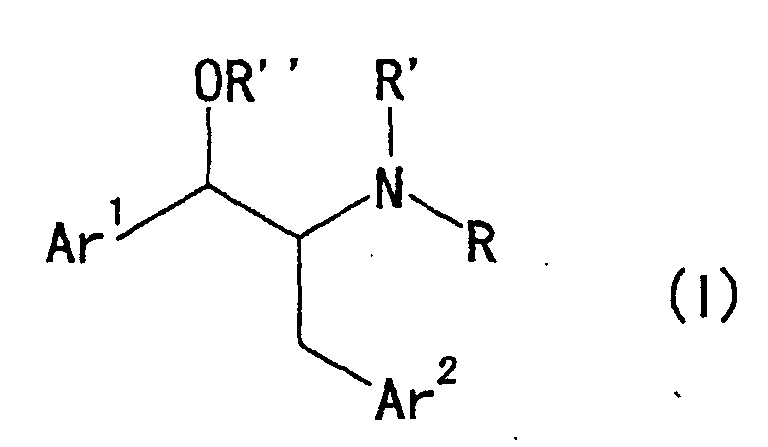 wherein Ar1 is an aromatic ring group optionally having
substituents, Ar2 is an aromatic ring group having
substituents, OR'' is an optionally protected hydroxyl group,
R is an acyl group, R' is a hydrogen atom or a hydrocarbon
group optionally having substituents, or a salt thereof, and a
pharmaceutical composition containing a compound of the
formula (I) or a salt thereof or a prodrug thereof.
wherein Ar1 is an aromatic ring group optionally having
substituents, Ar2 is an aromatic ring group having
substituents, OR'' is an optionally protected hydroxyl group,
R is an acyl group, R' is a hydrogen atom or a hydrocarbon
group optionally having substituents, or a salt thereof, and a
pharmaceutical composition containing a compound of the
formula (I) or a salt thereof or a prodrug thereof.
Description
- The present invention relates to novel aminoethanol derivatives that inhibit cholesteryl ester transfer protein, and the like.
- A number of epidemiological searches have clarified that hypercholesterolemia, particularly, high level of low density lipoprotein (LDL)-cholesterol in serum, is a risk factor of arteriosclerotic diseases (e.g., cardiac infarction, angina pectoris, cerebral infarction and the like). As a pharmaceutical agent to lower serum LDL-cholesterol, pharmaceutical agents that inhibit 3-hydroxy-3-methylglytaryl coenzyme A (HMG-CoA) reductase have been clinically used, and large scale clinical tests have clarified that they show a certain effect on the decrease of incidence of coronary diseases (N. Engl. J. Med., 34, 498-511 (1999)). However, the effect is not fully satisfactory. In addition, it is epidemiologically known that the concentration of high density lipoprotein (HDL) - cholesterol in serum shows an inverse correlation with the incidence of coronary diseases (N. Engl. J. Med., 321, 1311-1316 (1989), Am. Heart J., 110, 1100-1107 (1985)), and a pharmaceutical agent that increases serum HDL-cholesterol has been drawing attention as a pharmaceutical agent for the prophylaxis or treatment of arteriosclerotic diseases.
- The cholesteryl ester transfer protein (CETP) catalyzes transfer of cholesteryl ester from HDL to LDL and very low density lipoprotein (VLDL) (J. Lipid Res., 34, 1255-1274 (1993)), and is deeply involved in the inverse transfer system of cholesterol or transfer of cholesterol from peripheral tissues to the liver. As the inverse transfer system of cholesterol, the following three pathways are known.
- (1) Free cholesterol accumulated in the peripheral tissues is extracted by HDL, undergoes the action of lecithin-cholesterol acyltransferase (LCAT) and converted to cholesteryl ester on HDL. The cholesteryl ester on HDL is transferred by CETP to LDL or VLDL in exchange of triglyceride, and cholesterol is transferred to the liver via LDL receptor.
- (2) HDL becomes apoprotein E-containing HDL and is uptaken into the liver via LDL receptor.
- (3) Cholesteryl ester on HDL is directly uptaken into the liver via HDL receptor.
-
- Because CETP is deeply involved in the cholesterol inverse transfer system, the intensity of its activity in blood is considered to be linked to the control of blood HDL-cholesterol concentration. With regard to the correlation between CETP and blood HDL-cholesterol concentration, for example, the following findings are known. When CETP activity is inhibited by CETP monoclonal antibody in rabbit and hamster, serum HDL-cholesterol concentration increases (J. Clin. Invest., 84, 129-137 (1989), Atherosclerosis, 110, 101-109 (1994)). Transgenic mouse and transgenic rat that expressed CETP shows increased LDL-cholesterol concentration (J. Biol. Chem., 266, 10796-10801 (1991), Nat. Med., 5, 1383-1389 (1999)). From epidemiological search, individuals showing decreased or no CETP activity due to genetic mutation also show increased blood HDL-cholesterol concentration (Nature, 342, 448-451 (1989), Atherosclerosis, 58, 175-186 (1985)).
- From the above findings, it is considered that intensity of CETP activity has an inverse correlation with arteriosclerosis-suppressive HDL-cholesterol, and inhibition of CETP activity is expected to lower the risk of progression of coronary diseases. In fact, it is known that CETP activity varies depending on the animal species, and arteriosclerosis is induced by cholesterol loading in animals having high CETP activity (rabbit etc.), but arteriosclerosis is not easily induced in animals free of CETP (rat and the like). When CETP activity was inhibited sustainably in rabbit by administration of antisense RNA, blood HDL-cholesterol concentration increased and the progression of arteriosclerotic lesion was suppressed (J. Biol. Chem., 273, 5033-5036 (1998)). Therefore, a pharmaceutical agent that suppresses CETP activity is expected to act suppressively on arteriosclerotic diseases by inhibiting transfer of cholesterol from HDL to LDL or VLDL, increasing arteriosclerosis-suppressive HDL-cholesterol and simultaneously decreasing arteriosclerosis-promotive VLDL-cholesterol or LDL-cholesterol. That is, a pharmaceutical agent that suppresses CETP activity is expected to give a pharmaceutical agent for the prophylaxis or treatment of the diseases such as acute coronary syndrome, acute cardiac infarction, unstable angina pectoris, PTCA or arterial restenosis after stent placement, peripheral arterial occlusion, hyperlipidemia, cerebral infarction, stroke and the like, or an agent for suppressing progression of focal arteriosclerosis.
- The pharmaceutical agents having CETP inhibitory action are disclosed in, for example, WO99/41237, lipids, 29, 811-818 (1994), WO98/35937, Atherosclerosis, 128, 59-66 (1997), Bioorg. Med. Chem. Lett., 6, 919-922 (1996), US Patent No. 5,925,645, US Patent No. 5,932,587, Europe patent No. 825185, Europe patent No. 818448, Angew. Chem., Int. Ed., 38, 3373-3375 (1999), WO99/14174, WO00/1872 WO00/17164 and the like.
- As the aminoethanol derivatives, for example, JP-A-11-286478 discloses tert-butyl benzyl-[2(S)-hydroxy-2-thiazol-2-yl-1(S)-(4-trifluoromethyl-benzyl)-ethyl]-carbamate as a compound to be a starting material for an antivirus agent, WO99/45928 discloses a compound to be a starting material for a compound having an action of improving autoimmune diseases, JP-A-11-246437 discloses a compound to be a starting material for a compound having a gastrointestinal mucosal protective action, WO98/18794 discloses a compound to be a starting material for a compound having a chymase inhibitory action, Lett. Pept. Sci., 2, 229-232 (1995) discloses a compound to be a starting material for a compound having an HIV-1 protease inhibitory action and a DPP-IV inhibitory action, WO93/25574 discloses a compound to be a starting material for a compound having a angiotensin I chymase inhibitory action, WO89/10752 discloses a compound to be a starting material for a compound having a retroviral protease inhibitory action, EP No. 231919 discloses a compound having a renin inhibitory action, and French Patent No. 1578851 discloses a compound having an adrenergic action, but no disclosure is found that these compounds have a prophylactic or therapeutic action on arteriosclerotic diseases or any description suggestive thereof.
- As a pharmaceutical agent that increases plasma HDL-cholesterol (HDL-C), fibrate-type pharmaceutical agents and nicotinic acid have been used. They show an indirect HDL-C increasing action and side effects are a concern. As the situation stands, the development of a novel pharmaceutical agent that directly increases HDL-cholesterol and affords a sufficiently satisfactory effect in the prophylaxis or treatment of arteriosclerotic diseases such as ischemic heart and brain diseases, peripheral arterial occlusion and the like is awaited.
- The present inventors have found that aminoethanol derivatives having the following specific substituents increase plasma HDL-C by inhibiting cholesterol ester transfer protein (CETP) and have a superior prophylactic or therapeutic effect on arteriosclerotic diseases, which resulted in the completion of the present study.
- Accordingly, the present invention relates to:
- (1) a compound represented by the formula
wherein

- Ar1
- is an aromatic ring group optionally having substituents,
- Ar2
- is an aromatic ring group having substituents,
- OR''
- is an optionally protected hydroxyl group,
- R
- is an acyl group, and
- R'
- is a hydrogen atom or a hydrocarbon group optionally having substituents,
except tert-butyl benzyl-[2(S)-hydroxy-2-thiazol-2-yl-1-(S)-4-trifluoromethyl-benzyl)-ethyl]-carbamate; - (2) the compound of the aforementioned (1), wherein Ar1 is a 5-or 6-membered aromatic ring group optionally having substituents;
- (3) the compound of the aforementioned (1) , wherein Ar1 is a phenyl group optionally having substituents;
- (4) the compound of the aforementioned (1), wherein Ar2 is a 5-or 6-membered aromatic ring group having substituents;
- (5) the compound of the aforementioned (1), wherein Ar2 is a phenyl group having substituents;
- (6) the compound of the aforementioned (1), wherein R is a group represented by the formula R1NCO- (R1N is a hydrocarbon group optionally having substituents or a heterocyclic group optionally having substituents);
- (7) the compound of the aforementioned (6), wherein R1N is a cyclic hydrocarbon group optionally having substituents or a heterocyclic group optionally having substituents;
- (8) the compound of the aforementioned (1), wherein R'' is a hydrogen atom or an acyl group;
- (9) the compound of the aforementioned (1), wherein R'' is a group represented by the formula R10CO- (R10 is a hydrocarbon group optionally having substituents or a heterocyclic group optionally having substituents);
- (10) the compound of the aforementioned (8), wherein R10 is an alkyl group optionally having substituents;
- (11) the compound of the aforementioned (1), wherein R'' is a hydrogen atom;
- (12) the compound of the aforementioned (1), wherein R' is a hydrogen atom;
- (13) the compound of the aforementioned (1), wherein R is a group represented by the formula R1NCO- (R1N is a cyclic hydrocarbon group optionally having substituents or a heterocyclic group optionally having substituents), R'' is a hydrogen atom and R' is a hydrogen atom;
- (14) the compound of the aforementioned (1) , wherein Ar1 is a 5- or 6-membered aromatic ring group optionally having substituents selected from halogen atom, optionally halogenated lower alkyl group, optionally halogenated lower alkoxy group and aryloxy group optionally having substituents, Ar2 is a 5- or 6-membered aromatic ring group having substituents selected from halogen atom, optionally halogenated lower alkyl group and optionally halogenated lower alkoxy group, R is a C1-6 alkoxy-carbonyl, a C1-6 alkyl-carbonyl, a C6-10 aryl-carbonyl, dihydronaphthalenecarbonyl, tetrahydronaphthalenecarbonyl, benzocycloheptenecarbonyl or benzocyclooctenecarbonyl, each of which may have substituent(s) selected from halogen atom, optionally halogenated C1-6 alkoxy and optionally halogenated C1-6 alkyl, R'' is a hydrogen atom, and R' is a hydrogen atom;
- (15) the compound of the aforementioned (14), wherein the 5-or 6-membered aromatic ring group is a phenyl group, a pyridyl group, a thienyl group, a furyl group or a thiazolyl group;
- (16) the compound of the aforementioned (14), wherein the 5-or 6-membered aromatic ring group is a phenyl group, a pyridyl group or a thienyl group, and R is naphthalenecarbonyl, dihydronaphthalenecarbonyl, tetrahydronaphthalenecarbonyl, benzocycloheptenecarbonyl or benzocyclooctenecarbonyl, each of which may have substituent(s) selected from halogen atom, optionally halogenated C1-6 alkoxy and optionally halogenated C1-6 alkyl;
- (17) the compound of the aforementioned (1), which is
N-[(1RS,2SR)-2-(4-fluorophenyl)-2-hydroxy-1-[4-(trifluoromethyl)benzyl]ethyl]-6,7-dihydro-5H-benzo[a]cycloheptene-1-carboxamide,
4-fluoro-N-((1R,2S)-2-(4-fluorophenyl)-2-hydroxy-1-((4-(trifluoromethyl)phenyl)methyl)ethyl)-1-naphthalenecarboxamide,
N-[(1R,2S)-2-(4-fluorophenyl)-2-hydroxy-1-[3-(1,1,2,2-tetrafluoroethoxy)benzyl]ethyl]-6,7-dihydro-5H-benzo[a]cycloheptene-1-carboxamide,
N-[(1RS,2SR)-2-(4-fluorophenyl)-2-hydroxy-1-[3-(1,1,2,2-tetrafluoroethoxy)benzyl]ethyl]-5,6-dihydronaphthalene-1-carboxamide,
N-[(1RS,2SR)-2-(4-fluorophenyl)-2-hydroxy-1-[3-(1,1,2,2-tetrafluoroethoxy)benzyl]ethyl]-6,7,8,9-tetrahydro-5H-benzo [a]cycloheptene-1-carboxamide,
4-fluoro-N-[(1R,2S)-2-(4-fluorophenyl)-2-hydroxy-1-[3-(1,1,2,2-tetrafluoroethoxy)benzyl]ethyl]naphthalene-1-carboxamide,
N-[(1RS,25R)-2-(4-fluorophenyl)-2-hydroxy-1-[3-(1,1,2,2-tetrafluoroethoxy)benzyl]ethyl]-5,6,7,8-tetrahydrobenzo[a]cyclooctene-1-carboxamide,
N-[(1RS, 2SR)-2-(4-fluorophenyl)-2-hydroxy-1-(4-isopropylbenzyl)ethyl]-6,7-dihydro-5H-benzo[a]cycloheptene-1-carboxamide,
N-((1RS, 2SR)-2-(3-fluorophenyl)-2-hydroxy-1-((4-(trifluoromethyl)phenyl)methyl)ethyl)-6,7-dihydro-5H-benzo[a]cycloheptene-1-carboxamide,
N-((1RS, 2SR)-2-hydroxy-2-(4-phenoxyphenyl)-1-((4-(trifluoromethyl)phenyl)methyl)ethyl)-6,7-dihydro-5H-benzo[a]cycloheptene-1-carboxamide,
N-[(1RS,2SR)-2-(4-chlorophenyl)-2-hydroxy-1-[3-(1,1,2,2-tetrafluoroethoxy)benzyl]ethyl]-6,7-dihydro-5H-benzo[a]cycloheptene-1-carboxamide,
N-((1RS,2SR)-2-hydroxy-2-(4-(phenyloxy)phenyl)-1-((3-((1,1,2,2-tetrafluoroethyl)oxy)phenyl)methyl)ethyl)-6,7-dihydro-5H-benzo[a]cycloheptene-1-carboxamide,
N-((1RS,2SR)-2-(4-((4-chloro-3-ethylphenyl)oxy)phenyl)-2-hydroxy-1-((3-((1,1,2,2-tetrafluoroethyl)oxy)phenyl)methyl)ethyl)-6,7-dihydro-5H-benzo[a]cycloheptene-1-carboxamide,
N-((1RS, 2SR)-2-(2-fluoropyridin-4-yl)-2-hydroxy-1-((3-(1,1,2,2-tetrafluoroethoxy)phenyl)methyl)ethyl)-6,7-dihydro-5H-benzo[a]cycloheptene-1-carboxamide,
N-(1RS, 2RS)-2-(6-fluoropyridin-2-yl)-2-hydroxy-1-((3-(1,1,2,2-tetrafluoroethoxy)phenyl)methyl)ethyl)-6,7-dihydro-5H-benzo[a] cycloheptene-1-carboxamide,
N-[(1RS,2SR)-1-(4-tert-butylbenzyl)-2-(3-chlorophenyl)-2-hydroxyethyl]-5-chloro-1-naphthamide,
4-fluoro-N-{(1RS, 2SR) -2-(4-fluorophenyl)-2-hydroxy-1-[(2,2,3,3-tetrafluoro-2,3-dihydro-1,4-benzodioxin-6-yl)methyl]ethyl}-1-naphthamide or a salt thereof; - (18) a prodrug of a compound represented by the formula
wherein
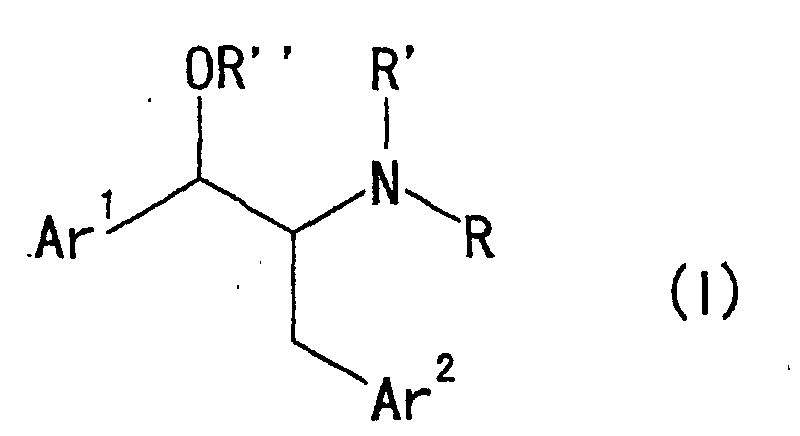
- Ar1
- is an aromatic ring group optionally having substituents,
- Ar2
- is an aromatic ring group having substituents,
- OR''
- is an optionally protected hydroxyl group,
- R
- is an acyl group, and
- R'
- is a hydrogen atom or a hydrocarbon group optionally having substituents,
except tert-butyl benzyl-[2(S)-hydroxy-2-thiazol-2-yl-1(S)-(4-trifluoromethyl-benzyl)-ethyl]-carbamate; - (19) a pharmaceutical composition comprising a compound
represented by the formula
wherein

- Ar1
- is an aromatic ring group optionally having substituents,
- Ar2
- is an aromatic ring group having substituents,
- OR''
- is an optionally protected hydroxyl group,
- R
- is an acyl group, and
- R'
- is a hydrogen atom or a hydrocarbon group optionally having substituents,
- (20) the composition of the aforementioned (19), which is a cholesteryl ester transfer protein inhibitor;
- (21) the composition of the aforementioned (19), which is a high density lipoprotein - cholesterol elevating agent;
- (22) the composition of the aforementioned (19), which is a low density lipoprotein - cholesterol lowering agent;
- (23) the composition of the aforementioned (19), which is an very low density lipoprotein - cholesterol lowering agent;
- (24) the composition of the aforementioned (19), which is a triglyceride lowering agent;
- (25) the composition of the aforementioned (19), which is a prophylactic or therapeutic agent of acute coronary syndrome;
- (26) the composition of the aforementioned (19), which is a prophylactic or therapeutic agent of acute cardiac infarction;
- (27) the composition of the aforementioned (19), which is a prophylactic or therapeutic agent of unstable angina pectoris;
- (28) the composition of the aforementioned (19), which is a prophylactic or therapeutic agent of PTCA or arterial restenosis after stent placement;
- (29) the composition of the aforementioned (19), which is a prophylactic or therapeutic agent of peripheral arterial occlusion;
- (30) the composition of the aforementioned (19), which is a prophylactic or therapeutic agent of hyperlipidemia;
- (31) the composition of the aforementioned (19), which is a prophylactic or therapeutic agent of cerebral infarction;
- (32) the composition of the aforementioned (19), which is a prophylactic or therapeutic agent of stroke;
- (33) the composition of the aforementioned (19), which is a suppressor of progression of focal arteriosclerosis;
- (34) a cholesteryl ester transfer protein inhibitor comprising
a compound represented by the formula
wherein

- Ar1
- is an aromatic ring group optionally having substituents,
- Ar2
- is an aromatic ring group optionally having substituents,
- OR''
- is an optionally protected hydroxyl group,
- R
- is an acyl group, and
- R'
- is a hydrogen atom or a hydrocarbon group optionally having substituents,
- (35) the agent of the aforementioned (34), which is a prophylactic or therapeutic agent of hyperlipidemia;
- (36) the agent of the aforementioned (34), which is a prophylactic or therapeutic agent of acute coronary syndrome;
- (37) the agent of the aforementioned (34), which is a prophylactic or therapeutic agent of acute cardiac infarction;
- (38) the agent of the aforementioned (34), which is a prophylactic or therapeutic agent of unstable angina pectoris;
- (39) the agent of the aforementioned (34), which is a prophylactic or therapeutic agent of PTCA or arterial restenosis after stent placement;
- (40) the agent of the aforementioned (34), which is a prophylactic or therapeutic agent of peripheral arterial occlusion;
- (41) the agent of the aforementioned (34), which is a prophylactic or therapeutic agent of cerebral infarction;
- (42) the agent of the aforementioned (34), which is a prophylactic or therapeutic agent of stroke;
- (43) the agent of the aforementioned (34), which is a suppressor of progression of focal arteriosclerosis;
- (44) a method of inhibiting cholesteryl ester transfer protein in a mammal, which comprises administering an effective amount of a compound of the aforementioned (1) or a salt thereof to the mammal;
- (45) a method for the prophylaxis or treatment of hyperlipidemia in a mammal, which comprises administering an effective amount of a compound of the aforementioned (1) or a salt thereof to the mammal;
- (46) use of a compound of the aforementioned (1) or a salt thereof for the production of a pharmaceutical agent for inhibiting cholesteryl ester transfer protein;
- (47) use of a compound of the aforementioned (1) or a salt thereof for the production of a pharmaceutical agent for the prophylaxis or treatment of hyperlipidemia;
- (48) a method for the prophylaxis or treatment of acute coronary syndrome in a mammal, which comprises administering an effective amount of a compound of the aforementioned (1) or a salt thereof to the mammal;
- (49) a method for the prophylaxis or treatment of acute cardiac infarction in a mammal, which comprises administering an effective amount of a compound of the aforementioned (1) or a salt thereof to the mammal;
- (50) a method for the prophylaxis or treatment of unstable angina pectoris in a mammal, which comprises administering an effective amount of a compound of the aforementioned (1) or a salt thereof to the mammal;
- (51) a method for the prophylaxis or treatment of PTCA or coronary restenosis after stent placement in a mammal, which comprises administering an effective amount of a compound of the aforementioned (1) or a salt thereof to the mammal;
- (52) a method for the prophylaxis or treatment of peripheral arterial occlusion in a mammal, which comprises administering an effective amount of a compound of the aforementioned (1) or a salt thereof to the mammal;
- (53) a method for the prophylaxis or treatment of cerebral infarction in a mammal, which comprises administering an effective amount of a compound of the aforementioned (1) or a salt thereof to the mammal:
- (54) a method for the prophylaxis or treatment of stroke in a mammal, which comprises administering an effective amount of a compound of the aforementioned (1) or a salt thereof to the mammal;
- (55) a method of suppressing progression of focal arteriosclerosis in a mammal, which comprises administering an effective amount of a compound of the aforementioned (1) or a salt thereof to the mammal;
- (56) use of a compound of the aforementioned (1) or a salt thereof for the production of a prophylactic or therapeutic agent of acute coronary syndrome;
- (57) use of a compound of the aforementioned (1) or a salt thereof for the production of a prophylactic or therapeutic agent of acute cardiac infarction;
- (58) use of a compound of the aforementioned (1) or a salt thereof for the production of a prophylactic or therapeutic agent of unstable angina pectoris;
- (59) use of a compound of the aforementioned (1) or a salt thereof for the production of a prophylactic or therapeutic agent of peripheral arterial occlusion;
- (60) use of a compound of the aforementioned (1) or a salt thereof for the production of a prophylactic or therapeutic agent of hyperlipidemia;
- (61) use of a compound of the aforementioned (1) or a salt thereof for the production of a prophylactic or therapeutic agent of cerebral infarction;
- (62) use of a compound of the aforementioned (1) or a salt thereof for the production of a prophylactic or therapeutic agent of stroke;
- (63) use of a compound of the aforementioned (1) or a salt thereof for the production of a suppressor of progression of focal arteriosclerosis;
- (64) a method of inhibiting cholesteryl ester transfer protein in a mammal, which comprises administering an effective amount of a compound represented by the formula (I') of the aforementioned (34) or a salt thereof or a prodrug thereof to the mammal;
- (65) use of a compound represented by the formula (I') of the aforementioned (34) or a salt thereof or a prodrug thereof for the production of a pharmaceutical agent for inhibiting cholesteryl ester transfer protein;
- (66) a production method of the aforementioned (1) or a salt
thereof, which comprises subjecting a compound represented by
the formula
wherein each symbol is as defined in the aforementioned (1), or a salt thereof to an acylation reaction to give a compound represented by the formula
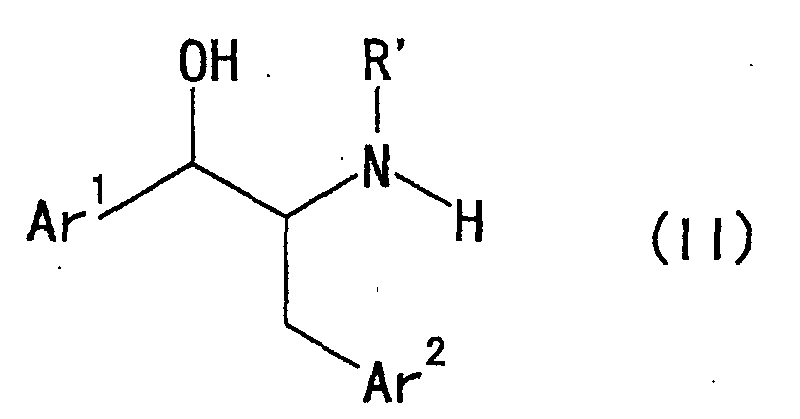 wherein each symbol is as defined in the aforementioned (1), or a salt thereof, and, where desired, subjecting the compound to a hydroxyl group-protecting reaction; and the like.
-
- For the term "acyl group" used in the present specification, acyl groups obtained by removing OH group from carboxylic acids such as R1COOH, R1OCOOH and the like, sulfonic acids such as R1SO3H and the like, sulfinic acids such as R1SO2H and the like, phosphoric acids such as R1OPO(OR2)OH and the like, carbamic acids such as R1N(R2)COOH and the like (R1 is a hydrocarbon group optionally having substituents or a heterocyclic group optionally having substituents, and R2 is a hydrogen atom or a hydrocarbon group optionally having substituents) and the like are used. Specifically, R1CO, R1OCO, R1SO2, R1SO, R1OPO(OR2), R1N(R2)CO (R1 is a hydrocarbon group optionally having substituents or a heterocyclic group optionally having substituents and R2 is a hydrogen atom or a hydrocarbon group optionally having substituents) and the like are used.
- The "hydrocarbon group" of the term "optionally substituted hydrocarbon group" used in the present specification means, for example, alkyl group, cycloalkyl group, alkenyl group, cycloalkenyl group, alkynyl group, aralkyl group, aryl group and the like.
- As the substituent that the "hydrocarbon group" optionally has, those similar to the substituent that the "alkyl group" and "cycloalkyl group" to be mentioned below may have, and the like are used.
- As the "alkyl group", for example, "linear or branched C1-15 alkyl groups" such as methyl, ethyl, propyl, isopropyl, butyl, isobutyl, sec-butyl, tert-butyl, pentyl, hexyl, heptyl, octyl, nonyl, decyl, undecyl, tridecyl, tetradecyl, pentadecyl and the like, and the like are used.
- As the "cycloalkyl group", for example, "C3-10 cycloalkyl groups" such as cyclopropyl, cyclobutyl, cyclopentyl, cyclohexyl, cycloheptyl, cyclooctyl, adamantyl and the like, and the like are used.
- As the substituent that the "alkyl group" and "cycloalkyl group" may have, for example, (i) nitro group, (ii) hydroxy group, oxo group, (iii) cyano group, (iv) carbamoyl group, (v) mono- or di-C1-4 alkyl-carbamoyl group (e.g., N-methylcarbamoyl, N-ethylcarbamoyl, N,N-dimethylcarbamoyl, N,N-diethylcarbamoyl and the like), mono- or di-phenyl-carbamoyl group, mono- or di-benzyl-carbamoyl group, carboxyl-carbamoyl group, C1-4 alkoxy-carbonyl-carbamoyl group, (vi) carboxyl group, (vii) C1-4 alkoxy-carbonyl group (e.g., methoxycarbonyl, ethoxycarbonyl, propoxycarbonyl, isopropoxycarbonyl and the like), (viii) sulfo group (-SO2OH) , (ix) halogen atom (e.g., fluorine, chlorine, bromine, iodine and the like), (x) optionally halogenated C1-4 alkoxy group (e.g., methoxy, ethoxy, propoxy, isopropoxy and the like), C1-4 alkoxy group optionally substituted by hydroxy group, C1-4 alkoxy group optionally substituted by carboxyl group, C1-4 alkoxy group optionally substituted by C1-4 alkoxy-carbonyl group, C1-4 alkoxy-C1-4 alkoxy group, (xi) phenoxy group, phenoxy-C1-4 alkyl group, phenoxy-C1-4 alkoxy group, (xii) optionally halogenated phenyl group, optionally halogenated phenyl-C1-4 alkyl group, optionally halogenated phenyl-C2-4 alkenyl group, optionally halogenated phenoxy group (e.g., o-, m- or p-chlorophenoxy, o-, m- or p-bromophenoxy and the like), pyridyloxy group, C3-10 cycloalkyl group, C3-10 cycloalkyl-C1-4 alkoxy group, C3-10 cycloalkyl-C1-4 alkyl group, (xiii) optionally halogenated C1-4 alkyl group, optionally halogenated C2-4 alkenyl group, optionally halogenated C1-4 alkylthio group (e.g., methylthio, ethylthio, n-propylthio, isopropylthio, n-butylthio and the like), C1-4 alkyl group optionally substituted by hydroxy group, C1-4 alkylthio group optionally substituted by hydroxy group, (xiv) mercapto group, thioxo group, (xv) benzyloxy group or benzylthio group optionally substituted by substituent(s) selected from halogen atom, carboxyl group and C1-4 alkoxy-carbonyl group, (xvi) optionally halogenated phenylthio group, pyridylthio group, phenylthio-C1-4 alkyl group, pyridylthio-C1-4 alkyl group, (xvii) optionally halogenated C1-4 alkylsulfinyl group (e.g., methylsulfinyl, ethylsulfinyl and the like), phenylsulfinyl group, phenylsulfinyl-C1-4 alkyl group, (xviii) optionally halogenated C1-4 alkylsulfonyl group (e.g., methylsulfonyl, ethylsulfonyl and the like), phenylsulfonyl group, phenylsulfonyl-C1-4 alkyl group, (xix) amino group, aminosulfonyl group, (xx) C1-3 acylamino group (e.g., acetylamino, propionylamino and the like), benzyloxycarbonylamino, (xxi) mono- or di-C1-4 alkylamino group (e.g., methylamino, ethylamino, dimethylamino, diethylamino and the like), (xxii) 4- to 6-membered cyclic amino group (e.g., 1-azetidinyl, 1-pyrrolidinyl, piperidino, morpholino, thiomorpholino, 1-piperazinyl and the like), 4- to 6-membered cyclic amino-carbonyl group (e.g., 1-azetidinylcarbonyl, 1-pyrrolidinylcarbonyl, piperidinocarbonyl, morpholinocarbonyl, thiomorpholinocarbonyl, 1-piperazinylcarbonyl and the like), 4- to 6-membered cyclic amino-C1-4 alkyl group, (xxiii) C1-6 acyl group (e.g., formyl, optionally halogenated C2-6 alkanoyl such as acetyl etc., and the like), (xxiv) benzoyl group optionally substituted by halogen atom, (xxv) 5- to 10-membered heterocyclic group (e.g., 2- or 3-thienyl, 2- or 3-furyl, 3-, 4- or 5-pyrazolyl, 2-, 4- or 5-thiazolyl, 3-, 4- or 5-isothiazolyl, 2-, 4- or 5-oxazolyl, 1,2,3- or 1,2,4-triazolyl, 1H- or 2H-tetrazolyl, 2-, 3- or 4-pyridyl, 2-, 4- or 5-pyrimidinyl, 3- or 4-pyridazinyl, quinolyl, isoquinolylindolyl and the like), (xxvi) 5- to 10-membered heterocyclic-carbonyl group (e.g., 2- or 3-thienylcarbonyl, 2- or 3-furylcarbonyl, 3-, 4- or 5-pyrazolylcarbonyl, 2-, 4- or 5-thiazolylcarbonyl, 3-, 4- or 5-isothiazolylcarbonyl, 2-, 4- or 5-oxazolylcarbonyl, 1,2,3- or 1,2,4-triazolylcarbonyl, 1H- or 2H-tetrazolylcarbonyl, 2-, 3- or 4-pyridylcarbonyl, 2-, 4- or 5-pyrimidinylcarbonyl, 3- or 4-pyridazinylcarbonyl, quinolylcarbonyl, isoquinolylcarbonyl, indolylcarbonyl and the like), (xxvii) optionally halogenated linear or branched C2-5 alkyleneoxy group (e.g., ethyleneoxy, propyleneoxy, isobutyleneoxy and the like) and (xxviii) optionally halogenated linear or branched C1-4 alkylenedioxy group (e.g., methylenedioxy, ethylenedioxy, propylenedioxy, tetrafluoroethylenedioxy and the like) and the like are used. The "alkyl group" and "cycloalkyl group" may have 1 to 5 of these substituents at substitutable positions.
- Preferable "alkyl group" includes, for example, linear or branched C1-6 alkyl groups such as methyl, ethyl, propyl, isopropyl, butyl, isobutyl, sec-butyl, tert-butyl, pentyl, hexyl and the like, and as the substituent that the "C1-6 alkyl group" may have, for example, 1 to 3 of halogen atom, C1-4 alkoxy group, hydroxy group, C1-4 alkoxy-carbonyl group, carboxyl group, carbamoyl group, mono- or di-C1-4 alkylcarbamoyl group, pyridylthio group and the like are used.
- As the "alkenyl group", for example, "C2-18 alkenyl group" such as vinyl, allyl, isopropenyl, 3-butenyl, 3-octenyl, 9-octadecenyl and the like, and the like are used.
- As the "cycloalkenyl group", for example, "C3-8 cycloalkenyl group" such as cyclopropenyl, cyclobutenyl, cyclopentenyl, cyclohexenyl, cycloheptenyl, cyclooctenyl and the like, and the like are used.
- As the substituent that the "alkenyl group" and "cycloalkenyl group" may have, those similar to the substituents that the aforementioned "alkyl group" may have are used.
- Preferable "alkenyl group" includes, for example, C2-6 alkenyl group such as vinyl, allyl, 2-butenyl, 3-butenyl and the like, and the like. As the substituent that the "C2-6 alkenyl group" may have, those similar to the substituents that the aforementioned "C1-6 alkyl group" may have are used.
- As the "alkynyl group", for example, "C2-18 alkynyl group" such as ethynyl, propynyl, 1-butynyl, 2-butynyl, 1-pentynyl, 2-pentynyl, 3-pentynyl and the like, and the like are used.
- As the substituent that the "alkynyl group" may have, those similar to the substituents that the aforementioned "alkyl group" may have are used.
- Preferable "alkynyl group" includes, for example, C2-6 alkynyl groups such as ethynyl, propynyl, 1-butynyl, 2-butynyl and the like, and the like. As the substituent that the "C2-6 alkynyl group" may have, those similar to the substituents that the aforementioned "C1-6 alkyl group" may have are used.
- As the "aralkyl group", C7-16 aralkyl group and the like are used, and specifically, phenyl-C1-6 alkyl groups such as benzyl, phenethyl, 3-phenylpropyl, 4-phenylbutyl and the like, naphthyl-C1-6 alkyl groups such as (1-naphthyl)methyl, 2-(1-naphthyl)ethyl, 2-(2-naphthyl)ethyl and the like, and the like are used.
- As the substituent that the "aralkyl group" may have, the substituents that the aforementioned "alkyl group" may have, as well as halogen atom (e.g., fluorine, chlorine, bromine, iodine and the like), C1-4 alkyl group (e.g., methyl, ethyl, propyl, isopropyl, butyl and the like), C2-6 alkenyl group (e.g., vinyl, allyl, 2-butenyl, 3-butenyl and the like), C1-3 acyl group (e.g., formyl, acetyl and the like), C1-4 alkoxy group (e.g., methoxy, ethoxy, propoxy, isopropoxy and the like), nitro group, cyano group, hydroxy group, C1-4 alkoxy-carbonyl group (e.g., methoxycarbonyl, ethoxycarbonyl, propoxycarbonyl, isopropoxycarbonyl and the like), carbamoyl group, mono- or di-C1-4 alkyl-carbamoyl group (e.g., N-methylcarbamoyl, N-ethylcarbamoyl, N,N-dimethylcarbamoyl, N,N-diethylcarbamoyl and the like), mono- or di-C1-4 alkenylcarbamoyl group (e.g., N-vinylcarbamoyl and the like) and the like are mentioned, wherein the "aralkyl group" may have 1 to 4 of these substituents at substitutable positions.
- As the "aryl group", for example, aromatic monocyclic, bicyclic or tricyclic C6-14 aryl group such as phenyl, 1-naphthyl, 2-naphthyl, phenanthryl, anthryl and the like, biphenyl group, tolyl group and the like are used.
- As the substituent that the "aryl group" may have, the substituents that the aforementioned "aralkyl group" may have, as well as oxo group and the like can be used. The "aryl group" may have 1 to 4, preferably 1 or 2, of these substituents at substitutable positions. As the aryl group having an oxo group, for example, benzoquinonyl, naphthoquinonyl, anthraquinonyl and the like can be mentioned.
- When the "hydrocarbon group" is cycloalkyl group, aryl group or aralkyl group, for example, it may be substituted by C1-10 alkyl group (e.g., methyl, ethyl, propyl, isopropyl, decyl and the like), C2-10 alkenyl group (e.g., vinyl, allyl, 2-butenyl, 3-butenyl and the like), phenyl-C2-4 alkenyl group (e.g., phenylethenyl and the like), mono- or di-C1-6 alkenylcarbamoyl group (e.g., N-vinylcarbamoyl and the like), C6-14aryl group (e.g., phenyl, 1-naphthyl, 2-naphthyl), C7-20 aralkyl group (e.g., benzyl, 2-phenylethyl, 3-phenylpropyl, 4-phenylbutyl, 5-phenylpentyl, 6-phenylhexyl, 2-(1-naphthyl)ethyl, 2-(2-naphthyl)ethyl and the like), styryl group, oxo group and the like, wherein the "hydrocarbon group" may have 1 to 4 "substituents" at substitutable positions.
- When the "hydrocarbon group" is a cyclic group such as cycloalkyl group, cycloalkenyl group, aralkyl group, aryl group and the like, it may have a substituent such as optionally halogenated C1-4 alkylenedioxy group, optionally halogenated C2-5 alkyleneoxy group and the like, or these cyclic groups may be condensed with each other to form a bicyclic or tricyclic fused hydrocarbon group, wherein the fused hydrocarbon group may have a group similar to the substituent that the aforementioned "alkyl group" may have.
- For the term "heterocyclic group" of the "heterocyclic group optionally having substituents" used in the present specification, a 5- to 8-membered ring or a fused ring thereof (including condensation with benzene ring) having, besides the carbon atom, 1 to 4 hetero atoms selected from oxygen atom, sulfur atom, nitrogen atom and the like, such as a 5-membered ring group having, besides the carbon atom, 1 to 4 hetero atoms selected from oxygen atom, sulfur atom, nitrogen atom and the like, such as 2- or 3-thienyl, 2- or 3-furyl, 2- or 3-pyrrolyl, 2-, 4- or 5-oxazolyl, 2-, 4- or 5-thiazolyl, 3-, 4-or 5-pyrazolyl, 2-, 4- or 5-imidazolyl, 3-, 4- or 5-isoxazolyl, 3-, 4- or 5-isothiazolyl, 3- or 5-(1,2,4-oxadiazolyl), 1,3,4-oxadiazolyl, 3- or 5-(1,2,4-thiadiazolyl), 1,3,4-thiadiazolyl, 4- or 5-(1,2,3-thiadiazolyl), 1,2,5-thiadiazolyl, 1,2,3-triazolyl, 1,2,4-triazolyl, 1H- or 2H-tetrazolyl and the like; a 6-membered ring group having, besides the carbon atom, 1 to 4 hetero atoms selected from oxygen atom, sulfur atom, nitrogen atom and the like, such as 2-, 3- or 4-pyridyl, N-oxide-2-, 3- or 4-pyridyl, 2-, 4- or 5-pyrimidinyl, N-oxide-2-, 4- or 5-pyrimidinyl, thiomorpholinyl, morpholinyl, oxoimidazolyl, dioxotriazinyl, pyrrolidinyl, piperidinyl, pyranyl, thiopyranyl, 1,4-oxazinyl, 1,4-thiazinyl, 1,3-thiazinyl, piperazinyl, triazinyl, oxotriazinyl, 3- or 4-pyridazinyl, pyrazinyl, N-oxide-3- or 4-pyridazinyl and the like; a bicyclic or tricyclic fused ring group having, besides the carbon atom, 1 to 4 hetero atoms selected from oxygen atom, sulfur atom, nitrogen atom and the like, such as benzofuryl, benzothiazolyl, benzooxazolyl, tetrazolo[1,5-b]pyridazinyl, triazolo[4,5-b]pyridazinyl, benzoimidazolyl, quinolyl, isoquinolyl, cinnolinyl, phthalazinyl, quinazolinyl, quinoxalinyl, indolizinyl, quinolizinyl, 1,8-naphthyridinyl, purinyl, pteridinyl, dibenzofuranyl, carbazolyl, acrydinyl, phenanthridinyl, chromanyl, benzoxazinyl, phenazinyl, phenothiazinyl, phenoxazinyl etc., and the like; and the like are used.
- As the "substituent" of the "heterocyclic group optionally having substituents", groups similar to the "substituent" mentioned for the aforementioned "hydrocarbon group optionally having substituents" and the like, particularly, the substituent when the "hydrocarbon group" is cycloalkyl group, aryl group or aralkyl group, and the like are used, wherein 1 to 5, preferably 1 or 2, substituents may be present at substitutable positions on the heterocyclic ring.
- The term "lower alkyl group" used in the present specification shows, for example, a linear or branched alkyl group having 1 to 6 carbon atoms, such as methyl, ethyl, propyl, isopropyl, butyl, isobutyl, sec-butyl, tert-butyl, pentyl, hexyl and the like, and the like.
- In the aforementioned formulas, Ar1 denotes an aromatic ring group optionally having substituents and Ar2 denotes an aromatic ring group having substituents.
- As the "substituent" that the "aromatic ring group" of the "aromatic ring group optionally having substituents" for Ar1 may have and the "substituent" that the "aromatic ring group" of the "aromatic ring group having substituents" for Ar2 has, the groups mentioned as the "substituent" of the aforementioned "hydrocarbon group optionally having substituents" and the like are used, wherein 1 to 5, preferably 1 or 2, substituents may be present at substitutable positions of the aromatic ring group.
- As the "substituent" that the "aromatic ring group" of the "aromatic ring group optionally having substituents" for Ar1 may have, halogen atom, optionally halogenated lower alkyl group, optionally halogenated lower alkoxy group, aryloxy group optionally having substituents (e.g., phenoxy group and the like) and the like are preferable. The position of substitution when the "aromatic ring group" of the "aromatic ring group optionally having substituents" for Ar1 is phenyl and the phenyl has one substituent is preferably the meta position or para position.
- As the "substituent" that the "aromatic ring group" of the "aromatic ring group having substituents" for Ar2 may have, halogen atom, optionally halogenated lower alkyl group, optionally halogenated lower alkoxy group and the like are preferable. The position of substitution when the "aromatic ring group" of the "aromatic ring group having substituents" for Ar2 is phenyl and the phenyl has one substituent is preferably the meta position or para position.
- As the "aromatic ring group" of the "aromatic ring group optionally having substituents" for Ar1 and the "aromatic ring group" of the "aromatic ring group having substituents" for Ar2, aryl group, heteroaryl group and the like are mentioned.
- As the "aryl group", for example, aromatic monocyclic, bicyclic or tricyclic C6-14 aryl group such as phenyl, 1-naphthyl, 2-naphthyl, phenanthryl, anthryl and the like, biphenyl group, tolyl group and the like are used, with preference given to phenyl.
- As the "heteroaryl group", for example, a 5-membered aromatic ring group having, besides the carbon atom, 1 to 4 hetero atoms selected from oxygen atom, sulfur atom, nitrogen atom and the like, such as 2- or 3-thienyl, 2- or 3-furyl, 2-, 4- or 5-oxazolyl, 2-, 4- or 5-thiazolyl, 3-, 4- or 5-pyrazolyl, 2-, 4- or 5-imidazolyl, 3-, 4- or 5-isoxazolyl, 3-, 4- or 5-isothiazolyl, 3- or 5-(1,2,4-oxadiazolyl), 1,3,4-oxadiazolyl, 3- or 5-(1,2,4-thiadiazolyl), 1,3,4-thiadiazolyl, 4- or 5-(1,2,3-thiadiazolyl), 1,2,5-thiadiazolyl, 1,2,3-triazolyl, 1,2,4-triazolyl, 1H- or 2H-tetrazolyl and the like; a 6-membered aromatic ring group having, besides the carbon atom, 1 to 4 hetero atoms selected from oxygen atom, sulfur atom, nitrogen atom and the like, such as 2-, 3- or 4-pyridyl, 2-, 4- or 5-pyrimidinyl, pyridazinyl, pyrazinyl and the like; a fused ring group formed by these 5- or 6-membered aromatic ring groups liked with each other or these 5- or 6-membered aromatic ring groups linked with a benzene ring (preferably bicyclic fused ring group); and the like are used.
- As the "aromatic ring group" of the "aromatic ring group optionally having substituents" for Ar1 and the "aromatic ring group" of the "aromatic ring group having substituents" for Ar2, a 5- or 6-membered aromatic ring group is preferably used for each of them. Particularly, phenyl group, pyridyl group, thienyl group, furyl group, thiazolyl group and the like are preferably used.
- In the aforementioned formulas, Ar2' denotes an aromatic ring group optionally having substituents.
- As the "aromatic ring group optionally having substituents" for Ar2', those similar to the "aromatic ring group" of the "aromatic ring group having substituents" for Ar2 and "aromatic ring group having substituents" for Ar2 and the like are mentioned.
- In the aforementioned formulas, R denotes an acyl group. The "acyl group" may be any of the aforementioned groups, such as acyl group obtained by removing an OH group from carboxylic acid (e.g., R1NCOOH, R1NOCOOH and the like), sulfonic acid (e.g., R1NSO3H and the like), sulfinic acid (e.g., R1NSO2H and the like), phosphoric acid (e.g., R1NOPO(OR2N)OH and the like), carbamic acid (e.g., R1NN(R2N)COOH and the like wherein R1N denotes a hydrocarbon group optionally having substituents or a heterocyclic group optionally having substituents and R2N denotes a hydrogen atom or a hydrocarbon group optionally having substituents) and the like. Specifically, R1NCO, R1NOCO, R1NSO2, R1NSO, R1NOPO (OR2N), R1NN (R2N)CO (R1N denotes a hydrocarbon group optionally having substituents or a heterocyclic group optionally having substituents and R2N denotes a hydrogen atom or a hydrocarbon group optionally having substituents), and the like are used. Here, as the "hydrocarbon group optionally having substituents" denoted by R1N, the "heterocyclic group optionally having substituents" denoted by R1N and the "hydrocarbon group optionally having substituents" denoted by R2N, those similar to "hydrocarbon group optionally having substituents" denoted by the aforementioned R1, the "heterocyclic group optionally having substituents" denoted by the aforementioned R1 and the "hydrocarbon group optionally having substituents" denoted by the aforementioned R2 are used, respectively.
- As R, a group represented by the formula R1NCO- (R1N is a hydrocarbon group optionally having substituents or a heterocyclic group optionally having substituents) is preferably used. As R1N, a cyclic group such as cyclic hydrocarbon group optionally having substituents (e.g., cycloalkyl group optionally having substituents, cycloalkenyl group optionally having substituents, aryl group optionally having substituents and the like), a heterocyclic group optionally having substituents and the like are preferable. Particularly, an aromatic ring group optionally having substituents (a group similar to the "aromatic ring group optionally having substituents" for Ar1 and the like), such as aryl group optionally having substituents, heteroaryl group optionally having substituents and the like are preferably used.
- Specifically, as R, C1-6 alkoxy-carbonyl, C1-6 alkylcarbonyl, C6-10 aryl-carbonyl (e.g., benzoyl, naphthoyl and the like), dihydronaphthalenecarbonyl, tetrahydronaphthalenecarbonyl, benzocycloheptenecarbonyl (preferably benzo[a]cycloheptene-carbonyl and the like), benzocyclooctenecarbonyl, each of which may have 1 to 3 substituents selected from halogen atom, optionally halogenated C1-6 alkoxy, optionally halogenated C1-6 alkyl and the like, are preferable.
- In the aforementioned formulas, OR'' denotes an optionally protected hydroxyl group. Here, R'' denotes a protecting group of hydrogen atom or hydroxyl group (R'' is preferably hydrogen atom or acyl group). As the hydroxyl-protecting group, for example, acyl group, C1-6 alkyl optionally having substituents, phenyl optionally having substituents, C7-10 aralkyl optionally having substituents, pyranyl optionally having substituents, furanyl optionally having substituents, silyl optionally having substituents and the like are mentioned.
- The acyl group as the "hydroxyl-protecting group" denoted by R'' may be any mentioned above, and acyl group obtained by removing OH group from carboxylic acid such as R10COOH, R10OCOOH and the like, sulfonic acid such as R10SO3H and the like, sulfinic acid such as R10SO2H and the like, phosphoric acid such as R10OPO(OR20)OH and the like, carbamic acid such as R10N(R20)COOH and the like (R10 is a hydrocarbon group optionally having substituents or a heterocyclic group optionally having substituents and R20 is a hydrogen atom or a hydrocarbon group optionally having substituents) and the like are used. Specifically, R10CO, R10OCO, R10SO2, R10SO, R10OPO(OR20), R10N(R20)CO (R10 denotes a hydrocarbon group optionally having substituents or a heterocyclic group optionally having substituents and R20 denotes a hydrogen atom or a hydrocarbon group optionally having substituents) and the like are used. Here, the "hydrocarbon group optionally having substituents" denoted by R10, the "heterocyclic group optionally having substituents" denoted by R10 and the "hydrocarbon group optionally having substituents" denoted by R20, those similar to "hydrocarbon group optionally having substituents" denoted by the aforementioned R1, "heterocyclic group optionally having substituents" denoted by the aforementioned R1 and "hydrocarbon group optionally having substituents" denoted by the aforementioned R2 are used.
- As the "acyl group" of the "hydroxyl-protecting group" denoted by R'', a group represented by the formula R10CO- (R10 is a hydrocarbon group optionally having substituents or a heterocyclic group optionally having substituents) is preferably used. As the R10, chain hydrocarbon group optionally having substituents (e.g., alkyl group optionally having substituents, alkenyl group optionally having substituents, alkynyl group optionally having substituents and the like) and the like are preferable. Of these, alkyl group optionally having substituents and the like is preferable, and particularly, alkyl group having substituents (e.g., C1-6 alkyl group having 1 to 3 substituents selected from halogen atom, C1-4 alkoxy group, hydroxy group, C1-4 alkoxy-carbonyl group, carboxyl group, carbamoyl group, mono- or di-C1-4 alkylcarbamoyl group, amino group, mono- or di-C1-4 alkylamino group, pyridylthio group etc., and the like) and the like are preferably used.
- As the "C1-6 alkyl group" of the "C1-6 alkyl group optionally having substituents" as the "hydroxyl-protecting group" denoted by R'', for example, methyl, ethyl, propyl, isopropyl, butyl, tert-butyl and the like are mentioned, wherein the "C1-6 alkyl group" may have about 1 to 4 substituents such as halogen atom (e.g., fluoro, chloro, bromo, iodo and the like), phenyl, C7-10 aralkyl, nitro group and the like.
- As the substituent that the "phenyl group" of the "phenyl group optionally having substituents" as the "hydroxyl-protecting group" denoted by R'' may have, for example, halogen atom (e.g., fluoro, chloro, bromo, iodo and the like), C1-6 alkyl, phenyl, C7-10 aralkyl, nitro group and the like are used, wherein the number of substituents is about 1 to 4.
- As the "C7-10 aralkyl" of the "C7-10 aralkyl optionally having substituents" as the "hydroxyl-protecting group" denoted by R'', for example, benzyl and the like can be mentioned. As the substituent that the "C7-10 aralkyl" may have, for example, halogen atom (e.g., fluoro, chloro, bromo, iodo and the like), C1-6 alkyl, phenyl, C7-10 aralkyl, nitro group and the like are used, wherein the number of substituents is about 1 to 4.
- As the substituent that the "pyranyl group" of the "pyranyl group optionally having substituents" as the "hydroxyl-protecting group" denoted by R'' may have, for example, halogen atom (e.g., fluoro, chloro, bromo, iodo and the like), C1-6 alkyl, phenyl, C7-10 aralkyl, nitro group and the like are used, wherein the number of substituents is about 1 to 4.
- As the substituent that the "furanyl group" of the "furanyl group optionally having substituents" as the "hydroxyl-protecting group" denoted by R'' may have, for example, halogen atom (e.g., fluoro, chloro, bromo, iodo and the like) , C1-6 alkyl, phenyl, C7-10 aralkyl, nitro group and the like are used, wherein the number of substituents is about 1 to 4.
- As the substituent that the "silyl group" of the "silyl group optionally having substituents" as the "hydroxyl-protecting group" denoted by R'' may have, for example, C1-6 alkyl, phenyl, C7-10 aralkyl and the like are used, wherein the number of substituents is about 1 to 4.
- As the R'', hydrogen atom and the like are preferably used.
- In the aforementioned formulas, R' denotes a hydrogen atom or a hydrocarbon group optionally having substituents. As the R', hydrogen atom, lower alkyl group optionally having substituents (preferably C1-6 alkyl group optionally having 1 to 3 substituents selected from halogen atom, C1-4alkoxy group, hydroxy group, C1-4alkoxy-carbonyl group, carboxyl group, carbamoyl group, mono- or di-C1-4 alkylcarbamoyl group and pyridylthio group and the like) and the like are preferable, hydrogen atom, C1-6 alkyl group and the like are more preferable, and hydrogen atom is particularly preferably used.
- As the compound represented by the aforementioned formula (I) or a salt thereof,
a compound wherein R is a group represented by the formula R1NCO- (R1N is a cyclic hydrocarbon group optionally having substituents or a heterocyclic group optionally having substituents), R'' is a hydrogen atom, and R' is a hydrogen atom, or a salt thereof;
a compound wherein Ar1 is a 5- or 6-membered aromatic ring group optionally having substituents selected from halogen atom, an optionally halogenated lower alkyl group, an optionally halogenated lower alkoxy group and an aryloxy group optionally having substituents (e.g., phenyl group, pyridyl group, thienyl group, furyl group, thiazolyl group and the like; preferably phenyl group and the like), Ar2 is a 5- or 6-membered aromatic ring group having substituents selected from halogen atom, an optionally halogenated lower alkyl group and an optionally halogenated lower alkoxy group (e.g., phenyl group, pyridyl group, thienyl group, furyl group, thiazolyl group and the like; preferably phenyl group and the like), R is C1-6 alkoxy-carbonyl, C1-6 alkyl-carbonyl, C6-10 aryl-carbonyl or benzo[a]cycloheptene-carbonyl, each of which may have a substituent selected from halogen atom, optionally halogenated C1-6 alkoxy and optionally halogenated C1-6 alkyl, R'' is a hydrogen atom, and R' is a hydrogen atom, or a salt thereof; and the like are preferably used. - Since a compound represented by the formula (I) or the formula (I')wherein each symbol is as defined above, has at least two asymmetric carbons, at least 4 optically active forms are present based on these asymmetric carbons. Each of the active forms and optional mixtures thereof are also encompassed in the compound represented by the formula (I).

- In addition, as the compound represented by the formula (I) and the formula (I'), compounds represented by the formulaswherein each symbol is as defined above, are preferably used.

- As the salt of the compound represented by the formula (I) or the formula (I') of present invention, a salt acceptable as a pharmaceutical product or physiologically acceptable acid addition salt is preferable. As such salt, for example, inorganic acids (e.g., hydrochloric acid, phosphoric acid, hydrobromic acid, sulfuric acid and the like) or organic acids (e.g., acetic acid, formic acid, propionic acid, fumaric acid, maleic acid, succinic acid, tartaric acid, citric acid, malic acid, oxalic acid, benzoic acid, methanesulfonic acid, benzenesulfonic acid and the like) and the like are used. When the compound represented by the formula (I) of the present invention has an acidic group such as carboxylic acid and the like, a compound represented by the formula (I) may form a salt with, for example, an inorganic base (e.g., alkali metal or alkaline earth metal such as sodium, potassium, calcium, magnesium and the like, or ammonia and the like) or an organic base (e.g., tri-C1-3 alkylamine such as triethylamine etc., and the like).
- While salts similar to those mentioned above are used as the starting compound of a compound represented by the formula (I) of the present invention, they are not particularly limited as long as the reaction is not prohibited.
- A prodrug of a compound represented by the formula (I) or a salt thereof [hereinafter sometimes to be referred to as Compound (I)] refers to a compound which is converted to Compound (I) as a result of a reaction with an enzyme, gastric acid etc. under physiological conditions in vivo, thus a compound that undergoes enzymatic oxidation, reduction, hydrolysis etc. to convert into Compound (I) and a compound that undergoes hydrolysis and the like by gastric acid etc. to convert into Compound (I). As a prodrug for Compound (I), a compound obtained by subjecting an amino group in Compound (I) to an acylation, alkylation or phosphorylation (e.g., a compound obtained by subjecting an amino group in Compound (I) to an eicosanoylation, alanylation, pentylaminocarbonylation, (5-methyl-2-oxo-1,3-dioxolen-4-yl)methoxycarbonylation, tetrahydrofuranylation, pyrrolidylmethylation, pivaloyloxymethylation, tert-butylation, etc.); a compound obtained by subjecting a hydroxy group in Compound (I) to an acylation, alkylation, phosphorylation and boration (e.g., a compound obtained by subjecting a hydroxy group in Compound (I) to an acetylation, palmitoylation, propanoylation, pivaloylation, succinylation, fumarylation, alanylation, dimethylaminomethylcarbonylation, etc.); a compound obtained by subjecting a carboxyl group in Compound (I) to an esterification or amidation (e.g., a compound obtained by subjecting a carboxyl group in Compound (I) to an ethylesterification, phenylesterification, carboxymethylesterification, dimethylaminomethylesterification, pivaloyloxymethylesterification, ethoxycarbonyloxyethylesterification, phthalidylesterification, (5-methyl-2-oxo-1,3-dioxolen-4-yl)methylesterification, cyclohexyloxycarbonylethylesterification and methylamidation, etc.) and the like can be mentioned. Any of these compounds can be produced from Compound (I) by a method known per se.
- A prodrug for Compound (I) may also be one which is converted to Compound (I) under physiological conditions as described in "IYAKUHIN no KAIHATSU (Development of Pharmaceuticals)", Vol.7, Design of Molecules, p. 163-198, Published by HIROKAWA SHOTEN (1990).
- As a prodrug of a compound represented by the formula (I') or a salt thereof [hereinafter sometimes to be referred to as Compound (I')], one similar to the prodrug of Compound (I) can be mentioned.
- The Compound (I) and Compound (I') may be a hydrate.
- When an optically active form of Compound (I) or Compound (I') is necessary, for example, it can be obtained using an optically active starting material or by resolution of a racemate of the compound by a conventional method.
- Preferable examples of Compound (I) of the present invention are shown in the following.
N-[(1RS,2SR)-2-(4-fluorophenyl)-2-hydroxy-1-[4-(trifluoromethyl)benzyl]ethyl]-6,7-dihydro-5H-benzo[a]cycloheptene-1-carboxamide,
4-fluoro-N-((1R,2S)-2-(4-fluorophenyl)-2-hydroxy-1-((4-(trifluoromethyl)phenyl)methyl)ethyl)-1-naphthalenecarboxamide,
N-[(1R,2S)-2-(4-fluorophenyl)-2-hydroxy-1-[3-(1,1,2,2-tetrafluoroethoxy)benzyl]ethyl]-6,7-dihydro-5H-benzo[a]cycloheptene-1-carboxamide,
N-[(1RS,2SR)-2-(4-fluorophenyl)-2-hydroxy-1-[3-(1,1,2,2-tetrafluoroethoxy)benzyl]ethyl]-5,6-dihydronaphthalene-1-carboxamide,
N-[(1RS,2SR)-2-(4-fluorophenyl)-2-hydroxy-1-[3-(1,1,2,2-tetrafluoroethoxy)benzyl]ethyl]-6,7,8,9-tetrahydro-5H-benzo[a]cycloheptene-1-carboxamide,
4-fluoro-N-[(1R,2S)-2-(4-fluorophenyl)-2-hydroxy-1-[3-(1,1,2,2-tetrafluoroethoxy)benzyl]ethyl]naphthalene-1-carboxamide,
N-[(1RS,2SR)-2-(4-fluorophenyl)-2-hydroxy-1-[3-(1,1,2,2-tetrafluoroethoxy)benzyl]ethyl]-5,6,7,8-tetrahydrobenzo[a]cyclooctene-1-carboxamide,
N-[(1RS,2SR)-2-(4-fluorophenyl)-2-hydroxy-1-(4-isopropylbenzyl)ethyl]-6,7-dihydro-5H-benzo[a]cycloheptene-1-carboxamide,
N-((1RS,2SR)-2-(3-fluorophenyl)-2-hydroxy-1-((4-(trifluoromethyl)phenyl)methyl)ethyl)-6,7-dihydro-5H-benzo[a]cycloheptene-1-carboxamide,
N-((1RS,25R)-2-hydroxy-2-(4-phenoxyphenyl)-1-((4-(trifluoromethyl)phenyl)methyl)ethyl)-6,7-dihydro-5H-benzo[a]cycloheptene-1-carboxamide,
N-[(1RS,2SR)-2-(4-chlorophenyl)-2-hydroxy-1-[3-(1,1,2,2-tetrafluoroethoxy)benzyl]ethyl]-6,7-dihydro-5H-benzo[a]cycloheptene-1-carboxamide,
N-((1RS, 2SR)-2-hydroxy-2-(4-(phenyloxy)phenyl)-1-((3-((1,1,2,2-tetrafluoroethyl)oxy)phenyl)methyl)ethyl)-6,7-dihydro-5H-benzo[a]cycloheptene-1-carboxamide,
N-((1RS, 2SR)-2-(4-((4-chloro-3-ethylphenyl)oxy)phenyl)-2-hydroxy-1-((3-((1,1,2,2-tetrafluoroethyl)oxy)phenyl)methyl)ethyl)-6,7-dihydro-5H-benzo[a]cycloheptene-1-carboxamide,
N-((1RS, 2SR)-2-(2-fluoropyridin-4-yl)-2-hydroxy-1-((3-(1,1,2,2-tetrafluoroethoxy)phenyl)methyl)ethyl)-6,7-dihydro-5H-benzo[a]cycloheptene-1-carboxamide,
N-((1RS, 2RS)-2-(6-fluoropyridin-2-yl)-2-hydroxy-1-((3-(1,1,2,2-tetrafluoroethoxy)phenyl)methyl)ethyl)-6,7-dihydro-5H-benzo[a]cycloheptene-1-carboxamide,
N-[(1RS, 2SR)-1-(4-tert-butylbenzyl)-2-(3-chlorophenyl)-2-hydroxyethyl]-5-chloro-1-naphthamide,
4-fluoro-N-{(1RS, 2SR)-2-(4-fluorophenyl)-2-hydroxy-1-[(2,2,3,3-tetrafluoro-2,3-dihydro-1,4-benzodioxin-6-yl)methyl]ethyl}-1-naphthamide, salts thereof and the like. - The synthetic method of Compound (I) of the present invention is described in the following. In each synthetic method in the following, a starting compound capable of forming a salt may be used in the form of a salt. While such salt is not particularly limited, for example, the salts such as those mentioned for the aforementioned Compound (I) are used.
- In Compound (I) of the present invention, Compound (Ia) wherein R'' is a hydrogen atom can be synthesized by, for example, the following method and the like.wherein the symbols in the formula are as defined above.

- In this method, Compound (II) is acylated to give Compound (I).
- The reaction for converting Compound (II) to Compound (I) is known per se, and can be carried out according to or by referring to the conditions described or cited in, for example, 4th ed. Jikken Kagaku Koza (Maruzen) vol. 22, Organic Synthesis IV, pp. 138-151, pp. 259-271, vol. 24, Organic Synthesis VI, pp. 391-392, pp. 396-397 and the like.
- In Compound (I), Compound (Ia) wherein R" is a hydrogen atom can be converted to Compound (Ib) wherein R'' is a hydroxyl-protecting group by subjecting Compound (Ia) to a protecting reaction of hydroxyl group. When R'' is an acyl group, for example, a method according to this method can afford the conversion.
- The reaction for introducing a protecting group into the hydroxyl group is known per se or a method analogous thereto can be used. The reaction can be carried out according to or by referring to the conditions described or cited in, for example, "PROTECTIVE GROUPS IN ORGANIC SYNTHESIS" Second Edition (JOHN WILEY & SONS, INC.) pp. 10-142 and the like.wherein the symbols in the formula are as defined above.

- For reduction reaction of Compound (III), a method comprising use of a reducing agent with Compound (III), catalytic hydrogenation in the presence of a catalyst, electrolytic reduction using lead or platinum as a negative electrode, and the like can be used. As a reducing agent, metal hydrogen complex compounds such as sodium borohydride, sodium cyanoborohydride, lithium aluminum hydride, zinc borohydride and the like, diborane and the like can be mentioned. The reducing agent is used in a monoequivalent amount or large excess (preferably 1-10 equivalents). As the catalyst to be used for hydrogenation, metals such as palladium, platinum, nickel, rhodium and the like, oxides, salts and complexes of thereof, and the like can be mentioned. These catalysts can be also used by being carried on various carriers such as carbon and the like. The hydrogenation can be conducted under normal pressure or under pressurization. The solvent to be used therefor can be appropriately determined depending on the kind of the reducing agent. For example, alcohols (e.g., methanol, ethanol and the like), ethers (e.g., tetrahydrofuran, dioxane, diethyl ether and the like), halogenated hydrocarbon (e.g., methylene chloride, chloroform and the like), aprotic polar solvents (e.g., N,N-dimethylformamide, dimethyl sulfoxide and the like) and the like can be mentioned. In the reduction using a reducing agent, a catalytic amount or large excess (preferably 0.1 - 2 equivalents) of a metal halide such as zinc chloride, manganese chloride, aluminum chloride, magnesium chloride and the like may be added to control the reaction. The reaction time is 0.5 - 72 hrs., preferably 1 - 24 hrs. The reaction temperature is from -100°C to 100°C (preferably -80°C to 50°C).
- Compound (II) can be synthesized according to, for example, the following method.
(i) When R' is a hydrogen atom wherein R3, R4 and R5 are each a C1-6 alkyl optionally having substituents, a C7-10 aralkyl optionally having substituents or a C7-16 aralkyl optionally having substituents, M is a metal atom such as sodium, magnesium and the like (in the case of a divalent metal, the remaining monovalent may be occupied by halogen atom and the like), M' is a hydrogen atom or a metal atom such as sodium, magnesium and the like (in the case of a divalent metal, the remaining monovalent may be occupied by halogen atom and the like), other symbols are as defined above.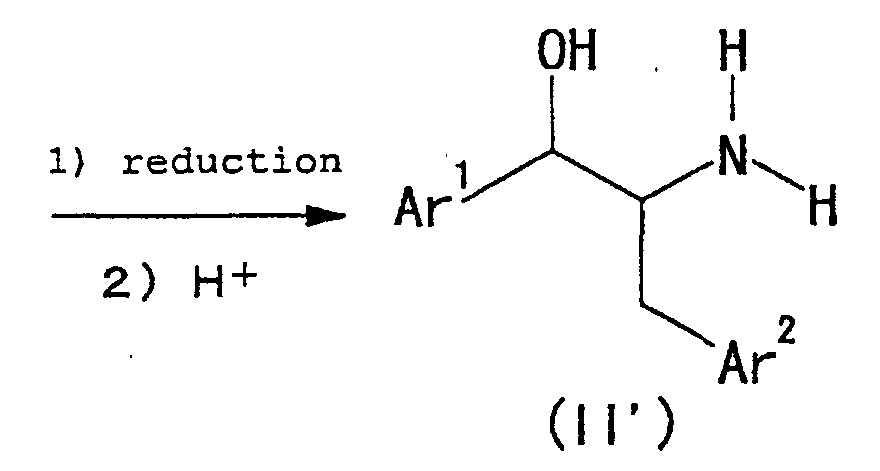
- In this method, Compound (IV) is reacted with Ar2CH2-M, the resulting imine or iminium ion (V) is reduced and silyl ether is deprotected with an acid to give Compound (II'). In this reaction, Ar2CH2-M is used in a monoequivalent amount or large excess (preferably 1-10 equivalents) relative to Compound (IV). For the subsequent reduction reaction, a method comprising use of a reducing agent, catalytic hydrogenation in the presence of a catalyst, electrolytic reduction using lead or platinum as a negative electrode, and the like can be used. As a reducing agent, metal hydrogen complex compounds such as sodium borohydride, sodium cyanoborohydride, lithium aluminum hydride, zinc borohydride and the like, diborane and the like can be mentioned. The reducing agent is used in a monoequivalent amount or large excess (preferably 1-10 equivalents). As the catalyst to be used for hydrogenation, metals such as palladium, platinum, nickel, rhodium and the like, oxides, salts and complexes of thereof, and the like can be mentioned. These catalysts can be also used by being carried on various carriers such as carbon and the like. The hydrogenation can be conducted under normal pressure or under pressurization. As the solvent to be used therefor, for example, ethers (e.g., tetrahydrofuran, dioxane, diethyl ether and the like), hydrocarbon (e.g., toluene, hexane and the like), halogenated hydrocarbon (e.g., methylene chloride, chloroform and the like) and the like can be mentioned. The reaction time is 0.5 - 72 hrs., preferably 1 - 24 hrs. The reaction temperature is from -100°C to 100°C (preferably -80°C to 50°C). After the reduction reaction, an aqueous solution of an acid such as hydrochloric acid, sulfuric acid, acetic acid and the like is added to the reaction mixture to remove silyl ether, whereby Compound (II') can be obtained.wherein D is an amino-protecting group such as tert-butoxycarbonyl, benzyloxycarbonyl, acetyl, trifluoroacetyl, benzyl and the like, and other symbols are as defined above.

- In this method, the amino-protecting group of compound (VI) is removed to give Compound (II). The reaction for removing amino-protecting group is known per se, and can be carried out according to such conditions.wherein the symbols in the formula are as defined above.
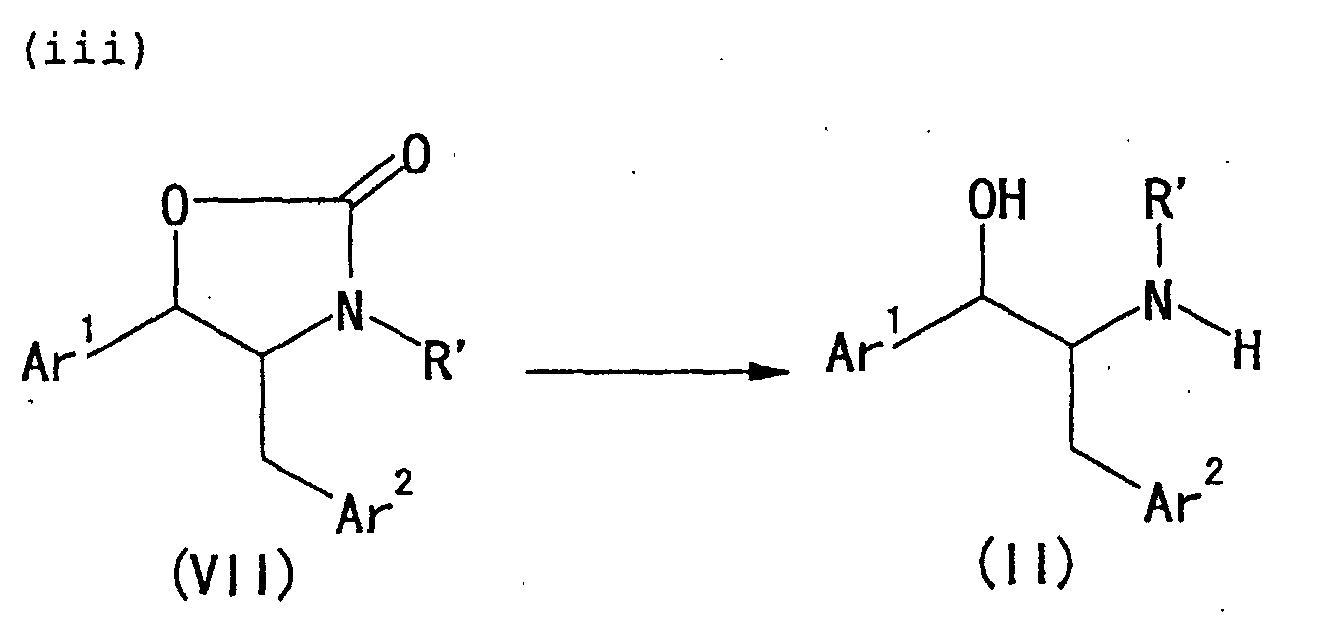
- The reaction for converting Compound (VII) to Compound (II) is carried out in the presence of a monoequivalent amount or large excess of an aqueous solution of a metal hydroxide such as sodium hydroxide, potassium hydride and the like, an aqueous solution of an acid such as hydrochloric acid, sulfuric acid and the like, trimethylsilyl iodide and the like. As the solvent to be used therefor, for example, water, alcohols (e.g., methanol, ethanol and the like), ethers (e.g., tetrahydrofuran, dioxane, diethyl ether and the like), halogenated hydrocarbons (e.g., methylene chloride, chloroform and the like), ketones (e.g., acetone, methyl ethyl ketone and the like), aprotic polar solvents (e.g., N,N-dimethylformamide, dimethyl sulfoxide and the like) and the like can be mentioned. The reaction time is 10 min. - 24 hrs. and the reaction temperature is from -20°C to 200°C (preferably 0°C to 100°C).
- Compound (III) can be synthesized by, for example, the following method.wherein the symbols in the formula are as defined above.

- The reaction for converting Compound (VIII) to Compound (III) is carried out under the same conditions as, for example, the method under (i) in the synthesis of Compound (I).
- Compound (IV) can be synthesized by, for example, the following method.wherein the symbols in the formula are as defined above.
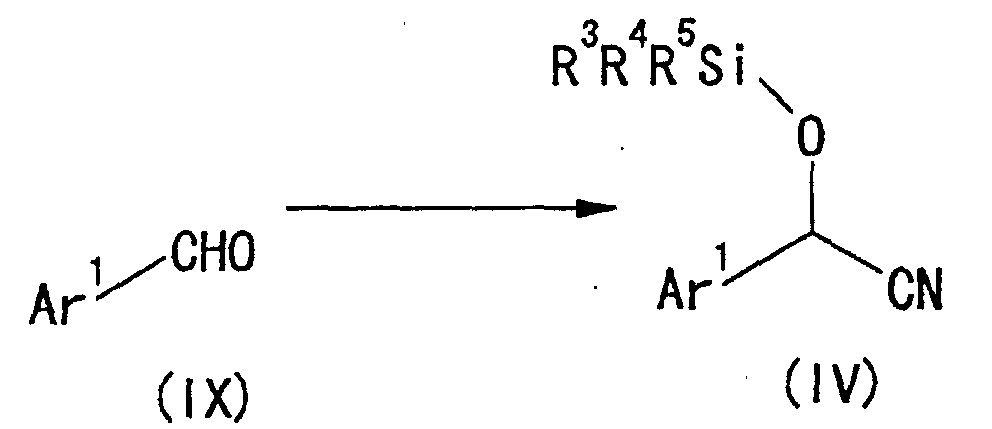
- The reaction for converting Compound (IX) to Compound (IV) is known per se, and can be carried out according to or by referring to the conditions described or cited in, for example, Tetrahedron Lett., 26, 4275-4278 (1985), J. Org. Chem., 51, 413-415 (1986), Tetrahedron Lett., 28, 5513-5516 (1987), Chem. Lett., 537-540 (1991), J. Chem. Soc. Chem. Comm. 1752-1753 (1991), J. Org. Chem., 55, 1479-1483 (1990), J. Fluorine Chem., 35, 287-294 (1987), Tetrahedron Lett., 33, 2159-2162 (1992), Tetrahedron Lett., 34, 4001-4004 (1992) and the like.
- Compound (VI) can be synthesized by, for example, the following method.wherein the symbols in the formula are as defined above.
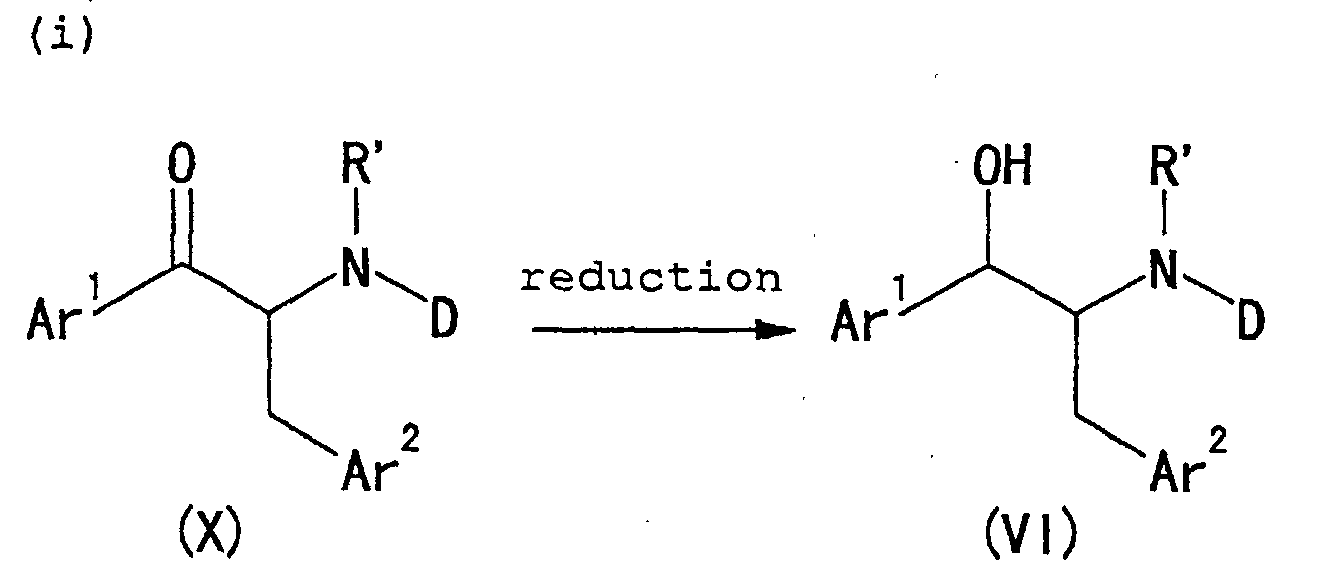
- The reaction for converting Compound (X) to Compound (VI) is carried out under the same conditions as, for example, the method under (ii) in the synthesis of Compound (I).
(ii) when R' is a hydrogen atomwherein the symbols in the formula are as defined above.
- The reaction for converting Compound (XI) to Compound (VI') is carried out under the same conditions as, for example, the method under (iii) in the synthesis of Compound (II).
- Compound (VII) wherein R' is not a hydrogen atom can be synthesized according to, for example, the following method.wherein the symbols in the formula are as defined above.
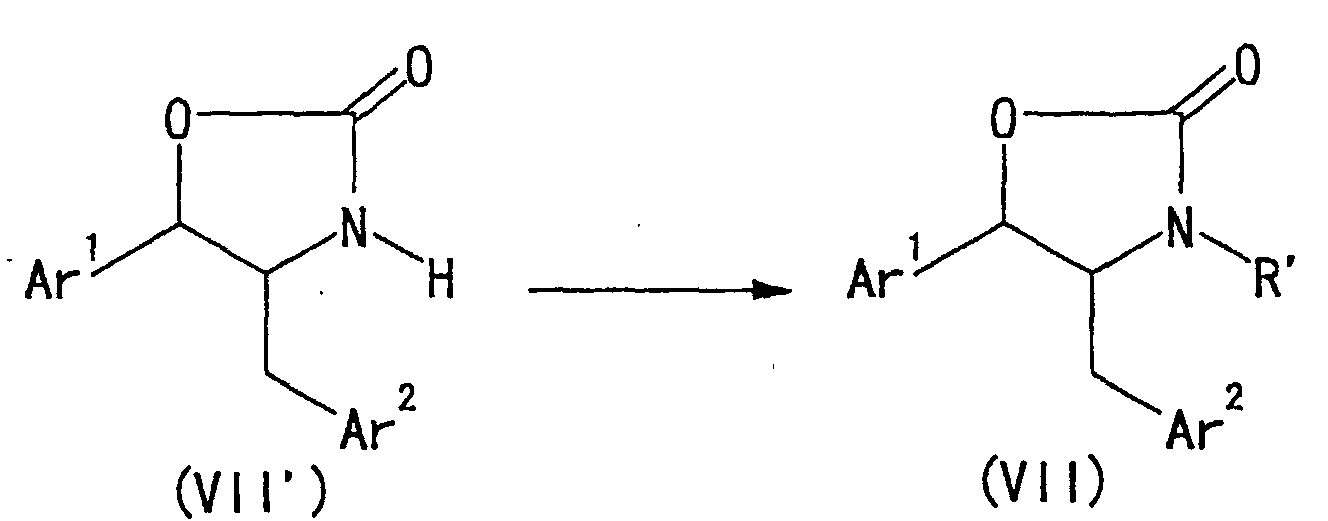
- In this method, Compound (VII') is reacted with an alkylation agent to give Compound (VII). In this reaction, alkylation agent is used in a monoequivalent amount or large excess (preferably 1-10 equivalents) relative to compound (VII'). In this case, for example, 1-10 equivalents of a basic compound such as sodium hydroxide, potassium hydroxide, sodium hydride, potassium carbonate, triethylamine, diisopropylethylamine, pyridine, 4-N,N-dimethylaminopyridine (DMAP), 1,8-diazabicyclo[5.4.0]-7-undecene, 1,4-diazabicyclo[2.2.2]octane (DABCO) and the like may be used. As the alkylation agent to be used, halogenated hydrocarbon, sulfonic acid esters such as alkyl methanesulfonate, alkyl p-toluenesulfonate and the like, and the like can be mentioned. For this reaction, an alkali metal iodide such as sodium iodide and the like can be added in a monoequivalent amount or large excess (preferably 1-10 equivalents) as a reaction promoter. As the solvent to be used therefor, for example, water, alcohols (e.g., methanol, ethanol and the like), ethers (e.g., tetrahydrofuran, dioxane, diethyl ether and the like), halogenated hydrocarbon (e.g., methylene chloride, chloroform and the like), ketones (e.g., acetone, methyl ethyl ketone and the like), aprotic polar solvents (e.g., N,N-dimethylformamide, dimethyl sulfoxide and the like) and the like can be mentioned. The reaction time is 10 min. - 24 hrs., preferably 0.5 - 6 hrs., and the reaction temperature is from - 20°C to 200°C (preferably 0°C to 150°C).
- Compound (VII') (compound (VII) wherein R' is a hydrogen atom) can be synthesized according to, for example, the following method.wherein the symbols in the formula are as defined above.

- In this method, carboxyl group of Compound (XII) is converted to acyl azide, which is then led to isocyanate using what is called a Curtius rearrangement reaction, and the resulting isocyanate is cyclized with a hydroxyl group in the molecule to give Compound (VII'). During the reaction, acyl azide can be synthesized by, for example, the following three methods.
- Method A: Compound (XII) is treated with a monoequivalent amount or large excess of a halogenation agent (e.g., thionyl chloride, oxalyl chloride, phosphorus pentachloride and the like) to convert the compound to acyl halide. In this reaction, a basic compound such as pyridine, 4-N,N-dimethylaminopyridine, triethylamine and the like may be used in 1-10 equivalents. In this reaction, a catalytic amount of N,N-dimethylformamide may be added as a reaction promoter. As the solvent to be used therefor, for example, ethers (e.g., tetrahydrofuran, dioxane, diethyl ether and the like), halogenated hydrocarbons (e.g., methylene chloride, chloroform and the like), ketones (e.g., acetone, methyl ethyl ketone and the like), esters (e.g., ethyl acetate and the like), aprotic polar solvents (e.g., N,N-dimethylformamide, dimethyl sulfoxide and the like) and the like can be mentioned. The reaction temperature is from -100°C to 200°C (preferably -20°C to 100°C). The obtained acyl halide is reacted with a monoequivalent amount or large excess of alkali metal azide salt (e.g., sodium azide and the like) to give acyl azide. In this reaction, a basic compound such as pyridine, 4-N,N-dimethylaminopyridine, triethylamine and the like may be used in 1-10 equivalent amount. As the solvent to be used therefor, for example, ethers (e.g., tetrahydrofuran, dioxane, diethyl ether and the like), halogenated hydrocarbons (e.g., methylene chloride, chloroform and the like), ketones (e.g., acetone, methyl ethyl ketone and the like), esters (e.g., ethyl acetate and the like), aprotic polar solvents (e.g., N,N-dimethylformamide, dimethyl sulfoxide and the like) and the like can be mentioned. The reaction temperature is from -100°C to 200°C (preferably -20°C to 100°C) .
- Method B: After conversion of Compound (XII) to acyl halide according to Method A, acyl halide is treated with a monoequivalent amount or large excess of hydrazine to give hydrazide. In this reaction, a basic compound such as pyridine, 4-N,N-dimethylaminopyridine, triethylamine and the like may be used in 1-10 equivalent amount. As the solvent to be used therefor, for example, ethers (e.g., tetrahydrofuran, dioxane, diethyl ether and the like), halogenated hydrocarbons (e.g., methylene chloride, chloroform and the like), ketones (e.g., acetone, methyl ethyl ketone and the like), esters (e.g., ethyl acetate and the like), aprotic polar solvents (e.g., N,N-dimethylformamide, dimethyl sulfoxide and the like) and the like can be mentioned. The reaction temperature is from -100°C to 200°C (preferably -20°C to 100°C). The obtained hydrazide is treated with a monoequivalent amount or large excess of nitrous acid (which can be also generated from metal nitrites such as sodium nitrite and the like in the presence of an acid) to give acyl azide. As the solvent to be used therefor, for example, water, alcohols (e.g., methanol, ethanol and the like), ethers (e.g., tetrahydrofuran, dioxane, diethyl ether and the like), halogenated hydrocarbon (e.g., methylene chloride, chloroform and the like), ketones (e.g., acetone, methyl ethyl ketone and the like), esters (e.g., ethyl acetate and the like), aprotic polar solvents (e.g., N,N-dimethylformamide, dimethyl sulfoxide and the like) and the like can be mentioned. The reaction temperature is from -100°C to 200°C (preferably -20°C to 50°C).
- Method C: Compound (XII) is reacted with a monoequivalent amount or large excess of diphenylphosphoryl azide to give acyl azide. In this case, for example, 1-10 equivalents of a basic compound such as sodium hydroxide, potassium hydroxide, sodium hydride, potassium carbonate, triethylamine, diisopropylethylamine, pyridine, 4-N,N-dimethylaminopyridine (DMAP), 1,8-diazabicyclo[5.4.0]-7-undecene, 1,4-diazabicyclo[2.2.2]octane (DABCO) and the like may be used. As the solvent to be used therefor, for example, water, alcohols (e.g., methanol, ethanol and the like), ethers (e.g., tetrahydrofuran, dioxane, diethyl ether and the like), halogenated hydrocarbons (e.g., methylene chloride, chloroform and the like), ketones (e.g., acetone, methyl ethyl ketone and the like), esters (e.g., ethyl acetate and the like), aprotic polar solvents (e.g., N,N-dimethylformamide, dimethyl sulfoxide and the like) and the like can be mentioned. The reaction time is 10 min. - 24 hrs., preferably 0.5 - 6 hrs. and the reaction temperature is from -20°C to 200°C.
-
- The obtained acyl azide is subjected to a Curtius rearrangement reaction to lead to isocyanate. This reaction is carried out by heating the obtained acyl azide from 30°C to 200°C. In this case, for example, 1-10 equivalents of a basic compound such as triethylamine, diisopropylethylamine, pyridine, 4-N,N-dimethylaminopyridine (DMAP), 1,8-diazabicyclo[5.4.0]-7-undecene, 1,4-diazabicyclo[2.2.2]octane (DABCO) and the like may be used. The reaction can be also carried out in a solvent such as water, alcohols (e.g., methanol, ethanol and the like), ethers (e.g., tetrahydrofuran, dioxane, diethyl ether and the like), halogenated hydrocarbons (e.g., methylene chloride, chloroform and the like), ketones (e.g., acetone, methyl ethyl ketone and the like), esters (e.g., ethyl acetate and the like), aprotic polar solvents (e.g., N,N-dimethylformamide, dimethyl sulfoxide and the like) and the like. The reaction time is 10 min. - 24 hrs., preferably 0.5 - 6 hrs. It is also possible to carry out an intramolecular cyclization reaction subsequent to the Curtius reaction under these reaction conditions in the same system to lead to Compound (VII').
- The reaction to introduce isocyanate obtained by Curtius reaction to Compound (VII') is conducted by heating the isocyanate from 30°C to 200°C. In this case, for example, 1-10 equivalents of a basic compound such as triethylamine, diisopropylethylamine, pyridine, 4-N,N-dimethylaminopyridine (DMAP), 1,8-diazabicyclo[5.4.0]-7-undecene, 1,4-diazabicyclo[2.2.2]octane (DABCO) and the like may be used. The reaction can be also carried out in a solvent such as water, alcohols (e.g., methanol, ethanol and the like), ethers (e.g., tetrahydrofuran, dioxane, diethyl ether and the like), halogenated hydrocarbons (e.g., methylene chloride, chloroform and the like), ketones (e.g., acetone, methyl ethyl ketone and the like), esters (e.g., ethyl acetate and the like), aprotic polar solvents (e.g., N,N-dimethylformamide, dimethyl sulfoxide and the like) and the like. The reaction time is 10 min. - 24 hrs., preferably 0.5 - 6 hrs.
- The series of reactions from Compound (XII) to Compound (VII') can be also carried out in the same system without isolation of each intermediate.
- Compound (VIII) can be synthesized by, for example, the following method.wherein the symbols in the formula are as defined above.

- The reaction for converting Compound (X) to Compound (VIII) is carried out under the same conditions as, for example, the method under (ii) in the synthesis of Compound (II).
- Compound (X) wherein R' is not a hydrogen atom can be synthesized by, for example, the following method.wherein the symbols in the formula are as defined above.
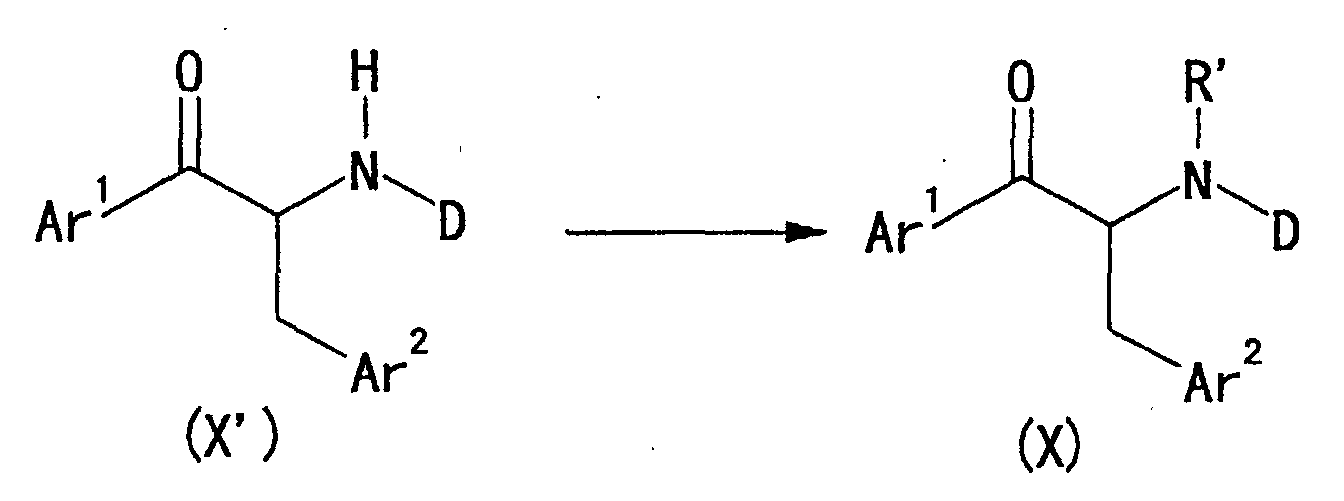
- The reaction for converting Compound (X') to Compound (X) is carried out under the same conditions as, for example, the method for the synthesis of Compound (VII).
- Compound (X') (compound (X) wherein R' is a hydrogen atom) can be synthesized by, for example, the following method.wherein E is a leaving group such as halogen atom (e.g., chloro, bromo, iodo and the like), methanesulfonyloxy, p-toluenesulfonyloxy and the like, and other symbols are as defined above.
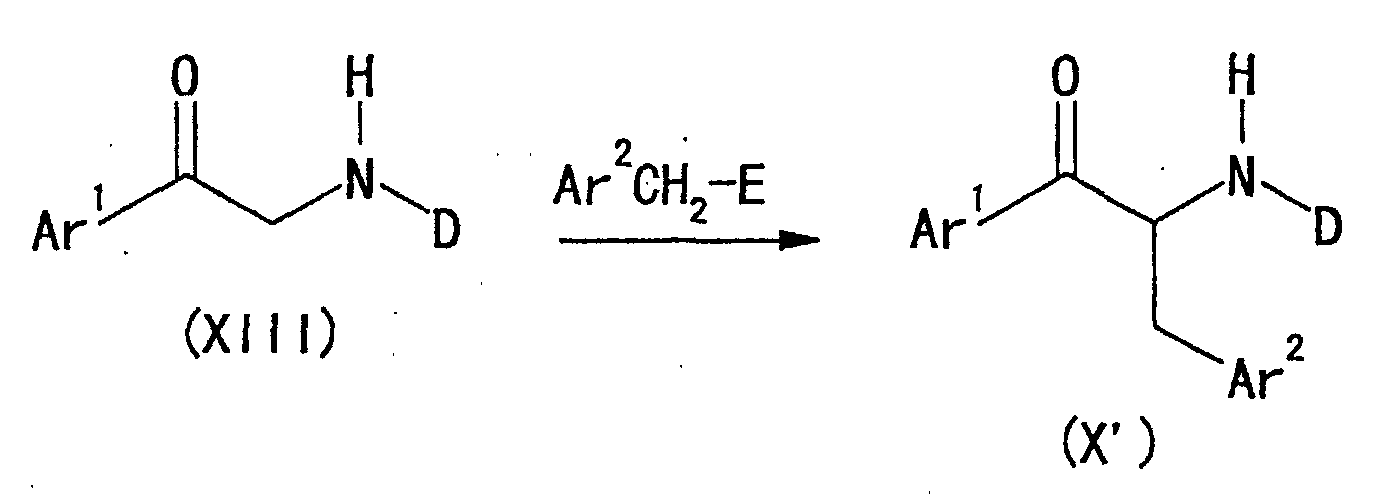
- In this reaction, Compound (XIII) is reacted with Ar2CH2-E in the presence of a basic compound to give Compound (X'). In this reaction, a monoequivalent amount or large excess of basic compound and a monoequivalent amount or large excess of Ar2CH2-E, relative to Compound (XIII), are used. As the basic compound to be used in this case, for example, sodium hydroxide, potassium hydroxide, sodium hydride, potassium carbonate, triethylamine, diisopropylethylamine, pyridine, 4-N,N-dimethylaminopyridine (DMAP), 1,8-diazabicyclo[5.4.0]-7-undecene, 1,4-diazabicyclo[2.2.2]octane (DABCO) and the like can be mentioned. As the solvent to be used therefor, for example, water, alcohols (e.g., methanol, ethanol and the like), ethers (e.g., tetrahydrofuran, dioxane, diethyl ether and the like), halogenated hydrocarbons (e.g., methylene chloride, chloroform and the like), ketones (e.g., acetone, methyl ethyl ketone and the like), esters (e.g., ethyl acetate and the like), aprotic polar solvents (e.g., N,N-dimethylformamide, dimethyl sulfoxide and the like) and the like can be mentioned. The reaction time is 10 min. - 24 hrs., preferably 0.5 - 6 hrs. The reaction temperature is from -20°C to 200°C (preferably 0°C to 80°C).
- Compound (XI) can be synthesized by, for example, the following method.wherein the symbols in the formula are as defined above.

- In this reaction, Compound (VII') is reacted with a reagent to introduce an amino-protecting group in the presence of a basic compound to give Compound (XI). In this reaction, a monoequivalent amount or large excess of basic compound and a monoequivalent amount or large excess of a reagent to introduce an amino-protecting group, relative to Compound (VII'), are used. As the basic compound to be used in this case, for example, sodium hydroxide, potassium hydroxide, sodium hydride, potassium carbonate, triethylamine, diisopropylethylamine, pyridine, 4-N,N-dimethylaminopyridine (DMAP), 1,8-diazabicyclo[5.4.0]-7-undecene, 1,4-diazabicyclo[2.2.2]octane (DABCO) and the like can be mentioned. As the reagent to introduce an amino-protecting group to be used here, for example, acetic anhydride, trifluoroacetic anhydride, acetic chloride, benzyl chlorocarbonate, di-tert-butyl dicarbonate and the like can be mentioned. As the solvent to be used therefor, for example, water, alcohols (e.g., methanol, ethanol and the like), ethers (e.g., tetrahydrofuran, dioxane, diethyl ether and the like), halogenated hydrocarbons (e.g., methylene chloride, chloroform and the like), ketones (e.g., acetone, methyl ethyl ketone and the like), esters (e.g., ethyl acetate and the like), aprotic polar solvents (e.g., N,N-dimethylformamide, dimethyl sulfoxide and the like) and the like can be mentioned. The reaction time is 10 min. - 24 hrs., preferably 0.5 - 6 hrs. The reaction temperature is from -20°C to 200°C (preferably 0°C to 80°C).
- Compound (XII) can be synthesized by, for example, the following method.wherein R''' is a C1-6 alkyl optionally having substituents, C7-10 aralkyl optionally having substituents or C7-16 aralkyl optionally having substituents, and other symbols are as defined above.
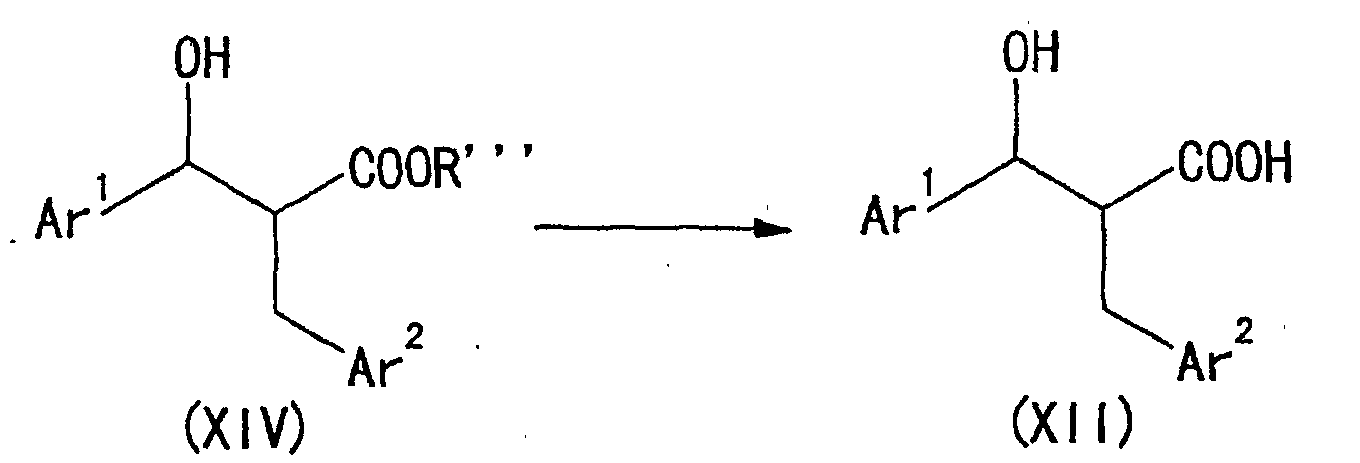
- In this method, an ester group of Compound (XIV) is hydrolyzed to give Compound (XII). The hydrolysis of ester group is all known per se, and can be carried out under such conditions.
- Compound (XIII) can be synthesized by, for example, the following method.wherein the symbols in the formula are as defined above.
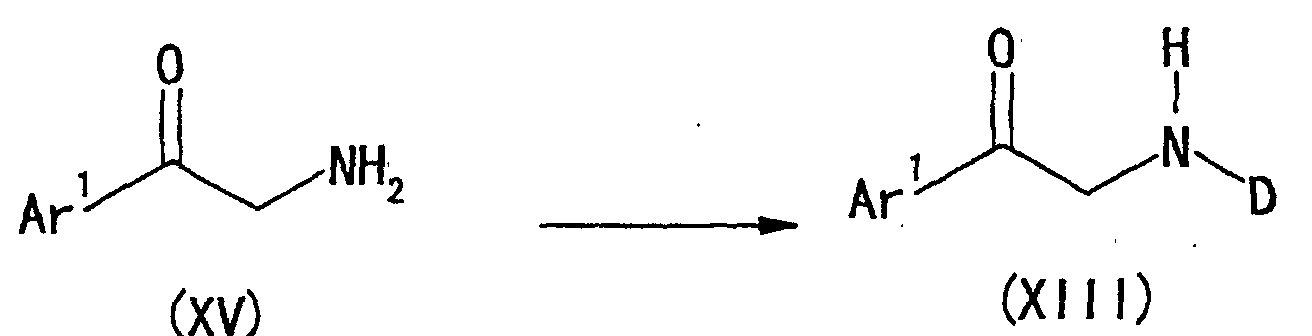
- In this method, a protecting group is introduced into amino group of Compound (XV) to give Compound (XIII). The reaction for protecting amino group with a protecting group is known per se, and can be carried out under such conditions.
- Compound (XIV) can be synthesized by, for example, the following method.wherein the symbols in the formula are as defined above.
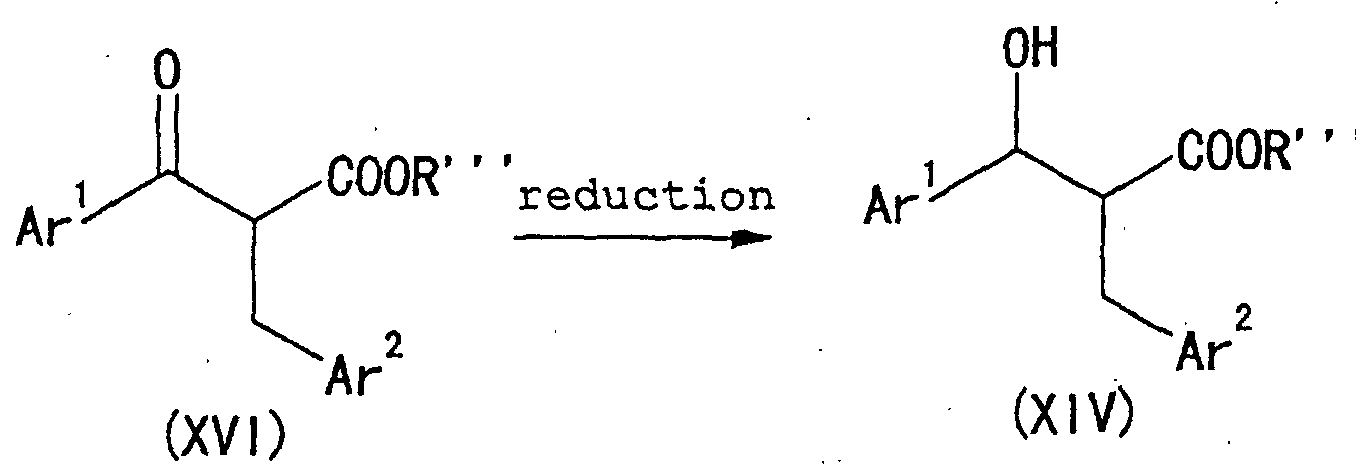
- The reaction for converting Compound (XVI) to Compound (XIV) is carried out under the same conditions as, for example, the method under (ii) in the synthesis of Compound (I).
- Compound (XV) can be synthesized by, for example, the following method.wherein the symbols in the formula are as defined above.

- For reduction reaction of Compound (XVII), catalytic hydrogenation in the presence of a catalyst and the like can be used. As the catalyst to be used for hydrogenation, metals such as palladium, platinum, nickel, rhodium and the like, oxides, salts and complexes of thereof, and the like can be mentioned. These catalysts can be also used by being carried on various carriers such as carbon and the like. The hydrogenation can be conducted under normal pressure or under pressurization. The solvent to be used therefor can be appropriately determined. For example, alcohols (e.g., methanol, ethanol and the like), ethers (e.g., tetrahydrofuran, dioxane, diethyl ether and the like), halogenated hydrocarbons (e.g., methylene chloride, chloroform and the like), esters (e.g., ethyl acetate and the like), aprotic polar solvents (e.g., N,N-dimethylformamide, dimethyl sulfoxide and the like) and the like can be mentioned. The reaction time is 0.5 - 72 hrs., preferably 1 - 24 hrs. The reaction temperature is from -100°C to 100°C (preferably -70°C to 50°C).
- Compound (XVI) can be synthesized by, for example, thewherein the symbols in the formula are as defined above.

- The reaction for converting Compound (XVIII) to Compound (XVI) is carried out under the same conditions as, for example, in the method for the synthesis of Compound (X'). Compound (XVIII), which is a starting compound, can be synthesized from Ar1COOH according to or by referring to the conditions described or cited in, for example, Heterocycles, 23, 2277-2287 (1985), J. Org. Chem., 53, 869-873 (1988), J. Org. Chem., 53, 873-875 (1986), Chem. Pharm. Bull., 38, 103-109 (1990) and the like; from Ar1C(=O)Cl according to or by referring to the conditions described or cited in, for example, J. Am. Chem. Soc., 109, 7488-7494 (1987), J. Org. Chem., 53, 2968-2971 (1988), Tetrahedron Lett., 32, 7731-7734 (1991) and the like, and from Ar1C(=O)CH3 according to or by referring to the conditions described or cited in, for example, J. Heterocyclic Chem., 22, 1033-1034 (1985), J. Heterocyclic Chem., 25, 1737-1740 (1988), J. Med. Chem., 34, 798-806 (1991), Tetrahedron, 46, 4473-4486 (1990), J. Org. Chem., 64, 1512-1519 (1999) and the like.
- Compound (XVII) can be synthesized by, for example, the following method.wherein X is a halogen atom, and other symbols are as defined above.
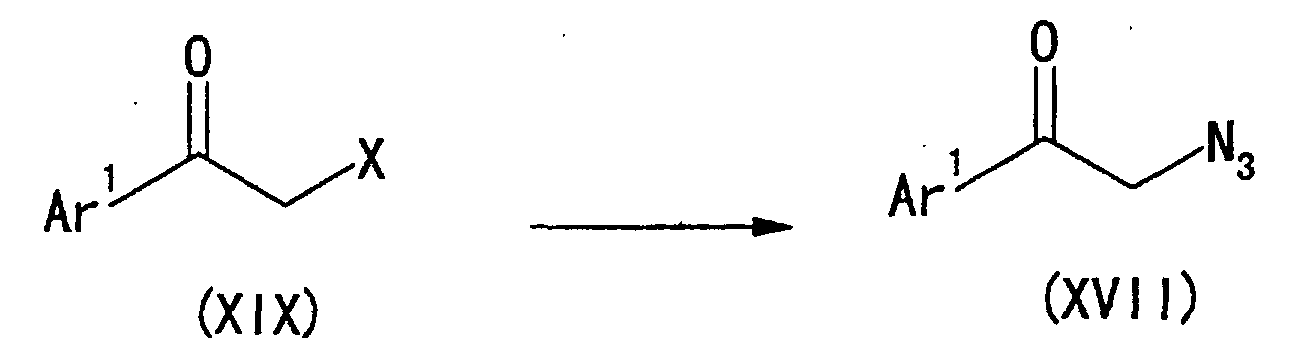
- In this reaction, Compound (XIX) is reacted with a monoequivalent amount or large excess of alkali metal azide salt (e.g., sodium azide and the like) to give Compound (XVII). As the solvent to be used therefor, for example, water, alcohols (e.g., methanol, ethanol and the like), ethers (e.g., tetrahydrofuran, dioxane, diethyl ether and the like), halogenated hydrocarbons (e.g., methylene chloride, chloroform and the like), ketones (e.g., acetone, methyl ethyl ketone and the like), esters (e.g., ethyl acetate and the like), aprotic polar solvents (e.g., N,N-dimethylformamide, dimethyl sulfoxide and the like) and the like can be mentioned. The reaction time is 10 min. - 24 hrs. and the reaction temperature is from -20°C to 200°C (preferably 0°C to 50°C).
- In each reaction for the synthesis of the above-mentioned objective compounds and starting compounds, when a starting compound to be used has an amino group, a carboxyl group or a hydroxy group as a substituent, such group may be protected by a protecting group generally used for peptide chemical synthesis and the like. After the reaction, the protecting group is removed as necessary to give the objective compound.
- As the amino-protecting group, for example, C1-6 alkylcarbonyl (e.g., formyl, methylcarbonyl, ethylcarbonyl and the like), phenylcarbonyl, C1-6 alkyl-oxycarbonyl (e.g., methoxycarbonyl, ethoxycarbonyl and the like), C6-10 aryl-oxycarbonyl (e.g., phenyloxycarbonyl and the like), C7-10 aralkyl-carbonyl (e.g., benzyloxycarbonyl and the like), trityl, phthaloyl, each of which may have substituent(s), and the like are used. As the substituent of these, halogen atom (e.g., fluoro, chloro, bromo, iodo and the like), C1-6 alkylcarbonyl (e.g., methylcarbonyl, ethylcarbonyl, butylcarbonyl and the like), nitro group and the like are used, wherein the number of substituents is about 1 to 3.
- As the carboxyl-protecting group, for example, C1-6 alkyl (e.g., methyl, ethyl, propyl, isopropyl, butyl, tert-butyl and the like), phenyl, trityl, silyl, each of which may have substituent(s), and the like are used. As the substituent of these, halogen atom (e.g., fluoro, chloro, bromo, iodo and the like), C1-6 alkylcarbonyl (e.g., formyl, methylcarbonyl, ethylcarbonyl, butylcarbonyl and the like), nitro group and the like are used, wherein the number of substituents is about 1 to 3.
- As the hydroxy-protecting group, for example, C1-6 alkyl (e.g., methyl, ethyl, propyl, isopropyl, butyl, tert-butyl and the like), phenyl, C7-10 aralkyl (e.g., benzyl and the like), C1-6 alkylcarbonyl (e.g., formyl, methylcarbonyl, ethylcarbonyl and the like), C6-10 aryl-oxycarbonyl (e.g., phenyloxycarbonyl and the like), C7-10 aralkyl-carbonyl (e.g., benzyloxycarbonyl and the like), pyranyl, furanyl, silyl, each of which may have substituent(s), and the like are used. As the substituent of these, halogen atom (e.g., fluoro, chloro, bromo, iodo and the like), C1-6 alkyl, phenyl, C7-10 aralkyl, nitro group and the like are used, wherein the number of substituents is about 1 to 3.
- As a method for removing the protecting group, a method known per se or a method analogous thereto are used. For example, there may be used methods employing treatment with an acid, a base, reduction, ultraviolet rays, hydrazine, phenylhydrazine, sodium N-methyldithiocarbamate, tetrabutylammonium fluoride, palladium acetate and the like are used.
- For separation and purification of Compound (I) from a reaction mixture and the starting material thereof, a conventional means for separation and purification (e.g., extraction, concentration, filtration, recrystallization, column chromatography, thin layer chromatography) is performed.
- When Compound (I) thus obtained is a free form, it can be converted to a salt by a method known per se or a method analogous thereto (e.g., neutralization etc.). When it is obtained as a salt, it can be converted to a free form or other salt by a method known per se or a method analogous thereto.
- Furthermore, when Compound (I) is an optically active form, it can be resolved into a d-form and an 1-form by a conventional means for optical resolution.
- Compound (I) and Compound (I') of the present invention are low toxic, useful as a pharmaceutical product, and have a cholesteryl ester transfer protein inhibitory action, a superior HDL-cholesterol increasing action, an LDL-cholesterol lowering action, a VLDL cholesterol lowering action and a triglyceride lowering action. Therefore, the agent of the present invention is useful for the prophylaxis or treatment of diseases based on these pharmacological actions. That is, the agent is particularly suitable for the prophylaxis or treatment of the diseases such as hyperlipidemia, particularly high LDL-cholesterolemia, high lipoproteinemia and hypertriglyceridemia, low HDL-cholesterolemia, aterosclerotic vascular lesion resulting therefrom and deuteropathy thereof, acute coronary syndrome such as acute cardiac infarction, unstable angina pectoris and the like, peripheral arterial occlusion, percutaneous transluminal coronary angioplasty (PTCA) or arterial restenosis after stent placement, ischemic heart disease such as cardiac infarction, angina pectoris and the like, arteriosclerosis, intermittent claudication, stroke (cerebral infarction, cerebral embolus, cerebral hemorrhage and the like), lacunar infarction, cerebrovascular dementia, gangrene, glomerulosclerosis, nephropathy, Tangier disease and the like, and for the suppression of progression of focal arteriosclerosis and the like, in mammals (e.g., mouse, rat, hamster, rabbit, cat, dog, bovine, horse, sheep, monkey, human etc.).
- When Compound (I) and Compound (I') of the present invention are compared with a pharmaceutical agent that has an LDL-cholesterol lowering action but does not show an HDL-cholesterol increasing action, they are useful for the prophylaxis or treatment of primary hypo-HDL-emia and the like, for which an LDL-cholesterol lowering action alone has no treatment effect. The final object of therapeutic agents of hyperlipidemia is prevention of the onset of deadly diseases such as cardiac infarction and the like, and even a pharmaceutical agent having an LDL lowering action but without an HDL increasing action shows an onset-preventive effect to some degree against cardiac infarction and the like. However, an HDL-cholesterol elevating agent can show stronger prevention of the onset of cardiac infarction and the like. Moreover, it is effective for patients and diseases and conditions (e.g., intractable hyperlipidemia and the like), for which a pharmaceutical agent having an LDL lowering action but without an HDL increasing action fails to show a treatment effect, and even in humans showing a normal level of serum lipid, it suppresses the onset rate of deadly diseases such as cardiac infarction and the like, thereby improving treatment effects.
- While Compound (I) and Compound (I') can be used as a bulk powder, it is generally formulated together with suitable amounts of appropriately selected carriers for preparations, such as excipients (e.g., calcium carbonate, kaolin, sodium hydrogen carbonate, lactose, starches, crystalline cellulose, talc, granulated sugar, porous substance etc.), binders (e.g., dextrin, rubbers, alcoholized starch, gelatin, hydroxypropyl cellulose, hydroxypropylmethyl cellulose, pullulan etc.), disintegrants (e.g., carboxymethyl cellulose calcium, croscarmellose sodium, crospovidone, low substituted hydroxypropyl cellulose, partially pregelatinized starch etc.), lubricants (e.g., magnesium stearate, calcium stearate, talc, starch, sodium benzoate etc.), coloring agents (e.g., tar dye, caramel, ferric oxide, titanium oxide, riboflavins etc.), corrigents (e.g., sweeteners, flavoring etc.), stabilizers (e.g., sodium sulfite etc.) and preservatives (e.g., parabens, sorbic acid etc.) and the like according to a conventional method and administered. The prophylactic or therapeutic agent of the present invention containing the aforementioned preparation appropriately contains an effective amount of Compound (I) or Compound (I') for the treatment or prophylaxis of diseases. The content of Compound (I) and Compound (I') in the preparation of the present invention is generally 0.1 to 100 wt% of the entire preparation. The preparation to be used in the present invention may contain a pharmaceutical component other than Compound (I) or Compound (I') as an active ingredient, wherein the component is not particularly limited as long as the object of the present invention can be achieved, and can be used in an appropriately suitable mixing ratio. Examples of the dosage form include tablets (including sugar-coated tablet and film-coated tablet), pill, capsule, granule, fine granules, powder, syrup, emulsion, suspension, injection, inhalant, ointment and the like. These preparations can be prepared according to a conventional method (e.g., method described in Japan Pharmacopoeia etc.).
- To be specific, tablets can be produced by adding excipient, binder, disintegrant or other suitable additives to Compound (I) or Compound (I'), admixing homogeneously, granulating by a suitable method to give granules, adding lubricant etc. and compression-forming; or directly compression-forming Compound (I) or Compound (I') as it is or a homogeneous admixture thereof with excipient, binder, disintegrant or other suitable additives; compression-forming granules as they are, which have been prepared in advance or after admixing homogeneously with suitable additives. In addition, coloring agents, corrigents and the like can be added to this agent where necessary. Moreover, a film may be formed on this agent with a suitable coating agent. Injection can be produced by dissolving, suspending or emulsifying a given amount of Compound (I) or Compound (I') in water for injection, physiological saline, Ringer solution and the like in the case of aqueous solvents and generally in vegetable oil and the like in the case of non-aqueous, solvents to a given amount or sealing a given amount of Compound (I) or Compound (I') in a vessel for injection.
- As the carrier for oral preparation, for example, substances conventionally used in the field of pharmaceutical preparation, such as starch, mannitol, crystalline cellulose, carboxymethyl cellulose sodium and the like, are used. As the carrier for injection, for example, distilled water, physiological saline, glucose solution, transfusion and the like are used. In addition, additives generally used for preparation can be added appropriately.
- The preparation of the present invention can be also used as a sustained release preparation. As the sustained release preparation of the present invention, for example. microcapsule (e.g., microsphere microcapsule, microparticle etc.) produced by in-water drying method (o/w method, w/o/w method etc.), phase separation method, spray drying method or a method analogous thereto may be administered as it is or said microcapsule or a pharmaceutical composition in the form of a sphere, needle, pellet, film or cream as a starting material may be prepared into various dosage forms and administered. As the dosage form, for example, parenteral agents (e.g., intramuscular injection, subcutaneous injection, injection into organ etc. or embedded agent; transmucosal agent to nasal cavity, rectum, uterus etc. and the like), oral agent (e.g., hard capsule, soft capsule, granule, powder, suspension etc.) and the like can be mentioned.
- When the sustained release preparation of the present invention is an injection, microcapsules may be prepared with a dispersing agent (e.g., surfactant such as Tween 80, HCO-60 and the like;-polysaccharides such as carboxymethyl cellulose, sodium alginate, sodium hyaluronate and the like; protamine sulfate, polyethylene glycol etc.), preservatives (e.g., methylparaben, propylparaben etc.), isotonicity agents (e.g., sodium chloride, mannitol, sorbitol, glucose etc.), local anesthesia (e.g., xylocaine hydrochloride, chlorobutanol etc.) and the like to give an aqueous suspension, or dispersed together with a vegetable oil (e.g., sesame oil, corn oil etc.) or a mixture of vegetable oil and phospholipid (e.g., lecithin etc.), or middle chain fatty acid triglyceride (e.g., miglyol 812 etc.) to give an oil suspension and used as a sustained release injection.
- When the sustained release preparation of the present invention is a microcapsule, its average particle size is about 0.1 to about 300 µm, preferably about 1 to about 150 µm, more preferably about 2 to about 100 µm.
- To give a sterile preparation of microcapsule, there can be mentioned, but not particularly limited to, a method comprising sterilizing all the production steps, a method comprising sterilization with gamma rays, a method comprising addition of preservatives and the like.
- For the treatment of these diseases, Compound (I) and Compound (I') can be used alone for the prophylaxis and/or treatment or may be used along with other pharmaceutical components such as lipid-lowering drugs, cholesterol-lowering drugs, cardiac muscle protective drugs, therapeutic drugs of coronary diseases, therapeutic drugs of diabetes, therapeutic drugs of hypothyroidism, therapeutic drugs of nephrotic syndrome, therapeutic drugs of osteoporosis and therapeutic drugs of chronic kidney failure. In this case, these compounds are preferably administered as an oral preparation, but where necessary, they may be administered as a rectal preparation in the form of a suppository. As a combinable component in this case, for example, (1) PPARα agonists such as fibrates (e.g., clofibrate, bezafibrate, gemfibrogil, fenofibrate etc.) and the like, nicotinic acid, derivatives thereof and analogs thereof (e.g., acipimox, probucol etc.), (2) bile acid binding resin (e.g., colestyramine, colestipol etc.), a compound suppressing absorption of cholesterol (e.g., sitosterol, neomycin etc.), (3) compound inhibiting biosynthesis of cholesterol (e.g., HMG-CoA reductase inhibitors such as lovastatin, simvastatin, pravastatin, cerivastatin, atorvastatin, fluvastatin, itavastatin, rosuvastatin and the like), squalene epoxidase inhibitors (e.g., NB-598 and analog compound thereof etc.), squalene synthase inhibitors (e.g., benzoxazepine derivative etc.) and the like can be mentioned.
- Different combinable components are oxide squalene-lanosterol cyclase (e.g., decalin derivative, azadecalin derivative, indan derivative etc.), microsome triglyceride transfer protein inhibitor (implitapide etc.) and the like.
- When combined with a therapeutic drug of diabetes [actos, rosiglitazone, kinedak, penfill, humalin, euglucon, glimicron, daonil, novolin, monotard, insulins, glucobay, dimelin, rastinon, bacilcon, deamelin S, iszilins]; therapeutic drugs of hypothyroidism [dry thyroid (thyreoid), levothyroxine sodium (thyrodin S), liothyronine sodium (thyronine, thyronamin); therapeutic drugs of nephrotic syndrome: prednisolone (predonine), prednisolone sodium succinate (predonine), sodium methylprednisolone succinate (solu-medrol), betamethasone (rinderon)]; anticoagulative therapy drugs [dipyridamole (persantine), dilazep hydrochloride (comelian), ticlopidine, clobidogrel, Xa inhibitor]; therapeutic drugs of chronic kidney failure [diuretic [e.g., furosemide (lasix), bumetanide (lunetoron), azosemide (diart)], depressor (e.g., ACE inhibitor, (enalapril maleate (renivase)) and Ca antagonists (manidipine), α receptor blocker, AII antagonists (candesartan)) and the like for administration, oral administration is preferable.
- Furthermore, Compound (I) and Compound (I') are suitable for the treatment of diseases associated with excessive cell growth. A main example of the diseases associated.with excessive cell growth is tumor. It has been reported that tumor growth can be suppressed by lowering serum total cholesterol or LDL-cholesterol or VLDL-cholesterol (Lancet 339: 1154-1156, 1992). Therefore, Compound (I) and Compound (I') can treat tumor because they have an LDL-cholesterol or VLDL-cholesterol lowering action. They can be used for the treatment of tumor by themselves or in combination with known treatment methods. Other applicable diseases include hyperproliferative skin diseases, such as psoriasis, basal cell cancer, squamous cell carcinoma, keratosis and keratosis diseases.
- The hyperproliferative vascular diseases, such as angiostenosis and occlusion caused by surgical means such as PTCA (percutaneous transluminal coronary angioplasty) or bypass surgery are based on the growth of smooth muscle cells, and the compound of the present invention is also suitable for the treatment or prophylaxis of these disease in view of its LDL-cholesterol and VLDL-cholesterol lowering action. For this end, the compound is used alone or in combination with known active compound, such as heparin and the like that can be administered intravenously, preferably given by oral administration.
- A further possible use of the compound of the present invention is prophylaxis or treatment of gallstone. When cholesterol in the bile has exceeded its maximum solubility, cholesterol precipitates to form gallstone. The lipid-lowering drugs of fibrates increase secretion of neutral steroid into the bile and increases the sensitivity of gallstone formation. In contrast, cholesterol biosynthesis inhibitors such as lovastatin and pravastatin do not promote gallstone forming, but cause lower cholesterol concentration in the bile, which could decrease the gallstone forming index (Gut 31: 348-350, 1990). It has been reported that, when combined with ursodeoxycholic acid, lovastatin is effective for dissolving gallstone (Gastroenterology 102, No. 4, Pt. 2, A319, 1992). In view of the mode of action, therefore, the compound of the present invention is suitable for the prophylaxis or treatment of gallstone. For this end, the compound is used alone or in combination with known therapeutic compound (e.g., ursodeoxycholic acid and the like), or a known treatment method (e.g., shock wave lithotripsy and the like), and can be administered orally.
- Compound (I) and Compound (I') of the present invention have a blood HDL-cholesterol increasing action. By the increase in the blood HDL-cholesterol, export of cholesterol from the cell with excess cholesterol is promoted (Current Opinion in Lipidology 4: 392-400). Thus, the Compounds are suitable for the prophylaxis or treatment of atherosclerosis. In consideration of biological characteristics thereof, the Compounds are particularly suitable for the prophylaxis or treatment of atherosclerotic vascular lesion and deuteropathy thereof, such as coronary disease (CHD), cerebral ischemia, intermittent claudication, gangrene and the like.
- As another use of the present invention, there is one based on anti-oxidant action of HDL. The lipid peroxide concentration in blood is far higher in HDL than in LDL, and HDL has a role of preventing peroxidation of lipid that occurs in living organisms, such as oxidation of LDL and the like (Current Opinion in Lipidology 4: 392-400, Current Opinion in Lipidology 5: 354-364).
- As yet another use of the present invention, there is hypertension and deuteropathy thereof. Hyperlipidemia aggravates arteriosclerosis and induces hypertension. In contrast, HDL is known to prevent biosynthesis and to inhibit release of EDRF (epithelium-derived relaxing factor) by oxidized LDL, and increase prostacyclin, which is a vascular relaxing factor, in macrophages (Current Opinion in Lipidology 5: 354-364). In view of the lipid-lowering action and blood HDL-cholesterol increasing action of the substance of the present invention, it is suitable for the prophylaxis or treatment of hypertension and deuteropathy thereof, such as coronary heart disease (CHD), cerebral ischemia and the like. For this end, the compound of the formula (I) or (I') or a salt thereof is used alone or in combination with a pharmaceutical agent exemplified below and can be administered. The possible combinations in this case are, for example, angiotensin -II antagonists [e.g., losartan potassium (nu-lotan), dandesartan cilexetil (blopress) and the like], ACE inhibitors [e.g., enalapril maleate (renivase), lisinopril (zestril, longes), delapril hydrochloride (adecut), captopril and the like], calcium antagonists [e.g., amlodipine tosilate (amlodin, norvasc), manidipine hydrochloride (calslot) and the like], hypotensive diuretic, α receptor blocker, β receptor blocker and the like can be mentioned.
- Some of the possible use of Compound (I) and Compound (I') of the present invention is based on the cell protective action from cytotoxic secretions such as gastric juice, pancreatic juice, bile and the like. Body fluid-tissue interfacial cells mainly expresses apo J, and form a natural barrier against cytotoxic secretions such as gastric juice, pancreatic juice, bile and the like, and HDL is a carrier of apo J (clusterin) (Current Opinion in Lipidology 4: 392-400). In consideration of the blood HDL-cholesterol increasing action of Compound (I) and Compound (I') of the present invention, Compound (I) and Compound (I') of the present invention are suitable for the prophylaxis or treatment of gastric ulcer, pancreatitis, hepatitis and the like.
- Some of still other possible use of Compound (I) and Compound (I') of the present invention are based on cell growth activity. HDL alone or together with growth factor promotes cell growth of vascular endothelial cells (EC), corneal endothelium and the like, and HDL promotes growth of human lymphocytes (Current Opinion in Lipidology 3: 222-226). Compound (I) and Compound (I') of the present invention have a blood HDL-cholesterol increasing action. In consideration of these cell growth activities, they are suitable for the prophylaxis or treatment of atherosclerotic vascular lesion and deuteropathy thereof, such as coronary disease, corneal injury and the like. In addition, they are also suitable for the prophylaxis or treatment of diseases based on lowered immunity, such as infectious diseases, malignant tumor and the like.
- As an additional use of Compound (I) and Compound (I') of the present invention, HDL specifically acts on human placental transplanted tissue to cause secretion of lactogen, as well as promotes secretion of apoE from macrophages (Current Opinion in Lipidology 3: 222-226). In consideration of the secretion promoting activity, they are also suitable for the prophylaxis or treatment of fetal underdevelopment and the like.
- As a more noteworthy application example of Compound (I) and Compound (I'), secondary hyperlipidemia can be mentioned. This includes diabetes, insulin resistance (syndrome X), hypothyroidism, nephrotic syndrome, chronic kidney failure and the like, and these diseases cause onset of hyperlipidemia. In most cases, it is said that hyperlipidemia aggravates these diseases, thereby forming what is called a vicious circle. In view of the lipid lowering action, Compound (I) and Compound (I') are also suitable for the treatment of these diseases and prevention of progression thereof. For this end, Compound (I) and Compound (I') are used alone or in combination with a known active compound, i.e., for combined use with therapeutic drugs of diabetes, for example, (1) diuretic (e.g., forosemide, spironolactone etc.), (2) sympathetic suppressant (e.g., atenolol etc.), (3) angiotensin II antagonists (e.g., losartan, candesartan etc.), (4) angiotensin I-converting enzyme inhibitors (e.g., enalapril maleate, delapril hydrochloride etc.), (5) calcium antagonists (e.g., nifedipine, manidipine hydrochloride etc.) and the like, for combined use with a therapeutic drug of hypothyroidism, dry thyroid, levothyroxine sodium, liothyronine sodium and the like, for combined use with a therapeutic drug of renal disease, prednisolone, sodium methylprednisolone succinate, furosemide, bumetanide, azosemide and the like, preferably by oral administration.
- Compound (I) and Compound (I') are also useful for the prophylaxis or treatment of Alzheimer's disease. Increase in blood cholesterol is known to a risk factor of Alzheimer's disease. The CETP inhibitors such as a compound represented by the formula (I) or (I'), a salt thereof, a prodrug thereof and the like can be used for the prophylaxis or treatment of Alzheimer's disease, based on its superior HDL-cholesterol increasing and lipid lowering action thereof. For this end, CETP inhibitors can be administered alone or in combination with pharmaceutical agents exemplified in the following. The possible combination in this case includes, for example, acetylcholine esterase inhibitors (e.g., aricept, exelon and the like), amyloid β production-secretion inhibitors (e.g., γ or β selectase inhibitors such as JT-52, LY-374973 and the like, SIB-1848 and the like), amyloid β coagulation inhibitors (e.g., PTI-00703, BETABLOC (AN-1792) and the like) and the like.
- A still noteworthy applicable disease for Compound (I) and Compound (I') is osteoporosis associated with increase in blood cholesterol. Because of the superior lipid-lowering action of Compound (I) and Compound (I'), the Compounds can be used for the prophylaxis or treatment of osteoporosis associated with increase in blood cholesterol. For this end, Compound (I) and Compound (I') can be administered alone or in combination with pharmaceutical agents exemplified in the following. The possible combination in this case includes, for example, sex hormone and related pharmaceutical agents [e.g., estrogen preparation, ipriflavone (osten), raloxifene, osateron, tibolone and the like], calcitonins, vitamin D preparations [e.g., alfa calcidol, carcitriol and the like], bone resorption inhibitors such as bisphosphonic acids (e.g., etidronate, clodronate etc.) and the like, osteogenesis promoters such as fluorine compounds, PTH and the like, and the like.
- In addition, Compound (I) and Compound (I') are suitable for the treatment of the diseases relating to hyperchylomicronemia such as acute pancreatitis. As the onset mechanism of pancreatitis, it is said that chylomicron produces fine thrombus in pancreatic capillary, or triglyceride is decomposed by pancreatic lipase due to hyperchylomicronemia and the resulting free fatty acid increases to cause strong focal irritation. Since Compound (I) and Compound (I') of the present invention has a triglyceride-lowering action, they can treat pancreatitis, wherein they can be used alone or in combination with known treatment method for the treatment of pancreatitis. For the treatment of this disease, Compound (I) and Compound (I') of the present invention can be administered orally or topically, wherein they can be used alone or in combination with known active compounds. The components that can be combined in this case include, for example, aprotinin (trasylol), gabexate mesylate (FOY), nafamostat mesylate (futhan), citicoline (nicholin), urinastatin (miraclid) and the like for antienzymatic therapy. In addition, for removal of pain, anticholinergic drug, non-narcotic analgesic, narcotic are also used.
- A yet still possible use of Compound (I) and Compound (I') of the present invention is inhibition of thrombus formation. Blood triglyceride level and factor VII involved in blood coagulation are in positive correlation, wherein intake of ω-3 fatty acid lowers triglyceride level as well as inhibits coagulation. Therefore, hypertriglyceridemia promotes formation of thrombus. In addition, since VLDL of hyperlipidemia patients increased secretion of plasminogen activator inhibitor from vascular endothelial cells more strongly than did regular lipidemia patients, triglyceride is also considered to degrade fibrinolytic activity. Therefore, in view of the triglyceride-lowering action, Compound (I) and Compound (I') are suitable for the prophylaxis or treatment of thrombus formation. For this end, they can be used alone or in combination with known therapeutic drugs mentioned below, preferably by oral administration.
prophylactic or therapeutic drug of thrombus formation: blood coagulation inhibitors [e.g., heparin sodium, heparin calcium, warfarin calcium (warfarin) , Xa inhibitor], thrombolytic agents [e.g., tPA, urokinase], anti-platelet drugs [e.g., aspirin, sulfinpyrazone (anturan), dipyridamole (persantin), ticlopidine (panaldine), cilostazol (pletal), GPIIb/IIIa antagonists (reopro)]
coronary vasodilators: nifedipine, diltiazem, nicoradil, nitrous acid agents;
cardiac muscle protective drug: heart ATP-K opener, endothelin antagonists, urotensin antagonists and the like. - When the compound of the present invention is applied to the above-mentioned diseases, it can be used in combination with biological preparations (e.g.: antibody, vaccine preparations and the like), and it is also possible to apply as a combination therapy by combining with a gene therapy method and the like. As the antibody and vaccine preparation, for example, vaccine preparations to angiotensin II, vaccine preparations to CETP, CETP antibody, TNFα antibody and antibody to other cytokines, amyloid β vaccine preparations, diabetes 1 vaccines (DIAPEP-277 of Peptor Corp. and the like) and the like, as well as antibody or vaccine preparation to cytokine, renin-angiotensin enzymes and the products thereof, antibody or vaccine preparation to enzyme or protein involved in blood lipid metabolism, antibody or vaccine relating to enzyme and protein involved in blood coagulation-fibrinolytic system, antibody or vaccine preparation to protein involved in sugar metabolism and insulin resistance and the like can be mentioned. As the gene therapy method, for example, a therapy method using gene relating to cytokine, rennin-angiotensin enzymes and products thereof, a therapy method using DNA decoys such as NFKB decoy and the like, a therapy method using antisense, a therapy method using a gene relating to the enzyme and protein involved in blood lipid metabolism (e.g., gene relating to metabolism, excretion and absorption of cholesterol or triglyceride or HDL-cholesterol or blood phospholipid and the like), a therapy method using a gene relating to enzyme and protein (e.g., growth factors such as HGF, VEGF etc., and the like) involved in angiogenesis therapy targeting peripheral vascular obstruction and the like, a therapy method using a gene relating to protein involved in sugar metabolism and insulin resistance, antisense to cytokines such as TNF and the like and the like can be mentioned. It is also possible to use concurrently with various regeneration methods of organs such as heart regeneration, renal regeneration, pancreatic regeneration, revascularization and the like, and angiogenesis therapy utilizing transplantation of bone marrow cells (bone marrow mononuclear cells, bone marrow stem cells and the like).
- The dose of the preparation of the present invention varies depending on the administration route, symptoms, age and body weight of patients and the like. For example, in the case of oral administration to adult patients as a therapeutic agent of arteriosclerosis, it is 0.2-50 mg/day, preferably 1.5-30 mg/day, as Compound (I) or Compound (I'), which is preferably administered once or in several portions. The administration route may be either oral or parenteral.
- The dose of the sustained release preparation of the present invention varies depending on the administration route, symptoms, age and body weight of patients and the like, as well as sustained time of release and the like. However, the dose is not particularly limited as long as the effective concentration of Compound (I) or Compound (I'), which is an active ingredient, can be maintained in the body. The administration frequency can be determined appropriately and is once per one day to 3 days or once per 1 week to 3 months and the like.
- The experimental results showing the pharmacological effect of Compound (I) and Compound (I') of the present invention are described in the following.
- Fresh rabbit serum was adjusted with KBr to the density of (1.063 g/ml), and the fractions (VLDL-LDL, density<1.063 g/ml) floated by ultra-centrifugation operation (SW41-Ti, 40,000 rpm, 18 hrs., 4°C, Beckman model L8-55) were collected, subjected to dialysis against 0.15 M NaCl-10 mM Tris-HCl, pH 7.4 (TBS), sterilized by filtration through a filter and preserved at 4°C.
- A solution of BODIPY-CE (0.6 mg) in chloroform was added to egg PC (phosphatidylcholine) (5 ng) and triolein (2 mg), and after dissolution, the lipid was air dried under a nitrogen gas reflux and the solvent was removed under high vacuum. To this lipid was added an apo HDL solution (7.5 ml) obtained by defatting human HDL (1.063<d<1.21) with chloroform-methanol (2:1, v/v), dissolving in 6 M urea-containing TBS and dialyzing against TBS, and the mixture was subjected to sonication (BRANSON SONIFIRE CELL DISRUPTOR 200, dial 6, 5 min×4) to give BOBIPY-CE-ME. After centrifugation (CENTRIPREP 10), it was sterilized by filtration through a filter and preserved at 4°C.
- The test compound (20% DMSO solution, 5 µl), TS (75 µl), acceptor lipoprotein (VLDL-LDL, 20 µl) and partially purified human CETP (25 µl) were mixed and incubated at 37°C for 30 min. BODIPY-CE-ME (25 µl) was added (total 150 µl) and a transfer reaction was started. After reaction at 37°C for 30 min., fluorescence intensity was measured at Ex. 490 nm/Em. 530 nm. The CETP inhibitory activity (% inhibition) was calculated by the following formula.

- The test compound (20% DMSO solution, 5 µl), human plasma (75 µl), acceptor lipoprotein (VLDL-LDL, 20 µl) and partially purified human CETP (25 µl) were mixed and incubated at 37°C for 30 min. BODIPY-CE-ME (25 µl) was added (total 150 µl) and a transfer reaction was started. After reaction at 37°C for 60 min., fluorescence intensity was measured at Ex. 490 rim/Em. 530 nm. The CETP inhibitory activity (% inhibition) was calculated by the following formula.

- The IC50 value was determined as a concentration showing 50% inhibition by plotting the logarithm of the concentration of test compound and % inhibition.
- The results are shown in Table 1.
cholesteryl ester transfer protein inhibitory activity compound (Example No.) cholesteryl ester transfer protein inhibitory activity IC50 (µM) Standard measurement system 50% human plasma-containing measurement system 29 0.12 - 30 0.3 2.5 122 0.015 0.49 123 0.035 0.95 124 0.046 2.4 125 0.051 2.0 126 0.070 1.0 155 0.095 2.1 177 0.091 - 210 0.088 1.4 216 0.040 0.70 217 0.0084 0.08 218 0.056 0.66 220 0.030 1.4 222 0.079 - 271 0.17 1.4 274 0.052 3.1 226(+) -form 0.4 4.2 227(+)-form 0.21 1.7 228(+)-form 0.030 0.99 229(+)-form 0.0086 0.24 - As is clear from the above-mentioned results, the present compound has a superior cholesteryl ester transfer protein inhibitory activity.
- The present invention is explained in detail in the following by referring to Examples and Reference Examples, which are mere examples and do not limit the invention, and may be modified as long as they do not deviate from the scope of the invention.
- 1H-NMR spectra are determined with tetramethylsilane as the internal standard, using the Varian GEMINI 200 (200 MHz) spectrometer; all δ values are shown in ppm. Unless otherwise specifically indicated, the numeral value shown for mixed solvent is volume mixing ratio of each solvent. Unless otherwise specifically indicated, "%" means % by weight. Unless otherwise specifically indicated, moreover, the elution solvent for silica gel chromatography shows volume ratios. Room temperature (normal temperature) in the present specification means a temperature of from about 20°C to about 30°C.
- Each symbol in Examples and Reference Examples shows the following meaning. s:singlet, d:doublet, t:triplet, q:quartet, br: broad, J: coupling constant, dd: double doublet, m: multiplet, Hz: hertz, CDCl3:deuterated chloroform, DMSO-d6:deuterated dimethyl sulfoxide, CD3OD:deuterated methanol, %: wt%.
- To a solution of α-bromo-4-fluoroacetophenone (30.0 g, 0.138 mol) in N,N-dimethylformamide (200 ml) was added sodium azide (8.99 g, 0.136 mol) under ice-cooling and the mixture was stirred under ice-cooling for 30 min. After diluting the reaction solution with water, the solution was extracted with ethyl acetate. The extract was washed successively with water and saturated brine, dried over magnesium sulfate and concentrated under reduced pressure. The residue was dissolved in methanol (300 ml). 10% Pd/C (containing water by 50%, 3.0 g) and conc. hydrochloric acid (12.7 ml, 0.152 mol) were added and the mixture was stirred under hydrogen stream for 21 hrs. The catalyst was filtered off and the reaction solution was concentrated under reduced pressure. A mixed solution of sodium formate (10.3 g, 0.152 mol), acetic anhydride (140 ml) and formic acid (70 ml) was added to the residue and the mixture was stirred at room temperature for 1 hr. The reaction solution was concentrated under reduced pressure, diluted with water, and extracted with ethyl acetate. The extract was washed with saturated brine, dried over magnesium sulfate and concentrated under reduced pressure. The residue was recrystallized from ethyl acetate-hexane to give the objective substance (20.21 g, 81%) as crystals.
1H-NMR (CDCl3, 200MHz) δ 4.79 (2H, dd, J = 0.6 Hz, 4.4 Hz), 6.73 (1H, br s), 7.14-7.30 (2H, m), 7.97-8.10 (2H, m), 8.35 (1H, s). - To a solution of a suspension (0.55 g, 0.0138 mol) of 60% sodium hydride in liquid paraffin in N,N-dimethylformamide (16 ml) was added N- [2-(4-fluorophenyl)-2-oxoethyl]formamide (1.66 g, 9.17 mmol) under ice-cooling and the mixture was stirred for 30 min. To the reaction solution was added 4-(trifluoromethyl)benzyl bromide (1.70 ml, 0.011 mol), and the mixture was stirred at room temperature for 2 hrs. The reaction solution was extracted with ethyl acetate. The extract was washed successively with water and saturated brine, dried over magnesium sulfate and concentrated under reduced pressure. The residue was purified by silica gel column chromatography (ethyl acetate/hexane=1/2-1/1) to give the objective substance (1.65 g, 53%) as crystals.
mp 78-81°C; 1H-NMR (CDCl3, 200MHz) δ 3.13 (1H, dd, J = 5.4 Hz, 13.8 Hz), 3.38 (1H, dd, J = 6.6 Hz, 14.0 Hz), 5.87-5.96 (1H, m), 6.52 (1H, br d, J = 7.8 Hz), 7.07-7.25 (4H, m), 7.48 (2H, d, J = 8.0 Hz), 7.93-8.04 (2H, m), 8.25 (1H, s); IR (KBr) 3295, 1680, 1661 cm-1; Anal. Calcd for C17H13F4NO2: C, 60.18; H, 3.86; N, 4.13. Found: C, 59.99; H, 3.87; N, 4.05 - To a solution of 2-(4-fluorophenyl)-2-oxo-1-[[4-(trifluoromethyl)phenyl]methyl]ethylformamide (13.87 g, 40.9 mmol) in methanol (100 ml) was added conc. hydrochloric acid (3.8 ml, 45.0 mmol), and the mixture was heated under reflux for 2 hrs. The reaction solution was concentrated under reduced pressure, and the residue was washed with ethyl acetate to give the objective substance (13.63 g, 96%) as crystals.
1H-NMR (DMSO-d6, 200MHz) δ 3.17-3.29 (2H, m), 5.48 (1H, t, J = 6.6 Hz), 7.27-7.44 (4H, m), 7.59 (2H, d, J =8.0 Hz), 8.04-8.15 (2H, m), 8.38 (2H, br s). - To a solution of 1-naphthoic acid (0.49 g, 2.84 mmol) in N,N-dimethylformamide (10 ml) were added 1-ethyl-3-(3-dimethylaminopropyl)carbodiimide hydrochloride (0.74 g, 3.87 mmol) and 1-hydroxybenzotriazole hydrate (0.59 g, 3.87 mmol) and the mixture was stirred for 5 min. 2-(4-Fluorophenyl)-2-oxo-1-[[4-(trifluoromethyl)phenyl]methyl]ethylamine hydrochloride (0.9 g, 2.58 mmol) and 1,8-diazabicyclo[5.4.0]-7-undecene (0.42 ml, 2.84 mmol) were added and the mixture was stirred for 3 hrs. The reaction solution was extracted with ethyl acetate. The extract was washed successively with water and saturated brine, dried over magnesium sulfate and concentrated under reduced pressure. The residue was purified by silica gel column chromatography (ethyl acetate/hexane=1/4) to give the objective substance (0.92 g, 77%) as crystals.
mp 163-164°C; 1H-NMR (CDCl3, 200MHz) δ 3.19 (1H, dd, J = 6.2 Hz, 13.8 Hz), 3.55 (1H, dd, J = 6.2 Hz, 14.0 Hz), 6.16 (1H, dd, J = 6.2 Hz, 13.8 Hz), 6.88 (1H, d, J = 8.0 Hz), 7.15-7.30 (4H, m), 7.39-7.59 (6H, m), 7.83-7.97 (2H, m), 8.04-8.16 (3H, m); IR (KBr) 3289, 1686, 1640 cm-1; Anal.Calcd for C27H19F4NO2·0.2H2O: C, 69.14; H, 4.17; N, 2.99. Found: C, 69.27; H, 4.07; N, 2.85. - To a solution of N-[2-(4-fluorophenyl)-2-oxo-1-[[4-(trifluoromethyl)phenyl]methyl]ethyl]-1-naphthalenecarboxamide (500 mg, 1.08 mmol) in methanol (5 ml) was added sodium borohydride (20 mg, 0.538 mmol) and the mixture was stirred under ice-cooling for 30 min. The reaction solution was extracted with ethyl acetate. The extract was washed successively with iN aqueous hydrochloric acid solution and saturated brine, dried over magnesium sulfate and concentrated under reduced pressure. The residue was purified by silica gel column chromatography (ethyl acetate/hexane=1/2) to give the objective substance (480 mg, 96%, (1RS, 2SR) form/(1RS,2RS) form=1/3) as crystals.
mp 159-181°C; 1H-NMR (CDCl3, 200MHz) δ 2.86 (1H×1/4, dd, J = 11.0 Hz, 14.6 Hz), 3.07 (1H×3/4, dd, J = 4.8 Hz, 15.0 Hz), 3.19 (1H, d, J = 7.8 Hz), 3.27 (1H×3/4, d, J = 4.6 Hz), 3.37 (1H×1/4, d, J = 3.6 Hz), 4.61 (1H×3/4, ddd, J = 3.4 Hz, 7.6 Hz, 16.8 Hz), 4.73-4.86 (1H×1/4, m), 4.89 (1H×3/4, t, J = 7.8 Hz), 5.08 (1H×1/4, t, J = 3.6 Hz), 5.98 (1H×1/4, d, J =8.4 Hz), 6.20 (1H×/4, d, J = 9.2 Hz), 6.99-7.14 (2H, m), 7.16-7.55 (9H, m), 7.60 (2H, d, J = 8.4 Hz), 7.83 (2H, t, J = 8.8 Hz); IR (KBr) 3384, 3304, 1645 cm-1; Anal. Calcd for C27H21F4NO2: C, 69.37; H, 4.53; N, 3.00. Found: C, 69.21; H, 4.58; N, 3.03. -
- 1) To a solution of 1-(4-fluorophenyl)-1-oxo-3-(4-(trifluoromethyl)phenl)-2-propylamine
hydrochloride (600 mg,
1.73 mmol) and 4-methyl-1-naphthalenecarboxylic acid (354 mg,
1.90 mmol) in N,N-dimethylformamide (10 ml) were added 1-ethyl-3-(3-dimethylaminopropyl)carbodiimide
hydrochloride. (496
mg, 2.59 mmol), 1-hydroxy-1H-benzotriazole (396 mg, 2.59 mmol)
and 1,8-diazabicyclo[5.4.0]-7-undecene (0.28 ml, 1.90 mmol)
and the mixture was stirred overnight. To the reaction
solution were added 1N aqueous hydrochloric acid solution (10
ml) and water (100 ml), and the mixture was extracted with
ethyl acetate (50 ml×2). The extract was washed with 1N
aqueous sodium hydroxide solution and saturated brine, dried
over anhydrous magnesium sulfate and evaporated under reduced
pressure. The residue was purified by silica gel column
chromatography (hexane:ethyl acetate=4:1 and recrystallized
from ethyl acetate-hexane to give N-(2-(4-fluorophenyl)-2-oxo-1-((4-(trifluoromethyl)phenyl)methyl)ethyl)-4-methyl-1-naphthalenecarboxamide
(665 mg, 80%).
mp 149-150°C
IR ν maxKBrcm-1: 1693, 1634, 15.39, 1510.
Anal. Calcd for C28H21F4NO2: C, 70.14; H, 4.41; N, 2.92
Found: C, 70.09; H, 4.42; N, 2.91.
1H-NMR (CDCl3) δ: 2.71 (3H, s), 3.19 (1H, dd, J = 14.0, 6.2 Hz), 3.55 (1H, d, J = 14.0, 6.2 Hz), 6.16 (1H, q, J = 7.0 Hz), 6.83 (1H, d, J = 7.4 Hz), 7.14-7.32 (5H, m), 7.36-7.64 (5H, m), 7.98-8.18 (4H, m). - 2) To a solution of N-(2-(4-fluorophenyl)-2-oxo-1-((4-(trifluoromethyl)phenyl)methyl)ethyl)-4-methyl-1-naphthalenecarboxamide (400 mg, 0.83 mmol) in methanol (30 ml) was added manganese (II) chloride (210 mg, 1.67 mmol), and the mixture was stirred at room temperature for 30 min. To the reaction solution were added sodium borohydride (63 mg, 1.67 mmol) under ice-cooling, and the mixture was stirred for 1 hr. The reaction solution was poured into 1N hydrochloric acid (30 ml) and extracted with ethyl acetate (50 ml×2). The extract was washed with water and saturated brine, dried over anhydrous magnesium sulfate and evaporated under reduced pressure. The residue was purified by silica gel column chromatography (hexane:ethyl acetate=2:1), and the obtained crude crystal was washed with a mixed solvent of hexane:ethyl acetate=10:1 to give the title compound ((1RS, 2SR)
-
- In the same manner as in Example 1 4), the objective substance (1.01 g, 77%) was obtained as crystals.
mp 133-135°C; 1H-NMR (CDCl3, 200MHz) δ 1.87-2.02 (2H, m), 2.18-2.26 (2H, m), 2.62 (2H, t, J = 7.4 Hz), 3.08 (1H, dd, J = 5.2 Hz, 14.0 Hz), 3.33 (1H, dd, J = 6.6 Hz, 13.8 Hz), 5.78-5.88 (1H, m) , 6.26 (1H, d, J = 7.6 Hz), 7.05-7.33 (9H, m) , 7.45 (2H, d, J = 8.2 Hz), 7.92-8.03 (2H, m) ; IR (KBr) 3281, 1645 cm-1;
Anal. Calcd for C26H23F4NO2: C, 68.26; H, 5.07; N, 3.06. Found: C, 68.07; H, 4.79; N, 3.10. - In the same manner as in Example 1 5), the objective substance (144 mg, 29%, (1RS,2SR) form/(1RS,2RS) form=4/1) was obtained as crystals.
mp 145-151°C; 1H-NMR (CDCl3, 200MHz) δ 1.70-1.90 (2H, m), 2.00-2.14 (2H, m), 2.51 (2H, t, J = 7.4 Hz), 2.70-2.94 (2H, m), 3.44 (1H, d, J = 3.6 Hz), 4.30-4.56 (1H, m), 4.92-5.00 (1H, m), 5.38 (1H, d, J = 7.0 Hz), 7.00-7.60 (13H, m); IR (KBr) 1645 cm-1; Anal. Calcd for C26H25F4NO2: C, 67.96; H, 5.48; N, 3.05. Found: C, 67.85; H, 5.61; N, 3.04. -
- 1) To a solution of 1-(4-fluorophenyl)-1-oxo-3-(4-(trifluoromethyl)phenyl)-2-propylamine
hydrochloride (600 mg,
1.73 mmol) and 4-(2-thiophenyl)butyric acid (323 mg, 1.90
mmol) in N,N-dimethylformamide (10 ml) were added 1-ethyl-3-(3-dimethylaminopropyl)carbodiimide
hydrochloride (496 mg,
2.59 mmol), 1-hydroxy-1H-benzotriazole (396 mg, 2.59 mmol) and
1,8-diazabicyclo[5.4.0]-7-undecene (0.28 ml, 1.90 mmol) and
the mixture was stirred overnight. To the reaction solution
were added 1N aqueous hydrochloric acid solution (10 ml) and
water (100 ml), and the mixture was extracted with ethyl
acetate (50 ml×2). The extract was washed with 1N aqueous
sodium hydroxide solution and saturated brine, dried over
anhydrous magnesium sulfate and evaporated under reduced
pressure. The residue was recrystallized from ethyl acetate-hexane
to give N-(2-(4-fluorophenyl)-2-oxo-1-((4-(trifluoromethyl)
phenyl)methyl) ethyl) -4(2-thiophenyl)butyramide
(445 mg, 56%).
mp 123-124°C
IR ν maxKBrcm-1: 3275, 1651, 1597, 1508, 1325, 1232, 1159, 1124. Anal. Calcd for C24H21F4NO2S: C, 62.19; H, 4.57; N, 3.02
Found: C, 62.02; H, 4.69; N, 3.28.
1H-NMR (CDCl3)δ: 1.94-2.10 (2H, m) , 2.26 (2H, t, J = 7.4 Hz), 2.84 (2H, t, J = 7.4 Hz), 3.08 (1H, dd, J = 14.0, 5.2 Hz), 3.33 (1H, d, J = 14.0, 5.2 Hz), 5.84 (1H, q, J = 6.4 Hz) , 6.28 (1H, d, J = 7.4 Hz), 6.74-6.80 (1H, m), 6.86-6.96 (1H, m), 7.04-7.24 (5H, m), 7.46 (2H, d, J = 8.0 Hz), 7.92-8.06 (2H, m). - 2) To a solution of N-(2-(4-fluorophenyl)-2-oxo-1-((4-(trifluoromethyl)
phenyl)methyl) ethyl) -4- (2-thiophenyl)butyramide
(300 mg, 0.65 mmol) in methanol (30 ml)
was added manganese (II) chloride (163 mg, 1.30 mmol), and the
mixture was stirred at room temperature for 30 min. To the
reaction solution was added sodium borohydride (49 mg, 1.30
mmol) under ice-cooling, and the mixture was stirred for 1 hr.
The reaction solution was poured into 1N hydrochloric acid (30
ml) and extracted with ethyl acetate (50 ml×2). The extract
was washed with water and saturated brine, dried over
anhydrous magnesium sulfate and evaporated under reduced
pressure. The residue was purified by silica gel column
chromatography (hexane:ethyl acetate=2:1), and the obtained
crude crystal was washed with a mixed solvent of hexane:ethyl
acetate=10:1 to give the title compound ((1RS,2SR)
form: (1RS,2RS) form=1:1, 204 mg, 68%).
IR ν maxKBrcm-1: 1645, 1510, 1225, 1165, 1125.
Anal. Calcd for C24H23F4NOzS: C, 61.92; H, 4.98; N, 3.01
Found: C, 61.94; H, 4.98; N, 2.94.
1H-NMR (CDCl3)δ: 1.70-1.96 (2H, m) , 2.00-2.16 (2H, m) , 2.60-3.00 (3H, m), 3.43 (1/2H, d, J = 5.2 Hz), 3.51 (1/2H, d, J = 3.6 Hz), 4.14-4.32 (1/2H, m) , 4.36-4.52 (1/2H, m), 4.68-4.80 (1/2H, m), 4.90-4.98 (1/2H, m), 5.44 (1/2H, d, J = 8.4 Hz), 5.66 (1/2H, d, J = 8.4 Hz), 6.62-6.72 (1H, m), 6.88-7.60 (10H, m). -
- In the same manner as in Example 1 4), the objective substance (0.84 g, 71%) was obtained as crystals.
mp 158-159°C; 1H-NMR (CDCl3, 200MHz) δ 1.64-1.93 (8H, m), 2.47-2.64 (1H, m), 3.08 (1H, dd, J = 5.6 Hz, 13.6 Hz), 3.35 (1H, dd, J = 6.6 Hz, 13.8 Hz), 5.78-5.88 (1H, m), 6.30 (1H, br d, J = 7.2 Hz), 7.09 (2H, d, J = 8.0 Hz), 7.12-7.23 (2H, m), 7.47 (2H, d, J = 8.0 Hz), 7.94-8.02 (2H, m); IR (KBr) 3274, 1684, 1644 cm-1;
Anal. Calcd for C22H21F4NO2: C, 64.86; H, 5.20; N, 3.44. Found: C, 64.77; H, 5.13; N, 3.36. - In the same manner as in Example 1 5), the objective substance (433 mg, 86%, (1RS, 2SR) form/(1RS, 2RS) form=3/4) was obtained as crystals.
mp 139-155°C; 1H-NMR (CDCl3, 200MHz) δ 1.40-1.80 (8H, m), 2.36 (1H, br s), 2.71-3.07 (2H, m) , 3.73-3.78 (1H, m) , 4.12 (1H×4/7, ddd, J = 3.6 Hz, 8.0 Hz, 15.4 Hz), 4.33-4.47 (1H×3/7, m), 4.75 (1H×4/7, t, J = 7.2 Hz), 4.95 (1H×3/7, t, J = 6.6 Hz), 5.40 (1H×3/7, br d, J = 8.4 Hz), 5.62 (1H, br d, J = 8.0 Hz), 6.94-7.14 (2H, m), 7.17-7.30 (2H, m), 7.32-7.42 (2H, m), 7.47-7.60 (2H, m) ; IR (KBr) 3312, 1651 cm-1; Anal. Calcd for C22H23F4NO2: C, 64.54; H, 5.66; N, 3.42. Found: C, 64.58; H, 5.89; N, 3.67. - In the same manner as in Example 1 4), the objective substance (1.16 g, 93%) was obtained as crystals.
mp 171-172°C; 1H-NMR (CDCl3, 200MHz) δ 3.22 (1H, dd, J = 5.0 Hz, 13.8 Hz), 3.49 (1H, dd, J = 6.6 Hz, 14.0 Hz), 6.00 (1H, m), 6.97-7.28 (7H, m), 7.46 (2H, d, J = 8.0 Hz), 7.74-7.85 (2H, m), 7.97-8.09 (2H, m) ; IR (KBr) 3316, 1698, 1638 cm-1; Anal. Calcd for C23H16F5NO2: C, 63.74; H, 3.72; N, 3.23. Found: C, 63.57; H, 3.87; N, 3.23. - In the same manner as in Example 1 5), the objective substance (423 mg, 94%, (1RS,2SR) form/ (1RS,2RS) form=3/7) was obtained as crystals.
mp 155-179°C; 1H-NMR (CDCl3, 200MHz) δ 2.90-2.97 (2H×1/3, m), 3.14 (2H×2/3, d, J = 7.6 Hz), 3.22 (1H×2/3, d, J = 4.2 Hz), 3.48 (1H×1/3, d, J = 3.8 Hz), 4.42 (1H×2/3 ddd, J = 3.4 Hz, 7.2 Hz, 15.8 Hz), 4.51-4.68 (1H×1/3, m), 4.83 (1H×2/3, t, J = 3.9 Hz), 5.08 (1H×1/3, t, J = 3.1 Hz), 6.09 (1H×1/3, br d, J = 8.4 Hz), 6.34 (1H×2/3 br d, J = 8.4 Hz), 6.93-7.13 (4H, m), 7.20-7.32 (2H, m), 7.37-7.62 (6H, m); IR (KBr) 3301, 1636 cm-1; Anal. Calcd for C23H18F5NO2: C, 63.45; H, 4.17; N, 3.22. Found: C, 63.34; H, 4.36; N, 3.24. - In the same manner as in Example 1 4), the objective substance (1.11 g, 87%) was obtained as crystals.
mp 144°C; 1H-NMR (CDCl3, 200MHz) δ 3.21 (1H, dd, J = 4.8 Hz, 14.0 Hz), 3.48 (1H, dd, J = 6.6 Hz, 13.6 Hz), 3.86 (3H, s), 6.01 (1H, ddd, J = 4.6 Hz, 4.8 Hz, 6.6 Hz), 6.90-7.02 (3H, m), 7.08 (2H, d, J = 8.2 Hz), 7.12-7.25 (2H, m), 7.45 (2H, d, J = 8.0 Hz), 7.71-7.79 (2H, m), 7.97-8.08 (2H, m); IR (KBr) 3279,1694, 1651 cm-1; Anal. Calcd for C24H19F4NO3: C, 64.72; H, 4.30; N, 3.14. Found: C, 64.53; H, 4.27; N, 3.25. - In the same manner as in Example 1 5), the objective substance (0.48 g, 96%, (1RS,2SR) form/(1RS,2RS) form=3/2) was obtained as crystals.
mp 174-176°C; 1H-NMR (CDCl3, 200MHz) δ 2.90-2.98 (2H×3/5, m), 3.12 (2H×2/5, d, J = 7.4 Hz), 3.76 (1H×2/5, d, J = 4.8 Hz), 3.82 (3H, s), 3.99 (1H×3/5, d, J = 3.6 Hz), 4.28-4.46 (1H×2/5, m), 4.49-4.66 (1H×3/5, m), 4.81 (1H×2/5 t, J = 8.2 Hz), 5.06 (1H×3/5 t, J = 3.0 Hz), 6.08 (1H×3/5, d, J = 8.2 Hz), 6.32 (1H×2/5 d, J = 8.6 Hz), 6.82-7.13 (4H, m), 7.20-7.32 (2H, m), 7.34-7.59 (6H, m); IR (KBr) 3341, 1609 cm-1; Anal. Calcd for C24H21F4NO3: C, 64.43; H, 4.73; N, 3.13. Found: C, 64.49; H, 4.74; N, 3.02. - In the same manner as in Example 1 4), the objective substance (0.90 g, 83%) was obtained as crystals.
mp 169-170°C; 1H-NMR (CDCl3, 200MHz) δ 1.51-1.52 (5H, m), 1.62-1.88 (5H, m), 2.04-2.20 (1H, m), 3.08 (1H, dd, J = 4.8 Hz, 14.0 Hz), 3.35 (1H, dd, J = 6.2 Hz, 13.8 Hz), 5.76-5.88 (1H, m) , 6.30 (1H, d, J = 7.6 Hz), 7.07 (2H, d, J = 8.2 Hz), 7.17 (2H, t, J = 17.2 Hz), 7.47 (2H, d, J = 8.0 Hz), 7.93-8.04 (2H, m); IR (KBr) 3274, 1686, 1640 cm-1; Anal. Calcd for C23H23F4NO2: C, 65.55; H, 5.50; N, 3.32. Found: C, 65.52; H, 5.48; N, 3.44. - In the same manner as in Example 1 5), the objective substance (480 mg, 96%, (1RS,2SR) form/(1RS,2RS) form=1/1) was obtained as crystals.
mp 161-178°C; 1H-NMR (CDCl3, 200MHz) δ 1.08-1.34 (5H, m), 1.48-1.80 (5H, m), 1.92 (1H, br s), 2.77 (0.5H, dd, J = 9.8 Hz, 14.6 Hz), 2.90 (0.5H, dd, J = 5.4 Hz, 14.6 Hz), 3.06 (1H, d, J = 7.8 Hz), 3.76 (0.5H, d, J = 2.0 Hz), 3.79 (0.5H, s), 4.11 (0.5H, ddd, 3.8 Hz, 7.8 Hz, 15.8 Hz), 4.33-4.50 (0.5H, m), 4.76 (0.5H, t, J = 9.0 Hz), 4.94 (0.5H, t, J = 7.0 Hz), 5.38 (0.5H, d, J = 8.2 Hz), 5.61 (0.5H, d, J = 8.4 Hz), 6.95-7.12 (2H, m), 7.18-7.29 (2H, m), 7.32-7.41 (2H, m), 7.54 (2H, t, J = 18.0 Hz); IR (KBr) 3384, 3304, 1645 cm-1; Anal. Calcd for C23H25F4NO2: C, 65.24; H, 5.95; N, 3.31. Found: C, 64.99; H, 5.97; N, 3.25. - In the same manner as in Example 1 4), the objective substance (1.20 g, 92%) was obtained as crystals.
mp 150-153°C; 1H-NMR (CDCl3, 200MHz) δ 3.22 (1H, dd, J = 4.8 Hz, 14.0 Hz), 3.49 (1H, dd, J = 6.2 Hz, 14.0 Hz), 6.00 (1H, ddd, J = 4.8 Hz, 6.6 Hz, 6.6 Hz), 7.02 (1H, br s), 7.07 (2H, d, J = 7.6 Hz), 7.20 (2H, t, J = 8.6 Hz), 7.44 (2H, d, J = 8.4 Hz), 7.46 (2H, d, J = 8.0 Hz), 7.72 (2H, d, J = 8.8 Hz), 7.97-8.08 (2H, m); IR (KBr) 3281, 1686, 1644 cm-1; Anal. Calcd for C23H16ClF4NO2: C, 61.41; H, 3.59; N, 3.11. Found: C, 61.41; H, 3.80; N, 3.09. - In the same manner as in Example 1 5), the objective substance (467 mg, 93%, (1RS,2SR) form/(1RS,2RS) form=1/1) was obtained as crystals.
mp 170-180°C; 1H-NMR (CDCl3, 200MHz) δ 2.92 (0.5H, br s), 2.96 (0.5H, s), 3.04 (0.5H, d, J = 4.8 Hz), 3.15 (1H, d, J = 7.8 Hz), 3.32 (0.5H, d, J = 3.8 Hz), 4.35-4.50 (0.5H, m), 4.53-4.68 (0.5H, m), 4.84 (0.5H, T, J = 3.7 Hz), 5.08 (0.5H, t, J = 3.8 Hz), 6.08 (0.5H, br d, J = 7.4 Hz), 6.34 (0.5H, br d, J = 9.2 Hz), 6.94-7.14 (2H, m), 7.21-7.61 (10H, m); IR (KBr) 3310, 1645 cm-1; Anal. Calcd for C23H18ClF4NO2: C, 61.14; H, 4.02; N, 3.10. Found: C, 61.10; H, 4.22; N, 3.15. - In the same manner as in Example 1 4), the objective substance (0.81 g, 57%) was obtained as crystals.
mp 148-149°C; 1H-NMR (CDCl3, 200MHz) δ 2.93 (1H, dd, J = 5.2 Hz, 13.6 Hz), 3.06 (1H, dd, J = 6.6 Hz, 14.0 Hz), 5.80 (1H, ddd, J = 5.6 Hz, 6.6 Hz, 9.2 Hz), 6.19 (1H, d, J = 7.6 Hz), 6.89 (2H, d, J = 8.4 Hz), 7.11 (2H, t, J = 8.4 Hz), 7.27-7.62 (1H, m), 7.87 (2H, dd, J = 5.0 Hz, 8.6 Hz); IR (KBr) 3281, 1684 cm-1; Anal. Calcd for C29H21F4NO2: C, 70.87; H, 4.31; N, 2.85. Found: C, 70.87; H, 4.30; N, 2.83. - In the same manner as in Example 1 5), the objective substance (0.48 g, 95%, (1RS,2SR) form/ (1RS,2RS) form=2/3) was obtained as crystals.
mp 133-134°C; 1H-NMR (CDCl3, 200MHz) δ 2.25-2.88 (3H, m), 4.22-4.52 (1H, m), 4.54 (1H×3/5, t, J = 4.4 Hz), 4.64 (1H×2/5, t, J = 3.8 Hz), 5.39 (1H×2/5, d, J = 8.8 Hz), 5.65 (1H×3/5, d, J = 8.2 Hz), 6.92-7.15 (4H, m), 7.20-7.56 (13H, m); IR (KBr) 3335, 1645 cm-1; Anal. Calcd for C29H23F4NO2: C, 70.58; H, 4.70; N, 2.84. Found: C, 70.46; H, 4.62; N, 2.93. - In the same manner as in Example 1 4), the objective substance (0.94 g, 78%) was obtained as crystals.
mp 130-131°C; 1H-NMR (CDCl3, 200MHz) δ 3.21 (1H, dd, J = 4.8 Hz, 13.8 Hz), 3.46 (1H, dd, J = 6.4 Hz, 13.6 Hz), 5.93-6.04 (1H, m), 6.91 (1H, d, J = 7.0 Hz), 7.05-7.24 (5H, m), 7.45 (2H, d, J = 8.2 Hz), 7.50-7.54 (2H, m), 7.96-8.06 (2H, m); IR (KBr) 3308, 1694, 1682 cm-1; Anal. Calcd for C21H15F4NO2S: C, 59.85; H, 3.59; N, 3.32. Found: C, 59.83; H, 3.34; N, 3.24. - In the same manner as in Example 1 5), the objective substance (0.45 g, 89%, (1RS,2SR) form/(1RS,2RS) form=2/1) was obtained as crystals.
mp 135-164°C; 1H-NMR (CDCl3, 200MHz) δ 2.92 (2H×2/3, d, J = 7.8 Hz), 3.10-3.15 (1H, m), 3.40 (1H×2/3, d, J = 3.8 Hz), 4.30-4.64 (1H, m), 4.82 (1H×1/3, t, J = 4.0 Hz), 5.08 (1H×2/3 t, J = 3.3 Hz), 6.00 (1H×2/3, br d, J = 8.4 Hz), 6.25 (1H×1/3, br d, J = 8.4 Hz), 6.94-7.14 (3H, m), 7.21-7.61 (8H, m); IR (KBr) 3301, 1636 cm-1; Anal. Calcd for C21H17F4NO2S: C, 59.57; H, 4.05; N, 3.31. Found: C, 59.59; H, 4.15; N, 3.24. - In the same manner as in Example 1 4), the objective substance (1.32 g, 95%) was obtained as crystals.
mp 172-174°C; 1H-NMR (CDCl3, 200MHz) δ 3.23 (1H, dd, J = 4.8 Hz, 13.8 Hz), 3.51 (1H, dd, J = 6.2 Hz, 14.0 Hz), 6.01 (1H, ddd, J = 5.2 Hz, 6.4 Hz, 7.0 Hz), 7.08 (2H, d, J = 8.0 Hz), 7.14 (1H, br s), 7.21 (2H, t, J = 8.6 Hz), 7.47 (2H, d, J = 8.0 Hz), 7.73 (2H, d, J = 8.4 Hz), 7.88 (2H, d, J = 8.4 Hz), 7.98-8.10 (2H, m); IR (KBr) 3303, 1688, 1645 cm-1; Anal. Calcd for C24H16F7NO2: C, 59.63; H, 3.34; N, 2.90. Found: C, 59.55; H, 3.58; N, 2.89. - In the same manner as in Example 1 5), the objective substance (444 mg, 88%, (1RS, 2SR) form/(1RS, 2RS) form=1/6) was obtained as crystals.
mp 167-169°C; 1H-NMR (CDCl3, 200MHz) δ 2.87 (1H, d, J = 4.4 Hz), 3.17 (2H, d, J = 7.6 Hz), 4.40-4.56 (1H, m), 4.86 (1H×6/7, t, J = 3.4 Hz), 5.10 (1H×1/7 s), 6.43 (1H, d, J = 8.8 Hz), 6.95-7.14 (2H, m), 7.22-7.32 (2H, m), 7.43 (2H, d, J = 8.2 Hz), 7.59 (2H, d, J = 8.4 Hz), 7.67 (4H, s); IR (KBr) 3426, 3335, 1645 cm-1; Anal. Calcd for C24H18F7NO2: C, 59.39; H, 3.74; N, 2.89. Found: C, 59.34; H, 3.961; N, 2.89. - In the same manner as in Example 1 4), the objective substance (1.16 g, 86%) was obtained as crystals.
mp 120-121°C; 1H-NMR (CDCl3, 200MHz) δ 0.93 (3H, t, J = 7.1 Hz), 1.26-1.46 (2H, m), 1.53-1.70 (2H, m), 2.67 (2H, t, J = 7.6 Hz), 3.21 (1H, dd, J = 4.6 Hz, 13.8 Hz), 3.49 (1H, dd, J = 6.4 Hz, 13.6 Hz), 6.02 (1H, ddd, J = 4.8 Hz, 6.4 Hz, 7.4 Hz), 7.00-7.28 (7H, m), 7.45 (2H, d, J = 8.2 Hz), 7.69 (2H, d, J = 8.2 Hz), 7.97-8.08 (2H, m); IR (KBr) 3281, 1688, 1636 cm-1; Anal. Calcd for C27H25F4NO2: C, 68.78; H, 5.34; N, 2.97. Found: C, 68.95; H, 5.43; N, 2.96. - In the same manner as in Example 1 5), the objective substance (946 mg, 95%, (1RS,2SR) form/(1RS,2RS) form=4/3) was obtained as crystals.
mp 138-158°C; 1H-NMR (CDCl3, 200MHz) δ 0.92 (3H, t, J = 7.1 Hz), 1.24-1.43 (2H, m), 1.50-1.67 (2H, m), 2.63 (2H, t, J = 7.7 Hz), 2.90 (1H×4/7 d, J = 3.4 Hz), 2.94 (1H×4/7, s), 3.13 (2H×3/7, d, J = 4.4 Hz), 3.88 (1H×4/7, d, J = 3.8 Hz), 4.37 (1H×3/7, ddd, J = 2.8 Hz, 7.0 Hz, 15.4 Hz), 4.52-4.67 (1H×4/7 m), 4.82 (1H×3/7, t, J = 4.2 Hz), 5.06 (1H×4/7, t, J = 3.5 Hz), 6.14 (1H×4/7, d, J = 8.2 Hz), 6.37 (1H×3/7 d, J = 8.6 Hz), 6.91-7.32 (6H, m), 7.35-7.59 (6H, m); IR (KBr) 3274, 1615 cm-1; Anal. Calcd for C27H27F4NO2: C, 68.49; H, 5.75; N, 2.96. Found: C, 68.35; H, 5.89; N, 3.04. - In the same manner as in Example 1 4), the objective substance (1.03 g, 77%) was obtained as crystals.
mp 139-141°C; 1H-NMR (CDCl3, 200MHz) δ 3.26 (1H, dd, J = 4.8 Hz, 14.0 Hz), 3.54 (1H, dd, J = 6.6 Hz, 13.4 Hz), 6.04-6.14 (1H, m) , 7.11 (2H, d, J = 8.2 Hz), 7.17-7.28 (3H, m), 7.46 (2H, d, J = 8.0 Hz), 7.51-7.64 (2H, m), 7.80-7.97 (4H, m), 8.01-8.11 (2H, m), 8.29 (1H, s); IR (KBr) 3293, 1694, 1645 cm-1; Anal. Calcd for C27H19F4NO2: C, 69.67; H, 4.11; N, 3.01. Found: C, 69.67; H, 4.11; N, 3.01. - In the same manner as in Example 1 5), the objective substance (0.50 g, 100%, (1RS, 2SR) form/(1RS, 2RS) form=1/1) was obtained as crystals.
mp 148-150°C; 1H-NMR (CDCl3, 200MHz) δ 3.00 (1H, d, J = 7.8 Hz), 3.20 (1H, d, J = 7.8 Hz), 3.38-3.53 (0.5H, m), 3.67-3.77 (0.5H, m), 4.39-4.55 (0.5H, m), 4.59-4.75 (0.5H, m), 4.85-4.93 (0.5H, m), 5.14 (0.5H, t, J = 3.0 Hz), 6.28 (0.5H, br s), 6.53 (0.5H, br s), 6.94-7.13 (2H, m), 7.26-7.36 (2H, m), 7.41-7.65 (7H, m), 7.82-7.89 (3H, m), 8.04 (1H, d, J = 4.4 Hz); IR (KBr) 3351, 1640 cm-1; Anal. Calcd for C27H21F4NO2: C, 69.37; H, 4.53; N, 3.00. Found: C, 68.51; H, 5.02; N, 2.67. - In the same manner as in Example 1 4), the objective substance (0.89 g, 78%) was obtained as crystals.
mp 169-170°C; 1H-NMR (CDCl3, 200MHz) δ 1.71 (6H, d, J = 2.6 Hz), 1.81 (6H, d, J = 3.0 Hz), 2.04 (3H, br s), 3.08 (1H, dd, J = 5.2 Hz, 13.6 Hz), 3.34 (1H, dd, J = 6.6 Hz, 14.0 Hz), 5.75-5.85 (1H, m), 6.49 (1H, br d, J = 7.6 Hz), 7.07 (1H, d, J = 7.8 Hz), 7.11-7.23 (2H, m), 7.47 (2H, d, J = 8.0 Hz), 7.93-8.03 (2H, m) ; IR (KBr) 3347, 1682, 1632 cm-1; Anal. Calcd for C27H27F4NO2: C, 68.49; H, 5.75; N, 2.96. Found: C, 68.41; H, 5.70; N, 2.93. - In the same manner as in Example 1 5), the objective substance (488 mg, 97%, (1RS,2SR) form/(1RS,2RS) form=3/2) was obtained as an amorphous compound.
1H-NMR (CDCl3, 200MHz) δ 1.55-1.74 (12H, m), 1.97 (3H, br s), 2.63-3.06 (2H, m), 4.01 (1H, br t, J = 3.4 Hz), 4.09 (1H×2/5, ddd, J = 4.0 Hz, 7.6 Hz, 15.6 Hz), 4.33-4.47 (1H×3/5, m), 4.75 (1H×2/5, t, J = 8.8 Hz), 4.91 (1H×3/5, t, J = 6.6 Hz), 5.48 (1H×3/5, d, J = 7.6 Hz), 5.76 (1H×2/5 d, J = 8.0 Hz), 6.94-7.13 (2H, m), 7.17-7.28 (2H, m), 7.30-7.40 (2H, m), 7.48-7.59 (2H, m) ; IR (KBr) 3441, 3353, 1634 cm-1; Anal. Calcd for C27H29F4NO2: C, 68.20; H, 6.15; N, 2.95. Found: C, 67.72; H, 6.31; N, 2.86. - In the same manner as in Example 1 4), the objective substance (0.89 g, 78%) was obtained as crystals.
mp 147-150°C; 1H-NMR (CDCl3, 200MHz) δ 1.17 (9H, s), 3.08 (1H, dd, J = 5.2 Hz, 13.6 Hz), 3.35 (1H, dd, J = 6.2 Hz, 14.0 Hz), 5.74-5.84 (1H, m), 6.52 (1H, br d, J = 6.6 Hz), 7.08 (2H, d, J = 7.6 Hz), 7.12-7.24 (2H, m), 7.47 (2H, d, J = 8.0 Hz), 7.94-8.04 (2H, m); IR (KBr) 3391, 1682, 1634 cm-1; Anal. Calcd for C21H21F4NO2: C, 63.79; H, 5.35; N, 3.54. Found: C, 63.72; H, 5.21; N, 3.48. - In the same manner as in Example 1 5), the objective substance (498 mg, 99%, (1RS,2SR) form/(1RS,2RS) form=3/2) was obtained as crystals.
mp 97-99°C; 1H-NMR (CDCl3, 200MHz) δ 1.00 (9H, s), 2.69-3.08 (2H, m), 3.83 (1H, br s), 4.13 (1H×2/5, ddd, J = 3.6 Hz, 8.0 Hz, 15.8 Hz), 4.34-4.47 (1H×3/5, m), 4.76 (1H×2/5 t, J = 4.0 Hz), 4.92 (1H×3/5 t, J = 3.2 Hz), 5.54 (1H×3/5 t, J = 7.0 Hz), 5.83 (1H×2/5, m), 6.95-7.12 (2H, m), 7.17-7.25 (2H, m), 7.31-7.40 (2H, m), 7.47-7.59 (2H, m); IR (KBr) 3333, 1645 cm-1; Anal. Calcd for C21H23F4NO2: C, 63.47; H, 5.83; N, 3.52. Found: C, 63.33; H, 5.74; N, 3.50. - In the same manner as in Example 1 4), the objective substance (0.48 g, 36%) was obtained as crystals.
mp 141-143°C; 1H-NMR (CDCl3, 200MHz) δ 2.08 (6H, s), 2.25 (3H, s), 3.14 (1H, dd,J = 7.2,Hz, 14.0 Hz), 3.36 (1H, dd, J = 6.2 Hz, 14.0 Hz), 6.07-6.18 (1H, m), 6.37 (1H, br d, J = 8.4 Hz), 6.80 (2H, s), 7.18 (2H, t, J = 8.4 Hz), 7.24-7.31 (2H, m), 7.50 (2H, d, J = 8.0 Hz), 8.01-8.11 (2H, m); IR (KBr) 3237, 1694, 1634 cm-1; Anal. Calcd for C26H23F4NO2: C, 68.26; H, 5.07; N, 3.06. Found: C, 68.23; H, 5.25; N, 2.91. - In the same manner as in Example 1 5), the objective substance (325 mg, 92%, (1RS,2SR) form/(1RS,2RS) form=1/10) was obtained as an amorphous compound.
1H-NMR (CDCl3, 200MHz) δ 1.86 (6H, s), 2.22 (3H, s), 3.03 (1H, dd, J = 7.3 Hz, 13.9 Hz), 3.12 (1H, dd, J = 7.6 Hz, 13.4 Hz), 3.15-3.28 (1H, m), 4.58 (1H, ddd, J = 3.5 Hz, 7.8 Hz, 15.8 Hz), 4.70 (1H, br s), 6.01 (1H, br d, J = 9.2 Hz), 6.73 (2H, s), 6.94-7.13 (2H, m), 7.22-7.31 (2H, m), 7.45 (2H, d, J = 8.4 Hz), 7.58 (2H, d, J = 8.0 Hz); IR (KBr) 3268, 1620 cm-1; Anal. Calcd for C26H25F4NO2: C, 67.96; H, 5.48; N, 3.05. Found: C, 67.80; H, 5.74; N, 3.04. - In the same manner as in Example 1 4), the objective substance (136 mg, 90%) was obtained as crystals.
mp 109-111°C; 1H-NMR (CDCl3, 200MHz) δ 3.22 (1H, dd, J = 5.2 Hz, 13.6 Hz), 3.46 (1H, dd, J = 6.2 Hz, 13.4 Hz), 5.98-6.11 (1H, m), 7.09-7.33 (6H, m), 7.43-7.69 (4H, m), 7.97-8.11 (3H, m); IR (KBr) 3439, 1686, 1655 cm-1; Anal. Calcd for C23H16F5NO2: C, 63.74; H, 3.72; N, 3.23. Found: C, 63.56; H, 3.66; N, 3.40. - In the same manner as in Example 1 5), the objective substance (367 mg, 68%, (1RS,2SR) form/(1RS,2RS) form=1/2) was obtained as crystals.
mp 115-117°C; 1H-NMR (CDCl3, 200MHz) δ 3.00-3.22 (3H, m) , 4.42-4.58 (1H, m), 4.82 (1H, m), 6.92-7.60 (12H, m); IR (KBr) 3447, 3333, 1644 cm-1; Anal. Calcd for C23H18F5NO2: 63.45; H, 4.17; N, 3.22. Found: C, 63.45; H, 4.22; N, 3.15. - In the same manner as in Example 1 4), the objective substance (1.06 g, 78%) was obtained as crystals.
mp 58°C; 1H-NMR (CDCl3, 200MHz) δ 1.34 (9H, s), 3.21 (1H, dd, J = 5.6 Hz, 14.0 Hz), 3.48 (1H, dd, J = 6.6 Hz, 14.0 Hz), 6.03 (1H, ddd, J = 4.8 Hz, 5.6 Hz, 6.6 Hz), 7.04-7.26 (5H, m), 7.41-7.50 (4H, m), 7.68-7.75 (2H, m), 7.97-8.08 (2H, m); IR (KBr) 3299, 1694 cm-1; Anal. Calcd for C27H25F4NO2·0.1H2O: C, 68.52; H, 5.37; N, 2.96. Found: C, 68.33; H, 5.22; N, 2.92. - In the same manner as in Example 1 5), the objective substance (0.50 g, 97%, (1RS,2SR) form/(1RS,2RS) form=3/2) was obtained as an amorphous compound.
1H-NMR (CDCl3, 200MHz) δ 1.31 (9H, s), 2.90-2.95 (2H×3/5, m), 3.14 (2H×2/5, d, J = 7.4 Hz), 3.64 (1H×2/5, d, J = 3.4 Hz), 3.83 (1H×3/5 d, J = 3.4 Hz), 4.37 (2H×2/5, ddd, J = 3.2 Hz, 7.2 Hz, 15.6 Hz), 4.53-4.68 (1H×3/5 m), 4.83 (1H×2/5, t, J = 4.0 Hz), 5.06 (1H×3/5, t, J = 6.6 Hz), 6.13 (1H×3/ d, J = 8.2 Hz), 6.37 (1H×2/5, d, J = 8.4 Hz), 6.92-7.13 (2H, m), 7.21-7.32 (2H, m), 7.36-7.59 (8H, m); IR (KBr) 3301, 1620 cm-1; Anal. Calcd for C27H27F4NO2·0.2H2O: C, 67.97; H, 5.79; N, 2.94. Found: C, 67.97; H, 5.80; N, 2.89. - In the same manner as in Example 1 4), the objective substance (1.24 g, 88%) was obtained as crystals.
mp 169°C; 1H-NMR (CDCl3, 200MHz) δ 3.24 (1H, dd, J = 4.6 Hz, 14.0 Hz), 3.52 (1H, dd, J = 6.4 Hz, 14.0 Hz), 6.04 (1H, ddd, J = 4.6 Hz, 5.2 Hz, 6.4 Hz), 7.07-7.25 (5H, m), 7.38-7.52 (5H, m) , 7.58-7.72 (4H, m), 7.86 (2H, d, J = 8.8 Hz), 7.99-8.10 (2H, m) ; IR (KBr) 3291, 1688, 1645 cm-1; Anal. Calcd for C29H21F4NO2: C, 70.87; H, 4.31; N, 2.85. Found: C, 70.89; H, 4.23; N, 2.86. - In the same manner as in Example 1 5), the objective substance (0.49 g, 96%, (1RS,2SR) form/(1RS,2RS) form=3/2) was obtained as crystals.
mp 178-185°C; 1H-NMR (CDCl3, 200MHz) δ 2.93-3.00 (2H×3/5, m), 3.17 (2H×2/5, d, J = 7.6 Hz), 3.36 (1H×2/5, d, J = 4.4 Hz), 3.63 (1H×3/5, d, J = 3.2 Hz), 4.35-4.52 (1H×2/5, m), 4.55-4.71 (1H×3/5, m), 4.87 (1H×2/5, t, J = 3.9 Hz), 5.11 (1H×3/5, t, J = 3.6 Hz), 6.17 (1H×3/5, d, J = 8.6 Hz), 6.42 (1H×2/5, d, J = 8.0 Hz), 6.95-7.13 (2H, m), 7.24-7.68 (15H, m); IR (KBr) 3304, 1634 cm-1; Anal. Calcd for C29H23F4NO2: C, 70.58; H, 4.70; N, 2.84. Found: C, 70.53; H, 4.72; N, 2.72. - In the same manner as in Example 1 4), the objective substance (0.74 g, 62%) was obtained as crystals.
mp 137-138°C; 1H-NMR (CDCl3, 200MHz) δ 3.23 (1H, dd, J = 5.0 Hz, 13.8 Hz), 3.49 (1H, dd, J = 6.6 Hz, 14.0 Hz), 5.98-6.07 (1H, m), 7.06-7.26 (5H, m), 7.37-7.43 (1H, m), 7.47 (2H, d, J = 8.4 Hz), 7.98-8.11 (3H, m), 8.76 (1H, dd, J = 1.8 Hz, 4.8 Hz), 9.00 (1H, dd, J = 0:8 Hz, 2.2 Hz); IR (KBr) 3287, 1694, 1661 cm-1; Anal. Calcd for C22H16F4N2O2: C, 63.46; H, 3.87; N, 6.73. Found: C, 63.19; H, 4.03; N, 6.68. - In the same manner as in Example 1 5), the objective substance (0.43 g, 86%, (1RS,2SR) form/(1RS,2RS) form=5/2) was obtained as crystals.
mp 160-165°C; 1H-NMR (CDCl3, 200MHz) δ 2.95 (2H×5/7, br s), 3.10 (1H×2/7, br s), 3.16 (2H×2/7, d, J = 7.0 Hz), 3.35 (1H×5/7, br s), 4.43-4.75 (1H, m) , 4.86 (1H×2/7, br s), 5.10 (1H×5/7, br s), 6.25 (1H×5/7, br d, J = 8.6 Hz), 6.48 (1H×2/7, br d, J = 8.8 Hz), 6.95-7.16 (2H, m), 7.21-7.62 (7H, m), 7.87-7.95 (1H, m), 8.66-8.80 (2H, m); IR (KBr) 3324, 3142, 1644 cm-1; Anal. Calcd for C22H18F4N2O2: C, 63.16; H, 4.34; N, 6.70. Found: C, 62.97; H, 4.24; N, 6.51. -
- 1) To a solution of 1-(4-fluorophenyl)-1-oxo-3-(4-(trifluoromethyl)phenyl)-2-propylamine
hydrochloride (600 mg,
1.73 mmol) and 4-oxo-4H-pyran-2-carboxylic acid (266 mg, 1.90
mmol) in N,N-dimethylformamide (10 ml) were added 1-ethyl-3-(3-dimethylaminopropyl)carbodiimide
hydrochloride (496 mg,
2.59 mmol), 1-hydroxy-1H-benzotriazole (396 mg, 2.59 mmol) and
1,8-diazabicyclo[5.4.0]-7-undecene (0.28 ml, 1.90 mmol) and
the mixture was stirred overnight. To the reaction solution
were added 1N aqueous hydrochloric acid solution (10 ml) and
water (100 ml) and the mixture was extracted with ethyl
acetate (50 ml×2). The extract was washed with 1N aqueous
sodium hydroxide solution and saturated brine, dried over
anhydrous magnesium sulfate and evaporated under reduced
pressure. The residue was purified by silica gel column
chromatography (ethyl acetate) and recrystallized from ethyl
acetate-hexane to give N-(2-(4-fluorophenyl)-2-oxo-1-((4-(trifluoromethyl)phenyl)
methyl)ethyl)-4-oxo-4H-pyran-2-carboxamide
(570 mg, 76%).
mp 115-116°C
IR ν maxKBrcm-1: 1661, 1620, 1597, 1510, 1412.
Anal. Calcd for C22H15F4NO4·0.1H2O: C, 60.72; H, 3.52; N, 3.22 Found: C, 60.60; H, 3.55; N, 3.24.
1H-NMR (CDCl3) δ: 3.23 (1H, dd, J = 14.0, 5.2 Hz), 3.43 (1H, dd, J = 14.0, 5.2 Hz), 5.93 (1H, q, J = 6.4 Hz), 6.44 (1H, dd, J = 5.8, 2.6 Hz), 7.07 (2H, d, J = 8.0 Hz), 7.10-7.26 (2H, m), 7.48 (2H, d, J = 8.0 Hz), 7.59 (1H, d, J = 7.4 Hz), 7.77 (1H, d, J = 6.0 Hz), 7.92-8.06 (2H, m). - 2) To a solution of N-(2-(4-fluorophenyl)-2-oxo-1-((4-(trifluoromethyl)phenyl)methyl)ethyl)-4-oxo-4H-pyran-2-carboxamide
(400 mg, 0.92 mmol) in methanol (30 ml) was added
manganese (II) chloride (232 mg, 1.85 mmol), and the mixture
was stirred at room temperature for 30 min. To the reaction
solution was added sodium borohydride (70 mg, 1.85 mmol) under
ice-cooling and the mixture was stirred for 1 hr. The reaction
solution was poured into 1N hydrochloric acid (30 ml), and
extracted with ethyl acetate (50 ml×2). The extract was washed
with water and saturated brine, dried over anhydrous magnesium
sulfate and evaporated under reduced pressure. The residue was
purified by silica gel column chromatography (ethyl acetate).
High polar fractions were collected and concentrated, and the
obtained crude crystal was washed with hexane to give N-(2-(4-fluorophenyl)-2-hydroxy-1-((4-(trifluoromethyl)phenyl)methyl)ethyl)-4-oxo-4H-pyran-2-carboxamide((1RS,
2SR) form: (1RS, 2RS) form=3:2, 139 mg, 35%).
IR ν maxKBrcm-1: 1659, 1607, 1512, 1416.
Anal. Calcd for C22H17F4NO4·0.1H2O: C, 60.44; H, 3.97; N, 3.20 Found: C, 61.24; H, 3.93; N, 3.03.
1H-NMR (CDCl3)δ: 2.60-2.82 (1H, m), 2.90-2.96 (1H, m), 3.04-3.20 (1H, m) , 4.40-4.70 (1H, m) , 4.78-4.84 (2/5H, m) , 5.02-5.10 (3/5H, m), 6.36-6.42 (1H, m), 6.70-7.80 (11H, m). -
- Simultaneously, less polar fractions were collected and concentrated to give N-(2-(4-fluorophenyl)-2-hydroxy-1-((4-(trifluoromethyl)phenyl)methyl)ethyl)-4-hydroxytetrahydro-2H-pyran-2-carboxamide ((1RS, 2SR) form: (1RS, 2RS) form=7:3, 139 mg, 35%) as an amorphous compound.
IR ν maxKBrcm-1: 1645, 1510.
Anal. Calcd for C22H23F4NO4: C, 59.86; H, 5.25; N, 3.17
Found: C, 60.02; H, 5.01; N, 3.04.
1H-NMR (CDCl3)δ: 1.70-2.00 (3H, m) , 2.70-3.40 (3H, m), 3.70-4.60 (4H, m), 4.68-4.78 (0.3H, m), 4.92-5.04 (0.7H, m) , 6.00 (0.3H, d, J = 4.8-Hz) , 6.05 (0.7H, d, J = 4.6 Hz), 4.58-6.70 (0.7H, m), 6.76-6.90 (0.3H, m), 6.95-7.60 (8H, m) . - To a solution of 2-(4-fluorophenyl)-2-oxo-1-[[4-(trifluoromethyl)phenyl]methyl]ethylamine hydrochloride (1.0 g, 2.88 mmol) in N,N-dimethylformamide (10 ml) were added 4-fluorobenzenesulfonyl chloride (0.84 g, 4.32 mmol) and 1,8-diazabicyclo[5.4.0]-7-undecene (1.3 ml, 8.64 mmol) and the mixture was stirred for 4 hrs. The reaction solution was extracted with ethyl acetate. The extract was washed successively with water and saturated brine, dried over magnesium sulfate and concentrated under reduced pressure. The residue was recrystallized from ethyl acetate-hexane to give the objective substance (1.02 g, 76%) as crystals.
mp 209-210°C; 1H-NMR (CDCl3, 200MHz) δ 2.96 (1H, dd, J =6.6 Hz, 14.0 Hz), 3.20 (1H, dd, J =5.6 Hz; 14.6 Hz), 5.05-5.18 (1H, m), 5.62 (1H, br d, J =6.4 Hz), 7.00 (2H, t, J =8.6 Hz), 7.04-7.20 (4H, m), 7.45 (2H, d, J =8.0 Hz), 7.65-7.72 (2H, m), 7.77-7.84 (2H, m); IR (KBr) 3229, 1676, 1595 cm-1; Anal. Calcd for C22H16F5NO3S: C, 56.29; H, 3.44; N, 2.98. Found: C, 56.15; H, 3.46; N, 3.26. - To a solution of 4-fluoro-N-[2-(4-fluorophenyl)-2-oxo-1-[[4-(trifluoromethyl)phenyl]methyl]ethyl]benzenesulfonamide (0.5 g, 1.07 mmol) in methanol (5 ml) was added sodium borohydride (45 mg, 1.19 mmol) under ice-cooling and the mixture was stirred for 1 hr. 1N Hydrochloric acid was added to the reaction solution and the mixture was stirred at room temperature for 10 min. The reaction solution was extracted with ethyl acetate. The extract was washed successively with water and saturated brine, dried over magnesium sulfate and concentrated under reduced pressure. The residue was purified by silica gel column chromatography (ethyl acetate/hexane=1/2) to give the objective substance (0.45 g, 89%, 1/3 mixture of isomers) as crystals.
mp 141-161°C; 1H-NMR (CDCl3, 200MHz) δ 2.30 (3/4H, d, J =3.4 Hz), 2.52-2.79 (6/4H, m), 3.13 (3/4H, dd, J =7.0 Hz, 14.0 Hz), 3.59 (1H, ddd, J =3.6 Hz, 7.4 Hz, 15.8 Hz), 4.75-4.83 (7/4H, m), 5.08-5.13 (1/4H, m), 6.83-7.00 (4H, m), 7.04-7.22 (4H, m), 7.29-7.49 (4H, m); IR (KBr) 3482, 3293 cm-1 -
- 1) To a solution of 4'-fluoroacetophenone (57.8 g, 0.307 mol)
and ethanol (1 ml) in diethyl carbonate (300 ml) was added
sodium hydride (24.5 g, 60% in oil, 0.63 mol) by small
portions. Because heat is gradually generated, the mixture was
ice-cooled and stirred at room temperature for 2 hrs. To the
reaction solution was added 6N hydrochloric acid to quench the
reaction. Water (300 ml) was added and the mixture was
extracted with ethyl acetate. The extract was washed with
water, dried over anhydrous magnesium sulfate and evaporated
under reduced pressure. The residue was purified by silica gel
column chromatography (hexane:ethyl acetate=50:1-5:1) to give
ethyl 3-(4-fluorophenyl)-3-oxopropionate (71.2 g, 89%).
IR ν maxKBrcm-1: 1744, 1696, 1431, 1325, 1202, 1132, 1069, 1017, 853.
1H-NMR (CDCl3)δ: 1.28 (3H × 0.62, t, J = 7.8 Hz), 1.37 (3H × 0.38, t, J = 7.8 Hz), 4.04 (2H × 0.62, s), 4.25 (2H × 0.62, q, J = 7.8 Hz) , 4.31 (2H × 0.38, q, J = 7.8 Hz) , 5.75 (1H × 0.38, s), 7.28 (1H × 0.62, s), 7.70 (2H × 0.38, d, J = 8.0 Hz), 7.78 (2H × 0.62, d, J-=-8.0 Hz), 7.90 (2H × 0.38, d, J = 8.0 Hz), 8.08 (2H × 0.62, d, J = 8.0 Hz). - 2) To a solution of ethyl 3-(4-fluorophenyl)-3-oxopropionate
(34.7 g, 115.5 mmol) in acetonitrile (300 ml) were added 4-trifluoromethylbenzyl
bromide (27.6 g, 115.5 mmol) and
potassium carbonate (31.9 g, 231 mmol), and the mixture was
stirred at room temperature for 4 hrs. The reaction solution
was diluted with water (1 L) and extracted with ethyl acetate
(500 ml×2). The extract was washed with water and saturated
brine, dried over anhydrous magnesium sulfate and evaporated
under reduced pressure. Hexane was added to the residue and
the precipitated crystals were washed with hexane to give
ethyl 3-(4-fluorophenyl)-3-oxo-2-((4-(trifluoromethyl)phenyl)methyl)propionate
(31 g, 76%).
mp 56-57°C
IR ν maxKBrcm-1: 1738, 1688, 1618, 1599, 1508.
Anal. Calcd for C19H16F4O3: C, 61.96; H, 4.38
Found: C, 61.90; H, 4.43.
1H-NMR (CDCl3) δ: 1.16 (3H, t, J = 6.8 Hz), 3.38 (2H, d, J = 7.6 Hz), 4.14 (2H, q, J = 6.8 Hz), 4.58 (1H, t, J = 7.6 Hz); 7.04-7.20 (2H, m), 7.35 (2H, d, J = 8.0 Hz), 7.52 (2H, d, J = 8.0 Hz), 7.92-8.08 (2H, m). - 3) To a solution of ethyl 3-(4-fluorophenyl)-3-oxo-2-((4-(trifluoromethyl)phenyl)methyl)propionate
(6 g, 16.3 mmol) in
methanol (100 ml) was added sodium borohydride (640 mg, 16.9
mmol) under ice-cooling, and the mixture was stirred for 20
min. The reaction solution was poured into 1N hydrochloric
acid (50 ml), and extracted with ethyl acetate (100 ml×2). The
extract was washed with water and saturated brine, dried over
anhydrous magnesium sulfate and evaporated under reduced
pressure. The residue was purified by silica gel column
chromatography (hexane:ethyl acetate=4:1) to give ethyl
(2RS,3SR)-3-(4-fluorophenyl)-3-hydroxy-2-((4-(trifluoromethyl)
phenyl) methyl) propionate (5.1 g, 84%) as a
colorless oil.
IR ν maxKBrcm-1: 1728, 1607, 1510.
Anal. Calcd for C19H18F4O3: C, 61.62; H, 4.90
Found: C, 61.52; H, 4.88.
1H-NMR (CDCl3)δ: 0.99 (3H, t, J = 7.4 Hz), 2.70-3.10 (3H, m) , 3.13 (1H, d, J = 6.2 Hz), 3.99 (2H, q, J = 7.4 Hz), 4.76-4.86 (1H, m), 6.98-7.16 (2H, m), 7.20-7.40 (4H, m), 7.52 (2H, d, J = 8.0 Hz). - 4) To a solution of ethyl (2RS,3SR)-3-(4-fluorophenyl)-3-hydroxy-2-((4-(trifluoromethyl)phenyl)methyl)propionate
(4.85
g, 13.1 mmol) in methanol (20 ml) was added 1N aqueous sodium
hydroxide solution (13.1 ml, 13.1 mmol), and the mixture was
stirred at room temperature for 6 hrs. The reaction solution
was evaporated under reduced pressure, diluted with 1N
hydrochloric acid (50 ml), and extracted with ethyl acetate
(100 ml×2). The extract was washed with water and saturated
brine, dried over anhydrous magnesium sulfate and evaporated
under reduced pressure. The residue was recrystallized from
ethyl acetate-hexane to give (2RS,3SR)-3-(4-fluorophenyl)-3-hydroxy-2-((4-(trifluoromethyl)phenyl)methyl)propionic
acid
(3.8 g, 84%).
mp 136-139°C; 1H-NMR (CDCl3, 200M Hz)δ2.75 (1H, dd, J = 5.8 Hz, 13.4 Hz), 2.95 (1H, dd, J = 9.2 Hz, 13.2 Hz), 3.08 (2H, d, J = 8.0 Hz), 4.82 (1H, d, J = 7.0 Hz), 7.08 (2H, t, J = 8.8 Hz), 7.22 (2H, d, J = 8.0 Hz), 7.34 (2H, dd, J = 5.3 Hz, 8.8 Hz); IR (KBr) 3351, 3500-2400, 1713cm-1;
Anal. Calcd for C17H14F4O3: C, 59.65; H, 4.12.
Found: C, 59.52; H, 4.17. - 5) To a solution of (2RS,3SR)-3-(4-fluorophenyl)-3-hydroxy-2-((4-(trifluoromethyl)phenyl)methyl)propionic
acid (3.75 g,
11.0 mmol) in tetrahydrofuran (70 ml) were added
diphenylphosphoryl azide (2.6 ml, 12.1 mmol) and triethylamine
(2.30 ml, 16.4 mmol) and the mixture was heated under reflux
for 3 hrs. The reaction solution was diluted with water (300
ml), and extracted with ethyl acetate (200 ml×2). The extract
was washed with saturated brine, dried over anhydrous
magnesium sulfate and evaporated under reduced pressure. The
residue was purified by silica gel column chromatography
(hexane:ethyl acetate=2:1-1:1) and recrystallized from ethyl
acetate-hexane to give (4RS,5RS)-5-(4-fluorophenyl)-4-((4-(trifluoromethyl)phenyl)methyl)-1,3-oxazolidin-2-one
(3.28 g,
88%).
mp 83-84°C
IR ν maxKBrcm-1: 1755, 1609, 1514, 1420, 1387.
Anal. Calcd for C17H13F4NO2: C, 60.18; H, 3.86; N, 4.13
Found: C, 60.08; H, 3.56; N, 4.10.
1H-NMR (CDCl3)δ: 2.90-3.16 (2H, m), 3.95 (1H, dd, J = 12.8, 6.2 Hz), 5.19 (1H, d, J = 6.2 Hz), 5.73 (1H, brs), 7.00-7.12 (2H, m), 7.12-7.40 (4H, m), 7.60 (2H, d, J = 8.0 Hz). - 6) To a solution of (4RS,5RS)-5-(4-fluorophenyl)-4-((4-(trifluoromethyl)phenyl)methyl)-1,3-oxazolidin-2-one
(3.19 g,
9.41 mmol) in acetonitrile (30 ml) were added di-t-butyl
dicarbonate (2.46 g, 11.29 mmol) and 4-dimethylaminopyridine
(114 mg, 0.94. mmol) and the mixture was stirred at room
temperature for 1 hr. The reaction solution was diluted with
water (100 ml), and extracted with ethyl acetate (100 ml×2).
The extract was washed with saturated brine, dried over
anhydrous magnesium sulfate and evaporated under reduced
pressure. Recrystallization from ethyl acetate-hexane gave
1,1-dimethylethyl (4RS, 5RS)-5-(4-fluorophenyl)-2-oxo-4-((4-(trifluoromethyl)phenyl)methyl)-1,3-oxazolidine-3-carboxylate
(3.84 g, 93%).
mp 126-127°C
IR ν maxkBrcm-1 1817, 1724, 1514, 1325.
Anal. Calcd for C22H21F4NO4: C, 60.14; H, 4.82; N, 3.19
Found: C, 60.05; H, 5.12; N, 3.11.
1HNMR (CDCl3)δ: 1.58 (9H, s) , 3.01 (1H, dd, J = 13.2, 9.8 Hz), 3.51 (1H, dd, J = 13.2, 3.6 Hz), 4.26-4.38 (1H, m), 5.13 (1H, d, J = 2.6 Hz), 6.80-7.04 (4H, m), 7.38 (2H, d, J = 8.0 Hz), 7.65 (2H, d, J = 8.0 Hz). - 7) To a solution of 1,1-dimethylethyl (4RS, 5RS)-5-(4-fluorophenyl)
-2-oxo-4- ((4- (trifluoromethyl) phenyl) methyl) -1,3-oxazolidine-3-carboxylate
(3.7 g, 8.42 mmol) in methanol (20
ml) was gradually added a solution of sodium hydroxide (0.40 g,
10.10 mmol) in methanol (20 ml) under ice-cooling. The
reaction solution was stirred for 1 hr, diluted with 1N
hydrochloric acid (15 ml) and water (100 ml), and extracted
with ethyl acetate (100 ml×2). The extract was washed with
saturated brine, dried over anhydrous magnesium sulfate and
evaporated under reduced pressure. The residue was purified by
silica gel column chromatography (hexane:ethyl acetate=4:1)
and recrystallized from ethyl acetate-hexane to give the title
compound (2.24 g, 64%).
mp 95-96°C
IR ν maxKBrcm-1: 1688, 1510.
Anal. Calcd for C21H23F4NO3: C, 61.01; H, 5.61; N, 3.39
Found: C, 60.92; H, 5.55; N, 3.28.
1H-NMR (CDCl3) δ: 1.31 (9H, s), 2.80-3.10 (3H, m), 3.80-4.02 (1H, m), 4.62-4.80 (2H, m), 6.96-7.10 (2H, m), 7.22-7.40 (4H, m), 7.55 (2H, d, J = 8.2 Hz). -
-
- 1) To a solution of 1-(4-fluorophenyl)-1-oxo-3-(4-(trifluoromethyl)phenyl)-2-propylamine
hydrochloride (600 mg,
1.73 mmol) and 2-ethyloxy-1-naphthalenecarboxylic acid (411 mg,
1.90 mmol) in N,N-dimethylformamide (10 ml) were added 1-ethyl-3-(3-dimethylaminopropyl)carbodiimide
hydrochloride (496
mg, 2.59 mmol), 1-hydroxy-lH-benzotriazole (396 mg, 2.59 mmol)
and 1,8-diazabicyclo[5.4.0]-7-undecene (0.28 ml, 1.90 mmol)
and the mixture was stirred overnight. To the reaction
solution were added 1N aqueous hydrochloric acid solution (10
ml) and water (100 ml) and the mixture was extracted with
ethyl acetate (50 ml×2). The extract was washed with 1N
aqueous sodium hydroxide solution and saturated brine, dried
over anhydrous magnesium sulfate and evaporated under reduced
pressure. Recrystallization from ethyl acetate-hexane gave 2-(ethyloxy)-N-(2-(4-fluorophenyl)-2-oxo-1-((4-(trifluoromethyl)phenyl)methyl)ethyl)-1-naphthalenecarboxamide
(670 mg, 76%).
mp 188-189°C
IR ν maxKBrcm-1: 1688, 1634, 1597, 1508, 1325.
Anal. Calcd for C29H23F4NO3: C, 68.36; H, 4.55; N, 2.75
Found: C, 68.25; H, 4.58; N, 2.76.
1H-NMR (CDCl3) δ: 1, 24 (3H, t, J = 7.0 Hz), 3.20 (1H, dd, J = 14.0, 6.4 Hz), 3.46 (1H, dd, J = 14.0, 6.4 Hz), 4.13 (2H, q, J = 7.0 Hz), 6.23 (1H, q, J = 6.6 Hz), 6.96 (1H, d, J = 8.4 Hz), 7.10-7.56 (9H, m), 7.60-7.80 (2H, m), 7.85 (1H, d, J = 9.0 Hz), 8.04-8.18 (2H, m). - 2) To a solution of 2-(ethyloxy)-N-(2-(4-fluorophenyl)-2-oxo-1-((4-(trifluoromethyl)phenyl)methyl)ethyl)-1-naphthalenecarboxamide
(400 mg, 0.79 mmol) in methanol (30 ml)
was added manganese (II) chloride (198 mg, 1.57 mmol), and the
mixture was stirred at room temperature for 30 min. To the
reaction solution was added sodium borohydride (30 mg, 0.79
mmol) under ice-cooling, and the mixture was stirred for 1 hr.
The reaction solution was poured into 1N hydrochloric acid (30
ml), and extracted with ethyl acetate (50 ml×2). The extract
was washed with water and saturated brine, dried over
anhydrous magnesium sulfate and evaporated under reduced
pressure. The residue was purified by silica gel column
chromatography (hexane:ethyl acetate=2:1-1:1 and
recrystallized from ethyl acetate-hexane to give the title
compound (227 mg, 57%).
mp 186-187°C ..
IR v maxKBrcm-1: 1639, 1512, 1242, 1165.
Anal. Calcd for C29H25F4NO3: C, 68.09; H, 4.93; N, 2.74
Found: C, 68.04; H, 4.79; N, 2.85.
1H-NMR (CDCl3)δ: 1.37 (3H, t, 6.8 Hz), 2.84-3.28 (2H, m), 3.34 (1H, d, J = 3.8 Hz), 4.08-4.26 (2H, m) , 4.60-4.84 (2H, m) , 6.15 (1H, d, J = 8.6 Hz), 6.96-7.16 (3H, m), 7.20-7.50 (7H, m), 7.58 (2H, d, J = 8.4 Hz), 7.76 (2H, dd, J = 18.2, 9.2 Hz). -
-
- 1) To a solution of 1,1-dimethylethyl (1RS,2RS)-2-(4-fluorophenyl)-2-hydroxy-1-((4-(trifluoromethyl)phenyl)methyl)ethylcarbamate
(2.1 g, 5.08
mmol) in ethanol (25 ml) was added 20% hydrogen chloride
ethanol solution (25 ml) and the mixture was heated under
reflux for 1 hr. The reaction solution was evaporated under
reduced pressure, and the residue was washed with diethyl
ether to give (1RS,2RS)-1-(4-fluorophenyl)-1-hydroxy-3-(4-(trifluoromethyl)phenyl)-2-propylamine
hydrochloride (1.7 g,
96%).
mp 166-167°C
IR ν maxKBrcm-1: 1605, 1514, 1497.
Anal. Calcd for C16H16ClF4NO: C, 54.11; H, 4.71; N, 3.94
Found: C, 54.10; H, 4.62; N, 3.83.
1H-NMR (CD3OD) δ: 2.98 (2H, d, J = 7.4 Hz), 3.60-3.78 (1H, m), 4.63 (1H, d, J = 6.2 Hz), 7.04-7.16 (2H, m), 7.36-7.50 (4H, m), 7.61 (2H, d, J = 8.4 Hz). - 2) To a solution of (1RS,2RS)-1-(4-fluorophenyl)-1-hydroxy-3-(4-(trifluoromethyl)phenyl)-2-propylamine
hydrochloride (150
mg, 0.43 mmol) in ethyl acetate (5 ml) were added 1-naphthoyl
chloride (97 mg, 0.64 mmol) and saturated aqueous sodium
hydrogen carbonate (5 ml) and the mixture was stirred
overnight at room temperature. The reaction solution was
diluted with water (50 ml), and extracted with ethyl acetate
(50 ml×2). The extract was washed with saturated brine, dried
over anhydrous magnesium sulfate and evaporated under reduced
pressure. The residue was purified by silica gel column
chromatography (hexane:ethyl acetate=4:1-1:1), and
recrystallized from ethyl acetate-hexane to give the title
compound (145 mg, 72%).
mp 134-135°C
IR ν maxKBrcm-1: 1634, 1510.
Anal. Calcd for C27H21F4NO2: C, 69.37; H, 4.53; N, 3.00
Found: C, 69.08; H, 4.80; N, 3.01.
1H-NMR (CDCl3)δ: 3.18-3.30 (3H, m), 4.54-4.72 (1H, m), 4.92 (1H, brs), 6.20 (1H, d, J = 8.8 Hz), 6.96-7.14 (2H, m), 7.16-7.70 (11H, m), 7.78-7.90 (2H, m). -
- To a solution of (1RS,2RS)-1-(4-fluorophenyl)-1-hydroxy-3-(4-(trifluoromethyl)phenyl)-2-propylamine hydrochloride (150 mg, 0.43 mmol) in ethyl acetate (5 ml) were added 4-trifluorobenzoyl chloride (96 mg, 0.64 mmol) and saturated aqueous sodium hydrogen carbonate (5 ml) and the mixture was stirred overnight at room temperature. The reaction solution was diluted with water (50 ml) and extracted with ethyl acetate (50 ml×2). The extract was washed with saturated brine, dried over anhydrous magnesium sulfate and evaporated under reduced pressure. The residue was purified by silica gel column chromatography (hexane:ethyl acetate=4:1) and recrystallized from ethyl acetate-hexane to give the title compound (129 mg, 62%).
mp 162-163°C
IR ν maxKBrcm-1: 1653, 1508, 1329.
Anal. Calcd for C24H18F7NO2: C, 59.39; H, 3.74; N, 2.89
Found: C, 59.20; H, 4.01; N, 2.91.
1H-NMR (CDCl3) δ: 3.18-3.30 (3H, m), 4.54-4.72 (1H, m), 4.92 (1H, brs), 6.20 (1H, d, J = 8.8 Hz), 6.96-7.14 (2H, m), 7.16-7.70 (11H, m), 7.78-7.90 (2H, m). -
- 1) To a solution of ethyl 3-(4-fluorophenyl)-3-oxo-2-((4-(trifluoromethyl)phenyl)methyl)propionate
(20.8 g, 56.5 mmol)
in methanol (500 ml) was added manganese (II) chloride (14.2 g,
113 mmol), and the mixture was stirred at room temperature for
30 min. To the reaction solution was added sodium borohydride
(4.28 g, 113 mmol) under ice-cooling, and the mixture was
stirred for 20 min. The reaction solution was poured into 1N
hydrochloric acid (300 ml) and extracted with ethyl acetate
(500 ml×2). The extract was washed with water and saturated
brine, dried over anhydrous magnesium sulfate and evaporated
under reduced pressure. The residue was purified by silica gel
column chromatography (hexane:ethyl acetate=4:1) to give ethyl
(2RS,3RS)-3-(4-fluorophenyl)-3-hydroxy-2-((4-(trifluoromethyl)phenyl)methyl)propionate
(11.1 g, 53%) as a
colorless oil.
IR ν maxKBrcm-1: 1726, 1618, 1607, 1510.
Anal. Calcd for C19H18F4O3: C, 61.62; H, 4.90
Found: C, 61.62; H, 5.06.
1H-NMR (CDCl3)δ: 0.91 (3H, t, J = 7.0 Hz), 2.88-3.10 (4H, m), 3.88 (2H, q, J = 7.0 Hz), 4.98-5.06 (1H, m) , 6.96-7.12 (2H, m) , 7.20 (2H, d, J = 8.0 Hz), 7.30-7.44 (2H, m), 7.49 (2H, d, J = 8.0 Hz). - 2) To a solution of ethyl (2RS, 3RS)-3-(4-fluorophenyl)-3-hydroxy-2-((4-(trifluoromethyl)phenyl)methyl)propionate
(11.0
g, 29.7 mmol) in methanol (90 ml) was added 1N aqueous sodium
hydroxide solution (59.6 ml, 59.6 mmol), and the mixture was
stirred at room temperature for 6 hrs. The reaction solution
was evaporated under reduced pressure, diluted with 1N
hydrochloric acid (100 ml), and extracted with ethyl acetate
(200 ml×2). The extract was washed with water and saturated
brine, dried over anhydrous magnesium sulfate and evaporated
under reduced pressure. Recrystallization from ethyl acetate-hexane
gave (2RS,3RS)-3-(4-fluorophenyl)-3-hydroxy-2-((4-(trifluoromethyl)phenyl)methyl)propionic
acid (8.6 g, 85%).
mp 111-112°C
IR ν maxKBrcm-1: 1713, 1607, 1512.
Anal. Calcd for C17H14O3F4: C, 59.65; H, 4.12
Found: C, 59.65; H, 4.07.
1H-NMR (CDCl3)δ: 2.08 (1H, s), 2.94-3.20 (3H, m), 5.04-5.10 (1H, m), 6.98-7.12 (2H, m), 7.18 (2H, d, J = 8.0 Hz), 7.30-7.42 (2H, m), 7.48 (2H, d, J = 8.0 Hz). - 3) To a solution of (2RS,3RS)-3-(4-fluorophenyl)-3-hydroxy-2-((4-(trifluoromethyl)phenyl)methyl)propionic
acid (4.30 g,
12.6 mmol) in tetrahydrofuran (80 ml) were added
diphenylphosphoryl azide (3.0 ml, 13.8 mmol) and triethylamine
(2.63 ml, 18.8 mmol) and the mixture was heated under reflux
for 4 hrs. The reaction solution was diluted with water (300
ml) and extracted with ethyl acetate (200 ml×2). The extract
was washed with saturated brine, dried over anhydrous
magnesium sulfate and evaporated under reduced pressure. The
residue was purified by silica gel column chromatography
(hexane:ethyl acetate=2:1-1:1) and recrystallized from ethyl
acetate-hexane to give -(4RS,5SR)-5-(4-fluorophenyl)-4-((4-(trifluoromethyl)phenyl)methyl)-1,3-oxazolidin-2-one
(3.55 g,
83%).
mp 154-155°C
IR ν maxKBrcm-1: 1755, 1611, 1514, 1235.
Anal. Calcd for C17H13F4NO2: C, 60.18; H, 3.86; N, 4.13
Found: C, 60.20; H, 3.80; N, 4.21.
1H-NMR (CDCl3) δ: 2.20-2.44 (2H, m), 4.26 (1H, q, J = 8.0 Hz), 5.25 (1H, brs), 5.79 (1H, d, J = 8.0 Hz), 7.06-7.20 (4H, m), 7.28-7.40 (2H, m), 7.54 (2H, d, J = 8.0 Hz). - 4) To a solution of (4RS,5SR)-5-(4-fluorophenyl)-4-((4-(trifluoromethyl)phenyl)methyl)-1,3-oxazolidin-2-one
(3.50 g,
10.32 mmol) in acetonitrile (30 ml) were added di-t-butyl
dicarbonate (2.70 g, 12.39 mmol) and 4-dimethylaminopyridine
(126 mg, 1.03 mmol) and the mixture was stirred at room
temperature for 1 hr. The reaction solution was diluted with
water (100 ml) and extracted with ethyl acetate (100 ml×2).
The extract was washed with saturated brine, dried over
anhydrous magnesium sulfate and evaporated under reduced
pressure. Recrystallization from ethyl acetate-hexane gave
1,1-dimethylethyl (4RS,5SR)-5-(4-fluorophenyl)-2-oxo-4-((4-(trifluoromethyl)phenyl)methyl)-1,3-oxazolidine-3-carboxylate
(4.09 g, 90%).
mp 155-156°C
IR ν maxKBrcm-1 : 1821, 1724, 1514, 1360.
Anal. Calcd for C22H21F4O4: C, 60.14; H, 4.82; N, 3.19
Found: C, 60.16; H, 4.84; N, 3.25.
1H-NMR (CDCl3)δ: 1.48 (9H, s), 2.61 (1H, dd, J = 14.2, 8.4 Hz), 2.91 (1H, dd, J = 14.2, 5.2 Hz), 4.80 (1H, dd, J = 8.4, 7.0 Hz), 5.68 (1H, d, J = 7.0 Hz), 6.82 (2H, d, J = 8.0 Hz), 6.92-7.06 (2H, m), 7.10-7.24 (2H, m), 7.36 (2H, d, J = 8.0 Hz). - 5) To a solution of 1,1-dimethylethyl (4RS,5SR)-5-(4-fluorophenyl)-2-oxo-4-((4-(trifluoromethyl)phenyl)methyl)-1,3-oxazolidine-3-carboxylate
(4.0 g, 9.10 mmol) in methanol (22
ml) was gradually added a solution of sodium hydroxide (0.44 g,
10.92 mmol) in methanol (22 ml) under ice-cooling. The
reaction solution was stirred for 3 hrs., diluted with 1N
hydrochloric acid (12 ml) and water (100 ml), and extracted
with ethyl acetate (100 ml×2). The extract was washed with
saturated brine, dried over anhydrous magnesium sulfate and
evaporated under reduced pressure. The residue was purified by
silica gel column chromatography (hexane:ethyl acetate=4:1)
and recrystallized from ethyl acetate-hexane to give the title
compound (2.90 g, 77%).
mp 158-159°C
IR ν maxKBrcm-1: 3358, 1682, 1532, 1514.
Anal. Calcd for C21H23F4NO3: C, 61.01; H, 5.61; N, 3.39
Found: C, 60.95; H, 5.59; N, 3.20.
1H-NMR (CDCl3) δ: 1.32 (9H, s), 2.60-2.90 (2H, m), 3.11 (1H, brs), 4.00-4.20 (1H, m), 4.58 (1H, d, J = 8.4 Hz), 4.92 (1H, s), 7.02-7.14 (2H, m), 7.22 (2H, d, J = 8.0 Hz), 7.32-7.44 (2H, m), 7.51 (2H, d, J = 8.0 Hz). -
- To a solution of tert-butyl(6,7-dihydro-5H-benzo[a]cyclohepten-1-ylmethoxy)dimethylsilane (see Tetrahedron, 53, 15969-15982 (1990))(1.079 g, 3.740 mmol) in tetrahydrofuran (30 ml) was added a 1.0 M solution (3.74 ml, 3.74 mmol) of tetrabutylammonium fluoride in tetrahydrofuran, and the mixture was stirred at room temperature for 15 min. The reaction solution was concentrated and the obtained crude product was purified by silica gel column chromatography (hexane/ethyl acetate=6/1-1/1) to give the objective substance. colorless liquid yield 0.573 g, 88%
1H-NMR (CDCl3, 200MHz) δ 1.99-2.25 (4H, m), 2.71 (2H, t, J = 6.0 Hz), 4.73 (2H, s), 6.18 (1H, td, J = 5.5 Hz, 11.6 Hz), 6.73 (1H, d, J = 11.6 Hz), 7.11-7.25 (3H, m); IR (neat) 3330, 2930, 1449, 1067, 1020, 995, 772 cm-1 - To a solution of 6,7-dihydro-5H-benzo[a]cyclohepten-1-ylmethanol (31.41 g, 180.3 mmol) in acetone (500 ml) was slowly added dropwise a solution of chromic anhydride (36.1 g, 361 mmol) and conc. sulfuric acid (30 ml) dissolved in water (120 ml) under ice-cooling. After the completion of the dropwise addition, the mixture was stirred at room temperature for 1 hr. The reaction solution was again ice-cooled, and after adding isopropanol (60 ml), the mixture was stirred as it was for 0.5 hr. Acetone in the reaction solution was evaporated under reduced pressure. The residue was diluted with ethyl acetate, washed three times with water and dried over anhydrous magnesium sulfate. The solvent was evaporated under reduced pressure and the obtained residue was crystallized from cold diisopropyl ether to give the objective substance.
white crystal yield 19.78 g, 58%
mp 146-147°C; 1H-NMR (CDCl3, 200MHz) 8 2.08-2.16 (4H, m), 2.70 (2H, t, J = 6.4 Hz), 6.24 (1H, td, J = 6.4 Hz, 11.1 Hz), 7.14 (1H, d, J = 11.4 Hz), 7.23 (1H, t, J = 7.3 Hz), 7.39 (1H, d, J = 7.2 Hz), 7.92 (1H, dd, J = 1.5 Hz, 7.7 Hz); IR (KBr) 3065-2530, 1686, 1451, 1414, 1300, 1277, 926, 779 cm-1; Anal. Calcd for C12H12O2·0.1H2O: C, 75.85; H, 6.47. Found: C, 75.88; H, 6.35. - (4RS, 5SR)-5-(4-Fluorophenyl)-4-[4-(trifluoromethyl)benzyl]-1,3-oxazolidin-2-one (18.75 g, 55.26 mmol) and sodium hydroxide (8.84 g, 221 mmol) were heated under reflux in ethanol (100 ml)-water (10 ml) for 5 hrs. The reaction solution was diluted with water and extracted twice with ethyl acetate. The collected organic layer was dried over anhydrous sodium sulfate, and the solvent was evaporated under reduced pressure. The residue was purified by silica gel (APS type) column chromatography (hexane/ethyl acetate=1/1-ethyl acetate) and crystallized from diethyl ether-hexane to give the objective substance.
white crystal yield 16.38 g, 95%
mp 87-88°C; 1H-NMR (CDCl3, 200MHz) δ 1.60 (2H, br s), 2.43 (1H, dd, J = 10.2 Hz, 13.6 Hz), 2.87 (1H, dd, J = 3.1 Hz, 13.7 Hz), 3.29 (1H, ddd J = 3.3 Hz, 5.2 Hz, 10.3 Hz), 4.66 (1H, d, J = 5.0 Hz), 7.08 (2H, t, J = 8.7 Hz), 7.27 (2H, d, J = 8.0 Hz), 7.38 (2H, dd, J = 5.4 Hz, 8.4 Hz), 7.55 (2H, d, J = 7.6 Hz); IR (neat) 3360-2865, 1508, 1325, 1225, 1163, 1121, 1067, 826 cm-1; Anal. Calcd for C16H15F4NO: C, 61.34; H, 4.83; N, 4.47. Found: C, 61.32; H, 4.62; N, 4.48. - While stirring (1RS,2SR)-2-amino-1-(4-fluorophenyl)-3-[4-(trifluoromethyl)phenyl]propan-1-ol (0.157 g, 0.501 mmol), 6,7-dihydro-5H-benzo[a]cycloheptene-1-carboxylic acid (94 mg, 0.50 mmol) and 1-hydroxybenzotriazole hydrate (77 mg, 0.50 mmol) in acetonitrile (10 ml), 1-ethyl-3-(3-dimethylaminopropyl)carbodiimide hydrochloride (96 mg, 0.50 mmol) was added and the mixture was stirred overnight at room temperature. The reaction solution was diluted with ethyl acetate, washed with aqueous sodium hydrogen carbonate solution, dried over anhydrous magnesium sulfate and passed through silica gel. The solvent was evaporated under reduced pressure and the obtained residue was crystallized from ethyl acetate-hexane to give the objective substance.
white crystal yield 0.134 g, 55%
mp 197-198°C; 1H-NMR (CDCl3-DMSO-d6, 200MHz) δ 1.91-2.04 (2H, m) , 2.17-2.27 (2H, m), 2.65 2.70 (2H, m), 2.83-3.00 (2H, m), 4.62-4.76 (1H, m), 4.97 (1H, t, J = 4.0 Hz), 5.04 (1H, d, J = 3.8 Hz), 5.84 (1H, td, J = 5.1 Hz, 12.2 Hz), 6.11 (1H, d, J = 12.0 Hz), 6.81 (1H, d, J = 8.8 Hz), 6.91 (1H, dd, J = 1.9 Hz, 7.3 Hz), 7.01-7.14 (4H, m), 7.31 (2H, d, J = 8.2 Hz), 7.47-7.54 (4H, m); IR (KBr) 3279, 2940, 1640, 1534, 1514, 1325, 1229, 1163, 1121, 1069, 831 cm-1;
Anal. Calcd for C28H25F4NO2: C, 69.56; H, 5.21; N, 2.90.
Found: C, 69.41; H, 5.15; N, 2.91. -
- 1) To a solution of 1,1-dimethylethyl (1RS,2SR)-2-(4-fluorophenyl)-2-hydroxy-1-((4-(trifluoromethyl)phenyl)methyl)ethylcarbamate
(2.58 g, 6.24
mmol) in ethanol (35 ml) was added 20% hydrogen chloride
ethanol solution (35 ml) and the mixture was heated under
reflux for 30 min. The reaction solution was evaporated under
reduced pressure and the residue was washed with diethyl ether
to give (1RS,2SR)-1-(4-fluorophenyl)-1-hydroxy-3-(4-(trifluoromethyl)phenyl)-2-propylamine
hydrochloride (2.05 g,
94%).
mp 173-174°C
IR ν maxKBrcm-1: 3314, 3009, 1611, 1512, 1331.
Anal. Calcd for C16H16ClF4NO·0.5H2O: C, 53.57; H, 4.78; N, 3.90 Found: C, 53.81; H, 4.81; N, 3.74.
1H-NMR (DMSO-d6)δ: 2.79 (2H, d, J = 6.6 Hz), 3.64-3.80 (1H, m) , 5.03 (1H, s), 6.30 (1H, d, J = 4.0 Hz), 7.10-7.24 (2H, m), 7.33 (2H; d, J = 8.0 Hz), 7.38-7.50 (2H, m), 7.59 (2H, d, J = 8.0 Hz), 8.07 (2H, brs). - 2) To a solution of 4-fluoro-1-naphthalenecarboxylic acid (163
mg), 0.86 mmol) in tetrahydrofuran (5 ml) were added oxalyl
chloride (0.15 ml, 1.72 mmol) and N,N-dimethylformamide (0.01
ml), and the mixture was stirred at room temperature for 30
min. The reaction solution was evaporated under reduced
pressure. To a solution of the residue in ethyl acetate (5 ml)
were added (1RS,2SR)-1-(4-fluorophenyl)-1-hydroxy-3-(4-(trifluoromethyl)phenyl)-2-propylamine
hydrochloride (200 mg,
0.57 mmol) and saturated aqueous sodium hydrogen carbonate (5
ml) and the mixture was stirred at room temperature for 2 hrs.
The reaction solution was diluted with water (50 ml), and
extracted with ethyl acetate (50 ml×2). The extract was washed
with saturated brine, dried over anhydrous magnesium sulfate
and evaporated under reduced pressure. The residue was
purified by silica gel column chromatography (hexane:ethyl
acetate=2:1) and recrystallized from ethyl acetate-hexane to
give the title compound (214 mg, 77%).
mp 210-211°C
IR ν maxKBrcm-1: 3275, 1642, 1626, 1601.
Anal. Calcd for C27H20F5NO2: C, 66.80; H, 4.15; N, 2.89
Found: C, 66.79; H, 4.19; N, 2.82.
1H-NMR (CDCl3)δ: 2.80-3.16 (2H, m) , 3.18 (1H, d, J = 3.6 Hz), 4.72-4.94 (1H, m), 5.08-5.16 (1H, m), 5.92 (1H, d, J = 8.2 Hz), 7.00-7.70 (13H, m), 8.09 (1H, d, J = 8.0 Hz). -
- A solution of methyl 4-nitro-5,6,7,8-tetrahydronaphthalene-1-carboxylate (see Chem. Abstr., 43, 202f (1949), Chem. Abstr., 43, 202b (1949)) (1.816 g, 7.720 mmol) in methanol (30 ml) was hydrogenated under normal temperature and normal pressure using 10% palladium/carbon (containing water by 50%) (0.5 g) as a catalyst until the starting material disappeared. The catalyst was filtered off and the filtrate was passed through a short silica gel column chromatography. The solvent was evaporated under reduced pressure to give the objective substance.
yellow crystal yield 1.574 g, 99% - Recrystallization from ethyl acetate-hexane gave pale-yellow crystals.
mp 120-121°C; 1H-NMR (CDCl3, 200MHz) δ 1.68-1.90 (4H, m), 2.44 (2H, t, J = 6.2 Hz), 3.10 (2H, t, J = 6.0 Hz), 3.81 (3H, s), 3.92 (2H, br s), 6.50 (1H, d, J = 8.4 Hz), 7.69 (1H, d, J = 8.4 Hz); IR (KBr) 3486, 3374, 2948, 2930, 2868, 1688, 1626, 1590, 1481, 1449, 1431, 1310, 1267, 1253, 1196, 1142, 775 cm-1; Anal. Calcd for C12H15NO2: C, 70.22; H, 7.37; N, 6.82. Found: C, 70.25; H, 7.33; N, 6.67. - While stirring methyl 4-amino-5,6,7,8-tetrahydronaphthalene-1-carboxylate (1.210 g, 5.895 mmol) and conc. hydrochloric acid (2 ml) in water (20 ml), a solution of sodium nitrite (0.49 g, 7.07 mmol) in water (1 ml) was added dropwise under ice-cooling and the mixture was stirred at said temperature for 10 min. To the reaction solution was added a 60% aqueous hexafluorophosphoric acid solution (1.48 ml, 10.0 mmol) with vigorous stirring under ice-cooling and the mixture was stirred as it was for 0.5 hr. The resulting precipitate was filtered, washed with water and methanol-diethyl ether (1:4) and dried to give diazonium salt as a white powder. The obtained diazonium salt was heated in liquid paraffin (8 ml) at 170°C for 0.5 hr. The mixture was cooled to room temperature and aqueous sodium hydrogen carbonate solution was added. The mixture was extracted twice with ethyl acetate. The collected organic layer was dried over anhydrous magnesium sulfate, and the solvent was evaporated under reduced pressure. The obtained crude product-was purified by-silica gel column chromatography (hexane/ethyl acetate=200/1-15/1) to give the objective substance.
white crystal yield 0.487 g, 40%
mp 44-45°C; 1H-NMR (CDCl3, 200MHz) δ 1.72-1.83 (4H, m), 2.74 (2H, br s), 3.08 (2H, br s), 3.86 (3H, s), 6.87 (1H, t, J = 8.6 Hz), 7.73 (1H, dd, J = 6.0 Hz, 8.6 Hz); IR (KBr) 2944, 1721, 1582, 1472, 1433, 1260, 1254, 1190, 1157, 1130, 1038, 770 cm-1; Anal. Calcd for C12H13FO2: C, 69.22; H, 6.29. Found: C, 69.39; H, 6.43. - To a solution of methyl 4-fluoro-5,6,7,8-tetrahydronaphthalene-1-carboxylate (0.434 g, 2.084 mmol) in methanol (10 ml)-tetrahydrofuran (10 ml) was added 1N aqueous sodium hydroxide solution (4.17 ml, 4.17 mmol), and the mixture was stirred overnight at room temperature. The reaction solution was concentrated, diluted with water, acidified with 1N hydrochloric acid, and extracted twice with ethyl acetate. The collected organic layer was dried over anhydrous sodium sulfate, and the solvent was evaporated under reduced pressure. The residue was crystallized from diethyl ether-hexane to give the objective substance.
white crystal yield 0.308 g, 76%
mp 172-173°C; 1H-NMR (CDCl3, 200MHz) δ 1.74-1.82 (4H, m), 2.76 (2H, br s), 3.16 (2H, br s), 6.91 (1H, t, J = 8.8 Hz), 7.91 (1H, dd, J = 6.1 Hz, 8.5 Hz); IR (KBr) 3100-2600, 1686, 1588, 1429, 1304, 1273, 1250, 1188 cm-1; Anal. Calcd for C11H11FO2: C, 68.03; H, 5.71. Found: C, 68.10; H, 6.00. - While stirring (1RS,2SR)-2-amino-1-(4-fluorophenyl)-3-[4-(trifluoromethyl)phenyl]propan-1-ol (0.164 g, 0.523 mmol), 4-fluoro-5,6,7,8-tetrahydronaphthalene-1-carboxylic acid (0.10 g, 0.52 mmol) and 1-hydroxybenzotriazole hydrate (80 mg, 0.52 mmol) in acetonitrile (10 ml), 1-ethyl-3-(3-dimethylaminopropyl)carbodiimide hydrochloride (0.10 g, 0.52 mmol) was added, and the mixture was stirred overnight at room temperature. The reaction solution was diluted with ethyl acetate, washed with aqueous sodium hydrogen carbonate solution, dried over anhydrous magnesium sulfate, and passed through silica gel. The solvent was evaporated under reduced pressure and the obtained residue was crystallized from ethyl acetate-diisopropyl ether-hexane to give the objective substance.
white crystal yield 0.220 g, 86%
mp 241-242°C; 1H-NMR (CDCl3-DMSO-d6, 200MHz) δ 1.53-1.75 (4H, m), 2.11-2.26 (1H, m), 2.30 2.48 (1H, m), 2.61-2.67 (2H, m), 2.78-3.02 (2H, m), 4.59-4.73 (1H, m), 4.95 (1H, t, J = 3.9 Hz), 5.10 (1H, d, J = 3.6 Hz), 6.69-6.87 (3H, m), 7.06 (2H, t, J = 8.6 Hz), 7.30 (2H, d, J = 8.2 Hz), 7.47-7.54 (4H, m); IR (KBr) 3272, 2942, 1642, 1514, 1327, 1229, 1165, 1121, 1069, 831 cm-1; Anal. Calcd for C27H24F5NO2: C, 66.25; H, 4.94; N, 2.86. Found: C, 66.30; H, 5.18; N, 2.66. - A solution of 5-nitro-1-naphthoic acid (see Chem. Pharm. Bull., 32, 3968-80 (1984)) (5.995 g, 27.60 mmol) and conc. sulfuric acid (2 ml) in ethanol (100 ml) was heated under reflux for one day. The reaction solution was concentrated, diluted with ethyl acetate, and washed with aqueous sodium hydrogen carbonate solution and water. The obtained ethyl acetate solution was dried over anhydrous magnesium sulfate, and the solvent was evaporated under reduced pressure to give the objective substance.
yellow solid yield-6.212 g, 92% - Recrystallization from ethanol gave a pale-yellow powder.
mp 92-93°C; 1H-NMR (CDCl3, 200MHz) δ 1.48 (3H, t, J = 7.2 Hz), 4.50 (2H, q, J = 7.1 Hz), 7.67 (1H, dd, J = 7.6 Hz, 8.8 Hz), 7.74 (1H, dd, J = 7.2 Hz, 8.8 Hz), 8.20 (1H, dd, J = 1.1 Hz, 7.7 Hz), 8.29 (1H, dd, J = 1.1 Hz, 7.3 Hz), 8.66 (1H, td, J = 1.0 Hz, 8.8 Hz), 9.26 (1H, td, J = 1.0 Hz, 8.6 Hz); IR (KBr) 1725, 1520, 1354, 1277, 1155, 793, 764 cm-1; Anal. Calcd for C13H11NO4: C, 63.67; H, 4.52; N, 5.71. Found: C, 63.45; H, 4.47; N, 5.69. - A solution of ethyl 5-nitro-1-naphthoate (3.304 g, 13.47 mmol) in ethanol (10 ml)-tetrahydrofuran (20 ml) was hydrogenated under normal temperature and normal pressure using 10% palladium/carbon (containing water by 50%) (0.5 g) as a catalyst until the starting material disappeared. The catalyst was filtered off and the solvent was evaporated under reduced pressure. The obtained crude product was purified by silica gel column chromatography (hexane/ethyl acetate=6/1-3/1) to give the objective substance.
yellow liquid yield 2.797 g, 97%
1H-NMR (CDCl3, 200MHz) δ 1.45 (3H, t, J = 7.1 Hz), 4.16 (2H, br s), 4.47 (2H, q, J = 7.1 Hz), 6.85 (1H, dd, J = 0.8 Hz, 7.4 Hz), 7.41 (1H, dd, J = 7.5 Hz, 8.5 Hz), 7.47 (1H, dd, J = 7.2 Hz, 8.6 Hz), 8.05 (1H, td, J = 1.1 Hz, 8.5 Hz), 8.11 (1H, dd, J = 1.2 Hz, 7.2 Hz), 8.28 (1H, td, J = 0.9 Hz, 8.6 Hz); IR (neat) 3378, 2980, 1705, 1634, 1582, 1464, 1260, 1213, 1107, 783 cm-1 - While stirring ethyl 5-amino-1-naphthoate (1.380 g, 6.411 mmol) and conc. hydrochloric acid (2 ml) in water (15 ml), a solution of sodium nitrite (0.53 g, 7.69 mmol) in water (1.5 ml) was added dropwise under ice-cooling, and the mixture was stirred at said temperature for 10 min. To the reaction solution was added a 60% aqueous hexafluorophosphoric acid solution (1.61 ml, 10.9 mmol) with vigorous stirring under ice-cooling and the mixture was stirred as it was for 0.5 hr. The resulting precipitate was filtered, washed with water and methanol-diethyl ether (1:4) and dried to give a diazonium salt as a brown powder. The obtained diazonium salt was heated in liquid paraffin (8 ml) at 170°C for 0.5 hr. The mixture was cooled to room temperature and aqueous sodium hydrogen carbonate solution was added. The mixture was extracted twice with ethyl acetate. The collected organic layer was dried over anhydrous magnesium sulfate, and the solvent was evaporated under reduced pressure. The obtained crude product was purified by silica gel column chromatography (hexane/ethyl acetate=15/1) to give a mixture of ethyl 5-fluoro-1-naphthoate and liquid paraffin as a colorless liquid. To a solution of obtained liquid in ethanol (30 ml)-tetrahydrofuran (30 ml) was added 1N aqueous sodium hydroxide solution (8 ml, 8 mmol), and the mixture was stirred overnight at room temperature. The reaction solution was concentrated, diluted with water, and washed with diethyl ether. The obtained aqueous solution was acidified with 1N hydrochloric acid and the resulting crystals were filtered and washed with water and hexane to give the objective substance.
white crystal yield 0.409 g, 34%
mp 214-216°C; 1H-NMR (DMSO-d6, 200MHz) δ 7.44 (1H, dd, J = 7.8 Hz, 10.4 Hz), 7.60-7.75 (2H, m), 8.25 (1H, d, J = 7.0 Hz), 8.32 (1H, d, J = 8.8 Hz), 8.70 (1H, d, J = 8.4 Hz); IR (KBr) 3100-2500, 1678, 1599, 1302, 1246, 1117, 887, 781 cm-1; Anal. Calcd for C11H7FO2: C, 69.47; H, 3.71. Found: C, 69.24; H, 3.45. - While stirring (1RS, 2SR)-2-amino-1-(4-fluorophenyl)-3-[4-(trifluoromethyl)phenyl]propan-1-ol (0.163 g, 0.520 mmol), 5-fluoro-1-naphthoic acid (0.10 g, 0.52 mmol) and 1-hydroxybenzotriazole hydrate (80 mg, 0.52 mmol) in acetonitrile (10 ml), 1-ethyl-3-(3-dimethylaminopropyl)carbodiimide hydrochloride (0.10 g, 0.52 mmol) was added, and the mixture was stirred overnight at room temperature. The reaction solution was diluted with ethyl acetate, washed with aqueous sodium hydrogen carbonate solution, dried over anhydrous magnesium sulfate and passed through silica gel. The solvent was evaporated under reduced pressure and the obtained residue was crystallized from ethyl acetate-hexane to give the objective substance.
white crystal yield 0.216 g, 86%
mp 222-224°C; 1H-NMR (CDCl3-DMSO-d6, 200MHz) δ 2.93 (1H, dd, J = 10.8 Hz, 14.0 Hz), 3.19 (1H, dd, J = 3.5 Hz, 14.5 Hz), 4.65-4.80 (1H, m), 4.91 (1H, t, J = 4.8 Hz), 5.44 (1H, d, J = 4.0 Hz), 7.02-7.29 (6H, m), 7.38-7.59 (7H, m), 7.90 (1H, d, J = 9.4 Hz), 8.08 (1H, d, J = 8.4 Hz); IR (KBr) 3283, 1642, 1537, 1514, 1327, 1248, 1227, 1163, 1121, 1069, 831, 783 cm-1;
Anal. Calcd for C27H20F5NO2: C, 66.80; H, 4.15; N, 2.89. Found: C, 66.65; H, 4.21; N, 2.68. - While stirring (1RS,2SR)-2-amino-1-(4-fluorophenyl)-3-[4-(trifluoromethyl)phenyl]propan-1-ol (0.168 g, 0.536 mmol), 1,2,3,4-tetrahydronaphthalene-1-carboxylic acid (see Tetrahedron, 53, 15969-15982 (1990))(94 mg, 0.54 mmol) and 1-hydroxybenzotriazole hydrate (82 mg, 0.54 mmol) in acetonitrile (10 ml), 1-ethyl-3-(3-dimethylaminopropyl)carbodiimide hydrochloride (0.10 g, 0.54 mmol) was added, and the mixture was stirred overnight at room temperature. The reaction solution was diluted with ethyl acetate, washed with aqueous sodium hydrogen carbonate solution, dried over anhydrous magnesium sulfate and passed through silica gel. The solvent was evaporated under reduced pressure and the obtained residue was crystallized from ethyl acetate-hexane to give the objective substance. white crystal yield 0.161 g, 64%
mp 219-221°C; 1H-NMR (CDCl3-DMSO-d6, 200MHz) δ 1.50-1.73 (4H, m) , 2.05-2.35 (2H, m), 2.70 (2H, t, J = 6.4 Hz), 2.88 (1H, dd, J = 10.8 Hz, 14.4 Hz), 3.06 (1H, dd, J = 3.8 Hz, 14.0 Hz), 4.55-4.70 (1H, m), 4.87 (1H, t, J = 4.4 Hz) , 5.33 (1H, d, J = 3.6 Hz), 6.74 (1H, dd, J = 2.8 Hz, 5.6 Hz), 6.95-7.09 (4H, m), 7.28-7.37 (3H, m), 7.47-7.54 (4H, m); IR (KBr) 3330, 1624, 1534, 1329, 1159, 1123, 1069, 831 cm-1; Anal. Calcd for C27H25F4NO2: C, 68.78; H, 5.34; N, 2.97. Found: C, 68.62; H, 5.38; N, 2.90. - 4-Amino-1-naphthalenecarbonitrile (9.948 g, 59.14 mmol) and potassium hydroxide (25 g) were heated under reflux in water (150 ml) for one day. The reaction solution was cooled to room temperature and diluted with water (150 ml). The insoluble materials were filtered off. The filtrate was acidified with conc. hydrochloric acid and resulting precipitate was collected by filtration and washed with ethanol and water to give the objective substance.
brown powder yield 4.67 g, 35%
1H-NMR (DMSO-d6, 200MHz) δ 6.75 (1H, d, J = 8.4 Hz), 7.40-7.48 (1H, m), 7.52-7.61 (1H, m), 8.06 (1H, d, J = 8.6 Hz), 8.16 (1H, d, J = 7.6 Hz), 9.10 (1H, d, J = 7.8 Hz); IR (KBr) 2838, 1686, 1503, 1260, 1204, 1094, 766 cm-1 - While stirring 4-amino-1-naphthoic acid hydrochloride (2.330 g, 10.42 mmol) in conc. hydrochloric acid (20 ml), a solution of sodium nitrite (0.72 g, 10.4 mmol) in water (2 ml) was dropwise added under ice-cooling, and the mixture was stirred at said temperature for 0.5 hr. To the reaction solution was added a solution of copper(I) chloride (0.57 g, 5.73 mmol) in conc. hydrochloric acid (4 ml) and conc. hydrochloric acid (50 ml) under ice-cooling and the mixture was stirred at 100°C for 4 hrs. The mixture was cooled to room temperature, and the resulting precipitate was collected by filtration, and washed with water. The obtained precipitate was stirred in a solution (40 ml) of 10% hydrogen chloride in methanol at 70°C overnight. The solvent of the reaction solution was evaporated under reduced pressure and the obtained crude product was purified by silica gel column chromatography (hexane/ethyl acetate=9/1) to give the objective substance.
yellow liquid yield 0.299 g, 13%
1H-NMR (CDCl3, 200MHz) δ 4.00 (3H, s), 7.58-7.73 (3H, m), 8.09 (1H, d, J = 7.8 Hz), 8.32-8.38 (1H, m), 8.92-9.01 (1H, m); IR (neat) 1717, 1508, 1275, 1246, 1194, 1140, 1024, 787, 766 cm-1 - To a solution of methyl 4-chloro-1-naphthoate (0.299 g, 1.355 mmol) in methanol (10 ml)-tetrahydrofuran (5 ml) was added 1N aqueous sodium hydroxide solution (2.71 ml, 2.71 mmol), and the mixture was stirred overnight at room temperature. The reaction solution was concentrated, diluted with water, acidified with 1N hydrochloric acid and extracted twice with ethyl acetate. The collected organic layer was dried over anhydrous sodium sulfate and the solvent was evaporated under reduced pressure. The residue was crystallized from diethyl ether-hexane to give the objective substance.
pale-brown crystal yield 0.234 g, 84%
mp 215-217°C; 1H-NMR (DMSO-d6, 200MHz) δ 7.74-7.85 (3H, m) , 8.12 (1H, d, J = 7.6 Hz), 8.27 8.35 (1H, m), 8.91-9.00 (1H, m); IR (KBr) 3100-2500, 1690, 1510, 1283, 1252, 785, 762 cm-1; Anal. Calcd for C11H7ClO2·0.2H2O: C, 62.85; H, 3.55. Found: C, 62.99; H, 3.31. - While stirring (1RS,2SR)-2-amino-1-(4-fluorophenyl)-3-[4-(trifluoromethyl)phenyl]propan-1-ol (0.155 g, 0.495 mmol), 4-chloro-1-naphthoic acid (0.10 g, 0.49 mmol) and 1-hydroxybenzotriazole hydrate (76 mg, 0.49 mmol) in acetonitrile (10 ml), 1-ethyl-3-(3-dimethylaminopropyl)carbodiimide hydrochloride (95 mg, 0.49 mmol) was added and the mixture was stirred overnight at room temperature. The reaction solution was diluted with ethyl acetate, washed with aqueous sodium hydrogen carbonate solution, dried over anhydrous magnesium sulfate, and passed through silica gel. The solvent was evaporated under reduced pressure and the obtained residue was crystallized from ethyl acetate-hexane to give the objective substance.
white crystal yield 0.173 g, 70%
mp 222-223°C; 1H-NMR (CDCl3-DMSO-d6, 200MHz) δ 2.92 (1H, dd, J = 10.5 Hz, 14.1 Hz), 3.07 (1H, dd, J = 3.1 Hz, 14.1 Hz), 4.70-4.85 (1H, m), 5.00 (1H, t, J = 3.8 Hz), 5.23 (1H, d, J = 3.8 Hz), 7.07 (1H, d, J = 8.8 Hz), 7.13 (2H, t, J = 8.6 Hz), 7.27-7.62 (11H, m) , 8.24 (1H, d, J = 8.4 Hz); IR (KBr) 3274, 1638, 1537, 1514, 1327, 1163, 1125, 1069, 833 cm-1; Anal. Calcd for C27H20ClF4NO2: C, 64.61; H, 4.02; N, 2.79. Found: C, 64.26; H, 3.88; N, 2.59. - To a solution of tert-butyl N-[(1RS,2SR)-2-(4-fluorophenyl)-2-hydroxyethyl-1-[4-(trifluoromethyl)benzyl]]carbamate (2.58 g, 6.24 mmol) in ethanol (35 ml) was added 20% hydrogen chloride ethanol solution (35 ml) and the mixture was heated under reflux for 30 min. The reaction solution was concentrated under reduced pressure, and the residue was washed with diethyl ether to give the objective substance (2.05 g, 94%) as crystals.
mp 173-174°C; 1H-NMR (DMSO-d6, 200MHz) 8 2.79 (2H, d, J = 6.6 Hz), 3.64-3.80 (1H, m), 5.03 (1H, s), 6.30 (1H, d, J = 4.0 Hz), 7.10-7.24 (2H, m), 7.33 (2H, d, J = 8.0 Hz), 7.38-7.50 (2H, m), 7.59 (2H, d, J = 8.0 Hz), 8.07 (2H, br s); IR (KBr) 3314, 3009 cm-1; Anal. Calcd for C16H16ClF4NO·0.5H2O: C, 53.57; H, 4.78; N, 3.90. Found: C, 53.81; H, 4.81; N, 3.74. - To a solution of (1RS,2SR)-2-amino-1-(4-fluorophenyl)-3-[4-(trifluoromethyl)benzyl]propan-1-ol hydrochloride (780 mg, 1.89 mmol) in ethyl acetate (5 ml) were added 1-naphthoyl chloride (0.43 ml, 2.84 mmol) and saturated aqueous sodium hydrogen carbonate (5 ml) and the mixture was stirred for 30 min. The reaction solution was diluted with water and extracted with ethyl acetate. The extract was washed with saturated brine, dried over magnesium sulfate and concentrated under reduced pressure. The residue was purified by silica gel column chromatography (ethyl acetate/hexane=1/2) and recrystallized from ethyl acetate-hexane to give the objective substance (354 mg, 40%) as crystals.
mp 214-216°C; 1H-NMR (CDCl3, 200MHz) 8 2.89 (1H, dd, J = 11.0 Hz, 14.0 Hz), 3.09 (1H, dd, J = 4.6 Hz, 13.6 Hz), 3.28 (1H, br s), 4.74-4.91 (1H, m), 5.12 (1H, br s), 5.94 (1H, br d, J = 9.4 Hz), 7.05-7.24 (2H, m), 7.30-7.66 (11H, m) , 7.84 (2H, t, J = 9.3 Hz); IR (KBr) 3366, 3285, 1636 cm-1; Anal. Calcd for C27H21F4NO2: C, 69.37; H, 4.53; N, 3.00. Found: C, 69.17; H, 4.56; N, 2.88. - To a solution of (1R,2S)-2-amino-1-(4-fluorophenyl)-3-(4-(trifluoromethyl)phenyl)-1-propanol (450 mg, 1.44 mmol) in acetonitrile (30 ml) were added 4-methyl-1-naphthalenecarboxylic acid (268 mg, 1.44 mmol) and 1-ethyl-3-(3-dimethylaminopropyl)carbodiimide hydrochloride (413 mg, 2.15 mmol) and 1-hydroxy-1H-benzotriazole (220 mg, 1.44 mmol) and the mixture was stirred overnight at room temperature. The reaction solution was diluted with water (100 ml) and extracted with ethyl acetate (100 ml×2). The extract was washed with saturated brine, dried over anhydrous magnesium sulfate and evaporated under reduced pressure. The residue was purified by silica gel column chromatography (hexane:acetone=1.1) and recrystallized from ethyl acetate-hexane to give the title compound (487 mg, 70%).
mp 198-199°C
IR ν maxKBrcm-1: 1636, 1620, 1607.
Anal. Calcd for C28H23F4NO2: C, 69.85; H, 4.81; N, 2.91
Found: C, 69.80; H, 4.92; N, 2.79.
1H-NMR (CDCl3)δ: 2.58 (3H, s), 2.66-3.06 (1H, m), 3.33 (1H, brs), 4.60-4.80 (1H, m), 4.98-5.06 (1H, m), 5.80 (1H, d, J = 8.2 Hz), 6.92-7.54 (12H, m), 7.59 (1H, d, J = 8.6 Hz), 7.89 (1H, d, J = 8.2 Hz). - While stirring ethyl 5-amino-1-naphthoate (1.358 g, 6.309 mmol) in conc. hydrochloric acid (10 ml), a solution of sodium nitrite (0.52 g, 7.57 mmol) in water (1 ml) was added dropwise under ice-cooling and the mixture was stirred at said temperature for 0.5 hr. To the reaction solution was added a solution of copper(I) chloride (0.34 g, 3.47 mmol) in conc. hydrochloric acid (2 ml) under ice-cooling, and the mixture was stirred at 100°C for 0.5 hr. After cooling to room temperature, the reaction solution was diluted with water and extracted twice with ethyl acetate. The collected organic layer was dried over anhydrous sodium sulfate, and the solvent was evaporated under reduced pressure. The obtained crude product was purified by silica gel column chromatography (hexane/ethyl acetate=15/1) to give the objective substance. colorless liquid yield 0.713 g, 48%
1H-NMR (CDCl3, 200MHz) δ 1.47 (3H, t, J = 7.2 Hz), 4.48 (2H, q, J = 7.3 Hz), 7.47-7.66 (3H, m), 8.22 (1H, dd, J = 1.1 Hz, 7.3 Hz), 8.53 (1H, d, J = 8.6 Hz), 8.85 (1H, d, J = 8.4 Hz); IR (neat) 1717, 1262, 1196, 1142, 789 cm-1 - To a solution of ethyl 5-chloro-1-naphthoate (0.713 g, 3.038 mmol) in methanol (20 ml)-tetrahydrofuran (10 ml) was added 1N aqueous sodium hydroxide solution (4.56 ml, 4.56 mmol), and the mixture was stirred overnight at room temperature. The reaction solution was concentrated, diluted with water and acidified with 1N hydrochloric acid. The resulting precipitate was collected by filtration, washed with water and hexane to give the objective substance.
white crystal yield 0.547 g, 87%
mp 248-250°C; 1H-NMR (DMSO-d6, 200MHz) δ 7.64 (1H, t, J = 8.0 Hz), 7.74-7.83 (2H, m) , 8.23 (1H, d, J = 6.6 Hz), 8.46 (1H, d, J = 8.6 Hz), 8.84 (1H, d, J = 8.8 Hz); IR (KBr) 3100-2550, 1678, 1302, 783 cm-1; Anal. Calcd for C11H7ClO2: C, 63.94; H, 3.41. Found: C, 63.96; H, 3.60. - While stirring (1RS,2SR)-2-amino-1-(4-fluorophenyl)-3-[4-(trifluoromethyl)phenyl]propan-1-ol (0.163 g, 0.520 mmol), 5-chloro-1-naphthoic acid (0.11 g, 0.52 mmol) and 1-hydroxybenzotriazole hydrate (80 mg, 0.52 mmol) in acetonitrile (10 ml), 1-ethyl-3-(3-dimethylaminopropyl)carbodiimide hydrochloride (0.10 g, 0.52 mmol) was added, and the mixture was stirred overnight at room temperature. The reaction solution was diluted with ethyl acetate, washed with aqueous sodium hydrogen carbonate solution, dried over anhydrous magnesium sulfate and passed through silica gel. The solvent was evaporated under reduced pressure and the obtained residue was crystallized from ethyl acetate-hexane to give the objective substance.
white crystal yield 0.223 g, 85%
mp 211-212°C; 1H-NMR (CDCl3-DMSO-d6, 200MHz) δ 2.92 (1H, dd, J = 10.8 Hz, 14.0 Hz), 3.14 (1H, dd, J = 2.7 Hz, 13.7 Hz), 4.68-4.83 (1H, m), 4.94 (1H, t, J = 4.5 Hz), 5.36 (1H, d, J = 3.6 Hz), 7.08 (2H, t, J = 8.8 Hz), 7.17-7.58 (11H, m), 7.75 (1H, d, J = 10.0 Hz), 8.27 (1H, d, J = 8.4 Hz); IR (KBr) 3277, 1636, 1537, 1514, 1327, 1229, 1169, 1121, 1069, 1020, 833, 785 cm-1; Anal. Calcd for C27H20ClF4NO2:C, 64.61; H, 4.02; N, 2.79. Found: C, 64.47; H, 4.00; N, 2.58. - While stirring (1RS,2SR)-2-amino-1-(4-fluorophenyl)-3-[4-(trifluoromethyl)phenyl]propan-1-ol (0.139 g, 0.444 mmol), 4-nitro-5,6,7,8-tetrahydronaphthalene-1-carboxylic acid (see Chem. Pharm. Bull., 32, 3968-80 (1984))(98 mg, 0.44 mmol) and 1-hydroxybenzotriazole hydrate (68 mg, 0.44 mmol) in acetonitrile (10 ml), 1-ethyl-3-(3-dimethylaminopropyl)carbodiimide hydrochloride (85 mg, 0.44 mmol) was added and the mixture was stirred overnight at room temperature. The reaction solution was diluted with ethyl acetate, washed with aqueous sodium hydrogen carbonate solution, dried over anhydrous magnesium sulfate and passed through silica gel. The solvent was evaporated under reduced pressure and the obtained residue was crystallized from ethyl acetate-diisopropyl ether-hexane to give the objective substance.
white crystal yield 0.146 g, 64%
mp 207-209°C; 1H-NMR (CDCl3-DMSO-d6, 200MHz) δ 1.51-1.75 (4H, m) , 2.00-2.15 (1H, m), 2.28 2.43 (1H, m), 2.80-3.07 (4H, m), 4.62-4.76 (1H, m) , 4.93 (1H, t, J = 4.2 Hz) , 5.11 (1H, d, J = 3.6 Hz), 6.89 (1H, d, J = 8.0 Hz), 7.08 (2H, t, J = 8.8 Hz), 7.18 (1H, d, J = 9.2 Hz), 7.32 (2H, d, J = 8.2 Hz), 7.48-7.54 (5H, m); IR (KBr) 3275, 2944, 1644, 1526, 1331, 1159, 1127, 1069, 835 cm-1; Anal. Calcd for C27H24F4N2O4: C, 62.79; H, 4.68; N, 5.42.
Found: C, 62.53; H, 4.49; N, 5.30. - While stirring (1RS,2SR)-2-amino-1-(4-fluorophenyl)-3-[4-(trifluoromethyl)phenyl]propan-1-ol (0.234 g, 0.747 mmol), 6-fluoro-1-naphthoic acid (see EP0931547A1)(0.14 g, 0.75 mmol) and 1-hydroxybenzotriazole hydrate (0.11 g, 0.75 mmol) in acetonitrile (10 ml) , 1-ethyl-3-(3-dimethylaminopropyl)carbodiimide hydrochloride (0.14 g, 0.75 mmol) was added, and the mixture was stirred overnight at room temperature. The reaction solution was diluted with ethyl acetate, washed with aqueous sodium hydrogen carbonate solution, dried over anhydrous magnesium sulfate, and passed through silica gel. The solvent was evaporated under reduced pressure and the obtained residue was crystallized from ethyl acetate-hexane to give the objective substance.
white crystal yield 0.302 g, 83%
mp 223-224°C; 1H-NMR (CDCl3-DMSO-d6, 200MHz) δ 2.85-3.08 (2H, m), 4.73-4.87 (1H, m), 5.04 (1H, s), 5.12 (1H, s), 7.05-7.16 (3H, m), 7.21-7.44 (6H, m), 7.50-7.58 (5H, m), 7.79 (1H, d, J = 8.2 Hz); IR (KBr) 3268, 1638, 1516, 1325, 1227, 1167, 1121, 1069, 864, 829 cm-1; Anal. Calcd for C27H20F5NO2·0.1H2O: C, 66.56; H, 4.18; N, 2.87. Found: C, 66.38; H, 4.28; N, 3.11. - While stirring (1RS,2SR)-2-amino-1-(4-fluorophenyl)-3-[4-(trifluoromethyl)phenyl]propan-1-ol (0.166 g, 0.530 mmol), 5-nitro-1-naphthoic acid (0.12 g, 0.53 mmol) and 1-hydroxybenzotriazole hydrate (81 mg, 0.53 mmol) in acetonitrile (10 ml), 1-ethyl-3-(3-dimethylaminopropyl)carbodiimide hydrochloride (0.10 g, 0.53 mmol) was added, and the mixture was stirred overnight at room temperature. The reaction solution was diluted with ethyl acetate, washed with aqueous sodium hydrogen carbonate solution, dried over anhydrous magnesium sulfate, and passed through silica gel. The solvent was evaporated under reduced pressure and the obtained residue was crystallized from ethyl acetate-hexane to give the objective substance.
white crystal yield 0.258 g, 95%
mp 211-214°C; 1H-NMR (CDCl3-DMSO-d6, 200MHz) δ 2.85-3.13 (2H, m), 4.74-4.88 (1H, m), 5.00 (1H, t, J = 4.3 Hz), 5.19 (1H, d, J = 3.6 Hz), 7.10 (2H, t, J = 8.6 Hz), 7.34-7.42 (4H, m), 7.50-7.70 (7H, m), 8.15 (1H, dd, J = 1.1 Hz, 7.7 Hz), 8.49 (1H, d, J = 8.4 Hz); IR (KBr) 3287, 1680, 1526, 1329, 1115 cm-1; Anal. Calcd for C27H20F4N2O4·DMF: C, 61.54; H, 4.65; N, 7.18. Found: C, 61.24; H, 4.62; N, 7.17. - Diethyl 3,4-dihydronaphthalene-1,1(2H)-dicarboxylate (see J. Org. Chem., 54, 2713-18 (1989)) (5.129 g, 18.56 mmol), sodium chloride (2.17 g, 37.1 mmol) and water (1 ml) were heated in dimethyl sulfoxide (10 ml) at 180°C for 1.5 days. After cooling to room temperature, water was added, and the mixture was extracted twice with ethyl acetate. The collected organic layer was dried over anhydrous magnesium sulfate. The solvent was evaporated under reduced pressure and the obtained residue was purified by silica gel column chromatography (hexane/ethyl acetate=15/1) to give a crude product of ethyl 1,2,3,4-tetrahydronaphthalene-1-carboxylate as a yellow liquid. To a solution of the obtained liquid in methanol (20 ml)-tetrahydrofuran (10 ml) was added 1N aqueous sodium hydroxide solution (30 ml, 30 mmol), and the mixture was stirred overnight at room temperature. The reaction solution was concentrated, diluted with water, and washed with diethyl ether. The obtained aqueous solution was acidified with 1N hydrochloric acid and extracted twice with diethyl ether. The collected organic layer was dried over anhydrous magnesium sulfate. The solvent was evaporated under reduced pressure and the obtained residue was crystallized from diethyl ether-hexane to give the objective substance.
white crystal yield 0.350 g, 11%
mp 80-82°C; 1H-NMR (CDCl3, 200MHz,) δ 1.67-2.27 (4H, m), 2.67-2.93 (2H, m), 3.85 (1H, t, J = 5.5 Hz), 7.08-7.26 (4H, m) ; IR (KBr) 3065-2500, 1692, 1298, 1225, 951, 752 cm-1; Anal. Calcd for C11H12O2: C, 74.98; H, 6.86. Found: C, 74.58; H, 7.05. - While stirring (1RS,2SR)-2-amino-1-(4-fluorophenyl)-3-[4-(trifluoromethyl)phenyl]propan-1-ol (0.295 g, 0.942 mmol), 1,2,3,4-tetrahydronaphthalene-1-carboxylic acid (0.17 g, 0.94 mmol) and 1-hydroxybenzotriazole hydrate (0.14 g, 0.94 mmol) in acetonitrile (10 ml), 1-ethyl-3-(3-dimethylaminopropyl)carbodiimide hydrochloride (0.18 g, 0.94 mmol) was added, and the mixture was stirred overnight at room temperature. The reaction solution was diluted with ethyl acetate, washed with aqueous sodium hydrogen carbonate solution, dried over anhydrous magnesium sulfate, and passed through silica gel. The solvent was evaporated under reduced pressure and the obtained residue was crystallized from ethyl acetate-hexane to give the objective substance.
white crystal yield 0.359 g, 81%
mp 205-214°C; 1H-NMR (CDCl3-DMSO-d6, 200MHz) δ 1.35-1.95 (4H, m) , 2.59-2.87 (4H, m), 3.45 (1H, t, J = 6.1 Hz), 4.38-4.49 (1H, m), 4.73 (0.5H, t, J = 4.4 Hz), 4.82 (0.5H, t, J = 4.1 Hz), 5.28 (1H, d, J = 4.0 Hz), 6.32 (0.5H, d, J = 8.8 Hz), 6.40 (0.5H, d, J = 8.4 Hz), 6.56 (1H, d, J = 7.4 Hz), 6.91-7.23 (7H, m), 7.34-7.50 (4H, m); IR (KBr) 3279, 1647, 1514, 1329, 1167, 1113, 1069 cm-1; Anal. Calcd for C27H25F4NO2: C, 68.78; H, 5.34; N, 2.97. Found: C, 68.62; H, 5.24; N, 2.90. - To a solution of 6,7,8,9-tetrahydro-5H-benzo[a]cyclohepten-1-ylmethanol (see Tetrahedron, 53, 15969-15982 (1990)) (1.232 g, 6.990 mmol) in acetone (50 ml) was slowly added dropwise a solution of chromic anhydride (2.10 g, 21.0 mmol) and conc. sulfuric acid (2 ml) dissolved in water (9 ml) under ice-cooling. After the completion of the dropwise addition, the mixture was stirred at room temperature for 2 hrs. The reaction solution was again ice-cooled, isopropanol (5 ml) was added, and the mixture was stirred as it was for 0.5 hr. The reaction solution was diluted with ethyl acetate, washed three times with water and dried over anhydrous magnesium sulfate. The solvent was evaporated under reduced pressure, and the obtained residue was crystallized from ethanol-water to give the objective substance.
white crystal yield 0.916 g, 69%
mp 111-112°C; 1H-NMR (CDCl3, 200MHz) δ 1.60-1.90 (6H, m), 2.88 (2H, t, J = 5.5 Hz), 3.17 (2H, t, J = 5.1 Hz), 7.14 (1H, t, J = 7.5 Hz), 7.28 (1H, d, J = 7.8 Hz), 7.69 (1H, dd, J = 1.5 Hz, 7.7 Hz); IR (KBr) 3200-2500, 1690, 1437, 1408, 1283, 1273, 916, 758 cm-1; Anal. Calcd for C12H14O2: C, 75.76; H, 7.42. Found: C, 75.71; H, 7.21. - While stirring (1RS,2SR)-2-amino-1-(4-fluorophenyl)-3-[4-(trifluoromethyl)phenyl]propan-1-ol (0.163 g, 0.520 mmol), 6,7,8,9-tetrahydro-5H-benzo[a]cycloheptene-1-carboxylic acid (99 mg, 0.52 mmol) and 1-hydroxybenzotriazole hydrate (80 mg, 0.52 mmol) in acetonitrile (10 ml), 1-ethyl-3-(3-dimethylaminopropyl)carbodiimide hydrochloride (0.10 g, 0.52 mmol) was added, and the mixture was stirred overnight at room temperature. The reaction solution was diluted with ethyl acetate, washed with aqueous sodium hydrogen carbonate solution, dried over anhydrous magnesium sulfate and passed through silica gel. The solvent was evaporated under reduced pressure and the obtained residue was crystallized from ethyl acetate-hexane to give the objective substance.
white crystal yield 0.156 g, 62%
mp 210-211°C; 1H-NMR (CDCl3-DMSO-d6, 200MHz) δ 1.35-1.48 (2H, m), 1.51-1.61 (2H, m), 1.68 1.81 (2H, m), 2.39-2.47 (2H, m), 2.69-2.80 (2H, m), 2.85-3.02 (2H, m), 4.63-4.77 (1H, m), 4.86 (1H, d, J = 3.8 Hz), 4.98 (1H, t, J = 3.6 Hz), 6.67 (1H, d, J = 9.0 Hz), 6.76 (1H, dd, J = 1.4 Hz, 7.4 Hz), 6.94 7.11 (4H, m), 7.30 (2H, d, J = 8.0 Hz), 7.46-7.53 (4H, m); IR (KBr) 3335, 2922, 1622, 1532, 1508, 2327, 1171, 1127, 831 cm-1; Anal. Calcd for C28H27F4NO2: C, 69.27; H, 5.61; N, 2.88. Found: C, 69.20; H, 5.62; N, 2.86. - A solution of 1-bromo-4-methylnaphthaleneacetate (14.98 g, 67.75 mmol), N-bromosuccinimide (12.1 g, 67.8 mmol) and 2,2'-azobis(isobutyronitrile) (50 mg) in carbon tetrachloride (50 ml) was heated under reflux for 0.5 hr. After cooling the reaction solution to room temperature, white precipitate was filtered off, and the precipitate was washed with diethyl ether. The solvent of the collected filtrate was evaporated under reduced pressure to give a crude product of 1-bromo-4-(bromomethyl)naphthalene as a pale-yellow liquid. The obtained liquid was dissolved in N,N-dimethylformamide (30 ml), sodium acetate (11.1 g, 136 mmol) was added and the mixture was stirred at 60°C for 6 hrs. After cooling to room temperature, the reaction solution was diluted with water and extracted twice with ethyl acetate. The collected organic layer was dried over anhydrous sodium sulfate, and the solvent was evaporated under reduced pressure. The obtained crude product was purified by silica gel column chromatography (hexane/ethyl acetate=20/1-6/1) to give the objective substance.
yellow liquid yield 14.97 g, 79%
1H-NMR (CDCl3, 200MHz) δ 2.11 (3H, s), 5.53 (2H, s), 7.40 (1H, d, J = 7.8 Hz), 7.58-7.69 (2H, m), 7.77 (1H, d, J = 7.4 Hz), 7.97-8.05 (1H, m), 8.28-8.36 (1H, m); IR (neat) 1740, 1381, 1366, 1225, 1024, 824, 758 cm-1 - (4-Bromo-1-naphthyl)methyl acetate (14.97 g, 53.63 mmol) and sodium hydroxide (3.22 g, 80.4 mmol) were stirred in methanol (50 ml)-water (30 ml)-tetrahydrofuran (30 ml) at room temperature for 30 min. The reaction solution was concentrated, diluted with water, and extracted twice with ethyl acetate. The collected organic layer was dried over anhydrous sodium sulfate and the solvent was evaporated under reduced pressure. The obtained crude product was purified by silica gel column chromatography (hexane/ethyl acetate=3/1-2/1) and crystallized from ethyl acetate-hexane to give the objective substance.
white crystal yield 11.77 g, 93%
mp 92-93°C; 1H-NMR (CDCl3, 200MHz) δ 1.80 (1H, t, J = 5.9 Hz), 5.13 (2H, d, J = 5.8 Hz), 7.38 (1H, d, J = 7.6 Hz), 7.56-7.68 (2H, m), 7.76 (1H, d, J =7.6 Hz), 8.07-8.15 (1H, m), 8.27-8.35 (1H, m); IR (KBr) 3214, 1375, 1258, 1073, 997, 822, 748 cm-1; Anal. Calcd for C11H9BrO: C, 55.72; H, 3.83. Found: C, 55.86; H, 3.70. - To a solution of (4-bromo-1-naphthyl)methanol (1.329 g, 6.027 mmol) in acetone (50 ml) was added dropwise slowly a solution of chromic anhydride (1.81 g, 18.1 mmol) and conc. sulfuric acid (2 ml) dissolved in water (9 ml) under ice-cooling. After the completion of the dropwise addition, the mixture was stirred at room temperature for 2 hrs. Acetone of the reaction solution was evaporated under reduced pressure. The residue was diluted with ethyl acetate, washed three times with water, and dried over anhydrous magnesium sulfate. The solvent was evaporated under reduced pressure and the obtained residue was crystallized from ethanol-water to give the objective substance.
pale-brown crystal yield 1.272 g, 84%
mp 223-224°C; 1H-NMR (CDCl3-DMSO-d6, 200MHz) δ 7.60-7.69 (2H, m) , 7.83 (1H, d, J = 7.8 Hz), 8.06 (1H, d, J = 8.2 Hz), 8.28-8.36 (1H, m), 8.99-9.08 (1H, m); IR (KBr) 3100-2500, 1694, 1566, 1508, 1279, 1252, 1190, 903, 785, 762 cm-1; Anal. Calcd for C11H7BrO2: C, 52.62; H, 2.81. Found: C, 52.42; H, 2.87. - While stirring (1RS,2SR)-2-amino-1-(4-fluorophenyl)-3-[4-(trifluoromethyl)phenyl]propan-1-ol (0.209 g, 0.667 mmol), 4-bromo-1-naphthoic acid (0.17 g, 0.67 mmol) and 1-hydroxybenzotriazole hydrate (0.10 g, 0.67 mmol) in acetonitrile (10 ml), 1-ethyl-3-(3-dimethylaminopropyl)carbodiimide hydrochloride (0.13 g, 0.67 mmol) was added, and the mixture was stirred overnight at room temperature. The reaction solution was diluted with ethyl acetate, washed with aqueous sodium hydrogen carbonate solution, dried over anhydrous magnesium sulfate and passed through silica gel. The solvent was evaporated under reduced pressure and the obtained residue was crystallized from ethyl acetate-hexane to give the objective substance.
white crystal yield 0.309 g, 85%
mp 229-231°C; 1H-NMR (CDCl3-DMSO-d6, 200MHz) δ 2.84-3.11 (2H, m), 4.71-4.85 (1H, m), 5.00 (1H, t, J = 4.0 Hz), 5.24 (1H, d, J = 3.8 Hz), 7.04-7.13 (3H, m), 7.33-7.60 (10H, m), 7.69 (1H, d, J = 7.4 Hz), 8.20 (1H, d, J = 8.8 Hz); IR (KBr) 3262, 1638, 1537, 1514, 1329, 1163, 1125, 1069, 833, 754 cm-1; Anal. Calcd for C27H20BrF4NO2: C, 59.36; H, 3.69; N, 2.56. Found: C, 59.31; H, 3.84; N, 2.72. - While stirring (1RS,2SR)-2-amino-1-(4-fluorophenyl)-3-[4-(trifluoromethyl)phenyl]propan-1-ol (0.156 g, 0.498 mmol), cyclopentylacetic acid (64 mg, 0.50 mmol) and 1-hydroxybenzotriazole hydrate (76 mg, 0.50 mmol) in acetonitrile (10 ml), 1-ethyl-3-(3-dimethylaminopropyl)carbodiimide hydrochloride (95 mg, 0.50 mmol) was added, and the mixture was stirred overnight at room temperature. The reaction solution was diluted with ethyl acetate, washed with aqueous sodium hydrogen carbonate solution, dried over anhydrous magnesium sulfate and passed through silica gel. The solvent was evaporated under reduced pressure and the obtained residue was crystallized from hexane to give the objective substance.
white crystal yield 0.185 g, 88%
mp 195-196°C; 1H-NMR (CDCl3-DMSO-d6, 200MHz) δ 0.75-1.05 (2H, m), 1.25-1.65 (6H, m), 1.92 2.12 (3H, m), 2.77-2.81 (2H, m), 4.39-4.52 (1H, m), 4.65 (1H, d, J = 3.4 Hz), 4.93 (1H, t, J = 3.3 Hz), 6.10 (1H, br d, J = 8.4 Hz), 7.06 (2H, t, J = 8.8 Hz), 7.21 (2H, d, J = 8.0 Hz), 7.39-7.49 (4H, m); IR (KBr) 3301, 2949, 1645, 1539, 1514, 1327, 1163, 1125, 1069, 829 cm-1; Anal. Calcd for C23H25F4NO2: C, 65.24; H, 5.95; N, 3.31. Found: C, 65.08; H, 5.90; N, 3.41. - While stirring (1RS,2SR)-2-amino-1-(4-fluorophenyl)-3-[4-(trifluoromethyl)phenyl]propan-1-ol (0.157 g, 0.501 mmol), 3-cyclopentylpropionic acid (71 mg, 0.50 mmol) and 1-hydroxybenzotriazole hydrate (77 mg, 0.50. mmol) in acetonitrile (10 ml), 1-ethyl-3-(3-dimethylaminopropyl)carbodiimide hydrochloride (96 mg, 0.50 mmol) was added, and the mixture was stirred overnight at room temperature. The reaction solution was diluted with ethyl acetate, washed with aqueous sodium hydrogen carbonate solution, dried over anhydrous magnesium sulfate and passed through silica gel. The solvent was evaporated under reduced pressure and the obtained residue was crystallized from hexane to give the objective substance.
white crystal yield 0.180 g, 82%
mp 169-170°C; 1H-NMR (CDCl3, 200MHz) δ 0.98 (2H, br s), 1.35-1.70 (9H, m), 2.07 (2H, dt, J = 2.6 Hz, 7.4 Hz), 2.76 (1H, dd, J = 10.4 Hz, 14.4 Hz), 2.90 (1H, dd, J = 4.4 Hz, 14.6 Hz), 3.61 (1H, d, J = 3.6 Hz), 4.36-4.50 (1H, m), 4.97 (1H, t, J = 3.5 Hz), 5.39 (1H, br d, J = 7.8 Hz), 7.08 (2H, t, J = 8.8 Hz), 7.21 (2H, d, J = 7.8 Hz), 7.39 (2H, dd, J = 5.6 Hz, 8.4 Hz), 7.51 (2H, d, J = 8.0 Hz); IR (KBr) 3303, 2951, 1645, 1537, 1514, 1327, 1163, 1123, 1069, 829 cm-1; Anal. Calcd for C24H27F4NO2: C, 65.89; H, 6.22; N, 3.20. Found: C, 65.61; H, 6.16; N, 3.32. - While stirring (1RS,2SR)-2-amino-1-(4-fluorophenyl)-3-[4-(trifluoromethyl)phenyl]propan-1-ol (0.173 g, 0.552 mmol), 1-benzothiophene-3-carboxylic acid (see Synth. Commun., 15, 711-713 (1984)) (0.10 g, 0.55 mmol) and 1-hydroxybenzotriazole hydrate (85 mg, 0.55 mmol) in acetonitrile (10 ml), 1-ethyl-3-(3-dimethylaminopropyl)carbodiimide hydrochloride (0.11 g, 0.55 mmol) was added, and the mixture was stirred overnight at room temperature. The reaction solution was diluted with ethyl acetate, washed with aqueous sodium hydrogen carbonate solution, dried over anhydrous magnesium sulfate and passed through silica gel. The solvent was evaporated under reduced pressure and the obtained residue was crystallized from diethyl ether-hexane to give the objective substance.
white crystal yield 0.204 g, 78%
mp 188-189°C; 1H-NMR (CDCl3, 200MHz) δ 2.88-3.08 (2H, m), 3.64 (1H, d, J = 3.6 Hz), 4.59-4.72 (1H, m), 5.13 (1H, t, J = 3.2 Hz), 6.04 (1H, d, J = 8.8 Hz), 7.09 (2H, t, J = 8.8 Hz), 7.31-7.60 (9H, m), 7.82-7.92 (2H, m); IR (KBr) 3333, 1622, 1537, 1510, 1331, 1159, 1123, 1069, 833, 766 cm-1; Anal. Calcd for C25H19F4NO2S: C, 63.42; H, 4.04; N, 2.96. Found: C, 63.50; H, 4.10; N, 2.90. - To a solution of 4-phenylbutyric acid (141 mg, 0.86 mmol) in tetrahydrofuran (5 ml) were added oxalyl chloride (0.15 ml, 1.72 mmol) and N,N-dimethylformamide (0.01 ml), and the mixture was stirred at room temperature for 30 min. The reaction solution was evaporated under reduced pressure. To a solution of the residue in ethyl acetate (5 ml) were added (1RS,2SR)-1-(4-fluorophenyl)-1-hydroxy-3-(4-(trifluoromethyl)phenyl)-2-propylamine hydrochloride (200 mg, 0.57 mmol) and saturated aqueous sodium hydrogen carbonate (5 ml), and the mixture was stirred overnight at room temperature. The reaction solution was diluted with water (50 ml) and extracted with ethyl acetate (50 ml×2). The extract was washed with saturated brine, dried over anhydrous magnesium sulfate and evaporated under reduced pressure. The residue was purified by silica gel column chromatography (hexane:ethyl acetate=4:1-1:1) and recrystallized from ethyl acetate-hexane to give the title compound (179 mg, 68%).
mp 150-151°C
IR ν maxKBrcm-1: 1645, 1508.
Anal. Calcd for C26H25F4NO2: C, 67.96; H, 5.48; N, 3.05
Found: C, 67.91; H, 5.35; N, 2.98.
1H-NMR (CDCl3)δ: 1.70-1.90 (2H, m), 2.00-2.14 (2H, m), 2.51 (2H, t, J = 7.4 Hz), 2.70-2.94 (2H, m), 3.44 (1H, d, J = 3.6 Hz), 4.30-4.56 (1H, m), 4.92-5.00 (1H, m), 5.38 (1H, d, J = 7.0 Hz), 7.00-7.60 (13H, m). - To a solution of (1RS,2SR)-2-amino-1-(4-fluorophenyl)-3-(4-(trifluoromethyl)phenyl)-1-propanol (450 mg, 1.44 mmol) in ethyl acetate (20 ml) were added 3-phenylpropionyl chloride (320 ml, 2.15 mmol) and saturated aqueous sodium hydrogen carbonate (20 ml) and the mixture was stirred overnight at room temperature. The reaction solution was diluted with water (100 ml), and extracted with ethyl acetate (100 ml×2). The extract was washed with saturated brine, dried over anhydrous magnesium sulfate and evaporated under reduced pressure. The residue was recrystallized from ethyl acetate-hexane to give the title compound (560 mg, 88%).
mp 144-145°C
IR ν maxKBrcm-1: 1636, 1541.
Anal. Calcd for C25H23F4NO2: C, 67.41; H, 5.20; N, 3.14
Found: C, 67.30; H, 5.21; N, 3.38.
1H-NMR (CDCl3) δ: 2.30-2.44 (2H, m), 2.58-2.94 (4H, m), 3.29 (1H, d, J = 4.0 Hz), 4.30-4.48 (1H, m), 4.76-7.86 (1H, m), 5.33 (1H, d, J = 8.4 Hz), 6.98-7.38 (11H, m), 7.46 (2H, d, J = 8.0 Hz). - While stirring (1RS,2SR)-2-amino-1-(4-fluorophenyl)-3-[4-(trifluoromethyl)phenyl]propan-1-ol (0.154 g, 0.492 mmol), 4,4,4-trifluoro-2-methyl-2-butenoic acid (76 mg, 0.49 mmol) and 1-hydroxybenzotriazole hydrate (75 mg, 0.49 mmol) in acetonitrile (10 ml), 1-ethyl-3-(3-dimethylaminopropyl) carbodiimide hydrochloride (94 mg, 0.49 mmol) was added, and the mixture was stirred overnight at room temperature. The reaction solution was diluted with ethyl acetate, washed with aqueous sodium hydrogen carbonate solution, dried over anhydrous magnesium sulfate and passed through silica gel. The solvent was evaporated under reduced pressure and the obtained residue was crystallized from diisopropyl ether-hexane to give the objective substance.
white crystal yield 0.178 g, 81%
mp 182-183°C; 1H-MMR (CDCl3-DMSO-d6, 200MHz) δ 2.04 (3H, s), 2.80-2.84 (2H, m), 4.41-4.54 (1H, m), 4.84 (1H, d, J = 3.2 Hz), 4.94 (1H, t, J = 3.3 Hz), 6.24-6.26 (1H, m), 7.06 (2H, t, J = 8.6 Hz), 7.20 (2H, d, J = 7.8 Hz), 7.33 (1H, d, J = 8.6 Hz), 7.42-7.49 (4H, m); IR (KBr) 3297, 1647, 1541, 1514, 1329, 1167, 1119, 1069, 831 cm-1; Anal. Calcd for C21H18F7NO2: C, 56.13; H, 4.04; N, 3.12. Found: C, 56.02; H, 4.04; N, 2.82. - To a solution of (1RS,2RS)-1-(4-fluorophenyl)-1-hydroxy-3-(4-(trifluoromethyl)phenyl)-2-propylamine hydrochloride (150 mg, 0.43 mmol) in ethyl acetate (5 ml) were added 2,3-dichlorobenzoyl chloride (135 mg, 0.64 mmol) and saturated aqueous sodium hydrogen carbonate (5 ml) and the mixture was stirred overnight at room temperature. The reaction solution was diluted with water (50 ml) and extracted with ethyl acetate (50 ml×2). The extract was washed with saturated brine, dried over anhydrous magnesium sulfate and evaporated under reduced pressure. The residue was purified by silica gel column chromatography (hexane:ethyl acetate=2:1) and recrystallized from ethyl acetate-hexane to give the title compound (161 mg, 77%).
mp 187-188°C
IR ν maxKBrcm-1: 1647, 1537, 1514.
Anal. Calcd for C23H17C12F4NO2: C, 56.81; H, 3.52; N, 2.88
Found: C, 56.82; H, 3.38; N, 2.85.
1H-NMR (CDCl3) δ: 2.80-3.10 (3H, m) , 4.60-4.80 (1H, m) , 5.08 (1H, d, J = 3.8 Hz), 6.06 (1H, d, J = 8.8 Hz), 6.96-7.38 (6H, m), 7.40-7.62 (5H, m). - While stirring (1RS,2SR)-2-amino-1-(4-fluorophenyl)-3-[4-(trifluoromethyl)phenyl]propan-1-ol (0.178 g, 0.568 mmol), 6-nitro-1-naphthoic acid (see J. Org. Chem., 54, 3596-602 (1989)) (0.12 g, 0.57 mmol) and 1-hydroxybenzotriazole hydrate (87 mg, 0.57 mmol) in acetonitrile (10 ml), 1-ethyl-3-(3-dimethylaminopropyl)carbodiimide hydrochloride (0.11 g, 0.57 mmol) was added, and the mixture was stirred overnight at room temperature. The reaction solution was diluted with ethyl acetate, washed with aqueous sodium hydrogen carbonate solution, dried over anhydrous magnesium sulfate and passed through silica gel. The solvent was evaporated under reduced pressure and the obtained residue was crystallized from ethyl acetate-hexane to give the objective substance. white crystal yield 0.256 g, 88%
mp 206-207°C; 1H-NMR (CDCl3-DMSO-d6, 200MHz) δ 2.93 (1H, dd, J = 11.0 Hz, 13.8 Hz), 3.20 (1H, dd, J = 3.1 Hz, 14.1 Hz), 4.67-4.82 (1H, m), 4.93 (1H, t, J = 4.7 Hz), 5.44 (1H, d, J = 4.0 Hz), 7.09 (2H, t, J = 8.6 Hz), 7.38-7.42 (3H, m), 7.51-7.61 (6H, m), 7.95-8.09 (3H, m), 8.76 (1H, d, J = 2.2 Hz); IR (KBr) 3297, 1638, 1535, 1346, 1327, 1113, 1069 cm-1; Anal. Calcd for C27H20F4N2O4: C, 63.28; H, 3.93; N, 5.47. Found: C, 63.11; H, 3.80; N, 5.34. - To a solution of (1RS,2SR)-1-(4-fluorophenyl)-1-hydroxy-3-(4-(trifluoromethyl)phenyl)-2-propylamine hydrochloride (200 mg, 0.57 mmol) in ethyl acetate (5 ml) were added cyclohexanecarbonyl chloride (126 mg, 0.86,mmol) and saturated aqueous sodium hydrogen carbonate (5 ml) and the mixture was stirred at room temperature for 1 hr. The reaction solution was diluted with water (50 ml), and extracted with ethyl acetate (50 ml×2). The extract was washed with saturated brine, dried over anhydrous magnesium sulfate and evaporated under reduced pressure. Recrystallization from ethyl acetate-hexane gave the title compound (166 mg, 69%).
mp 203-204°C
IR ν maxKBr cm-1: 3275, 1645, 1512.
Anal. Calcd for C23H25F4NO2: C, 65.24; H, 5.95; N, 3.31
Found: C, 65.14; H, 5.83; N, 3.50.
1H-NMR (CDCl3) δ: 1.00-1.40 (6H, m), 1.50-1.80 (4H, m), 1.80-2.10 (1H, m), 2.72-3.00 (2H, m), 3.73 (1H, d, J = 3.6 Hz), 4.32-4.52 (1H, m), 4.94-5.00 (1H, m), 5.36 (1H, d, J = 8.0 Hz), 7.02-7.16 (2H, m), 7.21 (2H, d, J = 8.4 Hz), 7.30-7.44 (2H, m), 7.51 (2H, d, J = 8.4 Hz). - To a solution of (1RS,2RS)-1-(4-fluorophenyl)-1-hydroxy-3-(4-(trifluoromethyl)phenyl)-2-propylamine (150 mg, 0.42 mmol) in acetonitrile (10 ml) were added 3-oxo-2,3-dihydro-1H-indene-1-carboxylic acid (73 mg, 0.42 mmol), 1-ethyl-3-(3-dimethylaminopropyi)carbodiimide hydrochloride (119 mg, 0.62 mmol) and 1-hydroxy-1H-benzotriazole (63.6 mg, 0.42 mmol) and the mixture was stirred overnight at room temperature. The reaction solution was diluted with water (50 ml) and extracted with ethyl acetate (50 ml×2). The extract was washed with saturated brine, dried over anhydrous magnesium sulfate and evaporated under reduced pressure. The residue was purified by silica gel column chromatography (hexane:ethyl acetate=1:1) and recrystallized from ethyl acetate-hexane to give a highly polar isomer (61 mg, 31%) of the title compound.
mp 242-243°C
IR ν maxKBrcm-1: 1703, 1649, 1539, 1510.
Anal. Calcd for C26H21F4NO3·0.1H2O: C, 65.99; H, 4.52; N, 2.96 Found: C, 65.70; H, 4.41; N, 2.83.
1H-NMR (CDCl3)δ: 2.20-2.60 (2H, m), 2.70-3.00 (3H, m), 3.86-3.98 (1H, m), 4.40-4.62 (1H, m), 4.92-5.02 (1H, m), 6.46-6.60 (1H, m) , 6.60-7.00 (1H, m), 7.00-7.20 (2H, m), 7.20-7.60 (8H, m), 7.70 (1H, d, J = 6.2 Hz). - Simultaneously, a less polar isomer (74 mg, 38%) of the title compound was obtained.
mp 237-238°C
IR ν maxKBr cm-1: 1715, 1651, 1549, 1513.
Anal. Calcd for C26H21F4NO3: C, 66.24; H, 4.49; N, 2.97
Found: C, 66.19; H, 4.36; N, 2.90.
1H-NMR (CDCl3) δ: 2.64-2.92 (4H, m), 3.92-4.00 (1H, m), 4.36-4.52 (1H, m), 4.83 (1H, d, J = 4.6 Hz), 6.81 (1H, d, J = 7.8 Hz), 7.00-7.22 (5H, m), 7.38-7.58 (5H, m) , 7.54 (1H, d, J = 7.0 Hz). - While stirring naphthalene-1,4-dicarboxylic acid (25.90 g, 119.8 mmol) in tetrahydrofuran (80 ml)-N,N-dimethylformamide (50 ml), 1,8-diazabicyclo[5.4.0]-7-undecene (18.2 g, 120 mmol) was added at room temperature and the mixture was stirred as it was for 0.5 hr. To the reaction solution was added iodomethane (51.0 g, 359 mmol) at room temperature and the mixture was stirred as it was overnight. The reaction solution was diluted with aqueous sodium hydrogen carbonate solution, and washed with ethyl acetate. The obtained aqueous solution was acidified with conc. hydrochloric acid and extracted twice with ethyl acetate. The collected organic layer was dried over anhydrous magnesium sulfate. The solvent was evaporated under reduced pressure and the obtained residue was purified by silica gel column chromatography (hexane/ethyl acetate=1/1) and crystallized from ethyl acetate-hexane to give the objective substance.
pale-brown crystal yield 6.309 g, 23%
mp 148-150°C; 1H-NMR (CDCl3-DMSO-d6, 200MHz) δ 4.02 (3H, s), 7.59-7.68 (2H, m), 8.09 (1H, d, J = 7.4 Hz), 8.14 (1H, d, J = 7.4 Hz), 8.75-8.84 (1H, m), 8.88-8.96 (1H, m); IR (KBr) 3100-2635, 1723, 1701, 1291, 1281, 1256. 1206, 1152, 775 cm-1; Anal. Calcd for C13H10O4: C, 67.82; H, 4.38. Found: C, 67.82; H, 4.28. - To a solution of 4-(methoxycarbonyl)-1-naphthoic acid (2.553 g, 11.09 mmol) and N,N-dimethylformamide (2 drops) in tetrahydrofuran (40 ml) was dropwise added oxalyl chloride (1.93 ml, 22.2 mmol) at room temperature and the mixture was stirred for 0.5 hr. The solvent of the reaction solution was evaporated under reduced pressure to give a crude product of acid chloride as a liquid. While stirring 15% aqueous ammonia (1.52 g, 22.2 mmol) and sodium hydrogen carbonate (1.86 g, 22.2 mmol) in tetrahydrofuran (40 ml) under ice-cooling, the liquid obtained above was dissolved in tetrahydrofuran (40 ml) and added dropwise, and the mixture was stirred under ice-cooling for 0.5 hr. and at room temperature for 0.5 hr. The reaction solution was poured into aqueous sodium hydrogen carbonate solution and extracted twice with ethyl acetate. The collected organic layer was dried over anhydrous magnesium sulfate, and the solvent was evaporated under reduced pressure. The obtained residue was crystallized from ethyl acetate-diethyl ether-hexane to give the objective substance.
pale-brown crystal yield 2.418 g, 95%
mp 182-184°C; 1H-NMR (CDCl3, 200MHz) δ 4.02 (3H, s), 6.64 (1H, br s), 7.21 (1H, br s), 7.56-7.71 (3H, m), 8.13 (1H, d, J = 7.8 Hz), 8.34-8.43 (1H, m), 8.83-8.91 (1H, m); IR (KBr) 3374, 3193, 1719, 1647, 1578, 1279, 1250, 1198, 1127, 783 cm-1; Anal. Calcd for C13H11NO3: C, 68.11; H, 4.84; N, 6.11. Found: C, 67.77; H, 5.20; N, 5.79. - Methyl 4-(aminocarbonyl)-1-naphthoate (1.756 g, 7.660 mmol) and thionyl chloride (0.68 ml, 15.3 mmol) were stirred in toluene (30 ml) at 80°C for 30 min. The reaction solution was poured into aqueous sodium hydrogen carbonate solution, and extracted twice with ethyl acetate. The collected organic layer was dried over anhydrous magnesium sulfate, and the solvent was evaporated under reduced pressure. The obtained residue was purified by silica gel column chromatography (hexane/ethyl acetate=6/1) and crystallized from ethyl acetate-hexane to give the objective substance.
white crystal yield 1.021 g, 63%
mp 109-110°C; 1H-NMR (CDCl3, 200MHz) δ 4.05 (3H, s), 7.69-7.80 (2H, M), 7.94 (1H, d, J = 7.6 Hz), 8.15 (1H, d, J = 7.6 Hz), 8.28-8.36 (1H, m), 8.86-8.94 (1H, m); IR (KBr) 2332, 1717, 1298, 1256, 766 cm-1; Anal. Calcd for C13H9NO2: C, 73.92; H, 4.29; N, 6.63. Found: C, 73.93; H, 4.29; N, 6.65. - To a solution of methyl 4-cyanonaphthoate (0.862 g, 4.081 mmol) in methanol (20 ml)-tetrahydrofuran (20 ml) was added 1N aqueous sodium hydroxide solution (8.16 ml, 8.16 mmol), and the mixture was stirred overnight at room temperature. The reaction solution was concentrated, diluted with water, acidified with 1N hydrochloric acid, and extracted twice with ethyl acetate. The collected organic layer was dried over anhydrous sodium sulfate, and the solvent was evaporated under reduced pressure. The residue was crystallized from ethyl acetate-hexane to give the objective substance.
white crystal yield 0.730 g, 91%
mp 237-238°C; 1H-NMR (DMSO-d6, 200MHz) δ 7.77-7.91 (2H, m), 8.14-8.27 (3H, m), 8.83-8.92 (1H, m) ; IR (KBr) 3100-2550, 2226, 1698, 1516, 1285, 1264, 1204, 795, 770 cm-1; Anal. Calcd for C12H7NO2: C, 73.09; H, 3.58; N, 7.10. Found: C, 72.96; H, 3.42; N, 7.07. - While stirring (1RS, 2SR)-2-amino-1-(4-fluorophenyl)-3-[4-(trifluoromethyl)phenyl]propan-1-ol (0.155 g, 0.495 mmol), 4-cyano-1-naphthoic acid (0.10 g, 0.49 mmol) and 1-hydroxybenzotriazole hydrate (76 mg, 0.49 mmol) in acetonitrile (10 ml) 1-ethyl-3-(3-dimethylaminopropyl)carbodiimide hydrochloride (94 mg, 0.49 mmol) was added, and the mixture was stirred overnight at room temperature. The reaction solution was diluted with ethyl acetate, washed with aqueous sodium hydrogen carbonate solution, dried over anhydrous magnesium sulfate and passed through silica gel. The solvent was evaporated under reduced pressure and the obtained residue was crystallized from ethyl acetate-hexane to give the objective substance.
white crystal yield 0.204 g, 84%
mp 199-201°c; 1H-NMR (CDCl3-DMSO-d6, 200MHz) δ 2.84-2.98 (1H, m), 3.18-3.28 (1H, m), 4.65 4.80 (1H, m), 4.85 (1H, t, J = 5.3 Hz), 5.53 (1H, d, J = 4.0 Hz), 7.09 (2H, t, J = 8.8 Hz), 7.17-7.26 (2H, m), 7.37-7.44 (3H, m), 7.52-7.58 (4H, m), 7.64-7.72 (1H, m), 7.86 (1H, d, J = 7.4 Hz), 8.13-8.22 (2H, m); IR (KBr) 3283, 2228, 1642, 1539, 1512, 1327, 1163, 1125, 1111, 1069, 839 cm-1; Anal. Calcd for C28H20F4N2O2-0.1H2O: C, 68.04; H, 4.12; N, 5.67. Found: C, 67.86; H, 4.19; N, 5.55. - To a solution of (1RS,2SR)-1-(4-fluorophenyl)-1-hydroxy-3-(4-(trifluoromethyl)phenyl)-2-propylamine hydrochloride (200 mg, 0.57 mmol) in ethyl acetate (5 ml) were added 4-fluorobenzoyl chloride (136 mg, 0.86 mmol) and saturated aqueous sodium hydrogen carbonate (5 ml) and the mixture was stirred at room temperature for 1 hr. The reaction solution was diluted with water (50 ml), and extracted with ethyl acetate (50 ml×2). The extract was washed with saturated brine, dried over anhydrous magnesium sulfate and evaporated under reduced pressure. Recrystallization from ethyl acetate-hexane gave the title compound (182 mg, 73%).
mp 202-203°C
IR ν maxKBrcm-1: 3297, 1640, 1607, 1508.
Anal. Calcd for C23H18F5NO2: C, 63.45; H, 4.17; N, 3.22
Found: C, 63.30; H, 4.26; N, 3.28.
1H-NMR (CDCl3) δ: 2.80-3.06 (2H, m) , 3.43 (1H, d, J = 3.8 Hz), 4.50-4.70 (1H, m), 5.04-5.14 (1H, m), 6.07 (1H, d, J = 9.0 Hz), 7.00-7.20 (4H, m), 7.20-7.36 (2H, m), 7.40-7.64 (6H, m). - To a solution of 6-methoxy-1-naphthalenecarboxylic acid (129 mg, 0.64 mmol) in tetrahydrofuran (5 ml) were added oxalyl chloride (0.11 ml, 1.28 mmol) and N,N-dimethylformamide (0.01 ml), and the mixture was stirred at room temperature for 30 min. The reaction solution was evaporated under reduced pressure. To a solution of the residue in ethyl acetate (5 ml) were added (1RS,2SR)-1-(4-fluorophenyl)-1-hydroxy-3-(4-(trifluoromethyl)phenyl)-2-propylamine hydrochloride (150 mg, 0.43 mmol) and saturated aqueous sodium hydrogen carbonate (5 ml) and the mixture was stirred overnight at room temperature. The reaction solution was diluted with water (50 ml), and extracted with ethyl acetate (50 ml×2). The extract was washed with saturated brine, dried over anhydrous magnesium sulfate and evaporated under reduced pressure. The residue was purified by silica gel column chromatography (hexane:ethyl acetate=2:1) and recrystallized from ethyl acetate-hexane to give the title compound (148 mg, 69%).
mp 193-194°C
IR ν maxKBrcm-1: 1636, 1512.
Anal. Calcd for C26H23F4NO3·0.1H2O: C, 67.36; H, 4.68; N, 2.81 Found: C, 67.24; H, 4.71; N, 2.81.
1H-NMR (CDCl3)δ: 2.80-3.16 (2H, m), 3.37 (1H, brs), 3.91 (3H, s), 4.70-4.90 (1H, m), 5.09 (1H, brs), 5.95 (1H, d, J = 8.4 Hz), 6.98-7.18 (5H, m), 7.20-7.40 (3H, m), 7.40-7.60 (5H, m), 7.75 (1H, d, J = 8.0 Hz). - To a solution of 4-quinolinecarboxylic acid (111 mg, 0.64 mmol) in tetrahydrofuran (5 ml) were added oxalyl chloride (0.11 ml, 1.72 mmol) and N,N-dimethylformamide (0.01 ml), and the mixture was stirred at room temperature for 30 min. The reaction solution was evaporated under reduced pressure. To a solution of the residue in ethyl acetate (5 ml) were added (1RS,2SR)-1-(4-fluorophenyl)-1-hydroxy-3-(4-(trifluoromethyl)phenyl)-2-propylamine hydrochloride (150 mg, 0.43 mmol) and saturated aqueous sodium hydrogen carbonate (5 ml) and the mixture was stirred overnight at room temperature. The reaction solution was diluted with water (50 ml), and extracted with ethyl acetate (50 ml×2). The extract was washed with saturated brine, dried over anhydrous magnesium sulfate and evaporated under reduced pressure. The residue was purified by silica gel column chromatography (ethyl acetate) and recrystallized from ethyl acetate-hexane to give the title compound (63 mg, 32%).
mp 227-228°C
IR ν maxKBrcm-1: 1644, 1508, 1331.
Anal. Calcd for C26H20F4N2O2·0.5H2O: C, 65.41; H, 4.43; N, 5.87 Found: C, 65.31; H, 4.68; N, 5.61.
1H-NMR (CDCl3)δ: 2.76-2.98 (1H, m), 3.00-3.16 (1H, m) , 4.72-4.92 (1H, m), 5.05 (1H, d, J = 4.0 Hz) , 6.60-6.80 (1H, m) , 7.02-7.20 (3H, m), 7.22-7.60 (8H, m), 7.62-7.78 (1H, m), 8.05 (1H, d, J = 8.4 Hz), 8.82 (1H, brs). - A solution of 3-nitro-1-naphthoic acid (see J. Org. Chem., 54, 3596-602 (1989)) (3.020 g, 13.91 mmol) and conc. sulfuric acid (1 ml) in ethanol (50 ml) was heated under reflux for 1 day. The reaction solution was concentrated, diluted with ethyl acetate, and washed with aqueous sodium hydrogen carbonate solution and water. The obtained ethyl acetate solution was dried over anhydrous magnesium sulfate. The solvent was evaporated under reduced pressure and the obtained residue was crystallized from diethyl ether-hexane to give the objective substance.
yellow crystal yield 3.137 g, 92%
mp 78-79°C; 1H-NMR (CDCl3, 200MHz) δ 1.50 (3H, t, J = 7.1 Hz), 4.53 (2H, q, J = 7.1 Hz), 7.71 (1H, ddd, J = 1.0 Hz, 6.8 Hz, 8.2 Hz), 7.83 (1H, ddd, J = 1.3 Hz, 6.7 Hz, 8.8 Hz), 8.10 (1H, d, J = 8.8 Hz), 8.92 (1H, d, J = 2.6 Hz), 8.96 (1H, d, J = 2.6 Hz), 9.03 (1H, d, J = 8.8 Hz); IR (KBr) 1717, 1603, 1526, 1453, 1339, 1281, 1240, 1190, 1155, 1140 1024, 795, 766 cm-1; Anal. Calcd for C13H11NO4: C, 63.67; H, 4.52; N, 5.71. Found: C, 63.64; H, 4.44; N, 5.64. - A solution of ethyl 3-nitro-1-naphthoate (5.371 g, 21.90 mmol) in ethanol (30 ml) was hydrogenated under normal temperature and normal pressure using 10% palladium/carbon (containing water by 50%) (0.5 g) as a catalyst until the starting material disappeared. The catalyst was filtered off and the solvent was evaporated under reduced pressure. The obtained crude product was purified by silica gel column chromatography (hexane/ethyl acetate=6/1-3/1) to give the objective substance.
orange liquid yield 4.681 g, 99%
1H-NMR (CDCl3, 200MHz) δ 1.45 (3H, t, J = 7.1 Hz), 3.89 (2H, br s), 4.46 (2H, q, J = 7.1 Hz), 7.15 (1H, d, J = 2.2. Hz), 7.30-7.45 (2H, m), 7.60-7.66 (2H, m), 8.70 (1H, dd, J = 1.6 Hz, 8.2 Hz); IR (neat) 3465, 3374, 2980, 1705, 1626, 1236, 1202 cm-1 - While stirring ethyl 3-amino-1-naphthoate (2.318 g, 10.77 mmol) and conc. hydrochloric acid (4 ml) in water (30 ml), a solution of sodium nitrite (0.89 g, 12.9 mmol) in water (2 ml) was added dropwise under ice-cooling and the mixture was stirred at said temperature for 10 min. To the reaction solution was added a 60% aqueous hexafluorophosphoric acid solution (2.70 ml, 18.3 mmol) with vigorous stirring under ice-cooling and the mixture was stirred as it was for 0.5 hr. The resulting precipitate was filtered, washed with water and methanol-diethyl ether (1:4) and dried to give a diazonium salt as a brown powder. The obtained diazonium salt was heated in liquid paraffin (8 ml) at 170°C for 0.5 hr. After cooling to room temperature, aqueous sodium hydrogen carbonate solution was added, and the mixture was extracted twice with ethyl acetate. The collected organic layer was dried over anhydrous magnesium sulfate. The solvent was evaporated under reduced pressure and the obtained crude product was purified by silica gel column chromatography (hexane/ethyl acetate=15/1 to give a mixture of ethyl 3-fluoro-1-naphthoate and liquid paraffin as a pale-yellow liquid. To a solution of the obtained liquid in ethanol (30 ml)-tetrahydrofuran (40 ml) was added 1N aqueous sodium hydroxide solution (10 ml, 10 mmol), and the mixture was stirred overnight at room temperature. The reaction solution was concentrated, diluted with water, acidified with dilute hydrochloric acid, and extracted twice with ethyl acetate. The collected organic layer was dried over anhydrous sodium sulfate, and the solvent was evaporated under reduced pressure. The residue was crystallized from ethyl acetate-hexane to give the objective substance.
pale-yellow crystal yield 0.629 g, 31%
mp 185-187°C; 1H-NNR (DMSO-d6, 200MHz) δ 7.58-7.66 (2H, m), 7.94-8.03 (3H, m), 8.82-8.88 (1H, m); IR (KBr) 3150-2550, 1696, 1682, 1296, 1252, 1221, 750 cm-1; Anal. Calcd for C11H7FO2: C, 69.47; H, 3.71. Found: C, 69.57; H, 3.80. - While stirring (1RS,2SR)-2-amino-1-(4-fluorophenyl)-3-[4-(trifluoromethyl)phenyl]propan-1-ol (0.158 g, 0.504 mmol), 3-fluoro-1-naphthoic acid (0.10 g, 0.50 mmol) and 1-hydroxybenzotriazole hydrate (77 mg, 0.50 mmol) in acetonitrile (10 ml), 1-ethyl-3-(3-dimethylaminopropyl)carbodiimide hydrochloride (0.10 g, 0.50 mmol) was added, and the mixture was stirred overnight at room temperature. The reaction solution was diluted with ethyl acetate, washed with aqueous sodium hydrogen carbonate solution, dried over anhydrous magnesium sulfate and passed through silica gel. The solvent was evaporated under reduced pressure and the obtained residue was crystallized from ethyl acetate-hexane to give the objective substance.
white crystal yield 0.199 g, 81%
mp 223-225°C; 1H-NMR (CDCl3-DMSO-d6, 200MHz) δ 2.92 (1H, dd, J = 11.3 Hz, 14.3 Hz), 3.17 (1H, dd, J = 3.3 Hz, 13.9 Hz), 4.64-4.80 (1H, m), 4.91 (1H, t, J = 4.4 Hz), 5.45 (1H, d, J = 4.0 Hz), 6.98 (1H, dd, J = 2.4 Hz, 8.8 Hz), 7.08 (2H, t, J = 8.8 Hz), 7.21-7.60 (10H, m), 7.74 (1H, d, J = 8.6 Hz), 7.99 (1H, d, J = 10.0 Hz); IR (KBr) 3277, 1642, 1624, 1537, 1514, 1325, 1231, 1165, 1127, 1069, 831 cm-1; Anal. Calcd for C27H20F5NO2: C, 66.80; H, 4.15; N, 2.89. Found: C, 66.66; H, 4.21; N, 2.70. - While stirring (1RS,2SR)-2-amino-1-(4-fluorophenyl)-3-[4-(trifluoromethyl)phenyl]propan-1-ol (0.170 g, 0.543 mmol), 4,4,4-trifluorobutanoic acid (77 mg, 0.54 mmol) and 1-hydroxybenzotriazole hydrate (83 mg, 0.54 mmol) in acetonitrile (10 ml), 1-ethyl-3-(3-dimethylaminopropyl)carbodiimide hydrochloride (0.10 g, 0.54 mmol) was added, and the mixture was stirred overnight at room temperature. The reaction solution was diluted with ethyl acetate, washed with aqueous sodium hydrogen carbonate solution, dried over anhydrous magnesium sulfate and passed through silica gel. The solvent was evaporated under reduced pressure and the obtained residue was crystallized from diisopropyl ether-hexane to give the objective substance.
white crystal yield 0.210 g, 88%
mp 178-179°C; 1H-NMR (CDCl3-DMSO-d6, 200MHz) δ 2.15-2.45 (4H, m), 2.74-2.81 (2H, m), 4.33 4.46 (1H, m), 4.88 (1H, d, J = 3.2 Hz), 4.92 (1H, t, J = 3.3 Hz), 7.05 (2H, t, J = 8.8 Hz), 7.07 (1H, d, J = 8.8 Hz), 7.20 (2H, d, J = 8.0 Hz), 7.38-7.47 (4H, m); IR (KBr) 3299, 1655, 1557, 1514, 1329, 1229, 1107, 1069, 829 cm-1; Anal. Calcd for C20H18F7NO2: C, 54.93; H, 4.15; N, 3.20. Found: C, 54.96; H, 4.22; N, 2.95. - To a solution of (1RS,2SR)-1-(4-fluorophenyl)-1-hydroxy-3-(4-(trifluoromethyl)phenyl)-2-propylamine hydrochloride (200 mg, 0.57 mmol) in ethyl acetate (5 ml) were added 4-anisoyl chloride (146 mg, 0.86 mmol) and saturated aqueous sodium hydrogen carbonate (5. ml) and the mixture was stirred overnight at room temperature. The reaction solution was diluted with water (50 ml), and extracted with ethyl acetate (50 ml×2). The extract was washed with saturated brine, dried over anhydrous magnesium sulfate and evaporated under reduced pressure. The residue was purified by silica gel column chromatography (hexane:ethyl acetate=4:1) and recrystallized from ethyl acetate-hexane to give the title compound (185 mg, 72%).
mp 192-193°C
IR ν maxKBrcm-1: 1624, 1609, 1539, 1507, 1329.
Anal. Calcd for C24H21F4NO3: C, 64.43; H, 4.73; N, 3.13
Found: C, 64.44; H, 4.66; N, 3.09.
1H-NMR (CDCl3) δ: 2.86-3.00 (2H, m) , 3.84 (3H, s) , 3.80-3.88 (1H, m), 4.50-4.66 (1H, m), 5.06-5.14 (1H, m), 6.00 (1H, d, J = 8.0 Hz), 6.88 (2H, d, J = 8.8 Hz), 7.02-7.14 (2H, m), 7.20-7.30 (2H, m), 7.36-7.60 (6H, m) . - To a solution of 9-oxo-9H-fluorene-4-carboxylic acid (144 mg, 0.64 mmol) in tetrahydrofuran (5 ml) were added oxalyl chloride (0.11 ml, 1.72 mmol) and N,N-dimethylformamide (0.01 ml), and the mixture was stirred at room temperature for 30 min. The reaction solution was evaporated under reduced pressure. To a solution of the residue in ethyl acetate (5 ml) were added (1RS,2SR)-1-(4-fluorophenyl)-1-hydroxy-3-(4-(trifluoromethyl)phenyl)-2-propylamine hydrochloride (150 mg, 0.43 mmol) and saturated aqueous sodium hydrogen carbonate (5 ml) and the mixture was stirred overnight at room temperature. The reaction solution was diluted with water (50 ml), and extracted with ethyl acetate (50 ml×2). The extract was washed with saturated brine, dried over anhydrous magnesium sulfate and evaporated under reduced pressure. The residue was purified by silica gel column chromatography (hexane:ethyl acetate=4:1-1:1) and recrystallized from ethyl acetate-hexane to give the title compound (154 mg, 69%).
mp 231-232°C
IR ν maxKBr cm-1: 1725, 1638, 1607.
Anal. Calcd for C30H21F4NO3: C, 69.36; H, 4.07; N, 2.70
Found: C, 69.13; H, 4.22; N, 2.53.
1H-NMR (CD3OD) δ: 2.78-2.96 (1H, m), 3.49 (1H, d, J = 13.2 Hz), 4.70-4.80 (2H, m), 6.72 (1H, d, J = 7.4 Hz), 6.89 (1H, d, J = 7.8 Hz), 7.04-7.32 (5H, m), 7.46-7.66 (8H, m). - While stirring (1RS,2SR)-2-amino-1-(4-fluorophenyl)-3-[4-(trifluoromethyl)phenyl]propan-1-ol (0.168 g, 0.536 mmol), 3,3-dimethylbutanoic acid (62 mg, 0.54 mmol) and 1-hydroxybenzotriazole hydrate (82 mg, 0.54 mmol) in acetonitrile (10 ml), 1-ethyl-3-(3-dimethylaminopropyl)carbodiimide hydrochloride (0.10 g, 0.54 mmol) was added, and the mixture was stirred overnight at room temperature. The reaction solution was diluted with ethyl acetate, washed with aqueous sodium hydrogen carbonate solution, dried over anhydrous magnesium sulfate and passed through silica gel. The solvent was evaporated under reduced pressure and the obtained residue was crystallized from hexane to give the objective substance.
white crystal yield 0.155 g, 70%
mp 140-141°C; 1H-NMR (CDCl3, 200MHz) δ 0.81 (9H, s), 1.87 (1H, d, J = 12.8 Hz), 1.99 (1H, d, J = 13.0 Hz), 2.71 (1H, dd, J = 10.8 Hz, 14.8 Hz), 2.91 (1H, dd, J = 4.4 Hz, 15.0 Hz), 3.47 (1H, d, J = 3.6 Hz), 4.32-4.56 (1H, m), 4.97 (1H, t, J = 3.1 Hz), 5.31 (1H, br d, J = 8.4 Hz), 7.07 (2H, t, J = 8.6 Hz), 7.22 (2H, d, J = 8.4 Hz), 7.40 (2H, dd, J = 5.4 Hz, 8.4 Hz), 7.50 (2H, d, J = 8.0 Hz); IR (KBr) 3337, 2963, 1626, 1534, 1510, 1333, 1231, 1159, 1127, 1071, 826 cm-1; Anal. Calcd for C22H25F4NO2: C, 64.22; H, 6.12; N, 3.40. Found: C, 64.03; H, 6.20; N, 3.16. - To a solution of (1RS,2SR)-1-(4-fluorophenyl)-1-hydroxy-3-(4-(trifluoromethyl)phenyl)-2-propylamine hydrochloride (200 mg, 0.57 mmol) in ethyl acetate (5 ml) were added 2-naphthoyl chloride (164 mg, 0.86 mmol) and saturated aqueous sodium hydrogen carbonate (5 ml) and the mixture was stirred overnight at room temperature. The reaction solution was diluted with water (50 ml), and extracted with ethyl acetate (50 ml×2). The extract was washed with saturated brine, dried over anhydrous magnesium sulfate and evaporated under reduced pressure. The residue was purified by silica gel column chromatography (hexane:ethyl acetate=4:1) and recrystallized from ethyl acetate-hexane to give the title compound (175 mg, 65%).
mp 174-175°C
IR ν maxKBrcm-1: 1640, 1537, 1514.
Anal. Calcd for C27H21F4NO2: C, 69.37; H, 4.53; N, 3.00
Found: C, 69.23; H, 4.49; N, 2.92.
1H-NMR (CDCl3)δ: 2.96-3.04 (2H, m), 3.70 (1H, d, J = 3.6 Hz), 4.58-4.76 (1H, m), 5.12-5.20 (1H, m), 6.26 (1H, d, J = 8.0 Hz), 7.02-7.16 (2H, m), 7.31 (1H, s), 7.40-7.64 (7H, m), 7.80-7.90 (3H, m), 8.04 (1H, s). -
- 1) To a solution of 4-methyl-1-naphthalenecarboxylic acid
(4.14 g, 22.2 mmol) in methanol (50 ml) was added thionyl
chloride (3 ml), and the mixture was stirred at 60°C overnight.
The reaction solution was concentrated, water (100 ml) was
added and the mixture was extracted with ethyl acetate (100
ml×2). The extract was washed successively with saturated
aqueous sodium hydrogen carbonate and saturated brine, dried
over anhydrous magnesium sulfate and evaporated under reduced
pressure to give methyl 4-methyl-1-naphthalenecarboxylate
(4.32 g, 97%) as a colorless oil.
IR ν maxKBrcm-1: 1715, 1591.
1H-NMR (CDCl3) δ: 2.75 (3H, s) , 3.99 (3H, s) , 7.35 (1H, d, J = 7.6 Hz), 7.50-7.68 (2H, m), 8.00-8.14 (2H, m), 8.92-9.02 (1H, m). - 2) To a solution of methyl 4-methyl-1-naphthalenecarboxylate
(4.23 g, 21.1 mmol) in chloroform (70 ml) were added N-bromosuccinimide
(4.1 g, 23.2 mmol) and 2,2'-azobis(isobutyronitrile)
(175 mg, 1.05 mmol) and the mixture
was heated under reflux for 30 min. The reaction solution was
concentrated, water (100 ml) was added and the mixture was
extracted with ethyl acetate (100 ml×2). The extract was
washed with saturated brine, dried over anhydrous magnesium
sulfate and evaporated under reduced pressure. The residue was
dissolved in N,N-dimethylformamide (50 ml) and sodium acetate
(3.46 g, 42.2 mmol) was added. The mixture was stirred at room
temperature for 1 hr. and at 60°C overnight. The reaction
solution was concentrated, water (100 ml) was added and the
mixture was extracted with ethyl acetate (100 ml×2). The
extract was washed with saturated brine, dried over anhydrous
magnesium sulfate and evaporated under reduced pressure. The
residue was purified by silica gel column chromatography
(hexane:ethyl acetate=20:1) to give methyl 4-((acetyloxy)methyl)-1-naphthalenecarboxylate
(4.1 g, 74%).
IR ν maxKBrcm-1: 1744, 1717, 1595, 1518.
Anal. Calcd for C15H14O4: C, 69.76; H, 5.46
Found: C, 69.63; H, 5.54.
1H-NMR (CDCl3)δ: 2.14 (3H, s), 4.00 (3H, s) , 5.59 (2H, s), 7.52-7.70 (3H, m), 7.98-8.08 (1H, m), 8.12 (1H, d, J = 7.2 Hz), 8.90-9.00 (1H, m) . - 3) To a solution of methyl 4-((acetyloxy)methyl)-1-naphthalenecarboxylate
(3.91 g, 15.1 mmol) in methanol (20 ml)
was added 1N aqueous sodium hydroxide solution (15.1 ml, 15.1
mmol), and the mixture was stirred at room temperature for 5
min. 1N Hydrochloric acid was added to the reaction solution
(20 ml) and the mixture was extracted with ethyl acetate (50
ml×2). The extract was washed with saturated brine, dried over
anhydrous magnesium sulfate and evaporated under reduced
pressure. The residue was purified by silica gel column
chromatography (hexane:ethyl acetate=1:1) to give methyl 4-(hydroxymethyl)-1-naphthalenecarboxylate
(2.78 g, 85%).
IR ν maxKBrcm-1: 1715.
Anal. Calcd for C13H12O3: C, 72.21; H, 5.59
Found: C, 71.92; H, 5.49.
1H-NMR (CDCl3) δ: 3.99 (3H, s) , 5.16 (2H, s) , 7.50-7.68 (3H, m) , 8.00-8.16 (2H, m), 8.88-8.96 (1H, m). - 4) To a solution of methyl 4-(hydroxymethyl)-1-naphthalenecarboxylate
(2.0 g, 9.25 mmol) in chloroform (40
ml) was added manganese dioxide (4.0 g), and the mixture was
stirred at room temperature for 2 hrs. Manganese dioxide was
filtered from the reaction solution using celite and the
filtrate was evaporated under reduced pressure. The residue
was purified by silica gel column chromatography (hexane:ethyl
acetate=2:1) and recrystallized from ethyl acetate-hexane to
give methyl 4-formyl-1-naphthalenecarboxylate (1.41 g, 85%).
mp 95-96°C
IR ν maxKBr cm-1: 1723, 1696.
Anal. Calcd for C13H10O3: C, 72.89; H, 4.71
Found: C, 72.81; H, 4.87.
1H-NMR (CDCl3) δ: 4.04 (3H, s), 7.60-7.78 (2H, m), 7.98 (1H, d, J = 7.2 Hz), 8.17 (1H, d, J = 7.2 Hz), 8.76-8.82 (1H, m) , 9.20-9.28 (1H, m), 10.47 (1H, s). - 5) To a solution of methyl 4-formyl-1-naphthalenecarboxylate
(800 mg, 3.73 mmol) in toluene (15 ml) was added
diethylaminosulfur trifluoride (750 ml, 5.1 mmol) and the
mixture was stirred overnight at room temperature. To the
reaction solution was added saturated aqueous sodium hydrogen
carbonate (10 ml) and the mixture was extracted with ethyl
acetate (50 ml×2). The extract was washed with saturated brine,
dried over anhydrous magnesium sulfate and evaporated under
reduced pressure. The residue was purified by silica gel
column chromatography (hexane:ethyl acetate=10:1) to give
methyl 4-(difluoromethyl)-1-naphthalenecarboxylate (522 mg,
59%).
IR ν maxKBrcm-1: 1723.
Anal. Calcd for C13H10F2O2: C, 66.10; H, 4.27
Found: C, 66.07; H, 4.35.
1H-NMR (CDCl3) δ: 4.03 (3H, s), 7.19 (1H, t, J = 55.0 Hz), 7.60-7.70 (2H, m), 7.75 (1H, d, J = 7.8 Hz), 8.10-8.22 (2H, m), 8.86-8.96 (1H, m). - 6) To a solution of methyl 4-(difluoromethyl)-1-naphthalenecarboxylate
(450 mg, 1.91 mmol) in methanol (5 ml)
was added 2N aqueous sodium hydroxide solution (1.9 ml, 3.8
mmol), and the mixture was stirred overnight at room
temperature. 1N Hydrochloric acid was added to the reaction
solution (5 ml) and the mixture was extracted with ethyl
acetate (20 ml×2). The extract was washed with saturated brine,
dried over anhydrous magnesium sulfate and evaporated under
reduced pressure. The residue was recrystallized from ethyl
acetate-hexane to give 4-(difluoromethyl)-1-naphthalenecarboxylic
acid (344 mg, 81%).
mp 179-180°C
IR ν maxKBrcm-1 1701.
Anal. Calcd for C12H8F2O2: C, 64.87; H, 3.63
Found: C, 64.76; H, 3.55.
1H-NMR (CDCl3)δ: 7.22 (1H, t, J = 54.8 Hz), 7.62-7.70 (2H, m), 7.81 (1H, d, J = 7.6 Hz), 8.21 (1H, d, J = 6.6 Hz), 8.39 (1H, d, J = 7.6 Hz), 9.02-9.18 (1H, m). - 7) To a solution of (1RS,2SR)-2-amino-1-(4-fluorophenyl)-3-(4-(trifluoromethyl)phenyl)-1-propanol
(300 mg, 0.96 mmol) in
acetonitrile (30 ml) were added 4-(difluoromethyl)-1-naphthalenecarboxylic
acid (213 mg, 0.96 mmol), 1-ethyl-3-(3-dimethylaminopropyl)carbodiimide
hydrochloride (275 mg, 1.44
mmol) and 1-hydroxy-1H-benzotriazole (147 mg, 0.96 mmol) and
the mixture was stirred overnight at room temperature. The
reaction solution was diluted with water (100 ml) and
extracted with ethyl acetate (100 ml×2). The extract was
washed successively with 1N hydrochloric acid, 1N aqueous
sodium hydroxide solution and saturated brine, dried over
anhydrous magnesium sulfate and evaporated under reduced
pressure. The residue was purified by silica gel column
chromatography (hexane:ethyl acetate=4:1) and recrystallized
from ethyl acetate-hexane to give the title compound (410 mg,
83%).
mp 212-213°C
IR ν maxKBrcm-1: 1640, 1618, 1513.
Anal. Calcd for C28H21F6NO2: C, 64.99; H, 4.09; N, 2.71
Found: C, 64.77; H, 4.36; N, 2.45.
1H-NNR (CDCl3) δ: 2.85 (1H, dd, J = 14.6, 11.0 Hz), 3.00-3.16 (2H, m), 4.76-4.92 (1H, m), 5.04-5.12 (1H, m), 6.00 (1H, d, J = 9.2 Hz), 6.82-7.66 (14H, m), 8.10 (1H, d, J = 8.4 Hz). -
-
- 1) To a solution of methyl 4-(hydroxymethyl)-1-naphthalenecarboxylate
(1.0 g, 4.62 mmol) in N,N-dimethylformamide
(10 ml) was added methyl iodide (1 ml), and
sodium hydride (222 mg, 5.55 mmol, 60% in oil )was further
added at 0°C, and the mixture was stirred at room temperature
for 10 min. To the reaction solution was added water (30 ml)
and the mixture was extracted with ethyl acetate (50 ml×2).
The extract was washed with saturated brine, dried over
anhydrous magnesium sulfate and evaporated under reduced
pressure. The residue was purified by silica gel column
chromatography (hexane:ethyl acetate=20:1-10:1) to give methyl
4-((methyloxy)methyl)-1-naphthalenecarboxylate (898 mg, 84%).
IR ν maxKBrcm-1: 1717.
Anal. Calcd for C14H14O3·0.1H2O: C, 72.46; H, 6.16
Found: C, 72.66; H, 6.09.
1H-NMR (CDCl3) δ: 3.48 (3H, s), 4.00 (3H, s), 4.94 (2H, s), 7.50-7.68 (3H, m) , 8.04-8.18 (2H, m) , 8.90-8.98 (1H, m). - 2) To a solution of methyl 4-((methyloxy)methyl)-1-naphthalenecarboxylate
(780 mg, 3.38 mmol) in methanol (10 ml)
was added 1N aqueous sodium hydroxide solution (6.76 ml, 6.76
mmol), and the mixture was stirred overnight at room
temperature. 1N Hydrochloric acid was added to the reaction
solution (10 ml) and the mixture was extracted with ethyl
acetate (50 ml×2). The extract was washed with saturated brine,
dried over anhydrous magnesium sulfate and evaporated under
reduced pressure. The residue was recrystallized from ethyl
acetate-hexane to give 4-((methyloxy)methyl)-1-naphthalenecarboxylic
acid (615 mg, 84%).
mp 133-134°C
IR ν maxKBrcm-1: 1694.
Anal. Calcd for C13H12O3: C, 72.21; H, 5.59
Found: C, 72.10; H, 5.64.
1H-NMR (CDCl3)δ: 3.52 (3H, s), 4.99 (2H, s) , 7.56-7.70 (3H, m), 8.10-8.18 (1H, m), 8.37 (1H, d, J = 7.2 Hz), 9.10-9.16 (1H, m). - 3) To a solution of (1RS,2SR)-2-amino-1-(4-fluorophenyl)-3-(4-(trifluoromethyl)phenyl)-1-propanol
(300 mg, 0.96 mmol) in
acetonitrile (30 ml) were added 4-((methyloxy)methyl)-1-naphthalenecarboxylic
acid (207 mg, 0.96 mmol), 1-ethyl-3-(3-dimethylaminopropyl)carbodiimide
hydrochloride (275 mg, 1.44
mmol) and 1-hydroxy-lH-benzotriazole (147 mg, 0.96 mmol) and
the mixture was stirred overnight at room temperature. The
reaction solution was diluted with water (100 ml), and
extracted with ethyl acetate (100 ml×2). The extract was
washed successively with 1N hydrochloric acid, 1N aqueous
sodium hydroxide solution and saturated brine, dried over
anhydrous magnesium sulfate and evaporated under reduced
pressure. The residue was purified by silica gel column
chromatography (hexane:ethyl acetate=4:1-2:1) and
recrystallized from ethyl acetate-hexane to give the title
compound (340 mg, 69%).
mp 170-171°C
IR ν maxKBrcm-1: 1638, 1618, 1607, 1510.
Anal. Calcd for C29H25F4NO3: C, 68.09; H, 4.93; N, 2.74
Found: C, 67.89; H, 5.05; N, 2.45.
1H-NMR (CDCl3) δ: 2.82 (1H, dd, J = 14.6, 11.0 Hz), 3.03 (1H, dd, J = 14.6, 4.4 Hz), 3.46 (3H, s), 4.68-4.88 (1H, m), 4.85 (2H, s) , 4.92-5.00 (1H, m) , 6.05 (1H, d, J = 8.8 Hz), 7.00-7.16 (3H, m), 7.22-7.62 (10H, m), 8.01 (1H, d, J = 8.4 Hz). -
- To a solution of 1-anthracenecarboxylic acid (143 mg, 0.64 mmol). in tetrahydrofuran (5 ml) were added oxalyl chloride (0.11 ml, 1.72 mmol) and N,N-dimethylformamide (0.01 ml), and the mixture was stirred at room temperature for 30 min. The reaction solution was evaporated under reduced pressure. To a solution of the residue in ethyl acetate (5 ml) were added (1RS,2SR)-1-(4-fluorophenyl)-1-hydroxy-3-(4-(trifluoromethyl)phenyl)-2-propylamine hydrochloride (150 mg, 0.43 mmol) and saturated aqueous sodium hydrogen carbonate (5 ml) and the mixture was stirred overnight at room temperature. The reaction solution was diluted with water (50 ml) and extracted with ethyl acetate (50 ml×2). The extract was washed with saturated brine, dried over anhydrous magnesium sulfate and evaporated under reduced pressure. The residue was purified by silica gel column chromatography (hexane:ethyl acetate=2:1) and recrystallized from ethyl acetate-hexane to give the title compound (147 mg, 66%).
mp 227-228°C
IR ν maxKBrcm-1: 1638, 1615, 1514, 1323.
Anal. Calcd for C31H23F4NO2: C, 71.70; H, 4.50; N, 2.70
Found: C, 71.57; H, 4.41; N, 2.68.
1H-NMR (CDCl3) δ: 2.90 (1H, dd, J = 13.2, 9.8 Hz), 3.54 (1H, d, J = 13.2 Hz), 4.70-4.90 (2H, m), 6.94 (1H, d, J = 7.0 Hz), 7.06-7.20 (2H, m), 7.28-7.40 (1H, m), 7.40-7.78 (9H, m), 7.81 (1H, s), 7.92-8.06 (2H, m), 8.41 (1H, s). - While stirring (1RS,2SR)-2-amino-1-(4-fluorophenyl)-3-[4-(trifluoromethyl)phenyl]propan-1-ol (0.224 g, 0.715 mmol), 2-methyl-1-naphthoic acid (0.13 g, 0.71 mmol) and 1-hydroxybenzotriazole hydrate (0.11 g, 0.71 mmol) in acetonitrile (10 ml), 1-ethyl-3-(3-dimethylaminopropyl)carbodiimide hydrochloride (0.14 g, 0.71 mmol) was added, and the mixture was stirred at 70°C for 5 hrs. The reaction solution was diluted with ethyl acetate, washed with aqueous sodium hydrogen carbonate solution and dried over anhydrous magnesium sulfate. The solvent was evaporated under reduced pressure and the obtained crude product was purified by silica gel column chromatography (hexane/ethyl acetate=3/1-1/1) and crystallized from diethyl ether-hexane to give the objective substance.
white crystal yield 0.233 g, 68%
mp 96-98°C; 1H-NMR (CDCl3, 200MHz) δ 2.11 (3H, s), 2.69 (1H, dd, J = 11.1 Hz, 14.5 Hz), 2.99 3.08 (2H, m) , 4.96-5.14 (2H, m), 5.88 (1H, d, J = 9.6 Hz), 7.02-7.41 (8H, m), 7.46-7.57 (4H, m), 7.68 7.75 (2H, m); IR (KBr) 3241, 3058, 1632, 1510, 1327, 1225, 1163, 1123, 1069, 814 cm-1; Anal. Calcd for C28H23F4NO2: C, 69.85; H, 4.81; N, 2.91. Found: C, 69.64; H, 4.72; N, 2.82. - While stirring (1RS,2SR)-2-amino-1-(4-fluorophenyl)-3-[4-(trifluoromethyl)phenyl]propan-1-ol (0.166 g, 0.530 mmol), benzoic acid (65 mg, 0.53 mmol) and 1-hydroxybenzotriazole hydrate (81 mg, 0.53 mmol) in acetonitrile (10 ml), 1-ethyl-3-(3-dimethylaminopropyl)carbodiimide hydrochloride (0.10 g, 0.53 mmol) was added, and the mixture was stirred overnight at room temperature. The reaction solution was diluted with ethyl acetate, washed with aqueous sodium hydrogen carbonate solution, dried over anhydrous magnesium sulfate and passed through silica gel. The solvent was evaporated under reduced pressure and the obtained residue was crystallized from ethyl acetate-hexane to give the objective substance. white crystal yield 0.178 g, 81%
mp 193-194°C; 1H-NMR (CDCl3-DMSO-d6, 200MHz) δ 2.86 (1H, dd, J = 4.2 Hz, 14.6 Hz), 2.99 (1H, dd, J = 10.5 Hz, 14.1 Hz), 4.56-4.69 (1H, m), 5.06 (1H, t, J = 2.9 Hz), 5.12 (1H, d, J = 3.2 Hz), 7.06 (2H, t, J = 8.7 Hz), 7.17-7.26 (3H, m), 7.35-7.53 (7H, m), 7.67 (2H, d, J = 8.0 Hz); IR (KBr) 3303, 1638, 1534, 1325, 1227, 1167, 1125, 1069, 829, 698 cm-1; Anal. Calcd for C23H19F4NO2: C, 66.18; H, 4.59; N, 3.36. Found: C, 66.05; H, 4.51; N, 3.44. - To a solution of (1RS,2SR)-2-amino-1-(4-fluorophenyl)-3-(4-(trifluoromethyl)phenyl)-1-propanol (450 mg, 1.44 mmol) in ethyl acetate (20 ml) were added phenylacetyl chloride (285 ml, 2.15 mmol) and saturated aqueous sodium hydrogen carbonate (20 ml) and the mixture was stirred overnight at room temperature. The reaction solution was diluted with water (100 ml), and extracted with ethyl acetate (100 ml×2). The extract was washed with saturated brine, dried over anhydrous magnesium sulfate and evaporated under reduced pressure. The residue was recrystallized from ethyl acetate-hexane to give the title compound (578 mg, 93%).
mp 173-174°C
IR ν maxKBrcm-1: 1651, 1539, 1514.
Anal. Calcd for C24H21F4NO2: C, 66.82; H, 4.91; N, 3.25
Found: C, 66.63; H, 4.78; N, 3.19.
1H-NMR (CDCl3)δ: 2.62 (1H, dd, J = 14.2, 10.6 Hz), 2.81 (1H, dd, J = 14.2, 4.4 Hz), 3.44 (2H, s), 3.50 (1H, d, J = 3.6 Hz), 4.28-4.42 (1H, m), 4.84-4.92 (1H, m), 5.25 (1H, d, J = 8.2 Hz), 6.90-7.10 (6H, m), 7.24-7.36 (5H, m), 7.45 (2H, d, J = 7.6 Hz). - While stirring (1RS,2SR)-2-amino-1-(4-fluorophenyl)-3-[4-(trifluoromethyl)phenyl]propan-1-ol (0.155 g, 0.495 mmol) and sodium hydrogen carbonate (83, mg, 0.99 mmol) in tetrahydrofuran (10 ml), trifluoroacetic anhydride (0.08 ml, 0.59 mmol) was added, and the mixture was stirred overnight at room temperature. The reaction solution was diluted with ethyl acetate, washed with aqueous sodium hydrogen carbonate solution, dried over anhydrous magnesium sulfate and passed through silica gel. The solvent was evaporated under reduced pressure and the obtained residue was crystallized from ethyl acetate-hexane to give the objective substance.
white crystal yield 0.154 g, 76%
mp 162-163°C; 1H-MR (CDCl3-DMSO-d6, 200MHz) δ 2.81-2.97 (2H, m), 4.31-4.48 (1H, m), 4.85 5.00 (2H, m), 7.01-7.11 (2H, m), 7.17 (2H, d, J = 8.0 Hz), 7.39-7.47 (4H, m), 7.79-7.92 (1H, m); IR (KBr) 3301, 1701, 1564, 1514, 1327, 1233, 1182, 1128, 1069, 833 cm-1; Anal. Calcd for C18H14F7NO2: C, 52.82; H, 3.45; N, 3.42. Found: C, 52.98; H, 3.43; N, 3.25. - While stirring (1RS,2SR)-2-amino-1-(4-fluorophenyl)-3-[4-(trifluoromethyl)phenyl]propan-1-ol (0.153 g, 0.488 mmol), 2,2,3,3-tetrafluoropropionic acid (71 mg, 0.49 mmol) and 1-hydroxybenzotriazole hydrate (75 mg, 0.49 mmol) in acetonitrile (10 ml), 1-ethyl-3-(3-dimethylaminopropyl)carbodiimide hydrochloride (94 mg, 0.49 mmol) was added, and the mixture was stirred overnight at room temperature. The reaction solution was diluted with ethyl acetate, washed with aqueous sodium hydrogen carbonate solution and dried over anhydrous magnesium sulfate. The solvent was evaporated under reduced pressure and the obtained crude product was purified by silica gel column chromatography (hexane/ethyl acetate=1/1) and crystallized from hexane to give the objective substance.
white crystal yield 90 mg, 42%
mp 164-166°C; 1H-NMR (CDCl3, 200MHz) δ 2.66 (1H, br s), 2.79-2.96 (2H, m), 4.41-4.55 (1H, m), 4.97 (1H, d, J = 4.0 Hz), 5.94 (1H, tt, J = 5.5 Hz, 52.9 Hz), 6.55 (1H, br d, J = 9.2 Hz), 7.10 (2H, t, J = 8.6 Hz), 7.18 (2H, d, J = 8.0 Hz), 7.40 (2H, dd, J = 5.8 Hz, 8.6 Hz), 7.50 (2H, d, J = 8.0 Hz); IR (KBr) 3304, 1686, 1329, 1231, 1175, 1113, 1069, 829 cm-1 - To a solution of (1RS,2RS)-1-(4-fluorophenyl)-1-hydroxy-3-(4-(trifluoromethyl)phenyl)-2-propylamine hydrochloride (150 mg, 0.43 mmol) in ethyl acetate (5 ml) were added pivaloyl chloride (119 mg, 0.64 mmol) and saturated aqueous sodium hydrogen carbonate (5 ml) and the mixture was stirred overnight at room temperature. The reaction solution was diluted with water (50 ml) and extracted with ethyl acetate (50 ml×2). The extract was washed with saturated brine, dried over anhydrous magnesium sulfate and evaporated under reduced pressure. The residue was recrystallized from ethyl acetate-hexane to give the title compound (160 mg, 81%).
mp 180-181°C
IR ν maxKBrcm-1: 1640, 1605, 1507, 1485.
Anal. Calcd for C24H19F4NO4: C, 62.47; H, 4.15; N, 3.04
Found: C, 62.43; H, 4.06; N, 3.06.
1H-NMR (CDCl3)δ: 2.80-3.06 (2H, m) , 3.70 (1H, d, J =3.6 Hz), 4.50-4.66 (1H, m), 5.02-5.10 (1H, m), 5.90-6.10 (1H, m), 6.02 (2H, s), 6.77 (1H, d, J = 8.8 Hz), 7.00-7.16 (4H, m), 7.20-7.30 (2H, m), 7.36-7.58 (4H, m). - A mixture of 4-fluorobenzaldehyde (17.02 g, 137.1 mmol), acetic acid (11.5 g, 192 mmol), methylamine hydrochloride (3.70 g, 54.9 mmol), sodium acetate (4.50 g, 54.9 mmol) and nitroethane (41.2 g, 549 mmol) was stirred at 100°C for 1.5 hrs. The reaction solution was poured into water, and extracted three times with ethyl acetate. The collected organic layer was dried over anhydrous sodium sulfate and the solvent was evaporated under reduced pressure. The residue was crystallized from diethyl ether-hexane to give the objective substance.
yellow crystal yield 18.40 g, 74%
mp 59-61°C; 1H-NMR (CDCl3, 200MHz) δ 2.45 (3H, s), 7.16 (2H, d, J = 8.6 Hz), 7.44 (2H, dd, J = 5.4 Hz, 8.8 Hz), 8.06 (1H, s); IR (KBr) 1514, 1318, 1225, 982, 847 cm-1; Anal. Calcd for C9H8FNO2: C, 59.67; H, 4.45; N, 7.73. Found: C, 59.51; H, 4.39; N, 7.80. - To a solution of ethyl isobutyrylacetate (20.06 g, 126.8 mmol) and 1-fluoro-4-(2-nitro-1-propenyl)benzene (23.0 g, 127 mmol) in ethanol (100 ml) was added piperidine (12.5 ml, 127 mmol) at room temperature, and the mixture was stirred overnight at room temperature and at 80°C for 1 hr. The solvent of the reaction solution was evaporated under reduced pressure, water (50 ml) and conc. hydrochloric acid (30 ml) were added to the residue, and the mixture was stirred at room temperature for 1 hr. The reaction solution was extracted twice with ethyl acetate and the collected organic layer was dried over anhydrous sodium sulfate. The solvent was evaporated under reduced pressure and the residue was purified by silica gel column chromatography (hexane/ethyl acetate=20/1 to give the objective substance.
pale-yellow solid yield 5.958 g, 16% - Recrystallization from cold methanol gave white crystals. mp 27-28°C; 1H-NMR (CDCl3, 200MHz) δ 1.09 (3H, t, J = 7.2 Hz), 1.30 (6H, d, J = 7.4 Hz), 2.18 (3H, s), 3.65-3.79 (1H, m), 4.11 (2H, q, J = 7.2 Hz), 7.04 (2H, t, J = 8.8 Hz), 7.21 (2H, dd, J = 5.6 Hz, 8.8 Hz); IR (neat) 2974, 1707, 1578, 1510, 1221, 1149, 1059 cm-1; Anal. Calcd for C17H19FO3: C, 70.33; H, 6.60. Found: C, 70.36; H, 6.53.
- Ethyl 4-(4-fluorophenyl)-5-methyl-2-(1-methylethyl)furan-3-carboxylate (1.500 g, 5.167 mmol) and sodium hydroxide (1.65 g, 41.3 mmol) were stirred in methanol (15 ml)-water (5 ml) at 70°C for 8 hrs. The reaction solution was diluted with water, acidified with dilute hydrochloric acid, and extracted twice with ethyl acetate. The collected organic layer was dried over anhydrous sodium sulfate, and the solvent was evaporated under reduced pressure. The residue was recrystallized from hexane to give the objective substance.
white crystal yield 0.958 g, 71%
mp 176-177°C; 1H-NMR (CDCl3, 200MHz) δ 1.28 (6H, d, J = 7.0 Hz), 2.17 (3H, s), 3.71-3.84 (1H, m), 7.05 (2H, t, J = 8.8 Hz), 7.22 (2H, dd, J = 5.4 Hz, 8.8 Hz); IR (KBr) 3050-2500, 1680, 1512, 1225, 1074, 845 cm-1; Anal. Calcd for C15H15FO3: C, 68.69; H, 5.76. Found: C, 68.57; H, 5.84. - While stirring (1RS,2SR)-2-amino-1-(4-fluorophenyl)-3-[4-(trifluoromethyl)phenyl]propan-1-ol (0.211 g, 0.673 mmol), 4-(4-fluorophenyl)-5-methyl-2-(1-methylethyl)furan-3-carboxylic acid (0.18 g, 0.67 mmol) and 1-hydroxybenzotriazole hydrate (0.10 g, 0.67 mmol) in acetonitrile (10 ml), 1-ethyl-3-(3-dimethylaminopropyl)carbodiimide hydrochloride (0.13 g, 0.67 mmol) was added, and the mixture was stirred overnight at room temperature. The reaction solution was diluted with ethyl acetate, washed with aqueous sodium hydrogen carbonate solution, dried over anhydrous magnesium sulfate and passed through silica gel. The solvent was evaporated under reduced pressure and the obtained residue was crystallized from ethyl acetate-hexane to give the objective substance.
white powder yield 0.288 g, 77%
mp 134-136°C; 1H-NMR (CDCl3, 200MHz) 8 1.19 (3H, d, J = 7.0 Hz), 1.25 (3H, d, J = 7.0 Hz), 2.09 (3H, s), 2.38 (1H, dd, J = 10.5 Hz, 14.9 Hz), 2.71 (1H, dd, J = 4.3 Hz, 14.3 Hz), 3.51-3.65 (1H, m), 3.76 (1H, d, J = 4.4 Hz), 4.40-4.53 (1H, m), 4.80 (1H, t, J = 3.3 Hz), 5.19 (1H, d, J = 8.0 Hz), 6.90-7.13 (7H, m), 7.23-7.30 (3H, m), 7.45 (2H, d, J = 8.0 Hz); IR (KBr) 3347, 2973, 2634, 1620, 1605, 1512, 1329, 1223, 1163, 1125, 1069, 839 cm-1; Anal. Calcd for C31H28F5NO3: C, 66.78; H, 5.06; N, 2.51.
Found: C, 66.43; H, 5.20; N, 2.41. - To a solution of 3-biphenylcarboxylic acid (127 mg, 0.64 mmol) in tetrahydrofuran (5 ml) were added oxalyl chloride (0.11 ml, 1.72 mmol) and N,N-dimethylformamide (0.01 ml), and the mixture was stirred at room temperature for 30 min. The reaction solution was evaporated under reduced pressure. To a solution of the residue in ethyl acetate (5 ml) were added (1RS,2SR)-1-(4-fluorophenyl)-1-hydroxy-3-(4-(trifluoromethyl)phenyl)-2-propylamine hydrochloride (150 mg, 0.43 mmol) and saturated aqueous sodium hydrogen carbonate (5 ml) and the mixture was stirred overnight at room temperature. The reaction solution was diluted with water (50 ml) and extracted with ethyl acetate (50 ml×2). The extract was washed with saturated brine, dried over anhydrous magnesium sulfate and evaporated under reduced pressure. The residue was purified by silica gel column chromatography (hexane:ethyl acetate=4:1) and recrystallized from ethyl acetate-hexane to give the title compound (147 mg, 69%).
mp 165-166°C
IR ν maxKBrcm-1: 1641, 1539, 1510.
Anal. Calcd for C29H23F4NO2: C, 70.58; H, 4.70; N, 2.84
Found: C, 70.32; H, 4.80; N, 2.67.
1H-NMR (CDCl3) δ: 2.90-3.02 (1H, m), 2.99 (1H, s), 3.64 (1H, d, J = 3.6 Hz), 4.50-4.70 (1H, m), 5.08-5.18 (1H, m), 6.14 (1H, d, J = 6.4 Hz), 7.02-7.18 (2H, m), 7.24-7.34 (2H, m), 7.38-7.58 (11H, m), 7.70-7.76 (2H, m). - To a solution of (1RS,2RS)-1-(4-fluorophenyl)-1-hydroxy-3-(4-(trifluoromethyl)phenyl)-2-propylamine (150 mg, 0.42 mmol) in acetonitrile (10 ml) were added 4-dimethylaminonaphthalenecarboxylic acid (89 mg, 0.42 mmol), 1-ethyl-3-(3-dimethylaminopropyl)carbodiimide hydrochloride (119 mg, 0.62 mmol) and 1-hydroxy-lH-benzotriazole (63.6 mg, 0.42 mmol) and the mixture was stirred overnight at room temperature. The reaction solution was diluted with water (50 ml) and extracted with ethyl acetate (50 ml×2). The extract was washed with saturated brine, dried over anhydrous magnesium sulfate and evaporated under reduced pressure. The residue was purified by silica gel column chromatography (hexane:ethyl acetate=1:1) and recrystallized from ethyl acetate-hexane to give the title compound (149 mg, 70%).
mp 169-170°C
IR ν maxKBrcm-1: 1634, 1578, 1510.
Anal. Calcd for C29H26F4N2O2: C, 68.23; H, 5.13; N, 5.49
Found: C, 68.09; H, 5.11; N, 5.32.
1H-NMR (CDCl3) δ: 2.88 (6H, s), 2.76-3.14 (2H, m), 3.71 (1H, d, J = 4.0 Hz), 4.66-4.84 (2H, m), 5.04-5.12 (1H, m), 5.90 (1H, d, J = 8.4 Hz), 6.86 (1H, d, J = 7.6 Hz), 7.02-7.18 (3H, m), 7.30-7.60 (8H, m), 7.75 (1H, d, J = 8.4 Hz), 8.17 (1H, d, J = 8.4 Hz). - While stirring ethyl 3-amino-1-naphthoate (2.317 g, 10.76 mmol) in conc. hydrochloric acid (30 ml), a solution of sodium nitrite (0.89 g, 12.9 mmol) in water (2 ml) was added dropwise under ice-cooling and the mixture was stirred at said temperature for 0.5 hr. To the reaction solution under ice-cooling was added a solution of copper (I) chloride (0.53 g, 5.38 mmol) in conc. hydrochloric acid (4 ml) under ice-cooling and the mixture was stirred at 100°C for 0.5 hr. After cooling to room temperature, the reaction solution was diluted with water, and extracted twice with ethyl acetate. The collected organic layer was dried over anhydrous sodium sulfate. The solvent was evaporated under reduced pressure and the obtained crude product was purified by silica gel column chromatography (hexane/ethyl acetate=15/1) to give the objective substance. colorless liquid yield 1.058 g, 42%
1H-NMR (CDCl3, 200MHz) δ 1.47 (3H, t, J = 7.0 Hz) , 4.48 (2H, q, J = 7.1 Hz), 7.51-7.65 (2H, m), 7.80 (1H, dd, J = 2.2 Hz, 7.2 Hz), 7.99 (1H, d, J = 2.2 Hz), 8.12 (1H, d, J = 2.2 Hz), 8.87 (1H, dd, J = 2.2 Hz, 7.4 Hz); IR (KBr) 1717, 1279, 1240, 1188, 1142 cm-1 - To a solution of ethyl 3-chloro-1-naphthoate (1.056 g, 4.500 mmol) in methanol (10 ml)-tetrahydrofuran (10 ml) was added 1N aqueous sodium hydroxide solution (9.00 ml, 9.00 mmol), and the mixture was stirred overnight at room temperature. The reaction solution was concentrated, diluted with water, acidified with 1N hydrochloric acid, and extracted twice with ethyl acetate. The collected organic layer was dried over anhydrous sodium sulfate and the solvent was evaporated under reduced pressure. The residue was crystallized from ethyl acetate-hexane to give the objective substance.
white crystal yield 0.769 g, 83%
mp 217-218°C; 1H-NMR (DMSO-d6, 200MHz) δ 7.59-7.72 (2H, m) , 7.97-8.07 (2H, m) , 8.30 (1H, d, J = 2.2 Hz), 8.81-8.86 (1H, m); IR (KBr) 3100-2600, 1699, 1285, 1254, 1196, 883, 793, 745 cm-1; Anal. Calcd for C11H7ClO2: C, 63.94; H, 3.41. Found: C, 64.00; H, 3.44. - While stirring (1RS,2SR)-2-amino-1-(4-fluorophenyl)-3-[4-(trifluoromethyl)phenyl]propan-1-ol (0.153 g, 0.488 mmol), 3-chloro-1-naphthoic acid (0.10 g, 0.49 mmol) and 1-hydroxybenzotriazole hydrate (75 mg, 0.49 mmol) in acetonitrile (10 ml), 1-ethyl-3-(3-dimethylaminopropyl)carbodiimide hydrochloride (94 mg, 0.49 mmol) was added, and the mixture was stirred overnight at room temperature. The reaction solution was diluted with ethyl acetate, washed with aqueous sodium hydrogen carbonate solution, dried over anhydrous magnesium sulfate and passed through silica gel. The solvent was evaporated under reduced pressure and the obtained residue was crystallized from ethyl acetate-hexane to give the objective substance.
white crystal yield 0.210 g, 86%
mp 220-221°C; 1H-NMR (CDCl3-DMSO-d6, 200MHz) δ 2.91 (1H, dd, J = 10.7 Hz, 13.5 Hz), 3.19 (1H, dd, J = 2.2 Hz, 13.2 Hz), 4.62-4.77 (1H, m), 4.89 (1H, t, J = 5.0 Hz), 5.50 (1H, d, J = 4.4 Hz), 7.04-7.13 (3H, m), 7.22-7.34 (2H, m), 7.38-7.59 (7H, m), 7.73 (1H, d, J = 8.0 Hz), 7.82 (1H, d, J = 2.0 Hz), 8.10 (1H, d, J = 10.0 Hz); IR (KBr) 3285, 1642, 1541, 1514, 1325, 1163, 1119, 1069, 837 cm-1; Anal. Calcd for C27H20ClF4NO2: C, 64.61; H, 4.02; N, 2.79. Found: C, 64.82; H, 4.17; N, 2.74. - To a solution of 2,3-dihydro-1-benzofuran-7-carboxylic acid (106 mg, 0.64 mmol) in tetrahydrofuran (5 ml) were added oxalyl chloride (0.11 ml, 1.72 mmol) and N,N-dimethylformamide (0.01 ml) and the mixture was stirred at room temperature for 30 min. The reaction solution was evaporated under reduced pressure. To a solution of the residue in ethyl acetate (5 ml) were added (1RS,2SR)-1-(4-fluorophenyl)-1-hydroxy-3-(4-(trifluoromethyl)phenyl)-2-propylamine hydrochloride (150 mg, 0.43 mmol) and saturated aqueous sodium hydrogen carbonate (5 ml) and the mixture was stirred overnight at room temperature. The reaction solution was diluted with water (50 ml), and extracted with ethyl acetate (50 ml×2). The extract was washed with saturated brine, dried over anhydrous magnesium sulfate and evaporated under reduced pressure. The residue was recrystallized from ethyl acetate-hexane to give the title compound (160 mg, 81%).
mp 121-122°C
IR ν maxKBrcm-1: 1780, 1644, 1537.
Anal. Calcd for C25H21F4NO3: C, 65.36; H, 4.61; N, 3.05
Found: C, 65.41; H, 4.38; N, 2.76.
1H-NMR (CDCl3)δ: 2.76-3.00 (2H, m), 3.18-3.30 (2H, m), 4.12 (1H, d, J = 3.6 Hz), 4.48-4.76 (4H, m), 5.08 (1H, s), 6.90-7.16 (2H, m), 7.20-7.52 (6H, m), 7.60 (1H, d, J = 7.6 Hz), 7.85 (1H, d, J = 7.6 Hz). - To a solution of (1RS,2RS)-1-(4-fluorophenyl)-1-hydroxy-3-(4-(trifluoromethyl)phenyl)-2-propylamine (2.0 g, 5.54 mmol) in ethyl acetate (50 ml) were added bromoacetyl bromide (723 ml, 8.30 mmol) and saturated aqueous sodium hydrogen carbonate (50 ml) and the mixture was stirred at room temperature for 3 hrs. The reaction solution was diluted with water (100 ml) and extracted with ethyl acetate (200 ml×2). The extract was washed with saturated brine, dried over anhydrous magnesium sulfate and evaporated under reduced pressure. The residue was purified by silica gel column chromatography (hexane:ethyl acetate=2:1-1:1). Recrystallization from ethyl acetate-hexane gave the title compound (2.0 g, 83%).
mp 151-152°C
IR ν maxKBrcm-1: 1659, 1647, 1547.
Anal. Calcd for C18H16BrF4NO2: C, 49.79; H, 3.71; N, 3.23
Found: C, 49.80; H, 3.41; N, 3.03.
1H-NMR (CDCl3) δ: 2.72-2.96 (3H, m), 3.74 (2H, dd, J = 18.4, 13.6 Hz), 4.38-4.52 (1H, m) , 4.92-5.00 (1H, m), 6.53 (1H, d, J = 8.4 Hz), 7.02-7.18 (2H, m), 7.22 (2H, d, J = 8.0 Hz), 7.32 7.50 (2H, m), 7.51 (2H, d, J = 8.0 Hz). - To a solution of 4-n-butylbenzoic acid (153 mg, 0.86 mmol) in tetrahydrofuran (5 ml) were added oxalyl chloride (0.15 ml, 1.72 mmol) and N,N-dimethylformamide (0.01 ml), and the mixture was stirred at room temperature for 30 min. The reaction solution was evaporated under reduced pressure. To a solution of the residue in ethyl acetate (5 ml) were added (1RS,2SR)-1-(4-fluorophenyl)-1-hydroxy-3-(4-(trifluoromethyl)phenyl)-2-propylamine hydrochloride (200 mg, 0.57 mmol) and saturated aqueous sodium hydrogen carbonate (5 ml) and the mixture was stirred overnight at room temperature. The reaction solution was diluted with water (50 ml), and extracted with ethyl acetate (50 ml×2). The extract was washed with saturated brine, dried over anhydrous magnesium sulfate and evaporated under reduced pressure. The residue was purified by silica gel column chromatography (hexane:ethyl acetate=4:1-1:1). Recrystallization from ethyl acetate-hexane gave the title compound (172 mg, 64%).
mp 171-172°C
IR ν maxKBrcm-1: 1638, 1609, 1537, 1512.
Anal. Calcd for C27H27F4NO2: C, 68.49; H, 5.75; N, 2.96
Found: C, 68.46; H, 5.89; N, 2.94.
1H-NMR (CDCl3) δ: 0.92 (3H, t, J = 7.2 Hz), 1.22-1.44 (2H, m), 1.48-1.70 (2H, m), 2.63 (2H, t, J = 8.0 Hz), 2.80-3.06 (2H, m), 3.84 (1H, d, J = 3.0 Hz), 4.50-4.70 (1H, m), 5.08 (1H, s), 6.12 (1H, d, J = 8.2 Hz), 7.00-7.36 (6H, m), 7.38-7.58 (6H, m). - To a solution of (1RS,2SR)-2-amino-1-(4-fluorophenyl)-3-(4-(trifluoromethyl)phenyl)-1-propanol (450 mg, 1.44 mmol) in acetonitrile (30 ml) were added 8-quinolinecarboxylic acid (249 mg, 1.44 mmol), 1-ethyl-3-(3-dimethylaminopropyl)carbodiimide hydrochloride (413 mg, 2.15 mmol) and 1-hydroxy-1H-benzotriazole (220 mg, 1.44 mmol) and the mixture was stirred overnight at room temperature. The reaction solution was diluted with water (100 ml), and extracted with ethyl acetate (100 ml×2). The extract was washed with saturated brine, dried over anhydrous magnesium sulfate and evaporated under reduced pressure. The residue was purified by silica gel column chromatography (hexane:ethyl acetate=1:1). Recrystallization from ethyl acetate-hexane gave the title compound (162 mg, 24%).
mp 83-84°C
IR ν maxKBrcm-1: 1644, 1574, 1549.
Anal. Calcd for C26H20F4N2O2·1.0H2O: C, 64.19; H, 4.56; N, 5.76 Found: C, 64.07; H, 4.39; N, 5.61.
1H-NMR (CDCl3) δ: 2.99 (2H, d, J = 7.4 Hz), 4.52 (1H, d, J = 3.6 Hz), 4.70-4.90 (1H, m), 5.12-5.20 (1H, m), 6.96-7.08 (2H, m), 7.31 (2H, d, J = 8.0 Hz), 7.36-7.54 (5H, m), 7.67 (1H, t, J = 7.6 Hz), 7.98 (1H, dd, J = 8.0, 1.8 Hz), 8.28 (1H, dd, J = 8.0, 1.8 Hz), 8.71 (1H, dd, J = 4.0, 1.8 Hz), 8.79 (1H, dd, J = 7.4, 1.8 Hz), 11.49 (1H, d, J = 7.6 Hz). - To a solution of (1RS,2SR)-1-(4-fluorophenyl)-1-hydroxy-3-(4-(trifluoromethyl)phenyl)-2-propylamine hydrochloride (200 mg, 0.57 mmol) in ethyl acetate (5 ml) were added 4-(trifluoromethyl)benzoyl chloride (179 mg, 0.86 mmol) and saturated aqueous sodium hydrogen carbonate (5 ml) and the mixture was stirred at room temperature for 1 hr. The reaction solution was diluted with water (50 ml), and extracted with ethyl acetate (50 ml×2). The extract was washed with saturated brine, dried over anhydrous magnesium sulfate and evaporated under reduced pressure. The residue was purified by silica gel column chromatography (hexane:ethyl acetate=2:1).
Recrystallization from ethyl acetate-hexane gave the title compound (171 mg, 62%).
mp 228-229°C
IR ν maxKBrcm-1: 3285, 1641, 1329.
Anal. Calcd for C24H18F7NO2: C, 59.39; H, 3.74; N, 2.89
Found: C, 59.30; H, 3.74; N, 3.04.
1H-NMR (CDCl3)δ: 2.90-3.08 (3H, m), 4.56-4.70 (1H, m), 5.04-5.14 (1H, m), 6.06-6.20 (1H, m), 7.00-7.20 (2H, m), 7.20-7.34 (2H, m), 7.36-7.56 (4H, m), 7.60-7.70 (4H, m). - To a solution of 1-naphthaleneacetic acid (160 mg, 0.86 mmol) in tetrahydrofuran (5 ml) were added oxalyl chloride (0.15 ml, 1.72 mmol) and N,N-dimethylformamide (0.01 ml), and the mixture was stirred at room temperature for 30 min. The reaction solution was evaporated under reduced pressure. To a solution of the residue in ethyl acetate (5 ml) were added (1RS,2SR)-1-(4-fluorophenyl)-1-hydroxy-3-(4-(trifluoromethyl)phenyl)-2-propylamine hydrochloride (200 mg, 0.57 mmol) and saturated aqueous sodium hydrogen carbonate (5 ml) and the mixture was stirred at room temperature for 2 hrs. The reaction solution was diluted with water (50 ml), and extracted with ethyl acetate (50 ml×2). The extract was washed with saturated brine, dried over anhydrous magnesium sulfate and evaporated under reduced pressure. The residue was purified by silica gel column chromatography (hexane:ethyl acetate=2:1-1:1). Recrystallization from ethyl acetate-hexane gave the title compound (175 mg, 64%).
mp 186-187°C
IR ν maxKBrcm-1 3285, 1657, 1539, 1512, 1120.
Anal. Calcd for C28H23F4NO2: C, 69.85; H, 4.81; N, 2.91
Found: C, 69.62; H, 4.68; N, 2.85.
1H-NMR (CDCl3)δ: 2.40 (1H, dd, J = 14.2, 10.4 Hz), 2.70 (1H, dd, J = 14.2, 4.0 Hz), 3.28 (2H, d, J = 3.6 Hz), 3.90 (2H, d, J = 2.2 Hz), 4.24-4.40 (1H, m), 4.70-4.84 (1H, m), 5.15 (1H, d, J = 7.8 Hz), 6.78 (2H, d, J = 8.0 Hz), 6.88-7.00 (2H, m), 7.04-7.20 (3H, m) , 7.20-7.34 (2H, m) , 7.36-7.60 (3H, m), 7.70-7.94 (3H, m). - To a solution of 2-(ethyloxy)-N-(2-(4-fluorophenyl)-2-oxo-1-((4-(trifluoromethyl)phenyl)methyl)ethyl)-1-naphthalenecarboxamide (400 mg, 0.79 mmol) in methanol (30 ml) was added manganese (II) chloride (198 mg, 1.57 mmol), and the mixture was stirred at room temperature for 30 min. To the reaction solution was added sodium borohydride (30 mg, 0.79 mmol) under ice-cooling and the mixture was stirred for 1 hr. The reaction solution was poured into 1N hydrochloric acid (30 ml), and extracted with ethyl acetate (50 ml×2). The extract was washed with water and saturated brine, dried over anhydrous magnesium sulfate and evaporated under reduced pressure. The residue was purified by silica gel column chromatography (hexane:ethyl acetate=2:1-1:1). Recrystallization from ethyl acetate-hexane gave 2-(ethyloxy)-N-((1RS,2SR)-2-(4-fluorophenyl)-2-hydroxy-1-((4-(trifluoromethyl)phenyl)methyl)ethyl)-1-naphthalenecarboxamide. The mother liquor after recrystallization was evaporated under reduced pressure, and the obtained crude crystal was washed with a mixed solvent of hexane:ethyl acetate=10:1 to give the title compound (37.2 mg, 9%).
mp 157-158°C
IR ν maxKBrcm-1: 1622, 1510, 1300, 1236.
Anal. Calcd for C29H25F4NO3: C, 68.09; H, 4.93; N, 2.74
Found: C, 67.96; H, 4.86; N, 2.82.
1H-NMR (CDCl3) δ: 1.38 (3H, t, 7.0 Hz), 2.62-3.10 (2H, m), 3.28 (1H, d, J = 4.0 Hz), 4.06-4.30 (2H; m), 4.88-5.04 (1H, m), 5.10-5.22 (1H, m), 6.03 (1H, d, J = 9.6 Hz) , 7.00-7.20 (3H, m), 7.20-7.60 (9H, m), 7.77 (2H, dd, J = 20.0, 8.2 Hz). - To a solution of 9-anthracenecarboxylic acid (143 mg, 0.64 mmol) in tetrahydrofuran (5 ml) were added oxalyl chloride (0.11 ml, 1.72 mmol) and N,N-dimethylformamide (0.01 ml) and the mixture was stirred at room temperature for 30 min. The reaction solution was evaporated under reduced pressure. To a solution of the residue in ethyl acetate (5 ml) were added (1RS,2SR)-1-(4-fluorophenyl)-1-hydroxy-3-(4-(trifluoromethyl)phenyl)-2-propylamine hydrochloride (150 mg, 0.43 mmol) and saturated aqueous sodium hydrogen carbonate (5 ml) and the mixture was stirred overnight at room temperature. The reaction solution was diluted with water (50 ml) and extracted with ethyl acetate (50 ml×2). The extract was washed with saturated brine, dried over anhydrous magnesium sulfate and evaporated under reduced pressure. The residue was purified by silica gel column chromatography (hexane:ethyl acetate=2:1) and recrystallized from ethyl acetate-hexane to give the title compound (136 mg, 61%).
mp 251-252°C
IR ν maxKBrcm-1: 1655, 1514, 1335, 1161, 1111.
Anal. Calcd for C31H23F4NO2: C, 71.95; H, 4.48; N, 2.71
Found: C, 71.81; H, 4.55; N, 2.74.
1H-NMR (CDCl3) δ: 2.82 (1H, dd, J = 14.2, 11.8 Hz), 3.59 (1H, d, J = 14.0 Hz), 4.74 (1H, d, J = 8.0 Hz), 5.16-5.32 (1H, m), 6.57 (1H, d, J = 8.8 Hz), 6.76 (1H, d, J = 8.8 Hz), 6.96-7.10 (1H, m), 7.10-7.30 (3H, m), 7.30-7.46 (2H, m), 7.54-7.76 (6H, m), 7.84-8.00 (2H, m), 8.42 (1H, s). - To a solution of 9-oxo-9H-fluorene-1-carboxylic acid (144 mg, 0.64 mmol) in tetrahydrofuran (5 ml) were added oxalyl chloride (0.11 ml, 1.72 mmol) and N,N-dimethylformamide (0.01 ml), and the mixture was stirred at room temperature for 30 min. The reaction solution was evaporated under reduced pressure. To a solution of the residue in ethyl acetate (5 ml) were added (1RS,2SR)-1-(4-fluorophenyl)-1-hydroxy-3-(4-(trifluoromethyl)phenyl)-2-propylamine hydrochloride (150 mg, 0.43 mmol) and saturated aqueous sodium hydrogen carbonate (5 ml) and the mixture was stirred overnight at room temperature. The reaction solution was diluted with water (50 ml) and extracted with ethyl acetate (50 ml×2). The extract was washed with saturated brine, dried over anhydrous magnesium sulfate and evaporated under reduced pressure. The residue was recrystallized from ethyl acetate-hexane to give the title compound (137 mg, 61%).
mp 185-186°C
IR ν maxKBrcm-1: 1698, 1607, 1574.
Anal. Calcd for C30H21F4NO3·0.1H2O: C, 69.12; H, 4.10; N, 2.69 Found: C, 68.98; H, 3.91; N, 2.63.
1H-NMR (CDCl3) δ: 2.90-3.12 (2H, m), 3.85 (1H, s), 4.64-4.80 (1H, m), 5.20 (1H, s), 7.00-7.16 (2H, m), 7.20-7.70 (12H, m), 8.12 (1H, dd, J = 7.2, 2.0 Hz), 10.16 (1H, d, J = 7.6 Hz). - To a solution of (1RS,2SR)-1-(4-fluorophenyl)-1-hydroxy-3-(4-(trifluoromethyl)phenyl)-2-propylamine hydrochloride (150 mg, 0.43 mmol) in ethyl acetate (5 ml) were added 3,5-bis(trifluoromethyl)benzoyl chloride (117 ml, 0.64 mmol) and saturated aqueous sodium hydrogen carbonate (5 ml) and the mixture was stirred overnight at room temperature. The reaction solution was diluted with water (50 ml) and extracted with ethyl acetate (50 ml×2). The extract was washed with saturated brine, dried over anhydrous magnesium sulfate and evaporated under reduced pressure. The residue was recrystallized from diisopropyl ether-hexane to give the title compound (73 mg, 31%).
mp 150-151°C
IR ν maxKBr cm-1: 1651, 1620, 1543, 1512.
Anal. Calcd for C25H17F10NO2: C, 54.26; H, 3.10; N, 2.53
Found: C, 54.12; H, 2.95; N, 2.38.
1H-NMR (CDCl3)δ: 2.80-3.04 (3H, m) , 4.60-4.78 (1H, m) , 5.13 (1H, s), 6.24 (1H, d, J = 8.4 Hz), 7.02-7.20 (2H, m), 7.20-7.32 (2H, m), 7.40-7.56 (4H, m), 7.90-8.02 (3H, m). - To a solution of 8-bromo-1-naphthalenecarboxylic acid (161 mg, 0.64 mmol) in tetrahydrofuran (5 ml) were added oxalyl chloride (0.11 ml, 1.72 mmol) and N,N-dimethylformamide (0.01 ml), and the mixture was stirred at room temperature for 30 min. The reaction solution was evaporated under reduced pressure. To a solution of the residue in ethyl acetate (5 ml) were added (1RS,2SR)-1-(4-fluorophenyl)-1-hydroxy-3-(4-(trifluoromethyl)phenyl)-2-propylamine hydrochloride (150 mg, 0.43 mmol) and saturated aqueous sodium hydrogen carbonate (5 ml) and the mixture was stirred overnight at room temperature. The reaction solution was diluted with water (50 ml) and extracted with ethyl acetate (50 ml×2). The extract was washed with saturated brine, dried over anhydrous magnesium sulfate and evaporated under reduced pressure. The residue was purified by silica gel column chromatography (hexane:ethyl acetate=2:1-1:1). Recrystallization from ethyl acetate-hexane gave the title compound (67 mg, 29%).
mp 191-192°C
IR ν maxKBrcm-1: 1653, 1634, 1510.
Anal. Calcd for C27H20BrF4NO2·0.2H2O: C, 58.97; H, 3.74; N, 2.55 Found: C, 58.73; H, 3.44; N, 2.49.
1H-NMR (CDCl3)δ: 2.80-3.02 (2H, m) , 4.78 (1H, brs) , 5.02-5.20 (1H, m), 5.60-5.80 (1H, m), 7.04-7.20 (2H, m), 7.22-7.44 (5H, m), 7.44-7.70 (4H, m), 7.74-7.96 (3H, m) . - While stirring (1RS,2SR)-2-amino-1-(4-fluorophenyl)-3-[4-(trifluoromethyl)phenyl]propan-1-ol (0.224 g, 0.715 mmol), 4-(4-fluorobenzoyl)benzoic acid (0.17 g, 0.71 mmol) and 1-hydroxybenzotriazole hydrate (0.11 g, 0.71 mmol) in acetonitrile (10 ml), 1-ethyl-3-(3-dimethylaminopropyl)carbodiimide hydrochloride (0.14 g, 0.71 mmol) was added and the mixture was stirred overnight at room temperature. The reaction solution was diluted with ethyl acetate, washed with aqueous sodium hydrogen carbonate solution, dried over anhydrous magnesium sulfate and passed through silica gel. The solvent was evaporated under reduced pressure and the obtained residue was crystallized from ethyl acetate-hexane to give the objective substance.
white crystal yield 0.321 g, 83%
mp 156-157°C; 1H-NMR (CDCl3-DMSO-d6, 200MHz) δ 2.83-3.06 (2H, m) , 4.60-4.71 (1H, m), 4.91 (1H, d, J = 3.2 Hz), 5.08 (1H, t, J = 3.1 Hz), 7.08 (2H, t, J = 8.6 Hz), 7.14-7.31 (5H, m), 7.45 (2H, d, J = 7.4 Hz), 7.50 (2H, dd, J = 5.6 Hz, 8.8 Hz), 7.77 (4H, s), 7.83 (2H, dd, J = 5.4 Hz, 9.0 Hz); IR (KBr) 3536, 3303, 1644, 1601, 1541, 1507, 1329, 1281, 1225, 1161, 1111, 1069, 864, 849 cm-1; Anal. Calcd for C30H22F5NO3·0.2H2O: C, 66.35; H, 4.16; N, 2.58. Found: C, 66.14; H, 4.06; N, 2.57. - While stirring (1RS,2SR)-2-amino-1-(4-fluorophenyl)-3-[4-(trifluoromethyl)phenyl]propan-1-ol (0.245 g, 0.782 mmol), (Z)-4-[2-(4-chlorophenyl)ethenyl]benzoic acid (0.20 g, 0.78 mmol) and 1-hydroxybenzotriazole hydrate (0.12 g, 0.78 mmol) in acetonitrile (10 ml), 1-ethyl-3-(3-dimethylaminopropyl)carbodiimide hydrochloride (0.15 g, 0.78 mmol) was added and the mixture was stirred overnight at room temperature. The reaction solution was diluted with ethyl acetate, washed with aqueous sodium hydrogen carbonate solution, dried over anhydrous magnesium sulfate and passed through silica gel. The solvent was evaporated under reduced pressure and the obtained residue was crystallized ethyl acetate-hexane to give the objective substance.
white crystal yield 0.378 g, 87%
mp 193-194°C; 1H-NMR (CDCl3-DMSO-d6, 200MHz) δ 2.77-3.03 (2H, m), 4.56-4.69 (1H, m), 4.82 (1H, d, J = 3.4 Hz), 5.05 (1H, t, J = 2.8 Hz), 6.61 (2H, s), 6.95 (1H, d, J = 9.0 Hz), 7.06 (2H, t, J = 8.6 Hz), 7.14-7.30 (8H, m), 7.42-7.56 (6H, m); IR (KBr) 3260, 1642, 1512, 1325, 1165, 1115, 1067, 872, 826 cm-1; Anal. Calcd for C31H24ClF4NO2: C, 67.21; H, 4.37; N, 2.53. Found: C, 67.00; H, 4.42; N, 2.48. - While stirring (1RS,2SR)-2-amino-1-(4-fluorophenyl)-3-[4-(trifluoromethyl)phenyl]propan-1-ol (0.235 g, 0.750 mmol), 4-(4-chlorophenoxy)benzoic acid (0.19 g, 0.75 mmol) and 1-hydroxybenzotriazole hydrate (0.11 g, 0.75 mmol) in acetonitrile (10 ml), 1-ethyl-3-(3-dimethylaminopropyl)carbodiimide hydrochloride (0.14 g, 0.75 mmol) was added and the mixture was stirred overnight at room temperature. The reaction solution was diluted with ethyl acetate, washed with aqueous sodium hydrogen carbonate solution, dried over anhydrous magnesium sulfate and passed through silica gel. The solvent was evaporated under reduced pressure and the obtained residue was crystallized from ethyl acetate-hexane to give the objective substance.
white crystal yield 0.353 g, 87%
mp 188-189°C; 1H-NMR (CDCl3-DMSO-d6, 200MHz.) δ 2.77-3.03 (2H, m), 4.56-4.69 (1H, m), 4.75 (1H, d, J = 3.2 Hz), 5.06 (1H, t, J = 3.1 Hz), 6.85 (1H, d, J =8.4 Hz), 6.95 (2H, d, J = 8.8 Hz), 6.97 (2H, d, J = 9.2 Hz), 7.07 (2H, t, J = 8.8 Hz), 7.23 (2H, d, J = 8.0 Hz), 7.33 (2H, d, J = 9.2 Hz), 7.43-7.51 (4H, m), 7.64 (2H, d, J = 9.2 Hz); IR (KBr) 3291, 1636, 1512, 1487, 1329, 1256, 1121, 1069, 837, 828 cm-1; Anal. Calcd for C29H22ClF4NO3: C, 64.04; H, 4.08; N, 2.58. Found: C, 63.86; H, 4.06; N, 2.55. - To a solution of ethyl benzoylacetate (12.43 g, 64.67 mmol) and 1-fluoro-4-(2-nitro-1-propenyl)benzene (11.7 g, 64.7 mmol) in ethanol (60 ml) was added piperidine (6.40 ml, 64.7 mmol) at room temperature, and the mixture was stirred overnight at room temperature. To the reaction solution were added water (50 ml) and conc. hydrochloric acid (15 ml), and the mixture was stirred at room temperature for 1 hr. The reaction solution was extracted twice with ethyl acetate, and the collected organic layer was dried over anhydrous sodium sulfate. The solvent was evaporated under reduced pressure. The residue was purified by silica gel column chromatography (hexane/ethyl acetate=20/1) to give the objective substance. pale-yellow solid yield 7.860 g, 38%
- Recrystallization from methanol gave a white powder.
mp 78-79°C; 1H-NMR (CDCl3, 200MHz) δ 1.02 (3H, t, J = 7.1 Hz), 2.30 (3H, s), 4.10 (2H, q, J = 7.1 Hz), 7.09 (2H, t, J = 8.6 Hz), 7.19-7.48 (5H, m), 7.82 (2H, dd, J = 1.9 Hz, 7.7 Hz); IR (KBr) 1716, 1510, 1323, 1223, 1105 cm-1; Anal. Calcd for C20H17FO3: C, 74.06; H, 5.28. Found: C, 73.82; H, 5.35. - A solution of ethyl 4-(4-fluorophenyl)-5-methyl-2-phenylfuran-3-carboxylate (19.06 g, 58.76 mmol), N-bromosuccinimide (10.5 g, 58.8 mmol) and 2,2'-azobis(isobutyronitrile) (50 mg) in carbon tetrachloride (50 ml) was heated under reflux for 0.5 hr. After cooling the reaction solution to room temperature, white precipitate was removed by filtration, and the precipitate was washed with diethyl ether. The solvent of the collected filtrate was evaporated under reduced pressure to give a crude product of ethyl 5-(bromomethyl)-4-(4-fluorophenyl)-2-phenylfuran-3-carboxylate as a yellow liquid. The obtained liquid was dissolved in N,N-dimethylformamide (40 ml) and sodium acetate (9.64 g, 118 mmol) was added. The mixture was stirred overnight at room temperature. The reaction solution was diluted with water and extracted twice with ethyl acetate. The collected organic layer was dried over anhydrous sodium sulfate and the solvent was evaporated under reduced pressure. The obtained crude product was purified by silica gel column chromatography (hexane/ethyl acetate=6/1) to give the objective substance.
pale-yellow solid yield 17.24 g, 77% - Recrystallization from diisopropyl ether gave a pale-brown powder.
mp 114-116°C; 1H-NMR (CDCl3, 200MHz) δ 1.02 (3H, t, J = 7.1 Hz), 2.10 (3H, s), 4.11 (2H, q, J = 7.1 Hz), 5.01 (2H, s), 7.11 (2H, t, J = 8.6 Hz), 7.33 (2H, dd, J = 5.6 Hz, 8.8 Hz), 7.42-7.51 (3H, m), 7.81-7.87 (2H, m); IR (KBr) 1740, 1717, 1508, 1242, 1223, 1130, 1024, 849, 700 cm-1; Anal. Calcd for C22H19FO5: C, 69.10; H, 5.01. Found: C, 69.08; H, 5.07. - A mixture of ethyl 5-[(acetoxy)methyl]-4-(4-fluorophenyl)-2-phenylfuran-3-carboxylate (4.020 g, 10.51 mmol) and a solution (50 ml) of 10% hydrogen chloride in methanol was stirred at room temperature for 2.5 days. The solvent of the reaction solution was evaporated under reduced pressure and the obtained crude product was purified by silica gel column chromatography (hexane/ethyl acetate=9/1) to give the objective substance.
yellow liquid yield 2.130 g, 57%
1H-NMR (CDCl3, 200MHz) δ 1.02 (3H, t, J = 7.1 Hz), 3.37 (3H, s), 4.12 (2H, q, J = 7.2 Hz), 4.33 (2H, s), 7.10 (2H, t, J = 8.8 Hz), 7.36 (2H, dd, J = 5.4 Hz, 8.8 Hz), 7.40-7.49 (3H, m), 7.81-7.89 (2H, m); IR (neat) 1717, 1508, 1223, 1109, 1096 cm-1 - Ethyl 4-(4-fluorophenyl)-5-[(methoxy)methyl]-2-phenylfuran-3-carboxylate (1.535 g, 4.332 mmol) and 2N aqueous sodium hydroxide solution (4.33 ml, 8.66 mmol) were stirred in methanol (20 ml) at 70°C for 8 hrs. The reaction solution was diluted with water, acidified with dilute hydrochloric acid, and extracted twice with ethyl acetate. The collected organic layer was dried over anhydrous sodium sulfate, and the solvent was evaporated under reduced pressure. The residue was purified by silica gel column chromatography (hexane/ethyl acetate=3/1-ethyl acetate). Crystallization from hexane gave the objective substance.
pale-brown crystal yield 1.006 g, 71%
mp 175-176°C; 1H-NMR (CDCl3, 200MHz) 8 3.36 (3H, s), 4.31 (2H, s), 7.08 (2H, t, J = 8.8 Hz), 7.35 (2H, dd, J = 5.6 Hz, 8.8 Hz), 7.41-7.44 (3H, m), 7.78-7.85 (2H, m); IR (KBr) 3055-2555, 1686, 1508, 1225, 1100, 851 cm-1; Anal. Calcd for C19H15FO4: C, 69.93; H, 4.63. Found: C, 69.76; H, 4.71. - While stirring (1RS, 2SR)-2-amino-1-(4-fluorophenyl)-3-[4-(trifluoromethyl)phenyl]propan-1-ol (0.228 g, 0.728 mmol), 4-(4-fluorophenyl)-5-[(methoxy)methyl]-2-phenylfuran-3-carboxylic acid (0.24 g, 0.73 mmol) and 1-hydroxybenzotriazole hydrate (0.11 g, 0.73 mmol) in acetonitrile (10 ml), 1-ethyl-3-(3-dimethylaminopropyl)carbodiimide hydrochloride (0.14 g, 0.73 mmol) was added and the mixture was stirred overnight at room temperature. The reaction solution was diluted with ethyl acetate, washed with aqueous sodium hydrogen carbonate solution, dried over anhydrous magnesium sulfate and passed through silica gel. The solvent was evaporated under reduced pressure. The obtained residue was crystallized from ethyl acetate-hexane to give the objective substance.
white crystal yield 0.341 g, 75%
mp 204-206°C; 1H-NMR (CDCl3, 200MHz) δ 2.48 (1H, d, J = 4.0 Hz), 2.51-2.70 (2H, m), 3.43 (3H, s), 4.32 (2H, s), 4.51-4.64 (1H, m), 4.75 (1H, t, J = 3.7 Hz), 5.61 (1H, d, J = 8.4 Hz), 6.90-7.00 (4H, m), 7.09 (2H, t, J = 8.6 Hz), 7.19 (2H, dd, J = 5.2 Hz, 8.6 Hz), 7.30-7.42 (7H, m), 7.56-7.61 (2H, m); IR (KBr) 3301, 1636, 1512, 1329, 1223, 1163, 1123, 1094, 1069, 839 cm-1; Anal. Calcd for C35H28F5NO4: C, 67.63; H, 4.54; N, 2.25. Found: C, 67.46; H, 4.71; N, 2.25. - While stirring (1RS,2SR)-2-amino-1-(4-fluorophenyl)-3-[4-(trifluoromethyl)phenyl]propan-1-ol (0.219 g, 0.699 mmol), 4-[2-(4-chlorophenyl)ethyl]benzoic acid (0.18 g, 0.70 mmol) and 1-hydroxybenzotriazole hydrate (0.11 g, 0.70 mmol) in acetonitrile (10 ml), 1-ethyl-3-(3-dimethylaminopropyl)carbodiimide hydrochloride (0.13 g, 0.70 mmol) was added and the mixture was stirred overnight at room temperature. The reaction solution was diluted with ethyl acetate, washed with aqueous sodium hydrogen carbonate solution, dried over anhydrous magnesium sulfate and passed through silica gel. The solvent was evaporated under reduced pressure. The obtained residue was crystallized from ethyl acetate-hexane to give the objective substance.
white-crystal yield 0.345 g, 89%
mp 211-212°C; 1H-NMR (CDCl3-DMSO-d6, 200MHz) δ 2.56-3.06 (6H, m), 4.53-4.66 (1H, m), 5.03 (1H, t, J = 3.1 Hz), 5.32 (1H, d, J = 3.6 Hz), 7.01-7.27 (9H, m), 7.36-7.54 (6H, m), 7.60 (2H, d, J
= 8.2 Hz); IR (KBr) 3287, 1638, 1541, 1512, 1325, 1229, 1163, 1115, 1067, 837 cm-1; Anal. Calcd for C31H26ClF4NO2: C, 66.97; H, 4.71; N, 2.52. Found: C, 66.65; H, 4.62; N, 2.51. - While stirring (1RS,2SR)-2-amino-1-(4-fluorophenyl)-3-[4-(trifluoromethyl)phenyl]propan-1-ol (0.264 g, 0.843 mmol), cis-4-[3-(4-chlorophenyl)oxiran-2-yl]benzoic acid (0.23 g, 0.84 mmol) and 1-hydroxybenzotriazole hydrate (0.13 g, 0.84 mmol) in acetonitrile (10 ml), 1-ethyl-3-(3-dimethylaminopropyl)carbodiimide hydrochloride (0.16 g, 0.84 mmol) was added and the mixture was stirred overnight at room temperature. The reaction solution was diluted with ethyl acetate, washed with aqueous sodium hydrogen carbonate solution, dried over anhydrous magnesium sulfate and passed through silica gel. The solvent was evaporated under reduced pressure and the obtained residue was crystallized ethyl acetate-hexane to give the objective substance. white powder yield 0.288 g, 60%
mp 162-166°C; 1H-NMR (CDCl3, 200MHz) δ 2.91 (2H, d, J = 7.4 Hz), 3.49 (1H, dd, J = 3.5 Hz, 10.5 Hz), 4.36 (2H, s), 4.46-4.63 (1H, m), 5.05 (1H, t, J = 3.1 Hz), 6.03-6.08 (1H, m), 7.02-7.23 (10H, m), 7.36-7.43 (4H, m), 7.47 (2H, d, J = 8.0 Hz); IR (KBr) 3289, 1642, 1541, 1510, 1325, 1229, 1163, 1111, 1067, 1019, 828 cm-1; Anal. Calcd for C31H24ClF4NO3: C, 65.32; H, 4.24; N, 2.46. Found: C, 65.21; H, 4.01; N, 2.44. - While stirring (1RS, 2SR)-2-amino-1-(4-fluorophenyl)-3-[4-(trifluoromethyl)phenyl]propan-1-ol (0.218 g, 0.696 mmol), 4-(2-phenyl-1,3-dithiolan-2-yl)benzoic acid (0.21 g, 0.70 mmol) and 1-hydroxybenzotriazole hydrate (0.11 g, 0.70 mmol) in acetonitrile (10 ml), 1-ethyl-3-(3-dimethylaminopropyl)carbodiimide hydrochloride (0.13 g, 0.70 mmol) was added and the mixture was stirred overnight at room temperature. The reaction solution was diluted with ethyl acetate, washed with aqueous sodium hydrogen carbonate solution, dried over anhydrous magnesium sulfate and passed through silica gel. The solvent was evaporated under reduced pressure and the obtained residue was crystallized from ethyl acetate-hexane to give the objective substance.
white amorphous powder yield 0.363 g, 87%
1H-NMR (CDCl3, 200MHz) δ 2.82-2.99 (2H, m) , 3.32-3.51 (4H, m) , 3.56 (1H, d, J = 3.6 Hz), 4.54-4.68 (1H, m), 5.06 (1H, t, J = 3.1 Hz), 6.12 (1H, d, J = 8.4 Hz), 7.08 (2H, t, J = 8.6 Hz), 7.22-7.35 (6H, m), 7.38-7.57 (7H, m), 7.64 (2H, d, J = 8.4 Hz); IR (KBr) 3241, 1640, 1624, 1541, 1510, 1325, 1223, 1161, 1119, 1067, 829 cm-1; Anal. Calcd for C32H27F4NO2S2: C, 64.31; H, 4.55; N, 2.34. Found: C, 64.20; H, 4.44; N, 2.60. - To a solution of 1,8-diazabicyclo[5.4.0]-7-undecene (44.2 g, 290 mmol) in toluene (250 ml) was added methyl acetoacetate (33.7 g, 290 mmol) at room temperature, and 2-chloro-4'-fluoroacetophenone (50.08 g, 290.2 mmol) was added thereto. The mixture was stirred at room temperature for 1 hr. The obtained toluene solution was washed three times with water and p-toluenesulfonic acid monohydrate (5 g) was added. The mixture was heated under reflux for 1 hr in a reaction container equipped with a Dean-Stark trap under dehydrated conditions. The reaction solution was cooled to room temperature, washed with water, dried over anhydrous magnesium sulfate and the solvent was evaporated under reduced pressure. The obtained crude product was purified by silica gel column chromatography (hexane/ethyl acetate=20/1-9/1).
Crystallization from cold methanol gave the objective substance.
yellow crystal yield 31.26 g, 46%
mp 96-97°C; 1H-NMR (CDCl3, 200MHz) δ 2.64 (3H, s), 3.85 (3H, s), 6.81 (1H, s), 7.08 (2H, t, J = 8.8 Hz), 7.60 (2H, dd, J = 5.4 Hz, 9.0 Hz); IR (KBr) 1705, 1501, 1449, 1233, 1105, 1044, 843, 829, 779 cm-1; Anal. Calcd for C13H11FO3: C, 66.66; H, 4.73.
Found: C, 66.63; H, 4.56. - Methyl 5-(4-fluorophenyl)-2-methyl-3-furancarboxylate (15.36 g, 65.58 mmol) and sodium hydroxide (5.25 g, 131 mmol) were stirred in methanol (100 ml) and water (50 ml) at room temperature overnight. The reaction solution was concentrated, diluted with water, acidified with conc. hydrochloric acid and washed three times with ethyl acetate. The collected organic layer was dried over anhydrous sodium sulfate, and the solvent was evaporated under reduced pressure. The residue was crystallized from ethyl acetate-hexane to give the objective substance.
pale-yellow crystal yield 13.42 g, 93%
mp 217-218°C; 1H-NMR (CDCl3-DMSO-d6, 200MHz) δ 2.65 (3H, s) , 6.83 (1H, s) , 7.07 (2H, t, J = 8.6 Hz), 7.60 (2H, dd, J = 5.0 Hz, 8.8 Hz); IR (KBr) 3100-2500, 1694, 1505, 1474, 1233, 774 cm-1; Anal. Calcd for C12H9FO3 : C, 65.46; H, 4.12. Found: C, 65.50; H, 4.15. - While stirring (1RS,2SR)-2-amino-1-(4-fluorophenyl)-3-[4-(trifluoromethyl)phenyl]propan-1-ol (0.219 g, 0.699 mmol), 5-(4-fluorophenyl)-2-methyl-3-furancarboxylic acid (0.15 g, 0.70 mmol) and 1-hydroxybenzotriazole hydrate (0.11g, 0.70 mmol) in acetonitrile (10 ml), 1-ethyl-3-(3-dimethylaminopropyl)carbodiimide hydrochloride (0.13 g, 0.70 mmol) was added and the mixture was stirred overnight at room temperature. The reaction solution was diluted with ethyl acetate, washed with aqueous sodium hydrogen carbonate solution, dried over anhydrous magnesium sulfate and passed through silica gel. The solvent was evaporated under reduced pressure. The obtained residue was crystallized from ethyl acetate-hexane to give the objective substance.
white powder yield 0.273 g, 76%
mp 179-181°C; 1H-NMR (CDCl3, 200MHz) δ 2.52 (3H, s), 2.76-2.99 (2H, m), 3.73 (1H, d, J = 3.6 Hz), 4.51-4.66 (1H, m), 5.08 (1H, t, J = 3.3 Hz), 5.74 (1H, d, J = 8.2 Hz), 6.35 (1H, s), 7.03-7.15 (4H, m), 7.24 (2H, d, J = 8.0 Hz), 7.43 (2H, dd, J = 5.4 Hz, 8.8 Hz), 7.49-7.58 (4H, m); IR (KBr) 3266, 1640, 1510, 1501, 1327, 1233, 1165, 1123, 1069, 837 cm-1 - While stirring (1RS,2SR)-2-amino-1-(4-fluorophenyl)-3-(4-(trifluoromethyl)phenyl]propan-1-ol (0.208 g, 0.664 mmol), (Z)-4-[2-(2-chlorophenyl)ethenyl]benzoic acid (0.17 g, 0.66 mmol) and 1-hydroxybenzotriazole hydrate (0.10 g, 0.66 mmol) in acetonitrile (10 ml), 1-ethyl-3-(3-dimethylaminopropyl)carbodiimide hydrochloride (0.13 g, 0.66 mmol) was added and the mixture was stirred overnight at room temperature. The reaction solution was diluted with ethyl acetate, washed with aqueous sodium hydrogen carbonate solution, dried over anhydrous magnesium sulfate and passed through silica gel. The solvent was evaporated under reduced pressure. The obtained residue was crystallized from ethyl acetate-hexane to give the objective substance.
white powder yield 0.312 g, 85%
mp 153-154°C; 1H-NMR (CDCl3-DMSO-d6, 200MHz) δ 2.81-2.97 (2H, m), 3.60 (1H, d, J = 3.4 Hz), 4.51-4.64 (1H, m), 5.06 (1H, s), 6.09 (1H, d, J = 8.4 Hz), 6.68 (1H, d, J = 12.2 Hz), 6.78 (1H, d, J = 12.4 Hz), 6.99-7.26 (9H, m), 7.36-7.50 (7H, m); IR (KBr) 3291, 1638, 1539, 1514, 1325, 1231, 1165, 1119, 1069 cm-1; Anal. Calcd for C31H24ClF4NO2: C, 67.21; H, 4.37; N, 2.53. Found: C, 66.90; H, 4.01; N, 2.39. - To a solution of 2-methyl-1-naphthoate (7.579 g, 40.70 mmol) and N,N-dimethylformamide (3 drops) in tetrahydrofuran (40 ml) was dropwise added oxalyl chloride (7.10 ml, 81.4 mmol) at room temperature and the mixture was stirred for 0.5 hr. The solvent of the reaction solution was evaporated under reduced pressure to give a crude product of the acid chloride as a liquid. To a solution of methanol (2.47 ml, 61.1 mmol), 4-N,N-dimethylaminopyridine (0.50 g, 4.07 mmol) and triethylamine (8.51 ml, 61.1 mmol) in acetonitrile (50 ml) was dropwise added a solution of the liquid obtained above dissolved in acetonitrile (20 ml) under ice-cooling, and the mixture was stirred overnight at room temperature. The reaction solution was poured into water and extracted twice with ethyl acetate. The collected organic layer was dried over anhydrous magnesium sulfate and the solvent was evaporated under reduced pressure. The obtained residue was purified by silica gel column chromatography (hexane/ethyl acetate=6/1) to give the objective substance.
pale-yellow liquid yield 7.866 g, 97%
1H-NMR (CDCl3, 200MHz) δ 2.51 (3H, s) , 4.04 (3H, s), 7.32 (1H, d, J = 8.4 Hz), 7.41-7.55 (2H, m), 7.77-7.83 (3H, m); IR (neat) 1728, 1435, 1281, 1244, 1219, 1138, 1051, 814 cm-1 - A solution of methyl 2-methyl-1-naphthoate (1.277 g, 6.377 mmol), N-bromosuccinimide (1.14 g, 6.38 mmol) and 2,2'-azobis(isobutyronitrile) (10 mg) in carbon tetrachloride (10 ml) was heated under reflux for 0.5 hr. After cooling the reaction solution to room temperature, the white precipitate was removed by filtration, and the precipitate was washed with diethyl ether. The solvent of the collected filtrate was evaporated under reduced pressure to give a crude product of methyl 2-bromomethyl-1-naphthoate as a pale-yellow liquid. The obtained liquid, thiophenol (0.84 g, 7.65 mmol) and 1,8-diazabicyclo[5.4.0]-7-undecene (1.14 ml, 7.65 mmol) were stirred in acetonitrile (20 ml) overnight at room temperature The solvent of the reaction solution was evaporated under reduced pressure, and the obtained crude product was purified by silica gel column chromatography (hexane/ethyl acetate=20/1-9/1) to give the objective substance.
yellow liquid yield 1.606 g, 82%
1H-NMR (CDCl3, 200MHz) δ 3.99 (3H, s), 4.32 (2H, s), 7.14-7.35 (5H, m), 7.40-7.56 (3H, m), 7.79-7.88 (3H, m); IR (neat) 1723, 1437, 1287, 1252, 1233, 1209, 1140, 1036, 747 cm-1 - Methyl 2-[(phenylthio)methyl]-1-naphthoate (1.477 g, 4.789 mmol) and sodium hydroxide (2.50 g, 62.5 mmol) were heated under reflux in methanol (30 ml) and tetrahydrofuran (20 ml) for 6 hrs. The reaction solution was concentrated, diluted with water, acidified with conc. hydrochloric acid and extracted twice with ethyl acetate. The collected organic layer was dried over anhydrous sodium sulfate, and the solvent was evaporated under reduced pressure. The residue was purified by silica gel column chromatography (hexane/ethyl acetate=3/1-1/1). Crystallization from diethyl ether-hexane gave the objective substance.
pale-yellow crystal yield 0.880 g, 62%
mp 100-101°C; 1H-NMR (CDCl3, 200MHz) δ 4.47 (2H, s), 7.16-7.58 (8H, m), 7.81-7.87 (2H, m), 8.13-8.18 (1H, m); IR (KBr) 3100-2600, 1680, 1283, 1262, 756, 733 cm-1; Anal. Calcd for C18H14O2S: C, 73.44; H, 4.79. Found: C, 73.17; H, 4.81. - While stirring (1RS, 2SR)-2-amino-1-(4-fluorophenyl)-3-[4-(trifluoromethyl)phenyl]propan-1-ol (0.260 g, 0.830 mmol), 2-[(phenylthio)methyl]-1-naphthoate (0.24 g, 0.83 mmol) and 1-hydroxybenzotriazole hydrate (0.13 g, 0.83 mmol) in acetonitrile (10 ml), 1-ethyl-3-(3-dimethylaminopropyl)carbodiimide hydrochloride (0.16 g, 0.83 mmol) was added and the mixture was stirred overnight at 80°C. The reaction solution was diluted with ethyl acetate, washed with aqueous sodium hydrogen carbonate solution, dried over anhydrous magnesium sulfate and the solvent was evaporated under reduced pressure. The obtained crude product was purified by silica gel column chromatography (hexane/ethyl acetate=3/1-1/1). Crystallization from ethyl acetate-hexane gave the objective substance.
white-powder yield 0.337 g, 69%
mp 102-104°C; 1H-NMR (CDCl3, 200MHz) δ 2.65-2.91 (2H, m) , 3.05 (1H, d, J = 4.0 Hz), 3.97-4.17 (1H, m), 4.35 (1H, br s), 4.92-5.04 (1H, m), 5.14 (1H, s), 6.21 (1H, d, J = 8.6 Hz), 6.70 (1H, br s), 7.03-7.55 (16H, m), 7.73 (2H, d, J = 8.6 Hz); IR (KBr) 3212, 3056, 1628, 1512, 1329, 1227, 1165, 1117, 1069, 762 cm-1; Anal. Calcd for C34H27F4NO2S: C, 69.26; H, 4.62; N, 2.38. Found: C, 69.45; H, 4.93; N, 2.22. - While stirring (1RS,2SR)-2-amino-1-(4-fluorophenyl)-3-[4-(trifluoromethyl)phenyl]propan-1-ol (0.172 g, 0.549 mmol), 1-methylindole-3-carboxylic acid (0.10 g, 0.55 mmol) and 1-hydroxybenzotriazole hydrate (84 mg, 0.55 mmol) in acetonitrile (10 ml), 1-ethyl-3-(3-dimethylaminopropyl)carbodiimide hydrochloride (0.11 g, 0.55 mmol) was added and the mixture was stirred overnight at room temperature. The reaction solution was diluted with ethyl acetate, washed with aqueous sodium hydrogen carbonate solution, dried over anhydrous magnesium sulfate and the solvent was evaporated under reduced pressure. The obtained residue was purified by silica gel column chromatography (hexane/ethyl acetate=2/1-1/1). Crystallization from diethyl ether-hexane gave the objective substance.
white crystal yield 0.183 g, 71%
mp,129-131°C; 1H-NMR (CDCl3, 200MHz) δ 2.91 (1H, dd, J = 9.5 Hz, 13.9 Hz), 3.01 (1H, dd, J = 5.2 Hz, 14.8 Hz), 3.76 (3H, s), 4.58-4.71 (1H, m), 4.73 (1H, br s), 5.10 (1H, br s), 5.89 (1H, d, J = 7.8 Hz), 7.05 (2H, t, J = 8.8 Hz), 7.11-7.19 (1H, m), 7.23-7.30 (4H, m), 7.36-7.51 (6H, m) ; IR (KBr) 3328, 1624, 1545, 1508, 1325, 1229, 1163, 1128, 1067, 747 cm-1; Anal. Calcd for C26H22F4N2O2: C, 66.38; H, 4.71; N, 5.95. Found: C, 66.27; H, 4.71; N, 5.82. - To a solution of (1RS, 2SR)-2-amino-1-(4-fluorophenyl)-3-(4-(trifluoromethyl)phenyl)-1-propanol (450 mg, 1.44 mmol) in acetonitrile (30 ml) were added 5-phenylpentanoic acid (257 mg, 1.44 mmol), 1-ethyl-3-(3-dimethylaminopropyl)carbodiimide hydrochloride (413 mg, 2.15 mmol) and 1-hydroxy-1H-benzotriazole (220 mg, 1.44 mmol) and the mixture was stirred overnight at room temperature. The reaction solution was diluted with water (100 ml) and extracted with ethyl acetate (100 ml×2). The extract was washed with saturated brine, dried over anhydrous magnesium sulfate and evaporated under reduced pressure. The residue was purified by silica gel column chromatography (hexane:ethyl acetate=1:1). Recrystallization from ethyl acetate-hexane gave the title compound (471 mg, 69%).
mp 152-153°C
IR ν maxKBrcm-1: 1647, 1549, 1512.
Anal. Calcd for C27H27F4NO2: C, 68.49; H, 5.75; N, 2.96
Found: C, 68.39; H, 5.52; N, 2.78.
1H-NMR (CDCl3) δ: 1.40-1.56 (4H, m), 2.00-2.16 (2H, m), 2.48-2.64 (2H, m), 2.64-2.94 (2H, m), 3.52 (1H, d, J = 3.8 Hz), 4.32-4.50 (1H, m), 4.90-5.00 (1H, m), 5.36 (1H, d, J = 8.4 Hz), 7.00-7.56 (13H, m). - To a solution of (1RS,2SR)-2-amino-1-(4-fluorophenyl)-3-(4-(trifluoromethyl)phenyl)-1-propanol (450 mg, 1.44 mmol) in acetonitrile (30 ml) were added N-t-butyloxycarbonyl-L-phenylalanine (382 mg, 1.44 mmol), 1-ethyl-3-(3-dimethylaminopropyl)carbodiimide hydrochloride (413 mg, 2.15 mmol) and 1-hydroxy-1H-benzotriazole (220 mg, 1.44 mmol) and the mixture was stirred overnight at room temperature. The reaction solution was diluted with water (100 ml) and extracted with ethyl acetate (100 ml×2). The extract was washed with saturated brine, dried over anhydrous magnesium sulfate and evaporated under reduced pressure. The residue was purified by silica gel column chromatography (ethyl acetate). Recrystallization from ethyl acetate-hexane gave the title compound (315 mg, 39%).
mp 230-231°C
IR ν maxKBr cm-1: 1678, 1659, 1524.
1H-NMR (CDCl3)δ: 1.36 (9H, s) , 2.60-2.90 (4H, m), 3.78-3.90 (4H, m), 4.10-4.40 (2H, m), 4.60-4.68 (1H, m), 5.50 (1H, d, J = 8.8 Hz), 6.96-7.50 (13H, m). - While stirring (1RS,2SR)-2-amino-1-(4-fluorophenyl)-3-[4-(trifluoromethyl)phenyl]propan-1-ol (0.174 g, 0.555 mmol), 4-methoxy-1-naphthoate (0.11 g, 0.56 mmol) and 1-hydroxybenzotriazole hydrate (85 mg, 0.56 mmol) in acetonitrile (10 ml), 1-ethyl-3-(3-dimethylaminopropyl)carbodiimide hydrochloride (0.11 g, 0.56 mmol) was added and the mixture was stirred overnight at room temperature. The reaction solution was diluted with ethyl acetate, washed with aqueous sodium hydrogen carbonate solution, dried over anhydrous magnesium sulfate and passed through silica gel. The solvent was evaporated under reduced pressure and the obtained residue was crystallized from ethyl acetate-hexane to give the objective substance.
white crystal yield 0.209 g, 76%
mp 227-228°C; 1H-NMR (CDCl3-DMSO-d6, 200MHz) δ 2.88-3.20 (2H, m), 4.00 (3H, s), 4.60-4.75 (1H, m), 4.93 (1H, t, J = 4.2 Hz), 5.49 (1H, d, J = 3.6 Hz), 6.72 (1H, d, J = 8.0 Hz), 7.03-7.19 (3H, m), 7.29-7.71 (10H, m), 8.19 (1H, d, J = 7.8 Hz); IR (KBr) 3281, 1636, 1588, 1530, 1512, 1327, 1265, 1167, 1125, 1069, 839 cm-1; Anal. Calcd for C28H23F4NO3: C, 67.60; H, 4.66; N, 2.82. Found: C, 67.58; H, 4.83; N, 2.73. - While stirring (1RS,2SR)-2-amino-1-(4-fluorophenyl)-3-[4-(trifluoromethyl)phenyl]propan-1-ol (0.174 g, 0.555 mmol), 3-nitro-1-naphthoate (0.12 g, 0.56 mmol) and 1-hydroxybenzotriazole hydrate (85 mg, 0.56 mmol) in acetonitrile (10 ml), 1-ethyl-3-(3-dimethylaminopropyl)carbodiimide hydrochloride (0.11 g, 0.56 mmol) was added and the mixture was stirred overnight at room temperature. The reaction solution was diluted with ethyl acetate, washed with aqueous sodium hydrogen carbonate solution, dried over anhydrous magnesium sulfate and passed through silica gel. The solvent was evaporated under reduced pressure and the obtained residue was crystallized from ethyl acetate-hexane to give the objective substance.
pale-yellow crystal yield 0.239 g, 84%
mp 231-232°C; 1H-NMR (CDCl3-DMSO-d6, 200MHz) δ 2.92 (1H, dd, J = 11.4 Hz, 14.0 Hz), 3.20 (1H, dd, J = 3.6 Hz, 13.0 Hz), 4.65-4.79 (1H, m) , 4.94 (1H, t, J = 4.5 Hz), 5.53 (1H, d, J = 4.4 Hz), 7.10 (2H, t, J = 8.6 Hz), 7.36-7.66 (9H, m), 7.95 (1H, d, J = 2.6 Hz), 8.03 (1H, d, J = 8.0 Hz) , 8.18 (1H, d, J = 9.2 Hz), 8.78 (1H, d, J = 2.2 Hz); IR (KBr) 3283, 1642, 1537, 1327, 1123, 1169, 835 cm-1; Anal. Calcd for C27H20F4N2O4: C, 63.28; H, 3.93; N, 5.47. Found: C, 63.23; H, 3.65; N, 5.73. - While stirring (1RS,2SR)-2-amino-1-(4-fluorophenyl)-3-[4-(trifluoromethyl)phenyl]propan-1-ol (0.287 g, 0.916 mmol), 4-(methoxycarbonyl)-1-naphthoate (0.21 g, 0.92 mmol) and 1-hydroxybenzotriazole hydrate (0.14 g, 0.92 mmol) in acetonitrile (10 ml), 1-ethyl-3-(3-dimethylaminopropyl)carbodiimide hydrochloride (0.18 g, 0.92 mmol) was added and the mixture was stirred overnight at room temperature. The reaction solution was diluted with ethyl acetate, washed with aqueous sodium hydrogen carbonate solution, dried over anhydrous magnesium sulfate and passed through silica gel. The solvent was evaporated under reduced pressure and the obtained residue was crystallized from ethyl acetate-hexane to give the objective substance.
white amorphous powder yield 0.449 g, 93%
1H-NMR (CDCl3-DMSO-d6, 200MHz) δ 2.92 (1H, dd, J = 11.0 Hz, 14.0 Hz), 3.17 (1H, dd, J = 3.2 Hz, 14.0 Hz), 3.99 (3H, s), 4.72-4.85 (1H, m), 4.93 (1H, d, J = 5.4 Hz), 5.35 (1H, br s), 7.09 (2H, t, J = 8.6 Hz), 7.13 (1H, d, J = 7.4 Hz), 7.26-7.42 (4H, m), 7.52-7.60 (5H, m), 7.86 (1H, d, J = 9.2 Hz), 8.03 (1H, d, J = 7.2 Hz), 8.77 (1H, d, J = 8.8 Hz); IR (KBr) 3283, 1721, 1640, 1512, 1327, 1254, 1163, 1123, 1069, 839 cm-1; Anal. Calcd for C29H23F4NO4: C, 66.28; H, 4.41; N, 2.67. Found: C, 66.06; H, 4.49; N, 2.58. - To a solution of methyl 4-(aminocarbonyl)-1-naphthoate (0.499 g, 2.177 mmol) in methanol (20 ml) and tetrahydrofuran (20 ml) was added 1N aqueous sodium hydroxide solution (6.53 ml, 6.53 mmol) and the mixture was stirred overnight at room temperature. The reaction solution was concentrated, diluted with water and acidified with dilute hydrochloric acid. The resulting precipitate was collected by filtration and washed with water and hexane to give the objective substance.
white powder yield 0.340 g, 73%
mp 294-295°C; 1H-NMR (DMSO-d6, 200MHz) δ 7.58-7.71 (3H, m), 7.76 (1H, br s), 8.10-8.13 (2H, m), 8.25-8.30 (1H, m), 8.84-8.89 (1H, m); IR (KBr) 3191, 3300-2500, 1694, 1466, 1410, 1368, 1325, 1294, 1264, 770 cm-1; Anal. Calcd for C12H9NO3: C, 66.97; H, 4.22; N, 6.51. Found: C, 66.85; H, 4.11; N, 6.68. - While stirring (1RS,2SR)-2-amino-1-(4-fluorophenyl)-3-[4-(trifluoromethyl)phenyl]propan-1-ol (0.154 g, 0.492 mmol), 4-(aminocarbonyl)-1-naphthoate (0.11 g, 0.49 mmol) and 1-hydroxybenzotriazole hydrate (75 mg, 0.49 mmol) in acetonitrile (10 ml), 1-ethyl-3-(3-dimethylaminopropyl)carbodiimide hydrochloride (94 mg, 0.49 mmol) was added and the mixture was stirred overnight at room temperature. The reaction solution was diluted with water, the resulting precipitate was collected by filtration and washed with water and diethyl ether to give the objective substance.
white powder yield 0.221 g, 88%
mp 255-256°C; 1H-NMR (CDCl3-DMSO-d6, 200MHz) δ 2.86-2.97 (1H, m), 3.15-3.24 (1H, m), 4.67-4.81 (1H, m), 4.89 (1H, t, J = 5.0 Hz), 5.46 (1H, d, J = 4.0 Hz), 6.89 (1H, br s), 7.08 (2H, t, J = 8.8 Hz), 7.11 (1H, d, J = 7.0 Hz), 7.29-7.58 (11H, m), 7.94 (1H, d, J = 9.2 Hz), 8.32 (1H, d, J = 8.4 Hz); IR (KBr) 3283, 1638, 1510, 1329, 1161, 1123, 1069, 837 cm-1; Anal. Calcd for C28H22F4N2O3-0.5H2O: C, 64.74; H, 4.46; N, 5.39. Found: C, 64.60; H, 4.72; N, 5.42. -
- 1) To a solution of methyl 4-(hydroxymethyl)-1-naphthalenecarboxylate
(700 mg, 3.24 mmol) in methanol (10 ml)
was added 1N aqueous sodium hydroxide solution (3.24 ml, 3.24
mmol) and the mixture was stirred overnight at room
temperature. 1N Hydrochloric acid was added to the reaction
solution (5 ml) and the mixture was extracted with ethyl
acetate (50 ml×2). The extract was washed with saturated brine,
dried over anhydrous magnesium sulfate and evaporated under
reduced pressure. The residue was recrystallized from ethyl
acetate-hexane to give 4-(hydroxymethyl)-1-naphthalenecarboxylic
acid (570 mg, 87%).
mp 183-184°C
IR ν maxKBr cm-1: 1694, 1593, 1518.
1H-NMR (CDCl3) δ: 5.02 (2H, s), 7.54-7.70 (3H, m), 8.04-8.18 (2H, m), 8.86-8.98 (1H, m). - 2) To a solution of (1RS,2SR)-2-amino-1-(4-fluorophenyl)-3-(4-(trifluoromethyl)phenyl)-1-propanol
(300 mg, 0.96 mmol) in
acetonitrile (30 ml) were added 4-(hydroxymethyl)-1-naphthalenecarboxylic
acid (194 mg, 0.96 mmol), 1-ethyl-3-(3-dimethylaminopropyl)carbodiimide
hydrochloride (275 mg, 1.44
mmol) and 1-hydroxy-1H-benzotriazole (147 mg, 0.96 mmol) and
the mixture was stirred overnight at room temperature. The
reaction solution was diluted with water (100 ml), and
extracted with ethyl acetate (100 ml×2). The extract was
washed successively with 1N hydrochloric acid, 1N aqueous
sodium hydroxide solution and saturated brine, dried over
anhydrous magnesium sulfate and evaporated under reduced
pressure. The residue was purified by silica gel column
chromatography (hexane:ethyl acetate=2:1). Recrystallization
from ethyl acetate-hexane gave the title compound (365 mg,
77%).
mp 202-203°C
IR ν maxKBr cm-1: 1638, 1618, 1605, 1537.
Anal. Calcd for C28H23F4NO3: C, 67.60; H, 4.66; N, 2.82
Found: C, 67.41; H, 4.64; N, 2.53.
1H-NMR (CDCl3) δ: 1.88 (1H, br s), 2.87 (1H, dd, J = 14.4, 10.6 Hz), 3.09 (1H, dd, J = 14.4, 4.4 Hz), 4.72-4.90 (1H, m), 5.02-5.16 (3H, m), 5.94 (1H, d, J = 8.0 Hz), 7.04-7.66 (13H, m), 8.02 (1H, d, J = 8.4 Hz). -
- To a solution of methyl 4-[[[(1RS,2SR)-2-(4-fluorophenyl)-2-hydroxy-1-[4-(trifluoromethyl)benzyl]ethyl]amino]carbonyl]-1-naphthoate (0.216 g, 0.411 mmol) in methanol (5 ml) - tetrahydrofuran (5 ml) was added 1N aqueous sodium hydroxide solution (1.64 ml, 1.64 mmol) and the mixture was stirred at room temperature for 5 hrs. The reaction solution was concentrated, diluted with water and acidified with dilute hydrochloric acid. The resulting precipitate was collected by filtration and washed with water and hexane to give the objective substance.
white powder yield 0.148 g, 70%
mp 209-212°C; 1H-NMR (CDCl3-DMSO-d6, 200MHz) δ 2.92 (1H, dd, J = 11.2 Hz, 14.0 Hz), 3.14 (1H, dd, J = 3.1 Hz,13.7 Hz), 4.71-4.86 (1H, m) , 4.95 (1H, d, J = 3.6 Hz), 5.31 (1H, br s), 7.09 (2H, t, J = 8.8 Hz), 7.16 (1H, d, J = 7.4 Hz), 7.31-7.41 (4H, m), 7.50-7.59 (5H, m), 7.79 (1H, d, J = 9.8 Hz), 8.08 (1H, d, J = 7.4 Hz), 8.91 (1H, δ, J = 8.8 Hz); IR (KBr) 3281, 1690, 1640, 1532, 1512, 1329, 1233, 1165, 1125, 1069, 837 cm-1; Anal. Calcd for C28H21F4NO4·1.0H2O: C, 63.52; H, 4.38; N, 2.65. Found: C, 63.45; H, 4.53; N, 2.49. - To a solution of (1RS,2SR)-2-amino-1-(4-fluorophenyl)-3-(4-(trifluoromethyl)phenyl)-1-propanol (400 mg, 1.28 mmol) in acetonitrile (20 ml) were added 3-phenoxybenzoic acid (274 mg, 1.28 mmol), 1-ethyl-3-(3-dimethylaminopropyl)carbodiimide hydrochloride (368 mg, 1.92 mmol) and 1-hydroxy-1H-benzotriazole (196 mg, 1.28 mmol) and the mixture was stirred overnight at room temperature. The reaction solution was diluted with water (100 ml) and extracted with ethyl acetate (100 ml×2). The extract was washed successively with 1N hydrochloric acid, 1N aqueous sodium hydroxide solution and saturated brine, dried over anhydrous magnesium sulfate and evaporated under reduced pressure. The residue was recrystallized from ethyl acetate-hexane to give the title compound (400 mg, 61%).
mp 144-145°C
IR ν maxKBr cm-1: 1644, 1580, 1510, 1491, 1481.
Anal. Calcd for C29H23F4NO3·0.1H2O: C, 68.13; H, 4.57; N, 2.74 Found: C, 67.85; H, 4.51; N, 2.53.
1H-NMR (CDCl3)δ: 2.80-3.00 (2H, m), 3.30-3.70 (1H, m), 4.50-4.64 (1H, m), 5.05 (1H, d, J = 3.2 Hz) , 6.11 (1H, d, J = 8.6
Hz) , 6.96-7.52 (17H, m). - To a solution of (1RS,2SR)-2-amino-1-(4-fluorophenyl)-3-(4-(trifluoromethyl)phenyl)-1-propanol (400 mg, 1.28 mmol) in acetonitrile (20 ml) were added 4-phenoxybenzoic acid (274 mg, 1.28mmol), 1-ethyl-3-(3-dimethylaminopropyl)carbodiimide hydrochloride (368 mg, 1.92 mmol) and 1-hydroxy-1H-benzotriazole (196 mg, 1.28 mmol) and the mixture was stirred overnight at room temperature. The reaction solution was diluted with water (100 ml) and extracted with ethyl acetate (100 ml×2). The extract was washed successively with 1N hydrochloric acid, 1N aqueous sodium hydroxide solution and saturated brine, dried over anhydrous magnesium sulfate and evaporated under reduced pressure. The residue was recrystallized from ethyl acetate-hexane to give the title compound (451 mg, 69%).
mp 186-187°C
IR ν maxKBr cm-1: 1622, 1609, 1590, 1532, 1510, 1501, 1489.
1H-NMR (CDCl3)δ: 2.80-3.02 (2H, m), 3.80-4.00 (1H, m), 4.50-4.70 (1H, m), 5.06 (1H, d, J = 3.2 Hz), 6.17 (1H, d, J = 8.4 Hz), 6.90-7.60 (17H, m). - While stirring (1RS,2SR)-2-amino-1-(4-fluorophenyl)-3-[4-(trifluoromethyl)phenyl]propan-1-ol (0.166 g, 0.530 mmol), 3,3,3-trifluoropropionic acid (68 mg, 0.53 mmol) and 1-hydroxybenzotriazole hydrate (81 mg, 0.53 mmol) in acetonitrile (10 ml), 1-ethyl-3-(3-dimethylaminopropyl)carbodiimide hydrochloride (0.10 g, 0.53 mmol) was added and the mixture was stirred overnight at room temperature. The reaction solution was diluted with ethyl acetate, washed with aqueous sodium hydrogen carbonate solution, dried over anhydrous magnesium sulfate and passed through silica gel. The solvent was evaporated under reduced pressure and the obtained residue was crystallized from hexane to give the objective substance.
white crystal yield 0.185 g, 83%
mp 179-180°C; 1H-NMR (CDCl3-DMSO-d6, 200MHz) δ 2.79-2.83 (2H, m), 2.90 (1H, d, J = 10.6 Hz), 3.01 (1H, d, J = 10.6 Hz), 4.35-4.49 (1H, m), 4.64 (1H, d, J = 3.2 Hz), 4.93 (1H, t, J = 3.4 Hz), 7.06 (2H, t, J = 8.6 Hz), 7.17-7.21 (3H, m), 7.40-7.47 (4H, m); IR (KBr) 3308, 1663, 1514, 1327, 1238, 1175, 1113, 1069, 831 cm-1; Anal. Calcd for C19H16F7NO2: C, 53.91; H, 3.81; N, 3.31. Found: C, 53.84; H, 3.61; N, 3.13. - While stirring (1RS,2SR)-2-amino-1-(4-fluorophenyl)-3-[4-(trifluoromethyl)phenyl]propan-1-ol (0.156 g, 0.498 mmol), 2-cyclopentyl-2-phenylacetic acid (0.10 g, 0.50 mmol) and 1-hydroxybenzotriazole hydrate (76 mg, 0.50 mmol) in acetonitrile (10 ml), 1-ethyl-3-(3-dimethylaminopropyl)carbodiimide hydrochloride (95 mg, 0.50 mmol) was added and the mixture was stirred overnight at room temperature. The reaction solution was diluted with ethyl acetate, washed with aqueous sodium hydrogen carbonate solution, dried over anhydrous magnesium sulfate and passed through silica gel. The solvent was evaporated under reduced pressure and the obtained residue was crystallized from diisopropyl ether-hexane to give the objective substance.
white crystal yield 0.208 g, 84%
mp 201-202°C; 1H-NMR (CDCl3, 200MHz) δ 0.73-1.08 (2H, m), 1.30-1.70 (6H, m), 2.38-2.93 (4H, m), 3.43 (0.5H, d, J = 3.6 Hz), 3.53 (0.5H, d, J = 3.6 Hz), 4.34-4.48 (1H, m), 4.80-4.85 (1H, m), 5.23 (0.5H, br d, J = 8.4 Hz), 5.34 (0.5H, br d, J = 6.6 Hz), 6.88-7.31 (12H, m), 7.43 (1H, d, J = 8.0 Hz); IR (KBr) 3316, 2957, 1645, 1530, 1514, 1327, 1233, 1167, 1123, 1069, 831 cm-1; Anal. Calcd for C29H29F4NO2: C, 69.73; H, 5.85; N, 2.80. Found: C, 69.71; H, 5.95; N, 2.63. - While stirring (1RS,2SR) -2-amino-1-(4-fluorophenyl)-3-[4-(trifluoromethyl)phenyl]propan-1-ol (0.150 g, 0.479 mmol), 3-nitro-5,6,7,8-tetrahydronaphthalene-1-carboxylic acid (see Chem. Pharm. Bull., 32, 3968-80 (1984)) (0.11 g, 0.48 mmol) and 1-hydroxybenzotriazole hydrate (73 mg, 0.48 mmol) in acetonitrile (10 ml), 1-ethyl-3-(3-dimethylaminopropyl)carbodiimide hydrochloride (92 mg, 0.48 mmol) was added and the mixture was stirred overnight at room temperature. The reaction solution was diluted with ethyl acetate, washed with aqueous sodium hydrogen carbonate solution, dried over anhydrous magnesium sulfate and passed through silica gel. The solvent was evaporated under reduced pressure. The obtained residue was crystallized from ethyl acetate-diisopropyl ether-hexane to give the objective substance.
white crystal yield 0.180 g, 73%
mp 216-217°C; 1H-NMR (CDCl3-DMSO-d6, 200MHz) δ 1.49-1.78 (4H, m) , 1.97-2.13 (1H, m), 2.36-2.52 (1H, m), 2.77-2.93 (3H, m), 3.02 (1H, dd, J = 4.3 Hz, 14.5 Hz), 4.58-4.73 (1H, m), 4.96 (1H, t, J = 4.2 Hz), 5.28 (1H, d, J = 3.6 Hz), 7.08 (2H, t, J = 8.8 Hz), 7.30-7.56 (6H, m), 7.72 (1H, d, J = 2.2 Hz), 7.89 (1H, d, J = 2.2 Hz); IR (KBr) 3260, 1642, 1534, 1514, 1346, 1327, 1231, 1165, 1123, 1067, 837 cm-1; Anal. Calcd for C27H24F4N2O4: C, 62.79; H, 4.68; N, 5.42. Found: C, 62.68; H, 4.45; N, 5.33. - While stirring (1RS,2SR)-2-amino-1-(4-fluorophenyl)-3-[4-(trifluoromethyl)phenyl]propan-1-ol (0.264 g, 0.843 mmol), 2-benzyl-3,3-dimethylbutanoic acid (0.17 g, 0.84 mmol), 4-N,N-dimethylaminopyridine (0.10 g, 0.84 mmol) and 1-hydroxybenzotriazole hydrate (0.13 g, 0.84 mmol) in acetonitrile (10 ml), 1-ethyl-3-(3-dimethylaminopropyl)carbodiimide hydrochloride (0.16 g, 0.84 mmol) was added and the mixture was stirred at 60°C for 3 days. The reaction solution was diluted with ethyl acetate, washed with aqueous sodium hydrogen carbonate solution, dried over anhydrous magnesium sulfate and passed through silica gel. The solvent was evaporated under reduced pressure. The obtained residue was crystallized from diisopropyl ether-hexane to give the objective substance.
white crystal yield 0.206 g, 49%
mp 175-176°C; 1H-NMR (CDCl3, 200MHz) δ 0.76 (3.5H, s), 0.90 (5.5 H, s), 1.80-1.93 (1H, m), 2.15-3.02 (5H, m) , 4.25-4.40 (1H, m), 4.48-4.53 (1H, m), 4.92-5.04 (1H, m), 6.76-7.45 (13H, m); IR (KBr) 3551, 2967, 1651, 1507, 1333, 1154, 1127, 1123, 1069, 835 cm-1; Anal. Calcd for C29H31F4NO2: C, 69.45; H, 6.23; N, 2.79. Found: C, 69.09; H, 6.28; N, 2.80. - 2,3-Dihydroxybenzoic acid (5.029 g, 32.63 mmol) was heated under reflux in a solution (80 ml) of 10% hydrogen chloride in methanol for 3 days. The solvent of the reaction solution was evaporated under reduced pressure, diluted with water and extracted with ethyl acetate. The obtained ethyl acetate solution was dried over anhydrous magnesium sulfate and passed through silica gel. The solvent was evaporated under reduced pressure. The obtained residue was crystallized from cold diisopropyl ether-hexane to give the objective substance.
brown crystal yield 4.439 g, 81%
mp 77-78°C; 1H-NMR (CDCl3, 200MHz) δ 3.96 (3H, s), 5.65 (1H, s), 6.80 (1H, t, J = 8.1 Hz), 7.11 (1H, dd, J = 1.5 Hz, 7.7 Hz), 7.37 (1H, dd, J = 1.1 Hz, 8.1 Hz), 10.89 (1H, s); IR (KBr) 3465, 3100 2850, 1674, 1468, 1437, 1321, 1269, 1194, 1152, 1076, 1009, 837, 758 cm-1; Anal. Calcd for C8H8O4: C, 57.14; H, 4.80. Found: C, 56.93; H, 4.94. - Methyl 2,3-dihydroxybenzoate (1.870 g, 11.12 mmol), 1,3-dibromopropane (2.25 g, 11.1 mmol) and potassium carbonate (6.15 g, 44.5 mmol) were stirred in N,N-dimethylformamide (20 ml) overnight at 60°C. The reaction solution was poured into water and extracted twice with ethyl acetate. The collected organic layer was dried over anhydrous sodium sulfate and the solvent was evaporated under reduced pressure. The residue was purified by silica gel column chromatography (hexane/ethyl acetate=6/1-3/1) to give the objective substance.
colorless liquid yield 1.711 g, 74%
1H-NMR (CDCl3, 200MHz) δ 2.18-2.29 (2H, m), 3.89 (3H, s), 4.25 (2H, t, J = 5.7 Hz), 4.30 (2H, t, J = 5.7 Hz), 6.95 (1H, t, J = 7.9 Hz), 7.12 (1H, dd, J = 1.8 Hz, 8.0 Hz), 7.36 (1H, dd, J = 1.8 Hz, 7.8 Hz); IR (neat) 2953, 1732, 1478, 1454, 1296, 1262, 1225, 1138, 1080, 1044 cm-1 - To a solution of methyl 3,4-dihydro-2H-1,5-benzodioxepine-6-carboxylate (1.615 g, 7.757 mmol) in methanol (20 ml) - tetrahydrofuran (10 ml) was added 1N aqueous sodium hydroxide solution (15.5 ml, 15.5 mmol) and the mixture was stirred overnight at room temperature. The reaction solution was concentrated, diluted with water, acidified with dilute hydrochloric acid and extracted twice with ethyl acetate. The collected organic layer was dried over anhydrous sodium sulfate and the solvent was evaporated under reduced pressure. The residue was crystallized from-hexane to give the objective substance.
white crystal yield 1.376 g, 91%
mp 68-70°C; 1H-NMR (CDCl3, 200MHz) δ 2.29-2.40 (2H, m), 4.30 (2H, t, J = 5.8 Hz), 4.52 (2H, t, J = 5.6 Hz), 7.09 (1H, t, J = 7.9 Hz), 7.24 (1H, dd, J = 2.0 Hz, 8.2 Hz), 7.85 (1H, dd, J = 1.8 Hz, 7.6 Hz); IR (KBr) 3171, 1725, 1478, 1348, 1264, 1022, 752 cm-1; Anal. Calcd for C10H10O4: C, 61.85; H, 5.19. Found: C, 61.77; H, 5.49. - While stirring (1RS,2SR) -2-amino-1-(4-fluorophenyl)-3-[4-(trifluoromethyl)phenyl]propan-1-ol (0.262 g, 0.836 mmol), 3,4-dihydro-2H-1,5-benzodioxepine-6-carboxylic acid (0.16 g, 0.84 mmol) and 1-hydroxybenzotriazole hydrate (0.13 g, 0.84 mmol) in acetonitrile (10 ml), 1-ethyl-3-(3-dimethylaminopropyl)carbodiimide hydrochloride (0.16 g, 0.84 mmol) was added and the mixture was stirred overnight at room temperature. The reaction solution was diluted with ethyl acetate, washed with aqueous sodium hydrogen carbonate solution, dried over anhydrous magnesium sulfate and passed through silica gel. The solvent was evaporated under reduced pressure. The obtained residue was crystallized from diisopropyl ether-hexane to give the objective substance.
white crystal yield 0.361 g, 88%
mp 155-156°C; 1H-NMR (CDCl3, 200MHz) δ 2.05-2.16 (2H, m), 2.93-2.97 (2H, m), 3.69-3.86 (2H, m), 4.09-4.20 (3H, m), 4.55-4.67 (1H, m), 5.10 (1H, t, J = 3.3 Hz), 6.98-7.15 (4H, m), 7.26 (2H, d, J = 7.8 Hz), 7.38-7.52 (4H, m), 7.76 (1H, dd, J = 1.8 Hz, 7.8 Hz), 7.92 (1H, br d, J = 7.8 Hz); IR (KBr) 3279, 1636, 1541, 1512, 1325, 1264, 1231, 1169, 1121, 1069, 1044, 837 cm-1; Anal. Calcd for C26H23F4NO4: C, 63.80; H, 4.74; N, 2.86. Found: C, 63.63; H, 4.72; N, 2.80. - While stirring (1RS,2SR)-2-amino-1-(4-fluorophenyl)-3-[4-(trifluoromethyl)phenyl]propan-1-ol (0.159 g, 0.508 mmol) and sodium hydrogen carbonate (85 mg, 1.02 mmol) in tetrahydrofuran (10 ml), benzyl chlorocarbonate (0.09 ml, 0.61 mmol) was added and the mixture was stirred overnight at room temperature. The reaction solution was diluted with ethyl acetate, washed with aqueous sodium hydrogen carbonate solution, dried over anhydrous magnesium sulfate and passed through silica gel. The solvent was evaporated under reduced pressure. The obtained residue was crystallized from diisopropyl ether-hexane to give the objective substance.
white crystal yield 0.190 g, 84%
mp 151-152°C; 1H-NMR (CDCl3, 200MHz) δ 2.68-2.91 (3H, m), 4.08-4.22 (1H, m), 4.81 (1H, br d, J = 8.8 Hz), 4.94 (1H, br s), 5.00 (2H, s), 7.06 (2H, t, J = 8.6 Hz), 7.17-7.40 (9H, m), 7.48 (2H, d, J = 7.8 Hz); IR (KBr) 3337, 1694, 1539, 1327, 1163, 1121, 1069, 829 cm-1; Anal. Calcd for C24H21F4NO3: C, 64.43; H, 4.73; N, 3.13. Found: C, 64.46; H, 4.77; N, 2.94. - While stirring (1RS,2SR)-2-amino-1-(4-fluorophenyl)-3-[4-(trifluoromethyl)phenyl]propan-1-ol (0.401 g, 1.280 mmol) and sodium hydrogen carbonate (0.22 g, 2.56 mmol) in tetrahydrofuran (10 ml) - water (2 ml), ethyl chlorocarbonate (0.15 ml, 1.54 mmol) was added and the mixture was stirred overnight at room temperature. The reaction solution was diluted with ethyl acetate, washed with aqueous sodium hydrogen carbonate solution, dried over anhydrous magnesium sulfate and passed through silica gel. The solvent was evaporated under reduced pressure. The obtained residue was crystallized from ethyl acetate-hexane to give the objective substance.
white crystal yield 0.413 g, 84%
mp 143-144°C; 1H-NMR (CDCl3, 200MHz) δ 1.15 (3H, t, J = 7.0 Hz), 2.67-2.95 (3H, m), 3.93-4.20 (3H, m), 4.71 (1H, d, J = 8.6 Hz), 4.95 (1H, s), 7.08 (2H, t, J = 8.6 Hz), 7.21 (2H, d, J = 8.0 Hz), 7.39 (2H, dd, J = 5.5 Hz, 8.5 Hz), 7.51 (2H, d, J = 8.0 Hz); IR (KBr) 3318, 1690, 1547, 1329, 1163, 1117, 1069, 829 cm-1; Anal. Calcd for C19H19F4NO3: C, 59.22; H, 4.97; N, 3.63.
Found: C, 59.28; H, 5.10; N, 3.63. - While stirring (1RS, 2SR)-2-amino-1-(4-fluorophenyl)-3-[4-(trifluoromethyl)phenyl]propan-1-ol (0.171 g, 0.546 mmol) and sodium hydrogen carbonate (92 mg, 1.09 mmol) in tetrahydrofuran (10 ml), neopentyl chlorocarbonate (0.10 ml, 0.65 mmol) was added and the mixture was stirred overnight at room temperature. The reaction solution was diluted with ethyl acetate, washed with aqueous sodium hydrogen carbonate solution, dried over anhydrous magnesium sulfate and passed through silica gel. The solvent was evaporated under reduced pressure. The obtained residue was crystallized from hexane to give the objective substance.
white crystal yield 0.168 g, 72%
mp 112-113°C; 1H-NMR (CDCl3, 200MHz) δ 0.82 (9H, s), 2.66-2.92 (3H, m), 3.67 (2H, br s), 4.14 (1H, br s), 4.72 (1H, br d, J = 8.2 Hz), 4.95 (1H, br s), 7.08 (2H, t, J = 8.6 Hz), 7.22 (2H, d, J = 8.0 Hz), 7.39 (2H, dd, J = 5.2 Hz, 8.4 Hz), 7.50 (2H, d, J = 8.0 Hz); IR (KBr) 3326, 2967, 1690, 1545, 1327, 1127, 1069, 833 cm-1; Anal. Calcd for C22H25F4NO3: C, 61.82; H, 5.90; N, 3.28. Found: C, 61.47; H, 5.85; N, 3.04. - To a solution of (1RS,2SR)-1-(4-fluorophenyl)-1-hydroxy-3-(4-(trifluoromethyl)phenyl)-2-propylamine hydrochloride (150 mg, 0.43 mmol) in ethyl acetate (5 ml) were added 1-naphthalenesulfonyl chloride (107 mg, 0.47 mmol) and saturated aqueous sodium hydrogen carbonate (5 ml) and the mixture was stirred overnight at room temperature. The reaction solution was diluted with water (50 ml) and extracted with ethyl acetate (50 ml×2). The extract was washed with saturated brine, dried over anhydrous magnesium sulfate and evaporated under reduced pressure. The residue was purified by silica gel column chromatography (hexane:ethyl acetate=4:1).
Recrystallization from ethyl acetate-hexane gave the title compound (109 mg, 50%).
mp 176-177°C
IR ν maxKBrcm-1: 1508, 1325, 1223, 1161, 1129.
Anal. Calcd for C26H21F4NO3S: C,. 62.02; H, 4.20; N, 2.78
Found: C, 61.73; H, 4.20; N, 2.74.
1H-NMR (CDCl3)δ: 2.40-2.62 (2H, m), 2.95 (1H, br s), 3.56-3.70 (1H, m), 5.15 (2H, s), 6.60 (2H, d, J = 8.0 Hz) , 6.79 (2H, d, J = 8.0 Hz), 6.90-7.04 (2H, m), 7.20-7.40 (3H, m), 7.40-7.56 (2H, m), 7.70-7.84 (1H, m) , 7.91 (1H, d, J = 8.0 Hz), 8.05 (1H, d, J = 8.0 Hz), 8.20-8.30 (1H, m). - To a solution of (1RS,2SR)-1-(4-fluorophenyl)-1-hydroxy-3-(4-(trifluoromethyl)phenyl)-2-propylamine hydrochloride (150 mg, 0.43 mmol) in acetonitrile (10 ml) were added triethylamine (0.089 ml, 0.64 mmol) and 1-naphthyl isocyanate (0.062 ml, 0.43 mmol) and the mixture was stirred overnight at room temperature. The reaction solution was diluted with water (50 ml) and extracted with ethyl acetate (50 ml×2). The extract was washed successively with 1N hydrochloric acid, 1N aqueous sodium hydroxide solution and saturated brine, dried over anhydrous magnesium sulfate and evaporated under reduced pressure. The residue was recrystallized from ethyl acetate-hexane to give the title compound (135 mg, 65%).
mp 222-223°C
IR ν maxKBr cm-1: 1661, 1638, 1557, 1510.
Anal. Calcd for C27H22F4N2O2: C, 67.21; H, 4.60; N, 5.81
Found: C, 67.02; H, 4.47; N, 5.78.
1H-NMR (CDCl3) δ: 2.47 (1H, dd, J = 14.4, 10.0 Hz), 2.78 (1H, dd, J = 14.4, 3.6 Hz), 4.20-4.40 (3H, m), 4.91 (1H, br s), 6.36 (1H, s), 6.92-7.10 (5H, m), 7.22-7.40 (5H, m), 7.40-7.58 (2H, m) , 7.74-7.94 (3H, m). - To a solution of (1RS,2SR)-1-(4-fluorophenyl)-1-hydroxy-3- (4- (trifluoromethyl) phenyl)-2-propylamine hydrochloride (150 mg, 0.43 mmol) in acetonitrile (10 ml) were added triethylamine (0.089 ml, 0.64 mmol) and 4-trifluoromethylphenyl isocyanate (0.061 ml, 0.43 mmol) and the mixture was stirred overnight at room temperature. The reaction solution was diluted with water (50 ml) and extracted with ethyl acetate (50 ml×2). The extract was washed successively with 1N hydrochloric acid, 1N aqueous sodium hydroxide solution and saturated brine, dried over anhydrous magnesium sulfate and evaporated under reduced pressure. The residue was recrystallized from ethyl acetate-hexane to give the title compound (139 mg, 65%).
mp 160-161°C
IR ν maxKBr cm-1: 1659, 1605, 1557, 1508.
Anal. Calcd for C24H19F7N2O2: C, 57.60; H, 3.83; N, 5.60
Found: C, 57.61; H, 3.59; N, 5.65.
1H-NMR (CDCl3)δ: 2.60-2.92 (2H, m), 3.50 (1H, br s), 4.22-4.50 (1H, m), 4.80 (1H, d, J = 8.0 Hz), 5.01 (1H, s), 6.75 (1H, s), 7.00-7.18 (2H, m), 7.18-7.60 (10H, m). -
- 1) To a solution of (4RS,5SR)-5-(4-fluorophenyl)-4-((4-(trifluoromethyl)phenyl)methyl)-1,3-oxazolidin-2-one
(1 g,
2.95 mmol) in N,N-dimethylformamide (10 ml) was added 60%
sodium hydride (142 mg, 3.54 mmol) and the mixture was stirred
at room temperature for 15 min. To the reaction solution was
added 1-naphthylmethyl chloride (480 ml, 3.25 mmol) and the
mixture was stirred for 1 hr. The reaction solution was
diluted with water (100 ml) and extracted with ethyl acetate
(100 ml×2). The extract was washed with water and saturated
brine, dried over anhydrous magnesium sulfate and evaporated
under reduced pressure. The residue was purified by silica gel
column chromatography (hexane:ethyl acetate=4:1).
Recrystallization from diisopropyl ether-hexane gave (4RS,5SR)-5-(4-fluorophenyl)-3-(1-naphthalenylmethyl)-4-((4-(trifluoromethyl)phenyl)methyl)-1,3-oxazolidin-2-one (1.23 g, 87%).
mp 136-137°C
IR ν maxKBrcm-1: 1748, 1609.
Anal. Calcd for C28H21F4NO2: C, 70.14; H, 4.41; N, 2.92
Found: C, 70.15; H, 4.23; N, 2.78.
1H-NMR (CDCl3)δ: 2.34 (1H, dd, J = 14.4, 8.0 Hz), 2.81 (1H, dd, J = 14.4, 5.2 Hz), 3.70-3.84 (1H, m), 4.24 (1H, d, J = 15.2 Hz), 5.28 (1H, d, J = 7.6 Hz), 5.40 (1H, d, J = 15.2 Hz), 6.48 (2H, d, J = 8.2 Hz), 6.76-7.10 (5H, m), 7.14-7.56 (5H, m), 7.70-8.00 (3H, m). - 2) To a solution of (4RS,5SR)-5-(4-fluorophenyl)-3-(1-naphthalenylmethyl)-4-((4-(trifluoromethyl)phenyl)methyl)-1,3-oxazolidin-2-one
(100 mg, 0.21 mmol) in ethanol (2 ml) was
added 8N aqueous sodium hydroxide solution (130 ml) and the
mixture was heated under reflux for 4 hrs. The reaction
solution was diluted with water (50 ml) and extracted with
ethyl acetate (50 ml×2). The extract was washed with water and
saturated brine, dried over anhydrous magnesium sulfate and
evaporated under reduced pressure. The residue was purified by
silica gel column chromatography (hexane:ethyl acetate=2:1).
Recrystallization from diisopropyl ether-hexane gave (1RS,2SR)-1-(4-fluorophenyl)-2-((1-naphthalenylmethyl) amino)-3-(4-(trifluoromethyl)phenyl)-1-propanol (29.6 mg, 31%).
mp 94-95°C
IR ν maxKBrcm-1: 1605, 1510, 1325.
Anal. Calcd for C27H23F4NO: C, 71.51; H, 5.11; N, 3.09
Found: C, 71.40; H, 5.07; N, 2.98.
1H-NMR (CDCl3)δ: 2.45 (2H, d, J =7.4 Hz), 3.02-3.14 (1H, m), 3.71 (1H, br s), 4.03 (1H, d, J = 13.2 Hz), 4.3.3 (1H, d, J = 13.2 Hz), 5.06 (1H, d, J = 3.6 Hz), 6.92 (2H, d, J = 7.6 Hz), 7.00-7.16 (2H, m), 7.20-7.58 (9H, m), 7.70-7.88 (2H, m). - 3) To a solution of (1RS,2SR)-1-(4-fluorophenyl)-2-((1-naphthalenylmethyl)amino)-3-(4-(trifluoromethyl)phenyl)-1-propanol
(100 mg, 0.22 mmol) in ethyl acetate (5 ml) were
added acetyl chloride (225 ml, 3.3 mmol) and saturated aqueous
sodium hydrogen carbonate (5 ml) and the mixture was stirred
overnight at room temperature. The reaction solution was
diluted with water (50 ml) and extracted with ethyl acetate
(50 ml×2). The extract was washed with saturated brine, dried
over anhydrous magnesium sulfate and evaporated under reduced
pressure. The residue was purified by silica gel column
chromatography (hexane:ethyl acetate=1:1) to give the title
compound (45 mg, 41%).
IR ν maxKBrcm-1: 1622, 1508, 1456.
1H-NMR (CDCl3)δ: 2.32 (3H, s), 2.73 (1H, d, J = 11.0 Hz), 3.32-3.76 (3H, m), 4.76 (1H, s), 4.82 (1H, d, J = 15.6 Hz), 6.50-6.64 (2H, m), 6.70-6.84 (2H, m), 7.00-7.18 (3H, m), 7.40-7.60 (6H, m), 7.82-8.00 (2H, m) . -
-
- 1) To a solution of (4RS, 5SR)-5-(4-fluorophenyl)-4-((4-(trifluoromethyl)phenyl)methyl)-1,3-oxazolidin-2-one
(5 g,
14.7 mmol) in N,N-dimethylformamide (30 ml) was added 60%
sodium hydride (710 mg, 17.7 mmol) and the mixture was stirred
at room temperature for 15 min. To the reaction solution was
added methyl iodide (5 ml, 80 mmol) and the mixture was
stirred for 1 hr. The reaction solution was diluted with water
(300 ml) and extracted with ethyl acetate (200 ml×2). The
extract was washed with water and saturated brine, dried over
anhydrous magnesium sulfate and evaporated under reduced
pressure. The residue was recrystallized from diisopropyl
ether-hexane to give (4RS,5SR)-5-(4-fluorophenyl)-3-methyl-4-((4-(trifluoromethyl)phenyl)methyl)-1,3-oxazolidin-2-one
(4.76
g, 91%).
mp 77-78°C
IR ν maxKBrcm-1: 1759, 1609, 1514.
Anal. Calcd for C18H15F4NO2: C, 61.19; H, 4.28; N, 3.96
Found: C, 61.25; H, 4.21; N, 3.96.
1H-NMR (CDCl3)δ: 2.45 (1H, dd, J = 14.2, 7.2 Hz), 2.77 (1H, dd, 14.2, 7.2 Hz), 4.30 (1H, q, J = 6.6 Hz), 5.59 (1H, d, J = 8.0 Hz), 6.92 (2H, d, J = 8.0 Hz), 6.94-7.08 (2H, m), 7.10-7.20 (2H, m), 7.44 (2H, d, J = 8.0 Hz). - 2) To a solution of (4RS,5SR)-5-(4-fluorophenyl)-3-methyl-4-((4-(trifluoromethyl)phenyl)methyl)-1,3-oxazolidin-2-one
(4.56
g, 12.9 mmol) in ethanol (20 ml) was added 8N aqueous sodium
hydroxide solution (8.07 ml) and the mixture was heated under
reflux for 3 hrs. The reaction solution was diluted with water
(200 ml) and extracted with ethyl acetate (200 ml×2). The
extract was washed with water and saturated brine, dried over
anhydrous magnesium sulfate and evaporated under reduced
pressure. The residue was recrystallized from diisopropyl
ether-hexane to give (1RS,2SR)-1-(4-fluorophenyl)-2-(methylamino)-3-(4-(trifluoromethyl)phenyl)-1-propanol
(3.34
mg, 79%).
mp 79-80°C
IR ν maxKBr cm-1: 1618, 1605, 1510.
Anal. Calcd for C17H17F4NO: C, 62.38; H, 5.23; N, 4.28
Found: C, 62.38; H, 5.11; N, 4.27.
1H-NMR (CDCl3)δ: 2.41 (3H, s), 2.44-2.60 (2H, m), 2.84-2.96 (1H, m), 4.94 (1H, d, J = 3.2 Hz), 7.00-7.12 (2H, m), 7.18 (2H, d, J = 8.0 Hz), 7.32-7.50 (2H, m), 7.52 (2H, d, J = 8.0 Hz). - 3) To a solution of (1RS,2SR)-1-(4-fluorophenyl)-2-(methylamino)-3-(4-(trifluoromethyl)phenyl)-1-propanol
(150 mg,
0.46 mmol) in ethyl acetate (5 ml) were added 1-naphthoyl
chloride (76 ml, 0.50 mmol) and saturated aqueous sodium
hydrogen carbonate (5 ml) and the mixture was stirred at room
temperature for 6 hrs. The reaction solution was diluted with
water (50 ml) and extracted with ethyl acetate (50 ml×2). The
extract was washed with saturated brine, dried over anhydrous
magnesium sulfate and evaporated under reduced pressure. The
residue was purified by silica gel column chromatography
(hexane:ethyl acetate=4:1-1:1) and recrystallized from ethyl
acetate-hexane to give the title compound (166 mg, 75%).
mp 196-197°C
IR ν maxKBr cm-1: 1605, 1510, 1325.
Anal. Calcd for C28H23F4NO2: C, 69.85; H, 4.81; N, 2.91
Found: C, 69.76; H, 4.89; N, 2.80.
1H-NMR (CDCl3)δ: 2.48 (3H, d, J = 4.4 Hz), 3.02-3.30 (1H, m) , 3.60-3.78 (1H, m), 6.08 (1H, d, J = 8.6 Hz), 6.24-6.36 (1H, m), 7.00-7.50 (6H, m), 7.58-7.80 (9H, m). -
- A solution of 3-(1,1,2,2-tetrafluoroethoxy)toluene (6.70 g, 32.2 mmol), N-bromosuccinimide (5.73 g, 32.2 mmol) and 2,2'-azobis(isobutyronitrile) (10 mg) in carbon tetrachloride (30 ml) was heated under reflux for 0.5 hr. After cooling the reaction solution to room temperature, the white precipitate was removed by filtration and the precipitate was washed with diethyl ether. The solvent of the collected filtrate was evaporated under reduced pressure to give a crude product of 3-(1,1,2,2-tetrafluoroethoxy)benzyl bromide as a pale-yellow liquid.
- To a solution of ethyl (4-fluorobenzoyl)acetate (6.153 g, 29.27 mmol) in 1,2-dimethoxyethane (50 ml) was added a suspension (1.17 g, 29.3 mmol) of 60% sodium hydride in liquid paraffin under ice-cooling and the mixture was stirred as it was under ice-cooling for 0.5 hr. A solution of 3-(1,1,2,2-tetrafluoroethoxy)benzyl bromide obtained above in 1,2-dimethoxyethane (10 ml) was added thereto at room temperature, and the mixture was stirred at room temperature for 8 hrs. The reaction solution was poured into water and extracted twice with ethyl acetate. The collected organic layer was dried over anhydrous magnesium sulfate and the solvent was evaporated under reduced pressure. The obtained residue was purified by silica gel column chromatography (hexane/ethyl acetate=15/1-9/1). Crystallization from hexane gave the objective substance. white crystal yield 7.539 g, 62%
mp 53-54°C; 1H-NMR (CDCl3, 200MHz) δ 1.12 (3H, t, J = 7.1 Hz), 3.34 (2H, d, J = 7.6 Hz), 4.10 (2H, q, J = 7.1 Hz), 4.56 (1H, t, J = 7.3 Hz), 5.89 (1H, tt, J = 2.8 Hz, 53.1 Hz), 7.04-7.16 (5H, m), 7.27 (1H, t, J = 7.7 Hz), 7.99 (2H, dd, J = 5.5 Hz, 8.7 Hz); IR (KBr) 1728, 1682, 1597, 1325, 1275, 1236, 1205, 1157, 1134, 1100, 847 cm-1; Anal. Calcd for C20H17F5O4: C, 57.70; H, 4.12. Found: C, 57.71; H, 4.15. - While stirring zinc chloride (4.70 g, 34.5 mmol) in diethyl ether (80 ml), sodium borohydride (2.61 g, 68.9 mmol) was added as it was at room temperature and the mixture was stirred as it was for 2 hrs. The insoluble material of the mixture was removed by filtration and washed with diethyl ether to give a solution of zinc borohydride in diethyl ether. To the obtained solution was added a solution of ethyl 3-(4-fluorophenyl)-3-oxo-2-[3-(1,1,2,2-tetrafluoroethoxy)benzyl]propionate (7.176 g, 17.24 mmol) in diethyl ether (30 ml) at room temperature and the mixture was stirred as it was at room temperature for 2 hrs. Dilute hydrochloric acid was added to the solution by small portions to decompose excess zinc borohydride and the mixture was extracted twice with ethyl acetate. The collected organic layer was dried over anhydrous magnesium sulfate and the solvent was evaporated under reduced pressure. The obtained crude product was purified by silica gel column chromatography (hexane/ethyl acetate=6/1-3/1 to give the objective substance. colorless liquid yield 7.295 g, 100%
1H-NMR (CDCl3, 200MHz) δ 0.93 (3H, t, J = 7.1 Hz), 2.90-3.04 (4H, m), 3.89 (2H, q, J = 7.1 Hz), 5.02 (1H, t, J = 3.6 Hz), 5.88 (1H, tt, J = 2.9 Hz, 53.2 Hz), 6.95-7.10 (5H, m), 7.24 (1H, t, J = 7.8 Hz), 7.37 (2H, dd, J = 5.5 Hz, 8.7 Hz); IR (neat) 3463, 1725, 1510, 1302, 1279, 1227, 1198, 1159, 1123, 839 cm-1 - To a solution of ethyl (2RS,3RS)-3-(4-fluorophenyl)-3-hydroxy-2-[3-(1,1,2,2-tetrafluoroethoxy)benzyl]propionate (7.252 g, 17.33 mmol) in methanol (30 ml) - tetrahydrofuran (30 ml) was added 1N aqueous sodium hydroxide solution (34.7 ml, 34.7 mmol) and the mixture was stirred overnight at room temperature. The reaction solution was concentrated, diluted with water, acidified with 1N hydrochloric acid and extracted twice with ethyl acetate. The collected organic layer was dried over anhydrous sodium sulfate and the solvent was evaporated under reduced pressure. The residue was crystallized from hexane to give the objective substance.
white crystal yield 5.795 g, 86%
mp 116-117°C; 1H-NMR (CDCl3, 200MHz) δ 2.92-3.08 (3H, m), 5.06 (1H, s), 5.88 (1H, tt, J = 2.9 Hz, 53.2 Hz), 6.94-7.09 (5H, m), 7.23 (1H, t, J = 7.9 Hz), 7.36 (2H, dd, J = 5.4 Hz, 8.6 Hz); IR (KBr) 3370-2850, 1713, 1229, 1206, 1186, 1115, 841 cm-1; Anal. Calcd for C18H15F5O4: C, 55.39; H, 3.87. Found: C, 55.51; H, 3.68. - To a solution of (2RS,3RS)-3-(4-fluorophenyl)-3-hydroxy-2-[3-(1,1,2,2-tetrafluoroethoxy)benzyl]propionic acid (4.544 g, 11.64 mmol) in tetrahydrofuran (40 ml) were added triethylamine (2.43 ml, 17.5 mmol) and diphenylphosphoryl azide (3.52 g, 12.8 mmol) and the mixture was heated under reflux overnight. The solvent of the reaction solution was evaporated under reduced pressure and the obtained crude product was purified by silica gel column chromatography (hexane/ethyl acetate=3/1-1/1). Crystallization from diethyl ether-hexane gave the objective substance.
white crystal yield 4.241 g, 94%
mp 135-136°C; 1H-NMR (CDCl3, 200MHz) δ 2.20-2.36 (2H, m), 4.26 (1H, dt, J = 5.5 Hz, 8.6 Hz), 4.97 (1H, br s), 5.80 (1H, d, J = 8.2 Hz), 5.90 (1H, tt, J = 2.8 Hz, 53.0 Hz), 6.88 (1H, s), 6.95 (1H, d, J =7.6 Hz), 7.07-7.17 (3H, m) , 7.31-7.39 (3H, m); IR (KBr) 3241, 1740, 1514, 1236, 1223, 1196, 1144, 1127, 851 cm-1; Anal. Calcd for C18H14F5NO3: C, 55.82; H, 3.64; N, 3.62. Found: C, 55.96; H, 3.77; N, 3.38. - (4RS,5SR)-5-(4-Fluorophenyl)-4-[3-(1,1,2,2-tetrafluoroethoxy)benzyl]-1,3-oxazolidin-2-one (4.069 g, 10.51 mmol) and sodium hydroxide (1.68 g, 42.0 mmol) was heated under reflux in ethanol (30 ml) - water (2 ml) for 6 hrs. The reaction solution was diluted with water and extracted twice with ethyl acetate. The collected organic layer was dried over anhydrous sodium sulfate and the solvent was evaporated under reduced pressure. The residue was crystallized from diisopropyl ether-hexane to give the objective substance.
white crystal yield 2.961 g, 78%
mp 87-88°C; 1H-NMR (CDCl3, 200MHz) 8 2.38 (1H, dd, J = 10.4 Hz, 13.8 Hz), 2.81 (1H, dd, J = 3.0 Hz, 14.0 Hz), 3.27 (1H, ddd, J = 3.4 Hz, 4.9 Hz, 10.4 Hz) , 4.65 (1H, d, J = 5.2 Hz) , 5.89 (1H, tt, J = 2.8 Hz, 53.1 Hz), 7.00-7.13 (5H, m), 7.30-7.40 (3H, m); IR (KBr) 3368, 3250-2720, 1508, 1211, 1199, 1127, 1101, 1044 cm-1; Anal. Calcd for C17H16F5NO2: C, 56.51; H, 4.46; N, 3.88. Found: C, 56.43; H, 4.50; N, 3.58. - While stirring (1RS,2SR)-2-amino-1-(4-fluorophenyl)-3-[3-(1,1,2,2-tetrafluoroethoxy)phenyl]propan-1-ol (0.173 g, 0.479 mmol), 6,7-dihydro-5H-benzo[a]cycloheptene-1-carboxylic acid (90 mg, 0.48 mmol) and 1-hydroxybenzotriazole hydrate (73 mg, 0.48 mmol) in acetonitrile (10 ml), 1-ethyl-3-(3-dimethylaminopropyl)carbodiimide hydrochloride (92 mg, 0.48 mmol) was added and the mixture was stirred overnight at room temperature. The reaction solution was diluted with ethyl acetate, washed with aqueous sodium hydrogen carbonate solution, dried over anhydrous magnesium sulfate and passed through silica gel. The solvent was evaporated under reduced pressure. The obtained residue was crystallized from diisopropyl ether-hexane to give the objective substance.
white crystal yield 0.216 g, 85%
mp 176-177°C; 1H-NMR (CDCl3, 200MHz) δ 1.93-2.05 (2H, m), 2.15-2.24 (2H, m), 2.67 (2H, t, J = 5.8 Hz), 2.78 (1H, dd, J = 10.8 Hz, 14.4 Hz) , 3.00 (1H, dd, J = 4.2 Hz, 14.4 Hz) , 3.61 (1H, d, J = 3.6 Hz), 4.60-4.73 (1H, m), 5.03 (1H, t, J = 3.8 Hz), 5.73 (1H, d, J = 8.2 Hz), 5.88 (1H, tt, J = 2.5 Hz, 53.1 Hz), 5.92 (1H, td, J = 5.4 Hz, 12.2 Hz), 6.20 (1H, d, J = 11.8 Hz), 6.94-7.17 (8H, m) , 7.30 (1H, t, J = 7.8 Hz), 7.43 (2H, dd, J = 5.6 Hz, 8.4 Hz); IR (KBr) 3270, 1640, 1510, 1227, 1198, 1127 cm-1; Anal. Calcd for C29H26F5NO3: C, 65.53; H, 4.93; N, 2.64.
Found: C, 65.39; H, 4.84; N, 2.63. - Methyl 8-hydroxy-5,6,7,8-tetrahydronaphthalene-1-carboxylate (see Tetrahedron, 53, 15969-15982 (1990)) (5.029 g, 32.63 mmol) was heated under reflux in a solution (80 ml) of 10% hydrogen chloride in methanol overnight. The solvent of the reaction solution was evaporated under reduced pressure. The obtained residue was purified by silica gel column chromatography (hexane/ethyl acetate=6/1) to give the objective substance.
colorless liquid yield 0.239 g, 17%
1H-NMR (CDCl3, 200MHz) δ 2.23-2.34 (2H, m) , 2.81 (2H, t, J = 8.2 Hz), 3.89 (3H, s), 6.22 (1H, td, J = 4.8 Hz, 9.7 Hz), 7.14 (1H, t, J = 7.5 Hz), 7.25 (1H, d, J = 7.4 Hz), 7.33 (1H, td, J = 1.6 Hz, 10.2 Hz), 7.69 (1H, dd, J = 1.5 Hz, 7.7 Hz); IR (neat) 1721, 1264, 1142, 781 cm-1 - To a solution of methyl 5,6-dihydronaphthalene-1-carboxylate (0.276 g, 1.466 mmol) in methanol (30 ml) was added 1N aqueous sodium hydroxide solution (8.80 ml, 8.80 mmol) and the mixture was stirred at 70°C for 8 hrs. The reaction solution was diluted with water, acidified with dilute hydrochloric acid and extracted twice with ethyl acetate. The collected organic layer was dried over anhydrous sodium sulfate and the solvent was evaporated under reduced pressure. The residue was crystallized from hexane to give the objective substance.
white crystal yield 0.158 g, 62%
mp 119-120°C; 1H-NMR (CDCl3, 200MHz) δ 2.25-2.36 (2H, m) , 2.83 (2H, t, J = 8.2 Hz), 6.27 (1H, td, J = 4.8 Hz, 9.7 Hz), 7.19 (1H, t, J = 7.6 Hz), 7.32 (1H, d, J = 7.4 Hz), 7.49 (1H, td, J = 1.6 Hz, 10.0 Hz), 7.87 (1H, dd, J = 1.3 Hz, 7.9 Hz), 11.60 (1H, br s); - While stirring (1RS,2SR)-2-amino-1-(4-fluorophenyl)-3-[3-(1,1,2,2-tetrafluoroethoxy)phenyl]propan-1-ol (0.203 g, 0.562 mmol), 5,6-dihydronaphthalene-1-carboxylic acid (98 mg, 0.56 mmol) and 1-hydroxybenzotriazole hydrate (86 mg, 0.56 mmol) in acetonitrile (10 ml), 1-ethyl-3-(3-dimethylaminopropyl)carbodiimide hydrochloride (0.11 g, 0.56 mmol) was added and the mixture was stirred overnight at room temperature. The reaction solution was diluted with ethyl acetate, washed with aqueous sodium hydrogen carbonate solution, dried over anhydrous magnesium sulfate and passed through silica gel. The solvent was evaporated under reduced pressure. The obtained residue was crystallized from diisopropyl ether-hexane to give the objective substance.
white crystal yield 0.242 g, 83%
mp 165-166°C; 1H-NMR (CDCl3, 200MHz) δ 2.18-2.28 (2H, m), 2.70-2.85 (3H, m), 3.01 (1H, dd, J = 4.5 Hz, 14.3 Hz), 3.57 (1H, d, J = 3.6 Hz), 4.59-4.73 (1H, m), 5.04 (1H, t, J = 3.8 Hz), 5.67 (1H, d, J = 8.2 Hz), 5.89 (1H, tt, J = 2.8 Hz, 53.1 Hz), 6.00 (1H, td, J =9.3 Hz, 9.4 Hz), 6.34 (1H, d, J = 10.0 Hz), 6.85 (1H, d, J = 6.6 Hz), 6.99-7.14 (7H, m), 7.31 (1H, t, J = 7.6 Hz), 7.43 (2H, dd, J = 5.4.Hz, 8.8 Hz); IR (KBr) 3266, 1640, 1514, 1209, 1123 cm-1; Anal. Calcd for C28H24F5NO3: C, 64.99; H, 4.67; N, 2.71. Found: C, 65.05; H, 4.66; N, 2.75. - While stirring (1RS,25R)-2-amino-1-(4-fluorophenyl)-3-[3-(1,1,2,2-tetrafluoroethoxy)phenyl]propan-1-ol (0.259 g, 0.717 mmol), 6,7,8,9-tetrahydro-5H-benzo[a]cycloheptene-1-carboxylic acid (0.14 g, 0.72 mmol) and 1-hydroxybenzotriazole hydrate (0.11 g, 0.72 mmol) in acetonitrile (10 ml), 1-ethyl-3-(3-dimethylaminopropyl)carbodiimide hydrochloride (0.14 g, 0.72 mmol) was added and the mixture was stirred overnight at room temperature. The reaction solution was diluted with ethyl acetate, washed with aqueous sodium hydrogen carbonate solution, dried over anhydrous magnesium sulfate and passed through silica gel. The solvent was evaporated under reduced pressure. The obtained residue was crystallized from diisopropyl ether-hexane to give the objective substance.
white crystal yield 0.339 g, 89%
mp 194-195°C; 1H-NMR (CDCl3, 200MHz) δ 1.41-1.63 (4H, m), 1.71-1.80 (2H, m), 2.57-2.63 (2H, m), 2.72 (1H, dd, J = 10.9 Hz, 14.5 Hz), 2.73-2.79 (2H, m), 3.03 (1H, dd, J = 3.8 Hz, 14.4 Hz), 3.52 (1H, d, J = 3.8 Hz), 4.63-4.76 (1H, m), 5.02 (1H, t, J = 3.8 Hz), 5.60 (1H, d, J = 8.8 Hz), 5.89 (1H, tt, J = 2.8 Hz, 53.1 Hz), 6.68 (1H, dd, J = 1.5 Hz, 7.4 Hz), 6.93-7.14 (6H, m), 7.26-7.35 (2H, m), 7.43 (2H, dd, J = 5.4 Hz, 8.6 Hz); IR (KBr) 3270, 2926, 1638, 1530, 1514, 1227, 1211, 1125 cm-1; Anal. Calcd for C29H28F5NO3: C, 65.28; H, 5.29; N, 2.63. Found: C, 65.23; H, 5.58; N, 2.64. - While stirring (1RS,2SR)-2-amino-1-(4-fluorophenyl)-3-[3-(1,1,2,2-tetrafluoroethoxy)phenyl]propan-1-ol (0.165 g, 0.457 mmol), 4-fluoro-1-naphthoate (87 mg, 0.46 mmol) and 1-hydroxybenzotriazole hydrate (70 mg, 0.46 mmol) in acetonitrile (10 ml), 1-ethyl-3-(3-dimethylaminopropyl)carbodiimide hydrochloride (87 mg, 0.46 mmol) was added and the mixture was stirred overnight at room temperature. The reaction solution was diluted with ethyl acetate, washed with aqueous sodium hydrogen carbonate solution, dried over anhydrous magnesium sulfate and passed through silica gel. The solvent was evaporated under reduced pressure. The obtained residue was crystallized from diisopropyl ether-hexane to give the objective substance.
white crystal yield 0.198 g, 81%
mp 186-187°C; 1H-NMR (CDCl3-DMSO-d6, 200MHz) δ 2.89 (1H, dd, J = 10.1 Hz, 14.1 Hz), 3.00 (1H, dd, J = 4.8 Hz, 14.4 Hz), 4.69-4.84 (1H, m), 5.00-5.06 (2H, m), 5.93 (1H, tt, J = 2.9 Hz, 53.1 Hz), 6.98-7.57 (13H, m), 7.75 (1H, d, J = 8.0 Hz), 8.06 (1H, d, J = 7.4 Hz); IR (KBr) 3272, 1640, 1624, 1601, 1535, 1512, 1229, 1198, 1127, 835, 760 cm-1; Anal. Calcd for C28H21F6NO3: C, 63.04; H, 3.97; N, 2.63. Found: C, 63.05; H, 4.17; N, 2.49. - To a solution of 6-phenylhexanoic acid (26.16 g, 136.1 mmol) and N,N-dimethylformamide (0.1 ml) in tetrahydrofuran (130 ml) was dropwise added oxalyl chloride (17.8 ml, 204 mmol) at room temperature and the mixture was stirred as it was at room temperature for 0.5 hr. The solvent of the reaction mixture was evaporated under reduced pressure to give an acid chloride as a yellow liquid.
- While stirring a suspension of aluminum chloride (36.3 g, 272 mmol) in methylene chloride (250 ml), a solution of the acid chloride obtained above in methylene chloride (1.2 l) was dropwise added over 3 days. To the reaction solution under ice-cooling was added water to quench the reaction. The methylene chloride layer of the mixture was separated and the aqueous layer was extracted with diethyl ether. The collected organic layer was dried over anhydrous magnesium sulfate and the solvent was evaporated under reduced pressure. The obtained residue was purified by silica gel column chromatography (hexane/ethyl acetate=15/1-6/1) to give the objective substance.
pale-yellow liquid yield 16.91 g, 71%
1H-NMR (CDCl3, 200MHz) δ 1.47-1.59 (2H, m), 1.75-1.91 (4H, m), 2.93 (2H, t, J = 6.8 Hz), 3.05 (2H, t, J = 6.6 Hz), 7.16-7.44 (3H, m), 7.65 (1H, dd, J = 1.5 Hz, 7.7 Hz); IR (neat) 2930, 1667, 1445, 1260, 752 cm-1 - To a solution of 7,8,9,10-tetrahydrobenzo[a]cycloocten-5(6H)-one (16.91 g, 97.05 mmol) in methanol (100 ml) was added sodium borohydride (3.67 g, 97.1 mmol) by small portions under ice-cooling and the mixture was stirred at room temperature for 1 hr. The reaction solution was diluted with water and stirred at room temperature for 0.5 hr. The resulting precipitate was collected and washed with water to give the objective substance.
white crystal yield 16.57 g, 97%
mp 79-80°C; 1H-NMR (CDCl3, 200MHz) δ 0.87-1.06 (1H, m), 1.30-1.66 (5H, m), 1.85 (1H, d, J = 2.8 Hz), 1.88-2.00 (1H, m), 2.05-2.22 (1H, m), 2.69-2.86 (2H, m), 5.12-5.21 (1H, m), 7.08-7.30 (3H, m), 7.54 (1H, dd, J = 1.4Hz, 7.4 Hz); IR (KBr) 3293, 2917, 1451, 1028, 760 cm-1; Anal. Calcd for C12H16O·0.1H2O: C, 80.95; H, 9.17. Found: C, 80.93; H, 9.14. - To a solution of 5,6,7,8,9,10-hexahydrobenzo[a]cycloocten-5-ol (16.34 g, 92.70 mural) and N,N,N',N'-tetramethylethylenediamine (30.8 g, 204 mmol) in hexane (200 ml) was dropwise added a solution (127 ml, 204 mmol) of 1.6 M n-butyllithium in hexane under ice-cooling and the mixture was stirred overnight at 35°C. The reaction mixture was cooled to -78°C and the crushed dry ice (40 g) was added. The reaction mixture was warmed to room temperature under stirring. The reaction solution was diluted with water, acidified with conc. hydrochloric acid and washed three times with ethyl acetate. The collected organic layer was dried over anhydrous magnesium sulfate and the solvent was evaporated under reduced pressure. The obtained crude product was passed through silica gel column chromatography (hexane/ethyl acetate=6/1) to give a crude product (15.85 g) of 6,7,8,9,10,10a-hexahydro-2H-cycloocta[cd] [2]-benzofuran-2-one as a yellow liquid.
- To a suspension of lithium aluminum hydride (2.97 g, 78.4 mmol) in tetrahydrofuran (150 ml) was dropwise added a solution of the liquid obtained above in tetrahydrofuran (100 ml) under ice-cooling and the mixture was stirred at room temperature for 1 hr. The reaction solution was ice-cooled and water (3 ml), 15% aqueous sodium hydroxide solution (3 ml) and water (8 ml) were successively dropwise added thereto to decompose excess lithium aluminum hydride. The mixture was stirred as it was at room temperature for 2 hrs. The resulting precipitate was removed by filtration and the precipitate was washed with ethyl acetate. The solvent of the collected filtrate was evaporated under reduced pressure. The obtained crude product was purified by silica gel column chromatography (hexane/ethyl acetate=6/1-ethyl acetate). Crystallization from diisopropyl ether gave the objective substance.
white crystal yield 11.74 g, 61%
mp 137-138°C; 1H-NMR (CDCl3, 200MHz) δ 0.66-0.85 (1H, m), 1.24-1.44 (2H, m), 1.55-1.79 (2H, m), 1.93-2.11 (3H, m), 2.76-2.84 (2H, m), 2.94 (1H, s), 3.46 (1H, br s), 4.46 (1H, dd, J = 8.4 Hz, 11.2 Hz), 5.02 (1H, dd, J = 2.9 Hz, 11.7 Hz), 5.44 (1H, t, J = 8.1 Hz), 7.06-7.23 (3H, m); IR (KBr) 3220, 2922, 1449, 1053, 1009, 754 cm-1; Anal. Calcd for C13H18O2: C, 75.69; H, 8.80. Found: C, 75.72; H, 8.99. - To a solution of 4-(hydroxymethyl)-5,6,7,8,9,10-hexahydrobenzo[a]cycloocten-5-ol (11.51 g, 55.80 mmol), 4-N,N-dimethylaminopyridine (0.5 g) and triethylamine (9.33 ml, 67.0 mmol) in tetrahydrofuran (70 ml) was added tert-butyldimethylchlorosilane (9.25 g, 61.4 mmol) at room temperature and the mixture was stirred as it was overnight at room temperature. The reaction solution was poured into water and extracted twice with ethyl acetate. The collected organic layer was dried over anhydrous magnesium sulfate and the solvent was evaporated under reduced pressure. The obtained crude product was purified by silica gel column chromatography (hexane/ethyl acetate=15/1-9/1) to give the objective substance.
colorless liquid yield 17.90 g, 100%
1H-NMR (CDCl3, 200MHz) δ 0.08 (3H, s), 0.14 (3H, s), 0.91 (9H, s), 1.23-1.57 (2H, m), 1.60-1.77 (2H, m), 1.91-2.06 (2H, m), 2.86 (2H, t, J = 4.8 Hz), 3.93 (1H, br d, J = 4.8 Hz), 4.79 (1H, d, J = 12.4 Hz), 5.04 (1H, d, J = 12.0 Hz), 5.30-5.40 (1H, m), 7.07 (1H, dd, J = 2.0 Hz, 7.2 Hz), 7,16 (1H, t, J = 7.3 Hz), 7.23 (1H, dd, J = 2.0 Hz, 7.4 Hz); IR (neat) 3412, 2928, 2855, 1472, 1462, 1254, 1073, 835, 779 cm-1 - To a solution of 4-[[[tert-butyl(dimethyl)silyl]oxy]methyl]-5,6,7,8,9,10-hexahydrobenzo[a]cycloocten-5-ol (17.90 g, 55.84 mmol), triethylamine (15.6 ml, 112 mmol) and 4-N,N-dimethylaminopyridine (0.68 g, 5.58 mmol) in acetonitrile (100 ml) was dropwise added a solution of methanesulfonyl chloride (9.59 g, 83.8 mmol) in acetonitrile (10 ml) under ice-cooling. Lithium chloride (3.55 g, 83.8 mmol) was added thereto and the mixture was stirred at room temperature for 6 hrs. The reaction solution was poured into water and extracted twice with ethyl acetate. The collected organic layer was dried over anhydrous magnesium sulfate and the solvent was evaporated under reduced pressure. The obtained residue was dissolved in N,N-dimethylformamide (80 ml). 1,8-Diazabicyclo[5.4.0]-7-undecene (16.7 ml, 112 mmol) was added and the mixture was stirred overnight at 80°C. The reaction solution was poured into water and extracted twice with ethyl acetate. The collected organic layer was dried over anhydrous magnesium sulfate and the solvent was evaporated under reduced pressure. The obtained crude product was purified by silica gel column chromatography (hexane/ethyl acetate=15/1) to give the objective substance.
colorless liquid yield 10.94 g, 65%
1H-NMR (CDCl3, 200MHz) δ 0.10 (6H, s), 0.95 (9H, s), 1.37-1.49 (2H, m), 1.67 (2H, br s) , 1.99-2.07 (2H, m), 2.74 (2H, t, J = 5.9 Hz), 4.67 (2H, s), 5.95 (1H, td, J = 6.7 Hz, 11.5 Hz), 6.32 (1H, d, J = 11.2 Hz), 7.10 (1H, dd, J = 1.3 Hz, 7.5 Hz), 7.22 (1H, t, J = 7.8 Hz), 7.35 (1H, d, J = 7.6 Hz); IR (neat) 2928, 2855, 1472, 1464, 1254, 1111, 1078, 837, 777 cm-1 - To a solution of tert-butyl(5,6,7,8-tetrahydrobenzo[a]cycloocten-1-ylmethoxy)dimethylsilane (10.94 g, 36.16 mmol) in tetrahydrofuran (100 ml) was added a solution (43.4 ml, 43.4 mmol) of 1.0 M tetrabutylammonium fluoride in tetrahydrofuran at room temperature and the mixture was stirred at room temperature for 15 min. The reaction solution was poured into water and extracted twice with ethyl acetate. The collected organic layer was dried over anhydrous magnesium sulfate and the solvent was evaporated under reduced pressure. The obtained crude product was purified by silica gel column chromatography (hexane/ethyl acetate=6/1-3/1) to give the objective substance.
colorless liquid yield 5.499 g, 81%
1H-NMR (CDCl3, 200MHz) δ 1.40-1.52 (2H, m), 1.60-1.74 (3H, m), 2.00-2.11 (2H, m), 2.76 (2H, t, J = 5.8 Hz), 4.68 (2H, d, J = 5.6 Hz) , 6.03 (1H, td, J = 6.7 Hz, 11.7 Hz), 6.50 (1H, d, J = 11.6 Hz), 7.14-7.28 (3H, m); IR (neat) 3324, 2926, 2853, 1449, 1065, 1007, 766 cm-1 - To a solution of 5,6,7,8-tetrahydrobenzo[a]cycloocten-1-ylmethanol (5.419 g, 28.78 mmol) in acetone (100 ml) were dropwise added slowly a solution of chromic anhydride (7.20 g, 72.0 mmol) and conc. sulfuric acid (6 ml) dissolved in water (20 ml) under ice-cooling. After completion of the dropwise addition, the mixture was stirred at room temperature for 0.5 hr. The reaction solution was ice-cooled again, isopropanol (20 ml) was added, and the mixture was stirred as it was for 0.5 hr. Acetone of the reaction solution was evaporated under reduced pressure. The residue was diluted with ethyl acetate, washed three times with water, dried over anhydrous magnesium sulfate and the solvent was evaporated under reduced pressure. The obtained residue was crystallized from ethyl acetate-hexane to give the objective substance.
white crystal yield 2.413 g, 42%
mp 164-165°C; 1H-NMR (CDCl3, 200MHz) δ 1.46 (2H, br s), 1.72 (2H, br s), 2.03 (2H, br s), 2.81 (2H, t, J = 5.8 Hz), 5.98 (1H, td, J = 7.2 Hz, 11.6 Hz), 6.85 (1H, d, J = 11.8 Hz), 7.29 (1H, t, J = 7.8 Hz), 7.45 (1H, dd, J = 1.4 Hz, 7.8 Hz), 7.94 (1H, dd, J = 1.4 Hz, 7.8 Hz); IR (KBr) 3080-2520, 1690, 1451, 1408, 1275, 924, 770 cm-1; Anal. Calcd for C13H14O2: C, 77.20; H, 6.98. Found: C, 77.38; H, 7.06. - While stirring (1RS,2SR)-2-amino-1-(4-fluorophenyl)-3-[3-(1,1,2,2-tetrafluoroethoxy)phenyl]propan-1-ol (0.274 g, 0.758 mmol), 5,6,7,8-tetrahydrobenzo[a]cyclooctene-1-carboxylic acid (0.15 g, 0.76 mmol) and 1-hydroxybenzotriazole hydrate (0.12 g, 0.76 mmol) in acetonitrile (10 ml), 1-ethyl-3-(3-dimethylaminopropyl)carbodiimide hydrochloride (0.15 g, 0.76 mmol) was added and the mixture was stirred overnight at room temperature. The reaction solution was diluted with ethyl acetate, washed with aqueous sodium hydrogen carbonate solution, dried over anhydrous magnesium sulfate and passed through silica gel. The solvent was evaporated under reduced pressure. The obtained residue was crystallized from diisopropyl ether-hexane to give the objective substance.
white powder yield 0.365 g, 86%
mp 189-190°C; 1H-NMR (CDCl3, 200MHz) δ 1.34-1.49 (2H, m) , 1.53-1.73 (2H, m) , 1.95-2.06 (2H, m), 2.70 (2H, t, J = 5.9 Hz), 2.77 (1H, dd, J = 10.4 Hz, 14.4 Hz), 2.97 (1H, dd, J = 4.2 Hz, 14.4 Hz), 3.91 (1H, br s), 4.58-4.71 (1H, m), 5.04 (1H, t, J = 3.7 Hz), 5.80 (1H, td, J = 6.8 Hz, 11.8 Hz), 5.88 (1H, tt, J = 2.9 Hz, 53.0 Hz), 6.01 (1H, d, J = 7.8 Hz), 6.10 (1H, d, J = 11.8 Hz), 7.00-7.13 (5H, m), 7.17-7.32 (4H, m), 7.41 (2H, dd, J = 5.5 Hz, 8.5 Hz); IR (KBr) 3272, 2928, 1640, 1535, 1514, 1225, 1198, 1128, 777 cm-1; Anal. Calcd for C30H28F5NO3: C, 66.05; H, 5.17; N, 2.57. Found: C, 65.96; H, 5.13; N, 2.55. - To a solution of 6,7,8,9-tetrahydro-5H-benzo[a]cyclohepten-5-one (24.99 g, 156.0 mmol) and dimethyl carbonate (42.2 g, 468 mmol) in tetrahydrofuran (150 ml) was added a suspension (12.5 g, 312 mmol) of 60% sodium hydride in liquid paraffin at room temperature and the mixture was heated under reflux for 1 hr. The reaction solution was poured into water, acidified with 1N hydrochloric acid and extracted twice with ethyl acetate. The collected organic layer was dried over anhydrous magnesium sulfate and the solvent was evaporated under reduced pressure. The obtained residue was purified by silica gel column chromatography (hexane/ethyl acetate=15/1) to give methyl 5-oxo-6,7,8,9-tetrahydro-5H-benzo[a]cycloheptene-6-carboxylate as a yellow liquid.
- To a solution of the liquid obtained above in tetrahydrofuran (250 ml) was added a suspension (6.86 g, 172 mmol) of 60% sodium hydride in liquid paraffin under ice-cooling and the mixture was stirred as it was under ice-cooling for 0.5 hr. Methyl iodide (33.2 g, 234 mmol) was added to the mixture at 0°C and the mixture was stirred as it was at room temperature for 1 hr. The reaction solution was poured into water and extracted twice with ethyl acetate. The collected organic layer was dried over anhydrous magnesium sulfate and the solvent was evaporated under reduced pressure. The obtained residue was purified by silica gel column chromatography (hexane/ethyl acetate=20/1-6/1 to give the objective substance.
pale-yellow liquid yield 35.13 g, 97%
1H-NMR (CDCl3, 200MHz) δ 1.49 (3H, s), 1.69-2.08 (3H, m), 2.25-2.38 (1H, m), 2.70-3.00 (2H, m), 3.62 (3H, s), 7.13 (1H, d, J = 7.4 Hz), 7.23-7.46 (3H, m); IR (neat) 2949, 1740, 1686, 1451, 1262, 1236, 1215, 963 cm-1 - A solution of methyl 6-methyl-5-oxo-6,7,8,9-tetrahydro-5H-benzo[a]cycloheptene-6-carboxylate (35.13 g, 151.2 mmol) and conc. hydrochloric acid (50 ml) in acetic acid (100 ml) was stirred overnight at 110°C. The reaction solution was concentrated, diluted with water and extracted twice with ethyl acetate. The collected organic layer was dried over anhydrous magnesium sulfate and the solvent was evaporated under reduced pressure. The obtained residue was purified by silica gel column chromatography (hexane/ethyl acetate=6/1) to give the objective substance.
yellow liquid yield 25.36 g, 96%
1H-NMR (CDCl3, 200MHz) δ 1.22 (3H, d, J = 6.6 Hz), 1.51-2.15 (4H, m), 2.85-3.10 (3H, m), 7.19-7.42 (3H, m), 7.67 (1H, dd, J = 1.7 Hz, 7.5 Hz); IR (neat) 2932, 1686, 1597, 1448, 1223, 737 cm-1 - To a solution of 6-methyl-6,7,8,9-tetrahydro-5H-benzo[a]cyclohepten-5-one (24.93 g, 143.1 mmol) in methanol (150 ml) was added sodium borohydride (5.41 g, 143 mmol) by small portions under ice-cooling and the mixture was stirred at room temperature for 1 hr. The solvent of the reaction solution was evaporated under reduced pressure, water was added, and the mixture was extracted twice with ethyl acetate. The collected organic layer was dried over anhydrous magnesium sulfate and the solvent was evaporated under reduced pressure. The obtained residue was purified by silica gel column chromatography (hexane/ethyl acetate=2/1) to give the objective substance.
colorless liquid yield 25.60 g, 100%
1H-NMR (CDCl3, 200MHz) δ 0.85 (1.5H, d, J = 7.0 Hz), 0.90 (1.5H, d, J = 6.8 Hz), 1.52-2.18 (6H, m), 2.59-2.73 (1H, m), 2.92-3.10 (1H, m), 4.61 (0.5H, dd, J = 2.2 Hz, 6.8 Hz), 4.89 (0.5H, s), 7.05-7.23 (3H, m), 7.28-7.35 (1H, m); IR (neat) 3382, 2924, 1454, 1034, 747 cm-1 - To a solution of 6-methyl-6,7,8,9-tetrahydro-5H-benzo[a]cyclohepten-5-ol (25.17 g, 142.8 mmol) and N,N,N',N'-tetramethylethylenediamine (47.4 g, 314 mmol) in hexane (250 ml) was dropwise added a solution (196 ml, 314 mmol) of 1.6 M n-butyllithium in hexane under ice-cooling and the mixture was stirred overnight at 35°C. The reaction mixture was cooled to -78°C and the crushed dry ice (30 g) was added. The mixture was warmed to room temperature under stirring. The reaction solution was diluted with water, acidified with conc. hydrochloric acid and washed three times with ethyl acetate. The collected organic layer was dried over anhydrous magnesium sulfate and the solvent was evaporated under reduced pressure. The obtained crude product was passed through silica gel column chromatography (hexane/ethyl acetate=6/1) to give a crude product (9.06 g) of 9-methyl-7,8,9,9a-tetrahydrocyclopenta[cd][2]benzofuran-2(6H)-one as a yellow liquid.
- To a suspension of lithium aluminum hydride (1.70 g, 44.8 mmol) in tetrahydrofuran (100 ml) was dropwise added a solution of the liquid obtained above in tetrahydrofuran (80 ml) under ice-cooling and the mixture was stirred at room temperature for 1 hr. The reaction solution was ice-cooled and water (1.5 ml), 15% aqueous sodium hydroxide solution (1.5 ml) and water (4 ml) were successively dropwise added thereto to decompose excess aluminum lithium hydride and the mixture was stirred as it was at room temperature for 2 hrs. The resulting precipitate was removed by filtration and the precipitate was washed with ethyl acetate. The solvent of the collected filtrate was evaporated under reduced pressure. The obtained residue was passed through silica gel column chromatography (hexane/ethyl acetate=6/1-1/2) to give a crude product (8.762 g) of 4-(hydroxymethyl)-6-methyl-6,7,8,9-tetrahydro-5H-benzo[a]cyclohepten-5-ol as a colorless liquid.
- To a solution of the liquid obtained above, 4-N,N-dimethylaminopyridine (0.2 g) and triethylamine (7.49 ml, 53.7 mmol) in tetrahydrofuran (100 ml) was added tert-butyldimethylchlorosilane (7.42 g, 49.2 mmol) at room temperature and the mixture was stirred as it was overnight at room temperature. The reaction solution was poured into water and extracted twice with ethyl acetate. The collected organic layer was dried over anhydrous magnesium sulfate and the solvent was evaporated under reduced pressure. The obtained crude product was purified by silica gel column chromatography (hexane/ethyl acetate=15/1-6/1) to give the objective substance.
colorless liquid yield 14.43 g, 32%
1H-NMR (CDCl3, 200MHz) δ 0.08-0.13 (6H, m), 0.91-1.16 (12H, m), 1.39-2.11 (5H, m), 2.54-2.70 (2H, m), 3.18-3.33 (1H, m), 4.57-5.11 (3H, m), 7.04-7.14 (3H, m); IR (neat) 3416, 2955, 2928, 2857, 1472, 1462, 1256, 1070, 837, 775 cm-1 - To a solution of 4-[[[tert-butyl(dimethyl)silyl]oxy]methyl]-6-methyl-6,7,8,9-tetrahydro-5H-benzo[a]cyclohepten-5-ol (14.43 g, 45.02 mmol), triethylamine (7.53 ml, 54.0 mmol) and 4-N,N-dimethylaminopyridine (0.55 g, 4.50 mmol) in acetonitrile (50 ml) was dropwise added a solution of methanesulfonyl chloride (5.67 g, 49.5 mmol) in acetonitrile (10 ml) under ice-cooling. Lithium chloride (2.86 g, 67.5 mmol) was added thereto and the mixture was stirred at room temperature for 6 hrs. The reaction solution was poured into water and extracted twice with ethyl acetate. The collected organic layer was dried over anhydrous magnesium sulfate and the solvent was evaporated under reduced pressure. The obtained residue was dissolved in N,N-dimethylformamide (50 ml). 1,8-Diazabicyclo[5.4.0]-7-undecene (13.5 ml, 90.0 mmol) was added and the mixture was stirred overnight at 80°C. The reaction solution was poured into water and extracted twice with ethyl acetate. The collected organic layer was dried over anhydrous magnesium sulfate and the solvent was evaporated under reduced pressure. The obtained crude product was purified by silica gel column chromatography (hexane/ethyl acetate=50/1) to give the objective substance.
colorless liquid yield 5.608 g, 41%
1H-NMR (CDCl3, 200MHz) δ 0.10 (6H, s) , 0.94 (9H, s) , 1.92-2.17 (4H, m), 2.00 (3H, s), 2.60 (2H, t, J = 6.4 Hz), 4.70 (2H, s), 6.32 (1H, s), 7.04-7.15 (2H, m), 7.32 (1H, d, J = 7.8 Hz); IR (neat) 2928, 2857, 1254, 1109, 1078, 835, 775 cm-1 - To a solution of tert-butyl(8-methyl-6,7-dihydro-5H-benzo[a]cyclohepten-1-ylmethoxy)dimethylsilane (5.594 g, 18.49 mmol) in tetrahydrofuran (50 ml) was added a solution (22.2 ml, 22.2 mmol) of 1.0 M tetrabutylammonium fluoride in tetrahydrofuran at room temperature and the mixture was stirred at room temperature for 15 min. The reaction solution was poured into water and extracted twice with ethyl acetate. The collected organic layer was dried over anhydrous magnesium sulfate and the solvent was evaporated under reduced pressure. The obtained crude product was purified by silica gel column chromatography (hexane/ethyl acetate=6/1) to give the objective substance.
colorless liquid yield 3.000 g, 86%
1H-NMR (CDCl3, 200MHz) δ 1.59 (1H, t, J = 6.0 Hz), 1.99-2.19 (4H, m), 2.01 (3H, d, J = 1.6 Hz), 2.62 (2H, t, J = 6.4 Hz), 4.69 (2H, d, J = 5.8 Hz), 6.47 (1H, d, J = 1.6 Hz), 7.11-7.24 (3H, m); IR (neat) 3333, 2928, 1454, 1019, 791 cm-1 - To a solution of 8-methyl-6,7-dihydro-5H-benzo[a]cyclohepten-1-ylmethanol (2.939 g, 15.61 mmol) in acetone (50 ml) was dropwise added slowly a solution of chromic anhydride (3.90 g, 39.0 mmol) and conc. sulfuric acid (3 ml) in water (10 ml) under ice-cooling. After completion of the dropwise addition, the mixture was stirred at room temperature for 0.5 hr. The reaction solution was ice-cooled again, isopropanol (10 ml) was added, and the mixture was stirred as it was for 0.5 hr. Acetone of the reaction solution was evaporated under reduced pressure. The residue was diluted with ethyl acetate, washed three times with water three times, dried over anhydrous magnesium sulfate and the solvent was evaporated under reduced pressure. The obtained residue was crystallized from ethyl acetate-hexane to give the objective substance.
white crystal yield 1.086 g, 34%
mp 139-140°C; 1H-NMR (CDCl3, 200MHz) δ 1.96-2.21 (4H, m), 2.05 (3H, d, J = 1.4 Hz), 2.63 (2H, t, J = 6.6 Hz), 6.90 (1H, d, J = 1.2 Hz), 7.191 (1H, t, J = 7.7 Hz), 7.38 (1H, d, J = 7.8 Hz), 7.90 (1H, dd, J = 1.3 Hz, 7.9 Hz); IR (KBr) 3055-2530, 1682, 1449, 1310, 1298, 1277, 1262 cm-1; Anal. Calcd for C13H14O2: C, 77.20; H, 6.98. Found: C, 77.25; H, 7.00. - While stirring (1RS,2SR)-2-amino-1-(4-fluorophenyl)-3-[3-(1,1,2,2-tetrafluoroethoxy)phenyl]propan-1-ol (0.272 g, 0.753 mmol), 8-methyl-6,7-dihydro-5H-benzo[a]cycloheptene-1-carboxylic acid (0.15 g, 0.75 mmol) and 1-hydroxybenzotriazole hydrate (0.12 g, 0.75 mmol) in acetonitrile (10 ml), 1-ethyl-3-(3-dimethylaminopropyl)carbodiimide hydrochloride (0.14 g, 0.75 mmol) was added and the mixture was stirred overnight at room temperature. The reaction solution was diluted with ethyl acetate, washed with aqueous sodium hydrogen carbonate solution, dried over anhydrous magnesium sulfate and passed through silica gel. The solvent was evaporated under reduced pressure. The obtained residue was crystallized from diisopropyl ether-hexane to give the objective substance.
white crystal yield 0.365 g, 89%
mp 149-150°C; 1H-NMR (CDCl3, 200MHz) δ 1.86 (3H, s), 1.96-2.14 (4H, m), 2.58 (2H, t, J = 6.1 Hz), 2.78 (1H, dd, J = 10.1 Hz, 14.5 Hz), 2.97 (1H, dd, J = 4.6 Hz, 14.4 Hz), 3.93 (1H, br s), 4.57-4.70 (1H, m), 5.03 (1H, s), 5.87 (1H, tt, J = 3.0 Hz, 52.9 Hz), 5.89 (1H, s), 6.14 (1H, s), 6.99-7.33 (9H, m), 7.42 (2H, dd, J = 5.4 Hz, 8.4 Hz); IR (KBr) 3266, 2938, 1638, 1512, 1198, 1128 cm-1; Anal. Calcd for C30H28F5NO3: C, 66.05; H, 5.17; N, 2.57. Found: C, 66.02; H, 5.28; N, 2.57. - While stirring (1RS,2SR)-2-amino-1-(4-fluorophenyl)-3-[3-(1,1,2,2-tetrafluoroethoxy)phenyl]propan-1-ol (0.221 g, 0.612 mmol), 3,4-dihydro-2H-1,5-benzodioxepine-6-carboxylic acid (0.12 g, 0.61 mmol) and 1-hydroxybenzotriazole hydrate (94 mg, 0.61 mmol) in acetonitrile (10 ml), 1-ethyl-3-(3-dimethylaminopropyl)carbodiimide hydrochloride (0.12 g, 0.61 mmol) was added and the mixture was stirred overnight at room temperature. The reaction solution was diluted with ethyl acetate, washed with aqueous sodium hydrogen carbonate solution, dried over anhydrous magnesium sulfate and passed through silica gel. The solvent was evaporated under reduced pressure. The obtained residue was crystallized from diisopropyl ether-hexane to give the objective substance.
white crystal yield 0.261 g, 79%
mp 147-148°C; 1H-NMR (CDCl3, 200MHz) δ 2.04-2.17 (2H, m), 2.82 (1H, dd, J = 9.9 Hz, 14.7 Hz), 2.95 (1H, dd, J = 5.0 Hz, 15.0 Hz), 3.84 (2H, t, J = 5.7 Hz), 4.05-4.22 (2H, m), 4.27 (1H, d, J = 4.2 Hz), 4.58-4.70 (1H, m), 5.09 (1H, t, J = 3.1 Hz), 5.86 (1H, tt, J = 2.8 Hz, 53.0 Hz), 6.97-7.13 (7H, m), 7.26 (1H, t, J = 7.9 Hz), 7.42 (2H, dd, J = 5.2 Hz, 8.6 Hz), 7.77 (1H, dd, J = 2.1 Hz, 7.5 Hz), 7.94 (1H, br d, J = 7.0 Hz); IR (KBr) 3283, 1636, 1547, 1512, 1304, 1264, 1229, 1204, 1125, 1044 cm-1; Anal. Calcd for C27H24F5NO5: C, 60.34; H, 4.50; N, 2.61. Found: C, 60.43; H, 4.46; N, 2.82. - While stirring (1RS,2SR)-2-amino-1-(4-fluorophenyl)-3-[3-(1,1,2,2-tetrafluoroethoxy)phenyl]propan-1-ol (1.604 g, 4.439 mmol) and sodium hydrogen carbonate (0.75 g, 8.88 mmol) in tetrahydrofuran (30 ml), ethyl chlorocarbonate (0.47 ml, 4.88 mmol) was added and the mixture was stirred overnight at room temperature. The reaction solution was diluted with ethyl acetate, washed with aqueous sodium hydrogen carbonate solution, dried over anhydrous magnesium sulfate and passed through silica gel. The solvent was evaporated under reduced pressure. The obtained residue was crystallized from diisopropyl ether-hexane to give the objective substance.
white crystal yield 1.696 g, 88%
mp 113-114°C; 1H-NMR (CDCl3, 200MHz) δ 1.16 (3H, t, J = 6.9 Hz), 2.68 (1H, dd, J = 9.8 Hz, 14.6 Hz), 2.80 (1H, dd, J = 5.2 Hz, 14.6 Hz), 3.01 (1H, br s), 3.95-4.17 (3H, m), 4.71 (1H, d, J = 8.8 Hz), 4.93 (1H, s), 5.89 (1H, tt, J = 2.9 Hz, 53.1 Hz), 6.95-7.14 (5H, m), 7.27 (1H, t, J = 7.9 Hz), 7.38 (2H, dd, J = 5.3 Hz, 8.7 Hz); IR (KBr) 3333, 1686, 1541, 1231, 1206, 1132 cm-1; Anal. Calcd for C20H20F5NO4: C, 55.43; H, 4.65; N, 3.23.
Found: C, 55.65; H, 4.41; N, 3.15. - (1RS, 25R)-2-Amino-1-(4-fluorophenyl)-3-[3-(1,1,2,2-tetrafluoroethoxy)phenyl]propan-1-ol (2.085 g, 5.771 mmol) and di-tert-butyl dicarbonate (1.51 g, 6.92 mmol) were stirred in tetrahydrofuran (50 ml) at room temperature for 1 hr. The solvent of the reaction solution was evaporated under reduced pressure and the obtained residue was crystallized from hexane to give the objective substance.
white crystal yield 2.555 g, 96%
mp 145-146°C; 1H-NMR (CDCl3, 200MHz) δ 1.35 (9H, s), 2.63-2.85 (2H, m), 3.25 (1H, br s), 4.00-4.12 (1H, m), 4.56 (1H, br d, J = 8.8 Hz), 4.92 (1H, br s), 5.89 (1H, tt, J = 2.8 Hz, 53.1 Hz), 6.97-7.11 (5H, m), 7.27 (1H, t, J = 7.8 Hz), 7.38 (2H, dd, J = 5.4 Hz, 8.4 Hz); IR (KBr) 3357, 1682, 1532, 1211, 1123 cm-1; Anal. Calcd for C22H24F5NO4: C, 57.27; H, 5.24; N, 3.04. Found: C, 57.29; H, 5.20; N, 2.96. - A solution of 4-(1,1,2,2-tetrafluoroethoxy)toluene (6.73 g, 32.3 mmol), N-bromosuccinimide (5.75 g, 32.3 mmol) and 2,2'-azobis(isobutyronitrile) (0.2 g) in carbon tetrachloride (30 ml) was heated under reflux for 0.5 hr. After cooling the reaction solution to room temperature, the white precipitate was removed by filtration and the precipitate was washed with diethyl ether. The solvent of the collected filtrate was evaporated under reduced pressure to give a crude product of 4-(1,1,2,2-tetrafluoroethoxy)benzyl bromide as a pale-yellow liquid.
- To a solution of ethyl (4-fluorobenzoyl)acetate (6.177 g, 29.39 mmol) in 1,2-dimethoxyethane (50 ml) was added a suspension (1.18 g, 29.4 mmol)of 60% sodium hydride in liquid paraffin under ice-cooling and the mixture was stirred as it was for 0.5 hr. A solution of 4-(1,1,2,2-tetrafluoroethoxy)benzyl bromide obtained above in 1,2-dimethoxyethane (10 ml) was added thereto at room temperature and the mixture was stirred at room temperature for 8 hrs. The reaction solution was poured into water and extracted twice with ethyl acetate. The collected organic layer was dried over anhydrous magnesium sulfate and the solvent was evaporated under reduced pressure. The obtained residue was purified by silica gel column chromatography (hexane/ethyl acetate=15/1-9/1) and crystallized from hexane to give the objective substance.
white crystal yield 8.228 g, 67%
mp 67-68°C; 1H-NMR (CDCl3, 200MHz) δ 1.11 (3H, t, J = 7.1 Hz), 3.32 (2H, d, J = 7.4 Hz), 4.10 (2H, q, J = 7.1 Hz), 4.55 (1H, t, J = 7.3 Hz), 5.88 (1H, tt, J = 2.9 Hz, 53.1 Hz), 7.08-7.26 (6H, m), 7.98 (2H, dd, J = 5.3 Hz, 8.9 Hz); IR (KBr) 1725, 1676, 1599, 1512, 1304, 1281, 1242, 1215, 1202, 1186, 1155, 1115, 1098, 843 cm-1; Anal. Calcd for C20H17F5O4: C, 57.70; H, 4.12. Found: C, 57.70; H, 4.22. - While stirring zinc chloride (5.15 g, 37.8 mmol) in diethyl ether (80 ml), sodium borohydride (2.86 g, 75.6 mmol) was added as it was at room temperature and the mixture was stirred as it was for 2 hrs. The insoluble material of the mixture was removed by filtration and washed with diethyl ether to give a solution of zinc borohydride in diethyl ether. To the obtained solution was added a solution of ethyl 3-(4-fluorophenyl)-3-oxo-2-[4-(1,1,2,2-tetrafluoroethoxy)benzyl]propionate (7.865 g, 18.89 mmol) in diethyl ether (30 ml) at room temperature and the mixture was stirred as it was for 2 hrs. Dilute hydrochloric acid was added to the reaction solution by small portions to decompose excess zinc borohydride. The mixture was extracted twice with ethyl acetate. The collected organic layer was dried over anhydrous magnesium sulfate and the solvent was evaporated under reduced pressure. The obtained crude product was purified by silica gel column chromatography (hexane/ethyl acetate=6/1-3/1) to give the objective substance.
colorless liquid yield 7.687 g, 97%
1H-NMR (CDCl3, 200MHz) δ 0.91 (3H, t, J = 7.2 Hz), 2.88-3.03 (4H, m), 3.88 (2H, dq, J = 1.7 Hz, 7.1 Hz), 5.02 (1H, t, J = 3.3 Hz), 5.88 (1H, tt, J = 2.9 Hz, 53.1 Hz), 7.05 (2H, t, J = 8.8 Hz), 7.08 (4H, s), 7.37 (2H, dd, J = 5.6 Hz, 8.8 Hz); IR (neat) 3468, 1725, 1508, 1306, 1277, 1190, 1159, 1123, 837 cm-1 - To a solution of ethyl (2RS,3RS)-3-(4-fluorophenyl)-3-hydroxy-2-[4-(1,1,2,2-tetrafluoroethoxy)benzyl]propionate (7.556 g, 18.06 mmol) in methanol (30 ml) - tetrahydrofuran (30 ml) was added 1N aqueous sodium hydroxide solution (36.1 ml, 36.1 mmol) and the mixture was stirred overnight at room temperature. The reaction solution was concentrated, diluted with water, acidified with 1N hydrochloric acid and extracted twice with ethyl acetate. The collected organic layer was dried over anhydrous sodium sulfate and the solvent was evaporated under reduced pressure. The residue was crystallized from hexane to give the objective substance.
white crystal yield 6.260 g, 89%
mp 128-129°C; 1H-NMR (CDCl3, 200MHz) 8 2.91-3.07 (3H, m) , 5.05 (1H, s), 5.88 (1H, tt, J = 2.8 Hz, 53.1 Hz), 7.04 (2H, t, J = 8.6 Hz), 7.07 (4H, s), 7.35 (2H, dd, J = 5.3 Hz, 8.5 Hz); IR (KBr) 3630, 3200-2480, 1698, 1512, 1283, 1233, 1190, 1128, 1100, 839 cm-1; Anal. Calcd for C18H15F5O4: C, 55.39; H, 3.87. Found: C, 55.42; H, 3.71. - To a solution of (2RS,3RS)-3-(4-fluorophenyl)-3-hydroxy-2-[4-(1,1,2,2-tetrafluoroethoxy)benzyl]propionic acid (5.072 g, 12.99 mmol) in tetrahydrofuran (40 ml) were added triethylamine (2.72 ml, 19.5 mmol) and diphenylphosphoryl azide (3.93 g, 14.3 mmol) and the mixture was heated under reflux overnight. The solvent of the reaction solution was evaporated under reduced pressure. The obtained crude product was purified by silica gel column chromatography (hexane/ethyl acetate=3/1-1/1) and crystallized from diethyl ether-hexane to give the objective substance.
white crystal yield 4.673 g, 93%
mp 154-155°C; 1H-NMR (CDCl3, 200MHz) δ 2.18-2.35 (2H, m) , 4.24 (1H, dt, J = 5.4 Hz, 8.7 Hz), 5.05 (1H, br s), 5.80 (1H, d, J = 8.0 Hz), 5.90 (1H, tt, J = 2.8 Hz, 53.1 Hz), 7.05 (2H, t, J = 8.4 Hz), 7.14 (2H, d, J = 8.8 Hz) , 7.15 (2H, d, J = 8.6 Hz), 7.36 (2H, dd, J = 5.2 Hz, 8.6 Hz); IR (KBr) 3258, 1736, 1510, 1231, 1213, 1192, 1128, 1105 cm-1; Anal. Calcd for C18H14F5NO3: C, 55.82; H, 3.64; N, 3.62. Found: C, 55.89; H, 3.63; N, 3.44. - (4RS,5SR)-5-(4-Fluorophenyl)-4-[4-(1,1,2,2-tetrafluoroethoxy)benzyl]-1,3-oxazolidin-2-one (4.485 g, 11.58 mmol) and sodium hydroxide (1.85 g, 46.3 mmol) were heated under reflux in ethanol (30 ml) - water (2 ml) for 6 hrs. The reaction solution was diluted with water and extracted twice with ethyl acetate. The collected organic layer was dried over anhydrous sodium sulfate and the solvent was evaporated under reduced pressure. The residue was purified by silica gel (APS type) column chromatography (hexane/ethyl acetate=3/1-ethyl acetate) and crystallized from diisopropyl ether-hexane to give the objective substance.
white crystal yield 3.447 g, 82%
mp 78-79°C; 1H-NMR (CDCl3, 200MHz) δ 2.36 (1H, dd, J = 10.5 Hz, 13.7 Hz), 2.80 (1H, dd, J = 3.0 Hz, 13.8 Hz), 3.26 (1H, ddd, J = 3.5 Hz, 4.9 Hz, 10.2 Hz), 4.65 (1H, d, J = 4.8 Hz), 5.90 (1H, tt, J = 3.0 Hz, 53.1 Hz), 7.08 (2H, t, J = 8.6 Hz), 7.14 (4H, s), 7.37 (2H, dd, J = 5.6 Hz, 8.4 Hz); IR (KBr) 3360, 2740, 1508, 1275, 1231, 1215, 1192, 1119, 1096, 1040, 856 cm-1; Anal. Calcd for C17H16F5NO2: C, 56.51; H, 4.46; N, 3.88. Found: C, 56.52; H, 4.41; N, 3.66. - While stirring (1RS,2SR)-2-amino-1-(4-fluorophenyl)-3-[4-(1,1,2,2-tetrafluoroethoxy)phenyl]propan-1-ol (0.163 g, 0.451 mmol), 4-fluoro-1-naphthoate (86 mg, 0.45 mmol) and 1-hydroxybenzotriazole hydrate (69 mg, 0.45 mmol) in acetonitrile (10 ml), 1-ethyl-3-(3-dimethylaminopropyl)carbodiimide hydrochloride (86 mg, 0.45 mmol) was added and the mixture was stirred overnight at room temperature. The reaction solution was diluted with ethyl acetate, washed with aqueous sodium hydrogen carbonate solution, dried over anhydrous magnesium sulfate and passed through silica gel. The solvent was evaporated under reduced pressure. The obtained residue was crystallized from diisopropyl ether-hexane to give the objective substance.
white crystal yield 0.212 g, 88%
mp 192-193°C; 1H-NMR (CDCl3-DMSO-d6, 200MHz) δ 2.87 (1H, dd, J = 10.4 Hz, 14.4 Hz), 2.97 (1H, dd, J = 4.8 Hz, 13.8 Hz), 4.68-4.82 (1H, m), 5.01-5.08 (2H, m), 5.94 (1H, tt, J = 2.9 Hz, 53.1 Hz), 6.99-7.12 (6H, m), 7.19-7.26 (3H, m), 7.41-7.58 (4H, m), 7.73 (1H, d, J = 8.2 Hz), 8.07 (1H, d, J = 7.8 Hz) ; IR (KBr) 3285, 1644, 1628, 1601, 1535, 1508, 1314, 1264, 1233, 1200, 1127, 1113, 1094, 837 cm-1; Anal. Calcd for C28H21F6NO3: C, 63.04; H, 3.97; N, 2.63. Found: C, 62.98; H, 3.86; N, 2.60. - To a solution of ethyl (4-fluorobenzoyl)acetate (4.530 g, 21.55 mmol) in 1,2-dimethoxyethane (50 ml) was added a suspension (0.86 g, 21.6 mmol) of 60% sodium hydride in liquid paraffin under ice-cooling and the mixture was stirred as it was for 0.5 hr. A solution of 3-(trifluoromethoxy)benzyl bromide (5.50 g, 21.6 mmol) in 1,2-dimethoxyethane (10 ml) was added at room temperature and the mixture was stirred at room temperature for 8 hrs. The reaction solution was poured into water and extracted twice with ethyl acetate. The collected organic layer was dried over anhydrous magnesium sulfate and the solvent was evaporated under reduced pressure. The obtained residue was purified by silica gel column chromatography (hexane/ethyl acetate=15/1-9/1) and crystallized from hexane to give the objective substance.
white crystal yield 6.824 g, 82%
mp 56-57°C; 1H-NMR (CDCl3, 200MHz) δ 1.12 (3H, t, J = 7.1 Hz), 3.34 (2H, d, J = 7.6 Hz), 4.10 (2H, q, J = 7.1 Hz), 4.55 (1H, t, J = 7.6 Hz), 7.03-7.16 (5H, m), 7.28 (1H, dt, J = 0.7 Hz, 7.7 Hz), 7.98 (2H, dd, J = 5.3 Hz, 8.9 Hz); IR (KBr) 1717, 1686, 1599, 1271, 1258, 1236, 1217, 1177, 1152 cm-1; Anal. Calcd for C19H16F4O4: C, 59.38; H, 4.20. Found: C, 59.33; H, 4.38. - While stirring zinc chloride (4.65 g, 34.1 mmol) in diethyl ether (50 ml), sodium borohydride (2.58 g, 68.3 mmol) was added as it was and the mixture was stirred as it was for 2 hrs. The insoluble material of the mixture was removed by filtration and washed with diethyl ether to give a solution of zinc borohydride in diethyl ether. To the obtained solution was added a solution of ethyl 3-(4-fluorophenyl)-3-oxo-2-[3-(trifluoromethoxy)benzyl)propionate (6.559 g, 17.07 mmol) in diethyl ether (30 ml) at room temperature and the mixture was stirred as it was for 2 hrs. Dilute hydrochloric acid was added to the solution by small portions to decompose excess zinc borohydride. The mixture was extracted twice with ethyl acetate. The collected organic layer was dried over anhydrous magnesium sulfate and the solvent was evaporated under reduced pressure. The obtained crude product was purified by silica gel column chromatography (hexane/ethyl acetate=6/1-3/1) to give the objective substance.
colorless liquid yield 6.574 g, 100%
1H-NMR (CDCl3, 200MHz) δ 0.93 (3H, t, J = 7.1 Hz), 2.89 (1H, d, J = 2.8 Hz), 2.91-3.07 (3H, m) , 3.88 (2H, q, J = 7.2 Hz), 5.02 (1H, t, J = 3.6 Hz), 6.95-7.11 (5H, m), 7.25 (1H, t, J = 7.9 Hz), 7.37 (2H, dd, J.= 5.2 Hz, 8.4 Hz); IR (neat) 3445, 1728, 1715, 1512, 1260, 1219, 1161, 839 cm-1 - To a solution of ethyl (2RS,3RS)-3-(4-fluorophenyl)-3-hydroxy-2-[3-(trifluoromethoxy)benzyl]propionate (6.391 g, 16.54 mmol) in methanol (30 ml) - tetrahydrofuran (20 ml) was added 1N aqueous sodium hydroxide solution (33.1 ml, 33.1 mmol) and the mixture was stirred overnight at room temperature. The reaction solution was concentrated, diluted with water, acidified with 1N hydrochloric acid and extracted twice with ethyl acetate. The collected organic layer was dried over anhydrous sodium sulfate and the solvent was evaporated under reduced pressure. The residue was crystallized from hexane to give the objective substance.
white crystal yield 5.055 g, 85%
mp 108-110°C; 1H-NMR (CDCl3, 200MHz) δ 2.90-3.10 (3H, m), 5.06 (1H, s), 6.95-7.11 (5H, m), 7.25 (1H, t, J = 7.9 Hz), 7.36 (2H, dd, J = 5.6 Hz, 8.8 Hz); IR (KBr) 3343, 3020-2550, 1694, 1516, 1283, 1258, 1238, 1225, 1165, 837 cm-1; Anal. Calcd for C17H14F4O4: C, 56.99; H, 3.94. Found: C, 56.98; H, 3.85. - To a solution of (2RS,3RS)-3-(4-fluorophenyl)-3-hydroxy-2-[3-(trifluoromethoxy)benzyl]propionic acid (4.649 g, 12.98 mmol) in tetrahydrofuran (50 ml) were added triethylamine (2.71 ml, 19.5 mmol) and diphenylphosphoryl azide (3.93 g, 14.3 mmol) and the mixture was heated under reflux overnight. The solvent of the reaction solution was evaporated under reduced pressure. The obtained crude product was purified by silica gel column chromatography (hexane/ethyl acetate=3/1-1/1) and crystallized from diethyl ether-hexane to give the objective substance.
white crystal yield 4.330 g, 94%
mp 145-146°C; 1H-NMR (CDCl3, 200MHz) δ 2.21-2.37 (2H, m), 4.26 (1H, dt, J = 6.1 Hz, 8.3 Hz), 5.11 (1H, br s), 5.80 (1H, d, J = 8.0 Hz), 6.87 (1H, s), 6.96 (1H, d, J = 7.2 Hz), 7.09-7.19 (3H, m), 7.28 7.39 (3H, m); IR (KBr) 3248, 1736, 1516, 1256, 1227, 1163 cm-1; Anal. Calcd for C17H13F4NO3: C, 57.47; H, 3.69; N, 3.94. Found: C, 57.54; H, 3.73; N, 4.01 - (4RS,5SR)-5-(4-Fluorophenyl)-4-[3-(trifluoromethoxy)benzyl]-1,3-oxazolidin-2-one (4.071 g, 11.46 mmol) and sodium hydroxide (1.83 g, 45.8 mmol) were heated under reflux in ethanol (30 ml) - water (2 ml) for 6 hrs. The reaction solution was diluted with water and extracted twice with ethyl acetate. The collected organic layer was dried over anhydrous sodium sulfate and the solvent was evaporated under reduced pressure. The residue was purified by silica gel (APS type) column chromatography (hexane/ethyl acetate=3/1-ethyl acetate) to give the objective substance.
pale-yellow liquid yield 3.722 g, 99%
1H-NMR (CDCl3, 200MHz) δ 2.38 (1H, dd, J = 10.3 Hz, 13.9 Hz), 2.82 (1H, dd, J = 3.3 Hz, 13.9 Hz), 3.27 (1H, ddd, 3.4 Hz, 4.8 Hz, 10.3 Hz), 4.65 (1H, d, J = 5.0 Hz), 7.01-7.13 (5H, m), 7.27-7.42 (3H, m); IR (neat) 2260-2860, 1508, 1260, 1217, 1159 cm-1 - While stirring (1RS,2SR)-2-amino-1-(4-fluorophenyl)-3-[3-(trifluoromethoxy)phenyl]propan-1-ol (0.247 g, 0.750 mmol), 4-fluoro-1-naphthoate (0.14 g, 0.75 mmol) and 1-hydroxybenzotriazole hydrate (0.11 g, 0.75 mmol) in acetonitrile (10 ml), 1-ethyl-3-(3-dimethylaminopropyl)carbodiimide hydrochloride (0.14 g, 0.75 mmol) was added and the mixture was stirred overnight at room temperature. The reaction solution was diluted with ethyl acetate, washed with aqueous sodium hydrogen carbonate solution, dried over anhydrous magnesium sulfate and passed through silica gel. The solvent was evaporated under reduced pressure. The obtained residue was crystallized from diisopropyl ether-hexane to give the objective substance.
white crystal yield 0.262 g, 70%
mp 189-190°C; 1H-NMR (CDCl3-DMSO-d6, 200MHz) δ 2.90 (1H, dd, J = 10.7 Hz, 14.3 Hz), 3.04 (1H, dd, J = 4.3 Hz, 14.1 Hz), 4.67-4.81 (1H, m), 5.00 (1H, t, J = 4.0 Hz), 5.21 (1H, d, J = 3.6 Hz), 6.99-7.34 (8H, m), 7.39-7.57 (5H, m), 7.69 (1H, d, J = 8.0 Hz), 8.06 (1H, d, J = 7.2 Hz); IR (KBr) 3268, 1642, 1624, 1601, 1537, 1512, 1269, 1227, 1173, 835,760 cm-1; Anal. Calcd for C27H20F5NO3: C, 64.67; H, 4.02; N, 2.79. Found: C, 64.58; H, 4.05; N, 2.59. - While stirring (1RS,2SR)-2-amino-1-(4-fluorophenyl)-3-[3-(trifluoromethoxy)phenyl]propan-1-ol (0.239 g, 0.726 mmol), 6,7-dihydro-5H-benzo[a]cycloheptene-1-carboxylic acid (0.14 g, 0.73 mmol) and 1-hydroxybenzotriazole hydrate (0.11 g, 0.73 mmol) in acetonitrile (10 ml), 1-ethyl-3-(3-dimethylaminopropyl)carbodiimide hydrochloride (0.14 g, 0.73 mmol) was added and the mixture was stirred overnight at room temperature. The reaction solution was diluted with ethyl acetate, washed with aqueous sodium hydrogen carbonate solution, dried over anhydrous magnesium sulfate and passed through silica gel. The solvent was evaporated under reduced pressure. The obtained residue was crystallized from diisopropyl ether-hexane to give the objective substance.
white crystal yield 0.274 g, 76%
mp 177-178°C; 1H-NMR (CDCl3-DMSO-d6, 200MHz) δ 1.91-2.04 (2H, m), 2.18-2.27 (2H, m), 2.68 (2H, t, J = 5.9 Hz), 2.78-2.96 (2H, m), 4.60-4.74 (1H, m), 4.93 (1H, d, J = 3.6 Hz), 4.98 (1H, t, J = 3.7 Hz), 5.88 (1H, td, J = 5.3 Hz, 11.9 Hz), 6.18 (1H, d, J = 12.2 Hz), 6.73 (1H, d, J = 9.2 Hz), 6.92 (1H, dd, J = 1.9 Hz, 7.3 Hz), 7.01-7.16 (7H, m), 7.26 (1H, d, J = 8.8 Hz), 7.49 (2H, dd, J = 5.5 Hz, 8.5 Hz); IR (KBr) 3268, 1640, 1539, 1512, 1269, 1221, 1153 cm-1; Anal. Calcd for C28H25F4NO3: C, 67.33; H, 5.04; N, 2.80. Found: C, 67.22; H, 4.98; N, 2.78. - To a solution of ethyl (4-fluorobenzoyl)acetate (4.140 g, 19.70 mmol) in 1,2-dimethoxyethane (50 ml) was added a suspension (0.79 g, 19.7 mmol) of 60% sodium hydride in liquid paraffin under ice-cooling and the mixture was stirred as it was for 0.5 hr. A solution of 4-(trifluoromethoxy)benzyl bromide (5.02 g, 19.7 mmol) in 1,2-dimethoxyethane (10 ml) was added at room temperature and the mixture was stirred at room temperature for 8 hrs. The reaction solution was poured into water and extracted twice with ethyl acetate. The collected organic layer was dried over anhydrous magnesium sulfate and the solvent was evaporated under reduced pressure. The obtained residue was purified by silica gel column chromatography (hexane/ethyl acetate=15/1-9/1) and crystallized from hexane to give the objective substance.
white crystal yield 5.869 g, 78%
mp 53.5-54.5°C; 1H-NMR (CDCl3, 200MHz) δ 1.11 (3H, t, J = 7.1 Hz), 3.32 (2H, d, J = 7.4 Hz), 4.10 (2H, q, J = 7.1 Hz), 4.54 (1H, t, J = 7.3 Hz), 7.10 (2H, d, J = 8.4 Hz), 7.12 (2H, t, J = 8.6 Hz), 7.25 (2H, d, J = 8.8 Hz), 7.98 (2H, dd, J= 5.2 Hz, 9.0 Hz); IR (KBr) 1732, 1682, 1597, 1507, 1325, 1273, 1236, 1152, 1101, 851 cm-1; Anal. Calcd for C19H16F4O4: C, 59.38; H, 4.20. Found: C, 59.38; H, 4.27. - While stirring zinc chloride (3.98 g, 29.2 mmol) in diethyl ether (50 ml), sodium borohydride (2.21 g, 58.4 mmol) was added at room temperature and the mixture was stirred as it was for 2 hrs. The insoluble material of the mixture was removed by filtration and washed with diethyl ether to give a solution of zinc borohydride in diethyl ether. To the obtained solution was added a solution of ethyl 3-(4-fluorophenyl)-3-oxo-2-[4-(trifluoromethoxy)benzyl]propionate (5.610 g, 14.60 mmol) in diethyl ether (30 ml) at room temperature and the mixture was stirred as it was for 2 hrs. Dilute hydrochloric acid was added to the reaction solution by small portions to decompose excess zinc borohydride. The mixture was extracted twice with ethyl acetate. The collected organic layer was dried over anhydrous magnesium sulfate and the solvent was evaporated under reduced pressure. The obtained crude product was purified by silica gel column chromatography (hexane/ethyl acetate=6/1-3/1) to give the objective substance.
colorless liquid yield 5.601 g, 99%
1H-NMR (CDCl3, 200MHz) δ 0.91 (3H, t, J = 7.2 Hz), 2.89 (1H, d, J = 2.6 Hz), 2.93-3.03 (3H, m), 3.88 (2H, dq, J = 1.5 Hz, 7.2 Hz), 5.02 (1H, t, J = 3.6 Hz), 7.05 (2H, t, J = 8.8 Hz), 7.09 (4H, s), 7.37 (2H, dd, J = 5.6 Hz, 8.4 Hz); IR (neat) 3445, 1728, 1715, 1510, 1264, 1225, 1161, 839 cm-1 - To a solution of ethyl (2RS,3RS)-3-(4-fluorophenyl)-3-hydroxy-2-[4-(trifluoromethoxy)benzyl]propionate (5.440 g, 14.08 mmol) in methanol (30 ml) - tetrahydrofuran (20 ml) was added 1N aqueous sodium hydroxide solution (28.2 ml, 28.2 mmol) and the mixture was stirred overnight at room temperature. The reaction solution was concentrated, diluted with water, acidified with 1N hydrochloric acid and extracted twice with ethyl acetate. The collected organic layer was dried over anhydrous sodium sulfate and the solvent was evaporated under reduced pressure. The residue was crystallized from hexane to give the objective substance.
white crystal yield 4.071 g, 80%
mp 111-112°C; 1H-NMR (CDCl3, 200MHz) δ 2.90-3.10 (3H, m) , 5.05-5.08 (1H, m), 7.05 (2H, t, J = 8.4 Hz), 7.08 (4H, s), 7.36 (2H, dd, J = 5.6 Hz, 8.8 Hz); IR (KBr) 3343, 3100-2550, 1692, 1514, 1285, 1208, 1163, 839 cm-1; Anal. Calcd for C17H14F4O4: C, 56.99; H, 3.94. Found: C, 56.97; H, 4.05. - To a solution of (2RS,3RS)-3-(4-fluorophenyl)-3-hydroxy-2-[4-(trifluoromethoxy)benzyl]propionic acid (3.637 g, 10.15 mmol) in tetrahydrofuran (50 ml) were added triethylamine (2.12 ml, 15.2 mmol) and diphenylphosphoryl azide (3.07 g, 11.2 mmol) and the mixture was heated under reflux overnight. The solvent of the reaction solution was evaporated under reduced pressure. The obtained crude product was purified by silica gel column chromatography (hexane/ethyl acetate=3/1-1/1) and crystallized from diethyl ether-hexane to give the objective substance.
white crystal yield 3.340 g, 93%
mp 163-164°C; 1H-NMR (CDCl3, 200MHz) δ 2.19-2.35 (2H, m), 4.17-4.29 (1H, m), 4.96 (1H, br s), 5.80 (1H, d, J = 8.2 Hz), 7.02-7.17 (6H, m) , 7.36 (2H, dd, J = 5.2 Hz, 9.0 Hz); IR (KBr) 3243, 1736, 1510, 1275, 1236, 1150 cm-1; Anal. Calcd for C17H13F4NO3: C, 57.47; H, 3.69; N, 3.94. Found: C, 57.48; H, 3.58; N, 4.04. - (4RS,5SR)-5-(4-Fluorophenyl)-4-[4-(trifluoromethoxy]benzyl]-1,3-oxazolidin-2-one (3.057 g, 8.604 mmol) and sodium hydroxide (1.38 g, 34.4 mmol) was heated under reflux in ethanol (30 ml) - water (1.5 ml) for 6 hrs. The reaction solution was diluted with water and extracted twice with ethyl acetate. The collected organic layer was dried over anhydrous sodium sulfate and the solvent was evaporated under reduced pressure. The residue was purified by silica gel (APS type) column chromatography (hexane/ethyl acetate=3/1-ethyl acetate) and crystallized from diisopropyl ether-hexane to give the objective substance.
white crystal yield 2.406 g, 85%
mp 84-85°C; 1H-NMR (CDCl3, 200MHz) δ 2.36 (1H, dd, J = 10.3 Hz, 13.9 Hz), 2.81 (1H, dd, J = 3.3 Hz, 13.5 Hz), 3.26 (1H, ddd, J = 3.3 Hz, 4.8 Hz, 10.3 Hz), 4.65 (1H, d, J = 4.8 Hz), 7.07 (2H, t, J = 8.8 Hz), 7.15 (4H, s), 7.37 (2H, dd, J = 5.2 Hz, 8.4 Hz); IR (KBr) 3350-2750, 1508, 1277, 1217, 1194, 1165, 1047 cm-1; Anal. Calcd for C16H15F4NO2: C, 58.36; H, 4.59; N, 4.25.
Found: C, 58.43; H, 4.54; N, 4.31. - While stirring (1RS,2SR)-2-amino-1-(4-fluorophenyl)-3-[4-(trifluoromethoxy)phenyl]propan-1-ol (0.212 g, 0.644 mmol), 4-fluoro-1-naphthoate (0.12 g, 0.64 mmol) and 1-hydroxybenzotriazole hydrate (0.10 g, 0.64 mmol) in acetonitrile (10 ml), 1-ethyl-3-(3-dimethylaminopropyl)carbodiimide hydrochloride (0.12 g, 0.64 mmol) was added and the mixture was stirred overnight at room temperature. The reaction solution was diluted with ethyl acetate, washed with aqueous sodium hydrogen carbonate solution, dried over anhydrous magnesium sulfate and passed through silica gel. The solvent was evaporated under reduced pressure. The obtained residue was crystallized from ethyl acetate-diisopropyl ether-hexane to give the objective substance.
white crystal yield 0.276 g, 86%
mp 230-231°C; 1H-NMR (CDCl3-DMSO-d6, 200MHz) δ 2.87 (1H, dd, J = 10.8 Hz, 14.6 Hz), 3.00 (1H, dd, J = 4.2 Hz, 14.2 Hz), 4.67-4.81 (1H, m), 5.02 (1H, t, J = 4.1 Hz), 5,19 (1H, d, J = 3.8 Hz), 6.99-7.57 (13H, m), 7.67 (1H, d, J = 8.4 Hz), 8.06 (1H, d, J = 8.0 Hz); IR (KBr) 3281, 1644, 1537, 1512, 1269, 1227, 1217, 1175, 835 cm-1; Anal. Calcd for C27H20F5NO3: C, 64.67; H, 4.02; N, 2.79. Found: C, 64.57; H, 4.02; N, 2.61. - While stirring (1RS,2SR)-2-amino-1-(4-fluorophenyl)-3-[4-(trifluoromethoxy)phenyl]propan-1-ol (0.238 g, 0.723 mmol), 6,7-dihydro-5H-benzo[a]cycloheptene-1-carboxylic acid (0.14 g, 0.72 mmol) and 1-hydroxybenzotriazole hydrate (0.11 g, 0.72 mmol) in acetonitrile (10 ml), 1-ethyl-3-(3-dimethylaminopropyl)carbodiimide hydrochloride (0.14 g, 0.72 mmol) was added and the mixture was stirred overnight at room temperature. The reaction solution was diluted with ethyl acetate, washed with aqueous sodium hydrogen carbonate solution, dried over anhydrous magnesium sulfate and passed through silica gel. The solvent was evaporated under reduced pressure. The obtained residue was crystallized from diisopropyl ether-hexane to give the objective substance.
white crystal yield 0.279 g, 77.%
mp 202-203°C; 1H-NMR (CDCl3-DMSO-d6, 200MHz) δ 1.91-2.04 (2H, m), 2.18-2.27 (2H, m), 2.68 (2H, t, J = 5.9 Hz), 2.78-2.92 (2H, m), 4.62-4.72 (1H, m), 4.96-5.02 (2H, m), 5.88 (1H, td, J = 5.3 Hz, 11.7 Hz), 6.17 (1H, d, J = 12.2 Hz), 6.74 (1H, d, J = 10.0 Hz), 6.90 (1H, dd, J = 2.0 Hz, 7.6 Hz), 7.01-7.15 (6H, m), 7.22 (2H, d, J = 8.8 Hz), 7.50 (2H, dd, J = 5.6 Hz, 8.6 Hz); IR (KBr) 3272, 1640, 1539, 1512, 1269, 1229, 1202, 1159 cm-1; Anal. Calcd for C28H25F4NO3: C, 67.33; H, 5.04; N, 2.80. Found: C, 67.16; H, 4.94; N, 2.75. -
- 1) A mixture of ethyl 3-(4-fluorophenyl)-3-oxopropionate (10 g,
47.6 mmol), 3-trifluoromethylbenzyl chloride (8.33 g, 42.8
mmol), potassium carbonate (13.2 g, 95.1 mmol) and
acetonitrile (200 ml) was stirred at 60°C for 24 hrs. The
reaction solution was concentrated under reduced pressure,
water (200 ml) was added; and the mixture was extracted with
ethyl acetate (200, 100 ml). The extract was washed with water,
dried over anhydrous magnesium sulfate and evaporated under
reduced pressure. The residue was purified by silica gel
column chromatography (hexane:toluene=1:1-1:2-toluene) to give
ethyl 3-(4-fluorophenyl)-3-oxo-2-(3-trifluoromethylbenzyl)propionate
(10.2 g, 65%) as an oil.
IR ν maxNeatcm-1: 1736, 1690, 1599, 1331, 1161, 1127, 1074.
1H-NMR (CDCl3) δ: 1.12 (3H, t, J = 7.1 Hz), 3.38 (2H, d, J = 7.4 Hz), 4.10 (2H, q, J = 7.1 Hz), 4.57 (1H, t, J = 7.4 Hz), 7.13 (2H, t, J = 8.8 Hz), 7.35-7.60 (4H, m), 7.95-8.10 (2H, m). - 2) To a solution of anhydrous zinc chloride (7.4 g, 54.3 mmol)
in diethyl ether (50 ml) was added sodium borohydride (4.11 g,
0.11 mol) and the mixture was stirred at room temperature for
2 hrs. The insoluble material was removed by filtration. To
the filtrate was added a solution of ethyl 3-(4-fluorophenyl)-3-oxo-2-(3-trifluoromethylbenzyl)propionate
(10 g, 27.1 mmol)
in diethyl ether (20 ml) and the mixture was stirred at room
temperature for 1 hr. 1N Hydrochloric acid was added to the
reaction solution to terminate the reaction. The reaction
solution was extracted with ethyl acetate (100 ml). The
extract was washed with water and saturated aqueous sodium
hydrogen carbonate solution, dried over anhydrous magnesium
sulfate and evaporated under reduced pressure. The residue was
purified by silica gel column chromatography (hexane:ethyl
acetate=20:1-5:1) to give ethyl (2RS,3RS)-3-(4-fluorophenyl)-3-hydroxy-2-(3-trifluoromethylbenzyl)propionate
(7.9 g, 79%)
as a colorless oil.
IR ν maxNeat cm-1: 1717, 1510, 1329, 1161, 1127, 1074, 839.
1H-NMR (CDCl3) δ: 0.92 (3H, t, J = 7.2 Hz), 2.93 (1H, d, J = 2.6 Hz) , 2.90-3.12 (3H, m), 3.88 (2H, q, J = 7.2 Hz) , 5.00-5.10 (1H, m), 7.05 (2H, t, J = 8.7 Hz), 7.20-7.55 (6H, m). - 3) To a solution of ethyl (2RS,3RS)-3-(4-fluorophenyl)-3-hydroxy-2-(3-trifluoromethylbenzyl)propionate
(7.9 g, 21.3
mmol) in methanol (50 ml) was added 1N aqueous sodium
hydroxide solution (42.7 ml, 42.7 mmol) and the mixture was
stirred at room temperature for 3 hrs. The reaction solution
was acidified with 1N hydrochloric acid (100 ml) and extracted
with ethyl acetate (200 ml×2). The extract was washed with
water, dried over anhydrous magnesium sulfate and evaporated
under reduced pressure. The residue was crystallized from a
mixture of hexane and diethyl ether to give (2RS,3RS)-3-(4-fluorophenyl)-3-hydroxy-2-(3-trifluoromethylbenzyl)propionic
acid (6.20 g, 85%).
mp 116-118°C
IR ν maxKBrcm-1: 3424, 1717, 1678, 1514, 1325, 1238, 1128, 1074, 839.elemental analysis for C17H14F4O3, Calcd C, 59.65; H, 4.12 Found C, 59.55; H, 4.10. - 4) To a solution of (2RS,3RS)-3-(4-fluorophenyl)-3-hydroxy-2-(3-trifluoromethylbenzyl)propionic
acid (5.85 g, 17.1 mmol) in
tetrahydrofuran (100 ml) were added diphenylphosphoryl azide
(4.78 ml, 22.2 mmol) and triethylamine (3.33 ml, 23.9 mmol).
The reaction solution was heated under reflux for 4 hrs. After
cooling, water (200 ml) was added, and the mixture was
extracted with ethyl acetate (200 ml). The extract was washed
with 1N hydrochloric acid and saturated aqueous sodium
hydrogen carbonate solution, dried over anhydrous magnesium
sulfate and evaporated under reduced pressure. The residue was
purified by silica gel column chromatography (chloroform:ethyl
acetate=10:1-5:1) to give (4RS,5SR)-5-(4-fluorophenyl)-4-((3-(trifluoromethyl)phenyl)methyl)-1,3-oxazolidin-2-one
(5.30 g,
91%) as crystals.
mp 177-178°Celemental analysis for C17H13F4NO2, Calcd C, 60.18; H, 3.86; N, 4.13 Found C, 60.20; H, 3.83; N, 4.09. - 5) To a solution of (4RS, 5SR)-5-(4-fluorophenyl)-4-((3-(trifluoromethyl)phenyl)methyl)-1,3-oxazolidin-2-one
(4.0 g,
11.8 mmol) in ethanol (80 ml) was added 8N aqueous sodium
hydroxide solution (7.4 ml, 59 mmol) and the mixture was
heated under reflux for 4 hrs. The reaction solution was
concentrated, diluted with water (100 ml) and extracted with
ethyl acetate (100 ml×2). The extract was washed with
saturated brine, dried over anhydrous magnesium sulfate and
evaporated under reduced pressure. The residue was
recrystallized from ethyl acetate-hexane to give (1RS,2SR)-2-amino-1-(4-fluorophenyl)-3-(3-(trifluoromethyl)phenyl)-1-propanol
(2.97 g, 80%).
mp 76-77°C
IR ν maxKBr cm-1: 1605.
Anal. Calcd for C16H15F4NO: C, 61.34; H, 4.83; N, 4.47
Found: C, 61.19; H, 4.82; N, 4.36.
1H-NMR (CDCl3) δ: 2.42 (1H, dd, J = 13.8, 10.2 Hz), 2.89 (1H, dd, J = 13.8, 3.2 Hz), 3.20-3.38 (1H, m) , 4.66 (1H, d, J = 4.6 Hz), 7.00-7.16 (2H, m), 7.22-7.52 (6H, m). - 6) To a solution of (1RS,2SR)-2-amino-1-(4-fluorophenyl)-3-(3-(trifluoromethyl)phenyl)-1-propanol
(450 mg, 1.44 mmol) in
ethyl acetate (15 ml) were added 1-naphthoyl chloride (282 ml,
1.87 mmol) and saturated aqueous sodium hydrogen carbonate (15
ml) and the mixture was stirred at room temperature for 2 hrs.
The reaction solution was diluted with water (100 ml) and
extracted with ethyl acetate (100 ml×2). The extract was
washed with saturated brine, dried over anhydrous magnesium
sulfate and evaporated under reduced pressure. The residue was
recrystallized from ethyl acetate-hexane to give the title
compound (582 mg, 87%).
mp 158-159°C
IR ν maxKBrcm-1: 1638, 1622, 1534.
Anal. Calcd for C27H21F4NO2: C, 69.37; H, 4.53; N, 3.00
Found: C, 69.47; H, 4.23; N, 2.97.
1H-NMR (CDCl3) δ: 2.79 (1H, dd, J = 14.4, 11.0 Hz), 2.97 (1H, dd, J = 14.4, 4.0 Hz), 3.93 (1H, s), 4.70-4.90 (1H, m), 5.18 (1H, s), 5.98 (1H, d, J = 8.2 Hz), 6.92-7.08 (2H, m), 7.10-7.30 (3H, m), 7.32-7.80 (8H, m), 7.80-7.96 (2H, m) . -
- To a solution of (1RS,2SR)-2-amino-1-(4-fluorophenyl)-3-(3-(trifluoromethyl)phenyl)-1-propanol (450 mg, 1.44 mmol) in acetonitrile (30 ml) were added 4-fluoronaphthalenecarboxylic acid (274 mg, 1.44 mmol), 1-ethyl-3-(3-dimethylaminopropyl)carbodiimide hydrochloride (358 mg, 1.87 mmol) and 1-hydroxy-1H-benzotriazole (220 mg, 1.44 mmol) and the mixture was stirred overnight at room temperature. The reaction solution was diluted with water (100 ml) and extracted with ethyl acetate (100 ml×2). The extract was washed with saturated brine, dried over anhydrous magnesium sulfate and evaporated under reduced pressure. The residue was purified by silica gel column chromatography (ethyl acetate). Recrystallization from ethyl acetate-hexane gave the title compound (490 mg, 70%).
mp 193-194°C
IR ν maxKBr cm-1: 1642, 1626, 1601, 1514, 1329.
Anal. Calcd for C27H20F5NO2: C, 66.80; H, 4.15; N, 2.89
Found: C, 66.70; H, 4.11; N, 2.75.
1H-NMR (CDCl3)δ: 2.89 (1H, dd, J = 14.2, 10.6 Hz), 3.09 (1H, dd, J = 14.2, 4.0 Hz), 3.34 (1H, s) , 4.70-4.84 (1H, m) , 5.06-5.14 (1H, m), 5.98 (1H, d, J = 8.8 Hz), 6.92-7.20 (4H, m), 7.40-7.60 (8H, m), 7.75 (1H, d, J = 8.0 Hz), 8.08 (1H, d, J = 8.0 Hz). - To a solution of (1RS,2SR)-2-amino-1-(4-fluorophenyl)-3-(3-(trifluoromethyl)phenyl)-1-propanol (450 mg, 1.44 mmol) in ethyl acetate (15 ml) were added cyclohexanecarbonyl chloride (288 ml, 2.15 mmol) and saturated aqueous sodium hydrogen carbonate (15 ml) and the mixture was stirred at room temperature for 3 hrs. The reaction solution was diluted with water (100 ml) and extracted with ethyl acetate (100 ml×2). The extract was washed with saturated brine, dried over anhydrous magnesium sulfate and evaporated under reduced pressure. The residue was recrystallized from ethyl acetate-hexane to give the title compound (532 mg, 87%).
mp 190-191°C
IR ν maxKBrcm-1: 1645, 1541, 1516, 1331.
Anal. Calcd for C23H25F4NO2: C, 65.24; H, 5.95; N, 3.31
Found: C, 65.27; H, 5.92; N, 3.21.
1H-NMR (CDCl3) δ: 1.00-1.38 (5H, m), 1.50-1.80 (5H, m), 1.84-2.06 (1H, m), 2.78 (1H, dd, J = 14.4, 10.2 Hz), 2.93 (1H, dd, J = 14.4, 4.4 Hz), 3.83 (1H, d, J = 3.2 Hz), 4.30-4.50 (1H, m), 4.97 (1H, brs), 5.42 (1H, d, J = 8.4 Hz), 7.02-7.18 (2H, m), 7.24-7.54 (6H, m). - To a solution of (1RS,2SR)-2-amino-1-(4-fluorophenyl1)-3-(3-(trifluoromethyl)phenyl)-1-propanol (450 mg, 1.44 mmol) in acetonitrile (30 ml) were added 4-phenyl-n-butyric acid (236 mg, 1.44 mmol), 1-ethyl-3-(3-dimethylaminopropyl)carbodiimide hydrochloride (358 mg, 1.87 mmol) and 1-hydroxy-1H benzotriazole (220 mg, 1.44 mmol) and the mixture was stirred overnight at room temperature. The reaction solution was diluted with water (100 ml) and extracted with ethyl acetate (100 ml×2). The extract was washed with saturated brine, dried over anhydrous magnesium sulfate and evaporated under reduced pressure. The residue was purified by silica gel column chromatography (ethyl acetate). Recrystallization from ethyl acetate-hexane gave the title compound (432 mg, 65%).
mp 110-111°C
IR ν maxKBr cm-1: 1644, 1605, 1510.
Anal. Calcd for C26H25F4NO2: C, 67.96; H, 5.48; N, 3.05
Found: C, 67.99; H, 5.63; N, 2.96.
1H-NMR (CDCl3) δ: 1.66-1.90 (2H, m), 1.96-2.16 (2H, m) , 2.40-2.56 (2H, m), 2.68-2.96 (2H, m), 3.56 (1H, d, J = 3.8 Hz), 4.32-4.50 (1H, m) , 4.90-5.00 (1H, m) , 5.46 (1H, d, J = 8.4 Hz), 7.00-7.50 (13H, m). -
- 1) A mixture of ethyl 3-(4-fluorophenyl)-3-oxopropionate (18 g,
85.7 mmol), 2-trifluoromethylbenzyl chloride (15.0 g, 77.1
mmol), potassium carbonate (23.7 g, 0.17 mol) and acetonitrile
(200 ml) was stirred at 60°C for 10 hrs. The reaction solution
was concentrated under reduced pressure, water (200 ml) was
added and the mixture was extracted with ethyl acetate (200
ml×2). The extract was washed with water, dried over anhydrous
magnesium sulfate and evaporated under reduced pressure. The
residue was purified by silica gel column chromatography
(hexane:toluene=1:1) to give ethyl 3-(4-fluorophenyl)-3-oxo-2-(2-trifluoromethyl)benzylpropionate
(22.3 g, 71%) as an oil.
IR ν maxNeat cm-1: 1738, 1690, 1599, 1316, 1159, 1121, 1040, 851.
1H-NMR (CDCl3)δ: 1.11 (3H, t, J = 7.2 Hz), 3.53 (2H, d, J = 7.4 Hz), 4.10 (2H, q, J = 7.2 Hz), 4.63 (1H, t, J = 7.2 Hz), 7.10 (2H, t, J = 8.6 Hz), 7.20-7.45 (3H, m), 7.64 (1H, d, J = 7.2 Hz), 7.90-8.03 (2H, m). - 2) To a solution of anhydrous zinc chloride (15.4 g, 0.113
mol) in diethyl ether (200 ml) was added sodium borohydride
(9.5 g, 0.226 mol) and the mixture was stirred at room
temperature for 2 hrs. The insoluble material was removed by
filtration. To the filtrate was added a solution of ethyl 3-(4-fluorophenyl)-3-oxo-2-(2-trifluoromethyl)benzylpropionate
(20.8 g, 56.5 mmol) in diethyl ether (50 ml) and the mixture
was stirred at room temperature for 1 hr. 1N Hydrochloric acid
was added to the reaction solution under ice-cooling to
terminate the reaction. To the reaction solution were added
water (200 ml) and ethyl acetate (300 ml) and extracted. The
extract was washed with water and saturated aqueous sodium
hydrogen carbonate solution, dried over anhydrous magnesium
sulfate and evaporated under reduced pressure. The residue was
purified by silica gel column chromatography (hexane:ethyl
acetate=20:1-10:1) to give ethyl (2RS,3RS)-3-(4-fluorophenyl)-3-hydroxy-2-(2-trifluoromethyl)benzylpropionate
(16.9 g, 82%)
as a colorless oil.
IR ν maxNeat cm-1: 1715, 1607, 1510, 1316, 1225, 1159, 1121, 1040, 839.
1H-NMR (CDCl3)δ: 0.91 (3H, t, J = 7.1 Hz), 2.98-3.30 (4H, m) , 3.88 (2H, q, J = 7.1 Hz), 5.00-5.10 (1H, m), 7.59 (1H, d, J = 7.4 Hz). - 3) To a solution of ethyl (2RS,3RS)-3-(4-fluorophenyl)-3-hydroxy-2-(2-trifluoromethyl)
benzylpropionate (16.7 g, 45
mmol) in methanol (100 ml) was added 2N aqueous sodium
hydroxide solution (45 ml, 90.2 mmol) and the mixture was
stirred at room temperature for 4 hrs. The reaction solution
was acidified with 1N hydrochloric acid (150 ml) and extracted
with ethyl acetate (150 ml×2). The extract was washed with
water, dried over anhydrous magnesium sulfate and evaporated
under reduced pressure. The residue was crystallized from
hexane to give (2RS,3RS)-3-(4-fluorophenyl)-3-hydroxy-2-(2-trifluoromethyl)benzylpropionic
acid (12.6 g, 82%).
mp 158-159°C
IR ν maxKBr cm -1: 1694, 1514, 1319, 1227, 1115, 1042, 839.elemental analysis for C17H14F4O3, Calcd C, 59.65; H, 4.12 Found: C, 59.56; H, 4.07. - 4) To a solution of (2RS,3RS)-3-(4-fluorophenyl)-3-hydroxy-2-(2-trifluoromethyl)benzylpropionic
acid (12.3 g, 35.9 mmol) in
tetrahydrofuran (100 ml) were added diphenylphosphoryl azide
(10.0 ml, 46.7 mmol) and triethylamine (7.0 ml, 50.3 mmol) and
the mixture was stirred for 30 min. The mixture was further
heated under reflux for 4 hrs and allowed to stand at room
temperature. Water (200 ml) was added and the mixture was
extracted with ethyl acetate (200 ml). The extract was washed
with 1N hydrochloric acid and saturated aqueous sodium
hydrogen carbonate solution, dried over anhydrous magnesium
sulfate and evaporated under reduced pressure. The residue was
purified by silica gel column chromatography (chloroform:ethyl
acetate=10:1-5:1) to give (4RS,5SR)-5-(4-fluorophenyl)-4-((2-(trifluoromethyl)phenyl)methyl)-1,3-oxazolidin-2-one
(11.8 g,
97%) as crystals.
mp 138-140°C
IR ν maxKBr cm-1: 1761, 1609, 1514, 1316, 1235, 1154, 1115, 1063, 964, 833.elemental analysis for C17H13F4NO2 Calcd C, 60.18; H, 3.86; N, 4.13 Found C, 60.18; H, 4.05; N, 4.06. - 5) To a solution of (4RS,5SR)-5-(4-fluorophenyl)-4-((2-(trifluoromethyl)phenyl)methyl)-1,3-oxazolidin-2-one
(10.95 g,
32.3 mmol) in ethanol (200 ml) was added 8N aqueous sodium
hydroxide solution (20 ml, 160 mmol) and the mixture was
heated under reflux for 4 hrs. The reaction solution was
concentrated, diluted with water (200 ml) and extracted with
ethyl acetate (200 ml×2). The extract was washed with
saturated brine, dried over anhydrous magnesium sulfate and
evaporated under reduced pressure. The residue was
recrystallized from ethyl acetate-hexane to give (1RS, 2SR)-2-amino-1-(4-fluorophenyl)-3-(2-(trifluoromethyl)
phenyl)-1-propanol
(7.56 g, 75%).
mp 57-58°C
Anal. Calcd for C16H15F4NO: C, 61.34; H, 4.83; N, 4.47
Found: C, 61.52; H, 4.78; N, 4.39.
IR ν maxKBrcm-1: 1607, 1508, 1316.
1H-NMR (CDCl3)δ: 2.34-2.52 (1H, m), 2.90-3.10 (1H, m) , 3.30-3.42 (1H, m), 4.74 (1H, d, J = 4.4 Hz), 7.02-7.16 (2H, m), 7.20-7.52 (5H, m), 7.63 (1H, d, J = 7.6 Hz). - 6) To a solution of (1RS,2SR)-2-amino-1-(4-fluorophenyl)-3-(2-(trifluoromethyl)phenyl)-1-propanol
(450 mg, 1.44 mmol) in
ethyl acetate (15 ml) were added 1-naphthoyl chloride (282 ml,
1.87 mmol) and saturated aqueous sodium hydrogen carbonate (15
ml) and the mixture was stirred overnight at room temperature.
The reaction solution was diluted with water (100 ml) and
extracted with ethyl acetate (100 ml×2). The extract was
washed with saturated brine, dried over anhydrous magnesium
sulfate and evaporated under reduced pressure. The residue was
recrystallized from ethyl acetate-hexane to give the title
compound (536 mg, 80%).
mp 193-194°C
IR ν maxKBr cm-1: 1636, 1622, 1607, 1539.
Anal. Calcd for C27H21F4NO2: C, 69.37; H, 4.53; N, 3.00
Found: C, 69.13; H, 4.37; N, 3.09.
1H-NMR (CDCl3)δ: 2.90-3.20 (2H, m), 3.33 (1H, d, J = 3.0 Hz), 4.80-5.00 (1H, m), 5.12-5.20 (1H, m), 6.07 (1H, d, J = 8.8 Hz), 7.00-7.20 (3H, m), 7.24-7.58 (8H, m), 7.60-7.78 (2H, m), 7.80-7.92 (2H, m). -
- To a solution of (1RS,2SR)-2-amino-1-(4-fluorophenyl)-3-(2-(trifluoromethyl)phenyl)-1-propanol (450 mg, 1.44 mmol) in acetonitrile (30 ml) were added 4-fluoronaphthalenecarboxylic acid (274 mg, 1.44 mmol), 1-ethyl-3-(3-dimethylaminopropyl)carbodiimide hydrochloride (358 mg, 1.87 mmol) and 1-hydroxy-lH-benzotriazole (220 mg, 1.44 mmol) and the mixture was stirred overnight at room temperature. The reaction solution was diluted with water (100 ml) and extracted with ethyl acetate (100 ml×2). The extract was washed with saturated brine, dried over anhydrous magnesium sulfate and evaporated under reduced pressure. The residue was purified by silica gel column chromatography (hexane:ethyl acetate=1:1). Recrystallization from ethyl acetate-hexane gave the title compound (548 mg, 79%).
mp 200-201°C
IR ν maxKBrcm-1: 1640, 1626, 1601, 1537.
Anal. Calcd for C27H20F5NO2: C, 66.80; H, 4.15; N, 2.89
Found: C, 66.67; H, 4.12; N, 2.80.
1H-NMR (CDCl3) δ: 2.98-3.22 (3H, m), 4.80-4.98 (1H, m), 5.14-5.20 (1H, m), 6.04 (1H, d, J = 8.4 Hz), 6.96-7.20 (4H, m), 7.26-7.60 (7H, m), 7.65 (1H, d, J = 7.8 Hz), 7.75 (1H, d, J = 8.4 Hz), 8.08 (1H, d, J = 8.2 Hz). - To a solution of (1RS,2SR)-2-amino-1-(4-fluorophenyl)-3-(2-(trifluoromethyl)phenyl)-1-propanol (450 mg, 1.44 mmol) in ethyl acetate (15 ml) were added cyclohexanecarbonyl chloride (288 ml, 2.15 mmol) and saturated aqueous sodium hydrogen carbonate (15 ml) and the mixture was stirred at room temperature for 3 hrs. The reaction solution was diluted with water (100 ml) and extracted with ethyl acetate (100 ml×2). The extract was washed with saturated brine, dried over anhydrous magnesium sulfate and evaporated under reduced pressure. The residue was recrystallized from ethyl acetate-hexane to give the title compound (434 mg, 87%).
mp 216-217°C
IR ν maxKBr cm-1: 1645, 1607, 1539.
Anal. Calcd for C23H25F4NO2: C, 65.24; H, 5.95; N, 3.31
Found: C, 64.96; H, 5.92; N, 3.19.
1H-NMR (CDCl3) δ: 1.00-1.30 (5H, m), 1.40-1.80 (5H, m), 1.80-2.02 (1H, m), 2.80-3.02 (2H, m), 3.70 (1H, d, J = 3.6 Hz), 4.40-4.60 (1H, m), 4.98-5.06 (1H, m), 5.51 (1H, d, J = 8.2 Hz), 7.00-7.16 (2H, m), 7.20-7.52 (5H, m), 7.59 (1H, d, J = 7.6 Hz). - To a solution of (1RS,2SR)-2-amino-1-(4-fluorophenyl)-3-(2-(trifluoromethyl)phenyl)-1-propanol (450 mg, 1.44 mmol) in acetonitrile (30 ml) were added 4-phenyl-n-butyric acid (236 mg, 1.44 mmol), 1-ethyl-3-(3-dimethylaminopropyl)carbodiimide hydrochloride (358 mg, 1.87 mmol) and 1-hydroxy-1H-benzotriazole (220 mg, 1.44 mmol) and the mixture was stirred overnight at room temperature. The reaction solution was diluted with water (100 ml) and extracted with ethyl acetate (100 ml×2). The extract was washed with saturated brine, dried over anhydrous magnesium sulfate and evaporated under reduced pressure. The residue was purified by silica gel column chromatography (hexane:acetone=1:1). Recrystallization from ethyl acetate-hexane gave the title compound (501 mg, 76%).
mp 161-162°C
IR ν maxKBr cm-1: 1645, 1537, 1514.
Anal. Calcd for C26H25F4NO2: C, 67.96; H, 5.48; N, 3.05
Found: C, 67.96; H, 5.41; N, 2.94.
1H-NMR (CDCl3) δ: 1.64-1.84 (2H, m), 1.86-2.12 (2H, m), 2.38-2.44 (2H, m), 2.91 (2H, d, J = 7.2 Hz), 3.29 (1H, d, J = 3.6 Hz), 4.40-4.60 (1H, m), 4.98-5.06 (1H, m), 5.51 (1H, d, J = 7.6 Hz), 7.00-7.34 (9H, m), 7.36-7.48 (3H, m), 7.57 (1H, d, J = 7.6 Hz). -
- 1) A mixture of ethyl 3-(4-fluorophenyl)-3-oxopropionate (20 g,
95.1 mmol), 4-fluorobenzyl bromide (18.0 g, 85.6 mmol),
potassium carbonate (26.3 g, 0.19 mol) and acetonitrile (300
ml) was stirred at 60°C for 2 hrs. The reaction solution was
concentrated under reduced pressure, water (200 ml) was added,
and the mixture was extracted with ethyl acetate (200, 100 ml).
The extract was washed with water, dried over anhydrous
magnesium sulfate and evaporated under reduced pressure. The
residue was purified by silica gel column chromatography
(hexane:toluene=1:1-1:5) to give ethyl 2-(4-fluorobenzyl)-3-(4-fluorophenyl)-3-oxopropionate
(19.0 g, 63%) as an oil.
IR ν maxNeat cm-1: 1732, 1688, 1599, 1510, 1159, 851.
1H-NMR (CDCl3) δ: 1.12 (3H, t, J = 7.1 Hz), 3.29 (2H, d, J = 7.4 Hz), 4.01 (2H, q, J = 7.1 Hz), 4.53 (1H, t, J = 7.4 Hz), 6.88-7.30 (6H, m), 7.90-8.08 (2H, m). - 2) To a solution of anhydrous zinc chloride (15.4g, 0.113 mol)
in diethyl ether (200 ml) was added sodium borohydride (9.5 g,
0.226 mol) and the mixture was stirred at room temperature for
2 hrs. The insoluble material was removed by filtration. To
the filtrate was added a solution of ethyl 2-(4-fluorobenzyl)-3-(4-fluorophenyl)3-oxopropionate
(18 g, 56.5 mmol) in diethyl
ether (50 ml) and the mixture was stirred at room temperature
for 1 hr. 1N Hydrochloric acid was added to the reaction
solution under ice-cooling to terminate the reaction. Water
(200 ml) and ethyl acetate (200 ml) were added to the reaction
solution and the mixture was extracted. The extract was washed
with water and saturated aqueous sodium hydrogen carbonate
solution, dried over anhydrous magnesium sulfate and
evaporated under reduced pressure. The residue was purified by.
silica gel column chromatography (hexane:ethyl acetate=10:1-3:1)
to give ethyl (2RS,3RS)-2-(4-fluorobenzyl)-3-(4-fluorophenyl)-3-hydroxypropionate
(16.8 g, 93%) as a colorless
oil.
IR ν maxNeat cm-1: 1726, 1713, 1605, 1510, 1225, 1159, 1030, 835.
1H-NMR (CDCl3) δ: 0.94 (3H, t, J = 7.0 Hz), 2.80-3.02 (4H, m), 3.88 (2H, q, J = 7.0 Hz), 4.99 (1H, d, J = 4.8 Hz), 6.85-7.15 (6H, m), 7.30-7.50 (2H, m). - 3) To a solution of ethyl (2RS,3RS)-2-(4-fluorobenzyl)-3-(4-fluorophenyl)-3-hydroxypropionate
(16.5 g, 51.5 mmol) in
methanol (50 ml) was added 2N aqueous sodium hydroxide
solution (51.5 ml, 0.103 mol) and the mixture was stirred at
room temperature for 3 hrs. The reaction solution was
acidified with 1N hydrochloric acid (130 ml) and extracted
with ethyl acetate (200, 100 ml). The extract was washed with
water, dried over anhydrous magnesium sulfate and evaporated
under reduced pressure. The residue was crystallized from
hexane to give (2RS,3RS)-3-(4-fluorophenyl)-2-(4-fluorobenzyl)-3-hydroxypropionic
acid (14.2 g, 94%).
mp 169-170°C
IR ν maxKBr cm-1: 1692, 1607, 1510, 1231, 1015, 839, 826.elemental analysis for C16H14F2O3, Calcd C, 66.75; H, 4.83 Found C, 66.76; H, 4.64. - 4) To a solution of (2RS,3RS)-3-(4-fluorophenyl)-2-(4-fluorobenzyl)-3-hydroxypropionic
acid (13.8 g, 47.2 mmol) in
tetrahydrofuran (150 ml) were added diphenylphosphoryl azide
(13.2 ml, 61.4 mmol) and triethylamine (9.2 ml, 66.1 mmol) and
the mixture was stirred for 30 min. The mixture was further
heated under reflux for 4 hrs. and allowed to stand at room
temperature. Water (200 ml) was added and the mixture was
extracted with ethyl acetate (200 ml). The extract was washed
with 1N hydrochloric acid and saturated aqueous sodium
hydrogen carbonate solution, dried over anhydrous magnesium
sulfate, passed through a small amount of silica gel and
evaporated under reduced pressure. The residue was
crystallized from hexane-ethyl acetate to give (4RS,5SR)-5-(4-fluorophenyl)-4-((4-fluorophenyl)methyl)-1,3-oxazolidin-2-one
(12.8 g, 94%) as crystals.
mp 197-198°C
IR ν maxKBr cm-1: 1738, 1611, 1510, 1231, 1069, 1013, 980, 853.elemental analysis for C16H13F2NO2, Calcd C, 66.43; H, 4.53; N, 4.84 Found C, 66.39; H, 4.40; N, 4.79. - 5) To a solution of (4RS,5SR)-5-(4-fluorophenyl)-4-((4-fluorophenyl)methyl)-1,3-oxazolidin-2-one
(11.87 g, 41.0 mmol)
in ethanol (200 ml) was added 8N aqueous sodium hydroxide
solution (25.6 ml, 205 mmol) and the mixture was heated under
reflux for 4 hrs. The reaction solution was concentrated,
diluted with water (200 ml) and extracted with ethyl acetate
(200 ml×2). The extract was washed with saturated brine, dried
over anhydrous magnesium sulfate and evaporated under reduced
pressure. The residue was recrystallized from ethyl acetate-hexane
to give (1RS,2SR)-2-amino-1,3-bis(4-fluorophenyl)-1-propanol
(9.33 g, 86%).
mp 66-67°C
IR ν maxKBr cm-1: 1603, 1510, 1225.
Anal. Calcd for C15H15F2NO: C, 68.43; H, 5.74; N, 5.32
Found: C, 68.30; H, 5.68; N, 5.17.
1H-NMR (CDCl3) δ: 2.32 (1H, dd, J = 13.4, 10.2 Hz), 2.77 (1H, dd, J = 13.4, 3.0 Hz), 3.16-3.30 (1H, m), 4.64 (1H, d, J = 5.2 Hz), 6.90-7.18 (6H, m), 7.30-7.42 (2H, m). - 6) To a solution of (1RS,2SR)-2-amino-1,3-bis(4-fluorophenyl)-1-propanol
(450 mg, 1.71 mmol) in ethyl acetate (15 ml) were
added 1-naphthoyl chloride (386 ml, 2.56 mmol) and saturated
aqueous sodium hydrogen carbonate (15 ml) and the mixture was
stirred overnight at room temperature. The reaction solution
was diluted with water (100 ml) and extracted with ethyl
acetate (100 ml×2). The extract was washed with saturated
brine, dried over anhydrous magnesium sulfate and evaporated
under reduced pressure. The residue was purified by silica gel
column chromatography (hexane:acetone=1:1). Recrystallization
from ethyl acetate-hexane gave the title compound (515 mg,
72%).
mp 199-200°C
IR ν maxKBr cm-1: 1640, 1605, 1539, 1510.
Anal. Calcd for C26H21F2NO2: C, 74.81; H, 5.07; N, 3.36
Found: C, 74.56; H, 5.04; N, 3.27.
1H-NMR (CDCl3) δ: 2.75 (1H, dd, J = 14.2, 10.6 Hz), 3.01 (1H, dd, J = 14.2, 4.0 Hz), 3.63 (1H, d, J = 4.0 Hz), 4.68-4.84 (1H, m), 5.04-5.10 (1H, m), 5.89 (1H, d, J = 8.4 Hz), 6.92-7.30 (7H, m), 7.32-7.52 (5H, m), 7.69 (1H, d, J = 8.2 Hz), 7.78-7.92 (2H, m). -
- To a solution of (1RS,2SR)-2-amino-1,3-bis(4-fluorophenyl)-1-propanol (450 mg, 1.71 mmol) in acetonitrile (30 ml) were added 4-fluoronaphthalenecarboxylic acid (325 mg, 1.71 mmol), 1-ethyl-3-(3-dimethylaminopropyl)carbodiimide hydrochloride (491 mg, 2.56 mmol) and 1-hydroxy-1H-benzotriazole (261 mg, 1.71 mmol) and the mixture was stirred overnight at room temperature. The reaction solution was diluted with water (100 ml) and extracted with ethyl acetate (100 ml×2). The extract was washed with saturated brine, dried over anhydrous magnesium sulfate and evaporated under reduced pressure. The residue was purified by silica gel column chromatography (ethyl acetate). Recrystallization from ethyl acetate-hexane gave the title compound (571 mg, 77%).
mp 233-234°C
IR ν maxKBr cm-1: 1644, 1626, 1601, 1508.
Anal. Calcd for C26H20F3NO2: C, 71.72; H, 4.63; N, 3.22
Found: C, 71.58; H, 4.56; N, 3.12.
1H-NMR (CDCl3) δ: 2.77 (1H, dd, J = 14.4, 11.0 Hz), 3.03 (1H, dd, J = 14.4, 4.4 Hz), 3.42-3.50 (1H, m), 4.64-4.84 (1H, m), 5.04-5.12 (1H, m), 5.84 (1H, d, J = 8.4 Hz), 6.92-7.32 (8H, m), 7.40-7.60 (4H, m), 7.74 (1H, d, J = 8.0 Hz), 8.09 (1H, d, J = 8.4 Hz). - To a solution of (1RS,2RS)-2-amino-1,3-bis(4-fluorophenyl)-1-propanol (450 mg, 1.71 mmol) in ethyl acetate (15 ml) were added cyclohexanecarbonyl chloride (342 ml, 2.56 mmol) and saturated aqueous sodium hydrogen carbonate (15 ml) and the mixture was stirred at room temperature for 3 hrs. The reaction solution was diluted with water (100 ml) and extracted with ethyl acetate (100 ml×2). The extract was washed with saturated brine, dried over anhydrous magnesium sulfate and evaporated under reduced pressure. The residue was recrystallized from ethyl acetate-hexane to give the title compound (553 mg, 87%).
mp 203-204°C
IR ν maxKBr cm-1: 1645, 1537, 1512.
Anal. Calcd for C22H25F2NO2: C, 70.76; H, 6.75; N, 3.75
Found: C, 70.79; H, 6.80; N, 3.63.
1H-NMR (CDCl3) δ: 1.02-1.38 (5H, m), 1.50-1.80 (5H, m), 1.82-2.04 (1H, m), 2.63 (1H, dd, J = 14.4, 10.4 Hz), 2.84 (1H, dd, J = 14.4, 4.4 Hz), 4.06 (1H, d, J = 4.0 Hz), 4.30-4.46 (1H, m), 4.90-4.96 (1H, m), 5.29 (1H, d, J = 8.4 Hz), 6.90-7.14 (6H, m), 7.30-7.42 (2H, m). - To a solution of (1RS,2SR)-2-amino-1,3-bis(4-fluorophenyl)-1-propanol (450 mg, 1.71 mmol) in acetonitrile (30 ml) were added 4-phenyl-n-butyric acid (280 mg, 1.71 mmol), 1-ethyl-3-(3-dimethylaminopropyl)carbodiimide hydrochloride (491 mg, 2.56 mmol) and 1-hydroxy-1H-benzotriazole (261 mg, 1.71 mmol) and the mixture was stirred overnight at room temperature. The reaction solution was diluted with water (100 ml) and extracted with ethyl acetate (100 ml×2). The extract was washed with saturated brine, dried over anhydrous magnesium sulfate and evaporated under reduced pressure. The residue was purified by silica gel column chromatography (ethyl acetate). Recrystallization from ethyl acetate-hexane gave the title compound (523 mg, 75%).
mp 147-148°C
IR ν maxKBrcm-1: 1645, 1609, 1549.
Anal. Calcd for C25H25F2NO2: C, 73.33; H, 6.15; N, 3.42
Found: C, 73.34; H, 6.09; N, 3.35.
1H-NMR (CDCl3) δ: 1.70-1.90 (2H, m), 2.00-2.12 (2H, m), 2.44-2.58 (2H, m), 2.62 (1H, dd, J = 14.4, 10.4 Hz), 2.80 (1H, dd, J = 14.4, 4.4 Hz), 3.74 (1H, s), 4.32-4.48 (1H, m), 4.90-4.98 (1H, m), 5.32 (1H, d, J = 7.6 Hz), 6.84-7.16 (8H, m), 7.20-7.42 (5H, m). -
- 1) A mixture of ethyl 3-(4-fluorophenyl)-3-oxopropionate (20 g,
95.1 mmol), 4-methoxybenzyl chloride (11.6 ml, 85.6 mmol),
potassium carbonate (26.3 g, 0.19 mol) and acetonitrile (300
ml) was stirred at 60°C for 6 hrs. The reaction solution was
concentrated under reduced pressure, water (300 ml) was added,
and the mixture was extracted with ethyl acetate (300 ml×2).
The extract was washed with water, dried over anhydrous
magnesium sulfate and evaporated under reduced pressure. The
residue was purified by silica gel column chromatography
(hexane:ethyl acetate=10:1-5:1) to give ethyl 3-(4-fluorophenyl)-3-oxo-2-(4-methoxybenzyl)propionate
(26.6 g,
85%) as an oil.
IR ν maxNeat cm-1: 1734, 1686, 1597, 1514, 1250, 1179, 1159, 1034, 849, 824.
1H-NMR (CDCl3) δ: 1.13 (3H, t, J = 7.2 Hz), 3.26 (2H, d, J = 7.6 Hz), 3.76 (3H, s), 4.10 (2H, q, J = 7.2 Hz), 4.53 (2H, t, J = 7.2 Hz), 6.79 (2H, d, J = 8.2 Hz), 6.95-7.20 (3H, m), 7.90-8.10 (2H, m). - 2) To a solution of zinc chloride (21.2 g, 0.156 mol) in
diethyl ether (200 ml) was added sodium borohydride (13.1 g,
0.31 mol) and the mixture was stirred at room temperature for
2 hrs. The insoluble material was removed by filtration. To
the filtrate was added a solution of ethyl 3-(4-fluorophenyl)-3-oxo-2-(4-methoxybenzyl)propionate
(25.7 g, 77.8 mmol) in
diethyl ether (50 ml) and the mixture was stirred at room
temperature for 1 hr. 1N Hydrochloric acid was added to the
reaction solution under ice-cooling to terminate the reaction.
Water (200 ml) and ethyl acetate (200 ml) were added to the
mixture and the mixture was extracted. The extract was washed
with water and saturated aqueous sodium hydrogen carbonate
solution, dried over anhydrous magnesium sulfate and
evaporated under reduced pressure. The residue was purified by
silica gel column chromatography (hexane:ethyl acetate=10:1-3:1)
to give ethyl (2RS,3RS)-3-(4-fluorophenyl)-3-hydroxy-2-(4-methoxybenzyl)propionate
(23.3 g, 90%) as a colorless oil.
IR ν maxNeat cm-1: 1726, 1607, 1512, 1248, 1223, 1179, 1034, 839.
1H-NMR (CDCl3) δ: 0.95 (3H, t, J = 7.2 Hz), 2.85-3.00 (3H, m), 3.76 (3H, s, OMe), 3.89 (2H, q, J = 7.2 Hz), 4.95-5.07 (1H, m), 6.70-6.88 (2H, m) , 6.93-7.12 (4H, m) , 7.30-7.47 (2H, m) . - 3) To a solution of ethyl (2RS,3RS)-3-(4-fluorophenyl)-3-hydroxy-2-(4-methoxybenzyl)propionate
(22.8 g, 68.6 mmol) in
methanol (100 ml) was added 2N aqueous sodium hydride solution
(69 ml, 0.137 mol) and the mixture was stirred at room
temperature for 4 hrs. The reaction solution was acidified
with 6N hydrochloric acid, water (300 ml) was added, and the
mixture was extracted with ethyl acetate (200 ml×2). The
extract was washed with water, dried over anhydrous magnesium
sulfate and evaporated under reduced pressure. The residue was
crystallized from a mixture of hexane and diethyl ether to
give (2RS,3RS)-3-(4-fluorophenyl)-3-hydroxy-2-(4-methoxybenzyl)propionic
acid (14.8 g, 71%).
mp 96-98°C
IR ν maxKBrcm-1: 1690, 1611, 1514, 1254, 1235, 1036, 837.elemental analysis for C17H17FO4, Calcd C, 67.10; H, 5.63 Found C, 67.11; H, 5.65. - 4) To a solution of (2RS,3RS)-3-(4-fluorophenyl)-3-hydroxy-2-(4-methoxybenzyl)propionic
acid (13.7 g, 45.0 mmol) in
tetrahydrofuran (150 ml) were added diphenylphosphoryl azide
(12.6 ml, 58.5 mmol) and triethylamine (8.78 ml, 63.0 mmol)
and the mixture was stirred for 30 min. The mixture was
further heated under reflux for 4 hrs and allowed to stand at
room temperature. Water (200 ml) was added and the mixture was
extracted with ethyl acetate (200 ml). The extract was washed
with iN hydrochloric acid and saturated aqueous sodium
hydrogen carbonate solution, dried over anhydrous magnesium
sulfate and evaporated under reduced pressure. The residue was
purified by silica gel column chromatography (chloroform:ethyl
acetate=4:1-2:1) to give (4RS,5SR)-5-(4-fluorophenyl)-4-((4-(methyloxy)phenyl)methyl)-1,3-oxazolidin-2-one
(13.0 g, 96%)
as crystals.
mp 125-126°C
IR ν maxKBrcm-1: 1738, 1613, 1514, 1248, 1107, 1036, 845, 824.elemental analysis for C17H16FNO3·1/4H2O, Calcd C, 66.77; H, 5.44; N, 4.58 Found C, 66.57; H, 5.31; N, 4.49. - 5) To a solution of (4RS,5SR)-5-(4-fluorophenyl)-4-((4-(methyloxy)phenyl)methyl)-1,3-oxazolidin-2-one
(12.8 g, 42.5
mmol) in ethanol (200 ml) was added 8N aqueous sodium
hydroxide solution (26.6 ml, 210 mmol) and the mixture was
heated under reflux for 4 hrs. The reaction solution was
concentrated, diluted with water (200 ml) and extracted with
ethyl acetate (200 ml×2). The extract was washed with
saturated brine, dried over anhydrous magnesium sulfate and
evaporated under reduced pressure. The residue was
recrystallized from ethyl acetate-hexane to give (1RS,2SR)-2-amino-1-(4-fluorophenyl)-3-(4-(methyloxy)phenyl)-1-propanol
(10.08 g, 86%).
mp 78-79°C
IR ν maxKBrcm-1: 1611, 1603, 1584, 1512.
Anal. Calcd for C16H18FNO2: C, 69.80; H, 6.59; N, 5.09
Found: C, 69.69; H, 6.65; N, 5.00.
1H-NMR (CDCl3) δ: 2.27 (1H, dd, J = 13.8, 10.4 Hz), 2.72 (1H, dd, J = 13.8, 3.2 Hz), 3.16-3.28 (1H, m), 3.78 (3H, s), 4.65 (1H, d, J = 4.6 Hz), 6.78-6.86 (2H, m), 7.00-7.12 (4H, m), 7.32-7.72 (2H, m) . - 6) To a solution of (1RS,2SR)-2-amino-1-(4-fluorophenyl)-3-(4-(methyloxy)phenyl)-1-propanol
(450 mg, 1.64 mmol) in ethyl
acetate (15 ml) were added 1-naphthoyl chloride (369 ml, 2.45
mmol) and saturated aqueous sodium hydrogen carbonate (15 ml)
and the mixture was stirred overnight at room temperature. The
reaction solution was diluted with water (100 ml) and
extracted with ethyl acetate (100 ml×2). The extract was
washed with saturated brine, dried over anhydrous magnesium
sulfate and evaporated under reduced pressure. The residue was
recrystallized from ethyl acetate-hexane to give the title
compound (622 mg, 89%).
mp 198-199°C
IR ν maxKBrcm-1: 1640, 1611, 1541, 1510.
Anal. Calcd for C27H24FNO3 C, 75.51; H, 5.63; N, 3.26
Found C, 75.25; H, 5.88; N, 3.18.
1H-NMR (CDCl3)δ: 2.69 (1H, dd, J = 14.2, 10.6 Hz), 3.01 (1H, dd, J = 14.2, 4.0 Hz), 3.80 (3H, s), 3.93 (1H, d, J = 4.0 Hz), 4.70-4.88 (1H, m), 5.02-5.10 (1H, m), 5.82 (1H, d, J = 8.2 Hz), 6.86 (2H, d, J = 8.6 Hz), 7.00-7.20 (4H, m), 7.20-7.52 (6H, m), 7.73 (1H, d, J = 8.0 Hz), 7.80-7.92 (2H, m) . -
- To a solution of (1RS,2SR)-2-amino-1-(4-fluorophenyl)-3-(4-(methyloxy)phenyl)-1-propanol (450 mg, 1.64 mmol) in acetonitrile (30 ml) were added 4-fluoronaphthalenecarboxylic acid (311 mg, 1.64 mmol), 1-ethyl-3-(3-dimethylaminopropyl)carbodiimide hydrochloride (470 mg, 2.43 mmol) and 1-hydroxy-lH-benzotriazole (250 mg, 1.64 mmol) and the mixture was stirred overnight at room temperature. The reaction solution was diluted with water (100 ml) and extracted with ethyl acetate (100 ml×2). The extract was washed with saturated brine, dried over anhydrous magnesium sulfate and evaporated under reduced pressure. The residue was purified by silica gel column chromatography (hexane:ethyl acetate=1:1). Recrystallization from ethyl acetate-hexane gave the title compound (558 mg, 76%).
mp 210-211°C
IR ν maxKBr cm-1: 1640, 1624, 1599, 1539, 1512.
Anal. Calcd for C27H23F2NO3: C, 72.47; H, 5.18; N, 3.13
Found: C, 72.39; H, 5.08; N, 3.01.
1H-NMR (CDCl3) δ: 2.70 (1H, dd, J = 14.4, 10.8 Hz), 3.00 (1H, dd, J = 14.4, 4.0 Hz), 3.80 (3H, s), 3.84 (1H, d, J = 3.6 Hz), 4.66-4.84 (1H, m), 5.02-5.10 (1H, m), 5.81 (1H, d, J = 7.6 Hz), 6.85 (2H, d, J = 8.8 Hz), 6.92-7.22 (6H, m), 7.40-7.60 (4H, m), 7.76 (1H, d, J = 8.4 Hz), 8.08 (1H, d, J = 8.0 Hz). - A solution of (1RS,2SR)-2-amino-1-(4-fluorophenyl)-3-(4-(methyloxy)phenyl)-1-propanol (450 mg, 1.64 mmol) in ethyl acetate (15 ml) were added cyclohexanecarbonyl chloride (328 ml, 2.45 mmol) and saturated aqueous sodium hydrogen carbonate (15 ml) and the mixture was stirred overnight at room temperature. The reaction solution was diluted with water (100 ml) and extracted with ethyl acetate (100 ml×2). The extract was washed with saturated brine, dried over anhydrous magnesium sulfate and evaporated under reduced pressure. The residue was recrystallized from ethyl acetate-hexane to give the title compound (529 mg, 84%).
mp 193-194°C
IR ν maxKBr cm-1: 1647, 1539, 1512.
Anal. Calcd for C23H28FNO3 : C, 71.66; H, 7.32; N, 3.63
Found: C, 71.57; H, 7.40; N, 3.55.
1H-NMR (CDCl3) δ: 1.02-1.40 (5H, m), 1.54-1.80 (5H, m), 1.88-2.08 (1H, m), 2.56 (1H, dd, J = 14.4, 10.2 Hz), 2.82 (1H, dd, J = 14.4, 5.2 Hz), 3.78 (3H, s), 4.30-4.50 (1H, m), 4.45 (1H, d, J = 4.4 Hz), 4.88-4.92 (1H, m), 5.24 (1H, d, J = 7.0 Hz), 6.81 (2H, d, J = 8.8 Hz), 6.98-7.10 (4H, m), 7.28-7.40 (2H, m). - To a solution of (1RS,2SR)-2-amino-1-(4-fluorophenyl)-3-(4-(methyloxy)phenyl)-1-propanol (450 mg, 1.64 mmol) in acetonitrile (30 ml) were added 4-phenyl-n-butyric acid (268 mg, 1.64 mmol), 1-ethyl-3-(3-dimethylaminopropyl)carbodiimide hydrochloride (470 mg, 2.45 mmol) and 1-hydroxy-1H-benzotriazole (250 mg, 1.64 mmol) and the mixture was stirred overnight at room temperature. The reaction solution was diluted with water (100 ml) and extracted with ethyl acetate (100 ml×2). The extract was washed with saturated brine, dried over anhydrous magnesium sulfate and evaporated under reduced pressure. The residue was purified, by silica gel column chromatography (hexane : acetone=1:1). Recrystallization from ethyl acetate-hexane gave the title compound (575 mg, 83%).
mp 130-131°C
Ir ν maxKBrcm-1: 1645, 1607, 1512.
Anal. Calcd for C26H28FNO3: C, 74.09; H, 6.70; N, 3.32
Found: C, 74.05; H, 6.82; N, 3.24.
1H-NMR (CDCl3) δ: 1.70-1.90 (2H, m), 2.00-2.12 (2H, m), 2.40-2.62 (3H, m), 2.80 (1H, dd, J = 14.2, 4.4 Hz), 3.72 (3H, s), 4.05 (1H, d, J = 4.4 Hz), 4.32-4.48 (1H, m), 4.88-4.98 (1H, m), 5.27 (1H, d, J = 7.2 Hz), 6.79 (2H, d, J = 8.6 Hz), 6.96-7.14 (6H, m), 7.16-7.40 (5H, m). - To a solution of ethyl (4-fluorobenzoyl)acetate (15.30 g, 72.79 mmol) in 1,2-dimethoxyethane (100 ml) was added a suspension (2.91 g, 72.8 mmol) of 60% sodium hydride in liquid paraffin under ice-cooling and the mixture was stirred as it was for 0.5 hr. A solution of 4-cyanobenzyl bromide (14.3 g, 72.8 mmol) in 1,2-dimethoxyethane (50 ml) was added at room temperature and the mixture was stirred at room temperature for 4 hrs. The reaction solution was poured into water and extracted twice with ethyl acetate. The collected organic layer was dried over anhydrous magnesium sulfate and the solvent was evaporated under reduced pressure. The obtained residue was purified by silica gel column chromatography (hexane/toluene=1/1-1/1.5) and crystallized from diethyl ether-hexane to give the objective substance.
white crystal yield 20.60 g, 87%
mp 85-86°C; 1H-NMR (CDCl3, 200MHz) δ 1.12 (3H, t, J = 7.2 Hz), 3.38 (2H, d, J = 7.2 Hz), 4.10 (2H, q, J = 7.1 Hz), 4.56 (1H, t, J = 7.5 Hz), 7.14 (2H, t, J = 8.6 Hz), 7.35 (2H, d, J = 8.0 Hz), 7.56 (2H, d, J = 8.0 Hz), 8.00 (2H, dd, J = 5.4 Hz, 9.0 Hz); IR (KBr) 2230, 1730, 1692, 1599, 1508, 1306, 1285, 1236, 1202, 1161, 851 cm-1; Anal. Calcd for C19H16FNO3: C, 70.14; H, 4.96; N, 4.31. Found: C, 70.20; H, 4.84; N, 4.29. - While stirring zinc chloride (8.52 g, 62.5 mmol) in diethyl ether (100 ml), sodium borohydride (4.73 g, 125 mmol) was added at room temperature and the mixture was stirred as it was for 2 hrs. The insoluble material of the mixture was removed by filtration and washed with diethyl ether to give a solution of zinc borohydride in diethyl ether. To the obtained solution was added a solution of ethyl 2-(4-cyanobenzyl)-3-(4-fluorophenyl)-3-oxopropionate (10.17 g, 31.26 mmol) in diethyl ether (50 ml) at room temperature and the mixture was stirred as it was for 2 hrs. Dilute hydrochloric acid was added to the reaction solution by small portions to decompose excess zinc borohydride. The mixture was extracted twice with ethyl acetate. The collected organic layer was dried over anhydrous magnesium sulfate and the solvent was evaporated under reduced pressure. The obtained crude product was purified by silica gel column chromatography (hexane/ethyl acetate=3/1-2/1) to give the objective substance.
colorless liquid yield 4.297 g, 42%
1H-NMR (CDCl3, 200MHz) δ 0.93 (3H, t, J = 7.1 Hz), 2.82 (1H, d, J = 2.8 Hz), 2.89-3.08 (3H, m), 3.88 (2H, q, J = 7.2 Hz), 5.03 (1H, dd, J = 2.5 Hz, 5.1 Hz), 7.05 (2H, t, J = 8.8 Hz), 7.20 (2H, d, J = 8.4 Hz), 7.37 (2H, dd, J = 5.2 Hz, 8.4 Hz), 7.53 (2H, d, J = 8.4 Hz); IR (neat) 3484, 2230. 1725, 1607, 1508, 1223, 1179, 1159, 1032, 839 cm-1 - To a solution of ethyl (2RS,3RS)-2-(4-cyanobenzyl)-3-(4-fluorophenyl)-3-hydroxypropionate (4.145 g, 12.66 mmol) in methanol (30 ml)- tetrahydrofuran (20 ml) was added 1N aqueous sodium hydroxide solution (25.3 ml, 25.3 mmol) and the mixture was stirred overnight at room temperature. The reaction solution was concentrated, diluted with water, acidified with 1N hydrochloric acid and extracted twice with ethyl acetate. The collected organic layer was dried over anhydrous sodium sulfate and the solvent was evaporated under reduced pressure. The residue was crystallized from diethyl ether-hexane to give the objective substance.
white crystal yield 3.559 g, 94%
mp 165-168°C; 1H-NMR (CDCl3-DMSO-d6, 200MHz) δ 2.89-3.15 (3H, m) , 5.03 (1H, d, J = 5.0 Hz), 7.03 (2H, t, J = 8.6 Hz), 7.24 (2H, d, J = 8.2 Hz), 7.40 (2H, dd, J = 5.5 Hz, 8.5 Hz), 7.51 (2H, d, J.= 8.4 Hz); IR (KBr) 3476, 3152, 2232, 1719, 1678, 1605, 1508, 1406, 1225, 1175, 1157, 845 cm-1; Anal. Calcd for C17H14FNO3: C, 68.22; H, 4.71; N, 4.68. Found: C, 67.98; H, 4.83; N, 4.47. - To a solution of (2RS,3RS)-2-(4-cyanobenzyl)-3-(4-fluorophenyl)-3-hydroxypropionic acid (3.385 g, 11.31 mmol) in tetrahydrofuran (50 ml) were added triethylamine (2.36 ml, 17.0 mmol) and diphenylphosphoryl azide (3.42 g, 12.4 mmol) and the mixture was heated under reflux overnight. The solvent of the reaction solution was evaporated under reduced pressure. The obtained crude product was purified by silica gel column chromatography (hexane/ethyl acetate=3/1-1/2) and crystallized from diethyl ether-hexane to give the objective substance.
white crystal yield 2.741 g, 82%
mp 170-173°C; 1H-NMR (CDCl3, 200MHz) δ 2.36 (2H, d, J = 6.6 Hz), 4.27 (1H, dt, J = 7.5 Hz, 7.5 Hz), 5.17 (1H, br s), 5,81 (1H, d, J = 7.8 Hz), 7.13 (2H, t, J = 8.6 Hz), 7.13 (2H, d, J = 8.0 Hz), 7.35 (2H, dd, J = 5.2 Hz, 8.4 Hz), 7.59 (2H, d, J = 8.0 Hz); IR (KBr) 3324, 2240, 1748, 1514, 1225 cm-1; Anal. Calcd for C17H13FN2O2: C, 68.91; H, 4.42; N, 9.45. Found: C, 68.98; H, 4.43; N, 9.33. - A solution of (4RS,5SR)-4-(4-cyanobenzyl)-5-(4-fluorophenyl)-1,3-oxazolidin-2-one (2.622 g, 8.849 mmol), di-tert-butyl dicarbonate (2.32 g, 10.6 mmol) and 4-N,N-dimethylaminopyridine (0.11 g, 0.88 mmol) in acetonitrile (30 ml) was stirred overnight at room temperature. The reaction solution was diluted with ethyl acetate, washed with water, dried over anhydrous magnesium sulfate and passed through silica gel. The solvent was evaporated under reduced pressure. The obtained residue was crystallized from ethyl acetate-hexane to give the objective substance.
white crystal yield 3.243 g, 92%
mp 161-163°C; 1H-NMR (CDCl3, 200MHz) δ 1.51 (9H, s), 2.63 (1H, dd, J = 8.6 Hz, 14.2 Hz), 2.93 (1H, dd, J = 4.7 Hz, 14.3 Hz), 4.74-4.85 (1H, m), 5.68 (1H, d, J = 6.6 Hz), 6.80 (2H, d, J = 8.0 Hz), 7.00 (2H, t, J = 8.6 Hz), 7.16 (2H, dd, J = 5.4 Hz, 8.6 Hz), 7.39 (2H, d, J = 8.0 Hz); IR (KBr) 2982, 2228, 1815, 1721, 1514, 1368, 1152, 1069 cm-1; Anal. Calcd for C22H21FN2O4: C, 66.66; H, 5.34; N, 7.07. Found: C, 66.76; H, 5.37; N, 7.09. - To a solution of tert-butyl (4RS,5SR)-4-(4-cyanobenzyl)-5-(4-fluorophenyl)-2-oxo-1,3-oxazolidine-3-carboxylate (3.014 g, 7.603 mmol) in methanol (20 ml) and tetrahydrofuran (10 ml) was added a solution of sodium hydroxide (0.33 g, 8.36 mmol) in methanol (20 ml) under ice-cooling and the mixture was stirred at room temperature for 3 hrs. The reaction solution was diluted with ethyl acetate, washed with dilute hydrochloric acid, dried over anhydrous magnesium sulfate and passed through silica gel. The solvent was evaporated under reduced pressure. The obtained residue was crystallized from ethyl acetate-hexane to give the objective substance.
white crystal yield 2.366 g, 84%
mp 203-204°C; 1H-NMR (CDCl3, 200MHz) δ 1.33 (9H, s), 2.67-2.98 (3H, m), 4.06 (1H, br s), 4.63 (1H, br d, J = 8.4 Hz), 4.93 (1H, br s), 7.07 (2H, t, J = 8.6 Hz), 7.21 (2H, d, J = 8.2 Hz), 7.38 (2H, dd, J = 5.4 Hz, 8.6 Hz), 7.54 (2H, d, J = 8.4 Hz);
IR (KBr) 3466, 3366, 2236, 1684, 1508, 1530, 1221, 1171 cm-1; Anal. Calcd for C21H23FN2O3: C, 68.09; H, 6.26; N, 7.56. Found: C, 68.20;.H, 6.18; N, 7.60. - A solution of tert-butyl N-[(1RS, 2SR)-1-(4-cyanobenzyl)-2-(4-fluorophenyl)-2-hydroxyethyl]carbamate (2.199 g, 5.937 mmol) and conc. hydrochloric acid (4 ml) in methanol (30 ml) - tetrahydrofuran (20 ml) was stirred at 60°C for 30 min. The reaction solution was diluted with water, alkalified with potassium carbonate and extracted twice with ethyl acetate The collected organic layer was dried over anhydrous sodium sulfate and the solvent was evaporated under reduced pressure. The residue was allowed to precipitate with diethyl ether-hexane to give the objective substance.
white amorphous powder yield 1.557 g, 97%
1H-NMR (CDCl3, 200MHz) δ 2.44 (1H, dd, J = 10.3 Hz, 13.5 Hz), 2.88 (1H, dd, J = 2.9 Hz, 13.9 Hz), 3.28 (1H, ddd, J = 3.2 Hz, 5.1 Hz, 10.2 Hz), 4.64 (1H, d, J = 5.2 Hz), 7.08 (2H, t, J = 8.8 Hz), 7.27 (2H, d, J =8.6 Hz), 7.37 (2H, dd, J = 5.6 Hz, 8.8 Hz), 7.58 (2H, d, J = 8.0 Hz); IR (KBr) 3350-2750, 2224, 1605, 1507, 1221, 1044, 828 cm-1; Anal. Calcd for C16H15FN2O-0.2H2O: C, 70.16; H, 5.67; N, 10.23. Found: C, 70.55; H, 5.84; N, 9.95. - While stirring (1RS,2SR)-2-amino-3-(4-cyanophenyl)-1-(4-fluorophenyl)propan-1-ol (0.168 g, 0.622 mmol), 4-fluoro-1-naphthoate (0.12 g, 0.62 mmol) and 1-hydroxybenzotriazole hydrate (0.10 g, 0.62 mmol) in acetonitrile (10 ml), 1-ethyl-3-(3-dimethylaminopropyl)carbodiimide hydrochloride (0.12 g, 0.62 mmol) was added and the mixture was stirred overnight at room temperature. The reaction solution was diluted with ethyl acetate, washed with aqueous sodium hydrogen carbonate solution, dried over anhydrous magnesium sulfate and passed through silica gel. The solvent was evaporated under reduced pressure. The obtained residue was crystallized from ethyl acetate-hexane to give the objective substance.
white crystal yield 0.217 g, 79%
mp 248-249°C; 1H-NMR (CDCl3-DMSO-d6, 200MHz) δ 2.93 (1H, dd, J = 11.0 Hz, 14.4 Hz), 3.14 (1H, dd, J = 3.4 Hz, 13.6 Hz), 4.64-4.79 (1H, m), 4.94 (1H, t, J = 4.6 Hz), 5.42 (1H, d, J = 4.2 Hz), 7.02-7.12 (3H, m), 7.20 (1H, dd, J = 5.5 Hz, 7.7 Hz), 7.37-7.58 (9H, m), 7.78 (1H, d, J = 9.4 H), 8.05 (1H, d, J = 7.6 Hz); IR (KBr) 3476, 3291, 2232, 1642, 1626, 1603, 1537, 1508, 1225, 847 cm-1; Anal. Calcd for C27H20F2N2O2: C, 73.29; H, 4.56; N, 6.33. Found: C, 73.08; H, 4.43; N, 6.10. - To a solution of ethyl (4-fluorobenzoyl)acetate (23.21 g, 110.4 mmol) in 1,2-dimethoxyethane (150 ml) was added a suspension (4.42 g, 110 mmol) of 60% sodium hydride in liquid paraffin under ice-cooling and the mixture was stirred as it was for 0.5 hr. A solution of 4-isopropylbenzyl chloride (18.6 g, 110 mmol) in 1,2-dimethoxyethane (50 ml) was added at room temperature and the mixture was stirred at 70°C overnight. The reaction solution was poured into water and extracted twice with ethyl acetate. The collected organic layer was dried over anhydrous magnesium sulfate and the solvent was evaporated under reduced pressure. The obtained residue was purified by silica gel column chromatography (hexane/ethyl acetate=15/1-9/1) to give the objective substance.
yellow liquid yield 21.01 g, 56%
1H-NMR (CDCl3, 200MHz) δ 1.12 (3H, t, J = 7.1 Hz), 1.20 (6H, d, J = 7.0 Hz), 2.78-2.91 (1H, m), 3.28 (2H, d, J = 7.2 Hz), 4.10 (2H, q, J = 7.1 Hz), 4.55 (1H, t, J = 7.3 Hz), 7.06-7.26 (6H, m) , 7.98 (2H, dd, J = 5.7 Hz, 8.7 Hz); IR (neat) 2961, 1738, 1688, 1599, 1508, 1271, 1235, 1159, 849 cm-1 - While stirring zinc chloride (8.41 g, 61.7 mmol) in diethyl ether (100 ml), sodium borohydride (4.67 g, 123 mmol) was added at room temperature and the mixture was stirred as it was for 2 hrs. The insoluble material of the mixture was removed by filtration and washed with diethyl ether to give a solution of zinc borohydride in diethyl ether. To the obtained solution was added a solution of ethyl 3-(4-fluorophenyl)-2-(4-isopropylbenzyl)-3-oxopropionate (10.57 g, 30.87 mmol) in diethyl ether (50 ml) at room temperature and the mixture was stirred as it was for 2 hrs. Dilute hydrochloric acid was added to the reaction solution by small portions to decompose excess zinc borohydride. The mixture was extracted twice with ethyl acetate. The collected organic layer was dried over anhydrous magnesium sulfate and the solvent was evaporated under reduced pressure. The obtained crude product was purified by silica gel column chromatography (hexane/ethyl acetate=6/1-3/1) to give the objective substance.
colorless liquid yield 8.433 g, 79%
1H-NMR (CDCl3, 200MHz) δ 0.91 (3H, t, J =7.1 Hz), 1.20 (6H, d, J = 7.0 Hz), 2.71-3.09 (4H, m), 3.80-4.96 (2H, m), 5.00 (1H, s), 6.94-7.11 (6H, m), 7.37 (2H, dd, J = 5.6 Hz, 8.6 Hz); IR (neat) 3445, 2961, 1726, 1713, 1510, 1225, 1157, 1032, 837 cm-1 - To a solution of ethyl (2RS,3RS)-3-(4-fluorophenyl)-3-hydroxy-2-(4-isopropylbenzyl)propionate (8.267 g, 24.00 mmol) in methanol (40 ml) and tetrahydrofuran (50 ml) was added 1N aqueous sodium hydroxide solution (48.0 ml, 48.0 mmol) and the mixture was stirred overnight at room temperature. The reaction solution was concentrated, diluted with water, acidified with 1N hydrochloric acid and extracted twice with ethyl acetate. The collected organic layer was dried over anhydrous sodium sulfate and the solvent was evaporated under reduced pressure. The residue was crystallized from diethyl ether-hexane to give the objective substance.
white crystal yield 6.275 g, 83%
mp 147-148°C; 1H-NMR (CDCl3, 200MHz) δ 1.21 (6H, d, J = 7.0 Hz), 2.78-3.09 (4H, m), 5.04 (1H, d, J = 4.4 Hz), 6.98-7.12 (6H, m) , 7.36 (2H, dd, J = 5.2 Hz, 8.6 Hz); IR (KBr) 3330, 3050-2600, 1690, 1518, 1240, 1221, 1196, 849, 839 cm-1; Anal. Calcd for C19H21FO3: C, 72.13; H, 6.69. Found: C, 72.03; H, 6.55. - To a solution of (2RS,3RS)-3-(4-fluorophenyl)-3-hydroxy-2-(4-isopropylbenzyl)propionic acid (6.128 g, 19.37 mmol) in tetrahydrofuran (80 ml) were added triethylamine (4.05 ml, 29.1 mmol) and diphenylphosphoryl azide (5.86 g, 21.3 mmol) and the mixture was heated under reflux overnight. The solvent of the reaction solution was evaporated under reduced pressure. The obtained crude product was purified by silica gel column chromatography (hexane/ethyl acetate=3/1-1/1) and crystallized from toluene-hexane to give the objective substance.
white crystal yield 5.680 g, 94%
mp 185-186°C; 1H-NMR (CDCl3, 200MHz) δ 1.22 (6H, d, J = 7.0 Hz), 2.10-2.30 (2H, m), 2.80-2.94 (1H, m), 4.20 (1H, ddd, J = 4.2 Hz, 7.8 Hz, 10.4 Hz), 4.90 (1H, br s), 5.79 (1H, d, J = 7.6 Hz), 6.95 (2H, d, J = 8.0 Hz), 7.09-7.18 (4H, m), 7.37 (2H, dd, J = 5.2 Hz, 8.8 Hz); IR (KBr) 3262, 2961, 1738, 1514, 1231, 1009, 855 cm-1 ; Anal. Calcd for C19H20FNO2 : C, 72.82; H, 6.43; N, 4.47. Found: C, 72.68; H, 6.30; N, 4.65. - (4RS,5SR)-5-(4-Fluorophenyl)-4-(4-isopropylbenzyl)-1,3-oxazolidin-2-one (5.503 g, 17.56 mmol) and sodium hydroxide (2.81 g, 70.2 mmol) were heated under reflux in ethanol (40 ml) and water (3 ml) for 7 hrs. The reaction solution was diluted with water and stirred at room temperature for 10 min. The resulting precipitate was collected by filtration and washed with water to give the objective substance.
white crystal yield 4.097 g, 81%
mp 74-75°C; 1H-NMR (CDCl3, 200MHz) δ 1.23 (6H, d, J = 6.8 Hz), 2.29 (1H, dd, J = 10.4 Hz, 13.8 Hz), 2.75 (1H, dd, J = 2.8 Hz, 13.2 Hz), 2.80-2.94 (1H, m) , 3.26 (1H, ddd, J = 3.5 Hz, 4.8 Hz, 10.5 Hz), 4.66 (1H, d, J = 5.2 Hz), 7.03-7.17 (6H, m), 7.37 (2H, dd, J = 5.6 Hz, 8.4 Hz); IR (KBr) 3627, 3349, 3281, 3150-2700, 1507, 1219, 1042, 855, 924 cm-1; Anal. Calcd for C18H22FNO· 0.2H2O: C, 74.30; H, 7.76; N, 4.81. Found: C, 74.38; H, 7.80; N, 4.65. - While stirring (1RS,2SR)-2-amino-1-(4-fluorophenyl)-3-(4-isopropylphenyl)propan-1-ol (0.164 g, 0.571 mmol), 4-fluoro-1-naphthoate (0.11 g, 0.57 mmol) and 1-hydroxybenzotriazole hydrate (87 mg, 0.57 mmol) in acetonitrile (10 ml), 1-ethyl-3-(3-dimethylaminopropyl)carbodiimide hydrochloride (0.11 g, 0.57 mmol) was added and the mixture was stirred overnight at room temperature. The reaction solution was diluted with ethyl acetate, washed with aqueous sodium hydrogen carbonate solution, dried over anhydrous magnesium sulfate and passed through silica gel. The solvent was evaporated under reduced pressure. The obtained residue was crystallized from ethyl acetate-hexane to give the objective substance.
white crystal yield 0.211 g, 80%
mp 189-192°C; 1H-NMR (CDCl3-DMSO-d6, 200MHz) δ 1.23 (6H, d, J = 6.8 Hz), 2.77-3.06 (3H, m), 4.62-4.76 (1H, m), 4.95 (1H, t, J = 4.2 Hz), 5.33 (1H, d, J = 4.0 Hz), 6.99-7.24 (8H, m), 7.37-7.65 (6H, m), 8.04 (1H, d, J = 8.6 Hz); IR (KBr) 3299, 2959, 1642, 1626, 1539, 1512, 1227, 835 cm-1; Anal. Calcd for C29H27F2NO2: C, 75.80; H, 5.92; N, 3.05. Found: C, 75.67; H, 5.77; N, 2.87. - While stirring (1RS,2SR)-2-amino-1-(4-fluorophenyl)-3-(4-isopropylphenyl)propan-1-ol (0.219 g, 0.762 mmol), 6,7-dihydro-5H-benzo[a]cycloheptene-1-carboxylic acid (0.14 g, 0.76 mmol) and 1-hydroxybenzotriazole hydrate (0.12 g, 0.76 mmol) in acetonitrile (10 ml), 1-ethyl-3-(3-dimethylaminopropyl)carbodiimide hydrochloride (0.15 g, 0.76 mmol) was added and the mixture was stirred overnight at room temperature. The reaction solution was diluted with ethyl acetate, washed with aqueous sodium hydrogen carbonate solution, dried over anhydrous magnesium sulfate and passed through silica gel. The solvent was evaporated under reduced pressure. The obtained residue was crystallized from diisopropyl ether-hexane to give the objective substance.
white powder yield 0.294 g, 84%
mp 168-169°C; 1H-NMR (CDCl3, 200MHz) δ 1.23 (6H, d, J = 7.0 Hz), 1.95-2.06 (2H, m), 2.14-2.23 (2H, m), 2.61-2.76 (3H, m), 2.86 (1H, dd, J = 6.6 Hz, 14.0 Hz), 2.97 (1H, dd, J = 4.4 Hz, 13.6 Hz), 4.14 (1H, d, J = 4.4 Hz), 4.61-4.74 (1H, m), 5.02 (1H, t, J = 3.1 Hz), 5.63 (1H, d, J = 7.8 Hz), 5.93 (1H, td, J = 5.7 Hz, 11.3 Hz), 6.24 (1H, d, J = 11.8 Hz), 6.89 (1H, d, J = 7.4 Hz), 7.00-7.18 (8H, m), 7.42 (2H, dd, J = 5.4 Hz, 8.6 Hz); IR (KBr) 3291, 1638, 1534, 1512, 1225, 1038, 826 cm-1; Anal. Calcd for C30H32FNO2: C, 78.75; H, 7.05; N, 3.06. Found: C, 78.66; H, 6.98; N, 3.06. -
- 1) To a solution of 3-fluoro-4-(trifluoromethyl)benzoic acid
(10.5 g, 50.7 mmol) in tetrahydrofuran (30 ml) was added a 1M
tetrahydrofuran solution of borane (63 ml, 63 mmol) and the
mixture was stirred at room temperature for 8 hrs. 1N
Hydrochloric acid (100 ml) was added to the reaction solution
and the mixture was extracted with ethyl acetate (300 ml×2).
The extract was washed with saturated brine, dried over
anhydrous magnesium sulfate and evaporated under reduced
pressure. The residue was purified by silica gel column
chromatography (ethyl acetate) to give 3-fluoro-4-(trifluoromethyl)benzyl
alcohol (10.3 g, purity 90%, 94%).
1H-NMR (CDCl3)δ: 1.91 (1H, t, J = 5.4 Hz), 4.78 (2H, d, J = 5.4 Hz), 7.16-7.30 (2H, m), 7.59 (1H, t, J = 7.6 Hz). - 2) To a solution of 3-fluoro-4-(trifluoromethyl)benzyl alcohol
(10 g, 52 mmol) in chloroform (20 ml) was added thionyl
chloride (18.5 ml, 257 mmol) and the mixture was heated under
reflux for 4 hrs. The reaction solution was concentrated. The
residue was purified by silica gel column chromatography
(hexane:ethyl acetate=4:1) to give 3-fluoro-4-(trifluoromethyl)benzyl
chloride (9.52 g, 87%).
IR ν maxKBrcm-1: 1634, 1589, 1512, 1435.
1H-NMR (CDCl3) δ: 4.58 (2H, s), 7.20-7.32 (2H, m), 7.60 (1H, t, J = 7.6 Hz). - 3) To a solution of ethyl 3-(4-fluorophenyl)-3-oxopropionate
(8.9 g, 42.3 mmol) in 1,2-dimethoxyethane (50 ml) was added
sodium hydride (60% in oil, 1.69 g, 42.3 mmol) under ice-cooling
and the mixture was stirred at room temperature for 30
min. To the reaction solution was dropwise added a solution of
3-fluoro-4-(trifluoromethyl)benzyl bromide (9.0 g, 42.3 mmol)
in 1,2-dimethoxyethane (50 ml) and the reaction solution was
stirred at room temperature for 3 hrs. The reaction solution
was poured into water (200 ml) and extracted with ethyl
acetate (200 ml×2). The extract was washed with water and
saturated brine, dried over anhydrous magnesium sulfate and
evaporated under reduced pressure. The residue was purified by
silica gel column chromatography (toluene : hexane=1: 1-toluene)
and recrystallized from diisopropyl ether-hexane to give ethyl
3-(4-fluorophenyl)-2-((3-fluoro-4-(trifluoromethyl)phenyl)methyl)-3-oxopropionate
(10.8 g, 66%).
mp 56-57°C
IR ν maxKBr cm-1: 1738, 1688, 1630, 1599, 1508.
Anal. Calcd for C19H15O3F5: C, 59.07; H, 3.91
Found: C, 59.10; H, 3.68.
1H-NMR (CDCl3) δ: 1.13 (3H, t, J = 7.2 Hz), 3.37 (2H, d, J = 7.2 Hz), 4.12 (2H, q, J = 7.2 Hz), 4.57 (1H, t, J = 7.2 Hz), 7.02-7.20 (4H, m), 7.50 (1H, t, J = 8.0 Hz), 7.96-8.10 (2H, m). - 4) To a solution of zinc chloride (7.06 g, 51.8 mmol) in
diethyl ether (100 ml) was added sodium borohydride (3.92 g,
103.5 mmol) and the mixture was stirred at room temperature
for 30 min. The insoluble material was filtered off. To the
filtrate was added a solution of ethyl 3-(4-fluorophenyl)-2-((3-fluoro-4-(trifluoromethyl)phenyl)
methyl)-3-oxopropionate
(10 g, 25.9 mmol) in diethyl ether (50 ml) and the mixture was
stirred at room temperature for 30 min. 1N Hydrochloric acid
was added to the reaction solution under ice-cooling for
quenching, water (200 ml) was added, and the mixture was
extracted with ethyl acetate (300 ml×2). The extract was
washed with water and saturated brine, dried over anhydrous
magnesium sulfate and evaporated under reduced pressure. The
residue was purified by silica gel column chromatography
(ethyl acetate) to give ethyl (2RS,3RS)-3-(4-fluorophenyl)-2-((3-fluoro-4-(trifluoromethyl)phenyl)methyl)-3-hydroxypropionate
(10.0 g, 99%) as a colorless oil.
IR ν maxKBrcm-1: 1715, 1632, 1607, 1584.
Anal. Calcd for C19H17O3F5: C, 58.77; H, 4.41
Found: C, 58.54; H, 4.51.
1H-NMR (CDCl3) δ: 0.95 (3H, t, J = 7.2 Hz), 2.86-3.10 (4H, m), 3.91 (2H, q, J = 7.2 Hz), 4.98-5.06 (1H, m), 6.90-7.10 (4H, m), 7.30-7.50 (3H, m). - 5) To a solution of ethyl (2RS,3RS)-3-(4-fluorophenyl)-2-((3-fluoro-4-(trifluoromethyl)phenyl)methyl)-3-hydroxypropionate
(9.9 g, 25.5 mmol) in methanol (40 ml) was added 2N aqueous
sodium hydroxide solution (25.5 ml, 51.0 mmol) and the mixture
was stirred overnight at room temperature. The reaction
solution was acidified with 1N hydrochloric acid and extracted
with ethyl acetate (200 ml×2). The extract was washed with
water and saturated brine, dried over anhydrous magnesium
sulfate and evaporated under reduced pressure. The residue was
recrystallized from ethyl acetate-hexane to give (2RS,3RS)-3-(4-fluorophenyl)-2-((3-fluoro-4-(trifluoromethyl)phenyl)methyl)-3-hydroxypropionic
acid (8.3 g,
90%) .
mp 74-75°C
IR ν maxKBr cm-1: 1713, 1632, 1607, 1586, 1512, 1435.
1H-NMR (CDCl3)δ: 2.80-3.16 (3H, m) , 5.09 (1H, d, J = 4.2 Hz), 6.88-7.12 (4H, m), 7.30-7.52 (3H, m). - 6) To a solution of (2RS,3RS)-3-(4-fluorophenyl)-2-((3-fluoro-4-(trifluoromethyl)phenyl)methyl)-3-hydroxypropionic
acid (7.0
g, 19.4 mmol) in tetrahydrofuran (180 ml) were added
diphenylphosphoryl azide (4.6 ml, 21.4 mmol) and triethylamine
(4.1 ml, 29.2 mmol) and the mixture was heated under reflux
for 6 hrs. The reaction solution was allowed to stand at room
temperature, water (200 ml) was added, and the mixture was
extracted with ethyl acetate (200 ml×2). The extract was
washed successively with 1N hydrochloric acid, saturated
aqueous sodium hydrogen carbonate and saturated brine, dried
over anhydrous magnesium sulfate and evaporated under reduced
pressure. The residue was purified by silica gel column
chromatography (ethyl acetate). The residue was recrystallized
from ethyl acetate-hexane to give (4RS,5SR)-5-(4-fluorophenyl)-4-((3-fluoro-4-(trifluoromethyl)phenyl)methyl)-1,3-oxazolidin-2-one
(5.26 g, 76%).
mp 122-123°C
IR ν maxKBr cm-1: 1759, 1632, 1611, 1586, 1514, 1435.
Anal. Calcd for C17H12O2F5N: C, 57.15; H, 3.39; N, 3.92
Found: C, 57.18; H, 3.39; N, 3.75.
1H-NMR (CDCl3) : 2.35 (2H, d, J = 7.4 Hz), 4.22-4.36 (1H, m), 5.44 (1H, s), 5.80 (1H, d, J = 7.8 Hz), 6.80-6.96 (2H, m), 7.04-7.20 (2H, m), 7.22-7.42 (2H, m), 7.46-8.00 (1H, m). - 7) To a solution of (4RS, 5SR)-5-(4-fluorophenyl)-4-((3-fluoro-4-(trifluoromethyl)phenyl)methyl)-1,3-oxazolidin-2-one
(4.0 g,
11.2 mmol) in ethanol (70 ml) was added 8N aqueous sodium
hydroxide solution (7.0 ml, 56 mmol) and the mixture was
heated under reflux for 6 hrs. The reaction solution was
concentrated, diluted with water (300 ml) and extracted with
ethyl acetate (300 ml×2). The extract was washed with
saturated brine, dried over anhydrous magnesium sulfate and
evaporated under reduced pressure. The residue was
recrystallized from ethyl acetate-hexane to give (1RS,2SR)-2-amino-1-(4-fluorophenyl)-3-(3-fluoro-4-(trifluoromethyl)phenyl)-1-propanol
(3.21 g, 87%).
mp 86-87°C
IR ν maxKBrcm-1: 1630, 1590, 1508, 1433, 1331.
Anal. Calcd for C16H14F5NO: C, 58.01; H, 4.26; N, 4.23
Found: C, 58.02; H, 4.29; N, 4.00.
1H-NMR (CDCl3)δ: 2.44 (1H, dd, J = 13.6, 10.2 Hz), 2.87 (1H, dd, J = 13.6, 2.6 Hz) , 3.22-3.36 (1H, m), 4.64 (1H, d, J = 5.2 Hz), 6.96-7.16 (4H, m), 7.30-7.42 (2H, m), 7.44-7.58 (1H, m). - 8) To a solution of (1RS, 2SR)-2-amino-1-(4-fluorophenyl)-3-(3-fluoro-4-(trifluoromethyl)phenyl)-1-propanol
(400 mg, 1.21
mmol) in acetonitrile (30 ml) were added 4-fluoronaphthalenecarboxylic
acid (230 mg, 1.21 mmol), 1-ethyl-3-(3-dimethylaminopropyl)carbodiimide
hydrochloride (347 mg,
1.81 mmol) and 1-hydroxy-1H-benzotriazole (185 mg, 1.21 mmol)
and the mixture was stirred overnight at room temperature. The
reaction solution was diluted with water (100 ml) and
extracted with ethyl acetate (100 ml×2). The extract was
washed successively with 1N hydrochloric acid, 1N aqueous
sodium hydroxide solution and saturated brine; dried over
anhydrous magnesium sulfate and evaporated under reduced
pressure. The residue was recrystallized from ethyl acetate-hexane
to give the title compound (525 mg, 86%).
mp 212-213°C
IR ν maxKBr cm-1: 1640, 1626, 1599, 1514, 1435, 1325.
Anal. Calcd for C27H19F6NO2·0.1H2O: C, 64.19; H, 3.83; N, 2.77 Found: C, 63.97; H, 3.83; N, 2.52.
1H-NMR (CDCl3)δ: 2.82-3.16 (3H, m), 4.70-4.90 (1H, m) , 5.12 (1H, d, J = 3.6 Hz), 6.05 (1H, d, J = 8.8 Hz), 7.00-7.30 (6H, m), 7.40-7.62 (5H, m), 7.72 (1H, d, J = 8.0 Hz), 8.11 (1H, d, J = 7.8 Hz). -
- To a solution of (1RS,2SR)-2-amino-1-(4-fluorophenyl)-3-(3-fluoro-4-(trifluoromethyl)phenyl)-1-propanol (400 mg, 1.21 mmol) in ethyl acetate (20 ml) were added 3-phenylpropionyl chloride (269 ml, 1.81 mmol) and saturated aqueous sodium hydrogen carbonate (20 ml) and the mixture was stirred overnight at room temperature. The reaction solution was diluted with water (100 ml) and extracted with ethyl acetate (100 ml×2). The extract was washed with saturated brine, dried over anhydrous magnesium sulfate and evaporated under reduced pressure. The residue was recrystallized from ethyl acetate-hexane to give the title compound (486 mg, 87%).
mp 126-127°C
IR ν maxKBrcm-1: 1632, 1510, 1435, 1325.
Anal. Calcd for C25H22F5NO2: C, 64.79; H, 4.78; N, 3.02
Found: C, 64.61; H, 4.77; N, 2.80.
1H-NMR (CDCl3)δ: 2.32-2.44 (2H, m) , 2.58-2.80 (2H, m) , 2.88 (2H, t, J = 7.4 Hz), 3.00 (1H, d, J = 4.2 Hz), 4.26-4.42 (1H, m), 4.76-4.84 (1H, m), 5.38 (1H, d, J = 8.4 Hz), 6.78-6.90 (2H, m), 7.00-7.50 (10H, m). -
- 1) To a solution of 4-(phenyloxy)benzoic acid (10.4 g, 48.7
mmol) in tetrahydrofuran (30 ml) was added 1M tetrahydrofuran
solution of borane (63 ml, 63 mmol) at room temperature and
the mixture was stirred overnight. 1N Hydrochloric acid was
added to the reaction solution for quenching and the mixture
was extracted with ethyl acetate (100 ml×2). The extract was
washed successively with water and saturated brine, dried over
anhydrous magnesium sulfate and evaporated under reduced
pressure. The residue was purified by silica gel column
chromatography (ethyl acetate) and recrystallized from hexane
to give (4-(phenyloxy)phenyl)methanol (8.51 g, 87%).
mp 48-49°C
IR ν maxKBr cm-1 : 1590, 1507, 1489, 1240.
Anal. Calcd for C13H12O2: C, 77.98; H, 6.04
Found: C, 77.94; H, 5.74.
1H-NMR (CDCl3) δ: 1.67 (1H, brs), 4.67 (2H, d, J = 4.0 Hz), 6.96-7.18 (5H, m), 7.22-7.40 (4H, m). - 2) To a solution of (4-(phenyloxy)phenyl)methanol (8 g, 40.0
mmol) in chloroform (20 ml) was added thionyl chloride (36 ml,
500 mmol) and the mixture was heated under reflux overnight.
The reaction solution was concentrated. The residue was
purified by silica gel column chromatography (ethyl acetate)
to give 1-(chloromethyl)-4-(phenyloxy)benzene (8.1 g, 93%).
IR ν maxKBr cm-1: 1590, 1507, 1489, 1240.
1H-NMR (CDCl3)δ: 3.93 (1H, brs), 4.57 (2H, s), 6.80-7.40 (9H, m). - 3) To a solution of ethyl 3-(4-fluorophenyl)-3-oxopropionate
(6.49 g, 30.9 mmol) in 1,2-dimethoxyethane (50 ml) was added
sodium hydride (60% in oil, 1.23 g, 30.9 mmol) under ice-cooling
and the mixture was stirred at room temperature for 30
min. To the reaction solution was dropwise added a solution of
1-(chloromethyl)-4-(phenyloxy)benzene (8.1 g, 37.0 mmol) in
1,2-dimethoxyethane (50 ml) and the reaction solution was
heated under reflux overnight. The reaction solution was
poured into water (200 ml) and extracted with ethyl acetate
(200 ml×2). The extract was washed with water and saturated
brine, dried over anhydrous magnesium sulfate and evaporated
under reduced pressure. The residue was purified by silica gel
column chromatography (toluene:hexane=1:1-toluene) to give
ethyl 3-(4-fluorophenyl)-3-oxo-2-((4-(phenyloxy)phenyl)methyl)propionate
(7.76 g, crude, 64%).
1H-NMR (CDCl3)δ: 1.14 (3H, t, J = 7.4 Hz), 3.30 (2H, d, J = 7.6 Hz), 4.12 (2H, q, J = 7.4 Hz), 4.56 (1H, t, J = 7.6 Hz), 6.80-7.40 (11H, m), 7.90-8.08 (2H, m). - 4) To a solution of zinc chloride (5.39 g, 39.6 mmol) in
diethyl ether (100 ml) was added sodium borohydride (3.00 g,
79.1 mmol) and the mixture was stirred at room temperature for
30 min. The insoluble material was filtered off. To the
filtrate was added a solution of ethyl 3-(4-fluorophenyl)-3-oxo-2-((4-(phenyloxy)phenyl)methyl)propionate
(7.76 g, 19.8
mmol) in diethyl ether (50 ml) and the mixture was stirred at
room temperature for 30 min. 1N Hydrochloric acid was added to
the reaction solution under ice-cooling for quenching, water
(200 ml) was added, and the mixture was extracted with ethyl
acetate (300 ml×2). The extract was washed with water and
saturated brine, dried over anhydrous magnesium sulfate and
evaporated under reduced pressure. The residue was purified by
silica gel column chromatography (hexane:ethyl acetate=4:1-1:1)
to give ethyl (2RS,3RS)-3- (4-fluorophenyl)-3-hydroxy-2-((4-(phenyloxy)phenyl)methyl)propionate
(6.66 g, 85%) as a
colorless oil.
IR ν maxKBr cm-1: 1726, 1590, 1507, 1489.
1H-NMR (CDCl3)δ: 0.97 (3H, t, J = 7.0 Hz), 2.90-3.00 (4H, m) , 3.91 (2H, q, J = 7.0 Hz), 5.00 (1H, brs), 6.82-7.20 (9H, m), 7.24-7.42 (4H, m). - 5) To a solution of ethyl (2RS,3RS)-3-(4-fluorophenyl)-3-hydroxy-2-((4-(phenyloxy)phenyl)methyl)propionate
(6.6 g, 16.7
mmol) in methanol (30 ml) was added 2N aqueous sodium
hydroxide solution (16.7 ml, 33.4 mmol) and the mixture was
stirred overnight at room temperature. The reaction solution
was acidified with 1N hydrochloric acid and extracted with
ethyl acetate (200 ml×2). The extract was washed with water
and saturated brine, dried over anhydrous magnesium sulfate
and evaporated under reduced pressure. The residue was
purified by silica gel column chromatography (hexane:ethyl
acetate=1:1) to give (2RS, 3RS) -3-(4-fluorophenyl)-3-hydroxy-2-((4-(phenyloxy)phenyl)methyl)propionic
acid (5.8 g, 95%).
IR ν maxKBr cm-1: 1713, 1590.
Anal. Calcd for C22H19FO4: C, 72.12; H, 5.23
Found: C, 72.20; H,. 5.23.
1H-NMR (CDCl3)δ: 2.90-3.08 (3H, m), 3.92 (1H, s), 5.05 (1H, d, J = 4.4 Hz), 6.80-7.20 (9H, m), 7.30-7.44 (4H, m). - 6) To a solution of (2RS, 3RS) -3-(4-fluorophenyl)-3-hydroxy-2-((4-(phenyloxy)phenyl)methyl)propionic
acid (5.5 g, 15.0 mmol)
in tetrahydrofuran (150 ml) were added diphenylphosphoryl
azide (3.56 ml, 16.5 mmol) and triethylamine (3.15 ml, 22.5
mmol) and the mixture was heated under reflux for 4 hrs. The
reaction solution was allowed to stand at room temperature,
water (200 ml) was added, and the mixture was extracted with
ethyl acetate (200 ml×2). The extract was washed successively
with 1N hydrochloric acid, saturated aqueous sodium hydrogen
carbonate and saturated brine, dried over anhydrous magnesium
sulfate and evaporated under reduced pressure. The residue was
purified by silica gel column chromatography (hexane:ethyl
acetate=4:1-1:1) and recrystallized from ethyl acetate-hexane
to give (4RS,5SR)-5-(4-fluorophenyl)-4-((4-(phenyloxy)phenyl)methyl)-1,3-oxazolidin-2-one
(3.74 g, 69%).
mp 144-145°C
IR ν maxKBr cm-1: 1755, 1590, 1505.
1H-NMR (CDCl3)δ: 2.16-2.30 (2H, m), 4.16-4.30 (1H, m) , 5.14 (1H, s), 5.79 (1H, d, J = 8.0 Hz) , 6.80-7.42 (13H, m). - 7) To a solution of (4RS,5SR)-5-(4-fluorophenyl)-4-((4-(phenyloxy)phenyl)methyl)-1,3-oxazolidin-2-one
(2.5 g, 6.88
mmol) in ethanol (20 ml) was added 8N aqueous sodium hydroxide
solution (4.30 ml, 34.4 mmol) and the mixture was heated under
reflux for 6 hrs. The reaction solution was concentrated,
diluted with water (100 ml) and extracted with ethyl acetate
(100 ml×2). The extract was washed with saturated brine, dried
over anhydrous magnesium sulfate and evaporated under reduced
pressure to give (1RS,2SR)-2-amino-1-(4-fluorophenyl)-3-(4-(phenyloxy)phenyl)-1-propanol
(2.2 g, 95%).
Ir ν maxKBrcm-1: 1590, 1507, 1489, 1238.
1H-NMR (CDCl3)δ: 2.00-2.40 (2H, m), 3.93 (1H, s), 5.11 (1H, d, J = 7.4 Hz), 6.80-7.40 (13H, m). - 8) To a solution of (1RS,2SR)-2-amino-1-(4-fluorophenyl)-3-(4-(phenyloxy)phenyl)-1-propanol
(353 mg, 1.05 mmol) in
acetonitrile (20 ml) were added 4-fluoronaphthalenecarboxylic
acid (200 mg, 1.05 mmol), 1-ethyl-3-(3-dimethylaminopropyl)carbodiimide
hydrochloride (302 mg, 1.58
mmol) and 1-hydroxy-1H-benzotriazole (161 mg, 1.05 mmol) and
the mixture was stirred overnight at room temperature. The
reaction solution was diluted with water (100 ml) and
extracted with ethyl acetate (100 ml×2). The extract was
washed successively with 1N hydrochloric acid, 1N aqueous
sodium hydroxide solution and saturated brine, dried over
anhydrous magnesium sulfate and evaporated under reduced
pressure. The residue was purified by silica gel column
chromatography (hexane:ethyl acetate=4:1-1:1).
Recrystallization from ethyl acetate-hexane gave the title compound (166 mg, 31%).
mp 104-105°C
IR ν maxKBr cm-1: 1644, 1626, 1601, 1590, 1507, 1489.
1H-NMR (CDCl3)δ: 2.75 (1H, dd, J = 14.4, 11.0 Hz), 3.06 (1H, dd, J = 14.4, 4.0 Hz), 3.64-3.70 (1H, m), 4.70-4.88 (1H, m), 5.04-5.12 (1H, m), 5.90 (1H, d, J = 8.4 Hz), 6.90-7.60 (17H, m), 7.78-7.86 (1H, m), 8.09 (1H, d, J = 7.8 Hz). -
- To a solution of (1RS,2SR)-2-amino-1-(4-fluorophenyl)-3-(4-(phenyloxy)phenyl)-1-propanol (550 mg, 1.63 mmol) in ethyl acetate (20 ml) were added 3-phenylpropionyl chloride (360 ml, 2.45 mmol) and saturated aqueous sodium hydrogen carbonate (20 ml) and the mixture was stirred overnight at room temperature. The reaction solution was diluted with water (100 ml) and extracted with ethyl acetate (100 ml×2). The extract was washed with saturated brine, dried over anhydrous magnesium sulfate and evaporated under reduced pressure. The residue was purified by silica gel column chromatography (hexane:ethyl acetate=4:1-1:1) and recrystallized from ethyl acetate-hexane to give the title compound (152 mg, 20%).
mp 108-110°C
IR ν maxKBrcm-1: 1644, 1605, 1507, 1489.
1H-NMR (CDCl3)δ: 2.24-2.40 (2H, m), 2.40-3.00 (5H, m), 4.30-4.44 (1H, m), 4.76-4.84 (1H, m), 5.69 (1H, d, J = 8.0 Hz), 6.80-7.36 (18H, m). -
- 1) To a solution of (3-(phenyloxy)phenyl)methanol (10 g, 49.4
mmol) in chloroform (20 ml) was added thionyl chloride (36 ml,
500 mmol) and the mixture was heated under reflux overnight.
The reaction solution was concentrated. The residue was
purified by silica gel column chromatography (ethyl acetate)
to give 1-(chloromethyl)-3-(phenyloxy)benzene (10.7 g, 98%).
IR ν maxKBr cm-1: 1584, 1487, 1445.
1H-NMR (CDCl3)δ: 4.53 (2H, s), 6.80-7.40 (9H, m). - 2) To a solution of ethyl 3-(4-fluorophenyl)-3-oxopropionate
(7.2 g, 34.3 mmol) in 1,2-dimethoxyethane (50 ml) was added
sodium hydride (60% in oil, 1.37 g, 34.3 mmol) under ice-cooling
and the mixture was stirred at room temperature for 30
min. To the reaction solution was dropwise added a solution of
1-(chloromethyl)-3-(phenyloxy)benzene (9.0 g, 41.6 mmol) in
1,2-dimethoxyethane (50 ml) and the reaction solution was
heated under reflux overnight. The reaction solution was
poured into water (200 ml) and extracted with ethyl acetate
(200 ml×2). The extract was washed with water and saturated
brine, dried over anhydrous magnesium sulfate and evaporated
under reduced pressure. The residue was purified by silica gel
column chromatography (toluene:hexane=1:1-toluene) to give
ethyl 3-(4-fluorophenyl)-3-oxo-2-((3-(phenyloxy)phenyl)methyl)propionate
(10.2 g, crude, 76%).
1H-NMR (CDCl3)δ: 1.12 (3H, t, J = 7.0 Hz), 3.29 (2H, d, J = 7.2 Hz), 4.09 (2H, q, J = 7.0 Hz), 4.55 (1H, t, J = 7.2 Hz), 6.70-7.40 (11H, m), 7.90-8.04 (2H, m). - 3) To a solution of zinc chloride (7.08 g, 51.9 mmol) in
diethyl ether (100 ml) was added sodium borohydride (3.93 g,
103.9 mmol) and the mixture was stirred at room temperature
for 30 min. The insoluble material was filtered off. To the
filtrate was added a solution of ethyl 3-(4-fluorophenyl)-3-oxo-2-((3-(phenyloxy)phenyl)methyl)propionate
(10.2 g, 26.0
mmol) in diethyl ether (50 ml) and the mixture was stirred at
room temperature for 30 min. 1N Hydrochloric acid was added to
the reaction solution under ice-cooling for quenching, water
(200 ml) was further added, and the mixture was extracted with
ethyl acetate (300 ml×2). The extract was washed with water
and saturated brine, dried over anhydrous magnesium sulfate
and evaporated under reduced pressure. The residue was
purified by silica gel column chromatography (ethyl acetate)
to give ethyl (2RS,3RS)-3-(4-fluorophenyl)-3-hydroxy-2-((3-(phenyloxy)phenyl)methyl)propionate
(5.26 g, 51%) as a
colorless oil.
IR ν maxKBrcm-1: 1728, 1715, 1582, 1487.
1H-NMR (CDCl3)δ: 0.96 (3H, t, J = 7.2 Hz), 2.82-3.04 (4H, m) , 3.89 (2H, q, J = 7.2 Hz), 5.00 (1H, brs) , 6.78-7.40 (13H, m). - 4) To a solution of ethyl (2RS,3RS)-3-(4-fluorophenyl)-3-hydroxy-2-((3-(phenyloxy)phenyl)methyl)propionate
(5.26 g,
13.3 mmol) in methanol (40 ml) was added 2N aqueous sodium
hydroxide solution (13.4 ml, 26.8 mmol) and the mixture was
stirred overnight at room temperature. The reaction solution
was acidified with 1N hydrochloric acid and extracted with
ethyl acetate (200 ml×2). The extract was washed with water
and saturated brine, dried over anhydrous magnesium sulfate
and evaporated under reduced pressure. The residue was
purified by silica gel column chromatography (hexane:ethyl
acetate=1:1) to give (2RS,3RS)-3-(4-fluorophenyl)-3-hydroxy-2-((3-(phenyloxy)phenyl)methyl)propionic
acid (2.31 g, 47%).
IR ν maxKBrcm-1: 1713, 1584, 1510, 1487.
1H-NMR (CDCl3)δ: 2.84-3.06 (4H, m) , 5.04 (1H, d, J = 4.4 Hz), 6.76-7.40 (13H, m). - 5) To a solution of (2RS,3RS)-3-(4-fluorophenyl)-3-hydroxy-2-((3-(phenyloxy)phenyl)methyl)propionic
acid (2.2 g, 6.00 mmol)
in tetrahydrofuran (60 ml) were added diphenylphosphoryl azide
(1.42 ml, 6.60 mmol) and triethylamine (1.26 ml, 9.00 mmol)
and the mixture was heated under reflux for 4 hrs. The
reaction solution was allowed to stand at room temperature,
water (200 ml) was added, and the mixture was extracted with
ethyl acetate (200 ml×2). The extract was washed successively
with 1N hydrochloric acid, saturated aqueous sodium hydrogen
carbonate and saturated brine, dried over anhydrous magnesium
sulfate and evaporated under reduced pressure. The residue was
purified by silica gel column chromatography (hexane:ethyl
acetate=4:1-1:1) to give (4RS,5SR)-5-(4-fluorophenyl)-4-((3-(phenyloxy)phenyl)methyl)-1,3-oxazolidin-2-one
(1.69 g, 77%).
Ir ν maxKBrcm-1: 1759, 1608, 1584.
1H-NMR (CDCl3)δ: 2.10-2.32 (2H, m), 4.16-4.30 (1H, m), 5.13 (1H, s), 5.77 (1H, d, J = 7.8 Hz), 6.60-7.40 (13H, m). - 6) To a solution of (4RS,5SR)-5-(4-fluorophenyl)-4-((3-(phenyloxy)phenyl)methyl)-1,3-oxazolidin-2-one
(877 mg, 2.41
mmol) in ethanol (10 ml) was added 8N aqueous sodium hydroxide
solution (1.51 ml, 12.1 mmol) and the mixture was heated under
reflux for 6 hrs. The reaction solution was concentrated,
diluted with water (100 ml) and extracted with ethyl acetate
(100 ml×2). The extract was washed with saturated brine, dried
over anhydrous magnesium sulfate and evaporated under reduced
pressure to give (1RS,2SR)-2-amino-1-(4-fluorophenyl)-3-(3-(phenyloxy)phenyl)-1-propanol
(831 mg, 100%).
IR ν maxKBr cm-1: 1582, 1507, 1487, 1445.
1H-NMR (CDCl3) δ: 2.31 (1H, dd, J = 13.6, 10.2 Hz), 2.75 (1H, dd, J = 13.6, 3.0 Hz), 3.18-3.36 (1H, m), 4.65 (1H, d, J = 4.6 Hz), 6.78-7.40 (13H, m). - 7) To a solution of (1RS,2SR)-2-amino-1-(4-fluorophenyl)-3-(3-(phenyloxy)phenyl)-1-propanol
(300 mg, 0.89 mmol) in
acetonitrile (20 ml) were added 4-fluoronaphthalenecarboxylic
acid (169 mg, 0.89 mmol), 1-ethyl-3-(3-dimethylaminopropyl)-carbodiimide
hydrochloride (256 mg, 1.33 mmol) and 1-hydroxy-1H-benzotriazole
(136 mg, 0.89 mmol) and the mixture was
stirred overnight at room temperature. The reaction solution
was diluted with water (100 ml) and extracted with ethyl
acetate (100 ml×2). The extract was washed successively with
1N hydrochloric acid, 1N aqueous sodium hydroxide solution and
saturated brine, dried over anhydrous magnesium sulfate and
evaporated under reduced pressure. The residue was purified by
silica gel column chromatography (hexane:ethyl acetate=4:1-1:1).
Recrystallization from ethyl acetate-hexane gave the
title compound (148 mg, 33%).
mp 120-121°C
IR ν maxKBr cm-1: 1642, 1626, 1601, 1584.
Anal. Calcd for C32H25F2NO3: C, 75.43; H, 4.95; N, 2.75
Found: C, 75.33; H, 5.05; N, 2.54.
1H-NMR (CDCl3)δ: 2.73 (1H, dd, J = 14.4, 10.6 Hz), 3.02 (1H, dd, J = 14.4, 4.0 Hz), 3.60-3.64 (1H, m), 4.66-4.82 (1H, m), 5.04-5.12 (1H, m), 5.87 (1H, d, J = 8.4 Hz), 6.80-7.36 (13H, m), 7.38-7.62 (4H, m), 7.81 (1H, d, J = 8.0 Hz), 8.09 (1H, d, J = 7.8 Hz). -
- To a solution of (1RS,2SR)-2-amino-1-(4-fluorophenyl)-3-(3-(phenyloxy)phenyl)-1-propanol (550 mg, 1.63 mmol) in ethyl acetate (20 ml) were added 3-phenylpropionyl chloride (360 ml, 2.45 mmol) and saturated aqueous sodium hydrogen carbonate (20 ml) and the mixture was stirred overnight at room temperature. The reaction solution was diluted with water (100 ml) and extracted with ethyl acetate (100 ml×2). The extract was washed with saturated brine, dried over anhydrous magnesium sulfate and evaporated under reduced pressure. The residue was purified by silica gel column chromatography (hexane:ethyl acetate=4:1-1:1) and recrystallized from ethyl acetate-hexane to give the title compound (422 mg, 55%).
mp 91-93°C
IR ν maxKBrcm-1: 1645, 1584, 1510, 1487, 1447.
1H-NMR (CDCl3)δ: 2.22-2.90 (6H, m), 4.22-4.42 (1H, m), 4.81 (1H, s), 5.30 (1H, d, J = 8.2 Hz), 6.62-7.40 (18H, m). -
- 1) To a solution of ethyl trifluoroacetate (75 g, 407 mmol) in
1,2-dimethoxyethane (200 ml) was added sodium hydride (60% in
oil, 16.3 g, 407 mmol) under ice-cooling and the mixture was
stirred at room temperature for 30 min. To the reaction
solution was dropwise added a solution of chloroacetone (43.3
g, 469 mmol) in 1,2-dimethoxyethane (50 ml) and potassium
iodide (800 mg, 4.8 mmol) was further added. The reaction
solution was heated under reflux overnight. The reaction
solution was poured into water (500 ml) and extracted with
diethyl ether (500 ml×2). The extract was washed with water
and saturated brine, dried over anhydrous magnesium sulfate
and evaporated under reduced pressure. The residue was
distilled under reduced pressure to give ethyl 4-oxo-2-(2,2,2-trifluoroacetyl)valerate
(40.5 g, 41%).
IR ν maxKBr cm-1: 1742, 1723.
1H-NMR (CDCl3) δ: 1.28 (3H, t, J = 7.0 Hz), 2.22 (3H, s), 3.26 (2H, d, J = 7.0 Hz), 4.10-4.50 (3H, m).
bp 110-125°C/0.1 mmHg - 2) To a solution of ethyl 4-oxo-2-(2,2,2-trifluoroacetyl)valerate
(40 g, 167 mmol) in toluene (250 ml)
was added p-toluenesulfonic acid (3 g, 16 mmol) and the
mixture was heated under reflux overnight in a Dean-Stark
apparatus under dehydrated conditions. The reaction solution
was concentrated. The residue was purified by silica gel
column chromatography (hexane:ethyl acetate=10:1) to give
ethyl 5-methyl-2-(trifluoromethyl)-3-furancarboxylate (25.8 g,
70%).
IR ν maxKBr cm-1: 1732, 1574.
1H-NMR (CDCl3)δ: 1.35 (3H, t, J = 7.4 Hz), 2.35 (3H, s) , 4.32 (2H, q, J = 7.4 Hz), 4.62 (1H, s). - 3) To a solution of ethyl 5-methyl-2-(trifluoromethyl)-3-furancarboxylate
(25 g, 113 mmol) in ethanol (200 ml) was
added 2N aqueous sodium hydroxide solution (61.9 ml, 123.8
mmol) and the mixture was heated under reflux for 45 min. The
reaction solution was concentrated, diluted with water (150
ml), and 6N hydrochloric acid was gradually added to adjust to
about pH 5. The precipitated crystals were collected by
filtration, washed with water to give 5-methyl-2-(trifluoromethyl)-3-furancarboxylic
acid (20.5 g, 94%).
IR ν maxKBr cm-1: 1711, 1574.
mp 118-119°C
1H-NMR (CDCl3)δ: 2.38 (3H, s), 6.52 (1H, s) . - 4) To a solution of 5-methyl-2-(trifluoromethyl)-3-furancarboxylic
acid (20 g, 103 mmol) in quinoline (36 ml) was
added copper(I) sulfate (1 g, 6.3 mmol). While bubbling
nitrogen, the mixture was immersed in an oil bath at 230°C
until gas generation ceased. The generated gas was collected
and distilled again to give 2-methyl-5-(trifluoromethyl)furan
(8.34 g, 54%).
1H-NMR (CDCl3)δ: 2.34 (3H, s) , 6.05 (1H, d, J = 3.4 Hz), 6.60 (1H, d, J = 2.2 Hz).
bp 80-85°C/760 mmHg (Lit. 81-82°C, J. Hetrocyclic Chem., 5, 95 (1968)) - 5) To a solution of 2-methyl-5-(trifluoromethyl)furan (4 g,
26.6 mmol) in chloroform (60 ml) were added N-bromosuccinimide
(5.2 g, 29.3 mmol) and 2,2'-azobis(isobutyronitrile) (220 mg,
1.33 mmol). The reaction solution was heated under reflux for
15 min. The reaction solution was cooled, poured into water
(200 ml) and was extracted with chloroform. The extract was
washed with water and saturated brine, dried over anhydrous
magnesium sulfate and evaporated under reduced pressure to
give 2-(bromomethyl)-5-(trifluoromethyl)furan (4.79 g, 78%).
Ir ν maxKBr cm-1: 1738, 1688, 1599, 1559.
1H-NMR (CDCl3)δ: 4.46 (2H, s) , 6.45 (1H, d, J = 3.8 Hz), 6.75 (1H, d, J = 3.8 Hz). - 6) To a solution of ethyl 3-(4-fluorophenyl)-3-oxopropionate
(5.0 g, 24 mmol) in 1,2-dimethoxyethane (40 ml) was added
sodium hydride (60% in oil, 576 mg, 24 mmol) under ice-cooling
and the mixture was stirred at room temperature for 1 hr. To
the reaction solution was dropwise added a solution of 2-(bromomethyl)-5-(trifluoromethyl)furan
(6 g, 26 mmol) in 1,2-dimethoxyethane
(50 ml) and the reaction solution was stirred
overnight at room temperature. The reaction solution was
poured into water (200 ml), saturated aqueous sodium hydrogen
carbonate was added, and the mixture was extracted with ethyl
acetate (200 ml×2). The extract was washed with water and
saturated brine, dried over anhydrous magnesium sulfate and
evaporated under reduced pressure. The residue was purified by
silica gel column chromatography (hexane:ethyl acetate=4:1) to
give ethyl 3-(4-fluorophenyl)-3-oxo-2-((5-(trifluoromethyl)-2-furanyl)methyl)propionate
(4.5 g, 52%).
IR ν maxKBr cm-1: 1738, 1688, 1599, 1559.
1H-NMR (CDCl3)δ: 1.16 (3H, t, J = 7.2 Hz), 3.14-3.50 (2H, m), 4.14 (2H, q, J = 7.2 Hz), 4.73 (1H, t, J = 7.4 Hz), 6.15 (1H, d, J = 4.0 Hz), 6.60-6.66 (1H, m), 7.08-7.30 (3H, m), 7.98-8.10 (2H, m) . - 7) To a solution of zinc chloride (3.35 g, 24.6 mmol) in
diethyl ether (70 ml) was added sodium borohydride (1.86 g,
49.1 mmol) and the mixture was stirred at room temperature for
30 min. The insoluble material was filtered off. To the
filtrate was added a solution of ethyl 3-(4-fluorophenyl)-3-oxo-2-((5-(trifluoromethyl)-2-furanyl)methyl)propionate
(4.40
g, 12.3 mmol) in diethyl ether (30 ml) and the mixture was
stirred at room temperature for 2 hrs. 1N Hydrochloric acid
was added to the reaction solution under ice-cooling for
quenching, water (100 ml) was further added, and the mixture
was extracted with ethyl acetate (100 ml×2). The extract was
washed with water and saturated brine, dried over anhydrous
magnesium sulfate and evaporated under reduced pressure. The
residue was purified by silica gel column chromatography
(hexane:ethyl acetate=4:1) to give ethyl (2RS, 3RS)-3-(4-fluorophenyl)-3-hydroxy-2-((5-(trifluoromethyl)-2-furanyl)methyl)propionate
(3.46 g, 78%).
Ir ν maxKBr cm-1: 1717, 1607, 1561.
1H-NMR (CDCl3) δ: 1.06 (3H, t, J = 7.0 Hz), 2.90-3.22 (4H, m), 4.00 (2H, q, J = 7.0 Hz), 5.00-5.08 (1H, m), 6.05 (1H, d, J = 3.4 Hz), 6.58-6.64 (1H, m), 6.98-7.10 (2H, m), 7.30-7.42 (2H, in). - 8) To a solution of ethyl (2RS, 3RS)-3-(4-fluorophenyl)-3-hydroxy-2-((5-(trifluoromethyl)-2-furanyl)methyl)propionate
(3.3 g, 9.16 mmol) in methanol (9.2 ml) was added 2N aqueous
sodium hydroxide solution (9.2 ml,18.4 mmol) and the mixture
was stirred overnight at room temperature. The reaction
solution was acidified with 1N hydrochloric acid and extracted
with ethyl acetate (100 ml×2). The extract was washed with
water and saturated brine, dried over anhydrous magnesium
sulfate and evaporated under reduced pressure. The residue was
recrystallized from diisopropyl ether-hexane to give
(2RS,3RS)-3-(4-fluorophenyl)-3-hydroxy-2-((5-(trifluoromethyl)-2-furanyl)methyl)propionic
acid (2.43 g,
80%).
IR ν maxKBr cm-1: 1715, 1563, 1513.
mp 86-87°C
1H-NMR (CDCl3)δ: 2.92-3.22 (3H, m), 5.13 (1H, d, J = 4.0 Hz), 6.06 (1H, d, J = 3.2 Hz), 6.60-6.68 (1H, m), 7.00-7.16 (2H, m) , 7.30-7.44 (2H, m). - 9) To a solution of (2RS,3RS)-3-(4-fluorophenyl)-3-hydroxy-2-((5-(trifluoromethyl)-2-furanyl)methyl)propionic
acid (2.33 g,
7.01 mmol) in tetrahydrofuran (60 ml) were added
diphenylphosphoryl azide (1.66 ml, 7.71 mmol) and
triethylamine (1.47 ml, 10.5 mmol) and the mixture was heated
under reflux for 4 hrs. The reaction solution was allowed to
stand at room temperature, water (50 ml) was added, and the
mixture was extracted with ethyl acetate (100 ml×2). The
extract was washed successively with water and saturated brine,
dried over anhydrous magnesium sulfate and evaporated under
reduced pressure. The residue was purified by silica gel
column chromatography (ethyl acetate) and recrystallized from
ethyl acetate-hexane to give (4RS, 5SR)-5-(4-fluorophenyl)-4-((5-(trifluoromethyl)-2-furanyl)methyl)-1,3-oxazolidine-2-one
(1.78 mg, 77%).
IR ν maxKBr cm-1: 1759, 1611, 1559, 1514.
mp 177-179°C
1H-NMR (CDCl3)δ: 2.30-2.58 (2H, m), 4.32-4.50 (1H, m), 5.67 (1H, brs), 5.80 (1H, d, J = 8.0 Hz), 6.00 (1H, d, J = 3.6 Hz), 6.65 (1H, d, J = 2.2 Hz), 7.02-7.20 (2H, m), 7.24-7.40 (2H, m) . - 10) To a solution of (4RS, 5SR)-5-(4-fluorophenyl)-4-((5-(trifluoromethyl)-2-furanyl)methyl)-1,3-oxazolidine-2-one
(1.60 g, 4.86 mmol) in acetonitrile (15 ml) were added di-t-butyl
dicarbonate (1.27 g, 5.83 mmol) and
dimethylaminopyridine (60 mg, 0.49 mmol) and the mixture was
stirred at room temperature for 30 min. The reaction solution
was concentrated, diluted with water (30 ml) and extracted
with ethyl acetate (30 ml×2): The extract was washed with
saturated brine, dried over anhydrous magnesium sulfate and
evaporated under reduced pressure. The residue was purified by
silica gel column chromatography (hexane:ethyl acetate=1:1)
and recrystallized from ethyl acetate-hexane to give 1,1-dimethylethyl
(4RS,5SR)-5-(4-fluorophenyl)-2-oxo-4-((5-(trifluoromethyl)-2-furanyl)methyl)-1,3-oxazolidine-3-carboxylate
(1.99 g, 95%).
IR ν maxKBr cm-1: 1823, 1728, 1615, 1559.
mp 134-135°C
1H-NMR (CDCl3)δ: 1.55 (9H, s), 2.70-2.98 (2H, m), 4.86-4.98 (1H, m) , 5.52 (1H, d, J = 3.2 Hz), 5.70 (1H, d, J = 7.0 Hz), 6.46-6.52 (1H, m), 6.94-7.06 (2H, m), 7.12-7.22 (2H, m). - 11) To 1,1-dimethylethyl (4RS,5SR)-5-(4-fluorophenyl)-2-oxo-4-((5-(trifluoromethyl)-2-furanyl)methyl)-1,3-oxazolidine-3-carboxylate
(1.91 g, 4.45 mmol) in methanol (10.7 ml) was
added a methanol solution (10.7 ml, 5.35 mmol) of 0.5N sodium
hydroxide under ice-cooling and the mixture was stirred at
room temperature for 10 min. Water (50 ml) was added to the
reaction solution and the mixture was extracted with ethyl
acetate (50 ml×2). The extract was washed with saturated brine,
dried over anhydrous magnesium sulfate and evaporated under
reduced pressure. The residue was recrystallized from ethyl
acetate-hexane to give the title compound (1.79 g, 100%).
IR ν maxKBr cm-1: 1692, 1561, 1510.
mp 111-112°C
1H-NMR (CDCl3) δ: 1.39 (9H, s), 2.78-2.90 (2H, m), 3.12 (1H, brs), 4.02-4.20 (1H, m), 4.76 (1H, d, J = 8.4 Hz), 4.92 (1H, brs), 6.12 (1H, d, J = 3.0 Hz), 6.62-6.68 (1H, m), 7.00-7.12 (2H, m), 7.28-7.42 (2H, m). -
-
- 1) To 1,1-dimethylethyl (1RS,2SR)-2-(4-fluorophenyl)-2-hydroxy-1-((5-(trifluoromethyl)-2-furanyl)methyl)ethylcarbamate
(1.70 g, 4.21 mmol) was added
trifluoroacetic acid (15 ml) at 0°C and the mixture was stirred
for 10 min. The reaction solution was concentrated, diluted
with water (20 ml) and extracted with ethyl acetate (20 ml×2).
The extract was washed with saturated brine, dried over
anhydrous magnesium sulfate and evaporated under reduced
pressure. The residue was recrystallized from diisopropyl
ether-hexane to give (1RS,2SR)-2-amino-1-(4-fluorophenyl)-3-(5-(trifluoromethyl)-2-furanyl)-1-propanol
(1.30 g, 100%).
IR ν maxKBrcm-1: 1605, 1558, 1510.
1H-NMR (CDCl3)δ: 2.07 (2H, brs), 2.56 (1H, dd, J = 15.0, 9.8 Hz), 2.78 (1H, dd, J = 15.0, 3.6 Hz), 3.32-3.46 (1H, m), 4.66 (1H, d, J = 4.8 Hz), 6.12 (1H, d, J = 3.4 Hz), 6.62-6.70 (1H, m), 7.00-7.12 (2H, m), 7.30-7.42 (2H, m). - 2) To a solution of (1RS,2SR)-2-amino-1-(4-fluorophenyl)-3-(5-(trifluoromethyl)-2-furanyl)-1-propanol
(300 mg, 0.99 mmol) in
acetonitrile (20 ml) were added 4-fluoronaphthalenecarboxylic
acid (188 mg, 0.99 mmol), 1-ethyl-3-(3-dimethylaminopropyl)carbodiimide
hydrochloride (283 mg, 1.48
mmol) and 1-hydroxy-1H-benzotriazole (151 mg, 0.99 mmol) and
the mixture was stirred overnight at room temperature. The
reaction solution was diluted with water (100 ml) and
extracted with ethyl acetate (100 ml×2). The extract was
washed successively with water and saturated brine, dried over
anhydrous magnesium sulfate and evaporated under reduced
pressure. The residue was purified by silica gel column
chromatography (hexane:ethyl acetate=4:1). Recrystallization
from ethyl acetate-hexane gave the title compound (191 mg,
41%) .
IR ν maxKBr cm-1: 1643, 1601, 1512.
mp 153-154°C
1H-NMR (CDCl3)δ: 3.54 (2H, d, J = 7.4 Hz), 3.23 (1H, d, J = 3.4 Hz), 4.68-4.86 (1H, m), 5.06-5.12 (1H, m) , 6.12-6.28 (2H, m), 6.72 (1H, d, J = 2.2 Hz), 7.00-7.16 (3H, m) , 7.32-7.62 (5H, m), 8.00-8.20 (2H, m). -
- To a solution of (1RS,2SR)-2-amino-1-(4-fluorophenyl)-3-(5-(trifluoromethyl)-2-furanyl)-1-propanol (300 mg, 099 mmol). in ethyl acetate (10 ml) were added 3-phenylpropionyl chloride (220 ml, 1.48 mmol) and saturated aqueous sodium hydrogen carbonate (10 ml) and the mixture was stirred overnight at room temperature. The reaction solution was diluted with water (100 ml) and extracted with ethyl acetate (100 ml×2). The extract was washed with saturated brine, dried over anhydrous magnesium sulfate and evaporated under reduced pressure. The residue was recrystallized from ethyl acetate-hexane to give the title compound (321 mg, 75%).
IR ν maxKBr cm-1: 1645, 1559, 1510.
mp 91-92°C 1H-NMR (CDCl3)δ: 2.32-2.60 (2H, m) , 2.73 (2H, d, J = 7.6 Hz), 2.80-3.00 (2H, m), 3.10 (1H, s), 4.30-4.48 (1H, m), 4.76-4.84 (1H, m), 5.58 (1H, d, J = 7.6 Hz), 6.00 (1H, d, J = 3.4 Hz), 6.58-6.64 (1H, m), 6.92-7.10 (2H, m), 7.10-7.36 (7H, m). - To a solution of (diethylamino)sulfur trifluoride (12.8 g, 79.4 mmol) in toluene (30 ml) was added a solution of methyl 4-formylbenzoate (10.86 g, 66.15 mmol) in toluene (50 ml) at -78°C and the mixture was stirred at room temperature for 3 hrs. Aqueous sodium hydrogen carbonate solution was added to the reaction solution. The mixture was stirred and the toluene layer was separated. The aqueous layer was extracted with ethyl acetate. The collected organic layer was dried over anhydrous magnesium sulfate and the solvent was evaporated under reduced pressure. The obtained residue was purified by silica gel column chromatography (hexane/ethyl acetate=20/1-15/1) to give the objective substance.
pale-yellow solid yield 9.671 g, 79%
mp 37-38°C; 1H-NMR (CDCl3, 200MHz) δ 3.95 (3H, s), 6.69 (1H, t, J = 56.2 Hz), 7.59 (2H, d, J = 8.2 Hz), 8.13 (2H, d, J = 8.4 Hz); IR (neat) 1728, 1437, 1283, 1219, 1113, 1074, 1034, 1020 cm-1; Anal. Calcd for C9H8F2O2: C, 58.07; H, 4.33. Found: C, 58.31; H, 4.24. - To a suspension of lithium aluminum hydride (2.86 g, 75.3 mmol) in tetrahydrofuran (50 ml) was dropwise added a solution of methyl 4-(difluoromethyl)benzoate (9.341 g, 50.18 mmol) in tetrahydrofuran (50 ml) under ice-cooling and the mixture was stirred at room temperature for 1 hr. The reaction solution was ice-cooled and water (3 ml), 15% aqueous sodium hydroxide solution (3 ml) and water (8 ml) were dropwise added successively to decompose excess lithium aluminum hydride. The mixture was stirred as it was at room temperature for 2 hrs. The resulting precipitate was removed by filtration and the precipitate was washed with ethyl acetate. The solvent of the collected filtrate was evaporated under reduced pressure. The obtained residue was purified by silica gel column chromatography (hexane/ethyl acetate=3/1-1/1) to give the objective substance.
colorless liquid yield 7.948 g, 100%
1H-NMR (CDCl3, 200MHz) δ 1.78 (1H, t, J = 6.0 Hz), 4.76 (2H, d, J = 5.4 Hz), 6.65 (1H, t, J = 56.4 Hz), 7.45 (2H, d, J = 8.6 Hz), 7.52 (2H, d, J = 8.6 Hz); IR (neat) 3330, 1379, 1221, 1074, 1019 cm-1 - To a solution of 4-(difluoromethyl)benzyl alcohol (2.65 g, 16.7 mmol) and triethylamine (3.50 ml, 25.1 mmol) in ethyl acetate (40 ml) was dropwise added a solution of methanesulfonyl chloride (2.11 g, 18.4 mmol) in ethyl acetate (10 ml) under ice-cooling and the mixture was stirred as it was for 10 min. The resulting precipitate was removed by filtration and the precipitate was washed with diethyl ether. The solvent of the collected filtrate was evaporated under reduced pressure to give a crude product of the methanesulfonic acid ester as a yellow liquid.
- To a solution of ethyl (4-fluorobenzoyl)acetate (3.516 g, 16.73 mmol) in 1,2-dimethoxyethane (30 ml) was added a suspension (0.67 g, 16.7 mmol)of 60% sodium hydride in liquid paraffin under ice-cooling and the mixture was stirred as it was for 0.5 hr. A solution of the methanesulfonic acid ester obtained above in 1,2-dimethoxyethane (10 ml) was added thereto at room temperature and the mixture was stirred at room temperature for 8 hrs. The reaction solution was poured into water and extracted twice with ethyl acetate. The collected organic layer was dried over anhydrous magnesium sulfate and the solvent was evaporated under reduced pressure. The obtained residue was purified by silica gel column chromatography (hexane/ethyl acetate=15/1-9/1) and crystallized from hexane to give the objective substance.
white crystal yield 3.044 g, 52%
mp 54-55°C; 1H-NMR (CDCl3, 200MHz) δ 1.11 (3H, t, J = 7.2 Hz), 3.36 (2H, d, J = 7.4 Hz), 4.10 (2H, q, J = 7.2 Hz), 4.57 (1H, t, J = 7.5 Hz), 6.59 (1H, t, J = 56.4 Hz), 7.12 (2H, t, J = 8.6 Hz), 7.31 (2H, d, J = 8.4 Hz), 7.41 (2H, d, J = 7.8 Hz), 8.00 (2H, dd, J = 5.4 Hz, 8.8 Hz); IR (KBr) 1721, 1684, 1597, 1327, 1281, 1231, 1177, 1155, 1024, 847 cm-1; Anal. Calcd for C19H17F3O3: C, 65.14; H, 4.89. Found: C, 65.21; H, 4.82. - While stirring zinc chloride (2.17 g, 16.0 mmol) in diethyl ether (50 ml), sodium borohydride (1.21 g, 31.9 mmol) was added at room temperature and the mixture was stirred as it was for 2 hrs. The insoluble material of the mixture was removed by filtration (washed with diethyl ether) to give a solution of zinc borohydride in diethyl ether. To the obtained solution was added a solution of ethyl 2-[4-(difluoromethyl)benzyl]-3-(4-fluorophenyl)-3-oxopropionate (2.794 g, 7.975 mmol) in diethyl ether (30 ml) at room temperature and the mixture was stirred as it was for 2 hrs. To the reaction solution was added dilute hydrochloric acid by small portions to decompose excess zinc borohydride and the mixture was extracted twice with ethyl acetate. The collected organic layer was dried over anhydrous magnesium sulfate and the solvent was evaporated under reduced pressure. The obtained crude product was purified by silica gel column chromatography (hexane/ethyl acetate=6/1-3/1) to give the objective substance.
colorless liquid yield 2.800 g, 100%
1H-NMR (CDCl3, 200MHz) δ 0.92 (3H, t, J = 7.1 Hz), 2.90 (1H, d, J = 2.8 Hz), 2.93-3.06 (3H, m), 3.88 (2H, q, J = 7.2 Hz), 5.02 (1H, dd, J = 2.6 Hz, 4.6 Hz), 6.59 (1H, t, J = 56.6 Hz), 7.05 (2H, t, J = 8.6 Hz), 7.17 (2H, d, J = 8.0 Hz), 7.34-7.41 (4H, m); IR (neat) 3445, 1725, 1715, 1510, 1377, 1223, 1026, 839 cm-1 - To a solution of ethyl (2RS,3RS)-2-[4-(difluoromethyl)benzyl]-3-(4-fluorophenyl)-3-hydroxypropionate (2.739 g, 7.774 mmol) in methanol (20 ml) and tetrahydrofuran (20 ml) was added 1N aqueous sodium hydroxide solution (15.5 ml, 15.5 mmol) and the mixture was stirred overnight at room temperature. The reaction solution was concentrated, diluted with water, acidified with 1N hydrochloric acid and extracted twice with ethyl acetate. The collected organic layer was dried over anhydrous sodium sulfate and the solvent was evaporated under reduced pressure. The residue was crystallized from hexane to give the objective substance. white crystal yield 2.232 g, 89% mp 132-133°C; 1H-NMR (CDCl3, 200MHz) δ 2.95-3.10 (3H, m), 5.06 (1H, s) , 6.60 (1H, t, J = 56.6 Hz), 7.05 (2H, t, J = 8.8 Hz), 7.16 (2H, d, J = 8.0 Hz), 7.33-7.40 (4H, m); IR (KBr) 3349, 3020-2550, 1694, 1514, 1238, 1022, 841 cm-1; Anal. Calcd for C17H15F3O3: C, 62.96; H, 4.66. Found: C, 63.04; H, 4.85.
- To a solution of (2RS,3RS)-2-[4-(difluoromethyl)benzyl]-3-(4-fluorophenyl)-3-hydroxypropionic acid (2.060 g, 6.352 mmol) in tetrahydrofuran (40 ml) were added triethylamine (1.33 ml, 9.53 mmol) and diphenylphosphoryl azide (1.92 g, 6.99 mmol) and the mixture was heated under reflux overnight. The solvent of the reaction solution was evaporated under reduced pressure. The obtained crude product was purified by silica gel column chromatography (hexane/ethyl acetate=3/1-1/1) and crystallized from diethyl ether-hexane to give the objective substance.
white crystal yield 1.888 g, 93%
mp 161-162°C; 1H-NMR (CDCl3, 200MHz) δ 2.22-2.38 (2H, m) , 4.25 (1H, dt, J = 4.8 Hz, 8.7 Hz), 5.02 (1H, br s), 5.80 (1H, d, J = 8.0 Hz), 6.61 (1H, t, J = 56.4 Hz), 7.09-7.19 (4H, m), 7.34 (2H, dd, J = 5.2 Hz, 8.6 Hz), 7.44 (2H, d, J = 8.0 Hz); IR (KBr) 3250, 1734, 1516, 1383, 1229, 1076, 1032, 849 cm-1; Anal. Calcd for C17H14F3NO2: C, 63.55; H, 4.39; N, 4.36. Found: C, 63.63; H, 4.42; N, 4.16. - (4RS,5SR)-4-[4-(Difluoromethyl)benzyl]-5-(4-fluorophenyl)-1,3-oxazolidin-2-one (1.705 g, 5.307 mmol) and sodium hydroxide (0.85 g, 21.2 mmol) were heated under reflux in ethanol (20 ml) and water (1 ml) for 6 hrs. The reaction solution was diluted with water and extracted twice with ethyl acetate. The collected organic layer was dried over anhydrous sodium sulfate and the solvent was evaporated under reduced pressure. The residue was crystallized from diisopropyl ether-hexane to give the objective substance.
white crystal yield 1.268 g, 81%
mp 89-90°C; 1H-NMR (CDCl3, 200MHz) δ 2.40 (1H, dd, J = 10.3 Hz, 13.1 Hz), 2.84 (1H, d, J = 14.0 Hz), 3.24-3.34 (1H, m), 4.67 (1H, d, J = 4.8 Hz), 6.621 (1H, t, J = 56.6 Hz), 7.08 (2H, t, J = 8.8 Hz), 7.24 (2H, d, J = 8.0 Hz), 7.38 (2H, dd, J = 5.6 Hz, 8.6 Hz), 7.44 (2H, d, J = 8.0 Hz); IR (KBr) 3350 2870, 1593, 1508, 1381, 1215, 1047, 1001, 829 cm-1; Anal. Calcd for C16H16F3NO: C, 65.08; H, 5.46; N, 4.74. Found: C, 65.10; H, 5.72; N, 4.47. - While stirring (1RS, 2SR)-2-amino-3-[4-(difluoromethyl)phenyl]-1-(4-fluorophenyl)propan-1-ol (0.167 g, 0.566 mmol), 4-fluoro-1-naphthoate (0.11 g, 0.57 mmol) and 1-hydroxybenzotriazole hydrate (87 mg, 0.57 mmol) in acetonitrile (10 ml), 1-ethyl-3-(3-dimethylaminopropyl)carbodiimide hydrochloride (0.11 g, 0.57 mmol) was added and the mixture was stirred overnight at room temperature. The reaction solution was diluted with ethyl acetate, washed with aqueous sodium hydrogen carbonate solution, dried over anhydrous magnesium sulfate and passed through silica gel. The solvent was evaporated under reduced pressure. The obtained residue was crystallized from ethyl acetate-diisopropyl ether-hexane to give the objective substance.
white crystal yield 0.222 g, 84%
mp 212-213°C; 1H-NMR (CDCl3-DMSO-d6, 200MHz) δ 2.84-3.05 (2H, m) , 4.71-4.85 (1H, m), 4.97-5.16 (2H, m), 6.63 (1H, t, J = 56.4 Hz), 6.98-7.63 (14H, m), 8.06 (1H, d, J = 8.4 Hz); IR (KBr) 3274, 1642, 1626, 1537, 1512, 1229, 1030, 837 cm-1; Anal. Calcd for C27H21F4NO2: C, 69.37; H, 4.53; N, 3.00. Found: C, 69.11; H, 4.72; N, 2.74. - To a solution of (diethylamino)sulfur trifluoride (10.6 g, 66.1 mmol) in toluene (30 ml) was added a solution of methyl 4-acetylbenzoate (10.58 g, 55.04 mmol) in toluene (50 ml) at -78°C and the mixture was stirred at room temperature for 1 week and at 50°C for 1 day. To the reaction solution was further added (diethylamino)sulfur trifluoride (5.32 g, 33.0 mmol) and the mixture was stirred at 60°C for 3 days. Aqueous sodium hydrogen carbonate solution was added to the reaction solution. The mixture was stirred and the toluene layer was separated. The aqueous layer was extracted with ethyl acetate. The collected organic layer was dried over anhydrous magnesium sulfate and the solvent was evaporated under reduced pressure. The obtained residue was purified by silica gel column chromatography (hexane/ethyl acetate=9/1) to give the objective substance.
yellow liquid yield 3.958 g, 34%
1H-NMR (CDCl3, 200MHz)δ 1.41 (3H, t, J = 7.1 Hz), 1.93 (3H, t, J = 18.1 Hz), 4.40 (2H, q, J = 7.2 Hz), 7.57 (2H, d, J = 8.0 Hz), 8.10 (2H, d, J = 8.0 Hz); IR (neat) 1721, 1277, 1101 cm-1 - To a suspension of lithium aluminum hydride (1.03 g, 27.3 mmol) in tetrahydrofuran (30 ml) was dropwise added a solution of methyl 4-(1,1-difluoroethyl)benzoate (3.894 g, 18.18 mmol) in tetrahydrofuran (50 ml) under ice-cooling and the mixture was stirred at room temperature for 1 hr. The reaction solution was ice-cooled and water (1 ml), 15% aqueous sodium hydroxide solution (1 ml) and water (2.5 ml) were dropwise added successively to decomposed excess lithium aluminum hydride. The mixture was stirred as it was at room temperature for 2 hrs. The resulting precipitate was removed by filtration and the precipitate was washed with ethyl acetate. The solvent of the collected filtrate was evaporated under reduced pressure. The obtained residue was purified by silica gel column chromatography (hexane/ethyl acetate=3/1-1/1) to give the objective substance.
colorless liquid yield 2.700 g, 86%
1H-NMR (CDCl3, 200MHz) δ 1.72 (1H, t, J = 5.8 Hz), 1.92 (3H, t, J = 18.1 Hz), 4.74 (2H, d, J = 6.0 Hz), 7.42 (2H, d, J = 8.4 Hz), 7.51 (2H, d, J = 8.4 Hz); IR (neat) 3330, 1296, 1175, 918 cm-1 - To a solution of 4-(1,1-difluoroethyl)benzyl alcohol (2.65 g, 15.4 mmol) and triethylamine (3.22 ml, 23.1 mmol) in ethyl acetate (40 ml) was dropwise added a solution of methanesulfonyl chloride (1.94 g, 16.9 mmol) in ethyl acetate (10 ml) under ice-cooling and the mixture was stirred as it was for 10 min. The resulting precipitate was removed by filtration and the precipitate was washed with ethyl ether. The solvent of the collected filtrate was evaporated under reduced pressure to give a crude product of the methanesulfonic acid ester as a yellow liquid.
- To a solution of ethyl (4-fluorobenzoyl)acetate (3.235 g, 15.39 mmol) in 1,2-dimethoxyethane (30 ml) was added a suspension (0.62 g, 15.4 mmol) of 60% sodium hydride in liquid paraffin under ice-cooling and the mixture was stirred as it was for 0.5 hr. A solution of the methanesulfonic acid ester obtained above in 1,2-dimethoxyethane (10 ml) was added thereto at room temperature and the mixture was stirred at room temperature for 8 hrs. The reaction solution was poured into water and extracted twice with ethyl acetate. The collected organic layer was dried over anhydrous magnesium sulfate and the solvent was evaporated under reduced pressure. The obtained residue was purified by silica gel column chromatography (hexane/ethyl acetate=15/1-9/1) and crystallized from hexane to give the objective substance.
white crystal yield 2.790 g, 50%
mp 56-57°C; 1H-NMR (CDCl3, 200MHz) δ 1.12 (3H, t, J = 7.2 Hz), 1.88 (3H, t, J = 18.2 Hz), 3.35 (2H, d, J = 7.2 Hz), 4.11 (2H, q, J = 7.2 Hz), 4.57 (1H, t, J = 7.4 Hz), 7.13 (2H, t, J = 8.6 Hz), 7.28 (2H, d, J = 8.0 Hz), 7.40 (2H, d, J = 8.0 Hz), 8.00 (2H, dd, J = 5.4 Hz, 8.8 Hz); IR (KBr) 1719, 1678, 1599, 1300, 1231, 1154, 924, 847 cm-1; Anal; Calcd for C20H19F3O3: C, 65.93; H, 5.26. Found: C, 66.03; H, 5,28. - While stirring zinc chloride (1.91 g, 14.0 mmol) in diethyl ether (50 ml), sodium borohydride (1.06 g, 28.1 mmol) was added at room temperature and the mixture was stirred as it was for 2 hrs. The insoluble material of the mixture was removed by filtration and washed with diethyl ether to give a solution of zinc borohydride in diethyl ether. To the obtained solution was added a solution of ethyl 2-[4-(1,1-difluoroethyl)benzyl]-3-(4-fluorophenyl)-3-oxopropionate (2.556 g, 7.015 mmol) in diethyl ether (30 ml) at room temperature and the mixture was stirred as it was for 2 hrs. To the reaction solution was added dilute hydrochloric acid by small portions to decompose excess zinc borohydride and the mixture was extracted twice with ethyl acetate. The collected organic layer was dried over anhydrous magnesium sulfate and the solvent was evaporated under reduced pressure. The obtained crude product was purified by silica gel column chromatography (hexane/ethyl acetate=6/1-3/1) to give the objective substance.
colorless liquid yield 2.615 g, 100%
1H-NMR (CDCl3, 200MHz) δ 0.92 (3H, t, J = 7.1 Hz), 1.88 (3H, t, J = 18.2 Hz), 2.91 (1H, d, J = 2.6 Hz), 2.94-3.12 (3H, m), 3.88 (2H, q, J = 7.2 Hz), 5.02 (1H, t, J = 3.6 Hz), 7.05 (2H, t, J = 8.6 Hz), 7.14 (2H, d, J = 8.2 Hz), 7.35-7.41 (4H, m); IR (neat) 3461, 1717, 1510, 1298, 1225, 1177, 1159, 837 cm-1 - To a solution of ethyl (2RS,3RS)-2-[4-(1,1-difluoroethyl)benzyl]-3-(4-fluorophenyl)-3-hydroxypropionate (2.489 g, 6.793 mmol) in methanol (20 ml) and tetrahydrofuran (20 ml) was added 1N aqueous sodium hydroxide solution (13.6 ml, 13.6 mmol) and the mixture was stirred overnight at room temperature. The reaction solution was concentrated, diluted with water, acidified with 1N hydrochloric acid and extracted twice with ethyl acetate. The collected organic layer was dried over anhydrous sodium sulfate and the solvent was evaporated under reduced pressure. The residue was crystallized from hexane to give the objective substance.
white crystal yield 1.986 g, 86%
mp 127-128°C; 1H-NMR (CDCl3, 200MHz) δ 1.89 (3H, t, J = 18.1 Hz), 2.89-3.10 (3H, m), 5.06 (1H, d, J = 3.2 Hz), 7.05 (2H, t, J = 8.7 Hz), 7.13 (2H, d, J = 8.4 Hz), 7.33-7.39 (4H, m); IR (KBr) 3330, 3010-2550, 1688, 1518, 1300, 1240, 1225, 1198, 839 cm-1; Anal. Calcd for C18H17F3O3: C, 63.90; H, 5.06. Found: C, 64.09; H, 5.03. - To a solution of (2RS,3RS)-2-[4-(1,1-difluoroethyl)benzyl]-3-(4-fluorophenyl)-3-hydroxypropionic acid (1.836 g, 5.427 mmol) in tetrahydrofuran (40 ml) were added triethylamine (1.13 ml, 8.14 mmol) and diphenylphosphoryl azide (1.64 g, 5.97 mmol) and the mixture was heated under reflux overnight. The solvent of the reaction solution was evaporated under reduced pressure, the obtained crude product was purified by silica gel column chromatography (hexane/ethyl acetate=3/1-1/1) and crystallized from diethyl ether-hexane to give the objective substance.
white crystal yield 1.704 g, 94%
mp 205-206°C; 1H-NMR (CDCl3, 200MHz) δ 1.90 (3H, t, J = 18.2 Hz), 2.19-2.40 (2H, m), 4.23 (1H, dt, J = 5.3 Hz, 8.7 Hz), 4.92 (1H, br s), 5.80 (1H, d, J = 8.0 Hz), 7.09 (2H, d, J = 7.6 Hz), 7.14 (2H, t, J = 8.8 Hz), 7.37 (2H, dd, J = 5.0 Hz, 8.4 Hz), 7.43 (2H, d, J = 8.8 Hz); IR (KBr) 3245, 1732, 1385, 1300, 1231, 1107, 1011, 924 cm-1; Anal. Calcd for C18H16F3NO2: C, 64.47; H, 4.81; N, 4.18. Found: C, 64.47; H, 4.82; N, 4.02. - (4RS,5SR)-4-[4-(1,1-Difluoroethyl)benzyl]-5-(4-fluorophenyl)-1,3-oxazolidin-2-one (1.557 g, 4.643 mmol) and sodium hydroxide (0.74 g, 18.6 mmol) were heated under reflux in ethanol (20 ml) and water (1 ml) for 6 hrs. The reaction solution was diluted with water and extracted twice with ethyl acetate. The collected organic layer was dried over anhydrous sodium sulfate and the solvent was evaporated under reduced pressure. The residue was purified by silica gel (APS type) column chromatography (hexane/ethyl acetate=3/1-ethyl acetate) to give the objective substance.
yellow liquid yield 0.916 g, 64%
1H-NMR (CDCl3, 200MHz) δ 1.91 (3H, t, J = 18.3 Hz), 2.38 (1H, dd, J = 10.4 Hz, 13.6 Hz), 2.83 (1H, dd, J = 3.0 Hz, 13.8 Hz), 3.29 (1H, ddd, J = 3.3 Hz, 4.8 Hz, 10.3 Hz), 4.67 (1H, d, J = 5.2 Hz), 7.08 (2H, t, J = 8.8 Hz), 7.20 (2H, d, J = 7.6 Hz), 7.38 (2H, dd, J = 5.6 Hz, 8.4 Hz), 7.44 (2H, d, J = 7.6 Hz) ; IR (neat) 3360-2860, 1605, 1508, 2385, 1298, 1223, 1175, 918, 826 cm-1 - While stirring (1RS,2SR)-2-amino-3-[4-(1,1-difluoroethyl)phenyl)-1-(4-fluorophenyl)propan-1-ol (0.173 g, 0.559 mmol), 4-fluoro-1-naphthoate (0.11 g, 0.56 mmol) and 1-hydroxybenzotriazole hydrate (86 mg, 0.56 mmol) in acetonitrile (10 ml), 1-ethyl-3-(3-dimethylaminopropyl)carbodiimide hydrochloride (0.11 g, 0.56 mmol) was added and the mixture was stirred overnight at room temperature. The reaction solution was diluted with ethyl acetate, washed with aqueous sodium hydrogen carbonate solution, dried over anhydrous magnesium sulfate and passed through silica gel. The solvent was evaporated under reduced pressure. The obtained residue was crystallized from ethyl acetate-diisopropyl ether to give the objective substance.
white crystal yield 0.245 g, 91%
mp 220-221°C; 1H-NMR (CDCl3-DMSO-d6, 200MHz) δ 1.90 (3H, t, J = 18.1 Hz), 2.84-3.06 (2H, m), 4.69-4.84 (1H, m), 5.03 (1H, t, J = 3.5 Hz), 5.16 (1H, d, J = 3.8 Hz), 6.99-7.12 (3H, m), 7.18-7.30 (4H, m), 7.39-7.65 (7H, m), 8.06 (1H, d, J = 8.4 Hz); IR (KBr) 3281, 1642, 1626, 1539, 1512, 1298, 1231, 1163, 843, 835, 758 cm-1; Anal. Calcd for C28H23F4NO2: C, 69.85; H, 4.81; N, 2.91. Found: C, 69.70; H, 4.98; N, 2.84. - To a suspension of lithium aluminum hydride (1.86 g, 48.9 mmol) in tetrahydrofuran (30 ml) was dropwise added a solution of 2,2-difluoro-1,3-benzodioxole-5-carboxylic acid (4.942 g, 24.45 mmol) in tetrahydrofuran (30 ml) under ice-cooling and the mixture was stirred at room temperature for 1 hr. The reaction solution was ice-cooled and water (2 ml), 15% aqueous sodium hydroxide solution (2 ml) and water (5 ml) was dropwise added successively to decompose excess lithium aluminum hydride. The mixture was stirred as it was at room temperature for 2 hrs. The resulting precipitate was removed by filtration and the precipitate was washed with ethyl acetate. The solvent of the collected filtrate was evaporated under reduced pressure. The obtained residue was purified by silica gel column chromatography (hexane/ethyl acetate=6/1-1/1) to give the objective substance.
colorless liquid yield 3.658 g, 80%
1H-NMR (CDCl3, 200MHz) δ 1.73 (1H, t, J = 6.0 Hz), 4.68 (2H, d, J = 5.8 Hz), 7.02 (1H, d, J = 8.4 Hz), 7.08 (1H, d, J = 8.0 Hz), 7.23 (1H, s); IR (neat) 3318, 1501, 1449, 1238, 1148, 1036 cm-1 - To a solution of (2,2-difluoro-1,3-benzodioxol-5-yl)methanol (3.60 g, 19.1 mmol) and triethylamine (4.00 ml, 28.7 mmol) in ethyl acetate (40 ml) was dropwise added a solution of methanesulfonyl chloride (2.41 g, 21.1 mmol) in ethyl acetate (10 ml) under ice-cooling and the mixture was stirred as it was for 10 min. The resulting precipitate was removed by filtration and the precipitate was washed with diethyl ether. The solvent of the collected filtrate was evaporated under reduced pressure to give a crude product of the methanesulfonic acid ester as a yellow liquid.
- To a solution of ethyl (4-fluorobenzoyl)acetate (4.024 g, 19.14 mmol) in 1,2-dimethoxyethane (30 ml) was added a suspension (0.77 g, 19.1 mmol) of 60% sodium hydride in liquid paraffin under ice-cooling and the mixture was stirred as it was for 0.5 hr. A solution of the methanesulfonic acid ester obtained above in 1,2-dimethoxyethane (10 ml) was added thereto at room temperature and,the mixture was stirred at room temperature for 8 hrs. The reaction solution was poured into water and extracted twice with ethyl acetate. The collected organic layer was dried over anhydrous magnesium sulfate and the solvent was evaporated under reduced pressure. The obtained residue was purified by silica gel column chromatography (hexane/ethyl acetate=15/1-9/1) and crystallized from hexane to give the objective substance.
white crystal yield 5.047 g, 69%
mp 66-67°C; 1H-NMR (CDCl3, 200MHz) δ 1.13 (3H, t, J = 7.2 Hz), 3.31 (2H, d, J = 7.4 Hz), 4.11 (2H, q, J = 7.2 Hz), 4.51 (1H, t, J = 7.3 Hz), 6.93-6.97 (3H, m), 7.14 (2H, t, J = 8.6 Hz), 8.00 (2H, dd, J = 5.4 Hz, 9.0 Hz); IR (KBr) 1725, 1682, 1597, 1501, 1·258, 1233, 1150 cm-1; Anal. Calcd for C19H15F3O5: C, 60.00; H, 3.98. Found: C, 60.03; H, 4.02. - While stirring zinc chloride (3.50 g, 25.7 mmol) in diethyl ether (50 ml), sodium borohydride (1.94 g, 51.4 mmol) was added at room temperature and the mixture was stirred as it was for 2 hrs. The insoluble material of the mixture was removed by filtration and washed with diethyl ether to give a solution of zinc borohydride in diethyl ether. To the obtained solution was added a solution of ethyl 2-[(2,2-difluoro-1,3-benzodioxol-5-yl)methyl]-3-(4-fluorophenyl)-3-oxopropionate (4.888 g, 12.85 mmol) in diethyl ether (30 ml) at room temperature and the mixture was stirred as it was for 2 hrs. To the reaction solution was added dilute hydrochloric acid by small portions to decompose excess zinc borohydride and the mixture was extracted twice with ethyl acetate. The collected organic layer was dried over anhydrous magnesium sulfate and the solvent was evaporated under reduced pressure. The obtained crude product was purified by silica gel column chromatography (hexane/ethyl acetate=6/1-3/1) to give the objective substance.
colorless liquid yield 4.849 g, 99%
1H-NMR (CDCl3, 200MHz) δ 0.96 (3H, t, J = 7.1 Hz), 2.82 (1H, d, J = 2.6 Hz), 2.85-3.02 (3H, m) , 3.91 (2H, q, J = 7.1 Hz), 4.99 (1H, dd, J = 2.5 Hz, 5.1 Hz), 6.75-6.81 (2H, m), 6.91 (1H, d, J = 8.0 Hz), 7.05 (2H, t, J = 8.6 Hz), 7.36 (2H, dd, J = 5.3 Hz, 8.7 Hz); IR (neat) 3468, 1725, 1499, 1449, 1240, 1155, 1036, 839 cm-1 - To a solution of ethyl (2RS,3RS)-2-[(2,2-difluoro-1,3-benzodioxol-5-yl)methyl]-3-(4-fluorophenyl)-3-hydroxypropionate (4.725 g, 12.36 mmol) in methanol (30 ml) and tetrahydrofuran (30 ml) was added 1N aqueous sodium hydroxide solution (24.7 ml, 24.7 mmol) and the mixture was stirred overnight at room temperature. The reaction solution was concentrated, diluted with water, acidified with 1N hydrochloric acid and extracted twice with ethyl acetate. The collected organic layer was dried over anhydrous sodium sulfate and the solvent was evaporated under reduced pressure. The residue was crystallized from hexane to give the objective substance.
white crystal yield 3.743 g, 86%
mp 115-117°C; 1H-NMR (CDCl3, 200MHz) δ 2.97 (3H, s), 5.03-5.06 (1H, m), 6.76 (1H, dd, J = 1.6 Hz, 8.2 Hz), 6.80 (1H, s), 6.90 (1H, d, J = 8.2 Hz), 7.05 (2H, t, J = 8.6 Hz), 7.36 (2H, dd, J = 5.4 Hz, 8.6 Hz); IR (KBr) 3333, 3100-2550, 1694, 1518, 1499, 1447, 1273, 1260, 1244, 1163, 1148, 841 cm-1; Anal. Calcd for C17H13F3O5: C, 57.63; H, 3.70. Found: C, 57.64; H, 3.51. - To a solution of (2RS,3RS)-2-[(2,2-difluoro-1,3-benzodioxol-5-yl)methyl]-3-(4-fluorophenyl)-3-hydroxypropionic acid (3.387 g, 9.560 mmol) in tetrahydrofuran (50 ml) were added triethylamine (2.00 ml, 14.3 mmol) and diphenylphosphoryl azide (2.89 g, 10.5 mmol) and the mixture was heated under reflux overnight. The solvent of the reaction solution was evaporated under reduced pressure. The obtained crude product was purified by silica gel column chromatography (hexane/ethyl acetate=3/1-1/1) and crystallized from diethyl ether-hexane to give the objective substance.
white crystal yield 3.144 g, 94%
mp 177-178°C; 1H-NMR (CDCl3, 200MHz) δ 2.16-2.35 (2H, m) , 4.13-4.25 (1H, m), 5.10 (1H, br s) , 5.79 (1H, d, J = 7.6 Hz) , 6.72 (1H, d, J = 8.4 Hz), 6.74 (1H, s), 6.98 (1H, d, J = 8.6 Hz), 7.14 (2H, t, J = 8.6 Hz), 7.36 (2H, dd, J = 5.0 Hz, 8.8 Hz); IR (KBr) 3241, 3139, 1736, 1501, 1258, 1238, 1152 cm-1; Anal. Calcd for C17H12F3NO4: C, 58.13; H, 3.44; N, 3.99. Found: C, 58.16; H, 3.42; N, 3.85. - (4RS,5SR)-4-[(2,2-Difluoro-1,3-benzodioxol-5-yl)methyl]-5-(4-fluorophenyl)-1,3-oxazolidin-2-one (2.962 g, 8.432 mmol) and sodium hydroxide (1.35 g, 33.7 mmol) were heated under reflux in ethanol (30 ml) and water (1.5 ml) for 6 hrs. The reaction solution was diluted with water and extracted twice with ethyl acetate. The collected organic layer was dried over anhydrous sodium sulfate and the solvent was evaporated under reduced pressure. The residue was purified by silica gel (APS type) column chromatography (hexane/ethyl acetate=3/1-ethyl acetate) and crystallized from diisopropyl ether-hexane to give the objective substance.
white crystal yield 2.225 g, 81%
mp 77-78°C; 1H-NMR (CDCl3, 200MHz) δ 2.36 (1H, dd, J = 10.1 Hz, 13.7 Hz), 2.81 (1H, dd, J = 3.1 Hz, 13.7 Hz), 3.22 (1H, ddd, J = 3.2 Hz, 5.2 Hz, 10.0 Hz), 4.63 (1H, d, J = 5.2 Hz), 6.82-6.87 (2H, m), 6.97 (1H, d, J = 8.0 Hz), 7.08 (2H, t, J = 8.8 Hz), 7.37 (2H, dd, J = 5.4 Hz, 8.6 Hz); IR (KBr) 3340-2865, 1501, 1447, 1262, 1242, 1213, 1157, 1063, 779 cm-1; Anal. Calcd for C16H14F3NO3: C, 59.08; H, 4.34; N, 4.31. Found: C, 59.08; H, 4.39; N, 4.10. - While stirring (1RS,2SR)-2-amino-3-(2,2-difluoro-1,3-benzodioxol-5-yl)-1-(4-fluorophenyl)propan-1-ol (0.167 g, 0.513 mmol), 4-fluoro-1-naphthoate (0.10 g, 0.51 mmol) and 1-hydroxybenzotriazole hydrate (79 mg, 0.51 mmol) in acetonitrile (10 ml), 1-ethyl-3-(3-dimethylaminopropyl)carbodiimide hydrochloride (0.10 g, 0.51 mmol) was added and the mixture was stirred overnight at room temperature. The reaction solution was diluted with ethyl acetate, washed with aqueous sodium hydrogen carbonate solution, dried over anhydrous magnesium sulfate and passed through silica gel. The solvent was evaporated under reduced pressure. The obtained residue was crystallized from diisopropyl ether-hexane to give the objective substance.
white crystal yield 0.230 g, 90%
mp 219-220°C; 1H-NMR (CDCl3-DMSO-d6, 200MHz) δ 2.85 (1H, dd, J = 10.0Hz, 14.4 Hz), 2.97 (1H, dd, J = 4.2 Hz, 13.8 Hz), 4.64-4.78 (1H, m), 5.01 (1H, t, J = 3.8 Hz), 5.10 (1H, d, J = 3.6 Hz), 6.93-7.13 (6H, m), 7.25-7.58 (6H, m), 7.69 (1H, d, J = 8.0 Hz), 8.07 (1H, d, J = 8.0 Hz); IR (KBr) 3266, 1644, 1626, 1541, 1514, 1497, 1244, 1146 cm-1; Anal. Calcd for C27H19F4NO4: C, 65.19; H, 3.85; N, 2.82. Found: C, 65.22; H, 3.87; N, 2.57. - 2,2,2-Trifluoroacetamide (12.27 g, purity 85%, 80.8 mmol), potassium salt of ethyl chloroformylacetate (15.2 g, 80.8 mmol) and acetic acid (4.85 g, 80.8 mmol) were heated under reflux in ethanol (100 ml) overnight. The solvent of the reaction solution was evaporated under reduced pressure. The residue was diluted with aqueous sodium hydrogen carbonate solution and extracted twice with ethyl acetate. The collected organic layer was dried over anhydrous sodium sulfate and the solvent was evaporated under reduced pressure. The residue was purified by silica gel column chromatography (hexane/ethyl acetate=9/1) to give the objective substance.
yellow liquid yield 12.72 g, 70%
1H-NMR (CDCl3, 200MHz) δ 1.41 (3H, t, J = 7.1 Hz), 4.43 (2H, q, J = 7.1 Hz), 8.49 (1H, s); IR (neat) 1728, 1522, 1304, 1285, 1246, 1196, 1152, 1094, 1038 cm-1 - To a suspension of lithium aluminum hydride (2.17 g, 57.1 mmol) in tetrahydrofuran (80 ml) was dropwise added a solution of ethyl 2-(trifluoromethyl)-1,3-thiazole-5-carboxylate (8.579 g, 38.10 mmol) in tetrahydrofuran (40 ml) under ice-cooling and the mixture was stirred at 0°C 1 hr. The reaction solution was ice-cooled and water (2 ml), 15% aqueous sodium hydroxide solution (2 ml) and water (5 ml) were dropwise added successively to decompose excess lithium aluminum hydride. The mixture was stirred at room temperature as it was for 2 hrs. The resulting precipitate was removed by filtration and the precipitate was washed with ethyl acetate. The solvent of the collected filtrate was evaporated under reduced pressure. The obtained residue was purified by silica gel column chromatography (hexane/ethyl acetate=6/1-1/1) to give the objective substance.
brown liquid yield 5.499 g, 79%
1H-NMR (CDCl3, 200MHz) δ 2.24 (1H, t, J = 5.7 Hz), 4.97 (2H, d, J = 5.6 Hz), 7.82 (1H, s) ; IR (neat) 3308, 1532, 1456, 1333, 1312, 1196, 1144, 1036 cm-1 - To a solution of [2-(trifluoromethyl)-1,3-thiazol-5-yl]methanol (2.61 g, 14.3 mmol) and triethylamine (2.39 ml, 17:1 mmol) in ethyl acetate (40 ml) was dropwise added a solution of methanesulfonyl chloride (1.80 g, 15.7 mmol) in ethyl acetate (10 ml) under ice-cooling and the mixture was stirred as it was for 10 min. The resulting precipitate was removed by filtration and the precipitate was washed with diethyl ether. The solvent of the collected filtrate was evaporated under reduced pressure to give a crude product of methanesulfonic acid ester as a yellow liquid.
- To a solution of ethyl (4-fluorobenzoyl)acetate (2.998 g, 14.26 mmol) in 1,2-dimethoxyethane (30 ml) was added a suspension (0.57 g, 14.3 mmol) of 60% sodium hydride in liquid paraffin under ice-cooling and the mixture was stirred as it was for 0.5 hr. A solution of the methanesulfonic acid ester obtained above in 1,2-dimethoxyethane (10 ml) was added thereto at room temperature and the mixture was stirred overnight at room temperature. The reaction solution was poured into water and extracted twice with ethyl acetate. The collected organic layer was dried over anhydrous magnesium sulfate and the solvent was evaporated under reduced pressure. The obtained residue was purified by silica gel column chromatography (hexane/ethyl acetate=9/1-6/1) to give the objective substance.
white crystal yield 4.275 g, 80%
1H-NMR (CDCl3, 200MHz) δ 1.15 (3H, t, J = 7.1 Hz), 3.61 (2H, d, J = 7.0 Hz), 4.15 (2H, q, J = 7.1 Hz), 4.57 (1H, t, J = 7.1 Hz), 7.17 (2H, t, J = 8.6 Hz), 7.70 (1H, s), 8.04 (2H, dd, J = 5.3 Hz, 8.9 Hz); IR (neat) 1740, 1732, 1682, 1599, 1508, 1456, 1329, 1300, 1238, 1194, 1157, 1034, 849 cm-1 - While stirring zinc chloride (2.80 g, 20.5 mmol) in diethyl ether (50 ml), sodium borohydride (1.55 g, 41.1 mmol) was added at room temperature and the mixture was stirred as it was for 2 hrs. The insoluble material of the mixture was removed by filtration and washed with diethyl ether to give a solution of zinc borohydride in diethyl ether. To the obtained solution was added a solution of ethyl 3-(4-fluorophenyl)-3-oxo-2-[[2-(trifluoromethyl)-1,3-thiazol-5-yl]methyl]propionate (3.856 g, 10.27 mmol) in diethyl ether (30 ml) at room temperature and the mixture was stirred as it was for 2 hrs. To the reaction solution was added dilute hydrochloric acid by small portions to decompose excess zinc borohydride and the mixture was extracted twice with ethyl acetate. The collected organic layer-was dried over anhydrous magnesium sulfate and the solvent was evaporated under reduced pressure. The obtained crude product was purified by silica gel column chromatography (hexane/ethyl acetate=6/1-3/1) to give the objective substance.
colorless liquid yield 1.989 g, 51%
1H-NMR (CDCl3, 200MHz) δ 1.27 (3H, t, J = 7.1 Hz), 2.64 (1H, d, J = 3.0 Hz), 2.98 (1H, ddd, J = 4.0 Hz, 6.2 Hz, 10.2 Hz), 3.23 (1H, dd, J = 4.2 Hz, 15.2 Hz), 3.39 (1H, dd, J = 10.2 Hz, 15.2 Hz), 3.99 (2H, q, J = 7.1 Hz), 5.03 (1H, dd, J = 2.9 Hz, 6.3 Hz), 7.06 (2H, t, J = 8.6 Hz), 7.36 (2H, dd, J = 5.3 Hz, 8.7 Hz), 7.59 (1H, s); IR (neat) 3409, 1726, 1510, 1454, 1329, 1300, 1225, 1192, 1150, 1034, 839 cm-1 - To a solution of ethyl (1RS,2RS)-3-(4-fluorophenyl)-3-hydroxy-2-[[2-(trifluoromethyl)-1,3-thiazol-5-yl]methyl]propionate (1.883 g, 4.990 mmol) in methanol (20 ml) was added 1N aqueous sodium hydroxide solution (9.98 ml, 9.98 mmol) and the mixture was stirred overnight at room temperature. The reaction solution was concentrated, diluted with water, acidified with 1N hydrochloric acid and extracted twice with ethyl acetate. The collected organic layer was dried over anhydrous sodium sulfate and the solvent was evaporated under reduced pressure. The obtained crude product was purified by silica gel column chromatography (hexane/ethyl acetate=3/1-1/1) to give the objective substance.
pale-yellow liquid yield 1.420 g, 82%
1H-NMR (CDCl3, 200MHz) δ 3.04 (1H, ddd, J = 4.0 Hz, 5.8 Hz, 9.7 Hz), 3.18 (1H, dd, J = 3.6 Hz, 15.0 Hz), 3.40 (1H, dd, J = 10.0 Hz, 15.4 Hz), 5.13 (1H, d, J = 5.4 Hz), 7.08 (2H, t, J = 8.8 Hz), 7.38 (2H, dd, J = 5.4 Hz, 8.6 Hz), 7.59 (1H, s); IR (neat) 3500-2900, 1715, 1510, 1456, 1331, 1300, 1227, 1196, 1152, 1040, 841 cm-1 - To a solution of (1RS, 2RS)-3-(4-fluorophenyl)-3-hydroxy-2-[[2-(trifluoromethyl)-1,3-thiazol-5-yl]methyl]propionic acid (1.310 g, 1.310 mmol) in tetrahydrofuran (50 ml) were added triethylamine (0.78 ml, 5.63 mmol) and diphenylphosphoryl azide (1.14 g, 4.13 mmol) and the mixture was heated under reflux overnight. The solvent of the reaction solution was evaporated under reduced pressure. The obtained crude product was purified by silica gel column chromatography (hexane/ethyl acetate=3/1-1/1) to give the objective substance.
1H-NMR (CDCl3, 200MHz) δ 2.58 (1H, dd, J = 5.2 Hz, 15.0 Hz), 2.69 (1H, dd, J = 8.8 Hz, 15.0 Hz), 4.23-4.35 (1H, m), 5.67 (1H, br s), 5.83 (1H, d, J = 7.6 Hz), 7.13 (2H, t, J = 8.6 Hz), 7.32 (2H, dd, J = 5.2 Hz, 8.8 Hz), 7.49 (1H, s); IR (neat) 3272, 1780-1730, 1514, 1456, 1331, 1300, 1233, 1194, 1148, 1032 cm-1 - A solution of (4RS,5SR)-5-(4-fluorophenyl)-4-[[2-(trifluoromethyl)-1,3-thiazol-5-yl]methyl]-1,3-oxazolidin-2-one (1.062 g, 3.067 mmol), di-tert-butyl dicarbonate (0.80 g, 3.68 mmol) and 4-N,N-dimethylaminopyridine (37 mg, 0.31 mmol) in acetonitrile (10 ml) was stirred overnight at room temperature. The reaction solution was diluted with ethyl acetate, washed with water, dried over anhydrous magnesium sulfate and passed through silica gel. The solvent was evaporated under reduced pressure. The obtained residue was crystallized from ethyl acetate-hexane to give the objective substance.
white crystal yield 1.186 g, 87%
mp 192-193°C; 1H-NMR (CDCl3, 200MHz) δ 1.55 (9H, s), 2.99 (1H, dd, J = 7.4 Hz, 15.0 Hz), 3.09 (1H, dd, J = 5.2 Hz, 15.4 Hz), 4.75 (1H, dt, J = 4.9 Hz, 14.9 Hz), 5.73 (1H, d, J = 7.0 Hz), 7.04 (1H, s), 7.06 (2H, t, J = 8.6 Hz), 7.22 (2H, dd, J = 5.2 Hz, 8.4 Hz); IR (KBr) 1792, 1370, 1304, 1192, 1163, 1034 cm-1; Anal. Calcd for C19H18F4N2O4S: C, 51.12; H, 4.06; N, 6.28. Found: C, 50.94; H, 4.10; N, 6.48. - To a solution of tert-butyl (4RS,5SR)-5-(4-fluorophenyl)-2-oxo-4-[[2-(trifluoromethyl)-1,3-thiazol-5-yl]methyl]-1,3-oxazolidine-3-carboxylate (1.079 g, 2.417 mmol) in methanol (10 ml) and tetrahydrofuran (10 ml) was added a solution of sodium hydroxide (0.11 g, 2.66 mmol) in methanol (5 ml) under ice-cooling and the mixture was stirred at room temperature for 3 hrs. The reaction solution was diluted with ethyl acetate, washed with water, dried over anhydrous magnesium sulfate and passed through silica gel. The solvent was evaporated under reduced pressure. The obtained residue was crystallized from diisopropyl ether-hexane to give the objective substance.
white crystal yield 0.842 g, 83%
mp 137-138°C; 1H-NMR (CDCl3, 200MHz) δ 1.38 (9H, s), 2.61 (1H, br s), 3.07 (2H, d, J = 7.0 Hz), 3.94-4.05 (1H, m), 4.76 (1H, br d, J = 8.4 Hz), 4.91 (1H, br s), 7.08 (2H, t, J = 8.6 Hz), 7.38 (2H, dd, J = 5.4 Hz, 8.6 Hz), 7.61 (1H, s); IR (KBr) 3337, 1682, 1532, 1138, 1038 cm-1; Anal. Calcd for C18H20F4N2O3S: C, 51.42; H, 4.79; N, 6.66. Found: C, 51.50; H, 4.70; N, 6.90. - A solution of tert-butyl N-[(1RS,2SR)-2-(4-fluorophenyl)-2-hydroxy-1-[[2-(trifluoromethyl)-1,3-thiazol-5-yl]methyl]ethyl]carbamate (0.711 g, 1.691 mmol) and conc. hydrochloric acid (0.5 ml) in methanol (5 ml) was heated under reflux for 10 min. The reaction solution was diluted with water, alkalified with potassium carbonate and extracted twice with ethyl acetate. The collected organic layer was dried over anhydrous sodium sulfate and the solvent was evaporated under reduced pressure. The residue was purified by silica gel (APS type) column chromatography (ethyl acetate) to give the objective substance.
colorless liquid yield 0.534 g, 99%
1H-NMR (CDCl3, 200MHz) δ 2.82 (1H, dd, J = 9.4 Hz, 14.8 Hz), 3.08-3.26 (2H, m) , 4.56 (1H, d, J = 5.8 Hz), 7.09 (2H,, t, J = 8.6 Hz), 7.36 (2H, dd, J = 5.6 Hz, 8.8 Hz), 7.68 (1H, s); IR (neat) 3364, 1507, 1456, 1331, 1,300, 1225, 1192, 1144, 1032, 837 cm-1 - While stirring (1RS,2SR)-2-amino-1-(4-fluorophenyl)-3-[2-(trifluoromethyl)-1,3-thiazol-5-yl]propan-1-ol (0.226 g, 0.702 mmol), 4-fluoro-1-naphthoate (0.13 g, 0.71 mmol) and 1-hydroxybenzotriazole hydrate (0.11 g, 0.71 mmol) in acetonitrile (10 ml), 1-ethyl-3-(3-dimethylaminopropyl) carbodiimide hydrochloride (0.14 g, 0.71 mmol) was added and the mixture was stirred overnight at room temperature. The reaction solution was diluted with ethyl acetate, washed with aqueous sodium hydrogen carbonate solution, dried over anhydrous magnesium sulfate and passed through silica gel. The solvent was evaporated under reduced pressure. The obtained residue was crystallized from diisopropyl ether-hexane to give the objective substance.
white crystal yield 0.301 g, 87%
mp 197-198°C; 1H-NMR (CDCl3-DMSO-d6, 200MHz) δ 3.28 (2H, d, J = 7.0 Hz), 4.62-4.76 (1H, m) , 4.97 (1H, t, J = 3.9 Hz) , 5.18 (1H, d, J = 3.2 Hz), 7.08 (2H, t, J = 8.8 Hz), 7.11 (1H, d, J = 9.2 Hz), 7.38 (1H, dd, J = 5.4 Hz, 7.8 Hz), 7.47-7.65 (5H, m), 7.68 (1H, s), 7.80-7.86 (1H, m), 8.08-8.12 (1H, m); IR (KBr) 3264, 1642, 1626, 1601, 1535, 1512, 1454, 1331, 1300, 1227, 1192, 1140, 1040, 760 cm-1; Anal. Calcd for C24H17F5N2O2S: C, 58.53; H, 3.48; N, 5.69. Found: C, 58.30; H, 3.68; N, 5.76. -
- 1) To a solution of 3-hydroxytoluene (5.0 g, 46.2 mmol) in
N,N-dimethylformamide (50 ml) were added 2,2,2-trifluoro-1-iodoethane
(10.7 g, 50.9 mmol) and potassium carbonate (12.8 g,
92.5 mmol) and the mixture was stirred overnight at 80°C. The
reaction solution was diluted with water (200 ml) and
extracted with diethyl ether (300 ml×2). The extract was
washed successively with water and saturated brine, dried over
anhydrous magnesium sulfate and evaporated under reduced
pressure. The residue was purified by silica gel column
chromatography (hexane:ethyl acetate=10:1) to give 3-(2,2,2-trifluoroethoxy)toluene
(7.60 g, 86%) as a colorless oil.
IR ν maxKBr cm-1: 1752, 1680, 1615, 1588, 1487.
1H-NMR (CDCl3)δ: 2.34 (3H, s) , 4.33 (2H, q, J = 8.0 Hz), 6.70-6.90 (3H, m), 7.20 (1H, t, J = 7.6 Hz). - 2) To a solution of 3-(2,2,2-trifluoroethoxy)toluene (7.34 g,
38.6 mmol) in carbon tetrachloride (100 ml) were added N-bromosuccinimide
(7.56 g, 42.5 mmol) and 2,2'-azobis(isobutyronitrile)
(633 mg, 3.86 mmol) and the mixture
was heated under reflux overnight. The insoluble material was
filtered using celite and the filtrate was concentrated to
prepare a bromo form. To a solution of ethyl 3-oxo-3-(4-fluorophenyl)propionate
(7.3 g, 34.7 mmol) in 1,2-dimethoxyethane
(70 ml) was added sodium hydride (60% in oil,
1.39 g, 34.7 mmol) under ice-cooling and the mixture was
stirred at room temperature for 30 min. To the reaction
solution was dropwise added a solution of the bromo form
synthesized above in 1,2-dimethoxyethane (20 ml) and the
reaction solution was stirred at room temperature for 1 hr.
The reaction solution was poured into water (200 ml) and
extracted with ethyl acetate (200 ml×2). The extract was
washed with water and saturated brine, dried over anhydrous
magnesium sulfate and evaporated under reduced pressure. The
residue was purified by silica gel column chromatography
(hexane:ethyl acetate=4:1) and recrystallized from diisopropyl
ether-hexane to give ethyl 3-(4-fluorophenyl)-3-oxo-2-((3-(2,2,2-trifluoroethoxy)phenyl)methyl)propionate
(4.23 g, 31%).
mp 48-49°C
IR ν maxKBr cm-1: 1738, 1688, 1599, 1508, 1493, 1453.
Anal. Calcd for C20H18F4O4: C, 60.30; H, 4.55
Found: C, 60.11; H, 4.36.
1H-NMR (CDCl3)δ: 1.23 (3H, t, J = 7.0 Hz), 3.30 (2H, d, J = 7.2 Hz), 4.11 (2H, q, J = 7.0 Hz), 4.30 (2H, q, J = 8.0 Hz), 4.56 (1H, t, J = 7.2 Hz), 6.70-6.96 (3H, m), 7.06-7.30 (3H, m), 7.92-8.10 (2H, m). - 3) To a solution of zinc chloride (2.81 g, 20.6 mmol) in
diethyl ether (100 ml) was added sodium borohydride (1.56 g,
41.2 mmol) and the mixture was stirred at room temperature for
30 min. The insoluble material was filtered off. To the
filtrate was added a solution of ethyl 3-(4-fluorophenyl)-3-oxo-2-((3-(2,2,2-trifluoroethoxy)
phenyl)methyl)propionate
(4.10 g, 10.3 mmol) in diethyl ether (50 ml) and the mixture
was stirred at room temperature for 30 min. 1N Hydrochloric
acid was added to the reaction solution under ice-cooling for
quenching, water (200 ml) was added, and the mixture was
extracted with ethyl acetate (300 ml×2). The extract was
washed with water and saturated brine, dried over anhydrous
magnesium sulfate and evaporated under reduced pressure. The
residue was purified by silica gel column chromatography
(hexane:ethyl acetate=4:1) to give ethyl (2RS,3RS)-3-(4-fluorophenyl)-3-hydroxy-2-((3-(2,2,2-trifluoroethoxy)phenyl)methyl)propionate
(3.51 g, 85%) as a
colorless oil.
IR ν maxKBr cm-1: 1715, 1605, 1590, 1510.
Anal. Calcd for C20H20F4O4·0.1H2O: C, 59.73; H, 5.06
Found: C, 59.55; H, 5.06.
1H-NMR (CDCl3) δ: 0.94 (3H, t, J = 7.0 Hz), 2.88-3.00 (3H, m), 3.90 (2H, q, J = 7.0 Hz), 4.30 (2H, q, J = 8.0 Hz), 5.01 (1H, brs), 6.60-6.82 (3H, m), 7.00-7.30 (3H, m), 7.32-7.44 (2H, m). - 4) To a solution of ethyl (2RS,3RS)-3-(4-fluorophenyl)-3-hydroxy-2-((3-(2,2,2-trifluoroethoxy)phenyl)methyl)propionate
(3.4 g, 8.49 mmol) in methanol (15 ml) was added 2N aqueous
sodium hydroxide solution (8.5 ml, 17.0 mmol) and the mixture
was stirred overnight at room temperature. The reaction
solution was acidified with 1N hydrochloric acid and extracted
with ethyl acetate (100 ml×2). The extract was washed with
water and saturated brine, dried over anhydrous magnesium
sulfate and evaporated under reduced pressure. The residue was
recrystallized from ethyl acetate-hexane to give (2RS,3RS)-3-(4-fluorophenyl)-3-hydroxy-2-((3-(2,2,2-trifluoroethoxy)phenyl)methyl)propionic
acid (2.78 g, 88%).
mp 142-143°C
IR ν maxKBrcm-1: 1715, 1607, 1588.
Anal. Calcd for C18H16F4O4: C, 58.07; H, 4.33
Found: C, 58.00; H, 4.27.
1H-NMR (CDCl3)δ: 2.82-3.10 (3H, m) , 4.29 (2H, q, J = 8.0 Hz), 5.06 (1H, d, J = 4.4 Hz), 6.69 (1H, s), 6.70-7.02 (2H, m), 7.00-7.24 (3H, m), 7.30-7.44 (2H, m). - 5) To a solution of (2RS,3RS)-3-(4-fluorophenyl)-3-hydroxy-2-((3-(2,2,2-trifluoroethoxy)phenyl)methyl)propionic
acid (2.68
g, 7.20 mmol) in tetrahydrofuran (60 ml) were added
diphenylphosphoryl azide (1.71 ml,7.92 mmol) and triethylamine
(1.51 ml, 10.8 mmol) and the mixture was heated under reflux
for 3 hrs. The reaction solution was allowed to stand at room
temperature, water (200 ml) was added, and the mixture was
extracted with ethyl acetate (200 ml×2). The extract was
washed successively with 1N hydrochloric acid, saturated
aqueous sodium hydrogen carbonate and saturated brine, dried
over anhydrous magnesium sulfate and evaporated under reduced
pressure. The residue was recrystallized from ethyl acetate-hexane
to give (4RS,5SR)-5-(4-fluorophenyl)-4-((3-(2,2,2-trifluoroethoxy)phenyl)methyl)-1,3-oxazolidin-2-one
(2.31 g,
87%).
mp 148-149°C
IR ν maxKBr cm-1: 1759, 1609, 1590, 1514.
Anal. Calcd for C18H15F4NO3: C, 58.54; H, 4.09; N, 3.79
Found: C, 58.54; H, 4.01; N, 3.88.
1H-NMR (CDCl3)δ: 2.12-2.38 (2H, m), 4.16-4.28 (1H, m), 4.32 (2H, q, J = 8.0 Hz), 5.17 (1H, brs), 5.79 (1H, d, J = 8.0 Hz), 6.62 (1H, d, J = 1.8 Hz), 6.72 (1H, d, J = 7.6 Hz), 6.77-6.84 (1H, m) , 7.04-7.42 (5H, m). - 6) To a solution of (4RS,5SR)-5-(4-fluorophenyl)-4-((3-(2,2,2-trifluoroethoxy)phenyl)methyl)-1,3-oxazolidin-2-one
(1.2 g,
3.25 mmol) in ethanol (10 ml) was added 8N aqueous sodium
hydroxide solution (2.0 ml, 16 mmol) and the mixture was
heated under reflux for 2 hrs. The reaction solution was
concentrated, diluted with water (100 ml) and extracted with
ethyl acetate (100 ml×2). The extract was washed with
saturated brine, dried over anhydrous magnesium sulfate and
evaporated under reduced pressure. The residue was
recrystallized from ethyl acetate-hexane to give (1RS,2SR)-2-amino-1-(4-fluorophenyl)-3-(3-(2,2,2-trifluoroethoxy)phenyl)-1-propanol
(913 mg, 82%).
mp 94-95°C
IR ν maxKBr cm-1: 1605, 1588, 1508, 1489, 1454
Anal. Calcd for C17H17F4NO2: C, 59.47; H, 4.99; N, 4.08
Found: C, 59.34; H, 4.87; N, 4.19.
1H-NMR (CDCl3) δ: 2.33 (1H, dd, J = 14.0, 10.6 Hz), 2.78 (1H, dd, J = 14.0, 3.0 Hz), 3.20-3.34 (1H, m), 4.33 (2H, q, J = 8.0 Hz), 4.66 (1H, d, J = 4.6 Hz), 6.70-6.90 (3H, m), 7.00-7.16 (2H, m), 7.20-7.30 (1H, m) , 7.30-7.44 (2H, m). - 7) To a solution of (1RS,2SR)-2-amino-1-(4-fluorophenyl)-3-(3-(2,2,2-trifluoroethoxy)phenyl)-1-propanol
(181 mg, 0.53 mmol)
in acetonitrile (20 ml) were added 4-fluoronaphthalenecarboxylic
acid (100 mg, 0.53 mmol), 1-ethyl-3-(3-dimethylaminopropyl)carbodiimide
hydrochloride (151 mg,
0.79 mmol) and 1-hydroxy-1H-benzotriazole (81 mg, 0.53 mmol)
and the mixture was stirred overnight at room temperature. The
reaction solution was diluted with water (100 ml) and
extracted with ethyl acetate (100 ml×2). The extract was
washed successively with 1N hydrochloric acid, 1N aqueous
sodium hydroxide solution and saturated brine, dried over
anhydrous magnesium sulfate and evaporated under reduced
pressure. The residue was recrystallized from ethyl acetate-hexane
to give the title compound (206 mg, 76%).
mp 192-193°C
IR ν maxKBr cm-1: 1642, 1626, 1601, 1512.
Anal. Calcd for C28H22F5NO3·0.1H2O: C, 65.02; H, 4.32; N, 2.71 Found: C, 64.89; H, 4.43; N, 2.93.
1H-NMR (CDCl3)δ: 2.78 (1H, dd, J = 14.6, 11.0 Hz), 3.04 (1H, dd, J = 14.6, 4.0 Hz), 4.28 (2H, q, J = 8.0 Hz), 4.70-4.88 (1H, m), 5.09 (1H, d, J = 3.8 Hz), 5.90 (1H, d, J = 8.8 Hz), 6.76-7.36 (8H, m); 7.40-7.60 (4H, m), 7.77 (1H, d, J = 7.6 Hz), 8.09 (1H, d, J = 7.6 Hz). -
- To a solution of (1RS,2SR)-2-amino-1-(2-fluorophenyl)-3-(3-(2,2,2-trifluoroethoxy)phenyl)-1-propanol (183 mg, 0.53 mmol) in acetonitrile (20 ml) were added 6,7-dihydro-5H-benzo[a]cycloheptene-1-carboxylic acid (100 mg, 0.53 mmol), 1-ethyl-3-(3-dimethylaminopropyl)carbodiimide hydrochloride (153 mg, 0.80 mmol) and 1-hydroxy-lH-benzotriazole (81 mg, 0.53 mmol) and the mixture was stirred overnight at room temperature. The reaction solution was diluted with water (100 ml) and extracted with ethyl acetate (100 ml×2). The extract was washed successively with 1N hydrochloric acid, 1N aqueous sodium hydroxide solution and saturated brine, dried over anhydrous magnesium sulfate and evaporated under reduced pressure. The residue was recrystallized from ethyl acetate-hexane to give the title compound (225 mg, 82%).
mp 172-173°C
IR ν maxKBrcm-1: 1636, 1605, 1588, 1510.
1H-NMR (CDCl3)δ: 1.90-2.08 (2H, m), 2.10-2.36 (2H, m), 2.60-2.80 (3H, m), 2.97 (1H, dd, J = 14.2, 4.0 Hz), 3.78 (1H, s), 4.30 (2H, q, J = 8.2 Hz), 4.60-4.76 (1H, m), 5.01 (1H, d, J = 3.2 Hz) , 5.75 (1H, d, J = 8.4 Hz) , 5.82-6.00 (1H, m), 6.17 (1H, d, J = 11.8 Hz), 6.77 (1H, s), 6.80-6.92 (1H, m), 6.94-7.30 (7H, m), 7.38-7.50.(2H, m). -
- 1) To a solution of 3-hydroxytoluene (5.0 g, 46.2 mmol) in
N,N-dimethylformamide (50 ml) were added 2,2,3,3-tetrafluoro-1-iodopropane
(12.3 g, 50.9 mmol) and potassium carbonate
(12.8 g, 92.5 mmol) and the mixture was stirred overnight at
80°C. The reaction solution was diluted with water (200 ml)
and extracted with diethyl ether (300 ml×2). The extract was
washed successively with water and saturated brine, dried over
anhydrous magnesium sulfate and evaporated under reduced
pressure. The residue was purified by silica gel column
chromatography (hexane:ethyl acetate=10:1) to give 3-(2,2,3,3-tetrafluoropropyloxy)toluene
(10.0 g, 97%) as a colorless oil.
IR ν maxKBr cm-1: 1607, 1588, 1491, 1458.
Anal. Calcd for C10H10F4O·0.2H2O: C, 53.20; H, 4.64
Found: C, 53.01; H, 4.40.
1H-NMR (CDCl3)δ: 2.34 (3H, s) , 4.32 (2H, tt, J = 12.0, 1.6 Hz), 6.07 (1H, tt, J = 53.2, 5.0 Hz), 6.70-6.90 (3H, m), 7.16-7.24 (1H, m). - 2) To a solution of 3-(2,2,3,3-tetrafluoropropyloxy)toluene
(7.0 g, 31.5 mmol) in carbon tetrachloride (100 ml) were added
N-bromosuccinimide (6.17 g, 34.7 mmol) and 2,2'-azobis(isobutyronitrile)
(517 mg, 3.15 mmol) and the mixture
was heated under reflux overnight. The insoluble material was
filtered using celite and the filtrate was concentrated to
prepare a bromo form. To a solution of ethyl 3-(4-fluorophenyl)-3-oxopropionate
(5.96 g, 28.4 mmol) in 1,2-dimethoxyethane
(60 ml) was added sodium hydride (60% in oil,
1.13 g, 28.4 mmol) under ice-cooling and the mixture was
stirred at room temperature for 30 min. To the reaction
solution was dropwise added a solution of the bromo form
synthesized above in 1,2-dimethoxyethane (20 ml) and the
reaction solution was stirred at room temperature for 1 hr.
The reaction solution was poured into water (200 ml) and
extracted with ethyl acetate (200 ml×2). The extract was
washed with water and saturated brine, dried over anhydrous
magnesium sulfate and evaporated under reduced pressure. The
residue was purified by silica gel column chromatography
(hexane:ethyl acetate=4:1) and recrystallized from diisopropyl
ether-hexane to give ethyl 3-(4-fluorophenyl)-3-oxo-2-((3-(2,2,3,3-tetrafluoropropyloxy)phenyl)methyl)propionate
(5.63 g,
46%).
mp 55-56°C
IR ν maxKBr cm-1: 1738, 1688, 1599, 1508, 1489, 1449.
Anal. Calcd for C21H19F5O4: C, 58.61; H, 4.45
Found: C, 58.50; H, 4.41.
1H-NMR (CDCl3)δ: 1.13 (3H, t, J = 7.2 Hz), 3.30 (2H, d, J = 7.2 Hz), 4.11 (2H, q, J = 7.2 Hz), 4.20-4.38 (2H, m), 4.56 (1H, t, J = 7.2 Hz), 6.05 (1H, tt, J = 53.0, 5.0 Hz), 6.70-6.88 (2H, m), 6.91 (1H, d, J = 7.2 Hz), 7.06-7.30 (3H, m), 7.92-8.08 (2H, m). - 3) To a solution of zinc chloride (3.50 g, 25.6 mmol) in
diethyl ether (100 ml) was added sodium borohydride (1.93 g,
51.1 mmol) and the mixture was stirred at room temperature for
30 min. The insoluble material was filtered off. To the
filtrate was added a solution of ethyl 3-(4-fluorophenyl)-3-oxo-2-((3-(2,2,3,3-tetrafluoropropyloxy)phenyl)methyl)propionate
(5.50 g, 12.8
mmol) in diethyl ether (50 ml) and the mixture was stirred at
room temperature for 30 min. 1N Hydrochloric acid was added to
the reaction solution under ice-cooling for quenching, water
(200 ml) was added, and the mixture was extracted with ethyl
acetate (300 ml×2). The extract was washed with water and
saturated brine, dried over anhydrous magnesium sulfate and
evaporated under reduced pressure. The residue was purified by
silica gel column chromatography (hexane:ethyl acetate=4:1 to
give ethyl (2RS,3RS)-3-(4-fluorophenyl)-3-hydroxy-2-((3-(2,2,3,3-tetrafluoropropyloxy)phenyl)methyl)propionate
(4.99 g,
90%) as a colorless oil.
IR ν maxKBr cm-1 1725, 1605, 1588, 1511.
Anal. Calcd for C21H21P5O4: C, 58.33; H, 4.90
Found: C, 58.20; H, 4.92.
1H-NMR (CDCl3)δ: 0.94 (3H, t, J = 7.0 Hz), 2.89 (1H, d, J = 2.8 Hz), 2.92-3.02 (3H, m), 3.90 (2H, q, J = 7.0 Hz), 4.29 (2H, t, J = 12.0 Hz), 5.02 (1H, s), 6.05 (1H, tt, J = 53.0, 5.0 Hz), 6.62-6.82 (3H, m), 7.00-7.24 (3H, m), 7.32-7.44 (2H, m). - 4) To a solution of ethyl (2RS,3RS)-3-(4-fluorophenyl)-3-hydroxy-2-((3-(2,2,3,3-tetrafluoropropyloxy)phenyl)methyl)propionate
(4.75 g, 11.0
mmol) in methanol (40 ml) was added 2N aqueous sodium
hydroxide solution (11 ml, 22.0 mmol) and the mixture was
stirred overnight at room temperature. The reaction solution
was acidified with 1N hydrochloric acid and extracted with
ethyl acetate (100 ml×2). The extract was washed with water
and saturated brine, dried over anhydrous magnesium sulfate
and evaporated under reduced pressure. The residue was
recrystallized from diisopropyl ether-hexane to give
(2RS,3RS)-3-(4-fluorophenyl)-3-hydroxy-2-((3-(2,2,3,3-tetrafluoropropyloxy)phenyl)methyl)propionic
acid (3.91 g,
88%).
mp 114-115°C
IR ν maxKBrcm-1: 1715, 1607, 1512.
Anal. Calcd for C19H17F5O4: C, 56.44; H, 4.24
Found: C, 56.52; H, 4.35.
1H-NMR (CDCl3)δ: 2.84-3.08 (3H, m), 4.19-4.37 (2H, m), 5.06 (1H, d, J = 4.4 Hz), 6.04 (1H, tt, J = 53.0, 5.0 Hz), 6.60-6.68 (1H, m) , 6.68-6.80 (2H, m), 7.00-7.30 (3H, m), 7.30-7.42 (2H, m). - 5) To a solution of (2RS,3RS)-3-(4-fluorophenyl)-3-hydroxy-2-((3-(2,2,3,3-tetrafluoropropyloxy)phenyl)methyl)propionic
acid
(2.0 g, 4.95 mmol) in tetrahydrofuran (40 ml) were added
diphenylphosphoryl azide (1.17 ml, 5.44 mmol) and
triethylamine (1.04 ml, 7.43 mmol) and the mixture was heated
under reflux for 3 hrs. The reaction solution was allowed to
stand at room temperature, water (200 ml) was added, and the
mixture was extracted with ethyl acetate (200 ml×2). The
extract was washed successively with 1N hydrochloric acid,
saturated aqueous sodium hydrogen carbonate and saturated
brine, dried over anhydrous magnesium sulfate and evaporated
under reduced pressure. The residue was recrystallized from
ethyl acetate-hexane to give (4RS,5SR)-5-(4-fluorophenyl)-4-((3-(2,2,3,3-tetrafluoropropyloxy)phenyl)methyl)-1,3-oxazolidin-2-one
(1.68 g, 85%).
mp 113-114°C
IR ν maxKBr cm-1: 1759, 1608, 1588, 1514.
Anal. Calcd for C19H16F5NO3: C, 56.89; H, 4.02; N, 3.49
Found: C, 56.99; H, 4.15; N, 3.53.
1H-NMR (CDCl3) δ: 2.10-2.40 (2H, m), 4.18-4.40 (3H, m), 5.22 (1H, brs), 5.79 (1H, d, J = 8.4 Hz), 6.05 (1H, tt, J = 53.2, 5.0 Hz), 6.59 (1H, s), 6.66-6.82 (2H, m), 7.04-7.40 (5H, m). - 6) To a solution of (4RS,5SR)-5-(4-fluorophenyl)-4-((3-(2,2,3,3-tetrafluoropropyloxy)phenyl)methyl)-1,3-oxazolidin-2-one
(1.0 g, 2.49 mmol) in ethanol (10ml) was added 8N aqueous
sodium hydroxide solution (1.56 ml, 12.5 mmol) and the mixture
was heated under reflux for 3 hrs. The reaction solution was
concentrated, diluted with water (100 ml) and extracted with
ethyl acetate (100 ml×2). The extract was washed with
saturated brine, dried over anhydrous magnesium sulfate and
evaporated under reduced pressure. The residue was
recrystallized, from ethyl acetate-hexane to give (1RS,2SR)-2-amino-1-(4-fluorophenyl)-3-(3-(2,2,3,3-tetrafluoropropyloxy)phenyl)-1-propanol
(825 mg, 88%).
mp 77-78°C
IR ν maxKBrcm-1: 1605, 1586, 1508, 1489.
Anal. Calcd for C18H16F5NO2: C, 57.60; H, 4.83; N, 3.73
Found: C, 57.62; H, 4.70; N, 3.76.
1H-NMR (CDCl3)δ: 2.33 (1H, dd, J = 14.0, 10.4 Hz), 2.79 (1H, dd, J = 14.0, 3.0 Hz), 3.22-3.34 (1H, m), 4.32 (2H, t, J = 12.0 Hz), 4.66 (1H, d, J = 4.8 Hz), 6.06 (1H, tt, J = 53.0, 5.0 Hz), 6.70-6.90 (3H, m), 7.00-7.14 (2H, m), 7.20-7.30 (1H, m), 7.30-7.44 (2H, m). - 7) To a solution of (1RS,2SR)-2-amino-1-(4-fluorophenyl)-3-(3-(2,2,3,3-tetrafluoropropyloxy)phenyl)-1-propanol
(197 mg, 0.53
mmol) in acetonitrile (20 ml) were added 4-fluoronaphthalenecarboxylic
acid (100 mg, 0.53 mmol), 1-ethyl-3-(3-dimethylaminopropyl)carbodiimide
hydrochloride (151 mg,
0.79 mmol) and 1-hydroxy-lH-benzotriazole (81 mg, 0.53 mmol)
and the mixture was stirred overnight at room temperature. The
reaction solution was diluted with water (100 ml) and
extracted with ethyl acetate (100 ml×2). The extract was
washed successively with 1N hydrochloric acid, 1N aqueous
sodium hydroxide solution and saturated brine, dried over
anhydrous magnesium sulfate and evaporated under reduced
pressure. The residue was recrystallized from ethyl acetate-hexane
to give the title compound (240 mg, 84%).
mp 160-161°C
IR ν maxKBr cm-1: 1641, 1626, 1601, 1535, 1512.
Anal. Calcd for C29H23F6NO3·0.2H2O: C, 63.21; H, 4.28; N, 2.54 Found: C, 62.99; H, 4.39; N, 2.84.
1H-NMR (CDCl3)δ: 2.79 (1H, dd, J = 14.4, 10.6 Hz), 3.04 (1H, dd, J = 14.4, 4.0 Hz), 4.28 (2H, t, J = 12.0 Hz), 4.70-4.84 (1H, m), 5.10 (1H, d, J = 4.0 Hz), 5.90 (1H, d, J = 8.4 Hz), 6.01 (1H, tt, J = 53.0, 5.0 Hz), 6.74-7.30 (8H, m), 7.40-7.60 (4H, m), 7.77 (1H, d, J = 8.2 Hz), 8.09 (1H, d, J = 7.6 Hz). -
- To a solution of (1RS,2SR)-2-amino-1-(2-fluorophenyl)-3-(3-(2,2,3,3-tetrafluoropropyloxy)phenyl)-1-propanol (200 mg, 0.53 mmol) in acetonitrile (20 ml) were added 6,7-dihydro-5H-benzo[a]cycloheptene-1-carboxylic acid (100 mg, 0.53 mmol), 1-ethyl-3-(3-dimethylaminopropyl)carbodiimide hydrochloride (153 mg, 0.80 mmol) and 1-hydroxy-1H-benzotriazole (81 mg, 0.53 mmol) and the mixture was stirred overnight at room temperature. The reaction solution was diluted with water (100 ml) and extracted with ethyl acetate (100 ml×2). The extract was washed successively with 1N hydrochloric acid, 1N aqueous sodium hydroxide solution and saturated brine, dried over anhydrous magnesium sulfate and evaporated under reduced pressure. The residue was recrystallized from ethyl acetate-hexane to give the title compound (224 mg, 77%).
mp 169-170°C
IR ν maxKBr cm-1: 1640, 1605, 1587, 1510.
1H-NMR (CDCl3) δ: 1.90-2.08 (2H, m), 2.10-2.28 (2H, m), 2.60-2.80 (3H, m), 2.97 (1H, dd, J = 14.6, 4.0 Hz), 3.77 (1H, brs), 4.30 (2H, t, J = 12.0 Hz), 4.58-4.76 (1H, m), 5.02 (1H, d, J = 3.6 Hz), 5.70-5.82 (1H, m), 5.84-5.98 (1H, m), 6.04 (1H, tt, J = 53.0, 5.0 Hz), 6.17 (1H, d, J = 12.0 Hz), 6.75 (1H, s), 6.78-6.90 (2H, m), 6.90-7.30 (6H, m), 7.38-7.50 (2H, m). -
- 1) To a solution of ethyl 3-oxo-3-phenylpropionate (28.6 g,
145 mmol) in 1,2-dimethoxyethane (150 ml) was added sodium
hydride (60% in oil, 5.65 g, 141 mmol) under ice-cooling and
the mixture was stirred at room temperature for 1 hr. To the
reaction solution was dropwise added a solution of 4-trifluoromethylbenzyl
bromide (33.8 g, 141 mmol) in 1,2-dimethoxyethane
(50 ml) and the reaction solution was stirred
at room temperature for 2 hrs. The reaction solution was
poured into water (500 ml) and extracted with ethyl acetate
(500 ml×2). The extract was washed with water and saturated
brine, dried over anhydrous magnesium sulfate and evaporated
under reduced pressure. The residue was purified by silica gel
column chromatography (toluene) to give ethyl 3-oxo-3-phenyl-2-((4-(trifluoromethyl)phenyl)methyl)propionate
(45.4 g, 75%)
as a yellow oil.
IR ν maxKBr cm-1: 1738, 1688.
1H-NMR (CDCl3)δ: 1.11 (3H, t, J = 7.2 Hz), 3.39 (2H, d, J = 7.8 Hz), 4.10 (2H, q, J = 7.2 Hz), 4.63 (1H, t, J = 8.4 Hz), 7.10-7,64 (7H, m), 7.96 (2H, d, J = 8.4 Hz). - 2) To a solution of zinc chloride (14.7 g, 108 mmol) in
diethyl ether (250 ml) was added sodium borohydride (8.2 g,
216 mmol) and the mixture was stirred at room temperature for
2 hrs. The insoluble material was filtered off. To the
filtrate was added a solution of 3-oxo-3-phenyl-2-((4-(trifluoromethyl)phenyl)methyl)propionic
acid (22 g, 54 mmol)
in diethyl ether (50 ml) and the mixture was stirred at room
temperature for 30 min. 1N Hydrochloric acid was added to the
reaction solution under ice-cooling for quenching, water (200
ml) was added, and the mixture was extracted with ethyl
acetate (300 ml×2). The extract was washed with water and
saturated brine, dried over anhydrous magnesium sulfate and
evaporated under reduced pressure. The residue was purified by
silica gel column chromatography (toluene) to give ethyl
(2RS,3RS)-3-hydroxy-3-phenyl-2-((4-(trifluoromethyl)phenyl)methyl)propionate
(15.6 g, 83%) as a
colorless oil.
IR ν maxKBrcm-1: 1717.
Anal. Calcd for C19H19F3O3: C, 64.77; H, 5.44
Found: C, 64.65; H, 5.67.
1H-NMR (CDCl3)δ: 0.91 (3H, t, J = 7.2 Hz), 2.96-3.10 (3H, m), 3.88 (2H, q, J = 7.2 Hz), 5.00-5.08 (1H, m), 7.12-7.56 (9H, m). - 3) To a solution of ethyl (2RS,3RS)-3-hydroxy-3-phenyl-2-((4-(trifluoromethyl)phenyl)methyl)propionate
(10.0 g, 28.4 mmol)
in methanol (40 ml) was added 2N aqueous sodium hydroxide
solution (28.4 ml, 56.8 mmol) and the mixture was stirred
overnight at room temperature. The reaction solution was
acidified with 1N hydrochloric acid and extracted with ethyl
acetate (200 ml×2). The extract was washed with water and
saturated brine, dried over anhydrous magnesium sulfate and
evaporated under reduced pressure. The residue was
recrystallized from ethyl acetate-hexane to give (2RS,3RS)-3-hydroxy-3-phenyl-2-((4-(trifluoromethyl)phenyl)methyl)propionic
acid (7.87 g, 86%).
mp 138-139°C
IR ν maxKBrcm-1: 1694.
Anal. Calcd for C17H15F3O3: C, 62.96; H, 4.66
Found: C, 62.90; H, 4.89.
1H-NMR (CDCl3)δ: 2.90-3.12 (3H, m), 5.11 (1H, d, J = 3.0 Hz), 7.17 (2H, d, J = 8.0 Hz), 7.30-7.42 (5H, m), 7.46 (2H, d, J = 8.0 Hz). - 4) To a solution of (2RS,3RS)-3-hydroxy-3-phenyl-2-((4-(trifluoromethyl)phenyl)methyl)propionic
acid (7 g, 21.6 mmol)
in tetrahydrofuran (200 ml) were added diphenylphosphoryl
azide (5.12 ml, 23.7 mmol) and triethylamine (4.5 ml, 32.4
mmol) and the mixture was heated under reflux for 4 hrs. The
reaction solution was allowed to stand at room temperature,
water (200 ml) was added, and the mixture was extracted with
ethyl acetate (200 ml×2). The extract was washed successively
with 1N hydrochloric acid, saturated aqueous sodium hydrogen
carbonate and saturated brine, dried over anhydrous magnesium
sulfate and evaporated under reduced pressure. The residue was
recrystallized from ethyl acetate-hexane to give (4RS,5SR)-5-phenyl-4-((4-(trifluoromethyl)phenyl)methyl)-1,3-oxazolidin-2-one
(6.5 g, 93%).
mp 158-159°C
IR ν maxKBrcm-1: 1732.
Anal. Calcd for C17H14F3NO2: C, 63.55; H, 4.39; N, 4.36
Found: C, 63.38; H, 4.60; N, 4.21.
1H-NMR (CDCl3) δ: 2.22-2.42 (1H, m), 2.37 (1H, s), 4.20-4.34 (1H, m), 5.05 (1H, s), 5.83 (1H, d, J = 8.0 Hz), 7.14 (2H, d, J = 8.0 Hz), 7.30-7.50 (5H, m), 7.54 (2H, d, J = 8.0 Hz). - 5) To a solution of (4RS,5SR)-5-phenyl-4-((4-(trifluoromethyl)phenyl)methyl)-1,3-oxazolidin-2-one
(6.0 g,
18.7 mmol) in ethanol (100 ml) was added 8N aqueous sodium
hydroxide solution (11.7 ml, 93 mmol) and the mixture was
heated under reflux for 4 hrs. The reaction solution was
concentrated, diluted with water (300 ml) and extracted with
ethyl acetate (300 ml×2). The extract was washed with
saturated brine, dried over anhydrous magnesium sulfate and
evaporated under reduced pressure. The residue was
recrystallized from diisopropyl ether-hexane to give
(1RS,2SR)-2-amino-1-phenyl-3-(4-(trifluoromethyl)phenyl)-1-propanol
(4.8 g, 87%).
mp 64-65°C
IR ν maxKBr cm-1: 1584, 1331.
Anal. Calcd for C16H16F3NO: C, 65.08; H, 5.46; N, 4.74
Found: C, 65.05; H, 5.65; N, 4.62.
1H-NMR (CDCl3)δ: 2.45 (1H, dd, J = 13.8, 10.2 Hz), 2.91 (1H, dd, J = 13.8, 2.8 Hz), 3.22-3.36 (1H, m), 4.65 (1H, d, J = 5.0 Hz), 7.20-7.42 (7H, m), 7.53 (2H, d, J = 8.0 Hz). - 6) To a solution of (1RS,2SR)-2-amino-1-phenyl-3-(4-(trifluoromethyl)phenyl)-1-propanol
(500 mg, 1.69 mmol) in
acetonitrile (30 ml) were added 4-fluoronaphthalenecarboxylic
acid (322 mg, 1.69 mmol), 1-ethyl-3-(3-dimethylaminopropyl)carbodiimide
hydrochloride (487 mg, 2.54
mmol) and 1-hydroxy-1H-benzotriazole (259 mg, 1.69 mmol) and
the mixture was stirred overnight at room temperature. The
reaction solution was diluted with water (100 ml) and
extracted with ethyl acetate (100 ml×2). The extract was
washed successively with 1N hydrochloric acid, 1N aqueous
sodium hydroxide solution and saturated brine, dried over
anhydrous magnesium sulfate and evaporated under reduced
pressure. The residue was purified by silica gel column
chromatography (ethyl acetate). Recrystallization from ethyl
acetate-hexane gave the title compound (650 mg, 84%).
mp 217-218°C
IR ν maxKBrcm-1: 1644, 1626, 1601, 1537.
Anal. Calcd for C27H21F4NO2: C, 69.37; H, 4.53; N, 3.00
Found: C, 69.15; H, 4.59; N, 2.80.
1H-NMR (CDCl3) δ: 2.89 (1H, dd, J = 14.2, 10.6 Hz), 3.02-3.20 (2H, m), 4.78-4.96 (1H, m) , 5.13 (1H, d, J = 3.8 Hz), 4.97 (1H, d, J = 9.2 Hz), 6.94-7.08 (1H, m), 7.10-7.70 (13H, m), 8.08 (1H, d, J = 7.6 Hz). -
- To a solution of (1RS,2SR)-2-amino-1-phenyl-3-(4-(trifluoromethyl)phenyl)-1-propanol (500 mg, 1.69 mmol) in ethyl acetate (15 ml) were added 3-phenylpropionyl chloride (377 ml, 2.54 mmol) and saturated aqueous sodium hydrogen carbonate (15 ml) and the mixture was stirred overnight at room temperature. The reaction solution was diluted with water (100 ml) and extracted with ethyl acetate (100 ml×2). The extract was washed with saturated brine, dried over anhydrous magnesium sulfate and evaporated under reduced pressure. The residue was recrystallized from ethyl acetate-hexane to give the title compound (628 mg, 87%).
mp 147-148°C
IR ν maxkKBrcm-1: 1632, 1547, 1537.
Anal. Calcd for C25H24F3NO2: C, 70.24; H, 5.66; N, 3.28
Found: C, 70.28; H, 5.85; N, 3.13.
1H-NMR (CDCl3) δ: 2.38 (2H, t, J = 7.4 Hz), 2.60-2.80 (2H, m), 2.86 (2H, t, J = 7.4 Hz), 3.08 (1H, d, J = 4.0 Hz), 4.38-4.50 (1H, m), 4.80-4.88 (1H, m), 5.34 (1H, d, J = 8.8 Hz), 7.04-7.40 (12H, m), 7.46 (2H, d, J = 8.0 Hz). -
- 1) To a solution of 3-fluorobenzoic acid (25.5 g, 182 mmol) in
tetrahydrofuran (300 ml) was added 1,1'-carbonylbis-1H-imidazole
(32.4 g, 200 mmol) and the mixture was stirred at
room temperature for 30 min. Monoethyl malonate magnesium salt
(27.1 g, 94.7 mmol) was added to the reaction solution and the
mixture was heated under reflux for 30 min. Ethyl acetate (50
ml) and water (50 ml) were added to the reaction solution, and
conc. hydrochloric acid was added until the aqueous layer
showed acidic pH. The reaction solution was extracted with
ethyl acetate (200 ml×2), The extract was washed with
saturated brine, dried over anhydrous magnesium sulfate and
evaporated under reduced pressure. The residue was purified by
silica gel column chromatography (hexane:ethyl acetate=4:1) to
give ethyl 3-(3-fluorophenyl)-3-oxopropionate (34.6 g, 91%) as
a colorless oil.
IR ν maxKBr cm-1: 1738, 1694, 1651, 1589.
Anal. Calcd for C11H11FO3: C, 62.85; H, 5.27
Found: C, 62.76; H, 5.24.
1H-NMR (CDCl3)δ: 1.26 (9/4H, t, J = 7.0 Hz), 1.34 (3/4H, t, J = 7.0 Hz), 3.97 (6/4H, s), 4.18-4.32 (2H, m), 5.66 (1/4H, s), 7.10-7.76 (4H, m). - 2) To a solution of ethyl 3-(3-fluorophenyl)-3-oxopropionate
(20 g, 95 mmol) in 1,2-dimethoxyethane (100, ml) was added
sodium hydride (60% in oil, 3.80 g, 95 mmol) under ice-cooling
and the mixture was stirred at room temperature for 30 min. To
the reaction solution was dropwise added a solution of 4-trifluoromethylbenzyl
bromide (22.7 g, 95 mmol) in 1,2-dimethoxyethane
(50 ml) and the reaction solution was stirred
at room temperature for 4 hrs. The reaction solution was
poured into water (300 ml) and extracted with ethyl acetate
(500 ml×2). The extract was washed with water and saturated
brine, dried over anhydrous magnesium sulfate and evaporated
under reduced pressure. The residue was purified by silica gel
column chromatography (toluene:hexane=1:1-toluene) and
recrystallized from ethyl acetate-hexane to give ethyl 3-(3-fluorophenyl)-3-oxo-2-((4-(trifluoromethyl)phenyl)methyl)propionate
(28.8 g, 82%).
mp 50-51°C
IR ν maxKBr cm-1: 1738, 1694, 1618, 1590.
Anal. Calcd for C19H16F4O3: C, 61.96; H, 4.38
Found: C, 61.96; H, 4.33.
1H-NMR (CDCl3) δ: 1.12 (3H, t, J = 7.0 Hz), 3.39 (2H, d, J = 7.4 Hz), 4.12 (2H, q, J = 7.0 Hz), 4.57 (1H, t, J = 7.4 Hz), 7.22-7.80 (8H, m). - 3) To a solution of zinc chloride (14.8g, 108.6 mmol) in
diethyl ether (150 ml) was added sodium borohydride (8.22g,
217 mmol) and the mixture was stirred at room temperature for
30 min. The insoluble material was filtered off. To the
filtrate was added a solution of ethyl 3-(3-fluorophenyl)-3-oxo-2-
((4-(trifluoromethyl)phenyl)methyl)propionate (20 g,
54.3 mmol) in diethyl ether (50 ml) and the mixture was
stirred at room temperature for 30 min. 1N Hydrochloric acid
was added to the reaction solution under ice-cooling for
quenching, water (200 ml) was added, and the mixture was
extracted with ethyl acetate (300 ml×2). The extract was
washed with water and saturated brine, dried over anhydrous
magnesium sulfate and evaporated under reduced pressure. The
residue was purified by silica gel column chromatography
(hexane:ethyl acetate=2:1-1:1) to give ethyl (2RS,3RS)-3-(3-fluorophenyl)-3-hydroxy-2-((4-(trifluoromethyl)phenyl)methyl)propionate
(19.4 g, 96%) as a
colorless oil.
IR ν maxKBr cm-1: 1726, 1713, 1617, 1593.
Anal. Calcd for C19H18F4O3: C, 61.62; H, 4.90
Found: C, 61.46; H, 4.83.
1H-NMR (CDCl3)δ: 0.94 (3H, t, J = 7.0 Hz), 2.90-3.16 (4H, m), 3.91 (2H, q, J = 7.0 Hz), 5.00-5.10 (1H, m), 6.92-7.40 (6H, m), 7.48 (2H, d, J = 8.0 Hz). - 4) To a solution of ethyl (2RS,3RS)-3-(3-fluorophenyl)-3-hydroxy-2-((4-(trifluoromethyl)phenyl)methyl)propionate
(19 g,
51.3 mmol) in methanol (100 ml) was added 2N aqueous sodium
hydroxide solution (51 ml, 102 mmol) and the mixture was
stirred overnight at room temperature. The reaction solution
was acidified with 1N hydrochloric acid and extracted with
ethyl acetate (200 ml×2). The extract was washed with water
and saturated brine, dried over anhydrous magnesium sulfate
and evaporated under reduced pressure. The residue was
recrystallized from ethyl acetate-hexane to give (2RS,3RS)-3-(3-fluorophenyl)-3-hydroxy-2-((4-(trifluoromethyl)phenyl)methyl)propionic
acid (15.6 g, 89%).
mp 128-129°C
IR ν maxKBr cm-1: 1713, 1618, 1593.
Anal. Calcd for C17H14F4O3: C, 59.65; H, 4.12
Found: C, 59.53; H, 3.85.
1H-NMR (CDCl3)δ: 2.87-3.17 (3H, m), 5.13 (1H, s) , 6.90-7.42 (6H, m), 7.47 (2H, d, J = 8.0 Hz). - 5) To a solution of (2RS,3RS)-3-(3-fluorophenyl)-3-hydroxy-2-((4-(trifluoromethyl)phenyl)methyl)propionic
acid (10.0 g,
29.2 mmol) in tetrahydrofuran (250 ml) were added
diphenylphosphoryl azide (6.9 ml, 32.1 mmol) and triethylamine
(6.1 ml, 43.8 mmol) and the mixture was heated under reflux
for 4 hrs. The reaction solution was allowed to stand at room
temperature, water (200 ml) was added, and the mixture was
extracted with ethyl acetate (200 ml×2). The extract was
washed successively with 1N hydrochloric acid, saturated
aqueous sodium hydrogen carbonate and saturated brine, dried
over anhydrous magnesium sulfate and evaporated under reduced
pressure. The residue was recrystallized from ethyl acetate-hexane
to give (4RS,5SR)-5-(3-fluorophenyl)-4-((4-(trifluoromethyl)phenyl)methyl)-1,3-oxazolidin-2-one
(8.88 g,
90%).
mp 143-144°C
IR ν maxKBr cm-1: 1761, 1618, 1593.
Anal. Calcd for C17H13F4NO2: C, 60.18; H, 3.86; N, 4.13
Found: C, 60.06; H, 3.85; N, 4.06.
1H-NMR (CDCl3) δ: 2.24-2.48 (2H, m), 4.20-4.36 (1H, m), 5.03 (1H, s), 5.81 (1H, d, J = 7.6 Hz), 7.02-7.22 (5H, m), 7.36-7.50 (1H, m), 7.56 (2H, d, J = 8.0 Hz). - 6) To a solution of (4RS,5SR)-5-(3-fluorophenyl)-4-((4-(trifluoromethyl)phenyl)methyl)-1,3-oxazolidin-2-one
(7.0 g,
20.6 mmol) in ethanol (100 ml) was added 8N aqueous sodium
hydroxide solution (12.9 ml, 103 mmol) and the mixture was
heated under reflux for 4 hrs. The reaction solution was
concentrated, diluted with water (300 ml) and extracted with
ethyl acetate (300 ml×2). The extract was washed with
saturated brine, dried over anhydrous magnesium sulfate and
evaporated under reduced pressure. The residue was
recrystallized from ethyl acetate-hexane to give (1RS,2SR)-2-amino-1-(3-fluorophenyl)-3-(4-(trifluoromethyl)phenyl)-1-propanol
(5.43 g, 84%).
mp 81-82°C
IR ν maxKBrcm-1: 1616, 1590.
Anal. Calcd for C16H15F4NO: C, 61.34; H, 4.83; N, 4.47
Found: C, 61.31; H, 4.81; N, 4.37.
1H-NMR (CDCl3)δ: 0.80-1.70 (2H, br), 2.43 (1H, dd, J = 13.6, 9.8,Hz), 2.83 (1H, dd, J = 13.6, 2.8 Hz), 3.26-3.40 (1H, m) , 4.69 (1H, d, J = 4.8 Hz), 6.94-7.08 (1H, m), 7.16 (2H, d, J = 8.0 Hz), 7.20-7.42 (3H, m), 7.55 (2H, d, J = 8.0 Hz). - 7) To a solution of (1RS,2SR)-2-amino-1-(3-fluorophenyl)-3-(4-(trifluoromethyl)phenyl)-1-propanol
(450 mg, 1.44 mmol) in
acetonitrile (20 ml) were added 4-fluoronaphthalenecarboxylic
acid (274 mg, 1.44 mmol), 1-ethyl-3-(3-dimethylaminopropyl)carbodiimide
hydrochloride (412 mg, 2.15
mmol) and 1-hydroxy-1H-benzotriazole (221 mg, 1.44 mmol) and
the mixture was stirred overnight at room temperature. The
reaction solution was diluted with water (100 ml) and
extracted with ethyl acetate (100 ml×2). The extract was
washed successively with 1N hydrochloric acid, 1N aqueous
sodium hydroxide solution and saturated brine, dried over
anhydrous magnesium sulfate and evaporated under reduced
pressure. The residue was recrystallized from ethyl acetate-hexane
to give the title compound (573 mg, 82%).
mp 200-201°C
IR ν maxKBr cm-1: 1644, 1626. -
- To a solution of (1RS,2SR)-2-amino-1-(3-fluorophenyl)-3-(4-(trifluoromethyl)phenyl)-1-propanol (167 mg, 0.53 mmol) in acetonitrile (20 ml) were added 6,7-dihydro-5H-benzo[a]cycloheptene-1-carboxylic acid (100 mg, 0.53 mmol), 1-ethyl-3-(3-dimethylaminopropyl) carbodiimide hydrochloride (153 mg, 0.80 mmol) and 1-hydroxy-1H-benzotriazole (81 mg, 0.53 mmol) and the mixture was stirred overnight at room temperature. The reaction solution was diluted with water (100 ml) and extracted with ethyl acetate (100 ml×2). The extract was washed successively with 1N hydrochloric acid, 1N aqueous sodium hydroxide solution and saturated brine, dried over anhydrous magnesium sulfate and evaporated under reduced pressure. The residue was recrystallized from ethyl acetate-hexane to give the title compound (209 mg, 81%).
mp 151-152°C
IR ν maxKBr cm-1: 1638, 1618, 1590, 1518, 1327.
Anal. Calcd for C28H25F4NO2·0.2H2O: C, 69.04; H, 5.25; N, 2.88 Found: C, 68.98; H, 5.16; N, 2.94.
1H-NNR (CDCl3) δ: 1.90-2.10 (2H, m), 2.12-2.28 (2H, m), 2.60-2.70 (2H, m), 2.84 (1H, dd, J = 14.4, 10.6 Hz), 3.00 (1H, dd, J = 15.0, 4.0 Hz), 3.61 (1H, brs), 4.60-4.80 (1H, m), 5.09 (1H, brs), 5.82 (1H, d, J = 8.2 Hz), 5.84-5.98 (1H, m), 6.16 (1H, d, J = 11.6 Hz), 6.92-7.42 (9H, m), 7.53 (2H, d, J = 8.0 Hz). - To a solution of (1RS,2SR)-2-amino-1-(3-fluorophenyl)-3-(4-(trifluoromethyl)phenyl)-1-propanol (450 mg, 1.44 mmol) in ethyl acetate (20 ml) were added 3-phenylpropionyl chloride (320 ml, 2.15 mmol) and saturated aqueous sodium hydrogen carbonate (20 ml) and the mixture was stirred overnight at room temperature. The reaction solution was diluted with water (100 ml) and extracted with ethyl acetate (100 ml×2). The extract was washed with saturated brine, dried over anhydrous magnesium sulfate and evaporated under reduced pressure. The residue was recrystallized from ethyl acetate-hexane to give the title compound (528 mg, 83%).
mp 151-152°C
IR ν maxKBr cm-1: 1651, 1620, 1590.
Anal. Calcd for C25H23F4NO2: C, 67.41; H, 5.20; N, 3.14
Found: C, 67.38; H, 5.05; N, 3.10.
1H-NMR (CDCl3)δ: 2.36-2.44 (2H, m), 2.60-2.76 (2H, m), 2.80-2.94 (2H, m), 3.20-3.28 (1H, m), 4.30-4.48 (1H, m), 4.80-4.90 (1H, m), 5.35 (1H, d, J = 7.8 Hz), 6.92-7.40 (11H, m), 7.46 (2H, d, J = 8.0 Hz). -
- 1) To a solution of 2-fluorobenzoic acid (25.3 g, 181 mmol) in
tetrahydrofuran (300 ml) was added 1,1'-carbonylbis-1H-imidazole
(32.2 g, 198 mmol) and the mixture was stirred at
room temperature for 30 min. To the reaction solution was
added monoethyl malonate magnesium salt (27.1 g, 94.7 mmol)
and the mixture was heated under reflux for 30 min. Ethyl
acetate (50 ml) and water (50 ml) were added to the reaction
solution, and conc. hydrochloric acid was added until the
aqueous layer showed acidic pH. The reaction solution was
extracted with ethyl acetate (200 ml×2). The extract was
washed with saturated brine, dried over anhydrous magnesium
sulfate and evaporated under reduced pressure. The residue was
purified by silica gel column chromatography (hexane:ethyl
acetate=4:1) to give ethyl 3-(2-fluorophenyl)-3-oxopropionate
(31.9 g, 84%) as a colorless oil.
IR ν maxKBr cm-1: 1748, 1694, 1651, 1611.
Anal. Calcd for C11H11FO3:, C, 62.85; H, 5.27
Found: C, 62.74; H, 5.24.
1H-NMR (CDCl3)δ: 1.26 (3H, t, J = 7.2 Hz), 3.99 (8/5H, d, J = 3.6 Hz), 4.18-4.30 (2H, m), 5.85 (1/5H, s), 7.06-7.32 (4H, m) , 7.32-7.52 (2/5H, m), 7.52-7.64 (8/5H, m), 7.82-8.02 (2H, m). - 2) To a solution of ethyl 3-(2-fluorophenyl)-3-oxopropionate
(20 g, 95 mmol) in 1,2-dimethoxyethane (100 ml) was added
sodium hydride (60% in oil, 3.80 g, 95 mmol) under ice-cooling
and the mixture was stirred at room temperature for 30 min. To
the reaction solution was dropwise added a solution of 4-trifluoromethylbenzyl
bromide (22.7 g, 95 mmol) in 1,2-dimethoxyethane
(50 ml) and the reaction solution was stirred
at room temperature for 4 hrs. The reaction solution was
poured into water (300 ml) and extracted with ethyl acetate
(500 ml×2). The extract was washed with water and saturated
brine, dried over anhydrous magnesium sulfate and evaporated
under reduced pressure. The residue was purified by silica gel
column chromatography (toluene:hexane=1:1-toluene) to give
ethyl 3-(2-fluorophenyl)-3-oxo-2-((4-(trifluoromethyl)phenyl)methyl)propionate
(25.7 g, 73%) as a
colorless oil.
IR ν maKBr cm-1: 1744, 1690.
Anal. Calcd for C19H16F4O3: C, 61.96; H, 4.38
Found: C, 62.04; H, 4.31.
1H-NMR (CDCl3)δ: 1.12 (3H, t, J = 7.0 Hz), 3.24-3.50 (2H, m), 4.12 (2H, q, J = 7.0 Hz), 4.58 (1H, t, J = 7.2 Hz), 7.04-7.60 (7H, m), 7.78-7.90 (1H, m). - 3) To a solution of zinc chloride (14.8 g, 108.6 mmol) in
diethyl ether (150 ml) was added sodium borohydride (8.22 g,
217 mmol) and the mixture was stirred at room temperature for
30 min. The insoluble material was filtered off. To the
filtrate was added a solution of ethyl 3-(2-fluorophenyl)-3-oxo-2-((4-(trifluoromethyl)phenyl)methyl)propionate
(20 g,
54.3 mmol) in diethyl ether (50 ml) and the mixture was
stirred at room temperature for 30 min. 1N Hydrochloric acid
was added to the reaction solution under ice-cooling for
quenching, water (200 ml) was added, and the mixture was
extracted with ethyl acetate (300 ml×2). The extract was
washed with water and saturated brine, dried over anhydrous
magnesium sulfate and evaporated under reduced pressure. The
residue was purified by silica gel column chromatography
(hexane:ethyl acetate=9:1-4:1) to give ethyl (2RS,3RS)-3-(2-fluorophenyl)-3-hydroxy-2-((4-(trifluoromethyl)phenyl)methyl)propionate
(16.2 g, 81%) as a
colorless oil.
IR ν maxKBrcm-1: 1717, 1618, 1586.
Anal. Calcd for C19H18F4O3: C, 61.62; H, 4.90
Found: C, 61.51; H, 4.74.
1H-NMR (CDCl3)δ: 0.96 (3H, t, J = 7.4 Hz), 2.84-3.20 (3H, m), 3.22 (1H, d, J = 3.8 Hz), 3.94 (2H, q, J = 7.4 Hz), 5.30-5.40 (1H, m), 6.98-7.38 (5H, m) , 7.40-7.62 (3H, m) . - 4) To a solution of ethyl (2RS,3RS)-3-(2-fluorophenyl)-3-hydroxy-2-((4-(trifluoromethyl)phenyl)methyl)propionate
(15.7
g, 42.5 mmol) in methanol (100 ml) was added 2N aqueous sodium
hydroxide solution (43 ml, 86 mmol) and the mixture was
stirred overnight at room temperature. The reaction solution
was acidified with 1N hydrochloric acid and extracted with
ethyl acetate (200 ml×2). The extract was washed with water
and saturated brine, dried over anhydrous magnesium sulfate
and evaporated under reduced pressure. The residue was
recrystallized from ethyl acetate-hexane to give (2RS,3RS)-3-(2-fluorophenyl)-3-hydroxy-2-((4-(trifluoromethyl)phenyl)methyl)propionic
acid (11.7 g, 80%).
mp 122-123°C
IR ν maxKBr cm-1: 1713, 1491.
Anal. Calcd for C17H14F4O3: C, 59.65; H, 4.12
Found: C, 59.60; H, 4.03.
1H-NMR (CDCl3)δ: 2.82-3.12 (2H, m), 3.12-3.30 (1H, m), 5.44 (1H, d, J = 4.0 Hz), 6.96-7.40 (5H, m) , 7.40-7.60 (3H, m). - 5) To a solution of (2RS,3RS)-3-(2-fluorophenyl)-3-hydroxy-2-((4-(trifluoromethyl)phenyl)methyl)propionic
acid (10.0 g,
29.2 mmol) in tetrahydrofuran (250 ml) were added
diphenylphosphoryl azide (6.9 ml, 32.1 mmol) and triethylamine
(6.1 ml, 43.8 mmol) and the mixture was heated under reflux
for 4 hrs. The reaction solution was allowed to stand at room
temperature, water (200 ml) was added, and the mixture was
extracted with ethyl acetate (200 ml×2). The extract was
washed successively with 1N hydrochloric acid, saturated
aqueous sodium hydrogen carbonate and saturated brine, dried
over anhydrous magnesium sulfate and evaporated under reduced
pressure. The residue was recrystallized from ethyl acetate-hexane
to give (4RS,5SR)-5-(2-fluorophenyl)-4-((4-(trifluoromethyl)phenyl)methyl)-1,3-oxazolidin-2-one
(8.73 g,
88%) .
mp 146-147°C
IR ν maxKBr cm-1: 1767.
Anal. Calcd for C17H13F4NO2C, 60.18; H, 3.86; N, 4.13
Found C, 59.99; H, 3.92; N, 3.90.
1H-NMR (CDCl3)δ: 2.20-2.60 (2H, m) , 4.26-4.46 (1H, m), 5.06 (1H, s), 6.05 (1H, d, J = 7.8 Hz), 7.00-7.70 (8H, in) - 6) To a solution of (4RS,5SR)-5-(2-fluorophenyl)-4-((4-(trifluoromethyl)phenyl)methyl)-1,3-oxazolidin-2-one
(7.0 g,
20.6 mmol) in ethanol (100 ml) was added 8N aqueous sodium
hydroxide solution (12.9 ml, 103 mmol) and the mixture was
heated under reflux for 6 hrs. The reaction solution was
concentrated, diluted with water (300 ml) and extracted with
ethyl acetate (300 ml×2). The extract was washed with
saturated brine, dried over anhydrous magnesium sulfate and
evaporated under reduced pressure. The residue was purified by
silica gel column chromatography (ethyl acetate) to give
(1RS,2SR)-2-amino-1-(2-fluorophenyl)-3-(4-(trifluoromethyl)phenyl)-1-propanol
(6.2 g, 96%) as a
colorless oil.
IR ν maxKBr cm-1: 1618, 1584, 1487.
Anal. Calcd for C16H15F4NO·0.1H2O: C, 60.99; H, 4.86; N, 4.45 Found: C, 60.90; H, 4.81; N, 4.20.
1H-NMR (CDCl3)δ: 1.0-1.8 (2H, br), 2.41 (1H, dd, J = 13.6, 11.0 Hz), 2.86 (1H, dd, J = 14.0, 2.2 Hz) , 3.36-3.48 (1H, m), 5.06 (1H, d, J = 4.4 Hz), 7.00-7.38 (5H, m), 7.48-7.62 (3H, m). - 7) To a solution of (1RS,2SR)-2-amino-1-(2-fluorophenyl)-3-(4-(trifluoromethyl)phenyl)-1-propanol
(450 mg, 1.44 mmol) in
acetonitrile (20 ml) were added 4-fluoronaphthalenecarboxylic
acid (274 mg, 1.44 mmol), 1-ethyl-3-(3-dimethylaminopropyl)carbodiimide
hydrochloride (412 mg, 2.15
mmol) and 1-hydroxy-1H-benzotriazole (221 mg, 1.44 mmol) and
the mixture was stirred overnight at room temperature. The
reaction solution was diluted with water (100 ml) and
extracted with ethyl acetate (100 ml×2). The extract was
washed successively with 1N hydrochloric acid, 1N aqueous
sodium hydroxide solution and saturated brine, dried over
anhydrous magnesium sulfate and evaporated under reduced
pressure. The residue was purified by silica gel column
chromatography (hexane:ethyl acetate=4:1). Recrystallization
from ethyl acetate-hexane gave the title compound (465 mg,
67%).
mp 190-191°C
IR ν maxKBr cm-1: 1645, 1628, 1601, 1537.
Anal. Calcd for C27H20F5NO2. C, 66.80; H, 4.15; N, 2.89
Found: C, 66.58; H, 4.12; N, 2.79.
1H-NMR (CDCl3)δ: 2.94 (1H, dd, J = 14.2, 11.0 Hz), 3.23 (1H, dd, J = 14.2, 4.0 Hz), 3.72 (1H, d, J = 4.2 Hz), 4.74-4.94 (1H, m) , 5.36-5.46 (1H, m), 5.96 (1H, d, J = 8.4 Hz), 6.96-7.74 (13H, m), 8.08 (1H, d, J = 8.4 Hz). -
- To a solution of (1RS,2SR)-2-amino-1-(2-fluorophenyl)-3-(4-(trifluoromethyl)phenyl)-1-propanol (450 mg, 1.44 mmol) in ethyl acetate (20 ml) were added 3-phenylpropionyl chloride (320 ml, 2.15 mmol) and saturated aqueous sodium hydrogen carbonate (20 ml) and the mixture was stirred overnight at room temperature. The reaction solution was diluted with water (100 ml) and extracted with ethyl acetate (100 ml×2). The extract was washed with saturated brine, dried over anhydrous magnesium sulfate and evaporated under reduced pressure. The residue was recrystallized from ethyl acetate-hexane to give the title compound (497 mg, 78%).
mp 124-125°C
IR ν maxKBr cm-1: 1651, 1620, 1520.
Anal. Calcd for C25H23F4NO2: C, 67.41; H, 5.20; N, 3.14
Found: C, 67.30; H, 5.19; N, 2.89.
1H-NMR (CDCl3)δ: 2.30-2.42 (2H, m), 2.66-2.98 (4H, m), 3.92-4.04 (1H, m), 4.28-4.46 (1H, m), 5.12-5.22 (1H, m), 5.39 (1H, d, J = 8.8 Hz), 6.98-7.40 (10H, m), 7.40-7.56 (3H, m). -
- 1) To a solution of 2,4-difluorobenzoic acid (10 g, 63.3 mmol)
in tetrahydrofuran (150 ml) was added 1,1'-carbonylbis-1H-imidazole
(11.3 g, 69.6 mmol) and the mixture was stirred at
room temperature for 30 min. Monoethyl malonate magnesium salt
(10 g, 34.8 mmol) was added to the reaction solution and the
mixture was stirred at room temperature for 2 hrs. To the
reaction solution were added ethyl acetate (50 ml) and water
(50 ml), and conc. hydrochloric acid was added until the
aqueous layer showed acidic pH. The reaction solution was
extracted with ethyl acetate (200 ml×2). The extract was
washed with saturated brine, dried over anhydrous magnesium
sulfate and evaporated under reduced pressure. The residue was
purified by silica gel column chromatography (hexane:ethyl
acetate=4:1) to give ethyl 3-(2,4-difluorophenyl)-3-oxopropionate
(9.85 g, 74%) as a brown oil.
IR ν maxKBr cm-1: 1746, 1690, 1615, 1507.
Anal. Calcd for C11H10O3F2·0.1H2O: C, 57.45; H, 4.47
Found: C, 57.56; H, 4.48.
1H-NMR (CDCl3)δ: 1.26 (3H×5/6, t, J = 7.4 Hz), 1.34 (3H×1/6, t, J = 7.4 Hz), 3.96 (2H×5/6, d, J = 4.0 Hz), 4.18-4.32 (2H, m), 5.80 (1H×1/6, s), 6.80-7.06 (2H, m), 7.80-8.06 (1H, m). - 2) To a solution of ethyl 3-(2,4-difluorophenyl)-3-oxopropionate
(9 g, 39.4 mmol) in 1,2-dimethoxyethane (50 ml)
was added sodium hydride (60% in oil, 1.58 g, 39.4 mmol) under
ice-cooling and the mixture was stirred at room temperature
for 30 min. To the reaction solution was dropwise added a
solution of 4-trifluoromethylbenzyl bromide (9.43 g, 39.4
mmol) in 1,2-dimethoxyethane (50 ml) and the reaction solution
was stirred at room temperature for 3 hrs. The reaction
solution was poured into water (200 ml) and extracted with
ethyl acetate (200 ml×2). The extract was washed with water
and saturated brine, dried over anhydrous magnesium sulfate
and evaporated under reduced pressure. The residue was
purified by silica gel column chromatography
(toluene:hexane=1:1-toluene) and recrystallized from
diisopropyl ether-hexane to give ethyl 3-(2,4-difluorophenyl)-3-oxo-2-((4-(trifluoromethyl)phenyl)methyl)propionate
(11.6 g,
77%).
mp 34-35°C
IR ν maxKBr cm-1: 1742, 1690, 1613, 1593, 1499, 1429.
Anal. Calcd for C19H15O3F5: C, 59.07; H, 3.91
Found: C, 58.86; H, 3.67.
1H-NMR (CDCl3)δ: 1.13 (3H, t, J = 7.4 Hz), 3.22-3.50 (2H, m), 4.13 (2H, q, J = 7.4 Hz), 4.53 (1H, t, J = 7.2 Hz), 6.80-7.02 (2H, m), 7.38 (2H, d, J = 8.0 Hz), 7.52 (2H, d, J = 8.0 Hz), 7.82-8.00 (1H, m). - 3) To a solution of zinc chloride (7.06 g, 51.8 mmol) in
diethyl ether (100 ml) was added sodium borohydride (3.92 g,
103.5 mmol) and the mixture was stirred at room temperature
for 30 min. The insoluble material was filtered off. To the
filtrate was added a solution of ethyl 3-(2,4-difluorophenyl)-3-oxo-2-((4-(trifluoromethyl)phenyl)methyl)propionate
(10 g,
25.9 mmol) in diethyl ether (50 ml) and the mixture was
stirred at room temperature for 30 min. 1N Hydrochloric acid
was added to the reaction solution under ice-cooling for
quenching, water (200 ml) was added, and the mixture was
extracted with ethyl acetate (300 ml×2). The extract was
washed with water and saturated brine, dried over anhydrous
magnesium sulfate and evaporated under reduced pressure. The
residue was purified by silica gel column chromatography
(hexane:ethyl acetate=4:1) to give ethyl (2RS,3RS)-3-(2,4-difluorophenyl)-3-hydroxy-2-((4-(trifluoromethyl)phenyl)methyl)propionate
(8.23 g, 82%) as a
colorless oil.
IR ν maxKBr cm-1: 1713, 1618, 1505, 1420.
Anal. Calcd for C19H17O3F5·0.2H2O: C, 58.23; H, 4.47
Found: C, 58.04; H, 4.60.
1H-NMR (CDCl3)δ: 0.97 (3H, t, J = 7.0 Hz), 2.80-3.18 (3H, m), 3.25 (1H, d, J = 3.6 Hz), 3.95 (2H, q, J = 7.0 Hz), 5.28-5.38 (1H, m) , 6.72-7.00 (2H, m) , 7.18 (2H, d, J = 8.0 Hz), 7.48 (2H, d, J = 8.0 Hz), 7.40-7.60 (1H, m). - 4) To a solution of ethyl (2RS,3RS)-3-(2,4-difluorophenyl)-3-hydroxy-2-((4-(trifluoromethyl)phenyl)methyl)propionate
(8.1 g,
20.8 mmol) in methanol (40 ml) was added 2N aqueous sodium
hydroxide solution (20.8 ml, 41.6 mmol) and the mixture was
stirred overnight at room temperature. The reaction solution
was acidified with 1N hydrochloric acid and extracted with
ethyl acetate (200 ml×2). The extract was washed with water
and saturated brine, dried over anhydrous magnesium sulfate
and evaporated under reduced pressure. The residue was
recrystallized from ethyl acetate-hexane to give (2RS,3RS)-3-(2,4-difluorophenyl)-3-hydroxy-2-((4-(trifluoromethyl)phenyl)methyl)propionic
acid (6.0 g, 80%).
mp 120-121°C
IR ν maxKBrcm-1: 1713, 1620, 1505, 1418.
Anal. Calcd for C17H13O3F5: C, 56.57; H, 3.64
Found: C, 56.68; H, 3.59.
1H-NMR (CDCl3)δ: 2.84-3.24 (3H, m), 5.38 (1H, d, J = 4.0 Hz), 6.70-6.98 (2H, m), 7.16 (2H, d, J = 8.0 Hz), 7.46 (2H, d, J = 8.0 Hz), 7.50-7.58 (1H, m). - 5) To a solution of (2RS,3RS)-3-(2,4-difluoropheriyl)-3-hydroxy-2-((4-(trifluoromethyl)phenyl)methyl)propionic
acid
(5.0 g, 13.9 mmol) in tetrahydrofuran (150 ml) were added
diphenylphosphoryl azide (3.3 ml, 15.3 mmol) and triethylamine
(2.9 ml, 20.8 mmol) and the mixture was heated under reflux
for 6 hrs. The reaction solution was allowed to stand at room
temperature, water (200 ml) was added, and the mixture was
extracted with ethyl acetate (200 ml×2). The extract was
washed successively with 1N hydrochloric acid, saturated
aqueous sodium hydrogen carbonate and saturated brine, dried
over anhydrous magnesium sulfate and evaporated under reduced
pressure. The residue was purified by silica gel column
chromatography (ethyl acetate). The residue was recrystallized
from ethyl acetate-hexane to give (4RS,5SR)-5-(2,4-difluorophenyl)
-4- ((4-(trifluoromethyl)phenyl)methyl)-1,3-oxazolidin-2-one
(3.86 g, 78%).
mp 147-148°C
IR ν maxKBrcm-1: 1767, 1622, 1607, 1507.
Anal. Calcd for C17H12O2F5N: C, 57.15; H, 3.39; N, 3.92
Found: C, 57.12; H, 3.12; N, 3.63.
1H-NMR (CDCl3)δ: 2.24-2.56 (2H, m), 4.28-4.44 (1H, m), 5.12 (1H, s), 5.99 (1H, d, J = 7.6 Hz), 6.78-6.92 (1H, m), 6.92-7.08 (1H, m), 7.17 (2H, d, J = 7.6 Hz), 7.50-7.64 (3H, m). - 6) To a solution of (4RS,5SR)-5-(2,4-difluorophenyl)-4-((4-(trifluoromethyl)phenyl)methyl)-1,3-oxazolidin-2-one
(3.5 g,
9.8 mmol) in ethanol (60 ml) was added 8N aqueous sodium
hydroxide solution (6.1 ml, 49 mmol) and the mixture was
heated under reflux for 6 hrs. The reaction solution was
concentrated, diluted with water (300 ml) and extracted with
ethyl acetate (300 ml×2). The extract was washed with
saturated brine, dried over anhydrous magnesium sulfate and
evaporated under reduced pressure. The residue was
recrystallized from ethyl acetate-hexane to give (1RS,2SR)-2-amino-1-(2,4-difluorophenyl)-3-(4-(trifluoromethyl)phenyl)-1-propanol
(2.27 g, 70%).
mp 99-100°C
IR ν maxKBr cm-1: 1618, 1501, 1427, 1420.
Anal. Calcd for C16H14OF5N: C, 58.01; H, 4.26; N, 4.23
Found: C, 58.09; H, 4.14; N, 4.07.
1H-NMR (CDCl3) δ: 2.39 (1H, dd, J = 14.0, 10.6 Hz), 2.83 (1H, dd, J = 14.0, 3.0 Hz), 3.36-3.48 (1H, m), 5.01 (1H, d, J = 4.4 Hz), 6.78-7.00 (2H, m), 7.24 (2H, d, J = 8.0 Hz), 7.54 (2H, d, J = 8.0 Hz), 7.50-7.62 (1H, m). - 7) To a solution of (1RS,2SR)-2-amino-1-(2,4-difluorophenyl)-3-(4-(trifluoromethyl)phenyl)-1-propanol
(400 mg, 1.21 mmol)
in acetonitrile (30 ml) were added 4-fluoronaphthalenecarboxylic
acid (230 mg, 1.21 mmol) , 1-ethyl-3-(3-dimethylaminopropyl)carbodiimide
hydrochloride (347 mg,
1.81 mmol) and 1-hydroxy-1H-benzotriazole (185 mg, 1.21 mmol)
and the mixture was stirred overnight at room temperature. The
reaction solution was diluted with water (100 ml) and
extracted with ethyl acetate (100 ml×2). The extract was
washed successively with 1N hydrochloric acid, 1N aqueous
sodium hydroxide solution and saturated brine, dried over
anhydrous magnesium sulfate and evaporated under reduced
pressure. The residue was recrystallized from ethyl acetate-hexane
to give the title compound (538 mg, 89%).
mp 194-195°C
IR ν maxKBr cm-1: 1645, 1622, 1601, 1537, 1507.
Anal. Calcd for C27H19O2F6N: C, 64.42; H, 3.80; N, 2.78
Found: C, 64.14; H, 3.59; N, 2.63.
1H-NMR (CDCl3)δ: 2.92 (1H, dd, J = 14.6, 11.2 Hz), 3.19 (1H, dd, J = 14.6, 3.8 Hz), 3.88 (1H, brs), 4.70-4.88 (1H, m), 5.33 (1H, d, J = 4.0 Hz), 5.96 (1H, d, J = 8.8 Hz), 6.78-7.18 (4H, m), 7.22-7.70 (8H, m), 8.08 (1H, d, J = 8.4 Hz). -
- To a solution of (1RS,2SR)-2-amino-1-(2,4-difluorophenyl)-3-(4-(trifluoromethyl)phenyl)-1-propanol (400 mg, 1.21 mmol) in ethyl acetate (20 ml) were added 3-phenylpropionyl chloride (269 ml, 1.81 mmol) and saturated aqueous sodium hydrogen carbonate (20 ml) and the mixture was stirred overnight at room temperature. The reaction solution was diluted with water (100 ml) and extracted with ethyl acetate (100 ml×2). The extract was washed with saturated brine, dried over anhydrous magnesium sulfate and evaporated under reduced pressure. The residue was recrystallized from ethyl acetate-hexane to give the title compound (498 mg, 89%).
mp 126-127°C
IR ν maxKBrcm-1: 1645, 1620, 1503, 1427.
Anal. Calcd for C25H22O2F5N: C, 64.79; H, 4.78; N, 3.02
Found: C, 64.82; H, 4.57; N, 2.86.
1H-NMR (CDCl3)δ: 2.30-2.46 (2H, m) , 2.64-2.92 (4H, m), 4.11 (1H, d, J = 4.0 Hz), 4.22-4.38 (1H, m), 5.04-5.14 (1H, m), 5.39 (1H, d, J = 8.0 Hz), 6.70-6.92 (2H, m), 7.02-7.52 (10H, m). -
- 1) To a solution of 3,4-difluorobenzoic acid (10 g, 63.3 mmol)
in tetrahydrofuran (300 ml) was added 1,1'-carbonylbis-1H-imidazole
(11.3 g, 69.6 mmol) and the mixture was stirred at
room temperature for 30 min. To the reaction solution was
added monoethyl malonate magnesium salt (10 g, 34.8 mmol) and
the mixture was stirred at room temperature for 2 hrs. To the
reaction solution were added ethyl acetate (50 ml) and water
(50 ml), and conc. hydrochloric acid was added until the
aqueous layer showed acidic pH. The reaction solution was
extracted with ethyl acetate (200 ml×2). The extract was
washed with saturated brine, dried over anhydrous magnesium
sulfate and evaporated under reduced pressure. The residue was
purified by silica gel column chromatography (hexane:ethyl
acetate=4:1) to give ethyl 3-(3,4-difluorophenyl)-3-oxopropionate
(10.3 g, 77%) as a brown oil.
IR ν maxKBrcm-1: 1742, 1694, 1613, 1520, 1433.
Anal. Calcd for C11H10O3F2: C, 57.90; H, 4.42
Found: C, 57.78; H, 4.56.
1H-MMR (CDCl3)δ: 1.26 (3H×4/5, t, J = 7.4 Hz), 1.33 (3H×1/5, t, J = 7.4 Hz), 3.94 (2H×4/5, s), 4.10-4.32 (2H, m), 5.60 (1H×1/5, s), 7.12-7.34 (1H, m), 7.48-7.86 (2H, m). - 2) To a solution of ethyl 3-(3,4-difluorophenyl)-3-oxopropionate
(9 g, 39.4 mmol) in 1,2-dimethoxyethane (50 ml)
was added sodium hydride (60% in oil, 1.58 g, 39.4 mmol) under
ice-cooling and the mixture was stirred at room temperature
for 30 min. To the reaction solution was dropwise added a
solution of 4-trifluoromethylbenzyl bromide (9.43 g, 39.4
mmol) in 1,2-dimethoxyethane (50 ml) and the reaction solution
was stirred at room temperature for 3 hrs. The reaction
solution was poured into water (200 ml) and extracted with
ethyl acetate (200ml×2). The extract was washed with water and
saturated brine, dried over anhydrous magnesium sulfate and
evaporated under reduced pressure. The residue was purified by
silica gel column chromatography (toluene:hexane=1:1) and
recrystallized from diisopropyl ether-hexane to give ethyl 3-(3,4-difluorophenyl)-3-oxo-2-((4-(trifluoromethyl)phenyl)methyl)propionate
(10.9 g, 71%).
mp 48-49°C
IR ν maxKBr cm-1: 1738, 1694, 1615, 1518, 1429.
Anal. Calcd for C19H15O3F5: C, 59.07; H, 3.91
Found: C, 59.06; H, 3.87.
1H-NMR (CDCl3)δ: 1.30 (3H, t, J = 7.2 Hz), 3.38 (2H, d, J = 7.2 Hz), 4.11 (2H, q, J = 7.2 Hz), 4.53 (1H, t, J = 7.2 Hz), 7.16-7.30 (1H, m), 7.34 (2H, d, J = 8.0 Hz), 7.53 (2H, d, J = 8.0 Hz), 7.70-7.90 (2H, m). - 3) To a solution of zinc chloride (7.06 g, 51.8 mmol) in
diethyl ether (100 ml) was added sodium borohydride (3.92 g,
103.5 mmol) and the mixture was stirred at room temperature
for 30 min. The insoluble material was filtered off. To the
filtrate was added a solution of ethyl 3-(3,4-difluorophenyl)-3-oxo-2-((4-(trifluoromethyl)
phenyl)methyl)propionate (10 g,
25.9 mmol) in diethyl ether (50 ml) and the mixture was
stirred at room temperature for 30 min. 1N Hydrochloric acid
was added to the reaction solution under ice-cooling for
quenching, water (200 ml) was added, and the mixture was
extracted with ethyl acetate (300 ml×2). The extract was
washed with water and saturated brine, dried over anhydrous
magnesium sulfate and evaporated under reduced pressure. The
residue was purified by silica gel column chromatography
(hexane:ethyl acetate=4:1) to give ethyl (2RS,3RS)-3-(3,4-difluorophenyl)-3-hydroxy-2-((4-(trifluoromethyl)phenyl)methyl)propionate
(9.84 g, 98%) as a
colorless oil.
IR ν maxKBrcm-1: 1715, 1620, 1520, 1435.
Anal. Calcd for C19H17O3F5·0.2H2O: C, 58.23; H, 4.47
Found: C, 58.07; H, 4.41.
1H-NMR (CDCl3) δ: 0.95 (3H, t, J = 7.2 Hz), 2.86-3.12 (4H, m), 3.91 (2H, q, J = 7.2 Hz), 5.00-5.05 (1H, m), 7.04-7.34 (5H, m), 7.49 (2H, d, J = 8.0 Hz). - 4) To a solution of ethyl (2RS,3RS)-3-(3,4-difluorophenyl)-3-hydroxy-2-((4-(trifluoromethyl)phenyl)methyl)propionate
(9.7 g,
25.0 mmol) in methanol (40 ml) was added 2N aqueous sodium
hydroxide solution (25 ml, 50.0 mmol) and the mixture was
stirred overnight at room temperature. The reaction solution
was acidified with 1N hydrochloric acid and extracted with
ethyl acetate (200 ml×2). The extract was washed with water
and saturated brine, dried over anhydrous magnesium sulfate
and evaporated under reduced pressure. The residue was
recrystallized from ethyl acetate-hexane to give (2RS,3RS)-3-(3,4-difluorophenyl)-3-hydroxy-2-((4-(trifluoromethyl)phenyl)methyl)propionic
acid (6.7 g, 74%).
mp 76-77°C
IR ν maxKBr cm-1: 1713, 1620, 1520, 1435.
1H-NMR (CDCl3) δ: 2.90-3.18 (3H, m), 5.07 (1H, s), 7.04-7.34 (5H, m) , 7.49 (2H, d, J = 8.0 Hz). - 5) To a solution of (2RS,3RS)-3-(3,4-difluorophenyl)-3-hydroxy-2-((4-(trifluoromethyl)phenyl)methyl)propionic
acid
(5.0 g, 13.9 mmol) in tetrahydrofuran (150 ml) were added
diphenylphosphoryl azide (3.3 ml, 15.3 mmol) and triethylamine
(2.9 ml, 20.8 mmol) and the mixture was heated under reflux
for 6 hrs. The reaction solution was allowed to stand at room
temperature, water (200 ml) was added, and the mixture was
extracted with ethyl acetate (200 ml×2). The extract was
washed successively with 1N hydrochloric acid, saturated
aqueous sodium hydrogen carbonate and saturated brine, dried
over anhydrous magnesium sulfate and evaporated under reduced
pressure. The residue was purified by silica gel column
chromatography (ethyl acetate). The residue was recrystallized
from ethyl acetate-hexane to give (4RS,5SR)-5-(3,4-difluorophenyl)-4-((4-(trifluoromethyl)phenyl)methyl)-1,3-oxazolidin-2-one
(3.81 g, 77%).
mp 157-158°C
IR ν maxKBrcm-1: 1761, 1617, 1524.
Anal. Calcd for C17H12O2F5N: C, 57.15; H, 3.39; N, 3.92
Found: C, 57.12; H, 3.26; N, 3.76.
1H-NMR (CDCl3)δ: 2.24-2.44 (2H, m) , 4.20-4.38 (1H, m), 5.31 (1H, s), 5.76 (1H, d, J = 7.6 Hz), 7.04-7.30 (5H, m), 7.55 (2H, d, J = 8.0 Hz). - 6) To a solution of (4RS,5SR)-5-(3,4-difluorophenyl)-4-((4-(trifluoromethyl)phenyl)methyl)-1,3-oxazolidin-2-one
(3.5 g,
9.8 mmol) in ethanol (60 ml) was added 8N aqueous sodium
hydroxide solution (6.1 ml, 49 mmol) and the mixture was
heated under reflux for 6 hrs. The reaction solution was
concentrated, diluted with water (300 ml), and extracted with
ethyl acetate (300 ml×2). The extract was washed with
saturated brine, dried over anhydrous magnesium sulfate and
evaporated under reduced pressure. The residue was
recrystallized from ethyl acetate-hexane to give (1RS,2SR)-2-amino-1-(3,4-difluorophenyl)-3-(4-(trifluoromethyl)phenyl)-1-propanol
(2.43 g, 75%).
mp 99-100°C
IR ν maxKBr cm-1: 1618, 1576, 1518, 1429.
Anal. Calcd for C16H14OF5N: C, 58.01; H, 4.26; N, 4.23
Found: C, 58.01; H, 3.97; N, 4.05.
1H-NMR (CDCl3)δ: 2.41 (1H, dd, J = 14.0, 10.4 Hz), 2.79 (1H, dd, J = 14.0, 3.0 Hz), 3.22-3.36 (1H, m), 4.66 (1H, d, J = 4.8 Hz), 7.04-7.32 (5H, m), 7.55 (2H, d, J = 8.2 Hz). - 7) To a solution of (1RS,2SR)-2-amino-1-(3,4-difluorophenyl)-3-(4-(trifluoromethyl)phenyl)-1-propanol
(400 mg, 1.21 mmol)
in acetonitrile (30 ml) were added 4-fluoronaphthalenecarboxylic
acid (230 mg, 1.21 mmol), 1-ethyl-3-(3-dimethylaminopropyl)carbodiimide
hydrochloride (347 mg,
1.81 mmol) and 1-hydroxy-1H-benzotriazole (185 mg, 1.21 mmol)
and the mixture was stirred overnight at room temperature. The
reaction solution was diluted with water (100 ml) and
extracted with ethyl acetate (100 ml×2). The extract was
washed successively with 1N hydrochloric acid, 1N aqueous
sodium hydroxide solution and saturated brine, dried over
anhydrous magnesium sulfate and evaporated under reduced
pressure. The residue was recrystallized from ethyl acetate-hexane
to give the title compound (522 mg, 86%).
mp 197-198°C
IR v maxKBr cm-1: 1642, 1626, 1601, 1522, 1424.
Anal. Calcd for C27H19O2F6N: C, 64.42; H, 3.80; N, 2.78
Found: C, 64.20; H, 3.68; N, 2.69.
1H-NMR (CDCl3)δ: 2.80-3.10 (2H, m), 4.64-4.84 (1H, m), 5.06-5.18 (1H, m) , 6.01 (1H, d, J = 8.8 Hz), 6.94-7.72 (12H, m), 8.09 (1H, d, J = 8.8 Hz). -
- To a solution of (1RS,2SR)-2-amino-1-(3,4-difluorophenyl)-3-(4-(trifluoromethyl)phenyl)-1-propanol (400 mg, 1.21 mmol) in ethyl acetate (20 ml) were added 3-phenylpropionyl chloride (269 ml, 1.81 mmol) and saturated aqueous sodium hydrogen carbonate (20 ml) and the mixture was stirred overnight at room temperature. The reaction solution was diluted with water (100 ml) and extracted with ethyl acetate (100 ml×2). The extract was washed with saturated brine, dried over anhydrous magnesium sulfate and evaporated under reduced pressure. The residue was recrystallized from ethyl acetate-hexane to give the title compound (471 mg, 84%).
mp 114-115°C
IR ν maxKBrcm-1: 1647, 1620, 1518, 1433.
Anal. Calcd for C25H22O2F5N: C, 64.79; H, 4.78; N, 3.02
Found: C, 64.88; H, 4.59; N, 2.90.
1H-NMR (CDCl3)δ: 2.26-2.50 (2H, m), 2.58-2.80 (2H, m), 2.82-2.96 (2H, m), 3.36 (1H, brs) , 4.22-4.40 (1H, m), 4.81 (1H, d, J = 2.6 Hz), 5.34 (1H, d, J = 7.2 Hz), 6.98-7.38 (10H, m), 7.47 (2H, d, J = 8.0 Hz). -
- 1) To a solution of 1'-acetonaphthone (28.29 g, 0.1662 mmol)
and ethanol (0.5 ml) in diethyl carbonate (200 ml) was added
sodium hydride (13.3 g, 60% in oil, 0.332 mol) by small
portions and the mixture was stirred at 80°C for 1.5 hrs. The
reaction solution was poured into water, acidified with dilute
hydrochloric acid and extracted twice with ethyl acetate. The
extract was washed with water, dried over anhydrous magnesium
sulfate and evaporated under reduced pressure. The residue was
purified by silica gel column chromatography (hexane:ethyl
acetate=20:1-6:1) to give ethyl (1-naphthoyl)acetate (38.14 g,
95%) as a yellow liquid.
1H-NMR (CDCl3, 200M Hz) δ 1.21 (2.4H, t, J = 7.2 Hz), 1.36 (0.6H, t, J = 7.1 Hz), 4.11 (1.6H, s), 4.20 (1.6H, q, J = 7.2 Hz), 4.31 (0.4H, q, J = 7.1 Hz), 5.50 (0.2H, s), 7.44-7.67 (4H, m), 7.86-7.95 (2H, m), 8.03 (1H, d, J = 8.0 Hz), 8.75 (1H, d, J = 8.4 Hz) ; IR (neat) 1740, 1682, 1315, 1211, 802, 775 cm-1 - 2) To a solution of ethyl (1-naphthoyl)acetate (10.2 g, 39.9
mmol) in acetonitrile (100 ml) was added 4-(trifluoromethyl)benzyl
bromide (9.54 g, 39.9 mmol) and the
mixture was stirred overnight at room temperature. The
reaction solution was concentrated, diluted with water (500
ml) and extracted with ethyl acetate (300 ml×2). The extract
was washed with saturated brine, dried over anhydrous
magnesium sulfate and evaporated under reduced pressure. The
residue was purified by silica gel column chromatography
(hexane:toluene=1:1). To a solution of the crude product of
the obtained monoalkyl form (7.46 g, 18.63 mmol) in ether (100
ml) was added a solution of Zn(NH4)2 in ether (100 ml), which
was prepared from zinc chloride (5.07 g, 37.3 mmol) and sodium
borohydride (2.82 g, 74.5 mmol), and the mixture was stirred
at room temperature for 30 min. The reaction solution was
poured into 1N aqueous hydrochloric acid solution (100 ml) and
extracted with ethyl acetate (300 ml×2). The extract was
washed with saturated brine, dried over anhydrous magnesium
sulfate and evaporated under reduced pressure. The residue was
purified by silica gel column chromatography (toluene). To a
solution of the crude product of the obtained reduced compound
(3.74 g, 9.29 mmol) in methanol (40 ml) was added 1N aqueous
sodium hydroxide solution (20 ml, 20 mmol) and the mixture was
stirred at room temperature for 4 hrs. The reaction solution
was poured into 1N aqueous hydrochloric acid solution (40 ml)
and extracted with ethyl acetate (100 ml×2). The extract was
washed with saturated brine, dried over anhydrous magnesium
sulfate and evaporated under reduced pressure. The residue was
recrystallized from diisopropyl ether-hexane to give
(2RS,3RS)-3-hydroxy-3-(1-naphthalenyl)-2-((4-(trifluoromethyl)phenyl)methyl)propionic
acid (2.48 g, 16%).
mp 151-152°C
IR ν maxKBr cm-1: 1713.
Anal. Calcd for C21H17F3O3·0.1H2O: C, 67.05; H, 4.61
Found: C, 67.02; H, 4.45.
1H-NMR (CDCl3) δ: 2.87 (1H, d, J = 14.0 Hz), 3.10-3.40 (2H, m), 6.04 (1H, d, J = 2.8 Hz), 6.98 (2H, d, J = 8.0 Hz), 7.34 (2H, d, J = 8.0 Hz), 7.42-7.62 (3H, m), 7.72-7.98 (3H, m), 8.03 (1H, d, J = 9.2 Hz). - 3) To a solution of (2RS,3RS)-3-hydroxy-3-(1-naphthalenyl)-2-((4-(trifluoromethyl)phenyl)methyl)propionic
acid (2.64 g,
7.05 mmol) in tetrahydrofuran (50 ml) were added
diphenylphosphoryl azide (1.67 ml, 7.76 mmol) and
triethylamine (1.5 ml, 10.6 mmol) and the mixture was heated
under reflux for 1 hr. The reaction solution was diluted with
water (300 ml) and extracted with ethyl acetate (200 ml×2).
The extract was washed with saturated brine, dried over
anhydrous magnesium sulfate and evaporated under reduced
pressure. The residue was recrystallized from ethyl acetate-hexane
to give (4RS,5SR)-5-(1-naphthalenyl)-4-((4-(trifluoromethyl)phenyl)methyl)-1,3-oxazolidin-2-one
(2.19 g,
84%) .
mp 202-203°C
IR ν maxKBr cm-1: 1761.
Anal. Calcd for C21H16F3NO2: C, 67.92; H, 4.34; N, 3.77
Found: C, 67.90; H, 4.15; N, 3.63.
1H-NMR (CDCl3)δ: 2.15 (1H, dd, J = 13.6, 4.4 Hz), 2.37 (1H, dd, J = 13.6, 10.2 Hz), 4.46-4.64 (1H, m), 5.38 (1H, brs), 6.53 (1H, d, J = 7.6 Hz), 6.97 (2H, d, J = 8.0 Hz), 7.39 (2H, d, J = 8.0 Hz) , 7.46-7.80 (4H, m), 7.80-8.00 (3H, m). - 4 ) To a solution of (4RS,5SR)-5-(1-naphthalenyl)-4-((4-(trifluoromethyl)phenyl)methyl)-1,3-oxazolidin-2-one
(2.10 g,
5.66 mmol) in ethanol (30 ml) was added 8N aqueous sodium
hydroxide solution (3.53 ml, 28.3 mmol) and the mixture was
heated under reflux for 1 hr. The reaction solution was
concentrated, diluted with water (100 ml) and extracted with
ethyl acetate (100 ml×2). The extract was washed with
saturated brine, dried over anhydrous magnesium sulfate and
evaporated under reduced pressure. To a solution of the
residue in ethyl acetate (100 ml) was added a solution of HCl
in ethyl acetate and the solvent was concentrated. The
obtained crude crystals were washed with ether to give
(1RS,2SR)-1-hydroxy-1-(1-naphthalenyl)-3-(4-(trifluoromethyl)phenyl)-2-propylamine
hydrochloride (1.56 g,
72%) .
mp 229-230°C
IR ν maxKBr cm-1: 1761.
Anal. Calcd for C20H19ClF3NO·0.1H2O: C, 62.62; H, 5.04; N, 3.65 Found: C, 62.44; H, 5.07; N, 3.88.
1H-NMR (CD3OD)δ: 2.80-3.04 (2H, m), 3.96-4.10 (1H, m), 5.93 (1H, d, J = 2.6 Hz), 7.02 (2H, d, J = 8.0 Hz), 7.37 (2H, d, J = 8.0 Hz), 7.46-7.62 (3H, m), 7.78-7.96 (3H, m), 8.07 (1H, d, J = 8.0 Hz). - 5) A solution of (1RS,2SR)-1-hydroxy-1-(1-naphthalenyl)-3-(4-(trifluoromethyl)phenyl)-2-propylamine
hydrochloride (150 mg,
0.39 mmol) in ethyl acetate (5 ml) were added 1-naphthoyl
chloride (89 ml, 0.59 mmol) and saturated aqueous sodium
hydrogen carbonate (5 ml) and the mixture was stirred
overnight at room temperature. The reaction solution was
diluted with water (50 ml) and extracted with ethyl acetate
(50 ml×2). The extract was washed with saturated brine, dried
over anhydrous magnesium sulfate and evaporated under reduced
pressure. The residue was recrystallized from ethyl acetate-hexane
to give the title compound (172 mg, 88%).
mp 217-218°C
IR ν maxKBr cm-1: 1615, 1591, 1537, 1526. -
- To a solution of 4-fluoronaphthalene-1-carboxylic acid (112 mg, 0.59 mmol) in tetrahydrofuran (5 ml) were added oxalyl chloride (0.10 ml, 1.18 mmol) and N,N-dimethylformamide (0.01 ml) and the mixture was stirred at room temperature for 30 min. The reaction solution was evaporated under reduced pressure. To a solution of the residue in ethyl acetate (5 ml) were added (1RS,2SR)-1-hydroxy-1-(1-naphthalenyl)-3(4-(trifluoromethyl)phenyl)-2-propylamine hydrochloride (150 mg, 0.39 mmol) and saturated aqueous sodium hydrogen carbonate (5 ml) and the mixture was stirred overnight at room temperature. The reaction solution was diluted with water (50 ml) and extracted with ethyl acetate (50 ml×2). The extract was washed with saturated brine, dried over anhydrous magnesium sulfate and evaporated under reduced pressure. The residue was purified by silica gel column chromatography (hexane:ethyl acetate=4:1). Recrystallization from ethyl acetate-hexane gave the title compound (147 mg, 72%).
mp 195-196°C
IR ν maxKBr cm-1: 1644, 1620, 1514.
Anal. Calcd for C31H23F4NO2: C, 71.95; H, 4.48; N, 2.71
Found: C, 71.67; H, 4.63; N, 2.56.
1H-NMR (CDCl3) δ: 2.78 (1H, d, J = 3.0 Hz), 2.80-3.16 (2H, m), 4.96-5.14 (1H, m), 6.05 (1H, s), 6.27 (1H, d, J = 8.8 Hz), 6.98-7.10 (1H, m), 7.14-7.30 (3H, m), 7.40-8.00 (11H, m), 8.09 (1H, d, J = 8.4 Hz), 8.44 (1H, d, J = 8.4 Hz). - To a solution of (1RS,2SR)-1-hydroxy-1-(1-naphthalenyl)-3-(4-(trifluoromethyl)phenyl)-2-propylamine hydrochloride (150 mg, 0.39 mmol) in ethyl acetate (5 ml) were added 2-naphthoyl chloride (112 mg, 0.59 mmol) and saturated aqueous sodium hydrogen carbonate (5 ml) and the mixture was stirred overnight at room temperature. The reaction solution diluted with water (50 ml) and extracted with ethyl acetate (50 mlx2). The extract was washed with saturated brine, dried over anhydrous magnesium sulfate and evaporated under reduced pressure. The residue was recrystallized from ethyl acetate-hexane to give the title compound (160 mg, 82%).
mp 251-252°C
IR ν maxKBr cm-1: 1644, 1620.
Anal. Calcd for C31H24F3NO2: C, 74.54; H, 4.84; N, 2.80
Found: C, 74.25; H, 4.56; N, 2.75.
1H-NMR (CDCl3)δ: 2.82-3.30 (3H, m), 4.80-5.00 (1H, m) , 6.08 (1H, s), 6.59 (1H, d, J = 7.4 Hz), 7.15 (2H, d, J = 8.2 Hz), 7.40 (2H, d, J = 8.2 Hz), 7.50-7.80 (6H, m), 7.80-7.98 (6H, m), 8.12 (1H, s), 8.45 (1H, d, J = 8.4 Hz). - To a solution of (1RS,2SR)-1-hydroxy-1-(1-naphthalenyl)-3-(4-(trifluoromethyl)phenyl)-2-propylamine hydrochloride (150 mg, 0.39 mmol) in ethyl acetate (5 ml) were added 4-fluorobenzoyl chloride (70 ml, 0.59 mmol) and saturated aqueous sodium hydrogen carbonate (5 ml) and the mixture was stirred overnight at room temperature. The reaction solution was diluted with water (50 ml) and extracted with ethyl acetate (50 ml×2). The extract was washed with saturated brine, dried over anhydrous magnesium sulfate and evaporated under reduced pressure. The residue was recrystallized from ethyl acetate-hexane to give the title compound (152 mg, 83%).
mp 194-195°C
IR ν maxKBr cm-1: 1638, 1605, 1539, 1501.
Anal. Calcd for C27H21F4NO2: C, 69.37; H, 4.53; N, 3.00
Found: C, 69.32; H, 4.54; N, 2.94.
1H-NMR (CDCl3)δ: 2.80-3.18 (3H, m), 4.76-4.92 (1H, m), 5.98 (1H, brs), 6.40 (1H, d, J = 8.4 Hz), 7.00-7.14 (4H, m), 7.38 (2H, d, J = 8.4 Hz), 7.46-7.70 (5H, m), 7.80-7.96 (3H, m), 8.38 (1H, d, J = 8.4 Hz). - To a solution of (1RS,2SR)-1-hydroxy-1-(1-naphthalenyl)-3-(4-(trifluoromethyl)phenyl)-2-propylamine hydrochloride (150 mg, 0.39 mmol) in ethyl acetate (5 ml) were added 4-trifluoromethylbenzoyl chloride (87.5 ml, 0.59 mmol) and saturated aqueous sodium hydrogen carbonate (5 ml) and the mixture was stirred overnight at room temperature. The reaction solution was diluted with water (50 ml) and extracted with ethyl acetate (50 ml×2). The extract was washed with saturated brine, dried over anhydrous magnesium sulfate and evaporated under reduced pressure. The residue was recrystallized from ethyl acetate-hexane to give the title compound (178 mg, 88%).
mp 232-233°C
IR ν maxKBr cm-1: 1644, 1534.
Anal. Calcd for C28H21F6O2: C, 64.99; H, 4.09; N, 2.71
Found: C, 64.77; H, 3.93; N, 2.55.
1H-NMR (CDCl3) δ: 2.68-2.74 (1H, m), 2.80-3.20 (2H, m), 4.82-5.00 (1H, m), 6.00 (1H, s), 6.39 (1H, d, J = 8.4 Hz), 7.12 (2H, d, J = 8.4 Hz), 7.40 (2H, d, J = 8.4 Hz), 7.50-7.78 (7H, m) , 7.82-7.98 (3H, m), 8.39 (1H, d, J = 8.0 Hz). - To a solution of (1RS,2SR)-1-hydroxy-1-(1-naphthalenyl)-3-(4-(trifluoromethyl)phenyl)-2-propylamine hydrochloride (150 mg, 0.39 mmol) in ethyl acetate (5 ml) were added cyclohexanecarbonyl chloride (87.8 ml, 0.59 mmol) and saturated aqueous sodium hydrogen carbonate (5 ml) and the mixture was stirred overnight at room temperature. The reaction solution was diluted with water (50 ml) and extracted with ethyl acetate (50 ml×2). The extract was washed with saturated brine, dried over anhydrous magnesium sulfate and evaporated under reduced pressure. The residue was purified by silica gel column chromatography (hexane:ethyl acetate=4:1) and recrystallized from ethyl acetate-hexane to give the title compound (141 mg, 79%).
mp 156-157°C
IR ν maxKBr cm-1: 1645, 1508.
Anal. Calcd for C27H28F3NO2: C, 71.19; H, 6.20; N, 3.07
Found: C, 71.14; H, 6.43; N, 3.06.
1H-NMR (CDCl3)δ: 1.00-1.44 (5H, m), 1.50-1.80 (5H, m), 1.86-2.10 (1H, m), 2.70-3.10 (2H, m), 3.15 (1H, d, J = 3.0 Hz), 4.52-4.70 (1H, m), 5.74 (1H, d, J = 8.0 Hz), 5.84 (1H, s), 7.05 (2H, d, J = 8.2 Hz), 7.39 (2H, d, J = 8.2 Hz), 7.44-7.70 (3H, m), 7.78-7.98 (3H, m), 8.29 (1H, d, J = 8.4 Hz). - To a solution of 4-(2-thienyl)butyric acid (86 ml, 0.59 mmol) in tetrahydrofuran (5 ml) were added oxalyl chloride (0.10 ml, 1.18 mmol) and N,N-dimethylformamide (0.01 ml) and the mixture was stirred at room temperature for 30 min. The reaction solution was evaporated under reduced pressure. To a solution of the residue in ethyl acetate (5 ml) was added (1RS,2SR)-1-hydroxy-1-(1-naphthalenyl)-3-(4-(trifluoromethyl)phenyl)-2-propylamine hydrochloride (150 mg, 0.39 mmol) and saturated aqueous sodium hydrogen carbonate (5 ml) and the mixture was stirred overnight at room temperature. The reaction solution was diluted with water (50 ml) and extracted with ethyl acetate (50 ml×2). The extract was washed with saturated brine, dried over anhydrous magnesium sulfate and evaporated under reduced pressure. The residue was recrystallized from ethyl acetate-hexane to give the title compound (110 mg, 56%).
mp 139-140°C
IR ν maxKBrcm-1: 1651, 1644, 1514.
Anal. Calcd for C28H26F3NO2S·0.1H2O: C, 67.34; H, 5.29; N, 2.80 Found: C, 67.18; H, 5.44; N, 2.69.
1H-NMR (CDCl3) δ: 1.80-2.00 (2H, m), 2.02-2.30 (2H, m), 2.60-3.04 (5H, m), 4.58-4.76 (1H, m), 5.75 (1H, d, J = 8.4 Hz), 5.85 (1H, s), 6.64-6.70 (1H, m), 6.86-6.96 (1H, m), 7.00-7.18 (3H, m), 7.36-7.70 (5H, m), 7.76-7.96 (3H, m), 8.30 (1H, d, J = 8.4 Hz). -
- 1) To a solution of 4-methoxybenzoic acid (26.2 g, 172 mmol)
in tetrahydrofuran (150 ml) was added 1,1'-carbonylbis-1H-imidazole
(30.7 g, 189 mmol) and the mixture was stirred at
room temperature for 5 hrs. To the reaction solution was added
monoethyl malonate magnesium salt (27.1 g, 94.7 mmol) was
added and the mixture was stirred at 60°C for 2 hrs. Ethyl
acetate (50 ml) and water (50 ml) were added to the reaction
solution, and conc. hydrochloric acid was added until the
aqueous layer showed acidic pH. The reaction solution was
extracted with ethyl acetate (200 ml×2). The extract was
washed with saturated brine, dried over anhydrous magnesium
sulfate and evaporated under reduced pressure. The residue was
purified by silica gel column chromatography (hexane:ethyl
acetate=4:1) to give ethyl 3-(4-methoxyphenyl)-3-oxopropionate
(37.6 g, 94%w/w, 92%) as a colorless oil.
IR ν maxKBr cm-1: 1738, 1682, 1601, 1576.
Anal. Calcd for C12H14O4: C, 64.85; H, 6.35
Found: C, 64.93; H, 6.26.
1H-NMR (CDCl3)δ: 1.26 (3H, t, J = 7.0 Hz), 3.85 (3/10H, s) , 3.88 (27/10H, s), 3.94 (18/10H, s), 4.21 (2H, q, J = 7.0 Hz), 5.58 (1/10H, s), 6.90-7.00 (2H, m), 7.70-7.78 (2/10H, m), 7.88-7.98 (18/10H, m). - 2) To a solution of ethyl 3-(4-methoxyphenyl)-3-oxopropionate
(20 g, 84.6 mmol) in acetonitrile (200 ml) were added 4-trifluoromethylbenzyl
bromide (20.2 g, 84.6 mmol) and
potassium carbonate (23.4 g, 169 mmol) and the mixture was
stirred at 60°C for 2 hrs. The reaction solution was
evaporated under reduced pressure, diluted with water (500 ml)
and extracted with ethyl acetate (500 ml×2). The extract was
washed with water and saturated brine, dried over anhydrous
magnesium sulfate and evaporated under reduced pressure. The
residue was purified by silica gel column chromatography
(toluene:hexane=1:1-toluene) to give ethyl 3-(4-methoxyphenyl)-3-oxo-2-((4-(trifluoromethyl)phenyl)methyl)propionate
(19.2 g, 56%) as a
colorless oil.
IR ν maxKBr cm-1: 1732, 1682, 1601, 1576.
Anal. Calcd for C20H19F3O4: C, 63.15; H, 5.03
Found: C, 63.14; H, 4.83.
1H-NMR (CDCl3) δ: 1.12 (3H, t, J = 7.4 Hz), 3.37 (2H, d, J = 7.2 Hz), 3.85 (3H, s), 4.10 (2H, q, J = 7.4 Hz), 4.58 (1H, t, J = 7.2 Hz), 6.92 (2H, d, J = 8.8 Hz), 7.35 (2H, d, J = 8.0 Hz), 7.51 (2H, d, J = 8.0 Hz), 7.95 (2H, d, J = 8.8 Hz). - 3) To a solution of zinc chloride (12.3 g, 90.4 mmol) in
diethyl ether (150 ml) was added sodium borohydride (6.85 g,
181 mmol) and the mixture was stirred at room temperature for
30 min. The insoluble material was filtered off. To the
filtrate was added a solution of ethyl 3-(4-methoxyphenyl)-3-oxo-2-((4-(trifluoromethyl)phenyl)methyl)propionate
(17.2 g,
45.2 mmol) in diethyl ether (50 ml) and the mixture was
stirred at room temperature for 30 min. 1N Hydrochloric acid
was added to the reaction solution under ice-cooling for
quenching, water (200 ml) was added, and the mixture was
extracted with ethyl acetate (300 ml×2). The extract was
washed with water and saturated brine, dried over anhydrous
magnesium sulfate and evaporated under reduced pressure. The
residue was purified by silica gel column chromatography
(hexane:ethyl acetate=4:1-2:1) to give ethyl (2RS,3RS)-3-hydroxy-3-(4-methoxyphenyl)-2-((4-(trifluoromethyl)phenyl)methyl)propionate
(15.1 g, 87%) as a
colorless oil.
IR ν maxKBr cm-1: 1728, 1615, 1586, 1514.
Anal. Calcd for C20H21F3O4: C, 62.82 ; H, 5.54
Found: C, 62.71; H, 5.42.
1H-NMR (CDCl3)δ: 0.91 (3H, t, J = 7.0 Hz), 2.72 (1H, d, J = 2.6 Hz), 2.90-3.10 (3H, m) , 3.81 (3H, s) , 3.87 (2H, q, J = 7.0 Hz), 4.96-5.04 (1H, m), 6.89 (2H, d, J = 8.8 Hz), 7.22 (2H, d, J = 8.0 Hz), 7.31 (2H, d, J = 8.8 Hz), 7.48 (2H, d, J = 8.0 Hz). - 4) To a solution of ethyl (2RS,3RS)-3-hydroxy-3-(4-methoxyphenyl)-2-((4-(trifluoromethyl)phenyl)methyl)propionate
(14.7 g, 38.4 mmol) in methanol (60 ml) was added 2N aqueous
sodium hydroxide solution (38.5 ml, 77 mmol) and the mixture
was stirred overnight at room temperature. The reaction
solution was acidified with 1N hydrochloric acid and extracted
with ethyl acetate (200 ml×2). The extract was washed with
water and saturated brine, dried over anhydrous magnesium
sulfate and evaporated under reduced pressure. The residue was
recrystallized from ethyl acetate-hexane to give (2RS,3RS)-3-hydroxy-3-(4-methoxyphenyl)-2-((4-(trifluoromethyl)phenyl)methyl)propionic
acid (11.7 g, 86%).
mp 113-114°C
IR ν maxKBr cm-1: 1715, 1614, 1514.
Anal. Calcd for C18H17F3O4: C, 61.02; H, 4.84
Found: C, 61.03; H, 4.85.
1H-NMR (CDCl3) δ: 3.03 (3H, s), 3.80 (3H, s), 4.98-5.06 (1H, m), 6.89 (2H, d, J = 8.8 Hz), 7.19 (2H, d, J = 8.0 Hz), 7.29 (2H, d, J = 8.8 Hz), 7.47 (2H, d, J = 8.0 Hz). - 5) To a solution of (2RS,3RS)-3-hydroxy-3-(4-methoxyphenyl)-2-((4-(trifluoromethyl)phenyl)methyl)propionic
acid (10.0 g,
28.2 mmol) in tetrahydrofuran (250 ml) were added
diphenylphosphoryl azide (6.7 ml, 31.1 mmol) and triethylamine
(5.9 ml, 42.3 mmol) and the mixture was heated under reflux
for 4 hrs. The reaction solution was allowed to stand at room
temperature, water (200 ml) was added, and the mixture was
extracted with ethyl acetate (200 ml×2). The extract was
washed successively with 1N hydrochloric acid, saturated
aqueous sodium hydrogen carbonate and saturated brine, dried
over anhydrous magnesium sulfate and evaporated under reduced
pressure. The residue was recrystallized from ethyl acetate-hexane
to give (4RS,5SR)-5-(4-methoxyphenyl)-4-((4-(trifluoromethyl)phenyl)methyl)-1,3-oxazolidin-2-one
(9.89 g,
99%).
mp 164-165°C
IR ν maxKBr cm-1: 1755, 1615, 1516.
Anal. Calcd for C18H16F3NO3: C, 61.54; H, 4.59; N, 3.99
Found: C, 61.25; H, 4.50; N, 3.82.
1H-NMR (CDCl3) δ: 2.37 (2H, d, J = 7.4 Hz), 3.83 (3H, s), 4.23 (1H, q, J = 7.8 Hz), 5.32 (1H, brs), 5.75 (1H, d, J = 7.8 Hz), 6.88-7.00 (2H, m), 7.11 (2H, d, J = 8.0 Hz), 7.20-7.32 (2H, m), 7.52 (2H, d, J = 8.0 Hz). - 6) To a solution of (4RS,5SR)-5-(4-methoxyphenyl)-4-((4-(trifluoromethyl)phenyl)methyl)-1,3-oxazolidin-2-one
(7.0 g,
19.9 mmol) in ethanol (100 ml) was added 8N aqueous sodium
hydroxide solution (12.45 ml, 99.6 mmol) and the mixture was
heated under reflux for 4 hrs. The reaction solution was
concentrated, diluted with water (300 ml) and extracted with
ethyl acetate (300 ml×2). The extract was washed with
saturated brine, dried over anhydrous magnesium sulfate and
evaporated under reduced pressure. The residue was
recrystallized from ethyl acetate-hexane to give (1RS, 2SR)-2-amino-1-(4-methoxyphenyl)-3-(4-(trifluoromethyl)phenyl)-1-propanol
(5.87 g, 91%).
mp 116-117°C
IR ν maxKBr cm-1: 1614, 1584, 1514.
Anal. Calcd for C17H18F3NO2: C, 62.76; H, 5.58; N, 4.31
Found: C, 62.74; H, 5.58; N, 4.23.
1H-NMR (CDCl3) δ: 1.40-1.80 (2H, br), 2.45 (1H, dd, J = 13.6, 10.0 Hz), 2.95 (1H, dd, J = 13.6, 3.2 Hz), 3.18-3.34 (1H, m), 3.82 (3H, s), 4.58 (1H, d, J = 5.0 Hz), 6.92 (2H, d, J = 8.8 Hz), 7.22-7.38 (4H, m), 7.54 (2H, d, J = 8.4 Hz). - 7) To a solution of (1RS,2SR)-2-amino-1- (4-methoxyphenyl)-3-(4-(trifluoromethyl)phenyl)-1-propanol
(450 mg, 1.38 mmol) in
acetonitrile (20 ml) was added 4-fluoronaphthalenecarboxylic
acid (263 mg, 1.38 mmol), 1-ethyl-3-(3-dimethylaminopropyl)
carbodiimide hydrochloride (397 mg, 2.08
mmol) and 1-hydroxy-1H-benzotriazole (212 mg, 1.38 mmol) and
the mixture was stirred overnight at room temperature. The
reaction solution was diluted with water (100 ml) and
extracted with ethyl acetate (100 ml×2). The extract was
washed successively with 1N hydrochloric acid, 1N aqueous
sodium hydroxide solution and saturated brine, dried over
anhydrous magnesium sulfate and evaporated under reduced
pressure. The residue was recrystallized from ethyl acetate-hexane
to give the title compound (558 mg, 81%).
mp 184-185°C
IR ν maxKBr cm-1: 1643, 1626, 1601.
Anal. Calcd for C28H23F4NO3: C, 67.60; H, 4.66; N, 2.82
Found: C, 67.37; H, 4.49; N, 2.87.
1H-NMR (CDCl3) δ: 2.83 (1H, dd, J = 14.4, 10.6 Hz), 3.07 (1H, dd, J = 14.4, 4.0 Hz), 3.81 (3H, s), 4.70-4.90 (1H, m), 4.99 (1H, d, J = 3.6 Hz), 6.05 (1H, d, J = 8.8 Hz), 6.88-7.00 (3H, m), 7.04-7.16 (1H, m), 7.24-7.44 (5H, m), 7.44-7.60 (4H, m), 8.05 (1H, d, J = 8.0 Hz). -
- To a solution of (1RS,2SR)-2-amino-1-(4-methoxyphenyl)-3-(4-(trifluoromethyl)phenyl)-1-propanol (450 mg, 1.38 mmol) in ethyl acetate (20 ml) were added 3-phenylpropionyl chloride (308 ml, 2.07 mmol) and saturated aqueous sodium hydrogen carbonate (20 ml) and the mixture was stirred overnight at room temperature. The reaction solution was diluted with water (100 ml) and extracted with ethyl acetate (100 ml×2). The extract was washed with saturated brine, dried over anhydrous magnesium sulfate and evaporated under reduced pressure. The residue was recrystallized from ethyl acetate-hexane to give the title compound (574 mg, 91%).
mp 116-117°C
IR ν maxKBr cm-1: 1645, 1615.
Anal. Calcd for C26H26F3NO3: C, 68.26; H, 5.73; N, 3.06
Found: C, 68.10; H, 5.99; N, 2.99.
1H-NMR (CDCl3) δ: 2.37 (2H, t, J = 7.2 Hz), 2.60-2.90 (4H, m), 3.04-3.20 (1H, m), 3.81 (3H, s), 4.32-4.50 (1H, m), 4.72-4.84 (1H, m), 5.35 (1H, d, J = 8.4 Hz), 6.88 (2H, d, J = 8.8 Hz), 7.08-7.40 (9H, m) , 7.46 (2H, d, J = 8.0 Hz). - To a solution of 4-chlorobenzoic acid (15.77 g, 100.7 mmol) in tetrahydrofuran (100 ml) was added 1,1'-carbonyldiimidazole (18.0 g, 111 mmol) at room temperature and the mixture was stirred as it was for 6 hrs. To the mixture was added monoethyl malonate monomagnesium salt (15.9 g, 55.4 mmol) at room temperature and the mixture was stirred at 60°C for 3 hrs. The reaction solution was diluted with ethyl acetate and water and acidified with conc. hydrochloric acid. The ethyl acetate layer was separated and the aqueous layer was extracted with ethyl acetate. The collected organic layer was dried over anhydrous sodium sulfate and the solvent was evaporated under reduced pressure. The obtained crude product was purified by silica gel column chromatography (hexane/ethyl acetate=6/1) to give the objective substance. red liquid yield 19.64 g, 86%
1H-NMR (CDCl3, 200MHz) δ 1.26 (2.4H, t, J = 7.4 Hz), 1.34 (0.6H, t, J = 7.0 Hz), 3.97 (1.6H, s), 4.22 (1.6H, q, J = 7.1 Hz), 4.27 (0.4H, q, J = 7.1 Hz), 5.64 (0.2H, s), 7.40 (0.4H, d, J = 8.8 Hz), 7.46 (1.6H, d, J = 8.6 Hz), 7.72 (0.4H, d, J = 8.6 Hz), 7.90 (1.6H, d, J = 8.0 Hz); IR (neat) 1742, 1690, 1622, 1590, 1325, 1265, 1200, 1092, 1013 cm-1 - To a solution of ethyl (4-chlorobenzoyl)acetate (14.28 g, 63.00 mmol) in 1,2-dimethoxyethane (100 ml) was added a suspension (2.52 g, 63.0 mmol) of 60% sodium hydride in liquid paraffin under ice-cooling and the mixture was stirred as it was for 0.5 hr. A solution of 4-(trifluoromethyl)benzyl bromide (15.1 g, 63.0 mmol) in 1,2-dimethoxyethane (20 ml) was added at room temperature and the mixture was stirred at room temperature for 6 hrs. The reaction solution was poured into water and extracted twice with ethyl acetate. The collected organic layer was dried over anhydrous magnesium sulfate and the solvent was evaporated under reduced pressure. The obtained residue was purified by silica gel column chromatography (hexane/ethyl acetate=15/1-9/1) and crystallized from hexane to give the objective substance.
white crystal yield 18.87 g, 78%
mp 69-70°C; 1H-NMR (CDCl3, 200MHz) δ 1.12 (3H, t, J = 7.1 Hz), 3.38 (2H, d, J = 7.4 Hz), 4.10 (2H, q, J = 7.3 Hz), 4.56 (1H, t, J = 7.5 Hz), 7.34 (2H, d, J = 8.0 Hz), 7.43 (2H, d, J = 8.8 Hz), 7.52 (2H, d, J = 8.0 Hz), 7.90 (2H, d, J = 8.4 Hz); IR (KBr) 1717, 1690, 1590, 1329, 1283, 1229, 1179, 1157, 1111, 1092, 1071, 845, 828 cm-1; Anal. Calcd for C19H16ClF3O3: C, 59.31; H, 4.19. Found: C, 59.29; H, 4.05. - While stirring zinc chloride (7.18 g, 52.7 mmol) in diethyl ether (100 ml), sodium borohydride (3.98 g, 105 mmol) was added at room temperature and the mixture was stirred as it was for 2 hrs. The insoluble material of the mixture was removed by filtration and washed with diethyl ether to give a solution of zinc borohydride in diethyl ether. To the obtained solution was added a solution of ethyl 3-(4-chlorophenyl)-3-oxo-2-[4-(trifluoromethyl)benzyl]propionate (10.13 g, 26.33 mmol) in diethyl ether (50 ml) at room temperature and the mixture was stirred as it was for 2 hrs. Dilute hydrochloric acid was added to the reaction solution by small portions to decompose excess zinc borohydride and extracted twice with ethyl acetate. The collected organic layer was dried over anhydrous magnesium sulfate and the solvent was evaporated under reduced pressure. The obtained crude product was purified by silica gel column chromatography (hexane/ethyl acetate=9/1-3/1) to give the objective substance.
colorless liquid yield 9.971 g, 98%
1H-NMR (CDCl3, 200MHz) δ 0.93 (3H, t, J = 7.1 Hz), 2.90-3.14 (4H, m), 3.90 (2H, q, J = 7.1 Hz), 5.04 (1H, dd, J = 3.0 Hz, 4.8 Hz), 7.19 (2H, d, J = 8.2 Hz), 7.34 (4H, s), 7.48 (2H, d, J = 8.2 Hz); IR (neat) 3466, 1715, 1325, 1163, 1125, 1109, 1069, 1019, 829 cm-1 - To a solution of ethyl (2RS,3RS)-3-(4-chlorophenyl)-3-hydroxy-2-[4-(trifluoromethyl)benzyl]propionate (9.756 g, 25.22 mmol) in methanol (40 ml) and tetrahydrofuran (40 ml) was added 1N aqueous sodium hydroxide solution (50.4 ml, 50.4 mmol) and the mixture was stirred overnight at room temperature. The reaction solution was concentrated, diluted with water, acidified with 1N hydrochloric acid and extracted twice with ethyl acetate. The collected organic layer was dried over anhydrous sodium sulfate and the solvent was evaporated under reduced pressure. The residue was crystallized from diethyl ether-hexane to give the objective substance.
white crystal yield 7.152 g, 79%
mp 100-101°C; 1H-NMR (CDCl3, 200MHz) δ 2.94-3.13 (3H, m), 5.09 (1H, t, J = 2.2 Hz), 7.18 (2H, d, J = 7.6 Hz), 7.34 (4H, s), 7.48 (2H, d, J = 8.0 Hz); IR (KBr) 3400-2550, 1696, 1323, 1167, 1130, 1119, 1107, 828 cm-1; Anal. Calcd for C17H14ClF3O3: C, 56.92; H, 3.93. Found: C, 56.98; H, 3.73. - To a solution of (2RS,3RS)-3-(4-chlorophenyl)-3-hydroxy-2-[4-(trifluoromethyl)benzyl]propionic acid (6.931 g, 19.32 mmol) in tetrahydrofuran (80 ml) were added triethylamine (4.04 ml, 29.0 mmol) and diphenylphosphoryl azide (5.85 g, 21.3 mmol) and the mixture was heated under reflux overnight. The solvent of the reaction solution was evaporated under reduced pressure, the obtained crude product was purified by silica gel column chromatography (hexane/ethyl acetate=3/1-1/1) and crystallized from ethyl acetate-hexane to give the objective substance.
white crystal yield 6.120 g, 89%
mp 159-160°C; 1H-NMR (CDCl3, 200MHz) δ 2.24-2.40 (2H, m), 4.20-4.32 (1H, m), 5.02 (1H, br s), 5.80 (1H, d, J = 8.2 Hz), 7.15 (2H, d, J = 8.0 Hz), 7.32 (2H, d, J = 8.4 Hz), 7.42 (2H, d, J = 8.4 Hz), 7.55 (2H, d, J = 8.0 Hz); IR (KBr) 3248, 1736, 1327, 1167, 1138, 1109, 1096, 1067 cm-1; Anal. Calcd for C17H13ClF3NO2: C, 57.40; H, 3.68; N, 3.94. Found: C, 57.41; H, 3.58; N, 3.85. - (4RS,5SR)-5-(4-Chlorophenyl)-4-[4-(trifluoromethyl)benzyl]-1,3-oxazolidin-2-one (5.902 g, 16.59 mmol) and sodium hydroxide (2.65 g, 66.4 mmol) were heated under reflux in ethanol (40 ml) and water (2.5 ml) for 7 hrs. The reaction solution was diluted with water and stirred as it was for 10 min. The resulting precipitate was collected by filtration and washed with water to give the objective substance.
white crystal yield 4.902 g, 90%
mp 103-105°C; 1H-NMR (CDCl3, 200MHz) 8 2.41 (1H, dd, J = 10.3 Hz, 13.5 Hz), 2.83 (1H, dd, J = 3.1 Hz, 13.7 Hz), 3.29 (1H, ddd, J = 3.3 Hz, 4.9 Hz, 10.5 Hz), 4.66 (1H, d, J = 4.8 Hz), 7.25 (2H, d, J = 8.0 Hz), 7.31-7.40 (4H, m), 7.54 (2H, d, J = 8.0 Hz); IR (KBr) 3150-2760, 1329, 1165, 1130, 1115, 1069, 1042, 851 cm- 1; Anal. Calcd for C16H15ClF3NO: C, 58.28; H, 4.59; N, 4.25. Found: C, 58.03; H, 4.72; N, 4.16. - While stirring (1RS,2SR)-2-amino-1-(4-chlorophenyl)-3-[4-(trifluoromethyl)phenyl]propan-1-ol (0.173 g, 0.525 mmol), 4-fluoro-1-naphthoate (0.10 g, 0.52 mmol) and 1-hydroxybenzotriazole hydrate (80 mg, 0.52 mmol) in acetonitrile (10 ml), 1-ethyl-3-(3-dimethylaminopropyl) carbodiimide hydrochloride (0.10 g, 0.52 mmol) was added and the mixture was stirred overnight at room temperature. The reaction solution was diluted with ethyl acetate, washed with aqueous sodium hydrogen carbonate solution, dried over anhydrous magnesium sulfate and passed through silica gel. The solvent was evaporated under reduced pressure. The obtained residue was crystallized from ethyl acetate-hexane to give the objective substance.
white crystal yield 0.216 g, 82%
mp 203-204°C; 1H-NMR (CDCl3-DMSO-d6, 200MHz) δ 2.93 (1H, dd, J = 10.6 Hz, 14.4 Hz), 3.11 (1H, dd, J = 3.1 Hz, 13.3 Hz), 4.66-4.81 (1H, m), 4.95 (1H, t, J = 4.6 Hz), 5.43 (1H, d, J = 4.0 Hz), 7.05 (1H, dd, J = 7.7 Hz, 9.9 Hz), 7.20 (1H, dd, J = 5.5 Hz, 8.1 Hz), 7.33-7.57 (11H, m), 7.71 (1H, d, J = 9.6 Hz), 8.05 (1H, d, J = 8.4 Hz); IR (KBr) 3343, 1638, 1620, 1601, 1534, 1327, 1159, 1125, 1069, 833 cm-1; Anal. Calcd for C27H20ClF4NO2: C, 64.61; H, 4.02; N, 2.79. Found: C, 64.42; H, 3.98; N, 2.61. -
- 1) To a solution of 3-furancarboxylic acid (25.5 g, 227 mmol)
in tetrahydrofuran (200 ml) was added 1,1'-carbonylbis-1H-imidazole
(40.5 g, 250 mmol) and the mixture was stirred at
60°C for 2 hrs. To the reaction solution was added monoethyl
malonate magnesium salt (35.8 g, 125 mmol) and the mixture was
heated under reflux for 30 min. Ethyl acetate (50 ml) and
water (50 ml) were added the reaction solution, and conc.
hydrochloric acid was added until the aqueous layer showed
acidic pH. The reaction solution was extracted with ethyl
acetate (200 ml×2). The extract was washed with saturated
brine, dried over anhydrous magnesium sulfate and evaporated
under reduced pressure. The residue was purified by silica gel
column chromatography (hexane:ethyl acetate=4:1) to give ethyl
3-(3-furanyl)-3-oxopropionate (42 g, 100%) as a colorless oil.
IR ν maxKBr cm-1 : 1738, 1682.
Anal. Calcd for C9H10O4·0.1H2O: C, 58.76; H, 5.59
Found: C, 58.90; H, 5.56.
1H-NMR (CDCl3)δ: 1.27 (3H, t, J = 7.0 Hz), 3.78 (18/10H, s) , 4.21 (2H, q, J = 7.0 Hz) , 5.37 .(1/10H, s) , 6.57 (1/10H s) , 6.79 (9/10H, s), 7.40-7.50 (1H, m), 7.90 (1/10H, s), 8.11 (9/10H, s). - 2) To a solution of ethyl 3-(3-furanyl)-3-oxopropionate (20 g,
110 mmol) in 1,2-dimethoxyethane (100 ml) was added sodium
hydride (60% in oil, 4.4 g, 110 mmol) under ice-cooling and
the mixture was stirred at room temperature for 30 min. To the
reaction solution was dropwise added a solution of 4-trifluoromethylbenzyl
bromide (26.2 g, 110 mmol) in 1,2-dimethoxyethane
(50 ml) and the reaction solution was stirred
at room temperature for 3 hrs. The reaction solution was
poured into water (300 ml) and extracted with ethyl acetate
(500 ml×2). The extract was washed with water and saturated
brine, dried over anhydrous magnesium sulfate and evaporated
under reduced pressure. The residue was recrystallized from
diisopropyl ether-hexane to give ethyl 3-(3-furanyl)-3-oxo-2-((4-(trifluoromethyl)phenyl)methyl)propionate
(28.8 g, 77%).
mp 55-56°C
IR ν maxKBr cm-1: 1738, 1682.
Anal. Calcd for C17H15F3O4: C, 60.00; H, 4.44
Found: C, 59.89; H, 4.38.
1H-NMR (CDCl3) δ: 1.16 (3H, t, J = 7.0 Hz), 3.35 (2H, d, J = 7.6 Hz), 4.06-4.24 (3H, m), 6.76-6.80 (1H, m), 7.34 (2H, d, J = 8.0 Hz), 7.40-7.48 (1H, m), 7.53 (2H, d, J = 8.0 Hz), 8.09 (1H, s) . - 3) To a solution of zinc chloride (16.0 g, 117 mmol) in
diethyl ether (250 ml) was added sodium borohydride (8.9 g,
235 mmol) and the mixture was stirred at room temperature for
2 hrs. The insoluble material was filtered off. To the
filtrate was added a solution of ethyl 3-(3-furanyl)-3-oxo-2-((4-(trifluoromethyl)phenyl)methyl)propionate
(20 g, 58.8
mmol) in diethyl ether (50 ml) and the mixture was stirred at
room temperature for 30 min. 1N Hydrochloric acid was added to
the reaction solution under ice-cooling for quenching, water
(200 ml), and the mixture was extracted with ethyl acetate
(300 ml×2). The extract was washed with water and saturated
brine, dried over anhydrous magnesium sulfate and evaporated
under reduced pressure to give ethyl (2RS,3RS)-3-(3-furanyl)-3-hydroxy-2-((4-(trifluoromethyl)phenyl)methyl)propionate
(19.7 g, 98%) as a colorless oil.
IR ν maxKBrcm-1: 1728.
Anal. Calcd for C17H17F3O4: C, 59.65; H, 5.01
Found: C, 59.35; H, 5.19.
1H-NMR (CDCl3)δ: 1.00 (3H, t, J = 7.2 Hz), 2.80 (1H, d, J =3.8 Hz), 2.86-3.14 (3H, m), 3.96 (2H, q, J = 7.2 Hz), 5.01 (1H, t, J = 4.0 Hz), 6.40 (1H, s), 7.25 (2H, d, J = 8.0 Hz), 7.38-7.60 (4H, m). - 4) To a solution of ethyl (2RS,3RS)-3-(3-furanyl)-3-hydroxy-2-((4-(trifluoromethyl)phenyl)methyl)propionate
(19.0 g, 55.5
mmol) in methanol (100 ml) was added 2N aqueous sodium
hydroxide solution (55.5 ml, 111 mmol) and the mixture was
stirred overnight at room temperature. The reaction solution
was acidified with 1N hydrochloric acid and extracted with
ethyl acetate (200 ml×2). The extract was washed with water
and saturated brine, dried over anhydrous magnesium sulfate
and evaporated under reduced pressure. The residue was
recrystallized from diisopropyl ether-hexane to give
(2RS,3RS)-3-(3-furanyl)-3-hydroxy-2-((4-(trifluoromethyl)phenyl)methyl)propionic
acid (15.1 g, 86%).
mp 104-105°C
IR ν maxKBr cm-1: 1713.
Anal. Calcd for C15H13F3O4: C, 57.33; H, 4.17
Found: C, 57.42; H, 4.15.
1H-NMR (CDCl3) δ: 2.90-3.20 (3H, m), 5.02 (1H, d, J = 4.0 Hz), 6.39 (1H, s), 7.26 (2H, d, J = 8.2 Hz), 7.40-7.50 (2H, m), 7.52 (2H, d, J = 8.2 Hz). - 5) To a solution of (2RS,3RS)-3-(3-furanyl)-3-hydroxy-2-((4-(trifluoromethyl)phenyl)methyl)propionic
acid (10.0 g, 31.8
mmol) in tetrahydrofuran (250 ml) were added
diphenylphosphoryl azide (7.5 ml, 35.0 mmol) and triethylamine
(6.7 ml, 47.7 mmol) and the mixture was heated under reflux
for 4 hrs. The reaction solution was allowed to stand at room
temperature, water (200 ml) was added, and the mixture was
extracted with ethyl acetate (200 ml×2). The extract was
washed successively with 1N hydrochloric acid, saturated
aqueous sodium hydrogen carbonate and saturated brine, dried
over anhydrous magnesium sulfate and evaporated under reduced
pressure. The residue was recrystallized from diisopropyl
ether-hexane to give (4RS,5SR)-5-(3-furanyl)-4-((4-(trifluoromethyl)phenyl)methyl)-1,3-oxazolidin-2-one
(8.25 g,
83%).
mp 111-112°C
IR ν maxKBrcm-1: 1759.
Anal. Calcd for C15H12F3NO3: C, 57.88; H, 3.89; N, 4.50
Found: C, 57.94; H, 3.97; N, 4.38.
1H-NMR (CDCl3) δ: 2.48-2.72 (2H, m), 4.12-4.28 (1H, m), 5.09 (1H, brs), 5.75 (1H, d, J = 7.8 Hz), 6.47 (1H, s), 7.22 (2H, d, J = 8.0 Hz), 7.48-7.62 (4H, m). - 6) To a solution of (4RS,5SR)-5-(3-furanyl)-4-((4-(trifluoromethyl)phenyl)methyl)-1,3-oxazolidin-2-one
(7.0 g,
22.5 mmol) in ethanol (100 ml) was added 8N aqueous sodium
hydroxide solution (14.0 ml, 112.5 mmol) and the mixture was
heated under reflux for 3 hrs. The reaction solution was
concentrated, diluted with water (300 ml) and extracted with
ethyl acetate (300 ml×2). The extract was washed with
saturated brine, dried over anhydrous magnesium sulfate and
evaporated under reduced pressure. The residue was
recrystallized from ethyl acetate-hexane to give (1RS,2SR)-2-amino-1-(3-furanyl)
-3-(4-(trifluoromethyl)phenyl) -1-propanol
(5.54 g, 86%).
mp 91-92°C
IR ν maxKBr cm-1: 1572, 1500, 1331.
Anal. Calcd for C14H14F3NO2: C, 58.95; H, 4.95; N, 4.91
Found: C, 58.91; H, 5.08; N, 4.78.
1H-NMR (CDCl3) δ: 2.49 (1H, dd, J = 13.6, 9.8 Hz), 2.96 (1H, dd, J = 14.0, 3.6 Hz), 3.20-3.32 (1H, m), 4.62 (1H, d, J = 5.2 Hz), 6.44 (1H, s), 7.30 (2H, d, J = 8.0 Hz), 7.40-7.50 (2H, m), 7.56 (2H, d, J = 8.0 Hz). - 7) To a solution of (1RS,2SR)-2-amino-1-(3-furanyl)-3-(4-(trifluoromethyl)phenyl)-1-propanol
(500 mg, 1.75 mmol) in
acetonitrile (30 ml) were added 4-fluoronaphthalenecarboxylic
acid (333 mg, 1.75 mmol), 1-ethyl-3-(3-dimethylaminopropyl)carbodiimide
hydrochloride (504 mg, 2.63
mmol) and 1-hydroxy-lH-benzotriazole (268 mg, 1.75 mmol) and
the mixture was stirred overnight at room temperature. The
reaction solution was diluted with water (100 ml) and
extracted with ethyl acetate (100 ml×2). The extract was
washed successively with 1N hydrochloric acid, 1N aqueous
sodium hydroxide solution and saturated brine, dried over
anhydrous magnesium sulfate and evaporated under reduced
pressure. The residue was purified by silica gel column
chromatography (hexane:ethyl acetate=4:1). Recrystallization
from ethyl acetate-hexane gave the title compound (573 mg,
71%).
mp 206-207°C
IR ν maxKBr cm-1: 1644, 1626, 1601, 1537, 1329.
Anal. Calcd for C25H19F4NO3: C, 65.64; H, 4.19; N, 3.06
Found: C, 65.49; H, 4.37; N, 2.91.
1H-NMR (CDCl3) δ: 2.89 (1H, dd, J = 14.2, 10.2 Hz), 3.15 (1H, dd, J = 14.2, 4.2 Hz), 3.24 (1H, brs), 4.70-4.88 (1H, m), 5.03 (1H, d, J = 3.2 Hz), 6.02 (1H, d, J = 8.6 Hz), 6.51 (1H, s), 6.92-7.08 (1H, m), 7.12-7.24 (1H, m), 7.30-7.62 (8H, m), 7.70 (1H, d, J = 8.4 Hz), 8.08 (1H, d, J = 8.2 Hz). -
- To a solution of (1RS,2SR)-2-amino-1-(3-furanyl)-3-(4-(trifluoromethyl)phenyl)-1-propanol (500 mg, 1.75 mmol) in ethyl acetate (20 ml) were added 3-phenylpropionyl chloride (390 ml, 2.63 mmol) and saturated aqueous sodium hydrogen carbonate (20 ml) and the mixture was stirred overnight at room temperature. The reaction solution was diluted with water (100 ml) and extracted with ethyl acetate (100 ml×2). The extract was washed with saturated brine, dried over anhydrous magnesium sulfate and evaporated under reduced pressure. The residue was recrystallized from ethyl acetate-hexane to give the title compound (650 mg, 89%).
mp 134-135°C
IR ν maxKBrcm-1: 1645, 1520.
Anal. Calcd for C23H22F3NO3: C, 66.18; H, 5.31; N, 3.36
Found: C, 66.18; H, 5.40; N, 3.22.
1H-NMR (CDCl3) δ: 2.39 (2H, t, J = 7.0 Hz), 2.64-2.92 (4H, m), 3.08-3.36 (1H, m), 4.26-4.44 (1H, m), 4.75 (1H, s), 5.30-5.50 (1H, m), 6.31 (1H, s), 7.06-7.34 (7H, m), 7.38 (2H, d, J = 6.8 Hz), 7.49 (2H, d, J = 8.2 Hz). - To a solution of 5-chlorothiophene-2-carboxylic acid (10.12 g, 62.24 mmol) in tetrahydrofuran (80 ml) was added 1,1'-carbonyldiimidazole (11.1 g, 68.5 mmol) at room temperature and the mixture was stirred as it was for 6 hrs. Monoethyl malonate monomagnesium salt (9.81 g, 34.2 mmol) was added to this mixture at room temperature and the mixture was stirred at 60°C for 3 hrs. The reaction solution was diluted with ethyl acetate and water, and acidified with conc. hydrochloric acid. The ethyl acetate layer was separated, and the aqueous layer was extracted with ethyl acetate. The collected organic layer was dried over anhydrous sodium sulfate and the solvent was evaporated under reduced pressure. The obtained crude product was purified by silica gel column chromatography (hexane/ethyl acetate=6/1) to give the objective substance.
dark red liquid yield 13.89 g, 96%
1H-NMR (CDCl3, 200MHz) δ 1.27 (3H, t, J = 7.2Hz), 3.85 (2H, s), 4.21 (2H, q, J = 7.1 Hz), 6.99 (1H, d, J = 4.0 Hz), 7.53 (1H, d, J = 4.0 Hz); IR (neat) 1738, 1667, 1418, 1329, 1215, 1017 cm-1 - To a solution of ethyl 3-(5-chloro-2-thienyl)-3-oxopropionate (13.57 g, 58.32 mmol) in 1,2-dimethoxyethane (100 ml) was added a suspension (2.33 g, 58.3 mmol) of 60% sodium hydride in liquid paraffin under ice-cooling, and the mixture was stirred as it was for 0.5 hr. A solution of 4-(trifluoromethyl)benzyl bromide (13.9 g, 58.3 mmol) in 1,2-dimethoxyethane (20 ml) was added at room temperature, and the mixture was stirred at room temperature was for 6 hrs. The reaction solution was poured into water, and extracted twice with ethyl acetate. The collected organic layer was dried over anhydrous magnesium sulfate and the solvent was evaporated under reduced pressure. The obtained residue was purified by silica gel column chromatography (hexane/ethyl acetate=15/1-9/1) and crystallized from hexane to give the objective substance.
white crystal yield 18.30 g, 80%
mp 87-88°C; 1H-NMR (CDCl3, 200MHz) δ 1.16 (3H, t, J = 7.2 Hz), 3.36 (2H, d, J = 7.8 Hz), 4.14 (2H, q, J = 7.2 Hz), 4.35 (1H, t, J = 7.5 Hz), 6.94 (1H, d, J = 4.0 Hz), 7.33 (2H, d, J = 8.0 Hz), 7.53 (2H, d, J = 8.4 Hz), 7.55 (1H, d, J = 4.0 Hz); IR (KBr) 1721, 1659, 1418, 1329, 1285, 1236, 1155, 1119, 1071 cm-1; Anal. Calcd for C17H14ClF3O3S: C, 52.25; H, 3.61. Found: C, 52.22; H, 3.42. - While stirring zinc chloride (6.47 g, 47.5 mmol) in diethyl ether (100 ml), sodium borohydride (3.59 g, 94.9 mmol) was added at room temperature, and the mixture was stirred as it was for 2 hrs. The insoluble material of the mixture was removed by filtration (washed with diethyl ether) to give a solution of zinc borohydride in diethyl ether. To the obtained solution was added a solution of ethyl 3-(5-chloro-2-thienyl)-3-oxo-2-[4-(trifluoromethyl)benzyl]propionate (9.272 g, 23.73 mmol) in diethyl ether (50 ml) at room temperature, and the mixture was stirred as it was for 2 hrs. Dilute hydrochloric acid was added to the reaction solution by small portions to decompose excess zinc borohydride. The mixture was extracted twice with ethyl acetate. The collected organic layer was dried over anhydrous magnesium sulfate and the solvent was evaporated under reduced pressure. The obtained crude product was purified by silica gel column chromatography (hexane/ethyl acetate=9/1-3/1) to give the objective substance.
colorless liquid yield 9.093 g, 98%
1H-NMR (CDCl3, 200MHz) δ 0.99 (3H, t, J = 7.1 Hz), 2.96-3.16 (4H, m), 3.96 (2H, q, J = 7.1 Hz), 5.15 (1H, t, J = 4.2 Hz), 6.76 (1H, d, J = 3.8 Hz), 6.79 (1H, d, J = 3.6 Hz), 7.26 (2H, d, J = 8.2 Hz), 7.52 (2H, d, J = 8.0 Hz); IR (neat) 3459, 1715, 1325, 1163, 1125, 1109, 1069, 1020 cm-1 - To a solution of ethyl (2RS,3RS)-3-(5-chloro-2-thienyl)-3-hydroxy-2-[4-(trifluoromethyl)benzyl]propionate (8.878 g, 22.60 mmol) in methanol (30 ml)-tetrahydrofuran (30 ml) was added 1N aqueous sodium hydroxide solution (45.2 ml, 45.2 mmol) and the mixture was stirred overnight at room temperature. The reaction solution was concentrated, diluted with water, acidified with 1N hydrochloric acid, and extracted twice with ethyl acetate. The collected organic layer was dried over anhydrous sodium sulfate and the solvent was evaporated under reduced pressure. The residue was crystallized from diethyl ether-hexane to give the objective substance.
white crystal yield 7.092 g, 86%
mp 150-151°C; 1H-NMR (CDCl3, 200MHz) δ 3.06-3.15 (3H, m), 5.17 (1H, d, J = 4.8 Hz), 6.79 (2H, s), 7.27 (2H, d, J = 8.0 Hz), 7.53 (2H, d, J = 8.4 Hz); IR (KBr) 3382, 3050-2650, 1698, 1333, 1159, 1130, 1111, 1071, 802 cm-1; Anal. Calcd for C15H12ClF3O3S: C, 49.39; H, 3.32. Found: C, 49.40; H, 3.29. - To a solution of (2RS,3RS)-3-(5-chloro-2-thienyl)-3-hydroxy-2-[4-(trifluoromethyl)benzyl]propionic acid (6.918 g, 18.97 mmol) in tetrahydrofuran (80 ml) were added triethylamine (3.97 ml, 28.4 mmol) and diphenylphosphoryl azide (5.74 g, 20.9 mmol), and the mixture was heated under reflux overnight. The solvent of the reaction solution was evaporated under reduced pressure. The obtained crude product was purified by silica gel column chromatography (hexane/ethyl acetate=3/1-1/1) and crystallized from diethyl ether-hexane to give the objective substance.
white crystal yield 5.985 g, 87%
mp 127-128°C; 1H-NMR (CDCl3, 200MHz) δ 2.54-2.75 (2H, m), 4.25 (1H, ddd, 4.7 Hz, 8.0 Hz, 10.1 Hz), 5.10 (1H, br s), 5.72 (1H, d, J = 7.6 Hz), 6.89 (2H, s), 7.22 (2H, d, J = 8.0 Hz), 7.58 (2H, d, J = 8.6 Hz); IR (KBr) 3248, 1736, 1327, 1159, 1127, 1069 cm-1; Anal. Calcd for C15H11ClF3NO2S: C, 49.80; H, 3.06; N, 3.87. Found: C, 49.77; H, 2.95; N, 3.65. - (4RS,5RS)-5-(5-Chloro-2-thienyl)-4-[4-(trifluoromethyl)-benzyl]-1,3-oxazolidin-2-one (2.951 g, 8.157 mmol) and sodium hydroxide (1.31 g, 32.6 mmol) were heated under reflux in ethanol (30 ml)-water (1.5 ml) for 7 hrs. The reaction solution was diluted with brine, and extracted twice with ethyl acetate. The collected organic layer was dried over anhydrous sodium sulfate and the solvent was evaporated under reduced pressure. The residue was purified by silica gel (APS type) column chromatography (hexane/ethyl acetate=3/1-ethyl acetate) and crystallized from ethyl acetate-hexane to give the objective substance.
white crystal yield 1.318 g, 48%
mp 86-87°C; 1H-NMR (CDCl3, 200MHz) δ 2.49 (1H, dd, J = 9.7 Hz, 13.7 Hz), 2.92 (1H, dd, J = 3.9 Hz, 13.7 Hz), 3.28-3.38 (1H, m), 4.77 (1H, d, J = 4.8 Hz), 6.79 (1H, d, J = 3.8 Hz), 6.83 (1H, d, J = 3.6 Hz), 7.30 (2H, d, J = 8.6 Hz), 7.57 (2H, d, J = 8.0 Hz); IR (KBr) 3100-2700, 1327, 1163, 1117, 1069, 1038, 802 cm-1; Anal. Calcd for C14H13ClF3NOS: C, 50.08; H, 3.90; N, 4.17. Found: C, 49.99; H, 3.92; N, 4.11. - While stirring (1RS,2RS)-2-amino-1-(5-chloro-2-thienyl)-3-[4-(trifluoromethyl)phenyl]propan-1-ol (0.168 g, 0.500 mmol), 4-fluoro-1-naphthoic acid (0.10 g, 0.50 mmol) and 1-hydroxybenzotriazole hydrate (77 mg, 0.50 mmol) in acetonitrile (10 ml), 1-ethyl-3-(3-dimethylaminopropyl)carbodiimide hydrochloride (0.10 g, 0.50 mmol) was added, and the mixture was stirred overnight at room temperature. The reaction was diluted with ethyl acetate, washed with aqueous sodium hydrogen carbonate solution, dried over anhydrous magnesium sulfate and passed through silica gel. The solvent was evaporated under reduced pressure. The obtained residue was crystallized from ethyl acetate-hexane to give the objective substance.
white crystal yield 0.186 g, 73%
mp 201-203°C; 1H-NMR (CDCl3-DMSO-d6, 200MHz) δ 2.95 (1H, dd, J = 10.6 Hz, 14.0 Hz), 3.21 (1H, dd, J = 2.8 Hz, 14.6 Hz), 4.66-4.80 (1H, m), 5.10 (1H, t, J = 4.7 Hz), 5.86 (1H, d, J = 4.4 Hz), 6.85 (1H, d, J = 3.6 Hz), 6.91 (1H, d, J = 4.0 Hz), 7.07 (1H, dd, J = 7.9 Hz, 10.1 Hz), 7.28 (1H, dd, J = 5.4 Hz, 8.0 Hz), 7.39-7.64 (7H, m), 7.79 (1H, d, J = 9.6 Hz), 8.06 (1H, d, J = 7.8 Hz); IR (KBr) 3275, 1644, 1626, 1537, 1325, 1167, 1121, 1069, 760 cm-1; Anal. Calcd for C25H18ClF4NO2S: C, 59.12; H, 3.57; N, 2.76. Found: C, 59.05; H, 3.47; N, 2.49. - While stirring (1RS,2RS)-2-amino-1-(5-chloro-2-thienyl)-3-[4-(trifluoromethyl)phenyl]propan-1-ol (0.235 g, 0.700 mmol), 6,7-dihydro-5H-benzo[a]cycloheptene-1-carboxylic acid (0.13 g, 0.70 mmol) and 1-hydroxybenzotriazole hydrate (0.11 g, 0.70 mmol) in acetonitrile (10 ml), 1-ethyl-3-(3-dimethylaminopropyl)carbodiimide hydrochloride (0.13 g, 0.70 mmol) was added, and the mixture was stirred overnight at room temperature. The reaction was diluted with ethyl acetate, washed with aqueous sodium hydrogen carbonate solution, dried over anhydrous magnesium sulfate and passed through silica gel. The solvent was evaporated under reduced pressure. The obtained residue was crystallized from diisopropyl ether-hexane to give the objective substance.
white crystal yield 0.298 g, 84%
mp 184-185°C; 1H-NMR (CDCl3, 200MHz) δ 1.94-2.06 (2H, m) , 2.15-2.24 (2H, m), 2.67 (2H, t, J = 5.8 Hz), 2.86 (1H, dd, J = 10.5 Hz, 14.5 Hz), 3.09 (1H, dd, J = 4.5 Hz, 14.1 Hz), 4.25 (1H, d, J = 4.0 Hz), 4.63-4.76 (1H, m), .15 (1H, t, J = 3.8 Hz), 5.83 (1H, d, J = 8.8 Hz), 5.91 (1H, td, J = 5.3 Hz, 11.8 Hz), 6.19 (1H, d, J = 11.8 Hz), 6.84 (2H, s), 7.00-7.21 (3H, m), 7.33 (2H, d, J = 8.0 Hz), 7.57 (2H, d, J = 8.0 Hz); IR (KBr) 3283, 1638, 1526, 1327, 1161, 1125, 1069 cm-1; Anal. Calcd for C26H23ClF3NO2S: C, 61.72; H, 4.58; N, 2.77. Found: C, 61.57; H, 4.35; N, 2.71. -
- 1) To a solution of 4-pyridinecarboxylic acid (50.0 g, 406
mmol) in tetrahydrofuran (250 ml) was added 1,1'-carbonylbis-1H-imidazole
(72.5 g, 447 mmol), and the mixture was stirred
at room temperature for 30 min. To the reaction solution was
added monoethyl malonate magnesium salt (82.9 g, 487 mmol),
and the mixture was heated under reflux for 30 min. To the
reaction solution were added ethyl acetate (200 ml) and water
(200 ml), and citric acid was added until the pH of the
aqueous layer became 7. The reaction solution was extracted
with ethyl acetate (400 ml×2). The extract was washed with
saturated brine, dried over anhydrous magnesium sulfate and
evaporated under reduced pressure. The residue was washed with
diisopropyl ether-hexane and recrystallized from diisopropyl
ether-hexane to give ethyl 3-oxo-3-(4-pyridyl)propionate (13.3
g, 17%).
mp 60-61°C
IR ν maxKBr cm-1: 1744, 1699, 1651, 1634, 1595, 1553.
Anal. Calcd for C10H11NO3: C, 62.17; H, 5.74; N, 7.25
Found: C, 62.17; H, 5.86; N, 7.22.
1H-NMR (CDCl3) δ: 1.26 (3/7H, t, J = 7.2 Hz), 1.35 (18/7H, t, J = 7.2 Hz), 4.00 (2/7H, s), 4.18-4.40 (2H; m), 5.77 (6/7H, s), 7.61 (12/7H, d, J = 4.8 Hz), 7.74 (2/7H, d, J = 4.8 Hz), 8.71 (12/7H, d, J = 4.8 Hz), 8.83 (2/7H, d, J = 4.8 Hz), 12.44 (6/7H, s). - 2) To a solution of ethyl 3-oxo-3-(4-pyridyl)propionate (13.9
g, 72.0 mmol) in 1,2-dimethoxyethane (100 ml) was added sodium
hydride (60% in oil, 2.88 g, 72.0 mmol) under ice-cooling, and
the mixture was stirred at room temperature for 30 min. To the
reaction solution was dropwise added a solution of 4-trifluoromethylbenzyl
bromide (17.2 g, 72.0 mmol) in 1,2-dimethoxyethane
(50 ml), and the mixture was stirred at room
temperature for 4 hrs. The reaction solution was poured into
water (300 ml), and extracted with ethyl acetate (500 ml×2).
The extract was washed with water and saturated brine, dried
over anhydrous magnesium sulfate and evaporated under reduced
pressure. The residue was purified by silica gel column
chromatography (hexane:ethyl acetate=4:1) and recrystallized
from ethyl acetate-hexane to give ethyl 3-oxo-3-(4-pyridyl)-2-(
(4-(trifluoromethyl)phenyl)methyl)propionate (10.9 g, 43%).
mp 64-65°C
IR ν maxKBrcm-1: 1738, 1699.
Anal. Calcd for C18H16F3NO3: C, 61.54; H, 4.59; N, 3.99
Found: C, 61.61; H, 4.44; N, 3.93.
1H-NMR (CDCl3)δ: 1.11 (3H, t, J = 7.0 Hz) , 3.39 (2H, d, J = 7.4 Hz), 4.11 (2H, q, J = 7.0 Hz), 4.56 (1H, t, J = 7.4 Hz), 7.35 (2H, d, J = 8.0 Hz), 7.54 (2H, d, J = 8.0 Hz), 7.66-7.78 (2H, m), 8.76-8.88 (2H, m). - 3) To a solution of zinc chloride (8.14 g, 59.8 mmol) in
diethyl ether (200 ml) was added sodium borohydride (4.53 g,
120 mmol), and the mixture was stirred at room temperature for
30 min. The insoluble material was filtered off, and to the
filtrate was added ethyl 3-oxo-3-(4-pyridyl)-2-((4-(trifluoromethyl)phenyl)methyl)propionate
(10.5 g, 29.9 mmol)
in diethyl ether (50 ml). The mixture was stirred at room
temperature for 30 min. and 1N hydrochloric acid was added to
the reaction solution under ice-cooling to quench the reaction.
Saturated aqueous sodium hydrogen carbonate was added until
the pH became 8, and the mixture was extracted with ethyl
acetate (300 ml×2). The extract was washed with water and
saturated brine, dried over anhydrous magnesium sulfate and
evaporated under reduced pressure. The residue was purified by
silica gel column chromatography (ethyl acetate) and
recrystallized from diisopropyl ether-hexane to give ethyl
(2RS,3RS)-3-hydroxy-3-(4-pyridyl)-2-((4-(trifluoromethyl)phenyl)methyl)propionate
(9.52 g, 90%).
mp 78-80°C
IR ν maxKBrcm-1: 1726, 1630, 1618.
1H-NMR (CDCl3) δ: 0.98 (3H, t, J = 7.4 Hz), 2.72-2.82 (1H, m), 2.90-3.20 (2H, m), 3.58 (1H, d, J = 2.6 Hz), 3.97 (2H, q, J = 7.4 Hz), 5.21 (1H, s), 7.16 (2H, d, J = 8.0 Hz), 7.40-7.70 (4H, m), 8.59 (2H, d, J = 6.2 Hz). - 4) To a solution of ethyl (2RS,3RS)-3-hydroxy-3-(4-pyridyl)-2-((4-(trifluoromethyl)phenyl)methyl)propionate
(9.36 g, 26.5
mmol) in methanol (40 ml) was added 2N aqueous sodium
hydroxide solution (26 ml, 52 mmol), and the mixture was
stirred overnight at room temperature. The reaction solution
was acidified with 1N hydrochloric acid, saturated aqueous
sodium hydrogen carbonate was added to adjust the pH to 6, and
the mixture was extracted with ethyl acetate (200 ml×2). The
extract was washed with water and saturated brine, dried over
anhydrous magnesium sulfate and evaporated under reduced
pressure to give (2RS,3RS)-3-hydroxy-3-(4-pyridyl)-2- ((4-(trifluoromethyl)phenyl)methyl)propionic
acid (7.8 g, 90%).
IR ν maxKBrcm-1: 1725.
1H-NMR (CD3OD)δ: 3.10-3.24 (3H, m) , 5.26 (1H, d, J = 4.8 Hz), 7.34 (2H, d, J = 8.0 Hz), 7.49 (2H, d, J = 8.0 Hz), 8.07 (2H, d, J = 6.6 Hz), 8.73 (2H, d, J = 6.6 Hz). - 5) To a solution of (2RS,3RS)-3-hydroxy-3-(4-pyridyl)-2-((4-(trifluoromethyl)phenyl)methyl)propionic
acid (7.8 g, 24.0
mmol) in tetrahydrofuran (100 ml) were added
diphenylphosphoryl azide (4.6 ml, 21.3 mmol) and triethylamine
(6.76 ml, 48.4 mmol), and the mixture was heated under reflux
overnight. The reaction solution was allowed to cool, water
(200 ml) was added and the mixture was extracted with ethyl
acetate (200 mlx2). The extract was washed with saturated
brine, dried over anhydrous magnesium sulfate and evaporated
under reduced pressure. The residue was purified by silica gel
column chromatography (hexane:ethyl acetate=1:1) and
recrystallized from diisopropyl ether-hexane to give
(4RS,5SR)-5-(4-pyridyl) -4-((4-(trifluoromethyl)phenyl)methyl)-1,3-oxazolidin-2-one
(2.50 g, 58%).
mp 212-213°C
IR ν maxKBrcm-1: 1755, 1609.
Anal. Calcd for C16H13F3N2O2: C, 59.63; H, 4.07; N, 8.69
Found: C, 59.71; H, 3.99; N, 8.56.
1H-NMR (CDCl3) δ: 2.20-2.48 (2H, m), 4.26-4.38 (1H, m), 5.33 (1H, brs), 5.80 (1H, d, J = 8.2 Hz), 7.16 (2H, d, J = 8.0 Hz), 7.33 (2H, d, J = 6.0 Hz), 7.56 (2H, d, J = 8.0 Hz), 7.68 (2H, d, J = 6.0 Hz). - 6) To a solution of (4RS,5SR)-5-(4-pyridyl)-4-((4-(trifluoromethyl)phenyl)methyl)-1,3-oxazolidin-2-one
(500 mg,
1.55 mmol) in acetonitrile (5 ml) were added di-t-butyl
dicarbonate (406 mg, 1.86 mmol) and dimethylaminopyridine
(19.6 mg, 0.16 mmol), and the mixture was stirred at room
temperature for 1 hr. To the reaction solution was added water
(20 ml) and the mixture was extracted with ethyl acetate (20
ml×2). The extract was washed with saturated brine, dried over
anhydrous magnesium sulfate and evaporated under reduced
pressure. The residue was recrystallized from ethyl acetate-hexane
to give 1,1-dimethylethyl (4RS,5SR)-2-oxo-5-(4-pyridyl)-4-((4-(trifluoromethyl)phenyl)methyl)-1,3-oxazolidine-3-carboxylate
(571 mg, 87%).
mp 166-168°C
IR ν maxKBrcm-1: 1821, 1726.
Anal. Calcd for C21H21F3N2O4: C, 59.71; H, 5.01; N, 6.63
Found: C, 59.65; H, 5.05; N, 6.34.
1H-NMR (CDCl3)δ: 1.48 (9H, s), 2.61 (1H, dd, J = 14.2, 8.0 Hz), 2.91 (1H, dd, J = 14.2, 5.4 Hz), 4.80-4.98 (1H, m), 5.67 (1H, d, J = 7.0 Hz), 6.84 (2H, d, J = 8.0 Hz), 7.13 (2H, d, J = 6.0 Hz), 7.37 (2H, d, J = 8.0 Hz), 8.54 (2H, d, J = 6.0 Hz). - 7) To a solution of 1,1-dimethylethyl (4RS,SSR)-2-oxo-5-(4-pyridyl)-4-((4-(trifluoromethyl)phenyl)methyl)-1,3-oxazolidine-3-carboxylate
(500 mg, 1.18 mmol) in methanol (2.8
ml) was added 0.5N sodium hydroxide (2.8 ml, 1.40 mmol), and
the mixture was stirred at room temperature for 1 hr. To the
reaction solution was added water (20 ml), and the mixture was
extracted with ethyl acetate (20 ml×2). The extract was washed
with saturated brine, dried over anhydrous magnesium sulfate
and evaporated under reduced pressure. The residue was
recrystallized from ethyl acetate-hexane to give the title
compound (391 mg, 83%).
mp 198-200°C
IR ν maxKBrcm-1: 1682, 1605, 1528.
1H-NMR (CDCl3) δ: 1.35 (9H, s), 2.72-2.82 (2H, m), 3.61 (1H, brs), 4.11 (1H, brs), 4.65 (1H, d, J = 8.6 Hz), 4.99 (1H, s), 7.20 (2H, d, J = 8.0 Hz), 7.36 (2H, d, J = 6.0 Hz), 7.51 (2H, d, J = 8.0 Hz), 8.61 (2H, d, J = 6.0 Hz). -
-
- 1) To 1,1-dimethylethyl (1RS,2SR)-2-hydroxy-2-(4-pyridyl)-1-((4-(trifluoromethyl)phenyl)methyl)ethylcarbamate
(300 mg,
0.76 mmol) was added trifluoroacetic acid (3 ml), and the
mixture was stirred at room temperature for 10 min. To the
reaction solution was added 1N aqueous sodium hydroxide
solution (10 ml) and the mixture was extracted with ethyl
acetate (20 ml×2). The extract was washed with saturated brine,
dried over anhydrous magnesium sulfate and evaporated under
reduced pressure. The residue was recrystallized from ethyl
acetate-diisopropyl ether to give (1RS,2SR)-2-amino-1-(4-pyridyl)-3-(4-(trifluoromethyl)phenyl)-1-propanol
(135 mg,
60%).
mp 97-98°C
IR ν maxKBr cm-1: 1603, 1418.
1H-NMR (CDCl3) δ: 2.43 (1H, dd, J = 13.6, 10.6 Hz), 2.71 (1H, dd, J = 13.6, 2.8 Hz), 3.30-3.42 (1H, m), 4.74 (1H, d, J = 4.4 Hz), 7.23 (2H, d, J = 8.2 Hz), 7.35 (2H, d, J = 6.0 Hz), 7.55 (2H, d, J = 8.2 Hz), 8.62 (2H, d, J = 6.0 Hz). - 2) To a solution of (1RS,2SR)-2-amino-1-(4-pyridyl)-3-(4-(trifluoromethyl)phenyl)-1-propanol
(70 mg, 0.24 mmol) in
acetonitrile (5 ml) were added 4-fluoronaphthalenecarboxylic
acid (45 mg, 0.24 mmol), 1-ethyl-3-(3-dimethylaminopropyl)carbodiimide
hydrochloride (68 mg, 0.35
mmol) and 1-hydroxy-lH-benzotriazole (36 mg, 0.24 mmol) and
the mixture was stirred overnight at room temperature. The
reaction solution was diluted with water (100 ml) and
extracted with ethyl acetate (100 ml×2). The extract was
washed successively with 1N hydrochloric acid, 1N aqueous
sodium hydroxide solution and saturated brine, dried over
anhydrous magnesium sulfate and evaporated under reduced
pressure. The residue was purified by silica gel column
chromatography (ethyl acetate) and recrystallized from ethyl
acetate-diisopropyl ether to give the title compound (55 mg,
50%).
mp 239-243°C
IR ν maxKBr cm-1: 1638, 1620, 1603.
1H-NMR (CDCl3+CD3OD)δ: 2.80-3.00 (2H, m), 4.70-4.92 (1H, m), 5.05 (1H, brs), 7.00-7.60 (13H, m), 8.07 (1H, d, J = 8.4 Hz), 8.50-8.62 (2H, m) . -
-
- 1) To a solution of 6-chloro-3-pyridinecarboxylic acid (10 g,
63.5 mmol) in tetrahydrofuran (150 ml) was added 1,1'-carbonylbis-1H-imidazole
(11.3 g, 69.8 mmol), and the mixture
was heated under reflux for 30 min. The reaction solution was
cooled and monoethyl malonate magnesium salt (10 g, 34.9 mmol)
was added. The mixture was stirred at room temperature for 30
min. To the reaction solution was added water (200 ml) and the
mixture was extracted with ethyl acetate (200 ml×2). The
extract was washed with saturated brine, dried over anhydrous
magnesium sulfate and evaporated under reduced pressure. The
residue was purified by silica gel column chromatography
(hexane:ethyl acetate=4:1) to give ethyl 3-(6-chloro-3-pyridyl)-3-oxopropionate
(9.28 g, 64%) as a brown oil.
IR ν maxKBr cm-1: 1740, 1694, 1628, 1584.
1H-NMR (CDCl3) δ: 1.16 (3H×3/5, t, J = 7.4 Hz), 1.24 (3H×2/5, t, J = 7.0 Hz), 3.88 (2H×3/5, s), 4.04-4.24 (2H, m), 5.58 (1H×2/5 s), 7.29 (1H×2/5 d, J = 8.0 Hz), 7.37 (1H×3/5, d, J = 8.0 Hz), 7.90 (1H×2/5, dd, J = 8.0, 2.6 Hz), 8.11 (1H×3/5, dd, J = 8.0, 2.6 Hz), 8.66 (1H×2/5, d, J = 2.6 Hz), 8.81 (1H×3/5, d, J = 2.6 Hz). - 2) To a solution of ethyl 3-(6-chloro-3-pyridyl)-3-oxopropionate
(9.0 g, 39.5 mmol) in 1,2-dimethoxyethane (50
ml) was added sodium hydride (60% in oil, 1.58 g, 39.5 mmol)
under ice-cooling, and the mixture was stirred at room
temperature for 2 hrs. To the reaction solution was dropwise
added a solution of 4-trifluoromethylbenzyl bromide (9.45 g,
39.5 mmol) in 1,2-dimethoxyethane (50 ml), and the mixture was
stirred overnight at room temperature. The reaction solution
was poured into water (200 ml) , saturated aqueous sodium
hydrogen carbonate was added, and the mixture was extracted
with ethyl acetate (200 ml×2). The extract was washed with
water and saturated brine, dried over anhydrous magnesium
sulfate and evaporated under reduced pressure. The residue was
purified by silica gel column chromatography (toluene:ethyl
acetate=1:1) to give ethyl 3-(6-chloro-3-pyridyl)-3-oxo-2-((4-(trifluoromethyl)phenyl)methyl)propionate
(14.2 g, 93%) as a
colorless oil.
IR ν maxKBrcm-1: 1740, 1694, 1582.
1H-NMR (CDCl3) δ: 1.13 (3H, t, J = 7.0 Hz), 3.40 (2H, d, J = 7.4 Hz), 4.12 (2H, q, J = 7.0 Hz), 4.54 (1H, t, J = 7.4 Hz), 7.35 (2H, d, J = 8.4 Hz), 7.44 (1H, d, J = 7.0 Hz), 7.53 (2H, d, J = 8.4 Hz), 8.16-8.24 (1H, m), 8.95 (1H, d, J = 2.6 Hz). - 3) To a solution of zinc chloride (9.89 g, 72.6 mmol) in
diethyl ether (150 ml) was added sodium borohydride (5.49 g,
145 mmol), and the mixture was stirred at room temperature for
30 min. The insoluble material was filtered off, and a
solution of ethyl 3-(6-chloro-3-pyridyl)-3-oxo-2-((4-(trifluoromethyl)phenyl)methyl)propionate
(14 g, 36.3 mmol) in
diethyl ether (50 ml) was added to the filtrate. The mixture
was stirred at room temperature for 30 min. 1N Hydrochloric
acid was added to the reaction solution under ice-cooling to
quench the reaction and water (200 ml) was added. The mixture
was extracted with ethyl acetate (300 ml×2). The extract was
washed with water and saturated brine, dried over anhydrous
magnesium sulfate and evaporated under reduced pressure. The
residue was purified by medium pressure silica gel column
chromatography (hexane:ethyl acetate=4:1) to give ethyl
(2RS,3RS)-3-(6-chloro-3-pyridyl)-3-hydroxy-2-((4-(trifluoromethyl)phenyl)methyl)propionate
(9.32 g, 66%) as a
colorless oil.
IR ν maxKBr cm-1: 1728, 1618, 1588, 1568.
1H-NMR (CDCl3) δ: 0.95 (3H, t, J = 7.0 Hz), 2.92-3.18 (3H, m), 3.35 (1H, d, J = 2.4 Hz), 3.92 (2H, q, J = 7.0 Hz), 5.04-5.12 (1H, m), 7.20 (2H, d, J = 8.2 Hz), 7.32 (1H, d, J = 8.4 Hz), 7.50 (2H, d, J = 8.2 Hz), 7.73 (1H, dd, J = 8.8, 2.8 Hz), 8.38 (1H, d, J = 8.4 Hz). - 4) To a solution of ethyl (2RS,3RS)-3-(6-chloro-3-pyridyl)-3-hydroxy-2-((4-(trifluoromethyl)phenyl)methyl)propionate
(9.0 g,
23.2 mmol) in methanol (23 ml) was added 2N aqueous sodium
hydroxide solution (23.2 ml, 46.4 mmol), and the mixture was
stirred overnight at room temperature. The reaction solution
was acidified with 1N hydrochloric acid, and saturated aqueous
sodium hydrogen carbonate was added to adjust the pH to 8. The
mixture was extracted with ethyl acetate (200 ml×2). The
extract was washed with water and saturated brine, dried over
anhydrous magnesium sulfate and evaporated under reduced
pressure. The residue was recrystallized from diisopropyl
ether-hexane to give (2RS,3RS)-3-(6-chloro-3-pyridyl)-3-hydroxy-2-((4-(trifluoromethyl)phenyl)methyl)propionic
acid
(7.4 g, 89%).
mp 145-146°C
IR ν maxKBrcm-1: 1715, 1591, 1464.
Anal. Calcd for C16H13NO3ClF3: C, 53.42; H, 3.64; N, 3.89
Found: C, 53.48; H, 3.93; N, 3.66.
1H-NMR (CDCl3) δ: 2.90-3.20 (3H, m) , 5.11 (1H, d, J = 4.4 Hz), 7.24 (2H, d, J = 8.4 Hz), 7.33 (1H, d, J = 8.2 Hz), 7.49 (2H, d, J = 8.4 Hz), 7.78 (1H, dd, J = 8.2, 2.2 Hz), 8.35 (1H, d, J = 2.2 Hz). - 5) To a solution of (2RS,3RS)-3-(6-chloro-3-pyridyl)-3-hydroxy-2-((4-(trifluoromethyl)phenyl)methyl)propionic
acid
(5.0 g, 13.9 mmol) in tetrahydrofuran (150 ml) were added
diphenylphosphoryl azide (3.3 ml, 15.3 mmol) and triethylamine
(2.9 ml, 20.9 mmol), and the mixture was heated under reflux
for 1 hr. The reaction solution was allowed to cool and water
(200 ml) was added. The mixture was extracted with ethyl
acetate (200 ml×2). The extract was washed successively with
1N hydrochloric acid, saturated aqueous sodium hydrogen
carbonate and saturated brine, dried over anhydrous magnesium
sulfate and evaporated under reduced pressure. The residue was
purified by silica gel column chromatography (ethyl acetate)
and recrystallized from ethyl acetate-hexane to give
(4RS, 5SR)-5-(6-chloro-3-pyridyl)-4-((4-(trifluoromethyl)phenyl)methyl)-1,3-oxazolidin-2-one
(4.29 g,
87%).
mp 176-177°C
IR ν maxKBrcm-1: 1767, 1590, 1568.
Anal. Calcd for C16H12N2O2ClF3: C, 53.87; H, 3.39; N, 7.85
Found: C, 53.86; H, 3.57; N, 7.66.
1H-NMR (CDCl3) δ: 2.22-2.50 (2H, m), 4.26-4.40 (1H, m), 5.16 (1H, brs), 5.84 (1H, d, J = 8.0 Hz), 7.16 (2H, d, J = 8.0 Hz), 7.43 (1H, d, J = 8.2 Hz), 7.57 (2H, d, J = 8.0 Hz), 7.73 (1H, dd, J = 8.2, 2.6 Hz), 8.41 (1H, d, J = 2.6 Hz). - 6) To a solution of (4RS,5SR)-5-(6-chloro-3-pyridyl)-4-((4-(trifluoromethyl)phenyl)methyl)-1,3-oxazolidin-2-one
(500 mg,
1.40 mmol) in acetonitrile (5 ml) were added di-t-butyl
dicarbonate (367 mg, 1.68 mmol) and dimethylaminopyridine (17
mg, 0.14 mmol), and the mixture was stirred at room
temperature for 2 hrs. The reaction solution was concentrated,
diluted with water (20 ml) and extracted with ethyl acetate
(20 ml×2). The extract was washed with saturated brine, dried
over anhydrous magnesium sulfate and evaporated under reduced
pressure. The residue was recrystallized from ethyl acetate-hexane
to give 1,1-dimethylethyl (4RS,5SR)-5-(6-chloro-3-pyridyl)-2-oxo-4-((4-(trifluoromethyl)phenyl)methyl)-1,3-oxazolidin-3-carboxylate
(1.19 g, 93%).
mp 170-174°C
IR ν maxKBrcm-1: 1821, 1723, 1464, 1362.
Anal. Calcd for C21H20N2O4ClF3: C, 55.21; H, 4.41; N, 6.13
Found: C, 55.44; H, 4.28; N, 6.22.
1H-NMR (CDCl3) δ: 1.49 (9H, s), 2.60 (1H, dd, J = 14.2, 8.8 Hz), 3.01 (1H, dd, J = 14.2, 5.2 Hz), 4.82-4.96 (1H, m), 5.70 (1H, d, J = 7.0 Hz), 6.85 (2H, d, J =, 8.0 Hz), 7.18 (1H, d, J = 8.4 Hz), 7.36-7.46 (3H, m), 8.27 (1H, d, J = 2.2 Hz). - 7) To a solution of 1,1-dimethylethyl (4RS,5SR)-5-(6-chloro-3-pyridyl)-2-oxo-4-((4-(trifluoromethyl)phenyl)methyl)-1,3-oxazolidine-3-carboxylate
(600 mg, 1.31 mmol) in methanol (3.1
ml) was added 0.5N sodium hydroxide methanol solution (3.1 ml,
1.55 mmol) under ice-cooling, and the mixture was stirred at
room temperature for 1 hr. To the reaction solution was added
water (50 ml) 'and the mixture was extracted with ethyl acetate
(50 ml×2). The extract was washed with saturated brine, dried
over anhydrous magnesium sulfate and evaporated under reduced
pressure. The residue was recrystallized from ethyl acetate-hexane
to give the title compound (321 mg, 57%).
mp 157-158°C
IR ν maxKBRcm-1: 1682, 1618, 1588, 1522.
1H-NMR (CDCl3)δ: 1.34 (9H, s) , 2.70-2.90 (2H, m) , 3.85 (1H, brs), 4.09 (1H, brs), 4.62 (1H, d, J = 8.8 Hz), 4.96 (1H, s), 7.24 (2H, d, J = 8.0-Hz), 7.35 (1H, d, J = 8.0 Hz), 7.53 (2H, d, J =8.0 Hz), 7.73 (1H, dd, J = 8.0, 2.6 Hz), 8.4 (1H, d, J = 2.6 Hz). -
-
- 1) To 1,1-dimethylethyl (1RS,2SR)-2-(6-chloro-3-pyridyl)-2-hydroxy-1-((4-(trifluoromethyl)phenyl)methyl)ethylcarbamate
(880 mg, 2.04 mmol) was added trifluoroacetic acid (8 ml) at
0°C, and the mixture was stirred for 10 min. The reaction
solution was concentrated, diluted with water (20 ml) and
extracted with ethyl acetate (20 ml×2). The extract was washed
with saturated brine, dried over anhydrous magnesium sulfate
and evaporated under reduced pressure. The residue was
recrystallized from ethyl acetate-diisopropyl ether to give
(1RS,2SR)-2-amino-1-(6-chloro-3-pyridyl)-3-(4-(trifluoromethyl)phenyl)-1-propanol
(602 mg, 89%).
mp 103-104°C
IR ν maxKBr cm-1: 1588, 1568, 1460.
Anal. Calcd for C15H14N2OClF3: C, 54.47; H, 4.27; N, 8.47
Found: C, 54.57; H, 4.19; N, 8.39.
1H-NMR (CDCl3) δ: 2.42 (1H, dd, J = 13.6, 10.4 Hz), 2.76 (1H, dd, J = 13.6, 3.0 Hz), 3.30-3.44 (1H, m), 4.76 (1H, d, J = 4.4 Hz), 7.24 (2H, d, J = 8.4 Hz), 7.36 (1H, d, J = 8.4 Hz), 7.55 (2H, d, J = 8.4 Hz), 7.75 (1H, dd, J = 8.4, 2.2 Hz). - 2) To a solution of (1RS,2SR)-2-amino-1-(6-chloro-3-pyridyl)-3-(4-(trifluoromethyl)phenyl)-1-propanol
(250 mg, 0.76 mmol)
in acetonitrile (15 ml) were added 4-fluoronaphthalenecarboxylic
acid (144 mg, 0.76 mmol), 1-ethyl-3-(3-dimethylaminopropyl)carbodiimide
hydrochloride (218 mg,
1.14 mmol) and 1-hydroxy-1H-benzotriazole (116 mg, 0.76 mmol),
and the mixture was stirred overnight at room temperature. The
reaction solution was diluted with water (100 ml) and
extracted with ethyl acetate (100 ml×2). The extract was
washed successively with water and saturated brine, dried over
anhydrous magnesium sulfate and evaporated under reduced
pressure. The residue was recrystallized from ethyl acetate-hexane
to give the title compound (324 mg, 85%).
mp 188-189°C
IR ν maxKBrcm-1: 1642, 1626, 1601, 1534, 1462.
Anal. Calcd for C26H19N2O2ClF4·0.2H2O: C, 61.66; H, 3.86; N, 5.53 Found: C, 61.56; H, 3.91; N, 5.37.
1H-NMR (CDCl3) δ: 2.89 (1H, dd, J = 14.6, 11.0 Hz), 3.08 (1H, dd, J = 14.6, 4.4 Hz), 4.04 (1H, brs), 4.68-4.84 (1H, m), 5.13 (1H, d, J = 3.6 Hz), 6.04 (1H, d, J = 8.4 Hz), 6.92-7.20 (2H, m), 7.22-7.70 (8H, m) , 7.82 (1H, dd, J = 8.0, 2.6 Hz), 8.09 (1H, d, J = 8.0 Hz), 8.44 (1H, d, J = 2.6 Hz). -
- To a solution of (1RS,2SR)-2-amino-1-(6-chloro-3-pyridyl)-3-(4-(trifluoromethyl)phenyl)-1-propanol (250 mg, 0.76 mmol) in ethyl acetate (10 ml) were added 3-phenylpropionyl chloride (168 ml, 1.13 mmol) and saturated aqueous sodium hydrogen carbonate (10 ml), and the mixture was stirred overnight at room temperature. The reaction solution was diluted with water (100 ml) and extracted with ethyl acetate (100 ml×2). The extract was washed with saturated brine, dried over anhydrous magnesium sulfate and evaporated under reduced pressure. The residue was recrystallized from ethyl acetate-hexane to give the title compound (302 mg, 86%).
mp 149-150°C
IR ν maxKBrcm-1: 1651, 1541, 1456.
Anal. Calcd for C24H22N2O2ClF3: C, 62.27; H, 4.79; N, 6.05
Found: C, 62.44; H, 4.96; N, 6.05.
1H-NMR (CDCl3)δ: 2.30-2.50 (2H, m), 2.60-2.92 (4H, m), 3.90 (1H, s), 4.24-4.40 .(1H, m), 4.80-4.90 (1H, m), 5.36 (1H, d, J = 8.2
Hz), 7.00-7.40 (8H, m), 7.48 (2H, d, J= 8.0 Hz), 7.56 (1H, dd, J = 8.0, 2.6 Hz), 8.32 (1H, d, J = 2.2 Hz). -
- 1) To a solution of 6-chloro-2-pyridinecarboxylic acid (10 g,
63.5 mmol) in tetrahydrofuran (150 ml) was added 1,1'-carbonylbis-1H-imidazole
(11.3 g, 69.8 mmol), and the mixture
was heated under reflux for 30 min. The reaction solution was
cooled, and monoethyl malonate magnesium salt (10 g, 34.9
mmol) was added. The mixture was stirred at room temperature
for 30 min. To the reaction solution was added water (200 ml)
and the mixture was extracted with ethyl acetate (200 ml×2).
The extract was washed with saturated brine, dried over
anhydrous magnesium sulfate and evaporated under reduced
pressure. The residue was purified by silica gel column
chromatography (hexane:ethyl acetate=4:1) to give ethyl 3-(6-chloro-2-pyridyl)-3-oxopropionate
(7.96 g, 55%) as a brown oil.
IR ν maxKBrcm-1: 1738, 1713, 1651, 1645.
Anal. Calcd for C10H10NO3Cl: C, 52.76; H, 4.43; N, 6.15
Found: C, 52.63; H, 4.55; N, 6.02.
1H-NMR (CDCl3)δ: 1.20-1.40 (3H, m), 4.15 (2H×2/3, s), 4.14-4.32 (2H, m), 6.35 (1H×1/3, s), 7.37 (1H×1/3, d, J = 6.6 Hz), 7.53 (1H×2/3, d, J = 7.0 Hz), 7.70-8.02 (2H, m), 12.31 (1H×1/3, s). - 2) To a solution of ethyl 3-(6-chloro-2-pyridyl)-3-oxopropionate
(7.6 g, 33.4 mmol) in 1,2-dimethoxyethane (50
ml) was added sodium hydride (60% in oil, 1.34 g, 33.4 mmol)
under ice-cooling, and the mixture was stirred at room
temperature for 2 hrs. To the reaction solution was dropwise
added a solution of 4-trifluoromethylbenzyl bromide (7.98 g,
33.4 mmol) in 1,2-dimethoxyethane (50 ml), and the mixture was
stirred overnight at room temperature. The reaction solution
was poured into water (200 ml), saturated aqueous sodium
hydrogen carbonate was added, and the mixture was extracted
with ethyl acetate (200 ml×2). The extract was washed with
water and saturated brine, dried over anhydrous magnesium
sulfate and evaporated under reduced pressure. The residue was
purified by silica gel column chromatography (toluene) to give
ethyl 3-(6-chloro-2-pyridyl)-3-oxo-2-((4-(trifluoromethyl)phenyl)methyl)propionate
(13.0 g, 100%) as a
colorless oil.
IR ν maxKBrcm-1: 1732, 1709, 1576, 1563.
1H-NMR (CDCl3) δ: 1.14 (3H, t, J = 7.0 Hz), 3.24-3.50 (2H, m), 4.02-4.20 (2H, m), 4.99 (1H, t, J = 7.2 Hz), 7.42 (2H, d, J = 8.0 Hz), 7.52 (2H, d, J = 8.0 Hz), 7.81 (1H, t, J = 8.0 Hz), 7.97 (1H, d, J = 6.6 Hz). - 3) To a solution of zinc chloride (9.0 g, 66.15 mmol) in
diethyl ether (200 ml) was added sodium borohydride (5.0 g,
132 mmol), and the mixture was stirred at room temperature for
30 min. The insoluble material was filtered off to give a
solution of zinc borohydride in diethyl ether. To a solution
of ethyl 3-(6-chloro-2-pyridyl)-3-oxo-2-((4-(trifluoromethyl)phenyl)methyl)propionate
(12.7 g, 33.1 mmol)
in diethyl ether (100 ml) was dropwise added slowly at -20°C
the solution of zinc borohydride in diethyl ether prepared in
advance. The reaction solution was stirred at -20°C for 30
min., and 1N hydrochloric acid was added to quench the
reaction. Water (200 ml) was added and the mixture was
extracted with ethyl acetate (300 ml×2). The extract was
washed with water and saturated brine, dried over anhydrous
magnesium sulfate and evaporated under reduced pressure. The
residue was purified by silica gel column chromatography
(hexane:ethyl acetate=4:1) to give ethyl 3-(6-chloro-2-pyridyl)-3-hydroxy-2-((4-(trifluoromethyl)phenyl)methyl)propionate
(4.1 g, 32%, (2RS,3RS) form: (2R5,3SR)form=1:1,
crude) as a colorless oil.
1H-NMR (CDCl3)δ: 0.95-1.10 (3H, m), 2.80-3.40 (3H, m), 3.82-4.08 (2H, m), 4.78 (1H×1/2, dd, J = 9.6, 4.4 Hz), 5.08 (1H×1/2 t, J = 5.0 Hz), 7.10-7.70 (7H, m). - 4) To a solution of ethyl 3-(6-chloro-2-pyridyl)-3-hydroxy-2-((4-(trifluoromethyl)phenyl)methyl)propionate
(4.1 g, 10.7
mmol) in methanol (20 ml) was added 2N aqueous sodium
hydroxide solution (10.7 ml, 21.4 mmol), and the mixture was
stirred overnight at room temperature. The reaction solution
was acidified with 1N hydrochloric acid, saturated aqueous
sodium hydrogen carbonate was added to adjust the pH to 8, and
the mixture was extracted with ethyl acetate (200 ml×2). The
extract was washed with water and saturated brine, dried over
anhydrous magnesium sulfate and evaporated under reduced
pressure. The residue was recrystallized from diisopropyl
ether-hexane to give 3-(6-chloro-2-pyridyl)-3-hydroxy-2-((4-(trifluoromethyl)phenyl)methyl)propionic
acid (3.3 g, 86%,
(2RS,3RS) form: (2RS,3SR) form=1:1) .
1H-NMR (CDCl3)δ: 2.20-2.60 (1H, m), 2.80-3.30 (2H, m) , 4.73 (1H×1/2, d, J = 7.4 Hz), 5.30 (1H×1/2, s), 6.64-7.40 (7H, m). - 5) To a solution of 3-(6-chloro-2-pyridyl)-3-hydroxy-2-((4-(trifluoromethyl)phenyl)methyl)propionic
acid (3.1 g, 8.6
mmol) in tetrahydrofuran (100 ml) were added
diphenylphosphoryl azide (2.0 ml, 9.5 mmol) and triethylamine
(1.8 ml, 12.9 mmol), and the mixture was heated under reflux
for 1 hr. The reaction solution was allowed to cool, water
(150 ml) was added, and the mixture was extracted with ethyl
acetate (150 ml×2). The extract was washed successively with
saturated aqueous sodium hydrogen carbonate and saturated
brine, dried over anhydrous magnesium sulfate and evaporated.
under reduced pressure. The residue was recrystallized from
diisopropyl ether-hexane to give 5-(6-chloro-2-pyridyl)-4-((4-(trifluoromethyl)phenyl)methyl)-1,3-oxazolidin-2-one
(1.18 g,
38%, (4RS,5RS) form:(4RS,5SR) form=3:2).
1H-NMR (CDCl3) δ: 2.18 (1H×3/5, dd, J = 13.4, 7.0 Hz), 2.62 (1H×3/5, dd, J = 13.4, 3.8 Hz), 3.05 (1H dd, J = 13.4, 9.2 Hz), 3.36 (1H×2/5, dd, J = 13.4, 4.4 Hz), 4.16-4.30 (1H×2/5, m), 4.40-4.56 (1H×3/5, m), 5.19 (1H×3/5, s), 5.29 (1H×2/5, d, J = 5.0 Hz), 5.37 (1H×2/5, s), 5.83 (1H×3/5, d, J = 8.0 Hz), 7.10-7.82 (7H, m) . - 6) To a solution of 5-(6-chloro-2-pyridyl)-4-((4-(trifluoromethyl)phenyl)methyl)-1,3-oxazolidin-2-one
(1.08 g,
1.40 mmol, (4RS,5RS) form:(4RS,5SR) form=3:2) in acetonitrile
(10 ml) were added di-t-butyl dicarbonate (793 mg, 3.63 mmol)
and dimethylaminopyridine (37 mg, 0.30 mmol), and the mixture
was stirred at room temperature for 30 min. The reaction
solution was concentrated, diluted with water (20 ml), and
extracted with ethyl acetate (20 ml×2). The extract was washed
with saturated brine, dried over anhydrous magnesium sulfate
and evaporated under reduced pressure. The residue was eluted
with hexane:ethyl acetate=4:1 by silica gel column
chromatography and recrystallized from diisopropyl ether-hexane
to give 1,1-dimethylethyl (4RS,5SR)-5-(6-chloro-2-pyridyl)-2-oxo-4-((4-(trifluoromethyl)phenyl)methyl)-1,3-oxazolidine-3-carboxylate
(300 mg, 22%).
IR ν maxKBrcm-1: 1817, 1726, 1566.
mp 125-126°C
1H-NMR (CDCl3) δ: 1.55 (9H, s), 3.24 (1H, dd, J = 13.6, 8.0 Hz), 3.44 (1H, dd, J = 13.6, 4.4 Hz), 4.76-4.86 (1H, m), 5.13 (1H, d, J = 2.6 Hz), 7.22-7.32 (2H, m), 7.40 (2H, d, J = 8.0 Hz), 7.62 (2H, d, J = 8.0 Hz), 7.66 (1H, t, J = 7.8 Hz). Further, the residue was eluted with hexane:ethyl acetate=1:1, and recrystallized from ethyl acetate-hexane to give 1,1-dimethylethyl (4RS,5RS)-5-(6-chloro-2-pyridyl)-2-oxo-4-((4-(trifluoromethyl)phenyl)methyl)-1,3-oxazolidine-3-carboxylate (735 mg, 53%).
IR ν maxKBrcm-1: 1823, 1726, 1566.
mp 166-167°C
1H-NMR (CDCl3) δ: 1.44 (9H, s), 2.65 (1H, dd, J = 14.0, 8.0 Hz), 2.89 (1H, dd, J = 14.0, 5.4 Hz), 5.02-5.16 (1H, m), 5.66 (1H, d, J = 6.6 Hz), 6.88 (2H, d, J = 8.2 Hz), 7.26 (1H, d, J = 8.2 Hz), 7.40 (2H, d, J = 8.0 Hz), 7.50 (1H, d, J = 7.6 Hz), 7.73 (1H, t, J = 7.8 Hz). - 7) To 1,1-dimethylethyl (4RS,5RS)-5-(6-chloro-2-pyridyl)-2-oxo-4-((4-(trifluoromethyl)phenyl)methyl)-1,3-oxazolidine-3-carboxylate
(677 mg, 1.46 mmol) in methanol (3.5 ml) was added
0.5N sodium hydroxide methanol solution (3.5 ml, 1.75 mmol)
under ice-cooling, and the mixture was stirred at room
temperature for 1 hr. To the reaction solution was added water
(50 ml), and the mixture was extracted with ethyl acetate (50
ml×2). The extract was washed with saturated brine, dried over
anhydrous magnesium sulfate and evaporated under reduced
pressure. The residue was purified by silica gel column
chromatography (ethyl acetate) and recrystallized from
diisopropyl ether-hexane to give the title compound (550 mg,
57%).
IR ν maxKBrcm-1: 1682, 1530.
mp 159-160°C
1H-NMR (CDCl3) δ: 1.36 (9H, s), 2.67 (1H, dd, J = 15.0, 5.8 Hz), 2.87 (1H, dd, J = 15.0, 8.4 Hz), 4.12-4.30 (1H, m), 4.60 (1H, d, J = 5.6 Hz), 4.90-5.10 (2H, m), 7.19 (2H, d, J = 7.8 Hz), 7.20-7.32 (2H, m), 7.45 (2H, d, J = 7.8 Hz), 7.61 (1H, t, J = 8.0 Hz). -
-
- 1) To 1,1-dimethylethyl (1RS,2RS)-2-(6-chloro-2-pyridyl)-2-hydroxy-1-((4-(trifluoromethyl)phenyl)methyl)ethylcarbamate
(500 mg, 1.16 mmol) was added trifluoroacetic acid (8 ml) at
0°C, and the mixture was stirred for 10 min. The reaction
solution was concentrated, diluted with water (20 ml) and
extracted with ethyl acetate (20 ml×2). The extract was washed
with saturated brine, dried over anhydrous magnesium sulfate
and evaporated under reduced pressure. The residue was
recrystallized from diisopropyl ether-hexane to give
(1RS,2RS)-2-amino-1-(6-chloro-2-pyridyl)-3-(4-(trifluoromethyl)phenyl)-1-propanol
(302 mg, 79%).
IR ν maxKBrcm-1: 1757, 1586, 1563.
mp 89-90°C
1H-NMR (CDCl3) δ: 2.54 (1H, dd, J = 13.6, 9.8 Hz), 2.77 (1H, d, J = 13.0 Hz), 3.44-3.58 (1H, m), 4.74 (1H, d, J = 4.4 Hz), 7.16-7.32 (3H, m), 7.57 (1H, d, J = 7.4 Hz), 7.52 (2H, d, J = 7.4 Hz), 7.62-7.74 (1H, m). - 2) To a solution of (1RS,2RS)-2-amino-1-(6-chloro-2-pyridyl)-3-
(4- (trifluoromethyl)phenyl) -1-propanol (250 mg, 0.76 mmol)
in acetonitrile (15 ml) were added 4-fluoronaphthalenecarboxylic
acid (144 mg, 0.76 mmol), 1-ethyl-3-(3-dimethylaminopropyl)carbodiimide
hydrochloride (218 mg,
1.14 mmol) and 1-hydroxy-1H-benzotriazole (116 mg, 0.76 mmol),
and the mixture was stirred overnight at room temperature. The
reaction solution was diluted with water (100 ml) and
extracted with ethyl acetate (100 ml×2). The extract was
washed successively with water and saturated brine, dried over
anhydrous magnesium sulfate and evaporated under reduced
pressure. The residue was purified by silica gel column
chromatography (hexane:ethyl acetate=4:1). Recrystallization
from ethyl acetate-hexane gave the title compound (267 mg,
70%).
mp 225-226°C
IR ν maxKBrcm-1: 1639, 1624.
1H-NMR (CDCl3) δ: 2.83 (1H, dd, J = 14.0, 5.2 Hz), 3.02 (1H, dd, J = 14.0, 9.6 Hz), 4.74 (1H, d, J = 5.6 Hz), 4.80-5.00 (1H, m), 5.10-5.20 (1H, m), 6.46 (1H, d, J = 8.6 Hz), 7.00-7.12 (1H, m), 7.20-7.60 (9H, m), 7.64-7.76 (1H, m), 7.84 (1H, d, J = 7.6 Hz), 8.11 (1H, d, J = 8.0 Hz). -
- To a solution of 1,1-dimethylethyl (4RS,5SR)-5-(6-chloro-2-pyridyl)-2-oxo-4-((4-(trifluoromethyl)phenyl)methyl)-1,3-oxazolidine-3-carboxylate (237 mg, 0.52 mmol) in methanol (1.25 ml) was added 0.5N sodium hydroxide methanol solution (1.25 ml, 0.62 mmol) under ice-cooling, and the mixture was stirred at room temperature for 1 hr. To the reaction solution was added water (50 ml) and the mixture was extracted with ethyl acetate (50 ml×2). The extract was washed with saturated brine, dried over anhydrous magnesium sulfate and evaporated under reduced pressure. The residue was recrystallized from ethyl acetate-hexane to give the title compound (150 mg, 67%).
IR ν maxKBrcm-1: 1694, 1505.
mp 134-135°C
1H-NMR (CDCl3) δ: 1.24 (9H, s), 3.13 (2H, d, J = 7.8 Hz), 4.10-4.30 (1H, m), 4.62-4.90 (2H, m), 7.20-7.30 (2H, m), 7.30-7.52 (2H, m), 7.56-7.72 (3H, m) . -
- 1) To a solution of 3-phenoxybenzoic acid (13.5 g, 63.0 mmol)
in tetrahydrofuran (150 ml) was added 1,1'-carbonylbis-1H-imidazole
(11.2 g, 69.3 mmol), and the mixture was stirred at
room temperature for 30 min. To the reaction solution was
added monoethyl malonate magnesium salt (10 g, 34.8 mmol) and
the mixture was stirred at room temperature for 2 hrs. To the
reaction solution were added ethyl acetate (50 ml) and water
(50 ml), and conc. hydrochloric acid was added until the pH of
the aqueous layer became acidic. The reaction solution was
extracted with ethyl acetate (200 ml×2). The extract was
washed with saturated brine, dried over anhydrous magnesium
sulfate and evaporated under reduced pressure. The residue was
purified by silica gel column chromatography (hexane:ethyl
acetate=4:1) to give ethyl 3-oxo-3-(4-phenoxyphenyl)propionate
(17.9 g, 100%) as a brown oil.
IR ν maxKBrcm-1: 1744, 1694, 1582, 1489, 1439.
Anal. Calcd for C17H16O4·0.1H2O: C, 71.37; H, 5.70
Found: C, 71.11; H, 5.89.
1H-NMR (CDCl3) δ: 1.20-1.40 (3H, m), 3.95 (2H×4/5, s), 4.12-4.30 (2H, m), 5.62 (1H×1/5, s), 7.02 (2H, d, J =7.4 Hz), 7.04-7.30 (2H, m), 7.30-7.60 (4H, m), 7.66 (1H, d, J = 7.6 Hz). - 2) To a solution of ethyl 3-oxo-3-(4-phenoxyphenyl)propionate
(15 g, 52.8 mmol) in 1,2-dimethoxyethane (100 ml) was added
sodium hydride (60% in oil, 2.11 g, 52.8 mmol) under ice-cooling,
and the mixture was stirred at room temperature for
30 min. To the reaction solution was dropwise added a solution
of 4-trifluoromethylbenzyl bromide (12.6 g, 52.8 mmol) in 1,2-dimethoxyethane
(50 ml), and the mixture was stirred at room
temperature for 4 hrs. The reaction solution was poured into
water (200 ml) and extracted with ethyl acetate (200 mlx2).
The extract was washed with water and saturated brine, dried
over anhydrous magnesium sulfate and evaporated under reduced
pressure. The residue was recrystallized from ethyl acetate-hexane
to give ethyl 3-oxo-3-(4-phenoxyphenyl)-2-((4-(trifluoromethyl)phenyl)methyl)propionate
(15.4 g, 66%).
mp 77-78°C
IR ν maxKBrcm-1: 1738, 1694, 1582, 1489, 1437.
Anal. Calcd for C25H21F3O4: C, 67.87; H, 4.78
Found: C, 67.92; H, 4.89.
1H-NMR (CDCl3) δ: 1.10 (3H, t, J = 7.4 Hz), 3.35 (1H, d, J = 7.4 Hz), 4.09 (2H, q, J = 7.4 Hz), 4.53 (1H, t, J = 7.4 Hz), 6.94-7.04 (2H, m), 7.10-7.70 (11H, m). - 3) To a solution of zinc chloride (7.39 g, 54.2 mmol) in
diethyl ether (150 ml) was added sodium borohydride (4.11 g,
108.5 mmol), and the mixture was stirred at room temperature
for 30 min. The insoluble material was filtered off, and a
solution of ethyl 3-oxo-3-(4-phenoxyphenyl)-2-((4-(trifluoromethyl)phenyl)methyl)propionate
(10 g, 25.9 mmol) in
diethyl ether (50 ml) was added to the filtrate. The mixture
was stirred at room temperature for 30 min. 1N Hydrochloric
acid was added to the reaction solution under ice-cooling to
quench the reaction. Water (200 ml) was added, and the mixture
was extracted with ethyl acetate (300 ml×2). The extract was
washed with water and saturated brine, dried over anhydrous
magnesium sulfate and evaporated under reduced pressure. The
residue was purified by silica gel column chromatography
(ethyl acetate) to give ethyl (2RS,3RS)-3-hydroxy-3-(4-phenoxyphenyl)-2-((4-(trifluoromethyl)phenyl)methyl)propionate
(12.0 g, 100%) as a colorless oil.
IR ν maxKBrcm-1: 1728, 1713, 1584, 1487, 1447.
Anal. Calcd for C25H23F3O4: C, 67.56; H, 5.22
Found: C, 67.46; H, 5.20
1H-NMR (CDCl3)δ: 0.94 (3H, t, J = 7.2 Hz), 2.90-3.12 (4H, m) , 3.90 (2H, q, J = 7.2 Hz), 4.98-5.08 (1H, m), 6.90-7.40 (11H, m), 7.48 (2H, d, J = 8.0 Hz). - 4) To a solution of ethyl (2RS,3RS)-3-hydroxy-3-(4-phenoxyphenyl)-2-((4-(trifluoromethyl)phenyl)methyl)propionate
(11.8 g, 26.6 mmol) in methanol (40 ml) was added 2N aqueous
sodium hydroxide solution (26.6 ml, 53.2 mmol), and the
mixture was stirred at room temperature for 4 hrs. The
reaction solution was acidified with 1N hydrochloric acid and
extracted with ethyl acetate (200 ml×2). The extract was
washed with water and saturated brine, dried over anhydrous
magnesium sulfate and evaporated under reduced pressure. The
residue was recrystallized from ethyl acetate-hexane to give
(2RS,3RS)-3-hydroxy-3-(4-pherioxyphenyl)-2-((4-(trifluoromethyl)phenyl)methyl)propionic
acid (9.0 g, 81%).
mp 128-129°C
IR ν maxKBrcm-1: 1713, 1586, 1489, 1447.
Anal. Calcd for C23H19F3O4: C, 66.34; H, 4.60
Found: C, 66.41; H, 4.58.
1H-NMR (CDCl3)δ: 2.86-3.14 (3H, m), 5.10 (1H, s), 6.90-7.02 (3H, m), 7.02-7.22 (5H, m), 7.22-7.40 (3H, m), 7.47 (2H, d, J = 8.0 Hz). - 5) To a solution of (2RS,3RS)-3-hydroxy-3-(4-phenoxyphenyl)-2-((4-(trifluoromethyl)phenyl)methyl)propionic
acid (7.0 g, 16.8
mmol) in tetrahydrofuran (180 ml) were added
diphenylphosphoryl azide (4.0 ml, 18.5 mmol) and triethylamine
(3.5 ml, 25. 2 mmol) , and the mixture was heated under reflux
for 6 hrs. The reaction solution was allowed to cool and water
(200 ml) was added. The mixture was extracted with ethyl
acetate (200 ml×2). The extract was washed successively with
1N hydrochloric acid, saturated aqueous sodium hydrogen
carbonate and saturated brine, dried over anhydrous magnesium
sulfate and evaporated under reduced pressure. The residue was
purified by silica gel column chromatography (ethyl acetate)
and recrystallized from ethyl acetate-hexane to give
(4RS, 5SR)-5-(4-phenoxyphenyl)-4-((4-(trifluoromethyl) phenyl)-methyl)-1,3-oxazolidin-2-one
(6.40 g, 92%).
mp 110-111°C
IR ν maxKBrcm-1: 1759, 1617, 1586, 1489.
Anal. Calcd for C23H18F3NO3: C, 66.82; H, 4.39; N, 3.39
Found: C, 66.78; H, 4.25; N, 3.14.
1H-NMR (CDCl3) δ: 2.30-2.50 (2H, m), 4.18-4.30 (1H, m), 5.22 (1H, s), 5.77 (1H, d, J = 8.0 Hz), 6.96-7.04 (4H, m), 7.04-7.20 (4H, m), 7.30-7.44 (3H, m), 7.55 (2H, d, J = 8.0 Hz). - 6) To a solution of (4RS,5SR)-5-(4-phenoxyphenyl)-4-((4-(trifluoromethyl)phenyl)methyl)-1,3-oxazolidin-2-one
(6.0 g,
14.5 mmol) in ethanol (100 ml) was added 8N aqueous sodium
hydroxide solution (9.0 ml, 72 mmol), and the mixture was
heated under reflux for 4 hrs. The reaction solution was
concentrated, diluted with water (300 ml) and extracted with
ethyl acetate (300 ml×2). The extract was washed with
saturated brine, dried over anhydrous magnesium sulfate and
evaporated under reduced pressure to give (1RS,2SR)-2-amino-1-(4-phenoxyphenyl)-3-(4-(trifluoromethyl)phenyl)-1-propanol
(4.21 g, 75%) as a colorless oil. A portion thereof was
recrystallized from ethanol-ether as hydrochloride, which was
measured for elemental analysis values.
IR ν maxKBrcm-1: 1584, 1489, 1443, 1418.
Anal. Calcd for C22H21ClF3NO2·0.2H2O: C, 61.82; H, 5.04; N, 3.28 Found: C, 61.83; H, 5.26; N, 3.24.
1H-NMR (CDCl3)δ: 2.44 (1H, dd, J = 14.2, 10.2 Hz), 2.86 (1H, dd, J = 14.0, 2.8 Hz), 3.20-3.36 (1H, m), 4.64 (1H, d, J = 4.8 Hz), 6.90-7.20 (6H, m), 7.20-7.42 (5H, m), 7.53 (2H, d, J = 8.0 Hz). - 7) To a solution of (1RS,2SR)-2-amino-1-(4-phenoxyphenyl)-3-(4-(trifluoromethyl)phenyl)-1-propanol
(400 mg, 1.03 mmol) in
acetonitrile (30 ml) were added 4-fluoronaphthalenecarboxylic
acid (196 mg, 1.03 mmol), 1-ethyl-3-(3-dimethylaminopropyl)-carbodiimide
hydrochloride (247 mg, 1.55 mmol) and 1-hydroxy-1H-benzotriazole
(158 mg, 1.03 mmol), and the mixture was
stirred overnight at room temperature. The reaction solution
was diluted with water (100 ml) and extracted with ethyl
acetate (100 ml×2). The extract was washed successively with
1N hydrochloric acid, 1N aqueous sodium hydroxide solution and
saturated brine, dried over anhydrous magnesium sulfate and
evaporated under reduced pressure. Recrystallization of the
residue from ethyl acetate-hexane gave the title compound (446
mg, 77%).
mp 184-185°C
IR ν maxKBrcm-1: 1642, 1537, 1489.
Anal. Calcd for C33H25F4NO3: C, 70.83; H, 4.50; N, 2.50
Found: C, 70.65; H, 4.56; N, 2.44.
1H-NMR (CDCl3) δ: 2.88 (1H, dd, J = 14.4, 10.6 Hz), 3.08. (1H, dd, J = 14.4, 4.0 Hz), 4.76-4.94 (1H, m) , 5.09 (1H, s) , 6.04 (1H, d, J = 8.8 Hz), 6.95-7.50 (14H, m), 7.50-7.60 (3H, m), 7.66 (1H, d, J = 8.0 Hz), 8.10 (1H, d, J = 8.4 Hz). -
- To a solution of (1RS,2SR)-2-amino-1-(4-phenoxyphenyl)-3-(4-(trifluoromethyl)phenyl)-1-propanol (400 mg, 1.03 mmol) in ethyl acetate (20 ml) were added 3-phenylpropionyl chloride (230 ml, 1.55 mmol) and saturated aqueous sodium hydrogen carbonate (20 ml), and the mixture was stirred overnight at room temperature. The reaction solution was diluted with water (100 ml) and extracted with ethyl acetate (100 ml×2). The extract was washed with saturated brine, dried over anhydrous magnesium sulfate and evaporated under reduced pressure. The residue was recrystallized from ethyl acetate-hexane to give the title compound (472 mg, 88%).
mp 134-135°C
IR ν maxKBrcm-1: 1645, 1584, 1489, 1445.
Anal. Calcd for C31H28F3NO3: C, 71.66; H, 5.43; N, 2.70
Found: C, 71.50; H, 5.47; N, 2.43.
1H-NMR (CDCl3) δ: 2.37 (2H, t, J = 7.6 Hz), 2.58-2.78 (2H, m), 2.85 (2H, t, J = 7.6 Hz), 3.20 (1H, d, J = 3.8 Hz), 4.30-4.48 (1H, m), 4.78-4.84 (1H, m), 5.37 (1H, d, J = 8.4 Hz), 6.90-7.20 (10H, m), 7.20-7.40 (6H, m), 7.45 (2H, d, J = 8.4 Hz). -
- 1) To a solution of 4-phenoxybenzoic acid (10.4 g, 48.7 mmol)
in tetrahydrofuran (150 ml) was added 1,1'-carbonylbis-1H-imidazole
(8.68 g, 53.6 mmol), and the mixture was stirred at
room temperature for 30 min. To the reaction solution was
added monoethyl malonate magnesium salt (7.67 g, 26.8 mmol),
and the mixture was stirred at room temperature for 2 hrs.
Ethyl acetate (50 ml) and water (50 ml) were added to the
reaction solution and conc. hydrochloric acid was added until
the aqueous layer showed acidic pH. The reaction solution was
extracted with ethyl acetate (200 ml×2). The extract was
washed with saturated brine, dried over anhydrous magnesium
sulfate and evaporated under reduced pressure. The residue was
purified by silica gel column chromatography (hexane:ethyl
acetate=4:1) to give ethyl 3-oxo-3-(4-phenoxyphenyl) propionate
(12.9 g, 93%) as a brown oil.
IR ν maxKBrcm-1: 1738, 1682, 1586, 1505, 1489.
Anal. Calcd for C17H16O4: C, 71.82; H, 5.67
Found: C, 71.63; H, 5.56.
1H-NMR (CDCl3)δ: 1.20-1.38 (3H, m), 3.95 (2H×5/6, s), 4.16-4.32 (2H, m), 5.60 (1H×1/6, s), 6.94-7.12 (4H, m), 7.12-7.28 (1H, m), 7.32-7.48 (2H, m), 7.72-7.80 (2H×1/6, m), 7.88-8.00 (2H×5/6, m). - 2) To a solution of ethyl 3-oxo-3-(4-phenoxyphenyl)propionate
(12 g, 42.2 mmol) in 1,2-dimethoxyethane (80 ml) was added
sodium hydride (60% in oil, 1.69 g, 42.2 mmol) under ice-cooling,
and the mixture was stirred at room temperature for
30 min. To the reaction solution was dropwise added a solution
of 4-trifluoromethylbenzyl bromide (10.1 g, 42.2 mmol) in 1,2-dimethoxyethane
(50 ml), and the reaction solution was stirred
at room temperature for 4 hrs. The reaction solution was
poured into water (200 ml), and extracted with ethyl acetate
(200 ml×2). The extract was washed with water and saturated
brine, dried over anhydrous magnesium sulfate and evaporated
under reduced pressure. The residue was recrystallized from
ethyl acetate-hexane to give ethyl 3-oxo-3-(4-phenoxyphenyl)-2-((4-(trifluoromethyl)phenyl)methyl)propionate
(14.0 g, 75%).
mp 67-68°C
IR ν maxKBrcm-1: 1738, 1682, 1586, 1505, 1489.
Anal. Calcd for C25H21F3O4: C, 67.87; H, 4.78
Found: C, 67.88; H, 4.89.
1H-NMR (CDCl3)δ: 1.13 (3H, t, J = 7.2 Hz), 3.37 (2H, d, J = 7.2 Hz), 4.11 (2H, q, J = 7.2 Hz), 4.57 (1H, t, J = 7.2 Hz), 6.90-7.10 (4H, m) , 7.12-7.26 (1H, m) , 7.30-7.48 (4H, m), 7.51 (2H, d, J = 8.2 Hz), 7.90-8.00 (2H, m) . - 3) To a solution of zinc chloride (7.39 g, 54.2 mmol) in
diethyl ether (150 ml) was added sodium borohydride (4.11 g,
108.5 mmol) and the mixture was stirred at room temperature
for 30 min. Insoluble material was filtered off and a solution
of ethyl 3-oxo-3-(4-phenoxyphenyl)-2-((4-(trifluoromethyl)phenyl)methyl)propionate
(12 g, 27.1 mmol) in
diethyl ether (50 ml) was added to the filtrate. The mixture
was stirred at room temperature for 30 min. 1N Hydrochloric
acid was added to the reaction solution under ice-cooling to
quench the reaction. Water (200 ml) was added and the mixture
was extracted with ethyl acetate (300 ml×2). The extract was
washed with water and saturated brine, dried over anhydrous
magnesium sulfate and evaporated under reduced pressure. The
residue was purified by silica gel column chromatography
(ethyl acetate) to give ethyl (2RS, 3RS)-3-hydroxy-3-(4-phenoxyphenyl)-2-((4-(trifluoromethyl)phenyl)methyl)propionate
(11.9 g, 99%) as a colorless oil.
IR ν maxKBrcm-1: 1728, 1618, 1590, 1507, 1489.
Anal. Calcd for C25H23F3O4: C, 67.56; H, 5.22
Found: C, 67.40; H, 5.04.
1H-NMR (CDCl3)δ: 0.94 (3H, t, J = 7.2 Hz), 2.85 (1H, d, J = 2.6 Hz), 2.90-3.12 (3H, m), 3.89 (2H, q, J = 7.2 Hz), 4.98-5.06 (1H, m), 6.94-7.04 (4H, m), 7.04-7.18 (1H, m), 7.22 (2H, d, J = 8.0 Hz), 7.30-7.42 (4H, m), 7.49 (2H, d, J = 8.0 Hz). - 4) To a solution of ethyl (2RS,3RS)-3-hydroxy-3-(4-phenoxyphenyl)-2-((4-(trifluoromethyl)phenyl)methyl)propionate
(11.5 g, 25.9 mmol) in methanol (40 ml) was added 2N aqueous
sodium hydroxide solution (25.9 ml, 51.8 mmol), and the
mixture was stirred overnight at room temperature. The
reaction solution was acidified with 1N hydrochloric acid and
extracted with ethyl acetate (200 ml×2). The extract was
washed with water and saturated brine, dried over anhydrous
magnesium sulfate and evaporated under reduced pressure. The
residue was recrystallized from ethyl acetate-hexane to give
(2RS,3RS)-3-hydroxy-3-(4-phenoxyphenyl)-2-((4-(trifluoromethyl)phenyl)methyl)propionic
acid (9.65 g, 90%).
mp 140-141°C
IR ν maxKBrcm-1: 1715, 1590, 1489.
Anal. Calcd for C23H19F3O4: C, 66.34; H, 4.60
Found: C, 66.36; H, 4.49.
1H-NMR (CDCl3)δ: 2.98-3.10 (3H, m), 5.08 (1H, s), 6.92-7.04 (4H, m), 7.04-7.30 (3H, m), 7.30-7.40 (4H, m), 7.48 (2H, d, J = 8.2 Hz). - 5) To a solution of (2RS,3RS)-3-hydroxy-3-(4-phenoxyphenyl)-2-((4-(trifluoromethyl)phenyl)methyl)propionic
acid (7.0 g, 16.8
mmol) in tetrahydrofuran (180 ml) were added
diphenylphosphoryl azide (4.0 ml,18.5 mmol) and triethylamine
(3.5 ml, 25.2 mmol), and the mixture was heated under reflux
for 6 hrs. The reaction solution was allowed to cool and water
(200 ml) was added. The mixture was extracted with ethyl
acetate (200 ml×2). The extract was washed successively with
1N hydrochloric acid, saturated aqueous sodium hydrogen
carbonate and saturated brine, dried over anhydrous magnesium
sulfate and evaporated under reduced pressure. The residue was
purified by silica gel column chromatography (ethyl acetate)
and recrystallized from ethyl acetate-hexane to give
(4RS,5SR)-5-(4-phenoxyphenyl)-4-((4-(trifluoromethyl)phenyl)methyl)-1,3-oxazolidin-2-one
(6.40 g,
92%).
mp 162-163°C
IR ν maxKBrcm-1: 1759, 1617, 1591, 1508, 1489.
Anal. Calcd for C23H18F3NO3: C, 66.82; H, 4.39; N, 3.39
Found: C, 66.94; H, 4.17; N, 3.39.
1H-NMR (CDCl3) δ: 2.30-2.50 (2H, m), 4.20-4.32 (1H, m), 5.11 (1H, brs), 5.80 (1H, d, J = 7.8 Hz), 6.90-7.10 (4H, m), 7.10-7.22 (3H, m), 7.22-7.50 (4H, m), 7.56 (2H, d, J = 8.0 Hz). - 6) To a solution of (4RS,5SR)-5-(4-phenoxyphenyl)-4-((4-(trifluoromethyl)phenyl)methyl)-1,3-oxazolidin-2-one
(6:0 g,
14.5 mmol) in ethanol (100 ml) was added 8N aqueous sodium
hydroxide solution (9.0 ml, 72 mmol), and the mixture was
heated under reflux for 4 hrs. The reaction solution was
concentrated and diluted with water (300 ml). The mixture was
extracted with ethyl acetate (300 ml×2). The extract was
washed with saturated brine, dried over anhydrous magnesium
sulfate and evaporated under reduced pressure. The residue was
recrystallized from ethyl acetate-hexane to give (1RS,2SR)-2-amino-1-(4-phenoxyphenyl)-3-(4-(trifluoromethyl)phenyl)-1-propanol
(5.03 g, 90%).
mp 114-115°C
IR ν maxKBrcm-1: 1590, 1507, 1489.
Anal. Calcd for C22H20F3NO2: C, 68.21; H, 5.20; N, 3.62
Found: C, 68.12; H, 5.27; N, 3.58.
1H-NMR (CDCl3) δ: 2.46 (1H, dd, J = 13.6, 10.2 Hz), 2.94 (1H, dd, J = 13.6, 2.8 Hz), 3.24-3.38 (1H, m), 4.65 (1H, d, J = 5.0 Hz), 6.98-7.18 (5H, m), 7.22-7.42 (6H, m), 7.55 (2H, d, J = 8.0 Hz). - 7) To a solution of (1RS,2SR)-2-amino-1-(4-phenoxyphenyl)-3-(4-(trifluoromethyl)phenyl)-1-propanol
(400 mg, 1.03 mmol) in
acetonitrile (30 ml) were added 4-fluoronaphthalenecarboxylic
acid (196 mg, 1.03 mmol), 1-ethyl-3-(3-dimethylaminopropyl)carbodiimide
hydrochloride (297 mg, 1.55
mmol) and 1-hydroxy-1H-benzotriazole (158 mg, 1.03 mmol), and
the mixture was stirred overnight at room temperature. The
reaction solution was diluted with water (100 ml) and
extracted with ethyl acetate (100 ml×2). The extract was
washed successively with 1N hydrochloric acid, 1N aqueous
sodium hydroxide solution and saturated brine, dried over
anhydrous magnesium sulfate and evaporated under reduced
pressure. Recrystallization of the residue from ethyl acetate-hexane
gave the title compound (520 mg, 90%).
mp 205-210°C
IR ν maxKBrcm-1: 1644, 1626, 1599, 1510.
Anal. Calcd for C33H25F4NO3: C, 70.83; H, 4.50; N, 2.50
Found: C, 70.59; H, 4.50; N, 2.57.
1H-NMR (CDCl3)δ: 2.89 (1H,. dd, J = 14.2, 11.0 Hz), 3.06-3.24 (2H, m), 4.78-4.90 (1H, m), 5.09 (1H, d, J = 4.0 Hz), 5.97 (1H, d, J = 9.0 Hz), 6.96-7.20 (7H, m). , 7.30-7.68 (11H, m), 8.08 (1H, d, J = 8.0 Hz) . -
- To a solution of (1RS, 2SR)-2-amino-1-(4-phenoxyphenyl)-3-(4-(trifluoromethyl)phenyl)-1-propanol (206 mg, 0.53 mmol) in acetonitrile (20 ml) were added 6,7-dihydro-5H-benzo[a]cycloheptene-1-carboxylic acid (100 mg, 0.53 mmol), 1-ethyl-3-(3-dimethylaminopropyl)carbodiimide hydrochloride (153 mg, 0.80 mmol) and 1-hydroxy-1H-benzotriazole (81 mg, 0.53 mmol), and the mixture was stirred overnight at room temperature. The reaction solution was diluted with water (100 ml) and extracted with ethyl acetate (100 ml×2). The extract was washed successively with 1N hydrochloric acid, 1N aqueous sodium hydroxide solution and saturated brine, dried over anhydrous magnesium sulfate and evaporated under reduced pressure. Recrystallization of the residue from ethyl acetate-hexane gave the title compound (268 mg, 90%).
mp 191-192°C
IR ν maxKBrcm-1: 1642, 1590, 1507, 1489, 1327.
1H-NMR (CDCl3)δ: 1.90-2.06 (2H, m) , 2.10-2.26 (2H, m) , 2.60-2.70 (2H, m), 2.85 (1H, dd, J = 14.4, 11.0 Hz), 3.07 (1H, dd, J = 14.4, 3.4 Hz), 3.42 (1H, brs), 4.64-4.84 (1H, m), 5.03 (1H, d, J = 4.0 Hz), 5.80 (1H, d, J = 9.6 Hz), 5.80-5.96 (1H, m), 6.13 (1H, d, J = 11.8 Hz), 6.90-7.20 (8H, m), 7.20-7.50 (6H, m), 7.54 (2H, d, J = 8.2 Hz). - To a solution of (1RS,2SR)-2-amino-1-(4-phenoxyphenyl)-3-(4-(trifluoromethyl)phenyl)-1-propanol (400 mg, 1.03 mmol) in ethyl acetate (20 ml) were added 3-phenylpropionyl chloride (230 ml, 1.55 mmol) and saturated aqueous sodium hydrogen carbonate (20 ml), and the mixture was stirred overnight at room temperature. The reaction solution was diluted with water (100 ml) and extracted with ethyl acetate (100 ml×2). The extract was washed with saturated brine, dried over anhydrous magnesium sulfate and evaporated under reduced pressure. The residue was recrystallized from ethyl acetate-hexane to give the title compound (416 mg, 78%).
mp 133-134°C
IR ν maxKBrcm-1: 1645, 1590, 1507, 1489.
Anal. Calcd for C31H28F3NO3: C, 71.66; H, 5.43; N, 2.70
Found: C, 71.84; H, 5.26; N, 2.69.
1H-NMR (CDCl3)δ: 2.32-2.42 (2H, m), 2.60-2.90 (4H, m), 3.14-3.22 (1H, m), 4.32-4.50 (1H, m), 4.78-4.86 (1H, m), 5.36 (1H, d, J = 8.4 Hz) , 6.92-7.04 (4H, m), 7.06-7.40 (7H, m), 7.47 (2H, d, J = 8.0 Hz). -
- 1) To a solution of 4-trifluoromethylacetophenone (57.8 g,
0.307 mol) and ethanol (1 ml) in ethyl carbonate (300 ml) was
added sodium hydride (24.5 g, 60% in oil, 0.63 mol) by small
portions. Because heat was generated gradually, the reaction
solution was ice-cooled and thereafter stirred at room
temperature for 2 hrs. 6N Hydrochloric acid was added thereto
to stop the reaction. The mixture was diluted with water (300
ml) and extracted with ethyl acetate (200 ml×2). The extract
was washed with water, dried over anhydrous magnesium sulfate
and evaporated under reduced pressure. The residue was
purified by silica gel column chromatography (hexane:ethyl
acetate=50:1-5:1) to give ethyl 3-oxo-3-(4-trifluoromethylphenyl)propionate
(71.2 g, 89%).
IR ν maxNeatcm-1: 1744, 1696, 1431, 1325, 1202, 1132, 1069, 1017, 853.
1H-NMR (CDCl3)δ: 1.28 (3H×0.62, t, J = 7.8 Hz, keto), 1.37 (3H×0.38, t, J = 7.8 Hz, enol), 4.04 (2H×0.62, s, keto), 4.25 (2H, ×0.62, q, J = 7.8 Hz, keto), 4.31 (2H, ×0.38, q, J = 7.8 Hz, enol), 5.75 (1H×0.38, s, enol), 7.28 (1H×0.62, s, keto), 7.70 (2H×0.38, d, J = 8.0 Hz, enol), 7.78 (2H×0.62, d, J = 8.0 Hz, keto), 7.90 (2H×0.38, d, J = 8.0 Hz), 8.08 (2H×0.62, d, J = 8.0 Hz). - 2) A mixture of ethyl 3-oxo-3-(4-trifluoromethylphenyl)propionate
(38.2 g, 0.147 mol), 4-fluorobenzyl
bromide (25 g, 0.13 mol), potassium carbonate
(36.6 g, 0.26 mol) and acetonitrile (500 ml) was stirred at
60°C for 3 hrs. The reaction solution was concentrated under
reduced pressure, and water (500 ml) was added. The mixture
was extracted with ethyl acetate (500, 200 ml). The extract
was washed with water, dried over anhydrous magnesium sulfate
and evaporated under reduced pressure. The residue was
purified by silica gel column chromatography (hexane:ethyl
acetate=50:1-10:1, hexane:toluene=1:1) and crystallized from
cold hexane to give ethyl 2-((4-fluorophenyl)methyl)-3-oxo-3-(4-
(trifluoromethyl) phenyl) propionate (29.5 g, 55%).
mp 52-53°C
IR ν maxKBrcm-1: 1723, 1692, 1514, 1323, 1231, 1130, 1067, 853, 824.
elemental analysis for C19H16F4O3
Calculated: C, 61.96; H, 4.38
Found: C, 61.97; H, 4.14.
1H-NMR (CDCl3) δ: 1.12 (3H, t, J = 7.1 Hz), 3.31 (2H, d, J = 7.6 Hz), 4.10 (2H, q, J = 7.1 Hz), 4.56 (1H, t, J = 7.3 Hz), 6.88-8.03 (2H, m), 7.12-7.32 (2H, m), 7.71 (2H, t, J = 8.0 Hz), 8.04 (2H, d, J = 8.0 Hz). - 3) To a solution of zinc chloride (21.54 g, 158 mmol) in ether
(500 ml) was added sodium borohydride (11.96 g, 316 mmol), and
the mixture was stirred at room temperature for 30 min.
Precipitated sodium chloride was filtered off. To the filtrate
was gradually added a solution of ethyl 2-((4-fluorophenyl)methyl)-3-oxo-3-(4-(trifluoromethyl)phenyl)propionate
(28 g, 79 mmol) in ether
(200 ml) under ice-cooling, and the mixture was stirred at
room temperature for 30 min. The reaction solution was poured
into 1N aqueous hydrochloric acid solution (500 ml), and
extracted with ethyl acetate (500 ml×2). The extract was
washed with saturated brine, dried over anhydrous magnesium
sulfate and evaporated under reduced pressure. The residue was
purified by silica gel column chromatography (hexane:ethyl
acetate=4:1) to give ethyl (2RS,3RS)-2-((4-fluorophenyl)methyl)-3-hydroxy-3-(4-(trifluoromethyl)phenyl)propionate
(28 g, 100%) as a colorless
oil.
IR ν maxKBrcm-1: 1713, 1510.
Anal. Calcd for C19H18F4O3: C, 61.62; H, 4.90
Found: C, 61.51; H, 4.87.
1H-NMR (CDCl3)δ: 0.95 (3H, t, J = 7,4 Hz), 2.80-3.06 (3H, m), 3.15 (1H, d, J = 2.6 Hz), 3.91 (2H, q, J = 7.4 Hz), 5.11 (1H, brs), 6.84-7.06 (4H, m), 7.52 (2H, d, J = 8.4 Hz), 7.63 (2H, d, J = 8.4 Hz). - 4) To a solution of ethyl (2RS,3RS)-2-((4-fluorophenyl)methyl)-3-hydroxy-3-(4-(trifluoromethyl)phenyl)propionate
(27.5 g, 74.3 mmol) in
methanol (300 ml) was added 1N aqueous sodium hydroxide
solution (150 ml, 150 mmol), and the mixture was stirred
overnight at room temperature. The reaction solution was
poured into 1N aqueous hydrochloric acid solution (180 ml),
and the mixture was extracted with ethyl acetate (300 ml×2).
The extract was washed with saturated brine, dried over
anhydrous magnesium sulfate and evaporated under reduced
pressure. Recrystallization of the residue from ethyl acetate-hexane
gave (2RS,3RS)-2-((4-fluorophenyl)methyl)-3-hydroxy-3-(4-(trifluoromethyl)phenyl)propionic
acid (22.45 g, 88%).
mp 120-121°C
IR ν maxKBrcm-1: 1713.
Anal. Calcd for C17H14F4O3: C, 59.65; H, 4.12
Found: C, 59.56; H, 4.03.
1H-NMR (CDCl3)δ: 2.90-3.10 (3H, m), 5.16 (1H, d, J = 3.6 Hz), 6.82-7.12 (4H, m), 7.52 (2H, d, J = 8.0 Hz), 7.63 (2H, d, J = 8.0 Hz). - 5) To a solution of (2RS,3RS)-2-((4-fluorophenyl)methyl)-3-hydroxy-3-(4-(trifluoromethyl)phenyl)propionic
acid (21.0 g,
61.35 mmol) in tetrahydrofuran (500 ml) were added
diphenylphosphoryl azide (14.5 ml, 67.5 mmol) and
triethylamine (12.9 ml, 92 mmol), and the mixture was heated
under reflux for 3 hrs. The reaction solution was diluted with
water (500 ml), and the mixture was extracted with ethyl
acetate (500 ml×2). The extract was washed with saturated
brine, dried over anhydrous magnesium sulfate and evaporated
under reduced pressure. The residue was purified by silica gel
column chromatography (ethyl acetate). Recrystallization from
ethyl acetate-hexane gave (4RS,5SR)-4-((4-fluorophenyl)
methyl)-5-(4-(trifluoromethyl) phenyl)-1,3-oxazolidin-2-one
(19.24 g, 92%).
mp 160-161°C
IR ν maxKBrcm-1: 1738, 1508.
Anal. Calcd for C17H13F4NO2: C, 60.18; H, 3.86; N, 4.13
Found: C, 60.01; H, 3.99; N, 4.06.
1H-NMR (CDCl3) δ: 2.10-2.34 (2H, m), 4.20-4.34 (1H, m), 5.11 (1H, s), 5.86 (1H, d, J = 7.8 Hz), 6.97 (4H, d, J = 9.0 Hz), 7.51 (2H, d, J = 8.2 Hz), 7.70 (2H, d, J = 8.2 Hz). - 6) To a solution of (4RS,5SR)-4-((4-fluorophenyl)methyl)-5-(4-(trifluoromethyl)phenyl)-1,3-oxazolidin-2-one
(18 g, 53.1
mmol) in ethanol (300 ml) was added 8N aqueous sodium
hydroxide solution (19.9 ml, 159 mmol), and the mixture was
heated under reflux for 4 hrs. The reaction solution was
concentrated, diluted with water (300 ml), and extracted with
ethyl acetate (300 ml×2). The extract was washed with
saturated brine, dried over anhydrous magnesium sulfate and
evaporated under reduced pressure. Recrystallization of the
residue from ethyl acetate-hexane gave (1RS,2SR)-2-amino-3-(4-fluorophenyl)-1-(4-(trifluoromethyl)phenyl)-1-propanol
(14.1 g,
85%).
mp 130-131°C
IR ν maxKBrcm-1: 1618, 1601, 1588.
Anal. Calcd for C16H15F4NO: C, 61.34; H, 4.83; N, 4.47
Found: C, 61.23; H, 4.72; N, 4.41.
1H-NMR (CDCl3) δ: 2.32 (1H, dd, J = 14.0, 10.6 Hz), 2.68 (1H, dd, J = 14.0, 3.4 Hz), 3.20-3.36 (1H, m), 4.76 (1H, d, J = 4.4 Hz), 6.90-7.16 (4H, m), 7.52 (2H, d, J = 8.2 Hz), 7.65 (2H, d, J = 8.2 Hz). - 7) To a solution of (1RS,2SR)-2-amino-3-(4-fluorophenyl)-1-(4-(trifluoromethyl)phenyl)-1-propanol
(450 mg, 1.44 mmol) in
ethyl acetate (15 ml) were added 1-naphthoyl chloride (282 ml,
1.87 mmol) and saturated aqueous sodium hydrogen carbonate (15
ml), and the mixture was stirred at room temperature for 2 hrs.
The reaction solution was diluted with water (100 ml) and
extracted with ethyl acetate (100 ml×2). The extract was
washed with saturated brine, dried over anhydrous magnesium
sulfate and evaporated under reduced pressure.
Recrystallization of the residue from ethyl acetate-hexane gave the title compound (614 mg, 91%).
mp 207-208°C
IR ν maxKBrcm-1: 1640.
Anal. Calcd for C27H21F4NO2: C, 69.37; H, 4.53; N, 3.00
Found: C, 69.21; H, 4.46; N, 2.87.
1H-NMR (CDCl3) δ: 2.92 (1H, dd, J = 14.2, 10.4 Hz), 3.13 (1H, dd, J = 14.2, 4.0 Hz), 3.39 (1H, s), 4.72-4.90 (1H, m), 5.13 (1H, s), 5.98 (1H, d, J = 8.4 Hz), 7.04-7.60 (12H, m), 7.70-7.92 (3H, m) -
- To a solution of (1RS,25R)-2-amino-3-(4-fluorophenyl)-1-(4-(trifluoromethyl)phenyl)-1-propanol (450 mg, 1.44 mmol) in acetonitrile (30 ml) were added 4-fluoronaphthalenecarboxylic acid (274 mg, 1.44 mmol), 1-ethyl-3-(3-dimethylaminopropyl)carbodiimide hydrochloride (358 mg, 1.87 mmol) and 1-hydroxy-1H-benzotriazole (220 mg, 1.44 mmol), and the mixture was stirred overnight at room temperature. The reaction solution was diluted with water (100 ml) and extracted with ethyl acetate (100 ml×2). The extract was washed with saturated brine, dried over anhydrous magnesium sulfate and evaporated under reduced pressure. The residue was purified by silica gel column chromatography (ethyl acetate). Recrystallization from ethyl acetate-hexane gave the title compound (430 mg, 62%).
mp 235-236°C
IR ν maxKBrcm-1: 1651, 1605, 1510.
Anal. Calcd for C27H20F5NO2: C, 66.80; H, 4.15; N, 2.89
Found: C, 66.59; H, 4.25; N, 2.90.
1H-NMR (CDCl3) δ: 2.79 (1H, dd, J = 14.2, 11.0 Hz), 2.98 (1H, dd, J = 14.2, 4.4 Hz), 3.75 (1H, s), 4.70-4.88 (1H, m), 5.18-5.22 (1H, m), 5.91 (1H, d, J = 8.4 Hz), 6.92-7.10 (3H, m), 7.12-7.22 (3H, m), 7.40-7.80 (7H, m), 8.10 (1H, d, J = 8.4 Hz). - To a solution of (1RS,2SR)-2-amino-3-(4-fluorophenyl)-1-(4-(trifluoromethyl)phenyl)-1-propanol (450 mg, 1.44 mmol) in ethyl acetate (15 ml) were added cyclohexanecarbonyl chloride (288 ml, 2.15 mmol) and saturated aqueous sodium hydrogen carbonate (15 ml), and the mixture was stirred at room temperature for 3 hrs. The reaction solution was diluted with water (100 ml) and extracted with ethyl acetate (100 ml×2). The extract was washed with saturated brine, dried over anhydrous magnesium sulfate and evaporated under reduced pressure. Recrystallization of the residue from ethyl acetate-hexane gave the title compound (550 mg, 90%).
mp 220-221°C.
IR ν maxKBrcm-1: 1645, 1510, 1329.
Anal. Calcd for C23H25F4NO2: C, 65.24; H, 5.95; N, 3.31
Found: C, 65.07; H, 5.85; N, 3.22.
1H-NMR (CDCl3)δ: 1.04-1.40 (5H, m), 1.50-1.80 (5H, m), 1.82-2.10 (1H, m), 2.66 (1H, dd, J = 14.4, 10.8 Hz), 2.83 (1H, dd, J = 14.4, 4.6 Hz), 4.34-4.50 (2H, m), 5.04 (1H, brs), 5.36 (1H, d, J = 7.4 Hz), 6.90-7.12 (4H, m), 7.52 (2H, d, J = 8.0 Hz), 7.66 (2H, d, J = 8.0 Hz). - To a solution of (1RS,2SR)-2-amino-3-(4-fluorophenyl)-1-(4-(trifluoromethyl)phenyl)-1-propanol (450 mg, 1.44 mmol) in acetonitrile (30 ml) were added 4-phenyl-n-butyric acid (236 mg, 1.44 mmol), 1-ethyl-3- (3-dimethylaminopropyl) carbodiimide hydrochloride (358 mg, 1.87 mmol) and 1-hydroxy-1H-benzotriazole (220 mg, 1.44 mmol), and the mixture was stirred overnight at room temperature. The reaction solution was diluted with water (100 ml) and extracted with ethyl acetate (100 mlx2). The extract was washed with saturated brine, dried over anhydrous magnesium sulfate and evaporated under reduced pressure. The residue was purified by silica gel column chromatography (ethyl acetate). Recrystallization from ethyl acetate-hexane gave the title compound (450 mg, 68%).
mp 155-156°C
IR ν maxKBrcm-1: 1645, 1537, 1510.
Anal. Calcd for C26H25F4NO2: C, 67.96; H, 5.48; N, 3.05
Found: C, 67.98; H, 5.68; N, 3.06.
1H-NMR (CDCl3) δ: 1.70-1.90 (2H, m), 2.00-2.20 (2H, m), 2.44-2.60 (2H, m), 2.62-2.84 (2H, m), 4.10 (1H, d, J = 4.0 Hz), 4.32-4.48 (1H, m), 4.98-5.06 (1H, m), 5.40 (1H, d, J = 7.6 Hz), 6.86-7.14 (6H, m), 7.16-7.34 (3H, m), 7.51 (2H, d, J = 8.0 Hz), 7.63 (2H, d, J = 8.0 Hz). - To 3-(1,1,2,2-tetrahydroethoxy)toluene (7.43 ml, 44 mmol) in carbon tetrachloride (30 ml) were added N-bromosuccinimide (7.83 g, 44 mmol) and 2,2'-azobisisobutyronitrile (0.2 g), and the mixture was heated under reflux for 30 min. After cooling the reaction solution, insoluble material was removed, and the mixture was washed with diethyl ether. The filtrate was evaporated under reduced pressure to give 3-(1,1,2,2-tetrahydroethoxy)-1-bromomethylbenzene. Ethyl 3-(4-chlorophenyl)-3-oxopropionate (9.07 g, 40 mmol) was dissolved in dimethoxyethane (100 ml). Sodium hydride (1.6 g, 60% in oil, 40 mmol) was added under ice-cooling, and the mixture was stirred for 1 hr. Thereto was dropwise added a solution of 3-(1,1,2,2-tetrahydroethoxy)-1-bromomethylbenzene in dimethoxyethane (20 ml) obtained above, and the mixture was stirred at room temperature for 15 hrs. Water (100 ml) was added to the reaction solution, and the mixture was extracted with ethyl acetate (100 ml×2). The extract was washed with water, dried over anhydrous magnesium sulfate and evaporated under reduced pressure. The residue was purified by silica gel chromatography (hexane:ethyl acetate=20:1-4:1) and crystallized from hexane to give ethyl 3-(4-chlorophenyl)-3-oxo-2-[3-(1,1,2,2-tetrahydroethoxy)benzyl]propionate (7.85 g, 45%).
mp 60-61°C
IR ν maxKBrcm-1: 1723, 1684, 1590, 1325, 1275, 1231, 1200, 1134, 1096.
elemental analysis for C20H17ClF4O4
Calculated: C,55.50;H,3.96
Found: C,55.55;H,3.83
1H-NMR(CDCl3) δ: 1.12 (3H, t, J = 7.2 Hz), 3.33 (2H, d, J = 8.0 Hz), 4.10 (2H, q, J = 7.2 Hz), 4.55 (1H, t, J = 7.0 Hz), 5.89 (1H, tt, J = 53.1 Hz, 2.2 Hz), 7.00-7.20 (3H, m), 7.20-7.35 (1H, m), 7.42 (2H, d, J = 8.0 Hz), 7.89 (2H, d, J = 8.0 Hz). - To a suspension of anhydrous zinc chloride (4.09 g, 30 mmol) in diethyl ether (100 ml) was added sodium borohydride (2.53 g, 60 mmol) by small portions, and the mixture was stirred for 2 hrs. Insoluble material was filtered off, and the mixture was washed with diethyl ether. The filtrate was ice-cooled, and a solution of ethyl 3-(4-chlorophenyl)-3-oxo-2-[3-(1,1,2,2-tetrahydroethoxy)benzyl]propionate (6.5 g, 15 mmol) in diethyl ether (20 ml) was added thereto. After the mixture was stirred at room temperature for 1 hr., it was cooled with ice again, and the reaction was stopped by 1N hydrochloric acid. The obtained mixture was extracted with ethyl acetate (100 ml×2). After the mixture was washed with water, it was dried over anhydrous magnesium sulfate and evaporated under reduced pressure. The residue was purified by silica gel chromatography (hexane:ethyl acetate=10:1-3:1) to give ethyl (2RS,3RS)-3-(4-chlorophenyl)-3-hydroxy-2-[3-(1,1,2,2-tetrahydroethoxy)benzyl]propionate (6.5 g, 99%) as a colorless oil.
IR ν maxNeatcm-1: 1723, 1489, 1302, 1277, 1198, 1123, 1094.
1H-NMR (CDCl3) δ: 0.94 (3H, t, J = 7.2 Hz), 2.90-3.10 (3H, m), 3.90 (2H, d, J = 7.2 Hz), 5.02 (1H, br), 5.88 (1H, tt, J = 53.1 Hz, 2.3 Hz), 6.90-7.10 (3H, m), 7.22 (1H, d, J = 7.6 Hz), 7.27 (1H, d, J = 3.4 Hz). - To a solution of ethyl (2RS,3RS)-3-(4-chlorophenyl)-3-hydroxy-2-[3-(1,1,2,2-tetrahydroethoxy)benzyl]propionate (6.45 g, 14.8 mmol) in methanol (30 ml) was added 2N aqueous sodium hydroxide solution (14.8 ml, 29.6 mmol), and the mixture was stirred at room temperature for 4 hrs. The reaction solution was acidified with 1N hydrochloric acid (100 ml), and the mixture was extracted with ethyl acetate (100 ml×2). After the extract was washed with water and dried over anhydrous magnesium sulfate, it was evaporated under reduced pressure. The residue was crystallized from hexane to give (2RS,3RS)-3-(4-chlorophenyl)-3-hydroxy-2-[3-(1,1,2,2-tetrahydroethoxy)benzyl]propionic acid (5.39 g, 89%).
mp 88-90°C
IR ν maxKBrcm-1: 1694, 1489, 1277, 1206, 1127.
elemental analysis for C18H15ClF4O4,
Calculated: C,53.15;H,3.72,
Found: C,53.26;H,3.87
1H-NMR(CDCl3) δ: 2.80-3.10 (3H, m) , 5.07 (1H, d, J = 3.6 Hz), 5.88 (1H, tt, J = 53.1 Hz, 2.6 Hz), 6.90-7.15 (4H, m), 7.20-7.35 (4H, m). - To a solution of (2RS,3RS)-3-(4-chlorophenyl)-3-hydroxy-2-[3-(1,1,2,2-tetrahydroethoxy)benzyl]propionic acid (5.39 g, 13.3 mmol) in tetrahydrofuran (100 ml) were added diphenylphosphoryl azide (3.70 ml, 17.2 mmol) and triethylamine (2.59 ml, 18.6 mmol). The mixture was stirred at room temperature for 1 hr. and heated under reflux for 3 hrs. The reaction solution was concentrated under reduced pressure. Water (100 ml) was added and the mixture was extracted with ethyl acetate (100 ml×2). The extract was washed with water, dried over anhydrous magnesium sulfate and evaporated under reduced pressure. The residue was purified by silica gel chromatography (hexane:ethyl acetate=2:1-1:1) and precipitated crystals were filtered by adding hexane to give (4RS,5SR)-5-(4-chlorophenyl)-4-[3-(1,1,2,2-tetrahydroethoxy)benzyl]-1,3-oxazolidin-2-one (4.65 g, 87%).
mp 134-135°C
IR ν maxKBrcm-1: 3243, 1740, 1489, 1447, 1343, 1273, 1238, 1198, 1125, 1088.
elemental analysis for C18H14ClF4NO3,
Calculated: C,53.55; H,3.49; N,3.47,
Found: C,53.56;H,3.28;N,3.48.
1H-NMR(CDCl3) δ: 2.18-2.40 (2H, m), 4.20-4.35 (1H, m), 5.05 (1H, br s), 5.79 (1H, d, J = 8.0 Hz), 5.90 (1H, tt, J = 54.8 Hz, 2.6 Hz), 6.85-7.00 (2H, m), 7.05-7.20 (1H, m), 7.20-7.50 (5H, m) . - To a solution of (4RS,5SR)-5-(4-chlorophenyl)-4-[3-(1,1,2,2-tetrahydroethoxy)benzyl]-1,3-oxazolidin-2-one (4.35 g, 10.8 mmol) in ethanol (20 ml) was added 8N aqueous sodium hydroxide solution (5.39 ml, 43.1 mmol), and the mixture was heated under reflux for 6 hrs. The reaction solution was concentrated under reduced pressure. Water (100 ml) was added, and the mixture was extracted with ethyl acetate (100 ml×2). The extract was washed with water, dried over anhydrous magnesium sulfate and evaporated under reduced pressure. The residue was crystallized from the mixture of hexane and diethyl ether to give (1RS,2SR)-2-amino-1-(4-chlorophenyl)-3-[3-(1,1,2,2-tetrahydroethoxy)phenyl]-1-propanol (3.61 g, 89%).
mp 96-97°C
IR ν maxKBrcm-1: 1611, 1588, 1489, 1308, 1196, 1119.
elemental analysis for C17H16ClF4NO2,
Calculated: C,54.05;H,4.27;N,3.71, Found:C,54.08;H,4.34;N,3.75.
1H-NMR(CDCl3) δ: 2.36 (1H, dd, J = 13.6 Hz, 10.2 Hz), 2.77 (1H, dd, J = 13.6 Hz, 3.2 Hz), 3.20-3.40 (1H, m), 4.66 (1H, d, J = 4.6 Hz), 5.89 (1H, tt, J = 53.0 Hz, 2.5 Hz), 6.99 (1H, s), 7.00-7.15 (2H, m), 7.20-7.40 (5H, m). - While stirring (1RS,2SR) -2-amino-1-(4-chlorophenyl) -3-[3-(1,1,2,2-tetrafluoroethoxy)phenyl]propan-1-ol (0.280 g, 0.741 mmol), 6,7-dihydro-5H-benzo[a]cycloheptene-1-carboxylic acid (0.14 g, 0.74 mmol) and 1-hydroxybenzotriazole hydrate (0.11 g, 0.74 mmol) in acetonitrile (10 ml), 1-ethyl-3-(3-dimethylaminopropyl)carbodiimide hydrochloride (0.14 g, 0.74 mmol) was added, and the mixture was stirred overnight at room temperature. The reaction solution was diluted with ethyl acetate, washed with aqueous sodium hydrogen carbonate solution, dried over anhydrous magnesium sulfate and passed through silica gel. The solvent was evaporated under reduced pressure. The obtained residue was crystallized from diisopropyl ether-hexane to give the objective substance.
white powder yield 0.373 g, 92%
mp 182-183°C;
1H-NMR (CDCl3, 200MHz) δ 1.93-2.06 (2H, m), 2.15-2.24 (2H, m), 2.67 (2H, t, J = 6.1 Hz), 2.78 (1H, dd, J = 10.9 Hz, 14.9 Hz), 2.98 (1H, dd, J = 4.2 Hz, 14.6 Hz), 3.71 (1H, d, J = 3.6 Hz), 4.60-4.73 (1H, m), 5.04 (1H, t, J = 3.7 Hz), 5.74 (1H, d, J = 8.4 Hz), 5.89 (1H, tt, J = 2.7 Hz, 53.0 Hz), 5.93 (1H, td, J = 5.6 Hz, 11.0 Hz), 6.21 (1H, d, J = 11.6 Hz), 6.95-7.18 (6H, m), 7.31-7.43 (5H, m);
IR (KBr) 3270, 2940, 1640, 1537, 1198, 1125 cm-1;
Anal. Calcd for C29H26ClF4NO3: C, 63.56; H, 4.78; N, 2.56.
Found: C, 63.51; H, 4.69; N, 2.52. -
- 1) To a solution of 3-(1,1,2,2-tetrafluoroethoxy)toluene (7.8
g, 37.5 mmol) in carbon tetrachloride (80 ml) were added N-bromosuccinimide
(7.33 g, 41.2 mmol) and 2,2'-azobis(isobutyronitrile)
(300 mg, 1.87 mmol), and the mixture
was heated under reflux for 6 hrs. After cooling, the reaction
solution was filtered, and the filtrate was concentrated to
prepare ethyl 3-(1,1,2,2-tetrafluoroethoxy)-α-bromotoluene. To
a solution of ethyl 3-(4-phenoxyphenyl)-3-oxopropionate (10.7
g, 37.5 mmol) in 1,2-dimethoxyethane (120 ml) was added sodium
hydride (60% in oil, 1.50 g, 37.5 mmol) under ice-cooling, and
the mixture was stirred at room temperature for 30 min. To the
reaction solution was dropwise added a solution of 3-(1,1,2,2-tetrafluoroethoxy)-α-bromotoluene
prepared earlier in 1,2-dimethoxyethane
(10 ml), and the reaction solution was stirred
at room temperature for 1 hr. The reaction solution was poured
into water (100 ml), and the mixture was extracted with ethyl
acetate (100 ml×2). The extract was washed with water and
saturated brine, dried over anhydrous magnesium sulfate and
evaporated under reduced pressure. The residue was purified by
silica gel column chromatography (toluene) to give ethyl 3-oxo-3-(4-phenyloxyphenyl)-2-((3-((1,1,2,2-tetrafluoroethyl)oxy)phenyl)methyl)propionate
(9.92 g, 54%) as
a colorless oil.
1H-NMR (CDCl3) δ: 1.13 (3H, t, J = 7.0 Hz), 3.33 (2H, d, J = 6.8 Hz), 4.11 (2H, q, J = 7.0 Hz), 4.56 (1H, t, J = 7.6 Hz), 5.88 (1H, tt, J = 53.0, 2.8 Hz), 6.90-7.48 (11H, m), 7.90-8.02 (2H, m) .
IR ν maxKBrcm-1: 1738, 1682, 1605, 1586, 1505, 1489, 1449, 1420. Anal. Calcd for C26H22F4O5·0.3H2O: C, 62.98; H, 4.59
Found: C, 62.84; H, 4.46. - 2) To a solution of zinc chloride (5.34 g, 39.2 mmol) in
diethyl ether (120 ml) was added sodium borohydride (2.97 g,
78.4 mmol), and the mixture was stirred at room temperature
for 30 min. Insoluble material was filtered off, and a
solution of ethyl 3-oxo-3-(4-phenyloxyphenyl)-2-((3-((1,1,2,2-tetrafluoroethyl)oxy)phenyl)methyl)propionate
(9.61 g, 19.6
mmol) in diethyl ether (60 ml) was added to the filtrate. The
mixture was stirred at room temperature for 30 min. 1N
Hydrochloric acid was added to the reaction solution under
ice-cooling to quench the reaction. Then, water (150 ml) was
added and the mixture was extracted with ethyl acetate (200
ml×2). The extract was washed with water and saturated brine,
dried over anhydrous magnesium sulfate and evaporated under
reduced pressure. The residue was purified by silica gel
column chromatography (hexane:ethyl acetate=4:1) to give ethyl
(2RS,3RS)-3-hydroxy-3-(4-(phenyloxy)phenyl)-2-((3-(1,1,2,2-tetrafluoroethyl)oxy)phenyl)methyl)propionate
(6.50 g, 67%) as
a colorless oil.
1H-NMR (CDCl3) δ: 0.94 (3H, t, J = 7.0 Hz), 2.90-3.10 (4H, m), 3.89 (2H, q, J = 7.0 Hz), 4.98-5.06 (1H, m), 5.89 (1H, tt, J = 53.0, 2.8 Hz), 6.92-7.42 (13H, m).
IR ν maxKBrcm-1: 1725, 1611, 1590, 1507, 1489, 1449.
Anal. Calcd for C26H24F4O5: C, 63.41; H, 4.91
Found: C, 63.32; H, 4.97. - 3) To a solution of ethyl (2RS,3RS)-3-hydroxy-3-(4-(phenyloxy)phenyl)-2-((3-((1,1,2,2-tetrafluoroethyl)oxy)phenyl)methyl)propionate
(6.14 g, 12.5
mmol) in methanol (30 ml) was added 2N aqueous sodium
hydroxide solution (12.5 ml, 25.0 mmol), and the mixture was
stirred overnight at room temperature. The reaction solution
was acidified with 1N hydrochloric acid and extracted with
ethyl acetate (200 mlx2). The extract was washed with water
and saturated brine, dried over anhydrous magnesium sulfate
and evaporated under reduced pressure. Recrystallization of
the residue from ethyl acetate-hexane gave (2RS,3RS)-3-hydroxy-3-(4-(phenyloxy)phenyl)-2-((3-((1,1,2,2-tetrafluoroethyl)oxy)phenyl)methyl)propionic
acid (4.51 g,
89%).
1H-NMR (CDCl3)δ: 2.94-3.10 (3H, m) , 5.07 (1H, d, J = 4.2 Hz), 5.87 (1H, t, J = 53.0, 3.0 Hz), 6.92-7.40 (13H, m).
IR ν maxKBrcm-1: 1711, 1613, 1590, 1508, 1489.
mp 109-110°C
Anal. Calcd for C24H20F4O5: C, 62.07; H, 4.34
Found: C, 62.09; H, 4.42. - 4) To a solution of (2RS,3RS)-3-hydroxy-3-(4-(phenyloxy)phenyl)-2-((3-((1,1,2,2-tetrafluoroethyl)oxy)phenyl)methyl)propionic
acid (4.3 g, 10.6
mmol) in tetrahydrofuran (80 ml) were added diphenylphosphoryl
azide (2.52 ml, 11.7 mmol) and triethylamine (2.23 ml, 16.0
mmol), and the mixture was heated under reflux for 2 hrs. The
reaction solution was allowed to cool and water (200 ml) was
added. The mixture was extracted with ethyl acetate (100 ml×2).
The extract was washed successively with 1N hydrochloric acid,
saturated aqueous sodium hydrogen carbonate and saturated
brine, dried over anhydrous magnesium sulfate and evaporated
under reduced pressure. The residue was purified by silica gel
column chromatography (hexane:ethyl acetate=10:1-1:1).
Recrystallization from ethyl acetate-hexane gave (4RS,5SR)-5-(4-(phenyloxy)
phenyl)-4-((3-((1,1,2,2-tetrafluoroethyl)oxy)phenyl)methyl)-1,3-oxazolidin-2-one
(3.92
g, 80%).
1H-NMR (CDCl3) δ: 2.24-2.44 (2H, m), 4.18-4.32 (1H, m), 5.08 (1H, brs), 5.79 (1H, d, J = 8.0 Hz), 5.90 (1H, tt, J = 53.0, 3.0 Hz), 6.86-7.20 (8H, m), 7.22-7.42 (5H, m).
IR ν maxKBrcm-1: 1759, 1612, 1590, 1508, 1489.
mp 90-91°C
Anal. Calcd for C24H19F4NO4: C, 62.47; H, 4.15; N, 3.04
Found: C, 62.54; H, 4.05; N, 3.04. - 5) To a solution of (4RS,5SR)-5-(4-(phenyloxy)phenyl)-4-((3-((1,1,2,2-tetrafluoroethyl)oxy)phenyl)methyl)-1,3-oxazolidin-2-one
(3.7 g, 8.02 mmol) in ethanol (10 ml) was added 8N
aqueous sodium hydroxide solution (5.0 ml, 40 mmol), and the
mixture was heated under reflux for 4 hrs. The reaction
solution was concentrated, diluted with water (100 ml) and
extracted with ethyl acetate (100 ml×2). The extract was
washed with saturated brine, dried over anhydrous magnesium
sulfate and evaporated under reduced pressure.
Recrystallization of the residue from ethyl acetate-hexane gave (1RS,2SR)-2-amino-1-(4-(phenyloxy)phenyl)-3-(3-((1,1,2,2-tetrafluoroethyl)oxy)phenyl)-1-propanol (3.05 g, 87%).
1H-NMR (CDCl3) δ: 1.20-2.00 (2H, br), 2.41 (1H, dd, J = 13.8, 10.2 Hz), 2.88 (1H, dd, J = 13.8, 3.2 Hz), 3.22-3.38 (1H, m), 4.65 (1H, d, J = 5.2 Hz), 5.89 (1H, tt, J = 53.0, 3.0 Hz), 6.98-7.18 (8H, m), 7.28-7.42 (5H, m).
IR ν maxKBrcm-1: 1611, 1590, 1507, 1489, 1449.
mp 85-86°C
Anal. Calcd for C23H21F4NO3: C, 63.44; H, 4.86; N, 3.22
Found: C, 63.44; H, 4.76; N, 3.22. - 6) To a solution of (1RS,2SR)-2-amino-1-(4-(phenyloxy)phenyl)-3-(3-((1,1,2,2-tetrafluoroethyl)oxy)phenyl)-1-propanol
(300 mg,
0.69 mmol) in acetonitrile (16 ml) were added 6,7-dihydro-5H-benzo[a]cycloheptene-1-carboxylic
acid (130 mg, 0.69 mmol), 1-ethyl-3-(3-dimethylaminopropyl)carbodiimide
hydrochloride (198
mg, 1.03 mmol) and 1-hydroxy-1H-benzotriazole (106 mg, 0.69
mmol), and the mixture was stirred overnight at room
temperature. The reaction solution was diluted with water (100
ml) and extracted with ethyl acetate (100 mlx2). The extract
was washed successively with 1N hydrochloric acid, 1N aqueous
sodium hydroxide solution and saturated brine, dried over
anhydrous magnesium sulfate and evaporated under reduced
pressure. Recrystallization of the residue from ethyl acetate-hexane
gave the title compound (285 mg, 68%).
1H-NMR (CDCl3) δ: 1.90-2.10 (2H, m), 2.12-2.28 (2H, m), 2.60-2.72 (2H, m), 2.8 (1H, dd, J = 14.8, 10.4 Hz), 3.04 (1H, dd, J = 14.8, 4.0 Hz), 3.53 (1H, s), 4.60-4.80 (1H, m), 5.02 (1H, s), 5.75 (1H, d, J = 8.4 Hz), 5.89 (1H, tt, J = 53.0, 2.8 Hz), 5.90-6.00 (1H, m), 6.23 (1H, d, J = 11.8 Hz), 6.90-7.20 (12H, m), 7.22-7.48 (4H, m).
IR ν maxKBrcm-1: 1640, 1590, 1507, 1489, 1449.
mp 95-96°C -
-
- 1) To a solution of 4-fluoroacetophenone (13.8 g, 100 mmol) in
N,N-dimethylacetamide (100 ml) were added 4-chloro-3-ethylphenol
(15.6 g, 100 mmol) and potassium carbonate (16.6 g,
120 mmol), and the mixture was heated under reflux for 10 hrs.
The reaction solution was concentrated, diluted with water
(300 ml) and extracted with ethyl acetate (300 ml×2). The
extract was washed successively with water and saturated brine,
dried over anhydrous magnesium sulfate and evaporated under
reduced pressure. The residue was purified by silica gel
column chromatography (hexane:ethyl acetate=10:1) to give 4-((4-chloro-3-ethylphenyl)oxy)acetophenone
(24.2 g, 88%) as a
colorless oil.
1H-NMR (CDCl3) δ: 1.22 (3H, t, J = 7.4 Hz), 2.58 (3H, s), 2.74 (2H, q, J = 7.4 Hz), 6.84 (1H, dd, J = 8.8, 3.0 Hz), 6.94-7.04 (3H, m), 7.34 (1H, d, J = 8.8 Hz), 7.90-8.00 (2H, m).
IR ν maxKBrcm-1: 1682, 1595, 1574, 1503, 1472.
Anal. Calcd for C16H15ClO2: C, 69.95; H, 5.50
Found: C, 69.93; H, 5.65 - 2) To a solution of 4-((4-chloro-3-ethylphenyl)oxy)acetophenone
(24.2 g, 88.2 mmol) in diethyl
carbonate (100 ml) were added ethanol (0.3 ml) and sodium
hydride (60% in oil, 7.06 g, 176 mmol) under ice-cooling, and
the mixture was stirred at room temperature for 2 hrs.
6N Hydrochloric acid was added to the reaction solution
to quench the reaction. Water (300 ml) was added, and the
mixture was extracted with ethyl acetate (300 ml×2). The
extract was washed successively with water and saturated brine,
dried over anhydrous magnesium sulfate and evaporated under
reduced pressure. The residue was purified by silica gel
column chromatography (hexane:ethyl acetate=50:1-5:1) to give
ethyl 3-(4-((4-chloro-3-ethylphenyl)oxy)phenyl)-3-oxopropionate
(29.3 g, 96%) as a brown oil.
1H-NMR (CDCl3) δ: 1.08-1.20 (6H, m), 2.68-2.82 (2H, m), 3.95 (2H×7/8, s), 4.14-4.30 (2H, m), 5.60 (1H×1/8, s), 6.80-6.90 (1H, m), 6.92-7.04 (3H, m), 7.32 (1H×1/8, d, J = 8.4 Hz), 7.35 (1H×7/8, d, J = 8.4 Hz), 7.75 (2H×1/8, d, J = 9.2 Hz), 7.93 (2H×7/8, d, J = 9.2 Hz).
IR ν maxKBrcm-1: 1744, 1682, 1595, 1576, 1505, 1472, 1410.
Anal. Calcd for C19H19F5ClO4: C, 65.80; H, 5.52
Found: C, 65.98; H, 5.53. - 3) To a solution of 3-(1,1,2,2-tetrafluoroethoxy)toluene (6.0
g, 28.8 mmol) in carbon tetrachloride (60 ml) were added N-bromosuccinimide
(5.65 g, 31.7 mmol) and 2,2'-azobis(isobutyronitrile)
(237 mg, 1.44 mmol), and the mixture
was heated under reflux for 6 hrs. After cooling, the reaction
solution was filtered, and the filtrate was concentrated to
give 3-(1,1,2,2-tetrafluoroethoxy)-α-bromotoluene. To a
solution of ethyl 3-(4-((4-chloro-3-ethylphenyl)oxy)phenyl)-3-oxopropionate
(10 g, 28.8 mmol) in 1,2-dimethoxyethane (100
ml) was added sodium hydride (60% in oil, 1.15 g, 28.8 mmol)
under ice-cooling, and the mixture was stirred at room
temperature for 30 min. To the reaction solution was dropwise
added a solution of 3-(1,1,2,2-tetrafluoroethoxy)-α-bromotoluene
prepared earlier in 1,2-dimethoxyethane (10 ml),
and the reaction solution was stirred at room temperature for
1 hr. The reaction solution was poured into water (100 ml),
and the mixture was extracted with ethyl acetate (100 ml×2).
The extract was washed with water and saturated brine, dried
over anhydrous magnesium sulfate and evaporated under reduced
pressure. The residue was purified by silica gel column
chromatography (toluene) to give ethyl 3-(4-((4-chloro-3-ethylphenyl)oxy)phenyl)-3-oxo-2-((3-((1,1,2,2-tetrafluoroethyl)oxy)phenyl)methyl)propionate
(9.26 g, 58%) as
a colorless oil.
1H-NMR (CDCl3) δ: 1.13 (3H, t, J = 7.0 Hz), 1.22 (3H, t, J = 7.6 Hz), 2.74 (2H, q, J = 7.6 Hz), 3.33 (2H, d, J = 7.2Hz), 4.11 (2H, q, J = 7.0 Hz), 4.56 (1H, t, J = 7.2 Hz), 5.88 (1H, tt, J = 53.2, 2.8 Hz), 6.83 (1H, dd, J = 8.6, 3.0 Hz), 6.90-7.38 (8H, m) , 7.90-8.00 (2H, m).
IR ν maxKBrcm-1: 1738, 1682, 1595, 1576, 1505, 1472.
Anal. Calcd for C28H25ClF4O5: C, 60.82; H, 4.56
Found: C, 60.79; H, 4.38. - 4) To a solution of zinc chloride (4.44 g, 32.6 mmol) in
diethyl ether (100 ml) was added sodium borohydride (2.46 g,
65.1 mmol), and the mixture was stirred at room temperature
for 30 min. Insoluble material was filtered off, a solution of
ethyl 3-(4-((4-chloro-3-ethylphenyl)oxy)phenyl)-3-oxo-2-((3-((1,1,2,2-tetrafluoroethyl)oxy)phenyl)methyl)propionate
(9.0 g,
16.3 mmol) in diethyl ether (50 ml) was added to the filtrate,
and the mixture was stirred at room temperature for 30 min. 1N
Hydrochloric acid was added to the reaction solution under
ice-cooling to quench the reaction. Then, water (150 ml) was
added and the mixture was extracted with ethyl acetate (200
ml×2). The extract was washed with water and saturated brine,
dried over anhydrous magnesium sulfate and evaporated under
reduced pressure. The residue was purified by silica gel
column chromatography (hexane:ethyl acetate=4:1) to give ethyl
(2RS,3RS)-3-(4-((4-chloro-3-ethylphenyl)oxy)phenyl)-3-hydroxy-2-((3-((1,1,2,2-tetrafluoroethyl)oxy)phenyl)methyl)propionate
(6.79 g, 75%) as a colorless oil.
1H-NMR (CDCl3) δ: 0.95 (3H, t, J = 7.0 Hz), 1.21 (3H, t, J = 7.6 Hz), 2.72 (2H, q, J = 7.6 Hz), 2.90-3.10 (4H, m), 3.90 (2H, q, J = 7.0 Hz), 4.93 (1H, brs), 5.89 (1H, tt, J = 53.0, 3.0 Hz), 6.76 (1H, dd, J = 8.8, 3.0 Hz), 6.82-7.10 (6H, m) , 7.20-7.42 (4H, m).
IR ν maxKBrcm-1: 1726, 1611, 1588, 1507, 1474.
Anal. Calcd for C28H27ClF4O5: C, 60.60; H, 4.90
Found: C, 60.53; H, 4.90. - 5) To a solution of ethyl (2RS,3RS)-3-(4-((4-chloro-3-ethylphenyl)oxy)phenyl)-3-hydroxy-2-((3-((1,1,2,2-tetrafluoroethyl)oxy)phenyl)methyl)propionate
(6.6 g, 11.9
mmol) in methanol (30 ml) was added 2N aqueous sodium
hydroxide solution (11.9 ml, 23.8 mmol), and the mixture was
stirred overnight at room temperature. The reaction solution
was acidified with 1N hydrochloric acid and extracted with
ethyl acetate (200 mlx2). The extract was washed with water
and saturated brine, dried over anhydrous magnesium sulfate
and evaporated under reduced pressure. The residue was
recrystallized from hexane to give (2RS,3RS)-3-(4-((4-chloro-3-ethylphenyl)oxy)phenyl)-3-hydroxy-2-((3-((1,1,2,2-tetrafluoroethyl)oxy)phenyl)methyl)propionic
acid (5.28 g,
84%).
1H-NMR (CDCl3) δ: 1.21 (3H, t, J = 7.6 Hz), 2.71 (2H, q, J = 7.6 Hz), 2.92-3.10 (3H, m), 5.07 (1H, d, J = 4.0 Hz), 5.87 (1H, tt, J = 53.0, 3.0 Hz), 6.75 (1H, dd, J = 8.4, 3.0 Hz), 6.88-7.10 (6H, m), 7.20-7.40 (4H, m).
IR ν maxKBrcm-1: 1713, 1611, 1599, 1507, 1472.
mp 75-76°C
Anal. Calcd for C26H23ClF4O5: C, 59.27; H, 4.40
Found: C, 59.22; H, 4.43. - 6) To a solution of (2RS,3RS)-3-(4-((4-chloro-3-ethylphenyl)oxy)phenyl)-3-hydroxy-2-((3-((1,1,2,2-tetrafluoroethyl)oxy)phenyl)methyl)propionic
acid (5.18 g,
9.83 mmol) in tetrahydrofuran (75 ml) were added
diphenylphosphoryl azide (2.33 ml, 10.8 mmol) and
triethylamine (2.06 ml, 14.8 mmol), and the mixture was heated
under reflux for 2 hrs. The reaction solution was allowed to
cool and water (200 ml) was added. The mixture was extracted
with ethyl acetate (100 ml×2). The extract was washed
successively with 1N hydrochloric acid, saturated aqueous
sodium hydrogen carbonate and saturated brine, dried over
anhydrous magnesium sulfate and evaporated under reduced
pressure. The residue was purified by silica gel column
chromatography (ethyl acetate). Recrystallization from ethyl
acetate-hexane gave (4RS, 5SR)-5-(4-((4-chloro-3-ethylphenyl)oxy)phenyl)-4-((3-((1,1,2,2-tetrafluoroethyl)oxy)phenyl)methyl)-1,3-oxazolidin-2-one
(4.56
g, 89%).
1H-NMR (CDCl3) δ: 1.22 (3H, t, J = 7.6 Hz), 2.20-2.44 (2H, m), 2.73 (2H, q, J = 7.6 Hz), 4.18-4.32 (1H, m), 4.98 (1H, s), 5.80 (1H, d, J = 7.8 Hz), 5.90 (1H, tt, J = 53.0, 3.0 Hz), 6.80 (1H, dd, J = 8.4, 3.0 Hz), 6.88-7.20 (5H, m), 7.22-7.44 (5H, m).
IR ν maxKBrcm-1: 1759, 1612, 1588, 1508, 1472.
mp 100-101°C
Anal. Calcd for C26H22ClF4NO4: C, 59.61; H, 4.23; N, 2.67
Found: C, 59.67; H, 4.27; N, 2.76. - 7) To a solution of (4RS, 5SR)-5-(4-((4-chloro-3-ethylphenyl)oxy)phenyl)-4-((3-((1,1,2,2-tetrafluoroethyl)oxy)phenyl)methyl)-1,3-oxazolidin-2-one
(4.3
g, 8.21 mmol) in ethanol (20 ml) was added 8N aqueous sodium
hydroxide solution (5.13 ml, 41.1 mmol), and the mixture was
heated under reflux for 4 hrs. The reaction solution was
concentrated, diluted with water (100 ml), and extracted with
ethyl acetate (100 ml×2). The extract was washed with
saturated brine, dried over anhydrous magnesium sulfate and
evaporated under reduced pressure to give (1RS,2SR)-2-amino-1-(4-((4-chloro-3-ethylphenyl)oxy)phenyl)-3-(3-((1,1,2,2-tetrafluoroethyl)oxy)phenyl)-1-propanol
(3.64 g, 89%) as a
colorless oil.
1H-NMR (CDCl3) δ: 1.21 (3H, t, J = 7.6 Hz), 2.41 (1H, dd, J = 13.6, 10.2 Hz), 2.72 (2H, q, J = 7.6 Hz), 2.87 (1H, dd, J = 13.6, 3.2 Hz), 4.65 (1H, d, J = 5.2 Hz), 5.90 (1H, tt, J = 53.0, 3.0 Hz), 6.78 (1H, dd, J = 8.4, 3.0 Hz), 6.88-7.18 (6H, m), 7.28-7.40 (4H, m).
IR ν maxKBrcm-1: 1611, 1586, 1505, 1472, 1412.
Anal. Calcd for C25H24ClF4NO3: C, 60.31; H, 4.86; N, 32.81
Found: C, 60.31; H, 5.18; N, 2.85. - 8) To a solution of (1RS,2SR)-2-amino-1-(4-((4-chloro-3-ethylphenyl)oxy)phenyl)-3-(3-((1,1,2,2-tetrafluoroethyl)oxy)phenyl)-1-propanol
(300 mg, 0.60 mmol) in
acetonitrile (16 ml) were added 6,7-dihydro-5H-benzo[a]cycloheptene-l-carboxylic
acid (114 mg, 0.60 mmol), 1-ethyl-3-(3-dimethylaminopropyl)carbodiimide
hydrochloride (174
mg, 0.91 mmol) and 1-hydroxy-lH-benzotriazole (92 mg, 0.60
mmol), and the mixture was stirred overnight at room
temperature. The reaction solution was diluted with water (100
ml) and extracted with ethyl acetate (100 mlx2). The extract
was washed successively with 1N hydrochloric acid, 1N aqueous
sodium hydroxide solution and saturated brine, dried over
anhydrous magnesium sulfate and evaporated under reduced
pressure. Recrystallization of the residue from ethyl acetate-hexane
gave the title compound (318mg, 79%).
1H-NMR (CDCl3) δ: 1.20 (3H, t, J = 7.2 Hz), 1.90-2.08 (2H, m), 2.10-2.26 (2H, m), 2.60-2.84 (5H, m), 3.02 (1H, dd, J = 14.6, 4.0 Hz), 3.50-3.90 (1H, br), 4.60-4.78 (1H, m), 5.01 (1H, d, J = 3.6 Hz), 5.60-6.22 (4H, m), 6.77 (1H, dd, J = 8.8, 3.0 Hz), 6.84-7.20 (9H, m), 7.28 (2H, d, J = 7.8 Hz), 7.41 (2H, d, J = 8.8 Hz)
IR ν maxKBrcm-1: 1613, 1588, 1505, 1472, 1453.
mp 116-117°C
Anal. Calcd for C37H34ClF4NO4: C, 66.51; H, 5.13; N, 2.10
Found: C, 66.22; H, 5.24; N, 2.25. -
-
- 1) To a solution of 2-amino-4-methylpyridine (100 g, 925 mmol)
in 42% tetrafluoroboric acid (400 ml) was gradually added a
solution of sodium nitrite (64 g, 927 mmol) in water (100 ml)
while cooling with dry ice-acetone so that the inside
temperature would not exceed 10°C. The reaction solution was
stirred at 45°C for 30 min., 8N aqueous sodium hydroxide
solution (100 ml) was gradually added, and the mixture was
extracted with diethyl ether (300 ml×2). The extract was
concentrated under reduced pressure, and the residue was
distilled away to give 2-fluoro-4-methylpyridine (48 g). A
solution of potassium permanganate (100 g, 632 mmol) in water
(1.2 L) was heated to 80°C and 2-fluoro-4-methylpyridine (48 g)
was added. The mixture was heated under reflux for 1 hr.
Insoluble material was filtered off with celite from the
reaction solution. The filtrate was concentrated to 200 ml,
and 6N hydrochloric acid was added until the pH became about 3.
The precipitated crystals were collected by filtration to give
2-fluoro-4-pyridinecarboxylic acid (19.8 g, 32%).
1H-NMR (CDCl3) δ: 7.50 (1H, s), 7.75 (1H, d, J = 5.0 Hz), 8.40 (1H, d, J = 5.0 Hz).
IR ν maxKBrcm-1: 3100, 1730, 1620.
mp 258-260°C
Anal. Calcd for C6H4FNO2: C, 51.07; H, 2.86; N, 9.93
Found: C, 50.77; H, 2.80; N, 10.04. - 2) To a solution of 2-fluoro-4-pyridinecarboxylic acid (10 g,
70.9 mmol) in tetrahydrofuran (150 ml) was added 1,1'-carbonylbis-1H-imidazole
(12.7 g, 78.0 mmol), and the mixture
was heated under reflux for 30 min. The reaction solution was
cooled and monoethyl malonate magnesium salt (11.2 g, 39.0
mmol) was added. The mixture was stirred at room temperature
for 30 min. 1N Hydrochloric acid (200 ml)was added to the
reaction solution, and the mixture was extracted with ethyl
acetate (200 ml×2). The extract was washed with saturated
brine, dried over anhydrous magnesium sulfate and evaporated
under reduced pressure. The residue was purified by silica gel
column chromatography (hexane:ethyl acetate=4:1) and
recrystallized from hexane to give ethyl 3-(2-fluoro-4-pyridyl)-3-oxopropionate
(7.32 g, 49%).
1H-NMR (CDCl3)δ: 1.20-1.40 (3H, m), 3.98 (2H×1/5, s), 4.18-4.40 (2H, m), 5.76 (1H×4/5, s), 7.26 (1H×4/5 s), 7.40 (1H×1/5, s), 7.50 (1H×4/5, d, J = 7.4 Hz), 7.63 (1H×1/5, d, J = 7.4 Hz), 8.32 (1H×4/5, d, J = 7.0 Hz), 8.43 (1H×1/5, d, J = 7.0 Hz), 12.44 (1H×4/5, s).
IR ν maxKBrcm-1: 1744, 1705, 1651, 1607, 1563.
mp 66-67°C
Anal. Calcd for C10H10FNO3: C, 56.87; H, 4.77; N, 6.63
Found: C, 56.92; H, 4.69; N, 6.82. - 3) To a solution of 3-(1,1,2,2-tetrafluoroethoxy)toluene (3.80
g, 18.2 mmol) in carbon tetrachloride (50 ml) were added N-bromosuccinimide
(3.54 g, 19.9 mmol) and 2,2'-azobis(isobutyronitrile)
(136 mg, 0.83 mmol), and the mixture
was heated under reflux for 4 hrs. After cooling, the reaction
solution was filtered, and the filtrate was concentrated to
give ethyl 3-(1,1,2,2-tetrafluoroethoxy)-α-bromotoluene. To a
solution of ethyl 3-(2-fluoropyridin-4-yl)-3-oxopropionate
(3.5 g, 16.6 mmol) in 1,2-dimethoxyethane (35 ml) was added
sodium hydride (60% in oil, 0.66 g, 16.6 mmol) under ice-cooling,
and the mixture was stirred at room temperature for
30 min. To the reaction solution was dropwise added a solution
of 3-(1,1,2,2-tetrafluoroethoxy)-α-bromotoluene prepared
earlier in 1,2-dimethoxyethane (5 ml), and the mixture was
stirred at room temperature for 1 hr. The reaction solution
was poured into water (100 ml), and the mixture was extracted
with ethyl acetate (100 ml×2). The extract was washed with
water and saturated brine, dried over anhydrous magnesium
sulfate and evaporated under reduced pressure. The residue was
purified by silica gel column chromatography
(toluene:hexane=1:1) to give ethyl 3-(2-fluoropyridin-4-yl)-3-oxo-2-((3-(1,1,2,2-tetrafluoroethoxy)phenyl)methyl)propionate
(4.78 g, 69%) as a colorless oil.
1H-NMR (CDCl3)δ: 1.14 (3H, t, J = 7.0 Hz), 3.35 (2H, d, J = 7.4 Hz), 4.13 (2H, q, J = 7.0 Hz), 4.44-4.56 (1H, m), 5.90 (1H, tt, J = 53.0, 3.0 Hz), 7.00-7.38 (5H, m).
IR ν maxKBrcm-1: 1740, 1703, 1607, 1588, 1566.
Anal. Calcd for C19H16F5NO4: C, 54.68; H, 3.86; N, 3.36
Found: C, 54.44; H, 3.76; N, 3.55. - 4) To a solution of zinc chloride (3.12 g, 22.9 mmol) in
diethyl ether (100 ml) was added sodium borohydride (1.74 g,
45.8 mmol), and the mixture was stirred at room temperature
for 30 min. Insoluble material was filtered off, and a
solution of ethyl 3-(2-fluoropyridin-4-yl)-3-oxo-2-((3-(1,1,2,2-tetrafluoroethoxy)phenyl)methyl)propionate
(4.78 g,
11.5 mmol) in diethyl ether (30 ml) was added to the filtrate.
The mixture was stirred at room temperature for 30 min. 1N
Hydrochloric acid was added to the reaction solution under
ice-cooling to quench the reaction. Then, water (100 ml) was
added and the mixture was extracted with ethyl acetate (200
ml×2). The extract was washed with water and saturated brine,
dried over anhydrous magnesium sulfate and evaporated under
reduced pressure. The residue was purified by silica gel
column chromatography (hexane:ethyl acetate=4:1) to give ethyl
3-(2-fluoropyridin-4-yl)-3-hydroxy-2-((3-(1,1,2,2-tetrafluoroethoxy)phenyl)methyl)propionate
((2RS,3RS) form:
(2RS,3SR) form=9:1, 4.05 g, 84%) as a colorless oil.
1H-NMR (CDCl3) δ: 0.92-1.06 (3H, m), 2.70-3.10 (3H, m), 3.54 (1H, dd, J = 2.6 Hz), 3.90-4.04 (2H, m), 4.77 (1H×10, dd, J = 8.8, 3.4 Hz), 5.13 (1H×9/10, s), 5.89 (1H, tt, J = 53.0, 3.0 Hz), 6.90-7.30 (7H, m), 8.16-8.24 (1H, m).
IR ν maxKBrcm-1: 1728, 1615, 1588, 1572, 1487.
Anal. Calcd for C19H18F5NO4: C, 54.42; H, 4.33; N, 3.34
Found: C, 54.37; H, 4.39; N, 3.35. - 5) To a solution of ethyl (2RS,3RS)-3-(2-fluoropyridin-4-yl)-3-hydroxy-2-((3-(1,1,2,2-tetrafluoroethoxy)phenyl)methyl)propionate
(3.8 g, 9.06 mmol,
(2RS,3RS) form: (2RS, 3SR) form=9:1) in methanol (20 ml) was
added 2N aqueous sodium hydroxide solution (9.1 ml), 18.2
mmol), and the mixture was stirred at room temperature for 2
hrs. The reaction solution was acidified with 1N hydrochloric
acid and extracted with ethyl acetate (200 mlx2). The extract
was washed with water and saturated brine, dried over
anhydrous magnesium sulfate and evaporated under reduced
pressure. Recrystallization of the residue from ethyl acetate-hexane
gave (2RS,3RS)-3-(2-fluoropyridin-4-yl)-3-hydroxy-2-((3-(1,1,2,2-tetrafluoroethoxy)phenyl)methyl)propionic
acid
(2.14 g, 60%).
1H-NMR (CDCl3)δ: 2.74-2.92 (1H, m), 2.98-3.16 (2H, m) , 5.18 (1H, d, J = 3.2 Hz), 5.88 (1H, tt, J = 53.0, 3.0 Hz), 6.90-7.10 (4H, m), 7.16-7.30 (2H, m), 8.17 (1H, d, J = 5.2 Hz).
IR ν maxKBrcm-1: 1717, 1615, 1588, 1570.
mp 134-135°C
Anal. Calcd for C17H14F5NO4: C, 52.18; H, 3.61; N, 3.58
Found: C, 52.20; H, 3.51; N, 3.58. - 6) To a solution of (2RS,3RS)-3-(2-fluoropyridin-4-yl)-3-hydroxy-2-((3-(1,1,2,2-tetrafluoroethoxy)phenyl)methyl)propionic
acid (2.0 g, 5.11
mmol) in tetrahydrofuran (50 ml) were added diphenylphosphoryl
azide (1.21 ml, 5.62 mmol) and triethylamine (1.07 ml, 7.67
mmol), and the mixture was heated under reflux for 2 hrs. The
reaction solution was allowed to cool and water (200 ml) was
added. The mixture was extracted with ethyl acetate (100 ml×2).
The extract was washed successively with 1N hydrochloric acid,
saturated aqueous sodium hydrogen carbonate and saturated
brine, dried over anhydrous magnesium sulfate and evaporated
under reduced pressure. The residue was purified by silica gel
column chromatography (hexane:ethyl acetate=1:1).
Recrystallization from ethyl acetate-hexane gave (4RS,5SR)-5-(2-fluoropyridin-4-yl)-4-((3-(1,1,2,2-tetrafluoroethoxy)phenyl)methyl)-1,3-oxazolidin-2-one (1.36 g, 69%).
1H-NMR (CDCl3)δ: 2.27 (1H, dd, J = 14.0, 10.2 Hz), 2.41 (1H, dd, J = 14.0, 4.4 Hz), 4.28-4.42 (1H, m), 5.49 (1H, s), 5.81 (1H, d, J = 8.0 Hz), 5.91 (1H, tt, J = 53.0, 2.6 Hz), 6.90-7.40 (6H, m), 8.30 (1H, d, J = 5.2 Hz).
IR ν maxKBrcm-1: 1771, 1615, 1588, 1574, 1489.
mp 118-119°C
Anal. Calcd for C17H13F5N2O3: C, 52.59; H, 3.37; N, 7.21
Found: C, 52.70; H, 3.20; N, 7.20. - 7) To a solution of (4RS,5SR)-5-(2-fluoropyridin-4-yl)-4-((3-(1,1,2,2-tetrafluoroethoxy)phenyl)methyl)-1,3-oxazolidin-2-one
(1.25 g, 3.22 mmol) in acetonitrile (20 ml) were added di-t-butyl
dicarbonate (0.84 g, 3.86 mmol) and
dimethylaminopyridine (39 mg, 0.32 mmol), and the mixture was
stirred at room temperature for 2 hrs. Water (50 ml) was added
to the reaction solution and the mixture was extracted with
ethyl acetate (50 ml×2). The extract was washed with saturated
brine, dried over anhydrous magnesium sulfate and evaporated
under reduced pressure. The residue was purified by silica gel
column chromatography (hexane:ethyl acetate=4:1) and
recrystallized from ethyl acetate-hexane to give 1,1-dimethylethyl
(4RS, 5SR)-5-(2-fluoropyridin-4-yl)-2-oxo-4-((3-(1,1,2,2-tetrafluoroethoxy)phenyl)methyl)-1,3-oxazolidine-3-carboxylate
(1.41 g, 89%).
1H-NMR (CDCl3)δ: 1.51 (9H, s) , 2.60 (1H, dd, J = 14.2, 8.8 Hz), 2.95 (1H, dd, J = 14.2, 4.6 Hz), 4.82-4.98 (1H, m), 5.67 (1H, d, J = 7.0 Hz), 5.90 (1H, tt, J = 53.0, 3.0 Hz), 6.54 (1H, d, J = 7.4 Hz), 6.73 (1H, s), 6.82 (1H, s), 6.94 (1H, d, J = 5.0 Hz), 6.98-7.20 (2H, m), 8.09 (1H, d, J = 5.2 Hz).
IR ν maxKBrcm-1: 1821, 1726, 1615, 1588, 1574, 1489, 1416.
mp 113-114°C
Anal. Calcd for C22H21F5N2O5: C, 54.10; H, 4.33; N, 5.74
Found: C, 54.10; H, 4.21; N, 5.72. - 8) To a solution of 1,1-dimethylethyl (4RS,5SR)-5-(2-fluoropyridin-4-yl)-2-oxo-4-((3-(1,1,2,2-tetrafluoroethoxy)phenyl)methyl)-1,3-oxazolidine-3-carboxylate
'
(1.30 g, 2.66 mmol) in methanol (7 ml) was added a solution
(6.39 ml, 3.19 mmol) of 0.5N sodium hydroxide in methanol, and
the mixture was stirred at room temperature for 10 min. To the
reaction solution was added water (50 ml), and the mixture was
extracted with ethyl acetate (50 ml×2). The extract was washed
with saturated brine, dried over anhydrous magnesium sulfate
and evaporated under reduced pressure. The residue was
recrystallized from ethyl acetate-hexane to give the title
compound (1.08 g, 88%).
1H-NMR (CDCl3)δ: 1.37 (9H, s), 2.60-2.80 (2H, m), 3.82-4.10 (2H, m), 4.68 (1H, d, J = 8.0 Hz), 5.01 (1H, s), 5.89 (1H, tt, J = 53.0, 3.0 Hz), 6.92-7.12 (4H, m), 7.18-7.32 (2H, m), 8.20 (1H, d, J = 5.0 Hz).
IR ν maxKBrcm-1: 1752, 1694, 1615, 1570, 1512, 1489, 1449, 1412.
mp 143-144°C
Anal. Calcd for C21H23F5N2O4: C, 54.55; H, 5.01; N, 6.06
Found: C, 54.32; H, 4.86; N, 6.07. -
-
- 1) Trifluoroacetic acid (10 ml) was added to 1,1-dimethylethyl
(1RS,2SR)-2-(2-fluoropyridin-4-yl)-2-hydroxy-1-((3-(1,1,2,2-tetrafluoroethoxy)phenyl)methyl)ethylcarbamate
(0.8 g, 1.73
mmol), and the mixture was stirred at room temperature for 10
min. The reaction solution was concentrated under reduced
pressure, 1N aqueous sodium hydroxide solution (10 ml) was
added, and the mixture was extracted with ethyl acetate (20
ml×2). The extract was washed with saturated brine, dried over
anhydrous magnesium sulfate and evaporated under reduced
pressure. Recrystallization of the residue from ethyl acetate-hexane
gave (1RS,2SR)-2-amino-1-(2-fluoropyridin-4-yl)-3-(3-(1,1,2,2-tetrafluoroethoxy)phenyl)-1-propanol
(0.59 g, 93%).
1H-NMR (CDCl3)δ: 2.40 (1H, dd, J = 13.6, 10.6 Hz), 2.63 (1H, dd, J = 13.6, 3.2 Hz), 3.32-3.48 (1H, m), 4.79 (1H, d, J = 4.0 Hz), 5.92 (1H, tt, J = 53.0, 3.0 Hz), 6.92-7.40 (6H, m), 8.24 (1H, d, J = 5.2 Hz).
IR ν maxKBrcm-1: 1613, 1588, 1568, 1487, 1449, 1410.
mp 119-120°C
Anal. Calcd for C16H15F5N2O2: C, 53.04; H, 4.17; N, 7.73
Found: C, 52.91; H, 4.08; N, 7.60. - 2) To a solution of (1RS,2SR)-2-amino-1-(2-fluoropyridin-4-yl)-3-(3-(1,1,2,2-tetrafluoroethoxy)phenyl)-1-propanol
(300 mg,
0.83 mmol) in acetonitrile (20 ml) were added 6,7-dihydro-5H-benzo[a]cycloheptene-1-carboxylic
acid (156 mg, 0.83 mmol), 1-ethyl-3-(3-dimethylaminopropyl)
carbodiimide hydrochloride (238
mg, 1.24 mmol) and 1-hydroxy-1H-benzotriazole (127 mg, 0.83
mmol), and the mixture was stirred overnight at room
temperature. The reaction solution was diluted with water (100
ml) and extracted with ethyl acetate (100 mlx2). The extract
was washed successively with 1N hydrochloric acid, 1N aqueous
sodium hydroxide solution and saturated brine, dried over
anhydrous magnesium sulfate and evaporated under reduced
pressure. Recrystallization of the residue from ethyl acetate-hexane
gave the title compound (347 mg, 79%).
1H-NMR (CDCl3) δ: 1.90-2.08 (2H, m), 2.10-2.26 (2H, m), 2.60-2.72 (2H, m), 2.80-2.92 (2H, m), 4.40-4.70 (2H, m), 5.11 (1H, d, J = 2.6 Hz), 5.89 (1H, tt, J = 53.0, 3.0 Hz), 5.90-6.10 (2H, m), 6.24 (1H, d, J = 11.6 Hz), 6.92-7.38 (9H, m), 8.08 (1H, d, J = 5.2 Hz).
IR ν maxKBrcm-1: 1636, 1615, 1588, 1570, 1516, 1449, 1412.
mp 159-160°C
Anal. Calcd for C28H25F5N2O3·0.2H2O: C, 62.73; H, 4.78; N, 5.23
Found: C, 62.64; H, 4.80; N, 5.37. -
-
- 1) To a solution of 2-amino-6-methylpyridine (75 g, 693 mmol)
in 42% tetrafluoroboric acid (291 ml) was gradually added a
solution of sodium nitrite (47.8 g, 693 mmol) in water (100
ml) while cooling with dry ice-acetone so that the inside
temperature would not exceed 10°C. After the reaction solution
was stirred at 45°C for 30 min., 8N aqueous sodium hydroxide
solution (100 ml) was gradually added, and the mixture was
extracted with diethyl ether (300 ml×2). The extract was
concentrated under reduced pressure, and the residue was
distilled away to give 2-fluoro-6-methylpyridine (27.9 g). A
solution of potassium permanganate (100 g, 632 mmol) in water
(1.2 L) was heated to 80°C, and 2-fluoro-6-methylpyridine (27.9
g) was added. The mixture was heated under reflux for 4 hrs.
Insoluble material was filtered off with celite from the
reaction solution, and the filtrate was concentrated to 200 ml.
Then, 6N hydrochloric acid was added until the pH became about
3. The precipitated crystals were collected by filtration to
give 6-fluoro-2-pyridinecarboxylic acid (5.84 g, 14%).
1H-NMR (CDCl3) δ: 7.26 (1H, d, J = 7.2 Hz), 7.36 (1H, s), 8.00-8.30 (1H, m) .
IR ν maxKBrcm-1: 3100, 1730, 1620.
mp 248-250°C
Anal. Calcd for C6H4FNO2: C, 51.07; H, 2.86; N, 9.93
Found: C, 51.10; H, 2.81; N, 9.87. - 2) To a solution of 6-fluoro-2-pyridinecarboxylic acid (15.0 g,
106.3 mmol) in tetrahydrofuran (200 ml) was added 1,1'-carbonylbis-1H-imidazole
(19.0 g, 116.9 mmol), and the mixture
was heated under reflux for 30 min. The reaction solution was
cooled and monoethyl malonate magnesium salt (16.8 g, 58.5
mmol) was added. The mixture was stirred at room temperature
for 30 min. 1N Hydrochloric acid (200 ml) was added to the
reaction solution and the mixture was extracted with ethyl
acetate (200 ml×2). The extract was washed with saturated
brine, dried over anhydrous magnesium sulfate and evaporated
under reduced pressure. The residue was purified by silica gel
column chromatography (hexane:ethyl acetate=4:1) to give ethyl
3-(6-fluoro-2-pyridyl)-3-oxopropionate (20.16 g, 90%) as a
brown oil.
1H-NMR (CDCl3)δ: 1.20-1.40 (3H, m) , 4.13 (2H×2/3, s), 4.14-4.34 (2H, m), 6.30 (1H×1/3, s), 6.96-7.04 (1H×1/3, m), 7.12-7.24 (1H×2/3, m), 7.78-8.04 (2H, m), 12.32 (1H×1/3, s).
IR ν maxKBrcm-1: 1744, 1709, 1651, 1593, 1578, 1453.
Anal. Calcd for C10H10FNO3: C, 56.87; H, 4.77
Found: C, 56.74; H, 4.73 - 3) To a solution of 3-(1,1,2,2-tetrafluoroethoxy)toluene (7.51
g, 35.6 mmol) in carbon tetrachloride (100 ml) were added N-bromosuccinimide
(7.60 g, 42.7 mmol) and 2,2'-azobis(isobutyronitrile)
(290 mg, 1.78 mmol), arid the mixture
was heated under reflux for 4 hrs. After cooling, the reaction
solution was filtered, the filtrate was concentrated to give
3-(1,1,2,2-tetrafluoroethoxy)-α-bromotoluene. To a solution of
ethyl 3-(6-fluoropyridin-2-yl)-3-oxopropionate (7.51 g, 35.6
mmol) in 1,2-dimethoxyethane (70 ml) was added sodium hydride
(60% in oil, 1.42 g, 35.6 mmol) under ice-cooling, and the
mixture was stirred at room temperature for 30 min. To the
reaction solution was dropwise added a solution of 3-(1,1,2,2-tetrafluoroethoxy)-α-bromotoluene
prepared earlier in 1,2-dimethoxyethane
(10 ml), and the reaction solution was stirred
at room temperature for 1 hr. The reaction solution was poured
into water (100 ml), and the mixture was extracted with ethyl
acetate (100 ml×2). The extract was washed with water and
saturated brine, dried over anhydrous magnesium sulfate and
evaporated under reduced pressure. The residue was purified by
silica gel column chromatography (toluene:hexane=1:1) to give
ethyl 3-(6-fluoropyridin-2-yl)-3-oxo-2-((3-(1,1,2,2-tetrafluoroethoxy)phenyl)methyl)propionate
(7.74 g, 52%) as a
colorless oil.
1H-NMR (CDCl3)δ: 1.13 (3H, t, J = 9.0 Hz), 3.20-3.44 (2H, m), 4.11 (2H, q, J = 9.0 Hz), 4.98 (1H, t, J = 7.4 Hz), 5.89 (1H, tt, J = 53.0, 3.0 Hz), 7.00-7.32 (5H, m), 7.90-8.04 (2H, m).
IR ν maxKBrcm-1: 1732, 1705, 1593, 1453.
Anal. Calcd for C19H16F5NO4: C, 54.68; H, 3.86; N, 3.36
Found: C, 54.55; H, 3.92; N, 3.51. - 4) To a solution of zinc chloride (4.19 g, 30.7 mmol) in
diethyl ether (100 ml) was added sodium borohydride (2.33 g,
61.4 mmol), and the mixture was stirred at room temperature
for 30 min. Insoluble material was filtered off, and a
solution of ethyl 3-(6-fluoropyridin-2-yl)-3-oxo-2-((3-(1,1,2,2-tetrafluoroethoxy)phenyl)methyl)propionate
(6.41 g,
15.4 mmol) in diethyl ether (50 ml) was added to the filtrate
at -78°C. The mixture was stirred for 30 min. 1N Hydrochloric
acid was added to the reaction solution to quench the reaction.
Then, water (100 ml) was added and the mixture was extracted
with ethyl acetate (200 ml×2). The extract was washed with
water and saturated brine, dried over anhydrous magnesium
sulfate and evaporated under reduced pressure. The residue was
purified by silica gel column chromatography (hexane:ethyl
acetate=4:1) to give ethyl 3-(6-fluoropyridin-2-yl)-3-hydroxy-2-((3-(1,1,2,2-tetrafluoroethoxy)phenyl)methyl)propionate
((2RS, 3RS) form: (2RS, 3SR) form=6:1, 5.70 g, 88%) as a
colorless oil.
1H-NMR (CDCl3)δ: 0.96-1.00 (3H, m), 2.87 (1H, dd, J = 5.0 Hz), 2.96-3.14 (1H, m) , 3.20-3.40 (1H, m) , 3.76 (1H, d, J = 5.6 Hz), 3.90-4.04 (2H, m), 4.76 (1H×1/7, dd, J = 9.6, 4.4 Hz), 5.00-5.08 (1H×6/7, m), 5.89 (1H, tt, J = 53.0, 3.0 Hz), 6.83 (1H, dd, J = 8.0, 2.6 Hz), 6.90-7.36 (5H, m), 7.70-7.86 (1H, m).
IR ν maxKBrcm-1: 1728, 1607, 1578, 1454.
Anal. Calcd for C19H18F5NO4: C, 54.42; H, 4.33; N, 3.34
Found: C, 54.34; H, 4.37; N, 3.29. - 5) To a solution of ethyl (2RS,3RS)-3-(6-fluoropyridin-2-yl)-3-hydroxy-2-((3-
(1,1,2,2-tetrafluoroethoxy)
phenyl) methyl) propionate (5.5 g, 13.1 mmol,
(2RS,3RS) form: (2RS,3SR) form=6:1) in methanol (25 ml) was
added 2N aqueous sodium hydroxide solution (13.1 ml, 26.2
mmol), and the mixture was stirred at room temperature for 2
hrs. The reaction solution was acidified with 1N hydrochloric
acid and extracted with ethyl acetate (200 mlx2). The extract
was washed with water and saturated brine, dried over
anhydrous magnesium sulfate and evaporated under reduced
pressure. Recrystallization of the residue from ethyl acetate-hexane
gave (2RS,3RS)-3-(6-fluoropyridin-2-yl)-3-hydroxy-2-((3-(1,1,2,2-tetrafluoroethoxy)phenyl)methyl)propionic
acid
(3.82 g, 74%).
1H-NMR (CDCl3)δ: 2.85 (1H, dd, J = 14.0, 5.2 Hz), 3.08 (1H, dd, J = 14.0, 9.0 Hz), 3.26-3.38 (1H, m) , 5.12 (1H, d, J = 4.4 Hz), 5.88 (1H, tt, J = 53.0, 3.0 Hz), 6.81 (1H, dd, J = 8.2, 2.6 Hz), 6.90-7.04 (3H, m), 7.18 (1H, d, J = 7.6 Hz), 7.27 (1H, dd, J = 7.2, 2.2 Hz), 7.70-7.82 (1H, m).
IR ν maxKBrcm-1: 1713, 1609, 1580, 1489, 1456.
mp 103-104°C
Anal. Calcd for C17H14F5NO4: C, 52.18; H, 3.61; N, 3.58
Found: C, 52.16; H, 3.57; N, 3.57. - 6) To a solution of (2RS,3RS)-3-(6-fluoropyridin-2-yl)-3-hydroxy-2-((3-(1,1,2,2-tetrafluoroethoxy)phenyl)methyl)propionic
acid (3.6 g, 9.20
mmol) in tetrahydrofuran (90 ml) were added diphenylphosphoryl
azide (2.18 ml, 10.1 mmol) and triethylamine (1.93 ml, 13.8
mmol), and the mixture was heated under reflux for 2 hrs. The
reaction solution was allowed to cool and water (200 ml) was
added. The mixture was extracted with ethyl acetate (100 ml×2).
The extract was washed successively with 1N hydrochloric acid,
saturated aqueous sodium hydrogen carbonate and saturated
brine, dried over anhydrous magnesium sulfate and evaporated
under reduced pressure. The residue was purified by silica gel
column chromatography (hexane:ethyl acetate=1:1).
Recrystallization from ethyl acetate-hexane gave (4RS,5RS)-5-(6-fluoropyridin-2-yl)-4- ((3-(1,1,2,2-tetrafluoroethoxy)phenyl)methyl)-1,3-oxazolidin-2-one (2.34 g, 65%).
1H-NMR (CDCl3)δ: 2.14 (1H, dd, J = 13.6, 9.0 Hz), 2.58 (1H, dd, J = 13.6, 3.2 Hz), 4.36-4.50 (1H, m), 5.13 (1H, s), 5.78 (1H, d, J = 8.0 Hz), 5.91 (1H, tt, J = 53.0, 3.0 Hz), 6.90-7.20 (4H, m) , 7.26-7.42 (1H, m), 7.52 (1H, d, J = 5.2 Hz), 7.86-8.00 (1H, m).
IR ν maxKBrcm-1: 1767, 1607, 1584, 1489, 1458, 1447.
mp 118-119°C
Anal. Calcd for C17H13F5N2O3: C, 52.59; H, 3.37; N, 7.21
Found: C, 52.60; H, 3.31; N, 7.35. - 7) To a solution of (4R5,5R5)-5-(6-fluoropyridin-2-yl)-4-((3-(1,1,2,2-tetrafluoroethoxy)phenyl)methyl)-1,3-oxazolidin-2-one
(2.2 g, 5.67 mmol) in acetonitrile (20 ml) were added di-t-butyl
dicarbonate (1.48 g, 6.80 mmol) and
dimethylaminopyridine (70 mg, 0.57 mmol), and the mixture was
stirred at room temperature for 2 hrs. To the reaction
solution was added water (50 ml), and the mixture was
extracted with ethyl acetate (50 ml×2). The extract was washed
with saturated brine, dried over anhydrous magnesium sulfate
and evaporated under reduced pressure. The residue was
purified by silica gel column chromatography (hexane:ethyl
acetate=4:1) and recrystallized from ethyl acetate-hexane to
give 1,1-dimethylethyl (4RS,5RS)-5-(6-fluoropyridin-2-yl)-2-oxo-4-((3-(1,1,2,2-tetrafluoroethoxy)phenyl)methyl)-1,3-oxazolidine-3-carboxylate
(2.59 g, 94%).
1H-NMR (CDCl3)δ: 1.45 (9H, s), 2.65 (1H, dd, J = 14.2, 7.4 Hz), 2.84 (1H, dd, J = 14.2, 5.8 Hz), 4.97-5.08 (1H, m), 5.61 (1H, d, J = 6.4 Hz), 5.88 (1H, tt, J = 53.0, 3.0 Hz), 6.53 (1H, s), 6.75 (1H, d, J = 7.6 Hz), 6.88 (1H, dd, J = 8.0, 2.6 Hz), 7.02 (1H, d, J = 9.6 Hz), 7.10-7.22 (1H, m), 7.43 (1H, dd, J = 7.4, 2.6 Hz), 7.80-7.94 (1H, m).
IR ν maxKBrcm-1: 1823, 1728, 1607, 1584, 1460, 1447.
mp 96-97°C
Anal. Calcd for C22H21F5N2O5: C, 54.10; H, 4.33; N, 5.74
Found: C, 54.14; H, 4.25; N, 5.78. - 8) To a solution of 1,1-dimethylethyl (4RS,5RS)-5-(6-fluoropyridin-2-yl)-2-oxo-4-((3-(1,1,2,2-tetrafluoroethoxy)phenyl)methyl)-1,3-oxazolidine-3-carboxylate
(2.40 g, 4.91 mmol) in methanol (12 ml) was added a solution
(11.8 ml, 5.90 mmol) of 0.5N sodium hydroxide in methanol, and
the mixture was stirred at room temperature for 10 min. To the
reaction solution was added water (50 ml) and the mixture was
extracted with ethyl acetate (50 ml×2). The extract was washed
with saturated brine, dried over anhydrous magnesium sulfate
and evaporated under reduced pressure. The residue was
recrystallized from ethyl acetate-hexane to give the title
compound (1.92 g, 84%).
1H-NMR (CDCl3)δ: 1.37 (9H, s), 2.65 (1H, dd, J = 13.6, 5.0 Hz), 2.85 (1H, dd, J = 13.6, 9.0 Hz), 4.08-4.30 (1H, m), 4.45 (1H, d, J = 6.0 Hz), 4.88-5.02 (2H, m), 5.89 (1H, tt, J = 53.0, 3.0 Hz), 6.85 (1H, dd, J = 8.0, 2.2 Hz), 6.90-7.10 (3H, m), 7.10-7.32 (2H, m), 7.70-7.86 (1H, m).
IR ν maxKBr cm-1: 1682, 1607, 1576, 1532, 1487, 1454.
mp 140-141°C
Anal. Calcd for C21H23F5N2O4: C, 54.55; H, 5.01; N, 6.06
Found: C, 54.27; H, 4.71; N, 6.12. -
-
- 1) To a solution of 1,1-dimethylethyl(1RS,2RS)-2-(6-fluoropyridin-2-yl)-2-hydroxy-1-((3-(1,1,2,2-tetrafluoroethoxy)phenyl)methyl)ethylcarbamate
(1.6 g, 3.46
mmol) was added trifluoroacetic acid (20 ml), and the mixture
was stirred at room temperature for 10 min. The reaction
solution was concentrated under reduced pressure, and 1N
aqueous sodium hydroxide solution (10 ml) was added. The
mixture was extracted with ethyl acetate (20 ml×2). The
extract was washed with saturated brine, dried over anhydrous
magnesium sulfate and evaporated under reduced pressure to
give (1RS,2RS)-2-amino-1-(6-fluoropyridin-2-yl)-3-(3-(1,1,2,2-tetrafluoroethoxy)phenyl)-1-propanol
(1.3 g, 100%).
1H-NMR (CDCl3)δ: 2.47 (1H, dd, J = 13,8, 10.0 Hz), 2.73 (1H, dd, J = 13.8, 3.4 Hz), 3.40-3.54 (1H, m), 4.70 (1H, d, J = 4.4 Hz), 5.90 (1H, tt, J = 53.0, 3.0 Hz), 6.86 (1H, dd, J = 8.0, 2.6 Hz), 6.96-7.18 (3H, m), 7.20-7.40 (2H, m), 7.78-7.92 (1H, m).
IR ν maxKBrcm-1: 1755, 1607, 1578, 1489, 1454.
Anal. Calcd for C16H15F5N2O2: C, 53.04; H, 4.17; N, 7.73
Found: C, 53.19; H, 4.40; N, 7.51. - 2) To a solution of (1RS,2RS)-2-amino-1-(6-fluoropyridin-2-yl)-3-(3-(1,1,2,2-tetrafluoroethoxy)phenyl)-1-propanol
(300 mg,
0.83 mmol) in acetonitrile (20 ml) were added 6,7-dihydro-5H-benzo[a]cycloheptene-1-carboxylic
acid (156 mg, 0.83 mmol), 1-ethyl-3-(3-dimethylaminopropyl)carbodiimide
hydrochloride (238
mg, 1.24 mmol) and 1-hydroxy-1H-benzotriazole (127 mg, 0.83
mmol), and the mixture was stirred overnight at room
temperature. The reaction solution was diluted with water (100
ml) and extracted with ethyl acetate (100 mlx2). The extract
was washed successively with 1N hydrochloric acid, 1N aqueous
sodium hydroxide solution and saturated brine, dried over
anhydrous magnesium sulfate and evaporated under reduced
pressure. Recrystallization of the residue from ethyl acetate-hexane
gave the title compound (293 mg, 66%).
1H-NMR (CDCl3)δ: 1.92-2.10 (2H, m) , 2.12-2.26 (2H, m) , 2.60-2.70 (2H, m) , 2.81 (1H, dd, J =14.6, 5.2 Hz), 3.03 (1H, dd, J = 14.6, 9.8 Hz), 4.66-4.82 (1H, m), 4.84 (1H, d, J = 5.8 Hz), 5.02-5.10 (1H, m), 5.89 (1H, tt, J = 53.0, 3.0 Hz), 5.90-6.02 (1H, m), 6.18-6.32 (2H, m), 6.86 (1H, dd, J = 8.0, 2.6 Hz), 7.00-7.30 (7H, m), 7.42 (1H, dd, J = 7.4, 2.2 Hz), 7.76-7.90 (1H, m).
IR ν maxKBrcm-1: 1642, 1607, 1578, 1516, 1454.
mp 151-152°C
Anal. Calcd for C28H25F5N2O3·0.2H2O: C, 62.73; H, 4.78; N, 5.23
Found: C, 62.75; H, 4.75; N, 5.31. -
-
- 1) To a solution of 2-amino-5-methylpyridine (75 g, 693 mmol)
in 42% tetrafluoroboric acid (291 ml) was added a solution of
sodium nitrite (47.8 g, 693 mmol) in water (100 ml) while
cooling with dry ice-acetone so that the inside temperature
would not exceed 10°C. After the reaction solution was stirred
at 45°C for 30 min., 8N aqueous sodium hydroxide solution (100
ml) was gradually added, and the mixture was extracted with
diethyl ether (300 ml×2). The extract was concentrated under
reduced pressure and the residue was distilled away to give 2-fluoro-5-methylpyridine
(30.4 g). A solution of potassium
permanganate (100 g, 632 mmol) in water (1.2 L) was heated to
80°C and 2-fluoro-5-methylpyridine (30.4 g, 274 mmol) was
added. The mixture was heated under reflux for 4.5 hrs.
Insoluble material was filtered off with celite from the
reaction solution, and the filtrate was concentrated to 200 ml.
Then, 6N hydrochloric acid was added until the pH became about
3. The precipitated crystals were collected by filtration to
give 6-fluoro-3-pyridinecarboxylic acid (10.58 g, 11%).
mp 151-152°C
IR ν maxKBr cm-1: 3100, 1730, 1620.
Anal. Calcd for C6H4FNO2: C, 51.07; H, 2.86; N, 9.93
Found: C, 50.78; H, 2.72; N, 9.87.
1H-NMR (CDCl3) δ: 7.07 (1H, dd, J = 8.8, 2.8 Hz), 8.40-8.52 (1H, m), 8.90-9.04 (1H, m). - 2) To a solution of 6-fluoro-3-pyridinecarboxylic acid (9.5 g,
67.3 mmol) in tetrahydrofuran (150 ml) was added 1,1'-carbonylbis-1H-imidazole
(12.0 g, 74.1 mmol), and the mixture
was stirred at 80°C for 10 min. The reaction solution was
cooled to room temperature and monoethyl malonate magnesium
salt (10.6 g, 37.0 mmol) was added. The mixture was stirred at
room temperature for 2 hrs. To the reaction solution were
added ethyl acetate (100 ml) and water (100 ml). Then, conc.
hydrochloric acid was added until the aqueous layer showed
acidic pH. The reaction solution was extracted with ethyl
acetate (200 ml×2). The extract was washed with saturated
brine, dried over anhydrous magnesium sulfate and evaporated
under reduced pressure. The residue was purified by silica gel
column chromatography (hexane:ethyl acetate=4:1) to give ethyl
3-(6-fluoropyridin-3-yl)-3-oxopropionate (9.74 g, 68%) as a
brown oil.
IR ν maxKBrcm-1: 1738, 1694, 1634, 1593, 1485.
Anal. Calcd for C10H10NO3F: C, 56.87; H, 4.77; N, 6.63
Found: C, 56.79; H, 4.78; N, 6.84.
1H-NMR (CDCl3)δ: 1.27 (3H×5/7, t, J = 7.0 Hz), 1.35 (3H×2/7, t, J = 7.4 Hz), 3.99 (2H×5/7, s), 4.16-4.36 (2H, m), 5.65 (1H×2/7, s), 6.96-7.10 (1H, m), 8.16 (1H×2/7, td, J= 9.0, 3.8 Hz), 8.39 (1H×5/7, td, J = 9.0, 3.8 Hz), 8.64 (1H×2/7, d, J = 3.8 Hz), 8.81 (1H×5/7, d, J = 3.8 Hz). - 3) To a solution of 3-(1,1,2,2-tetrafluoroethoxy)toluene (15 g, 72.1 mmol) in chloroform (200 ml) were added N-bromosuccinimide (14.11 g, 79.3 mmol) and 2,2'-azobis(isobutyronitrile) (590 mg, 3.60 mmol), and the mixture was heated under reflux for 30 min. The reaction solution was cooled and water (100 ml) was added. The mixture was extracted with chloroform. The extract was washed successively with water (100 ml) and saturated brine (100 ml), dried over anhydrous magnesium sulfate and evaporated under reduced pressure. The residue was purified by silica gel column chromatography (hexane:ethyl acetate=10:1) to give 3-(1,1,2,2-tetrafluoroethoxy)-α-bromotoluene (19.4 g, purity 56%, 53%). This compound was used for the next reaction without further purification.
- 4) To a solution of ethyl 3-(6-fluoropyridin-3-yl)-3-oxopropionate
(3.83 g, 18.1 mmol) in 1,2-dimethoxyethane (30
ml) was added sodium hydride (60% in oil, 725 mg, 18.1 mmol)
under ice-cooling, and the mixture was stirred at room
temperature for 30 min. To the reaction solution was dropwise
added 3-(1,1,2,2-tetrafluoroethoxy)-a-bromotoluene (9.30 g,
purity 56%, 18.1 mmol) in 1,2-dimethoxyethane (10 ml), and the
mixture was stirred at room temperature for 2 hrs. The
reaction solution was poured into water (100 ml), and the
mixture was extracted with ethyl acetate (100 ml×2). The
extract was washed with water and saturated brine, dried over
anhydrous magnesium sulfate and evaporated under reduced
pressure. The residue was purified by silica gel column
chromatography (toluene-toluene:ethyl acetate=5:1) to give
ethyl 3-(6-fluoropyridin-3-yl)-3-oxo-2-((3-(1,1,2,2-tetrafluoroethoxy)phenyl)methyl)propionate
(6.67 g, 88%) as a
colorless oil.
IR ν maxKBrcm-1: 1738, 1694, 1590, 1487.
Anal. Calcd for C19H16F5NO4: C, 54.68; H, 3.86; N, 3.36
Found: C, 54.56; H, 4.13; N, 3.51.
1H-NMR (CDCl3) δ: 1.14 (3H, t, J = 7.0 Hz), 3.36 (2H, d, J = 7.4 Hz), 4.13 (2H, q, J = 7.0 Hz), 4.54 (1H, d, J = 7.4 Hz), 5.89 (1H, tt, J = 53.0, 2.8 Hz), 6.98-7.20 (4H, m), 7.20-7.36 (1H, m), 8.35 (1H, td, J = 8.4, 2.4 Hz), 8.82 (1H, d, J = 2.4 Hz). - 5) To a solution of zinc chloride (4.25 g, 31.2 mmol) in
diethyl ether (100 ml) was added sodium borohydride (2.36 g,
62.3 mmol), and the mixture was stirred at room temperature
for 30 min. Insoluble material was filtered off and a solution
of ethyl 3-(6-fluoropyridin-3-yl)-3-oxo-2-((3-(1,1,2,2-tetrafluoroethoxy)phenyl)methyl)propionate
(6.50 g, 15.6 mmol)
in diethyl ether (50 ml) was added to the filtrate. The
mixture was stirred at room temperature for 30 min. and 1N
hydrochloric acid was added to
the reaction solution under ice-cooling to quench the reaction.
Then, water (100 ml) was added and the mixture was extracted
with ethyl acetate (200 ml×2). The extract was washed with
water and saturated brine, dried over anhydrous magnesium
sulfate and evaporated under reduced pressure. The residue was
purified by silica gel column chromatography (hexane:ethyl
acetate=4:1-1:1) to give ethyl (2RS,3RS)-3-(6-fluoropyridin-3-yl)-3-hydroxy-2-(
(3-(1,1,2,2-tetrafluoroethoxy)phenyl)methyl)propionate
((1RS,2SR)
form:(1RS,2RS) form=10:1,5.15 g, 79%) as a colorless oil.
IR ν maxKBrcm-1: 1728, 1601, 1487.
Anal. Calcd for C19H18F5NO4·0.1H2O: C, 54.19; H, 4.35; N, 3.33 Found: C, 54.10; H, 4.20; N, 3.39.
1H-NMR (CDCl3)δ: 0.95 (3H×10/11, t, J = 7.0 Hz), 1.02 (3H×1/11, t, J = 7.4 Hz), 2.80-3.16 (3H, m), 3.23 (1H, d, J = 3.0 Hz), 3.84-4.00 (2H, m), 4.80-4.90 (1H×1/11, m), 5.09 (1H×10/11, s), 5.89 (1H, tt, J = 53.0, 3.0 Hz), 6.90-7.12 (4H, m), 7.20-7.30 (1H, m), 7.86 (1H, td, J = 8.2, 2.6 Hz), 8.16-8.24 (1H, m). - 6) To a solution of ethyl (2RS,3RS)-3-(6-fluoropyridin-3-yl)-3-hydroxy-2-((3-(1,1,2,2-tetrafluoroethoxy)phenyl)methyl)propionate
(5.0 g, 11.9 mmol,
(2RS,3SR) form: (2RS,3RS) form=10:1) in methanol (20 ml) was
added 2N aqueous sodium hydroxide solution (11.9 ml, 23.8
mmol), and the mixture was stirred overnight at room
temperature. The reaction solution was acidified with 1N
hydrochloric acid and extracted with ethyl acetate (200 mlx2).
The extract was washed with water and saturated brine, dried
over anhydrous magnesium sulfate and evaporated under reduced
pressure. The residue was purified by silica gel,column
chromatography (ethyl acetate) to give (2RS,3RS)-3-(6-fluoropyridin-3-yl)-3-hydroxy-2-((3-(1,1,2,2-tetrafluoroethoxy)phenyl)methyl)propionic
acid (3.75 g,
(2RS, 3SR) form: (2RS, 3RS) form=10:1, 80%) as an amorphous
compound.
IR ν maxKBrcm-1: 1715, 1607, 1593, 1487.
Anal. Calcd for C17H14F5NO4: C, 52.18; H, 3.61; N, 3.58.
Found: C, 52.13; H, 3.43; N, 3.57.
1H-NMR (CDCl3)δ: 2.80-3.12 (3H, m), 4.85 (1H×1/11, d, J = 5.2 Hz), 5.10 (1H×10/11, s), 6.88-7.12 (4H, m), 7.22 (1H, t, J = 7.6 Hz), 7.87 (1H, td, J = 7.6, 2.2 Hz), 8.14 (1H, s). - 7) To a solution of (2RS,3RS)-3-(6-fluoropyridin-3-yl)-3-hydroxy-2-((3-(1,1,2,2-tetrafluoroethoxy)phenyl)methyl)propionic
acid (3.6 g, 9.20
mmol, (2RS,3SR) form: (2RS, 3RS) form=10:1) in tetrahydrofuran
(90 ml) were added diphenylphosphoryl azide (2.18 ml, 10.1
mmol) and triethylamine (1.93 ml, 13.8 mmol), and the mixture
was heated under reflux for 30 min. The reaction solution was
allowed to cool and water (200 ml) was added. The mixture was
extracted with ethyl acetate (100 ml×2). The extract was
washed successively with 1N hydrochloric acid, saturated
aqueous sodium hydrogen carbonate and saturated brine, dried
over anhydrous magnesium sulfate and evaporated under reduced
pressure. The residue was purified by silica gel column
chromatography (hexane:ethyl acetate=1:1) to give (4RS,5SR)-5-(6-fluoropyridin-3-yl)-4-((3-(1,1,2,2-tetrafluoroethoxy)phenyl)methyl)-1,3-oxazolidin-2-one
(3.31 g,
(4RS,5SR) form: (4RS,5RS) form=10:1, 93%) as an amorphous
compound.
IR ν maxKBrcm-1: 1767, 1603, 1489.
Anal. Calcd for C17H13F5N2O3: C, 52.59; H, 3,37; N, 7.21
Found: C, 52.46; H, 3.55; N, 7.03.
1H-NMR (CDCl3)δ: 2.34 (1H, d, J = 4.0 Hz), 2.38 (1H, s), 4.04-4.20 (1H×1/11 m), 4.28-4.42 (1H×10/11 , m), 5.25 (1Hx1/11, s), 5.29 (1H×10/11, s), 5.84 (1H, d, J = 8.0 Hz), 5.91 (1H, tt, J = 53.0, 3.0 Hz), 6.86-7.18 (4H, m), 7.22-7.40 (1H, m) , 7.60-7.78 (1H×1/11, m), 7.85 (1H×10/11, td, J = 8.2, 2.6 Hz), 8.02 (1H×1/11, s), 8.22 (1H×10/11, s). - 8) To a solution of (4RS,5SR)-5-(6-fluoropyridin-3-yl)-4-((3-(1,1,2,2-tetrafluoroethoxy)phenyl)methyl)-1,3-oxazolidin-2-one
(3.10 g, 7.98 mmol) in acetonitrile (30 ml) were added di-t-butyl
dicarbonate (2.09 g, 9.58 mmol) and
dimethylaminopyridine (97 mg, 0.80 mmol), and the mixture was
stirred at room temperature for 2 hrs. Water (50 ml) was added
to the reaction solution, and the mixture was extracted with
ethyl acetate (50 ml×2). The extract was washed with saturated
brine, dried over anhydrous magnesium sulfate and evaporated
under reduced pressure. The residue was purified by silica gel
column chromatography (hexane:ethyl acetate=4:1) and
recrystallized from ethyl acetate-hexane to give 1,1-dimethylethyl
(4RS,5SR)-5-(6-fluoropyridin-3-yl)-2-oxo-4-((3-(1,1,2,2-tetrafluoroethoxy)phenyl)methyl)-1,3-oxazolidine-3-carboxylate
(2.55 g, 65%).
mp 138-139°C
IR ν maxKBr cm-1: 1821, 1725, 1603.
Anal. Calcd for C22H21F5N2O5: C, 54.10; H, 4.33; N, 5.74
Found: C, 54.14; H, 4.41; N, 5.77.
1H-NMR (CDCl3) δ: 1.54 (9H, s), 2.06 (1H, dd, J = 14.2, 9.6 Hz), 3.04 (1H, dd, J = 14.2, 4.0 Hz), 4.82-4.96 (1H, m), 5.72 (1H, d, J = 6.8 Hz), 5.89 (1H, tt, J = 53.0, 3.0 Hz), 6.52-6.62 (2H, m) , 6.81 (1H, dd, J = 8.4, 2.8 Hz), 6.94-7.04 (1H, m), 7.04-7.20 (1H, m), 7.53 (1H, td, J = 8.0, 2.6 Hz), 8.05 (1H, d, J = 2.0 Hz). - 9) To a solution of 1,1-dimethylethyl (4RS,5SR)-5-(6-fluoropyridin-3-yl)-2-oxo-4-((3-(1,1,2,2-tetrafluoroethoxy)phenyl)methyl)-1,3-oxazolidine-3-carboxylate
(2.40 g, 4.91 mmol) in methanol (12 ml) was added a solution
of 0.5N sodium hydroxide in methanol (11.8 ml, 5.90 mmol), and
the mixture was stirred at room temperature for 10 min. To the
reaction solution was added water (50 ml) and the mixture was
extracted with ethyl acetate (50 ml×2). The extract was washed
with saturated brine, dried over anhydrous magnesium sulfate
and evaporated under reduced pressure. The residue was
recrystallized from ethyl acetate-hexane to give the title
compound (1.98 g, 87%).
mp 128-129°C
IR ν maxKBrcm-1: 1694, 1601, 1487.
Anal. Calcd for C21H23F5N2O4: C, 54.55; H, 5.01; N, 6.06
Found: C, 54.49; H, 5.01; N, 6.23.
1H-NMR (CDCl3)δ: 1.34 (9H, s) , 2.62-2.90 (2H, m), 3.92 (1H, brs), 3.98-4.16 (1H, m), 4.62 (1H, d, J = 7.4 Hz), 4.94 (1H, s) , 5.90 (1H, tt, J = 53.0, 3.0 Hz), 6.90-7.12 (4H, m), 7.22-7.32 (1H, m), 7.80-7.92 (1H, m), 8.21 (1H, s). -
-
- 1) To a solution of 1,1-dimethylethyl (1RS,2SR)-2-(6-fluoropyridin-3-yl)-2-hydroxy-1-((3-(1,1,2,2-tetrafluoroethoxy)phenyl)methyl)ethylcarbamate
(1.0 g, 2.16
mmol) was added trifluoroacetic acid (10 ml), and the mixture
was stirred at room temperature for 10 min. The reaction
solution was concentrated under reduced pressure and 1N
aqueous sodium hydroxide solution (10 ml) was added. The
mixture was extracted with ethyl acetate (20 ml×2). The
extract was washed with saturated brine, dried over anhydrous
magnesium sulfate and evaporated under reduced pressure. The
residue was recrystallized from ethyl acetate-hexane to give
(1RS,2SR)-2-amino-1-(6-fluoropyridin-3-yl)-3-(3-(1,1,2,2-tetrafluoroethoxy)phenyl)-1-propanol
(750 mg, 96%).
mp 103-104°C
IR ν maxKBrcm-1: 1597, 1485, 1449, 1399.
Anal. Calcd for C16H15F5N2O2: C, 53.04; H, 4.17; N, 7.73
Found: C, 52.97; H, 4.17; N, 7.84.
1H-NMR (CDCl3)δ: 2.38 (1H, dd, J = 13.4, 10.4 Hz), 2.74 (1H, dd, J = 13.4, 3.0 Hz), 3.28-3.40 (1H, m), 4.76 (1H, d, J = 4.4 Hz), 5.90 (1H, tt, J = 53.0, 3.0 Hz), 6.90-7.12 (4H, m), 7.22-7.40 (1H, m), 7.88 (1H, td, J = 8.2, 2.6 Hz), 8.23 (1H, s). - 2) To a solution of (1RS,2SR)-2-amino-1-(6-fluoropyridin-3-yl)-3-(3-(1,1,2,2-tetrafluoroethoxy)phenyl)-1-propanol
(191 mg,
0.53 mmol) in acetonitrile (20 ml) were added 4-fluoronaphthalenecarboxylic
acid (100 mg, 0.53 mmol), 1-ethyl-3-(3-dimethylaminopropyl)carbodiimide
hydrochloride (151 mg,
0.79 mmol) and 1-hydroxy-1H-benzotriazole (81 mg, 0.53 mmol),
and the mixture was stirred overnight at room temperature. The
reaction solution was diluted with water (100 ml) and
extracted with ethyl acetate (100 mlx2). The extract was
washed successively with 1N hydrochloric acid, 1N aqueous
sodium hydroxide solution and saturated brine, dried over
anhydrous magnesium sulfate and evaporated under reduced
pressure. Recrystallization of the residue from ethyl acetate-hexane
gave the title compound (130 mg, 48%).
mp 148-149°C
IR ν maxKBrcm-1: 1640, 1626, 1601, 1514, 1485:
Anal. Calcd for C27H20F6N2O3: C, 60.68; H, 3.77; N, 5.24
Found: C, 60.87; H, 3.87; N, 5.11.
1H-NMR (CDCl3)δ: 2.84 (1H, dd, J = 14.2, 10.6 Hz), 3.09 (1H, dd, J = 14.2, 4.0 Hz), 4.02 (1H, brs), 4.64-4.82 (1H, m), 5.15 (1H, d, J = 4.0 Hz), 5.89 (1H, tt, J = 53.0, 3.0 Hz), 5.97 (1H, d, J = 8.4 Hz), 6.90-7.70 (9H, m), 7.78-7.90 (1H, m), 7.97 (1H, td, J = 8.0, 2.2 Hz), 8.09 (1H, d, J = 7.2 Hz), 8.26 (1H, s). -
- To a solution of (1RS,2SR)-2-amino-1-(6-fluoropyridin-3-yl)-3-(3-(1,1,2,2-tetrafluoroethoxy)phenyl)-1-propanol (193 mg, 0.53 mmol) in acetonitrile (20 ml) were added 6,7-dihydro-5H-benzo[a]cycloheptene-l-carboxylic acid (100 mg, 0.53 mmol), 1-ethyl-3-(3-dimethylaminopropyl)carbodiimide hydrochloride (153 mg, 0.80 mmol) and 1-hydroxy-lH-benzotriazole (81 mg, 0.53 mmol), and the mixture was stirred overnight at room temperature. The reaction solution was diluted with water (100 ml) and extracted with ethyl acetate (100 mlx2). The extract was washed successively with 1N hydrochloric acid, 1N aqueous sodium hydroxide solution and saturated brine, dried over anhydrous magnesium sulfate and evaporated under reduced pressure. Recrystallization of the residue from ethyl acetate-hexane gave the title compound (232 mg, 82%).
mp 140-142°C
IR ν maxKBrcm-1: 1636, 1597, 1487.
1H-NMR (CDCl3)δ: 1.90-2.10 (2H, m) , 2.10-2.28 (2H, m) , 2.58-2.72 (2H, m) , 2.79 (1H, dd, J = 14.4, 10.8 Hz), 3.03 (1H, dd, J = 14.4, 4.0 Hz), 4.26 (1H, brs), 4.58-4.74 (1H, m), 5.07 (1H, d, J = 3.6 Hz), 5.80 (1H, d, J = 7.6 Hz), 5.89 (1H, tt, J = 53.0, 3.0 Hz), 5.90-6.00 (1H, m), 6.10-6.24 (1H, m), 6.90-7.22 (7H, m), 7.22-7.40 (1H, m), 7.94 (1H, td, J = 8.0, 2.2 Hz), 8.23 (1H, s). - The racemate was optically resolved by high performance liquid chromatography using an optically active column (CHIRALCELL OD, 50 mmID×500 mmL) (mobile layer: hexane/ethanol=9/1), and each optical isomer was obtained by recrystallization from ethanol.
(1R,2S) form
mp 239-240°C; [α]D 20 +37.3° (c = 0.507, MeOH) ; 1H-NMR (CDCl3-CD3OD, 200MHz) δ 2.85 (1H, dd, J = 10.8 Hz, 14.0 Hz), 3.08 (1H, dd, J = 3.6 Hz, 13.8 Hz), 4.72-4.87 (1H, m), 5.02 (1H, d, J = 4.6 Hz), 6.79 (1H, br d, J = 8.8 Hz), 7.10 (2H, t, J = 8.6 Hz), 7.21 (1H, d, J = 7.0 Hz), 7.30-7.57 (10H, m), 7.77-7.88 (2H, m); IR (KBr) 3268, 1638, 1534, 1514, 1325, 1229, 1163, 1123, 1069, 831 cm-1; Anal. Calcd for C27H21F4NO2: C, 69.37; H, 4.53; N, 3.00. Found: C, 69.30; H, 4.27; N, 2.76.
(1S,2R) form
mp 238-239°C; [α] D 20 -37.9°(c = 0.508, MeOH); 1H-NMR (CDCl3-CD3OD, 200MHz) δ 2.85 (1H, dd, J = 11.4 Hz, 14.2 Hz), 3.09 (1H, dd, J = 3.9 Hz, 13.7 Hz), 4.72-4.86 (1H, m), 5.01 (1H, d, J = 4.8 Hz), 6.90 (1H, br d, J = 9.6 Hz), 7.11 (2H, t, J = 8.8 Hz), 7.20 (1H, dd, J = 1.2 Hz, 7.0 Hz), 7.29-7.57 (10H, m), 7.79-7.88 (2H, m) ; IR (KBr) 3279, 1638, 1534, 1514, 1325, 1229, 1163, 1123, 1069, 833 cm-1; Anal. Calcd for C27H21F4NO2: C, 69.37; H, 4.53; N, 3.00. Found: C, 69.28; H, 4.50; N, 2.98. - The racemate was optically resolved by high performance liquid chromatography using an optically active column (CHIRALCELL OD, 50 mmIDx500 mmL) (mobile layer: hexane/ethanol=95/5), and each optical isomer was obtained by recrystallization from ethanol-diisopropyl ether.
(1R,2S) form
mp 251-252°C; [α] D 20 +33.4° (c = 0.499, MeOH); 1H-NMR (CDCl3-DMSO-d6, 200MHz) δ 2.92 (1H, dd, J = 11.0 Hz, 13.8 Hz), 3.19 (1H, dd, J = 3.3 Hz, 14.3 Hz), 4.62-4.76 (1H, m), 4.89 (1H, t, J = 5.2 Hz), 5.49 (1H, d, J = 4.4 Hz), 7.01-7.18 (4H, m), 7.32-7.42 (4H, m) , 7.48-7.60 (5H, m) , 7.91 (1H, d, J = 9.6 Hz), 8.03 (1H, d, J = 8.6 Hz); IR (KBr) 3275, 1642, 1626, 1539, 1514, 1327, 1229, 1167, 1125, 1069, 835 cm-1; Anal. Calcd for C27H20F5NO2: C, 66.80; H, 4.15; N, 2.89. Found: C, 66.55; H, 4.16; N, 2.76.
(1S,2R) form
mp 252-253°C; [α] D 20 -33.9° (c = 0.504, MeOH) ; 1H-NMR (CDCl3-DMSO-d6, 200MHz) δ 2.93 (1H, dd, J = 11.0 Hz, 14.0 Hz), 3.15 (1H, dd, J = 3.2 Hz, 14.0 Hz), 4.66-4.79 (1H, m), 4.93 (1H, t, J = 4.8 Hz), 5.42 (1H, d, J = 3.6 Hz), 7.01-7.21 (4H, m), 7.34-7.60 (9H, m), 7.78 (1H, d, J = 9.6 Hz), 8.04 (1H, d, J = 8.2 Hz); IR (KBr) 3275, 1642, 1626, 1539, 1514, 1327, 1227, 1167, 1125, 1069, 835 cm-1; Anal. Calcd for C27H20F5NO2: C, 66.80; H, 4.15; N, 2.89. Found: C, 66.69; H, 4.09; N, 2.82. - The racemate was optically resolved by high performance liquidchromatography-using an optically active column (CHIRALCELL OD, 50 mmID×500 mmL) (mobile layer: hexane/ethanol=95/5), and each optical isomer was obtained by recrystallization from ethyl acetate-diisopropyl ether-hexane.
(1R,2S) form
mp 213-214°C; [α] D 20 +20.6° (c = 0.506, MeOH) ; 1H-NMR (CDCl3-DMSO-d6, 200MHz) δ 2.82-3.03 (2H, m), 4.70-4.84 (2H, m) , 5.07 (1H, t, J = 3.3 Hz), 5.90 (1H, tt, J = 2.8 Hz, 53.0 Hz), 6.92 (1H, d, J = 9.4 Hz), 6.98-7.33 (8H, m), 7.42-7.57 (4H, m), 7.79 (1H, d, J = 8.4 Hz), 8.07 (1H, d, J = 7.4 Hz); IR (KBr) 3270, 1642, 1624, 1601, 1537, 1512, 1235, 1198, 1127, 835, 760. cm-1; Anal. Calcd for C28H21F6NO3: C, 63.04; H, 3.97; N, 2.63. Found: C, 62.87; H, 3.84; N, 2.64.
(1S,2R) form
mp 213-214°C; [α]D 20 -20.6° (c = 0.520, MeOH); 1H-NMR (CDCl3-DMSO-d6, 200MHz) δ 2.82-3.03 (2H, m), 4.70-4.85 (2H, m), 5.07 (1H, t, J = 3.7 Hz), 5.90 (1H, tt, J = 2.9 Hz, 53.0 Hz), 6.92 (1H, d, J = 8.8 Hz), 6.98-7.33 (8H, m), 7.40-7.58 (4H, m), 7.80 (1H, d, J = 8.0 Hz), 8.07 (1H, d, J = 7.8 Hz); IR (KBr) 3272, 1642, 1624, 1601, 1537, 1512, 1235, 1198, 1127, 835, 760 cm-1; Anal. Calcd for C28H21F6NO3: C, 63.04; H, 3.97; N, 2.63.
Found: C, 62.97; H, 3.87; N, 2.57. - The racemate was optically resolved by high performance liquid chromatography using an optically active column (CHIRALCELL OD, 50 mmID×500 mmL) (mobile layer: hexane/ethanol=95/5), and each optical isomer was obtained by recrystallization from ethyl acetate-diisopropyl ether-hexane. (1R,2S) form
mp 199-200°C; [α] D 20 +20.3° (c = 0.536, MeOH) ; 1H-NMR (CDCl3, 200MHz) δ 1.93-2.06 (2H, m), 2.15-2.24 (2H, m), 2.67 (2H, t, J = 5.7 Hz), 2.79 (1H, dd, J = 10.8 Hz, 14.4 Hz), 3.00 (1H, dd, J = 3.7 Hz, 14.5 Hz), 3.59 (1H, d, J = 3.6 Hz), 4.60-4.74 (1H, m), 5.04 (1H, t, J = 3.7 Hz), 5.72 (1H, d, J = 8.8 Hz), 5.89 (1H, tt, J = 2.8 Hz, 53.0 Hz), 5.91 (1H, td, J = 5.3 Hz, 11.6 Hz), 6.21 (1H, d, J = 11.6 Hz), 6.95-7.17 (8H, m), 7.31 (1H, t, J = 8.0 Hz), 7.44 (2H, dd, J = 5.3 Hz, 8.7 Hz); IR (KBr) 3264, 1640, 1512, 1227, 1198, 1128 cm-1; Anal. Calcd for C29H26F5NO3: C, 65.53; H, 4.93; N, 2.64. Found: C, 65.52; H, 4.85; N, 2.63. (1S,2R) form
mp 200-201°C; [α] D 20 -20.8° (c = 0.544, MeOH); 1H-NMR (CDCl3, 200MHz) δ 1.93-2.06 (2H, m), 2.15-2.24 (2H, m), 2.67 (2H, t, J = 5.8 Hz), 2.79 (1H, dd, J = 10.6 Hz, 14.6 Hz), 3.00 (1H, dd, J = 4.3 Hz, 14.7 Hz), 3.59 (1H, d, J = 3.8 Hz), 4.60-4.74 (1H, m), 5.04 (1H, t, J = 3.7 Hz), 5.72 (1H, d, J = 8.8 Hz), 5.89 (1H, tt, J = 3.0 Hz, 53.1 Hz), 5.91 (1H, td, J = 5.3 Hz, 12.0 Hz), 6.21 (1H, d, J = 12.0 Hz), 6.95-7.17 (8H, m), 7.31 (1H, t, J = 7.6 Hz), 7.44 (2H, dd, J = 5.4 Hz, 8.6 Hz); IR (KBr) 3264, 1637, 1512, 1227, 1198, 1130 cm-1; Anal. Calcd for C29H26F5NO3: C, 65.53; H, 4.93; N, 2.64. Found: C, 65.56; H, 4.87; N, 2.64. -
- 1) To a solution of 3,5-dimethyll-(1,1,2,2-tetrafluoropropyloxy)benzene
(8.22 g, 32.8 mmol) in carbon
tetrachloride (100 ml) were added N-bromosuccinimide (6.42 g,
36.1 mmol) and 2,2'-azobis(isobutyronitrile) (270 mg, 1.64
mmol), and the mixture was heated under reflux overnight.
Insoluble material was filtered off with celite, and the
filtrate was concentrated to give a bromo form. To a solution
of ethyl 3-(4-fluorophenyl)-3-oxopropionate (6.20 g, 29.5
mmol) in 1,2-dimethoxyethane (60 ml) was added sodium hydride
(60% in oil, 1.18 g, 29.5 mmol) under ice-cooling, and the
mixture was stirred at room temperature for 30 min. To the
reaction solution was dropwise added a solution of the bromo
form synthesized earlier in 1,2-dimethoxyethane (20 ml), and
the mixture was stirred at room temperature for 1 hr. The
reaction solution was poured into water (200 ml), and the
mixture was extracted with ethyl acetate (200 mlx2). The
extract was washed with water and saturated brine, dried over
anhydrous magnesium sulfate and evaporated under reduced
pressure. The residue was purified by silica gel column
chromatography (toluene:hexane=1:1-ethyl acetate).
Recrystallization from ethyl acetate-hexane gave ethyl 3-(4-fluorophenyl)-2-((3-methyl-5-(1,1,2,2-tetrafluoroethoxy)phenyl)methyl)-3-oxopropionate
(6.68 g, 53%).
mp 56-57°C
IR ν maxKBr cm-1: 1738, 1688, 1599, 1508.
Anal. Calcd for C21H19F5O4: C, 58.12; H, 4.50
Found: C, 57.94; H, 4.27.
1H-NMR (CDCl3) δ: 1.13 (3H, t, J = 7.0 Hz), 2.30 (3H, s), 3.28 (2H, d, J = 7.4 Hz), 4.12 (2H, q, J = 7.0 Hz), 4.54 (1H, t, J = 7.4 Hz), 5.87 (1H, tt, J = 53.0, 3.0 Hz), 6.87 (2H, s), 6.94 (1H, s), 7.12 (2H, t, J = 8.4 Hz), 7.92-8.06 (2H, m). - 2) To a solution of zinc chloride (4.12 g, 30.2 mmol) in
diethyl ether (100 ml) was added sodium borohydride (2.29 g,
60.4 mmol), and the mixture was stirred at room temperature
for 30 min. Insoluble material was filtered off, and a
solution of ethyl 3-(4-fluorophenyl)-2-((5-methyl-3-(1,1,2,2-tetrafluoroethoxy)phenyl)methyl)-3-oxopropionate
(6.50 g, 15.1
mmol) in diethyl ether (50 ml) was added to the filtrate. The
mixture was stirred at room temperature for 30 min. and 1N
hydrochloric acid was added to the reaction solution under
ice-cooling to quench the reaction. Then, water (200 ml) was
added and the mixture was extracted with ethyl acetate (300
ml×2). The extract was washed with water and saturated brine,
dried over anhydrous magnesium sulfate and evaporated under
reduced pressure. The residue was purified by silica gel
column chromatography (hexane:ethyl acetate=4:1) to give ethyl
(2RS,3RS)-3-(4-fluorophenyl)-3-hydroxy-2-((5-methyl-3-(1,1,2,2-tetrafluoroethoxy)phenyl)methyl)propionate
(6.56 g,
100%) as a colorless oil.
IR ν maxKBrcm-1: 1715, 1605, 1512.
Anal. Calcd for C21H21F5O4·0.3H2O: C, 57.62; H, 4.97
Found: C, 57.54; H, 4.85.
1H-NMR (CDCl3)δ: 0.94 (3H, t, J = 7.0 Hz), 2.29 (3H, s), 2.92-3.02 (4H, m), 3.89 (2H, q, J = 7.0 Hz), 5.00 (1H, s), 5.86 (1H, tt, J = 53.0, 3.0 Hz), 6.72-6.86 (3H, m), 7.00-7.10 (2H, m), 7.30-7.42 (2H, m). - 3) To a solution of ethyl (2RS,3RS)-3-(4-fluorophenyl)-3-hydroxy-2-((5-methyl-3-(1,1,2,2-trifluoroethoxy)phenyl)methyl)propionate
(6.30 g, 14.6 mmol)
in methanol (50 ml) was added 2N aqueous sodium hydroxide
solution (14.6 ml, 29.2 mmol), and the mixture was stirred
overnight at room temperature. The reaction solution was
acidified with 1N hydrochloric acid, and the mixture was
extracted with ethyl acetate (100 ml×2). The extract was
washed with water and saturated brine, dried over anhydrous
magnesium sulfate and evaporated under reduced pressure. The
residue was recrystallized from diethyl ether-hexane to give
(2RS,3RS)-3-(4-fluorophenyl)-3-hydroxy-2-((5-methyl-3-(1,1,2,2-trifluoroethoxy)phenyl)methyl)propionic
acid (6.0 g,
100%).
mp 82-83°C
IR ν maxKBrcm-1: 1713, 1607, 1512.
Anal. Calcd for C19H17F5O4: C, 56.19; H, 4.26
Found: C, 56.05; H, 4.13.
1H-NMR (CDCl3)δ: 2.27 (3H, s), 2.80-3.08 (3H, m), 5.06 (1H, d, J = 4.0 Hz), 5.86 (1H, tt, J = 53.0, 2.8 Hz), 6.76 (2H, d, J = 6.6 Hz), 6.84 (1H, s), 6.98-7.12 (2H, m), 7.30-7.42 (2H, m). - 4) To a solution of (2RS,3RS)-3-(4-fluorophenyl)-3-hydroxy-2-(
(5-methyl-3-(1,1,2,2-tetrafluoroethoxy)phenyl)methyl)propionic
acid (5.8 g, 14.3
mmol) in tetrahydrofuran (100 ml) were added
diphenylphosphoryl azide (3.4 ml, 15.8 mmol) and triethylamine
(3.0 ml, 21.5 mmol), and the mixture was heated under reflux
for 30 min. The reaction solution was allowed to cool and
water (200 ml) was added. The mixture was extracted with ethyl
acetate (200 mlx2). The extract was washed successively with
1N hydrochloric acid, saturated aqueous sodium hydrogen
carbonate and saturated brine, dried over anhydrous magnesium
sulfate and evaporated under reduced pressure. The residue was
purified by silica gel column chromatography (hexane:ethyl
acetate=1:1) and recrystallized from ethyl acetate-hexane to
give (4RS,5SR)-5-(4-fluorophenyl)-4-((5-methyl-3-(1,1,2,2-tetrafluoroethoxy)phenyl)methyl)-1,3-oxazolidin-2-one
(4.1 g,
71%).
mp 107-108°C
IR ν maxKBrcm-1: 1761, 1611, 1597, 1514.
Anal. Calcd for C19H16F5NO3: C, 56.86; H, 4.02; N, 3.49
Found: C, 56.64; H, 4.01; N, 3.58.
1H-NMR (CDCl3) δ: 1.16-2.40 (2H, m), 2.32 (3H, s), 4.18-4.32 (1H, m), 5.12 (1H, brs), 5.79 (1H, d, J = 7.8 Hz), 5.89 (1H, tt, J = 53.0, 3.0 Hz), 6.70 (2H, d, J = 8.0 Hz), 6.91 (1H, s), 7.04-7.20 (2H, m), 7.30-7.42 (2H, m). - 5) To a solution of (4RS,5SR)-5-(4-fluorophenyl)-4-((5-methyl-3-(1,1,2,2-tetrafluoroethoxy)phenyl)methyl)-1,3-oxazolidin-2-one
(3.0 g, 7.48 mmol) in ethanol (30 ml) was added 8N aqueous
sodium hydroxide solution (4.7 ml, 37.4 mmol), and the mixture
was heated under reflux for 3 hrs. The reaction solution was
concentrated, diluted with water (100 ml) and extracted with
ethyl acetate (100 ml×2). The extract was washed with
saturated brine, dried over anhydrous magnesium sulfate and
evaporated under reduced pressure. The residue was
recrystallized from ethyl acetate-hexane to give (1RS,2SR)-2-amino-1-(4-fluorophenyl)-3-
(5-methyl-3-(1,1,2,2-tetrafluoroethoxy)phenyl)-1-propanol
(2.34 g, 83%).
mp 96-98°C
IR ν maxKBrcm-1: 1617, 1595, 1508, 1458.
Anal. Calcd for C18H18F5NO2: C, 57.60; H, 4.83; N, 3.73
Found: C, 57.59; H, 4.79; N, 3.73.
1H-NMR (CDCl3)δ: 2.20-2.50 (1H, m) , 2.32 (3H, s) , 2.76 (1H, dd, J = 13.4, 3.2 Hz), 3.20-3.32 (1H, m), 4.65 (1H, d, J = 4.8 Hz), 5.88 (1H, tt, J = 53.0, 3.0 Hz), 6.80 (1H, s), 6.82-6.90 (2H, m) , 7.00-7.12 (2H, m), 7.30-7.42 (2H, m). - 6) To a solution of (1RS,2SR)-2-amino-1-(4-fluorophenyl)-3-(5-methyl-3-(1,1,2,2-tetrafluoroethoxy)phenyl)-1-propanol
(197 mg,
0.53 mmol) in acetonitrile (20 ml) were added 4-fluoronaphthalenecarboxylic
acid (100 mg, 0.53 mmol), 1-ethyl-3-(3-dimethylaminopropyl)carbodiimide
hydrochloride (151 mg,
0.79 mmol) and 1-hydroxy-1H-benzotriazole (81 mg, 0.53 mmol),
and the mixture was stirred overnight at room temperature. The
reaction solution was diluted with water (100 ml) and
extracted with ethyl acetate (100 mlx2). The extract was
washed successively with 1N hydrochloric acid, 1N aqueous
sodium hydroxide solution and saturated brine, dried over
anhydrous magnesium sulfate and evaporated under reduced
pressure. Recrystallization of the residue from ethyl acetate-hexane
gave the title compound (234 mg, 81%).
mp 189-190°C
IR ν maxKBrcm-1: 1642,1626, 1601, 1512.
Anal. Calcd for C29H23F6NO3·0.1H2O: C, 63.41; H, 4.25; N, 2.55 Found: C, 63.22; H, 4.24; N, 2.77.
1H-NMR (CDCl3)δ: 2.29 (3H, s) , 2.77 (1H, dd, J = 14.0, 11.0 Hz), 3.00 (1H, dd, J = 14.0, 4.0 Hz), 4.62-4.82 (1H, m), 5.07 (1H, d, J = 3.6 Hz), 5.87 (1H, tt, J = 53.0, 3.0 Hz), 5.95 (1H, d, J = 8.8 Hz), 6.80-7.20 (7H, m), 7.38-7.60 (4H, m), 7.80 (1H, d, J = 8.0 Hz), 8.08 (1H, d, J = 7.6 Hz). -
- To a solution of (1RS,2SR)-2-amino-1-(2-fluorophenyl)-3-(5-methyl-3- (1,1,2,2-tetrafluoroethoxy)phenyl)-1-propanol (200 mg, 0.53 mmol) in acetonitrile (20 ml) were added 6,7-dihydro-5H-benzo[a]cycloheptene-1-carboxylic acid (100 mg, 0.53 mmol), 1-ethyl-3-(3-dimethylaminopropyl)carbodiimide hydrochloride (153 mg, 0.80 mmol) and 1-hydroxy-lH-benzotriazole (81 mg, 0.53 mmol), and the mixture was stirred overnight at room temperature. The reaction solution was diluted with water (100 ml) and extracted with ethyl acetate (100 mlx2). The extract was washed successively with 1N hydrochloric acid, 1N aqueous sodium hydroxide solution and saturated brine, dried over anhydrous magnesium sulfate and evaporated under reduced pressure. Recrystallization of the residue from ethyl acetate-hexane gave the title compound (228 mg, 78%).
mp 175-176°C
IR ν maxKBr cm-1: 1636, 1510, 1449.
1H-NMR (CDCl3)δ: 1.90-2.10 (2H, m), 2.10-2.28 (2H, m), 2.31 (3H, s), 2.60-2.82 (3H, m), 3.87 (1H, brs), 4.56-4.72 (1H, m), 5.01 (1H, d, J = 3.8 Hz), 5.76 (1H, d, J = 8.4 Hz), 5.87 (1H, tt, J
= 53.0, 3.0 Hz), 5.90-6.00 (1H, m), 6.22 (1H, d, J = 11.6 Hz), 6.82 (1H, s), 6.84-7.20 (7H, m), 7.36-7.50 (2H, m). -
- 1) To a solution of 4-chloro-3-(1,1,2,2-tetrafluoropropyloxy)toluene
(7.63 g, 28.3 mmol, 90% purity)
in carbon tetrachloride (100 ml) were added N-bromosuccinimide
(5.54 g, 31.1 mmol) and 2,2'-azobis(isobutyronitrile) (255 mg,
1.56 mmol), and the mixture was heated under reflux overnight.
Insoluble material was filtered off with celite, and the
filtrate was concentrated to give a bromo form. To a solution
of ethyl 3-(4-fluorophenyl)-3-oxopropionate (5.35 g, 25.5
mmol) in 1,2-dimethoxyethane (50 ml) was added sodium hydride
(60% in oil, 1.02 g, 25.5 mmol) under ice-cooling, and the
mixture was stirred at room temperature for 30 min. To the
reaction solution was dropwise added a solution of the bromo
form synthesized earlier in 1,2-dimethoxyethane (20 ml), and
the mixture was stirred at room temperature for 1 hr. The
reaction solution was poured into water (200 ml), and
extracted with ethyl acetate (200 mlx2). The extract was
washed with water and saturated brine, dried over anhydrous
magnesium sulfate and evaporated under reduced pressure. The
residue was purified by silica gel column chromatography
(toluene: hexane=1 :1-ethyl acetate). Recrystallization from
ethyl acetate-hexane gave ethyl 2-((4-chloro-3-(1,1,2,2-tetrafluoroethoxy)phenyl)methyl)-3-(4-fluorophenyl)-3-oxopropionate
(6.71 g, 56%).
mp 73-74°C
IR ν maxKBrcm-1: 1738, 1688, 1599.
Anal. Calcd for C20H16ClF5O4: C, 53.29; H, 3.58
Found: C, 53.38; H, 3.35.
1H-NMR (CDCl3)δ: 1.13 (3H, t, J = 7.0 Hz), 3.32 (2H, d, J = 7.2 Hz), 4.11 (2H, q, J = 7.0 Hz), 4.54 (1H, t, J = 7.2 Hz), 5.97 (1H, tt, J = 53.2, 3.0 Hz), 7.06-7.40 (5H, m), 7.92-8.08 (2H, m) . - 2) To a solution of zinc chloride (4.0 g, 29.3 mmol) in
diethyl ether (100 ml) was added sodium borohydride (2.22 g,
58.6 mmol), and the mixture was stirred at room temperature
for 30 min. Insoluble material was filtered off, and a
solution of ethyl 2-((4-chloro-3-(1,1,2,2-tetrafluoroethoxy)
phenyl) methyl)-3-(4-fluorophenyl)-3-oxopropionate
(6.60 g, 14.6 mmol) in diethyl ether (50 ml) was
added to the filtrate. The mixture was stirred at room
temperature for 30 min. and 1N hydrochloric acid was added to
the reaction solution under ice-cooling to quench the reaction.
Then, water (200 ml) was added and the mixture was extracted
with ethyl acetate (300 ml×2). The extract was washed with
water and saturated brine, dried over anhydrous magnesium
sulfate and evaporated under reduced pressure. The residue was
purified by silica gel column chromatography (hexane:ethyl
acetate=4:1) to give ethyl (2RS.3RS)-2-((4-chloro-3-(1,1,2,2-tetrafluoroethoxy)phenyl)methyl)-3-(4-fluorophenyl)-3-hydroxypropionate
(5.85 g, 88%) as a colorless oil.
IR v maxKBrcm-1: 1717, 1605, 1510, 1487.
Anal. Calcd for C20H18ClF5O4: C, 53.05; H, 4.01
Found: C, 53.17; H, 4.13.
1H-NMR (CDCl3)δ: 0.95 (3H, t, J = 7.0 Hz), 2.84-3.04 (4H, m), 3.89 (2H, q, J = 7.0 Hz), 4.98-5.06 (1H, m), 5.96 (1H, tt, J = 53.0, 3.4 Hz), 6.92-7.10 (4H, m), 7.30-7.44 (3H, m). - 3) To a solution of ethyl (2RS,3RS)-2-((4-chloro-3-(1,1,2,2-trifluoroethoxy)phenyl)methyl)-3-(4-fluorophenyl)-3-hydroxypropionate
(5.60 g, 12.37 mmol) in methanol (50 ml) was
added 2N aqueous sodium hydroxide solution (12.3 ml, 24.6
mmol), and the mixture was stirred overnight at room
temperature. After the reaction solution was acidified with 1N
hydrochloric acid, the mixture was extracted with ethyl
acetate (100 ml×2). The extract was washed with water and
saturated brine, dried over anhydrous magnesium sulfate and
evaporated under reduced pressure. The residue was
recrystallized from diethyl ether-hexane to give (2RS,3RS)-2-((4-chloro-3-(1,1,2,2-trifluoroethoxy)phenyl)methyl)-3-(4-fluorophenyl)-3-hydroxypropionic
acid (4.12 g, 78%).
mp 121-122°C
IR ν maxKBrcm-1: 1713, 1607, 1512, 1489.
Anal. Calcd for C18H14ClF5O4: C, 50.90; H, 3.32
Found: C, 50.92; H, 3.07.
1H-NMR (CDCl3) δ: 2.90-3.06 (3H, m), 5.07 (1H, s), 5.96 (1H, tt, J = 53.0, 3.2 Hz), 6.94 (1H, dd, J = 8.2, 2.0 Hz), 7.00-7.12 (3H, m), 7.24-7.40 (3H, m). - 4) To a solution of (2RS,3RS)-2-((4-chloro-3-(1,1,2,2-tetrafluoroethoxy)phenyl)methyl)-3-(4-fluorophenyl)-3-hydroxypropionic
acid (2.0 g, 4.71 mmol) in tetrahydrofuran
(40 ml) were added diphenylphosphoryl azide (1.12 ml, 5.18
mmol) and triethylamine (0.99 ml, 7.07 mmol), and the mixture
was heated under reflux for 3 hrs. The reaction solution was
allowed to cool and water (200 ml) was added. The mixture was
extracted with ethyl acetate (200 ml×2). The extract was
washed successively with 1N hydrochloric acid, saturated
aqueous sodium hydrogen carbonate solution and saturated brine,
dried over anhydrous magnesium sulfate and evaporated under
reduced pressure. The residue was purified by silica gel
column chromatography (hexane:ethyl acetate=1:1) to give
(4RS,5SR)-4-((4-chloro-3-(1,1,2,2-tetrafluoroethoxy)phenyl)methyl)-5-(4-fluorophenyl)-1,3-oxazolidin-2-one
(1.72 g, 87%) as a colorless oil.
IR ν maxKBr cm-1: 1759, 1514, 1489.
Anal. Calcd for C18H13ClF5NO3: C, 51.26; H, 3.11; N, 3.32
Found: C, 51.16; H, 3.13; N, 3.24.
1H-NMR (CDCl3) δ: 2.30 (2H, d, J = 6.8 Hz), 4.25 (1H, q, J = 6.8 Hz), 5.30 (1H, brs) , 5.80 (1H, d, J = 8.0 Hz), 5.98 (1H, tt, J = 53.0, 3.0 Hz) , 6.89 (1H, dd, J = 8.0, 2.0 Hz) , 6.99 (1H, s) , 7.06-7.20 (2H, m) , 7.30-7.42 (3H, m) . - 5) To a solution of (4RS,5SR)-4-((4-chloro-3-(1,1,2,2-tetrafluoroethoxy)phenyl)methyl)-5-(4-fluorophenyl)-1,3-oxazolidin-2-one
(1.42 g, 3.37 mmol) in ethanol (20 ml) was
added 8N aqueous sodium hydroxide solution (2.1 ml, 16.9 mmol),
and the mixture was heated under reflux for 3 hrs. The
reaction solution was concentrated, diluted with water (100
ml) and extracted with ethyl acetate (100 ml×2). The extract
was washed with saturated brine, dried over anhydrous
magnesium sulfate and evaporated under reduced pressure. The
residue was recrystallized from ethyl acetate-hexane to give
(1RS,2SR)-2-amino-3-(4-chloro-3-(1,1,2,2-tetrafluoroethoxy)phenyl)-1-(4-fluorophenyl)-1-propanol
(1.17
g, 88%).
mp 109-110°C
IR ν maxKBrcm-1: 1605, 1508, 1489.
Anal. Calcd for C17H15ClF5NO2: C, 51.59; H, 3.82; N, 3.54
Found: C, 51.62; H, 3.78; N, 3.55.
1H-NMR (CDCl3)δ: 2.39 (1H, dd, J = 14.0, 10.0 Hz), 2.81 (1H, dd, J = 14.0, 3.4 Hz), 3.18-3.32 (1H, m) , 4.63 (1H, d, J = 5.2 Hz), 5.98 (1H, tt, J = 53.0, 3.0 Hz), 7.00-7.20 (4H, m), 7.30-7.44 (3H, m). - 6) To a solution of (1RS,2SR)-2-amino-3-(4-chloro-3-(1,1,2,2-tetrafluoroethoxy)phenyl)-1-(4-fluorophenyl)-1-propanol
(208
mg, 0.53 mmol) in acetonitrile (20 ml) were added 4-fluoronaphthalenecarboxylic
acid (100 mg, 0.53 mmol), 1-ethyl-3-(3-dimethylaminopropyl)carbodiimide
hydrochloride (151 mg,
0.79 mmol) and 1-hydroxy-lH-benzotriazole (81 mg, 0.53 mmol),
and the mixture was stirred overnight at room temperature. The
reaction solution was diluted with water (100 ml) and
extracted with ethyl acetate (100 mlx2). The extract was
washed successively with 1N hydrochloric acid, 1N aqueous
sodium hydroxide solution and saturated brine, dried over
anhydrous magnesium sulfate and evaporated under reduced
pressure. Recrystallization of the residue from ethyl acetate-hexane
gave the title compound (273.mg, 9.1%) .
mp 206-207°C
IR ν maxKBrcm-1: 1642, 1626, 1601, 1512.
1H-NMR (CDCl3)δ: 2.84 (1H, dd, J = 14.2, 10.6 Hz), 3.02 (1H, dd, J = 14.2, 4.2 Hz) , 4.68-4.84 (1H, m), 5.07 (1H, d, J = 4.0 Hz), 5.95 (1H, tt, J = 53.0, 3.0 Hz), 5.99 (1H, d, J = 9.0 Hz), 6.92-7.30 (6H, m), 7.30-7.60 (5H, m), 7.73 (1H, d, J = 8.2 Hz), 8.08 (1H, d, J = 8.2 Hz). -
- To a solution of (1RS,2SR)-2-amino-3-(4-chloro-3-(1,1,2,2-tetrafluoroethoxy)phenyl)-1-(2-fluorophenyl)-1-propanol (210 mg, 0.53 mmol) in acetonitrile (20 ml) were added 6,7-dihydro-5H-benzo[a]cycloheptene-1-carboxylic acid (100 mg, 0.53 mmol), 1-ethyl-3- (3-dimethylaminopropyl)carbodiimide hydrochloride (153 mg, 0.80 mmol) and 1-hydroxy-1H-benzotriazole (81 mg, 0.53 mmol), and the mixture was stirred overnight at room temperature. The reaction solution was diluted with water (100 ml) and extracted with ethyl acetate (100 mlx2). The extract was washed successively with 1N hydrochloric acid, 1N aqueous sodium hydroxide solution and saturated brine, dried over anhydrous magnesium sulfate and evaporated under reduced pressure. Recrystallization of the residue from ethyl acetate-hexane gave the title compound (213 mg, 71%).
mp 174-175°C
IR ν maxKBrcm-1: 1640, 1508, 1489.
1H-NMR (CDCl3)δ: 1.90-2.10 (2H, m), 2.12-2.26 (2H, m), 2.60-2.72 (2H, m), 2.78 (1H, dd, J = 14.6, 10.4 Hz), 2.96 (1H, dd, J = 14.6, 4.4 Hz), 3.40 (1H, brs), 4.58-4.72 (1H, m), 5.01 (1H, d, J = 4.0 Hz), 5.80 (1H, d, J = 8.8 Hz), 5.82-5.98 (1H, m), 5.95 (1H, tt, J = 53.0, 3.0 Hz), 6.16 (1H, d, J = 11.6 Hz), 6.92-7.20 (7H, m), 7.32-7.50 (3H, m). -
- 1) To a solution of lithium aluminum hydride (1.02 g, 26.8
mmol) in tetrahydrofuran (100 ml) was added a solution of
ethyl 4-methyl-3-((1,1,2,2-tetrafluoroethyl)oxy)benzoate (5.0
g, 17.8 mmol) in tetrahydrofuran (20 ml) under ice-cooling.
After the reaction solution was stirred at room temperature
for 30 min., 1N aqueous sodium hydroxide solution (20 ml) was
added, and the mixture was filtered with celite. The filtrate
was concentrated and water was added. The mixture was
extracted with ethyl acetate (50 ml×2). The extract was washed
with saturated brine, dried over anhydrous magnesium sulfate
and evaporated under reduced pressure to give (4-methyl-3-((1,1,2,2-tetrafluoroethyl)oxy)phenyl)methanol(4.45
g, 100%)
as a colorless oil.
1H-NNR (CDCl3) δ: 2.27 (3H, s), 4.67 (2H, s), 5.94 (1H, tt, J = 53.0, 2.6 Hz), 7.14-7.28 (3H, m).
IR ν maxKBr cm-1: 1584, 1508, 1456, 1418.
Anal. Calcd for C10H10F4O2: C, 50.43; H, 4.23
Found: C, 50.44; H, 4.18. - 2) To a solution of (4-methyl-3-((1,1,2,2-tetrafluoroethyl)oxy)phenyl)methanol
(4.26 g, 17.9 mmol) in
ethyl acetate (60 ml) were added methanesulfonyl chloride
(2.25 g, 19.7 mmol) and triethylamine (3.0 ml, 21.5 mmol) at
0°C, and the mixture was stirred for 30 min. Insoluble
material was filtered off, and the filtrate was concentrated
to give a mesyl form. To a solution of ethyl 3-(4-fluorophenyl)-3-oxopropionate
(3.76 g, 17.9 mmol) in 1,2-dimethoxyethane
(40 ml) was added sodium hydride (60% in oil,
0.72 g, 17.9 mmol) under ice-cooling, and the mixture was
stirred at room temperature for 30 min. To the reaction
solution was dropwise added a solution of the mesyl form
synthesized earlier in 1,2-dimethoxyethane (20 ml), and the
mixture was stirred overnight at room temperature. The
reaction solution was poured into water (200 ml), and
extracted with ethyl acetate (200 mlx2). The extract was
washed with water and saturated brine, dried over anhydrous
magnesium sulfate and evaporated under reduced pressure. The
residue was purified by silica gel column chromatography
(toluene) and recrystallized from hexane to give ethyl 3-(4-fluorophenyl)-2-((4-methyl-3-((1,1,2,2-tetrafluoroethyl)oxy)phenyl)methyl)-3-oxopropionate
(4.91 g,
64%).
1H-NMR (CDCl3) δ: 1.13 (3H, t, J = 7.0 Hz), 2.21 (3H, s), 3.30 (2H, d, J = 7.4 Hz), 4.10 (2H, q, J = 7.0 Hz), 4.54 (1H, t, J = 7.4 Hz), 5.92 (1H, tt, J = 53.0, 2.8 Hz), 7.00-7.20 (5H, m), 7.94-8.04 (2H, m) .
IR ν maxKBrcm-1: 1736, 1688, 1599, 1508, 1447, 1412.
mp 52-53°C
Anal. Calcd for C21H19F5O4: C, 58.61; H, 4.45
Found: C, 58.61; H, 4.55. - 3) To a solution of zinc chloride (3.04 g, 22.3 mmol) in
diethyl ether (70 ml) was added sodium borohydride (1.69 g,
44.6 mmol), and the mixture was stirred at room temperature
for 30 min. Insoluble material was filtered off and a solution
of ethyl 3-(4-fluorophenyl)-2-((4-methyl-3-((1,1,2,2-tetrafluoroethyl)oxy)phenyl)methyl)-3-oxopropionate
(4.8 g,
11.2 mmol) in diethyl ether (50 ml) was added to the filtrate.
The mixture was stirred at room temperature for 30 min. and 1N
hydrochloric acid was added to the reaction solution under
ice-cooling to quench the reaction. Then, water (100 ml) was
added and the mixture was extracted with ethyl acetate (200
ml×2). The extract was washed with water and saturated brine,
dried over anhydrous magnesium sulfate and evaporated under
reduced pressure. The residue was purified by silica gel
column chromatography (hexane:ethyl acetate=4:1) to give ethyl
(2RS, 3RS)-3-(4-fluorophenyl)-3-hydroxy-2-((4-methyl-3-((1,1,2,2-tetrafluoroethyl)oxy)phenyl)methyl)propionate
(4.69
g, 97%) as a colorless oil.
1H-NMR (CDCl3)δ: 0.94 (3H, t, J = 7.4 Hz), 2.21 (3H, s), 2.80-3.10 (3H, m) , 3.89 (2H, q, J = 7.4 Hz), 4.96-5.02 (1H, m), 5.92 (1H, tt, J = 52.2, 2.6 Hz), 6.86-7.12 (5H, m), 7.30-7.42 (2H, m).
IR ν maxKBrcm-1: 1717, 1605, 1580, 1510, 1447.
Anal. Calcd for C21H21F5O4: C, 58.33; H, 4.90
Found: C, 58.29; H, 4.88. - 4) To a solution of ethyl (2RS,3RS)-3-(4-fluorophenyl)-3-hydroxy-2-((4-methyl-3-((1,1,2,2-tetrafluoroethyl)oxy)phenyl)methyl)propionate
(4.5 g, 10.4
mmol) in methanol (20 ml) was added 2N aqueous sodium
hydroxide solution (10.4 ml, 20.8 mmol), and the mixture was
stirred overnight at room temperature. The reaction solution
was acidified with 1N hydrochloric acid and extracted with
ethyl acetate (200 mlx2). The extract was washed with water
and saturated brine, dried over anhydrous magnesium sulfate
and evaporated under reduced pressure. The residue was
recrystallized from diethyl ether-hexane to give (2RS,3RS)-3-(4-fluorophenyl)-3-hydroxy-2-((4-methyl-3-((1,1,2,2-tetrafluoroethyl)oxy)phenyl)methyl)propionic
acid (3.56 g,
85%).
1H-NMR (CDCl3)δ: 2.21 (3H, s), 2.80-3.02 (3H, m), 5.04 (1H, d, J = 3.8 Hz), 5.90 (1H, tt, J = 53.0, 2.6 Hz), 6.84-7.12 (5H, m), 7.30-7.40 (2H, m).
IR ν maxKBrcm-1: 1713, 1607, 1510, 1449, 1422.
mp 102-103°C
Anal. Calcd for C19H17F5O4: C, 56.44; H, 4.24
Found: C, 56.56; H, 4.20. - 5) To a solution of (2RS,3RS)-3-(4-fluorophenyl)-3-hydroxy-2-((4-methyl-3-((1,1,2,2-tetrafluoroethyl)oxy)phenyl)methyl)propionic
acid (3.3 g, 8.16
mmol) in tetrahydrofuran (60 ml) were added diphenylphosphoryl
azide (1.93 ml, 8.98 mmol) and triethylamine (1.71 ml, 12.2
mmol), and the mixture was heated under reflux for 2 hrs. The
reaction solution was allowed to cool and water (200 ml) was
added. The mixture was extracted with ethyl acetate (100 ml×2).
The extract was washed successively with 1N hydrochloric acid,
saturated aqueous sodium hydrogen carbonate and saturated
brine, dried over anhydrous magnesium sulfate and evaporated
under reduced pressure. The residue was purified by silica gel
column chromatography (ethyl acetate). Recrystallization from
ethyl acetate-hexane gave (4RS,5SR)-5-(4-fluorophenyl)-4-((4-methyl-3-((1,1,2,2-tetrafluoroethyl)oxy)phenyl)methyl)-1,3-oxazolidin-2-one
(2.97 g, 91%).
1H-NMR (CDCl3)δ: 2.23 (3H, s), 2.12-2.30 (2H, m), 4.18-4.30 (1H, m), 5.21 (1H, s), 5.78 (1H, d, J = 8.0 Hz), 5.93 (1H, tt, J = 53.0, 2.6 Hz), 6.80-6.90 (2H, m), 7.04-7.20 (3H, m), 7.30-7.42 (2H, m).
IR ν maxKBrcm-1: 1759, 1609, 1580, 1514, 1422.
mp 112-113°C
Anal. Calcd for C19H16F5NO3: C, 56.86; H, 4.02; N, 3.49
Found: C, 56.87; H, 3.91; N, 3.59. - 6) To a solution of (4RS,5SR)-5-(4-fluorophenyl)-4-((4-methyl-3-((1,1,2,2-tetrafluoroethyl)oxy)phenyl)methyl)-1,3-oxazolidin-2-one
(2.7 g, 6.73 mmol) in ethanol (10 ml) was
added 8N aqueous sodium hydroxide solution (4.2 ml, 33.6 mmol),
and the mixture was heated under reflux for 4 hrs. The
reaction solution was concentrated, diluted with water (100
ml), and the mixture was extracted with ethyl acetate (100
ml×2). The extract was washed with saturated brine, dried over
anhydrous magnesium sulfate and evaporated under reduced
pressure. The residue was recrystallized from ethyl acetate-hexane
to give (1RS,2SR)-2-amino-1-(4-fluorophenyl)-3-(4-methyl-3-((1,1,2,2-tetrafluoroethyl)oxy)phenyl)-1-propanol
(2.25 g, 89%).
1H-NMR (CDCl3)δ: 2.24 (3H, s) , 2.33 (1H, dd, J = 14.0, 10.6 Hz), 2.77 (1H, dd, J = 14.0, 3.2 Hz), 3.20-3.32 (1H, m), 4.65 (1H, d, J = 4.8 Hz), 5.93 (1H, tt, J = 53.0, 3.0 Hz), 6.92-7.18 (5H, m), 7.30-7.42 (2H, m).
IR ν maxKBrcm-1: 1605, 1582, 1508.
mp 112-113°C
Anal. Calcd for C18H18F5NO2: C, 57.60; H, 4.83; N, 3.73
Found: C, 57.59; H, 4.75; N, 3.73. - 7) To a solution of (1RS,2SR)-2-amino-1-(4-fluorophenyl)-3-(4-methyl-3-((1,1,2,2-tetrafluoroethyl)oxy)phenyl)-1-propanol
(300 mg, 0.80 mmol) in acetonitrile (20 ml) were added 6,7-dihydro-5H-benzo[a]cycloheptene-1-carboxylic
acid (150 mg,
0.80 mmol), 1-ethyl-3-(3-dimethylaminopropyl)carbodiimide
hydrochloride (230 mg, 1.20 mmol) and 1-hydroxy-1H-benzotriazole
(123 mg, 0.80 mmol), and the mixture was stirred
overnight at room temperature. The reaction solution was
diluted with water (100 ml) and extracted with ethyl acetate
(100 mlx2). The extract was washed successively with 1N
hydrochloric acid, 1N aqueous sodium hydroxide solution and
saturated brine, dried over anhydrous magnesium sulfate and
evaporated under reduced pressure. Recrystallization of the
residue from ethyl acetate-hexane gave the title compound (363
mg, 83%).
1H-NMR (CDCl3)δ: 1.90-2.08 (2H, m), 2.12-2.30 (2H, m), 2.24 (3H, s), 2.60-2.80 (3H, m) , 2.95 (1H, dd, J = 15.0, 4.0 Hz), 4.60-4.76 (1H, m), 5.00 (1H, d, J = 3.6 Hz), 5.60-6.24 (4H, m), 6.94-7.20 (8H, m), 7.38-7.48 (2H, m).
IR ν maxKBrcm-1: 1640, 1607, 1508, 1447, 1424.
mp 168-169°C
Anal. Calcd for C30H28F5NO3·0.1H2O: C, 65.83; H, 5.19; N, 2.56
Found: C, 65.60; H, 4.89; N, 2.82. -
- To a solution of 3-(1,1,2,2-tetrafluoroethoxy)toluene (8.91 g, 42.8 mmol) in ethyl acetate (100 ml) were added N-bromosuccinimide (8.35 g, 46.9 mmol) and 2,2'-azobis(isobutyronitrile) (335 mg, 2.04 mmol), and the mixture was heated under reflux for 5 hrs. The reaction solution was concentrated and the crystals were filtered with hexane. The filtrate was concentrated to prepare 3-(1,1,2,2-tetrafluoroethoxy)-a-bromotoluene. To a solution of ethyl 3-(3-fluorophenyl)-3-oxopropanoate (8.57 g, 40.8 mmol) in 1,2-dimethoxyethane (80 ml) was added sodium hydride (60% in oil, 1.63 g, 40.8 mmol) under ice-cooling, and the mixture was stirred at room temperature for 30 min. To the reaction solution was dropwise added a solution of 3-(1,1,2,2-tetrafluoroethoxy)-α-bromotoluene prepared earlier in 1,2-dimethoxyethane (10 ml), and the mixture was stirred overnight at room temperature. The reaction solution was poured into water (100 ml), and the mixture was extracted with ethyl acetate (100 ml×2). The extract was washed with water and saturated brine, dried (anhydrous magnesium sulfate), and evaporated under reduced pressure. The residue was purified by silica gel column chromatography (hexane:ethyl acetate=10:1-6:1) and recrystallized from ethyl acetate-hexane to give the objective substance (8.86 g, 52%).
1H-NMR(CDCl3)δ:1.12 (3H, t, J = 7.2 Hz), 3.33 (2H, d, J = 7.5 Hz), 4.02-4.18 (2H, m), 4.54 (1H, t, J = 7.2 Hz), 5.89 (1H, tt, J = 53.1, 2.7 Hz), 7.02-7.10 (2H, m), 7.14 (1H, d, J = 7.8 Hz), 7.26-7.32 (2H, m), 7.38-7.48 (1H, m) , 7.60-7.68 (1H, m), 7.72 (1H, d, J = 7.8 Hz).
IR ν maxKBrcm-1:1738, 1694, 1613, 1590, 1487, 1445.
mp 52-53°C
Anal. Calcd for C20H17O4F5: C, 57.70; H, 4.12
Found: C, 57.72; H, 4.13. - To a solution of zinc chloride (5.60 g, 41.1 mmol) in diethyl ether (140 ml) was added sodium borohydride (3.11 g, 82.2 mmol), and the mixture was stirred at room temperature for 30 min. Insoluble material was filtered off. To the filtrate was added a solution of ethyl 3-(3-fluorophenyl)-3-oxo-2-[3-(1,1,2,2-tetrafluoroethoxy)benzyl]propanoate (8.56 g, 20.6 mmol) in diethyl ether (50 ml) at 0°C, and the mixture was stirred for 30 min. 1N Hydrochloric acid was added to the reaction solution to stop the reaction. Then, water (100 ml) was added and the mixture was extracted with ethyl acetate (200 ml×2). The extract was washed with water and saturated brine, dried (anhydrous magnesium sulfate), and evaporated under reduced pressure. The residue was purified by silica gel column chromatography (hexane:ethyl acetate=4:1) to give the objective substance (7.04 g, 82%) as a colorless oil.
1H-NMR(CDCl3)δ:0.95 (3H, t, J = 7.0 Hz), 2.86-3.06 (3H, m), 3.10 (1H, d, J = 3.0 Hz), 3.92 (2H, q, J = 7.0 Hz), 5.06 (1H, s), 5.88 (1H, tt, J = 53.0, 3.0 Hz), 6.90-7.08 (4H, m), 7.10-7.40 (4H, m) .
IR ν maxKBrcm-1:1724, 1715, 1614, 1591, 1489, 1451.
Anal. Calcd for C20H19O4F5: C, 57.42; H, 4.58
Found: C, 57.36; H, 4.55. - To a solution of ethyl (2RS,3RS)-3-(3-fluorophenyl)-3-hydroxy-2-[3-(1,1,2,2-tetrafluoroethoxy)benzyl]propanoate (6.92 g, 16.5 mmol) in methanol (50 ml) was added 2N aqueous sodium hydroxide solution (16.5 ml, 33.0 mmol), and the mixture was stirred at room temperature for 2 hrs. The reaction solution was acidified with 1N hydrochloric acid and extracted with ethyl acetate (200 mlx2). The extract was washed with water and saturated brine, dried (anhydrous magnesium sulfate) and evaporated under reduced pressure. Recrystallization of the residue from ethyl acetate-hexane gave the objective substance (4.28 g, 66%).
1H-NMR(CDCl3)δ:2.80-3.16 (3H, m), 5.14 (1H, d, J = 3.6 Hz), 5.90 (1H, tt, J = 53.0, 3.0 Hz), 6.90-7.40 (8H, m).
IR ν maxKBrcm-1:1713, 1615, 1591, 1489, 1451.
mp 116-117°C
Anal. Calcd for C18H15O4F5: C, 55.39; H, 3.87
Found: C, 55.42; H, 3.86. - To a solution of (2RS,3RS)-3-(3-fluorophenyl)-3-hydroxy-2-[3-(1,1,2,2-tetrafluoroethoxy)benzyl]propanoic acid (4.15 g, 10.6 mmol) in tetrahydrofuran (80 ml) were added diphenylphosphoryl azide (2.52 ml, 11.7 mmol) and triethylamine (2.23 ml, 16.0 mmol), and the mixture was heated under reflux for 3 hrs. The reaction solution was allowed to cool and water (200 ml) was added. The mixture was extracted with ethyl acetate (100 ml×2). The extract was washed successively with 1N hydrochloric acid, aqueous sodium hydrogen carbonate and saturated brine, dried (anhydrous magnesium sulfate) and evaporated under reduced pressure. Recrystallization of the residue from ethyl acetate-hexane gave the objective substance (3.46 g, 84%).
1H-NMR(CDCl3)δ:2.20-2.40 (2H, m), 4.20-4.30 (1H, m), 5.17 (1H, s), 5.80 (1H, d, J = 7.8 Hz), 5.90 (1H, tt, J = 53.1, 2.7 Hz), 6.89 (1H, s), 6.96 (1H, d, J = 8.1 Hz), 7.04-7.20 (4H, m), 7.24-7.36 (1H, m), 7.36-7.46 (1H, m).
IR ν maxKBrcm-1:1767, 1615, 1593, 1489, 1453.
mp 110-111°C
Anal. Calcd for C18H14NO3F5: C, 55.82; H, 3.64; N, 3.62
Found: C, 55.81; H, 3.62; N, 3.58. - To a solution of (4RS, 5SR)-5-(3-fluorophenyl)-4-[3-(1,1,2,2-tetrafluoroethoxy)benzyl]-1,3-oxazolidin-2-one (3.30 g, 8.52 mmol) in ethanol (12 ml) was added 8N aqueous sodium hydroxide solution (5.3 ml, 42 mmol), and the mixture was heated under reflux for 5 hrs. The reaction solution was concentrated, diluted with water (100 ml), and extracted with ethyl acetate (100 ml×2). The extract was washed with saturated brine, dried (anhydrous magnesium sulfate) and evaporated under reduced pressure. The residue was recrystallized from diisopropyl ether-hexane to give the objective substance (2.60 g, 84%).
1H-NMR(CDCl3)δ:1.85 (2H, brs), 2.38 (1H, dd, J = 13.8, 10.6 Hz), 2.77 (1H, dd, J = 13.8, 3.4 Hz) , 3.24-3.36 (1H, m) , 4.69 (1H, d, J = 4.8 Hz), 5.89 (1H, tt, J = 53.0, 3.0 Hz), 6.94-7.22 (5H, m), 7.22-7.40 (3H, m).
IR ν maxKBrcm-1 : 1613, 1590, 1487, 1449, 1304, 1279.
mp 51-52°C
Anal. Calcd for C17H16NO2F5: C, 56.51; H, 4.46; N, 3.88
Found: C, 56.42; H, 4.39; N, 3.72. - To a solution of (1RS, 2SR)-2-amino-1-(3-fluorophenyl)-3-[3-(1,1,2,2-tetrafluoroethoxy)phenyl]propan-1-ol (448 mg, 1.24 mmol) in acetonitrile (20 ml) were added 6,7-dihydro-5H-benzo[a]cycloheptene-1-carboxylic acid (234 mg, 1.24 mmol), 1-ethyl-3-(3-dimethylaminopropyl)carbodiimide hydrochloride (357 mg, 1.86 mmol) and 1-hydroxybenzotriazole hydrate (190 mg, 1.24 mmol), and the mixture was stirred overnight at room temperature. The reaction solution was diluted with water (100 ml) and extracted with ethyl acetate (100 mlx2). The extract was washed successively with 1N hydrochloric acid, 1N aqueous sodium hydroxide solution and saturated brine, dried (anhydrous magnesium sulfate) and evaporated under reduced pressure. Recrystallization of the residue from ethyl acetate-hexane gave the objective substance (444 mg, 67%).
1H-NMR(CDCl3)δ: 1.94-2.06 (2H, m) , 2.16-2.24 (2H, m), 2.62-2.68 (2H, m), 2.79 (1H, dd, J = 14.7, 10.8 Hz), 2.96 (1H, dd, J = 14.7, 4.2 Hz), 4.60-4.74 (1H, m), 5.07 (1H, d, J = 3.3 Hz), 5.81 (1H, d, J = 8.1 Hz), 5.88 (1H, tt, J = 53.1, 3.0 Hz), 5.90-6.00 (1H, m), 6.23 (1H, d, J = 11.7 Hz), 6.94-7.40 (11H, m) .
IR ν maxKBrcm-1: 1634, 1615, 1590, 1514, 1489, 1451.
mp 150-155°C
Anal. Calcd for C29H26NO3F5: C, 65.53; H, 4.93; N, 2.64
Found: C, 65.25; H, 4.95; N, 2.66. - To a solution of 4-hydroxyacetophenone (25 g, 184 mmol) in acetone (500 ml) were added potassium carbonate (50.7 g, 367 mmol) and benzyl bromide (32 g, 187 mmol), and the mixture was stirred overnight at room temperature. The reaction solution was concentrated, diluted with water (500 ml) and extracted with ethyl acetate (500 ml×2). The extract was washed successively with water and saturated brine, dried (anhydrous magnesium sulfate) and evaporated under reduced pressure. Recrystallization of the residue from ethyl acetate-hexane gave the objective substance (36.8 g, 89%).
1H-NMR(CDCl3)δ:2.56 (3H, s), 5.13 (2H, s), 7.01 (2H, d, J = 9.0 Hz), 7.30-7.44 (5H, m), 7.94 (2H, d, J = 9.0 Hz).
IR ν maxKBrcm-1:1674, 1601, 1576, 1508, 1454, 1420.
mp 87-88°C
Anal. Calcd for C15H14O2 C, 79.62; H, 6.24
Found: C, 79.68; H, 6.23. - To a solution of 4-benzyloxyacetophenone (36 g, 159 mmol) in diethyl carbonate (200 ml) was added ethanol (0.6 ml) and sodium hydride (60% in oil, 12.7 g, 318 mmol) was added under ice-cooling. The mixture was stirred at room temperature for 2 hrs. To the reaction solution was added 6N hydrochloric acid to stop the reaction, and water (500 ml) was added. Then, the mixture was extracted with ethyl acetate (500 ml×2). The extract was washed successively with water and saturated brine, dried (anhydrous magnesium sulfate) and evaporated under reduced pressure. The residue was purified by silica gel column chromatography (ethyl acetate) and recrystallized from ethyl acetate-hexane to give the objective substance (49.3 g, 100%).
1H-NMR(CDCl3)δ: 1.26 (3H, t, J = 7.2 Hz) , 3.94 (2H, s) , 4.21 (2H, q, J = 7.2 Hz) , 5.14 (2H, s) , 6.98-7.06 (2H, m) , 7.30-7.48 (5H, m), 7.88-7.96 (2H, m).
IR ν maxKBrcm-1: 1740, 1678, 1601, 1576, 1510.
mp 53-54°C
Anal. Calcd for C18H18O4 C, 72.47; H, 6.08
Found: C, 72.56; H, 6.10. - To a solution of 3-(1,1,2,2-tetrafluoroethoxy)toluene (27.8 g, 133 mmol) in ethyl acetate (250 ml) were added N-bromosuccinimide (26.1 g, 147 mmol) and 2,2'-azobis (isobutyronitrile) (440 mg, 2.67 mmol), and the mixture was heated under reflux for 5 hrs. After concentration of the reaction solution, crystals were filtered with hexane and the filtrate was concentrated to give 3-(1,1,2,2-tetrafluoroethoxy)-α-bromotoluene. To a solution of ethyl 3-[4-(benzyloxy)phenyl]-3-oxopropanoate (37.8 g, 127 mmol) in 1,2-dimethoxyethane (250 ml) was added sodium hydride (60% in oil, 5.07 g, 127 mmol) under ice-cooling, and the mixture was stirred at room temperature for 30 min. To the reaction solution was dropwise added a solution of 3-(1,1,2,2-tetrafluoroethoxy)-α-bromotoluene prepared earlier in 1,2-dimethoxyethane (50 ml), and the mixture was stirred overnight at room temperature. The reaction solution was poured into water (500 ml), and the mixture was extracted with ethyl acetate (500 ml×2). The extract was washed with water and saturated brine, dried (anhydrous magnesium sulfate) and evaporated under reduced pressure. The residue was purified by silica gel column chromatography (hexane:ethyl acetate=4:1-1:1) and recrystallized from ethyl acetate-hexane to give the objective substance (43.4 g, 68%).
1H-NMR(CDCl3)δ: 1.12 (3H, t, J = 7.0 Hz), 3.20-3.42 (2H, m), 4.09 (2H, q, J = 7.0 Hz), 4.56 (1H, t, J = 7.4 Hz), 5.12 (2H, s), 5.88 (1H, tt, J = 53.0, 3.0 Hz), 6.92-7.50 (11H, m), 7.88-8.00 (2H, m).
IR ν maxKBrcm-1: 1732, 1680, 1601, 1576, 1510, 1454, 1422.
mp 71-72°C
Anal. Calcd for C27H24O5F4 C, 64.28; H, 4.80
Found: C, 64.47; H, 4.78. - To a solution of zinc chloride (18.9 g, 139 mmol) in diethyl ether (500 ml) was added sodium borohydride (10.5 g, 278 mmol), and the mixture was stirred at room temperature for 30 min. Insoluble material was filtered off. To the filtrate was added a solution of ethyl 3-[4-(benzyloxy)phenyl]-3-oxo-2-[3-(1,1,2,2-tetrafluoroethoxy)benzyl]propanoate (35.0 g, 69.4 mmol) in diethyl ether (200 ml) at 0°C, and the mixture was stirred for 30 min. 1N Hydrochloric acid was added to the reaction solution to stop the reaction. Then, water (500 ml) was added and the mixture was extracted with ethyl acetate (500 ml×2). The extract was washed with water and saturated brine, dried (anhydrous magnesium sulfate) and evaporated under reduced pressure. The residue was purified by silica gel column chromatography (hexane:ethyl acetate=4:1) and recrystallized from ethyl acetate-hexane to give the objective substance (30.3 g, 86%).
1H-NMR(CDCl3)δ: 0.91 (3H, t, J = 7.0 Hz), 2.77 (1H, d, J = 2.8 Hz), 2.90-3.08 (3H, m), 3.87 (2H, q, J = 7.0 Hz), 4.92-5.00 (1H, m), 5.06 (2H, s), 5.88 (1H, tt, J = 53.0, 3.0 Hz), 6.92-7.08 (5H, m), 7.20-7.50 (8H, m).
IR ν maxKBrcm-1: 1725, 1611, 1586, 1512, 1487, 1454.
mp 67-68°C
Anal. Calcd for C27H26O5F4 C, 64.03; H, 5.17
Found: C, 64.02; H, 5.15. - To a solution of ethyl (2RS,3RS)-3-[4-(benzyloxy)phenyl]-3-hydroxy-2-[3-(1,1,2,2-tetrafluoroethoxy)benzyl]propanoate (25.0 g, 49.4 mmol) in methanol (200 ml) was added 2N aqueous sodium hydroxide solution (49.0 ml, 98.0 mmol), and the mixture was stirred overnight at room temperature. The reaction solution was acidified with 1N hydrochloric acid and extracted with ethyl acetate (500 ml×2). The extract was washed with water and saturated brine, dried (anhydrous magnesium sulfate) and evaporated under reduced pressure. The residue was purified by silica gel column chromatography (ethyl acetate). Recrystallization from ethyl acetate-hexane gave the objective substance (21 g, 89%).
1H-NMR(CDCl3)δ: 2.90-3.08 (3H, m) , 5.02 (1H, d, J = 3.9 Hz), 5.05 (2H, s), 5.86 (1H, tt, J = 53.1, 3.0 Hz), 6.90-7.48 (13H, m).
IR ν maxKBrcm-1: 1709, 1611, 1586, 1512, 1489, 1454.
mp 76-77°C
Anal. Calcd for C25H22O5F4 C, 62.76; H, 4.63
Found: C, 62.98; H, 4.57. - To a solution of (2RS,3RS)-3-[4-(benzyloxy)phenyl]-3-hydroxy-2-[3-(1,1,2,2-tetrafluoroethoxy)benzyl]propanoic acid (21.0 g, 43.9 mmol) in tetrahydrofuran (300 ml) were added diphenylphosphoryl azide (10.4 ml, 48.3 mmol) and triethylamine (9.2 ml, 65.9 mmol), ant the mixture was heated under reflux for 2 hrs. The reaction solution was allowed to cool and water (400 ml) was added. The mixture was extracted with ethyl acetate (200 mlx2). The extract was washed successively with 1N hydrochloric acid, aqueous sodium hydrogen carbonate and saturated brine, dried (anhydrous magnesium sulfate) and evaporated under reduced pressure. The residue was purified by silica gel column chromatography (hexane:ethyl acetate=1:1). Recrystallization from ethyl acetate-hexane gave the objective substance (16.4 g, 79%).
1H-NMR(CDCl3)δ: 2.22-2.40 (2H, m), 4.16-4.30 (1H, m), 5.08 (2H, s), 5.25 (1H, s), 5.75 (1H, d, J = 8.0 Hz), 5.89 (1H, tt, J = 53.0, 3.0 Hz), 6.80-7.50 (13H, m).
IR ν maxKBrcm-1: 1759, 1613, 1588, 1514, 1489, 1454.
mp 115-116°C
Anal. Calcd for C25H21NO4F4: C, 63.16; H, 4.45; N, 2.95
Found: C, 62.89; H, 4.48; N, 2.75. - To a solution of (4RS, 5SR)-5-[4-(benzyloxy)phenyl]-4-[3-(1,1,2,2-tetrafluoroethoxy)benzyl]-1,3-oxazolidin-2-one (2.50 g, 5.26 mmol) in ethanol (30 ml) was added 8N aqueous sodium hydroxide solution (2 ml, 16 mmol), and the mixture was heated under reflux for 5 hrs. The reaction solution was concentrated and diluted with water (100 ml). The mixture was extracted with ethyl acetate (100 ml×2). The extract was washed with saturated brine, dried (anhydrous magnesium sulfate) and evaporated under reduced pressure to give the objective substance (2.4 g, 100%).
1H-NMR(CDCl3)δ:1.69 (2H, brs) , 2.40 (1H, dd, J = 13.8, 10.2 Hz), 2.90 (1H, dd, J = 13.8, 3.0 Hz), 3.22-3.30 (1H, m), 4.59 (1H, d, J = 5.4 Hz) , 5.08 (2H, s), 5.89 (1H, tt, J = 53.1, 3.0 Hz), 6.96-7.10 (5H, m), 7.26-7.50 (8H, m).
IR ν maxKBrcm-1 1611, 1586, 1510, 1487, 1454.
Anal. Calcd for C24H23NO3F4: C, 64.14; H, 5.16; N, 3.12
Found: C, 63.87; H, 5.20; N, 2.96. - To a solution of (1RS,2SR)-2-amino-1-[4-(benzyloxy)phenyl]-3-[3-(1,1,2,2-tetrafluoroethoxy)-phenyl]propan-1-ol (617 mg, 1.37 mmol) in acetonitrile (20 ml) were added 6,7-dihydro-5H-benzo[a]cycloheptene-1-carboxylic acid (258 mg, 1.37 mmol), 1-ethyl-3-(3-dimethylaminopropyl)-carbodiimide hydrochloride (394 mg, 2.06 mmol) and 1-hydroxybenzotriazole hydrate (210 mg, 1.37 mmol), and the mixture was stirred overnight at room temperature. The reaction solution was diluted with water (100 ml) and extracted with ethyl acetate (100 mlx2). The extract was washed successively with 1N hydrochloric acid, 1N aqueous sodium hydroxide solution and saturated brine, dried (anhydrous magnesium sulfate) and evaporated under reduced pressure. Recrystallization of the residue from ethyl acetate-hexane gave the objective substance (474 mg, 56%).
1H-NMR(CDCl3)δ: 1.94-2.04 (2H, m), 2.12-2.24 (2H, m), 2.62-2.70 (2H, m), 2.78 (1H, dd, J = 14.7, 10.5 Hz), 3.02 (1H, dd, J = 14.7, 4.2 Hz), 3.40 (1H, brs), 4.64-4.76 (1H, m) , 4.97 (1H, d, J = 3.9 Hz), 5.07 (2H, s), 5.72 (1H, d, J = 9.9 Hz), 5.70-6.08 (2H, m), 6.19 (1H, d, J = 11.7 Hz), 6.92-7.18 (8H, m), 7.26-7.48 (8H, m)
IR ν maxKBrcm-1: 1644, 1613, 1586, 1510, 1454.
mp 115-116°C
Anal. Calcd for C36H33NO4F4·0.1H2O: C, 69.58; H, 5.38; N, 2.25
Found: C, 69.45; H, 5.40; N, 2.27. - To a solution of 3-chloroacetophenone (23.9 g, 154 mmol) in diethyl carbonate (150 ml) was added ethanol (0.3 ml), and sodium hydride (60% in oil, 12.4 g, 309 mmol) was added under ice-cooling. The mixture was stirred at room temperature for 2 hrs. To the reaction solution was added 6N hydrochloric acid to stop the reaction, and water (500 ml) was added. Then, the mixture was extracted with ethyl acetate (500 ml×2). The extract was washed successively with water and saturated brine, dried (anhydrous magnesium sulfate) and evaporated under reduced pressure. The residue was purified by silica gel column chromatography (hexane:ethyl acetate=50:1-5:1) to give the objective substance (24.8 g, 71%).
1H-NMR(CDCl3)δ:1.20-1.40 (3H, m), 3.97 (2H×3/4, s), 4.16-4.32 (2H, m), 5.65 (1H×1/4, s), 7.30-7.50 (1H, m), 7.54-7.68 (1H, m), 7.76-7.84 (1H, m), 7.90-7.96 (1H, m).
IR ν maxKBrcm-1: 1740, 1694, 1651, 1628, 1568, 1474.
Anal. Calcd for C11H11O3Cl: C, 58.29; H, 4.89
Found: C, 58.54; H, 4.84. - To a solution of 3-(1,1,2,2-tetrafluoroethoxy)toluene (10.2 g, 49.0 mmol) in ethyl acetate (80 ml) were added N-bromosuccinimide (9.6 g, 53.9 mmol) and 2,2'-azobis(isobutyronitrile) (161 mg, 0.98 mmol), and the mixture was heated under reflux for 5 hrs. The reaction solution was concentrated and crystals were filtered with hexane. The filtrate was concentrated to give 3-(1,1,2,2-tetrafluoroethoxy)-a-bromotoluene. To a solution of ethyl 3-(3-chlorophenyl)-3-oxopropanoate (10.0 g, 44.1 mmol) in 1,2-dimethoxyethane (100 ml) was added sodium hydride (60% in oil, 1.76 g, 44.1 mmol) under ice-cooling, and the mixture was stirred at room temperature for 30 min. To the reaction solution was dropwise added a solution of 3-(1,1,2,2-tetrafluoroethoxy)-α-bromotoluene prepared earlier in 1,2-dimethoxyethane (50 ml), and the mixture was stirred overnight at room temperature. The reaction solution was poured into water (300 ml), and the mixture was extracted with ethyl acetate (300 ml×2). The extract was washed with water and saturated brine, dried (anhydrous magnesium sulfate) and evaporated under reduced pressure. The residue was purified by silica gel column chromatography (hexane:ethyl acetate=4:1-1:1) to give the objective substance (7.5 g, 39%).
1H-NMR(CDCl3)δ: 1.13 (3H, t, J =7.2 Hz), 3.33 (2H, d, J = 7.4 Hz), 4.02-4.20 (2H, m) , 4.54 (1H, t, J = 7.2 Hz), 5.89 (1H, tt, J = 53.0, 3.0 Hz), 7.00-7.20 (2H, m), 7.20-7.46 (2H, m), 7.50-7.60 (1H, m), 7.78-7.84 (1H, m), 7.90-7.98 (1H, m).
IR ν maxKBrcm-1: 1738, 1694, 1613, 1588, 1572. - To a solution of zinc chloride (4.66 g, 34.2 mmol) in diethyl ether (100 ml) was added sodium borohydride (2.59 g, 68.4 mmol), and the mixture was stirred at room temperature for 30 min. Insoluble material was filtered off, and a solution of ethyl 3-(3-chlorophenyl)-3-oxo-2-[3-(1,1,2,2-tetrafluoroethoxy)benzyl]propanoate (7.40 g, 17.1 mmol) in diethyl ether (30 ml) was added to the filtrate at 0°C. The mixture was stirred for 30 min. and 1N hydrochloric acid was added to the reaction solution to stop the reaction. Then, water (100 ml) was added and the mixture was extracted with ethyl acetate (100 ml×2). The extract was washed with water and saturated brine, dried (anhydrous magnesium sulfate) and evaporated under reduced pressure. The residue was purified by silica gel column chromatography (hexane:ethyl acetate=4:1) to give the objective substance (6.6 g, 89%).
1H-NMR(CDCl3) δ: 0.95 (3H, t, J = 7.2 Hz), 2.90-3.08 (3H, m), 3.10-3.16 (1H, m), 3.91 (2H, q, J = 7.2 Hz), 5.02 (1H, s), 5.88 (1H, tt, J = 53.1, 3.0 Hz), 6.92-7.08 (3H, m), 7.20-7.32 (4H, m), 7.42 (1H, s) .
IR ν maxKBrcm-1: 1725, 1613, 1588, 1487, 1449.
Anal. Calcd for C20H19O4ClF4: C, 55.25; H, 4.40
Found: C, 58.33; H, 4.43. - To a solution of ethyl (2RS,3RS)-3-(3-chlorophenyl)-3-hydroxy-2-[3-(1,1,2,2-tetrafluoroethoxy)benzyl]propanoate (6.08 g, 14.0 mmol) in methanol (30 ml) was added 2N aqueous sodium hydroxide solution (14 ml, 28 mmol), and the mixture was stirred at room temperature for 2 hrs. The reaction solution was acidified with 1N hydrochloric acid and extracted with ethyl acetate (200 mlx2). The extract was washed with water and saturated brine, dried (anhydrous magnesium sulfate) and evaporated under reduced pressure. Recrystallization of the residue from ethyl acetate-hexane gave the objective substance (4.6 g, 81%).
1H-NMR(CDCl3)δ: 2.80-3.12 (3H, m), 5.11 (1H, d, J = 3.6 Hz), 5.88 (1H, tt, J = 53.2, 3.0 Hz), 6.90-7.10 (3H, m), 7.18-7.32 (4H, m), 7.42 (1H, s).
IR ν maxKBrcm-1: 1713, 1613, 1588, 1489, 1451.
mp 94-95°C
Anal. Calcd for C18H15O4F4: C, 53.15; H, 3.72
Found: C, 53.03; H, 3.69. - To a solution of (2RS, 3RS)-3-(3-chlorophenyl)-3-hydroxy-2-[3-(1,1,2,2-tetrafluoroethoxy)benzyl]propanoic acid (4.50 g, 11.1 mmol) in tetrahydrofuran (90 ml) were added diphenylphosphoryl azide (2.62 ml, 12.2 mmol) and triethylamine (2.32 ml, 16.6 mmol), and the mixture was heated under reflux for 4 hrs. The reaction solution was allowed to cool and water (200 ml) was added. The mixture was extracted with ethyl acetate (100 ml×2). The extract was washed successively with 1N hydrochloric acid, aqueous sodium hydrogen carbonate solution and saturated brine, dried (anhydrous magnesium sulfate) and evaporated under reduced pressure. The residue was purified by silica gel column chromatography (ethyl acetate) and neutral alumina column chromatography (ethyl acetate). Recrystallization from ethyl acetate-hexane gave the objective substance (4.70 g, 100%).
1H-NMR(CDCl3)δ: 2.20-2.42 (2H, m), 4.20-4.34 (1H, m) , 5.06 (1H, s), 5.78 (1H, d, J = 8.0 Hz), 5.90 (1H, tt, J = 53.0, 2.6 Hz), 6.89 (1H, s), 6.96 (1H, d, J = 7.6 Hz), 7.06-7.18 (1H, m), 7.20-7.44 (5H, m).
IR ν maxKBrcm-1: 1767, 1613, 1588, 1489, 1435.
mp 102-103°C
Anal. Calcd for C18H14NO3ClF4: C, 53.55; H, 3.49; N, 3.47
Found: C, 53.57; H, 3.55; N, 3.38. - To a solution of (4RS,5SR)-5-(3-chlorophenyl)-4-[3-(1,1,2,2-tetrafluoroethoxy)benzyl]-1,3-oxazolidin-2-one (3.70 g, 9.16 mmol) in ethanol (30 ml) was added 8N aqueous sodium hydroxide solution (5.7 ml, 46 mmol), and the mixture was heated under reflux for 3 hrs. The reaction solution was concentrated and diluted with water (100 ml). The mixture was extracted with ethyl acetate (100 ml×2). The extract was washed with saturated brine, dried (anhydrous magnesium sulfate) and evaporated under reduced pressure to give the objective substance (3.0 g, 87%).
1H-NMR(CDCl3) δ: 2.38 (1H, dd, J = 14.0, 10.2 Hz), 2.77 (1H, dd, J = 14.0, 3.0 Hz), 3.24-3.36 (1H, m) , 4.67 (1H, d, J = 4.8 Hz), 5.90 (1H, tt, J = 53.0, 3.0 Hz), 6.94-7.18 (3H, m), 7.22-7.43 (5H, m).
IR ν maxKBrcm-1: 1613, 1586, 1487, 1449, 1431. - To a solution of (1RS, 2SR)-2-amino-1-(3-chlorophenyl)-3-[3-(1,1,2,2-tetrafluoroethoxy)phenyl]propan-1-ol (448 mg, 1.24 mmol) in acetonitrile (20 ml) were added 6,7-dihydro-5H-benzo[a]cycloheptene-1-carboxylic acid (234 mg, 1.24 mmol), 1-ethyl-3-(3-dimethylaminopropyl)carbodiimide hydrochloride (357 mg, 1.86 mmol) and 1-hydroxybenzotriazole hydrate (190 mg, 1.24 mmol), and the mixture was stirred overnight at room temperature. The reaction solution was diluted with water (100 ml) and extracted with ethyl acetate (100 mlx2). The extract was washed successively with 1N hydrochloric acid, 1N aqueous sodium hydroxide solution and saturated brine, dried (anhydrous magnesium sulfate) and evaporated under reduced pressure. Recrystallization of the residue from ethyl acetate-hexane gave the objective substance (444 mg, 67%).
1H-NMR(CDCl3)δ: 1.92-2.04 (2H, m) , 2.10-2.24 (2H, m) , 2.60-2.70 (2H, m), 2.73-2.82 (1H, m), 2.90-3.00 (1H, m), 3.87 (1H, d, J = 3.6 Hz), 4.60-4.70 (1H, m), 5.00-5.06 (1H, m), 5.70-6.08 (2H, m), 5.80 (1H, d, J = 8.4 Hz), 6.22 (1H, d, J = 11.7 Hz), 6.92-7.18 (6H, m), 7.22-7.36 (4H, m), 7.47 (1H, s).
IR ν maxKBrcm-1: 1634, 1588, 1514, 1451, 1302.
mp 160-161°C
Anal. Calcd. for C29H26NO3ClF4: C, 63.56; H, 4.78; N2.56
Found: C, 63.40; H, 4.65; N, 2.42. - To a solution of ethyl 6-(1,1,2,2-tetrafluoroethoxy)-pyridine-2-carboxylate (5.65 g, 21.2 mmol) in tetrahydrofuran (60 ml) was added Red-Al (registered trademark, 6.11 g, 21.2 mmol). The reaction solution was stirred at room temperature for 30 min. and acetone (2 ml) was added. Water (100 ml) was added to the reaction solution and the mixture was extracted with ethyl acetate (100 ml×2). The extract was washed successively with water and saturated brine, dried (anhydrous magnesium sulfate) and evaporated under reduced pressure. The residue was purified by silica gel column chromatography (hexane:ethyl acetate=4:1) to give the objective substance (4.2 g, 88%).
1H-NMR(CDCl3) δ: 3.02 (1H, brs), 4.74 (2H, s) , 6.17 (1H, tt, J = 53.0, 3.8 Hz), 6.96 (1H, d, J = 8.2 Hz), 7.23 (1H, d, J = 8.2 Hz), 7.79 (1H, t, J = 7.8 Hz).
IR ν maxKBrcm-1: 1607, 1580, 1443, 1352. - To a solution of [6-(1,1,2,2-tetrafluoroethoxy)pyridin-2-yl]methanol (4.14 g, 18.39 mmol) in ethyl acetate (50 ml) were added methanesulfonyl chloride (2.32 g, 20.23 mmol) and triethylamine (3.08 ml, 22.07 mmol), and the mixture was stirred at room temperature for 2 hrs. Insoluble material was filtered off, and the filtrate was evaporated under reduced pressure to give a mesyl form. To a solution of ethyl 3-(4-fluorophenyl)-3-oxopropanoate (3.87 g, 18.4 mmol) in 1,2-dimethoxyethane (40 ml) was added sodium hydride (740 mg, 60% in oil, 18.4 mmol), and the mixture was stirred at room temperature for 2 hrs. To the reaction solution was dropwise added a solution of the mesyl form prepared earlier in 1,2-dimethoxyethane (10 ml), and the mixture was stirred overnight at room temperature. The reaction solution was acidified with 1N hydrochloric acid and extracted with ethyl acetate (100 ml×2). The extract was washed successively with water and saturated brine, dried (anhydrous magnesium sulfate) and evaporated under reduced pressure. The residue was purified by silica gel column chromatography (hexane:ethyl acetate=4:1-2:1) to give the objective substance (1.46 g, 19%).
1H-NMR(CDCl3)δ: 1.15 (3H, t, J = 7.0 Hz), 3.47 (2H, d, J = 7.4 Hz), 4.13 (2H, q, J = 7.0 Hz), 5.08 (1H, t, J = 7.2 Hz), 6.12 (1H, tt, J = 53.0, 3.6 Hz), 6.83 (1H, d, J = 8.0 Hz), 7.06-7.22 (3H, m), 7.60-7.72 (1H, m), 8.02-8.18 (2H, m).
IR ν maxKBrcm-1: 1738, 1688, 1601, 1578, 1508, 1456, 1441. - To a solution of zinc chloride (915 mg, 6.71 mmol) in diethyl ether (20 ml) was added sodium borohydride (508 mg, 13.4 mmol), and the mixture was stirred at room temperature for 30 min. Insoluble material was filtered off, and a solution of ethyl 3-(4-fluorophenyl)-3-oxo-2-{[6-(1,1,2,2-tetrafluoroethoxy)pyridin-2-yl]methyl}propanoate(1.40 g, 3.35 mmol) in diethyl ether (10 ml) was added to the filtrate at 0°C. The mixture was stirred for 30 min. and 1N hydrochloric acid was added to the reaction solution to stop the reaction. Then, water (50 ml) was added and the mixture was extracted with ethyl acetate (50 ml×2). The extract was washed with water and saturated brine, dried (anhydrous magnesium sulfate) and. evaporated under reduced pressure. The residue was purified by silica gel column chromatography (hexane:ethyl acetate=4:1-1:1) to give the objective substance (1.28 g, 91%).
1H-NMR(CDCl3)δ: 1.03 (3H, t, J = 7.2 Hz), 2.92-3.10 (1H, m), 3.18-3.30 (2H, m), 3.43 (1H, d, J = 3.3 Hz), 3.92-4.06 (2H, m), 5.04-5.10 (1H, m), 6.26 (1H, tt, J = 53.1, 3.9 Hz), 6.84 (1H, d, J = 8.4 Hz), 6.96-7.06 (3H, m), 7.32-7.40 (2H, m), 7.64 (1H, t, J = 8.1 Hz).
IR ν maxKBrcm-1: 1728, 1605, 1576, 1512, 1456, 1443.
Anal. Calcd for C19H18NO4F5: C, 54.42; H, 4.33; N, 3.34
Found: C, 54.55; H, 4.16; N, 3.22. - To a solution of ethyl (2RS,3RS)-3-(4-fluorophenyl)-3-hydroxy-2-{[6-(1,1,2,2-tetrafluoroethoxy)pyridin-2-yl]methyl)propanoate (1.28 g, 3.05 mmol) in methanol (6 ml) was added 2N aqueous sodium hydroxide solution (3.05 ml, 6.1 mmol), and the mixture was stirred overnight at room temperature. The reaction solution was acidified with 1N hydrochloric acid, saturated aqueous sodium hydrogen carbonate was added and the mixture was extracted with ethyl acetate (50 ml×2). The extract was washed with water and saturated brine, dried (anhydrous magnesium sulfate) and evaporated under reduced pressure to give the objective substance (1.20 g, 100%).
1H-NMR(CDCl3)δ: 2.82-3.10 (1H, m), 3.18-3.32 (2H, m), 5.24 (1H, d, J = 3.9 Hz), 6.14 (1H, tt, J = 53.4, 3.6 Hz), 6.84-7.08 (4H, m), 7.28-7.40 (2H, m), 7.62-7.70 (1H, m).
IR ν maxKBrcm-1: 1713, 1605, 1578, 1512, 1456, 1443. - To a solution of (2RS, 3RS)-3-(4-fluorophenyl)-3-hydroxy-2-{[6-(1,1,2,2-tetrafluoroethoxy)pyridin-2-yl]methyl}propanoic acid (1.20 g, 3.07 mmol) in tetrahydrofuran (20 ml) were added diphenylphosphoryl azide (730 µl, 3.37 mmol) and triethylamine (706 µl, 5.06 mmol), and the mixture was heated under reflux for 4 hrs. The reaction solution was allowed to cool and water (100 ml) was added. The mixture was extracted with ethyl acetate (50 ml×2). The extract was washed successively with saturated aqueous sodium hydrogen carbonate, water and saturated brine, dried (anhydrous magnesium sulfate) and evaporated under reduced pressure. The residue was purified by silica gel column chromatography (hexane:ethyl acetate=3:1-1:1) to give the objective substance (808 mg, 68%).
1H-NMR(CDCl3)δ: 2.39 (1H, dd, J = 15,8, 4.0 Hz), 2.58 (1H, dd, J = 15.8, 10.2 Hz), 4.52-4.66 (1H, m), 5.81 (1H, d, J = 8.0 Hz), 6.03 (1H, tt, J = 53.2, 3.0 Hz), 6.80 (1H, d, J = 7.2 Hz), 6.88 (1H, d, J = 8.2 Hz), 7.00-7.16 (2H, m), 7.24-7.40 (2H, m), 7.63 (1H, t, J = 8.0 Hz).
IR ν maxKBrcm-1: 1761, 1607, 1576, 1514, 1456, 1441. - To a solution of (4RS,5SR)-5-(4-fluorophenyl)-4-{[6-(1,1,2,2-tetrafluoroethoxy)pyridin-2-yl]methyl}-1,3-oxazolidin-2-one (808 mg, 2.08 mmol) in acetonitrile (20 ml) were added di-tert-butyl bicarbonate (545 mg, 2.50 mmol) and 4-N,N-dimethylaminopyridine (25.6 mg, 0.21 mmol), and the mixture was stirred at room temperature for 6 hrs. To the reaction solution was added water (50 ml), and the mixture was extracted with ethyl acetate (50 ml×2). The extract was washed with saturated brine, dried (anhydrous magnesium sulfate) and evaporated under reduced pressure. The residue was purified by silica gel column chromatography (hexane:ethyl acetate=10:1) to give the objective substance (850 g, 84%).
1H-NMR(CDCl3) δ: 1.53 (9H, s), 2.70 (1H, dd, J = 14.8, 10.0 Hz), 3.12 (1H, dd, J = 14.8, 3.4 Hz), 5.30-5.42 (1H, m), 5.70 (1H, d, J = 7.4 Hz), 6.20 (1H, d, J = 7.2 Hz), 6.22 (1H, tdd, J = 53.4, 4.4, 3.0 Hz), 6.68-6.88 (3H, m) , 6.98-7.10 (2H, m), 7.30-7.40 (1H, m).
IR ν maxKBrcm-1: 1821, 1725, 1607, 1578, 1514, 1456, 1443, 1370.
Anal. Calcd for C22H21F5N2O5: C, 54.10; H, 4.33; N, 5.74
Found: C, 54.06; H, 4.23; N, 5.52. - To a solution of tert-butyl (4RS,5SR)-5-(4-fluorophenyl)-2-oxo-4-{[6-(1,1,2,2-tetrafluoroethoxy)pyridin-2-yl]methyl}-1,3-oxazolidine-3-carboxylate (840 mg, 1.72 mmol) in methanol (4 ml) was added a solution (4.12 ml, 2.06 mmol) of 0.5N sodium hydroxide in methanol, and the mixture was stirred at room temperature for 15 min. To the reaction solution was added water (50 ml), and the mixture was extracted with ethyl acetate (50 ml×2). The extract was washed with saturated brine, dried (anhydrous magnesium sulfate) and evaporated under reduced pressure. The residue was purified by silica gel column chromatography (hexane:ethyl acetate=1:1) and recrystallized from ethyl acetate-hexane to give the objective substance (390 mg, 49%).
1H-NMR(CDCl3)δ: 1.37 (9H, s), 2.90-3.02 (2H, m), 3.85 (1H, brs), 4.16-4.30 (1H, m), 4.89 (1H, brs), 5.26 (1H, d, J = 7.2 Hz), 6.19 (1H, tt, J = 53.0, 3.6 Hz), 6.91 (1H, d, J = 8.0 Hz), 7.00-7.14 (3H, m), 7.34-7.44 (2H, m) , 7.71 (1H, t, J = 8.0 Hz).
IR ν maxKBrcm-1: 1694, 1605, 1578, 1510, 1456, 1441.
mp 109-110°C
Anal. Calcd for C21H23F5N2O4·0.1H2O: C, 54.34; H, 5.03; N, 6.03
Found: C, 54.12; H, 4.93; N, 5.87. - Trifluoroacetic acid (3 ml) was added to tert-butyl (1RS,2SR)-2-(4-fluorophenyl)-2-hydroxy-1-{[6-(1,1,2,2-tetrafluoroethoxy)pyridin-2-yl]methyl}ethylcarbamate (300 mg, 0.65 mmol) at 0°C, and the mixture was stirred at 0°C for 10 min. To the reaction solution was added saturated aqueous sodium hydrogen carbonate and the mixture was extracted with ethyl acetate (20 ml×2). The extract was washed with saturated brine, dried (anhydrous magnesium sulfate) and evaporated under reduced pressure. To a solution of the residue in acetonitrile (25 ml) were added 6,7-dihydro-5H-benzo[a]cycloheptene-1-carboxylic acid (122 mg, 0.65 mmol), 1-ethyl-3-(3-dimethylaminopropyl)carbodiimide hydrochloride (187 mg, 0.97 mmol) and 1-hydroxybenzotriazole hydrate (99 mg, 0.65 mmol), and the mixture was stirred overnight at room temperature. The reaction solution was diluted with water (100 ml) and extracted with ethyl acetate (100 mlx2). The extract was washed successively with saturated aqueous sodium hydrogen carbonate and saturated brine, dried (anhydrous magnesium sulfate) and evaporated under reduced pressure. The residue was purified by silica gel column chromatography (hexane:ethyl acetate=2:1-1:1). Recrystallization from ethyl acetate-hexane gave the objective substance (196 mg, 57%).
1H-NMR(CDCl3)δ: 1.92-2.06 (2H, m), 2.14-2.24 (2H, m), 2.62-2.70 (2H, m), 3.06 (1H, dd, J = 15.0, 6.9 Hz), 3.16 (1H, dd, J = 15.0, 5.1 Hz), 4.34 (1H, d, J = 5.1 Hz), 4.70-4.82 (1H, m), 5.00 (1H, t, J = 4.8 Hz), 5.88-6.26 (3H, m), 6.44 (1H, d, J = 7.8 Hz), 6.93 (1H, d, J = 7.8 Hz), 7.00-7.12 (4H, m), 7.12-7.20 (2H, m), 7.40-7.50 (2H, m), 7.72 (1H, t, J = 7.5 Hz).
IR ν maxKBrcm-1: 1645, 1605, 1576, 1508, 1456, 1441.
mp 134-135°C
Anal. Calcd for C28H25N2O3F5·0.1H2O: C, 62.94; H, 4.75; N, 5.24
Found: C, 62.84; H, 4.77; N, 5.16. - To a solution of 3-hydroxyacetophenone (101 g, 744 mmol) in acetone (1 L) were added potassium carbonate (154 g, 1.12 mol) and benzyl bromide (130 g, 759 mmol), and the mixture was stirred overnight at room temperature. The reaction solution was concentrated, diluted with water (500 ml) and extracted with ethyl acetate (500 ml×2). The extract was washed successively with water and saturated brine, dried (anhydrous magnesium sulfate) and evaporated under reduced pressure. The residue was purified by silica gel column chromatography (hexane:ethyl acetate=10:1-4:1) to give the objective substance (128 g, 76%).
1H-NMR(CDCl3)δ: 2.58 (3H, s) , 5.11 (2H, s) , 7.14-7.20 (1H, m) , 7.30-7.48 (6H, m), 7.54-7.60 (2H, m).
IR ν maxKBrcm-1: 1684, 1593, 1582, 1497, 1483, 1439.
Anal. Calcd for C15H14O2: C, 79.62; H, 6.24
Found: C, 79.44; H, 6.22. - To a solution of 3-benzyloxyacetophenone (90 g, 400 mmol) in diethyl carbonate (500 ml) was added ethanol (1.5 ml) and sodium hydride (60% in oil, 31.8 g, 800 mmol) was added under ice-cooling. The mixture was stirred at room temperature for 4 hrs. To the reaction solution was added 6N hydrochloric acid to stop the reaction, and water (500 ml) was added. The mixture was extracted with ethyl acetate (500 ml×2). The extract was washed successively with water and saturated brine, dried (anhydrous magnesium sulfate) and evaporated under reduced pressure. The residue was purified by silica gel column chromatography (hexane:ethyl acetate=50:1-10:1) to give the objective substance (107 g, 90%).
1H-NMR(CDCl3)δ: 1.20-1.38 (3H, m), 3.96 (2H×6/7, s) , 4.18-4.32 (2H, m), 5.09 (2H×1/7, s), 5.11 (2H×6/7, s), 5.65 (1H×1/7, s), 7.02-7.60 (9H, m).
IR ν maxKBrcm-1: 1740, 1688, 1582, 1485, 1441.
Anal. Calcd for C15H14O2: C, 72.47; H, 6.08
Found: C, 72.77; H, 6.01. - To a solution of [3-(1,1,2,2-tetrafluoroethoxy)-phenyl]methanol (7.91 g, 35.3 mmol) in ethyl acetate (100 ml) were added methanesulfonyl chloride (3.00 ml, 38.8 mmol) and triethylamine (5.91 ml, 42.4 mmol), and the mixture was stirred at room temperature for 2 hrs. Insoluble material was filtered off, and the filtrate was evaporated under reduced pressure to give a mesyl form. To a solution of ethyl 3-[3-(benzyloxy)phenyl]-3-oxopropanoate (10 g, 33.5 mmol) in 1,2-dimethoxyethane (80 ml) was added sodium hydride (1.34 g, 60% in oil, 33.5 mmol), and the mixture was stirred at room temperature for 3 hrs. To the reaction solution was dropwise added a solution of the mesyl form prepared earlier in 1,2-dimethoxyethane (10 ml), and the mixture was stirred overnight at room temperature. The reaction solution was acidified with 1N hydrochloric acid and extracted with ethyl acetate (300 ml×2). The extract was washed successively with water and saturated brine, dried (anhydrous magnesium sulfate) and evaporated under reduced pressure. The residue was purified by silica gel column chromatography (hexane:ethyl acetate=4:1-1:1) to give the objective substance (19.0 g).
1H-NMR(CDCl3)δ: 1.12 (3H, t, J = 7.0 Hz), 3.32 (2H, d, J = 7.4 Hz), 4.09 (2H, q, J = 7.0 Hz), 4.56 (1H, t, J = 7.4 Hz), 5.09 (2H, s), 5.88 (1H, tt, J = 53.2, 3.0 Hz), 7.00-7.60 (13H, m). - To a solution of zinc chloride (9.14 g, 67.0 mmol) in diethyl ether (100 ml) was added sodium borohydride (5.07 g, 134 mmol), and the mixture was stirred at room temperature for 30 min. Insoluble material was filtered off, and to the filtrate was added a solution of ethyl 3-[3-(benzyloxy)phenyl]-3-oxo-2-[3-(1,1,2,2-tetrafluoroethoxy)-benzyl]propanoate (19.0 g, 33.5 mmol) in diethyl ether (200 ml) at 0°C. The mixture was stirred for 30 min. and 1N hydrochloric acid was added to stop the reaction. Then, water (500 ml) was added and the mixture was extracted with ethyl acetate (500 ml×2). The extract was washed with water and saturated brine, dried (anhydrous magnesium sulfate) and evaporated under reduced pressure. The residue was purified by silica gel column chromatography (hexane:ethyl acetate=1:1-ethyl acetate) to give the objective substance (10.7 g, crude).
- To a solution of ethyl (2RS,3RS)-3-[3-(benzyloxy)phenyl]-3-hydroxy-2- [3-(1,1,2,2-tetrafluoroethoxy)benzyl]propanoate (10.7 g, 21.2 mmol, crude) in methanol (50 ml) was added 2N aqueous sodium hydroxide solution (21 ml,42 mmol), and the mixture was stirred overnight at room temperature. The reaction solution was acidified with 1N hydrochloric acid and extracted with ethyl acetate (50 ml×2). The extract was washed with water and saturated brine, dried (anhydrous magnesium sulfate) and evaporated under reduced pressure. The obtained crude crystals were washed with hexane to give the objective substance (7.90 g, 49% in 3 steps).
1H-NMR(CDCl3)δ: 2.80-3.08 (3H, m), 5.06 (2H, s), 5.00-5.10 (1H, m), 5.86 (1H, tt, J = 53.2, 2.8 Hz), 6.86-7.10 (6H, m), 7.10-7.50 (7H, m) .
IR ν maxKBrcm-1: 1713, 1588, 1489, 1451.
mp 103-104°C
Anal. Calcd for C25H22O5F4: C, 62.76; H, 4.63
Found: C, 63.01; H, 4.58. - To a solution of (2RS,3RS)-3-[3-(benzyloxy)phenyl]-3-hydroxy-2-[3-(1,1,2,2-tetrafluoroethoxy)benzyl]propanoic acid (7.8 g, 16.3 mmol) in tetrahydrofuran (100 ml) were added diphenylphosphoryl azide (3.86 ml, 17.9 mmol) and triethylamine (3.42 ml, 24.5 mmol), and the mixture was heated under reflux for 4 hrs. The reaction solution was allowed to cool and water (100 ml) was added. The mixture was extracted with ethyl acetate (100 ml×2). The extract was washed successively with 1N hydrochloric acid, aqueous sodium hydrogen carbonate solution and saturated brine, dried (anhydrous magnesium sulfate) and evaporated under reduced pressure. Recrystallization of the residue from ethyl acetate-hexane gave the objective substance (6.72 g, 87%).
1H-NMR(CDCl3)δ: 2.10-2.38 (2H, m) , 4.10-4.28 (1H, m) , 5.05 (1H, brs), 5.10 (2H, s), 5.77 (1H, d, J = 7.6 Hz), 5.90 (1H, tt, J = 53.2, 2.8 Hz), 6.80-7.38 (6H, m) , 7.20-7.50 (7H, m).
IR ν maxKBrcm-1: 1759, 1613, 1588, 1489, 1451.
mp 97-99°C
Anal. Calcd for C25H21 NO4F4: C, 63.16; H, 4.45; N, 2.95
Found: C, 62.91; H, 4.30; N, 2.85. - To a solution of (4RS,5SR)-5-[3-(benzyloxy)phenyl]-4-[3-(1,1,2,2-tetrafluoroethoxy)benzyl]-1,3-oxazolidin-2-one (6.5 g, 13.7 mmol) in ethanol (70 ml) was added 8N aqueous sodium hydroxide solution (5.13 ml, 41 mmol), and the mixture was heated under reflux for 4 hrs. The reaction solution was concentrated, diluted with water (100 ml) and extracted with ethyl acetate (100 ml×2). The extract was washed with saturated brine, dried (anhydrous magnesium sulfate) and evaporated under reduced pressure to give the objective substance (6.26 g, 100%).
1H-NMR(CDCl3)δ: 2.36 (1H, dd, J = 14.0, 10.4 Hz), 2.82 (1H, dd, J = 14.0, 3.0 Hz), 3.20-3.32 (1H, m), 4.63 (1H, d, J = 4.8 Hz), 5.10 (2H, s) , 5.89 (1H, tt, J = 53.0, 3.0 Hz) , 6.90-7.12 (6H, m), 7.24-7.48 (7H, m).
IR ν maxKBrcm-1: 1740, 1609, 1586, 1487, 1449.
Anal. Calcd for C24H23 NO3F4: C, 64.14; H, 5.16; N, 3.12
Found: C, 63.87; H, 5.26; N, 2.93. - To a solution of (1RS, 2SR)-2-amino-1-(3-(benzyloxy)phenyl)-3-(3-((1,1,2,2-tetrafluoroethyl)oxy)-phenyl)-1-propanol (405 mg, 0.90 mmol) in acetonitrile (30 ml) were added 6,7-dihydro-5H-benzo[a]cycloheptene-1-carboxylic acid (170 mg, 0.90 mmol), 1-ethyl-3-(3-dimethylaminopropyl)carbodiimide hydrochloride (259 mg, 1.35 mmol) and 1-hydroxybenzotriazole hydrate (138 mg, 0.90 mmol), and the mixture was stirred overnight at room temperature. The reaction solution was diluted with water (100 ml) and extracted with ethyl acetate (100 mlx2). The extract was washed successively with 1N hydrochloric acid, 1N aqueous sodium hydroxide solution and saturated brine, dried (anhydrous magnesium sulfate) and evaporated under reduced pressure. The residue was purified by silica gel column chromatography (hexane:ethyl acetate=2:1-1:1). Recrystallization from ethyl acetate-hexane gave the objective substance (407 mg, 73%).
1H-NMR(CDCl3)δ: 1.92-2.02 (2H, m), 2.12-2.20 (2H, m), 2.60-2.70 (2H, m), 2.74 (1H, dd, J = 14.4, 10.5 Hz), 2.96 (1H, dd, J = 14.4, 3.9 Hz), 3.49 (1H, d, J = 3.6 Hz), 4.64-4.76 (1H, m), 5.00-5.10 (3H, m) , 5.76 (1H, d, J = 8.7 Hz), 5.68-6.08 (2H, m), 6.23 (1H, d, J = 11.7 Hz), 6.90-7.18 (9H, m) , 7.24-7.44 (7H, m).
IR ν maxKBrcm-1: 1640, 1611, 1588, 1510, 1489, 1449.
mp 128-129°C
Anal. Calcd for C36H33 NO4F4: C, 69.78; H, 5.37; N, 2.26
Found: C, 69.62; H, 5.34; N, 2.03. - To a solution of (1RS,2SR)-2-amino-1-[4-(benzyloxy)phenyl]-3-[3-(1,1,2,2-tetrafluoroethoxy)phenyl]-propan-1-ol (2.60 g, 5.79 mmol) in ethanol (20 ml) was added 10% palladium/carbon (containing water by 50%, 260 mg), and the mixture was stirred overnight under a hydrogen stream. The catalyst was removed from the reaction solution using celite, and the filtrate was concentrated. The residue was purified neutral alumina column chromatography (ethanol) to give the objective substance (0.80 g, 39%) as an amorphous compound.
1H-NMR(CDCl3)δ: 2.45 (1H, dd, J = 13.6, 10.0 Hz), 2.97 (1H, dd, J = 13.6, 2.6 Hz), 3.16-3.28 (1H, m), 4.55 (1H, d, J = 5.4 Hz), 5.89 (1H, tt, J = 53.2, 3.0 Hz), 6.75 (2H, d, J = 8.0 Hz), 7.00-7.34 (6H, m).
IR ν maxKBrcm-1: 1613, 1588, 1514, 1489, 1449.
Anal. Calcd for C17H17NO3F4·0.5H2O: C, 55.44; H, 4.92; N, 3.80
Found: C, 55.41; H, 4.83; N, 3.61. - To a solution of 4-{(1RS,2SR)-2-amino-1-hydroxy-3-[3-(1,1,2,2-tetrafluoroethoxy)phenyl]propyl}phenol (125 mg, 0.35 mmol) in acetonitrile (30 ml) were added 6,7-dihydro-5H-benzo[a]cycloheptene-1-carboxylic acid (66 mg, 0.35 mmol), 1-ethyl-3-(3-dimethylaminopropyl)carbodiimide hydrochloride (100 mg, 0.52 mmol) and 1-hydroxybenzotriazole hydrate (53 mg, 0.35 mmol), and the mixture was stirred overnight at room temperature. The reaction solution was diluted with water (100 ml) and extracted with ethyl acetate (100 ml×2). The extract was washed successively with 1N hydrochloric acid, saturated aqueous sodium hydrogen carbonate and saturated brine, dried (anhydrous magnesium sulfate) and evaporated under reduced pressure. The residue was purified by silica gel column chromatography (hexane:ethyl acetate=1: and recrystallized from chloroform-hexane to give the objective substance (162 mg, 88%) .
1H-NMR(CDCl3)δ: 1.90-2.08 (2H, m) , 2.10-2.22 (2H, m), 2.58-2.70 (2H, m), 2.80 (1H, dd, J = 14.4, 10.0 Hz), 3.06 (1H, dd, J = 14.4, 4.0 Hz) , 3.24 (1H, brs) , 4.64-4.82 (1H, m), 4.88 (1H, brs), 5.73 (1H, d, J = 8.8 Hz), 5.60-6.20 (3H, m) , 6.82 (2H, d, J = 8.4 Hz), 6.86-7.18 (5H, m), 7.22-7.40 (3H, m).
IR ν maxKBrcm-1: 1732, 1615, 1588, 1516, 1451.
mp 167-168°C
Anal. Calcd for C29H17NO4F4·0.2H2O: C, 65.34; H, 5.18; N, 2.63
Found: C, 65.11; H, 4.99; N, 2.42. - To a solution of N-((1RS,2SR)-2-hydroxy-2-(4-hydroxyphenyl)-1-[3- (1,1,2,2-tetrafluoroethoxy)benzyl]ethyl}-6,7-dihydro-5H-benzo[a][7]annulene-1-carboxamide (400 mg, 0.755 mmol) in N,N-dimethylformamide (15 ml) were added potassium carbonate (313 mg, 2.27 mmol) and methyl iodide (2 ml), and the mixture was stirred overnight at room temperature. The reaction solution was diluted with water (100 ml) and extracted with ethyl acetate (100 ml×2). The extract was washed successively with water and saturated brine, dried (anhydrous magnesium sulfate) and evaporated under reduced pressure. The residue was purified by silica gel column chromatography (hexane:ethyl acetate=2:1). Recrystallization from ethyl acetate-hexane gave the objective substance (80 mg, 19%) .
1H-NMR(CDCl3)δ: 1.90-2.06 (2H, m) , 2.08-2.24 (2H, m) , 2.58-2.72 (2H, m), 2.78 (1H, dd, J = 14.2, 10.2 Hz), 3.02 (1H, dd, J = 14.2, 4.0 Hz), 3.38 (1H, brs), 3.82 (3H, s), 4.60-4.78 (1H, m), 4.94-5.00 (1H, m), 5.73 (1H, d, J = 8.4 Hz) , 5.60-6.24 (3H, m), 6.84-7.20 (8H, m), 7.20-7.46 (3H, m) .
IR ν maxKBrcm-1: 1645, 1613, 1512, 1449.
mp 151-152°C
Anal. Calcd for C30H29NO4F4·0.1H2O: C, 66.07; H, 5.39; N, 2.57
Found: C, 65.92; H, 5.23; N, 2.51. - To a solution of N-{(1RS, 2SR)-2-hydroxy-2-(4-hydroxyphenyl)-1-[3-(1,1,2,2-tetrafluoroethoxy)benzyl]ethyl}-6,7-dihydro-5H-benzo[a][7]annulene-1-carboxamide (400 mg, 0.755 mmol) in N,N-dimethylformamide (15 ml) were added potassium carbonate (313 mg, 2.27 mmol) and 2-iodopropane (226 µl, 2.27 mmol), and the mixture was stirred overnight at room temperature. The reaction solution was diluted with water (100 ml) and extracted with ethyl acetate (100 mlx2). The extract . was washed successively with water and saturated brine, dried (anhydrous magnesium sulfate) and evaporated under reduced pressure. The residue was purified by silica gel column chromatography (hexane:ethyl acetate=2:1). Recrystallization from ethyl acetate-hexane gave the objective substance (287 mg, 66%).
1H-NMR(CDCl3)δ: 1.33 (3H, s) , 1.36 (3H, s) , 1.90-2.08 (2H, m) , 2.10-2.26 (2H, m), 2.78 (1H, dd, J = 14.6, 10.2 Hz), 3.03 (1H, dd, J = 14.2, 4.0 Hz), 3.33 (1H, d, J = 3.4, Hz), 4.48-4.62 (1H, m) , 4.62-4.80 (1H, m) , 4.92-5.00 (1H, m) , 5.72 (1H, d, J = 8.4 Hz), 5.60-6.24 (3H, m), 6.84-7.20 (8H, m), 7.20-7.40 (3H, m).
IR v maxKBrcm-1: 1641, 1613, 1588, 1508, 1451.
mp 134-135°C
Anal. Calcd for C32H33NO4F4·0.2H2O: C, 66.82; H, 5.85; N, 2.44
Found: C, 66.72; H, 5.85; N, 2.52. - To a solution of N-{(1RS,2SR)-2-hydroxy-2-(4-hydroxyphenyl)-1-[3-(1,1,2,2-tetrafluoroethoxy) benzyl]ethyl}-6,7-dihydro-5H-benzo [a][7] annulene-1-carboxamide (400 mg, 0.755 mmol) in N,N-dimethylformamide (15 ml) were added potassium carbonate (313 mg, 2.27 mmol) and 1-iodobutane (417 mg, 2.27 mmol), and the mixture was stirred overnight at room temperature. The reaction solution was diluted with water (100 ml) and extracted with ethyl acetate (100 mlx2). The extract was washed successively with water and saturated brine, dried (anhydrous magnesium sulfate) and evaporated under reduced pressure. Recrystallization of the residue from ethyl acetate-hexane gave the objective substance (298 mg, 67%).
1H-NMR(CDCl3)δ: 0.98 (3H, t, J = 7.4 Hz), 1.40-1.60 (2H, m), 1.68-1.88 (2H, m), 1.90-2.10 (2H, m), 2.12-2.28 (2H, m), 2.60-2.72 (2H, m), 2.77 (1H, dd, J = 14.6, 10.6 Hz), 3.02 (1H, dd, J = 14.6, 4.0 Hz), 3.36 (1H, d, J = 3.6 Hz), 3.96 (2H, t, J = 6.4 Hz), 4.62-4.78 (1H, m) , 4.96 (1H, t, J = 4.0 Hz), 5.72 (1H, d, J = 8.6 Hz), 5.60-6.22 (3H, m), 6.86-7.20 (7H, m), 7.22-7.40 (4H, m) .
IR ν maxKBrcm-1: 1644, 1613, 1586, 1512, 1449.
mp 126-127°C
Anal. Calcd for C33H35NO4F4: C, 67.68; H, 6.02; N, 2.39
Found: C, 67.64; H, 6.04; N, 2.23. - To a solution of N-{(1RS,2SR)-2-hydroxy-2-(4-hydroxyphenyl)-1-[3-(1,1,2,2-tetrafluoroethoxy)benzyl]ethyl}-6,7-dihydro-5H-benzo[a][7]annulene-1-carboxamide (400 mg, 0.755 mmol) in N,N-dimethylformamide (15 ml) were added potassium carbonate (313 mg, 2.27 mmol) and 4-fluorobenzyl bromide (428 mg, 2.27 mmol), and the mixture was stirred overnight at room temperature. The reaction solution was diluted with water (100 ml) and extracted with ethyl acetate (100 ml×2). The extract was washed successively with water and saturated brine, dried (anhydrous magnesium sulfate) and evaporated under reduced pressure. Recrystallization of the residue from ethyl acetate-hexane gave the objective substance (381 mg, 79%).
1H-NMR(CDCl3)δ: 1.90-2.08 (2H, m) , 2.10-2.26 (2H, m) , 2.60-2.76 (2H, m), 2.77 (1H, dd, J = 14.6, 10.2 Hz), 3.02 (1H, dd, J = 14.6, 4.0 Hz), 3.43 (1H, d, J = 3.4 Hz), 4.80-4.98 (1H, m), 4.97 (1H, t, J = 4.0 Hz), 5.02 (2H, s), 5.74 (1H, d, J = 8.4 Hz), 5.60-6.24 (3H, m), 6.90-7.20 (10H, m) , 7.24-7.48 (8H, m).
IR ν maxKBrcm-1: 1644, 1611, 1586, 1512, 1449.
mp 144-145°C
Anal. Calcd for C36H32NO4F5: C, 67.81; H, 5.06; N, 2.20
Found: C, 67.69; H, 4.95; N, 1.98. - To a solution of N-{(1RS,2SR)-2-hydroxy-2-(4-hydroxyphenyl)-1-[3-(1,1,2,2-tetrafluoroethoxy)benzyl]ethyl}-6,7-dihydro-5H-benzo[a][7]annulene-1-carboxamide (400 mg, 0.755 mmol) in N,N-dimethylformamide (15 ml) were added potassium carbonate (313 mg, 2.27 mmol) and (bromomethyl)cyclohexane (401 mg, 2.27 mmol), and the mixture was stirred overnight at room temperature. The reaction solution was diluted with water (100 ml) and extracted with ethyl acetate (100 ml×2). The extract was washed successively with water and saturated brine, dried (anhydrous magnesium sulfate) and evaporated under reduced pressure. The residue was purified by silica gel column chromatography (hexane:ethyl acetate=1:1). Recrystallization from ethyl acetate-hexane gave the objective substance (129 mg, 27%).
1H-NMR(CDCl3)δ: 0.90-1.45 (6H, m) , 1.66-2.10 (7H, m) , 2.12-2.28 (2H, m), 2.60-2.72 (2H, m), 2.79 (1H, dd, J = 14.8, 10.6 Hz), 3.03 (1H, dd, J = 14.8, 4.0 Hz), 3.38 (1H, d, J = 3.4 Hz), 3.77 (2H, d, J = 5.8 Hz), 4.64-4.80 (1H, m), 4.90-5.02 (1H, m), 5.74 (1H, d, J = 8.8 Hz), 5.62-6.24 (3H, m), 6.88-7.20 (7H, m), 7.20-7.42 (4H, m).
IR ν maxKBrcm-1: 1644, 1613, 1586, 1512, 1451.
mp 141-142°C
Anal. Calcd for C36H39NO4F4: C, 69.11; H, 6.28; N, 2.24
Found: C, 69.05; H, 6.47; N, 2.14. - To a solution of N-{(1RS,2SR)-2-hydroxy-2-(4-hydroxyphenyl)-1-[3-(1,1,2,2-tetrafluoroethoxy)benzyl]ethyl)-6,7-dihydro-5H-benzo[a] [7]annulene-1-carboxamide (400 mg, 0.755 mmol) in N,N-dimethylformamide (15 ml) were added potassium carbonate (313 mg, 2.27 mmol) and 3-phenoxy-1-bromopropane (487 mg, 2.27 mmol), and the mixture was stirred overnight at room temperature. The reaction solution was diluted with water (100 ml) and extracted with ethyl acetate (100 ml×2). The extract was washed successively with water and saturated brine, dried (anhydrous magnesium sulfate) and evaporated under reduced pressure. The residue was purified by silica gel column chromatography (hexane:ethyl acetate=2:1).
Recrystallization from ethyl acetate-hexane gave the objective substance (245 mg, 50%).
1H-NMR(CDCl3)δ: 1.92-2.02 (2H, m), 2.12-2.22 (2H, m), 2.22-2.32 (2H, m), 2.62-2.70 (2H, m), 2.76 (1H, dd, J = 14.4, 10.2 Hz), 3.00 (1H, dd, J = 14.4, 3.9 Hz), 3.39 (1H, d, J = 3.6 Hz), 4.14-4.22 (4H, m), 4.64-4.76 (1H, m), 4.96-5.00 (1H, m), 5.68-6.10 (3H, m), 6.19 (1H, d, J = 11.7 Hz), 6.88-7.00 (6H, m), 7.00-7.16 (5H, m), 7.24-7.40 (5H, m) .
IR ν maxKBrcm-1: 1644, 1613, 1601, 1588, 1512, 1499.
mp 142-143°C
Anal. Calcd for C38H37NO5F4: C, 68.77; H, 5.62; N, 2.11
Found: C, 68.67; H, 5.38; N, 1.92. - To a solution of N-{(1RS,2SR)-2-hydroxy-2-(4-hydroxyphenyl)-1-[3-(1,1,2,2-tetrafluoroethoxy)benzyl]ethyl}-6,7-dihydro-5H-benzo[a][7]annulene-1-carboxamide (600 mg, 1.13 mmol) in N,N-dimethylformamide (20 ml) were added potassium carbonate (470 mg, 3.40 mmol) and methyl 4-(bromomethyl)-benzoate (780 mg, 3.40 mmol), and the mixture was stirred overnight at room temperature. The reaction solution was diluted with water (100 ml) and extracted with ethyl acetate (100 ml×2). The extract was washed successively with water and saturated brine, dried (anhydrous magnesium sulfate) and evaporated under reduced pressure. The residue was purified by silica gel column chromatography (hexane:ethyl acetate=4:1-2:1). Recrystallization from ethyl acetate-hexane gave the objective substance (361 mg, 47%).
1H-NMR(CDCl3)δ: 1.90-2.08 (2H, m), 2.10-2.24 (2H, m), 2.60-2.70 (2H, m), 2.78 (1H, dd, J = 14.2, 10.4 Hz), 3.02 (1H, dd, J = 14.2, 4.0 Hz), 3.39 (1H, s), 3.92 (3H, s), 4.60-4.80 (1H, m), 4.98 (1H, s), 5.13 (2H, s), 5.72 (1H, d, J = 8.8 Hz), 5.60-6.24 (3H, m), 6.90-7.18 (8H, m), 7.20-7.36 (1H, m), 7.38 (2H, d, J = 8.4 Hz), 7.51 (2H, d, J = 8.0 Hz), 8.06 (2H, d, J = 8.0 Hz) .
IR ν maxKBrcm-1: 1719, 1640, 1613, 1586, 1510, 1437.
mp 169-170°C
Anal. Calcd for C38H35F4NO6: C, 67.35; H, 5.21; N, 2.07
Found: C, 67.19; H, 4.94; N, 1.83. - To a solution of N-{(1RS,2SR)-2-hydroxy-2-(4-hydroxyphenyl)-1-[3-(1,1,2,2-tetrafluoroethoxy)benzyl]ethyl}-6,7-dihydro-5H-benzo[a][7]annulene-1-carboxamide (600 mg, 1.13 mmol) in N,N-dimethylformamide (20 ml) were added potassium carbonate (470 mg, 3.40 mmol) and ethyl bromoacetate (570 mg, 3.40 mmol), and the mixture was stirred overnight at room temperature. The reaction solution was diluted with water (100 ml) and extracted with ethyl acetate (100 mlx2). The extract was washed successively with water and saturated brine, dried (anhydrous magnesium sulfate) and evaporated under reduced pressure. The residue was purified by silica gel column chromatography (hexane:ethyl acetate=4:1). Recrystallization from ethyl acetate-hexane gave the objective substance (167 mg, 24%).
1H-NMR(CDCl3)δ: 1.30 (3H, t, J = 7.2 Hz), 1.90-2.08 (2H, m), 2.12-2.24 (2H, m), 2.58-2.70 (2H, m), 2.77 (1H, dd, J = 14.1, 10.8 Hz), 3.00 (1H, dd, J = 14.1, 3.9 Hz), 3.48 (1H, d, J = 3.6 Hz), 4.28 (2H, q, J = 7.2 Hz), 4.63 (2H, s), 4.60-4.76 (1H, m), 4.96-5.06 (1H, m), 5.70-6.10 (3H, m), 6.21 (1H, d, J = 11.7 Hz), 6.88-7.20 (8H, m), 7.26-7.38 (1H, m), 7.38 (2H, d, J = 8.7 Hz).
IR ν maxKBrcm-1: 1755, 1645, 1613, 1588, 1512, 1449.
mp 125-126°C
Anal. Calcd for C33H33F4NO6: C, 64.38; H, 5.40; N, 2.28
Found: C, 64.15; H, 5.36; N, 2.02. - To a solution of methyl 4-[(4-{(1RS, 2SR)-2-[(6,7-dihydro-5H-benzo[a][7]annulen-1-ylcarbonyl)amino]-1-hydroxy-3-[3-(1,1,2,2-tetrafluoroethoxy)phenyl]propyl}phenoxy)methyl]-benzoate (260 mg, 0.384 mmol) in methanol (10 ml) was added 2N aqueous sodium hydroxide solution (0.38 ml, 0.76 mmol), and the mixture was stirred at 60°C overnight. The reaction solution was acidified with 1N hydrochloric acid and extracted with ethyl acetate (100 ml×2). The extract was washed with water and saturated brine, dried (anhydrous magnesium sulfate) and evaporated under reduced pressure. Recrystallization of the residue from ethyl acetate-hexane gave the objective substance (209 mg, 82%).
1H-NMR(CDCl3)δ: 1.90-2.06 (2H, m) , 2.10-2.26 (2H, m), 2.60-2.80 (2H, m), 2.77 (1H, dd, J = 14.6, 10.6 Hz), 3.03 (1H, dd, J = 14.6, 4.4 Hz), 4.62-4.80 (1H, m), 4.99 (1H, d, J = 3.6 Hz), 5.15 (2H, s), 5.75 (1H, d, J = 8.8 Hz), 5.58-6.24 (3H, m), 6.90-7.20 (8H, m), 7.20-7.40 (1H, m), 7.39 (2H, d, J = 8.4 Hz) 7.54 (2H, d, J = 8.4 Hz), 8.12 (2H, d, J = 8.2 Hz).
IR ν maxKBrcm-1: 1696, 1640, 1613, 1586, 1510, 1489, 1449.
mp 190-191°C
Anal. Calcd for C37H33F4NO6: C, 66.96; H, 5.01; N, 2.11
Found: C, 66.86; H, 4.88; N, 2.01. - To a solution of ethyl (4-{(1RS,2SR)-2-[(6,7-dihydro-5H-benzo[a][7]annulen-1-ylcarbonyl)amino]-1-hydroxy-3-[3-(1,1,2,2-tetrafluoroethoxy)phenyl]propyl}phenoxy)acetate(100 mg, 0.163 mmol) in methanol (20 ml) was added 2N aqueous sodium hydroxide solution (0.16 ml, 0.32 mmol), and the mixture was stirred overnight at room temperature. The reaction solution was acidified with 1N hydrochloric acid and extracted with ethyl acetate (100 ml×2). The extract was washed with water and saturated brine, dried (anhydrous magnesium sulfate) and evaporated under reduced pressure. The residue was purified by silica gel column chromatography (hexane:ethyl acetate=4:1-ethyl acetate-methanol=10:1). Recrystallization from ethyl acetate-hexane gave the objective substance (87 mg, 91%).
1H-NMR (CDCl3)δ: 1.86-2.04 (2H, m), 2.10-2.24 (2H, m), 2.58-2.70 (2H, m), 2.75 (1H, dd, J = 14.6, 10.6 Hz), 2.98 (1H, dd, J = 14.6, 3.6 Hz), 4.50-4.96 (5H, m), 4.96 (1H, d, J = 3.8 Hz), 5.58-6.20 (4H, m), 6.82-7.20 (8H, m), 7.20-7.40 (3H, m).
IR ν maxKBrcm-1: 1744, 1640, 1613, 1588, 1512.
mp 119-120°C
Anal. Calcd for C31H29NO6F4·0.2H2O: C, 62.99; H, 5.01; N, 2.37
Found: C, 62.82; H, 5.13; N, 2.32. - To a solution of (1RS,2SR)-2-amino-1-[3-(benzyloxy)-phenyl]-3-[3-(1,1,2,2-tetrafluoroethoxy)phenyl]propan-1-ol (5.50 g, 12.23 mmol) in ethanol (100 ml) was added 10% palladium/carbon (containing water by 50%, 500 mg), and the mixture was stirred under a hydrogen stream overnight. The catalyst was removed from the reaction solution using celite, and the filtrate was concentrated to give the objective substance (4.04 g, 92%, crude). To obtain data, a portion was purified by alumina column chromatography (ethanol) and recrystallized from diisopropyl ether-hexane.
1H-NMR(CDCl3) δ: 2.47 (1H, t, J = 12.6 Hz), 2.99 (1H, d, J = 13.5 Hz), 3.22 (2H, s), 3.33 (2H, brs), 4.56 (1H, d, J = 3.4 Hz), 5.88 (1H, t, J = 53.1 Hz), 6.70-7.40 (8H, m).
IR ν maxKBrcm-1: 1586, 1487, 1456.
mp 130-131°C
Anal. Calcd for C17H17F4NO3: C, 56.83; H, 4.77; N, 3.90
Found: C, 56.73; H, 4.59; N, 3.79. - To a solution of 3-{(1RS,2SR)-2-amino-1-hydroxy-3-[3-(1,1,2,2-tetrafluoroethoxy)phenyl]propyl}phenol (2.89 g, 8.04 mmol) in acetonitrile (50 ml) were added 6,7-dihydro-5H-benzo[a]cycloheptene-1-carboxylic acid (1.51 g, 8.04 mmol), 1-ethyl-3-(3-dimethylaminopropyl)carbodiimide hydrochloride (2.31 g, 12.06 mmol) and 1-hydroxybenzotriazole hydrate (1.23 g, 8.04 mmol), and the mixture was stirred overnight at room temperature. The reaction solution was diluted with water (200 ml) and extracted with ethyl acetate (200 ml×2). The extract was washed successively with 1N hydrochloric acid, saturated aqueous sodium hydrogen carbonate and saturated brine, dried (anhydrous magnesium sulfate) and evaporated under reduced pressure. The residue was purified by silica gel column chromatography (hexane:ethyl acetate=2:1-1:1) to give the objective substance (2.75 g, 65%) as an amorphous compound.
1H-NMR(CDCl3)δ: 1.88-2.00 (2H, m) , 2.08-2.18 (2H, m) , 2.54-2.64 (2H, m), 2.74 (1H, dd, J = 14.4, 10.5 Hz), 2.98 (1H, dd, J = 14.4, 7.5 Hz), 4.07 (1H, brs) , 4.64-4.78 (1H, m), 4.86-4.92 (1H, m), 5.66-6.04 (4H, m), 6.72-6.80 (1H, m), 6.84-7.28 (9H, m) , 7.58 (1H, brs) .
IR ν maxKBrcm-1: 1636, 1588, 1520, 1489, 1453.
Anal. Calcd for C29H27NO4F4·0.2H2O: C, 65.34; H, 5.18; N, 2.63
Found: C, 65.27; H, 5.34; N, 2.45. - To a solution of N-{(1RS,2SR)-2-hydroxy-2-(3-hydroxyphenyl)-1-[3-(1,1,2,2-tetrafluoroethoxy) benzyl]ethyl}-6,7-dihydro-5H-benzo[a][7]annulene-1-carboxamide (400 mg, 0.755 mmol) in N,N-dimethylformamide (15 ml) were added potassium carbonate (313 mg, 2.27 mmol) and methyl iodide (2 ml), and the mixture was stirred overnight at room temperature. The reaction solution was diluted with water (100 ml) and extracted with ethyl acetate (100 ml×2). The extract was washed successively with water and saturated brine, dried (anhydrous magnesium sulfate) and evaporated under reduced pressure. The residue was purified by silica gel column chromatography (hexane:ethyl acetate=2:1). Recrystallization from ethyl acetate-hexane gave the objective substance (115 mg, 28%) .
1H-NMR(CDCl3)δ: 1.90-2.06 (2H, m) , 2.12-2.26 (2H, m) , 2.60-2.70 (2H, m), 2.79 (1H, dd, J =14.2, 10.6 Hz), 3.00 (1H, dd, J = 14.2, 4.0 Hz), 3.47 (1H, d, J = 3.6 Hz), 3.81 (3H, s), 4.64-4.80 (1H, m), 5.00-5.06 (1H, m), 5.79 (1H, d, J = 8.4 Hz) , 5.60-6.26 (3H, m), 6.80-6.90 (1H, m), 6.90-7.20 (7H, m), 7.20-7.38 (3H, m).
IR ν maxKBrcm-1: 1640, 1611, 1588, 1514, 1489, 1453, 1439.
mp 155-156°C
Anal. Calcd for C30H29F4NO4: C, 66.29; H, 5.38; N, 2.58
Found: C, 66.06; H, 5.08; N, 2.36. - To a solution of 6-methylpyridin-3-ol (25.2 g, 231 mmol) in N,N-dimethylformamide (100 ml) was added potassium tert-butoxide (25.9 g, 231 mmol), and the mixture was stirred at room temperature for 1 hr. The reaction solution was evaporated under reduced pressure and diluted with N,N-dimethylformamide (100 ml). A copper powder (3.7 g, 58 mmol) and bromobenzene (36.3 g, 231 mmol) were added, and the mixture was stirred at 120°C overnight. Methanol was added to the reaction solution and insoluble material was filtered off using celite. The filtrate was diluted with water (500 ml) and the mixture was extracted with ethyl acetate (500 ml×2). The extract was washed successively with water and saturated brine, dried (anhydrous magnesium sulfate) and evaporated under reduced pressure. The residue was purified by silica gel column chromatography (hexane:ethyl acetate=4:1) to give the objective substance (31 g, 72%).
1H-NMR(CDCl3)δ: 2.55 (3H, 5) , 6.94-7.04 (2H, m) , 7.06-7.40 (5H, m), 8.30 (1H, d, J = 2.4 Hz).
IR ν maxKBrcm-1: 1603, 1590, 1574, 1483, 1385.
Anal. Calcd for C12H11NO: C, 77.81; H, 5.99; N, 7.56
Found: C, 77.51; H, 5.99; N, 7.41. - To a solution of 2-methyl-5-phenoxypyridine (30 g, 162 mmol) in pyridine (90 ml) was added selenium dioxide (18.0 g, 162 mmol) , and the mixture was stirred at 110°C overnight. The reaction solution was filtered with celite and the filtrate was concentrated. The residue was diluted with chloroform (300 ml), washed successively with 0.2N aqueous hydrochloric acid solution, water and saturated brine, dried (anhydrous magnesium sulfate), and evaporated under reduced pressure. The residue was recrystallized from ethanol to give the objective substance (10.1 g, 29%).
1H-NMR(CDCl3)δ: 7.04-7.18 (2H, m), 7.20-7.54 (4H, m), 8.18 (1H, d, J = 8.4 Hz), 8.43 (1H, d, J = 2.6 Hz), 9.59 (1H, brs).
IR ν maxKBrcm-1: 1705, 1574, 1489.
mp 149-150°C
Anal. Calcd for C12H9NO3: C, 66.97; H, 4.22; N, 6.51
Found: C, 66.99; H, 4.04; N, 6.42. - To a solution of 5-phenoxypyridine-2-carboxylic acid (10 g, 46.5 mmol) in tetrahydrofuran (150 ml) was added N,N'-carbonyldiimidazole (8.29 g, 51.1 mmol), and the mixture was heated under reflux for 1 hr. After cooling the reaction solution to room temperature, monobenzyl malonate magnesium salt (10.5 g, 25.6 mmol) was added, and the mixture was heated under reflux for 2 hrs. The reaction solution was concentrated, and the residue was purified by silica gel column chromatography (hexane:ethyl acetate=2:1) to give the objective substance (11.2 g, 76%).
1H-NMR(CDCl3) δ: 4.19 (2H, s), 5.18 (2H, s), 7.00-7.50 (11H, m), 8.04 (1H, d, J = 8.8 Hz), 8.28 (1H, d, J = 3.0 Hz).
IR ν maxKBrcm-1: 1740, 1699, 1640, 1570, 1489, 1472. - To a solution of [3-(1,1,2,2-tetrafluoroethoxy)phenyl]-methanol (8.29 g, 37.0 mmol) in ethyl acetate (100 ml) were added methanesulfonyl chloride (3.15 ml, 40.68 mmol) and triethylamine (6.19 ml, 44.4 mmol), and the mixture was stirred at room temperature for 2 hrs. Insoluble material was filtered off, and the filtrate was evaporated under reduced pressure to give a mesyl form. To a solution of benzyl 3-oxo-3-(5-phenoxypyridin-2-yl)propanoate (11.2 g, 35.1 mmol) in 1,2-dimethoxyethane (80 ml) was added sodium hydride (1.41 g, 60% in oil, 35.1 mmol), and the mixture was stirred at room temperature for 1 hr. To the reaction solution was dropwise added a solution of the mesyl form prepared earlier in 1,2-dimethoxyethane (10 ml), and the mixture was stirred at 70°C overnight. The reaction solution was acidified with 1N hydrochloric acid, neutralized with saturated aqueous sodium hydrogen carbonate and extracted with ethyl acetate (300 ml×2). The extract was washed successively with water and saturated brine, dried (anhydrous magnesium sulfate) and evaporated under reduced pressure. The residue was purified by silica gel column chromatography (hexane:ethyl acetate=4:1) to give the objective substance (9.32 g, 48%, crude). The present compound was used for next reaction as a crude compound.
- To a solution of zinc chloride (4.57 g, 33.6 mmol) in diethyl ether (100 ml) was added sodium borohydride (2.54 g, 67.1 mmol), and the mixture was stirred at room temperature for 30 min. Insoluble material was filtered off, and to the filtrate was added a solution of benzyl 3-oxo-3-(5-phenoxypyridin-2-yl)-2-[3- (1,1,2,2-tetrafluoroethoxy)-benzyl]propanoate (9.32 g, 16.8 mmol, crude) in diethyl ether (100 ml) at 0°C. The mixture was stirred for 30 min. and 1N hydrochloric acid was added to stop the reaction. After neutralization with saturated aqueous sodium hydrogen carbonate, water (200 ml) was further added and the mixture was extracted with ethyl acetate (500 ml×2). The extract was washed with water and saturated brine, dried (anhydrous magnesium sulfate) and evaporated under reduced pressure. The residue was purified by silica gel column chromatography (hexane:ethyl acetate=2:1-1:1) to give the objective substance (5.07 g, 54%, crude). The present compound was used for the next reaction as a crude compound.
- To a solution of benzyl 3-hydroxy-3-(5-phenoxypyridin-2-yl)-2-[3-(1,1,2,2-tetrafluoroethoxy)benzyl]propanoic acid (5.07 g, 9.09 mmol, crude) in ethanol (500 ml) was added 10% palladium/carbon (containing water by 50%) (500 mg), and the mixture was stirred overnight under a 1 atm hydrogen stream. The reaction solution was filtered with celite, and the filtrate was concentrated to give the objective substance (4.22 g, 100%, crude). The present compound was used for the next reaction as a crude compound.
- To a solution of 3-hydroxy-3-(5-phenoxypyridin-2-yl)-2-[3-(1,1,2,2-tetrafluoroethoxy)benzyl]propanoic acid (4.22 g, 9.07 mmol, crude) in tetrahydrofuran (200 ml) were added diphenylphosphoryl azide (2.15 ml, 9.97 mmol) and triethylamine (1.90 mmol, 13.6 mmol), and the mixture was heated under reflux for 3 hrs. The reaction solution was allowed to cool and water (100 ml) was added. The mixture was extracted with ethyl acetate (100 ml×2). The extract was washed successively with 1N hydrochloric acid, aqueous sodium hydrogen carbonate solution and saturated brine, dried (anhydrous magnesium sulfate) and evaporated under reduced pressure. The residue was purified by silica gel column chromatography (hexane:ethyl acetate=2:1-1:1) to give the objective substance in a (4RS, 5RS) form (1.06 g, highly polar component, 25%) and a (4RS, 5SR) form (1.94 g, less polar component, 46%, recrystallized from hexane-ethyl acetate). (4RS,5RS) form: 1H-NMR(CDCl3)δ: 2.04-2.22 (1H, m), 2.53 (1H, dd, J = 14.0, 3.4 Hz), 4.38-4.50 (1H, m), 5.12 (1H, s), 5.87 (1H, d, J = 8.4 Hz), 5.90 (1H, tt, J = 53.2, 3.0 Hz), 6.90-7.48 (10H, m), 7.54 (1H, d, J = 8.4 Hz), 8.39 (1H, d, J = 2.6 Hz).
IR ν maxKBrcm-1: 1761, 1588, 1574, 1487.
(4RS,5SR) form: 1H-NMR(CDCl3)δ: 2.98 (1H, dd, J = 13.6, 9.2 Hz), 3.28 (1H, dd, J = 13.6, 4.4 Hz), 4.20-4.34 (1H, m), 5.12 (1H, brs), 5.32 (1H, d, J = 5.4 Hz), 5.91 (1H, tt, J = 53.2, 3.0 Hz), 7.00-7.48 (11H, m), 8.38 (1H, d, J = 2.4 Hz).
IR ν maxKBrcm-11761, 1588, 1576, 1489.
mp 87-88°C
Anal. Calcd for C23H18F4N2O4: C, 59.74; H, 3.92; N, 6.06
Found: C, 59.70; H, 3.81; N, 6.03. - To a solution of (4RS,5RS)-5-(5-phenoxypyridin-2-yl)-4-[3-(1,1,2,2-tetrafluoroethoxy)benzyl]-1,3-oxazolidin-2-one (1.01 g, 2.18 mmol) in acetonitrile (15 ml) were added di-tert-butyl dicarbonate (571 mg, 2.62 mmol) and 4-N,N-dimethylpyridine (26.9 mg, 0.22 mmol), and the mixture was stirred at room temperature for 1 hr. To the reaction solution was added water (50 ml) and the mixture was extracted with ethyl acetate (50 ml×2). The extract was washed successively with water and saturated brine, dried (anhydrous magnesium sulfate) and evaporated under reduced pressure. The residue was purified by silica gel column chromatography (hexane:ethyl acetate=10:1-1:1) . Recrystallization from ethyl acetate-hexane gave the objective substance (1.07 g, 87%).
1H-NMR(CDCl3)δ: 1.44 (9H, s), 2.66 (1H, dd, J = 14.2, 7.4 Hz), 2.83 (1H, dd, J = 14.2, 5.8 Hz), 5.02 (1H, q, J = 7.0 Hz), 5.70 (1H, d, J = 7.0 Hz), 5.88 (1H, tt, J = 53.0, 3.0 Hz), 6.60 (1H, s), 6.76 (1H, d, J = 7.6 Hz), 6.98-7.10 (3H, m), 7.10-7.32 (3H, m), 7.34-7.50 (3H, m), 8.18 (1H, d, J = 3.0 Hz).
IR ν maxKBrcm-1: 1825, 1725, 1588, 1574, 1489.
mp 113-114°C
Anal. Calcd for C28H26N2O6F4: C, 59.79; H, 4.66; N, 4.98
Found: C, 59.75; H, 4.58; N, 4.90. - To a solution of tert-butyl (4RS,5RS)-2-oxo-5-(5-phenoxypyridin-2-yl)-4-[3-(1,1,2,2-tetrafluoroethoxy)benzyl]-1,3-oxazolidine-3-carboxylate (1.00 g, 1.78 mmol) in methanol (12 ml) was added a solution (4.3 ml, 2.13 mmol) of 0.5N sodium hydroxide in methanol, and the mixture was stirred at room temperature for 1 hr. To the reaction solution was added water (50 ml), and the mixture was extracted with ethyl acetate (50 ml×2). The extract was washed with saturated brine, dried (anhydrous magnesium sulfate) and evaporated under reduced pressure. The residue was recrystallized from ethyl acetate-hexane to give the objective substance (0.81 g, 85%).
1H-NMR(CDCl3)δ: 1.37 (9H, s), 2.58 (1H, dd, J = 14.6, 5.4 Hz), 2.78 (1H, dd, J = 14.6, 8.8 Hz), 4.10-4.30 (1H, m), 4.76 (1H, d, J = 5.6 Hz), 4.84-4.96 (1H, m), 5.13 (1H, d, J = 9.0 Hz), 5.89 (1H, tt, J = 53.0, 3.0 Hz), 6.90-7.10 (5H, m) , 7.12-7.30 (4H, m), 7.30-7.48 (2H, m), 8.32 (1H, s).
IR ν maxKBrcm-1: 1694, 1588, 1483.
mp 129-130°C
Anal. Calcd for C27H28F4N2O5: C, 60.44; H, 5.26; N, 5.22
Found: C, 60.21; H, 5.23; N, 5.22. - Trifluoroacetic acid (5 ml) was added to tert-butyl (1RS, 2RS)-2-hydroxy-2-(5-phenoxypyridin-2-yl)-1-[3-(1,1,2,2-tetrafluoroethoxy)benzyl]ethylcarbamate (300 mg, 0.56 mmol), and the mixture was stirred at 0°C for 10 min. The reaction solution was neutralized with saturated aqueous sodium hydrogen carbonate, and extracted with ethyl acetate (20 ml×2). The extract was washed with saturated brine, dried (anhydrous magnesium sulfate) and evaporated under reduced pressure. To the residue in acetonitrile (20 ml) were added 6,7-dihydro-5H-benzo[a]cycloheptene-1-carboxylic acid (105 mg, 0.56 mmol), 1-ethyl-3-(3-dimethylaminopropyl)carbodiimide hydrochloride (161 mg, 0.84 mmol) and 1-hydroxybenzotriazole hydrate (86 mg, 0.56 mmol), and the mixture was stirred overnight at room temperature. The reaction solution was diluted with water (100 ml) and extracted with ethyl acetate (100 mlx2). The extract was washed successively with water and saturated brine, dried (anhydrous magnesium sulfate) and evaporated under reduced . pressure. The residue was purified by silica gel column chromatography (hexane:ethyl acetate=2:1). Recrystallization from ethyl acetate-hexane gave the objective substance (140 mg, 41%) .
1H-NMR(CDCl3)δ: 1.92-2.12 (2H, m) , 2.18-2.30 (2H, m) , 2.64-2.80 (3H, m), 2.94 (1H, dd, J = 14.8, 9.6 Hz), 4.78-4.92 (1H, m), 4.96 (1H, d, J = 5.4 Hz), 5.02-5.10, (1H, m), 5.91 (1H, tt, J = 53.0, 3.0 Hz), 5.94-6.04 (1H, m), 6.30-6.44 (2H, m), 7.00-7.50 (14H, m), 8.34 (1H, d, J = 2.6 Hz).
IR ν maxKBrcm-1: 1638, 1588, 1572, 1483.
mp 147-148°C
Anal. Calcd for C34H30F4N2O4: C, 67.32; H, 4.98; N, 4.62
Found: C, 67.16; H, 4.79; N, 4.52. - To tert-butyl (1RS,2RS)-2-hydroxy-2-(5-phenoxypyridin-2-yl)-1-[3-(1,1,2,2-tetrafluoroethoxy)benzyl]ethylcarbamate (300 mg, 0.56 mmol) was added trifluoroacetic acid (5 ml), and the mixture was stirred at 0°C for 10 min. The reaction solution was neutralized with saturated aqueous sodium hydrogen carbonate and extracted with ethyl acetate (20 ml×2). The extract was washed with saturated brine, dried (anhydrous magnesium sulfate) and evaporated under reduced pressure. To a solution of the residue in acetonitrile (20 ml) were added 4-fluoronaphthalenecarboxylic acid (106 mg, 0.56 mmol), 1-ethyl-3-(3-dimethylaminopropyl)carbodiimide hydrochloride (161 mg, 0.84 mmol) and 1-hydroxybenzotriazole hydrate (86 mg, 0.56 mmol), and the mixture was stirred overnight at room temperature. The reaction solution was diluted with water (100 ml) and extracted with ethyl acetate (100 mlx2). The extract was washed successively with water and saturated brine, dried (anhydrous magnesium sulfate) and evaporated under reduced pressure. The residue was purified by silica gel column chromatography (hexane:ethyl acetate=2:1). Recrystallization from ethyl acetate-hexane gave the objective substance (133 mg, 39%).
1H-NMR(CDCl3) δ: 2.72 (1H, dd, J = 14.4, 4.5 Hz), 2.92 (1H, dd, J = 14.7, 9.6 Hz), 4.88-5.00 (2H, m), 5.10-5.16 (1H, m), 5.88 (1H, tt, J = 53.1, 3.0 Hz), 6.55 (1H, d, J = 9.0 Hz), 7.00-7.60 (15H, m), 7.98 (1H, d, J = 8.1 Hz), 8.10 (1H, d, J = 8.1 Hz), 8.34 (1H, d, J = 2.7 Hz).
IR ν maxKBrcm-1: 1642, 1626, 1601, 1586, 1535, 1485.
mp 146-147°C
Anal. Calcd for C33H25F5N2O4: C, 65.13; H, 4.14; N, 4.60
Found: C, 64.99; H, 4.11; N, 4.53. - To a solution of benzyl 4-hydroxybenzoate (25.3 g, 111 mmol) in N,N-dimethylformamide (60 ml) was added potassium tert-butoxide (12.4 g, 111 mmol), and the mixture was stirred at room temperature for 1 hr. The reaction solution was evaporated under reduced pressure and 2-bromopyridine (24.5 g, 155 mmol), a copper powder (1.76 g, 27.7 mmol) and N,N-dimethylformamide (80 ml) were added. The mixture was stirred at 120°C for 8 hrs. The reaction solution was filtered with celite, and the filtrate was evaporated under reduced pressure. To the residue was added water (500 ml), and the mixture was extracted with ethyl acetate (500 ml). The extract was washed successively with water and saturated brine, dried (anhydrous magnesium sulfate) and evaporated under reduced pressure. The residue was purified by silica gel column chromatography (hexane:ethyl acetate=10:1). Recrystallization from ethyl acetate-hexane gave the objective substance (25.5 g, 73%).
1H-NMR(CDCl3) δ: 5.36 (2H, s), 6.97 (1H, d, J = 8.4 Hz), 7.00-7.10 (1H, m), 7.16-7.22 (2H, m), 7.30-7.48 (5H, m), 7.68-7.78 (1H, m), 8.08-8.16 (2H, m), 8.18-8.24 (1H, m).
IR ν maxKBrcm-1: 1717, 1589, 1574, 1505, 1466, 1429.
mp 68-69°C
Anal. Calcd for C19H15NO3: C, 74.74; H, 4.95; N, 4.59
Found: C, 74.90; H, 5.14; N, 4.67. - To a solution of benzyl 4-(pyridin-2-yloxy)benzoate (24.8 g, 81.5 mmol) in ethanol (300 ml) was added 10% palladium/carbon (containing water by 50%) (2.0 g), and the mixture was stirred overnight under a hydrogen stream at 80°C. The reaction solution was filtered with celite and the filtrate was concentrated. The residue was recrystallized from ethanol to give the objective substance (14.1 g, 80%).
1H-NMR(CDC13)δ: 7.04-7.20 (2H, m) , 7.20-7.52 (4H, m) , 8.18 (1H, d, J = 8.4 Hz), 8.43 (1H, d, J = 2.6 Hz), 9.59 (1H, brs).
IR ν maxKBrcm-1: 1682, 1599, 1588, 1570, 1508.
mp 175-176°C
Anal. Calcd for C12H9NO3: C, 66.97; H, 4.22; N, 6.51
Found: C, 66.78; H, 3.94; N, 6.37. - To 4-(pyridin-2-yloxy)benzoic acid (20 g, 92.9 mmol) in tetrahydrofuran (300 ml) was added N,N'-carbonyldiimidazole (16.6 g, 102 mmol), and the mixture was heated under reflux for 1 hr. After cooling the reaction solution to room temperature, monobenzyl malonate magnesium salt (21 g, 51.2 mmol) was added, and the mixture was heated under reflux for 2 hrs. The reaction solution was concentrated and the residue was purified by silica gel column chromatography (hexane:ethyl acetate=2:1) to give the objective substance (20.6 g, 64%) .
1H-NMR(CDCl3)δ:4.03 (2H, s), 5.17 (2H, s), 6.90-7.50 (7H, m), 7.70-7.88 (2H, m), 7.90-8.02 (2H, m), 8.10-8.24 (2H, m).
IR ν maxKBrcm-1:1740, 1684, 1590, 1572, 1505, 1466, 1429.
Anal. Calcd for C21H17NO4: C, 72.61; H, 4.93; N, 4.03
Found: C, 72.48; H, 4.88; N, 4.06. - To a solution of [3-(1,1,2,2-tetrafluoroethoxy)phenyl]methanol (6.79 g, 30.3 mmol) in ethyl acetate (100 ml) were added methanesulfonyl chloride (2.58 ml, 33.3 mmol) and triethylamine (5.07 ml, 36.4 mmol), and the mixture was stirred at room temperature for 2 hrs. Insoluble material was filtered off, and the filtrate was evaporated under reduced pressure to give a mesyl form. To a solution of benzyl 3-oxo-3-[4-(pyridin-2-yloxy)phenyl]propanoate (10 g, 28.8 mmol) in 1,2-dimethoxyethane (80 ml) was added sodium hydride (1.15 g, 60% in oil, 28.8 mmol), and the mixture was stirred at room temperature for 1 hr. To the reaction solution was dropwise added a solution of the mesyl form prepared earlier in 1,2-dimethoxyethane (10 ml), and the reaction solution was stirred at 60°C overnight. The reaction solution was acidified with 1N hydrochloric acid, neutralized with saturated aqueous sodium hydrogen carbonate and extracted with ethyl acetate (300 ml×2). The extract was washed successively with water and saturated brine, dried (anhydrous magnesium sulfate) and evaporated under reduced pressure. The residue was purified by silica gel column chromatography (hexane:ethyl acetate=4:1) to give the objective substance (13.0 g, 74%).
1H-NNR(CDCl3)δ:3.35 (2H, d, J = 7.5 Hz) , 4.63 (1H, t, J = 7.5 Hz), 5.08 (2H, s), 5.88 (1H, tt, J = 53.1, 3.0 Hz), 6.98-7.20 (13H, m), 7.72-7.80 (1H, m), 7.96-8.02 (2H, m), 8.20-8.26 (1H, m) .
IR ν maxKBrcm-1: 1738, 1684, 1590, 1580. - To a solution of zinc chloride (3.19 g, 23.4 mmol) in diethyl ether (100 ml) was added sodium borohydride (1.77 g, 67.1 mmol), and the mixture was stirred at room temperature for 30 min. Insoluble material was filtered off, and to the filtrate was added a solution of benzyl 3-oxo-3-[4-(pyridin-2-yloxy)phenyl]-2-[3-(1,1,2,2-tetrafluoroethoxy)benzyl]propanoate (6.5 g, 11.7 mmol) in diethyl ether (50 ml) at 0°C. The mixture was stirred for 30 min. and 1N hydrochloric acid was added to stop the reaction. After neutralization with saturated aqueous sodium hydrogen carbonate, water (200 ml) was added and the mixture was extracted with ethyl acetate (200 ml×2). The extract was washed with water and saturated brine, dried (anhydrous magnesium sulfate) and evaporated under reduced pressure. The residue was purified by silica gel column chromatography (hexane:ethyl acetate=2:1-1:1) to give the objective substance (4.78 g, 73%).
1H-NMR(CDCl3)δ:2.83 (1H, d, J = 3.0 Hz), 2.96-3.20 (3H, m) , 4.84 (2H, s), 4.98-5.04 (1H, m), 5.88 (1H, tt, J = 53.2, 3.0 Hz), 6.88-7.30 (13H, m), 7.30-7.44 (2H, m), 7.62-7.76 (1H, m), 8.16-8.22 (1H, m) .
IR ν maxKBrcm-1:1728, 1593, 1507, 1468, 1429. - To a solution of benzyl (2RS,3RS)-3-hydroxy-3-[4-(pyridin-2-yloxy)phenyl]-2-[3-(1,1,2,2-tetrafluoroethoxy)benzyl]propanoate (4.99 g, 8.95 mmol) in ethanol (500 ml) was added 10% palladium/carbon (containing water by 50%, 500 mg), and the mixture was stirred under a 1 atm hydrogen stream for 2 hrs. The reaction solution was filtered with celite and the filtrate was concentrated to give the objective substance (4.50 g, 100%, crude). The present compound was used for the next reaction as a crude compound.
1H-NMR(CDCl3)δ:2.90-3.10 (3H, m) , 3.83 (1H, brs), 5.01 (1H, d, J = 3.0 Hz), 5.87 (1H, tt, J = 53.0, 3.0 Hz), 6.86-7.16 (7H, m) , 7.18-7.30 (1H, m) , 7.40 (2H, d, J = 8.4 Hz), 7.64-7.76 (1H, m) , 8.14 (1H, d, J = 3.8 Hz).
IR ν maxKBrcm-11717, 1597, 1508, 1470, 1431. - To a solution of (2RS,3RS)-3-hydroxy-3-[4-(pyridin-2-yloxy)phenyl]-2-[3-(1,1,2,2-tetrafluoroethoxy)benzyl]propanoic acid (4.49 g, 9.65 mmol, crude) in tetrahydrofuran (60 ml) were added diphenylphosphoryl azide (2.29 ml, 10.6 mmol) and triethylamine (2.02 mmol, 14.5 mmol), and the mixture was heated under reflux for 2 hrs. The reaction solution was allowed to cool and water (100 ml) was added. The mixture was extracted with ethyl acetate (100 ml×2). The extract was washed successively with aqueous sodium hydrogen carbonate solution and saturated brine, dried (anhydrous magnesium sulfate) and evaporated under reduced pressure. The residue was purified by silica gel column chromatography (hexane:ethyl acetate=2:1-1:1). Recrystallization from ethyl acetate-hexane gave the objective substance (3.56 g, 80%).
1H-NMR(CDCl3) δ:2.28-2.44 (2H, m), 4.20-4.30 (1H, m), 5.20-5.30 (1H, m), 5.81 (1H, d, J = 7.5 Hz), 5.90 (1H, tt, J = 53.1, 2.7 Hz), 6.84-7.00 (3H, m), 7.00-7.38 (5H, m), 7.39 (2H, d, J = 8.4 Hz), 7.68-7.78 (1H, m), 8.16-8.24 (1H, m).
IR ν maxKBrcm-1:1753, 1589, 1508, 1489, 1468, 1431.
mp 99-100°C
Anal. Calcd for C23H18N2O4F4: C, 59.74; H, 3.92; N, 6.06
Found: C, 59.60; H, 3.85; N, 6.11. - To a solution of (4RS,5SR)-5-[4-(pyridin-2-yloxy)phenyl]-4-[3-(1,1,2,2-tetrafluoroethoxy)benzyl]-1,3-oxazolidin-2-one (3.3 g, 7.14 mmol) in acetonitrile (50 ml) were added di-tert-butyl dicarbonate (1.87 g, 8.56 mmol) and 4-N,N-dimethylpyridine (87 mg, 0.71 mmol), and the mixture was stirred at room temperature for 15 min. To the reaction solution was added water (100 ml), and the mixture was extracted with ethyl acetate (100 ml×2). The extract was washed successively with water and saturated brine, dried (anhydrous magnesium sulfate) and evaporated under reduced pressure. The residue was purified by silica gel column chromatography (hexane:ethyl acetate=4:1-1:1). Recrystallization from ethyl acetate-hexane gave the objective substance (3.46 g, 86%).
1H-NMR(CDCl3)δ:1.50 (9H, s) , 2.67 (1H, dd, J = 14.2, 8.4 Hz), 2.89 (1H, dd, J = 14.2, 4.8 Hz), 4.72-4.84 (1H, m), 5.71 (1H, d, J = 7.0 Hz), 5.89 (1H, tt, J = 53.1, 3.0 Hz), 6.59 (1H, d, J = 7.6 Hz), 6.66 (1H, s), 6.88-7.28 (8H, m), 7.64-7.78 (1H, m), 8.16-8.22 (1H, m) .
IR ν maxKBrcm-1:1817, 1719, 1595, 1510, 1468.
mp 123-124°C
Anal. Calcd for C28H26N2O6F4: C, 59.79; H, 4.66; N, 4.98
Found: C, 59.83; H, 4.68; N, 4.96. - To a solution of tert-butyl (4RS,5SR)-2-oxo-5-[4-(pyridin-2-yloxy)phenyl]-4-[3-(1,1,2,2-tetrafluoroethoxy)benzyl]-1,3-oxazolidine-3-carboxylate (3.00 g, 5.33 mmol) in methanol (20 ml) was added a solution (12.8 ml, 6.4 mmol) of 0.5N sodium hydroxide in methanol, and the mixture was stirred at room temperature for 1 hr. To the reaction solution was added water (100 ml), and the mixture was extracted with ethyl acetate (100 ml×2). The extract was washed with saturated brine, dried (anhydrous magnesium sulfate) and evaporated under reduced pressure. The residue was recrystallized from ethyl acetate-hexane to give the objective substance (2.67 g, 93%).
1H-NMR(CDCl3)δ:1.35 (9H, m) , 2.64-2.80 (1H, m) , 2.85 (1H, dd, J = 15.0, 4.2 Hz), 3.23 (1H, s), 4.12 (1H, s), 4.64 (1H, d, J = 8.4 Hz), 4.93 (1H, s), 5.89 (1H, tt, J = 53.1, 3.0 Hz), 6.92 (1H, d, J = 8.4 Hz), 6.96-7.10 (4H, m) , 7.10-7.20 (2H, m), 7.20-7.36 (1H, m), 7.38-7.46 (2H, m), 7.66-7.72 (1H, m), 8.18-8.24 (1H, m).
IR ν maxKBrcm-1:1696, 1590, 1574, 1507, 1468, 1431.
mp 130-131°C
Anal. Calcd for C27H28F4N2O5: C, 60.44; H, 5.26; N, 5.22
Found: C, 60.36; H, 5.06; N, 5.23. - To a solution of tert-butyl (1RS,2SR)-2-hydroxy-2-[4-(pyridin-2-yloxy)phenyl]-1-[3-(1,1,2,2-tetrafluoroethoxy)benzyl]ethylcarbamate (500 mg, 0.93 mmol) was added trifluoroacetic acid (10 ml), and the mixture was stirred at 0°C for 10 min. The reaction solution was neutralized with saturated aqueous sodium hydrogen carbonate, and extracted with ethyl acetate (30 mlx2). The extract was washed with saturated brine, dried (anhydrous magnesium sulfate) and evaporated under reduced pressure. To a solution of the residue in acetonitrile (20 ml) were added 6,7-dihydro-5H-benzo [a] cycloheptene-1-carboxylic acid (175 mg, 0.93 mmol), 1-ethyl-3-(3-dimethylaminopropyl) carbodiimide hydrochloride (268 mg, 1.40 mmol) and 1-hydroxybenzotriazole hydrate (143 mg, 0.93 mmol), and the mixture was stirred overnight at room temperature. The reaction solution was diluted with water (150 ml), and the mixture was extracted with ethyl acetate (100 mlx2). The extract was washed successively with water and saturated brine, dried (anhydrous magnesium sulfate) and evaporated under reduced pressure. The residue was purified by silica gel column chromatography (hexane:ethyl acetate=4:1-1:1). Recrystallization from ethyl acetate-hexane gave the objective substance (181 mg, 32%).
1H-NMR(CDCl3)δ:1.90-2.08 (2H, m) , 2.10-2.24 (2H, m), 2.60-2.70 (2H, m), 2.82 (1H, dd, J =14.6, 10.6 Hz), 3.04 (1H, dd, J = 14.6, 4.0 Hz), 3.71 (1H, d, J = 3.4 Hz), 4.62-4.80 (1H, m), 5.00-5.08 (1H, m), 5.60-6.20 (2H, m), 6.23 (1H, d, J = 11.6 Hz), 6.84-7.20 (10H, m), 7.20-7.38 (1H, m), 7.48 (2H, d, J = 8.4 Hz), 7.64-7.76 (1H, m), 8.16-8.24 (1H, m).
IR ν maxKBrcm-1:1644, 1590, 1507, 1468, 1429.
mp 160-161°C
Anal. Calcd for C34H30F4N2O4: C, 67.32; H, 4.98; N, 4.62
Found: C, 67.09; H, 4.96; N, 4.56. - To a solution of tert-butyl (1RS, 2SR)-2-hydroxy-2-[4-(pyridin-2-yloxy)phenyl]-1-[3-(1,1,2,2-tetrafluoroethoxy) benzyl]ethylcarbamate (500 mg, 0.93 mmol) was added trifluoroacetic acid (10 ml), and the mixture was stirred at 0°C for 10 min. The reaction solution was neutralized with saturated aqueous sodium hydrogen carbonate, and extracted with ethyl acetate (30 ml×2). The extract was washed with saturated brine, dried (anhydrous magnesium sulfate) and evaporated under reduced pressure. To a solution of the residue in acetonitrile (20 ml) were added 4-fluoronaphthalenecarboxylic acid (177 mg, 0.93 mmol), 1-ethyl-3-(3-dimethylaminopropyl)carbodiimide hydrochloride (268 mg, 1.40 mmol) and 1-hydroxybenzotriazole hydrate (143 mg, 0.93 mmol), and the mixture was stirred overnight at room temperature. The reaction solution was diluted with water (150 ml), and the mixture was extracted with ethyl acetate (100 ml×2). The extract was washed successively with water and saturated brine, dried (anhydrous magnesium sulfate) and evaporated under reduced pressure. The residue was purified by silica gel column chromatography (hexane:ethyl acetate=4:1-1:1). Recrystallization from ethyl acetate-hexane gave the objective substance (312 mg, 55%).
1H-NMR(CDCl3) δ:2.88 (1H, dd, J = 14.4, 10.8 Hz), 3.11 (1H, dd, J = 14.4, 4.2 Hz), 3.59 (1H, s), 4.76-4.90 (1H, m), 5.08 (1H, s), 5.88 (1H, tt, J = 53.1, 2.7 Hz), 6.05 (1H, d, J = 7.8 Hz), 6.90-7.10 (3H, m), 7.10-7.22 (6H, m), 7.22-7.38 (1H, m), 7.40-7.60 (4H, m), 7.64-7.74 (1H, m), 7.84 (1H, d, J = 8.4 Hz), 8.07 (1H, d, J = 8.1 Hz), 8.14-8.20 (1H, m).
IR ν maxKBrcm-1:1715, 1644, 1597, 1508, 1468, 1431.
mp 176-177°C
Anal. Calcd for C33H25N2O4F5·1.0H2O: C, 63.26; H, 4.34; N, 4.47
Found: C, 63.41; H, 4.07; N, 4.57. - To a solution of benzyl 4-hydroxybenzoate (25.0 g, 110 mmol) in N,N-dimethylformamide (60 ml) was added potassium tert-butoxide (12.3 g, 110 mmol), and the mixture was stirred at room temperature for 1 hr. The reaction solution was evaporated under reduced pressure, and 3-bromopyridine (25.0 g, 110 mmol), a copper powder (1.76 g, 27.2 mmol) and N,N-dimethylformamide (80 ml) were added. The mixture was stirred at 120°C for 8 hrs. The reaction solution was filtered with celite and the filtrate was evaporated under reduced pressure. To the residue was added water (500 ml) and the mixture was extracted with ethyl acetate (500 ml). The extract was washed successively with water and saturated brine, dried (anhydrous magnesium sulfate) and evaporated under reduced pressure. The residue was purified by silica gel column chromatography (hexane:ethyl acetate=10:1-2:1) to give the objective substance (18.0 g, 54%, crude).
1H-NMR(CDCl3)δ:5,36 (2H, s) , 6.96-7.06 (2H, m) , 7.26-7.50 (7H, m), 8.04-8.12 (2H, m), 8.46 (2H, brs).
IR ν maxKBrcm-1:1717, 1605, 1574, 1505, 1474, 1424. - To a solution of benzyl 4-(pyridin-3-yloxy)benzoate (18.0 g, 5.90 mmol) in ethanol (300 ml) was added 10% palladium/carbon (containing water by 50%, 2.0 g), and the mixture was stirred under a hydrogen stream at 80°C overnight. The reaction solution was filtered with celite and the filtrate was concentrated. The residue was recrystallized from ethanol-hexane to give the objective substance (11.2 g, 88%).
1H-NMR(DMSO-d6) δ:7.10 (2H, d, J = 8.8 Hz), 7.42-7.66 (2H, m), 7.98 (2H, d, J = 8.8 Hz), 8.47 (2H, s).
IR ν maxKBrcm-1:1690, 1597, 1574.
mp 204-205°C
Anal. Calcd for C12H9NO3: C, 66.97; H, 4.22; N, 6.51
Found: C, 66.88; H, 4.15; N, 6.42. - To a solution of 4-(pyridin-3-yloxy)benzoic acid (11.2 g, 52.0 mmol) in tetrahydrofuran (160 ml) was added N,N'-carbonyldiimidazole (9.28 g, 57.3 mmol), and the mixture was heated under reflux for 3 hrs. After cooling the reaction solution to room temperature, monobenzyl malonate magnesium salt (11.7 g, 28.6 mmol) was added, and the mixture was heated under reflux for 2 hrs. The reaction solution was concentrated and the residue was purified by silica gel column chromatography (hexane:ethyl acetate=1:1) to give the objective substance (14.1 g, 78%).
1H-NMR(CDCl3) δ:4.02 (2H, s), 5.20 (2H, s), 6.94-7.08 (2H, m), 7.30-7.48 (6H, m), 7.90-7.96 (2H, m), 8.40-8.52 (3H, m).
IR ν maxKBrcm-1:1740, 1682, 1601, 1574, 1505, 1473, 1424. - To a solution of [3-(1,1,2,2-tetrafluoroethoxy)phenyl]methanol (4.97 g, 22.2 mmol) in ethyl acetate (100 ml) were added methanesulfonyl chloride (1.87 ml, 24.2 mmol) and triethylamine (3.65 ml, 26.2 mmol), and the mixture was stirred at room temperature for 2 hrs. Insoluble material was filtered off, and the filtrate was evaporated under reduced pressure to give a mesyl form. To a solution of benzyl 3-oxo-3-[4-(pyridin-3-yloxy)phenyl]propanoate (7 g, 20.2 mmol) in 1,2-dimethoxyethane (80 ml) was added sodium hydride (806 mg, 60% in oil, 20.2 mmol), and the mixture was stirred at room temperature for 1 hr. To the reaction solution was dropwise added a solution of the mesyl form prepared earlier in 1,2-dimethoxyethane (10 ml), and the reaction solution was stirred at 60°C overnight. The reaction solution was acidified with 1N hydrochloric acid, neutralized with saturated aqueous sodium hydrogen carbonate and extracted with ethyl acetate (300 ml×2). The extract was washed successively with water and saturated brine, dried (anhydrous magnesium sulfate) and evaporated under reduced pressure. The residue was purified by silica gel column chromatography (hexane:ethyl acetate=2:1) to give the objective substance (6.0 g, 54%, crude).
1H-NMR(CDCl3) δ:3.35 (2H, d, J = 7.6 Hz), 4.60 (1H, t, J = 7.6 Hz), 5.08 (2H, s), 5.88 (1H, tt, J = 53.0, 3.0 Hz), 6.90-7.40 (13H, m), 7.86-7.98 (2H, m), 8.40-8.52 (2H, m).
IR ν maxKBrcm-1:1740, 1684, 1601, 1574, 1505, 1473, 1424. - To a solution of zinc chloride (2.95 g, 21.6 mmol) in diethyl ether (100 ml) was added sodium borohydride (1.64 g, 43.3 mmol), and the mixture was stirred at room temperature for 30 min. Insoluble material was filtered off, and a solution of benzyl 3-oxo-3-[4-(pyridin-3-yloxy)phenyl]-2-[3-(1,1,2,2-tetrafluoroethoxy)benzyl]propanoate (6.0 g, 10.8 mmol, crude) in diethyl ether (50 ml) was added to the filtrate at 0°C. The mixture was stirred for 30 min. and 1N hydrochloric acid was added to stop the reaction. After neutralization with saturated aqueous sodium hydrogen carbonate, water (200 ml) was further added and the mixture was extracted with ethyl acetate (200 ml×2). The extract.was washed with water and saturated brine, dried (anhydrous magnesium sulfate) and evaporated under reduced pressure. The residue was purified by silica gel column chromatography (hexane:ethyl acetate=2:1) and recrystallized from ethyl acetate-hexane to give the objective substance (3.13 g, 73%).
1H-NMR(CDCl3) δ:2.92-3.14 (4H, m), 4.86 (2H, d, J = 3.3 Hz), 5.03 (1H, s), 5.88 (1H, tt, J = 53.1, 3.0 Hz), 6.90-7.08 (7H, m), 7.18-7.32 (6H, m), 7.36 (2H, d, J = 8.4 Hz), 8.34-8.40 (2H, m) .
IR ν maxKBrcm-1:1730, 1611, 1576, 1507, 1478, 1451, 1426.
mp 120-122°C
Anal. Calcd for C30H25NO5F4: C, 64.86; H, 4.54; N, 2.52
Found: C, 64.91; H, 4.75; N, 2.56. - To a solution of benzyl (2RS,3RS)-3-hydroxy-3-[4-(pyridin-3-yloxy)phenyl]-2-[3-(1,1,2,2-tetrafluoroethoxy)benzyl]propanoate (3.00 g, 5.38 mmol) in ethanol (200 ml) was added 10% palladium/carbon (containing water by 50%, 300 mg), and the mixture was stirred under a 1 atm hydrogen stream for 1 hr. The reaction solution was filtered with celite and the filtrate was concentrated to give the objective substance (2.8 g, 100%, crude). The present compound was used for the next reaction as a crude compound.
1H-NMR(CDCl3)δ:2.92-3.10 (3H, m), 5.05 (1H, m) , 5.88 (1H, tt, J = 53.0, 3.0 Hz), 6.96-7.16 (5H, m), 7.20-7.48 (5H, m), 8.20-8.32 (2H, m).
IR ν maxKBrcm-1:1711, 1611, 1578, 1507, 1480, 1427. - To a solution of (2RS,3RS)-3-hydroxy-3-[4-(pyridin-3-yloxy)phenyl]-2-[3-(1,1,2,2-tetrafluoroethoxy)benzyl]propanoic acid (2.83 g, 6.08 mmol, crude) in tetrahydrofuran (100 ml) were added diphenylphosphoryl azide (1.44 ml, 6.69 mmol) and triethylamine (1.27 mmol, 9.12 mmol), and the mixture was heated under reflux for 1 hr. The reaction solution was allowed to cool and water (100 ml) was added. The mixture was extracted with ethyl acetate (100 ml×2). The extract was washed successively with aqueous sodium hydrogen carbonate solution, saturated brine, dried (anhydrous magnesium sulfate) and evaporated under reduced pressure. The residue was purified by silica gel column chromatography (hexane:ethyl acetate=4:1-1:1). Recrystallization from ethyl acetate-hexane gave the objective substance (3.56 g, 73%).
1H-NMR(CDCl3) δ:2.24-2.42 (2H, m), 4.22-4.32 (1H, m), 5.12-5.22 (1H, m), 5.80 (1H, d, J = 7.8 Hz), 5.90 (1H, tt, J = 53.1, 2.7 Hz), 6.89 (1H, s), 6.96 (1H, d, J = 7.8 Hz), 7.00-7.18 (3H, m), 7.26-7.40 (5H, m), 8.18-8.24 (2H, m).
IR ν maxKBrcm-1:1759, 1613, 1576, 1508, 1478, 1424.
mp 123-124°C
Anal. Calcd for C23H18N2O4F4: C, 59.74; H, 3.92; N, 6.06
Found: C, 59.60; H, 3.85; N, 6.11. - To a solution of (4RS, 5SR)-5-[4-(pyridin-3-yloxy)phenyl]-4-[3-(1,1,2,2-tetrafluoroethoxy)benzyl]-1,3-oxazolidin-2-one (1.80 g, 3.89 mmol) in acetonitrile (40 ml) were added di-tert-butyl dicarbonate (1.02 g, 4.67 mmol) and 4-N,N-dimethylpyridine (47 mg, 0.39 mmol), and the mixture was stirred at room temperature for 1 hr. To the reaction solution was added water (100 ml), and the mixture was extracted with ethyl acetate (100 ml×2). The extract was washed successively with water and saturated brine, dried (anhydrous magnesium sulfate) and evaporated under reduced pressure. The residue was purified by silica gel column chromatography (hexane:ethyl acetate=4:1-1:1). Recrystallization from ethyl acetate-hexane gave the objective substance (1.87 g, 85%).
1H-NMR(CDCl3)δ:1.51 (9H, s) , 2.65 (1H, dd, J = 14.2, 8.8 Hz), 2.93 (1H, dd, J = 14.2, 4.4 Hz) , 4.76-4.88 (1H, m), 5.69 (1H, d, J = 7.0 Hz), 5.91 (1H, tt, J = 53.0, 3.0 Hz), 6.58 (1H, s), 6.66 (1H, d, J = 7.6 Hz), 6.84-7.04 (3H, m) , 7.08-7.20 (3H, m), 7.26-7.36 (2H, m), 8.36-8.44 (2H, m) .
IR ν maxkBrcm-1:1819, 1721, 1613, 1578, 1508, 1476, 1424.
mp 146-147°C
Anal. Calcd for C28H26N2O6F4: C, 59.79; H, 4.66; N, 4.98
Found: C, 59.83; H, 4.65; N, 4.84. - To a solution of tert-butyl (4RS,5SR)-2-oxo-5-[4-(pyridin-3-yloxy)phenyl]-4-[3-(1,1,2,2-tetrafluoroethoxy)benzyl]-1,3-oxazolidine-3-carboxylate (1.70 g, 3.02 mmol) in methanol (10 ml) was added a solution (7.26 ml, 3.63 mmol) of 0.5N sodium hydroxide in methanol, and the mixture was stirred at room temperature for 1 hr. To the reaction solution was added water (100 ml), and the mixture was extracted with ethyl acetate (100 ml×2). The extract was washed with saturated brine, dried (anhydrous magnesium sulfate) and evaporated under reduced pressure. The residue was recrystallized from ethyl acetate-hexane to give the objective substance (1.39 g, 86%).
1H-NMR(CDCl3) δ:1.35 (9H, s), 2.60-2.84 (2H, m), 3.45 (1H, s), 4.02-4.16 (1H, m), 4.63 (1H, d, J = 8.4 Hz), 4.93 (1H, s), 5.90 (1H, tt, J = 52.8, 3.0 Hz), 6.96-7.10 (5H, m), 7.24-7.34 (3H, m), 7.41 (2H, d, J = 8.4 Hz), 8.34-8.44 (2H, m).
IR ν maxKBrcm-1:1698, 1576, 1505, 1478.
mp 123-124°C
Anal. Calcd for C27H28F4N2O5: C, 60.44; H, 5.26; N, 5.22
Found: C, 60.24; H, 5.45; N, 5.15. - Trifluoroacetic acid (10 ml) was added to tert-butyl (1RS,2SR)-2-hydroxy-2-[4-(pyridin-3-yloxy)phenyl]-1-[3-(1,1,2,2-tetrafluoroethoxy)benzyl]ethylcarbamate (500 mg, 0.93 mmol), and the mixture was stirred at 0°C for 10 min. The reaction solution was neutralized with saturated aqueous sodium hydrogen carbonate, and extracted with ethyl acetate (30 ml×2). The extract was washed with saturated brine, dried (anhydrous magnesium sulfate) and evaporated under reduced pressure. To a solution of the residue in acetonitrile (20 ml) were added 6,7-dihydro-5H-benzo[a] cycloheptene-1-carboxylic acid (175 mg, 0.93 mmol), 1-ethyl-3-(3-dimethylaminopropyl)carbodiimide hydrochloride (268 mg, 1.40 mmol) and 1-hydroxybenzotriazole hydrate (143 mg, 0.93 mmol), and the mixture was stirred overnight at room temperature. The reaction solution was diluted with water (150 ml), and the' mixture was extracted with ethyl acetate (100 ml×2). The extract was washed successively with water and saturated brine, dried (anhydrous magnesium sulfate) and evaporated under reduced pressure. The residue was purified by silica gel column chromatography (hexane:ethyl acetate=1:1-ethyl acetate). Recrystallization from ethyl acetate-hexane gave the objective substance (317 mg, 56%).
1H-NMR(CDCl3) δ:1.90-2.08 (2H, m), 2.10-2.28 (2H, m), 2.60-2.70 (2H, m), 2.81. (1H, dd, J = 14.8, 10.2 Hz), 3.02 (1H, dd, J = 14.8, 4.0 Hz) , 3.97 (1H, s), 4.60-4.80 (1H, m), 5.00-5.08 (1H, m), 5.60-6.18 (2H, m), 6.21 (1H, d, J = 11.8 Hz), 6.90-7.20 (8H, m), 7.20-7.40 (3H, m), 7.40-7.52 (2H, m), 8.35 (2H, s).
IR ν maxKBrcm-1:1642, 1613, 1576, 1505, 1478, 1426.
mp 133-134°C
Anal. Calcd for C34H30F4N2O4: C, 67.12; H, 5.00; N, 4.60
Found: C, 66.98; H, 4.85; N, 4.61. - To tert-butyl (1RS,2SR)-2-hydroxy-2-[4-(pyridin-3-yloxy)phenyl]-1-[3-(1,1,2,2-tetrafluoroethoxy)benzyl]ethylcarbamate (500 mg, 0.93 mmol) was added trifluoroacetic acid (10 ml), and the mixture was stirred at 0°C for 10 min. The reaction solution was neutralized with saturated aqueous sodium hydrogen carbonate, and extracted with ethyl acetate (30 ml×2). The extract was washed with saturated brine, dried (anhydrous magnesium sulfate) and evaporated under reduced pressure. To a solution of the residue in acetonitrile (20 ml) were added 4-fluoronaphthalenecarboxylic acid (177 mg, 0.93 mmol), 1-ethyl-3-(3-dimethylaminopropyl)carbodiimide hydrochloride (268 mg, 1.40 mmol) and 1-hydroxybenzotriazole hydrate (143 mg, 0.93 mmol), and the mixture was stirred overnight at room temperature. The reaction solution was diluted with water (150 ml), and the mixture was extracted with ethyl acetate (100 ml×2). The extract was washed successively with water and saturated brine, dried (anhydrous magnesium sulfate) and evaporated under reduced pressure. The residue was purified by silica gel column chromatography (hexane:ethyl acetate=4:1-1:1). Recrystallization from ethyl acetate-hexane gave the objective substance (347 mg, 61%).
1H-NMR(CDCl3)δ:2.89 (1H, dd, J = 14.6, 10.6 Hz), 3.12 (1H, dd, J = 14.6, 4.0 Hz), 3.59 (1H, s) , 4.70-4.90 (1H, m), 5.14 (1H, s) , 5.91 (1H, tt, J = 53.0, 3.0 Hz), 6.00 (1H, d, J = 8.4 Hz), 6.90-7.65 (14H, m), 7.88 (1H, d, J = 8.0 Hz), 8.11 (1H, d, J = 8.0 Hz), 8.41 (2H, brs).
IR ν maxKBrcm-1:1642, 1626, 1582, 1505, 1480, 1426.
mp 183-184°C
Anal. Calcd for C33H25F5N2O4: C, 65.13; H, 4.14; N, 4.60
Found: C, 65.03; H, 4.01; N, 4.35. - To a solution of (1RS,2SR)-2-amino-1-(3-fluorophenyl)-3-[3-(1,1,2,2-tetrafluoroethoxy)phenyl]propan-1-ol (300 mg, 0.83 mmol) in acetonitrile (20 ml) were added 4-fluoronaphthalenecarboxylic acid (156 mg, 0.83 mmol), 1-ethyl-3-(3-dimethylaminopropyl)carbodiimide hydrochloride (239 mg, 1.25 mmol) and 1-hydroxybenzotriazole hydrate (127 mg, 0.83 mmol), and the mixture was stirred overnight at room temperature. The reaction solution was diluted with water (100 ml) and extracted with ethyl acetate (100 mlx2). The extract was washed successively with water and saturated brine, dried (anhydrous magnesium sulfate) and evaporated under reduced pressure. The residue was purified by silica gel column chromatography (hexane:ethyl acetate=4:1-2:1).
Recrystallization from ethyl acetate-hexane gave the objective substance (283 mg, 64%).
1H-NMR(CDCl3)δ:2.85 (1H, dd, J = 14.6, 10.6 Hz), 3.03 (1H, dd, J = 14.6, 4.4 Hz), 3.60 (1H, d, J = 3.8 Hz), 4.68-4.86 (1H, m), 5.10-5.20 (1H, m), 5.88 (1H, tt, J = 53.0, 3.0 Hz), 5.99 (1H, d, J = 8.4 Hz), 6.92-7.60 (12H, m), 7.84 (1H, d, J = 8.0 Hz), 8.08 (1H, d, J = 7.8 Hz).
IR ν maxKBrcm-1:1642, 1626, 1601, 1590, 1539.
mp 175-176°C
Anal. Calcd for C28H21F6NO3·0.1H2O: C, 62.83; H, 3.99; N, 2.62
Found: C, 62.62; H, 3.79; N, 2.52. - To a solution of (1RS, 2SR)-2-amino-1-(3-chlorophenyl)-3-[3-(1,1,2,2-tetrafluoroethoxy)phenyl]propan-1-ol (300 mg, 0.79 mmol) in acetonitrile (20 ml) were added 4-fluoronaphthalenecarboxylic acid (151 mg, 0.79 mmol), 1-ethyl-3-(3-dimethylaminopropyl)carbodiimide hydrochloride (228 mg, 1.19 mmol) and 1-hydroxybenzotriazole hydrate (122 mg, 0.79 mmol), and the mixture was stirred overnight at room temperature. The reaction solution was diluted with water (100 ml) and extracted with ethyl acetate (100 mlx2). The extract was washed successively with water and saturated brine, dried (anhydrous magnesium sulfate) and evaporated under reduced pressure. The residue was purified by silica gel column chromatography (hexane:ethyl acetate=4:1-ethyl acetate). Recrystallization from ethyl acetate-hexane gave the objective substance (163 mg, 37%).
1H-NMR(CDCl3)δ:2.84 (1H, dd, J = 14.4, 10.8 Hz), 3.01 (1H, dd, J = 14.4, 4.2 Hz), 3.73 (1H, d, J = 3.9 Hz), 4.68-4.80 (1H, m), 5.06-5.12 (1H, m), 5.88 (1H, tt, J = 52.8, 3.0 Hz), 6.02 (1H, d, J = 8.7 Hz), 6.92-7.00 (1H, m), 7.06 (1H, s), 7.08-7.18 (3H, m), 7.24-7.40 (4H, m), 7.40-7.58 (3H, m), 7.80 (1H, d, J = 8.4 Hz), 8.07 (1H, d, J = 8.1 Hz).
IR ν maxKBrcm-1:1642, 1626, 1601, 1537.
mp 177-178°C
Anal. Calcd for C28H21ClF5NO3: C, 61.15; H, 3.85; N, 2.55
Found: C, 61.09; H, 3.70; N, 2.49. - To a solution of (1RS,2SR)-2-amino-1-(2-fluoropyridin-4-yl)-3-[3-(1,1,2,2-tetrafluoroethoxy)phenyl]propan-1-ol (194 mg, 0.54 mmol) in acetonitrile (20 ml) were added 4-fluoronaphthalenecarboxylic acid (101 mg, 0.54 mmol), 1-ethyl-3-(3-dimethylaminopropyl)carbodiimide hydrochloride (154 mg, 0.80 mmol) and 1-hydroxybenzotriazole hydrate (82 mg, 0.54 mmol), and the mixture was stirred overnight at room temperature. The reaction solution was diluted with water (100 ml) and extracted with ethyl acetate (100 mlx2). The extract was washed successively with water and saturated brine, dried (anhydrous magnesium sulfate) and evaporated under reduced pressure. The residue was purified by silica gel column chromatography (hexane:ethyl acetate=2:1-ethyl acetate). Recrystallization from ethyl acetate-hexane gave the objective substance (189 mg, 66%).
1H-NMR(CDCl3)δ:2.80-3.02 (2H, m), 4.39 (1H, s), 4.62-4.80 (1H, m), 5.18 (1H, s), 5.60-6.20 (1H, m), 6.27 (1H, d, J = 7.4 Hz), 6.90-7.20 (6H, m), 7.20-7.40 (2H, m), 7.42-7.62 (2H, m), 7.88 (1H, d, J = 8.0 Hz), 8.02-8.20 (2H, d, J = 6.2 Hz).
IR ν maxKBrcm-1:1642, 1615, 1601, 1585.
mp 170-171°C
Anal. Calcd for C27H20F6N2O3·0.2H2O: C, 60.27; H, 3.82; N, 5.21
Found: C, 60.04; H, 3.63; N, 5.20. - To a solution of (1RS,2RS)-2-amino-1-(6-fluoropyridin-2-yl)-3-[3-(1,1,2,2-tetrafluoroethoxy)phenyl]propan-1-ol hydrochloride (300 mg, 0.75 mmol) in acetonitrile (20 ml) were added 4-fluoronaphthalenecarboxylic acid (141 mg, 0.75 mmol), 1-ethyl-3- (3-dimethylaminopropyl)carbodiimide hydrochloride (216 mg, 1.13 mmol), 1-hydroxybenzotriazole hydrate (115 mg, 0.75 mmol) and triethylamine (1.03 ml, 0.75 mmol), and the mixture was stirred overnight at room temperature. The reaction solution was diluted with water (100 ml) and extracted with ethyl acetate (100 mlx2). The extract was washed successively with water and saturated brine, dried (anhydrous magnesium sulfate) and evaporated under reduced pressure. The residue was purified by silica gel column chromatography (hexane:ethyl acetate=2:1-ethyl acetate).
Recrystallization from ethyl acetate-hexane gave the objective substance (306 mg, 76%).
1H-NMR(CDCl3) δ:2.82 (1H, dd, J = 14.4, 5.0 Hz), 3.02 (1H, dd, J = 14.4, 9.8 Hz), 4.67 (1H, d, J = 5.4 Hz), 4.80-4.96 (1H, m), 5.10-5.20 (1H, m), 5.88 (1H, tt, J = 53.0, 3.0 Hz), 6.42 (1H, d, J = 8.8 Hz), 6.89 (1H, dd, J = 8.2, 2.6 Hz), 7.00-7.20 (4H, m) , 7.20-7.40 (2H, m), 7.40-7.62 (3H, m), 7.78-7.94 (1H, m), 7.97 (1H, d, J = 8.4 Hz), 8.10 (1H, d, J = 7.2 Hz).
IR ν maxKBrcm-1:1642, 1626, 1603, 1578, 1535, 1454.
mp 185-186°C
Anal. Calcd for C27H20F6N2O3: C, 60.68; H, 3.77; N, 5.24
Found: C, 60.40; H, 3.61; N, 5.14. - To a solution of (1RS,2SR)-2-amino-1-(4-phenoxyphenyl)-3-[3-(1,1,2,2-tetrafluoroethoxy)phenyl]propan-1-ol (300 mg, 0.69 mmol) in acetonitrile (20 ml) were added 4-fluoronaphthalenecarboxylic acid (131 mg, 0.69 mmol), 1-ethyl-3-(3-dimethylaminopropyl)carbodiimide hydrochloride (198 mg, 1.03 mmol) and 1-hydroxybenzotriazole hydrate (105 mg, 0.69 mmol), and the mixture was stirred overnight at room temperature. The reaction solution was diluted with water (100 ml) and extracted with ethyl acetate (100 mlx2). The extract was washed successively with water and saturated brine, dried (anhydrous magnesium sulfate) and evaporated under reduced pressure. The residue was purified by silica gel column chromatography (hexane:'ethyl acetate=2:1-ethyl acetate). Recrystallization from ethyl acetate-hexane gave the objective substance (286 mg, 68%).
1H-NMR(CDCl3) δ:2.85 (1H, dd, J = 14.4, 10.8 Hz), 3.10 (1H, dd, J = 14.4, 4.2 Hz), 3.41 (1H, d, J = 3.0 Hz), 4.72-4.86 (1H, m), 5.04-5.10 (1H, m), 5.88 (1H, tt, J = 52.8, 3.0 Hz), 5.95 (1H, d, J = 8.7 Hz), 6.94-7.04 (5H, m), 7.06-7.20 (5H, m), 7.28-7.40 (3H, m), 7.40-7.60 (4H, m), 7.81 (1H, d, J = 8.4 Hz), 8.08 (1H, d, J = 8.1 Hz).
IR ν maxKBrcm-1:1644, 1626, 1599, 1590, 1537, 1508, 1489.
mp 155-156°C
Anal. Calcd for C34H26F5NO4: C, 67.21; H, 4.31; N, 2.31
Found: C, 67.02; H, 4.27; N, 2.21. - To a solution of 3-[(trifluoromethyl)thio]benzyl alcohol (4.82 g, 23.1 mmol) in ethyl acetate (60 ml) were added methanesulfonyl chloride (2.92 g, 25.5 mmol) and triethylamine (3.87 ml,27.8 mmol), and the mixture was stirred at room temperature for 2 hrs. Insoluble material was filtered off, and the filtrate was evaporated under reduced pressure to give a mesyl form. To a solution of ethyl 3-(4-fluorophenyl)-3-oxopropanoate (4.87 g, 23.2 mmol) in 1,2-dimethoxyethane (50 ml) was added sodium hydride (0.93 g, 60% in oil, 23.2 mmol), and the mixture was stirred at room temperature for 1 hr. To the reaction solution was dropwise added a solution of the mesyl form prepared earlier in 1,2-dimethoxyethane (10 ml), and the reaction solution was stirred overnight at room temperature. The reaction solution was acidified with 1N hydrochloric acid, neutralized with saturated aqueous sodium hydrogen carbonate and extracted with ethyl acetate (300 ml×2). The extract was washed successively with water and saturated brine, dried (anhydrous magnesium sulfate) and evaporated under reduced pressure. The residue was purified by silica gel column chromatography (hexane:ethyl acetate=4:1) and recrystallized from ethyl acetate-hexane to give the objective substance (5.67 g, 61%).
1H-NMR(CDCl3) δ:1.12 (3H, t, J = 7.2 Hz), 3.26-7.42 (2H, m), 4.11 (2H, q, J = 7.2 Hz), 4.56 (1H, t, J = 7.5 Hz), 7.06-7.16 (2H, m), 7.26-7.38 (2H, m), 7.44-7.54 (2H, m), 7.94-8.02 (2H, m) .
IR ν maxKBrcm-1:1738, 1688, 1599, 1508.
mp 72-73°C
Anal. Calcd for C19H16F3O3 S: C, 57.00; H, 4.03
Found: C, 56.99; H, 4.06. - To a solution of zinc chloride (3.74 g, 27.4 mmol) in diethyl ether (100 ml) was added sodium borohydride (2.08 g, 54.8 mmol), and the mixture was stirred at room temperature for 30 min. Insoluble material was filtered off, and to the filtrate was added a solution of ethyl 3-(4-fluorophenyl)-3-oxo-2-{3-[(trifluoromethyl)thio]benzyl}propanoate (5.5 g, 13.7 mmol) in diethyl ether (50 ml) at 0°C. The mixture was stirred for 30 min. and 1N hydrochloric acid was added to the reaction solution to stop the reaction. After neutralization with saturated aqueous sodium hydrogen carbonate, water (200 ml) was further added, and the mixture was extracted with ethyl acetate (200 ml×2). The extract was washed with water and saturated brine, dried (anhydrous magnesium sulfate) and evaporated under reduced pressure. The residue was purified by silica gel column chromatography (hexane:ethyl acetate=4:1) to give the objective substance (5.40 g, 98%).
1H-NMR(CDCl3)δ:0.91 (3H, t, J = 7.2 Hz), 2.88-3.10 (4H, m), 3.87 (2H, q, J = 7.2 Hz), 5.02 (1H, d, J = 4.8 Hz), 6.98-7.12 (2H, m), 7.18-7.52 (6H, m).
IR ν maxKBrcm-1:1725, 1605, 1510. - To a solution of ethyl (2RS,3RS)-3-(4-fluorophenyl)-3-hydroxy-2-{3-[(trifluoromethyl)thio]benzyl}propanoate (5.30 g, 13.17 mmol) in methanol (150 ml) was added 2N aqueous sodium hydroxide solution (13.2 ml, 26.4 mmol), and the mixture was stirred overnight at room temperature. After the reaction solution was concentrated, 1N hydrochloric acid was added. The mixture was acidified and extracted with ethyl acetate (200 mlx2). The extract was washed with water and saturated brine, dried (anhydrous magnesium sulfate) and evaporated under reduced pressure. The residue was recrystallized from ethyl acetate-hexane to give the objective substance (3.98 g, 81%).
1H-NMR(CDCl3) δ:2.90-3.10 (3H, m), 5.07 (1H, s), 6.98-7.10 (2H, m), 7.12-7.42 (5H, m), 7.47 (1H, d, J = 7.4 Hz).
IR ν maxKBrcm-1:1712, 1607.
mp 121-122°C
Anal. Calcd for C17H14O3SF4: C, 54.54; H, 3.77
Found: C, 54.58; H, 3.80. - To a solution of (2RS,3RS)-3-(4-fluorophenyl)-3-hydroxy-2-{3-[(trifluoromethyl)thio]benzyl}propanoic acid (3.9 g, 10.42 mmol) in tetrahydrofuran (150 ml) were added diphenylphosphoryl azide (2.47 ml,11.5 mmol) and triethylamine (2.18 ml, 15.6 mmol), and the mixture was heated under reflux for 1 hr. The reaction solution was allowed to cool and the mixture was evaporated under reduced pressure. The residue was purified by silica gel column chromatography (hexane:ethyl acetate=2:1-ethyl acetate). Recrystallization from ethyl acetate-hexane gave the objective substance (3.45 g, 89%).
1H-NMR(CDCl3) δ:2.31 (1H, d, J = 3.0 Hz) , 2.35 (1H, s) , 4.20-4.34 (1H, m), 5.13 (1H, brs), 5.79 (1H, d, J = 7.8 Hz), 7.04-7.20 (3H, m), 7.20-7.44 (4H, m), 7.54 (1H, d, J = 7.6 Hz).
IR ν maxKBrcm-1:1755, 1609, 1595, 1514.
mp 132-133°C
Anal. Calcd for C17H13NO2SF4 : C, 54.98; H, 3.53; N, 3.77
Found: C, 55.28; H, 3.47; N, 3.98. - To a solution of (4RS,5SR)-5-(4-fluorophenyl)-4-{3-[(trifluoromethyl)thio]benzyl}-1,3-oxazolidin-2-one (1.30 g, 3.50 mmol) in ethanol (3 ml) was added 8N aqueous sodium hydroxide solution (1.31 ml,10.5 mmol), and the mixture was stirred at 80°C for 4 hrs. To the reaction solution was added water (20 ml), and the mixture was extracted with ethyl acetate (50 ml×2). The extract was washed with water and saturated brine, dried (anhydrous magnesium sulfate) and evaporated under reduced pressure to give the objective substance (0.8 g, 77%).
1H-NMR(CDCl3)δ:1.80-2.30 (2H, m), 2.42 (1H, dd, J = 13.6, 10.2 Hz), 2.83 (1H, dd, J = 14.0, 2.6 Hz), 3.20-3.40 (1H, m), 4.69 (1H, d, J = 4.8 Hz), 7.00-7.20 (2H, m), 7.20-7.56 (6H, m).
IR ν maxKBrcm-1:1752, 1605, 1508, 1476. - To a solution of (1RS,2SR)-2-amino-1-(4-fluorophenyl)-3-{3-[(trifluoromethyl)thio]phenyl}propan-1-ol (450 mg, 1.51 mmol) in acetonitrile (20 ml) were added 6,7-dihydro-5H-benzo[a]cycloheptene-1-carboxylic acid (284 mg, 1.51 mmol), 1-ethyl-3-(3-dimethylaminopropyl)carbodiimide hydrochloride (435 mg, 2.27 mmol) and 1-hydroxybenzotriazole hydrate (231 mg, 1.51 mmol), and the mixture was stirred overnight at room temperature. The reaction solution was diluted with water (100 ml) and extracted with ethyl acetate (100 mlx2). The extract was washed successively with water and saturated brine, dried (anhydrous magnesium sulfate) and evaporated under reduced pressure. The residue was purified by silica gel column chromatography (hexane:ethyl acetate=2:1-ethyl acetate). Recrystallization from ethyl acetate-hexane gave the objective substance (396 mg, 51%).
1H-NMR(CDCl3)δ:1.90-2.08 (2H, m) , 2.12-2.24 (2H, m) , 2.60-2.72 (2H, m), 2.81 (1H, dd, J = 14.7, 10.5 Hz), 3.00 (1H, dd, J = 14.7, 4.2 Hz), 3.52 (1H, d, J = 3.6 Hz), 4.62-4.74 (1H, m), 5.00-5.08 (1H, m), 5.77 (1H, d, J = 8.7 Hz), 5.88-5.96 (1H, m), 6.19 (1H, d, J = 12.0 Hz), 6.90-7.00 (1H, m), 7.00-7.20 (4H, m), 7.30-7.60 (6H, m).
IR ν maxKBrcm-1:1638, 1512.
mp 163-164°C
Anal. Calcd for C28H25F4NO2 S: C, 65.23; H, 4.89; N, 2.72; S, 6.22
Found: C, 65.02; H, 5.02; N, 2.79; S, 6.22. - To a solution of (1RS,2SR)-2-amino-1-(4-fluorophenyl)-3-{3-[(trifluoromethyl)thio]phenyl)propan-1-ol (450 mg, 1.51 mmol) in acetonitrile (20 ml) were added 4-fluoronaphthalenecarboxylic acid (287 mg, 1.51 mmol), 1-ethyl-3-(3-dimethylaminopropyl)carbodiimide hydrochloride (435 mg, 2.27 mmol) and 1-hydroxybenzotriazole hydrate (231 mg, 1.51 mmol), and the mixture was stirred overnight at room temperature. The reaction solution was diluted with water (100 ml) and extracted with ethyl acetate (100 mlx2). The extract was washed successively with water and saturated brine, dried (anhydrous magnesium sulfate) and evaporated under reduced pressure. The residue was purified by silica gel column chromatography (hexane:ethyl acetate=2:1-ethyl acetate). Recrystallization from ethyl acetate-hexane gave the objective substance (447 mg, 57%).
1H-NMR(CDCl3)δ:2.85 (1H, dd, J = 15.2, 10.8 Hz), 3.04 (1H, dd, J = 15.0, 3.9 Hz), 3.43 (1H, d, J = 3.6 Hz), 4.70-4.82 (1H, m), 5.04-5.10 (1H, m), 5.98 (1H, d, J = 9.3 Hz), 6.92-7.02 (1H, m), 7.02-7.12 (3H, m), 7.30-7.58 (8H, m), 7.77 (1H, d, J = 8.7 Hz), 8.08 (1H, d, J = 8.4 Hz).
IR ν maxKBrcm-1:1642, 1626, 1601, 1537, 1512.
mp 192-193°C
Anal. Calcd for C27H20F5NO2 S: C, 62.66; H, 3.90; N, 2.71; S, 6.20
Found: C, 62.56; H, 3.86; N, 2.66; S, 6.34. - To a solution of 2,2,3,3-tetrafluoro-2,3-dihydro-1,4-benzodioxine-6-carbonitrile (5.0 g, 21.44 mmol) in acetic acid (20 ml) was added conc. hydrochloric acid (20 ml), and the mixture was heated under reflux overnight. The reaction solution was concentrated, and the precipitated crystals were filtered and washed with water to give the objective substance (4.76 g, 88%)
1H-NMR(CDCl3)δ:7.26 (1H, d, J = 8.7 Hz), 7.90-8.00 (2H, m), 11.00-11.80 (1H, br).
IR ν maxKBrcm-1:1726, 1701, 1624, 1597, 1508.
mp 103-104°C
Anal. Calcd for C9H4O4F4: C, 42.88; H, 1.60
Found: C, 43.13; H, 1.60. - To a solution of lithium aluminum hydride (1.40 g, 36.89 mmol) in tetrahydrofuran (30 ml) was gradually added 2,2,3,3-tetrafluoro-2,3-dihydro-1,4-benzodioxine-6-carboxylic acid (4.65 g, 18.44 mmol) at 0°C. After the reaction solution was stirred at 0°C for 10 min., 1N aqueous sodium hydroxide solution was added. Insoluble material was filtered off with celite and the filtrate was concentrated. The residue was purified by silica gel column chromatography (hexane:ethyl acetate=4:1) to give the objective substance (3.54 g, 81%).
1H-NMR(CDCl3)δ:1.87 (1H, t, J = 6.0 Hz), 4.69 (2H, d, J = 6.0 Hz), 7.08-7.20 (3H, m).
IR ν maxKBrcm-1:1611, 1510, 1441. - To a solution of (2,2,3,3-,tetrafluoro-2,3-dihydro-1,4-benzodioxin-6-yl)methanol (3.48 g, 14.6 mmol) in ethyl acetate (100 ml) were added methanesulfonyl chloride (1.25 ml,16.1 mmol) and triethylamine (3.05 ml, 21.9 mmol), and the mixture was stirred at room temperature for 2 hrs. Insoluble material was filtered off, and the filtrate was evaporated under reduced pressure to give a mesyl form. To a solution of ethyl 3-(4-fluorophenyl)-3-oxopropanoate (3.07 g, 14.6 mmol) in 1,2-dimethoxyethane (20 ml) was added sodium hydride (0.58 g, 60% in oil, 14.6 mmol), and the mixture was stirred at room temperature for 1 hr. To the reaction solution was dropwise added a solution of the mesyl form prepared earlier in 1,2-dimethoxyethane (10 ml), and the mixture was stirred overnight at room temperature. The reaction solution was acidified with 1N hydrochloric acid, neutralized with saturated aqueous sodium hydrogen carbonate and extracted with ethyl acetate (300 ml×2). The extract was washed successively with water and saturated brine, dried (anhydrous magnesium sulfate) and evaporated under reduced pressure. The residue was purified by silica gel column chromatography (hexane:ethyl acetate=4:1) and recrystallized from ethyl acetate-hexane to give the objective substance (4.49 g, 71%).
1H-NMR(CDCl3)δ:1.12 (3H, t, J = 7.2 Hz), 3.30 (2H, d, J = 7.5 Hz), 4.11 (2H, q, J = 7.2 Hz), 4.51 (1H, t, J = 7.5 Hz) , 7.03 (3H, s), 7.08-7.20 (2H, m), 7.96-8.04 (2H, m) .
IR ν maxKBrcm-1:1736, 1688, 1599, 1508.
mp 83-84°C
Anal. Calcd for C20H15O5F5: C, 55.82; H, 3.51
Found: C, 55.87; H, 3.42. - To a solution of zinc chloride (2.79 g, 20.5 mmol) in diethyl ether (100 ml) was added sodium borohydride (1.55 g, 40.9 mmol), and the mixture was stirred at room temperature for 30 min. Insoluble material was filtered off, and to the filtrate was added a solution of ethyl 3-(4-fluorophenyl)-3-oxo-2-[(2,2,3,3-tetrafluoro-2,3-dihydro-1,4-benzodioxin-6-yl)methyl]propanoate (4.4 g, 10.2 mmol) in diethyl ether (50 ml) at 0°C. The mixture was stirred for 30 min. and 1N hydrochloric acid was added to stop the reaction. After neutralization with saturated aqueous sodium hydrogen carbonate solution, water (200 ml) was further added and the mixture was extracted with ethyl acetate (200 ml×2). The extract was washed with water and saturated brine, dried (anhydrous magnesium sulfate) and evaporated under reduced pressure to give the objective substance (4.40 g, 100%).
1H-NMR(CDCl3)δ:0.95 (3H, t, J = 7.2 Hz), 2.84-3.02 (4H, m), 3.80-4.00 (2H, m), 4.96-5.04 (1H, m), 6.84-6.90 (2H, m) , 6.96-7.10 (3H, m), 7.30-7.40 (2H, m).
IR ν maxKBrcm-1:1725, 1607, 1510.
Anal. Calcd for C20H17O5F5: C, 55.56; H, 3.96
Found: C, 55.33; H, 3.97. - To a solution of ethyl (2RS,3RS)-3-(4-fluorophenyl)-3-hydroxy-2-[(2,2,3,3-tetrafluoro-2,3-dihydro-1,4-benzodioxin-6-yl)methyl]propanoate (4.20 g, 9.71 mmol) in methanol (20 ml) was added 2N aqueous sodium hydroxide solution (9.7 ml, 19.4 mmol), and the mixture was stirred overnight at room temperature. The reaction solution was concentrated, acidified with 1N hydrochloric acid and extracted with ethyl acetate (200 mlx2). The extract was washed with water and saturated brine, dried (anhydrous magnesium sulfate) and evaporated under reduced pressure. The residue was recrystallized from ethyl acetate-hexane to give the objective substance (3.50 g, 89%).
1H-NMR(CDCl3) δ:2.84-3.10 (3H, m), 5.08 (1H, s), 6.80-6.92 (2H, m) , 6.92-7.12 (3H, m), 7.26-7.42 (2H, m) .
IR ν maxKBrcm-1:1752, 1676.
mp 90-91°C
Anal. Calcd for C18H13O5F5: C, 53.48; H, 3.24
Found: C, 53.48; H, 3.18. - To a solution of (2RS,3RS) -3- (4-fluorophenyl) -3-hydroxy-2-[(2,2,3,3-tetrafluoro-2,3-dihydro-1,4-benzodioxin-6-yl)methyl]propanoic acid (3.3 g, 8.16 mmol) in tetrahydrofuran (120 ml) were added diphenylphosphoryl azide (1.94 ml, 8.98 mmol) and triethylamine (1.71 ml, 12.2 mmol), and the mixture was heated under reflux for 1 hr. The reaction solution was allowed to cool and the mixture was evaporated under reduced pressure. The residue was purified by silica gel column chromatography (ethyl acetate). Recrystallization from ethyl acetate-hexane gave the objective substance (2.74 g, 84%).
1H-NMR(CDCl3)δ:2.20-2.40 (2H, m), 4.18-4.30 (1H, m), 5.28 (1H, brs), 5.79 (1H, d, J = 8.2 Hz), 6.77 (1H, s), 6.81 (1H, d, J = 8.8 Hz), 7.00-7.20 (3H, m), 7.20-7.40 (2H, m) .
IR ν maxKBrcm-1:1751, 1736, 1611, 1513.
mp 191-192°C
Anal. Calcd for C18H12F5NO4: C, 53.88; H, 3.01; N, 3.49
Found: C, 54.06; H, 3.22; N, 3.60. - To a solution of (4RS,5SR)-5-(4-fluorophenyl)-4-[(2,2,3,3-tetrafluoro-2,3-dihydro-1,4-benzodioxin-6-yl)methyl]-1,3-oxazolidin-2-one (1.50 g, 3.74 mmol) in ethanol (10 ml) was added 8N aqueous sodium hydroxide solution (1.40 ml, 11.2 mmol), and the mixture was stirred at 80°C overnight. To the reaction solution was added water (20 ml) and the mixture was extracted with ethyl acetate (50 mlx2). The extract was washed with water and saturated brine, dried (anhydrous magnesium sulfate) and evaporated under reduced pressure. The residue was recrystallized from ethyl acetate-hexane to give the objective substance (0.81 g, 58%).
1H-NMR(CDCl3) δ:1.00-1.60 (2H, br), 2.36 (1H, dd, J = 14.0, 10.2 Hz), 2.80 (1H, dd, J = 14.0, 2.8 Hz), 3.18-3.30 (1H, m), 4.62 (1H, d, J = 5.2 Hz), 6.90-7.00 (2H, m), 7.00-7.14 (3H, m), 7.30-7.42 (2H, m).
IR ν maxKBrcm-1:1605, 1508, 1279, 1219.
mp 87-88°C
Anal. Calcd for C17H14F5NO3: C, 54.41; H, 3.76; N, 3.73
Found: C, 54.40; H, 3.66; N, 3.66. - To a solution of (1RS, 2SR)-2-amino-1-(4-fluorophenyl)-3-(2,2,3,3-tetrafluoro-2,3-dihydro-1,4-benzodioxin-6-yl)propan-1 (250 mg, 0.67 mmol) in acetonitrile (20 ml) were added 6,7-dihydro-5H-benzo[a]cycloheptene-1-carboxylic acid (125 mg, 0.67 mmol), 1-ethyl-3-(3-dimethylaminopropyl)carbodiimide hydrochloride (191 mg, 1.00 mmol) and 1-hydroxybenzotriazole hydrate (102 mg, 0.67 mmol), and the mixture was stirred overnight at room temperature. The reaction solution was diluted with water (100 ml) and extracted with ethyl acetate (100 mlx2). The extract was washed successively with water and saturated brine, dried (anhydrous magnesium sulfate) and evaporated under reduced pressure. The residue was purified by silica gel column chromatography (ethyl acetate).
Recrystallization from ethyl acetate-hexane gave the objective substance (257 mg, 69%).
1H-NMR(CDCl3)δ:1.90-2.10 (2H, m), 2.12-2.26 (2H, m), 2.60-2.74 (2H, m), 2.79 (1H, dd, J = 14.6, 10.2 Hz), 2.95 (1H, dd, J = 14.6, 4.4 Hz), 3.35 (1H, d, J = 3.8 Hz), 4.50-4.70 (1H, m), 4.98-5.08 (1H, m), 5.78 (1H, d, J = 8.8 Hz), 5.84-6.00 (1H, m), 6.19 (1H, d, J = 11.6 Hz), 6.90-7.20 (8H, m), 7.38-7.50 (2H, m).
IR ν maxKBrcm-1:1636, 1607, 1510.
mp 184-185°C
Anal. Calcd for C29H24NO4F5: C, 63.85; H, 4.43; N, 2.57
Found: C, 63.79; H, 4.70; N, 2.64. - To a solution of (1RS,2SR)-2-amino-1-(4-fluorophenyl)-3-(2,2,3,3-tetrafluoro-2,3-dihydro-1,4-benzodioxin-6-yl)propan-1 (250 mg, 0.67 mmol) in acetonitrile (20 ml) were added 4-fluoronaphthalenecarboxylic acid (127 mg, 0.67 mmol), 1-ethyl-3-(3-dimethylaminopropyl)carbodiimide hydrochloride (191 mg, 1.00 mmol) and 1-hydroxybenzotriazole hydrate (102 mg, 0.67 mmol), and the mixture was stirred overnight at room temperature. The reaction solution was diluted with water (100 ml) and extracted with ethyl acetate (100 mlx2). The extract was washed successively with water and saturated brine, dried (anhydrous magnesium sulfate) and evaporated under reduced pressure. The residue was purified by silica gel column chromatography (ethyl acetate). Recrystallization from ethyl acetate-hexane gave the objective substance (290 mg, 80%).
1H-NMR(CDCl3) δ:2.84 (1H, dd, J = 14.6, 10.6 Hz), 3.02 (1H, dd, J = 14.6, 4.0 Hz), 3.27 (1H, s), 4.64-4.82 (1H, m), 5.09 (1H, s), 6.04 (1H, d, J = 9.0 Hz), 6.90-7.22 (7H, m), 7.36-7.66 (4H, m), 7.77 (1H, d, J = 8.0 Hz), 8.01 (1H, d, J = 8.2 Hz).
IR ν maxKBrcm-1:1642, 1626, 1603, 1534, 1512.
mp 193-194°C
Anal. Calcd for C28H19NO4F6: C, 61.43; H, 3.50; N, 2.56
Found: C, 61.32; H., 3.57; N, 2.58. - To a solution of (4-tert-butylphenyl)methanol (14.1 g, 86.0 mmol) in ethyl acetate (200 ml) were added methanesulfonyl chloride (7.47 ml, 94.6 mmol) and triethylamine (18.0 ml, 129 mmol), and the mixture was stirred at room temperature for 2 hrs. Insoluble material was filtered off, and the filtrate was evaporated under reduced pressure to give a mesyl form. To a solution of ethyl 3-(3-chlorophenyl)-3-oxopropanoate (19.5 g, 86.0 mmol) in 1,2-dimethoxyethane (100 ml) was added sodium hydride (3.44 g, 60% in oil, 86.0 mmol), and the mixture was stirred at room temperature for 1 hr. To the reaction solution was dropwise added a solution of the mesyl form prepared earlier in 1,2-dimethoxyethane (10 ml), and the reaction solution was stirred overnight at room temperature., The reaction solution was acidified with 1N hydrochloric acid and extracted with ethyl acetate (300 ml×2). The extract was washed successively with water and saturated brine, dried (anhydrous magnesium sulfate) and evaporated under reduced pressure. The residue was purified by silica gel column chromatography (hexane:ethyl acetate=4:1) to give the objective substance (31.1 g, 97%).
1H-NMR(CDCl3) δ:1.13 (3H, t, J = 7.0 Hz), 1.28 (9H, s), 3.29 (2H, d, J = 7.4 Hz), 4.11 (2H, q, J = 7.0 Hz), 4.54 (1H, t, J = 7.4 Hz), 7.08-7.18 (2H, m), 7.22-7.44 (3H, m) , 7.48-7.56 (1H, m), 7.81 (1H, dt, J = 7.6, 1.6 Hz), 7.89 (1H, t, J = 1.8 Hz).
IR ν maxKBrcm-1:1738, 1694, 1570.
Anal. Calcd for C22H25ClO3 0.1H2O: C, 70.53; H, 6.77
Found: C, 70.38; H, 7.02. - To a solution of zinc chloride (22.3 g, 163.6 mmol) in diethyl ether (500 ml) was added sodium borohydride (12.4 g, 327.2 mmol), and the mixture was stirred at room temperature for 30 min. Insoluble material was filtered off, and to the filtrate was added a solution of ethyl 2-(4-tert-butylbenzyl)-3-(3-chlorophenyl)-3-oxopropanoate (30.5 g, 81.8 mmol) in diethyl ether (200 ml) at 0°C. The mixture was stirred for 30 min. and 1N hydrochloric acid was added to stop the reaction. Water (200 ml) was further added, and the mixture was extracted with ethyl acetate (200 ml×2). The extract was washed with water and saturated brine, dried (anhydrous magnesium sulfate) and evaporated under reduced pressure to give the objective substance (26.8 g, 87%).
1H-NMR(CDCl3)δ:0.92 (3H, t, J = 7.0 Hz), 1.27 (9H, s) , 2.80-3.00 (3H, m), 3.14 (1H, d, J = 3.0 Hz), 3.80-4.00 (2H, m), 4.96-5.04 (1H, m) , 7.01 (2H, d, J = 8.4 Hz), 7.18-7.30 (5H, m), 7.41 (1H, s).
IR ν maxKBrcm-1:1728, 1713, 1597, 1574.
Anal. Calcd for C22H27ClO3 0.5H2O: C, 68.83; H, 7.34
Found: C, 68.71; H, 7.32. - To a solution of ethyl (2RS,3RS)-2-(4-tert-butylbenzyl)-3-(3-chlorophenyl)-3-hydroxypropanoate (26.5 g, 70.7 mmol) in methanol (200 ml) was added 2N aqueous sodium hydroxide solution (70 ml, 140 mmol), and the mixture was stirred overnight at room temperature. The reaction solution was concentrated, acidified with 1N hydrochloric acid and extracted with ethyl acetate (500 ml×2). The extract was washed with water and saturated brine, dried (anhydrous magnesium sulfate) and evaporated under reduced pressure. The residue was recrystallized from ethyl acetate-hexane to give the objective substance (15.0 g, 59%).
1H-NMR(CDCl3)δ:1.28 (9H, s) , 2.80-3.10 (3H, m) , 5.08 (1H, d, J = 4.0 Hz) , 7.00 (2H, d, J = 8.4 Hz) , 7.20-7.30 (5H, m) , 7.41 (1H, s).
IR ν maxKBrcm-1:1713, 1599, 1576.
mp 117-118°C
Anal. Calcd for C20H23ClO3: C, 69.26; H, 6.68
Found: C, 69.18; H, 6.68. - To a solution of (2RS,3RS)-2-(4-tert-butylbenzyl)-3-(3-chlorophenyl)-3-hydroxypropanoic acid (14.5 g, 40.6 mmol) in tetrahydrofuran (400 ml) were added diphenylphosphoryl azide (9.63 ml, 44.7 mmol) and triethylamine (8.50 ml, 60.9 mmol), and the mixture was heated under reflux for 1 hr. The reaction solution was cooled and evaporated under reduced pressure. To the residue was added water (500 ml), and mixture was extracted with ethyl acetate-tetrahydrofuran. The extract was washed with water and saturated brine, dried (anhydrous magnesium sulfate) and evaporated under reduced pressure. The residue was washed with ethyl acetate to give the objective substance (9.6 g, 69%).
1H-NMR(CDCl3)δ:1.29 (9H, s), 2.04-2.36 (2H, m), 4.16-4.30 (1H, m), 5.03 (1H, brs), 5.76 (1H, d, J = 7.6 Hz), 6.96 (2H, d, J = 8.4 Hz), 7.24-7.40 (6H, m).
IR ν maxKBrcm-1:1734.
mp 215-216°C
Anal. Calcd for C20H22Cl NO2: C, 69.86; H, 6.45; N, 4.07
Found: C, 69.65; H, 6.46; N, 4.10. - To a solution of (4RS,5SR)-4-(4-tert-butylbenzyl)-5-(3-chlorophenyl)-1,3-oxazolidin-2-one (9.50 g, 27.6 mmol) in ethanol (70 ml) was added 8N aqueous sodium hydroxide solution (17.3 ml, 138 mmol), and the mixture was stirred at 80°C overnight. To the reaction solution was added water (20 ml) and the mixture was extracted with ethyl acetate (50 ml×2). The extract was washed with water and saturated brine, dried (anhydrous magnesium sulfate) and evaporated under reduced pressure to give the objective substance (8.82 g, 100%).
1H-NMR(CDCl3) δ:1.30 (9H, s) , 2.31 (1H, dd, J = 14.0, 10.6 Hz), 2.73 (1H, dd, J = 14.0, 3.4 Hz), 3.22-3.34 (1H, m), 4.67 (1H, d, J = 4.8 Hz), 7.05 (2H, d, J = 8.0 Hz), 7.24-7.36 (5H, m), 7.42 (1H, s).
IR ν max cm :1597, 1574, 1512, 1474. - To a solution of (1RS,2SR)-2-amino-3-(4-tert-butylphenyl)-1-(3-chlorophenyl)propan-1-ol (355 mg, 1.17 mmol) in acetonitrile (20 ml) were added 6,7-dihydro-5H-benzo[a]cycloheptene-1-carboxylic acid (220 mg, 1.17 mmol), 1-ethyl-3-(3-dimethylaminopropyl)carbodiimide hydrochloride (336 mg, 1.76 mmol) and 1-hydroxybenzotriazole hydrate (179 mg, 1.17 mmol), and the mixture was stirred overnight at room temperature. The reaction solution was diluted with water (100 ml) and extracted with ethyl acetate (100 mlx2). The extract was washed successively with water and saturated brine, dried (anhydrous magnesium sulfate) and evaporated under reduced pressure. The residue was purified by silica gel column chromatography (hexane:ethyl acetate=4:1-2:1).
Recrystallization from ethyl acetate-hexane gave the objective substance (348 mg, 64%).
1H-NMR(CDCl3)δ:1.30 (9H, s), 1.90-2.08 (2H, m), 2.10-2.24 (2H, m), 2.60-2.78 (3H, m), 2.96 (1H, dd, J = 14.4, 4.8 Hz), 4.35 (1H, d, J = 4.4 Hz), 4.60-4.76 (1H, m), 4.98-5.06 (1H, m), 5.67 (1H, d, J = 7.8 Hz), 5.88-6.02 (1H, m), 6.28 (1H, d, J = 11.8 Hz), 6.88 (1H, dd, J = 7.4, 1.4 Hz), 6.98-7.18 (4H, m), 7.20-7.38 (8H, m), 7.47 (1H, s).
IR ν maxKBrcm-1:1633, 1514.
mp 142-143°C.
Anal. Calcd for C31H34Cl NO2: C, 76.29; H, 7.02; N, 2.87
Found: C, 76.19; H, 7.15; N, 2.83. - To a solution of (1RS,2SR)-2-amino-3-(4-tert-butylphenyl)-1-(3-chlorophenyl)propan-1-ol (355 mg, 1.17 mmol) in acetonitrile (20 ml) were added 4-fluoronaphthalenecarboxylic acid (223 mg, 1.17 mmol), 1-ethyl-3-(3-dimethylaminopropyl)carbodiimide hydrochloride (336 mg, 1.76 mmol) and 1-hydroxybenzotriazole hydrate (179 mg, 1.17 mmol), and the mixture was stirred overnight at room temperature. The reaction solution was diluted with water (100 ml) and extracted with ethyl acetate (100 mlx2). The extract was washed successively with water and saturated brine, dried (anhydrous magnesium sulfate) and evaporated under reduced pressure. The residue was purified by silica gel column chromatography (hexane:ethyl acetate=4:1-2:1).
Recrystallization from ethyl acetate-hexane gave the objective substance (333 mg, 61%).
1H-NMR(CDCl3)δ:2.74 (1H, dd, J = 14.4, 11.0 Hz), 3.02 (1H, dd, J = 14.4, 4.4 Hz), 4.15 (1H, d, J = 4.4 Hz), 4.70-4.86 (1H, m), 5.04-5.12 (1H, m), 5.85 (1H, d, J = 8.0 Hz), 6.90-7.20 (4H, m) , 7.24-7.60 (8H, m), 7.89 (1H, d, J = 7.6 Hz), 8.07 (1H, d, J = 8.0 Hz)
IR ν maxKBrcm-1:1640, 1624, 1599, 1580, 1514.
mp 144-145°C
Anal. Calcd for C30H29Cl FNO2·0.1H2O: C, 73.27; H, 5.98; N, 2.85
Found: C, 73.05; H, 5.74; N, 3.09. - To a solution of (1RS,2SR)-2-amino-3-(4-tert-butylphenyl)-1-(3-chlorophenyl)propan-1-ol (1.0 g, 3.15 mmol) in acetonitrile (40 ml) were added 5-chloronaphthalenecarboxylic acid (651 mg, 3.15 mmol), 1-ethyl-3-(3-dimethylaminopropyl)carbodiimide hydrochloride (725 mg, 3.78 mmol) and 1-hydroxybenzotriazole hydrate (482 mg, 3.15 mmol), and the mixture was stirred overnight at room temperature. The reaction solution was diluted with water (200 ml), and the mixture was extracted with ethyl acetate (200 mlx2). The extract was washed successively with water and saturated brine, dried (anhydrous magnesium sulfate) and evaporated under reduced pressure. The residue was purified by silica gel column chromatography (hexane:ethyl acetate=4:1-1:1). Recrystallization from ethyl acetate-hexane gave the objective substance (1.04 g, 66%).
1H-NMR(CDCl3)δ:1.31 (9H, s), 2.74 (1H, dd, J = 14.2, 11.0 Hz), 3.01 (1H, dd, J = 14.2, 4.4 Hz), 3.98 (1H, d, J = 4.4 Hz), 4.70-4.88 (1H, m), 5.02-5.10 (1H, m), 5.90 (1H, d, J = 8.0 Hz), 7.13 (2H, d, J = 8.4 Hz), 7.22-7.60 (10H, m), 7.73 (1H, d, J = 8.8 Hz), 8.31 (1H, d, J = 8.4 Hz).
IR ν maxKBrcm-1:1636, 1572, 1518.
mp 112-113°C
Anal. Calcd for C30H29C12NO2: C, 71.15; H, 5.77; N, 2.77
Found: C, 71.10; H, 5.83; N, 2.56. - To a solution of (1RS,2SR)-2-amino-3-(4-tert-butylphenyl)-1-(3-chlorophenyl)propan-1-ol (300 mg, 0.94 mmol) in acetonitrile (20 ml) were added 5-fluoronaphthalenecarboxylic acid (180 mg, 0.94 mmol), 1-ethyl-3-(3-dimethylaminopropyl)carbodiimide hydrochloride (217 mg, 1.13 mmol) and 1-hydroxybenzotriazole hydrate (145 mg, 0.94 mmol), and the mixture was stirred overnight at room temperature. The reaction solution was diluted with water (100 ml) and extracted with ethyl acetate (100 mlx2). The extract was washed successively with water and saturated brine, dried (anhydrous magnesium sulfate) and evaporated under reduced pressure. The residue was purified by silica gel column chromatography (hexane:ethyl acetate=4:1). Recrystallization from ethyl acetate-hexane gave the objective substance (0.24 g, 53%).
1H-NMR(CDCl3)δ:1.31 (9H, s) , 2.74 (1H, dd, J = 14.2, 10.6 Hz), 3.01 (1H, dd, J = 14.2, 4.4 Hz), 4.02 (1H, s), 4.70-4.88 (1H, m), 5.07. (1H, t, J = 4.0 Hz), 5.89 (1H, d, J = 7.0 Hz), 7.04-7.20 (4H, m), 7.22-7.44 (7H, m), 7.50 (1H, s), 7.60 (1H, d, J = 8.4 Hz), 8.12 (1H, d, J = 8.4 Hz).
IR ν maxKBrcm-1:1636, 1595, 1584, 1520, 1507.
mp 102-103°C
Anal. Calcd for C30H29ClFNO2: C, 72.47; H, 6.04; N, 2.82
Found: C, 72.47; H, 6.23; N, 2.60. - To a solution of (4-tert-butoxyphenyl)methanol (5.0 g, 27.7 mmol) in ethyl acetate (70 ml) were added methanesulfonyl chloride (2.36 ml, 30.5 mmol) and triethylamine (5.8 ml, 41.6 mmol), and the mixture was stirred at room temperature for 2 hrs. Insoluble material was filtered off, and the filtrate was evaporated under reduced pressure to give a mesyl form. To a solution of ethyl 3-(3-chlorophenyl)-3-oxopropanoate (6.29 g, 27.7 mmol) in 1,2-dimethoxyethane (50 ml) was added sodium hydride (1.11 g, 60% in oil, 27.7 mmol), and the mixture was stirred at room temperature for 1 hr. To the reaction solution was dropwise added a solution of the mesyl form prepared earlier in 1,2-dimethoxyethane (10 ml), and the reaction solution was stirred at room temperature overnight. The reaction solution was acidified with 1N hydrochloric acid and extracted with ethyl acetate (300 ml×2). The extract was washed successively with water and saturated brine, dried (anhydrous magnesium sulfate) and evaporated under reduced pressure. The residue was purified by silica gel column chromatography (hexane:ethyl acetate=4:1) to give the objective substance (8.26 g, 77%, crude).
- To a solution of zinc chloride (5.79 g, 42.5 mmol) in diethyl ether (150 ml) was added sodium borohydride (3.22 g, 85.0 mmol), and the mixture was stirred at room temperature for 30 min. Insoluble material was filtered off, and to the filtrate was added a solution of ethyl 2-(4-tert-butoxylbenzyl)-3-(3-chlorophenyl) -3-oxopropanoate (8.26 g, 21.2 mmol) in diethyl ether (100 ml) at 0°C. The mixture was stirred for 30 min. and 1N hydrochloric acid was added to stop the reaction. Water (200 ml) was further added and the mixture was extracted with ethyl acetate (200 ml×2). The extract was washed with water and saturated brine, dried (anhydrous magnesium sulfate) and evaporated under reduced pressure. The residue was purified by silica gel column chromatography (hexane:ethyl acetate=10:1-2:1) to give the objective substance (7.12 g, 86%).
1H-NMR(CDCl3) δ:0.94 (3H, t, J = 7.0 Hz), 1.30 (9H, s) , 2.80-3.00 (3H, m), 3.12-3.22 (1H, m), 3.89 (2H, q, J = 7.0 Hz), 5.01 (1H, s), 6.80-6.88 (2H, m), 6.92-7.00 (2H, m), 7.20-7.30 (3H, m), 7.42 (1H, s).
IR ν maxKBrcm-1:1726, 1609, 1597, 1574, 1507. - To a solution of ethyl (2RS,3RS)-2-(4-tert-butoxylbenzyl)-3-(3-chlorophenyl)-3-hydroxypropanoate (7.12 g, 18.2 mmol) in methanol (60 ml) was added 2N aqueous sodium hydroxide solution (18.2 ml, 36.4 mmol), and the mixture was stirred overnight at room temperature. The reaction solution was concentrated and acidified with 1N hydrochloric acid. The mixture was extracted with ethyl acetate (200 mlx2). The extract was washed with water and saturated brine, dried (anhydrous magnesium sulfate) and evaporated under reduced pressure. The residue was recrystallized from ethyl acetate-hexane to give the objective substance (4.70 g, 82%).
1H-NMR(CDCl3)δ:1.29 (9H, s), 2.80-3.02 (3H, m), 5.06 (1H, d, J = 4.4 Hz), 6.80-6.90 (2H, m), 6.90-7.02 (2H, m), 7.20-7.30 (3H, m), 7.42 (1H, s).
IR ν maxKBrcm-1:1713, 1705.
mp 81-82°C - To a solution of (2RS,3RS)-2-(4-tert-butoxylbenzyl)-3-(3-chlorophenyl)-3-hydroxypropanoic acid (4.50 g, 14.3 mmol) in tetrahydrofuran (150 ml) were added diphenylphosphoryl azide (3.39 ml, 15.7 mmol) and triethylamine (3.00 ml, 21.4 mmol), and the mixture was heated under reflux for 1 hr. The reaction solution was allowed to cool and the mixture was evaporated under reduced pressure. To the residue was added water (200 ml), and the mixture was extracted with ethyl acetate. The extract was washed with water and saturated brine, dried (anhydrous magnesium sulfate) and evaporated under reduced pressure. The residue was recrystallized from hexane-ethyl acetate to give the objective substance (4.01 g, 80%).
1H-NMR(CDCl3) δ:1.32 (9H, s), 2.18 (1H, dd, J = 13.8, 11.1 Hz), 2.28 (1H, dd, J = 13.8, 3.9 Hz), 4.18-4.28 (1H, m), 4.95 (1H, s), 5.76 (1H, d, J = 7.8 Hz), 6.90-6.98 (2H, m), 7.24-7.30 (2H, m) , 7.30-7.40 (4H, m) .
IR ν maxKBrcm-1:1734, 1507, 1476, 1435, 1391, 1364.
mp 165-166°C
Anal. Calcd for C20H22NO3Cl: C, 66.75; H, 6.16; N, 3.89
Found: C, 66.65; H, 6.26; N, 3.69. - To a solution of (4RS, 5SR)-4-(4-tert-butoxylbenzyl)-5-(3-chlorophenyl)-1,3-oxazolidin-2-one (3.80 g, 10.6 mmol) in ethanol (20 ml) was added 8N aqueous sodium hydroxide solution (3.96 ml, 31.7 mmol), and the mixture was stirred at 80°C for 6 hrs. To the reaction solution was added water (20 ml) and the mixture was extracted with ethyl acetate (50 ml×2). The extract was washed with water and saturated brine, dried (anhydrous magnesium sulfate) and evaporated under reduced pressure. The residue was recrystallized from hexane-ethyl acetate to give the objective substance (2.67 g, 76%).
1H-NMR(CDCl3)δ:1.32 (9H, s), 2.30 (1H, dd, J = 13.8, 10.4 Hz), 2.70 (1H, dd, J = 13.8, 3.4 Hz), 3.22-3.34 (1H, m), 4.67 (1H, d, J = 4.8 Hz), 6.86-6.96 (2H, m), 6.96-7.06 (2H, m), 7.20-7.34 (3H, m), 7.42 (1H, s).
IR v maxKBrcm-1:1574,1507,1476,1366.
mp 93-94°C
Anal. Calcd for C19H24NO2Cl: C, 68.35; H, 7.25; N, 4.20
Found: C, 68.21; H, 7.28; N, 4.18. - To a solution of (1RS, 2SR)-2-amino-3-(4-tert-butoxylphenyl)-1-(3-chlorophenyl)propan-1-ol (300 mg, 0.90 mmol) in acetonitrile (20 ml) were added 6,7-dihydro-5H-benzo[a]cycloheptene-l-carboxylic acid (169 mg, 0.90 mmol), 1-ethyl-3-(3-dimethylaminopropyl)carbodiimide hydrochloride (258 mg, 1.35 mmol) and 1-hydroxybenzotriazole hydrate (138 mg, 0.90 mmol), and the mixture was stirred overnight at room temperature. The reaction solution was diluted with water (100 ml) and extracted with ethyl acetate (100 mlx2). The extract was washed successively with water and saturated brine, dried (anhydrous magnesium sulfate) and evaporated under reduced pressure. The residue was purified by silica gel column chromatography (hexane:ethyl acetate=4:1-2:1). Recrystallization from ethyl acetate-hexane gave the objective substance (351 mg, 77%).
1H-NMR(CDCl3) δ:1.32 (9H, s), 1.90-2.08 (2H, m) , 2.12-2.24 (2H, m), 2.60-2.76 (3H, m), 2.94 (1H, dd, J = 14.6, 4.4 Hz), 4.32 (1H, d, J = 4.0 Hz), 4.58-4.72 (1H, m), 5.00-5.08 (1H, m), 5.73 (1H, d, J = 7.6 Hz), 5.92-6.08 (1H, m), 6.33 (1H, d, J = 12.0 Hz), 6.88-7.20 (7H, m), 7.24-7.36 (3H, m), 7.47 (1H, s).
IR ν maxKBrcm-1:1640, 1507.
mp 180-181°C
Anal. Calcd for C31H34NO3Cl: C, 73.87; H, 6.80; N, 2.78
Found: C, 73.62; H, 6.81; N, 2.85. - To a solution of (1RS,2SR)-2-amino-3-(4-tert-butoxylphenyl)-1-(3-chlorophenyl)propan-1-ol (300 mg, 0.90 mmol) in acetonitrile (20 ml) were added 4-fluoronaphthalenecarboxylic acid (171 mg, 0.90 mmol), 1-ethyl-3-(3-dimethylaminopropyl)carbodiimide hydrochloride (258 mg, 1.35 mmol) and 1-hydroxybenzotriazole hydrate (138 mg, 0.90 mmol), and the mixture was stirred overnight at room temperature. The reaction solution was diluted with water (100 ml) and extracted with ethyl acetate (100 mlx2). The extract was washed successively with water and saturated brine, dried (anhydrous magnesium sulfate) and evaporated under reduced pressure. The residue was purified by silica gel column chromatography (hexane:ethyl acetate=4:1-2:1).
Recrystallization from ethyl acetate-hexane gave the objective substance (278 mg, 61%).
1H-NMR(CDCl3)δ:1.32 (9H, s), 2.73 (1H, dd, J = 14.6, 11.0 Hz), 3.01 (1H, dd, J = 14.6, 4.4 Hz), 4.13 (1H, d, J = 4.0 Hz), 4.66-4.82 (1H, m), 5.10 (1H, s), 5.87 (1H, d, J = 8.6 Hz), 6.90-7.02 (3H, m), 7.04-7.16 (3H, m), 7.26-7.38 (3H, m), 7.44-7.60 (3H, m), 7.95 (1H, d, J = 7.6 Hz), 8.02-8.10 (1H, m).
IR ν maxKBrcm-1:1640, 1626, 1599, 1582, 1507.
mp 161-162°C
Anal. Calcd for C30H29NO3ClF: C, 71.21; H, 5.78; N, 2.77
Found: C 71.10; H, 5.94; N, 2.53. - To a solution of (1RS,2SR)-2-amino-3-(4-tert-butoxylphenyl)-1-(3-chlorophenyl)propan-1-ol (300 mg, 0.90 mmol) in acetonitrile (20 ml) were added 5-chloronaphthalenecarboxylic acid (186 mg, 0.90 mmol), 1-ethyl-3-(3-dimethylaminopropyl)carbodiimide hydrochloride (258 mg, 1.35 mmol) and 1-hydroxybenzotriazole hydrate (138 mg, 0.90 mmol), and the mixture was stirred overnight at room temperature. The reaction solution was diluted with water (100 ml) and extracted with ethyl acetate (100 mlx2). The extract was washed successively with water and saturated brine, dried (anhydrous magnesium sulfate) and evaporated under reduced pressure. The residue was purified by silica gel column chromatography (hexane:ethyl acetate=4:1-2:1).
Recrystallization from ethyl acetate-hexane gave the objective substance (136 mg, 29%).
1H-NMR(CDCl3)δ:1.32 (9H, s) , 2.72 (1H, dd, J = 14.4, 11.0 Hz), 3.00 (1H, dd, J = 14.4, 4.0 Hz), 3.96 (1H, d, J = 3.6 Hz), 4.70-4.84 (1H, m) , 5.09 (1H, s) , 5.90 (1H, d, J = 8.2 Hz), 6.93 (2H, d, J = 8.4 Hz), 7.10 (2H, d, J = 8.4 Hz), 7.14-7.62 (8H, m), 7.78 (1H, d, J = 8.4 Hz), 8.32 (1H, d, J = 8.4 Hz).
IR ν maxKBrcm-1:1638, 1572, 1507.
mp 132-133°C
Anal. Calcd for C30H29NO3Cl2: C, 68.97; H, 5.59; N, 2.68
Found: C, 68.68; H, 5.69; N, 2.53. - To a solution of (4RS,5RS)-5-(4-fluorophenyl)-4-{3-[(trifluoromethyl)thio]benzyl}-1,3-oxazolidin-2-one (2.06 g, 5.55 mmol) in acetonitrile (20 ml) were added di-tert-butyl dicarbonate (1.45 g, 6.66 mmol) and 4-N,N-dimethylpyridine (68 mg, 0.56 mmol), and the mixture was stirred at room temperature for 1 hr. To the reaction solution was added water (100 ml) and the mixture was extracted with ethyl acetate (100 ml×2). The extract was washed successively with water and saturated brine, dried (anhydrous magnesium sulfate) and evaporated under reduced pressure. The residue was purified by silica gel column chromatography (hexane:ethyl acetate=10:1-1:1). Recrystallization from ethyl acetate-hexane gave the objective substance (2.17 g, 83%).
1H-NMR(CDCl3)δ:1.54 (9H, s) , 2.62 (1H, dd, J = 14.4, 9.0 Hz), 2.96 (1H, dd, J = 14.4, 4.0 Hz), 4.76-4.88 (1H, m), 5.67 (1H, d, J = 6.8 Hz), 6.73 (1H, d, J = 7.8 Hz), 6.82-7.00 (3H, m), 7.04-7.20 (3H, m), 7.39 (1H, d, J = 7.8 Hz).
IR ν maxKBrcm-1:1823, 1725, 1611, 1597, 1514.
mp 112-113°C
Anal. Calcd for C22H21NO4SF4: C, 56.05; H, 4.49; N, 2.97
Found: C, 56.08; H, 4.56; N, 2.98. - To a solution of tert-butyl (4RS, 5SR)-5-(4-fluorophenyl)-2-oxo-4-{3-[(trifluoromethyl)thio]benzyl}-1,3-oxazolidine-3-carboxylate (1.0 g, 2.12 mmol) in acetonitrile (100 ml) was added an aqueous solution (50 ml) of sodium periodate (1.36 g, 6.36 mmol). After the reaction solution was stirred for 10 min., ruthenium chloride (41 mg, 0.21 mmol) was added, and the mixture was stirred overnight. After the reaction solution was concentrated, water (100 ml) was added and the mixture was extracted with ethyl acetate (200 ml×2). The extract was washed with water and saturated brine, dried (anhydrous magnesium sulfate) and evaporated under reduced pressure. Recrystallization of the residue from ethyl acetate-hexane gave the objective substance (0.93 g, 87%).
1H-NMR(CDCl3)δ:1.54 (9H, s) , 2.76 (1H, dd, J = 14.6, 9.2 Hz), 3.03 (1H, dd, J = 14.6, 4.0 Hz), 4.78-4.92 (1H, m), 5.70 (1H, d, J = 6.8 Hz), 6.90-7.20 (5H, m), 7.30-7.44 (2H, m), 7.79 (1H, d, J = 8.2 Hz).
IR ν maxKBrcm-1:1817, 1725, 1611, 1514.
mp 158-159°C
Anal. Calcd for C22H21NO6SF4: C, 52.48; H, 4.20; N, 2.78; F, 15.09; S, 6.37
Found: C, 52.51; H, 4.00; N, 2.55; F, 15.06; S, 6.40. - To a solution of tert-butyl (4RS,5SR)-5-(4-fluorophenyl)-2-oxo-4-{3-[(trifluoromethyl)sulfonyl]benzyl}-1,3-oxazolidine-3-carboxylate (0.90 g, 1.79 mmol) in methanol (10 ml) was added a solution of 0.5N sodium hydroxide in methanol (10.8 ml, 5.40 mmol), and the mixture was stirred at room temperature for 30 min. To the reaction solution was added water (50 ml), and the mixture was extracted with ethyl acetate (100 mlx2). The extract was washed with saturated brine, dried (anhydrous magnesium sulfate) and evaporated under reduced pressure. The residue was recrystallized from ethyl acetate-hexane to give the objective substance (0.72 g, 84%).
1H-NMR(CDCl3) δ:1.31 (9H, s), 2.74-3.00 (3H, m), 3.96-4.16 (1H, m), 4.69 (1H, d, J = 8.4 Hz), 4.95 (1H, s), 7.02-7.14 (2H, m), 7.32-7.44 (2H, m), 7.50-7.64 (2H, m), 7.77 (1H, s), 7.87 (1H, d, J = 6.6 Hz).
IR ν maxKBrcm-1:1694, 1510, 1368.
mp 152-153°C
Anal. Calcd for C21H23NO5SF4: C, 52.83; H, 4.86; N, 2.93
Found: C, 52.67; H, 4.74; N, 2.97. - To a solution of tert-butyl (1RS,2SR)-2-(4-fluorophenyl)-2-hydroxy-1-{3-[(trifluoromethyl)sulfonyl]benzyl}-ethylcarbamate (620 mg, 1.30 mmol) was added trifluoroacetic acid (5 ml), and mixture was stirred at 0°C for 10 min. After the reaction solution was concentrated, saturated aqueous sodium hydrogen carbonate was added and the mixture was extracted with ethyl acetate (30 ml×2). The extract was washed with saturated brine, dried (anhydrous magnesium sulfate) and evaporated under reduced pressure to give the objective substance (0.52 g, 100%).
1H-NMR(CDCl3)δ:2.55 (1H, dd, J = 13.8, 9.9 Hz), 2.98 (1H, dd, J = 13.8, 3.0 Hz), 3.22-3.36 (1H, m), 4.63 (1H, d, J = 5.1 Hz), 7.02-7.12 (2H, m) , 7.30-7.42 (2H, m) , 7.52-7.70 (2H, m), 7.85 (1H, s), 7.90 (1H, d, J = 8.4 Hz).
IR ν maxKBrcm-1:1603, 1508, 1431, 1366. - To a solution of (1RS,2SR)-2-amino-1-(4-fluorophenyl)-3-{3-[(trifluoromethyl)sulfonyl]phenyl}propan-1-ol (260 mg, 0.69 mmol) in acetonitrile (20 ml) were added 6,7-dihydro-5H-benzo[a]cycloheptene-1-carboxylic acid (130 mg, 0.69 mmol), 1-ethyl-3-(3-dimethylaminopropyl)carbodiimide hydrochloride (198 mg, 1.03 mmol) and 1-hydroxybenzotriazole hydrate (105 mg, 0.69 mmol), and the mixture was stirred overnight at room temperature. The reaction solution was diluted with water (100 ml) and extracted with ethyl acetate (100 mlx2). The extract was washed successively with water and saturated brine, dried (anhydrous magnesium sulfate) and evaporated under reduced pressure. The residue was purified by silica gel column chromatography (hexane:ethyl acetate=4:1-2:1).
Recrystallization from ethyl acetate-hexane gave the objective substance (252 mg, 67%).
1H-NMR(CDCl3) δ:1.90-2.06 (2H, m), 2.12-2.26 (2H, m), 2.60-2.70 (2H, m), 2.90-3.20 (3H, m), 4.60-4.80 (1H, m), 5.04 (1H, s) , 5.82-5.98 (2H, m), 6.13 (1H, d, J = 11.8 Hz), 6.95 (1H, dd, J = 7.4, 1.8 Hz), 7.00-7.20 (4H, m), 7.40-7.50 (2H, m), 7.52-7.64 (1H, m), 7.70 (1H, d, J = 7.6 Hz), 7.81 (1H, s), 7.89 (1H, d, J = 7.8 Hz).
IR ν maxKBrcm-1:1638, 1508, 1449, 1366.
mp 156-157°C
Anal. Calcd for C28H25NO4SF4: C, 61.42; H, 4.60; N, 2.56
Found: C, 61.25; H, 4.57; N, 2.57. - To a solution of (1RS,2SR)-2-amino-1-(4-fluorophenyl)-3-{3- [(trifluoromethyl)sulfonyl]phenyl}propan-1-ol (260 mg, 0.69 mmol) in acetonitrile (20 ml) were added 4-fluoronaphthalenecarboxylic acid (131 mg, 0.69 mmol), 1-ethyl-3-(3-dimethylaminopropyl)carbodiimide hydrochloride (198 mg, 1.03 mmol) and 1-hydroxybenzotriazole hydrate (105 mg, 0.69 mmol), and the mixture was stirred overnight at room temperature. The reaction solution was diluted with water (100 ml) and extracted with ethyl acetate (100 mlx2). The extract was washed successively with water and saturated brine, dried (anhydrous magnesium sulfate) and evaporated under reduced pressure. The residue was purified by silica gel column chromatography (hexane:ethyl acetate=4:1-2:1). Recrystallization from ethyl acetate-hexane gave the objective substance (218 mg, 58%).
1H-NMR(CDCl3)δ:2.84-3.20 (3H, m) , 4.70-4.86 (1H, m), 5.09 (1H, s), 6.10 (1H, d, J = 9.0 Hz), 6.96-7.24 (4H, m), 7.40-7.62 (5H, m), 7.64-7.80 (2H, m), 7.84-7.94 (2H, m), 8.08 (1H, d, J = 7.6 Hz) .
IR ν maxKBrcm-1:1642, 1626, 1601, 1514, 1369.
mp 157-158°C
Anal. Calcd for C27H20NO4SF5: C, 59.01; H, 3.67; N, 2.55
Found: C, 58.88; H, 3.64; N, 2.53. - To a solution of ethyl 3-hydroxybenzoate (15.2 g, 0.10 mol) in N,N-dimethylformamide (100 ml) were added isopropyl bromide (12.1 ml, 0.13 mol) and sodium iodide (19.5 g, 0.13 mol), and the mixture was stirred at 70°C for 15 hrs. To the reaction solution was added water (500 ml), and the mixture was extracted with ethyl acetate (500,200 ml). The extract was washed with water, dried over anhydrous magnesium sulfate and evaporated under reduced pressure. The residue was purified by silica gel chromatography (hexane:ethyl acetate=10:1) to give the objective substance (12.4 g, 64%) as an oil.
1H-NMR(CDCl3)δ: 1.35(6H, d, J = 6.2 Hz), 3.90(3H, s), 4.55-4.65(1H, m), 7.07(1H, dd, J = 8.2, 1.8 Hz), 7.33(1H, t, J = 8.2 Hz), 7.50-7.70 (2H, m). - To a solution of ethyl 3-isopropyloxybenzoate (12.0 g, 61.8 mmol) in tetrahydrofuran (100 ml) was added lithium aluminum hydride (3.52 g, 92.7 mmol) by small portions under ice-cooling. The mixture was stirred at room temperature for 1 hr. and water (10 ml) was added under ice-cooling to allow decomposition. Insoluble material was filtered off and the solvent was evaporated under reduced pressure. The residue was purified by silica gel chromatography (hexane:ethyl acetate=3:1) to give the objective substance (10.0 g, 97%) as an oil.
1H-NMR(CDCl3) δ: 1.34(6H, d, J = 6.4 Hz), 4.50-4.65 (1H, m) , 4.66(1H, d, J = 6.2 Hz), 6.78-6.90(1H, m), 6.90-7.00(2H, m), 7.26(1H, t, J = 8.2 Hz). - To a solution of 3-isopropyloxybenzyl alcohol (7.31 g, 44 mmol) in ethyl acetate (50 ml) were added under ice-cooling methanesulfonyl chloride (3.56 ml, 46 mmol) and triethylamine (6.69 ml, 48 mmol), and the mixture was stirred at room temperature for 2.5 hrs. Insoluble material was filtered off, and the solvent was evaporated under reduced pressure to give mesylate.
- To a solution of ethyl 3-(4-fluorophenyl)-3-oxopropanoate (8.41 g, 40 mmol) in dimethoxyethane (50 ml) was added sodium hydride (1.60 g, 60% in oil, 40 mmol) under ice-cooling, and the mixture was stirred for 1 hr. To the solution was dropwise added a solution of the mesylate obtained above in dimethoxyethane (20 ml), and the mixture was stirred at room temperature for 10 hrs. To the reaction solution was added water (200 ml), and the mixture was extracted with ethyl acetate (200 ml). The extract was washed with water, dried over anhydrous magnesium sulfate and evaporated under reduced pressure. The residue was purified by silica gel chromatography (hexane:ethyl acetate=10:1-5:1) to give the objective substance (12.5 g, 87%).
IR ν maxNeatcm-1:1736, 1688, 1599, 1508, 1258, 1233, 1157.
1H-NMR(CDCl3) δ: 1.13(3H, t, J = 7.2 Hz), 1.30(6H, d, J = 6.2 Hz), 3.28(2H, d, J = 7.4 Hz), 4.15(2H, q, J = 7.2 Hz), 4.57(1H, d, J = 7.8 Hz), 4.40-4.60(1H, m), 6.60-6.80(3H, m), 7.00-7.25(3H, m), 7.90-8.10(2H, m). - To a suspension of anhydrous zinc chloride (9.12 g, 67.0 mmol) in diethyl ether (100 ml) was added sodium borohydride (5.07 g, 134 mmol) by small portions, and the mixture was stirred for 2 hrs. Insoluble material was filtered off, and washed with diethyl ether. The filtrate was ice-cooled, and to the filtrate was added a solution of ethyl 3-(4-fluorophenyl)-3-oxo-2-[3-(isopropyloxy)benzyl]propanoate (12.0 g, 33.5 mmol) in diethyl ether (20 ml). The mixture was stirred at room temperature for 2 hrs. and ice-cooled again. 1N Hydrochloric acid was added to stop the reaction. The mixture was washed with water, dried over anhydrous magnesium sulfate and evaporated under reduced pressure. The residue was purified by silica gel chromatography(hexane:ethyl acetate=10:1) to give the objective substance (10 g, 83%) as a colorless oil
IR ν maxNeatcm-1:1728, 1603, 1510, 1260, 1157.
1H-NMR(CDCl3) δ: 0.94(3H, t, J = 7.2 Hz), 1.30(6H, d, J = 6.2 Hz), 2.80-3.00(4H, m), 3.89(2H, d, J = 7.2 Hz), 4.40-4.60(1H, m), 5.01(1H, s), 6.58-6.75(3H, m), 6.98-7.20 (3H, m), 7.30-7.45(2H, m). - To a solution of ethyl (2RS,3RS)-3-(4-fluorophenyl)-3-hydroxy-2-[3-(isopropyloxy)benzyl]propanoate (9.8 g, 27.2 mmol) in methanol (50 ml) was added 2N aqueous sodium hydroxide solution (27.2 ml, 54.4 mmol), and the mixture was stirred at room temperature for 3 hrs. The reaction solution was acidified with 6N hydrochloric acid (100 ml). The mixture was extracted with ethyl acetate (200, 100 ml). The extract was washed with water, dried over anhydrous magnesium sulfate, and evaporated under reduced pressure. The residue was crystallized from hexane to give the objective substance (7.44 g, 82%).
mp 101-102°C
IR ν maxKBrcm-1:1694, 1514, 1451, 1292, 1260, 1229, 1152, 1119.Anal. Calcd for C19H21FO4 (MW332.37) Calcd C, 68.66; H, 6.37 Found C, 68.52; H, 6.37 - To a solution of (2RS,3RS)-3-(4-fluorophenyl)-3-hydroxy-2-[3-(isopropyloxy)benzyl]propanoic acid (7.14 g, 21.5 mmol) in tetrahydrofuran (100 ml) were added diphenylphosphoryl azide (6.0 ml, 27.9 mmol) and triethylamine (4.19 ml, 30.1 mmol), and the mixture was stirred at room temperature for 1 hr. The mixture was heated under reflux for 5 hrs. and concentrated under reduced pressure. The saturated aqueous sodium hydrogen carbonate (100 ml) was added and the mixture was extracted with ethyl acetate (200 ml). The extract was washed with water, dried over anhydrous magnesium sulfate and evaporated under reduced pressure. The residue was purified by silica gel chromatography (hexane:ethyl acetate=4:1-2:1) to give the objective substance (14.7 g, 91%).
mp 114-115°C
IR ν maxKBrcm-1:1738, 1582, 1514, 1385, 1248, 1227, 1157.Anal. Calcd for C19H20FNO3 (MW329.36) Calcd C, 69.29; H, 6.12; N, 4.25 Found C, 69.27; H, 6.16; N, 4.26. - To a solution of (4RS,5SR)-5-(4-fluorophenyl)-4-[3-(isopropyloxy)benzyl]-1,3-oxazolidin-2-one (5.85 g, 17.8 mmol) in ethanol (30 ml) was added 8N aqueous sodium hydroxide solution (8.9 ml, 71.0 mmol), and the mixture was heated under reflux for 5 hrs. The reaction solution was concentrated under reduced pressure. To the solution was added water (100 ml), and the mixture was extracted with ethyl acetate (100 ml×2). The extract was washed with water, dried over anhydrous magnesium sulfate and evaporated under reduced pressure. The residue was crystallized from hexane-diethyl ether to give the objective substance (5.0 g, 93%).
mp 98-99°C
IR ν maxKBrcm-1:3364, 1605, 1582, 1508, 1252, 1211, 1154, 1044.Anal. Calcd for C18H22FNO2 (MW303.37) Calcd C, 71.26; H, 7.31; N, 4.62 Found C, 71.30; H, 7.46; N, 4.55. - To a solution of (1RS,2SR)-2-amino-1-(4-fluorophenyl)-3-[3-(isopropyloxy)phenyl]-1-propanol (0.46 g, 1.5 mmol) and 6,7-dihydro-5H-benzo[a]cycloheptene-1-carboxylic acid (0.34 g, 1.8 mmol) in acetonitrile (20 ml) were added 1-ethyl-3-(3-dimethylaminopropyl)carbodiimide hydrochloride (0.36 g, 2.1 mmol) and 1-hydroxybenzotriazole hydrate (0.32 g, 2.1 mmol), and the mixture was stirred at room temperature for 5 hrs. To the reaction solution was added water (100 ml), and the mixture was extracted with ethyl acetate (100 ml×2). The extract was washed with water, dried over anhydrous magnesium sulfate and evaporated under reduced pressure. The residue was purified by silica gel chromatography (hexane:ethyl acetate=4:1) to give the objective substance (0.55 g, 77%) as crystals.
mp 161-162°C
IR ν maxKBrcm-1:3274, 1638, 1510, 1258, 1225, 833.Anal. Calcd for C30H32FNO3 (MW473.58) Calcd C, 76.08; H, 6.81; N, 2.96 Found C, 76.10; H, 6.73; N, 2.89. - To a solution of (1RS,2SR)-2-amino-1-(4-fluorophenyl)-3-[3-(isopropyloxy)phenyl]-1-propanol (0.46 g, 1.5 mmol) and 4-fluoronaphthalene-1-carboxylic acid (0.34 g, 1.8 mmol) in acetonitrile (20 ml) were added 1-ethyl-3-(3-dimethylaminopropyl)carbodiimide hydrochloride (0.36 g, 2.1 mmol) and 1-hydroxybenzotriazole hydrate (0.32 g, 2.1 mmol), and the mixture was stirred at room temperature for 5 hrs. To the reaction solution was added water (100 ml), and the mixture was extracted with ethyl acetate (100 ml×2). The extract was washed with water, dried over anhydrous magnesium sulfate and evaporated under reduced pressure. The residue was purified by silica gel chromatography (chloroform:ethyl acetate=10:1) to give the objective substance (0.65 g, 91%) as crystals.
mp 190-191°C
IR ν maxKBrcm-1:3281, 1640, 1624, 1539, 1514, 1256, 1229.Anal. Calcd for C29H27F2NO3 (MW475.53) Calcd C, 73.25; H, 5.72; N, 2.95 Found C, 72.87; H, 5.57; N, 2.84. - To a solution of ethyl 3-hydroxybenzoate (20 g, 0.13 mol) in dichloromethane (200 ml) were added isobutene (about 30 g) and conc. sulfuric acid (0.5 ml), and the mixture was left for 2 days. The reaction solution was washed with saturated aqueous sodium hydrogen carbonate solution, dried over anhydrous magnesium sulfate and evaporated under reduced pressure. The residue was purified by silica gel chromatography (hexane:ethyl acetate=10:1) to give the objective substance (17.3 g, 63%) as an oil.
1H-NMR(CDCl3) δ: 1.37(9H, s, But), 3.91(3H, s), 7.15-7.25(1H, m), 7.33(1H, t, J = 7.9 Hz), 7.65-7.70(1H, m), 7.76(1H, d, J = 7.9 Hz). - To a solution of ethyl 3-tert-butyloxybenzoate (16.7 g, 80 mmol) in tetrahydrofuran (100 ml) was added lithium aluminum hydride (4.55 g, 120 mmol) by small portions under ice-cooling. The mixture was stirred at room temperature for 1 hr. and water (10 ml) was added under ice-cooling to allow decomposition. Insoluble material was filtered off and the solvent was evaporated under reduced pressure. The residue was purified by silica gel chromatography (hexane:ethyl acetate=3:1-2:1) to give the objective substance (12.8 g, 88%) as an oil.
1H-NMR(CDCl3) δ: 1.35(9H, s, But), 4.66(2H, d, H=6.0 Hz), 6.93(1H, m) , 7.00(1H, brs) , 7.07(1H, d, J = 7.4 Hz), 7.25(1H, t, J = 7.4 Hz). - To a solution of 3-tert-butyloxybenzyl alcohol (10.8 g, 60 mmol) in ethyl acetate (100 ml) were added methanesulfonyl chloride (4.88 ml, 63 mmol) and triethylamine (9.2 ml, 66 mmol) under ice-cooling, and the mixture was stirred at room temperature for 1 hr. Insoluble material was filtered off, and the solvent was evaporated under reduced pressure to give mesylate.
- To a solution of ethyl 3-(4-fluorophenyl)-3-oxopropanoate (12.6 g, 60 mmol) in dimethoxyethane (100 ml) was added sodium hydride (2.4 g, 60% in oil, 60 mmol) under ice-cooling, and the mixture was stirred for 10 min. To the solution was dropwise added a solution of mesylate obtained above in dimethoxyethane (20 ml), and the mixture was stirred at room temperature for 4 hrs. To the reaction solution was added water (200 ml), and the mixture was extracted with ethyl acetate (200 mlx2). The extract was washed with water, dried over anhydrous magnesium sulfate and evaporated under reduced pressure. The residue was purified by silica gel chromatography (hexane:ethyl acetate=10:1) to give the objective substance (20.1 g, 90%).
IR ν maxNeatcm-1:1740, 1686, 1599, 1508, 1485, 1366, 1233, 1152.
1H-NMR(CDCl3) δ: 1.13(3H, t, J = 7.0 Hz), 1.28(9H, s, But), 3.29(2H, d, J = 7.4 Hz), 4.10 (2H, q, J = 7.0 Hz), 4.56 (1H, t, J = 7.4 Hz), 6.67-6.90 (2H, m), 6.95 (1H, d, J = 7.6 Hz), 7.05-7.20 (3H, m) , 7.90-8.05 (2H, m). - To a suspension of anhydrous zinc chloride (8.17 g, 60 mmol) in diethyl ether (100 ml) was added sodium borohydride (4.54 g, 120 mmol) by small portions, and the mixture was stirred for 2 hrs. Insoluble material was filtered off and washed with diethyl ether. The filtrate was ice-cooled, and a solution of ethyl 3-(4-fluorophenyl)-2-[3-(tert-butyloxy)benzyl]-3-oxopropanoate (10.8 g, 30 mmol) in diethyl ether (20 ml) was added. The mixture was stirred at room temperature for 1 hr., ice-cooled again and water was added to stop the reaction. The mixture was washed with 5% aqueous potassium hydrogen sulfate solution and water, dried over anhydrous magnesium sulfate and evaporated under reduced pressure. The residue was purified by silica gel chromatography (hexane:ethyl acetate=10:1) to give the objective substance (8.9 g, 79%) as a colorless oil.
IR ν maxNeatcm-1:1728, 1605, 1510, 1260, 1225, 1179, 1154.
1H-NMR(CDCl3) δ: 0.93(3H, t, J = 7.2 Hz), 1.31(9H, s, But), 2.90-3.05(3H, m), 3.87(2H, d, J = 7.2 Hz), 4.95-5.10(1H, m), 6.70-6.80(1H, m), 6.80(1H, d, J = 7.8 Hz), 7.00-7.20(3H, m), 7.30-7.45(2H, m). - To a solution of ethyl (2RS,3RS)-2-[3-(tert-butyloxy)benzyl]-3-(4-fluorophenyl)-3-hydroxypropanoate (8.8 g, 23.5 mmol) in methanol (100 ml) was added 2N aqueous sodium hydroxide solution (23.5 ml, 47 mmol), and the mixture was stirred at room temperature for 3 hrs. The reaction solution was acidified with 5% aqueous potassium hydrogen sulfate solution (100 ml). The mixture was extracted with ethyl acetate (200 ml). The extract was washed with water, dried over anhydrous magnesium sulfate, and evaporated under reduced pressure. The residue was crystallized from hexane to give (2RS,3RS)-2-[3-(tert-butyloxy)benzyl]-3-(4-fluorophenyl)-3-hydroxypropanoic acid.
- To a solution of the compound obtained above in tetrahydrofuran (150 ml) were added diphenylphosphoryl azide (6.57 ml, 30.6 mmol) and triethylamine (4.59 ml,32.9 mmol), and the mixture was stirred at room temperature for 1 hr. Then, the mixture was heated under reflux for 2 hrs., and concentrated under reduced pressure. Water (200 ml) was added, and the mixture was extracted with ethyl acetate (200 ml). The extract was washed with water, dried over anhydrous magnesium sulfate and evaporated under reduced pressure. The residue was purified by silica gel chromatography (hexane:ethyl acetate=3:1-2:1) to give the objective substance (6.92 g, 86%).
mp 131-132°C
IR ν maxKBrcm-1: 1742, 1603, 1514, 1364, 1240, 1223, 1148.Anal. Calcd for C20H22FNO3 (MW343.40) Calcd C, 69.95; H, 6.46; N, 4.08 Found C, 69.96; H, 6.38; N, 4.11. - To a solution of (4RS,5SR)-4-[3-(tert-butyloxy)benzyl]-5-(4-fluorophenyl)-1,3-oxazolidin-2-one (6.6 g, 19.2 mmol) in ethanol (30 ml) was added 8N aqueous sodium hydroxide solution (9.6 ml, 76.9 mmol), and the mixture was heated under reflux for 4 hrs. The reaction solution was concentrated under reduced pressure. Water (150 ml) was added, and the mixture was extracted with ethyl acetate (200 ml). The extract was washed with water, dried over anhydrous magnesium sulfate and evaporated under reduced pressure. The residue was crystallized from hexane-diethyl ether to give the objective substance (5.86 g, 96.%).
mp 132-133°C
IR ν maxKBrcm-1: 3362, 3295, 1601, 1582, 1507, 1485, 1363, 1208, 1152, 1036.Anal. Calcd for C19H24FNO2 (MW317.40) Calcd C, 71.90; H, 7.62; N, 4.41 Found C, 71.69; H, 7.65; N, 4.35. - To a solution of (1RS,2S)-2-amino-3-[3-(tert-butyloxy)phenyl]-1-(4-fluorophenyl) -1-propanol (1.59 g, 5.0 mmol) and 4-fluoronaphthalene-1-carboxylic acid (1.14 g, 6.0 mmol) in acetonitrile (30 ml) were added 1-ethyl-3-(3-dimethylaminopropyl)carbodiimide hydrochloride (1.20 g, 7.0 mmol) and 1-hydroxybenzotriazole hydrate (1.07 g, 7.0 mmol), and the mixture was stirred at room temperature for 5 hrs. To the reaction solution was added water (100 ml), and the mixture was extracted with ethyl acetate (150 ml). The extract was washed with water, dried over anhydrous magnesium sulfate and evaporated under reduced pressure. The residue was purified by silica gel chromatography (chloroform:ethyl acetate=10:1) to give the objective substance (2.27 g, 93%) as crystals.
mp 180-181°C
IR ν maxKBrcm-1: 3420, 3312, 1644, 1539, 1508, 1223, 1150.Anal. Calcd for C30H29F2NO3 (MW489.55) Calcd C, 73.60; H, 5.97; N, 2.86 Found C, 73.61; H, 6.00; N, 2.76. - To a solution of (1RS,2SR)-2-amino-3-[3-(tert-butyloxy)phenyl]-1-(4-fluorophenyl)-1-propanol (0.48 g, 1.5 mmol) and 6,7-dihydro-5H-benzo[a]cycloheptene-1-carboxylic acid (0.34 g, 1.8 mmol) in acetonitrile (20 ml) were added 1-ethyl-3-(3-dimethylaminopropyl)carbodiimide hydrochloride (0.36 g, 2.1 mmol) and 1-hydroxybenzotriazole hydrate (0.32 g, 2.1 mmol) and the mixture was stirred at room temperature for 5 hrs. To the reaction solution was added water (100 ml) and the mixture was extracted with ethyl acetate (150 ml). The extract was washed with water, dried over anhydrous magnesium sulfate and evaporated under reduced pressure. The residue was purified by silica gel chromatography (hexane:ethyl acetate=4:1-3:1) to give the objective substance (0.63 g, 86%) as crystals.
mp 149-150°C
IR ν maxKBrcm-1: 3303, 1638, 1537, 1512, 1443, 1256, 1225, 1150, 1032.Anal. Calcd for C31H34FNO3 (MW487.61) Calcd C, 76.36; H, 7.03; N, 2.87 Found C, 76.29; H, 7.20; N, 2.80. - To a solution of 4-fluoro-N-[(1RS,2SR)-1-(3-tert-butyloxybenzyl)ethyl]-2-(4-fluorophenyl)-2-hydroxy-1-naphthamide (0.30 g, 0.61 mmol) in tetrahydrofuran (10 ml) was added trifluoroacetic acid (5 ml), and the mixture was stirred at 50°C for 2 hrs. The solvent was evaporated under reduced pressure, and the residue was purified by silica gel chromatography (chloroform:ethyl acetate=5:1) to give the objective substance (0.18 g, 68%) as crystals.
mp 179-180°C
IR ν maxKBrcm-1: 1644, 1601, 1537, 1512, 1262, 1231, 1157, 1053.Anal. Calcd for C26H21F2NO3 (MW433.45) Calcd C, 72.05; H, 4.88; N, 3.23 Found C, 71.61; H, 5.14; N, 3.07. - While stirring (1RS,2SR)-2-amino-1-(4-fluorophenyl)-3-[3-(1,1,2,2-tetrafluoroethoxy)phenyl]propan-1-ol (0.278 g, 0.769 mmol) and sodium hydrogen carbonate (0.13 g, 1,54 mmol) in tetrahydrofuran (10 ml), benzyl chlorocarbonate (0.12 ml, 0.85 mmol) was added at room temperature and the mixture was stirred as it was for 3 hrs. The reaction solution was diluted with ethyl acetate, washed with aqueous sodium hydrogen carbonate solution, dried over anhydrous magnesium sulfate and passed through silica gel. The solvent was evaporated under reduced pressure and the obtained residue was crystallized from diisopropyl ether-hexane to give the objective substance. white crystal yield 0.344 g, 90%
mp 136-137°C; 1H-NMR (CDCl3, 200 MHz) δ 2.64-2.91 (3H, m), 4.09-4.20 (1H, m), 4.82 (1H, br d, J = 9.2 Hz), 4.85-5.04 (3H, m), 5.88 (1H, tt, J = 2.9 Hz, 53.1 Hz), 6.96-7.09 (5H, m), 7.21-7.39 (8H, m); IR (KBr) 3326, 1692, 1545, 1198, 1115 cm-1; Anal. Calcd for C25H22F5NO4: C, 60.61; H, 4.48; N, 2.83. Found: C, 60.81; H, 4.53; N, 2.99. - A suspension (17.8 g, 445 mmol) of 60% sodium hydride in liquid paraffin was suspended in toluene (300 ml), and a solution of ethyl diethylphosphonoacetate (99.8 g, 445 mmol) in toluene (50 ml) was added at room temperature. The mixture was stirred for 30 min. A solution of 2,2-dimethyl-3-phenylpropanal (see Tetrahedron Lett., 1273-1275 (1973)) (60.16 g, 370.8 mmol) in toluene (50 ml) was dropwise added, and the mixture was stirred at room temperature for 2 hrs. The reaction solution was poured into water, and the mixture was extracted twice with diethyl ether. The recovered organic layer was dried over anhydrous magnesium sulfate and the solvent was evaporated under reduced pressure. The obtained crude product was purified by silica gel column chromatography (hexane/ethyl acetate=20/1-9/1) to give the objective substance.
colorless liquid yield 55.97 g, 65%
1H-NMR (CDCl3, 200 MHz) δ 1.06 (6H, s) , 1.29 (3H, t, J = 7.2 Hz), 2.66 (2H, s), 4.19 (2H, q, J = 7.1 Hz), 5.63 (1H, d, J = 16.2 Hz), 7.03 (1H, d, J = 16.2 Hz), 7.06-7.10 (2H, m), 7.20-7.38 (3H, m); IR (neat) 2963, 1717, 1310, 1167, 1038, 702 cm-1 - A solution of ethyl (E)-4,4-dimethyl-5-phenyl-2-pentenoate (55.97 g, 240.9 mmol) in ethanol (150 ml) was hydrogenated using 10% palladium/carbon (containing water by 50%) (5 g) as a catalyst at room temperature overnight under normal pressure. The recovered catalyst of the reaction solution was filtered off and the catalyst was washed with ethanol. The recovered solvent of the filtrate was evaporated under reduced pressure. The obtained crude product was purified by silica gel column chromatography (hexane/ethyl acetate=15/1-9/1) to give the objective substance.
colorless liquid yield 45.47 g, 81%
1H-NMR (CDCl3, 200 MHz) δ 0.86 (6H, s), 1.26 (3H, t, J = 7.2 Hz), 1.56-1.64 (2H, m), 2.30-2.38 (2H, m), 2.51 (2H, s), 4.13 (2H, q, J = 7.1 Hz), 7.10-7.15 (2H, m), 7.20-7.32 (3H, m); IR (neat) 2961, 1736, 1171, 704 cm-1 - A mixture of ethyl 4,4-dimethyl-5-phenylpentanoate (45.47 g, 194.0 mmol) and sodium hydroxide (15.5 g, 388 mmol), water (200 ml), methanol (200 ml) and tetrahydrofuran (100 ml) was stirred overnight at room temperature. The reaction solution was concentrated under reduced pressure and diluted with water. After washing with diethyl ether, the mixture was acidified with conc. hydrochloric acid and extracted twice with ethyl acetate. The recovered organic layer was dried over anhydrous sodium sulfate and the solvent was evaporated under reduced pressure. The obtained crude product was purified by silica gel column chromatography (ethyl acetate) to give the objective substance.
colorless liquid yield 38.35 g, 96%
1H-NMR (CDCl3, 200 MHz) δ 0.88 (6H, s) , 1.57-1.65 (2H, m) , 2.35-2.43 (2H, m), 2.52 (2H, s), 7.10-7.15 (2H, m), 7.21-7.32 (3H, m); IR (neat) 3100-2850, 1715, 1452, 1416, 1302, 702 cm-1 - To a solution of 4,4-dimethyl-5-phenylpentanoic acid (38.30 g, 185.7 mmol) and N,N-dimethylformamide (0.1 ml) in tetrahydrofuran (150 ml) was dropwise added oxalyl chloride (24.3 ml, 279 mmol) at room temperature, and the mixture was. stirred as it was at room temperature for 0.5 hr. The solvent of the reaction mixture was evaporated under reduced pressure to give acid chloride as a yellow liquid. While stirring a suspension of aluminum chloride (49.5 g, 371 mmol) in methylene chloride (250 ml), a solution of the acid chloride obtained above in methylene chloride (800 ml) was dropwise added over 2 days. While ice-cooling the reaction solution, water was added to terminate the reaction. The methylene chloride layer was separated and the aqueous layer was extracted with diethyl ether. The recovered organic layer was dried over anhydrous magnesium sulfate and the solvent was evaporated under reduced pressure. The obtained residue was purified by silica gel column chromatography (hexane/ethyl acetate=15/1-6/1) to give the objective substance.
yellow liquid yield 29.55 g, 85%
1H-NMR (CDCl3, 200 MHz) δ 1.02 (6H, s), 1.45-1.51 (2H, in), 2.62 (2H, s), 2.63-2.69 (2H, m), 7.12 (1H, dd, J = 1.0 Hz, 7.2 Hz), 7.31 (1H, dt, J = 1.5 Hz, 7.5 Hz), 7.43 (1H, dt, J = 1.6 Hz, 7.5 Hz), 7.72 (1H, dd, J = 1.4 Hz, 7.4 Hz); IR (neat) 2953, 2928, 1682, 1601, 1468, 1289, 770 cm-1 - To a solution of 8,8-dimethyl-6,7,8,9-tetrahydro-5H-benzo[a]cyclohepten-5-one (29.20 g, 155.1 mmol) in methanol (150 ml) was added sodium borohydride (5.87 g, 155 mmol) by small portions under ice-cooling, and the mixture was stirred at room temperature for 1 hr. The reaction solution was diluted with water and extracted twice with ethyl acetate. The recovered organic layer was dried over anhydrous sodium sulfate, and the solvent was evaporated under reduced pressure. The obtained residue was purified by silica gel column chromatography (hexane/ethyl acetate=9/1-6/1) to give the objective substance.
yellow liquid yield 28.96 g, 98%
1H-NMR (CDCl3, 200 MHz) δ 0.72 (3H, s) , 0.94 (3H, s) , 1.54-1.97 (4H, m), 1.78 (1H, d, J = 4.0 Hz), 2.67 (2H, br s), 4.85-4.93 (1H, m), 7.02 (1H, dd, J = 1.6 Hz, 7.2 Hz), 7.11-7.23 (2H, m), 7.42 (1H, d, J = 7.0 Hz); IR (neat) 3353, 2951, 2928, 1456, 1044, 756 cm-1 - To a solution of 8,8-dimethyl-6,7,8,9-tetrahydro-5H-benzo[a]cyclohepten-5-ol (28.72 g, 150.9 mmol) and N,N,N',N'-tetramethylethylenediamine (50.1 ml, 332 mmol) in hexane (200 ml) was added a solution (208 ml, 332 mmol) of 1.6 M n-butyllithium in hexane under ice-cooling and the mixture was stirred at 35°C overnight. After cooling the reaction mixture at -78°C, crushed dry ice (50 g) was added, and the mixture was warmed to room temperature under stirring. The reaction solution was diluted with water, acidified with cone. hydrochloric acid and washed three times with ethyl acetate. The recovered organic layer was dried over anhydrous magnesium sulfate and the solvent was evaporated under reduced pressure. The obtained crude product was passed through silica gel column chromatography (hexane/ethyl acetate=6/1) to give a crude product (31.00 g) of 7,7-dimethyl-7,8,9,9a-tetrahydrocyclohepta[cd][2]benzofuran-2(6H)-one as a yellow wet solid.
- To a suspension of lithium aluminum hydride (5.73 g, 151 mmol) in tetrahydrofuran (200 ml) was dropwise added a solution of the solid obtained above in tetrahydrofuran (100 ml) under ice-cooling, and the mixture was stirred at room temperature for 1 hr. After ice-cooling the reaction solution, water (6 ml), 15% aqueous sodium hydroxide solution (6 ml) and water (15 ml) were successively added dropwise to decompose excess lithium aluminum hydride. The mixture was stirred as it was at room temperature for 2 hrs. The resulting precipitate was removed by filtration, and the precipitate was washed with ethyl acetate. The solvent of the recovered filtrate was evaporated under reduced pressure. The obtained crude product was purified by silica gel column chromatography (hexane/ethyl acetate=6/1-1/2). Crystallization from hexane gave the objective substance.
white crystal yield 19.15 g, 58%
mp 107-108°C; 1H-NMR (CDCl3, 200 MHz) δ 0.76 (3H, s) , 0.99 (3H, s), 1.16-1.28 (1H, m), 1.68-1.82 (1H, m), 1.91-2.03 (2H, m) , 2.30 (1H, d, J = 13.6 Hz), 2.63 (1H, br t, J = 5.3 Hz), 2.93 (1H, br s), 3.22 (1H, d, J = 13.8 Hz), 4.58 (1H, dd, J = 5.3 Hz, 11.9 Hz), 4.85 (1H, dd, J = 5.7 Hz, 11.9 Hz), 5.24-5.32 (1H, m), 7.00-7.06 (1H, m), 7.08-7.17 (2H, m); IR (KBr) 3312, 2951, 1402, 1016, 997, 762 cm-1; Anal. Calcd for C14H20O2: C, 76.33; H, 9.15. Found: C, 76.37; H, 9.28. - To a solution of 4-(hydroxymethyl)-8,8-dimethyl-6,7,8,9-tetrahydro-5H-benzo [a] cyclohepten-5-ol (18.87 g, 85.65 mmol), 4-N,N-dimethylaminopyridine (0.5 g) and triethylamine (14.3 ml, 103 mmol) in tetrahydrofuran (100 ml) was added tert-butyldimethylchlorosilane (14.2 g, 94.2 mmol) at room temperature, and the mixture was stirred as it was overnight. The reaction solution was poured into water, and extracted twice with ethyl acetate. The recovered organic layer was dried over anhydrous magnesium sulfate and the solvent was evaporated under reduced pressure. The obtained crude product was purified by silica gel column chromatography (hexane/ethyl acetate=15/1-9/1) to give the objective substance.
colorless liquid yield 28.90 g, 100%
1H-NMR (CDCl3, 200 MHz) δ 0.08 (3H, s), 0.11 (3H, s), 0.76 (3H, s), 0.90 (9H, s), 0.99 (3H, s), 1.16-1.30 (1H, m), 1.67-1.80 (1H, m), 1.88-2.05 (2H, m), 2.30 (1H, d, J = 13.6 Hz), 3.02 (1H, br s), 3.23 (1H, d, J = 14.0 Hz), 4.64 (1H, d, J = 11.8 Hz), 4.94 (1H, d, J = 12.0 Hz), 5.23-5.31 (1H, m), 6.98-7.04 (1H, m), 7.06-7.15 (2H, m); IR (neat) 3391, 2951, 2928, 2857, 1470, 1254, 1076, 837, 775 cm-1 - To a solution of 4-[[[tert-butyl (dimethyl]silyl]oxy]methyl]-8,8-dimethyl-6,7,8,9-tetrahydro-5H-benzo[a]cyclohepten-5-ol (28.90 g, 86.38 mmol), triethylamine (24.1 ml, 173 mmol) and 4-N,N-dimethylaminopyridine (1.06 g, 8.64 mmol) in acetonitrile (100 ml) was dropwise added a solution of methanesulfonyl chloride (14.8 g, 130 mmol) in acetonitrile (10 ml) under ice-cooling. Lithium chloride (5.49 g, 130 mmol) was added thereto, and the mixture was stirred at room temperature for 6 hrs. The reaction solution was poured into water and extracted twice with ethyl acetate. The recovered organic layer was dried over anhydrous magnesium sulfate, and the solvent was evaporated under reduced pressure. The obtained residue was dissolved in N,N-dimethylformamide (100 ml), and 1,8-diazabicyclo [5.4.0]-7-undecene (25.8 ml, 173 mmol) was added. The mixture was stirred at 80°C overnight. The reaction solution was poured into water and extracted twice with ethyl acetate. The recovered organic layer was dried over anhydrous magnesium sulfate, and the solvent was evaporated under reduced pressure. The obtained crude product was purified by silica gel column chromatography (hexane/ethyl acetate=15/1) to give the objective substance.
pale-yellow liquid yield 10.25 g, 38%
1H-NMR (CDCl3, 200 MHz) δ 0.09 (6H, s), 0.94 (9H, s) , 1.01 (6H, s), 1.65 (2H, d, J = 7.0 Hz), 2.32 (2H, s), 4.71 (2H, s), 6.25 (1H, td, J = 7.0 Hz, 10.7 Hz), 6.64 (1H, d, J = 10.8 Hz), 7.07 (1H, d, J = 8.8 Hz), 7.17 (1H, t, J = 7.5 Hz), 7.37 (1H, d, J = 8.0 Hz); IR (neat) 2953, 2928, 1464, 1256, 1111, 1074, 837, 775 cm-1 - To a solution of tert-butyl (6,6-dimethyl-6,7-dihydro-5H-benzo [a]cyclohepten-1-ylmethoxy)dimethylsilane (7.306 g, 23.08 mmol) in tetrahydrofuran (30 ml) was added a solution of 1.0 M tetrabutylammonium fluoride in tetrahydrofuran (27.7 ml, 27.7 mmol) at room temperature, and the mixture was stirred at room temperature for 15 min. The reaction solution was poured into water, and extracted twice with ethyl acetate. The recovered organic layer was dried over anhydrous magnesium sulfate and the solvent was evaporated under reduced pressure. The obtained crude product was purified by silica gel column chromatography (hexane/ethyl acetate=6/1-3/1) to give the objective substance.
colorless liquid yield 4.484 g, 96%
1H-NMR (CDCl3, 200 MHz) δ 1.02 (6H, s) , 1.59 (1H, t, J = 5.9 Hz), 1.67 (2H, d, J = 7.4 Hz), 2.35 (2H, s), 4.70 (2H, d, J = 6.2 Hz), 6.32 (1H, td, J = 7.0 Hz, 10.6 Hz), 6.79 (1H, d, J = 10.6 Hz), 7.11-7.31 (3H, m); IR (neat) 3318, 2951, 1454, 774 cm-1 - To a solution of 6,6-dimethyl-6,7-dihydro-5H-benzo[a]cyclohepten-1-ylmethanol (4.429 g, 21.90 mmol) in acetone (100 ml) was dropwise added slowly a solution of chromic anhydride (5.47 g, 53.7 mmol) and conc. sulfuric acid (4 ml) in water (15 ml) under ice-cooling. After completion of the dropwise addition, the mixture was stirred at room temperature for 1.5 hrs. The reaction solution was ice-cooled again and isopropanol (20 ml) was added. The mixture was stirred as it was for 0.5 hr. and acetone of the reaction solution was evaporated under reduced pressure. The residue was diluted with ethyl acetate, washed three times with water and dried over anhydrous magnesium sulfate. The solvent was evaporated under reduced pressure and the obtained residue was crystallized from ethyl acetate-hexane to give the objective substance.
yellow crystal yield 3.087 g, 65%
mp 132-134°C; 1H-NMR (CDCl3, 200 MHz) δ 1.03 (6H, s), 1.66 (2H, d, J = 7.4 Hz), 2.37 (2H, s), 6.33 (1H, td, J = 7.3 Hz, 10.6 Hz), 7.23 (1H, d, J = 10.6 Hz), 7.26 (1H, t, J = 7.5 Hz), 7.39 (1H, dd, J = 1.3 Hz, 7.5 Hz), 8.00 (1H, dd, J = 1.5 Hz, 7.6 Hz); IR (KBr) 3050-2550, 1682, 1464, 1451, 1308, 1279, 775 cm- 1; Anal. Calcd for C14H16O2: C, 77.75; H, 7.46. Found: C, 77.97; H, 7.57. - While stirring (1RS,2SR)-2-amino-1-(4-fluorophenyl)-3-[3-(1,1,2,2-tetrafluoroethoxy)phenyl]propan-1-ol (0.367 g, 1.016 mmol), 6,6-dimethyl-6,7-dihydro-5H-benzo[a]cycloheptene-1-carboxylic acid (0.22 g, 1.02 mmol) and 1-hydroxybenzotriazole hydrate (0.16 g, 1.02 mmol) in acetonitrile (10 ml), 1-ethyl-3-(3-dimethylaminopropyl)carbodiimide hydrochloride (0.19 g, 1.02 mmol) was added, and the mixture was stirred overnight at room temperature. The reaction solution was diluted with ethyl acetate, washed with aqueous sodium hydrogen carbonate solution, dried over anhydrous magnesium sulfate and passed through silica gel. The solvent was evaporated under reduced pressure. The obtained residue was crystallized from diisopropyl ether-hexane to give the objective substance.
white powder yield 0.443 g, 78%
mp 115-116°C; 1H-NMR (CDCl3, 300 MHz) δ 0.99 (6H, s), 1.64 (2H, d, J = 7.2 Hz), 2.29 (2H, s), 2.79 (1H, dd, J = 10.4 Hz, 14.6 Hz), 2.98 (1H, dd, J = 4.1 Hz, 14.6 Hz), 3.78 (1H, d, J = 4.2 Hz), 4.59-4.68 (1H, m), 5.04 (1H, t, J = 3.8 Hz), 5.76 (1H, d, J = 8.4 Hz), 5.89 (1H, tt, J = 2.8 Hz, 53.0 Hz), , 6.13 (1H, td, J = 7.1 Hz, 10.6 Hz), 6.34 (1H, d, J = 10.5 Hz), 7.01-7.14 (7H, m) , 7.17-7.22 (1H, m), 7.30 (1H, t, J = 7.8 Hz), 7.42 (2H, dd, J = 5.3 Hz, 8.6 Hz); IR (KBr) 3287, 1638, 1512, 1227, 1200, 1125 cm-1; Anal. Calcd for C31H30F5NO3: C, 66.54; H, 5.40; N, 2.50. Found: C, 66.47; H, 5.46; N, 2.49. - A solution of 3-(1,1,2,2-tetrafluoroethoxy)toluene (12.5 g, 60.0 mmol), N-bromosuccinimide (10.7 g, 60.0 mmol) and 2,2'-azobis(isobutyronitrile) (30 mg) in carbon tetrachloride (30 ml) was heated under reflux for 0.5 hr. After cooling the reaction solution to room temperature, white precipitate was removed by filtration, and the precipitate was washed with diethyl ether. The solvent of the recovered filtrate was evaporated under reduced pressure to give a crude product of 3-(1,1,2,2-tetrafluoroethoxy)benzyl bromide as a pale-yellow liquid.
- To a solution of ethyl 3-(5-chloro-2-thienyl)-3-oxopropionate (11.63 g, 49.98 mmol) in 1,2-dimethoxyethane (50 ml) was added a suspension (2.00 g, 50.0 mmol) of 60% sodium hydride in liquid paraffin under ice-cooling, and the mixture was stirred as it was for 0.5 hr. A solution of 3-(1,1,2,2-tetrafluoroethoxy)benzyl bromide obtained above in 1,2-dimethoxyethane (10 ml) was added at room temperature, and the mixture was stirred at room temperature for 8 hrs. The reaction solution was poured into water and extracted twice with ethyl acetate. The recovered organic layer was dried over anhydrous magnesium sulfate and the solvent was evaporated under reduced pressure. The obtained residue was purified by silica gel column chromatography (hexane/ethyl acetate=15/1-9/1). Crystallization from hexane gave the objective substance. white crystal yield 12.58 g, 57%
mp 49-51°C; 1H-NMR (CDCl3, 200MHz) δ 1.16 (3H, t, J = 7.2 Hz), 3.27 (1H, dd, J = 7.5 Hz, 14.1 Hz), 3.36 (1H, dd, J = 7.5 Hz, 14.1 Hz), 4.13 (2H, q, J = 7.1 Hz), 4.34 (1H, t, J = 7.5 Hz), 5.89 (1H, tt, J = 2.9 Hz, 53.1 Hz), 6.93 (1H, d, J = 4.2 Hz), 7.04-7.14 (3H, m), 7.23-7.32 (1H, m), 7.53 (1H, d, J = 4.0 Hz); IR (KBr) 1725, 1661, 1434, 1215, 1148, 1132 cm-1; Anal. Calcd for C18H15ClF4OS: C, 49.27; H, 3.45. Found: C, 49.24; H, 3.20. - While stirring zinc chloride (7.76 g, 57.0 mmol) in diethyl ether (150 ml), sodium borohydride (4.31 g, 114 mmol) was added at room temperature, and the mixture was stirred at it was for 2 hrs. The insoluble material of the mixture was removed by filtration and washed with diethyl ether to give a solution of zinc borohydride in diethyl ether. To the obtained solution was added ethyl 3-(5-chloro-2-thienyl)-3-oxo-2-[3-(1,1,2,2-tetrafluoroethoxy)benzyl]propionate (12.50 g, 28.48 mmol) under ice-cooling, and the mixture was stirred at room temperature for 2 hrs. To the reaction solution was added dilute hydrochloric acid by small portions to decompose excess zinc borohydride. The mixture was extracted twice with ethyl acetate. The recovered organic layer was dried over anhydrous magnesium sulfate, and the solvent was evaporated under reduced pressure. The obtained crude product was purified by silica gel column chromatography (hexane/ethyl acetate=6/1-1/1) to give the objective substance.
colorless liquid yield 12.70 g, 100%
1H-NMR (CDCl3, 200 MHz) δ 1.00 (3H, t, J = 7.2 Hz), 2.95-3.09 (3H, m), 3.14 (1H, d, J = 3.6 Hz), 3.96 (2H, q, J = 7.2 Hz), 5.14 (1H, t, J = 3.9 Hz), 5.90 (1H, tt, J = 2.9 Hz, 53.1 Hz), 6.75 (1H, d, J = 4.0 Hz), 6.79 (1H, d, J = 4.0 Hz), 7.00 (1H, s), 7.06 (2H, d, J = 7.8 Hz), 7.28 (1H, t, J = 7.9 Hz); IR (neat) 3463, 1725, 1451, 1302, 1277, 1198, 1125, 801 cm-1 - A mixture of ethyl (2RS,3RS)-3-(5-chloro-2-thienyl)-3-hydroxy-2-[3-(1,1,2,2-tetrafluoroethoxy)benzyl]propionate (14.27 g, 32.37 mmol), sodium hydroxide (2.39 g, 64.7 mmol), methanol (50 ml) and tetrahydrofuran (50 ml) was stirred at room temperature for 6 hrs. The reaction solution was concentrated, diluted with water, acidified with dilute hydrochloric acid, and extracted twice with ethyl acetate. The recovered organic layer was dried over anhydrous sodium sulfate, and the solvent was evaporated under reduced pressure. The residue was crystallized from diethyl ether-hexane to give the objective substance.
white crystal yield 9.181 g, 69%
mp 105-106°C; 1H-NMR (CDCl3, 300 MHz) δ 3.03-3.11 (3H, m) , 5.15-5.17 (1H, m), 5.89 (1H, tt, J = 2.9 Hz, 53.1 Hz), 6.76 (1H, d, J = 3.9 Hz), 6.79 (1H, d, J = 3.6 Hz), 7.01 (1H, s), 7.06 (2H, d, J = 8.7 Hz), 7.27 (1H, t, J = 7.8 Hz); IR (KBr) 3358, 3100-2550, 1692, 1453, 1287, 1204, 1117, 801 cm-1; Anal. Calcd for C16H13ClF4O4S: C, 46.56; H, 3.17. Found: C, 46.59; H, 3.20. - To a solution of (2RS,3RS)-3-(5-chloro-2-thienyl)-3-hydroxy-2-[3-(1,1,2,2-tetrafluoroethoxy) benzyl]propionic acid (8.996 g, 21.79 mmol) in tetrahydrofuran (80 ml) were added triethylamine (3.65ml, 26.2 mmol) and diphenylphosphoryl azide (6.60 g, 24.0 mmol), and the mixture was heated under reflux overnight. The solvent of the reaction solution was evaporated under reduced pressure and the obtained crude product was purified by silica gel column chromatography (hexane/ethyl acetate=3/1-1/1) to give the objective substance.
brown liquid yield 8.480 g, 95% 1H-NMR (CDCl3, 200 MHz) δ 2.55. (1H, dd, J = 9.8 Hz, 14.0 Hz), 2.66 (1H, dd, J = 4.6 Hz, 13.4 Hz), 4.20-4.31 (1H, m), 5.19
(1H, br s), 5.86 (1H, d, J = 7.6 Hz), 5.91 (1H, tt, J = 2.8 Hz, 53.0 Hz), 6.87 (2H, s), 6.94 (1H, s) , 7.01 (1H, d, J = 7.6 Hz), 7.13 (1H, dd, J = 1.2 Hz, 8.2 Hz), 7.34 (1H, t, J = 7.9 Hz); IR (neat) 3274, 1761, 1451, 1196, 1119, 1001 cm-1 - (4RS,5RS)-5-(5-chloro-2-thienyl)-4-[3-(1,1,2,2-tetrafluoroethoxy)benzyl]-1,3-oxazolidin-2-one (8.480 g, 20.69 mmol) and sodium hydroxide (3.31 g, 82.8 mmol) were heated in ethanol (40 ml)-water (3 ml) under reflux for 4 hrs. The reaction solution was diluted with brine, and extracted twice' with ethyl acetate. The recovered organic layer was dried over anhydrous sodium sulfate, and the solvent was evaporated under reduced pressure. The residue was purified by silica gel (APS type) column chromatography (hexane/ethyl acetate=3/1-ethyl acetate) to give the objective substance.
yellow liquid yield 7.648 g, 96%
1H-NMR (CDCl3, 200 MHz) δ 2.45 (1H, dd, J = 9.8 Hz, 13.8 Hz), 2.86 (1H, dd, J = 4.1 Hz,13.5 Hz), 3.27-3.36 (1H, m), 4.76 (1H, d, J = 4.8 Hz), 5.91 (1H, tt, J = 2.7 Hz, 53.1 Hz), 6.78 (1H, d, J = 3.6 Hz), 6.83 (1H, d, J = 3.6 Hz), 7.06 (2H, d, J = 7.4 Hz), 7.12 (1H, d, J = 1.6 Hz), 7.32 (1H, t, J = 7.8 Hz); IR (neat) 3360-2860, 1586, 1487, 1451, 1302, 1279, 1196, 1121, 801 cm-1 - While stirring (1RS,2RS)-2-amino-1-(5-chloro-2-thienyl)-3-[3-(1,1,2,2-tetrafluoroethoxy)phenyl]propan-1-ol (0.582 g, 1.516 mmol), 6,7-dihydro-5H-benzo[a]cycloheptene-1-carboxylic acid (0.29 g, 1.52 mmol) and 1-hydroxybenzotriazole hydrate (0.23 g, 1.52 mmol) in acetonitrile (10 ml), 1-ethyl-3-(3-dimethylaminopropyl)carbodiimide hydrochloride (0.29 g, 1.52 mmol) was added and the mixture was stirred overnight at room temperature. The reaction solution was diluted with ethyl acetate, washed with aqueous sodium hydrogen carbonate solution, dried over anhydrous magnesium sulfate and passed through silica gel. The solvent was evaporated under reduced pressure. The obtained residue was crystallized from diisopropyl ether-hexane to give the objective substance.
white powder yield 0.623 g, 74%
mp 177-178°C; 1H-NMR (CDCl3, 200 MHz) δ 1.95-2.07 (2H, m), 2.16-2.25 (2H, m), 2.68 (2H, t, J = 5.9 Hz), 2.80 (1H, dd, J = 10.4 Hz, 14.6 Hz), 3.06 (1H, dd, J = 4.8 Hz, 14.2 Hz), 4.40 (1H, d, J = 4.2 Hz), 4.62-4.76 (1H, m), 5.15 (1H, t, J = 3.6 Hz), 5.81 (1H, d, J = 7.6 Hz), 5.90 (1H, tt, J = 2.9 Hz, 53.1 Hz), 5.96 (1H, td, J = 5.3 Hz, 11.6 Hz), 6.27 (1H, d, J = 11.8 Hz), 6.83 (2H, s), 7.02-7.21 (6H, m), 7.35 (1H, t, J = 7.7 Hz) ; IR (KBr) 3264, 1640, 1537, 1451, 1202, 1117 cm-1; Anal. Calcd for C27H24ClF4NO3S: C, 58.54; H, 4.37; N, 2.53. Found: C, 58.29; H, 4.36; N, 2.47. - To a mixture of 4-bromoacetophenone (80 g, 0.40 mol), ethanol (1 ml) and diethyl carbonate (350 ml) was added sodium hydride (32 g, 60% in oil) by small portions under ice-cooling and the mixture was stirred at room temperature for 4 hrs. The reaction solution was cooled to 0°C and 6N hydrochloric acid (200 ml) was added. The mixture was extracted with ethyl acetate (200, 100 ml). The extract was washed with water, dried over anhydrous magnesium sulfate and evaporated under reduced pressure. The residue was purified by silica gel chromatography (hexane:ethyl acetate=10:1-5:1) to give the objective substance (108.9 g, quantitative) as an oil.
IR ν maxNeatcm-1: 1742, 1688, 1586, 1424, 1323, 1264, 1200, 1073, 1009.
1H-NMR(CDCl3) δ: 1.26 (3Hx3/4, t, J = 7.2 Hz), 1.31(3H×1/4, t, J = 7.2 Hz), 3.96(2H×3/4, s), 4.21(2H×3/4, q, J = 7.2 Hz), 4.27(2H×1/4, q, J = 7.2 Hz), 5.65(1H×1/4, s), 7.50-7.70 (2Hx5/4, m), 7.75-7.90 (2Hx3/4, m). - To a solution of 3-(1,1,2,2-tetrafluoroethoxy)toluene (25 g, 0.12 mol) in ethyl acetate (400 ml) were added N-bromosuccinimide (21.4, 0.12 mol) and 2,2'-azobisisobutyronitrile (0.2 g) and the mixture was heated under reflux for 2.5 hrs. The reaction solution was concentrated under reduced pressure, and diethyl ether and hexane were added. Insoluble material was removed, and washed with diethyl ether. The filtrate was evaporated under reduced pressure to give 3-(1,1,2,2-tetrafluoroethoxy)-1-bromomethylbenzene. To a solution of ethyl 3-(4-bromophenyl)-3-oxopropanoate (27.1 g, 100 mmol) in dimethoxyethane (150 ml) was added sodium hydride (4.0 g, 60% in oil, 0.1 mol) under ice-cooling and the mixture was stirred for 1 hr. A solution of 3-(1,1,2,2-tetrafluoroethoxy)-1-bromomethylbenzene obtained above in dimethoxyethane (20 ml) was dropwise added and the mixture was stirred at room temperature for 15 hrs. To the reaction solution was added water (300 ml) and the mixture was extracted with ethyl acetate (200 ml×2). The extract was washed with water, dried over anhydrous magnesium sulfate and evaporated under reduced pressure. The residue was purified by silica gel chromatography (hexane: toluene=1: 2-1:5) . Crystallization from hexane gave the objective substance (21.1 g, 44%).
mp 48-49°C
IR ν maxKBrcm-1: 1721, 1684, 1588, 1277, 1198, 1134, 845.Anal. Calcd for C20H17BrF4O4 (MW477.24) Calcd C,50.33; H,3.96 Found C,55.55; H,3.83 - To a suspension of anhydride zinc chloride (11.4 g, 83.8 mmol) in diethyl ether (200 ml) was added sodium borohydride (6.34 g, 168 mmol) by small portions, and the mixture was stirred for 2 hrs. The insoluble material was removed by filtration and washed with diethyl ether. The filtrate was ice-cooled, and a solution of ethyl 3-(4-bromophenyl)-3-oxo-2-[3-(1,1,2,2-tetrafluoroethoxy)benzyl]propanoate (20 g, 41.9 mmol) in diethyl ether (50 ml) was added. The mixture was stirred at room temperature for 2 hrs. After cooling again, 2N hydrochloric acid was added to terminate the reaction. The obtained mixture was extracted with ethyl acetate (200, 100 ml), washed with water, dried over anhydrous magnesium sulfate and evaporated under reduced pressure. The residue was purified by silica gel chromatography (hexane:ethyl acetate=5:1-2:1) to give the objective substance (20 g, quantitative) as a colorless oil.
IR ν maxNeatcm-1: 1715, 1590, 1487, 1302, 1279, 1198, 1123, 1011. 1H-NMR(CDCl3) δ: 0.95(3H, t, J = 7.2 Hz), 2.90-3.15(4H, m) , 3.90(2H, d, J = 7.2 Hz), 5.02(1H, br), 5.89(1H, tt, J = 53.1, 2.8 Hz), 6.90-7.15(3H, m), 7.20-7.40 (3H, m), 7.40-7.60 (2H, m). - To a solution of ethyl (2RS,3RS)-3-(4-bromophenyl)-3-hydroxy-2-[3-(1,1,2,2-tetrafluoroethoxy) benzyl] propanoate (19.5 g, 40.7 mmol) in methanol (100 ml) was added 2N aqueous sodium hydroxide solution (40.7 ml, 81.4 mmol) and the mixture was stirred at room temperature for 2.5 hrs. 6N Hydrochloric acid (50 ml) was added to acidify the solution and the mixture was extracted with ethyl acetate (100 ml×2). The extract was washed with water, dried over anhydrous magnesium sulfate and evaporated under reduced pressure. The residue was crystallized from hexane to give the objective substance (16.7 g, 91%).
mp 85-86°C
IR ν maxKBrcm-1:1696, 1487, 1279, 1206, 1127.Anal. Calcd for C18H15BrF4O4 (MW451.21) Calcd C,47.91; H,3.35 Found C,47.97; H,3.33 - To a solution of (2RS,3RS)-3-(4-bromophenyl)-3-hydroxy-2-[3-(1,1,2,2-tetrafluoroethoxy)benzyl]propanoic acid (16.2 g, 35.9 mmol) in tetrahydrofuran (150 ml) was added diphenylphosphoryl azide (10.0 ml, 46.7 mmol) and triethylamine (7.0 ml, 50.3 mmol) was added. The mixture was stirred at room temperature for 1 hr and heated under reflux for 2 hrs. The reaction solution was concentrated under reduced pressure, and water (100 ml) was added. The mixture was extracted with ethyl acetate (100 ml×2). The extract was washed with 1N hydrochloric acid and saturated aqueous sodium hydrogen carbonate solution, dried over anhydrous magnesium sulfate and evaporated under reduced pressure. The residue was purified by silica gel chromatography (hexane:ethyl acetate=3:1-1:1). Hexane was added to the precipitated crystals and the mixture was filtered to give the objective substance (14.7 g, 91%).
mp 136-137°C
IR ν maxKBrcm-1:1738, 1489, 1200, 1125, 848.Anal. Calcd for C18H14BrF4NO3 (MW448.21) Calcd C,48.24; H,3.15; N, 3.13 Found C,48.30; H,2.87; N, 3.14. - To a solution of (4RS,5SR)-5-(4-bromophenyl)-4-[3-(1,1,2,2-tetrafluoroethoxy)benzyl]-1,3-oxazolidin-2-one (14.0 g, 31.2 mmol) in ethanol (50 ml) was added 8N aqueous sodium hydroxide solution (15.6 ml, 125 mmol) and the mixture was heated under reflux for 2 hrs. The reaction solution was concentrated under reduced pressure, and water (200 ml) was added. The mixture was extracted with ethyl acetate (200 ml×2). The extract was washed with water, dried over anhydrous magnesium sulfate and evaporated under reduced pressure. The residue was crystallized from hexane-diethyl ether to give the objective substance (12.8 g, 97%).
mp 84-86°C
IR ν maxKBrcm-1: 3362, 1611, 1588, 1485, 1308, 1196, 1119, 1034, 1007.Anal. Calcd for C17H16BrF4NO2 (MW422.21) Calcd C,48.36; H,3.82; N, 3.32 Found C, 48.59; H,3.57; N, 3.37.' - While stirring (1RS,2SR)-2-amino-1-(4-bromophenyl)-3-[3-(1,1,2,2-tetrafluoroethoxy)phenyl]-1-propanol (5.647 g, 13.37 mmol), 6,7-dihydro-5H-benzo[a]cycloheptene-1-carboxylic acid (2.52 g, 13.4 mmol) and 1-hydroxybenzotriazole hydrate (2.05 g, 13.4 mmol) in acetonitrile (40 ml), 1-ethyl-3-(3-dimethylaminopropyl)carbodiimide hydrochloride (2.56 g, 13.4 mmol) was added, and the mixture was stirred overnight at room temperature. The reaction solution was diluted with ethyl acetate, washed with aqueous sodium hydrogen carbonate solution, dried over anhydrous magnesium sulfate and passed through silica gel. The solvent was evaporated under reduced pressure. The obtained residue was crystallized from ethyl acetate-diisopropyl ether-hexane to give the objective substance.
white powder yield 7.306 g, 92%
mp 184-185°C; 1H-NMR (CDCl3, 300 MHz) δ 1.95-2.04 (2H, m), 2.16-2.23 (2H, m), 2.66 (2H, t, J = 5.9 Hz), 2.77 (1H, dd, J = 10.7 Hz, 14.6 Hz), 2.97 (1H, dd, J = 4.1 Hz, 14.6 Hz), 3.76 (1H, d, J = 3.9 Hz), 4.61-4.70 (1H, m), 5.02 (1H, t, J = 3.9 Hz), 5.75 (1H, d, J = 8.4 Hz), 5.89 (1H, tt, J = 2.8 Hz, 53.1 Hz), 5.92 (1H, td, J = 5.9 Hz, 11.4 Hz), 6.20 (1H, d, J = 11.7 Hz), 6.96 (1H, dd, J = 1.5 Hz, 7.8 Hz), 7.01 (1H, s), 7.03-7.17 (4H, m), 7.30 (1H, t, J = 7.8 Hz), 7.34 (2H, d, J = 8.1 Hz), 7.51 (2H, d, J = 8.4 Hz); IR (KBr) 3260, 1640, 1532, 1487, 1198, 1125 cm- 1; Anal. Calcd for C29H26BrF4NO3: C, 58.80; H, 4.42; N, 2.36. Found: C, 58.75; H, 4.43; N, 2.35. - N-[(1RS,2SR)-2-(4-Bromophenyl)-2-hydroxy-1-[3-(1,1,2,2-tetrafluoroethoxy)benzyl]ethyl]-6,7-dihydro-5H-benzo[a]cycloheptene-1-carboxamide (0.511 g, 0.863 mmol), phenylboronic acid (0.16 g, 1.29 mmol), tetrakis (triphenylphosphine)palladium(0) (0.10 g, 0.086 mmol) and sodium carbonate (0.18 g, 1.73 mmol) were stirred in toluene (8 ml)-water (8 ml) at 90°C for 1 day. The reaction solution was poured into water, and extracted twice with ethyl acetate. The recovered organic layer was dried over anhydrous sodium sulfate and the solvent was evaporated under reduced pressure. The residue was purified by silica gel column chromatography (hexane/ethyl acetate=3/1-1/1). Crystallization from diisopropyl ether gave the objective substance.
white powder yield 0.269 g, 53%
mp 122-123°C; 1H-NMR (CDCl3, 200 MHz) δ 1.96-2.05 (2H, m), 2.14-2.24 (2H, m), 2.66 (2H, t, J = 5.8 Hz), 2.83 (1H, dd, J = 10.8 Hz, 14.6 Hz), 3.06 (1H, dd, J = 4.5 Hz, 14.7 Hz), 3.60 (1H, d, J = 3.6 Hz), 4.72-4.82 (1H, m), 5.11 (1H, t, J = 3.7 Hz), 5.80 (1H, d, J = 8.0 Hz), 5.88 (1H, tt, J = 3.0 Hz, 53.1 Hz), 5.91 (1H, td, J = 5.4 Hz, 11.6 Hz), 6.23 (1H, d, J = 11.6 Hz), 6.97-7.17 (6H, m), 7.31-7.64 (10H, m); IR (KBr) 3250, 1634, 1530, 1487, 1285, 1194, 1115, 770, 700 cm-1; Anal. Calcd for C35H31F4NO3.0.1H2O-O.5i-Pr2O: C, 71.04; H, 5.99; N, 2.18. Found: C, 70.75; H, 5.99; N, 2.23. - N-[(1RS,2SR)-2-(4-Bromophenyl)-2-hydroxy-1-[3-(1,1,2 ,2-tetrafluoroethoxy)benzyl]ethyl]-6,7-dihydro-5H-benzo[a]cycloheptene-1-carboxamide (0.519 g, 0.876 mmol), thiophene-3-boronic acid (0.17 g, 1.31 mmol), tetrakis (triphenylphosphine)palladium(0) (0.10 g, 0.088 mmol) and sodium carbonate (0.19 g, 1.75 mmol) were stirred in toluene (8 ml)-water (8 ml) at 90°C for 1 day. The reaction solution was poured into water, and extracted twice with ethyl acetate. The recovered organic layer was dried over anhydrous sodium sulfate and the solvent was evaporated under reduced pressure. The residue was purified by silica gel column chromatography (hexane/ethyl acetate=3/1-1/1). Crystallization from ethyl acetate-diisopropyl ether-hexane gave the objective substance. pale-brown powder yield 0.334 g, 64%
mp 178-179°C; 1H-NMR (CDCl3, 200 MHz) δ 1.92-2.04 (2H, m), 2.14-2.23 (2H, m), 2.66 (2H, t, J = 5.9 Hz), 2.81 (1H, dd, J = 10.5 Hz, 14.7 Hz), 3.03 (1H, dd, J = 4.6 Hz, 14.4 Hz), 3.63 (1H, d, J = 3.6 Hz), 4.67-4.81 (1H, m), 5.07 (1H, t, J = 3.7 Hz), 5.80 (1H, d, J = 8.4 Hz), 5.88 (1H, tt, J = 2.9 Hz, 53.1 Hz), 5.90 (1H, td, J = 5.0 Hz, 12.2 Hz), 6.22 (1H, d, J = 11.8 Hz), 6.95-7.17 (6H, m), 7.26-7.50 (6H, m), 7.62 (2H, d, J = 8.2 Hz); IR (KBr) 3283, 2936, 1640, 1532, 1200, 1123, 783 cm-1; Anal. CalCd for C33H29F4NO3S: C, 66.54; H, 4.91; N, 2.35. Found: C, 66.37; H, 4.86; N, 2.28. - N-[(1RS,2SR)-2-(4-Bromophenyl)-2-hydroxy-1-[3-(1,1,2,2-tetrafluoroethoxy)benzyl]ethyl]-6,7-dihydro-5H-benzo[a]cycloheptene-1-carboxamide (0.529 g, 0.893 mmol), 2-chlorophenylboronic acid (0.42 g, 2.68 mmol), tetrakis (triphenylphosphine)palladium(0) (0.20 g, 0.18 mmol) and sodium carbonate (0.38 g, 3.58 mmol) were stirred in toluene (8 ml)-water (8 ml) at 90°C for 2 days. The reaction solution was poured into water, and extracted twice with ethyl acetate. The recovered organic layer was dried over anhydrous sodium sulfate and the solvent was evaporated under reduced pressure. The residue was purified by silica gel column chromatography (hexane/ethyl acetate=3/1-1/1). Crystallization from diisopropyl ether-hexane gave the objective substance.
white powder yield 0.203 g, 36%
mp 172-173°C; 1H-NMR (CDCl3, 300 MHz) δ 1.95-2.04 (2H, m), 2.16-2.22 (2H, m), 2.66 (2H, t, J = 5.9 Hz), 2.86 (1H, dd, J = 10.8 Hz, 14.4 Hz), 3.07 (1H, dd, J = 4.5 Hz, 14.7 Hz), 3.62 (1H, d, J = 3.9 Hz), 4.72-4.81 (1H, m), 5.11 (1H, t, J = 3.9 Hz), 5.83 (1H, d, J = 8.4 Hz), 5.89 (1H, tt, J = 2.9 Hz, 53.0 Hz), 5.93 (1H, td, J = 5.7 Hz, 11.6 Hz), 6.25 (1H, d, J = 11.7 Hz), 6.96-7.16 (6H, m), 7.26-7.36 (4H, m), 7.46-7.54 (5H, m); IR (KBr) 3753, 3233, 3061, 1640, 1306, 1198, 1123, 1030, 762 cm-1; Anal. Calcd for C35H30ClF4NO3: C, 67.36; H, 4.85; N, 2.24. Found: C, 66.99; H, 5.05; N, 2.08. - N-[(1RS,2SR)-2-(4-Bromophenyl)-2-hydroxy-1-[3-(1,1,2,2-tetrafluoroethoxy)benzyl]ethyl]-6,7-dihydro-5H-benzo[a]cycloheptene-1-carboxamide (0.500 g, 0.844 mmol), 4-chlorophenylboronic acid (0.26 g, 1.69 mmol), tetrakis(triphenylphosphine)palladium(0) (0.20 g, 0.17 mmol) and sodium carbonate (0.27 g, 2.53 mmol) were stirred in toluene (10 ml)-water (10 ml) at 90°C for 2 days. The reaction solution was poured into water, and extracted twice with ethyl acetate. The recovered organic layer was dried over anhydrous sodium sulfate and the solvent was evaporated under reduced pressure. The residue was purified by silica gel column chromatography (hexane/ethyl acetate=3/1-1/1). Crystallization from diisopropyl ether-hexane gave the objective substance.
pale-brown crystal yield 0.136 g, 26%
mp 167-168°C; 1H-NMR (CDCl3, 300 MHz) δ 1.95-2.03 (2H, m), 2.15-2.22 (2H, m), 2.66 (2H, t, J = 5.9 Hz), 2.83 (1H, dd, J = 10.7 Hz, 14.6 Hz), 3.04 (1H, dd, J = 4.1 Hz, 14.9 Hz), 3.63 (1H, d, J = 3.6 Hz), 4.71-4.79 (1H, m), 5.11 (1H, t, J = 3.8 Hz), 5.80 (1H, d, J = 8.4 Hz), 5.88 (1H, tt, J = 2.9 Hz, 53.1 Hz), 5.90 (1H, td, J = 5.7 Hz, 11.4 Hz), 6.23 (1H, d, J = 12.0 Hz), 6.96-7.16 (6H, m), 7.30 (1H, t, J = 8.0 Hz), 7.41 (2H, d, J = 8.7 Hz), 7.50-7.59 (6H, m); IR (KBr) 3289, 2932, 1638, 1530, 1487, 1204, 1123, 1096, 818 cm-1; Anal. Calcd for C35H30ClF4NO3: C, 67.36; H, 4.85; N, 2.24. Found: C, 67.37; H, 4.87; N, 2.15. - N-[(1RS,2SR)-2-(4-Bromophenyl)-2-hydroxy-1-[3-(1,1,2,2-tetrafluoroethoxy)benzyl]ethyl]-6,7-dihydro-5H-benzo[a]cycloheptene-1-carboxamide (0.500 g, 0.844 mmol), 3-chlorophenylboronic acid (0.26 g, 1.69 mmol), tetrakis (triphenylphosphine)palladium(0) (0.20 g, 0.17 mmol) and sodium carbonate (0.27 g, 2.53 mmol) were stirred in toluene (10 ml)-water (10 ml) at 90°C for 2 days. The reaction solution was poured into water, and extracted twice with ethyl acetate. The recovered organic layer was dried over anhydrous sodium sulfate and the solvent was evaporated under reduced pressure. The residue was purified by silica gel column chromatography (hexane/ethyl acetate=3/1-1/1). Crystallization from diisopropyl ether-hexane gave the objective substance.
pale-brown crystal yield 0.165 g, 31%
mp 131-132°C; 1H-NMR (CDCl3, 300 MHz) δ 1.95-2.03 (2H, m), 2.16-2.22 (2H, m), 2.67 (2H, t, J = 5.9 Hz), 2.83 (1H, dd, J = 10.5 Hz, 14.4 Hz), 3.03 (1H, dd, J = 4.2 Hz, 14.7 Hz), 3.66, (1H, d, J = 3.9 Hz), 4.70-4.79 (1H, m), 5.11 (1H, t, J = 3.8 Hz), 5.80 (1H, d, J = 8.1 Hz), 5.88 (1H, tt, J = 2.9 Hz, 53.0 Hz), 5.91 (1H, td, J = 5.7 Hz, 11.4 Hz), 6.23 (1H, d, J = 11.7 Hz), 6.98-7.17 (6H, m), 7.28-7.43 (3H, m), 7.46-7.60 (6H, m); IR (KBr) 3270, 2938, 1640, 1514, 1200, 1125, 783 cm-1; Anal. Calcd for C35H30ClF4NO3: C, 67.36; H, 4.85; N, 2.24. Found: C, 67.42; H, 4.80; N, 2.10. - N-[(1RS,2SR)-2-(4-Bromophenyl)-2-hydroxy-1-[3-(1,1,2,2-tetrafluoroethoxy)benzyl]ethyl]-6,7-dihydro-5H-benzo[a]cycloheptene-1-carboxamide (0.530 g, 0.895 mmol), 2-methoxyphenylboronic acid (0.20 g, 1.34 mmol), tetrakis (triphenylphosphine)palladium(0) (0.10 g, 0.089 mmol) and sodium carbonate (0.19 g, 1.79 mmol) were stirred in toluene (8 ml)-water (8 ml) at 90°C for 1 day. The reaction solution was poured into water, and extracted twice with ethyl acetate. The recovered organic layer was dried over anhydrous sodium sulfate and the solvent was evaporated under reduced pressure. The residue was purified by silica gel column chromatography (hexane/ethyl acetate=3/1-1/1). Crystallization from ethyl acetate-diisopropyl ether-hexane gave the objective substance.
white powder yield 0.307 g, 55%
mp 148-150°C; 1H-NMR (CDCl3, 300 MHz) δ 1.95-2.05 (2H, m), 2.16-2.22 (2H, m), 2.66 (2H, t, J = 5.7 Hz), 2.85 (1H, dd, J = 10.7 Hz, 14.9 Hz), 3.08 (1H, dd, J = 4.2 Hz, 14.7 Hz), 3.48 (1H, d, J = 3.9 Hz), 3.82 (3H, s), 4.74-4.82 (1H, m), 5.09 (1H, t, J = 3.6 Hz), 5.79 (1H, d, J = 8.7 Hz), 5.89 (1H, tt, J = 2.9 Hz, 53.1 Hz), 5.91 (1H, td, J = 5.5 Hz, 11.2 Hz), 6.24 (1H, d, J = 11.7 Hz), 6.97-7.18 (8H, m), 7.28-7.36 (3H, m), 7.49 (2H, d, J = 8.1 Hz), 7.57 (2H, d, J = 8.1 Hz); IR (KBr) 3264, 2938, 1638, 1528, 1487, 1275, 1190, 1117, 762 cm-1; Anal. Calcd for C36H33F4NO4·0.2H2O: C, 69.38; H, 5.40; N, 2.25. Found: C, 69.11; H, 5.33; N, 2.05. - N-[(1RS,25R)-2-(4-Bromophenyl)-2-hydroxy-1-[3-(1,1,2,2-tetrafluoroethoxy)benzyl]ethyl]-6,7-dihydro-5H-benzo[a]cycloheptene-1-carboxamide (0.500 g, 0.844 mmol), 4-methoxyphenylboronic acid (0.26 g, 1.69 mmol), tetrakis (triphenylphosphine)palladium(0) (0.20 g, 0.17 mmol) and sodium carbonate (0.27 g, 2.53 mmol) were stirred in toluene (10 ml)-water (10 ml) at 90°C for 1 day. The reaction solution was poured into water, and extracted twice with ethyl acetate. The recovered organic layer was dried over anhydrous sodium sulfate and the solvent was evaporated under reduced pressure. The residue was purified by silica gel column chromatography (hexane/ethyl acetate=3/1-1/1). Crystallization from diisopropyl ether-hexane gave the objective substance.
white crystal yield 0.310 g, 59%
mp 162-163°C; 1H-NMR (CDCl3, 300 MHz) δ 1.94-2.03 (2H, m), 2.15-2.22 (2H, m), 2.66 (2H, t, J = 5.9 Hz), 2.83 (1H, dd, J = 10.7 Hz, 14.6 Hz), 3.05 (1H, dd, J = 4.2 Hz, 14.7 Hz), 3.54 (1H, d, J = 3.6 Hz), 3.86 (3H, s), 4.73-4.81 (1H, m), 5.09 (1H, t, J = 3.9 Hz), 5.78 (1H, d, J = 8.7 Hz), 5.88 (1H, tt, J = 2.9 Hz, 53.1 Hz), 5.90 (1H, td, J = 5.7 Hz, 11.4 Hz), 6.23 (1H, d, J = 11.7 Hz), 6.96-7.16 (8H, m), 7.30 (1H, t, J = 8.0 Hz), 7.49-7.59 (6H, m); IR (KBr) 3299, 2930, 1638, 1530, 1503, 1277, 1229, 1198, 1125, 820 cm-1; Anal. Calcd for C36H33F4NO4: C, 69.78; H, 5.37; N, 2.26. Found: C, 69.69; H, 5.17; N, 2.10. - N-[(1RS,2SR)-2-(4-Bromophenyl)-2-hydroxy-1-[3-(1,1,2,2-tetrafluoroethoxy)benzyl]ethyl]-6,7-dihydro-5H-benzo[a]cycloheptene-1-carboxamide (0.500 g, 0.844 mmol), 3-methoxyphenylboronic acid (0.26 g, 1.69 mmol), tetrakis (triphenylphosphine)palladium(0) (0.20 g, 0.17 mmol) and sodium carbonate (0.27 g, 2.53 mmol) were stirred in toluene (10 ml)-water (10 ml) at 90°C for 1 day. The reaction solution was poured into water, and extracted twice with ethyl acetate. The recovered organic layer was dried over anhydrous sodium sulfate and the solvent was evaporated under reduced pressure. The residue was purified by silica gel column chromatography (hexane/ethyl acetate=3/1-1/1). Crystallization from diisopropyl ether-hexane gave the objective substance.
white crystal yield 0.241 g, 46%
mp 79-81°C; 1H-NMR (CDCl3, 300 MHz) δ 1.95-2.03 (2H, m), 2.16-2.22 (2H, m), 2.66 (2H, t, J = 5.7 Hz), 2.83 (1H, dd, J = 10.5 Hz, 14.7 Hz), 3.05 (1H, dd, J = 4.1 Hz, 14.6 Hz), 3.60 (1H, d, J = 3.9 Hz), 3.87 (3H, s), 4.73-4.80 (1H, m), 5.10 (1H, t, J = 3.8 Hz), 5.79 (1H, d, J = 8.4 Hz), 5.88 (1H, tt, J = 2.9 Hz, 53.0 Hz), 5.91 (1H, td, J = 5.7 Hz, 11.4 Hz), 6.23 (1H, d, J = 11.7 Hz), 6.91 (1H, dd, J = 2.1 Hz, 7.8 Hz), 6.99 (1H, dd, J = 1.5 Hz, 7.5 Hz), 7.03-7.20 (7H, m), 7.30 (1H, t, J = 7.8 Hz), 7.37 (1H, t, J = 8.0 Hz), 7.52 (2H, d, J = 8.1 Hz), 7.61 (2H, d, J = 8.1 Hz); IR (KBr) 3268, 2932, 1638, 1518, 1483, 1298, 1277, 1194, 1121, 779 cm-1; Anal. Calcd for C36H33F4NO4: C, 69.78; H, 5.37; N, 2.26. Found: C, 69.76; H, 5.70; N, 2.07. - N-[(1RS,2SR)-2-(4-Bromophenyl)-2-hydroxy-1-[3-(1,1,2,2-tetrafluoroethoxy)benzyl]ethyl]-6,7-dihydro-5H-benzo[a]cycloheptene-1-carboxamide (0.822 g, 1.388 mmol), 4-formylphenylboronic acid (0.31 g, 2.08 mmol), tetrakis (triphenylphosphine)palladium (0) (0.16 g, 0.14 mmol) and sodium carbonate (0.29 g, 2.78 mmol) were stirred in toluene (10 ml)-water (10 ml) at 90°C for 1 day. The reaction solution was poured into water, and extracted twice with ethyl acetate. The recovered organic layer was dried over anhydrous sodium sulfate and the solvent was evaporated under reduced pressure. The residue was purified by silica gel column chromatography (hexane/ethyl acetate=3/1-1/1). Crystallization from diisopropyl ether-hexane gave the objective substance.
white powder yield 0.214 g, 25%
mp 174-176°C; 1H-NMR (CDCl3, 300 MHz) δ 1.97-2.04 (2H, m), 2.16-2.22 (2H, m), 2.67 (2H, t, J = 5.9 Hz), 2.85 (1H, dd, J = 10.5 Hz, 14.7 Hz), 3.04 (1H, dd, J = 3.8 Hz, 14.3 Hz), 3.69 (1H, d, J = 3.9 Hz), 4.72-4.80 (1H, m), 5.14 (1H, t, J = 3.5 Hz), 5.81 (1H, d, J = 8.4 Hz), 5.88 (1H, tt, J = 2.6 Hz, 53.0 Hz), 5.91 (1H, td, J = 5.6 Hz, 11.4 Hz), 6.24 (1H, d, J = 11.7 Hz), 6.98-7.17 (6H, m), 7.31 (1H, t, J = 7.8 Hz), 7.58 (2H, d, J = 8.1 Hz), 7.67 (2H, d, J = 8.4 Hz), 7.77 (2H, d, J = 8.1 Hz), 7.97 (2H, d, J = 8.1 Hz), 10.06 (1H, s); IR (KBr) 3324, 2940, 1701, 1626, 1605, 1532, 1308, 1275, 1200, 1119, 806, 774 cm-1; Anal. Calcd for C36H31F4NO4: C, 70.01; H, 5.06; N, 2.27. Found: C, 69.89; H, 5.19; N, 2.01. - N-[(1RS,2SR)-2-(4-Bromophenyl)-2-hydroxy-1-[3-(1,1,2,2-tetrafluoroethoxy)benzyl]ethyl]-6,7-dihydro-5H-benzo[a]cycloheptene-1-carboxamide (0.812 g, 1.371 mmol), 3-formylphenylboronic acid (0.41 g, 2.74 mmol), tetrakis (triphenylphosphine)palladium(0) (0.32 g, 0.27 mmol) and sodium carbonate (0.44 g, 4.11 mmol) were stirred in toluene (10 ml)-water (10 ml) at 90°C for 1 day. The reaction solution was poured into water, and extracted twice with ethyl acetate. The recovered organic layer was dried over anhydrous sodium sulfate and the solvent was evaporated under reduced pressure. The residue was purified by silica gel column chromatography (hexane/ethyl acetate=3/1-1/1). Crystallization from diisopropyl ether-hexane gave the objective substance.
pale-brown powder yield 0.285 g, 34%
mp 103-105°C; 1H-NMR (CDCl3, 300 MHz) δ 1.95-2.04 (2H, m), 2.16-2.22 (2H, m), 2.67 (2H, t, J = 5.9 Hz), 2.84 (1H, dd, J = 10.8 Hz, 14.7 Hz), 3.05 (1H, dd, J = 4.2 Hz, 14.4 Hz), 3.67 (1H, d, J = 3.9 Hz), 4.71-4.80 (1H, m), 5.14 (1H, t, J = 3.9 Hz), 5.81 (1H, d, J = 8.4 Hz), 5.89 (1H, tt, J = 2.8 Hz, 53.0 Hz), 5.91 (1H, td, J = 5.4 Hz, 12.9 Hz), 6.25 (1H, d, J = 12.0 Hz), 6.98-7.17 (6H, m) , 7.31 (1H, t, J = 8.0 Hz), 7.57-7.67 (5H, m) , 7.88 (2H, dd, J = 2.1 Hz, 7.2 Hz), 8.12 (1H, s), 10.10 (1H, s); IR (KBr) 3264, 2938, 1701, 1640, 1518, 1449, 1304, 1279, 1198, 1123, 793 cm-1; Anal. Calcd for C36H31F4NO4: C, 70.01; H, 5.06; N, 2.27. Found: C, 70.08; H, 5.19; N, 2.16. - N-[(1RS,2SR)-2-(4-Bromophenyl)-2-hydroxy-1-[3-(1,1,2,2-tetrafluoroethoxy)benzyl]ethyl]-6,7-dihydro-5H-benzo[a]cycloheptene-1-carboxamide (0.812 g, 1.371 mmol), 2-formylphenylboronic acid (0.41 g, 2.74 mmol), tetrakis (triphenylphosphine)palladium(0) (0.32 g, 0.27 mmol) and sodium carbonate (0.44 g, 4.11 mmol) were stirred in toluene (10 ml)-water (10 ml) at 90°C for 1 day. The reaction solution was poured into water, and extracted twice with ethyl acetate. The recovered organic layer was dried over anhydrous sodium sulfate and the solvent was evaporated under reduced pressure. The residue was purified by silica gel column chromatography (hexane/ethyl acetate=3/1-1/1). Crystallization from diisopropyl ether-hexane gave the objective substance.
pale-brown crystal yield 0.423 g, 50%
mp 195-196°C; 1H-NMR (CDCl3, 300 MHz) δ 1.96-2.04 (2H, m), 2.16-2.22 (2H, m), 2.67 (2H, t, J = 5.9 Hz), 2.86 (1H, dd, J = 10.5 Hz, 14.7 Hz), 3.06 (1H, dd, J = 4.4 Hz, 14.6 Hz), 3.77 (1H, d, J = 3.9 Hz), 4.72-4.81 (1H, m), 5.16 (1H, t, J = 3.6 Hz), 5.85 (1H, d, J = 8.4 Hz), 5.90 (1H, tt, J = 2.7 Hz, 53.0 Hz), 5.93 (1H, td, J = 5.7 Hz, 11.4 Hz), 6.26 (1H, d, J = 11.7 Hz), 6.98-7.18 (6H, m), 7.32 (1H, t, J = 7.8 Hz), 7.40-7.68 (7H, m), 8.04 (1H, d, J = 8.1 Hz), 9.99 (1H, s); IR (KBr) 3227, 2930, 1688, 1636, 1304, 1198, 1123, 770 cm-1; Anal. Calcd for C36H31F4NO4: C, 70.01; H, 5.06; N, 2.27. Found: C, 70.00; H, 5.13; N, 2.20. - To a solution of N-[(1RS,2SR)-2-(2'-formyl[1,1'-biphenyl]-4-yl)-2-hydroxy-1-[3-(1,1,2,2-tetrafluoroethoxy)benzyl]ethyl]-6,7-dihydro-5H-benzo[a]cycloheptene-1-carboxamide (168 mg, 0.272 mmol) in methanol (3 ml) was added sodium borohydride (10 mg, 0.27 mmol) at room temperature and the mixture was stirred as it was for 0.5 hr. To the reaction solution was added aqueous ammonium chloride solution, and the mixture was stirred as it was for 1 hr. The recovered precipitate was washed with water and diisopropyl ether-hexane to give the objective substance. white powder yield 137 mg, 81%
mp 152-154°C; 1H-NMR (CDCl3, 300 MHz) δ 1.60 (1H, t, J = 5.7 Hz), 1.95-2.04 (2H, m), 2.16-2.22 (2H, m), 2.64-2.69 (2H, m), 2.86 (1H, dd, J = 10.7 Hz, 14.9 Hz), 3.08 (1H, dd, J = 4.1 Hz, 14.6 Hz), 3.62 (1H, d, J = 3.0 Hz), 4.62 (2H, d, J = 5.4 Hz), 4.72-4.80 (1H, m), 5.11 (1H, t, J = 3.8 Hz), 5.82 (1H, d, J = 8.7 Hz), 5.90 (1H, tt, J = 2.7 Hz, 53.0 Hz), 5.93 (1H, td, J = 5.8 Hz, 11.6 Hz), 6.25 (1H, d, J = 11.7 Hz), 6.98 (1H, dd, J = 1.5 Hz, 7.5 Hz), 7.04-7.17 (5H, m), 7.27-7.43 (6H, m), 7.51-7.58 (3H, m); IR (KBr) 3289, 1638, 1526, 1200, 1125, 1036, 762 cm-1; Anal. Calcd for C36H33F4NO4: C, 69.78; H, 5.37; N, 2.26. Found: C, 69.47; H, 5.39; N, 2.16. - To a solution of N-[(1RS,2SR)-2-(3'-formyl[1,1'-biphenyl]-4-yl)-2-hydroxy-1-[3-(1,1,2,2-tetrafluoroethoxy)benzyl]ethyl]-6,7-dihydro-5H-benzo[a]cycloheptene-1-carboxamide (123 mg, 0.199 mmol) in methanol (3 ml) was added sodium borohydride (8 mg, 0.20 mmol) at room temperature and the mixture was stirred as it was for 0.5 hr. To the reaction solution was added aqueous ammonium chloride solution, and the mixture was stirred as it was for 1 hr. The recovered precipitate was washed with water and diisopropyl ether-hexane to give the objective substance.
white powder yield 101 mg, 82%
mp 178-179°C; 1H-NMR (CDCl3, 300 MHz) δ 1.74 (1H, t, J = 5.3 Hz), 1.95-2.03 (2H, m), 2.16-2.22 (2H, m), 2.66 (2H, t, J = 5.9 Hz), 2.83 (1H, dd, J = 10.4 Hz, 14.6 Hz), 3.05 (1H, dd, J = 4.2 Hz, 14.4 Hz), 3.60 (1H, d, J = 3.9 Hz), 4.72-4.80 (1H, m), 4.78 (2H, d, J = 4.2 Hz), 5.11 (1H, t, J = 3.6 Hz), 5.79 (1H, d, J = 8.4 Hz), 5.88 (1H, tt, J = 3.2 Hz, 53.0 Hz), 5.91 (1H, td, J = 5.9 Hz, 11.7 Hz), 6.24 (1H, d, J = 12.0 Hz), 6.98-7.16 (6H, m), 7.26-7.64 (9H, m); IR (KBr) 3268, 1638, 1532, 1198, 1127, 787 cm-1; Anal. Calcd for C36H33F4NO4: C, 69.78; H, 5.37; N, 2.26. Found: C, 69.47; H, 5.22; N, 2.15. - To a solution of N-[(1RS,2SR)-2-(4'-formyl[1,1'-biphenyl]-4-yl)-2-hydroxy-1-[3-(1,1,2,2-tetrafluoroethoxy)benzyl]ethyl]-6,7-dihydro-5H-benzo[a]cycloheptene-1-carboxamide (107 mg, 0.173 mmol) in methanol (3 ml) was added sodium borohydride (7 mg, 0.17 mmol) at room temperature and the mixture was stirred as it was for 0.5 hr. To the reaction solution was added aqueous ammonium chloride solution, and the mixture was stirred as it was for 1 hr. The recovered precipitate was washed with water and diisopropyl ether-hexane to give the objective substance.
white powder yield 85 mg, 80%
mp 189-191°C; 1H-NMR (CDCl3-DMSO-d6, 300 MHz) δ 1.95-2.01 (2H, m), 2.14-2.24 (2H, m), 2.67 (2H, t, J = 5.6 Hz), 2.89 (1H, dd, J = 11.0 Hz, 14.3 Hz), 2.98 (1H, dd, J = 4.1 Hz, 14.6 Hz), 3.69 (1H, br s), 4.72 (2H, d, J = 5.1 Hz), 4.72-4.81 (1H, m), 4.87 (1H, d, J = 2.7 Hz), 5.06 (1H, t, J = 3.5 Hz), 5.87 (1H, td, J = 5.7 Hz, 11.6 Hz), 5.92 (1H, tt, J = 2.9 Hz, 53.1 Hz), 6.20 (1H, d, J = 12.3 Hz), 6.69 (1H, d, J = 8.7 Hz), 6.96 (1H, d, J = 7.5 Hz), 7.02-7.16 (5H, m), 7.27 (1H, t, J = 7.8 Hz), 7.46 (2H, d, J = 7.8 Hz), 7.56-7.63 (6H, m); IR (KBr) 3268, 1636, 1520, 1206, 1119 cm-1; Anal. Calcd for C36H33F4NO4: C, 69.78; H, 5.37; N, 2.26. Found: C, 69.53; H, 5.24; N, 2.14. - While stirring powdery magnesium (9.56 g, 393 mmol) and iodine (one crumb) in tetrahydrofuran (10 ml), a solution of 1-chloro-2-methyl-2-phenylpropane (26.53 g, 157.3 mmol) and 1,2-dibromoethane (29.6 g, 157 mmol) in tetrahydrofuran (100 ml) was dropwise added at a rate permitting the reaction solution to gently reflux. After completion of the dropwise addition, the mixture was stirred at 60°C for 4 hrs. The reaction solution was cooled to -78°C, and pulverized dry ice (50 g) was carefully added. After completion of the dropwise addition, the reaction solution was gradually warmed to room temperature with stirring. The reaction solution was diluted with water, acidified with conc. hydrochloric acid, and extracted twice with ethyl acetate. The solvent of the recovered organic layer was evaporated under reduced pressure. The obtained residue was mixed with sodium hydroxide (6 g) and water (200 ml). The obtained aqueous solution was washed with diethyl ether-hexane, acidified with conc. hydrochloric acid, and extracted twice with ethyl acetate. The recovered organic layer was dried over anhydrous magnesium sulfate and the solvent was evaporated under reduced pressure to give the objective substance.
yellow liquid yield 20.83 g, 74%
1H-NMR (CDCl3, 200 MHz) δ 1.47 (6H, s) , 2.65 (2H, s) , 7.17-7.40 (5H, m), 10.48 (1H, br s); IR (neat) 2967, 1699, 1634, 1260, 1167, 772, 700 cm-1 - To a suspension of lithium aluminum hydride (8.62 g, 228 mmol) in tetrahydrofuran (200 ml) was added dropwise a solution of 3-methyl-3-phenylbutanoic acid (20.26 g, 113.7 mmol) in tetrahydrofuran (100 ml) under ice-cooling, and the mixture was stirred overnight at room temperature. After ice-cooling the reaction solution, water (8 ml), 15% aqueous sodium hydroxide solution (8 ml) and water (20 ml) were successively added dropwise to decompose excess lithium aluminum hydride. The mixture was stirred as it was at room temperature for 2 hrs. The resulting precipitate was removed by filtration, and the precipitate was washed with ethyl acetate. The solvent of the recovered filtrate was evaporated under reduced pressure. The obtained residue was purified by silica gel column chromatography (hexane/ethyl acetate=1/1) to give the objective substance.
colorless liquid yield 18.09 g, 97%
1H-NMR (CDCl3, 200 MHz) δ 1.00 (1H, t, J = 5.3 Hz), 1.35 (6H, s), 1.95 (2H, t, J = 7.4 Hz), 3.44-3.54 (2H, m), 7.14-7.40 (5H, m); IR (neat) 3333, 2965, 1497, 1445, 1057, 1022, 764, 700 cm-1 - To a solution of 3-methyl-3-phenyl-1-butanol (18.09 g, 110.1 mmol) and triethylamine (23.0 ml, 165 mmol) in ethyl acetate (150 ml) was dropwise added a solution of methanesulfonyl chloride (15.1 g, 132 mmol) in ethyl acetate (30 ml) under ice-cooling, and the mixture was stirred as it was for 15 min. The resulting precipitate (triethylamine hydrochloride) was removed by filtration, and the precipitate was washed with ethyl acetate. The recovered ethyl acetate solution was concentrated under reduced pressure to give a crude product of mesylate as a yellow liquid.
- To a solution of diethyl malonate (22.8 g, 132 mmol) in tetrahydrofuran (100 ml) was gradually added a suspension (5.29 g, 132 mmol) of 60% sodium hydride in paraffin under ice-cooling, and the mixture was stirred as it was for 0.5 hr. A solution of the liquid obtained above in tetrahydrofuran (50 ml) was dropwise added thereto at room temperature, and the mixture was stirred at 60°C overnight. Water was added to the reaction solution, and the mixture was stirred and extracted twice with ethyl acetate. The recovered organic layer was dried over anhydrous magnesium sulfate and the solvent was evaporated under reduced pressure. The obtained residue was purified by silica gel column chromatography (hexane/ethyl acetate=15/1-6/1) to give diethyl (3-methyl-3-phenylbutyl)malonate (31.8 g) as a colorless liquid.
- The obtained liquid and conc. hydrochloric acid (50 ml) in acetic acid (100 ml) were stirred at 100°C overnight. The reaction solution was evaporated under reduced pressure and the obtained residue was stirred at 175°C for 4 hrs. to give the objective substance.
yellow liquid yield 18.86 g, 83%
1H-NMR (CDCl3, 200 MHz) δ 1.21-1.47 (2H, m) , 1.31 (6H, s) , 1.63-1.69 (2H, m), 2.25 (2H, t, J = 7.3 Hz), 7.14-7.23 (1H, m), 7.29-7.35 (4H, m); IR (neat) 2963, 1709, 1279, 766, 700 cm-1 4) 9,9-dimethyl-6,7,8,9-tetrahydro-5H-benzo [a] cyclohepten-5-one - To a solution of 5,5-dimethyl-5-phenyl-2-pentanoic acid (18.86 g, 91.43 mmol) and N,N-dimethylformamide (2 drops) in tetrahydrofuran (100 ml) was dropwise added oxalyl chloride (12.0 ml, 137 mmol) at room temperature and the mixture was stirred as it was for 0.5 hr. The solvent of the reaction mixture was evaporated under reduced pressure to give acid chloride as a yellow liquid.
- While stirring a suspension of aluminum chloride (24.4 g, 183 mmol) in methylene chloride (100 ml), a solution of acid chloride obtained above in methylene chloride (400 ml) was dropwise added for 2 days. While ice-cooling the reaction solution, water was added to terminate the reaction. The methylene chloride layer of the mixture was separated, and the aqueous layer was extracted with diethyl ether. The recovered organic layer was dried over anhydrous magnesium sulfate and the solvent was evaporated under reduced pressure. The obtained residue was purified by silica gel column chromatography (hexane/ethyl acetate=15/1-6/1) to give the objective substance.
yellow liquid yield 5.780 g, 34%
1H-NMR (CDCl3, 200 MHz) δ 1.36 (6H, s), 1.83-2.02 (4H, m), 2.75 (2H, t, J = 6.8 Hz), 7.21-7.29 (1H, m), 7.36-7.43 (3H, m); IR (neat) 2965, 1684, 1597, 1456, 1250, 764 cm-1 - To a solution of 9,9-dimethyl-6,7,8,9-tetrahydro-5H-benzo[a]cyclohepten-5-one (5.780 g, 30.70 mmol) in methanol (40 ml) was added sodium borohydride (1.16 g, 30.7 mmol) by small portions under ice-cooling, and the mixture was stirred overnight at room temperature. The reaction solution was concentrated under reduced pressure, diluted with water, and extracted twice with ethyl acetate. The recovered organic layer was dried over anhydrous magnesium sulfate and the solvent was evaporated under reduced pressure. The obtained residue was purified by silica gel column chromatography (hexane/ethyl acetate=9/1-6/1) to give the objective substance. yellow liquid yield 5.245 g, 90%
1H-NMR (CDCl3, 300 MHz) δ 1.33 (3H, s), 1.45 (3H, s), 1.61-1.94 (5H, m), 1.76 (1H, d, J = 4.5 Hz), 2.01-2.10 (1H, m), 5.15-5.20 (1H, m), 7.19-7.25 (2H, m), 7.39-7.44 (1H, m), 7.58-7.62 (1H, m); IR (neat) 3335, 2926, 1476, 1443, 1362, 1030, 760 cm-1 - To a solution of 9,9-dimethyl-6,7,8,9-tetrahydro-5H-benzo[a]cyclohepten-5-ol (5.128 g, 26.95 mmol) and N,N,N',N'-tetramethylethylenediamine (6.89 g, 59.3 mmol) in hexane (100 ml) was dropwise added a solution (37.1 ml, 59.3 mmol) of 1.6 M n-butyllithium in hexane under ice-cooling, and the mixture was stirred at 35°C overnight. After the reaction mixture was cooled to -78°C, 1,2-dibromotetrafluoroethane (14.0 g, 53.9 mmol) was added. The mixture was warmed to room temperature with stirring, and stirred at room temperature for 2 hrs. The reaction solution was poured into water, and extracted twice with ethyl acetate. The recovered organic layer was dried over anhydrous magnesium sulfate, and the solvent was evaporated under reduced pressure. The obtained crude product was purified by silica gel column chromatography (hexane/ethyl acetate=15/1) to give the objective substance.
yellow solid yield 4.614 g, 64%
Recrystallization from hexane gave white crystals.
mp 91-92°C;
1H-NMR (CDCl3, 300 MHz) δ 1.38 (3H, s) , 1.40 (3H, s) , 1.54-1.62 (1H, m), 1.71-1.88 (2H, m), 2.05-2.36 (3H, m), 2.22 (1H, d, J = 4.8 Hz), 5.56-5.59 (1H, m), 7.05 (1H, t, J = 8.0 Hz), 7.42-7.45 (2H, m) ;
IR (KBr) 3354, 2955, 1447, 945, 918, 775, 747 cm-1; Anal. Calcd for C13H17BrO: C, 58.01; H, 6.37. Found: C, 58.34; H, 6.51. - A solution of 4-bromo-9,9-dimethyl-6,7,8,9-tetrahydro-5H-benzo[a]cyclohepten-5-ol (4.402 g, 16.35 mmol) and p-toluenesulfonic acid monohydrate (0.31 g, 1.64 mmol) in toluene (80 ml) was heated under reflux in a reaction vessel equipped with a Dean-Stark trap under dehydrating conditions for 0.5 hr. After the reaction solution was cooled to room temperature, the solvent was evaporated under reduced pressure. The obtained crude product was purified by silica gel column chromatography (hexane) to give the objective substance. colorless liquid yield 3.887 g, 95%
1H-NMR (CDCl3, 200 MHz) δ 1.34 (6H, s), 1.83 (2H, t, J = 6.8 Hz), 2.42-2.52 (2H, m) , 6.05 (1H, td, J = 4.4 Hz, 12.5 Hz), 6.91 (1H, td, J = 1.9 Hz), 6.98 (1H, t, J = 8.0 Hz), 7.33 (1H, d, J = 7.8 Hz), 7.49 (1H, dd, J = 1.3 Hz, 7.9 Hz); IR (neat) 2965, 2919, 1454, 1420, 1404, 885, 766 cm-1 - To a solution of 1-bromo-5,5-dimethyl-6,7-dihydro-5H-benzo [a] cycloheptene (3.879 g, 15.44 mmol) in diethyl ether (30 ml) was dropwise added a solution (11.6 ml, 18.5 mmol) of 1.6 M n-butyllithium in hexane at -78°C, and the mixture was stirred at room temperature for 4 hrs. After the reaction mixture was cooled to -78°C, pulverized dry ice (5 g) was added, and the mixture was warmed to room temperature with stirring. The reaction solution was diluted with water and washed with diethyl ether. The mixture was acidified with 1N hydrochloric acid, and extracted twice with ethyl acetate. The recovered organic layer was dried over anhydrous magnesium sulfate and the solvent was evaporated under reduced pressure. The obtained crude crystals were washed with hexane to give the objective substance.
white crystal yield 1.540 g, 46%
mp 165-166°C; 1H-NMR (CDCl3, 200 MHz) δ 1.37 (6H, s), 1.89 (2H, t, J = 6.6 Hz), 2.44-2.54 (2H, m), 6.08 (1H, td, J = 4.4 Hz, 12.4 Hz), 6.92 (1H, td, J = 2.0 Hz, 12.3 Hz), 7.22 (1H, t, J = 7.9 Hz), 7.57 (1H, dd, J = 1.2 Hz, 8.0 Hz), 7.66 (1H, dd, J = 1.4 Hz, 7.6 Hz); IR (KBr) 3050-2650, 1688, 1426, 1306, 1279, 775, 764 cm-1; Anal. Calcd for C14H16O2: C, 77.75; H, 7.46.
Found: C, 77.99; H, 7.34. - While stirring (1RS,2SR)-2-amino-1-(4-fluorophenyl)-3-[3-(1,1,2,2-tetrafluoroethoxy)phenyl]propan-1-ol (0.379 g, 1.049 mmol), 5,5-dimethyl-6,7-dihydro-5H-benzo[a]cycloheptene-1-carboxylic acid (0.23 g, 1.05 mmol) and 1-hydroxybenzotriazole hydrate (0.16 g, 1.05 mmol) in acetonitrile (10 ml), 1-ethyl-3-(3-dimethylaminopropyl)carbodiimide hydrochloride (0.20 g, 1.05 mmol) was added and the mixture was stirred overnight at room temperature. The reaction solution was diluted with ethyl acetate, washed with aqueous sodium hydrogen carbonate solution, dried over anhydrous magnesium sulfate and passed through silica gel. The solvent was evaporated under reduced pressure and the obtained residue was crystallized from ethyl acetate-diisopropyl ether-hexane to give the objective substance.
white powder yield 0.545 g, 93%
mp 101-104°C; 1H-NMR (CDCl3, 200 MHz) δ 1.28 (6H, s), 1.76 (2H, t, J = 6.6 Hz), 2.36-2.45 (2H, m), 2.74 (1H, dd, J = 10.6 Hz, 14.2 Hz), 3.00 (1H, dd, J = 3.8 Hz, 14.4 Hz), 3.45 (1H, br s), 4.65-4.79 (1H, m), 5.01 (1H, d, J = 3.6 Hz), 5.69 (1H, d, J = 9.4 Hz), 5.74 (1H, td, J = 4.2 Hz, 12.3 Hz), 5.89 (1H, tt, J = 2.9 Hz, 53.3 Hz), 6.12 (1H, d, J = 13.2 Hz), 6.77 (1H, d, J = 6.6 Hz), 7.02-7.15 (6H, m) , 7.26-7.40 (2H, m), 7.45 (2H, dd, J = 5.3 Hz, 8.7 Hz); IR (KBr) 3357, 2965, 1638, 1505, 1227, 1198, 1130 cm-1; Anal. Calcd for C31H30F5NO3: C, 66.54; H, 5.40; N, 2.50. Found: C, 66.30; H, 5.50; N, 2.60. - To a mixed solution of 4-(methylsulfonyl)acetophenone (10 g, 42.2 mmol), ethanol (0.2 ml) and diethyl carbonate (50 ml) was added sodium hydride (3.37 g, 60% in oil, 84.4 mmol) by small portions at room and the mixture was stirred temperature for 2 hrs. and at 60°C for 1 hr. The reaction solution was cooled, 1N hydrochloric acid (30 ml) was added and the mixture was extracted with ethyl acetate (100 ml). The extract was washed with water, dried over anhydrous magnesium sulfate and evaporated under reduced pressure. The residue was purified by silica gel chromatography (hexane:ethyl acetate=3:1) to give the objective substance (3.76 g, 33%) as crystals.
mp 50-52°C
IR ν maxKBrcm-1:1738, 1622, 1427, 1304, 1250, 1198, 1148, 1090.Anal. Calcd for C12H14O5S (MW270.30) Calcd C,53.32; H,5.22 Found C,53.46; H,5.25. - To a solution of 3-(1,1,2,2-tetrafluoroethoxy)toluene (2.84 ml,16.8 mmol) in ethyl acetate (30 ml) were added N-bromosuccinimide (3.0 g, 16.8 mmol) and 2,2'-azobisisobutyronitrile (0.1 g) and the mixture was heated under reflux for 2 hrs. The reaction solution was concentrated. under reduced pressure and diethyl ether and hexane were added. Insoluble material was removed and washed with diethyl ether. The filtrate was evaporated under reduced pressure to give 3-(1,1,2,2-tetrafluoroethoxy)-1-bromomethylbenzene. To a solution of ethyl 3-[4-(methylsulfonyl)phenyl]-3-oxopropanoate (3.5 g, 13.0 mmol) in 1,2-dimethoxyethane (30 ml) was added sodium hydride (0.52 g, 60% in oil, 13.0 mmol) under ice-cooling and the mixture was stirred for 10 min. A solution of 3-(1,1,2,2-tetrafluoroethoxy)-1-bromomethylbenzene obtained above in 1,2-dimethoxyethane (5 ml) was dropwise added, and the mixture was stirred at room temperature for 4 hrs. To the reaction solution was added water (100 ml) and the mixture was extracted with ethyl acetate (100 ml). The extract was washed with water, dried over anhydrous magnesium sulfate and evaporated under reduced pressure. The residue was purified by silica gel chromatography (hexane:ethyl acetate=3:1-2:1) to give the objective substance (3.03 g, 49%) as an oil.
IR ν maxNeatcm-1: 1738, 1694, 1319, 1302, 1196, 1154, 1121.
1H-NMR(CDCl3) δ: 1.13(3H, t, J = 7.1 Hz), 3.07(3H, s) , 3.37(2H, d, J = 7.6 Hz), 4.11(2H, q, J = 7.1 Hz), 4.60(1H, t, J = 7.6 Hz), 5.89(1H, tt, J = 53.2, 3.0 Hz), 7.00-7.35 (4H, m), 7.95-8.20(4H, m) . - To a suspension of zinc chloride anhydride (1.72 g, 12.6 mmol) in diethyl ether (20 ml) was added sodium borohydride (0.95 g, 25.2 mmol) by small portions, and the mixture was stirred for 1 hr. Insoluble material was removed by filtration, and washed with diethyl ether. The filtrate was ice-cooled, and a solution of ethyl 3-[4-(methylsulfonyl)phenyl]-3-oxo-2-[3-(1,1,2,2-tetrafluoroethoxy)benzyl]propanoate (3.0 g, 6.30 mmol) in diethyl ether (10 ml) was added. The mixture was stirred at room temperature for 1 hr. After ice-cooling again, 1N hydrochloric acid was added to terminate the reaction. The obtained mixture was extracted with ethyl acetate (100 ml), washed with water, dried over anhydrous magnesium sulfate and evaporated under reduced pressure. The residue was purified by silica gel chromatography (hexane:ethyl acetate=2:1-1:1) to give the objective substance (2.60 g, 86%) as a colorless oil.
IR ν maxNeatcm-1:1726, 1306, 1198, 1152, 1090, 774.
1H-NMR(CDCl3) δ: 0.97(3H, t, J = 7.1 Hz), 2.80-3.10(3H, m), 3.06(3H, s), 3.35 (1H, d, J = 2.6 Hz), 3.95(2H, d, J = 7.1 Hz), 5.15-5.25(1H, m), 5.89(1H, tt, J = 53.1, 3.0 Hz), 6.85-7.10(3H, m), 7.21(1H, d, J = 7.6 Hz), 7.61(2H, d, J = 8.6 Hz), 7.94(2H, d, J = 8.6 Hz). - To a solution of ethyl (2RS,3RS)-3-[4-(methylsulfonyl)phenyl]-3-hydroxy-2-[3- (1,1,2,2-tetrafluoroethoxy)benzyl]propanoate (2.55 g, 5.33 mmol) in ethanol (20 ml) was added 1N aqueous sodium hydroxide solution (10.7 ml,10.7 mmol) and the mixture was stirred at room temperature for 1 hr. 1N Hydrochloric acid (30 ml) was added to acidify the reaction solution and the mixture was extracted with ethyl acetate (100 ml). The extract was washed with water, dried over anhydrous magnesium sulfate and evaporated under reduced pressure to give the objective substance (2.30 g, 96%) as an oil.
IR ν maxNeatcm-1:1715, 1302, 1198, 1148, 1121, 1090, 961.
1H-NMR(CDCl3) δ: 2.80-3.05(2H, m) , 3.05(3H, s) , 3.08(1H, d, J = 4.0 Hz), 5.22 (1H, d, J = 4.0 Hz), 5.89(1H, tt, J = 53.0, 2.8 Hz) , 6.90-7.10(3H, m) , 7.22 (1H, d, J =8.0 Hz), 7.60(2H, d, J = 8.2 Hz), 7.90(2H, d, J = 8.2 Hz). - To a solution of (2RS,3RS)-3-[4-(methylsulfonyl)phenyl]-3-hydroxy-2-[3-(1,1,2,2-tetrafluoroethoxy)benzyl]propanoic acid (2.20 g, 4.88 mmol) in tetrahydrofuran (20 ml) were added diphenylphosphoryl azide (1.37 ml, 6.35 mmol) and triethylamine (0.95 ml, 6.84 mmol) and the mixture was stirred at room temperature for 1 hr. After heating under reflux for 1 hr, water (100 ml) was added and the mixture was extracted with ethyl acetate (100 ml×2). The extract was washed with saturated aqueous sodium hydrogen carbonate solution, dried over anhydrous magnesium sulfate and evaporated under reduced pressure. The residue was purified by silica gel chromatography (hexane:ethyl acetate=1:1-1:3). Hexane was added to the precipitated crystals and the mixture was filtered to give the objective substance (2.07 g, 95%).
mp 123-125°C
IR ν maxKBrcm-1:1740, 1588, 1314, 1152, 1115, 959.Anal. Calcd for C19H17F4NO5S (MW447.40) Calcd C,51.01; H,3.83; N, 3.13 Found C,50.87; H,3.68; N, 2.98. - To a solution of (4RS, 5SR)-5-[4-(methylsulfonyl)phenyl]-4- [3-(1,1,2,2-tetrafluoroethoxy)benzyl]-1,3-oxazolidin-2-one (1.80 g, 4.02 mmol) in ethanol (20 ml) was added 8N aqueous sodium hydroxide solution (1.51 ml, 12.07 mmol) and the mixture was heated under reflux for 3 hrs. To the reaction solution was added water (100 ml) and the mixture was extracted with ethyl acetate (200 ml×2). The extract was washed with water, dried over anhydrous magnesium sulfate and evaporated under reduced pressure. The residue was crystallized from hexane-diethyl ether to give the objective substance (1.49 g, 86%).
mp 93-95°C
IR ν maxKBrcm-1:1586, 1298, 1200, 1148, 1117, 766.Anal. Calcd for C18H19F4NO4S·1/2H2O(MW430.42) Calcd C,50.22; H,4.68; N, 3.25 Found C,50.11; H,4.43; N, 3.10. - While stirring (1RS,2SR)-2-amino-1-[4-(methylsulfonyl) phenyl]-3-[3-(1,1,2,2-tetrafluoroethoxy)phenyl]-1-propanol (0.301 g, 0.714 mmol), 6,7-dihydro-5H-benzo[a]cycloheptene-1-carboxylic acid (0.13 g, 0.71 mmol) and 1-hydroxybenzotriazole hydrate (0.11 g, 0.71 mmol) in acetonitrile (10 ml), 1-ethyl-3-(3-dimethylaminopropyl)carbodiimide hydrochloride (0.14 g, 0.71 mmol) was added and the mixture was stirred overnight at room temperature. The reaction solution was diluted with ethyl acetate, washed with aqueous sodium hydrogen carbonate solution and dried over anhydrous magnesium sulfate. The solvent was evaporated under reduced pressure and the residue was purified by silica gel column chromatography (hexane/ethyl acetate=3/1-ethyl acetate). Crystallization from ethyl acetate-diisopropyl ether-hexane gave the objective substance.
white powder yield 0.293 g, 69%
mp 154-157°C; 1H-NMR (CDCl3, 200 MHz) δ 1.93-2.06 (2H, m), 2.15-2.24 (2H, m), 2.67 (2H, t, J = 5.6 Hz), 2.80 (1H, dd, J = 11.8 Hz, 14.6 Hz), 2.95 (1H, dd, J = 4.6 Hz, 14.4 Hz), 3.06 (3H, s), 4.22 (1H, d, J = 4.2 Hz), 4.62-4.75 (1H, m), 5.19 (1H, t, J = 3.5 Hz), 5.86 (1H, d, J = 8.2 Hz), 5.89 (1H, tt, J = 3.0 Hz, 53.1 Hz), 5.95 (1H, td, J = 5.5 Hz, 11.8 Hz), 6.25 (1H, d, J = 12.0 Hz), 6.97-7.35 (7H, m), 7.67 (2H, d, J = 8.4 Hz), 7.93 (2H, d, J = 8.0 Hz); IR (KBr) 3486, 3330, 2932, 1645, 1532, 1302, 1271, 1200, 1146, 1123, 768 cm-1; Anal. Calcd for CHFNOS· 0.5H2O: C, 59.99; H, 5.03; N, 2.33. Found: C, 60.02; H, 4.88; N, 2.48. - While stirring (1RS,2SR)-2-amino-1-(4-fluorophenyl)-3-[3-(1,1,2,2-tetrafluoroethoxy)phenyl]propan-1-ol (0.335 g, 0.927 mmol), 1-(2-ethylbutyl)cyclohexanecarboxylic acid (0.22 g, 1.02 mmol), 4-N,N-dimethylaminopyridine (0.11 g, 0.93 mmol) and 1-hydroxybenzotriazole hydrate (0.14 g, 0.93 mmol) in acetonitrile (10 ml), 1-ethyl-3-(3-dimethylaminopropyl) carbodiimide hydrochloride (0.18 g, 0.93 mmol) was added, and the mixture was stirred at 80°C for 1 day. The reaction solution was diluted with ethyl acetate, washed with aqueous sodium hydrogen carbonate solution and dried over anhydrous magnesium sulfate. The solvent was evaporated under reduced pressure and the residue was purified by silica gel column chromatography (hexane/ethyl acetate=3/1-2/1) to give the objective substance.
colorless liquid yield 0.416 g, 81%
1H-NMR (CDCl3, 300 MHz) δ 0.69-0.75 (6H, m), 0.96-1.47 (15H, m), 1.64-1.76 (2H, m), 2.67 (1H, dd, J = 11.0 Hz, 14.6 Hz), 4.1 Hz, 14.6 Hz), 4.03 (1H, d, J = 4.2 Hz), 4.42-4.50 (1H, m), 4.98 (1H, t, J = 3.0 Hz), 5.60 (1H, d, J = 7.2 Hz), 5.88 (1H, tt, J = 2.9 Hz, 53.1 Hz), 6.97 (1H, s), 7.04-7.11 (4H, m) , 7.28 (1H, t, J = 8.0 Hz), 7.40 (2H, dd, J = 5.3 Hz, 8.6 Hz); IR (neat) 3378, 2932, 2861, 1636, 1609, 1508, 1449, 1304, 1279, 1223, 1196, 1123 cm-1 - To a solution of 4-(methoxycarbonyl)benzoic acid (50.95 g, 282.8 mmol) in tetrahydrofuran (400 ml) was added 1,1'-carbonyldiimidazole (50.4 g, 311 mmol) at room temperature and the mixture was stirred as it was for 2 hrs. Dimethyl sulfoxide (200 ml), monobenzyl malonate monopotassium salt (78.8 g, 339 mmol) and sodium magnesium (16.2 g, 170 mmol) were added at room temperature, and the mixture was stirred overnight at room temperature. The reaction solution was diluted with ethyl acetate and water and acidified with conc. hydrochloric acid. The ethyl acetate layer was separated and the aqueous layer was extracted with ethyl acetate. The recovered organic layer was dried over anhydrous sodium sulfate and the solvent was evaporated under reduced pressure. The obtained crude product was purified by silica gel column chromatography (hexane/ethyl acetate=3/1-2/1) to give the objective substance.
pale-yellow solid yield 31.19 g, 35%
Recrystallization from ethyl acetate-diethyl ether-hexane gave pale-yellow crystals.
mp 74-75°C; 1H-NMR (CDCl3, 200 MHz) δ 3.94 (1.2H, s), 3.96 (1.8H, s), 4.07 (1.2 Hz, s) , 5.20 (1.2H,s), 5.27 (0.8H, s), 5.80 (0.4H,s), 7.22-7.43 (5H, m), 7.84 (0.8H, d, J = 8.8 Hz), 7.97 (1.2H, d, J = 8.4 Hz), 8.08 (0.8H, d, J = 8.0 Hz), 8.12 (1.2H, d, J = 8.8 Hz); IR (KBr) 1721, 1281, 1211, 1204, 1109, 818, 731 cm-1; Anal. Calcd for C18H16O5: C, 69.22; H, 5.16. Found: C, 69.40; H, 5.24. - 3-(1,1,2,2-Tetrafluoroethoxy)toluene (48.4 g, 233 mmol), N-bromosuccinimide (41.4 g, 233 mmol) and 2,2'-azobis(isobutyronitrile) (0.1 g) were heated under reflux in carbon tetrachloride (100 ml) for 0.5 hr. After cooling the reaction solution to room temperature, the white precipitate was removed by filtration, and the precipitate was washed with diethyl ether. The solvent of the recovered filtrate was evaporated under reduced pressure to give a crude product of 3-(1,1,2,2-tetrafluoroethoxy)benzyl bromide as a pale-yellow liquid.
- To a solution of benzyl 3-[4-(methoxycarbonyl)phenyl]-3-oxopropionate (66.08 g, 211.6 mmol) in 1,2-dimethoxyethane (200 ml) was added a suspension (8.89 g, 222 mmol) of 60% sodium hydride in liquid paraffin under ice-cooling, and the mixture was stirred as it was for 0.5 hr. A solution of 3-(1,1,2,2-tetrafluoroethoxy)benzyl bromide obtained above in 1,2-dimethoxyethane (50 ml) was added at room temperature and the mixture was stirred overnight at room temperature. The reaction solution was poured into water, and extracted twice with ethyl acetate. The recovered organic layer was dried over anhydrous magnesium sulfate and the solvent was evaporated under reduced pressure. The obtained residue was purified by silica gel column chromatography (hexane/ethyl acetate=3/1-2/1) to give the objective substance.
pale-yellow liquid yield 98.99 g, 90%
1H-NMR (CDCl3, 300 MHz) δ 3.36 (2H, d, J = 7.2 Hz), 3.95 (3H, s), 4.63 (1H, t, J = 7.4 Hz), 5.03 (1H, d, J = 16.8 Hz), 5.08 (1H, d, J = 15.9 Hz), 5.88 (1H, tt, J = 2.7 Hz, 53.1 Hz), 7.01-7.49 (9H, m), 7.93 (2H, d, J = 8.4 Hz), 8.05 (2H, d, J = 8.1 Hz); IR (neat) 1728, 1694, 1281, 1196, 1119 cm-1 - While stirring zinc chloride (52.0 g, 382 mmol) in diethyl ether (250 ml), sodium borohydride (28.9 g, 764 mmol) was added at room temperature and the mixture was stirred as it was for 2 hrs. Insoluble material in the mixture was removed by filtration and washed with diethyl ether to give a solution of zinc borohydride in diethyl ether. A solution of benzyl 3-[4-(methoxycarbonyl)phenyl]-3-oxo-2-[3- (1,1,2,2-tetrafluoroethoxy)benzyl]propionate (98.98 g, 190.9 mmol) in diethyl ether (100 ml) was added dropwise to the obtained solution under ice-cooling, and the mixture was stirred as it was for 1 hr. To the reaction solution was added dilute hydrochloric acid by small portions to decompose excess zinc borohydride, and the mixture was extracted twice with ethyl acetate. The recovered organic layer was dried over anhydrous magnesium sulfate and the solvent was evaporated under reduced pressure. The obtained crude product was purified by silica gel column chromatography (hexane/ethyl acetate=6/1-2/1) to give the objective substance.
colorless liquid yield 69.90g yield 70%
1H-NMR (CDCl3, 300 MHz) δ 2.93-3.10 (4H, m), 3.92 (3H, s), 4.83 (1H, d, J = 12.3 Hz), 4.89 (1H, d, J = 12.3 Hz), 5.11 (1H, t, J = 3.6 Hz), 5.87 (1H, tt, J = 2.9 Hz, 53.2 Hz), 6.91-7.03 (5H, m) , 7.16-7.38 (4H, m), 7.44 (2H, d, J = 8.4 Hz) , 7.99 (2H, d, J = 8.4 Hz); IR (neat) 3480, 1723, 1281, 1196, 1119 cm-1 - A solution of benzyl (2RS,3RS)-3-hydroxy-3-[4-(methoxycarbonyl)phenyl]-2-[3-(1,1,2,2-tetrafluoroethoxy)benzyl]propionate (69.90 g, 134.3 mmol) in ethanol (200 ml) was hydrogenated overnight using 10% palladium/carbon (containing water by 50%) (5 g) as a catalyst under normal pressure. The catalyst was removed by filtration, washed with ethanol, and the solvent of the recovered filtrate was evaporated under reduced pressure to give crude (2RS,3RS)-3-hydroxy-3-[4-(methoxycarbonyl)phenyl]-2-[3-(1,1,2,2-tetrafluoroethoxy)benzyl]propionic acid as a colorless foam.
- The foam obtained above was dissolved in tetrahydrofuran (150 ml), and triethylamine (22.5 ml, 161 mmol) and diphenylphosphoryl azide (40.7 g, 148 mmol) were added. The mixture was stirred at 70°C overnight. The solvent of the reaction solution was evaporated under reduced pressure and the obtained residue was purified by silica gel column chromatography (hexane/ethyl acetate=3/1-ethyl acetate). Crystallization from N,N-dimethylformamide-diisopropyl ether gave the objective substance.
white powder yield 40.33 g, 70%
mp 155-158°C; 1H-NMR (CDCl3, 200 MHz) δ 2.17-2.34 (2H, m), 3.95 (3H, s), 4.25-4.36 (1H, m), 5.07 (1H, br s), 5.87 (1H, d, J = 7.8 Hz), 5.89 (1H, tt, J = 2.8 Hz, 53.0 Hz), 6.85 (1H, s), 6.94 (1H, d, J = 7.8 Hz), 7.10 (1H, d, J = 8.4 Hz), 7.30 (1H, t, J = 8.0 Hz), 7.46 (2H, d, J = 8.0 Hz), 8.11 (2H, d, J = 8.4 Hz); IR (KBr) 3250, 1736, 1279, 1206, 1113 cm-1; Anal. Calcd for C20H17F4NO5·0.5DMF: C, 55.67; H, 4.45; N, 4.53. Found: C, 55.60; H, 4.18; N, 4.83. - A solution of (4RS,5SR)-5-[4-(methoxycarbonyl)phenyl]-4-[3-(1,1,2,2-tetrafluoroethoxy)benzyl]-1,3-oxazolidin-2-one (20.04 g, 46.89 mmol), di-tert-butyl dicarbonate (12.3 g, 56.3 mmol) and 4-N,N-dimethylaminopyridine (0.57 g, 4.69 mmol) in acetonitrile (150 ml) was stirred overnight at room temperature. The solvent of the reaction solution was evaporated under reduced pressure. The obtained residue was purified by silica gel column chromatography (hexane/ethyl acetate=3/1-2/1). Crystallization from ethyl acetate-diisopropyl ether-hexane gave the objective substance.
white crystal yield 21.14 g, 86%
mp 140-141°C; 1H-NMR (CDCl3, 300 MHz) δ 1.52 (9H, s), 2.59 (1H, dd, J = 8.9 Hz, 14.3 Hz), 2.91 (1H, dd, J = 4.2 Hz, 14.1 Hz), 3.93 (3H, s), 4.81-4.88 (1H, m), 5.73 (1H, d, J = 6.9 Hz), 5.85 (1H, tt, J = 2.9 Hz, 53.1 Hz), 6.35 (1H, s), 6.62 (1H, d, J = 7.5 Hz), 6.95 (1H, d, J = 8.7 Hz), 7.06 (1H, t, J = 8.0 Hz), 7.24 (2H, d, J = 8.1 Hz), 7.93 (2H, d, J = 8.7 Hz); IR (KBr) 1786, 1717, 1360, 1331, 1281, 1200, 1113, 1071 cm-1; Anal. Calcd for C25H25F4NO7: C, 56.93; H, 4.78; N, 2.66. Found: C, 57.05; H, 4.76; N, 2.71. - To a solution of tert-butyl (4RS,5SR)-5-[4-(methoxycarbonyl)phenyl]-2-oxo-4-[3-(1,1,2,2-tetrafluoroethoxy) benzyl]-1,3-oxazolidine-3-carboxylate (20.82 g, 39.47 mmol) in methanol (50 ml)-tetrahydrofuran (100 ml) was added a solution of sodium hydroxide (1.66 g, 41.4 mmol) in methanol (20 ml) under ice-cooling and the mixture was stirred at room temperature for 10 min. The reaction solution was diluted with ethyl acetate, washed with water, dried over anhydrous magnesium sulfate and passed through silica gel. The solvent was evaporated under reduced pressure. The obtained residue was crystallized from ethyl acetate-hexane to give the objective substance.
white crystal yield 16.05 g, 81%
mp 148-150°C; 1H-NMR (CDCl3, 300 MHz) δ 1.36 (9H, s) , 2.73 (2H, d, J = 6.0 Hz), 3.45 (1H, br s), 3.93 (3H, s), 4.05-4.11 (1H, m), 4.61 (1H, br d, J = 8.4 Hz), 5.03 (1H, br s), 5.89 (1H, tt, J = 2.9 Hz, 53.1 Hz), 6.94 (1H, s), 7.00 (1H, d, J = 7.5 Hz), 7.05 (1H, dd, J = 1.4 Hz, 8.3 Hz), 7.26 (1H, t, J = 8.0 Hz), 7.49 (2H, d, J = 8.1 Hz), 8.05 (2H, d, J = 8.4 Hz); IR (KBr) 3330, 3206, 1721, 1678, 1551, 1300, 1283, 1202, 1175, 1113, 1098 cm-1; Anal. Calcd for C24H27F4NO6: C, 57.48; H, 5.43; N, 2.79. Found: C, 57.43; H, 5.71; N, 2.62. - A solution of methyl 4-[(1RS,2SR)-2-[(tert-butoxycarbonyl)amino]-1-hydroxy-3-[3-(1,1,2,2-tetrafluoroethoxy)phenyl]propyl]benzoate (15.72 g, 31.35 mmol) and conc. hydrochloric acid (10 ml) in methanol (150 ml) was stirred at 60°C for 1 hr. The reaction solution was concentrated under reduced pressure, diluted with water, alkalified with potassium carbonate, and extracted twice with ethyl acetate. The recovered organic layer was dried over anhydrous sodium sulfate and the solvent was evaporated under reduced pressure. The residue was crystallized from diisopropyl ether-hexane to give the objective substance.
white crystal yield 12.27 g, 98%
mp 100-101°C; 1H-NMR (CDCl3, 300 MHz) δ 2.37 (1H, dd, J = 10.5 Hz, 13.8 Hz), 2.72 (1H, dd, J = 3.2 Hz, 13.7 Hz), 3.34 (1H, ddd, J = 3.4 Hz, 4.3 Hz, 10.4 Hz), 3.93 (3H, s), 4.77 (1H, d, J = 4.5 Hz), 5.89 (1H, tt, J = 2.8 Hz, 53.3 Hz), 6.97 (1H, s), 7.02-7.09 (2H, m), 7.29 (1H, t, J = 7.8 Hz), 7.48 (2H, d, J = 8.1 Hz), 8.06 (2H, d, J = 8.4 Hz); IR (KBr) 3150-2850, 1725, 1281, 1198, 1111 cm-1; Anal. Calcd for C19H19F4NO4: C, 56.86; H, 4.77; N, 3.49. Found: C, 56.68; H, 4.92; N, 3.26. - While stirring methyl 4-[(1RS, 2SR)-2-amino-1-hydroxy-3-[3-(1,1,2,2-tetrafluoroethoxy)phenyl]propyl]benzoate (10.80 g, 26.91 mmol), 6,7-dihydro-5H-benzo[a]cycloheptene-1-carboxylic acid (5.06 g, 26.9 mmol) and 1-hydroxybenzotriazole hydrate (4.12 g, 26.9 mmol) in acetonitrile (10 ml), 1-ethyl-3-(3-dimethylaminopropyl)carbodiimide hydrochloride (5.16 g, 26.9 mmol) was added and the mixture was stirred overnight at room temperature. The reaction solution was diluted with ethyl acetate, washed with aqueous sodium hydrogen carbonate solution, dried over anhydrous magnesium sulfate and passed through silica gel. The solvent was evaporated under reduced pressure and the obtained residue was crystallized from diisopropyl ether to give the objective substance.
white crystal yield 13.24 g, 86%
mp 137-138°C; 1H-NMR (CDCl3, 300 MHz) δ 1.98-2,04 (2H, m), 2.16-2.22 (2H, m), 2.66 (2H, t, J = 5.9 Hz), 2.80 (1H, dd, J = 10.8 Hz, 14.4 Hz), 2.95 (1H, dd, J = 4.4 Hz, 14.6 Hz), 3.86 (1H, d, J= 4.2 Hz), 3.93 -(3H, s) , 4.66-4.72 (1H, m) , 5.15 (1H, t, J = 3.8 Hz), 5.79 (1H, d, J = 8.4 Hz), 5.88 (1H, tt, J = 2.9 Hz, 53.1 Hz), 5.92 (1H, td, J = 5.7 Hz, 11.4 Hz), 6.23 (1H, d, J = 11.4 Hz), 6.97-7.11 (5H, m), 7.16 (1H, dd, J = 1.1 Hz, 7.4 Hz), 7.29 (1H, t, J = 8.0 Hz), 7.55 (2H, d, J = 8.4 Hz), 8.06 (2H, d, J = 8.1 Hz); IR (KBr) 3256, 2934, 1719, 1636, 1528, 1439, 1285, 1194, 1115, 775 cm-1; Anal. Calcd for C31H29F4NO5: C, 65.14; H, 5.11; N, 2.45. Found: C, 64.98; H, 5.39; N, 2.35. - To a solution of methyl 4-[(1RS,2SR)-2-[(6,7-dihydro-5H-benzo[a]cyclohepten-1-ylcarbonyl)amino]-1-hydroxy-3-[3-(1,1,2,2-tetrafluoroethoxy)phenyl]propyl]benzoate (12.93 g, 22.62 mmol) in methanol (40 ml)-tetrahydrofuran (50 ml) was added 1N aqueous sodium hydroxide solution (67.9 ml, 67.9 mmol) and the mixture was stirred overnight at room temperature. The reaction solution was concentrated, diluted with water, acidified with dilute hydrochloric acid, and extracted twice with ethyl acetate. The recovered organic layer was dried over anhydrous sodium sulfate and the solvent was evaporated under reduced pressure. The obtained solid was washed with ethyl acetate-diisopropyl ether to give the objective substance.
white powder yield 10.52 g, 83%
mp 210-211°C; 1H-NMR (CDCl3-DMSO-d6, 300 MHz) δ 1.92-2.00 (2H, m), 2.18-2.26 (2H, m), 2.65-2.69 (2H, m), 2.82-2.93 (2H, m), 4.64-4.74 (1H, m) , 5.03 (1H, d, J = 3.6 Hz), 5.31 (1H, br s), 5.85 (1H, td, J = 5.3 Hz, 11.8 Hz), 5.98 (1H, tt, J = 3.0 Hz, 53.1 Hz), 6.14 (1H, d, J = 11.7 Hz), 6.89 (1H, dd, J = 1.5 Hz, 7.8 Hz), 7.01-7.13 (5H, m) , 7.26 (1H, t, J = 8.1 Hz), 7.61 (2H, d, J = 8.4 Hz), 8.05 (2H, d, J = 8.1 Hz); IR (KBr) 3268, 3020-2860, 1686, 1640, 1279, 1202, 1123 cm-1; Anal. Calcd for C30H27F4NO5: C, 64.63; H, 4.88; N, 2.51. Found: C, 64.50; H, 4.80; N, 2.39. - While stirring 4-[(1RS,2SR)-2-[(6,7-dihydro-5H-benzo[a]cyclohepten-1-ylcarbonyl)amino]-1-hydroxy-3-[3-(1,1,2,2-tetrafluoroethoxy]phenyl]propyl]benzoic acid (0.284 g, 0.509 mmol) and 1-hydroxybenzotriazole hydrate (86 mg, 0.56 mmol) in acetonitrile (10 ml)-N,N-dimethylformamide (2 ml), 1-ethyl-3-(3-dimethylaminopropyl) carbodiimide hydrochloride (0.11 g, 0.56 mmol) was added and the mixture was stirred at room temperature for 0.5 hr. Thereto were added ammonium chloride (54 mg, 1.02 mmol) and triethylamine (0.21 ml, 1.53 mmol) and the mixture was stirred at room temperature for 1 hr. To the reaction solution was added aqueous sodium hydrogen carbonate solution, and the mixture was stirred at room temperature for 0.5 hr. The recovered precipitate was washed with water and diisopropyl ether-hexane to give the objective substance.
white powder yield 0.227 g, 80%
mp 197-199°C; 1H-NMR (CDCl3-DMSO-d6, 300 MHz) δ 1.91-1.99 (2H, m) , 2.20-2.25 (2H, m), 2.67 (2H, t, J = 5.6 Hz), 2.81-2.95 (2H, m) , 4.64-4.73 (1H, m), 5.01 (1H, d, J = 4.2 Hz), 5.35 (1H, br s), 5.84 (1H, td, J = 5.1 Hz, 11.7 Hz), 6.00 (1H, tt, J = 2.9 Hz, 53.0 Hz), 6.11 (1H, d, J = 12.0 Hz), 6.29 (1H, br s), 6.87 (1H, dd, J = 1.5 Hz, 7.5 Hz), 7.00-7.14 (5H, m), 7.22-7.29 (2H, m), 7.61 (2H, d, J = 8.1 Hz), 7.91 (2H, d, J = 8.4 Hz); IR (KBr) 3310, 1636, 1615, 1524, 1206, 1121, 777 cm-1; Anal. Calcd for C30H28F4N2O4·0.5H2O: C, 63.71; H, 5.17; N, 4.95. Found: C, 63.68; H, 5.30; N, 4.88. - Using dimethylamine hydrochloride as amine and in the same manner as in Example 311, the objective substance (0.244 g, 82%) was obtained as a white powder.
mp 165-166°C; 1H-NMR (CDCl3, 300 MHz) δ 1.96-2.05 (2H, m) , 2.16-2.22 (2H, m), 2.66 (2H, t, J = 5.9 Hz), 2.75 (1H, dd, J = 10.8 Hz, 14.7 Hz), 2.93 (1H, dd, J = 3.9 Hz, 15.6 Hz), 2.97 (3H, s), 3.11 (3H, s), 4.41 (1H, d, J = 4.2 Hz), 4.67-4.74 (1H, m), 5.03 (1H, t, J = 3.8 Hz), 5.86 (1H, d, J = 8.4 Hz), 5.89 (1H, tt, J = 2.7 Hz, 53.1 Hz), 5.94 (1H, td, J = 5.6 Hz, 11.3 Hz), 6.26 (1H, d, J = 12.0 Hz), 6.99-7.17 (6H, m), 7.29 (1H, t, J = 8.1 Hz), 7.38 (2H, d, J = 8.1 Hz), 7.45 (2H, d, J = 8.1 Hz);
IR (KBr) 3326, 2942, 1638, 1620, 1518, 1194, 1115 cm-1; Anal. Calcd for C32H32F4N2O4: C, 65.74; H, 5.52; N, 4.79. Found: C, 65.58; H, 5.63; N, 4.81. - Using piperidine as amine and in the same manner as in Example 311, the objective substance (0.275 g, 86%) was obtained as white crystals.
mp 176-177°C; 1H-NMR (CDCl3, 300 MHz) δ 1.51 (2H, br s), 1.68 (4H, br s), 1.96-2.04 (2H, m), 2.16-2.22 (2H, m), 2.66 (2H, t, J = 5.9 Hz), 2.75 (1H, dd, J = 10.7 Hz, 14.6 Hz), 2.95 (1H, dd, J = 3.9 Hz, 14.7 Hz), 3.32 (2H, br s) , 3.70 (2H, br s) , 4.36 (1H, d, J = 3.6 Hz), 4.67-4.75 (1H, m), 5.03 (1H, t, J = 3.8 Hz), 5.82 (1H, d, J = 8.1 Hz), 5.89 (1H, tt, J = 2.9 Hz, 53.2 Hz), 5.94 (1H, td, J = 5.7 Hz, 11.3 Hz), 6.25 (1H, d, J = 11.7 Hz), 6.99-7.17 (6H, m), 7.29 (1H, t, J = 7.8 Hz), 7.36 (2H, d, J = 8.1 Hz), 7.45 (2H, d, J = 8.1 Hz); IR (KBr) 3430, 3328, 2940, 2863, 1640, 1516, 1437, 1277, 1209, 1123, 768 cm-1; Anal. Calcd for C35H36F4N2O4: C, 67.30; H, 5.81; N, 4.48. Found: C, 67.20; H, 5.78; N, 4.47. - Using aniline as amine and in the same manner as in Example 311, the objective substance (0.275 g, 85%) was obtained as a white powder.
mp 205-206°C; 1H-NMR (CDC13-DMSO-d6, 300 MHz) δ 1.94-2.00 (2H, m) , 2.19-2.25 (2H, m), 2.67 (2H, t, J = 5.4 Hz), 2.88 (2H, d, J = 7.5 Hz), 4.68-4.76 (1H, m), 5.06 (1H, t, J = 3.5Hz), 5.25 (1H, d, J = 3.6 Hz), 5.88 (1H, td, J = 5.6 Hz, 11.4 Hz), 5.95 (1H, tt, J = 2.9 Hz, 53.0 Hz), 6.17 (1H, d, J = 11.4 Hz), 6.92 (1H, dd, J = 1.1 Hz, 7.4 Hz), 7.01-7.13 (7H, m), 7.27 (1H, t, J = 8.3 Hz), 7.35 (2H, t, J = 7.8 Hz), 7.64 (2H, d, J = 8.4 Hz), 7.76 (2H, d, J = 7.8 Hz), 7.99 (2H, d, J = 8.4 Hz), 9.31 (1H, s); IR (KBr) 3297, 2938, 1647, 1532, 1507, 1443, 1323, 1200, 1121, 752, 694 cm-1; Anal. Calcd for C36H32F4N2O4: C, 68.35; H, 5.10; N, 4.43. Found: C, 68.10; H, 5.07; N, 4.42. - Using isopropylamine as amine and in the same manner as in Example 311, the objective substance (0.258 g, 84%) was obtained as a white powder.
mp 215-217°C; 1H-NMR (CDCl3-DMSO-d6, 300 MHz) δ 1.27 (6H, d, J = 6.6 Hz), 1.93-2.02 (2H, m), 2.19-2.25 (2H, m), 2.67 (2H, t, J = 5.1 Hz), 2.85 (2H, d, J = 7.5 Hz), 4.25-4.32 (1H, m), 4.67-4.75 (1H, m), 5.06 (2H, s), 5.88 (1H, td, J = 5.7 Hz, 11.4 Hz), 5.92 (1H, tt, J = 3.0 Hz, 53.0 Hz), 6.18 (1H, d, J = 12.0 Hz), 6.46 (1H, d, J = 7.8 Hz), 6.80 (1H, d, J = 9.0 Hz), 6.94 (1H, dd, J = 1.2 Hz, 7.5 Hz), 7.01-7.14 (5H, m), 7.26 (1H, t, J = 7.8 Hz), 7.58 (2H, d, J = 8.4 Hz), 7.80 (2H, d, J = 8.4 Hz); IR (KBr) 3295, 2971, 2930, 1638, 1537, 12.13, 1123 cm-1; Anal. Calcd for C33H34F4N2O4: C, 66.21; H, 5.72; N, 4.68. Found: C, 66.00; H, 5.50; N, 4.65. - Using benzylamine as amine and in the same manner as in Example 311, the objective substance (0.297 g, 90%) was obtained as a white powder.
mp 216-217°C; 1H-NMR (CDCl3-DMSO-d6, 300 MHz) δ 1.91-1.99 (2H, m) , 2.19-2.24 (2H, m), 2.67 (2H, t, J = 5.9 Hz), 2.86-2.89 (2H, m), 4.62 (2H, d, J = 6.0 Hz), 4.65-4.71 (1H, m) 5.01 (1H, t, J = 3.8 Hz) , 5.30 (1H, d, J = 3.3 Hz) , 5.84 (1H, td, J = 5.5 Hz, 11.3 Hz), 5.99 (1H, tt, J = 2.8 Hz, 52.9 Hz), 6.11 (1H, d, J = 12.0 Hz), 6.88 (1H, dd, J = 1.2 Hz, 7.5 Hz), 7.00-7.05 (3H, m), 7.11 (2H, d, J = 9.9 Hz), 7.17-7.39 (7H, m), 7.60 (2H, d, J = 8.1 Hz), 7.93 (2H, d, J = 8.1 Hz), 8.05 (1H, t, J = 5.6 Hz); IR (KBr) 3297, 2932, 1638, 1615, 1537, 1200, 1130, 698 cm- 1; Anal. Calcd for C37H34F4N2O4: C, 68.72; H, 5.30; N, 4.33. Found: C, 68.59; H, 5.06; N, 4.22. - Using butylamine as amine and in the same manner as in Example 311, the objective substance (0.284 g, 91%) was obtained as a white powder.
mp 207-208°C; 1H-NMR (CDCl3-DMSO-d6, 300 MHz) δ 0.96 (3H, t, J = 7.4 Hz), 1.35-1.48 (2H, m), 1.56-1.66 (2H, m), 1.94-2.01 (2H, m) , 2.20-2.26 (2H, m), 2.68 (2H, t, J = 6.0 Hz), 2.87 (2H, d, J = 8.4 Hz), 3.42 (2H, q, J = 6.7 Hz), 4.64-4.72 (1H, m), 5.03 (1H, t, J = 3.8 Hz), 5.23 (1H, d, J = 3.6 Hz), 5.86 (1H, td, J = 5.2 Hz, 12.1 Hz), 5.97 (1H, tt, J = 2.9 Hz, 53.0 Hz), 6.14 (1H, d, J = 11.7 Hz), 6.90 (1H, dd, J = 1.2 Hz, 7.5 Hz), 7.01-7.17 (7H, m), 7.26 (1H, t, J = 8.3 Hz), 7.59 (2H, d, J = 7.8 Hz), 7.84 (2H, d, J = 8.4 Hz); IR (KBr) 3308, 2934, 1640, 1612, 1537, 1201, 1128, 696 cm-1; Anal. Calcd for C34H36F4N2O4: C, 66.66; H, 5.92; N, 4.57. Found: C, 66.44; H, 5.88; N, 4.40. - To a solution of 2-methylcinnamic acid (50.71 g, 312.7 mmol) in tetrahydrofuran (500 ml) was added 1,1'-carbonyldiimidazole (55.8 g, 344 mmol) at room temperature, and the mixture was stirred as it was for 1 hr. To the mixture were added monoethyl malonate monopotassium salt (58.5 g, 344 mmol) and magnesium chloride (16.4 g, 172 mmol) at room temperature, and the mixture was stirred at 60°C overnight. The reaction solution was diluted with ethyl acetate and water and acidified with conc. hydrochloric acid. The ethyl acetate layer was separated, and the aqueous layer was extracted with ethyl acetate. The recovered organic layer was. dried over anhydrous sodium sulfate and the solvent was evaporated under reduced pressure. The obtained crude product was purified by silica gel column chromatography (hexane/ethyl acetate=9/1-6/1) to give the objective substance.
yellow liquid yield 37.24 g, 51%
1H-NMR (CDCl3, 200 MHz) δ 1.29 (1.2H, t, J = 7.1 Hz), 1.32 (1.8H, t, J = 7.1 Hz), 2.43 (1.8H, s), 2.45 (1.2H, s), 3.70 (0.8H, s), 4.23 (0.8H, q, J = 7.2 Hz), 4.24 (1.2H, q, J = 7.1 Hz), 5.17 (0.6H, s), 6.36 (0.6H, dd, J = 1.4 Hz, 15.8 Hz), 6.74 (0.4H, d, J = 15.8 Hz), 7.15-7.35 (3H, m), 7.52-7.61 (1H, m), 7.70 (0.6H, d, J = 15.8 Hz), 7.93 (0.4H, d, J = 16.2 Hz); IR (neat) 2980, 1740, 1636, 1595, 1420, 1236, 1148, 1038, 754 cm-1 - To a solution of ethyl (E)-5-(2-methylphenyl)-3-oxo-4-pentenoate (37.24 g, 160.3 mmol) in ethanol (100 ml) was added sodium borohydride (3.03 g, 80.2 mmol) by small portions under ice-cooling, and the mixture was stirred as it was for 10 min. The reaction solution was diluted with water, and extracted twice with ethyl acetate. The recovered organic layer was dried over anhydrous sodium sulfate and the solvent was evaporated under reduced pressure to give a crude product of ethyl (E)-3-hydroxy-5-(2-methylphenyl) penta-4-enoate as a yellow liquid.
- To a solution of the liquid obtained above and triethylamine (33.5 ml, 240 mmol) in ethyl acetate (180 ml) was dropwise added methanesulfonyl chloride (22.0 g, 192 mmol) under ice-cooling, and the mixture was stirred as it was for 15 min. The resulting precipitate (triethylamine hydrochloride) was removed by filtration, and washed with ethyl acetate. The recovered ethyl acetate solution was concentrated under reduced pressure. The obtained residue was dissolved in tetrahydrofuran (200 ml) and 1,8-diazabicyclo[5.4.0]-7-undecene (28.8 ml, 192 mmol) was added. The mixture was stirred at room temperature for 0.5 hr. The reaction solution was poured into water, and extracted twice with ethyl acetate. The recovered organic layer was dried over anhydrous magnesium sulfate and the solvent was evaporated under reduced pressure. The obtained crude product was purified by silica gel column chromatography (hexane/ethyl acetate=15/1-9/1) to give ethyl 5-(2-methylphenyl)penta-2,4-dienoate (a mixture of (2E,4E) form and (2Z,4E) form) as a yellow liquid.
- A solution of the liquid obtained above in ethanol (40 ml) was hydrogenated at normal temperature and under normal pressure using 10% palladium/carbon (containing water by 50%) (1.5 g) as a catalyst until the starting material disappeared. The catalyst was removed by filtration and the solvent was evaporated under reduced pressure. The obtained crude product was purified by silica gel column chromatography (hexane/ethyl acetate=15/1-6/1) to give the objective substance.
colorless liquid yield 13.92 g, 39%
1H-NMR (CDCl3, 200 MHz) δ 1.25 (3H, t, J = 7.2 Hz), 1.52-1.80 (4H, m) , 2.30 (3H, s) , 2.34 (2H, t, J = 7.0 Hz), 2.61 (2H, t, J = 7.6 Hz), 4.12 (2H, q, J = 7.2 Hz), 7.12 (4H, s); IR (neat) 2938, 1736, 1181, 745 cm-1 - A mixture of ethyl 5-(2-methylphenyl)pentanoate (13.92 g, 63.18 mmol), sodium hydroxide (5.05 g, 126 mmol), water (30 ml), methanol (50 ml) and tetrahydrofuran (50 ml) was stirred overnight at room temperature. The reaction solution was concentrated, diluted with water, and washed with diethyl ether. The obtained aqueous solution was acidified with conc. hydrochloric acid, and extracted twice with ethyl acetate. The recovered organic layer was dried over anhydrous sodium sulfate and the solvent was evaporated under reduced pressure to give the objective substance. white crystal yield 12.04 g, 99%
mp 57-58°C; 1H-NMR (CDCl3, 200 MHz) δ 1.54-1.82 (4H, m), 2.30 (3H, s), 2.40 (2H, t, J = 7.1 Hz), 2.62 (2H, t, J = 7.6 Hz), 7.12 (4H, s); IR (KBr) 3070-2520, 1698, 1462, 1437, 1406, 1329, 1289, 1260, 1208, 941, 739 cm-1 - To a solution of 5-(2-methylphenyl)pentanoic acid (11.92 g, 62.00 mmol) and N,N-dimethylformamide (2 drops) in tetrahydrofuran (50 ml) was dropwise added oxalyl chloride (8.11 ml, 93.0 mmol) at room temperature, and the mixture was stirred as it was for 0.5 hr. The solvent of the reaction mixture was evaporated under reduced pressure to give acid chloride as a yellow liquid.
- While stirring a suspension of aluminum chloride (16.5 g, 124 mmol) in methylene chloride (100 ml), a solution of acid chloride obtained above in methylene chloride (250 ml) was dropwise added over 1 day. While ice-cooling the reaction solution, water was added to terminate the reaction. The methylene chloride layer of the mixture was separated, and the aqueous layer was extracted with diethyl ether. The recovered organic layer was dried over anhydrous magnesium sulfate and the solvent was evaporated under reduced pressure. The obtained residue was purified by silica gel column chromatography (hexane/ethyl acetate=9/1) to give the objective substance.
pale-yellow solid yield 10.14 g, 94%
Recrystallization from hexane gave white crystals.
mp 65-66°C; 1H-NMR (CDCl3, 200 MHz) δ 1.69-1.91 (4H, m) , 2.37 (3H, s), 2.67 (2H, t, J = 5.9 Hz), 2.88 (2H, t, J = 6.2 Hz), 7.17 (1H, t, J = 7.5 Hz) , 7.30 (1H, d, J = 6.6 Hz) , 7.44 (1H, d, J = 7.4 Hz); IR (KBr) 2940, 1671, 1586, 1460, 1271, 793 cm-1; Anal. Calcd for C12H14O: C, 82.72; H, 8.10. Found: C, 82.68; H, 8.15. - To a solution of 1-methyl-6,7,8,9-tetrahydro-5H-benzo[a]cyclohepten-5-one (9.797 g, 56.23 mmol) in methanol (40 ml) was added sodium borohydride (2.13 g, 56.2 mmol) by small portions under ice-cooling and the mixture was stirred at room temperature for 1 hr. The reaction solution was diluted with water, and extracted twice with ethyl acetate. The recovered organic layer was dried over anhydrous magnesium sulfate and the solvent was evaporated under reduced pressure. The obtained residue was purified by silica gel column chromatography (hexane/ethyl acetate=6/1). Crystallization from ethyl acetate-hexane gave the objective substance.
white crystal yield 8.345 g, 84%
mp 109-110°C; 1H-NMR (CDCl3, 300 MHz) δ 1.30-1.42 (1H, m), 1.66-1.86 (4H, m), 1.91-2.05 (2H, m) , 2.32(3H, s), 2.57 (1H, dd, J = 11.1 Hz, 12.9 Hz), 3.08 (1H, ddd, J = 1.6 Hz, 7.9 Hz, 14.5 Hz), 5.01 (1H, dd, J = 3.6 Hz, 9.0 Hz), 7.06 (1H, dd, J = 1.7 Hz, 7.7 Hz), 7.11 (1H, t, J = 7.4 Hz), 7.32 (1H, d, J = 6.9 Hz); IR (KBr) 3293, 3189, 2928, 1466, 1439, 1096, 1049, 781, 747 cm-1; Anal. Calcd for C12H16O: C, 81.77; H, 9.15. Found: C, 81.73; H, 8.93. - To a solution of 1-methyl-6,7,8,9-tetrahydro-5H-benzo[a]cyclohepten-5-ol (8.193 g, 46.48 mmol) and N,N,N',N'-tetramethylethylenediamine (11.9 g, 102 mmol) in hexane (100 ml) was added a solution of 1.6 M n-butyllithium in hexane (63.9 ml, 102 mmol) under ice-cooling, and the mixture was stirred at 35°C as it was overnight. After the reaction mixture was cooled to -78°C, 1,2-dibromotetrafluoroethane (24.2 g, 93.0 mmol) was added, and the mixture was warmed to room temperature with stirring. The mixture was stirred at room temperature for 2 hrs. The reaction solution was poured into water, and extracted twice with ethyl acetate. The recovered organic layer was dried over anhydrous magnesium sulfate and the solvent was evaporated under reduced pressure. The obtained crude product was purified by silica gel column chromatography (hexane/ethyl acetate=15/1) to give the objective substance.
yellow solid yield 6.439 g, 54%
Recrystallization from hexane gave white crystals.
mp 74-75°C; 1H-NMR (CDCl3, 200 MHz) δ 1.25-1.44 (1H, m), 1.57-2.23 (6H, m) , 2.26 (3H, s), 2.88 (1H, ddd, J = 1.7 Hz, 6.8 Hz, 14.3 Hz), 3.26 (1H, dt, J = 1.8 Hz, 13.0 Hz), 5.65-5.71 (1H, m) , 6.90 (1H, d, J = 8.2 Hz) , 7.26 (1H, d, J = 8.0 Hz) ; IR (KBr) 3326, 2930, 1456, 1090, 1049, 995, 930, 856, 806 cm-1; Anal. Calcd for C12H15BrO: C, 56.49; H, 5.93. Found: C, 56.48; H, 5.83. - A solution of 4-bromo-1-methyl-6,7,8,9-tetrahydro-5H-benzo[a]cyclohepten-5-ol (6.213 g, 24.35 mmol) and p-toluenesulfonic acid monohydrate (0.46 g, 2.44 mmol) in toluene (100 ml) was heated under reflux in a reaction vessel equipped with a Dean-Stark trap under dehydrating conditions for 0.5 hr. After the reaction solution was cooled to room temperature, the solvent was evaporated under reduced pressure. The obtained crude product was purified by silica gel column chromatography (hexane) to give the objective substance. colorless liquid yield 2.485 g, 43%
1H-NMR (CDCl3, 300 MHz) δ 1.99-2.13 (4H, m), 2.31 (3H, s), 2.64 (2H, t, J = 6.3 Hz), 6.22 (1H, td, J = 6.2 Hz, 11.2 Hz), 6.71 (1H, d, J = 11.1 Hz), 6.90 (1H, d, J = 8.1 Hz), 7.31 (1H, d, J = 8.1 Hz); IR (neat) 2930, 1451, 1127, 802, 779 cm-1 - To a solution of 1-bromo-4-methyl-6,7-dihydro-5H-benzo[a]cycloheptene (2.485 g, 10.48 mmol) in diethyl ether (30 ml) was dropwise added a solution of 1.6 M n-butyllithium in hexane (9.82 ml, 15.7 mmol) at -78°C, and the mixture was stirred at room temperature for 4 hrs. After the reaction mixture was cooled to -78°C, pulverized dry ice (5 g) was added, and the mixture was warmed to room temperature with stirring. The reaction solution was diluted with water and washed with diethyl ether. The obtained aqueous solution was acidified with 1N hydrochloric acid, and extracted twice with ethyl acetate. The recovered organic layer was dried over anhydrous magnesium sulfate and the solvent was evaporated under reduced pressure. The obtained crude crystals were washed with hexane to give the objective substance.
white crystal yield 1.080 g, 51%.
mp 152-153°C; 1H-NMR (CDCl3, 200 MHz) δ 1.91-2.18 (4H, m), 2.43 (3H, s) , 2.66 (2H, t, J = 6.6 Hz), 6.26 (1H, td, J = 6.6 Hz, 11.0 Hz), 7.13 (1H, d, J = 7.8 Hz), 7.21 (1H, d, J = 11.0 Hz), 7.85 (1H, d, J = 8.2 Hz); IR (KBr) 3044-2510, 1686, 1300, 1271, 1258 cm-1; Anal. Calcd for C13H14O2: C, 77.20; H, 6.98. Found: C, 76.98; H, 7.03. - While stirring (1RS, 2SR)-2-amino-1-(4-fluorophenyl)-3-[3-(1,1,2,2-tetrafluoroethoxy)phenyl]propan-1-ol (0.366 g, 1.013 mmol), 4-methyl-6,7-dihydro-5H-benzo[a]cycloheptene-1-carboxylic acid (0.20 g, 1.01 mmol) and 1-hydroxybenzotriazole hydrate (0.16 g, 1.01 mmol) in acetonitrile (10 ml), 1-ethyl-3-(3-dimethylaminopropyl) carbodiimide hydrochloride (0.19 g, 1.01 mmol) was added, and the mixture was stirred overnight at room temperature. The reaction solution was diluted with ethyl acetate, washed with aqueous sodium hydrogen carbonate solution, dried over anhydrous magnesium sulfate and passed through silica gel. The solvent was evaporated under reduced pressure. The obtained residue was crystallized from ethyl acetate-diisopropyl ether-hexane to give the objective substance.
white crystal yield 0.461 g yield 83%
mp 177-178°C; 1H-NMR (CDCl3, 300 MHz) δ 1.95-2.07 (4H, m), 2.33 (3H, s), 2.59 (2H, t, J = 5.7 Hz), 2.78 (1H, dd, J = 10.7 Hz, 14.6 Hz), 2.98 (1H, dd, J = 4.2 Hz, 14.4 Hz), 3.90 (1H, d, J = 3.9 Hz), 4.58-4.67 (1H, m), 5.03 (1H, t, J = 3.6 Hz), 5.74 (1H, d, J = 7.5 Hz), 5.89 (1H, tt, J = 2.8 Hz, 53.0 Hz), 6.02 (1H, td, J = 6.2 Hz, 11.3 Hz), 6.29 (1H, d, J = 11.1 Hz), 6.96-7.11 (7H, m), 7.29 (1H, t, J = 7.8 Hz), 7.42 (2H, dd, J = 5.4 Hz, 8.7 Hz) ; IR (KBr) 3279, 1638, 1512, 1200, 1127 cm-1; Anal. Calcd for C30H28F5NO3: C, 66.05; H, 5.17; N, 2.57. Found: C, 66.03; H, 5.21; N, 2.52. - To a solution of methyl 3-(1,1,2,2-tetrafluoroethoxy)-5-isoxazole carboxylate (1.975 g, 8.124 mmol) in methanol (30 ml) was added sodium borohydride (0.40 g, 10.6 mmol) by small portions under ice-cooling, and the mixture was stirred overnight at room temperature. To the reaction solution was added dilute hydrochloric acid, the mixture was stirred at room temperature for 1 hr and washed three times with ethyl acetate. The recovered organic layer was dried over anhydrous magnesium sulfate, and passed through silica gel. The solvent was evaporated under reduced pressure to give a crude product of [3-(1,1,2,2-tetrafluoroethoxy)isoxazol-5-yl]methanol as a yellow liquid (1.72 g).
- To a solution of the liquid obtained above and triethylamine (1.70 ml, 12.2 mmol) in ethyl acetate (40 ml) was dropwise added methanesulfonyl chloride (0.75 ml, 9.75 mmol) under ice-cooling, and the mixture was stirred as it was for 10 min. The resulting precipitate was removed by filtration, and the precipitate Was washed with ethyl acetate. The solvent of the recovered filtrate was evaporated under reduced pressure to give a crude product of methanesulfonic acid ester as a yellow liquid.
- To a solution of ethyl (4-fluorobenzoyl)acetate (1.88 g, 8.94 mmol) in 1,2-dimethoxyethane (30 ml) was added a suspension (0.36 g, 8.94 mmol) of 60% sodium hydride in liquid paraffin under ice-cooling, and the mixture was stirred as it was for 0.5 hr. A solution of methanesulfonic acid ester obtained above in 1,2-dimethoxyethane (10 ml) was added at room temperature, and the mixture was stirred at 70°C for 4 hrs. The reaction solution was poured into water, and extracted twice with ethyl acetate. The recovered organic layer was dried over anhydrous magnesium sulfate and the solvent was evaporated under reduced pressure. The obtained residue was purified by silica gel column chromatography (hexane/ethyl acetate=9/1-6/1) to give the objective substance.
pale-yellow liquid yield 2.418 g, 73%
1H-NMR (CDCl3, 200 MHz) δ 1.16 (3H, t, J = 7.2 Hz), 3.46 (2H, d, J = 7.4 Hz), 4.16 (2H, q, J = 7.1 Hz), 4.77 (1H, t, J = 7.4 Hz), 6.00 (1H, tt, J = 3.3 Hz, 52.7 Hz), 6.07 (1H, s), 7.18 (2H, t, J = 8.7 Hz), 8.06 (2H, dd, J = 5.3 Hz, 8.9 Hz); IR (neat) 1738, 1690, 1601, 1447, 1283, 1233, 1182, 1159 cm-1 2) ethyl (2RS,3SR)-3-(4-fluorophenyl)-3-hydroxy-2-[[3-(1,1,2,2-tetrafluoroethoxy)isoxazol-5-yl]methyl]propionate - While stirring zinc chloride (6.35 g, 46.6 mmol) in diethyl ether (100 ml), sodium borohydride (3.53 g, 93.2 mmol) was added at room temperature, and the mixture was stirred as it was for 2 hrs. The insoluble material of the mixture was removed by filtration and washed with diethyl ether to give a solution of zinc borohydride in diethyl ether. A solution of ethyl 3-(4-fluorophenyl)-3-oxo-2-[[3-(1,1,2,2-tetrafluoroethoxy)isoxazol-5-yl]methyl]propionate (2.372 g, 5.824 mmol) in diethyl ether (30 ml) was added to the obtained solution under ice-cooling, and the mixture was heated under reflux for 4 hrs. To the reaction solution was added dilute hydrochloric acid by small portions to decompose excess zinc borohydride, and the mixture was extracted twice with ethyl acetate. The recovered organic layer was dried over anhydrous magnesium sulfate and the solvent was evaporated under reduced pressure. The obtained crude product was purified by silica gel column chromatography (hexane/ethyl acetate=6/1-3/1) to give the objective substance.
colorless liquid yield 1.402 g, 59%
1H-NMR (CDCl3, 300 MHz) δ 1.11 (3H, t, J = 7.1 Hz), 2.72 (1H, d, J = 3.0 Hz), 2.98-3.26 (3H, m), 4.02-4.11 (2H, m), 5.11 (1H, dd, J = 3.3 Hz, 5.1 Hz), 5.93 (1H, s), 6.00 (1H, tt, J = 3.3 Hz, 52.7 Hz), 7.06 (2H, t, J = 8.7 Hz), 7.36 (2H, dd, J = 5.3 Hz, 8.6 Hz); IR (neat) 3465, 1728, 1609, 1512, 1449, 1225, 1184, 1146 cm-1 - To a solution of ethyl (2RS,3SR)-3-(4-fluorophenyl)-3-hydroxy-2-[[3-(1,1,2,2-tetrafluoroethoxy)isoxazol-5-yl]methyl]propionate (1.402 g, 3.425 mmol) in methanol (30 ml) was added 1N aqueous sodium hydroxide solution (6.85 ml, 6.85 mmol), and the mixture was stirred at room temperature for 2 hrs. The reaction solution was concentrated and diluted with water. The reaction solution was acidified with 1N hydrochloric acid, and extracted twice with ethyl acetate. The recovered organic layer was dried over anhydrous sodium sulfate and the solvent was evaporated under reduced pressure to give a crude product of (2RS,3SR)-3-(4-fluorophenyl)-3-hydroxy-2-[[3- (1,1, 2 ,2-tetrafluoroethoxy)isoxazol-5-yl]methyl]propionic acid as a colorless liquid.
- To a solution of the liquid obtained above in tetrahydrofuran (30 ml) were added triethylamine (0.57 ml, 4.11 mmol) and diphenylphosphoryl azide (1.04 g, 3.77 mmol), and the mixture was stirred at 70°C overnight. The solvent of the reaction solution was evaporated under reduced pressure, and the obtained crude product was purified by silica gel column chromatography (hexane/ethyl acetate=3/1-1/1). Crystallization from diethyl ether-hexane gave the objective substance.
white crystal yield 0.921 g, 71%
mp 124-125°C; 1H-NMR (CDCl3, 300 MHz) δ 2.48 (1H, dd, J = 5.3 Hz, 15.5 Hz), 2.59 (1H, dd, J = 8.4 Hz, 15.6 Hz), 4.45-4.53 (1H, m), 5.52 (1H, br s), 5.83 (1H, s), 6.00 (1H, tt, J = 3.2 Hz, 52.7 Hz) , 7.12 (2H, t, J = .8.6 Hz) , 7.32 (2H, dd, J = 5.3 Hz, 8.3 Hz); IR (KBr) 3156, 1755, 1447, 1235, 1209, 1150,1119 cm-1; Anal. Calcd for C15H11F5N2O4: C, 47.63; H, 2.93; N, 7.41. Found: C, 47.60; H, 2.98; N, 7.21. - A solution of (4RS,5SR)-5-(4-fluorophenyl)-4-[[3-(1,1,2,2-tetrafluoroethoxy)isoxazol-5-yl]methyl]-1,3-oxazolidin-2-one (0.866 g, 2.289 mmol), di-tert-butyl dicarbonate (0.60 g, 2.75 mmol) and 4-N,N-dimethylaminopyridine (28 mg, 0.23 mmol) in acetonitrile (10 ml) was stirred overnight at room temperature. The solvent of the reaction solution was evaporated under reduced pressure, and the obtained crude product was purified by silica gel column chromatography (ethyl acetate). Crystallization from ethyl acetate-diisopropyl ether-hexane gave the objective substance.
white crystal yield 0.785 g, 72%
mp 177-178°C; 1H-NMR (CDCl3, 300 MHz) δ 1.55 (9H, s), 2.81 (1H, dd, J = 9.3 Hz, 15.6 Hz), 3.01 (1H, ddd, J = 1.0 Hz, 4.6 Hz, 15.4 Hz), 4.96-5.03 (1H, m), 5.36 (1H, s), 5.72 (1H, d, J = 7.2 Hz) , 5.97 (1H, tt, J = 3.3 Hz, 52.8 Hz) , 7.04 (2H, t, J = 8.6 Hz), 7.23 (2H, dd, J = 5.3 Hz, 8.6 Hz); IR (KBr) 1802, 1372, 1298, 1163 cm-1; Anal. Calcd for C20H19F5N2O6: C, 50.22; H, 4.00; N, 5.86. Found: C, 50.16; H, 3.79; N, 5.88. - To a solution of tert-butyl (4RS,5SR)-5-(4-fluorophenyl)-2-oxo-4-[[3-(1,1,2,2-tetrafluoroethoxy)isoxazol-5-yl]methyl]-1,3-oxazolidine-3-carboxylate (0.735 g, 1.536 mmol) in tetrahydrofuran (10 ml) was added a solution of sodium hydroxide (61 mg, 1.54 mmol) in methanol (2 ml) under ice-cooling, and the mixture was stirred at room temperature for 10 min. The reaction solution was diluted with ethyl acetate, washed with water, dried over anhydrous magnesium sulfate and passed through silica gel. The solvent was evaporated under reduced pressure and the obtained residue was crystallized from diisopropyl ether-hexane to give the objective substance.
white crystal yield 0.626 g, 90%
mp 114-115°C; 1H-NMR (CDCl3, 300 MHz) δ 1.39 (9H, s), 2.69 (1H, br d, J = 2.7 Hz), 2.86 (1H, dd, J = 4.2 Hz, 15.3 Hz), 3.01 (1H, dd, J = 10.7 Hz, 15.5 Hz), 4.09-4.18 (1H, m), 4.89 (1H, br d, J = 7.5 Hz), 4.94 (1H, br s), 6.00 (1H, tt, J = 3.4 Hz, 52.7 Hz), 6.03 (1H, s), 7.08 (2H, t, J = 8.7 Hz), 7.38 (2H, dd, J = 5.1 Hz, 8.4 Hz); IR (KBr) 3360, 1680, 1530, 1449, 1190, 1125 cm-1; Anal. Calcd for C19H21F5N2O5: C, 50.45; H, 4.68; N, 6.19. Found: C, 50.32; H, 4.58; N, 6.25. - A solution of tert-butyl N-[(1RS, 2SR)-2-(4-fluorophenyl)-2-hydroxy-1-[[3-(1,1,2,2-tetrafluoroethoxy)isoxazol-5-yl]methyl]ethyl]carbamate (0.291 g, 0.643 mmol) and conc. hydrochloric acid (0.2 ml) in methanol (5 ml) was stirred at 60°C for 0.5 hr. The reaction solution was diluted with water, alkalified with potassium carbonate, and extracted twice with ethyl acetate. The recovered organic layer was dried over anhydrous sodium sulfate and the solvent was evaporated under reduced pressure to give a crude product of (1RS,2SR)-2-amino-1- (4-fluorophenyl)-3-[3-(1,1,2,2-tetrafluoroethoxy)isoxazol-5-yl]propan-1-ol as a white solid (0.227 g).
- While stirring the solid obtained above, 6,7-dihydro-5H-benzo[a]cycloheptene-1-carboxylic acid (0.13 g, 0.71 mmol) and 1-hydroxybenzotriazole hydrate (0.10 g, 0.71 mmol) in acetonitrile (10 ml), 1-ethyl-3-(3-dimethylaminopropyl)carbodiimide hydrochloride (0.14 g, 0.71 mmol) was added, and the mixture was stirred overnight at room temperature. The reaction solution was diluted with ethyl acetate, washed with aqueous sodium hydrogen carbonate solution and dried over anhydrous magnesium sulfate. The solvent was evaporated under reduced pressure and the obtained residue was purified by silica gel column chromatography (hexane/ethyl acetate=3/1-1/1). Crystallization from diisopropyl ether-hexane gave the objective substance.
white powder yield 0.251 g, 75%
mp 127-128°C; 1H-NMR (CDCl3, 300 MHz) 8 1.98-2.06 (2H, m), 2.20-2.26 (2H, m), 2.67-2.71 (2H, m), 3.01 (1H, dd, J = 4.2 Hz, 15.9 Hz), 3.12 (1H, d, J = 3.9 Hz), 3.16 (1H, dd, J = 10.2 Hz, 16.2 Hz), 4.61-4.70 (1H, m), 5.02 (1H, t, J = 3.9 Hz), 6.00 (1H, tt, J = 3.3 Hz, 52.5 Hz), 6.03 (1H, td, J = 5.6 Hz, 11.7 Hz), 6.11 (1H, s), 6.15 (1H, d, J = 8.7 Hz), 6.33 (1H, d, J = 11.7 Hz), 7.05-7.14 (4H, m), 7.16-7.22 (1H, m), 7.42 (2H, dd, J = 5.3 Hz, 8.9 Hz); IR (KBr) 3289, 1640, 1514, 1449, 1188, 1146 cm-1; Anal. Calcd for C26H23F5N2O4: C, 59.77; H, 4.44; N, 5.36. Found: C, 59.82; H, 4.48; N, 5.34. - To a solution of 4-[(1RS,2SR)-2-[(6,7-dihydro-5H-benzo[a]cyclohepten-1-ylcarbonyl)amino]-1-hydroxy-3-[3-(1,1,2,2-tetrafluoroethoxy)phenyl]propyl]benzoic acid (3.283 g, 5.888 mmol) in tert-butyl alcohol (60 ml) were added triethylamine (1.23 ml, 8.83 mmol) and diphenylphosphoryl azide (1.78 g, 6.48 mmol), and the mixture was stirred at 80°C for 2 days. The solvent was evaporated under reduced pressure, and the obtained crude product was purified by silica gel column chromatography (hexane-hexane/ethyl acetate=1/1). Crystallization from diisopropyl ether-hexane gave the objective substance.
white powder yield 2.714 g, 73%
mp 153-156°C; 1H-NMR (CDCl3, 300 MHz) δ 1.52 (9H, s), 1.95-2.03 (2H, m), 2.16-2.23 (2H, m), 2.66 (2H, t, J = 5.7 Hz), 2.75 (1H, dd, J = 10.5 Hz, 14.4 Hz), 2.99 (1H, dd, J = 3.6 Hz, 14.4 Hz), 3.57 (1H, d, J = 3.6 Hz), 4.65-4.75 (1H, m), 5.00 (1H, t, J = 3.6 Hz), 5.74 (1H, d, J = 8.4 Hz), 5.89 (1H, tt, J = 2.9 Hz, 53.0 Hz), 5.91 (1H, td, J = 5.6 Hz, 11.4 Hz), 6.22 (1H, d, J = 12.0 Hz), 6.52 (1H, s), 6.95-7.16 (6H, m), 7.30 (1H, t, J = 7.8 Hz), 7.38 (4H, s); IR (KBr) 3314, 1694, 1676, 1636, 1532, 1314, 1211, 1161, 1115 cm-1; Anal. Calcd for C34H36F4N2O5·DMF: C, 63.33; H, 6.18; N, 5.99. Found: C, 63.30; H, 6.07; N, 5.84. - A solution of N-[(1RS,2SR)-2-[4-[(tert-butoxycarbonyl)amino]phenyl]-2-hydroxy-1-[3-(1,1,2,2-tetrafluoroethoxy)benzyl]ethyl]-6,7-dihydro-5H-benzo[a]cycloheptene-1-carboxamide (1.547 g, 2.461 mmol) and conc. hydrochloric acid (0.5 ml) in methanol (10 ml) was stirred at 60°C for 2 hrs. The reaction solution was diluted with water, alkalified with potassium carbonate, and extracted twice with ethyl acetate. The recovered organic layer was dried over anhydrous sodium sulfate. The solvent was evaporated under reduced pressure and the obtained residue was purified by silica gel column chromatography (hexane/ethyl acetate=1/1-1/3). Crystallization from diisopropyl ether-hexane gave the objective substance.
pale-brown powder yield 0.150 g, 12%
mp 153-155°C; 1H-NMR (CDCl3, 300 MHz) δ 1.94-2.03 (2H, m) , 2.15-2.23 (2H, m), 2.66 (2H, t, J = 5.9 Hz), 2.77 (1H, dd, J = 10.2 Hz, 14.7 Hz), 3.03 (1H, dd, J = 4.2 Hz, 14.4 Hz), 3.19 (1H, d, J = 3.9 Hz), 3.70 (2H, br s), 4.65-4.74 (1H, m), 4.90 (1H, t, J = 3.8 Hz), 5.71 (1H, d, J = 8.4 Hz), 5.89 (1H, tt, J = 2.9 Hz, 53.1 Hz), 5.91 (1H, td, J = 5.3 Hz, 11.7 Hz), 6.20 (1H, d, J = 11.7 Hz), 6.69 (2H, d, J = 8.1 Hz), 6.97 (1H, dd, J = 1.4 Hz, 7.7 Hz), 7.03-7.15 (5H, m), 7.21-7.32 (3H, m); IR (KBr) 3270, 1642, 1518, 1275, 1198, 1125 cm-1; Anal. Calcd for C29H28F4N2O3: C, 65.90; H, 5.34; N, 5.30. Found: C, 65.68; H, 5.15; N, 5.02. - While stirring a solution of powdery magnesium (3.33 g, 137 mmol) and iodine (one crumb) in tetrahydrofuran (10 ml), a solution of 3-isopropylbromobenzene (10.91 g, 54.80 mmol) and 1,2-dibromoethane (10.3 g, 54.8 mmol) in tetrahydrofuran (100 ml) was dropwise added slowly. After completion of the dropwise addition, the mixture was stirred at 70°C for 1 hr. The reaction solution was cooled to -78°C, and pulverized dry ice (10 g) was carefully added. The reaction solution was gradually warmed to room temperature with stirring. The reaction solution was diluted with water, acidified with conc. hydrochloric acid, and extracted twice with ethyl acetate. The solvent of the recovered organic layer was evaporated under reduced pressure to give a crude product of 3-isopropylbenzoic acid as a yellow liquid.
- To a suspension of lithium aluminum hydride (3.12 g, 82.2 mmol) in tetrahydrofuran (100 ml) was dropwise added a solution of the liquid obtained above in tetrahydrofuran (50 ml) under ice-cooling, and the mixture was stirred at room temperature for 1 hr. After ice-cooling the reaction solution, water (3 ml), 15% aqueous sodium hydroxide solution (3 ml) and water (7.5 ml) were successively added dropwise to decompose excess lithium aluminum hydride. The mixture was stirred as it was at room temperature for 1 hr. The resulting precipitate was removed by filtration and washed with ethyl acetate. The solvent of the recovered filtrate was evaporated under reduced pressure and the obtained residue was purified by silica gel column chromatography (hexane/ethyl acetate=6/1-3/1) to give the objective substance.
yellow liquid yield 5.610 g, 68%
1H-NMR (CDCl3, 200 MHz) δ 1.26 (6H, d, J = 7.0 Hz), 1.64 (1H, t, J = 5.9 Hz), 2.85-2.99 (1H, m), 4.68. (2H, d, J = 5.6 Hz), 7.15-7.34 (4H, m); IR (neat) 3320, 2961, 1464, 1017, 791, 704 cm-1 - To a solution of 3-isopropylbenzyl alcohol (2.595 g, 17.27 mmol) and triethylamine (3.61 ml, 25.9 mmol) in ethyl acetate (30 ml) was dropwise added a solution of methanesulfonyl chloride (2.37 g, 20.7 mmol) in ethyl acetate (10 ml) under ice-cooling, and the mixture was stirred as it was for 10 min. The resulting precipitate was removed by filtration and washed with ethyl acetate. The solvent of the recovered filtrate was evaporated under reduced pressure to give a crude product of methanesulfonic acid ester as a yellow liquid.
- To a solution of ethyl (4-fluorobenzoyl)acetate (3,63 g, 17.3 mmol) in 1,2-dimethoxyethane (30 ml) was added a suspension (0.69 g, 17.3 mmol) of 60% sodium hydride in liquid paraffin under ice-cooling, and the mixture was stirred as it was for 0.5 hr. A solution of methanesulfonic acid ester obtained above in 1,2-dimethoxyethane (10 ml) was added at room temperature, and the mixture was stirred at 60°C overnight. The reaction solution was poured into water, and extracted twice with ethyl acetate. The recovered organic layer was dried over anhydrous magnesium sulfate. The solvent was evaporated under reduced pressure and the obtained residue was purified by silica gel column chromatography (hexane/ethyl acetate=9/1-6/1) to give the objective substance.
pale-yellow liquid yield 5.108 g, 86%
1H-NMR (CDCl3, 200 MHz) δ 1.13 (3H, t, J = 7.2 Hz), 1.18 (6H, d, J = 7.0 Hz), 2.76-2.90 (1H, m), 3.30 (1H, d, J = 7.4 Hz), 3.31 (1H, d, J = 7.4 Hz), 4.11 (2H, q, J = 7.1 Hz), 4.57 (1H, t, J = 7.3 Hz), 7.00-7.22 (6H, m), 7.96 (2H, dd, J = 5.4 Hz, 9.0 Hz); IR (neat) 2961, 1738, 1688, 1599, 1507, 1271, 1233, 1159 cm-1 - While stirring zinc chloride (3.99 g, 29.3 mmol) in diethyl ether (30 ml), sodium borohydride (2.22 g, 58.6 mmol) was added at room temperature, and the mixture was stirred as it was for 2 hrs. The insoluble material in the mixture was removed by filtration and washed with diethyl ether to give a solution of zinc borohydride in diethyl ether. To the obtained solution was added a solution of ethyl 3-(4-fluorophenyl)-2-(3-isopropylbenzyl)-3-oxopropionate (5.016 g, 14.65 mmol) in diethyl ether (30 ml) under ice-cooling, and the mixture was stirred at 0°C for 20 min. To the reaction solution was added dilute hydrochloric acid by small portions to decompose excess zinc borohydride, and the mixture was extracted twice with ethyl acetate. The recovered organic layer was dried over anhydrous magnesium sulfate and the solvent was evaporated under reduced pressure. The obtained crude product was purified by silica gel column chromatography (hexane/ethyl acetate=6/1-3/1) to give the objective substance.
colorless liquid yield 4.166 g, 83%
1H-NMR (CDCl3, 300 MHz) δ 0.91 (3H, t, J = 7.2 Hz), 1.20 (6H, d, J = 7.2 Hz), 2.78-2.87 (1H, m), 2.91-3.00 (4H, m), 3.87 (2H, q, J = 7.2 Hz), 5.01 (1H, t, J = 3.3 Hz), 6.89-6.93 (2H, m) , 7.02-7.08 (3H, m), 7.16 (1H, t, J = 7.5 Hz), 7.38 (2H, dd, J = 5.7 Hz, 8.7 Hz); IR (neat) 3466, 2961, 1726, 1713, 1605, 1510, 1375, 1225, 1179, 1157, 1032, 837 cm-1 - A mixture of ethyl (2RS, 3RS)-3-(4-fluorophenyl)-3-hydroxy-2-(3-isopropylbenzyl)propionate (4.166 g, 12.10 mmol), sodium hydroxide (0.97 g, 24.2 mmol), methanol (30 ml), water (30 ml) and tetrahydrofuran (30 ml) was stirred at 60°C for 6 hrs. The reaction solution was concentrated, diluted with water, acidified with 1N hydrochloric acid, and extracted twice with ethyl acetate. The recovered organic layer was dried over anhydrous sodium sulfate and the solvent was evaporated under reduced pressure. The residue was crystallized from diisopropyl ether-hexane to give the objective substance.
white crystal yield 3.208 g, 84%
mp 102-104°C; 1H-NMR (CDCl3, 300 MHz) δ 1.19 (6H, d, J = 6.9 Hz), 2.77-2.86 (1H, m), 2.89-3.07 (3H,m), 5.04 (1H, d, J = 4.8 Hz), 6.88-6.91 (2H, m), 7.01-7.07 (3H, m), 7.15 (1H, t, J = 7.5 Hz), 7.36 (2H, dd, J = 5.6 Hz, 8.6 Hz); IR (KBr) 3341, 3100-2550, 1694, 1514, 1229, 1020, 837, 785, 702 cm-1; Anal. Calcd for C19H21FO3: C, 72.13; H, 6.69. Found: C, 72.02; H, 6.64. - To a solution of (2RS,3RS)-3-(4-fluorophenyl)-3-hydroxy-2-(3-isopropylbenzyl)propionic acid (2.982 g, 9.426 mmol) in tetrahydrofuran (50 ml) were added triethylamine (1.58 ml, 11.3 mmol) and diphenylphosphoryl azide (2.85 g, 10.4 mmol), and the mixture was stirred at 65°C overnight. The solvent of the reaction solution was evaporated under reduced pressure, and the obtained crude product was purified by silica gel column chromatography (hexane/ethyl acetate=3/1-1/1). Crystallization from diisopropyl ether-hexane gave the objective substance.
white crystal yield 2.680 g, 91%
mp 153-154°C; 1H-NMR (CDCl3, 300 MHz) δ 1.21 (6H, d, J = 6.9 Hz), 2.19. (1H, dd, J = 10.8 Hz, 13.8 Hz), 2.28 (1H, dd, J = 4.1 Hz, 13.7 Hz), 2.77-2.91 (1H, m), 4.24 (1H, ddd, J = 3.7 Hz, 8.2 Hz, 11.2 Hz), 4.94 (1H, br s), 5.79 (1H, d, J = 8.1 Hz), 6.84-6.87 (2H, m) , 7.09-7.24 (4H, m), 7.38 (2H, dd, J = 5.3 Hz, 8.6 Hz); IR (KBr) 3306, 2969, 1759, 1723, 1701, 1510, 1424, 1225, 1078, 1007 cm-1; Anal. Calcd for C19H20FNO2: C, 72.82; H, 6.43; N, 4.47. Found: C, 72.81; H, 6.60; N, 4.41. - (4RS, 5SR)-5-(4-fluorophenyl)-4-(3-isopropylbenzyl)-1,3-oxazolidin-2-one (2.453 g, 7.828 mmol) and sodium hydroxide (1.25 g, 31.3 mmol) were heated under reflux in ethanol (25 ml)-water (1.5 ml) for 3 hrs. The reaction solution was diluted with water, and extracted twice with ethyl acetate. The recovered organic layer was dried over anhydrous sodium sulfate, passed through APS-silica gel, and the solvent was evaporated under reduced pressure. The residue was crystallized from diisopropyl ether-hexane to give the objective substance.
white crystal yield 1.999 g, 89%
mp 88-90°C; 1H-NMR (CDCl3, 300 MHz) δ 1.23 (6H, d, J = 6.6 Hz), 2.30 (1H, dd, J = 10.4 Hz, 13.4 Hz), 2.77 (1H, dd, J = 3.3 Hz, 13.5 Hz), 2.82-2.91 (1H, m), 3.29 (1H, ddd, J = 3.3 Hz, 5.0 Hz, 10.4 Hz), 4.67 (1H, d, J = 5.1 Hz), 6.94-6.98 (2H, m), 7.05-7.11 (3H, m), 7.22 (1H, t, J = 7.4 Hz), 7.38 (2H, dd, J = 5.6 Hz, 8.6 Hz); IR (KBr) 3150-2780, 1508, 1215, 1046, 980, 818, 710 cm-1; Anal. Calcd for C18H22FNO: C, 75.23; H, 7.72; N, 4.87. Found: C, 75.33; H, 7.82; N, 4.78. - While stirring (1RS, 2SR)-2-amino-1-(4-fluorophenyl)-3-(3-isopropylphenyl)propan-1-ol (0.250 g, 0.870 mmol), 6,7-dihydro-5H-benzo [a]cycloheptene-1-carboxylic acid (0.16 g, 0.87 mmol) and 1-hydroxybenzotriazole hydrate (0.13 g, 0.87 mmol) in acetonitrile (10 ml), 1-ethyl-3-(3-dimethylaminopropyl) carbodiimide hydrochloride (0.17 g, 0.87 mmol) was added, and the mixture was stirred overnight at room temperature. The reaction solution was diluted with ethyl acetate, washed with aqueous sodium hydrogen carbonate solution, dried over anhydrous magnesium sulfate and passed through silica gel. The solvent was evaporated under reduced pressure. The obtained residue was crystallized from diisopropyl ether-hexane to give the objective substance.
white crystal yield 0.330 g, 83%
mp 165-167°C; 1H-NMR (CDCl3, 300 MHz) δ 1.20 (6H, d, J = 6.9 Hz), 1.94-2.03 (2H, m), 2.14-2.22 (2H, m), 2.66 (2H, t, J = 5.9 Hz), 2.68 (1H, dd, J = 11.1 Hz, 14.1 Hz), 2.80-2.89 (1H, m), 2.99 (1H, dd, J = 4.5 Hz, 14.1 Hz), 4.18 (1H, d, J = 3.9 Hz), 4.64-4.73 (1H, m), 5.02 (1H, t, J = 3.6 Hz), 5.65 (1H, d, J = 7.5 Hz), 5.91 (1H, td, J = 5.6 Hz, 11.2 Hz), 6.24 (1H, d, J = 11.7 Hz), 6.89 (1H, dd, J = 0.9 Hz, 7.2 Hz), 6.98-7.15 (7H, m), 7.22 (1H, t, J = 8.0 Hz), 7.43 (2H, dd, J = 5.4 Hz, 8.7 Hz); IR (KBr) 3281, 2961, 2942, 1640, 1510, 1225, 833, 704 cm-1; Anal. Calcd for C30H32FNO2: C, 78.75; H, 7.05; N, 3.06. Found: C, 78.66; H, 7.15; N, 2.98. - While stirring (1RS,2SR)-2-amino-1-(4-fluorophenyl)-3-(3-isopropylphenyl)propan-1-ol (0.250 g, 0.870 mmol), 4-fluoro-1-naphthoic acid (0.17 g, 0.87 mmol) and 1-hydroxybenzotriazole hydrate (0.13 g, 0.87 mmol) in acetonitrile (10 ml), 1-ethyl-3-(3-dimethylaminopropyl) carbodiimide hydrochloride (0.17 g, 0.87 mmol) was added, and the mixture was stirred overnight at room temperature. The reaction solution was diluted with ethyl acetate, washed with aqueous sodium hydrogen carbonate solution, dried over anhydrous magnesium sulfate and passed through silica gel. The solvent was evaporated under reduced pressure and the obtained residue was crystallized from diisopropyl ether-hexane to give the objective substance.
white crystal yield 0.355 g, 89%
mp 159-160°C; 1H-NMR (CDCl3, 300 MHz) δ 1.18 (3H, d, J = 7.2 Hz), 1.19 (3H, d, J = 7.2 Hz), 2.73 (1H, dd, J = 11.1 Hz, 14.4 Hz), 2.80-2.89 (1H, m) , 3.06 (1H, dd, J = 4.2 Hz, 14.4 Hz), 4.02 (1H, d, J = 4.2 Hz), 4.74-4.83 (1H, m), 5.08 (1H, t, J = 3.9 Hz), 5.81 (1H, d, J = 7.8 Hz), 6.96 (1H, dd, J = 8.1 Hz, 9.9 Hz), 7.01-7.15 (6H, m), 7.25 (1H, t, J = 7.5 Hz), 7.42-7.47 (3H, m), 7.54 (1H, t, J = 8.1 Hz), 7.80 (1H, d, J = 8.4 Hz) , 8.07 (1H, d, J = 8.4 Hz); IR (KBr) 3272, 2965, 1640, 1626, 1601, 1539, 1512, 1329, 1264, 1229, 1051, 833, 760 cm-1; Anal. Calcd for C29H27F2NO2·0.H2O: C, 75.50; H, 5.94; N, 3.04. Found: C, 75.24; H, 5.94; N, 3.44. - A solution of (4RS,5SR)-5-[4-(methoxycarbonyl)phenyl]-4-[3- (1,1,2,2-tetrafluoroethoxy)benzyl]-1,3-oxazolidin-2-one (1.518 g, 3.552 mmol) and sodium borohydride (1.34 g, 35.5 mmol) in methanol (3 ml)-tetrahydrofuran (50 ml) was heated under reflux for 6 hrs. After cooling the reaction solution to room temperature, dilute hydrochloric acid was added by small portions at room temperature and the mixture was stirred for 0.5 hr, and extracted twice with ethyl acetate. The recovered organic layer was dried over anhydrous magnesium sulfate and the solvent was evaporated under reduced pressure. The obtained crude product was purified by silica gel column chromatography (hexane/ethyl acetate=1/1-1/2). Crystallization from diisopropyl ether-hexane gave the objective substance.
white crystal yield 0.899 g, 63%
mp 124-125°C; 1H-NMR (CDCl3, 300 MHz) δ 1.75 (1H, t, J = 5.9 Hz), 2.26 (1H, dd, J = 10.2 Hz, 13.8 Hz), 2.33 (1H, dd, J = 4.5 Hz, 13.8 Hz), 4.22-4.29 (1H, m), 4.75 (2H, d, J = 6.0 Hz), 4.94 (1H, br s), 5.83 (1H, d, J = 8.1 Hz), 5.90 (1H, tt, J = 2.8 Hz, 53.0 Hz), 6.85 (1H, s), 6.96 (1H, d, J = 7.8 Hz), 7.10 (1H, dd, J = 1.1 Hz, 8.3 Hz), 7.31 (1H, t, J = 8.0 Hz), 7.37 (2H, d, J = 8.1 Hz), 7.45 (2H, d, J = 8.4 Hz); IR (KBr) 3243, 1746, 1208, 1123 cm-1; Anal. Calcd for C19H17F4NO4: C, 57.15; H, 4.29; N, 3.51. Found: C, 56.95; H, 4.05; N, 3.40. - To a solution of oxalyl chloride (5.58 g, 44.0 mmol) in tetrahydrofuran (100 ml) was dropwise added a solution of dimethyl sulfoxide (6.24 ml, 88.0 mmol) in tetrahydrofuran (30 ml) was dropwise added at -78°C and the mixture was stirred for 5 min. A solution of (4RS,5SR)-5-[4-(hydroxymethyl)phenyl]-4-[3-(1,1,2,2-tetrafluoroethoxy)benzyl]-1,3-oxazolidin-2-one (11.71 g, 29.32 mmol) in tetrahydrofuran (50 ml)-dichloromethane (70 ml)-dimethyl sulfoxide (30 ml) was added at -78°C, and the mixture was stirred for 15 min. Triethylamine (24.5 ml, 176 mmol) was added thereto, and the mixture was warmed to room temperature. The reaction mixture was poured into water, and extracted twice with ethyl acetate. The recovered organic layer was dried over anhydrous magnesium sulfate and passed through silica gel. The solvent was evaporated under reduced pressure and the obtained crude product was crystallized from diisopropyl ether-hexane to give the objective substance.
pale-yellow crystal yield 11.39 g, 98%
mp 132-133°C; 1H-NMR (CDCl3, 300 MHz) δ 2.26 (1H, dd, J = 9.9 Hz, 13.5 Hz), 2.33 (1H, dd, J = 4.8 Hz, 13.8 Hz), 4.30-4.37 (1H, m), 5.10 (1H, br s), 5.89 (1H, d, J = 8.1 Hz), 5.89 (1H, tt, J = 2.8 Hz, 53.1 Hz), 6.85 (1H, s), 6.94 (1H, d, J = 7.8 Hz), 7.11 (1H, dd, J = 1.2 Hz, 8.1 Hz), 7.30 (1H, t, J = 8.0 Hz), 7.57 (2H, d, J = 7.8 Hz), 7.96 (2H, d, J = 8.4 Hz), 10.06 (1H, s); IR (KBr) 3243, 3144, 1742, 1703, 1238, 1198, 1144, 1121, 1090 cm-1; Anal. Calcd for C19H15F4NO4: C, 57.44; H, 3.81; N, 3.53. Found: C, 57.28; H, 3.87; N, 3.39. - A solution of 4-[(4RS, 5SR)-2-oxo-4-[3-(1,1,2,2-tetrafluoroethoxy)benzyl]-1,3-oxazolidine-5-yl]benzaldehyde (11.29 g, 28.41 mmol), di-tert-butyl dicarbonate (7.44 g, 34.1 mmol) and 4-N,N-dimethylaminopyridine (0.35 g, 2.84 mmol) in acetonitrile (50 ml) was stirred overnight at room temperature. The solvent of the reaction solution was evaporated under reduced pressure, and the obtained residue was purified by silica gel column chromatography (hexane/ethyl acetate=3/1-2/1). Crystallization from ethyl acetate-diisopropyl ether-hexane gave the objective substance.
white crystal yield 12.38 g, 88%
mp 143-144°C; 1H-NMR (CDCl3, 300 MHz) δ 1.53 (9H, s) , 2.59 (1H, dd, J = 8.9 Hz, 14.6 Hz), 2.94 (1H, dd, J = 4.4 Hz, 14.3 Hz), 4.85-4.91 (1H, m), 5.75 (1H, d, J = 6.9 Hz), 5.84 (1H, tt, J = 2.9 Hz, 53.1 Hz), 6.37 (1H, s), 6.60 (1H, d, J = 7.8 Hz), 6.94 (1H, dd, J = 1.4 Hz, 8.0 Hz), 7.05 (1H, t, J = 8.0 Hz), 7.34 (2H, d, J = 8.1 Hz), 7.77 (2H, d, J = 8.7 Hz), 9.99 (1H, s); IR (KBr) 1804, 1690, 1364, 1348, 1304, 1196, 1155, 1121, 1092, 1061 cm-1; Anal. Calcd for C24H23F4NO6: C, 57.95; H, 4.66; N, 2.82. Found: C, 57.88; H, 4.49; N, 2.71. - To a solution of tert-butyl (4RS,5SR)-5-(4-formylphenyl)-2-oxo-4- [3-(1,1,2,2-tetrafluoroethoxy)benzyl]-1,3-oxazolidine-3-carboxylate (12.20 g, 24.53 mmol) in methanol (20 ml)-tetrahydrofuran (50 ml) was added a solution of sodium hydroxide (1.03 g, 25.8 mmol) in methanol (15 ml) under ice-cooling,'and the mixture was stirred at room temperature for 1 hr. The reaction solution was diluted with ethyl acetate, washed with water, dried over anhydrous magnesium sulfate and passed through silica gel. The solvent was evaporated under reduced pressure and the obtained residue was crystallized from ethyl acetate-diisopropyl ether-hexane to give the objective substance.
white crystal yield 8.681 g, 75%
mp 140-142°C; 1H-NMR (CDCl3, 300 MHz) δ 1.36 (9H, s), 2.75 (2H, d, J = 7.5 Hz), 3.54 (1H, br s), 4.04-4.13 (1H, m), 4.63 (1H, br d, J = 8.1 Hz), 5.06 (1H, br s), 5.89 (1H, tt, J = 2.9 Hz, 53.0 Hz), 6.94 (1H, s), 7.00 (1H, d, J = 7.8 Hz), 7.06 (1H, dd, J = 1.4 Hz, 8.3 Hz), 7.26 (1H, t, J = 8.0 Hz), 7.59 (2H, d, J = 8.4 Hz), 7.90 (2H, d, J = 8.1 Hz), 10.03 (1H, s); IR (KBr) 3358, 1684, 1530, 1277, 1211, 1169, 1125 cm-1; Anal. Calcd for C23H25F4NO5·0.5H2O: C, 57.50; H, 5.45; N, 2.92. Found: C, 57.33; H, 5.27; N, 2.89. - A solution of tert-butyl N-[(1RS,2SR)-2-(4-formylphenyl)-2-hydroxy-1-[3-(1,1,2,2-tetrafluoroethoxy)benzyl]ethyl]carbamate (8.465 g, 17.96 mmol) and trifluoroacetic acid (20 ml) in tetrahydrofuran (20 ml) was stirred at 50°C for 0.5 hr. The reaction solution was evaporated under reduced pressure, diluted with water, alkalified with potassium carbonate, and extracted twice with ethyl acetate. The recovered organic layer was dried over anhydrous sodium sulfate and the solvent was evaporated under reduced pressure to give a brown liquid.
- While stirring the liquid obtained above, 6,7-dihydro-5H-benzo[a]cycloheptene-1-carboxylic acid (3.38 g, 18.0 mmol) and 1-hydroxybenzotriazole hydrate (2.75 g, 18.0 mmol) in acetonitrile, 1-ethyl-3-(3-dimethylaminopropyl)carbodiimide hydrochloride (3.44 g, 18.0 mmol) was added, and the mixture was stirred at room temperature for 3 days. The reaction solution was diluted with ethyl acetate, washed with aqueous sodium hydrogen carbonate solution and dried over anhydrous magnesium sulfate. The solvent was evaporated under reduced pressure and the obtained residue was purified by silica gel column chromatography (hexane/ethyl acetate=2/1-3/2). Crystallization from ethyl acetate-diisopropyl ether-hexane gave the objective substance.
white crystal yield 4.388 g, 45%
mp 164-166°C; 1H-NMR (CDCl3, 300 MHz) 8 1.96-2.04 (2H, m) , 2.15-2.22 (2H, m), 2.66 (2H, t, J = 6.0 Hz), 2.82 (1H, dd, J = 10.8 Hz, 14.4 Hz), 2.96 (1H, dd, J = 4.4 Hz, 14.6 Hz), 3.96 (1H, d, J = 3.9 Hz), 4.65-4.74 (1H, m), 5.18 (1H, t, J = 3.8 Hz), 5.82 (1H, d, J = 7.8 Hz), 5.88 (1H, tt, J = 2.7 Hz, 53.0 Hz), 5.93 (1H, td, J = 5.7 Hz, 11.4 Hz), 6.23 (1H, d, J = 11.7 Hz), 6.97-7.11 (5H, m), 7.17 (1H, d, J = 7.2 Hz), 7.30 (1H, t, J = 8.1 Hz), 7.66 (2H, d, J = 8.4 Hz), 7.91 (2H, d, J = 8.1 Hz), 10.03 (1H, s); IR (KBr) 3503, 3252, 1694, 1636, 1537, 1285, 1190, 1107, 775 cm-1; Anal. Calcd for C30H27F4NO4: C, 66.54; H, 5.03; N, 2.59. Found: C, 66.20; H, 5.00; N, 2.32. - A solution of N-[(1RS,2SR)-2-(4-formylphenyl)-2-hydroxy-1-[3-(1,1,2,2-tetrafluoroethoxy)benzyl]ethyl]-6,7-dihydro-5H-benzo[a]cycloheptene-1-carboxamide (0.300 g, 0.554 mmol), piperidine (0.11 ml, 1.1 mmol) and acetic acid (0.06 ml, 1.1 mmol) in methanol (10 ml) was stirred at room temperature for 1 hr. The sodium cyanoborohydride (70 mg, 1.1 mmol) was added at room temperature, and the mixture was stirred overnight at room temperature. The reaction mixture was poured into aqueous sodium hydrogen carbonate solution and extracted twice with ethyl acetate. The recovered organic layer was dried over anhydrous magnesium sulfate. The solvent was evaporated under reduced pressure and the obtained residue was purified by silica gel column chromatography (hexane/ethyl acetate=3:2-chloroform/methanol=20/1). Precipitation from hexane gave three kinds of products.
N-[(1RS, 2SR)-2-hydroxy-2-[4-(piperidinomethyl)phenyl]-1-[3-(1,1,2,2-tetrafluoroethoxy)benzyl]ethyl]-6,7-dihydro-5H-benzo[a]cycloheptene-1-carboxamide
white powder yield 0.127 g, 38%
mp 104-106°C; 1H-NMR (CDCl3, 300 MHz) δ 1.40-1.46 (2H, m), 1.53-1.60 (4H, m), 1.94-2.02 (2H, m), 2.15-2.22 (2H, m), 2.37 (4H, br s), 2.65 (2H, t, J = 5.6 Hz), 2.79 (1H, dd, J = 10.7 Hz, 14.9 Hz), 3.00 (1H, dd, J = 4.5 Hz, 14.7 Hz), 3.46 (2H, s), 3.67 (1H, br s), 4.68-4.75 (1H, m), 5.01 (1H, d, J = 3.6 Hz), 5.81 (1H, d, J = 8.4 Hz), 5.88 (1H, tt, J = 2.7 Hz, 53.1 Hz), 5.90 (1H, td, J = 5.1 Hz, 12.3 Hz), 6.19 (1H, d, J = 12.0 Hz), 6.95 (1H, dd, J = 1.2 Hz, 7.8 Hz), 7.01-7.15 (5H, m), 7.26-7.33 (3H, m), 7.39 (2H, d, J = 8.1 Hz); IR (KBr) 3258, 2932, 1632, 1535, 1285, 1198, 1113 cm-1; Anal. Calcd for C35H38F4N2O3-1.0H2O: C, 66.86; H, 6.41; N, 4.46. Found: C, 66.55; H, 6.35; N, 4.54.
N-[(1RS,2SR)-2-[4-[cyano(piperidino)methyl]phenyl]-2-hydroxy-1-[3-(1,1,2,2-tetrafluoroethoxy)benzyl]ethyl]-6,7-dihydro-5H-benzo[a]cycloheptene-1-carboxamide
white powder yield 35 mg)
mp 152-154°C; 1H-NMR (CDCl3, 300 MHz) δ 1.43-1.67 (6H, m), 1.96-2.04 (2H, m), 2.16-2.22 (2H, m), 2.51 (4H, br s), 2.66 (2H, t, J = 5.9 Hz), 2.74-2.84 (1H, m), 2.94-3.02 (1H, m), 3.78 (0.5H, d, J = 3.9 Hz), 3.81 (0.5H, d, J = 4.2 Hz), 4.67-4.74 (1H, m), 4.81 (1H, s), 5.06-5.93 (1H, m), 5.79-5.84 (1H, m), 5.88-5.96 (1H, m), 5.89 (1H, tt, J = 2.9 Hz, 53.0 Hz), 6.17-6.24 (1H, m), 6.94-7.17 (6H, m), 7.29 (1H, t, J = 7.8 Hz), 7.48 (2H, d, J = 8.7 Hz), 7.55 (2H, d, J = 8.4 Hz); IR (KBr) 3353, 2940, 1638, 1522, 1202, 1121 cm-1; Anal. Calcd for C36H37F4N3O3: C, 68.02; H, 5.87; N, 6.61. Found: C, 67.81; H, 6.02; N, 6.54.
N-[(1RS,2SR)-2-hydroxy-2-[4-(hydroxymethyl)phenyl]-1-[3-(1,1,2,2-tetrafluoroethoxy)benzyl]ethyl]-6,7-dihydro-5H-benzo[a]cycloheptene-1-carboxamide
white powder yield 41 g)
mp 151-152°C; 1H-NMR (CDCl3, 300 MHz) δ 1.75 (1H, t, J = 5.7 Hz), 1.96-2.04 (2H, m) , 2.16-2.22 (2H, m), 2.66 (2H, t, J = 5.9 Hz), 2.78 (1H, dd, J = 10.8 Hz, 14.7 Hz), 2.99 (1H, dd, J = 4.1 Hz, 14.6 Hz), 3.61 (1H, d, J = 4.2 Hz), 4.68-4.75 (1H, m), 4.71 (2H, d, J = 6.0 Hz), 5.06 (1H, t, J = 3.6 Hz), 5.77 (1H, d, J = 8.1 Hz), 5.89 (1H, tt, J = 2.9 Hz, 53.0 Hz), 5.91 (1H, td, J = 5.4 Hz, 11.7 Hz), 6.22 (1H, d, J = 11.4 Hz), 6.96-7.16 (6H, m), 7.29 (1H, t, J = 8.0 Hz), 7.38 (2H, d, J = 8.1 Hz), 7.46 (2H, d, J = 7.8 Hz); IR (KBr) 3270, 2932, 1638, 1522, 1202, 1123 cm-1; Anal. Calcd for C30H29F4NO4·0.1H2O: C, 66.07; H, 5.40; N, 2.57. Found: C, 65.88; H, 5.29; N, 2.47. - To a solution of 3-(1,1,2,2-tetrafluoroethoxy)benzyl alcohol (10.5 g, 46.8 mmol) and triethylamine (7.83 ml, 56.2 mmol) in ethyl acetate (80 ml) was dropwise added a solution of methanesulfonyl chloride (5.90 g, 51.5 mmol) in ethyl acetate (20 ml) under ice-cooling, and the mixture was stirred as it was for 10 min. The resulting precipitate was removed by filtration, and the precipitate was washed with diethyl ether. The solvent of the recovered filtrate was evaporated under reduced pressure to give a crude product of methanesulfonic acid ester as a yellow liquid.
- To a solution of ethyl 3-(6-chloropyridin-3-yl)-3-oxopropionate (10.66 g, 46.83 mmol) in 1,2-dimethoxyethane (100 ml) was added a suspension (1.87 g, 46.8 mmol) of 60% sodium hydride in liquid paraffin under ice-cooling, and the mixture was stirred as it was for 0.5 hr. A solution of methanesulfonic acid ester obtained above in 1,2-dimethoxyethane (10 ml) was added thereto at room temperature, and the mixture was stirred at 60°C overnight. The reaction solution was poured into water, and extracted twice with ethyl acetate. The recovered organic layer was dried over anhydrous magnesium sulfate. The solvent was evaporated under reduced pressure and the obtained residue was purified by silica gel column chromatography (hexane/ethyl acetate=9/1-6/1 to give the objective substance.
pale-yellow liquid yield 17.22 g, 85%
1H-NMR (CDCl3, 300 MHz) δ 1.14 (3H, t, J = 7.2 Hz), 3.36 (2H, d, J = 7.2 Hz), 4.12 (2H, q, J = 7.1 Hz), 4.52 (1H, t, J = 7.4 Hz), 5.89 (1H, t, J = 2.8 Hz, 53.2 Hz), 7.05-7.07 (2H, m), 7.13 (1H, d, J = 7.8 Hz), 7.29 (1H, t, J = 8.3 Hz), 7.42 (1H, dd, J = 0.8 Hz, 8.3 Hz), 8.16 (1H, dd, J = 2.6 Hz, 8.3 Hz), 8.92 (1H, dd, J = 0.8 Hz, 2.7 Hz); IR (neat) 1738, 1694, 1582, 1364, 1302, 1277, 1196, 1113 cm-1 - While stirring zinc chloride (10.8 g, 79.0 mmol) in diethyl ether (50 ml), sodium borohydride (5.98 g, 158 mmol) was added at room temperature, and the mixture was stirred as it was for 2 hrs. The insoluble material in the mixture was removed by filtration and washed with diethyl ether to give a solution of zinc borohydride in diethyl ether. To the obtained solution was added a solution of ethyl 3-(6-chloropyridin-3-yl)-3-oxo-2-[3-(1,1,2,2-tetrafluoroethoxy)benzyl]propionate (17.14 g, 39.51 mmol) in diethyl ether (50 ml) under ice-cooling, and the mixture was stirred as it was for 20 min. To the reaction solution was added dilute hydrochloric acid by small portions to decompose excess zinc borohydride, and the mixture was extracted twice with ethyl acetate. The recovered organic layer was dried over anhydrous magnesium sulfate and the solvent was evaporated under reduced pressure. The obtained crude product was purified by silica gel column chromatography (hexane/ethyl acetate=3/1-2/1) to give the objective substance.
pale-yellow liquid yield 13.52 g, 79%
1H-NMR (CDCl3, 300 MHz) δ 0.97 (3H, t, J = 7.1 Hz), 2.90-3.07 (3H, m), 3.28 (1H, d, J = 3.0 Hz), 3.93 (2H, q, J = 7.2 Hz), 5.10 (1H, t, J = 3.3 Hz), 5.89 (1H, tt, J = 2.8 Hz, 53.2 Hz), 6.95 (1H, s), 6.98-7.07 (2H, m), 7.27 (1H, t, J = 7.8 Hz), 7.33 (1H, d, J = 8.4 Hz), 7.73 (1H, ddd, J = 0.5 Hz, 2.5 Hz, 8.3 Hz), 8.39 (1H, dd, J = 0.9 Hz, 2.1 Hz); IR (neat) 3353, 1728, 1588, 1460, 1375, 1302, 1279, 1198, 1119, 1026 cm-1 - A mixture of ethyl (2RS,3RS)-3-(6-chloropyridin-3-yl)-3-hydroxy-2-[3-(1,1,2,2-tetrafluoroethoxy)benzyl]propionate (13.52 g, 31.02 mmol), sodium hydroxide (2.48 g, 62.0 mmol), methanol (50 ml), tetrahydrofuran (20 ml) and water (50 ml) was stirred at room temperature for 2 hrs. The reaction solution was concentrated, diluted with water, acidified with hydrochloric acid, and extracted twice with ethyl acetate. The recovered organic layer was dried over anhydrous sodium sulfate and the solvent was evaporated under reduced pressure. The residue was crystallized from diisopropyl ether-hexane to give the objective substance.
pale-yellow crystal yield 11.32 g, 90%
mp 88-91°C; 1H-NMR (CDCl3, 300 MHz) δ 2.92-3.11 (3H, m), 5.10 (1H, d, J = 4.5 Hz), 5.88 (1H, tt, J = 2.9 Hz, 53.1 Hz), 6.99-7.10 (3H, m), 7.23 (1H, t, J = 7.8 Hz), 7.31 (1H, d, J = 8.1 Hz), 7.77 (1H, dd, J = 2.4 Hz, 8.4 Hz), 8.34 (1H, d, J = 2.4 Hz); IR (KBr) 3364, 2900-2400, 1686, 1590, 1462, 1316, 1279, 1227, 1202, 1113, 1082 cm-1; Anal. Calcd for C17H14ClF4NO4: C, 50.08; H, 3.46; N, 3.44. Found: C, 50.01; H, 3.53; N, 3.42. - To a solution of (2RS,3RS)-3-(6-chloropyridin-3-yl)-3-hydroxy-2-[3-(1,1,2,2-tetrafluoroethoxy)benzyl]propionic acid (10.94 g, 26.83 mmol) in tetrahydrofuran (80 ml) were added triethylamine (4.49 ml, 32.2 mmol) and diphenylphosphoryl azide (8.12 g, 29.5 mmol), and the mixture was stirred at 65°C overnight. The solvent of the reaction solution was evaporated under reduced pressure and the obtained crude product was purified by silica gel column chromatography (hexane/ethyl acetate=3/1-1/1). Crystallization from diisopropyl ether-hexane gave the objective substance.
white crystal yield 8.107 g, 75%
mp 131-132°C; 1H-NMR (CDCl3, 300 MHz) δ 2.31 (1H, dd, J = 10.5 Hz, 13.8 Hz), 2.38 (1H, dd, J = 5.1 Hz, 13.8 Hz), 4.30-4.38 (1H, m), 5.23 (1H, s), 5.83 (1H, d, J = 7.8 Hz), 5.91 (1H, tt, J = 2.9 Hz, 53.0 Hz), 6.89 (1H, s), 6.93 (1H, d, J = 7.8 Hz), 7.13 (1H, d, J = 8.1 Hz), 7.32 (1H, t, J = 7.8 Hz), 7.42 (1H, d, J = 8.4 Hz), 7.71 (1H, dd, J = 2.4 Hz, 8.4 Hz), 8.39 (1H, d, J = 2.4 Hz); IR (KBr) 3252, 1740, 1208, 1134, 1105, 758 cm-1; Anal. Calcd for C17H13ClF4N2O3: C, 50.45; H, 3.24; N, 6.92.
Found: C, 50.41; H, 3.04; N, 6.95. - A solution of (4RS,5SR)-5-(6-chloropyridin-3-yl)-4-[3-(1,1,2,2-tetrafluoroethoxy)benzyl]-1,3-oxazolidin-2-one (7.889 g, 19.49 mmol), di-tert-butyl dicarbonate (5.10 g, 23.4 mmol) and 4-N,N-dimethylaminopyridine (0.24 g, 1.95 mmol) in acetonitrile (80 ml) was stirred overnight at room temperature. The solvent of the reaction solution was evaporated under reduced pressure and the obtained residue was purified by silica gel column chromatography (hexane/ethyl acetate-3/1-1/1). Crystallization from diisopropyl ether-hexane gave the objective substance.
white crystal yield 9.444 g, 96%
mp 130-131°C; 1H-NMR (CDCl3, 200 MHz) δ 1.54 (9H, s), 2.58 (1H, dd, J = 9.7 Hz, 14.5 Hz), 3.03 (1H, dd, J = 4.2 Hz, 14.2 Hz), 4.83-4.93 (1H, m), 5.70 (1H, d, J = 7.0 Hz), 5.90 (1H, tt, J = 2.6 Hz, 53.0 Hz), 6.52-6.57 (2H, m), 7.01 (1H, br d, J = 8.2 Hz), 7.11 (1H, d, J = 7.2 Hz), 7.19 (1H, d, J = 8.4 Hz), 7.39 (1H, dd, J = 2.6 Hz, 8.4 Hz), 8.19 (1H, d, J = 1.8 Hz); IR (KBr) 2988, 1796, 1730, 1366, 1343, 1319, 1204, 1154, 1115, 1074, 1024, 845, 760 cm-1; Anal. Calcd for C22H21ClF4N2O5: C, 52.34; H, 4.19; N, 5.55. Found: C, 52.27; H, 4.03; N, 5.35. - To a solution of tert-butyl (4RS,5SR)-5-(6-chloropyridin-3-yl) -2-oxo-4-[3-(1,1,2,2-tetrafluoroethoxy)benzyl]-1,3-oxazolidin-3-carboxylate (9.144 g, 18.11 mmol) in methanol (10 ml)-tetrahydrofuran (50 ml) was added a solution of sodium hydroxide (0.76 g, 19.0 mmol) in methanol (10 ml) under ice-cooling, and the mixture was stirred at room temperature for 10 min. The reaction solution was diluted with ethyl acetate, washed with water, dried over anhydrous magnesium sulfate and passed through silica gel. The solvent was evaporated under reduced pressure. The obtained residue was crystallized from ethyl acetate-diisopropyl ether-hexane to give the objective substance.
white crystal yield 8.441 g, 97%
mp 119-121°C; 1H-NMR (CDCl3, 300 MHz) δ 1.36 (9H, s), 2.70-2.85 (2H, m), 3.86 (1H, br s), 4.00-4.09 (1H, m), 4.55 (1H, d, J = 8.1 Hz), 4.95 (1H, s), 5.90 (1H, tt, J = 2.8 Hz, 53.1 Hz), 6.98 (1H, s), 7.03 (1H, d, J = 7.8 Hz), 7.08 (1H, d, J = 7.8 Hz) , 7.26-7.36 (2H, m), 7.73 (1H, dd, J = 2.3 Hz, 8.0 Hz), 8.39 (1H, d, J = 1.8 Hz); IR (KBr) 3378, 3175, 2982, 1682, 1524, 1460, 1196, 1125, 1105 cm-1; Anal. Calcd for C21H23ClF4N2O4: C, 52.67; H, 4.84; N, 5.85. Found: C, 52.95; H, 4.88; N, 5.83. - A mixture of tert-butyl N-[(1RS,2SR)-2-(6-chloropyridin-3-yl)-2-hydroxy-1-[3-(1,1,2,2-tetrafluoroethoxy)benzyl]ethyl]carbamate (8.196 g, 17.12 mmol) and trifluoroacetic acid (20 ml) was stirred at room temperature for 1 hr. The reaction solution was evaporated under reduced pressure, diluted with water, alkalified with potassium carbonate, and extracted twice with ethyl acetate. The recovered organic layer was dried over anhydrous sodium sulfate and passed through APS-silica gel. The solvent was evaporated under reduced pressure and the obtained residue was crystallized from diisopropyl ether-hexane to give the objective substance.
white crystal yield 6.118 g, 94%
mp 97-98°C; 1H-NMR (CDCl3, 300 MHz) δ 2.37 (1H, dd, J = 10.4 Hz, 13.7 Hz), 2.70 (1H, dd, J = 3.2 Hz, 14.0 Hz), 3.34 (1H, ddd, J = 3.5 Hz, 4.2 Hz, 10.1 Hz), 3.58 (1H, br s), 4.75 (1H, d, J = 4.2 Hz), 5.90 (1H, tt, J = 2.9 Hz, 53.1 Hz), 6.98 (1H, s), 7.04 (1H, d, J = 7.5 Hz), 7.09 (1H, d, J = 8.1 Hz), 7.31 (1H, t, J = 7.8 Hz), 7.36 (1H, d, J = 8.1 Hz), 7.75 (1H, dd, J = 2.6 Hz, 8.3 Hz), 8.40 (1H, d, J = 2.4 Hz); IR (KBr) 3358, 3065-2755, 1588, 1568, 1454, 1279, 1202, 1119, 1100, 1047 cm-1; Anal. Calcd for C16H15ClF4N2O2: C, 50.74; H, 3.99; N, 7.40.
Found: C, 50.60; H, 3.72; N, 7.13. - While stirring (1RS,2SR)-2-amino-1-(6-chloropyridin-3-yl)-3-[3-(1,1,2,2-tetrafluoroethoxy)phenyl]propan-1-ol (1.000 g, 2.640 mmol), 6,7-dihydro-5H-benzo[a]cycloheptene-1-carboxylic acid (0.50 g, 2.64 mmol) and 1-hydroxybenzotriazole hydrate (0.40 g, 2.64 mmol) in acetonitrile (20 ml), 1-ethyl-3- (3-dimethylaminopropyl) carbodiimide hydrochloride (0.51 g, 2.64 mmol) was added, and the mixture was stirred overnight at room temperature. The reaction solution was diluted with ethyl acetate, washed with aqueous sodium hydrogen carbonate solution, dried over anhydrous magnesium sulfate and passed through silica gel. The solvent was evaporated under reduced pressure and the obtained residue was crystallized from diisopropyl ether-hexane to give the objective substance.
white crystal yield 1.311 g, 91%
mp 170-172°C; 1H-NMR (CDCl3, 300 MHz) δ 1.96-2.05 (2H, m), 2.14-2.22 (2H, m), 2.66 (2H, t, J = 6.0 Hz), 2.79 (1H, dd, J = 11.0 Hz, 14.3 Hz), 3.01 (1H, dd, J = 4.2 Hz, 14.4 Hz), 4.29 (1H, d, J = 3.9 Hz), 4.61-4.69 (1H, m), 5.08 (1H, t, J = 3.9 Hz), 5.76 (1H, d, J = 7.8 Hz), 5.90 (1H, tt, J = 2.8 Hz, 53.0 Hz), 5.94 (1H, td, J = 5.8 Hz, 11.7 Hz), 6.19 (1H, d, J = 11.4 Hz), 6.96 (1H, dd, J = 1.5 Hz, 7.8 Hz), 7.03-7.18 (5H, m), 7.33 (1H, t, J = 8.0 Hz), 7.35 (1H, d, J = 8.1 Hz), 7.81 (1H, dd, J = 2.4 Hz, 8.4 Hz), 8.42 (1H, d, J = 2.7 Hz); IR (KBr) 3247, 1634, 1530, 1462, 1277, 1198, 1121 cm-1; Anal. Calcd for C28H25ClF4N2O3: C, 61.26; H, 4.59; N, 5.10. Found: C, 61.32; H, 4.75; N, 5.07. - N-[(1RS,2SR)-2-(6-Chloropyridin-3-yl)-2-hydroxy-1-[3-(1,1,2,2-tetrafluoroethoxy) benzyl]ethyl]-6,7-dihydro-5H-benzo[a]cycloheptene-1-carboxamide (0.523 g, 0.953 mmol), phenylboronic acid (0.35 g, 2.86 mmol), tetrakis (triphenylphosphine)palladium(0) (0.22 g, 0.19 mmol) and sodium carbonate (0.40 g, 3.81 mmol) were stirred in toluene (10 ml)-water (10 ml) at 110°C for 3 days. The reaction solution was poured into water and extracted twice with ethyl acetate. The recovered organic layer was dried over anhydrous sodium sulfate and the solvent was evaporated under reduced pressure. The residue was purified by silica gel column chromatography (hexane/ethyl acetate=3/1-1/1). Crystallization from diisopropyl ether-hexane gave the objective substance.
pale-brown powder yield 0.344 g, 61%
mp 174-175°C; 1H-NMR (CDCl3, 300 MHz) δ 1.95-2.03 (2H, m) , 2.14-2.20 (2H, m), 2.66 (2H, t, J = 5.9 Hz), 2.82 (1H, dd, J = 10.7 Hz, 14.0 Hz), 3.07 (1H, dd, J = 4.1 Hz, 14.9 Hz), 4.25 (1H, d, J = 3.9 Hz), 4.70-4.79 (1H, m), 5.12 (1H, t, J = 3.3 Hz), 5.79 (1H, d, J = 8.4 Hz), 5.89 (1H, tt, J = 2.7 Hz, 53.0 Hz), 5.91 (1H, td, J = 5.5 Hz, 11.4 Hz), 6.21 (1H, d, J = 11.7 Hz), 6.98 (1H, dd, J = 1.0 Hz, 7.5 Hz), 7.03-7.17 (5H, m), 7.32 (1H, t, J = 8.0 Hz), 7.40-7.52 (3H, m) , 7.75 (1H, d, J = 8.1 Hz), 7.90 (1H, dd, J = 2.3 Hz, 8.3 Hz), 7.99 (2H, dd, J = 2.1 Hz, 8.7 Hz), 8.70 (1H, d, J = 2.1 Hz); IR (KBr) 3270, 2932, 1640, 1518, 1478, 1277, 1200, 1123, 743, 694 cm-1; Anal. Calcd for C34H30F4N2O3: C, 69.14; H, 5.12; N, 4.74. Found: C, 69.04; H, 5.04; N, 4.71. - While stirring (1RS,2SR)-2-amino-1-(6-chloropyridin-3-yl)-3-[3-(1,1,2,2-tetrafluoroethoxy)phenyl]propan-1-ol (1.000 g, 2.640 mmol), 4-fluoro-1-naphthoic acid (0.50 g, 2.64mmol) and 1-hydroxybenzotriazole hydrate (0.40 g, 2.64 mmol) in acetonitrile (20 ml), 1-ethyl-3-(3-dimethylaminopropyl) carbodiimide hydrochloride (0.51 g, 2.64 mmol) was added and the mixture was stirred overnight at room temperature. The reaction solution was diluted with ethyl acetate, washed with aqueous sodium hydrogen carbonate solution, dried over anhydrous magnesium sulfate and passed through silica gel. The solvent was evaporated under reduced pressure. The obtained residue was crystallized from diisopropyl ether-hexane to give the objective substance.
white crystal yield 1.338 g, 92%
mp 185-187°C; 1H-NMR (CDCl3-DMSO-d6, 300 MHz) δ 2.91 (1H, dd, J = 10.8 Hz, 14.1 Hz), 3.17 (1H, dd, J = 3.8 Hz, 14.0 Hz), 4.68-4.78 (1H, m), 4.95 (1H, t, J = 5.0 Hz), 5.61 (1H, d, J = 4.2 Hz), 6.00 (1H, tt, J = 2.9 Hz, 53.0 Hz), 7.03 (1H, dd, J = 7.7 Hz, 10.1 Hz), 7.08-7.23 (4H, m), 7.29-7.38 (2H, m), 7.42-7.56 (3H, m), 7.85 (1H, d, J = 9.3 Hz, 7.93 (1H, dd, J = 2.4 Hz, 8.1 Hz), 8.05 (1H, d, J = 8.1 Hz), 8.49 (1H, d, J = 2.1 Hz); IR (KBr) 3291, 1638, 1624, 1539, 1456, 1196, 1125, 837, 766 cm- 1; Anal. Calcd for C27H20ClF5N2O3: C, 58.87; H, 3.66; N, 5.08. Found: C, 58.84; H, 3.59; N, 5.13. - N-[(1RS,2SR)-2-(6-Chloropyridin-3-yl)-2-hydroxy-1-[3-(1,1,2,2-tetrafluoroethoxy) benzyl]ethyl]-4-fluoronaphthalene-1-carboxamide (0.516 g, 0.937 mmol), phenylboronic acid (0.34 g, 2.81 mmol), tetrakis (triphenylphosphine) palladium (0) (0.22 g, 0.19 mmol) and sodium carbonate (0.40 g, 3.74 mmol) were stirred in toluene (10 ml)-water (10 ml) at 110°C for 3 days. The reaction solution was poured into water and extracted twice with ethyl acetate. The recovered organic layer was dried over anhydrous sodium sulfate and the solvent was evaporated under reduced pressure. The residue was purified by silica gel column chromatography (hexane/ethyl acetate=3/1-ethyl acetate). Crystallization from diisopropyl ether-hexane gave the objective substance.
brown amorphous powder yield 0.154 g, 28%
1H-NMR (CDCl3-DMSO-d6, 300 MHz) δ 2.95 (1H, dd, J = 10.8 Hz, 14.4 Hz), 3.10 (1H, dd, J = 3.6 Hz, 14.1 Hz), 4.82-4.90 (1H, m), 5.12 (1H, t, J = 3.9 Hz), 5.32 (1H, d, J = 3.9 Hz), 5.92 (1H, tt, J = 2.8 Hz, 53.1 Hz), 7.02 (1H, dd, J = 7.8 Hz, 10.2 Hz), 7.09 (1H, d, J = 7.8 Hz), 7.15 (1H, s), 7.19-7.53 (9H, m), 7.73 (1H, d, J = 9.0 Hz), 7.78 (1H, d, J = 8.4 Hz), 7.97-8.07 (4H, m), 8.82 (1H, d, J = 2.4 Hz); IR (KBr) 3289, 1644, 1601, 1532, 1476, 1264, 1236, 1202, 1123, 758 cm-1; Anal. Calcd for C33H25F5N2O3: C, 66.89; H, 4.25; N, 4.73. Found: C, 66.57; H, 4.13; N, 4.82. - While stirring (1RS,2SR)-2-amino-1-(4-fluorophenyl)-3-[3-(1,1,2,2-tetrafluoroethoxy)phenyl]propan-1-ol (0.200 g, 0.554 mmol), 5-chloro-1-naphthoate (0.11 g, 0.55 mmol) and 1-hydroxybenzotriazole hydrate (85 mg, 0.55 mmol) in acetonitrile (10 ml), 1-ethyl-3-(3-dimethylaminopropyl) carbodiimide hydrochloride (0.11 g, 0.55 mmol) was added, and the mixture was stirred overnight at room temperature. The reaction solution was diluted with ethyl acetate, washed with aqueous sodium hydrogen carbonate solution, dried over anhydrous magnesium sulfate and passed through silica gel. The solvent was evaporated under reduced pressure. The obtained residue was crystallized from ethyl acetate-diisopropyl ether-hexane to give the objective substance.
white powder yield 0.258 g, 85%
mp 174-175°C; 1H-NMR (CDCl3-DMSO-d6, 300 MHz) δ 2.87 (1H, dd, J = 10.7 Hz, 14.9 Hz), 2.98 (1H, dd, J = 4.7 Hz, 14.0 Hz), 4.64 (1H, d, J = 3.3 Hz), 4.75-4.84 (1H, m), 5.06 (1H, t, J = 4.1 Hz), 5.90 (1H, tt, J = 2.9 Hz, 53.3 Hz), 6.93 (1H, d, J, = 9.3 Hz), 7.04-7.16 (5H, m), 7.26-7.32 (3H, m), 7.45-7.62 (5H, m), 8.31 (1H, d, J = 8.4 Hz); IR (KBr) 3270, 1634, 1537, 1512, 1227, 1192, 1119, 785 cm-1; Anal. Calcd for C28H21ClF5NO3: C, 61.16; H, 3.85; N, 2.55. Found: C, 61.23; H, 3.86; N, 2.39. - While stirring (1RS,2SR)-2-amino-1-(4-fluorophenyl)-3-[3-(1,1,2,2-tetrafluoroethoxy)phenyl]propan-1-ol (0.200 g, 0.554 mmol), 5-fluoro-1-naphthoate (0.11 g, 0.55 mmol) and 1-hydroxybenzotriazole hydrate (85 mg, 0.55 mmol) in acetonitrile (10 ml), 1-ethyl-3-(3-dimethylaminopropyl)carbodiimide hydrochloride (0.11 g, 0.55 mmol) was added, and the mixture was stirred overnight at room temperature. The reaction solution was diluted with ethyl acetate, washed with aqueous sodium hydrogen carbonate solution, dried over anhydrous magnesium sulfate and passed through silica gel. The solvent was evaporated under reduced pressure and the obtained residue was crystallized from ethyl acetate-diisopropyl ether-hexane to give the objective substance.
white powder yield 0.240 g, 81%
mp 178-180°C; 1H-NMR (CDCl3-DMSO-d6, 300 MHz) δ 2.89 (1H, dd, J = 10.7 Hz, 14.6 Hz), 2.98 (1H, dd, J = 4.5 Hz, 14.7 Hz), 4.73 (1H, d, J = 3.6 Hz), 4.75-4.84 (1H, m), 5.07 (1H, t, J = 3.8 Hz), 5.90 (1H, tt, J = 2.9 Hz, 53.1 Hz), 6.98 (1H, d, J = 9.0 Hz), 7.05-7.17 (6H, m) , 7.26-7.35 (3H, m), 7.41-7.55 (4H, m), 8.12 (1H, d, J = 8.4 Hz); IR (KBr) 3275, 1640, 1541, 1512, 1250, 1229, 1198, 1128, 785 cm-1; Anal. Calcd for C28H21F6NO3: C, 63.04; H, 3.97; N, 2.63. Found: C, 63.09; H, 4.24; N, 2.56. - While stirring a solution of magnesium (14.1 g, 579 mmol) and iodine (one crumb) in diethyl ether (100 ml), 3-methylbromobenzene (90.0 g, 526 mmol) in diethyl ether (200 ml) was dropwise added at room temperature. After completion of the dropwise addition, the mixture was stirred overnight at room temperature. The reaction solution was cooled to-78°C and a solution of 2,2,3,3-tetrafluoropropionic acid (25.61 g, 175.4 mmol) in diethyl ether (100 ml) was dropwise added, and the mixture was heated under reflux for 4 hrs. To the reaction solution was dropwise added 1N hydrochloric acid under ice-cooling. The diethyl ether layer was separated, and the aqueous layer was extracted with diethyl ether. The recovered diethyl ether solution was dried over anhydrous magnesium sulfate. The solvent was evaporated under reduced pressure and the obtained residue was purified by silica gel column chromatography (hexane-hexane/ethyl acetate=15/1) to give the objective substance.
pale-yellow liquid yield 27.97 g, 72%
1H-NMR (CDCl3, 300 MHz) δ 2.45 (3H, s) , 6.29 (1H, tt, J = 5.5 Hz, 53.6 Hz), 7.42 (1H, dt, J = 1.2 Hz, 7.4 Hz), 7.51 (1H, dd, J = 0.6 Hz, 7.8 Hz), 7.89-7.92 (2H, m); IR (neat) 1698, 1240, 1142, 1115, 1092, 789, 770, 743 cm-1 - To a solution of 2,2,3,3-tetrafluoro-1-(3-methylphenyl)propane-1-one (9.11 g, 41.4 mmol) in methanol (50 ml) was added sodium borohydride (0.76 g, 20 mmol) by small portions under ice-cooling and the mixture was stirred at room temperature for 1 hr. The reaction solution was diluted with water, and extracted twice with ethyl acetate. The recovered organic layer was dried over anhydrous sodium sulfate and the solvent was evaporated under reduced pressure. The residue was purified by silica gel column chromatography (hexane/ethyl acetate=9/1-3/1) to give the objective substance.
colorless liquid yield 6.131 g, 67%
1H-NMR (CDCl3, 200 MHz) 8 2.35 (1H, d, J = 4.8 Hz), 2.39 (3H, s), 4.95-5.10 (1H, m), 5.97 (1H, ddt, J = 3.3 Hz, 8.1 Hz, 53.2 Hz), 7.21-7.36 (4H, m); IR (neat) 3426, 1240, 1161, 1107, 1059, 762, 743 cm-1 - To a solution of 2,2,3,3-tetrafluoro-1-(3-methylphenyl)propan-1-ol (3.814 g, 17.17 mmol) and phenylchlorothionoformate (3.26 g, 18.9 mmol) in acetonitrile (40 ml) was added 4-N,N-dimethylaminopyridine (4.62 g, 37.8 mmol) under ice-cooling, and the mixture was stirred overnight at room temperature. The resulting precipitate was removed by filtration and washed with acetonitrile. The solvent of the recovered filtrate was evaporated under reduced pressure and the obtained crude product was purified by silica gel column chromatography (hexane/ethyl acetate=9/1-6/1) to give the objective substance.
colorless liquid yield 6.189 g, 100%
1H-NMR (CDCl3, 300 MHz) δ 2.41 (3H, s), 5.89 (1H, tt, J = 5.0 Hz, 53.0 Hz), 6.56 (1H, dd, J = 10.7 Hz, 14.0 Hz), 7.08 (2H, d, J = 7.5 Hz), 7.21-7.49 (7H, m); IR (neat) 1591, 1489, 1279, 1211, 1127, 1107, 1065, 774, 689 cm-1 - A solution of thioacetic O-phenyl O-[2,2,3,3-tetrafluoro-1-(3-methylphenyl)propyl]thiocarbonate (6.189 g, 17.27 mmol), tributyltin hydride (7.49 g, 25.7 mmol) and 2,2'-azobis(isobutyronitrile) (0.56 g, 3.43 mmol) in benzene (50 ml) was stirred at 80°C for 6 hrs. After cooling the reaction solution to room temperature, the solvent was evaporated under reduced pressure and the obtained residue was purified by silica gel column chromatography (hexane) to give the objective substance.
colorless liquid yield 1.412 g, 40%
1H-NMR (CDCl3, 300 MHz) δ 2.36 (3H, s), 3.24 (2H, t, J = 17.7. Hz), 5.69 (1H, tt, J = 3.5 Hz, 53.7 Hz), 7.08-7.15 (3H, m), 7.23 (1H, d, J = 7.8 Hz); IR (neat) 1165, 1101, 1057 cm-1 - A solution of 1-methyl-3-(2,2,3,3-tetrafluoropropyl)benzene (1.363 g, 6.611 mmol), N-bromosuccinimide (1.18 g, 6.61 mmol) and 2,2'-azobis(isobutyronitrile) (30 mg) in carbon tetrachloride (20 ml) was heated under reflux for 1.5 hrs. After cooling the reaction solution to room temperature, the white precipitate was collected by filtration and the precipitate was washed with hexane. The solvent of the recovered filtrate was evaporated under reduced pressure to give a crude product of 3-(2,2,3,3-tetrafluoropropyl)benzyl bromide as a colorless liquid.
- To a solution of ethyl (4-fluorobenzoyl)acetate (1.39 g, 6.61 mmol) in 1,2-dimethoxyethane (30 ml) was added a suspension (0.26 g, 6.61 mmol) of 60% sodium hydride in liquid paraffin under ice-cooling, and the mixture was stirred as it was for 0.5 hr. A solution of 3-(2,2,3,3-tetrafluoropropyl)benzyl bromide obtained above in 1,2-dimethoxyethane (10 ml) was added thereto at room temperature, and the mixture was stirred overnight at room temperature. The reaction solution was poured into water, and extracted twice with ethyl acetate. The recovered organic layer was dried over anhydrous magnesium sulfate. The solvent was evaporated under reduced pressure and the obtained residue was purified by silica gel column chromatography (hexane/ethyl acetate=15/1-9/1) to give the objective substance.
yellow liquid yield 1.849 g, 68%
1H-NMR (CDCl3, 300 MHz) δ 1.12 (3H, t, J = 7.1 Hz), 3.22 (2H, t, J = 18.0 Hz), 3.32 (1H, d, J = 7.5 Hz), 3.33 (1H, d, J = 7.2 Hz), 4.10 (2H, dq, J = 1.7 Hz, 7.2 Hz), 4.56 (1H, t, J = 7.7 Hz), 5.63 (1H, tt, J = 3.3 Hz, 53.6 Hz), 7.08-7.24 (6H, m), 7.97 (2H, dd, 5.6 Hz, 8.9 Hz); IR (neat) 1738, 1688, 1599, 1508, 1233, 1159, 1101, 849 cm-1 - While stirring zinc chloride (1.22 g, 8.92 mmol) in diethyl ether (30 ml), sodium borohydride (0.68 g, 17.8 mmol) was added at room temperature, and the mixture was stirred as it was for 2 hrs. Insoluble material in the mixture was removed by filtration and washed with diethyl ether to give a solution of zinc borohydride in diethyl ether. A solution of ethyl 3-(4-fluorophenyl)-2-[3-(2,2,3,3-tetrafluoropropyl)benzyl]-3-oxopropionate (1.849 g, 4.462 mmol) in diethyl ether (20 ml) was added to the obtained solution under ice-cooling, and the mixture was stirred as it was for 20 min. To the reaction solution was added dilute hydrochloric acid by small portions to decompose excess zinc borohydride, and the mixture was extracted twice with ethyl acetate. The recovered organic layer was dried over anhydrous magnesium sulfate and the solvent was evaporated under reduced pressure. The obtained crude product was purified by silica gel column chromatography (hexane/ethyl acetate=3/1) to give the objective substance.
colorless liquid yield 1.378 g, 74%
1H-NMR (CDCl3, 300 MHz) δ 0.91 (3H, t, J = 7.1 Hz), 2.92 (1H, d, J = 2.7 Hz), 2.98 (2H, s), 3.20 (2H, t, J = 17.9 Hz), 3.87 (2H, dq, J = 2.0 Hz, 7.2 Hz), 5.01 (1H, t, J = 3.6 Hz), 5.66 (1H, tt, J = 3.3 Hz, 53.7 Hz), 7.01-7.11 (5H, m), 7.22 (1H, t, J = 7.5 Hz), 7.37 (2H, dd, J = 5.3 Hz, 8.6 Hz); IR (neat) 3445, 1715, 1607, 1512, 1375, 1346, 1223, 1159, 1100, 1057, 839 cm-1 - A mixture of ethyl (2RS,3RS)-3-(4-fluorophenyl)-3-hydroxy-2-[3-(2,2,3,3-tetrafluoropropyl)benzyl]propionate (1.378 g, 3.309 mmol), sodium hydroxide (0.26 g, 6.62 mmol), methanol (10 ml), water (5 ml) and tetrahydrofuran (10 ml) was stirred overnight at room temperature. The reaction solution was concentrated and diluted with water, acidified with 1N hydrochloric acid and extracted twice with ethyl acetate. The recovered organic layer was dried over anhydrous sodium sulfate, and the solvent was evaporated under reduced pressure to give a crude product of (2RS, 3RS)-3-(4-fluorophenyl)-3-hydroxy-2-[3-(2,2,3,3-tetrafluoropropyl)benzyl]propionic acid as a liquid.
- To a solution of the liquid obtained above in tetrahydrofuran (30 ml) were added triethylamine (0.55 ml, 3.97 mmol) and diphenylphosphoryl azide (1.00 g, 3.64 mmol), and the mixture was stirred at 65°C overnight. The solvent of the reaction solution was evaporated under reduced pressure and the obtained crude product was purified by silica gel column chromatography (hexane/ethyl acetate=3/1-1/1). Crystallization from diisopropyl ether-hexane gave the objective substance.
white crystal yield 1.022 g, 80%
mp 91-93°C; 1H-NMR (CDCl3, 300 MHz) δ 2.24 (1H, dd, J = 10.1 Hz, 14.0 Hz), 2.31 (1H, dd, J = 4.8 Hz, 13.5 Hz), 3.22 (2H, t, J = 17.9 Hz), 4.21-4.28 (1H, m), 5.15 (1H, s), 5.72 (1H, tt, J = 3.0 Hz, 53.9 Hz), 5.79 (1H, d, J = 7.8 Hz), 6.95 (1H, s) , 6.99 (1H, d, J = 7.8 Hz), 7.10-7.18 (3H, m), 7.28 (1H, t, J = 7.7 Hz), 7.36 (2H, dd, J = 5.1 Hz, 8.4 Hz); IR (KBr) 3241, 1757, 1740, 1512, 1343, 1223, 1167, 1094, 1051, 835, 712 cm-1; Anal. Calcd for C19H16F5NO2: C, 59.22; H, 4.19; N, 3.63. Found: C, 59.20; H, 4.22; N, 3.66. - (4RS,5SR)-5-(4-fluorophenyl)-4-[3-(2,2,3,3-tetrafluoropropyl)benzyl]-1,3-oxazolidin-2-one (0.880 g, 2.284 mmol) and sodium hydroxide (0.37 g, 9.14 mmol) were heated under reflux in ethanol (10 ml)-water (0.5 ml) for 3 hrs. The reaction solution was diluted with water and extracted twice with ethyl acetate. The recovered organic layer was dried over anhydrous sodium sulfate and passed through APS-silica gel. The solvent was evaporated under reduced pressure and the residue was crystallized from ethyl acetate-diethyl ether-hexane to give the objective substance.
white crystal yield 0.462 g, 60%
mp 98-99°C; 1H-NMR (CDCl3, 300 MHz) δ 2.36 (1H, dd, J = 10.2 Hz, 13.5 Hz), 2.81 (1H, dd, J = 3.3 Hz, 13.8 Hz), 3.26-3.32 (1H, m), 4.67 (1H, d, J = 4.8 Hz), 6.07 (1H, d, J = 37.2 Hz), 6.15 (1H, dt, J = 7.2 Hz, 53.8 Hz), 7.05-7.14 (3H, m), 7.28-7.43 (5H, m); IR (KBr) 3100-2750, 1508, 1406, 1362, 1223, 1103, 1042 cm-1; Anal. Calcd for C18H17F4NO: C, 63.71; H, 5.05; N, 4.13.
Found: C, 63.49; H, 5.07; N, 4.12. - While stirring (1RS,2SR)-2-amino-1-(4-fluorophenyl)-3-[3-(2,3,3-trifluoro-1-propenyl)phenyl]propan-1-ol (0.100 g, 0.295 mmol), 6,7-dihydro-5H-benzo[a]cyclohepten-1-carboxylic acid (55 mg, 0.29 mmol) and 1-hydroxybenzotriazole hydrate (45 mg, 0.29 mmol) in acetonitrile (10 ml), 1-ethyl-3-(3-dimethylaminopropyl)carbodiimide hydrochloride (56 mg, 0.29 mmol) was added, and the mixture was stirred overnight at room temperature. The reaction solution was diluted with ethyl acetate, washed with aqueous sodium hydrogen carbonate solution, dried over anhydrous magnesium sulfate and passed through silica gel. The solvent was evaporated under reduced pressure and the obtained residue was crystallized from diisopropyl ether-hexane to give the objective substance.
white powder yield 0.122 g, 81%
mp 165-167°C; 1H-NMR (CDCl3, 300 MHz) δ 1.95-2.03 (2H, m), 2.16-2.22 (2H, m), 2.66 (2H, t, J = 6.2 Hz), 2.76 (1H, dd, J = 10.8 Hz, 14.7 Hz), 3.00 (1H, dd, J = 4.4 Hz, 14.6 Hz), 3.69 (1H, d, J = 4.2 Hz), 4.64-4.73 (1H, m), 5.04 (1H, t, J = 3.9 Hz), 5.72 (1H, d, J = 8.1 Hz), 5.89 (1H, td, J = 5.6 Hz, 11.3 Hz), 6.06 (1H, d, J = 37.2 Hz), 6.14 (1H, dt, J = 7.2 Hz, 53.7 Hz), 6.17 (1H, d, J = 11.7 Hz), 6.97 (1H, dd, J = 1.5 Hz, 7.8 Hz), 7.03-7.19 (5H, m), 7.29-7.34 (2H, m), 7.41-7.48 (3H, m); IR (KBr) 3272, 2938, 1638, 1512, 1345, 1227, 1182, 1101, 1038, 772 cm-1; Anal. Calcd for C30H27F4NO2: C, 70.72; H, 5.34; N, 2.75. Found: C, 70.43; H, 5.26; N, 2.71. - While stirring (1RS,2SR)-2-amino-1-(4-fluorophenyl)-3-[3-(2,3,3-trifluoro-1-propenyl)phenyl]propan-1-ol (0.100 g, 0.295 mmol), 4-fluoro-1-naphthoic acid (56 mg, 0.29 mmol) and 1-hydroxybenzotriazole hydrate (45 mg, 0.29 mmol) in acetonitrile (10 ml), 1-ethyl-3-(3-dimethylaminopropyl) carbodiimide hydrochloride (56 mg, 0.29 mmol) was added, and the mixture was stirred overnight at room temperature. The reaction solution was diluted with ethyl acetate, washed with aqueous sodium hydrogen carbonate solution, dried over anhydrous magnesium sulfate and passed through silica gel. The solvent was evaporated under reduced pressure and the obtained residue was crystallized from diisopropyl ether-hexane to give the objective substance.
white powder yield 0.122 g, 81%
mp 184-185°C; 1H-NMR (CDCl3, 300 MHz) δ 2.81 (1H, dd, J = 10.7 Hz, 14.3 Hz), 3.06 (1H, dd, J = 4.1 Hz, 14.6 Hz), 3.49 (1H, d, J = 3.3 Hz), 4.73-4.82 (1H, m), 5.10 (1H, t, J = 3.8 Hz), 5.89 (1H, d, J = 8.1 Hz), 6.05 (1H, d, J = 37.2 Hz), 6.12 (1H, dt, J = 7.2 Hz, 53.7 Hz), 7.01 (1H, dd, J = 7.7 Hz, 10.1 Hz), 7.09 (2H, t, J = 8.6 Hz), 7.16-7.57 (9H, m), 7.75 (1H, d, J = 8.7 Hz), 8.08 (1H, d, J = 8.4 Hz); IR (KBr) 3275, 1642, 1512, 1229, 1051, 837, 760 cm-1; Anal. Calcd for C29H22F5NO2: C, 68.10; H, 4.34; N, 2.74. Found: C, 67.77; H, 4.19; N, 2.74. - A solution of (4RS,5SR)-5-(4-fluorophenyl)-4-[3-(2,2,3,3-tetrafluoropropyl)benzyl]-1,3-oxazolidin-2-one (2.368 g, 6.145 mmol), di-tert-butyl dicarbonate (1.61 g, 7.37 mmol) and 4-N,N-dimethylaminopyridine (75 mg, 0.61 mmol) in acetonitrile (30 ml) was stirred overnight at room temperature. The solvent of the reaction solution was evaporated under reduced pressure and the obtained residue was purified by silica gel column chromatography (hexane/ethyl acetate=3/1-1/1) to give the objective substance.
pale-yellow liquid yield 3.014 g, 100%
1H-NMR (CDCl3, 200 MHz) 8 1.51 (9H, s), 2.57 (1H, dd, J = 9.0 Hz, 14.0 Hz), 2.90 (1H, dd, J = 4.4 Hz, 14.4 Hz), 3.11 (2H, br t, J = 18.3 Hz), 4.77-4.87 (1H, m), 5.67 (1H, d, J = 8.0 Hz), 5.69 (1H, tt, J = 3.2 Hz, 53.8 Hz), 6.60-6.64 (2H, m), 6.93 (2H, t, J = 8.6 Hz), 7.03-7.16 (4H, m); IR (neat) 2982, 1817, 1723, 1514, 1360, 1302, 1227, 1155, 1101, 1067 cm-1 - To a solution of tert-butyl (4RS,5SR)-5-(4-fluorophenyl)-2-oxo-4-[3-(2,2,3,3-tetrafluoropropyl)benzyl]-1,3-oxazolidine-3-carboxylate (3.014 g, 6.209 mmol) in tetrahydrofuran (30 ml) was added a solution of sodium hydroxide (0.26 g, 6.52 mmol) in methanol (10 ml) under ice-cooling, and the mixture was stirred at 0°C for 0.5 hr. The reaction solution was diluted with ethyl acetate, washed with water, dried over anhydrous magnesium sulfate and passed through silica gel. The solvent was evaporated under reduced pressure. The obtained residue was crystallized from ethyl acetate-diisopropyl ether-hexane to give the objective substance.
white crystal yield 2.367 g, 83%
mp 168-169°C; 1H-NMR (CDCl3-DMSO-d6, 300 MHz) δ 1.30 (9H, s), 2.64-2.78 (2H, m), 3.21 (2H, t, J = 17.7 Hz), 4.05 (1H, br s), 4.54 (1H, s) , 4.87 (1H, br s), 5.08 (1H, br d, J = 8.4 Hz), 5.70 (1H, tt, J = 3.9 Hz, 53.4 Hz), 7.01-7.10 (5H, m), 7.21 (1H, t, J = 7.7 Hz), 7.41 (2H, dd, J = 5.6 Hz, 8.6 Hz); IR (KBr) 3349, 1680, 1535, 1227, 1173, 1113, 1007, 837 cm-1; Anal. Calcd for C23H26F5NO3: C, 60.13; H, 5.70; N, 3.05. Found: C, 60.04; H, 5.73; N, 2.91. - A mixture of tert-butyl N-[(1RS,2SR)-2-(4-fluorophenyl)-2-hydroxy-1-[3-(2,2,3,3-tetrafluoropropyl)benzyl]ethyl]carbamate (2.188 g, 4.762 mmol) and trifluoroacetic acid (10 ml) were stirred at room temperature for 1 hr. The reaction solution was evaporated under reduced pressure, diluted with water, alkalified with potassium carbonate, and extracted twice with ethyl acetate. The recovered organic layer was dried over anhydrous sodium sulfate and passed through APS-silica gel. The solvent was evaporated under reduced pressure to give the objective substance.
yellow liquid yield 1.720 g, 100%
1H-NMR (CDCl3, 300 MHz) δ 2.35 (1H, dd, J = 10.4 Hz, 13.7 Hz), 2.80 (1H, dd, J = 3.3 Hz, 13.5 Hz), 3.24 (2H, t, J = 18.6 Hz), 3.25-3.29 (1H, m), 4.66 (1H, d, J = 4.8 Hz), 5.70 (1H, tt, J = 3.2 Hz, 53.8 Hz), 7.04-7.16 (5H, m), 7.28 (1H, t, J = 7.7 Hz), 7.37 (2H, dd, J = 5.4 Hz, 8.7 Hz); IR (neat) 3365-2860, 1605, 1508, 1223, 1157, 1101, 1057, 837 cm-1 - While stirring (1RS,2SR)-2-amino-1-(4-fluorophenyl)-3-[3-(2,2,3,3-tetrafluoropropyl)phenyl]propan-1-ol (0.300 g, 0.835 mmol), 6,7-dihydro-5H-benzo [a]cycloheptene-1-carboxylic acid (0.16 g, 0.83 mmol) and 1-hydroxybenzotriazole hydrate (0.13 g, 0.83 mmol) in acetonitrile (10 ml), 1-ethyl-3-(3-dimethylaminopropyl) carbodiimide hydrochloride (0.16 g, 0.83 mmol) was added, and the mixture was stirred overnight at room temperature. The reaction solution was diluted with ethyl acetate, washed with aqueous sodium hydrogen carbonate solution, dried over anhydrous magnesium sulfate and passed through silica gel. The solvent was evaporated under reduced pressure and the obtained residue was crystallized from ethyl acetate-diisopropyl ether-hexane to give the objective substance.
white powder yield 0.325 g, 74%
mp 165-166°C; 1H-NMR (CDCl3, 300 MHz) δ 1.95-2.04 (2H, m), 2.16-2.22 (2H, m), 2.64-2.68 (2H, m), 2.74 (1H, dd, J = 10.5 Hz, 14.4 Hz), 2.99 (1H, dd, J = 4.1 Hz, 14.6 Hz), 3.22 (2H, t, J = 18.0 Hz), 3.75 (1H, d, J = 3.9 Hz), 4.65-4.74 (1H, m), 5.02 (1H, t, J = 3.9 Hz), 5.68 (1H, tt, J = 3.4 Hz, 53.7 Hz), 5.70 (1H, d, J = 9.0 Hz), 5.91 (1H, td, J = 5.5 Hz, 11.7 Hz), 6.21 (1H, d, J = 11.7 Hz), 6.91 (1H, d, J = 7.8 Hz), 7.02-7.10 (4H, m), 7.14-7.17 (3H, m), 7.7.28 (1H, t, J = 7.2 Hz), 7.43 (2H, dd, J = 5.3 Hz, 8.6 Hz); IR (KBr) 3281, 1638, 1514, 1229, 1105, 835 cm-1; Anal. Calcd for C30H28F5NO2: C, 68.04; H, 5.33; N, 2.65. Found: C, 67.89; H, 5.34; N, 2.47. - While stirring (1RS,2SR)-2-amino-1-(4-fluorophenyl)-3-[3-(2,2,3,3-tetrafluoropropyl)phenyl]propan-1-ol (0.300 g, 0.835 mmol), 4-fluoro-1-naphthoic acid (0.16 g, 0.83 mmol) and 1-hydroxybenzotriazole hydrate (0.13 g, 0.83 mmol) in acetonitrile (10 ml), 1-ethyl-3-(3-dimethylaminopropyl)carbodiimide hydrochloride (0.16 g, 0.83 mmol) was added, and the mixture was stirred overnight at room temperature. The reaction solution was diluted with ethyl acetate, washed with aqueous sodium hydrogen carbonate solution, dried over anhydrous magnesium sulfate and passed through silica gel. The solvent was evaporated under reduced pressure. The obtained residue was crystallized from ethyl acetate-diisopropyl ether-hexane to give the objective substance.
white powder yield 0.349 g, 79%
mp 172-173°C; 1H-NMR (CDCl3-DMSO-d6, 300 MHz) δ 2.86 (1H, dd, J = 10.7 Hz, 14.3 Hz), 2.97 (1H, dd, J = 4.2 Hz, 14.1 Hz), 3.20 (2H, t, J = 17.9 Hz), 4.73-4.82 (1H, m), 4.92 (1H, d, J = 3.6 Hz), 5.06 (1H, t, J = 3.5 Hz), 5.69 (1H, tt, J = 3.5 Hz, 53.5 Hz), 6.90 (1H, d, J = 9.0 Hz), 7.01 (1H, dd, J = 7.7 Hz, 10.1 Hz), 7.08 (2H, t, J = 8.4 Hz), 7.14-7.29 (5H, m), 7.43 (1H, t, J = 7.5 Hz), 7.50-7.55 (3H, m), 7.73 (1H, d, J = 8.4 Hz), 8.06 (1H, d, J = 8.1 Hz); IR (KBr) 3274, 1644, 1539, 1514, 1236, 1103, 1055, 837, 760 cm-1; Anal. Calcd for C29H23F6NO2: C, 65.54; H, 4.36; N, 2.64. Found: C, 65.53; H, 4.39; N, 2.34; - While stirring (1RS,2SR)-2-amino-1-(4-fluorophenyl)-3-[3-(2,2,3,3-tetrafluoropropyl)phenyl]propan-l-ol (0.300 g, 0.835 mmol), 5-chloro-1-naphthoic acid (0.16 g, 0.83 mmol) and 1-hydroxybenzotriazole hydrate (0.13 g, 0.83 mmol) in acetonitrile (10 ml), 1-ethyl-3-(3-dimethylaminopropyl) carbodiimide hydrochloride (0.16 g, 0.83 mmol) was added, and the mixture was stirred overnight at room temperature. The reaction solution was diluted with ethyl acetate, washed with aqueous sodium hydrogen carbonate solution and dried over anhydrous magnesium sulfate. The solvent was evaporated under reduced pressure and the obtained residue was purified by silica gel column chromatography (hexane/ethyl acetate=3/1-1/1). Crystallization from ethyl acetate-diisopropyl ether-hexane gave the objective substance. white crystal yield 0.285 g, 62% mp 174-175°C; 1H-NMR (CDCl3-DMSO-d6, 300 MHz) δ 2.85 (1H, dd, J = 11.0 Hz, 14.3 Hz), 2.98 (1H, dd, J = 3.6 Hz, 14.7 Hz), 3.21 (2H, t, J = 18.0 Hz), 4.75-4.85 (1H, m), 4.90 (1H, d, J = 3.6 Hz), 5.05 (1H, t, J = 3.5 Hz), 5.69 (1H, tt, J = 3.6 Hz, 53.7 Hz), 7.00 (1H, d, J = 9.0 Hz), 7.05-7.29 (8H, m), 7.45-7.56 (5H, m), 8.30 (1H, d, J = 8.4 Hz); IR (KBr) 3275, 1638, 1539, 1514, 1233, 1100, 837, 785, 708 cm-1; Anal. Calcd for C29H23ClF5NO2: C, 63.57; H, 4.23; N, 2.56. Found: C, 63.59; H, 4.14; N, 2.68.
- To a solution of ethyl 3-tolylacetate (30.92 g, 173.5 mmol) in N,N-dimethylformamide (150 ml) was added a suspension (15.3 g, 382 mmol) of 60% sodium hydride in liquid paraffin under ice-cooling, and the mixture was stirred at room temperature for 0.5 hr. Methyl iodide (32.2 ml, 520 mmol) was added thereto at 0°C, and the mixture was stirred overnight at room temperature. The reaction solution was poured into water and extracted twice with ethyl acetate. The recovered organic layer was dried over anhydrous magnesium sulfate. The solvent was evaporated under reduced pressure and the obtained residue was purified by silica gel column chromatography (hexane/ethyl acetate=50/1-15/1) to give the objective substance.
colorless liquid yield 30.22 g, 84%
1H-NMR (CDCl3, 200 MHz) δ 1.19 (3H, t, J = 7.1 Hz), 1.56 (6H, s), 2.35 (3H, s), 4.12 (2H, q, J = 7.2 Hz), 7.03-7.22 (4H, m);
IR (neat) 2976, 1730, 1252, 1146, 702 cm-1 - To a suspension of lithium aluminum hydride (3.52 g, 92.9 mmol) in tetrahydrofuran (150 ml) was dropwise added a solution of ethyl 2-methyl-2-(3-methylphenyl)propionate (19.16 g, 92.88 mmol) in tetrahydrofuran (100 ml) under ice-cooling, and the mixture was stirred at room temperature for 1 hr. After ice-cooling the reaction solution, water (3.5 ml), 15% aqueous sodium hydroxide solution (3.5 ml) and water (9 ml) were successively added dropwise to decompose excess lithium aluminum hydride. The mixture was stirred as it was at room temperature for 2 hrs. The resulting precipitate was removed by filtration, and the precipitate was washed with ethyl acetate. The solvent of the recovered filtrate was evaporated under reduced pressure and the obtained residue was purified by silica gel column chromatography (hexane/ethyl acetate=6/1) to give the objective substance.
colorless liquid yield 12.99 g, 85%
1H-NMR (CDCl3, 300 MHz) δ 1.22 (1H, t, J = 6.6 Hz), 1.33 (6H, s), 2.36 (3H, s), 3.61 (2H, d, J = 6.9 Hz), 7.04 (1H, d, J = 7.2 Hz), 7.17-7.27 (3H, m); IR (neat) 3370, 2963, 1042, 783, 704 cm-1 - To a solution of oxalyl chloride (15.1 g, 119 mmol) in tetrahydrofuran (150 ml) was dropwise added a solution of dimethyl sulfoxide (16.8 ml, 237 mmol) in tetrahydrofuran (50 ml) at -78°C, and the mixture was stirred for 5 min. A solution of 2-methyl-2-(3-methylphenyl)propan-1-ol (12.99 g, 79.09 mmol) in tetrahydrofuran (80 ml) was added at -78°C, and the mixture was stirred for 15 min. Triethylamine (66.1 ml, 475 mmol) was added thereto, and the mixture was warmed to room temperature. The reaction mixture was poured into water and extracted twice with ethyl acetate. The recovered organic layer was dried over anhydrous magnesium sulfate and the solvent was evaporated under reduced pressure. The obtained crude product was purified by silica gel column chromatography (hexane/ethyl acetate=15/1) to give the objective substance.
pale-yellow liquid yield 11.72 g, 91%
1H-NMR (CDCl3, 300 MHz) δ 1.45 (6H, s) , 2.36 (3H, s) , 7.07-7.7.12 (3H, m) , 7.27 (1H, t, J = 8.0 Hz) , 9.49 (1H, s); IR (neat) 2975, 1728, 785, 704 cm-1 - To a solution of (diethylamino)sulfur trifluoride (7.31 g, 45.4 mmol) in methylene chloride (20 ml) at -78°C was added a solution of 2-methyl-2-(3-methylphenyl)propanal (7.360 g, 45.37 mmol) in methylene chloride (10 ml) at room temperature, and the mixture was stirred at room temperature for 0.5 hr. To the reaction solution was added water, and the mixture was stirred. The methylene chloride layer was separated and the aqueous layer was extracted with diethyl ether. The recovered organic layer was dried over anhydrous magnesium sulfate. The solvent was evaporated under reduced pressure and the obtained residue was purified by silica gel column chromatography (hexane-hexane/ethyl acetate=30/1) to give the objective substance.
colorless liquid yield 2.747 g, 33%
1H-NMR (CDCl3, 300 MHz) δ 1.33 (3H, dd, J = 1.5 Hz, 16.2 Hz), 1.40 (3H, dd, J = 2.0 Hz, 16.4 Hz), 2.37 (3H, s), 5.29 (1H, dd, J = 13.8 Hz, 45.3 Hz), 7.14-7.18 (3H, m) , 7.27 (1H, t, J = 7.8 Hz); IR (neat) 2988, 1387, 1157, 1036, 775, 702 cm-1 - A solution of 1-(1,2-difluoro-2-methylpropyl)-3-methylbenzene (2.747 g, 14.91 mmol), N-bromosuccinimide (2.65 g, 14.9 mmol) and 2,2'-azobis(isobutyronitrile) (0.1 g) in carbon tetrachloride (30 ml) was heated under reflux for 1.5 hrs. After cooling the reaction solution to room temperature, white precipitate was collected by filtration and washed with hexane. The solvent of the recovered filtrate was evaporated under reduced pressure to give a crude product of 3-(1,2-difluoro-2-methylpropyl)benzyl bromide as a yellow liquid.
- To a solution of ethyl (4-fluorobenzoyl)acetate (3.13 g, 14.9 mmol) in 1,2-dimethoxyethane (40 ml) was added a suspension (0.60 g, 14.9 mmol) of 60% sodium hydride in liquid paraffin under ice-cooling, and the mixture was stirred as it was for 0.5 hr. A solution of the liquid obtained above in 1,2-dimethoxyethane (10 ml) was added thereto at room temperature, and the mixture was stirred overnight at room temperature. The reaction solution was poured into water, and extracted twice with ethyl acetate. The recovered organic layer was dried over anhydrous magnesium sulfate. The solvent was evaporated under reduced pressure and the obtained residue was purified by silica gel column chromatography (hexane/ethyl acetate=15/1-9/1) to give the objective substance.
yellow liquid yield 3.484 g, 60%
1H-NMR (CDCl3, 300 MHz) δ 1.12 (3H, t, J = 7.1 Hz), 1.23-1.39 (6H, m), 3.34 (1H, d, J = 7.5 Hz), 3.35 (1H, d, J = 7.2 Hz), 4.10 (2H, q, J = 7.1 Hz), 4.55 (0.5H, t, J = 7.7 Hz), 4.58 (0.5H, t, J = 7.5 Hz), 5.25 (0.5H, dd, J = 14.1 Hz, 45.0 Hz), 5.26 (0.5H, dd, J = 13.4 Hz, 45.2 Hz), 7.10 (2H, t, J = 8.4 Hz), 7.16-7.24 (4H, m), 7.97 (2H, dd, J = 5.4 Hz, 9.0 Hz); IR (neat) 2986, 1736, 1686, 1599, 1508, 1269, 1236, 1159, 1032, 849 cm-1 - While stirring zinc chloride (2.37 g, 17.4 mmol) in diethyl ether (50 ml), sodium borohydride (1.32 g, 34.8 mmol) was added at room temperature, and the mixture was stirred as it was for 2 hrs. The insoluble material in the mixture was removed by filtration and washed with diethyl ether to give a solution of zinc borohydride in diethyl ether. A solution of ethyl 2-[3-(1,2-difluoro-2-methylpropyl)benzyl]-3-(4-fluorophenyl)-3-oxopropionate (3.412 g, 8.695 mmol) in diethyl ether (20 ml) was added to the obtained solution under ice-cooling, and the mixture was stirred as it was for 20 min. To the reaction solution was added dilute hydrochloric acid by small portions to decompose excess zinc borohydride, and the mixture was extracted twice with ethyl acetate. The recovered organic layer was dried over anhydrous magnesium sulfate and the solvent was evaporated under reduced pressure. The obtained crude product was purified by silica gel column chromatography (hexane/ethyl acetate=3/1) to give the objective substance.
colorless liquid yield 2.919 g, 85%
1H-NMR (CDCl3, 200 MHz) δ 0.92 (3H, t, J = 7.1 Hz), 1.25-1.42 (6H, m), 2.89-2.93 (1H, m), 2.96-3.05 (3H, m), 3.86 (2H, q, J = 7.1 Hz), 5.00 (1H, t, J = 3.7 Hz), 5.24 (1H, dd, J = 14.2 Hz, 45.2 Hz), 7.00-7.29 (6H, m), 7.37 (2H, dd, J = 5.2 Hz, 8.8 Hz); IR (neat) 3445, 2986, 1728, 1605, 1510, 1375, 1225, 1159, 1032, 839 cm-1 - A mixture of ethyl (2RS,3RS)-2-[3-(1,2-difluoro-2-methylpropyl)benzyl]-3-(4-fluorophenyl)-3-hydroxypropionate (2.849 g, 7.223 mmol), sodium hydroxide (0.58 g, 14.4 mmol), methanol (10 ml), water (10 ml) and tetrahydrofuran (10 ml) was stirred overnight at room temperature. The reaction solution was concentrated, diluted with water, acidified with hydrochloric acid, and extracted twice with ethyl acetate. The recovered organic layer was dried over anhydrous sodium sulfate, and the solvent was evaporated under reduced pressure to give a crude product of (2RS,3RS)-2-[3-(1,2-difluoro-2-methylpropyl)benzyl]-3-(4-fluorophenyl)-3-hydroxypropionic acid as a liquid.
- To a solution of the liquid obtained above in tetrahydrofuran (40 ml) were added triethylamine (1.21 ml, 8.67 mmol) and diphenylphosphoryl azide (2.19 g, 7.95 mmol), and the mixture was stirred at 65°C overnight. The solvent of the reaction solution was evaporated under reduced pressure
and the obtained crude product was purified by silica gel column chromatography (hexane/ethyl acetate=3/1-1/1) to give the objective substance.
white solid yield 2.245 g, 86%
mp 130-131°C; 1H-NMR (CDCl3, 300 MHz) δ 1.28-1.41 (6H, m), 2.20-2.36 (2H, m), 4.21-4.30 (1H, m), 4.97 (1H, s), 5.24 (0.5H, dd, J = 13.7 Hz, 44.9 Hz), 5.25 (0.5H, dd, J = 14.0 Hz, 45.2 Hz), 5.80 (1H, d, J = 8.1 Hz), 7.01-7.39 (8H, m); IR (KBr) 3250, 1742, 1514, 1236, 1223, 1022, 849 cm-1; Anal. Calcd for C20H20F3NO2·0.1H2O: C, 65.78; H, 5.58; N, 3.84. Found: C, 65.64; H, 5.50; N, 3.96. - A solution of (4RS,5SR)-4-[3-(1,2-difluoro-2-methylpropyl)benzyl]-5-(4-fluorophenyl)-1,3-oxazolidin-2-one (2.124 g, 5.845 mmol), di-tert-butyl dicarbonate (1.53 g, 7.01 mmol) and 4-N,N-dimethylaminopyridine (71 mg, 0.58 mmol) in acetonitrile (40 ml) was stirred overnight at room temperature. The solvent of the reaction solution was evaporated under reduced pressure and the obtained residue was purified by silica gel column chromatography (hexane/ethyl acetate=3/1-2/1) to give the objective substance.
pale-yellow liquid yield 2.633 g, 97%
1H-NMR (CDCl3, 300 MHz) δ 1.24-1.38 (6H, m), 1.49 (4.5H, S), 1.53 (4.5H, s), 2.55-2.64 (1H, m), 2.85-2.96 (1H, m), 4.79-4.86 (1H, m), 5.10 (0.5H, dd, J = 13.2 Hz, 45.0 Hz), 5.17 (0.5H, dd, J = 14.6 Hz, 45.2 Hz), 5.66 (0.5H, d, J = 7.2 Hz), 5.67 (0.5H, d, J = 6.6 Hz), 6.59-6.65 (1H, m), 6.67 (0.5H, s), 6.82 (0.5H, s), 6.91-6.98 (2H, m), 7.04-7.17 (4H, m); IR (neat) 2984, 1817, 1723, 1514, 1358, 1308, 1229, 1155, 1069 cm-1 - To a solution of tert-butyl (4RS,5SR)-4-[3-(1,2-difluoro-2-methylpropyl)benzyl]-5-(4-fluorophenyl)-2-oxo-1,3-oxazolidine-3-carboxylate (2.584 g, 5.575 mmol) in tetrahydrofuran (20 ml) was added a solution of sodium hydroxide (0.22 g, 5.57 mmol) in methanol (5 ml) under ice-cooling, and the mixture was stirred at room temperature for 1 hr. The reaction solution was diluted with ethyl acetate, washed with water, dried over anhydrous magnesium sulfate and passed through silica gel. The solvent was evaporated under reduced pressure to give the objective substance.
white solid yield 2.300 g, 94%
mp 148-149°C; 1H-NMR (CDCl3, 300 MHz) δ 1.28-1.41 (6H, m), 1.34 (9H, s), 2.65 (1H, dd, J = 10.1 Hz, 14.3 Hz), 2.80 (1H, dd, J = 4.7 Hz, 14.3 Hz), 3.38 (1H, br s), 4.09 (1H, br s), 4.50 (1H, br d, J = 6.9 Hz), 4.90 (1H, br s), 5.27 (1H, dd, J = 13.7 Hz, 45.2 Hz), 7.07 (2H, t, J = 8.7 Hz), 7.11-7.13 (2H, m), 7.18-7.31 (2H, m), 7.37 (2H, dd, J = 5.6 Hz, 8.6 Hz); IR (KBr) 3366, 2988, 1682, 1532, 1514, 1225, 1171, 1007 cm-1; Anal. Calcd for C24H30F3NO3: C, 65.89; H, 6.91; N, 3.20. Found: C, 65.62; H, 6.88; N, 3.22. - A mixture of tert-butyl N-[(1RS,2SR)-1-[3-(1,2-difluoro-2-methylpropyl)benzyl]-2-(4-fluorophenyl)-2-hydroxyethyl]carbamate (2.139 g, 4.889 mmol) and trifluoroacetic acid (10 ml) was stirred at room temperature for 1 hr. The reaction solution was evaporated under reduced pressure, diluted with water, alkalified with potassium carbonate, and extracted twice with ethyl acetate. The recovered organic layer was dried over anhydrous sodium sulfate and passed through APS-silica gel. The solvent was evaporated under reduced pressure to give the objective substance.
pale-yellow liquid yield 1.650 g, 100%
1H-NMR (CDCl3, 300 MHz) δ 1.31 (3H, d, J = 15.3 Hz), 1.38 (3H, d, J = 14.7 Hz), 2.36 (1H, dd, J = 10.2 Hz, 13.5 Hz), 2.81 (1H, dd, J = 3.2 Hz, 13.4 Hz), 3.25-3.32 (1H, m), 4.66 (1H, d, J = 4.8 Hz), 5.28 (1H, dd, J = 13.8 Hz, 45.3 Hz), 7.08 (2H, t, J = 8.7 Hz), 7.11-7.33 (4H, m), 7.37 (2H, dd, J = 5.6 Hz, 8.6 Hz); IR (neat) 3360-2860, 1605, 1508, 1387, 1373, 1223, 1157, 1034, 839 cm-1 - While stirring (1RS,2SR)-2-amino-3-[3-(1,2-difluoro-2-methylpropyl)phenyl]-1-(4-fluorophenyl)propan-1-ol (0.200 g, 0.593 mmol), 6,7-dihydro-5H-benzo[a]cycloheptene-1-carboxylic acid (0.11 g, 0.59 mmol) and 1-hydroxybenzotriazole hydrate (91 mg, 0.59 mmol) in acetonitrile (10 ml), 1-ethyl-3-(3-dimethylaminopropyl)carbodiimide hydrochloride (0.11 g, 0.59 mmol) was added, and the mixture was stirred overnight at room temperature. The reaction solution was diluted with ethyl acetate, washed with aqueous sodium hydrogen carbonate solution and dried over anhydrous magnesium sulfate. The solvent was evaporated under reduced pressure and the obtained residue was purified by silica gel column chromatography (hexane/ethyl acetate=3/1-1/1). Crystallization from diisopropyl ether-hexane gave the objective substance.
white powder yield 0.184 g, 61%
mp 102-104°C; 1H-NMR (CDCl3, 300 MHz) δ 1.25-1.39 (6H, m), 1.95-2.03 (2H, m), 2.16-2.22 (2H, m), 2.66 (2H, t, J = 5.7 Hz), 2.69-2.82 (1H, m), 2.98-3.03 (1H, m), 3.79 (0.5H, d, J = 3.9 Hz), 3.82 (0.5H, d, J = 3.9 Hz), 4.65-4.74 (1H, m), 5.02 (1H, t, J = 3.6 Hz), 5.24 (0.5H, dd, J = 14.0.Hz, 45.2 Hz), 5.27 (0.5H, dd, J = 13.5 Hz, 45.0 Hz), 5.70 (1H, d, J = 8.7 Hz), 5.88-5.96 (1H, m), 6.20 (1H, d, J = 12.3 Hz), 6.91-6.95 (1H, m), 7.02-7.34 (8H, m), 7.43 (2H, dd, J = 5.3 Hz, 8.6 Hz); IR (KBr) 3295, 2938, 1638, 1510, 1225, 1034, 772 cm-1; Anal. Calcd for C31H32F3NO2·0.1H2O: C, 73.09; H, 6.37; N, 2.75. Found: C, 72.87; H, 6.31; N, 2.62. - While stirring (1RS,2SR)-2-amino-3-[3-(1,2-difluoro-2-methylpropyl) phenyl]-1-(4-fluorophenyl)propan-1-ol (0.200 g, 0.593 mmol), 4-fluoro-1-naphthoic acid (0.11 g, 0.59 mmol) and 1-hydroxybenzotriazole hydrate (91 mg, 0.59 mmol) in acetonitrile (10 ml), 1-ethyl-3-(3-dimethylaminopropyl) carbodiimide hydrochloride (0.11 g, 0.59 mmol) was added, and the mixture was stirred overnight at room temperature. The reaction solution was diluted with ethyl acetate, washed with aqueous sodium hydrogen carbonate solution and dried over anhydrous magnesium sulfate. The solvent was evaporated under reduced pressure and the obtained residue was purified by silica gel column chromatography (hexane/ethyl acetate=3/1-1/1). Crystallization from diisopropyl ether-hexane gave the objective substance.
white powder yield 0.218 g, 72%
mp 163-165°C; 1H-NMR (CDCl3, 300 MHz) δ 1.24-1.38 (6H, m), 2.74-2.87 (1H, m), 3.07 (1H, dd, J = 4.1 Hz, 14.3 Hz), 3.62-3.64 (1H, m), 4.74-4.83 (1H, m), 5.07 (0.5H, t, J = 4.1 Hz), 5.08 (0.5H, t, J = 3.9 Hz), 5.22 (0.5H, dd, J = 14.9 Hz, 45.2 Hz), 5.27 (0.5H, dd, J = 13.4 Hz, 44.9 Hz), 5.86 (0.5H, d, J = 8.1 Hz), 5.88 (0.5H, d, J = 8.1 Hz), 6.96-7.37 (8H, m), 7.43-7.57 (4H, m), 7.77-7.84 (1H, m), 8.08 (1H, d, J = 8.1 Hz); IR (KBr) 3291, 1642, 1626, 1512, 1231, 837, 768 cm-1; Anal. Calcd for C30H27F4NO2·0.2H2O: C, 70.22; H, 5.38; N, 2.73. Found: C, 69.96; H, 5.24; N, 2.70. - While stirring a suspension of aluminum chloride (4.43 g, 33.2 mmol) in methylene chloride (20 ml), a solution of trichloroacetyl chloride (6.04 g, 33.2 mmol) in methylene chloride (10 ml) was added dropwise at -78°C. The reaction solution was stirred for 15 min, warmed to -50°C, and a solution of neopentylbenzene (4.922 g, 33.20 mmol) in methylene chloride (10 ml) was added. The mixture was stirred overnight at room temperature. The reaction solution was poured into ice water and the methylene chloride layer of the mixture was separated. The aqueous layer was extracted with diethyl ether. The recovered organic layer was dried over anhydrous magnesium sulfate and the solvent was evaporated under reduced pressure and the obtained residue was dissolved in tetrahydrofuran (30 ml), a solution of potassium hydroxide (3.73 g, 66.4 mmol) in water (40 ml) was added, and the mixture was stirred at room temperature for 10 min. The reaction solution was diluted with diethyl ether and water and the aqueous layer was separated. The obtained aqueous solution was acidified with conc. hydrochloric acid, and extracted twice with ethyl acetate. The recovered organic layer was dried over anhydrous magnesium sulfate, and the solvent was evaporated under reduced pressure to give the objective substance.
brown crystal yield 5.343 g, 84%
Recrystallization from diisopropyl ether-hexane gave white crystals.
mp 193-194°C; 1H-NMR (CDCl3, 300 MHz) δ 0.92 (9H, s), 2.58 (2H, s), 2.24 (2H, d, J = 8.1 Hz), 8.02 (2H, d, J = 8.4 Hz), 8.02 (1H, br s); IR (KBr) 3100-2550, 1682, 1426, 1319, 1296, 951, 731 cm-1; Anal. Calcd for C12H16O2: C, 74.97; H, 8.39. Found: C, 74.85; H, 8.47. - To a suspension of lithium aluminum hydride (1.13 g, 29.9 mmol) in tetrahydrofuran (50 ml) was added dropwise a solution of 4-neopentylbenzoic acid (3.830 g, 19.92 mmol) in tetrahydrofuran (30 ml) under ice-cooling, and the mixture was stirred overnight at room temperature. After ice-cooling the reaction solution, water (1 ml), a 15% aqueous sodium hydroxide solution (1 ml) and water (2.5 ml) were successively added dropwise to decompose excess lithium aluminum hydride. The mixture was stirred as it was at room temperature for 2 hrs. The resulting precipitate was removed by filtration, and the precipitate was washed with ethyl acetate. The solvent of the recovered filtrate was evaporated under reduced pressure and the obtained residue was purified by silica gel column chromatography (hexane/ethyl acetate=6/1-3/1) to give the objective substance.
yellow liquid yield 2.446 g, 69%
1H-NMR (CDCl3, 300 MHz) δ 0.90 (9H, s), 1.62 (1H, t, J = 5.9 Hz), 2.49 (2H, s), 4.67 (2H, d, J = 5.7 Hz), 7.12 (2H, d, J = 8.1 Hz), 7.27 (2H, d, J = 7.8 Hz); IR (neat) 3330, 2951, 1364, 1017 cm-1 - To a solution of 4-neopentylbenzyl alcohol (2.446 g, 13.72 mmol) and triethylamine (2.87 ml, 20.6 mmol) in ethyl acetate (50 ml) was added dropwise a solution of methanesulfonyl chloride (1.89 g, 16.5 mmol) in ethyl acetate (10 ml) under ice-cooling, and the mixture was stirred as it was for 10 min. The resulting precipitate was removed by filtration, and the precipitate was washed with diethyl ether. The solvent of the recovered filtrate was evaporated under reduced pressure to give a crude product of methanesulfonic acid ester as a yellow liquid.
- To a solution of ethyl (3-chlorobenzoyl)acetate (3.11 g, 13.7 mmol) in 1,2-dimethoxyethane (20 ml) was added a suspension (0.55 g, 13.7 mmol) of 60% sodium hydride in liquid paraffin under ice-cooling, and the mixture was stirred as it was for 0.5 hr. A solution of methanesulfonic acid ester obtained above in 1,2-dimethoxyethane (20 ml) was added thereto at room temperature, and the mixture was stirred at room temperature for 3 days. The reaction solution was poured into water, and extracted twice with ethyl acetate. The recovered organic layer was dried over anhydrous magnesium sulfate. The solvent was evaporated under reduced pressure and the obtained residue was purified by silica gel column chromatography (hexane/ethyl acetate=15/1) to give the objective substance.
pale-yellow liquid yield 4.648 g, 88%
1H-NMR (CDCl3, 300 MHz) δ 0.85 (9H, s), 1.13 (3H, t, J = 7.1 Hz), 2.42 (2H, s), 3.28-3.31 (2H, m), 4.07-4.15 (2H, m), 4.55 (1H, t, J = 7.4 Hz), 7.00 (2H, d, J = 7.8 Hz), 7.09 (2H, d, J = 8.1 Hz), 7.36 (1H, t, J = 7.7 Hz), 7.51 (1H, ddd, J = 1.1 Hz, 1.9 Hz, 8.0 Hz), 7.78 (1H, ddd, J = 1.1 Hz, 1.7 Hz, 7.7 Hz), 7.89 (1H, t, J = 1.8 Hz); IR (neat) 2953, 1738, 1694, 1229 cm-1 - While stirring zinc chloride (3.22 g, 23.6 mmol) in diethyl ether (30 ml), sodium borohydride (1.78 g, 47.2 mmol) was added at room temperature, and the mixture was stirred as it was for 2 hrs. Insoluble material in the mixture was removed by filtration and washed with diethyl ether to give a solution of zinc borohydride in diethyl ether. To the obtained solution was added a solution of ethyl 3-(3-chlorophenyl)-2-(4-neopentylbenzyl)-3-oxopropionate (4.564 g, 11.80 mmol) in diethyl ether (30 ml) under ice-cooling, and the mixture was stirred as it was for 20 min. To the reaction solution was added dilute hydrochloric acid by small portions to decompose excess zinc borohydride, and the mixture was extracted twice with ethyl acetate. The recovered organic layer was dried over anhydrous magnesium sulfate and the solvent was evaporated under reduced pressure. The obtained crude product was purified by silica gel column chromatography (hexane/ethyl acetate=15/1-6/1) to give the objective substance.
colorless liquid yield 3.828 g, 83%
1H-NMR (CDCl3, 200 MHz) δ 0.86 (9H, s), 0.95 (3H, t, J = 7.2 Hz), 2.42 (2H, s), 2.84-3.00 (3H, m), 3.13 (1H, d, J = 2.6 Hz), 3.91 (2H, q, J = 7.1 Hz), 5.03 (1H, t, J = 3.1 Hz), 6.98 (4H, s), 7.26 (3H, s), 7.42 (1H, s); IR (neat) 3468, 2951, 1726, 1709, 1476, 1375, 1364, 1236, 1184, 1032 cm-1 - A mixture of ethyl (2RS,3RS)-3-(3-chlorophenyl)-3-hydroxy-2-(4-neopentylbenzyl)propionate (3.756 g, 9.657 mmol), sodium hydroxide (0.77 g, 19.3 mmol), methanol (20 ml), water (10 ml) and tetrahydrofuran (20 ml) was stirred overnight at room temperature. The reaction solution was concentrated, diluted with water, acidified with hydrochloric acid, and extracted twice with ethyl acetate. The recovered organic layer was dried over anhydrous sodium sulfate and the solvent was evaporated under reduced pressure to give a crude product of (2RS,3RS)-3-(3-chlorophenyl)-3-hydroxy-2-(4-neopentylbenzyl)propionic acid as a white solid.
- To a solution of the solid obtained above in tetrahydrofuran (30 ml) were added triethylamine (1.62 ml, 11.6 mmol) and diphenylphosphoryl azide (2.92 g, 10.6 mmol) and the mixture was stirred at 65°C overnight. The solvent of the reaction solution was evaporated under reduced pressure and the obtained crude product was purified by silica gel column chromatography (hexane/ethyl acetate=3/1-1/1). Crystallization from ethyl acetate-diisopropyl ether-hexane gave the objective substance.
white crystal yield 2.517 g, 73%
mp 197-198°C; 1H-NMR (CDCl3, 200 MHz) δ 0.87 (9H, s), 2.18 (1H, dd, J = 11.0 Hz, 13.6 Hz), 2.30 (1H, dd, J = 4.0 Hz, 13.8 Hz), 2.44 (2H, s), 4.18-4.30 (1H, m), 4.99 (1H, br s), 5.76 (1H, d, J = 8.2 Hz), 6.92 (2H, d, J = 8.0 Hz), 7.04 (2H, d, J = 8.0 Hz), 7.24-7.38 (4H, m); IR (KBr) 3268, 2959, 1740, 1240, 1017, 791 cm-1; Anal. Calcd for C21H24ClNO2: C, 70.48; H, 6.76; N, 3.91. Found: C, 70.56; H, 7.00; N, 3.62. - (4RS,5SR)-5-(3-Chlorophenyl)-4-(4-neopentylbenzyl) -1,3-oxazolidin-2-one (2.335 g, 6.525 mmol) and sodium hydroxide (1.04 g, 26.1 mmol) was heated under reflux in ethanol (30 ml)-water (1 ml) for 5 hrs. The reaction solution was diluted with water, and the mixture was stirred as it was for 0.5 hr. The resulting precipitate was collected and washed with water and diisopropyl ether-hexane to give the objective substance.
white powder yield 1.814 g, 84%
mp 118-120°C; 1H-NMR (CDCl3, 300 MHz) 8 0.88 (9H, s), 2.31 (1H, dd, J = 10.5 Hz, 13.8 Hz), 2.45 (2H, s), 2.72 (1H, dd, J = 3.3 Hz, 13.8 Hz), 3.29 (1H, ddd, J = 3.3 Hz, 4.8 Hz, 10.5 Hz), 4.67 (1H, d, J = 4.5 Hz), 7.00-7.06 (5H, m), 7.24-7.32 (2H, m), 7.42 (1H, s) ; IR (KBr) 3130-2770, 2953, 1576, 1476, 1420, 1364, 1192, 1040, 949, 855, 779, 729 cm-1; Anal. Calcd for C20H26ClNO: C, 72.38; H, 7.90; N, 4.22. Found: C, 72.24; H, 7.97; N, 4.02. - While stirring (1RS,2SR)-2-amino-1-(3-chlorophenyl)-3-(4-neopentylphenyl)propan-1-ol (0.300 g, 0.904 mmol), 6,7-dihydro-5H-benzo[a]cycloheptene-1-carboxylic acid (0.17 g, 0.90 mmol) and 1-hydroxybenzotriazole hydrate (0.14 g, 0.90 mmol) in acetonitrile (10 ml)-N,N-dimethylformamide (2 ml), 1-ethyl-3-(3-dimethylaminopropyl)carbodiimide hydrochloride (0.17 g, 0.90 mmol) was added, and the mixture was stirred overnight at room temperature. The reaction solution was diluted with ethyl acetate, washed with aqueous sodium hydrogen carbonate solution, dried over anhydrous magnesium sulfate and passed through silica gel. The solvent was evaporated under reduced pressure and the obtained residue was crystallized from ethyl acetate-diisopropyl ether-hexane to give the objective substance.
white powder yield 0.377 g, 83%
mp 147-149°C; 1H-NMR (CDCl3, 300 MHz) 8 0.88 (9H, s), 1.95-2.04 (2H, m), 2.17-2.23 (2H, m) , 2.46 (2H, s), 2.62-2.71 (3H, m), 2.97 (1H, dd, J = 4.2 Hz, 14.4 Hz), 4.38 (1H, d, J = 4.2 Hz), 4.63-4.72 (1H, m), 5.04 (1H, t, J = 3.8 Hz), 5.69 (1H, d, J = 7.5 Hz), 5.99 (1H, td, J = 5.4 Hz, 12.0 Hz), 6.33 (1H, d, J = 11.7 Hz), 6.88 (1H, dd, J = 1.2 Hz, 7.5 Hz), 7.01 (1H, t, J = 7.5 Hz), 7.05 (4H, s), 7.14 (1H, d, J = 6.3 Hz), 7.27-7.35 (3H, m), 7.48 (1H, s); IR (KBr) 3376, 3331, 2959, 1626, 1528, 779, 766 cm-1; Anal. Calcd for C32H36ClNO2: C, 76.55; H, 7.23; N, 2.79.
Found: C, 76.38; H, 7.19; N, 2.52. - While stirring (1RS, 2SR)-2-amino-1-(3-chlorophenyl)-3-(4-neopentylphenyl)propan-1-ol (0.300 g, 0.904 mmol), 4-fluoro-1-naphthoic acid (0.17 g, 0.90 mmol) and 1-hydroxybenzotriazole hydrate (0.14 g, 0.90 mmol) in acetonitrile (10 ml)-N,N-dimethylformamide (2 ml), 1-ethyl-3-(3-dimethylaminopropyl) carbodiimide hydrochloride (0.17 g, 0.90 mmol) was added, and the mixture was stirred overnight at room temperature. The reaction solution was diluted with ethyl acetate, washed with aqueous sodium hydrogen carbonate solution, dried over anhydrous magnesium sulfate and passed through silica gel. The solvent was evaporated under reduced pressure and the obtained residue was crystallized from ethyl acetate-diisopropyl ether-hexane to give the objective substance.
white powder yield 0.300 g, 66%
mp 150-151°C; 1H-NMR (CDCl3, 300 MHz) δ 0.89 (9H, s), 2.48 (2H, s), 2.73 (1H, dd, J = 11.3 Hz, 14.6 Hz), 3.04 (1H, dd, J = 4.2 Hz, 14.4 Hz), 4.19 (1H, d, J = 4.5 Hz), 4.72-4.81 (1H, m), 5.11 (1H, t, J = 3.9 Hz), 5.86 (1H, d, J = 8.1 Hz), 6.94 (1H, dd, J = 8.1 Hz, 9.9 Hz), 7.04-7.12 (5H, m), 7.27-7.40 (3H, m), 7.46-7.58 (3H, m) , 7.94 (1H, d, J = 8.1 Hz), 8.08 (1H, d, J = 7.5 Hz); IR (KBr) 3275, 2955, 1642, 1626, 1541, 1426, 1264, 1236, 1051, 760 cm-1; Anal. Calcd for C31H31ClFNO2: C, 73.87; H, 6.20; N, 2.78. Found: C, 73.69; H, 6.02; N, 2.59. - While stirring (1RS,2SR)-2-amino-1-(3-chlorophenyl)-3-(4-neopentylphenyl)propan-1-ol (0.300 g, 0.904 mmol), 5-chloro-1-naphthoic acid (0.19 g, 0.90 mmol) and 1-hydroxybenzotriazole hydrate (0.14 g, 0.90 mmol) in acetonitrile (10 ml)-N,N-dimethylformamide (2 ml), 1-ethyl-3-(3-dimethylaminopropyl)carbodiimide hydrochloride (0.17 g, 0.90 mmol) was added, and the mixture was stirred overnight at room temperature. The reaction solution was diluted with ethyl acetate, washed with aqueous sodium hydrogen carbonate solution, dried over anhydrous magnesium sulfate and passed through silica gel. The solvent was evaporated under reduced pressure and the obtained residue was crystallized from ethyl acetate-diisopropyl ether-hexane to give the objective substance.
white crystal yield 0.367 g, 78%
mp 168-169°C; 1H-NMR (CDCl3-DMSO-d6, 200 MHz) δ 0.88 (9H, s), 2.46 (2H, s), 2.81 (1H, dd, J = 10.6 Hz, 14.6 Hz), 2.94 (1H, dd, J = 4.6 Hz, 14.4 Hz), 4.72-4.86 (1H, m), 5.04-5.11 (2H, m), 6.97-7.14 (5H, m), 7.23-7.37 (4H, m), 7.42-7.58 (4H, m), 7.67 (1H, d, J = 8.4 Hz), 8.29 (1H, d, J = 8.6 Hz) ; IR (KBr) 3272, 2957, 1636, 1537, 785 cm-1; Anal. Calcd for C31H31Cl2NO2: C, 71.54; H, 6.00; N, 2.69. Found: C, 71.63; H, 6.09; N, 2.58. - A solution of 2,2,3,3-tetrafluoro-1-(3-methylphenyl)propan-1-one (7.484 g, 33.99 mmol), N-bromosuccinimide (6.05 g, 34.0 mmol) and 2,2'-azobis(isobutyronitrile) (0.2 g) in carbon tetrachloride (40 ml) was heated under reflux for 1.5 hrs. After cooling the reaction solution to room temperature, the white precipitate was removed by filtration, and washed with hexane. The solvent of the recovered filtrate was evaporated under reduced pressure to give a pale-yellow liquid.
- To a solution of ethyl (4-fluorobenzoyl)acetate (7.15 g, 34.0 mmol) in 1,2-dimethoxyethane (50 ml) was added a suspension (1.36 g, 34.0 mmol) of 60% sodium hydride in liquid paraffin under ice-cooling, and the mixture was stirred as it was for 0.5 hr. A solution of the liquid obtained above in 1,2-dimethoxyethane (30 ml) was added thereto at room temperature, and the mixture was stirred overnight at room temperature. The reaction solution was poured into water, and extracted twice with ethyl acetate. The recovered organic layer was dried over anhydrous magnesium sulfate. The solvent was evaporated under reduced pressure and the obtained residue was purified by silica gel column chromatography (hexane/ethyl acetate=15/1-9/1) to give the objective substance.
yellow liquid yield 6.608 g, 45%
1H-NMR (CDCl3, 300 MHz) 8 1.12 (3H, t, J = 7.2 Hz), 3.41 (2H, d, J = 7.5 Hz), 3.40-4.15 (2H, m), 4.59 (1H, t, J = 7.4 Hz), 6.28 (1H, tt, J = 5.6 Hz, 52.5 Hz), 7.13 (2H, t, J = 8.7 Hz), 7.44 (1H, t, J = 8.0 Hz), 7.59 (1H, d, J = 7.5 Hz), 7.93-7.96 (2H, m), 8.01 (2H, dd, J = 5.6 Hz, 8.9 Hz); IR (neat) 1736, 1686, 1599, 1508, 1302, 1273, 1238, 1159, 1115, 849 cm-1 - While stirring zinc chloride (4.16 g, 30.5 mmol) in diethyl ether (50 ml), sodium borohydride (2.31g, 61.1 mmol) was added at room temperature, and the mixture was stirred as it was for 2 hrs. Insoluble material in the mixture was removed by filtration and washed with diethyl ether to give a solution of zinc borohydride in diethyl ether. To the obtained solution was added a solution of ethyl 3-(4-fluorophenyl)-2-[3-(2,2,3,3-tetrafluoropropionyl)benzyl]-3-oxopropionate (6.540 g, 15.27 mmol) in diethyl ether (30 ml) under ice-cooling, and the mixture was stirred as it was for 20 min. To the reaction solution was added dilute hydrochloric acid by small portions to decompose excess zinc borohydride, and the mixture was extracted twice with ethyl acetate. The recovered organic layer was dried over anhydrous magnesium sulfate and the solvent was evaporated under reduced pressure. The obtained crude product was purified by silica gel column chromatography (hexane/ethyl acetate=3/1-1/1) to give the objective substance.
pale-yellow liquid yield 5.958 g, 90%
1H-NMR (CDCl3, 300 MHz) 8 0.90 (3H, t, J = 7.1 Hz), 2.78 (1H, s), 2.93-3.03 (4H, m), 3.78-3.89 (2H, m), 4.93-5.03 (2H, m), 5.96 (1H, ddt, J = 2.4 Hz, 8.5 Hz, 53.2 Hz), 7.03 (2H, t, J = 8.7 Hz), 7.11-7.15 (1H, m), 7.19 (1H, d, J = 7.2 Hz), 7.24-7.28 (2H, m), 7.34 (2H, dd, J = 5.4 Hz, 9.0 Hz); IR (neat) 3418, 1715, 1607, 1512, 1377, 1229, 1186, 1159, 1100, 1057, 839 cm-1 - A mixture of ethyl (2RS,3RS)-3-(4-fluorophenyl)-3-hydroxy-2-[3-(2,2,3,3-tetrafluoro-1-hydroxypropyl)benzyl]propionate (5.878 g, 13.59 mmol), sodium hydroxide (1.09 g, 27.2 mmol), methanol (20 ml), water (30 ml) and tetrahydrofuran (20 ml) was stirred overnight at room temperature. The reaction solution was concentrated, diluted with water, acidified with hydrochloric acid, and extracted twice with ethyl acetate. The recovered organic layer was dried over anhydrous sodium sulfate and the solvent was evaporated under reduced pressure to give a crude product of (2RS,3RS)-3-(4-fluorophenyl)-3-hydroxy-2-[3-(2,2,3,3-tetrafluoro-1-hydroxypropyl)benzyl]propionic acid as a liquid.
- To a solution of the liquid obtained above in tetrahydrofuran (50 ml) were added triethylamine (2.27 ml, 16.3 mmol) and diphenylphosphoryl azide (4.12 g, 15.0 mmol) were added, and the mixture was stirred at 65°C overnight. The solvent of the reaction solution was evaporated under reduced pressure and the obtained crude product was purified by silica gel column chromatography (hexane/ethyl acetate=3/1-1/2) to give the objective substance.
pale-yellow liquid yield 5.001 g, 92%
1H-NMR (CDCl3, 300 MHz) δ 2.14-2.38 (2H, m), 4.17-4.25 (1H, m), 4.34-4.42 (0.5H, m), 4.87-4.89 (0.5H, m), 4.96 (0.5H, br s), 5.02 (0.5H, br s), 5.73 (0.5H, d, J = 8.7 Hz), 5.78 (0.5H, d, J = 8.7 Hz), 6.08 (1H, dt, J = 9.7 Hz, 53.4 Hz), 6.85 (0.5H, s), 6.99-7.36 (7.5H, m); IR (neat) 3304, 1744, 1514, 1236, 1101, 1067, 735 cm-1 - While stirring (4RS,5SR)-5-(4-fluorophenyl)-4-[3-(2,2,3,3-tetrafluoro-1-hydroxypropyl)benzyl]-1,3-oxazolidin-2-one (5.779 g, 14.40 mmol) and triethylamine (16.1 ml, 115 mmol) in dimethyl sulfoxide (20 ml), a solution of sulfur trioxide pyridine complex (9.17 g, 57.6 mmol) in dimethyl sulfoxide (30 ml) was added at room temperature, and the mixture was stirred as it was overnight. The reaction mixture was poured into water, acidified with conc. hydrochloric acid, and extracted twice with ethyl acetate. The recovered organic layer was dried over anhydrous magnesium sulfate and the solvent was evaporated under reduced pressure. The obtained crude product was purified by silica gel column chromatography (hexane/ethyl acetate=2/1-1/1) to give the objective substance.
yellow solid yield 3.772 g, 66%
Recrystallization from diisopropyl ether gave a white powder.
mp 149-150°C; 1H-NMR (CDCl3, 300 MHz) δ 2.41 (2H, d, J = 7.5 Hz), 4.31 (1H, q, J = 7.4 Hz), 5.69 (1H, s), 5.79 (1H, d, J = 8.1 Hz), 6.27 (1H, tt, J = 5.4 Hz, 52.6 Hz), 7.11 (2H, t, J = 8.6 Hz), 7.31-7.36 (3H, m), 7.46 (1H, t, J = 7.7 Hz), 7.68 (1H, s), 7.96 (1H, d, J = 8.1 Hz); IR (KBr) 3250, 1740, 1690, 1516, 1240, 1115, 1096 cm-1; Anal. Calcd for C19H14F5NO3: C, 57.15; H, 3.53; N, 3.51. Found: C, 57.12; H, 3.57; N, 3.41. - A solution of (4RS,5SR)-5-(4-fluorophenyl)-4-[3-(2,2,3,3-tetrafluoropropionyl)benzyl]-1,3-oxazolidin-2-one (2.199 g, 5.507 mmol), di-tert-butyl dicarbonate (1.44 g, 6.61 mmol) and 4-N,N-dimethylaminopyridine (67 mg, 0.55 mmol) in acetonitrile (30 ml) was stirred overnight at room temperature. The solvent of the reaction solution was evaporated under reduced pressure and the obtained residue was purified by silica gel column chromatography (hexane/ethyl acetate=3/1). Crystallization from diisopropyl ether-hexane gave the objective substance.
white crystal yield 2.178 g, 79%
mp 116-118°C; 1H-NMR (CDCl3, 300 MHz) δ 1.52 (9H, s), 2.69 (1H, dd, J = 9.0 Hz, 14.4 Hz), 2.99 (1H, dd, J = 4.1 Hz, 14.3 Hz), 4.83 (1H, ddd, J = 4.4 Hz, 7.1 Hz, 9.2 Hz), 5.68 (1H, d, J = 7.2 Hz), 6.27 (1H, tt, J = 5.6 Hz, 52.5 Hz), 6.94 (2H, t, J = 8.7 Hz), 7.04 (1H, d, J = 7.8 Hz), 7.13 (2H, dd, J = 5.1 Hz, 8.4 Hz), 7.28 (1H, t, J = 8.0 Hz), 7.33 (1H, s), 7.84 (1H, d, J = 8.1 Hz); IR (KBr) 1806, 1701, 1516, 1372, 1159, 1113, 1076 cm-1; Anal. Calcd for C24H22F5NO5: C, 57.72; H, 4.44; N, 2.80. Found: C, 57.66; H, 4.41; N, 2.66. - To a solution of tert-butyl (4RS,5SR)-5-(4-fluorophenyl)-2-oxo-4-[3-(2,2,3,3-tetrafluoropropionyl)benzyl]-1,3-oxazolidine-3-carboxylate (2.030 g, 4.065 mmol) in tetrahydrofuran (20 ml) was added a solution of sodium hydroxide (0.16 g, 4.06 mmol) in methanol (10 ml) under ice-cooling, and the mixture was stirred at room temperature for 1 hr. The reaction solution was diluted with ethyl acetate, washed with water, dried over anhydrous magnesium sulfate and passed through silica gel. The solvent was evaporated under reduced pressure and the obtained residue was crystallized from ethyl acetate-diisopropyl ether-hexane to give the objective substance.
white powder yield 1.692 g, 88%
mp 157-158°C; 1H-NMR (CDCl3, 300 MHz) δ 1.31 (9H, s), 2.76 (1H, dd, J = 9.9 Hz, 14.4 Hz), 2.86 (1H, dd, J = 4.2 Hz, 14.1 Hz), 3.07 (1H, s), 4.04-4.13 (1H, m), 4.65 (1H, br d, J = 9.3 Hz), 4.94 (1H, s), 6.29 (1H,, tt, J = 5.6 Hz, 52.5 Hz), 7.08 (2H, t, J = 8.7 Hz), 7.34-7.48 (4H, m), 7.81 (1H, s), 7.93 (1H, d, J = 6.9 Hz); IR (KBr) 3353, 1682, 1534, 1514, 1242, 1225, 1171, 1113, 1005 cm-1; Anal. Calcd for C23H24F5NO4: C, 58.35; H, 5.11; N, 2.96. Found: C, 58.12; H, 4.94; N, 2.79. - A solution of tert-butyl N-[(1RS,2SR)-2-(4-fluorophenyl)-2-hydroxyethyl-1-[3-(2,2,3,3-tetrafluoropropionyl)benzyl]]carbamate (0.423 g, 0.893 mmol) in trifluoroacetic acid (5 ml) was stirred at room temperature for 15 min. The reaction solution was evaporated under reduced pressure, diluted with water, alkalified with potassium carbonate, and extracted twice with ethyl acetate. The recovered organic layer was dried over anhydrous sodium sulfate and the solvent was evaporated under reduced pressure to give a pale-yellow liquid.
- While stirring the liquid obtained above, 4-fluoro-1-naphthoic acid (0.17 g, 0.89 mmol) and 1-hydroxybenzotriazole hydrate (0.14 g, 0.89 mmol) in acetonitrile (15 ml), 1-ethyl-3-(3-dimethylaminopropyl)carbodiimide hydrochloride (0.17 g, 0.89 mmol) was added, and the mixture was stirred overnight at room temperature. The reaction solution was diluted with ethyl acetate, washed with aqueous sodium hydrogen carbonate solution and dried over anhydrous magnesium sulfate. The solvent was evaporated under reduced pressure and the obtained residue was purified by silica gel column chromatography (hexane/ethyl acetate=2/1-1/1). Crystallization from diisopropyl ether-hexane gave the objective substance.
white crystal yield 0.364 g, 75%
mp 160-162°C; 1H-NMR (CDCl3-DMSO-d6, 300 MHz) δ 2.94 (1H, dd, J = 10.5 Hz, 14.4 Hz), 3.01 (1H, dd, J = 5.1 Hz, 14.1 Hz), 4.66 (1H, d, J = 3.6 Hz), 4.74-4.83 (1H, m), 5.07 (1H, t, J = 3.6 Hz), 6.26 (1H, tt, J = 5.6 Hz, 52.5 Hz), 6.97-7.11 (4H, m), 7.24 (1H, dd, J = 5.3 Hz, 8.0 Hz), 7.38-7.61 (6H, m), 7.68 (1H, d, J = 8.7 Hz), 7.90 (1H, s), 7.96 (1H, d, J = 8.1 Hz), 8.06 (1H, d, J = 8.1 Hz); IR (KBr) 3277, 1703, 1644, 1626, 1601, 1512, 1231, 1113, 835, 762 cm-1; Anal. Calcd for C29H21F6NO3: C, 63.86; H, 3.88; N, 2.57. Found: C, 63.49; H, 3.49; N, 2.45. - To a solution of methyltriphenylphosphonium bromide (0.36 g, 1.00 mmol) in tetrahydrofuran (15 ml) was added tert-potassium tert-butoxide (0.11 g, 1.00 mmol) at room temperature, and the mixture was stirred for 0.5 hr. A solution of 4-fluoro-N-[(1RS,2SR)-2-(4-fluorophenyl)-2-hydroxy-1-[3-(2,2,3,3-tetrafluoropropionyl)benzyl]ethyl]naphthalene-1-carboxamide (0.181 g, 0.332 mmol) in tetrahydrofuran (10 ml) was added thereto, and the mixture was stirred at room temperature for 3 days. The reaction solution was poured into water, and extracted twice with ethyl acetate. The recovered organic layer was dried over anhydrous magnesium sulfate and the solvent was evaporated under reduced pressure. The obtained crude product was purified by silica gel column chromatography (hexane/ethyl acetate=2/1-1/1). Crystallization from diisopropyl ether-hexane gave the objective substance.
white solid yield 0.146 g, 81%
mp 162-163°C; 1H-NMR (CDCl3-DMSO-d6, 200 MHz) δ 2.86 (1H, dd, J = 10.6 Hz, 14.2 Hz), 2.99 (1H, dd, J = 6.6 Hz, 14.2 Hz), 4.73-4.86 (1H, m), 5.01-5.06 (2H, m), 5.63 (1H, s), 5.75 (1H, tt, J = 4.6 Hz, 53.2 Hz), 5.87 (1H, t, J = 1.7 Hz), 6.96-7.27 (9H, m), 7.37-7.57 (4H, m), 7.67 (1H, d, J = 8.6 Hz), 8.06 (1H, d, J = 8.4 Hz); IR (KBr) 3262, 1642, 1626, 1601, 1537, 1510, 1264, 1229, 1111, 1053, 833, 758 cm-1; Anal. Calcd for C30H23F6NO2· 0.3H2O: C, 65.64; H, 4.33; N, 2.55. Found: C, 65.53; H, 4.04; N, 2.37. - A solution of tert-butyl N-[(1RS,2SR)-2-(4-fluorophenyl)-2-hydroxyethyl-1-[3-(2,2,3,3-tetrafluoropropionyl)benzyl]]carbamate (0.462 g, 0.976 mmol) in trifluoroacetic acid (5 ml) was stirred at room temperature for 15 min. The reaction solution was evaporated under reduced pressure, diluted with water, alkalifled with potassium carbonate, and extracted twice with ethyl acetate. The recovered organic layer was dried over anhydrous sodium sulfate and the solvent was evaporated under reduced pressure to give a pale-yellow liquid.
- While stirring the liquid obtained above, 5-chloro-1-naphthoate (0.20 g, 0.98 mmol) and 1-hydroxybenzotriazole hydrate (0.15 g, 0.98 mmol) in acetonitrile (15 ml), 1-ethyl-3-(3-dimethylaminopropyl)carbodiimide hydrochloride (0.19 g, 0.98 mmol) was added, and the mixture was stirred overnight at room temperature. The reaction solution was diluted with ethyl acetate, washed with aqueous sodium hydrogen carbonate solution and dried over anhydrous magnesium sulfate. The solvent was evaporated under reduced pressure and the obtained residue was purified by silica gel column chromatography (hexane/ethyl acetate-2/1-1/1). Crystallization from diisopropyl ether-hexane gave the objective substance.
white crystal yield 0.429 g, 78%
mp 154-155°C; 1H-NMR (CDCl3-DMSO-d6, 300 MHz) δ 2.94 (1H, dd, J = 10.7 Hz, 14.0 Hz), 3.04 (1H, dd, J = 4.1 Hz, 14.0 Hz), 4.75-4.85 (1H, m), 4.87 (1H, d, J = 3.6 Hz), 5.05 (1H, t, J = 3.9 Hz), 6.28 (1H, tt, J = 5.5 Hz, 52.4 Hz), 7.09 (2H, t, J = 8.6 Hz), 7.23 (1H, t, J = 8.0 Hz), 7.33 (1H, t, J = 9.0 Hz), 7.44-7.56 (6H, m) , 7.61 (1H, d, J = 7.5 Hz), 7.91 (1H, s) , 7.98 (1H, t, J = 8.4 Hz), 8.30 (1H, d, J = 8.1 Hz); IR (KBr) 3279, 1703, 1640, 1537, 1512, 1231, 1113, 787 cm-1; Anal. Calcd for C29H21ClF5NO3·0.5H2O: C, 61.01; H, 3.88; N, 2.45. Found: C, 61.21; H, 3.96; N, 2.82. - To a solution of methyltriphenylphosphonium bromide(0.39 g, 1.10 mmol) in tetrahydrofuran (15 ml) was added potassium tert-butoxide (0.12 g, 1.10 mmol) at room temperature, and the mixture was stirred for 0.5 hr. A solution of 5-chloro-N-[(1RS,2SR)-2-(4-fluorophenyl)-2-hydroxy-1-[3-(2,2,3,3-tetrafluoropropionyl)benzyl]ethyl]naphthalene-1-carboxamide (0.206 g, 0.367 mmol) in tetrahydrofuran (10 ml) was added, and the mixture was stirred at room temperature for 3 days. The reaction solution was poured into water, and extracted twice with ethyl acetate. The recovered organic layer was dried over anhydrous magnesium sulfate and the solvent was evaporated under reduced pressure. The obtained crude product was purified by silica gel column chromatography (hexane/ethyl acetate=2/1-1/1). Crystallization from diisopropyl ether-hexane gave the objective substance.
white powder yield 0.100 g, 49%
mp 162-163°C; 1H-NMR (CDCl3, 300 MHz) δ 2.81 (1H, dd, J = 10.7 Hz, 14.3 Hz), 3.08 (1H, dd, J = 4.2 Hz, 14.1 Hz), 3.28 (1H, d, J = 3.6 Hz), 4.79-4.89 (1H, m), 5.08 (1H, t, J = 3.8 Hz), 5.63 (1H, s), 5.72 (1H, tt, J = 4.0 Hz, 53.4 Hz) , 5.89 (1H, s), 7.10 (2H, t, J = 8.7 Hz), 7.18-7.32 (7H, m), 7.43-7.50 (3H, m), 7.57 (1H, d, J = 8:4 Hz), 7.59 (1H, d, J = 8.4 Hz), 8.33 (1H, d, J = 8.4 Hz); IR (KBr) 3621, 3248, 1638, 1541, 1508, 1223, 1101, 789 cm-1 - While stirring magnesium (22.5 g, 925 mmol) and iodine (1 crumb) in diethyl ether (400 ml), a solution of 4-methylbenzyl chloride (65.0 g, 463 mmol) in diethyl ether (500 ml) was dropwise added slowly at room temperature. After completion of the dropwise addition, the mixture was stirred at room temperature for 0.5 hr. To the reaction solution was added dropwise a solution of isobutyronitrile (21.31 g, 308.3 mmol) in diethyl ether (100 ml) under ice-cooling, and the mixture was stirred overnight at room temperature. To the reaction solution was added dropwise 1N hydrochloric acid under ice-cooling, and the mixture was stirred at room temperature for 1 hr. The diethyl ether layer was separated from the mixture, and the aqueous layer was extracted with diethyl ether. The recovered organic layer was dried over anhydrous magnesium sulfate. The solvent was evaporated under reduced pressure and the obtained residue was purified by silica gel column chromatography (hexane/ethyl acetate=15/1-9/1) to give the objective substance.
pale-yellow liquid yield 52.64 g, 97%
1H-NMR (CDCl3, 300 MHz) δ 1.09 (6H, d, J = 6.9 Hz), 2.33 (3H, s), 2.67-2.77 (1H, m), 3.70 (2H, s), 7.08 (2H, d, J = 8.1 Hz), 7.13 (2H, d, J = 7.8 Hz); IR (neat) 2971, 1713, 1514, 1464, 1042, 781 cm-1 - A mixture of 3-methyl-1-(4-methylphenyl)butan-2-one (25.00 g, 141.8 mmol) and (diethylamino) sulfur trifluoride (25.1 g, 156 mmol) was stirred overnight at room temperature. The reaction solution was poured into ice water, and the mixture was stirred and extracted twice with diethyl ether. The recovered organic layer was dried over anhydrous magnesium sulfate. The solvent was evaporated under reduced pressure and the obtained residue was purified by silica gel column chromatography (hexane-hexane/ethyl acetate=20/1) to give the objective substance.
colorless liquid yield 8.562 g, 31%
1H-NMR (CDCl3, 300 MHz) δ 1.04 (6H, d, J = 6.9 Hz), 1.91-2.05 (1H, m), 2.33 (3H, s), 3.09 (2H, t, J = 17.0 Hz), 7.12 (2H, d, J = 8.1 Hz), 7.17 (2H, d, J = 8.4 Hz); IR (neat) 2975, 1514, 999 cm-1 - solution of 4-(2,2-difluoro-3-methylbutyl)toluene (4.06 g), N-bromosuccinimide (3.64 g, 20.5 mmol) and 2,2'-azobis(isobutyronitrile) (30 mg) in carbon tetrachloride (30 ml) was heated under reflux for 1.5 hrs. After cooling the reaction solution to room temperature, the white precipitate was removed by filtration and washed with hexane. The solvent of the recovered filtrate was evaporated under reduced pressure to give a yellow liquid.
- To a solution of ethyl (3-chlorobenzoyl)acetate (4.64 g, 20.5 mmol) in 1,2-dimethoxyethane (40 ml) was added a suspension (0.82 g, 20.5 mmol) of 60% sodium hydride in liquid paraffin under ice-cooling, and the mixture was stirred as it was for 0.5 hr. A solution of the liquid obtained above in 1,2-dimethoxyethane (20 ml) was added thereto at room temperature, and the mixture was stirred overnight at room temperature. The reaction solution was poured into water, and extracted twice with ethyl acetate. The recovered organic layer was dried over anhydrous magnesium sulfate and the solvent was evaporated under reduced pressure. The obtained residue was passed through silica gel column chromatography (hexane/ethyl acetate=15/1-9/1) to give a crude product of ethyl 3- (3-chlorophenyl)-2-[4-(2,2-difluoro-3-methylbutyl)benzyl]-3-oxopropionate as a yellow liquid.
- While stirring zinc chloride (2.49 g, 18.3 mmol) in diethyl ether (30 ml), sodium borohydride (1.38 g, 36.6 mmol) was added at room temperature, and the mixture was stirred as it was for 2 hrs. The insoluble material in the mixture was removed by filtration and washed with diethyl ether to give a solution of zinc borohydride in diethyl ether. To the obtained solution was added a solution of the liquid obtained above in diethyl ether (20 ml) under ice-cooling, and the mixture was stirred as it was for 20 min. To the reaction solution was added dilute hydrochloric acid by small portions to decompose excess zinc borohydride, and the mixture was extracted twice with ethyl acetate. The recovered organic layer was dried over anhydrous magnesium sulfate and the solvent was evaporated under reduced pressure. The obtained residue was passed through silica gel column chromatography (hexane/ethyl acetate=9/1-6/1) to give a crude product of ethyl (2RS,3RS)-3-(3-chlorophenyl)-2-[4-(2,2-difluoro-3-methylbutyl)benzyl]-3-hydroxypropionate as a yellow liquid.
- A mixture of the liquid obtained above, 1N aqueous sodium hydroxide solution (9.26 ml, 9.26 mmol), methanol (20 ml) and tetrahydrofuran (20 ml) was stirred overnight at room temperature. The reaction solution was concentrated, diluted with water, acidified with hydrochloric acid, and extracted twice with ethyl acetate. The recovered organic layer was dried over anhydrous sodium sulfate, and the solvent was evaporated under reduced pressure to give a crude product of (2RS,3RS)-3-(3-chlorophenyl)-2-[4-(2,2-difluoro-3-methylbutyl)benzyl]-3-hydroxypropionic acid as a yellow solid.
- To a solution of the solid obtained above in tetrahydrofuran (40 ml) were added triethylamine (0.77 ml, 5.56 mmol) and diphenylphosphoryl azide (1.40 g, 5.09 mmol), and the mixture was stirred at 65°C overnight. The solvent of the reaction solution was evaporated under reduced pressure and the obtained residue was passed through silica gel column chromatography (hexane/ethyl acetate=3/1-1/1) to give a crude product of (4RS,5SR)-5-(3-chlorophenyl)-4-[4-(2,2-difluoro-3-methylbutyl)benzyl]-1,3-oxazolidin-2-one as a white solid.
- A solution of the solid obtained above, di-tert-butyl dicarbonate (0.69 g, 3.18 mmol) and 4-N,N-dimethylaminopyridine (32 mg, 0.27 mmol) in acetonitrile (30 ml) was stirred overnight at room temperature. The solvent of the reaction solution was evaporated under reduced pressure and the obtained residue was purified by silica gel column chromatography (hexane/ethyl acetate=9/1-6/1) to give the objective substance.
pale-yellow liquid yield 0.684 g, 7%
1H-NMR (CDCl3, 300 MHz) δ 1.03 (6H, d, J = 6.9 Hz), 1.49 (9H, s), 1.88-2.02 (1H, m), 2.57 (1H, dd, J = 8.7 Hz, 14.1 Hz), 2.86 (1H, dd, J = 4.7 Hz, 14.3 Hz), 3.02 (2H, t, J = 17.3 Hz), 4.82 (1H, ddd, J = 4.9 Hz; 7.1 Hz, 8.5 Hz), 5.64 (1H, d, J = 7.2 Hz), 6.63 (2H, d, J = 7.8 Hz), 6.99-7.05 (3H, m), 7.15-7.20 (2H, m), 7.27 (1H, d, J = 8.1 Hz); IR (neat) 2980, 1809, 1728, 1360, 1312, 1155, 1071, 733 cm-1 - To a solution of tert-butyl (4RS,5SR)-5-(3-chlorophenyl)-4-[4-(2,2-difluoro-3-methylbutyl)benzyl]-2-oxo-1,3-oxazolidine-3-carboxylate (0.684 g, 1.385 mmol) in tetrahydrofuran (20 ml) was added a solution of sodium hydroxide (58 mg, 1.45 mmol) in methanol (2 ml) under ice-cooling, and the mixture was stirred as it was for 0.5 hr. The reaction solution was diluted with ethyl acetate, washed with water, dried over anhydrous magnesium sulfate and passed through silica gel. The solvent was evaporated under reduced pressure and the obtained residue was crystallized from ethyl acetate-diisopropyl ether-hexane to give the objective substance.
white powder yield 0.524 g, 81%
mp 139-141°C; 1H-NMR (CDCl3, 200 MHz) δ 1.03 (6H, d, J = 6.8 Hz), 1.37 (9H, s), 1.85-2.06 (1H, m), 2.64 (1H, dd, J = 10.2 Hz, 14.6 Hz), 2.75 (1H, dd, J = 5.4 Hz, 14.6 Hz), 3.09 (2H, t, J = 17.0 Hz), 3.63 (1H, br s), 4.12 (1H, br s), 4.53 (1H, br d, J = 6.2 Hz), 4.91 (1H, br s), 7.07 (2H, d, J = 8.0 Hz), 7.19 (2H, d, J = 8.0 Hz), 7.28 (3H, s), 7.41 (1H, s); IR (KBr) 3358, 2984, 1682, 1530, 1167, 1009 cm-1; Anal. Calcd for C25H32ClF2NO3: C, 64.16; H, 6.89; N, 2.99. Found: C, 64.21; H, 6.90; N, 3.01. - A solution of tert-butyl N-[(1RS,2SR)-2-(3-chlorophenyl)-1-(4-(2,2-difluoro-3-methylbutyl)benzyl]-2-hydroxyethyl]carbamate (0.200 g, 0.427 mmol) in trifluoroacetic acid (2 ml) was stirred at room temperature for 15 min. The reaction solution was evaporated under reduced pressure, diluted with water, alkalified with potassium carbonate, and extracted twice with ethyl acetate. The recovered organic layer was dried over anhydrous sodium sulfate and the solvent was evaporated under reduced pressure to give as a white solid.
- While stirring a solution of the solid obtained above, 4-fluoro-1-naphthoate (81 mg, 0.43 mmol) and 1-hydroxybenzotriazole hydrate (65 mg, 0.43 mmol) in acetonitrile (10 ml), 1-ethyl-3-(3-dimethylaminopropyl) carbodiimide hydrochloride (82 mg, 0.43 mmol) was added, and the mixture was stirred overnight at room temperature. The reaction solution was diluted with ethyl acetate, washed with aqueous sodium hydrogen carbonate solution and dried over anhydrous magnesium sulfate. The solvent was evaporated under reduced pressure and the obtained residue was purified by silica gel column chromatography (hexane/ethyl acetate=2/1-1/1). Crystallization from diisopropyl ether-hexane gave the objective substance.
white crystal yield 0.153 g, 66%
mp 181-182°C; 1H-NMR (CDCl3-DMSO-d6, 200 MHz) δ 1.02 (3H, d, J = 7.0 Hz), 1.02 (3H, d, J = 6.8 Hz), 1.86-2.06 (1H, m), 2.80-2.97 (2H, m), 3.09 (2H, t, J = 17.2 Hz), 4.68-4.82 (1H, m), 5.07 (1H, t, J. = 4.0 Hz) , 5.19 (1H, d, J = 3.6 Hz), 6.98-7.37 (9H, m) , 7.40-7.58 (4H, m), 7.82 (1H, d, J = 8.2 Hz), 8.06 (1H, d, J = 8.4 Hz); IR (KBr) 3297, 1640, 1534, 1264, 1057, 774, 760 cm-1; Anal. Calcd for C31H29ClF3NO2: C, 68.95; H, 5.41; N, 2.59. Found: C, 68.88; H, 5.33; N, 2.55. - A solution of tert-butyl N-[(1RS,2SR)-2-(3-chlorophenyl)-1-[4-(2,2-difluoro-3-methylbutyl)benzyl]-2-hydroxyethyl]carbamate (0.200 g, 0.427 mmol) in trifluoroacetic acid (2 ml) was stirred at room temperature for 15 min. The reaction solution was evaporated under reduced pressure, diluted with water, alkalified with potassium carbonate, and extracted twice with ethyl acetate. The recovered organic layer was dried over anhydrous sodium sulfate and the solvent was evaporated under reduced pressure to give a white solid.
- While stirring the solid obtained above, 5-chloro-1-naphthoate (88 mg, 0.43 mmol) and 1-hydroxybenzotriazole hydrate (65 mg, 0.43 mmol) in acetonitrile (10 ml), 1-ethyl-3-(3-dimethylaminopropyl)carbodiimide hydrochloride (82 mg, 0.43 mmol) was added, and the mixture was stirred overnight at room temperature. The reaction solution was diluted with ethyl acetate, washed with aqueous sodium hydrogen carbonate solution and dried over anhydrous magnesium sulfate. The solvent was evaporated under reduced pressure and the obtained residue was purified by silica gel column chromatography (hexane/ethyl acetate=2/1-1/1). Crystallization from diisopropyl ether-hexane gave the objective substance.
white crystal yield 0.178 g, 75%
mp 170-171°C; 1H-NMR (CDCl3-DMSO-d6, 300 MHz) δ 1.02 (3H, d, J = 6.9 Hz), 1.03 (3H, d, J = 6.9 Hz), 1.89-2.03 (1H, m), 2.86 (1H, dd, J = 10.8 Hz, 14.1 Hz), 2.95 (1H, dd, J = 4.5 Hz, 14.4 Hz), 3.10 (2H, t, J = 17.4 Hz), 4.73-4.82 (1H, m), 5.05 (1H, t, J = 3.8 Hz), 5.19 (1H, d, J = 3.9 Hz), 7.16-7.38 (8H, m), 7.44-7.58 (5H, m), 7.64 (1H, d, J = 8.7 Hz), 8.29 (1H, d, J = 8.7 Hz); IR (KBr) 3272, 1638, 1535, 1202, 785 cm-1; Anal. Calcd for C31H29Cl2F2NO2: C, 66.91; H, 5.25; N, 2.52. Found: C, 67.01; H, 5.27; N, 2.41. - A solution of tert-pentylbenzene (10.04 g, 67.72 mmol) and hexamethylenetetramine (9.49 g, 67.7 mmol) in trifluoroacetic acid (100 ml) was stirred at 90°C overnight. The reaction solution was evaporated under reduced pressure, diluted with water, alkalified with potassium carbonate, and extracted twice with ethyl acetate. The recovered organic layer was dried over anhydrous sodium sulfate, and the solvent was evaporated under reduced pressure to give a crude product of 4-(tert-pentyl)benzaldehyde as a dark brown liquid.
- To a solution of the liquid obtained above in methanol (100 ml) was added sodium borohydride (1.28 g, 33.9 mmol) by small portions under ice-cooling and the mixture was stirred overnight at room temperature. The reaction solution was concentrated, diluted with water, and extracted twice with diethyl ether. The recovered organic layer was dried over anhydrous sodium sulfate and the solvent was evaporated under reduced pressure. The residue was purified by silica gel column chromatography (hexane/ethyl acetate=9/1-6/1) to give the objective substance.
yellow liquid yield 10.83 g, 74%
1H-NMR (CDCl3, 300 MHz) δ 0.68 (3H, t, J = 7.4 Hz), 1.28 (6H, s), 1.65 (2H, q, J = 7.4 Hz), 4.66 (2H, d, J = 5.7 Hz), 7.30 (2H, d, J = 8.4 Hz), 7.33 (2H, d, J = 8.7 Hz); IR (neat) 3281, 2965, 1462, 1015 cm-1 - To a solution of 4-(tert-pentyl)benzyl alcohol (4.075 g, 22.86 mmol) and triethylamine (4.78 ml, 34.3 mmol) in ethyl acetate (50 ml) was added dropwise a solution of methanesulfonyl chloride (3.14 g, 27.4 mmol) in ethyl acetate (10 ml) under ice-cooling, and the mixture was stirred as it was for 10 min. The resulting precipitate was removed by filtration and washed with diethyl ether. The solvent of the recovered filtrate was evaporated under reduced pressure to give a crude product of methanesulfonic acid ester as a yellow liquid.
- To a solution of ethyl (3-chlorobenzoyl)acetate (5.18 g, 22.9 mmol) in 1,2-dimethoxyethane (40 ml) was added a suspension (0.91 g, 22.9 mmol) of 60% sodium hydride in liquid paraffin under ice-cooling, and the mixture was stirred as it was for 0.5 hr. A solution of methanesulfonic acid ester obtained above in 1,2-dimethoxyethane (20 ml) was added thereto at room temperature, and the mixture was stirred at 50°C overnight. The reaction solution was poured into water, and extracted twice with ethyl acetate. The recovered organic layer was dried over anhydrous magnesium sulfate. The solvent was evaporated under reduced pressure and the obtained residue was purified by silica gel column chromatography (hexane/ethyl acetate=15/1) to give the objective substance.
yellow liquid yield 6.969 g, 79%
1H-NMR (CDCl3, 300 MHz) δ 0.62 (3H, t, J = 7.4 Hz), 1.12 (3H, t, J = 7.2 Hz), 1.23 (6H, s), 1.59 (2H, q, J = 7.4 Hz), 3.26 (1H, dd, J = 7.5 Hz, 14.1 Hz), 3.32 (1H, dd, J = 7.2 Hz, 14.4 Hz), 4.10 (1H, q, J = 7.0 Hz), 4.11 (1H, q, J = 7.2 Hz), 4.54 (1H, t, J = 7.4 Hz), 7.13 (2H, d, J = 8.4 Hz), 7.21 (2H, d, J = 8.4 Hz), 7.36 (1H, t, J = 8.0 Hz), 7.51 (1H, dd, J = 1.2 Hz, 7.8 Hz), 7.78 (1H, dd, J = 1.5 Hz, 7.8 Hz), 7.89 (1H, t, J = 1.8 Hz); IR (neat) 2965, 1736, 1692, 1229 cm-1 - While stirring zinc chloride (4.91 g, 36.0 mmol) in diethyl ether (50 ml), sodium borohydride (2.73 g, 72.0 mmol) was added at room temperature, and the mixture was stirred as it was for 2 hrs. Insoluble material in the mixture was removed by filtration and washed with diethyl ether to give a solution of zinc borohydride in diethyl ether. To the obtained solution was added a solution of ethyl 3-(3-chlorophenyl)-3-oxo-2-[4-(tert-pentyl)benzyl]propionate (6.969 g, 18.01 mmol) in diethyl ether (30 ml) under ice-cooling, and the mixture was stirred as it was for 20 min. To the reaction solution was added dilute hydrochloric acid by small portions to decompose excess zinc borohydride, and the mixture was extracted twice with ethyl acetate. The recovered organic layer was dried over anhydrous magnesium sulfate and the solvent was evaporated under reduced pressure. The obtained crude product was purified by silica gel column chromatography (hexane/ethyl acetate=15/1-6/1) to give the objective substance.
yellow liquid yield 6.751 g, 96%
1H-NMR (CDCl3, 200 MHz) δ 0.63 (3H, t, J = 7.4 Hz), 0.923 (3H, t, J = 7.1 Hz), 1.23 (6H, s), 1.59 (2H, q, J = 7.4 Hz), 2.84-2.99 (3H, m), 3.13 (1H, d, J = 3.0 Hz), 3.90 (1H, q, J = 7.2 Hz), 3.91 (1H, q, J = 7.4 Hz), 5.02 (1H, t, J = 3.1 Hz), 7.00 (2H, d, J = 8.0 Hz), 7.18 (2H, d, J = 8.0 Hz), 7.26 (3H, s), 7.42 (1H, s); IR (neat) 3480, 2965, 1728, 1715, 1375, 1192, 1159, 1032, 789 cm-1 - A mixture of ethyl (2RS,3RS)-3-(3-chlorophenyl)-3-hydroxy-2-[4-(tert-pentyl)benzyl]propionate (6.650 g, 17.10 mmol), sodium hydroxide (1.37 g, 34.2 mmol), methanol (20 ml), water (20 ml) and tetrahydrofuran (20 ml) was stirred overnight at room temperature. The reaction solution was concentrated, diluted with water, acidified with hydrochloric acid, and extracted twice with ethyl acetate. The recovered organic layer was dried over anhydrous sodium sulfate and the solvent was evaporated under reduced pressure to give a crude product of (2RS,3RS)-3-(3-chlorophenyl)-3-hydroxy-2-[4-(tert-pentyl)benzyl]propionic acid as a white solid.
- To a solution of the solid obtained above in tetrahydrofuran (70 ml) were added triethylamine (2.86 ml, 20.5 mmol) and diphenylphosphoryl azide (5.18 g, 18.8 mmol), and the mixture was stirred at 65°C overnight. The solvent of the reaction solution was evaporated under reduced pressure, and diluted with ethyl acetate. The obtained aqueous ethyl acetate solution was washed with water, passed through silica gel, and the solvent was evaporated under reduced pressure. The obtained crystals were washed with diisopropyl ether to give the objective substance.
white crystal yield 4.312 g, 71%
mp 223-224°C; 1H-NMR (CDCl3-DMSO-d6, 300 MHz) δ 0.65 (3H, t, J = 7.4 Hz), 1.24 (6H, s), 1.60 (2H, q, J = 7.4 Hz), 2.30 (1H, dd, J = 6.3 Hz, 14.1 Hz), 2.37 (1H, dd, J = 9.0 Hz, 14.4 Hz), 4.33-4.41 (1H, m), 5.70 (1H, d, J = 7.8 Hz), 6.84-6.87 (3H, m), 7.15-7.23 (3H, m), 7.27-7.33 (3H, m); IR (KBr) 3247, 2965, 1738, 1240, 1019 cm-1; Anal. Calcd for C21H24ClNO2: C, 70.48; H, 6.76; N, 3.91. Found: C, 70.35; H, 6.59; N, 3.77. - (4RS,5SR)-5-(3-chlorophenyl)-4-[4-(tert-pentyl)benzyl]-1,3-oxazolidin-2-one (4.046 g, 11.31 mmol) and sodium hydroxide (1.81 g, 45.2 mmol) were heated under reflux in ethanol (40 ml)-water (2 ml) for 5 hrs. The reaction solution was diluted with water, and the mixture was stirred as it was for 0.5 hr. The recovered precipitate was washed with water and diisopropyl ether-hexane to give the objective substance.
white crystal yield 2.833 g, 76%
mp 86-87°C; 1H-NMR (CDCl3, 200 MHz) 8 0.66 (3H, t, J = 7.3 Hz), 1.26 (6H, s), 1.61 (2H, q, J = 7.4 Hz), 2.30 (1H, dd, J = 10.2 Hz, 14.0 Hz), 2.72 (1H, dd, J = 3.2 Hz, 13.6 Hz), 3.30 (1H, ddd, J = 3.5 Hz, 4.7 Hz, 10.4 Hz), 4.67 (1H, d, J = 4.8 Hz), 7.05 (2H, d, J = 8.4 Hz), 7.22-7.30 (5H, m), 7.42 (1H, s); IR (KBr) 3400-2700, 1576, 1474, 1460, 1420, 1044, 781 cm-1; Anal. Calcd for C20H26ClNO·0.1H2O: C, 71.99; H, 7.91; N, 4.20. Found: C, 71.96; H, 7.85; N, 4.14. - While stirring (1RS,2SR)-2-amino-1-(3-chlorophenyl)-3-[4-(tert-pentyl)phenyl]propan-1-ol (0.300 g, 0.904 mmol), 4-fluoro-1-naphthoic acid (0.17 g, 0.90 mmol) and 1-hydroxybenzotriazole hydrate (0.14 g, 0.90 mmol) in acetonitrile (10 ml)-N,N-dimethylformamide (2 ml), 1-ethyl-3-(3-dimethylaminopropyl) carbodiimide hydrochloride (0.17 g, 0.90 mmol) was added, and the mixture was stirred overnight at room temperature. The reaction solution was diluted with ethyl acetate, washed with aqueous sodium hydrogen carbonate solution, dried over anhydrous magnesium sulfate and passed through silica gel. The solvent was evaporated under reduced pressure and the obtained residue was crystallized from ethyl acetate-diisopropyl ether-hexane to give the objective substance.
white amorphous powder yield 0.381 g, 84%
1H-NMR (CDCl3-DMSO-d6, 300 MHz) δ 0.64 (3H, t, J = 7.5 Hz), 1.25 (6H, s), 1.61 (2H, q, J = 7.5 Hz), 2.84 (1H, dd, J = 10.5 Hz, 14.4 Hz), 2.93 (1H, dd, J = 4.2 Hz, 14.4 Hz), 4.72-4.81 (1H, m), 5.05 (1H, t, J = 3.6 Hz), 5.28 (1H, d, J = 3.6 Hz), 7.00 (1H, dd, J = 8.1 Hz, 10.2 Hz), 7.12-7.35 (8H, m), 7.41-7.58 (4H, m), 7.82 (1H, d, J = 8.1 Hz), 8.05 (1H, d, J = 8.1 Hz); IR (KBr) 3414, 3250, 2965, 1638, 1628, 1599, 1514, 1262, 1233, 766 cm-1; Anal. Calcd for C31H31ClFNO2: C, 73.87; H, 6.20; N, 2.78. Found: C, 73.53; H, 6.13; N, 2.84. - While stirring (1RS,2SR)-2-amino-1-(3-chlorophenyl)-3-(4-(tert-pentyl)phenyl]propan-1-ol (0.300 g, 0.904 mmol), 5-chloro-1-naphthoic acid (0.19 g, 0.90 mmol) and 1-hydroxybenzotriazole hydrate (0.14 g, 0.90 mmol) in acetonitrile (10 ml)-N,N-dimethylformamide (2 ml), 1-ethyl-3-(3-dimethylaminopropyl)carbodiimide hydrochloride (0.17 g, 0.90 mmol) was added, and the mixture was stirred overnight at room temperature. The reaction solution was diluted with ethyl acetate, washed with aqueous sodium hydrogen carbonate solution, dried over anhydrous magnesium sulfate and passed through silica gel. The solvent was evaporated under reduced pressure and the obtained residue was crystallized from ethyl acetate-diisopropyl ether-hexane to give the objective substance.
white amorphous powder yield 0.363 g, 77%
1H-NMR (CDCl3-DMSO-d6, 300 MHz) δ 0.64 (3H, t, J = 7.4 Hz), 1.26 (6H, s), 1.62 (2H, q, J = 7.4 Hz), 2.83 (1H, dd, J = 11.0 Hz, 14.6 Hz), 2.95 (1H, dd, J = 4.2 Hz, 14.7 Hz), 4.73-4.82 (1H, m), 5.03 (1H, t, J = 3.9 Hz), 5.26 (1H, d, J = 3.9 Hz), 7.16 (2H, d, J = 8.4 Hz), 7.22-7.36 (7H, m), 7.42-7.49 (2H, m), 7.55 (1H, d, J = 7.5 Hz), 7.58 (1H, s), 7.65 (1H, d, J = 8.4 Hz), 8.28 (1H, d, J = 8.7 Hz) ; IR (KBr) 3262, 2963, 1636, 1516, 785 cm-1; Anal. Calcd for C31H31Cl2NO2: C, 71.54; H, 6.00; N, 2.69. Found: C, 71.24; H, 6.11; N, 2.42. - To a solution of p-tert-butylbenzyl alcohol (5 ml, 28.2 mmol) in ethyl acetate (60 ml) was added triethylamine (5.9 ml, 42.3 mmol) and methanesulfonyl chloride (2.4 ml, 31.0 mmol) was added under ice-cooling. The mixture was stirred as it was for 1 hr. The precipitated crystals were filtered, and concentrated to give mesylate, which was used as it was in the next reaction.
- A solution of ethyl 3-(4-fluorophenyl)-3-oxopropionate (5.68 g, 27 mmol) in dimethoxyethane (50 ml) was ice-cooled and sodium hydride (60%,1.13 g, 28 mmol) was added. The mixture was stirred under ice-cooling for 30 min. A solution of the mesylate in dimethoxyethane (30 ml) was added thereto, and the mixture was stirred at room temperature for 1 hr. After completion of the reaction, 1N hydrochloric acid was added to quench the reaction. The mixture was extracted with ethyl acetate, dried over anhydrous magnesium sulfate, filtered and concentrated under reduced pressure. The residue was purified by silica gel column chromatography (hexane:ethyl acetate=10:1, 8:1) to give ethyl 2-[4-(tert-butyl)benzyl]-3-(4-fluorophenyl)-3-oxopropionate (8.97 g, 93%) as a colorless transparent oil.
IR ν maxKBrcm-1): 1736, 1685, 1599, 1508, 1267, 1234, 1159 1H-NMR(CDCl3)δ (ppm) 1.11 (3H, t, J = 4.8 Hz) 1.27 (9H, s) 3.28 (1H, dd, J = 2.0, 4.8 Hz) 4.10 (2H, q, J = 4.8 Hz) 4.56 (1H, t, J = 4.8 Hz) 7.07-7.15 (4H, m) 7.27 (2H, d, J = 5.4 Hz) 7.95-8.00 (2H, m). - To a suspension (80 ml) of zinc chloride (6.59 g, 48.3 mmol) in ether was added sodium borohydride (3.66 g, 96.6 mmol) at room temperature and the mixture was stirred as it was for 2 hrs. A solution of ethyl 2-[4-(tert-butyl)benzyl]-3-(4-fluorophenyl)-3-oxopropionate (8.61 g, 24.15 mmol) in ether (40 ml) was added, and the mixture was stirred at room temperature for 15 min. The reaction was stopped with 1N hydrochloric acid, and the reaction solution was diluted with ethyl acetate, washed with water, dried over anhydrous magnesium sulfate, filtered and concentrated under reduced pressure. The residue was purified by silica gel column chromatography (hexane:ethyl acetate=8:1, 5:1) to give ethyl (2RS,3RS)-2-[4-(tert-butyl)benzyl]-3-(4-fluorophenyl)-3-hydroxypropionate (8.00 g, 92%) as a colorless transparent oil.
IR ν maxKBr(cm-1): 3452, 1726, 1604, 1510, 1464, 1394, 1373, 1224, 1157, 1030
1H-NMR(CDCl3) δ (ppm) 0.89 (3H, t, J = 7.4 Hz) 1.27 (9H, s) 2.95 (2H, s) 3.04 (1H, d, J = 3.0 Hz) 3.87-3.95 (2H, m) 4.99 (1H, s) 6.97-7.07 (4H, m) 7.21-7.28 (2H, m) 7.32-7.39 (2H, m). - To a solution of ethyl 2-[4-(tert-butyl)benzyl]-3-(4-fluorophenyl)-3-oxopropionate (7.43 g, 20.7 mmol) in tetrahydrofuran-methanol (20 ml - 20 ml) was added sodium hydroxide at room temperature, and the mixture was stirred overnight at room temperature. After completion of the reaction, the organic solvent was evaporated under reduced pressure, and the residue was acidified with 1N hydrochloric acid and extracted with ethyl acetate. The organic layer was dried over anhydrous magnesium sulfate, filtered and concentrated under reduced pressure. Recrystallization from hexane-ethyl acetate gave (2RS,3RS)-2-[4-(tert-butyl)benzyl]-3-(4-fluorophenyl)-3-hydroxypropionic acid (5.51 g, 81%) as colorless crystals.
mp 102-104°C
IR ν maxKBr(cm-1): 2500-3300, 1709, 1606, 1510, 1226, 1159, 839 1H-NMR(CDCl3) δ (ppm) 1.27 (9H, s) 2.85-3.02 (3H, m) 5.04 (1H, d, J = 4.4 Hz) 6.98-7.06 (4H, m) 7.22-7.27 (2H, m) 7.31-7.38 (2H, m). - To a solution of (2RS,3RS)-2-[4-(tert-butyl)benzyl]-3-(4-fluorophenyl)-3-hydroxypropionic acid (5.07 g, 15.3 mmol) in tetrahydrofuran (150 ml) were added triethylamine (3.2 ml, 22.95 mmol) and diphenylphosphoryl azide (3.63 ml, 16.8 mmol) at room temperature, and the mixture was heated under reflux for 5 hrs. The solvent was evaporated, passed through silica gel column, and purified by recrystallization (hexane-ethyl acetate) to give (4R5,5SR) -4- [4- (tert-butyl)benzyl]-5- (4-fluorophenyl)-1,3-oxazolidin-2-one (3.98 g, 79%) as colorless crystals.
mp 218-219°C
IR ν maxKBr(cm-1) : 3284, 1736, 1610, 1514, 1363, 1230
1H-NMR(CDCl3) δ (ppm) 1.28 (9H, s) 2.10-2.86 (2H, m) 4.15-4.26 (1H, m) 4.95 (1H, s) 5.78 (1H, d, J = 7.6 Hz) 6.95 (2H, d, J = 8.4 Hz). 7.08-7.18 (2H, m) 7.26-7.40 (4H, m). - To a solution of (4RS,5SR)-4-[4-(tert-butyl)benzyl]-5-(4-fluorophenyl)-1,3-oxazolidin-2-one (3.80 g, 11.6 mmol) in ethanol was added 8N aqueous sodium hydroxide solution (7.3 ml, 58.4 mmol), and the mixture was heated under reflux for 5 hrs. After completion of the reaction, the reaction solution was diluted with water, and extracted with ethyl acetate. The organic layers were combined, washed with saturated brine, dried over anhydrous magnesium sulfate, filtered and concentrated under reduced pressure. The residue was purified by recrystallization (hexane-ethyl acetate) to give (1RS,2RS)-2-amino-3-[4-(tert-butyl)benzyl]-1-(4-fluorophenyl)propan-1-ol (2.57 g, 74%) as colorless crystals.
mp 139-140°C
IR ν maxKBr(cm-1): 2500-3300, 1603, 1508, 1363, 1224, 1155, 1043
1H-NMR(CDCl3) δ (ppm) 1.29 (9H, s) 2.06 (2H, br) 2.30 (1H, dd, J = 10.4, 13.6 Hz) 2.72 (1H, dd, J = 3.4, 14.0 Hz) 3.26 (1H, ddd, J = 3.8, 4.8, 10.6 Hz) 4.69 (1H, d, J = 4.8 Hz) 7.01-7.10 (4H, m) 7.25-7.40 (4H, m). - To a solution of (1RS,2RS)-2-amino-3-[4-(tert-butyl)benzyl]-1-(4-fluorophenyl)propan-1-ol (0.30 g, 0.998 mmol) in acetonitrile (10 ml) were added 4-fluoronaphthalene-1-carboxylic acid (0.20 g, 1.05 mmol) and 1-hydroxybenzotriazole monohydrate (0.16 g, 1.05 mmol), and 1-ethyl-3-(3-dimethylaminopropyl)carbodiimide hydrochloride (0.20 g, 1.05 mmol) was finally added. The mixture was stirred at room temperature for 12 hrs. The mixture was diluted with ethyl acetate, washed with saturated aqueous sodium hydrogen carbonate, water and saturated brine, dried over anhydrous magnesium sulfate, filtered and concentrated under reduced pressure. The residue was purified by silica gel column chromatography' (hexane:ethyl acetate=5:1, 3:1).
Recrystallization (hexane-ethyl acetate) gave N-[(1RS, 2SR)-1-(4-text-butylbenzyl)-2-(4-fluorophenyl)-2-hydroxyethyl]-4-fluoro-1-naphthamide (0.30 g, 64%) as colorless crystals.
mp 149-150°C
elemental analysis C30H29NO2F2
Calculated: C, 76.09 ; H, 6.17; N, 2.96
Found: C, 76.07; H, 6.09; N, 2.92
IR ν maxKBr(cm-1): 3263, 1639, 1601, 1510, 1263, 1226, 1051, 835 1H-NMR(CDCl3) δ (ppm) 1.31 (9H, s) 2.72 (1H, dd, J = 10.6, 14.4 4 Hz) 3.03 (1H, dd, J = 4.4, 14.2 Hz) 4.70-4.84 (1H,m) 5.04-5.08 (1H, m) 5.83 (1H, d, J = 8.0 Hz) 6.90-7.15 (6H, m) 7.31-7.57 (6H, m) 7.85 (1H, d, J = 8.0 Hz) 8.97 (1H, d, J = 7.6 Hz). - To a solution of (1RS,2RS)-2-amino-3-[4-(tert-butyl)benzyl]-1-(4-fluorophenyl)propan-1-ol (0.41 g, 1.36 mmol) in acetonitrile (10 ml) were added 6,7-dihydro-5H-benzo[a]cycloheptene-1-carboxylic acid (0.20 g, 1.05 mmol) and 1-hydroxybenzotriazole monohydrate (0.16 g, 1.05 mmol), and 1-ethyl-3-(3-dimethylaminopropyl)carbodiimide hydrochloride (0.20 g, 1.05 mmol) was finally added. The mixture was stirred at room temperature for 3 days. The mixture was diluted with ethyl acetate, washed with saturated aqueous sodium hydrogen carbonate solution, water and saturated brine, dried over anhydrous magnesium sulfate, filtered and concentrated under reduced pressure. The residue was purified by silica gel column chromatography (hexane:ethyl acetate=5:1, 2:1).
Recrystallization (hexane-ethyl acetate) gave N-[(1RS,2SR)-1-(4-tert-butylbenzyl)-2-(4-fluorophenyl)-2-hydroxyethyl]-6,7-dihydro-5H-benzo[a]cycloheptene-1-carboxamide (0.43 g, 67%) as colorless crystals.
mp 140-142°C
elemental analysis C31H34NO2·0.25H2O
Calculated: C, 78.20; H, 7.30; N, 2.94
Found: C, 78.16; H, 7.20; N, 2.86
IR ν maxKBr(cm -1) : 1637, 1508, 1363, 1222, 1155
1H-NMR(CDCl3)δ (ppm) 1.29 (9H, s) 1.96-2.04 (2H, m) 2.13-2.23 (2H, m) 2.62-2.73 (3H, m) 2.96 (1H, dd, J = 4.4, 14.6 Hz) 4.17 (1H, d, J = 3.2 Hz) 4.99-5.01 (1H, m) 5.63 (1H, d, J = 7.6 Hz) 5.90 (1H, dt, J = 5.6, 11.4 Hz) 6.24 (1H, d, J = 11.8 Hz) 6.87 (1H, d, J = 1.0 Hz) 7.01-7.16 (5H, m) 7.25-7.33 (3H, m) 7.38-7.45 (2H, m). - To a round-bottomed flask containing 3-acetylbenzophenone (5.81 g, 40.0 mmol) was dropwise added bis(2-methoxyethyl)aminosulfur trifluoride (12.5 ml, 67.8 mmol) and ethanol (0.46 ml, 8.14 mmol) was dropwise added slowly. The mixture was stirred at 80 to 85°C overnight. The reaction mixture was poured into saturated aqueous sodium hydrogen carbonate solution, and the mixture was extracted with ether. After drying over anhydrous magnesium sulfate, the residue was filtered and concentrated under reduced pressure. The residue was purified by silica gel column chromatography (hexane:ether=10:1, 8:1, 5:1) to give 3-(1,1-difluoroethyl)benzonitrile (5.16 g, 77%) as a colorless transparent oil.
IR ν maxKBrcm-1): 2223, 1485, 1429, 1386, 1304, 1186
1H-NMR (CDCl3) 8 (ppm) 1.93 (3H, t, J = 18.3 Hz) 7.55-7.60 (1H, m) 7.72-7.80 (3H, m). - To a suspension (100 ml) of 3-(1,1-difluoroethyl)benzonitrile (5.10 g, 30.5 mmol) in water was added sodium hydroxide (3.05 g, 76.25 mmol), and the mixture was stirred at 100°C for 5 hrs. After completion of the reaction, the reaction solution was acidified with 6N hydrochloric acid and extracted with ethyl acetate. The organic layer was washed with saturated brine, dried over anhydrous magnesium sulfate, filtered and concentrated under reduced pressure to give 3-(1,1-difluoroethyl)benzoic acid (5.10 g, 90%) as colorless crystals.
mp 96-97°C
IR ν maxKBr (cm-1) : 2500-3300, 1689, 1616, 1423, 1385, 1323, 1278, 1263, 1176
1H-NMR(CDCl3) δ (ppm): 1.97 (3H, t, J = 18.4 Hz) 7.52-7.65 (1H, m) 7.76-7.79 (1H, m) 8.17-8.34 (2H, m). - To a suspension (100 ml) of lithium aluminum hydride (2.24 g, 54.4 mmol) in ether was added dropwise a solution of 3-(1,1-difluoroethyl)benzonitrile (5.48 g, 29.4 mmol) in ether (50 m) under ice-cooling, and the mixture was stirred at room temperature for 4 hrs. After completion of the reaction, water (2.24 ml), 15% aqueous sodium hydroxide solution (2.24 ml) and water (6.72 ml) were successively added dropwise under ice-cooling. The obtained solid was filtered with celite and washed with ethyl acetate. The filtrate was concentrated, and the residue was purified by silica gel column chromatography (hexane:ethyl acetate=3:1, 1:1) to give 3-(1,1-difluoroethyl)benzyl alcohol (3.82 g, 75%) to give a colorless transparent oil.
IR ν maxKBr(cm-1): 3292, 1439, 1389, 1305, 1180, 1143
1H-NMR (CDCl3) δ (ppm) 1.91 (3H, t, J = 17.8 Hz) 2.08 (1H, s) 4.71 (2H, s) 7.41-7.44 (3H, m) 7.50 (1H, s. - To a solution of 3-(1,1-difluoroethyl)benzyl alcohol (3.71 ml, 21.5 mmol) in ethyl acetate (50 ml) was added triethylamine (4.5 ml, 32.25 mmol). To the mixture was added dropwise methanesulfonyl chloride (1.83 ml, 23.6 mmol) under ice-cooling, and the mixture was stirred as it was for 45 min. The precipitated crystals were filtered, and the filtrate was concentrated to give mesylate, which was directly used in the next reaction.
- A solution of ethyl 3-(4-fluorophenyl)-3-oxopropionate (4.52 g, 21.5 mmol) in dimethoxyethane (50 ml) was ice-cooled, and sodium hydride (60%, 0.86 g, 21.5 mmol) was added thereto and the mixture was stirred for 30 min under ice-cooling. A solution of the mesylate in dimethoxyethane (50 ml) was added thereto, and the mixture was stirred overnight at room temperature. After completion of the reaction, the reaction was quenched with 1N hydrochloric acid, and the mixture was diluted with ethyl acetate, washed with water and saturated brine, dried over anhydrous magnesium sulfate and filtered. The filtrate was concentrated under reduced pressure, and the residue was purified by silica gel column chromatography (hexane:ethyl acetate=8:1, 5:1) to give ethyl 2-[3-(1,1-difluoroethyl)benzyl]-3-(4-fluorophenyl)-3-oxopropionate (7.31 g, 93%) as a colorless transparent oil.
IR ν maxKBrcm-1) : 1736, 1685, 1508, 1446, 1385, 1304, 1234, 1159
1H-NMR (CDCl3) δ (ppm) 1.12 (3H, t, J = 7.2 Hz) 1.86 (3H, t, J = 18.3 Hz) 3.35 (2H, dd, J = 2.7, 7.2 Hz) 4.10 (2H, q, J = 7.2 Hz) 4.57 (1H, t, J = 7.5 Hz) 7.08-7.15 (2H, m) 7.26-7.35 (4H, m) 7.96-8.01 (2H, m). - To a suspension (40 ml) of zinc chloride (5.35 g, 39.2 mmol) in ether was added sodium borohydride (2.97 g, 78.4 mmol) at room temperature, and the mixture was stirred as it was for 2 hrs. Insoluble material was filtered off. To the filtrate was added a solution of ethyl 2-[3-(1,1-difluoroethyl)benzyl]-3-(4-fluorophenyl)-3-oxopropionate (7.16 g, 19.6 mmol) in ether (40 ml), and the mixture was stirred at room temperature for 1.5 hrs. The reaction was quenched with 1N hydrochloric acid, and the mixture was diluted with ethyl acetate and washed with water and saturated brine. The mixture was dried over anhydrous magnesium sulfate, filtered and concentrated under reduced pressure. The residue was purified by silica gel column chromatography (hexane:ethyl acetate=8:1, 4 :1) to give ethyl (2RS, 3RS)-2-[3-(1,1-difluoroethyl)benzyl]-3-(4-fluorophenyl)-3-hydroxypropionate (6.24 g, 87%) as a colorless transparent oil.
IR ν maxKBr(cm-1): 1728, 1604, 1510, 1446, 1385, 1304
1H-NMR (CDCl3) δ (ppm) 0.91 (3H, t, J = 7.4 Hz) 1.87 (3H, t, J =17.6 Hz) 2.90-3.05 (4H, m) 3.87 (1H, q, J = 7.8 Hz) 4.99-5.02 (1H, m) 6.98-7.40 (8H, m). - To a solution of ethyl (2RS, 3RS)-2-[3-(1,1-difluoroethyl)benzyl]-3-(4-fluorophenyl)-3-hydroxypropionate (5.97 g, 17.6 mmol) in tetrahydrofuran-ethanol (30 ml)-(20 ml) was added 2N sodium hydroxide (18 ml, 36 mmol) at room temperature, and the mixture was stirred overnight at room temperature. After completion of the reaction, the organic solvent was evaporated under reduced pressure, and the aqueous layer was acidified with 1N hydrochloric acid. The mixture was extracted with ethyl acetate. The organic layer was dried over anhydrous magnesium sulfate, filtered and concentrated under reduced pressure. The filtrate was recrystallized from hexane-ethyl acetate to give (2RS, 3RS)-2-[3-(1,1-difluoroethyl)benzyl]-3-(4-fluorophenyl)-3-hydroxypropionic acid(4.48g, 82%) as colorless crystals.
mp 132-133°C
IR ν maxKBrcm-1) : 2800-3300, 1709, 1606, 1512, 1385, 1304, 1226, 1178
1H-NMR(CDCl3) δ (ppm) 1.85 (3H, t, J = 18.2 Hz) 3.01 (3H, m) 5.06 (1H, s) 6.99-7.39 (8H, m). - To a solution of (2RS,3RS)-2-[3-(1,1-difluoroethyl)benzyl]-3-(4-fluorophenyl)-3-hydroxypropionic acid (4.22 g, 13.6 mmol) in tetrahydrofuran (130 ml) were added triethylamine (2.85 ml, 20.4 mmol) and diphenylphosphoryl azide (3.23 ml, 14.96 mmol), and the mixture was heated under reflux for 5 hrs. The solvent was evaporated, and the residue was diluted with ethyl acetate, washed with water, saturated aqueous sodium hydrogen carbonate and saturated brine. The organic layer was dried over anhydrous magnesium sulfate, filtered and concentrated under reduced pressure. The residue was recrystallized from hexane-ethyl acetate to give [4RS,5SR]-4-(3-[1,1-difluoroethyl)benzyl]-5-(4-fluorophenyl)-1,3-oxazolidin-2-one (3.99 g, 95%) as colorless crystals.
mp 143-144°C
IR ν maxKBr(cm-1): 3231, 1763, 1608, 1512, 1386, 1300, 1230
1H-NMR (CDCl3) δ (ppm) 1.88 (3H, t, J = 18.4 Hz) 2.29-2.38 (2H, m) 4.22-4.33 (1H, m) 5.17 (1H, s) 5.79 (1H, d, J = 8.0 Hz) 7.06-7.18 (4H, m) 7.29-7.39 (4H, m). - To a solution of (4RS, 5SR)-4-[3-(1,1-difluoroethyl)benzyl]-5-(4-fluorophenyl)-1,3-oxazolidin-2-one (3.83 g, 12.5 mmol) in ethanol (100 ml) was added 8N aqueous sodium hydroxide solution (7.8 ml, 39.0 mmol), and the mixture was heated under reflux for 5 hrs. After completion of the reaction, the mixture was diluted with water, and extracted with ethyl acetate. The organic layers were combined, washed with saturated brine, dried over anhydrous magnesium sulfate, filtered and concentrated under reduced pressure. The residue was recrystallized from (hexane-ethyl acetate) to give (1RS, 2SR)-2-amino-3-[3-(1,1-difluoroethyl)phenyl]-1-(4-fluorophenyl)-1-propanol (3.08 g, 88%) as colorless crystals. mp 101-102°C
IR ν maxKBrcm-1) : 3363, 1604, 1508, 1448, 1385, 1302, 1224, 1176
1H-NMR (CDCl3) δ (ppm) 1.89 (3H, t, J = 18.4 Hz) 2.39 (1H, dd, J = 10.4, 13.6 Hz) 2.82 (1H, dd, J = 3.0, 13.6 Hz) 3.25-3.34 (1H, m) 4.69 (1H, d, J = 5.0 Hz) 7.03-7.11 (2H, m) 7.11-7.21 (1H, m) 7.26-7.41 (5H, m). - To a solution of (1RS,2SR)-2-amino-3-[3-(1,1-difluoroethyl)phenyl]-1-(4-fluorophenyl)-1-propanol (0.40 g, 1.42 mmol) in acetonitrile (10 ml) were added 4-fluoronaphthalene-1-carboxylic acid (0.283 g, 1.49 mmol) and 1-hydroxybenzotriazole monohydrate (0.22 g, 1.49 mmol), and 1-ethyl-3-(3-dimethylaminopropyl)carbodiimide hydrochloride (0.27 g, 1.49 mmol) was finally added. The mixture was stirred at room temperature overnight. The mixture was diluted with ethyl acetate, washed with saturated aqueous sodium hydrogen carbonate solution, water and saturated brine, dried over anhydrous magnesium sulfate, filtered and concentrated under reduced pressure. The residue was purified by silica gel column chromatography (hexane:ethyl acetate=5:1, 2:1) and recrystallization (hexane-ethyl acetate) to give N-[(1RS, 2SR)-1-[3-(1,1-difluoroethyl)benzyl]-2-(4-fluorophenyl)-2-hydroxyethyl]-4-fluoro-1-naphthamide (0.52 g, 81%) as colorless crystals.
mp 182-183°CElemental analysis for C28H23NO2F4 Calcd C, 69.85; H, 4.81; N, 2.91 Found C, 69.86; H, 4.75; N, 2.74
1H-NMR (CDCl3) δ (ppm) 1.84 (3H, t, J = 18.0 Hz) 2.84 (1H, dd, J = 10.2, 14.1 Hz) 3.07 (1H, dd, J = 4.2, 14.7 Hz) 3.55 (1H, s) 4.72-4.81 (1H, m) 5.08 (1H, s) 5.92 (1H, d, J = 8.7 Hz) 6.98 (1H, dd, J = 8.1, 9.9 Hz) 7.05-7.15 (3H, m) 7.27-7.48 (7H, m) 7.50-7.55 (1H, m) 7.75 (1H, d, J = 8.7 Hz) 8.07 (1H, d, J = 8.7 Hz). - To a solution of (1RS,2SR)-2-amino-3-[3-(1,1-difluoroethyl)phenyl]-1-(4-fluorophenyl)-1-propanol (0.40 g, 1.42 mmol) in acetonitrile (10 ml) were added 6,7-dihydro-5H-benzo[a]cycloheptene-1-carboxylic acid (0.28 g, 1.49 mmol) and 1-hydroxybenzotriazole monohydrate (0.22 g, 1.49 mmol), and 1-ethyl-3-(3-dimethylaminopropyl)carbodiimide hydrochloride (0.27 g, 1.49 mmol) was finally added. The mixture was stirred overnight at room temperature. The mixture was diluted with ethyl acetate, washed with saturated aqueous sodium hydrogen carbonate, water and saturated brine, dried over anhydrous magnesium sulfate, filtered and concentrated under reduced pressure. The residue was purified by silica gel column chromatography (hexane:ethyl acetate=5:1, 2:1) and recrystallization (hexane-ethyl acetate) to give N-[(1RS, 2SR)-1- [3-(1,1-difluoroethyl)benzyl]-2-(4-fluorophenyl)-2-hydroxyethyl]-6,7-dihydro-5H-benzo [a]cycloheptene-1-carboxamide (0.50 g, 78%) as colorless crystals.
mp 170-171°C
IR ν maxKBr (cm-1): 1639, 1510, 1448, 1385, 1305, 1222, 1174, 1086Elemental analysis for C29H28NO2F3 Calcd C, 72.64; H, 5.89; N, 2.92 Found C, 72.61; H, 5.91; N, 2.65 - To a solution of 2-phenyl-1,3-thiazole-4-carboxylic acid (1 g, 4.87 mmol) in tetrahydrofuran (10 ml) was added N,N'-carbonyldiimidazole (0.87 g, 5.37 mmol), and the mixture was stirred at room temperature for 3 hrs to give an imidazolide solution. A round-bottomed flask prepared separately, was charged with a solution of ethyl hydrogen malonate (0.78 g, 5.84 mmol) in tetrahydrofuran (10 ml), and magnesium ethoxide (0.34 g, 2.92 mmol) was added. The mixture was stirred at room temperature for 1 hr, and the solvent was concentrated under reduced pressure to give a pale-yellow amorphous powder. The imidazolide solution prepared as above was added dropwise, and the mixture was stirred overnight at room temperature. The mixture was diluted with ethyl acetate, washed with 1M potassium hydrogen sulfate, saturated aqueous sodium hydrogen carbonate, water and saturated brine, dried over anhydrous magnesium sulfate, filtered and concentrated under reduced pressure. The residue was purified by silica gel column chromatography (hexane:ethyl acetate=4:1) to give ethyl 3-oxo-3-(2-phenyl-1,3-thiazol-4-yl)propionate (1.29 g, 96%) as colorless crystals.
mp 66-68°C
IR ν maxKBr (cm-1): 3117, 1739, 1693, 1628, 1483, 1304, 1219, 1153, 1028
1H-NMR (CDCl3) δ (ppm) 1.24, 1.34 (3H, each t, J = 7.0, 7.2 Hz respectively) 4.15 (1.2H, s) 4.21, 4.28 (2H, each q, J = 6.8, 7.2 Hz respectively) 6.21 (0.4H, s) 7.41-7.49 (3H, m) 7.83 (0.4H, s) 7.93-7.99 (2H, m) 8.19 (0.6H, s) 12.16 (0.4H, s) - To a solution of 3-(1,1,2,2-tetrafluoroethoxy)benzyl alcohol (5.53 ml, 24.7 mmol) in ethyl acetate (50 ml) was added triethylamine (5.2 ml, 37.05 mmol). Methanesulfonyl chloride (2.1 ml, 27.17 mmol) was added dropwise under ice-cooling, and the mixture was stirred as it was for 30 min. The precipitated crystals were filtered off, and the filtrate was concentrated to give mesylate, which was directly used in the next reaction.
- A solution of ethyl 3-oxo-3-(2-phenyl-1,3-thiazol-4-yl)propionate (6.80 g, 24.7 mmol) in dimethoxyethane (50 ml) was ice-cooled. Sodium hydride (60%, 0.99 g, 24.7 mmol) was added, and the mixture was stirred under ice-cooling for 30 min. A solution of the mesylate in dimethoxyethane (50 ml) was added thereto, and the mixture was stirred overnight at room temperature. After completion of the reaction, the reaction was quenched with 1N hydrochloric acid, and the mixture was diluted with ethyl acetate, washed with water and saturated brine, dried over anhydrous magnesium sulfate, filtered and concentrated under reduced pressure. The residue was purified by silica gel column chromatography (hexane:ethyl acetate=10:1, 5:1) to give ethyl 3-oxo-3-(2-phenyl-1,3-thiazol-4-yl)-2-[3-(1,1,2,2-tetrafluoroethoxy)benzyl]propionate (8.65 g, 73%) as a pale-yellow oil.
IR ν maxKBr (cm-1): 1736, 1691, 1612, 1587, 1487, 1467, 1444, 1197, 1122
1H-NMR (CDCl3) δ (ppm) 1.12 (3H, t, J =7.2 Hz) 3.37 (2H, m) 4.12 (2H, q, J = 7.0 Hz) 4.84 (1H, dd, J = 7.0, 7.8 Hz) 5.87 (1H, dt, J = 2.8, 53.0 Hz) 7.02-7.06 (1H, m) 7.18-7.32 (3H, m) 7.44-7.51 (3H, m) 7.94-7.98 (2H, m) 8.19 (1H, s). - To a suspension (50 ml) of zinc chloride (3.41 g, 25 mmol) in ether was added sodium borohydride (1.89 g, 50 mmol) at room temperature, and the mixture was stirred as it was for 2 hrs. Insoluble material was filtered off. To the filtrate was added a solution of ethyl 3-oxo-3-(2-phenyl-1,3-thiazol-4-yl)-2-[3-(1,1,2,2-tetrafluoroethoxy)benzyl]propionate (6.01 g, 12.5 mmol) in ether (40 ml) under ice-cooling, and the mixture was stirred as it was for 1 hr. The reaction was quenched with 1N hydrochloric acid. The mixture was diluted with ethyl acetate, washed with water and saturated brine, dried over anhydrous magnesium sulfate, filtered and concentrated under reduced pressure. The residue was purified by silica gel column chromatography (hexane:ethyl acetate=6:1, 4:1) 'to give ethyl 3-hydroxy-3-(2-phenyl-1,3-thiazol-4-yl)-2-[3-(1,1,2,2-tetrafluoroethoxy)benzyl]propionate (4.61 g, 76%) as a colorless transparent oil.
IR ν maxKBr(cm-1) 1726, 1612, 1587, 1460, 1302, 1277, 1197, 1120
1H-NMR(CDCl3) δ (ppm) 0.96-107 (3H, m) 2.93-3.15 (2H, m) 3.36-3.49 (1H, m) 3.54 (0.74H, d, J = 5.2 Hz) 3.69 (0.26H, d, J = 9.4 Hz) 3.99, 4.01 (2H, each q, J = 6.8, 7.0 Hz) 4.94 (0.26H, dd, J = 5.6, 9.6 Hz) 5.18-5.23 (0.74H, m) 5.85, 5.89 (1H, each dt, J = 3.0, 53.0 Hz) 6.99-7.32 (5H, m) 7.39-7.47 (3H, m) 7.89-7.95 (2H, m) .
(The syn:anti-ratio was determined to be 2.8:1 according to the integral ratio of the peaks at 4.94 ppm and 5.18-5.23 ppm.) - To a solution of ethyl 3-hydroxy-3-(2-phenyl-1,3-thiazol-4-yl)-2-[3-(1,1,2,2-tetrafluoroethoxy)benzyl]propionate (6.28 g, 13.0 mmol) in tetrahydrofuran-ethanol (20 ml - 20 ml) was added 2N sodium hydroxide (17 ml, 34 mmol) at room temperature, and the mixture was stirred overnight at room temperature. After completion of the reaction, the organic solvent was evaporated under reduced pressure and diluted with water. The aqueous layer was washed with ether and acidified with 1N hydrochloric acid, and the mixture was extracted with ethyl acetate. The organic layer was dried over anhydrous magnesium sulfate, filtered, and concentrated under reduced pressure to give 3-hydroxy-3-(2-phenyl-1,3-thiazol-4-yl)-2-[3-(1,1,2,2-tetrafluoroethoxy)benzyl]propionic acid (5.51 g, 93%) as a pale-yellow oil.
IR ν maxKBr (cm-1) : 250-3300, 1707, 1612, 1587, 1458, 1278, 1197, 1120
1H-NMR (CDCl3) δ (ppm) 2.85-3.14 (2H, m) 3.39-3.52 (1H, m) 4.93 (0.33H, d, J = 5.8 Hz) 5.24 (0.66H, d, J = 4.4 Hz) 5.81, 5.85 (1H, dt, J = 3.0, 53.0 Hz, J = 3.0, 56.0 Hz respectively) 6.98-7.31 (5H, m) 7.39-7.45 (3H, m) 7.82-7.89 (2H, m).
(The syn:anti-ratio was determined to be 2:1 according to the integral ratio of the peaks at 4.93 ppm and 5.24 ppm.) - To a solution of 3-hydroxy-3-(2-phenyl-1,3-thiazol-4-yl)-2-[3-(1,1,2,2-tetrafluoroethoxy)benzyl]propionic acid (5.23 g, 11.48 mmol) in tetrahydrofuran (120 ml) were added triethylamine (2.40 ml, 17.22 mmol) and diphenylphosphoryl azide (2.73 ml, 12.63 mmol), and the mixture was heated under reflux for 5 hrs. The solvent was evaporated, and the residue was diluted with ethyl acetate and washed with water, saturated aqueous sodium hydrogen carbonate and saturated brine. The organic layer was dried over anhydrous magnesium sulfate, filtered and concentrated under reduced pressure. The residue was purified by silica gel column chromatography (hexane:ethyl acetate=3:1, 1:1) to give 5-(2-phenyl-1,3-thiazol-4-yl)-4-[3-(1,1,2,2-tetrafluoroethoxy) benzyl] -1,3-oxazolidin-2-one (4.57 g, 88%) as a pale-yellow oil.
IR ν maxKBr (cm-1): 3260, 1761, 1612, 1587, 1462, 1302, 1277, 1197, 1120
1H-NMR (CDCl3) δ (ppm) 2.33 (0.66H, dd, J = 11.0, 13.8 Hz) 2.71 (0.66H, dd, J = 4.0, 14.0 Hz) 3.01 (0.33H, dd, J = 8.8, 13.8 Hz) 3.26 (0.33H, dd, J = 5.0, 13.4 Hz) 4.27-4.51 (1H, m) 5.20 (0.66H, m) 5.42 (0.33H, d, J = 5.5 Hz) 5.30-5.50 (0.33H, br) 5.61-5.65 (0.25H, m) 5.87-5.91 (0.5H, m) 6.00 (0.66H, d, J = 8.2 Hz) 6.13-6.16 (0.25H, m) 6.95-7.19 (3H, m) 7.19-7.47 (5H, m) 7.90-7.95 (2H, m). - To a solution of 5-(2-phenyl-1,3-thiazol-4-y1)-4-[3-(1,1,2,2-tetrafluoroethoxy)benzyl]-1,3-oxazolidin-2-one (4.43 g, 9.79 mmol) in acetonitrile (50 ml) were successively added di-tert-butyl-dicarbonate (2.58 g, 11.8 mmol) and 4-(dimethylamino)pyridine (0.12 g, 0.98 mmol), and the mixture was stirred overnight at room temperature. The solvent was evaporated under reduced pressure, and the residue was purified by flash column chromatography (hexane:ethyl acetate:toluene=4:1:1) to give tert-butyl (4RS, 5RS)-2-oxo-5-(2-phenyl-1,3-thiazol-4-yl)-4-[3-(1,1,2,2-tetrafluoroethoxy)benzyl]-1,3-oxazolidine-3-carboxylate (3.40 g, 63%) to give a pale-yellow oil.
Syn (4RS,5RS) form (more polar)
IR ν maxKBr (cm-1): 1824, 1724, 1612, 1587, 1489, 1464, 1356, 1116
1H-NMR (CDCl3) δ (ppm): 1.49 (9H, s) 2.78 (1H, dd, J = 8.2, 14.0 Hz) 2.94 (1H, dd, J = 4.6, 13.8 Hz) 4.98-5.08 (1H, m) 5.79-5.83 (1H, m) 5.82 (1H, dt, J = 3.0, 53.0 Hz) 6.69 (2H, d, J = 7.4 Hz) 6.81 (1H, d, J = 8.0 Hz) 6.99-7.07 (1H, m) 7.15-7.29 (1H, m) 7.34-7.43 (3H, m) 7.68-7.73 (2H, m).
anti (4RS,5SR) form (less polar)
IR ν maxKBr(cm-1): 1871, 1724, 1612, 1587, 1489, 1464, 1356, 1116
1H-NMR (CDCl3) δ (ppm): 1.59 (9H, s) 3.06 (1H, dd, J = 8.8, 13.6 Hz) 3.44 (1H, dd, J = 4.2, 14.0 Hz) 4.73-4.81 (1H, m) 5.28 (1H, dd, J = 1.2, 3.0 Hz) 5.90 (1H, dt, J = 2.8, 53.0 Hz) 7.18-7.25 (4H, m) 7.34-7.45 (4H, m) 7.82-7.87 (2H, m). - To a solution of tert-butyl (4RS, 5RS)-2-oxo-5-(2-phenyl-1,3-thiazol-4-yl)-4-[3-(1,1,2,2-tetrafluoroethoxy)benzyl]-1,3-oxazolidine-3-carboxylate (3.17 g, 5.74 mmol) in methanol (60 ml) was added 1N sodium hydroxide (6.9 ml, 6.9 mmol), and the mixture was stirred overnight at room temperature. The mixture was diluted with water and extracted with ethyl acetate. The organic layer was washed with saturated brine, dried over anhydrous magnesium sulfate, filtered and concentrated under reduced pressure. The residue was purified by recrystallization (hexane-ethyl acetate) to give tert-butyl (1RS,2RS)-2-hydroxy-2-(2-phenyl-1,3-thiazol-4-y1)-1-[3-(1,1,2,2-tetrafluoroethoxy)benzyl]ethylcarbamate (1.72 g, 57%) as colorless crystals.
mp 127-128°C
IR ν maxKBr (cm-1): 3341, 1691, 1612, 1587, 1508, 1558, 1367, 1278, 1195, 1167, 1122
1H-NMR (CD3OD) δ (ppm): 1.39 (9H, s) 2.80 (1H, dd, J = 6.0, 14.1 Hz) 2.92 (1H, dd, J = 8.7, 14.1 Hz) 3.96 (1H, d, J = 6.0 Hz) 4.29-4.34 (1H, m) 4.97 (1H, s) 5.22 (1H, d, J = 5.8 Hz) 5.88 (1H, dt, J = 2.7, 53.7 Hz) 7.07 (2H, s) 7.12 (1H, d, J = 7.2 Hz) 7.24-7.30 (2H, m) 7.44-7.46 (3H, m) 7.95-7.98 (2H, m). - To a solution of tert-butyl (1RS,2RS)-2-hydroxy-2-(2-phenyl-1,3-thiazol-4-yl)-1-[3-(1,1,2,2-tetrafluoroethoxy)benzyl]ethylcarbamate (1.67 g, 3.17 mmol) in chloroform (20 ml) was added trifluoroacetic acid (20 ml), and the mixture was stirred at room temperature for 1 hr. The mixture was concentrated under reduced pressure. To the residue was added water, and the mixture was basified with saturated aqueous sodium hydrogen carbonate. The aqueous layer was extracted with ethyl acetate, dried over anhydrous magnesium sulfate, filtered and concentrated under reduced pressure. The residue was purified by recrystallization (hexane-ethyl acetate) to give (1RS,2RS)-2-amino-1-(2-phenyl-1,3-thiazol-4-yl)-3-[3-(1,1,2,2-tetrafluoroethoxy)phenyl]-1-propanol (1.17 g, 87%) as colorless crystals.
mp 128-130°C
IR ν maxKBr (cm-1): 3300, 1676, 1462, 1199, 1126 1H-NMR (CDCl3) δ (ppm): 2.76 (1H, dd, J = 7.8, 14.1 Hz) 3.00 (1H, dd, J = 6.3, 14.1 Hz) 3.77-3.83 (1H, m) 4.93 (1H, dd, J = 0.9, 4.2 Hz) 6.27 (1H, dt, J = 3.0, 52.5 Hz) 7.07 (1H, d, J = 8.1 Hz) 7.16-7.20 (2H, m) 7.33 (1H, t, J = 7.8 Hz) 7.46-7.49 (4H, m) 7.93-7.97 (2H, m). - To a solution of (1RS,2RS)-2-amino-1-(2-phenyl-1,3-thiazol-4-yl)-3-[3-(1,1,2,2-tetrafluoroethoxy)phenyl]-1-propanol (311 mg, 0.73 mmol) in N,N-dimethylformamide (10 ml) were added 4-fluoronaphthalene-1-carboxylic acid (133 mg, 0.70 mmol) and 1-hydroxybenzotriazole monohydrate (112 mg, 0.73 mmol), and 1-ethyl-3-(3-dimethylaminopropyl)carbodiimide hydrochloride (140 mg, 0.73 mmol) was finally added. The mixture was stirred at room temperature for 3 days. The mixture was diluted with ethyl acetate, washed with saturated aqueous sodium hydrogen carbonate solution, water and saturated brine, dried over anhydrous magnesium sulfate, filtered and concentrated under reduced pressure. The residue was purified by silica gel column chromatography (hexane:ethyl acetate=5:1, 1:2) and recrystallization (hexane-ethyl acetate) to give 4-fluoro-N-{(1RS,2RS)-2-hydroxy-2-(2-phenyl-1,3-thiazol-4-yl)-1-[3-(1,1,2,2-tetrafluoroethoxy}benzyl}ethyl}-1-naphthamide (217 mg, 52%) as colorless crystals.
mp 148-150°C
IR ν maxKBr (cm-1): 3258, 1641, 1514, 1462, 1197, 1124Elemental analysis for C31H23N2O3SF5 Calcd C, 62.20; H, 3.87; N, 4.68 Found C, 62.06; H, 3.78; N, 4.63 - To a solution of (1RS,2RS)-2-amino-1-(2-phenyl-1,3-thiazol-4-yl)-3-[3-(1,1,2,2-tetrafluoroethoxy)phenyl]-1-propanol (310 mg, 0.73 mmol) in acetonitrile (10 ml) were added 6,7-dihydro-5H-benzo[a]cycloheptene-1-carboxylic acid (132 mg, 0.70 mmol) and 1-hydroxybenzotriazole monohydrate (112 mg, 0.73 mmol), and 1-ethyl-3-(3-dimethylaminopropyl) carbodiimide hydrochloride (140 mg, 0.73 mmol) was finally added. The mixture was stirred at room temperature for 3 days. The mixture was diluted with ethyl acetate, washed with saturated aqueous sodium hydrogen carbonate solution, water and saturated brine, dried over anhydrous magnesium sulfate, filtered and concentrated under reduced pressure. The residue was purified by silica gel column chromatography (hexane:ethyl acetate=5:1, 2:1) and recrystallization (hexane-ethyl acetate) to give N-{(1RS, 2RS)-2-hydroxy-2-(2-phenyl-1,3-thiazol-4-yl)-1-[3-(1,1,2,2-tetrafluoroethoxy)benzyl]ethyl}-6,7-dihydro-5H-benzo[a]cycloheptene-1-carboxamide (247 mg, 59%) as colorless crystals.
mp 137-138°CElemental analysis for C32H28N2O3SF5 Calcd C, 64.42; H, 4.73; N, 4.70 Found C, 64.34; H, 4.64; N, 4.55
1H-NMR (CDCl3) δ (ppm) 1.96-2.05 (2H, m) 2.12-2.22 (2H, m) 2.64-2.70 (2H, m) 3.00 (1H, dd, J = 6.2, 14.2 Hz) 3.14 (1H, dd, J = 8.6, 13.8 Hz) 4.34 (1H, d, J = 5.8 Hz) 4.75-4.89 (1H, m) 5.08 (1H, dd, J = 2.6, 5.4 Hz) 5.88 (1H, dt, J = 3.0, 53.0 Hz) 5.94 (1H, dt, J = 5.6, 11.6 Hz) 6.36 (1H, d, J = 11.8 Hz) 6.50 (1H, d, J = 8.0 Hz) 7.04-7.34 (8H, m) 7.42-7.47 (3H, m) 7.89-7.93 (2H, m). - To a solution of (1RS,2RS)-2-amino-3-[4-(tert-butyl)benzyl]-1-(4-fluorophenyl)propan-1-ol (0.22 g, 0.70 mmol) in N,N-dimethylformamide (10 ml) were added 5-fluoronaphthalene-1-carboxylic acid (122 mg, 0.64 mmol) and 1-hydroxybenzotriazole monohydrate (108 mg, 0.70 mmol), and 1-ethyl-3-(3-dimethylaminopropyl)carbodiimide hydrochloride (134 mg, 0.70 mmol) was finally added. The mixture was stirred overnight at room temperature. The mixture was diluted with ethyl acetate, washed with saturated aqueous sodium hydrogen carbonate solution, water and saturated brine, dried over anhydrous magnesium sulfate, filtered and concentrated under reduced pressure. The residue was purified by silica gel column chromatography (hexane:ethyl acetate=2:1) and recrystallization (hexane-ethyl acetate) to give N-[(1RS, 2SR)-1-(4-tert-butylbenzyl) -2-(4-fluorophenyl)-2-hydroxyethyl]-5-fluoro-1-naphthamide (153 mg, 50%) as colorless crystals.
mp 148-149°CElemental analysis for C30H29NO2F2 Calcd C, 76.09; H, 6.17; N, 2.96 Found C, 76.02; H, 6.16; N, 2.78
1H-NMR (CDCl3) δ (ppm) 1.31 (9H, s) 2.73 (1H, dd, J = 10.8, 14.4 Hz) 3.03 (1H, dd, J = 4.5, 14.4 Hz) 3.82 (1H, d, J = 2.6 Hz) 4.77-4.84 (1H, m) 5.06-5.08 (1H, m) 5.84 (1H, d, J = 5.6 Hz) 7.04-7.17 (6H, m) 7.26-7.57 (6H, m) 7.59 (1H, d, J = 5.6 Hz) 8.14 (1H, d, J = 5.4 Hz). - To a solution of (1RS, 2RS)-2-amino-3-[4-(tert-butyl)benzyl]-1-(4-fluorophenyl)propan-1-ol (0.34 g, 1.1 mmol) in N,N-dimethylformamide (10 ml) were added 5-chloronaphthalene-1-carboxylic acid (208 mg, 1.0 mmol) and 1-hydroxybenzotriazole monohydrate (170 mg, 1.1 mmol), and 1-ethyl-3-(3-dimethylaminopropyl)carbodiimide hydrochloride (210 mg, 1.1 mmol) was finally added. The mixture was stirred overnight at room temperature. The mixture was diluted with ethyl acetate, washed with saturated aqueous sodium hydrogen carbonate solution, water and saturated brine, dried over anhydrous magnesium sulfate, filtered and concentrated under reduced pressure. The residue was purified by silica gel column chromatography (hexane:ethyl acetate=2:1) and recrystallization (hexane-ethyl acetate) to give N-[(1RS,2SR)-1-(4-tert-butylbenzyl)-2-(4-fluorophenyl)-2-hydroxyethyl]-5-chloro-1-naphthamide (265 mg, 57%) as colorless crystals.
Elemental analysis for C30H29NO2ClF2 Calcd C, 73.53; H, 5.97; N, 2.86 Found C, 73.68; H, 5.93; N, 2.75
1H-NMR (CDCl3)δ (ppm) 1.31 (9H, s) 2.72 (1H, dd, J = 10.6, 14.2 Hz) 3.03 (1H, dd, J = 4.4, 14.4 Hz) 3.73 (1H, d, J = 3.6 Hz) 4.72-4.86 (1H, m) 5.03-5.07 (1H, m) 5.83 (1H, d, J = 8.4 Hz) 7.01-7.13 (5H, m) 7.15-7.47 (6H, m) 7.56 (1H, dd, J = 1.0, 7.6 Hz) 7.70 (1H, d, J = 8.8 Hz) 8.31 (1H, d, J = 8.4 Hz). - To a solution of methyl 3-hydroxybenzoate (7.68 g, 50.5 mmol) in N,N-dimethylformamide (100 ml) were added potassium carbonate (13.96 g, 101 mmol) and neopentyl iodide (10 g, 50.5 mmol), and the mixture was stirred at 100°C overnight. The mixture was diluted with ethyl acetate, water and saturated brine, dried over anhydrous magnesium sulfate, filtered and concentrated under reduced pressure. The residue was purified by silica gel column chromatography (hexane:ethyl acetate=20:1, 10:1) to give methyl 3-(neopentyloxy)benzoate (4.69 g, 42%) as a colorless transparent oil.
IR ν maxKBr (cm-1) : 1724, 1601, 1587, 1489, 1477, 1444, 1400, 1365, 1292, 1278, 1224
1H-NMR(CDCl3) δ (ppm) 1.04 (9H, s) 3.63 (2H, s) 3.91 (3H, s) 7.10 (1H, ddd, J = 0.8, 2.6, 8.2 Hz) 7.32 (1H, t, J = 7.8 Hz) 7.54-7.56 (1H, m) 7.60 (1H, dt, J = 1.4, 7.8 Hz). - To a solution of methyl 3-(neopentyloxy)benzoate (4.51 g, 20.3 mmol) in tetrahydrofuran (100 ml) was added lithium aluminum hydride (1.93 g, 50.75 mmol) by small portions under ice-cooling, and the mixture was stirred at room temperature for 2 hrs. To the mixture were successively added slowly water (2 ml), 15% aqueous sodium hydroxide solution (2 ml) and water (6 ml) under ice-cooling. The obtained solid was filtered with celite, washed thoroughly with ethyl acetate and concentrated under reduced pressure. The residue was purified by silica gel column chromatography (hexane:ethyl acetate=5:1) to give 3-(neopentyloxy)benzyl alcohol (3.81 g, 97%) as a colorless transparent oil.
IR ν maxKBr (cm-1): 3231, 1601, 1585, 1489, 1477, 1448, 1400, 1363, 1259, 1155
1H-NMR (CDCl3) δ (ppm) 1.03 (9H, s) 1.81 (1H, br) 3.59 (2H, s) 4.65 (2H, s) 6.80-6.93 (3H, m) 7.25 (1H, t, J = 7.6 Hz). - To a solution of 3-(neopentyloxy)benzyl alcohol (3.76 g, 19.4 mmol) in ethyl acetate (40 ml) was added triethylamine (4.06 ml, 29.1 mmol). Methanesulfonyl chloride (1.65 ml, 21.34 mmol) was added dropwise under ice-cooling, and the mixture was stirred as it was for 45 min. The precipitated crystals were filtered off, and the filtrate was concentrated to give mesylate, which was directly used in the next reaction.
- A solution of ethyl 3-(3-chlorophenyl)-3-oxopropionate (4.40 g, 19.4 mmol) in dimethoxyethane (40 ml) was ice-cooled, and sodium hydride (60%, 0.78 g, 19.4 mmol) was added, and the mixture was stirred under ice-cooling for 30 min. A solution of the mesylate in dimethoxyethane (30 ml) was added thereto, and the mixture was stirred overnight at room temperature. After completion of the reaction, the reaction was quenched with 1N hydrochloric acid. The mixture was diluted with ethyl acetate, washed with water and saturated brine, dried over anhydrous magnesium sulfate, filtered and concentrated under reduced pressure. The residue was purified by silica gel column chromatography (hexane:ethyl acetate=15:1, 7:1) to give ethyl 2-[3-(neopentyloxy)benzyl]-3-(3-chlorophenyl)-3-oxopropionate (7.11 g, 91%) as a pale-yellow oil.
IR ν maxKBr (cm-1): 1736, 1691, 1585, 1475, 1448, 1365, 1255, 1226, 1159
1H-NMR (CDCl3) δ (ppm) 1.01 (9H, s) 1.14 (3H, t, J = 7.2 Hz) 3.28 (2H, d, J = 7.4 Hz) 3.52 (2H, s) 4.12 (2H, q, J = 6.8 Hz) 4.55 (1H, t, J = 7.4 Hz) 6.69-6.78 (3H, m) 7.11-7.18 (1H, m) 7.33-7.41 (1H, m) 7.49-7.55 (1H, m) 7.82 (1H, dt, J = 1.0, 7.6 Hz) 7.90-7.92 (1H, m). - To a suspension (60 ml) of zinc chloride (4.75 g, 34.8 mmol) in ether was added sodium borohydride (2.64 g, 69.6 mmol) at room temperature, and the mixture was stirred as it was for 2 hrs. Insoluble material was filtered off. To the filtrate was added a solution of ethyl 2-[3-(neopentyloxy)benzyl]-3-(3-chlorophenyl)-3-oxopropionate (2.64 g, 69.6 mmol) in ether (40 ml), and the mixture was stirred at room temperature for 1 hr. The reaction was quenched with 1N hydrochloric acid. The mixture was diluted with ethyl acetate, washed with water and saturated brine, dried over anhydrous magnesium sulfate, filtered and concentrated under reduced pressure. The residue was purified by silica gel column chromatography (hexane:ethyl acetate=8:1, 3:1) to give ethyl (2RS,3RS)-2-[3-(neopentyloxy)benzyl]-3-(3-chlorophenyl)-3-hydroxypropionate (5.82 g, 81%) as a colorless transparent oil.
IR ν maxKBr (cm-1) : 3472, 1726, 1599, 1583, 1477, 1448, 1400, 1257, 1159
1H-NMR (CDCl3) δ (ppm) 0.98 (3H, t, J = 7.4 Hz) 1.01 (9H, s) 2.84-2.99 (3H, m) 3.10 (1H, d, J = 2.4 Hz) 3.93 (2H, q, J = 7.4 Hz) 5.01 (1H, t, J = 3.0 Hz) 6.61-6.72 (3H, m) 7.08-7.15 (1H, m) 7.25-7.28 (3H, m) 7.41 (1H, s). - To a solution of ethyl (2RS, 3RS)-2-[3-(neopentyloxy)benzyl]-3-(3-chlorophenyl)-3-hydroxypropionate (5.71 g, 14.1 mmol) in tetrahydrofuran-ethanol (15 ml - 15 ml) was added 2N sodium hydroxide (15 ml, 30 mmol) at room temperature, and the mixture was stirred overnight at room temperature. After completion of the reaction, the organic solvent was evaporated under reduced pressure, and the aqueous layer was acidified with 1N hydrochloric acid and extracted with ethyl acetate. The organic layer was dried over anhydrous magnesium sulfate and filtered, and the filtrate was concentrated under reduced pressure to give a colorless transparent oil.
- To a solution of the oil obtained above in tetrahydrofuran (150 ml) were added triethylamine (2.95 ml, 21.15 mmol) and diphenylphosphoryl azide (3.35 ml, 15.51 mmol), and the mixture was heated under reflux for 4 hrs. The solvent was evaporated. The mixture was diluted with ethyl acetate, and washed with water, saturated aqueous sodium hydrogen carbonate and saturated brine. The organic layer was dried over anhydrous magnesium sulfate, filtered and concentrated under reduced pressure. Recrystallization from hexane-ethyl acetate gave (4RS,5SR)-4-[3-(neopentyloxy)benzyl]-5-(3-chlorophenyl)-1,3-oxazolidin-2-one (4.15 g, 79%) as colorless crystals.
mp 141-142°C
IR ν maxKBr (cm-1): 3248, 1763, 1601, 1583, 1477, 1400, 1363
1H-NMR (CDCl3) δ (ppm) 1.02 (9H, s) 2.15 (1H, dd, J =10.8, 13.2 Hz) 2.29 (1H, dd, J = 4.2, 14.1 Hz) 3.54 (2H, s) 4.21-4.28 (1H, m) 4.99 (1H, s) 5.76 (1H, d, J = 7.8 Hz) 6.57-6.62 (2H, m) 6.76 (1H, dd, J = 2.1, 7.8 Hz) 7.16-7.21 (1H, m) 7.26-7.28 (1H, m) 7.34-7.39 (3H, m). - To a solution of (4RS,5SR)-4-[3-(neopentyloxy)benzyl]-5-(3-chlorophenyl)-1,3-oxazolidin-2-one (4.0 g, 10.7 mmol) in ethanol (80 ml) was added 8N aqueous sodium hydroxide solution (6.7 ml, 53.5 mmol), and the mixture was heated under reflux for 5 hrs. After completion of the reaction, the mixture was diluted with water and extracted with ethyl acetate. The organic layers were combined, washed with saturated brine, dried over anhydrous magnesium sulfate, filtered and concentrated under reduced pressure. The residue was purified by recrystallization (hexane-ethyl acetate) to give (1RS,2SR)-2-amino-3-[3-(neopentyloxy)phenyl]-1-(3-chlorophenyl)-1-propanol (2.95 g, 79%) as colorless crystals.
mp 115-116°C
IR ν maxKBr (cm-1): 3300, 1599, 1583, 1477, 1448, 1400, 1363, 1255, 1159, 1053
1H-NMR (CDCl3) δ (ppm) 1.02 (9H, s) 2.29 (1H, dd, J = 10.4, 13.6 Hz) 2.72 (1H, dd, J = 3.0, 13.6 Hz) 3.30 (1H, dt, J = 3.8, 14.4 Hz) 3.55 (2H, s) 4.66 (1H, d, J = 4.8 Hz) 6.67-6.77 (3H, m) 7.14-7.30 (4H, m) 7.41 (1H, s). - To a solution of (1RS, 2SR)-2-amino-3-[3-(neopentyloxy)phenyl]-1-(3-chlorophenyl)-1-propanol (0.30 g, 0.86 mmol) in N,N-dimethylformamide (5 ml) were added 4-fluoronaphthalene-1-carboxylic acid (0.17 g, 0.90 mmol) and 1-hydroxybenzotriazole monohydrate (0.138 g, 0.90 mmol), and 1-ethyl-3-(3-dimethylaminopropyl)carbodiimide hydrochloride (0.173 g, 0.90 mmol) was finally added. The mixture was stirred at room temperature overnight. The mixture was diluted with ethyl acetate, washed with saturated aqueous sodium hydrogen carbonate solution, water and saturated brine, dried over anhydrous magnesium sulfate, filtered and concentrated under reduced pressure. The residue was purified by recrystallization (hexane-ethyl acetate) to give N-[(1RS,2SR)-1-[3-(neopentyloxy)benzyl]-2-(3-chlorophenyl)-2-hydroxyethyl]-4-fluoro-1-naphthamide (0.354 g, 79%) as colorless crystals.
mp 165-166°C
IR ν maxKBr(cm-1) : 3263, 1639, 1599, 1583, 1518, 1477, 1448, 1400, 1259
1H-NMR(CDCl3) δ (ppm) 0.99 (9H, s) 2.73 (1H, dd, J = 11.0, 14.4 Hz) 3.01 (1H, dd, J = 4.0, 14.4 Hz) 3.52 (2H, dd, J = 8.6, 11.4 Hz) 4.17 (1H, br) 4.70-4.81 (1H, m) 5.09 (1H, s) 5.87 (1H, d, J = 7.2 Hz) 6.74-6.83 (3H, m) 7.00 (1H, dd, J = 7.6, 9.8
Hz) 7.18-7.36 (5H, m) 7.41-7.57 (3H, m) 7.80 (1H, d, J = 7.6 Hz) 8.07 (1H, d, J = 7.6 Hz). - To a solution of (1RS,2SR)-2-ainino-3-C3-(neopentyloxy)phenyl]-1- (3-chlorophenyl)-1-propanol (0.30 g, 0.86 mmol) in N,N-dimethylformamide (5 ml) were added 5-chloronaphthalene-1-carboxylic acid (0.186 g, 0.90 mmol) and 1-hydroxybenzotriazole monohydrate (0.138 g, 0.90 mmol), and 1-ethyl-3-(3-dimethylaminopropyl) carbodiimide hydrochloride (0.173 g, 0.90 mmol) was finally added. The mixture was stirred at room temperature overnight. The mixture was diluted with ethyl acetate, washed with saturated aqueous sodium hydrogen carbonate solution, water and saturated brine, dried over anhydrous magnesium sulfate, filtered, and concentrated under reduced pressure. The residue was purified by recrystallization (hexane-ethyl acetate) to give N-[(1RS,2SR)-1-[3-(neopentyloxy) benzyl]-2-(3-chiorophenyl)-2-hydroxyethyl] 5-chloro-1-naphthamide (0.350 g, 76%) as colorless crystals.
mp 142-143°C
IR ν maxKBr (cm-1): 3252, 1637, 1518, 1477, 1448, 1398, 1363, 1255, 1159, 1059, 1022
1H-NMR (CDCl3) δ (ppm) 0.99 (9H, s) 2.71 (1H, dd, J = 11.0, 14.4 Hz) 2.98 (1H, dd, J = 4.2, 14.4 Hz) 3.51 (2H, dd, J = 8.8, 11.6 Hz) 4.05 (1H, br) 4.70-4.79 (1H, m) 5.04 (1H, d, J = 3.4 Hz) 5.97 (1H, d, J = 7.6 Hz) 6.72-6.81 (3H, m) 7.16-7.62 (10H, m) 8.28 (1H, d, J = 8.4 Hz) . - To a solution of (1RS,2SR)-2-amino-3-[3-(neopentyloxy)phenyl]-1-(3-chlorophenyl)-1-propanol (0.40 g, 0.86 mmol) in N,N-dimethylformamide (5 ml) were added 6,7-dihydro-5H-benzo[a]cycloheptene-1-carboxylic acid (0.17 g, 0.90 mmol) and 1-hydroxybenzotriazole monohydrate (0.138 g, 0.90 mmol), and 1-ethyl-3-(3-dimethylaminopropyl)carbodiimide hydrochloride (0.173 g, 0.90 mmol) was finally added. The mixture was stirred at room temperature overnight. The mixture was diluted with ethyl acetate, washed with saturated aqueous sodium hydrogen carbonate solution, water and saturated brine, dried over anhydrous magnesium sulfate, filtered, and concentrated under reduced pressure. The residue was purified by silica gel column chromatography (hexane:ethyl acetate=1:1, 0:1), and recrystallization (hexane-ethyl acetate) to give N-[(1RS,2SR)-1-[3-(neopentyloxy)benzyl]-2-(3-chlorophenyl)-2-hydroxyethyl]-6,7-dihydro-5H-benzo[a]cycloheptene-1-carboxamide (0.174 g, 39%) as colorless crystals.
mp 128-129°C
IR ν maxKBr (cm-1): 3265, 1633, 1599, 1585, 1514, 1477, 1450, 1363, 1255, 1159
1H-NMR (CDCl3) δ (ppm) 1.01 (9H, s) 1.99-2.01 (1H, m) 2.14-2.20 (1H, m) 2.63-2.73 (3H, m) 2.94 (1H, dd, J = 3.8, 13.6 Hz) 3.54 (2H, s) 4.33 (1H, d, J = 4.4 Hz) 4.65 (1H, m) 5.03 (1H, br) 5.71 (1H, d, J = 6.6 Hz) 5.90-6.01 (1H, m) 6.26 (1H, d, J = 11.6 Hz) 6.71-6.78 (3H, m) 7.02-7.30 (7H, m). - To a solution of 3-tert-butylphenol (15 g, 100 mmol) in dichloromethane (300 ml) were added N-ethyldiisopropylamine (17.5 ml, 100 mmol) and N-phenyltrifluoromethanesulfonimide (44.7 g, 125 mmol), and the mixture was stirred overnight at room temperature. Dichloromethane was evaporated under reduced pressure. The mixture was diluted with ethyl acetate, washed with water and saturated brine, dried over anhydrous magnesium sulfate, filtered, and concentrated under reduced pressure. The residue was purified by silica gel column chromatography (hexane:ethyl acetate=30:1) to give 3-tert-butylphenyl trifluoromethanesulfonate (7.17 g, 25%) as a colorless transparent oil.
IR ν maxKBr (cm-1): 1612, 1577, 1489, 1423, 1246, 1215, 1145, 925 1H-NMR (CDCl3) δ (ppm) 1.33 (9H, s) 7.06-7.10 (1H, m) 7.24-7.25 (1H, m) 7.33-7.42 (2H, m). - To a solution of 3-tert-butylphenyl trifluoromethanesulfonate (6.17 g, 21.9. mmol) in acetonitrile (80 ml) were added sodium cyanide (2.15 g, 43.8 mmol) and copper iodide (0.42 g, 2.19 mmol). To the mixture was added tetrakis(triphenylphosphine)palladium (1.27 g, 1.10 mmol) under nitrogen stream and the mixture was heated under reflux for 5 hrs. The mixture was diluted with ethyl acetate, and insoluble material was filtered off with celite. The filtrate was washed with water and saturated brine, dried over anhydrous magnesium sulfate, filtered, and concentrated under reduced pressure. The residue was purified by silica gel column chromatography (hexane:ether=1:0, 20:1) to give 3-tert-butylbenzylbenzonitrile (4.13 g) as a colorless transparent oil. The compound included impurities, but was directly used in the next reaction.
IR ν maxKBr (cm-1): 2229, 1599, 1579, 1485, 1417, 1365, 1273, 1113
1H-NMR (CDCl3) δ(ppm) 1.32 (9H, s) 7.33-7.35 (2H, m) 7.39-7.50 (1H, m) 7.60-7.66 (1H, m). - To a suspension of 3-tert-butylbenzylbenzonitrile (4.13 g, 21.9 mmol) in water (80 ml) was added sodium hydroxide (2.19 g, 54.8 mmol) and the mixture was heated under reflux overnight. After completion of the reaction, the mixture was diluted with water, and the aqueous layer was washed with ether. The aqueous layer was then acidified with 6N hydrochloric acid, and extracted with ethyl acetate. The combined organic layer was washed with saturated brine, dried over anhydrous magnesium sulfate, filtered, and concentrated under reduced pressure to give 3-tert-butylbenzoic acid (3.23 g, 83% in 2 steps) as colorless crystals.
mp 96-97°C
IR ν maxKBr (cm-1): 2500-3300, 1693, 1604, 1585, 1440, 1412, 1286, 1259
1H-NMR (CDCl3) δ (ppm): 1.36 (9H, s) 7.41 (1H, t, J = 7.5 Hz) 7.65 (1H, ddd, J = 1.5, 2.1, 7.8 Hz) 7.94 (1H, dt, J = 1.5, 7.8 Hz) 8.16 (1H, t, J = 1.8 Hz). - To a suspension (40 ml) of lithium aluminum hydride (1.38 g, 36.2 mmol) in ether was added dropwise a solution of 3-tert-butylbenzoic acid (3.13 g, 17.6 mmol) in ether (40 m) under ice-cooling, and the mixture was stirred at room temperature for 2 hrs. After completion of the reaction, water (1.38 ml), 15% aqueous sodium hydroxide solution (1.38 ml) and water (4.2 ml) were successively added dropwise slowly under ice-cooling. The obtained solid was filtered with celite, and washed with ethyl acetate. The filtrate was concentrated, and the residue was purified by silica gel column chromatography (hexane:ethyl acetate=8:1, 4:1) to give 3-tert-butylbenzyl alcohol (2.59 g, 90%) as a colorless transparent oil.
IR ν maxKBr (cm-1): 3277, 1606, 1489, 1363, 1275, 1203, 1016
1H-NMR (CDCl3) δ (ppm) 1.32 (9H, s) 1.85 (1H, s) 4.66 (2H, s) 7.14-7.19 (1H, m) 7.29-7.38 (3H, m). - To a solution of 3-tert-butylbenzyl alcohol (2.50 g, 15.2 mmol) in ethyl acetate (30 ml) was added triethylamine (3.18 ml,22.8 mmol). Methanesulfonyl chloride (1.29 ml, 16.72 mmol) was added dropwise under ice-cooling, and the mixture was stirred as it was for 1 hr. The precipitated crystals were filtered off, and the filtrate was concentrated to give mesylate, which was directly used in the next reaction.
- A solution of ethyl 3-(3-chlorophenyl)-3-oxopropionate (3.45 g, 15.2 mmol) in dimethoxyethane (30 ml) was ice-cooled, and sodium hydride (60%, 0.61 g, 15.2 mmol) was added. The mixture was stirred for 30 min under ice-cooling. A solution of the mesylate in dimethoxyethane (25 ml) was added, and the mixture was stirred overnight at room temperature. After completion of the reaction, the reaction was quenched with 1N hydrochloric acid. The mixture was diluted with ethyl acetate, washed with water and saturated brine, dried over anhydrous magnesium sulfate, filtered, and concentrated under reduced pressure. The residue was purified by silica gel column chromatography (hexane:ethyl acetate=10:1, 8:1) to give ethyl 2-[3-(tert-butyl)benzyl]-3-(3-chlorophenyl)-3-oxopropionate (5.01 g, 88%) as a pale-yellow oil.
IR ν maxKBr (cm-1): 1739, 1691, 1572, 1475, 1423, 1365, 1228
1H-NMR (CDCl3) δ (ppm) 1.13 (3H, t, J = 7.0 Hz) 1.25 (9H, s) 3.32 (2H, dd, J = 2.2, 7.8 Hz) 4.12 (2H, dq, J = 1.8, 7.4 Hz) 4.55 (1H, t, J = 7.4 Hz) 6.98-7.03 (1H, m) 7.18-7.21 (3H, m) 7.29-7.39 (1H, m) 7.48-7.53 (1H, m) 7.77 (1H, dt, J = 1.6, 7.8 Hz) 7.85-7.87 (1H, m). - To a suspension (50 ml) of zinc chloride (3.60 g, 26.4 mmol) in ether was added sodium borohydride (2.0 g, 52.8 mmol) at room temperature, and the mixture was stirred as it was for 2 hrs. Insoluble material was filtered off. To the filtrate was added a solution of ethyl 2-[3-(tert-butyl)benzyl]-3-(3-chlorophenyl)-3-oxopropionate (4.91 g, 13.2 mmol) in ether (40 ml), and the mixture was stirred at room temperature for 1 hr. The reaction was quenched with 1N hydrochloric acid. The mixture was diluted with ethyl acetate, washed with water and saturated brine, dried over anhydrous magnesium sulfate, filtered, and concentrated under reduced pressure. The residue was purified by silica gel column chromatography (hexane:ethyl acetate=10:1, 3:1) to give ethyl (2RS,3RS)-2-[3-(tert-butyl)benzyl]-3-(3-chlorophenyl)-3-hydroxypropionate (4.16 g, 82%) as a colorless transparent oil.
IR ν maxKBr (cm-1): 3456, 1728, 1599, 1477, 1373, 1346, 1180, 1032
1H-NMR (CDCl3) δ (ppm) 0.92 (3H, t, J = 7.0 Hz) 1.27 (9H, s) 2.88-3.02 (3H, m) 3.14 (1H, d, J = 3.0 Hz) 3.88 (2H, q, J = 7.4 Hz) 4.99-5.01 (1H, m) 6.86-6.91 (1H, m) 7.07 (1H, s) 7.15-7.18 (2H, m) 7.25-7.27 (3H, m) 7.41 (1H, s). - To a solution of ethyl (2RS,3RS)-2-[3-(tert-butyl)benzyl]-3-(3-chlorophenyl) -3-hydroxypropionate (4.05 g, 10.8 mmol) in tetrahydrofuran-ethanol (10 ml-10 ml) was added 2N sodium hydroxide (11 ml, 22 mmol) at room temperature, and the mixture was stirred overnight at room temperature. After completion of the reaction, the organic solvent was evaporated under reduced pressure, and the aqueous layer was acidified with 1N hydrochloric acid and extracted with ethyl acetate. The organic layer was dried over anhydrous magnesium sulfate, filtered, and concentrated under reduced pressure to give a colorless transparent oil.
- To a solution of the oil obtained above in tetrahydrofuran (100 ml) were added triethylamine (2.26 ml, 16.2 mmol) and diphenylphosphoryl azide (2.56 ml, 11.88 mmol), and the mixture was heated under reflux for 4 hrs. The solvent was evaporated, and the residue was diluted with ethyl acetate, washed with water, saturated aqueous sodium hydrogen carbonate and saturated brine. The organic layer was dried over anhydrous magnesium sulfate, filtered, and concentrated under reduced pressure and recrystallized from hexane-ethyl acetate to give (4RS,5SR)-4-[3-(tert-butyl)benzyl]-5-(3-chlorophenyl)-1,3-oxazolidin-2-one (2.47 g, 60%) as colorless crystals.
mp 136-137°C
IR ν maxKBr (cm-1): 3263, 1763, 1601, 1477, 1433, 1363, 1234
1H-NMR (CDCl3) δ (ppm) 1.28 (9H, s) 2.20 (1H, dd, J = 11.1, 13.8 Hz) 2.32 (1H, dd, J = 3.9, 13.8 Hz) 4.23-4.30 (1H, m) 4.99 (1H, s) 5.77 (1H, d, J = 8.1 Hz) 6.85 (1H, d, J = 7.2 Hz) 7.01 (1H, s) 7.19-7.31 (3H, m) 7.34-7.40 (3H, m) . - To a solution of (4RS,5SR)-4-[3-(tert-butyl)benzyl]-5-(3-chlorophenyl)-1,3-oxazolidin-2-one (2.36 g, 6.86 mmol) in ethanol (60 ml) was added 8N aqueous sodium hydroxide (4.3 ml, 34.3 mmol), and the mixture was heated under reflux for 5 hrs. After the completion of the reaction, ethanol was evaporated under reduced pressure. The residue was diluted with water and extracted with ethyl acetate. The organic layers were combined, washed with saturated brine, dried over anhydrous magnesium sulfate, filtered, and concentrated under reduced pressure. The residue was purified by recrystallization (hexane-ethyl acetate) to give (1RS,2SR)-2-amino-3-[3-(tert-butyl)phenyl]-1-(3-chlorophenyl)-1-propanol (1.21 g, 55%) as colorless crystals.
mp 102-103°C
IR ν maxKBr (cm-1): 3063, 1597, 1576, 1476, 1429, 1363, 1199
1H-NMR (CDCl3) δ (ppm) 1.30 (9H, s) 2.32 (1H, dd, J = 10.4, 13.6 Hz) 2.75 (1H, dd, J = 3.2, 13.8 Hz) 3.31 (1H, dt, J = 4.0, 9.6 Hz) 4.68 (1H, d, J = 4.8 Hz) 6.94-6.96 (1H, m) 7.13 (1H, s) 7.21-7.31 (5H, m) 7.42 (1H, s) - To a solution of (1RS,2SR)-2-amino-3-[3-(tert-butyl)phenyl]-1-(3-chlorophenyl)-1-propanol (0.30 g, 0.944 mmol) in N,N-dimethylformamide (5 ml) were added 4-fluoronaphthalene-1-carboxylic acid (0.189 g, 0.99 mmol) and 1-hydroxybenzotriazole monohydrate (0.152 g, 0.99 mmol), and 1-ethyl-3-(3-dimethylaminopropyl)carbodiimide hydrochloride (0.190 g, 0.99 mmol) was finally added. The mixture was stirred at room temperature overnight. The mixture was diluted with ethyl acetate, washed with saturated aqueous sodium hydrogen carbonate solution, water and saturated brine, dried over anhydrous magnesium sulfate, filtered and concentrated under reduced pressure. The residue was purified by silica gel column chromatography (hexane:ethyl acetate=1:1, 0:1) and recrystallization (hexane-ethyl acetate) to give N-[(1RS, 2SR)-1-[3-(tert-butyl)benzyl]-2-(3-chlorophenyl)-2-hydroxyethyl]-4-fluoro-1-naphthamide (0.245 g, 53%) as colorless crystals.
mp 76-78°C
IR ν maxKBr(cm-1): 3312, 1639, 1599, 1516, 1425, 1261, 1236, 1201, 1051
1H-NMR (CDCl3) δ (ppm) 0.99 (9H, s) 2.73 (1H, dd, J = 11.0, 14.4 Hz) 3.01 (1H, dd, J = 4.0, 14.4 Hz) 3.52 (2H, dd, J = 8.6, 11.4 Hz) 4.17 (1H, br) 4.70-4.81 (1H, m) 5.09 (1H, s) 5.87 (1H, d, J = 7.2 Hz) 6.74-6.83 (3H, m) 7.00 (1H, dd, J = 7.6, 9.8 Hz) 7.18-7.36 (5H, m) 7.41-7.57 (3H, m) 7.80 (1H, d, J = 7.6 Hz) 8.07 (1H, d, J = 7.6 Hz). - To a solution of (1RS,2SR)-2-amino-3-[3-(tert-butyl) phenyl]-1-(3-chlorophenyl)-1-propanol (0.30 g, 0.944 mmol) in N,N-dimethylformamide (5 ml) were added 6,7-dihydro-5H-benzo[a]cycloheptene-1-carboxylic acid (0.187 g, 0.99 mmol) and 1-hydroxybenzotriazole monohydrate (.152 g, 0.99 mmol), and 1-ethyl-3-(3-dimethylaminopropyl) carbodiimide hydrochloride (0.190 g, 0.99 mmol) was finally added. The mixture was stirred at room temperature overnight. The mixture was diluted with ethyl acetate, washed with saturated aqueous sodium hydrogen carbonate solution, water and saturated brine, dried over anhydrous magnesium sulfate, filtered, and concentrated under reduced pressure. The residue was purified by silica gel column chromatography (hexane:ethyl acetate=1:1, 0:1) and recrystallization (hexane-ethyl acetate) to give N-[(1RS,2SR)-1-[3-(tert-butyl)benzyl]-2-(3-chlorophenyl)-2-hydroxyethyl]-6,7-dihydro-5H-benzo[a]cycloheptene-1-carboxamide (0.230 g, 50%) as colorless crystals.
mp 104-105°C
IR ν maxKBr(cm-1) : 3300, 1635, 1514, 1425, 1363, 1298, 1273, 1197, 1103, 1076
1H-NMR (CDCl3) δ (ppm) 1.27 (9H, s) 1.95-2.01 (2H, m) 2.14-2.20 (2H, m) 2.63-2.75 (3H, m) 297 (1H, dd, J = 4.0, 14.2 Hz) 4.36 (1H, s) 4.67-4.69 (1H, m) 5.02 (1H, s) 5.69 (1H, d, J = 7.4 Hz) 5.87-5.98 (1H, m) 6.26 (1H, d, J = 12.0 Hz) 6.86-7.30 (10H, m) 7.47 (1H, s). - To a solution of (1RS,2SR)-2-amino-3-[3-(tert-butyl)phenyl]-1-(3-chlorophenyl)-1-propanol (0.313 g, 0.985 mmol) in N,N-dimethylformamide (5 ml) were added 5-chloronaphthalene-1-carboxylic acid (0.214 g, 1.04 mmol) and 1-hydroxybenzotriazole monohydrate (0.160 g, 1.04 mmol), and 1-ethyl-3-(3-dimethylaminopropyl)carbodiimide hydrochloride (0.20 g, 1.04 mmol) was finally added. The mixture was stirred overnight at room temperature. The mixture was diluted with ethyl acetate, washed with saturated aqueous sodium hydrogen carbonate solution, water and saturated brine, dried over anhydrous magnesium sulfate, filtered, and concentrated under reduced pressure. The residue was purified by recrystallization (hexane-ethyl acetate) to give N-[(1RS,2SR)-1-[3-(tert-butyl)benzyl]-2-(3-chlorophenyl)-2-hydroxyethyl]-5-chloro-1-naphthamide (0.307 g, 62%) as colorless crystals.
mp 91-93°C
IR ν maxKBr(cm-1): 3267, 1631, 1572, 1518, 1203, 1037
1H-NMR (CDCl3) δ (ppm) 1.25 (9H, s) 2.74 (1H, dd, J = 11.0, 14.4 Hz) 3.05 (1H, dd, J = 4.0, 14.2 Hz) 4.02 (1H, d, J = 4.4 Hz) 4.77-4.86 (1H, m) 5.05-5.09 (1H, m) 5.87 (1H, d, J = 7.8 Hz) 7.01 (1H, d, J = 7.4 Hz) 7.12-7.66 (12H, m) 8.29 (1H, d, J = 8.8 Hz). - In a three neck flask purged with nitrogen were charged magnesium (12.2 g, 502 mmol) and ether (100 ml). A solution of 4-bromotoluene (56.1 ml, 456 mmol) in ether (200 ml) was added dropwise, and the mixture was heated under reflux for 1.5 hrs. The reaction vessel was cooled in a dry ice-acetone bath. A solution of pentafluoropropionic acid (25 g, 152 mmol) in ether (100 ml) was added dropwise, and the temperature was slowly raised to room temperature. The mixture was heated under reflux for 3 hrs, and stirred overnight at room temperature. The reaction mixture was ice-cooled, and quenched with 3N hydrochloric acid. The mixture was diluted with ethyl acetate, and the organic layer was separated and washed with saturated aqueous sodium hydrogen carbonate and saturated brine, dried over anhydrous magnesium sulfate, filtered and concentrated under reduced pressure. The residue was purified by silica gel column chromatography (hexane:ethyl acetate=1:0, 30:1) to give a colorless transparent oil. This was dissolved in methanol, and sodium borohydride was added under ice-cooling. The temperature was raised to room temperature, and the mixture was stirred for 1 hr. After completion of the reaction, the reaction was quenched with 6N hydrochloric acid, and the mixture was extracted with ethyl acetate. The organic layer was washed with saturated brine, dried over anhydrous magnesium sulfate, filtered, and concentrated under reduced pressure. The residue was purified by silica gel column chromatography (hexane: ethyl acetate=10:1, 5:1) to give 2,2,3,3,3-pentafluoro-1-(4-methylphenyl)propan-1-ol (20.28 g, 56%) as a colorless transparent oil.
IR ν maxKBrcm-1) : 3400, 1616, 1518, 1363, 1331, 1213, 1184, 1132
1H-NMR (CDCl3) δ (ppm) 2.37 (3H, s) 2.50 (1H, d, J = 4.8 Hz) 4.98-5.13 (1H, m) 7.21 (2H, d, J = 8.4 Hz) 7.33 (2H, d, J = 8.0 Hz). - To a solution of 2,2,3,3,3-pentafluoro-1-(4-methylphenyl)propan-1-ol (15.93 g, 66.3 mmol) in ethyl acetate (200 ml) was added triethylamine (13.9 ml, 99.45 mmol), and chlorophenyl thionoformate (10.1 ml, 72.8 mmol) was added under ice-cooling, and the mixture was stirred under ice-cooling for 2 hrs. The precipitated solid was filtered off, and the filtrated was washed with ethyl acetate and concentrated under reduced pressure. The residue was purified by silica gel column chromatography (hexane:ethyl acetate=30:1) to give O-phenyl O-[2,2,3,3,3-pentafluoro-1-(4-methylphenyl)propyl]thiocarbonate (22.82 g, 91%) as a colorless transparent oil.
IR ν maxKBr(cm-1): 1616, 1591, 1518, 1491, 1290, 1192, 1143
1H-NMR (CDCl3) δ (ppm) 2.39 (3H, s) 6.67 (1H, dd, J = 7.5, 16.5 Hz) 7.05 (2H, d, J = 8.1 Hz) 7.24-7.31 (3H, m) 7.37-7.42 (4H, m). - To a solution of O-phenyl O-[2,2,3,3,3-pentafluoro-1-(4-methylphenyl)propyl]carbonothionate (16.55 g, 44.0 mmol) in benzene (100 ml) were added 2,2'-azobisisobutyronitrile (1.45 g, 8.8 mmol) and tri-n-butyltin hydride (17.8 ml, 66.0 mmol), and the mixture was stirred at 80°C for 5 hrs. After completion of the reaction, benzene was evaporated under reduced pressure, and the residue was purified by silica gel column chromatography (hexane) to give 4-(2,2,3,3,3-pentafluoropropyl)toluene (11.13 g) as a colorless transparent oil. This contained some impurities, which were assumed to be tin compounds, but was directly used in the next reaction.
IR ν maxKBr(cm-1) : 1518, 1464, 1377, 1315, 1203, 1118, 1080, 1030
1H-NMR (CDCl3) δ (ppm) 2.34 (3H, s) 3.26 (2H, t, J = 18.8 Hz) 7.16 (4H, s). - To a solution of 4-(2,2,3,3,3-pentafluoropropyl)toluene (9.97 g, 39.4 mmol) in carbon tetrachloride (300 ml) were added 2,2'-azobisisobutyronitrile (0.33 g, 197 mmol) and N-bromosuccinimide (8.50 g, 47.3 mmol) and the mixture was heated under reflux overnight. After cooling to room temperature, insoluble material was filtered off, and the filtrated was concentrated under reduced pressure. The residue was purified by silica gel column chromatography (hexane:ethyl acetate=1:0, 50:1, 20:1) to give 1-(bromomethyl)-4-(2,2,3,3,3-pentafluoropropyl)benzene (3.66 g, 31% (yield by two steps)) as colorless crystals.
mp 62-63°C
IR ν maxKBr(cm-1) : 1518, 1437, 1323, 1190, 1101, 1070, 1045 1H-NMR (CDCl3) δ (ppm) 3.31 (2H, t, J = 17.8 Hz) 7.27 (2H, d, J = 8.0 Hz) 7.40 (2H, d, J = 8.4 Hz). - A solution of ethyl 3-(3-chlorophenyl)-3-oxopropionate (2.74 g, 12.08 mmol) in dimethoxyethane (30 ml) was ice-cooled, and sodium hydride (60%, 0.49 g, 12.08 mmol) was added, and the mixture was stirred under ice-cooling for 30 min. A solution of 1-(bromomethyl)-4-(2,2,3,3,3-pentafluoropropyl)benzene (3.66 g, 12.08 mmol) in dimethoxyethane (15 ml) was added, and the mixture was stirred overnight at room temperature. After completion of the reaction, the reaction was quenched with 0.5N hydrochloric acid. The mixture was diluted with ethyl acetate, washed with water and saturated brine, dried over anhydrous magnesium sulfate, filtered, and concentrated under reduced pressure. The residue was purified by silica gel column chromatography (hexane:ethyl acetate=15:1, 10:1) to give ethyl 3-(3-chlorophenyl)-3-oxo-2-[4-(2,2,3,3,3-pentafluoropropyl)benzyl]propionate (4.64 g, 86%) as colorless crystals.
mp 81-82°C
IR ν maxKBr (cm-1) : 1738, 1693, 1572, 1425, 1317, 1195, 1028
1H-NMR (CDCl3) δ (ppm) 1.11 (3H, t, J = 7.2 Hz) 3.25 (2H, t, J = 18.3 Hz) 3.32 (2H, d, J = 7.2 Hz) 4.05-4.14 (2H, m) 4.54 (1H, t, J = 7.5 Hz) 7.16-7.23 (4H, m) 7.37 (1H, t, J = 8.1 Hz) 7.51-7.54 (1H,m) 7.77-7.81 (1H, m) 7.90-7.92 (1H, m). - To a suspension (30 ml) of zinc chloride (2.70 g, 19.84 mmol) in ether was added sodium borohydride (1.50 g, 39.68 mmol) at room temperature and the mixture was stirred as it was for 2 hrs. Insoluble material was filtered off. To the filtrate was added a solution of ethyl 3-(3-chlorophenyl)-3-oxo-2-[4-(2,2,3,3,3-pentafluoropropyl)benzyl] propionate (4.45 g, 9.92 mmol) in ether (20 ml), and the mixture was stirred at room temperature for 1 hr. The reaction was quenched with 1N hydrochloric acid. The mixture was diluted with ethyl acetate, washed with water and saturated brine, dried over anhydrous magnesium sulfate, filtered, and concentrated under reduced pressure. The residue was purified by silica gel column chromatography (hexane:ethyl acetate=10:1, 5:1) to give ethyl (2RS,3RS)-3-(3-chlorophenyl)-3-hydroxy-2-[4-(2,2,3,3,3-pentafluoropropyl)benzyl]propionate (3.95 g, 89%) as a colorless transparent oil.
IR ν maxKBr(cm-1) : 3450, 1709, 1576, 1518, 1435, 1315, 1195, 1113, 1030
1H-NMR (CDCl3) δ (ppm) 0.91 (3H, t, J = 7.0 Hz) 2.87-3.02 (3H, m) 3.18 (1H, d, J = 2.6 Hz) 3.25 (2H, t, J = 18.2 Hz) 3.88 (2H, q, J = 6.8 Hz) 5.02 (1H, d, J = 1.8 Hz) 7.04-7.17 (4H, m) 7.26-7.28 (3H, m) 7.41-7.42 (1H, m). - To a solution of ethyl (2RS,3RS)-3-(3-chlorophenyl)-3-hydroxy-2-[4-(2,2,3,3,3-pentafluoropropyl)benzyl]propionate (3.84 g, 8.52 mmol) in tetrahydrofuran-ethanol (20 ml-20 ml) was added 1N sodium hydroxide (17 ml, 17 mmol) at room temperature, and the mixture was stirred overnight at room temperature. After completion of the reaction, the organic solvent was evaporated under reduced pressure, and the aqueous layer was acidified with 1N hydrochloric acid and extracted with ethyl acetate. The organic layer was dried over anhydrous magnesium sulfate, filtered, and concentrated under reduced pressure. The residue was recrystallized from hexane-ethyl acetate to give (2RS,3RS)-3-(3-chlorophenyl)-3-hydroxy-2-[4-(2,2,3,3,3-pentafluoropropyl)benzyl]propionic acid (2.85 g, 79%) as colorless crystals.
mp 150-151°C
IR ν maxKBr(cm-1) : 2500-3300, 1693, 1433, 1315, 1238, 1194, 1103, 1078, 1030
1H-NMR(CDCl3) δ (ppm) 2.87-3.05 (3H, m) 3.24 (2H, t, J = 18.4 Hz) 5.09 (1H, d, J = 4.0 Hz) 7.05 (2H, d, J = 8.0 Hz) 7.14 (2H, d, J = 8.4 Hz) 7.24-7.29 (3H, m) 7.41 (1H, s). - To a solution of (2RS, 3RS)-3-(3-chlorophenyl)-3-hydroxy-2-[4-(2,2,3,3,3-pentafluoropropyl)benzyl]propionic acid (2.75 g, 6.50 mmol) in tetrahydrofuran (70 ml) were added triethylamine (1.36 ml, 9.75 mmol) and diphenylphosphoryl azide (1.54 ml, 7.15 mmol), and the mixture was heated under reflux for 4 hrs. The solvent was evaporated and the residue was diluted with ethyl acetate, washed with water, saturated aqueous sodium hydrogen carbonate and saturated brine. The organic layer was dried over anhydrous magnesium sulfate, filtered, and concentrated under reduced pressure. The residue was recrystallized from hexane-ethyl acetate to give (4RS,5SR)-5-(3-chlorophenyl)-4-[4-(2,2,3,3,3-pentafluoropropyl)benzyl]-1,3-oxazolidin-2-one (2.54 g, 93%) as colorless crystals.
mp 137-138°C
IR ν maxKBr(cm-1): 3234, 1761, 1435, 1317, 1194, 1030, 912 1H-NMR(CDCl3) δ (ppm) 2.17-2.36 (2H, m) 3.28 (2H, t, J = 18.6 Hz) 4.19-4.30 (1H, m) 4.95 (1H, s) 5.77 (1H, d, J = 8.2 Hz) 7.03 (2H, d, J = 7.6 Hz) 7.27-7.38 (3H, m). - To a solution of (4R5,5SR)-5-(3-chlorophenyl)-4-[4-(2,2,3,3,3-pentafluoropropyl) benzyl]-1,3-oxazolidin-2-one (2.43 g, 5.79 mmol) in acetonitrile (40 ml) were successively added di-tert-butyl dicarbonate (1.52 g, 6.95 mmol) and 4-(dimethylamino)pyridine (71 mg, 0.579 mmol), and the mixture was stirred overnight at room temperature. The solvent was evaporated under reduced pressure, and the residue was recrystallized from hexane-ethyl acetate to give tert-butyl (4RS,5SR)-5-(3-chlorophenyl)-2-oxo-4-[4-(2,2,3,3,3-pentafluoropropyl)benzyl]-1,3-oxazolidine-3-carboxylate (2.77 g, 92%) as colorless crystals.
mp 136-138°C
IR ν maxKBrcm-1): 1813, 1724, 1358, 1315, 1251, 1195, 157, 1076, 1028
1H-NMR (CDCl3) δ (ppm): 1.49 (9H, s) 2.58 (1H, dd, J = 8.8, 14.4 Hz) 2.88 (1H, dd, J = 4.6, 14.4 Hz) 3.21 (2H, t, J = 18.4H) 4.77-4.87. (1H, m) 5.64 (1H, d, J = 7.0 Hz) 6.67 (2H, d, J = 8.0 Hz) 6.99-7.03 (3H, m) 7.12-7.19 (2H, m) 7.24-7.30 (1H, m). 10) tert-butyl (1RS,2SR)-2-(3-chlorophenyl)-2-hydroxy-1-[4-(2,2,3,3,3-pentafluoropropyl)benzyl]ethylcarbamate - To a solution of tert-butyl (4RS,5SR)-5-(3-chlorophenyl)-2-oxo-4-[4-(2,2,3,3,3-pentafluoropropyl)benzyl]-1,3-oxazolidine-3-carboxylate (2.66 g, 5.12 mmol) in methanol-tetrahydrofuran (20 ml-20 ml) was added 1N sodium hydroxide (6.2 ml, 6.2 mmol), and the mixture was stirred overnight at room temperature. The mixture was diluted with water and extracted with ethyl acetate. The organic layer was washed with saturated brine, dried over anhydrous magnesium sulfate, filtered, and concentrated under reduced pressure. The residue was purified by recrystallization (hexane-ethyl acetate) to give tert-butyl (1RS, 2SR)-2-(3-chlorophenyl)-2-hydroxy-1-[4-(2,2,3,3,3-pentafluoropropyl)benzyl]ethylcarbamate (2.11 g, 83%) as colorless crystals.
mp 156-157°C
IR ν maxKBr(cm-1) : 3348, 1682, 1531, 1444, 1311, 1244, 1178, 1032
1H-NMR (CDCl3) δ (ppm): 1.34 (9H, s) 2.59-2.79 (2H, m) 3.26 (2H, t, J = 18.4 Hz) 3.49 (1H, br) 4.09 (1H, br) 4.55 (1H, d, J = 7.6 Hz) 4.91 (1H, br) 7.08-7.20 (4H, m) 7.26-7.29 (3H, m) 7.1 (1H, s). . - To a solution of tert-butyl (1RS,2SR)-2-(3-chlorophenyl)-2-hydroxy-1-[4-(2,2,3,3,3-pentafluoropropyl)benzyl]ethylcarbamate (2.00 g, 4.05 mmol) in chloroform (20 ml) was added trifluoroacetic acid (20 ml), and the mixture was stirred at room temperature for 1 hr. The mixture was concentrated under reduced pressure. To the residue was added water, and the mixture was basified with saturated aqueous sodium hydrogen carbonate. The aqueous layer was extracted with ethyl acetate, dried over anhydrous magnesium sulfate, filtered and concentrated under the reduced pressure. The residue was recrystallized from (hexane-ethyl acetate) to give (1RS,2SR)-2-amino-1-(3-chlorophenyl)-3-[4-(2,2,3,3,3-pentafluoropropyl)phenyl]-1-propanol (1.08 g, 68%) as colorless crystals.
mp 109-110°C
IR ν maxKBr(cm-1): 3000-3300, 1576, 1518, 1433, 1317, 1078, 1028 1H-NMR(CDCl3) δ (ppm): 1.60 (2H, br) 2.35 (1H, dd, J = 10.2, 13.4 Hz) 2.75 (1H, dd, J = 3.0, 13.6 Hz) 3.18-3.36 (3H, m) 4.66 (1H, d, J = 4.8 Hz) 7.10-7.35 (7H, m) 7.41 (1H, s). - To a solution of 4-fluoronaphthalene-1-carboxylic acid (153 mg, 0.801 mmol) in N,N-dimethylformamide (5 ml) were added 1-ethyl-3-(3-dimethylaminopropyl)carbodiimide hydrochloride (154 g, 0.801 mmol) and 1-hydroxybenzotriazole monohydrate (123 mg, 0.801 mmol), and (1RS,2SR)-2-amino-1-(3-chlorophenyl)-3-[4-(2,2,3,3,3-pentafluoropropyl)phenyl]-1-propanol (0.30 g, 0.763 mmol) was finally added. The mixture was stirred at room temperature overnight. The mixture was diluted with ethyl acetate, washed with saturated aqueous sodium hydrogen carbonate solution, water and saturated brine, and dried over anhydrous magnesium sulfate. The mixture was filtered using a glass filter filled with silica gel, and the filtrate was washed with ethyl acetate and concentrated under reduced pressure. The residue was purified by recrystallization (hexane-ethyl acetate) to give N-[(1RS,2SR)-1-[4-(2,2,3,3,3-pentafluoropropyl)benzyl]-2-(3-chlorophenyl)-2-hydroxyethyl]-4-fluoro-1-naphthamide (0.284 g, 66%) as colorless crystals.
mp 191-192°CElemental analysis for C29H22NO2ClF6 Calcd C, 61.55; H, 3.92; N, 2.47 Found C, 61.27; H, 3.75; N, 2.45
1H-NMR(CDCl3) 8 (ppm) 2.80 (1H, dd, J = 10.8, 14.1 Hz) 3.02 (1H, dd, J = 4.2, 14.4 Hz) 3.29 (2H, t, J = 18.0 Hz) 3.91 (1H, s) 4.70-4.77 (1H, m) 5.10 (1H, d, J = 2.2 Hz) 5.95 (1H, d, J =
8.1 Hz) 6.90-6.96 (1H, m) 7.03 (1H, dd, J = 5.4, 7.8 Hz) 7.17-7.36 (7H, m) 7.43-7.56 (3H, m) 7.88 (1H, d, J = 8.4 Hz) 8.07 (1H, d, J = 8.4 Hz). - To a solution of 6,7-dihydro-5H-benzo[a]cycloheptene-1-carboxylic acid (151 mg, 0.801 mmol) in N,N-dimethylformamide (5 ml) were added 1-ethyl-3-(3-dimethylaminopropyl)carbodiimide hydrochloride (154 g, 0.801 mmol) and 1-hydroxybenzotriazole monohydrate (123 mg, 0.801 mmol), and (1RS,2SR)-2-amino-1-(3-chlorophenyl)-3-[4-(2,2,3,3,3-pentafluoropropyl)phenyl]-1-propanol (0.30 g, 0.763 mmol) was finally added. The mixture was stirred at room temperature overnight. The mixture was diluted with ethyl acetate, saturated aqueous sodium hydrogen carbonate solution, water and saturated brine, and dried over anhydrous magnesium sulfate. The mixture was filtered using a glass filter filled with silica gel, and the filtrate was washed with ethyl acetate and concentrated under reduced pressure. The residue was purified by recrystallization (hexane-ethyl acetate) to give N-[(1RS,2SR)-1-[4-(2,2,3,3,3-pentafluoropropyl]benzyl]-2-(3-chlorophenyl)-2-hydroxyethyl]-6,7-dihydro-5H-benzo[a]cycloheptene-1-carboxamide (0.284 g, 66%) as colorless crystals.
mp 176-177°CElemental analysis for C30H27NO2ClF5 Calcd C, 63.89; H, 4.83; N, 2.48 Found C, 63.70; H, 4.85; N, 2.22
1H-NMR(CDCl3) δ (ppm) 1.95-2.04 (2H, m )2.16-2.28 (2H, m) 2.64-2.68 (2H, m) 2.75 (1H, dd, J = 11.1, 14.7 Hz) 2.97 (1H, dd, J = 4.5, 14.7 Hz) 3.28 (2H, t, J = 18.3 Hz) 4.01 (1H, br) 4.62-4.71 (1H, m) 5.05 (1H, d, J = 2.7 Hz) 5.74 (1H, d, J = 7.8 Hz) 5.95 (1H, dt, J = 5.7, 11.4 Hz) 6.29 (1H, d, J = 11.7 Hz) 6.88 (1H, dd, J = 1.2, 7.2 Hz) 7.03 (1H, t, J = 7.8 Hz) 7.0-7.36 (8H, m) 7.48 (1H, s). - To a solution of 5-chloronaphthalene-1-carboxylic acid (176 mg, 0.849 mmol) in N,N-dimethylformamide (5 ml) were added 1-ethyl-3-(3-dimethylaminopropyl)carbodiimide hydrochloride (163 mg, 0.849 mmol) and 1-hydroxybenzotriazole monohydrate (130 mg, 0.849 mmol), and (1RS,2SR)-2-amino-1-(3-chlorophenyl)-3-[4-(2,2,3,3,3-pentafluoropropyl)phenyl]-1-propanol (318 mg, 0.809 mmol) was finally added. The mixture was stirred at room temperature overnight. The mixture was diluted with ethyl acetate, washed with saturated aqueous sodium hydrogen carbonate solution, water and saturated brine, and dried over anhydrous magnesium sulfate. The mixture was filtered using a glass filter filled with silica gel, and the filtrate was washed with ethyl acetate and concentrated under reduced pressure. The residue was purified by recrystallization (hexane-ethyl acetate) to give N-[(1RS,2SR)-1-[4-(2,2,3,3,3-pentafluorophenyl)benzyl]-2-(3-chlorophenyl)-2-hydroxyethyl]-5-chloro-1-naphthamide(330 mg, 70%) as colorless crystals.
mp 216-217°CElemental analysis for C29H22NO2Cl2F5 Calcd C, 59.81; H, 3.81; N, 2.41 Found C, 59.75; H, 3.81; N, 2.41 - To a solution of 2-bromo-p-cresol (10 ml, 82.7 mmol) in N,N-dimethylformamide (200 ml) were added potassium carbonate (17.2 g, 124 mmol) and methallyl chloride (9.8 ml, 99.2 mmol), and the mixture was stirred at 100°C overnight. The mixture was diluted with ethyl acetate, and washed with water and saturated brine. The mixture was dried over anhydrous magnesium sulfate, filtered, and concentrated. The residue was purified by silica gel column chromatography (hexane:ethyl acetate=5:1) to give 2-bromo-4-methyl-1-[(2-methyl-2-propenyl)oxy]benzene (19.67 g, 99%) as a colorless transparent oil.
IR ν maxKBr(cm-1): 1658, 1604, 1494, 1452, 1377, 1286, 1251, 1230, 1207, 1153
1H-NMR(CDCl3) δ (ppm) 1.84 (3H, s) 2.25 (3H, s) 4.45 (2H, s) 4.98-5.00 (1H, m) 5.13-5.14 (1H, m) 6.56 (1H, d, J = 8.4 Hz) 6.99-7.03 (1H, m) 7.35-7.36 (1H, m). - To a solution of 2-bromo-4-methyl-1-[(2-methyl-2-propenyl)oxy]benzene (5.0 g, 20.7 mmol) in toluene (100 ml) were added 2,2'-azobisisobutyronitrile (1.45 g, 8.8 mmol) and tri-n-butyltin hydride (8.34 ml, 31 mmol), and the mixture was heated under reflux overnight. After completion of the reaction, the solvent was evaporated under reduced pressure, and the residue was purified by silica gel column chromatography (hexane:ethyl acetate=1:0, 50:1) to give 3,3,5-trimethyl-2,3-dihydro-1-benzofuran (3.70 g, 100%) as a colorless transparent oil.
IR ν maxKBrcm-1) : 1612, 1489, 1464, 1192, 991
1H-NMR(CDCl3) δ (ppm) 1.32 (6H, s) 2.29 (3H, s) 4.20 (2H, s) 6.67 (1H, d, J = 8.4 Hz) 6.90-6.92 (2H, m). - To a solution of 3,3,5-trimethyl-2,3-dihydro-1-benzofuran (9.42 g, 58 mmol) in carbon tetrachloride (300 ml) were added 2,2'-azobisisobutyronitrile (0.48 g, 2.9 mmol) and N-bromosuccinimide (10.84 g, 60.9 mmol), and the mixture was heated under reflux overnight. After cooling to room temperature, insoluble material was filtered off, and the filtrate was concentrated under reduced pressure to give a bromine form.
- A solution of ethyl 3-(3-chlorophenyl)-3-oxopropionate (13.15 g, 58 mmol) in dimethoxyethane (100 ml) was ice-cooled and sodium hydride (60%, 2.32 g, 58 mmol) was added. The mixture was stirred for 30 min. under ice-cooling. To the mixture was added a solution of the bromine form (58 mmol) in dimethoxyethane (150 ml), and the mixture was stirred at room temperature overnight. After completion of the reaction, the reaction was quenched with 0.5N hydrochloric acid. The reaction mixture was diluted with ethyl acetate, and washed with water and saturated brine. The mixture was dried over anhydrous magnesium sulfate, filtered, and concentrated under reduced pressure. The residue was purified by silica gel column chromatography (hexane:ethyl acetate=20:1, 15:1) to give ethyl 3-(3-chlorophenyl)-2-[(3,3-dimethyl-2,3-dihydro-1-benzofuran-5-yl)methyl]-3-oxopropionate (14.04 g, 63%) as a pale-yellow oil.
IR ν maxKBr (cm-1): 1738, 1693, 1612, 1572, 1487, 1469, 1423, 1365, 1228, 1192
1H-NMR(CDCl3) δ (ppm) 1.14 (3H, t, J = 7.0 Hz) 1.24 (3H, s) 1.28 (3H, s) 3.27 (2H, dd, J = 1.8, 7.6 Hz) 4.06-4.17 (4H, q, J = 7.2 Hz) 6.65 (1H, d, J = 8.0 Hz) 6.89-6.90 (1H, m) 6.95 (1H, dd, J = 1.8, 8.0 Hz) 7.36 (1H, t, J = 8.0 Hz) 7.51 (1H, ddd, J = 1.2, 2.2, 8.0 Hz) 7.77 (1H, dt, J = 1.0, 7.6 Hz). 7.85-7.86 (1H, m). - To a suspension (140 ml) of zinc chloride (9.90 g, 72.6 mmol) in ether was added sodium borohydride (5.50 g, 145.2 mmol) at room temperature, and the mixture was stirred as it was for 2 hrs. Insoluble material was filtered off, and to the filtrate was added a solution of ethyl 3-(3-chlorophenyl)-2-[(3,3-dimethyl-2,3-dihydro-1-benzofuran-5-yl)methyl]-3-oxopropionate (14.04 g, 36.3 mmol) in ether (50 ml), and the mixture was stirred at room temperature for 1.5 hrs. The reaction was quenched with 3N hydrochloric acid, and the reaction mixture was diluted with ethyl acetate and washed with water and saturated brine. The mixture was dried over anhydrous magnesium sulfate, filtered, and concentrated under reduced pressure. The residue was purified by silica gel column chromatography (hexane:ethyl acetate=10:1, 5:1) to give ethyl (2RS,3RS) -3-(3-chlorophenyl)-2-[(3,3-dimethyl-2,3-dihydro-1-benzofuran-5-yl)methyl]-3-hydroxypropionate (12.07 g, 86%) as a pale-yellow oil.
IR ν maxKBr(cm-1): 3460, 1726, 1487, 1467, 1373, 1190, 1032, 987
1H-NMR(CDCl3) δ (ppm) 0.95 (3H, t, J = 7.0 Hz) 1.27 (3H, s) 1.29 (3H, s) 2.89-2.97 (3H, m) 3.18 (1H, d, J = 2.4 Hz) 3.90 (2H, q, J = 7.0 Hz) 4.18 (2H, s) 4.98-4.99 (1H, m) 6.03 (1H, d, J = 8.2 Hz) 6.78-6.84 (2H, m) 7.24-7.28 (3H, m) 7.40-7.42 (1H, m). - To a solution of ethyl (2RS,3RS)-3-(3-chlorophenyl)-2-[(3,3-dimethyl-2,3-dihydro-1-benzofuran-5-yl)methyl]-3-hydroxypropionate (11.44 g, 29.4 mmol) in tetrahydrofuran-ethanol (60 ml-60 ml) was added 1N sodium hydroxide (60 ml, 60 mmol) at room temperature, and the mixture was stirred overnight at room temperature. After completion of the reaction, the organic solvent was evaporated under reduced pressure. The aqueous layer was acidified with 1N hydrochloric acid, and the mixture was extracted with ethyl acetate. The organic layer was dried over anhydrous magnesium sulfate and filtered, and concentrated under reduced pressure to give a colorless transparent oil. To a solution of the oil in tetrahydrofuran (300 ml) were added triethylamine (6.2 ml, 44.1 mmol) and diphenylphosphoryl azide (7.6 ml, 35.3 mmol), and the mixture was heated under reflux for 4 hrs. The solvent was evaporated, and the residue was diluted with ethyl acetate and washed with water, saturated aqueous sodium hydrogen carbonate and saturated brine. The organic layer was dried over anhydrous magnesium sulfate, filtered, and concentrated under reduced pressure. The residue was recrystallized from hexane-ethyl acetate to give (4RS,5SR)-5-(3-chlorophenyl)-4-[(3,3-dimethyl-2,3-dihydro-1-benzofuran-5-yl)methyl]-1,3-oxazolidin-2-one (8.11 g, 77%) as colorless crystals.
mp 183-184°C
IR ν maxKBr(cm-1): 3271, 1759, 1489, 1236, 1194
1H-NMR(CDCl3) 8 (ppm) 1.29, 1.30 (each s, 6H) 2.15 (1H, dd, J = 11.4, 13.8 Hz) 2.27 (1H, dd, J = 3.9, 13.8 Hz) 4.18-4.25 (3H, m) 4.98 (1H, s) 5.75 (1H, d, J = 7.8 Hz) 6.68 (1H, d, J = 8.1 Hz) 6.74-6.79 (2H, m) 7.25-7.28 (1H, m) 7.34-7.39 (3H, m). - To a solution of (4RS,5SR)-5-(3-chlorophenyl)-4-[(3,3-dimethyl-2,3-dihydro-1-benzofuran-5-yl)methyl]-1,3-oxazolidin-2-one (5.33 g, 14.9 mmol) in ethanol (100 ml) was added 8N aqueous sodium hydroxide solution (9.3 ml, 74.5 mmol), and the mixture was heated under reflux for 5 hrs. After completion of the reaction, ethanol was evaporated under reduced pressure. The residue was diluted with water, and the mixture was extracted with ethyl acetate. The organic layers were combined, washed with saturated brine, dried over anhydrous magnesium sulfate and filtered. The filtrate was concentrated under reduced pressure, and the residue was purified by recrystallization (hexane-ethyl acetate) to give (1RS,2SR)-2-amino-1-(3-chlorophenyl)-3-(3,3-dimethyl-2,3-dihydro-1-benzofuran-5-yl)-1-propanol (3.68 g, 74%) as colorless crystals.
mp 83-86°C
IR ν maxKBr(cm-1): 3000-3300, 1597, 1574, 1487, 1469, 1192, 1076, 987
1H-NMR(CDCl3) δ (ppm) 1.30 (3H, s) 1.31 (3H, s) 2.28 (1H, dd, J = 7.5, 13.8 Hz) 2.70 (1H, dd, J = 3.3, 13.8 Hz) 3.21-3.27 (1H, m) 4.20 (2H, s) 4.66 (1H, d, J = 5.1 Hz) 6.69 (1H, d, J = 7.8 Hz) 6.84-6.88 (2H, m) 7.24-7.33 (3H, m) 7.41 (1H, s). - To a solution of 4-fluoronaphthalene-1-carboxylic acid (242 mg, 1.27 mmol) in N,N-dimethylformamide (10 ml) were added 1-ethyl-3-(3-dimethylaminopropyl)carbodiimide hydrochloride (243 mg, 1.27 mmol) and 1-hydroxybenzotriazole monohydrate (195 mg, 1.27 mmol), and (1RS, 2SR)-2-amino-1-(3-chlorophenyl)-3-(3,3-dimethyl-2,3-dihydro-1-benzofuran-5-yl)-1-propanol (0.40 g, 1.21 mmol) was finally added. The mixture was stirred overnight at room temperature. The mixture was diluted with ethyl acetate, washed with saturated aqueous sodium hydrogen carbonate solution, water and saturated brine, dried over anhydrous magnesium sulfate, and filtered using a glass filter filled with silica gel. The filtrate was washed with ethyl acetate and concentrated under reduced pressure. The residue was purified by recrystallization (hexane-ethyl acetate) to give N-{(1RS,2SR)-2-(3-chlorophenyl)-1-[(3,3-dimethyl-2,3-dihydro-1-benzofuran-5-yl)methyl]-2-hydroxyethyl}-4-fluoro-1-naphthamide (383 mg, 68%) as colorless crystals.
mp 131-133°CElemental analysis for C30H27NO3Cl·H2O Calcd C, 71.63; H, 5.81; N, 2.78 Found C, 71.28; H, 5.54; N, 2.79
1H-NMR (CDCl3) δ (ppm) 1.22 (3H, s) 1.27 (3H, s) 2.71 (1H, dd, J = 11.1, 14.7 Hz) 3.00 (1H, dd, J = 4.2, 14.4 Hz) 4.12 (1H, d, J = 4.2 Hz) 4.21 (2H, d, J = 0.9 Hz) 4.69-4.78 (1H, m) 5.08-5.10 (1H, m) 5.83 (1H, d, J = 7.5 Hz) 6.72 (1H, d, J = 8.4 Hz) 6.91-7.02 (3H, m) 7.16 (.1H, dd, J = 5.4, 7.8 Hz) 7.27-7.38 (3H, m) 7.45-7.57 (3H, m) 7.80 (1H, d, J = 8.1 Hz) 8.07 (1H, d, J = 7.8 Hz). - To a solution of 6,7-dihydro-5H-benzo[a]cycloheptene-1-carboxylic acid (239 mg, 1.27 mmol) in N,N-dimethylformamide (5 ml) were added 1-ethyl-3-(3-dimethylaminopropyl)carbodiimide hydrochloride (243 mg, 1.27 mmol) and 1-hydroxybenzotriazole monohydrate (195 mg, 1.27 mmol) , and (1RS,2SR)-2-amino-1-(3-chlorophenyl)-3-(3,3-dimethyl-2,3-dihydro-1-benzofuran-5-yl)-1-propanol (0.40 g, 1.21 mmol) was finally added. The mixture was stirred overnight at room temperature. The mixture was diluted with ethyl acetate, washed with saturated aqueous sodium hydrogen carbonate solution, water and saturated brine, dried over anhydrous magnesium sulfate, and filtered using a glass filter filled with silica gel. The filtrate was washed with ethyl acetate and concentrated under reduced pressure. The residue was purified by recrystallization (hexane-ethyl acetate) to give N-{(1RS,2SR)-2-(3-chlorophenyl)-1-[(3,3-dimethyl-2,3-dihydro-1-benzofuran-5-yl)methyl]-2-hydroxyethyl}-6,7-dihydro-5H-benzo[a]cycloheptene-1-carboxamide (326 mg, 54%) as colorless crystals.
mp 149-150°CElemental analysis for C31H32NO3Cl·0.5H2O Calcd C, 72.86; H, 6.51; N, 2.74 Found C, 73.04; H, 6.26; N, 3.04 - To a solution of 5-chloronaphthalene-1-carboxylic acid (260 mg, 1.26 mmol) in N,N-dimethylformamide (5 ml) were added 1-ethyl-3-(3-dimethylaminopropyl)carbodiimide hydrochloride (242 mg, 1.26 mmol) and 1-hydroxybenzotriazole monohydrate (193 mg, 1.26 mmol), and (1RS,2SR)-2-amino-1-(3-chlorophenyl)-3-(3,3-dimethyl-2,3-dihydro-1-benzofuran-5-yl)-1-propanol (0.40 g, 1.20 mmol) was finally added. The mixture was stirred overnight at room temperature. The mixture was diluted with ethyl acetate, washed with saturated aqueous sodium hydrogen carbonate, water and saturated brine, dried over anhydrous magnesium sulfate, and filtered using a glass filter filled with silica gel. The filtrate was washed with ethyl acetate and concentrated under reduced pressure. The residue was purified by recrystallization (hexane-ethyl acetate) to give 5-chloro-N-{(1RS,2SR)-2-(3-chlorophenyl)-1-[(3,3-dimethyl-2,3-dihydro-1-benzofuran-5-yl)methyl]-2-hydroxyethyl}-1-naphthamide (473 mg, 76%) as colorless crystals.
mp 191-192°CElemental analysis for C30H27NO3Cl2 Calcd C, 69.23; H, 5.23; N, 2.69 Found C, 69.02; H, 5.04; N, 2.71 - To a suspension (200 ml) of magnesium (7.14 g, 294 mmol) in ether in a three necked flask was added dropwise a solution of p-bromotoluene (34 ml, 276 mmol) in ether (100 ml), and the mixture was heated under reflux for 1.5 hrs. Thereafter, to the mixture was added a solution of trimethylacetonitrile (25 ml, 226 mmol) in ether (100 ml), and the mixture was stirred for 2 hrs. The mixture was then ice-cooled. To the mixture was added dropwise 6N hydrochloric acid, and the mixture was stirred at room temperature for 30 min. The mixture was diluted with ether, and washed with water and saturated brine. The mixture was dried over anhydrous magnesium sulfate, filtered and concentrated under reduced pressure. The residue was purified by silica gel column chromatography (hexane:ethyl acetate=1:0, 10:1) to give 2 ,2-dimethyl-1- (4-methylphenyl) -1-propanone (10.94 g, 27%) as a colorless transparent oil.
IR ν maxKBrcm-1) : 1672, 1608, 1477, 1396, 1365, 1278, 960
1H-NMR(CDCl3) δ(ppm)1.35 (9H, s) 2.38 (3H, s) 7.20 (2H, d, J = 8.1 Hz) 7.66 (2H, d, J = 8.4 Hz). - To a flask containing 2,2-dimethyl-1-(4-methylphenyl)-1-propanone (4.69 g, 26.6 mmol) was added dropwise bis(2-methoxyethyl)aminosulfur trifluoride (10 g, 45.2 mmol), and the mixture was stirred at 80 to 85°C overnight. The reaction mixture was poured into saturated aqueous sodium hydrogen carbonate, and the mixture was extracted with ethyl acetate. The mixture was dried over anhydrous magnesium sulfate, filtered, and concentrated under reduced pressure. The residue was purified by silica gel column chromatography (hexane) to give 1-(1,1-difluoro-2,2-dimethylpropyl)-4-methylbenzene (5.16 g, 77%) as a colorless transparent oil.
IR ν maxKBr(cm-1): 1618, 1518, 1485, 1464, 1308, 1286, 1259, 1209, 1093, 1072, 976
1H-NMR (CDCl3) δ (ppm) 1.02 (9H, s) 2.37 (3H, s) 7.15-7.19 (2H, m) 7.31 (2H, d, J = 8.4 Hz). - To a solution of 1-(1,1-difluoro-2,2-dimethylpropyl)-4-methylbenzene (4.52 g, 22.8 mmol) in carbon tetrachloride (150 ml) were added 2,2'-azobisisobutyronitrile (188 mg, 1.14 mmol) and N-bromosuccinimide (4.06 g, 22.8 mmol), and the mixture was heated under reflux overnight. After cooling to room temperature, insoluble material was filtered off, and the residue was concentrated under reduced pressure to give a bromine form, which was directly used in the next reaction.
- A solution of ethyl 3-(3-chlorophenyl)-3-oxopropionate (5.17 g, 22.8 mmol) in dimethoxyethane (60 ml) was ice-cooled. To the solution was added sodium hydride (60%, 0.92 g, 22.8 mmol) under ice-cooling, and the mixture was stirred for 15 min. To the mixture was added a solution of the bromine form (22.8 mmol) in dimethoxyethane (40 ml), and the mixture was stirred overnight at room temperature. After completion of the reaction, the reaction was quenched with 1N hydrochloric acid, and the mixture was diluted with ethyl acetate and washed with water and saturated brine. The mixture was dried over anhydrous magnesium sulfate, filtered, and concentrated under reduced pressure. The residue was purified by silica gel column chromatography (hexane:ethyl acetate=20:1, 15:1) to give ethyl 3-(3-chlorophenyl)-2-[4-(1,1-difluoro-2,2-dimethylpropyl)benzyl]-3-oxopropionate (7.44 g, 77%) as a pale-yellow oil.
IR ν maxKBr (cm-1): 1736, 1691, 1570, 1483, 1425, 1367, 1259, 1093, 1072
1H-NMR (CDCl3) δ (ppm) 0.99 (9H, s) 1.12 (3H, t, J = 6.9 Hz) 3.34 (2H, d, J = 7.5 Hz) 3.96-4.15 (2H, m) 4.56 (1H, t, J = 7.2 Hz) 7.21-7.45 (5H, m) 7.50-7.55 (1H, m) 7.78-7.90 (1H, m) 7.90-7.92 (1H, m). - To a suspension (70 ml) of zinc chloride (4.94 g, 36.2 mmol) in ether was added sodium borohydride (2.74 g, 72.4 mmol) at room temperature, and the mixture was stirred as it was for 2 hrs. Insoluble material was filtered off. To the filtrate was added a solution of ethyl 3-(3-chlorophenyl)-2-[4-(1,1-difluoro-2,2-dimethylpropyl)benzyl]-3-oxopropionate (7.59 g, 18.1 mmol) in ether (50 ml), and the mixture was stirred at room temperature for 1 hr. The reaction was quenched with 1N hydrochloric acid, and the mixture was diluted with ethyl acetate, washed with water and saturated brine. The mixture was dried over anhydrous magnesium sulfate, filtered and concentrated. The residue was purified by silica gel column chromatography (hexane:ethyl acetate=15:1, 10:1, 5:1) to give ethyl (2RS,3RS)-3-(3-chlorophenyl)-3-hydroxy-2-[4-(1,1-difluoro-2,2-dimethylpropyl)benzyl]propionate (6.12 g, 80%) as a pale-yellow oil.
IR ν maxKBr(cm-1): 3454, 1712, 1616, 1597, 1576, 1483, 1398, 1371, 1398, 1286, 1259, 1190
1H-NMR (CDCl3) δ (ppm) 0.94 (3H, t, J = 7.2 Hz) 1.00 (9H, s) 2.90-3.04 (2H, m) 3.11 (1H, d, J = 1.8 Hz) 3.90 (2H, q, J = 7.0 Hz) 5.03 (1H, d, J = 2.2 Hz) 7.09 (2H, d, J = 8.0 Hz) 7.25-7.29 (5H, m) 7.42 (1H, s). - To a solution of ethyl (2RS,3RS)-3-(3-chlorophenyl)-3-hydroxy-2-[4-(1,1-difluoro-2,2-dimethylpropyl)benzyl]propionate (5.88 g, 13.8 mmol) in tetrahydrofuran-ethanol (30 ml-30 ml) was added 1N sodium hydroxide (28 ml, 28 mmol) at room temperature, and the mixture was stirred overnight at room temperature. After completion of the reaction, the organic solvent was evaporated under reduced pressure. The aqueous layer was acidified with 1N hydrochloric acid, and the mixture was extracted with ethyl acetate. The organic layer was dried over anhydrous magnesium sulfate. The mixture was filtered, and the filtrate was concentrated under reduced pressure. The residue was recrystallized from hexane-ethyl acetate to give (2RS,3RS)-3-(3-chlorophenyl)-3-hydroxy-2-[4-(1,1-difluoro-2,2-dimethylpropyl)benzyl]propionic acid (4.24 g, 77%) as colorless crystals.
mp 141-142°C
IR ν maxKBr(cm-1): 2500-3300, 1709, 1599, 1574, 1483, 1413, 1398, 1369, 1286, 1259
1H-NMR (CDCl3) δ (ppm) 0.99 (9H, s) 2.90-3.05 (3H, m) 5.10 (1H, d, J = 3.6 Hz) 7.07 (2H, d, J = 8.1 Hz) 7.25-7.28 (5H, m) 7.42 (1H, s). - To a solution of (2RS,3RS)-3-(3-chlorophenyl)-3-hydroxy-2-[4-(1,1-difluoro-2,2-dimethylpropyl)benzyl]propionic acid (4.09 g, 10.3 mmol) in tetrahydrofuran (100 ml) were added triethylamine (2.16 ml, 15.45 mmol) and diphenylphosphoryl azide (2.67 ml, 12.36 mmol), and the mixture was heated under reflux for 4 hrs. The solvent was evaporated, and the residue was diluted with ethyl acetate, and washed with 1N hydrochloric acid, saturated aqueous sodium hydrogen carbonate and saturated brine. The organic layer was dried over anhydrous magnesium sulfate, filtered, and concentrated under reduced pressure. The residue was recrystallized from hexane-ethyl acetate to give (4RS,5SR)-5-(3-chlorophenyl)-4-[4-(1,1-difluoro-2,2-dimethylpropyl)benzyl]-1,3-oxazolidin-2-one (3.97 g, 98%) as colorless crystals.
mp 188-190°C
IR ν maxKBr(cm-1) : 3246, 1739, 1437, 1369, 1286, 1238, 1078
1H-NMR (CDCl3) δ (ppm) 1.01 (9H, s) 2.27 (1H, dd, J = 10.8, 13.1 Hz) 2.36 (1H, dd, J = 4.2, 12.8 Hz) 4.23-4.31 (1H, m)
5.09 (1H, s) 5.77 (1H, d, J = 8.1 Hz) 7.05 (2H, d, J = 8.1 Hz) 7.24-7.29 (1H, m) 7.32-7.38 (5H, m). - To a solution of (4RS,5SR)-5-(3-chlorophenyl)-4-[4-(1,1-difluoro-2,2-dimethylpropyl)benzyl]-1,3-oxazolidin-2-one (3.82 g, 9.70 mmol) in ethanol (100 ml) was added 8N aqueous sodium hydroxide solution (6.1 ml, 48.5 mmol), and the mixture was heated under reflux for 4 hrs. After completion of the reaction, ethanol was evaporated under reduced pressure. The residue was diluted with water, and the mixture was extracted with ethyl acetate. The organic layers were combined, washed with saturated brine, dried over anhydrous magnesium sulfate, filtered, and concentrated under reduced pressure. The residue was purified by recrystallization (hexane-ethyl acetate) to give (1RS,2SR)-2-amino-1-(3-chlorophenyl)-3-[4- (1,1-difluoro-2,2-dimethylpropyl)phenyl]-1-propanol (2.56 g, 72%) to give colorless crystals.
mp 105-107°C
IR ν maxKBr(cm-1): 3352, 1597, 1483, 1286, 1259, 1093, 1068, 1037, 1008, 978 1H-NMR (CDCl3) δ (ppm) 1.02 (9H, s) 2.38 (1H, dd, J = 10.6, 13.6 Hz) 2.80 (1H, dd, J = 2.8, 13.2 Hz) 3.27-3.36 (1H, m)
4.68 (1H, d, J = 4.8 Hz) 7.15 (2H, d, J = 8.2 Hz) 7.26-7.35 (5H, m) 7.42 (1H, s). - To a solution of 4-fluoronaphthalene-1-carboxylic acid (216 mg, 1.15 mmol) in N,N-dimethylformamide (5 ml) were added 1-ethyl-3-(3-dimethylaminopropyl)carbodiimide hydrochloride (220 mg, 1.15 mmol) and 1-hydroxybenzotriazole monohydrate (176 mg, 1.15 mmol), and (1RS,2SR)-2-amino-1-(3-chlorophenyl)-3-[4-(1,1-difluoro-2,2-dimethylpropyl)phenyl]-1-propanol (0.40 g, 1.09 mmol) was finally added. The mixture was stirred overnight at room temperature. The mixture was diluted with ethyl acetate, washed with saturated aqueous sodium hydrogen carbonate solution, water and saturated brine, dried over anhydrous magnesium sulfate, and filtered using a glass filter filled with silica gel. The filtrate was washed with ethyl acetate and concentrated under reduced pressure. The residue was purified by recrystallization (hexane-ethyl acetate) to give N-{(1RS,2SR)-2-(3-chlorophenyl)-1-[4-(1,1-difluoro-2,2-dimethylpropyl) benzyl]-2-hydroxyethyl}-4-fluoro-1-naphthamide (289 mg, 49.%) as colorless crystals.
mp 104-106°C
IR ν maxKBr (cm-1): 3244, 1639, 1626, 1599, 1516, 1425, 1286, 1261, 1091, 1072, 1008, 978
1H-NMR (CDCl3) δ (ppm) 1.01 (9H, s) 2.82 (1H, dd, J = 11.0, 14.4 Hz) 3.03 (1H, dd, 4.4, 14.4 Hz) 3.85 (1H, s) 4.72-4.81 (1H, m) 5.10 (1H, d, J = 3.4 Hz) 5.98 (1H, d, J = 8.4 Hz) 6.93 (1H, dd, J = 7.6, 9.8 Hz) 7.10 (1H, dd, J = 5.0, 7.6 Hz) 7.19-7.56 (10H, m) 7.75 (1H, d, J = 7.6 Hz) 8.06 (1H, d, J = 8.0 Hz). - To a solution of 6,7-dihydro-5H-benzo[a]cycloheptene-1-carboxylic acid (216 mg, 1.15 mmol) in N,N-dimethylformamide (5 ml) were added 1-ethyl-3-(3-dimethylaminopropyl)carbodiimide hydrochloride (220 mg, 1.15 mmol) and 1-hydroxybenzotriazole monohydrate (176 mg, 1.15 mmol), and (1RS,2SR)-2-amino-1-(3-chlorophenyl)-3-[4-(1,1-difluoro-2,2-dimethylpropyl)phenyl]-1-propanol (0.40 g, 1.09 mmol) was finally added. The mixture was stirred overnight at room temperature. The mixture was diluted with ethyl acetate, washed with saturated aqueous sodium hydrogen carbonate solution, water and saturated brine, dried over anhydrous magnesium sulfate, and filtered using a glass filter filled with silica gel. The filtrate was washed with ethyl acetate, and concentrated under reduced pressure. The residue was purified by recrystallization (hexane-ethyl acetate) to give N-{(1RS,2SR)-2-(3-chlorophenyl)-1-[4-(1,1-difluoro-2,2-dimethylpropyl)benzyl]-2-hydroxyethyl}-6,7-dihydro-5H-benzo[a]cycloheptene-1-carboxamide (316 mg, 54%) as colorless crystals.
mp 119-120°C
IR ν maxKBr (cm-1) : 3265, 1635, 1516, 1485, 1286, 1259
1H-NMR (CDCl3) δ (ppm) 1.28 (6H, s) 1.98-2.01 (2H, m) 2.16-2.21 (2H, m) 2.58-2.69 (3H, m) 2.87-2.95 (1H, m) 4.20 (2H, s) 4.62 (1H, br) 5.00 (1H, s) 5.71 (1H, d, J = 7.4 Hz) 5.89-6.00 (1H,, m) 6.26 (1H, d, J = 11.8 Hz) 6.68 (1H, d, J = 8.8 Hz) 6.88-7.16 (5H, m) 7.26-7.30 (3H, m) 7.46 (1H, s) - To a solution of 5-chloronaphthalene-1-carboxylic acid (238 mg, 1.15 mmol) in N,N-dimethylformamide (5 ml) were added 1-ethyl-3-(3-dimethylaminopropyl)carbodiimide hydrochloride (220 mg, 1.15 mmol) and 1-hydroxybenzotriazole monohydrate (176 mg, 1.15 mmol), and (1RS,2SR)-2-amino-1-(3-chlorophenyl)-3-[4-(1,1-difluoro-2,2-dimethylpropyl)phenyl]-1-propanol (0.40 g, 1.09 mmol) was finally added. The mixture was stirred overnight at room temperature. The mixture was diluted with ethyl acetate, washed with saturated aqueous sodium hydrogen carbonate solution, water and saturated brine, dried over anhydrous magnesium sulfate, and filtered using a glass filter filled with silica gel. The filtrate was washed with ethyl acetate and concentrated under reduced pressure. The residue was purified by recrystallization (hexane-ethyl acetate) to give 5-chloro-N-{(1RS,2SR)-2-(3-chlorophenyl)-1-[4-(1,1-difluoro-2,2-dimethylpropyl)benzyl]-2-hydroxyethyl}-1-naphthamide (252 mg, 42%) as colorless crystals.
mp 99-101°C
IR ν maxKBRcm-1): 3260, 1635, 1521, 1286, 1093, 1072, 1037, 1008, 978, 908
1H-NMR (CDCl3) δ (ppm) 1.01 (9H, s) 2.79 (1H, dd, J = 11.1, 14.4 Hz) 3.02 (1H, dd, J = 3.6, 14.1 Hz) 4.74-4.82 (1H, m)
5.07 (1H, d, J = 3.6 Hz) 6.02 (1H, d, J = 8.7 Hz) 7.15-7.41 (10H, m) 7.53-7.57 (3H, m) 8.28 (1H, d, J = 8.7 Hz). - A mixture of N-[(1RS,2SR)-2-(4-fluorophenyl)-2-hydroxy-1-[3-(1,1,2,2-tetrafluoroethoxy)benzyl]ethyl]-6,7-dihydro-5H-benzo[a]cycloheptene-1-carboxamide (0.359 g, 0.675 mmol), acetic anhydride (2 ml) and pyridine (5 ml) was stirred at 100°C overnight. The solvent of the reaction solution was evaporated under reduced pressure and the obtained residue was purified by silica gel column chromatography (ethyl acetate). Crystallization from diisopropyl ether-hexane gave the objective substance.
white crystals yield 0.347 g, 90%
mp 176-177°C; 1H-NMR (CDCl3, 200 MHz) δ 1.91-2.05 (2H, m), 2.15 (3H, s), 2.13-2.32 (2H, m), 2.63-2.66 (2H, m), 2.71 (1H, dd, J = 10.2 Hz, 15.2 Hz), 3.07 (1H, dd, J = 4.3 Hz, 14.7 Hz), 4.89-5.03 (1H, m), 5.51 (1H, d, J = 9.6 Hz), 5.89 (1H, tt, J = 2.9 Hz, 53.0 Hz), 5.81-6.06 (3H, m), 6.82 (1H, dd, J = 2.0 Hz, 7.2 Hz), 6.97-7.15 (7H, m), 7.32 (1H, t, J = 7.9 Hz), 7.41 (2H, dd, J = 5.4 Hz, 8.6 Hz); IR (KBr) 3241, 1746, 1642, 1512, 1275, 1236, 1113, 772 cm-1; Anal. Calcd for C31H28F5NO4: C, 64.92; H, 4.92; N, 2.44. Found: C, 64.87; H, 4.84; N, 2.30. - A solution of N-[(1RS, 2SR)-2-(4-fluorophenyl)-2-hydroxy-1-[3-(1,1,2,2-tetrafluoroethoxy)benzyl]ethyl]-6,7-dihydro-5H-benzo[a]cycloheptene-1-carboxamide (0.301 g, 0.566 mmol), monomethyl succinate monochloride (0.10 ml, 0.85 mmol) and 4-N,N-dimethylaminopyridine (0.14 g, 1.13 mmol) in acetonitrile (15 ml) was stirred at 80°C for 2 hrs. The solvent of the reaction solution was evaporated under reduced pressure, and the obtained residue was purified by silica gel column chromatography (hexane/ethyl acetate=3/1-2/1) to give the objective substance.
white solid yield 0.365 g, 100%
Recrystallization from ethyl acetate-hexane gave white crystals.
mp 170-171°C; 1H-NMR (CDCl3, 300 MHz) δ 1.92-2.00 (2H, m), 2.18-2.24 (2H, m), 2.61-2.81 (7H, m), 3.02 (1H, dd, J = 4.2 Hz, 14.4 Hz), 3.50 (3H, s), 4.87-4.97 (1H, m), 5.85 (1H, td, J = 5.2 Hz, 11.9 Hz), 5.89 (1H, tt, J = 2.8 Hz, 53.0 Hz), 5.90 (1H, d, J = 9.9 Hz), 6.03 (1H, d, J = 12.0 Hz), 6.16 (1H, d, J = 4.8 Hz), 6.86 (1H, dd, J = 1.5 Hz, 7.5 Hz), 6.99-7.13 (7H, m), 7.30 (1H, t, J = 8.0 Hz), 7.43 (2H, dd, J = 5.3 Hz, 8.6 Hz);
IR (KBr) 3239, 1742, 1640, 1512, 1223, 1165, 1128 cm-1; Anal. Calcd for C34H32F5NO6: C, 63.25; H, 5.00; N, 2.17. Found: C, 63.21; H, 5.03; N, 2.13. - To a solution of N-[(1RS,2SR)-2-(4-fluorophenyl)-2-hydroxy-1-[3-(1,1,2,2-tetrafluoroethoxy)benzyl]ethyl]-6,7-dihydro-5H-benzo[a]cycloheptene-1-carboxamide (0.566 g, 1.065 mmol) and succinic chloride (0.41 g, 2.66 mmol) in acetonitrile (30 ml) was added 4-N,N-dimethylaminopyridine (0.26 g, 2.13 mmol), and the mixture was stirred at 70°C for 3 hrs. After cooling the reaction solution to room temperature, water (30 ml) was added, and the mixture was stirred as it was for 0.5 hr. The reaction solution was acidified with diluted hydrochloric acid, and extracted twice with ethyl acetate. The recovered organic layer was dried over anhydrous magnesium sulfate, and the solvent was evaporated under reduced pressure. The obtained crude product was purified by silica gel column chromatography (hexane/ethyl acetate=1/1-ethyl acetate). Crystallization from diisopropyl ether-hexane gave the objective substance.
pale-brown powder yield 0.466 g, 69%
mp 154-155°C; 1H-NMR (CDCl3, 300 MHz) δ 1.92-2.01 (2H, m), 2.17-2.23 (2H, m), 2.58-2.77 (7H, m), 3.04 (1H, dd, J = 3.8 Hz, 14.3 Hz), 4.89-4.99 (1H, m), 5.71 (1H, d, J = 9.3 Hz), 5.85 (1H, td, J = 5.1 Hz, 11.7 Hz), 5.89 (1H, tt, J = 2.9 Hz, 53.1 Hz), 6.00 (1H, d, J = 11.7 Hz), 6.06 (1H, d, J = 5.4 Hz), 6.84 (1H, dd, J = 1.4 Hz, 7.7 Hz), 6.98-7.13 (7H, m), 7.30 (1H, t, J = 7.8 Hz), 7.41 (2H, dd, J = 5.3 Hz, 8.6 Hz); IR (KBr) 3243, 3067, 2940, 1734, 1640, 1512, 1211, 1155, 1123 cm-1; Anal. Calcd for C33H30F5NO6·0.5H2O: C, 61.87; H, 4.88; N, 2.19. Found: C, 61.78; H, 4.77; N, 2.15. - To a solution of (1RS,2SR)-2-[(6,7-dihydro-5H-benzo[a]cyclohepten-1-ylcarbonyl)amino]-1-(4-fluorophenyl)-3-[3-(1,1,2,2-tetrafluoroethoxy)phenyl]propyl hydrogen succinate (165 mg, 0.261 mmol) in tetrahydrofuran (2 ml) was added 1N aqueous sodium hydroxide solution (0.26 ml, 0.26 mmol), and the mixture was stirred at room temperature for 5 min. The solvent of the reaction solution was evaporated under reduced pressure, and the obtained residue was crystallized from ethanol-hexane to give the objective substance.
pale-brown powder yield 130 mg, 76%
mp 165-170°C; 1H-NMR (CDCl3, 300 MHz) δ 1.92-2.00 (2H, m), 2.17-2.23 (2H, m), 2.60-2.75 (7H, m), 3.03 (1H, dd, J = 3.9 Hz, 14.1 Hz), 4.90-5.00 (1H, m), 5.66 (1H, d, J = 9.6 Hz), 5.85 (1H, td, J = 5.3 Hz, 10.5 Hz), 5.89 (1H, tt, J = 2.9 Hz, 53.0 Hz), 6.01 (1H, d, J = 12.0 Hz), 6.04 (1H, d, J = 5.1 Hz), 6.83 (1H, dd, J = 1.5 Hz, 7.5 Hz), 6.99-7.13 (7H, m), 7.29 (1H, t, J = 7.8 Hz), 7.40 (2H, dd, J = 5.3 Hz, 8.9 Hz); IR (KBr) 3400-2900, 1730, 1640, 1534, 1514, 1200, 1159, 1128 cm-1; Anal. Calcd for C33H29F5NO6Na·2.0H2O: C, 57.48; H, 4.82; N, 2.03. Found: C, 57.49; H, 4.46; N, 1.88. - A solution of N-[(1RS,2SR)-2-(4-fluorophenyl)-2-hydroxy-1-[3-(1,1,2,2-tetrafluoroethoxy)benzyl]ethyl]-6,7-dihydro-5H-benzo[a]cycloheptene-1-carboxamide (0.304 g, 0.572 mmol), BOC-glycine (0.12 g, 0.69 mmol), 4-N,N-dimethylaminopyridine (0.14 g, 1.14 mmol) and 1-ethyl-3-(3-dimethylaminopropyl)carbodiimide hydrochloride (0.16 g, 0.86 mmol) in acetonitrile (10 ml) was stirred overnight at room temperature. The reaction solution was diluted with ethyl acetate, washed with aqueous sodium hydrogen carbonate solution, and dried over anhydrous magnesium sulfate. After passing through silica gel, the solvent was evaporated under reduced pressure to give the objective substance.
white solid yield 0.411 g, 100%
Crystallization from diisopropyl ether-hexane gave white powder.
mp 151-152°C; 1H-NMR (CDCl3, 300 MHz) δ 1.41 (9H, s), 1.93-2.01 (2H, m), 2.18-2.24 (2H, m), 2.66 (2H, t, J = 5.9 Hz), 2.70 (1H, dd, J = 10.5 Hz, 14.4 Hz), 3.04 (1H, dd, J = 4.1 Hz, 14.3 Hz), 3.91-4.06 (2H, m), 4.91-5.00 (1H, m), 5.07 (1H, br t, J = 4.5 Hz), 5.68 (1H, d, J = 9.9 Hz), 5.86 (1H, td, J = 5.4 Hz, 12.0 Hz), 5.89 (1H, tt, J = 2.9 Hz, 53.1 Hz), 6.02 (1H, d, J = 11.7 Hz), 6.11 (1H, d, J = 5.4 Hz), 6.87 (1H, d, J = 7.2 Hz), 7.01-7.13 (7H, m), 7.31 (1H, t, J = 8.0 Hz), 7.41 (2H, dd, J = 5.4 Hz, 8.7 Hz); IR (KBr) 3370, 3310, 2936, 1750, 1684, 1638, 1512, 1225, 1196, 1157, 1125 cm-1; Anal. Calcd for C36H37F5N2O6: C, 62.79; H, 5.42; N, 4.07. Found: C, 62.60; H, 5.49; N, 4.00. - A mixture of N-(tert-butoxycarbonyl)glycine (1RS,2SR)-2-[(6,7-dihydro-5H-benzo[a]cyclohepten-1-ylcarbonyl)amino]-1-(4-fluorophenyl)-3-[3-(1,1,2,2-tetrafluoroethoxy)phenyl]propyl ester (0.351 g, 0.510 mmol), conc. hydrochloric acid (0.3 ml) and methanol (8 ml) was stirred at 50°C for 1 hr. The solvent of the reaction solution was evaporated under reduced pressure, and the obtained residue was crystallized from diethyl ether to give the objective substance.
white powder yield 0.270g yield 85%
mp 174-177°C(dec.); 1H-NMR (CD3OD, 300 MHz) δ 1.88-1.96 (2H, m), 2.19-2.24 (2H, m), 2.63-2.72 (3H, m), 3.24 (1H, dd, J = 3.3 Hz, 14.1 Hz), 3.90 (1H, d, J = 17.1 Hz), 3.99 (1H, d, J = 17.1 Hz), 4.86-4.98 (1H, m), 5.69-5.79 (2H, m), 6.04 (1H, d, J = 6.9 Hz), 6.24 (1H, tt, J = 2.9 Hz, 52.6 Hz), 6.59 (1H, dd, J = 1.2 Hz, 7.5 Hz), 7.00 (1H, t, J = 7.4 Hz), 7.10-7.17' (5H, m), 7.23 (1H, d, J = 7.8 Hz), 7.38 (1H, t, J = 7.8 Hz), 7.55 (2H, dd, J = 5.3 Hz, 8.9 Hz); IR (KBr) 3283, 3100-2800, 1744, 1640, 1514, 1271, 1233, 1200, 1125 cm-1; Anal. Calcd for C31H30ClF5N2O4-0.5H2O: C, 58.72; H, 4.93; N, 4.42. Found: C, 58.46; H, 4.84; N, 4.51. - To a solution of 4-fluoro-N-[(1RS, 2SR)-2-(4-fluorophenyl)-2-hydroxy-1-[3-(1,1,2,2-tetrafluoroethoxy)benzyl]ethyl]naphthalene-1-carboxamide (0.664 g, 1.245 mmol) and succinic chloride (0.48 g, 3.11 mmol) in acetonitrile (30 ml) was added 4-N,N-dimethylaminopyridine (0.30 g, 2.49 mmol), and the mixture was stirred at 70°C for 3 hrs. After cooling the reaction solution to room temperature, water (30 ml) was added, and the mixture was stirred as it was for 0.5 hr. The reaction solution was acidified with dilute hydrochloric acid, and extracted twice with ethyl acetate. The recovered organic layer was dried over anhydrous magnesium sulfate, and the solvent was evaporated under reduced pressure. The obtained crude product was purified by silica gel column chromatography (hexane/ethyl acetate=1/1-ethyl acetate). Crystallization from diisopropyl ether-hexane gave the objective substance.
pale-brown powder yield 0.438 g, 56%
mp 181-182°C; 1H-NMR (CDCl3-DMSO-d6, 300 MHz) δ 2.70-2.76 (4H, m), 2.84 (1H, dd, J = 11.7 Hz, 14.4 Hz), 3.07 (1H, dd, J = 3.9 Hz, 14.4 Hz), 4.93-5.02 (1H, m), 5.94 (1H, tt, J = 2.9 Hz, 53.0 Hz), 6.27 (1H, d, J = 5.4 Hz), 7.01-7.32 (8H, m), 7.40-7.53 (5H, m), 8.03 (1H, d, J = 9.0 Hz); IR (KBr) 3308, 3100-2800, 1740, 1723, 1640, 1624, 1530, 1516, 1235, 1179, 1119 cm- 1; Anal. Calcd for C32H25F6NO6: C, 60.67; H, 3.98; N, 2.21. Found: C, 60.37; H, 3.76; N, 2.05. - To a solution of (1RS,2SR)-2-[(4-fluoro-1-naphthoyl)amino]-1-(4-fluorophenyl)-3-[3-(1,1,2,2-tetrafluoroethoxy)phenyl]propyl hydrogen succinate (242 mg, 0.382 mmol) in tetrahydrofuran (2 ml) was added 1N aqueous sodium hydroxide solution (0.38 ml, 0.38 mmol), and the mixture was stirred at room temperature for 5 min. The solvent of the reaction solution was evaporated under reduced pressure, and the obtained residue was crystallized from ethanol-hexane to give the objective substance.
pale-brown powder yield 165 mg, 66%
mp 192-198°C; 1H-NMR (DMSO-d6, 300 MHz) 8 2.42-2.64 (4H, m), 2.81 (1H, dd, J = 11.7 Hz, 13.2 Hz), 3.08 (1H, dd, J = 2.1 Hz, 13.5 Hz), 4.68-4.79 (1H, m), 5.93 (1H, d, J = 6.9 Hz), 6.73 (1H, tt, J = 2.9 Hz, 51.8 Hz), 7.08-7.42 (10H, m), 7.50 (2H, dd, J = 5.7 Hz, 8.4 Hz), 7.58 (1H, t, J = 7.4 Hz), 8.01 (1H, d, J = 8.7 Hz), 8.73 (1H, d, J = 9.3 Hz); IR (KBr) 3304, 1738, 1842, 1574, 1530, 1514, 1119 cm-1; Anal. Calcd for C32H24F6NO6Na-1.0H2O: C, 57.06; H, 3.89; N, 2.08. Found: C, 56.79; H, 3.86; N, 1.90. - A solution of 4-fluoro-N-[(1RS,2SR)-2-(4-fluorophenyl)-2-hydroxy-1-[3-(1,1,2,2-tetrafluoroethoxy)benzyl]ethyl]naphthalene-1-carboxamide (0.486 g, 0.911 mmol), BOC-glycine (0.19 g, 1.09 mmol), 4-N,N-dimethylaminopyridine (0.22 g, 1.82 mmol) and 1-ethyl-3-(3-dimethylaminopropyl)carbodiimide hydrochloride (0.26 g, 1.37 mmol) in acetonitrile (20 ml) was stirred overnight at room temperature. The reaction solution was diluted with ethyl acetate, washed with aqueous sodium hydrogen carbonate solution, dried over anhydrous magnesium sulfate and passed through silica gel. The solvent was evaporated under reduced pressure. The obtained residue was crystallized from diisopropyl ether-hexane to give the objective substance.
white powder yield 0.582 g, 93%
mp 126-127°C; 1H-NMR (CDCl3, 300 MHz) δ 1.33 (9H, s), 2.81 (1H, dd, J = 11.0 Hz, 14.6 Hz), 3.10 (1H, dd, J = 3.9 Hz, 14.4 Hz), 3.93 (1H, dd, J = 6.0 Hz, 17.4 Hz), 4.04 (1H, dd, J = 5.9 Hz, 1.9 Hz), 4.98-5.09 (2H, m), 5.88 (1H, tt, J = 2.8 Hz, 53.2 Hz), 6.08 (1H, d, J = 9.9 Hz), 6.26 (1H, d, J = 3.9 Hz) , 7.00 (1H, dd, J = 7.8 Hz, 9.9 Hz), 7.08-7.19 (6H, m), 7.32 (1H, t, J = 8.0 Hz), 7.40-7.54 (4H, m), 7.62 (1H, d, J = 7.8 Hz), 8.06 (1H, d, J = 7.8 Hz); IR (KBr) 3360, 3297, 2982, 1746, 1682, 1642, 1530, 1514, 1227, 2300, 1161, 1125 cm-1; Anal. Calcd for C35H32F6N2O6: C, 60.87; H, 4.67; N, 4.06. Found: C, 60.73; H, 4.65; N, 4.05. - A mixture of N-(tert-butoxycarbonyl)glycine (1RS,2SR)-2-[(4-fluoro-1-naphthoyl)amino]-1-(4-fluorophenyl)-3-[3-(1,1,2,2-tetrafluoroethoxy)phenyl]propyl ester (0.404 g, 0.585 mmol), conc. hydrochloric acid (0.4 ml) and methanol (6 ml) was stirred at 50°C for 1 hr. The solvent of the reaction solution was evaporated under reduced pressure, and the obtained residue was crystallized from diethyl ether to give the objective substance.
white powder yield 0.331 g, 90%
mp 209-212°C (dec.); 1H-NMR (CD3OD, 300 MHz) δ 2.78 (1H, dd, J = 11.9 Hz, 14.3 Hz), 3.33 (1H, dd, J = 3.9 Hz, 14.3 Hz), 3.95 (1H, d, J = 17.4 Hz), 4.04 (1H, d, J = 17.4 Hz), 4.98-5.06 (1H, m), 6.08 (1H, d, J = 7.5 Hz), 6.249 (1H, tt, J = 2.9 Hz, 52.7 Hz), 7.00 (1H, dd, J = 5.4 Hz, 8.1 Hz), 7.07 (1H, dd, J = 7.7 Hz, 10.1 Hz), 7.14-7.28 (6H, m), 7.36-7.41 (2H, m), 7.51-7.61 (3H, m), 8.03 (1H, d, J = 8.4 Hz); IR (KBr) 3301, 3100-2800, 1740, 1644, 1514, 1275, 1235, 1206, 1121 cm-1; Anal. Calcd for C30H25ClF6N2O4·0.5H2O: C, 56.66; H, 4.12; N, 4.40. Found: C, 56.81; H, 4.35; N, 4.62. - To a solution of N-[(1RS,2SR)-1-(4-tert-butylbenzyl)-2-(3-chlorophenyl)-2-hydroxyethyl]-5-chloro-1-naphthamide (0.499 g, 0.985 mmol) and succinic chloride (0.38 g, 2.46 mmol) in acetonitrile (30 ml) was added 4-N,N-dimethylaminopyridine (0.24 g, 1.97 mmol), and the mixture was stirred at 70°C for 3 hrs. After cooling the reaction solution to room temperature, water (30 ml) was added, and the mixture was stirred as it was for 0.5 hr. The reaction solution was acidified with dilute hydrochloric acid, and extracted twice with ethyl acetate. The recovered organic layer was dried over anhydrous magnesium sulfate and the solvent was evaporated under reduced pressure. The obtained crude product was purified by silica gel column chromatography (hexane/ethyl acetate=2/1-1/1). Crystallization from diisopropyl ether-hexane gave the objective substance.
white crystal yield 0.325 g, 54%
mp 161-162°C; 1H-NMR (CDCl3, 300 MHz) δ 1.31 (9H, s), 2.63-2.84 (5H, m), 3.02 (1H, dd, J = 4.1 Hz, 14.0 Hz), 4.98-5.06 (1H, m), 5.97 (1H, d, J = 9.3 Hz), 6.21 (1H, d, J = 4.8 Hz), 7.11 (2H, d, J = 8.4 Hz), 7.18-7.54 (11H, m), 8.28 (1H, d, J = 8.7 Hz);
IR (KBr) 3300-3020, 2961, 1734, 1644, 1532, 1213, 1165, 783 cm- 1; Anal. Calcd for C34H33C12NO5·0.5H2O: C, 66.34; H, 5.57; N, 2.28. Found: C, 66.28; H, 5.34; N, 2.28. - To a solution of (1RS,2SR)-3-(4-tert-butylphenyl)-2-[(5-chloro-1-naphthoyl)amino]-1- (4-fluorophenyl)propyl hydrogen succinate (217 mg, 0.358 mmol) in tetrahydrofuran (3 ml) was added 1N aqueous sodium hydroxide solution (0.36 ml, 0.36 mmol), and the mixture was stirred at room temperature for 5 min. The solvent of the reaction solution was evaporated under reduced pressure, and the obtained residue was crystallized from methanol-diethyl ether-hexane to give the objective substance.
white powder yield 200 mg, 89%
mp 174-178°C; 1H-NMR (CDCl3-CD3OD, 300 MHz) δ 1.30 (9H, s) , 2.53-2.58 (2H, m), 2.65-2.83 (3H, m), 3.00 (1H, dd, J = 2.7 Hz, 14.4 Hz), 4.89-4.98 (1H, m), 6.17 (1H, d, J = 4.8 Hz), 7.12 (2H, d, J = 8.4 Hz), 7.20-7.54 (11H, m), 8.28 (1H, d, J = 8.4 Hz); IR (KBr) 3245, 2965, 1730, 1640, 1574, 1418, 1157, 785 cm- 1; Anal. Calcd for C34H32Cl2NO5Na·1.0H2O: C, 63.16; H, 5.30; N, 2.17. Found: C, 62.93; H, 5.57; N, 2.04. - To a solution of 5-chloro-N-[(1RS,2SR)-2-(4-fluorophenyl)-2-hydroxy-1-[4-(trifluoromethyl)benzyl]ethyl]naphthalene-1-carboxamide (0.549 g, 1.094 mmol) and succinic chloride (0.42 g, 2.73 mmol) in acetonitrile (30 ml) was added 4-N,N-dimethylaminopyridine (0.27 g, 2.19 mmol), and the mixture was stirred at 70°C for 3 hrs. After cooling the reaction solution to room temperature, water (30 ml) was added, and the mixture was stirred as it was for 0.5 hr. The reaction solution was acidified with dilute hydrochloric acid, and extracted twice with ethyl acetate. The recovered organic layer was dried over anhydrous magnesium sulfate, and the solvent was evaporated under reduced pressure. The obtained crude product was purified by silica gel column chromatography (hexane/ethyl acetate=2/1-1/1). Crystallization from diisopropyl ether-hexane gave the objective substance.
white crystal yield 0.408 g, 62%
mp 228-229°C; 1H-NMR (CDCl3-DMSO-d6, 300 MHz) δ 2.65-2.79 (4H, m), 2.87 (1H, dd, J = 11.7 Hz, 13.5 Hz), 3.13 (1H, dd, J = 3.3 Hz, 14.1 Hz), 4.94-5.04 (1H, m) , 6.21 (1H, d, J = 6.0 Hz), 7.08-7.23 (5H, m), 7.38 (2H, d, J = 7.8 Hz), 7.47-7.54 (6H, m) , 7.75 (1H, d, J = 9.6 Hz), 8.25 (1H, d, J = 8.4 Hz); IR (KBr) 3300-2640, 1730, 1636, 1528, 1510, 1323, 1221, 1177, 1155, 1109 cm-1; Anal. Calcd for C31H24ClF4NO5·0.3H2O: C, 61.30; H, 4.08; N, 2.31. Found: C, 61.21; H, 3.72; N, 2.36. - To a solution of (1RS,2SR)-2-[(5-chloro-1-naphthoyl) amino]-1-(4-fluorophenyl)-3-[4-(trifluoromethyl)phenyl]propyl hydrogen succinate (214 mg) in tetrahydrofuran (3 ml) was added 1N aqueous sodium hydroxide solution (0.36 ml, 0.36 mmol), and the mixture was stirred at room temperature for 5 min. The solvent of the reaction solution was evaporated under reduced pressure, and the obtained residue was crystallized from methanol-diethyl ether-hexane to give the objective substance.
pale-yellow amorphous powder yield 132 mg)
1H-NMR (CDCl3-DMSO-d6-CD3OD, 300 MHz) δ 2.54-2.79 (4H, m), 2.91 (1H, dd, J = 11.7 Hz, 14.1 Hz), 3.08 (1H, dd, J = 2.6 Hz, 14.0 Hz), 4.86-4.93 (1H, m), 6.18 (1H, d, J = 5.7 Hz), 7.04-7.22 (4H, m), 7.26 (1H, d, J = 6.6 Hz), 7.39 (2H, d, J= 8.4 Hz), 7.47-7.55 (6H, m), 8.26 (1H, d, J = 8.1 Hz); IR (KBr) 3650-2940, 1730, 1640, 1574, 1539, 1512, 1327, 1159, 1123 cm-1; Anal. Calcd for C31H23ClF4NO5Na·1.1H2O: C, 57.84; H, 3.95; N, 2.18. Found: C, 57.68; H, 3.97; N, 2.13. - To a solution of 4-fluoro-N-{(1RS, 2SR)-2-(4-fluorophenyl)-2-hydroxy-1-[(2,2,3,3-tetrafluoro-2,3-dihydro-1,4-benzodioxin-6-yl)methyl]ethyl)-1-naphthamide (0.278 g, 0.508 mmol) and succinic chloride (0.20 g, 1.27 mmol) in acetonitrile (30 ml) was added 4-N,N-dimethylaminopyridine (0.12 g, 1.02 mmol), and the mixture was stirred at 70°C for 3 hrs. After cooling the reaction solution to room temperature, water (30 ml) was added, and the mixture was stirred as it was for 0.5 hr. The reaction solution was acidified with dilute hydrochloric acid, and extracted twice with ethyl acetate. The recovered organic layer was dried over anhydrous magnesium sulfate and the solvent was evaporated under reduced pressure. The obtained crude product was purified by silica gel column chromatography (hexane/ethyl acetate=2/1-1/1). Crystallization from diisopropyl ether-hexane gave the objective substance.
white crystal yield 0.184 g, 56%
mp 196-197°C; 1H-NMR (CDCl3-DMSO-d6, 300 MHz) 8 2.71-2.75 (4H, m), 2.78 (1H, dd, J = 11.4 Hz, 14.4 Hz), 2.98 (1H, dd, J = 3.6 Hz, 14.7 Hz), 4.89-4.98 (1H, m), 6.33 (1H, d, J = 4.5 Hz), 7.01-7.16 (6H, m), 7.27 (1H, dd, J = 5.4 Hz, 8.1 Hz), 7.38-7.54 (6H, m), 8.05 (1H, d, J = 7.8 Hz); IR (KBr) 3285-2620, 1728, 1512, 1279, 1223, 1159, 1084 cm-1; Anal. Calcd for C32H23F6NO7·0.5H2O: C, 58.54; H, 3.68; N, 2.13. Found: C, 58.76; H, 3.85; N, 2.31. - To a solution of (1RS,2SR)-1-(4-fluorophenyl)-2-[(4-fluoro-1-naphthoyl)amino]-3-(2,2,3,3-tetrafluoro-2,3-dihydro-1,4-benzodioxin-6-yl)propyl hydrogen succinate (145 mg) in tetrahydrofuran (3 ml) was added 1N aqueous sodium hydroxide solution (0.22 ml, 0.22 mmol), and the mixture was stirred at room temperature for 5 min. The solvent of the reaction solution was evaporated under reduced pressure, and the obtained residue was crystallized from methanol-diethyl ether-hexane to give the objective substance.
white powder yield 79 mg)
1H-NMR (CDCl3-DMSO-d6-CD3OD, 300 MHz) 8 2.54-2.76 (4H, m) , 2.85 (1H, dd, J = 11.6 Hz, 14.3 Hz), 2.98 (1H, dd, J = 3.5 Hz, 14.3 Hz), 4.80-4.86 (1H, m), 6.21 (1H, d, J = 4.8 Hz), 7.03-7.14
(6H, m), 7.25 (1H, dd, J = 5.4 Hz, 7.8 Hz), 7.40 (1H, dd, J = 6.5 Hz, 8.6 Hz), 7.50-7.53 (4H, m), 8.04 (1H, d, J = 8.7 Hz); IR (KBr) 3630-2930, 1728, 1642, 1601, 1574, 1512, 1279, 1227, 1157, 1084 cm-1; Anal. Calcd for C32H22F6NO7Na·1.5H2O: C, 55.18; H, 3.62; N, 2.01. Found: C, 55.41; H, 3.67; N, 2.00. - Since Compound (I) and Compound (I') of the present invention have superior cholesteryl ester transfer protein inhibitory action and the like, pharmaceutical agents containing these compounds can be used safely and advantageously as, for example, lipid-lowering agents and the like.
- This application is based on a patent application No. 19280/2001 filed in Japan, the contents of which are hereby incorporated by reference.
form:(1RS, 2RS) form=1:2, 329 mg, 82%).
IR ν maxKBrcm-1: 1634, 1510, 1125.
Anal. Calcd for C28H23F4NO2: C, 69.85; H, 4.81; N, 2.91
Found: C, 69.56; H, 4.75; N, 2.80.
1H-NMR (CDCl3)δ: 2.66 (3H, s), 2.70-3.10 (1H, m), 3.44 (2/3H, d, J = 4.8 Hz), 3.53 (1/3H, d, J = 3.6 Hz), 4.50-4.68 (2/3H, m), 4.70-4.90 (1H, m), 5.04-5.10 (1/3H, m), 5.95 (1/3H, d, J = 8.8 Hz), 6.19 (2/3H, d, J = 8.8 Hz), 6.96-7.70 (13H, m), 7.96 (1H, d, J = 8.4 Hz).
Anal. Calcd for C27H20F5NO2·0.1H2O: C, 66.56; H, 4.18; N, 2.87 Found: C, 66.39; H, 3.99; N, 2.97.
1H-NMR (CDCl3)δ: 2.80-3.12 (2H, m) , 3.20-3.50 (1H, br), 4.72-4.90 (1H, m); 5.15 (1H, d, J = 3.2 Hz), 6.02 (1H, d, J = 8.0 Hz), 6.92-7.62 (12H, m), 7.67 (1H, d, J = 8.0 Hz), 8.08 (1H, d, J = 8.4 Hz).
Anal. Calcd for C31H24F3NO2: C, 74.54; H, 4.84; N, 2.80
Found: C, 74.33; H, 4.96; N, 2.76.
1H-NMR (CDCl3)δ: 2.80-3.14 (3H, m), 4.94-5.12 (1H, m), 6.04 (1H, brs), 6.32 (1H, d, J = 8.8 Hz), 7.17 (2H, d, J = 8.2 Hz), 7.20-8.00 (15H, m), 8.45 (1H, d, J = 8.4 Hz).
Claims (58)
- A compound represented by the formulawherein
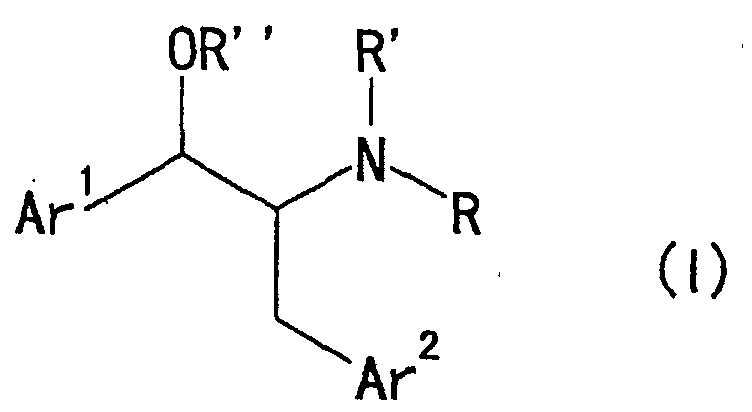
- Ar1
- is an aromatic ring group optionally having substituents,
- Ar2
- is an aromatic ring group having substituents,
- OR''
- is an optionally protected hydroxyl group,
- R
- is an acyl group, and
- R'
- is a hydrogen atom or a hydrocarbon group optionally having substituents,
except tert-butyl benzyl-[2(S)-hydroxy-2-thiazol-2-yl-1(S)-(4-trifluoromethyl-benzyl)-ethyl]-carbamate. - The compound of claim 1, wherein Ar1 is a 5- or 6-membered aromatic ring group optionally having substituents.
- The compound of claim 1, wherein Ar1 is a phenyl group optionally having substituents.
- The compound of claim 1, wherein Ar2 is a 5- or 6-membered aromatic ring group having substituents.
- The compound of claim 1, wherein Ar2 is a phenyl group having substituents.
- The compound of claim 1, wherein R is a group represented by the formula R1NCO- (R1N is a hydrocarbon group optionally having substituents or a heterocyclic group optionally having substituents).
- The compound of claim 6, wherein R1N is a cyclic hydrocarbon group optionally having substituents or a heterocyclic group optionally having substituents.
- The compound of claim 1, wherein R'' is a hydrogen atom or an acyl group.
- The compound of claim 1, wherein R'' is a group represented by the formula R10CO- (R10 is a hydrocarbon group optionally having substituents or a heterocyclic group optionally having substituents).
- The compound of claim 8, wherein R10 is an alkyl group optionally having substituents.
- The compound of claim 1, wherein R'' is a hydrogen atom.
- The compound of claim 1, wherein R' is a hydrogen atom.
- The compound of claim 1, wherein R is a group represented by the formula R1NCO- (R1N is a cyclic hydrocarbon group optionally having substituents or a heterocyclic group optionally having substituents), R" is a hydrogen atom and R' is a hydrogen atom.
- The compound of claim 1, wherein Ar1 is a 5- or 6-membered aromatic ring group optionally having substituents selected from halogen atom, optionally halogenated lower alkyl group, optionally halogenated lower alkoxy group and aryloxy group optionally having substituents, Ar2 is a 5- or 6-membered aromatic ring group having substituents selected from halogen atom, optionally halogenated lower alkyl group and optionally halogenated lower alkoxy group, R is a C1-6 alkoxy-carbonyl, a C1-6 alkyl-carbonyl, a C6-10 aryl-carbonyl, dihydronaphthalenecarbonyl, tetrahydronaphthalenecarbonyl, benzocycloheptenecarbonyl or benzocyclooctenecarbonyl, each of which may have substituent(s) selected from halogen atom, optionally halogenated C1-6 alkoxy and optionally halogenated C1-6 alkyl, R'' is a hydrogen atom, and R' is a hydrogen atom.
- The compound of claim 14, wherein the 5- or 6-membered aromatic ring group is a phenyl group, a pyridyl group, a thienyl group, a furyl group or a thiazolyl group.
- The compound of claim 14, wherein the 5- or 6-membered aromatic ring group is a phenyl group, a pyridyl group or a thienyl group, and R is naphthalenecarbonyl, dihydronaphthalenecarbonyl, tetrahydronaphthalenecarbonyl, benzocycloheptenecarbonyl or benzocyclooctenecarbonyl, each of which may have substituent(s) selected from halogen atom, optionally halogenated C1-6 alkoxy and optionally halogenated C1-6 alkyl.
- The compound of claim 1, which is
N-[(1RS,2SR)-2-(4-fluorophenyl)-2-hydroxy-1- [4-(trifluoromethyl)benzyl]ethyl]-6,7-dihydro-5H-benzo[a]cycloheptene-1-carboxamide,
4-fluoro-N-((1R,2S)-2-(4-fluorophenyl)-2-hydroxy-1-((4-(trifluoromethyl)phenyl)methyl)ethyl)-1-naphthalenecarboxamide,
N-[(1R,2S)-2-(4-fluorophenyl)-2-hydroxy-1-[3-(1,1,2,2-tetrafluoroethoxy)benzyl]ethyl]-6,7-dihydro-5H-benzo[a]cycloheptene-1-carboxamide,
N-[(1RS,2SR)-2-(4-fluorophenyl)-2-hydroxy-1-[3-(1,1,2,2-tetrafluoroethoxy)benzyl]ethyl]-5,6-dihydronaphthalene-1-carboxamide,
N-[(1RS,2SR)-2-(4-fluorophenyl)-2-hydroxy-1-[3-(1,1,2,2-tetrafluoroethoxy)benzyl]ethyl]-6,7,8,9-tetrahydro-5H-benzo[a]cycloheptene-1-carboxamide, 4-fluoro-N-[(1R,2S)-2-(4-fluorophenyl)-2-hydroxy-1-[3-(1,1,2,2-tetrafluoroethoxy)benzyl]ethyl]naphthalene-1-carboxamide,
N-[(1RS,2SR)-2-(4-fluorophenyl)-2-hydroxy-1-[3-(1,1,2,2-tetrafluoroethoxy)benzyl]ethyl]-5,6,7,8-tetrahydrobenzo[a]cyclooctene-1-carboxamide,
N-[(1RS,2SR)-2- (4-fluorophenyl)-2-hydroxy-1- (4-isopropylbenzyl)ethyl]-6,7-dihydro-5H-benzo[a]cycloheptene-1-carboxamide,
N-((1RS,2SR)-2-(3-fluorophenyl)-2-hydroxy-1-((4-(trifluoromethyl)phenyl)methyl)ethyl)-6,7-dihydro-5H-benzo[a]cycloheptene-1-carboxamide,
N-((1RS,2SR)-2-hydroxy-2-(4-phenoxyphenyl)-1-((4-(trifluoromethyl)phenyl)methyl)ethyl)-6,7-dihydro-5H-benzo[a]cycloheptene-1-carboxamide,
N-[(1RS,2SR)-2-(4-chlorophenyl)-2-hydroxy-1-[3-(1,1,2,2-tetrafluoroethoxy)benzyl]ethyl]-6,7-dihydro-5H-benzo[a]cycloheptene-1-carboxamide,
N-((1RS,2SR)-2-hydroxy-2-(4-(phenyloxy)phenyl)-1-((3-((1,1,2,2-tetrafluoroethyl) oxy)phenyl)methyl)ethyl)-6,7-dihydro-5H-benzo[a]cycloheptene-1-carboxamide,
N-((1RS,2SR)-2-(4-((4-chloro-3-ethylphenyl)oxy)phenyl)-2-hydroxy-1-((3-((1,1,2,2-tetrafluoroethyl)oxy)phenyl)methyl)ethyl)-6,7-dihydro-5H-benzo[a]cycloheptene-1-carboxamide,
N-((1RS,2SR)-2-(2-fluoropyridin-4-yl)-2-hydroxy-1-((3-(1,1,2,2-tetrafluoroethoxy)phenyl)methyl)ethyl)-6,7-dihydro-5H-benzo[a]cycloheptene-1-carboxamide,
N-((1RS, 2RS)-2-(6-fluoropyridin-2-yl)-2-hydroxy-1-((3-(1,1,2,2-tetrafluoroethoxy)phenyl)methyl)ethyl)-6,7-dihydro-5H-benzo[a]cycloheptene-1-carboxamide,
N-[(1RS, 2SR)-1-(4-tert-butylbenzyl)-2-(3-chlorophenyl)-2-hydroxyethyl]-5-chloro-1-naphthamide,
4-fluoro-N-{(1RS, 2SR)-2-(4-fluorophenyl)-2-hydroxy-1-[(2,2,3,3-tetrafluoro-2,3-dihydro-1,4-benzodioxin-6-yl)methyl]ethyl)-1-naphthamide or a salt thereof. - A prodrug of a compound represented by the formulawherein
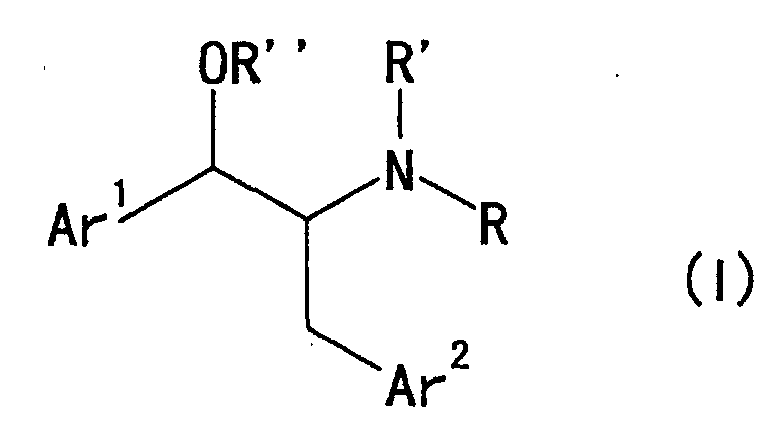
- Ar1
- is an aromatic ring group optionally having substituents,
- Ar2
- is an aromatic ring group having substituents,
- OR''
- is an optionally protected hydroxyl group,
- R
- is an acyl group, and
- R'
- is a hydrogen atom or a hydrocarbon group optionally having substituents,
except tert-butylbenzyl-[2(S)-hydroxy-2-thiazol-2-yl-1(S)-(4-trifluoromethyl-benzyl)-ethyl]-carbamate. - A pharmaceutical composition comprising a compound represented by the formulawherein

- Ar1
- is an aromatic ring group optionally having substituents,
- Ar2
- is an aromatic ring group having substituents,
- OR''
- is an optionally protected hydroxyl group,
- R
- is an acyl group, and
- R'
- is a hydrogen atom or a hydrocarbon group optionally having substituents,
- The composition of claim 19, which is a cholesteryl ester transfer protein inhibitor.
- The composition of claim 19, which is a high density lipoprotein - cholesterol elevating agent.
- The composition of claim 19, which is a low density lipoprotein - cholesterol lowering agent.
- The composition of claim 19, which is an very low density lipoprotein - cholesterol lowering agent.
- The composition of claim 19, which is a triglyceride lowering agent.
- The composition of claim 19, which is a prophylactic or therapeutic agent of acute coronary syndrome.
- The composition of claim 19, which is a prophylactic or therapeutic agent of acute cardiac infarction.
- The composition of claim 19, which is a prophylactic or therapeutic agent of unstable angina pectoris.
- The composition of claim 19, which is a prophylactic or therapeutic agent of PTCA or arterial restenosis after stent placement.
- The composition of claim 19, which is a prophylactic or therapeutic agent of peripheral arterial occlusion.
- The composition of claim 19, which is a prophylactic or therapeutic agent of hyperlipidemia.
- The composition of claim 19, which is a prophylactic or therapeutic agent of cerebral infarction.
- The composition of claim 19, which is a prophylactic or therapeutic agent of stroke.
- The composition of claim 19, which is a suppressor of progression of focal arteriosclerosis.
- A cholesteryl ester transfer protein inhibitor comprising a compound represented by the formulawherein

- Ar1
- is an aromatic ring group optionally having substituents,
- Ar2
- is an aromatic ring group optionally having substituents,
- OR''
- is an optionally protected hydroxyl group,
- R
- is an acyl group, and
- R'
- is a hydrogen atom or a hydrocarbon group optionally having substituents,
- The agent of claim 34, which is a prophylactic or therapeutic agent of hyperlipidemia.
- The agent of claim 34, which is a prophylactic or therapeutic agent of acute coronary syndrome.
- The agent of claim 34, which is a prophylactic or therapeutic agent of acute cardiac infarction.
- The agent of claim 34, which is a prophylactic or therapeutic agent of unstable angina pectoris.
- The agent of claim 34, which is a prophylactic or therapeutic agent of PTCA or arterial restenosis after stent placement.
- The agent of claim 34, which is a prophylactic or therapeutic agent of peripheral arterial occlusion.
- The agent of claim 34, which is a prophylactic or therapeutic agent of cerebral infarction.
- The agent of claim 34, which is a prophylactic or therapeutic agent of stroke.
- The agent of claim 34, which is a suppressor of progression of focal arteriosclerosis.
- A method of inhibiting cholesteryl ester transfer protein in a mammal, which comprises administering an effective amount of a compound of claim 1 or a salt thereof to the mammal.
- A method for the prophylaxis or treatment of hyperlipidemia in a mammal, which comprises administering an effective amount of a compound of claim 1 or a salt thereof to the mammal.
- Use of a compound of claim 1 or a salt thereof for the production of a pharmaceutical agent for inhibiting cholesteryl ester transfer protein.
- Use of a compound of claim 1 or a salt thereof for the production of a pharmaceutical agent for the prophylaxis or treatment of hyperlipidemia.
- A method for the prophylaxis or treatment of acute coronary syndrome in a mammal, which comprises administering an effective amount of a compound of claim 1 or a salt thereof to the mammal.
- A method for the prophylaxis or treatment of acute cardiac infarction in a mammal, which comprises administering an effective amount of a compound of claim 1 or a salt thereof to the mammal.
- A method for the prophylaxis or treatment of unstable angina pectoris in a mammal, which comprises administering an effective amount of a compound of claim 1 or a salt thereof to the mammal.
- A method for the prophylaxis or treatment of PTCA or coronary restenosis after stent placement in a mammal, which comprises administering an effective amount of a compound of claim 1 or a salt thereof to the mammal.
- A method for the prophylaxis or treatment of peripheral arterial occlusion in a mammal, which comprises administering an effective amount of a compound of claim 1 or a salt thereof to the mammal.
- A method for the prophylaxis or treatment of cerebral infarction in a mammal, which comprises administering an effective amount of a compound of claim 1 or a salt thereof to the mammal:
- A method for the prophylaxis or treatment of stroke in a mammal, which comprises administering an effective amount of a compound of claim 1 or a salt thereof to the mammal.
- A method of suppressing progression of focal arteriosclerosis in a mammal, which comprises administering an effective amount of a compound of claim 1 or a salt thereof to the mammal.
- A method of inhibiting cholesteryl ester transfer protein in a mammal, which comprises administering an effective amount of a compound represented by the formula (I') of claim 34 or a salt thereof or a prodrug thereof to the mammal.
- Use of a compound represented by the formula (I') of claim 34 or a salt thereof or a prodrug thereof for the production of a pharmaceutical agent for inhibition of cholesteryl ester transfer protein.
- A production method of claim 1 or a salt thereof, which comprises subjecting a compound represented by the formulawherein each symbol is as defined in claim 1, or a salt thereof to an acylation reaction to give a compound represented by the formula
 wherein each symbol is as defined in claim 1, or a salt thereof, and, where desired, subjecting the compound to a hydroxyl group-protecting reaction.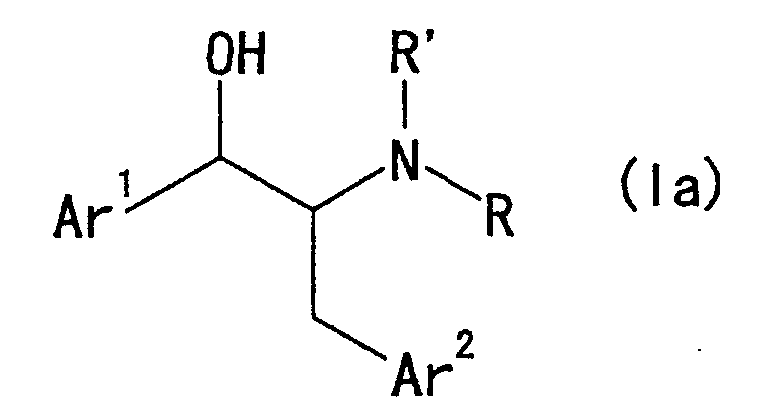
Applications Claiming Priority (3)
| Application Number | Priority Date | Filing Date | Title |
|---|---|---|---|
| JP2001019280 | 2001-01-26 | ||
| JP2001019280 | 2001-01-26 | ||
| PCT/JP2002/000532 WO2002059077A1 (en) | 2001-01-26 | 2002-01-25 | Aminoethanol derivatives |
Publications (2)
| Publication Number | Publication Date |
|---|---|
| EP1362846A1 true EP1362846A1 (en) | 2003-11-19 |
| EP1362846A4 EP1362846A4 (en) | 2006-10-04 |
Family
ID=18885182
Family Applications (1)
| Application Number | Title | Priority Date | Filing Date |
|---|---|---|---|
| EP02710345A Withdrawn EP1362846A4 (en) | 2001-01-26 | 2002-01-25 | AMINOETHANOLDERIVATE |
Country Status (3)
| Country | Link |
|---|---|
| US (1) | US6982348B2 (en) |
| EP (1) | EP1362846A4 (en) |
| WO (1) | WO2002059077A1 (en) |
Cited By (2)
| Publication number | Priority date | Publication date | Assignee | Title |
|---|---|---|---|---|
| CN104418793A (en) * | 2013-08-24 | 2015-03-18 | 广东东阳光药业有限公司 | Method for preparing medicine Lu-AE-58054 for resisting alzheimer's disease |
| WO2017012938A1 (en) * | 2015-07-22 | 2017-01-26 | Basf Se | Para-substituted indanyl and tetralinyl derivatives |
Families Citing this family (36)
| Publication number | Priority date | Publication date | Assignee | Title |
|---|---|---|---|---|
| US7148197B2 (en) * | 2000-08-24 | 2006-12-12 | The Regents Of The University Of California | Orally administered small peptides synergize statin activity |
| US7723303B2 (en) * | 2000-08-24 | 2010-05-25 | The Regents Of The University Of California | Peptides and peptide mimetics to treat pathologies characterized by an inflammatory response |
| US8568766B2 (en) * | 2000-08-24 | 2013-10-29 | Gattadahalli M. Anantharamaiah | Peptides and peptide mimetics to treat pathologies associated with eye disease |
| US7199102B2 (en) * | 2000-08-24 | 2007-04-03 | The Regents Of The University Of California | Orally administered peptides synergize statin activity |
| KR100965201B1 (en) | 2001-06-12 | 2010-06-24 | 웰스테트 테라퓨틱스 코포레이션 | Compounds for the treatment of metabolic diseases |
| US7375093B2 (en) | 2002-07-05 | 2008-05-20 | Intrexon Corporation | Ketone ligands for modulating the expression of exogenous genes via an ecdysone receptor complex |
| AU2003286728A1 (en) | 2002-11-01 | 2004-06-07 | Wellstat Therapeutics Corporation | Compounds for the treatment of metabolic disorders |
| EP1961419B1 (en) | 2002-12-20 | 2010-03-24 | Pfizer Products Inc. | Dosage forms comprising a CETP inhibitor and an HMG-CoA reductase inhibitor |
| AU2004222436A1 (en) | 2003-03-17 | 2004-09-30 | Japan Tobacco Inc. | Method for increasing the oral bioavailability of S-(2-(((1- (2-ethylbutyl) cyclohexyl)carbonyl) amino) phenyl)-2-methylpropanethioate |
| RU2330682C2 (en) * | 2003-09-26 | 2008-08-10 | Джапан Тобакко Инк. | Method of residual lipoproteins producing inhibition |
| EP1689383B1 (en) * | 2003-11-19 | 2012-10-31 | Metabasis Therapeutics, Inc. | Novel phosphorus-containing thyromimetics |
| US20060025445A1 (en) * | 2004-08-02 | 2006-02-02 | Xiang Jason S | 11-Beta HSD1 inhibitors |
| RU2448977C2 (en) * | 2004-09-16 | 2012-04-27 | Зе Риджентс Оф Зи Юнивесити Оф Кэлифонье | Peptide possessing ability to relieve at least one symptom of inflammatory condition, pharmaceutical composition containing it and method of treating atherosclerosis with their application |
| US7579319B2 (en) | 2004-12-06 | 2009-08-25 | The Regents Of The University Of California | Methods for improving the structure and function of arterioles |
| EP1890715A4 (en) * | 2005-04-29 | 2009-10-28 | Univ California | PEPTIDES AND MIMETICS OF PEPTIDES FOR TREATING PATHOLOGIES CHARACTERIZED BY INFLAMMATORY REACTION |
| US20080293639A1 (en) * | 2005-04-29 | 2008-11-27 | The Regents Of The University Of California | Peptides and peptide mimetics to treat pathologies characterized by an inflammatory response |
| US20090028925A1 (en) * | 2005-05-26 | 2009-01-29 | Erion Mark D | Novel Phosphinic Acid-Containing Thyromimetics |
| CA2606499C (en) | 2005-05-26 | 2017-06-13 | Metabasis Therapeutics, Inc. | Thyromimetics for the treatment of fatty liver diseases |
| US7652023B2 (en) * | 2005-11-23 | 2010-01-26 | Bristol-Myers Squibb Company | Heterocyclic CETP inhibitors |
| US7888376B2 (en) * | 2005-11-23 | 2011-02-15 | Bristol-Myers Squibb Company | Heterocyclic CETP inhibitors |
| US7790770B2 (en) * | 2005-11-23 | 2010-09-07 | Bristol-Myers Squibb Company | Heterocyclic CETP inhibitors |
| US20080064729A1 (en) * | 2006-09-07 | 2008-03-13 | Millennium Pharmaceuticals, Inc. | Phenethylamide derivatives with kinase inhibitory activity |
| WO2008057543A2 (en) * | 2006-11-06 | 2008-05-15 | Acadia Pharmaceuticals Inc. | Uii-modulating compounds and their use |
| EP2195331B1 (en) * | 2007-08-28 | 2013-11-20 | Uab Research Foundation | Synthetic apolipoprotein e mimicking polypeptides and methods of use |
| US8557767B2 (en) | 2007-08-28 | 2013-10-15 | Uab Research Foundation | Synthetic apolipoprotein E mimicking polypeptides and methods of use |
| WO2013066768A1 (en) * | 2011-10-31 | 2013-05-10 | Merck Sharp & Dohme Corp. | Process for a cetp inhibitor |
| US9724351B2 (en) | 2012-08-23 | 2017-08-08 | Alios Biopharma, Inc. | Compounds for the treatment of paramoxyvirus viral infections |
| PH12021550330A1 (en) | 2013-08-21 | 2022-09-28 | Janssen Biopharma Inc | Antiviral compounds |
| CA2954475C (en) | 2014-07-31 | 2023-05-16 | Uab Research Foundation | Apoe mimetic peptides and higher potency to clear plasma cholesterol |
| CA3044059A1 (en) | 2016-11-21 | 2018-05-24 | Viking Therapeutics, Inc. | Method of treating glycogen storage disease |
| EA201992703A1 (en) | 2017-06-05 | 2020-04-15 | Вайкинг Терапьютикс, Инк. | COMPOSITIONS FOR TREATING FIBROSIS |
| CA3094167A1 (en) | 2018-03-22 | 2019-09-26 | Viking Therapeutics, Inc. | Crystalline forms and methods of producing crystalline forms of a compound |
| WO2020117962A1 (en) | 2018-12-05 | 2020-06-11 | Viking Therapeutics, Inc. | Compositions for the treatment of fibrosis and inflammation |
| CN112358442B (en) * | 2020-11-20 | 2022-03-04 | 内蒙古佳瑞米精细化工有限公司 | Preparation method of 2-fluoro-5-formyl chloropyridine |
| CN115353499B (en) * | 2022-10-21 | 2023-02-28 | 南京远淑医药科技有限公司 | Synthetic method of 2-halomethyl-5-trifluoromethyl furan |
| CN120904744B (en) * | 2025-10-10 | 2025-12-16 | 信联电子材料科技股份有限公司 | An anti-reflective coating composition and its preparation method |
Family Cites Families (11)
| Publication number | Priority date | Publication date | Assignee | Title |
|---|---|---|---|---|
| GB1217038A (en) | 1967-04-01 | 1970-12-23 | Pietro Pratesi | 3,4 disubstituted phenyl ethanolamines and method of producing the same |
| ZA87563B (en) | 1986-02-03 | 1987-09-30 | Squibb & Sons Inc | N-heterocyclic alcohol renin inhibitors |
| IL90218A0 (en) | 1988-05-13 | 1989-12-15 | Abbott Lab | Retroviral protease inhibitors |
| CA2137832C (en) | 1992-06-12 | 2000-09-26 | Dennis J. Hoover | Inhibitors of angiotensin i chymase(s) including human heart chymase |
| KR20000052775A (en) * | 1996-10-25 | 2000-08-25 | 가마쿠라 아키오 | Novel heterocyclic amide compounds and medicinal uses thereof |
| JP2894445B2 (en) * | 1997-02-12 | 1999-05-24 | 日本たばこ産業株式会社 | Compounds effective as CETP activity inhibitors |
| JPH11246437A (en) | 1998-03-05 | 1999-09-14 | Yoshitomi Pharmaceut Ind Ltd | Gastrointestinal mucosa protective agent |
| WO1999045928A1 (en) * | 1998-03-11 | 1999-09-16 | Welfide Corporation | IgE ANTIBODY PRODUCTION INHIBITORS AND AUTOIMMUNE DISEASES INHIBITORS |
| JPH11286478A (en) * | 1998-04-01 | 1999-10-19 | Sankyo Co Ltd | Dipeptide compound containing ahpba derivative |
| US6147089A (en) * | 1998-09-17 | 2000-11-14 | Pfizer Inc. | Annulated 4-carboxyamino-2-methyl-1,2,3,4,-tetrahydroquinolines |
| JP2001131137A (en) * | 1999-11-09 | 2001-05-15 | Sankyo Co Ltd | Peptide mimetic template |
-
2002
- 2002-01-25 WO PCT/JP2002/000532 patent/WO2002059077A1/en not_active Ceased
- 2002-01-25 EP EP02710345A patent/EP1362846A4/en not_active Withdrawn
- 2002-01-25 US US10/470,351 patent/US6982348B2/en not_active Expired - Fee Related
Non-Patent Citations (8)
| Title |
|---|
| DATABASE CA [Online] CHEMICAL ABSTRACTS SERVICE, COLUMBUS, OHIO, US; KAMETANI, T. ET AL: "Syntheses of isoquinoline derivatives. XIX. Synthesis of 1-phenyl-3-benzylisoquinoline" XP002395234 retrieved from STN Database accession no. 47:61979 & YAKUGAKU ZASSHI , 72, 1087-90 CODEN: YKKZAJ; ISSN: 0031-6903, 1952, * |
| DATABASE CA [Online] CHEMICAL ABSTRACTS SERVICE, COLUMBUS, OHIO, US; KAMETANI, T. ET AL: "Syntheses of isoquinoline derivatives. XXIV. Migration of the double bond of isoquinoline derivatives. 1" XP002395252 retrieved from STN Database accession no. 48:49471 & YAKUGAKU ZASSHI , 73, 677-80 CODEN: YKKZAJ; ISSN: 0031-6903, 1953, * |
| KOTERA K. ET AL.: "Aziridine formation by reduction of ketoximes with lithium aluminium hydride." TETRAHEDRON., vol. 24, no. 19, 1968, pages 6177-6184, XP002395450 NL ELSEVIER SCIENCE PUBLISHERS, AMSTERDAM. * |
| MARÇOT B. ET AL.: "Préparation, réduction chimique et électrochimique d'alpha-nitrostyrylcétones- synthèse d'hétérocycles azotés" CANADIAN JOURNAL OF CHEMISTRY., vol. 59, 1981, pages 1224-1234, XP002395447 CA NATIONAL RESEARCH COUNCIL. OTTAWA. * |
| OPPONG-BOACHIE F K: "NON-CATALYTIC REDUCTION OF ALPHA-OXIMINOKETONES AND ALPHA-OXIMINOALCOHOLS TO ERYTHRO-2-AMINO-1-ARYLALKAN-1-OLS" BULLETIN DES SOCIETES CHIMIQUES BELGES, vol. 94, no. 4, 1984, pages 293-298, XP001095256 ISSN: 0037-9646 * |
| PIRON J. ET AL.: "New methods for solid phase peptide synthesis of transition-state analog inhibitors of HIV-1 protease and DPP_IV." LETTERS IN PEPTIDE SCIENCE, vol. 2, 1995, pages 229-232, XP002395448 NL ESCOM SCIENCE PUBLISHERS * |
| REBSTOCK M.C.: "Chloromycetin (Chlopramphenicol): The synthesis of 3-methyl and 3-p-nitrophenyl substituted compounds." JOURNAL OF THE AMERICAN CHEMICAL SOCIETY., vol. 73, no. 8, 1951, pages 3671-3674, XP002395449 US AMERICAN CHEMICAL SOCIETY, WASHINGTON, DC. * |
| See also references of WO02059077A1 * |
Cited By (3)
| Publication number | Priority date | Publication date | Assignee | Title |
|---|---|---|---|---|
| CN104418793A (en) * | 2013-08-24 | 2015-03-18 | 广东东阳光药业有限公司 | Method for preparing medicine Lu-AE-58054 for resisting alzheimer's disease |
| CN104418793B (en) * | 2013-08-24 | 2019-01-04 | 广东东阳光药业有限公司 | The preparation method of anti-azheimer's disease drug Lu-AE-58054 |
| WO2017012938A1 (en) * | 2015-07-22 | 2017-01-26 | Basf Se | Para-substituted indanyl and tetralinyl derivatives |
Also Published As
| Publication number | Publication date |
|---|---|
| EP1362846A4 (en) | 2006-10-04 |
| WO2002059077A1 (en) | 2002-08-01 |
| US20040127574A1 (en) | 2004-07-01 |
| US6982348B2 (en) | 2006-01-03 |
Similar Documents
| Publication | Publication Date | Title |
|---|---|---|
| US6982348B2 (en) | Aminoethanol derivatives | |
| US7553867B2 (en) | Furan or thiophene derivative and medicinal use thereof | |
| KR100866820B1 (en) | Lipid rich plaque repellent | |
| KR100418808B1 (en) | Metalloproteinase inhibitors | |
| RU2609021C2 (en) | Substituted amide compounds | |
| KR102430906B1 (en) | PPAR agonists, compounds, pharmaceutical compositions, and methods of use thereof | |
| JPWO2008007780A1 (en) | Pentadienamide derivatives | |
| KR20090017483A (en) | Antibacterial agents | |
| JPH0733373B2 (en) | HIV protease inhibitors useful in the treatment of AIDS | |
| MX2012000435A (en) | Tofa analogs useful in treating dermatological disorders or conditions. | |
| JPWO2008156142A1 (en) | Novel malonic acid sulfonamide derivative and its pharmaceutical use | |
| IL275392A (en) | Agonists, compounds, pharmaceuticals and methods of using them ppar, | |
| EP1484320A1 (en) | Jnk inhibitor | |
| EA034436B1 (en) | Heteroaryl butanoic acid derivatives as lta4h inhibitors | |
| JP2010519332A (en) | Novel phosphodiesterase inhibitors | |
| WO2009123241A1 (en) | Inhibitor of plasminogen activator inhibitor-1 | |
| KR20130099110A (en) | Substituted amide compound | |
| JP2002293764A (en) | Aminoethanol derivative | |
| KR20100110756A (en) | Cinamic compounds and derivatives therefrom for the inhibition of histone deacetylase | |
| WO2017180457A1 (en) | Gpr40 agonists in anti-diabetic drug combinations | |
| KR20040081123A (en) | Coumarin derivatives, process for their production and use thereof | |
| JP2002538136A (en) | Alkenyl and alkynyl containing metalloprotease inhibitors | |
| KR950004046B1 (en) | Indane derivatives and preparation methods thereof | |
| JP2005514455A (en) | Aromatic thioether liver X receptor modulator | |
| RU2137763C1 (en) | Derivatives of (1-phenyl-1-heterocyclyl)alkane, method of their synthesis, pharmaceutical preparation showing neuroprotective effect in brain ischemia, method of treatment of patients with hypoxic and asphyxic brain damages |
Legal Events
| Date | Code | Title | Description |
|---|---|---|---|
| PUAI | Public reference made under article 153(3) epc to a published international application that has entered the european phase |
Free format text: ORIGINAL CODE: 0009012 |
|
| 17P | Request for examination filed |
Effective date: 20030815 |
|
| AK | Designated contracting states |
Kind code of ref document: A1 Designated state(s): AT BE CH CY DE DK ES FI FR GB GR IE IT LI LU MC NL PT SE TR |
|
| AX | Request for extension of the european patent |
Extension state: AL LT LV MK RO SI |
|
| RAP1 | Party data changed (applicant data changed or rights of an application transferred) |
Owner name: TAKEDA PHARMACEUTICAL COMPANY LIMITED |
|
| A4 | Supplementary search report drawn up and despatched |
Effective date: 20060906 |
|
| STAA | Information on the status of an ep patent application or granted ep patent |
Free format text: STATUS: THE APPLICATION HAS BEEN WITHDRAWN |
|
| 18W | Application withdrawn |
Effective date: 20080501 |