EP1362341B1 - Verfahren und vorrichtung zum codieren und decodieren von pauseninformationen - Google Patents
Verfahren und vorrichtung zum codieren und decodieren von pauseninformationen Download PDFInfo
- Publication number
- EP1362341B1 EP1362341B1 EP02703368A EP02703368A EP1362341B1 EP 1362341 B1 EP1362341 B1 EP 1362341B1 EP 02703368 A EP02703368 A EP 02703368A EP 02703368 A EP02703368 A EP 02703368A EP 1362341 B1 EP1362341 B1 EP 1362341B1
- Authority
- EP
- European Patent Office
- Prior art keywords
- pause
- audio
- information
- digitized
- digitized audio
- Prior art date
- Legal status (The legal status is an assumption and is not a legal conclusion. Google has not performed a legal analysis and makes no representation as to the accuracy of the status listed.)
- Expired - Lifetime
Links
- 238000000034 method Methods 0.000 title claims description 40
- 239000000945 filler Substances 0.000 claims abstract description 9
- 239000000872 buffer Substances 0.000 claims description 56
- 239000003550 marker Substances 0.000 claims description 12
- 238000004891 communication Methods 0.000 claims description 9
- 230000006870 function Effects 0.000 claims description 5
- 230000004044 response Effects 0.000 claims description 4
- 230000006735 deficit Effects 0.000 claims 2
- 230000001934 delay Effects 0.000 abstract description 10
- 230000000694 effects Effects 0.000 abstract description 8
- 230000000875 corresponding effect Effects 0.000 description 15
- 238000013461 design Methods 0.000 description 9
- 230000008569 process Effects 0.000 description 7
- 230000001419 dependent effect Effects 0.000 description 6
- 230000005236 sound signal Effects 0.000 description 6
- 230000008859 change Effects 0.000 description 5
- 230000007246 mechanism Effects 0.000 description 5
- 238000012546 transfer Methods 0.000 description 5
- 230000008901 benefit Effects 0.000 description 4
- 230000005540 biological transmission Effects 0.000 description 4
- 238000013459 approach Methods 0.000 description 3
- 230000003111 delayed effect Effects 0.000 description 3
- 238000010586 diagram Methods 0.000 description 3
- 238000005516 engineering process Methods 0.000 description 3
- 238000012545 processing Methods 0.000 description 3
- 230000003466 anti-cipated effect Effects 0.000 description 2
- 230000006835 compression Effects 0.000 description 2
- 238000007906 compression Methods 0.000 description 2
- 239000012464 large buffer Substances 0.000 description 2
- 230000000116 mitigating effect Effects 0.000 description 2
- 238000010926 purge Methods 0.000 description 2
- 230000032258 transport Effects 0.000 description 2
- 241000590419 Polygonia interrogationis Species 0.000 description 1
- 230000004913 activation Effects 0.000 description 1
- 230000002411 adverse Effects 0.000 description 1
- 230000015572 biosynthetic process Effects 0.000 description 1
- 230000001413 cellular effect Effects 0.000 description 1
- 210000001072 colon Anatomy 0.000 description 1
- 239000000470 constituent Substances 0.000 description 1
- 230000002596 correlated effect Effects 0.000 description 1
- 238000001514 detection method Methods 0.000 description 1
- 230000002708 enhancing effect Effects 0.000 description 1
- 238000003780 insertion Methods 0.000 description 1
- 230000037431 insertion Effects 0.000 description 1
- 238000012544 monitoring process Methods 0.000 description 1
- 230000000135 prohibitive effect Effects 0.000 description 1
- 238000003786 synthesis reaction Methods 0.000 description 1
- 238000013519 translation Methods 0.000 description 1
- 230000014616 translation Effects 0.000 description 1
- 230000007723 transport mechanism Effects 0.000 description 1
Images


Classifications
-
- G—PHYSICS
- G10—MUSICAL INSTRUMENTS; ACOUSTICS
- G10L—SPEECH ANALYSIS TECHNIQUES OR SPEECH SYNTHESIS; SPEECH RECOGNITION; SPEECH OR VOICE PROCESSING TECHNIQUES; SPEECH OR AUDIO CODING OR DECODING
- G10L13/00—Speech synthesis; Text to speech systems
-
- G—PHYSICS
- G10—MUSICAL INSTRUMENTS; ACOUSTICS
- G10L—SPEECH ANALYSIS TECHNIQUES OR SPEECH SYNTHESIS; SPEECH RECOGNITION; SPEECH OR VOICE PROCESSING TECHNIQUES; SPEECH OR AUDIO CODING OR DECODING
- G10L19/00—Speech or audio signals analysis-synthesis techniques for redundancy reduction, e.g. in vocoders; Coding or decoding of speech or audio signals, using source filter models or psychoacoustic analysis
- G10L19/012—Comfort noise or silence coding
-
- H—ELECTRICITY
- H04—ELECTRIC COMMUNICATION TECHNIQUE
- H04J—MULTIPLEX COMMUNICATION
- H04J3/00—Time-division multiplex systems
- H04J3/02—Details
- H04J3/06—Synchronising arrangements
- H04J3/062—Synchronisation of signals having the same nominal but fluctuating bit rates, e.g. using buffers
- H04J3/0632—Synchronisation of packets and cells, e.g. transmission of voice via a packet network, circuit emulation service [CES]
Definitions
- the present invention relates generally to communication systems and, in particular, to a method and apparatus for encoding and decoding pause information, especially with respect to digitized audio.
- Telecommunications systems are well known in the art. While wired and wireless packet-based systems offer a variety of advantages, they pose certain challenges when used to deliver isochronous data, e.g., audio data. For example, one set of packets may traverse a network as quickly as possible in one instance and, at another time, the same set of packets may take longer to reach the destination due to access delays, errors in the transmission (and subsequent retransmission) or, particularly in the case of wireless networks, lack of coverage. A party listening to a transmitted audio (for example, speech) stream may hear unusual delays or dropouts if packets are delayed or lost, resulting in unnatural sounding audio and loss of continuity.
- isochronous data e.g., audio data.
- one set of packets may traverse a network as quickly as possible in one instance and, at another time, the same set of packets may take longer to reach the destination due to access delays, errors in the transmission (and subsequent retransmission) or, particularly in the case of wireless networks, lack of coverage.
- the second class requires that quality of service mechanisms be built into the network used to convey the data and that quality of service contracts be negotiated between the source and network.
- the Reservation Protocol (RSVP) Differentiated Services and integrated Services technology being developed by the Internet Engineering Task Force (IETF) are examples of how quality of service is introduced into a network.
- IETF Internet Engineering Task Force
- the network provider Upon acceptance of a contract, the network provider is bound to provide a certain level of throughput, end-to-end delay, delay variance and error rate performance. In this manner, a given data source is assured that it can transmit data at a certain rate, and the data destination is assured that it will receive the data in a timely manner. Relying on such quality of service mechanisms eliminates the need for large buffers at the destinations.
- a transmitting node deletes packets containing audio silence without sending them through the network.
- the receiver compares time stamps of successive incoming packets. If there is a discrepancy, the receiver inserts a silence packet to recreate the silent periods of the original audio at the receiving end. Accordingly it recreates silence pre-existing in transmitted audio.
- the described system still suffers problems from network delays and audio quality at the receiver.
- pause information is derived from analysis of an audio signal or, in the TTS scenario, from analysis of text input.
- the pause information is subsequently added to the digitised audio signal.
- the audio signal is synthesised speech.
- different types of pauses are identified.
- the pause information preferably comprises ordered sets or tuples, each comprising a pause type and a pointer to a pause location within the audio data.
- the audio data and the corresponding pause information are then assembled into finite length packets.
- the packets are formed such that the packets start and end on pause boundaries, if possible.
- the pause information may be used to insert pauses at appropriate times to accommodate the occurrence of delays in delivering the packets.
- pauses are inserted based on a hierarchy of pause types. For example, if a buffer of marked speech includes points for word, phrase and sentence boundaries, pauses are more naturally introduced at major boundaries, i.e., sentence and phrase, when network performance is varying greatly.
- audio filler information such as reporting messages or comfort audio, may be injected.
- mechanisms are provided for deciding when a segment of audio data is obsolete and can therefore be ignored. Playback will continue subsequent to that segment. Further still, the pause information may be used to control what types of audio are reconstructed and what types may be ignored.
- FIG. I illustrates a communication system 100 comprising a plurality of audio sources 104 in communication with a plurality of audio destinations 106 via a network 102.
- the network 102 is a packet-based network in which data conveyed therein is subject to varying levels of delivery delays.
- the network 102 may comprise any combination of wired or wireless networks.
- the audio sources 104 and the audio destinations 106 may be coupled to the network 102 via wired (e.g., telephone or cable lines) or wireless paths.
- the communication paths within the network i.e., between routing points, may similarly be wired or wireless paths.
- the network 102 may comprise any combination of a public network, such as the Internet or World Wide Web, and a private network.
- a public network such as the Internet or World Wide Web
- a private network Preferably, each audio source 104 and audio destination 106 is separately addressable within the network 102.
- packet-based networks are well known to those having ordinary skill in the art and need not be described in greater detail here.
- Each of the audio sources 104 provides, at a minimum, audio data or digitized audio_and pause information corresponding thereto for delivery to one or more audio destinations 106.
- each audio source 104 separates the audio data and corresponding pause information into finite-length packets for transmission over the network 102.
- each of the audio sources 104 comprises an audio server such that requests are received via the network and serviced or otherwise responded to by the audio servers.
- a suitable platform for implementing such an audio server is a Windows/NT or Sun Solaris workstation.
- each audio source 104 comprises a processor 110 such as a microprocessor, microcontroller, digital signal processor or the like or combinations thereof coupled to memory 112 such as volatile or non-volatile, electrical or magnetic storage devices.
- the memory 112 comprises stored instructions that are executed by the processor 110. Operational variables, used by the processor 110 when executing the stored instructions, are also typically stored in the memory 112.
- each audio source 104 comprises interface circuitry (not shown) that allows the audio source to communicate with the network 102.
- one or more of the audio sources 104 may comprise a text-to-speech (TTS) server that converts text data to voice or speech data.
- TTS text-to-speech
- Each of the audio destinations 106 is capable of receiving and decoding the packets generated by the audio sources 104.
- each of the audio destinations 106 processes the transmitted audio data to reconstruct an audio signal for playback to a user of the audio destination.
- each audio destination 106 can recognize the occurrence of a condition in which continued delivery of the audio data is interrupted or delayed. As a result, each audio destination can insert pauses in the reconstructed audio based on the pause information included in each transmitted packet.
- each audio destination 106 comprises a processor 110, such as a microprocessor, microcontroller, digital signal processor or the like or combinations thereof coupled to memory 112, such as volatile or non-volatile, electrical or magnetic storage devices.
- each of the audio destinations 106 comprises an audio client capable of transmitting requests for audio data via the network 102 to the audio servers 104.
- an audio client is implemented as an application process executed by an underlying processing platform.
- the audio destination labeled 106a may comprise a personal computer having an audio client application operating thereon.
- one or more of the audio destinations 106 comprises a wireless communication device, e.g., a cell phone or the like, capable of communicating with a communication infrastructure, i.e., the network 102.
- the present invention is not limited by the particular hardware implementation of the audio destinations 106.
- each packet 200 preferably comprises digitized audio 202 and pause information 204.
- the pause information 204 is pre-pended to the digitized audio 202 as a header.
- the digitized audio 204 may then be derived from any source, i.e., recorded audio or speech, text-to-speech generators, etc.
- the pause information 204 may be appended at the end of the digitized audio 202, or even interspersed within the digitized audio 202. In this latter case, it is anticipated that unique escape codes (for example, three consecutive bytes of zeros) could be placed within the digitized audio to precede the occurrence of any pause information, which pause information would correspond to a subsequent portion of the digitized audio.
- an audio start pointer 206 may optionally be appended.
- the audio start pointer 206 points to the first octet of the digitized audio 202.
- a value of zero for the start pointer 206 indicates that the packet does not include any digitized speech.
- a value of one indicates that there is no pause information included in the packet. This would be the case, for example, where the digitized audio is representative of a single syllable of a word and therefore not readily susceptible to the inclusion of a pause.
- packets in accordance with the present invention are constructed in a manner such that the digitized audio 202 begins and ends on pause boundaries, if possible.
- exceptions can occur when, for example, the speech signal representative of a spoken word is longer than a packet.
- the first packet of the word starts with a pause and the last packet ends with a pause; the intermediate packets have no pauses.
- the pause information 204 must point to a pause at the end of a packet to indicate when an audio element ends on a packet boundary.
- the packet 200 may also optionally include routing information 208.
- the routing information 208 may be added to the beginning or the end of the packet by the underlying transport mechanisms.
- the packet 200 may include TCP/IP or UDP/IP headers and trailers in order to traverse the network.
- TCP/IP or UDP/IP headers and trailers in order to traverse the network.
- Those having ordinary skill in the art will recognize that the particular form of routing information 208 added to the packet 200 is a matter of design choice, typically dependent upon the underlying transport technologies used.
- the pause information 204 denotes where pauses occur in the associated digitized speech 202.
- Pauses are the breaks that either naturally occur or are inserted within an audio stream.
- a particular subclass of audio signals is speech signals.
- pauses naturally occur between words, phrases, sentences, paragraphs, etc.
- the pauses may be readily identified based on analysis of the input text string. For example, the spaces between individual words are marked as word pauses, a comma results in a phrase pause, and a period, exclamation point or question mark results in a sentence pause.
- the TTS server parses the input text string looking for pause indications and marks the digitized speech stream where the pauses occur according to the application semantics and the context and meaning of the text.
- the pause information consists of a tuple ⁇ type, pointer ⁇ for each pause marked. This is illustrated in FIG. 3, where N tuples are shown.
- the pointer is an offset value, preferably relative to the beginning of the digitized audio, that indicates where a pause occurs within the digitized audio.
- the set of pause types includes, but is not limited to speaker pauses, topic pauses, heading pauses, paragraph pauses, sentence pauses, phrase pauses, word pauses, end pauses and live audio pauses. Live audio pauses correspond to periods of silence detected during live audio. While this does not indicate a pause context like some of the other pause types (e.g., word, sentence, speaker, etc.
- pauses the occurrence of silence represents a convenient place to mark pauses.
- the end pauses are provided because the length of pause inserted at the end of a collection of sentences (e.g., a paragraph, etc.) may be different than a pause between sentences.
- the algorithm on the decoder side used to hunt for an appropriate place to pause may decide to not introduce a pause if an end-type pause is currently found later in the receive buffer.
- the word, phrase, sentence, paragraph and heading pauses derive from standard documentation concepts. Word pauses are derived from spaces between words. Phrase pauses are derived from punctuation between words, such as commas, semi-colons and colons.
- Sentence pauses are derived from sentence-ending punctuation, such as periods, exclamation points and question marks.
- Paragraph pauses are derived from paragraph marks.
- Heading pauses are derived from formatting and spacing indicia.
- Topic and speakers pauses are more indicative of spoken dialogues and represent context information. During the course of a conversation, speakers and topics change. These are natural places to introduce pauses in the playback. In the case of TTS, several types of indicia may be used to detect such places. For example, in a Q&A scenario, the question is often differentiated by Q: or speaker initials, e.g., DB, CM, or by typeface change.
- a pause would be introduced after a question (speaker change) or after the answer (topic change assuming each question introduces a new topic).
- an edit function introduces speaker and topic markers at the discretion of the editor.
- Those having ordinary skill in the art will appreciate that other methods for identifying topic and speaker pauses may be used.
- the above set of pause types is oriented towards spoken and written English. Similar sets can be derived for other languages. This technique could also be used with other audio streams other than those derived from text. Note that it is not necessary to identify where all pauses occur. Rather, it may be desirable to identify only certain types of pauses when assembling the pause information.
- the type and pointer data are encoded in 4 bits and 12 bits, respectively. This allows for 16 pause types and digitized speech of up to 4096 octets. Of course, encodings of other bit lengths can be easily used as a matter of design choice.
- the tuples are collected and ordered according to order of occurrence.
- the pause that occurs first has its pause information first in the header 204. This is illustrated in FIG. 3, where the pointer (Pointer 1 ) for the first tuple 302 points to a location closest to the beginning of the digitized audio 202. Conversely, the pointer (Pointer N ) for the N th tuple 308 points to a location closest to the end of the digitized audio 202.
- the first 302 and the N th tuple 308 comprise pause types corresponding to "Type 1", so labeled for illustrative purposes only.
- a second tuple 304 and third tuple 306 comprise a "Type 2" pause type.
- the examples illustrated in FIG. 3 are specific occurrences illustrating the more general principle that, in the preferred embodiment, any of the various pause types may be included in any of the tuples. However, other embodiments are possible.
- an alternative embodiment is illustrated in FIG. 4 in which each pause type is associated with one or more pointers to pauses of that type.
- the tuples take the form of ⁇ type, length, set of pointers ⁇ .
- the length parameter indicates the number of pointers associated with that pause type. In the examples shown, it is assumed that there are M different pause types.
- the length parameter indicates that there are j pointers in the tuple, followed by the pointers themselves.
- the length parameter indicates that there are k pointers in the tuple, followed by the pointers themselves. Note that j does not have to be equal to k.
- the tuple for that pause type could comprise a length of zero.
- the pointers in this embodiment are not necessarily sequentially ordered.
- the first pointer (Pointer 1 ) corresponding to the first tuple 402 may actually point to a location within the digitized audio that occurs after the first pointer (Pointer 1 ) for the M th tuple 404.
- the encoding of pause types and pointers can take many forms, including large field size to accommodate more pause types or longer packets, a bit map for the types such that a type might have several characteristics, e.g., word plus phrase.
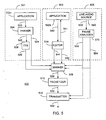
- the encoder 500 is included in each of the audio sources 104. Based on the operation of the encoder 500 described below, those having ordinary skill in the art will recognize that the encoder 500 may be implemented in software, hardware or a combination of both as a matter of design choice. Furthermore, various ones of the functional elements shown in FIG. 5 may be combined together, or even further subdivided, or may not be present, as a matter of design choice.
- the encoder 500 comprises audio and pause information sources 501, 503,505 coupled to a marker 508. Three particular types of audio and pause information sources are illustrated in FIG. 5.
- the marker 508 assembles the pause information 524, 542, 552 and ensures that it is properly correlated with the audio data 526, 544, 554 from which it was-derived by storing the audio data as it is provided in a first intermediate buffer, and similarly storing the corresponding pause information in a second intermediate buffer, with links between each pause in the second intermediate buffer to an appropriate location in the first intermediate buffer.
- the resulting marked audio data 528 is provided to a packetizer 510.
- the packetizer attempts to create packets with pauses at either end of the packet.
- the packetizer tries to maximize packet length.
- the packetizer looks in the first intermediate buffer for the first pause immediately prior to the maximum data length. It then places the data from the beginning of the first intermediate buffer to the identified pause into the packet, and then copies the relevant pause information from the second intermediate buffer into the packet header, making any necessary pointer translations as it goes. This process is continuously repeated beginning with the audio data immediately after each identified pause.
- the packetized marked audio data 530 is then routed to a transmitter 512 that provides transmitted packets 532, preferably in accordance with the packet structures illustrated in FIGS. 2-4.
- the particular form of the transmitter 512 depends on the particular medium used to convey the packets.
- the transmitter 512 may comprise a TCP/IP-compatible interface board or similar device.
- the transmitter 512 may comprise a wireless packet data-compatible transmitter.
- audio data 526 and pause information 524 are provided through the use of a TTS server 506.
- an application 502a provides text data 520 as input to a parser 504.
- the application 502a may comprise any source of text string data.
- Sample speech-based applications and developer manuals are available as part ofthe application developer kits from the major speech recognition and text-to-speech technology manufacturers, such as Nuance, Speech Works, IBM and Lernout & Hauspie.
- Other applications 502 are known in the art and may be readily incorporated for use with the present invention.
- the text data 520 provided by the application 502a includes all indicia that may be associated with pauses. That is, data representative of punctuation marks, paragraph breaks, headings, spaces or other context-determinative information is included in the text data 520.
- the applications 502 do not need to be resident with the encoder 500.
- the parser 504 analyzes the input text data 520 and selectively provides portions thereof 522 to the TTS server 506. In particular, the parser provides words, phrases, sentences, etc. to the TTS server. Based on what portions ofthe input text data the parser provides to the TTS, the resulting speech string is marked appropriately. For example, if a word is provided to the TTS server, the output of the TTS server is the synthesized speech for that word and the marker can mark the speech with a word pause. As another example, if the parser presents a phrase, then the result from the TTS server is a phrase and the synthesized speech is marked with a phrase pause.
- opportunities may exist to mark a single location in the speech with more than one pause type. For example, if an entire sentence is provided to the TTS server, then the end of the resulting synthesized speech (preferably in digital form) could be marked with an end pause, a paragraph pause, a sentence pause, a word pause or a combination of all of these pause types.
- the technique described above would be most applicable in the case where the parser, marker and TTS server are not integrated.
- the integrated function could mark the word pauses as well as phrase or sentence pauses by recognizing the indicia corresponding to the different pause types and marking the stream of synthesized speech in real-time.
- Suitable implementations of the TTS server are RealSpeak software from Lernout and Hauspie, Speechify from SpeechWorks and the implementation described in Sproat (editor), "Multilingual Text-To-Speech Synthesis : The Bell Labs Approach", 1997 .
- the parser 504 recognizes all pause-related indicia included in the text data 520.
- the parser can provide pause information 524 in the form of pause types to the marker 508. For example, the occurrence of a space between words gives rise to a word-type pause, whereas a period, question mark or exclamation point gives rise to a sentence-type pause. In this manner, the marker 508 simultaneously receives audio data 526 and corresponding pause information 524 that it can associate together, as described above.
- audio data 544 and pause information 542 are provided through the use ofan audio editor 514.
- an application 502b provides audio data 540 to the audio editor 514.
- the audio data 540 is preferably recorded, digitized audio.
- a suitable audio editor 514 is a personal computer that executes a suitable audio processing package such as VFEdit from Voice Information Systems, VOX Studio from Parity Software or Audio Work Station from Bitworks, and Digitized Voice Programmer's Toolkit from Farpoint Software that has been modified to allow a user to identify pauses within audio data.
- a user can step through the audio data 514 (controlled via a control signal 541 sent to the application 502b), identify pauses, provide the pause information 542 and the corresponding audio data 544 to the marker 508 and continue on. Because this procedure requires human intervention to identify the pauses, it is most effective when performed off-line, i.e., not in real time. In this case, the marked audio 528 or packetized marked audio 530 can be stored for later retrieval.
- live audio data 554 and pause information 552 corresponding thereto are provided through the use of pause analyzer 570.
- a live audio source 560 provides live audio data 550 to the pause analyzer 570.
- the live audio source 560 may comprise any source of such audio, and the live audio data 550 is preferably provided in a digital form.
- the pause analyzer 570 looks for pauses in the live audio data 550 by searching for periods of silence greater than a predetermined length. Techniques for identifying periods of silence in audio are well known in the art as evidenced, for example, in " The Voice Activity Detector For The Pan-European Digital Cellular Mobile Telephone Service", Freeman et al., British Telecom Res.
- Periods of silence are likely areas to introduce pauses, especially for voice, since periods of silence typically represent natural pauses.
- the live audio data 550 is passed though 554 to the marker 508.
- the pause analyzer 570 identifies a suitable period of silence, it also provides pause information 552 to the marker 508. Because the pause analyzer 570 will typically not be able to identify the types of pauses it locates (as in the case, for example, of the TTS server), the pause information 552 will comprise only live audio type pauses, as described above, although different lengths of pauses may be classified as different pause types.
- a particular form of the embodiment employing the pause analyzer 570 incorporates the use of a Voice Activity Detector (VAD).
- VAD Voice Activity Detector
- a VAD is needed often needed to properly process speech signals.
- voice encoders i.e., voice compression algorithms
- VAD Voice Activity Detector
- the encoder Upon detecting silence, the encoder typically reduces the rate of transmitted packets by periodically outputting a description of the silence/background-noise, sometimes referred to as silence description (SID) packets, as opposed to higher-rate packets representing encoded silence.
- SID silence description
- a voice activity detector embodies the pause analyzer 570.
- the pause analyzer 570 outputs audio data 554 in the form of packets and, when necessary, outputs the pause information 552 in the form of SID packets.
- the SID packets represent pause information without being explicitly created for that purpose.
- the marker 508 and packetizer 510 may not be required, depending on the form of the encoded voice and SID packets output by the analyzer 570.
- the encoded voice 554 and SID 552 packets may be provided directly to the transmitter 512 as shown in FIG. 5.
- the receipt of one or more SID packets may be used to not only reproduce silence, but also to indicate a potential pause location in the audio stream.
- the decoder 600 is included in each of the audio destinations 106.
- the decoder 600 comprises a controller 602 coupled to a receiver 604, buffer 606, audio reconstructor 608, an audio fill generator 612, a user interface 620 and a transmitter 622.
- the receiver 604 is coupled to the buffer 606 that, in turn, is coupled to the audio reconstructor 608.
- the audio fill generator 612 is coupled to the audio reconstructor 608. Operation of the decoder 600 and its constituent elements is described in greater detail below.
- the decoder 600 may be implemented in software, hardware or a combination of both as a matter of design choice; Furthermore, various ones of the functional elements shown in FIG. 6 may be combined together, or even further subdivided, as a matter of design choice.
- the receiver 604 is compatible with the network protocol used to convey the transmitted packets 630. As with the transmitter 512, the particular form of the receiver 604 depends on the network used to convey the packets. In the case, for example, where the packets are transmitted over the Internet or World Wide Web, the receiver 604 may comprise a TCP/IP-compatible network card and corresponding software. Likewise, the receiver 604 may comprise a wireless receiver where the network is wireless. Regardless, the receiver 604 reassembles transmitted packets 630 into a digitized audio stream. This is required because the network may deliver the packets out of order or there may be packets missing. The reassembly process may include requests for retransmission of missing packets.
- the digitized audio stream 634 is reassembled and stored in the buffer 606 and thereafter reconstructed for playback. Additionally, the receiver 604 strips off the pause information 652 and provides it to the controller 602. Alternatively, the pause information 652 could be stored in parallel with the audio data 634 in another buffer (not shown) accessible to the controller 602.
- the buffer 606 comprises storage space residing in memory. Under normal conditions, a predetermined amount of the audio data 634 is stored in the buffer 606 before the audio reconstructor 608 is instructed to begin playback of reconstructed audio 640 through the speaker 610. In a preferred embodiment 3 seconds worth of audio data is stored in the buffer 606 prior to playback. However, it may be larger and may take advantage of the fact that speech can be transferred through the network at speeds faster than it is played out. For example, a 6.3 Kbps speech stream may be transferred through the network at 19.2 Kbps. In this case, speech can be accumulated at the decoder much more quickly than it is needed. This allows the decoder to look further into the future and determine more appropriate places to pause based on a precedence scheme described below.
- the speech buffer may hold up to 10 seconds of audio data.
- the audio reconstructor 608 operates upon the audio data and synthesizes an analog signal suitable for playback through the speaker 610.
- the particular manner in which the reconstructor 608 synthesizes the analog signal is at least partially dependent upon the format of the audio data 636.
- the audio data comprises 64 Kbps pulse code modulation (PCM) samples
- the audio reconstructor 608 may comprise a suitable digital-to-analog (D/A) converter.
- D/A digital-to-analog
- the reconstructor 608 must first decompress the data into a suitable format for presentation to a D/A converter.
- the decoder 600 recognizes the condition and pauses playback based on pause information 652 included in the transmitted packets 630.
- the receiver 604 receives notifications of network conditions 632. That is, the receiver 604 subscribes to and receives notifications, such as changes in quality of service, to ascertain when network performance has degraded or improved. The provision of such notifications is well known in the art and need not be described in greater detail.
- the receiver 604 Upon receiving an indication of degraded service, the receiver 604 sends a message 650 to the controller 602 indicative of the degraded condition.
- the receiver 604 monitors the delivery of the transmitted packets 630 from the underlying transfer protocol. When the delivery of the packets is slowed or discontinued, the receiver 604 transmits the message 650 to the controller.
- the message 650 comprises any of a buffer underflow condition indicator, an indication of the amount of audio data remaining in the buffer, an identification of the last message received, and a starting point for next message (in case, for example, where the decoder decides to drop some packets between the last received and subsequently received).
- the controller 602 may directly monitor the buffer 606, as indicated by the link 653, to determine the status of the buffer. For example, where the buffer 606 is implemented as a circular buffer with a beginning or head pointer and an end or tail pointer, the controller 602 can monitor the proximity of the two pointers. An underflow condition is detected when the pointers are too close to each other.
- the controller 602 upon receiving a message 650 that a condition adversely affecting the delivery of the transmitted packets has arisen, can decide to insert one or more pauses in the reconstructed audio 640 based on the pause information 652 included in the transmitted packets 630. Referring to FIG. 6, this is accomplished by the controller 602 issuing or asserting a pause control signal 654 to the audio reconstructor 608.
- the control signal 654 causes the audio reconstructor 608 to discontinue playback of the audio data 636 retrieved from the buffer 606.
- pauses are inserted based on a precedence order.
- the controller 602 attempts to insert pauses at the speaker or topic level first, then at the heading, paragraph, or sentence level, and finally at the phrase or word level.
- End pauses and live audio pauses may be assigned a precedence level anywhere within this hierarchy as a matter of design choice.
- the pause type used is dependent on the amount of digitized speech available in the playback buffer and performance is impacted by the playback buffer size. Large buffers likely present greater opportunities to provide pauses at the preferred levels, i.e., the topic or speaker level. Conversely, small buffers likely result in more frequent pauses at the word or phrase level under poor network performance. The tradeoff of buffer size versus performance is a matter of design choice.
- the controller 602 upon determining the need to insert one or more pauses, can inspect the pause information 652 corresponding to the audio data currently stored in the buffer 606. Using either the first available pause, or based on the precedence scheme described previously, the controller instructs the audio reconstructor 608 to halt playback for a fixed or variable length oftime. That is, the controller 602 can instruct the reconstructor 608 that when its read pointer reaches a certain point, it to discontinue playback for a number of audio sample periods. It would then automatically resume after the number of periods has passed. In a preferred embodiment, the controller 602 instructs the reconstructor 608 to discontinue playback until instructed to resume playback.
- an instruction to resume could include an indication to resume at a point other than where playback was discontinued.
- the pause can be used to replay some speech if it is still buffered or to skip ahead. If more than one pause is to be inserted where, for example, the condition causing the delay of audio data persists, the controller 602 may instruct reconstructor 608 to resume playback after the first pause has expired and again instruct it to halt upon reaching the next available or precedent-selected pause. This process may be repeated as often as necessary, provided sufficient audio data remains in the buffer 606.
- pause information is inherently transmitted in the form of silence description (SID) packets.
- SID silence description
- the receiver 604 recognizes the arrival of the SID packets and indicates this to the controller 602. In this manner, the controller 602 can insert pauses at locations within the audio stream corresponding to the received SID packets.
- the length of pauses inserted may be set to a predetermined length. For example, all pauses could be fixed to one second in duration. A logical extreme in this embodiment is to set the pause length as infinite so long as the condition persists. Once it is determined that the condition no longer exists, the pause would be discontinued.
- the length of a pause could be dependent upon the type of pause being inserted. For example, word and phrase pauses could be of a relatively short duration; heading, paragraph and sentence pauses could be longer; and speaker and topic pauses could be longer still.
- the lengths of pauses could be made dependent upon the amount of audio data remaining in the buffer when the condition is detected, i.e., pause duration can be inversely proportional to the amount of audio data remaining in the buffer. For example, if the buffer is at least three-quarters full, pauses can be fixed at 0.5 seconds; between one-half and three-quarters full, fixed at 1 second; between one-quarter and one-half full, fixed at 2 seconds; and less than one-quarter full, fixed at 4 seconds. Further still, combinations of these three approaches may be mixed. For example, pause duration could be made dependent upon the pause type and the amount of remaining buffered audio data.
- the controller 602 issues or asserts a control signal 656 to the audio fill generator 612.
- the control signal 656 instructs the generator 612 to generate audio filler data 658 and, optionally, what type of data to generate.
- the audio filler may comprise a speech prompt indicating the existence of a temporary network difficulty.
- the filler data may comprise other information such as ads, music or comfort noise; the present invention is not limited in this regard.
- the audio filler data 658 is rendered audible by the audio reconstructor 608 in the same manner described above.
- the controller 602 via the transmitter 622, may also send a request to the audio source indicating it should jump ahead or speed up transfer if possible. This is not strictly necessary since the controller 602 will have already caused a pause and may just await the arrival of additional packets. If the buffer is emptied before completion ofthe speech stream, then it will insert a pause and resume playback only after the predetermined amount of audio data has again been accumulated or the audio stream end is reached as determined, for example, by an end-type pause indication. Note that the transmitter 622 available to the decoder 600 is essentially identical to the transmitter 512 available to the encoder 500.
- the controller 602 may send a message to the audio source indicating that it should stop transmitting or that the transfer rate should be adjusted or both.
- the controller 602 may instruct the audio source to discontinue attempts to deliver the lost packets thereby allowing the audio playback to move beyond the audio data temporarily causing difficulty.
- the controller 602 can request the audio source to resume the transfer process in order to replenish the supply of audio data. In the preferred embodiment, such a request is sent when the speech buffer is 50% full for a buffer 10 seconds in length. This will generally result in no less than 3 seconds of speech in the buffer, as preferred.
- the controller 602 may send an abort request to the audio source and to the audio fill generator 612 causing an abort message to be played out the speaker 610. Additionally, the controller may also purge the buffer 606, for example, by overwriting the data in the buffer 606 or by resetting the appropriate buffer pointers.
- the controller 602 causes the abort message to be played, purges the buffer 606 and instructs the receiver 604 to reject further packets from the audio source related to that connection and request a restart of the network connection, thereby re-synchronizing the audio source and the decoder 600.
- the controller 602 also detects when the condition requiring the insertion of pauses has been alleviated or otherwise discontinued. For example, the controller 602, via the receiver 604, may receive a network notification indicating that the quality of service has improved. Alternatively, the receiver 604, by monitoring the delivery of audio packets, may ascertain that the underlying transfer protocol is again delivering the packets at a sufficient rate. Regardless, the controller 602 instructs the audio reconstructor 608 to resume playback of the audio data 636 stored in the buffer, preferably beginning at the point where the last pause was inserted.
- the pause information 652 enables a variety of other features. For example, a user can control when pauses are introduced. As the audio data is reconstructed, a user can request, via the user interface 620, that the playback pause and subsequently resume. The pause request causes the controller 602 to pause the playback at a pause of the specified type for a predetermined period of time or until told to resume playback. Optionally, the controller 602 would transmit a request to the audio source instructing it to temporarily halt transmission of packets for the predetermined period of time or until a subsequent request for continued transmission is received.
- the user interface 620 may comprise any conventional user input device, e.g., alphanumeric keypad, touch screen, mouse and pointer display, drop-down menus, voice activation, etc.
- the controller 602 in response to a user request, could instruct the audio reconstructor 608 to repeat the previous sentence, paragraph, heading, topic or speaker as determined by the appropriate pause type. This implies that the buffer 606 is large enough to hold the previously played out audio. In the event that it is not large enough, the controller 602 can either request retransmission of the last sentence, paragraph, heading, topic or speaker, or it can cause the audio fill generator 612 to play a message that it cannot satisfy the current request. Further still, the controller 602, in response to a user request, can instruct the audio reconstructor 608 to skip to the next sentence, paragraph, heading, topic or speaker as identified by the pause information 652. Assuming such data is available in the buffer 606, the current playback would be aborted and the new audio data would be played out to the speaker 610.
- the present invention provides a technique for mitigating the effects of network delays on reconstructed audio through the use of pause information added to the transmitted audio data.
- Pause information is used to intelligently add pauses to the reconstructed audio upon detection of conditions indicative of a temporary delay or discontinuation of the audio data. In this manner, unusual artifacts and discontinuities in the reconstructed audio are avoided, while simultaneously allowing the temporary condition to be alleviated.
Landscapes
- Engineering & Computer Science (AREA)
- Multimedia (AREA)
- Signal Processing (AREA)
- Physics & Mathematics (AREA)
- Computational Linguistics (AREA)
- Health & Medical Sciences (AREA)
- Audiology, Speech & Language Pathology (AREA)
- Human Computer Interaction (AREA)
- Acoustics & Sound (AREA)
- Computer Networks & Wireless Communication (AREA)
- Computer Hardware Design (AREA)
- Data Exchanges In Wide-Area Networks (AREA)
- Telephonic Communication Services (AREA)
- Reduction Or Emphasis Of Bandwidth Of Signals (AREA)
- Compression, Expansion, Code Conversion, And Decoders (AREA)
Claims (37)
- Verfahren zum Markieren von Pausen innerhalb digitalisierter Audio- bzw. Ton-Daten mit folgenden Schritten:Identifizieren des Orts einer Pause innerhalb der digitalisierten Audio-Daten;Bestimmen eines der Pause entsprechenden Pausentyps, wobei der Pausentyp aus einer Vielzahl vorbestimmter Pausentypen gewählt wird und jeder vorbestimmte Pausentyp eine vorbestimmte Dauer angibt, um die beim Wiederherstellen des Audio-Signals an einem Zielort desselben die Pause verlängerbar ist; undHinzufügen von den Pausenort und die Pausenart angebenden Pauseninformationen zu den digitalisierten Audio-Daten.
- Verfahren nach Anspruch 1, bei dem der Pausentyp zu einer Gruppe gehört, die aus einer Wortpause, einer Satzteilpause, einer Satzpause, einer Absatzpause, einer Überschriftpause, einer Themenpause, einer Sprecherpause, einer Endepause und einer Audio-Datenstrompause besteht.
- Verfahren nach Anspruch 1, bei dem die Pauseninformationen Stillebeschreibungspakete beinhalten.
- Verfahren nach Anspruch 1 weiterhin mit folgenden Schritten:Ableiten der digitalisierten Audio-Daten von Textmaterial; undAnalysieren des Textmaterials zum Ermitteln des Pausenorts.
- Verfahren nach Anspruch 1 weiterhin mit folgenden Schritten:Analysieren des Textmaterials zum Bestimmen des dem Pausenort entsprechenden Pausentyps.
- Verfahren nach Anspruch 1, bei dem der Schritt des Hinzufügens das Hinzufügen eines Tupels zu den digitalisierten Audio-Daten beinhaltet, das aufweist:den dem Pausenort entsprechenden Pausentyp; undeinen Zeiger auf den Pausenort.
- Verfahren nach Anspruch 1, bei dem der Schritt des Hinzufügens weiterhin das Hinzufügen eines Tupels zu den digitalisierten Audio-Daten beinhaltet, das aufweist:einen Pausentyp, der mehreren Pausen entspricht;mehrere Zeiger zu den Orten mehrerer Pausen in den digitalisierten Audio-Daten einschl. der Pause; undeinen Längenparameter, die Anzahl der Zeiger im Tupel angibt.
- Verfahren nach Anspruch 1, bei dem der Schritt des Hinzufügens weiterhin das Anhängen der Pauseninformationen an die digitalisierten Audio-Daten beinhaltet.
- Verfahren nach Anspruch 1, bei dem der Schritt des Hinzufügens weiterhin das Verteilen der Pauseninformationen in den digitalisierten Audio-Daten beinhaltet.
- Verfahren nach Anspruch 1 weiterhin mit folgenden Schritten:Aufteilen der digitalisierten Audio-Daten und der Pauseninformationen zu Paketen; undÜbertragen der Pakete an einen Decoder.
- Verfahren nach Anspruch 10, bei dem für jedes Paket Pausen am Beginn des Pakets, am Ende des Pakets oder an beiden auftreten.
- Computerlesbarer Aufzeichnungsträger mit ausführbaren Befehlen, die, wenn sie von einem Computer ausgeführt werden, diesen befähigen, alle Schritte des Anspruchs 1 auszuführen.
- Verfahren zum Decodieren digitalisierter Ton- bzw. Audio-Daten, denen Pauseninformationen hinzugefügt wurden, die einen Pausentyp und den Ort einer Pause in einem von den digitalisierten Audio-Daten dargestellten Audio- bzw. Tonsignal darstellen, mit folgenden Schritten:Empfangen der digitalisierten Audio-Daten;Bereitstellen eines auf den digitalisierten Audio-Daten basierenden rekonstruierten Audio-Signals;Ermitteln eines Zustands, der eine mindestens zeitweilige Unterbrechung des rekonstruierten Audio-Signals erfordert; undEinfügen einer zusätzlichen Pause in das rekonstruierte Audio-Signal, die dem von den Pauseninformationen identifizierten Ort entspricht und deren Länge der Pausentyp zu Grunde liegt, ansprechend auf das Ermitteln des Zustands.
- Verfahren nach Anspruch 13, bei dem der Schritt des Ermittelns weiterhin das Erfassen von Beeinträchtigungen des fortgesetzten Empfangs der digitalisierten Audio-Daten beinhaltet.
- Verfahren nach Anspruch 13, bei dem der Schritt des Ermittelns weiterhin das Empfangen einer Aufforderung beinhaltet, das rekonstruierte Audio-Signal abzubrechen.
- Verfahren nach Anspruch 13 weiterhin mit folgendem Schritt:Speichern einer vorbestimmten Menge der digitalisierten Audio-Daten in einem Pufferspeicher vor dem Bereitstellen des rekonstruierten Audio-Signals;wobei dem rekonstruierten Audio-Signal die gepufferten digitalisierten Audio-Daten und
der Länge der zusätzlichen Pause die Menge der im Pufferspeicher verbleibenden digitalisierten Audio-Daten zu Grunde liegen. - Verfahren nach Anspruch 13, bei dem der Pausentyp zu einer Gruppe gehört, die aus einer Wortpause, einer Satzteilpause, einer Satzpause, einer Absatzpause, einer Überschriftpause, einer Themenpause, einer Sprecherpause und einer Endepause bestehenden Gruppe gehört.
- Verfahren nach Anspruch 13, bei dem die Pauseninformationen Stillebeschreibungspakete beinhalten.
- Verfahren nach Anspruch 13 weiterhin mit folgendem Schritt:Bereitstellen von Audio-Füllsignalen während einer Pause im rekonstruierten Audio-Signal.
- Computerlesbarer Aufzeichnungsträger mit von einem Computer ausführbaren Befehlen zur Durchführung der Schritte des Anspruchs 13.
- Vorrichtung zum Markieren von Pausen in digitalisierten Audio-Daten mit:einer Einrichtung zum Identifizieren des Orts einer Pause in den digitalisierten Audio-Daten;einer Einrichtung zum bestimmen eines der Pause entsprechenden Pausentyps, wobei der Pausentyps aus einer Vielzahl vorbestimmter Pausentypen gewählt wird und jeder Pausentyp eine vorbestimmte Dauer angibt, um die die Pause beim Rekonstruieren der digitalisierten Audio-Daten an einem Audio-Zielort verlängerbar ist; undeiner Einrichtung zum Hinzufügen von Pauseninformationen zu den digitalisierten Audio-Daten, wobei die Pauseninformationen den Pausenort und den Pausentyp angeben.
- Vorrichtung nach Anspruch 21, bei der der Pausentyp zu einer Gruppe gehört, die aus einer Wortpause, einer Satzteilpause, einer Satzpause, einer Absatzpause, einer Überschriftpause, einer Themenpause, einer Sprecherpause und einer Endepause besteht.
- Vorrichtung nach Anspruch 21, bei der die Pauseninformation Stille beschreibende Pakete beinhaltet.
- Vorrichtung nach Anspruch 21, bei der die Einrichtung zum Hinzufügen weiterhin die Pauseninformation an die digitalisierten Audio-Daten anhängt.
- Vorrichtung nach Anspruch 21, bei der die Einrichtung zum Hinzufügen weiterhin die Pauseninformation in den digitalisierten Audio-Daten verteilt.
- Vorrichtung nach Anspruch 21 weiterhin mit:einem Paketierer, der mit der Einrichtung zum Hinzufügen gekoppelt ist und die digitalisierten Audio-Daten und die Pauseninformationen zu Paketen aufteilt; undeinem Sender, der mit dem Paketierer gekoppelt ist und die Pakete an einen Decoder sendet.
- Vorrichtung zum Markieren von Pausen in digitalisierten Sprachdaten, die aufweist:einen Parser, der als Eingangssignal einen Text-Datenstrom aufnimmt, den Ort einer Pause innerhalb des Text-Datenstroms identifiziert und als Ausgangssignal Teile des Text-Datenstroms und Pauseninformationen entsprechend den Teilen des Text-Datenstroms liefert, wobei die Pauseninformation einen der Pause entsprechenden Pausentyp angibt, der Pausentyp aus einer Vielzahl vorbestimmter Pausentypen gewählt wird, die jeweils eine vorbestimmte Dauer angeben, um die beim Rekonstruieren der digitalisierten Audio-Daten an einem Audio-Zielort die Pause verlängerbar ist;einen Text-zu-Sprache-Wandler, der mit dem Parser gekoppelt ist und die Teile des Text-Datenstroms zu digitalisierter Sprache als Ausgangssignal umwandelt; undeinen Markierer, der mit dem Parser und dem Text-zu-Sprache-Wandler gekoppelt ist und der digitalisierten Sprache die Pauseninformationen hinzufügt.
- Vorrichtung nach Anspruch 27, bei dem die vom Parser gelieferten Pauseninformationen mindestens einen Pausenort beinhalten.
- Vorrichtung nach Anspruch 28, bei dem die vom Parser gelieferten Pauseninformationen mindestens einen Pausentyp entsprechend dem mindestens einen Pausenort beinhalten.
- Vorrichtung nach Anspruch 27 weiterhin mit:einem Paketierer, der mit dem Markierer gekoppelt ist und die digitalisierten Audio-Daten und die Pauseninformationen zu Paketen aufteilt; undeinem Sender, der mit dem Paketierer gekoppelt ist und die Pakete an einen Decoder sendet.
- Vorrichtung zum Decodieren digitalisierter Audio-Daten, denen Pauseninformationen hinzugefügt worden sind, wobei die Vorrichtung aufweist:eine Steuerung;einen Empfänger, der mit der Steuerung gekoppelt ist und die digitalisierten Audio-Daten und die Pauseninformationen empfängt, wobei die Pauseninformationen einen dem Pausenort entsprechenden Pausentyp angeben, der Pausentyp aus einer vielzahl vorbestimmter Pausentypen gewählt wird, die jeweils eine vorbestimmte Dauer angeben, um die beim Rekonstruieren des digitalisierten Audio-Daten an einem Audio-Zielort die Pause verlängerbar ist;einen Audio-Pufferspeicher zum Speichern der empfangenen digitalisierten Audio-Daten; undeinen Audio-Rekonstruktor, der mit der Steuerung und dem Audio-Puffer gekoppelt ist und auf Grund der digitalisierten Audio-Daten im Audio-Pufferspeicher ein rekonstruiertes Audio-Signal liefert;wobei die Steuerung einen Zustand erfasst, der eine mindestens zeitweilige Unterbrechung des rekonstruierten Audio-Signals erfordert, und ansprechend auf diesen Zustand den Audio-Rekonstruktor anweist, das rekonstruierte Audio-Signal am Pausenort für eine vorbestimmte, dem Pausentyp entsprechende Dauer pausieren zu lassen.
- Vorrichtung nach Anspruch 31, bei der der von der Steuerung ermittelte Zustand eine Beeinträchtigung des fortgesetzten Empfangs der digitalisierten Audio-Daten ist.
- Vorrichtung nach Anspruch 31 weiter mit:einer Nutzerschnittstelle, die mit der Steuerung gekoppelt ist;wobei der von der Steuerung ermittelte Zustand eine über die Nutzerschnittstelle übermittelte Aufforderung ist, das rekonstruierte Audio-Signal abzubrechen.
- Vorrichtung nach Anspruch 31, bei der die Steuerung den Audio-Rekonstruktor anweist, eine Pause einzulegen, deren Dauer die im Pufferspeicher verbleibende Menge der digitalisierten Audio-Daten zu Grunde liegt.
- Vorrichtung nach Anspruch 31 weiterhin mit:einem Audio-Füllgenerator, der mit der Steuerung und dem Audio-Rekonstruktor gekoppelt ist;wobei die Steuerung den Audio-Füllgenerator anweist, dem Audio-Rekonstruktor Audio-Füllsignale zu liefern, während das rekonstruierte Audio-Signal pausiert.
- Anwender-Server in einem Anwender-Server-Übertragungssystem, der die Vorrichtung nach Anspruch 31 aufweist.
- Anwender-Server nach Anspruch 36, bei dem der Empfänger ein drahtloser Empfänger ist.
Applications Claiming Priority (3)
| Application Number | Priority Date | Filing Date | Title |
|---|---|---|---|
| US780916 | 2001-02-09 | ||
| US09/780,916 US6885987B2 (en) | 2001-02-09 | 2001-02-09 | Method and apparatus for encoding and decoding pause information |
| PCT/US2002/003953 WO2002065452A1 (en) | 2001-02-09 | 2002-02-11 | Method and apparatus for encoding and decoding pause information |
Publications (3)
| Publication Number | Publication Date |
|---|---|
| EP1362341A1 EP1362341A1 (de) | 2003-11-19 |
| EP1362341A4 EP1362341A4 (de) | 2005-06-22 |
| EP1362341B1 true EP1362341B1 (de) | 2007-10-24 |
Family
ID=25121081
Family Applications (1)
| Application Number | Title | Priority Date | Filing Date |
|---|---|---|---|
| EP02703368A Expired - Lifetime EP1362341B1 (de) | 2001-02-09 | 2002-02-11 | Verfahren und vorrichtung zum codieren und decodieren von pauseninformationen |
Country Status (7)
| Country | Link |
|---|---|
| US (2) | US6885987B2 (de) |
| EP (1) | EP1362341B1 (de) |
| KR (1) | KR100684572B1 (de) |
| CN (1) | CN1267886C (de) |
| AT (1) | ATE376701T1 (de) |
| DE (1) | DE60223131T2 (de) |
| WO (1) | WO2002065452A1 (de) |
Families Citing this family (120)
| Publication number | Priority date | Publication date | Assignee | Title |
|---|---|---|---|---|
| US8645137B2 (en) | 2000-03-16 | 2014-02-04 | Apple Inc. | Fast, language-independent method for user authentication by voice |
| US7363269B2 (en) * | 2001-01-03 | 2008-04-22 | Ebs Group Limited | Conversational dealing system |
| US7185105B2 (en) * | 2001-05-11 | 2007-02-27 | Bea Systems, Inc. | Application messaging system with flexible message header structure |
| GB2382266B (en) * | 2001-11-14 | 2004-03-17 | Toshiba Res Europ Ltd | Data transmission system |
| EP1520362A1 (de) * | 2002-06-28 | 2005-04-06 | Micronas GmbH | Drahtloses audiosignalübertragungsverfahren für ein raumklangsystem |
| US20040039796A1 (en) * | 2002-08-08 | 2004-02-26 | Virtual Radio, Inc. | Personalized cyber disk jockey and Internet radio advertising |
| US7548585B2 (en) * | 2003-02-10 | 2009-06-16 | At&T Intellectual Property I, L.P. | Audio stream adaptive frequency scheme |
| US7630612B2 (en) * | 2003-02-10 | 2009-12-08 | At&T Intellectual Property, I, L.P. | Video stream adaptive frame rate scheme |
| US7412376B2 (en) * | 2003-09-10 | 2008-08-12 | Microsoft Corporation | System and method for real-time detection and preservation of speech onset in a signal |
| US7596488B2 (en) * | 2003-09-15 | 2009-09-29 | Microsoft Corporation | System and method for real-time jitter control and packet-loss concealment in an audio signal |
| JP2007510316A (ja) * | 2003-09-12 | 2007-04-19 | オープン ティーヴィー インコーポレイテッド | 双方向アプリケーションの記録および再生の制御方法およびシステム |
| US9185228B1 (en) | 2003-09-25 | 2015-11-10 | Smith Micro Software, Inc. | Buffering voice data in network-based instant connect communication |
| US7809388B1 (en) | 2004-02-26 | 2010-10-05 | Core Mobility, Inc. | Selectively replaying voice data during a voice communication session |
| JP4498011B2 (ja) * | 2004-05-27 | 2010-07-07 | キヤノン株式会社 | 配信装置及びその処理方法及びプログラム及び記憶媒体 |
| US7779163B2 (en) * | 2004-09-08 | 2010-08-17 | Fisher-Rosemount Systems, Inc. | Management of event order of occurrence on a network |
| WO2006077626A1 (ja) * | 2005-01-18 | 2006-07-27 | Fujitsu Limited | 話速変換方法及び話速変換装置 |
| KR100684918B1 (ko) * | 2005-04-01 | 2007-02-22 | 삼성전자주식회사 | 음악 파일을 재생하는 이동 통신 단말기 및 그 방법 |
| US20060253279A1 (en) * | 2005-05-04 | 2006-11-09 | Sung Chih-Ta S | Method and apparatus of wireless audio playback system |
| US8677377B2 (en) | 2005-09-08 | 2014-03-18 | Apple Inc. | Method and apparatus for building an intelligent automated assistant |
| US8045454B2 (en) * | 2005-09-12 | 2011-10-25 | Cisco Technology, Inc. | Multimedia data flow dropping |
| US9318108B2 (en) | 2010-01-18 | 2016-04-19 | Apple Inc. | Intelligent automated assistant |
| US20080109556A1 (en) * | 2006-11-07 | 2008-05-08 | Sony Ericsson Mobile Communications Ab | Adaptive insertion of content in streaming media |
| JP4827721B2 (ja) * | 2006-12-26 | 2011-11-30 | ニュアンス コミュニケーションズ,インコーポレイテッド | 発話分割方法、装置およびプログラム |
| US8355484B2 (en) * | 2007-01-08 | 2013-01-15 | Nuance Communications, Inc. | Methods and apparatus for masking latency in text-to-speech systems |
| KR101445869B1 (ko) * | 2007-07-11 | 2014-09-29 | 엘지전자 주식회사 | 미디어 인터페이스 |
| JP2009180972A (ja) * | 2008-01-31 | 2009-08-13 | Panasonic Corp | オーディオレジューム再生装置及びオーディオレジューム再生方法 |
| US8996376B2 (en) | 2008-04-05 | 2015-03-31 | Apple Inc. | Intelligent text-to-speech conversion |
| US10241644B2 (en) | 2011-06-03 | 2019-03-26 | Apple Inc. | Actionable reminder entries |
| US10241752B2 (en) | 2011-09-30 | 2019-03-26 | Apple Inc. | Interface for a virtual digital assistant |
| US9431006B2 (en) | 2009-07-02 | 2016-08-30 | Apple Inc. | Methods and apparatuses for automatic speech recognition |
| US8682667B2 (en) | 2010-02-25 | 2014-03-25 | Apple Inc. | User profiling for selecting user specific voice input processing information |
| CN101834964B (zh) * | 2010-03-31 | 2013-07-03 | 耿直 | 语音数据传输处理方法 |
| US8755921B2 (en) * | 2010-06-03 | 2014-06-17 | Google Inc. | Continuous audio interaction with interruptive audio |
| US20120035922A1 (en) * | 2010-08-05 | 2012-02-09 | Carroll Martin D | Method and apparatus for controlling word-separation during audio playout |
| US9262612B2 (en) | 2011-03-21 | 2016-02-16 | Apple Inc. | Device access using voice authentication |
| US20120310642A1 (en) * | 2011-06-03 | 2012-12-06 | Apple Inc. | Automatically creating a mapping between text data and audio data |
| US8994660B2 (en) | 2011-08-29 | 2015-03-31 | Apple Inc. | Text correction processing |
| CN102760440A (zh) * | 2012-05-02 | 2012-10-31 | 中兴通讯股份有限公司 | 语音信号的发送、接收装置及方法 |
| US9280610B2 (en) | 2012-05-14 | 2016-03-08 | Apple Inc. | Crowd sourcing information to fulfill user requests |
| US9721563B2 (en) | 2012-06-08 | 2017-08-01 | Apple Inc. | Name recognition system |
| US9547647B2 (en) | 2012-09-19 | 2017-01-17 | Apple Inc. | Voice-based media searching |
| EP2923279B1 (de) * | 2012-11-21 | 2016-11-02 | Coherent Logix Incorporated | Dma-fifo-verarbeitungssystem mit vermischten prozessoren |
| US20140153410A1 (en) * | 2012-11-30 | 2014-06-05 | Nokia Siemens Networks Oy | Mobile-to-mobile radio access network edge optimizer module content cross-call parallelized content re-compression, optimization, transfer, and scheduling |
| JP6244658B2 (ja) * | 2013-05-23 | 2017-12-13 | 富士通株式会社 | 音声処理装置、音声処理方法および音声処理プログラム |
| US9582608B2 (en) | 2013-06-07 | 2017-02-28 | Apple Inc. | Unified ranking with entropy-weighted information for phrase-based semantic auto-completion |
| WO2014197336A1 (en) | 2013-06-07 | 2014-12-11 | Apple Inc. | System and method for detecting errors in interactions with a voice-based digital assistant |
| WO2014197334A2 (en) | 2013-06-07 | 2014-12-11 | Apple Inc. | System and method for user-specified pronunciation of words for speech synthesis and recognition |
| WO2014197335A1 (en) | 2013-06-08 | 2014-12-11 | Apple Inc. | Interpreting and acting upon commands that involve sharing information with remote devices |
| US10176167B2 (en) | 2013-06-09 | 2019-01-08 | Apple Inc. | System and method for inferring user intent from speech inputs |
| KR101922663B1 (ko) | 2013-06-09 | 2018-11-28 | 애플 인크. | 디지털 어시스턴트의 둘 이상의 인스턴스들에 걸친 대화 지속성을 가능하게 하기 위한 디바이스, 방법 및 그래픽 사용자 인터페이스 |
| CN103577148A (zh) * | 2013-11-28 | 2014-02-12 | 南京奇幻通信科技有限公司 | 语音朗读方法及装置 |
| US8719032B1 (en) | 2013-12-11 | 2014-05-06 | Jefferson Audio Video Systems, Inc. | Methods for presenting speech blocks from a plurality of audio input data streams to a user in an interface |
| WO2015100290A1 (en) * | 2013-12-23 | 2015-07-02 | Yost David Arthur | System for intelligible audio conversation over unreliable digital transmission media |
| US9842101B2 (en) | 2014-05-30 | 2017-12-12 | Apple Inc. | Predictive conversion of language input |
| US9430463B2 (en) | 2014-05-30 | 2016-08-30 | Apple Inc. | Exemplar-based natural language processing |
| US9338493B2 (en) | 2014-06-30 | 2016-05-10 | Apple Inc. | Intelligent automated assistant for TV user interactions |
| US9558736B2 (en) * | 2014-07-02 | 2017-01-31 | Bose Corporation | Voice prompt generation combining native and remotely-generated speech data |
| US11670306B2 (en) * | 2014-09-04 | 2023-06-06 | Sony Corporation | Transmission device, transmission method, reception device and reception method |
| US9818400B2 (en) | 2014-09-11 | 2017-11-14 | Apple Inc. | Method and apparatus for discovering trending terms in speech requests |
| US10789041B2 (en) | 2014-09-12 | 2020-09-29 | Apple Inc. | Dynamic thresholds for always listening speech trigger |
| US10127911B2 (en) | 2014-09-30 | 2018-11-13 | Apple Inc. | Speaker identification and unsupervised speaker adaptation techniques |
| US10074360B2 (en) | 2014-09-30 | 2018-09-11 | Apple Inc. | Providing an indication of the suitability of speech recognition |
| US9886432B2 (en) | 2014-09-30 | 2018-02-06 | Apple Inc. | Parsimonious handling of word inflection via categorical stem + suffix N-gram language models |
| US9646609B2 (en) | 2014-09-30 | 2017-05-09 | Apple Inc. | Caching apparatus for serving phonetic pronunciations |
| US9668121B2 (en) | 2014-09-30 | 2017-05-30 | Apple Inc. | Social reminders |
| US9865280B2 (en) | 2015-03-06 | 2018-01-09 | Apple Inc. | Structured dictation using intelligent automated assistants |
| US9886953B2 (en) | 2015-03-08 | 2018-02-06 | Apple Inc. | Virtual assistant activation |
| US9721566B2 (en) | 2015-03-08 | 2017-08-01 | Apple Inc. | Competing devices responding to voice triggers |
| US10567477B2 (en) | 2015-03-08 | 2020-02-18 | Apple Inc. | Virtual assistant continuity |
| US9899019B2 (en) | 2015-03-18 | 2018-02-20 | Apple Inc. | Systems and methods for structured stem and suffix language models |
| US9842105B2 (en) | 2015-04-16 | 2017-12-12 | Apple Inc. | Parsimonious continuous-space phrase representations for natural language processing |
| US10083688B2 (en) | 2015-05-27 | 2018-09-25 | Apple Inc. | Device voice control for selecting a displayed affordance |
| US10127220B2 (en) | 2015-06-04 | 2018-11-13 | Apple Inc. | Language identification from short strings |
| US9578173B2 (en) | 2015-06-05 | 2017-02-21 | Apple Inc. | Virtual assistant aided communication with 3rd party service in a communication session |
| US10101822B2 (en) | 2015-06-05 | 2018-10-16 | Apple Inc. | Language input correction |
| US10255907B2 (en) | 2015-06-07 | 2019-04-09 | Apple Inc. | Automatic accent detection using acoustic models |
| US11025565B2 (en) | 2015-06-07 | 2021-06-01 | Apple Inc. | Personalized prediction of responses for instant messaging |
| US10186254B2 (en) | 2015-06-07 | 2019-01-22 | Apple Inc. | Context-based endpoint detection |
| JP2017021125A (ja) * | 2015-07-09 | 2017-01-26 | ヤマハ株式会社 | 音声対話装置 |
| US10063609B2 (en) * | 2015-08-19 | 2018-08-28 | Qualcomm Incorporated | Methods and apparatus for multimedia conferences using single source multi-unicast |
| US10671428B2 (en) | 2015-09-08 | 2020-06-02 | Apple Inc. | Distributed personal assistant |
| US10747498B2 (en) | 2015-09-08 | 2020-08-18 | Apple Inc. | Zero latency digital assistant |
| US9697820B2 (en) | 2015-09-24 | 2017-07-04 | Apple Inc. | Unit-selection text-to-speech synthesis using concatenation-sensitive neural networks |
| US11010550B2 (en) | 2015-09-29 | 2021-05-18 | Apple Inc. | Unified language modeling framework for word prediction, auto-completion and auto-correction |
| US10366158B2 (en) | 2015-09-29 | 2019-07-30 | Apple Inc. | Efficient word encoding for recurrent neural network language models |
| US11587559B2 (en) | 2015-09-30 | 2023-02-21 | Apple Inc. | Intelligent device identification |
| US10691473B2 (en) | 2015-11-06 | 2020-06-23 | Apple Inc. | Intelligent automated assistant in a messaging environment |
| US10049668B2 (en) | 2015-12-02 | 2018-08-14 | Apple Inc. | Applying neural network language models to weighted finite state transducers for automatic speech recognition |
| US10223066B2 (en) | 2015-12-23 | 2019-03-05 | Apple Inc. | Proactive assistance based on dialog communication between devices |
| US10446143B2 (en) | 2016-03-14 | 2019-10-15 | Apple Inc. | Identification of voice inputs providing credentials |
| US9949027B2 (en) * | 2016-03-31 | 2018-04-17 | Qualcomm Incorporated | Systems and methods for handling silence in audio streams |
| US9934775B2 (en) | 2016-05-26 | 2018-04-03 | Apple Inc. | Unit-selection text-to-speech synthesis based on predicted concatenation parameters |
| US9972304B2 (en) | 2016-06-03 | 2018-05-15 | Apple Inc. | Privacy preserving distributed evaluation framework for embedded personalized systems |
| US10249300B2 (en) | 2016-06-06 | 2019-04-02 | Apple Inc. | Intelligent list reading |
| US10049663B2 (en) | 2016-06-08 | 2018-08-14 | Apple, Inc. | Intelligent automated assistant for media exploration |
| DK179309B1 (en) | 2016-06-09 | 2018-04-23 | Apple Inc | Intelligent automated assistant in a home environment |
| US10067938B2 (en) | 2016-06-10 | 2018-09-04 | Apple Inc. | Multilingual word prediction |
| US10586535B2 (en) | 2016-06-10 | 2020-03-10 | Apple Inc. | Intelligent digital assistant in a multi-tasking environment |
| US10490187B2 (en) | 2016-06-10 | 2019-11-26 | Apple Inc. | Digital assistant providing automated status report |
| US10509862B2 (en) | 2016-06-10 | 2019-12-17 | Apple Inc. | Dynamic phrase expansion of language input |
| US10192552B2 (en) | 2016-06-10 | 2019-01-29 | Apple Inc. | Digital assistant providing whispered speech |
| DK179415B1 (en) | 2016-06-11 | 2018-06-14 | Apple Inc | Intelligent device arbitration and control |
| DK179049B1 (en) | 2016-06-11 | 2017-09-18 | Apple Inc | Data driven natural language event detection and classification |
| DK201670540A1 (en) | 2016-06-11 | 2018-01-08 | Apple Inc | Application integration with a digital assistant |
| DK179343B1 (en) | 2016-06-11 | 2018-05-14 | Apple Inc | Intelligent task discovery |
| US10043516B2 (en) | 2016-09-23 | 2018-08-07 | Apple Inc. | Intelligent automated assistant |
| US10593346B2 (en) | 2016-12-22 | 2020-03-17 | Apple Inc. | Rank-reduced token representation for automatic speech recognition |
| DK201770439A1 (en) | 2017-05-11 | 2018-12-13 | Apple Inc. | Offline personal assistant |
| DK179496B1 (en) | 2017-05-12 | 2019-01-15 | Apple Inc. | USER-SPECIFIC Acoustic Models |
| DK179745B1 (en) | 2017-05-12 | 2019-05-01 | Apple Inc. | SYNCHRONIZATION AND TASK DELEGATION OF A DIGITAL ASSISTANT |
| DK201770431A1 (en) | 2017-05-15 | 2018-12-20 | Apple Inc. | Optimizing dialogue policy decisions for digital assistants using implicit feedback |
| DK201770432A1 (en) | 2017-05-15 | 2018-12-21 | Apple Inc. | Hierarchical belief states for digital assistants |
| DK179549B1 (en) | 2017-05-16 | 2019-02-12 | Apple Inc. | FAR-FIELD EXTENSION FOR DIGITAL ASSISTANT SERVICES |
| US20190034554A1 (en) * | 2017-07-28 | 2019-01-31 | Lenovo (Singapore) Pte. Ltd. | Extend conversational session waiting time |
| US10459686B1 (en) * | 2018-08-08 | 2019-10-29 | Nuance Communications, Inc. | Audio stream mixing system and method |
| US12073821B2 (en) * | 2019-02-05 | 2024-08-27 | Igentify Ltd. | System and methodology for modulation of dynamic gaps in speech |
| CN110970013A (zh) * | 2019-12-23 | 2020-04-07 | 出门问问信息科技有限公司 | 一种语音合成方法、装置以及计算机可读存储介质 |
| US11817117B2 (en) * | 2021-01-29 | 2023-11-14 | Nvidia Corporation | Speaker adaptive end of speech detection for conversational AI applications |
| US11823713B1 (en) | 2022-10-03 | 2023-11-21 | Bolt-On Ip Solutions, Llc | System and method for editing an audio stream |
| US12443388B2 (en) * | 2023-06-13 | 2025-10-14 | Sony Group Corporation | Audio skip back response to noise interference |
Family Cites Families (10)
| Publication number | Priority date | Publication date | Assignee | Title |
|---|---|---|---|---|
| DE3479468D1 (en) * | 1984-05-23 | 1989-09-21 | Ibm | Digital transmission system for a packetized voice |
| US5220565A (en) * | 1991-05-30 | 1993-06-15 | Motorola, Inc. | Selective transmission of encoded voice information representing silence |
| EP0598598B1 (de) * | 1992-11-18 | 2000-02-02 | Canon Information Systems, Inc. | Prozessor zur Umwandlung von Daten in Sprache und Ablaufsteuerung hierzu |
| CN1032391C (zh) | 1994-04-01 | 1996-07-24 | 清华大学 | 基于波形编辑的汉语文字-语音转换方法及系统 |
| JPH08328590A (ja) * | 1995-05-29 | 1996-12-13 | Sanyo Electric Co Ltd | 音声合成装置 |
| US5615214A (en) * | 1995-10-30 | 1997-03-25 | Motorola, Inc. | System and method of compensating propagation time variations and substituting for lost packets in a packetized voice communication system |
| US5870394A (en) * | 1996-07-23 | 1999-02-09 | Northern Telecom Limited | Method and apparatus for reassembly of data packets into messages in an asynchronous transfer mode communications system |
| JPH10341256A (ja) * | 1997-06-10 | 1998-12-22 | Logic Corp | 音声から有音を抽出し、抽出有音から音声を再生する方法および装置 |
| US6175820B1 (en) * | 1999-01-28 | 2001-01-16 | International Business Machines Corporation | Capture and application of sender voice dynamics to enhance communication in a speech-to-text environment |
| US6650652B1 (en) * | 1999-10-12 | 2003-11-18 | Cisco Technology, Inc. | Optimizing queuing of voice packet flows in a network |
-
2001
- 2001-02-09 US US09/780,916 patent/US6885987B2/en not_active Expired - Lifetime
-
2002
- 2002-02-11 AT AT02703368T patent/ATE376701T1/de not_active IP Right Cessation
- 2002-02-11 EP EP02703368A patent/EP1362341B1/de not_active Expired - Lifetime
- 2002-02-11 CN CNB028061772A patent/CN1267886C/zh not_active Expired - Lifetime
- 2002-02-11 WO PCT/US2002/003953 patent/WO2002065452A1/en not_active Ceased
- 2002-02-11 DE DE60223131T patent/DE60223131T2/de not_active Expired - Lifetime
- 2002-02-11 KR KR1020037010531A patent/KR100684572B1/ko not_active Expired - Lifetime
-
2005
- 2005-04-25 US US11/113,627 patent/US7433822B2/en not_active Expired - Lifetime
Also Published As
| Publication number | Publication date |
|---|---|
| US20020111812A1 (en) | 2002-08-15 |
| DE60223131D1 (de) | 2007-12-06 |
| KR20040047745A (ko) | 2004-06-05 |
| CN1496555A (zh) | 2004-05-12 |
| KR100684572B1 (ko) | 2007-02-22 |
| US6885987B2 (en) | 2005-04-26 |
| EP1362341A4 (de) | 2005-06-22 |
| CN1267886C (zh) | 2006-08-02 |
| US7433822B2 (en) | 2008-10-07 |
| WO2002065452A1 (en) | 2002-08-22 |
| EP1362341A1 (de) | 2003-11-19 |
| US20050192812A1 (en) | 2005-09-01 |
| DE60223131T2 (de) | 2008-08-14 |
| ATE376701T1 (de) | 2007-11-15 |
Similar Documents
| Publication | Publication Date | Title |
|---|---|---|
| EP1362341B1 (de) | Verfahren und vorrichtung zum codieren und decodieren von pauseninformationen | |
| US6434606B1 (en) | System for real time communication buffer management | |
| CN100433749C (zh) | 增强的媒介网关控制协议 | |
| US7453897B2 (en) | Network media playout | |
| US7924711B2 (en) | Method and apparatus to adaptively manage end-to-end voice over internet protocol (VolP) media latency | |
| US9767802B2 (en) | Methods and apparatus for conducting internet protocol telephony communications | |
| CN1579059A (zh) | 在话音突发期间重新同步以减少分组语音终端中同步延迟的方法和装置 | |
| WO2008063735A2 (en) | Payload header compression in an rtp session | |
| JP2007295578A (ja) | 音声データのフレームを含む音声ストリームを通す複数の通信モジュールを含む通信システムのための方法 | |
| US20100080328A1 (en) | Receiver actions and implementations for efficient media handling | |
| US20090103517A1 (en) | Acoustic signal packet communication method, transmission method, reception method, and device and program thereof | |
| JP4945638B2 (ja) | 遅延を減らしたネットワークジッターの平滑化 | |
| US20030046711A1 (en) | Formatting a file for encoded frames and the formatter | |
| US6615173B1 (en) | Real time audio transmission system supporting asynchronous input from a text-to-speech (TTS) engine | |
| US7783482B2 (en) | Method and apparatus for enhancing voice intelligibility in voice-over-IP network applications with late arriving packets | |
| Hoene et al. | Voice over IP: improving the quality over wireless LAN by adopting a booster mechanism: an experimental approach | |
| Chen et al. | Experiments on QoS adaptation for improving end user speech perception over multi-hop wireless networks | |
| US20040017811A1 (en) | Packet loss recovery | |
| JP4454255B2 (ja) | 音声/fax通信システム、音声/fax受信装置および揺らぎ吸収バッファ量制御方法 | |
| US9231814B2 (en) | Communication device, method for generating a transport protocol message, and method for processing a transport protocol message | |
| Norlund | Voice over IP in PDC Packet Data Network | |
| Milner | Robust voice recognition over IP and mobile networks | |
| JPH0621900A (ja) | 音声の無音抑圧可変制御装置 | |
| US20080208573A1 (en) | Speech Signal Coding | |
| Nakkhongkham | Measuring the quality of service of voice over IP |
Legal Events
| Date | Code | Title | Description |
|---|---|---|---|
| PUAI | Public reference made under article 153(3) epc to a published international application that has entered the european phase |
Free format text: ORIGINAL CODE: 0009012 |
|
| 17P | Request for examination filed |
Effective date: 20030807 |
|
| AK | Designated contracting states |
Kind code of ref document: A1 Designated state(s): AT BE CH CY DE DK ES FI FR GB GR IE IT LI LU MC NL PT SE TR |
|
| AX | Request for extension of the european patent |
Extension state: AL LT LV MK RO SI |
|
| A4 | Supplementary search report drawn up and despatched |
Effective date: 20050511 |
|
| RAP1 | Party data changed (applicant data changed or rights of an application transferred) |
Owner name: FASTMOBILE, INC. |
|
| GRAP | Despatch of communication of intention to grant a patent |
Free format text: ORIGINAL CODE: EPIDOSNIGR1 |
|
| RIC1 | Information provided on ipc code assigned before grant |
Ipc: G10L 13/08 20060101ALI20061011BHEP Ipc: G10L 19/00 20060101AFI20061011BHEP |
|
| GRAJ | Information related to disapproval of communication of intention to grant by the applicant or resumption of examination proceedings by the epo deleted |
Free format text: ORIGINAL CODE: EPIDOSDIGR1 |
|
| GRAP | Despatch of communication of intention to grant a patent |
Free format text: ORIGINAL CODE: EPIDOSNIGR1 |
|
| GRAS | Grant fee paid |
Free format text: ORIGINAL CODE: EPIDOSNIGR3 |
|
| RAP1 | Party data changed (applicant data changed or rights of an application transferred) |
Owner name: FASTMOBILE INC |
|
| GRAA | (expected) grant |
Free format text: ORIGINAL CODE: 0009210 |
|
| AK | Designated contracting states |
Kind code of ref document: B1 Designated state(s): AT BE CH CY DE DK ES FI FR GB GR IE IT LI LU MC NL PT SE TR |
|
| REG | Reference to a national code |
Ref country code: GB Ref legal event code: FG4D |
|
| REG | Reference to a national code |
Ref country code: CH Ref legal event code: EP |
|
| REG | Reference to a national code |
Ref country code: IE Ref legal event code: FG4D |
|
| REF | Corresponds to: |
Ref document number: 60223131 Country of ref document: DE Date of ref document: 20071206 Kind code of ref document: P |
|
| NLV1 | Nl: lapsed or annulled due to failure to fulfill the requirements of art. 29p and 29m of the patents act | ||
| PG25 | Lapsed in a contracting state [announced via postgrant information from national office to epo] |
Ref country code: LI Free format text: LAPSE BECAUSE OF FAILURE TO SUBMIT A TRANSLATION OF THE DESCRIPTION OR TO PAY THE FEE WITHIN THE PRESCRIBED TIME-LIMIT Effective date: 20071024 Ref country code: ES Free format text: LAPSE BECAUSE OF FAILURE TO SUBMIT A TRANSLATION OF THE DESCRIPTION OR TO PAY THE FEE WITHIN THE PRESCRIBED TIME-LIMIT Effective date: 20080204 Ref country code: SE Free format text: LAPSE BECAUSE OF FAILURE TO SUBMIT A TRANSLATION OF THE DESCRIPTION OR TO PAY THE FEE WITHIN THE PRESCRIBED TIME-LIMIT Effective date: 20080124 Ref country code: CH Free format text: LAPSE BECAUSE OF FAILURE TO SUBMIT A TRANSLATION OF THE DESCRIPTION OR TO PAY THE FEE WITHIN THE PRESCRIBED TIME-LIMIT Effective date: 20071024 Ref country code: NL Free format text: LAPSE BECAUSE OF FAILURE TO SUBMIT A TRANSLATION OF THE DESCRIPTION OR TO PAY THE FEE WITHIN THE PRESCRIBED TIME-LIMIT Effective date: 20071024 |
|
| REG | Reference to a national code |
Ref country code: CH Ref legal event code: PL |
|
| PG25 | Lapsed in a contracting state [announced via postgrant information from national office to epo] |
Ref country code: PT Free format text: LAPSE BECAUSE OF FAILURE TO SUBMIT A TRANSLATION OF THE DESCRIPTION OR TO PAY THE FEE WITHIN THE PRESCRIBED TIME-LIMIT Effective date: 20080324 |
|
| PG25 | Lapsed in a contracting state [announced via postgrant information from national office to epo] |
Ref country code: AT Free format text: LAPSE BECAUSE OF FAILURE TO SUBMIT A TRANSLATION OF THE DESCRIPTION OR TO PAY THE FEE WITHIN THE PRESCRIBED TIME-LIMIT Effective date: 20071024 |
|
| ET | Fr: translation filed | ||
| PG25 | Lapsed in a contracting state [announced via postgrant information from national office to epo] |
Ref country code: DK Free format text: LAPSE BECAUSE OF FAILURE TO SUBMIT A TRANSLATION OF THE DESCRIPTION OR TO PAY THE FEE WITHIN THE PRESCRIBED TIME-LIMIT Effective date: 20071024 |
|
| PG25 | Lapsed in a contracting state [announced via postgrant information from national office to epo] |
Ref country code: BE Free format text: LAPSE BECAUSE OF FAILURE TO SUBMIT A TRANSLATION OF THE DESCRIPTION OR TO PAY THE FEE WITHIN THE PRESCRIBED TIME-LIMIT Effective date: 20071024 |
|
| PLBE | No opposition filed within time limit |
Free format text: ORIGINAL CODE: 0009261 |
|
| STAA | Information on the status of an ep patent application or granted ep patent |
Free format text: STATUS: NO OPPOSITION FILED WITHIN TIME LIMIT |
|
| 26N | No opposition filed |
Effective date: 20080725 |
|
| PG25 | Lapsed in a contracting state [announced via postgrant information from national office to epo] |
Ref country code: MC Free format text: LAPSE BECAUSE OF NON-PAYMENT OF DUE FEES Effective date: 20080228 |
|
| PG25 | Lapsed in a contracting state [announced via postgrant information from national office to epo] |
Ref country code: GR Free format text: LAPSE BECAUSE OF FAILURE TO SUBMIT A TRANSLATION OF THE DESCRIPTION OR TO PAY THE FEE WITHIN THE PRESCRIBED TIME-LIMIT Effective date: 20080125 Ref country code: IE Free format text: LAPSE BECAUSE OF NON-PAYMENT OF DUE FEES Effective date: 20080211 |
|
| PG25 | Lapsed in a contracting state [announced via postgrant information from national office to epo] |
Ref country code: FI Free format text: LAPSE BECAUSE OF FAILURE TO SUBMIT A TRANSLATION OF THE DESCRIPTION OR TO PAY THE FEE WITHIN THE PRESCRIBED TIME-LIMIT Effective date: 20071024 |
|
| PG25 | Lapsed in a contracting state [announced via postgrant information from national office to epo] |
Ref country code: CY Free format text: LAPSE BECAUSE OF FAILURE TO SUBMIT A TRANSLATION OF THE DESCRIPTION OR TO PAY THE FEE WITHIN THE PRESCRIBED TIME-LIMIT Effective date: 20071024 |
|
| REG | Reference to a national code |
Ref country code: GB Ref legal event code: 732E Free format text: REGISTERED BETWEEN 20090709 AND 20090715 |
|
| REG | Reference to a national code |
Ref country code: FR Ref legal event code: TP |
|
| PG25 | Lapsed in a contracting state [announced via postgrant information from national office to epo] |
Ref country code: LU Free format text: LAPSE BECAUSE OF NON-PAYMENT OF DUE FEES Effective date: 20080211 |
|
| PG25 | Lapsed in a contracting state [announced via postgrant information from national office to epo] |
Ref country code: TR Free format text: LAPSE BECAUSE OF FAILURE TO SUBMIT A TRANSLATION OF THE DESCRIPTION OR TO PAY THE FEE WITHIN THE PRESCRIBED TIME-LIMIT Effective date: 20071024 |
|
| PG25 | Lapsed in a contracting state [announced via postgrant information from national office to epo] |
Ref country code: IT Free format text: LAPSE BECAUSE OF NON-PAYMENT OF DUE FEES Effective date: 20080229 |
|
| REG | Reference to a national code |
Ref country code: DE Ref legal event code: R082 Ref document number: 60223131 Country of ref document: DE Representative=s name: MERH-IP MATIAS ERNY REICHL HOFFMANN, DE |
|
| REG | Reference to a national code |
Ref country code: DE Ref legal event code: R081 Ref document number: 60223131 Country of ref document: DE Owner name: BLACKBERRY LIMITED, WATERLOO, CA Free format text: FORMER OWNER: RESEARCH IN MOTION LTD., WATERLOO, ONTARIO, CA Effective date: 20140925 Ref country code: DE Ref legal event code: R082 Ref document number: 60223131 Country of ref document: DE Representative=s name: MERH-IP MATIAS ERNY REICHL HOFFMANN, DE Effective date: 20140925 Ref country code: DE Ref legal event code: R082 Ref document number: 60223131 Country of ref document: DE Representative=s name: MERH-IP MATIAS ERNY REICHL HOFFMANN PATENTANWA, DE Effective date: 20140925 |
|
| REG | Reference to a national code |
Ref country code: FR Ref legal event code: PLFP Year of fee payment: 15 |
|
| REG | Reference to a national code |
Ref country code: FR Ref legal event code: PLFP Year of fee payment: 16 |
|
| REG | Reference to a national code |
Ref country code: FR Ref legal event code: PLFP Year of fee payment: 17 |
|
| PGFP | Annual fee paid to national office [announced via postgrant information from national office to epo] |
Ref country code: FR Payment date: 20210223 Year of fee payment: 20 |
|
| PGFP | Annual fee paid to national office [announced via postgrant information from national office to epo] |
Ref country code: GB Payment date: 20210225 Year of fee payment: 20 Ref country code: DE Payment date: 20210225 Year of fee payment: 20 |
|
| REG | Reference to a national code |
Ref country code: DE Ref legal event code: R071 Ref document number: 60223131 Country of ref document: DE |
|
| REG | Reference to a national code |
Ref country code: GB Ref legal event code: PE20 Expiry date: 20220210 |
|
| PG25 | Lapsed in a contracting state [announced via postgrant information from national office to epo] |
Ref country code: GB Free format text: LAPSE BECAUSE OF EXPIRATION OF PROTECTION Effective date: 20220210 |