EP1361663A1 - Noise detection in FM broadcast - Google Patents
Noise detection in FM broadcast Download PDFInfo
- Publication number
- EP1361663A1 EP1361663A1 EP02010480A EP02010480A EP1361663A1 EP 1361663 A1 EP1361663 A1 EP 1361663A1 EP 02010480 A EP02010480 A EP 02010480A EP 02010480 A EP02010480 A EP 02010480A EP 1361663 A1 EP1361663 A1 EP 1361663A1
- Authority
- EP
- European Patent Office
- Prior art keywords
- signal
- averaging
- parameters
- noise indication
- anyone
- Prior art date
- Legal status (The legal status is an assumption and is not a legal conclusion. Google has not performed a legal analysis and makes no representation as to the accuracy of the status listed.)
- Granted
Links
- 238000001514 detection method Methods 0.000 title description 10
- 238000012935 Averaging Methods 0.000 claims abstract description 49
- 238000000034 method Methods 0.000 claims description 19
- 238000004590 computer program Methods 0.000 claims description 7
- 230000001419 dependent effect Effects 0.000 claims description 6
- 230000007704 transition Effects 0.000 claims description 6
- 230000005540 biological transmission Effects 0.000 claims description 4
- 238000000926 separation method Methods 0.000 description 5
- 238000001914 filtration Methods 0.000 description 3
- 239000011159 matrix material Substances 0.000 description 3
- 230000009467 reduction Effects 0.000 description 3
- 230000005236 sound signal Effects 0.000 description 3
- 238000010586 diagram Methods 0.000 description 2
- 230000008569 process Effects 0.000 description 2
- 238000004364 calculation method Methods 0.000 description 1
- 230000008859 change Effects 0.000 description 1
- 230000003247 decreasing effect Effects 0.000 description 1
- 230000000694 effects Effects 0.000 description 1
- 238000005562 fading Methods 0.000 description 1
- 238000002156 mixing Methods 0.000 description 1
- 230000000630 rising effect Effects 0.000 description 1
Images


Classifications
-
- H—ELECTRICITY
- H04—ELECTRIC COMMUNICATION TECHNIQUE
- H04B—TRANSMISSION
- H04B1/00—Details of transmission systems, not covered by a single one of groups H04B3/00 - H04B13/00; Details of transmission systems not characterised by the medium used for transmission
- H04B1/06—Receivers
- H04B1/16—Circuits
- H04B1/1646—Circuits adapted for the reception of stereophonic signals
- H04B1/1661—Reduction of noise by manipulation of the baseband composite stereophonic signal or the decoded left and right channels
-
- H—ELECTRICITY
- H04—ELECTRIC COMMUNICATION TECHNIQUE
- H04B—TRANSMISSION
- H04B1/00—Details of transmission systems, not covered by a single one of groups H04B3/00 - H04B13/00; Details of transmission systems not characterised by the medium used for transmission
- H04B1/06—Receivers
- H04B1/10—Means associated with receiver for limiting or suppressing noise or interference
- H04B1/1027—Means associated with receiver for limiting or suppressing noise or interference assessing signal quality or detecting noise/interference for the received signal
Definitions
- the invention is related to the detection of noise in FM receivers, in particular to the increasing of the reliability of a noise indication in a stereophonic FM broadcast receiver, in which a noise indication signal is averaged for further processing.
- This noise detection might e.g. used in a denoising system described for example in the Applicants European Patent Application EP-A-01 120 328.8 "Noise reduction in a stereo receiver” which content is herewith incorporated into this specification by reference.
- the noise detection which relies on a noise indication signal which is averaged for further processing and is e.g. described in the above referenced documents is reliable in case of linear FM transmitters.
- the used multiplexers make use of limiters to avoid an overmodulation of the FM modulator. These limiters lead to distortions in the noise indication signal of the receiver.
- the receiver detects noise distortions in the noise indication signal (by demodulation of the quadrature component of the difference signal), even in case of a distortion free reception.
- the FM demodulator produces harmonic distortions.
- An audio signal with high amplitude, i. e. high frequency deviation has a high bandwidth.
- a limitation of the FM bandwidth leads to distortions in the FM demodulated signal.
- the bandwidth of the IF filter must be very narrow.
- a very narrow IF filter leads to distortions in the FM demodulated signal.
- the method according to the present invention is defined in independent claim 1 and the FM broadcast receiver according to the present invention is defined in independent claim 12. Preferred embodiments thereof are respectively defined in the respective following subclaims.
- a computer program product according to the present invention is defined in claim 10 and a computer readable storing medium according to the present invention is defined in claim 11.
- the method to increase the reliability of a noise indication in a stereophonic FM broadcast receiver, in which a noise indication signal is averaged for further processing, comprises the step of changing parameters of the averaging based on the received stereo signal or derivatives thereof.
- said changing of parameters of the averaging is a selection of the bandwidth of an averaging lowpass filter.
- This case includes a weighting of the input values (or signal) and/or a selection how many input values (or what time of the input stream) should be used for the averaging.
- said changing of parameters of the averaging is an enabling and disabling of an averaging unit.
- the averaging unit is preferably a lowpass filter.
- said changing of parameters of the averaging is a weighting of a demodulated quadrature signal of a difference signal derived from the received stereo signal
- said parameters are changed dependent on an instantaneous signal amplitude of a multiplex signal derived from the received stereo signal.
- the bandwidth might be selected to be very narrow or the averaging unit might be disabled in case the instantaneous signal amplitude of a multiplex signal derived from the received stereo signal has a high instantaneous amplitude.
- said parameters are changed dependent on a ratio instantaneous noise indication signal amplitude to average noise indication signal amplitude, both derived from the received stereo signal.
- the bandwidth might be selected to be very narrow or the averaging unit might be disabled in case the ratio instantaneous noise indication signal amplitude to average noise indication signal amplitude increased fast for a short time period.
- said parameters are changed dependent on an instantaneous fieldstrength of the received stereo signal.
- the bandwidth might be selected to be very narrow or the averaging unit might be disabled in case the instantaneous fieldstrength decreased fast for a short time period, e. g. as shown in Fig. 4 below.
- respective parameters of a respective averaging might be changed based on a respective subband in which the received stereo signal or derivatives thereof are divided for processing.
- said noise indication signal might be used to control a sliding stereo to mono transition of a stereo output signal corresponding to the received stereo signal, to denoise the received stereo signal, or to perform an alternative frequency or transmission system switching in the stereophonic broadcast receiver.
- a computer program product comprises computer program means adapted to perform the method steps as defined above when being executed on a computer, digital signal processor, or the like.
- a computer readable storage medium stores thereon a computer program product as defined above.
- a FM broadcast receiver in which a noise indication signal is averaged for further processing, comprises a control unit for changing parameters of the averaging based on the received stereo signal or derivatives thereof.
- said changing of parameters of the averaging is preferably a selection of the bandwidth of an averaging lowpass filter.
- averaging unit is preferably a lowpass filter.
- control unit might preferably change the parameters of the averaging based on signals and according to rules as described above for the method according to the present invention.
- a weighting of the noise indication signal i. e. the averaging unit input signal can be employed.
- a receiver according to the present invention might comprise a respective control unit for every respective subband in which the received stereo signal or derivatives thereof are divided for processing.
- a receiver might use said noise indication signal to control a sliding stereo to mono transition of a stereo output signal corresponding to the received stereo signal, to denoise the received stereo signal, or to perform an alternative frequency or transmission system switching in the stereophonic broadcast receiver.
- the averaging process according to the present invention is not a strict calculation or building of the average value, but might be influenced by parameters, e.g. by the decision whether or not to include a specific value in the averaging process, to weight a specific value before the actual building of the average value is performed, and/or how many values should be averaged and/or how the noise indication signal is weighted.
- the noise gets detected by a demodulation of the quadrature component of the modulated difference signal, as described in the above referenced Applicants European Patent Application EP-A-99 117 372.5 "Detection of noise in a frequency demodulated fm-audio broadcast signal" which content is incorporated into this specification by reference.
- the noise indication signal is calculated by a subtraction of the expanded difference signal from the DSB demodulated difference signal (or vice versa).
- the averaging lowpass filters that calculate the average noise power can be switched on and off (enable, disable).
- the averaging lowpass filters are switched on and off depending on different parameters.
- the bandwidth of the averaging lowpass filters could be restricted instead of a complete disabling to achieve a limiting weighting of a disturbed noise indication signal.
- Another method is a weighting of the noise indication signal.
- the averaging lowpass filters are switched off either depending on the instantaneous signal amplitude (power) of the multiplex signal, the ratio instantaneous noise indication signal amplitude (power) to average noise indication signal amplitude (power) or a combination of both.
- the distortions in the multiplex signal caused by a narrow IF filter bandwidth or by the transmitter (limiter, 7) do not distribute to the noise indication signal.
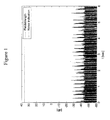
- Fig. 1 depicts the fieldstrength and the noise indication signal in an AWGN channel with distortions in the noise indication signal caused by the transmitter/receiver, e.g. by a clipping in the transmitter.
- the distortions (in fig. 1 the peaks) in the noise indication signal would lead to a false noise indication and therefore to a wrong denoising, stereo to mono transition, and/or AF strategy.
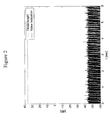
- Fig. 2 depicts the fieldstrength and the noise indication signal in an AWGN channel without distortions in the noise indication signal.
- Both figures 1 and 2 show a constant fieldstrength (carrier-to-noise-ratio CNR) of around 37 dB.
- the difference in the noise indication signal can clearly be seen:
- Fig. 2 depicts a noise indication signal with averaged maximum values of around -45 dB, whereas in fig. 1 many peaks of the noise indication signal have a value of around -30 dB.
- the noise indication signal can increase very fast for a very short time period.
- the noise indication signal contains a high noise power and the audio signal also contains a high multiplex signal amplitude/power, caused by the distortion of the fade itself.
- the ratio instantaneous noise indication signal amplitude (power) to average noise indication amplitude (power) and the signal amplitude (power) of the multiplex signal might not always be sufficient for a detection of distortions caused by the channel or the transmitter/IF filter (because fading effects might result in the same noise indication signals as a clipping in the transmitter does).
- the fieldstrength gives sufficient information about fades. In case the instantaneous fieldstrength is high (no fade of the fieldstrength) the distortions are most likely to be caused by the transmitter/IF filter. Thus, the averaging filters of the noise indication signal are switched off as described above. In case of a fade, the instantaneous fieldstrength is low. In this case, the averaging filters of the noise indication signal are not switched off.
- Figure 3 and 4 depict the instantaneous fieldstrengths and the noise indication signals in a wireless communications channel with and without distortions caused by the transmitter/IF filter.
- Both figures 3 and 4 show a varying fieldstrength of around 25 to 40 dB with some deep fades around 15 dB and lower.
- Fig. 3 depicts a noise indication signal with an averaged maximum value of around -45 dB with some peaks rising to around -35 dB, whereas in fig. 4 many peaks of the noise indication signal rise to around -35 dB.
- a particular high noise indication signal peak (the highest in the shown example) of around -10 dB corresponds to a particular low fieldstrength of around -8 dB (the lowest in the shown example).
- Figure 5 depicts a block diagram of a receiver with noise detection circuit according to the present invention.
- a stereo signal received through an antenna 1 is passed to a front-end IF filter stage 2 to be supplied to a FM demodulator 3.
- the front-end IF filter stage 2 further outputs a fieldstrength indication signal.
- the output signal of the FM demodulator 3 is input to a PLL circuit 4, to a first lowpass filter 5, to a second lowpass filter 6 via a first mixer 14, to a third lowpass filter 7 via a second mixer 13, and to a control unit 11 for controlling the averaging of the noise indication signal according to the present invention, which control unit 11 also receives the fieldstrength indication signal output by the front-end IF filter stage 2.
- the first lowpass filter 5 with a passband of 0 to 15 kHz outputs the stereo sum signal to a matrix circuit 9.
- the first mixer 14 which also receives an I-signal which is in phase to the 38 kHz subcarrier of the received stereo signal from the PLL circuit 4 demodulates the stereo difference signal which is gained by filtering the output signal of the first mixer 14 with the second lowpass filter 6 also having a passband of 0 to 15 kHz.
- the stereo difference signal output by the second lowpass filter 6 is input to a separation control/denoising circuit 8 which output signal is fed to the matrix circuit 9.
- the matrix circuit 9 generates the left and right stereo signals from the supplied stereo sum signal and separation controlled/denoised stereo difference signal.
- the separation control and denoising is based on a noise signal and is described in detail in the above referenced European Patent Applications of the Applicant which are incorporated by reference into this specification.
- the second mixer 13 which also receives a Q-signal which is in quadrature to the 38 kHz subcarrier of the received stereo signal from the PLL circuit 4 demodulates the quadrature component of the modulated difference signal.
- the third lowpass filter 7 which also has a passband of 0 to 15 kHz limits the bandwidth of the quadrature component to 15 kHz.
- this band limited quadrature component is input to a filterbank for the subband filtering in a denoising system or the signal is input to a squaring unit 12, as it is depicted in fig. 5, to generate the noise indication signal.
- the noise indication signal is input to an averaging filter 10 with enable/disable input.
- the averaged noise indication signal is input to the separation control/denoising circuit 8 for affecting the separation control/denoising of the stereo signal via a processing of the stereo difference signal.
- the output signal of filter 7, which is the demodulated quadrature signal is weighted with a weighting signal generated in the control unit 11.
- the control unit 11 controls the averaging filter 10 as described above.
- the enabling and disabling of the averaging filter 10 is controlled.
- one or several averaging enable/disable control units control the averaging filters of each subband.
- control unit 11 Besides the fieldstrength indication signal output by the front-end IF filter stage 2, the control unit 11 also receives the output signal of the FM demodulator 3, to determine the signal amplitude of the stereo multiplex signal and the noise indication signal output by the squaring unit 12 to determine the ratio noise indication signal amplitude to average noise indication amplitude.
- the invention increases the reliability of the noise indication by influencing the averaging of the noise indication signal for the control of the sliding stereo mono transition, the denoising or alternative frequency switching in a stereophonic FM broadcast receiver.
- the system according to the present invention makes the noise indication robust against distortions produced in the FM transmitter (e. g. clipping, nonlinearities) and the receiver (harmonic distortions of the FM demodulator, distortions caused by a narrow IF filter bandwidth).
Landscapes
- Engineering & Computer Science (AREA)
- Computer Networks & Wireless Communication (AREA)
- Signal Processing (AREA)
- Stereo-Broadcasting Methods (AREA)
Abstract
Description
- Fig. 1
- shows fieldstrength and noise indication signals in an AWGN channel with distortions in the noise indication signal caused by a clipping in the transmitter,
- Fig. 2
- shows fieldstrength and noise indication signals in an AWGN channel without distortions in the noise indication signal,
- Fig. 3
- depicts the instantaneous fieldstrengths and the noise indication signals in a wireless communications channel without distortions caused by the transmitter/IF filter,
- Fig. 4
- depicts the instantaneous fieldstrengths and the noise indication signals in a wireless communications channel with distortions caused by the transmitter/IF filter, and
- Fig. 5
- shows a block diagram of a receiver with noise detection circuit according to the present invention.
Claims (16)
- Method to increase the reliability of a noise indication in a stereophonic FM broadcast receiver, in which a noise indication signal is averaged for further processing, characterized by changing parameters of the averaging based on the received stereo signal or derivatives thereof.
- Method according to claim 1, characterized in that said changing of parameters of the averaging is a selection of the bandwidth of an averaging lowpass filter.
- Method according to claim 1 or 2, characterized in that said changing of parameters of the averaging is an enabling and disabling of an averaging unit.
- Method according to anyone of the preceding claims, characterized in that said changing of parameters of the averaging is a weighting of a demodulated quadrature signal of a difference signal derived from the received stereo signal.
- Method according to anyone of the preceding claims, characterized in that said parameters are changed dependent on an instantaneous signal amplitude of a multiplex signal derived from the received stereo signal.
- Method according to anyone of the preceding claims, characterized in that said parameters are changed dependent on a ratio instantaneous noise indication signal amplitude to average noise indication signal amplitude, both derived from the received stereo signal.
- Method according to anyone of the preceding claims, characterized in that said parameters are changed dependent on an instantaneous fieldstrength of the received stereo signal.
- Method according to anyone of the preceding claims, characterized by changing respective parameters of a respective averaging based on a respective subband in which the received stereo signal or derivatives thereof are divided for processing.
- Method according to anyone of the preceding claims, characterized in that said noise indication signal is used to control a sliding stereo to mono transition of a stereo output signal corresponding to the received stereo signal, to denoise the received stereo signal, or to perform an alternative frequency or transmission system switching in the stereophonic broadcast receiver.
- Computer program product, comprising computer program means adapted to perform the method steps as defined in anyone of claims 1 to 9 when being executed on a computer, digital signal processor, or the like.
- Computer readable storage medium, storing thereon a computer program product according to claim 10.
- FM broadcast receiver in which a noise indication signal is averaged for further processing, characterized by a control unit (11) for changing parameters of the averaging based on the received stereo signal or derivatives thereof.
- Receiver according to claim 12, characterized in that said changing of parameters of the averaging is a selection of the bandwidth of an averaging lowpass filter (10).
- Receiver according to claim 12 or 13, characterized in that said changing of parameters of the averaging is an enabling and disabling of an averaging unit (10).
- Receiver according to anyone of the preceding claims 12 to 14, characterized by a respective control unit for every respective subband in which the received stereo signal or derivatives thereof are divided for processing.
- Receiver according to anyone of the preceding claims 12 to 15, characterized in that said noise indication signal is used to control a sliding stereo to mono transition of a stereo output signal corresponding to the received stereo signal, to denoise the received stereo signal, or to perform an alternative frequency or transmission system switching in the stereophonic broadcast receiver.
Priority Applications (2)
| Application Number | Priority Date | Filing Date | Title |
|---|---|---|---|
| DE60228201T DE60228201D1 (en) | 2002-05-08 | 2002-05-08 | Noise signal detection in a VHF radio receiver |
| EP20020010480 EP1361663B1 (en) | 2002-05-08 | 2002-05-08 | Noise detection in FM broadcast |
Applications Claiming Priority (1)
| Application Number | Priority Date | Filing Date | Title |
|---|---|---|---|
| EP20020010480 EP1361663B1 (en) | 2002-05-08 | 2002-05-08 | Noise detection in FM broadcast |
Publications (2)
| Publication Number | Publication Date |
|---|---|
| EP1361663A1 true EP1361663A1 (en) | 2003-11-12 |
| EP1361663B1 EP1361663B1 (en) | 2008-08-13 |
Family
ID=29225633
Family Applications (1)
| Application Number | Title | Priority Date | Filing Date |
|---|---|---|---|
| EP20020010480 Expired - Lifetime EP1361663B1 (en) | 2002-05-08 | 2002-05-08 | Noise detection in FM broadcast |
Country Status (2)
| Country | Link |
|---|---|
| EP (1) | EP1361663B1 (en) |
| DE (1) | DE60228201D1 (en) |
Citations (3)
| Publication number | Priority date | Publication date | Assignee | Title |
|---|---|---|---|---|
| EP0418036A2 (en) * | 1989-09-11 | 1991-03-20 | Bose Corporation | Audible noise reducing |
| US5784465A (en) * | 1995-08-31 | 1998-07-21 | Fujitsu Ten Ltd | Stereo receiver |
| EP1081870A1 (en) * | 1999-09-03 | 2001-03-07 | Sony International (Europe) GmbH | Detection of noise in a frequency demodulated FM-audio broadcast signal |
-
2002
- 2002-05-08 EP EP20020010480 patent/EP1361663B1/en not_active Expired - Lifetime
- 2002-05-08 DE DE60228201T patent/DE60228201D1/en not_active Expired - Lifetime
Patent Citations (3)
| Publication number | Priority date | Publication date | Assignee | Title |
|---|---|---|---|---|
| EP0418036A2 (en) * | 1989-09-11 | 1991-03-20 | Bose Corporation | Audible noise reducing |
| US5784465A (en) * | 1995-08-31 | 1998-07-21 | Fujitsu Ten Ltd | Stereo receiver |
| EP1081870A1 (en) * | 1999-09-03 | 2001-03-07 | Sony International (Europe) GmbH | Detection of noise in a frequency demodulated FM-audio broadcast signal |
Also Published As
| Publication number | Publication date |
|---|---|
| DE60228201D1 (en) | 2008-09-25 |
| EP1361663B1 (en) | 2008-08-13 |
Similar Documents
| Publication | Publication Date | Title |
|---|---|---|
| EP1370016B1 (en) | Method and apparatus for the reception of an audio signal transmitted both in analogue and in higher-quality digital modulation, gradually varying the mixing ratio from digital to analogue in case of poor channel conditions, so as to make the change less perceptible | |
| EP1206043B1 (en) | Noise reduction in a stereo receiver | |
| US8095095B2 (en) | Band switch control apparatus for intermediate frequency filter | |
| US6993311B2 (en) | Radio receiver having an adaptive equalizer and method therefor | |
| WO2002080381A2 (en) | Radio receiver having a dynamic bandwidth filter and method therefor | |
| JPH0544209B2 (en) | ||
| US6154547A (en) | Adaptive noise reduction filter with continuously variable sliding bandwidth | |
| US20140355764A1 (en) | Methods And Systems For Blending Between Analog And Digital Broadcast Signals | |
| US20020168955A1 (en) | Broadcast receiver with antenna/frequency diversity | |
| EP0418036B1 (en) | Audible noise reducing | |
| EP2251984B1 (en) | Signal analysis for an improved detection of noise from an adjacent channel | |
| US5253298A (en) | Reducing audible noise in stereo receiving | |
| US7292694B2 (en) | Noise reduction in a stereo receiver | |
| JP3992521B2 (en) | Adjacent interference detection apparatus and method, and broadcast receiving apparatus capable of using the method | |
| JPH0723010A (en) | Derivation circuit device of at least one quality signal depending on quality of received signal | |
| JP2004260528A (en) | Audio broadcast receiving apparatus and audio broadcast receiving method | |
| US5068896A (en) | Audible noise reducing | |
| US6055318A (en) | Adaptive noise reduction filter with low modulation disabling | |
| JP2601764Y2 (en) | FM tuner | |
| EP1361663B1 (en) | Noise detection in FM broadcast | |
| CA2661708C (en) | Iboc broadcasting receiver | |
| US5631963A (en) | Circuit arrangement for the recognition of adjacent channel interference | |
| JP4171765B2 (en) | Broadcast receiving apparatus and filter control method | |
| EP0509725B1 (en) | Reducing audible noise in stereo receiving | |
| JP3276684B2 (en) | Multipath noise removal circuit for FM receiver |
Legal Events
| Date | Code | Title | Description |
|---|---|---|---|
| PUAI | Public reference made under article 153(3) epc to a published international application that has entered the european phase |
Free format text: ORIGINAL CODE: 0009012 |
|
| 17P | Request for examination filed |
Effective date: 20030415 |
|
| AK | Designated contracting states |
Kind code of ref document: A1 Designated state(s): AT BE CH CY DE DK ES FI FR GB GR IE IT LI LU MC NL PT SE TR |
|
| AX | Request for extension of the european patent |
Extension state: AL LT LV MK RO SI |
|
| 17Q | First examination report despatched |
Effective date: 20031117 |
|
| AKX | Designation fees paid |
Designated state(s): DE FR GB |
|
| RAP1 | Party data changed (applicant data changed or rights of an application transferred) |
Owner name: SONY DEUTSCHLAND GMBH |
|
| RAP1 | Party data changed (applicant data changed or rights of an application transferred) |
Owner name: SONY DEUTSCHLAND GMBH |
|
| GRAP | Despatch of communication of intention to grant a patent |
Free format text: ORIGINAL CODE: EPIDOSNIGR1 |
|
| GRAS | Grant fee paid |
Free format text: ORIGINAL CODE: EPIDOSNIGR3 |
|
| GRAA | (expected) grant |
Free format text: ORIGINAL CODE: 0009210 |
|
| RIN1 | Information on inventor provided before grant (corrected) |
Inventor name: WILDHAGEN, JENSSONY DEUTSCHLAND GMBH |
|
| AK | Designated contracting states |
Kind code of ref document: B1 Designated state(s): DE FR GB |
|
| REG | Reference to a national code |
Ref country code: GB Ref legal event code: FG4D |
|
| REF | Corresponds to: |
Ref document number: 60228201 Country of ref document: DE Date of ref document: 20080925 Kind code of ref document: P |
|
| PLBE | No opposition filed within time limit |
Free format text: ORIGINAL CODE: 0009261 |
|
| STAA | Information on the status of an ep patent application or granted ep patent |
Free format text: STATUS: NO OPPOSITION FILED WITHIN TIME LIMIT |
|
| 26N | No opposition filed |
Effective date: 20090514 |
|
| REG | Reference to a national code |
Ref country code: FR Ref legal event code: ST Effective date: 20100129 |
|
| PG25 | Lapsed in a contracting state [announced via postgrant information from national office to epo] |
Ref country code: FR Free format text: LAPSE BECAUSE OF NON-PAYMENT OF DUE FEES Effective date: 20090602 |
|
| REG | Reference to a national code |
Ref country code: GB Ref legal event code: 746 Effective date: 20160412 |
|
| REG | Reference to a national code |
Ref country code: DE Ref legal event code: R084 Ref document number: 60228201 Country of ref document: DE |
|
| PGFP | Annual fee paid to national office [announced via postgrant information from national office to epo] |
Ref country code: DE Payment date: 20210421 Year of fee payment: 20 |
|
| PGFP | Annual fee paid to national office [announced via postgrant information from national office to epo] |
Ref country code: GB Payment date: 20210422 Year of fee payment: 20 |
|
| REG | Reference to a national code |
Ref country code: DE Ref legal event code: R071 Ref document number: 60228201 Country of ref document: DE |
|
| REG | Reference to a national code |
Ref country code: GB Ref legal event code: PE20 Expiry date: 20220507 |
|
| PG25 | Lapsed in a contracting state [announced via postgrant information from national office to epo] |
Ref country code: GB Free format text: LAPSE BECAUSE OF EXPIRATION OF PROTECTION Effective date: 20220507 |