EP1361653A2 - Power supplying apparatus, design method of the same, and power generation apparatus - Google Patents
Power supplying apparatus, design method of the same, and power generation apparatus Download PDFInfo
- Publication number
- EP1361653A2 EP1361653A2 EP03010375A EP03010375A EP1361653A2 EP 1361653 A2 EP1361653 A2 EP 1361653A2 EP 03010375 A EP03010375 A EP 03010375A EP 03010375 A EP03010375 A EP 03010375A EP 1361653 A2 EP1361653 A2 EP 1361653A2
- Authority
- EP
- European Patent Office
- Prior art keywords
- power
- transformer
- frequency
- switching
- self
- Prior art date
- Legal status (The legal status is an assumption and is not a legal conclusion. Google has not performed a legal analysis and makes no representation as to the accuracy of the status listed.)
- Withdrawn
Links
Images






Classifications
-
- H—ELECTRICITY
- H02—GENERATION; CONVERSION OR DISTRIBUTION OF ELECTRIC POWER
- H02J—ELECTRIC POWER NETWORKS; CIRCUIT ARRANGEMENTS OR SYSTEMS FOR SUPPLYING OR DISTRIBUTING ELECTRIC POWER; SYSTEMS FOR STORING ELECTRIC ENERGY
- H02J7/00—Circuit arrangements for charging or discharging batteries or for supplying loads from batteries
- H02J7/34—Parallel operation in networks using both storage and other DC sources, e.g. providing buffering
- H02J7/35—Parallel operation in networks using both storage and other DC sources, e.g. providing buffering with light sensitive cells
-
- H—ELECTRICITY
- H02—GENERATION; CONVERSION OR DISTRIBUTION OF ELECTRIC POWER
- H02M—APPARATUS FOR CONVERSION BETWEEN AC AND AC, BETWEEN AC AND DC, OR BETWEEN DC AND DC, AND FOR USE WITH MAINS OR SIMILAR POWER SUPPLY SYSTEMS; CONVERSION OF DC OR AC INPUT POWER INTO SURGE OUTPUT POWER; CONTROL OR REGULATION THEREOF
- H02M3/00—Conversion of DC power input into DC power output
- H02M3/22—Conversion of DC power input into DC power output with intermediate conversion into AC
- H02M3/24—Conversion of DC power input into DC power output with intermediate conversion into AC by static converters
- H02M3/28—Conversion of DC power input into DC power output with intermediate conversion into AC by static converters using discharge tubes with control electrode or semiconductor devices with control electrode to produce the intermediate AC
- H02M3/325—Conversion of DC power input into DC power output with intermediate conversion into AC by static converters using discharge tubes with control electrode or semiconductor devices with control electrode to produce the intermediate AC using devices of a triode or a transistor type requiring continuous application of a control signal
- H02M3/335—Conversion of DC power input into DC power output with intermediate conversion into AC by static converters using discharge tubes with control electrode or semiconductor devices with control electrode to produce the intermediate AC using devices of a triode or a transistor type requiring continuous application of a control signal using semiconductor devices only
- H02M3/337—Conversion of DC power input into DC power output with intermediate conversion into AC by static converters using discharge tubes with control electrode or semiconductor devices with control electrode to produce the intermediate AC using devices of a triode or a transistor type requiring continuous application of a control signal using semiconductor devices only in push-pull configuration
- H02M3/3376—Conversion of DC power input into DC power output with intermediate conversion into AC by static converters using discharge tubes with control electrode or semiconductor devices with control electrode to produce the intermediate AC using devices of a triode or a transistor type requiring continuous application of a control signal using semiconductor devices only in push-pull configuration with automatic control of output voltage or current
Definitions
- the present invention relates to a power supplying apparatus, a design method of the same, and a power generation apparatus and, more particularly, to a power supplying apparatus for converting DC power supplied from a solar cell.
- Solar light power generation systems have been rapidly put to practical use, and a large number of solar light power generation systems are operated on the market. These systems are power supplying apparatuses including solar cells and high-efficiency power converters using switching elements.
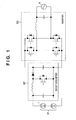
- Fig. 1 is a circuit diagram showing the circuit configuration of a solar cell power supply.
- the voltage of output from a solar cell array 91 is raised by a step-up converter 92 and converted into AC power by an inverter 93.
- This AC power is supplied to a commercial power system (to be referred to as a "system” hereinafter) 9.
- a resonant switching system can be used.
- a solar cell power supply in which the load readily fluctuates it is very difficult to control the switching timing to the zero point of an electric current or of a voltage. Therefore, no solar cell power supply using the resonant switching system is presently put on the market.
- the present invention has been made to individually or collectively solve the above problems, and has its object to increase the conversion efficiency of a power supplying apparatus.
- a power supplying apparatus comprising:
- a preferred aspect of the present invention discloses a design method of a power supplying apparatus comprising a transformer having a very high boosting ratio, and a plurality of switching elements for supplying AC power to a primary side of the transformer, the method comprising a step of setting a frequency of the AC power to 0.25 to 2 times a self-resonance frequency of the transformer.
- the present inventors sought to downsize a nonresonant switching power supply system and increase the efficiency of the system. As a consequence, the present inventors found that a power supplying apparatus can be downsized and its efficiency can be increased by lowering the input voltage to an inverter, increasing the self-resonance frequency of a transformer, and driving a switching element connected to the transformer at a switching frequency to be described later. Conventionally, there are no firm findings about the relationship between the electric characteristics depending on the structure of a transformer and the switching frequency, so the switching frequency is determined partly experimentally. However, the present inventors made extensive studies and found a simple design method of obtaining a high conversion efficiency.
- the following explanation reveals a method of determining a switching frequency at which a high conversion efficiency is obtained in a power converter using a nonresonant switching system which uses a transformer, and discloses a small, simple, and inexpensive solar cell power supply having a high conversion efficiency.
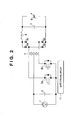
- Fig. 2 is a circuit diagram showing the circuit configuration of a solar cell power supply according to the embodiment.
- a thin-film solar cell in which an amorphous layer and nanocrystalline layer are stacked is used.
- the electric output of the solar cell 1 has 1.0 V and 10.0 A.
- the structure, manufacturing method, collecting terminal mounting method, and the like of this stacked solar cell have no relation with the substance of the present invention, so a detailed explanation thereof will be omitted. However, these details are disclosed in, e.g., Japanese Patent Laid-Open Nos. 11-243219 and 8-139439.
- the type of solar cell is not particularly limited, so a crystalline silicon solar cell can also be used.
- a fuel cell which has advanced significantly in recent years has an output voltage (about 0.5 to 1.5 V) and an electric current (area dependent) similar to those of a solar cell, and hence can be used as a constituent element of the embodiment.
- this embodiment uses a nonresonant push-pull switching system. Since the voltage of the solar cell 1 is as low as 1.0 V, MOSFETs (IRF P3703 manufactured by International Rectifier) are used as switching elements 3a and 3b. To keep low loss in a low-voltage region, low-resistance switching elements are necessary. Practically, a MOSFET which is a unipolar element is the only usable device. If the voltage of the solar cell 1 is higher, a bipolar element such as an IGBT is also usable. The input impedance of the gate of a MOSFET or IGBT is very high, and this is favorable to simplify a driving circuit.
- MOSFETs IRF P3703 manufactured by International Rectifier
- a 6.3-V, 1,000- ⁇ F capacitor (OS-CON (trade name)) manufactured by Sanyo Electric Co., Ltd. is used as an input capacitor 2 .
- the OS CON is suited to the embodiment because it has a low equivalent series resistance (ESR) and excellent high-frequency characteristics. It is also possible to use a capacitor having a small ESR, such as a stacked ceramic capacitor or tantalum electrolytic capacitor.
- the input capacitor 2 allows the input power supply of the power conversion circuit to be regarded as a voltage source. So, this power conversion circuit functions as a so-called voltage source converter.
- Fig. 3 is a block diagram showing the arrangement of a gate driving circuit 11.
- a signal source 41 is a circuit (LTC1799 manufactured by Linear Technology) which oscillates a rectangular wave having on-duty fixed to 50%.
- the output rectangular wave from the signal source 41 is amplified by a current amplifier formed by connecting six inverters (74AC04 CMOS logic ICs) in parallel, via inverters (74AC04 CMOS logic ICs) 42a and 42b which function as buffers, and is output as two gate signals which drive the switching elements 3a and 3b and have opposite phases.
- a number of well-known circuits e.g., a commercially available operational amplifier, can be used as the gate driving circuit 11.
- E1D Surface mount chip type high-speed rectifier diodes
- E1D manufactured by General Semiconductor
- a withstand voltage of 200 V and a maximum current of 0.6 A are used as rectifier diodes 5a to 5d, thereby forming a full-bridge circuit.
- the use of the full-bridge circuit makes a secondary center tap of a transformer 4 unnecessary, thereby effectively downsizing the transformer 4.
- the boosting ratio of the transformer 4 is high, so the secondary electric current is relatively small.
- the diodes 5a to 5d are much smaller than the transformer 4. Therefore, downsizing the transformer 4 greatly contributes to downsizing of the whole power converter.
- a commercially available surface mount inductor (2.2 ⁇ H, manufactured by Coil Craft) is used as an inductor 6.
- These parts are not particularly limited. So, it is possible to select appropriate products on the market by taking so-called designing factors into consideration in accordance with the output voltage, output current, and switching frequency.
- the transformer 4 preferably has a high self-resonance frequency. To form this transformer, it is favorable to reduce the stray capacity, more specifically, reduce the number of turns of winding. However, if the number of turns is reduced, the flux density of the magnetic core increases, and this increases the core loss. This poses another problem that the efficiency of the transformer lowers unless the size of the magnetic core is increased, so it becomes impossible to obtain a small-sized, high-efficiency power converter. Accordingly, the present inventors noted the fact that the number of turns can be reduced by decreasing the primary voltage of the transformer 4 to a low voltage (more specifically, 2.0 V or less), without largely increasing the size of the magnetic core.
- the ratio (transformation ratio) of the number of turns of the primary winding to that of the secondary winding increases, so the number of turns of the secondary winding must be 100 times that of the primary winding or more. This often increases the inductance of the winding itself. However, reducing the number of turns of the primary winding reduces the number of turns of the secondary winding, thereby decreasing the inductance of the winding itself.
- the self-resonance frequency of the transformer 4 is preferably 10 to 400 kHz, and more preferably, 20 to 200 kHz.
- switching at 20 to 200 kHz which is desired as a nonresonant power supply can be performed.
- Driving the switching element at this frequency is favorable because no noise is produced and the switching loss of the switching element is low.
- the specifications of the transformer 4 are as shown in Fig. 10.
- the self-resonance frequency of the transformer 4 is measured using a frequency response analyzer (FRA5095 manufactured by NF Corporation) on the market.
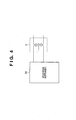
- Fig. 4 is a view showing connection when the self-resonance frequency of the transformer 4 is to be measured. With the secondary side of the transformer 4 opened, a meter 31 is connected to the primary side, and the impedance of the transformer 4 is measured while the frequency of a signal supplied to the transformer 4 is changed. A frequency at which the impedance is a maximum is the self-resonance frequency. When measurement is performed by this method, a plurality of resonance points appear. In this embodiment, a resonance point at the lowest frequency is important, and this resonance point best represents characteristics unique to the transformer 4.
- the self-resonance frequency of the transformer 4 formed by the above specifications was 88 kHz. Note that the self-resonance frequency may also be measured by another method, e.g., the use of an impedance meter on the market.
- an electronic load device capable of constant-voltage operation is used.
- the load 8 is a substitute of a battery. In actual operation, a battery or resistance load is used.
- an inverter 93 which interconnects to a system 9 is a load.
- the lower limit of the frequency region in which the conversion efficiency is high is presumably related to the nonlinearity (saturation) of the magnetic core, and the upper limit of the region is probably caused by an increase in reactive current caused because a rectangular wave applied to the transformer contains a large amount of harmonic contents, an increase in core loss, a rise in AC resistance on an electric wire, and a rise in loss of the switching element.
- parameters by which a frequency region in which the conversion efficiency is high can be easily specified are conventionally unknown.
- the present inventors made extensive studies and found that a high-conversion-efficiency frequency region can be specified very easily by using the self-resonance frequency of the transformer as a parameter.
- the amount of electric wire used in the transformer is increased by making the primary winding parallel and increasing the number of turns of the secondary winding. This increases the parasitic stray capacity of the transformer and partly causes a reduction in self-resonance frequency. Also, to increase the conversion efficiency, a high-permeability magnetic material is used as the magnetic core to reduce the leakage flux, thereby enhancing the coupling between the primary and secondary sides. Since this increases the primary inductance, the self-resonance frequency is further decreased. This fact is found by the research by the present inventors .
- a transformer having a high boosting ratio Compared to a transformer having a low boosting ratio, a transformer having a high boosting ratio presumably has a very narrow frequency region in which a high conversion efficiency is obtained. Accordingly, it is very effective to be able to easily determine a switching frequency from the self-resonance frequency of the transformer.
- the second embodiment demonstrates that the same effects as in the first embodiment can be obtained even when the arrangement of a transformer 4 and the circuit configuration of the secondary side are changed.
- Fig. 6 is a circuit diagram showing the circuit configuration of a solar cell power supply of the second embodiment.
- Fig. 11 shows the specifications of the transformer 4 of the second embodiment.
- the self-resonance frequency of the transformer 4 of the second embodiment was 37 kHz, much lower than that of the transformer 4 of the first embodiment. This is probably because the size of the magnetic core was larger than that of the transformer 4 of the first embodiment, and this increased the inductance of the primary winding.
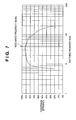
- the power conversion efficiency was measured by changing the switching frequency. As shown in Fig. 7, the conversion efficiency peaked at a switching frequency slightly lower than the self-resonance frequency (38 kHz). As in the first embodiment, a high conversion efficiency was obtained in the frequency region found by the present inventors. This indicates that even when the type of load and the arrangement of the transformer are changed, a high conversion efficiency can be maintained if the switching frequency is held in the frequency region found by the present inventors.
- the present invention is applied to a system interconnection type power generation system which is the recent most popular solar cell power generation system.
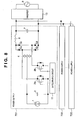
- Fig. 8 is a circuit diagram showing the circuit configuration of a solar cell power supply of the third embodiment.
- each solar cell power supply 701 has the same arrangement as in the first embodiment except for a transformer 4, and outputs 9 to 10 W.
- the solar cell power supplies 701 are operated in parallel in order to drive the commercially available inverter 13 which requires an input of at least about 100 W to output a few kW. If an inverter matching the output (about 10 W) of the solar cell power supply 701 is available, the solar cell power supplies 701 need not be operated in parallel.
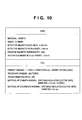
- Fig. 12 shows the specifications of the transformer 4 of the third embodiment.
- the self-resonance frequency of the transformer 4 of the third embodiment was 46 kHz, higher than that of the transformer 4 of the second embodiment. This is presumably because, e.g., the parasitic stray capacity of the transformer 4 was decreased by a litz wire and by improvement of the way the wire was wound (in the third embodiment, split winding was used).
- the self-resonance frequency can be changed by improving the winding method and inserting a gap or cavity into the magnetic core. Accordingly, a solar cell power supply having a high conversion efficiency can be obtained by controlling the self-resonance frequency while the switching frequency is fixed.
- this method is not as easy as changing the switching frequency because the method is affected by a number of factors such as the winding structure.
- a collecting terminal of the solar cell 1 is formed close to the transformer 4. More specifically, when the distance at which the collecting terminal and the primary winding of the transformer 4 are electrically connected is 10 cm or less, the connection is easy, and the loss can be decreased. Substantially, it is important to reduce the resistance of a line for the connection, so these parts are connected by a line which is sufficiently thick and short. Note that it is easy to connect a fuel cell instead of the solar cell 1, so this power supply is of course also applicable as a fuel cell power supply.
- the system 9 is a common 60-Hz, 200-V single-phase three-wire system. The frequency and voltage can be readily changed, so 50 Hz and 100 V, for example, can be selected as needed.
- Fig. 9 shows the result of measurement of the conversion efficiency as a function of the switching frequency.
- the conversion efficiency peaked at a switching frequency slightly lower than the self-resonance frequency (46 kHz).
- a high conversion efficiency was obtained in the frequency region found by the present inventors. This indicates that even when the system interconnection type inverter 13 is used as a load, a high conversion efficiency can be maintained if the switching frequency is held in the frequency region found by the present inventors.
- a power supplying apparatus having a high conversion efficiency can be rapidly manufactured, and the output from a solar cell power supply can be increased by the increase in conversion efficiency, thereby decreasing the power generation cost.
- a very simple power conversion circuit is obtained by controlling the switching element by fixed on-duty. This decreases the cost of the power supplying apparatus.
- the switching loss of a switching element increases if the switching frequency is increased.
- the frequency of the AC power is set to 0.25 to 2 times the self-resonance frequency of the transformer.
Landscapes
- Engineering & Computer Science (AREA)
- Power Engineering (AREA)
- Dc-Dc Converters (AREA)
- Inverter Devices (AREA)
- Photovoltaic Devices (AREA)
- Ac-Ac Conversion (AREA)
Abstract
Description
Claims (13)
- A power supplying apparatus comprising:a transformer having a very high boosting ratio; anda plurality of switching elements for supplying AC power 0.25 to 2 times a self-resonance frequency of said transformer to a primary side of said transformer.
- The apparatus according to claim 1, wherein a frequency of the AC power is 0.5 to 1 time the self-resonance frequency of said transformer.
- The apparatus according to claim 1, wherein said switching element is driven by fixed on-duty.
- The apparatus according to claim 1, further comprising a plurality of rectifying elements connected to a secondary side of said transformer to convert the AC power generated from input DC power to said apparatus into DC power having a predetermined voltage.
- The apparatus according to claim 4, wherein the input DC power is directly supplied from a solar cell or fuel cell.
- The apparatus according to claim 1, wherein said transformer has a center tap on the primary side, and said transformer and said plurality of switching elements form a push-pull switching circuit.
- The apparatus according to claim 1, wherein the boosting ratio of said transformer is not less than 1 : 100.
- The apparatus according to claim 1, wherein said power supplying apparatus is not a resonant-mode power supply.
- A design method of a power supplying apparatus comprising a transformer having a very high boosting ratio, and a plurality of switching elements for supplying AC power to a primary side of the transformer, the method comprising a step of setting a frequency of the AC power to 0.25 to 2 times a self-resonance frequency of the transformer.
- The method according to claim 9, wherein a frequency of the AC power is set to 0.5 to 1 time the self-resonance frequency of the transformer.
- The method according to claim 9, wherein the power supplying apparatus is not a resonant-mode power supply.
- A power generation apparatus comprising:the power supplying apparatus cited in claim 1; anda solar cell or fuel cell for supplying DC power directly to said power supplying apparatus.
- The apparatus according to claim 12, further comprising a power converter for converting output DC power from said power supplying apparatus into AC power, and supplying the AC power to an AC power system.
Applications Claiming Priority (2)
| Application Number | Priority Date | Filing Date | Title |
|---|---|---|---|
| JP2002136141 | 2002-05-10 | ||
| JP2002136141A JP2003333861A (en) | 2002-05-10 | 2002-05-10 | Power supply device, design method thereof, and power generation device |
Publications (2)
| Publication Number | Publication Date |
|---|---|
| EP1361653A2 true EP1361653A2 (en) | 2003-11-12 |
| EP1361653A3 EP1361653A3 (en) | 2005-03-23 |
Family
ID=29244240
Family Applications (1)
| Application Number | Title | Priority Date | Filing Date |
|---|---|---|---|
| EP03010375A Withdrawn EP1361653A3 (en) | 2002-05-10 | 2003-05-08 | Power supplying apparatus, design method of the same, and power generation apparatus |
Country Status (6)
| Country | Link |
|---|---|
| US (1) | US20030210562A1 (en) |
| EP (1) | EP1361653A3 (en) |
| JP (1) | JP2003333861A (en) |
| KR (1) | KR20030087985A (en) |
| CN (1) | CN1457128A (en) |
| AU (1) | AU2003204103A1 (en) |
Cited By (3)
| Publication number | Priority date | Publication date | Assignee | Title |
|---|---|---|---|---|
| US7852008B2 (en) | 2005-05-13 | 2010-12-14 | Panasonic Corporation | Dielectric barrier discharge lamp lighting device |
| CN102412728A (en) * | 2011-12-23 | 2012-04-11 | 航天长峰朝阳电源有限公司 | Chain type high-power forward boosting direct current conversion circuit |
| WO2018052516A1 (en) * | 2016-09-15 | 2018-03-22 | Peregrine Semiconductor Corporation | Current protected integrated transformer driver for isolating a dc-dc convertor |
Families Citing this family (20)
| Publication number | Priority date | Publication date | Assignee | Title |
|---|---|---|---|---|
| US6271067B1 (en) * | 1998-02-27 | 2001-08-07 | Micron Technology, Inc. | Methods of forming field effect transistors and field effect transistor circuitry |
| US7612283B2 (en) * | 2002-07-09 | 2009-11-03 | Canon Kabushiki Kaisha | Solar power generation apparatus and its manufacturing method |
| JP2004179637A (en) * | 2002-11-14 | 2004-06-24 | Canon Inc | Solar cell module |
| US6966184B2 (en) * | 2002-11-25 | 2005-11-22 | Canon Kabushiki Kaisha | Photovoltaic power generating apparatus, method of producing same and photovoltaic power generating system |
| JP2004336944A (en) * | 2003-05-09 | 2004-11-25 | Canon Inc | Power conversion device and solar power generation system |
| US20040246087A1 (en) * | 2003-05-09 | 2004-12-09 | Canon Kabushiki Kaisha | Electric component and method of producing the same |
| JP2004335886A (en) * | 2003-05-09 | 2004-11-25 | Canon Inc | Transformer assembly, power conversion device and solar power generation device using the same |
| JP2004335885A (en) | 2003-05-09 | 2004-11-25 | Canon Inc | Electronic component and method of manufacturing the same |
| WO2005060570A2 (en) * | 2003-12-10 | 2005-07-07 | Moises De La Cruz | Ac to dc converter circuit |
| US7844499B2 (en) * | 2005-12-23 | 2010-11-30 | Sharp Electronics Corporation | Integrated solar agent business model |
| JP5309148B2 (en) * | 2008-10-08 | 2013-10-09 | パナソニック株式会社 | Induction heating device |
| US20100301676A1 (en) * | 2009-05-28 | 2010-12-02 | General Electric Company | Solar power generation system including weatherable units including photovoltaic modules and isolated power converters |
| KR101025307B1 (en) * | 2009-06-04 | 2011-03-29 | 건국대학교 산학협력단 | Fuel cell power converter and control method |
| CN102474137B (en) * | 2010-06-30 | 2015-04-15 | 松下电器产业株式会社 | Electric power generator and electric power generating system |
| JP5548569B2 (en) * | 2010-09-28 | 2014-07-16 | 株式会社日立製作所 | DC power supply |
| KR101819233B1 (en) * | 2011-03-24 | 2018-01-16 | 엘지이노텍 주식회사 | A circuit for mitigating electromagnetic interference in input stage of a driver ic |
| KR101293166B1 (en) * | 2011-11-01 | 2013-08-12 | 주식회사 피플웍스 | Micro Grid Inverter used in Potrabel Grid Photovoltic Generator |
| CN104184333A (en) * | 2014-01-09 | 2014-12-03 | 深圳市中兴昆腾有限公司 | Push-pull converter |
| CN109194145B (en) * | 2018-10-23 | 2020-01-21 | 阳光电源股份有限公司 | Drive circuit of push-pull switching power supply and push-pull switching power supply |
| CN110518807B (en) * | 2019-08-09 | 2020-11-03 | 深圳市海浦蒙特科技有限公司 | Method and system for adjusting resonant frequency of push-pull soft switching circuit |
Family Cites Families (36)
| Publication number | Priority date | Publication date | Assignee | Title |
|---|---|---|---|---|
| US3496092A (en) * | 1968-03-28 | 1970-02-17 | Gen Electric | Solid state corona generator for chemical - electrical discharge processes |
| US3553459A (en) * | 1968-06-11 | 1971-01-05 | Westinghouse Electric Corp | Solid state power supply for an image amplifier |
| GB1314157A (en) * | 1970-05-18 | 1973-04-18 | Texaco Development Corp | Saturable-core square wave oscillator circuit |
| JPS5713965A (en) * | 1980-06-27 | 1982-01-25 | Morita Mfg Co Ltd | Direct current high voltage generating device |
| DE3142304A1 (en) * | 1981-10-24 | 1983-05-11 | AEG-Telefunken Nachrichtentechnik GmbH, 7150 Backnang | DC CONVERTER |
| US4504895A (en) * | 1982-11-03 | 1985-03-12 | General Electric Company | Regulated dc-dc converter using a resonating transformer |
| FI833833L (en) * | 1983-10-20 | 1985-04-21 | Orion Yhtymae Oy | INVERTER FOER EN ROENTGENERATOR. |
| US4706177A (en) * | 1985-11-14 | 1987-11-10 | Elliot Josephson | DC-AC inverter with overload driving capability |
| US4757433A (en) * | 1987-01-07 | 1988-07-12 | Display Components, Inc. | Power supply |
| JPH07118915B2 (en) * | 1987-01-30 | 1995-12-18 | 株式会社日立メデイコ | Resonant DC-DC converter |
| FI79412C (en) * | 1987-10-16 | 1989-12-11 | Nokia Oy Ab | FOERFARANDE OCH ANORDNING FOER FRAMSTAELLNING AV ETT OPTISKT FOERGRENINGSMEDEL. |
| JPH01264563A (en) * | 1988-04-12 | 1989-10-20 | Fuji Electric Co Ltd | Switching power source |
| US4893227A (en) * | 1988-07-08 | 1990-01-09 | Venus Scientific, Inc. | Push pull resonant flyback switchmode power supply converter |
| CA1316980C (en) * | 1988-12-27 | 1993-04-27 | Daniel C. Hughey | Power supply |
| DE4128314A1 (en) * | 1991-08-27 | 1993-03-04 | Diehl Gmbh & Co | POWER SUPPLY CIRCUIT |
| JP3132093B2 (en) * | 1991-09-25 | 2001-02-05 | ヤマハ株式会社 | Power supply circuit |
| FR2696292B1 (en) * | 1992-09-25 | 1994-12-23 | Moulinex Sa | Device for supplying a unidirectional load such as a magnetron. |
| ATE134087T1 (en) * | 1993-03-22 | 1996-02-15 | Siemens Ag | METHOD AND DEVICE FOR CONTROLLING THE WORKING POINT OF A SERIES RECIRCULATION CIRCUIT INVERTER |
| US5331523A (en) * | 1993-07-09 | 1994-07-19 | Delzer David G | Gas dispensing flashlight apparatus |
| US5555494A (en) * | 1993-09-13 | 1996-09-10 | Morris; George Q. | Magnetically integrated full wave DC to DC converter |
| EP0693789A3 (en) * | 1994-07-18 | 1996-05-29 | Tokin Corp | Piezoelectric transformer with primary and secondary electrodes isolated from each other and voltage converter using the same |
| US5488554A (en) * | 1994-08-23 | 1996-01-30 | Acme Electric Corporation | Low-loss clamp circuit |
| US5632115A (en) * | 1995-06-09 | 1997-05-27 | Heitman; Lynn B. | Method and apparatus for controlling fire ants |
| DE19529941A1 (en) * | 1995-08-16 | 1997-02-20 | Philips Patentverwaltung | Voltage converter |
| JPH09117153A (en) * | 1995-10-18 | 1997-05-02 | Sanyo Electric Co Ltd | Inverter |
| JP3768672B2 (en) * | 1998-02-26 | 2006-04-19 | キヤノン株式会社 | Multilayer photovoltaic device |
| JP3152298B2 (en) * | 1998-04-06 | 2001-04-03 | 日本電気株式会社 | High voltage power circuit |
| JP2000112545A (en) * | 1998-09-30 | 2000-04-21 | Daihen Corp | Photovoltaic power generation system |
| US6094363A (en) * | 1998-12-21 | 2000-07-25 | Phoenixtec Power Co., Ltd. | Uninterruptible power supply with AC sine wave output and energy recycle function |
| US6330170B1 (en) * | 1999-08-27 | 2001-12-11 | Virginia Tech Intellectual Properties, Inc. | Soft-switched quasi-single-stage (QSS) bi-directional inverter/charger |
| JP4389306B2 (en) * | 1999-10-21 | 2009-12-24 | ソニー株式会社 | Switching power supply |
| US6288913B1 (en) * | 2000-04-27 | 2001-09-11 | Rantec Power Systems Inc. | High voltage power supply allowing transformers to be run in parallel for higher output power |
| WO2001086791A1 (en) * | 2000-05-10 | 2001-11-15 | Hitachi Medical Corporation | X-ray generator and x-ray ct apparatus comprising the same |
| JP2001359279A (en) * | 2000-06-12 | 2001-12-26 | Sony Corp | Bridge type DC-DC converter |
| JP2002199718A (en) * | 2000-12-22 | 2002-07-12 | Sony Corp | Resonant switching power supply |
| US6744643B2 (en) * | 2002-09-06 | 2004-06-01 | Phoenixtec Power Co., Ltd. | Push-pull booster circuit with a pair of inductors for coupling |
-
2002
- 2002-05-10 JP JP2002136141A patent/JP2003333861A/en not_active Withdrawn
-
2003
- 2003-05-08 AU AU2003204103A patent/AU2003204103A1/en not_active Abandoned
- 2003-05-08 US US10/431,452 patent/US20030210562A1/en not_active Abandoned
- 2003-05-08 EP EP03010375A patent/EP1361653A3/en not_active Withdrawn
- 2003-05-09 CN CN03123525A patent/CN1457128A/en active Pending
- 2003-05-10 KR KR10-2003-0029586A patent/KR20030087985A/en not_active Ceased
Cited By (5)
| Publication number | Priority date | Publication date | Assignee | Title |
|---|---|---|---|---|
| US7852008B2 (en) | 2005-05-13 | 2010-12-14 | Panasonic Corporation | Dielectric barrier discharge lamp lighting device |
| CN102412728A (en) * | 2011-12-23 | 2012-04-11 | 航天长峰朝阳电源有限公司 | Chain type high-power forward boosting direct current conversion circuit |
| WO2018052516A1 (en) * | 2016-09-15 | 2018-03-22 | Peregrine Semiconductor Corporation | Current protected integrated transformer driver for isolating a dc-dc convertor |
| US10277141B2 (en) | 2016-09-15 | 2019-04-30 | Psemi Corporation | Current protected integrated transformer driver for isolating a DC-DC convertor |
| US10693386B2 (en) | 2016-09-15 | 2020-06-23 | Psemi Corporation | Current protected integrated transformer driver for isolating a DC-DC convertor |
Also Published As
| Publication number | Publication date |
|---|---|
| CN1457128A (en) | 2003-11-19 |
| KR20030087985A (en) | 2003-11-15 |
| US20030210562A1 (en) | 2003-11-13 |
| JP2003333861A (en) | 2003-11-21 |
| EP1361653A3 (en) | 2005-03-23 |
| AU2003204103A1 (en) | 2003-11-27 |
Similar Documents
| Publication | Publication Date | Title |
|---|---|---|
| EP1361653A2 (en) | Power supplying apparatus, design method of the same, and power generation apparatus | |
| US7542316B2 (en) | Switching power supply unit | |
| US7199569B1 (en) | Switching power supply unit | |
| US4607323A (en) | Class E high-frequency high-efficiency dc/dc power converter | |
| CN1606395B (en) | Drive system and AC conversion device | |
| US6483721B2 (en) | Resonant power converter | |
| US20180269691A1 (en) | Solar photovoltaic power conditioning units | |
| EP1389829A1 (en) | Power converter and electric power generator | |
| US20110149606A1 (en) | Ac-to-dc converting circuit applicable to power-charging module | |
| JP2003520407A (en) | Power feedback power factor correction scheme for multiple lamp operation. | |
| JPH11507176A (en) | Single switch ballast with power factor correction | |
| CN103959629B (en) | For the multiplier rectifier of multiphase non-contact type energy transmission system | |
| US20240332979A1 (en) | Power conversion system including a second circuit being configured to control a current or power such that the current or the power is synchronized with power ripples caused by the ac power supply or the ac load | |
| US20230343504A1 (en) | Improved performance of converter | |
| Díaz et al. | A new control strategy for an AC/DC converter based on a piezoelectric transformer | |
| CN101242144A (en) | A method of controlling a DC-DC converter | |
| JP2513381B2 (en) | Power supply circuit | |
| Huang et al. | Application of piezoelectric-transformer-based resonant circuits for AC LED lighting-driven systems with frequency-tracking techniques | |
| WO2019170781A1 (en) | A resonant power converter | |
| TW201103243A (en) | Resonant power converter | |
| KR100387382B1 (en) | Switching mode power supply with high efficiency | |
| JPH09322533A (en) | Resonance-type switching power supply device | |
| US12088195B2 (en) | Resonant converter with multiple resonant tank circuits | |
| Manthey et al. | Design of an isolated DC-DC converter for PV micro-inverters with planar transformer and PCB integrated winding | |
| Diaz et al. | Closing a second feedback loop in a dc–dc converter based on a piezoelectric transformer |
Legal Events
| Date | Code | Title | Description |
|---|---|---|---|
| PUAI | Public reference made under article 153(3) epc to a published international application that has entered the european phase |
Free format text: ORIGINAL CODE: 0009012 |
|
| AK | Designated contracting states |
Kind code of ref document: A2 Designated state(s): AT BE BG CH CY CZ DE DK EE ES FI FR GB GR HU IE IT LI LU MC NL PT RO SE SI SK TR |
|
| AX | Request for extension of the european patent |
Extension state: AL LT LV MK |
|
| PUAL | Search report despatched |
Free format text: ORIGINAL CODE: 0009013 |
|
| AK | Designated contracting states |
Kind code of ref document: A3 Designated state(s): AT BE BG CH CY CZ DE DK EE ES FI FR GB GR HU IE IT LI LU MC NL PT RO SE SI SK TR |
|
| AX | Request for extension of the european patent |
Extension state: AL LT LV MK |
|
| 17P | Request for examination filed |
Effective date: 20050808 |
|
| AKX | Designation fees paid |
Designated state(s): AT BE BG CH CY CZ DE DK EE ES FI FR GB GR HU IE IT LI LU MC NL PT RO SE SI SK TR |
|
| STAA | Information on the status of an ep patent application or granted ep patent |
Free format text: STATUS: THE APPLICATION HAS BEEN WITHDRAWN |
|
| 18W | Application withdrawn |
Effective date: 20060707 |