EP1361217A1 - 4-Thionoimidazolidine derivatives as oil-soluble additives for lubricating oils - Google Patents
4-Thionoimidazolidine derivatives as oil-soluble additives for lubricating oils Download PDFInfo
- Publication number
- EP1361217A1 EP1361217A1 EP03009516A EP03009516A EP1361217A1 EP 1361217 A1 EP1361217 A1 EP 1361217A1 EP 03009516 A EP03009516 A EP 03009516A EP 03009516 A EP03009516 A EP 03009516A EP 1361217 A1 EP1361217 A1 EP 1361217A1
- Authority
- EP
- European Patent Office
- Prior art keywords
- alkyl
- alkenyl
- aryl
- bond
- compound
- Prior art date
- Legal status (The legal status is an assumption and is not a legal conclusion. Google has not performed a legal analysis and makes no representation as to the accuracy of the status listed.)
- Granted
Links
- 239000010687 lubricating oil Substances 0.000 title claims abstract description 12
- 239000000654 additive Substances 0.000 title abstract description 6
- KRQAETCTQQMPDP-UHFFFAOYSA-N imidazolidine-4-thione Chemical class SC1=NCNC1 KRQAETCTQQMPDP-UHFFFAOYSA-N 0.000 title 1
- 125000000217 alkyl group Chemical group 0.000 claims abstract description 32
- 125000003342 alkenyl group Chemical group 0.000 claims abstract description 20
- 125000003118 aryl group Chemical group 0.000 claims abstract description 18
- 229910052739 hydrogen Inorganic materials 0.000 claims abstract description 18
- 239000001257 hydrogen Substances 0.000 claims abstract description 18
- 150000001875 compounds Chemical class 0.000 claims abstract description 17
- 229910052760 oxygen Inorganic materials 0.000 claims abstract description 13
- 229910052717 sulfur Inorganic materials 0.000 claims abstract description 12
- 125000003710 aryl alkyl group Chemical group 0.000 claims abstract description 11
- 125000004435 hydrogen atom Chemical group [H]* 0.000 claims abstract description 11
- VQSRKMNBWMHJKY-YTEVENLXSA-N n-[3-[(4ar,7as)-2-amino-6-(5-fluoropyrimidin-2-yl)-4,4a,5,7-tetrahydropyrrolo[3,4-d][1,3]thiazin-7a-yl]-4-fluorophenyl]-5-methoxypyrazine-2-carboxamide Chemical compound C1=NC(OC)=CN=C1C(=O)NC1=CC=C(F)C([C@@]23[C@@H](CN(C2)C=2N=CC(F)=CN=2)CSC(N)=N3)=C1 VQSRKMNBWMHJKY-YTEVENLXSA-N 0.000 claims abstract description 7
- 125000004178 (C1-C4) alkyl group Chemical group 0.000 claims abstract description 6
- 125000004432 carbon atom Chemical group C* 0.000 claims abstract description 6
- UFHFLCQGNIYNRP-UHFFFAOYSA-N Hydrogen Chemical compound [H][H] UFHFLCQGNIYNRP-UHFFFAOYSA-N 0.000 claims abstract description 4
- 229910052799 carbon Inorganic materials 0.000 claims abstract description 3
- 239000000203 mixture Substances 0.000 claims description 28
- IJGRMHOSHXDMSA-UHFFFAOYSA-N Atomic nitrogen Chemical compound N#N IJGRMHOSHXDMSA-UHFFFAOYSA-N 0.000 claims description 16
- 125000003545 alkoxy group Chemical group 0.000 claims description 12
- 125000003368 amide group Chemical group 0.000 claims description 12
- 125000001589 carboacyl group Chemical group 0.000 claims description 12
- 229910052757 nitrogen Inorganic materials 0.000 claims description 8
- QVGXLLKOCUKJST-UHFFFAOYSA-N atomic oxygen Chemical compound [O] QVGXLLKOCUKJST-UHFFFAOYSA-N 0.000 claims description 7
- 239000001301 oxygen Substances 0.000 claims description 7
- NINIDFKCEFEMDL-UHFFFAOYSA-N Sulfur Chemical compound [S] NINIDFKCEFEMDL-UHFFFAOYSA-N 0.000 claims description 6
- 125000001475 halogen functional group Chemical group 0.000 claims description 6
- 125000004356 hydroxy functional group Chemical group O* 0.000 claims description 6
- 239000011593 sulfur Substances 0.000 claims description 6
- 238000005260 corrosion Methods 0.000 claims description 4
- 125000001424 substituent group Chemical group 0.000 claims description 4
- 125000004434 sulfur atom Chemical group 0.000 claims description 4
- 150000001491 aromatic compounds Chemical class 0.000 claims description 3
- 125000006615 aromatic heterocyclic group Chemical group 0.000 claims description 3
- 125000004122 cyclic group Chemical group 0.000 claims description 3
- 125000005843 halogen group Chemical group 0.000 claims description 3
- 125000005842 heteroatom Chemical group 0.000 claims description 3
- 125000001183 hydrocarbyl group Chemical group 0.000 claims description 3
- 125000006413 ring segment Chemical group 0.000 claims description 3
- 150000002431 hydrogen Chemical class 0.000 abstract 3
- HEDRZPFGACZZDS-MICDWDOJSA-N Trichloro(2H)methane Chemical compound [2H]C(Cl)(Cl)Cl HEDRZPFGACZZDS-MICDWDOJSA-N 0.000 description 64
- 239000000047 product Substances 0.000 description 28
- WEVYAHXRMPXWCK-UHFFFAOYSA-N Acetonitrile Chemical compound CC#N WEVYAHXRMPXWCK-UHFFFAOYSA-N 0.000 description 24
- 238000005160 1H NMR spectroscopy Methods 0.000 description 16
- 239000003921 oil Substances 0.000 description 15
- 239000007787 solid Substances 0.000 description 14
- 238000001644 13C nuclear magnetic resonance spectroscopy Methods 0.000 description 12
- 238000000034 method Methods 0.000 description 11
- ZWEHNKRNPOVVGH-UHFFFAOYSA-N 2-Butanone Chemical compound CCC(C)=O ZWEHNKRNPOVVGH-UHFFFAOYSA-N 0.000 description 10
- HEDRZPFGACZZDS-UHFFFAOYSA-N Chloroform Chemical compound ClC(Cl)Cl HEDRZPFGACZZDS-UHFFFAOYSA-N 0.000 description 10
- FJDQFPXHSGXQBY-UHFFFAOYSA-L caesium carbonate Chemical compound [Cs+].[Cs+].[O-]C([O-])=O FJDQFPXHSGXQBY-UHFFFAOYSA-L 0.000 description 10
- 229910000024 caesium carbonate Inorganic materials 0.000 description 9
- 238000012360 testing method Methods 0.000 description 9
- CSCPPACGZOOCGX-UHFFFAOYSA-N Acetone Chemical compound CC(C)=O CSCPPACGZOOCGX-UHFFFAOYSA-N 0.000 description 8
- NLXLAEXVIDQMFP-UHFFFAOYSA-N Ammonia chloride Chemical compound [NH4+].[Cl-] NLXLAEXVIDQMFP-UHFFFAOYSA-N 0.000 description 8
- BWHMMNNQKKPAPP-UHFFFAOYSA-L potassium carbonate Chemical compound [K+].[K+].[O-]C([O-])=O BWHMMNNQKKPAPP-UHFFFAOYSA-L 0.000 description 8
- XLYOFNOQVPJJNP-UHFFFAOYSA-N water Substances O XLYOFNOQVPJJNP-UHFFFAOYSA-N 0.000 description 8
- JHIVVAPYMSGYDF-UHFFFAOYSA-N cyclohexanone Chemical compound O=C1CCCCC1 JHIVVAPYMSGYDF-UHFFFAOYSA-N 0.000 description 6
- IMAKHNTVDGLIRY-UHFFFAOYSA-N methyl prop-2-ynoate Chemical compound COC(=O)C#C IMAKHNTVDGLIRY-UHFFFAOYSA-N 0.000 description 6
- 125000002496 methyl group Chemical group [H]C([H])([H])* 0.000 description 5
- 231100000241 scar Toxicity 0.000 description 5
- 238000000935 solvent evaporation Methods 0.000 description 5
- MFYSUUPKMDJYPF-UHFFFAOYSA-N 2-[(4-methyl-2-nitrophenyl)diazenyl]-3-oxo-n-phenylbutanamide Chemical compound C=1C=CC=CC=1NC(=O)C(C(=O)C)N=NC1=CC=C(C)C=C1[N+]([O-])=O MFYSUUPKMDJYPF-UHFFFAOYSA-N 0.000 description 4
- PDQAZBWRQCGBEV-UHFFFAOYSA-N Ethylenethiourea Chemical compound S=C1NCCN1 PDQAZBWRQCGBEV-UHFFFAOYSA-N 0.000 description 4
- 235000019270 ammonium chloride Nutrition 0.000 description 4
- UYJXRRSPUVSSMN-UHFFFAOYSA-P ammonium sulfide Chemical compound [NH4+].[NH4+].[S-2] UYJXRRSPUVSSMN-UHFFFAOYSA-P 0.000 description 4
- 239000007864 aqueous solution Substances 0.000 description 4
- 239000002199 base oil Substances 0.000 description 4
- KXZJHVJKXJLBKO-UHFFFAOYSA-N chembl1408157 Chemical compound N=1C2=CC=CC=C2C(C(=O)O)=CC=1C1=CC=C(O)C=C1 KXZJHVJKXJLBKO-UHFFFAOYSA-N 0.000 description 4
- INQOMBQAUSQDDS-UHFFFAOYSA-N iodomethane Chemical compound IC INQOMBQAUSQDDS-UHFFFAOYSA-N 0.000 description 4
- 239000007788 liquid Substances 0.000 description 4
- 229910000027 potassium carbonate Inorganic materials 0.000 description 4
- GOXQRTZXKQZDDN-UHFFFAOYSA-N 2-Ethylhexyl acrylate Chemical compound CCCCC(CC)COC(=O)C=C GOXQRTZXKQZDDN-UHFFFAOYSA-N 0.000 description 3
- -1 acrylate ester Chemical class 0.000 description 3
- 238000005804 alkylation reaction Methods 0.000 description 3
- CQEYYJKEWSMYFG-UHFFFAOYSA-N butyl acrylate Chemical compound CCCCOC(=O)C=C CQEYYJKEWSMYFG-UHFFFAOYSA-N 0.000 description 3
- 238000006243 chemical reaction Methods 0.000 description 3
- 239000012230 colorless oil Substances 0.000 description 3
- 238000010438 heat treatment Methods 0.000 description 3
- 150000002466 imines Chemical class 0.000 description 3
- PBOSTUDLECTMNL-UHFFFAOYSA-N lauryl acrylate Chemical compound CCCCCCCCCCCCOC(=O)C=C PBOSTUDLECTMNL-UHFFFAOYSA-N 0.000 description 3
- 239000011541 reaction mixture Substances 0.000 description 3
- 239000002904 solvent Substances 0.000 description 3
- 238000006467 substitution reaction Methods 0.000 description 3
- QRDTXMBZZMHTDY-UHFFFAOYSA-N 2-octylsulfanylethyl prop-2-enoate Chemical compound CCCCCCCCSCCOC(=O)C=C QRDTXMBZZMHTDY-UHFFFAOYSA-N 0.000 description 2
- NIXOWILDQLNWCW-UHFFFAOYSA-M Acrylate Chemical compound [O-]C(=O)C=C NIXOWILDQLNWCW-UHFFFAOYSA-M 0.000 description 2
- RYGMFSIKBFXOCR-UHFFFAOYSA-N Copper Chemical compound [Cu] RYGMFSIKBFXOCR-UHFFFAOYSA-N 0.000 description 2
- BAPJBEWLBFYGME-UHFFFAOYSA-N Methyl acrylate Chemical compound COC(=O)C=C BAPJBEWLBFYGME-UHFFFAOYSA-N 0.000 description 2
- NTIZESTWPVYFNL-UHFFFAOYSA-N Methyl isobutyl ketone Chemical compound CC(C)CC(C)=O NTIZESTWPVYFNL-UHFFFAOYSA-N 0.000 description 2
- UIHCLUNTQKBZGK-UHFFFAOYSA-N Methyl isobutyl ketone Natural products CCC(C)C(C)=O UIHCLUNTQKBZGK-UHFFFAOYSA-N 0.000 description 2
- OAICVXFJPJFONN-UHFFFAOYSA-N Phosphorus Chemical compound [P] OAICVXFJPJFONN-UHFFFAOYSA-N 0.000 description 2
- HCHKCACWOHOZIP-UHFFFAOYSA-N Zinc Chemical compound [Zn] HCHKCACWOHOZIP-UHFFFAOYSA-N 0.000 description 2
- 150000001252 acrylic acid derivatives Chemical class 0.000 description 2
- 230000000996 additive effect Effects 0.000 description 2
- 125000005250 alkyl acrylate group Chemical group 0.000 description 2
- 229940100198 alkylating agent Drugs 0.000 description 2
- 239000002168 alkylating agent Substances 0.000 description 2
- 230000029936 alkylation Effects 0.000 description 2
- 229910052802 copper Inorganic materials 0.000 description 2
- 239000010949 copper Substances 0.000 description 2
- 230000007797 corrosion Effects 0.000 description 2
- WSFSSNUMVMOOMR-UHFFFAOYSA-N formaldehyde Natural products O=C WSFSSNUMVMOOMR-UHFFFAOYSA-N 0.000 description 2
- 230000001050 lubricating effect Effects 0.000 description 2
- 238000002844 melting Methods 0.000 description 2
- 229910052698 phosphorus Inorganic materials 0.000 description 2
- 239000011574 phosphorus Substances 0.000 description 2
- 238000002360 preparation method Methods 0.000 description 2
- 239000011701 zinc Substances 0.000 description 2
- 229910052725 zinc Inorganic materials 0.000 description 2
- FALRKNHUBBKYCC-UHFFFAOYSA-N 2-(chloromethyl)pyridine-3-carbonitrile Chemical compound ClCC1=NC=CC=C1C#N FALRKNHUBBKYCC-UHFFFAOYSA-N 0.000 description 1
- URGJOYDECMYFMJ-UHFFFAOYSA-N 7,14-diazadispiro[5.1.5^{8}.2^{6}]pentadecane-15-thione Chemical compound N1C2(CCCCC2)C(=S)NC21CCCCC2 URGJOYDECMYFMJ-UHFFFAOYSA-N 0.000 description 1
- 238000007126 N-alkylation reaction Methods 0.000 description 1
- 229910000831 Steel Inorganic materials 0.000 description 1
- 150000001412 amines Chemical class 0.000 description 1
- 238000004458 analytical method Methods 0.000 description 1
- 239000007866 anti-wear additive Substances 0.000 description 1
- 150000001721 carbon Chemical group 0.000 description 1
- CREMABGTGYGIQB-UHFFFAOYSA-N carbon carbon Chemical compound C.C CREMABGTGYGIQB-UHFFFAOYSA-N 0.000 description 1
- 239000011203 carbon fibre reinforced carbon Substances 0.000 description 1
- 230000003197 catalytic effect Effects 0.000 description 1
- 239000003086 colorant Substances 0.000 description 1
- 150000002148 esters Chemical group 0.000 description 1
- 239000000706 filtrate Substances 0.000 description 1
- 238000009472 formulation Methods 0.000 description 1
- 150000002391 heterocyclic compounds Chemical class 0.000 description 1
- OHOJRYNNXNLLOK-UHFFFAOYSA-N imidazolidine-2,4-dithione Chemical class S=C1CNC(=S)N1 OHOJRYNNXNLLOK-UHFFFAOYSA-N 0.000 description 1
- 230000010354 integration Effects 0.000 description 1
- 150000002576 ketones Chemical class 0.000 description 1
- 239000000314 lubricant Substances 0.000 description 1
- 239000003879 lubricant additive Substances 0.000 description 1
- FPYJFEHAWHCUMM-UHFFFAOYSA-N maleic anhydride Chemical compound O=C1OC(=O)C=C1 FPYJFEHAWHCUMM-UHFFFAOYSA-N 0.000 description 1
- 230000008018 melting Effects 0.000 description 1
- 229910052751 metal Inorganic materials 0.000 description 1
- 239000002184 metal Substances 0.000 description 1
- 239000000843 powder Substances 0.000 description 1
- 238000000425 proton nuclear magnetic resonance spectrum Methods 0.000 description 1
- 239000008247 solid mixture Substances 0.000 description 1
- 239000010959 steel Substances 0.000 description 1
- 239000012258 stirred mixture Substances 0.000 description 1
- 229940014800 succinic anhydride Drugs 0.000 description 1
- 239000006188 syrup Substances 0.000 description 1
- 235000020357 syrup Nutrition 0.000 description 1
- 125000004014 thioethyl group Chemical group [H]SC([H])([H])C([H])([H])* 0.000 description 1
Classifications
-
- C—CHEMISTRY; METALLURGY
- C10—PETROLEUM, GAS OR COKE INDUSTRIES; TECHNICAL GASES CONTAINING CARBON MONOXIDE; FUELS; LUBRICANTS; PEAT
- C10M—LUBRICATING COMPOSITIONS; USE OF CHEMICAL SUBSTANCES EITHER ALONE OR AS LUBRICATING INGREDIENTS IN A LUBRICATING COMPOSITION
- C10M135/00—Lubricating compositions characterised by the additive being an organic non-macromolecular compound containing sulfur, selenium or tellurium
- C10M135/32—Heterocyclic sulfur, selenium or tellurium compounds
-
- C—CHEMISTRY; METALLURGY
- C07—ORGANIC CHEMISTRY
- C07D—HETEROCYCLIC COMPOUNDS
- C07D233/00—Heterocyclic compounds containing 1,3-diazole or hydrogenated 1,3-diazole rings, not condensed with other rings
- C07D233/04—Heterocyclic compounds containing 1,3-diazole or hydrogenated 1,3-diazole rings, not condensed with other rings having one double bond between ring members or between a ring member and a non-ring member
- C07D233/28—Heterocyclic compounds containing 1,3-diazole or hydrogenated 1,3-diazole rings, not condensed with other rings having one double bond between ring members or between a ring member and a non-ring member with hetero atoms or with carbon atoms having three bonds to hetero atoms with at the most one bond to halogen, e.g. ester or nitrile radicals, directly attached to ring carbon atoms
- C07D233/30—Oxygen or sulfur atoms
- C07D233/42—Sulfur atoms
-
- C—CHEMISTRY; METALLURGY
- C10—PETROLEUM, GAS OR COKE INDUSTRIES; TECHNICAL GASES CONTAINING CARBON MONOXIDE; FUELS; LUBRICANTS; PEAT
- C10M—LUBRICATING COMPOSITIONS; USE OF CHEMICAL SUBSTANCES EITHER ALONE OR AS LUBRICATING INGREDIENTS IN A LUBRICATING COMPOSITION
- C10M2219/00—Organic non-macromolecular compounds containing sulfur, selenium or tellurium as ingredients in lubricant compositions
- C10M2219/09—Heterocyclic compounds containing no sulfur, selenium or tellurium compounds in the ring
-
- C—CHEMISTRY; METALLURGY
- C10—PETROLEUM, GAS OR COKE INDUSTRIES; TECHNICAL GASES CONTAINING CARBON MONOXIDE; FUELS; LUBRICANTS; PEAT
- C10N—INDEXING SCHEME ASSOCIATED WITH SUBCLASS C10M RELATING TO LUBRICATING COMPOSITIONS
- C10N2030/00—Specified physical or chemical properties which is improved by the additive characterising the lubricating composition, e.g. multifunctional additives
- C10N2030/06—Oiliness; Film-strength; Anti-wear; Resistance to extreme pressure
-
- C—CHEMISTRY; METALLURGY
- C10—PETROLEUM, GAS OR COKE INDUSTRIES; TECHNICAL GASES CONTAINING CARBON MONOXIDE; FUELS; LUBRICANTS; PEAT
- C10N—INDEXING SCHEME ASSOCIATED WITH SUBCLASS C10M RELATING TO LUBRICATING COMPOSITIONS
- C10N2030/00—Specified physical or chemical properties which is improved by the additive characterising the lubricating composition, e.g. multifunctional additives
- C10N2030/12—Inhibition of corrosion, e.g. anti-rust agents or anti-corrosives
Definitions
- This invention relates generally to heterocyclic compounds useful as ashless oil-soluble additives for lubricating oils.
- Zinc dialkyldithiophosphates are widely used as lubricant additives.
- the principal disadvantages of these compounds are that an ash residue is produced by the zinc as the additive is consumed, and that phosphorus is known to affect the efficiency of catalytic converters in motor vehicles, thereby causing emissions problems.
- An ashless, non-phosphorus alternative to ZDDP would be extremely useful.
- Dithiohydantoin compounds are disclosed in European Patent Application No. EP 0 728 747 A1. However, the compounds are not within the scope of the present invention, and moreover, are disclosed only for pharmaceutical applications.
- the problem addressed by this invention is to find improved phosphorus-free ashless oil-soluble additives for lubricating oils.
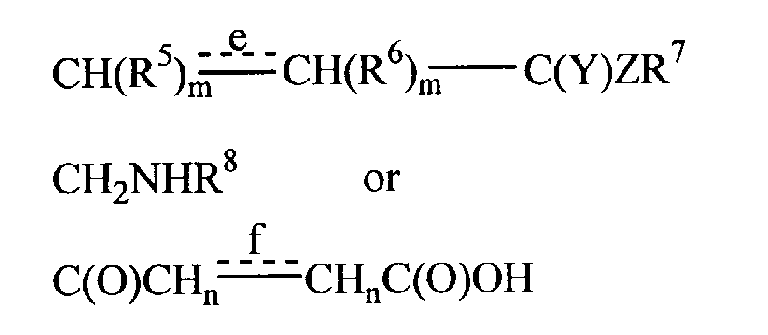
- the present invention is directed to a compound having the formula wherein A 1 and B 1 are independently hydrogen, CH 2 NHR 8 or R 1 , R 2 , R 3 and R 4 are independently hydrogen, alkyl, alkenyl, aryl or aralkyl; or R 1 and R 2 , or R 3 and R 4 , combine with the carbon atom to which they are attached to form an alkyl or alkenyl ring; Y is O or S; Z is O, S or NR 9 ; m is 0 when bond e is a double bond and 1 when e is a single bond; n is 1 when bond f is a double bond and 2 when f is a single bond; R 5 is C(Y)ZR 7 , hydrogen or C 1 -C 4 alkyl; R 6 is hydrogen or C 1 -C 4 alkyl; R 7 , R 8 and R 9 are independently hydrogen, alkyl, alkenyl, aryl or aralkyl; provided that at least one of A 1 and B
- the present invention provides a composition comprising a lubricating oil and from 0.1% to 20% of the compound defined above. Preferably, the composition contains from 0.5% to 10% of said compound. In another aspect, the present invention provides the use of a compound as defined above in an amount of from 0.1 to 20% for improving the anti-wear and anti-corrosion characteristics of a lubricating oil.
- alkyl is a hydrocarbyl group having from one to twenty carbon atoms in a linear, branched or cyclic arrangement, and having from 0 to 2 oxygen, nitrogen or sulfur atoms. Substitution on alkyl groups of one or more halo, hydroxy, alkoxy, alkanoyl or amido groups is permitted; alkoxy, alkanoyl and amido groups may in turn be substituted by one or more halo substituents. Preferably, alkyl groups contain from one to twelve carbon atoms and from 0 to 1 oxygen, nitrogen or sulfur atoms.
- An "alkenyl” group is an “alkyl” group in which at least one single bond has been replaced with a double bond.
- aryl is a substituent derived from an aromatic compound, including heterocyclic aromatic compounds having heteroatoms chosen from among nitrogen, oxygen and sulfur.
- An aryl group has a total of from five to twenty ring atoms, and has one or more rings which are separate or fused. Substitution on aryl groups of one or more halo, alkyl, alkenyl, hydroxy, alkoxy, alkanoyl or amido groups is permitted, with substitution by one or more halo groups being possible on alkyl, alkenyl, alkoxy, alkanoyl or amido groups.
- An “aralkyl” group is an "alkyl” group substituted by an "aryl” group.
- e and f indicate whether the bond between the adjacent carbons is a single or double bond, which is determined by the alkylating agent used to introduce the substituent, as described hereinbelow.
- a TAIT or an imidazolidinethione having from one to three alkyl groups is alkylated with an alkyl propiolate to produce a compound in which the ester side chain has a carbon-carbon double bond.
- ZR 7 can be OCH 2 CH 2 S-R, where R is alkyl, alkenyl or aralkyl; when Y is O, and R 5 and R 6 are H, the side chain is CH 2 CH 2 C(O)OCH 2 CH 2 S-R.
- a compound of formula I is added to a lubricating oil. More preferably, from 0.5 to 10% of a compound of formula I is added to a lubricating oil, and most preferably, from 0.5 to 3%.
- a lubricating oil is a natural or synthetic oil, having suitable viscosity for use as a lubricant, or a mixture thereof.
- TMIT was prepared according to the procedure given in U.S. Pat. No. 5,057,612, as follows.
- DDPT 7,14-diazadispiro[5.1.5.2]pentadecane-15-thione
- tetraalkylimidazolidinethiones were allowed to react with alkyl acrylates in acetonitrile in the presence of 50 mole% of Cs 2 CO 3 at room temperature for 10-15 hours (TMIT) or for 5 hours (DDPT) to produce compounds having the following structure: Detailed procedures and product analyses for several products are presented in Examples 2-8.
- N/S N-alkylated adduct to S-alkylated adduct
- Example 2 A procedure similar to that of Example 2 was used. Starting from TMIT (1.0 g, 6.33 mmol), n-butyl acrylate (0.81 g, 6.33 mmol) and cesium carbonate (1.0 g, 3.3 mmol) in acetonitrile (15 mL), the product was isolated as a colorless oil (1.3 g, 72 %).
- Example 5 Adduct of DDPT and LA
- Example 2 A procedure similar to that of Example 2 was used. Starting from DDPT (1.0 g, 4.2 mmol), lauryl acrylate (1.0 g, 4.2 mmol) and cesium carbonate (0.68 g, 2.1 mmol) in acetonitrile (25 mL), the product was isolated as a light-yellow, low-melting solid (1.9 g, 95 %). IR: 2927, 2845, 1733, 1474 cm -1 ; 1 H NMR (CDCl 3 , 500 MHz): ⁇ 4.15 (t, 2H), 3.85 (t, 2H), 2.85 (t, 2H), 2.03 (dt, 2H), 1.8-1.2 (m, 38 H), 0.88 (t, 3H) ppm.
- Example 6 Adduct of TAIT Mixture Prepared from Acetone/Methyl Isobutyl Ketone/Methyl Ethyl Ketone/Cyclohexanone and EHA
- a TAIT mixture was prepared from an equimolar mixture of the four title ketones according to the procedure used for preparation of TMIT, using ammonium sulfide (136 mL, 0.4 moles, 20 wt% aqueous solution), sodium cyanide (14.7 g, 0.3 moles), ammonium chloride (16.1 g, 0.3 moles), water (80 mL), cyclohexanone (14.7 g, 0.15 moles), acetone (8.7 g, 0.15 moles) ethyl methyl ketone (10.8 g, 0.15 moles), and methyl isobutyl ketone (15.0 g, 0.15 moles) to obtain an oily layer at the end of the heating period.
- Example 2 A procedure similar to that of Example 2 was used for the reaction with 2-EHA. Starting from the TAIT product described in the preceding paragraph (1.0 g, ca. 4.5 mmol), 2-ethylhexyl acrylate (0.82 g, 4.5 mmol) and cesium carbonate (0.75 g, 2.25 mmol) in acetonitrile (20 mL), the product was isolated as a yellow oil and solid mixture (1.8 g, 99 %). IR: 3325, 2933, 2860, 1732, 1480 cm -1 .
- Example 7 Adduct of TAIT Mixture Prepared from Methyl Ethyl Ketone and BA
- a cis-trans TAIT mixture was obtained by applying the procedure used for preparation of TMIT to ammonium sulfide (136 mL, 0.4 moles, 20 wt% aqueous solution), sodium cyanide (14.7 g, 0.3 moles), ammonium chloride (16.1 g, 0.3 moles), water (80 mL), and ethyl methyl ketone (54.1 g, 0.75 moles) to obtain an oily layer at the end of the heating period. The oil layer was extracted into chloroform (350 mL), washed with water and dried with anhydrous potassium carbonate. Solvent evaporation yielded the product as a thick oil that turned into a sticky dirty-white solid.
- Example 2 A procedure similar to that of Example 2 was used for the reaction with BA. Starting from the TAIT product described in the preceding paragraph (4.0 g, 21.5 mmol), n-butyl acrylate (2.8 g, 21.5 mmol) and cesium carbonate (3.5 g, 10.8 mmol) in acetonitrile (50 mL), the product was isolated as a yellow oil (6.1 g, 90%).
- Example 2 A procedure similar to that of Example 2 was used. Starting from TMIT (1.0 g, 6.33 mmol), 3-thiaundecyl acrylate (1.4 g, 6.33 mmol) and cesium carbonate (1.0 g, 3.3 mmol) in acetonitrile (20 mL), the product was isolated as a light yellow oil (2.0 g, 83 %).
- TAIT-Acrylate Ester Addition Products and Oil Solubilities Ex. No. TAIT acrylate yield N/S state oil sol TMIT MA 85 83/17 L ⁇ 2 2 TMIT 2-EHA 88 86/14 L >20 3 TMIT LA 68 89/11 L >20 a 4 TMIT BA 72 >97/ ⁇ 3 L ⁇ 5 DDPT MA 20 >99/ ⁇ 1 SS ⁇ 5 DDPT BA 96 >99/ ⁇ 1 SS ⁇ 5 DDPT 2-EHA 95 >99/ ⁇ 1 SG ca. 5 5 DDPT LA 95 ca. 95/5 SG ca. 10 b mixture 2-EHA 89 nd L ca. 10 6 mixture 2-EHA 99 nd L ca. 10 mixture d LA 99 nd L/S ca. 10 7 mixture BA 90 nd L >10 8 TMIT TUA 83 >95/ ⁇ 5 L ca. 5
- EXCEL HC 100 base oil was tested, including a base oil and one containing a commercial anti-wear ZDDP-based additive, ELCO-103.
- the samples tested were as follows: (1) EXCEL HC 100 base oil; (2) EXCEL HC 100 with 1% ELCO 103; (3) EXCEL HC 100 with 1% of the adduct of 2-EHA and TMIT (see Example 2); and (4) EXCEL HC 100 with 1% of an imine adduct of TMIT (see Example 15). Details of the tests are as follows: 4-Ball anti-wear test (ASTM D-4172). Load: 40 Kg; Temp: 75°C; Rotation rate:1200 rpm; Time: 1 hour; Measured parameter: wear scar diameter in mm on the steel balls. The smaller the scar diameter, the more effective a given anti-wear additive.
- Load carrying capacity (EP test, ASTM D-2783). Similar to the anti-wear test above, but starts at room temperature and the load on four rotating balls is constantly increased until the balls weld to each other.
- the quantities measured to assess performance are weld point load (kgf), scar diameter (mm at 100 kgf or 126 kgf) just before weld point, and load wear index (LWI) (average of sum of the corrected loads determined for 10 applied loads preceding the weld point, kgf). A higher LWI is an indication of better anti-wear properties.
- Copper corrosion test (ASTM D-130). Copper metal specimens are immersed in the oil sample at 212°F (100°C) for three hours, and the appearance is then rated based on the tarnish acquired. Here, a lower rating reflects lesser corrosivity. For example, a rating of "1” indicates only a slight tarnish, with “1A” being a light orange and “1B” a dark orange; “2” would indicate moderate tarnish, with ratings of "A” through “E” indicating progressively darker colors.
- Test Results for Lubricating Oils sample ASTM D-4172 scar diameter ASTM D-130 corrosion EP Test scar diameter LWI 1 0.84 1B 2.99@100 10.8 2 0.64 1A a 2.1@100 21.5 3 0.63 1A a 2.45@100 14.5 4 0.65 1A a 2.47@126 18.8
- the product is an 85/15 mixture of cis/trans isomers.
- the product was soluble in EXCEL HC 100 at 10 weight % at 100°C, but precipitated at room temperature after 30 minutes.
- Example 13 Adduct of Example 12 Product with Methyl Propiolate
Landscapes
- Chemical & Material Sciences (AREA)
- Organic Chemistry (AREA)
- Chemical Kinetics & Catalysis (AREA)
- General Chemical & Material Sciences (AREA)
- Oil, Petroleum & Natural Gas (AREA)
- Organic Low-Molecular-Weight Compounds And Preparation Thereof (AREA)
Abstract

are useful as ashless oil-soluble additives for lubricating oils.
Description
- This invention relates generally to heterocyclic compounds useful as ashless oil-soluble additives for lubricating oils.
- Zinc dialkyldithiophosphates (ZDDP) are widely used as lubricant additives. The principal disadvantages of these compounds are that an ash residue is produced by the zinc as the additive is consumed, and that phosphorus is known to affect the efficiency of catalytic converters in motor vehicles, thereby causing emissions problems. An ashless, non-phosphorus alternative to ZDDP would be extremely useful.
- Dithiohydantoin compounds are disclosed in European Patent Application No. EP 0 728 747 A1. However, the compounds are not within the scope of the present invention, and moreover, are disclosed only for pharmaceutical applications.
- The problem addressed by this invention is to find improved phosphorus-free ashless oil-soluble additives for lubricating oils.
- The present invention is directed to a compound having the formulawherein A1 and B1 are independently hydrogen,

 R1, R2, R3 and R4 are independently hydrogen, alkyl, alkenyl, aryl or aralkyl; or R1 and R2, or R3 and R4, combine with the carbon atom to which they are attached to form an alkyl or alkenyl ring; Y is O or S; Z is O, S or NR9; m is 0 when bond e is a double bond and 1 when e is a single bond; n is 1 when bond f is a double bond and 2 when f is a single bond; R5 is C(Y)ZR7, hydrogen or C1-C4 alkyl; R6 is hydrogen or C1-C4 alkyl; R7, R8 and R9 are independently hydrogen, alkyl, alkenyl, aryl or aralkyl;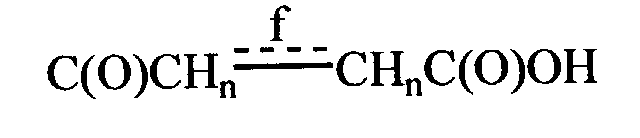
provided that at least one of A1 and B1 is not hydrogen,
and wherein:
"alkyl" is a hydrocarbyl group having from 1 to 20 carbon atoms in a linear, branched or cyclic arrangement, and having from 0 to 2 oxygen, nitrogen or sulfur atoms, optionally substituted with one or more halo, hydroxy, alkoxy, alkanoyl or amido groups, and wherein said alkoxy, alkanoyl and amido groups are optionally substituted with one or more halo substituents; "alkenyl" is alkyl as defined above in which at least one single bond has been replaced with a double bond;
"aryl" is an aryl group is a substituent derived from an aromatic compound, including heterocyclic aromatic compounds having hetero atoms chosen from among oxygen, nitrogen and sulfur, having a total of from 5 to 20 ring atoms and having one or more rings which are separate or fused, wherein said aryl group is optionally substituted with one or more halo, alkyl, alkenyl, hydroxy, alkoxy, alkanoyl or amido group, and wherein said alkyl, alkenyl, alkoxy, alkanoyl or amido groups are optionally substituted with one or more halo groups; and "aralkyl" is an alkyl as defined above substituted by an aryl as defined above. - In another aspect, the present invention provides a composition comprising a lubricating oil and from 0.1% to 20% of the compound defined above. Preferably, the composition contains from 0.5% to 10% of said compound. In another aspect, the present invention provides the use of a compound as defined above in an amount of from 0.1 to 20% for improving the anti-wear and anti-corrosion characteristics of a lubricating oil.
- An "alkyl" group is a hydrocarbyl group having from one to twenty carbon atoms in a linear, branched or cyclic arrangement, and having from 0 to 2 oxygen, nitrogen or sulfur atoms. Substitution on alkyl groups of one or more halo, hydroxy, alkoxy, alkanoyl or amido groups is permitted; alkoxy, alkanoyl and amido groups may in turn be substituted by one or more halo substituents. Preferably, alkyl groups contain from one to twelve carbon atoms and from 0 to 1 oxygen, nitrogen or sulfur atoms. An "alkenyl" group is an "alkyl" group in which at least one single bond has been replaced with a double bond. An "aryl" group is a substituent derived from an aromatic compound, including heterocyclic aromatic compounds having heteroatoms chosen from among nitrogen, oxygen and sulfur. An aryl group has a total of from five to twenty ring atoms, and has one or more rings which are separate or fused. Substitution on aryl groups of one or more halo, alkyl, alkenyl, hydroxy, alkoxy, alkanoyl or amido groups is permitted, with substitution by one or more halo groups being possible on alkyl, alkenyl, alkoxy, alkanoyl or amido groups. An "aralkyl" group is an "alkyl" group substituted by an "aryl" group.
- In formula I, e and f indicate whether the bond between the adjacent carbons is a single or double bond, which is determined by the alkylating agent used to introduce the substituent, as described hereinbelow.
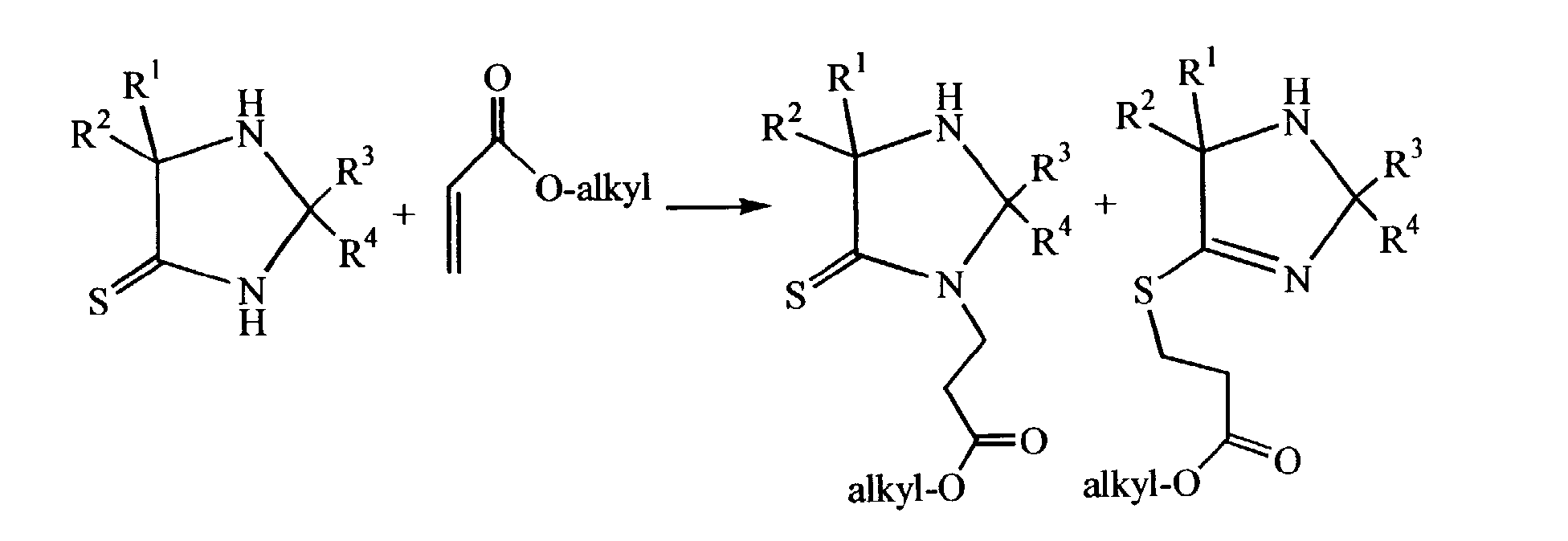
- In one aspect of the invention, a tetraalkylimidazolidinethione (TAIT), or an imidazolidinethione having from one to three alkyl groups, is alkylated with an acrylate ester to produce a compound having a CHR5CHR6C(O)OR7 group, as shown below for R5= R6=H and R7=alkyl. If R1, R2, R3 and R4 are all methyl, the TAIT is known as TMIT.The extent of N-alkylation versus S-alkylation varies with the identity of the R groups on the imidazolidenethione ring and with the alkylating agent, as shown below in the Examples.
- In another aspect of this invention, a TAIT or an imidazolidinethione having from one to three alkyl groups is alkylated with an alkyl propiolate to produce a compound in which the ester side chain has a carbon-carbon double bond. In another aspect of this invention, a TAIT or unsubstituted imidazolidinethione is alkylated with an imine, CH2=NR8. In another aspect of this invention, a TAIT or an imidazolidinethione having from one to three alkyl groups is alkylated with maleic or succinic anhydride to produce a compound having a C(O)CH=CHC(O)OH or C(O)CH2CH2C(O)H side chain, respectively, with alkylation occurring mainly on the sulfur.
- In one embodiment of the invention, the group ZR7 in a CHR5CHR6C(Y)ZR7 side chain or a CH=CHC(Y)ZR7 side chain contains a thioethyl group, i.e., a group having the structure -CH2CH2S-, where one of the CH2 and the sulfur is attached to the C(Y) functionality and the other is attached to an alkyl, alkenyl or aralkyl group. For example, ZR7 can be OCH2CH2S-R, where R is alkyl, alkenyl or aralkyl; when Y is O, and R5 and R6 are H, the side chain is CH2CH2C(O)OCH2CH2S-R.
- In a preferred embodiment of the invention, from 0.1 to 10% of a compound of formula I is added to a lubricating oil. More preferably, from 0.5 to 10% of a compound of formula I is added to a lubricating oil, and most preferably, from 0.5 to 3%. A lubricating oil is a natural or synthetic oil, having suitable viscosity for use as a lubricant, or a mixture thereof.
- TMIT was prepared according to the procedure given in U.S. Pat. No. 5,057,612, as follows.
- To a mechanically-stirred mixture of ammonium sulfide (0.4 moles, 136 mL, 20 wt% aqueous solution), sodium cyanide (14.7 g, 0.3 moles), ammonium chloride (16.1 g, 0.3 moles) and water (80 mL), acetone (44 mL, 0.6 moles) was added drop-wise over a period of 30 min.; during the addition of acetone, the reaction temperature rose to about 36°C. The reaction mixture was then externally heated to 65°C for a period of 6-7 hours. The reaction mixture was cooled to 0-5°C using an ice bath, and the white solid was filtered, washed with cold water and suction-dried. The yield of TMIT was 44.6 grams (94 %); melting point: 155°C. IR: 3521, 2976, 1657, 1524, 1462 cm-1; 1H NMR (CDCl3, 500 MHz): δ 1.46 (s, 6 H), 1.44 (s, 6 H) ppm; 13C NMR (CDCl3, 125 MHz): δ 207.7, 78.4, 70.9, 29.9, 29.9 ppm.
7,14-diazadispiro[5.1.5.2]pentadecane-15-thione (DDPT),was prepared according to the procedure described for TMIT from ammonium sulfide (0.4 moles, 136 mL, 20 wt% aqueous solution), sodium cyanide (14.7 g, 0.3 moles), ammonium chloride (16.1 g, 0.3 moles) and water (80 mL); with addition of cyclohexanone (58.8 g, 0.6 moles). The product was obtained as a white solid (69.8 grams, 98%), and melted at 229°C. IR: 3127, 2925, 2855, 1516, 1454 cm-1; 1H NMR (CDCl3, 500 MHz): δ 9.8 (bs, 1H), 1.9(dt, 2H), 1.8-1.2 (m, 18H) ppm; 13C NMR (CDCl3, 125 MHz): δ 207.8, 81.0, 72.9, 39.6, 37.8, 24.9, 24.6, 23.0, 21.9 ppm.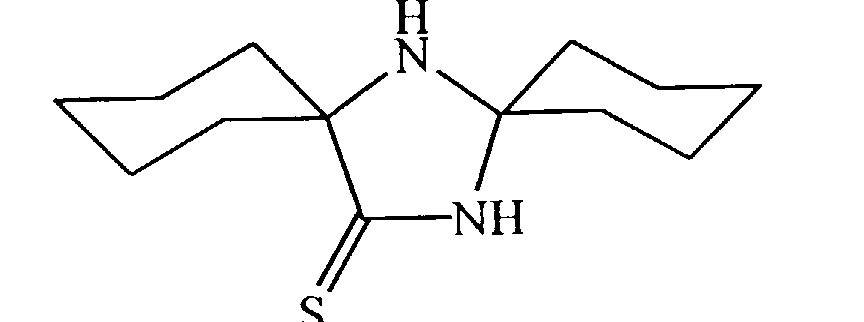
- Unless otherwise specified, tetraalkylimidazolidinethiones were allowed to react with alkyl acrylates in acetonitrile in the presence of 50 mole% of Cs2CO3 at room temperature for 10-15 hours (TMIT) or for 5 hours (DDPT) to produce compounds having the following structure:Detailed procedures and product analyses for several products are presented in Examples 2-8. The acrylates are abbreviated as follows: MA = methyl acrylate; 2-EHA = 2-ethylhexyl acrylate; LA = lauryl acrylate; BA = butyl acrylate; and TUA=3-thiaundecyl acrylate. Yield is given in %, the ratio of N-alkylated adduct to S-alkylated adduct (N/S) as a ratio of percentages or as "nd" (not determined), the physical state (state) as "L" (liquid), "SS" (soft solid) or "SG" (sticky gum), and the oil solubility (oil sol) as a weight percent. Oil solubility was measured at room temperature in EXCEL HC 100 lubricating base oil (available from Pennzoil Corp.). The adduct ratio, N/S, was determined from integration of proton NMR signals. The results for all acrylate adducts are presented below in Table 1.
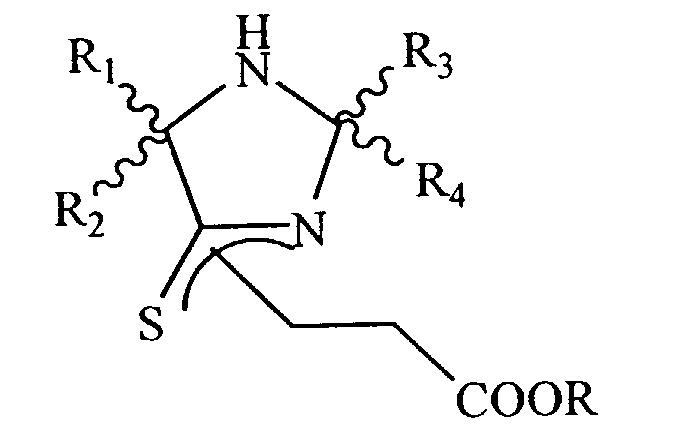
- A mixture of TMIT (1.0 g, 6.33 mmol), 2-ethylhexyl acrylate (1.16 g, 6.33 mmol) and cesium carbonate (1.0 g, 3.3 mmol) in acetonitrile (15 mL) was stirred at room temperature for 24 h. The reaction mixture was filtered to separate solid cesium carbonate and solvent was evaporated from the filtrate to obtain the product as a colorless oil (1.9 g, 88 %). IR: 3325, 2961, 1732, 1595, 1480 cm-1; 1H NMR (CDCl3, 500 MHz): δ 3.96 (overlapping d, 2 H), 3.83 (t, 1.72 H), 3.22 (t, 0.28 H), 2.82 (t, 1.72 H), 2.71 (t, 0.28 H), 1.91 (bs, 1H), 1.42 (s, 6 H), 1.40 (s, 6H), 1.35-1.20 (m, 8 H), 0.85 (overlapping t, 6 H) ppm; 13C NMR (CDCl3, 125 MHz): δ 205.8, 173.6, 171.9, 171.3, 130.2, 128.5, 88.7, 82.9, 70.35, 69.6, 67.2, 66.9, 66.8, 40.6, 38.6, 33.9, 31.4, 30.26, 30.21, 28.79, 28.71, 28.23, 25.8, 23.64, 22.83, 13.9, 10.9 ppm.
- A procedure similar to that of Example 2 was used. Starting from TMIT (1.0 g, 6.33 mmol), lauryl acrylate (1.5 g, 6.33 mmol) and cesium carbonate (1.0 g, 3.3 mmol) in acetonitrile (15 mL), the product was isolated as a colorless oil (1.7 g, 68 %). IR: 3326, 2925, 1732 1596, 1480 cm-1; 1H NMR (CDCl3, 500 MHz): δ 4.18 (overlapping d, 2H), 3.86 (t, 1.78 H), 3.36 (t, 0.22 H), 2.85 (t, 1.78 H), 2. 75 (t, 0.22 H), 1.90 (bs, 1H), 1.62 (m, 2H), 1.48 (s, 6H), 1.44 (s, 6H), 1.4-1.2 (m, 18 H), 0.88 (t, 3H) ppm.
- A procedure similar to that of Example 2 was used. Starting from TMIT (1.0 g, 6.33 mmol), n-butyl acrylate (0.81 g, 6.33 mmol) and cesium carbonate (1.0 g, 3.3 mmol) in acetonitrile (15 mL), the product was isolated as a colorless oil (1.3 g, 72 %). IR: 3323, 2961, 1732, 1582, 1483 cm-1; 1H NMR (CDCl3, 500 MHz): δ 4.08 (t, 2H), 3.85 (t, 2H), 2.84 (t, 2H), 1.95 (bs, 1 H), 1.60 (m, 2H), 1.46 (s, 6H), 1.42 (s, 6H), 1.36 (m, 2H), 0.91 (t, 3H) ppm.
- A procedure similar to that of Example 2 was used. Starting from DDPT (1.0 g, 4.2 mmol), lauryl acrylate (1.0 g, 4.2 mmol) and cesium carbonate (0.68 g, 2.1 mmol) in acetonitrile (25 mL), the product was isolated as a light-yellow, low-melting solid (1.9 g, 95 %). IR: 2927, 2845, 1733, 1474 cm-1; 1H NMR (CDCl3, 500 MHz): δ 4.15 (t, 2H), 3.85 (t, 2H), 2.85 (t, 2H), 2.03 (dt, 2H), 1.8-1.2 (m, 38 H), 0.88 (t, 3H) ppm.
- A TAIT mixture was prepared from an equimolar mixture of the four title ketones according to the procedure used for preparation of TMIT, using ammonium sulfide (136 mL, 0.4 moles, 20 wt% aqueous solution), sodium cyanide (14.7 g, 0.3 moles), ammonium chloride (16.1 g, 0.3 moles), water (80 mL), cyclohexanone (14.7 g, 0.15 moles), acetone (8.7 g, 0.15 moles) ethyl methyl ketone (10.8 g, 0.15 moles), and methyl isobutyl ketone (15.0 g, 0.15 moles) to obtain an oily layer at the end of the heating period. The oil layer was extracted into chloroform (350 mL), washed with water and dried with anhydrous potassium carbonate. Solvent evaporation yielded the product as a thick oil that slowly turned into a sticky gray solid (36 grams, yield: 55 % for an average molecular weight of 220). IR: 3361, 2962, 2874, 1605, 1520, 1459 cm-1; 1H NMR (CDCl3, 500 MHz): δ 2.24 (d), 2.06 (s), 1.85-1.91 (m), 1.86-1.56 (m), 1.50-1.46 (m), 1.45-1.34 (m), 1.26-1.11 (bm), 1.39 (t), 0.99 (dd), 0.95-0.84 (m) ppm; 13C NMR (CDCl3, 125 MHz): δ 207.8, 207.62, 207.60, 207.43, 207.40, 207.01, 206.89, 206.68, 206.66, 81.6, 81.18, 81.14, 80.70, 80.65, 78.38, 78.31, 73.95, 73.30, 72.82, 70.79, 70.46, 70.18 and several peaks between 40-10 ppm.
- A procedure similar to that of Example 2 was used for the reaction with 2-EHA. Starting from the TAIT product described in the preceding paragraph (1.0 g, ca. 4.5 mmol), 2-ethylhexyl acrylate (0.82 g, 4.5 mmol) and cesium carbonate (0.75 g, 2.25 mmol) in acetonitrile (20 mL), the product was isolated as a yellow oil and solid mixture (1.8 g, 99 %). IR: 3325, 2933, 2860, 1732, 1480 cm-1.
- A cis-trans TAIT mixture was obtained by applying the procedure used for preparation of TMIT to ammonium sulfide (136 mL, 0.4 moles, 20 wt% aqueous solution), sodium cyanide (14.7 g, 0.3 moles), ammonium chloride (16.1 g, 0.3 moles), water (80 mL), and ethyl methyl ketone (54.1 g, 0.75 moles) to obtain an oily layer at the end of the heating period. The oil layer was extracted into chloroform (350 mL), washed with water and dried with anhydrous potassium carbonate. Solvent evaporation yielded the product as a thick oil that turned into a sticky dirty-white solid. This solid was washed quickly with cold water and suction dried to give a white powder (23 g, yield: 41%) that melted at 72°C. IR: 3320, 3128, 2966, 1533, 1457, 1371 cm-1; 1H NMR (CDCl3, 500 MHz): δ 1.85-1.65 (m, 4H), 1.44-1.36 (4s, 6H), 0.99-0.91 (m, 6H) ppm; 13C NMR (CDCl3, 125 MHz): δ 207.15, 207.07, 81.24, 81.17, 73.69, 73.51, 35.49, 34.99, 33.85, 33.56, 28,56, 28.29, 27.82, 27.24, 8.55, 8.46, 8.25 ppm.
- A procedure similar to that of Example 2 was used for the reaction with BA. Starting from the TAIT product described in the preceding paragraph (4.0 g, 21.5 mmol), n-butyl acrylate (2.8 g, 21.5 mmol) and cesium carbonate (3.5 g, 10.8 mmol) in acetonitrile (50 mL), the product was isolated as a yellow oil (6.1 g, 90%). IR: 3351, 2965, 2875, 1732, 1482 cm-1; 1H NMR (CDCl3, 500 MHz): δ 4.05 (t, 2H), 3.95 (m), 3.80 (m), 3.63 (m), 2.95 (m), 2.82 (m), 2.67 (m), 1.80-1.51 (m, 6 H), 1.35 (m, 8H), 0.88 (m, 9H) ppm; 13C NMR (CDCl3, 125 MHz): δ 205.31, 205.05, 171.2, 85.77, 85.67, 72.44, 72.21, 64.48, 40.28, 34.55, 33.93, 32.65, 33.63, 31.06, 31.03, 30.38, 28.61, 28.21, 26.46, 26.33, 18.91, 13.49 ppm.
-
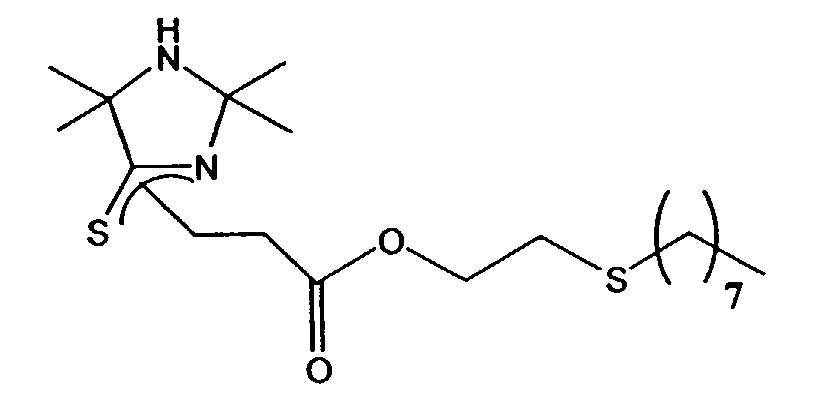
- A procedure similar to that of Example 2 was used. Starting from TMIT (1.0 g, 6.33 mmol), 3-thiaundecyl acrylate (1.4 g, 6.33 mmol) and cesium carbonate (1.0 g, 3.3 mmol) in acetonitrile (20 mL), the product was isolated as a light yellow oil (2.0 g, 83 %). IR: 2961, 1734,1481 cm-1; 1H NMR (CDCl3, 500 MHz): δ 4.22 (t, 2H), 3.84 (t, 2H), 2.84 (t, 2H), 2.71 (t, 2H), 2.52 (t, 2H), 1.55 (m, 2H), 1.46 (s, 6H), 1.42 (s, 6H), 1.4-1.2 (m, 10H), 0.85 (t, 3H) ppm; 13C NMR (CDCl3, 125 MHz): δ 205.9, 170.9, 82.9, 69.5, 63.7, 40.4, 32.2, 31.6, 31.3, 30.2, 30.1, 29.5, 29.0, 28.6, 28.2, 22.4, 13.9 ppm.
TAIT-Acrylate Ester Addition Products and Oil Solubilities Ex. No. TAIT acrylate yield N/S state oil sol TMIT MA 85 83/17 L <2 2 TMIT 2-EHA 88 86/14 L >20 3 TMIT LA 68 89/11 L >20a 4 TMIT BA 72 >97/<3 L <5 DDPT MA 20 >99/<1 SS <5 DDPT BA 96 >99/<1 SS <5 DDPT 2-EHA 95 >99/<1 SG ca. 5 5 DDPT LA 95 ca. 95/5 SG ca. 10b mixture 2-EHA 89 nd L ca. 10 6 mixture 2-EHA 99 nd L ca. 10 mixtured LA 99 nd L/S ca. 10 7 mixture BA 90 nd L >10 8 TMIT TUA 83 >95/<5 L ca. 5 - Efficacy of four oil formulations was tested, including a base oil and one containing a commercial anti-wear ZDDP-based additive, ELCO-103. The samples tested were as follows: (1) EXCEL HC 100 base oil; (2) EXCEL HC 100 with 1% ELCO 103; (3) EXCEL HC 100 with 1% of the adduct of 2-EHA and TMIT (see Example 2); and (4) EXCEL HC 100 with 1% of an imine adduct of TMIT (see Example 15). Details of the tests are as follows:
4-Ball anti-wear test (ASTM D-4172). Load: 40 Kg; Temp: 75°C; Rotation rate:1200 rpm; Time: 1 hour; Measured parameter: wear scar diameter in mm on the steel balls. The smaller the scar diameter, the more effective a given anti-wear additive. - Load carrying capacity (EP test, ASTM D-2783). Similar to the anti-wear test above, but starts at room temperature and the load on four rotating balls is constantly increased until the balls weld to each other. The quantities measured to assess performance are weld point load (kgf), scar diameter (mm at 100 kgf or 126 kgf) just before weld point, and load wear index (LWI) (average of sum of the corrected loads determined for 10 applied loads preceding the weld point, kgf). A higher LWI is an indication of better anti-wear properties.
- Copper corrosion test (ASTM D-130). Copper metal specimens are immersed in the oil sample at 212°F (100°C) for three hours, and the appearance is then rated based on the tarnish acquired. Here, a lower rating reflects lesser corrosivity. For example, a rating of "1" indicates only a slight tarnish, with "1A" being a light orange and "1B" a dark orange; "2" would indicate moderate tarnish, with ratings of "A" through "E" indicating progressively darker colors.
- Results of the tests are presented below in Table 2.
Test Results for Lubricating Oils sample ASTM
D-4172
scar diameterASTM
D-130
corrosionEP Test scar diameter LWI 1 0.84 1B 2.99@100 10.8 2 0.64 1Aa 2.1@100 21.5 3 0.63 1Aa 2.45@100 14.5 4 0.65 1Aa 2.47@126 18.8 -

- A mixture of TMIT (2.0 g, 12.6 mmol), methyl iodide (5.6 g, 40 mmol), and anhydrous potassium carbonate (8.3 g, 138. 2 mmol) in chloroform (45 mL) were stirred at room temperature for 2 days. The mixture was filtered, and solvent was evaporated to obtain the product depicted above as a liquid (1.9 g, 83%). 1H NMR (CDCl3, 500 MHz): δ 2.38 (s, 3H), 2.26 (s, 3H), 1.25 (s, 6H), 1.16 (s, 6H) ppm; 13C NMR (CDCl3, 125 MHz): δ 175.1, 88.9, 70.3, 27.5, 26.4, 24.6, 12.6 ppm. The product was soluble in EXCEL HC 100 lubricating base oil only in an amount below 1% by weight.
-
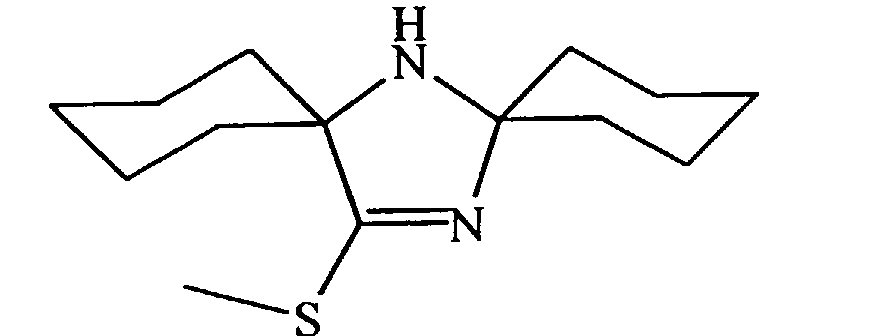
- A mixture of DDPT (3.0 g, 12.6 mmol), methyl iodide (5.6 g, 40 mmol), and anhydrous potassium carbonate (8.3 g, 138. 2 mmol) in chloroform (30 mL) was stirred at room temperature for 2 days. The mixture was filtered, and solvent was evaporated to obtain the product as a thick liquid (2.45 g, 77%) that slowly turned into a soft solid. 1H NMR (CDCl3, 500 MHz): δ 2.41 (s, 3H), 1.75-1.1 (m, 20 H) ppm; 13C NMR (CDCl3, 125 MHz): δ 174.9, 90.5, 72.6, 40.3, 37.5, 25.4, 25.2, 23.4, 22.4, 13.5 ppm. The product was soluble in EXCEL HC 100 at 5 weight % at room temperature, and remained clear at room temperature after 1 week.
-
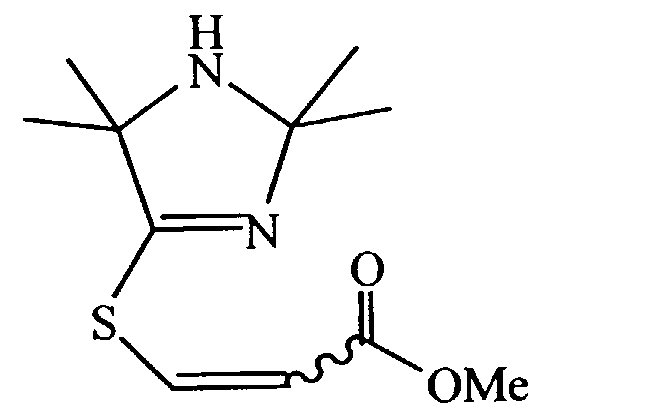
- A mixture of TMIT (1.0 g, 6.33 mmol) and methyl propiolate (0.53 g, 6.33 mmol) in chloroform (15 mL) was strirred at room temperature for 24h, followed by heating at 45°C for another 24h. Solvent evaporation yielded the product depicted above as a light-yellow, crystalline solid (1.4 g, 92%). IR: 3329, 2974, 1706, 1606, 1436 cm-1; 1H NMR (CDCl3, 500 MHz): δ 8.29 (d, J=16.0 Hz, 0.12 H), 8.15 (d, J=10 Hz, 0.88 H), 6.16 (d, J=16 Hz, 0.12 H), 6.19 (d, J=10 Hz, 0.88 H), 3.7 (s, 3H), 1.47 (s, 0.72 H), 1.45 (s, 0.72 H), 1.42 (s, 5.3 H), 1.36 (s, 5.3 H) ppm; 13C NMR (CDCl3, 125 MHz): δ 171.4, 169. 6, 166.9, 141.3, 140.6, 118.9, 115.5, 114.1, 51.6, 30.5, 30.07, 30.06, 28.3 ppm. The product is an 85/15 mixture of cis/trans isomers. The product was soluble in EXCEL HC 100 at 10 weight % at 100°C, but precipitated at room temperature after 30 minutes.
-

- A mixture of the product made in Example 12 (0.1 g, 0.6 mmol) and methyl propiolate (0.053 g, 0.6 mmol) in deuterated chloroform (CDCl3, 1 mL) was left at room temperature 3 days and then heated for 40h at 45°C. Solvent evaporation yielded RM-297 as a light-yellow, crystalline solid (1.5 g, 99%). IR: 2974, 1701, 1683, 1617, 1602, 1454 cm-1; 1H NMR (CDCl3, 500 MHz): δ 8.29 (d, J=16.0 Hz), 8.08 (d, J=10 Hz), 8.075 (d, J=10 Hz), 7.36 (d, J=15 Hz), 6.09 (d, J=16 Hz), 6.08 (d, J=10 Hz), 6.03 (d, J=10 Hz), 4.73 (d, J=15 Hz), 3.71-3.69 (4 s, -CH3), 1.48, 1.44, 1.34, 1.29 (4 s, - CH3) ppm. The cis/trans ratio in the side chain attached to sulfur is 85/15, and in that attached to nitrogen it is 5/95. The product was soluble in EXCEL HC 100 at less than 5 weight % at 100°C.
-
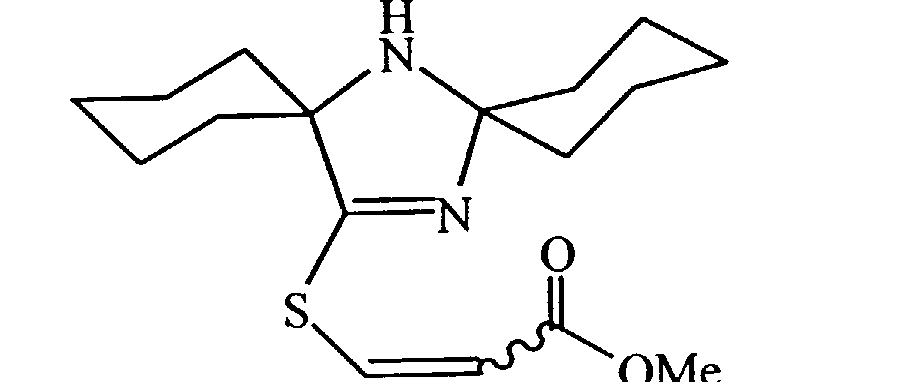
- A mixture of DDPT (0.06 g, 0.252 mmol) and methyl propiolate (0.063 g, 0.75 mmol) in deuterated chloroform (CDCl3, 1 mL)was heated at 45°C for 24h followed by standing at room temperature for 3 days. Solvent evaporation yielded the product depicted above as a light-yellow, crystalline solid (0.08 g, 99%). IR: 2932, 2854,1716, 1603, 1448 cm-1; 1H NMR (CDCl3, 500 MHz): δ 8.35 (d, J=15.1 Hz, 0.4 H), 8.25 (d, J=10 Hz, 0.6 H), 6.15 (d, J=15.1 Hz, 0.4 H), 6.07 (d, J=10 Hz, 0.6 H), 3.71 (s, -CH3), 3.75 (s, -CH3), 3.72 (s, -CH3), 1.9-1.1 (m, 20 H) ppm; 13C NMR (CDCl3, 125 MHz): δ 170.9, 169.3, 166.9, 165.3, 153.0, 141.6, 141.0, 118.4, 115.1, 91.5, 91.0, 74.9, 74.3, 72.5, 72.5, 52.9, 51.6, 51.5, 36.7, 36.6, 25.4, 25.3, 25.0, 23.4, 23.3, 22.14, 22.12 ppm. The cis/trans ratio was 60/40. The product was soluble in EXCEL HC 100 at 5 weight % at 40°C; ca. 10 weight % at 100°C. A small amount of solid precipitated after 30 minutes.
-

- A mixture of TMIT (0.5 g, 3.16 mmol) and the formaldehyde imine (1.17 g, 3.2 mmol) of a mixture of branched C18-C22 primary amines (mixture of amines available from Rohm and Haas Co. under the name PRIMENE® JM-T) was heated in a sample vial at 120°C for 1h and the obtained liquid was cooled to room temperature yielding a thick syrup. IR: 3302, 1672, 1481, 1465, 1377 cm-1; 1H NMR (CDCl3, 500 MHz): δ 5.4 (bm), 5.1 (s), 4.45-4.33 (5 s), 1.56-0.81 (3 m) ppm; 13C NMR (CDCl3, 125 MHz): δ 208.4, 208.0, 206.5, 82.78, 82.42, 78.05, 70.88, 69.58, 69.42, 69.27, 68.35, 54.95, and several peaks at 40-14 ppm. The product was soluble in EXCEL HC 100 at 10 weight % at 100°C; at room temperature, 5% of the solid precipitated overnight.
Claims (4)
- A compound having the formulawherein A1 and B1 are independently hydrogen,
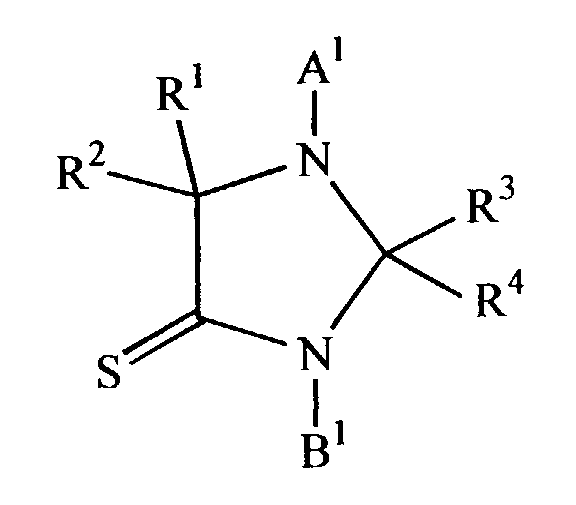
 R1, R2, R3 and R4 are independently hydrogen, alkyl, alkenyl, aryl or aralkyl; or R1 and R2, or R3 and R4, combine with the carbon atom to which they are attached to form an alkyl or alkenyl ring; Y is O or S; Z is O, S or NR9; m is 0 when bond e is a double bond and 1 when e is a single bond; n is 1 when bond f is a double bond and 2 when f is a single bond; R5 is C(Y)ZR7, hydrogen or C1-C4 alkyl; R6 is hydrogen or C1-C4 alkyl; R7, R8 and R9 are independently hydrogen, alkyl, alkenyl, aryl or aralkyl;
provided that at least one of A1 and B1 is not hydrogen,
and wherein:
"alkyl" is a hydrocarbyl group having from 1 to 20 carbon atoms in a linear, branched or cyclic arrangement, and having from 0 to 2 oxygen, nitrogen or sulfur atoms, optionally substituted with one or more halo, hydroxy, alkoxy, alkanoyl or amido groups, and
wherein said alkoxy, alkanoyl and amido groups are optionally substituted with one or more halo substituents;
"alkenyl" is alkyl as defined above in which at least one single bond has been replaced with a double bond;
"aryl" is an aryl group is a substituent derived from an aromatic compound, including heterocyclic aromatic compounds having hetero atoms chosen from among oxygen, nitrogen and sulfur, having a total of from 5 to 20 ring atoms and having one or more rings which are separate or fused, wherein said aryl group is optionally substituted with one or more halo, alkyl, alkenyl, hydroxy, alkoxy, alkanoyl or amido group, and wherein said alkyl, alkenyl, alkoxy, alkanoyl or amido groups are optionally substituted with one or more halo groups; and
"aralkyl" is an alkyl as defined above substituted by an aryl as defined above. - A composition comprising a lubricating oil and from 0.1% to 20% of a compound as claimed in claim 1.
- The composition of claim 2 which contains from 0.5% to 10% of a compound as claimed in claim 1.
- The use of a compound as claimed in claim 1 in an amount of from 0.1 to 20% for improving the anti-wear and anti-corrosion characteristics of a lubricating oil.
Applications Claiming Priority (3)
| Application Number | Priority Date | Filing Date | Title |
|---|---|---|---|
| US26377601P | 2001-01-24 | 2001-01-24 | |
| US263776P | 2001-01-24 | ||
| EP02250439A EP1229023B1 (en) | 2001-01-24 | 2002-01-22 | Thioimidazolidine derivatives as oil-soluble additives for lubricating oils |
Related Parent Applications (1)
| Application Number | Title | Priority Date | Filing Date |
|---|---|---|---|
| EP02250439A Division EP1229023B1 (en) | 2001-01-24 | 2002-01-22 | Thioimidazolidine derivatives as oil-soluble additives for lubricating oils |
Publications (2)
| Publication Number | Publication Date |
|---|---|
| EP1361217A1 true EP1361217A1 (en) | 2003-11-12 |
| EP1361217B1 EP1361217B1 (en) | 2005-03-23 |
Family
ID=29252220
Family Applications (1)
| Application Number | Title | Priority Date | Filing Date |
|---|---|---|---|
| EP03009516A Expired - Lifetime EP1361217B1 (en) | 2001-01-24 | 2002-01-22 | 4-Thionoimidazolidine derivatives as oil-soluble additives for lubricating oils |
Country Status (1)
| Country | Link |
|---|---|
| EP (1) | EP1361217B1 (en) |
Citations (2)
| Publication number | Priority date | Publication date | Assignee | Title |
|---|---|---|---|---|
| GB1053716A (en) * | 1964-08-20 | |||
| US4189587A (en) * | 1977-04-05 | 1980-02-19 | Ciba-Geigy Corporation | 1,3-Diaminomethyl-hydantoin additives for lubricating oils |
-
2002
- 2002-01-22 EP EP03009516A patent/EP1361217B1/en not_active Expired - Lifetime
Patent Citations (2)
| Publication number | Priority date | Publication date | Assignee | Title |
|---|---|---|---|---|
| GB1053716A (en) * | 1964-08-20 | |||
| US4189587A (en) * | 1977-04-05 | 1980-02-19 | Ciba-Geigy Corporation | 1,3-Diaminomethyl-hydantoin additives for lubricating oils |
Non-Patent Citations (1)
| Title |
|---|
| F.ASINGER, K.HENTSCHEL, A.SAUS: "Zum Substitutionverhalten von Imidazolidin-4-thionen", MONATSHEFTE FUR CHEMIE, 107, 35-41, (1976), XP001068694 * |
Also Published As
| Publication number | Publication date |
|---|---|
| EP1361217B1 (en) | 2005-03-23 |
Similar Documents
| Publication | Publication Date | Title |
|---|---|---|
| US6117826A (en) | Dithiocarbamyl derivatives useful as lubricant additives | |
| EP1229023B1 (en) | Thioimidazolidine derivatives as oil-soluble additives for lubricating oils | |
| JP2003505577A (en) | Imidazolethione additives for lubricants | |
| CA1041104A (en) | Lubricating oil additives | |
| EP0218816B1 (en) | Thiadiazole compounds and lubricant additives thereof | |
| US3940409A (en) | Alkylidenimino thiadiazole containing mixture | |
| JP4111918B2 (en) | 1,3,4-oxadiazole additive for lubricants | |
| JPH07196603A (en) | Basic metal salt of dithiocarbamic acid, and lubricating oil composition containing the salt | |
| EP1361217B1 (en) | 4-Thionoimidazolidine derivatives as oil-soluble additives for lubricating oils | |
| US6734149B2 (en) | Combination of additives for lubricating oils | |
| US5102568A (en) | Thiadiazole compounds and lubricant additives thereof | |
| EP1227144B1 (en) | Oil-soluble additive compositions for lubricating oils comprising imidazolidine thione | |
| US4012408A (en) | Lubricating oil additives | |
| US5186850A (en) | Multifunctional ashless dispersants derived from Mannich reaction of alkyl- or alkenylsuccinimides, dimercaptothiadiazoles, and carbonyl compounds | |
| JP2005524762A (en) | Alkyl succin hydrazide additive for lubricants | |
| JPS63310875A (en) | Lubricating oil composition containing antiabrasive/extreme-pressure additive | |
| US7074937B2 (en) | Method for production of additives for lubricating oils | |
| JP2957012B2 (en) | Lubricating oil for internal combustion engines | |
| US20040029743A1 (en) | Cyclic thioureas as additives for lubricating oils | |
| JP2004131477A (en) | Bicyclic thioureas as additives in lubricating oils | |
| US20040029746A1 (en) | Cyclic aminothioureas as additives for lubricating oils | |
| US20040033910A1 (en) | Bicyclic thioamides as additives for lubricating oils | |
| SU863622A1 (en) | Lubricating oil | |
| US20040029744A1 (en) | Cyclic thioamides as additives for lubricating oils | |
| EP1394238A1 (en) | Cyclic nitroxyl compounds as additives for lubricating oils |
Legal Events
| Date | Code | Title | Description |
|---|---|---|---|
| PUAI | Public reference made under article 153(3) epc to a published international application that has entered the european phase |
Free format text: ORIGINAL CODE: 0009012 |
|
| 17P | Request for examination filed |
Effective date: 20030428 |
|
| AC | Divisional application: reference to earlier application |
Ref document number: 1229023 Country of ref document: EP Kind code of ref document: P |
|
| AK | Designated contracting states |
Kind code of ref document: A1 Designated state(s): AT BE CH CY DE DK ES FI FR GB GR IE IT LI LU MC NL PT SE TR |
|
| AX | Request for extension of the european patent |
Extension state: AL LT LV MK |
|
| GRAP | Despatch of communication of intention to grant a patent |
Free format text: ORIGINAL CODE: EPIDOSNIGR1 |
|
| AKX | Designation fees paid |
Designated state(s): DE FR GB IT |
|
| GRAS | Grant fee paid |
Free format text: ORIGINAL CODE: EPIDOSNIGR3 |
|
| GRAA | (expected) grant |
Free format text: ORIGINAL CODE: 0009210 |
|
| AC | Divisional application: reference to earlier application |
Ref document number: 1229023 Country of ref document: EP Kind code of ref document: P |
|
| AK | Designated contracting states |
Kind code of ref document: B1 Designated state(s): DE FR GB IT |
|
| REG | Reference to a national code |
Ref country code: GB Ref legal event code: FG4D |
|
| REG | Reference to a national code |
Ref country code: IE Ref legal event code: FG4D |
|
| REF | Corresponds to: |
Ref document number: 60203374 Country of ref document: DE Date of ref document: 20050428 Kind code of ref document: P |
|
| PGFP | Annual fee paid to national office [announced via postgrant information from national office to epo] |
Ref country code: FR Payment date: 20060117 Year of fee payment: 5 |
|
| PGFP | Annual fee paid to national office [announced via postgrant information from national office to epo] |
Ref country code: GB Payment date: 20060119 Year of fee payment: 5 |
|
| PLBE | No opposition filed within time limit |
Free format text: ORIGINAL CODE: 0009261 |
|
| STAA | Information on the status of an ep patent application or granted ep patent |
Free format text: STATUS: NO OPPOSITION FILED WITHIN TIME LIMIT |
|
| PGFP | Annual fee paid to national office [announced via postgrant information from national office to epo] |
Ref country code: IT Payment date: 20060131 Year of fee payment: 5 |
|
| PGFP | Annual fee paid to national office [announced via postgrant information from national office to epo] |
Ref country code: DE Payment date: 20060228 Year of fee payment: 5 |
|
| 26N | No opposition filed |
Effective date: 20051227 |
|
| ET | Fr: translation filed | ||
| PG25 | Lapsed in a contracting state [announced via postgrant information from national office to epo] |
Ref country code: DE Free format text: LAPSE BECAUSE OF NON-PAYMENT OF DUE FEES Effective date: 20070801 |
|
| GBPC | Gb: european patent ceased through non-payment of renewal fee |
Effective date: 20070122 |
|
| REG | Reference to a national code |
Ref country code: FR Ref legal event code: ST Effective date: 20070930 |
|
| PG25 | Lapsed in a contracting state [announced via postgrant information from national office to epo] |
Ref country code: GB Free format text: LAPSE BECAUSE OF NON-PAYMENT OF DUE FEES Effective date: 20070122 |
|
| PG25 | Lapsed in a contracting state [announced via postgrant information from national office to epo] |
Ref country code: FR Free format text: LAPSE BECAUSE OF NON-PAYMENT OF DUE FEES Effective date: 20070131 |
|
| PG25 | Lapsed in a contracting state [announced via postgrant information from national office to epo] |
Ref country code: IT Free format text: LAPSE BECAUSE OF NON-PAYMENT OF DUE FEES Effective date: 20070122 |