EP1359422A2 - Microarray with structured and unstructured probes - Google Patents
Microarray with structured and unstructured probes Download PDFInfo
- Publication number
- EP1359422A2 EP1359422A2 EP03252714A EP03252714A EP1359422A2 EP 1359422 A2 EP1359422 A2 EP 1359422A2 EP 03252714 A EP03252714 A EP 03252714A EP 03252714 A EP03252714 A EP 03252714A EP 1359422 A2 EP1359422 A2 EP 1359422A2
- Authority
- EP
- European Patent Office
- Prior art keywords
- signal
- probe
- micro array
- unstructured
- structured
- Prior art date
- Legal status (The legal status is an assumption and is not a legal conclusion. Google has not performed a legal analysis and makes no representation as to the accuracy of the status listed.)
- Withdrawn
Links
Images



Classifications
-
- C—CHEMISTRY; METALLURGY
- C40—COMBINATORIAL TECHNOLOGY
- C40B—COMBINATORIAL CHEMISTRY; LIBRARIES, e.g. CHEMICAL LIBRARIES
- C40B30/00—Methods of screening libraries
- C40B30/04—Methods of screening libraries by measuring the ability to specifically bind a target molecule, e.g. antibody-antigen binding, receptor-ligand binding
-
- B—PERFORMING OPERATIONS; TRANSPORTING
- B01—PHYSICAL OR CHEMICAL PROCESSES OR APPARATUS IN GENERAL
- B01J—CHEMICAL OR PHYSICAL PROCESSES, e.g. CATALYSIS OR COLLOID CHEMISTRY; THEIR RELEVANT APPARATUS
- B01J19/00—Chemical, physical or physico-chemical processes in general; Their relevant apparatus
- B01J19/0046—Sequential or parallel reactions, e.g. for the synthesis of polypeptides or polynucleotides; Apparatus and devices for combinatorial chemistry or for making molecular arrays
-
- B—PERFORMING OPERATIONS; TRANSPORTING
- B82—NANOTECHNOLOGY
- B82Y—SPECIFIC USES OR APPLICATIONS OF NANOSTRUCTURES; MEASUREMENT OR ANALYSIS OF NANOSTRUCTURES; MANUFACTURE OR TREATMENT OF NANOSTRUCTURES
- B82Y30/00—Nanotechnology for materials or surface science, e.g. nanocomposites
-
- B—PERFORMING OPERATIONS; TRANSPORTING
- B01—PHYSICAL OR CHEMICAL PROCESSES OR APPARATUS IN GENERAL
- B01J—CHEMICAL OR PHYSICAL PROCESSES, e.g. CATALYSIS OR COLLOID CHEMISTRY; THEIR RELEVANT APPARATUS
- B01J2219/00—Chemical, physical or physico-chemical processes in general; Their relevant apparatus
- B01J2219/00274—Sequential or parallel reactions; Apparatus and devices for combinatorial chemistry or for making arrays; Chemical library technology
-
- B—PERFORMING OPERATIONS; TRANSPORTING
- B01—PHYSICAL OR CHEMICAL PROCESSES OR APPARATUS IN GENERAL
- B01J—CHEMICAL OR PHYSICAL PROCESSES, e.g. CATALYSIS OR COLLOID CHEMISTRY; THEIR RELEVANT APPARATUS
- B01J2219/00—Chemical, physical or physico-chemical processes in general; Their relevant apparatus
- B01J2219/00274—Sequential or parallel reactions; Apparatus and devices for combinatorial chemistry or for making arrays; Chemical library technology
- B01J2219/00277—Apparatus
- B01J2219/00351—Means for dispensing and evacuation of reagents
- B01J2219/00378—Piezoelectric or ink jet dispensers
-
- B—PERFORMING OPERATIONS; TRANSPORTING
- B01—PHYSICAL OR CHEMICAL PROCESSES OR APPARATUS IN GENERAL
- B01J—CHEMICAL OR PHYSICAL PROCESSES, e.g. CATALYSIS OR COLLOID CHEMISTRY; THEIR RELEVANT APPARATUS
- B01J2219/00—Chemical, physical or physico-chemical processes in general; Their relevant apparatus
- B01J2219/00274—Sequential or parallel reactions; Apparatus and devices for combinatorial chemistry or for making arrays; Chemical library technology
- B01J2219/00277—Apparatus
- B01J2219/00351—Means for dispensing and evacuation of reagents
- B01J2219/00387—Applications using probes
-
- B—PERFORMING OPERATIONS; TRANSPORTING
- B01—PHYSICAL OR CHEMICAL PROCESSES OR APPARATUS IN GENERAL
- B01J—CHEMICAL OR PHYSICAL PROCESSES, e.g. CATALYSIS OR COLLOID CHEMISTRY; THEIR RELEVANT APPARATUS
- B01J2219/00—Chemical, physical or physico-chemical processes in general; Their relevant apparatus
- B01J2219/00274—Sequential or parallel reactions; Apparatus and devices for combinatorial chemistry or for making arrays; Chemical library technology
- B01J2219/00277—Apparatus
- B01J2219/0054—Means for coding or tagging the apparatus or the reagents
- B01J2219/00547—Bar codes
- B01J2219/00549—2-dimensional
-
- B—PERFORMING OPERATIONS; TRANSPORTING
- B01—PHYSICAL OR CHEMICAL PROCESSES OR APPARATUS IN GENERAL
- B01J—CHEMICAL OR PHYSICAL PROCESSES, e.g. CATALYSIS OR COLLOID CHEMISTRY; THEIR RELEVANT APPARATUS
- B01J2219/00—Chemical, physical or physico-chemical processes in general; Their relevant apparatus
- B01J2219/00274—Sequential or parallel reactions; Apparatus and devices for combinatorial chemistry or for making arrays; Chemical library technology
- B01J2219/00277—Apparatus
- B01J2219/0054—Means for coding or tagging the apparatus or the reagents
- B01J2219/00572—Chemical means
- B01J2219/00576—Chemical means fluorophore
-
- B—PERFORMING OPERATIONS; TRANSPORTING
- B01—PHYSICAL OR CHEMICAL PROCESSES OR APPARATUS IN GENERAL
- B01J—CHEMICAL OR PHYSICAL PROCESSES, e.g. CATALYSIS OR COLLOID CHEMISTRY; THEIR RELEVANT APPARATUS
- B01J2219/00—Chemical, physical or physico-chemical processes in general; Their relevant apparatus
- B01J2219/00274—Sequential or parallel reactions; Apparatus and devices for combinatorial chemistry or for making arrays; Chemical library technology
- B01J2219/00583—Features relative to the processes being carried out
- B01J2219/00585—Parallel processes
-
- B—PERFORMING OPERATIONS; TRANSPORTING
- B01—PHYSICAL OR CHEMICAL PROCESSES OR APPARATUS IN GENERAL
- B01J—CHEMICAL OR PHYSICAL PROCESSES, e.g. CATALYSIS OR COLLOID CHEMISTRY; THEIR RELEVANT APPARATUS
- B01J2219/00—Chemical, physical or physico-chemical processes in general; Their relevant apparatus
- B01J2219/00274—Sequential or parallel reactions; Apparatus and devices for combinatorial chemistry or for making arrays; Chemical library technology
- B01J2219/00583—Features relative to the processes being carried out
- B01J2219/0059—Sequential processes
-
- B—PERFORMING OPERATIONS; TRANSPORTING
- B01—PHYSICAL OR CHEMICAL PROCESSES OR APPARATUS IN GENERAL
- B01J—CHEMICAL OR PHYSICAL PROCESSES, e.g. CATALYSIS OR COLLOID CHEMISTRY; THEIR RELEVANT APPARATUS
- B01J2219/00—Chemical, physical or physico-chemical processes in general; Their relevant apparatus
- B01J2219/00274—Sequential or parallel reactions; Apparatus and devices for combinatorial chemistry or for making arrays; Chemical library technology
- B01J2219/00583—Features relative to the processes being carried out
- B01J2219/00596—Solid-phase processes
-
- B—PERFORMING OPERATIONS; TRANSPORTING
- B01—PHYSICAL OR CHEMICAL PROCESSES OR APPARATUS IN GENERAL
- B01J—CHEMICAL OR PHYSICAL PROCESSES, e.g. CATALYSIS OR COLLOID CHEMISTRY; THEIR RELEVANT APPARATUS
- B01J2219/00—Chemical, physical or physico-chemical processes in general; Their relevant apparatus
- B01J2219/00274—Sequential or parallel reactions; Apparatus and devices for combinatorial chemistry or for making arrays; Chemical library technology
- B01J2219/00583—Features relative to the processes being carried out
- B01J2219/00603—Making arrays on substantially continuous surfaces
- B01J2219/00605—Making arrays on substantially continuous surfaces the compounds being directly bound or immobilised to solid supports
-
- B—PERFORMING OPERATIONS; TRANSPORTING
- B01—PHYSICAL OR CHEMICAL PROCESSES OR APPARATUS IN GENERAL
- B01J—CHEMICAL OR PHYSICAL PROCESSES, e.g. CATALYSIS OR COLLOID CHEMISTRY; THEIR RELEVANT APPARATUS
- B01J2219/00—Chemical, physical or physico-chemical processes in general; Their relevant apparatus
- B01J2219/00274—Sequential or parallel reactions; Apparatus and devices for combinatorial chemistry or for making arrays; Chemical library technology
- B01J2219/00583—Features relative to the processes being carried out
- B01J2219/00603—Making arrays on substantially continuous surfaces
- B01J2219/00605—Making arrays on substantially continuous surfaces the compounds being directly bound or immobilised to solid supports
- B01J2219/00608—DNA chips
-
- B—PERFORMING OPERATIONS; TRANSPORTING
- B01—PHYSICAL OR CHEMICAL PROCESSES OR APPARATUS IN GENERAL
- B01J—CHEMICAL OR PHYSICAL PROCESSES, e.g. CATALYSIS OR COLLOID CHEMISTRY; THEIR RELEVANT APPARATUS
- B01J2219/00—Chemical, physical or physico-chemical processes in general; Their relevant apparatus
- B01J2219/00274—Sequential or parallel reactions; Apparatus and devices for combinatorial chemistry or for making arrays; Chemical library technology
- B01J2219/00583—Features relative to the processes being carried out
- B01J2219/00603—Making arrays on substantially continuous surfaces
- B01J2219/00605—Making arrays on substantially continuous surfaces the compounds being directly bound or immobilised to solid supports
- B01J2219/00623—Immobilisation or binding
- B01J2219/00626—Covalent
-
- B—PERFORMING OPERATIONS; TRANSPORTING
- B01—PHYSICAL OR CHEMICAL PROCESSES OR APPARATUS IN GENERAL
- B01J—CHEMICAL OR PHYSICAL PROCESSES, e.g. CATALYSIS OR COLLOID CHEMISTRY; THEIR RELEVANT APPARATUS
- B01J2219/00—Chemical, physical or physico-chemical processes in general; Their relevant apparatus
- B01J2219/00274—Sequential or parallel reactions; Apparatus and devices for combinatorial chemistry or for making arrays; Chemical library technology
- B01J2219/00583—Features relative to the processes being carried out
- B01J2219/00603—Making arrays on substantially continuous surfaces
- B01J2219/00605—Making arrays on substantially continuous surfaces the compounds being directly bound or immobilised to solid supports
- B01J2219/00632—Introduction of reactive groups to the surface
- B01J2219/00637—Introduction of reactive groups to the surface by coating it with another layer
-
- B—PERFORMING OPERATIONS; TRANSPORTING
- B01—PHYSICAL OR CHEMICAL PROCESSES OR APPARATUS IN GENERAL
- B01J—CHEMICAL OR PHYSICAL PROCESSES, e.g. CATALYSIS OR COLLOID CHEMISTRY; THEIR RELEVANT APPARATUS
- B01J2219/00—Chemical, physical or physico-chemical processes in general; Their relevant apparatus
- B01J2219/00274—Sequential or parallel reactions; Apparatus and devices for combinatorial chemistry or for making arrays; Chemical library technology
- B01J2219/00583—Features relative to the processes being carried out
- B01J2219/00603—Making arrays on substantially continuous surfaces
- B01J2219/00659—Two-dimensional arrays
-
- B—PERFORMING OPERATIONS; TRANSPORTING
- B01—PHYSICAL OR CHEMICAL PROCESSES OR APPARATUS IN GENERAL
- B01J—CHEMICAL OR PHYSICAL PROCESSES, e.g. CATALYSIS OR COLLOID CHEMISTRY; THEIR RELEVANT APPARATUS
- B01J2219/00—Chemical, physical or physico-chemical processes in general; Their relevant apparatus
- B01J2219/00274—Sequential or parallel reactions; Apparatus and devices for combinatorial chemistry or for making arrays; Chemical library technology
- B01J2219/00583—Features relative to the processes being carried out
- B01J2219/00603—Making arrays on substantially continuous surfaces
- B01J2219/00659—Two-dimensional arrays
- B01J2219/00662—Two-dimensional arrays within two-dimensional arrays
-
- B—PERFORMING OPERATIONS; TRANSPORTING
- B01—PHYSICAL OR CHEMICAL PROCESSES OR APPARATUS IN GENERAL
- B01J—CHEMICAL OR PHYSICAL PROCESSES, e.g. CATALYSIS OR COLLOID CHEMISTRY; THEIR RELEVANT APPARATUS
- B01J2219/00—Chemical, physical or physico-chemical processes in general; Their relevant apparatus
- B01J2219/00274—Sequential or parallel reactions; Apparatus and devices for combinatorial chemistry or for making arrays; Chemical library technology
- B01J2219/00583—Features relative to the processes being carried out
- B01J2219/00603—Making arrays on substantially continuous surfaces
- B01J2219/00675—In-situ synthesis on the substrate
-
- B—PERFORMING OPERATIONS; TRANSPORTING
- B01—PHYSICAL OR CHEMICAL PROCESSES OR APPARATUS IN GENERAL
- B01J—CHEMICAL OR PHYSICAL PROCESSES, e.g. CATALYSIS OR COLLOID CHEMISTRY; THEIR RELEVANT APPARATUS
- B01J2219/00—Chemical, physical or physico-chemical processes in general; Their relevant apparatus
- B01J2219/00274—Sequential or parallel reactions; Apparatus and devices for combinatorial chemistry or for making arrays; Chemical library technology
- B01J2219/00583—Features relative to the processes being carried out
- B01J2219/00603—Making arrays on substantially continuous surfaces
- B01J2219/00677—Ex-situ synthesis followed by deposition on the substrate
-
- B—PERFORMING OPERATIONS; TRANSPORTING
- B01—PHYSICAL OR CHEMICAL PROCESSES OR APPARATUS IN GENERAL
- B01J—CHEMICAL OR PHYSICAL PROCESSES, e.g. CATALYSIS OR COLLOID CHEMISTRY; THEIR RELEVANT APPARATUS
- B01J2219/00—Chemical, physical or physico-chemical processes in general; Their relevant apparatus
- B01J2219/00274—Sequential or parallel reactions; Apparatus and devices for combinatorial chemistry or for making arrays; Chemical library technology
- B01J2219/0068—Means for controlling the apparatus of the process
- B01J2219/00702—Processes involving means for analysing and characterising the products
- B01J2219/00707—Processes involving means for analysing and characterising the products separated from the reactor apparatus
-
- B—PERFORMING OPERATIONS; TRANSPORTING
- B01—PHYSICAL OR CHEMICAL PROCESSES OR APPARATUS IN GENERAL
- B01J—CHEMICAL OR PHYSICAL PROCESSES, e.g. CATALYSIS OR COLLOID CHEMISTRY; THEIR RELEVANT APPARATUS
- B01J2219/00—Chemical, physical or physico-chemical processes in general; Their relevant apparatus
- B01J2219/00274—Sequential or parallel reactions; Apparatus and devices for combinatorial chemistry or for making arrays; Chemical library technology
- B01J2219/00718—Type of compounds synthesised
- B01J2219/0072—Organic compounds
- B01J2219/00722—Nucleotides
-
- B—PERFORMING OPERATIONS; TRANSPORTING
- B01—PHYSICAL OR CHEMICAL PROCESSES OR APPARATUS IN GENERAL
- B01J—CHEMICAL OR PHYSICAL PROCESSES, e.g. CATALYSIS OR COLLOID CHEMISTRY; THEIR RELEVANT APPARATUS
- B01J2219/00—Chemical, physical or physico-chemical processes in general; Their relevant apparatus
- B01J2219/00274—Sequential or parallel reactions; Apparatus and devices for combinatorial chemistry or for making arrays; Chemical library technology
- B01J2219/00718—Type of compounds synthesised
- B01J2219/0072—Organic compounds
- B01J2219/00725—Peptides
-
- B—PERFORMING OPERATIONS; TRANSPORTING
- B01—PHYSICAL OR CHEMICAL PROCESSES OR APPARATUS IN GENERAL
- B01J—CHEMICAL OR PHYSICAL PROCESSES, e.g. CATALYSIS OR COLLOID CHEMISTRY; THEIR RELEVANT APPARATUS
- B01J2219/00—Chemical, physical or physico-chemical processes in general; Their relevant apparatus
- B01J2219/00274—Sequential or parallel reactions; Apparatus and devices for combinatorial chemistry or for making arrays; Chemical library technology
- B01J2219/00718—Type of compounds synthesised
- B01J2219/0072—Organic compounds
- B01J2219/00731—Saccharides
-
- C—CHEMISTRY; METALLURGY
- C40—COMBINATORIAL TECHNOLOGY
- C40B—COMBINATORIAL CHEMISTRY; LIBRARIES, e.g. CHEMICAL LIBRARIES
- C40B40/00—Libraries per se, e.g. arrays, mixtures
- C40B40/04—Libraries containing only organic compounds
- C40B40/06—Libraries containing nucleotides or polynucleotides, or derivatives thereof
-
- C—CHEMISTRY; METALLURGY
- C40—COMBINATORIAL TECHNOLOGY
- C40B—COMBINATORIAL CHEMISTRY; LIBRARIES, e.g. CHEMICAL LIBRARIES
- C40B40/00—Libraries per se, e.g. arrays, mixtures
- C40B40/04—Libraries containing only organic compounds
- C40B40/10—Libraries containing peptides or polypeptides, or derivatives thereof
-
- C—CHEMISTRY; METALLURGY
- C40—COMBINATORIAL TECHNOLOGY
- C40B—COMBINATORIAL CHEMISTRY; LIBRARIES, e.g. CHEMICAL LIBRARIES
- C40B40/00—Libraries per se, e.g. arrays, mixtures
- C40B40/04—Libraries containing only organic compounds
- C40B40/12—Libraries containing saccharides or polysaccharides, or derivatives thereof
-
- C—CHEMISTRY; METALLURGY
- C40—COMBINATORIAL TECHNOLOGY
- C40B—COMBINATORIAL CHEMISTRY; LIBRARIES, e.g. CHEMICAL LIBRARIES
- C40B50/00—Methods of creating libraries, e.g. combinatorial synthesis
- C40B50/14—Solid phase synthesis, i.e. wherein one or more library building blocks are bound to a solid support during library creation; Particular methods of cleavage from the solid support
-
- C—CHEMISTRY; METALLURGY
- C40—COMBINATORIAL TECHNOLOGY
- C40B—COMBINATORIAL CHEMISTRY; LIBRARIES, e.g. CHEMICAL LIBRARIES
- C40B60/00—Apparatus specially adapted for use in combinatorial chemistry or with libraries
- C40B60/14—Apparatus specially adapted for use in combinatorial chemistry or with libraries for creating libraries
Definitions
- the present invention relates to a micro array for binding a target and more particularly toward structured probes for use with micro array devices.
- a number of methods have been designed for manufacturing micro arrays. DNA micro arrays are particularly useful for analyzing large sets of genes through "gene expression profiling". Using various techniques, arrays can be used to effectively analyze genomes and portions of genomes. Probe arrays have been produced by a variety of means. However, two major methods exist for fabricating arrays used in expression profiling. The first technique uses chemical methods to synthesize polynucleotide probes in situ on array surfaces. This technique uses addressable adaptions of phosphoramidite chemistry. In the second method, polynucleotide probes synthesized enzymatically or chemically can be deposited and attached to a surface through covalent or non-covalent means. The enzymatic method is particularly effective in fabricating arrays with larger probes of (100-1000 nucleotides).
- micro array refers to any two-dimensional or substantially two-dimensional arrangement of addressable regions bearing a particular chemical moiety or moieties (e.g ., biopolymers such as polynucleotide sequences (nucleic acids), polypeptides (e.g., proteins), etc.) associated with that region.
- the preferred arrays are arrays of polymeric binding agents, where the polymeric binding agents may be any of: polypeptides, proteins, nucleic acids, polysaccharides, synthetic mimetics of such biopolymeric binding agents, etc .
- An array is "addressable" when it has multiple regions of different moieties (e.g ., different polynucleotide sequences) such that a region (i.e ., a "feature” or “spot” of the array) at a particular predetermined location (i.e ., an "address" on the array will detect a particular target or class of targets (although a feature may incidentally detect non-targets of that feature).
- Array features are typically, but need not be, separated by intervening spaces.
- the "target” will be referenced as a moiety in a mobile phase (typically fluid), to be detected by probes ("target probes”) which are bound to the substrate at the various regions.
- background noise refers to the signal provided by buffers, instrument calibration, instrumental error etc.., or other sources that are separate and distinct from the signal of interest. “Background noise” is often at the threshold levels of the instrument and can provide random and non-predictable signals that are not indicative of any significant instrument measurement.
- polynucleotides in which the conventional backbone has been replaced with a non-naturally occurring or synthetic backbone, and nucleic acids (or synthetic or naturally occurring analogs) in which one or more of the conventional bases has been replaced with a group (natural or synthetic) capable of participating in hydrogen bonding interactions, such as Watson-Crick type, Wobble type and the like.
- Polynucleotides include single or multiple stranded configurations, where one or more of the strands may or may not be completely aligned with another.
- nucleotide refers to a sub-unit of a nucleic acid and has a phosphate group, a 5 carbon sugar and a nitrogen containing base, as well as functional analogs (whether synthetic or naturally occurring) of such sub-units which in the polymer form (as a polynucleotide) can hybridize with naturally occurring polynucleotides in a sequence specific manner analogous to that of two naturally occurring polynucleotides.
- Biopolymers include DNA (including cDNA), RNA, oligonucleotides, and PNA and other polynucleotides as described in U.S. Patent No.
- An '"oligonucleotide generally refers to a nucleotide multimer of about 10 to 100 nucleotides in length, while a “polynucleotide” includes a nucleotide multimer having any number of nucleotides.
- a "biomonomer” references a single unit, which can be linked with the same or other biomonomers to form a biopolymer (e.g., a single amino acid or nucleotide with two linking groups one or both of which may have removable protecting groups).
- nucleotide refers to a sub-unit of a nucleic acid and has a phosphate group, a 5-carbon sugar and a nitrogen containing base, as well as analogs of such sub-units.
- An "oligonucleotide” generally refers to a nucleotide multimer of about 10 to 100 nucleotides in length, while a “polynucleotide” includes a nucleotide multimer having any number of nucleotides.
- a “remote location,” refers to a location other than the location at which the array is present and hybridization occurs.
- a remote location could be another location (e.g ., office, lab, etc .) in the same city, another location in a different city, another location in a different state, another location in a different country, etc.
- the two items are at least in different rooms or different buildings, and may be at least one mile, ten miles, or at least one hundred miles apart.
- “Communicating” information references transmitting the data representing that information as electrical signals over a suitable communication channel (e.g ., a private or public network).
- "Forwarding" an item refers to any means of getting that item from one location to the next, whether by physically transporting that item or otherwise (where that is possible) and includes, at least in the case of data, physically transporting a medium carrying the data or communicating the data.
- substrate surface or “first substrate surface” are synonymous and refer to the surface or material that a probe may be attached or constructed.
- a “structured probe” refers to a biomolecule that may fold back on itself, self anneal etc.. and is incapable of binding a target. Structured probes may include and not be limited to hairpin, stem-loops, bulges, pseudo-knots, triplexes, quadruplexes, tRNA, hammer head ribozymes etc..
- the luminescence signal emitted by the "structured probe” emits at a relative intensity that is indicative of the background noise present on the micro array device.
- the unstructured contains a fluorescent molecule that may fluoresce when it is excited by a light source. The structured probe emits a second signal after it has been excited, and before it returns to ground state.
- an “unstructured probe” refers to a biomolecule that is capable of binding a target or some other specified compound.
- the unstructured probe bound to the target molecule emits a first signal.
- the probe or target may contain a fluorescent tag that can be used to emit the first signal after the molecule has been excited by a light source and before it returns to ground state.
- a “target” refers to a biopolymer such as a nucleotide, nucleoside or their analogs.
- the term shall also include nucleotides having modified sugars as well as organic and inorganic leaving groups attached to the purine or pyrimidine rings.
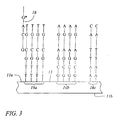
- Figs. 1-3 show a micro array 12 in the form of a contiguous, substantially planar substrate 10 that carries multiple features 16 disposed across a first substrate surface 11a of substrate 10 separated by inter feature areas 13.
- the substrate may be made of transparent material to facilitate data acquisition scanning there through.
- the features 16 are shown disposed in a pattern that defines the array. The extent of the pattern defines a scan region (not labeled in the figures).
- a second substrate surface 11b does not carry any features.
- a typical array usually includes at least two distinct polymers that differ by monomeric sequences immobilized on ( i.e ., covalently or non-covalently attached to) different and known locations on the substrate surface 11a, where a space between each location or feature may or may not be present.
- Each distinct polymeric sequence of the array is typically present as a composition of multiple copies of the polymer on the substrate surface 11a ( e.g . as a spot or feature 16 on the surface of the substrate).
- the number of distinct polymeric sequences, and hence the features 16, present on the slide or substrate may vary, but is generally at least 10, where the number may be as high as at least 50, 100, 500, 1000 or 10,000.
- the density of features present on the array surface may vary, but will generally be at least about 10 and usually at least about 100 spots/cm 2 , where the density may be as high as 10 6 or higher, but will generally not exceed about 10 5 spots/cm 2 .
- the features 16 may have widths (that is, diameter, for a round spot) of at least 5 or 10 ⁇ m, and usually less than 1.0 cm. In embodiments where very small spot sizes or feature sizes are desired, each of the features 16 may have widths of at least 1.0 ⁇ m and less than 1.0 mm, usually less than 500 ⁇ m, and more usually less than 200 ⁇ m.
- Features that are not round may have areas equivalent to the area ranges of round features 16 resulting from the foregoing diameter ranges.
- the probes of the features 16 are typically linked to the substrate 10 through a suitable linker (not shown).
- the micro array 12 may cover an area of less than 100 cm 2 , or even less than 50, 10 or 1 cm 2 .
- the substrate 10 will be shaped generally as a rectangular solid (although other shapes are possible), having a length of more than 4 mm and less than 1 m, usually more than 4 mm and less than 600 mm, more usually less than 400 mm; a width of more than 4 mm and less than 1 m, usually less than 500 mm and more usually less than 400 mm; and a thickness of more than 0.01 mm and less than 5.0 mm, usually more than 0.1 mm and less than 2 mm and more usually more than 0.2 and less than 1 mm. It is often desirable to lay down features as close to the edge of the substrate as possible so as to maximize the number of different probes that may be displayed on a given surface area.
- Micro arrays 12 such as those of FIGS. 1-3 can be fabricated using drop deposition from pulse-jets of either polynucleotide precursor units (such as monomers) in the case of in situ fabrication, or a previously obtained polynucleotide.
- polynucleotide precursor units such as monomers
- Such methods are described in detail in, for example, the previously cited references including U.S. Patent Nos. 6,242,266, 6,232,072, 6,180,351, 6,171,797, 6,323,043, U.S. Patent Application Serial No. 09/302,898 filed April 30, 1999 by Caren, et al ., and the references cited therein.
- Other drop deposition methods can be used for fabrication, as well.
- other array fabrication method may be used including pin spotting and the techniques described in U.S. Patent Nos. 5,599,695, 5,753,788, and 6,329,143.
- Polymeric layers of interest include layers of: peptides, proteins, polynucleic acids or mimetics thereof (for example, peptide nucleic acids and the like); polysaccharides, phospholipids, polyurethanes, polyesters, polycarbonates, polyureas, polyamides, polyethyleneamines, polyarylene sulfides, polysiloxanes, polyimides, polyacetates, and the like, where the polymers may be hetero- or homopolymeric, and may or may not have separate functional moieties attached thereto (for example, conjugated).
- a final deprotection step is provided in which nitrogenous bases and phosphate group are simultaneously deprotected by treatment with ammonium hydroxide and/or methylamine under known conditions. Capping, oxidation and deprotection can be accomplished by treating the entire substrate ("flooding") with a layer of the appropriate reagent.
- the functionalized support (in the first cycle) or deprotected coupled nucleoside (in subsequent cycles) provides a substrate bound moiety with a linking group for forming the phosphite linkage with a next nucleoside to be coupled in step (a).
- Final deprotection of nucleoside bases can be accomplished using alkaline conditions such as ammonium hydroxide, in another flooding procedure in a known manner. Conventionally, a single pulse jet or other dispenser is assigned to deposit a single monomeric unit.
- the phosphoramidite and phosphite triester approaches are most broadly used, but other approaches include the phosphodiester approach, the phosphotriester approach and the H-phosphonate approach.
- the substrates are typically functionalized to bond to the first deposited monomer. Suitable techniques for functionalizing substrates with such linking moieties are described, for example, in Southern, E. M., Maskos, U. and Elder, J.K., Genomics 13 , 1007-1017, 1992.
- different monomers and activator may be deposited at different addresses on the substrate during any one cycle so that the different features of the completed array will have different desired biopolymer sequences.
- One or more intermediate further steps may be required in each cycle, such as the conventional oxidation, capping and washing steps in the case of in situ fabrication of polynucleotide arrays (again, these steps may be performed in flooding procedure).
- the light source 9 of the present invention may comprise a variety of devices that are well known in the art.
- the light source 9 might be a laser, fluororneter, luminescence spectrometer, laser or similar type of light source device.
- the light source 9 may provide fluorescence, phosphorescence, luminescence or even bioluminescence light.
- the light source 9 of the present invention provides a light that interacts with unstructured probes 5 or the structured probes 6. For instance, if the light source 9 is a fluorescence light, the light is applied to the probe 4 and then a signal is produced at a defined intensity.
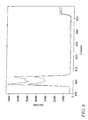
- the signal such as the first signal 14 (See FIG. 4) or the second signal 15 (See FIG.
- FTG.7 shows a micro array with attached unstructured probes 5 and structured probes 6 to a substrate surface 11a.
- Micro arrays and samples were prepared according to protocols previously described. The figure shows the high intensity level of the unstructured probes 5 bound to the labeled target 18 (light yellow or green shows strong signal). Areas of no signal are indicative of where the structured probes 6 have been positioned on the substrate surface 11a.
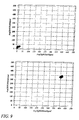
- FIG. 8 shows a comparison of the signal intensities produced by various channels across the substrate surface 11a.
- the intensities in both the green and red channels are similar and then drop off at various positions across the array surface where the structured probes 6 have been positioned (roughly channel columns 915-945).
- the cyanine-3 and cyanme-5 targets were mixed and hybridized to each Agilent cDNA microarray for 17 hours at 65 degrees centigrade.
- the slides were washed, scanned on an Agilent scanner and feature extracted using Agilent's feature extraction software.
Landscapes
- Chemical & Material Sciences (AREA)
- Organic Chemistry (AREA)
- Engineering & Computer Science (AREA)
- Chemical Kinetics & Catalysis (AREA)
- Nanotechnology (AREA)
- Health & Medical Sciences (AREA)
- Biochemistry (AREA)
- General Physics & Mathematics (AREA)
- Medicinal Chemistry (AREA)
- Molecular Biology (AREA)
- Life Sciences & Earth Sciences (AREA)
- Physics & Mathematics (AREA)
- Immunology (AREA)
- Composite Materials (AREA)
- Condensed Matter Physics & Semiconductors (AREA)
- General Chemical & Material Sciences (AREA)
- Materials Engineering (AREA)
- Crystallography & Structural Chemistry (AREA)
- General Health & Medical Sciences (AREA)
- Measuring Or Testing Involving Enzymes Or Micro-Organisms (AREA)
- Investigating Or Analysing Materials By The Use Of Chemical Reactions (AREA)
- Investigating Or Analysing Materials By Optical Means (AREA)
- Investigating Or Analyzing Materials By The Use Of Electric Means (AREA)
Abstract
Description
Claims (14)
- A micro array (12) for binding a target (18), comprising:(a) a substrate surface (11a);(b) an unstructured probe (5) attached to said substrate surface for binding to said target and providing a first signal (14);(c) a structured probe (6) attached to said substrate surface for providing a second signal (15); and(d) a light source (9) for providing excitation of said unstructured and structured probes wherein said unstructured probe provides said first signal and said structured probe provides said second signal and wherein said first signal produced by said unstructured probe can be compared to said second signal produced by said structured probe and a more accurate reading of said first signal can be determined for said unstructured probe.
- A micro array as recited in claim 1, wherein said structured probe is a biomolecule.
- A micro array as recited in any preceding claim, wherein said unstructured probe is a biomolecule.
- A micro array as recited in any preceding claim, wherein said target is a biomolecule.
- A micro array as recited in any of claims 2 to 4, wherein said biomolecule is a protein, an amino acid, an oligonucleotide, a peptide, a nucleotide, a carbohydrate, a polysaccharide or a lipid.
- A micro array as recited in any preceding claim, wherein said unstructured probe is labeled and produces said first signal.
- A micro array as recited in any of claims 1 to 5, wherein said target is labeled and produces said first signal.
- A micro array as recited in any preceding claim, wherein said light source is a luminescent light.
- A micro array as recited in claim 8, wherein said luminescent light comprises fluorescent light, phosphorescence light, or bioluminescent light.
- A micro array as recited in any preceding claim, wherein said structured probe is self annealing.
- A micro array is recited in any preceding claim, wherein said structured probe can fold back on itself to prevent annealing with said target.
- A micro array as recited in claim 11, wherein said structured probe is a pseudo knot, a hairpin, a triplex, or a quadriplex.
- A method for determining a more accurate reading of a first signal (14) produced by an unstructured probe (5) attached to a micro array substrate surface (11a), comprising:(a) illuminating an unstructured probe attached to a target (18) on said micro array substrate surface to produce a first signal;(b) illuminating a structured probe (6) attached to said micro array substrate surface to produce a second signal (15); and(c) comparing said first signal produced from said unstructured probe bound to said target, to said second signal produced from said structured probe attached to said micro array substrate surface to determine a more accurate signal intensity reading of said first signal.
- A method for determining a level of signal intensity produced by an unstructured probe (5) attached to a micro array (10), comprising:(a) providing a first light source (9) for illuminating an unstructured probe attached to a target (18) on said micro array to produce a first signal (14);(b) providing a second light source (9) for illuminating a structured probe (6) on said micro array to produce a second signal (15); and(c) comparing said first signal intensity produced from said unstructured probe attached to said target to said second signal intensity level produced from said structured probe attached to said micro array substrate surface to calibrate an improved signal intensity level of said first signal.
Applications Claiming Priority (2)
| Application Number | Priority Date | Filing Date | Title |
|---|---|---|---|
| US10/136,773 US7094537B2 (en) | 2002-04-30 | 2002-04-30 | Micro arrays with structured and unstructured probes |
| US136773 | 2002-04-30 |
Publications (2)
| Publication Number | Publication Date |
|---|---|
| EP1359422A2 true EP1359422A2 (en) | 2003-11-05 |
| EP1359422A3 EP1359422A3 (en) | 2004-02-04 |
Family
ID=29215681
Family Applications (1)
| Application Number | Title | Priority Date | Filing Date |
|---|---|---|---|
| EP03252714A Withdrawn EP1359422A3 (en) | 2002-04-30 | 2003-04-29 | Microarray with structured and unstructured probes |
Country Status (3)
| Country | Link |
|---|---|
| US (1) | US7094537B2 (en) |
| EP (1) | EP1359422A3 (en) |
| JP (1) | JP2004004065A (en) |
Cited By (1)
| Publication number | Priority date | Publication date | Assignee | Title |
|---|---|---|---|---|
| WO2011151250A1 (en) * | 2010-05-31 | 2011-12-08 | Boehringer Ingelheim Microparts Gmbh | Method and device for optical examination |
Families Citing this family (28)
| Publication number | Priority date | Publication date | Assignee | Title |
|---|---|---|---|---|
| US20080293580A1 (en) * | 2003-11-06 | 2008-11-27 | Suk-Wah Tam-Chang | Methods for Detecting and Measuring Specific Nucleic Acid Sequences |
| US7579153B2 (en) * | 2005-01-25 | 2009-08-25 | Population Genetics Technologies, Ltd. | Isothermal DNA amplification |
| KR102160389B1 (en) | 2013-08-05 | 2020-09-28 | 트위스트 바이오사이언스 코포레이션 | De novo synthesized gene libraries |
| CA2975855C (en) | 2015-02-04 | 2025-09-23 | Twist Bioscience Corporation | Compositions and methods for synthetic gene assembly |
| CA2975852A1 (en) | 2015-02-04 | 2016-08-11 | Twist Bioscience Corporation | Methods and devices for de novo oligonucleic acid assembly |
| WO2016172377A1 (en) | 2015-04-21 | 2016-10-27 | Twist Bioscience Corporation | Devices and methods for oligonucleic acid library synthesis |
| KR20180050411A (en) | 2015-09-18 | 2018-05-14 | 트위스트 바이오사이언스 코포레이션 | Oligonucleotide mutant library and its synthesis |
| WO2017053450A1 (en) | 2015-09-22 | 2017-03-30 | Twist Bioscience Corporation | Flexible substrates for nucleic acid synthesis |
| EP3384077A4 (en) | 2015-12-01 | 2019-05-08 | Twist Bioscience Corporation | FUNCTIONALIZED SURFACES AND THEIR PREPARATION |
| WO2018038772A1 (en) | 2016-08-22 | 2018-03-01 | Twist Bioscience Corporation | De novo synthesized nucleic acid libraries |
| EP4664304A3 (en) | 2016-09-21 | 2026-01-21 | Atlas Data Storage, Inc. | Nucleic acid based data storage |
| GB2573069A (en) | 2016-12-16 | 2019-10-23 | Twist Bioscience Corp | Variant libraries of the immunological synapse and synthesis thereof |
| WO2018156792A1 (en) | 2017-02-22 | 2018-08-30 | Twist Bioscience Corporation | Nucleic acid based data storage |
| CA3056388A1 (en) | 2017-03-15 | 2018-09-20 | Twist Bioscience Corporation | Variant libraries of the immunological synapse and synthesis thereof |
| WO2018231864A1 (en) | 2017-06-12 | 2018-12-20 | Twist Bioscience Corporation | Methods for seamless nucleic acid assembly |
| IL271205B2 (en) | 2017-06-12 | 2025-02-01 | Twist Bioscience Corp | Methods for seamless nucleic acid assembly |
| CN111566125A (en) | 2017-09-11 | 2020-08-21 | 特韦斯特生物科学公司 | GPCR binding proteins and synthesis thereof |
| CN111565834B (en) | 2017-10-20 | 2022-08-26 | 特韦斯特生物科学公司 | Heated nanopores for polynucleotide synthesis |
| IL312616B2 (en) | 2018-01-04 | 2025-08-01 | Twist Bioscience Corp | DNA-based digital information storage |
| EP3814497A4 (en) | 2018-05-18 | 2022-03-02 | Twist Bioscience Corporation | POLYNUCLEOTIDES, REAGENTS, AND METHODS FOR NUCLEIC ACID HYBRIDIZATION |
| SG11202106282RA (en) * | 2018-12-12 | 2021-07-29 | Bgi Shenzhen | Biochip, method of preparation and use thereof |
| EP3902816A4 (en) | 2018-12-26 | 2022-09-14 | Twist Bioscience Corporation | HIGHLY ACCURATE POLYNUCLEOTIDE DE NOVO SYNTHESIS |
| CA3131689A1 (en) | 2019-02-26 | 2020-09-03 | Twist Bioscience Corporation | Variant nucleic acid libraries for glp1 receptor |
| KR20210144698A (en) | 2019-02-26 | 2021-11-30 | 트위스트 바이오사이언스 코포레이션 | Variant Nucleic Acid Libraries for Antibody Optimization |
| EP3987019A4 (en) | 2019-06-21 | 2023-04-19 | Twist Bioscience Corporation | BARCODE-BASED NUCLEIC ACID SEQUENCE ARRANGEMENT |
| CN115023440B (en) | 2019-09-23 | 2025-09-12 | 特韦斯特生物科学公司 | Antibodies that bind to CD3ε |
| US12091777B2 (en) | 2019-09-23 | 2024-09-17 | Twist Bioscience Corporation | Variant nucleic acid libraries for CRTH2 |
| AU2020400030B2 (en) | 2019-12-09 | 2026-05-21 | Twist Bioscience Corporation | Variant nucleic acid libraries for adenosine receptors |
Family Cites Families (17)
| Publication number | Priority date | Publication date | Assignee | Title |
|---|---|---|---|---|
| US5556748A (en) * | 1991-07-30 | 1996-09-17 | Xenopore Corporation | Methods of sandwich hybridization for the quantitative analysis of oligonucleotides |
| US5279937A (en) * | 1992-04-30 | 1994-01-18 | Detechnology Canada | Use of macroglobulins to improve the signal-to-background ratio in affinity binding assays |
| FR2716263B1 (en) * | 1994-02-11 | 1997-01-17 | Pasteur Institut | Method for aligning macromolecules by passing a meniscus and applications in a method for highlighting, separating and / or assaying a macromolecule in a sample. |
| US5681702A (en) * | 1994-08-30 | 1997-10-28 | Chiron Corporation | Reduction of nonspecific hybridization by using novel base-pairing schemes |
| US5599668A (en) * | 1994-09-22 | 1997-02-04 | Abbott Laboratories | Light scattering optical waveguide method for detecting specific binding events |
| US5556752A (en) * | 1994-10-24 | 1996-09-17 | Affymetrix, Inc. | Surface-bound, unimolecular, double-stranded DNA |
| WO1996017932A1 (en) * | 1994-12-09 | 1996-06-13 | Wakunaga Seiyaku Kabushiki Kaisha | Method of inhibiting non specific hybridization in primer extension |
| US6110676A (en) * | 1996-12-04 | 2000-08-29 | Boston Probes, Inc. | Methods for suppressing the binding of detectable probes to non-target sequences in hybridization assays |
| US5919626A (en) * | 1997-06-06 | 1999-07-06 | Orchid Bio Computer, Inc. | Attachment of unmodified nucleic acids to silanized solid phase surfaces |
| US6284461B1 (en) * | 1998-04-28 | 2001-09-04 | Aurora Biosciences Corporation | Use of inhibitors in reporter assays |
| WO2000042222A2 (en) * | 1999-01-15 | 2000-07-20 | Gene Logic Inc. | Immobilized nucleic acid hybridization reagent and method |
| US6180351B1 (en) * | 1999-07-22 | 2001-01-30 | Agilent Technologies Inc. | Chemical array fabrication with identifier |
| US7122303B2 (en) * | 1999-09-17 | 2006-10-17 | Agilent Technologies, Inc. | Arrays comprising background features that provide for a measure of a non-specific binding and methods for using the same |
| US7078167B2 (en) * | 1999-09-17 | 2006-07-18 | Agilent Technologies, Inc. | Arrays having background features and methods for using the same |
| US6428957B1 (en) * | 1999-11-08 | 2002-08-06 | Agilent Technologies, Inc. | Systems tools and methods of assaying biological materials using spatially-addressable arrays |
| US6596490B2 (en) * | 2000-07-14 | 2003-07-22 | Applied Gene Technologies, Inc. | Nucleic acid hairpin probes and uses thereof |
| US20040009487A1 (en) | 2001-08-31 | 2004-01-15 | Kadushin James M. | Methods for blocking nonspecific hybridizations of nucleic acid sequences |
-
2002
- 2002-04-30 US US10/136,773 patent/US7094537B2/en not_active Expired - Fee Related
-
2003
- 2003-04-29 EP EP03252714A patent/EP1359422A3/en not_active Withdrawn
- 2003-04-30 JP JP2003124864A patent/JP2004004065A/en active Pending
Cited By (1)
| Publication number | Priority date | Publication date | Assignee | Title |
|---|---|---|---|---|
| WO2011151250A1 (en) * | 2010-05-31 | 2011-12-08 | Boehringer Ingelheim Microparts Gmbh | Method and device for optical examination |
Also Published As
| Publication number | Publication date |
|---|---|
| US20030203369A1 (en) | 2003-10-30 |
| JP2004004065A (en) | 2004-01-08 |
| EP1359422A3 (en) | 2004-02-04 |
| US7094537B2 (en) | 2006-08-22 |
Similar Documents
| Publication | Publication Date | Title |
|---|---|---|
| US7094537B2 (en) | Micro arrays with structured and unstructured probes | |
| US7488575B2 (en) | Multidentate arrays | |
| EP1464387A2 (en) | In situ nucleic acid array synthesis | |
| CN102292635B (en) | Selective processing of biological material on a microarray substrate | |
| CA2377567C (en) | High throughput assay system | |
| CA2452819C (en) | High throughput assay system | |
| EP1038033B1 (en) | High-throughput assay and kit based on the use of nuclease protection fragments. | |
| US7247337B1 (en) | Method and apparatus for microarray fabrication | |
| EP1319179B1 (en) | Methods for detecting and assaying nucleic acid sequences | |
| US20050221351A1 (en) | Methods and devices for microarray image analysis | |
| US20040170984A1 (en) | Methods and devices for detecting printhead misalignment of an in situ polymeric array synthesis device | |
| EP1335298A2 (en) | Reading multiple chemical arrays | |
| EP1442789A1 (en) | Multiple arrays | |
| EP1460136A1 (en) | Methods for detecting the presence of a nucleic acid analyte in a sample | |
| WO2006026550A1 (en) | Method and system for developing probes for dye normalization of microarray signal-intensity data | |
| US8518642B2 (en) | Method of analyzing probe nucleic acid, microarray and kit for the same | |
| WO2024077047A1 (en) | Methods and compositions for substrate surface chemistry | |
| US20050095598A1 (en) | Nucleic acid arrays comprising depurination probe features and methods for using the same | |
| JP2005055285A (en) | Dna chip and manufacturing method therefor | |
| JP2007006747A (en) | Gene detection method and kit using a plurality of labels | |
| AU2007231625A1 (en) | High Throughput Assay System |
Legal Events
| Date | Code | Title | Description |
|---|---|---|---|
| PUAI | Public reference made under article 153(3) epc to a published international application that has entered the european phase |
Free format text: ORIGINAL CODE: 0009012 |
|
| AK | Designated contracting states |
Kind code of ref document: A2 Designated state(s): AT BE BG CH CY CZ DE DK EE ES FI FR GB GR HU IE IT LI LU MC NL PT RO SE SI SK TR |
|
| AX | Request for extension of the european patent |
Extension state: AL LT LV MK |
|
| PUAL | Search report despatched |
Free format text: ORIGINAL CODE: 0009013 |
|
| AK | Designated contracting states |
Kind code of ref document: A3 Designated state(s): AT BE BG CH CY CZ DE DK EE ES FI FR GB GR HU IE IT LI LU MC NL PT RO SE SI SK TR |
|
| AX | Request for extension of the european patent |
Extension state: AL LT LV MK |
|
| RIC1 | Information provided on ipc code assigned before grant |
Ipc: 7G 01N 33/00 A |
|
| 17P | Request for examination filed |
Effective date: 20040405 |
|
| AKX | Designation fees paid |
Designated state(s): DE FR GB |
|
| RAP1 | Party data changed (applicant data changed or rights of an application transferred) |
Owner name: AGILENT TECHNOLOGIES, INC. |
|
| GRAP | Despatch of communication of intention to grant a patent |
Free format text: ORIGINAL CODE: EPIDOSNIGR1 |
|
| STAA | Information on the status of an ep patent application or granted ep patent |
Free format text: STATUS: THE APPLICATION IS DEEMED TO BE WITHDRAWN |
|
| 18D | Application deemed to be withdrawn |
Effective date: 20080103 |