EP1358933A1 - Emission gas purification catalyst and internal combustion engine provided with the catalyst - Google Patents
Emission gas purification catalyst and internal combustion engine provided with the catalyst Download PDFInfo
- Publication number
- EP1358933A1 EP1358933A1 EP01273673A EP01273673A EP1358933A1 EP 1358933 A1 EP1358933 A1 EP 1358933A1 EP 01273673 A EP01273673 A EP 01273673A EP 01273673 A EP01273673 A EP 01273673A EP 1358933 A1 EP1358933 A1 EP 1358933A1
- Authority
- EP
- European Patent Office
- Prior art keywords
- exhaust gas
- carriers
- catalytically active
- alkaline
- catalyst
- Prior art date
- Legal status (The legal status is an assumption and is not a legal conclusion. Google has not performed a legal analysis and makes no representation as to the accuracy of the status listed.)
- Withdrawn
Links
Images


Classifications
-
- B—PERFORMING OPERATIONS; TRANSPORTING
- B01—PHYSICAL OR CHEMICAL PROCESSES OR APPARATUS IN GENERAL
- B01J—CHEMICAL OR PHYSICAL PROCESSES, e.g. CATALYSIS OR COLLOID CHEMISTRY; THEIR RELEVANT APPARATUS
- B01J37/00—Processes, in general, for preparing catalysts; Processes, in general, for activation of catalysts
- B01J37/02—Impregnation, coating or precipitation
- B01J37/024—Multiple impregnation or coating
- B01J37/0242—Coating followed by impregnation
-
- B—PERFORMING OPERATIONS; TRANSPORTING
- B01—PHYSICAL OR CHEMICAL PROCESSES OR APPARATUS IN GENERAL
- B01D—SEPARATION
- B01D53/00—Separation of gases or vapours; Recovering vapours of volatile solvents from gases; Chemical or biological purification of waste gases, e.g. engine exhaust gases, smoke, fumes, flue gases, aerosols
- B01D53/34—Chemical or biological purification of waste gases
- B01D53/74—General processes for purification of waste gases; Apparatus or devices specially adapted therefor
- B01D53/86—Catalytic processes
- B01D53/8621—Removing nitrogen compounds
- B01D53/8625—Nitrogen oxides
- B01D53/8628—Processes characterised by a specific catalyst
-
- B—PERFORMING OPERATIONS; TRANSPORTING
- B01—PHYSICAL OR CHEMICAL PROCESSES OR APPARATUS IN GENERAL
- B01D—SEPARATION
- B01D53/00—Separation of gases or vapours; Recovering vapours of volatile solvents from gases; Chemical or biological purification of waste gases, e.g. engine exhaust gases, smoke, fumes, flue gases, aerosols
- B01D53/34—Chemical or biological purification of waste gases
- B01D53/92—Chemical or biological purification of waste gases of engine exhaust gases
- B01D53/94—Chemical or biological purification of waste gases of engine exhaust gases by catalytic processes
-
- B—PERFORMING OPERATIONS; TRANSPORTING
- B01—PHYSICAL OR CHEMICAL PROCESSES OR APPARATUS IN GENERAL
- B01J—CHEMICAL OR PHYSICAL PROCESSES, e.g. CATALYSIS OR COLLOID CHEMISTRY; THEIR RELEVANT APPARATUS
- B01J23/00—Catalysts comprising metals or metal oxides or hydroxides, not provided for in group B01J21/00
- B01J23/38—Catalysts comprising metals or metal oxides or hydroxides, not provided for in group B01J21/00 of noble metals
- B01J23/54—Catalysts comprising metals or metal oxides or hydroxides, not provided for in group B01J21/00 of noble metals combined with metals, oxides or hydroxides provided for in groups B01J23/02 - B01J23/36
- B01J23/56—Platinum group metals
- B01J23/58—Platinum group metals with alkali- or alkaline earth metals
-
- B—PERFORMING OPERATIONS; TRANSPORTING
- B01—PHYSICAL OR CHEMICAL PROCESSES OR APPARATUS IN GENERAL
- B01J—CHEMICAL OR PHYSICAL PROCESSES, e.g. CATALYSIS OR COLLOID CHEMISTRY; THEIR RELEVANT APPARATUS
- B01J23/00—Catalysts comprising metals or metal oxides or hydroxides, not provided for in group B01J21/00
- B01J23/38—Catalysts comprising metals or metal oxides or hydroxides, not provided for in group B01J21/00 of noble metals
- B01J23/54—Catalysts comprising metals or metal oxides or hydroxides, not provided for in group B01J21/00 of noble metals combined with metals, oxides or hydroxides provided for in groups B01J23/02 - B01J23/36
- B01J23/56—Platinum group metals
- B01J23/63—Platinum group metals with rare earths or actinides
-
- B—PERFORMING OPERATIONS; TRANSPORTING
- B01—PHYSICAL OR CHEMICAL PROCESSES OR APPARATUS IN GENERAL
- B01J—CHEMICAL OR PHYSICAL PROCESSES, e.g. CATALYSIS OR COLLOID CHEMISTRY; THEIR RELEVANT APPARATUS
- B01J23/00—Catalysts comprising metals or metal oxides or hydroxides, not provided for in group B01J21/00
- B01J23/38—Catalysts comprising metals or metal oxides or hydroxides, not provided for in group B01J21/00 of noble metals
- B01J23/54—Catalysts comprising metals or metal oxides or hydroxides, not provided for in group B01J21/00 of noble metals combined with metals, oxides or hydroxides provided for in groups B01J23/02 - B01J23/36
- B01J23/56—Platinum group metals
- B01J23/64—Platinum group metals with arsenic, antimony, bismuth, vanadium, niobium, tantalum, polonium, chromium, molybdenum, tungsten, manganese, technetium or rhenium
- B01J23/656—Manganese, technetium or rhenium
- B01J23/6562—Manganese
-
- B—PERFORMING OPERATIONS; TRANSPORTING
- B01—PHYSICAL OR CHEMICAL PROCESSES OR APPARATUS IN GENERAL
- B01D—SEPARATION
- B01D2255/00—Catalysts
- B01D2255/20—Metals or compounds thereof
- B01D2255/204—Alkaline earth metals
- B01D2255/2047—Magnesium
-
- B—PERFORMING OPERATIONS; TRANSPORTING
- B01—PHYSICAL OR CHEMICAL PROCESSES OR APPARATUS IN GENERAL
- B01D—SEPARATION
- B01D2257/00—Components to be removed
- B01D2257/40—Nitrogen compounds
- B01D2257/404—Nitrogen oxides other than dinitrogen oxide
-
- B—PERFORMING OPERATIONS; TRANSPORTING
- B01—PHYSICAL OR CHEMICAL PROCESSES OR APPARATUS IN GENERAL
- B01J—CHEMICAL OR PHYSICAL PROCESSES, e.g. CATALYSIS OR COLLOID CHEMISTRY; THEIR RELEVANT APPARATUS
- B01J35/00—Catalysts, in general, characterised by their form or physical properties
- B01J35/40—Catalysts, in general, characterised by their form or physical properties characterised by dimensions, e.g. grain size
-
- B—PERFORMING OPERATIONS; TRANSPORTING
- B01—PHYSICAL OR CHEMICAL PROCESSES OR APPARATUS IN GENERAL
- B01J—CHEMICAL OR PHYSICAL PROCESSES, e.g. CATALYSIS OR COLLOID CHEMISTRY; THEIR RELEVANT APPARATUS
- B01J35/00—Catalysts, in general, characterised by their form or physical properties
- B01J35/40—Catalysts, in general, characterised by their form or physical properties characterised by dimensions, e.g. grain size
- B01J35/45—Nanoparticles
Definitions
- the present invention relates to an exhaust gas purification catalyst, which is preferable for purifying exhaust gas from the internal combustion engine of an automobile or the like.
- the present invention particularly relates to an exhaust gas purification catalyst for an internal combustion engine, which is preferable for purifying nitrogen oxides (NOx) contained in exhaust gas from the internal combustion engine that is operated in a lean atmosphere having an air-fuel ratio of 18 or more.
- the present invention further relates to an internal combustion engine provided with an exhaust gas purification catalyst, a method for purifying exhaust gas from an internal combustion engine, and a method for preparing the catalyst.
- JP Patent Publication (Kokai) Nos. 2000-140638, 1997-248458, and 2000-189799 disclose a catalyst, which purifies exhaust gas from the internal combustion engine of an automobile or the like.
- JP Patent Publication (Kokai) Nos. 2000-140638 and 1997-248458 disclose that when a catalyst containing elements acting as NOx-storaging materials, such as alkaline-earth metals or alkaline metals, is used in exhaust gas at a high temperature, a solid phase reaction occurs between porous carriers such as alumina and the element acting as an NOx-storaging material, so that the specific surface area of the carriers and the NOx-storaging ability are decreased. Further, it is also disclosed that to prevent a solid phase reaction from occurring between a carrier and an element acting as a NOx-storaging material, a composite oxide as represented by MgO ⁇ nAl 2 O 3 , is used as a carrier. JP Patent Publication (Kokai) No.
- 2000-189799 discloses that a composite oxide carrier having the Spinel structure as represented by M ⁇ Al 2 O 3 (where M is an alkaline-earth metal) is used, so as to suppress the sintering of platinum composite oxides and thus to suppress the particle growth of platinum clusters.
- a catalyst comprising alkaline metals and/or alkaline-earth metals such as sodium, potassium, lithium, cesium, strontium and barium has been expected to be useful as an exhaust gas purification catalyst for an internal combustion engine, particularly for an internal combustion engine that is operated in a lean atmosphere. If the catalyst's performance to purify exhaust gas can be enhanced, its usefulness is further increased.
- alkaline metals or alkaline-earth metals such as sodium, potassium, lithium, cesium, strontium and barium. Over the course of this study, we have confirmed that these alkaline metals or alkaline-earth metals tend to sinter at a high temperature, particularly at 800°C or more. We have also revealed that a catalyst, wherein alkaline metals or alkaline-earth metals sinter, is no longer able to maintain its high performance of purifying nitrogen oxides (NOx).
- NOx purifying nitrogen oxides
- An object of the present invention is to suppress sintering of the alkaline metals and/or the alkaline-earth metals in a catalyst comprising alkaline metals and/or alkaline-earth metals such as sodium, potassium, lithium, cesium, strontium and barium, with respect to not only the catalyst comprising alkaline metals and/or alkaline-earth metals, but also a catalyst comprising a component that causes sintering at a high temperature.
- a catalyst comprising alkaline metals and/or alkaline-earth metals such as sodium, potassium, lithium, cesium, strontium and barium
- Another object of the present invention is to suppress the sintering.
- the move (transfer) of catalytically active components is prevented by allowing move-suppressing substances to exist between carriers that support catalytically active components.
- alkaline metals or alkaline-earth metals such as sodium, potassium, lithium, cesium, strontium and barium sinter at a high temperature
- alkaline metals or alkaline-earth metals such as sodium, potassium, lithium, cesium, strontium and barium sinter at a high temperature
- a catalyst containing alkaline metals or alkaline-earth metals is expected to be useful as an exhaust gas purification catalyst for an internal combustion engine, particularly in the case of so-called "lean-burn,” that is, lean burning under an excess oxygen atmosphere.
- a catalyst containing alkaline metals and/or alkaline-earth metals and noble metals, or further containing rare earth metals in addition to these metals, is known to storage (or store) NOx that is contained in exhaust gas from lean burning in the form of nitrate ion within the alkaline metals or alkaline-earth metals so as to purify the exhaust gas.
- the nitrate ion occluded in the alkaline metals or alkaline-earth metals is converted into NO 2 by the switching of the air-fuel ratio of an internal combustion engine to stoichiometric or rich burning, and then released outside the alkaline metals or alkaline-earth metals, whereby the catalyst is regenerated.
- a catalyst containing amorphous composite oxides that comprise alkaline metals or alkaline-earth metals selected from sodium, potassium, lithium, cesium and strontium, and titanium is known to capture NOx contained in exhaust gas from lean burning by chemically adsorbing NOx in the form of NO 2 onto the surface of the composite oxides, so as to purify the exhaust gas from lean burning.
- the NO 2 captured on the surface of the composite oxides is partially reduced to N 2 even in a lean atmosphere, and is also reduced to N 2 by the switching of the atmosphere to a stoichiometric or rich burning condition, whereby the catalyst is regenerated.
- a substance capable of suppressing the move of catalytically active components exists between carriers, so that catalytically active components become difficult to move and a decrease in the performance of exhaust gas purification can be prevented.
- a common catalyst has a structure, wherein catalytically active components are supported inside the pores of the carriers.
- An exhaust gas purification catalyst for an internal combustion engine has carriers and catalytically active components on the surface of the substrate mainly having a monolith structure.
- the catalytically active component is supported on the carrier surface and involved in exhaust gas purification.
- the carrier is for supporting catalytically active components.
- a substance that suppresses the move of catalytically active components is hereinafter referred to as an anchoring material.
- a desirable anchoring material does not have affinity or has poor affinity for catalytically active components that move outside the carrier. Material having good affinity is not preferable, because it promotes the move of catalytically active components. Further, a desirable anchoring material forms neither alloy nor composite oxide by reacting with catalytically active components that move from the carrier. The formation of alloys or composite oxides causes a decrease in the amount of catalytically active components and lowers the performance of purifying exhaust gas. Furthermore, a desirable anchoring material can maintain its initial form without melting in a temperature range within which the catalyst is used.
- alkaline metals or alkaline-earth metals selected from sodium, potassium, lithium, cesium, strontium or barium, but also noble metals aggregate and undergo sintering, when heated at a high temperature.
- alkaline metals, alkaline-earth metals, or noble metals such as platinum, palladium, and rhodium from move outside the carrier
- at least one different kind of element which is selected from the Ia, IIa, IIIa and IVa families in the long-period type periodic table as an anchoring material.
- magnesium oxide (MgO) or calcium oxide (CaO) is desirable, and MgO is particularly desirable.
- the amount of an anchoring material selected from the Ia, IIa, IIIa and IVa families is desirably 1 to 20 parts by weight, particularly desirably 2.5 to 10 parts by weight, per 100 parts by weight of a carrier. Within these ranges, a high NOx conversion was obtained.
- Materials for the carrier are desirably selected from porous inorganic oxides, and alumina is the most desirable because of its high heat resistance.
- silica, a mixture of silica and alumina, zeolite, lanthanum ⁇ alumina, which is a composite oxide of lanthanum and alumina, or the like can also be used.
- a normally used carrier has a particle size of between 0.5 and 80 ⁇ m, and has fine pores with a size of less than 0.01 ⁇ m on its surface.
- a carrier having such a particle size and a fine pore size is desirable for use.
- the pore size of the carrier can be found by measuring pore distribution according to a gas adsorption method using gas such as argon, nitrogen or krypton.
- a desirable particle size for the anchoring material ranges from 0.01 ⁇ m to 60 ⁇ m. If the particle size of the anchoring material is too small or too large, lowered performance of NOx purification was observed. Further, not only spherical particles, but also particles of various forms can be used for the carrier and the anchoring material. Furthermore, in the present invention, a particle size is represented by a numerical value that is obtained by measuring the maximum and minimum particle sizes, adding them together, and then dividing by 2; that is, (minimum particle size + maximum particle size)/2.
- Cordierite, metal or the like can be used as materials for the substrate.
- the metal is desirably a stainless metal.
- a desirable substrate has a monolith structure such as a honeycomb, and has several hundred cells, specifically 200 to 1200 cells, per inch.
- the catalyst of the present invention desirably has at least one anchoring material and particularly desirably 3 to 20 anchoring materials per 100 ⁇ m x 100 ⁇ m planar area. This enhances the functions of the anchoring material, and makes difficult for the performance of purifying exhaust gas to be lowered even after heating at a high temperature.
- the 100 ⁇ m x 100 ⁇ m planar area refers to a rectangle with 100 ⁇ m-long sides, that is, square planar area.
- the number of particles and the particle size of the anchoring material can be measured by a high resolution scanning electron microscope (SEM), a light scattering method or the like. For example, an SEM photograph of a magnification of between 5 and 100,000 times is filmed, and then the particle size and the number of particles of the anchoring material in the photograph are measured.
- SEM scanning electron microscope
- a catalyst containing alkaline metals or alkaline-earth metals such as sodium, potassium, lithium, cesium, strontium and barium is employed as an NOx purification catalyst for an internal combustion engine, together with at least one kind of noble metal such as platinum, palladium and rhodium, rare earth metal such as cerium or lanthanum, titanium, manganese and the like.
- the amount of alkaline metals or alkaline-earth metals is desirably, in total or otherwise, and in terms of the metal weight, 1 to 40 parts by weight per 100 parts by weight of a carrier.
- alkaline metals and alkaline-earth metals exist in the state of oxides, carbonates, or amorphous composite oxides. There is an appropriate range for the amount of these alkaline metals or alkaline-earth metals. Deviation from the above range lowers the performance of NOx purification.
- noble metals including platinum, rhodium and palladium have a function to reduce or oxidize NOx, they are elements essential for an exhaust gas purification catalyst. These noble metals exist in the form of oxide or metal after reduction of the oxide in a catalyst. Among noble metals, rhodium and platinum have a large effect of reducing captured NOx. Palladium has an effect of removing sulfur oxides (SOx). Accordingly, when SOx is contained in exhaust gas, a catalyst desirably contains three kinds: platinum, rhodium and palladium. When SOx is not contained or an extremely fine amount of SOx is contained in exhaust gas, a catalyst desirably contains two kinds: platinum and rhodium.
- the desirable content of a noble metal per 100 parts by weight of a carrier in the case of platinum, is between 0.5 and 3 parts by weight, in the case of rhodium, between 0.05 and 0.3 parts by weight, and in the case of palladium, between 0.5 and 15 parts by weight. Within these ranges, a high performance of NOx purification could be obtained.
- Titanium forms an amorphous composite oxide with at least one kind of alkaline metal or alkaline-earth metal selected from sodium, potassium, lithium, cesium and strontium.
- a desirable amount of titanium is between 1 and 8 parts by weight per 100 parts by weight of a carrier. Any content that is above or below this range lowers NOx purification performance. Further, titanium has resistance to SOx. When exhaust gas contains SOx, the catalyst desirably contains titanium.
- Rare earth metals have an action to occlude oxygen.
- Rare earth metals contained in the catalyst promote the oxidation of nitrogen monoxides (NO) in exhaust gas into nitrogen dioxides (NO 2 ), thereby promoting the capturing of NOx by alkaline metals or alkaline-earth metals.
- NO nitrogen monoxides
- NO 2 nitrogen dioxides
- Cerium is the most preferable.
- Rare earth metals exist in the form of oxide in the catalyst.
- a desirable amount of rare earth metals per 100 parts by weight of a carrier is in terms of the metal weight between 5 and 30 parts by weight, and in particular, between 15 and 20 parts by weight.
- Manganese enhances the heat resistance of a catalyst, and it exists in the form of oxide in the catalyst.
- a desirable amount of manganese per 100 parts by weight of a carrier is in terms of the metal weight between 1.5 and 60 parts by weight.
- an internal combustion engine which is provided with:
- a method for purifying exhaust gas which comprises allowing exhaust gas from an internal combustion engine that is operated under a lean condition having an air-fuel ratio of 18 or more to be in contact with any one of the catalysts (1) to (3) above, so as to purify NOx within the exhaust gas.
- a method for purifying exhaust gas from an internal combustion engine which comprises allowing exhaust gas from an internal combustion engine that is operated under a lean condition having an air-fuel ratio of 18 or more to be in contact with any one of the catalysts (1) to (3) above, and then switching the air-fuel ratio of the internal combustion engine to 14.7 or less to operate under a stoichiometric or rich burning condition, then allowing the exhaust gas to be in contact with the above catalyst.
- the NOx-capturing abilities of the catalysts of (1) to (3) above are lowered as operation in a lean atmosphere is prolonged.
- the atmosphere for the operation of the internal combustion engine is switched to a stoichiometric burning condition with an air-fuel ratio of 14.7 or a rich burning condition with an air-fuel ratio of less than 14.7, captured NOx is purified and the NOx-capturing ability is recovered.
- the time required for operating under a stoichiometric or a rich burning condition to recover the NOx-capturing ability is not more than several seconds. Specifically, a time of between 0.3 seconds and 5 minutes is sufficient.
- a method for preparing a catalyst which comprises, coating the surface of a substrate that has a monolith structure with a slurry that contains carrier particles comprising inorganic oxides; drying and baking the substrate to form a coating layer that comprises the carriers on the substrate surface; and impregnating the substrate with a solution that contains at least one kind selected from alkaline metals and alkaline-earth metals consisting of sodium, potassium, lithium, cesium, strontium and barium, and at least one kind selected from noble metals consisting of platinum, palladium and rhodium; and then drying and baking to allow catalytically active components to be supported inside the pores of the above carriers, wherein, when the coating layer of the above carriers is formed, at least one kind selected from magnesium oxide particles and calcium oxide particles is mixed into the slurry containing the carriers, so that the above coating layer contains magnesium oxides or calcium oxides.
- MgO The melting point of MgO is as high as 2826°C (source: The Chemical Society of Japan, ed., Chemistry Guidebook, Basics I (Kagaku-binran, kiso-hen I), 4th revised version, p. 169).
- source The Chemical Society of Japan, ed., Chemistry Guidebook, Basics I (Kagaku-binran, kiso-hen I), 4th revised version, p. 169).
- the electronegativity of the metal ion of MgO is 6.0 (source: Catalysis Society of Japan, ed., Catalytic Engineering Lecture 10 (Shokubai kogaku ko-za 10), p. 752), so that it cannot easily form an alloy or a composite oxide with sodium, potassium, lithium, cesium, strontium, or barium.
- MgO is extremely suitable for anchoring material contains, if sodium, potassium, lithium, cesium, strontium or barium is contained as a catalytically active component.
- MgAl 2 O 3 When MgAl 2 O 3 is used instead of MgO, the affinity with sodium, potassium, lithium, cesium, strontium, barium or the like is increased. As a result, Al components in MgAl 2 O 3 react with the catalytically active components, i.e. alkaline metals or alkaline-earth metals, to form compounds with these metals. Accordingly, MgAl 2 O 3 is not a desirable anchoring material.
- the specific surface area of a MgO particle is preferably between 0.1 and 100 m 2 /g. To prevent active components such as noble metals from being supported onto the MgO surface, MgO particles particularly preferably have a specific surface areas of between 0.1 and 30 m 2 /g.
- the catalyst of the present invention is prepared by, most preferably, an impregnation method as described above.
- the catalyst can also be prepared by a physical preparation method such as a kneading method, co-precipitation method, sol-gel method, ion exchange method, or vapor deposition method, or a preparation method using a chemical reaction.
- various compounds such as nitrate compounds, acetate compounds, chelate compounds, hydroxides, carbonate compounds, organic compounds, and dinitrodiamine complexes, metals, and metal oxides can be used.
- FIG 1 shows a schematic view of the section of the exhaust gas purification catalyst of the present invention.
- This catalyst is composed of carriers 21 supporting catalytically active components, anchoring materials 22, and a substrate 23 having a monolith structure.
- Figure 2 shows a schematic view of the section of the carrier 21 supporting catalytically active components.
- the carrier 21 has numerous fine pores 21a on the surface. On the fine pores 21a, catalytically active components 24 are supported.
- Figure 3 shows an automobile 100 that is provided with an exhaust gas purification catalyst 10 of the present invention.
- the exhaust gas purification catalyst 10 is disposed in an exhaust pipe 101 for releasing exhaust gas from an engine 99.
- Figure 4 shows details about the engine 99 and the control unit in an internal combustion engine of an automobile or the like.
- An air induction system for supplying air to the engine 99 is provided with an air cleaner 1, an air flow sensor 2, and a throttle valve 3.
- An exhaust system for releasing exhaust gas from burning in the engine 99 is provided with the exhaust pipe 101, an oxygen level sensor 7, an exhaust gas temperature sensor 8, a catalyst outlet gas temperature sensor 9, and the exhaust gas purification catalyst 10. Signals from these various sensors disposed in the induction system and the exhaust system of the engine 99 are sent to an engine control unit (ECU; Engine Control Unit) 11.
- ECU 11 is composed of I/O as an input and output interface, LSI, and processor MPU, storage units, RAM and ROM, wherein a number of control programs are stored, a timer counter and the like.
- Air to be supplied to the engine 99 is filtered by the air cleaner 1, measured by the air flow sensor 2, passed through the throttle valve 3, exposed to fuel injection by an injector 5, and then supplied as air-fuel mixture to the engine 99.
- ECU 11 receives signals from these various sensors, and evaluates the operation state of the internal combustion engine and the state of the exhaust gas purification catalyst to determine an air-fuel ratio for operation, and then sets the fuel concentration of the air-fuel mixture by controlling the injection time or the like of the injector 5.
- the air-fuel mixture induced by the cylinder of the engine 99 was ignited and burned by a spark plug 6 that is controlled by signals from ECU 11.
- the exhaust gas from burning is guided into the exhaust system, and then purified by the exhaust gas purification catalyst 10. Based on signals of the oxygen level sensor 7 that are inputted into ECU 11, the duration of a.lean burning condition and the like, the NOx purification ability of the exhaust gas purification catalyst under the lean burning operation is determined.
- the air-fuel ratio is shifted to a stoichiometric or rich burning condition so as to recover the NOx capturing ability of the catalyst.
- the operation condition is switched back to a lean burning operation.
- the air-fuel ratio is controlled by direction from the engine control unit, and the exhaust gas purification catalyst 10 is always kept under conditions wherein it can show good purification performance.
- an A/F sensor can also be used instead of the oxygen level sensor 7.
- An example of controlling air-fuel ratio by managing the operation time of a lean burning condition and that of a stoichiometric or rich burning condition is as described above, but is not limited thereto.
- a NOx level sensor is placed on the inlet side and the outlet side of the exhaust gas purification catalyst 10, if the performance of the catalyst is estimated to be lower level than preset level by means of the signals from these sensors, the air-fuel ratio may be switched.
- a mixed slurry comprising alumina particles having numerous fine pores with pore sizes of less than 0.01 ⁇ m on the surface (particle size: 0.8 to 80 ⁇ m, average particle size: 30 ⁇ m), magnesium oxide particles as an anchoring material (particle size: 0.5 to 50 ⁇ m, average particle size: 15 ⁇ m, specific surface area: 1 m 2 /g), and nitrate acidic alumina sol, was prepared.
- the slurry was coated over a substrate of cordierite-made honeycomb (400 cells/inc 2 ), the substrate was dried and baked to form, on the honeycomb surface, a coating layer comprising alumina particles and anchoring materials.
- the alumina sol is acting as an adhesive to adhere carriers and anchoring materials to the substrate.
- the amount of alumina is 190 g per litter of the apparent volume of the honeycomb, and the amount of magnesium oxide (MgO) is 10 g per litter of the apparent volume of the honeycomb.
- the amount of MgO per 100 parts by weight of the carrier is 5 parts by weight.
- catalytically active components were supported by the honeycomb having a coating layer comprising MgO and alumina, according to the following steps.
- the honeycomb was impregnated with a cerium nitrate aqueous solution, dried at 200°C and baked at 600°C for cerium oxides to be supported.
- a mixed solution containing a dinitrodiammine platinum nitrate solution, rhodium nitrate, palladium nitrate, manganese nitrate, and potassium acetate drying at 200°C and baking at 600°C were performed.
- the amounts of catalytically active components supported therein per 100 parts by weight of the carrier are: 14.21 parts by weight of cerium, 0.07 part by weight of rhodium, 1.47 parts by weight of platinum, 0.74 part by weight of palladium, 7.21 parts by weight of manganese, 8.22 parts by weight of potassium, 6.53 parts by weight of sodium, 0.87 part by weight of lithium, and 2.26 parts by weight of titanium.
- a comparative example catalyst 1 was prepared under the same conditions as those of the example catalyst 1, except that anchoring materials were not mixed into an alumina slurry.
- An alumina coating layer was formed on a honeycomb made of cordierite using a slurry comprising alumina particles and nitrate acidic alumina sol.
- the amount of alumina was 190 g per litter of the apparent volume of honeycomb.
- the honeycomb was impregnated with magnesium nitrate, dried at 200°C, and then baked at 600°C, whereby magnesium oxides were supported on the surface, including inside the pores of alumina.
- catalytically active components were supported.
- the amount of MgO per 100 parts by weight of the carrier was 5.26 parts by weight.
- the amount of catalytically active components supported herein was the same as that in Example 1.
- a comparative example catalyst 3 was prepared similarly to the example catalyst 1, except that MgAl 2 O 4 particles (particle size: 0.01 to 0.07 ⁇ m, average particle size: 0.03 ⁇ m, specific surface area: 55 m 2 /g) were used instead of MgO.
- the amount of alumina per litter of the apparent volume of honeycomb was 190 g, and the amount of MgAl 2 O 4 was 10 g.
- Table 1 shows the amounts of various catalytically active components supported per litter of the apparent volume of honeycomb.
- a first component, second component and the like denote the order of supporting, i.e. the first component was supported first.
- the amount of the component supported per litter of the apparent volume of honeycomb is shown just before the supported component.
- “27 Ce” means that 27 g of cerium was supported, in terms of the metal weight, per litter of the apparent volume of honeycomb.
- composition of the lean-burn model gas was: NOx: 600 ppm, C 3 H 6 : 500 ppm, CO: 0.1%, CO 2 : 10%, O 2 : 5%, H 2 O: 10%, and N 2 : remainder.
- composition of the stoichiometric model gas was: NOx: 1000 ppm, C 3 H 6 :600 ppm, CO: 0.5%, CO 2 : 5%, O 2 : 0.5%, H 2 : 0.3%, H 2 O: 10%, and N 2 : remainder.
- the model gas flow test is as follows.
- the volume of a catalyst was 6 cc, and SV was 30,000/h.
- NOx conversion (NOx concentration before passing through the catalyst layer - NOx concentration after passing through the catalyst layer) / (NOx concentration before passing through the catalyst layer) ⁇ 100
- Table 2 shows NOx conversions (initial NOx conversion) as measured during cycles (2), and NOx conversion (NOx conversion at 400°C after heat treatment) as measured during the cycles (7). Both rates were measured after the lean model gas at the second cycle flowed for 1 minute.
- the example catalyst 1 showed a less decrease in NOx conversion after heat treatment compared to the comparative example catalysts 1 to 3, revealing that the example catalyst 1 has better heat resistance.
- Table 3 shows NOx conversion of the example catalyst 1 and the comparative example catalyst 1 during cycles of each (6), (8) and (9). All the NOx conversion were measured after the lean model gas at the second cycle flowed for 1 minute. Compared to the comparative example catalyst 1, the example catalyst 1 has a higher NOx conversion after heat treatment and thus has better heat resistance.
- the state of a coating layer was observed using an energy dispersive (EDX) - high resolution scanning electron microscope (SEM) at a stage when the coating layer comprising alumina and anchoring materials was formed on a honeycomb made of cordierite.
- EDX energy dispersive
- SEM high resolution scanning electron microscope
- MgO particles within the coating layer can be specified by EDX measurement.
- XRD X-ray diffraction
- MgO particles having a particle size of approximately 15 ⁇ m were confirmed to be present in the coating layer.
- the coating layer was confirmed to comprise Al 2 O 3 and MgO particles.
- the particle size of MgO (anchoring material) was varied.
- the particle sizes of MgO particles were sieved by sizes of between 0.01 and 0.02 ⁇ m, 0.05 and 0.06 ⁇ m, 0.20 and 0.21 ⁇ m, 29 and 30 ⁇ m, 59 and 60 ⁇ m, and 99 and 100 ⁇ m, respectively.
- a catalyst was prepared in a manner similar to that for the example catalyst 1.
- the composition of the catalytic components is the same as that of the example catalyst 1.
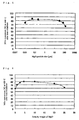
- Figure 5 shows the correlation between the particle size of a MgO particle and NOx conversion at 400°C after heat treatment. When the particle size of MgO particle was between 0.01 and 60 ⁇ m, high NOx conversion were obtained.
- Catalysts were prepared in a manner similar to that for the example catalyst 1.
- the weights of MgO per 100 parts by weight of alumina within the catalysts were: 0.5 parts by weight, 1.0 part by weight, 2.5 parts by weight, 4.5 parts by weight, 10 parts by weight, 20 parts by weight, and 25 parts by weight, respectively.
- the kinds and the amounts of catalytically active components to be supported were the same as those of the example catalyst 1.
- Figure 6 shows the correlation between NOx conversion at 400°C after heat treatment, and the weight of MgO particles. When the MgO particle level per 100 parts by weight of alumina was in the range of between 1 and 20 parts by weight, high NOx conversion were obtained.
- a cordierite-made honeycomb was impregnated with sodium in an amount equivalent to that of the example catalyst 1, and then baked by heating at 900°C in air for 7.5 hours.
- the sodium-supporting cordierite was crushed, and then subjected to XRD measurement. Further, the crushed particles were measured by FT-IR at room temperature under helium flow.
- Example catalyst 1 and the comparative example catalyst 1 were also crushed at a stage when all the cycles (1) to (9) in Example 1 had been completed, and then subjected to FT-IR measurement. Table 4 shows the results.
- the cordierite-made honeycomb substrate of the example catalyst 1 was replaced by a metal honeycomb. According to Example 1, NOx conversion was measured at 400°C, and at 500°C after heat treatment. Table 5 shows the results.
- a catalyst was prepared similarly to the example catalyst 1, except that the anchoring material of the example catalyst I was replaced by calcium oxide (CaO). 5 parts by weight of CaO were used per 100 parts by weight of a carrier.
- NOx conversion was measured at 400°C after heat treatment. Thus, an approximately 70% NOx conversion was obtained.
- anchoring materials provided between carriers can ease a decrease in the catalyst's performance of purifying exhaust gas after the catalyst has been heated to high temperatures.
- the catalyst of the present invention has good heat resistance, and has an effect of capable of maintaining high catalytic activity even after being heated to high temperatures.
- the catalyst is preferable for purifying exhaust gas from an automobile at high temperatures.
Landscapes
- Chemical & Material Sciences (AREA)
- Engineering & Computer Science (AREA)
- Chemical Kinetics & Catalysis (AREA)
- Organic Chemistry (AREA)
- Materials Engineering (AREA)
- Environmental & Geological Engineering (AREA)
- Biomedical Technology (AREA)
- Oil, Petroleum & Natural Gas (AREA)
- General Chemical & Material Sciences (AREA)
- Analytical Chemistry (AREA)
- Health & Medical Sciences (AREA)
- Combustion & Propulsion (AREA)
- Catalysts (AREA)
- Exhaust Gas Treatment By Means Of Catalyst (AREA)
- Exhaust Gas After Treatment (AREA)
Abstract
A catalyst for use in purifying exhaust gas from an internal combustion
engine. The active components of an exhaust gas purification catalyst for an
internal combustion engine tend to be melted or softened and then to move
outside the carrier, because the components become in contact with exhaust gas
at a high temperature. Hence, anchoring materials are provided between
carriers in order to suppress the moving of catalytically active components.
Anchoring materials 22 do not form compounds with catalytically active
components 24, and are selected from substances that do not melt even in
contact with exhaust gas at a high temperature. When the active components
contain sodium, potassium, cesium, lithium, strontium, barium, noble metals
and the like, the best anchoring material is MgO. The anchoring material
functions as a barrier that prevents the moving of active components.
Description
The present invention relates to an exhaust gas purification catalyst,
which is preferable for purifying exhaust gas from the internal combustion
engine of an automobile or the like. The present invention particularly relates
to an exhaust gas purification catalyst for an internal combustion engine, which
is preferable for purifying nitrogen oxides (NOx) contained in exhaust gas from
the internal combustion engine that is operated in a lean atmosphere having an
air-fuel ratio of 18 or more. The present invention further relates to an internal
combustion engine provided with an exhaust gas purification catalyst, a method
for purifying exhaust gas from an internal combustion engine, and a method for
preparing the catalyst.
JP Patent Publication (Kokai) Nos. 2000-140638, 1997-248458, and
2000-189799 disclose a catalyst, which purifies exhaust gas from the internal
combustion engine of an automobile or the like.
JP Patent Publication (Kokai) Nos. 2000-140638 and 1997-248458
disclose that when a catalyst containing elements acting as NOx-storaging
materials, such as alkaline-earth metals or alkaline metals, is used in exhaust gas
at a high temperature, a solid phase reaction occurs between porous carriers
such as alumina and the element acting as an NOx-storaging material, so that the
specific surface area of the carriers and the NOx-storaging ability are decreased.
Further, it is also disclosed that to prevent a solid phase reaction from occurring
between a carrier and an element acting as a NOx-storaging material, a
composite oxide as represented by MgO·nAl2O3, is used as a carrier. JP Patent
Publication (Kokai) No. 2000-189799 discloses that a composite oxide carrier
having the Spinel structure as represented by M·Al2O3 (where M is an alkaline-earth
metal) is used, so as to suppress the sintering of platinum composite
oxides and thus to suppress the particle growth of platinum clusters.
A catalyst comprising alkaline metals and/or alkaline-earth metals such
as sodium, potassium, lithium, cesium, strontium and barium has been expected
to be useful as an exhaust gas purification catalyst for an internal combustion
engine, particularly for an internal combustion engine that is operated in a lean
atmosphere. If the catalyst's performance to purify exhaust gas can be
enhanced, its usefulness is further increased.
We have studied catalysts containing alkaline metals or alkaline-earth
metals, such as sodium, potassium, lithium, cesium, strontium and barium.
Over the course of this study, we have confirmed that these alkaline metals or
alkaline-earth metals tend to sinter at a high temperature, particularly at 800°C
or more. We have also revealed that a catalyst, wherein alkaline metals or
alkaline-earth metals sinter, is no longer able to maintain its high performance
of purifying nitrogen oxides (NOx).
An object of the present invention is to suppress sintering of the alkaline
metals and/or the alkaline-earth metals in a catalyst comprising alkaline metals
and/or alkaline-earth metals such as sodium, potassium, lithium, cesium,
strontium and barium, with respect to not only the catalyst comprising alkaline
metals and/or alkaline-earth metals, but also a catalyst comprising a component
that causes sintering at a high temperature.
Another object of the present invention is to suppress the sintering.
According to the present invention, the move (transfer) of catalytically
active components is prevented by allowing move-suppressing substances to
exist between carriers that support catalytically active components.
The mechanism, wherein alkaline metals or alkaline-earth metals such
as sodium, potassium, lithium, cesium, strontium and barium sinter at a high
temperature, is inferred to be caused by generally the following i), ii) and iii):
A catalyst containing alkaline metals or alkaline-earth metals is expected
to be useful as an exhaust gas purification catalyst for an internal combustion
engine, particularly in the case of so-called "lean-burn," that is, lean burning
under an excess oxygen atmosphere.
A catalyst containing alkaline metals and/or alkaline-earth metals and
noble metals, or further containing rare earth metals in addition to these metals,
is known to storage (or store) NOx that is contained in exhaust gas from lean
burning in the form of nitrate ion within the alkaline metals or alkaline-earth
metals so as to purify the exhaust gas. The nitrate ion occluded in the alkaline
metals or alkaline-earth metals is converted into NO2 by the switching of the
air-fuel ratio of an internal combustion engine to stoichiometric or rich burning,
and then released outside the alkaline metals or alkaline-earth metals, whereby
the catalyst is regenerated.
In contrast, a catalyst containing amorphous composite oxides that
comprise alkaline metals or alkaline-earth metals selected from sodium,
potassium, lithium, cesium and strontium, and titanium is known to capture NOx
contained in exhaust gas from lean burning by chemically adsorbing NOx in the
form of NO2 onto the surface of the composite oxides, so as to purify the
exhaust gas from lean burning. The NO2 captured on the surface of the
composite oxides is partially reduced to N2 even in a lean atmosphere, and is
also reduced to N2 by the switching of the atmosphere to a stoichiometric or rich
burning condition, whereby the catalyst is regenerated.
When heated at a high temperature of 800°C, the exhaust gas
purification performance of the catalyst containing alkaline metals or alkaline-earth
metals is decreased. This is inferred to be caused by the facts that
alkaline metals or alkaline-earth metals migrate outside the carriers and move
(sinter), and then the specific surface area decreases, which result in a drop in
NOx-purification ability.
According to the present invention, a substance capable of suppressing
the move of catalytically active components exists between carriers, so that
catalytically active components become difficult to move and a decrease in the
performance of exhaust gas purification can be prevented.
A common catalyst has a structure, wherein catalytically active
components are supported inside the pores of the carriers. An exhaust gas
purification catalyst for an internal combustion engine has carriers and
catalytically active components on the surface of the substrate mainly having a
monolith structure. Here the catalytically active component is supported on
the carrier surface and involved in exhaust gas purification. Further, here the
carrier is for supporting catalytically active components. A substance that
suppresses the move of catalytically active components is hereinafter referred to
as an anchoring material.
A desirable anchoring material does not have affinity or has poor
affinity for catalytically active components that move outside the carrier.
Material having good affinity is not preferable, because it promotes the move of
catalytically active components. Further, a desirable anchoring material forms
neither alloy nor composite oxide by reacting with catalytically active
components that move from the carrier. The formation of alloys or composite
oxides causes a decrease in the amount of catalytically active components and
lowers the performance of purifying exhaust gas. Furthermore, a desirable
anchoring material can maintain its initial form without melting in a temperature
range within which the catalyst is used. Not only alkaline metals or alkaline-earth
metals selected from sodium, potassium, lithium, cesium, strontium or
barium, but also noble metals aggregate and undergo sintering, when heated at a
high temperature. To prevent the above alkaline metals, alkaline-earth metals,
or noble metals such as platinum, palladium, and rhodium from move outside
the carrier, it is desirable to use at least one different kind of element, which is
selected from the Ia, IIa, IIIa and IVa families in the long-period type periodic
table as an anchoring material. Among these materials, magnesium oxide
(MgO) or calcium oxide (CaO) is desirable, and MgO is particularly desirable.
The amount of an anchoring material selected from the Ia, IIa, IIIa and
IVa families is desirably 1 to 20 parts by weight, particularly desirably 2.5 to 10
parts by weight, per 100 parts by weight of a carrier. Within these ranges, a
high NOx conversion was obtained.
Materials for the carrier are desirably selected from porous inorganic
oxides, and alumina is the most desirable because of its high heat resistance.
In addition to such materials for the carrier, silica, a mixture of silica and
alumina, zeolite, lanthanum β alumina, which is a composite oxide of lanthanum
and alumina, or the like can also be used. A normally used carrier has a
particle size of between 0.5 and 80 µm, and has fine pores with a size of less
than 0.01 µm on its surface. In the present invention, a carrier having such a
particle size and a fine pore size is desirable for use. In addition, the pore size
of the carrier can be found by measuring pore distribution according to a gas
adsorption method using gas such as argon, nitrogen or krypton.
A desirable particle size for the anchoring material ranges from 0.01 µm
to 60 µm. If the particle size of the anchoring material is too small or too large,
lowered performance of NOx purification was observed. Further, not only
spherical particles, but also particles of various forms can be used for the carrier
and the anchoring material. Furthermore, in the present invention, a particle
size is represented by a numerical value that is obtained by measuring the
maximum and minimum particle sizes, adding them together, and then dividing
by 2; that is, (minimum particle size + maximum particle size)/2.
Cordierite, metal or the like can be used as materials for the substrate.
The metal is desirably a stainless metal. A desirable substrate has a monolith
structure such as a honeycomb, and has several hundred cells, specifically 200
to 1200 cells, per inch.
The catalyst of the present invention desirably has at least one
anchoring material and particularly desirably 3 to 20 anchoring materials per
100 µm x 100 µm planar area. This enhances the functions of the anchoring
material, and makes difficult for the performance of purifying exhaust gas to be
lowered even after heating at a high temperature. In addition, the 100 µm x
100 µm planar area refers to a rectangle with 100 µm-long sides, that is, square
planar area. The number of particles and the particle size of the anchoring
material can be measured by a high resolution scanning electron microscope
(SEM), a light scattering method or the like. For example, an SEM photograph
of a magnification of between 5 and 100,000 times is filmed, and then the
particle size and the number of particles of the anchoring material in the
photograph are measured.
A catalyst containing alkaline metals or alkaline-earth metals such as
sodium, potassium, lithium, cesium, strontium and barium is employed as an
NOx purification catalyst for an internal combustion engine, together with at
least one kind of noble metal such as platinum, palladium and rhodium, rare
earth metal such as cerium or lanthanum, titanium, manganese and the like.
The amount of alkaline metals or alkaline-earth metals is desirably, in
total or otherwise, and in terms of the metal weight, 1 to 40 parts by weight per
100 parts by weight of a carrier. In the catalyst, alkaline metals and alkaline-earth
metals exist in the state of oxides, carbonates, or amorphous composite
oxides. There is an appropriate range for the amount of these alkaline metals
or alkaline-earth metals. Deviation from the above range lowers the
performance of NOx purification.
Since noble metals including platinum, rhodium and palladium have a
function to reduce or oxidize NOx, they are elements essential for an exhaust
gas purification catalyst. These noble metals exist in the form of oxide or
metal after reduction of the oxide in a catalyst. Among noble metals, rhodium
and platinum have a large effect of reducing captured NOx. Palladium has an
effect of removing sulfur oxides (SOx). Accordingly, when SOx is contained
in exhaust gas, a catalyst desirably contains three kinds: platinum, rhodium and
palladium. When SOx is not contained or an extremely fine amount of SOx is
contained in exhaust gas, a catalyst desirably contains two kinds: platinum and
rhodium. The desirable content of a noble metal per 100 parts by weight of a
carrier, in the case of platinum, is between 0.5 and 3 parts by weight, in the case
of rhodium, between 0.05 and 0.3 parts by weight, and in the case of palladium,
between 0.5 and 15 parts by weight. Within these ranges, a high performance
of NOx purification could be obtained.
Titanium forms an amorphous composite oxide with at least one kind of
alkaline metal or alkaline-earth metal selected from sodium, potassium, lithium,
cesium and strontium. A desirable amount of titanium is between 1 and 8 parts
by weight per 100 parts by weight of a carrier. Any content that is above or
below this range lowers NOx purification performance. Further, titanium has
resistance to SOx. When exhaust gas contains SOx, the catalyst desirably
contains titanium.
Rare earth metals have an action to occlude oxygen. Rare earth metals
contained in the catalyst promote the oxidation of nitrogen monoxides (NO) in
exhaust gas into nitrogen dioxides (NO2), thereby promoting the capturing of
NOx by alkaline metals or alkaline-earth metals. As a rare earth metal, cerium
is the most preferable. Rare earth metals exist in the form of oxide in the
catalyst. A desirable amount of rare earth metals per 100 parts by weight of a
carrier is in terms of the metal weight between 5 and 30 parts by weight, and in
particular, between 15 and 20 parts by weight.
Manganese enhances the heat resistance of a catalyst, and it exists in the
form of oxide in the catalyst. A desirable amount of manganese per 100 parts
by weight of a carrier is in terms of the metal weight between 1.5 and 60 parts
by weight.
According to an embodiment of the present invention, a catalyst used
for purifying NOx contained in exhaust gas by contacting with exhaust gas from
an internal combustion engine that is operated under a lean condition with an
air-fuel ratio of 18 or more, wherein the catalyst has the following composition
(1), (2) or (3), is provided:
in which,
the carrier comprises particles having fine pores on its surface; the catalytically active component has at least one kind of element selected from alkaline metals and alkaline-earth metals consisting of sodium, potassium, lithium, cesium, strontium and barium; at least one kind of particle selected from magnesium oxide and calcium oxide are provided between the above carrier particles; and at least one particle of the at least one kind selected from magnesium oxide and calcium oxide is contained in a square planar area with a 100 µm-long side.
in which,
the carrier comprises particles having fine pores on the surfaces of the particles; the catalytically active component comprises oxides or carbonates consisting of at least one kind selected from sodium, potassium, lithium, cesium, strontium and barium; at least one kind of noble metal selected from platinum, palladium and rhodium: at least one kind of magnesium oxide and calcium oxide is contained between the above carrier particles; and 1 to 20 parts by weight of the at least one kind of magnesium oxide and calcium oxide is contained per 100 parts by weight of the above carrier.
in which,
the catalytically active component comprises at least one kind selected from sodium, potassium, lithium, cesium and strontium, titanium, and at least one kind of noble metal selected from platinum, palladium and rhodium, and comprises amorphous composite oxides consisting of at least one kind selected from sodium, potassium, lithium, cesium and strontium, and titanium; the above carrier comprises particles that have fine pores on the surfaces of the particles; at least one kind selected from magnesium oxide and calcium oxide is provided between the above carrier particles; and the amount of the at least one kind of magnesium oxide and calcium oxide is between 1 and 20 parts by weight per 100 parts by weight of the above carrier.
According to another embodiment of the present invention, there is
provided an internal combustion engine, which is provided with:
Further, according to another embodiment of the present invention, there
is provided a method for purifying exhaust gas, which comprises allowing
exhaust gas from an internal combustion engine that is operated under a lean
condition having an air-fuel ratio of 18 or more to be in contact with any one of
the catalysts (1) to (3) above, so as to purify NOx within the exhaust gas.
Furthermore, there is provided a method for purifying exhaust gas from
an internal combustion engine, which comprises allowing exhaust gas from an
internal combustion engine that is operated under a lean condition having an
air-fuel ratio of 18 or more to be in contact with any one of the catalysts (1) to
(3) above, and then switching the air-fuel ratio of the internal combustion engine
to 14.7 or less to operate under a stoichiometric or rich burning condition, then
allowing the exhaust gas to be in contact with the above catalyst.
The NOx-capturing abilities of the catalysts of (1) to (3) above are
lowered as operation in a lean atmosphere is prolonged. However, when the
atmosphere for the operation of the internal combustion engine is switched to a
stoichiometric burning condition with an air-fuel ratio of 14.7 or a rich burning
condition with an air-fuel ratio of less than 14.7, captured NOx is purified and
the NOx-capturing ability is recovered. The time required for operating under
a stoichiometric or a rich burning condition to recover the NOx-capturing ability
is not more than several seconds. Specifically, a time of between 0.3 seconds
and 5 minutes is sufficient.
According to another embodiment of the present invention, there is
provided a method for preparing a catalyst, which comprises,
coating the surface of a substrate that has a monolith structure with a slurry that contains carrier particles comprising inorganic oxides; drying and baking the substrate to form a coating layer that comprises the carriers on the substrate surface; and impregnating the substrate with a solution that contains at least one kind selected from alkaline metals and alkaline-earth metals consisting of sodium, potassium, lithium, cesium, strontium and barium, and at least one kind selected from noble metals consisting of platinum, palladium and rhodium; and then drying and baking to allow catalytically active components to be supported inside the pores of the above carriers, wherein, when the coating layer of the above carriers is formed, at least one kind selected from magnesium oxide particles and calcium oxide particles is mixed into the slurry containing the carriers, so that the above coating layer contains magnesium oxides or calcium oxides.
coating the surface of a substrate that has a monolith structure with a slurry that contains carrier particles comprising inorganic oxides; drying and baking the substrate to form a coating layer that comprises the carriers on the substrate surface; and impregnating the substrate with a solution that contains at least one kind selected from alkaline metals and alkaline-earth metals consisting of sodium, potassium, lithium, cesium, strontium and barium, and at least one kind selected from noble metals consisting of platinum, palladium and rhodium; and then drying and baking to allow catalytically active components to be supported inside the pores of the above carriers, wherein, when the coating layer of the above carriers is formed, at least one kind selected from magnesium oxide particles and calcium oxide particles is mixed into the slurry containing the carriers, so that the above coating layer contains magnesium oxides or calcium oxides.
There is also provided a method for preparing a catalyst, which
comprises:
The melting point of MgO is as high as 2826°C (source: The Chemical
Society of Japan, ed., Chemistry Guidebook, Basics I (Kagaku-binran, kiso-hen
I), 4th revised version, p. 169). Thus MgO is not easily softened or melted
even when it is in contact with exhaust gas at approximately between 800°C and
1000°C. Moreover, the electronegativity of the metal ion of MgO is 6.0
(source: Catalysis Society of Japan, ed., Catalytic Engineering Lecture 10
(Shokubai kogaku ko-za 10), p. 752), so that it cannot easily form an alloy or a
composite oxide with sodium, potassium, lithium, cesium, strontium, or barium.
Thus MgO is extremely suitable for anchoring material contains, if sodium,
potassium, lithium, cesium, strontium or barium is contained as a catalytically
active component. In addition, MgO has a low affinity also for noble metals,
such as platinum.
When MgAl2O3 is used instead of MgO, the affinity with sodium,
potassium, lithium, cesium, strontium, barium or the like is increased. As a
result, Al components in MgAl2O3 react with the catalytically active components,
i.e. alkaline metals or alkaline-earth metals, to form compounds with these
metals. Accordingly, MgAl2O3 is not a desirable anchoring material. The
specific surface area of a MgO particle is preferably between 0.1 and 100 m2/g.
To prevent active components such as noble metals from being supported onto
the MgO surface, MgO particles particularly preferably have a specific surface
areas of between 0.1 and 30 m2/g.
The catalyst of the present invention is prepared by, most preferably, an
impregnation method as described above. In addition to this method, the
catalyst can also be prepared by a physical preparation method such as a
kneading method, co-precipitation method, sol-gel method, ion exchange
method, or vapor deposition method, or a preparation method using a chemical
reaction.
As a starting raw material upon catalyst preparation, various compounds
such as nitrate compounds, acetate compounds, chelate compounds, hydroxides,
carbonate compounds, organic compounds, and dinitrodiamine complexes,
metals, and metal oxides can be used.
Figure 1 shows a schematic view of the section of the exhaust gas
purification catalyst of the present invention. This catalyst is composed of
carriers 21 supporting catalytically active components, anchoring materials 22,
and a substrate 23 having a monolith structure. Figure 2 shows a schematic
view of the section of the carrier 21 supporting catalytically active components.
The carrier 21 has numerous fine pores 21a on the surface. On the fine pores
21a, catalytically active components 24 are supported.
Figure 3 shows an automobile 100 that is provided with an exhaust gas
purification catalyst 10 of the present invention. The exhaust gas purification
catalyst 10 is disposed in an exhaust pipe 101 for releasing exhaust gas from an
engine 99.
Figure 4 shows details about the engine 99 and the control unit in an
internal combustion engine of an automobile or the like.
An air induction system for supplying air to the engine 99 is provided
with an air cleaner 1, an air flow sensor 2, and a throttle valve 3. An exhaust
system for releasing exhaust gas from burning in the engine 99 is provided with
the exhaust pipe 101, an oxygen level sensor 7, an exhaust gas temperature
sensor 8, a catalyst outlet gas temperature sensor 9, and the exhaust gas
purification catalyst 10. Signals from these various sensors disposed in the
induction system and the exhaust system of the engine 99 are sent to an engine
control unit (ECU; Engine Control Unit) 11. ECU 11 is composed of I/O as an
input and output interface, LSI, and processor MPU, storage units, RAM and
ROM, wherein a number of control programs are stored, a timer counter and the
like.
Air to be supplied to the engine 99 is filtered by the air cleaner 1,
measured by the air flow sensor 2, passed through the throttle valve 3, exposed
to fuel injection by an injector 5, and then supplied as air-fuel mixture to the
engine 99.
An example of controlling air-fuel ratio by managing the operation time
of a lean burning condition and that of a stoichiometric or rich burning condition
is as described above, but is not limited thereto. For example, a NOx level
sensor is placed on the inlet side and the outlet side of the exhaust gas
purification catalyst 10, if the performance of the catalyst is estimated to be
lower level than preset level by means of the signals from these sensors, the air-fuel
ratio may be switched.
A mixed slurry, comprising alumina particles having numerous fine
pores with pore sizes of less than 0.01 µm on the surface (particle size: 0.8 to 80
µm, average particle size: 30 µm), magnesium oxide particles as an anchoring
material (particle size: 0.5 to 50 µm, average particle size: 15 µm, specific
surface area: 1 m2/g), and nitrate acidic alumina sol, was prepared. After the
slurry was coated over a substrate of cordierite-made honeycomb (400
cells/inc2), the substrate was dried and baked to form, on the honeycomb surface,
a coating layer comprising alumina particles and anchoring materials. Here,
the alumina sol is acting as an adhesive to adhere carriers and anchoring
materials to the substrate. The amount of alumina is 190 g per litter of the
apparent volume of the honeycomb, and the amount of magnesium oxide (MgO)
is 10 g per litter of the apparent volume of the honeycomb. The amount of
MgO per 100 parts by weight of the carrier is 5 parts by weight.
Then, catalytically active components were supported by the honeycomb
having a coating layer comprising MgO and alumina, according to the following
steps. First, the honeycomb was impregnated with a cerium nitrate aqueous
solution, dried at 200°C and baked at 600°C for cerium oxides to be supported.
Next, after impregnation with a mixed solution containing a dinitrodiammine
platinum nitrate solution, rhodium nitrate, palladium nitrate, manganese nitrate,
and potassium acetate, drying at 200°C and baking at 600°C were performed.
Finally, impregnation with a mixed solution comprising potassium acetate,
sodium nitrate, lithium nitrate and titania sol, drying at 200°C and baking at
600°C were performed. Thus, noble metals consisting of platinum, rhodium
and palladium, and components consisting of manganese, potassium, sodium,
lithium and titania were supported on the surface of the alumina carriers and
also inside the fine pores. The amounts of catalytically active components
supported therein per 100 parts by weight of the carrier are: 14.21 parts by
weight of cerium, 0.07 part by weight of rhodium, 1.47 parts by weight of
platinum, 0.74 part by weight of palladium, 7.21 parts by weight of manganese,
8.22 parts by weight of potassium, 6.53 parts by weight of sodium, 0.87 part by
weight of lithium, and 2.26 parts by weight of titanium.
A comparative example catalyst 1 was prepared under the same
conditions as those of the example catalyst 1, except that anchoring materials
were not mixed into an alumina slurry.
An alumina coating layer was formed on a honeycomb made of
cordierite using a slurry comprising alumina particles and nitrate acidic alumina
sol. The amount of alumina was 190 g per litter of the apparent volume of
honeycomb. Then, the honeycomb was impregnated with magnesium nitrate,
dried at 200°C, and then baked at 600°C, whereby magnesium oxides were
supported on the surface, including inside the pores of alumina. Then, by the
same steps as the example catalyst 1, catalytically active components were
supported. The amount of MgO per 100 parts by weight of the carrier was 5.26
parts by weight. The amount of catalytically active components supported
herein was the same as that in Example 1.
A comparative example catalyst 3 was prepared similarly to the example
catalyst 1, except that MgAl2O4 particles (particle size: 0.01 to 0.07 µm, average
particle size: 0.03 µm, specific surface area: 55 m2/g) were used instead of MgO.
The amount of alumina per litter of the apparent volume of honeycomb was 190
g, and the amount of MgAl2O4 was 10 g.
Table 1 shows the amounts of various catalytically active components
supported per litter of the apparent volume of honeycomb. In this table, a first
component, second component and the like denote the order of supporting, i.e.
the first component was supported first. The amount of the component
supported per litter of the apparent volume of honeycomb is shown just before
the supported component. For example, "27 Ce" means that 27 g of cerium
was supported, in terms of the metal weight, per litter of the apparent volume of
honeycomb.
| Catalyst | Coating layer | First component | Second component | Third component | Fourth |
| Example catalyst | |||||
| 1 | MgO-alumina mixture | 27 Ce | 0.14 Rh, 2.8 Pt, 1.4 Pd, 7.8 K, 13.7 Mn | 7.8 K, 12.4 Na, 1.65 Li, 43 Ti | None |
| | Alumina | 27 Ce | 0.14 Rh, 2.8 Pt, 1.4 Pd, 7.8 K, 13.7 Mn | 7.8 K, 12.4 Na, 1.65 Li, 4.3 Ti | None |
| | | 10 Mg | 27 Ce | 0.14 Rh, 2.8 Pt, 1.4 Pd, 7.8 K, 13.7 Mn | 7.8 K, 12.4 Na, 1.65 Li, 4.3 Ti |
| | MgAl2O4-alumina mixture | 27 Ce | 0.14 Rh, 2.8 Pt, 1.4 Pd,7.8 K, 13.7 Mn | 7.8 K, 12.4 Na, 1.65 Li, 4.3 Ti | None |
A test was conducted for the example catalyst 1, and the comparative
example catalysts 1 to 3, wherein lean-burn model gas simulating exhaust gas
from lean burning, and stoichiometric model gas simulating exhaust gas from
stoichiometric burning alternately flowed.
The composition of the lean-burn model gas was: NOx: 600 ppm,
C3H6: 500 ppm, CO: 0.1%, CO2: 10%, O2: 5%, H2O: 10%, and N2:
remainder.
The composition of the stoichiometric model gas was: NOx:
1000 ppm, C3H6 :600 ppm, CO: 0.5%, CO2: 5%, O2: 0.5%, H2: 0.3%,
H2O: 10%, and N2: remainder.
The model gas flow test is as follows.
In addition, the volume of a catalyst was 6 cc, and SV was 30,000/h.
The NOx conversion was measured by the following equation during the
above model gas flow test.
NOx conversion = (NOx concentration before passing through the catalyst layer
- NOx concentration after passing through the catalyst layer) / (NOx
concentration before passing through the catalyst layer) × 100
Table 2 shows NOx conversions (initial NOx conversion) as measured
during cycles (2), and NOx conversion (NOx conversion at 400°C after heat
treatment) as measured during the cycles (7). Both rates were measured after
the lean model gas at the second cycle flowed for 1 minute. The example
catalyst 1 showed a less decrease in NOx conversion after heat treatment
compared to the comparative example catalysts 1 to 3, revealing that the
example catalyst 1 has better heat resistance.
Table 3 shows NOx conversion of the example catalyst 1 and the
comparative example catalyst 1 during cycles of each (6), (8) and (9). All the
NOx conversion were measured after the lean model gas at the second cycle
flowed for 1 minute. Compared to the comparative example catalyst 1, the
example catalyst 1 has a higher NOx conversion after heat treatment and thus
has better heat resistance.
Further, in the examples to be described later, when referred to "NOx
conversion at 400°C after heat treatment", the value was measured after the lean
model gas at the second cycle in the cycles (7) flowed for 1 minute.
| Catalyst | Initial NOx conversion [%] | NOx conversion [%] at 400°C after heat |
| Example catalyst | ||
| 1 | 98 | 80 |
| | 95 | 52 |
| | 95 | 53 |
| | 92 | 45 |
| Catalyst | NOx conversion (%) at 300°C after heat treatment | NOx conversion (%) at 350°C after heat treatment | NOx conversion (%) at 500°C after heat |
| Example catalyst | |||
| 1 | 67 | 78 | 40 |
| | 43 | 59 | 29 |
For the example catalyst 1, the state of a coating layer was observed
using an energy dispersive (EDX) - high resolution scanning electron
microscope (SEM) at a stage when the coating layer comprising alumina and
anchoring materials was formed on a honeycomb made of cordierite. MgO
particles within the coating layer can be specified by EDX measurement.
Further, the structure of the anchoring materials (Mg) in the coating layer was
confirmed by X-ray diffraction (XRD) measurement.
When the coating layer was measured by powder X-ray diffraction
(XRD), only Al2O3 and MgO were detected. Moreover, distribution of Mg and
that of Al were observed independently by EDX-SEM measurement on the
coating layer. Hence, it is obvious that MgO and Al2O3 exist independently.
Further, for the portions measured by EDX and by SEM, MgO particles
having a particle size of approximately 15 µm were confirmed to be present in
the coating layer.
As described above, the coating layer was confirmed to comprise Al2O3
and MgO particles.
In the example catalyst 1, the particle size of MgO (anchoring material)
was varied. The particle sizes of MgO particles were sieved by sizes of
between 0.01 and 0.02 µm, 0.05 and 0.06 µm, 0.20 and 0.21 µm, 29 and 30 µm,
59 and 60 µm, and 99 and 100 µm, respectively. A catalyst was prepared in a
manner similar to that for the example catalyst 1. The composition of the
catalytic components is the same as that of the example catalyst 1. Figure 5
shows the correlation between the particle size of a MgO particle and NOx
conversion at 400°C after heat treatment. When the particle size of MgO
particle was between 0.01 and 60 µm, high NOx conversion were obtained.
Catalysts were prepared in a manner similar to that for the example
catalyst 1. The weights of MgO per 100 parts by weight of alumina within the
catalysts were: 0.5 parts by weight, 1.0 part by weight, 2.5 parts by weight, 4.5
parts by weight, 10 parts by weight, 20 parts by weight, and 25 parts by weight,
respectively. The kinds and the amounts of catalytically active components to
be supported were the same as those of the example catalyst 1. Figure 6 shows
the correlation between NOx conversion at 400°C after heat treatment, and the
weight of MgO particles. When the MgO particle level per 100 parts by weight
of alumina was in the range of between 1 and 20 parts by weight, high NOx
conversion were obtained.
The presence of MgO particles between carriers suppresses the alkali
attack. This was verified by XRD and Fourier transform infrared absorption
measurement (FT-IR).
Upon verification, a cordierite-made honeycomb was impregnated with
sodium in an amount equivalent to that of the example catalyst 1, and then baked
by heating at 900°C in air for 7.5 hours. The sodium-supporting cordierite was
crushed, and then subjected to XRD measurement. Further, the crushed
particles were measured by FT-IR at room temperature under helium flow.
As a result of XRD measurement, NaAlSiO4 was observed, and sodium
was shown to react with cordierite (composite oxides of 2MgO·2Al2O3·5SiO2) to
form an alkali alumino-silicate which cause the alkali attack. Further, as a
result of FT-IR measurement, infrared absorption occurred at a wavenumber of
1280 cm-1, at which no infrared absorption was obtained when only the
cordierite particles were used.
The example catalyst 1 and the comparative example catalyst 1 were
also crushed at a stage when all the cycles (1) to (9) in Example 1 had been
completed, and then subjected to FT-IR measurement. Table 4 shows the
results. In addition, in this example, infrared absorption intensity of alkali
aluminosilicate was defined as follows.
(Infrared absorption intensity of alkali aluminosilicate) = (Infrared
absorption intensity of sample measured at 1280 cm-1 ) - (Infrared absorption
intensity of cordierite at 1280 cm-1 )
Samples with higher absorption intensities of alkali aluminosilicate
resulted in greater amounts of alkali aluminosilicate formed.
Alkali aluminosilicate formation proceeded in the comparative example
catalyst 1 that had been coated only with alumina. In contrast, the example
catalyst 1 that had been coated with the mixture of alumina and MgO showed
greatly suppressed alkali aluminosilicate formation.
| Sample | Infrared absorption intensity of alkali aluminosilicate |
| Na-supporting cordierite | 0.28 |
| | 0.20 |
| | 0.05 |
The cordierite-made honeycomb substrate of the example catalyst 1 was
replaced by a metal honeycomb. According to Example 1, NOx conversion
was measured at 400°C, and at 500°C after heat treatment. Table 5 shows the
results.
Replacement of the substrate material by the metal honeycomb further
improved the heat resistance.
| Substrate material | NOx conversion (%) at 400°C after heat treatment | NOx conversion (%) at 500°C after |
| Cordierite | ||
| 80 | 40 | |
| Metal | 90 | 95 |
A catalyst was prepared similarly to the example catalyst 1, except that
the anchoring material of the example catalyst I was replaced by calcium oxide
(CaO). 5 parts by weight of CaO were used per 100 parts by weight of a carrier.
In accordance with Example 1, NOx conversion was measured at 400°C after
heat treatment. Thus, an approximately 70% NOx conversion was obtained.
As described above, anchoring materials provided between carriers can
ease a decrease in the catalyst's performance of purifying exhaust gas after the
catalyst has been heated to high temperatures.
The catalyst of the present invention has good heat resistance, and has
an effect of capable of maintaining high catalytic activity even after being
heated to high temperatures. Thus, the catalyst is preferable for purifying
exhaust gas from an automobile at high temperatures.
Claims (14)
- An exhaust gas purification catalyst for purifying NOx contained in exhaust gas when the catalyst comes into contact with the heated exhaust gas, which is provided with carriers and catalytically active components that are supported by the carriers; and contains, in the catalytically active components, thermal moving components that may move due to exhaust gas heat,
wherein moving-suppressing substances that inhibit the moving of the thermal moving components are provided between the carriers. - The exhaust gas purification catalyst according to claim 1, wherein the thermal moving component is at least one kind selected from alkaline metals, alkaline earth metals and noble metals, and the moving-suppressing substance is at least one different kind of element selected from the Ia, IIa, IIIa and IVa families in the long-period type periodic table.
- The exhaust gas purification catalyst according to claim 1, which contains at least one particle of the moving-suppressing substance within a rectangle planar area with a 100 µm-long side.
- The exhaust gas purification catalyst according to claim 3, which has the carriers, the catalytically active components, and the moving-suppressing substances on the surface of a substrate having a monolith structure.
- An exhaust gas purification catalyst for an internal combustion engine for purifying NOx contained in exhaust gas when the catalyst comes into contact with the exhaust gas from the internal combustion engine that is operated under a lean condition having an air-fuel ratio of 18 or more,
which has catalytically active components and carriers on the surface of a substrate having a monolith structure; and contains, within the catalytically active component, at least one kind of element selected from alkaline metals and alkaline-earth metals consisting of sodium, potassium, lithium, cesium, strontium and barium,
wherein at least a particle that consists of at least one kind selected from magnesium oxide and calcium oxide is contained between the carriers per 100 µm × 100 µm planar area of the finally obtained catalyst. - An exhaust gas purification catalyst for an internal combustion engine for purifying NOx contained in exhaust gas by contacting with the exhaust gas from the internal combustion engine that is operated under a lean condition having an air-fuel ratio of 18 or more,
which has, on the surface of a substrate having a monolith structure, the carriers and the catalytically active components comprising oxides or carbonates that consist of at least one kind selected from sodium, potassium, lithium, cesium, strontium and barium, and at least one kind of noble metal selected from platinum, palladium and rhodium,
wherein particles consisting of at least one kind of magnesium oxide and calcium oxide are provided between the carriers, and 1 to 20 parts by weight of the at least one kind of magnesium oxide and calcium oxide is contained per 100 parts by weight of the carrier. - An exhaust gas purification catalyst for an internal combustion engine for purifying NOx contained in exhaust gas by contacting with the exhaust gas from the internal combustion engine that is operated under a lean condition having an air-fuel ratio of 18 or more,
which has, on the surface of a substrate having a monolith structure, carriers and catalytically active components comprising oxides or carbonates that consist of at least one kind selected from sodium, potassium, lithium, cesium and strontium, at least one kind of noble metal selected from platinum, palladium and rhodium, and composite oxides consisting of at least one kind selected from sodium, potassium, lithium, cesium and strontium, and titanium,
wherein particles consisting of at least one kind selected from magnesium oxide and calcium oxide are provided between the carriers; and 1 to 20 parts by weight of the at least one kind of magnesium oxide and calcium oxide are contained per 100 parts by weight of the carrier. - An internal combustion engine, which is provided with an engine control unit having an air-fuel ratio switching function to switch the air-fuel ratio between a lean, stoichiometric and rich burning condition, and also provided with an exhaust gas purification catalyst for purifying NOx contained in engine exhaust gas, and which is operated under a lean burning condition with an air-fuel ratio of 18 or more at a steady operation state,
in which the exhaust gas purification catalyst comprises a substrate having a monolith structure, and catalytically active components and carriers formed on the substrate surface; and the catalytically active component comprises oxides or carbonates that consist of at least one kind selected from sodium, potassium, lithium, cesium, strontium and barium, and at least one kind of noble metal selected from platinum, palladium and rhodium,
wherein at least one kind selected from magnesium oxide and calcium oxide is contained between the carriers; and 1 to 20 parts by weight of the at least one kind of magnesium oxide and calcium oxide is contained per 100 parts by weight of the carrier. - An internal combustion engine, which is provided with an engine control unit having an air-fuel ratio switching function to switch the air-fuel ratio between a lean burning condition with an air-fuel ratio of 18 or more, a stoichiometric and a rich burning condition, and an exhaust gas purification catalyst,
in which the exhaust gas purification catalyst comprises catalytically active components and carriers that are provided on the surface of a substrate having a monolith structure; and the catalytically active component comprises oxides or carbonates that consist of at least one kind selected from sodium, potassium, lithium, cesium and strontium, at least one kind selected from noble metals consisting of platinum, palladium and rhodium, and composite oxides consisting of at least one kind selected from sodium, potassium, lithium, cesium and strontium, and titanium,
wherein 1 to 20 parts by weight of at least one kind selected from magnesium oxide and calcium oxide is contained between the carries of the exhaust gas purification catalyst per 100 parts by weight of the carrier. - A method for purifying exhaust gas from an internal combustion engine, which purifies NOx contained in exhaust gas by allowing the exhaust gas from an internal combustion engine that is operated under a lean condition having an air-fuel ratio of 18 or more to be in contact with an exhaust gas purification catalyst,
in which the exhaust gas purification catalyst comprises a substrate having a monolith structure, and catalytically active components and carriers formed on the substrate surface; and the catalytically active component contains oxides or carbonates that consist of at least one kind selected from sodium, potassium, lithium, cesium, strontium and barium, and at least one kind selected from noble metals consisting of platinum, palladium and rhodium,
wherein 1 to 20 parts by weight of at least one kind selected from magnesium oxide and calcium oxide is contained in the catalyst per 100 parts by weight of the carrier; and the magnesium oxide and the calcium oxide are dispersed between the carriers. - A method for purifying exhaust gas from an internal combustion engine, which purifies NOx contained in exhaust gas by allowing the exhaust gas from an internal combustion engine that is operated under a lean condition having an air-fuel ratio of 18 or more to be in contact with an exhaust gas purification catalyst that comprises a substrate having a monolith structure, carriers and catalytically active components formed on the substrate surface,
in which the catalytically active component comprises oxides or carbonates consisting of at least one kind selected from alkaline metals and alkaline earth metals consisting of sodium, potassium, lithium, cesium and strontium, at least one kind selected from noble metals consisting of platinum, palladium and rhodium, and composite oxides of the at least one kind selected from alkaline metals and alkaline earth metals, and titanium,
wherein 1 to 20 parts by weight of at least one kind selected from magnesium oxide and calcium oxide is contained per 100 parts by weight of the carrier in the catalyst; and the magnesium oxide and calcium oxide are dispersed between the carriers, so as to prevent the moving of the alkaline metal and alkaline earth metal in the catalytically active component owing to exhaust gas heat . - A method for purifying exhaust gas from an internal combustion engine using an exhaust gas purification catalyst that comprises catalytically active components, carriers and a substrate having a monolith structure, wherein the catalytically active components-supporting carriers are provided on the substrate surface,
in which the catalytically active component comprises at least one kind of oxide or carbonate selected from alkaline metals and alkaline earth metals consisting of sodium, potassium, lithium, cesium, strontium and barium, and at least one kind selected from noble metals consisting of platinum, palladium and rhodium; and the exhaust gas purification catalyst is allowed to be in contact alternately with exhaust gas resulting from a lean burning operation with an air-fuel ratio of 18 or more, and with exhaust gas resulting from a stoichiometric or rich burning operation,
wherein I to 20 parts by weight of at least one kind selected from magnesium oxide and calcium oxide is contained per 100 parts by weight of the carrier in the catalyst; and the magnesium oxide and calcium oxide are dispersed between the carriers, so as to prevent the moving by exhaust gas heat of the alkaline metal and alkaline earth metal in the catalytically active component. - A method for preparing an exhaust gas purification catalyst for an internal combustion engine by coating the surface of a substrate that has a monolith structure with a slurry that contains carrier particles comprising inorganic oxide, drying and baking the substrate to form a coating layer that comprises the carriers on the substrate surface, and then impregnating the substrate with a solution that contains catalytically active components, followed by drying and baking,
in which the catalytically active component contains at least one kind selected from alkaline metals and alkaline-earth metals consisting of sodium, potassium, lithium, cesium, strontium and barium, and at least one kind selected from noble metals consisting of platinum, palladium and rhodium,
wherein, in the step to form the coating layer of the above carriers, at least one kind selected from magnesium oxide particles and calcium oxide particles is mixed into the slurry containing the carriers, so that the coating layer comprising the carrier contains magnesium oxide or calcium oxide. - A method for preparing an exhaust gas purification catalyst for an internal combustion engine by coating the surface of a substrate having a monolith structure with a slurry that contains carrier particles comprising inorganic oxides, drying and baking the substrate, so as to form a coating layer that comprises the carriers on the substrate surface, and then impregnating the substrate with a solution containing catalytically active components, followed by drying and baking the substrate, so as to allow the catalytically active components to be supported on the carrier surface,
in which the catalytically active component contains at least one kind selected from alkaline metals and alkaline-earth metals consisting of sodium, potassium, lithium, cesium and strontium, at least one kind selected from noble metals consisting of platinum, palladium and rhodium, and titanium,
wherein, in the step to form the coating layer of the carriers, at least one kind selected from magnesium oxide particles and calcium oxide particles is mixed into the slurry containing the carriers, so that the coating layer of the carriers contains magnesium oxides or calcium oxides; and, in the step to support the above catalytically active components on the carrier surface, additionally the substrate is impregnated with the solution that contains at least one kind selected from alkaline metals and alkaline-earth metals and titanium, followed by drying and baking, so as to form composite oxides consisting of the at least one kind of alkaline metal and alkaline-earth metal, and titanium.
Applications Claiming Priority (1)
| Application Number | Priority Date | Filing Date | Title |
|---|---|---|---|
| PCT/JP2001/000761 WO2002062468A1 (en) | 2001-02-02 | 2001-02-02 | Emission gas purification catalyst and internal combustion engine provided with the catalyst |
Publications (2)
| Publication Number | Publication Date |
|---|---|
| EP1358933A1 true EP1358933A1 (en) | 2003-11-05 |
| EP1358933A4 EP1358933A4 (en) | 2005-08-10 |
Family
ID=11736988
Family Applications (1)
| Application Number | Title | Priority Date | Filing Date |
|---|---|---|---|
| EP01273673A Withdrawn EP1358933A4 (en) | 2001-02-02 | 2001-02-02 | MISSION GAS TREATMENT CATALYST AND INTERNAL COMBUSTION ENGINE PROVIDED WITH SUCH A CATALYST |
Country Status (4)
| Country | Link |
|---|---|
| US (1) | US7438866B2 (en) |
| EP (1) | EP1358933A4 (en) |
| JP (1) | JP4172272B2 (en) |
| WO (1) | WO2002062468A1 (en) |
Cited By (5)
| Publication number | Priority date | Publication date | Assignee | Title |
|---|---|---|---|---|
| EP1832552A1 (en) * | 2002-12-20 | 2007-09-12 | Honda Giken Kogyo Kabushiki Kaisha | Alkali metal-containing catalyst formulations for low and medium temperature hydrogen generation |
| WO2010064052A1 (en) * | 2008-12-04 | 2010-06-10 | Johnson Matthey Public Limited Company | NOx STORAGE MATERIALS FOR SENSOR APPLICATIONS |
| WO2011073396A2 (en) | 2009-12-18 | 2011-06-23 | Haldor Topsøe A/S | DEACTIVATION-RESISTANT CATALYST FOR SELECTIVE CATALYST REDUCTION OF NOx |
| WO2011053953A3 (en) * | 2009-11-02 | 2012-03-15 | Dow Global Technologies Llc | Supported rhodium synthesis gas conversion catalyst compositions |
| CN105492119A (en) * | 2013-08-30 | 2016-04-13 | 大塚化学株式会社 | Exhaust gas purification filter and exhaust gas purification apparatus |
Families Citing this family (17)
| Publication number | Priority date | Publication date | Assignee | Title |
|---|---|---|---|---|
| JPWO2006001077A1 (en) * | 2004-06-28 | 2008-04-17 | 株式会社日立製作所 | Exhaust gas purification device for internal combustion engine and exhaust gas purification method |
| JP3852466B2 (en) * | 2004-11-30 | 2006-11-29 | いすゞ自動車株式会社 | NOx purification system |
| JP5200315B2 (en) * | 2004-12-22 | 2013-06-05 | 日産自動車株式会社 | Exhaust gas purification catalyst and method for producing exhaust gas purification catalyst |
| US8020378B2 (en) * | 2004-12-29 | 2011-09-20 | Umicore Ag & Co. Kg | Exhaust manifold comprising aluminide |
| US7597016B2 (en) * | 2005-11-04 | 2009-10-06 | Southwest Research Institute | Fuel deposit testing using burner-based exhaust flow simulation system |
| RU2381370C1 (en) * | 2006-07-04 | 2010-02-10 | Тойота Дзидося Кабусики Кайся | Exhaust gas purifier and method to purify internal combustion engine exhaust gases |
| US7749472B2 (en) * | 2006-08-14 | 2010-07-06 | Basf Corporation | Phosgard, a new way to improve poison resistance in three-way catalyst applications |
| US8722001B2 (en) * | 2008-10-17 | 2014-05-13 | Umicore Shokubai Japan Co., Ltd. | Catalyst for purification of exhaust gas and method for purification using the same |
| JP5337930B2 (en) * | 2008-10-29 | 2013-11-06 | 三菱自動車工業株式会社 | Exhaust purification method |
| MY175209A (en) * | 2008-10-31 | 2020-06-15 | Sinopec Res Inst Petroleum | A sorbent composition, the preparation method thereof, and the process for removing sulfur oxides and nitrogen oxides in a flue gas by the sorbent composition |
| JP5003917B2 (en) * | 2008-12-24 | 2012-08-22 | 三菱自動車工業株式会社 | Exhaust purification catalyst and exhaust purification device |
| EP2269729A1 (en) * | 2009-06-16 | 2011-01-05 | Linde AG | Catalyst consisting of platinum supported on chemically promoted magnesium oxide and cerium dioxide towards H2-SCR |
| KR101536038B1 (en) * | 2009-07-23 | 2015-07-10 | 도요타 지도샤(주) | Exhaust gas purifier for internal combustion engine |
| CN103987933A (en) * | 2011-12-07 | 2014-08-13 | 丰田自动车株式会社 | Exhaust purification device for internal combustion engines |
| CN104703693B (en) * | 2012-10-11 | 2017-07-04 | 帝斯曼知识产权资产管理有限公司 | The progressively hydrogenation of specific isoprenoid |
| KR20170020337A (en) * | 2014-06-19 | 2017-02-22 | 오츠카 가가쿠 가부시키가이샤 | Exhaust gas purifying catalyst, exhaust gas purification device and filter, and method for producing said catalyst |
| CN115634687A (en) * | 2021-07-19 | 2023-01-24 | 上海歌地催化剂有限公司 | Three-way catalyst for trapping NOx in tail gas of lean-burn gasoline engine or diesel engine |
Family Cites Families (14)
| Publication number | Priority date | Publication date | Assignee | Title |
|---|---|---|---|---|
| JPS5223340B2 (en) | 1972-06-20 | 1977-06-23 | ||
| US4977129A (en) * | 1989-03-13 | 1990-12-11 | W. R Grace & Co.-Conn. | Auto exhaust catalyst composition having low H2 S emissions and method of making the catalyst |
| JP3216858B2 (en) | 1994-10-20 | 2001-10-09 | トヨタ自動車株式会社 | Exhaust gas purification catalyst and method for producing the same |
| JP3374569B2 (en) * | 1995-01-10 | 2003-02-04 | 株式会社日立製作所 | Exhaust gas purification catalyst and purification method |
| JPH09248458A (en) | 1996-03-18 | 1997-09-22 | Toyota Central Res & Dev Lab Inc | Exhaust gas purification catalyst and exhaust gas purification method |
| JP3965711B2 (en) * | 1996-10-25 | 2007-08-29 | 株式会社日立製作所 | Nitrogen oxide purification catalyst and purification method |
| JP2000070717A (en) | 1998-08-28 | 2000-03-07 | Toyota Central Res & Dev Lab Inc | Exhaust gas purification catalyst and catalyst carrier |
| JP3739223B2 (en) | 1998-09-02 | 2006-01-25 | トヨタ自動車株式会社 | Exhaust gas purification catalyst |
| JP3575307B2 (en) | 1998-12-28 | 2004-10-13 | トヨタ自動車株式会社 | Exhaust gas purification catalyst and method for producing the same |
| JP2000314311A (en) | 1999-05-06 | 2000-11-14 | Hitachi Ltd | Exhaust gas purification method for internal combustion engine, purification device and purification catalyst |
| EP1078678B8 (en) * | 1999-08-20 | 2010-02-17 | Mitsubishi Jidosha Kogyo Kabushiki Kaisha | Exhaust gas purifying catalyst |
| JP2001079405A (en) | 1999-09-17 | 2001-03-27 | Hitachi Ltd | Exhaust gas purifying catalyst, honeycomb structure carrying exhaust gas purifying catalyst, and method of purifying the same |
| US6381477B1 (en) | 1999-11-05 | 2002-04-30 | Motorola, Inc. | Method and apparatus for protecting a circuit module in a communication device |
| EP1166853A1 (en) * | 2000-06-22 | 2002-01-02 | Mitsubishi Jidosha Kogyo Kabushiki Kaisha | Exhaust gas purifying catalyst |
-
2001
- 2001-02-02 US US10/470,830 patent/US7438866B2/en not_active Expired - Fee Related
- 2001-02-02 WO PCT/JP2001/000761 patent/WO2002062468A1/en not_active Ceased
- 2001-02-02 JP JP2002562469A patent/JP4172272B2/en not_active Expired - Fee Related
- 2001-02-02 EP EP01273673A patent/EP1358933A4/en not_active Withdrawn
Cited By (14)
| Publication number | Priority date | Publication date | Assignee | Title |
|---|---|---|---|---|
| EP1832552A1 (en) * | 2002-12-20 | 2007-09-12 | Honda Giken Kogyo Kabushiki Kaisha | Alkali metal-containing catalyst formulations for low and medium temperature hydrogen generation |
| WO2010064052A1 (en) * | 2008-12-04 | 2010-06-10 | Johnson Matthey Public Limited Company | NOx STORAGE MATERIALS FOR SENSOR APPLICATIONS |
| US9358525B2 (en) | 2008-12-04 | 2016-06-07 | Johnson Matthey Public Limited Company | NOx storage materials for sensor applications |
| GB2477690A (en) * | 2008-12-04 | 2011-08-10 | Johnson Matthey Plc | NOx storage materials for sensor applications |
| GB2477690B (en) * | 2008-12-04 | 2013-06-05 | Johnson Matthey Plc | NOx storage materials for sensor applications |
| WO2011053953A3 (en) * | 2009-11-02 | 2012-03-15 | Dow Global Technologies Llc | Supported rhodium synthesis gas conversion catalyst compositions |
| EP2338591A1 (en) * | 2009-12-18 | 2011-06-29 | Haldor Topsoe A/S | Deactivation-resistant MgO / V2O5-(MO3 or WO3) /TiO2 catalyst for selective catalytic reduction of NOx |
| CN102834171A (en) * | 2009-12-18 | 2012-12-19 | 赫多特普索化工设备公司 | Deactivation-resistant catalyst for selective catalyst reduction of NOx |
| WO2011073396A3 (en) * | 2009-12-18 | 2012-01-26 | Haldor Topsøe A/S | DEACTIVATION-RESISTANT CATALYST FOR SELECTIVE CATALYST REDUCTION OF NOx |
| CN102834171B (en) * | 2009-12-18 | 2015-04-15 | 赫多特普索化工设备公司 | Deactivation-resistant catalyst for selective catalyst reduction of NOx |
| RU2553463C2 (en) * | 2009-12-18 | 2015-06-20 | Хальдор Топсеэ А/С | Method of obtaining deactivation-resistant catalyst for selective catalytic reduction of nox |
| RU2553463C9 (en) * | 2009-12-18 | 2016-01-20 | Хальдор Топсеэ А/С | Method of obtaining deactivation-resistant catalyst for selective catalytic reduction of nox |
| WO2011073396A2 (en) | 2009-12-18 | 2011-06-23 | Haldor Topsøe A/S | DEACTIVATION-RESISTANT CATALYST FOR SELECTIVE CATALYST REDUCTION OF NOx |
| CN105492119A (en) * | 2013-08-30 | 2016-04-13 | 大塚化学株式会社 | Exhaust gas purification filter and exhaust gas purification apparatus |
Also Published As
| Publication number | Publication date |
|---|---|
| WO2002062468A1 (en) | 2002-08-15 |
| JP4172272B2 (en) | 2008-10-29 |
| US20040115104A1 (en) | 2004-06-17 |
| JPWO2002062468A1 (en) | 2004-06-03 |
| EP1358933A4 (en) | 2005-08-10 |
| US7438866B2 (en) | 2008-10-21 |
Similar Documents
| Publication | Publication Date | Title |
|---|---|---|
| US7438866B2 (en) | Emission gas purification catalyst and internal combustion engine provided with the catalyst | |
| JP5826285B2 (en) | NOx absorption catalyst | |
| JP3758601B2 (en) | NOx storage reduction catalyst | |
| US6777370B2 (en) | SOx tolerant NOx trap catalysts and methods of making and using the same | |
| JP5041567B2 (en) | Contact trap with multiple zones and method of making and using the same | |
| JP4590733B2 (en) | Exhaust gas purification catalyst and exhaust gas purification method using the catalyst | |
| JP3952617B2 (en) | Exhaust gas purification device, exhaust gas purification method and exhaust gas purification catalyst for internal combustion engine | |
| MX2011000059A (en) | Nox adsorber catalyst with superior low temperature performance. | |
| WO2010041741A1 (en) | Exhaust gas purifying device | |
| JP2008516768A (en) | NOx trapping layered catalyst having SOx tolerance and method for producing the same | |
| KR20030091975A (en) | Catalyst and Method for Removing NOx and SOx from a Gaseous Stream | |
| JPWO2000000283A1 (en) | Catalyst for purifying exhaust gas, its manufacturing method and method for purifying exhaust gas | |
| US20030039597A1 (en) | Close coupled catalyst with a SOx trap and methods of making and using the same | |
| US7832203B2 (en) | Exhaust system for a lean burn internal combustion engine | |
| WO2000027508A1 (en) | Method and system for purifying exhaust gases and exhaust gas purification catalyst for use therein and method for preparation thereof | |
| JP4573993B2 (en) | Exhaust gas purification catalyst and method for producing the same | |
| JP3704701B2 (en) | Exhaust gas purification catalyst | |
| JP5490342B2 (en) | Catalytic trap with potassium component and method of use thereof | |
| JP4352586B2 (en) | Internal combustion engine having exhaust gas purification catalyst | |
| JP2006231204A (en) | Exhaust gas purification catalyst | |
| JP3965793B2 (en) | Exhaust gas purification device, exhaust gas purification method and exhaust gas purification catalyst for internal combustion engine | |
| JP2003135970A (en) | Exhaust gas purification catalyst | |
| JP3871110B2 (en) | Exhaust gas purification catalyst and method for producing the same | |
| JP2004209324A (en) | Exhaust gas purification catalyst | |
| JP2008229546A (en) | Exhaust gas purification catalyst and method for producing the same |
Legal Events
| Date | Code | Title | Description |
|---|---|---|---|
| PUAI | Public reference made under article 153(3) epc to a published international application that has entered the european phase |
Free format text: ORIGINAL CODE: 0009012 |
|
| 17P | Request for examination filed |
Effective date: 20030826 |
|
| AK | Designated contracting states |
Kind code of ref document: A1 Designated state(s): AT BE CH CY DE DK ES FI FR GB GR IE IT LI LU MC NL PT SE TR |
|
| AX | Request for extension of the european patent |
Extension state: AL LT LV MK RO SI |
|
| A4 | Supplementary search report drawn up and despatched |
Effective date: 20050627 |
|
| 17Q | First examination report despatched |
Effective date: 20070814 |
|
| STAA | Information on the status of an ep patent application or granted ep patent |
Free format text: STATUS: THE APPLICATION IS DEEMED TO BE WITHDRAWN |
|
| 18D | Application deemed to be withdrawn |
Effective date: 20100407 |