EP1357311A2 - Non-asbestos friction materials - Google Patents
Non-asbestos friction materials Download PDFInfo
- Publication number
- EP1357311A2 EP1357311A2 EP03252601A EP03252601A EP1357311A2 EP 1357311 A2 EP1357311 A2 EP 1357311A2 EP 03252601 A EP03252601 A EP 03252601A EP 03252601 A EP03252601 A EP 03252601A EP 1357311 A2 EP1357311 A2 EP 1357311A2
- Authority
- EP
- European Patent Office
- Prior art keywords
- sulfide
- friction material
- metal sulfides
- asbestos
- metal
- Prior art date
- Legal status (The legal status is an assumption and is not a legal conclusion. Google has not performed a legal analysis and makes no representation as to the accuracy of the status listed.)
- Withdrawn
Links
Classifications
-
- C—CHEMISTRY; METALLURGY
- C09—DYES; PAINTS; POLISHES; NATURAL RESINS; ADHESIVES; COMPOSITIONS NOT OTHERWISE PROVIDED FOR; APPLICATIONS OF MATERIALS NOT OTHERWISE PROVIDED FOR
- C09K—MATERIALS FOR MISCELLANEOUS APPLICATIONS, NOT PROVIDED FOR ELSEWHERE
- C09K3/00—Materials not provided for elsewhere
- C09K3/14—Anti-slip materials; Abrasives
-
- F—MECHANICAL ENGINEERING; LIGHTING; HEATING; WEAPONS; BLASTING
- F16—ENGINEERING ELEMENTS AND UNITS; GENERAL MEASURES FOR PRODUCING AND MAINTAINING EFFECTIVE FUNCTIONING OF MACHINES OR INSTALLATIONS; THERMAL INSULATION IN GENERAL
- F16D—COUPLINGS FOR TRANSMITTING ROTATION; CLUTCHES; BRAKES
- F16D69/00—Friction linings; Attachment thereof; Selection of coacting friction substances or surfaces
- F16D69/02—Composition of linings ; Methods of manufacturing
- F16D69/025—Compositions based on an organic binder
- F16D69/026—Compositions based on an organic binder containing fibres
Definitions
- This invention relates to non-asbestos friction materials, e.g. for use as disk pads, brake linings and clutch facings in automobiles and the like, and preferably, to such non-asbestos friction materials featuring effective prevention of "metal catch" and reduced environment loads.
- a preferred embodiment of the present invention is a non-asbestos friction material which has minimized "metal catch” and improved wear resistance, both in the high-temperature region, and is environmentally acceptable.
- the present invention provides a non-asbestos friction material made by molding and curing a composition primarily comprising a fibrous base excluding asbestos, a binder and a filler.
- the composition further comprises at least three metal sulfides excluding titanium sulfide and complex metal sulfides, and is free of antimony and lead compounds.
- the non-asbestos friction material of the invention can be made by molding and curing a composition composed primarily of a fibrous base, a binder, and a filler.
- the fibrous base may be any organic fiber or inorganic fiber other than asbestos that is commonly used in friction materials.
- suitable materials include organic fibers such as nylon, polyester, rayon, phenolic fibers, and aramid fibers; and inorganic fibers such as glass fibers, rock wool, ceramic fibers and metal fibers (e.g., iron, copper, brass, bronze, and aluminum). These may be used alone or in combination of any.
- the fibrous base is preferably used in an amount of 2 to 30% by volume, and more preferably 10 to 20% by volume, based on the overall friction material composition. Since a higher content of metal fibers is likely to cause "metal catch," the amount of metal fibers, if used as the fibrous base, should preferably be limited to 10% by volume or less based on the overall friction material composition.
- the binder may be any known binder commonly used in friction materials.
- Illustrative examples include phenolic resins, melamine resins, epoxy resins, various modified phenolic resins such as epoxy-modified phenolic resins, oil-modified phenolic resins, alkylbenzene-modified phenolic resins, and cashew-modified phenolic resins, and acrylonitrile-butadiene copolymers (NBR), which may be used alone or in admixture of any.
- the binder is preferably used in an amount of 5 to 30% by volume, more preferably 10 to 25% by volume, based on the overall friction material composition.
- suitable fillers include organic fillers such as various rubber powders (e.g., rubber dust and ground tire rubber), cashew dust and melamine dust, and inorganic fillers such as calcium carbonate, barium sulfate, magnesium oxide, graphite, calcium hydroxide, zirconium silicate, iron oxide, mica, zirconium oxide, metal powders, quartz, silica, alumina, chromium oxide, and vermiculite. These fillers may be used alone or as combinations of two or more thereof.
- organic fillers such as various rubber powders (e.g., rubber dust and ground tire rubber), cashew dust and melamine dust
- inorganic fillers such as calcium carbonate, barium sulfate, magnesium oxide, graphite, calcium hydroxide, zirconium silicate, iron oxide, mica, zirconium oxide, metal powders, quartz, silica, alumina, chromium oxide, and vermiculite. These fillers may be used alone or as combinations of two or more thereof.
- the amount of such filler is preferably from 25 to 85% by volume, and more preferably from 45 to 80% by volume, based on the overall frictional material composition. More specifically, the organic filler is preferably compounded in an amount of 10 to 40% by volume and the inorganic filler preferably compounded in an amount of 10 to 70% by volume.
- At least three types, especially at least four types of metal sulfide are compounded in the frictional material composition.
- a choice is made from many metal sulfides excluding antimony sulfide, lead sulfide, titanium sulfide and complex metal sulfides (or compound metal sulfides).
- At least three metal sulfides, especially at least four metal sulfides are selected from among zinc sulfide, copper sulfide, bismuth sulfide, tin sulfide, iron sulfide, manganese sulfide and molybdenum sulfide.
- three or four metal sulfides are selected from among copper sulfide, bismuth sulfide, iron sulfide, and tin sulfide.
- the present invention excludes the use of antimony compounds such as antimony sulfide and lead compounds such as lead sulfide.
- antimony compounds such as antimony sulfide and lead compounds such as lead sulfide.
- Titanium sulfide and complex metal sulfides are also excluded from the family of at least three metal sulfides useful in the invention because of their lack of effectiveness although it is acceptable to use titanium sulfide or complex metal sulfides in addition to the at least three metal sulfides.
- the at least three metal sulfides are compounded in a total amount of 1 to 8% by volume based on the entire friction material composition. While the total amount is set within this range, the amount of an individual metal sulfide is preferably 0.2 to 7.6% by volume of the composition. Too small a total amount of the metal sulfides may be ineffective and allow a metal catch to occur whereas too large a total amount may reduce the coefficient of friction of a friction material below the practically acceptable level.
- the filler and the metal sulfides used herein preferably have a lower hardness than the Mohs hardness (4.5) of cast iron. Since the opposing surface with which the friction material comes in contact, such as disk rotors and brake drums are generally made of cast iron, the friction material loaded with a filler and metal sulfides having a higher Mohs hardness has an increased opposing surface attack so that it excessively abrades the opposing surface, often inviting metal catch.
- the method of making the non-asbestos friction material of the invention involves uniformly blending predetermined amounts of the above-described fibrous base, binder and filler in a suitable mixer such as a Henschel mixer, Loedige mixer or Eirich mixer, and preforming the blend in a mold.
- a suitable mixer such as a Henschel mixer, Loedige mixer or Eirich mixer
- the preform is then molded at a temperature of 130 to 200°C and a pressure of 100 to 1,000 kg/cm 2 (98 ⁇ 10 5 to 980 ⁇ 10 5 Pa) for a period of 2 to 15 minutes.
- the resulting molded article is typically postcured by heat treatment at 140 to 250°C for a period of 2 to 48 hours, then spray-painted, baked and surface-ground as needed to give the finished article.
- the preform When it is desired to manufacture disk pads or linings for automobiles, the preform is placed on an iron or aluminum plate which has been cleaned, surface treated and coated with an adhesive. In a suitable mold, the preform on the iron or aluminum plate is molded, heat treated, spray-painted, baked and surface-ground to give the finished article.
- the non-asbestos friction material of the invention can be used in a variety of related applications, including disk pads, brake shoes, and brake linings for automobiles, large trucks, railroad cars and various types of industrial machinery.
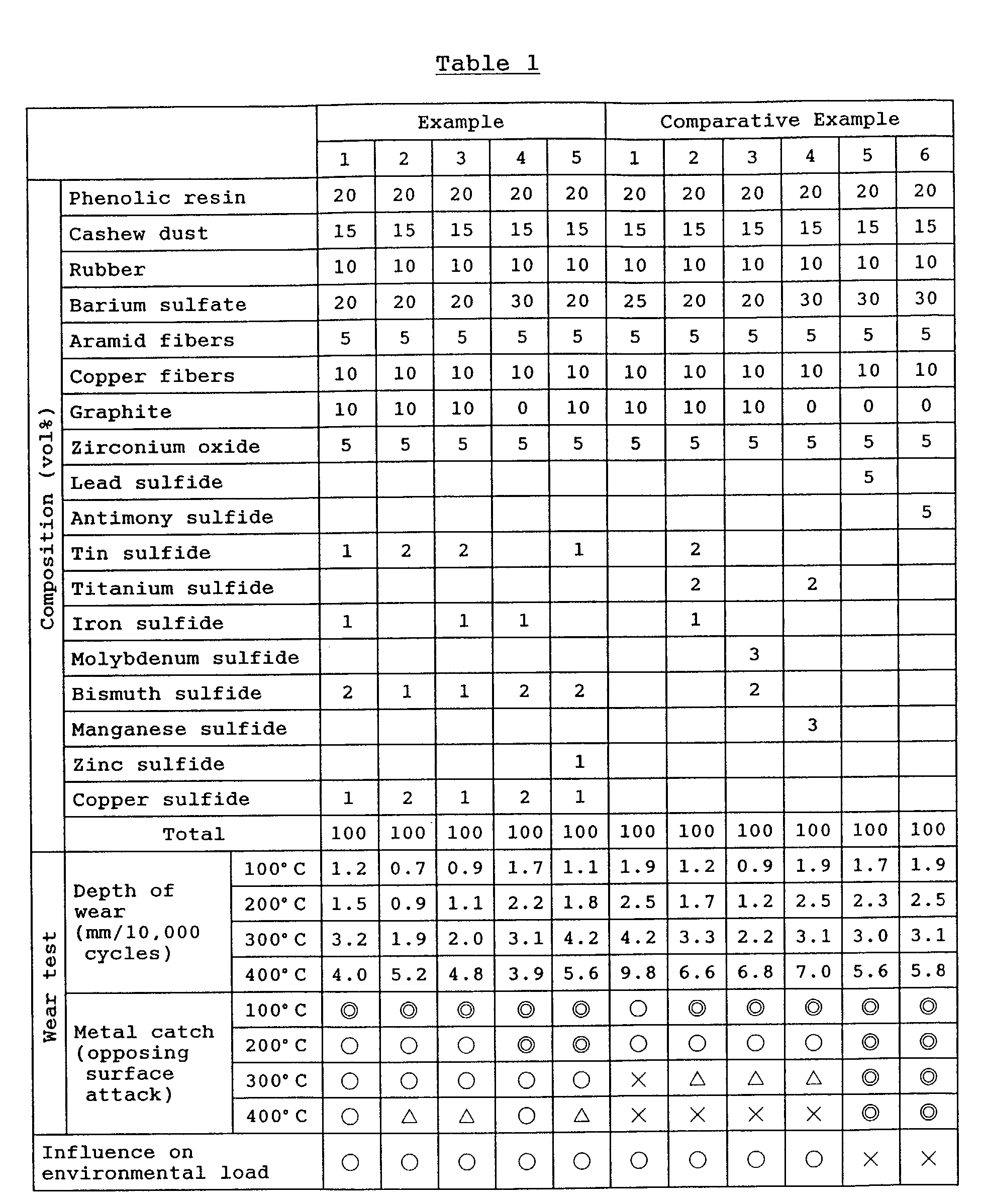
- Friction material compositions formulated as shown in Table 1 were uniformly blended in a Loedige mixer and preformed in a pressure mold under a pressure of 100 kg/cm 2 (98 ⁇ 10 5 Pa) for 1 minute.
- the preforms were molded for 10 minutes at a temperature of 160°C and a pressure of 250 kg/cm 2 (245 ⁇ 10 5 Pa), then postcured by 5 hours of heat treatment at 200°C, yielding friction members in each example.
- the friction members were examined for wear depth and metal catch (opposing surface attack) by the following tests. The results are shown in Table 1.
- the depth of wear in the friction member was measured under conditions: an initial braking speed of 50 km/h, a braking deceleration of 0.3 G, appropriate cycles of braking, and a brake temperature prior to braking of 100°C, 200°C, 300°C or 400°C.
- the depth of wear was converted to a depth of wear per 10,000 cycles of braking.
- the metal catch on the friction member was observed whenever the depth of wear at different temperature was measured.
- the member was rated according to the following criterion.
Landscapes
- Engineering & Computer Science (AREA)
- General Engineering & Computer Science (AREA)
- Mechanical Engineering (AREA)
- Chemical & Material Sciences (AREA)
- Materials Engineering (AREA)
- Organic Chemistry (AREA)
- Braking Arrangements (AREA)
- Compositions Of Macromolecular Compounds (AREA)
- Manufacture Of Macromolecular Shaped Articles (AREA)
Abstract
Description
- o○ =
- excellent: no metal catch
- ○ =
- good: a few small metal catches with less than 3 mm diameter
- Δ =
- acceptable: many small metal catches
- × =
- poor: large metal catches with
more than 5 mm diameter
Claims (6)
- A non-asbestos friction material made by molding and curing a composition comprising a fibrous base excluding asbestos, a binder and a filler, said composition further comprising at least three metal sulfides excluding titanium sulfide and complex metal sulfides, and being free of antimony and lead compounds.
- The non-asbestos friction material of claim 1 wherein the composition comprises at least three metal sulfides selected from the group consisting of zinc sulfide, copper sulfide, bismuth sulfide, tin sulfide, iron sulfide, manganese sulfide and molybdenum sulfide.
- The non-asbestos friction material of claim 2 wherein the composition comprises three or four metal sulfides selected from the group consisting of copper sulfide, bismuth sulfide, iron sulfide, and tin sulfide.
- A friction member comprising a friction material according to any preceding claim.
- A friction member according to claim 4 which is a disk pad, brake shoe or brake lining.
- A brakings assembly comprising a friction member according to claim 4 or claim 5, an opposing surface member comprising cast iron, and means for urging the friction member and the opposing surface member together so that the friction material contacts a cast iron surface of the surface member.
Applications Claiming Priority (2)
| Application Number | Priority Date | Filing Date | Title |
|---|---|---|---|
| JP2002122297A JP2003313312A (en) | 2002-04-24 | 2002-04-24 | Non-asbestos friction material |
| JP2002122297 | 2002-04-24 |
Publications (2)
| Publication Number | Publication Date |
|---|---|
| EP1357311A2 true EP1357311A2 (en) | 2003-10-29 |
| EP1357311A3 EP1357311A3 (en) | 2004-10-20 |
Family
ID=28786778
Family Applications (1)
| Application Number | Title | Priority Date | Filing Date |
|---|---|---|---|
| EP03252601A Withdrawn EP1357311A3 (en) | 2002-04-24 | 2003-04-24 | Non-asbestos friction materials |
Country Status (4)
| Country | Link |
|---|---|
| US (1) | US20030200898A1 (en) |
| EP (1) | EP1357311A3 (en) |
| JP (1) | JP2003313312A (en) |
| KR (1) | KR20030084659A (en) |
Cited By (3)
| Publication number | Priority date | Publication date | Assignee | Title |
|---|---|---|---|---|
| ES2249180A1 (en) * | 2004-09-14 | 2006-03-16 | Catalise Industria E Comercio De Metais Ltda. | Solid e.g. clutch and brake pads lubricant comprises a tin sulphide complex based on binary, tertiary and quaternary tin alloys, sulphur and an e.g. iron base |
| RU2364770C1 (en) * | 2007-12-17 | 2009-08-20 | Открытое акционерное общество "Термостойкие изделия и инженерные разработки" (ОАО "ТИИР") | Friction lining |
| CN105778403A (en) * | 2016-03-17 | 2016-07-20 | 西北工业大学 | Preparation method of fiber-reinforced curved-surface friction material |
Families Citing this family (13)
| Publication number | Priority date | Publication date | Assignee | Title |
|---|---|---|---|---|
| JP2004352813A (en) * | 2003-05-28 | 2004-12-16 | Nisshinbo Ind Inc | Friction material |
| JP2005281415A (en) * | 2004-03-29 | 2005-10-13 | Advics:Kk | Friction material |
| JP2009263577A (en) * | 2008-04-28 | 2009-11-12 | Akebono Brake Ind Co Ltd | Friction modifier, method of producing friction modifier, and friction material |
| JP5022990B2 (en) * | 2008-05-28 | 2012-09-12 | 日信工業株式会社 | Non-asbestos friction material |
| JP2010090334A (en) * | 2008-10-10 | 2010-04-22 | Toyota Motor Corp | Friction pair |
| WO2012169545A1 (en) | 2011-06-07 | 2012-12-13 | 日立化成工業株式会社 | Non-asbestos friction material composition |
| RU2570515C2 (en) * | 2011-08-18 | 2015-12-10 | Федерал-Могал Корпорейшн | Friction material for making of brake, brake shoe and method of its fabrication |
| US9404546B2 (en) | 2014-06-18 | 2016-08-02 | Robert Bosch Gmbh | Copper free friction material composition |
| US10233988B2 (en) | 2015-09-23 | 2019-03-19 | Akebono Brake Industry Co., Ltd | Friction material |
| AT517893A1 (en) * | 2015-10-20 | 2017-05-15 | Tribotecc Gmbh | Tribological material |
| KR101878055B1 (en) * | 2016-09-01 | 2018-07-16 | 현대자동차주식회사 | Metallic friction material for brake pad |
| DE102017130491A1 (en) * | 2017-12-19 | 2019-06-19 | Federal-Mogul Friction Products Gmbh | Hybrid friction lining material and brake linings produced therefrom and method for their production |
| WO2020255279A1 (en) * | 2019-06-19 | 2020-12-24 | 昭和電工マテリアルズ株式会社 | Friction member, friction material composition, friction material, and vehicle |
Family Cites Families (8)
| Publication number | Priority date | Publication date | Assignee | Title |
|---|---|---|---|---|
| US4130492A (en) * | 1978-01-16 | 1978-12-19 | Exxon Research & Engineering Co. | MXY3 solid lubricants |
| FR2407986A1 (en) * | 1977-11-07 | 1979-06-01 | Stephanois Rech Meca Hy Centre | ANTIFRICTION ALLOY AND ITS MANUFACTURING PROCESS |
| JPS5773065A (en) * | 1980-10-24 | 1982-05-07 | Toyota Motor Corp | Frictional material for brake |
| AT396365B (en) * | 1991-01-28 | 1993-08-25 | Chemson Polymer Additive | ADDITIONAL FOR FRICTION COATING MIXTURES CONTAINING MANGANE-II SULFIDE |
| JPH0586356A (en) * | 1991-09-30 | 1993-04-06 | Hitachi Chem Co Ltd | Friction material composition |
| US6220405B1 (en) * | 1997-07-02 | 2001-04-24 | Alliedsignal Inc. | Friction material for drum-in-hat disc brake assembly |
| US6228815B1 (en) * | 1999-06-29 | 2001-05-08 | Alliedsignal Inc. | Solid lubricants containing bismuth sulfide for use in friction lining |
| JP2002226834A (en) * | 2001-01-30 | 2002-08-14 | Nisshinbo Ind Inc | Non-asbestos friction material |
-
2002
- 2002-04-24 JP JP2002122297A patent/JP2003313312A/en active Pending
-
2003
- 2003-04-22 KR KR10-2003-0025337A patent/KR20030084659A/en not_active Withdrawn
- 2003-04-24 EP EP03252601A patent/EP1357311A3/en not_active Withdrawn
- 2003-04-24 US US10/421,698 patent/US20030200898A1/en not_active Abandoned
Cited By (5)
| Publication number | Priority date | Publication date | Assignee | Title |
|---|---|---|---|---|
| ES2249180A1 (en) * | 2004-09-14 | 2006-03-16 | Catalise Industria E Comercio De Metais Ltda. | Solid e.g. clutch and brake pads lubricant comprises a tin sulphide complex based on binary, tertiary and quaternary tin alloys, sulphur and an e.g. iron base |
| ES2249180B1 (en) * | 2004-09-14 | 2006-12-01 | Catalise Industria E Comercio De Metais Ltda. | SOLID LUBRICANT FOR FRICTION LININGS AND ITS MANUFACTURING PROCESS. |
| RU2364770C1 (en) * | 2007-12-17 | 2009-08-20 | Открытое акционерное общество "Термостойкие изделия и инженерные разработки" (ОАО "ТИИР") | Friction lining |
| CN105778403A (en) * | 2016-03-17 | 2016-07-20 | 西北工业大学 | Preparation method of fiber-reinforced curved-surface friction material |
| CN105778403B (en) * | 2016-03-17 | 2018-04-06 | 西北工业大学 | The preparation method of fiber reinforcement curved surface friction material |
Also Published As
| Publication number | Publication date |
|---|---|
| JP2003313312A (en) | 2003-11-06 |
| EP1357311A3 (en) | 2004-10-20 |
| KR20030084659A (en) | 2003-11-01 |
| US20030200898A1 (en) | 2003-10-30 |
Similar Documents
| Publication | Publication Date | Title |
|---|---|---|
| KR100858482B1 (en) | Non-asbestos friction material | |
| EP2641956B1 (en) | Non-asbestos friction-material composition, and friction material and friction member using same | |
| KR101837221B1 (en) | Non-asbestos friction material composition, and friction material and friction member using same | |
| US9441693B2 (en) | Non-asbestos friction material composition, and friction material and friction member using same | |
| EP1194705B1 (en) | Solid lubricants containing bismuth sulfide for use in friction linings | |
| US6413622B1 (en) | Non-asbestos friction materials | |
| EP1357311A2 (en) | Non-asbestos friction materials | |
| US20040241429A1 (en) | Friction material | |
| US20020137815A1 (en) | Non-asbestos friction material | |
| US20010025064A1 (en) | Non-asbestos friction materials | |
| EP1482204B1 (en) | Friction material | |
| JP2003238700A (en) | Non-asbestos friction material | |
| EP1273819A2 (en) | Non-asbestos friction material | |
| JP5446087B2 (en) | Friction material | |
| US20030068488A1 (en) | Non-asbestos friction material | |
| US20010027073A1 (en) | Non-asbestos friction materials | |
| US20020132877A1 (en) | Non-asbestos friction materials | |
| JP3553629B2 (en) | Friction material | |
| KR101041031B1 (en) | Fused friction material and vehicle brake including the same |
Legal Events
| Date | Code | Title | Description |
|---|---|---|---|
| PUAI | Public reference made under article 153(3) epc to a published international application that has entered the european phase |
Free format text: ORIGINAL CODE: 0009012 |
|
| AK | Designated contracting states |
Kind code of ref document: A2 Designated state(s): AT BE BG CH CY CZ DE DK EE ES FI FR GB GR HU IE IT LI LU MC NL PT RO SE SI SK TR |
|
| AX | Request for extension of the european patent |
Extension state: AL LT LV MK |
|
| PUAL | Search report despatched |
Free format text: ORIGINAL CODE: 0009013 |
|
| AK | Designated contracting states |
Kind code of ref document: A3 Designated state(s): AT BE BG CH CY CZ DE DK EE ES FI FR GB GR HU IE IT LI LU MC NL PT RO SE SI SK TR |
|
| AX | Request for extension of the european patent |
Extension state: AL LT LV MK |
|
| RIC1 | Information provided on ipc code assigned before grant |
Ipc: 7C 10M 7/00 B Ipc: 7F 16D 69/02 A |
|
| 17P | Request for examination filed |
Effective date: 20050128 |
|
| AKX | Designation fees paid |
Designated state(s): DE FR GB |
|
| STAA | Information on the status of an ep patent application or granted ep patent |
Free format text: STATUS: THE APPLICATION HAS BEEN WITHDRAWN |
|
| 18W | Application withdrawn |
Effective date: 20080215 |