EP1355456A1 - FlexRay communication protocol - Google Patents
FlexRay communication protocol Download PDFInfo
- Publication number
- EP1355456A1 EP1355456A1 EP02008171A EP02008171A EP1355456A1 EP 1355456 A1 EP1355456 A1 EP 1355456A1 EP 02008171 A EP02008171 A EP 02008171A EP 02008171 A EP02008171 A EP 02008171A EP 1355456 A1 EP1355456 A1 EP 1355456A1
- Authority
- EP
- European Patent Office
- Prior art keywords
- frame
- node
- communication
- cycle
- req
- Prior art date
- Legal status (The legal status is an assumption and is not a legal conclusion. Google has not performed a legal analysis and makes no representation as to the accuracy of the status listed.)
- Withdrawn
Links
- 238000004891 communication Methods 0.000 title claims abstract description 551
- 230000003068 static effect Effects 0.000 claims abstract description 215
- 238000000034 method Methods 0.000 claims abstract description 79
- 238000004590 computer program Methods 0.000 claims abstract 4
- 108091006146 Channels Proteins 0.000 description 255
- 238000012937 correction Methods 0.000 description 240
- 239000000872 buffer Substances 0.000 description 162
- 239000013598 vector Substances 0.000 description 90
- 230000005540 biological transmission Effects 0.000 description 85
- 230000007246 mechanism Effects 0.000 description 78
- 238000005259 measurement Methods 0.000 description 63
- 230000007704 transition Effects 0.000 description 50
- 230000000694 effects Effects 0.000 description 49
- 238000001914 filtration Methods 0.000 description 46
- 230000001360 synchronised effect Effects 0.000 description 44
- 238000004422 calculation algorithm Methods 0.000 description 36
- 230000003287 optical effect Effects 0.000 description 35
- 238000001514 detection method Methods 0.000 description 32
- 230000006399 behavior Effects 0.000 description 27
- 238000003745 diagnosis Methods 0.000 description 27
- 238000004364 calculation method Methods 0.000 description 26
- 238000010586 diagram Methods 0.000 description 23
- 230000010354 integration Effects 0.000 description 23
- 230000006870 function Effects 0.000 description 18
- 230000009977 dual effect Effects 0.000 description 17
- 230000008569 process Effects 0.000 description 17
- 238000012546 transfer Methods 0.000 description 16
- 230000003247 decreasing effect Effects 0.000 description 15
- 238000007726 management method Methods 0.000 description 15
- 230000008859 change Effects 0.000 description 14
- 230000001960 triggered effect Effects 0.000 description 12
- 238000012544 monitoring process Methods 0.000 description 10
- 230000000873 masking effect Effects 0.000 description 9
- 125000004122 cyclic group Chemical group 0.000 description 8
- 230000000737 periodic effect Effects 0.000 description 8
- 230000011664 signaling Effects 0.000 description 8
- 230000001934 delay Effects 0.000 description 7
- 238000013461 design Methods 0.000 description 7
- 239000011159 matrix material Substances 0.000 description 7
- 238000005070 sampling Methods 0.000 description 7
- 238000010200 validation analysis Methods 0.000 description 7
- 238000004806 packaging method and process Methods 0.000 description 6
- 230000006833 reintegration Effects 0.000 description 6
- 230000004044 response Effects 0.000 description 6
- 238000013459 approach Methods 0.000 description 5
- 230000001174 ascending effect Effects 0.000 description 5
- 238000012790 confirmation Methods 0.000 description 5
- 238000003708 edge detection Methods 0.000 description 5
- 238000012986 modification Methods 0.000 description 5
- 230000004048 modification Effects 0.000 description 5
- 230000000630 rising effect Effects 0.000 description 5
- 238000012360 testing method Methods 0.000 description 5
- 230000008901 benefit Effects 0.000 description 4
- 239000012634 fragment Substances 0.000 description 4
- 230000000977 initiatory effect Effects 0.000 description 4
- 230000002829 reductive effect Effects 0.000 description 4
- 239000013078 crystal Substances 0.000 description 3
- 238000013016 damping Methods 0.000 description 3
- 238000009826 distribution Methods 0.000 description 3
- 101100110009 Caenorhabditis elegans asd-2 gene Proteins 0.000 description 2
- 230000006978 adaptation Effects 0.000 description 2
- 230000015572 biosynthetic process Effects 0.000 description 2
- 230000001419 dependent effect Effects 0.000 description 2
- 230000003993 interaction Effects 0.000 description 2
- 238000000691 measurement method Methods 0.000 description 2
- 239000000203 mixture Substances 0.000 description 2
- 239000010453 quartz Substances 0.000 description 2
- 238000011084 recovery Methods 0.000 description 2
- 230000002441 reversible effect Effects 0.000 description 2
- VYPSYNLAJGMNEJ-UHFFFAOYSA-N silicon dioxide Inorganic materials O=[Si]=O VYPSYNLAJGMNEJ-UHFFFAOYSA-N 0.000 description 2
- 230000002269 spontaneous effect Effects 0.000 description 2
- 230000002123 temporal effect Effects 0.000 description 2
- 101710201354 Metallothionein A Proteins 0.000 description 1
- 101710094503 Metallothionein-1 Proteins 0.000 description 1
- 235000015429 Mirabilis expansa Nutrition 0.000 description 1
- 244000294411 Mirabilis expansa Species 0.000 description 1
- 238000009825 accumulation Methods 0.000 description 1
- 230000009471 action Effects 0.000 description 1
- 230000015556 catabolic process Effects 0.000 description 1
- 239000000919 ceramic Substances 0.000 description 1
- 238000006243 chemical reaction Methods 0.000 description 1
- 239000003795 chemical substances by application Substances 0.000 description 1
- 239000003086 colorant Substances 0.000 description 1
- 239000012141 concentrate Substances 0.000 description 1
- 238000005520 cutting process Methods 0.000 description 1
- 230000009849 deactivation Effects 0.000 description 1
- 230000007423 decrease Effects 0.000 description 1
- 230000007547 defect Effects 0.000 description 1
- 238000006731 degradation reaction Methods 0.000 description 1
- 238000012217 deletion Methods 0.000 description 1
- 230000037430 deletion Effects 0.000 description 1
- 230000014155 detection of activity Effects 0.000 description 1
- 230000006866 deterioration Effects 0.000 description 1
- 238000011161 development Methods 0.000 description 1
- 238000002592 echocardiography Methods 0.000 description 1
- 238000011156 evaluation Methods 0.000 description 1
- 238000009432 framing Methods 0.000 description 1
- 230000036039 immunity Effects 0.000 description 1
- 230000002401 inhibitory effect Effects 0.000 description 1
- 230000034184 interaction with host Effects 0.000 description 1
- 238000011835 investigation Methods 0.000 description 1
- 230000000670 limiting effect Effects 0.000 description 1
- 238000004519 manufacturing process Methods 0.000 description 1
- 235000013536 miso Nutrition 0.000 description 1
- 239000013307 optical fiber Substances 0.000 description 1
- 230000008520 organization Effects 0.000 description 1
- 230000036961 partial effect Effects 0.000 description 1
- 238000012913 prioritisation Methods 0.000 description 1
- 238000012545 processing Methods 0.000 description 1
- 239000000047 product Substances 0.000 description 1
- 230000001902 propagating effect Effects 0.000 description 1
- 238000012797 qualification Methods 0.000 description 1
- 238000001303 quality assessment method Methods 0.000 description 1
- 230000007420 reactivation Effects 0.000 description 1
- 230000000717 retained effect Effects 0.000 description 1
- 238000000926 separation method Methods 0.000 description 1
- 229910052710 silicon Inorganic materials 0.000 description 1
- 239000010703 silicon Substances 0.000 description 1
- 238000004088 simulation Methods 0.000 description 1
- 238000000638 solvent extraction Methods 0.000 description 1
- 239000013589 supplement Substances 0.000 description 1
- 230000008093 supporting effect Effects 0.000 description 1
- 230000001052 transient effect Effects 0.000 description 1
- 238000009827 uniform distribution Methods 0.000 description 1
- 230000002618 waking effect Effects 0.000 description 1
Images














Classifications
-
- H—ELECTRICITY
- H04—ELECTRIC COMMUNICATION TECHNIQUE
- H04L—TRANSMISSION OF DIGITAL INFORMATION, e.g. TELEGRAPHIC COMMUNICATION
- H04L12/00—Data switching networks
- H04L12/28—Data switching networks characterised by path configuration, e.g. LAN [Local Area Networks] or WAN [Wide Area Networks]
- H04L12/44—Star or tree networks
-
- H—ELECTRICITY
- H03—ELECTRONIC CIRCUITRY
- H03M—CODING; DECODING; CODE CONVERSION IN GENERAL
- H03M13/00—Coding, decoding or code conversion, for error detection or error correction; Coding theory basic assumptions; Coding bounds; Error probability evaluation methods; Channel models; Simulation or testing of codes
- H03M13/37—Decoding methods or techniques, not specific to the particular type of coding provided for in groups H03M13/03 - H03M13/35
- H03M13/43—Majority logic or threshold decoding
-
- H—ELECTRICITY
- H04—ELECTRIC COMMUNICATION TECHNIQUE
- H04L—TRANSMISSION OF DIGITAL INFORMATION, e.g. TELEGRAPHIC COMMUNICATION
- H04L12/00—Data switching networks
- H04L12/64—Hybrid switching systems
- H04L12/6418—Hybrid transport
-
- H—ELECTRICITY
- H03—ELECTRONIC CIRCUITRY
- H03M—CODING; DECODING; CODE CONVERSION IN GENERAL
- H03M13/00—Coding, decoding or code conversion, for error detection or error correction; Coding theory basic assumptions; Coding bounds; Error probability evaluation methods; Channel models; Simulation or testing of codes
- H03M13/03—Error detection or forward error correction by redundancy in data representation, i.e. code words containing more digits than the source words
- H03M13/05—Error detection or forward error correction by redundancy in data representation, i.e. code words containing more digits than the source words using block codes, i.e. a predetermined number of check bits joined to a predetermined number of information bits
- H03M13/09—Error detection only, e.g. using cyclic redundancy check [CRC] codes or single parity bit
-
- H—ELECTRICITY
- H04—ELECTRIC COMMUNICATION TECHNIQUE
- H04J—MULTIPLEX COMMUNICATION
- H04J3/00—Time-division multiplex systems
- H04J3/02—Details
- H04J3/06—Synchronising arrangements
- H04J3/0635—Clock or time synchronisation in a network
- H04J3/0638—Clock or time synchronisation among nodes; Internode synchronisation
- H04J3/0652—Synchronisation among time division multiple access [TDMA] nodes, e.g. time triggered protocol [TTP]
-
- H—ELECTRICITY
- H04—ELECTRIC COMMUNICATION TECHNIQUE
- H04L—TRANSMISSION OF DIGITAL INFORMATION, e.g. TELEGRAPHIC COMMUNICATION
- H04L12/00—Data switching networks
- H04L12/28—Data switching networks characterised by path configuration, e.g. LAN [Local Area Networks] or WAN [Wide Area Networks]
- H04L12/40—Bus networks
- H04L2012/40208—Bus networks characterized by the use of a particular bus standard
- H04L2012/40241—Flexray
-
- H—ELECTRICITY
- H04—ELECTRIC COMMUNICATION TECHNIQUE
- H04L—TRANSMISSION OF DIGITAL INFORMATION, e.g. TELEGRAPHIC COMMUNICATION
- H04L12/00—Data switching networks
- H04L12/64—Hybrid switching systems
- H04L12/6418—Hybrid transport
- H04L2012/6432—Topology
- H04L2012/6435—Bus
-
- H—ELECTRICITY
- H04—ELECTRIC COMMUNICATION TECHNIQUE
- H04L—TRANSMISSION OF DIGITAL INFORMATION, e.g. TELEGRAPHIC COMMUNICATION
- H04L12/00—Data switching networks
- H04L12/64—Hybrid switching systems
- H04L12/6418—Hybrid transport
- H04L2012/6432—Topology
- H04L2012/644—Star
-
- H—ELECTRICITY
- H04—ELECTRIC COMMUNICATION TECHNIQUE
- H04L—TRANSMISSION OF DIGITAL INFORMATION, e.g. TELEGRAPHIC COMMUNICATION
- H04L12/00—Data switching networks
- H04L12/64—Hybrid switching systems
- H04L12/6418—Hybrid transport
- H04L2012/6445—Admission control
- H04L2012/6459—Multiplexing, e.g. TDMA, CDMA
Definitions
- the communication protocol for the dependable automotive network described in this document has the following properties:
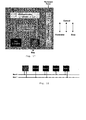
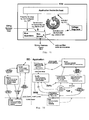
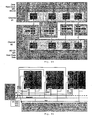
- FIG. 2 shows the architecture of a node (ECU). Every node consists of the five sub-components host, communication controller, bus guardian, bus driver, and power supply. This specification describes the requirements for the communication controller, the bus guardian, the bus driver and the interfaces to the host and the power supply. Two implementations for the communication controller are possible, one configuration of a communication controller that sends and receives on two redundant physical channels, and a second configuration which is solely connected to one physical channel.
- FIG 3 shows the possible topology configuration of the communication network.
- a node can either be connected to both channels 1 and 2 (node A, C, and E) or only channel 1 (node B) or only channel 2 (node D).
- a configuration, where all nodes are connected by 1 channel only is also possible.
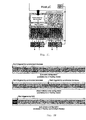
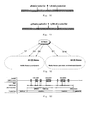
- Communication is done in a communication cycle consisting of a static and a dynamic segment, where each of the segments may be empty.
- the first frame ID in a system with a static segment is ID number 1 (see Figure 4).
- the sending slots are represented through the ID numbers that are the same on both channels.
- the sending slots are used deterministically (in a pre-defined TDMA strategy) in the static segment.
- the dynamic segment there can be differences in the phase on the two channels (see Figure 4). Nodes that are connected to both channels send their frames in the static segment simultaneously on both channels. Two nodes, that are connected to one channel only, but not the same channel, may share a slot in the static segment.
- nodes can participate that send frames, which are received by all other nodes (e.g., node A, C and E in Figure 3). All nodes execute the clock synchronization algorithm, but only the frames of the static segment are considered. It is possible to send different data in the same sending slot on different channels.
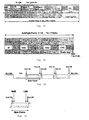
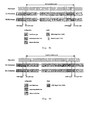
- Figure 7 shows the FlexRay frame format
- Figure 8 shows the byteflight frame format.
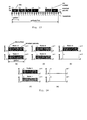
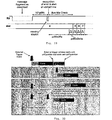
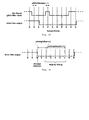
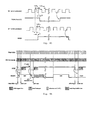
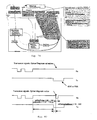
- Figure 9 shows the transmission of the start sequence. Due to certain effects in the optical transmission, it is possible for the start sequence to be become shorter or longer during optical transmission. This is why the receiver accepts start sequences in the region of 1-9 logical "0" bits. This is illustrated by the following diagram in Figure 10 .
- Figure 10 shows the reception of the start sequence.
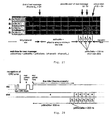
- Figure 11 shows the frame format for electrical transmission.
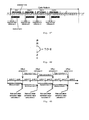
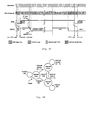
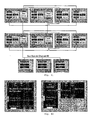
- Figure 12 shows an example of a topology of a FlexRay network using active stars.
- Figure 13 shows an example of a topology of a FlexRay network using a passive bus.
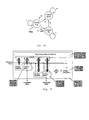
- Figure 14 shows an example of a topology of a FlexRay network using an active star combined with a passive bus.
- Each node must adhere to the following requirements:
- Figure 15 shows a block chart of a FlexRay node. Each active star must adhere to the following requirements:
- Figure 16 shows a block chart of an electrical active star.
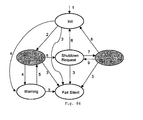
- the chapter summarises the requirements on the communication controller and the bus driver to run an ECU in several modes.
- the bus driver has to support several states or operating modes:
- the communication system and its components shall offer adequate error management mechanisms to deal with faults arising from the following levels:
- the following faults have at least to be detected by the communication controller:
- CONTROLLER_MAX 64 Maximum number of controllers connected to one communication channel. CYCLE_LENGTH_MIN 250 ⁇ s Minimum length of the configurable communication cycle. CYCLE_LENGTH_MAX 64 ms Maximum length of the configurable communication cycle. DATA_BYTES_MAX 246 Maximum number of data bytes. DYNAMIC_IDS 4095 Maximum number of dynamic identifiers. STATIC_SLOTS_MIN 2 Minimum number of static slots in a static segment of a communication cycle STATIC_SLOTS_MAX 4095 Maximum number of static slots in a static segment of a communication cycle
- the owner of the PWD is the FlexRay consortium. Members are BMW, DaimlerChrysler, Philips, Bosch, General Motors and Motorola. All of these companies deliver input to the appendix but only one editor (Motorola) handles the inclusion in the document.
- gName Global Parameter parameter which must have the same value in all nodes in a cluster, is initialized during soft reset, can only be changed during soft reset
- pName Local Parameter parameter which may differ in nodes of a cluster, is initialized during soft reset, can only be changed during soft reset
- fName-variables are set in the transmitter node and read in the receiver node
- xdName Time Duration value (variable, parameter, etc.) describing a time duration, time between two time points xtName Time value (variable, constant, etc.) describing a instant xsName Set set of values (variables, parameters, etc.)
- x stands for one of c, v, g, or p
- a network can be configured as a single-channel or dual-channel bus network, a single-channel or dual-channel star network.
- Figure 18 shows the possible topology configuration of the communication network as a dual bus.
- a node can either be connected to both channels 0 and 1 (nodes A, C, and E), only to channel 0 (node D) or only to channel 1 (node B).
- the FlexRay communication network can also be a single bus. In this case, all nodes are connected to this bus.
- a FlexRay communication network can be built as a multiple star topology. Similar to the bus topology, the multiple star topology can be set up redundantly. Each network channel must be free of closed rings, and there may only be 1 up to cStarCouplersMax sequentially connected (cascaded) star couplers (the total number of star couplers may be more than cStarCouplersMax if there are branches in the network). Each network line between communication node and the star coupler or between two star couplers represents a properly terminated point-to-point connection. The incoming signal received by the star coupler is actively driven to all communication nodes Figure 19 shows a single redundant star coupler configuration
- OpenTopic We assume that the star coupler drives all connected nodes and star couplers except the reception line. Also we assume that one a line erroneously driven by the star coupler and another instance will show a signal causing an encoding error in any case. We assume that other lines driven by the star coupler are not affected by such a conflict.
- Figure 20 shows a single channel network with three star couplers.
- FIG. 19 The configuration of a single redundant star network is shown in Figure 19 .
- the logical structure of this topology is identical with the logical bus structure shown in Figure 18 .
- a topology which has a single non-redundant star, which has the logical bus structure of the single bus mentioned above, is also possible.
- Figure 20 shows a single channel network built with three star couplers. Each node has a point-to-point-connection to one of the three star couplers. Two of the star couplers (No. 1 and 3) are directly connected to the third star coupler (No. 2).
- Open Topic Open topic: For the modeling project it is assumed that all connections of a star coupler are set up for reception per default. When the first bits (this time is called “configuration setup delay" and is configurable in the model) of a Frame Start sequence are detected on one receive line this causes the other receive lines to be reconfigured for transmission. A sequence of correctly encoded bits is assumed to cause this reconfiguration, though (pessimistic assumption). Noise does not cause this reconfiguration. If the condition for this reconfiguration is observed on two or more receive lines within a time window of 1 gdBit the star coupler generates a signal with illegal encoding on all other lines that will then be reconfigured as transmit lines. Actually in the model the same signal is generated like for a bus with overlapping frames. This reconfiguration remains until an idle signal is recognized on (all) the receive line(s). As soon as this is recognized all lines are reset to the default configuration.
- the point-to-point connection defines the minimum Frame Start sequence and so does make sense to include it in this table.
- Open Topic needs to be clarified, but probably isn't due to the different optical device characteristics.
- Detection Events detailed in Table 6 actually means 'Detectors' i.e. in a point to point or broadcast bus topology, there is only one detector - the receiving node - and no portion of the FSS is consumed, in a single star network, there are two detectors - star-coupler and receiving node - and the first of those will consume part of the Frame Start sequence, and so on.
- the point-to-point connection defines the minimum FSS.
- Maximum Frame Start Sequence Durations wrt Network Topology Network Topology Detection Events Frame Start Sequence [ns] e.g. number of gdBit @ 10 Mbps Point to point/Bus 1 200 2 Single Star 2 400 4 2 Cascaded Star Couplers (not supported FPGA V4) 3 600 6 3 Cascaded Star Couplers (not supported FPGA V4) 4 800 8
- Figure 21 shows an example of the architecture of a node. Every node consists of the four sub-components host, communication controller, bus guardian and physical driver. The sub-components may be discrete, or certain combinations of them may be integrated together e.g. bus guardian and physical layer (as shown) and host and communications controller.
- FlexRay media access is performed within a periodically recurring communication cycle.
- the structure of this communication cycle is described in this section.
- FlexRay offers the choice of two media access schemes. These are
- each segment is configurable.
- a pure static mode, a mixed mode containing a static as well as a dynamic scheme and a pure dynamic mode may be configured.
- Section "Static Segment (TDMA Access)" of the specification focuses on the static TDMA scheme and Section "Dynamic Segment” covers the dynamic mini-slotting based scheme.
- the FlexRay protocol offers the option of implementing clusters with a single communication channel (channel A only) or with dual communication channels (channel A and channel B).
- a dual channel cluster the channels are synchronized to one another.
- nodes may be connected to either one or both of the communication channels.
- Dual channel systems support nodes connected to only one of the communications channels of the cluster.
- Such single channel nodes can be connected to either channel A or channel B.
- the communication cycle is the fundamental element of the media access scheme within FlexRay.
- the communication cycle consists of a combination of two segments: a static segment and a dynamic segment.
- the communication cycle contains a static segment in
- TDMA Time Division Multiple Access
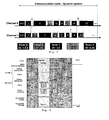
- Figure 23 shows the transmission slot layout within the static segment of the communication cycle.
- Figure 24 shows the basic media access patterns for two channels. (add explanation of figure here)
- Receive buffers are only updated in Normal Mode; receive buffers are not updated during startup.
- the communication cycle contains a dynamic segment in
- FTDMA time-division multiple access
- each node is engaged in one of three activities: waiting for a minislot in which it will transmit a frame, frame transmission, or monitoring channel activity and frame reception. These are described subsequently. Note that the following activities are performed independently for each communication channel.
- the dynamic segment terminates if either of the following two conditions is met:
- Receive buffers are only updated in Normal Mode; receive buffers are not updated during startup.
- Figure 25 shows distributed synchronized slot counters of nodes A and B.
- Node A sends the ID's 2, 4 and 5.
- Node B sends the ID's 1 and 3.
- the slot counters switch the value to 1 in all nodes - in this case, node B, since it has a transmit request for Frame ID 1, starts transmitting. If a node recognizes a bus activity, e.g.
- Bus activity detection is performed after the glitch filter. Bus activity is detected if at least one period of gdBit is recognized as bus active (The 1 * gdBit period of activity is equivalent to the minimum duration of the Frame Start Sequence). For a 2-State physical layer, bus activity equals the logical '0' level. For a 3-state physical layer, bus activity equals either a logical '0' or a logical '1' with the RX_enable signal active.
- Figure 26 shows the calculation of vdWaitTime after DCT.
- All slot counters in transmit slot 1 have a value of 1.
- the slot counters are incremented by one.
- Frame IDs 2 and 3 are now able to transmit. However, in this communication cycle no transmissions take place because there is no transmit request for these two frames.
- node B which in this case has a transmit request for Frame ID 4, starts transmitting.
- the following diagrams are intended to explain the waiting time calculation after frame format errors. They all show the reception line (RX) and the slot counter (referred to as slot) of a node.
- Figure 28 shows the slot counter after a frame format error, in particular an example of a CRC error detected in the last CRC byte on a 2-State physical layer.
- the wait time vdWaitTime is started (at least hypothetically). Since activity is again detected on the bus before the slot counter is incremented, the wait time vdWaitTime is started again at the next ascending flank. In this case the time ( pdWx0Rx + pdWxDelta ) elapses without any further bus activity and the slot counter is increased by one. Transmitting and receiving is now possible again starting with slot 5.
- Figure 29 shows an example of what happens when the receiving device is able to detect an error some time after the last ascending flank of the error or of the frame fragment (slot counter after frame fragments). This is the case, for example, when using a optical physical layer with NRZ coding, if the receiving device expects the size of the frame (byteflight frame format) to be larger than it actually is because of a bit error in the data length field of the frame. The error can only be detected with the last missing stop bit, which is 10 * gdBit after the last rising flank. The same effect occurs if a frame fragment that looks like a valid Frame Start Sequence is detected on the receiving line. A format or coding error can only be discovered 10 * gdBit after the ascending flank because the frame fragment is accepted as a valid Frame Start Sequence and is only detected due to the missing stop bit.
- the waiting time vdWaitTime begins as soon as the error is detectable and the receive line has reached the bus inactive state.
- the duration of the network idle time is denoted gdNIT .
- the parameter gdNIT depends on the signal propagation delay, the clock synchronization execution time, and an additional time period that ensures the ability of a node to properly handle the reception of a frame that starts up to 0.5 * gdSlot before the first slot of the cycle begins.
- At least 2 static communication slots must be configured.
- At least 2 synchronization frames must be exchanged.
- the communication cycle contains the static segment, the dynamic segment and the network idle time.
- Some physical layers generate echoes of signals transmitted by the communication controller which may be seen with a certain delay on the Rx Input of the communication controller's receiver. For example, this may happen if a communication controller is connected directly to an electrical star without using a bus driver device or if the physical layer device features a loop back function which causes a significant delay (at least 0.5 * gdBit ).
- the Rx Pin should not be evaluated for that purpose during pdWx0Tx after the transmission of a message or a SOC symbol has ended.
- Figure 30 shows an externally triggered SOC.
- VdWaitTime calculation is based on uncorrected Microticks (V5). If a controller supports corrected microticks the parameter pdWxDelta could be minimized.
- This chapter describes the supported frame, symbol, and packet formats used by the FlexRay protocol.
- the first section focuses on the frame and symbol formats, the second section describes the packet format and the subsequent section describes the coding schemes.
- frame, packet and encoded packet is such that the frame is embedded in a packet before it is coded for the physical layer. This separation decouples the frame format from the format required on the physical layer. This decoupling allows the FlexRay protocol to make use of different physical layers that require distinct coding methods.
- the FlexRay protocol supports two distinct frame formats:
- All controllers in a cluster must be configured to use the same frame format. Specifically, a system in which some controllers use the FlexRay frame format while other controllers use the byteflight frame format is not a valid system configuration.
- the FlexRay frame format may be used for systems with pure static, pure dynamic, and mixed (static plus dynamic) media access methods.
- the byteflight frame format may only be used in systems operating in byteflight compatibility mode.
- Both frame formats contain a header segment, a payload segment and a trailer segment, each of which contains specific fields.
- the FlexRay protocol makes use of four distinct symbols. These symbols exist outside of the normal frame/packet formats.
- the FlexRay symbols are:
- the frame shall be transmitted on the network such that the header segment appears first, followed by the payload segment, and then followed by the trailer segment, which is transmitted last.
- the FlexRay header segment consists of 5 bytes that contain several distinct fields; two fields of reserved bits, the Frame ID, a Payload Length field, a Sync Bit, a Header CRC field, a Data Update Bit, and a Cycle Counter field. These fields are described in detail in the following sections.
- the fields shall be transmitted in the order indicated in Figure 31, moving from left to right (i.e., the Reserved 1 field is transmitted first and the Cycle Counter field is transmitted last).
- the Reserved 1 field shall be transmitted such that most significant bit of fAcknowLength is transmitted first.
- FPGA V5 does not support acknowledgement vectors.
- This field consists of two bits that are reserved for future protocol use. These bits shall not be used by the application.
- the Reserved 2 field shall be transmitted with both bits set to logical '0'. As the bits are identical, transmission order is not defined.
- This field contains the Frame Identifier for the frame.
- Each frame that may be transmitted in a cluster has a frame ID fFrameID assigned.
- the frame ID fFrameID is a unique number per communication channel per communication cycle and defines the slot in which the frame is transmitted
- Valid values for fFrameID range from (0000 0000 0001) 2 to (1111 1111 1111) 2 .
- the Frame ID field shall be transmitted such that the most significant bit of fFrameID is transmitted first with the remaining bits of fFrameID being transmitted in decreasing order of significance.
- Payload Length (7 bits - fPayloadLength )
- the payload length field does not include the number of bytes within the header and the trailer segments of the FlexRay frame.
- the maximum payload length is cPayloadLengthMax , which corresponds to a payload segment containing 2 * cPayloadLengthMax bytes.
- the payload field shall be less than or equal to the maximum payload length: fPayloadLength ⁇ cPayloadLengthMax .
- the payload length fPayloadLength may be different for different frames in the dynamic segment of a communication cycle.
- the payload length of a specific dynamic segment frame may vary from cycle to cycle.
- the payload lengths of a specific dynamic segment frame may be different on each configured channel. All dynamic segment frames, however, shall have 0 ⁇ fPayloadLength ⁇ cPayloadLengthMax.
- the Payload Length field shall be transmitted such that the most significant bit of fPayloadLength is transmitted first with the remaining bits of fPayloadLength being transmitted in decreasing order of significance.
- the sync bit fSyncBit determines whether the frame is to be used for clock synchronization.
- a node If a node transmits a given frame on more than one channel it shall set fSyncBit to the same value on each channel.
- Header CRC (9 bits - fHeaderCRC )
- the Header CRC field contains a Cyclic Redundancy Check code (CRC) computed over the Payload Length and Sync Bit fields of the frame.
- CRC Cyclic Redundancy Check code
- the CRC is computed in the same manner on all configured channels.
- the CRC polynomial (This 9 bit CRC polynomial generates a code that has a minimum Hamming distance of 6 for codewords up to 17 bits in length.
- the initialization vector of the header CRC shall be (1A) HEX .
- the Payload Length and Sync Bit fields shall be fed into the CRC generator in network order, specifically the most significant bit of the Payload Length field shall be shifted in first, followed by subsequent bits of the Payload Length, and then the Sync Bit field.
- the Header CRC field shall be transmitted such that the most significant bit of fHeaderCRC is transmitted first with the remaining bits of fHeaderCRC being transmitted in decreasing order of significance.
- the Cycle Counter field indicates the transmitting node's view of the cycle counter vCycle at the time of frame transmission
- the Cycle Counter field shall be transmitted such that the most significant bit of fCycleCount is transmitted first with the remaining bits of fCycleCount being transmitted in decreasing order of significance.
- the FlexRay payload segment contains 0 to 246 bytes of data written by the host.
- the FlexRay Payload Segment shall consist of an even number of bytes.
- the first two bytes of the FlexRay payload segment may optionally be used as a message ID field, allowing receiving nodes to filter or steer data based on the contents of this field.
- Future versions of the protocol may utilize certain bytes of the payload segment to implement an acknowledgement vector used in a protocol-level acknowledgement service.
- the individual bytes within the Payload Segment shall be transmitted such that the most significant bit of the byte is transmitted first with the remaining bits of the byte being transmitted in decreasing order of significance.
- the FlexRay trailer segment contains a single field, a 24-bit CRC for the frame.
- Frame CRC (24 bits - fFrameCRC )
- the Frame CRC field contains a Cyclic Redundancy Check code (CRC) computed over the Header and Payload segments of the frame.
- CRC Cyclic Redundancy Check code
- the computation includes all fields in these segments (This includes the header CRC, as well as any Communication Controller-generated "padding" bytes that may be included in the Payload segment.).
- the CRC is computed using the same generator polynomial on both channels.
- the CRC polynomial (This 24 bit CRC polynomial generates a code that has a minimum Hamming distance of 6 for codewords up to 2048 bits in length.
- the generation process of the CRC differs slightly depending on which channel the frame is being transmitted (Different initialization vectors are defined to prevent a node from communicating if it has crossed channels, connection of a single channel node to the wrong channel, or shorted channels (both controller channels connected to the same physical channel) in an easy and inexpensive way.):
- the frame fields shall be fed into the CRC generator in network order (that is, the first thing into the generator is the most significant bit of the Reserved 1 field, and the last thing into the generator is the least significant bit of the last byte of the Payload Segment).
- the Frame CRC field shall be transmitted such that the most significant bit of fFrameCRC is transmitted first with the remaining bits of fFrameCRC being transmitted in decreasing order of significance.
- the frame shall be transmitted on the network such that the header segment appears first, followed by the payload segment, and then followed by the trailer segment, which is transmitted last.
- the byteflight header segment consists of 2 bytes that contain several distinct fields; the Frame ID, a field of reserved bits, and the frame length. These fields are described in detail in the following sections.
- the fields shall be transmitted in the order indicated in Figure 32, moving from left to right (i.e., the Frame ID field is transmitted first and the Frame Length field is transmitted last).
- This field contains the Frame Identifier for the frame.
- Each frame that may be transmitted in a cluster has a frame ID fBfFrameID assigned.
- the frame ID fBfFrameID is a unique number per communication channel per communication cycle and defines the minislot in which the frame is transmitted Valid values for fBfFrameID range from (0000 0001) 2 to (1111 1111) 2 .
- the Frame ID field shall be transmitted such that the most significant bit of fBfFrameID is transmitted first with the remaining bits of fBfFrameID being transmitted in decreasing order of significance.
- This field consists of four bits that are reserved for future protocol use. These bits shall not be used by the application.
- the Reserved Bits field shall be transmitted with all bits set to logical '0'. As the bits are identical, transmission order is not defined.
- the Frame Length consists of a single parameter, fBfFrameLength , that indicates the number of data bytes that are contained in the payload segment of the frame.
- the frame length field does not include the number of bytes within the header and the trailer segment of the byteflight frame.
- a frame which is received with fBfFrameLength greater than 12 shall be treated as an error.
- the Frame Length field shall be transmitted such that the most significant bit of fBfFrameLength is transmitted first with the remaining bits of fBfFrameLength being transmitted in decreasing order of significance.
- the byteflight payload segment consists of 0 to 12 bytes of data written by the host.
- the individual bytes within the Payload Segment shall be transmitted such that the most significant bit of the byte is transmitted first with the remaining bits of the byte being transmitted in decreasing order of significance.
- the byteflight trailer segment consists of 2 bytes that contain two distinct fields; a Frame CRC and the Frame Completion Bit. These fields are described in detail in the following sections.
- the fields shall be transmitted in the order indicated in Figure 32, moving from left to right (i.e., the Frame CRC field is transmitted first and the Frame Completion Bit is transmitted last).
- the Frame CRC field contains a Cyclic Redundancy Check code (CRC) computed over the Header and Payload segments of the frame. The computation includes all fields in these segments.
- CRC Cyclic Redundancy Check code
- the CRC generator polynomial (This is the same polynomial as used in the CAN protocol as defined in International Standards Organization (1993). Road Vehicles - Interchange of Digital Information - Controller Area Network (CAN) for High Speed Communication. ISO11898, 1993. It is optimized for code words of up to 127 bits.) shall be x 15 + x 14 + x 10 + x 8 + x 7 + x 4 + x 3 + 1
- the initialization vector of the byteflight Frame CRC shall be (00) Hex .
- the frame fields shall be fed into the CRC generator in network order (that is, the first thing into the generator is the most significant bit of the Frame ID field, and the last thing into the generator is the least significant bit of the last byte of the Payload Segment)
- the Frame CRC field shall be transmitted such that the most significant bit of fBfFrameCRC is transmitted first with the remaining bits of fBfFrameCRC being transmitted in decreasing order of significance.
- the Frame Completion Bit, fBfFCB is a single bit whose sole purpose is to allow the byteflight frame to end on a byte boundary.
- the FlexRay protocol makes use of four distinct symbols.
- the FlexRay symbols are:
- the FlexRay protocol makes use of two distinct Start-of-Cycle symbol (SOC) symbols, an SOC Normal symbol and an SOC Alarm symbol. These symbols have the following definition:
- the SOC Normal and SOC Alarm symbols have the same duration (30* gdBit ), and both symbols start at the same point in time relative the beginning of a normal communication frame.
- the SOC Normal symbol is used in systems operating in the byteflight compatibility mode or in the FlexRay pure dynamic mode.
- the SOC Alarm symbol is only used in systems operating in the byteflight compatibility mode.
- the Collision Avoidance Symbol is used to minimize the possibility of collisions during the startup phase of FlexRay systems which feature a static segment (i.e., systems operating in the pure static or mixed static operating modes). Refer to the chapter "Startup" for further information.
- the Collision Avoidance Symbol shall have the same definition as the SOC Normal described in Section "SOC Symbols”.
- the Collision Avoidance Symbol is sent once during cold start before the first communication cycle in pure static or mixed static-dynamic FlexRay mode (for details see the “Start-up” and “Media Access Scheme” chapters).
- the Collision Avoidance Symbol shall not be used in systems operating in the FlexRay pure dynamic or byteflight compatibility modes.
- the Wake-up symbol is used to allow a node to transition from a low power consumption standby state to a state in which it is able to communicate (i.e., to "wake up") based solely on signals received on the communications link(s). Differences in the physical characteristics of the physical layers cause the existence of two distinct Wake-up symbols, one for the electrical physical layer and one for the optical physical layer.
- the Header CRC field of a FlexRay frame is intended to provide protection against improper modification of the Sync Bit field by a faulty communication controller (CC).
- the CC that is responsible for transmitting a particular frame shall not compute the Header CRC field for that frame. Rather, the CC shall be configured with the appropriate Header CRC for a given frame by the host. This makes it unlikely that a fault in the CC that causes the value of a Sync Bit to change would result in a frame that is accepted by other nodes in the network because the CRC would not match. This is possible because, for fixed length frames at least, the Header CRC would be constant. Removing the capability of the transmitter to generate the CRC minimizes the possibility that a CC fault would have a proper header CRC.
- the CC that is responsible for the reception of a frame shall perform the CRC computations required to check the correctness of the Header CRC field relative to the other information that is received in the frame.
- fDataUpdateBit The value of fDataUpdateBit in the message buffer is transmitted in every frame as it is stored in the message buffer.
- the first two bytes of the payload segment of the FlexRay frame format are receiver filterable data called Message ID.
- the Message ID is an application determinable number that describes the contents of the data segment.
- the Message ID is 16 bits long.
- the Message ID must be consistent in the whole cluster.
- the most significant bit of fMessageID shall be placed in the most significant bit of the first byte of the payload segment. Subsequent bits of fMessageID shall be placed in the next payload bits in order of decreasing significance.
- FPGA V5 does not support Message ID's. All bytes in the Payload segment of a FlexRay frame shall be treated as normal host-generated data bytes by both receiving and transmitting nodes.
- the third, fourth and fifth byte of the payload segment may be used as for acknowledgement information.
- These bytes may be used for acknowledgement information.
- the Acknowledgement Vector field shall be transmitted such that the most significant bit of fAcknowVector is transmitted first with the remaining bits of fAcknowVector being transmitted in decreasing order of significance.
- NRZ 8N1 This section describes the FlexRay coding method referred to as NRZ 8N1.
- the mechanism is given this name because it uses a Non-Return to Zero (NRZ) signaling method that uses symbols consisting of 8 data bits, no parity bits, and 1 stop bit (8N1).
- NRZ Non-Return to Zero
- This section describes the frame packaging. Packaging adds physical layer specific elements to frames.
- the additional information for NRZ 8N1 consists of the Frame Start Sequence (FSS).
- each frame shall begin with a Frame Start Sequence (FSS) consisting of 8 consecutive bits sent as logical "0".
- FSS Frame Start Sequence
- the FSS shall be transmitted without any start or stop bits.
- the FSS seen by a receiver may be shorter or even longer than the FSS that was sent by the transmitter. All receivers shall accept Frame Start Sequences with a duration of 1-9 bit times.
- Figure 33 shows the frame coding when using NRZ 8N1.
- the frame is composed of a Frame Start Sequence and an integral number of byte frames, each of which convey 8 bits of higher layer data.
- the NRZ 8N1 coding mechanism defines three distinct symbols; two different Start of Cycle (SOC) symbols, SOC Normal and SOC Alarm, and a Collision Avoidance Symbol (CAS). The coding of these symbols is described in the following sections.
- the SOC Normal symbol shall be transmitted as 10 gdBit times at a logical "1" level followed by 30 gdBit times at a logical "0" level as is shown in Figure 35.
- the receivers of an SOC Normal signal shall tolerate the following variations from the nominal definition of the signal:
- Version 5 Solution The preceding definition of the acceptance criteria of an SOC Normal symbol applies to the FPGA V5 implementation only. A different definition may be used in future versions of the protocol.
- the SOC Normal symbol is used in pure dynamic configurations for synchronization.
- the SOC Normal symbol is sent by a single configured master.
- the SOC Alarm symbol shall be transmitted as 20 gdBit times at a logical "1" level followed by 20 gdBit times at a logical "0" level as is shown in Figure 36.
- the receivers of an SOC Alarm signal shall tolerate the following variations from the nominal definition of the signal:
- Version 5 Solution The preceding definition of the acceptance criteria of an SOC Alarm symbol applies to the FPGA V5 implementation only. A different definition may be used in future versions of the protocol.
- the SOC Alarm symbol is used in pure dynamic configurations for synchronization (same functionality as SOC Normal).
- the SOC Alarm signal is sent by a single configured master (the same master that sends the SOC Normal signal).
- the SOC Alarm symbol can be used to indicate a different operation mode.
- SOC Alarm symbol is coded neither with start bits nor with stop bits. (Rationale: This is an intentional code violation of the NRZ 8N1 coding rules).
- the Collision Avoidance Symbol shall be encoded in the same manner as the SOC Normal symbol described in Section "SOC Normal Symbol”.
- Transmitters of the CAS have the same coding requirements as transmitters of the SOC Normal symbol.
- Receivers of the CAS have the same tolerance requirements as receivers of the SOC Normal signal.
- Collision Avoidance Symbol is used at startup in pure static and mixed static/dynamic configurations for collision avoidance (see “Startup” chapter for further details).
- the block diagram in Figure 37 shows the control flow of the receive and receive-enable signals through the glitch filter and sample voting mechanism.
- Glitch filtering is performed on the receive signals of all configured channels (RXDA and/or RXDB) and on the receive enable signals of all configured channels (RXEA and/or RXEB).
- Glitch filtering shall be performed by the following mechanism:
- the edge detection process shall be performed on the glitch filtered version of the receive and receive-enable signals (RXDA_F, RXDB_F, RXEA_F, RXEB_F).
- Edge detection is used for resynchronizing the bit sampling and voting process at the rising edge that results from the stop bit to start bit transition at the end of a byte.
- the edge detection process is also used to determine the end of an SOC or Collision Avoidance Symbol, and to detect the end of a frame in the dynamic part in order to start the slot counter mechanism.
- the sample voting process shall be performed on the glitch filter output of the receive signals (RXDA_F and/or RXDB_F).
- the sample voting process defines a "window" of samples that are used to make the determination of the value of a received bit.
- This window is characterized by two parameters, pVotingOffset and pVotingSamples . An example showing the relationship of these two parameters is shown in Figure 41.
- the parameter pVotingOffset specifies the offset of the start of the voting window from the start of the bit cell. This offset defines the first sample of the bit that will be considered for the voting.
- the pVotingSamples parameter specifies the number of samples in the voting window.
- the window is defined by taking pVotingSamples consecutive samples starting with the sample indicated by pVotingOffset.
- the bit value shall be determined by majority voting over the samples within the voting window (This implies that the number of samples within the voting window, pVotingSamples, must be odd.), i.e., if a majority of samples within the voting window have logical value "0", the output value of the sampled bit shall be "0"; if a majority of samples within the voting window have logical value "1” the output value of the sampled bit shall be "1".
- the voting window and the bit sampling shall be resynchronized with every start bit.
- FPGA V5 uses an 80 Mhz oscillator with a 12.5 ns oscillator period. FPGA V5 shall support the bit rates, prescalers, and sampling configurations defined in the following table. Index Sample Clock Prescaler Sample Clock Period (ns) Samples per Bit Bit Time (ns) Bit Rate (Mbps) 1 1 12.5 8 100 10.000 2 1 12.5 10 125 8.000 3 2 25.0 8 200 5.000 4 2 25.0 10 250 4.000 5 4 50.0 8 400 2.500 6 4 50.0 10 500 2.000 7 8 100.0 8 800 1.250 8 8 100.0 10 1000 1.000 9 16 200.0 8 1600 0.625 10 16 200.0 10 2000 0.500 System Constants, Parameters and Variables Name Description Range/Value Unit pSamplePeriod Time interval between two consecutive sampling points ns pGlitchSamples Number of samples that are filtered out by the glitch filter mechanism [0- pSamplesPerBit /2] pSamplesPerBit Number of samples per bit 8 or
- Proposal Use an up-down counter (integrator) that changes the detected value when the number of glitch samples is reached.
- every node has its own clock. Because of temperature and voltage changes and because of production tolerances of the timing source (normally quartz crystals are used) the internal time base diverges between the nodes after a short time, even if all internal time bases of the nodes are started concurrently.
- the timing source normally quartz crystals are used
- Every node in the cluster has the same view of time and this common global view of time is used as the local time base for each node.
- "the same” means that the differences between the nodes' views of the global time are bounded and that a maximum value for this difference can be guaranteed.
- FlexRay supports two methods for synchronization of the local time base. Which synchronization method is used depends on the configuration (see Figure 42).
- Figure 42 shows the relation between the operation mode, media access and clock synchronization.
- Figure 44 shows the local timing of three nodes and their relation to each other.
- FlexRay node activities including communication, are based on the concept global time, even though each individual node maintains its own view of it. It is the clock synchronism mechanism differentiates the FlexRay cluster from other node collections with independent clock mechanisms.
- the global time is a vector of two values, the cycle (cycle counter) and the macrotick counter (cycle time).
- the clock synchronization is realized with four processes called measurement, calculation, offset correction, and rate correction.
- the offset correction, measurement, and calculation processes are performed sequentially.
- Rate correction is performed in parallel to the other three.
- Figure 45 shows the relative execution timing of these four processes.
- Figure 46 illustrates the internal structure of the clock synchronization mechanism in more in detail.
- the blocks in the illustration correspond to the pseudocode procedures in this chapter.
- the black boxes describe the tasks performed and the adjacent blue text gives the corresponding procedure name.
- Figure 47 shows a time difference measurement (expected vs. observed arrival times).
- the following procedure is executed during normal operation following the reception of each frame in the static segment.
- FTA/FTM fault-tolerant midpoint algorithm
- the calculated correction values are checked against pre-configured limits. These limits define two regions that are referred to as the “red” and “green” regions, where the colors reflect the acceptability of the calculated value (see Figure 50).
- Figure 50 shows the assessment of the calculated rate correction value.
- Figure 51 shows the assessment of the calculated offset correction value.
- the correction terms are used to modify the local clock in a manner that synchronizes it more closely with the global clock. This is accomplished by using the correction terms to adjust the number of microticks in each macrotick.
- two independent clusters can drift significantly during normal operation (e.g., by the damping factor of each cluster). If synchronous operation is desired across the two clusters, external synchronization is necessary; even though the nodes within each cluster are synchronized. This can be accomplished with the synchronous application of host-deduced rate and offset correction terms to both clusters.
- gOffsetCorrectionOut + gOffsetCorrectionExternalOut must be configured such that their sum is less than or equal to the reserved bandwidth for offset correction within the network idle time.
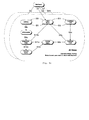
- Figure 52 shows a global structure of a protocol state diagram. From the SoftReset state, one of two distinct startup state machines is entered depending on how the configuration settings are chosen. For pure static or mixed static/dynamic configurations the fault-tolerant, distributed startup is triggered by the transition G1. For pure dynamic configurations it depends on whether a node is a master node or not, when deciding which transition (G2 or G3) the startup state machine has to take.
- State transitions marked with the suffix 'c' are aligned to cycle boundaries, state transitions tagged with an 'i' are executed immediately, i.e. as soon as the specific condition becomes true.
- the SoftReset state is part of the overall protocol state diagram and is not just a component of startup and reintegration.
- the host configures the communication controller while it is in SoftReset state. If the communication controller is in any other state, the host must force the communication controller to re-enter the SoftReset state in order to change it's configuration.
- a node may enter communication (i.e., the NormalStatic state) via the coldstart path ( ColdStartICW and ColdStartPCW state sequence) initiating the schedule synchronization, or via the integration path ( InitRate, InitSchedule , and IntagrationPCW state sequence) integrating into an existing communication schedule.
- the configuration parameter can only be set or cleared in the SoftReset state. The transmission of more than SYNC frame within one cycle has to be prevented by the communication controller.
- the initial synchronization of the periodic TDMA schedule must be coordinated among all connected communication nodes. Since all sync nodes are authorized to initiate the schedule synchronization, simultaneously started and conflicting attempts by different sync nodes must be resolved. Each node initially transmits a Collision Avoidance Symbol (CAS, see Section "Frame Validation”) specifically for this purpose, before initiating the periodic schedule.
- CAS Collision Avoidance Symbol
- This symbol represents a kind of arbiter, which is used to resolve initial collisions of nodes trying to set up the communication schedule at the same time.
- Non-sync nodes as well as sync nodes start passive integration as soon as they receive sync frames from which to derive the TDMA schedule information.
- the node has to adapt its own clock to the global clock (rate and offset) and has to make its cycle time consistent with the global schedule observable at the network. Afterwards, these settings are checked for consistency with all available network nodes. Only if these checks are passed, can the node leave the integration phase and actively participate in communication.
- the semantic information that can be derived from the received data stream varies with the protocol state of the node. Certain frame validation checks have to be passed by a received frame or symbol, in order to be an appropriate input for the related logic block.
- a sync node maintains two different timers, vdStartup and vdStartupNoise , which serve as listen-timeouts in order to leave the initial sensing phase ( ListenStatic state) with the intention to start up the communication.
- the node local listen-timeout vdStartup has the same length ( gdStartup ) for each node in the system, which is configured to send an initial CAS during startup (sync node).
- vdStartup limits the listen time that used by a node to determine if there is already communication between other nodes or at least one sync node actively requesting the integration of others. If communication channel activity is detected on one of the configured pChannels channels while the node is in the ListenStatic state, the listen-timeout vdStartup is restarted.
- Any signal edge detectable at the receiver i.e., a signal edge, which has passed the glitch filter
- channel activity Any signal edge detectable at the receiver (i.e., a signal edge, which has passed the glitch filter) is referenced to as "channel activity”.
- Figure 53 shows listen-timeouts vdStartup and vdStartupNoise .
- the time-out interval gdStartup is constrained by the following inequality.
- gdStartup is derived internally from the given configuration parameters gdCycle and gdMaxDrift .
- the upper boundary for the listen timeout vdStartupNoise is a multiple of gdStartup and is configurable using the parameter pdStartupNoise .
- the listen-timeout must cover the maximum accumulated drift over the free-running, unsynchronized period.
- the maximum allowable drift between any two clocks in the network is an important system parameter and known at design time. This 'worst case' period has to be covered by configuring gdMaxDrift (unit: macroticks) accordingly. Furthermore, the nominal time between two trigger events caused by regular communication pattern is always smaller than one communication cycle gdCycle.
- the 'listen-only' mode is configured by setting vListenOnly while in the SoftReset state. vListenOnly cannot be set after leaving the SoftReset state, but can be cleared at any time.
- listen-only mode the node is able to receive all frames after integration to the running communication; i.e. the node is fully synchronized and performs the clock synchronization in order to keep this status.
- normal operation mode NormalStatic state
- the node does not actively participate in communication, i.e. neither symbols nor frames are transmitted.
- This mode supports communication diagnosis ('monitoring') as well as dedicated wake-up strategies, which require host interaction ( vListenOnly subsequently cleared) in order to actively participate in communication after wake-up.
- the node can be prevented from initializing the TDMA communication schedule by setting vColdStartInhibit in the SoftReset state.
- vColdStartInhibit cannot be set after leaving the SoftReset state, but can be cleared at any time.
- vColdStartInhibit can be mapped to the gColdStartMax configuration parameter, which utilizes the zero value as to keep the node from starting the network on its own initiative (refer to the chapter "host interface"). It has to be checked whether the parameter gColdStartMax can be accessed during run time, i.e., after leaving SoftReset state, as this is required for the "coldstart inhibit" function.
- the node is not allowed to initialize the cluster communication after having checked on existing communication.
- the node is allowed to integrate to a running cluster or to acknowledge another node, which initially tries to start the cluster communication.
- vColdStartInhibit does not restrict the node's ability to receive frames or to transmit frames.
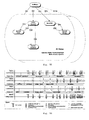
- Figure 54 shows a startup state diagram - FlexRay Mode with Static Segment Configured.
- All nodes enter the ListenStatic state after being released from the SoftReset state. In this state the communication controller is ready to attempt network startup or enter a running network.
- the ListenStatic state from SoftReset or re-entering from integration path ( InitRate , InitSchedule , and IntegrationPCW state sequence)
- sync nodes start their listen-timeout vdStartup and their listen-timeout with noise vdStartupNoise .
- Network activity on any of pChannels channels, which is different from a valid SYNCFrame StartupEven causes a restart of the listen-timeout vdStartup .
- the rate correction value When re-entering ListenStatic state from any state, the rate correction value has to be reinitialized with pMicroOverheadperCycleNom .
- sync nodes are allowed to enter the ColdStartICW state. These nodes leave ListenStatic when a listen-timeout or listen-timeout with noise occurs before receiving a valid SYNCFrame StartupEven .
- a sync node transmits the initial CAS and then cyclically transmits its configured sync to enable the startup of the entire network. If more than one sync node's listen-timeout or listen-timeout with noise expires before a valid SYNCFrame StartupEven is received, they all enter ColdStartICW . In ColdStartICW normal data frames (without sync bit set) are not transmitted.
- vColdStartCount is incremented by one.
- vColdStartCount is compared to the allowed maximum gColdStartMax.
- the node re-enters ListenStatic . This measure ensures that a node unable to receive a valid SYNCFrame StartupPCW from at least one of pChannels channels, i.e. a node with 'incoming link failure', stops transmission after a predefined interval of time and thereby enables other nodes to assume the responsibility for starting communication for the cluster.
- vColdStartCount is incremented by one.
- the node remains in ColdStartICW for a period determined by the initial check window ( gdInitialCheckwindow ).
- the timer vdInitialCheckWindow is started, when ColdStartICW is entered, and thus covers the initial slot used for CAS transmission as well as three complete communication cycles (refer to definition of gdInitialCheckWindow in Section TBD). Consequently, gdInitialCheckWindow determines the time a node stays in ColdStartICW before entering ColdStartPCW . In order to take all reception events into account, this window does not have any gap, i.e. it also includes the network idle time (compare with the definition for gdPlausibilityCheckWindow ! Due to the fact that the node is not capable to receive during its own transmissions, the network observation is suspended during them.
- PCW Plausibility Check Window
- the node continues transmitting its sync frame periodically.
- the node performs a plausibility check in order to assess the network image gained during a bounded receive period determined by the plausibility check window gdPlausibilityCheckWindow .
- the node After each observation phase ( gdPlausibilityCheckWindow ) the node evaluates the results. The node re-enters ListenStatic if an inconsistency is observed regarding the number of valid SYNC frames received, and the node's observation matches the minority. On the other hand, the node is allowed to enter NormalStatic if the plausibility check is passed ( vInalidSyncCount ⁇ vValidSyncCount; see also the conditions for counter increment below). Two event counters (vValidSyncCount and vInvalidSyncCount ) are administrated in order to support decision-making. In accordance with the receive window definition, a clear distinction between several possible cases can be made for each slot. These slot scenarios are judged and counters are incremented according to the following rules (where x stands for channel A or B and y stands for the respective other channel):
- the plausibility check is passed, if vValidSyncCount is greater than vInvalidSyncCount .
- the transition to NormalStatic is only permitted, if the check is passed with vValidSyncCount >1, since the node considers itself correct and has therefore initialized the counter accordingly. If the value of vValidSyncCount is still one, there has been no valid determination so far and the node remains in ColdStartPCW state for another cycle.
- vColdStartCount is incremented by one.
- vColdStartCount is compared to the allowed maximum gColdStartMax .
- the offset measurement phase is applied in accordance to the regular scheme, too. This means that for each cycle with an odd cycle counter value the related sync frames are used to determine next offset correction term.
- the node in ColdStartPCW state requires at least one additional matching pair of sync frames suitable for rate measurement (same frame identifier, consecutive occurrence in 'even/odd' cycle order), in order to fulfill one of the necessary prerequisites for entering NormalStatic. As long as the node does receive a response, it performs the clock correction based on one "pair of matching sync" frames, namely its own transmissions (the value 0 is assumed). As soon as another node is recognized that answers with two valid SYNCFrame StartupPCW transmissions in even/odd cycle order, the node in ColdStartPCW is acknowledged by at least one other sync node and vSyncPairs is set to true. With the beginning of each rate measurement phase in ColdStartPCW state, the variable vSyncPairs is reset to false.
- the quality of the resulting correction terms for clock synchronization is assessed.
- the node is only permitted to execute transition into NormalStatic state, if the correction terms for both, rate and offset are below the configured limit settings (
- vRefSync contains the identifier of the sync frame that was used to enter the integration path.
- the sync node corresponding to this reference frame is called the reference node.
- InitRate is used to derive an initial rate correction value in order to adjust the local macrotick timing to the timing given by the reference node. To accomplish this, the time between the initial occurrence of the reference frame and its next occurrence is measured and the difference from the nominal cycle length is applied as the rate correction term.
- the initial reception of the reference frame (which causes the state transition into InitRate ) starts a timer.
- This timer covers gdCycle running in local macroticks and according to this timer a receive window is opened.
- pdInitRateMEarly microticks before the timer expires the early receive window is opened and with the expiration of the timer, pdInitRateMLate is applied to form the late receive window.
- next reference frame would occur after gdCycle .
- the node runs with the corrected rate (direct application of the correction term).
- the reference frame used for initial rate correction (which causes the state transition into InitSchedule state) is also used to determine the nominal schedule position, using the received identifier fFrameID .
- the node sets its local cycle time accordingly, i.e. it synchronizes the micro- and macrotick counters to the SOF in the received sync frame.
- the cycle counter value fCycleCount of the received sync frame is extracted and used to initialize the local cycle.
- the node follows the local schedule until the end of the current cycle without transmitting actively. Any further reception is ignored and neither rate nor offset measurements are performed. At the end of the cycle, the transition is made from InitSchedule to IntegrationPCW .
- the node As long as the node stays in IntegrationPCW state, the node is not allowed to schedule transmissions.
- the node In IntegrationPCW the node tries to confirm the settings copied from the reference node with the overall network communication scheme. For this purpose the node performs a cycle-based plausibility check similar to the check defined for the ColdStartPCW state (see Section "ColdStartPCW State").
- the plausibility check is passed if vValidSyncCount is greater than vInvalidSyncCount . Transition into NormalStatic can only take place if the check has been passed, but there are additional checks to pass (see clock correction term assessment and next paragraphs, respectively) before a node is allowed to join communication with the transition into the NormalStatic state.
- the plausibility check always runs concurrently with these additional checks until the plausibility check itself fails or a state transition due to another condition is executed.
- a regular measurement phase for the next rate correction term is started.
- the definition of state transitions for the protocol state machine automatically keeps the required 'grid' (starting with a cycle with an even cycle counter value).
- all sync frames are registered and pair-wise (sync frames with same frame identifier) evaluated for clock synchronization.
- the offset measurement phase is applied in accordance to the regular scheme, too. This means that for each cycle with an odd cycle counter value the related sync frames are used to determine next offset correction term.
- An integrating sync node requires at least one matching pair of sync frames suitable for rate measurement (same frame identifier, consecutive occurrence in 'even/odd' order) in order to fulfill one of the necessary prerequisites to enter NormalStatic state. Using this pair of sync frames, the node can acknowledge an existing node in ColdStartPCW or simply integrate to a synchronized cluster. For sync nodes that do not operate in listen-only mode ( vListenOnly is false), vSyncPairs is set to true as soon as the first matching pair of sync frames is received. If a sync node is configured as a listen-only node ( vListenOnly is true), it has to fulfill the same condition as non-sync nodes. These nodes need to receive at least two matching pairs of sync frames suitable for rate measurement (same frame identifier, consecutive occurrence).
- vSyncPairs is set to true as soon as two matching sync frames are part of current rate measurement period.
- the quality of the resulting correction terms for clock synchronization must be acceptable.
- the node is only allowed to join active communication (transition into NormalStatic state), if the correction terms for both, rate and offset are below the configured limit settings (
- the correction value vOffsetCorrection may exceed the configured limit vOffsetCorrectionOut as long as
- the variable vOffsetOut is set to true ( vOffsetOut is initialized with its default value ( vOffsetOut is set to false), when IntegrationPCW is entered from InitSchedule ). This variable is always evaluated, if a new offset correction term should be checked against the configured limit settings. Thus, the described exception is only made once, i.e., when the first offset correction term is available.
- the message interface to the host is served and the error management is performed.
- a node In the PassiveStatic state a node does not transmit any of its configured frames. Nevertheless, the node does not stop all activities. It continues clock synchronization, the reception of messages and the full support of the host interface.
- the PassiveStatic state is used to support the 'listen only' protocol feature, where nodes are fully synchronized and receive all available frames (including receive buffer update), but do not transmit anything.
- This mode is indicated by vListenOnly , which can be set by the host in the SoftReset state only. As soon as the host clears vListenOnly NormalStatic state is entered at the beginning of the next cycle.
- Figure 55 shows a protocol state diagram - pure dynamic segment.
- a single node that has been configured as sync master (pMaster is set) sends the SOC. With the end of the transmission the timers (of the receiver unit) are started according to the definitions in the media access chapter and the node enters NormalMaster state.
- the node sends and receives messages in the NormslMaster state according to its configuration. Upon entering the NormalMaster state, i.e. after the transmission of the SOC, the startup phase is completed. The master node does not need any acknowledgement from other nodes.
- All slave nodes ( pMaster is false) wait in the ListenDynamic state for a valid SOC transmission. All connected channels are independently monitored. The transition into NormalSlave and therefore the synchronization of both channels to the master is done on reception of the first valid SOC. After initialization of the wait timers, both channels can operate asynchronously with respect to the required frame mini-slotting on each of the channels.
- Slave nodes synchronies to a valid SOC and transmit and receive messages in NormalSlave state according to their configuration.
- a node In PassiveDynamic a node does not transmit any of its configured frames. Still, the node does not stop all activities, but continues the synchronization to SOC (via ListenDynamic state) and the reception of messages.
- the PassiveDynamic state is used to support the 'listen only' protocol feature, where the node is fully synchronized and receives all available frames (including receive buffer update), but does not transmit anything.
- This mode is indicated by vListenOnly , which can be set by the host in the SoftReset state only. As soon as the host clears vListenOnly , NormalSlave state is entered with beginning of the next cycle.
- the protocol controller Since the protocol controller still performs the transition to ListenDynamic state with every communication cycle, it is still synchronized to the master node. Therefore, the node is allowed to directly re-enter NormalSlave from ListenDynamic (with the begin of next cycle), if the host sets vListenOnly to false.
- the node is allowed to proceed directly into normal operation ( ListenStatic state) after having performed the offset measurement, correction phase, and regular rate measurement phase the first time.
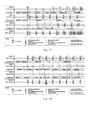
- Figure 56 shows a collision-free Startup.
- the scenario illustrated in Figure 56 depicts three nodes with two of them configured to initiate the startup actively (sync nodes A and B).
- Node C does is not configured to schedule any sync frames and therefore is not allowed to enter ColdStartICW .
- the first cycle counter value received by nodes B and C is in the sync frame sent by node A and it is even.
- Nodes B and C follow the current schedule until cycle end and then transition into the IntegrationPCW state. Still these nodes behave passively, i.e., they do not participate the communication schedule with their own frames. After one complete rate measurement period (2 cycles) and the corresponding offset measurement and correction phase (during the second cycle), the sync node B is allowed to enter normal operation. The plausibility checks evaluates in the IntegrationPCW state are passed because on the reception of the reference sync frame vValidSyncCount is incremented, while vInvalidSyncCount remains unchanged. Consequently, with the start of next cycle, node B enters NormalStatic and starts to transmit messages according to its configuration.
- the node that initially sent the CAS On reception of the sync frame pair sent by another node (node B), which is synchronized to its own, the node that initially sent the CAS (node A) then enters NormalStatic at the start of next communication cycle (after a whole rate measurement period has been concluded). In NormalStatic all configured frames are scheduled for transmission. As soon as the node that initially sent the CAS and one other node have entered the NormalStatic state, the startup phase is concluded.
- Node C enters NormalStatic in the same cycle as node A, as soon as it performs the regular rate measurement phase based on 2 (or more) pairs of corresponding sync frames ( vSyncPairs is true).
- Figure 57 shows a Startup with a collision on the CAS symbol.
- the scenario illustrated in Figure 57 depicts three nodes with all of them configured to initiate the startup actively (sync nodes).
- a collision during startup results when two sync nodes leave SoftReset state at the same, or nearly the same time.
- two nodes enter ColdStartICW simultaneously and send their initial CAS at the same, or nearly the same time. Both nodes are then prepared to send their first sync frame.
- node A On reception of this sync frame, the other node (node A), which currently resides in the ColdStartICW state, returns to ListenStatic and waits for the next valid SYNCFrame StartupEven .
- the figure depicts the case where a node A integrates in the sixth cycle after the cycle in which the collision occurred.
- non-sync nodes may detect activity but no valid CAS because of the collision, while others may detect a valid CAS (because the topology prevents collisions). For both cases the reaction is the same, since valid CAS symbols are treated like network activity that cannot be interpreted. The nodes remain in ListenStatic and wait for the occurrence of a valid SYNCFrame StartupEven .
- Figure 58 shows a Startup with a plausibility check in IntegrationPCW failed.
- node B and C start another integration attempt. Via the integration path, both nodes finally synchronize on timing of node A. Meanwhile, Node A remains in ColdStartPCW state for the entire period because it does not detect a valid response.
- the error severity level directly influences the protocol behavior as described in the table (CC, CC to API, Result, BG, Comment).
- the FlexRay error handling matches the overall protocol state machine (see Figure 59).
- the currently active severity level shall be taken into account at each protocol decision.
- Error Severity Levels Name Severity Level Behavior Normal S0 CC: full operation.
- CC to API no warning, no error flags active.
- Result Normal operation.
- BG remains synchronized Warning S1 CC: full operation.
- CC to API flag for detected error.
- Result Maintain normal operation, provide error indication to host.
- BG Remains synchronized. Comment: No immediate effect on protocol operation.
- the host is informed of the error condition Error S2 CC: reduced operation.
- CC to API flag for detected error.
- BG Remains synchronized. Comment: CC self rescue is allowed. The fault causing the error was non-fatal. The CC will not act as a coldstart node for the wake-up procedure.
- Fatal Error S3 CC Operation halted. All signals to the bus driver and bus guardian are placed in defined states. CC to API: flag for detected error. Interaction with host must still be possible. Result: The node stops transmitting and receiving frames.
- BG BG enters FailSilent state due to loss of ARM signal. The BG disables transmissions until reset by host. Comment: CC self rescue not allowed. The fault causing the error was fatal. A reset from the host is required to resume operation.
- Figure 59 shows the protocol (error) state machine. After startup a FlexRay CC starts operation in
- the protocol (error) state machine shall remain in the Normal Static, Listen Only, Normal Master or Normal Slave state as long as no errors are detected (remain in error severity S0) or if any detected errors have error severity S1 (see Table 16).
- the detection of any error with an error severity of S2 shall cause the protocol state machine to enter the Passive state where the CC is not allowed to send frames but where all protocol mechanisms (frame reception, clock synchronization, etc.) remain active.
- the detection of any error with an error severity of S3 shall cause the protocol state machine to enter the Error state, where no frame transmission is allowed and all protocol operation ceases.
- the CC can only return to normal operation after being reset by the host. (see Table 16).
- the protocol (error) state shall be Error while at least one S3 severity error is active, otherwise it shall be Passive while at least one S2 severity error is active, otherwise it shall be in Normal Static (Listen Only, Normal Master, Normal Slave).
- the error level of the communication controller shall be the error level of the most severe error that is currently active.
- Table 17 lists the error flags and error counters of the FlexRay protocol. The following sections provide detailed description of the various flags and counters. Error Flags and Error Counters Error Flags Abbreviation Channel Status and Error Vector CSEV Frame Status and Error Vector FSEV Error Counters Abbreviation Valid Sync Frame Counter VSFC Invalid Sync Frame ID Counter ISIC Invalid Sync Frame Cycle Counter ISCC Missing Rate Measurement Counter MRMC Missing Offset Measurement Counter MOMC Clock Correction Failed Counter CCFC
- a FlexRay Communications Controller shall provide two channel-specific Frame Status and Error Vectors (FSEV's) for each communication buffer.
- CC's that are only capable of single channel communication need only provide an FSEV the channel that it supports.
- a dual channel controller needs to provide two buffers to allow a host using a "select first" style buffer to understand the communication on the "non-selected" communication channel. If the buffer is operating in a channel-specific mode the information on the other channel is redundant.
- the FSEV allows the host to determine the status of communications associated with the buffer.
- Each vector consists of six bits that provide indications of various error or normal conditions that can occur during the reception of a frame. Table 18 lists the contents of the vectors.
- Table 19 gives the sets of checks that make up the various error conditions that are reported in the FSEV and CSEV.
- Each static FlexRay frame buffer has corresponding FSEV's.
- the FSEV is reset (all flags set to 0) during configuration (“Soft Reset” state) and is not updated before the CC is synchronized within other devices in the network (“Normal” protocol state).
- the FSEV is updated at the time a frame has been completely received. In case no frame is received, the FSEV is updated upon reaching the end of the slot.
- the Null Frame Detection condition has an error severity of S0. All of the other conditions reported in the FSEV have an error severity level of S1.
- a FlexRay Communication Controller shall provide a channel-specific Channel Status and Error Vector (CSEV) for each supported communication channel.
- CSEV Channel Status and Error Vector
- the CSEV reports the status of all frames received on the communication channel, even if the frames do not have an explicit receive buffer. This implies that a host can get information about errors that may have occurred on the channel in slots that have no associated Frame Status and Error Vector.
- Table 20 lists the contents of the CSEV.
- the data in the CSEV is available to the host via the Communication Host Interface (CHI).
- the flags in the CSEV may be reset by the host.
- the CSEV reports the aggregate status of all frames on the communication channel. More specifically, the bit corresponding to a particular condition will be set if any frame has experienced that condition since the CSEV has been reset by the host. Errors that occur more than once will not receive any special indication. The reception of a frame with no errors shall not clear the flags in the CSEV.
- the Null Frame condition has an error severity of S0. All of the other conditions reported in the CSEV have an error severity level of S1.
- the Valid Sync Frame Counter counts the number of correctly received sync frames in one communication cycle For the purposes of this counter, a sync frame that is received on both channels only counts as a single valid sync frame.
- the counter shall start at zero at the beginning of the communication cycle.
- the VSFC from the previous communication cycle shall be available to the host until the end of the current cycle, at which time it shall be replaced by the VSFC of the current cycle.
- An error of severity S1 shall be detected if the Valid Sync Frame Counter exceeds 16 at the end of the communication cycle.
- An error of severity S1 state shall also be detected if the Valid Sync Frame Counter is zero at the end of the communication cycle.
- ISIC Invalid Sync Frame ID Counter
- the Invalid Sync Frame ID Counter counts the number of sync frames which are received with a slot mismatch error.
- the counter shall start at zero at the beginning of the communication cycle.
- the ISIC from the previous communication cycle shall be available to the host until the end of the current cycle, at which time it shall be replaced by the ISIC of the current cycle.
- An error of severity S2 shall be detected if the Invalid Sync Frame ID Counter is greater than the Valid Sync Frame ID Counter at the end of the communication cycle. This condition indicates that the local CC disagrees with the majority of sync frame senders with respect to the current Slot ID.
- ISCC Invalid Sync Frame Cycle Counter
- the Invalid Sync Frame Cycle Counter counts the number of sync frames which are received with a cycle counter mismatch.
- the counter shall start at zero at the beginning of the communication cycle.
- the ISCC from the previous communication cycle shall be available to the host until the end of the current cycle, at which time it shall be replaced by the ISCC of the current cycle.
- An error of severity S2 shall be detected if the Invalid Sync Frame Cycle Counter is greater than the Valid Sync Frame Counter at the end of the communication cycle. This condition indicates that the local CC disagrees with the majority of sync frame senders with respect to the current cycle count.
- the Missing Rate Measurement Counter counts the number of consecutive even/odd cycle pairs for which it was not possible to compute a clock rate correction term. This counter shall be set to zero when the node begins normal operation. It shall be incremented by one if no rate correction term can be computed at the end of an odd communication cycle. This would occur if the node has not received any matching pairs of even/odd cycle sync frames with the same Frame ID. If a rate correction term can be computed the CC shall reset this counter to zero at the end of the odd communication cycle.
- An error of severity S1 shall be detected if the MRMC is greater than zero but less than the parameter gMaxWithoutRate .
- An error of severity S2 shall be detected if the MRMC is greater than or equal to gMaxWithoutRate .
- the Missing Offset Measurement Counter counts the number of consecutive even/odd cycle pairs for which it was not possible to compute a clock offset correction term. This counter shall be set to zero when the node begins normal operation. It shall be incremented by one if no offset correction term can be computed at the end of an odd communication cycle. This would occur if the node has not received any sync frames during an odd communication cycle. If an offset correction term can be computed the CC shall reset this counter to zero at the end of the odd communication cycle.
- An error of severity S1 shall be detected if the MOMC is greater than zero but less than the parameter gMaxWithoutoffset .
- An error of severity S2 shall be detected if the MOMC is greater than or equal to gMaxWithoutOffset .
- the Clock Correction Failed Counter is used to limit the number of cycles that a node that is currently experiencing a clock offset or rate correction failure can remain at an error severity level of S2 (which allows self recovery) before being forced to an error severity level of S3 (where recovery is only possible via host intervention).
- This counter shall be set to zero when a node begins normal operation. It shall be incremented by one at the end of any odd communication cycle where either the Offset Correction Failed or Rate Correction Failed errors are active (see Sections "Offset Correction Failed” and "Rate Correction Failed” below). It is assumed that the inability to compute a rate or offset correction term does not affect that term's Correction Failed status.
- the CCFC shall be reset to zero at the end of an odd communication cycle if neither the Offset Correction Failed nor the Rate Correction Failed errors are active.
- Error Handling Level An error of severity S3 shall be detected if the CCFC is greater than or equal to the parameter gMaxWithoutClockCorrection .
- the host At the end of an odd communication cycle if the clock synchronization mechanism calculates an offset correction term which is outside of the green region (refer to the Clock Synchronization chapter) the host shall be considered to have detected an Offset Correction Failed error.
- the Offset Correction Error shall remain active until the node computes an offset correction term that is in the green area, at which time the node shall consider the Offset Correction Failed error inactive. Note that this implies that the inability to compute an offset correction term does not change the Offset Correction Failed status. The status can only change if an offset correction term is actually computed.
- the host At the end of an odd communication cycle if the clock synchronization mechanism calculates a rate correction term which is outside of the green region (refer to the Clock Synchronization chapter) the host shall be considered to have detected a Rate Correction Failed error.
- the Rate Correction Error shall remain active until the node computes a rate correction term that is in the green area, at which time the node shall consider the Rate Correction Failed error inactive. Note that this implies that the inability to compute a rate correction term does not change the Rate Correction Failed status. The status can only change if a rate correction term is actually computed.
- This error is active if the end of a correct SOC occurs before gdCycleMin . This condition is reset after a cycle of duration greater than gdCycleMin is observed.
- the error has a severity level of S1.
- This error is active if the end of a valid SOC does not occur before gdCycleMax . This error condition is reset with the reception of the next valid SOC.
- This error has a severity level of S2.
- This error flag is set if
- This error has a severity level of S2. Reset to S0 as soon as the next SOC is received.
- ISV Interrupt Status Vector
- ISV Interrupt Enable Vector
- the FlexRay Communication Controller provides error status information to the host via an Interrupt Status Vector (ISV).
- ISV Interrupt Status Vector
- Each of the error detection mechanisms described above has an associated bit in the ISV. All of the individual flags of the Channel Status and Error Vector are mapped into the ISV, as well as all individual warning/error conditions described above. There is one additional bit in the ISV to signal a receive buffer error. The bits of the ISV are set to one if the condition described above becomes true.
- the FlexRay CC provides at least one interrupt line to the application.
- Each of the interrupt sources in the Interrupt Status Vector (ISV) shall be enabled separately by an Interrupt Status Enable Vector (ISEV) which is set by the host.
- ISV will be updated regardless of the contents of the ISEV.
- the ISEV simply enables the access of the interrupt source to the interrupt line.
- An additional Interrupt Enable Vector is used to set interrupt conditions for any of the Frame Status Error Vectors, which exist for each "mailbox/buffer" of a FlexRay CC.
- This Frame Status Interrupt Enable Vector (FSIEV) enables the interrupt signaling to the host according to the set bits within this enable register, e.g. only CRC errors of any mailbox/buffer cause an interrupt.
- the following table shows the Interrupt Status Enable Vector (ISEV) for the corresponding signals in ISV_0 to ISV_2: ISEV_0 7 6 5 4 3 2 1 0 ENABLE CRC ENABLE SLOT ENABLE COUNT ENABLE LENGTH ENABLE FSEV ENABLE SOC Early ENABLE SOC Lost ENABLE ILLPIF ISEV_1 15 14 13 12 11 10 9 8 ENABLE ENABLE ENABLE ENABLE ENABLE MRMC MOMC Offset Failed Rate Failed Max CCFC Max SYNC Zero SYNC ISEV_2 23 22 21 20 19 18 17 16 ENABLE Minority VSCC ENABLE Minority VSIC
- a logical ONE enables the error condition to be a source to trigger the interrupt line to the host.
- a logical ZERO disables the signaling of that error condition to the host.
- the ISV will always represent the current status regardless of the value in the ISEV.
- FSIEV Frame Status Interrupt Enable Vector
- a logical ONE enables the signal to be a source to trigger the interrupt line to the host.
- a logical ZERO disables the signaling to the host.
- the FSEV will always represent the current status of the buffer regardless of the value in the FSIEV.
- SSV Startup Status Vector
- SSIEV Startup Status Interrupt Enable Vector
- Each of the interrupt sources in the Startup Status Vector shall be enabled separately by Startup Status Interrupt Enable Vector which is set by the application.
- the SSV will be updated regardless of the values of the SSIEV.
- the SSIEV enables the access of the interrupt source to the interrupt line.
- the following signals (error conditions) out of startup shall be summarized in SSV.
- the following table shows the Startup Status Interrupt Enable Vector for the corresponding startup status vector.
- SSVE 7 6 5 4 3 2 1 0 ENABLE coldst art max ENABLE Plaus ENABLE prefsync ENABLE coldst art path ENABLE pstart upnoise
- the current error severity level (S0 through S3) shall be made available to the host.
- the CHI is the interface between the higher layers and the data link layer.
- CHI CHI suggests that a FlexRay node consists always of two primary hardware elements, which are connected via the CHI:
- CHI is above the data link layer.
- a transport layer or a fault tolerant communication layer (FTCom) would be above the CHI.
- FCom fault tolerant communication layer
- the layers above the CHI dictate what mechanisms the CHI must contain. To adequately support the layers above it, the CHI must provide mechanisms that:
- the CHI shall be implemented as a 16 bit aligned address/data bus to support Motorola's PPC and Star12 micro controllers, and Texas Instruments' TMS470 family.
- Designated configuration data should be protected from unintended manipulation by the host, by allowing changes only in a specific Communication Controller mode (e.g. soft reset state).
- a specific Communication Controller mode e.g. soft reset state
- a FIFO message area should be provided for receiving frames that do not have a dedicated receive buffer. It should support a maskable rejection filter with the following characteristics:
- All information contained in a valid received frame should be stored in the designated receive buffer (or FIFO) except the frame CRC.
- the receive buffer should contain a field indicating the channel on which the stored frame was received. If the header of the received frame does not match any of the configured filters, the frame should be discarded without storing any frame data.
- the buffer contents prior to the reception should not be deleted or overwritten. If a null frame is received in a slot, the buffer contents prior to the reception should be overwritten if so configured. The discrepancy to the configured frame should be signaled to the host using a suitable bit in the corresponding buffer status register.
- the status and error registers should keep their data unchanged until the soft reset is released.
- This section enumerates the registers supported by the Communication Controller to provide the host with status information regarding the operation of the controller.
- Error Handling Level is a characteristic of the V5 Error Management strategy and may not apply if the V5 only Error Management strategy is not retained in V6.
- the CC shall provide a Startup Status Vector with following status flags:
- This section enumerates the registers supported by the Communication Controller(CC) to allow the host to control the operation of the CC.
- the clock prescaler register may be modified only in soft reset. It consists of the following three fields:
- microtick duration which is provided to the bus guardian.
- the CC shall provide two Timer Interrupt Configuration Registers for configurable timer interrupts. Each shall contain three fields:
- the maximum cycle counter value must be one less than a power of two.
- a configuration switch decides whether the transmitter may add missing data bytes if the configured frame data length exceeds the length of the buffer data field.
- This configuration switch determines whether the data is copied out of a received Null Frame into the mailbox buffer or not. The configuration switch applies to all mailbox receive buffers of the CC.
- the value in this register determines the maximum number of cycles a cold starting node is permitted to try to start up the network without receiving any valid response from another node. If the value is '0' the CC is not allowed to start up the communication.
- the CC shall provide a Startup Status Interrupt Enable Vector for Enabling (logical '1') or Disabling (logical '0') interrupts corresponding to the following events:
- the host access to the mailbox message buffers is controlled by the use of a Buffer Control Register.
- This control register has one byte for each mailbox buffer.
- IFLG is set by the CC after transmission has been completed and the host may access the buffer for writing next message.
- the communication controller has to provide 32 configurable mailbox message buffers for data communication with a frame length of up to 32 data bytes. (Values are valid for FPGA V5.)
- the mailbox buffers can be configured to be used as transmit, dedicated receive or FIFO receive buffers.
- Each buffer has to include the complete frame header and data field, and shall not include the frame CRC.
- the CC must provide suitable mechanisms to grant a secure access to the DPRAM buffers. Using e.g. a locking mechanism, either the CC or the host may get access to one particular mailbox buffer. In order to prevent data mismatch a window access scheme may be used (e.g. one window for the active transmit buffer, one for the active dedicated receive buffer, and one for the active FIFO receive buffer). Only one single buffer of one type may be locked and visible to the host at the same time.
- mailboxes which can be configured during Soft Reset only while the others can be reconfigured during runtime.
- a portion of message buffers can be configured as transmit buffers.
- the set of transmit buffers shall be contiguous in the register map starting at buffer 32 (for FPGA V5) and ending before the first receive buffer.
- the first matching buffer will be sent out by the CC.
- reconfigurable mailboxes For transmit frames in the dynamic part reconfigurable mailboxes can be used.
- the frame ID and the corresponding DLC can be reconfigured during runtime (FPGA V5 and V6).
- the CC does not calculate the transmit header CRC (FPGA V5 and V6). It must be provided by the host for all transmitted frames.
- the length field in all messages (static and dynamic) reflects the actual physical frame data length as defined in the frame format.
- the CC may use mailbox transmit buffer structures shorter than the actual (physical) data frame length in the static segment. In this case, the CC will generate padding bytes to ensure that frames have proper physical length. However, this capability must be enabled via configuration (see Section "Transmitter Generated Padding").
- the padding pattern shall be logical ZERO.
- the padding function shall apply only to frames to be transmitted in the static part. In the dynamic part no frame will be transmitted if the data field in the buffer is shorter than the configured data length.
- the frame will be transmitted containing the current buffer contents consisting of the previously transmitted data.
- the CC will set the Null Frame Bit in the frame header to indicate that the transmitted message is a Null Frame. (For FPGA V5 this indication will be one single bit). Null Frames are not transmitted in the dynamic part.
- a portion of the CC's message buffers can be configured as dedicated receive buffers.
- the set of dedicated receive buffers shall be contiguous in the register map starting after the last transmit buffer and ending before the first FIFO receive buffer.
- the CC transfers valid received messages from the serial receive message buffer to the dedicated receive buffer with the matching filter configuration.
- a portion of the CC's message buffers can be configured as FIFO receive buffers.
- the set of FIFO receive buffers shall be contiguous in the register map starting after the last dedicated receive buffer and ending with the last message buffer.
- the CC transfers valid received messages from the serial receive message buffer to the FIFO receive buffer if there is no matching dedicated receive buffer and the header is not rejected by the FIFO Rejection filter (see Section "FIFO Filtering").
- each message buffer must possess a Frame Status and Error Vector.
- the Frame Status and Error Vector contains six bits which are summarized in the following table: Frame Status and Error Vector Status/Error Flag Bits Tx Buffer Rx Buffer FIFO Buffer Null Frame 1 Null Frame transmitted Null Frame received (static part) Null Frame received Empty Slot 1 - No bus traffic detected (static part) - Bit Coding/CRC Error 1 - Error detected (bit coding, header or frame CRC, in static part) - Length Mismatch 1 - Length Mismatch detected (static part) - Slot Mismatch 1 - Slot Mismatch detected - Cycle Counter Mismatch 1 - Cycle Counter Mismatch detected (static part) -
- the vector content is updated at the end of the slot (defined by the configured Frame ID) by the communication controller and can be checked by the host.
- searching commences with the receive buffer adjacent to the last transmit buffer. It proceeds incrementally through the remaining receive buffers. If more than one receive buffer holds the same frame ID, the error vector is updated in the first matching buffer.
- the flags are set if one of the listed errors is detected by the communication controller.
- the host can check the vector any time. An interrupt will be triggered by the CC if the corresponding interrupt enable bit in the General Enable Register is set (see below).
- Message filtering is done by checking specific fields in a message against corresponding configuration constants in the buffer, with the stipulation that message is only processed further if the required matches occur. Otherwise, it is discarded. Messages are filtered on the following message fields:
- Masking of message filters means that some (parts) of the filtering parameters may be configured to be disregarded (set to "don't care”).
- Channel Filtering field (2 bits) associated with each buffer. It serves as a filter for a receive message buffer, and as a control field for a transmit message buffer.
- Every Transmit and Receive mailbox message buffer contains a frame ID. This frame ID is used differently for receive and transmit message buffers
- Cycle Counter Filtering is based on the notion of a Cycle Set. For filtering purposes, a match occurs if any one of the elements of the set is matched.
- the operation of the filtering mechanism depends on the configuration of the buffer:
- Message ID filtering applies only for receive message buffers. For message ID filtering the first two data bytes out of the receive buffer are used. The received frame will be stored in the configured receive buffer if the message ID, channel and cycle counter match. The frame ID will be stored in the buffer, but ignored for filtering.
- Each register consists of 36 bits for channel (2 bits), frame ID (12 bits), cycle counter (6 bits), and message ID (16 bits). The two registers can be reconfigured in soft reset as well as during runtime.
- a received frame will be stored in the next free FIFO buffer if the channel, frame ID, cycle counter, and message ID are not rejected by the configured reject and mask reject filter and if there is no matching dedicated receive buffer in the mailbox.
- interrupts provide a close link to the protocol timing as they are triggered almost immediately when an error is detected by the controller, a frame is received or transmitted, or a configured timer interrupt is activated. This allows the host to react very quickly on specific error conditions, timers and events. On the other hand too many interrupts can cause the host to miss deadlines required for the application. Therefore it must be possible to disable/enable interrupts, separately and as a whole.
- An interrupt may be triggered when
- Tracking status and generating interrupts when a status change occurs are two independent tasks. Regardless of whether an interrupt is enabled, or not, the corresponding status should be tracked
- At least one hardware interrupt line shall be available to signal an interrupt to the host.
- the communication controller has to provide a General Interrupt and Error Indication Register.
- General Interrupt Register General Interrupt Flag Bits Channel Receiver Channel Bit Coding/CRC Error 1 Error detected (bit coding, header or frame CRC))
- a Slot Mismatch 1 Slot Mismatch detected A Cycle Counter Mismatch 1 Cycle Counter Mismatch detected
- a Length Mismatch 1 Length Mismatch detected A SOC Normal / Collision Avoidance symbol 1 SOC Normal or Collision Avoidance symbol detected
- a SOC Too Early 1 SOC received before qdCycleMin A SOC Lost 1 SOC not received before gdCycleMax
- Bit Coding/CRC Error 1 Error detected (bit coding, header or frame CRC)
- B Slot Mismatch 1 Slot Mismatch detected B Cycle Counter Mismatch 1 Cycle Counter Mismatch detected
- B Length Mismatch 1 Length Mismatch detected B SOC Normal / Collision Avoidance symbol 1 SOC Normal symbol detected B S
- the flags are set when the communication controller detects one of the listed errors or SOC symbols.
- the host can check the vector.
- the communication controller has to provide a General Error Interrupt, which will be triggered when any of the flags is set, provided the corresponding interrupt is enabled.
- the CC has to provide for each general interrupt indication flag a General Interrupt Enable flag.
Landscapes
- Engineering & Computer Science (AREA)
- Computer Networks & Wireless Communication (AREA)
- Signal Processing (AREA)
- Physics & Mathematics (AREA)
- Probability & Statistics with Applications (AREA)
- Theoretical Computer Science (AREA)
- Small-Scale Networks (AREA)
Abstract
Description
| FlexRay® |
| Requirements Specification |
| Introduction |
| Objectives |
| Basic Concepts |
| Node (ECU) Architecture |
| Topology |
| Frame Transfer |
| Constraints |
| Comment |
| Protocol Description |
| General Requirements |
| Frame Transfer |
| Static Segment |
| Dynamic Segment |
| Frame Format FlexRay |
| FlexRay Frame Format |
| byteflight Frame Format |
| Frame Scheduling - Multiplexing of |
| Sending Slots |
| Frame and Bit Coding |
| Frame Timing |
| Frame Timing for Static Segment |
| Frame Timing for Dynamic Segment |
| Start-up |
| Requirements |
| Principle of Operation - Protocol Modes |
| Shutdown |
| Clock Synchronization |
| Pure dynamic system |
| Pure Static and Mixed System |
| Principle of Operation |
| External Synchronization |
| Support of Application Agreement |
| Protocols |
| Support of Network Management |
| Hardware Specification |
| General Requirements |
| Topology |
| Automotive Constraints |
| Architecture - Power Modes |
| Communication Controller |
| States and Operating Modes |
| Logical Line Operation |
| Optical Driver |
| Electrical Bus Driver |
| Voltage Monitoring |
| States and Operating Modes |
| Bus Guardian |
| Wake-up |
| ECU → Bus Driver |
| Bus → Bus Driver |
| Bus Driver → Controller |
| Bus Driver → Power Supply |
| Controller → Bus Driver |
| Selective Sleep |
| Interfaces |
| Host Communication Controller |
| (CHI) |
| General Requirements |
| Frame Filtering and Masking |
| Interrupts |
| Host Bus Guardian |
| Communication Controller Bus |
| Guardian |
| Communication Controller Bus |
| Driver |
| Bus Guardian Bus Driver |
| Bus Driver Power Supply |
| Error Handling |
| Requirements |
| Hardware Units |
| Interfaces |
| Constant Definitions |
| Communication Network Constants |
| (Min/Max) |
| Glossary |
| Index |
Throughout the document the following structure is followed; at the beginning of each chapter (section) the requirements for this topic are defined, afterwards more detailed descriptions are provided. In the document UPPER CASE letters are used to denote constants. For a summary of all constants used in the document please refer to Chapter "Constant Definitions".
- Support of two communication paradigms, deterministic (statically defined) communication and dynamic event driven communication.
- Configurable static and dynamic part within one communication cycle. Fully static and fully dynamic configuration has to be supported.
- Flexible extendibility, even after deployment.
- High data rate and bandwidth efficiency.
- Scalable fault tolerance (i.e., single channel and dual channel operation must be supported).
- Reliable error detection (bus guardian mechanism in the time domain, CRC in the value domain).
- Support of electrical and optical physical interfaces.
- Enable very low system level failure in time ratings
- Allow use of crystal oscillators and low tolerance ceramic resonators
- Support of active star and bus topologies
- Low overall system cost
- Enable re-use of carry over components without embedding knowledge of future platform partitioning.
- Deterministic communication behavior in the time domain.
- Global time implemented by a fault tolerant clock synchronization algorithm.
- Immunity against accepting error-free subsequences of a message as valid messages (i.e. short message rejection).
- Event driven dynamic communication possibility.
- Flexible bandwidth allocation (for different nodes during runtime).
- No interference with the static segment.
- Support for prioritised bus access.
- Support of variable length messages with at least 200 data bytes.
- Support for fault tolerance, but operation without fault tolerance must also be possible, i.e., a single bus (channel) connection must be possible for non-fault-tolerant nodes.
- The communication network has to support a system architecture, where no single fault may lead to a functional degradation.
- Protection against faults in accordance with a well-defined fault hypotheses.
- Protect against up to and including five random bit errors per frame.
- The communication protocol should be independent as far as possible from the topology.
- For highly dependable and fault-tolerant applications an independent bus guardian to prevent the monopolisation of the communication medium by a communication controller is required.
- Errors in hardware and configuration data have to be detected during initialisation and operation by error detection mechanisms (EDMs). In case a critical error is detected the controller and transceiver must not be allowed to enter normal operation or immediately abort normal operation and report an error to the host.
- Support of serviceability of system- and component-level faults.
- The bit encoding technique must not introduce data dependent changes in the length of the resulting bit stream, e.g., bit stuffing is not allowed.
- Automotive qualification of the communication controller, bus guardian, and the physical layer is required.
- Configuration data must be readable/writeable by the host. It must be possible to prohibit writing during run-time.
- Support of comprehensive self test at system communication startup.
- Support of timely and highly reliable component re-integration and system-level startup.
- Support of master-less system startup and shutdown.
- Support of traceability of system- and component-level faults to identify root causes of failures.
- Support of synchronized system shutdown without error indications.
- Support of synchronous distributed application startup and shutdown with acceptable timing and fault tolerance characteristics.
- Support of node and network moding with high security against critical inadvertant mode changes.
- Logical line compatibility to the byteflight protocol (See byteflight specification at http://www.byteflight.com), when using an optical physical layer must be possible.
- Synchronous and asynchronous frame transfer.
- Multi-master clock synchronization.
- Guaranteed frame latency times and jitter during synchronous transfer.
- Prioritization of frames during asynchronous transfer.
- Error detection and signaling.
- Error containment on the physical layer through an independent bus guardian device.
- Scalable fault tolerance, e.g., one controller, one/two channels, one bus guardian for each channel.
- The Physical Layer defines how signals are actually transmitted. One task of the Physical Layer is to detect errors of the communication controller in the time domain. This is done by the so-called Bus Guardian (Chapter 0).
- The Transfer Layer represents the kernel of the protocol. It presents frames received to the presentation layer and accepts frames to be transmitted from the presentation layer. The transfer layer is responsible for timing, synchronization, message framing, error detection and signaling, and fault confinement (Chapter 0).
- The Presentation Layer is concerned with frame filtering and masking, frame status handling and contains the communication controller host interface (Chapter 0).
- The Application Layer is not part of this specification.
Two implementations for the communication controller are possible, one configuration of a communication controller that sends and receives on two redundant physical channels, and a second configuration which is solely connected to one physical channel.
The sending slots are used deterministically (in a pre-defined TDMA strategy) in the static segment. In the dynamic segment there can be differences in the phase on the two channels (see Figure 4). Nodes that are connected to both channels send their frames in the static segment simultaneously on both channels. Two nodes, that are connected to one channel only, but not the same channel, may share a slot in the static segment.
To guarantee the consistency of the clock synchronization only nodes can participate that send frames, which are received by all other nodes (e.g., node A, C and E in Figure 3). All nodes execute the clock synchronization algorithm, but only the frames of the static segment are considered. It is possible to send different data in the same sending slot on different channels.
- The communication controller must allow to interface to an optical or an electrical physical layer.
- The communication controller must support a net data rate of at least 5 Mbit/s real application data transferred per seconds under the constraints of frame overhead (including CRC) and protocol timing overhead (IFG) in static communication mode.
- It must be possible to connect 2 up to CONTROLLER_MAX controllers to one communication channel.
- The maximum number of slots in the static segment is set to STATIC_SLOTS_MAX.
- The power supply for the bus driver (including the bus guardian) and the communication controller must meet automotive requirements.
- each node must be able to make use of the distributed clock
- each node must send frames inside a
predefined static slot
or/and
inside the dynamic segment (collision free access)
- 1st a bus guardian must enable the access to the bus
- 2nd it must be signaled that a frame should be transmitted
- 3rd the transmission of the frame itself
- Req: The communication protocol shall be independent
from the data rate.
Comment:
It shall be possible to implement low end controllers e.g., 500 Kbit/s and high end controllers beyond 100 Mbit/s. - Req: The first communication controller must support
a net data rate of at least 5 Mbit/s.
Comment:
Net data rate: Real application data transferred per seconds under the constraints of frame overhead (including CRC) and protocol timing overhead (IFG) in static communication mode. - Req: A CRC code with a Hamming Distance of at least 6 must be used.
- Req: The communication controller shall be able to
operate in a current byteflight environment,
i.e., the two protocol controllers have to
support the same physical interface and the
same representation at the logical line level.
The byteflight compatibility is required for
the optical physical layer only.
Comment:
Compatibility of the interfaces between host CPU and the protocol controller (CHI) is not required. The electrical physical layer does not need to support byteflight compatibility. The byteflight specification can be downloaded from the following web address: www.byteflight.com .
- Req: The communication cycle consists of a static
and a dynamic segment as shown in Figure 4.
Each of the segments may be empty, that means
there are three possible configurations of the
communication cycle (pure static, mixed static
and dynamic (a mixed system consists of at
least two static slots) and pure dynamic).
In a pure dynamic system the communication cycle starts with an SOC symbol. There are two different SOC symbols (alarm condition, normal condition). The sending slots are represented through the identifiers that are the same on both channels (see Figure 4).
The sending slots are used deterministically (in a pre-defined TDMA strategy) in the static segment. In the dynamic segment there can be differences in the phase on the two channels (see Figure 4). Nodes that are connected to both channels send their frames in the static segment simultaneously on both channels. A node that is connected to only one channel may share an identifier with another node that is only connected to the other channel.
The current communication cycle is determined by a cycle counter that is consistently incremented in every cycle (see Figure 7). - Req: The length of the communication cycle has to be
stored in the configuration data.
Fit Criteria:
The maximum cycle length is defined by CYCLE_LENGTH_MAX. - Req: A check mechanism has to be designed that ensures that no frame transmission is started within a certain interval so called forbidden region before the end of the communication cycle, to ensure that the beginning of the static segment in the next communication cycle is not disturbed.
- Req: Multiplexing of sending slots of one controller
must be supported in such a way, that the
contents of frames can be multiplexed for a
certain sending slot in different communication
cycles.
Comment:
So a communication matrix with nearly any possible communication patterns (periods of certain frames) based on the principle of communication cycles can be built up.
- Req: If the static segment of the communication cycle is not empty it consists of STATIC_SLOTS_MIN ≤ NUMBER_OF_SLOTS ≤ STATIC_SLOTS_MAX.
- Req: The static segment is subdivided into a
sequence of time slots. In each of these static
slots only one controller may send one frame on
each channel.
Comment:
In the static segment of the communication cycle a TDMA media access strategy is used. - Req: There is one configuration parameter for the slot length (slot_length) in the static segment, that defines this value.. The length of the slots is configurable off-line but fixed during runtime.
- Req: In a pure dynamic system the communication cycle starts with the SOC symbol.
- Req: The dynamic segment of the communication cycle consists of zero or more dynamic identifiers (slots) within the communication cycle.
- Req: Bus access in the dynamic segment is done via
static frame priorities according to the
byteflight specification.
Comment:
The byteflight specification can be downloaded from the following web address: www.byteflight.com . - Req: In the dynamic segment the media access strategy is based on wait times (mini-slotting scheme) and the priority of identifiers. Controllers transmitting frames with higher priority identifiers send before controllers transmitting lower priority frames.
- Req: The frame length in the dynamic segment is variable during runtime.
- Req: In pure dynamic mode an external triggered SOC generation and with it the start of the communication cycle has to be supported. The timing behavior of the external trigger has to be monitored by the communication controller.
- Req: Two frame formats as specified below must be
supported.
Comment:
The mixture of the two frame formats need not be supported, i.e., all nodes connected to a FlexRay communication system can be configured using only the FlexRay format or the byteflight format.
- Req: It must be possible to use the FlexRay format in a pure static, in a combined static and dynamic, and in a pure dynamic configuration.
- Req: The first section of the data field in a frame must be configurable as a message ID field. This data field must be filterable by the receiver.
- Res:
- Reserved bits, 4 bit, for future protocol extensions.
- ID:
- Identifier, 12 bit, value domain: (110 ... 409510), defines the slot position in the static segment and defines the priority in the dynamic segment, see Figure 4. A lower identifier determines a higher priority. The identifier of a frame must be unique within a cluster. Each controller can have one or more identifiers (in the static and the dynamic segment).
- SYNC:
- Synchronization field, 1 bit, indicates that the slot is used for clock synchronization.
- DLC: Data
- length code field, 7 bit, DLC * 2 = number of data bytes (010, 210, ..., 24610).
- H-CRC:
- 9 Bit Cyclic Redundancy Check - Sequence. The H-CRC is calculated over the SYNC- and DLC-field.
- NF: Null
- frame indication field, 1 bit, indicates that the corresponding data buffer is not updated by the host before sending.
- CYCO:
- Cycle Counter, 6 bit, the cycle counter is increased simultaneously in all nodes by the controller at the start of each new communication cycle.
- Message ID:
- The Message ID field is configurable to be used as the message identifier or as the first two data bytes.
- D0 ... D246:
- Data bytes, 0-246 bytes.
- CRC:
- 24 Bit Cyclic Redundancy Check - Sequence. The CRC is calculated over the complete frame.
- Req: The byteflight frame format must be supported for pure dynamic configurations.
- ID:
- Identifier, 8 bit, value domain: (110 ... 25510), defines the priority in the dynamic segment, see Figure . A lower identifier determines a higher priority. The identifier of a frame must be unique within a cluster. Each controller can have one or more identifiers.
- Res:
- Reserved bits, 4 bits, for future protocol extensions.
- LEN:
- Length field, 4 bit, LEN = number of data bytes (010 ... 1210), a value higher than 12 is handled as LEN=12.
- D0 ... D11:
- Data bytes, 0-12 Bytes
- CRC:
- 15 Bit Cyclic Redundancy Check - Sequence (x15 + x14 + x10 + x8 + x7 + x4 + x3 + 1).
- FCB:
- Fill completion bit: an additional bit is added to the 15 bit CRC to fill the complete word. The bit is set to "0" as LSB.
- Req: The cycle counter can be used to distinguish
between different frame contents.
Comment:
For a sending slot different send and receive buffers can be defined in different cycles (slot multiplexing).
Comment:
The cycle counter can be used as a logical extension to the identifier (in the case of multiplexing).
- Req: The coding algorithm in the communication
controller has to be robust against:
- glitches
- Req: The controller must support at least the
byteflight optical bit encoding.
Comment:
In byteflight, frames on the communication media are composed of individual bytes consisting of a start bit, eight data bits and a stop bit.
In addition, transmission of each frame begins with a start sequence consisting of 6 logical "0"bits. This is illustrated by the diagram in Figure 9.
Due to certain effects in the optical transmission, it is possible for the start sequence to be become shorter or longer during optical transmission. This is why the receiver accepts start sequences in the region of 1-9 logical "0" bits. This is illustrated by the following diagram in Figure 10.
- Req: Frames on the communication media for the electrical physical layer are composed as shown in Figure 11. The frame end sequence may be empty.
- Req: A suitable bit coding schema has to be selected, in accordance to bandwidth efficiency and EMC requirements.
- Req: Frame timing of different communication controller implementations must be interoperable.
- Req: The reception start window shall be defined in
relation to the precision. I.e., the start
window must be greater than the precision.
Comment:
The actual value for the reception start window must be defined in the implementation specification. - Req: In the static segment accurate timing
requirements have to be ensured for correct
frame reception. Frames may only start within
the reception start window.
Comment:
The length of the frame determines the frame duration. Correct reception is given if the respective frame does not violate the temporal borders given by the access scheme. The judgement of temporal correctness is based on a rigid timing scheme. - Req: The time difference between the predicted start StartNom and the observed start of the frame (SOF) is used by the clock synchronization algorithm.
- Req: The length of the IFG has to be minimized, in order to optimize the net communication rate.
- Req: The frame timing in the dynamic segment must be defined due to the byteflight specification.
- Req: For each configuration (Pure Static Systems, Pure Dynamic and Mixed System) the start-up of the communication network has to be possible as soon as two nodes are able to communicate.
- Req: The integration of controllers that are powered on later must not disturb the start-up procedure of the other nodes.
- Req: The start-up and re-integration of controllers shall not disturb the normal operation of the network.
- Req: The worst-case start-up time under the fault
conditions given above has to be provided and
guaranteed by the supplier of the communication
controller. The communication network must be
operational after 100 ms.
Comment:
The application designer has to consider the start-up time during the determination of the configuration parameters. Typical automotive applications require a worst case startup time of 100ms. For system configurations with extremely long communication cycles longer startup times are acceptable. - Req: During start-up a communication controller sets the cycle counter according to the value in the received frame. The cycle time is derived from the frame ID and set accordingly.
- Req: The startup must work without reliance on
collision detection.
Comment:
Collisions can occur on the bus during start-up and in the case of faults. In star topologies collision detection is not always feasible.
- Req: The start-up has to work as a distributed algorithm.
- Req: Only controllers that participate in clock
synchronization (sync bit set) are allowed to
start up the system.
Comment:
In a dual channel system only controllers connected to both channels are allowed to execute the start-up in a heterogeneous topology (mixing controllers with single channel and controllers with dual channel).
Controllers connected to only one channel are not allowed to start-up the bus because they may corrupt the traffic of this channel in case of an incoming-link failure by sending frames after the listen-timeout (listen_timeout). - Req: The start-up of the communication network, the
integration of nodes powered on later and the
re-integration of failed nodes must be fault-tolerant
against:
- the temporary/permanent failure of one or more communication controllers (down to one controller sending in the static segment for mixed or pure static configurations),
- the temporary/permanent failure of one or more communication channel(s) in a redundant configuration, and
- the loss of one or more frames.
- Req: A single master sends the SOC symbol. The master shall be defined at design time.
- Req: The co-ordinated shutdown of the FlexRay cluster, including all nodes and all stars initiated by the application must be possible. The interference with the wake-up mechanism must be handled.
- Req: The communication system has to support a synchronized system shutdown without error indications.
The proper synchronization of the individual clocks of the communication controllers is a pre-requisite for the TDMA communication scheme.
This chapter contains the description of the FlexRay clock synchronization mechanism (based on the Fault-Tolerant Midpoint algorithm).
- Req: In a pure dynamic operation the clock synchronization is performed by a master (SOC).
- Req: The global time is a vector of two values. Global time = < cycle_counter, cycle_time >.
- Req: The cycle time is a counter incremented in units of macroticks. The cycle time is reset to 0 at the beginning of each communication cycle.
- Req: The macrotick defines the resolution of the global time within one cluster. A resolution of 1µs must be achievable in realistic configurations.
- Req: The macrotick shall be independent of
oscillator frequency.
Comment:
In the implementation each (local) macrotick is an integer multiple of the (local) clocktick, i.e. depends on the oscillator frequency, but the factors of two different macroticks can be different, so over a cycle, independence can be achieved. - Req: The microtick defines the accuracy of the clock
difference measurement. A resolution of <=50 ns
is required for the microtick.
Comment:
Typical automotive applications require a resolution of 50 ns. For system configurations with low bandwidth, higher values are acceptable. - Req: The clock synchronization mechanism must be
able to keep all fault-free controllers within
the precision. A clock synchronization
precision within the different controllers of
better than 1 microsecond is required.
Comment:
Typical automotive applications require a precision of 1 microsecond. For system configurations with lower precision requirements, greater values are acceptable. - Req: The absolute value of the global time must be the same at every controller, within the limits defined by the precision. During start-up the first sending node determines the value of the global time.
- Req: The fault tolerance of the clock synchronization mechanism must be scalable with the number of controllers. The level of fault tolerance depends on the number of actual nodes in the system (3k+1 to tolerate k asymmetric faults). . In a reduced fault-tolerant configuration of less than four controllers (e.g., 2 or 3, in a degraded mode of operation) the synchronization must be possible. For 4 to 6 controllers the clock synchronization mechanism must be fault-tolerant against 1 (asymmetric) fault. For 7 or more controllers the clock synchronization mechanism must be fault-tolerant against 2 (asymmetric) faults.
- Req: The clock synchronization mechanism must prevent the formation of cliques with different notions of time within the network.
- Req: The clock synchronization mechanism must be able to operate with oscillators that have automotive quality. In particular the clock synchronization mechanism must be able to deal with the physical phenomena (drift, deterioration) that can occur during an automobile lifetime.
- Req: A subset of controllers must be configured to send sync-frames (a frame with a set SYNC bit). In a dual channel system only controllers connected to both channels may belong to this subset.
- Req: Only one static sending slot of each controller is allowed to contribute to the clock synchronization mechanism, i.e., a controller may send at most one sync-frame per communication cycle.
- Req: Only correctly received sync-frames are used for clock synchronization.
- Req: Every node has to use all available sync-frames for clock synchronization.
- Req: The clock synchronization and the implementation of the clock synchronization shall be as resilient as possible against design violations resulting from environment or possible misuse.
- Req: In the static segment every node measures the time difference between the actual receive time and the expected receive time for the sync-frames with a resolution of a microtick.
- Req: This time difference measurement is done for all channels.
- Req: An SOF-window is placed around the expected receive time of an SOF. The length of the receive-window is equal to the length of the SOF-window.
- Req: Time values are obtained for correct frames
only.
Comment:
Note that one of the reasons why a frame is considered incorrect is reception outside the receive window. The stringent application of the receive-window mechanism ensures that synchronization errors of nodes are detectable.
- Req: The measurement of the clock deviations is done through measuring the differences between the expected arrival time and the actual arrival time . The expected arrival time of a frame is defined by the internal view of the cycle time.
- Req: The synchronization algorithm uses a fault-tolerant
midpoint algorithm (FTM) that operates
with an arbitrary number of controllers.
Comment, Description of the FTM:
The measured values are sorted and the k largest and smallest values are discarded. k is adapted dynamically so that at least 2 measured values are remaining.
The largest and the smallest of the remaining values are selected for the calculation of the midpoint value, i.e., average of those two values. The resulting value in a node describes the deviation of the own clock from the global time base and serves as a correction term. - Req: The resulting correction term(s) shall be used for error detection of the communication controller. If the correction term cannot be applied, an error has to be signaled to the host.
- Req: The clock correction term(s) calculated in the previous step shall be applied to the local clock.
- Req: If equal or more than half of the frames are
received outside the reception start window a
synchronization error is indicated to the host.
The synchronization error is a fatal error the
controller has to reintegrate.
Comment:
This mechanism prevents the formation of
cliques.
- Req: External synchronization must be supported.
Comment:
External synchronization is necessary for the synchronization of a FlexRay network to an external time reference, e.g., a GPS receiver or a DCF77 receiver, or to synchronize several FlexRay networks. - Req: Each controller can add an additional external clock correction term(s) to the calculated clock correction term(s).
- Req: The resulting clock correction term(s) shall not be greater than the maximum allowed correction term(s) or smaller than the minimum allowed term(s). The communication controller shall limit the applied correction term(s) to allowed values.
- Req: The host shall be able to read the current (local) correction term(s) (current clock value) and set the external correction term(s).
- Req: A hardware input signal at the communication controller for external synchronization is required.
- Req: The hardware input signal shall be connected to the internal soft-reset of the controller. It shall be possible to release the controller from soft reset at a specific time by the host.
- Req: The protocol has to support the realization of application agreement protocols. This requires multiple sending slots to achieve agreement within one communication cycle. .
- Req: Support of synchronous distributed application startup and shutdown with acceptable timing and fault tolerance characteristics.
- Req: Support of node and network modes with high security against critical inadvertant mode changes.
- Req: One and two channel solutions have to be supported.
- Req: An electrical and optical physical layer must be supported.
- Req: Communication via redundant physical links is optional. The communication system must support both communication via redundant and non-redundant physical links. A mix of redundant and non-redundant physical links must be supported.
- Req: When using active stars several 1:1 links must be used.
- Req: Wake-up of nodes and stars via the communication system must be supported. Signaling on one channel is sufficient for wake-up.
- Req: A baud-rate from 500 Kbit/s up to 10 Mbit/s must be supported.
- Req: A power mode management must be supported.
- Req: The protocol has to be independent from the topology as far as possible. Mixed and homogeneous system topologies must be supported.
- Req: A FlexRay network using a passive bus must be possible.
- Req: A FlexRay network using a passive star must be possible.
- Req: A FlexRay network using a active star must be possible.
- Req: Support for different topologies/physical layers on different channels is desirable.
- Req: Support for different physical layers on one channel is desirable.
- Req: A distributed system of FlexRay nodes can be designed by combining the active star and the passive bus approach. Several nodes may be connected to a branch.
Each node must adhere to the following requirements:
- Req: Within a
node
Each active star must adhere to the following requirements:
- Req: No communication controller is required to perform the star functionality.
- Req: No host is required to perform the star
functionality.
Comment:
An implementation may integrate the star within an ECU. - Req: A branch of an active star has to be de-activated
if a faulty communication signal is
detected:
- 1) permanent "0" on the bus
or - 2) permanent "1" on the bus
or - 3) permanent noise on the bus
- Req: A de-activated branch may not influence the communication of the active modules (fail silent).
- Req: A de-activated branch has to be re-activated if the failure condition which leads to a faulty communication signal is no longer available.
- Req: FlexRay devices must meet automotive
temperature requirements.
Comment:
General temperature requirements include a range of -40 to +125 degrees Celsius. Special applications may require higher temperatures, e.g., near braking actuators. - Req: Each product has to be optimised to meet the
automotive and legal EMC requirements (for
Strongest severity level see DaimlerChrysler:
A0000007199, BMW: GS 95002). External filters
may not be required.
Comment:
Listed severity levels as named will not be achievable when using a passive bus. - Req: The power consumption during the normal
operating mode and the low power mode has to be
minimised.
Comment:
Typical values are given in the following table:Typical current consumption. Function Min. Typ. Max Unit Remark Quiescent current (from the permanent power) of the bus driver 10 µA The bus driver monitors wake-up events, the voltage regulator is switched off Current for the bus driver and the communication controller 10 mA bus free - no actual communication Current for the bus driver and the communication controller 50 mA bus busy - communication active - Req: The voltage supply for the communication
controller should be the same as for
commercially available ECUs.
Comment:
Today mostECUs support 5 V. For optimisations e.g., 3 V are allowed. - Req: All inputs and outputs of the bus driver and the communication controller which are directly coupled to the wire harness have to fit the known electric requirements (Schaffner pulses (high ESD), power voltage up to 60 V, see EMC Target Specifications). Support of future high supply voltages (36/42 V instead of 12 V) must be supported.
- Req: The power modes of the ECU must be sensitive to control signals from the host and wake-up signals from the transmission media, from the ECU internally (e.g., from the host) and optionally from the ECU externally (e.g., by a switch).
- Req: At least 3 power modes must be distinguished
for communication controllers and bus drivers
and stars:
- Normal (voltage regulator(s) active, communication possible)
- Standby (voltage regulator(s) active, communication not possible)
- Sleep (voltage regulator(s) not active,
communication not possible)
Power modes. Power Mode of the Node Communication Power Supply Normal available available Standby not available available Sleep not available not available - • Req: The power modes of the active star must be controlled by the bus drivers automatically. It is not desireable that a dedicated 'wake-up' and 'shut-down' command is send to the star or additional wiring is required.
- Req: A communication controller must include an interface (Has to be confirmed among the suppliers, the most commonly used µCs have to be connectable.) to connect a host.
- Req: Parts of the behaviour visible to the host, e.g., application control, configuration, message area, communication controller status, interrupts, etc. have to be confirmed among the suppliers and specified.
- Req: The time base of the redundant channels must be the same within each node (e.g., by a single state machine).
- Req: The functionality of the communication controller must be independent of the existence of a bus guardian.
- Req: For a stand-alone controller the pin-out must be completely specified and documented.
- Req: Power-on and NOT (power-on) must be distinguished at least.
- Req: The controller has to be passive outside the mode power-on.
- Req: The controller has to be resetable externally.
- Req: The controller has to support at least one low-power mode.
- Req: The controller modes have to be defined in accordance with the bus driver modes.
- Req: At least the following information has to be
distinguished:
- bus busy: data or SOC symbol are transmitted.
- bus idle.
- Req: The encoding/decoding method has to allow both
optical and electrical communication networks.
At least one method has to be supported:
- NRZ (see byteflight specification).
- Req: Bit sampling must be robust against disturbances typically inside vehicles e.g., signal delay, edge jitter, baud-rate jitter
- Req: Bit sampling must be able to deal with e.g., temperature variations or tolerances of electrical and physical parameters.
- Req: See the byteflight specification.
- Req: For a bus driver the pin-out must be completely specified and documented.
- Req: For redundant configurations an implementation
has to be chosen which minimizes the
probability of common mode failures of both bus
drivers (→ each redundant communication is
disturbed).
Comment:
Two bus drivers to support redundant communication by a single communication controller may possibly not be implemented on a single die.
Two bus drivers to support redundant communication by a single communication controller can be integrated in one package, if any common mode failure can be excluded. - Req: The bus driver must provide status information and diagnostics information which can be read by any µ-controller optionally.
- Req: The bus driver must be protected against electrical over-voltage and short-circuits.
- Req: The bus driver must monitor the battery voltage and has to provide status information.
- Req: The bus driver must detect an interrupted connection to the battery and has to provide status information.
- Req: Power-on and NOT(power-on) must be
distinguished
- permanent power
- regulator voltage
- Req: The bus driver has to support at least two low-power modes.
- Req: The bus driver has to be able to signal an internal power down mode to an external voltage regulator.
- Req: the bus driver has to support a "shutdown mode"
- this mode has to be reached by secured mechanisms on demand of the host
- this mode must be left only by a power down
- the bus driver has to be passive and has to signal to the voltage regulator to switch off.
- Req: The bus-levels have to be chosen by the bus driver automatically to support any net-wide power down modes.
- Req: The failure of a communication controller in the time domain, e.g., a communication controller sends in a time slot when it is not allowed to send, must be prevented by a bus guardian. The probability for common mode failures in the time domain affecting both, the communication controller and the bus guardian must be sufficiently low.
- Req: The bus guardian must protect the static slots
(controller) from each other. In the dynamic
segment the bus guardian grants all controllers
access to the bus.
Comment:
One of the main reasons for an error in the time domain is an erroneous internal state that leads to an incorrect (timing) access to the communication media. - Req: The bus guardian must be able to detect errors
in the physical clock source as well as errors
in the internal representation of the time base
of the communication controller.
Comment:
One of the main reasons for an error in the time domain is an error in the clock source of the communication controller. Hence, the clock source check mechanism of the bus guardian must concentrate on the main physically possible failure modes of the clock source of the communication controller.
The bus guardian may have a clock source of its own. Two bus guardians, which are connected to the same communication controller can use the same clock source. - Req: The bus guardian must not disable access to more than one channel, i.e., one bus guardian per channel is required.
- Req: It must be possible to implement the bus
guardian as a stand-alone circuit. This circuit
has to be combinable with the known state of
the art physical layers.
Comment:
The bus guardian could be integrated in the bus driver. The interface(s) towards the communication controller (and the bus driver) must be defined. - Req: It must be possible to implement the bus guardian as a stand-alone circuit in the star coupler. This circuit has to interact with the known state of the art physical layer.
- Req: The bus guardian has to check the correct enabling of the driver output stage.
- Req: The mechanism of separating the communication controller from the communication media must be checked. At least once per driving cycle (power on / power off) is sufficient.
- Req: The bus guardian is configured via a configuration data interface.
- Req: The bus guardian has to enable and disable the bus driver output stage according to a predefined timing pattern. If the bus guardian detects an error in the timing pattern of the communication controller it permanently disables access to the communication media and signals this.
- Req: If an error in the bus guardian occurs the communication channel must not be disturbed (monopolized).
- Req: The configuration data interface must be specified and documented. This mainly includes the logical contents of the timing pattern.
- Req: Several wake-up mechanisms have to be taken into consideration.
- Req: The bus driver has to be woken up by any source inside or outside the ECU (local wake-up).
- Req: The wake has to be two edge sensitive.
Example:
e.g., edge at a WU pin of the BD
- Req: From the host's point of view a general wake-up mechanism is required for both electrical and optical systems.
- Req: The bus driver should be woken up via standard communication (message-pattern).
- Req: The wake-up detector has to be robust against disturbances in vehicles like common mode signals by emission.
- Req: The bus driver may not be woken up by any noise.
- Req: The bus driver has to wake up the controller by
any signal on the interface. A dedicated wake-up
line is not required.
Example:
e.g., edge at the Rx pin produced by the bus driver
- Req: The bus driver has to signal its sleep state,
e.g., to control the voltage regulator.
Exampie:
inhibit signal
- Req: The controller must be able to wake-up the bus
driver by any signal on the interface. A
dedicated wake-up line is not required.
Example:
Edge at the Tx pin
- Req: The realisation of selective sleep has to be supported.
- Req: The configuration data of the communication controllers must be securable (e.g., by soft reset) against accidental access and modifications.
- Req: Protect against improper host modification of BG and CC configuration data.
- Req: The interface between the host and the communication controller should be implemented as a 16 bit interface (selectable multiplexed/non-multiplexed bus interface).
- Req: Functional compatibility between different suppliers has to be guaranteed at CHI level.
- Req: The CHI has to be configurable into transmit and dedicated receive buffers and receive buffers with FIFO behavior.
- Req: If the FIFO queue is full and new data arrives the oldest data is overwritten. The FIFO queue must set a diagnosis bit when data in the buffer is overwritten.
- Req: MSB first is used for frame transmission.
Comment:
The status area of the CHI contains communication controller status fields, which are written by the controller and which are read-only for the host. The status fields will be defined in the protocol specification and interface specification.
The control area in the CHI contains fields that allow the host to control the behavior of the communication controller. The control fields will be defined in the protocol specification and interface specification.
The message area in the CHI contains a memory area where the frames to be sent / received are stored together with status information for each frame. The layout of this memory area is determined in the configuration data of each communication controller. The message buffer status fields will be defined in the protocol specification and interface specification. - Req: Support of traceability of system- and component-level faults to identify root causes of failures.
- Req: The hardware implementation should verify that only one combination of frame ID and sync bit is considered valid for transmission.
- Req: Message Reception, every message buffer has to
contain a channel, frame ID and cycle counter
which are used for message filtering.
Optionally the first two data bytes of each
message buffer are used as message ID filter.
Options for filtering: - 1) Frame ID + channel
- 2) Frame ID + cycle counter + channel
- 3) Message ID + cycle counter + channel
Comment:
Filtering: Filtering of messages means that for each message buffer the message's frame ID, cycle count and message ID are parameters that define in which message buffer the correctly (correct CRC, time, etc.) received messages is stored or if the message is discarded. - Req: There must be at least one mask register per
communication controller and channel that
allows all combinations of masking.
Comment:
Masking: Masking of message filters means that some (parts) of the filtering parameters may be configured to be disregarded (set to "don't care"). - Req: Message transmission, filtering parameters for transmission are frame ID and cycle counter; there is no masking possible for the frame ID. Each transmit buffer has its own mask for the cycle counter.
- Req: The host computer has to be able to request different interrupts from the communication controller: at least read interrupt (buffer), write interrupt (buffer), 2 independent timer interrupts.
- Req: Timer interrupt: the host can request a time interrupt at any absolute point in the global time (across communication cycle borders).
- Req: One interrupt line is required for a standalone controller implementation.
- Req: Interrupts can be mapped to one or more interrupt lines in an integrated controller.
- Req: The bus guardian configuration data is written during download and then stored in a local memory of the bus guardian.
- Req: During normal operation no configuration data transfer from the host to the bus guardian is allowed.
- Req: The bus guardian periodically updates a status
field which can be accessed by the host / bus
guardian interface containing at least the
following status information:
- State of the bus
- State of the controller
- Req: At least the following control information is
required:
- Arm signal
- Req: This interface has to be confirmed among the
suppliers.
Example:
Tx, TxEnable
Rx, RxEnable
- Req: To perform the wake-up and sleep functionality an interface between bus driver and power supply is required.
- media
- bit (coding)
- frame
- data
- topology and
- time.
The communication system furthermore shall offer diagnosis information to the host computer with respect to controller, bus (channel), and incoming/outgoing link failures.
- Req: The error management shall follow the "never-give-up"
philosophy.
Comment:
This means that the communication protocol has to support proper operation until a certain critical error states is reached. - Req: The non-arrival of periodic messages shall not
be unrecognized.
Comment:
It is okay, if, e.g. one, periodic message is missed, but this has to be detected. The fact, that a periodic message was missed should be signaled to the host. - Req: If a periodic message was missed, no random data shall be given to the host.
- Req: Data content of messages, (periodic and spontaneous) must not be changed by the communication protocol.
- Req: The change of data content shall be signaled to the host.
- Req: After an error was detected at a communication
partner in the network, the functionality of
the other communication partners shall not be
influenced.
Comment:
The correct function may not depend from the correct function of a certain host, of a certain communication controller or of a certain power supply.
The communication controller shall detect the following list of errors: - Req: Synchronization error. The communication controller is not any more synchronized to the global time on the bus.
- Req: The communication network must offer diagnosis information to the host computer with respect to the bus (channel), incoming/outgoing link failures.
- Req: The communication network must offer diagnosis information to the host computer within a defined maximum delay after the occurrence of the failure of the diagnosis element.
- Req: The communication network is not required to provide consistent and agreed diagnosis information to the host computer.
- Req: Defect time source (e.g., broken crystal).
- Req: Low voltage.
The following faults has to be recognized by the bus driver as errors: - Req: Faulty communication signals caused by e.g. any faulty transmission media (e.g., a broken line, short circuit to ground,...).
- Req: Incorrect communication with the host e.g., communication via the data interface.
- Req: Incorrect communication with the communication controller e.g., bus-blocking transmit signals.
- Req: De-activated branch.
- Req: Status information on detected errors must be provided. Additionally it is required that maskable interrupts for certain detected errors can be requested by the host.
| Definition of the constants used throughout the specification. | ||
| Name | Value | Description |
| CONTROLLER_MAX | 64 | Maximum number of controllers connected to one communication channel. |
| CYCLE_LENGTH_MIN | 250 µs | Minimum length of the configurable communication cycle. |
| CYCLE_LENGTH_MAX | 64 ms | Maximum length of the configurable communication cycle. |
| |
246 | Maximum number of data bytes. |
| DYNAMIC_IDS | 4095 | Maximum number of dynamic identifiers. |
| |
2 | Minimum number of static slots in a static segment of a communication cycle |
| STATIC_SLOTS_MAX | 4095 | Maximum number of static slots in a static segment of a communication cycle |
- Bus
- Consists of one or several channels.
- Bus Driver
- A bus driver connects a communication controller to one channel.
- Bus Guardian
- A bus guardian protects one channel from timing failures of the communication controller. It is therefore connected to one communication controller and one bus driver. The bus guardian must be independent from the protocol communication controller.
- byteflight
- Communication network developed by BMW AG, Motorola, ELMOS, Infineon, Siemens EC, Steinbeis Transferzentrum für Prozessautomatisierung, IXXAT. (See http://www.byteflight.com)
- Channel
- A channel is a physical connection between several communication controllers. A redundant channel consists of two channels connecting the same communication controllers.
- CHI
- Controller Host Interface.
- Clique
- Set of communication controllers having the same view of certain system properties, e.g., the global time value, or the activity state of communication controllers.
- Cluster
- Synonym for network within this specification.
- Cluster time
- Same as cycle time.
- Communication Controller A
- communication controller is connected to one or two channels where it can send and receive frames.
- Communication Cycle
- Periodic data transfer mechanism. Structure and timing are statically defined. However, a static and a dynamic segment allows for the transmission of both, state and event information.
- Controller
- see, Communication Controller.
- CRC
- Cyclic Redundancy Code attached to a frame.
- CYCLE
- The CYCLE field is used to transmit the cycle counter. The cycle counter is increased simultaneously in all nodes by the communication controller at the start of each new communication cycle.
- Cycle Counter
- Contains the number of the current communication cycle.
- Cycle time
- Contains the time within a communication cycle in units of macroticks. Same as cluster time.
- DATA
- Data field in a frame.
- DLC:
- Data length field
- Dynamic Segment
- Segment of the communication cycle where frames are transmitted according to a mini-slotting algorithm. The sending order is defined by a statically determined identifier. Identifiers with smaller numbers have priority over identifiers with higher numbers. A communication cycle may consist of the static segment only.
- EOF
- End Of Frame. An optical or electrical physical layer may require different end of frame sequences.
- ECU
- Electronic Control Unit. Same as node.
- EMC
- Electro Magnetic Compatibility.
- FIFO
- First In First Out. Buffers can be configured to work as a FIFO memory for frames.
- Frame
- A frame consists of all information transmitted in one slot (with one identifier) on one channel.
- FTA
- Fault Tolerant Average. The FTA is a fault tolerant clock synchronization algorithm that is able to tolerate up to a pre-defined number k of maliciously faulty clocks. This algorithm is based on a sorted array of clock deviations. The lower and upper k clock deviation values are discarded. From the remaining clock deviation values the average value is calculated and then used for the clock correction.
- FTM
- Fault Tolerant Midpoint. The FTM is a fault tolerant clock synchronization algorithm that is able to tolerate up to a pre-defined number k of maliciously faulty clocks. This algorithm is based on a sorted array of clock deviations. The lower and upper k clock deviation values are discarded. From the remaining clock deviation values the median value is chosen for the clock correction.
- Gateway
- A node may function as a gateway and connect two or more networks.
- Global time
- Contains the combination of cycle counter and cluster time.
- Hamming Distance
- Minimum distance of any two code words within a code.
- Host
- The host is the part of an ECU where the application software is executed, separated by the CHI from the communication network.
- ID
- The frame identifier defines the slot
position in the static segment and defines
the priority in the dynamic segment. A
lower identifier determines a higher
priority.
Identifier 0 is reserved for the SOC symbol. The identifier of a frame must be unique within a cluster. Each controller can have one or more identifiers (in the static and the dynamic segment). - Identifier
- see, ID.
- IFG
- Inter Frame Gap.
- LEN
- Length field of a frame.
- LLI
- Logical Line Interface.
- LSB
- Least Significant Bit/Byte.
- MAC
- Media Access Control.
- Macrotick
- Basic unit of time measurement within a network of communication controllers. The clock synchronization mechanism guarantees that the clock values at all non-faulty controllers are equal. The uncertainty in the clock values is bounded by the precision.
- Message
- Application data transported within a frame. Several messages may be packed together to constitute a frame.
- Microtick
- Basic unit of time measurement within a communication controller for measuring the time difference between the controllers clock and the clocks of the other communication controllers. Clock correction is done in units of Microtick.
- MSB
- Most Significant Bit/Byte.
- Network
- A network consists of a set of nodes (more than one node) connected by communication subsystem. Networks are connected by special nodes (gateways). Same as Cluster.
- Node
- A node may contain one or more communication controllers. Equivalent to ECU (Electronic Control Unit).
- Nominal Precision
- The nominal precision is the clock synchronization precision that can be reached by the local clock synchronization of a cluster.
- NRZ
- Non Return to Zero physical layer coding scheme.
- Precision
- The precision is a time interval bounding the deviations between the local clocks of all active communication controllers. If a communication controllers clock deviates more than the precision from the clocks of the other controllers it must not participate in the communication any longer.
- Slot
- Duration of time during which one communication controller may access the communication medium.
- SOC
- Start of Cycle. Defines the start of a communication cycle in the pure dynamic mode, and the start of communication for start-up.
- SOF
- Start of Frame. An optical or electrical physical layer may require different start of frame sequences.
- Star Coupler
- A star coupler is connected to one channel.
- Static Segment
- Segment of the communication cycle where frames are transmitted according to a statically defined TDMA scheme. A communication cycle may consist of the static segment only.
- SYNC
- Synchronization field. This field indicates that the slot is used for clock synchronization.
- TDMA
- Time Division Multiple Access.


- Application
- Data produced and/or used by application
- Data
- tasks, in the automotive context the term 'signal' is often used for application data exchanged among tasks
- Bus
- A communication channel in bus topology. Sometimes the word "bus" is used as synonym for communication channel.
- Bus idle Clique
- A subset of nodes (and stars) in a cluster which understand each other but do not understand the nodes (and stars) outside of this clique. The existence of cliques is usually an failure and protocol mechanisms try to avoid the generation of cliques.
- Cluster
- A communication system is called cluster if two or more nodes are connected via at least one communication channel directly (bus topology) or by star couplers (star topology). Two or more cluster built a network.
- Communication
- The physical connection between node/node,
- Channel
- star/star, node/star or star/ node. The physical connection can work electrical or optical.
- Communication cycle Correct frame Cycle time
- Time for one communication cycle.
- Dynamic part Encoded Packet
- A packet encoded for transport on the physical communication media using, for example, NRZ 8N1 or Xerxes coding
- Frame
- A Structure used by the communication system to exchange information within the system, a frame consists of a header section, a payload section and a footer section; the payload section contains data fields, in which a message instance is copied.
- Header Message
- A block of application data (signals) to be exchanged among tasks (ECUs)
- Message Instance
- One copy of a message that is transmitted by the communication system. At the receiver multiple message instances may be used to generate a new single message by using, for example, an agreement algorithm.
- Network
- A network is a communication system built with clusters which are coupled via gateways.
- Node
- A unit built with a communication controller, a host CPU and a (quartz) oscillator. The communication controller is connected at least to one communication channel.
- Packet
- A frame or symbol amended with physical layer specific elements; so far these elements are the frame-start-sequence, the start-of-frame symbol and the frame-end-sequence.
- Payload Star
- A unit that connects nodes and others stars. Every star has more than two inputs/outputs. A star can be passive or active.
- Static part
- Part of the communication access time scheme where the media access works with a time division media access (TDMA). This means that every node owns one or more time slots statically and only this node is allow to write on the communication channel during this time.
- Sync frame Trailer
- Frame which is marked to use for clock synchronization.
| Naming Conventions | ||
| Naming Convention | Information Type | Description |
| cName | Constant | values used to define the protocol, is fixed for the protocol and can not be changed |
| vName | Variable | values which will be changed depending on time, events, etc. |
| gName | Global Parameter | parameter which must have the same value in all nodes in a cluster, is initialized during soft reset, can only be changed during soft reset |
| pName | Local Parameter | parameter which may differ in nodes of a cluster, is initialized during soft reset, can only be changed during soft reset |
| fName | Variable for frame content | fName-variables are set in the transmitter node and read in the receiver node |
| xdName | Time Duration | value (variable, parameter, etc.) describing a time duration, time between two time points |
| xtName | Time | value (variable, constant, etc.) describing a instant |
| xsName | Set | set of values (variables, parameters, etc.) |
| x | stands for one of c, v, g, or p |
| Pseudocode Conventions | |
| Function or Element | Description |
| x=LENGTH(list) | returns the number of elements of the list "list" |
| list = [list, x] | appends the list "list" by the element "x" at the end of the list |
| x = list(i) | x is the element i of the list "list" |
| x = SORT(list) | returns a sorted list of list "list" following: list(1) >= list(2) >= list(3) >= >= list(n-1) >= list(n) |
| x = MIN(a,b) | minimum, returns a if a < b, otherwise b; if a invalid returns b, if b invalid returns a, if a and b invalid returns an empty set |
| x = MIDTERM(list) | fault tolerant midterm algorithm, see section Fault-tolerant Midpoint Algorithm |
| x = Int[a] | returns the integer part of the (real) number a |
| x = |a| | returns the absolute value of a (a without sign) |
Figure 20 shows a single channel network with three star couplers.
This reconfiguration remains until an idle signal is recognized on (all) the receive line(s). As soon as this is recognized all lines are reset to the default configuration.
- For each node connected to a star coupler, the star coupler contains a bi-directional connection operating in half-duplex mode.
- Before transmitting a frame, the connections must be set up as either receive or send in each star coupler
- The frame format in FlexRay defines a Frame Start Sequence (FSS, see xxx), which is used to initiate a proper connection setup throughout the network before the actual FlexRay message is transmitted. The transmission of the FSS is interpreted and handled by the star coupler as a connection setup request. There is no Frame End Sequence defined in FlexRay, and the star coupler is returned to it's idle state after the bus has been released to the idle state by the last transmitting node.
- The detection of activity generated by the FSS transmission causes the star coupler to turn on the driver devices accordingly. The line on which activity was first monitored remains the input to the star coupler, i.e. available for the reception of the message sent by the transmitting node. The star coupler activates all remaining line drivers as outputs to the nodes and other star couplers that should receive the message.
- The FSS may degenerate by propagating through the star coupler.
- The FSS must be detected by all cascaded star couplers and by all receiving end nodes in the network. This imposes requirements on the minimum length of the Frame Start sequence, since each communication element consumes a portion of the Frame Start sequence. Table 6 gives an overview of maximum configuration setup delays.
| Maximum Frame Start Sequence Durations wrt Network Topology | |||
| Network Topology | Detection Events | Frame Start Sequence [ns] | e.g. number of gdBit @ 10 Mbps |
| Point to point/ | 1 | 200 | 2 |
| | 2 | 400 | 4 |
| 2 Cascaded Star Couplers (not supported FPGA V4) | 3 | 600 | 6 |
| 3 Cascaded Star Couplers (not supported FPGA V4) | 4 | 800 | 8 |
- At the end of each frame transmission, all star couplers must return to the initial state before the next configuration request is initiated. This ensures that the star coupler is able to process the next configuration request correctly.
- The overall time needed to return a
network to the initial state is determined by
the individual configuration release delays
in the star couplers. In a cascaded star
coupler network, these delays sum up, similar
to the configuration setup delays. Table 7
gives an overview of the maximum configuration
release delays.
Maximum Release Sequence Durations wrt Network Topology Network
TopologyRelease
EventsRelease
Sequence [ns]e.g. number
of gdBit @ 10
MbpsPoint to point/ Bus 1 200 2 Single Star 2 400 4 2 Cascaded Star Couplers (not supported FPGA V4) 3 600 6 3 Cascaded Star Couplers (not supported FPGA V4) 4 800 8 - The minimum idle time between two consecutively transmitted frames must accomodate both the Release and Detection events detailed in the above tables. (overall configuration release delay and the overall configuration setup delays)
Every node consists of the four sub-components host, communication controller, bus guardian and physical driver.
The sub-components may be discrete, or certain combinations of them may be integrated together e.g. bus guardian and physical layer (as shown) and host and communications controller.
- Message transfer
- Synchronized time base
- Sleep, Shutdown
- Diagnosis
- a static time division multiple access (TDMA) scheme (static segment), and
- a dynamic byteflight-compatible mini-slotting based scheme (dynamic segment).
- Within the static segment the static TDMA
scheme is used to control access to the
communication media.
- The internally synchronized time base of each communication controller controls the static TDMA scheme.
- Within the dynamic segment the mini-slotting
based scheme is used to access to
communication media.
- A Dynamic Communication Trigger (DCT) initiates the mini-slotting scheme.
- The communication cycle is concluded by a communication traffic free period known as the Network Idle Time (NIT).
- The maximum duration of a communication cycle is cdCycleTimeMax.
- The duration of the communication cycle is set in gdCycleTime such that gdCycleTime <= cdCycleTimeMax.
- In a pure static configuration only the static segment exists.
- In a mixed static/dynamic configuration
the static segment is succeeded by the
dynamic segment.
- The DCT is derived from the synchronized time base.
- Each node triggers the DCT at the end of the static segment.
- In a pure dynamic configuration only the
dynamic segment exists.
- The DCT is derived from an explicitly sent Start of Cycle (SOC) symbol.
- In FlexRay mode it is possible to chose
among the pure static, the mixed
static/dynamic, or the pure dynamic
configuration.
- The FlexRay frame format is used for all configurations.
- In byteflight mode only the pure dynamic
configuration is available.
- The byteflight frame format is used.
| Relationship between operating mode, configuration, frame format and media access scheme Figure 22 illustrates the different communication cycle configurations that are available. | |||||
| Mode | Configuration | Frame Format | Static Segment | DCT | Dynamic Segment |
| FlexRay | Pure Static | FlexRay | exists | - | - |
| Pure Dynamic | FlexRay | exists | synchronized timebase | exists | |
| Mixed Static/Dynamic | FlexRay | - | SOC | exists | |
| byteflight | Pure Dynamic | byteflight | - | SOC | exists |
- FlexRay mode pure static configuration and in
- FlexRay mode mixed static/dynamic configuration.
- The static segment is divided into a number of static communication slots (or "static slots"). Within a given cluster all static slots have equal duration, which is an integral number of macroticks.
- The duration of a static slot is defined by the parameter gdSlot in multiples of macroticks.
- The number of static slots available within a communication cycle is defined on a per cluster basis in gNumberOfStaticSlots.
- The overall duration of the static segment (in macroticks) is defined in gdStaticPart such that gdstaticPart = gdSlot * gNumberOfStaticSlots.
- A unique slot ID ranging from 1 to gNumberOfStaticSlots is assigned to every static slot in ascending order starting with 1. Slot IDs match on both channels.
- The maximum number of static slots available in any FlexRay cluster is determined by cStaticSlotMax.
- The static segment starts with the start of the first static slot.
- The start of a static slot coincides with the start of a macrotick.
- The static segment ends with the end of the last static slot.
- A static slot is assigned on a per channel basis to a specific communication controller for transmission.
- A maximum of cStaticSlotMaxPerNode static slots may be assigned to a single communication controller.
- Static slots may remain unassigned.
- Two different nodes can share a slot only if both nodes are single channel nodes and the nodes are connected to different channels of a dual channel system.
- Transmission of a frame occurs in the slot in which the slot ID matches the Frame ID.
- Frames have a fixed length within the static slots.
- A frame is only transmitted if the payload length code that is used in the frame matches the cluster-specific configuration parameter defining the payload length for static frames. (fPayloadLength is compared with gPayloadLengthStatic)
- The frame ID determines the position of each frame within the static segment.
- All frame ID's are unique per communication channel during one communication cycle.
- Depending on the allocation of slots and of the configuration of a given node it sends either no, one or multiple frames within the static segment.
- Assuming that for a given slot both
channels are assigned to one communication
controller, it is possible for the
communication controller to send
- 1. a frame with identical content on each of the two channels, as shown in Figure 24 (a), or
- 2. a frame with different content on each of the two channels, as shown, for example, in Figure 24 (b), or
- 3. a frame on one channel but no frame on the other channel, as shown, for example, in Figure 24 (c), or
- 4. no frame at all, as shown in Figure 24 (e).
- Assuming that for a given slot only one
channel is assigned to one communication
controller, it is possible for the
communication controller to send
- 1. a frame on the assigned channel, as shown, for example, in Figure 24 (c) for channel A, and in Figure 24 (d) for the case that the other channel is assigned to another communication controller, or
- 2. no frame at all, as shown, for example, in Figure 24 (c) for channel B and Figure 24 (e) for both channels.
- CheckIdlebeforeFrame_x
- CheckFrameCoding_x
- CheckHeaderCRC_x
- CheckCRC_x
- CheckFrameIDStaticRange_x
- CheckStaticPayloadLength_x
- CheckFrameID_x
- CheckCycleCount_x
- CheckReceivedPayloadLength_x
- CheckT_RW1_x
- FlexRay mode mixed static/dynamic configuration, in
- FlexRay mode pure dynamic configuration, and in
- byteflight mode.
- Media arbitration is performed by means of priorities and slot counting.
- The priorities are given by the frame
ID's. Priority is actually determined by the
time the frame is sent (i.e., the slot
counter value). The frame ID should be set to
the same value as the slot counter, but if it
is not it has no bearing on the priority (the
frame will be rejected, though).
- The highest priority equals the lowest frame ID.
- If the dynamic segment is preceded by a static segment then the highest priority is determined by the number of static slots reserved in the static segment. The highest priority in the dynamic segment is defined to be gNumberOfStaticSlots + 1.
- Each priority, and thus each frame ID, is unique per communication channel for every communication cycle. Therefore a frame ID of a given value can appear only once per communication channel during one communication cycle.
- Each node maintains channel specific slot counters denoted vSlotCounter_A and vSlotCounter_B respectively.
- At the start of the dynamic segment the slot counters are initialized with gNumberOfStaticSlots. This accounts for the potential of a preceding static segment. In FlexRay pure dynamic or byteflight mode gNumberOfStaticSlots is set to zero (0).
- An ongoing frame reception from the static segment is aborted when the dynamic segment begins. The incomplete received frame is treated as an error (warning level) that is signaled to the host. The portion of the frame that remains in the dynamic segment is treated as bus activity and therefore will stop the slot counters in a manner similar to normal noise that is detected at the start of the dynamic segment.
- For dual channel systems, the channels operate independently. Independent operation means that there is no synchronization of the slot counters on the two channels. The beginning and end of the dynamic segment occurs at the same time for both channels, however.
- The dynamic segment starts with the dynamic communication trigger (DCT).
- In mixed static/dynamic configurations the DCT coincides with the end of the last static slot.
- All nodes are initially considered receivers.
- In pure dynamic configurations a predesignated node sends an SOC symbol. In this case the DCT coincides with the end of the SOC symbol.
- In a dual channel system the SOC is sent simultaneously on both communication channels.
- For a node connected to both channels in a dual channel system the first valid SOC that is received on either of the channels acts as the DCT for both channels.
- The node that sends the SOC symbol is the
DCT transmitter, the remaining nodes are
DCT receivers.
- The DCT sender subsequently waits for the duration pdWx0Tx + pdWxDelta before incrementing the channel-specific local slot counter by one.
- The DCT receivers subsequently wait for the duration pdWx0Rx + pdWxDelta before incrementing the channel-specific local slot counter by one.
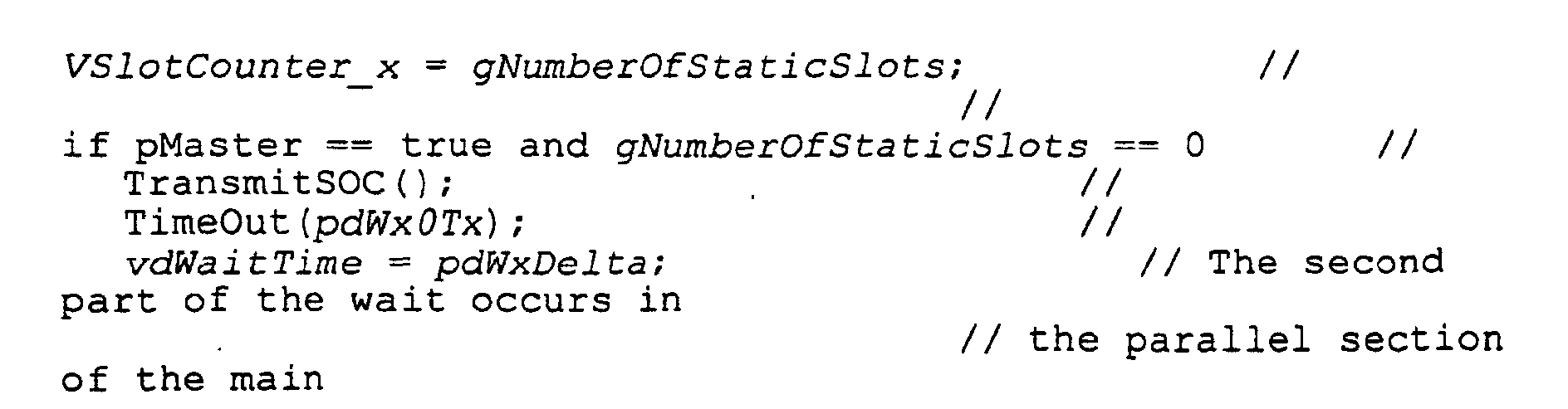

- The node waits for an initial duration that is either pdWx0Tx or pdWx0Rx.
- The slot counter is subsequently incremented by one after each pdwxDelta period of time passes.
- If the frame ID of a frame that is scheduled for transmission matches the value of the slot counter the respective frame is transmitted.
- After finishing transmission the sender waits for pdWx0Tx w + pdWxDelta. However, during the period of pdWx0Tx the sender disables its receiver.
- A frame is only transmitted if the value calculated for fPayloadLength_x is not greater than the maximum allowed value according to the frame format definition.
- Any channel activity causes the slot counting mechanism to stop.
- If a frame transfer is causing the channel activity, the frame is received.
- Once the channel activity ends the node waits for pdWx0Rx + pdWxDelta.
- If the frame ID of the received frame differs by one compared to the respective slot counter then the respective slot counter is readjusted to the value of the received frame ID.
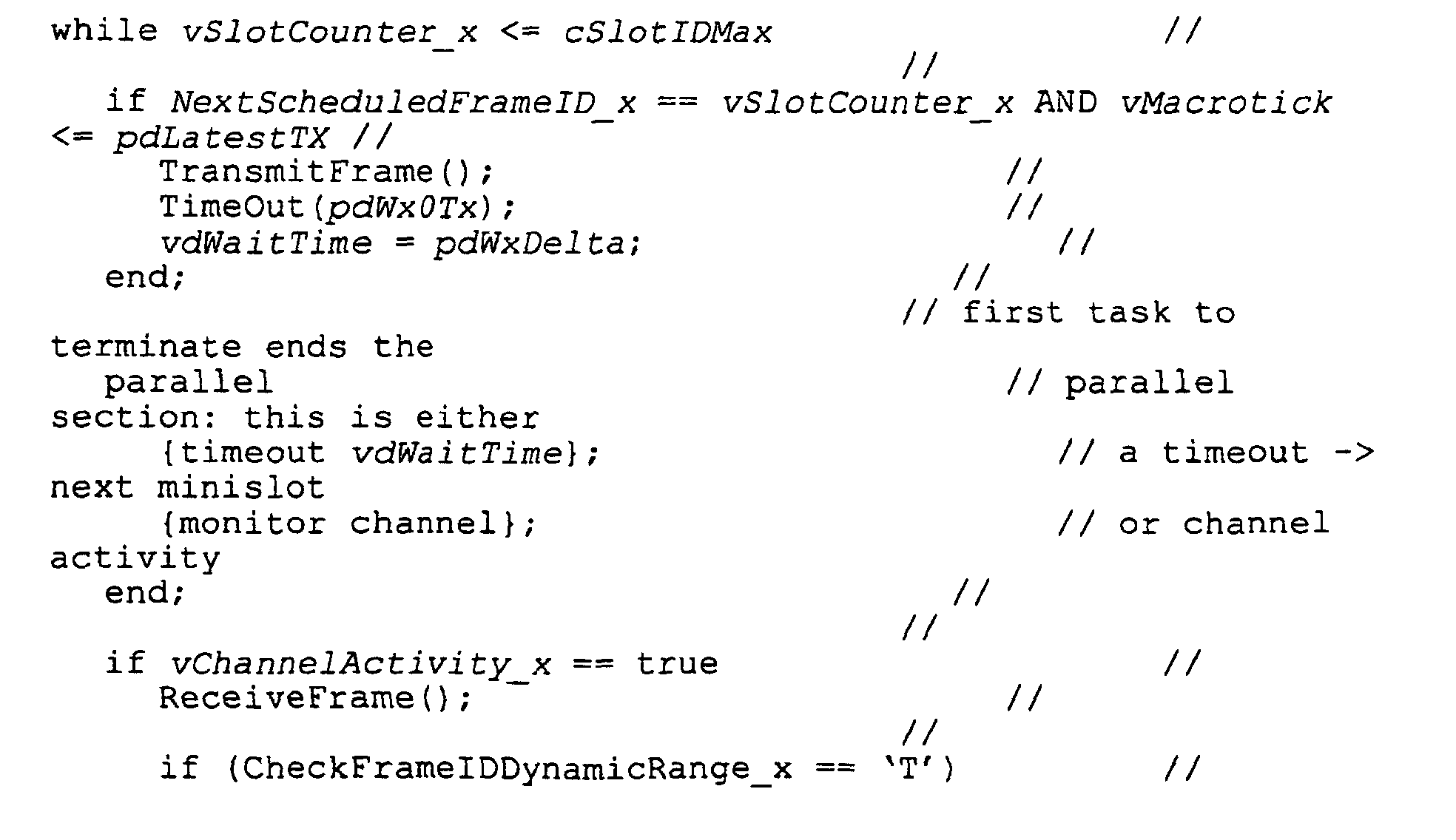

- at the end of a correct frame or
- as soon as an error is detectable and channel idle is signaled
- The respective slot counter reaches the maximum available Slot ID contained in cSlotIDMax, i.e. vSlotCounter_x > cSlotIDMax.
- The start of the network idle time is reached, i.e. vMacrotick == gtStartNIT.
- CheckIdleBeforeFrame_x
- CheckFrameCoding_x
- CheckHeaderCRC_x
- CheckCRC_x
- CheckIdleAfterFrame_x
- CheckFrameIDDynamicRange_x
- CheckCycleCount_x
- CheckReceivedPayloadLength_x
gtStartNIT = gdCycleTime - gdNIT
- gNumberOfStaticSlots (number of static slots)
- gdSlot (the duration of one static slot)
- gdCycle (the duration of the communication cycle)
- gdNIT (the duration of the network idle time)
- The configuration must satisfy gdCycle = (gNumberOfStaticSlots * gdSlot) + gdNIT
- This mode is available in single and dual channel configurations.
- All nodes execute the clock synchronization using the frames of the static segment.
- It is possible to configure nodes that transmit frames only within the dynamic segment. These nodes have a static segment configured but have no transmit buffer configured to send frames with a Frame ID less than or equal to gNumberOfStaticSlots.
- Nodes that transmit only during the dynamic segment take part in the clock synchronization by receiving sync frames and determine the start of the dynamic segment in the same way as nodes that also transmit frames in the static segment.
- During the dynamic segment the frame sequence on the two channels is independent and may be different, i.e., any node may send different frames with different Frame ID's on the two channels, resulting in a different frame sequence on the two channels.
- The length of frames transmitted in the dynamic segment may be different for every communication cycle, i.e., frames with the same Frame ID may have variable length. A frame's length is derived from the payload length field in the frame header.
- A frame is only transmitted during the dynamic segment if the corresponding transmit buffer was marked as "ready for transmission", i.e., no "null frame" will be sent if the host does not update the data. This is in contrast to the static segment, where the CC will send a null frame if a buffer is configured for a slot but the host does not mark the buffer "ready for transmission".
- For a given communication cycle the dynamic segment may be empty, i.e., no frames are transmitted with dynamic medium access control. This may be because no frame with a frame ID greater than pNumberOfStaticSlots is configured in any transmit buffer, or because no dynamic segment frame has been marked "ready for transmission" by its host.
- The startup mechanism for this mode is the same as for the pure static mode.
- In this mode startup is only performed by coldstart nodes.
- At least 2 static communication slots must be configured.
- At least 2 synchronization frames must be exchanged.
- gNumberOfStaticSlots (number of static slots)
- gdSlot (the duration of one static slot)
- gdCycle (the duration of the communication cycle)
- gdNIT (the duration of the network idle time)
- pdLatestTx (latest starting point for a frame in the dynamic segment)
- The duration of the dynamic segment is calculated by: gdDynamicPart = gdCycle - gdNIT - (gNumberofStaticSlots * gdSlot).
- The node must be configured in a way that the dynamic segment is active, i.e. gdDynamicPart must be long enough and the parameter pdLatestTx must be configured in a way so that it is possible to transmit at least one frame during dynamic segment.
- The parameter pdLatestTx is be configured in Macroticks individual for each node in a way so that the longest frame to transmit by the node does not overlap with gdNIT.
- pdWxDelta must be configured.
- pdWx0Tx
- pdWx0Rx
- This mode is available in single and dual channel configurations
- In this mode startup and synchronization is performed by means of the SOC symbol that serves as DCT.
- The first received DCT starts the dynamic media access scheme on both channels at the same time.
- In this mode one node of the cluster is configured as SOC master by its host.
- There are two different SOC symbols: SOC Normal and SOC Alarm. Refer to the coding chapter for further details.
- The SOC master generates SOC symbols at the beginning of each communication cycle. The duration of one cycle is configured by gdCycle.
- After startup the SOC master generates SOC Normal symbols.
- The SOC master may be switched to generate SOC Alarm symbols by the host. The SOC master switches back automatically to generating SOC Normal symbols after 1023 * gdCycle. The host of the SOC master may trigger the generation of SOC Alarm symbols again before 1023 * gdCycle is elapsed. In that case the SOC master restarts the timer to count the period of 1023 * gdCycle. The host may switch immediately from the generation of SOC Alarm symbols to the generation of SOC Normal symbols before the period of 1023 * gdCycle is elapsed by accessing the host interface. When switching from SOC Normal to SOC Alarm (or vice versa) the duration of one communication cycle remains gdCycle.
- SOC Normal and SOC alarm symbols are treated identically with respect to media access.
- All non-SOC master nodes use the SOC symbol for synchronizing their local clock that determine media access during the cycle. Therefore no media access is possible if there is no valid SOC present or if the last valid SOC was received more than gdCycle ago.
- The frame sequence on the two channels is independent and may be different, i.e., any node may send different frames with different Frame ID'S on the two channels, resulting in a different frame sequence on the two channels.
- The length of frames transmitted in the dynamic segment may be different for every communication cycle, i.e., frames with the same Frame ID may have variable length. A frame's length is derived from the payload length field in the frame header for FlexRay frames, and from the data length field in the header for byteflight frames.
- A frame is only transmitted during the dynamic segment if the corresponding transmit buffer was marked as "ready for transmission", i.e., no "null frame" will be sent if the host does not update the data.
- For a given communication cycle the dynamic segment may be empty, i.e., no frames are transmitted with dynamic medium access control. This may be because no frame has been marked "ready for transmission" by its host.
- The number of static slots gNumberofStaticSlots, the parameters pdLatestTX and gdNIT and the duration of the communication cycle gdCycle must be configured. The duration of the dynamic segment is calculated by: vdDynamicPart = gdCycle - gdNIT - gdSOC.
- A node is in dynamic mode if the number of static slots gNumberofStaticSlots is configured equal zero.
- The parameter pdLatestTx must be configured individual for each node in a way so that the longest frame to transmit by the node does not overlap with gdNIT.
- pdWxDelta must be configured.
- byteflight frame format
- coding: NRZ 8N1
- physical layer: 2 state physical layer
- gNumberOfStaticSlots: 0
- gdBit: 100 ns
- pdLatestTx should be configured so that it equals 231 µs
- gdNIT should be configured so that it equals 0 µs
- gdCycle: 250 µs
- gdCycleMin: 249.725 µs
- gdCycleMax: 250.275 µs
- gBitRate: 10 Mbit/s
- type of physical layer concerning wake-up method: optical byteflight
- pdWx0Tx
- pdWx0Rx
- This mode is enabled/disabled by a configuration parameter.
- This mode is available in FlexRay mode and in byteflight mode.
- The external trigger starts the
communication cycle either
- by a falling edge on an external trigger pin or
- by the host by writing to a dedicated trigger control bit.
- The timing of the external trigger cycle is monitored through the two parameters pdCycleMin and pdCycleMax.
- If the external trigger appears later than pdCycleMin and earlier than pdCycleMax (case 1): No Error is signaled and the SOC is triggered by the external trigger
- If the external trigger does not appear before pdCycleMax (case 2): A SOCLIF (SOC Lost Interrupt Flag) Error is signaled and the SOC is triggered after pdCycleMax.
- If the external trigger appears earlier than pdCycleMin (case 3): A SOCEIF (SOC Early Interrupt Flag) Error is signaled and the SOC is triggered after pdCycleMin.
The

If the data update bit is set to fDataUpdateBit = 1 the data was updated by the host.
If the data update bit is set to fDataUpdateBit = 0 the data was not updated by the host.

- Byte frames within a frame shall be sent without idle phases in between, i.e., there is no interruption of the bit stream.
- Each byte frame shall begin with one start bit (logical "1"), followed by 8 data bits and one stop bit (logical "0"). There is no parity bit.
- Transmission of the data bits within a byte frame shall be such that the most significant bit of the data is transmitted first with the remaining bits of the data being transmitted in decreasing order of significance. This is shown in Figure 34.
- Due to certain effects on the physical transmission medium (e.g optical transmission, truncation due to connection setup in the star coupler, etc.), it is possible for the 10 gdBit times of logical "1" sent by the transmitter to appear to be shorter at the receiver. Therefore, all receivers shall accept an SOC Normal symbol starting with a period of 0-10 gdBit times at logical "1".
- The duration of the 30 gdBit time at logical "0" may vary by ± 1.5 * gdBit, i.e., all receivers shall accept an SOC Normal symbol with a range of 28.5 to 31.5 gdBit times at logical "0" .
- Due to certain effects on the physical transmission medium (e.g., optical transmission, truncation due to connection setup in the star coupler, etc.), it is possible for the 20 gdBit times of logical "1" sent by the transmitter to appear to be shorter at the receiver. Therefore, all receivers shall accept an SOC Alarm symbol starting with a period of 10-20 gdBit times at logical "1".
- The duration of the 20 gdBit times at logical "0" may vary by ± 1.5 * gdBit, i.e., all receivers shall accept an SOC Alarm symbol with a range of 18.5 to 21.5 gdBit times at logical "0".
- The tolerance of the bit timing is determined by the quality of the oscillators. Nodes shall tolerate oscillator frequency differences of up to ± 1500 PPM (Parts Per Million).
- A receiver shall tolerate deviations of ± 35% concerning the parameter gdBit, i.e., single bit edges must be detected even if they are up to ± 0.35 * gdBit times earlier or later than expected.
| Input and Output Signals for Glitch Filtering and | |
| RXDA | Receive signal on FlexRay channel A |
| RXDB | Receive signal on FlexRay channel B |
| RXEA | Receive enable signal on FlexRay channel A |
| RXEB | Receive enable signal on FlexRay channel B |
| RXDA_F | Glitch filtered version of RXDA |
| RXDB_F | Glitch filtered version of RXDB |
| RXEA_F | Glitch filtered version of RXEA |
| RXEB_F | Glitch filtered version of RXEB |
| RXDA_V | Result of sample voting on RXDA_F |
| RXDB_V | Result of sample voting on RXDB_F |
- A number of samples pGlitchSamples is configured that determines the glitch length to be filtered out by the glitch filter (see Figure 38). A configuration of pGlitchSamples = 0 means that no glitches are filtered out.
- All pulses with a duration shorter than pGlitchSamples * pSamplePeriod shall be filtered out. That means that the output of the glitch filter shall only change its logical value if more than pGlitchSamples equal samples are detected at the glitch filter's input (see Figure 38). Figure 39 and Figure 40 show examples of glitches that are filtered out by the glitch filter mechanism.
| Index | Sample Clock Prescaler | Sample Clock Period (ns) | Samples per Bit | Bit Time (ns) | Bit Rate (Mbps) |
| 1 | 1 | 12.5 | 8 | 100 | 10.000 |
| 2 | 1 | 12.5 | 10 | 125 | 8.000 |
| 3 | 2 | 25.0 | 8 | 200 | 5.000 |
| 4 | 2 | 25.0 | 10 | 250 | 4.000 |
| 5 | 4 | 50.0 | 8 | 400 | 2.500 |
| 6 | 4 | 50.0 | 10 | 500 | 2.000 |
| 7 | 8 | 100.0 | 8 | 800 | 1.250 |
| 8 | 8 | 100.0 | 10 | 1000 | 1.000 |
| 9 | 16 | 200.0 | 8 | 1600 | 0.625 |
| 10 | 16 | 200.0 | 10 | 2000 | 0.500 |
| System Constants, Parameters and Variables | |||
| Name | Description | Range/Value | Unit |
| pSamplePeriod | Time interval between two consecutive sampling points | ns | |
| pGlitchSamples | Number of samples that are filtered out by the glitch filter mechanism | [0-pSamplesPerBit /2] | |
| pSamplesPerBit | Number of samples per | 8 or 10 (V5 solution) | |
| pVotingOffset | Defines the first sample that is considered for the voting mechanism based on the glitch filter output | [0-pSamplesPerBit ] | |
| pVotingSamples | Defines the number of samples that are considered for the voting mechanism based on the | 1, 3, 5, 7, or 9 |
- If no static segment is configured for the cluster (gNumberOfStaticSlots = 0) the communication cycle timing is based on the Start-Of-Cycle (SOC) symbol. No distributed clock synchronization is performed.
- The cycle length gMacroPerCycle is configured and measured in nominal (uncorrected) macroticks.
- The cycle starts with the beginning of the SOC and ends with the beginning of the next SOC (see Figure 43). If no SOC is received (due to a fault) the macrotick counter should be incremented until it reaches its maximum value. No further incrementing is done.
- A single master provides the SOC. If the master fails, a backup master can take over the task of transmitting the SOC if another host intervenes to configure its communication controller to do so. There is no automatic protocol mechanism that will cause a new master to be established.
- When a slave recognizes the reception of a valid SOC, it sets its local clock to cyclestart+ gdSOC. The gdSOC is configured during soft reset and quantifies the duration of the SOC, including the time for recognition and checking of its correctness. The time in a slave runs from the predefined constant value gdSOC to gMacroPerCycle + gdSOC.
- Internally, nodes can time their behavior with microtick resolution. Microticks are time units derived from the (external) oscillator clock tick, optionally using a prescaler. Microticks are controller-specific units. They may have different durations in different controllers. The precision of a node's local time difference measurements is a microtick.
- Local controller time is based on cluster-wide synchronized cycle and macrotick values provided by the distributed clock synchronization mechanism. Finer resolution local timing is done using the node-specific microtick.
- vCycle is the (controller-local) cycle number and is increased once every communication round. At any given time all nodes should have the same value for vCycle (except due to imperfect synchronization at cycle boundaries.
- Cycle counter values (vCycle) range from zero (00 0000)2 to cCycleMax (11 1111)2.
- The maximum cycle counter value is configurable for a given cluster (gCycleMax). The first time the cycle counter (vCycle) is incremented after gCycleMax is reached, it is reset to zero.
- gCycleMax must be less than or equal to cCycleMax.
- gCycleMax must be an odd number (see Procedure 2).
- vMacrotick is the current value of the (controller-local) macrotick counter.
- gMacroPerCycle defines the (integer) number of macroticks per cycle (see Figure 44).
- Within tolerances, the duration of a macrotick is constant throughout the cluster on synchronized nodes.
- Every node in the system has its own local view of the global time. The local view of global time is represented by a vector consisting of the current cycle number (vCycle) and the current macrotick value (vMacrotick). The value vCycle.vMacrotick is the (controller-local view of the) global time in the cluster. It is visible to the application.
- pMicroPerMacroNom is the (controller-specific) nominal number of microticks per macrotick.
- vMicroOverheadPerCycle is the (integer) number of microticks that has to be added to the pMicroperMacroNom * gMacroPerCycle microticks in the current cycle to produce the correct cycle length. vMicroOverheadPerCycle may be negative. The value of vMicroOverheadPerCycle is determined by the clock synchronization algorithm. It may only change once (usually at the beginning) per cycle.
- pMicroOverheadPerCycleNom is the initial configuration value of vMicroOverheadPerCycle.
- The duration of the current controller-local macrotick is an integer multiple of controller-local microticks and is represented by vMicroPerMacroCorr. The value of vMicroPerMacroCorr within one controller may change from macrotick to macrotick.
- In any given cycle, vMicroOverheadPerCycle microticks must be distributed across the gMacroPerCycle macroticks comprising the cycle in order to adjust the cycle length to the proper duration. Consequently, vMicroPerMacroCorr does not remain constant. In general, vMicroOverheadPerCycle is nonzero and is not a multiple of gMacroPerCycle. Consequently, the process of distributing the vMicroOverheadPerCycle microticks across the gMacroPerCycle macroticks conceptually introduces fractional macroticks.
- At the beginning of the first communication cycle the "local time variables" are initialized (see Procedure 1).

- The initialization of the first three values differs if the node reintegrates into a running cluster (see TBD section Startup and Reintegration).
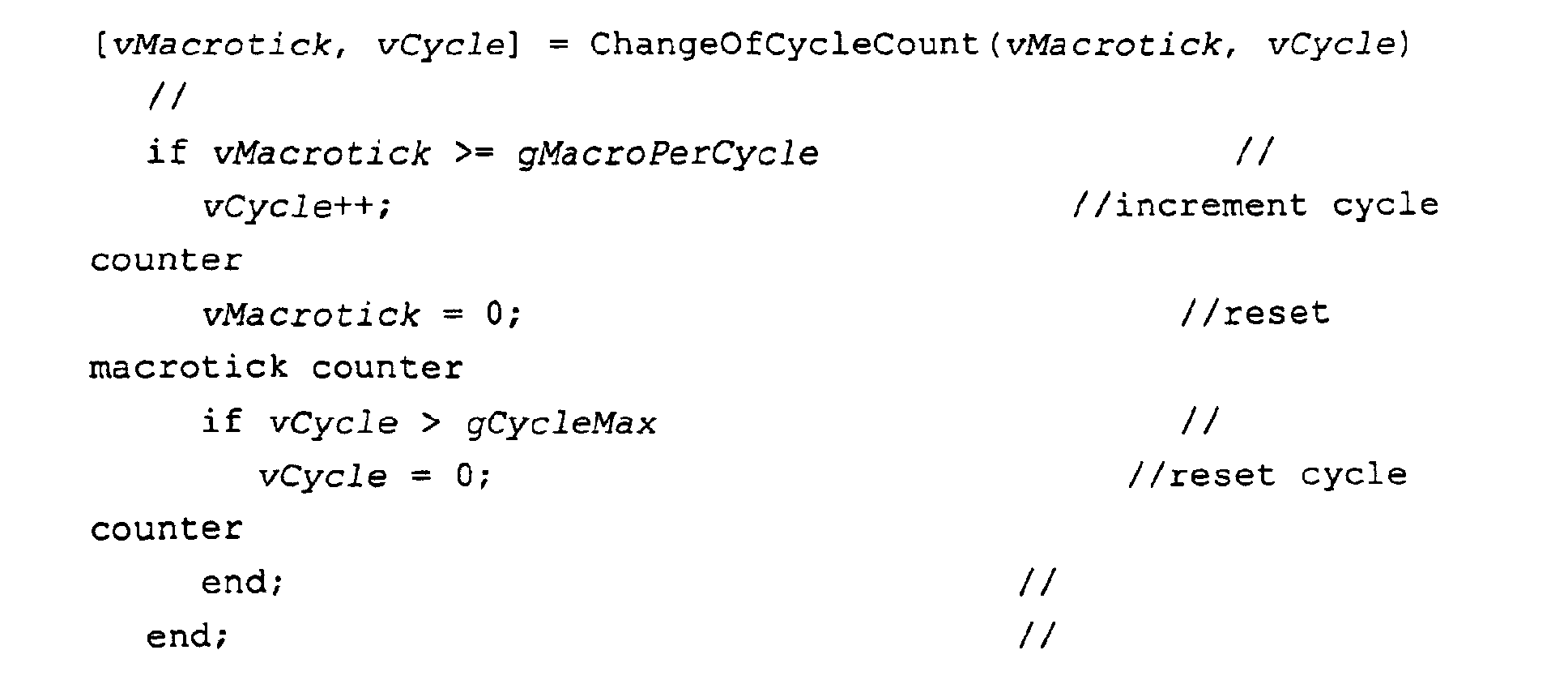
- The host is able to read the cycle counter and the macrotick counter. The update of the cycle counter and the macrotick counter has to be atomic.
- The duration of a Macrotick is a whole number of a Microticks, however, the number of microticks per macrotick may differ from macrotick to macrotick. Before the first correction value is calculated the clock synchronization algorithm works with nominal macroticks, using vMicroPerMacroCorr = pMicroPerMacroNom + pMicroOverheadPerCycleNom (see 0).
- The number of microticks per nominal macrotick may differ between nodes and depends on the oscillator frequency and the prescaler.
- The duration of one cycle is a whole number of a macroticks. The number of macroticks per cycle is identical in all nodes in a cluster (see Figure 44).
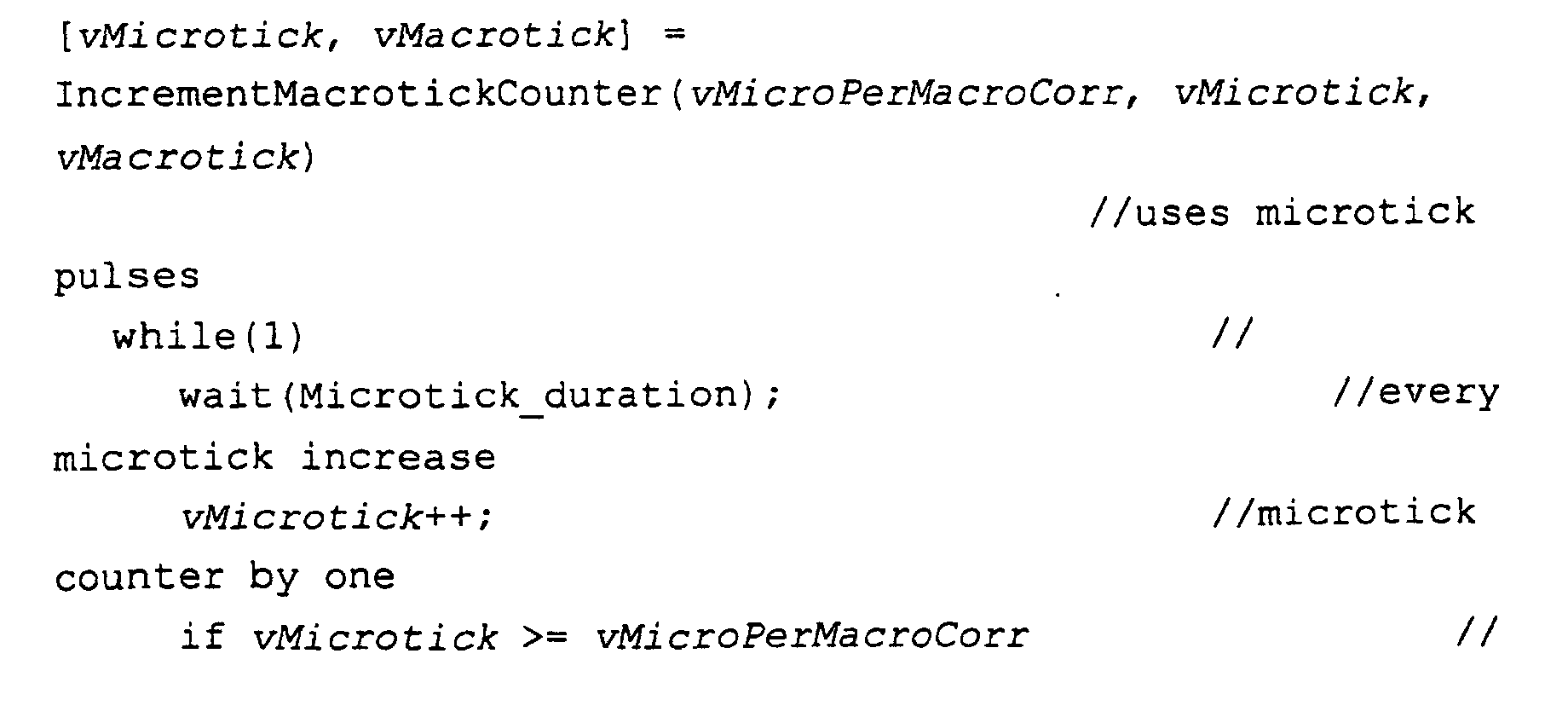
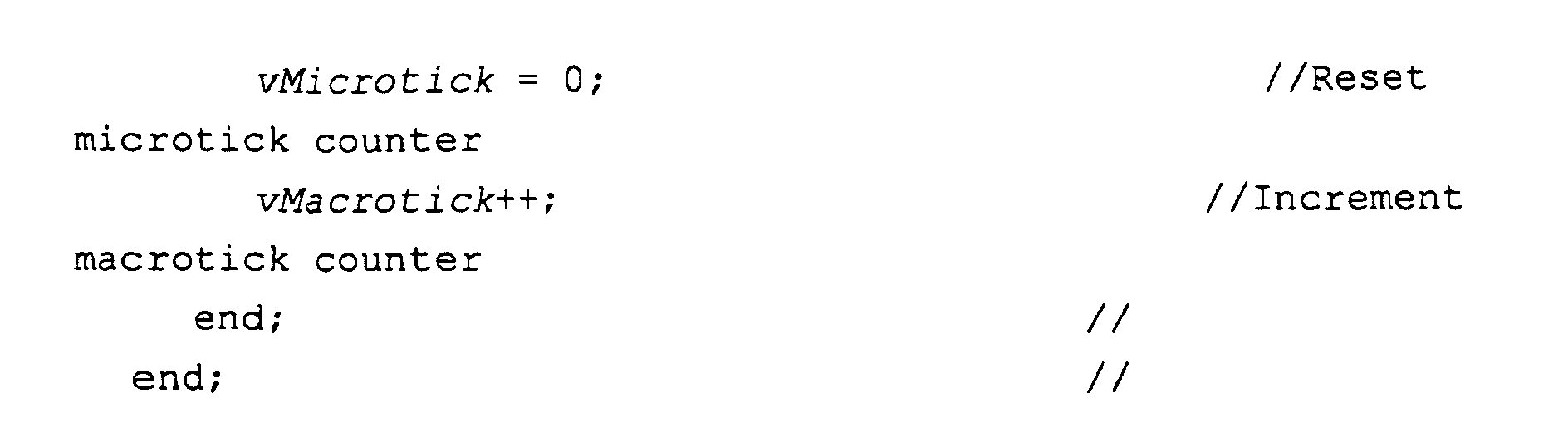
- For a given cycle (without offset correction) the average length of a macrotick is given by pMicroPerMacroNom + vMicroOverheadPerCycle / gMacroPerCycle.

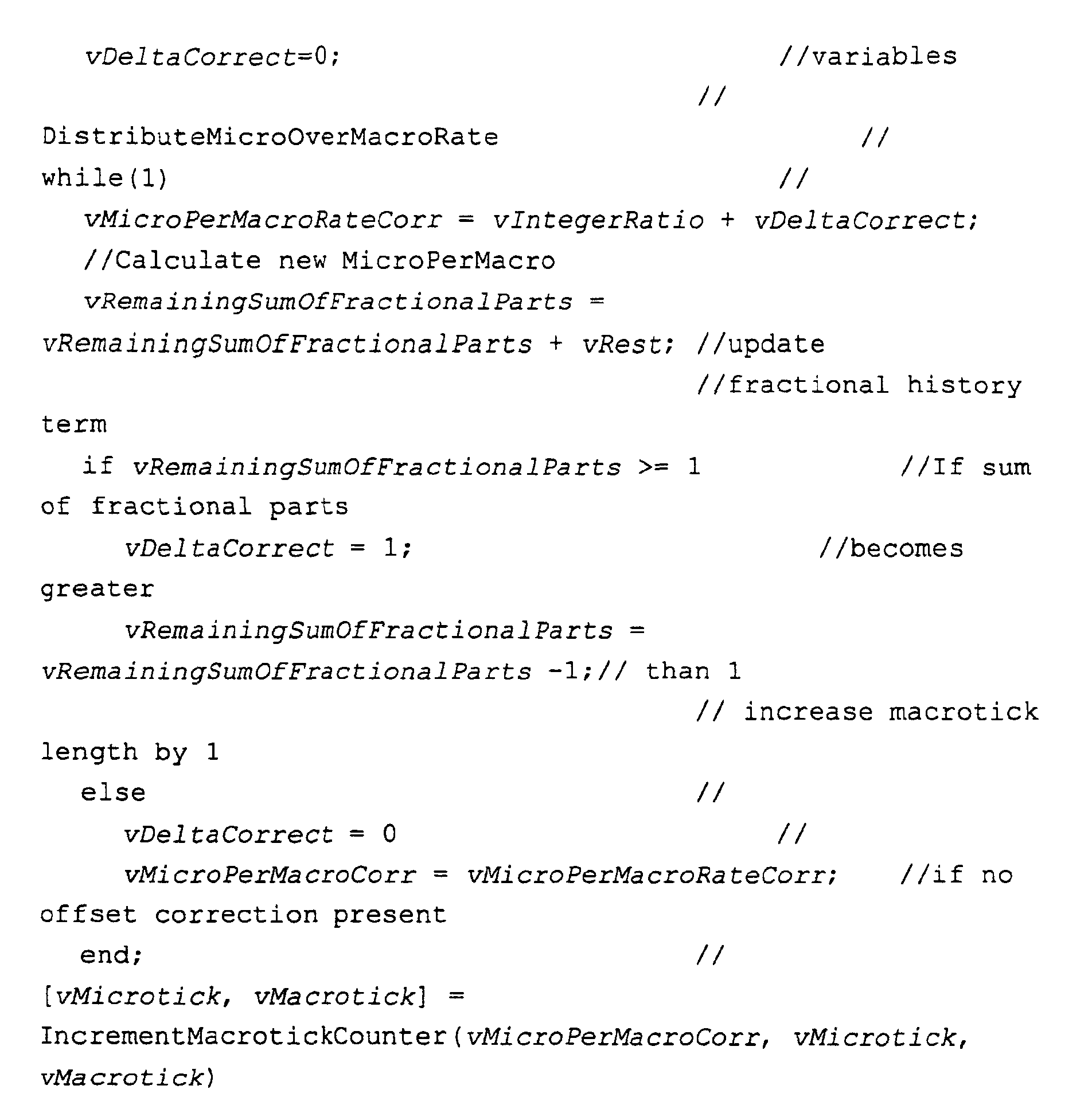
- The variable vIntegerRatio is not necessarily equal to pMicroPerMacroNom (may be important for implementation).
- Offset correction has an additional influence. Therefore there is a difference between the variables vMicroPerMacroCorr and vMicroPerMacroRateCorr.
- Since there is no real division available in hardware, the implementation will not precisely replicate the above procedure. Most likely the variable vMicroPerMacroCorr will not be explicitly calculated in hardware.
- As is typically true with pseudocode, the above procedure provides insight into the behavior of the mechanism, but not its implementation.
- The node (or nodes in the case of a startup with collisions) that transmit the first CAS during startup, initializes the cycle counter and the cycle time to zero at the beginning of the communication cycle following the transmission of the CAS. See TBD for details.
- The duration of a static slot gdSlot, a communication cycle gdCycle, and the idle time at the end of a communication cycle gdNetworkIdle are all expressed as a whole number of macroticks.
- Each node with pChannels == gChannels that is configured to send in the static segment of the communication cycle can send at most one frame per communication cycle with the sync bit set.
- The sync bit may only be set in frames that are transmitted on all channels (gChannels - one or two channel configuration).
- Not all nodes that are configured to send in the static segment of the communication cycle need to send frames with the sync field set.
- The communication controller has to count all correctly received frames each cycle where the sync bit is set. This number is accessible to the host.
- If a controller receives more than gMaxSyncFrames the first gMaxSyncFrames are used for clock synchronization.
- All controllers execute the synchronization algorithm approximately at the same time. The calculation of the correction terms take place every second communication cycle during the network idle time.
- Every node measures and stores the time differences (in microticks) between the expected and the actual observed arrival time of all sync frames received during the static segment.
- The expected arrival time of a frame is
calculated relative to the beginning of a
slot (slot boundary). The time (in
microticks) between the start of a slot and
the expected reception of the time reference
point is calculated as follows:
- pExpectedArrivalTimeChA = gdFrameStartSequence + gdTimeReferencePoint + pDelayCompensationChA
- pExpectedArrivalTimeChB = gdFrameStartSequence + gdTimeReferencePoint + pDelayCompensationChB
- The global parameters gdFrameStartSequence and gdTimeReferencePoint are specified in fractional macroticks but represented internally in microticks. This is necessary because the only global time unit available is the macrotick, since microtick durations are node-specific. Fractional macroticks are necessary because greater precision is needed than can be provided by the macrotick.
- The Observed Arrival Time is defined as the elapsed time between the start of a slot and the reception of the time reference point for the frame. The unit of measure is the microtick.
- The Time Difference measurement is the difference between the Expected Arrival Time and the Observed Arrival Time. It is calculated and stored after each Observed Arrival Time measurement. A bit marks this value as invalid until the frame is received completely and passes the required validity checks.
- The sync frame validity checks used during startup and reintegration are described in Section TBD
- A valid sync frame during normal operation
means
- vCheckFrameCoding == true
- vCheckCRC == true
- vCheckSyncBitSet == true
- vCheckStaticPayloadLength == true
- vCheckFrameIDMatch == true
- For NRZ 8N1 bit coding the time reference point is defined as the rising edge at the end of the frame start.
- The time difference measurement is done for all channels pChannels.
- If there are time difference measurements from more than one channel for a given sync frame, the smallest value is taken.
- If only one valid frame is received within a given static sending slot, this single observation is used for the Time Difference Measurement.
- Every node has to be able to store measurement values for gSyncNodeMax sync nodes. A counter will be increased when a valid sync frame is received. If a node receives more than gSyncNodeMax sync frames in one communication cycle it raises an interrupt to the host but uses the first gSyncNodeMax observations for the calculation of the rate and drift correct values.
- The Frame Identifiers of sync frames expected to be received are not stored in the configuration of a node.
- Individual delay compensation values (pDelayCompensationChA and pDelayCompensationChB) can be configured for each channel.


| FTA/FTM Term Deletion as a Function of List Size | |
| Number of Values | k |
| 1 - 2 | 0 |
| 3 - 7 | 1 |
| 8 - | 3 |

- If the list contains only one value this value is used for clock synchronization.


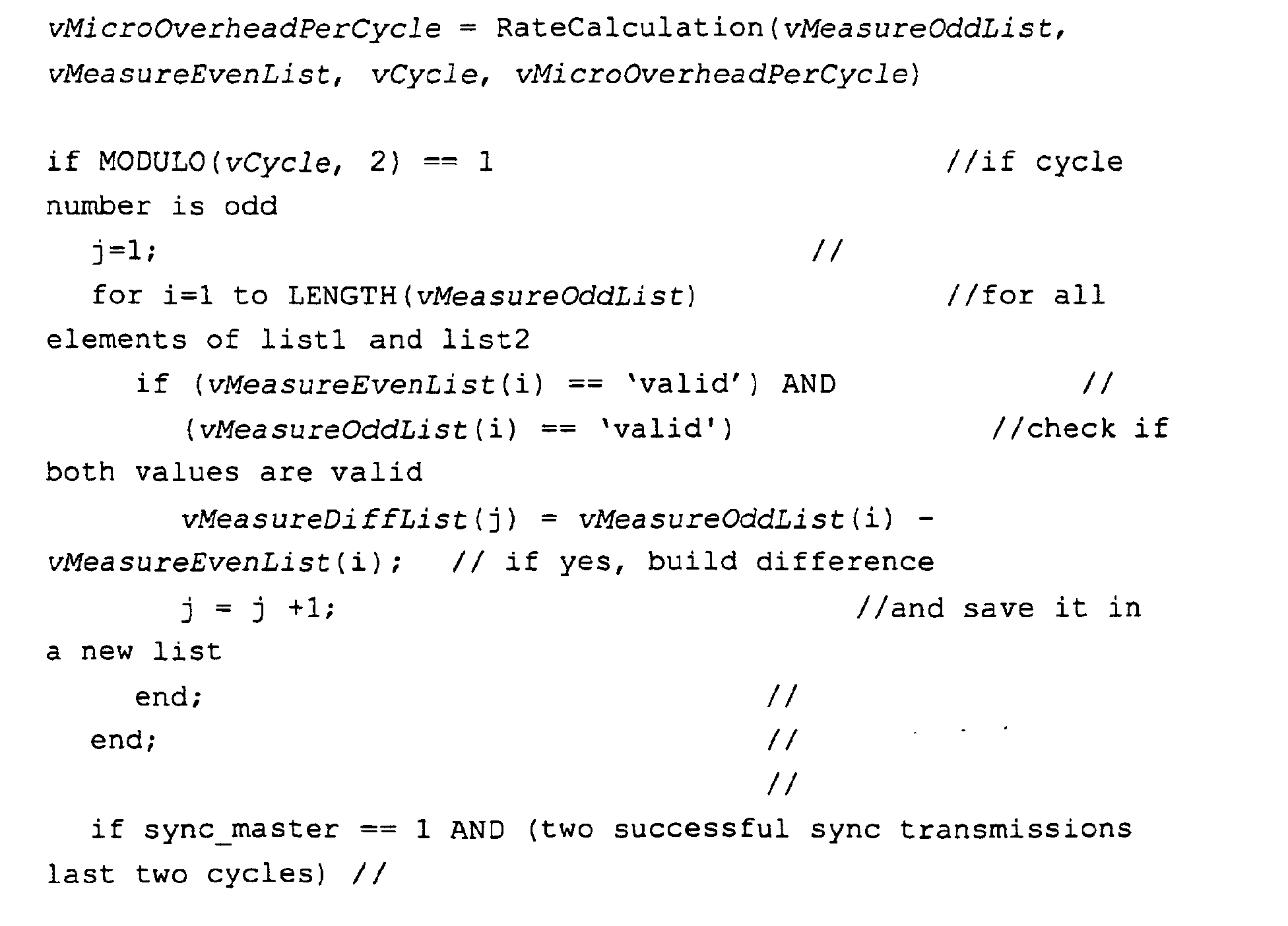
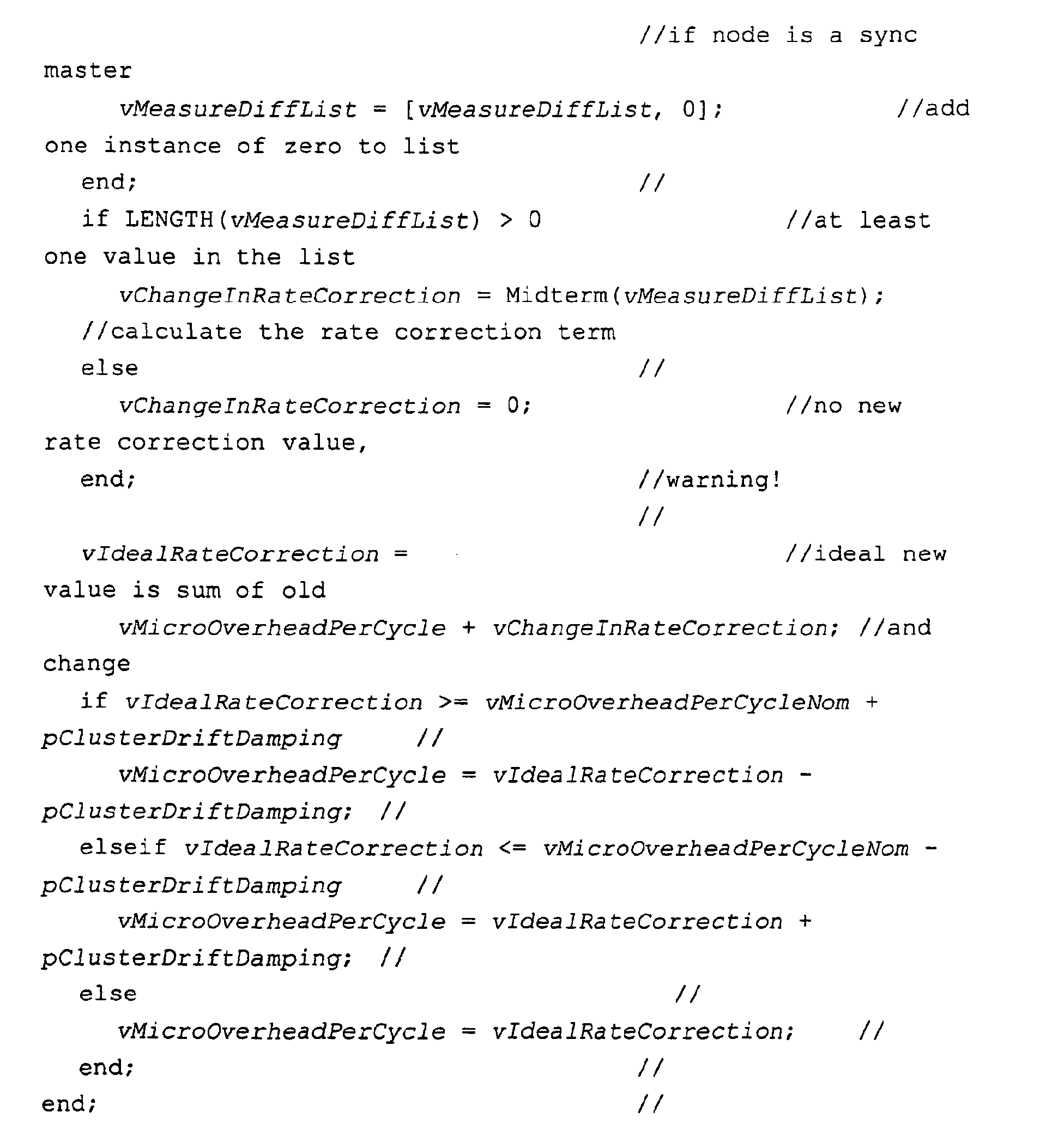
- After calculation of the correction values the memory for the measurement values is cleared and marked empty.
- The correction values are in the green region
if:
- -gRateCorrectionOut <= vMicroOverheadPerCycle <= + gRateCorrectionOut
- -gOffsetCorrectionOut <= vOffsetCorrection <= + gOffsetCorrectionOut
- If both correction values are in the green area the correction is done.
- -gRateCorrectionOut is the lower boundary and +gRateCorrectionOut is the upper boundary of the green area for the rate correction.
- -gOffsetCorrectionOut is the lower boundary and +gOffsetCorrectionOut is the upper boundary of the green area for the offset correction.
- The correction value is in the red region if
- - gRateCorrectionOut > vRateCorrection OR +gRateCorrectionOut < vRateCorrection
- - gOffsetCorrectionout > vOffsetCorrection OR + gOffsetCorrectionOut < vOffsetCorrection
- The significance of having correction values in the red region depends on whether the node is in the process of startup, or not. During normal operation this is a critical error. During startup and reintegration it must be treated differently (see Section TBD).
- The values of gRateCorrectionOut and the
goffsetCorrectionOut are identically
specified for all nodes in the cluster They
are defined in terms of in macroticks or
partial of a macroticks. From these cluster-wide
values the configuration data for each
node is calculated (measured in microticks).
These values are included in the
configuration interface. These calculations
are summarized as follows:
- pOffsetCorrectionOut = gOffsetCorrectionOut * pMicroPerMacroNom
- pRateCorrectionOut = gRateCorrectionOut * pMicroPerMacroNom
- If the communication controller is in "normal mode" and if one correction value is in the red area the node goes to passive.
- Rate correction is accomplished by modifying the value of vMicroOverheadPerCycle (see Procedure 8), which is subsequently distributed over the macroticks comprising the next cycle.
- Offset correction is accomplished by modifying the value of vOffsetCorrection (see Procedure 7), which is subsequently distributed over the macroticks comprising the current Network Idle Time.
- Offset correction is done during the network idle time by increasing or decreasing the size of each macrotick..
- It is not necessary that all controllers perform their offset correction identically. However, they must perform the offset correction in the Network Idle Time.
- The offset correction term, vOffsetCorrection, is a signed integer that is visible to the application.
- It cannot be assumed that the magnitude of the offset correction term, |vOffsetCorrection|, is less than a macrotick. However, it is necessary to make assumptions on the maximum value |vOffsetCorrection| can achieve under all application and fault scenarios. (The maximum offset correction value assumed has a significant influence on the macrotick length, slot length and other critical timing parameters.)
- The maximum number of microticks that at macrotick can be increased (due to offset correction and rate correction combined) is bounded by a configuration constant pMicroPerMacroMax. The offset correction term, vOffsetCorrection, is distributed across the first, and subsequent macroticks to the limit allowed by pMicroPerMacroMax, until the total offset term is distributed.
- The maximum number of microticks that at macrotick can be decreased (due to offset correction and rate correction combined) is bounded by a configuration constant pMicroPerMacroMin. The offset correction term, vOffsetCorrection, is distributed across the first, and subsequent macroticks to the limit allowed by pMicroPerMacroMin, until the total offset term is distributed.
- pMicroPerMacroMax is the maximum length of a macrotick in microticks.
- pMicroPerMacroMin is the minimum length of a macrotick in microticks.
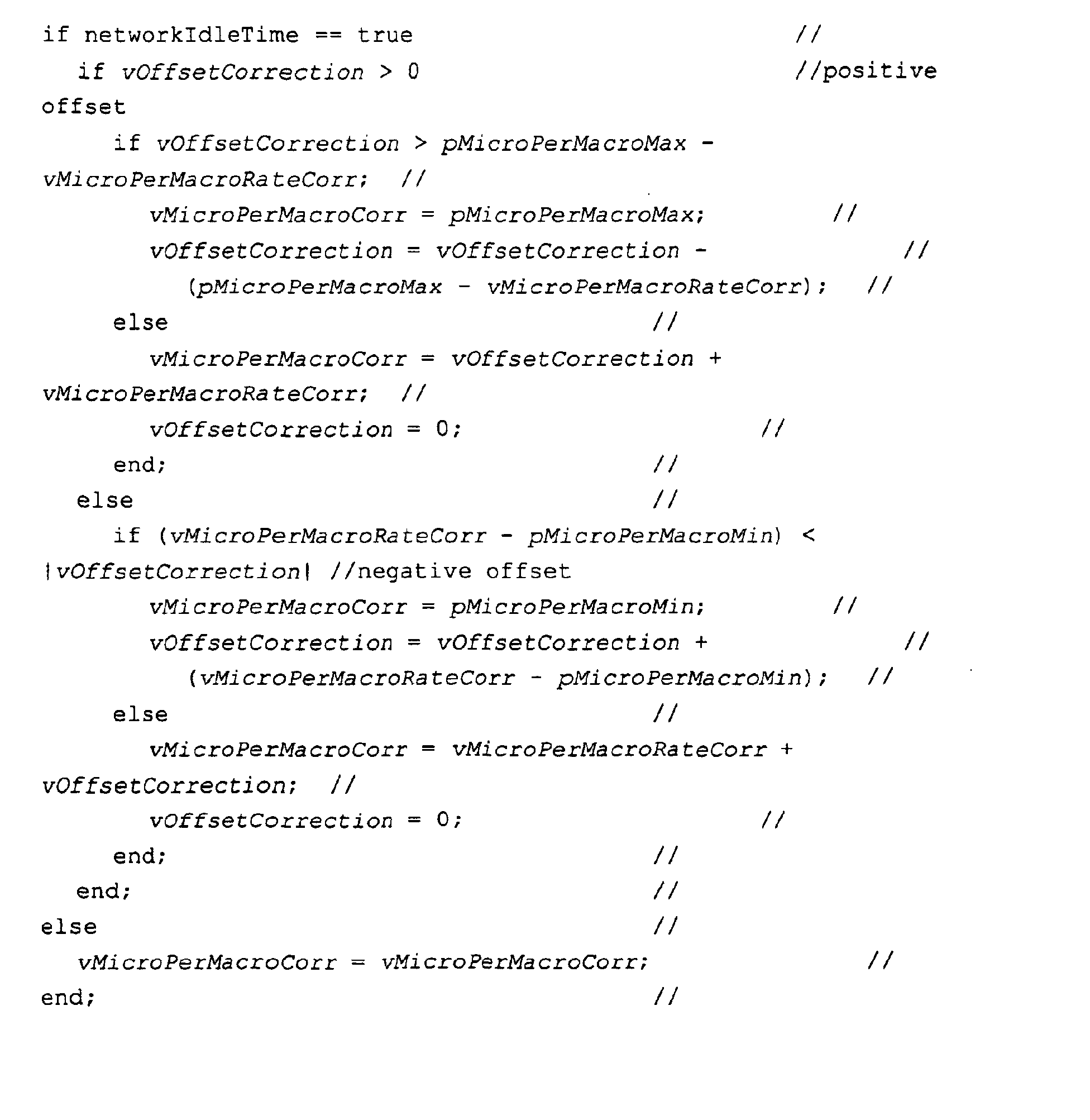
- The rate correction term is uniformly distributed over the entire cycle (see Figure 49).


- This is only an example.
- As previously mentioned, it seems to be unlikely that the variable vMicroPerMacroRateCorr can be calculated explicitly in hardware. It is more likely that the IncrementMacrotickCounter procedure will be an intrinsic part of at least the rate part of the microtick distribution state machine.
- Both the external rate and external offset correction have to be performed in the same cycle.
- The external correction terms (offset and rate correction terms) have to be available to the communication controller when the network idle time starts.
- The external correction terms will be checked against limits and applied following the corresponding tasks are performed for the internal correction terms. This takes place during the Network Idle Time.
- Following the Network Idle Time, an aggregate rate correction term
- The aggregate offset correction term, consisting of correction components from the internal and external offset correction terms, will be applied in the remainder of the Network Idle Time, before the next cycle starts.
- Option 1: by setting the external rate correction term
- Option 2: by setting the variable vMicroOverheadPerCycle
| Host Interface Registers for External Clock Correction | |
| Register | Size |
| External offset | 8 Bit |
| Internal offset | 8 |
| gOffsetCorrectionExternalOut | |
| 8 Bit | |
| External | 8 Bit |
- check internal offset correction value vOffsetCorrection against gOffsetCorrectionOut,
- check external offset correction value separately against gOffsetCorectionExternalOut
- check sum of internal and external rate correction against gRateCorrectionOut.
- sum of internal and external rate correction is in the red region
- internal rate correction in the red region
- internal offset correction in the red region
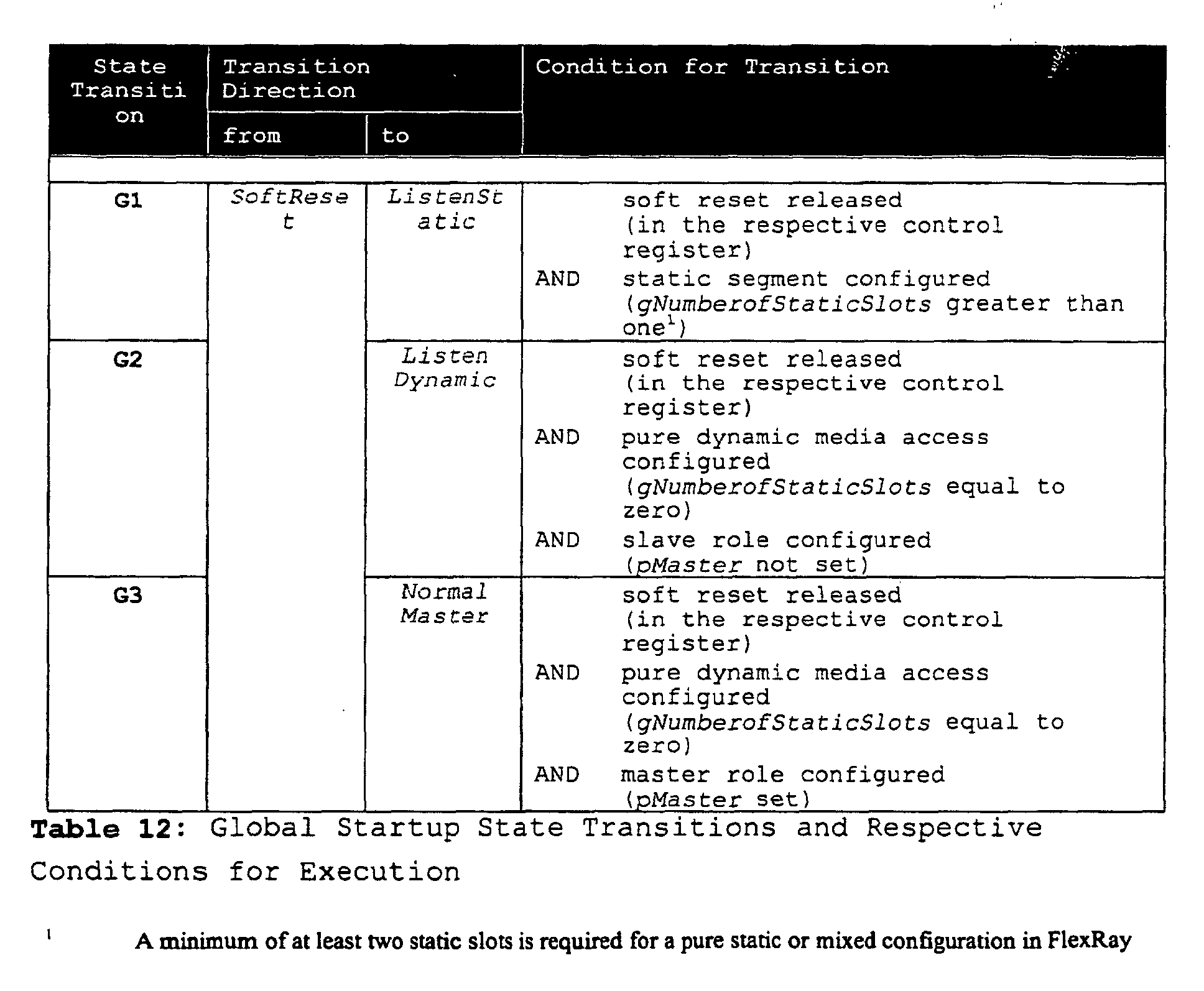
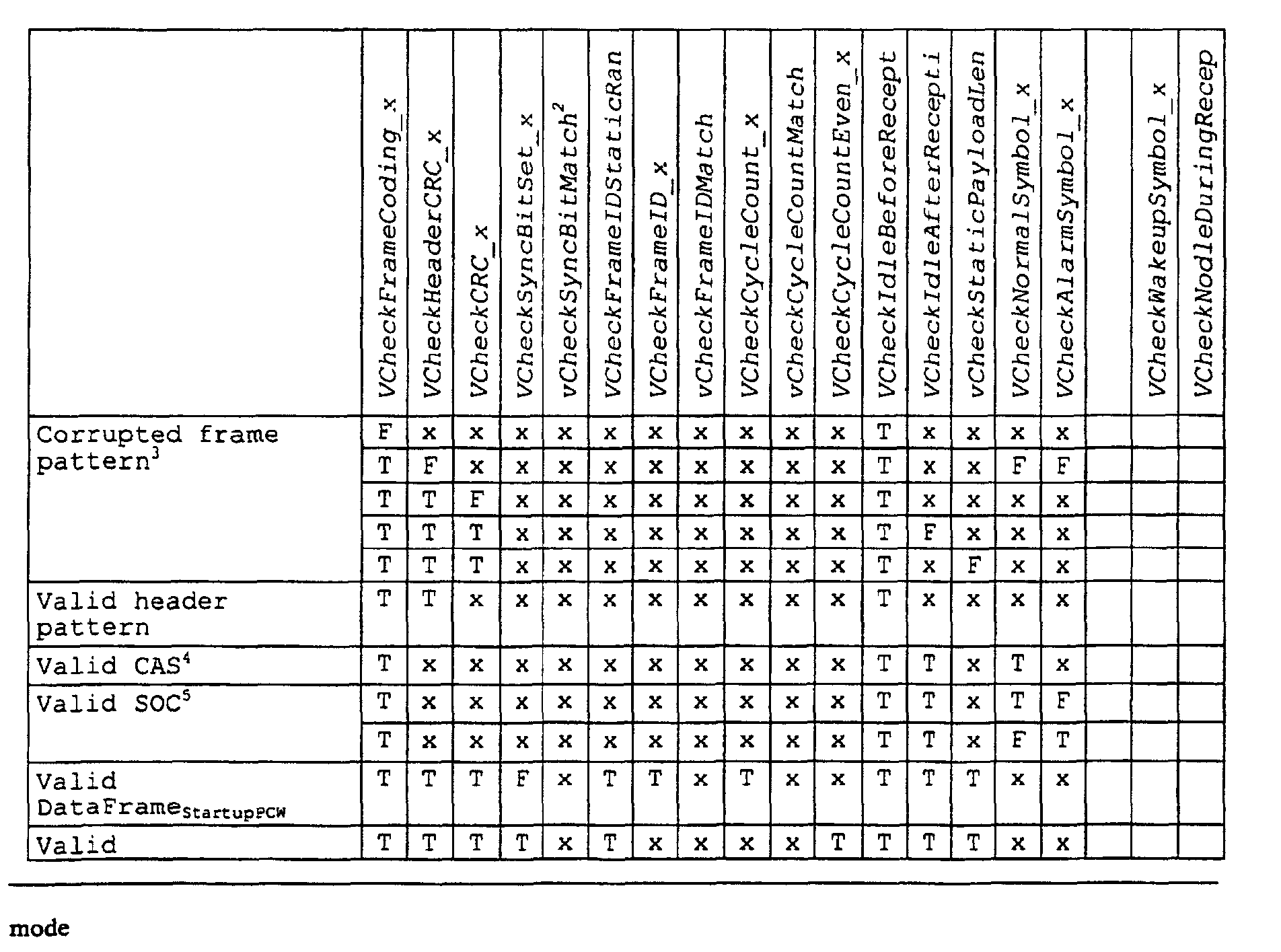

gdStartup ≥ gdCycle + gdMaxDrift


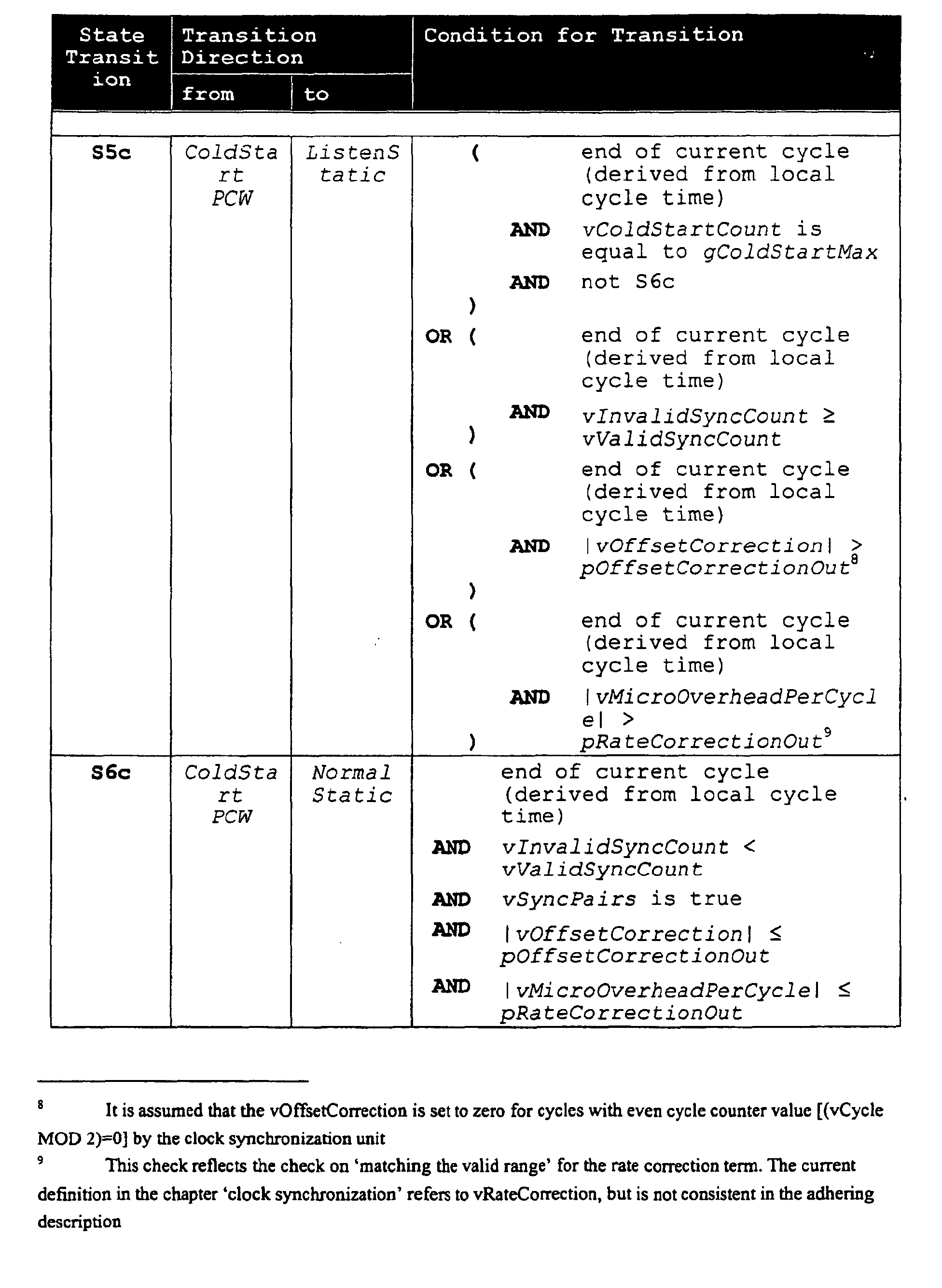





- The configuration must ensure that only nodes connected to all configured communication channels (pChannels = gChannels) are configured as sync nodes. Thus, in the absence of faults, the transmissions of a sync node that initiate the schedule synchronization are visible to every node.
- It has to be ensured that all nodes integrating to a communication schedule perform their clock synchronization synchronously. Specifically, this applies to the process of applying the clock correction terms (offset and rate). Since rate measurement phases take two cycles, it has to be guaranteed that there is no spontaneous time shift in the schedule (due, perhaps to offset correction) while nodes are assessing their rate terms. Otherwise it cannot be prevented that offset correction harms the rate measurement process.
- The maximum single-cycle drift offset between two nodes operating with unsynchronized clocks must be a known system parameter. gdMaxDrift must be configured accordingly.
- During startup, no update of message buffers is carried out.
- A correctly configured communication controller enters the startup sequence after leaving the SoftReset by the transition to ListenStatic.
- Upon leaving SoftReset, each node that is correctly configured as a sync node waits for a configurable time (listen-timeout; gdStartup) and monitors all connected pChannels channels for activity.
- If communication channel activity is detected on one of the configured channels while in ListenStatic, the listen-timeout is restarted. Every reception (including valid CAS symbols) different from a valid SYNCFrameStartupEven causes this restart.
- At the same time as the listen-timeout vdStartup is started, a second timeout vdStartupNoise is started. This additional timeout is used to improve reliability of the startup procedure in the presence of noise. Since the timeout vdStartupNoise won't be reset if channel activity is sensed, this timeout defines a fallback solution that guarantees that a node tries to start up the communication cluster even in the presence of noise.
- As soon as either listen-timeout (vdStartup or vdStartupNoise) expires, a node that is configured to initiate the startup enters the coldstart phase (represented by ColdStartICW and ColdStartPCW state sequence) and transmits an initial CAS. This is followed by the cyclic transmission of the configured sync frame on all configured communication channels, pChannels.
- If two or more nodes simultaneously enter the coldstart phase, their CAS symbols do collide. However, the nodes themselves can resolve this scenario. This is due to the unambiguous assignment between nodes and fixed sync slots in the global communication schedule.
- During the first period of the coldstart phase (ColdStartICW state) a sync node reacts very conservatively on network activity. This is due to the fact that during this period the detected transmission may have been initiated either by another node in coldstart phase or by a faulty node. In both cases the node in ColdStartICW gives up performing the cluster startup and starts the process of integrating to an existing communication scheme.
- One cycle before the node in coldstart phase expects a response (sync frame reception) to its global schedule initialization attempt, the next phase (ColdStartPCW) is entered. In this phase the node expects sync frames to be sent out by other nodes in response to the initiated communication pattern.
- A node in coldstart phase continuously performs the regular clock synchronization, including the rate and offset measurements and the correction phase.
- It is required that the sync frames
transmitted in response to the node in
coldstart phase are consistent with the
coldstart node with respect to
- timing (rate and offset correction value must not exceed limit settings)
- schedule position and cycle counter
- The node in ColdStartPCW compares the observed communication pattern to its own view. Only if the majority (including one vote for the reference node itself) confirms the reference node does the node proceed with normal operation (i.e, enter NormalStatic).
- It is sufficient to receive just one valid SYNCFrameStartupEven (on one channel) in order to leave ListenStatic and start the clock initialization phase (represented by InitRate and InitSchedule states).
- The Clock initialization phase is part of the integration path. The integration path additionally includes the confirmation phase (IntegrationPCW state), which is entered after clock initialization phase.
- Both the integration path and the coldstart path lead to the NormalStatic state if communication startup is performed successfully. During the integration phase a node transmits neither sync frames nor data frames. In the coldstart phase a node transmits sync frames only. In the NormalStatic state all configured frames (sync frames and data frames) are transmitted.
- The sync node that transmits the valid SYNCFrameStartupEven that causes other nodes to enter the clock initialization phase is treated as a reference. During clock initialization phase each integrating node adjusts its 'clock rate' (only the macrotick "clock" is affected by this rate correction) according to the reference node's rate as measured and derived in the InitRate state. All other nodes and their transmissions are ignored during the clock initialization phase.
- Each integrating node initializes its own cycle counter with the value received from the reference node and adjusts its schedule (cycle time) to the cycle time implied by the occurrence of the reference frame (InitSchedule state).
- If the reference node does not support the integrating node through the whole clock initialization phase (e.g. the valid SYNCFrameStartupOdd for schedule alignment is missing), the integrating node re-enters ListenStatic after a timeout expires.
- Upon completion of the clock initialization phase, the integrating node's communication schedule is synchronized to the observed reference schedule and it's clock synchronization algorithm is already initialized with a rate correction value.
- Upon entering the confirmation phase (IntegrationPCW state) the node continuously performs the regular clock synchronization. This includes both rate and offset measurement, and the correction phase aligned to the even/odd cycle grid (see Section TBD).
- During the confirmation phase, the node
checks its local settings, which were
initially derived from a single reference
node, against the globally available
information with respect to
- timing (rate and offset correction value
must not exceed preset limits).
If the reference node with its clock representation is near to the maximum correctable deviation, it might happen (due to the additional propagation delay and certain topology characteristics) that the integrating node recognizes an offset correction value that exceeds the limit settings (pOffsetCorrectionOut) after first offset measurement. In this case a value up to twice the limit is accepted and a further offset application phase together with a new measurement period is performed. After this sequence the value
vOffsetCorrection must fulfill the limits
(|vOffsetCorrection| ≤
pOffsetCorrectionOut). - schedule position and cycle counter
- timing (rate and offset correction value
must not exceed preset limits).
- Nodes in the IntegrationPCW state check the observed communication pattern against their own expected timing pattern, which is based on their own view of time. Only if the majority of sync frames observed confirm their view, does the node proceed with normal operation (enter the NoimalStatic state).
- If an integrating node has to return to the ListenStatic state (due to a detected fault during the clock initialization phase or the confirmation phase), its rate correction value is reset to its default value. The node does not immediately use the same reference node for the next integration attempt. The node ignores the former reference node until the timeout vdCycleWithHistory expires or an attempt to integrate using a different reference node also fails. This timeout covers a whole communication cycle and enables the possibility that another node (if available) could become the new reference. The fallback mechanism is the same for all nodes, regardless of whether they are sync nodes or not.
- A correctly configured sync master communication controller (pMaster is true) enters the startup sequence via the transition from SoftReset to NormalMaster.
- Only one node should be configured as the sync master node, which must send a SOC symbol on all gChannels channels. For the sync master node pChannels must be equal to gChannels.
- A correctly configured slave node communication controller (pMaster is false) enters the startup sequence via the transition from SoftReset to ListenDynamic.
- All slave nodes synchronize to the SOC transmitted by the sync master node. If that node does not start, the system does not start up.
- Slave nodes start their communication cycle on both channels with the reception of the first valid SOC on one of the pChannels channels.
- Cluster synchronization is maintained by the global clock synchronization mechanism that is executed locally by each node based on its received sync frames. This mechanism is robust in the sense that, with limits, cluster synchronism is maintained even when faults reduce the number of sync frames upon which the mechanism relies. However, the protocol does not support any autonomous handling or countermeasures to be used to dynamically correct a loss of synchronization. This situation requires host intervention and the affected node has to be reintegrated via the SoftReset state with all the subsequent steps that commence upon transitioning to the ListenStatic state.
- Nodes that reintegrate after having withdrawn from communication from a running communication cluster behave the same as nodes that integrate the first time. All nodes that do not start the network by themselves (via ColdStartICW) have to take the integration path (InitRate, InitSchedule, and IntegrationPCW states).
- The sync master node cannot detect that its SOC transmission has failed. Thus, it continues normal operation until it is forced into the SoftReset state by the host.
- All slave nodes either starting up initially or reintegrating, enter ListenDynamic and wait until next SOC reception, which triggers their transition into the NormalSlave state.
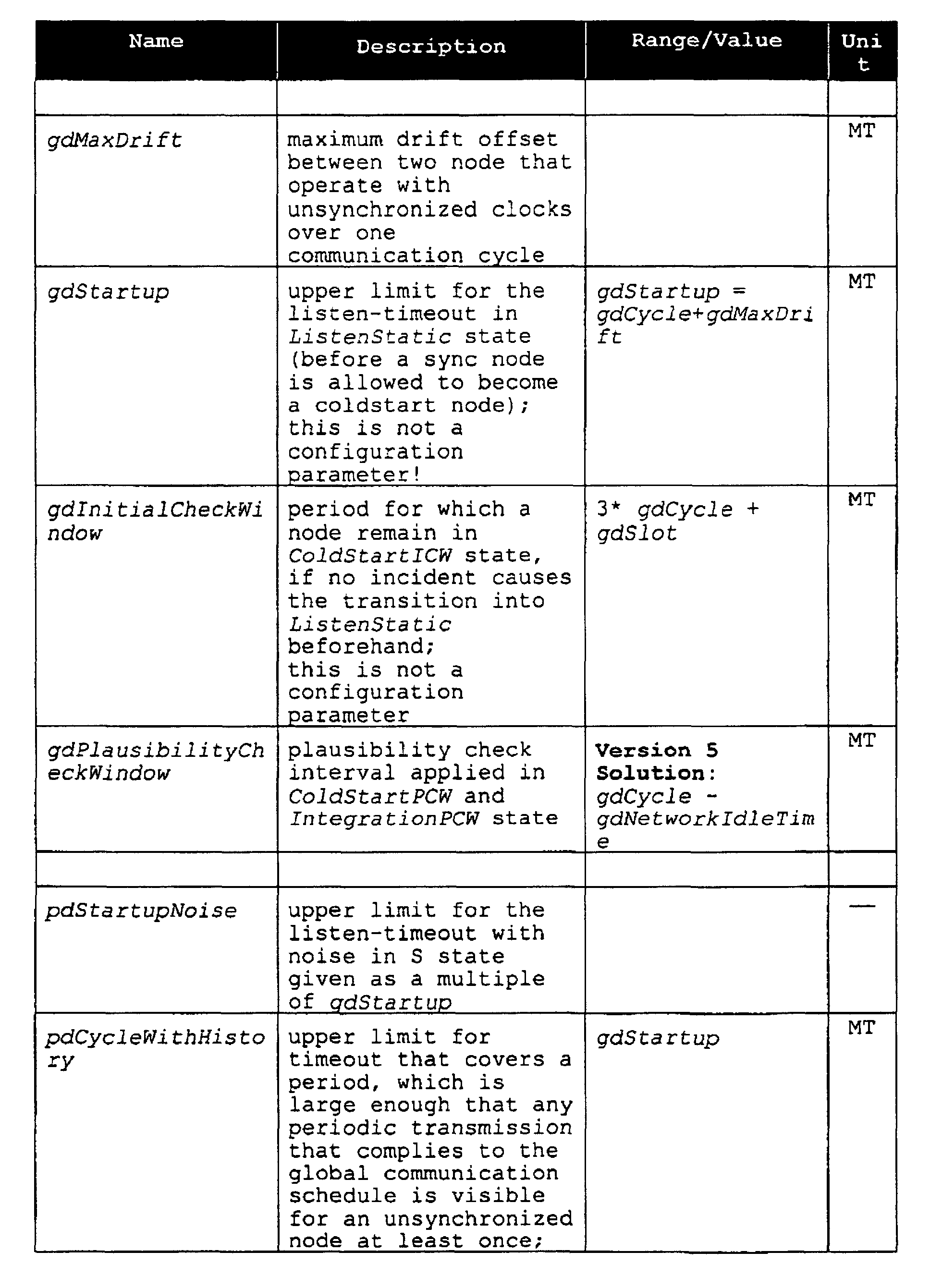
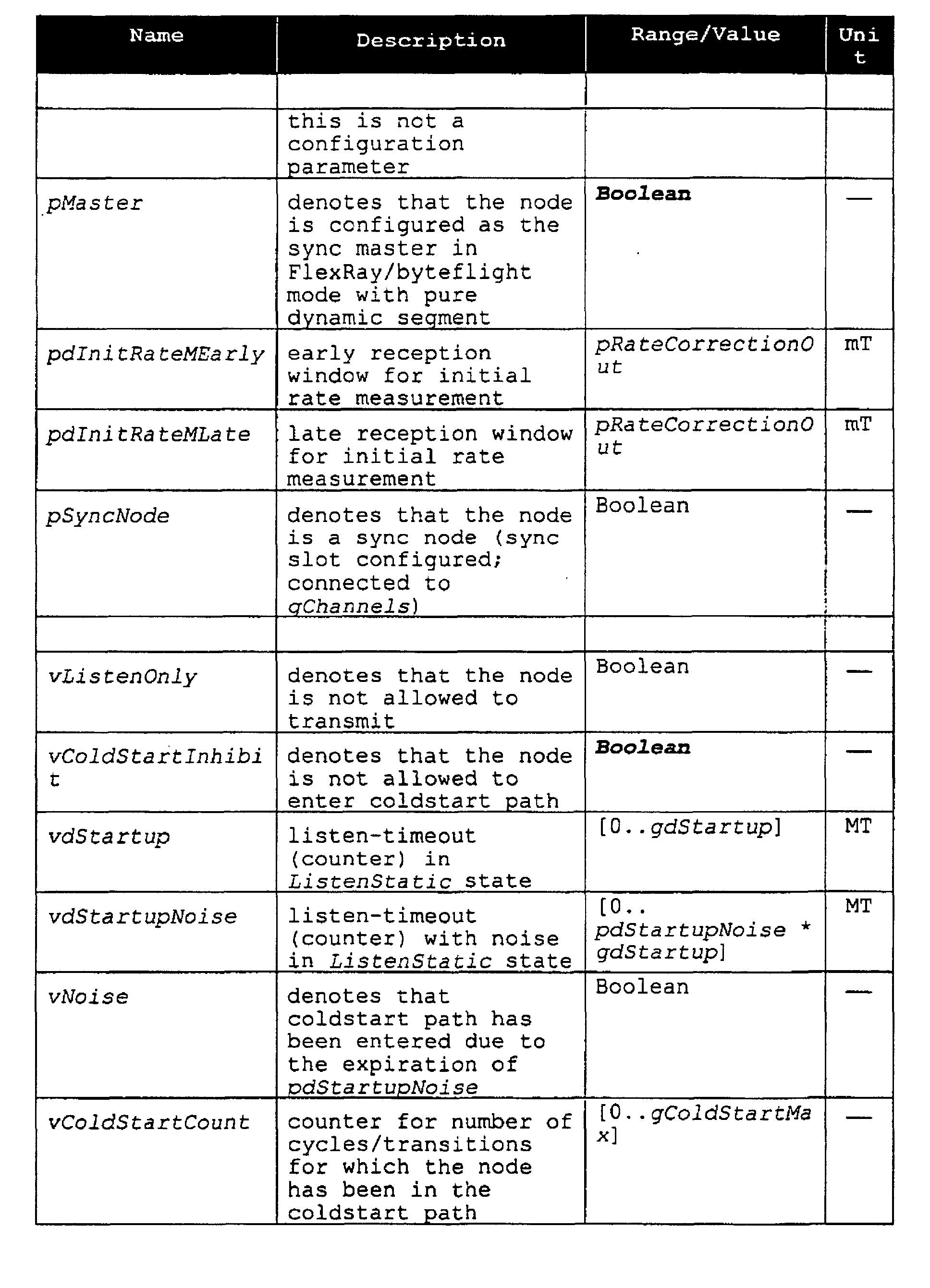

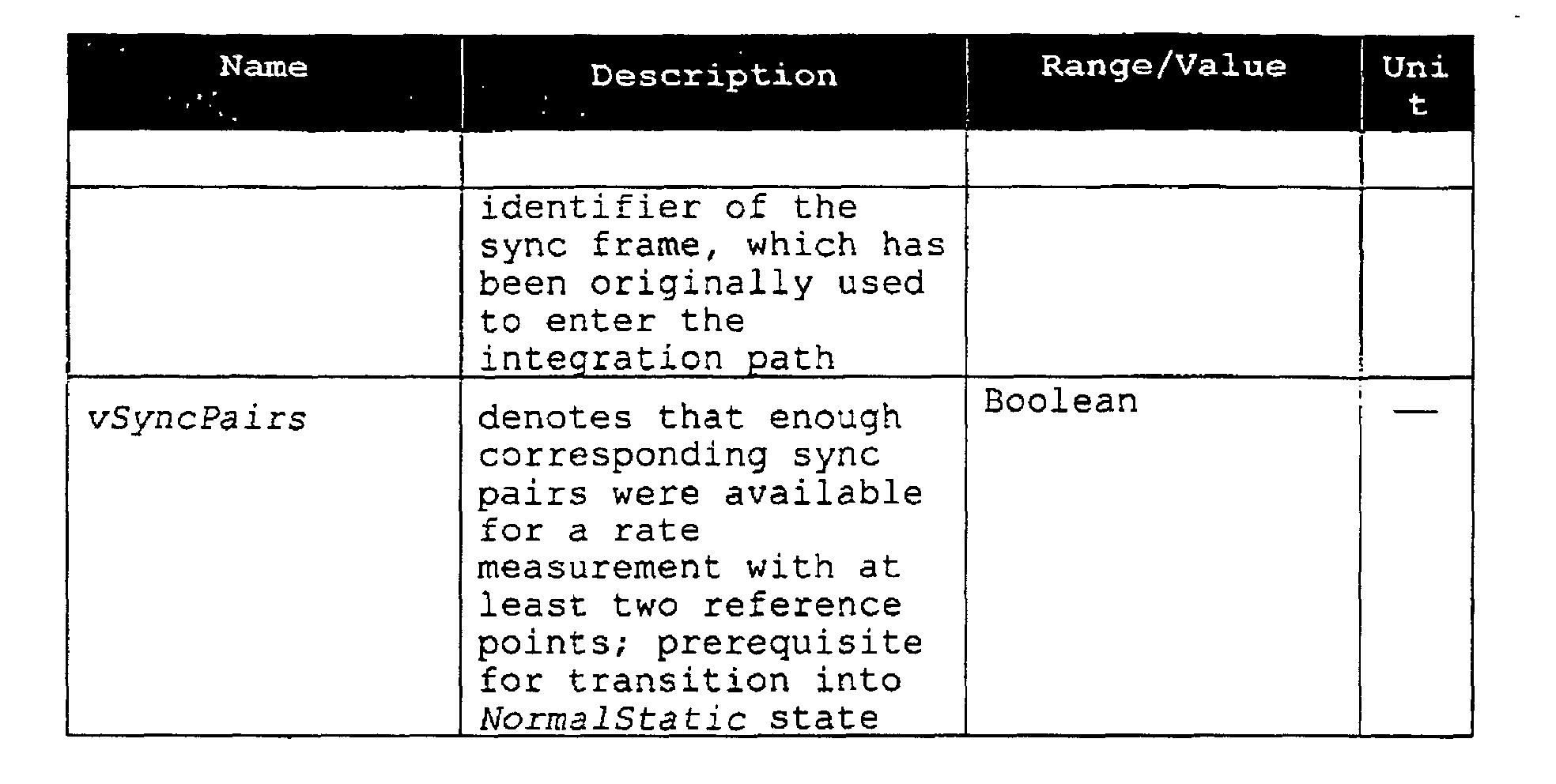
| Error Severity Levels | ||
| Name | Severity Level | Behavior |
| Normal | S0 | CC: full operation. CC to API: no warning, no error flags active. Result: Normal operation. BG: remains synchronized |
| Warning | S1 | CC: full operation. CC to API: flag for detected error. Result: Maintain normal operation, provide error indication to host. BG: Remains synchronized. Comment: No immediate effect on protocol operation. The host is informed of the error condition |
| Error | S2 | CC: reduced operation. CC to API: flag for detected error. Result: The node stops transmitting frames, but received frames are still processed. Clock synchronization mechanism continues based on received frames. BG: Remains synchronized. Comment: CC self rescue is allowed. The fault causing the error was non-fatal. The CC will not act as a coldstart node for the wake-up procedure. |
| Fatal Error | S3 | CC: Operation halted. All signals to the bus driver and bus guardian are placed in defined states. CC to API: flag for detected error. Interaction with host must still be possible. Result: The node stops transmitting and receiving frames. BG: BG enters FailSilent state due to loss of ARM signal. The BG disables transmissions until reset by host. Comment: CC self rescue not allowed. The fault causing the error was fatal. A reset from the host is required to resume operation. |
- Normal Static state, if the node is configured for pure static or mixed static/dynamic operation and at least one other CC is active and in the Normal Static protocol state.
- Listen Only state, if the node is configured to listen only during full operation and does not actively send any frames (see PassiveStatic state, Section TBD).
- Normal Master state, if the node is configured for pure dynamic or byteflight compatible operation, the node is currently acting as SOC master (sending SOC symbols), and is actively sending frames.
- Normal Slave mode, if the node is configured for pure dynamic or byteflight operation, the node is not acting as SOC master (is not sending SOC symbols), but is actively sending frames.
| Error Flags and Error Counters | |
| Error Flags | Abbreviation |
| Channel Status and Error Vector | CSEV |
| Frame Status and Error Vector | FSEV |
| Error Counters | Abbreviation |
| Valid Sync Frame Counter | VSFC |
| Invalid Sync Frame ID Counter | ISIC |
| Invalid Sync Frame Cycle Counter | ISCC |
| Missing Rate Measurement Counter | MRMC |
| Missing Offset Measurement Counter | MOMC |
| Clock Correction Failed Counter | CCFC |
| Frame Status and Error Vector | |||
| Name | Check Sets | Static Segment | Dynamic Segment |
| Bit Coding Error/CRC Error | CodingOrCRCError | Applies | Applies |
| Slot Mismatch | SlotMismatchError | Applies | Applies |
| Cycle Counter Mismatch | CycleMismatchError | Applies | - |
| Missing Frame | MissingFrameError | Applies | - |
| Null Frame | NullFrameDetected | Applies | - |
| Length Mismatch (length code different from real length, real length different from expected length) | LengthMismatchError | Applies | Applies |

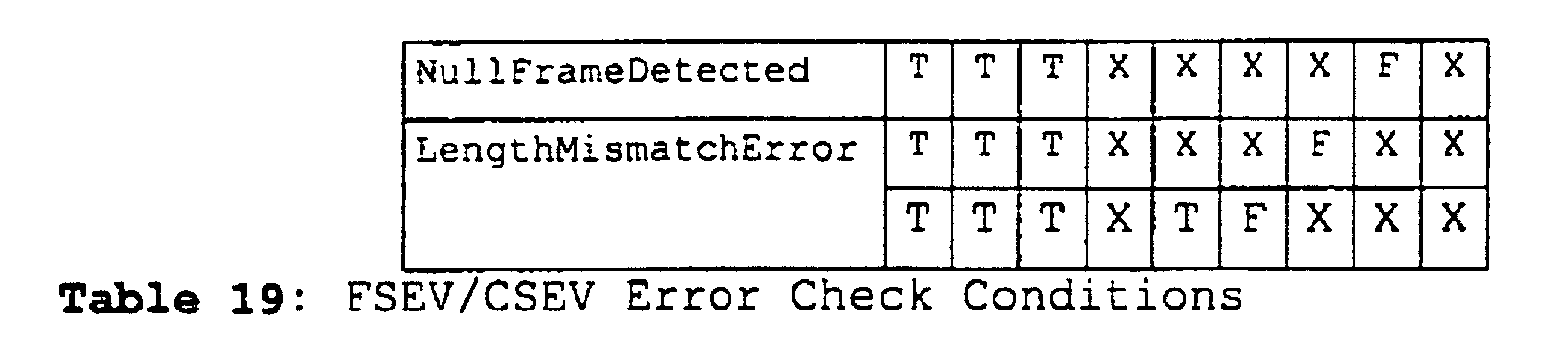
| Channel Status and Error Vector | |||
| Name | Check Sets | Static Segment | Dynamic Segment |
| Null Frame | NullFrameDetected | Applies | - |
| Empty Slot | MissingFrameError | Applies | - |
| Bit Coding / CRC Error | CodingOrCRCError | Applies | |
| Length Mismatch | LengthMismatchError | Applies | Applies |
| Slot Mismatch | SlotMismatchError | Applies | Applies |
| Cycle Counter Mismatch | CycleMismatchError | Applies |
- gdCycleMin has not expired since the last correct (valid) SOC symbol and a sequence of logic "0" with a duration of between 21 * gdBit and 29 * gdBit or a duration of more than 31 * gdBit has been received, OR
- gdCycleMin has expired since the last correct (valid) SOC symbol and some bus activity was recognized other than a valid SOC symbol.
| | |||||||
| 7 | 6 | 5 | 4 | 3 | 2 | 1 | 0 |
| CRC | SLOT | COUNT | LENGTH | FSEV | SOC Early | SOC Lost | ILLPIF |
- CRC: signals a detected Bit Coding/CRC error within the CSEV
- SLOT: signals a detected Slot Mismatch within the CSEV
- COUNT: Signals a detected Cycle Counter Mismatch within the CSEV
- LENGTH: signals a detected Length Mismatch Error within the CSEV
- FSEV: indicates that in at least one FSEV the frame status error vector was modified
- SOC Early: signals the byteflight / pure dynamic SOC Early error. See Section "SOC Early (pure dynamic and byteflight modes)".
- SOC Lost: signals the byteflight / pure dynamic SOC Lost error. See Section "SOC Lost (pure dynamic and byteflight modes)".
- ILLPIF: signals the byteflight specific
Illegal Pulse Error (ILLPIF). See Section
"Illegal Pulse Error (ILLPIF) for pure
dynamic and byteflight modes".
ISV_1 15 14 13 12 11 10 9 8 MRMC MOMC Offset Failed Rate Failed Max CCFC Max SYNC Zero SYNC - MRMC: signals that no rate correction term could be computed because no pairs of (even/odd) sync frames were received. See Section "Missing Rate Measurement Counter (MRMC)".
- MOMC: signals that no offset correction term could be computed because no sync frame was received in an odd cycle. See Section "Missing Offset Measurement Counter (MOMC)".
- Offset Failed: signals that the calculated offset correction term was not within the green area of the clock correction algorithm. See Section "Offset Correction Failed".
- Rate Failed: signals that the calculated rate correction term was not within the green area of the clock correction. See Section "Rate Correction Failed".
- Max CCFC: The Clock Correction Failed Counter reached the defined maximum of gMaxWithoutClockCorrection odd communication cycles with one or both of the clock correction terms outside of the green area. See Section "Clock Correction Failed Counter (CCFC)".
- MaxSYNC: signals that more than the maximum of 16 valid sync frames were received in the last communication cycle (VSFC > 16). See Section "Valid Sync Frame Counter (VSFC)".
- ZeroSYNC: signals that no valid sync frames
were received in the last communication cycle
(Valid_Syncframe ID Count = 0). See Section
"Valid Sync Frame Counter (VSFC)".
ISV_2 23 22 21 20 19 18 17 16 Minority VSCC Minority VSIC - Minority VSCC: signals that the local CC is within the minority of CCs with respect to the view of the current Cycle_Counter of the network. See Section "Invalid Sync Frame Cycle Counter (ISCC)".
- Minority VSIC: signals that the local CC is within the minority of CCs with respect to the view of the current Slot_ID of the network. See Section "Invalid Sync Frame ID Counter (ISIC)".
| | |||||||
| 7 | 6 | 5 | 4 | 3 | 2 | 1 | 0 |
| ENABLE CRC | ENABLE SLOT | ENABLE COUNT | ENABLE LENGTH | ENABLE FSEV | ENABLE SOC Early | ENABLE SOC Lost | |
| ISEV_1 |
| 15 | 14 | 13 | 12 | 11 | 10 | 9 | 8 |
| ENABLE | ENABLE | ENABLE | ENABLE | ENABLE | ENABLE | ENABLE | |
| MRMC | MOMC | Offset Failed | Rate Failed | Max CCFC | Max SYNC | |
| ISEV_2 |
| 23 | 22 | 21 | 20 | 19 | 18 | 17 | 16 |
| ENABLE Minority VSCC | ENABLE Minority VSIC |
| | |||||||
| 7 | 6 | 5 | 4 | 3 | 2 | 1 | 0 |
| ENABLE CRC/Coding | ENABLE SLOT MISMATCH | ENABLE CYCLE MISMATCH | ENABLE MISSING | ENABLE NULL FRAME | ENABLE LENGHT MISMATCH |
| | |||||||
| 7 | 6 | 5 | 4 | 3 | 2 | 1 | 0 |
| coldst art max | Plaus | prefsync | coldst art path | pstart upnoise |
- Coldstart max: The maximum number of allowed retries of a Cold Starting CC is reached. The CC is no longer allowed to initiate a cold start sequence.
- Plaus: The plausibility check of the local CC within the startup sequence failed.
- Coldstart Path: The normal state of the local CC was reached via the coldstart path. (This indicates that the local CC was the node that started the network.)
- Pstartupnoise: The coldstart path within the local CC has been entered due to the expiration of pStartupNoise.
| | |||||||
| 7 | 6 | 5 | 4 | 3 | 2 | 1 | 0 |
| ENABLE coldst art max | ENABLE Plaus | ENABLE prefsync | ENABLE coldst art path | ENABLE pstart upnoise |
- Valid Sync Frame Counter (VSFC) - see Section "Valid Sync Frame Counter (VSFC)"
- Invalid Sync Frame ID Counter (ISIC) - see Section "Invalid Sync Frame ID Counter (ISIC)"
- Invalid Sync Frame Cycle Counter (ISCC) - see Section "Invalid Sync Frame Cycle Counter (ISCC)"
- Missing Rate Measurement Counter (MRMC) - see Section "Missing Rate Measurement Counter (MRMC)"
- Missing Offset Measurement Counter (MOMC) - see Section "Missing Offset Measurement Counter (MOMC)"
- Clock Correction Failed Counter (CCFC) - see Section "Clock Correction Failed Counter (CCFC)"
- FlexRay communication controller
- Host in,the form of a general CPU or DSP
- De couple the host from the stringent timing requirements of the FlexRay protocol
- Enable the host to provide the controller
with
- Controller configuration data
- Frame data to be transmitted
- Bus Guardian status
- External clock correction parameters
- Control the controller states, e.g. soft-reset, deactivate (force in passive state, sleep)
- Enable the controller to provide host with
- Controller status information which is not linked to specific frames or slots, e.g. current protocol state, controller awake or sleeping, if the controller is active SOC master, etc.
- Received frame data including the frame identifier, sync bit, frame length, header CRC, cycle counter, message identifier, data field, possible acknowledgement bits
- Frame status information, e.g. if a valid frame or a null frame was received, if an coding error or CRC error was detected in a specific slot
- Information about the current cycle, e.g. if the SOC was normal or alarm symbol (pure dynamic mode), number of correctly received SYNC frames
- Information on global time, namely current
cycle counter, macrotick, most recently
calculated clock offset and rate correction
term
- Filter or demultiplex received frames based on Cycle counter and / or Message ID, namely store frames with the same ID but different Cycle counter and / or Message ID in different receive buffers
- Provide host with mechanisms to:
- Trigger interrupts on specific Communication Controller conditions
- Retrieve diagnostic information
- It can be applied to the following fields of
a received frame:
- Frame ID
- Message ID
- Cycle Counter
- It can be altered by the host at any time using designated mechanisms.
- It is applied to both channels simultaneously.
- 8 bit read only register to hold the FlexRay Protocol Implementation Version (05h for FPGA V5)
- 6 bit; will be incremented by CC; shall be readable by host.
- 16 bit; will be incremented by CC and reset at start of cycle; shall be readable by host.
- Current (cycle related) rate correction value applied by clock sync: 8 bit; shall be readable by host.
- Current (cycle related) offset correction value applied by clock sync: 8 bit; shall be readable by host.
- 5-bit counter indicating the number of valid Sync Frames received in the previous cycle. The counter is only updated at the end of the static segment and can be read by the host.
- 5-bit counter indicating the number of invalid Sync Frames received with a slot mismatch error in the previous cycle. The counter is only updated at the end of the static segment and can be read by the host. (FPGA V5)
- 5-bit counter indicating the number of invalid Sync Frames received with a cycle counter mismatch error in the previous cycle. The counter is only updated at the end of the static segment and can be read by the host. (FPGA V5)
- 5-bit counter is incremented by one if no rate correction can be performed because no pairs of (even/odd) Sync Frames were received. The counter is reset by the CC after successful rate correction. The counter is not incremented once it reaches maximum value (63).
- 5-bit counter is incremented by one if no offset correction can be performed because no Sync Frames were received in an odd cycle. The counter is reset by the CC after successful offset correction. The counter is not incremented once it reaches maximum value (63).
- 2 bits, indicating the current error handling level.
- Coldstart max reached (see Section "Cold Start Max")
- Plausibility check failed
- Normal state entered via coldstart path
- Coldstart path has been entered due to the expiration of pStartupNoise
- Soft Reset
- Master select (only modifiable in soft reset)
- Master Alarm
- Sleep Acknowledge
- Sleep Request
- byteflight Compatibility mode (only modifiable in soft reset)
- External SOC Trigger Acceptance (only modifiable in soft reset)
- Number of FIFO mailbox receive buffers: 5 bits (FPGA V5); may be modified only in soft reset.
- TCR1, TCR2, TCR3: three 8 bit registers; may be modified only in soft reset. The timing parameters apply to both channels.
- Bit Rate Index, 4 bits
- Sample Clock Prescaler, 4 bits
- Samples per bit, 2 bits (8 or 10 samples; 01h = 8, 10h = 10 samples)
- 8 bits, value in macroticks, configurable only in soft reset. (Comment: gdStartup is derived internally.)
- 3 bits; configurable in soft reset with the number of samples to be filtered out by the receiver.
- Microticks per bit: 6 bits; may be modified only in soft reset.
- Microticks per macrotick: 8 bits; may be modified only in soft reset.
- 4 bits; multiples of the CC microtick, configurable only in soft reset.
- Macroticks per slot: 8 bits; may be modified only in soft reset.
- Data length for static frames, in words: 7 bits; may be modified only in soft reset.
- Number of static slots in a cycle: 10 bits; may be modified only in soft reset.
- Macroticks per cycle: 16 bits; may be modified only in soft reset.
- 6 bits; maximum acceptable deviation (+/-) of pure dynamic cycle length in microticks; may be modified only in soft reset.
- Maximum Cycle Counter value before it is reset: 6 bits; may be modified only in soft reset.
- Number of Macroticks: 8 bits; may be modified only in soft reset.
- Max. macrotick value allowed before inhibiting new frame transmissions for the cycle: 16 bit; may be modified only in soft reset.
- Start of time window in pure dynamic mode for external SOC trigger acceptance; Number of Macroticks: 16 bit; may be modified only in soft reset.
- 8 bits
- 8 bits
- 4 bits; cluster bit damping, configurable only in soft reset.
- Cycle Set -
A 9 bit register is used to specify in which set of cycles the interrupt shall occur. It consists of two fields, the Base Cycle [b] and the Cycle Repetition [c]. The set of cycle numbers where the interrupt is to generated is determined from these two fields using the formula - Base Cycle [b] -
A 6 bit cycle number used to identify the initial value for generating the cycle set - Cycle Repetition [c] -
A 3 bit value used to determine a constant repetition factor to be added to the base. cycle (c = 0 ... 6).
- Macrotick Offset - This 16-bit value is the macrotick offset from the beginning of the cycle where the interrupt is to occur. The interrupt occurs at this offset for each cycle in the Interrupt Cycle Set.
- Disabled (logical '0') by default, may be Enabled (logical '1') only in soft reset.
- Disabled (logical '0') by default, may be Enabled (logical '1') only in soft reset.
- 8 bit; configurable only in soft reset.
- 5 bits; This register corresponds to the variable gMaxWithoutRate. If gMaxWithoutRate consecutive cycles transpire without performing rate correction then host notification occurs via interrupt. The register can be configured only in soft reset.
- 5 bits, This register corresponds to the variable gMaxWithoutOffset. If gMaxWithoutOffset consecutive cycles transpire without performing rate correction then host notification occurs via interrupt. The register can be configured only in soft reset.
- 5 bit, configurable with the maximum acceptable number of cycles without performing rate correction. The register can be configured only in soft reset. If the Clock Correction Failed Counter equals Max. Without Clock correction (maxwithoutclockcorrection), an interrupt will be raised.
- Coldstart max reached
- Plausibility check failed
- Normal state entered via coldstart path
- Coldstart path entered due to the expiration of pStartupNoise
| Mailbox Buffer Control Register Fields | |||||
| Control Flag | Bits | Tx Buffer | Rx Buffer | FIFO | Comment |
| Reserved | |||||
| 1 | | 1 | |||
| CFG | 1 | '1' = Transmit Buffer | '0' = Receive Buffer | '0' | Message Buffer Configurati on Bit |
| CFG_SR | 1 | '1' = Mailbox Buffer and the associated filter can be configured only during Soft Reset. | '1' = Buffer and the associated filter can be configured only during Soft Reset. | - | '0' = Mailbox Buffer and the associated filter can be configured during normal operation. (not for FPGA V5) |
| IFLG | 1 | '1' = buffer not updated, '0' = buffer updated; Host explicitly resets the IFLG when the buffer is ready for transmit. IFLG is set by the CC after transmission has been completed and the host may access the buffer for writing next message. | '1' = buffer updated (valid), '0' = not updated; Host has to explicitly clear the IFLG. | - | Interrupt Status Flag |
| IENA | 1 | '1' = Interrupt enabled | '1' = Interrupt enabled | - | IFLG Interrupt Enable |
| ABTRQ | 1 | '1' = Abort request; Message will be aborted at next DCT if transmission has not been started before next DCT. | - | - | Abort Request (not for FPGA V5) |
| ABTAK | 1 | '1' = Message has been aborted. | - | - | Abort Acknowledge (not for FPGA V5) |
| LOCK | 1 | '1' = lock, '0' = release | '1' = lock, '0' = release | - | Message Buffer Lock. A locked buffer is visible in the correspondi ng mailbox window. |
| Frame Status and Error Vector | ||||
| Status/Error Flag | Bits | Tx Buffer | Rx Buffer | FIFO |
| Null Frame | ||||
| 1 | Null Frame transmitted | Null Frame received (static part) | Null Frame received | |
| Empty Slot | 1 | - | No bus traffic detected (static part) | - |
| Bit Coding/CRC Error | 1 | - | Error detected (bit coding, header or frame CRC, in static part) | - |
| Length Mismatch | 1 | - | Length Mismatch detected (static part) | - |
| Slot Mismatch | 1 | - | Slot Mismatch detected | - |
| Cycle Counter Mismatch | 1 | - | Cycle Counter Mismatch detected (static part) | - |
- Channel Number
- Frame Id
- Cycle Counter
- Message Id
- Receive buffer: In order to store a message the filters for channel Id, and cycle counter must match. In addition, depending on a configuration bit either the Frame Id (configuration bit = "0") or the Message Id (configuration bit = "1") must match (but not both).
- Transmit buffer: A message will be transmitted in the time slot corresponding to the frame ID on the configured channel(s) if the cycle counter matches the configured cycle filter value.
- Receive buffer: received frames are stored if they are received on all the specified in the Channel Filtering Field. Other filtering criteria must also be met.
- Transmit buffer: the content of the buffer is
transmitted only on the channels specified in
the Channel Filtering Field when the Cycle
Counter Filtering and Frame Id Filtering
criteria are also met.
Channel Filtering Configuration Config. bit A Config. bit B Tx Buffer Transmit frame Rx Buffer Store valid Rx frame 1 1 on both channels received on channel A or B (not for V5) 1 0 on channel A received on channel A 0 1 on channel B received on channel B 0 0 no transmission ignore frame
- Receive message buffers: A received message is stored in the first receive message buffer where the received frame ID matches the receive mailbox frame ID, provided the other receive filtering criteria are also met. If Message Id filtering is being used, this filter is not applied.
- For Transmit buffers the frame ID in the buffer is used to determine the appropriate slot for the message transmission. The frame will be transmitted in the time slot corresponding to the frame ID, provided the channel and cycle counter criteria are also met.
- Cycle Set -
A 9 bit register is used to specify which cycle numbers are elements of the set. It consists of two fields, the Base Cycle [b] and the Cycle Repetition [c]. The set of cycle numbers belonging to the set determined from these two fields using the formula - Base Cycle [b] -
A 6 bit cycle number used to identify the initial value for generating the cycle set - Cycle Repetition [c] -
A 3 bit value used to determine a constant repetition factor to be added to the base cycle (c = 0 ... 6).
- Receive buffer: The received message is stored only if the received cycle counter matches an element of the buffer's Cycle Set. Channel, Frame Id and Message Id criteria must also be met.
- Transmit buffer: the content of the buffer is transmitted when an element of the Cycle Set matches the current cycle counter and the frame ID matches the slot counter value.
- A status bit is set
- A counter exceeds a specific value
- A timer reaches a configured value.
| General Interrupt Register | |||
| General Interrupt Flag | Bits | Channel Receiver | Channel |
| Bit Coding/ | 1 | Error detected (bit coding, header or frame CRC)) | A |
| | 1 | Slot Mismatch detected | A |
| | 1 | Cycle Counter Mismatch detected | A |
| | 1 | Length Mismatch detected | A |
| SOC Normal / | 1 | SOC Normal or Collision Avoidance symbol detected | A |
| | 1 | SOC Alarm symbol detected | A |
| SOC Too Early | 1 | SOC received before qdCycleMin | A |
| | 1 | SOC not received before gdCycleMax | A |
| Bit Coding/ | 1 | Error detected (bit coding, header or frame CRC) | |
| Slot Mismatch | |||
| 1 | Slot Mismatch detected | B | |
| | 1 | Cycle Counter Mismatch detected | |
| Length Mismatch | |||
| 1 | Length Mismatch detected | B | |
| SOC Normal / | 1 | SOC Normal symbol detected | B |
| | 1 | SOC Alarm symbol detected | B |
| SOC Too Early | 1 | SOC received before gdCycleMin | |
| SOC Lost | |||
| 1 | SOC not received before qdCycleMax | B | |
| General Interrupt Enable Register | ||
| General Interrupt Enable Flag | Bits | Channel |
| Bit Coding/CRC Error | 1 | A |
| Slot Mismatch | 1 | A |
| Cycle Counter Mismatch | 1 | A |
| Length Mismatch | 1 | A |
| SOC Normal / Collision Avoidance symbol | 1 | A |
| SOC Alarm symbol | 1 | A |
| SOC Too Early | 1 | A |
| SOC Lost | 1 | A |
| Bit Coding/CRC Error | 1 | B |
| Slot Mismatch | 1 | B |
| Cycle Counter Mismatch | 1 | B |
| Length Mismatch | 1 | B |
| SOC Normal / Collision Avoidance symbol | 1 | B |
| SOC Alarm symbol | 1 | B |
| SOC Too Early | 1 | B |
| SOC Lost | 1 | B |
- Receive Interrupt Flag
- Receive FIFO Not Empty Interrupt Flag
- Receive FIFO Overrun Interrupt Flag
- SOC Normal Interrupt Flag
- SOC Alarm Interrupt Flag
- Optical Diagnosis Flag
| Bus Event Indication | ||
| Event | Description | |
| SOC Normal symbol detected on bus | SET_SOCNIF | |
| SOC Alarm detected on bus | SET_SOCAIF | |
| Correct message was received which may be copied into a receive buffer | SET RCVMSG, even if message is not copied into any buffer (in case no adequate receive buffer is configured) | |
| Frame Error detected. One of following checks failed: vCheckIdlebeforeFram e, vCheckCoding, vCheckActiveDuringFr ame, vCheckCRC, vCheckIdleAfterFrame , vCheckBodyLength | SET_ERRIF | |
| Slot mismatch detected. The check vCheckSlotID failed. | SET_SLMM |
- the HOST initiates a transition from Normal mode to StopCom mode at the bus guardian
- the StopCom command is sent to the CC
- at the end of the cycle the CC stops sending messages and stops sending the ARM trigger to the BG
- the BG detects the missing ARM trigger and enters FailSilent mode
- the CC switches off all internal clocks
- The scheduler at the BG is clocked directly with the corrected MT signal (rising edge) from the communication controller
- The BGEN signal, the signal that controls transmit access to the communication medium, is generated synchronous to the MT signal
- The minimum Inter-Frame Gap duration is 2 macroticks
- The Inter-Frame Gap may be extended by a safe part (the duration of the safe part is a configuration parameter)
- Every BG static slot is followed by an Inter-Frame Gap
- The communication cycle starts 2 macrotick periods after the ARM trigger (falling edge of the ARM signal)
- The ARM trigger time shall not be used for clock offset correction (this restriction applies to FPGA V5)
- The bus guardian is kept open during the BG dynamic segment
- At the end of the BG dynamic segment the bus guardian stays open for the duration of one macrotick, which is equivalent to the tolerance part of an inter-frame gap
- The Bus Guardian schedule contains a part (the Watchdog Disable Time, or WDT) during which the macrotick watchdog functionality is disabled. This part is intended for clock offset correction in the CC.
| Key Bus Guardian Schedule Parameters | ||
| Name | Length | Remarks |
| Fixed | ||
| Tolerance part | ||
| 1 MT | mandatory part of the interframe gap; also needed to close the BG after the end of the BG dynamic segment | |
| | 2 MT | no clock offset correction allowed |
| Configurable Length | ||
| | 0 to 4095 MT | CAS slot length assumed to be identical to static slot length |
| BG | 0 to 65535 MT | BG is kept open during BG dynamic segment |
| | 0 to 15 MT | optional part of the interframe gap; enables detection of reception errors at the BG |
| Watchdog disable time | up to 255 MT | to be used for clock offset correction |
| BG - CC Interface Signals | |||
| Symbol | DIR | ACTIVE | Description |
| MT | I | - | Corrected Macrotick - clock signal from CC |
| BGT | I | - | Bus guardian tick - clock signal from CC |
| ARM | I | LOW | ARM trigger signal from CC |
| BGEM | O | LOW | BG Enable Monitor signal (inverted BGEN signal from BG scheduler).19 Allows CC to monitor BG operation. |
- The initial offset correction (up to 3000 ppm) must be completed before the initial ARM trigger occurs. Before this initial ARM trigger the BG ignores the MT signal.
- After detection of the initial ARM trigger the following requirements are valid:
- Expected minimum regular MT period: TMT(nom) ≥ 1 µs
- Expected minimum corrected MT period: TMT(min) ≥ 0.5 µs
- Expected minimum MT pulse width (low or high): 250 ns
- The CC provides an MT signal, that is used as the clock for the BG scheduler
- The MT signal that the CC provides to the BG shall be the same internal corrected macrotick signal that the CC uses to schedule its internal activities. This implies that the CC must do more than provide a MT signal that is at the correct frequency; it must match CC's internal view of a corrected macrotick.
- The ARM signal from the CC is generated synchronous to the MT (falling edge of the ARM signal is aligned to the rising edge of the MT signal)
- The communication cycle is preceded by a period two macroticks in duration (the ARM trigger time), which the CC shall not use for clock offset correction. Clock rate correction may be performed during ARM Trigger Time (ATT).
- Expected minimum ARM active duration: TABM(min) = 2 MT
- Expected maximum ARM active duration: tbd (shall be shorter than CAS slot)
- Expected minimum BGT period: TBGT(min) ≥ 250 ns
- Expected BGT duty cycle: 50% (tolerance tbd)
- The BG communication cycle starts at the beginning of the first static slot
- The number of macroticks per cycle is not variable

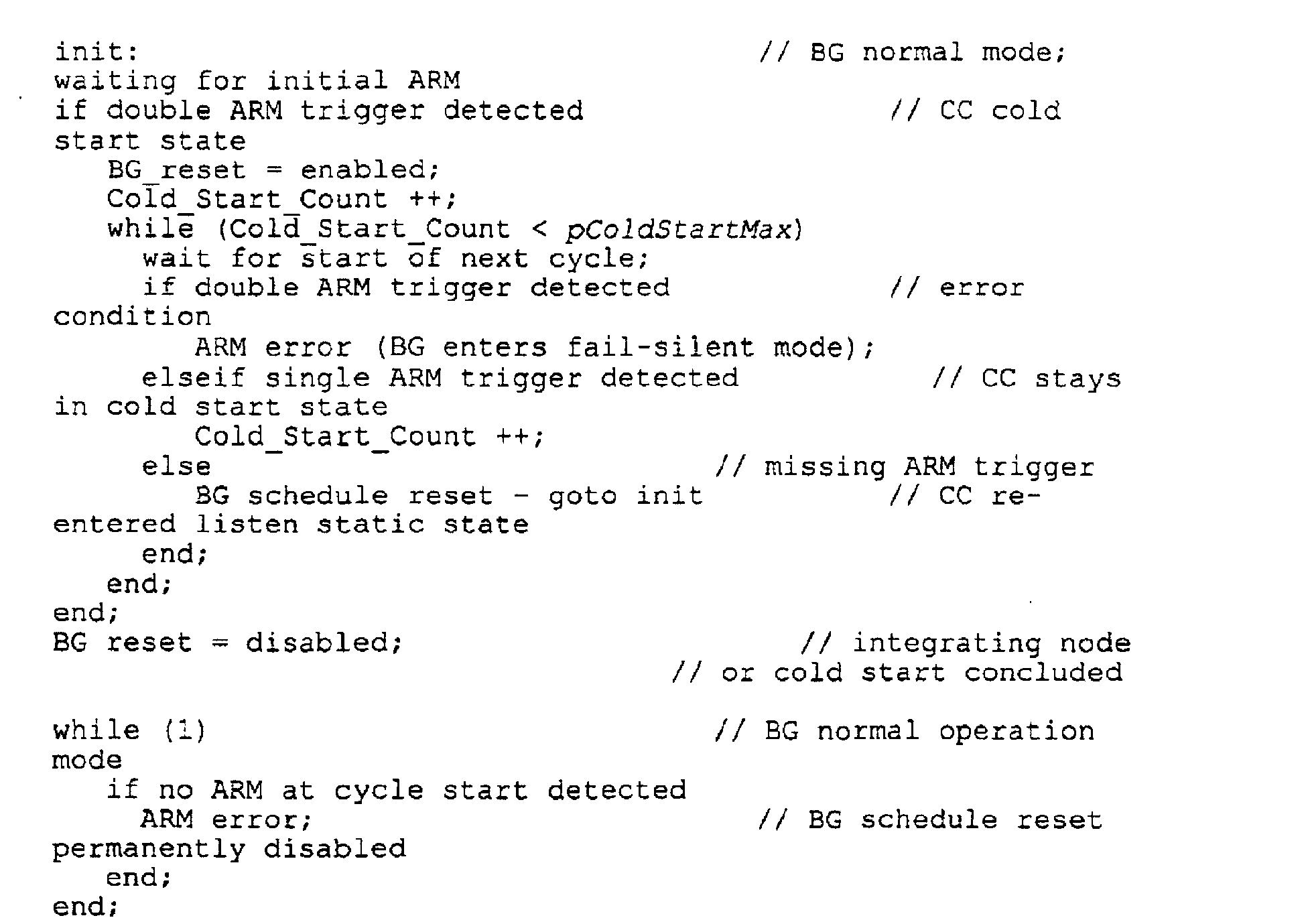
| Bus Guardian Configuration Parameters (Subset) | |||
| Name | Description | Range / Value | Unit |
| qdBGSlot | | 0 .. 4095 | MT |
| gdBGDynSegment | BG | 0 .. 65535 | MT |
| qdBGSafePart | inter-frame gap safe | 0 .. 15 | MT |
| part | |||
| gdBGNatchdogDisable | watchdog disable | 0 .. 255 | MT |
| pActiveStaticSlot1 | open | 0, 1 .. 1023 | ― |
| pActiveStaticSlot2 | open | 0,1.. 1023 | ― |
| ... | |||
| pActiveStaticSlot16 | open | 0, 1 .. 1023 | ― |
| gNumberOfStaticSlots | last | 2 .. 1023 | ― |


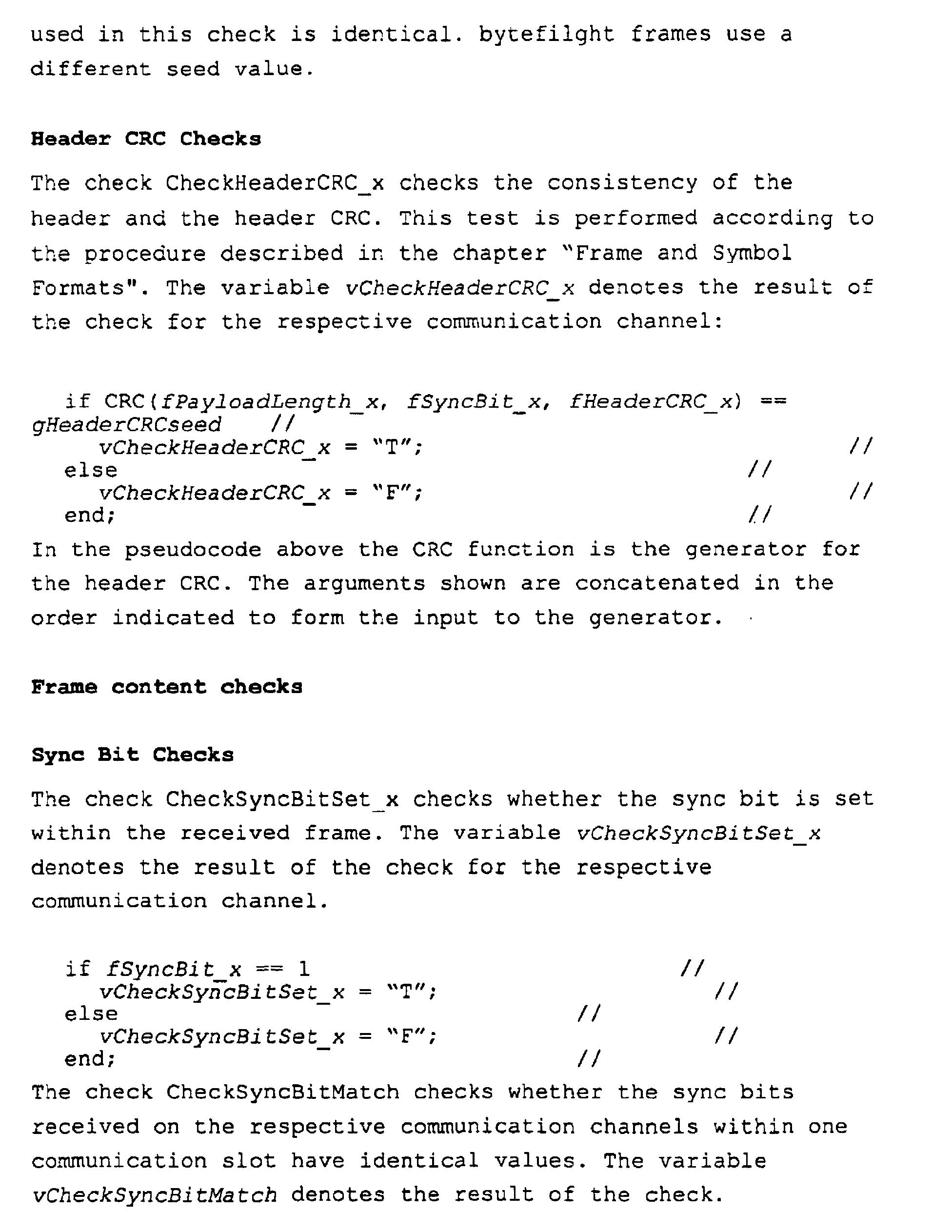

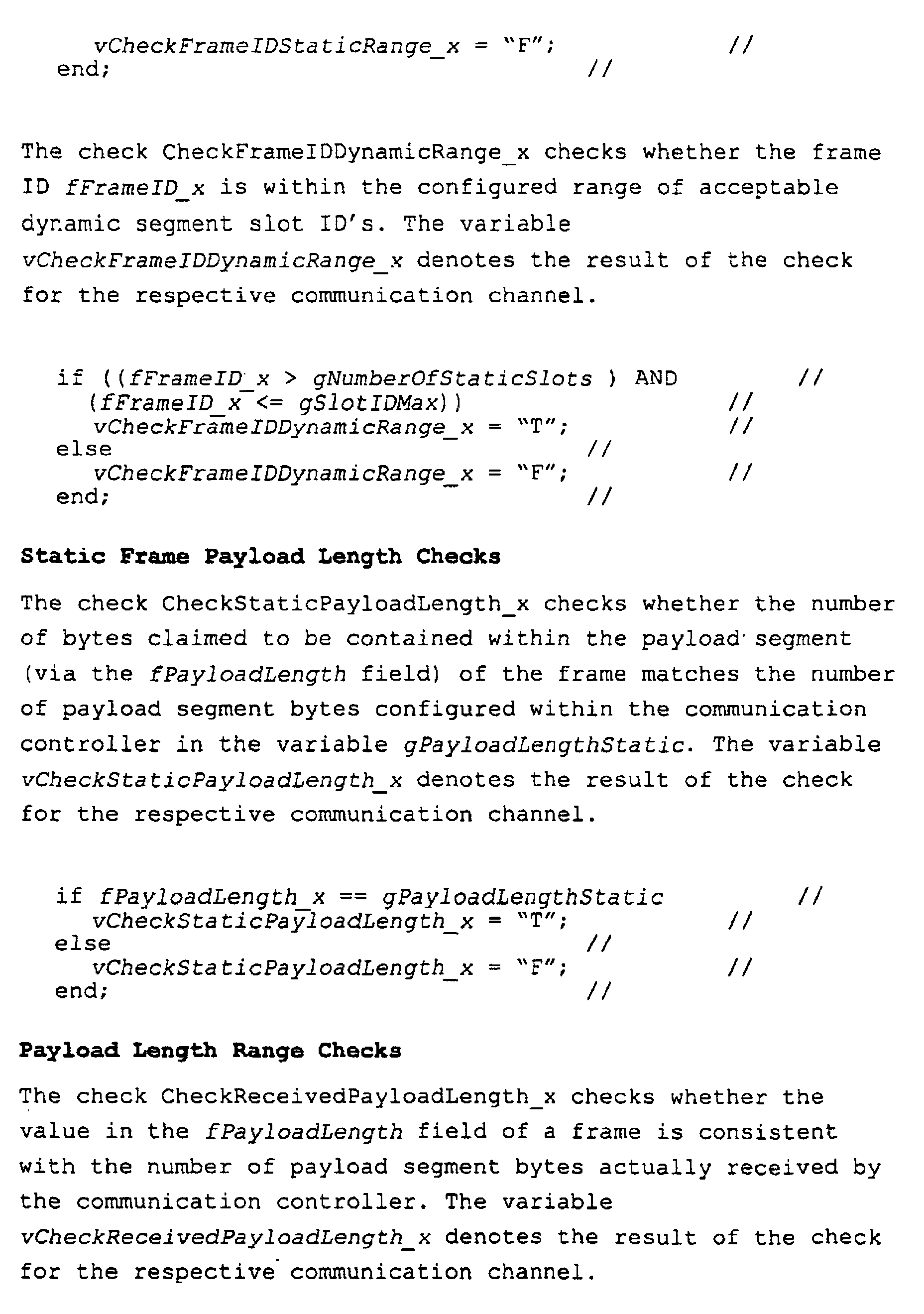

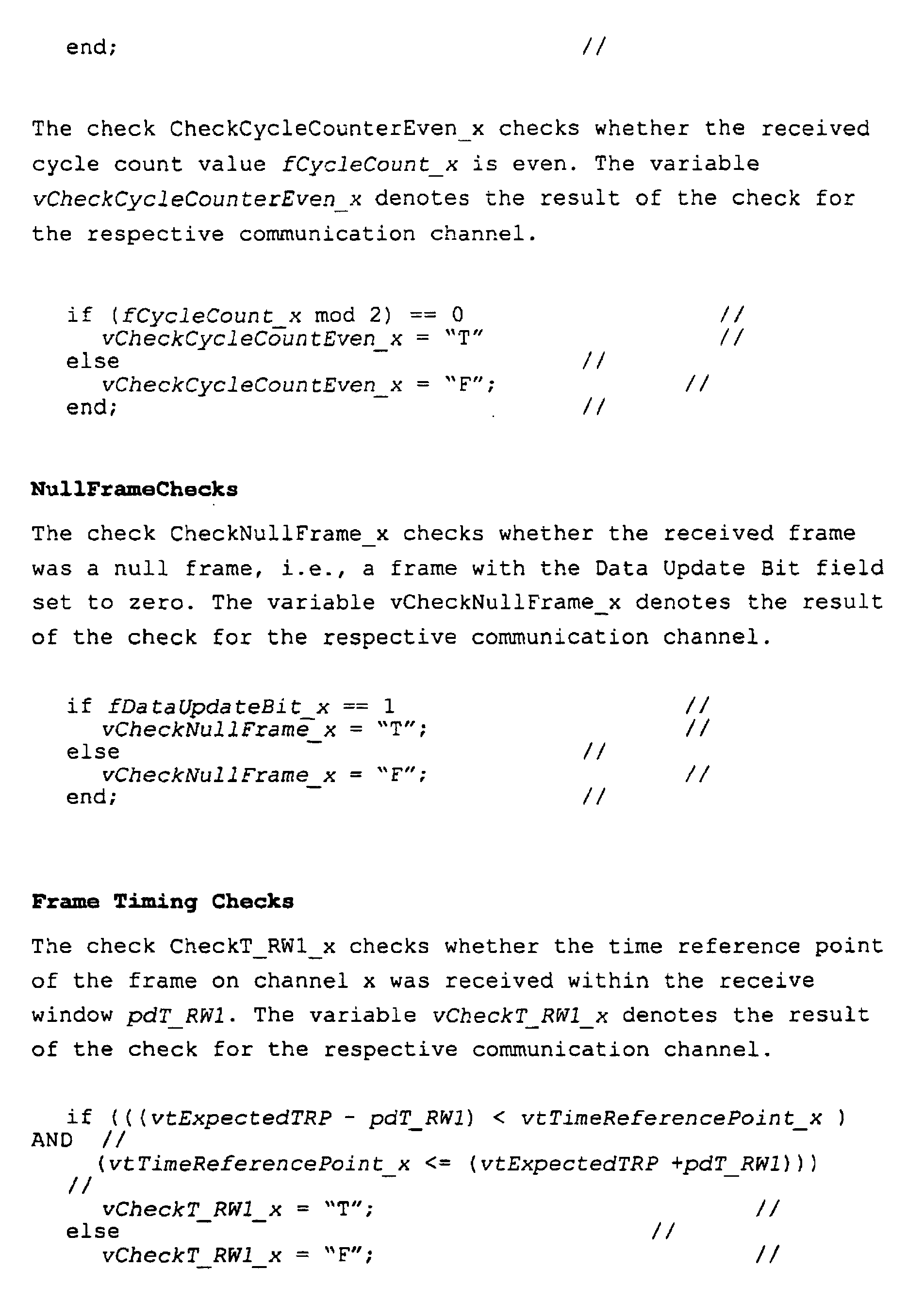
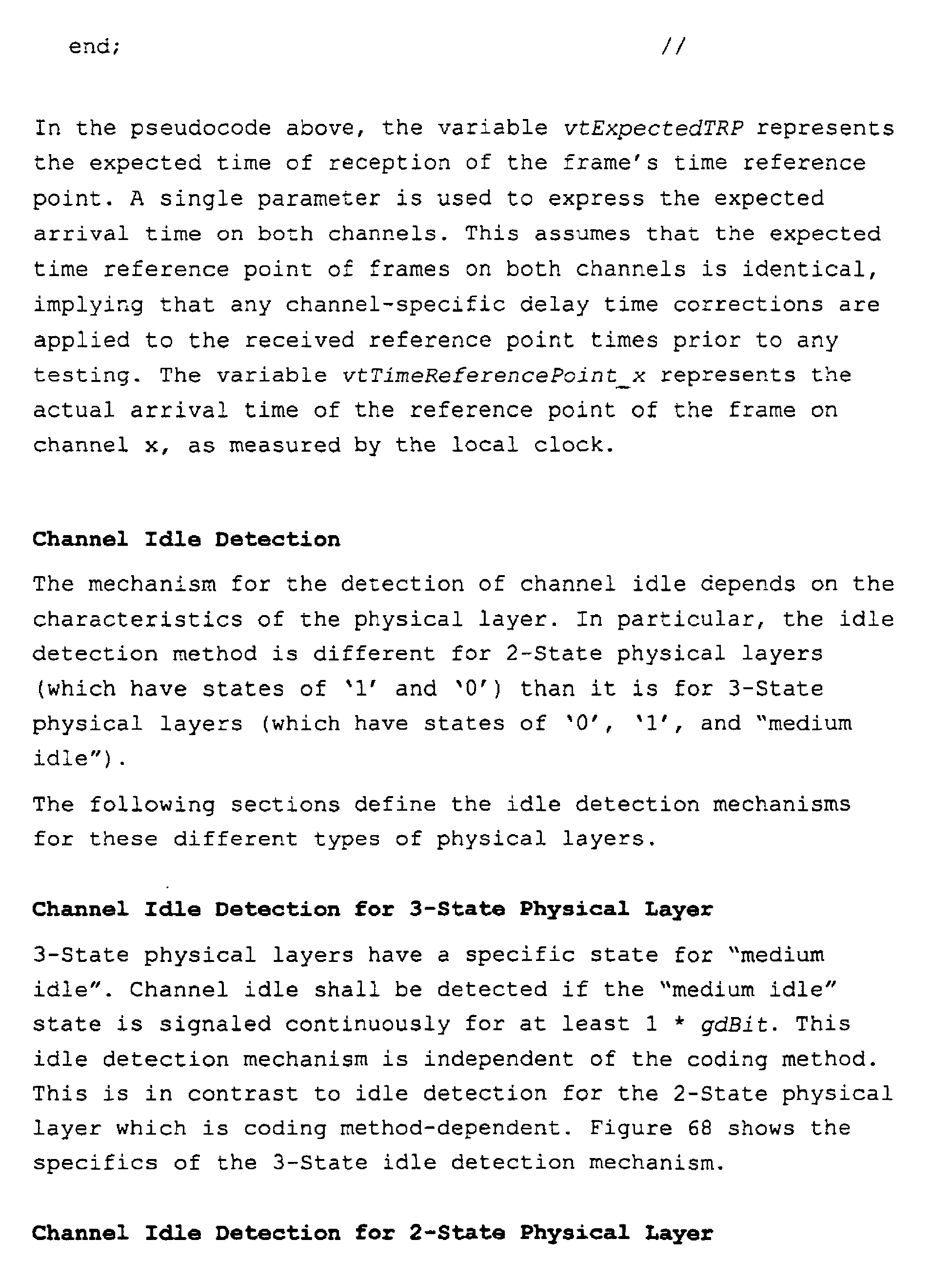

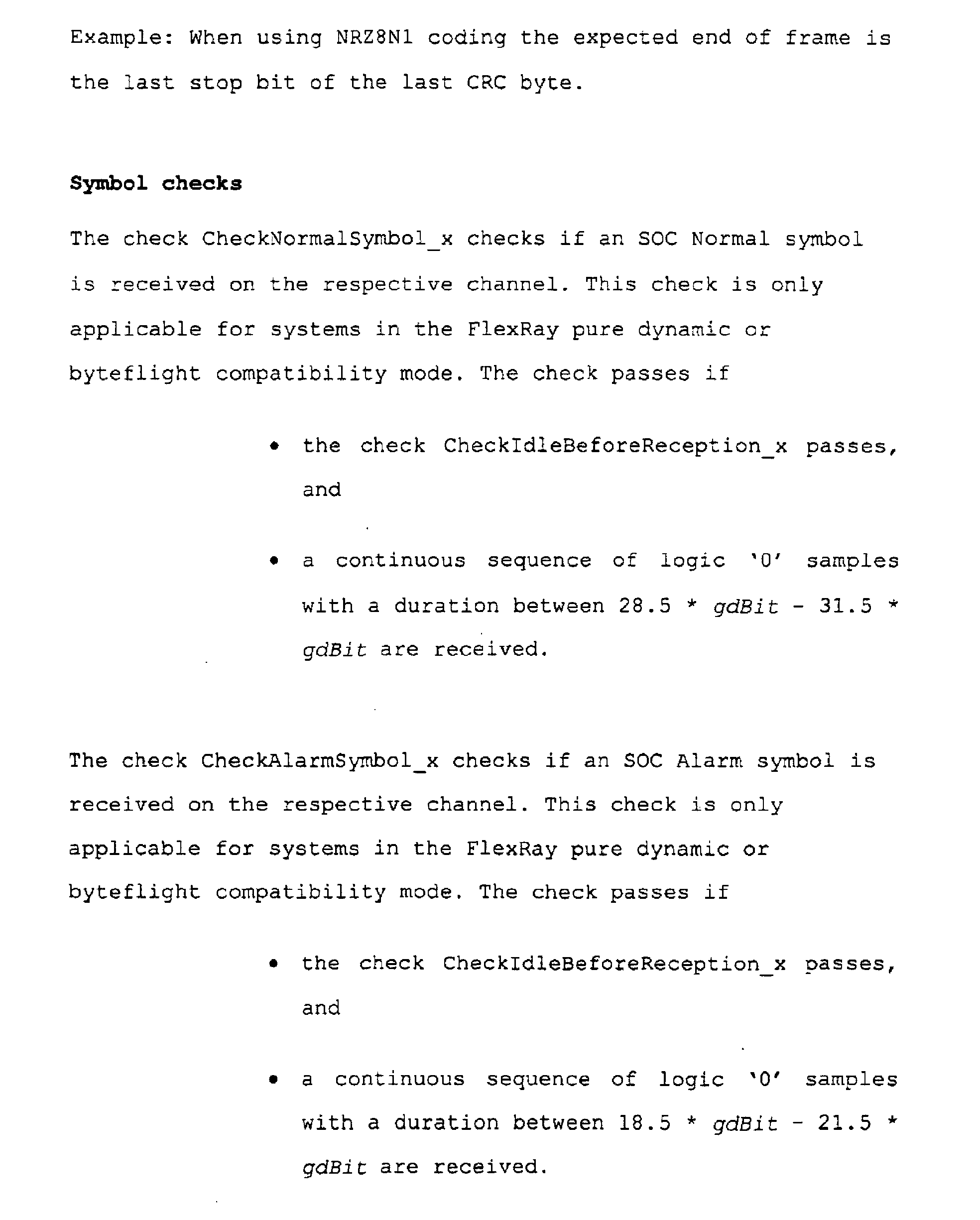

- Acknowledgment is not required for V5.
- Acknowledgement must be discussed together with a functional network management and other diagnosis services like link diagnosis.
- Link diagnosis (outgoing, incoming, local, remote)
- Communication channel and star diagnosis
- Frame transmission acknowledgement
- Support of data consistency protocols which have to be established on application level
- Functional network management services
- The acknowledgement service is a diagnosis service for the communication subsystem. It can be exploited by the application according to the safety requirements of the overall application system. It is designed to provide basic data transmission status information throughout the distributed communication subsystem.
- The acknowledgement service is based on individual data frames, not on nodes.
- The basic diagnosis procedure is the status information of the correct reception of an a-priori known frame identifier in combination with the acknowledgement of the application. This can be configured.
- The acknowledgment service does not evaluate the content of the frame itself. This has to be done in the application and given to the acknowledgement protocol service.
- It is assumed that every frame identifier is transmitted periodically.
- The application can lookup status information on whether sent frames have been received by other communication controllers correctly, i.e. the sender's view. The receiver's view provides status information on whether received frames have also been received correctly by other communication controllers.
- The acknowledgement service is an optional and configurable protocol service.
- Several groups of related frames can be established.
- The acknowledgment status information can be overruled by the application (invalidated or validated).
- The acknowledgment service is individually executed for each channel. It is therefore possible to retrieve status information on every individual frame on every individual channel.
- The service can be applied for frames in the dynamic part. Therefore it can be checked whether specific dynamic frames have been sent within a round.
| Acknowledgment Header Field | ||||
| AckBit A1 | AckBit A0 | AckVector | Remark | |
| 0 | 0 | 0 bit | No acknowledgement configured | |
| 0 | 1 | 8 | ||
| 1 | 0 | 16 | ||
| 1 | 1 | 24 bit |
| Frame Formats | |||||||||||
| Header | Frame Body | ||||||||||
| | A0 | Byte | 0 | 1 | 2 | 3 | 4 | 5 | 6 | ... | |
| 0 | 0 | | MsgId | Data | 0 | | | | | ... | |
| 0 | 1 | MsgId | | Ack Byte | 1 | | | | | ... | |
| 1 | 0 | MsgId | | Ack Byte | 1 | | | Data | ... | ||
| 1 | 1 | MsgId | | Ack Byte | 1 | | | | | ... |
- CC and host (and the software)
- one BD at least
- one voltage regulator at least
- optional one or two BG
- stable state (sleep-mode of the ECU)
- the voltage regulator is off
- the host is not powered
- the BD monitors the bus to detect the wake-up sequence
- if the wake-up sequence is recognised by the BD or a local wake-up signal is set, the BD activates the voltage regulator by a suitable control signal (e. g. INH)
- the host is powered by the voltage regulator
- the host does his job
- ...
- the sleep request is acknowledged by a NM protocol running on the host
- each host initiates synchronous the shutdown of the communication system or communication subgroup (selective sleep) by de-activating the CC and BG by a suitable control signal (e.g. SPI - StopCom)
- the host de-activates the BD by a suitable control signal (e. g. SLPN or SPI)
- the BD de-activates the voltage regulator and monitors the bus
- stable state (sleep-mode of the ECU)
- see 1st dot
- Normal
- one bus is active at least
- distributed application active
- StandBy
- each bus is inactive
- local application active or in-active
- one voltage regulator is active inside an ECU at least
- Sleep
- the application is inactive
- the host is not powered
- the ECU is powered
- the NM manages the operation modes of the node and the net supported by net-wide negations
- a wake-up from the bus has to be confirmed
- to be protected against e. g. electromagnetic interference
- by the CC-driver-service "PassiveStartUp"
- a sleep command has to be confirmed
- to be protected against unstable states of the net
- by a NM-service "GotoMode(Sleep)"
- the source of a wake-up event has to be detected
- to be able to start suitable confirmation procedures
- stable state (sleep-mode of the ECU)
- the voltage regulator is off
- the host is not powered
- the ECU is powered
- the BD monitors the bus to detect any wake-up sequence
- if the BD detects any wake-up sequence
- the BD switches to normal mode
- the BD switches the voltage regulator to VccOn
- the host (and the CC) will be powered
- after finishing the reset procedure the host detects the wake-up source
- a detected wake-up from the bus activates the
WakeUpConfirmation Mode hidden in the NM
- the bus wake-up could be caused by any electromagnetic interference
- the host-NM makes the CC to start-up the net
passively ("PassiveStartUp")
- just valid communication on the bus make the CC to participate in the start-up
- if the CC is able to start-up the net, the host can do his distributed job
- ...
- to finish the distributed job, the host has to wait for a net-wide negotiation (in case of selective sleep: sub-net-wide negotiation) result activated by a NM-service "GotoMode(Sleep)"
- as soon as the net confirms this sleep-request,
the CC has to stop the communication
("StopCom") and the BD has to pass the bus to
the low-power state ("BD_Standby")
- hidden inside the NM
- Hint: the state transition from Normal to Standby can be aborted e. g. when receiving an urgent application request
- if having finished the net-communication the host can do his local job
- ...
- to re-activate the distributed job, the host
has to make the CC to start-up the net
actively ("ActiveStartUp")
- valid communication can be detected by all the other nodes
- they can participate in the distributed start-up
- to finish the local job, the host has to
- switch the BD to its sleep mode ("BD_Sleep")
- wait for the power de-activation
- Hint: the state transition from Standby to Sleep can be aborted e. g. when receiving an urgent application request
- stable state
- see 1st dot
- · active if
- a message pattern was received
- · fail silent
- e.g. in case of a permanent bus busy on one branch
- · passive if
- no message pattern was received during a predefined time-out
- · according a FlexRay node
Requirement: A node has to confirm a bus-wake-up request.
Requirement: A node may start-up the networked communication actively after having confirmed the bus-wake-up request.
Definition: "confirmed bus-wake-up request": valid message
Requirement: the CC has to support 2 start-up procedures:
Requirement: The passive start-up procedure may not initialize the start-up of the network.
Requirement: The passive start-up procedure may participate actively in the start-up when receiving start-up messages.
Requirement: The passive start-up has to be aborted if no start-up message was received during a time-out
Explanation: If a transient interference wakes up the BD, each node will activate the passive start-up procedure. No valid message can be received by any node. Each passive start-up will be aborted after the time-out.
Explanation: If at least one node activates the active start-up the start-up of the networked system will run perfect.
Requirement: the host has to detect two states:
- there must be a clear difference between the wake-up sequence and every normal message/SOC.
- the wake-up sequence should be unequal as possible from signals generated by disturbance, e.g. EMC.
- the wake-up sequence must be robust against disturbance e.g. EMC
- the bus driver shall not be woken by normal bus activity
- busy
- idle during TBD (e.g. IFG)
- busy permanent "0" or permanent "1" without any glitch
- idle during TBD (e.g. IFG)
- busy
- wake-up during the last "busy"-detection
- idle during TBD (e.g. IFG)
- busy permanent "1"
- idle during TBD (e.g. IFG)
- busy permanent "0"
- NetId Addressed communication network
- NewMode operating mode to be set.
- type: active or passive
- active: initializing the global start-up by sending messages
- passive: participate in the global start-up, time-out monitored
- This service is used by the NM, hidden from the application.
- communication stopped
- The service must work with several behaviors:
- to support the fault-free communication (finish the current communication cycle, do not start the next cycle)
- to support a faulty communication (stop the communication when there is no traffic on the bus (timeout parameter))
- to support the recognition of a re-start command (CancelStopCom)
- an adapted NM synchronises the bus-shutdown timing among the nodes
- an dedicated FlexRay service does finish the communication
- Support of the NM by a special protocol service
- Use of one reserved bit in the header as sleep indication flag, which signal a sleep request by the sending node.
- Possibility to define a configurable sleep group in the CHI of the CC, e.g. selected frame IDs.
- Sleep acknowledge interrupt, which is set if all nodes in a sleep group set there sleep indication flag.
- NetId Addressed communication network
- NewMode operating mode to be set.
- This service is used by the NM, hidden from the application.
- simple behavior inside the protocol in a perfect net
- a master-driven behavior can be realized a distributed multi-slave behavior can be realized as well
- BD/BG power modes are handled separately
- the behavior of a NM can be adapted to the application requirements easily
- the BusSleep agreement has to be done by
other layers
- e.g. by the NM service GotoMode
- the limp-home behavior inside a faulty net has to be specified
- communication stopped
- The service must work with several behaviors:
- to support the fault-free communication (finish the current communication cycle, do not start the next cycle)
- to support a faulty communication (stop the communication when there is no trafic on the bus (timeout parameter))
- to support the recognition of a re-start command (CancelStopCom)
- Init (byteflight: SoftReset)
- supply voltage is detected to support operating
- initialization data are cleared
- immediate halt CC clock (except host interface registers) and therefore stop communication abruptly
- Normal
- Communication is possible
- NormalRequest:
- The communication controller has to be prepared to reach the state Normal
- ShutdownRequest (byteflight: Sleep)
- stop all CC clocks except host interface registers;
- orderly communication shut down by request/acknowledgement protocol
- configuration data is not available
- the state can be left by host command
- - StandBy (byteflight: PowerSave)
- on demand of the host
- in a failure condition
- all CC clocks off, no power consumption except leakage
- configuration data is not available
- the state can be left by any recognised wake-up event or on request of the host
- Awake
- Init:
- low supply voltage is detected
- Normal
- NOT(Sleep) signaled (e.g., voltage regulator(s) active)
- communication possible
- StandBy
- Not(Sleep) signaled (e.g., voltage regulator active)
- communication not supported
- the state can be left on demand of the host
- Sleep
- on demand of the host
- in a failure condition
- Sleep is to be signaled (e.g. voltage regulator passive)
- communication not supported
- wake-up monitoring active
- the state can be left by any recognized wake-up event
- EmergencyLimpHome
- on demand of the host
- Sleep is to be signaled (e.g. voltage regulator passive)
- bus high impedance
- the state can be left just by deactivation and reactivation of the power supply
- Init:
- Init
- low supply voltage is detected
- initialisation data are cleared
- immediate halt BG clock (except host interface registers) and therefore stop communication abruptly
- Normal
- Communication is possible
- NormalRequest
- The BG has to be prepared to reach the state Normal
- ShutdownRequest
- stop all BG clocks except host interface registers;
- orderly communication shut down by request/acknowledgement protocol
- configuration data is not available
- the state can be left by host command
- StandBy
- on demand of the host
- in a failure condition
- all BG clocks off, no power consumption except leakage
- configuration data is not available
- the state can be left by any recognized wake-up event or on request of the host
- A FlexRay system needs functionality
comparable to the OSEK-NM ones
- network-wide synchronized shutdown
- network-wide consistency check (confirmed shutdown)
- integration of an adapted OSEK-NM into
FlexRay
- some NM API services are implemented in FlexRay
- Software of direct OSEK NM
- S-Class model 98 body control network
- 1.5 - 1.7 kByte ROM
- 4 - 8 Byte RAM
- 1% bus load (10 messages at 1ms per second - stable state of the ring)
- the behavior is validated
- FlexRay has to send and receive messages to
build a node-oriented monitoring algorithm
- protocol adaptations
- bus-load
- the asynchronous OSEK-NM approach does not fit to the FlexRay approach perfectly
- to start-up the communication actively
- to start-up the communication passively (confirmed wake-up)
- time-out monitored
- to stop the communication when finishing the current cycle
- to stop the communication when there is no traffic on the bus
- to wait for a re-start command from the bus
- to wait for a re-start command from any FlexRay service
- task of a higher layer outside FlexRay (e. g. by a suitable NM)
- Behavior to switch the BD modes is not included
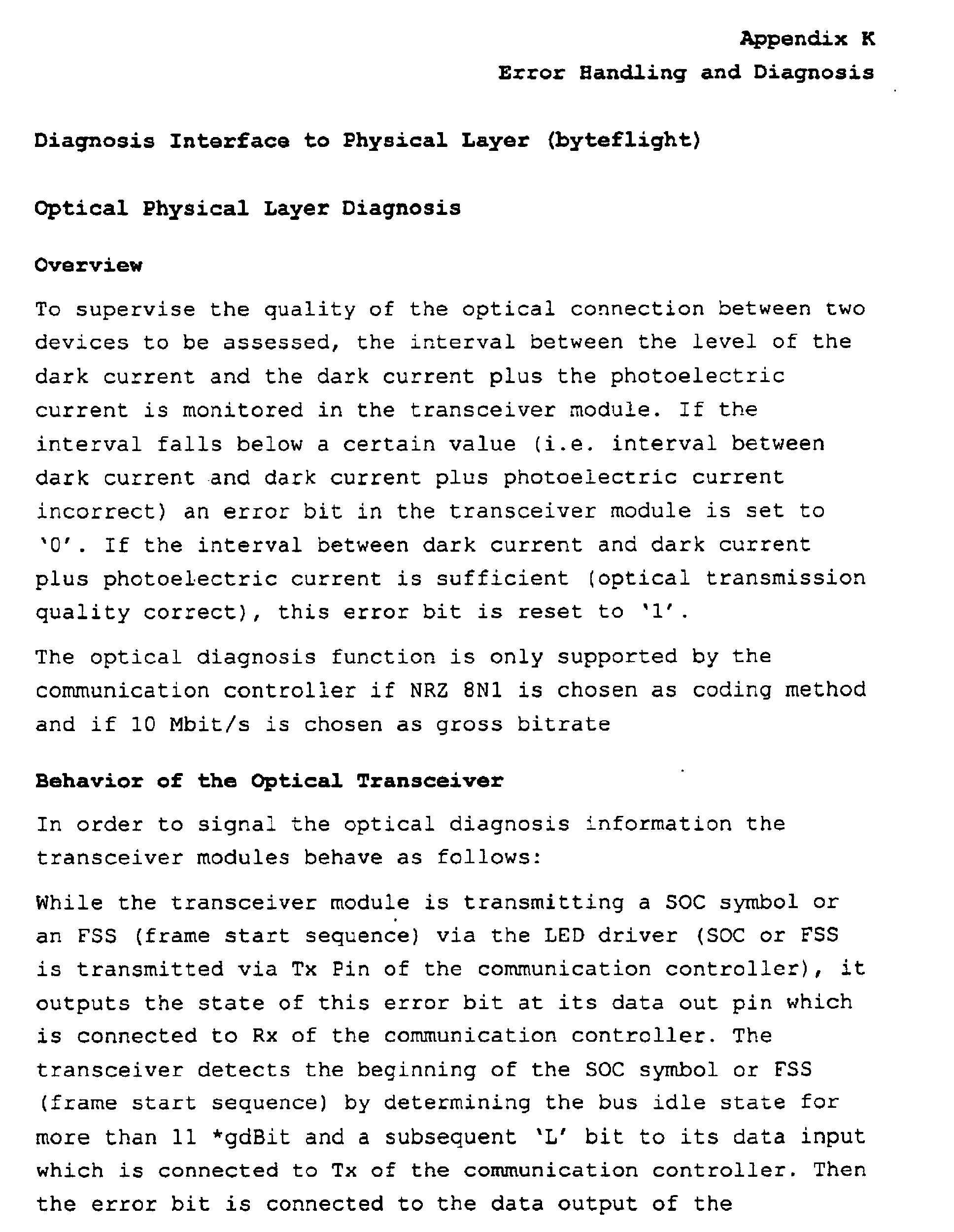

- Concept A: bus driver with integrated bus guardian
- Concept B: dedicated bus guardian chip.
- One advantage of concept A is that nodes on a sub-bus of a branch require the same integrated bus driver with bus guardian.
| Signals used in concept B | |||
| Symbol | Pin | Dir | Description |
| INT | X | O | Interrupt PUSH-PULL output (active LOW) |
| ARM | X | I | Arm signal (active LOW) from CC |
| TXEN_1 | X | I | Enable Reception of Bus Driver #1 (active LOW) |
| RX_1 | X | O | Signals that |
| SigDir_1 | X | O | Signals whether |
| ... | |||
| TXEN_n | X | I | Enable Reception of Bus Driver #n (active LOW) |
| RX_n | X | O | Signals that Bus Driver #n receives data |
| (active LOW) | |||
| SigDir_n | X | O | Signals whether Bus Driver #n is in direction from outside to inside (active LOW) |
| OSC | X | I | Bus Guardian clock input |
| RST | X | I | Bus guardian reset (active LOW) from HOST |
| SS | X | I | SPI select input (active LOW) |
| MISO | X | O | SPI data output |
| MOSI | X | I | SPI date input |
| SCK | X | I | SPI clock input |
| SLSC | X | O | Sleep signal to switch off inhibit at star coupler |
| Signals used in concept | |
| Transition | Condition |
| 1 | RST input low, Power on |
| 2 | Configuration finished AND |
| 3 | SPI command, entering fail silent mode Initialisation not correct finished |
| 4 | Illegal star coupler access detected (e.g. illegal sending slot, access to the star coupler to long) |
| 5 | Counter expired, |
| 6 | CC: Stop sending |
| 7 | Host: Sleep Host: Wake-up Local Wake-up Low Voltage longer than e.g. |
| 8 | Bus activity detected |
| 9 | Host: CancleStopCom |
Claims (5)
- A network-system with at least one node, whereby the at least one node is coupled to a communication line and with means for communication which are able to create a communication cycle on said communication line characterized in that said communication cycle consists at least of a static segment and/or a dynamic segment.
- A device, especially a node in a network-system, with means for communication, which are able to create a communication cycle, characterized in that said communication cycle consists at least of a static segment and/or a dynamic segment.
- A method for creating a communication cycle, characterized in that said communication cycle consists at least of a static segment and/or a dynamic segment.
- A computer program comprising code means adapted to perform the method according to claim 3, when implemented on a computer.
- A computer system product, especially a memory, having a computer program according to claim 4 embodied therein.
Priority Applications (17)
| Application Number | Priority Date | Filing Date | Title |
|---|---|---|---|
| EP02008171A EP1355456A1 (en) | 2002-04-16 | 2002-04-16 | FlexRay communication protocol |
| DE60301637T DE60301637T2 (en) | 2002-04-16 | 2003-04-16 | Method for data transmission in a communication system |
| AT03008737T ATE305197T1 (en) | 2002-04-16 | 2003-04-16 | METHOD FOR DATA TRANSMISSION IN A COMMUNICATIONS SYSTEM |
| AT03008739T ATE313195T1 (en) | 2002-04-16 | 2003-04-16 | METHOD FOR SYNCHRONIZING CLOCKS IN A DISTRIBUTED COMMUNICATIONS SYSTEM |
| EP03008740A EP1355460B1 (en) | 2002-04-16 | 2003-04-16 | Method for monitoring a communication media access schedule of a communication controller of a communication system |
| EP03008737A EP1355458B1 (en) | 2002-04-16 | 2003-04-16 | Method for transmitting data within a communication system |
| DE60301752T DE60301752T9 (en) | 2002-04-16 | 2003-04-16 | A method for monitoring an access sequence for a communication medium of a communication controller of a communication system |
| DE60314935T DE60314935T2 (en) | 2002-04-16 | 2003-04-16 | Method and unit for bit stream decoding |
| EP03008739A EP1355459B1 (en) | 2002-04-16 | 2003-04-16 | Method for synchronizing clocks in a distributed communication system |
| AT03008741T ATE367700T1 (en) | 2002-04-16 | 2003-04-16 | METHOD AND UNIT FOR BIT STREAM DECODING |
| EP03008741A EP1355461B1 (en) | 2002-04-16 | 2003-04-16 | Method and unit for bit stream decoding |
| DE60302697T DE60302697T2 (en) | 2002-04-16 | 2003-04-16 | Method for synchronizing clocks in a distributed communication system |
| AT03008740T ATE306163T1 (en) | 2002-04-16 | 2003-04-16 | METHOD FOR MONITORING AN ACCESS PROCESS CONTROL FOR A COMMUNICATIONS MEDIUM A COMMUNICATIONS CONTROL OF A COMMUNICATIONS SYSTEM |
| US10/613,027 US7586953B2 (en) | 2002-04-16 | 2003-07-07 | Method for monitoring a communication media access schedule of a communication controller of a communication system |
| US10/613,088 US20040081193A1 (en) | 2002-04-16 | 2003-07-07 | Method for transmitting data within a communication system |
| US10/613,000 US20050141565A1 (en) | 2002-04-16 | 2003-07-07 | Method for synchronizing clocks in a distributed communication system |
| US10/613,039 US7430261B2 (en) | 2002-04-16 | 2003-07-07 | Method and bit stream decoding unit using majority voting |
Applications Claiming Priority (1)
| Application Number | Priority Date | Filing Date | Title |
|---|---|---|---|
| EP02008171A EP1355456A1 (en) | 2002-04-16 | 2002-04-16 | FlexRay communication protocol |
Publications (1)
| Publication Number | Publication Date |
|---|---|
| EP1355456A1 true EP1355456A1 (en) | 2003-10-22 |
Family
ID=28459462
Family Applications (1)
| Application Number | Title | Priority Date | Filing Date |
|---|---|---|---|
| EP02008171A Withdrawn EP1355456A1 (en) | 2002-04-16 | 2002-04-16 | FlexRay communication protocol |
Country Status (1)
| Country | Link |
|---|---|
| EP (1) | EP1355456A1 (en) |
Cited By (30)
| Publication number | Priority date | Publication date | Assignee | Title |
|---|---|---|---|---|
| WO2004051925A3 (en) * | 2002-12-03 | 2004-08-05 | Motorola Inc | System node and method for providing media arbitration in a time-slotted system |
| DE102004009468A1 (en) * | 2004-02-27 | 2005-09-15 | Daimlerchrysler Ag | Serial bitstream transmission procedure converts bitstream into identical discrete impulses shorter than maximum rate bits |
| EP1585266A3 (en) * | 2004-03-24 | 2005-11-02 | Bosch Rexroth AG | Method for transferring data |
| WO2005119951A1 (en) * | 2004-06-04 | 2005-12-15 | Robert Bosch Gmbh | Method for establishing a global time base in a timed communications system and associated communications system |
| WO2006067673A3 (en) * | 2004-12-20 | 2006-11-02 | Philips Intellectual Property | Bus guardian as well as method for monitoring communication between and among a number of nodes, node comprising such bus guardian, and distributed communication system comprising such nodes |
| WO2006129269A3 (en) * | 2005-06-02 | 2007-02-22 | Philips Intellectual Property | Method to synchronize locally provided clocks of different communication nodes of a time-triggered communication system |
| WO2007128347A1 (en) | 2006-05-09 | 2007-11-15 | Freescale Semiconductor, Inc. | Data communication unit, integrated circuit and method for buffering data |
| WO2008052849A1 (en) | 2006-10-31 | 2008-05-08 | Robert Bosch Gmbh | Method for sending a data transfer block and method and system for transferring a data transfer block |
| WO2008052850A3 (en) * | 2006-11-03 | 2008-10-16 | Bosch Gmbh Robert | Method and system for transferring data frames |
| RU2380841C2 (en) * | 2004-08-05 | 2010-01-27 | Роберт Бош Гмбх | COMMUNICATION MODULE FOR FlexRay NETWORK |
| US7983250B2 (en) | 2004-02-24 | 2011-07-19 | Robert Bosch Gmbh | Method and communications system for transmitting information in a motor vehicle |
| US8095740B2 (en) * | 2004-08-05 | 2012-01-10 | Robert Bosch Gmbh | Method and apparatus for accessing data of a message memory of a communication module |
| EP1886214A4 (en) * | 2005-05-10 | 2012-08-22 | Continental Automotive Systems | NETWORK OF VEHICLES HAVING TEMPORAL CRANE ACCESSES AND METHOD THEREOF |
| US20120224591A1 (en) * | 2009-10-27 | 2012-09-06 | Hitachi Automotive Systems, Ltd. | Vehicle-Mounted Network Device |
| US8484383B2 (en) * | 2004-08-05 | 2013-07-09 | Robert Bosch Gmbh | FlexRay communication controller |
| CN103281321A (en) * | 2013-05-24 | 2013-09-04 | 航天东方红卫星有限公司 | Satellite-borne FlexRay bus dynamic segment communication method |
| EP2053830A3 (en) * | 2007-08-28 | 2013-11-06 | Honeywell International Inc. | Autocratic low complexity gateway/guardian strategy and/or simple local guardian strategy for flexray or other distributed time-triggered protocol |
| EP2509263A4 (en) * | 2009-12-02 | 2014-01-15 | Toyota Motor Co Ltd | DATA COMMUNICATION NETWORK SYSTEM |
| US8660131B2 (en) | 2005-06-09 | 2014-02-25 | Nxp B.V. | Storage unit for communication system node, method for data storage and communication system node |
| US9825775B2 (en) | 2014-12-16 | 2017-11-21 | Hyundai Motor Company | Local interconnect network system and method, and computer readable medium for implementing the method |
| CN109547260A (en) * | 2018-12-07 | 2019-03-29 | 中国航空工业集团公司西安航空计算技术研究所 | A kind of FlexRay network collocating method and system |
| CN110311752A (en) * | 2019-06-14 | 2019-10-08 | 杭州爱科科技股份有限公司 | For the quick stable communication means and its communication device fastly of chip chamber |
| CN111565378A (en) * | 2019-02-14 | 2020-08-21 | 深圳长城开发科技股份有限公司 | LoRa communication method and LoRa communication system |
| CN111682987A (en) * | 2020-06-09 | 2020-09-18 | 联合汽车电子(重庆)有限公司 | Real vehicle environment simulation and rapid test system based on OSEK NM |
| WO2020200996A1 (en) * | 2019-04-02 | 2020-10-08 | Knorr-Bremse Systeme für Nutzfahrzeuge GmbH | System for transmitting data for a utility vehicle, and method therefor |
| US11188400B2 (en) | 2002-12-17 | 2021-11-30 | Stragent, Llc | System, method and computer program product for sharing information in a distributed framework |
| CN113946535A (en) * | 2021-10-29 | 2022-01-18 | 西安微电子技术研究所 | Bus macro beat and cycle generating method |
| KR20220083329A (en) * | 2020-12-11 | 2022-06-20 | 한림대학교 산학협력단 | System, apparatus, method and program for calculating frame throughput using slot counter parameter |
| EP4236214A1 (en) * | 2022-02-23 | 2023-08-30 | Nxp B.V. | Controller area network transceiver and method for the transceiver |
| CN117675420A (en) * | 2023-11-09 | 2024-03-08 | 中国航空工业集团公司洛阳电光设备研究所 | A message confirmation method based on FlexRay bus |
Citations (1)
| Publication number | Priority date | Publication date | Assignee | Title |
|---|---|---|---|---|
| US4161786A (en) * | 1978-02-27 | 1979-07-17 | The Mitre Corporation | Digital bus communications system |
-
2002
- 2002-04-16 EP EP02008171A patent/EP1355456A1/en not_active Withdrawn
Patent Citations (1)
| Publication number | Priority date | Publication date | Assignee | Title |
|---|---|---|---|---|
| US4161786A (en) * | 1978-02-27 | 1979-07-17 | The Mitre Corporation | Digital bus communications system |
Cited By (48)
| Publication number | Priority date | Publication date | Assignee | Title |
|---|---|---|---|---|
| US8085700B2 (en) | 2002-12-03 | 2011-12-27 | Freescale Semiconductor, Inc. | System node and method for providing media arbitration |
| WO2004051925A3 (en) * | 2002-12-03 | 2004-08-05 | Motorola Inc | System node and method for providing media arbitration in a time-slotted system |
| US11354179B2 (en) | 2002-12-17 | 2022-06-07 | Stragent, Llc | System, method and computer program product for sharing information in a distributed framework |
| US11188400B2 (en) | 2002-12-17 | 2021-11-30 | Stragent, Llc | System, method and computer program product for sharing information in a distributed framework |
| US7983250B2 (en) | 2004-02-24 | 2011-07-19 | Robert Bosch Gmbh | Method and communications system for transmitting information in a motor vehicle |
| DE102004009468A1 (en) * | 2004-02-27 | 2005-09-15 | Daimlerchrysler Ag | Serial bitstream transmission procedure converts bitstream into identical discrete impulses shorter than maximum rate bits |
| EP1585266A3 (en) * | 2004-03-24 | 2005-11-02 | Bosch Rexroth AG | Method for transferring data |
| US7920587B2 (en) | 2004-06-04 | 2011-04-05 | Robert Bosch Gmbh | Method for establishing a global time base in a time-controlled communications system and communications system |
| CN1965514B (en) * | 2004-06-04 | 2012-05-02 | 罗伯特·博世有限公司 | Method for establishing a global time base in a timed communications system and associated communications system |
| WO2005119951A1 (en) * | 2004-06-04 | 2005-12-15 | Robert Bosch Gmbh | Method for establishing a global time base in a timed communications system and associated communications system |
| US8484383B2 (en) * | 2004-08-05 | 2013-07-09 | Robert Bosch Gmbh | FlexRay communication controller |
| RU2380841C2 (en) * | 2004-08-05 | 2010-01-27 | Роберт Бош Гмбх | COMMUNICATION MODULE FOR FlexRay NETWORK |
| US7769906B2 (en) | 2004-08-05 | 2010-08-03 | Robert Bosch Gmbh | FlexRay communication module |
| US8095740B2 (en) * | 2004-08-05 | 2012-01-10 | Robert Bosch Gmbh | Method and apparatus for accessing data of a message memory of a communication module |
| US8228953B2 (en) * | 2004-12-20 | 2012-07-24 | Nxp B.V. | Bus guardian as well as method for monitoring communication between and among a number of nodes, node comprising such bus guardian, and distributed communication system comprising such nodes |
| WO2006067673A3 (en) * | 2004-12-20 | 2006-11-02 | Philips Intellectual Property | Bus guardian as well as method for monitoring communication between and among a number of nodes, node comprising such bus guardian, and distributed communication system comprising such nodes |
| EP1886214A4 (en) * | 2005-05-10 | 2012-08-22 | Continental Automotive Systems | NETWORK OF VEHICLES HAVING TEMPORAL CRANE ACCESSES AND METHOD THEREOF |
| WO2006129269A3 (en) * | 2005-06-02 | 2007-02-22 | Philips Intellectual Property | Method to synchronize locally provided clocks of different communication nodes of a time-triggered communication system |
| US8660131B2 (en) | 2005-06-09 | 2014-02-25 | Nxp B.V. | Storage unit for communication system node, method for data storage and communication system node |
| WO2007128347A1 (en) | 2006-05-09 | 2007-11-15 | Freescale Semiconductor, Inc. | Data communication unit, integrated circuit and method for buffering data |
| US20100293443A1 (en) * | 2006-10-31 | 2010-11-18 | Josef Newald | Method for transmitting a data transfer block and method and system for transferring a data transfer block |
| US8413017B2 (en) | 2006-10-31 | 2013-04-02 | Robert Bosch Gmbh | Method for transmitting a data transfer block and method and system for transferring a data transfer block |
| WO2008052849A1 (en) | 2006-10-31 | 2008-05-08 | Robert Bosch Gmbh | Method for sending a data transfer block and method and system for transferring a data transfer block |
| WO2008052850A3 (en) * | 2006-11-03 | 2008-10-16 | Bosch Gmbh Robert | Method and system for transferring data frames |
| CN101589554B (en) * | 2006-11-03 | 2013-10-30 | 罗伯特.博世有限公司 | Method and system for transferring data frames |
| EP2053830A3 (en) * | 2007-08-28 | 2013-11-06 | Honeywell International Inc. | Autocratic low complexity gateway/guardian strategy and/or simple local guardian strategy for flexray or other distributed time-triggered protocol |
| EP2495914A4 (en) * | 2009-10-27 | 2014-07-30 | Hitachi Automotive Systems Ltd | VEHICLE MOUNTED NETWORK DEVICE |
| US20120224591A1 (en) * | 2009-10-27 | 2012-09-06 | Hitachi Automotive Systems, Ltd. | Vehicle-Mounted Network Device |
| EP2509263A4 (en) * | 2009-12-02 | 2014-01-15 | Toyota Motor Co Ltd | DATA COMMUNICATION NETWORK SYSTEM |
| US8660149B2 (en) | 2009-12-02 | 2014-02-25 | Toyota Jidosha Kabushiki Kaisha | Data communication network system |
| CN103281321B (en) * | 2013-05-24 | 2016-02-10 | 航天东方红卫星有限公司 | A kind of spaceborne FlexRay bus dynamic segment communication means |
| CN103281321A (en) * | 2013-05-24 | 2013-09-04 | 航天东方红卫星有限公司 | Satellite-borne FlexRay bus dynamic segment communication method |
| US9825775B2 (en) | 2014-12-16 | 2017-11-21 | Hyundai Motor Company | Local interconnect network system and method, and computer readable medium for implementing the method |
| CN109547260A (en) * | 2018-12-07 | 2019-03-29 | 中国航空工业集团公司西安航空计算技术研究所 | A kind of FlexRay network collocating method and system |
| CN111565378A (en) * | 2019-02-14 | 2020-08-21 | 深圳长城开发科技股份有限公司 | LoRa communication method and LoRa communication system |
| CN111565378B (en) * | 2019-02-14 | 2024-04-19 | 深圳长城开发科技股份有限公司 | LoRa communication method and LoRa communication system |
| WO2020200996A1 (en) * | 2019-04-02 | 2020-10-08 | Knorr-Bremse Systeme für Nutzfahrzeuge GmbH | System for transmitting data for a utility vehicle, and method therefor |
| CN110311752B (en) * | 2019-06-14 | 2022-04-08 | 杭州爱科科技股份有限公司 | Communication method and communication device for rapid, fast and stable communication between chips |
| CN110311752A (en) * | 2019-06-14 | 2019-10-08 | 杭州爱科科技股份有限公司 | For the quick stable communication means and its communication device fastly of chip chamber |
| CN111682987B (en) * | 2020-06-09 | 2021-09-14 | 联合汽车电子(重庆)有限公司 | Real vehicle environment simulation and rapid test system based on OSEK NM |
| CN111682987A (en) * | 2020-06-09 | 2020-09-18 | 联合汽车电子(重庆)有限公司 | Real vehicle environment simulation and rapid test system based on OSEK NM |
| KR20220083329A (en) * | 2020-12-11 | 2022-06-20 | 한림대학교 산학협력단 | System, apparatus, method and program for calculating frame throughput using slot counter parameter |
| KR102499337B1 (en) | 2020-12-11 | 2023-02-10 | 한림대학교 산학협력단 | System, apparatus, method and program for calculating frame throughput using slot counter parameter |
| CN113946535A (en) * | 2021-10-29 | 2022-01-18 | 西安微电子技术研究所 | Bus macro beat and cycle generating method |
| CN113946535B (en) * | 2021-10-29 | 2023-09-19 | 西安微电子技术研究所 | Method for generating macro beat and cycle of bus |
| EP4236214A1 (en) * | 2022-02-23 | 2023-08-30 | Nxp B.V. | Controller area network transceiver and method for the transceiver |
| US12212430B2 (en) | 2022-02-23 | 2025-01-28 | Nxp B.V. | Controller area network transceiver and method for the transceiver |
| CN117675420A (en) * | 2023-11-09 | 2024-03-08 | 中国航空工业集团公司洛阳电光设备研究所 | A message confirmation method based on FlexRay bus |
Similar Documents
| Publication | Publication Date | Title |
|---|---|---|
| EP1355460B1 (en) | Method for monitoring a communication media access schedule of a communication controller of a communication system | |
| DE60301767T2 (en) | Normalization of a Verificationmasses in a device for speaker verification | |
| US7107473B2 (en) | Method and device for synchronizing the global time of a plurality of TTCAN buses and a corresponding bus system | |
| US7920587B2 (en) | Method for establishing a global time base in a time-controlled communications system and communications system | |
| EP1624620A1 (en) | FlexRay communication controller | |
| JP5033199B2 (en) | Node of distributed communication system, node coupled to distributed communication system, and monitoring apparatus | |
| US20080273527A1 (en) | Distributed system | |
| US10924198B2 (en) | High speed embedded protocol for distributed control system | |
| US8228953B2 (en) | Bus guardian as well as method for monitoring communication between and among a number of nodes, node comprising such bus guardian, and distributed communication system comprising such nodes | |
| Specification | Bosch | |
| WO2007054877A1 (en) | Bus guardian with improved channel monitoring | |
| Schätz et al. | FlexRay protocol | |
| Shaheen et al. | A comparison of emerging time-triggered protocols for automotive X-by-wire control networks | |
| Srinivasan et al. | Real-time architecture analysis: A COTS perspective | |
| Kammerer | TTCAN | |
| Lawrenz | CAN Basic Architectures | |
| El Salloum et al. | FlexRay | |
| Bertoluzzo et al. | Application protocols for safety-critical CAN-networked systems | |
| Mahmud | Various Emerging Time-Triggered Protocols for Drive-by-Wire Applications | |
| Böhm | Introduction to FlexRay and TTA | |
| predictable as Time | TTP |
Legal Events
| Date | Code | Title | Description |
|---|---|---|---|
| PUAI | Public reference made under article 153(3) epc to a published international application that has entered the european phase |
Free format text: ORIGINAL CODE: 0009012 |
|
| AK | Designated contracting states |
Kind code of ref document: A1 Designated state(s): AT BE CH CY DE DK ES FI FR GB GR IE IT LI LU MC NL PT SE TR |
|
| AX | Request for extension of the european patent |
Extension state: AL LT LV MK RO SI |
|
| AKX | Designation fees paid | ||
| REG | Reference to a national code |
Ref country code: DE Ref legal event code: 8566 |
|
| STAA | Information on the status of an ep patent application or granted ep patent |
Free format text: STATUS: THE APPLICATION IS DEEMED TO BE WITHDRAWN |
|
| 18D | Application deemed to be withdrawn |
Effective date: 20040423 |
|
| RAP1 | Party data changed (applicant data changed or rights of an application transferred) |
Owner name: KONINKLIJKE PHILIPS ELECTRONICS N.V. Owner name: PHILIPS INTELLECTUAL PROPERTY & STANDARDS GMBH Owner name: GENERAL MOTORS CORPORATION Owner name: MOTOROLA, INC. Owner name: BMW AG Owner name: DAIMLERCHRYSLER AG Owner name: ROBERT BOSCH GMBH |
|
| RAP1 | Party data changed (applicant data changed or rights of an application transferred) |
Owner name: KONINKLIJKE PHILIPS ELECTRONICS N.V. Owner name: PHILIPS INTELLECTUAL PROPERTY & STANDARDS GMBH Owner name: GENERAL MOTORS CORPORATION Owner name: MOTOROLA, INC. Owner name: BMW AG Owner name: DAIMLERCHRYSLER AG Owner name: ROBERT BOSCH GMBH |