EP1354897A1 - Polymer for photoresist and resin compositions therefor - Google Patents
Polymer for photoresist and resin compositions therefor Download PDFInfo
- Publication number
- EP1354897A1 EP1354897A1 EP01270561A EP01270561A EP1354897A1 EP 1354897 A1 EP1354897 A1 EP 1354897A1 EP 01270561 A EP01270561 A EP 01270561A EP 01270561 A EP01270561 A EP 01270561A EP 1354897 A1 EP1354897 A1 EP 1354897A1
- Authority
- EP
- European Patent Office
- Prior art keywords
- group
- formula
- hydrogen atom
- meth
- represented
- Prior art date
- Legal status (The legal status is an assumption and is not a legal conclusion. Google has not performed a legal analysis and makes no representation as to the accuracy of the status listed.)
- Granted
Links
Classifications
-
- G—PHYSICS
- G03—PHOTOGRAPHY; CINEMATOGRAPHY; ANALOGOUS TECHNIQUES USING WAVES OTHER THAN OPTICAL WAVES; ELECTROGRAPHY; HOLOGRAPHY
- G03F—PHOTOMECHANICAL PRODUCTION OF TEXTURED OR PATTERNED SURFACES, e.g. FOR PRINTING, FOR PROCESSING OF SEMICONDUCTOR DEVICES; MATERIALS THEREFOR; ORIGINALS THEREFOR; APPARATUS SPECIALLY ADAPTED THEREFOR
- G03F7/00—Photomechanical, e.g. photolithographic, production of textured or patterned surfaces, e.g. printing surfaces; Materials therefor, e.g. comprising photoresists; Apparatus specially adapted therefor
- G03F7/004—Photosensitive materials
-
- G—PHYSICS
- G03—PHOTOGRAPHY; CINEMATOGRAPHY; ANALOGOUS TECHNIQUES USING WAVES OTHER THAN OPTICAL WAVES; ELECTROGRAPHY; HOLOGRAPHY
- G03F—PHOTOMECHANICAL PRODUCTION OF TEXTURED OR PATTERNED SURFACES, e.g. FOR PRINTING, FOR PROCESSING OF SEMICONDUCTOR DEVICES; MATERIALS THEREFOR; ORIGINALS THEREFOR; APPARATUS SPECIALLY ADAPTED THEREFOR
- G03F7/00—Photomechanical, e.g. photolithographic, production of textured or patterned surfaces, e.g. printing surfaces; Materials therefor, e.g. comprising photoresists; Apparatus specially adapted therefor
- G03F7/004—Photosensitive materials
- G03F7/039—Macromolecular compounds which are photodegradable, e.g. positive electron resists
- G03F7/0392—Macromolecular compounds which are photodegradable, e.g. positive electron resists the macromolecular compound being present in a chemically amplified positive photoresist composition
- G03F7/0395—Macromolecular compounds which are photodegradable, e.g. positive electron resists the macromolecular compound being present in a chemically amplified positive photoresist composition the macromolecular compound having a backbone with alicyclic moieties
-
- G—PHYSICS
- G03—PHOTOGRAPHY; CINEMATOGRAPHY; ANALOGOUS TECHNIQUES USING WAVES OTHER THAN OPTICAL WAVES; ELECTROGRAPHY; HOLOGRAPHY
- G03F—PHOTOMECHANICAL PRODUCTION OF TEXTURED OR PATTERNED SURFACES, e.g. FOR PRINTING, FOR PROCESSING OF SEMICONDUCTOR DEVICES; MATERIALS THEREFOR; ORIGINALS THEREFOR; APPARATUS SPECIALLY ADAPTED THEREFOR
- G03F7/00—Photomechanical, e.g. photolithographic, production of textured or patterned surfaces, e.g. printing surfaces; Materials therefor, e.g. comprising photoresists; Apparatus specially adapted therefor
- G03F7/004—Photosensitive materials
- G03F7/039—Macromolecular compounds which are photodegradable, e.g. positive electron resists
- G03F7/0392—Macromolecular compounds which are photodegradable, e.g. positive electron resists the macromolecular compound being present in a chemically amplified positive photoresist composition
- G03F7/0397—Macromolecular compounds which are photodegradable, e.g. positive electron resists the macromolecular compound being present in a chemically amplified positive photoresist composition the macromolecular compound having an alicyclic moiety in a side chain
-
- Y—GENERAL TAGGING OF NEW TECHNOLOGICAL DEVELOPMENTS; GENERAL TAGGING OF CROSS-SECTIONAL TECHNOLOGIES SPANNING OVER SEVERAL SECTIONS OF THE IPC; TECHNICAL SUBJECTS COVERED BY FORMER USPC CROSS-REFERENCE ART COLLECTIONS [XRACs] AND DIGESTS
- Y10—TECHNICAL SUBJECTS COVERED BY FORMER USPC
- Y10S—TECHNICAL SUBJECTS COVERED BY FORMER USPC CROSS-REFERENCE ART COLLECTIONS [XRACs] AND DIGESTS
- Y10S430/00—Radiation imagery chemistry: process, composition, or product thereof
- Y10S430/1053—Imaging affecting physical property or radiation sensitive material, or producing nonplanar or printing surface - process, composition, or product: radiation sensitive composition or product or process of making binder containing
- Y10S430/1055—Radiation sensitive composition or product or process of making
- Y10S430/106—Binder containing
- Y10S430/109—Polyester
Definitions
- the present invention relates to a polymeric compound for photoresist for use in micromachining of semiconductors, to a resist composition for photoresist containing the polymeric compound, and to a process of fabricating a semiconductor.
- the invention also relates to a (meth) acrylic ester derivative having a lactone skeleton which is useful as a raw material for the polymeric compound for photoresist, to a cyclic alcohol having a lactone skeleton which is useful in production of the (meth)acrylic ester derivative, and to processes for producing these compounds.
- Resins for photoresist for use in fabricating processes of semiconductors must have the following functions. Specifically, they must adhere to substrates, be eliminated by action of an acid generated from a photosensitive acid generator with exposure and become soluble in basic developing solutions, and be resistant to dry etching. Increasing expectations are specifically placed on resins for photoresist for use in fabrication of semiconductors on the order of giga using ArF excimer laser as a light source in exposure process step. However, the ArF excimer laser has a wavelength in the far-ultraviolet region of 193 nm, and resists used must be transparent in the far-ultraviolet region. Some novel resins differing from novolak resins now used have been proposed.
- polycyclic alicyclic monomers each containing a lactone skeleton will exhibit adhesion to substrates when they are polymerized, may have resistance to etching and have received attention in recent times.
- polycyclic alicyclic monomers each containing a lactone skeleton will exhibit adhesion to substrates when they are polymerized, may have resistance to etching and have received attention in recent times.
- only few proposals have been made on such monomers, for example, in Japanese Unexamined Patent Application Publications No. 2000-26446 and No. 2000-159758. Accordingly, demands are made on development of novel monomers and polymers for photoresist which can exhibit more excellent functions in order to design the best resists.
- Another object of the present invention is to provide a novel polymer for photoresist which has well-rounded adhesion to substrates and resistance to etching and exhibits high affinity for developing solutions and rinsing solutions after exposure, a resin composition for photoresist containing the polymer for photoresist as a base, and a process for fabricating a semiconductor using the resin composition for photoresist.
- a further object of the present invention is to provide a novel (meth)acrylic ester derivative having a lactone skeleton which is useful as a raw material for the polymeric compound for photoresist, a cyclic alcohol having a lactone skeleton which is useful in production of the (meth)acrylic ester derivative, and processes for producing these compounds.
- the present inventors After intensive investigations to achieve the above objects, the present inventors have attained success in developing a novel acrylate monomer having a polycyclic alicyclic skeleton including a lactone ring and have found that the monomer can yield a novel polymer for photoresist which has well-rounded adhesion to substrates and resistance to etching.
- the present invention has been accomplished based on these findings.
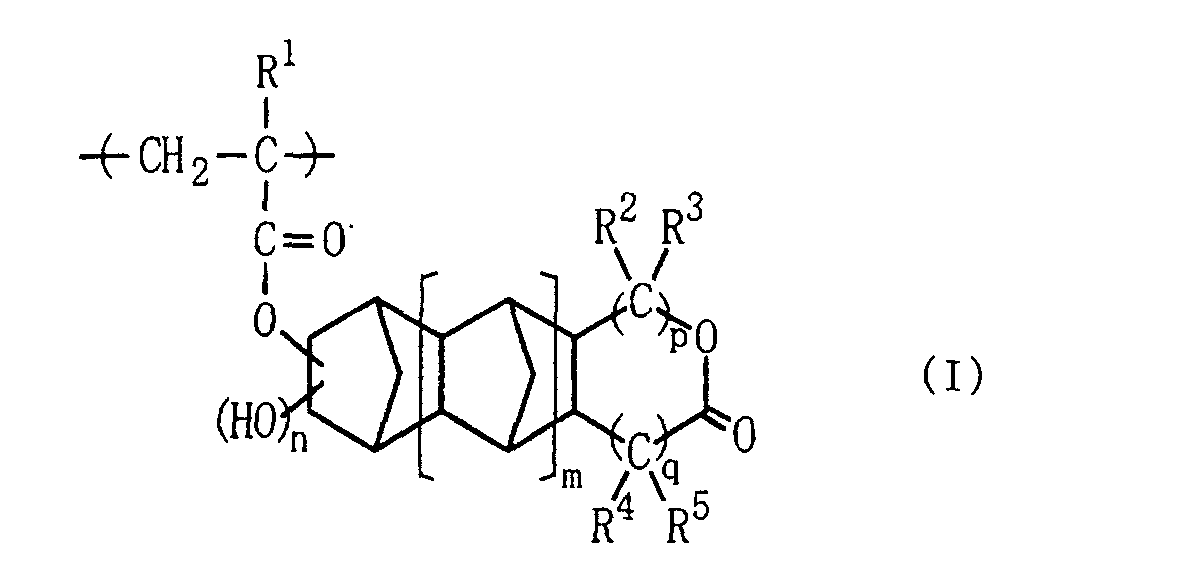
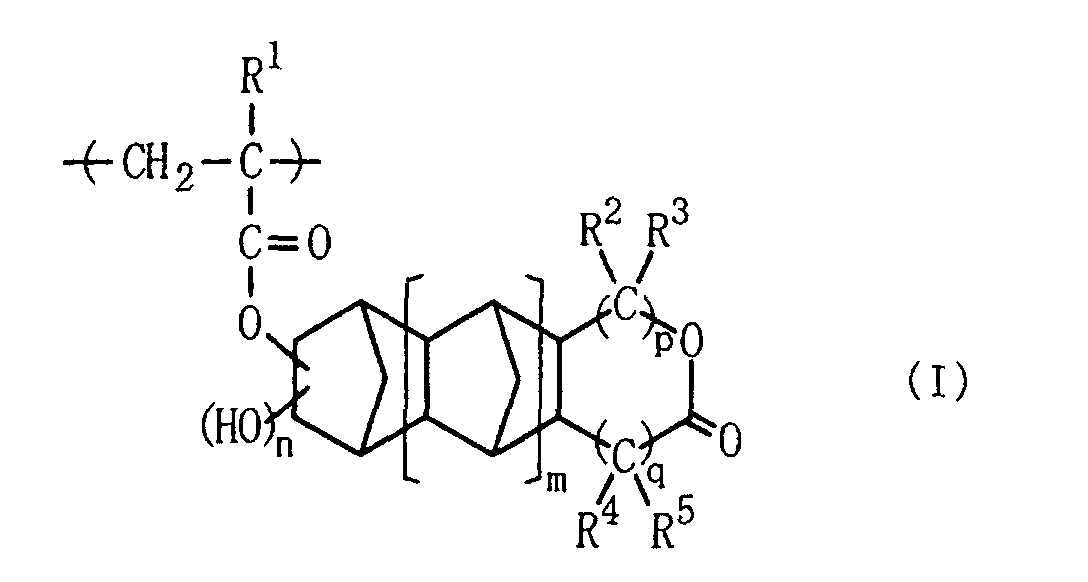
- the present invention provides a polymeric compound for photoresist, including at least one monomer unit represented by following Formula (I): wherein R 1 , R 2 , R 3 , R 4 and R 5 are the same or different and are each a hydrogen atom or a methyl group; m, p and q each denote an integer of from 0 to 2; and n denotes 0 or 1, where the hydroxyl group and carbonyloxy group extending from a principle chain in the formula are independently combined with either of two carbon atoms on the far-left portion of the rings.
- Formula (I) wherein R 1 , R 2 , R 3 , R 4 and R 5 are the same or different and are each a hydrogen atom or a methyl group; m, p and q each denote an integer of from 0 to 2; and n denotes 0 or 1, where the hydroxyl group and carbonyloxy group extending from a principle chain in the formula are independently combined with either of two carbon atoms on the far-
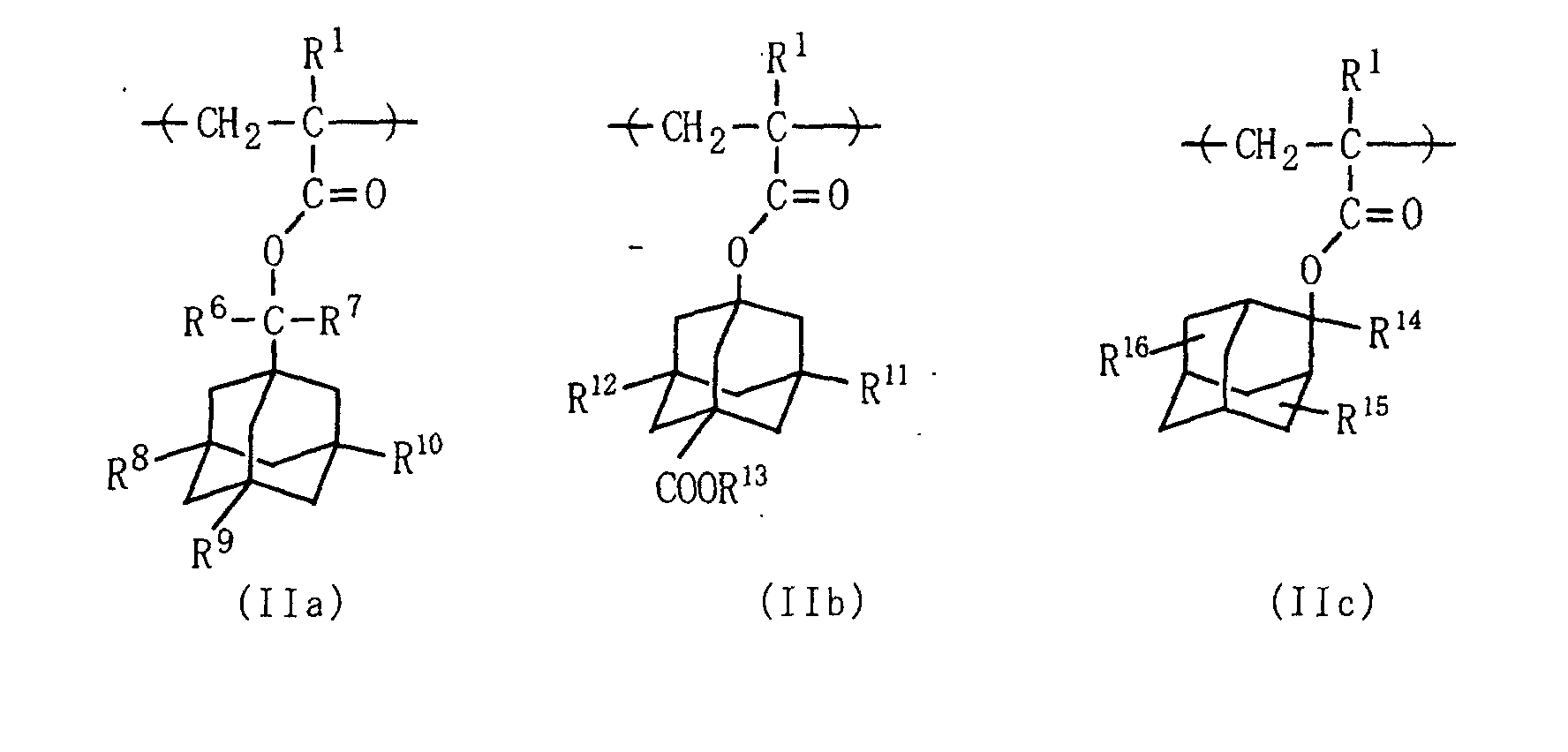
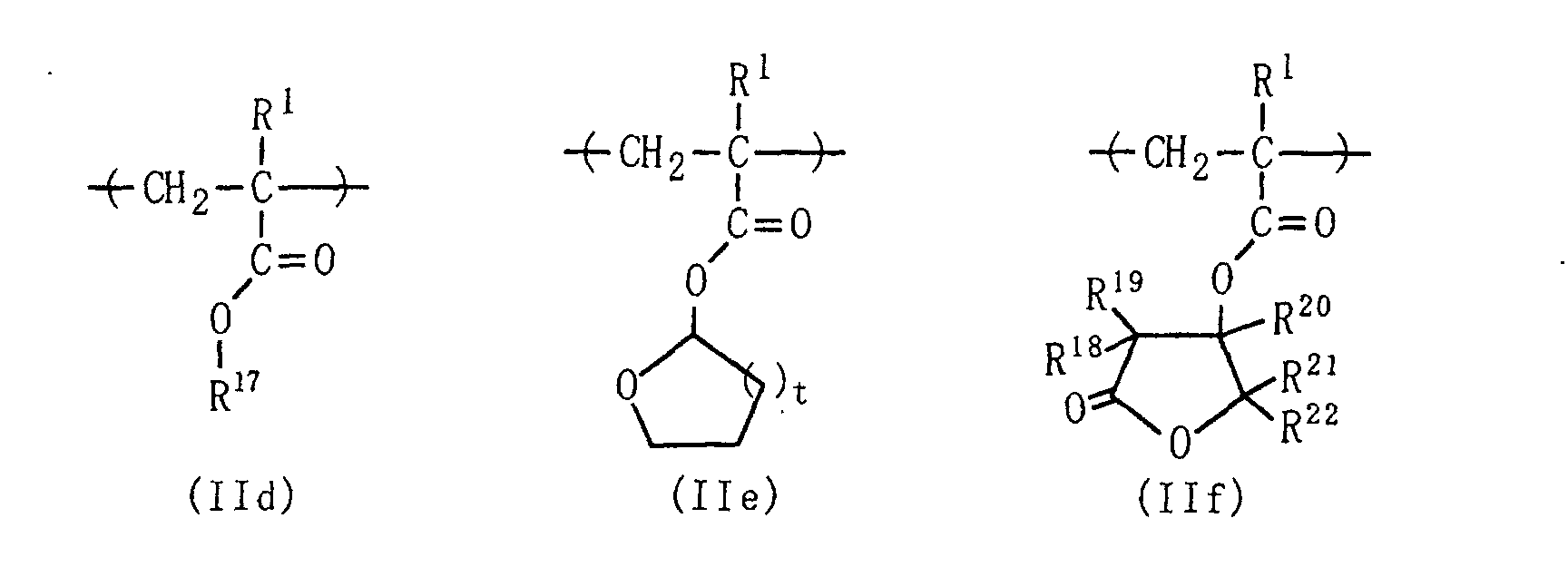
- the polymeric compound for photoresist may include at least one monomer unit represented by Formula (I) and at least one selected from monomer units represented by following Formulae (IIa) through (IIg): wherein R 1 is a hydrogen atom or a methyl group; R 6 and R 7 are the same or different and are each a hydrocarbon group containing from 1 to 8 carbon atoms; R 8 , R 9 and R 10 are the same or different and are each a hydrogen atom, a hydroxyl group, or a methyl group; R 11 and R 12 are the same or different and are each a hydrogen atom, a hydroxyl group or a -COOR 13 group, where R 13 is a t-butyl group, a 2-tetrahydrofuranyl group, a 2-tetrahydropyranyl group or an 2-oxepanyl group; R 14 is a methyl group or an ethyl group; R 15 and R 16 are the same or different and are each a hydrogen atom,
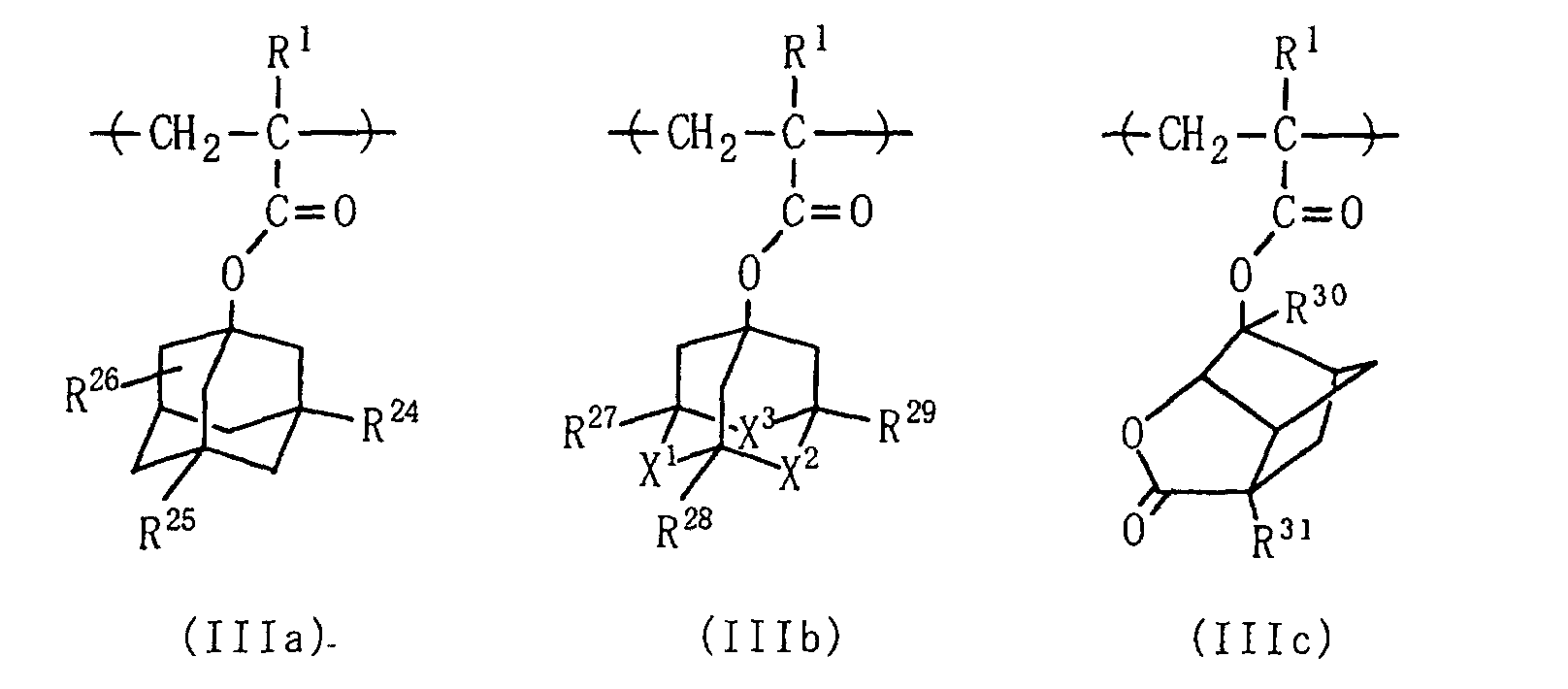
- the polymeric compound for photoresist may further include at least one selected from monomer units represented by following Formulae (IIIa) through (IIIh): wherein R 1 is a hydrogen atom or a methyl group; R 24 and R 25 are the same or different and are each a hydrogen atom, a hydroxyl group or a carboxyl group; R 26 is a hydroxyl group, an oxo group or a carboxyl group; X 1 , X 2 and X 3 are the same or different and are each -CH 2 - or -CO-O-; R 27 , R 28 and R 29 are the same or different and are each a hydrogen atom or a methyl group; R 30 and R 31 are the same or different and are each a hydrogen atom or a methyl group; R 32 , R 33 , R 34 , R 35 and R 36 are the same or different and are each a hydrogen atom or a methyl group; R 37 is a hydrogen atom or a straight-chain, branched-chain
- the polymeric compound for photoresist may have a solubility parameter of, for example, from 19.5 to 24.5 (J/cm 3 ) 1/2 as determined by Fedors method.
- the present invention also provides a resin composition for photoresist, including at least the polymeric compound for photoresist and a photosensitive acid generator.
- the present invention provides a process for fabricating a semiconductor.
- the process includes the steps of applying the resin composition for photoresist to a base or a substrate to form a resist film, exposing, developing and thereby patterning the resist film.
- the present invention further provides a (meth)acrylic ester derivative represented by following Formula (1): wherein R 1 , R 2 , R 3 , R 4 and R 5 are the same or different and are each a hydrogen atom or a methyl group; m, p and q each denote an integer of from 0 to 2; and n denotes 0 or 1 where the (meth) acryloyloxy group and hydroxyl group in the formula are independently combined with either of two carbon atoms on the far-left portion of the rings.
- Formula (1) wherein R 1 , R 2 , R 3 , R 4 and R 5 are the same or different and are each a hydrogen atom or a methyl group; m, p and q each denote an integer of from 0 to 2; and n denotes 0 or 1 where the (meth) acryloyloxy group and hydroxyl group in the formula are independently combined with either of two carbon atoms on the far-left portion of the rings.
- the present invention provides a process for producing a (meth)acrylic ester derivative.
- the process includes the step of allowing a cyclic alcohol represented by following Formula (4): wherein R 2 , R 3 , R 4 and R 5 are the same or different and are each a hydrogen atom or a methyl group; m, p and q each denote an integer of from 0 to 2; n denotes 0 or 1, where the hydroxyl groups in the formula are independently combined with either of two carbon atoms on the far-left portion of the rings, to react with (meth)acrylic acid or a reactive derivative thereof to thereby yield a compound represented by following Formula (1) : wherein R 1 is a hydrogen atom or a methyl group; and R 2 , R 3 , R 4 , R 5 , m, p, q, and n have the same meanings as defined above, where the (meth)acryloyloxy group and hydroxyl group in the formula are independently combined with either of two carbon atoms
- the present invention further provides a process for. producing a cyclic alcohol.
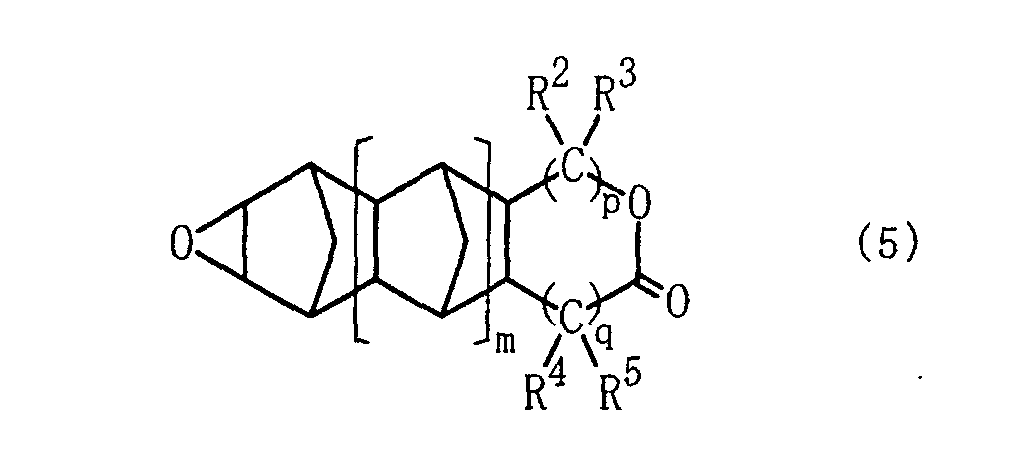
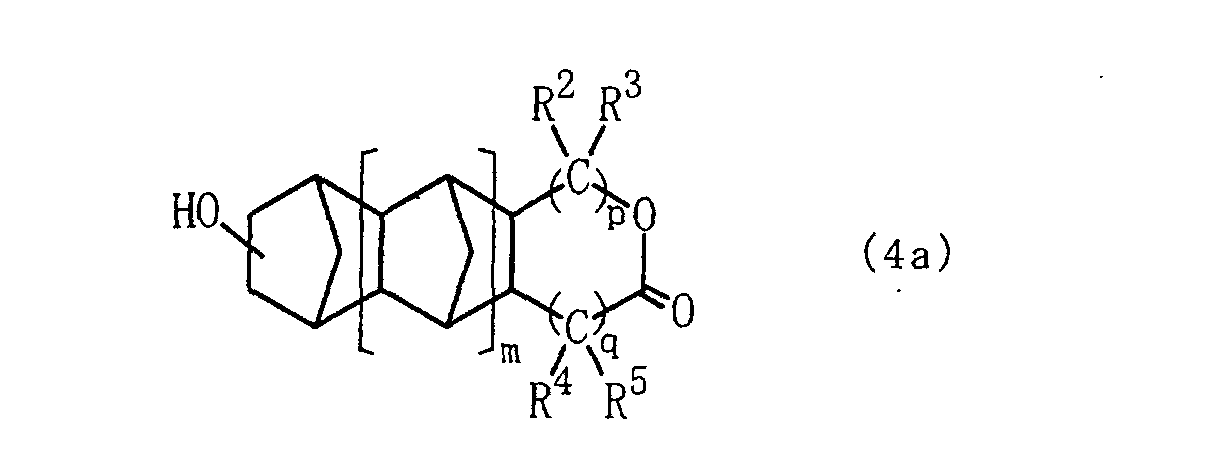
- the process includes the step of reducing an epoxy compound represented by following Formula (5) : wherein R 2 , R 3 , R4 and R 5 are the same or different and are each a hydrogen atom or a methyl group; and m, p and q each denote an integer of from 0 to 2, to thereby yield a cyclic alcohol represented by following Formula (4a) : wherein R 2 , R 3 , R 4 , R 5 , m, p, and q have the same meanings as defined above, where the hydroxyl group in the formula is combined with either of two carbon atoms on the far-left portion of the rings.
- the present invention provides a cyclic alcohol represented by following Formula (4b): wherein R 2 , R 3 , R 4 and R 5 are the same or different and are each a hydrogen atom or a methyl group; m denotes an integer of from 0 to 2; r and s each denote 0 or 1, where r plus s equals 1, and where the hydroxyl group in the formula is combined with either of two carbon atoms on the far-left portion of the rings.
- Formula (4b) wherein R 2 , R 3 , R 4 and R 5 are the same or different and are each a hydrogen atom or a methyl group; m denotes an integer of from 0 to 2; r and s each denote 0 or 1, where r plus s equals 1, and where the hydroxyl group in the formula is combined with either of two carbon atoms on the far-left portion of the rings.
- acrylic and “methacrylic” may generically be referred to as “(meth)acrylic”
- acryloyl and methacryloyl may generically be referred to as “(meth)acryloyl”.
- the polymeric compound for photoresist of the present invention comprises at least one monomer unit (constitutional repeating unit) represented by Formula (I) (hereinafter may be referred to as "Monomer Unit 1") as a unit for constituting the polymer molecule.
- Monomer Unit 1 has a hydrophilic lactone ring, as well as a hydroxyl group when n is 1 and thereby plays a role as an adhesion-imparting unit for increasing adhesion to substrates. It also has an alicyclic carbon ring and thereby serves to increase resistance to etching.
- the resulting polymer can have all the functions required as a resist.
- R 1 , R 2 , R 3 , R 4 and R 5 are the same or different and are each a hydrogen atom or a methyl group.
- the repetition numbers m, p and q are each an integer of from 0 to 2, and n denotes 0 or 1.
- the hydroxyl group and the carbonyloxy group extending from the principle chain in the formula are independently combined with either of two carbon atoms on the far-left portion of the rings. In other words, the hydroxyl group and the carbonyloxy group are combined with different carbon atoms, respectively.
- the repetition number m is preferably 0 or 1, and p plus q preferably equals 1 or 2. It is particularly preferred that (i) p is 1 and q is 0, (ii) p is 0 and q is 1, (iii) p is 2 and q is 0, or (iv) p is 1 and q is 1.
- the polymeric compound according to a preferred embodiment of the present invention comprises at least one monomer unit (hereinafter may be referred to as "Monomer Unit 2") selected from the monomer units (constitutional repeating units) represented by Formulae (IIa) through (IIg) in addition to the at least one monomer unit represented by Formula (I).
- Monomer Unit 2 selected from the monomer units (constitutional repeating units) represented by Formulae (IIa) through (IIg) in addition to the at least one monomer unit represented by Formula (I).
- hydrocarbons each containing 1 to 8 carbon atoms in R 6 and R 7 include, for example, methyl, ethyl, propyl, isopropyl, butyl, isobutyl, s-butyl, pentyl, isopentyl, 1-methylbutyl, 1-ethylpropyl, hexyl, isohexyl, 1-methylpentyl, 1-ethylbutyl, heptyl, 1-methylhexyl, octyl, 1-methylheptyl, and other C 1 -C 8 alkyl groups; cyclopropyl, cyclopentyl, cyclohexyl, cycloheptyl, cyclooctyl, and other C 3 -C 8 cycloalkyl groups; and phenyl group.
- the "hydrocarbon group having a tertiary carbon atom at the bonding site with the oxygen atom indicated in the formula" in R 17 includes, for example, t-butyl group and t-amyl group. These hydrocarbon groups may each have a substituent.
- a moiety containing an adamantane skeleton leaves from the carboxylic acid moiety combined with a principle chain by action of an acid to thereby yield a free carboxyl group.
- a carboxyl group which is protected with a protecting group and is combined with an adamantane skeleton is deprotected with action of an acid to thereby yield a free carboxyl group.
- an adamantane skeleton leaves from a carboxylic acid moiety combined with a principle chain by action of an acid to thereby yield a free carboxyl group.
- the monomer units represented by Formulae (IIa), (IIb), (IIc) and (IIg) each have an alicyclic carbon skeleton, are thereby highly transparent and are very highly resistant to etching.
- Monomer units represented by Formula (IIa) where at least one of R 8 , R 9 and R 10 is a hydroxyl group and the monomer units represented by Formula (IIf) are highly hydrophilic and are capable of adhering.
- the polymeric compound for photoresist of the present invention may further comprise at least one monomer unit (constitutional repeating unit) (hereinafter may be referred to as "Monomer Unit 3") selected from the monomer units represented by Formulae (IIIa) through (IIIh), in addition to Monomer Unit 1, or in addition to Monomer Units 1 and 2.
- monomer unit constitutional repeating unit
- the group -CO-O- in X 1 , X 2 and X 3 may be in whichever direction.
- the straight-chain, branched-chain, cyclic or bridged cyclic hydrocarbon group (bridged cyclic group) containing 1 to 20 carbon atoms includes, but is not limited to, methyl, ethyl, propyl, isopropyl, butyl, isobutyl, t-butyl, pentyl, hexyl, octyl, decyl, dodecyl, tetradecyl, octadecyl, and other straight- or branched-chain aliphatic hydrocarbon groups (especially alkyl groups) each containing 1 to 20 carbon atoms; cyclopentyl, cyclohexyl, cyclooctyl, cyclododecyl, and other cycloalkyl or cycloalkeny
- hydrocarbon groups may each have a substituent.
- substituents include, but are not limited to, alkyl groups, halogen atoms, hydroxyl groups which may be protected with a protecting group, hydroxymethyl groups which may be protected with a protecting group, carboxyl groups which may be protected with a protecting group (e.g., carboxyl group, t-butyloxycarbonyl group, 2-tetrahydrofuranyloxycarbonyl group, 2-tetrahydropyranyloxycarbonyl group, and 2-oxepanyloxycarbonyl group), and oxo group.
- the protecting groups those conventionally used in the field of organic synthesis can be used.
- the monomer units represented by Formula (IIIa) each have a hydrophilic group (hydroxyl group, carboxyl group, or oxo group) combined with an adamantane skeleton and are capable of increasing adhesion to substrates.
- These monomer units can impart various functions to the resulting polymer according to their structures, and the balance in required properties as a resist resin can finely be adjusted by incorporating appropriate monomer units into the polymer depending on its application.
- the polymeric compound for photoresist of the present invention may further comprise other additional monomer units in addition to the aforementioned monomer units in order to adjust the properties.
- the content of Monomer Unit 1 in the polymeric compound for photoresist of the present invention is, for example, from about 1% to about 90% by mole, preferably from about 5% to about 70% by mole, and more preferably from about 10% to about 50% by mole based on the total moles of the monomer units constituting the polymer.
- a preferred polymeric compound further comprises Monomer Unit 2 in an amount from about 5% to about 98% by mole (e.g., from about 10% to about 80% by mole) and more preferably from about 30% to about 60% by mole based on the total moles of monomer units constituting the polymer.
- the content of Monomer Unit 3, if any, in the polymeric compound is for example from about 1% to about 50% by mole, preferably from about 3% to about 40% by mole, and more preferably from about 5% to about 35% by mole based on the total moles of the monomer units constituting the polymer.
- the polymeric compound for photoresist of the present invention preferably has a solubility parameter ("SP") as determined by the Fedors method [Polym. Eng. Sci., 14, 147 (1974)] in a range from 19.5 (J/cm 3 ) 1/2 to 24.5 (J/cm 3 ) 1/2 .
- SP solubility parameter
- a resist film When a resist film is formed by applying a photoresist resin composition containing a polymeric compound having a solubility parameter in the above-specified range to a semiconductor substrate (a silicon wafer), the resulting resist film can satisfactorily adhere (be bonded) to the substrate and can be patterned with high resolution by alkaline development. If SP is less than 19.5 (J/cm 3 ) 1/2 , the resist film may exhibit decreased adhesion to the substrate, the patterned resist may be peeled off from the substrate during development and does not remain thereon. If SP is more than 24.5 (J/cm 3 ) 1/2 , the resin composition may be repelled by the substrate and cannot be significantly applied thereto. In addition, the resin composition may have excessively high affinity for alkaline developing solutions and may exhibit deteriorated contrast between exposed portions and unexposed portions to decrease resolution.
- the polymeric compound of the present invention has a weight average molecular weight (Mw) of, for example, from about 5000 to about 50000, and preferably from about 7000 to about 20000 and a molecular weight distribution (Mw/Mn) of, for example, from about 1.8 to about 3.5, wherein Mn is a number average molecular weight (in terms of polystyrene).
- Each of the monomer units represented by Formulae (IIg), (IIIf), (IIIg) and (IIIh) can be prepared by subjecting a corresponding ethylenic unsaturated compound as a comonomer to polymerization.
- each of the monomer units represented by Formulae (I), (IIa) through (IIf), and (IIIa) through (IIIe) can be prepared by subjecting a corresponding (meth)acrylic acid or its ester as a (co-)monomer to polymerization.
- Polymerization can be performed according to a conventional procedure used in production of acrylic polymers or polyolefin polymers, such as solution polymerization or melt polymerization.
- Monomers corresponding to the monomer units of Formula (I) are represented by Formula (1).
- these monomers include stereoisomers, each of these stereoisomers can be used alone or in combination.
- R 1 , R 2 , R 3 , R 4 and R 5 are the same or different and are each a hydrogen atom or a methyl group.
- the repetition numbers m, p and q are each an integer of from 0 to 2, and n denotes 0 or 1.
- the hydroxyl group and the carbonyloxy group extending from the principle chain in the formula are independently combined with either of two carbon atoms on the far-left portion of the rings. Specifically, the two groups are combined with different carbon atoms, respectively.
- the repetition number m is preferably 0 or 1
- p plus q preferably equals 1 or 2.
- Particularly preferred compounds are (i) compounds where p is 1 and q is 0, (ii) compounds where p is 0 and q is 1, (iii) compounds where p is 2 and q is 0, and (iv) compounds where p is 1 and q is 1.
- Typical examples of the compounds represented by Formula (1) are the following compounds:
- Monomers corresponding to the monomer units of Formula (IIa) are represented by following Formula (2a).
- Formula (2a) When these monomers include stereoisomers, each of these stereoisomers can be used alone or in combination as a mixture.
- R 1 is a -hydrogen atom or a methyl group
- R 6 and R 7 are the same or different and are each a hydrocarbon group containing 1 to 8 carbon atoms
- R 8 , R 9 and R 10 are the same or different and are each a hydrogen atom, a hydroxyl group or a methyl group.
- Typical examples are the following compounds:
- Monomers corresponding to the monomer units of Formula (IIb) are represented by following Formula (2b).
- R 1 is a hydrogen atom or a methyl group
- R 11 and R 12 are the same or different and are each a hydrogen atom, a hydroxyl group or a -COOR 13 group, where R 13 is a t-butyl group, a 2-tetrahydrofuranyl group, a 2-tetrahydropyranyl group or an 2-oxepanyl group.
- Typical examples are the following compounds:
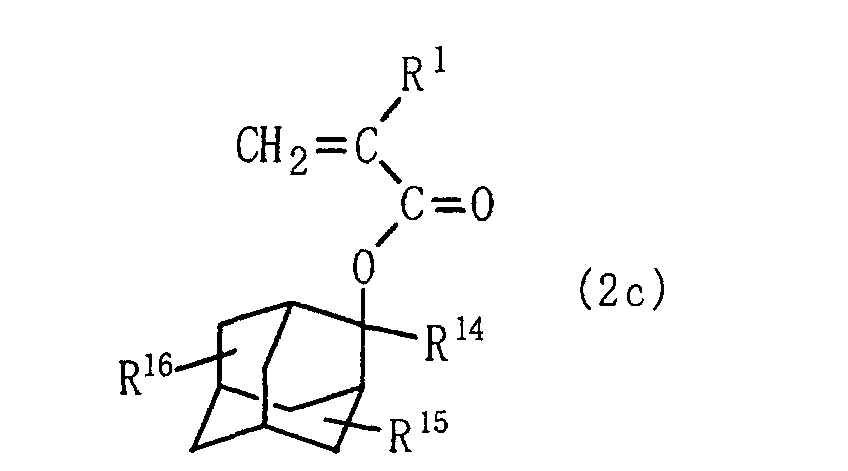
- Monomers corresponding to the monomer units of Formula (IIc) are represented by following Formula (2c).
- Formula (2c) Monomers corresponding to the monomer units of Formula (IIc) are represented by following Formula (2c).
- R 1 is a hydrogen atom or a methyl group
- R 14 is a methyl group or an ethyl group
- R 15 and R 16 are the same or different and are each a hydrogen atom, a hydroxyl group or an oxo group.
- Typical examples are the following compounds:
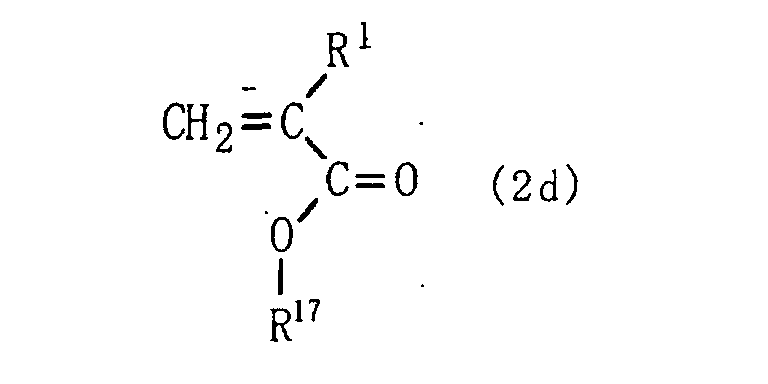
- Monomers corresponding to the monomer units of Formula (IId) are represented by following Formula (2d).
- Formula (2d) When these monomers include stereoisomers, each of the stereoisomers can be used alone or in combination as a mixture.
- R 1 is a hydrogen atom or a methyl group
- R 17 is a hydrocarbon group having a tertiary carbon atom at the bonding site with the oxygen atom indicated in the formula.
- a typical example is the following compound:
- Monomers corresponding to the monomer units of Formula (IIe) are represented by following Formula (2e) .
- each of the stereoisomers can be used alone or in combination as a mixture.
- R 1 is a hydrogen atom or a methyl group; and t denotes an integer of from 1 to 3.
- Typical examples are the following compounds:
- Monomers corresponding to the monomer units of Formula (IIf) are represented by following Formula (2f).
- each of the stereoisomers can be used alone or in combination as a mixture.
- R 1 is a hydrogen atom or a methyl group
- R 18 through R 22 are the same or different and are each a hydrogen atom or a methyl group.
- Typical examples are the following compounds:
- Monomers corresponding to the monomer units of Formula (IIg) are represented by following Formula (2g).
- R 23 is a t-butyl group, a 2-tetrahydrofuranyl group, a 2-tetrahydropyranyl group or an 2-oxepanyl group; and u denotes 0 or 1.
- Typical examples are the following compounds:
- Monomers corresponding to the monomer units of Formula (IIIa) are represented by following Formula (3a).
- each of the stereoisomers can be used alone or in combination as a mixture.
- R 1 is a hydrogen atom or a methyl group
- R 24 and R 25 are the same or different and are each a hydrogen atom, a hydroxyl group or a carboxyl group
- R 26 is a hydroxyl group, an oxo group or a carboxyl group.
- Typical examples are the following compounds:
- Monomers corresponding to the monomer units of Formula (IIIb) are represented by following Formula (3b).
- each of the stereoisomers can be used alone or in combination as a mixture.
- R 1 is a hydrogen atom or a methyl group
- X 1 , X 2 and X 3 are the same or different and are each -CH 2 - or -CO-O-
- R 27 , R 28 and R 29 are the same or different and are each a hydrogen atom or a methyl group.
- Typical examples of the compounds represented by Formula (3b) are the following compounds:
- Monomers to form the monomer units of Formula (IIIc) are represented by following Formula (3c).
- Formula (3c) When these monomers include stereoisomers, each of the stereoisomers can be used alone or in combination as a mixture.
- R 1 is a hydrogen atom or a methyl group; and R 30 and R 31 are the same or different and are each a hydrogen atom or a methyl group.
- Typical examples are the following compounds:
- Monomers to form the monomer units of Formula (IIId) are represented by following Formula (3d).
- Formula (3d) When these monomers include stereoisomers, each of the stereoisomers can be used alone or in combination as a mixture.
- R 1 is a hydrogen atom or a methyl group; and
- R 32 , R 33 , R 34 , R 35 and R 36 are the same or different and are each a hydrogen atom or a methyl group.
- Typical examples thereof include the following compounds:
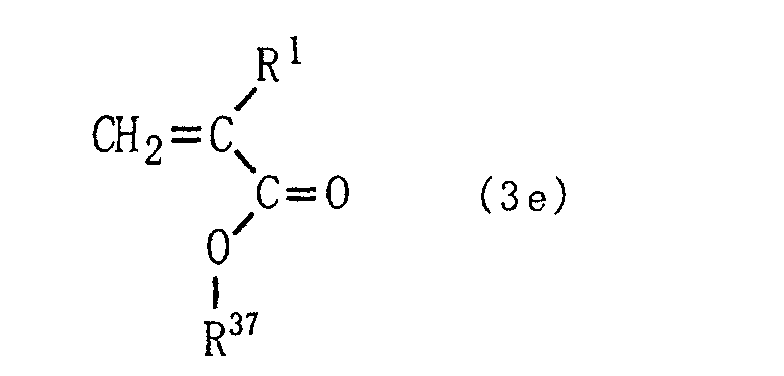
- Monomers to form the monomer units of Formula (IIIe) are represented by following Formula (3e).
- Formula (3e) When these monomers include stereoisomers, each of the stereoisomers can be used alone or in combination as a mixture.
- R 1 is a-hydrogen atom or a methyl group
- R 37 is a hydrogen atom or a straight-chain, branched-chain, cyclic or bridged cyclic hydrocarbon group containing 1 to 20 carbon atoms which may have a substituent.
- Typical examples thereof include the following compounds:
- a monomer to form the monomer unit of Formula (IIIf) is represented by following Formula (3f).
- Monomers to form the monomer units of Formula (IIIg) are represented by following Formula (3g).
- these monomers include stereoisomers, each of the stereoisomers can be used alone or in combination as a mixture.
- R 38 , R 39 , R 40 and R 41 are the same or different and are each a hydrogen atom or a methyl group; and v, w and x each denote 0 or 1.
- Typical examples of the compounds represented by Formula (3g) are the following compounds:
- the compound [3-37] can be obtained, for example, by Diels-Alder reaction between cyclopentadiene and 2,5-dihydrofuran-2-one.
- the compounds [3-38], [3-39] and [3-40] can be obtained according to the procedures described in J. Org. Chem. 41, 7, pp. 1221 (1976), J. Org. Chem., 50, 25, pp. 5193 (1985), and Tetrahedron Lett. pp. 4099 (1976), respectively.
- the compounds [3-41], [3-42], [3-43] and [3-44] can be obtained, for example, by Diels-Alder reaction between the compounds [3-37], [3-38], [3-39] and [3-40] or derivatives thereof and cyclopentadiene, respectively.
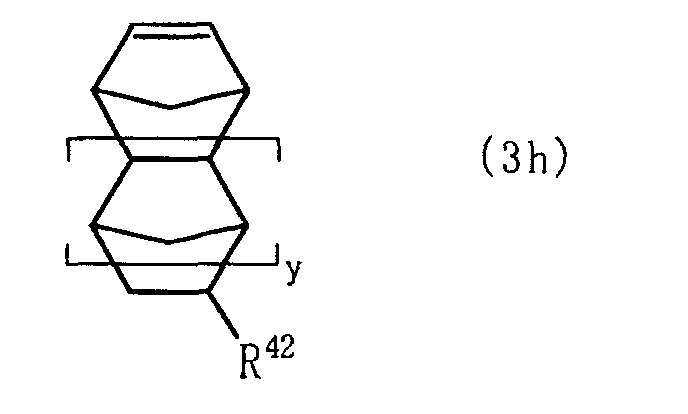
- Monomers to form the monomer units of Formula (IIIh) are represented by following Formula (3h).
- Formula (3h) When these monomers include stereoisomers, each of the stereoisomers can be used alone or in combination as a mixture.
- R 42 is a hydrogen atom, a hydroxyl group, a hydroxymethyl group or a carboxyl group; and y denotes 0 or 1.
- the resin composition for photoresist of the present invention comprises the polymeric compound for photoresist of the present invention and a photosensitive acid generator.
- Such photosensitive acid generators include conventional or known compounds that efficiently generate an acid upon irradiation with light.
- Such compounds include, but are not limited to, diazonium salts, iodonium salts (e.g., diphenyliodonium hexafluorophosphate), sulfonium salts (e.g., triphenylsulfonium hexafluoroantimonate, triphenylsulfonium hexafluorophosphate, and triphenylsulfonium methanesulfonate), sulfonic acid esters [e.g., 1-phenyl-1-(4-methylphenyl)sulfonyloxy-1-benzoylmethane, 1,2,3-trisulfonyloxymethylbenzene, 1,3-dinitro-2-(4-phenylsulfonyloxymethyl)benzene, and 1-phenyl-1-(4-methylphenylsulfon
- the amount of the photosensitive acid generator can appropriately be selected depending on the strength of the acid generated by light irradiation, the proportions of the individual constitutional repeating units in the polymeric compound and other factors and is, for example, from about 0.1 to about 30 parts by weight, preferably from about 1 to about 25 parts by weight, and more preferably from about 2 to 20 parts by weight, relative to 100 parts by weight of the polymeric compound.
- the photoresist resin composition may further comprise additional components.
- additional components include, but are not limited to, alkali-soluble resins (e.g., novolak resins, phenol resins, imide resins, and carboxyl-group-containing resins), and other alkali-soluble components, coloring agents (e.g., dyestuffs), and organic solvents (e.g., hydrocarbons, halogenated hydrocarbons, alcohols, esters, amides, ketones, ethers, Cellosolves, Carbitols, glycol ether esters, and mixtures of these solvents).
- alkali-soluble resins e.g., novolak resins, phenol resins, imide resins, and carboxyl-group-containing resins
- coloring agents e.g., dyestuffs
- organic solvents e.g., hydrocarbons, halogenated hydrocarbons, alcohols, esters, amides, ketones, ethers, Cellosolve
- the photoresist resin composition is applied to a base or a substrate, is dried, and the resulting film (resist film) is exposed to light through a predetermined mask (or is further subjected to post-exposure baking) to form a latent image pattern, and the film is then developed to yield a fine pattern with a high degree of precision.
- Such bases or substrates include, for example, silicon wafers, metals, plastics, glass, and ceramics.
- the photoresist resin composition can be applied using a conventional application means such as a spin coater, a dip coater, and a roller coater.
- the applied film has a thickness of, for example, from about 0.1 to about 20 ⁇ m, and preferably from about 0.3 to about 2 ⁇ m.
- Light rays with different wavelengths such as ultraviolet rays and X-rays can be used in exposure.
- g-line, i-line, and excimer laser e.g., XeCl, KrF, KrCl, ArF, or ArCl excimer laser
- An exposure energy is, for example, from about 1 to about 1000 mJ/cm 2 , and preferably from about 10 to about 500 mJ/cm 2 .
- Light irradiation allows the photosensitive acid generator to generate an acid, and the acid allows, for example, the protecting group (leaving group) of a carboxyl group of an alkali-soluble unit of the polymeric compound to leave promptly and thereby yields a carboxyl group that contributes to solubilization.
- Subsequent development with water or an alkaline developing solution can yield a predetermined pattern with a high degree of precision.
- Each of the (meth)acrylic ester derivatives represented by Formula (1) can be obtained by allowing a corresponding cyclic alcohol represented by Formula (4) to react with (meth)acrylic acid or its reactive derivative.
- Such reactive derivatives of (meth)acrylic acid include, but are not limited to, methyl (meth)acrylate, ethyl (meth)acrylate, t-butyl (meth)acrylate, vinyl (meth)acrylate, allyl (meth)acrylate, and other (meth)acrylic esters; (meth)acryloyl chloride, (meth)acryloyl bromide, and other (meth)acryloyl halides; (meth)acrylic anhydrides; and active esters of (meth)acrylic acid.
- the reaction between the cyclic alcohol represented by Formula (4) and (meth) acrylic acid or its reactive derivative can be performed according to a conventional esterification reaction. More specifically, for example, a reaction between the cyclic alcohol represented by Formula (4) and a (meth) acryloyl halide is performed in the presence of, or in the absence of, a solvent in the presence of a base.
- solvents include, but are not limited to, methylene chloride, dichloroethane, and other halogenated hydrocarbons; toluene and other aromatic hydrocarbons; hexane and other aliphatic hydrocarbons; cyclohexane and other alicyclic hydrocarbons; and mixtures of these solvents.
- the base includes, but is not limited to, triethylamine and other tertiary amines, pyridine and other basic nitrogen-containing heterocyclic compounds, and other organic bases; sodium carbonate, sodium hydrogencarbonate, and other inorganic bases.
- the amount of the (meth)acryloyl halide is, for example, from about 0.9 to about 1.8 moles, and preferably from about 0.95 to about 1.4 moles per mole of the cyclic alcohol represented by Formula (4).
- a reaction temperature is, for example, from about -10°C to about 80°C.
- the resulting (meth)acrylic ester derivative can be separated and purified by separation means such as filtration, concentration, distillation, extraction, crystallization, recrystallization and column chromatography, or any combination thereof.
- R 2 , R 3 , R 4 and R 5 are the same or different and are each a hydrogen atom or a methyl group; and the repetition numbers m, p and q are each an integer of from 0 to 2. Hydroxyl groups in the formula are independently combined with either of two carbon atoms on the far-left side of the rings. When there are plural hydroxyl groups, they are combined with different carbon atoms, respectively.
- the repetition number m is preferably 0 or 1, and p plus q preferably equals 1 or 2.
- Particularly preferred compounds are (i) compounds where p is 1 and q is 0, (ii) compounds where p is 0 and q is 1, (iii) compounds where p is 2 and q is 0, and (iv) compounds where p is 1 and q is 1.
- the cyclic alcohols represented by Formula (4a) correspond to cyclic alcohols represented by Formula (4) where n is 0.
- the compounds represented by Formula (4b) correspond to compounds represented by Formula (4a) where p and q are specific numerical values.
- Typical examples of the cyclic alcohols represented by Formula (4) include the following compounds:
- Each of the cyclic alcohols represented by Formula (4a) can be obtained by reducing a corresponding epoxy compound represented by Formula (5).
- Reducing agents for use in reduction include, for example, hydrogen, alkali (or alkaline earth) metals/ammonia, lithium aluminium hydride, and boranes.
- the reduction reaction can be preformed according to a conventional procedure depending on the type of the reducing agent. More specifically, when hydrogen is used as the reducing agent, the cyclic alcohol represented by Formula (4a) is dissolved in an appropriate solvent such as methanol and is allowed to react with hydrogen in the presence of a platinum group metal catalyst (hydrogenation catalyst) such as Pd/C.
- a reaction temperature is, for example, from about 0°C to about 100°C.
- the reaction is generally performed at atmospheric pressure or under a pressure (under a load) .
- a reaction system can be whichever of batch system, semi-batch system and continuous system.
- the resulting cyclic alcohol represented by Formula (4a) can be separated and purified, for example, by separation means such as filtration, concentration, distillation, extraction, crystallization, recrystallization and column chromatography, or any combination thereof.
- cyclic alcohols represented by Formula (4) compounds in which n is 1 can be obtained by allowing a cyclic compound represented by Formula (6) having an unsaturated bond mentioned later to react with an oxidizing agent such as potassium permanganate.
- the reaction can be performed under conditions usually employed in oxidation with potassium permanganate.
- R 2 , R 3 , R 4 and R 5 are the same or different and are each a hydrogen atom or a methyl group; and the repetition numbers m, p and q are each an integer of from 0 to 2.
- the repetition number m is preferably 0 or 1, and p plus q preferably equals 1 or 2.
- Particularly preferred compounds are (i) compounds where p is 1 and q is 0, (ii) compounds where p is 0 and q is 1, (iii) compounds where p is 2 and q is 0, and (iv) compounds where p is 1 and q is 1.
- Typical examples of the epoxy compounds represented by Formula (5) are the following compounds:
- Each of the epoxy compounds represented by Formula (5) can be obtained by allowing a corresponding cyclic compound having an unsaturated bond represented by following Formula (6) : wherein R 2 , R 3 , R 4 and R 5 are the same or different and are each a hydrogen atom or a methyl group; and m, p and q are each an integer of from 0 to 2, to react with an epoxidizing agent.
- Such epoxidizing agents include known epoxidizing agents such as peroxybenzoic acid, m-chloroperoxybenzoic acid, monoperoxyphthalic acid, trifluoroperoxyacetic acid, peroxyacetic acid, and other peroxoacids; dioxysilane and other peroxides; hydroperoxides (e.g., t-butyl hydroperoxide, cumene hydroperoxide, and hydrogen peroxide) in the presence of metal catalysts (e.g., vanadium compounds, molybdenum compounds, tungsten compounds, and titanium compounds); oxygen in the presence of metal catalysts (e.g., iron compounds) or imide compound catalysts (e.g., N-hydroxyphthalimide); enzymes or microorganisms.
- metal catalysts e.g., vanadium compounds, molybdenum compounds, tungsten compounds, and titanium compounds
- metal catalysts e.g., vanadium compounds, molybdenum compounds, tungsten compounds
- the epoxidation reaction can be performed according to a conventional -procedure depending on the type of the epoxidizing agent. More specifically, when a peroxoacid such as peroxyacetic acid is used as the epoxidizing agent, the cyclic compound having an unsaturated bond represented by Formula (6) is dissolved in an appropriate solvent such as ethyl acetate or methylene chloride and is treated with the peroxoacid.
- a reaction temperature is, for example, from about -20°C to about 100°C. The reaction can be performed in whichever of batch system, semi-batch system and continuous system.
- the resulting epoxy compound represented by Formula (5) can be separated and purified, for example, by separation means such as filtration, concentration, distillation, extraction, crystallization, recrystallization and column chromatography, or any combination thereof.
- the cyclic compounds represented by Formula (6) each having an unsaturated bond can be obtained according to a known procedure utilizing Diels-Alder reaction or a procedure analogous thereto.
- a compound of Formula (6) in which R 2 and R 3 are hydrogen atoms, m is 0, p is 1, and q is 0 can be obtained by reducing a product of Diels-Alder reaction between cyclopentadiene and maleic anhydride with a reducing agent such as sodium-borohydride.
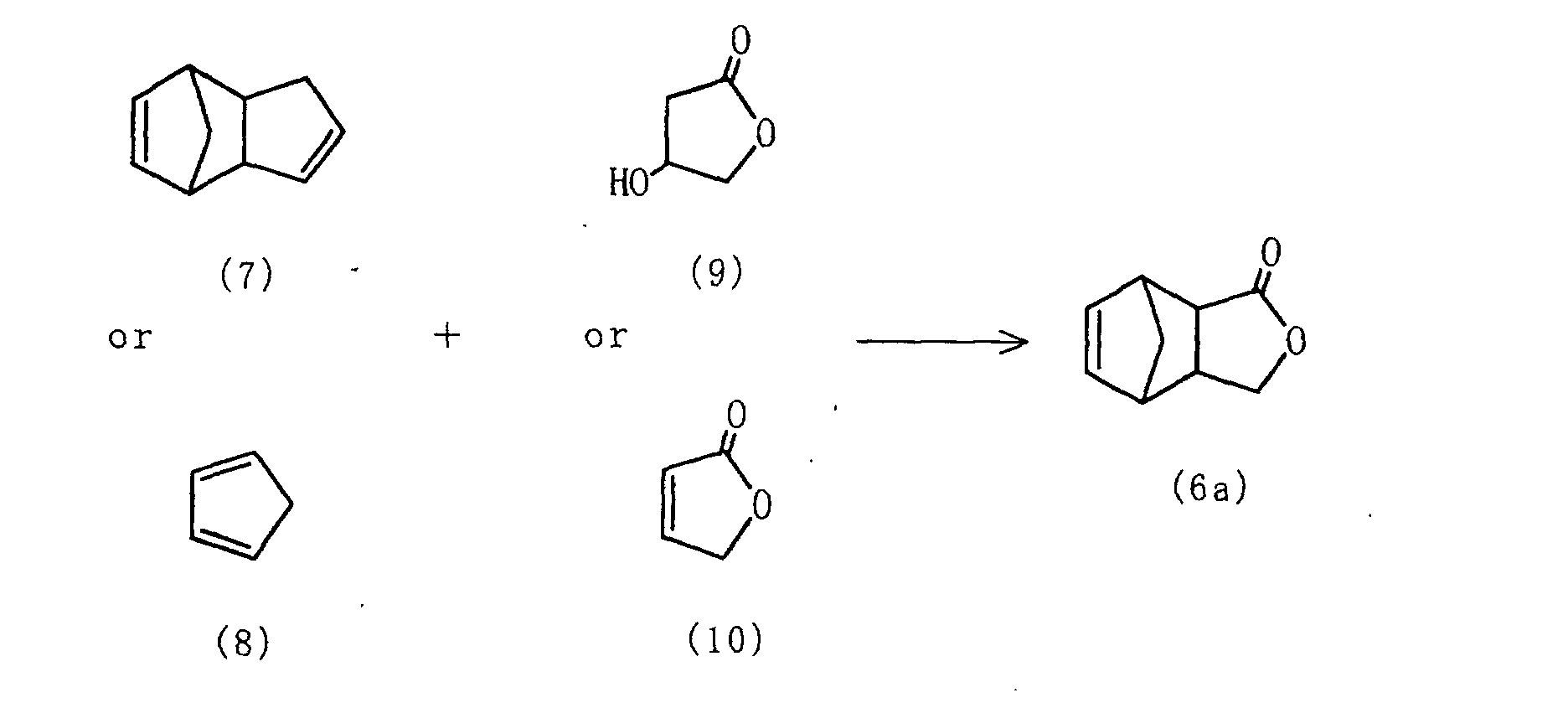
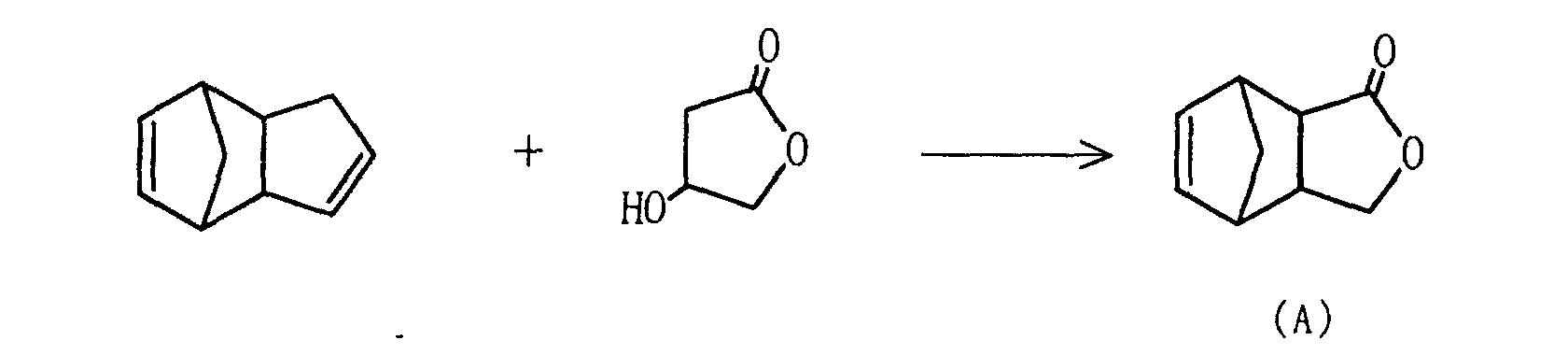
- 4-oxatricyclo[5.2.1.0 2,6 ]dec-8-en-3-one (6a) can be obtained by allowing dicyclopentadiene represented by Formula (7) or cyclopentadiene represented by Formula (8) to react with ⁇ -hydroxy- ⁇ -butyrolactone represented by Formula (9) or 2(5H)-furanone represented by Formula (10), as shown in the following reaction process chart.
- dicyclopentadiene represented by Formula (7) and cyclopentadiene represented by Formula (8) can be used in combination.
- ⁇ -hydroxy- ⁇ -butyrolactone represented by Formula (9) and 2 (5H)-furanone represented by Formula (10) can be used in combination.
- dicyclopentadiene represented by Formula (7) is heated and decomposed and thereby yields cyclopentadiene, and cyclopentadiene formed is allowed to react with ⁇ -hydroxy- ⁇ -butyrolactone represented by Formula (9) or 2(5H)-furanone represented by Formula (10), and that ⁇ -hydroxy- ⁇ -butyrolactone represented by Formula (9) is heated and dehydrated to yield 2(5)-furanone, and 2(5)-furanone formed is allowed to react with dicyclopentadiene represented by Formula (7) or cyclopentadiene represented by Formula (8).
- the aforementioned reaction is performed in the presence of, or in the absence of, a solvent.
- solvent include, but are not limited to, ethyl acetate and other esters; acetic acid and other organic acids; t-butyl alcohol and other alcohols; chloroform, dichloromethane, 1,2-dichloroethane, and other halogenated hydrocarbons; benzene and other aromatic hydrocarbons; hexane, heptane, octane, and other aliphatic hydrocarbons; cyclohexane and other alicyclic hydrocarbons; N,N-dimethylformamide, N,N-dimethylacetamide, and other amides; acetonitrile, propionitrile, benzonitrile, and other nitriles; ethyl ether, tetrahydrofuran, and other chain or cyclic ethers.
- a reaction temperature can appropriately be selected depending on the type of reaction raw materials and other factors and is generally from about 50°C to about 300°C, and preferably from about 100°C to about 250°C.
- the reaction is performed at atmospheric pressure or under a pressure (under a load) in any system such as batch system, semi-batch system, or continuous system.
- Formed 4-oxatricyclo[5.2.1,0 2,6 ]dec-8-en-3-one (6a) can be separated and purified, for example, by separation means such as filtration, concentration, distillation, extraction, crystallization, recrystallization and column chromatography, or any combination thereof.
- the polymeric compounds for photoresist of the present invention each contain a monomer unit having a specific structure comprising an alicyclic skeleton and a lactone ring condensed thereto.
- the resulting photoresists exhibit high resistance to etching and have well-rounded functions required as photoresists, such as adhesion to substrates, solubility in solvents and affinity for alkaline developing solutions.
- affinity for developing solutions and rinsing solutions after exposure can markedly be improved.
- the resin composition for photoresist and method for fabricating a semiconductor of the present invention use the polymeric compound having such excellent characteristics as a base of photoresist and can thereby form fine patterns with a high degree of precision.
- the present invention also provides novel (meth)acrylic ester derivatives having a lactone skeleton which are useful as, for example, raw materials for the polymeric compounds for photoresist; cyclic alcohols having a lactone skeleton which are useful in production of the (meth)acrylic ester derivatives; and methods for efficiently producing these compounds.
- a compound indicated by "methacrylate" subsequent to a compound number means a compound having a methacryloyloxy group, of two compounds corresponding to the compound number described in the description.
- the reaction mixture was concentrated, the concentrate was subjected to silica gel column chromatography and thereby yielded the title mixture [Mixture (F)] in a yield of 39%.
- the ratio of Compound [1-3] (methacrylate) to Compound [1-4] (methacrylate) was about 1:5 as determined by gas chromatography.
- the reaction mixture was purified by putting into 500 ml of a mixture of hexane and ethyl acetate (9:1) and filtrating the resulting precipitate.
- the recovered precipitate was dried under a reduced pressure, was again dissolved in 40 g of tetrahydrofuran, the precipitation and purification procedure was repeated and thereby yielded 6. 95 g of the target resin.
- the recovered polymer was analyzed by gel permeation chromatography (GPC) and was found to have a weight average molecular weight of 6200 and a molecular weight distribution of 2.11.
- the reaction mixture was purified by putting into 500 ml of a mixture of hexane and ethyl acetate (9:1) and filtrating the resulting precipitate.
- the recovered precipitate was dried under a reduced pressure, was again dissolved in 40 g of tetrahydrofuran, the precipitation and purification procedure was repeated and thereby yielded 6.75 g of the target resin.
- the recovered polymer was analyzed by GPC and was found to have a weight average molecular weight of 5500 and a molecular weight distribution of 1.98.
- the reaction mixture was purified by putting into 500 ml of a mixture of hexane and ethyl acetate (9:1) and filtrating the resulting precipitate.
- the recovered precipitate was dried under a reduced pressure, was again dissolved in 40 g of tetrahydrofuran, the precipitation and purification procedure was repeated and thereby yielded 6.82 g of the target resin.
- the recovered polymer was analyzed by GPC and was found to have a weight average molecular weight of 6500 and a molecular weight distribution of 2.11.
- the reaction mixture was purified by putting into 500 ml of a mixture of hexane and ethyl acetate (9:1) and filtrating the resulting precipitate.
- the recovered precipitate was dried under a reduced pressure, was again dissolved in 40 g of tetrahydrofuran, the precipitation and purification procedure was repeated and thereby yielded 7.01 g of the target resin.
- the recovered polymer was analyzed by GPC and was found to have a weight average molecular weight of 5200 and a molecular weight distribution of 1.88.
- the reaction mixture was purified by putting into 500 ml of a mixture of hexane and ethyl acetate (9:1) and filtrating the resulting precipitate.
- the recovered precipitate was dried under a reduced pressure, was again dissolved in 40 g of tetrahydrofuran, the precipitation and purification procedure was repeated and thereby yielded 7.35 g of the target resin.
- the recovered polymer was analyzed by GPC and was found to have a weight average molecular weight of 6800 and a molecular weight distribution of 2.11.
- the reaction mixture was purified by putting into 500 ml of a mixture of hexane and ethyl acetate (9:1) and filtrating the resulting precipitate.
- the recovered precipitate was dried under a reduced pressure, was again dissolved in 40 g of tetrahydrofuran, the precipitation and purification procedure was repeated and thereby yielded 7.13 g of the target resin.
- the recovered polymer was analyzed by GPC and was found to have a weight average molecular weight of 6700 and a molecular weight distribution of 2.11.
Landscapes
- Physics & Mathematics (AREA)
- Spectroscopy & Molecular Physics (AREA)
- General Physics & Mathematics (AREA)
- Addition Polymer Or Copolymer, Post-Treatments, Or Chemical Modifications (AREA)
- Materials For Photolithography (AREA)
- Furan Compounds (AREA)
- Low-Molecular Organic Synthesis Reactions Using Catalysts (AREA)
Abstract
By using the polymeric compound for photoresist as a base of a photoresist, the resulting photoresist exhibits well-rounded adhesion to substrates and resistance to etching.
Description


The polymeric compound for photoresist may further include at least one selected from monomer units represented by following Formulae (IIIa) through (IIIh):


to thereby yield a cyclic alcohol represented by following Formula (4a) :

8-(meth)acryloyloxy-4-oxatricyclo[5.2.1.02,6]decan-5-one [i.e.,
9-(meth)acryloyloxy-4-oxatricyclo[5.2.1.02,6] decan-3-one] (R1 is H or CH3; m and n are 0; p is 1; q is 0; and R2 and R3 are H) ;
9-(meth)acryloyloxy-4-oxatricyclo[5.2.1.02,6]decan-5-one [i.e.,
8-(meth)acryloyloxy-4-oxatricyclo[5.2.1.02,6]decan-3-one] (R1 is H or CH3; m and n are 0; p is 1; q is 0; and R2 and R3 are H) ;
8-(meth)acryloyloxy-9-hydroxy-4-oxatricyclo[5.2.1.02,6]deca n-5-one [i.e.,
9-(meth)acryloyloxy-8-hydroxy-4-oxatricyclo[5.2.1.02,6]deca n-3-one] (R1 is H or CH3; m is 0; n is 1; p is 1; q is 0; and R2 and R3 are H) ;
9-(meth)acryloyloxy-8-hydroxy-4-oxatricyclo[5.2.1.02,6]deca n-5-one [i.e.,
8-(meth)acryloyloxy-9-hydroxy-4-oxatricyclo[5.2.1.02,6]deca n-3-one] (R1 is H or CH3; m is 0; n is 1; p is 1; q is 0; and R2 and R3 are H) ;
8-(meth)acryloyloxy-3-oxatricyclo[5.2.1.02,6]decan-4-one (R1 is H or CH3; m and n are 0; p is 0; q is 1; and R4 and R5 are H) ;
9-(meth)acryloyloxy-3-oxatricyclo[5.2.1.02,6]decan-4-one (R1 is H or CH3; m and n are 0; p is 0; q is 1; and R4 and R5 are H);
9-(meth)acryloyloxy-4-oxatricyclo[6.2.1.02,7]undecan-3-one (R1 is H or CH3; m and n are 0; p is 2; q is 0; and R2 and R3 are H);
10-(meth) acryloyloxy-4-oxatricyclo[6.2.1.02,7] undecan-3-one (R1 is H or CH3; m and n are 0; p is 2; q is 0; and R2 and R3 are H);
9-(meth)acryloyloxy-4-oxatricyclo[6.2.1.02,7]undecan-5-one (R1 is H or CH3; m and n are 0; p is 1; q is 1; and R2, R3, R4 and R5 are H); and
10-(meth)acryloyloxy-4-oxatricyclo[6.2.1.02,7]undecan-5-one (R1 is H or CH3; m and n are 0; p is 1; q is 1; and R2, R3, R4 and R5 are H) .

1-hydroxy-3-(1-(meth) acryloyloxy-1-methylethyl)adamantane (R1 is H or CH3; R6 and R7 are CH3; R8 is OH; R9 and R10 are H) ;
1-hydroxy-3-(1-ethyl-1-(meth)acryloyloxypropyl) adamantane (R1 is H or CH3; R6 and R7 are CH2CH3; R8 is OH; R9 and R10 are H) ;
1-hydroxy-3-(1-(meth)acryloyloxy-1-methylpropyl)adamantane (R1 is H or CH3; R6 is CH3; R7 is CH2CH3; R8 is OH; R9 and R10 are H);
1-hydroxy-3-(1-(meth)acryloyloxy-1,2-dimethylpropyl)adaman tape (R1 is H or CH3; R6 is CH3; R7 is CH(CH3)2; R8 is OH; R9 and R10 are H) ;
1,3-dihydroxy-5-(1-(meth)acryloyloxy-1-methylethyl)adamant ane (R1 is H or CH3; R6 and R7 are CH3; R8 and R9 are OH; R10 is H) ;
1,3-dihydroxy-5-(1-(meth)acryloyloxy-1-methylpropyl)adaman tane (R1 is H or CH3; R6 is CH3; R7 is CH2CH3; R8 and R9 are OH; R10 is H); and
1,3-dihydroxy-5-(1-(meth)acryloyloxy-1,2-dimethylpropyl)ad amantane (R1 is H Or CH3; R6 is CH3; R7 is CH(CH3)2; R8 and R9 are OH; R10 is H) .

1,3-bis(t-butoxycarbonyl)-5-(meth)acryloyloxyadamantane [R1 is H or CH3; R11 is t-butoxycarbonyl group; R12 is H; and R13 is t-butyl group];
1-t-butoxycarbonyl-3-hydroxy-5-(meth)acryloyloxyadamantane (R1 is H or CH3; R11 is OH; R12 is H; and R13 is t-butyl group);
1-(2-tetrahydropyranyloxycarbonyl)-3-(meth)acryloyloxyadam antane (R1 is H or CH3; R11 and R12 are H; and R13 is 2-tetrahydropyranyl group);
1,3-bis(2-tetrahydropyranyloxycarbonyl)-5-(meth)acryloylox yadamantane (R1 is H or CH3; R11 is 2-tetrahydropyranyloxycarbonyl group; R12 is H; and R13 is 2-tetrahydropyranyl group); and
1-hydroxy-3-(2-tetrahydropyranyloxycarbonyl)-5-(meth)acryl oyloxyadamantane (R1 is H or CH3; R11 is OH; R12 is H; and R13 is 2-tetrahydropyranyl group).
1,3-dihydroxy-2-(meth)acryloyloxy-2-methyladamantane (R1 is H or CH3; R14 is CH3; R15 is 1-OH; and R16 is 3-OH) ;
1,5-dihydroxy-2-(meth)acryloyloxy-2-methyladamantane (R1 is H or CH3; R14 is CH3; R15 is 1-OH; and R16 is 5-OH) ;
1,3-dihydroxy-6-(meth)acryloyloxy-6-methyladamantane (R1 is H or CH3; R14 is CH3; R15 is 1-OH; and R16 is 3-OH) ;


β-(meth)acryloyloxy-α,α,β,γ,γ-pentamethyl-γ-butyrolactone (R1 is H or CH3; and R18, R19, R20, R21 and R22 are CH3).
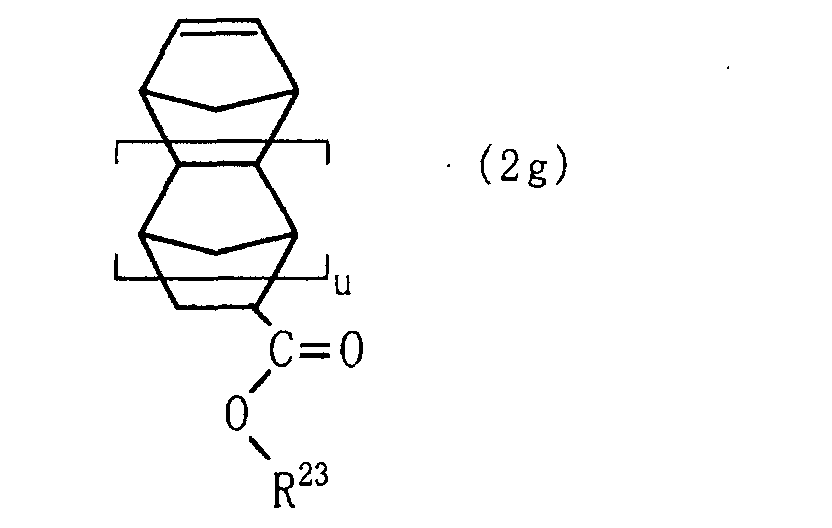
9-t-butoxycarbonyltetracyclo[6.2.1.13,6.02,7]dodec-4-ene (R23 is a t-butyl group; and u is 1);
9-(2-tetrahydropyranyloxycarbonyl)tetracyclo[6.2.1.13,6.02,7 ]dodec-4-ene (R23 is 2-tetrahydropyranyl group; and u is 1).
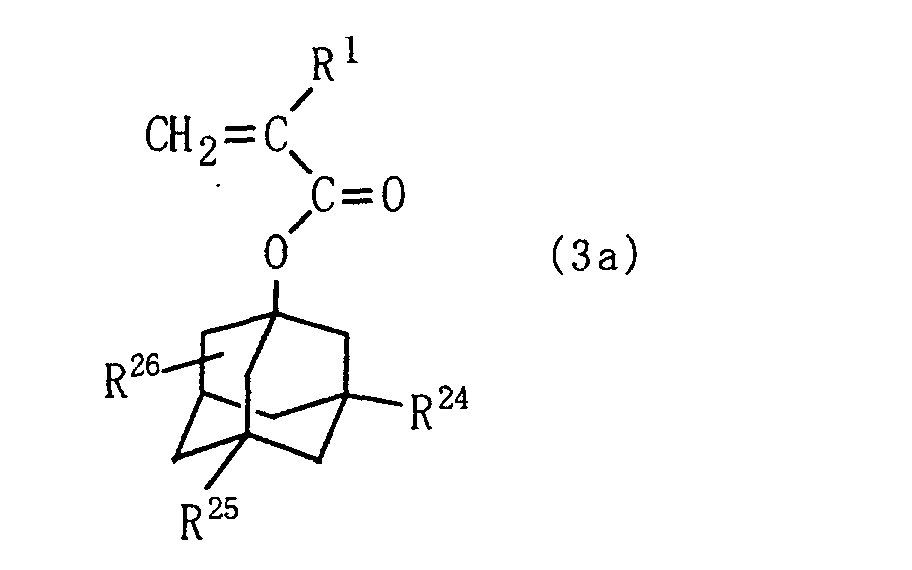

1-(meth)acryloyloxy-4-oxatricyclo[4.3.1.13,8]undecan-5-one (R1 is H or CH3; R27, R28 and R29 are H; X2 is -CO-O- where the left side of the group faces a carbon atom with which R28 is combined; and X1 and X3 are -CH2-) ;
1-(meth)acryloyloxy-4,7-dioxatricyclo[4.4.1.13,9]dodecane-5 ,8-dione- (R1 is H or CH3; R27, R28 and R29 are H; X1 is -CO-O-where the left side of the group faces a carbon atom with which R27 is combined; X2 is -CO-O- where the left side of the group faces a carbon atom with which R28 is combined; and X3 is -CH2-);
1-(meth)acryloyloxy-4,8-dioxatricyclo[4.4.1.13,9]dodecane-5 ,7-dione (R1 is H or CH3; R27, R28 and R29 are H; X1 is -O-CO-where the left side of the group faces a carbon atom with which R27 is combined; X2 is -CO-O- where the left side of the group faces a carbon atom with which R28 is combined; and X3 is -CH2-); and
1-(meth)acryloyloxy-5,7-dioxatricyclo[4.4.1.13,9]dodecane-4 ,8-dione (R1 is H or CH3; R27, R28 and R29 are H; X1 is -CO-O-where the left side of the group faces a carbon atom with which R27 is combined; X2 is -O-CO- where the left side of the group faces a carbon atom with which R28 is combined; and X3 is -CH2-).
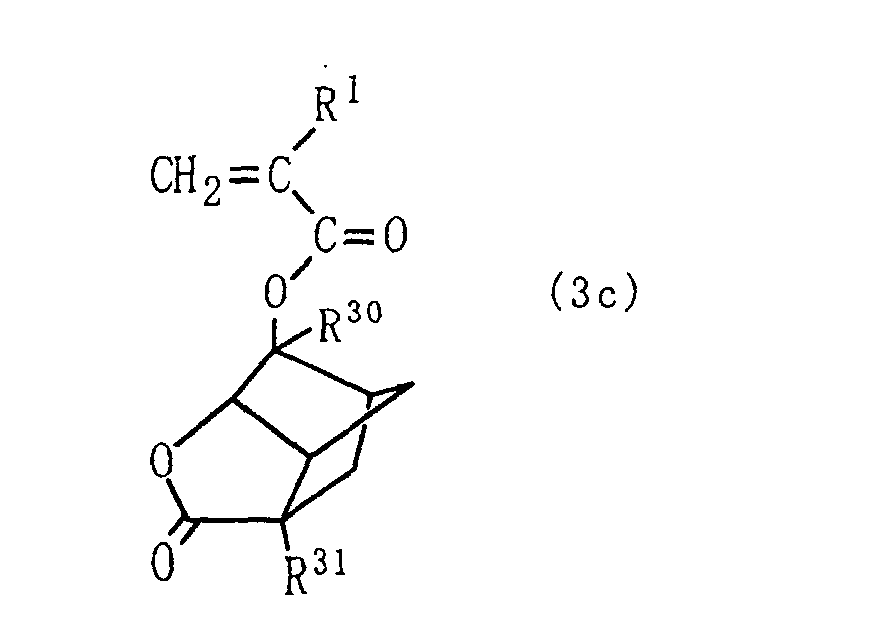
2-(meth)acryloyloxy-4-oxatricyclo[4.2.1.03,7]nonan-5-one (R1 is H or CH3; R30 and R31 are H) ; and
2-(meth) acryloyloxy-2-methyl-4-oxatricyclo[4.2.1.03,7]nonan -5-one (R1 is H or CH3; R30 is CH3; and R31 is H) .
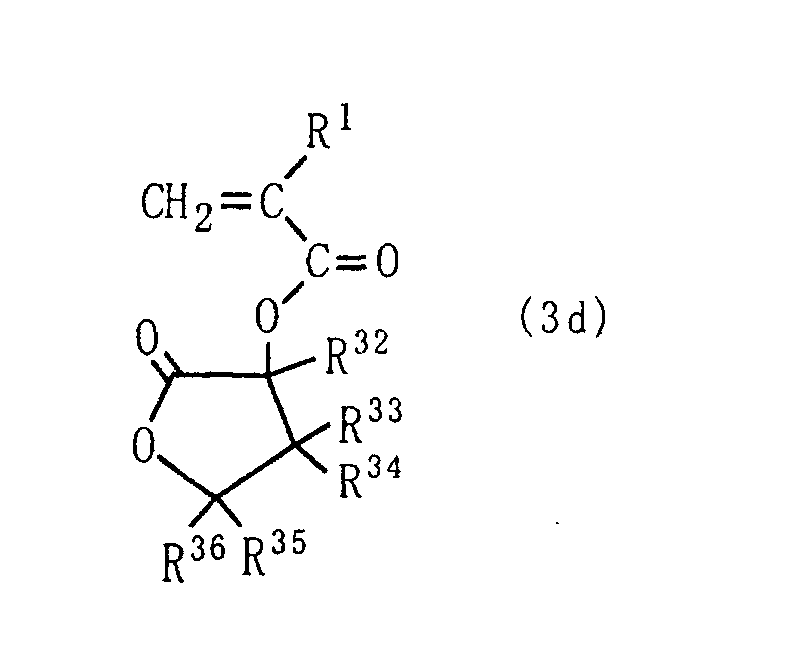
α-(meth)acryloyloxy-β, β,γ,γ-tetramethyl-γ-butyrolactone (R1 is H or CH3; R33, R34, R35 and R36 are CH3; and R32 is H) ; and
α-(meth)acryloyloxy-α,β,β,γ,γ-pentamethyl-γ-butyrolactone (R1 is H or CH3; and R32, R33, R34, R35 and R36 are CH3).


4-oxapentacyclo [6.5.1.19,12.02,6.08,13]pentadec-10-en-5-one (R40 and R41 are H; v is 1; w is 0; and x is 1) ;
3-oxapentacyclo[6.5.1.19,12.02,6.08,13]pentadec-10-en-4-one (R38 and R39 are H; v is 1; w is 1; and x is 0) ;
5-oxapentacyclo[6.6.1.110,13.02,7.09,14]hexadec-11-en-6-one (R40 and R41 are H; v is 1; w is 0; and x is 2); and
4-oxapentacyclo [6.6.1.110,13. 02,7. 09,14]hexadec-11-en-5-one (R38, R39, R40 and R41 are H; v is 1; w and x are 1) .

1H-NMR (CDCl3, TMS) 500 MHz δ: 6.3 (dd, 1H), 6.29 (dd, 1H), 4.35 (dd, 1H), 3.80 (dd, 1H) , 3.33 (m, 1H), 3.27 (dd, 1H), 3.10 (m, 2H), 1.62 (dd, 1H), 1.48 (d, 1H)
8,9-epoxy-4-oxatricyclo[5.2.1.02,6]decan-3-one [Compound (B)] was produced.

1H-NMR (CDCl3, TMS) 500 MHz δ: 4.36 (dd, 1H) , 4.31 (dd, 1H), 3.34 (m, 2H), 3.11 (dd, 1H), 3.05-2.93 (m, 2H), 2.72 (m, 1H), 1.57 (ddd, 1H), 0.96 (d, 1H)

8,9-epoxy-4-oxatricyclo[5.2.1.02,6]decan-3-one [Compound (B)] was placed in a flask equipped with a stirrer and a hydrogen gas supplier and was then dissolved in 60 ml of methanol. The resulting solution was treated with 0.6 g of 10% by weight Pd-C (a catalyst comprising metal palladium carried on active carbon), a hydrogenation catalyst, at room temperature in an atmosphere of hydrogen gas with stirring until the time came when hydrogen absorption stopped. The reaction time was about 3 hours. The reaction mixture was filtrated, was concentrated, the concentrate was subjected to silica gel column chromatography and thereby yielded 5.4 g (32 mmol) of the title mixture [Mixture (C)] in a yield of 80%.
8-methacryloyloxy-4-oxatricyclo[5.2.1.02,6]decan-5-one [i.e.,
9-methacryloyloxy-4-oxatricyclo[5.2.1.02,6]decan-3-one] and 9-methacryloyloxy-4-oxatricyclo[5.2.1.02,6]decan-5-one [i.e.,
8-methacryloyloxy-4-oxatricyclo[5.2.1.02,6]decan-3-one] was produced.

1 H-NMR (DMSO-d6, TMS) δ: 6.1 (d, 1H), 5.6 (d, 1H), 4.4-4.2 (m, 2H), 4.0-3.7 (m, 1H), 3.2-3.1 (m, 1H) , 3.1-2.1 (m, 6H), 2.1 (m, 1H), 1.9 (s, 3H), 1.3 (m, 1H)
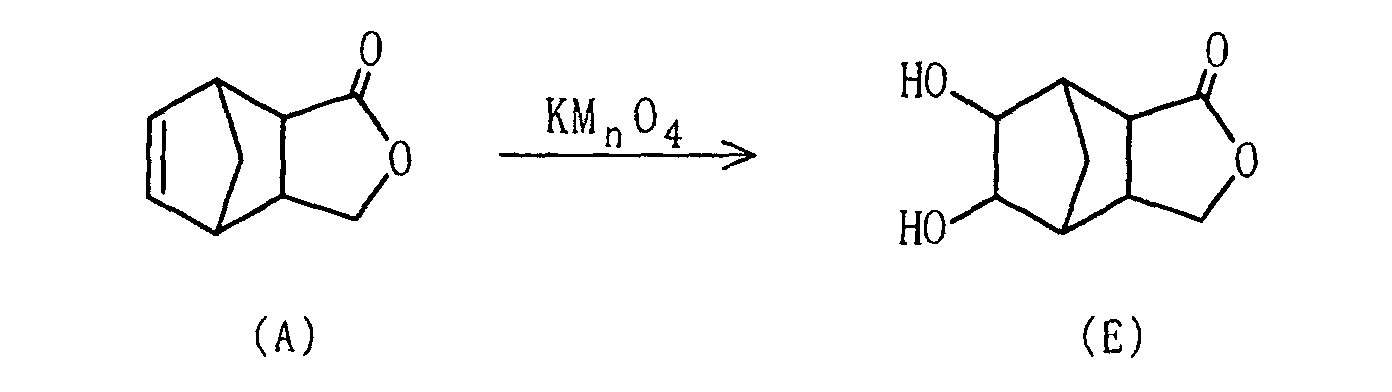
1H-NMR (DMSO-d6, TMS) 500 MHz δ: 4.85 (m, 1H), 4.56 (m, 1H), 4.21 (m, 2H), 3.72 (dd, 1H), 3.51 (dd, 1H), 2.99 (m, 1H), 2.78 (m, 1H), 2.28 (dd, 1H), 2.07 (dd, 1H), 1.89 (ddd, 1H), 1.25 (dd, 1H)
8-methacryloyloxy-9-hydroxy-4-oxatricyclo[5.2.1.02,6]decan-5-one [i.e.,
9-methacryloyloxy-8-hydroxy-4-oxatricyclo[5.2.1.02,6]decan-3-one] and
9-methacryloyloxy-8-hydroxy-4-oxatricyclo [5.2.1.02,6] decan-5-one [i.e.,
8-methacryloyloxy-9-hydroxy-4-oxatricyclo[5.2.1.02,6]decan-3-one] was produced.

Mixture (F) obtained was dissolved in tetrahydrofuran, followed by recrystallization from methanol, and thereby yielded a white crystal of
9-methacryloyloxy-8-hydroxy-4-oxatricyclo[5.2.1.02,6]decan-5-one [i.e.,
8-methacryloyloxy-9-hydroxy-4-oxatricyclo[5.2.1.02,6]decan-3-one] in a yield of 30%.

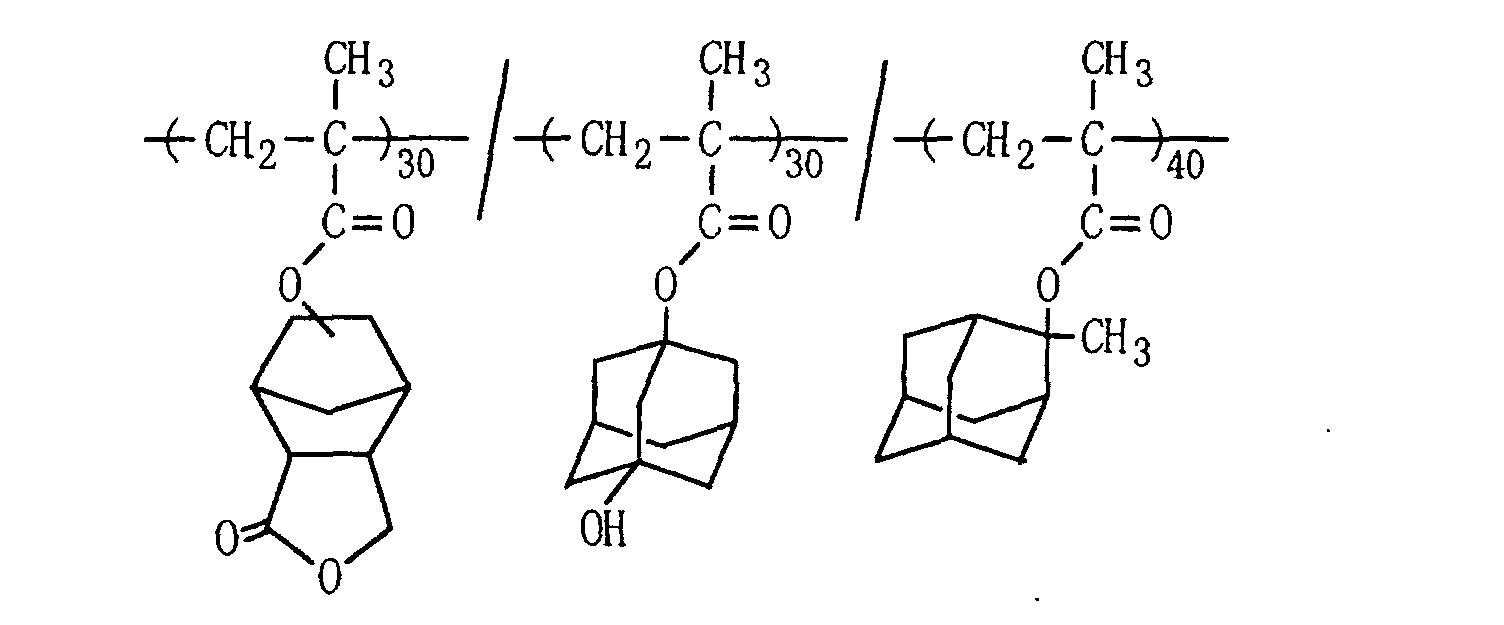


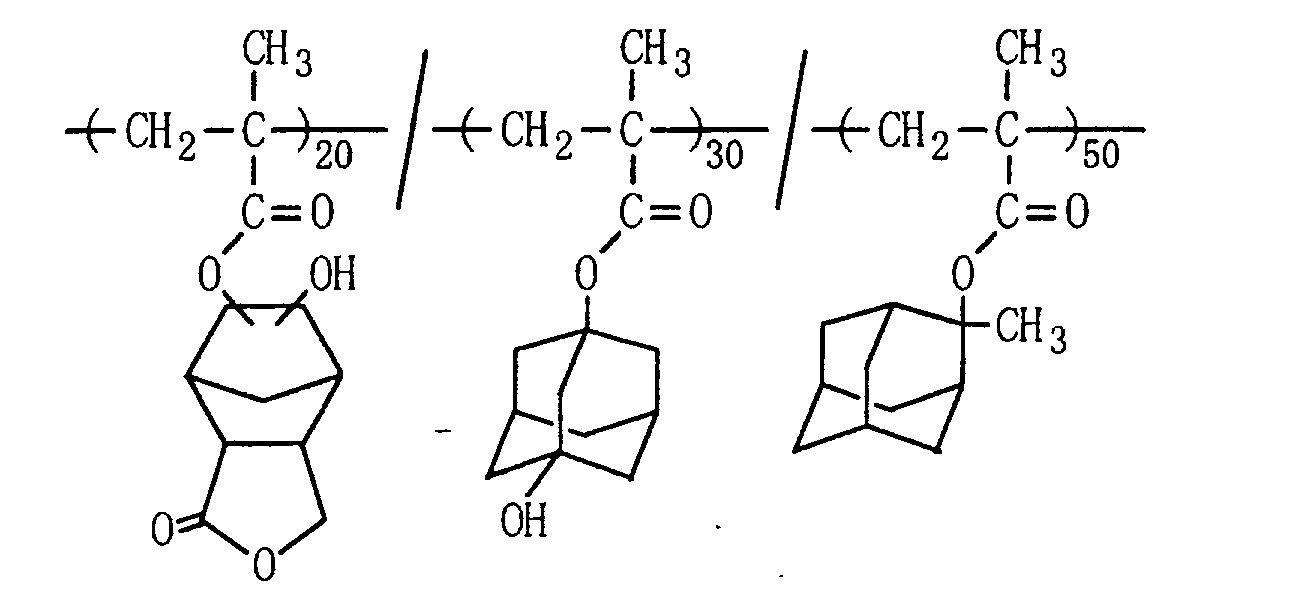
Claims (10)
- A polymeric compound for photoresist, comprising at least one monomer unit represented by following Formula (I):wherein R1, R2, R3, R4 and R5 are the same or different and are each a hydrogen atom or a methyl group; m, p and q each denote an integer of from 0 to 2; and n denotes 0 or 1, where the hydroxyl group and the carbonyloxy group extending from a principle chain in the formula are independently combined with either of two carbon atoms on the far-left portion of the rings.
- The polymeric compound for photoresist according to claim 1, comprising at least one monomer unit represented by Formula (I) and at least one selected from monomer units represented by following Formulae (IIa) through (IIg):

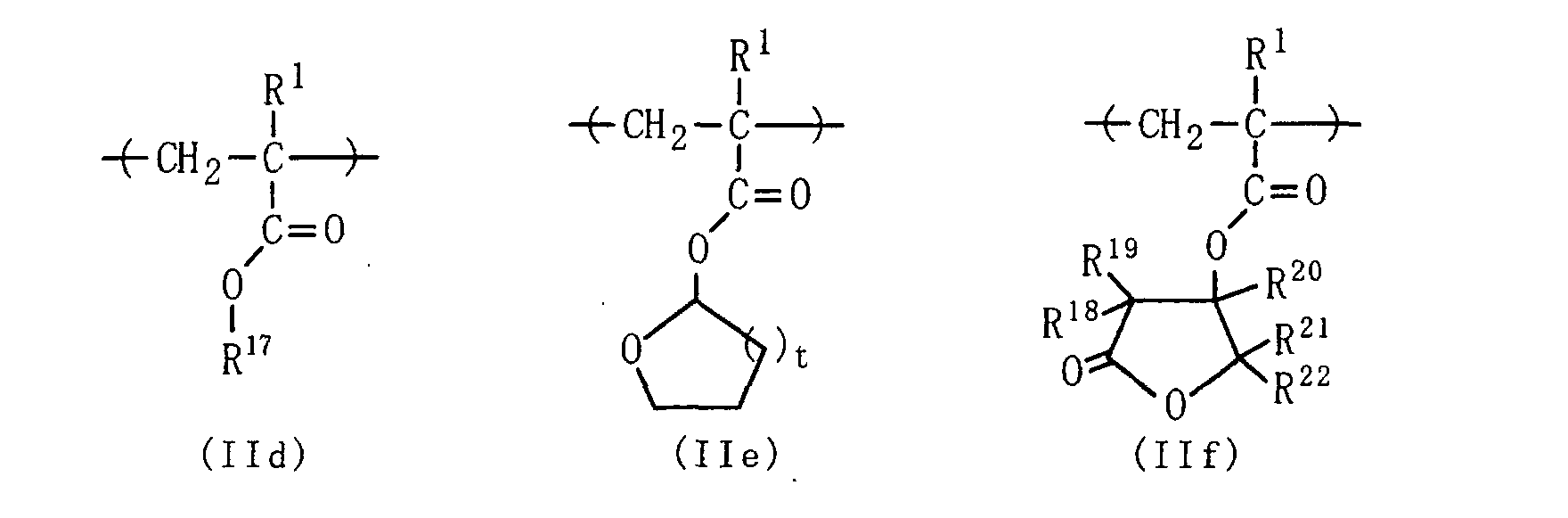 wherein R1 is a hydrogen atom or a methyl group; R6 and R7 are the same or different and are each a hydrocarbon group containing from 1 to 8 carbon atoms; R8, R9 and R10 are the same or different and are each a hydrogen atom, a hydroxyl group, or a methyl group; R11 and R12 are the same or different and are each a hydrogen atom, a hydroxyl group or a -COOR13 group, where R13 is a t-butyl group, a 2-tetrahydrofuranyl group, a 2-tetrahydropyranyl group or an 2-oxepanyl group; R14 is a methyl group or an ethyl group; R15 and R16 are the same or different and are each a hydrogen atom, a hydroxyl group or an oxo group; R17 is a hydrocarbon group having a tertiary carbon atom at the bonding site with the oxygen atom indicated in the formula; R18, R19, R20, R21 and R22 are the same or different and are each a hydrogen atom or a methyl group; R23 is a t-butyl group, a 2-tetrahydrofuranyl group, a 2-tetrahydropyranyl group or an 2-oxepanyl group; t denotes an integer of from 1 to 3; and u denotes 0 or 1.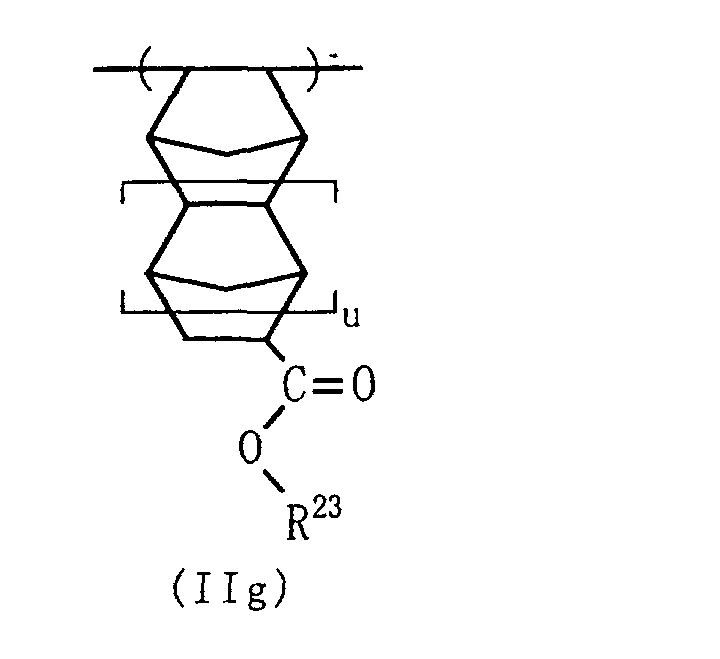
- The polymeric compound for photoresist according to claim 1 or 2, further comprising at least one selected from monomer units represented by following Formulae (IIIa) through (IIIh) :

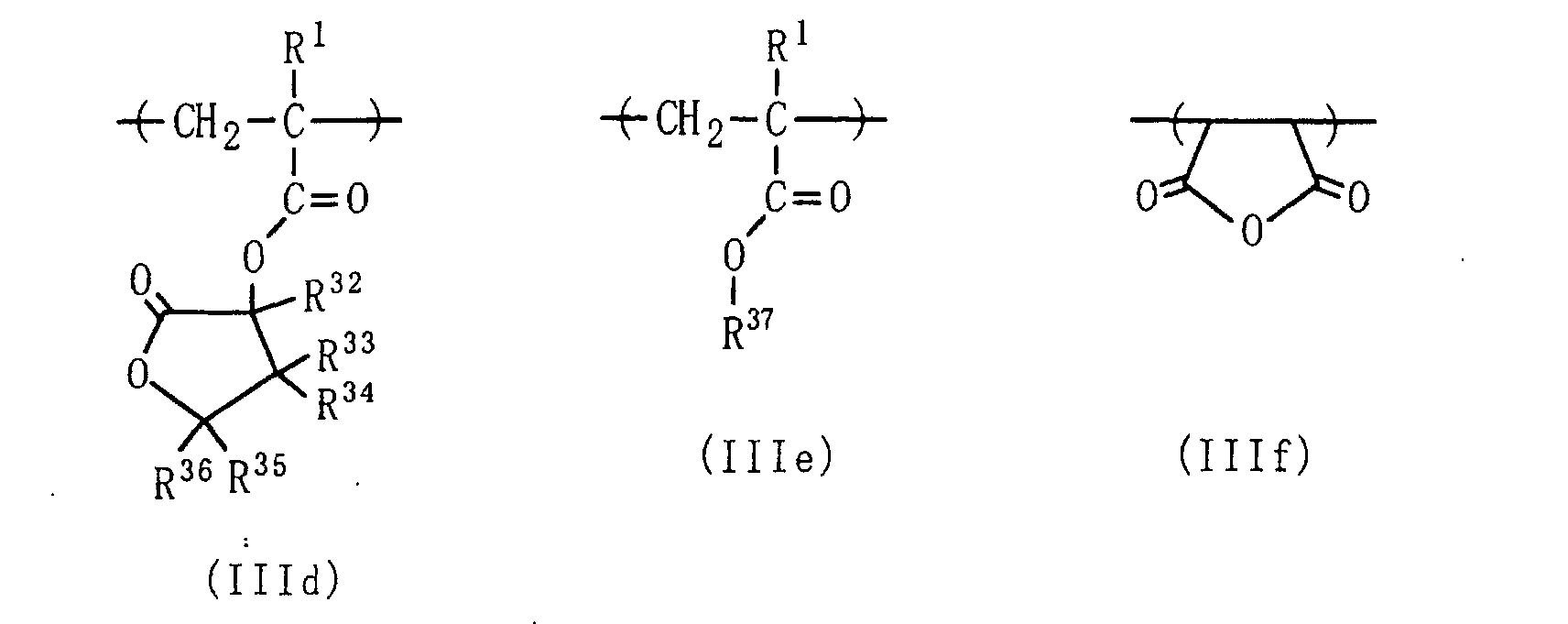 wherein R1 is a hydrogen atom or a methyl group; R24 and R25 are the same or different and are each a hydrogen atom, a hydroxyl group or a carboxyl group; R26 is a hydroxyl group, an oxo group or a carboxyl group; X1, X2 and X3 are the same or different and are each -CH2- or -CO-O-; R27, R28 and R29 are the same or different and are each a hydrogen atom or a methyl group; R30 and R31 are the same or different and are each a hydrogen atom or a methyl group; R32, R33, R34, R35 and R36 are the same or different and are each a hydrogen atom or a methyl group; R37 is a hydrogen atom or a straight chain, branched chain, cyclic or bridged cyclic hydrocarbon group containing 1 to 20 carbon atoms which may have a substituent; R38, R39, R40 and R41 are the same or different and are each a hydrogen atom or a methyl group; R42 is a hydrogen atom, a hydroxyl group, a hydroxymethyl group or a carboxyl group; and v, w, x and y are each 0 or 1, in addition to the at least one monomer unit represented by Formula (I) or in addition to the at least one monomer unit represented by Formula (I) and the at least one selected from monomer units represented by Formulae (IIa) through (IIg).
- The polymeric compound for photoresist according to any one of claims 1 to 3, having a solubility parameter of from 19.5 to 24.5 (J/cm3)1/2 as determined by Fedors method.
- A resin composition for photoresist, comprising at least the polymeric compound for photoresist as claimed in any one of claims 1 to 4 and a photosensitive acid generator.
- A process for fabricating a semiconductor, the process comprising the steps of applying the resin composition for photoresist as claimed in claim 5 to a base or a substrate to form a resist film, exposing, developing and thereby patterning the resist film.
- A (meth)acrylic ester derivative represented by following Formula (1):wherein R1, R2, R3, R4 and R5 are the same or different and are each a hydrogen atom or a methyl group; m, p and q each denote an integer of from 0 to 2; and n denotes 0 or 1, where the (meth)acryloyloxy group and hydroxyl group in the formula are independently combined with either of two carbon atoms on the far-left portion of the rings.

- A process for producing a (meth)acrylic ester derivative, the process comprising the step of allowing a cyclic alcohol represented by following Formula (4):wherein R2, R3, R4 and R5 are the same or different and are each a hydrogen atom or a methyl group; m, p and q each denote an integer of from 0 to 2; n denotes 0 or 1, where the hydroxyl groups in the formula are independently combined with either of two carbon atoms on the far-left portion of the rings, to react with (meth)acrylic acid or a reactive derivative thereof to thereby yield a compound represented by following Formula (1) :
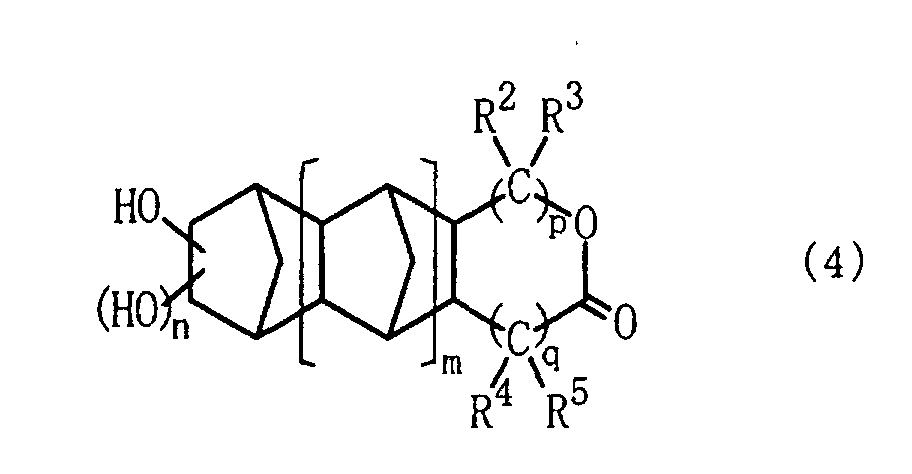 wherein R1 is a hydrogen atom or a methyl group; and R2, R3, R4, R5, m, p, q, and n have the same meanings as defined above, where the (meth)acryloyloxy group and hydroxyl group in the formula are independently combined with either of two carbon atoms on the far-left portion of the rings.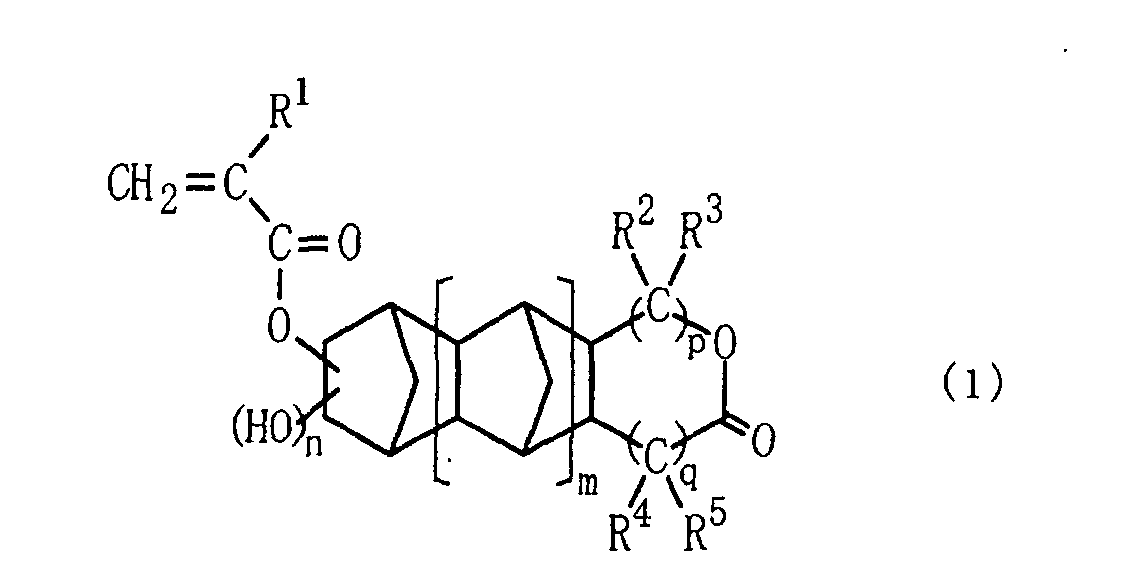
- A process for producing a cyclic alcohol, the process comprising the step of reducing an epoxy compound represented by following Formula (5):wherein R2, R3, R4 and R5 are the same or different and are each a hydrogen atom or a methyl group; and m, p and q each denote an integer of from 0 to 2, to thereby yield a cyclic alcohol represented by following Formula (4a) :
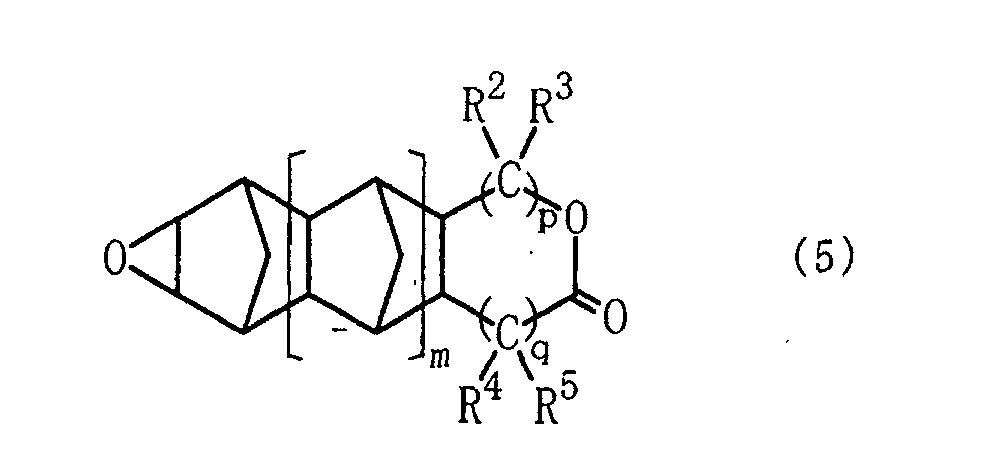 wherein R2, R3, R4, R5, m, p, and q have the same meanings as defined above, where the hydroxyl group in the formula is combined with either of two carbon atoms on the far-left portion of the rings.
- A cyclic alcohol represented by following Formula (4b) :wherein R2, R3, R4 and R5 are the same or different and are each a hydrogen atom or a methyl group; m denotes an integer of from 0 to 2; r and s each denote 0 or 1, where r plus s equals 1, and where the hydroxyl group in the formula is combined with either of two carbon atoms on the far-left portion of the rings.
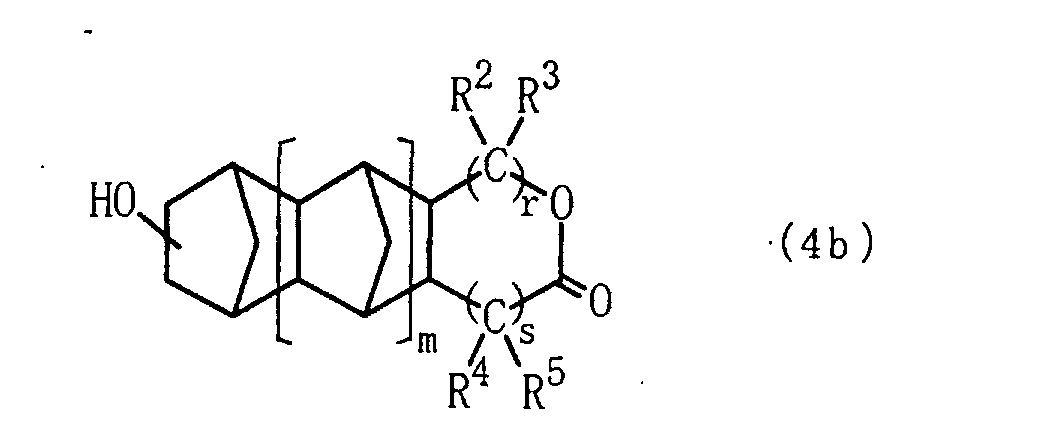
Applications Claiming Priority (3)
| Application Number | Priority Date | Filing Date | Title |
|---|---|---|---|
| JP2000378750 | 2000-12-13 | ||
| JP2000378750 | 2000-12-13 | ||
| PCT/JP2001/010832 WO2002048217A1 (en) | 2000-12-13 | 2001-12-11 | Polymer for photoresist and resin compositions therefor |
Publications (3)
| Publication Number | Publication Date |
|---|---|
| EP1354897A1 true EP1354897A1 (en) | 2003-10-22 |
| EP1354897A4 EP1354897A4 (en) | 2007-11-28 |
| EP1354897B1 EP1354897B1 (en) | 2012-10-24 |
Family
ID=18847258
Family Applications (1)
| Application Number | Title | Priority Date | Filing Date |
|---|---|---|---|
| EP01270561A Expired - Lifetime EP1354897B1 (en) | 2000-12-13 | 2001-12-11 | Polymer for photoresist and resin compositions therefor |
Country Status (6)
| Country | Link |
|---|---|
| US (1) | US7105268B2 (en) |
| EP (1) | EP1354897B1 (en) |
| JP (1) | JP4003876B2 (en) |
| KR (1) | KR100832954B1 (en) |
| TW (1) | TWI289730B (en) |
| WO (1) | WO2002048217A1 (en) |
Cited By (2)
| Publication number | Priority date | Publication date | Assignee | Title |
|---|---|---|---|---|
| JP2016058663A (en) * | 2014-09-11 | 2016-04-21 | 株式会社東芝 | Photosensitive composition, imprinting method, and intercalation layer |
| EP1267210B1 (en) * | 2001-06-12 | 2018-02-21 | FUJIFILM Corporation | Positive resist composition |
Families Citing this family (12)
| Publication number | Priority date | Publication date | Assignee | Title |
|---|---|---|---|---|
| TWI299816B (en) * | 2002-04-03 | 2008-08-11 | Sumitomo Chemical Co | Positive resist composition |
| JP4040536B2 (en) * | 2003-06-11 | 2008-01-30 | 東京応化工業株式会社 | Negative resist composition and resist pattern forming method using the same |
| US7488565B2 (en) * | 2003-10-01 | 2009-02-10 | Chevron U.S.A. Inc. | Photoresist compositions comprising diamondoid derivatives |
| KR100738056B1 (en) * | 2005-05-18 | 2007-07-12 | 삼성에스디아이 주식회사 | Manufacturing method of FED |
| KR100738055B1 (en) * | 2005-05-18 | 2007-07-12 | 삼성에스디아이 주식회사 | Stacking method of electronic device and manufacturing method of FED using the same |
| JP4684740B2 (en) * | 2005-05-19 | 2011-05-18 | 東京応化工業株式会社 | Positive resist composition and resist pattern forming method |
| WO2007094473A1 (en) * | 2006-02-17 | 2007-08-23 | Kuraray Co., Ltd. | Tertiary alcohol derivative, polymer compound and photoresist composition |
| EP1903395A1 (en) * | 2006-09-19 | 2008-03-26 | FUJIFILM Corporation | Positive photosensitive composition, polymer compounds for use in the positive photosensitive composition, manufacturing method of the polymer compounds, compounds for use in the manufacture of the polymer compounds, and pattern-forming method using the positive photosensitive composition |
| KR200452258Y1 (en) * | 2008-09-23 | 2011-02-14 | 이경석 | Climbing Stick |
| KR200451953Y1 (en) * | 2010-07-21 | 2011-01-25 | 양승철 | Fastening device for length adjustment of climbing cane |
| US20130302735A1 (en) * | 2011-11-03 | 2013-11-14 | Rohm And Haas Electronic Materials Llc | Monomers, polymers and photoresist compositions |
| JP6074834B2 (en) * | 2012-03-15 | 2017-02-08 | 三菱レイヨン株式会社 | Evaluation method of resist material |
Family Cites Families (11)
| Publication number | Priority date | Publication date | Assignee | Title |
|---|---|---|---|---|
| JP3712218B2 (en) | 1997-01-24 | 2005-11-02 | 東京応化工業株式会社 | Chemically amplified photoresist composition |
| WO2000001684A1 (en) * | 1998-07-03 | 2000-01-13 | Nec Corporation | (meth)acrylate derivatives bearing lactone structure, polymers, photoresist compositions and process of forming patterns with the same |
| JP3042618B2 (en) * | 1998-07-03 | 2000-05-15 | 日本電気株式会社 | (Meth) acrylate derivative having lactone structure, polymer, photoresist composition, and pattern forming method |
| JP3166848B2 (en) * | 1998-11-18 | 2001-05-14 | 日本電気株式会社 | Negative photoresist material and pattern forming method using the same |
| JP3763693B2 (en) * | 1998-08-10 | 2006-04-05 | 株式会社東芝 | Photosensitive composition and pattern forming method |
| US6303266B1 (en) * | 1998-09-24 | 2001-10-16 | Kabushiki Kaisha Toshiba | Resin useful for resist, resist composition and pattern forming process using the same |
| JP4131062B2 (en) * | 1998-09-25 | 2008-08-13 | 信越化学工業株式会社 | Novel lactone-containing compound, polymer compound, resist material, and pattern forming method |
| JP4135848B2 (en) * | 2000-02-28 | 2008-08-20 | 東京応化工業株式会社 | Positive resist composition |
| US7041838B2 (en) * | 2000-12-06 | 2006-05-09 | Mitsubishi Rayon Co., Ltd. | (Meth)acrylate esters, starting alcohols for the preparation thereof, processes for preparing both, polymers of the esters, chemically amplifiable resist compositions, and method for forming patterns |
| JP3991191B2 (en) * | 2001-06-14 | 2007-10-17 | 信越化学工業株式会社 | Novel (meth) acrylate compound having lactone structure, polymer, photoresist material, and pattern forming method |
| JP3803286B2 (en) * | 2001-12-03 | 2006-08-02 | 東京応化工業株式会社 | Positive resist composition and method for forming resist pattern |
-
2001
- 2001-12-11 JP JP2002549747A patent/JP4003876B2/en not_active Expired - Lifetime
- 2001-12-11 WO PCT/JP2001/010832 patent/WO2002048217A1/en not_active Ceased
- 2001-12-11 EP EP01270561A patent/EP1354897B1/en not_active Expired - Lifetime
- 2001-12-11 KR KR1020027010412A patent/KR100832954B1/en not_active Expired - Lifetime
- 2001-12-11 US US10/239,051 patent/US7105268B2/en not_active Expired - Lifetime
- 2001-12-12 TW TW090130758A patent/TWI289730B/en not_active IP Right Cessation
Cited By (2)
| Publication number | Priority date | Publication date | Assignee | Title |
|---|---|---|---|---|
| EP1267210B1 (en) * | 2001-06-12 | 2018-02-21 | FUJIFILM Corporation | Positive resist composition |
| JP2016058663A (en) * | 2014-09-11 | 2016-04-21 | 株式会社東芝 | Photosensitive composition, imprinting method, and intercalation layer |
Also Published As
| Publication number | Publication date |
|---|---|
| TWI289730B (en) | 2007-11-11 |
| WO2002048217A1 (en) | 2002-06-20 |
| JP4003876B2 (en) | 2007-11-07 |
| JPWO2002048217A1 (en) | 2004-04-15 |
| EP1354897A4 (en) | 2007-11-28 |
| EP1354897B1 (en) | 2012-10-24 |
| US20030148210A1 (en) | 2003-08-07 |
| KR20030034041A (en) | 2003-05-01 |
| KR100832954B1 (en) | 2008-05-27 |
| US7105268B2 (en) | 2006-09-12 |
Similar Documents
| Publication | Publication Date | Title |
|---|---|---|
| US6746818B2 (en) | (Meth)acrylates having lactone structure, polymers, photoresist compositions and patterning process | |
| US6806335B2 (en) | PolymEric compound and resin composition for photoresist | |
| JP4275284B2 (en) | Polymer compound for photoresist and resin composition for photoresist | |
| US6692889B1 (en) | Photoresist polymeric compound and photoresist resin composition | |
| US6440636B1 (en) | Polymeric compound and resin composition for photoresist | |
| KR100526736B1 (en) | Lactone Ring-Containing (Meth)acrylate, Polymer Thereof, Resist Composition and Patterning Process | |
| EP1354897B1 (en) | Polymer for photoresist and resin compositions therefor | |
| JP4188058B2 (en) | Polymer compound for photoresist and resin composition for photoresist | |
| JP2002338627A5 (en) | ||
| KR20030057578A (en) | (meth)acrylate esters, starting alcohols for the preparation thereof, processes for preparing both, polymers of the esters, chemically amplifiable resist compositions, and method for forming patterns | |
| JP4488906B2 (en) | Method for producing polymer compound for photoresist | |
| JP4236694B2 (en) | High molecular compound for photoresist and photosensitive resin composition | |
| JP5215228B2 (en) | Method for producing resin composition for photoresist | |
| KR100729679B1 (en) | Polymer Compounds for Photoresist and Resin Compositions for Photoresist | |
| JP2003221403A (en) | Method for producing polymer compound for photoresist | |
| JP4316254B2 (en) | Resin composition for photoresist and method for producing the same | |
| JP4139948B2 (en) | Unsaturated monomer, polymer, chemically amplified resist composition, and pattern forming method | |
| JP4530829B2 (en) | Polymer compound for photoresist for immersion exposure and method for producing semiconductor | |
| JP2006225517A (en) | Method for producing polymer compound solution for photoresist, and photoresist composition | |
| JP2006176574A (en) | Method for producing resin solution for photoresist | |
| JP2002116542A (en) | High molecular compound for photoresist and resin composition for photoresist | |
| JP2004182890A (en) | Polymer compound for photoresist and resin composition for photoresist |
Legal Events
| Date | Code | Title | Description |
|---|---|---|---|
| PUAI | Public reference made under article 153(3) epc to a published international application that has entered the european phase |
Free format text: ORIGINAL CODE: 0009012 |
|
| 17P | Request for examination filed |
Effective date: 20020911 |
|
| AK | Designated contracting states |
Kind code of ref document: A1 Designated state(s): DE FR GB |
|
| A4 | Supplementary search report drawn up and despatched |
Effective date: 20071031 |
|
| RAP1 | Party data changed (applicant data changed or rights of an application transferred) |
Owner name: DAICEL CHEMICAL INDUSTRIES, LTD. |
|
| 17Q | First examination report despatched |
Effective date: 20110606 |
|
| GRAP | Despatch of communication of intention to grant a patent |
Free format text: ORIGINAL CODE: EPIDOSNIGR1 |
|
| RIN1 | Information on inventor provided before grant (corrected) |
Inventor name: INOUE, KEIZO Inventor name: FUNAKI, YOSHINORI Inventor name: TSUTSUMI, KIYOHARU Inventor name: ADACHI, TOMOKO |
|
| GRAS | Grant fee paid |
Free format text: ORIGINAL CODE: EPIDOSNIGR3 |
|
| GRAA | (expected) grant |
Free format text: ORIGINAL CODE: 0009210 |
|
| AK | Designated contracting states |
Kind code of ref document: B1 Designated state(s): DE FR GB |
|
| REG | Reference to a national code |
Ref country code: GB Ref legal event code: FG4D |
|
| REG | Reference to a national code |
Ref country code: DE Ref legal event code: R096 Ref document number: 60147262 Country of ref document: DE Effective date: 20121220 |
|
| PLBE | No opposition filed within time limit |
Free format text: ORIGINAL CODE: 0009261 |
|
| STAA | Information on the status of an ep patent application or granted ep patent |
Free format text: STATUS: NO OPPOSITION FILED WITHIN TIME LIMIT |
|
| GBPC | Gb: european patent ceased through non-payment of renewal fee |
Effective date: 20130124 |
|
| 26N | No opposition filed |
Effective date: 20130725 |
|
| REG | Reference to a national code |
Ref country code: DE Ref legal event code: R097 Ref document number: 60147262 Country of ref document: DE Effective date: 20130725 |
|
| PG25 | Lapsed in a contracting state [announced via postgrant information from national office to epo] |
Ref country code: GB Free format text: LAPSE BECAUSE OF NON-PAYMENT OF DUE FEES Effective date: 20130124 |
|
| REG | Reference to a national code |
Ref country code: FR Ref legal event code: PLFP Year of fee payment: 15 |
|
| REG | Reference to a national code |
Ref country code: FR Ref legal event code: PLFP Year of fee payment: 16 |
|
| REG | Reference to a national code |
Ref country code: FR Ref legal event code: PLFP Year of fee payment: 17 |
|
| PGFP | Annual fee paid to national office [announced via postgrant information from national office to epo] |
Ref country code: DE Payment date: 20201211 Year of fee payment: 20 Ref country code: FR Payment date: 20201223 Year of fee payment: 20 |
|
| REG | Reference to a national code |
Ref country code: DE Ref legal event code: R071 Ref document number: 60147262 Country of ref document: DE |