EP1354020B1 - Novel red fluorescent material and organic electroluminescent device containing same - Google Patents
Novel red fluorescent material and organic electroluminescent device containing same Download PDFInfo
- Publication number
- EP1354020B1 EP1354020B1 EP20010998611 EP01998611A EP1354020B1 EP 1354020 B1 EP1354020 B1 EP 1354020B1 EP 20010998611 EP20010998611 EP 20010998611 EP 01998611 A EP01998611 A EP 01998611A EP 1354020 B1 EP1354020 B1 EP 1354020B1
- Authority
- EP
- European Patent Office
- Prior art keywords
- compound
- formula
- electroluminescent device
- organic electroluminescent
- added
- Prior art date
- Legal status (The legal status is an assumption and is not a legal conclusion. Google has not performed a legal analysis and makes no representation as to the accuracy of the status listed.)
- Expired - Lifetime
Links
- 0 CC(C)(CC*1)c2c1c(C(I)=O)ccc2 Chemical compound CC(C)(CC*1)c2c1c(C(I)=O)ccc2 0.000 description 5
- AXTUNNMVXPKOJB-UHFFFAOYSA-N CC(C)=CCNc1ccccc1C=O Chemical compound CC(C)=CCNc1ccccc1C=O AXTUNNMVXPKOJB-UHFFFAOYSA-N 0.000 description 1
- YWISUPGAMNGUNX-UHFFFAOYSA-N CC1(C)c2cccc(C=O)c2N(Cc2ccccc2)CC1 Chemical compound CC1(C)c2cccc(C=O)c2N(Cc2ccccc2)CC1 YWISUPGAMNGUNX-UHFFFAOYSA-N 0.000 description 1
- FXWFZIRWWNPPOV-UHFFFAOYSA-N Nc1ccccc1C=O Chemical compound Nc1ccccc1C=O FXWFZIRWWNPPOV-UHFFFAOYSA-N 0.000 description 1
Images



Classifications
-
- C—CHEMISTRY; METALLURGY
- C09—DYES; PAINTS; POLISHES; NATURAL RESINS; ADHESIVES; COMPOSITIONS NOT OTHERWISE PROVIDED FOR; APPLICATIONS OF MATERIALS NOT OTHERWISE PROVIDED FOR
- C09K—MATERIALS FOR MISCELLANEOUS APPLICATIONS, NOT PROVIDED FOR ELSEWHERE
- C09K11/00—Luminescent materials, e.g. electroluminescent or chemiluminescent
- C09K11/06—Luminescent materials, e.g. electroluminescent or chemiluminescent containing organic luminescent materials
-
- C—CHEMISTRY; METALLURGY
- C07—ORGANIC CHEMISTRY
- C07D—HETEROCYCLIC COMPOUNDS
- C07D405/00—Heterocyclic compounds containing both one or more hetero rings having oxygen atoms as the only ring hetero atoms, and one or more rings having nitrogen as the only ring hetero atom
- C07D405/02—Heterocyclic compounds containing both one or more hetero rings having oxygen atoms as the only ring hetero atoms, and one or more rings having nitrogen as the only ring hetero atom containing two hetero rings
- C07D405/06—Heterocyclic compounds containing both one or more hetero rings having oxygen atoms as the only ring hetero atoms, and one or more rings having nitrogen as the only ring hetero atom containing two hetero rings linked by a carbon chain containing only aliphatic carbon atoms
-
- C—CHEMISTRY; METALLURGY
- C09—DYES; PAINTS; POLISHES; NATURAL RESINS; ADHESIVES; COMPOSITIONS NOT OTHERWISE PROVIDED FOR; APPLICATIONS OF MATERIALS NOT OTHERWISE PROVIDED FOR
- C09B—ORGANIC DYES OR CLOSELY-RELATED COMPOUNDS FOR PRODUCING DYES, e.g. PIGMENTS; MORDANTS; LAKES
- C09B23/00—Methine or polymethine dyes, e.g. cyanine dyes
- C09B23/14—Styryl dyes
- C09B23/145—Styryl dyes the ethylene chain carrying an heterocyclic residue, e.g. heterocycle-CH=CH-C6H5
-
- H—ELECTRICITY
- H10—SEMICONDUCTOR DEVICES; ELECTRIC SOLID-STATE DEVICES NOT OTHERWISE PROVIDED FOR
- H10K—ORGANIC ELECTRIC SOLID-STATE DEVICES
- H10K85/00—Organic materials used in the body or electrodes of devices covered by this subclass
- H10K85/60—Organic compounds having low molecular weight
- H10K85/649—Aromatic compounds comprising a hetero atom
- H10K85/653—Aromatic compounds comprising a hetero atom comprising only oxygen as heteroatom
-
- C—CHEMISTRY; METALLURGY
- C09—DYES; PAINTS; POLISHES; NATURAL RESINS; ADHESIVES; COMPOSITIONS NOT OTHERWISE PROVIDED FOR; APPLICATIONS OF MATERIALS NOT OTHERWISE PROVIDED FOR
- C09K—MATERIALS FOR MISCELLANEOUS APPLICATIONS, NOT PROVIDED FOR ELSEWHERE
- C09K2211/00—Chemical nature of organic luminescent or tenebrescent compounds
- C09K2211/10—Non-macromolecular compounds
- C09K2211/1003—Carbocyclic compounds
- C09K2211/1007—Non-condensed systems
-
- C—CHEMISTRY; METALLURGY
- C09—DYES; PAINTS; POLISHES; NATURAL RESINS; ADHESIVES; COMPOSITIONS NOT OTHERWISE PROVIDED FOR; APPLICATIONS OF MATERIALS NOT OTHERWISE PROVIDED FOR
- C09K—MATERIALS FOR MISCELLANEOUS APPLICATIONS, NOT PROVIDED FOR ELSEWHERE
- C09K2211/00—Chemical nature of organic luminescent or tenebrescent compounds
- C09K2211/10—Non-macromolecular compounds
- C09K2211/1003—Carbocyclic compounds
- C09K2211/1011—Condensed systems
-
- C—CHEMISTRY; METALLURGY
- C09—DYES; PAINTS; POLISHES; NATURAL RESINS; ADHESIVES; COMPOSITIONS NOT OTHERWISE PROVIDED FOR; APPLICATIONS OF MATERIALS NOT OTHERWISE PROVIDED FOR
- C09K—MATERIALS FOR MISCELLANEOUS APPLICATIONS, NOT PROVIDED FOR ELSEWHERE
- C09K2211/00—Chemical nature of organic luminescent or tenebrescent compounds
- C09K2211/10—Non-macromolecular compounds
- C09K2211/1018—Heterocyclic compounds
- C09K2211/1025—Heterocyclic compounds characterised by ligands
- C09K2211/1029—Heterocyclic compounds characterised by ligands containing one nitrogen atom as the heteroatom
-
- C—CHEMISTRY; METALLURGY
- C09—DYES; PAINTS; POLISHES; NATURAL RESINS; ADHESIVES; COMPOSITIONS NOT OTHERWISE PROVIDED FOR; APPLICATIONS OF MATERIALS NOT OTHERWISE PROVIDED FOR
- C09K—MATERIALS FOR MISCELLANEOUS APPLICATIONS, NOT PROVIDED FOR ELSEWHERE
- C09K2211/00—Chemical nature of organic luminescent or tenebrescent compounds
- C09K2211/10—Non-macromolecular compounds
- C09K2211/1018—Heterocyclic compounds
- C09K2211/1025—Heterocyclic compounds characterised by ligands
- C09K2211/1029—Heterocyclic compounds characterised by ligands containing one nitrogen atom as the heteroatom
- C09K2211/1033—Heterocyclic compounds characterised by ligands containing one nitrogen atom as the heteroatom with oxygen
-
- C—CHEMISTRY; METALLURGY
- C09—DYES; PAINTS; POLISHES; NATURAL RESINS; ADHESIVES; COMPOSITIONS NOT OTHERWISE PROVIDED FOR; APPLICATIONS OF MATERIALS NOT OTHERWISE PROVIDED FOR
- C09K—MATERIALS FOR MISCELLANEOUS APPLICATIONS, NOT PROVIDED FOR ELSEWHERE
- C09K2211/00—Chemical nature of organic luminescent or tenebrescent compounds
- C09K2211/10—Non-macromolecular compounds
- C09K2211/1018—Heterocyclic compounds
- C09K2211/1025—Heterocyclic compounds characterised by ligands
- C09K2211/1088—Heterocyclic compounds characterised by ligands containing oxygen as the only heteroatom
-
- H—ELECTRICITY
- H10—SEMICONDUCTOR DEVICES; ELECTRIC SOLID-STATE DEVICES NOT OTHERWISE PROVIDED FOR
- H10K—ORGANIC ELECTRIC SOLID-STATE DEVICES
- H10K2102/00—Constructional details relating to the organic devices covered by this subclass
- H10K2102/10—Transparent electrodes, e.g. using graphene
- H10K2102/101—Transparent electrodes, e.g. using graphene comprising transparent conductive oxides [TCO]
- H10K2102/103—Transparent electrodes, e.g. using graphene comprising transparent conductive oxides [TCO] comprising indium oxides, e.g. ITO
-
- H—ELECTRICITY
- H10—SEMICONDUCTOR DEVICES; ELECTRIC SOLID-STATE DEVICES NOT OTHERWISE PROVIDED FOR
- H10K—ORGANIC ELECTRIC SOLID-STATE DEVICES
- H10K50/00—Organic light-emitting devices
- H10K50/10—OLEDs or polymer light-emitting diodes [PLED]
- H10K50/11—OLEDs or polymer light-emitting diodes [PLED] characterised by the electroluminescent [EL] layers
-
- H—ELECTRICITY
- H10—SEMICONDUCTOR DEVICES; ELECTRIC SOLID-STATE DEVICES NOT OTHERWISE PROVIDED FOR
- H10K—ORGANIC ELECTRIC SOLID-STATE DEVICES
- H10K85/00—Organic materials used in the body or electrodes of devices covered by this subclass
- H10K85/30—Coordination compounds
- H10K85/321—Metal complexes comprising a group IIIA element, e.g. Tris (8-hydroxyquinoline) gallium [Gaq3]
- H10K85/324—Metal complexes comprising a group IIIA element, e.g. Tris (8-hydroxyquinoline) gallium [Gaq3] comprising aluminium, e.g. Alq3
-
- Y—GENERAL TAGGING OF NEW TECHNOLOGICAL DEVELOPMENTS; GENERAL TAGGING OF CROSS-SECTIONAL TECHNOLOGIES SPANNING OVER SEVERAL SECTIONS OF THE IPC; TECHNICAL SUBJECTS COVERED BY FORMER USPC CROSS-REFERENCE ART COLLECTIONS [XRACs] AND DIGESTS
- Y10—TECHNICAL SUBJECTS COVERED BY FORMER USPC
- Y10S—TECHNICAL SUBJECTS COVERED BY FORMER USPC CROSS-REFERENCE ART COLLECTIONS [XRACs] AND DIGESTS
- Y10S428/00—Stock material or miscellaneous articles
- Y10S428/917—Electroluminescent
-
- Y—GENERAL TAGGING OF NEW TECHNOLOGICAL DEVELOPMENTS; GENERAL TAGGING OF CROSS-SECTIONAL TECHNOLOGIES SPANNING OVER SEVERAL SECTIONS OF THE IPC; TECHNICAL SUBJECTS COVERED BY FORMER USPC CROSS-REFERENCE ART COLLECTIONS [XRACs] AND DIGESTS
- Y10—TECHNICAL SUBJECTS COVERED BY FORMER USPC
- Y10T—TECHNICAL SUBJECTS COVERED BY FORMER US CLASSIFICATION
- Y10T428/00—Stock material or miscellaneous articles
- Y10T428/31504—Composite [nonstructural laminate]
- Y10T428/31855—Of addition polymer from unsaturated monomers
Definitions
- the present invention relates to a novel compound having red-color luminescent characteristics, a process for the preparation thereof and an organic electroluminescent device containing same.
- red fluorescent materials used in organic electroluminescent devices generally belong to a class of compounds having an alkyl substituted nitrogen group, e.g., -N(CH 3 ) 2 , as in 4-(dicyanomethylene)-2-methyl-6-(4-dimethylaminostyryl)-4H-pyran (DCM).
- alkyl substituted nitrogen group e.g., -N(CH 3 ) 2
- DCM 4-(dicyanomethylene)-2-methyl-6-(4-dimethylaminostyryl)-4H-pyran
- thermostability improved thermostability and being capable of emitting color in the range of orange to deep red.
- Preferred among the compounds of formula (I) of the present invention are those obtained when X is CR 1 R 2 or oxygen, Y is oxygen or sulfur, and R' and R 1 to R 7 are each independently hydrogen, methyl, isopropyl, t-butyl, methoxy, phenyl, phenyl substituted with methyl, or benzyl; and more preferred are those obtained when X is CR 1 R 2 , Y is oxygen, and R' and R 1 to R 7 are each independently methyl, phenyl or benzyl.
- a compound of formula (I) may be prepared by reacting a pyran derivative of formula (II) with an aldehyde derivative of formula (III) in an alcohol solvent, e.g., methanol, ethanol and propanol, in the presence of an amine such as piperidine.
- an alcohol solvent e.g., methanol, ethanol and propanol
- it may be prepared by reacting a compound of formula (II) with a compound of formula (III) in a solvent such as acetic anhydride in the presence of an acid such as phosphoric acid.
- Such reactions may be performed using molar equivalent amounts of the reactants at a temperature ranging from room temperature to the boiling point of the solvent.
- a compound of formula (II) employed in the inventive reaction is commercially available, or it may be synthesized in accordance with the method disclosed in US Patent 5,908,581 ..
- a compound of formula (III) may be prepared, in accordance with the Vilsmeier method, by reacting a hetero-ring compound of formula (IV) with POCl 3 in an organic solvent such as dimethylformamide (DMF) as shown in Scheme Reaction B (see US Patent 2,558,285 ): wherein, X, Y, R', and R 1 to R 6 have the same meanings as defined above.
- an organic solvent such as dimethylformamide (DMF) as shown in Scheme Reaction B (see US Patent 2,558,285 ): wherein, X, Y, R', and R 1 to R 6 have the same meanings as defined above.
- the organic electroluminescent device of the present invention comprises an organic luminescent layer containing compound of formula (I).
- the inventive electroluminescent device may be prepared by sequentially stacking on an ITO-coated glass substrate, a hole transport layer, said organic luminescent layer, an electron transport layer (or a luminescent/electron transport layer) and a metallic electrode layer, in accordance with a conventional method.
- inventive compound of formula (I) may be employed as a doping material for red or orange luminescence.
- the hole transport layer, luminescent layer and electron transport layer of the inventive electroluminescent device may be formed by a conventional method which may be a wet process, e.g., a spin-coating, doctor-blading, roll-printing and screen-printing method, or a chemical vapor deposition process.
- the metallic cathode layer may be formed by vapor deposition.
- Active materials used in the hole transport and electron transport layers may be selected from any of those known in the art; and for the cathode layer, for instance, aluminum, silver, calcium, magnesium, copper or an alloy thereof may be used.
- novel red fluorescent material of the present invention has improved thermostability, and the organic electroluminescent device containing same is capable of emitting color in the range of orange to deep red.
- the DSC(Differential Scanning Calorimeter) analysis result revealed that the melting point and the glass transition temperature of the title compound are 276°C and 120 °C, respectively.
- a solution of the title compound in ethylene dichloride exhibited a maximum fluorescence wavelength ranging from 619nm to 636nm (from orange to red), depending on its concentration.
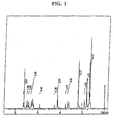
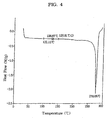
- Figures 1 and 4 illustrate NMR and DSC scans of the compound thus obtained, respectively.
- Example 1 The procedures of Example 1 were repeated except that 4-dicyanomethylene-2-phenyl-6-methyl-4H-pyran or 4-dicyanomethylene-2-(2,4,6-trimethyl)phenyl-6-methyl-4H-pyran was used instead of 4-dicyanomethylene-2,6-dimethyl-4H-pyran (compound (II-a)), and one compound selected from compounds (III-b), (III-c) and (III-d) obtained in Preparation Examples 2, 3 and 4 was used in place of compound (III-a), to obtain the compounds shown in the Table. Table Ex. No. Structure Melting point/ glass transition temp. Fluorescence wavelength (in EDC.
- Example 3 Using the compound obtained in Example 3 as a doping material on a luminescent layer composed of tris(8-hydroquinolinato)aluminum (Alq 3 ) host material, an organic electroluminescent device was prepared in accordance with a conventional method.
- a 50nm thick hole transport layer (3) (hole transport material: a -NPD) was formed on an Indiuni-tin-oxide(ITO) layer (2) formed on a glass substrate (1) at 10 -6 torr.
- Alq 3 doped with the compound obtained in Example 3 to a level of 3% was vapor deposited on the hole transport layer to a thickness of 30nm at a rate of 0.03mn/sec to form a luminescent layer (4).
- an electron transport layer (5) (electron transport material: Alq 3 ) was formed on the luminescent layer to a thickness of 20nm and, subsequently, aluminum was vapor deposited on the electron transport layer to a thickness of 200nm at a rate of 1 nm/sec at 10 -6 torr to form a cathode layer (6).
- the inventive device has stable red luminescence characteristics and can accomplish a high brightness of maximum 12,000 cd/m 2 or more.
- the novel fluorescent material of the present invention has improved thermostability and is capable of emitting color in the range of orange to deep red and, therefore, it may be advantageously applied to organic photoconductors, photorefraction thin layer devices, photodiodes and solar cells as well as organic electroluminescent devices.
Landscapes
- Chemical & Material Sciences (AREA)
- Organic Chemistry (AREA)
- Engineering & Computer Science (AREA)
- Materials Engineering (AREA)
- Physics & Mathematics (AREA)
- Spectroscopy & Molecular Physics (AREA)
- Electroluminescent Light Sources (AREA)
- Plural Heterocyclic Compounds (AREA)
- Heterocyclic Carbon Compounds Containing A Hetero Ring Having Oxygen Or Sulfur (AREA)
- Luminescent Compositions (AREA)
- Nitrogen And Oxygen Or Sulfur-Condensed Heterocyclic Ring Systems (AREA)
- Nitrogen Condensed Heterocyclic Rings (AREA)
Abstract
Description
- The present invention relates to a novel compound having red-color luminescent characteristics, a process for the preparation thereof and an organic electroluminescent device containing same.
- Conventional red fluorescent materials used in organic electroluminescent devices generally belong to a class of compounds having an alkyl substituted nitrogen group, e.g., -N(CH3)2, as in 4-(dicyanomethylene)-2-methyl-6-(4-dimethylaminostyryl)-4H-pyran (DCM).

- However, such compounds exhibit low heat stability due to the presence of alkyl substituents, and give partial orange luminescent characteristics, failing to exhibit deep red.
- Accordingly, it is a primary object of the present invention to provide a novel red fluorescent compound having improved thermostability and being capable of emitting color in the range of orange to deep red.
- It is another object of the present invention to provide a process for preparing said compound.
- It is a further object of the present invention to provide an organic electroluminescent device comprising said compound.
- In accordance with one aspect of the present invention, there is provided a novel red fluorescent compound of formula (I):

- X is CR1R2, NR', oxygen or sulfur,
- Y is NH, oxygen or sulfur;
- R', R1, R2, R3, R4, R5, R6 and R7 are each independently hydrogen, C1-4 alkyl, C1-4 alkoxy, aryl, or aryl substituted with C1-4 alkyl or C1-4 alkoxy, R5 and R6 being optionally fused to form a hetero-ring.
- The above and other objects and features of the present invention will become apparent from the following description, when taken in conjunction with the accompanying drawings, which respectively show:
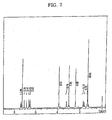
- FIGs. 1 to 3: NMR spectra of the novel red fluorescent compounds prepared in Examples 1 to 3, respectively;
- FIG. 4: DSC scan of the compound prepared in Example 1;
- FIG. 5: fluorescence spectrum of the compound prepared in Example 2;
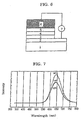
- FIG. 6: schematic diagram of an organic electroluminescent device prepared in Example 9; and
- FIGs. 7 to 9: electroluminous spectra, variations of the current density(A/m2) and brightness(cd/m2) as function of applied voltage(V), and change in the luminous efficiency(lm/W) with current density(A/m2), respectively, of the electroluminescent device prepared in Example 9.
- Preferred among the compounds of formula (I) of the present invention are those obtained when X is CR1R2 or oxygen, Y is oxygen or sulfur, and R' and R1 to R7 are each independently hydrogen, methyl, isopropyl, t-butyl, methoxy, phenyl, phenyl substituted with methyl, or benzyl; and more preferred are those obtained when X is CR1R2, Y is oxygen, and R' and R1 to R7 are each independently methyl, phenyl or benzyl.
- The process for preparing the compound of formula (I) of the present invention may be conducted in accordance with Reaction Scheme A as described below:

- Specifically, a compound of formula (I) may be prepared by reacting a pyran derivative of formula (II) with an aldehyde derivative of formula (III) in an alcohol solvent, e.g., methanol, ethanol and propanol, in the presence of an amine such as piperidine. Alternatively, it may be prepared by reacting a compound of formula (II) with a compound of formula (III) in a solvent such as acetic anhydride in the presence of an acid such as phosphoric acid. Such reactions may be performed using molar equivalent amounts of the reactants at a temperature ranging from room temperature to the boiling point of the solvent.
- A compound of formula (II) employed in the inventive reaction is commercially available, or it may be synthesized in accordance with the method disclosed in
US Patent 5,908,581 .. - In addition, a compound of formula (III) may be prepared, in accordance with the Vilsmeier method, by reacting a hetero-ring compound of formula (IV) with POCl3 in an organic solvent such as dimethylformamide (DMF) as shown in Scheme Reaction B (see
US Patent 2,558,285 ):
- The organic electroluminescent device of the present invention comprises an organic luminescent layer containing compound of formula (I). The inventive electroluminescent device may be prepared by sequentially stacking on an ITO-coated glass substrate, a hole transport layer, said organic luminescent layer, an electron transport layer (or a luminescent/electron transport layer) and a metallic electrode layer, in accordance with a conventional method.
- Preferably, the inventive compound of formula (I) may be employed as a doping material for red or orange luminescence.
- The hole transport layer, luminescent layer and electron transport layer of the inventive electroluminescent device may be formed by a conventional method which may be a wet process, e.g., a spin-coating, doctor-blading, roll-printing and screen-printing method, or a chemical vapor deposition process. The metallic cathode layer may be formed by vapor deposition.
- Active materials used in the hole transport and electron transport layers may be selected from any of those known in the art; and for the cathode layer, for instance, aluminum, silver, calcium, magnesium, copper or an alloy thereof may be used.
- The novel red fluorescent material of the present invention has improved thermostability, and the organic electroluminescent device containing same is capable of emitting color in the range of orange to deep red.
- The present invention is further described and illustrated in Example, which is, however, not intended to limit the scope of the present invention.
- The title compound, one of the starting materials for the preparation of the compound of formula (I), was prepared in accordance with Reaction Scheme C as described below:

- Specifically, 10.91g (0.1 mol) of o-aminophenol (compound (1)) was dissolved into 120ml of isopropanol and cooled to 0°C , and 12.4g (0.12 mol) of acetic anhydride was added thereto and kept at 0∼25 °
Cfor 1 hour with stirring. Then, the solvent was removed from the reaction mixture under a reduced pressure to obtain 14.6g (yield: 98%) of compound (2). Compound (2), 34ml (4.0 molar equivalent) of dibromoethane and 4.58g of NaOH (1.1 molar equivalent) were added to 150ml of isopropanol and kept at 55~65°C for 2 hours to carry out alkylation. The resulting solution was filtered at 50°C to remove insoluble materials and the solvent was distilled off to obtain 10.3g (yield: 40%) of compound (3). - Compound (3) was dissolved in a mixture of 120ml of 6N HCl and 120ml of ethanol, and heated for 12 hours, followed by distillation of ethanol. The resulting solution was neutralized with NaOH, extracted with ethyl acetate, and the solvent was distilled off to obtain 4.921 g (yield: 91 %) of compound (4). Compound (4), 4.183g of 4-chloro-2-methyl-2-butene and 2g of calcium carbonate were added to 30ml of DMF, and kept at 70°C for 3 hours to carry out N-alkylation. After adding 90ml of water, the resulting solution was extracted with ethyl acetate and the solvent was distilled off to obtain 6.4g (yield: 86.5%) of compound (5). Compound (5) was added to 20ml of methanesulfonic acid and kept at 100°C for 2 hours to obtain 3.4g (yield: 54%) of compound (TV-a).
- In order to introduce an aldehyde group to compound (IV-a), 1.83m1 of POCl3 was added to 10ml of DMF, cooled to 0°C, and a solution of compound (IV-a) in 5ml of DMF was added thereto. The mixture was heated to 45°C and then kept for 12 hours. The reaction mixture was poured into a mixture of 10g of ice and 40g of water, neutralized with NaOH and extracted with chloroform, followed by purification by silica gel chromatography using a mixture of ethyl acetate and hexane (1/4), to obtain 2.527g (yield: 65.4%) of the title compound. 1H NMR (CDCl3, 200MHz) δ (ppm) 1.28(s, 6H), 1.77(t, 2H), 3.25(t, 2H), 3.35(t, 2H), 4.21(t, 2H), 7.08(s, 1H), 7.34(s, 1H), 9.62(s, 1H)
- The title compound, another starting material for the preparation of the compound of formula (I), was prepared in accordance with Reaction Scheme D as described below:

- Specifically, 12.32g (0.1 mol) of o-anicidine (compound (6)), 6g of calcium carbonate and 10.458g of 4-chloro-2-methyl-2-butene were added to 20ml of DMF and kept at 50°C for 3 hours with stirring to effect N-alkylation. After adding 90ml of water, the reaction mixture was extracted with ethyl acetate and the solvent was distilled off to obtain 18.47g (yield: 95.1%) of compound (7). Compound (7) was added to 55ml of methanesulfonic acid and kept at 100°C for 2 hours with stirring to obtain 9.5g (yield: 55.1%) of compound (8).
- 2.521g (13.18 mmol) of compound (8) was dissolved in 10ml of DMF, 2.71 g of dimethylsulfate was added thereto, and kept at 65~70°C for 2 hours with stirring, to obtain 1.12g (yield: 41.4%) of compound (IV-b). In order to introduce an aldehyde group to compound (IV-b), 0.61ml of POCl3 was added to 10ml of DMF cooled to 0°C and a solution of compound (IV-b) in 2ml of DMF was added thereto. The mixture was heated to 45°C and then kept for 12 hours. The reaction mixture was poured into a mixture of 5g of ice and 20g of water, neutralized with NaOH, and extracted with chloroform, followed by purification by silica gel chromatography using a mixture of ethyl acetate and hexane (1/4), to obtain 0.959g (yield: 75.1%) of the title compound. 1H NMR (CDCl3, 200MHz) δ (ppm) 1.29(s, 6H), 1.70(t, 2H), 2.85(s, 3H), 3.14(t, 2H), 3.85(s, 3H), 7.08(s, 1H), 7.37(s, 1H), 9.67(s, 1H)
- The title compound was prepared in accordance with Reaction Scheme E as described below:

- Specifically, 13.815g (0.1 mol) of dimethoxybenzene (compound (9)) was added to 150ml of acetic acid, heated at 50°C, and then 10.52g of 60% nitric acid was added thereto. The solution became light yellow and its temperature rose to 60∼70°C. The reaction mixture was allowed to cool and poured into 1L of water, when precipitates formed. Compound (10) separated by filtration was suspended into 300ml of ethanol. 1 ml of conc. HCl and 18.43g of Fe were added to the suspension in sequence, heated for 3 hours to cany out reduction, to obtain 8.88g (yield: 58%) of compound (11).
- Compound (11), 3.2g of calcium carbonate and 6.07g of 4-chloro-2-methyl-2-butene were added to 80ml of DMF and kept at 50°C for 3 hours with stirring to perform N-alkylation. 200ml of water was added to the reaction mixture, extracted with ethyl acetate, and the solvent was distilled off to obtain 6.78g (yield: 52.81 %) of compound (12). Compound (12) was added to 50ml of methanesulfonic acid, and kept at 100°C for 2 hours with stirring to obtain 3.91 g (yield: 57.71 %) of compound (13).
- 2.9g (13 mmol) of compound (13) was dissolved into 16ml of DMF, 1.82g of dimethylsulfate was added thereto, and kept at 65∼70 °C for 2 hours with stirring to obtain 1.65g (yield: 53.4%) of compound (IV-c). In order to introduce an aldehyde group to compound (IV-c), 0.77ml of POCl3, was added to 10ml of DMF, cooled to 0°C and a solution of compound (IV-c) in 4ml of DMF was added thereto. The mixture was heated to 45°C and then kept for 12 hours. The reaction mixture was poured into a mixture of 10g of ice and 30g of water, neutralized with NaOH, and extracted with chloroform, followed by purification by silica gel chromatography using a mixture of ethyl acetate and hexane (1/4), to obtain 1.324g (yield: 71.8%) of the title compound.
1H NMR (CDCl3, 200MHz) δ (ppm) 1.29(s, 6H), 1.69(t, 2H), 2.95(s, 3H), 3.13(t, 2H), 3.81(s, 3H), 3.92(s, 3H). 7.30(s, 1H), 9.65(s, 1H). - The title compound was prepared in accordance with Reaction Scheme F as described below:

- Specifically, 12.32g (0.1 mol) of o-anicidine (compound (6)), 6g of calcium carbonate and 10.458g of 4-chloro-2-methyl-2-butene were added to 20ml of DMF and kept at 50°C for 3 hours with stirring to perform N-alkylation. 90ml of water was added to the reaction mixture, extracted with ethyl acetate, and the solvent was distilled off to obtain 18.47g (yield: 95.1 %) of compound (7). Compound (7) was added to 55ml of methanesulfonic acid and kept at 100°C for 2 hours with stirring to obtain 9.5g (yield: 55.1%) of compound (8).
- 2.521 g (13.18 mmol) of compound (8) was dissolved in 10ml of DMF, 1.668g (13.18 mmol) of benzyl chloride was added thereto, and kept at 65∼70°C for 2 hours with stirring, to obtain 3.1g (yield: 83.7%) of compound (IV-d). In order to introduce an aldehyde group to compound (IV-d), 2.53g of POCl3 was added to 10ml of DMF cooled to 0°C and a solution of compound (TV-d) in 2ml of DMF was added thereto. The mixture was heated to 45°C and then kept for 12 hours. The reaction mixture was poured into a mixture of 5g of ice and 20g of water, neutralized with NaOH, and extracted with chloroform, followed by purification by silica gel chromatography using a mixture of ethyl acetate and hexane (1/4), to obtain 2.3g (yield: 67.4%) of the title compound.
1H NMR (CDCl3, 200MHz) δ (ppm) 1.29(s, 6H), 1.67(t, 2H), 3.08(t, 2H), 3.87(s, 3H), 4.41 (s, 2H), 7.10-7.40(m, 7H), 9.70(s, 1H) - The compound of formula (I) of the present invention was prepared in accordance with Reaction Scheme G as described below:

- 0.517g (3.0 mmol) of 4-dicyanomethylene-2,6-dimethyl-4H-pyran (compound (II-a)) and 0.694g (3.0 mmol) of compound (III-a) obtained in Preparation Example 1 were added to 15ml of ethanol, 0.281 g (3.3 mmol) of piperidine was added thereto and the mixture was refluxed for 12 hours. The solvent was removed from the reaction mix-ture under a reduced pressure, followed by purification by silica gel chromatography, to obtain 0.55g (yield: 48%) of the title compound as a dark red solid.
- The DSC(Differential Scanning Calorimeter) analysis result revealed that the melting point and the glass transition temperature of the title compound are 276°C and 120 °C, respectively. A solution of the title compound in ethylene dichloride exhibited a maximum fluorescence wavelength ranging from 619nm to 636nm (from orange to red), depending on its concentration. Figures 1 and 4 illustrate NMR and DSC scans of the compound thus obtained, respectively.
- The procedures of Example 1 were repeated except that 4-dicyanomethylene-2-phenyl-6-methyl-4H-pyran or 4-dicyanomethylene-2-(2,4,6-trimethyl)phenyl-6-methyl-4H-pyran was used instead of 4-dicyanomethylene-2,6-dimethyl-4H-pyran (compound (II-a)), and one compound selected from compounds (III-b), (III-c) and (III-d) obtained in Preparation Examples 2, 3 and 4 was used in place of compound (III-a), to obtain the compounds shown in the Table.
Table Ex. No. Structure Melting point/ glass transition temp. Fluorescence wavelength (in EDC. nm) Luminescent color 2 
255 / 125 649-652 Orange
-
Red3 
227/100 651-655 Orange
-
Deep red4 
260 / 118 630-635 Orange
-
Red5 
300 / 110 661-672 Red
-
Deep red6 
275 / 99 647-654 Red
-
Deep red7 
251 / 96 663-665 Red
-
Deep red8 
178 / - 670-680 Red
-
Deep red - An NMR spectrum of the compound obtained in Example 2 is shown in Figure 2, and NMR and fluorescence spectra of the compound obtained in Example 3, in Figures 3 and 5, respectively.
- Using the compound obtained in Example 3 as a doping material on a luminescent layer composed of tris(8-hydroquinolinato)aluminum (Alq3) host material, an organic electroluminescent device was prepared in accordance with a conventional method.
- First, a 50nm thick hole transport layer (3) (hole transport material: a -NPD) was formed on an Indiuni-tin-oxide(ITO) layer (2) formed on a glass substrate (1) at 10-6 torr. Alq3 doped with the compound obtained in Example 3 to a level of 3% was vapor deposited on the hole transport layer to a thickness of 30nm at a rate of 0.03mn/sec to form a luminescent layer (4). Then, an electron transport layer (5) (electron transport material: Alq3) was formed on the luminescent layer to a thickness of 20nm and, subsequently, aluminum was vapor deposited on the electron transport layer to a thickness of 200nm at a rate of 1 nm/sec at 10-6 torr to form a cathode layer (6).
- The schematic diagram of the organic electroluminescent device thus obtained is shown in Figure 6, and the electroluminous spectra, variations of the current density(A/m2) and brightness(cd/m2 as function of applied voltage(V), and the change in luminous efficiency(lm/W) with current density(A/m2) of the device are shown in Figures 7, 8 and 9, respectively. In Figure 8, ○ corresponds to the brightness and ●, the current density.
- As shown in Figures, the inventive device has stable red luminescence characteristics and can accomplish a high brightness of maximum 12,000 cd/m2 or more.
- As can be seen from the above result, the novel fluorescent material of the present invention has improved thermostability and is capable of emitting color in the range of orange to deep red and, therefore, it may be advantageously applied to organic photoconductors, photorefraction thin layer devices, photodiodes and solar cells as well as organic electroluminescent devices.
- While the invention has been described with respect to the specific embodiments, it should be recognized that various modifications and changes may be made by those skilled in the art to the invention which also fall within the scope of the invention as defined by the appended claims.
Claims (6)
- A red fluorescent compound of formula (I):
 X is CR1R2, NR', oxygen or sulfur;Y is NH, oxygen or sulfur;R', R1, R2, R3, R4, R5, R6 and R7 are each independently hydrogen, C1-4 alkyl, C1-4 alkoxy, aryl, or aryl substituted with C1-4 alkyl or C1-4 alkoxy, R5 and R6 being optionally fused to form a hetero-ring compound.
 - The compound of claim 1, wherein X is CR1R2 or oxygen, Y is oxygen or sulfur, and R' and R1 to R7 are each independently hydrogen, methyl, isopropyl, t-butyl, methoxy, phenyl, phenyl substituted with methyl, or benzyl.
- The compound of claim 1, which is selected from the group consisting of


- A process of preparing the compound of claim 1, which comprises reacting a pyrane derivative of formula (II) with an aldehyde of formula (III) in an alcohol solvent in the presence of a base:


- An organic electroluminescent device comprising an organic luminescent layer containing the compound of claim 1.
- The organic electroluminescent device of claim 5, wherein the fluorescent material is used as a doping material for red or orange luminescence.
Applications Claiming Priority (3)
| Application Number | Priority Date | Filing Date | Title |
|---|---|---|---|
| KR10-2000-0071665A KR100389517B1 (en) | 2000-11-29 | 2000-11-29 | Novel red fluoroscent material, the preparation thereof, and organic electroluminescent device containing same |
| KR2000071665 | 2000-11-29 | ||
| PCT/KR2001/002062 WO2002044302A1 (en) | 2000-11-29 | 2001-11-29 | Novel red fluorescent material and organic electroluminescent device containing same |
Publications (3)
| Publication Number | Publication Date |
|---|---|
| EP1354020A1 EP1354020A1 (en) | 2003-10-22 |
| EP1354020A4 EP1354020A4 (en) | 2004-03-17 |
| EP1354020B1 true EP1354020B1 (en) | 2008-01-16 |
Family
ID=19702268
Family Applications (1)
| Application Number | Title | Priority Date | Filing Date |
|---|---|---|---|
| EP20010998611 Expired - Lifetime EP1354020B1 (en) | 2000-11-29 | 2001-11-29 | Novel red fluorescent material and organic electroluminescent device containing same |
Country Status (8)
| Country | Link |
|---|---|
| US (1) | US6821651B2 (en) |
| EP (1) | EP1354020B1 (en) |
| JP (1) | JP2004514725A (en) |
| KR (1) | KR100389517B1 (en) |
| CN (1) | CN1214087C (en) |
| AT (1) | ATE384110T1 (en) |
| DE (1) | DE60132489T2 (en) |
| WO (1) | WO2002044302A1 (en) |
Families Citing this family (9)
| Publication number | Priority date | Publication date | Assignee | Title |
|---|---|---|---|---|
| US6869696B2 (en) * | 2002-05-10 | 2005-03-22 | Sensient Imaging Technologies Gmbh | Organic red electro-luminescent device including a heterocyclic emitter |
| KR100406185B1 (en) * | 2001-07-14 | 2003-11-17 | 네오뷰코오롱 주식회사 | Organic luminescent compound, and organic electroluminescence device using the same |
| KR100411184B1 (en) * | 2001-09-28 | 2003-12-18 | 학교법인 서강대학교 | Highly luminescent polymer and red electroluminescent device |
| CN100470874C (en) * | 2003-12-04 | 2009-03-18 | 中国科学院长春应用化学研究所 | Red Organic Electroluminescent Devices |
| KR100581539B1 (en) * | 2004-06-07 | 2006-05-22 | (주)그라쎌 | Red electroluminescent compounds and organic electroluminescent device using the same |
| KR100604748B1 (en) * | 2004-09-08 | 2006-07-28 | 에스케이씨 주식회사 | Light Emitting Material and Organic Electroluminescent Device Using the Same |
| CN100472834C (en) * | 2004-10-26 | 2009-03-25 | 中国科学院长春应用化学研究所 | Organic light-emitting diode with waterfall carrier trapping structure and its manufacturing method |
| JP5837316B2 (en) * | 2011-03-25 | 2015-12-24 | 株式会社Joled | Organic EL display device and manufacturing method thereof |
| EP2925831B1 (en) * | 2012-11-30 | 2017-03-29 | Merck Patent GmbH | Wavelength conversion polymer film |
Family Cites Families (7)
| Publication number | Priority date | Publication date | Assignee | Title |
|---|---|---|---|---|
| US4948893A (en) * | 1988-05-09 | 1990-08-14 | Eastman Kodak Company | Novel benzofuran dyes |
| JPH05202356A (en) * | 1991-09-11 | 1993-08-10 | Pioneer Electron Corp | Organic electroluminescent device |
| JP2888740B2 (en) * | 1993-09-20 | 1999-05-10 | パイオニア株式会社 | Organic electroluminescence device |
| US5935720A (en) * | 1997-04-07 | 1999-08-10 | Eastman Kodak Company | Red organic electroluminescent devices |
| JP3457176B2 (en) * | 1998-04-06 | 2003-10-14 | 富士写真フイルム株式会社 | Novel methine compound, organic electroluminescent device material, and organic electroluminescent device using the same |
| KR100252976B1 (en) * | 1998-04-30 | 2000-08-01 | 구자홍 | Compound for red light emitting device, method thereof, and organic electroluminescent device using the same |
| JP4652516B2 (en) * | 1999-03-09 | 2011-03-16 | 株式会社林原生物化学研究所 | Pyran derivatives |
-
2000
- 2000-11-29 KR KR10-2000-0071665A patent/KR100389517B1/en not_active Expired - Fee Related
-
2001
- 2001-11-29 WO PCT/KR2001/002062 patent/WO2002044302A1/en not_active Ceased
- 2001-11-29 US US10/432,065 patent/US6821651B2/en not_active Expired - Lifetime
- 2001-11-29 JP JP2002546651A patent/JP2004514725A/en active Pending
- 2001-11-29 CN CNB018197582A patent/CN1214087C/en not_active Expired - Fee Related
- 2001-11-29 EP EP20010998611 patent/EP1354020B1/en not_active Expired - Lifetime
- 2001-11-29 DE DE2001632489 patent/DE60132489T2/en not_active Expired - Lifetime
- 2001-11-29 AT AT01998611T patent/ATE384110T1/en not_active IP Right Cessation
Also Published As
| Publication number | Publication date |
|---|---|
| US20040014392A1 (en) | 2004-01-22 |
| KR100389517B1 (en) | 2003-06-27 |
| EP1354020A4 (en) | 2004-03-17 |
| JP2004514725A (en) | 2004-05-20 |
| EP1354020A1 (en) | 2003-10-22 |
| WO2002044302A1 (en) | 2002-06-06 |
| DE60132489D1 (en) | 2008-03-06 |
| ATE384110T1 (en) | 2008-02-15 |
| CN1214087C (en) | 2005-08-10 |
| US6821651B2 (en) | 2004-11-23 |
| CN1478136A (en) | 2004-02-25 |
| DE60132489T2 (en) | 2009-01-22 |
| KR20020041985A (en) | 2002-06-05 |
Similar Documents
| Publication | Publication Date | Title |
|---|---|---|
| JP7311166B2 (en) | organic electroluminescent device | |
| EP1499624B1 (en) | Electroluminescent materials | |
| KR101990818B1 (en) | Organic electroluminescent device | |
| KR101652096B1 (en) | Amine derivative and organic electroluminescent elements | |
| US20070194698A1 (en) | Charge transport compositions and electronic devices made with such compositions | |
| CN110785401B (en) | Organic compound and organic electroluminescent element comprising same | |
| KR20190009994A (en) | Organic light-emitting compound and organic electroluminescent device using the same | |
| KR20190127529A (en) | Organic electroluminescent device | |
| CN111479799B (en) | Organic compound and organic electroluminescent element containing the same | |
| KR20110134581A (en) | Novel organic light emitting compound and organic electroluminescent device comprising same | |
| EP1808912B1 (en) | Electron transport compound and organic light emitting device comprising the same | |
| US20170040546A1 (en) | Novel compound and organic electronic device using the same | |
| US6821651B2 (en) | Red fluorescent material and organic electroluminescent device containing same | |
| KR20200076004A (en) | Organic compounds and organic electro luminescence device comprising the same | |
| KR20180069437A (en) | Organic compounds and organic electro luminescence device comprising the same | |
| KR101676091B1 (en) | Organic compound and organic electroluminescent device using the same | |
| KR102287291B1 (en) | Organic electroluminescent device | |
| KR100259398B1 (en) | Novel beryllium complex, process for the preparation thereof and organic electroluminescent device using the same for driving at low voltage | |
| KR20170072051A (en) | Organic compounds and organic electro luminescence device comprising the same | |
| KR20180128181A (en) | Organic compounds and organic electro luminescence device comprising the same | |
| JP4834286B2 (en) | Furan-containing hole transport material | |
| KR102892335B1 (en) | Organic light-emitting compounds and organic electroluminescenct device comprising the same | |
| EP2282358A1 (en) | Host material for light-emitting devices | |
| US20020008465A1 (en) | Novel organic boron compound, process for producing the compound and organic luminescnece device using the compound | |
| JP4489220B2 (en) | Organic thin film EL device and quinoxalinobenzoxazine derivative used therefor |
Legal Events
| Date | Code | Title | Description |
|---|---|---|---|
| PUAI | Public reference made under article 153(3) epc to a published international application that has entered the european phase |
Free format text: ORIGINAL CODE: 0009012 |
|
| 17P | Request for examination filed |
Effective date: 20030516 |
|
| AK | Designated contracting states |
Kind code of ref document: A1 Designated state(s): AT BE CH CY DE DK ES FI FR GB GR IE IT LI LU MC NL PT SE TR |
|
| A4 | Supplementary search report drawn up and despatched |
Effective date: 20040203 |
|
| RIC1 | Information provided on ipc code assigned before grant |
Ipc: 7C 07D 405/06 B Ipc: 7C 07D 498/06 B Ipc: 7C 09K 11/06 A |
|
| GRAP | Despatch of communication of intention to grant a patent |
Free format text: ORIGINAL CODE: EPIDOSNIGR1 |
|
| RAP1 | Party data changed (applicant data changed or rights of an application transferred) |
Owner name: DONGJIN SEMICHEM CO., LTD. |
|
| RIN1 | Information on inventor provided before grant (corrected) |
Inventor name: KIM, YOUNG, KYOO Inventor name: JUN, DAE, SEOK Inventor name: KEUM, JI, HWAN Inventor name: HWANG, HA KEUN Inventor name: HAN, KI JONG |
|
| RAP1 | Party data changed (applicant data changed or rights of an application transferred) |
Owner name: DONGJIN SEMICHEM CO., LTD. |
|
| GRAS | Grant fee paid |
Free format text: ORIGINAL CODE: EPIDOSNIGR3 |
|
| GRAA | (expected) grant |
Free format text: ORIGINAL CODE: 0009210 |
|
| AK | Designated contracting states |
Kind code of ref document: B1 Designated state(s): AT BE CH CY DE DK ES FI FR GB GR IE IT LI LU MC NL PT SE TR |
|
| REG | Reference to a national code |
Ref country code: GB Ref legal event code: FG4D |
|
| REG | Reference to a national code |
Ref country code: CH Ref legal event code: EP |
|
| REG | Reference to a national code |
Ref country code: IE Ref legal event code: FG4D |
|
| REF | Corresponds to: |
Ref document number: 60132489 Country of ref document: DE Date of ref document: 20080306 Kind code of ref document: P |
|
| PG25 | Lapsed in a contracting state [announced via postgrant information from national office to epo] |
Ref country code: NL Free format text: LAPSE BECAUSE OF FAILURE TO SUBMIT A TRANSLATION OF THE DESCRIPTION OR TO PAY THE FEE WITHIN THE PRESCRIBED TIME-LIMIT Effective date: 20080116 |
|
| NLV1 | Nl: lapsed or annulled due to failure to fulfill the requirements of art. 29p and 29m of the patents act | ||
| PG25 | Lapsed in a contracting state [announced via postgrant information from national office to epo] |
Ref country code: FI Free format text: LAPSE BECAUSE OF FAILURE TO SUBMIT A TRANSLATION OF THE DESCRIPTION OR TO PAY THE FEE WITHIN THE PRESCRIBED TIME-LIMIT Effective date: 20080116 Ref country code: LI Free format text: LAPSE BECAUSE OF FAILURE TO SUBMIT A TRANSLATION OF THE DESCRIPTION OR TO PAY THE FEE WITHIN THE PRESCRIBED TIME-LIMIT Effective date: 20080116 Ref country code: CH Free format text: LAPSE BECAUSE OF FAILURE TO SUBMIT A TRANSLATION OF THE DESCRIPTION OR TO PAY THE FEE WITHIN THE PRESCRIBED TIME-LIMIT Effective date: 20080116 Ref country code: ES Free format text: LAPSE BECAUSE OF FAILURE TO SUBMIT A TRANSLATION OF THE DESCRIPTION OR TO PAY THE FEE WITHIN THE PRESCRIBED TIME-LIMIT Effective date: 20080427 |
|
| REG | Reference to a national code |
Ref country code: CH Ref legal event code: PL |
|
| PG25 | Lapsed in a contracting state [announced via postgrant information from national office to epo] |
Ref country code: AT Free format text: LAPSE BECAUSE OF FAILURE TO SUBMIT A TRANSLATION OF THE DESCRIPTION OR TO PAY THE FEE WITHIN THE PRESCRIBED TIME-LIMIT Effective date: 20080116 |
|
| PG25 | Lapsed in a contracting state [announced via postgrant information from national office to epo] |
Ref country code: BE Free format text: LAPSE BECAUSE OF FAILURE TO SUBMIT A TRANSLATION OF THE DESCRIPTION OR TO PAY THE FEE WITHIN THE PRESCRIBED TIME-LIMIT Effective date: 20080116 Ref country code: PT Free format text: LAPSE BECAUSE OF FAILURE TO SUBMIT A TRANSLATION OF THE DESCRIPTION OR TO PAY THE FEE WITHIN THE PRESCRIBED TIME-LIMIT Effective date: 20080616 |
|
| PG25 | Lapsed in a contracting state [announced via postgrant information from national office to epo] |
Ref country code: SE Free format text: LAPSE BECAUSE OF FAILURE TO SUBMIT A TRANSLATION OF THE DESCRIPTION OR TO PAY THE FEE WITHIN THE PRESCRIBED TIME-LIMIT Effective date: 20080416 Ref country code: DK Free format text: LAPSE BECAUSE OF FAILURE TO SUBMIT A TRANSLATION OF THE DESCRIPTION OR TO PAY THE FEE WITHIN THE PRESCRIBED TIME-LIMIT Effective date: 20080116 |
|
| EN | Fr: translation not filed | ||
| PLBE | No opposition filed within time limit |
Free format text: ORIGINAL CODE: 0009261 |
|
| STAA | Information on the status of an ep patent application or granted ep patent |
Free format text: STATUS: NO OPPOSITION FILED WITHIN TIME LIMIT |
|
| 26N | No opposition filed |
Effective date: 20081017 |
|
| PG25 | Lapsed in a contracting state [announced via postgrant information from national office to epo] |
Ref country code: FR Free format text: LAPSE BECAUSE OF FAILURE TO SUBMIT A TRANSLATION OF THE DESCRIPTION OR TO PAY THE FEE WITHIN THE PRESCRIBED TIME-LIMIT Effective date: 20081107 |
|
| PG25 | Lapsed in a contracting state [announced via postgrant information from national office to epo] |
Ref country code: MC Free format text: LAPSE BECAUSE OF NON-PAYMENT OF DUE FEES Effective date: 20081130 |
|
| GBPC | Gb: european patent ceased through non-payment of renewal fee |
Effective date: 20081129 |
|
| PG25 | Lapsed in a contracting state [announced via postgrant information from national office to epo] |
Ref country code: CY Free format text: LAPSE BECAUSE OF FAILURE TO SUBMIT A TRANSLATION OF THE DESCRIPTION OR TO PAY THE FEE WITHIN THE PRESCRIBED TIME-LIMIT Effective date: 20080116 |
|
| PG25 | Lapsed in a contracting state [announced via postgrant information from national office to epo] |
Ref country code: IT Free format text: LAPSE BECAUSE OF FAILURE TO SUBMIT A TRANSLATION OF THE DESCRIPTION OR TO PAY THE FEE WITHIN THE PRESCRIBED TIME-LIMIT Effective date: 20080116 |
|
| PG25 | Lapsed in a contracting state [announced via postgrant information from national office to epo] |
Ref country code: IE Free format text: LAPSE BECAUSE OF NON-PAYMENT OF DUE FEES Effective date: 20081201 |
|
| PG25 | Lapsed in a contracting state [announced via postgrant information from national office to epo] |
Ref country code: GB Free format text: LAPSE BECAUSE OF NON-PAYMENT OF DUE FEES Effective date: 20081129 |
|
| PG25 | Lapsed in a contracting state [announced via postgrant information from national office to epo] |
Ref country code: LU Free format text: LAPSE BECAUSE OF NON-PAYMENT OF DUE FEES Effective date: 20081129 |
|
| PG25 | Lapsed in a contracting state [announced via postgrant information from national office to epo] |
Ref country code: TR Free format text: LAPSE BECAUSE OF FAILURE TO SUBMIT A TRANSLATION OF THE DESCRIPTION OR TO PAY THE FEE WITHIN THE PRESCRIBED TIME-LIMIT Effective date: 20080116 |
|
| PG25 | Lapsed in a contracting state [announced via postgrant information from national office to epo] |
Ref country code: GR Free format text: LAPSE BECAUSE OF FAILURE TO SUBMIT A TRANSLATION OF THE DESCRIPTION OR TO PAY THE FEE WITHIN THE PRESCRIBED TIME-LIMIT Effective date: 20080417 |
|
| PGFP | Annual fee paid to national office [announced via postgrant information from national office to epo] |
Ref country code: DE Payment date: 20121121 Year of fee payment: 12 |
|
| REG | Reference to a national code |
Ref country code: DE Ref legal event code: R119 Ref document number: 60132489 Country of ref document: DE Effective date: 20140603 |
|
| PG25 | Lapsed in a contracting state [announced via postgrant information from national office to epo] |
Ref country code: DE Free format text: LAPSE BECAUSE OF NON-PAYMENT OF DUE FEES Effective date: 20140603 |