EP1351505A2 - Stream processing system with function for selectively playbacking arbitrary part of ream stream - Google Patents
Stream processing system with function for selectively playbacking arbitrary part of ream stream Download PDFInfo
- Publication number
- EP1351505A2 EP1351505A2 EP03251248A EP03251248A EP1351505A2 EP 1351505 A2 EP1351505 A2 EP 1351505A2 EP 03251248 A EP03251248 A EP 03251248A EP 03251248 A EP03251248 A EP 03251248A EP 1351505 A2 EP1351505 A2 EP 1351505A2
- Authority
- EP
- European Patent Office
- Prior art keywords
- stream
- partial
- virtual
- meta information
- processing system
- Prior art date
- Legal status (The legal status is an assumption and is not a legal conclusion. Google has not performed a legal analysis and makes no representation as to the accuracy of the status listed.)
- Withdrawn
Links
Images









Classifications
-
- H—ELECTRICITY
- H04—ELECTRIC COMMUNICATION TECHNIQUE
- H04N—PICTORIAL COMMUNICATION, e.g. TELEVISION
- H04N21/00—Selective content distribution, e.g. interactive television or video on demand [VOD]
- H04N21/40—Client devices specifically adapted for the reception of or interaction with content, e.g. set-top-box [STB]; Operations thereof
- H04N21/47—End-user applications
- H04N21/472—End-user interface for requesting content, additional data or services; End-user interface for interacting with content, e.g. for content reservation or setting reminders, for requesting event notification, for manipulating displayed content
- H04N21/47202—End-user interface for requesting content, additional data or services; End-user interface for interacting with content, e.g. for content reservation or setting reminders, for requesting event notification, for manipulating displayed content for requesting content on demand, e.g. video on demand
-
- H—ELECTRICITY
- H04—ELECTRIC COMMUNICATION TECHNIQUE
- H04N—PICTORIAL COMMUNICATION, e.g. TELEVISION
- H04N21/00—Selective content distribution, e.g. interactive television or video on demand [VOD]
- H04N21/20—Servers specifically adapted for the distribution of content, e.g. VOD servers; Operations thereof
- H04N21/25—Management operations performed by the server for facilitating the content distribution or administrating data related to end-users or client devices, e.g. end-user or client device authentication, learning user preferences for recommending movies
- H04N21/266—Channel or content management, e.g. generation and management of keys and entitlement messages in a conditional access system, merging a VOD unicast channel into a multicast channel
- H04N21/2668—Creating a channel for a dedicated end-user group, e.g. insertion of targeted commercials based on end-user profiles
-
- H—ELECTRICITY
- H04—ELECTRIC COMMUNICATION TECHNIQUE
- H04N—PICTORIAL COMMUNICATION, e.g. TELEVISION
- H04N21/00—Selective content distribution, e.g. interactive television or video on demand [VOD]
- H04N21/40—Client devices specifically adapted for the reception of or interaction with content, e.g. set-top-box [STB]; Operations thereof
- H04N21/47—End-user applications
- H04N21/482—End-user interface for programme selection
- H04N21/4828—End-user interface for programme selection for searching programme descriptors
-
- H—ELECTRICITY
- H04—ELECTRIC COMMUNICATION TECHNIQUE
- H04N—PICTORIAL COMMUNICATION, e.g. TELEVISION
- H04N21/00—Selective content distribution, e.g. interactive television or video on demand [VOD]
- H04N21/80—Generation or processing of content or additional data by content creator independently of the distribution process; Content per se
- H04N21/83—Generation or processing of protective or descriptive data associated with content; Content structuring
- H04N21/84—Generation or processing of descriptive data, e.g. content descriptors
- H04N21/8405—Generation or processing of descriptive data, e.g. content descriptors represented by keywords
-
- H—ELECTRICITY
- H04—ELECTRIC COMMUNICATION TECHNIQUE
- H04N—PICTORIAL COMMUNICATION, e.g. TELEVISION
- H04N21/00—Selective content distribution, e.g. interactive television or video on demand [VOD]
- H04N21/80—Generation or processing of content or additional data by content creator independently of the distribution process; Content per se
- H04N21/83—Generation or processing of protective or descriptive data associated with content; Content structuring
- H04N21/845—Structuring of content, e.g. decomposing content into time segments
- H04N21/8456—Structuring of content, e.g. decomposing content into time segments by decomposing the content in the time domain, e.g. in time segments
-
- H—ELECTRICITY
- H04—ELECTRIC COMMUNICATION TECHNIQUE
- H04N—PICTORIAL COMMUNICATION, e.g. TELEVISION
- H04N21/00—Selective content distribution, e.g. interactive television or video on demand [VOD]
- H04N21/80—Generation or processing of content or additional data by content creator independently of the distribution process; Content per se
- H04N21/85—Assembly of content; Generation of multimedia applications
- H04N21/854—Content authoring
- H04N21/8543—Content authoring using a description language, e.g. Multimedia and Hypermedia information coding Expert Group [MHEG], eXtensible Markup Language [XML]
-
- H—ELECTRICITY
- H04—ELECTRIC COMMUNICATION TECHNIQUE
- H04N—PICTORIAL COMMUNICATION, e.g. TELEVISION
- H04N21/00—Selective content distribution, e.g. interactive television or video on demand [VOD]
- H04N21/80—Generation or processing of content or additional data by content creator independently of the distribution process; Content per se
- H04N21/85—Assembly of content; Generation of multimedia applications
- H04N21/854—Content authoring
- H04N21/8549—Creating video summaries, e.g. movie trailer
-
- H—ELECTRICITY
- H04—ELECTRIC COMMUNICATION TECHNIQUE
- H04N—PICTORIAL COMMUNICATION, e.g. TELEVISION
- H04N7/00—Television systems
- H04N7/16—Analogue secrecy systems; Analogue subscription systems
- H04N7/173—Analogue secrecy systems; Analogue subscription systems with two-way working, e.g. subscriber sending a programme selection signal
- H04N7/17309—Transmission or handling of upstream communications
- H04N7/17336—Handling of requests in head-ends
-
- H—ELECTRICITY
- H04—ELECTRIC COMMUNICATION TECHNIQUE
- H04N—PICTORIAL COMMUNICATION, e.g. TELEVISION
- H04N7/00—Television systems
- H04N7/24—Systems for the transmission of television signals using pulse code modulation
Definitions
- the present invention relates to a real stream processing system capable of realizing the stream playback for playbacking data while transferring data.
- the playback can be started as soon as the transfer of data from the server starts, so that a user on the client machine side does not have to be kept waiting and there is no need to provide a large capacity storage device on the client machine side so that it is possible to simplify the hardware configuration of the client machine side. There is also a merit that it is possible to prevent the unauthorized secondary use of the downloaded data.
- the stream data transferred from the server are just ordinary time series data, and the stream data themselves do not have any information for identifying data or information on data characteristics. For this reason, it has been difficult to realize a selection of a specific part of the stream data in an attempt to select and playback only a selected part of the stream data.
- a stream processing system comprising: a partial stream extraction unit configured to extract a stream partitioned by a prescribed time interval as a partial stream, from one or more real streams formed by continuous time series data, according to playback position information or timestamps of the real streams; and a meta information storing unit configured to store a meta information related to a content of the partial stream, in relation to the partial stream.
- a stream processing system comprising: a partial stream extraction unit configured to extract a stream partitioned by a prescribed time interval as a partial stream, from one or more real streams formed by continuous time series data, according to playback position information or timestamps of the real streams; a virtual stream production unit configured to produce a virtual stream by concatenating one or more partial streams extracted by the partial stream extraction unit so as to enable a continuous playback; a partial virtual stream extraction unit configured to extract a stream partitioned by another prescribed time interval as a partial virtual stream, from the virtual stream, according to playback position information or timestamps of the virtual stream; and a meta information storing unit configured to store a meta information related to a content of the partial virtual stream, in relation to the partial virtual stream.
- a computer program product for causing a computer to function as a stream processing system, the computer program product comprising: a first computer program code for causing the computer to extract a stream partitioned by a prescribed time interval as a partial stream, from one or more real streams formed by continuous time series data, according to playback position information or timestamps of the real streams; a second computer program code for causing the computer to store a meta information related to a content of the partial stream, in relation to the partial stream; a third computer program code for causing the computer to receive a selection request formed by a selection meta information; a fourth computer program code for causing the computer to select corresponding partial streams by using the meta information according to the selection request; and a fifth computer program code for causing the computer to output the corresponding partial streams selected by the fourth computer program code to a client that made the selection request.
- a computer program product for causing a computer to function as a stream processing system, the computer program product comprising: a first computer program code for causing the computer to extract a stream partitioned by a prescribed time interval as a partial stream, from one or more real streams formed by continuous time series data, according to playback position information or timestamps of the real streams; a second computer program code for causing the computer to produce a virtual stream by concatenating one or more partial streams extracted by the first computer program code so as to enable a continuous playback; a third computer program code for causing the computer to extract a stream partitioned by another prescribed time interval as a partial virtual stream, from the virtual stream, according to playback position information or timestamps of the virtual stream; and a fourth computer program code for causing the computer to store a meta information related to a content of the partial virtual stream, in relation to the partial virtual stream.
- the present invention can be implemented either in hardware or on software in a general purpose computer. Further the present invention can be implemented in a combination of hardware and software. The present invention can also be implemented by a single processing apparatus or a distributed network of processing apparatuses.
- the present invention can be implemented by software, the present invention encompasses computer code provided to a general purpose computer on any suitable carrier medium.
- the carrier medium can comprise any storage medium such as a floppy disk, a CD ROM, a magnetic device or a programmable memory device, or any transient medium such as any signal e.g. an electrical, optical or microwave signal.
- Fig. 1 is a block diagram showing a schematic configuration of a stream processing system according to the first embodiment of the present invention.
- Fig. 2 is a diagram showing relationships among a real stream, a partial stream, a virtual stream and a partial virtual stream that are used in the stream processing system of Fig. 1.
- Fig. 3 is a diagram showing a virtual stream information table used in the stream processing system of Fig. 1.
- Fig. 4 is a diagram showing a meta information table used in the stream processing system of Fig. 1.
- Fig. 5 is a diagram showing a table of meta information attached to partial virtual stream that is used in the stream processing system of Fig. 1.
- Fig. 6 is a diagram showing a first part of an exemplary composite contents that can be used in the stream processing system of Fig. 1.
- Fig. 7 is a diagram showing a second part of an exemplary composite contents that can be used in the stream processing system of Fig. 1.
- Fig. 8 is a diagram showing a third part of an exemplary composite contents that can be used in the stream processing system of Fig. 1.
- Fig. 9 is a diagram showing a fourth part of an exemplary composite contents that can be used in the stream processing system of Fig. 1.
- Fig. 10 is a block diagram showing a detailed configuration of the stream processing system shown in Fig. 1.
- Fig. 11 is a diagram showing an exemplary user interface used by a contents production device in the stream processing system of Fig. 10.
- Fig. 12 is a diagram showing an exemplary content playbacked by a displaying contents playback unit in the stream processing system of Fig. 10.
- Fig. 13 is a flow chart showing an exemplary processing operation of a contents production device in the stream processing system of Fig. 10.
- Fig. 14 is a flow chart showing an exemplary processing operation of a contents server in the stream processing system of Fig. 10.
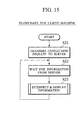
- Fig. 15 is a flow chart showing an exemplary processing operation of a client machine in the stream processing system of Fig. 10.
- Fig. 16 is a flow chart showing a detailed processing of a step S23 of Fig. 15.
- Fig. 17 is a flow chart showing an exemplary processing operation of a user operation processing in the stream processing system of Fig. 10.
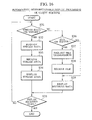
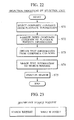
- Fig. 18 is a flow chart showing an exemplary method for playbacking meta information attached to a virtual stream at a client machine in the stream processing system of Fig. 10.
- Fig. 19 is a block diagram showing a schematic configuration of a stream processing device according to the second embodiment of the present invention.
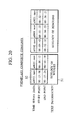
- Fig. 20 is a diagram showing an exemplary composite contents stored in a composite contents storage unit in the stream processing device of Fig. 19.
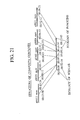
- Fig. 21 is a diagram showing a structure of composite contents used in the stream processing device of Fig. 19.
- Fig. 22 is a flow chart showing an exemplary search (selection) processing of a search unit in the stream processing device of Fig. 19.
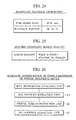
- Fig. 23 is a diagram showing an exemplary search (selection) request used by a search unit in the stream processing device of Fig. 19.
- Fig. 24 is a diagram showing an exemplary audio/visual information used by a search unit in the stream processing device of Fig. 19.
- Fig. 25 is a diagram showing an exemplary merged search (selection) request used by a search unit in the stream processing device of Fig. 19.
- Fig. 26 is a block diagram showing a schematic configuration of a stream processing device according to the third embodiment of the present invention.
- Fig. 27 is a flow chart showing an exemplary processing operation of a meta information attaching unit in the stream processing device of Fig. 27.
- Fig. 28 is a flow chart showing a processing to attach text information to contents related to a contents to be deleted in the stream processing device of Fig. 27.
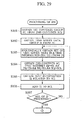
- Fig. 29 is a flow chart showing a detailed processing of a step S94 of Fig. 28.
- Fig. 30 is a diagram showing an exemplary contents that can be used in the stream processing device of Fig. 27.
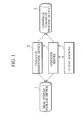
- Fig. 1 shows a schematic configuration of a stream processing system according to the first embodiment of the present invention.
- the stream processing system of Fig. 1 comprises a real stream storage device 1, a contents production device 2, a composite contents storage device 3, a contents server 4, and a client machine 5.
- the real stream storage device 1 stores a real stream which is continuous time series data such as video/audio/music data.
- the contents production device 2 produces composite contents in which a meta information to be described below is attached to a virtual stream obtained by extracting and concatenating one or more partial streams specified by a user from the real stream.
- the produced composite contents are stored in the composite contents storage device 3.
- the contents server 4 takes out the composite contents from the composite contents storage device 3 according to an access request of the client machine 5 and transmits the composite contents to the client machine 5.
- Fig. 2 shows a relationship among a real stream, a partial stream, a virtual stream, and a partial virtual stream.
- the real stream is time series data produced by a digital video camera or the like.
- the partial stream is a stream obtained by extracting a part of the real stream by specifying times.
- the virtual stream is a stream formed by at least one partial stream.
- the virtual stream is a virtual entity which is formed by an identifier for uniquely identifying the virtual stream, and an information regarding partial streams that constitute the virtual stream, i.e., an identifier, a start time information and an end time information of each corresponding real stream, as shown in Fig. 3.
- the identifier of the real stream is a character string that can uniquely identify the real stream.
- the partial virtual stream is a stream obtained by extracting a part of the virtual stream by specifying times. It is possible to attach one or more meta information to the partial virtual stream.
- the meta information is information regarding a corresponding partial virtual stream, which is formed by a title, a text, keywords and link information, for example, as shown in Fig. 4.
- the title indicates an outline of the partial virtual stream.
- the text indicates a content of the partial virtual stream.
- the keywords are information to be used in the case of selecting the partial virtual stream.
- the link information is information indicating links to other meta information related to the meta information.
- Fig. 5 shows a table of meta information to be attached to the partial virtual stream.
- the meta information table comprises a start time and an end time for indicating a specific time interval in the partial virtual stream and a meta information corresponding to that time interval.
- the composite contents are produced by combining the virtual stream information shown in Fig. 3 and the meta information shown in Fig. 5.
- the composite contents are described as shown in Fig. 6 to Fig. 9, for example.
- Another reason is that it becomes easier to provide a plurality of different descriptions with respect to a single real stream in this way.
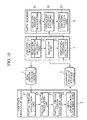
- Fig. 10 shows a detailed configuration of the stream processing system shown in Fig. 1.
- the contents production device 2 has a partial stream extraction unit 11, a virtual stream production unit 12, a partial virtual stream extraction unit 13, and a meta information attaching unit 14.
- the partial stream extraction unit 11 extracts the partial stream of the interval specified by the user from the real stream taken out from the real stream storage device 1.
- Fig. 11 shows a user interface used by the contents production device 2. The user extracts the partial stream by using a display as shown in Fig. 11.
- the virtual stream production unit 12 produces the virtual stream by concatenating one or more partial streams.
- the partial virtual stream extraction unit 13 produces the partial virtual stream by extracting a stream of an interval specified by the user from the produced virtual stream.
- the meta information attaching unit 14 produces the composite contents in which the meta information is attached to the produced partial virtual stream.
- the contents server 4 has a selection information receiving unit 21, a selection unit 22, and a displaying contents output unit 23.
- the selection information receiving unit 21 receives a selection information from the client machine 5.
- the selection unit 22 selects the composite contents stored in the composite contents storage device 3.
- the displaying contents output unit 23 takes out one or more real streams from the real stream storage device 1 according to the composite contents selected by the selection unit 22, and transmits them to the client machine 5 as a continuous stream.
- the client machine 5 has a selection request transmitting unit 31, a displaying contents receiving unit 32, and a displaying contents playback unit 33.
- the selection request transmission unit 31 transmits information regarding contents selected by the user to the contents server 4.
- the displaying contents receiving unit 32 receives the composite contents transmitted from the contents server 4 according to the selection made by the user.
- the displaying contents playback unit 33 playbacks the composite contents received by the displaying contents receiving unit 32.
- Fig. 12 shows an exemplary contents playbacked by the display contents playback unit 33.
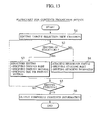
- Fig. 13 shows an exemplary processing operation of the contents production device 2.
- an editing target contents is selected. More specifically, either the existing composite contents is selected or a newly produced composite contents is set as the editing target (Step S1).
- step S2 the user is urged to select either an editing of the structure or an editing of a meta information to be attached (step S2), and if it is the editing of the structure, the user is urged to specify which part of the real stream should be inserted into where (step S3). Also, if it is the editing of the meta information, the user is urged to specify which part of the virtual stream should the meta information be attached, and to enter the meta information to be attached (step S4). If the editing is not finished, the processing returns to the step S2 (step S5), whereas if the editing is finished, the result is outputted as the composite contents (step S6).
- the start time and the end time can be specified on a timeline (time axis), but it is also possible to use any of the following methods for specifying a part of the virtual stream.
- One method is to automatically calculate the end time when the start time is specified by the user, in the case of attaching information that only needs to be displayed for a certain period of time from a certain time, such as an introduction of the casts.
- the end time can be set five seconds after the start time.
- Another method is that, when the start time is specified by the user, a break in the speech since that time, i.e., a time when the volume becomes zero, is detected and that time is set as the end time, in the case of attaching information regarding the audio information of the stream.
- Another method is that, when the start time is specified by the user, a scene change point since that time is detected and that time is set as the end time, in the case of attaching information regarding the video information.
- start time and the end time are set according to an interval during which a telop is displayed and automatically attach information regarding the content of the telop, by utilizing a technology for detecting and recognizing the telop in the video information. It is also possible to set the start time and the end time according to an interval during which a speech is uttered and automatically attach information regarding the content of the speech, by utilizing the speech recognition technology.
- the detection of the scene change point or the telop in the video can be realized by utilizing the existing technology.
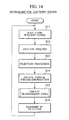
- FIG. 14 shows an exemplary processing operation of the contents server 4.
- step S11 it waits until a request from the client machine 5 comes (step S11), and then analyzes the arrived request (step S12).
- the request from the client machine 5 contains a meta information for selection, that is an information for selecting desired composite contents to be displayed, such as keywords or an identifier, for example.
- a meta information for selection that is an information for selecting desired composite contents to be displayed, such as keywords or an identifier, for example.
- this meta information for selection one or a plurality of the composite contents are selected (step S13), the virtual stream information is obtained from the selected composite contents (step S14), and output contents to be transmitted to the client machine 5 is produced (step S15) and transmitted to the client machine 5 (step S16).
- the composite contents to be displayed first is determined by urging the user to select one by sending a list of the selected composite contents to the client machine 5, or the selected composite contents are arranged in an order according to some criteria such as the number of matching keywords and transmitting the composite contents in this order sequentially to change the displayed composite contents according to an operation request from the client machine 5.
- One method is that in which the selected composite contents, that is the structure information for the virtual contents and the meta information attached to that virtual contents, are directed transmitted, the client machine 5 interprets them and issues commands to the contents server 4 according to the need so as to playback the contents.
- the client machines 5 requests the contents server 4 to concatenate a part of the stream A from the time Ta1 until the time Ta2 and a part of the stream B from the time Tb1 until the time Tb2 and transmit it to the client machine 5.
- Another method is that in which the information is interpreted in advance at the contents server 4 and only the information necessary for the playback is transmitted to the client machine 5.
- the information of Fig. 6 to Fig. 9 is described in a manner that can be interpreted by the client machine 5 and transmitted, and when the stream playback request is received from the client machine 5, a part of the stream A from the time Ta1 until the time Ta2 and a part of the stream B from the time Tb1 until the time Tb2 are concatenated and transmitted to the client machine 5.
- the first method has an advantage in that the display can be controlled by the client machine 5, but the calculation load is exerted on the client machine 5.
- the second method does not exert the calculation load on the client machine 5, but the client machine 5 cannot control the display independently, and the calculation load is exerted on the contents server 4.
- Which method should be used can be determined according to the scale of the system and the calculation powers of the contents server 4 and the client machine 5.
- Fig. 15 shows an exemplary processing operation of the client machine 5.
- an access request is transmitted to the contents server 4 (step S21). Then, it waits until the information comes from the contents server 4 (step S22), and the received information is interpreted and displayed (step S23).
- step S23 the processing of this step S23 is carried out by the procedure shown in Fig. 16. First, whether the received information is a link to a stream on the contents server 4 or not is judged (step S31), and if so, the stream data are requested to the contents server 4 (step S32). Then, the requested stream data are received (step S33) and these data are displayed (step S34).
- step S36 YES If the received information is a link to a file on the contents server 4 (step S36 YES), a file transmission request is made to the contents server 4 (step S37), a file is received (step S38), and a received file is displayed (step S39). If the received information is other than these (step S36 NO), it is displayed as it is (step S39).
- Fig. 17 shows an exemplary processing operation for the user operation processing.
- step S51 When there is a user input from a keyboard, a mouse, a speech input device or the like (step S51), whether it is a request to the contents server 4 such as a selection request or a local processing on the client machine 5 is judged (step S52), and if it is a request to the contents server 4, it is transmitted to the contents server 4 (step S53), whereas if it is a local processing on the client machine 5, that processing is executed (step S54).
- step S52 When there is a user input from a keyboard, a mouse, a speech input device or the like (step S51), whether it is a request to the contents server 4 such as a selection request or a local processing on the client machine 5 is judged (step S52), and if it is a request to the contents server 4, it is transmitted to the contents server 4 (step S53), whereas if it is a local processing on the client machine 5, that processing is executed (step S54).
- the playback position is read out at a prescribed interval (step S61), and whether there is a new attached information at that time or not is judged (step S62). If there is a new attached information, it is notified to the user by a display on a screen or a sound (step S63).
- the notification method using a display on a screen is as follows. From the start time until the end time, a dialogue box is displayed in a pop-up format on the playback screen, and the character string for the title of the meta information is displayed therein.
- the first embodiment is directed to the stream processing system which has: the composite contents production device 2 for producing the composite contents by combining one or a plurality of real streams and attaching the meta information which is capable of expressing the related information in another format such as text; the contents server 4 for selecting the composite contents to be displayed from a plurality of composite contents according to a request from the client machine 5 and transmitting it to the client contents; and the client machine 5 for interpreting the contents information transmitted from the contents server 4 and displaying it to the user, and transmitting a request to the contents server 4 upon receiving an operation request from the user.
- the composite contents production device 2 for producing the composite contents by combining one or a plurality of real streams and attaching the meta information which is capable of expressing the related information in another format such as text
- the contents server 4 for selecting the composite contents to be displayed from a plurality of composite contents according to a request from the client machine 5 and transmitting it to the client contents
- the client machine 5 for interpreting the contents information transmitted from the contents server 4 and displaying it to the user,
- the related information has been described by directly editing the real stream, but in his embodiment, the stream is handled through a file called virtual stream which only has the structure information, so that the time required in proportion to the length of the editing target stream which becomes necessary in order to reconstruct the data as the real stream again by editing the real stream can be shortened, and the storage capacity that becomes necessary in order to store the reconstructed real stream can be reduced.
- the composite contents are produced by describing the meta information with respect to the partial virtual stream, so that the related information can be attached in a form that does not depend on a file format of the real stream, and the time series data in general such as the video data and the various sensor data can be handled similarly.
- the second embodiment is directed to the stream processing system which presents an arbitrary contents to the user, and selects the desired contents of the user according to a selection request given by the user from a plurality of contents that are related to that arbitrary contents.
- the second embodiment is also directed to the stream processing device which is capable of making the selection even when the selection request given by the user is an incomplete one such as one that lacks the subject word or one that uses a demonstrative term, by complementing the incompleteness of the selection request by utilizing information on the contents watched or listened at a time the user made the selection request.
- Fig. 19 shows a schematic configuration of the stream processing device according to the second embodiment of the present invention.
- the stream processing device of Fig. 19 has'a first contents extraction unit 41, a virtual stream production unit 42, a second contents extraction unit 43, a composite contents storage unit 44, a contents output unit 45, a search request receiving unit 46, a search unit 47, a contents server 48, and a client machine 49.
- the first contents extraction unit 41 extracts a first contents which is partitioned by the time information, from the time series data.
- the virtual stream production unit 42 produces a virtual stream that records the access information such that at least one first contents can be playbacked continuously.
- the second contents extraction unit 43 extracts a second contents which is partitioned by the time information, from the virtual stream.
- the composite contents stored in the composite contents storage unit 44 comprise the real stream or the virtual stream and the meta information related to that stream, as described in the first embodiment.
- Fig. 20 shows exemplary composite contents stored in the composite contents storage unit 44.
- Fig. 20 shows an exemplary case that contains two composite contents each of which is formed by the second contents and the meta information. These two contents constitute a single virtual stream.
- the virtual stream it is specified to continuously playback a part from 13 minutes and 6 seconds until 15 minutes and 24 seconds of the real stream a0013.mov, a part from 0 minutes and 12 seconds until 3 minutes and 19 seconds of the real stream a0025.mov, a part from 9 minutes and 43 seconds until 12 minutes and 32 seconds of the real stream a0102.mov, and so on.
- the meta information "ecology of whales” is related to the first section of 5 minutes and 25 seconds duration. Also, the meta information "ecology of penguins” is related to a section from 5 minutes and 25 seconds until 15 minutes and 43 seconds.
- Fig. 21 schematically shows a structure of the composite contents.
- the contents output unit 45 outputs arbitrary composite contents stored in the composite contents storage unit 44 to the client machine 49.
- the composite contents containing the real stream specified by the real stream identifier of the playback information as the first contents are selected (step S71).
- the composite contents are narrowed down to those contained within a range of the playback position information or the timestamps of the first contents, according to the playback position information (step S72).
- step S73 the text (meta) informations corresponding to the narrowed down composite contents are obtained. Then, the obtained text (meta) informations are merged to a search (selection) request (step S74), and the search (Selection) is executed (step S75).
- Fig. 23 shows an exemplary search (selection) request
- Fig. 24 shows an exemplary playback information.
- the composite contents containing the real stream identifier "a0102.mov" of the playback information as the first contents are selected.
- the composite contents which contain the playback position information "10 minutes and 22 seconds" within a range of the playback position information or the timestamps are selected from the composite contents obtained at the step S71.
- the time series data and the time information contained in the first composite contents are matching with the playback information. Consequently, in this case, the meta information "ecology of whales" will be obtained at the step S73.
- the extracted meta information is merged to the search (selection) request.
- this is done by a scheme by which the meta information to be merged is added to an end of the original search (selection) request.
- Fig. 25 shows an exemplary merged search (selection) request.
- the search (selection) processing is executed by using the merged search (selection) request "what is food? ecology of whales".
- this meta information is subjected to the morphemic analysis to extract only the independent words, the TD-IDF weight of each independent word is checked, and only those independent words which have the weight value greater than or equal to a prescribed threshold are added to the selection request.
- the independent words contained in this meta information are “ecology” and "whales”.
- the TD-IDF weights of these independent words are "whales(0.8)” and “ecology(0.2” and the prescribed threshold is 0.5, for example, the "whales” will be added at the step S74.
- a demonstrative term identification knowledge unit and a demonstrative term identification unit are provided at external of the present system, and the merging is executed only in the case where the original selection request has a presupposed demonstrative term.
- the third embodiment is directed to the stream processing system which selects the desired contents of the user according to a selection request given by the user, which is capable of making the selection even when the meta information related to the individual contents is an incomplete one such as one that lacks the subject word or one that uses a demonstrative term, by complementing the incompleteness of the individual contents by utilizing the time information of those contents which have the same time series data as the first time series data.
- Fig. 26 shows a schematic configuration of the stream processing device according to the third embodiment of the present invention.
- the stream processing device of Fig. 26 has a first contents extraction unit 61, a virtual stream production unit 62, a second contents extraction unit 63, and a meta information attaching unit 64.
- the first contents extraction unit 61 extracts a first contents which is partitioned by a prescribed time interval, from the first time series data.
- the virtual stream production unit 62 produces a virtual stream that records the access information such that at least one contents extracted by the first contents extraction unit 61 can be playbacked continuously.
- the second contents extraction unit 63 extracts a second contents which is partitioned by a prescribed time interval, from the virtual stream.
- the meta information attaching unit 64 attaches the meta information related to the contents (SCk) extracted by the second contents extraction unit 63.
- Fig. 27 shows an exemplary processing operation of the meta information attaching unit 64.
- the first contents group (FC) contained in the second contents (SCk) of interest are obtained (step S81).
- the first time series data group (D) are obtained from the first contents group (FC) (step S82).
- step S83 the time information (start point TSi, end point TEi) of a section corresponding to each time series data (Di) among the first time series data group (D) is obtained (step S83).
- step S85 the meta information (Tj) corresponding to the second contents SCj is obtained (step S85). Then, the meta information Tj is attached to the second contents SCk (step S86). Then, the processing of the steps S83 to S86 is repeated until all of the first time series data D are processed (step S87).
- step S84 in addition to checking the data that can time-wise cover the original data, it is also possible to carry out the processing for data that has a partial overlap time-wise or data that is contained in the original data time-wise.
- the meta information attaching unit 64 attaches the text information to the contents related to the contents to be deleted, according to the processing shown in Fig. 28 as follows.
- the first contents group (FC) contained in the second contents (SCk) to be deleted are obtained (step S91).
- the first time series data group (D) is obtained from FC (step S92).
- Fig. 29 is carried out by using each SCi as input (step S94).
- the processing of Fig. 29 is basically the same as that of Fig. 27, except that at the step S104 of Fig. 29, the second contents SCk is excluded from the text to be added.
- the meta information "mammals and fishes living in ocean” is added to the meta information "ecology of whales" of the contents 51.
- a thesaurus is provided at external, and only those words which have a hierarchically higher relationship in the thesaurus with the words in the text related to the original contents of interest among the obtained meta information are added.
- the meta information related to the content of the partial stream is stored in relation to the partial stream, so that it is possible to comprehend the outline of the partial stream by using the meta information, regardless of the file format of the partial stream.
- the stream processing device of each of the above described embodiments can be conveniently implemented in a form of a software package.
- Such a software package can be a computer program product which employs a storage medium including stored computer code which is used to program a computer to perform the disclosed function and process of the present invention.
- the storage medium may include, but is not limited to, any type of conventional floppy disks, optical disks, CD-ROMs, magneto-optical disks, ROMs, RAMs, EPROMs, EEPROMs, magnetic or optical cards, or any other suitable media for storing electronic instructions.
Landscapes
- Engineering & Computer Science (AREA)
- Multimedia (AREA)
- Signal Processing (AREA)
- Databases & Information Systems (AREA)
- Computer Security & Cryptography (AREA)
- Human Computer Interaction (AREA)
- Television Signal Processing For Recording (AREA)
- Information Transfer Between Computers (AREA)
- Indexing, Searching, Synchronizing, And The Amount Of Synchronization Travel Of Record Carriers (AREA)
- Television Systems (AREA)
- Two-Way Televisions, Distribution Of Moving Picture Or The Like (AREA)
Abstract
Description
Claims (17)
- A stream processing system, comprising:a partial stream extraction unit configured to extract a stream partitioned by a prescribed time interval as a partial stream, from one or more real streams formed by continuous time series data, according to playback position information or timestamps of the real streams; anda meta information storing unit configured to store a meta information related to a content of the partial stream, in relation to the partial stream.
- The stream processing system of claim 1, further comprising:a selection request receiving unit configured to receive a selection request formed by a selection meta information;a selection unit configured to select corresponding partial streams by using the meta information according to the selection request; anda stream output unit configured to output the corresponding partial streams selected by the selection unit to a client that made the selection request.
- The stream processing system of claim 2, wherein the partial stream extraction unit, the meta information storage unit, the selection request receiving unit, the selection unit, and the stream output unit constitute a contents server for recording at least one real stream formed by continuous time series data and output at least a part of the real stream; and
the stream processing system further comprises a client device configured to receive output of the contents server, the client device having:a selection request transmission unit configured to transmit the selection request to the contents server;a receiving unit configured to receive the corresponding partial streams in response to the selection request; anda playback unit configured to playback the corresponding partial streams received by the receiving unit. - The stream processing system according to any preceding claim, wherein each one of the meta information and the selection meta information is formed by at least one of text information, visual information, audio information, and link information on links to other contents or streams.
- A stream processing system, comprising:a partial stream extraction unit configured to extract a stream partitioned by a prescribed time interval as a partial stream, from one or more real streams formed by continuous time series data, according to playback position information or timestamps of the real streams;a virtual stream production unit configured to produce a virtual stream by concatenating one or more partial streams extracted by the partial stream extraction unit so as to enable a continuous playback;a partial virtual stream extraction unit configured to extract a stream partitioned by another prescribed time interval as a partial virtual stream, from the virtual stream, according to playback position information or timestamps of the virtual stream; anda meta information storing unit configured to store a meta information related to a content of the partial virtual stream, in relation to the partial virtual stream.
- The stream processing system of claim 5, wherein the virtual stream production unit produces the virtual stream formed by an identifier for uniquely identifying the virtual stream, and a set of an identifier, a start time, and an end time of each real stream corresponding to each partial stream that constitutes the virtual stream.
- The stream processing system of claim 5, further comprising:a selection request receiving unit configured to receive a selection request formed by a selection meta information;a selection unit configured to select corresponding partial virtual streams by using the meta information according to the selection request; anda stream output unit configured to output the corresponding partial virtual streams selected by the selection unit to a client that made the selection request.
- The stream processing system of claim 7, wherein the partial stream extraction unit, the virtual stream production unit, the partial virtual stream extraction unit, the meta information storage unit, the selection request receiving unit, the selection unit, and the stream output unit constitute a contents server for recording at least one real stream formed by continuous time series data and output at least a part of the real stream; and
the stream processing system further comprises a client device configured to receive output of the contents server, the client device having:a selection request transmission unit configured to transmit the selection request to the contents server;a receiving unit configured to receive the corresponding partial virtual streams in response to the selection request; anda playback unit configured to playback the corresponding partial virtual streams received by the receiving unit. - The stream processing system of claim 7, further comprising:wherein the selection unit selects the partial virtual stream according to the thesaurus stored in the thesaurus storage unit.a thesaurus storage unit configured to sore a thesaurus describing hierarchically higher/lower relationships among a plurality of meta information stored in the meta information storage unit;
- The stream processing system of claim 5, wherein each one of the meta information and the selection meta information is formed by at least one of text information, visual information, audio information, and link information on links to other contents or streams.
- The stream processing system of claim 5, wherein the meta information storage unit stores the meta information in relation to the partial virtual stream according to a prescribed unit time.
- The stream processing system of claim 5, wherein the partial virtual stream extraction unit extracts the partial virtual stream according to a scene change point in the virtual stream.
- The stream processing system of claim 5, wherein the partial virtual stream extraction unit extracts the partial virtual stream according to an input level variation amount of speech data in the virtual stream.
- The stream processing system of claim 5, further comprising:wherein the meta information storage unit stores the meta information which is based on the telop detected/recognized by the telop detection/recognition unit.a telop detection/recognition unit configured to detect/recognize a telop in video data in the virtual stream;
- The stream processing system of claim 5, further comprising:wherein the meta information storage unit stores the meta information which is based on the speech data recognized by the speech recognition unit.a speech recognition unit configured to carry out a speech recognition of speech data in the virtual stream;
- A computer program product for causing a computer to function as a stream processing system, the computer program product comprising:a first computer program code for causing the computer to extract a stream partitioned by a prescribed time interval as a partial stream, from one or more real streams formed by continuous time series data, according to playback position information or timestamps of the real streams;a second computer program code for causing the computer to store a meta information related to a content of the partial stream, in relation to the partial stream;a third computer program code for causing the computer to receive a selection request formed by a selection meta information;a fourth computer program code for causing the computer to select corresponding partial streams by using the meta information according to the selection request; anda fifth computer program code for causing the computer to output the corresponding partial streams selected by the fourth computer program code to a client that made the selection request.
- A computer program product for causing a computer to function as a stream processing system, the computer program product comprising:a first computer program code for causing the computer to extract a stream partitioned by a prescribed time interval as a partial stream, from one or more real streams formed by continuous time series data, according to playback position information or timestamps of the real streams;a second computer program code for causing the computer to produce a virtual stream by concatenating one or more partial streams extracted by the first computer program code so as to enable a continuous playback;a third computer program code for causing the computer to extract a stream partitioned by another prescribed time interval as a partial virtual stream, from the virtual stream, according to playback position information or timestamps of the virtual stream; anda fourth computer program code for causing the computer to store a meta information related to a content of the partial virtual stream, in relation to the partial virtual stream.
Applications Claiming Priority (2)
| Application Number | Priority Date | Filing Date | Title |
|---|---|---|---|
| JP2002053701 | 2002-02-28 | ||
| JP2002053701A JP2003259316A (en) | 2002-02-28 | 2002-02-28 | Stream processing system and stream processing program |
Publications (2)
| Publication Number | Publication Date |
|---|---|
| EP1351505A2 true EP1351505A2 (en) | 2003-10-08 |
| EP1351505A3 EP1351505A3 (en) | 2006-01-18 |
Family
ID=27750930
Family Applications (1)
| Application Number | Title | Priority Date | Filing Date |
|---|---|---|---|
| EP03251248A Withdrawn EP1351505A3 (en) | 2002-02-28 | 2003-02-28 | Stream processing system with function for selectively playbacking arbitrary part of ream stream |
Country Status (3)
| Country | Link |
|---|---|
| US (1) | US7389035B2 (en) |
| EP (1) | EP1351505A3 (en) |
| JP (1) | JP2003259316A (en) |
Families Citing this family (17)
| Publication number | Priority date | Publication date | Assignee | Title |
|---|---|---|---|---|
| FR2811848A1 (en) * | 2000-07-13 | 2002-01-18 | Thomson Multimedia Sa | SYSTEM, METHOD AND DEVICE FOR TIMING AND VERIFYING HORODATE VALIDITY IN A DIGITAL BROADCASTING ENVIRONMENT |
| JP2005149029A (en) | 2003-11-13 | 2005-06-09 | Matsushita Electric Ind Co Ltd | Content distribution system, content server, content receiving apparatus, content distribution method, program, and recording medium |
| EP1744556A4 (en) * | 2004-03-29 | 2012-10-24 | Panasonic Corp | ACCUMULATION DISPLAY DEVICE, LOCKED DISPLAY PROCESS AND SYSTEM |
| JP4251634B2 (en) * | 2004-06-30 | 2009-04-08 | 株式会社東芝 | Multimedia data reproducing apparatus and multimedia data reproducing method |
| JP2007065928A (en) * | 2005-08-30 | 2007-03-15 | Toshiba Corp | Information storage medium, information processing method, information transfer method, information reproduction method, information reproduction device, information recording method, information recording device, and program |
| US20070005588A1 (en) * | 2005-07-01 | 2007-01-04 | Microsoft Corporation | Determining relevance using queries as surrogate content |
| US9251852B2 (en) | 2006-07-20 | 2016-02-02 | Panopto, Inc. | Systems and methods for generation of composite video |
| JP2008166988A (en) * | 2006-12-27 | 2008-07-17 | Sony Corp | Information processing apparatus and method, and program |
| US20090204656A1 (en) * | 2008-02-13 | 2009-08-13 | Infineon Technologies Ag | Pseudo random number generator and method for generating a pseudo random number bit sequence |
| US20110158605A1 (en) * | 2009-12-18 | 2011-06-30 | Bliss John Stuart | Method and system for associating an object to a moment in time in a digital video |
| WO2012142323A1 (en) | 2011-04-12 | 2012-10-18 | Captimo, Inc. | Method and system for gesture based searching |
| US20110176788A1 (en) * | 2009-12-18 | 2011-07-21 | Bliss John Stuart | Method and System for Associating an Object to a Moment in Time in a Digital Video |
| JP5912644B2 (en) * | 2012-02-21 | 2016-04-27 | 株式会社ビジネス・ブレークスルー | Creation, use and sales method of electronic information content system, electronic information processing program, and electronic information processing apparatus |
| US9756400B1 (en) * | 2012-03-19 | 2017-09-05 | Google Inc. | Remixing content received by a set-top box |
| US9893999B2 (en) * | 2013-11-26 | 2018-02-13 | Macom Connectivity Solutions, Llc | Multiple datastreams processing by fragment-based timeslicing |
| US9489387B2 (en) | 2014-01-15 | 2016-11-08 | Avigilon Corporation | Storage management of data streamed from a video source device |
| US10567765B2 (en) | 2014-01-15 | 2020-02-18 | Avigilon Corporation | Streaming multiple encodings with virtual stream identifiers |
Family Cites Families (9)
| Publication number | Priority date | Publication date | Assignee | Title |
|---|---|---|---|---|
| JPH05282379A (en) | 1992-02-06 | 1993-10-29 | Internatl Business Mach Corp <Ibm> | Method and device for retrieval of dynamic image |
| US5787414A (en) * | 1993-06-03 | 1998-07-28 | Kabushiki Kaisha Toshiba | Data retrieval system using secondary information of primary data to be retrieved as retrieval key |
| US5614940A (en) * | 1994-10-21 | 1997-03-25 | Intel Corporation | Method and apparatus for providing broadcast information with indexing |
| US5918222A (en) * | 1995-03-17 | 1999-06-29 | Kabushiki Kaisha Toshiba | Information disclosing apparatus and multi-modal information input/output system |
| JP3250509B2 (en) | 1998-01-08 | 2002-01-28 | 日本電気株式会社 | Method and apparatus for viewing broadcast program |
| US6408128B1 (en) * | 1998-11-12 | 2002-06-18 | Max Abecassis | Replaying with supplementary information a segment of a video |
| KR100296967B1 (en) | 1999-01-30 | 2001-09-26 | 구자홍 | Method for representing multi-level digest segment information in order to provide efficient multi-level digest streams of a multimedia stream and digest stream browsing/recording/editing system using multi-level digest segment information scheme. |
| US8006261B1 (en) | 2000-04-07 | 2011-08-23 | Visible World, Inc. | System and method for personalized message creation and delivery |
| EP1410637A2 (en) | 2000-07-27 | 2004-04-21 | Koninklijke Philips Electronics N.V. | Transcript triggers for video enhancement |
-
2002
- 2002-02-28 JP JP2002053701A patent/JP2003259316A/en active Pending
-
2003
- 2003-02-27 US US10/373,705 patent/US7389035B2/en not_active Expired - Fee Related
- 2003-02-28 EP EP03251248A patent/EP1351505A3/en not_active Withdrawn
Also Published As
| Publication number | Publication date |
|---|---|
| US7389035B2 (en) | 2008-06-17 |
| US20030161610A1 (en) | 2003-08-28 |
| EP1351505A3 (en) | 2006-01-18 |
| JP2003259316A (en) | 2003-09-12 |
Similar Documents
| Publication | Publication Date | Title |
|---|---|---|
| US7389035B2 (en) | Stream processing system with function for selectively playbacking arbitrary part of ream stream | |
| US10645161B2 (en) | Communication system and its method and communication apparatus and its method | |
| US9812023B2 (en) | Audible metadata | |
| US6512722B2 (en) | Recording and playback apparatus and method, terminal device, transmitting/receiving method, and storage medium | |
| US6594740B1 (en) | Recording/reproducing device and recording/reproducing method | |
| US7650563B2 (en) | Aggregating metadata for media content from multiple devices | |
| US8463842B2 (en) | Content acquisition apparatus, content acquisition method and content acquisition program | |
| US20070265720A1 (en) | Content marking method, content playback apparatus, content playback method, and storage medium | |
| KR100478934B1 (en) | Apparatus and method of object-based MPEG-4 content editing and authoring and retrieval | |
| KR101090388B1 (en) | Method for navigation within a set of audio documents by means of a graphic interface and receiver for navigation by said method | |
| US20070009234A1 (en) | Using content identifiers to download cd-cover pictures to present audio content items | |
| US20070070218A1 (en) | Storage system for retaining identification data to allow retrieval of media content | |
| KR20050057112A (en) | Information processing device and program | |
| KR101102823B1 (en) | Situation Reasoning Based on the Mood Case-based Music Recommendation System and Its Method | |
| US20090132510A1 (en) | Device for enabling to represent content items through meta summary data, and method thereof | |
| JP2006252734A (en) | Information processing apparatus, information recording / reproducing system, and content transfer method | |
| US20100120531A1 (en) | Audio content management for video game systems | |
| KR20120022838A (en) | Information processing device, communication control method, and communication control program | |
| KR20180063814A (en) | Apparatus and method for providing metadata using auditory means |
Legal Events
| Date | Code | Title | Description |
|---|---|---|---|
| PUAI | Public reference made under article 153(3) epc to a published international application that has entered the european phase |
Free format text: ORIGINAL CODE: 0009012 |
|
| 17P | Request for examination filed |
Effective date: 20030310 |
|
| AK | Designated contracting states |
Kind code of ref document: A2 Designated state(s): AT BE BG CH CY CZ DE DK EE ES FI FR GB GR HU IE IT LI LU MC NL PT SE SI SK TR |
|
| AX | Request for extension of the european patent |
Extension state: AL LT LV MK RO |
|
| PUAL | Search report despatched |
Free format text: ORIGINAL CODE: 0009013 |
|
| AK | Designated contracting states |
Kind code of ref document: A3 Designated state(s): AT BE BG CH CY CZ DE DK EE ES FI FR GB GR HU IE IT LI LU MC NL PT SE SI SK TR |
|
| AX | Request for extension of the european patent |
Extension state: AL LT LV MK RO |
|
| RIC1 | Information provided on ipc code assigned before grant |
Ipc: H04N 7/173 20060101ALI20051201BHEP Ipc: H04N 7/24 20060101AFI20030805BHEP |
|
| AKX | Designation fees paid |
Designated state(s): DE FR GB |
|
| STAA | Information on the status of an ep patent application or granted ep patent |
Free format text: STATUS: THE APPLICATION IS DEEMED TO BE WITHDRAWN |
|
| 18D | Application deemed to be withdrawn |
Effective date: 20090901 |