EP1350845A1 - Molecule correspondent to genotype and phenotype, composing elements thereof, method of producing the corespondent molecule and method of using the same - Google Patents
Molecule correspondent to genotype and phenotype, composing elements thereof, method of producing the corespondent molecule and method of using the same Download PDFInfo
- Publication number
- EP1350845A1 EP1350845A1 EP01270605A EP01270605A EP1350845A1 EP 1350845 A1 EP1350845 A1 EP 1350845A1 EP 01270605 A EP01270605 A EP 01270605A EP 01270605 A EP01270605 A EP 01270605A EP 1350845 A1 EP1350845 A1 EP 1350845A1
- Authority
- EP
- European Patent Office
- Prior art keywords
- molecule
- region
- sequence
- genotype
- peg
- Prior art date
- Legal status (The legal status is an assumption and is not a legal conclusion. Google has not performed a legal analysis and makes no representation as to the accuracy of the status listed.)
- Withdrawn
Links
Images





Classifications
-
- C—CHEMISTRY; METALLURGY
- C12—BIOCHEMISTRY; BEER; SPIRITS; WINE; VINEGAR; MICROBIOLOGY; ENZYMOLOGY; MUTATION OR GENETIC ENGINEERING
- C12N—MICROORGANISMS OR ENZYMES; COMPOSITIONS THEREOF; PROPAGATING, PRESERVING, OR MAINTAINING MICROORGANISMS; MUTATION OR GENETIC ENGINEERING; CULTURE MEDIA
- C12N15/00—Mutation or genetic engineering; DNA or RNA concerning genetic engineering, vectors, e.g. plasmids, or their isolation, preparation or purification; Use of hosts therefor
- C12N15/09—Recombinant DNA-technology
- C12N15/10—Processes for the isolation, preparation or purification of DNA or RNA
- C12N15/1034—Isolating an individual clone by screening libraries
- C12N15/1062—Isolating an individual clone by screening libraries mRNA-Display, e.g. polypeptide and encoding template are connected covalently
Definitions
- the evolutionary molecular engineering also enables detection of intermolecular interactions and analysis of the networks thereof by centering functions, and in particular, it is expected to be applied to functional analyses of genomes, which are increasingly becoming important in recent years (Miyamoto, E. & Yanagawa, H. (2000) Series Post-Sequence Genomic Science 3: Proteomics, pp.136-156; Miyamoto, E. & Yanagawa, H. (2001) Tanpakushitsu Kakusan Koso, 46(1), pp.1-10).
- the evolutionary molecular engineering and post-genome functional analyses of proteins can of course be applied to biotechnology such as utilization of biochips, biosensors and enzymes as industrial catalysts by modification of functional biopolymers and creation of biopolymers having functions which cannot be found in living organisms, and it can also be utilized in many industrial areas such as medicine, food, energy and environment including preparation of drugs by discovery of important bioenzymes etc. based on analysis of networks of interactions between proteins.
- the evolutionary molecular engineering is a science aiming at constructing a system that progressively evolves by repetition of three unit operations, "mutation”, “selection” and “amplification” utilizing the Darwin's evolution mechanism and applying the system in engineering.
- the evolutionary molecular engineering was theoretically proposed by Eigen et al. in 1984, and it is new biotechnology molecular design of functional biopolymers is performed by in vitro high-speed molecular evolution, that is, by investigating mechanisms of adaptive locomotion of biopolymers in a sequence space and optimizing them in laboratory experiments (Fushimi J. (1991) Kagaku, 61, 333-340; Fushimi J. (1992) Koza Shinka, vol. 6, University of Tokyo Press).
- the sequence space size that is, size of a library, searchable in the evolutionary molecular engineering and post-genome functional analysis is important.
- the size of a library using is limited by a host cell when existing virus is utilized as in the case of phage display, since the virus parasites a cell.
- the virus-type assigning molecules can be constructed in vitro in the aforementioned in vitro virus method (Nemoto, N., Miyamoto-Sato, E., Yanagawa, H. (1997) FEBS Lett., 414, 405; Yanagawa, H., Nemoto N. & Miyamoto E.
- RNA-peptide fusion method (Roberts, R.W., Szostak, J.W. (1997) Proc. Natl. Acad. Sci. USA, 94, 12297) and so forth, these methods are theoretically expected as global searching methods for a sequence space comparable with the ribozyme-type technique. Further, in the evolutionary molecular engineering, not only the size of searchable sequence space, but also its diversity is important.
- the polysome display method Moattheakis, L.C. & Dower, W.J.
- a large-scale library can be constructed by using virus-type assigning molecules in vitro as in the in vitro virus method, RNA-peptide fusion method and so forth.
- the virus-type assigning molecules are constructed by bonding a spacer containing puromycin to a nucleic acid sequence containing protein information using a certain method to construct a genotype molecule and ligating it to a phenotype molecule (protein) on ribosome in a cell-free translation system.
- the spacer binding efficiency determines the size of library.
- a genotype molecule to which a spacer is not bonded that is, a genotype molecule without puromycin
- the spacer binding efficiency determines the size of library.
- a sprint and DNA ligase are used to ligate a DNA spacer.
- 1 random residue that does not exist in a template may be often added to the 3'-terminal end of the genotype molecule at the time of transcription.
- the sequence of the molecule does not match the sprint sequence, and hence ligation efficiency becomes poor. Accordingly, the sprint is modified, but much labor and cost are required.
- RNA ligase is used to ligate a DNA spacer. Since RNA ligase does not require a sprint, it has no such a problem as that of the DNA ligase. However, it is known that RNA ligase originally has lower enzymatic activity compared with DNA ligase, and its ligation efficiency is also poor.
- the usable cell-free translation system is limited to a rabbit reticulocyte cell-free translation system.
- the virus-type assigning molecule construction efficiency in the rabbit reticulocyte cell-free translation system has remained as low as only 1% or lower (Roberts, R.W. & Szostak, J.W. (1997) Proc. Natl. Acad. Sci. USA, 94, 12297) or 10% or lower (Nemoto, N., Miyamoto-Sato, E., Yanagawa, H. (1997) FEBS Lett., 414, 405) of mRNA templates (genotype molecule) added to the cell-free translation system.
- mRNA stability is favorable, and hence mRNA with a long chain can be handled. Therefore, it is desirable that a virus-type assigning molecule can be constructed on ribosome in the wheat germ cell-free translation system, but this has not been realized so far.
- An object of the present invention is to improve the scale and diversity of a library, which are important in the evolutionary molecular engineering and post-genome functional analysis, and to improve efficiency of construction of assigning molecules in order to achieve the above object. Further, another object of the present invention is to achieve higher efficiency and simplification of each step of ligation and assigning translation. Further, another object of the present invention is to construct a virus-type assigning molecule in a wheat germ cell-free translation system to enable mass synthesis and handling of long genotype molecules, which are advantages of use of wheat germ, and thereby establish a foundation for constructing a large library with high diversity in both of the evolutionary molecular engineering and genome functional analysis.
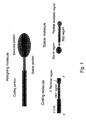
- the inventors of the present invention earnestly conducted investigations to achieve the aforementioned objects. As a result, they found that the construction of the assigning molecule, which had been limited to the rabbit reticulocyte cell-free translation system so far, could be realized in the wheat germ cell-free translation system, the construction efficiency of the assigning molecules was improved, and a large-scale library with high diversity could be realized by improving a spacer containing puromycin (referred to as “spacer portion” hereinafter) and a nucleotide sequence containing protein information (referred to as "coding portion” hereinafter) in such an assigning molecule as shown in Fig. 1.
- spacer portion puromycin
- coding portion nucleotide sequence containing protein information
- ribosome 1 used herein means an assigning molecule constructed by bonding a spacer portion containing puromycin to a coding portion by a certain method to obtain a genotype molecule and ligating it to a phenotype molecule (referred to as "decoded portion” hereinafter) on a ribosome in a cell-free translation system.
- the present invention provides the followings.
- the term "assigning molecule” means a molecule that assigns a genotype to a phenotype.
- the assigning molecule is constructed by bonding a genotype molecule comprising nucleic acid having a nucleotide sequence that reflects a genotype, to a phenotype molecule comprising a protein involved in expression of a phenotype.
- the genotype molecule is constructed by bonding a coding molecule that has the nucleotide sequence reflecting a genotype in such a form that the nucleotide sequence can be translated, to a spacer portion.
- a portion derived from the phenotype molecule, a portion derived from the spacer molecule and a portion derived from the coding molecule in the assigning molecule are referred to as a decoded portion, a spacer portion and a coding portion, respectively. Further, a portion derived from the spacer molecule and a portion derived from the coding molecule in the genotype molecule are referred to as a spacer portion and a coding portion, respectively.
- FIG. 1 shows schematic constitutions of exemplary assigning molecule, spacer molecule and coding molecule of the present invention.
- This assigning molecule comprises a spacer containing puromycin (referred to as “spacer portion”) and a nucleotide sequence reflecting codes of a phenotype (referred to as "coding portion").
- This assigning molecule is constructed by bonding the spacer portion containing puromycin to the coding molecule by a certain method to obtain a genotype molecule, and ligating the genotype molecule to a phenotype molecule on a ribosome in a cell-free translation system.
- the spacer molecule comprises a PEG region containing polyethylene glycol as a main component; a CCA region containing at least puromycin, or puromycin and DNA and/or RNA 1 or more residues; a donor region containing DNA and/or RNA of at least 1 residue; and further a function-imparting unit (X) comprising functionally modified DNA and/or RNA of at least 1 residue.
- the coding molecule comprises a 3'-terminal region that contains a polyA sequence of DNA and/or RNA comprising a sequence of a part of a decoded portion; 5' UTR that comprises DNA and/or RNA and contains a transcription promoter and a translation enhancer; and further an ORF region mainly comprising the sequence of the phenotype molecule.
- the spacer molecule of the present invention comprises a donor region that can be bonded to a 3'-terminal end of nucleic acid, a PEG region that is bonded to the donor region and comprises polyethylene glycol as a main component, and a peptide acceptor region that is bonded to the PEG region and comprises a group that can be bonded to a peptide by transpeptidation.
- the donor region that can be bonded to the 3'-terminal end of nucleic acid usually comprises 1 or more nucleotides.
- the number of nucleotides is usually 1 to 15, preferably 1 to 2.
- the nucleotides may be ribonucleotides or deoxyribonucleotides.
- the sequence of the 5'-terminal end of the donor region determines ligation efficiency.
- at least 1 or more residues need to be contained.
- at least 1 residue of dC (deoxycytidylic acid) or 2 residues of dCdC (dideoxycytidylic acid) are preferred.
- the type of the nucleotide is more preferred in the order of C > U or T > G > A.
- the PEG region comprises polyethylene glycol as a main component.
- the expression "comprising as a main component” used herein means that the total number of nucleotides contained in the PEG region is 20 bp or less, or the average molecular weight of polyethylene glycol is 400 or more. Preferably, it means that the total number of nucleotides is 10 bp or less, or the average molecular weight of polyethylene glycol is 1000 or more.
- the average molecular weight of polyethylene glycol in the PEG region is usually 400 to 30,000, preferably 1,000 to 10,000, more preferably 2,000 to 8,000.
- a post-assigning translation treatment may be needed after the assigning translation of the genotype molecule containing a spacer portion derived from such a spacer molecule (Liu, R., Barrick, E., Szostak, J. W., Roberts, R. W. (2000) Methods in Enzymology, 318, 268-293).
- the peptide acceptor region is not particularly limited so long as it can be bonded to the C-terminal of a peptide.
- puromycin, 3'-N-aminoacylpuromycin aminonucleoside (PANS-amino acid) such as PANS-Gly of which amino acid portion is glycine, PANS-Val of which amino acid portion is valine and PANS-Ala of which amino acid portion is alanine and PANS-total amino acids of which amino acid portion corresponds to the total amino acids can be utilized.
- 3'-N-aminoacyladenosine aminonucleoside (AANS-amino acid) bonded with an amide bond formed as a result of condensation of an amino group of 3'-aminoadenosine and a carboxyl group of an amino acid as a chemical bond such as AANS-Gly of which amino acid portion is glycine, AANS-Val of which amino acid portion is valine and AANS-Ala of which amino acid portion is alanine and AANS-total amino acids of which amino acid portion corresponds to the total amino acids can be utilized.
- nucleoside, a bonding product of nucleoside and amino acid via an ester bond or the like can be utilized.
- any substance having a bonding scheme that can chemically bond a nucleoside or a substance having a chemical structure similar to that of nucleoside and an amino acid or a substance having a chemical structure similar to that of amino acid can be utilized.
- the peptide acceptor region preferably comprises puromycin or a derivative thereof, or puromycin or a derivative thereof and 1 or 2 residues of deoxyribonucleotides or ribonucleotides.
- derivative used herein means a derivative that can be bonded to the C-terminal of peptide in a protein translation system.
- the puromycin derivatives are not limited to those having a complete puromycin structure, and include those lacking a part of the puromycin structure. Specific examples of the puromycin derivatives include PANS-amino acid, AANS-amino acid and so forth.
- the peptide acceptor region is constituted by puromycin alone, it preferably has a nucleotide sequence comprising 1 or more residues of DNA and/or RNA on the 5'-terminal side.
- the sequences include dC-puromycin and rC-puromycin, and dCdC-puromycin, rCrC-puromycin, rCdC-puromycin, dCrC-puromycin and so forth are more preferred.
- the CCA sequences that imitate the 3'-terminal end of aminoacyl-tRNA Philipps, G. R. (1969) Nature, 223, 374-377) are suitable.
- the type of nucleotide is more preferred in the order of C > U or T > G > A.
- the spacer molecule preferably contains at least one function-imparting unit between the donor region and the PEG region.
- the function-imparting unit preferably comprises at least 1 residue of functionally modified deoxyribonucleotide or ribonucleotide.
- a functionally modified substance those having various separation tags such as a fluorescent substance, biotin or His-tag shown in Fig. 2 introduced can be used.
- Fig. 2 shows a detailed constitution of an exemplary spacer molecule.
- the spacer molecule comprises a PEG region containing polyethylene glycol as a main component; a CCA region comprising puromycin or puromycin and DNA and/or RNA of at least 1 residue; a donor region containing DNA and/or RNA of at least 1 or more residues; and further a function-imparting unit (X) comprising DNA and/or RNA of which at least 1 residue of nucleotide is functionally modified.
- a fluorescent substance T(F1) and biotin T(Bio) are used as the function-imparting unit (X).
- the coding molecule of the present invention is a nucleic acid comprising a 5' untranslated region comprising a transcription promoter and a translation enhancer; an ORF region that is bonded to the 3'-terminal side of the 5' untranslated region and encodes a protein; and a 3'-terminal region that is bonded to the 3'-terminal side of the ORF region and contains a polyA sequence and a sequence which a restriction enzyme Xho I recognizes on the 5'-terminal side of the polyA sequence.
- the coding molecule may be DNA or RNA. In the case of RNA, the 5'-terminal end may have a Cap structure or not. Further, the coding molecule may be incorporated in an arbitrary vector or plasmid.
- the 3'-terminal region contains the XhoI sequence and a polyA sequence downstream therefrom.
- the polyA sequence in the 3'-terminal region is important.
- the polyA sequence is a polyA continuous chain comprising at least 2 or more residues of a mixture of dA and rA or either thereof, preferably a polyA continuous chain of 3 or more residues, more preferably 6 or more residues, further preferably 8 or more residues.
- the 5' UTR comprising a transcription promoter and a translation enhancer and the 3'-terminal region containing a polyA sequence.
- the effect of the polyA sequence in the 3'-terminal region is usually exhibited when it comprises 10 or less residues.
- the transcription promoter of the 5' UTR is not particularly limited, and T7/T3, SP6 or the like can be used. SP6 can be preferably used, and when the omega sequence or a sequence containing a part of the omega sequence is used as a translation enhancer sequence, in particular, SP6 is particularly preferred.
- the translation enhancer is preferably a part of the omega sequence.
- As the part of the omega sequence a part of the TMV omega sequence (O29; Gallie D.R. & Walbot V. (1992) Nucleic Acids Res., 20, 4631-4638) is preferred.
- a combination of the XhoI sequence and the polyA sequence is important in the 3'-terminal region. Further, a combination of a sequence having an affinity tag in a portion downstream from the ORF region, i.e., upstream of the Xho I sequence, and the polyA sequence is also important.
- the affinity tagged sequence is not particularly limited so long as it is a sequence for using any means that can detect a protein such as an antigen-antibody reaction.
- a Flag-tag sequence which is a tag for affinity separation/analysis based on an antigen-antibody reaction, is preferred.
- the translation efficiency of an affinity tag such as a Flag tag having the Xho I sequence bonded thereto and further bonded with a polyA sequence is improved.
- the structure effective for the translation efficiency is also effective for the assigning efficiency.
- the ORF region may be any sequence comprising DNA and/or RNA.
- the sequence is not limited, and it may be a gene sequence, exon sequence, intron sequence or random sequence, or it can be any sequence in the natural world or any artificial sequence.
- SP6 + O29 are used as the 5' UTR of the coding molecule
- the coding molecule of the present invention having the 5' UTR and the 3'-terminal region can be readily constructed by PCR using any vector, plasmid or cDNA library.
- translation may be carried out exceeding the ORF region. That is, a termination codon does not need to exist at the end of the ORF region.
- Fig. 3 shows a detailed constitution of an exemplary coding molecule.
- the coding molecule comprises the 3'-terminal region; 5' UTR containing a transcription promoter and a translation enhancer comprising DNA and/or RNA; and an ORF region comprising a sequence information of a decoded portion, that is, encoding a phenotype protein.
- the 3'-terminal region contains an affinity tag sequence comprising DNA or RNA, Xho I sequence and polyA sequence, and a Flag-tag sequence is used.
- As the 5' UTR a sequence containing SP6 as a transcription promoter and O29, which is a part of the omega sequence, as a translation enhancer is used.
- Genotype molecule of the present invention and method for constructing the same
- the genotype molecule of the present invention is constructed by bonding the 3'-terminal end of a coding molecule, which is a nucleic acid comprising a 5' untranslated region comprising a transcription promoter and a translation enhancer; an ORF region that is bonded to the 3'-terminal side of the 5' untranslated region and encodes a protein; and a 3'-terminal region that is bonded to the 3'-terminal side of the ORF region and comprises the polyA sequence, to a donor region of the spacer molecule of the present invention.
- a coding molecule which is a nucleic acid comprising a 5' untranslated region comprising a transcription promoter and a translation enhancer
- an ORF region that is bonded to the 3'-terminal side of the 5' untranslated region and encodes a protein
- a 3'-terminal region that is bonded to the 3'-terminal side of the ORF region and comprises the polyA sequence, to a donor region of the space
- the coding molecule constituting the genotype molecule of the present invention is the same as described above about the coding molecule of the present invention except that the Xho I sequence is not essential in the aforementioned coding molecule of the present invention. However, it preferably to have the Xho I sequence.
- the genotype molecule of the present invention can be constructed by bonding the 3'-terminal end of the aforementioned coding molecule and the donor region of the spacer molecule by an ordinary ligase reaction.
- the reaction conditions conditions of 4 to 25°C and 4 to 48 hours can be mentioned. If polyethylene glycol having the same molecular weight as that of polyethylene glycol in the PEG region of the spacer molecule containing the PEG region is added to a reaction system, the reaction time can be reduced to 0.5 to 4 hours at 15°C.
- the combination of the spacer molecule and the coding molecule has an important effect on. ligation efficiency.
- the 3'-terminal region of the coding portion which corresponds to an acceptor, preferably contains at least 2 or more residues, preferably 3 or more residues, more preferably 6 to 8 or more residues of the polyA sequence of DNA or RNA. Further, as the translation enhancer of 5' UTR, a partial sequence of the omega sequence (O29, Fig. 3) is preferred.
- dC (deoxycytidylic acid) of at least 1 residue or dCdC (dideoxycytidylic acid) of 2 residues is preferred. This makes it possible to use RNA ligase to avoid the problems of DNA ligase and maintain 60 to 80% of the efficiency.
- the genotype molecule is RNA
- ligation efficiency can be improved to 80 to 90% or more irrespective of the molecular weight of polyethylene glycol in the spacer portion, and the separation process after the reaction can be omitted.
- the assigning molecule of the present invention is constructed by ligating the aforementioned genotype molecule of the present invention to a phenotype molecule which is a protein encoded by the ORF region in the genotype molecule, by transpeptidation.
- the assigning molecule of the present invention is also constructed by translating the genotype molecule of the present invention in a cell-free translation system to ligate it to a phenotype molecule which is a protein encoded by the ORF region in the genotype molecule, by transpeptidation.
- the cell-free translation system is preferably of wheat germ or rabbit reticulocyte.
- the translation conditions may be usually adopted conditions. For example, conditions of 25 to 37°C and 15 to 240 minutes can be mentioned.
- the construction of the assigning molecules was examined in systems of Escherichia coli ( E. coli ), rabbit reticulocyte and wheat germ so far, and the assigning molecules were confirmed only in the rabbit reticulocyte system (Nemoto, N., Miyamoto-Sato, E., Yanagawa, H. (1997) FEBS Lett., 414, 405; Roberts, R.W., Szostak, J.W. (1997) Proc. Natl. Acad. Sci. USA, 94, 12297).
- the assigning molecule can also be constructed in a wheat germ system as an assigning molecule having a spacer portion containing the PEG region.
- the rabbit reticulocyte system was not so practical due to lack of stability of genotype molecule and conventionally applied only to genotype molecules having a short chain length (Roberts, R.W., Szostak, J.W. (1997) Proc. Natl. Acad. Sci. USA, 94, 12297; Nemoto, N., Miyamoto-Sato, E., Yanagawa, H. (1997) FEBS Lett., 414, 405).
- the assigning molecule of the present invention having a spacer portion containing the PEG region is more stable in the wheat germ system, and therefore the wheat germ system is a practically useful system where molecules having a long chain length can be handled.
- the screening method of the present invention is a method for screening a nucleotide sequence encoding a protein that acts on a target substance, which comprises measuring interactions between a decoded portion of an assigning molecule and the target substance by using a library comprising a plurality of the assigning molecules as defined in (17), among which at least a part of the assigning molecules have different sequences of the ORF regions in their coding portions, and detecting the nucleotide sequence of the coding portion of the assigning molecule exhibiting the interaction.
- the aforementioned library can be constructed according to a usual method for constructing a library comprising assigning molecules except that the assigning molecules of the present invention are used as the assigning molecules.
- a usual method for constructing a library comprising assigning molecules for example, in the evolutionary molecular engineering, there can be used libraries constructed by employing the methods of Error-prone PCR (Leung, D.W., et al. (1989) J. Methods Cell Mol. Biol., 1, 11-15), Sexual PCR (Stemmer, W.P.C. (1994) Proc. Natl. Acad. Sci. USA, 91, 10747-10751), DNA shuffling, mutation library (Yanagawa, H. & Tsuji, Y. "Mutant DNA Library Construction Method"; Japanese Patent Application No. 2000-293692) and so forth.
- a cDNA library constructed by random priming, dT priming or the like can be used.
- proteins including peptide, antibody etc.
- nucleotides and so forth can be mentioned. Interactions can be measured by a method suitable for the type of the target substance (for example, Rigaut, G. et al. (1999) Nature Biotech., 17, 1030-1032).
- the nucleotide sequences can be detected by a usual method. For example, amplification by PCR or the like can be mentioned.
- the nucleotide sequences can be amplified by RT-PCR or the like (Joyce, G.F. (1989) Gene, 82, 83; Szostak, J.W. & Ellington, A. D. (1990) Nature, 346, 818).
- the spacer molecule of the present invention serves as a spacer portion in an assigning molecule and is an improved spacer containing polyethylene glycol as a main component compared with a conventional spacer containing DNA as a main component.
- the genotype molecule containing the spacer portion of the present invention has significantly high stability in both of the rabbit and wheat translation systems and hence does not require post-treatment after assigning translation for improving assigning efficiency.
- the working time for the assigning translation can be shortened from 48 to 72 hours to 0.5 to 1 hour.
- the stability of genotype molecule can be made higher by the spacer portion containing the PEG region (PEG) as a main component in two ways. Therefore, it becomes possible to construct a library including coding portions having a long chain length and thereby increase diversity of the library.
- the assigning molecule By introducing a fluorescent substance into nucleotide of dT as a function-imparting unit (X), the assigning molecule, which is conventionally detected by using a radioisotope (RI) with much labor and time, can be readily detected based on fluorescence. Further, the assigning molecule can be separated and purified from a cell-free protein synthesis system by introducing biotin or any of various tags.
- RI radioisotope
- the reason why the stability of the genotype molecule containing a spacer portion derived from the spacer molecule of the present invention is high is considered that, since the 3'-terminal side is protected by a spacer portion having polyethylene glycol with no electric charge, mRNA having the spacer portion is prevented from being attacked by nuclease from the 3'-terminal side.
- the reason why the post-translation treatment becomes unnecessary, and the assigning molecule can be constructed not only in a rabbit reticulocyte cell-free translation system, but also in a wheat germ cell-free translation system is considered that, since a spacer containing PEG as a main component causes no interaction with ribosome, other proteins or nucleic acids included in the translation system, degree of freedom for the spacer is increased not only in the rabbit reticulocyte cell-free translation system, but also in the wheat germ cell-free translation system in comparison with a DNA spacer, and puromycin of the spacer quickly enters into the A site on ribosome to accelerate a ligation reaction between puromycin and a protein.
- the coding molecule of the present invention serves as the coding portion of the assigning molecule, and specific sequences can be used for the 5'-terminal and 3'-terminal sides of the coding molecule improve translation efficiency and further improve the assigning efficiency by 4 to 5 times.
- a constitution comprising 5' UTR comprising a transcription promoter and a translation enhancer, comprising DNA and/or RNA; an ORF region comprising the main sequence of a decoded portion; and further a 3'-terminal region comprising the polyA sequence, comprising DNA and/or RNA.
- a polyA sequence stabilizes mRNA, and its average length is said to be several hundred bp in eukaryote.
- the polyA sequence having a length of 10 bp or less is particularly effective in the present invention.
- the polyA sequence is generally a sequence contained in 3'UTR and is not translated.
- the polyA sequence may be translated to constitute a part of the decoded portion. Further, it is generally known that translation efficiency is improved with a full-length omega sequence as for the enhancer sequence compared with a short omega sequence (Gallie, D.R., Walbot, V. (1992) Nucleic Acids Res., 20, 4631-4638). However, in the present invention, a short omega sequence (O29 in Fig. 3) shows better translation efficiency to the contrary. The reason for such novel effect is considered that particular effects such as better stability of a genotype molecule containing the O29 sequence compared with that of a genotype molecule containing a full-length omega sequence may possibly result from a combination of the 5' UTR and the 3'-terminal region. In actual examinations, the genotype molecule was more stable when the 5' UTR contained O29 containing a part of the omega sequence rather than the full-length omega sequence.
- the ligation efficiency of the coding portion and the spacer portion is conventionally 40% or less (Nemoto, N., Miyamoto-Sato, E., Yanagawa, H. (1997) FEBS Lett., 414, 405; Roberts, R.W., Szostak, J.W. (1997) Proc. Natl. Acad. Sci. USA, 94, 12297).
- the ligation efficiency affected by the 3'-terminal end sequence of the coding portion is always made high by the third aspect of the present invention.
- a sprint and DNA ligase have been conventionally used as means for bonding a spacer and a genotype in the RNA-peptide fusion method (Roberts, R.W. & Szostak, J. W. (1997) Proc. Natl. Acad. Sci. USA, 94, 12297).
- 1 random residue that does not exist in a template may be often added to the 3'-terminal end of the genotype, and hence the sequence of the genotype is not complementary to the sequence of the sprint.
- the spacer bonding efficiency was not favorable.
- in vitro virus method Nemoto, N., Miyamoto-Sato, E., Yanagawa, H.
- RNA ligase is used as a method for bonding the spacer and the genotype.
- the aforementioned problems do not occur with RNA ligase since the sprint is unnecessary.
- RNA ligase originally has lower enzymatic activity compared with DNA ligase, and its spacer bonding efficiency was also unfavorable.
- nucleotides desirable and undesirable for the nucleotide sequence acceptor and the donor nucleotide sequence (Uhlenbeck, O.C., Gumport, R. I. (1982) The Enzymes, vol.
- a high ligation efficiency similar to that of ligation with nucleic acid (donor) having a short chain length is achieved by using polyethylene glycol with no electric charge instead of DNA as a main component of the spacer, and using dC of 1 residue (deoxycytidylic acid) or dCdC (dideoxycytidylic acid) of 2 residues are contained in the donor region.
- the efficiency may decline depending on the sequence of the 3'-terminal end sequence region of the coding portion, but this problem was solved by providing the polyA sequence in the 3'-terminal region. This sequence also contributes to the improvement of translation efficiency.
- a ligation efficiency of 60 to 80% or higher can be obtained by the using a polyA sequence irrespective of sequences upstream therefrom. Further, when the molecular weight of polyethylene glycol of the PEG region is increased, the ligation efficiency may decline. However, as to this problem, the ligation efficiency of 80 to 90% or higher can be obtained, irrespective of the molecular weight of polyethylene glycol, by adding polyethylene glycol having the same molecular weight as that of the PEG region in the spacer portion and, in particular, adjusting the mixing ratio of the coding portion and the spacer portion in the ligation reaction.
- the spacer molecule and the coding molecule shown in Fig. 1 were ligated by a ligation reaction to construct a genotype molecule comprising a spacer portion derived from the spacer molecule and a coding portion derived from the coding molecule, and this genotype molecule and a phenotype molecule were ligated via puromycin on ribosome by assigning translation to prepare an assigning molecule comprising the coding portion and spacer portion derived from the genotype molecule and a decoded portion derived from the phenotype molecule. Details will be described below.
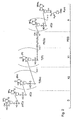
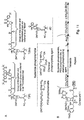
- the spacer molecule containing a PEG region was synthesized by using the method outlined in Fig. 11, B.
- Compound 1 was synthesized by the method reported by Ikeda et al. (Ikeda, S. et al. (1998) Tetrahedron Lett., 39, 5975-5978).
- the structures of the used nucleotide phosphoramidites (phosphoramidites providing dC, T(F1) and T(Bio)), PEG phosphoramidite and chemical phosphorylating agent are shown in Fig. 11, A.
- the nucleotide phosphoramidites and the chemical phosphorylating agent were purchased from Glen Research (Virginia, USA).
- PEG Polyethylene glycol
- N-(n-(2-amino)-2-aminoethyl) having average molecular weights of 1000, 2000 and 3000 were purchased from NOF Corporation (Tokyo, Japan).
- PEG phosphoramidites were synthesized by the method reported by Jaschke et al. (Jaschke, A. et al. (1993) Tetrahedron Lett., 34, 301-304).
- DMTr represents 4,4'-dimethoxytrityl group
- Fmoc represents 9-fluorenemethoxycarbonyl group.
- the types and yields of the obtained spacer molecules containing a PEG region were as follows. Meanings of the abbreviations are as follows; p: phosphorus group, dC: deoxycytidine, PEG (number): PEG having an average molecular weight represented by the number, Puro: puromycin, T(Fl): thymidine labeled with a fluorescent dye, T(Bio): thymidine labeled with biotin.
- a coding molecule was amplified by PCR using a DNA template containing the sequence of the mouse-derived c-jun (Gentz, R., Rauscher, F.J. 3d, Abate, C., Curran, T. (1989) Science, 243, 1695-9; Neuberg, M., Schuermann, M., Hunter, J. B., Muller, R. (1989) Nature, 338, 589-90).
- coding molecules 6 to 12 ⁇ g of the following coding molecules (DNA templates) were obtained by the above method.
- the coding molecules were designated as "(name of Primer 1)Jun-(name of Primer 2)" according to the primers used for PCR. DNA or RNA is indicated in the brackets.
- RNA templates 250 to 500 pmol of the following coding molecules (RNA templates) were obtained.
- RNA templates were translated (26°C, 60 minutes) under the following conditions by using Wheat Germ Extract (Promega). Along with the translation, proteins were labeled (Miyamoto-Sato, E., Nemoto, N., Kobayashi, K., and Yanagawa, H. (2000) Nucleic Acids Res., 28, 1176-1182; Nemoto, N., Miyamoto-Sato, E. and Yanagawa, H. (1999) FEBS Lett., 462, 43-46). Electrophoresis was performed by 17.5% SDS-PAGE, and fluorescence of fluorescein in the bands was measured by using a multi-format image analyzer, Molecular Imager FX (Bio-Rad).
- Jun proteins having a molecular weight of about 25 kDa were obtained from the coding molecules (RNA templates) by the above method and quantified by image analysis.
- the Jun proteins obtained from the respective coding molecules were designated as shown in the following table.
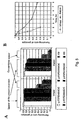
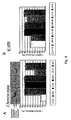
- Fig. 7, A shows the results of comparison of the above (a) to (f) about efficiency (relative rate) of translation into the Jun proteins.
- Fig. 7, B shows the results of comparison of the above (a) and (g) to (j) about efficiency of translation into the Jun proteins.
- These results indicate that translation efficiency became high when the polyA sequence was contained in the 3'-terminal region (p-FA), and when the polyA sequence and the Xho I sequence were contained in the 3'-terminal region (p-FXA). That is, the translation efficiency is significantly different when the Xho I sequence bonded to a Flag tag and the same further bonded with the polyA sequence are compared. Further, as effect of the combination of the Xho I sequence and the polyA sequence, translation efficiency for the Flag tag bonded with Xho I sequence and polyA sequence is much higher than that for the Flag tag bonded with only the polyA sequence. Further, since substitution of 1 residue in the Xho I sequence showed strong influence, the Xho I sequence itself is also important.
- a spacer molecule containing a PEG region and a coding molecule (RNA template) were ligated (15°C, 20 hours) under the following conditions by using T4 RNA ligase (Takara Shuzo) and purified by using RNeasy Mini Kit (QIAGEN).
- the ligation product (genotype molecule of c-jun) was subjected to electrophoresis by 8 M Urea 4% PAGE, and fluorescence of ethidium bromide (EtBr) and fluorescein in the molecule were detected by using a multi-format image analyzer, Molecular Imager FX (Bio-Rad).
- genotype molecules which were ligation products of various spacer molecules and coding molecules, were obtained by the above method with ligation efficiency of 20 to 95%.
- the ligation efficiency is a relative ratio of the band intensity of the genotype molecules based on the total of band intensity of coding molecules and band intensity of genotype molecules taken as 100%.
- the band intensities were analyzed by using a multi-format image analyzer for the bands obtained by electrophoresis of the molecules by 8 M Urea 4% SDS-PAGE, followed by ethidium bromide staining of the nucleic acids in the gel.
- G2 g-(Fl)PEG(2000)dCdC See Fig. 10 for efficiency.
- G3 g-(Fl)PEG(3000)dCdC See Fig. 10 for efficiency.
- G4 g-(Fl)PEG(4000)dCdC Efficiency: 73% (see Fig.
- G18 g-(Fl) PEG(2000) dCdC(g-T7-O29) See Fig. 9 for efficiency.
- G19 g-(Fl)PEG(2000)dCdC(g-SP6-AO) See Fig. 9 for efficiency.
- G20 g-(Fl)PEG(2000)dCdC(g-T7-AO) See Fig. 9 for efficiency.
- G21 g-(Fl)PEG(2000)dCdC(g-T7-O') See Fig. 9 for efficiency.
- G22 g-(Fl)PEG(2000)dCdC(g-T7-K) See Fig. 9 for efficiency.
- G23 g-(Fl)PEG(2000)dCdC(g-FX) See Fig. 9 for efficiency.
- G24 g-(Fl)PEG(2000)dCdC(g-FX'A) See Fig. 9 for efficiency.
- G25 g-(Fl)PEG(2000)dCdC(g-FX"A) See Fig. 9 for efficiency.
- G26 g-(Fl)PEG(2000)dCdC(g-FA) See Fig. 9 for efficiency.
- G27 g-(Fl)PEG(2000)dCdC(g-F) See Fig. 9 for efficiency.
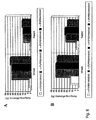
- FIG. 9 A shows the results of comparison of efficiencies for G23 (g-FX), G17 (g-FXA), G24 (g-FX'A), G25 (g-FX"A), G27 (g-F) and G26 (g-FA).
- Fig. 9, B shows the results of comparison of efficiencies for G20 (g-T7-AO), G19 (g-SP6-AO), G18 (g-T7-O29), G17 (g-SP6-O29), G21 (g-T7-O') and G22 (g-T7-K).
- ligation efficiency was obtained when a polyA sequence was contained in the 3'-terminal region.
- the ligation efficiency of the coding molecule and the spacer molecule was conventionally 40% or lower (Nemoto, N., Miyamoto-Sato, E., Yanagawa, H. (1997) FEBS Lett., 414, 405; Roberts, R.W. & Szostak, J.W. (1997) Proc. Natl. Acad. Sci. USA, 94, 12297).
- ligation efficiency affected by the 3'-terminal end sequence of the coding portion is made high by adopting the 3'-terminal region containing a polyA sequence.
- high ligation efficiency of 60 to 80% can be obtained thanks to the polyA sequence irrespective of sequences upstream thereof.
- Fig. 10 shows comparison with experiments for G2 and G4 where free PEG having the same molecular weight as that of PEG in the PEG region was added.
- ligation efficiency tended to decline as the molecular weight of polyethylene glycol in the PEG region increased ("Not added” in Fig. 10)
- ligation efficiency was improved by adding free PEG having the same molecular weight as PEG in the PEG region upon the ligation reaction irrespective of the molecular weight of PEG in the spacer molecule (90% for G2 and 73% for G4 when the spacer molecule is 20 nmol), and the separation process after the reaction could be omitted.
- the ligation efficiency was further improved by adjusting the mixing ratio of the coding molecules and the spacer molecules in the ligation reaction mixture (85% for G4), and hence the ligation efficiency as high as 80 to 90% was obtained irrespective of the molecular weight of polyethylene glycol ("free PEG added" in Fig. 10).
- Wheat Germ Extract (Promega) was used as a wheat germ cell-free translation system, and Rabbit Reticulocyte Lysate System (Promega) was used as a rabbit reticulocyte cell-free translation system.
- the c-jun genotype molecules obtained by the above ligation were added to each of the translation systems to perform assigning translation, and the assigning molecules were subjected to electrophoresis by 8 M Urea 11% SDS-PAGE and detected based on fluorescence of fluorescein by using a multi-format image analyzer, Molecular Imager FX (Bio-Rad). No post-translation treatment was performed, and the undiluted solution from the translation system was subjected to the electrophoresis.
- Rabbit reticulocyte cell-free translation system 30°C, 30 min Amino acid mixture, 1 Mm 0.2 ⁇ l RNase inhibitor, 20 U/ ⁇ l 0.4 ⁇ l Genotype (spacer portion + 2 pmol coding portion) Rabbit Reticulocyte Lysate 7.0 ⁇ l RNase-free water Remainder Total 10 ⁇ l Wheat germ cell-free translation system: 26°C, 30 min Amino acid mixture, 1 mM 0.8 ⁇ l 1 M Potassium 0.76 ⁇ l RNase inhibitor, 10 U/ ⁇ l 0.8 ⁇ l Genotype (spacer portion + 2 pmol coding portion) Wheat Germ Extract 5.0 ⁇ l RNase-free water Remainder Total 10 ⁇ l
- assigning molecules comprising various c-jun genotypes and the phenotypes thereof were obtained with assigning efficiency of 4 to 60% by the above method.
- the assigning efficiency is a relative ratio of the fluorescence intensity of the assigning molecules based on the total of the band intensity of genotype molecules and the band intensity of assigning molecules taken as 100%.
- the molecules were subjected to electrophoresis by 8 M Urea 4% SDS-PAGE, and fluorescence intensity of the bands of the genotypes and fluorescence intensity of the assigning molecules were analyzed by using a multi-format image analyzer.
- Genotype molecule Assigning molecule G1 g-(Fl)PEG(1000)dCdC v-(Fl)PEG(1000)dCdC
- G2 g-(Fl)PEG(2000)dCdC v-(Fl)PEG(2000)dCdC
- G3 g-(Fl)PEG(3000)dCdC v-(Fl)PEG(3000)dCdC
- G4 g-(Fl)PEG(4000)dCdC v-(Fl)PEG(4000)dCdC
- G5 g-(Fl)PEG(1000)dC v-(Fl)PEG(1000)dC
- G6 g-(Fl)PEG(2000)dC v-(Fl)PEG(2000)dC
- G7 g-(Fl)PEG(3000)dC v-(Fl)PEG(3000)dC
- G8 g-(F
- Lane 1 represents a genotype molecule
- Lane 2 represents a product of assigning translation of the genotype molecule in the wheat germ cell-free translation system
- Lane 3 represents a product obtained by adding 20 ⁇ M puromycin as a protein synthesis inhibitor under the same conditions as those used for Lane 2
- Lane 4 represents a product obtained by decomposing the protein with protease K after the reaction for Lane 2.
- the assigning molecule was observed only in Lane 2. This indicates that the assigning molecule was constructed by translation in the wheat germ cell-free translation system. This also indicates that detection is possible without post-treatment after the translation.
- assigning molecules conventionally detected with RI requiring much labor and time can be readily detected with fluorescence by using genotype molecules containing a spacer portion with a fluorescent substance introduced into the function-imparting unit (x).
- RNA Coding molecule Spacer molecule Genotype molecule
- RNA SP6-O29Jun-FlagXA p(dCp) 2 T(Fl)pPEG(3000)p(dCp) 2 Puro G2
- RNA SP6-O29Jun-FlagXA p(dCp) 2 T(Fl)pPEG(2000)p(dCp) 2
- Puro G3 [RNA] SP6-O29Jun-FlagX p(Fl)(dAp) 21 [C9] 3 dAp(dCp) 2 Puro 30F
- the genotype molecules containing the spacer portion of the present invention showed significantly higher stability in both of the rabbit and wheat translation systems in comparison with those using the conventional DNA spacer (S30 spacer: Liu R., Barrick E., Szoztak J.W., Roberts, R.W. (2000) Methods in Enzymology, 318, 268-293) or the spacer containing DNA as a main component with polyethylene glycol having a molecular weight of 400 or less (F30 spacer: Liu R., Barrick E., Szoztak J.W., Roberts, R.W. (2000) Methods in Enzymology, 318, 268-293) (Fig. 5, A). Therefore, post-treatment after the assigning translation conventionally required to improve assigning efficiency becomes unnecessary. Since treatment after the assigning translation can be simplified, working time for assigning translation can be shortened from 48 to 72 hours to 0.5 to 1 hour.
- the stability of the genotype of the present invention was compared in the wheat germ and rabbit reticulocyte cell-free translation systems.
- the experiment conditions were the same as in the above (5-1) except that translation was performed in the presence of 20 ⁇ M puromycin as translation inhibitor at 30°C for 0.25, 0.5, 1 and 2 hours in the rabbit system and at 26°C for 1, 2, 4 and 8 hours in the wheat system.
- the results are shown in Fig. 5, B. Numerical values in the graph represent the ratios of the remaining genotype molecules based on the amount before the translation as a reference.
- the stability of the genotype molecule was higher in the wheat germ cell-free translation system than in the rabbit reticulocyte cell-free translation system (Fig. 5, B). Since a spacer portion containing a PEG region as a main component makes a genotype molecule more stable especially in the wheat germ cell-free translation system, it becomes possible to construct a library including coding portions with a long chain length by using genotype molecules containing such a spacer portion, and hence a library with high diversity can be obtained.
- polyethylene glycol should preferably have a molecular weight of 1000 or more, more preferably 2000 or more, further preferably 4000 or more (Fig. 6, A). It was also found that, for a spacer portion having puromycin and the dCdC sequence in its acceptor region, the effect was exhibited with polyethylene glycol having a molecular weight of 1000 or more, and it was more preferably 2000 or more, further preferably 2000 to 4000 (Fig. 6, B).
- assigning molecules were constructed by using genotype molecules containing coding portions having 5' UTR with different translation efficiency, and their construction efficiency was compared.
- the experiment conditions were the same as in the above (5-1) except that assigning translation was performed at 26°C for 0.5 hours in the wheat germ cell-free translation system.
- the results are shown in Fig. 8.
- the assigning efficiency was calculated in the same manner as described in the above (5-3).
- the genotype molecules and the assigning molecules used in this experiment were G17 to G22.
- the transcription promoter (SP6) of SP6 RNA polymerase is more preferred than T7 as a transcription promoter, and that a partial sequence of the omega sequence (O29) is preferred as a translation enhancer.
- Size of a library using the assigning molecules of the present invention in a unit volume was calculated.
- the absolute amount of the assigning molecules in 1 ml was calculated from the concentration of the genotype molecules, the ratio of remaining genotype molecules and the construction efficiency of the assigning molecules, and it was considered as the size of the library.
- the experiment conditions were the same as in the above (5-1) except that translation was performed at 26°C for 1 hour in the wheat system and at 30°C for 0.5 hours in the rabbit system. The results are shown in the following table.
- the construction efficiency of the assigning molecules was improved from 0%, to 50 to 60% in the wheat germ cell-free translation system and from 10% or lower, to 20 to 30% in the rabbit reticulocyte cell-free translation system.
- the scale of the library was improved from 0/ml (construction was impossible) to 10 14 /ml in the wheat germ cell-free translation system and from 10 12 /ml to 10 13 /ml in the rabbit reticulocyte cell-free translation system.
- rabbit reticulocyte system was not so practical due to lack of stability of genotype molecule and conventionally applied only to genotype molecules having a short chain length (Roberts, R.W. & Szostak, J.W. (1997) Proc. Natl. Acad. Sci. USA, 94, 12297; Nemoto, N., Miyamoto-Sato, E., Yanagawa, H. (1997) FEBS Lett., 414, 405), it can be seen from the results shown in Figs.
- a coding molecule having a long chain length can be handled in a wheat germ translation system by using the molecule of the present invention. That is, a practically useful assigning translation system is provided.
Landscapes
- Life Sciences & Earth Sciences (AREA)
- Chemical & Material Sciences (AREA)
- Health & Medical Sciences (AREA)
- Engineering & Computer Science (AREA)
- Genetics & Genomics (AREA)
- Organic Chemistry (AREA)
- Zoology (AREA)
- Wood Science & Technology (AREA)
- Biomedical Technology (AREA)
- Bioinformatics & Cheminformatics (AREA)
- Biotechnology (AREA)
- General Engineering & Computer Science (AREA)
- Molecular Biology (AREA)
- Plant Pathology (AREA)
- Biophysics (AREA)
- Microbiology (AREA)
- Physics & Mathematics (AREA)
- Crystallography & Structural Chemistry (AREA)
- Biochemistry (AREA)
- General Health & Medical Sciences (AREA)
- Bioinformatics & Computational Biology (AREA)
- Measuring Or Testing Involving Enzymes Or Micro-Organisms (AREA)
- Preparation Of Compounds By Using Micro-Organisms (AREA)
- Peptides Or Proteins (AREA)
Abstract
An assigning molecule obtained by ligating a genotype
molecule to a phenotype molecule which is a protein
encoded by the ORF region in the genotype molecule, by
transpeptidation, the genotype molecule being constructed
by bonding (a) a spacer molecule comprising a donor region
which can be bonded to a 3'-terminal end of nucleic acid,
a PEG region that is bonded to the donor region and
comprises polyethylene glycol as a main component and a
peptide acceptor region which is bonded to the PEG region
and comprises a group which can be bonded to a peptide by
transpeptidation, to (b) a 3'-terminal end of a coding
molecule which is a nucleic acid comprising a 5'
untranslated region comrising a transcription promoter and
a translation enhancer; an ORF region which is bonded to
the 3'-terminal side of the 5' untranslated region and
encodes a protein; and a 3'-terminal region that is bonded
to'the 3'-terminal side of the ORF region and comprises a
polyA sequence.
Description
With the advancement of genetic engineering, it has
become possible to readily construct biopolymers such as
nucleotides and peptides of which sequences are given, and
in the protein engineering, it is being attempted to
elucidate molecular structural and functional correlations
as an approach for understanding biopolymer functions and
intermolecular interactions. However, it is difficult to
theoretically approach three-dimensional structures of
them due to the diversity and complexity of the structures,
and the attempt remains at the stage of modifying several
residues in an active site and observing resultant changes
in the structure and functions. In the evolutionary
molecular engineering (Fushimi, J. (1991) Kagaku, 61, 333-340;
Fushimi, J. (1992) Koza Shinka, vol. 6, University of
Tokyo Press), which has been recently highlighted, this
difficult approach is not required, but selection pressure
is applied based on a function to evolve proteins etc. in
vitro or to detect interactions between proteins or
between a nucleic acid and a protein and analyze their
networks (Miyamoto, E. & Yanagawa, H. (2000) Series: Post-Sequence
Genome Science 3: Proteomics, pp.136-156;
Miyamoto, E. & Yanagawa, H. (2001) Tanpakushitsu Kakusan
Koso, 46(1): 1-10).
The evolutionary molecular engineering of proteins
based on evolutionary molecular engineering of RNA, which
appeared in the 1990s, primarily aims at searching a vast
sequence space, which can no way be contemplated in the
conventional protein engineering, to select optimum
sequences therefrom. As is symbolized by the fact that we
still find "screening" useful even now in selection of
useful proteins, molecular designing based on the
structural theory is imperfect at present, and thus
evolutional techniques have a practical value as more
efficient techniques.
The evolutionary molecular engineering also enables
detection of intermolecular interactions and analysis of
the networks thereof by centering functions, and in
particular, it is expected to be applied to functional
analyses of genomes, which are increasingly becoming
important in recent years (Miyamoto, E. & Yanagawa, H.
(2000) Series Post-Sequence Genomic Science 3: Proteomics,
pp.136-156; Miyamoto, E. & Yanagawa, H. (2001)
Tanpakushitsu Kakusan Koso, 46(1), pp.1-10). Thus, the
evolutionary molecular engineering and post-genome
functional analyses of proteins can of course be applied
to biotechnology such as utilization of biochips,
biosensors and enzymes as industrial catalysts by
modification of functional biopolymers and creation of
biopolymers having functions which cannot be found in
living organisms, and it can also be utilized in many
industrial areas such as medicine, food, energy and
environment including preparation of drugs by discovery of
important bioenzymes etc. based on analysis of networks of
interactions between proteins.
The evolutionary molecular engineering is a science
aiming at constructing a system that progressively evolves
by repetition of three unit operations, "mutation",
"selection" and "amplification" utilizing the Darwin's
evolution mechanism and applying the system in engineering.
The evolutionary molecular engineering was theoretically
proposed by Eigen et al. in 1984, and it is new
biotechnology molecular design of functional biopolymers
is performed by in vitro high-speed molecular evolution,
that is, by investigating mechanisms of adaptive
locomotion of biopolymers in a sequence space and
optimizing them in laboratory experiments (Fushimi J.
(1991) Kagaku, 61, 333-340; Fushimi J. (1992) Koza Shinka,
vol. 6, University of Tokyo Press).
As one of important elemental techniques in the
evolutionary molecular engineering, "assigning of genotype
to phenotype" can be mentioned. The following three types
of the "assigning of genotype to phenotype" are frequently
adopted in the natural world or evolutionary molecular
engineering (Fushimi J. (1999) Kagaku to Seibutsu, 37,
678-684):
The sequence space size, that is, size of a library,
searchable in the evolutionary molecular engineering and
post-genome functional analysis is important. As for the
virus-type assigning molecules, the size of a library
using is limited by a host cell when existing virus is
utilized as in the case of phage display, since the virus
parasites a cell. One the other hand, since the virus-type
assigning molecules can be constructed in vitro in the
aforementioned in vitro virus method (Nemoto, N.,
Miyamoto-Sato, E., Yanagawa, H. (1997) FEBS Lett., 414,
405; Yanagawa, H., Nemoto N. & Miyamoto E. (1998)
WO98/16636), RNA-peptide fusion method (Roberts, R.W.,
Szostak, J.W. (1997) Proc. Natl. Acad. Sci. USA, 94,
12297) and so forth, these methods are theoretically
expected as global searching methods for a sequence space
comparable with the ribozyme-type technique. Further, in
the evolutionary molecular engineering, not only the size
of searchable sequence space, but also its diversity is
important. The polysome display method (Mattheakis, L.C. &
Dower, W.J. (1995) WO95/11922) is known, and this
technique is suitable for a peptide with a short chain
length, since nucleic acid and a protein are bonded by a
noncovalent bond via ribosome in this technique. However,
when the chain length becomes long like a protein,
handling thereof becomes problematic, that is, diversity
of library is limited due to the limited chain length of
the genotype. As also for this problem, it is
theoretically considered that no limitation is imposed on
the chain length to be handled in the virus-type assigning
molecules for the in vitro virus method, RNA-peptide
fusion method and so forth. However, in order to actually
construct a large-scale library and handle genotypes with
a long chain length, several problems must be solved.
As described above, in principle, a large-scale
library can be constructed by using virus-type assigning
molecules in vitro as in the in vitro virus method, RNA-peptide
fusion method and so forth. In practice, however,
the size of the library depends on the efficiency of
construction of the virus-type assigning molecules. The
virus-type assigning molecules are constructed by bonding
a spacer containing puromycin to a nucleic acid sequence
containing protein information using a certain method to
construct a genotype molecule and ligating it to a
phenotype molecule (protein) on ribosome in a cell-free
translation system. In this case, since a genotype
molecule to which a spacer is not bonded, that is, a
genotype molecule without puromycin, cannot be ligated to
a phenotype molecule, the spacer binding efficiency
determines the size of library. For example, in the RNA-peptide
fusion method, a sprint and DNA ligase are used to
ligate a DNA spacer. However, 1 random residue that does
not exist in a template may be often added to the 3'-terminal
end of the genotype molecule at the time of
transcription. Thus, the sequence of the molecule does not
match the sprint sequence, and hence ligation efficiency
becomes poor. Accordingly, the sprint is modified, but
much labor and cost are required. Further, in the in vitro
virus method, RNA ligase is used to ligate a DNA spacer.
Since RNA ligase does not require a sprint, it has no such
a problem as that of the DNA ligase. However, it is known
that RNA ligase originally has lower enzymatic activity
compared with DNA ligase, and its ligation efficiency is
also poor.
So far, in both of the in vitro virus method and the
RNA-peptide fusion method, the usable cell-free
translation system is limited to a rabbit reticulocyte
cell-free translation system. Further, the virus-type
assigning molecule construction efficiency in the rabbit
reticulocyte cell-free translation system has remained as
low as only 1% or lower (Roberts, R.W. & Szostak, J.W.
(1997) Proc. Natl. Acad. Sci. USA, 94, 12297) or 10% or
lower (Nemoto, N., Miyamoto-Sato, E., Yanagawa, H. (1997)
FEBS Lett., 414, 405) of mRNA templates (genotype
molecule) added to the cell-free translation system.
Although the efficiency is increased to 20 to 40% by
treatment after translation in the RNA-peptide fusion
method (Liu, R., Barrick, E., Szoztak, J.W., Roberts, R.W.
(2000) Methods in Enzymology, 318, 268-293), this requires
much labor and time such as ordinary translation followed
by addition of magnesium ions (Mg2+) and potassium ions
(K+) and incubation at -20°C for 2 days. In the rabbit
reticulocyte cell-free translation system, in addition to
the low assigning efficiency, mRNA stability is low, and
therefore mRNA with a long chain cannot be handled. In
contrast, in a wheat germ cell-free translation system,
mRNA stability is favorable, and hence mRNA with a long
chain can be handled. Therefore, it is desirable that a
virus-type assigning molecule can be constructed on
ribosome in the wheat germ cell-free translation system,
but this has not been realized so far.
Among other factors determining the construction
efficiency of virus-type assigning molecules, the most
important one is the difference in translation efficiency
of the genotype molecule. This can be expected to largely
depend on sequences of a transcription promoter and a
translation enhancer in the 5' untranslated region (5'
UTR), 3'-end side sequence and so forth of the genotype
molecule. However, there has been no report on examination
of the relationship between the translation efficiency and
the virus-type assigning molecule construction efficiency.
An object of the present invention is to improve the
scale and diversity of a library, which are important in
the evolutionary molecular engineering and post-genome
functional analysis, and to improve efficiency of
construction of assigning molecules in order to achieve
the above object. Further, another object of the present
invention is to achieve higher efficiency and
simplification of each step of ligation and assigning
translation. Further, another object of the present
invention is to construct a virus-type assigning molecule
in a wheat germ cell-free translation system to enable
mass synthesis and handling of long genotype molecules,
which are advantages of use of wheat germ, and thereby
establish a foundation for constructing a large library
with high diversity in both of the evolutionary molecular
engineering and genome functional analysis.
The inventors of the present invention earnestly
conducted investigations to achieve the aforementioned
objects. As a result, they found that the construction of
the assigning molecule, which had been limited to the
rabbit reticulocyte cell-free translation system so far,
could be realized in the wheat germ cell-free translation
system, the construction efficiency of the assigning
molecules was improved, and a large-scale library with
high diversity could be realized by improving a spacer
containing puromycin (referred to as "spacer portion"
hereinafter) and a nucleotide sequence containing protein
information (referred to as "coding portion" hereinafter)
in such an assigning molecule as shown in Fig. 1. The
expression "an assigning molecule" as shown in Fig. 1 used
herein means an assigning molecule constructed by bonding
a spacer portion containing puromycin to a coding portion
by a certain method to obtain a genotype molecule and
ligating it to a phenotype molecule (referred to as
"decoded portion" hereinafter) on a ribosome in a cell-free
translation system.
Accordingly, the present invention provides the
followings.
In the present specification, the term "assigning
molecule" means a molecule that assigns a genotype to a
phenotype. The assigning molecule is constructed by
bonding a genotype molecule comprising nucleic acid having
a nucleotide sequence that reflects a genotype, to a
phenotype molecule comprising a protein involved in
expression of a phenotype. The genotype molecule is
constructed by bonding a coding molecule that has the
nucleotide sequence reflecting a genotype in such a form
that the nucleotide sequence can be translated, to a
spacer portion.
A portion derived from the phenotype molecule, a
portion derived from the spacer molecule and a portion
derived from the coding molecule in the assigning molecule
are referred to as a decoded portion, a spacer portion and
a coding portion, respectively. Further, a portion derived
from the spacer molecule and a portion derived from the
coding molecule in the genotype molecule are referred to
as a spacer portion and a coding portion, respectively.
Fig. 1 shows schematic constitutions of exemplary
assigning molecule, spacer molecule and coding molecule of
the present invention. This assigning molecule comprises a
spacer containing puromycin (referred to as "spacer
portion") and a nucleotide sequence reflecting codes of a
phenotype (referred to as "coding portion"). This
assigning molecule is constructed by bonding the spacer
portion containing puromycin to the coding molecule by a
certain method to obtain a genotype molecule, and ligating
the genotype molecule to a phenotype molecule on a
ribosome in a cell-free translation system. The spacer
molecule comprises a PEG region containing polyethylene
glycol as a main component; a CCA region containing at
least puromycin, or puromycin and DNA and/or RNA 1 or more
residues; a donor region containing DNA and/or RNA of at
least 1 residue; and further a function-imparting unit (X)
comprising functionally modified DNA and/or RNA of at
least 1 residue. The coding molecule comprises a 3'-terminal
region that contains a polyA sequence of DNA
and/or RNA comprising a sequence of a part of a decoded
portion; 5' UTR that comprises DNA and/or RNA and contains
a transcription promoter and a translation enhancer; and
further an ORF region mainly comprising the sequence of
the phenotype molecule.
The spacer molecule of the present invention
comprises a donor region that can be bonded to a 3'-terminal
end of nucleic acid, a PEG region that is bonded
to the donor region and comprises polyethylene glycol as a
main component, and a peptide acceptor region that is
bonded to the PEG region and comprises a group that can be
bonded to a peptide by transpeptidation.
The donor region that can be bonded to the 3'-terminal
end of nucleic acid usually comprises 1 or more
nucleotides. The number of nucleotides is usually 1 to 15,
preferably 1 to 2. The nucleotides may be ribonucleotides
or deoxyribonucleotides.
The sequence of the 5'-terminal end of the donor
region determines ligation efficiency. In order to ligate
the coding portion and the spacer portion, at least 1 or
more residues need to be contained. For the acceptor
having the polyA sequence, at least 1 residue of dC
(deoxycytidylic acid) or 2 residues of dCdC
(dideoxycytidylic acid) are preferred. The type of the
nucleotide is more preferred in the order of C > U or T >
G > A.
The PEG region comprises polyethylene glycol as a
main component. The expression "comprising as a main
component" used herein means that the total number of
nucleotides contained in the PEG region is 20 bp or less,
or the average molecular weight of polyethylene glycol is
400 or more. Preferably, it means that the total number of
nucleotides is 10 bp or less, or the average molecular
weight of polyethylene glycol is 1000 or more.
The average molecular weight of polyethylene glycol
in the PEG region is usually 400 to 30,000, preferably
1,000 to 10,000, more preferably 2,000 to 8,000. When the
molecular weight of polyethylene glycol is less than about
400, a post-assigning translation treatment may be needed
after the assigning translation of the genotype molecule
containing a spacer portion derived from such a spacer
molecule (Liu, R., Barrick, E., Szostak, J. W., Roberts, R.
W. (2000) Methods in Enzymology, 318, 268-293). However,
when PEG having a molecular weight of 1000 or more, more
preferably 2000 or more is used, high efficiency assigning
can be achieved only through the assigning translation,
and therefore the post-translation treatment becomes
unnecessary. Further, as the molecular weight of
polyethylene glycol increases, the stability of the
genotype molecule tends to increase and is favorable
particularly with PEG having a molecular weight of 1000 or
more. On the other hand, the genotype molecule may become
unstable with PEG having a molecular weight of 400 or less,
of which properties are not so different from those of a
DNA spacer.
The peptide acceptor region is not particularly
limited so long as it can be bonded to the C-terminal of a
peptide. For example, puromycin, 3'-N-aminoacylpuromycin
aminonucleoside (PANS-amino acid) such as PANS-Gly of
which amino acid portion is glycine, PANS-Val of which
amino acid portion is valine and PANS-Ala of which amino
acid portion is alanine and PANS-total amino acids of
which amino acid portion corresponds to the total amino
acids can be utilized. Further, 3'-N-aminoacyladenosine
aminonucleoside (AANS-amino acid) bonded with an amide
bond formed as a result of condensation of an amino group
of 3'-aminoadenosine and a carboxyl group of an amino acid
as a chemical bond such as AANS-Gly of which amino acid
portion is glycine, AANS-Val of which amino acid portion
is valine and AANS-Ala of which amino acid portion is
alanine and AANS-total amino acids of which amino acid
portion corresponds to the total amino acids can be
utilized. Further, nucleoside, a bonding product of
nucleoside and amino acid via an ester bond or the like
can be utilized. In addition, any substance having a
bonding scheme that can chemically bond a nucleoside or a
substance having a chemical structure similar to that of
nucleoside and an amino acid or a substance having a
chemical structure similar to that of amino acid can be
utilized.
The peptide acceptor region preferably comprises
puromycin or a derivative thereof, or puromycin or a
derivative thereof and 1 or 2 residues of
deoxyribonucleotides or ribonucleotides. The term
"derivative" used herein means a derivative that can be
bonded to the C-terminal of peptide in a protein
translation system. The puromycin derivatives are not
limited to those having a complete puromycin structure,
and include those lacking a part of the puromycin
structure. Specific examples of the puromycin derivatives
include PANS-amino acid, AANS-amino acid and so forth.
Although it is sufficient that the peptide acceptor
region is constituted by puromycin alone, it preferably
has a nucleotide sequence comprising 1 or more residues of
DNA and/or RNA on the 5'-terminal side. Examples of the
sequences include dC-puromycin and rC-puromycin, and dCdC-puromycin,
rCrC-puromycin, rCdC-puromycin, dCrC-puromycin
and so forth are more preferred. The CCA sequences that
imitate the 3'-terminal end of aminoacyl-tRNA (Philipps, G.
R. (1969) Nature, 223, 374-377) are suitable. The type of
nucleotide is more preferred in the order of C > U or T >
G > A.
The spacer molecule preferably contains at least one
function-imparting unit between the donor region and the
PEG region. The function-imparting unit preferably
comprises at least 1 residue of functionally modified
deoxyribonucleotide or ribonucleotide. For example, as a
functionally modified substance, those having various
separation tags such as a fluorescent substance, biotin or
His-tag shown in Fig. 2 introduced can be used.
Fig. 2 shows a detailed constitution of an exemplary
spacer molecule. The spacer molecule comprises a PEG
region containing polyethylene glycol as a main component;
a CCA region comprising puromycin or puromycin and DNA
and/or RNA of at least 1 residue; a donor region
containing DNA and/or RNA of at least 1 or more residues;
and further a function-imparting unit (X) comprising DNA
and/or RNA of which at least 1 residue of nucleotide is
functionally modified. In Fig. 2, a fluorescent substance
T(F1) and biotin T(Bio) are used as the function-imparting
unit (X).
The coding molecule of the present invention is a
nucleic acid comprising a 5' untranslated region
comprising a transcription promoter and a translation
enhancer; an ORF region that is bonded to the 3'-terminal
side of the 5' untranslated region and encodes a protein;
and a 3'-terminal region that is bonded to the 3'-terminal
side of the ORF region and contains a polyA sequence and a
sequence which a restriction enzyme XhoI recognizes on the
5'-terminal side of the polyA sequence.
The coding molecule may be DNA or RNA. In the case
of RNA, the 5'-terminal end may have a Cap structure or
not. Further, the coding molecule may be incorporated in
an arbitrary vector or plasmid.
The 3'-terminal region contains the XhoI sequence and
a polyA sequence downstream therefrom. As a factor
affecting the ligation efficiency of the spacer molecule
and the coding molecule, the polyA sequence in the 3'-terminal
region is important. The polyA sequence is a
polyA continuous chain comprising at least 2 or more
residues of a mixture of dA and rA or either thereof,
preferably a polyA continuous chain of 3 or more residues,
more preferably 6 or more residues, further preferably 8
or more residues.
As a factor affecting translation efficiency of the
coding molecule, there can be mentioned a combination of
the 5' UTR comprising a transcription promoter and a
translation enhancer and the 3'-terminal region containing
a polyA sequence. The effect of the polyA sequence in the
3'-terminal region is usually exhibited when it comprises
10 or less residues. The transcription promoter of the 5'
UTR is not particularly limited, and T7/T3, SP6 or the
like can be used. SP6 can be preferably used, and when the
omega sequence or a sequence containing a part of the
omega sequence is used as a translation enhancer sequence,
in particular, SP6 is particularly preferred. The
translation enhancer is preferably a part of the omega
sequence. As the part of the omega sequence, a part of the
TMV omega sequence (O29; Gallie D.R. & Walbot V. (1992)
Nucleic Acids Res., 20, 4631-4638) is preferred.
Further, for the translation efficiency, a
combination of the XhoI sequence and the polyA sequence is
important in the 3'-terminal region. Further, a
combination of a sequence having an affinity tag in a
portion downstream from the ORF region, i.e., upstream of
the XhoI sequence, and the polyA sequence is also
important. The affinity tagged sequence is not
particularly limited so long as it is a sequence for using
any means that can detect a protein such as an antigen-antibody
reaction. A Flag-tag sequence, which is a tag for
affinity separation/analysis based on an antigen-antibody
reaction, is preferred. As the effect of the polyA
sequence, the translation efficiency of an affinity tag
such as a Flag tag having the XhoI sequence bonded thereto
and further bonded with a polyA sequence is improved.
The structure effective for the translation
efficiency is also effective for the assigning efficiency.
The ORF region may be any sequence comprising DNA
and/or RNA. The sequence is not limited, and it may be a
gene sequence, exon sequence, intron sequence or random
sequence, or it can be any sequence in the natural world
or any artificial sequence. Further, when SP6 + O29 are
used as the 5' UTR of the coding molecule, and Flag + XhoI
+ An (n = 8) are used as the 3'-terminal region, for
example, the length of the 5' UTR is about 60 bp and that
of the 3'-terminal region is about 40 bp. These are
lengths that allow incorporation of them into a PCR primer
as adaptor regions. Therefore, the coding molecule of the
present invention having the 5' UTR and the 3'-terminal
region can be readily constructed by PCR using any vector,
plasmid or cDNA library. In the coding molecule of the
present invention, translation may be carried out
exceeding the ORF region. That is, a termination codon
does not need to exist at the end of the ORF region.
Fig. 3 shows a detailed constitution of an exemplary
coding molecule. The coding molecule comprises the 3'-terminal
region; 5' UTR containing a transcription
promoter and a translation enhancer comprising DNA and/or
RNA; and an ORF region comprising a sequence information
of a decoded portion, that is, encoding a phenotype
protein. In Fig. 3, the 3'-terminal region contains an
affinity tag sequence comprising DNA or RNA, XhoI sequence
and polyA sequence, and a Flag-tag sequence is used. As
the 5' UTR, a sequence containing SP6 as a transcription
promoter and O29, which is a part of the omega sequence,
as a translation enhancer is used.
The genotype molecule of the present invention is
constructed by bonding the 3'-terminal end of a coding
molecule, which is a nucleic acid comprising a 5'
untranslated region comprising a transcription promoter
and a translation enhancer; an ORF region that is bonded
to the 3'-terminal side of the 5' untranslated region and
encodes a protein; and a 3'-terminal region that is bonded
to the 3'-terminal side of the ORF region and comprises
the polyA sequence, to a donor region of the spacer
molecule of the present invention.
The coding molecule constituting the genotype
molecule of the present invention is the same as described
above about the coding molecule of the present invention
except that the XhoI sequence is not essential in the
aforementioned coding molecule of the present invention.
However, it preferably to have the XhoI sequence.
The genotype molecule of the present invention can be
constructed by bonding the 3'-terminal end of the
aforementioned coding molecule and the donor region of the
spacer molecule by an ordinary ligase reaction. As the
reaction conditions, conditions of 4 to 25°C and 4 to 48
hours can be mentioned. If polyethylene glycol having the
same molecular weight as that of polyethylene glycol in
the PEG region of the spacer molecule containing the PEG
region is added to a reaction system, the reaction time
can be reduced to 0.5 to 4 hours at 15°C.
The combination of the spacer molecule and the coding
molecule has an important effect on. ligation efficiency.
The 3'-terminal region of the coding portion, which
corresponds to an acceptor, preferably contains at least 2
or more residues, preferably 3 or more residues, more
preferably 6 to 8 or more residues of the polyA sequence
of DNA or RNA. Further, as the translation enhancer of 5'
UTR, a partial sequence of the omega sequence (O29, Fig.
3) is preferred. As the donor region of the spacer portion,
dC (deoxycytidylic acid) of at least 1 residue or dCdC
(dideoxycytidylic acid) of 2 residues is preferred. This
makes it possible to use RNA ligase to avoid the problems
of DNA ligase and maintain 60 to 80% of the efficiency.
When the genotype molecule is RNA, it is preferable
to bond (a) the 3'-terminal end of a coding molecule
comprising a 5' untranslated region comprising a
transcription promoter and a translation enhancer, an ORF
region that is bonded to the 3'-terminal side of the 5'
untranslated region and encodes a protein, and a 3'-terminal
region that is bonded to the 3'-terminal side of
the ORF region and comprises the polyA sequence, to (b) a
donor region of the spacer molecule as defined in any one
of (1) to (4) comprising RNA by using an RNA ligase in the
presence of free polyethylene glycol having the same
molecular weight as that of polyethylene glycol
constituting the PEG region in the spacer molecule.
At the time of the ligation reaction, by adding
polyethylene glycol having the same molecular weight as
that of the PEG region in the spacer portion containing
the PEG region, ligation efficiency can be improved to 80
to 90% or more irrespective of the molecular weight of
polyethylene glycol in the spacer portion, and the
separation process after the reaction can be omitted.
The assigning molecule of the present invention is
constructed by ligating the aforementioned genotype
molecule of the present invention to a phenotype molecule
which is a protein encoded by the ORF region in the
genotype molecule, by transpeptidation.
The assigning molecule of the present invention is
also constructed by translating the genotype molecule of
the present invention in a cell-free translation system to
ligate it to a phenotype molecule which is a protein
encoded by the ORF region in the genotype molecule, by
transpeptidation.
The cell-free translation system is preferably of
wheat germ or rabbit reticulocyte. The translation
conditions may be usually adopted conditions. For example,
conditions of 25 to 37°C and 15 to 240 minutes can be
mentioned.
As for the cell-free translation system, the
construction of the assigning molecules was examined in
systems of Escherichia coli (E. coli), rabbit reticulocyte
and wheat germ so far, and the assigning molecules were
confirmed only in the rabbit reticulocyte system (Nemoto,
N., Miyamoto-Sato, E., Yanagawa, H. (1997) FEBS Lett., 414,
405; Roberts, R.W., Szostak, J.W. (1997) Proc. Natl. Acad.
Sci. USA, 94, 12297). However, according to the present
invention, the assigning molecule can also be constructed
in a wheat germ system as an assigning molecule having a
spacer portion containing the PEG region. Further, the
rabbit reticulocyte system was not so practical due to
lack of stability of genotype molecule and conventionally
applied only to genotype molecules having a short chain
length (Roberts, R.W., Szostak, J.W. (1997) Proc. Natl.
Acad. Sci. USA, 94, 12297; Nemoto, N., Miyamoto-Sato, E.,
Yanagawa, H. (1997) FEBS Lett., 414, 405). However, the
assigning molecule of the present invention having a
spacer portion containing the PEG region is more stable in
the wheat germ system, and therefore the wheat germ system
is a practically useful system where molecules having a
long chain length can be handled.
The screening method of the present invention is a
method for screening a nucleotide sequence encoding a
protein that acts on a target substance, which comprises
measuring interactions between a decoded portion of an
assigning molecule and the target substance by using a
library comprising a plurality of the assigning molecules
as defined in (17), among which at least a part of the
assigning molecules have different sequences of the ORF
regions in their coding portions, and detecting the
nucleotide sequence of the coding portion of the assigning
molecule exhibiting the interaction.
The aforementioned library can be constructed
according to a usual method for constructing a library
comprising assigning molecules except that the assigning
molecules of the present invention are used as the
assigning molecules. For example, in the evolutionary
molecular engineering, there can be used libraries
constructed by employing the methods of Error-prone PCR
(Leung, D.W., et al. (1989) J. Methods Cell Mol. Biol., 1,
11-15), Sexual PCR (Stemmer, W.P.C. (1994) Proc. Natl.
Acad. Sci. USA, 91, 10747-10751), DNA shuffling, mutation
library (Yanagawa, H. & Tsuji, Y. "Mutant DNA Library
Construction Method"; Japanese Patent Application No.
2000-293692) and so forth. In the genome functional
analysis, a cDNA library constructed by random priming, dT
priming or the like can be used.
As the target substance, proteins (including peptide,
antibody etc.), nucleotides and so forth can be mentioned.
Interactions can be measured by a method suitable for the
type of the target substance (for example, Rigaut, G. et
al. (1999) Nature Biotech., 17, 1030-1032).
The nucleotide sequences can be detected by a usual
method. For example, amplification by PCR or the like can
be mentioned. For example, the nucleotide sequences can be
amplified by RT-PCR or the like (Joyce, G.F. (1989) Gene,
82, 83; Szostak, J.W. & Ellington, A. D. (1990) Nature,
346, 818).
The spacer molecule of the present invention serves
as a spacer portion in an assigning molecule and is an
improved spacer containing polyethylene glycol as a main
component compared with a conventional spacer containing
DNA as a main component. This makes possible to construct
the assigning molecule not only in a rabbit reticulocyte
translation system but also in a wheat germ cell-free
translation system, markedly improve stability of the
genotype molecule in both of the translation systems, and
makes any post-translation treatment unnecessary.
It is epoch-making that the construction of the
assigning molecule conventionally limited to the rabbit
reticulocyte cell-free translation system (Nemoto, N.,
Miyamoto-Sato, E., Yanagawa, H. (1997) FEBS Lett., 414,
405; Roberts, R.W., Szostak, J.W. (1997) Proc. Natl. Acad.
Sci. USA, 94, 12297) can be realized in a wheat germ cell-free
translation system by using a spacer comprising an
PEG region (PEG) containing polyethylene glycol as a main
component instead of a conventional spacer containing DNA
as a main component (Liu, R., Barrick, E., Szostak, J.W.,
Roberts, R. W. (2000) Methods in Enzymology, 318, 268-293;
Nemoto, N., Miyamoto-Sato, E., Yanagawa, H. (1997) FEBS
Lett., 414, 405; Roberts, R.W, Szostak, J. W. (1997) Proc.
Natl. Acad. Sci. USA, 94, 12297). Further, in comparison
with those using a conventional DNA spacer (S30 spacer:
Liu R., Barrick E., Szoztak J.W., Roberts, R.W. (2000)
Methods in Enzymology, 318, 268-293) or a spacer of
containing DNA as a main component having a polyethylene
glycol molecular weight of 400 or less (F30 spacer: Liu R.,
Barrick E., Szoztak J.W., Roberts, R.W. (2000) Methods in
Enzymology, 318, 268-293), the genotype molecule
containing the spacer portion of the present invention has
significantly high stability in both of the rabbit and
wheat translation systems and hence does not require post-treatment
after assigning translation for improving
assigning efficiency. Since the treatment after the
assigning translation can be simplified, the working time
for the assigning translation can be shortened from 48 to
72 hours to 0.5 to 1 hour. Further, since the stability of
the genotype molecule is higher in the wheat germ cell-free
translation system than in the rabbit reticulocyte
cell-free translation system, the stability of genotype
molecule can be made higher by the spacer portion
containing the PEG region (PEG) as a main component in two
ways. Therefore, it becomes possible to construct a
library including coding portions having a long chain
length and thereby increase diversity of the library.
By introducing a fluorescent substance into
nucleotide of dT as a function-imparting unit (X), the
assigning molecule, which is conventionally detected by
using a radioisotope (RI) with much labor and time, can be
readily detected based on fluorescence. Further, the
assigning molecule can be separated and purified from a
cell-free protein synthesis system by introducing biotin
or any of various tags.
The reason why the stability of the genotype molecule
containing a spacer portion derived from the spacer
molecule of the present invention is high is considered
that, since the 3'-terminal side is protected by a spacer
portion having polyethylene glycol with no electric charge,
mRNA having the spacer portion is prevented from being
attacked by nuclease from the 3'-terminal side. Further,
the reason why the post-translation treatment becomes
unnecessary, and the assigning molecule can be constructed
not only in a rabbit reticulocyte cell-free translation
system, but also in a wheat germ cell-free translation
system is considered that, since a spacer containing PEG
as a main component causes no interaction with ribosome,
other proteins or nucleic acids included in the
translation system, degree of freedom for the spacer is
increased not only in the rabbit reticulocyte cell-free
translation system, but also in the wheat germ cell-free
translation system in comparison with a DNA spacer, and
puromycin of the spacer quickly enters into the A site on
ribosome to accelerate a ligation reaction between
puromycin and a protein.
The coding molecule of the present invention serves
as the coding portion of the assigning molecule, and
specific sequences can be used for the 5'-terminal and 3'-terminal
sides of the coding molecule improve translation
efficiency and further improve the assigning efficiency by
4 to 5 times.
Effect of improving the translation efficiency is
exhibited with a constitution comprising 5' UTR comprising
a transcription promoter and a translation enhancer,
comprising DNA and/or RNA; an ORF region comprising the
main sequence of a decoded portion; and further a 3'-terminal
region comprising the polyA sequence, comprising
DNA and/or RNA. It is known that a polyA sequence
stabilizes mRNA, and its average length is said to be
several hundred bp in eukaryote. However, the polyA
sequence having a length of 10 bp or less is particularly
effective in the present invention. Further, the polyA
sequence is generally a sequence contained in 3'UTR and is
not translated. However, in the present invention, the
polyA sequence may be translated to constitute a part of
the decoded portion. Further, it is generally known that
translation efficiency is improved with a full-length
omega sequence as for the enhancer sequence compared with
a short omega sequence (Gallie, D.R., Walbot, V. (1992)
Nucleic Acids Res., 20, 4631-4638). However, in the
present invention, a short omega sequence (O29 in Fig. 3)
shows better translation efficiency to the contrary. The
reason for such novel effect is considered that particular
effects such as better stability of a genotype molecule
containing the O29 sequence compared with that of a
genotype molecule containing a full-length omega sequence
may possibly result from a combination of the 5' UTR and
the 3'-terminal region. In actual examinations, the
genotype molecule was more stable when the 5' UTR
contained O29 containing a part of the omega sequence
rather than the full-length omega sequence.
By combining the spacer molecule and the coding
molecule of the present invention, high ligation
efficiency of the spacer portion can always be realized
without depending on the coding portion.
As the effect that is not exhibited with the coding
portion alone or the spacer portion alone, marked increase
of ligation efficiency of the spacer portion and the
coding portion is mentioned. The ligation efficiency of
the coding portion and the spacer portion is
conventionally 40% or less (Nemoto, N., Miyamoto-Sato, E.,
Yanagawa, H. (1997) FEBS Lett., 414, 405; Roberts, R.W.,
Szostak, J.W. (1997) Proc. Natl. Acad. Sci. USA, 94,
12297). However, the ligation efficiency affected by the
3'-terminal end sequence of the coding portion is always
made high by the third aspect of the present invention.
For the ligation reaction, a sprint and DNA ligase have
been conventionally used as means for bonding a spacer and
a genotype in the RNA-peptide fusion method (Roberts, R.W.
& Szostak, J. W. (1997) Proc. Natl. Acad. Sci. USA, 94,
12297). However, upon transcription, 1 random residue that
does not exist in a template may be often added to the 3'-terminal
end of the genotype, and hence the sequence of
the genotype is not complementary to the sequence of the
sprint. As a result, the spacer bonding efficiency was not
favorable. Further, in the in vitro virus method (Nemoto,
N., Miyamoto-Sato, E., Yanagawa, H. (1997) FEBS Lett., 414,
405), RNA ligase is used as a method for bonding the
spacer and the genotype. The aforementioned problems do
not occur with RNA ligase since the sprint is unnecessary.
However, it is known that RNA ligase originally has lower
enzymatic activity compared with DNA ligase, and its
spacer bonding efficiency was also unfavorable. For use of
RNA ligase as a ligation enzyme, there are known
nucleotides desirable and undesirable for the nucleotide
sequence acceptor and the donor nucleotide sequence
(Uhlenbeck, O.C., Gumport, R. I. (1982) The Enzymes, vol.
XV, 31-58; England, T.E., Uhlenbeck, O.C. (1978)
Biochemistry 17, 2069-2076; Romaniuk, E., McLaughlin, L.W.,
Neilson, T., Romaniuk, P.J. (1982) Eur. J. Biochem., 125,
639-643). However, all of these experiments were conducted
by using those with short chains, and no report has shown
that high ligation efficiency is always obtained with a
long acceptor or donor as in the present invention.
As for the reason why the ligation efficiency is
improved by the present invention, it is known that the
longer the donor side nucleic acid becomes, the lower the
ligation efficiency becomes when RNA ligase or DNA ligase
is used (Uhlenbeck, O.C. & Gumport, R.I. (1982) The
Enzymes, vol. XV, 31-58). Therefore, it is possible that a
high ligation efficiency similar to that of ligation with
nucleic acid (donor) having a short chain length is
achieved by using polyethylene glycol with no electric
charge instead of DNA as a main component of the spacer,
and using dC of 1 residue (deoxycytidylic acid) or dCdC
(dideoxycytidylic acid) of 2 residues are contained in the
donor region. However, the efficiency may decline
depending on the sequence of the 3'-terminal end sequence
region of the coding portion, but this problem was solved
by providing the polyA sequence in the 3'-terminal region.
This sequence also contributes to the improvement of
translation efficiency. A ligation efficiency of 60 to 80%
or higher can be obtained by the using a polyA sequence
irrespective of sequences upstream therefrom. Further,
when the molecular weight of polyethylene glycol of the
PEG region is increased, the ligation efficiency may
decline. However, as to this problem, the ligation
efficiency of 80 to 90% or higher can be obtained,
irrespective of the molecular weight of polyethylene
glycol, by adding polyethylene glycol having the same
molecular weight as that of the PEG region in the spacer
portion and, in particular, adjusting the mixing ratio of
the coding portion and the spacer portion in the ligation
reaction. It is considered that the ligation reaction of
the 3'-terminal end of the coding portion and the 5'-terminal
end of the spacer portion is promoted because
viscosity in the reaction field is increased due to the
existence of polyethylene glycol. As described above,
since sufficiently high ligation efficiency is obtained,
separation treatment conducted after the reaction in the
ligation process becomes unnecessary, and conventional
working time of 48 to 72 hours (Nemoto, N., Miyamoto-Sato,
E., Yanagawa, H. (1997) FEBS Lett., 414, 405) was
shortened to 4 to 8 hours. Consequently, it becomes
possible to efficiently and readily construct a large-scale
library. Further, assigning efficiency is markedly
improved by further using the constitution of 5' UTR in
the coding portion.
Thus, contrary to the conventional theory (Liu, R.,
Barrick, E., Szostak, J.W., Roberts, R.W. (2000) Methods
in Enzymology, 318, 268-293), the inventors of the present
invention practically realized a large-scale library with
higher diversity not only in a rabbit reticulocyte cell-free
translation system, but also in a wheat germ cell-free
translation system.
Hereafter, examples of the assigning molecules of the
present invention will be specifically described. However,
the following examples are construed as being an aid for
obtaining concrete knowledge of the present invention, but
in no way limit the scope of the present invention.
The spacer molecule and the coding molecule shown in
Fig. 1 were ligated by a ligation reaction to construct a
genotype molecule comprising a spacer portion derived from
the spacer molecule and a coding portion derived from the
coding molecule, and this genotype molecule and a
phenotype molecule were ligated via puromycin on ribosome
by assigning translation to prepare an assigning molecule
comprising the coding portion and spacer portion derived
from the genotype molecule and a decoded portion derived
from the phenotype molecule. Details will be described
below.
The spacer molecule containing a PEG region was
synthesized by using the method outlined in Fig. 11, B.
Compound 1 was synthesized by the method reported by Ikeda
et al. (Ikeda, S. et al. (1998) Tetrahedron Lett., 39,
5975-5978). The structures of the used nucleotide
phosphoramidites (phosphoramidites providing dC, T(F1) and
T(Bio)), PEG phosphoramidite and chemical phosphorylating
agent are shown in Fig. 11, A. The nucleotide
phosphoramidites and the chemical phosphorylating agent
were purchased from Glen Research (Virginia, USA).
Polyethylene glycol (PEG) having average molecular weights
of 1000, 2000 and 3000 were purchased from NOF Corporation
(Tokyo, Japan). PEG having an average molecular weight of
4000 was purchased from Furka (Switzerland). PEG
phosphoramidites were synthesized by the method reported
by Jaschke et al. (Jaschke, A. et al. (1993) Tetrahedron
Lett., 34, 301-304). In Fig. 11, DMTr represents 4,4'-dimethoxytrityl
group, and Fmoc represents 9-fluorenemethoxycarbonyl
group.
The following treatments A to D were performed for
Compound 1 (400 mg, containing 10 µmol of puromycin
residue) according to a predetermined sequence until a
predetermined number of nucleotides and PEG were
introduced.
To the Compound 1 to which a predetermined number of
nucleotides and PEG are introduced according to a
predetermined sequence by the above treatments, 1.5 mL of
concentrated aqueous ammonia and 0.5 mL of ethanol were
added and the mixture was shaken at room temperature for
14 hours. A solid phase carrier (CPG) was removed by
filtration, and the filtrate was lyophilized. The residue
was purified by HPLC [column: YMC pack ODS-A SH-343-5
produced by YMC (Kyoto, Japan), eluent: a linear
concentration gradient of 10 to 60% acetonitrile in 0.1 M
aqueous triethylammonium acetate (pH 7.0) over 30 minutes,
flow rate: 10 mL/min) to obtain a spacer molecule
containing a PEG region.
The types and yields of the obtained spacer molecules
containing a PEG region were as follows. Meanings of the
abbreviations are as follows; p: phosphorus group, dC:
deoxycytidine, PEG (number): PEG having an average
molecular weight represented by the number, Puro:
puromycin, T(Fl): thymidine labeled with a fluorescent dye,
T(Bio): thymidine labeled with biotin.
A coding molecule was amplified by PCR using a DNA
template containing the sequence of the mouse-derived c-jun
(Gentz, R., Rauscher, F.J. 3d, Abate, C., Curran, T.
(1989) Science, 243, 1695-9; Neuberg, M., Schuermann, M.,
Hunter, J. B., Muller, R. (1989) Nature, 338, 589-90). At
this time, 12 types of DNA templates in total were
prepared by using 6 types of primers (SP6-O29, T7-O29,
SP6-AO, T7-AO, T7-O', T7-K) for the 5'-terminal end and 6
types of primers (FlagXA, FlagX, FlagXA(G3), FlagXA(C1),
FlagA, Flag) for the 3'-terminal side. That is, PCR was
performed 4 times for each DNA template under the
following conditions by using TaKaRa Ex Taq (Takara Shuzo),
and purification was performed by using QIAquick PCR
Purification Kit (QIAGEN).
| (PCR reaction solution) | |
| 10 x Ex Buffer | 10 µl |
| 2.5 mM dNTP | 8 µl |
| DEPC water | 76.7 µl |
| Ex Taq | 0.3 µl |
| Template (1 nmol/µl) | 1 µl |
| Primer 1 (20 pmol/µl) | 2 µl |
| Primer 2 (20 pmol/µl) | 2 µl |
| Total | 100 µl |
| (Template, primers and reaction conditions) | |||
| Template | c-jun[F] | (SEC ID NO: 1) | |
| Primer 1 | 5' SP6-029 | (SEC ID NO: 2) | SP6 + partial omega |
| sequence (029) | |||
| 5' T7-029 | (SEC ID NO: 3) | T7 + partial omega | |
| sequence (029) | |||
| 5' SP6-AO | (SEC ID NO: 4) | SP6 + full-length | |
| omega sequence | |||
| 5' T7-AO | (SEC ID NO: 5) | T7 + full-length omega | |
| sequence | |||
| 5' T7-O' | (SEC ID NO: 6) | T7 + partial omega | |
| sequence (O') not | |||
| overlapping 029 | |||
| 5' T7-K | (SEC ID NO: 7) | T7 + Kozak sequence | |
| Primer 2 | 3' FlagXA | (SEC ID NO: 8) | Flag + modified XhoI |
| site + polyA | |||
| 3' FlagX | (SEC ID NO: 9) | Flag + modified XhoI | |
| site | |||
| 3' FlagXA(G3) | (SEC ID NO: 10) | Flag + modified XhoI | |
| site + polyA | |||
| 3' FlagXA(C1) | (SEC ID NO: 11) | Flag + modified XhoI | |
| site + polyA | |||
| 3' FlagA | (SEC ID NO: 12) | Flag + polyA | |
| 3' Flag | (SEC ID NO: 13) | Flag | |
| Program | 94°C | 2 min | |
| 35 cycles of the following | |||
| 94°C | 30 sec | ||
| 62°C | 30 sec | ||
| 74°C | 1 min |
6 to 12 µg of the following coding molecules (DNA
templates) were obtained by the above method. For
convenience, the coding molecules were designated as
"(name of Primer 1)Jun-(name of Primer 2)" according to
the primers used for PCR. DNA or RNA is indicated in the
brackets.
Subsequently, RNA templates (= coding molecules) were
prepared from DNA templates by transcription. That is, the
above-obtained DNA templates were transcribed (37°C, 2
hours) under the following conditions by using RiboMAXTM
Large Scale RNA Production Systems (Promega), and
purification was performed by using RNeasy Mini Kit
(QIAGEN).
| (Transcription reaction solution) | |
| 5 x | 10 µl |
| Nucleotide mixture (ATP/MTP/CTP), 25 | 10 µl |
| GTP, 10mM | 7.5 µl |
| Cap Analog (m7G(5')ppp(5')G), 40 mM | 9.4 |
| DNA template | |
| 1 µg | |
| | 5 µl |
| RNase-free | Remainder |
| Total | |
| 50 µl |
By the above method, 250 to 500 pmol of the following
coding molecules (RNA templates) were obtained.
The coding molecules (RNA templates) were translated
(26°C, 60 minutes) under the following conditions by using
Wheat Germ Extract (Promega). Along with the translation,
proteins were labeled (Miyamoto-Sato, E., Nemoto, N.,
Kobayashi, K., and Yanagawa, H. (2000) Nucleic Acids Res.,
28, 1176-1182; Nemoto, N., Miyamoto-Sato, E. and Yanagawa,
H. (1999) FEBS Lett., 462, 43-46). Electrophoresis was
performed by 17.5% SDS-PAGE, and fluorescence of
fluorescein in the bands was measured by using a multi-format
image analyzer, Molecular Imager FX (Bio-Rad).
| (Translation reaction solution) | |
| Amino acid mixture, 1 mM | 0.8 µl |
| 1 M Potassium | 0.76 µl |
| RNase inhibitor, 10 U/µl | 0.8 µl |
| RNA template (coding molecule) | 4 pmol |
| Wheat Germ Extract (Promega) | 5 µl |
| Fluoro-dCpPuro, 400 µM | 0.6 µl |
| RNase-free | Remainder |
| Total | |
| 10 µl |
Jun proteins having a molecular weight of about 25
kDa were obtained from the coding molecules (RNA
templates) by the above method and quantified by image
analysis. The Jun proteins obtained from the respective
coding molecules were designated as shown in the following
table.
| Coding molecule (RNA template) | Jun protein | |
| (a) | [RNA] SP6-O29Jun-FlagXA | p-SP6-029 = p-FXA |
| (b) | [RNA] T7-O29Jun-FlagXA | p-T7-O29 |
| (c) | [RNA] SP6-AOJun-FlagXA | p-SP6-AO |
| (d) | [RNA] T7-AOJun-FlagXA | p-T7-AO |
| (e) | [RNA] T7-O'Jun-FlagXA | p-T7-O' |
| (f) | [RNA] T7-KJun-FlagXA | p-T7-K |
| (g) | [RNA] SP6-O29Jun-FlagX | p-FX |
| (h) | [RNA] SP6-029Jun-FlagXA(G3) | p-FX'A |
| (i) | [RNA] SP6-O29Jun-FlagXA(C1) | p-FX"A |
| (j) | [RNA] SP6-O29Jun-FlagA | p-FA |
Fig. 7, A shows the results of comparison of the
above (a) to (f) about efficiency (relative rate) of
translation into the Jun proteins. These results indicate
that translation efficiency became high when 5' UTR
contained a transcription promoter (SP6) of SP6 RNA
polymerase as a transcription promoter (p-SP6-AO and p-SP6-O29)
and when it contained a part of tobacco mosaic
virus TMV omega (O29) as an enhancer sequence (p-SP6-O29
and p-T7-O29), and that translation efficiency became
particularly high when both were contained (p-SP6-O29).
Fig. 7, B shows the results of comparison of the
above (a) and (g) to (j) about efficiency of translation
into the Jun proteins. These results indicate that
translation efficiency became high when the polyA sequence
was contained in the 3'-terminal region (p-FA), and when
the polyA sequence and the XhoI sequence were contained in
the 3'-terminal region (p-FXA). That is, the translation
efficiency is significantly different when the XhoI
sequence bonded to a Flag tag and the same further bonded
with the polyA sequence are compared. Further, as effect
of the combination of the XhoI sequence and the polyA
sequence, translation efficiency for the Flag tag bonded
with XhoI sequence and polyA sequence is much higher than
that for the Flag tag bonded with only the polyA sequence.
Further, since substitution of 1 residue in the XhoI
sequence showed strong influence, the XhoI sequence itself
is also important.
A spacer molecule containing a PEG region and a
coding molecule (RNA template) were ligated (15°C, 20
hours) under the following conditions by using T4 RNA
ligase (Takara Shuzo) and purified by using RNeasy Mini
Kit (QIAGEN). The ligation product (genotype molecule of
c-jun) was subjected to electrophoresis by 8 M Urea 4%
PAGE, and fluorescence of ethidium bromide (EtBr) and
fluorescein in the molecule were detected by using a
multi-format image analyzer, Molecular Imager FX (Bio-Rad).
Further, similar detection was performed for the spacer
molecules and the coding molecules of G2 and G4 by
changing the ligation conditions to 15°C and 4 hours and
adding free PEG having the same molecular weight as that
of PEG in the PEG region to the ligation reaction mixture
or without adding it. Detection for the G4 molecule was
further performed by changing the amount of the spacer
molecules to 40 nmol and the amount of the free PEG to 80
nmol.
| (Ligation reaction solution) | |
| Spacer | 20 nmol |
| (Free PEG | 60 nmol, when free PEG |
| is added) | |
| RNA template (coding molecule) | 50 pmol |
| 10 x | 5 µl |
| 0.1 M DTT | 1.5 µl |
| 40 mM ATP | 0.5 |
| DMSO | |
| 10 | |
| BSA | |
| 3 | |
| RNase inhibitor | |
| 1 µl | |
| | 10 µl |
| RNase-free | Remainder |
| Total | |
| 50 µl |
The following genotype molecules, which were ligation
products of various spacer molecules and coding molecules,
were obtained by the above method with ligation efficiency
of 20 to 95%.
The ligation efficiency is a relative ratio of the
band intensity of the genotype molecules based on the
total of band intensity of coding molecules and band
intensity of genotype molecules taken as 100%. The band
intensities were analyzed by using a multi-format image
analyzer for the bands obtained by electrophoresis of the
molecules by 8 M Urea 4% SDS-PAGE, followed by ethidium
bromide staining of the nucleic acids in the gel.
| Spacer molecule | Coding molecule | Genotype molecule |
| p(dCp)2T(Fl)pPEG(1000)p(dCp)2Puro | [RNA] SP6-O29Jun-FlagXA | G1 |
| p(dCp)2T(Fl)pPEG(2000)p(dCp)2Puro | [RNA] SP6-O29Jun-FlagXA | G2 |
| p(dCp)2T(Fl)pPEG(3000)p(dCp)2Puro | [RNA] SP6-O29Jun-FlagXA | G3 |
| p(dCp)2T(Fl)pPEG(4000)p(dCp)2Puro | [RNA] SP6-O29Jun-FlagXA | G4 |
| p(dCp)2T(Fl)pPEG(1000)pdCpPuro | [RNA] SP6-O29Jun-FlagXA | G5 |
| p(dCp)2T(Fl)pPEG(2000)pdCpPuro | [RNA] SP6-O29Jun-FlagXA | G6 |
| p(dCp)2T(Fl)pPEG(3000)pdCpPuro | [RNA] SP6-O29Jun-FlagXA | G7 |
| p(dCp)2T(Fl)pPEG(4000)pdCpPuro | [RNA] SP6-O29Jun-FlagXA | G8 |
| p(dCp)2PEG(1000)p(dCp)2Puro | [RNA] SP6-O29Jun-FlagXA | G9 |
| p(dCp)2PEG(2000)p(dCp)2Puro | [RNA] SP6-O29Jun-FlagXA | G10 |
| p(dCp)2PEG(3000)p(dCp)2Puro | [RNA] SP6-O29Jun-FlagXA | G11 |
| p(dCp)2PEG(3000)pdCpPuro | [RNA] SP6-O29Jun-FlagXA | G12 |
| p(dCp)2T(Bio)pPEG(2000)pdCpPuro | [RNA] SP6-O29Jun-FlagXA | G13 |
| p(dCp)2T(Bio)pPEG(2000)p(dCp)2Puro | [RNA] SP6-O29Jun-FlagXA | G14 |
| p(dCp)2T(Bio)pT(Fl)pPEG(2000)pdCpPuro | [RNA] SP6-O29Jun-FlagXA | G15 |
| p(dCp)2T(Bio)pT(Fl)pPEG(2000)p(dCp)2Puro | [RNA] SP6-O29Jun-FlagXA | G16 |
| p(dCp)2T(Fl)pPEG(2000)p(dCp)2Puro | [RNA] SP6-O29Jun-FlagXA | G17(= G2) |
| p(dCp)2T(Fl)pPEG(2000)p(dCp)2Puro | [RNA] T7-O29Jun-FlagXA | G18 |
| p(dCp)2T(Fl)pPEG(2000)p(dCp)2Puro | [RNA] SP6-AOJun-FlagXA | G19 |
| p(dCp)2T(Fl)pPEG(2000)p(dCp)2Puro | [RNA] T7-AOJun-FlagXA | G20 |
| p(dCp)2T(Fl)pPEG(2000)p(dCp)2Puro | [RNA] T7-O'Jun-FlagXA | G21 |
| p(dCp)2T(Fl)pPEG(2000)p(dCp)2Puro | [RNA] T7-KJun-FlagXA | G22 |
| p(dCp)2T(Fl)pPEG(2000)p(dCp)2Puro | [RNA] SP6-O29Jun-FlagX | G23 |
| p(dCp)2T(Fl)pPEG(2000)p(dCp)2Puro | [RNA] SP6-O29Jun-FlagXA(G3) | G24 |
| p(dCp)2T(Fl)pPEG(2000)p(dCp)2Puro | [RNA] SP6-O29Jun-FlagXA(C1) | G25 |
| p(dCp)2T(Fl)pPEG(2000)p(dCp)2Puro | [RNA] SP6-O29Jun-FlagA | G26 |
| p(dCp)2T(Fl)pPEG(2000)p(dCp)2Puro | [RNA] SP6-O29Jun-Flag | G27 |
| Genotype molecule | |
| G1: g-(Fl)PEG(1000)dCdC | See Fig. 10 for efficiency. |
| G2: g-(Fl)PEG(2000)dCdC | See Fig. 10 for efficiency. |
| G3: g-(Fl)PEG(3000)dCdC | See Fig. 10 for efficiency. |
| G4: g-(Fl)PEG(4000)dCdC | Efficiency: 73% (see Fig. 10 efficiency when amounts of spacer molecule and free PEG are changed) |
| G5: g-(Fl)PEG(1000)dC | Efficiency: 75% |
| G6: g-(Fl)PEG(2000)dC | Efficiency: 64% |
| G7: g-(Fl)PEG(3000)dC | Efficiency: 58% |
| G8: g-(Fl)PEG(4000)dC | Efficiency: 40% |
| G9: g-PEG(1000)dCdC | Efficiency: 98% |
| G10: g-PEG(2000)dCdC | Efficiency: 90% |
| G11: g-PEG(3000)dCdC | Efficiency: 85% |
| G12: g-PEG(3000)dC | Efficiency: 84% |
| G13: g-(Bio)PEG(2000)dC | Efficiency: 85% |
| G14: g-(Bio)PEG(2000)dCdC | Efficiency: 83% |
| G15: g-(Bio)(Fl)PEG(2000)dC | Efficiency: 75% |
| G16: g-(Bio)(Fl)PEG(2000)dCdC | Efficiency: 78% |
| G17(= G2): g-(Fl)PEG(2000)dCdC(g-SP6-O29 = g-EXA) | See Fig. 9 for efficiency. |
| G18: g-(Fl) PEG(2000) dCdC(g-T7-O29) | See Fig. 9 for efficiency. |
| G19: g-(Fl)PEG(2000)dCdC(g-SP6-AO) | See Fig. 9 for efficiency. |
| G20: g-(Fl)PEG(2000)dCdC(g-T7-AO) | See Fig. 9 for efficiency. |
| G21: g-(Fl)PEG(2000)dCdC(g-T7-O') | See Fig. 9 for efficiency. |
| G22: g-(Fl)PEG(2000)dCdC(g-T7-K) | See Fig. 9 for efficiency. |
| G23: g-(Fl)PEG(2000)dCdC(g-FX) | See Fig. 9 for efficiency. |
| G24: g-(Fl)PEG(2000)dCdC(g-FX'A) | See Fig. 9 for efficiency. |
| G25: g-(Fl)PEG(2000)dCdC(g-FX"A) | See Fig. 9 for efficiency. |
| G26: g-(Fl)PEG(2000)dCdC(g-FA) | See Fig. 9 for efficiency. |
| G27: g-(Fl)PEG(2000)dCdC(g-F) | See Fig. 9 for efficiency. |
Fig. 9, A shows the results of comparison of
efficiencies for G23 (g-FX), G17 (g-FXA), G24 (g-FX'A),
G25 (g-FX"A), G27 (g-F) and G26 (g-FA). Fig. 9, B shows
the results of comparison of efficiencies for G20 (g-T7-AO),
G19 (g-SP6-AO), G18 (g-T7-O29), G17 (g-SP6-O29), G21
(g-T7-O') and G22 (g-T7-K).
As shown in Fig. 9, A, high ligation efficiency was
obtained when a polyA sequence was contained in the 3'-terminal
region. The ligation efficiency of the coding
molecule and the spacer molecule was conventionally 40% or
lower (Nemoto, N., Miyamoto-Sato, E., Yanagawa, H. (1997)
FEBS Lett., 414, 405; Roberts, R.W. & Szostak, J.W. (1997)
Proc. Natl. Acad. Sci. USA, 94, 12297). However, ligation
efficiency affected by the 3'-terminal end sequence of the
coding portion is made high by adopting the 3'-terminal
region containing a polyA sequence. Further, as shown in
Fig. 9, B, high ligation efficiency of 60 to 80% can be
obtained thanks to the polyA sequence irrespective of
sequences upstream thereof.
Fig. 10 shows comparison with experiments for G2 and
G4 where free PEG having the same molecular weight as that
of PEG in the PEG region was added.
Although the ligation efficiency tended to decline as
the molecular weight of polyethylene glycol in the PEG
region increased ("Not added" in Fig. 10), ligation
efficiency was improved by adding free PEG having the same
molecular weight as PEG in the PEG region upon the
ligation reaction irrespective of the molecular weight of
PEG in the spacer molecule (90% for G2 and 73% for G4 when
the spacer molecule is 20 nmol), and the separation
process after the reaction could be omitted.
Further, the ligation efficiency was further improved
by adjusting the mixing ratio of the coding molecules and
the spacer molecules in the ligation reaction mixture (85%
for G4), and hence the ligation efficiency as high as 80
to 90% was obtained irrespective of the molecular weight
of polyethylene glycol ("free PEG added" in Fig. 10).
Wheat Germ Extract (Promega) was used as a wheat germ
cell-free translation system, and Rabbit Reticulocyte
Lysate System (Promega) was used as a rabbit reticulocyte
cell-free translation system. The c-jun genotype molecules
obtained by the above ligation were added to each of the
translation systems to perform assigning translation, and
the assigning molecules were subjected to electrophoresis
by 8 M Urea 11% SDS-PAGE and detected based on
fluorescence of fluorescein by using a multi-format image
analyzer, Molecular Imager FX (Bio-Rad). No post-translation
treatment was performed, and the undiluted
solution from the translation system was subjected to the
electrophoresis.
| Rabbit reticulocyte cell-free translation system: 30°C, 30 min | |
| Amino acid mixture, 1 Mm | 0.2 µl |
| RNase inhibitor, 20 U/µl | 0.4 µl |
| Genotype (spacer portion + | 2 pmol |
| coding portion) | |
| Rabbit Reticulocyte Lysate | 7.0 µl |
| RNase-free | Remainder |
| Total | |
| 10 µl |
| Wheat germ cell-free translation system: 26°C, 30 min | |
| Amino acid mixture, 1 mM | 0.8 µl |
| 1 M Potassium | 0.76 µl |
| RNase inhibitor, 10 U/µl | 0.8 µl |
| Genotype (spacer portion + | 2 pmol |
| coding portion) | |
| Wheat Germ Extract | 5.0 µl |
| RNase-free | Remainder |
| Total | |
| 10 µl |
The following assigning molecules comprising various
c-jun genotypes and the phenotypes thereof were obtained
with assigning efficiency of 4 to 60% by the above method.
The assigning efficiency is a relative ratio of the
fluorescence intensity of the assigning molecules based on
the total of the band intensity of genotype molecules and
the band intensity of assigning molecules taken as 100%.
The molecules were subjected to electrophoresis by 8 M
Urea 4% SDS-PAGE, and fluorescence intensity of the bands
of the genotypes and fluorescence intensity of the
assigning molecules were analyzed by using a multi-format
image analyzer.
| Genotype molecule | Assigning molecule |
| G1: g-(Fl)PEG(1000)dCdC | v-(Fl)PEG(1000)dCdC |
| G2: g-(Fl)PEG(2000)dCdC | v-(Fl)PEG(2000)dCdC |
| G3: g-(Fl)PEG(3000)dCdC | v-(Fl)PEG(3000)dCdC |
| G4: g-(Fl)PEG(4000)dCdC | v-(Fl)PEG(4000)dCdC |
| G5: g-(Fl)PEG(1000)dC | v-(Fl)PEG(1000)dC |
| G6: g-(Fl)PEG(2000)dC | v-(Fl)PEG(2000)dC |
| G7: g-(Fl)PEG(3000)dC | v-(Fl)PEG(3000)dC |
| G8: g-(Fl)PEG(4000)dC | v-(Fl)PEG(4000)dC |
| G17: g-(Fl)PEG(2000)dCdC(g-SP6-O29 = g-FXA) | v-(Fl)PEG(2000)dCdC(v-SP6-O29) |
| G 18: g-(Fl)PEG(2000)dCdC(g-T7-O29) | v-(Fl)PEG(2000)dCdC(v-T7-O29) |
| G19: g-(Fl)PEG(2000)dCdC(g-SP6-AO) | v-(Fl)PEG(2000)dCdC(v-SP6-AO) |
| G20: g-(Fl)PEG(2000)dCdC(g-T7-AO) | v-(Fl)PEG(2000)dCdC(v-T7-AO) |
| G21: g-(Fl)PEG(2000)dCdC(g-T7-O') | v-(Fl)PEG(2000)dCdC(v-T7-O') |
| G22: g-(Fl)PEG(2000)dCdC(g-T7-K) | v-(Fl)PEG(2000)dCdC(v-T7-K) |
Fig. 4 shows the results of the assigning translation
using the assigning molecule of G2 (= G17). Lane 1
represents a genotype molecule, Lane 2 represents a
product of assigning translation of the genotype molecule
in the wheat germ cell-free translation system, Lane 3
represents a product obtained by adding 20 µM puromycin as
a protein synthesis inhibitor under the same conditions as
those used for Lane 2, and Lane 4 represents a product
obtained by decomposing the protein with protease K after
the reaction for Lane 2.
The assigning molecule was observed only in Lane 2.
This indicates that the assigning molecule was constructed
by translation in the wheat germ cell-free translation
system. This also indicates that detection is possible
without post-treatment after the translation.
Further, it is shown that assigning molecules
conventionally detected with RI requiring much labor and
time can be readily detected with fluorescence by using
genotype molecules containing a spacer portion with a
fluorescent substance introduced into the function-imparting
unit (x).
Stability of genotype molecule containing the spacer
of the present invention, and that of genotype molecules
containing the following conventional spacers were
compared in the wheat germ and rabbit reticulocyte cell-free
translation systems. The experiment conditions were
the same as in the above (5-1) except that translation was
performed at 30°C for 20 minutes in the rabbit system and
at 26°C for 20 minutes in the wheat system in the presence
of 20 µM puromycin as the translation inhibitor. The
results are shown in Fig. 5, A. The numerical values in
the graph represent the ratios of the remaining genotype
molecules based on the amount before translation as a
reference.
The coding molecules, the spacer molecules and the
genotype molecules used in this experiment are shown below.
| Coding molecule | Spacer molecule | Genotype molecule |
| [RNA] SP6-O29Jun-FlagXA | p(dCp)2T(Fl)pPEG(3000)p(dCp)2Puro | G2 |
| [RNA] SP6-O29Jun-FlagXA | p(dCp)2T(Fl)pPEG(2000)p(dCp)2Puro | G3 |
| [RNA] SP6-O29Jun-FlagX | p(Fl)(dAp)21[C9]3dAp(dCp)2Puro | 30F |
| [RNA] SP6-O29Jun-FlagX | p(Fl)(dAp)27(dCp)2Puro | 30S |
| G2: g-(Fl)PEG(3000)dCdC | ||
| G3: g-(Fl)PEG(3000)dCdC | ||
| 30F: g-(dAp)21(Fl)[C9]3dCdC | ||
| 30S: g-(dAp)21(Fl)(dAp)6dCdC |
It can be seen that the genotype molecules containing
the spacer portion of the present invention showed
significantly higher stability in both of the rabbit and
wheat translation systems in comparison with those using
the conventional DNA spacer (S30 spacer: Liu R., Barrick
E., Szoztak J.W., Roberts, R.W. (2000) Methods in
Enzymology, 318, 268-293) or the spacer containing DNA as
a main component with polyethylene glycol having a
molecular weight of 400 or less (F30 spacer: Liu R.,
Barrick E., Szoztak J.W., Roberts, R.W. (2000) Methods in
Enzymology, 318, 268-293) (Fig. 5, A). Therefore, post-treatment
after the assigning translation conventionally
required to improve assigning efficiency becomes
unnecessary. Since treatment after the assigning
translation can be simplified, working time for assigning
translation can be shortened from 48 to 72 hours to 0.5 to
1 hour.
Further, it was observed that stability of the
genotype tended to increase as the molecular weight of
polyethylene glycol increased. The stability was favorable
with PEG having a molecular weight of 1000 or more, and
the genotype had almost the same property as that of the
DNA spacer and was unstable with PEG having a molecular
weight of 400 or less (Fig. 5, A).
Further, the stability of the genotype of the present
invention was compared in the wheat germ and rabbit
reticulocyte cell-free translation systems. The experiment
conditions were the same as in the above (5-1) except that
translation was performed in the presence of 20 µM
puromycin as translation inhibitor at 30°C for 0.25, 0.5,
1 and 2 hours in the rabbit system and at 26°C for 1, 2, 4
and 8 hours in the wheat system. The genotype molecule
used in this experiment was G17 = G2 [g-(Fl)PEG(2000)dCdC(g-SP6-O29)].
The results are shown in
Fig. 5, B. Numerical values in the graph represent the
ratios of the remaining genotype molecules based on the
amount before the translation as a reference.
It can be seen that the stability of the genotype
molecule was higher in the wheat germ cell-free
translation system than in the rabbit reticulocyte cell-free
translation system (Fig. 5, B). Since a spacer
portion containing a PEG region as a main component makes
a genotype molecule more stable especially in the wheat
germ cell-free translation system, it becomes possible to
construct a library including coding portions with a long
chain length by using genotype molecules containing such a
spacer portion, and hence a library with high diversity
can be obtained.
In order to optimize the acceptor region and the PEG
region of the spacer molecule of the present invention,
construction efficiency of the assigning molecules was
compared in the wheat germ and rabbit reticulocyte cell-free
translation systems. The experiment conditions were
the same as described above except that the acceptor
region had a constitution of dC-puromycin, spacer
molecules containing the PEG regions having molecular
weights of 1000, 2000, 3000 and 4000 were used, and
translation was performed at 30°C for 0.5 hours in the
rabbit system and at 26°C for 0.5 hours in the wheat
system. The results are shown in Fig. 6, A. The assigning
efficiency was calculated by the aforementioned method.
The genotype molecules and the assigning molecules used in
this experiment were G5 to G8.
Further, the results of the experiment conducted
under the same conditions except that the acceptor region
had the constitution of dCdC-puromycin are shown in Fig. 6,
B. The genotype molecules and the assigning molecules used
in this experiment were G1 to G4.
As shown in Fig. 6, it was found that, for a spacer
portion having puromycin and dC (deoxycytidine) sequence
of 1 residue in its acceptor region, polyethylene glycol
should preferably have a molecular weight of 1000 or more,
more preferably 2000 or more, further preferably 4000 or
more (Fig. 6, A). It was also found that, for a spacer
portion having puromycin and the dCdC sequence in its
acceptor region, the effect was exhibited with
polyethylene glycol having a molecular weight of 1000 or
more, and it was more preferably 2000 or more, further
preferably 2000 to 4000 (Fig. 6, B).
In order to investigate the influence of the
translation efficiency of the coding portion of the
present invention on the assigning efficiency, assigning
molecules were constructed by using genotype molecules
containing coding portions having 5' UTR with different
translation efficiency, and their construction efficiency
was compared. The experiment conditions were the same as
in the above (5-1) except that assigning translation was
performed at 26°C for 0.5 hours in the wheat germ cell-free
translation system. The results are shown in Fig. 8.
The assigning efficiency was calculated in the same manner
as described in the above (5-3). The genotype molecules
and the assigning molecules used in this experiment were
G17 to G22.
From the result shown in Fig. 8, it can be seen that
the transcription promoter (SP6) of SP6 RNA polymerase is
more preferred than T7 as a transcription promoter, and
that a partial sequence of the omega sequence (O29) is
preferred as a translation enhancer.
Further, from the result shown in Figs. 7 and 8, it
was found that the translation efficiency of the coding
portion showed positive correlations with the assigning
efficiency, and that the translation efficiency of the
coding portion had improved. Thus, it became clear that
the assigning efficiency had been improved. Therefore, it
can be considered that the components contributing to the
improvement of the translation efficiency also contribute
to the improvement of the translation efficiency also for
the 3'-terminal end sequence.
Size of a library using the assigning molecules of
the present invention in a unit volume was calculated. As
the calculation method, the absolute amount of the
assigning molecules in 1 ml was calculated from the
concentration of the genotype molecules, the ratio of
remaining genotype molecules and the construction
efficiency of the assigning molecules, and it was
considered as the size of the library. The experiment
conditions were the same as in the above (5-1) except that
translation was performed at 26°C for 1 hour in the wheat
system and at 30°C for 0.5 hours in the rabbit system. The
results are shown in the following table. The genotype
molecule and the assigning molecule used in this
experiment were G17 (= G2).


As clearly seen from the results shown in the above
table, the construction efficiency of the assigning
molecules was improved from 0%, to 50 to 60% in the wheat
germ cell-free translation system and from 10% or lower,
to 20 to 30% in the rabbit reticulocyte cell-free
translation system. Further, the scale of the library was
improved from 0/ml (construction was impossible) to 1014/ml
in the wheat germ cell-free translation system and from
1012/ml to 1013/ml in the rabbit reticulocyte cell-free
translation system.
Further, although the rabbit reticulocyte system was
not so practical due to lack of stability of genotype
molecule and conventionally applied only to genotype
molecules having a short chain length (Roberts, R.W. &
Szostak, J.W. (1997) Proc. Natl. Acad. Sci. USA, 94,
12297; Nemoto, N., Miyamoto-Sato, E., Yanagawa, H. (1997)
FEBS Lett., 414, 405), it can be seen from the results
shown in Figs. 4 and 5 and the above table that an
assigning molecule having a spacer portion containing a
PEG region is more stable in the wheat germ system, and
that the wheat germ system using such an assigning
molecule is a practically useful system where long chain
lengths can be can handled.
A coding molecule having a long chain length can be
handled in a wheat germ translation system by using the
molecule of the present invention. That is, a practically
useful assigning translation system is provided.
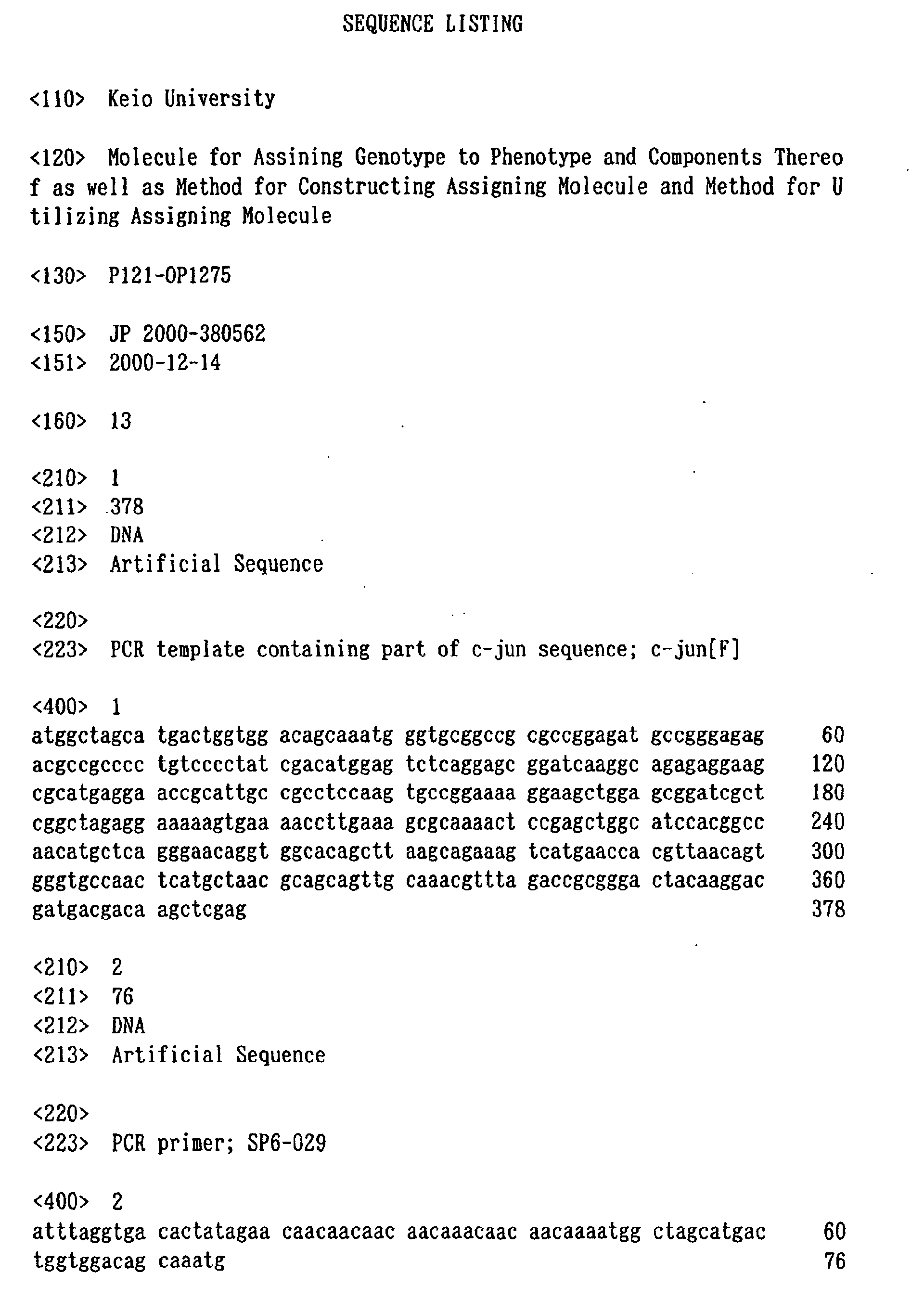


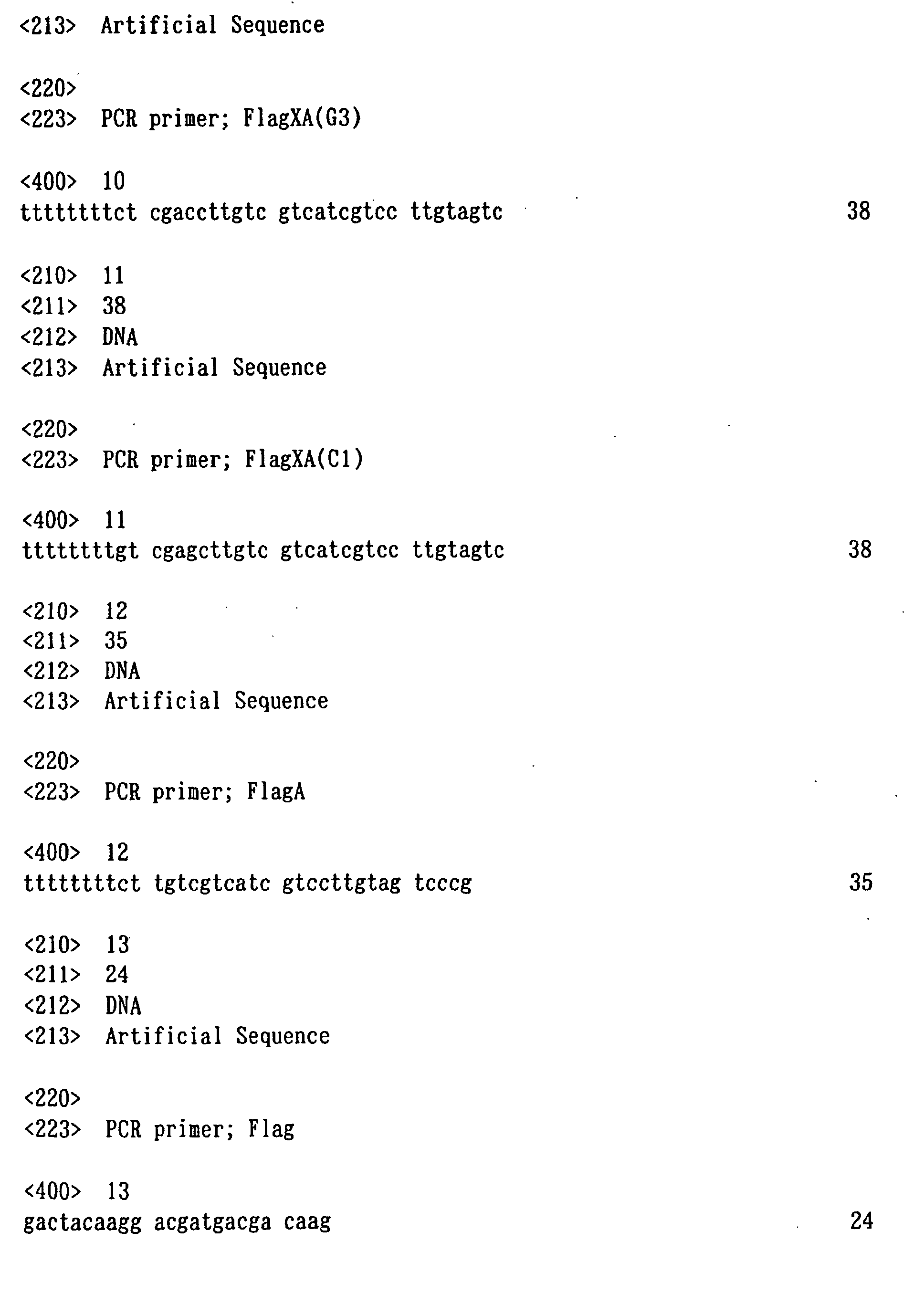
Claims (21)
- A spacer molecule comprising a donor region which can be bonded to a 3'-terminal end of nucleic acid, a PEG region that is bonded to the donor region and comprises polyethylene glycol as a main component and a peptide acceptor region which is bonded to the PEG region and comprises a group which can be bonded to a peptide by transpeptidation.
- The spacer molecule according to claim 1, wherein the peptide acceptor region comprises puromycin or a derivative thereof, or puromycin or a derivative thereof and one or two residues of deoxyribonucleotides or ribonucleotides.
- The spacer molecule according to claim 1 or 2, which comrises at least one function-imparting unit between the donor region and the PEG region.
- The spacer molecule according to claim 3, wherein the function-imparting unit is at least one residue of functionally modified deoxyribonucleotide or ribonucleotide.
- A coding molecule, which is a nucleic acid comprising a 5' untranslated region comprising a transcription promoter and a translation enhancer; an ORF region that is bonded to the 3'-terminal side of the 5' untranslated region and encodes a protein; and a 3'-terminal region which is bonded to the 3'-terminal side of the ORF region and comprises a polyA sequence and a sequence which a restriction enzyme XhoI recognizes on the 5'-terminal side of the polyA sequence.
- The coding molecule according to claim 5, wherein the transcription promoter is a promoter of SP6 RNA polymerase.
- The coding molecule according to claim 5 or 6, wherein the translation enhancer is a part of the TMV omega sequence of tobacco mosaic virus (O29).
- The coding molecule according to any one of claims 5 to 7, which comprises an affinity tag sequence in a portion downstream from the ORF region.
- The coding molecule according to claim 8, wherein the affinity tag sequence is a Flag-tag sequence, which is a tag for affinity separation and analysis based on an antigen-antibody reaction.
- A genotype molecule constructed by bonding a 3'-terminal end of a coding molecule which is a nucleic acid comprising a 5' untranslated region comrising a transcription promoter and a translation enhancer; an ORF region which is bonded to the 3'-terminal side of the 5' untranslated region and encodes a protein; and a 3'-terminal region that is bonded to the 3'-terminal side of the ORF region and comprises a polyA sequence to the donor region of the spacer molecule as defined in any one of claims 1 to 4.
- The genotype molecule according to claim 10, wherein the transcription promoter is a promoter of SP6 RNA polymerase.
- The genotype molecule according to claim 10 or 11, wherein the translation enhancer is a part of the TMV omega sequence of tobacco mosaic virus (O29).
- The genotype molecule according to any one of claim 10 to 12, wherein the 3'-terminal end sequence comprises a sequence which a restriction enzyme XhoI recognizes on the 5'-terminal end side of the polyA sequence.
- The genotype molecule according to any one of claims 10 to 13, which comprising an affinity tag sequence in a portion downstream from the ORF region.
- The genotype molecule according to claim 14, wherein the affinity tag sequence is a Flag-tag sequence, which is a tag for affinity separation and analysis based on an antigen-antibody reaction.
- A method for constructing a genotype molecule, which comprises bonding (a) a 3'-terminal end of a coding molecule which is RNA comprising a 5' untranslated region comprising a transcription promoter and a translation enhancer; an ORF region which is bonded on the 3'-terminal side of the 5' untranslated region and encodes a protein; and a 3'-terminal region which is bonded to the 3'-terminal side of the ORF region and comprises a polyA sequence, to (b) the donor region of the spacer molecule as defined in any one of claims 1 to 4, which comprises RNA, by using RNA ligase in the presence of free polyethylene glycol having the same molecular weight as that of polyethylene glycol constituting the PEG region in the spacer molecule.
- An assigning molecule constructed by ligating the genotype molecule as defined in any one of claims 10 to 15 to a phenotype molecule which is a protein encoded by the ORF region in the genotype molecule, by transpeptidation.
- A method for constructing an assigning molecule, which comprises translating the genotype molecule as defined in any one of claims 10 to 15 in a cell-free translation system to ligate the genotype molecule to a phenotype molecule which is a protein encoded by the ORF region in the genotype molecule, by transpeptidation.
- The method according to claim 18, wherein the cell-free translation system is a wheat germ cell-free translation system.
- The method according to claim 18, wherein the cell-free translation system is a rabbit reticulocyte cell-free translation system.
- A method for screening a nucleotide sequence encoding a protein which acts on a target substance, which comprises measuring an interaction between a decoded portion of an assigning molecule and the target substance by using a library comprising a plurality of the assigning molecules as defined in claim 17, among which at least a part of the assigning molecules have different sequences of the ORF regions in their coding portions, and detecting the nucleotide sequence of the coding portion of the assigning molecule exhibiting the interaction.
Applications Claiming Priority (3)
| Application Number | Priority Date | Filing Date | Title |
|---|---|---|---|
| JP2000380562A JP4963142B2 (en) | 2000-12-14 | 2000-12-14 | Genotype-phenotype mapping molecule and its constituents, and method for producing and using mapping molecule |
| JP2000380562 | 2000-12-14 | ||
| PCT/JP2001/010862 WO2002048347A1 (en) | 2000-12-14 | 2001-12-11 | Molecule correspondent to genotype and phenotype, composing elements thereof, method of producing the corespondent molecule and method of using the same |
Publications (2)
| Publication Number | Publication Date |
|---|---|
| EP1350845A1 true EP1350845A1 (en) | 2003-10-08 |
| EP1350845A4 EP1350845A4 (en) | 2005-04-06 |
Family
ID=18848721
Family Applications (1)
| Application Number | Title | Priority Date | Filing Date |
|---|---|---|---|
| EP01270605A Withdrawn EP1350845A4 (en) | 2000-12-14 | 2001-12-11 | MOLECULE CORRESPONDING TO A GENOTYPE AND A PHENOTYPE, ELEMENTS THEREOF AND METHODS OF OBTAINING AND USING THE SAME |
Country Status (4)
| Country | Link |
|---|---|
| US (1) | US8278427B2 (en) |
| EP (1) | EP1350845A4 (en) |
| JP (1) | JP4963142B2 (en) |
| WO (1) | WO2002048347A1 (en) |
Cited By (3)
| Publication number | Priority date | Publication date | Assignee | Title |
|---|---|---|---|---|
| WO2005052577A1 (en) * | 2003-11-26 | 2005-06-09 | Plant Research International B.V. | Method to identify a biomolecular profile |
| US7670787B2 (en) | 2002-12-11 | 2010-03-02 | Keio University | Protein forming complex with c-Fos protein, nucleic acid encoding the same and method of using the same |
| US7842476B2 (en) | 2002-09-06 | 2010-11-30 | Isogenica Limited | In vitro peptide expression library |
Families Citing this family (13)
| Publication number | Priority date | Publication date | Assignee | Title |
|---|---|---|---|---|
| WO2002046395A1 (en) * | 2000-12-07 | 2002-06-13 | Keio University | C-terminal modified protein and process for producing the same, modifying agent and translation template to be used in produfing c-terminal modified protein, and method of detecting protein interaction with the use of c-termial modified protein |
| WO2003014734A1 (en) * | 2001-08-07 | 2003-02-20 | Keio University | Method of detecting interaction between substance and protein, method of screening protein interacting with substance, and method of forming complex of substance and protein interacting with the substance |
| AU2002354116A1 (en) * | 2001-12-07 | 2003-06-17 | Keio University | Complex of assigned molecule with c-end labeled protein, assigned molecule complex and methods of analyzing interaction between proteins using these complexes |
| AU2003242344A1 (en) * | 2002-06-12 | 2003-12-31 | Keio University | Translation templates and library thereof, proteins synthesized therefrom and protein library, constituents thereof, process for producing the same and method of using the same |
| AU2003304539A1 (en) * | 2002-11-22 | 2004-06-06 | Keio University | Protein library and screening method using the same |
| DE112004002217B4 (en) | 2003-11-19 | 2017-04-06 | Tokyo University Of Science Foundation | A protein-forming complex with a c-Jun protein, nucleic acid encoding the same and methods using the same |
| JPWO2006062173A1 (en) * | 2004-12-08 | 2008-06-12 | 学校法人慶應義塾 | Bcl-xL heterodimer-inhibiting peptide that promotes anticancer drug action and screening method thereof |
| JP5240699B2 (en) * | 2006-03-29 | 2013-07-17 | 独立行政法人農業生物資源研究所 | Efficient method for producing transgenic silkworm |
| KR20110036638A (en) | 2008-07-25 | 2011-04-07 | 리차드 더블유. 와그너 | Protein Screening Method |
| MX2011003381A (en) * | 2008-09-30 | 2011-04-21 | Abbott Lab | Improved method of rna display. |
| JP5174971B2 (en) | 2009-10-22 | 2013-04-03 | ペプチドリーム株式会社 | RAPID display method in peptide translation synthesis |
| US9481882B2 (en) | 2010-03-31 | 2016-11-01 | Tokyo University Of Science Foundation | Constitution of tool for analyzing biomolecular interaction and analysis method using same |
| CN118147081A (en) * | 2019-11-26 | 2024-06-07 | 南克维斯特公司 | Primary NK CAR constructs and methods |
Family Cites Families (17)
| Publication number | Priority date | Publication date | Assignee | Title |
|---|---|---|---|---|
| US5843701A (en) * | 1990-08-02 | 1998-12-01 | Nexstar Pharmaceticals, Inc. | Systematic polypeptide evolution by reverse translation |
| FI960165L (en) * | 1993-07-16 | 1996-01-26 | Univ Leland Stanford Junior | Regulated apoptosis |
| JPH0797328A (en) * | 1993-09-29 | 1995-04-11 | Osaka Prefecture | Atherosclerosis treatment agent |
| WO1995011922A1 (en) | 1993-10-29 | 1995-05-04 | Affymax Technologies N.V. | In vitro peptide and antibody display libraries |
| US5559000A (en) | 1995-01-18 | 1996-09-24 | The Scripps Research Institute | Encoded reaction cassette |
| US5942433A (en) * | 1995-07-31 | 1999-08-24 | The United States Of America As Represented By The Department Of Health And Human Services | Extension of a protein-protein interaction surface to inactivate the function of a cellular protein |
| DE19646372C1 (en) | 1995-11-11 | 1997-06-19 | Evotec Biosystems Gmbh | Conjugates of polypeptide and encoding nucleic acid |
| JPH1016636A (en) * | 1996-06-28 | 1998-01-20 | Seizo Hirabayashi | Luggage tying aids on the bed |
| EP1477561B1 (en) * | 1996-10-17 | 2008-12-10 | Mitsubishi Chemical Corporation | Molecule assigning genotype to phenotype and use thereof |
| IL131016A (en) * | 1997-01-21 | 2004-12-15 | Gen Hospital Corp | Selection of proteins using rna-protein fusions |
| US6261804B1 (en) * | 1997-01-21 | 2001-07-17 | The General Hospital Corporation | Selection of proteins using RNA-protein fusions |
| US6365346B1 (en) * | 1998-02-18 | 2002-04-02 | Dade Behring Inc. | Quantitative determination of nucleic acid amplification products |
| US5958731A (en) * | 1998-09-11 | 1999-09-28 | Incyte Pharmaceuticals, Inc. | Cell junction PDZ protein |
| CA2350417C (en) * | 1998-12-02 | 2010-02-09 | Bristol-Myers Squibb Company | Dna-protein fusions and uses thereof |
| CA2377468C (en) * | 1999-07-27 | 2010-04-20 | Phylos, Inc. | Peptide acceptor ligation methods |
| EP1211514A4 (en) * | 1999-08-31 | 2005-03-09 | Mitsubishi Chem Corp | METHOD OF ANALYZING A MUTUAL INTERACTION BETWEEN A PROTEIN AND A MOLECULE |
| US20030002230A1 (en) | 2001-06-29 | 2003-01-02 | Storage Technology Corporation | Apparatus and method of making a reduced sensitivity spin valve sensor apparatus in which a basic magnetic sensitivity is reduced |
-
2000
- 2000-12-14 JP JP2000380562A patent/JP4963142B2/en not_active Expired - Lifetime
-
2001
- 2001-12-11 WO PCT/JP2001/010862 patent/WO2002048347A1/en not_active Ceased
- 2001-12-11 EP EP01270605A patent/EP1350845A4/en not_active Withdrawn
-
2003
- 2003-06-13 US US10/460,467 patent/US8278427B2/en not_active Expired - Fee Related
Cited By (4)
| Publication number | Priority date | Publication date | Assignee | Title |
|---|---|---|---|---|
| US7842476B2 (en) | 2002-09-06 | 2010-11-30 | Isogenica Limited | In vitro peptide expression library |
| US8679781B2 (en) | 2002-09-06 | 2014-03-25 | Isogenica Limited | In vitro peptide expression library |
| US7670787B2 (en) | 2002-12-11 | 2010-03-02 | Keio University | Protein forming complex with c-Fos protein, nucleic acid encoding the same and method of using the same |
| WO2005052577A1 (en) * | 2003-11-26 | 2005-06-09 | Plant Research International B.V. | Method to identify a biomolecular profile |
Also Published As
| Publication number | Publication date |
|---|---|
| US8278427B2 (en) | 2012-10-02 |
| JP4963142B2 (en) | 2012-06-27 |
| EP1350845A4 (en) | 2005-04-06 |
| WO2002048347A1 (en) | 2002-06-20 |
| JP2002176987A (en) | 2002-06-25 |
| US20040018536A1 (en) | 2004-01-29 |
Similar Documents
| Publication | Publication Date | Title |
|---|---|---|
| US8278427B2 (en) | Molecule for assigning genotype to phenotype and components thereof as well as method for constructing assigning molecule and method for utilizing assigning molecule | |
| EP1477561B1 (en) | Molecule assigning genotype to phenotype and use thereof | |
| EP2348125B1 (en) | Method for the synthesis of a bifunctional complex | |
| JP5837478B2 (en) | RAPID display method in peptide translation synthesis | |
| ES2991825T3 (en) | Cell-free protein expression using a rolling circle amplification product | |
| CN110637086B (en) | Method for producing complex of RNA molecule and peptide, and use thereof | |
| AU775997B2 (en) | DNA-protein fusions and uses thereof | |
| CN110997922B (en) | Cell-free protein expression using double-stranded concatemeric DNA | |
| JPWO1998016636A1 (en) | Genotype-phenotype mapping molecules and their applications | |
| US10301618B2 (en) | Efficient method for displaying protein multimer | |
| US20220002719A1 (en) | Oligonucleotide-mediated sense codon reassignment | |
| Tabuchi et al. | An efficient ligation method in the making of an in vitro virus for in vitro protein evolution | |
| EP2554681B1 (en) | Constitution of tool for analyzing biomolecular interaction and analysis method using same | |
| EP3262185B1 (en) | Dna display and methods thereof | |
| JP3683902B2 (en) | Genotype-phenotype mapping molecule and use thereof | |
| WO2025079184A1 (en) | Method for screening peptides using multiple libraries | |
| WO2011162355A1 (en) | High-speed maturation method for an oligonucleotide library for the purpose of preparing a protein library | |
| HK1245322A1 (en) | Enzymatic encoding | |
| HK1149948B (en) | Method for the synthesis of a bifunctional complex | |
| HK1082742B (en) | Enzymatic encoding | |
| HK1149947B (en) | Synthesis of a bifunctional complex | |
| HK1149948A (en) | Method for the synthesis of a bifunctional complex |
Legal Events
| Date | Code | Title | Description |
|---|---|---|---|
| PUAI | Public reference made under article 153(3) epc to a published international application that has entered the european phase |
Free format text: ORIGINAL CODE: 0009012 |
|
| 17P | Request for examination filed |
Effective date: 20030701 |
|
| AK | Designated contracting states |
Kind code of ref document: A1 Designated state(s): AT BE CH CY DE DK ES FI FR GB GR IE IT LI LU MC NL PT SE TR |
|
| AX | Request for extension of the european patent |
Extension state: AL LT LV MK RO SI |
|
| RBV | Designated contracting states (corrected) |
Designated state(s): AT BE CH CY DE FR GB LI SE |
|
| A4 | Supplementary search report drawn up and despatched |
Effective date: 20050217 |
|
| STAA | Information on the status of an ep patent application or granted ep patent |
Free format text: STATUS: THE APPLICATION IS DEEMED TO BE WITHDRAWN |
|
| 18D | Application deemed to be withdrawn |
Effective date: 20060228 |