EP1350833A2 - Specific antioxidant combination for diesel engine lubricating compositions - Google Patents
Specific antioxidant combination for diesel engine lubricating compositions Download PDFInfo
- Publication number
- EP1350833A2 EP1350833A2 EP03012461A EP03012461A EP1350833A2 EP 1350833 A2 EP1350833 A2 EP 1350833A2 EP 03012461 A EP03012461 A EP 03012461A EP 03012461 A EP03012461 A EP 03012461A EP 1350833 A2 EP1350833 A2 EP 1350833A2
- Authority
- EP
- European Patent Office
- Prior art keywords
- oil
- bismuth
- groups
- antimony
- composition according
- Prior art date
- Legal status (The legal status is an assumption and is not a legal conclusion. Google has not performed a legal analysis and makes no representation as to the accuracy of the status listed.)
- Withdrawn
Links
Classifications
-
- C—CHEMISTRY; METALLURGY
- C10—PETROLEUM, GAS OR COKE INDUSTRIES; TECHNICAL GASES CONTAINING CARBON MONOXIDE; FUELS; LUBRICANTS; PEAT
- C10M—LUBRICATING COMPOSITIONS; USE OF CHEMICAL SUBSTANCES EITHER ALONE OR AS LUBRICATING INGREDIENTS IN A LUBRICATING COMPOSITION
- C10M163/00—Lubricating compositions characterised by the additive being a mixture of a compound of unknown or incompletely defined constitution and a non-macromolecular compound, each of these compounds being essential
-
- C—CHEMISTRY; METALLURGY
- C10—PETROLEUM, GAS OR COKE INDUSTRIES; TECHNICAL GASES CONTAINING CARBON MONOXIDE; FUELS; LUBRICANTS; PEAT
- C10M—LUBRICATING COMPOSITIONS; USE OF CHEMICAL SUBSTANCES EITHER ALONE OR AS LUBRICATING INGREDIENTS IN A LUBRICATING COMPOSITION
- C10M135/00—Lubricating compositions characterised by the additive being an organic non-macromolecular compound containing sulfur, selenium or tellurium
- C10M135/12—Thio-acids; Thiocyanates; Derivatives thereof
- C10M135/14—Thio-acids; Thiocyanates; Derivatives thereof having a carbon-to-sulfur double bond
- C10M135/18—Thio-acids; Thiocyanates; Derivatives thereof having a carbon-to-sulfur double bond thiocarbamic type, e.g. containing the groups
-
- C—CHEMISTRY; METALLURGY
- C10—PETROLEUM, GAS OR COKE INDUSTRIES; TECHNICAL GASES CONTAINING CARBON MONOXIDE; FUELS; LUBRICANTS; PEAT
- C10M—LUBRICATING COMPOSITIONS; USE OF CHEMICAL SUBSTANCES EITHER ALONE OR AS LUBRICATING INGREDIENTS IN A LUBRICATING COMPOSITION
- C10M141/00—Lubricating compositions characterised by the additive being a mixture of two or more compounds covered by more than one of the main groups C10M125/00 - C10M139/00, each of these compounds being essential
- C10M141/08—Lubricating compositions characterised by the additive being a mixture of two or more compounds covered by more than one of the main groups C10M125/00 - C10M139/00, each of these compounds being essential at least one of them being an organic sulfur-, selenium- or tellurium-containing compound
-
- C—CHEMISTRY; METALLURGY
- C10—PETROLEUM, GAS OR COKE INDUSTRIES; TECHNICAL GASES CONTAINING CARBON MONOXIDE; FUELS; LUBRICANTS; PEAT
- C10M—LUBRICATING COMPOSITIONS; USE OF CHEMICAL SUBSTANCES EITHER ALONE OR AS LUBRICATING INGREDIENTS IN A LUBRICATING COMPOSITION
- C10M2207/00—Organic non-macromolecular hydrocarbon compounds containing hydrogen, carbon and oxygen as ingredients in lubricant compositions
- C10M2207/02—Hydroxy compounds
- C10M2207/023—Hydroxy compounds having hydroxy groups bound to carbon atoms of six-membered aromatic rings
-
- C—CHEMISTRY; METALLURGY
- C10—PETROLEUM, GAS OR COKE INDUSTRIES; TECHNICAL GASES CONTAINING CARBON MONOXIDE; FUELS; LUBRICANTS; PEAT
- C10M—LUBRICATING COMPOSITIONS; USE OF CHEMICAL SUBSTANCES EITHER ALONE OR AS LUBRICATING INGREDIENTS IN A LUBRICATING COMPOSITION
- C10M2207/00—Organic non-macromolecular hydrocarbon compounds containing hydrogen, carbon and oxygen as ingredients in lubricant compositions
- C10M2207/02—Hydroxy compounds
- C10M2207/023—Hydroxy compounds having hydroxy groups bound to carbon atoms of six-membered aromatic rings
- C10M2207/024—Hydroxy compounds having hydroxy groups bound to carbon atoms of six-membered aromatic rings having at least two phenol groups but no condensed ring
-
- C—CHEMISTRY; METALLURGY
- C10—PETROLEUM, GAS OR COKE INDUSTRIES; TECHNICAL GASES CONTAINING CARBON MONOXIDE; FUELS; LUBRICANTS; PEAT
- C10M—LUBRICATING COMPOSITIONS; USE OF CHEMICAL SUBSTANCES EITHER ALONE OR AS LUBRICATING INGREDIENTS IN A LUBRICATING COMPOSITION
- C10M2207/00—Organic non-macromolecular hydrocarbon compounds containing hydrogen, carbon and oxygen as ingredients in lubricant compositions
- C10M2207/02—Hydroxy compounds
- C10M2207/023—Hydroxy compounds having hydroxy groups bound to carbon atoms of six-membered aromatic rings
- C10M2207/026—Hydroxy compounds having hydroxy groups bound to carbon atoms of six-membered aromatic rings with tertiary alkyl groups
-
- C—CHEMISTRY; METALLURGY
- C10—PETROLEUM, GAS OR COKE INDUSTRIES; TECHNICAL GASES CONTAINING CARBON MONOXIDE; FUELS; LUBRICANTS; PEAT
- C10M—LUBRICATING COMPOSITIONS; USE OF CHEMICAL SUBSTANCES EITHER ALONE OR AS LUBRICATING INGREDIENTS IN A LUBRICATING COMPOSITION
- C10M2215/00—Organic non-macromolecular compounds containing nitrogen as ingredients in lubricant Compositions
- C10M2215/02—Amines, e.g. polyalkylene polyamines; Quaternary amines
- C10M2215/06—Amines, e.g. polyalkylene polyamines; Quaternary amines having amino groups bound to carbon atoms of six-membered aromatic rings
- C10M2215/064—Di- and triaryl amines
-
- C—CHEMISTRY; METALLURGY
- C10—PETROLEUM, GAS OR COKE INDUSTRIES; TECHNICAL GASES CONTAINING CARBON MONOXIDE; FUELS; LUBRICANTS; PEAT
- C10M—LUBRICATING COMPOSITIONS; USE OF CHEMICAL SUBSTANCES EITHER ALONE OR AS LUBRICATING INGREDIENTS IN A LUBRICATING COMPOSITION
- C10M2215/00—Organic non-macromolecular compounds containing nitrogen as ingredients in lubricant Compositions
- C10M2215/24—Organic non-macromolecular compounds containing nitrogen as ingredients in lubricant Compositions having hydrocarbon substituents containing thirty or more carbon atoms, e.g. nitrogen derivatives of substituted succinic acid
- C10M2215/28—Amides; Imides
-
- C—CHEMISTRY; METALLURGY
- C10—PETROLEUM, GAS OR COKE INDUSTRIES; TECHNICAL GASES CONTAINING CARBON MONOXIDE; FUELS; LUBRICANTS; PEAT
- C10M—LUBRICATING COMPOSITIONS; USE OF CHEMICAL SUBSTANCES EITHER ALONE OR AS LUBRICATING INGREDIENTS IN A LUBRICATING COMPOSITION
- C10M2219/00—Organic non-macromolecular compounds containing sulfur, selenium or tellurium as ingredients in lubricant compositions
- C10M2219/06—Thio-acids; Thiocyanates; Derivatives thereof
- C10M2219/062—Thio-acids; Thiocyanates; Derivatives thereof having carbon-to-sulfur double bonds
- C10M2219/066—Thiocarbamic type compounds
- C10M2219/068—Thiocarbamate metal salts
-
- C—CHEMISTRY; METALLURGY
- C10—PETROLEUM, GAS OR COKE INDUSTRIES; TECHNICAL GASES CONTAINING CARBON MONOXIDE; FUELS; LUBRICANTS; PEAT
- C10N—INDEXING SCHEME ASSOCIATED WITH SUBCLASS C10M RELATING TO LUBRICATING COMPOSITIONS
- C10N2010/00—Metal present as such or in compounds
- C10N2010/10—Groups 5 or 15
-
- C—CHEMISTRY; METALLURGY
- C10—PETROLEUM, GAS OR COKE INDUSTRIES; TECHNICAL GASES CONTAINING CARBON MONOXIDE; FUELS; LUBRICANTS; PEAT
- C10N—INDEXING SCHEME ASSOCIATED WITH SUBCLASS C10M RELATING TO LUBRICATING COMPOSITIONS
- C10N2010/00—Metal present as such or in compounds
- C10N2010/12—Groups 6 or 16
-
- C—CHEMISTRY; METALLURGY
- C10—PETROLEUM, GAS OR COKE INDUSTRIES; TECHNICAL GASES CONTAINING CARBON MONOXIDE; FUELS; LUBRICANTS; PEAT
- C10N—INDEXING SCHEME ASSOCIATED WITH SUBCLASS C10M RELATING TO LUBRICATING COMPOSITIONS
- C10N2030/00—Specified physical or chemical properties which is improved by the additive characterising the lubricating composition, e.g. multifunctional additives
- C10N2030/04—Detergent property or dispersant property
- C10N2030/041—Soot induced viscosity control
-
- C—CHEMISTRY; METALLURGY
- C10—PETROLEUM, GAS OR COKE INDUSTRIES; TECHNICAL GASES CONTAINING CARBON MONOXIDE; FUELS; LUBRICANTS; PEAT
- C10N—INDEXING SCHEME ASSOCIATED WITH SUBCLASS C10M RELATING TO LUBRICATING COMPOSITIONS
- C10N2040/00—Specified use or application for which the lubricating composition is intended
- C10N2040/25—Internal-combustion engines
- C10N2040/252—Diesel engines
Definitions
- This invention relates to lubricants suitable for use in diesel engines and more particularly to diesel engine lubricant having improved soot induced viscosity resistance.
- Internal combustion engines function by the combustion of fuels which in turn generate the power needed to propel vehicles.
- Lubricant compositions for internal combustion engines are known for example from US-A-3 239 462 and EP-A-556 404.
- US-A-3 239 462 discloses lubricating oil compositions possessing good stability and antiwear properties capable of being operated over wide ranges of adverse conditions containing a non-ash forming nitrogen-containing detergent and an antimony dithiocarbamate alone or in combination with an oil-soluble bisphenol
- EP-A-556404 relates to lubricating oil compositions which contains very little or no phosphorus and are excellent in antiwear properties, extreme pressure characteristics, friction characteristic, oxidation stability, cooking resistance comprising an oil soluble amine compound and a metal dithiocarbamate which is preferably a zinc dithiocarbamate.
- the fuel is a diesel fuel and the combustion thereof generally results in emissions from the exhausts of such vehicles which comprise three main components. These are soot and particulate matter, carbon monoxide and nitrogen oxides (the latter will hereafter be abbreviated as NO X for convenience).
- NO X emissions can be reduced by lowering the temperature at which the fuel is combusted in the engine. Typically this is achieved by retarding the combustion, i.e. by injecting the fuel shortly after the peak temperature is reached in the cylinder.
- the dispersants function by forming a coating of the dispersant on the surface of soot particles and thereby minimizing the tendency of the soot particles to agglomerate.
- the potency of the dispersants to perform this function declines with time and thus, one of the methods of improving the useful life of lubricants, particularly crankcase lubricants, would be to improve the dispersancy retention capability of crankcase lubricants. This may be achieved, e.g. by minimizing the risk of oxidation of the dispersants under the conditions prevalent in the engines during use.
- US-A-5,837,657 discloses a method of improving the performance of a sooted diesel oil and controlling soot induced viscosity increase by adding to the diesel oil a minor amount of a trinuclear molybdenum compound of the generic formula Mo 3 S k L n Q z wherein L is a ligand having organo groups, n is from 1 to 4, k various from 4 through 10, Q is a neutral electron donating compound such as e.g. water, amines, alcohols, phosphines and ethers, and z ranges from 0 to 5.
- An object of the present invention is to control soot induced viscosity increase in lubricants by prolonging the effective performance of the dispersant additive contained in the lubricant. The dispersant is then able to disperse the soot for an extended period thereby inhibiting soot induced viscosity increase of the lubricant. In other words, an object of the present invention is to improve the dispersancy retention capability of such lubricants.
- the present invention provides a method of controlling the soot induced viscosity increase of diesel engine lubricant compositions comprising a base oil and a dispersant by including in said lubricant composition an effective amount of an antioxidant, characterized in that the antioxidant comprises a dihydrocarbyl-dithiocarbamate of a metal selected from antimony, bismuth and mixtures thereof.
- the lubricant compositions used in the present invention are those that comprise a major amount of a lubricating oil suitable for use in a engine crankcase, particularly a diesel engine crankcase.
- a lubricating oil suitable for use in a engine crankcase, particularly a diesel engine crankcase.
- mineral or synthetic lubricating oils having a kinematic viscosity of 3.5 to 25 cSt at 100°C comprise a major portion of the lubricating compositions.
- Such lubricating base oils are widely available and may be any of the available base oils groups, namely Group I, II, III, IV or V.
- the base oil is a Group I or II base oil.
- the dispersancy retention properties of such lubricant compositions are improved in accordance with this invention by including in the crankcase lubricant an added antioxidant which is a metal dihydrocarbyldithiocarbamate wherein the metal is antimony or bismuth.
- the antioxidant may be oil soluble or oil dispersible, but is preferably oil soluble.
- antimony dihydrocarbyldithiocarbamate can be prepared by the use of the following reaction: (R)(R')N-H + 6 CS 2 + Sb 2 O 3 ⁇ 2[(R)(R')N-C(S)S] 3 Sb + 3H 2 O wherein R and R' are linear or branched alkyl groups.
- Bismuth dihydrocarbyldithiocarbamates can be prepared by an exchange reaction between a bismuth compound such as eg a carboxylate or an alkanoate (eg bismuth neodecanoate, bismuth octanoate or bismuth naphthenate) and a metal dihydrocarbyldithiocarbamate such as eg zinc diamyldithiocarbamate.
- the metal dihydrocarbyldithiocarbamate used in this exchange reaction can be pre-prepared or formed in situ, for instance, by reacting a secondary amine and carbon disulphide in the presence of a metal oxide or a metal hydroxide.
- the structure of the antimony or bismuth dihydrocarbyldithiocarbamates may be considered as having a ligand [-S 2 CN(R)(R')] wherein the dihyrocarbyl groups, R and R' impart oil solubility to the antimony and bismuth compounds.
- hydrocarbyl denotes a substituent having carbon atoms directly attached to the remainder of the ligand and is predominantly hydrocarbyl in character within the context of this invention.
- substituents include the following:
- the hydrocarbyl groups are preferably alkyl (e.g., in which the carbon atom attached to the remainder of the ligand is primary, secondary or tertiary), aryl, substituted aryl and ether groups.
- the hydrocarbyl groups of the ligands should be such that they have a sufficient number of carbon atoms to render the corresponding antimony or bismuth dialkyldithiocarbamate soluble or dispersible in the oil to which it is added.
- the total number of carbon atoms present among all of the hydrocarbyl groups of the compounds' ligands is suitably at least 21, preferably at least 25 and preferably at least 30, typically e.g., 21 to 800.
- the number of carbon atoms in each hydrocarbyl group will generally range from 1 to 100, preferably from 1 to 40 and more preferably from 3 to 20.
- the antioxidant in the compositions of the present invention also include at least one of a phenolic antioxidant and an aminic antioxidant.
- a phenolic antioxidant hindered phenols are preferred.
- the present invention is a diesel engine lubricant composition
- a diesel engine lubricant composition comprising a base stock, a dispersant and an antioxidant which antioxidant comprises two or more of (a) an antimony dihydrocarbyldithiocarbamate, (vb) a bismuth dihydocarbyl dithiocarbamate, (c) a phenolic compound and (d) an aminic compound.
- the antioxidant comprises a dihydrocarbyldithiocarbamate of bismuth and at least one of a phenolic compound or an aminic compound.
- the antioxidant comprises a dihydrocarbyldithiocarbamate of antimony or bismuth or a mixture therof, phenolic compound and an aminic compound.
- phenolic compounds include inter alia :
- the phenolic antioxidants are preferably compounds which have the following structures: wherein, in the formulae (I) - (IV) above, R 1 , R 2 , and R 3 are the same or different alkyl groups having 3-9 carbon atoms and x and y are integers from 1 to 4.
- Suitable amine antioxidants for use in the compositions of the present invention are diaryl amines, aryl naphthyl amines and alkyl derivatives of diaryl amines and the aryl naphthyl amines.
- Specific examples of the aminic compounds that may be used in the compositions of the present invention include inter alia :
- the antioxidant which comprises the dihydrocarbyldithiocarbamates of antimony and/or bismuth and phenolic and/or aminic compounds will form a minor component of the total lubricant composition.
- the antimony or bismuth dihydrocarbyldithiocarbamate typically will comprise about 0.05 to about 3 wt %, preferably about 0.1-2% of the total composition, ie the antimony and/or bismuth metal is suitably present in an amount of about 50-2000 ppm, preferably from about 200-1500 ppm of the total composition.
- the optional phenolic and/or aminic compounds are suitably present in an amount of about 0.1 to about 3 wt % of the total composition.
- the antioxidant comprises in addition to the antimony and/or bismuth dihydrocarbyldithiocarbamate a mixture of hindered phenols and a diaryl amine in a weight ratio ranging from about 20-80:10-60:10-60 respectively.
- the antioxidants may be combined with a carrier liquid in the form of a concentrate.
- concentration of the combined antioxidants in the concentrate may vary from 1 to 80% by weight, and will preferably be in the range of 5 to 10% by weight.
- any of the conventional dispersants used hitherto in the lubricating compositions may also be used in the compositions of the present invention.
- these include the polyalkylene succinimides, Mannich condensation products of polylalkylphenolformaldehyde polyamine and borated derivatives thereof.
- ashless dispersants such as the ashless succinimides, especially the polyisobutenyl succinimides of a polyamine such as eg tetraethylenepentamine, benzylamine ashless dispersants, and ester ashless dispersants.
- the dispersants are generally used in the compositions of the present invention in an amount ranging from about 1-10% by weight based on the total weight of the lubricant composition, preferably from about 4-8% by weight.
- these lubricating compositions may include additives commonly used in lubricating oils especially crankcase lubricants, such as antiwear agents, detergents, rust inhibitors, viscosity index improvers, extreme-pressure agents, friction modifiers, corrosion inhibitors, emulsifying aids, pour point depressants, anti-foams and the like.
- crankcase lubricants such as antiwear agents, detergents, rust inhibitors, viscosity index improvers, extreme-pressure agents, friction modifiers, corrosion inhibitors, emulsifying aids, pour point depressants, anti-foams and the like.
- a feature of the lubricant compositions of the present invention is that the presence therein of antimony and/or bismuth dihydrocarbyldithiocarbamate as an antioxidant provides unexpected improvement in oxidation control, viscosity increase control and dispersancy retention over compositions which contain conventional organomolybdenum compounds such as the corresponding dinuclear molybdenum dihydrocarbyldithiocarbamates.
- test oils were prepared, each oil consisting of 600 Solvent Neutral ('600 SN') mineral base oil, a dispersant additive, and, apart from the control Test Oil A, one or more specified antioxidant additives, as shown in Table 1 below.
- the KV100 of each of these fresh Test Oils was measured and the measurements are given in Table 2 below.
- Test Oils B and D demonstrate the present invention; Test Oils A, C, E and F are comparative.
- the dispersancy retention of each of the Test Oils was determined by use of a GM 6.2L soot-laden basestock dispersancy test in which the soot dispersancy of an used oil is determined by the viscosity ratio of the diluted test oil in the presence and absence of soot; the lower the ratio, the better the dispersancy.
- the fresh Test Oils of Table 1 were each mixed with a soot-laden mineral oil - 600 SN containing 3.5 wt% soot - at a weight ratio of 25:75 Test Oil to soot-laden 600 SN oil.
- the KV 100 of each of the fresh Test Oil/soot-laden 600 SN mixtures was measured and the measurements are given in Table 2 below.
- the KV 100 measurements of the soot-laden mixtures were compared with the KV 100 of the equivalent oils without soot.
- the effect of the soot on the oil viscosity is expressed by the relative viscosity of the fresh Test Oil/soot-laden 600 SN to the viscosity of the equivalent fresh Test Oil/fresh 600 SN mixture. The relative viscosity is given in the bottom line of Table 2.
- each of the above oils was then subjected to a bench oxidation test. In this test, the oil was exposed for 32 hours at 165°C under a mixed nitrogen/air flow, with 40 ppm iron from added ferric acetylacetonate as catalyst. The flow rates of air and nitrogen were controlled at 500 ml/min and 350ml/min respectively.
- the KV 100 of these 'used' oils were then measured for (i) the Test Oils of Table 1 alone, (ii) the Test Oil/soot-laden 600 SN oil, and (iii) the Test Oil/'unsooted' 600 SN oil. These KV 100 measurements are given in Table 3 below. The relative viscosity of each used Test Oil/unsooted 600 SN oil to equivalent used Test Oil/soot-laden 600 SN oil was calculated and these relative viscosities are given in the bottom line of Table 3.
- Test Oils A-F are shown in Table 1 below: Test Oils A B C D E F 600 SN (% wt) 94.0 93.0 93.0 93.0 93.0 91.8 Paranox® 106 (% wt) 6.0 6.0 6.0 6.0 6.0 6.0 6.0 Irganox® L150 (% wt) - - 1.0 0.5 - - Octopol® 735 (% wt) - 1.0 - 0.5 - - Molyvan® 822 - - - - 1.0 2.2
- Test Oils A-F Fresh Oil KV 100 (cSt) 12.99 12.98 13.02 12.98 12.98 12.98 KV 100 of Fresh Oil/Soot-Laden 600SN (3.5 wt% soot) Mixture (25/75) (cSt) 14.29 14.13 14.24 14.13 14.16 14.17 Calculated KV 100 of Fresh oil/Fresh 600SN Mixture (25/75) (cSt) 11.70 11.70 11.71 11.70 11.70 11.70 Relative Viscosity (Viscosity Ratio), ⁇ r (Fresh oil) 1.22 1.21 1.22 1.21 1.21 1.21 1.21
- Table 3 shows the characteristics of the used oils (A-F) after the oxidation test.
- Test Oils B and D according to the invention show significant improvement in control of soot-induced viscosity relative to comparative Test Oils A, C, E and F.
- Test Oil B containing an antimony dihydrocarbyldithiocarbamate antioxidant has a used oil relative viscosity of 1.25 and a fresh oil relative viscosity of 1.21, a difference of only 0.04 indicating very little increase in viscosity; whereas comparative Test Oil E containing a molybdenum dihydrocarbyldithiocarbamate has used oil and fresh oil relative viscosities of 1.39 and 1.21 respectively, that is a much larger difference of 0.18 indicating a significant increase in viscosity of the used oil relative to the fresh oil.
- Test Oil D which is a preferred embodiment of the present invention, containing both an antimony dihydrocarbyldithiocarbamate and a phenol/amine antioxidant, has a even better reduction in soot induced viscosity with a difference in used oil versus fresh oil relative viscosity of only 0.02.
- Example G 50 g of bismuth Nap-All (14% Bi, ex OMG Americas, Inc, Ohio, USA) and 54 g pf Vanlube® AZ (50% zinc diamyldithiocarbamate, ex R T Vanderbilt Co Inc, Connecticut, USA) were mixed at room temperature for 3 hours to yield a product containing bismuth diamyldithiocarbamate and zinc naphthenate by a process described in the prior published US-A-5,840,664. The bismuth content in the product was 6.7%.
- Example H 35 g of bismuth salt of neodecanoic acid (20% bismuth, ex OMG Americas, Inc, Ohio, USA) and 54 g of Vanlube®AZ (50% zinc diamyldithiocarbamate, ex R T Vanderbilt Co, Inc, Connecticut, USA) were mixed at room temperature for 3 hours to yield a product (orange/red in colour) containing bismuth diamyldithiocarbamate and zinc neodecanoate. The bismuth content in the product was 7.9%.
- a set of oils were formulated to provide a heavy duty diesel oil, each oil consisting of a conventional, commercially available heavy duty diesel oil (the same oil was used in each of Examples I - N) and, apart from comparitive examples I and N, one or more specified antioxidant additives.
- oils were then tested for dispersancy retention using the same GM 6.2L soot-laden basestock dispersancy test as described for Examples A - F above, and the relative viscosities of the used and fresh oil samples determined.
Landscapes
- Chemical & Material Sciences (AREA)
- Chemical Kinetics & Catalysis (AREA)
- General Chemical & Material Sciences (AREA)
- Oil, Petroleum & Natural Gas (AREA)
- Organic Chemistry (AREA)
- Lubricants (AREA)
Abstract
This invention relates diesel engine lubricant composition having improved soot induced
viscosity resistance comprising a base oil and a dispersant, by including in said lubricant
composition an effective amount of an antioxidant, characterised in that the antioxidant
comprises a dihydrocarbyldithiocarbamate of a metal selected from antimony, bismuth and
mixtures thereof. The antioxidant contains at least one other compound
selected from a phenolic and an aminic compound. The method of the present invention
improves the performance retention of the dispersant additive, and thus inhibits the soot-induced
viscosity increase of the lubricant.
Description
- This invention relates to lubricants suitable for use in diesel engines and more particularly to diesel engine lubricant having improved soot induced viscosity resistance.
- Internal combustion engines function by the combustion of fuels which in turn generate the power needed to propel vehicles.
- Lubricant compositions for internal combustion engines are known for example from US-A-3 239 462 and EP-A-556 404. US-A-3 239 462 discloses lubricating oil compositions possessing good stability and antiwear properties capable of being operated over wide ranges of adverse conditions containing a non-ash forming nitrogen-containing detergent and an antimony dithiocarbamate alone or in combination with an oil-soluble bisphenol and EP-A-556404 relates to lubricating oil compositions which contains very little or no phosphorus and are excellent in antiwear properties, extreme pressure characteristics, friction characteristic, oxidation stability, cooking resistance comprising an oil soluble amine compound and a metal dithiocarbamate which is preferably a zinc dithiocarbamate.
- In the case of a diesel engine, the fuel is a diesel fuel and the combustion thereof generally results in emissions from the exhausts of such vehicles which comprise three main components. These are soot and particulate matter, carbon monoxide and nitrogen oxides (the latter will hereafter be abbreviated as NOX for convenience). To alleviate environmental concerns, research is ongoing in the petroleum industry to reduce the levels of these emissions. NOX emissions can be reduced by lowering the temperature at which the fuel is combusted in the engine. Typically this is achieved by retarding the combustion, i.e. by injecting the fuel shortly after the peak temperature is reached in the cylinder. However, this retarded combustion has the disadvantage that it causes more soot to accumulate in the fuel partly due to incomplete combustion of the fuel because of the lower combustion temperature, and partly due to increased soot deposition on the cylinder wall which is drawn down into to lubricant with the downward stroke of the piston. The presence of soot in the lubricant has the adverse affects of causing viscosity increase and accelerated wear. It is important that soot induced viscosity increase be controlled such that the lubricant stays within viscosity grade in order to maintain its expected performance. Several methods have been tried to alleviate this problem including the use of one or more of dispersants, metal salts and solvents which may be ethers, esters and the like. The dispersants function by forming a coating of the dispersant on the surface of soot particles and thereby minimizing the tendency of the soot particles to agglomerate. However, the potency of the dispersants to perform this function, in turn, declines with time and thus, one of the methods of improving the useful life of lubricants, particularly crankcase lubricants, would be to improve the dispersancy retention capability of crankcase lubricants. This may be achieved, e.g. by minimizing the risk of oxidation of the dispersants under the conditions prevalent in the engines during use. One such method is described in US-A-5,837,657 which discloses a method of improving the performance of a sooted diesel oil and controlling soot induced viscosity increase by adding to the diesel oil a minor amount of a trinuclear molybdenum compound of the generic formula Mo3SkLnQz wherein L is a ligand having organo groups, n is from 1 to 4, k various from 4 through 10, Q is a neutral electron donating compound such as e.g. water, amines, alcohols, phosphines and ethers, and z ranges from 0 to 5.
- An object of the present invention is to control soot induced viscosity increase in lubricants by prolonging the effective performance of the dispersant additive contained in the lubricant. The dispersant is then able to disperse the soot for an extended period thereby inhibiting soot induced viscosity increase of the lubricant. In other words, an object of the present invention is to improve the dispersancy retention capability of such lubricants.
- Accordingly, the present invention provides a method of controlling the soot induced viscosity increase of diesel engine lubricant compositions comprising a base oil and a dispersant by including in said lubricant composition an effective amount of an antioxidant, characterized in that the antioxidant comprises a dihydrocarbyl-dithiocarbamate of a metal selected from antimony, bismuth and mixtures thereof.
- The lubricant compositions used in the present invention are those that comprise a major amount of a lubricating oil suitable for use in a engine crankcase, particularly a diesel engine crankcase. Thus, mineral or synthetic lubricating oils having a kinematic viscosity of 3.5 to 25 cSt at 100°C comprise a major portion of the lubricating compositions. Such lubricating base oils are widely available and may be any of the available base oils groups, namely Group I, II, III, IV or V. Preferably the base oil is a Group I or II base oil.
- The dispersancy retention properties of such lubricant compositions are improved in accordance with this invention by including in the crankcase lubricant an added antioxidant which is a metal dihydrocarbyldithiocarbamate wherein the metal is antimony or bismuth. The antioxidant may be oil soluble or oil dispersible, but is preferably oil soluble. Such dihydrocarbyldithiocarbamates and methods of preparation thereof are claimed and described for instance in prior published US-A-4,859,787 and US-A-5,840,664 which are incorporated herein by reference. Thus, antimony dihydrocarbyldithiocarbamate can be prepared by the use of the following reaction:
- Bismuth dihydrocarbyldithiocarbamates can be prepared by an exchange reaction between a bismuth compound such as eg a carboxylate or an alkanoate (eg bismuth neodecanoate, bismuth octanoate or bismuth naphthenate) and a metal dihydrocarbyldithiocarbamate such as eg zinc diamyldithiocarbamate. The metal dihydrocarbyldithiocarbamate used in this exchange reaction can be pre-prepared or formed in situ, for instance, by reacting a secondary amine and carbon disulphide in the presence of a metal oxide or a metal hydroxide.
- The structure of the antimony or bismuth dihydrocarbyldithiocarbamates may be considered as having a ligand [-S2CN(R)(R')] wherein the dihyrocarbyl groups, R and R' impart oil solubility to the antimony and bismuth compounds. In this instance, the term "hydrocarbyl" denotes a substituent having carbon atoms directly attached to the remainder of the ligand and is predominantly hydrocarbyl in character within the context of this invention. Such substituents include the following:
- (1) hydrocarbon substituents, ie, aliphatic (for example alkyl or alkenyl), alicyclic (for example cycloalkyl or cycloalkenyl), aromatic, aliphatic- and alicyclic-substituted aromatic nuclei and the like, as well as cyclic substituents wherein the ring is completed through another portion of the ligand (that is, any two indicated substituents may together form an alicyclic group);
- (2) substituted hydrocarbon substituents, ie, those containing nonhydrocarbon groups which, in the context of this invention, do not alter the predominantly hydrocarbyl character of the substituent. Those skilled in the art will be aware of suitable groups (eg halo (especially chloro), amino, alkoxyl, mercapto, alkylmercapto, nitro, nitroso, sulphoxy etc.); and
- (3) hetero substituents, ie, substituents which, while predominantly hydrocarbon in character within the context of this invention, contain atoms other than carbon present in a chain or ring otherwise composed of carbon atoms.
-
- The hydrocarbyl groups are preferably alkyl (e.g., in which the carbon atom attached to the remainder of the ligand is primary, secondary or tertiary), aryl, substituted aryl and ether groups.
- Importantly, the hydrocarbyl groups of the ligands should be such that they have a sufficient number of carbon atoms to render the corresponding antimony or bismuth dialkyldithiocarbamate soluble or dispersible in the oil to which it is added. The total number of carbon atoms present among all of the hydrocarbyl groups of the compounds' ligands is suitably at least 21, preferably at least 25 and preferably at least 30, typically e.g., 21 to 800. For instance, the number of carbon atoms in each hydrocarbyl group will generally range from 1 to 100, preferably from 1 to 40 and more preferably from 3 to 20.
- The antioxidant in the compositions of the present invention also include at least one of a phenolic antioxidant and an aminic antioxidant. Among the phenolic antioxidants, hindered phenols are preferred.
- Thus the present invention is a diesel engine lubricant composition comprising a base stock, a dispersant and an antioxidant which antioxidant comprises two or more of (a) an antimony dihydrocarbyldithiocarbamate, (vb) a bismuth dihydocarbyl dithiocarbamate, (c) a phenolic compound and (d) an aminic compound.
- According to a first embodiment the antioxidant comprises a dihydrocarbyldithiocarbamate of bismuth and at least one of a phenolic compound or an aminic compound.
- According to a second embodiment the antioxidant comprises a dihydrocarbyldithiocarbamate of antimony or bismuth or a mixture therof, phenolic compound and an aminic compound.
- The nature of the antimony and bismuth dihydrocarbyldithiocarbamates in these compositions is described above.
- The nature and amounts of the phenolic and aminic compounds in said compositions are described below.
- Examples of such phenolic compounds include inter alia:
- 4,4'-methylene bis(2,6-di-tert-butylphenol)
- 4,4'-bis(2,6-di-tert-butylphenol)
- 4,4'-bis(2-methyl-6-tert-butylphenol)
- 2,2'-methylene bis(4-ethyl-6-tert-butylphenol)
- 2,2'-methylene bis(4-methyl-6-tert-butylphenol)
- 4,4'-butylidene bis(3-methyl-6-tert-butylphenol)
- 4,4'-isopropylidene bis(2,6-di-tert-butylphenol)
- 2,2'-methylene bis(4-methyl-6-nonylphenol)
- 2,2'-isobutylidene bis(4,6-dimethyl phenol)
- 2,2'-methylene bis(4-methyl-6-cyclohexylphenol)
- 2,6-di-tert-butyl-4-methylphenol
- 2,6-di-tert-butyl-4-ethylphenol and
- 2,4-dimethyl-6-tert-butylphenol
-
- The phenolic antioxidants are preferably compounds which have the following structures:
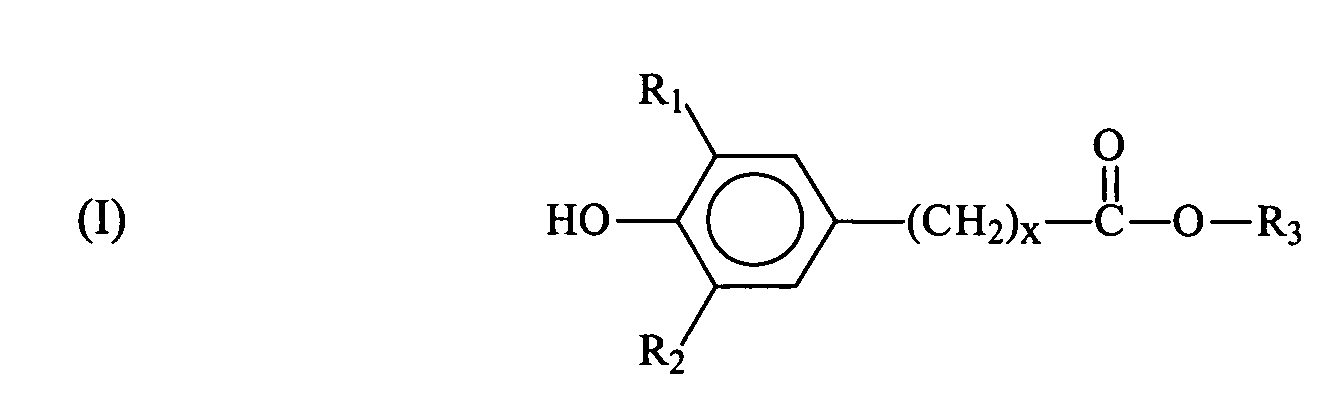

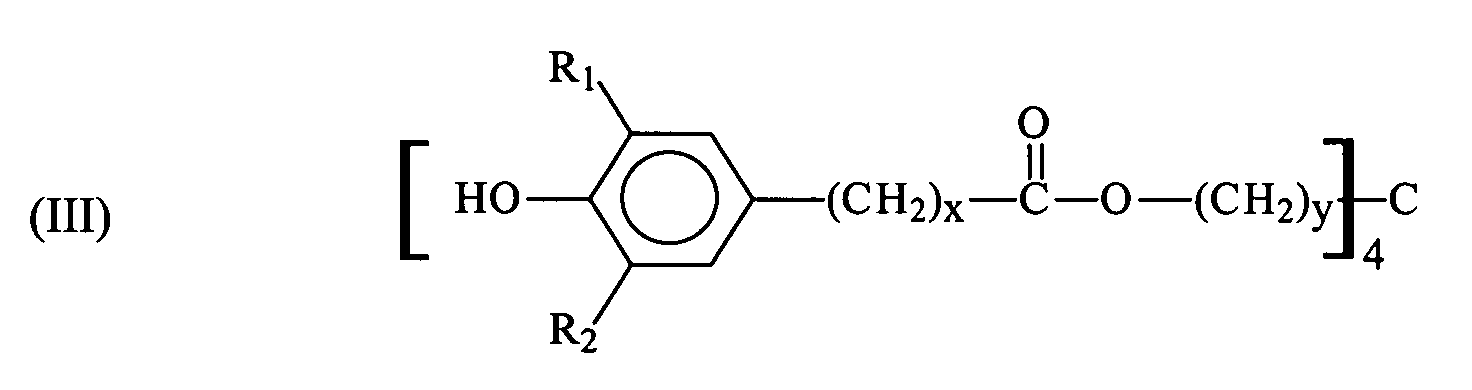 wherein, in the formulae (I) - (IV) above, R1, R2, and R3 are the same or different alkyl groups having 3-9 carbon atoms and x and y are integers from 1 to 4.
- Suitable amine antioxidants for use in the compositions of the present invention are diaryl amines, aryl naphthyl amines and alkyl derivatives of diaryl amines and the aryl naphthyl amines. Specific examples of the aminic compounds that may be used in the compositions of the present invention include inter alia:
- Monoalkyldiphenyl amines such as eg monooctyldiphenyl amine and monononyl diphenyl amine; dialkyldiphenyl amines such as eg 4,4'-dibutyldiphenyl amine, 4,4'-dipentyldiphenyl amine, 4,4'-dihexyldiphenyl amine, 4,4'-diheptyldiphenyl amine, 4,4'-dioctyldiphenyl amine and 4,4'-dinonyldiphenyl amine; polyalkyldiphenyl amines such as eg tetra-butyldiphenyl amine, tetra-hexyldiphenyl amine, tetra-octyldiphenyl amine and tetra-nonyldiphenyl amine; the naphthylamines such as eg α-naphthylamine and phenyl-α-naphthylamine; butylphenyl-α-naphthylamine, pentylphenyl-α-naphthylamine, hexylphenyl-α-naphthylamine, heptylphenyl-α-naphthylamine, octylphenyl-α-naphthylamine and nonylphenyl-α-naphthylamine. Of these, dialkyldiphenyl amine and naphthylamines are preferable.
-
- In general the antioxidant which comprises the dihydrocarbyldithiocarbamates of antimony and/or bismuth and phenolic and/or aminic compounds will form a minor component of the total lubricant composition. For example, the antimony or bismuth dihydrocarbyldithiocarbamate typically will comprise about 0.05 to about 3 wt %, preferably about 0.1-2% of the total composition, ie the antimony and/or bismuth metal is suitably present in an amount of about 50-2000 ppm, preferably from about 200-1500 ppm of the total composition. The optional phenolic and/or aminic compounds are suitably present in an amount of about 0.1 to about 3 wt % of the total composition.
- It has also been found that if the weight ratio of antimony and/or bismuth dihydrocarbyldithiocarbamate to the phenolic or aminic compound in the antioxidant is in the range of about 80:20 to about 20:80, optimum dispersancy retention can be achieved by these combined additives of the present invention.
- It is particularly preferred that the antioxidant comprises in addition to the antimony and/or bismuth dihydrocarbyldithiocarbamate a mixture of hindered phenols and a diaryl amine in a weight ratio ranging from about 20-80:10-60:10-60 respectively.
- Optionally, the antioxidants may be combined with a carrier liquid in the form of a concentrate. The concentration of the combined antioxidants in the concentrate may vary from 1 to 80% by weight, and will preferably be in the range of 5 to 10% by weight.
- Any of the conventional dispersants used hitherto in the lubricating compositions may also be used in the compositions of the present invention. Examples of these include the polyalkylene succinimides, Mannich condensation products of polylalkylphenolformaldehyde polyamine and borated derivatives thereof. However, it is preferable to use ashless dispersants such as the ashless succinimides, especially the polyisobutenyl succinimides of a polyamine such as eg tetraethylenepentamine, benzylamine ashless dispersants, and ester ashless dispersants. The dispersants are generally used in the compositions of the present invention in an amount ranging from about 1-10% by weight based on the total weight of the lubricant composition, preferably from about 4-8% by weight.
- In general, these lubricating compositions may include additives commonly used in lubricating oils especially crankcase lubricants, such as antiwear agents, detergents, rust inhibitors, viscosity index improvers, extreme-pressure agents, friction modifiers, corrosion inhibitors, emulsifying aids, pour point depressants, anti-foams and the like.
- A feature of the lubricant compositions of the present invention is that the presence therein of antimony and/or bismuth dihydrocarbyldithiocarbamate as an antioxidant provides unexpected improvement in oxidation control, viscosity increase control and dispersancy retention over compositions which contain conventional organomolybdenum compounds such as the corresponding dinuclear molybdenum dihydrocarbyldithiocarbamates.
- The present invention is further illustrated with reference to the following Examples and Comparative Tests.
- A series of test oils were prepared, each oil consisting of 600 Solvent Neutral ('600 SN') mineral base oil, a dispersant additive, and, apart from the control Test Oil A, one or more specified antioxidant additives, as shown in Table 1 below. The KV100 of each of these fresh Test Oils was measured and the measurements are given in Table 2 below. Test Oils B and D demonstrate the present invention; Test Oils A, C, E and F are comparative.
- The dispersancy retention of each of the Test Oils was determined by use of a GM 6.2L soot-laden basestock dispersancy test in which the soot dispersancy of an used oil is determined by the viscosity ratio of the diluted test oil in the presence and absence of soot; the lower the ratio, the better the dispersancy.
- To provide soot-containing oils for the test, the fresh Test Oils of Table 1 were each mixed with a soot-laden mineral oil - 600 SN containing 3.5 wt% soot - at a weight ratio of 25:75 Test Oil to soot-laden 600 SN oil. The KV100 of each of the fresh Test Oil/soot-laden 600 SN mixtures was measured and the measurements are given in Table 2 below. To determine the effect of the soot on the oil viscosity, the KV100 measurements of the soot-laden mixtures were compared with the KV100 of the equivalent oils without soot. The KV100 of these fresh Test Oil/ fresh 600 SN, 'KV(mix)', was calculated according to the equation:
- To determine the effective dispersancy retention capabilities of the Test Oils, each of the above oils was then subjected to a bench oxidation test. In this test, the oil was exposed for 32 hours at 165°C under a mixed nitrogen/air flow, with 40 ppm iron from added ferric acetylacetonate as catalyst. The flow rates of air and nitrogen were controlled at 500 ml/min and 350ml/min respectively. The KV100 of these 'used' oils were then measured for (i) the Test Oils of Table 1 alone, (ii) the Test Oil/soot-laden 600 SN oil, and (iii) the Test Oil/'unsooted' 600 SN oil. These KV100 measurements are given in Table 3 below. The relative viscosity of each used Test Oil/unsooted 600 SN oil to equivalent used Test Oil/soot-laden 600 SN oil was calculated and these relative viscosities are given in the bottom line of Table 3.
- In these Examples and tests the following commercial materials have been used:
- Irganox® L150 is a mixture of phenolic and diarylamine (ex Ciba Geigy)
- Paranox® 106 is a polyisobutenylsuccinimide dispersant (ex Infenium, Linden, NJ)
- Octopol® 735 is an antimony diamyldithiocarbamate (containing 7.5% antimony, ex Tiarco Chemical, Dalton Georgia, USA).
- Molyvan® 822 is a dinuclear molybdenum dithiocarbamate containing 5% Mo (ex R T Vanderbilt Co) used in Tests E & F
-
- The compositions of the Test oils A-F are shown in Table 1 below:
Test Oils A B C D E F 600 SN (% wt) 94.0 93.0 93.0 93.0 93.0 91.8 Paranox® 106 (% wt) 6.0 6.0 6.0 6.0 6.0 6.0 Irganox® L150 (% wt) - - 1.0 0.5 - - Octopol® 735 (% wt) - 1.0 - 0.5 - - Molyvan® 822 - - - - 1.0 2.2 - The characteristics of the fresh Test oils (A-F) are shown in Table 2 below:
Test Oils A B C D E F Fresh Oil KV100 (cSt) 12.99 12.98 13.02 12.98 12.98 12.98 KV100 of Fresh Oil/Soot-Laden 600SN (3.5 wt% soot) Mixture (25/75) (cSt) 14.29 14.13 14.24 14.13 14.16 14.17 Calculated KV100 of Fresh oil/Fresh 600SN Mixture (25/75) (cSt) 11.70 11.70 11.71 11.70 11.70 11.70 Relative Viscosity (Viscosity Ratio), ηr (Fresh oil) 1.22 1.21 1.22 1.21 1.21 1.21 - Table 3 below shows the characteristics of the used oils (A-F) after the oxidation test.
Test Oils A B C D E F Used Oil KV100 (cSt) 35.40 13.33 14.16 13.34 17.44 14.70 KV100 of Used Oil/Soot-Laden 600SN (3.5 wt% soot) Mixture (25/75) (cSt) 21.82 14.64 16.44 14.45 17.25 16.52 Calculated KV100 of Used oil/Fresh 600SN Mixture (25/75) (cSt) 14.65 11.75 11.87 11.73 12.43 12.01 Relative Viscosity (Viscosity Ratio), ηr (Used oil) 1.49 1.25 1.39 1.23 1.39 1.38 - The extent to which the test oil has been subject to soot-induced viscosity increase over time, ie after being exposed to oxidative conditions, is shown by a comparison of the relative viscosity of the used oil in Table 3 with the relative viscosity of the equivalent 'fresh' oil in Table 2. The closer the relative viscosity of the used oil to the fresh oil, the smaller the viscosity increase, and hence the greater the improvement in the dispersancy retention of the lubricant. From the above results it can be seen that Test Oils B and D according to the invention show significant improvement in control of soot-induced viscosity relative to comparative Test Oils A, C, E and F. For example, Test Oil B, containing an antimony dihydrocarbyldithiocarbamate antioxidant has a used oil relative viscosity of 1.25 and a fresh oil relative viscosity of 1.21, a difference of only 0.04 indicating very little increase in viscosity; whereas comparative Test Oil E containing a molybdenum dihydrocarbyldithiocarbamate has used oil and fresh oil relative viscosities of 1.39 and 1.21 respectively, that is a much larger difference of 0.18 indicating a significant increase in viscosity of the used oil relative to the fresh oil. Test Oil D, which is a preferred embodiment of the present invention, containing both an antimony dihydrocarbyldithiocarbamate and a phenol/amine antioxidant, has a even better reduction in soot induced viscosity with a difference in used oil versus fresh oil relative viscosity of only 0.02.
- Example G: 50 g of bismuth Nap-All (14% Bi, ex OMG Americas, Inc, Ohio, USA) and 54 g pf Vanlube® AZ (50% zinc diamyldithiocarbamate, ex R T Vanderbilt Co Inc, Connecticut, USA) were mixed at room temperature for 3 hours to yield a product containing bismuth diamyldithiocarbamate and zinc naphthenate by a process described in the prior published US-A-5,840,664. The bismuth content in the product was 6.7%.
- Example H: 35 g of bismuth salt of neodecanoic acid (20% bismuth, ex OMG Americas, Inc, Ohio, USA) and 54 g of Vanlube®AZ (50% zinc diamyldithiocarbamate, ex R T Vanderbilt Co, Inc, Connecticut, USA) were mixed at room temperature for 3 hours to yield a product (orange/red in colour) containing bismuth diamyldithiocarbamate and zinc neodecanoate. The bismuth content in the product was 7.9%.
- A set of oils were formulated to provide a heavy duty diesel oil, each oil consisting of a conventional, commercially available heavy duty diesel oil (the same oil was used in each of Examples I - N) and, apart from comparitive examples I and N, one or more specified antioxidant additives. The compositions of the Test oils I-N are shown in Table 4 below:
Test Oils I J K L M N* 15W-40 Engine Oil (CG-4), (wt %) 100 99.0 98.0 98.0 98.5 99.0 Octopol® 735 (wt %) - 1.0 - - - - Bi Compound from Example G (wt %) 2.0 - - - Bi Compound from Example H (wt %) - - - 2.0 1.0 - Irganox® L150 (wt %) - - - - 0.5 1.0 - The oils were then tested for dispersancy retention using the same GM 6.2L soot-laden basestock dispersancy test as described for Examples A - F above, and the relative viscosities of the used and fresh oil samples determined.
- The characteristics of the fresh Test oils (I-N) are shown in Table 5 below:
Test Oils I J K L M N Fresh Oil KV100 (cSt) 15.10 14.97 14.88 14.92 14.97 15.20 KV100 of Fresh Oil/Soot-Laden 600SN (3.5 wt% soot) Mixture (25/75) (cSt) 14.42 14.44 14.40 14.26 14.32 14.42 Calculated KV100 of Fresh oil/Fresh 600SN Mixture (25/75) (cSt) 12.23 12.19 12.17 12.18 12.20 12.25 Relative Viscosity (Viscosity Ratio), ηr (Fresh oil) 1.18 1.18 1.18 1.17 1.17 1.18 - The following Table 6 shows the characteristics of the used oils (I-N) after the oxidation test.
Test Oils I J K L M N Used Oil KV100 (cSt) 14.16 16.77 14.24 14.21 15.22 15.86 KV100 of Used Oil/Soot-Laden 600SN (3.5 wt% soot) Mixture (25/75) (cSt) 16.15 15.04 15.01 15.51 14.57 15.69 Calculated KV100 of Used oil/Fresh 600SN Mixture (25/75) (cSt) 11.89 12.49 11.84 11.94 12.14 12.28 Relative Viscosity (Viscosity Ratio), ηr (Used oil) 1.36 1.20 1.26 1.30 1.20 1.28 - These results show that bismuth and antimony dialkyldithiocarbamates can be used as a top treat for a fully formulated 15W-40 heavy duty diesel engine oil. The addition of antimony dialkyldithiocarbamate or bismuth dialkyldithiocarbamate/Irganox® L150 mixture leads to a substantially improved reduction is soot-induced viscosity increase and hence an improvement in dispersancy retention capability.
Claims (9)
- A diesel engine lubricant composition comprising a base oil, a dispersant and an antioxidant, which antioxidant comprises a dihydrocarbyldithiocarbamate of bismuth and at least one of a phenolic compound or an aminic compound.
- A diesel engine lubricant composition comprising a base oil, a dispersant and an antioxidant, which antioxidant comprises a dihydrocarbyldithiocarbamate of a metal selected from antimony, bismuth and mixtures thereof, a phenolic compound and an aminic compound.
- The composition according to Claim 1 or 2, having an improved soot induced viscosity resistance.
- The composition according to Claim 1 to 3, wherein the structure of the antimony and/or bismuth dithiocarbamates has a ligand [-S2CN(R)(R')] wherein R and R' are hydrocarbyl groups having carbon atoms directly attached to the remainder of the ligand and impart oil solubility to the corresponding antimony and/or bismuth dithiocarbamates.
- The composition according to Claim 4, wherein the substituent groups R and R' in the ligand are selected from:(a) hydrocarbon substituents which may be aliphatic, alicyclic, aromatic, aromatic nuclei substituted by aliphatic, alicyclic or cyclic groups, and wherein the cyclic substituents are such that the ring is completed through another portion of the ligand by any two of the indicated substituents together forming an alicyclic group;(b) substituted hydrocarbon substituents which contain nonhydrocarbon groups without altering the predominantly hydrocarbyl character of the substituent such as halo, amino, alkoxyl, mercapto, alkylmercapto, nitro, nitroso and sulphoxy groups; and(c) hetero substituents which, while maintaining the predominantly hydrocarbyl character thereof, contain atoms other than carbon present in a chain or ring otherwise composed of carbon atoms.
- The composition according to Claim 4 or 5, wherein the hydrocarbyl groups are alkyl, aryl, substituted aryl and/or ether groups.
- The composition according any one of Claims 4 to 6, wherein the total number of carbon atoms present among all of the hydrocarbyl groups of the ligand is at least 21.
- The composition according to any one of Claims 1 to 7, wherein the dihydrocarbyldithiocarbamate of antimony and/or bismuth is present in said lubricating oil composition in an amount of from 0.05 to about 3.00 wt % of the total composition.
- The composition according to any one of Claims 1 to 8, comprising in addition to the dihydrocarbyldithiocarbamate a mixture of hindered phenol and diaryl amine in a weight ratio ranging from 80-20:10-60:10-60 respectively.
Applications Claiming Priority (3)
| Application Number | Priority Date | Filing Date | Title |
|---|---|---|---|
| GB9924756A GB2355466A (en) | 1999-10-19 | 1999-10-19 | Lubricant Composition for Diesel Engines |
| GB9924756 | 1999-10-19 | ||
| EP00969736A EP1224249B1 (en) | 1999-10-19 | 2000-10-17 | Viscosity control of lubricant compositions in diesel engines |
Related Parent Applications (1)
| Application Number | Title | Priority Date | Filing Date |
|---|---|---|---|
| EP00969736A Division EP1224249B1 (en) | 1999-10-19 | 2000-10-17 | Viscosity control of lubricant compositions in diesel engines |
Publications (1)
| Publication Number | Publication Date |
|---|---|
| EP1350833A2 true EP1350833A2 (en) | 2003-10-08 |
Family
ID=10863013
Family Applications (2)
| Application Number | Title | Priority Date | Filing Date |
|---|---|---|---|
| EP03012461A Withdrawn EP1350833A2 (en) | 1999-10-19 | 2000-10-17 | Specific antioxidant combination for diesel engine lubricating compositions |
| EP00969736A Expired - Lifetime EP1224249B1 (en) | 1999-10-19 | 2000-10-17 | Viscosity control of lubricant compositions in diesel engines |
Family Applications After (1)
| Application Number | Title | Priority Date | Filing Date |
|---|---|---|---|
| EP00969736A Expired - Lifetime EP1224249B1 (en) | 1999-10-19 | 2000-10-17 | Viscosity control of lubricant compositions in diesel engines |
Country Status (11)
| Country | Link |
|---|---|
| US (1) | US6689725B1 (en) |
| EP (2) | EP1350833A2 (en) |
| JP (1) | JP2003512506A (en) |
| AR (1) | AR028183A1 (en) |
| AT (1) | ATE250116T1 (en) |
| AU (1) | AU7938700A (en) |
| BR (1) | BR0014848A (en) |
| CA (1) | CA2387596C (en) |
| DE (1) | DE60005387D1 (en) |
| GB (1) | GB2355466A (en) |
| WO (1) | WO2001029157A2 (en) |
Cited By (1)
| Publication number | Priority date | Publication date | Assignee | Title |
|---|---|---|---|---|
| EP4353805A1 (en) | 2022-10-11 | 2024-04-17 | Infineum International Limited | Lubricant composition containing metal alkanoate |
Families Citing this family (35)
| Publication number | Priority date | Publication date | Assignee | Title |
|---|---|---|---|---|
| US20040121920A1 (en) * | 2000-02-14 | 2004-06-24 | Gao Jason Zhisheng | Lubricant composition comprising a dispersant, a trinuclear molybdenum compound and a different other antioxidant |
| US20040121919A1 (en) * | 2000-02-14 | 2004-06-24 | Gao Jason Zhisheng | Lubricating oil compositions comprising a trinuclear compound antioxidant |
| US6843916B2 (en) | 2002-07-16 | 2005-01-18 | The Lubrizol Corporation | Slow release lubricant additives gel |
| US7384896B2 (en) * | 2002-07-16 | 2008-06-10 | The Lubrizol Corporation | Controlled release of additive gel(s) for functional fluids |
| US7534747B2 (en) * | 2003-06-25 | 2009-05-19 | The Lubrizol Corporation | Gels that reduce soot and/or emissions from engines |
| US20040266630A1 (en) * | 2003-06-25 | 2004-12-30 | The Lubrizol Corporation, A Corporation Of The State Of Ohio | Novel additive composition that reduces soot and/or emissions from engines |
| US7560420B2 (en) * | 2004-12-23 | 2009-07-14 | Rohmax Additives Gmbh | Oil composition for lubricating an EGR equipped diesel engine and an EGR equipped diesel engine comprising same |
| US7648949B2 (en) | 2005-01-27 | 2010-01-19 | The Lubrizol Corporation | Low phosphorus cobalt complex-containing engine oil lubricant |
| US20070232503A1 (en) * | 2006-03-31 | 2007-10-04 | Haigh Heather M | Soot control for diesel engine lubricants |
| US20080248983A1 (en) | 2006-07-21 | 2008-10-09 | Exxonmobil Research And Engineering Company | Method for lubricating heavy duty geared apparatus |
| US20130005622A1 (en) | 2011-06-29 | 2013-01-03 | Exxonmobil Research And Engineering Company | Low viscosity engine oil with superior engine wear protection |
| WO2013003405A1 (en) | 2011-06-30 | 2013-01-03 | Exxonmobil Research And Engineering Company | Lubricating compositions containing polyalkylene glycol mono ethers |
| US8586520B2 (en) | 2011-06-30 | 2013-11-19 | Exxonmobil Research And Engineering Company | Method of improving pour point of lubricating compositions containing polyalkylene glycol mono ethers |
| SG193976A1 (en) | 2011-06-30 | 2013-11-29 | Exxonmobil Res & Eng Co | Lubricating compositions containing polyetheramines |
| SG193979A1 (en) | 2011-06-30 | 2013-11-29 | Exxonmobil Res & Eng Co | Method of improving pour point of lubricating compositions containing polyalkylene glycol mono ethers |
| CA2849093C (en) | 2011-10-10 | 2016-12-06 | Exxonmobil Chemical Patents Inc. | Poly alpha olefin compositions and process to produce poly alpha olefin compositions |
| WO2013066915A1 (en) | 2011-11-01 | 2013-05-10 | Exxonmobil Research And Engineering Company | Lubricants with improved low-temperature fuel economy |
| WO2013074498A1 (en) | 2011-11-14 | 2013-05-23 | Exxonmobil Research And Engineering Company | Method for improving engine fuel efficiency |
| US20130165354A1 (en) | 2011-12-22 | 2013-06-27 | Exxonmobil Research And Engineering Company | Method for improving engine fuel efficiency |
| US8703666B2 (en) | 2012-06-01 | 2014-04-22 | Exxonmobil Research And Engineering Company | Lubricant compositions and processes for preparing same |
| US9228149B2 (en) | 2012-07-02 | 2016-01-05 | Exxonmobil Research And Engineering Company | Enhanced durability performance of lubricants using functionalized metal phosphate nanoplatelets |
| US9487729B2 (en) | 2012-10-24 | 2016-11-08 | Exxonmobil Chemical Patents Inc. | Functionalized polymers and oligomers as corrosion inhibitors and antiwear additives |
| US20140194333A1 (en) | 2013-01-04 | 2014-07-10 | Exxonmobil Research And Engineering Company | Method for improving engine fuel efficiency |
| US20140274837A1 (en) | 2013-03-14 | 2014-09-18 | Exxonmobil Research And Engineering Company | Method for improving emulsion characteristics of engine oils |
| US20140274849A1 (en) | 2013-03-14 | 2014-09-18 | Exxonmobil Research And Engineering Company | Lubricating composition providing high wear resistance |
| US9062269B2 (en) | 2013-03-15 | 2015-06-23 | Exxonmobil Research And Engineering Company | Method for improving thermal-oxidative stability and elastomer compatibility |
| US10208269B2 (en) | 2013-12-23 | 2019-02-19 | Exxonmobil Research And Engineering Company | Low viscosity ester lubricant and method for using |
| US10119093B2 (en) * | 2015-05-28 | 2018-11-06 | Exxonmobil Research And Engineering Company | Composition and method for preventing or reducing engine knock and pre-ignition in high compression spark ignition engines |
| WO2016200606A1 (en) | 2015-06-09 | 2016-12-15 | Exxonmobil Research And Engineering Company | Inverse micellar compositions containing lubricant additives |
| US10316712B2 (en) | 2015-12-18 | 2019-06-11 | Exxonmobil Research And Engineering Company | Lubricant compositions for surface finishing of materials |
| WO2017146897A1 (en) | 2016-02-26 | 2017-08-31 | Exxonmobil Research And Engineering Company | Lubricant compositions containing controlled release additives |
| WO2017146896A1 (en) | 2016-02-26 | 2017-08-31 | Exxonmobil Research And Engineering Company | Lubricant compositions containing controlled release additives |
| US10479956B2 (en) | 2016-09-20 | 2019-11-19 | Exxonmobil Research And Engineering Company | Non-newtonian engine oil with superior engine wear protection and fuel economy |
| WO2018109128A1 (en) * | 2016-12-16 | 2018-06-21 | Castrol Limited | Ether-based lubricant compositions, methods and uses |
| US20200165537A1 (en) | 2018-11-28 | 2020-05-28 | Exxonmobil Research And Engineering Company | Lubricating oil compositions with improved deposit resistance and methods thereof |
Family Cites Families (16)
| Publication number | Priority date | Publication date | Assignee | Title |
|---|---|---|---|---|
| BE542726A (en) * | 1954-11-11 | |||
| US3239462A (en) * | 1962-10-15 | 1966-03-08 | Shell Oil Co | Lubricating compositions |
| US3707498A (en) * | 1970-10-30 | 1972-12-26 | Cities Service Oil Co | Lubricating oil compositions |
| US3772197A (en) * | 1970-12-04 | 1973-11-13 | Cities Service Oil Co | Lubricating oil composition |
| CA1058150A (en) * | 1972-08-04 | 1979-07-10 | Joseph J. Silverstein | Molybdenum disulphide-containing petroleum lubricant composition and method of preparing same |
| US3988249A (en) * | 1974-02-11 | 1976-10-26 | Uniroyal Inc. | Extreme pressure additive for lubricants |
| JPH0539495A (en) * | 1991-08-05 | 1993-02-19 | Tonen Corp | Lubricating oil composition |
| EP0695291A1 (en) * | 1993-04-20 | 1996-02-07 | Imperial Chemical Industries Plc | Bismuth dithiocarbamates and their use as additive for lubricants |
| JPH07196603A (en) * | 1993-12-30 | 1995-08-01 | Tonen Corp | Basic metal salt of dithiocarbamic acid, and lubricating oil composition containing the salt |
| US5744430A (en) * | 1995-04-28 | 1998-04-28 | Nippon Oil Co., Ltd. | Engine oil composition |
| US5631214A (en) * | 1995-07-31 | 1997-05-20 | R.T. Vanderbilt Company, Inc. | Preparation of bismuth dithiocarbamates |
| US5576273A (en) * | 1995-11-20 | 1996-11-19 | R.T. Vanderbilt Company, Inc. | Lubricating compositions containing bismuth compounds |
| JPH09263782A (en) * | 1996-03-28 | 1997-10-07 | Idemitsu Kosan Co Ltd | Continuously variable transmission oil composition |
| US5736493A (en) * | 1996-05-15 | 1998-04-07 | Renewable Lubricants, Inc. | Biodegradable lubricant composition from triglycerides and oil soluble copper |
| US5990055A (en) * | 1996-05-15 | 1999-11-23 | Renewable Lubricants, Inc. | Biodegradable lubricant composition from triglycerides and oil soluble antimony |
| US6048826A (en) * | 1997-06-04 | 2000-04-11 | Idemitsu Kosan Co., Ltd. | Lubricating oil composition |
-
1999
- 1999-10-19 GB GB9924756A patent/GB2355466A/en not_active Withdrawn
-
2000
- 2000-10-17 DE DE60005387T patent/DE60005387D1/en not_active Expired - Lifetime
- 2000-10-17 JP JP2001531944A patent/JP2003512506A/en active Pending
- 2000-10-17 BR BR0014848-2A patent/BR0014848A/en not_active Application Discontinuation
- 2000-10-17 US US10/069,837 patent/US6689725B1/en not_active Expired - Fee Related
- 2000-10-17 AT AT00969736T patent/ATE250116T1/en not_active IP Right Cessation
- 2000-10-17 EP EP03012461A patent/EP1350833A2/en not_active Withdrawn
- 2000-10-17 WO PCT/IB2000/001554 patent/WO2001029157A2/en not_active Ceased
- 2000-10-17 EP EP00969736A patent/EP1224249B1/en not_active Expired - Lifetime
- 2000-10-17 AU AU79387/00A patent/AU7938700A/en not_active Abandoned
- 2000-10-17 CA CA002387596A patent/CA2387596C/en not_active Expired - Fee Related
- 2000-10-18 AR ARP000105479A patent/AR028183A1/en unknown
Cited By (2)
| Publication number | Priority date | Publication date | Assignee | Title |
|---|---|---|---|---|
| EP4353805A1 (en) | 2022-10-11 | 2024-04-17 | Infineum International Limited | Lubricant composition containing metal alkanoate |
| US12365849B2 (en) | 2022-10-11 | 2025-07-22 | Infineum International Limited | Lubricant composition containing metal alkanoate |
Also Published As
| Publication number | Publication date |
|---|---|
| GB2355466A (en) | 2001-04-25 |
| CA2387596C (en) | 2009-12-15 |
| CA2387596A1 (en) | 2001-04-26 |
| EP1224249B1 (en) | 2003-09-17 |
| AU7938700A (en) | 2001-04-30 |
| AR028183A1 (en) | 2003-04-30 |
| JP2003512506A (en) | 2003-04-02 |
| US6689725B1 (en) | 2004-02-10 |
| WO2001029157A3 (en) | 2001-11-01 |
| GB9924756D0 (en) | 1999-12-22 |
| WO2001029157A2 (en) | 2001-04-26 |
| ATE250116T1 (en) | 2003-10-15 |
| EP1224249A2 (en) | 2002-07-24 |
| DE60005387D1 (en) | 2003-10-23 |
| BR0014848A (en) | 2002-06-11 |
Similar Documents
| Publication | Publication Date | Title |
|---|---|---|
| EP1224249B1 (en) | Viscosity control of lubricant compositions in diesel engines | |
| US6531428B2 (en) | Low phosphorous engine oil composition and additive compositions | |
| US6153564A (en) | Lubricating oil compositions | |
| JP5559083B2 (en) | Molybdenum-containing composition with reduced color | |
| JP4681800B2 (en) | Oil compositions with improved fuel consumption using synergistic organomolybdenum components and methods of use | |
| EP1386957B1 (en) | Methods and compositions for reducing wear in internal combustion engines lubricated with a low phosphorus content lubricating oil | |
| CN101845356B (en) | Lubricant oil composition | |
| US20040014615A1 (en) | Lubricating oil compositions | |
| CN1746279B (en) | lubricating oil composition | |
| CA2397885C (en) | Lubricating oil compositions | |
| AU2001247821B2 (en) | Lubricant composition comprising a dispersant, a trinuclear molybdenum compound and a different other antioxidant | |
| AU2001247821A1 (en) | Lubricant composition comprising a dispersant, a trinuclear molybdenum compound and a different other antioxidant | |
| US20040121920A1 (en) | Lubricant composition comprising a dispersant, a trinuclear molybdenum compound and a different other antioxidant | |
| US20040121919A1 (en) | Lubricating oil compositions comprising a trinuclear compound antioxidant | |
| CA2398072A1 (en) | Lubricating oil compositions comprising a trinuclear compound antioxidant | |
| CN119546733A (en) | Deposit control compounds for lubricating compositions | |
| JPH07118680A (en) | Lubricating oil composition |
Legal Events
| Date | Code | Title | Description |
|---|---|---|---|
| PUAI | Public reference made under article 153(3) epc to a published international application that has entered the european phase |
Free format text: ORIGINAL CODE: 0009012 |
|
| STAA | Information on the status of an ep patent application or granted ep patent |
Free format text: STATUS: THE APPLICATION HAS BEEN WITHDRAWN |
|
| 17P | Request for examination filed |
Effective date: 20030530 |
|
| AC | Divisional application: reference to earlier application |
Ref document number: 1224249 Country of ref document: EP Kind code of ref document: P |
|
| AK | Designated contracting states |
Kind code of ref document: A2 Designated state(s): AT BE CH CY DE DK ES FI FR GB GR IE IT LI LU MC NL PT SE |
|
| 18W | Application withdrawn |
Effective date: 20030829 |