EP1350677A2 - Easily removable fitting for insulating a van - Google Patents
Easily removable fitting for insulating a van Download PDFInfo
- Publication number
- EP1350677A2 EP1350677A2 EP03006913A EP03006913A EP1350677A2 EP 1350677 A2 EP1350677 A2 EP 1350677A2 EP 03006913 A EP03006913 A EP 03006913A EP 03006913 A EP03006913 A EP 03006913A EP 1350677 A2 EP1350677 A2 EP 1350677A2
- Authority
- EP
- European Patent Office
- Prior art keywords
- elements
- vehicle
- insulation
- interlocking
- components according
- Prior art date
- Legal status (The legal status is an assumption and is not a legal conclusion. Google has not performed a legal analysis and makes no representation as to the accuracy of the status listed.)
- Withdrawn
Links
Images

Classifications
-
- B—PERFORMING OPERATIONS; TRANSPORTING
- B60—VEHICLES IN GENERAL
- B60H—ARRANGEMENTS OF HEATING, COOLING, VENTILATING OR OTHER AIR-TREATING DEVICES SPECIALLY ADAPTED FOR PASSENGER OR GOODS SPACES OF VEHICLES
- B60H1/00—Heating, cooling or ventilating devices
- B60H1/00007—Combined heating, ventilating, or cooling devices
- B60H1/00014—Combined heating, ventilating, or cooling devices for load cargos on load transporting vehicles
-
- B—PERFORMING OPERATIONS; TRANSPORTING
- B60—VEHICLES IN GENERAL
- B60P—VEHICLES ADAPTED FOR LOAD TRANSPORTATION OR TO TRANSPORT, TO CARRY, OR TO COMPRISE SPECIAL LOADS OR OBJECTS
- B60P3/00—Vehicles adapted to transport, to carry or to comprise special loads or objects
- B60P3/20—Refrigerated goods vehicles
-
- B—PERFORMING OPERATIONS; TRANSPORTING
- B62—LAND VEHICLES FOR TRAVELLING OTHERWISE THAN ON RAILS
- B62D—MOTOR VEHICLES; TRAILERS
- B62D33/00—Superstructures for load-carrying vehicles
- B62D33/04—Enclosed load compartments ; Frameworks for movable panels, tarpaulins or side curtains
- B62D33/048—Enclosed load compartments ; Frameworks for movable panels, tarpaulins or side curtains for refrigerated goods vehicles
-
- B—PERFORMING OPERATIONS; TRANSPORTING
- B60—VEHICLES IN GENERAL
- B60H—ARRANGEMENTS OF HEATING, COOLING, VENTILATING OR OTHER AIR-TREATING DEVICES SPECIALLY ADAPTED FOR PASSENGER OR GOODS SPACES OF VEHICLES
- B60H1/00—Heating, cooling or ventilating devices
- B60H1/32—Cooling devices
- B60H2001/3269—Cooling devices output of a control signal
- B60H2001/327—Cooling devices output of a control signal related to a compressing unit
- B60H2001/3273—Cooling devices output of a control signal related to a compressing unit related to the operation of the vehicle, e.g. the compressor driving torque
Definitions
- the present invention relates to a fitting for an insulated van or motor vehicle, and to a motor vehicle to which this fitting is applied.
- the invention has been devised particularly, but not exclusively, for application to a small insulated van whose characteristics can be made to match those of larger vehicles, in terms of no-power operation and assured correct control of the refrigeration chain, as a result of the characteristics of special prefabricated modules which are compatible with rapid fitting and removal, combined if necessary with the automatic starting of the propulsion engine, thus enabling the specified temperatures to be maintained even when the vehicle is unmanned, without any need for an independent auxiliary engine such as those normally provided in larger vehicles.
- the insulation is provided by injecting foam which fills the cavity created by the insertion of a box consisting of the inner walls of the cold chamber.
- Another disadvantage is that, when flat insulating slabs are used, there is a sacrifice of usable internal space, while large empty volumes remain at the positions of the recesses formed by the ribs and shape of the bodywork, and reduce the temperature coefficient K of the vehicle.
- a small vehicle is also disadvantaged in terms of installed refrigeration capacity, since, whereas 7 thermal kW are normally sufficient for maintaining the temperature in a large vehicle, a small vehicle, having the same temperature coefficient K and a surface area equal to one tenth of that of the larger vehicle, will require at least 700 thermal watts, as well as the power required to compensate for the more frequent opening of the doors, making it necessary to install a 1000-1500 watt refrigeration unit although the useful capacity is 40 times smaller.
- the object of the present invention is to propose a solution to all these drawbacks, using a kit or set of components which have good insulation characteristics, and which are also designed to enable the insulated part to be fitted and removed without affecting the bodywork, while leaving the maximum useful volume within the load chamber or compartment, with the further object of providing a period of no-power operation equal to or comparable with that of large vehicles, without installing an independent engine or having the vehicle manned with the engine running.
- the said modules are preferably fitted by interlocking with screws or quick fasteners, for the doors, the whole being designed to meet the objective of enabling the insulated panelling to be fitted or removed in a limited time, possibly only a few minutes.
- the invention can be supplemented if required with an additional device which connects the refrigeration unit, having an electric motor, to the propulsion engine, this device using suitable logic and circuitry to automatically start and switch off the engine according to the refrigeration requirements.
- the number of parts making up the insulation of the van is preferably eight or nine, according to whether the rear door has two leaves or only one leaf hinged at the top.
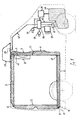
- Figure 1 represents a longitudinal section through the vehicle
- Figure 2 represents a cross section through the vehicle, both at the position of the wheel arch, shown on the right in the figure, and away from the wheel arch area, shown on the left in Figure 2.
- a preferred, but not limiting, characteristic of the invention is that all the panels have substantially flat inner surfaces, to provide a useful volume having the shape of a regular parallelepiped, except at the points of the wheel arch protuberances, while the outer surfaces are shaped in such a way that they substantially fill all of the volumes which are formed by the ribs and box structure of the bodywork and which are accessible from inside the vehicle.
- a pre-moulded element which substantially forms the whole ceiling 1 of the van is shown: this comprises two steps 2 for holding in place at least two side panels 3 and 4, which form the insulation of the right and left sides of the van respectively, and which in turn support the ceiling and hold it in place.
- a floor panel 5 completes the means for holding the two sides 3 and 4 and the front panel in place.
- the front panel can also be divided into two parts 6 and 7, of which one is U-shaped and is again easily removable, while the other, namely the module 7, is fixed permanently with screws to the dividing bulkhead of the van, since the evaporator of a refrigeration system 8 is mounted on it, this evaporator being connected with pipes and cables 9 to a motorized compressor and condenser unit 10, located externally, on top of the vehicle roof.
- Figure 1 shows a longitudinal section through the vehicle which shows not only the panels described above, but also the door, or doors 11 with their sealing gaskets 12. It also shows how the rapidly removable front panel 6 bears in a sealed way 13 on the fixed panel 7, and shows the inclination of the separating surfaces, constructed and designed for rotation behind the removable front panel 6.
- the step 14, formed both on the front panel or module 6 and on the panel 7, preferably acts to support the forward or front side of the roof or ceiling 1.
- a channel 15 for collecting condensation or washing liquid which are discharged through the ducts 16 is also shown in the rear part on the floor.
- the assembly sequence for the modules or panels requires, in addition to the installation of the front panel 7 and the corresponding refrigeration equipment which is both internal, for example the evaporator and connections 9, and external, for example the motorized compressor with the condenser 10, the initial installation of the front module or panel 6, following by the positioning of the ceiling 1, to be held in position by the insertion of the right side 3 and the left side 4 into the recesses 2, these sides being secured in turn by the installation of the floor module 5, which is fixed by stops 18, whose structure is described more fully below with reference to Figures 3 to 5.
- the floor module 5 is in place, the fitting by interlocking of all the modules fixed to the bodywork is complete, without the use of screws or adhesive and without tools, and these modules can also be removed very quickly, in only a few minutes, if required.
- Figure 3 shows a simple version in which the aforesaid floor has a rounded joint 19 along its lower edges, preferably both the side and the front edges, to avoid the presence of cracks and potential dirt traps in the lower part of the load compartment of the vehicle.
- FIG. 4 An alternative to the aforesaid strip 20 is shown in the variant of Figure 4, in which rounded joint has been lightened or reduced in thickness so that it becomes a strip having a degree of flexibility 21, preferably with adequate resilient pre-stressing, enabling this strip to deform so that it can slide on the wall and finally snap into a corresponding recess 22 where it is engaged, thus preventing the floor from being lifted and rising.
- Under the bearing point of the strip there is a channel which houses a cord 23 or other similar member, preferably a strong pre-stretched cable, whose function is to facilitate the removal of the floor by bringing the strip 21 out of the recess 22 when the cord is pulled.
- the lightening of the strip 21 creates a cavity in which a gasket 24, preferably made from flexible expanded material, can be inserted, thus eliminating the necessity for the strip or adhesive strip.
- FIG. 5 A further alternative to this device is shown in Figure 5, where the place of the rounded joint of figure 3 is taken by an independent strip 25, which initially has a greater radius of curvature than that present in the assembled state, is provided and is inserted so that it bears against the two angles 26 and 27 formed on the side or front wall and on the floor respectively.
- a cylindrical gasket 28 initially has two functions, acting as a forcing spring, which helps to keep the strip 25 in position, and as a gasket for sealing between the floor and the side and forward or front walls. The resilience of this gasket 28, which allows it to be flattened, also assists the extraction of the strip 25 from its housing for the removal of the fitting.
- FIG. 6 shows a detail of the system for fixing the preformed panels to the doors, which constitutes a preferred but not exclusive characteristic, since it can also be provided with other devices, for example of the eccentric fastening type, for rapid removal of the fitting.
- a flexible strip 29, preferably riveted or fixed in any other way to the sheet steel of the door surround box structure, has a hole in which is engaged a pin 30 projecting from the edge of the module 11, preferably made from foam-backed glass-reinforced plastic, which forms the door insulation. To remove the module or panel 11, it is simply necessary to lift all the strips 29 which secure the four sides of the panel or panels 11 to the doors.
- a special gasket 31 is provided for insulation: it is of a different type from the original door gasket 32, being generally known and more suitable for preventing the formation of heat bridges, the original gasket being preferably kept in place as an additional protective element.
- this shows a connection 33 which runs from a thermostat 34 inside the compressor 10 and connects it to a control unit 35, which in turn is connected to a unit 36 for controlling, for example, the fuel injection and ignition system of the engine 37.
- this thermostat 34 which controls the compressor of the refrigeration unit 10 also informs the control unit 35, containing the logic of the system, when the engine must be started because of the occurrence of a set of conditions relating to the security of the vehicle, with respect to the prevention of accidents or malfunctions, or the prevention of theft, a not insignificant consideration if the engine is to be left running in an unmanned vehicle.
- the first arrangement is to make the controller 35 inaccessible by functionally intercepting the starting control signals sent from the ignition key block 38.
- a key or switch 39 enables the automatic start function by means of a connection to the controller 35.
- An improvement of the system consists in the use of a remote controller for the enabling unit 39, permission being given when it has been checked that all the doors are closed, including that of the engine compartment, and that no persons are present in the cab or in the load compartment.
- the vehicle's alarm system 40 with its anti-intruder devices, contacts and sensors, can provide this information through a connecting cable to the controller 35.
- the alarm is triggered, and activates in a known way a siren and/or any other warning devices, such as a mobile telephone call, and immediately cuts off the engine.
- the engine can be stopped by the operation of the gear shift, the clutch, the accelerator and the brake, by means of a special-purpose unit 41, or by taking the information from a pre-installed engine control unit.
- the mileometer or a pulse generator fitted down-line from the clutch can disable the engine ignition by means of a corresponding connection 42.
- the control 39 which will transfer the engine ignition back to the ignition key 38 and cancel all the other sources of disabling signals 40, 41 and 42, to permit starting, and will also eliminate the disabling of the compressor, when the engine is not running, subject to the presence of adequate residual charge in the traction battery, which is monitored for this purpose, again by the remote control unit 35.
- the control logic incorporates the last-mentioned function in a known way, so that this function does not have to be added to the unit 35.
- the controller 35 may have an additional function consisting in the operation of an audible warning device, preferably briefly, for example one belonging to the alarm system, when the enabling unit 39 is not operated after all the doors have been closed and the engine turned off, within a few seconds for example.
- an audible warning device preferably briefly, for example one belonging to the alarm system
- the system will prevent the driver from being distracted by questions of the safety of the load or his own safety, since the automatic starting of the engine is prevented when the bonnet is open.
Landscapes
- Engineering & Computer Science (AREA)
- Physics & Mathematics (AREA)
- Thermal Sciences (AREA)
- Mechanical Engineering (AREA)
- Transportation (AREA)
- Chemical & Material Sciences (AREA)
- Combustion & Propulsion (AREA)
- Health & Medical Sciences (AREA)
- Public Health (AREA)
- Insulating Bodies (AREA)
- Devices That Are Associated With Refrigeration Equipment (AREA)
Abstract
Description
- Figure 1 is a longitudinal section through a vehicle provided with a fitting according to the present invention;
- Figure 2 is a cross section through the vehicle of Figure 1;
- Figure 3 shows, on an enlarged scale, a detail of a section through the joint between the side and the bottom of the floor of the fitting;
- Figure 4 shows a variant of the detail of Figure 3, with a snap fitting between the side and the bottom of the floor;
- Figure 5 shows another variant of the details of Figures 3 and 4, with an added joint;
- Figure 6 shows a detail of the rear door of the vehicle with a quick fastening of the fitting according to the present invention.
Claims (15)
- Fitting for insulated motor vehicle, comprising a set of thermal insulation elements comprising first surfaces for forming in combination, in an assembled configuration of the insulation elements, a compartment thermally insulated from the external environment, characterized in that the insulation elements also comprise second surfaces formed at least partially into generally irregular shapes which are capable of forming in combination, in the assembled configuration of the insulation elements, a casing surface which at least partially reproduces a corresponding portion of the irregular surface of a load compartment of a motor vehicle, at least two of the said insulation elements additionally comprising localized connecting profiles which can be connected to each other by interlocking.
- Fitting for insulated motor vehicle according to Claim 1, characterized in that it also comprises connecting members which can be selectively interposed between the said localized connecting profiles of the said at least two insulation elements to form their connection by interlocking.
- Fitting for insulated motor vehicle according to Claim 2, characterized in that the thermal insulation elements are prefabricated.
- Insulated motor vehicle with a load compartment having an inner surface which is at least partially irregular, characterized in that it includes a fitting comprising a plurality of thermal insulation elements according to any one of the preceding claims, assembled to form, by the combination of their inner walls, a compartment which is thermally insulated from the inner surface of the load compartment and, by the combination of their outer walls, a casing surface which at least partially contacts a corresponding portion of the irregular inner surface of the load compartment.
- System of components for the rapid conversion of a goods vehicle into an insulated vehicle, comprising a small number of insulating modules or elements, shaped to fill all the cavities of the bodywork of a load compartment of the vehicle, and capable of being fitted and removed by interlocking means or the like, and also comprising means for the automatic starting of the propulsion engine, these means being operable, even when the motor vehicle is stationary and unmanned, by a thermostat of a compressor of a refrigeration unit installed in the vehicle.
- System of components according to Claim 5, characterized in that the aforesaid insulating modules or elements are fitted on the loading doors of the load compartment of the motor vehicle and on each of the front, side, upper and lower surfaces of the load compartment, according to an installation sequence which enables each insulating element installed in one step to be secured and retained in position by one or more insulating elements installed in other steps.
- System of components according to Claim 6, characterized in that the insulation element for the upper surface comprises lateral interlocking means which secure by an interlocking fitting the insulation elements for the lateral surfaces, which in turn support the insulation element for the upper surface, which is supported in a front part by interlocking means provided on the insulation element for the front surface, the insulation element for the lower surface securing by an interlocking fitting the insulation elements for the side surfaces and the front surface, the insulation elements for the lateral surfaces and the upper surface securing by an interlocking fitting the insulation element for the front wall.
- System of components according to Claim 6, characterized in that the aforesaid insulation element for the lower surface comprises, at the position of at least part of the lateral edges of the front edge, a rounded joint protecting the interstice formed with the adjacent insulation elements of the lateral and front surfaces.
- System of components according to Claim 8, characterized in that a lightened area or recess is created in the said rounded joint, thus forming a flexible preformed joint portion which can be inserted into a corresponding compartment of an adjacent insulation element in which is provided a seat for a cord member capable of assisting the dismantling of the insulation elements, the said recess being designed to house a sealing gasket.
- System of components according to Claim 8, characterized in that the aforesaid rounded joint of the floor comprises a removable flexible strip, kept resiliently in the inserted position, in use, by bearing on stops provided on the insulating elements of the lateral, front and lower surfaces, gasket means being provided at the position of the rounded joint to assist its interlocking and to ensure that the insulation element for the lower surface is fitted with a tight seal to the insulation elements of the lateral and front surfaces.
- System of components according to Claim 5, characterized in that the aforesaid insulating modules or elements are made from glass-reinforced plastic and filled internally with polyurethane foam, or are made completely out of foam of varying density, having its maximum density on the inner skin, forming the walls of the compartment, and its minimum density in all other areas, including the shaped rear parts.
- System of components according to Claim 11, characterized in that the aforesaid shaped insulating modules or elements comprise inner walls and lateral cornices of the rigid type, produced by hot vacuum forming of slabs of thermoplastic material, while the remainder, particularly the shaped rear areas, is formed from polyurethane foam whose adhesion to the mould is prevented by a highly flexible layer of felt or fabric.
- System of components according to Claim 5, characterized in that the aforesaid automatic starting of the engine is controlled by a multi-function controller connected to the vehicle ignition key unit, to the engine, injection and starting control unit, to an enabling key or switch, and also to one or more elements selected from the group comprising the door alarm system, the engine compartment alarm system, the anti-intruder devices, the contacts which detect the operation of the brake, the parking brake, the clutch and the gear shift, and the mileometer.
- System of components according to Claim 13, characterized in that the aforesaid multi-function controller is enabled only from outside the vehicle, by a remote controller, only when the doors are closed and the vehicle is empty, the necessity of operating the remote controller, several seconds after the closing of the doors of the motor vehicle, being possibly indicated by an audible signal.
- System of components according to Claim 6, characterized in that the aforesaid insulation module or element for the front surfaces consists of at least two portions, at least one larger portion being substantially U-shaped and fitted by interlocking so that it is selectively removable from the motor vehicle together with the other insulation elements, at least one second portion being fixed to a corresponding portion of front wall to support an evaporator and to incorporate the corresponding connections to the compressor unit of a refrigeration installation mounted on the vehicle.
Applications Claiming Priority (2)
| Application Number | Priority Date | Filing Date | Title |
|---|---|---|---|
| IT2002BO000156A ITBO20020156A1 (en) | 2002-03-27 | 2002-03-27 | EQUIPMENT OF AN ISOTHERMAL VAN EASY TO DISASSEMBLE |
| ITBO20020156 | 2002-03-27 |
Publications (2)
| Publication Number | Publication Date |
|---|---|
| EP1350677A2 true EP1350677A2 (en) | 2003-10-08 |
| EP1350677A3 EP1350677A3 (en) | 2004-01-02 |
Family
ID=11440002
Family Applications (1)
| Application Number | Title | Priority Date | Filing Date |
|---|---|---|---|
| EP03006913A Withdrawn EP1350677A3 (en) | 2002-03-27 | 2003-03-26 | Easily removable fitting for insulating a van |
Country Status (2)
| Country | Link |
|---|---|
| EP (1) | EP1350677A3 (en) |
| IT (1) | ITBO20020156A1 (en) |
Cited By (4)
| Publication number | Priority date | Publication date | Assignee | Title |
|---|---|---|---|---|
| WO2011150530A1 (en) * | 2010-06-03 | 2011-12-08 | Jorge Douglas Fuenteseca Toledo | Cooling cover to be secured externally to the rotating drum of cement mixer trucks, which cools the freshly mixed cement contained therein |
| US9841223B2 (en) | 2014-12-01 | 2017-12-12 | Samsung Electronics Co., Ltd. | Refrigerator |
| DE102023201432A1 (en) | 2023-02-20 | 2024-08-22 | Stellantis Auto Sas | Vehicle with air conditioning |
| EP4691888A1 (en) * | 2024-08-07 | 2026-02-11 | Schmitz Cargobull AG | Panel and box body with a panel |
Family Cites Families (3)
| Publication number | Priority date | Publication date | Assignee | Title |
|---|---|---|---|---|
| IT1225250B (en) * | 1988-10-19 | 1990-11-02 | Se Ro Di Gazzini Marino & C S | FLOOR FOR INDUSTRIAL VEHICLES THERMALLY INSULATED, WITH QUICKLY REPLACEABLE SURFACE PORTION |
| FR2664546B1 (en) * | 1990-07-11 | 1995-07-13 | Lebrequier Marcel | REMOVABLE ISOTHERMAL CELL FOR VAN. |
| US5186015A (en) * | 1992-02-27 | 1993-02-16 | Thermo King Corporation | Transport refrigeration unit and method of operating same |
-
2002
- 2002-03-27 IT IT2002BO000156A patent/ITBO20020156A1/en unknown
-
2003
- 2003-03-26 EP EP03006913A patent/EP1350677A3/en not_active Withdrawn
Cited By (4)
| Publication number | Priority date | Publication date | Assignee | Title |
|---|---|---|---|---|
| WO2011150530A1 (en) * | 2010-06-03 | 2011-12-08 | Jorge Douglas Fuenteseca Toledo | Cooling cover to be secured externally to the rotating drum of cement mixer trucks, which cools the freshly mixed cement contained therein |
| US9841223B2 (en) | 2014-12-01 | 2017-12-12 | Samsung Electronics Co., Ltd. | Refrigerator |
| DE102023201432A1 (en) | 2023-02-20 | 2024-08-22 | Stellantis Auto Sas | Vehicle with air conditioning |
| EP4691888A1 (en) * | 2024-08-07 | 2026-02-11 | Schmitz Cargobull AG | Panel and box body with a panel |
Also Published As
| Publication number | Publication date |
|---|---|
| ITBO20020156A1 (en) | 2003-09-29 |
| EP1350677A3 (en) | 2004-01-02 |
| ITBO20020156A0 (en) | 2002-03-27 |
Similar Documents
| Publication | Publication Date | Title |
|---|---|---|
| AU2005203290B2 (en) | Electrical power system for vehicles requiring electrical power while the vehicle engine is not in operation | |
| US6431638B1 (en) | Automobile lift gate | |
| FR2807972A1 (en) | AIR CONDITIONING SYSTEM FOR A UTILITY VEHICLE | |
| CN107627972B (en) | Column sealing retainer for motor vehicle sealing structure | |
| CN121100082A (en) | Front luggage compartment | |
| EP1350677A2 (en) | Easily removable fitting for insulating a van | |
| US12611952B2 (en) | Electric truck with an electric tailgate | |
| GB2418246A (en) | Working vehicle driver's chamber interior member and method of molding the same, and wall member | |
| JP2016205797A (en) | Refrigeration equipment for vehicles | |
| US6142550A (en) | Van liner | |
| CN115492475A (en) | Hidden vehicle door handle | |
| US7152421B2 (en) | Heating and cooling system | |
| EP4032760A1 (en) | Method and apparatus for the melting of snow and ice from vehicle exteriors | |
| US20240140267A1 (en) | Electric utility vehicle with primary and secondary power systems | |
| WO2002053420A3 (en) | Rear wiper hatch cassette using interlocking parts | |
| EP1213167B1 (en) | Door trimming for vehicles | |
| WO1999012798A1 (en) | Device for vehicles and method for manufacturing the device | |
| KR100368422B1 (en) | Weather Strip Thawing Circuit of Door for Car | |
| KR200261484Y1 (en) | Door Assemblies for Refrigerated Containers in Vehicles | |
| JPH08337111A (en) | Car ventilation system | |
| JP3121599U (en) | Car cover | |
| WO2026033211A1 (en) | System, apparatus and method for forming an insulated cavity within a vehicle chamber | |
| KR200153931Y1 (en) | A compartment for a driver protection of a bus | |
| WO2025126747A1 (en) | Lid freeze prevention mechanism | |
| JP2016078717A (en) | Vehicle sub air-conditioning system |
Legal Events
| Date | Code | Title | Description |
|---|---|---|---|
| PUAI | Public reference made under article 153(3) epc to a published international application that has entered the european phase |
Free format text: ORIGINAL CODE: 0009012 |
|
| AK | Designated contracting states |
Kind code of ref document: A2 Designated state(s): AT BE BG CH CY CZ DE DK EE ES FI FR GB GR HU IE IT LI LU MC NL PT RO SE SI SK TR |
|
| AX | Request for extension of the european patent |
Extension state: AL LT LV MK |
|
| PUAL | Search report despatched |
Free format text: ORIGINAL CODE: 0009013 |
|
| AK | Designated contracting states |
Kind code of ref document: A3 Designated state(s): AT BE BG CH CY CZ DE DK EE ES FI FR GB GR HU IE IT LI LU MC NL PT RO SE SI SK TR |
|
| AX | Request for extension of the european patent |
Extension state: AL LT LV MK |
|
| AKX | Designation fees paid | ||
| REG | Reference to a national code |
Ref country code: DE Ref legal event code: 8566 |
|
| STAA | Information on the status of an ep patent application or granted ep patent |
Free format text: STATUS: THE APPLICATION IS DEEMED TO BE WITHDRAWN |
|
| 18D | Application deemed to be withdrawn |
Effective date: 20040703 |