EP1350428A1 - Portable, motor-powered shears - Google Patents
Portable, motor-powered shears Download PDFInfo
- Publication number
- EP1350428A1 EP1350428A1 EP01999271A EP01999271A EP1350428A1 EP 1350428 A1 EP1350428 A1 EP 1350428A1 EP 01999271 A EP01999271 A EP 01999271A EP 01999271 A EP01999271 A EP 01999271A EP 1350428 A1 EP1350428 A1 EP 1350428A1
- Authority
- EP
- European Patent Office
- Prior art keywords
- scissor
- jaw
- axis
- jaws
- power drive
- Prior art date
- Legal status (The legal status is an assumption and is not a legal conclusion. Google has not performed a legal analysis and makes no representation as to the accuracy of the status listed.)
- Granted
Links
- 238000005520 cutting process Methods 0.000 claims abstract description 29
- 230000033001 locomotion Effects 0.000 claims description 20
- 239000003638 chemical reducing agent Substances 0.000 claims description 18
- 230000008878 coupling Effects 0.000 claims description 15
- 238000010168 coupling process Methods 0.000 claims description 15
- 238000005859 coupling reaction Methods 0.000 claims description 15
- 238000004873 anchoring Methods 0.000 claims description 10
- 238000006073 displacement reaction Methods 0.000 claims description 6
- 238000007789 sealing Methods 0.000 claims description 4
- 230000036316 preload Effects 0.000 claims description 3
- 229920002994 synthetic fiber Polymers 0.000 claims description 3
- 230000005355 Hall effect Effects 0.000 claims description 2
- 238000003825 pressing Methods 0.000 claims description 2
- 230000007246 mechanism Effects 0.000 description 8
- 238000013138 pruning Methods 0.000 description 5
- 101100008048 Caenorhabditis elegans cut-4 gene Proteins 0.000 description 3
- 238000005265 energy consumption Methods 0.000 description 3
- 230000002411 adverse Effects 0.000 description 1
- 230000005540 biological transmission Effects 0.000 description 1
- 238000009826 distribution Methods 0.000 description 1
- 230000000694 effects Effects 0.000 description 1
- 238000004519 manufacturing process Methods 0.000 description 1
- 238000012856 packing Methods 0.000 description 1
Images


Classifications
-
- B—PERFORMING OPERATIONS; TRANSPORTING
- B26—HAND CUTTING TOOLS; CUTTING; SEVERING
- B26B—HAND-HELD CUTTING TOOLS NOT OTHERWISE PROVIDED FOR
- B26B15/00—Hand-held shears with motor-driven blades
-
- A—HUMAN NECESSITIES
- A01—AGRICULTURE; FORESTRY; ANIMAL HUSBANDRY; HUNTING; TRAPPING; FISHING
- A01G—HORTICULTURE; CULTIVATION OF VEGETABLES, FLOWERS, RICE, FRUIT, VINES, HOPS OR SEAWEED; FORESTRY; WATERING
- A01G3/00—Cutting implements specially adapted for horticultural purposes; Delimbing standing trees
- A01G3/02—Secateurs; Flower or fruit shears
- A01G3/033—Secateurs; Flower or fruit shears having motor-driven blades
Definitions
- This invention relates to a portable motor-driven scissor applicable to constitute a tool for pruning in agricultural works, provided with two exchangeable jaws, both provided with motion in opposite senses from a open position to a closed position and vice versa, which allows the scissor has a very lightweight and compact design.
- EP 0 291 431 discloses a portable electric tool, such as a plate shears or scissor for pruning comprising a moving working part, such as a bit, arranged at a front end of an empty body, a part thereof forms a handle of the said tool.
- a moving working part such as a bit
- Within the said empty body are arranged an electric motor and a speed reducer the outlet of which is associated to the said moving working part by means of a transmission system comprising a moving driving part.
- the tool comprises a trigger accessible from outside the said body and an electrical control device driven by the said trigger.
- the trigger as the electrical control device are controlled by the moving driving part of the moving working part the displacements of which they follow and they may adopt different relative positions.
- DE 34 46 802 discloses another of the said motor-driven tools specially dedicated to act as a shear, in which only one of the two jaws is provided with motion while the other is fixed. This model shows approximately same drawbacks as those above discussed.
- DE 35 24 443 discloses a scissor provided with two jaws of which only one is provided with motion while the other is fixed.
- the moving jaw is hinged with respect to an axis and shows a lever arm on the side opposite to the cutting area with respect to the said hinge axis , the said lever arm being ended by a sector of gear wheel which interlocks with a pinion of a gear reducer drive connected to an electric motor.
- Gear between the gear wheel and the pinion is a cylindrical gear having parallel axis. This makes that the diameter of the pinion is added to the radius of the circular sector lengthwise the scissor, bringing the motor far apart the cutting area arid providing a significantly long tool.
- the said gear reducer drive includes other cylindrical and conical steps, which are even more bulky and add even more weigh to the area between the motor and the jaws, which constitutes a serious drawback.
- the fact it has a moving sheet which is applied against another fixed sheet as a dolly provides an asymmetric cut which, when the scissor is used, for example, for pruning trees, it has to chop off the cutting area of the part of the branch which is joined to the tree, which causes a serious prejudice.
- Utility model ES 1006938 discloses a motor-driven and self-powered scissor in which both jaws are provided with a symmetric motion.
- the said jaws are associated to a device having bent levers forming a hinged quadrilateral with a vertex at the hinge point of the jaws, fixed to the frame, and a movable opposite vertex driven by an endless screw mechanism.
- This device has a very important length and is enclosed within an elastic shell such as a corrugated rubber sleeve, which is deformed by gradually be widened as the jaws are approaching to their closed position by the effect of the bent levers deployment until reaching a level of protrusion hindering the access to parts of a tree in the case of pruning, which in addition could even be dangerous for the operator in narrow enclosures.
- an elastic shell such as a corrugated rubber sleeve
- this mechanism does not provide an even closing speed but the speed is reduced as the jaws are closing.
- This invention seeks to provide a motor-driven scissor which overcomes above discussed drawbacks by providing two moving jaws, with symmetric displacements, driven by a small-sized lightweight mechanism which has a high mechanic efficiency in order to optimize the energy consumed and with it extend the operational time of batteries load in the event they are used.
- this invention provides a portable motor-driven scissor of the kind which comprises a support associated to a power takeoff from a motor, and a cutting mouth comprising two jaws, at least one of which is a working cutting jaw rotatably mounted on the said support and kinetically connected to the output of the said power takeoff by means of a gear drive to carry out a closing-opening motion with respect to the other jaw.
- the said support includes or has fastened a handle to which are associated means for controlling the tool operation.
- the said working cutting jaw which is at least one, is fastened to a part for power drive which may rotate about an axis mounted on a support
- the said power drive part includes a lever arm at the end of which is arranged a sector of crown wheel which interlocks with a pinion joined to an axis of the said power takeoff constituting the said gear drive.
- the said spin axis of the power drive part forms a predetermined angle with respect to the said pinion spin axis.
- the spin axis of the power drive part joins the pinion spin axis and the said predetermined angle is a straight angle.
- the gear between the pinion and the said gear wheel sector is an external conical gear of axis crossing themselves at straight angle.
- only one jaw is a working jaw while the other is fixed on the support.
- This single working jaw is driven by the conical gear above disclosed.
- both jaws are working jaws and each of them is fixed to a respective power drive part hinged with respect to the said axis, which is common for both.
- Each of the power drive parts includes one of the said lever arms with a respective sector of crown wheel which interlocks with areas diametrally opposite to the said pinion, so that, when rotating the said pinion, both power drive parts and the respective jaws rotate a same angle in opposite directions with respect to the said axis, each running half the travel of the said closing-opening motion.
- This arrangement has the advantage that the diameter of the pinion is not added to the radius of the sector of the gear wheel in the scissor lengthwise direction, a more compact design being achieved.
- both jaws are working jaws, a more even and smooth cutting action is achieved as both jaws are closing symmetrically on the object to be cut.
- the portable motor-driven scissor comprises a supporting body and a pair of jaws fixed to respective power drive parts. Both power drive parts with their respective jaws incorporated, are hinged and may rotate about a common axis with respect to the said supporting body. From the said power drive parts lever arms are deriving, located on sides opposite to the cutting mouth with respect to the said spin axis. The said lever arms carry the respective sectors of gear wheel which interlocks with areas diametrally opposite to a same pinion constituting a gear drive arranged at the output of a speed reducer connected to a driving electric motor.
- the gear between the pinion and the said gear wheel sectors is an external conical gear, so that the diameter of the pinion is not added tot he radius of the gear wheel sectors of the jaws in the scissor lengthwise direction , but the pinion remains interposed between the said lever arms carrying the sectors of gear wheel.
- this drive can be substantially included in a cylinder having a diameter comparable to the diameter of the motor group with a planetary reducer coupled to it.
- the conical gear jointly with the planetary reducer has a very high mechanical efficiency which optimizes to the maximum the motor power and the energy consumption, which allows more operational time with a same battery load.
- the scissor can incorporate jaws having edges shaped so that it allows to optimize the motor power.
- the support of the portable scissor is of a single part and comprises a portion for coupling to the power takeoff and a side arm forwardly extended on which are mounted two jaws, a working jaw and a fixed jaw, forming the cutting mouth.
- a recess is foreseen for the pinion or the conical gear for the working jaw drive.
- the motor is coupled to a reducer the output of which constitutes the said power takeoff, and are provided with means for fastening the motor and reducer group to the said support coupling portion.
- a reducer the output of which constitutes the said power takeoff
- the fixed jaw On one of the internal faces of the said supporting side arm, the fixed jaw is locked and adjacent to this is mounted the working jaw.
- the said coupling portion there exists a passageway through which a conical pinion fixed to the power takeoff axis passes up to an area of the arm adjacent to the coupling portion where is located a recess which provides, at leat partly, a space for the conical pinion where this later interlocks with the sector of crown wheel arranged in the power drive part associated to the working jaw.
- the example of embodiment of a single working jaw takes profit of the advantages from using a conical gear having simpler mechanisms which means cutting down the production cost and the fact that it is mounted on a support provided with a side arm makes that the said mechanisms are more accessible, providing a greater easiness for mounting, dismounting and servicing.
- the rotation of the pinion is guided and supported by a radial bearer which is externally seated on a cylindrical area of the support, and the rotation of each working jaw is guided and supported by a radial bearer and by an axial bearer.
- a single axial bearer is interposed between both jaws.
- the radial bearers are preferably simple ball bearers and the axial bearer is preferably a needle bearer and to prevent that dirtiness enters between both jaws up to the axial bearer area
- the tool includes an elastic annular sealing element, such as a O-ring, trapped between the fixed and working jaws and surrounding the said axial bearer.
- axial bearer arranged on the bottom of an offset housing the axial bearer there is several adjusting washers, of metallic or synthetic material, of one or several thicknesses which together with a given pre-load of axis tightening, adjust the closing-opening motion of the working jaw.
- the tool of this invention comprises a housing fixed to the support which incorporates a handle and controlling means associated to it.
- the controlling means are located so that they may be driven with the fingers of the same handle which grasps the handle and include at least a driving push-button of the said motor for controlling a closing-opening motion of the working jaw with respect to the fixed jaw and at least a control associated to a safety device.
- the tool optionally includes an overload electronic control which when detecting an intensity of current higher than a preestablished threshold, stops the closing-opening cycle of the working jaw and brings it back to an open position,
- both jaws When both jaws are working jaws, they can be two bits or one bit and a dolly. When only one jaw is a working jaw, it is preferably a bit and the fixed jaw is a dolly, although it could be the contrary or that the working jaw and the fixed jaw are both bits.
- the portable motor-driven scissor of this invention comprises, according to an example of embodiment, a head essentially formed by a support 1 which supports a pair of moving jaws, which incorporate jaws 3a, 3b.
- the said jaws could be integral with the said jaws, it is preferred that the said jaws are formed, as it is best shown in Fig. 1 by power drive parts 6a, 6b on which are fixed jaws 3a, 3b, which are independent and can adopt different configurations, anchoring means being provided for locking jaws 3a, 3b on respective power drive parts 6a, 6b.
- Both jaws formed by the power drive parts 6a, 6b with jaws 3a, 3b incorporated, are hinged and may rotate about an axis 6 common with respect to support 1 and the power drive parts derive, on opposite sides of the cutting area respect to the said axis 7, respective lever arms 8a, 8b carrying the gear wheel sectors 9a, 9b which interlock with diametrally opposite areas of a same pinion 10 pertaining to a gear drive at the output of a speed reducer 84 connected to an electric motor 73 (not shown).
- the spin axis of pinion 10 orthogonally cuts the spin axis 7 of the jaws and respective jaws 3a, 3b and levers 8a, 9a; 8b, 9b.
- the scissor includes controlling means of the said motor 73 for displacing the hinged jaws between an open position and a closed position and vice versa, the assembly being housed in a housing which incorporates a handle provided with a controlling trigger (not shown).
- the said speed reducer 84 is a reducer having planetary gears with their entering shaft coaxial to its exiting shaft and to the spin axis 10 and the gear between the pinion 10 and the said gear wheel sector 9a, 9b is an external conic gear, so that the diameter of the pinion 10 is not added to the radius of the sectors of the gear wheel 9a, 9b of the jaws lengthwise the scissor.
- This together with the fact that each jaw only makes half the total travel, allows that the design is extremely compact and lightweight as well in width as in length, of the head of the portable motor-driven scissor of this invention.
- the power drive parts 6a, 6b as the jaws 3a, 3b comprise respective passing holes 1, 2 coaxial to each other, for axis 7 and mentioned means for anchoring jaws 3a, 3b to the power drive parts 6a, 6b comprise at least a fastening point in addition to the said passing holes 1,2 for the axis 7.
- the scissor of the invention includes at least two and more preferably three of the said anchoring points angularly distributed about the passing holes 1, 2 for axis 7. As it can be best see from details on Fig.
- each of the said anchoring points comprises an externally cylindric centring socket 24, passed through respective holes 36, 37, coaxial to each other, of the power drive part 6a, 6b and the jaw 3a, 3b, the said centring socket 24 being provided with a head 25 which is housed in an external offset of jaws 3a, 3b and a central threaded hole 26 in which a screw 21 provided with a head 27 is screwed, which remains housed in an external offset of the power drive part 6a, 6b without protruding from the external surface thereof.
- centring socket 24 provides a very accurate centring of the jaws 3a, 3b with respect to the power drive parts 6a, 6b at same time it protects the screw thread 21 in the event both parts slide, a simpler mounting would also be possible in which the screws 21 will be directly screwed in threaded holes of the power drive part.
- the pinion 10 is mounted on a shaft 11 supported by a bearing 31 housed in an offset 30 of the said support 1 from a end of which frontally protrudes a fork 12 supporting spin axis 7 of the power drive parts 6a, 6b and respective jaws 3a, 3b, the said fork 12 comprising two arms located on sides diametrally opposite of the pinion 10, including it.
- motor 73-reducer 84 are mounted (not shown).
- both arms of the fork 12 are trapped two power drive parts 6a, 6b with respective jaws 3a, 3b fastened to them, both jaws 3a, 3b being leaning against each other, trapping an axial bearing 13 half housed in respective offsets 32 of the jaws 3a, 3b and axially pressing an O-ring 33 closing the perimeters of the said offsets.
- the said axial bearing 13 is a needle bearing using as thread track the bottoms of the said offsets 32.
- at least one adjusting washer 34 can be housed to offset possible height differences, in which case it is necessary to have additionally available a supporting washer 13a for the bearing 13.
- the said bearing 13 could be suppressed in a simplified embodiment.
- the scissor of this invention comprises respective bearings 14 housed in offsets 38 of the external faces of the power drive parts 6a, 6b, the said bearing being protected by O-rings 35 axially pressed down by covers or enlarged ends of the fork 12 arms at which ends are located holes 20 for the axis 7 which crosses throughout the power drive parts 6a, 6b and respective jaws 3a, 3b.
- the figures illustrate the bearings 14 as radial ball bearings, although they could also be another kind of bearings or friction socket.
- the axis 7 comprises a socket 15 provided with a head 16 and a cylindric end surface 11 on which are internally adjusted the said holes 20 of the fork 12 arms and the bearings 14 and a threaded central hole 17, the head of which 16 in operating position, is stopped by the external face of one of the fork 12 arms, while a head 18 of a screw 19 threaded in the said central hole 17 is stopped against the external face of the other fork 12 arm.
- the portable motor-driven scissor of this invention comprises, according to another example of embodiment, a support 5 associated to a power takeoff 42 from a motor 43 and a cutting mouth 44 comprising two cutting jaws 3a, 3b, one of which is a working cutting jaw 3a, mounted so that it rotates on the said support 5 and connected to the output of the said power takeoff 42 by means of a conical gear 47 for performing a closing-opening motion with respect to the other jaw 3b which is fixed.
- the said support 5 includes or has fixed a housing 46 (shown by means of stroke line in the figures) which defines a handle 48 to which are associated means 49, 50 controlling the tool.
- the said motor 43 is coupled to a reducer 54 provided with one output cylindric end from which is protruding an axis 11, constituting the power takeoff 42.
- the said support 5 which is shown separately in Fig. 13 is of a single piece and comprises a coupling portion 57 to the power takeoff 42 and a side arm 60 forwardly extended on which is mounted the cutting mouth 44 and the mechanism for controlling it.
- the said coupling portion 57 is substantially cylindric and comprises a glass-shaped end hollow area 65 within which is arranged a first fastening configuration having the shape of an internal thread 58 which is fastened in a second fastening configuration having the shape of an external thread 62, interconnected, arranged at the said cylindric output end of the reducer 54.
- a radial bearing 30 which is internally seated on a cylindric area of a conical pinion hub 10. Thanks to it, the stresses radially the axis 11 are transmitted by the said bearing 30 to the support 5 preventing to damage the reducer 54 output internal bearing.
- the radial bearing 30 is preferably a simple ball bearing.
- the internal face 64 of the arm 60 has a flat end area, having a circular outline, in which centre there is a hole 67 for mounting an axis which, as disclosed in details below, passes through the fixed jaw 3b and acts as a guide for the rotating motion of the working jaw 3a.
- the said protrusions 69 At a medium area of the internal face 64 are provided protrusions 69 for fastening on the sides the fixed jaw 3b, the said protrusions 69 have a height substantially equal to the thickness of the fixed jaw 3b.
- there exists two holes for screws 70 to fasten the fixed jaw 3b although at least one would be sufficient.
- a recess 61 which provides at leat part of the said space for the conical pinion 10, where it interlocks with the said crown wheel sector 9a.
- the tool comprises a power drive part 6 provided with a portion substantially circular leaning against the external face of the working jaw 3a and crossed by its central area by the said axis 7. From the said substantially circular portion protrudes a lever arm 8a at which end the dentate of the said crown wheel 9a.
- a hole 73 is provided (see Fig. 12) which remains facing a corresponding hole of the working jaw 3a for housing, between them, a driving pin 74.
- two or more driving pins could be housed in corresponding pairs of holes facing each other located on the drive part 6a and the working jaw 3a.
- the axis 7 consecutively crosses the power drive part 6a, the working jaw 3a, the fixed jaw 3b and the arm 60 of the support 5 acting as hinge axis of the assembly of force drive part 6 and working jaw 3a, as positioning pin of the fixed jaw 3b and as packing and fastening element of the assembly of arm 60 of the support 5.
- the axis 7 comprises: at one end a head, wide and flat, trapping a radial bearing 14 housed in a recess of an external face of the force drive part 6; in a medium area of a cylindric section 83 on which the assembly of the force drive part 6a and working jaw 3a rotates and which acts as positioning pin for the fixed jaw 3b; and on the opposite end, a threaded area 76 which is fixed to a nut 77 which remains embedded in an external face of the arm 60 of the support 5.
- an axial bearing 13 is arranged which remains housed in a recess of the fixed jaw 3b.
- the said axial bearing 13 is protected from dirtiness by an annular sealing element 33, such as an elastic O-ring, trapped between the working and fixed jaws 3a and 3b surrounding the said axial bearing 13.
- the said radial bearing 14 is a simple ball bearing and the axial bearing 13 is a needle bearing.
- the adjustment of the closing and opening motion of the working jaw 3a with respect to the fixed jaw 3b is carried out by means of one or several adjusting washers 34 arranged on the bottom of the said recess of the fixed jaw 3b which houses the axial bearing 13 in combination with a given preload of the axis 7 tightening by means of its threaded area 76.
- the said adjusting washers 34 can be of metallic or synthetic material and when there is more than one, they can all be of same thickness or of different thicknesses.
- the housing 46 shown by stroke lines in Fig. 8 to 10 and to which it has been referred to at the beginning of this description is preferably fixed to the support 5, although they could form an integral part thereof.
- the housing 46 incorporates the said handle 48 and the said controlling means 49, 50, which typically include a push-button 49 for driving the said motor 43 and a control 50 associated to a safety device.
- a push-button 49 for driving the said motor 43
- a control 50 associated to a safety device.
- Each time the said push-button 49 is pushed it starts a sequence of motions of the motor 43 which results in quick closing-opening motion of the working jaw 3a with respect to the fixed jaw 3b.
- the portable scissor of this invention also optionally includes an overload electronic control which, when detecting an intensity of the current higher than a preestablished threshold, stops the closing-opening cycle of the working jaw 3a and takes it back to an open position.
- the said working jaw 3a is actually a jaw and the said fixed jaw 3b is actually a dolly
- the reversed arrangement could be possible or an arrangement in which the working jaw 3a and the said fixed jaw 3b are bits, depending on the application wished.
- the head shows a variation for the two jaws 3a, 3b which have respective concave edge 28a, 28b, the said concavities, in operation arrangement, remain facing each other and during the cutting operation they tends to trap the object to be cut 4 in a position as close as possible to the axis 7, optimizing thus the scissor lever arms and with it the consumption of energy for each cut, which contributes to extend the operational time for a same battery load.
- this model of jaws it is essential to have available a sensor system to control the motor 73 operation, for example the intensity of the current consumed by the motor 73.
- the consumption of current by the motor 73 increases beyond a preestablished threshold, the consumption being detected by the sensor system which orders a current switch-off or reversing the rotation senses of the motor 73, which does not damage it nor the gear drives.
- the head of the scissor of the invention 9 is showing another variation for the two jaws 3a, 3b, where one of them has a concave edge 29a while the other has a convex edge 29b, so that, in an operating arrangement, the first shows its concavity facing the convexity of the second.
- This kind of edges makes that when the object to be cut 4, located on the bottom of the opening between the jaws 3a , 3b is too hard, it tends to outwardly slide until even being expelled, protecting the mechanism, although the referred system protecting by means of intensity sensors can still be used.
- Another characteristic seeking to optimize the energy consumption consists on end of stroke sensors, typically sensors having Hall effect, which according to this invention carries out motor 73 switch-off during a predetermined period of time before the power drive parts 6a, 6b and respective jaws 3a, 3b reached their respective mechanical ends of stroke as a precaution against the displacements which are produced afterwards by inertia during the transitory stopping displacements.
- end of stroke sensors typically sensors having Hall effect
- motor 73 switch-off during a predetermined period of time before the power drive parts 6a, 6b and respective jaws 3a, 3b reached their respective mechanical ends of stroke as a precaution against the displacements which are produced afterwards by inertia during the transitory stopping displacements.
Landscapes
- Life Sciences & Earth Sciences (AREA)
- Forests & Forestry (AREA)
- Engineering & Computer Science (AREA)
- Mechanical Engineering (AREA)
- Biodiversity & Conservation Biology (AREA)
- Ecology (AREA)
- Environmental Sciences (AREA)
- Scissors And Nippers (AREA)
- Telephone Function (AREA)
- Dry Shavers And Clippers (AREA)
Abstract
Description
- This invention relates to a portable motor-driven scissor applicable to constitute a tool for pruning in agricultural works, provided with two exchangeable jaws, both provided with motion in opposite senses from a open position to a closed position and vice versa, which allows the scissor has a very lightweight and compact design.
- Different devices of portable scissor are known in the prior art, driven by an battery-powered electric motor either integrated in the scissor itself or, more generally, carried by the operator thereof, the scissor being provided with a handle which allows that it can be used with a single hand.
- In this line, EP 0 291 431 discloses a portable electric tool, such as a plate shears or scissor for pruning comprising a moving working part, such as a bit, arranged at a front end of an empty body, a part thereof forms a handle of the said tool. Within the said empty body are arranged an electric motor and a speed reducer the outlet of which is associated to the said moving working part by means of a transmission system comprising a moving driving part. The tool comprises a trigger accessible from outside the said body and an electrical control device driven by the said trigger. As well the trigger as the electrical control device are controlled by the moving driving part of the moving working part the displacements of which they follow and they may adopt different relative positions. In this cutting electrical tool, only one of the jaws is provided with motion, while the other is fixed on the supporting body. This has, on one hand, the drawback that it provides an asymmetric cut which is little neat, and that in the case of pruning the fixed jaw or dolly tends to crush the branch damaging it. On the other hand, the moving jaw needs to move between the open and closed positions and therefore its driving requires a relatively big and heavy mechanism which is very bulky very close to the cutting area, which is also a drawback. Driving, in addition, is carried out by means of a worm device having a low mechanical efficiency, so part of the motor power is missed which means a relatively high energy consumption which is adverse in the case that the tool is fed by batteries having a limited load and carried by the user.
- DE 34 46 802 discloses another of the said motor-driven tools specially dedicated to act as a shear, in which only one of the two jaws is provided with motion while the other is fixed. This model shows approximately same drawbacks as those above discussed.
- DE 35 24 443 discloses a scissor provided with two jaws of which only one is provided with motion while the other is fixed. In this model, the moving jaw is hinged with respect to an axis and shows a lever arm on the side opposite to the cutting area with respect to the said hinge axis , the said lever arm being ended by a sector of gear wheel which interlocks with a pinion of a gear reducer drive connected to an electric motor. Gear between the gear wheel and the pinion is a cylindrical gear having parallel axis. This makes that the diameter of the pinion is added to the radius of the circular sector lengthwise the scissor, bringing the motor far apart the cutting area arid providing a significantly long tool. In addition, the said gear reducer drive includes other cylindrical and conical steps, which are even more bulky and add even more weigh to the area between the motor and the jaws, which constitutes a serious drawback. Also in this case, the fact it has a moving sheet which is applied against another fixed sheet as a dolly, provides an asymmetric cut which, when the scissor is used, for example, for pruning trees, it has to chop off the cutting area of the part of the branch which is joined to the tree, which causes a serious prejudice.
- Utility model ES 1006938 discloses a motor-driven and self-powered scissor in which both jaws are provided with a symmetric motion. The said jaws are associated to a device having bent levers forming a hinged quadrilateral with a vertex at the hinge point of the jaws, fixed to the frame, and a movable opposite vertex driven by an endless screw mechanism. This device has a very important length and is enclosed within an elastic shell such as a corrugated rubber sleeve, which is deformed by gradually be widened as the jaws are approaching to their closed position by the effect of the bent levers deployment until reaching a level of protrusion hindering the access to parts of a tree in the case of pruning, which in addition could even be dangerous for the operator in narrow enclosures. In addition this mechanism does not provide an even closing speed but the speed is reduced as the jaws are closing.
- This invention seeks to provide a motor-driven scissor which overcomes above discussed drawbacks by providing two moving jaws, with symmetric displacements, driven by a small-sized lightweight mechanism which has a high mechanic efficiency in order to optimize the energy consumed and with it extend the operational time of batteries load in the event they are used.
- For this, this invention provides a portable motor-driven scissor of the kind which comprises a support associated to a power takeoff from a motor, and a cutting mouth comprising two jaws, at least one of which is a working cutting jaw rotatably mounted on the said support and kinetically connected to the output of the said power takeoff by means of a gear drive to carry out a closing-opening motion with respect to the other jaw. The said support includes or has fastened a handle to which are associated means for controlling the tool operation. The said working cutting jaw, which is at least one, is fastened to a part for power drive which may rotate about an axis mounted on a support, the said power drive part includes a lever arm at the end of which is arranged a sector of crown wheel which interlocks with a pinion joined to an axis of the said power takeoff constituting the said gear drive.
- An essential and differentiating characteristic of the scissor of this invention is that the said spin axis of the power drive part forms a predetermined angle with respect to the said pinion spin axis. Preferably, the spin axis of the power drive part joins the pinion spin axis and the said predetermined angle is a straight angle. According to an example of embodiment most preferred, the gear between the pinion and the said gear wheel sector is an external conical gear of axis crossing themselves at straight angle.
- According to an example of embodiment, only one jaw is a working jaw while the other is fixed on the support. This single working jaw is driven by the conical gear above disclosed. According to another example of embodiment, both jaws are working jaws and each of them is fixed to a respective power drive part hinged with respect to the said axis, which is common for both. Each of the power drive parts includes one of the said lever arms with a respective sector of crown wheel which interlocks with areas diametrally opposite to the said pinion, so that, when rotating the said pinion, both power drive parts and the respective jaws rotate a same angle in opposite directions with respect to the said axis, each running half the travel of the said closing-opening motion.
- This arrangement has the advantage that the diameter of the pinion is not added to the radius of the sector of the gear wheel in the scissor lengthwise direction, a more compact design being achieved. In addition, by means of the example of embodiment in which both jaws are working jaws, a more even and smooth cutting action is achieved as both jaws are closing symmetrically on the object to be cut.
- According to an example of embodiment of a double working jaw, the portable motor-driven scissor comprises a supporting body and a pair of jaws fixed to respective power drive parts. Both power drive parts with their respective jaws incorporated, are hinged and may rotate about a common axis with respect to the said supporting body. From the said power drive parts lever arms are deriving, located on sides opposite to the cutting mouth with respect to the said spin axis. The said lever arms carry the respective sectors of gear wheel which interlocks with areas diametrally opposite to a same pinion constituting a gear drive arranged at the output of a speed reducer connected to a driving electric motor.
- Advantageously, the gear between the pinion and the said gear wheel sectors is an external conical gear, so that the diameter of the pinion is not added tot he radius of the gear wheel sectors of the jaws in the scissor lengthwise direction , but the pinion remains interposed between the said lever arms carrying the sectors of gear wheel. In addition, as the angular displacements of the lever arms are only half the wideness between the positions open and closed of the haws, this drive can be substantially included in a cylinder having a diameter comparable to the diameter of the motor group with a planetary reducer coupled to it. On the other hand, the conical gear jointly with the planetary reducer has a very high mechanical efficiency which optimizes to the maximum the motor power and the energy consumption, which allows more operational time with a same battery load. The scissor can incorporate jaws having edges shaped so that it allows to optimize the motor power.
- In the example of embodiment provided with single working jaw, the support of the portable scissor is of a single part and comprises a portion for coupling to the power takeoff and a side arm forwardly extended on which are mounted two jaws, a working jaw and a fixed jaw, forming the cutting mouth. On the support, a recess is foreseen for the pinion or the conical gear for the working jaw drive.
- The motor is coupled to a reducer the output of which constitutes the said power takeoff, and are provided with means for fastening the motor and reducer group to the said support coupling portion. On one of the internal faces of the said supporting side arm, the fixed jaw is locked and adjacent to this is mounted the working jaw. In the said coupling portion, there exists a passageway through which a conical pinion fixed to the power takeoff axis passes up to an area of the arm adjacent to the coupling portion where is located a recess which provides, at leat partly, a space for the conical pinion where this later interlocks with the sector of crown wheel arranged in the power drive part associated to the working jaw.
The example of embodiment of a single working jaw takes profit of the advantages from using a conical gear having simpler mechanisms which means cutting down the production cost and the fact that it is mounted on a support provided with a side arm makes that the said mechanisms are more accessible, providing a greater easiness for mounting, dismounting and servicing. - As well in the example of embodiment with double working jaw as for single working jaw, the rotation of the pinion is guided and supported by a radial bearer which is externally seated on a cylindrical area of the support, and the rotation of each working jaw is guided and supported by a radial bearer and by an axial bearer. In the event of the double moving jaw , a single axial bearer is interposed between both jaws. The radial bearers are preferably simple ball bearers and the axial bearer is preferably a needle bearer and to prevent that dirtiness enters between both jaws up to the axial bearer area, the tool includes an elastic annular sealing element, such as a O-ring, trapped between the fixed and working jaws and surrounding the said axial bearer.
- Optionally, arranged on the bottom of an offset housing the axial bearer there is several adjusting washers, of metallic or synthetic material, of one or several thicknesses which together with a given pre-load of axis tightening, adjust the closing-opening motion of the working jaw.
- The tool of this invention comprises a housing fixed to the support which incorporates a handle and controlling means associated to it. The controlling means are located so that they may be driven with the fingers of the same handle which grasps the handle and include at least a driving push-button of the said motor for controlling a closing-opening motion of the working jaw with respect to the fixed jaw and at least a control associated to a safety device.
- The tool optionally includes an overload electronic control which when detecting an intensity of current higher than a preestablished threshold, stops the closing-opening cycle of the working jaw and brings it back to an open position,
- When both jaws are working jaws, they can be two bits or one bit and a dolly. When only one jaw is a working jaw, it is preferably a bit and the fixed jaw is a dolly, although it could be the contrary or that the working jaw and the fixed jaw are both bits.
- These and other advantages will be apparent from following detailed description of examples of embodiment with reference to the drawings appended in which:
- Fig. 1 is a view in perspective, exploded, of a head of a motor-driven scissor according to this invention;
- Fig. 2 is a view in perspective of the head of Fig. 1, assembled;
- Fig. 3 and 4 are side elevation views and plan view, respectively, of the head of Fig. 2;
- Fig. 5 is a central lengthwise sectional view of the head of Fig. 3 with an enlarged detail;
- Fig. 6a y 6b are plan view of a variation of the head of Fig. 2 with a model of jaws in open and closed positions, respectively;
- Fig. 7a and 7b are plan views of same variation of Fig. 6a and 6b with another model of jaws in open and closed positions, respectively;
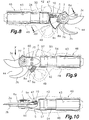
- Fig. 8 is a right side elevation view of the portable motor driven scissor in which the stroke lines indicate the profile of the housing configuring the handle:
- Fig. 9 is a left side elevation view with the stroke lines indicating the profile of the said housing configuring the handle;
- Fig. 10 is a top view taken in the direction of arrow X of Fig. 9 in which the stroke lines indicate the profile of the housing;
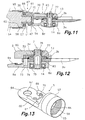
- Fig. 11 is an enlarged view in lengthwise section taken by a medium plane perpendicular to the cutting plane;
- Fig. 12 is an enlarged cross sectional view taken by plane XII-XII of Fig. 8; and
- Fig. 13 is a view in perspective of the support of Fig. 1 to 5.
-
- Referring initially to Fig. 1-5, the portable motor-driven scissor of this invention comprises, according to an example of embodiment, a head essentially formed by a support 1 which supports a pair of moving jaws, which incorporate
jaws power drive parts 6a, 6b on which are fixedjaws jaws power drive parts 6a, 6b. Both jaws, formed by thepower drive parts 6a, 6b withjaws axis 7,respective lever arms 8a, 8b carrying thegear wheel sectors 9a, 9b which interlock with diametrally opposite areas of asame pinion 10 pertaining to a gear drive at the output of a speed reducer 84 connected to an electric motor 73 (not shown). Preferably, the spin axis ofpinion 10 orthogonally cuts thespin axis 7 of the jaws andrespective jaws levers pinion 10, both jaws and therespective jaws motor 73 for displacing the hinged jaws between an open position and a closed position and vice versa, the assembly being housed in a housing which incorporates a handle provided with a controlling trigger (not shown). - Advantageously, the said speed reducer 84 is a reducer having planetary gears with their entering shaft coaxial to its exiting shaft and to the
spin axis 10 and the gear between thepinion 10 and the saidgear wheel sector 9a, 9b is an external conic gear, so that the diameter of thepinion 10 is not added to the radius of the sectors of thegear wheel 9a, 9b of the jaws lengthwise the scissor. This, together with the fact that each jaw only makes half the total travel, allows that the design is extremely compact and lightweight as well in width as in length, of the head of the portable motor-driven scissor of this invention. - For mounting them, as well the
power drive parts 6a, 6b as thejaws axis 7 and mentioned means for anchoringjaws power drive parts 6a, 6b comprise at least a fastening point in addition to the said passing holes 1,2 for theaxis 7. Preferably, the scissor of the invention includes at least two and more preferably three of the said anchoring points angularly distributed about the passing holes 1, 2 foraxis 7. As it can be best see from details on Fig. 5, each of the said anchoring points comprises an externallycylindric centring socket 24, passed throughrespective holes power drive part 6a, 6b and thejaw centring socket 24 being provided with ahead 25 which is housed in an external offset ofjaws hole 26 in which ascrew 21 provided with ahead 27 is screwed, which remains housed in an external offset of thepower drive part 6a, 6b without protruding from the external surface thereof. Although the presence of thecentring socket 24 provides a very accurate centring of thejaws power drive parts 6a, 6b at same time it protects thescrew thread 21 in the event both parts slide, a simpler mounting would also be possible in which thescrews 21 will be directly screwed in threaded holes of the power drive part. - The
pinion 10 is mounted on ashaft 11 supported by a bearing 31 housed in an offset 30 of the said support 1 from a end of which frontally protrudes afork 12 supportingspin axis 7 of thepower drive parts 6a, 6b andrespective jaws fork 12 comprising two arms located on sides diametrally opposite of thepinion 10, including it. On the other end of the support 1, motor 73-reducer 84 are mounted (not shown). Between both arms of thefork 12 are trapped twopower drive parts 6a, 6b withrespective jaws jaws axial bearing 13 half housed inrespective offsets 32 of thejaws ring 33 closing the perimeters of the said offsets. Preferably, the saidaxial bearing 13 is a needle bearing using as thread track the bottoms of the said offsets 32. However, on the bottom of at least one of the said offsets 32 at least one adjustingwasher 34 can be housed to offset possible height differences, in which case it is necessary to have additionally available a supporting washer 13a for thebearing 13. Obviously, the saidbearing 13 could be suppressed in a simplified embodiment. - Although it is not strictly necessary, the scissor of this invention comprises
respective bearings 14 housed in offsets 38 of the external faces of thepower drive parts 6a, 6b, the said bearing being protected by O-rings 35 axially pressed down by covers or enlarged ends of thefork 12 arms at which ends are locatedholes 20 for theaxis 7 which crosses throughout thepower drive parts 6a, 6b andrespective jaws bearings 14 as radial ball bearings, although they could also be another kind of bearings or friction socket. - As it is best shown in Fig. 5 to make its mounting and good operation easier, the
axis 7 comprises asocket 15 provided with ahead 16 and acylindric end surface 11 on which are internally adjusted the said holes 20 of thefork 12 arms and thebearings 14 and a threadedcentral hole 17, the head of which 16 in operating position, is stopped by the external face of one of thefork 12 arms, while ahead 18 of ascrew 19 threaded in the saidcentral hole 17 is stopped against the external face of theother fork 12 arm. - Referring now to Fig. 8, 9 and 10, the portable motor-driven scissor of this invention comprises, according to another example of embodiment, a
support 5 associated to apower takeoff 42 from amotor 43 and a cuttingmouth 44 comprising two cuttingjaws cutting jaw 3a, mounted so that it rotates on the saidsupport 5 and connected to the output of the saidpower takeoff 42 by means of aconical gear 47 for performing a closing-opening motion with respect to theother jaw 3b which is fixed. The saidsupport 5 includes or has fixed a housing 46 (shown by means of stroke line in the figures) which defines ahandle 48 to which are associated means 49, 50 controlling the tool. The saidmotor 43 is coupled to areducer 54 provided with one output cylindric end from which is protruding anaxis 11, constituting thepower takeoff 42. - Although the example of embodiment with double working jaw illustrated in Fig. 1 to 7b are shown without motor and handle, the arrangement of
motor 43,reducer 54,housing 54, handle 48 etc. could be applied to it, which is disclosed referring to the example of embodiment of a single working jaw illustrated in Fig. 8 to 13. - The said
support 5 which is shown separately in Fig. 13 is of a single piece and comprises acoupling portion 57 to thepower takeoff 42 and aside arm 60 forwardly extended on which is mounted the cuttingmouth 44 and the mechanism for controlling it. - The said
coupling portion 57 is substantially cylindric and comprises a glass-shaped endhollow area 65 within which is arranged a first fastening configuration having the shape of aninternal thread 58 which is fastened in a second fastening configuration having the shape of anexternal thread 62, interconnected, arranged at the said cylindric output end of thereducer 54. - On an
internal face 64 of the saidarm 60 is locked the fixedjaw 3b, and adjacent to this is mounted the workingjaw 3a. Through thecoupling portion 57 there exists apassageway 66 for passingconical pinion 10 fixed to the saidaxis 11 of thepower takeoff 42 until a space located in front of an area were thearm 60 starts, where the saidconical pinion 10 interlocks with a sector of crown wheel 9 interconnected integral with the workingjaw 5. The saidpinion 10 and crown 9 constitute aconical gear 47, preferably having a straight dentate and axis orthogonally crossing. As it is shown in Fig. 11, in an internal area of thepassageway 66 of thecoupling portion 57 an external seat is defined for aradial bearing 30 which is internally seated on a cylindric area of aconical pinion hub 10. Thanks to it, the stresses radially theaxis 11 are transmitted by the saidbearing 30 to thesupport 5 preventing to damage thereducer 54 output internal bearing. Theradial bearing 30 is preferably a simple ball bearing. - As it is best shown in Fig. 13, the
internal face 64 of thearm 60 has a flat end area, having a circular outline, in which centre there is ahole 67 for mounting an axis which, as disclosed in details below, passes through the fixedjaw 3b and acts as a guide for the rotating motion of the workingjaw 3a. At a medium area of theinternal face 64 are providedprotrusions 69 for fastening on the sides the fixedjaw 3b, the saidprotrusions 69 have a height substantially equal to the thickness of the fixedjaw 3b. In the example illustrated, in an area located between the saidprotrusions 69, there exists two holes forscrews 70 to fasten the fixedjaw 3b, although at least one would be sufficient. In an area of thearm 60 adjacent to thecoupling portion 57 there is arranged arecess 61 which provides at leat part of the said space for theconical pinion 10, where it interlocks with the saidcrown wheel sector 9a. - To transmit the
gear 47 force to the workingjaw 3a, the tool comprises a power drive part 6 provided with a portion substantially circular leaning against the external face of the workingjaw 3a and crossed by its central area by the saidaxis 7. From the said substantially circular portion protrudes alever arm 8a at which end the dentate of the saidcrown wheel 9a. At this force drivepart 6 ahole 73 is provided (see Fig. 12) which remains facing a corresponding hole of the workingjaw 3a for housing, between them, a drivingpin 74. However, and depending on the requirements of design, two or more driving pins could be housed in corresponding pairs of holes facing each other located on thedrive part 6a and the workingjaw 3a. - The
axis 7 consecutively crosses thepower drive part 6a, the workingjaw 3a, the fixedjaw 3b and thearm 60 of thesupport 5 acting as hinge axis of the assembly of force drive part 6 and workingjaw 3a, as positioning pin of the fixedjaw 3b and as packing and fastening element of the assembly ofarm 60 of thesupport 5. For this and as it is best shown in Fig. 12, theaxis 7 comprises: at one end a head, wide and flat, trapping aradial bearing 14 housed in a recess of an external face of the force drive part 6; in a medium area of acylindric section 83 on which the assembly of theforce drive part 6a and workingjaw 3a rotates and which acts as positioning pin for the fixedjaw 3b; and on the opposite end, a threadedarea 76 which is fixed to anut 77 which remains embedded in an external face of thearm 60 of thesupport 5. Between the working and fixedjaws axial bearing 13 is arranged which remains housed in a recess of the fixedjaw 3b. The saidaxial bearing 13 is protected from dirtiness by anannular sealing element 33, such as an elastic O-ring, trapped between the working and fixedjaws axial bearing 13. - In the example of embodiment illustrated, the said
radial bearing 14 is a simple ball bearing and theaxial bearing 13 is a needle bearing. The adjustment of the closing and opening motion of the workingjaw 3a with respect to the fixedjaw 3b is carried out by means of one or several adjustingwashers 34 arranged on the bottom of the said recess of the fixedjaw 3b which houses theaxial bearing 13 in combination with a given preload of theaxis 7 tightening by means of its threadedarea 76. The said adjustingwashers 34 can be of metallic or synthetic material and when there is more than one, they can all be of same thickness or of different thicknesses. - The
housing 46, shown by stroke lines in Fig. 8 to 10 and to which it has been referred to at the beginning of this description is preferably fixed to thesupport 5, although they could form an integral part thereof. Thehousing 46 incorporates the saidhandle 48 and the said controlling means 49, 50, which typically include a push-button 49 for driving the saidmotor 43 and acontrol 50 associated to a safety device. Each time the said push-button 49 is pushed, it starts a sequence of motions of themotor 43 which results in quick closing-opening motion of the workingjaw 3a with respect to the fixedjaw 3b. The portable scissor of this invention also optionally includes an overload electronic control which, when detecting an intensity of the current higher than a preestablished threshold, stops the closing-opening cycle of the workingjaw 3a and takes it back to an open position. - Although in the example of embodiment illustrated in the figures, the said working
jaw 3a is actually a jaw and the said fixedjaw 3b is actually a dolly, the reversed arrangement could be possible or an arrangement in which the workingjaw 3a and the said fixedjaw 3b are bits, depending on the application wished. - The characteristics of operation of the motor-driven scissor of this invention, common for all the examples of embodiment, are shown with reference to Fig. 6a, 6b; and 7a, 7b, in which the head illustrated is analogous in everything to that shown in Fig. 1-5 except in a different distribution of the points anchoring the
jaws power drive parts 6a, 6b aroundaxis 7. - Referring now concretely to Fig. 6a, 6b, the head shows a variation for the two
jaws concave edge 28a, 28b, the said concavities, in operation arrangement, remain facing each other and during the cutting operation they tends to trap the object to be cut 4 in a position as close as possible to theaxis 7, optimizing thus the scissor lever arms and with it the consumption of energy for each cut, which contributes to extend the operational time for a same battery load. With this model of jaws, it is essential to have available a sensor system to control themotor 73 operation, for example the intensity of the current consumed by themotor 73. When the object to be cut 4 is too hard, that it does not allow the normal travel of thejaws motor 73 increases beyond a preestablished threshold, the consumption being detected by the sensor system which orders a current switch-off or reversing the rotation senses of themotor 73, which does not damage it nor the gear drives. - In Fig. 7a, 7b, the head of the scissor of the invention 9 is showing another variation for the two
jaws concave edge 29a while the other has a convex edge 29b, so that, in an operating arrangement, the first shows its concavity facing the convexity of the second. This kind of edges makes that when the object to be cut 4, located on the bottom of the opening between thejaws - Another characteristic seeking to optimize the energy consumption consists on end of stroke sensors, typically sensors having Hall effect, which according to this invention carries out
motor 73 switch-off during a predetermined period of time before thepower drive parts 6a, 6b andrespective jaws motor 73 rotation sense when it is still rotating by inertia en opposite sense, which consumes a peak of energy, but that during the time themotor 73 rotates by inertia, themotor 73 is disconnected and is only connected in opposite sense when it is already stopped. - Last, it must be pointed out that the examples of embodiment disclosed and shown in the figures are for simple illustrative purpose which does not limit the scope of this invention which is defined in appended claims.
Claims (28)
- Portable motor-driven scissor of the kind comprising a support (5) associated to a power takeoff (42) from a motor (43), a cutting mouth (44) comprising two jaws (3a, 3b), at least one of which is a working cutting jaw (3a) rotatably mounted on the said support (5) and connected to the output of the said power takeoff (42) by means of a gear drive (47) to carry out a closing-opening motion with respect to the other jaw (3b), the said support (5) includes or has fastened a handle (48) to which are associated means for controlling (49, 50) the tool, characterized in that the said working cutting jaw (3a), which is at least one, is fastened to a part for power drive (6a) which may rotate about an axis (7) mounted on a support (5), the said power drive part (6a) includes a lever arm (8a) at the end of which is arranged a sector of crown wheel (9a) which interlocks with a pinion (10) joined to an axis (11) of the said power takeoff (42) constituting the said gear drive (47), where the said spin axis (7) of the power drive part (6a) forms a predetermined angle with respect to the said pinion spin axis (11).
- Scissor, according to claim 1, characterized in that both jaws (3a, 3b) are working jaws and each of them is fixed to a respective power drive part (6a, 6b) hinged with respect to the axis (7) , which is common for both power drive parts (6a, 6b), each of the power drive parts (6a, 6b) including one of the said lever arms (8a, 8b) with a respective sector of crown wheel (9a, 9b) which interlocks with areas diametrally opposite to the said pinion, so that, when rotating the said pinion (10), both power drive parts (6a, 6b) and the respective jaws (3a, 3b) rotate a same angle in opposite directions with respect to the said axis (7), each running half the travel of the said closing-opening motion.
- Scissor, according to claim 2, characterized in that it comprises anchoring means for fixing each jaw (3a, 3b) on the respective power drive part (6a, 6b).
- Scissor, according to claim 3, characterized in that as well the power drive parts (6a, 6b) as the jaws (3a, 3b) comprise respective passage holes (1, 2) coaxial to each other, for the axis (7) and the said anchoring means comprise at least an anchoring point in addition to the said passage holes (1, 2) for the axis (7).
- Scissor according to claim 4, characterized in that it comprises three of the said anchoring points angularly distributed around the said passage holes (1,2) for the axis (7).
- Scissor, according to claim 5, characterized in that each of the said anchoring points comprises an externally cylindric centring socket (24), passed through respective holes (36, 37), coaxial to each other, of the power drive part (6a, 6b) and the jaw (3a, 3b), the said centring socket (24) being provided with a head (25) which is housed in an external offset of jaw (3a, 3b) and a central threaded hole (26) in which a screw (21) provided with a head (27) is screwed, which remains housed in an external offset of the power drive part (6a, 6b) without protruding from the external surface thereof.
- Scissor according to claim 2, characterized in that from one end of the said support (5) frontally protrudes a fork (12) for supporting the spin axis (7) of the power drive parts (6a, 6b) and respective jaws (3a, 3b), the said fork (12) comprising two arms located on sides diametrally opposite to the pinion (10), including it while the axis (11) on which the pinion (10) is mounted is supported by a bearing (31) housed in an offset (30) of the support (5).
- Scissor, according to claim 7, characterized in that between both arms of the fork (12) are confined the two power drive parts (6a, 6b) with respective jaws (3a, 3b) fixed on them, the said jaws (3a, 3b) being leaning against each other, trapping an axial bearing (13) housed in at least an offset (32) existing in at least one of the jaws (3a, 3b) and axially pressing an annular element (33) sealing the perimeters of the said offsets.
- Scissor, according to claim 8, characterized in that it comprises respective radial bearings (14) housed in offsets (38) of the external faces of the power drive parts (6a, 6b) the said bearings being protected by O-rings (35) axially pressed by covers or by ends of the fork arms (12) where are located the holes (20) for the axis (7) which crosses throughout the assembly.
- Scissor, according to claim 8, characterized in that the said axis (7) comprises a socket (15) provided with a head (16) and an external cylindric surface on which are internally adjusted the said holes (20) of the fork (12) arms and the radial bearings (14) and a threaded central hole (17), the head of which (16) in operating position, is stopped by the external face of one of the fork (12) arms, while a head (18) of a screw (19) threaded in the said central hole (17) is stopped against the external face of the other fork (12) arm.
- Scissor, according to claim 7, characterized in that the said support (5) comprises in an area opposite to the said fork (12) a coupling portion (57) provided with a first fastening configuration (58) for joining to a second fastening configuration (62) arranged in the power takeoff (42).
- Scissor according to claim 1, characterized in that only one jaw (3a) is a working jaw while the other jaw (3b) is fixed on the said support (5) which is of a single piece and comprises a coupling portion (57) provided with a first fastening configuration (58) for joining to a second fastening configuration (62) arranged in the power takeoff (42) and a forwardly extended side arm (60), on an internal face (64) on which is fastened the fixed jaw (3b) and adjacent to this there is mounted the working jaw (3a) and there exists a passageway (66) through the said coupling portion (57) for the said conical pinion (10) passage to a space provided in front of an area from which the said arm (80) starts where the conical pinion (10) interlocks with the said crown wheel sector (9a) integral with the working jaw (3a).
- Scissor, according to claim 12, characterized in that the said internal face (60) has a flat end area, having a circular outline, in which centre there is a mounting hole (67) of an axis (7) which passes through the fixed jaw (3b) and acts as a guide for the rotary motion of the working jaw (3a), having arranged in a medium area of the internal face (64) protrusions (69) for the side fastening of the fixed jaw (3b) having a height substantially equal to the thickness thereof, and at least a hole in an area between the said protrusions (69) for a screw (70) fastening the fixed jaw (3b) and a recess (61) being arranged in an area of the arm (60) adjacent to the coupling portion (57) which provides at least part of the said space for the conical pinion (10), where the said sector of crown wheel (9) is interlocked.
- Scissor, according to claim 12, characterized in that the power drive part (6a) comprises a substantially circular portion leaning against the external face of the working jaw (3a) and crossed by its central area by the said axis (7) at least one hole (73) being located in the said power drive part (6a) facing a corresponding hole of the working jaw (3a) for housing within them at least a driving pin (74).
- Scissor, according to claim 12, characterized in that the said axis (7) which consecutively crosses the power drive part (6a), the working and fixed jaws (3a and 3b) and the arm (60) of the support (5) comprises: at one end, a head (75) wide and flat, which traps a radial bearing (14) housed in an offset of an external face of the power drive part (6a); in a medium area , a cylindric section (83) on which the assembly of power drive part (6a) and working jaw (3a) rotate and working jaw (3a) and which positions the fixed jaw (3b); and on the opposite end, a threaded area (76) which is fixed to a nut (77) which remains embedded in an end face of the arm (60) of the support (5), an axial bearing (13) being arranged between the working and the fixed jaws (3a and 3b) housed in an offset of the fixed jaw (3b).
- Scissor, according to claim 15, characterized in that it includes an annular sealing element (33) such as an O-ring, trapped between the working and the fixed jaws (3a and 3b) surrounding the said axial bearing (13).
- Scissor, according to claim 12, characterized in that a passing area (66) of the coupling portion (57) defines an external seat for a radial bearing (30) which is internally seated on an area of a hub of the conical pinion (10).
- Scissor, according to claim 2 or 12, characterized in that the spin axis of the power drive part(s) (6a, 6b) joins the spin axis (7) of the pinion (10) and in that the said predetermined angle is a straight angle.
- Scissor, according to claim 2 or 12 characterized in that the gear between the pinion (10) and the said sector(s) of gear wheel (9a, 9b) is an external conical gear of axis crossing in straight angle so that the diameter of the pinion (10) is no added to the radius of the sector(s) of gear wheel (9a, 9b) lengthwise the scissor.
- Scissor, according to claim 2 or 12, characterized in that the lever arm(s) (8a, 8b) protrude from the power drive part(s) (6a, 6b) on a side substantially opposite to the said cutting mouth (44) with relation to the axis (7).
- Scissor, according to claim 2 or 12, characterized in that it comprises a housing (46) fixed on the support (5) which incorporates the said handle (48) and the said controlling means (49, 50) which include at least a push-button (49) for driving the said motor (43) for driving the said closing-opening motion and at least a control (50) associated to a safety device.
- Scissor, according to claim 2 or 12, characterized in that it includes a sensor of end of the stroke, such as a Hall effect sensor, which makes a switch-off of the current feeding the motor (43) during a predetermined period of time before the power drive part (s) (6a, 6b) and respective jaw(s) (3a, 3b) reach their mechanical end of stroke as a precaution for the displacements which occur thereafter by inertia during the transitory motions for stopping.
- Scissor, according to claim 2 or 12, characterized in that it includes an overload electronic control which, when detecting an intensity of current higher than a preestablished threshold stops the closing-opening cycle of the working jaw (3a) and takes it back to an open position.
- Scissor, according to claim 2 or 12, characterized in that the jaws (3a, 3b) are two cutting sheets (3a, 3b) or respectively, a cutting sheet (3a) and a dolly (3b) or vice versa.
- Scissor, according to claim 2 or 12, characterized in that the two jaws (3a, 3b) have respective concave edges (28a, 28b), the concavities of which, in operational arrangement, remain facing each other and during the cutting operation they tends to trap an object to be cut (4) in a position the closest as possible to the axis (7) optimizing thus the scissor lever arms.
- Scissor, according to claim 2 or 12, characterized in that one of the two jaws (3a, 3b) has a dolly surface or a concave edge (29a) while the other has a convex edge (29b), the former showing in an operational arrangement, its concavity facing the convexity of the later.
- Scissor, according to claim 11 or 12, characterized in that the said motor (43) is coupled to a reducer (54) provided with an output end from which protrudes the said axis (11) constituting the power takeoff (42), at the said reducer (54) output end there is a second fastening configuration arranged in the power drive (42) with the shape of an external thread (62) while the said coupling portion (57) of the support (5) is substantially cylindric and comprises a glass-shaped hollow end area (65), within which is arranged the said first fastening configuration having the shape of an internal thread (58) interconnected with the said external thread (62).
- Scissor, according to claim 14 or 20, characterized in that it includes one or several adjusting washers (34) of metallic or synthetic material, having one or several thicknesses, arranged on the bottom of the said offset (32) which houses the axial bearing (13) which, together with determined tightening preload of the axis (7) adjust the closing-opening motion of the working jaw (3a).
Applications Claiming Priority (5)
| Application Number | Priority Date | Filing Date | Title |
|---|---|---|---|
| ES200003065 | 2000-12-05 | ||
| ES200003065A ES2178947B1 (en) | 2000-12-05 | 2000-12-05 | MOTORIZED PORTABLE SCISSORS. |
| ES200102609U | 2001-10-25 | ||
| ES200102609U ES1050292Y (en) | 2001-10-25 | 2001-10-25 | MOTORIZED CUTTING TOOL. |
| PCT/ES2001/000476 WO2002045479A1 (en) | 2000-12-05 | 2001-12-05 | Portable, motor-powered shears |
Publications (2)
| Publication Number | Publication Date |
|---|---|
| EP1350428A1 true EP1350428A1 (en) | 2003-10-08 |
| EP1350428B1 EP1350428B1 (en) | 2004-09-29 |
Family
ID=26156212
Family Applications (1)
| Application Number | Title | Priority Date | Filing Date |
|---|---|---|---|
| EP01999271A Expired - Lifetime EP1350428B1 (en) | 2000-12-05 | 2001-12-05 | Portable, motor-powered shears |
Country Status (7)
| Country | Link |
|---|---|
| US (1) | US20040055164A1 (en) |
| EP (1) | EP1350428B1 (en) |
| AT (1) | ATE277508T1 (en) |
| AU (2) | AU2002221970B2 (en) |
| DE (1) | DE60106085T2 (en) |
| ES (1) | ES2227327T3 (en) |
| WO (1) | WO2002045479A1 (en) |
Cited By (7)
| Publication number | Priority date | Publication date | Assignee | Title |
|---|---|---|---|---|
| ITPI20090058A1 (en) * | 2009-05-15 | 2010-11-16 | Ai.Ma Automazione Industriale & Macchine Agricole Srl | ELECTRIC TYPE CUTTING TOOL IN PARTICULAR FOR PRUNING |
| FR2955734A1 (en) * | 2010-02-03 | 2011-08-05 | Infaco | SECTOR FOR THE SIZE OF PLANTS |
| GB2464851B (en) * | 2007-07-03 | 2012-04-04 | Milwaukee Electric Tool Corp | Pipe cutter |
| EP2147735B1 (en) * | 2008-07-25 | 2013-01-23 | Ningbo JF Tools Industrial Co., Ltd. | Plastic pipe cutting tool |
| US9486864B2 (en) | 2007-07-03 | 2016-11-08 | Milwaukee Electric Tool Corporation | Pipe cutter |
| JP2017209782A (en) * | 2016-05-24 | 2017-11-30 | 株式会社Gsユアサ | Electric tool |
| WO2017204198A1 (en) * | 2016-05-24 | 2017-11-30 | 株式会社Gsユアサ | Power tool |
Families Citing this family (30)
| Publication number | Priority date | Publication date | Assignee | Title |
|---|---|---|---|---|
| ITTO20020408A1 (en) * | 2002-05-13 | 2003-11-13 | Sila Holding Industriale Spa | ELECTROMECHANICAL ACTUATOR DEVICE WITH BUILT-IN TORQUE TRANSDUCER. |
| GB2404613A (en) * | 2003-07-14 | 2005-02-09 | David Jarman | A vegetation pruning device |
| ES1058462Y (en) * | 2004-09-15 | 2005-04-01 | Molins Josep Gurri | CUTTING HEAD FOR MOTORIZED SCISSORS. |
| NL1028334C2 (en) * | 2005-02-18 | 2006-08-21 | Holmatro Ind Equip | Hinge bolt construction with lock. |
| WO2008124419A1 (en) * | 2007-04-04 | 2008-10-16 | Picker Technologies Llc | Stem clipper and crusher mechanisms for use with fruit trees and the like |
| FR2935106B1 (en) * | 2008-08-22 | 2010-09-17 | Pellenc Sa | PORTABLE ELECTROPORTATIVE TOOL |
| FR2935175B1 (en) * | 2008-08-22 | 2011-02-11 | Pellenc Sa | DEVICE FOR DETERMINING THE RELATIVE POSITION BETWEEN TWO OR MORE OF WHICH IS AT LEAST MOVABLE, AND MACHINES AND APPARATUSES BY APPLYING |
| US20110314680A1 (en) * | 2009-03-06 | 2011-12-29 | Positec Power Tools (Suzhou) Co., Ltd. | Shearing Tool |
| CN201493868U (en) * | 2009-09-08 | 2010-06-02 | 南京德朔实业有限公司 | electric scissors |
| US9458240B2 (en) | 2010-12-10 | 2016-10-04 | Novartis Pharma Ag | Anti-BAFFR antibody formulations |
| CN103327806B (en) * | 2010-12-30 | 2016-01-13 | 创科户外产品技术有限公司 | electric pruning tool |
| CN102715023B (en) * | 2011-03-31 | 2014-07-30 | 南京德朔实业有限公司 | Electric pruning shears |
| FR3028716B1 (en) * | 2014-11-25 | 2016-11-25 | Pellenc Sa | ELECTROPORTATIVE TOOL, ESPECIALLY AN ELECTRICAL SECTOR WITH THERMAL DISSIPATOR. |
| CN105230363A (en) * | 2015-01-09 | 2016-01-13 | 广西大学 | Rotation and cutting dual-purposed trimming device |
| CN105846341A (en) * | 2015-01-13 | 2016-08-10 | 国家电网公司 | Wire clipper and automatic wire-folding machine |
| USD848229S1 (en) * | 2016-11-07 | 2019-05-14 | Fiskars Finland Oy Ab | Cutting tool for tree pruning |
| CN109435262A (en) * | 2018-10-31 | 2019-03-08 | 邵东智能制造技术研究院有限公司 | A kind of pliers gum cover horizontal positioning device |
| FR3107638B1 (en) * | 2020-03-02 | 2022-03-18 | Innovation Fabrication Commercialisation Infaco | Secateurs with mechanical stop |
| CN111512813B (en) * | 2020-05-13 | 2024-11-22 | 东莞市尚峰精密机械有限公司 | Double-acting blade electric scissors |
| CN111527903A (en) * | 2020-05-17 | 2020-08-14 | 东莞市嘉航实业有限公司 | Double-knife transmission mechanism and electric scissors with same |
| US12202155B2 (en) * | 2020-09-10 | 2025-01-21 | Techtronic Cordless Gp | Blade change mechanism for power tool |
| AU2021104983A4 (en) | 2020-09-10 | 2021-09-30 | Techtronic Cordless Gp | Blade replacement mechanism of electric instrument |
| CN112514673A (en) * | 2020-12-24 | 2021-03-19 | 东莞市嘉航实业有限公司 | Electric scissors blade bidirectional driving mechanism and electric scissors |
| CN112514675B (en) * | 2021-01-12 | 2024-05-03 | 东莞市嘉航实业有限公司 | Electric shears double-blade driving mechanism and electric shears |
| CN113711792B (en) * | 2021-09-27 | 2022-08-12 | 河北省农林科学院石家庄果树研究所 | Electric ring stripping knife |
| CA3235780A1 (en) | 2021-10-22 | 2023-04-27 | Patrick Hennessey | Ring cutter for safely transecting a ring trapped on an appendage |
| CN115383798B (en) * | 2022-03-16 | 2025-02-07 | 永康市索欣科技有限公司 | Electric scissors with anti-slip teeth |
| CN116038758B (en) * | 2022-12-14 | 2023-09-01 | 青岛三联金属结构有限公司 | Industrial robot work arm |
| CN116021557A (en) * | 2023-01-09 | 2023-04-28 | 达闼机器人股份有限公司 | Dual output drive actuator and electric scissors |
| USD1089340S1 (en) | 2023-06-22 | 2025-08-19 | Ring Rescue Inc. | Ring cutter |
Family Cites Families (13)
| Publication number | Priority date | Publication date | Assignee | Title |
|---|---|---|---|---|
| DE520144C (en) * | 1930-02-21 | 1931-03-07 | Emil Hoogland | Fabric cutting machine with one fixed and one moving scissor arm |
| DE2910544A1 (en) * | 1979-03-17 | 1980-09-25 | Wolter Baudat E Kg | SCISSORS, IN PARTICULAR CABLE CUTTERS |
| DE3524443A1 (en) * | 1985-07-09 | 1987-01-15 | Black & Decker Inc | Electrically driven tree pruner |
| FR2584566B1 (en) * | 1985-07-15 | 1989-02-10 | Delmas Daniel | AUTOMATIC PRUNER FOR THE PRUNING OF THE VINE, TREES AND THE LIKE ... |
| US4876794A (en) * | 1988-07-13 | 1989-10-31 | Radia-Cam Inc. | Variable mechanical advantage device utilizing a radial cam |
| US4989322A (en) * | 1989-06-08 | 1991-02-05 | Duke Clayton | Hair shearing device |
| US5122092A (en) * | 1989-12-13 | 1992-06-16 | Jarvis Products Corporation | Power skinning knife with removable drive mechanism and high efficiency pneumatic motor |
| DE4414967C2 (en) * | 1994-04-28 | 1997-07-17 | Weidmueller Interface | Servo gun |
| US6021573A (en) * | 1997-05-15 | 2000-02-08 | Ryobi North America, Inc. | In-line oscillating cam assembly |
| JP3537649B2 (en) * | 1997-10-30 | 2004-06-14 | 株式会社マキタ | Electric pruning scissors |
| DE29812942U1 (en) * | 1998-07-21 | 1999-04-15 | Seeber+Partner GmbH, 71686 Remseck | Electrically powered pruning shears |
| US6178643B1 (en) * | 1999-07-08 | 2001-01-30 | Electroline Corporation | Hand-held ratchet action tool |
| US6935031B1 (en) * | 2004-02-05 | 2005-08-30 | Hung Chuan Hsian Industries Co., Ltd. | Gear-driven shears provided with a curved plate on a movable jaw |
-
2001
- 2001-12-05 DE DE60106085T patent/DE60106085T2/en not_active Expired - Lifetime
- 2001-12-05 AT AT01999271T patent/ATE277508T1/en active
- 2001-12-05 EP EP01999271A patent/EP1350428B1/en not_active Expired - Lifetime
- 2001-12-05 AU AU2002221970A patent/AU2002221970B2/en not_active Ceased
- 2001-12-05 AU AU2197002A patent/AU2197002A/en active Pending
- 2001-12-05 WO PCT/ES2001/000476 patent/WO2002045479A1/en not_active Ceased
- 2001-12-05 ES ES01999271T patent/ES2227327T3/en not_active Expired - Lifetime
- 2001-12-05 US US10/433,630 patent/US20040055164A1/en not_active Abandoned
Non-Patent Citations (1)
| Title |
|---|
| See references of WO0245479A1 * |
Cited By (13)
| Publication number | Priority date | Publication date | Assignee | Title |
|---|---|---|---|---|
| US9486865B2 (en) | 2007-07-03 | 2016-11-08 | Milwaukee Electric Tool Corporation | Pipe cutter |
| GB2464851B (en) * | 2007-07-03 | 2012-04-04 | Milwaukee Electric Tool Corp | Pipe cutter |
| US8683704B2 (en) | 2007-07-03 | 2014-04-01 | Milwaukee Electric Tool Corporation | Pipe cutter |
| US8875404B2 (en) | 2007-07-03 | 2014-11-04 | Milwaukee Electric Tool Corporation | Pipe cutter |
| US9486864B2 (en) | 2007-07-03 | 2016-11-08 | Milwaukee Electric Tool Corporation | Pipe cutter |
| EP2147735B1 (en) * | 2008-07-25 | 2013-01-23 | Ningbo JF Tools Industrial Co., Ltd. | Plastic pipe cutting tool |
| EP2263444A1 (en) | 2009-05-15 | 2010-12-22 | Aima S.R.L. | Electric cutting tool |
| ITPI20090058A1 (en) * | 2009-05-15 | 2010-11-16 | Ai.Ma Automazione Industriale & Macchine Agricole Srl | ELECTRIC TYPE CUTTING TOOL IN PARTICULAR FOR PRUNING |
| FR2955734A1 (en) * | 2010-02-03 | 2011-08-05 | Infaco | SECTOR FOR THE SIZE OF PLANTS |
| EP2353366A1 (en) | 2010-02-03 | 2011-08-10 | Infaco S.A.S | Branche shear for cutting plants |
| JP2017209782A (en) * | 2016-05-24 | 2017-11-30 | 株式会社Gsユアサ | Electric tool |
| WO2017204198A1 (en) * | 2016-05-24 | 2017-11-30 | 株式会社Gsユアサ | Power tool |
| US11338377B2 (en) | 2016-05-24 | 2022-05-24 | Maxell Izumi Co., Ltd. | Power tool |
Also Published As
| Publication number | Publication date |
|---|---|
| WO2002045479A1 (en) | 2002-06-13 |
| AU2197002A (en) | 2002-06-18 |
| ES2227327T3 (en) | 2005-04-01 |
| EP1350428B1 (en) | 2004-09-29 |
| US20040055164A1 (en) | 2004-03-25 |
| ATE277508T1 (en) | 2004-10-15 |
| DE60106085T2 (en) | 2005-10-06 |
| AU2002221970B2 (en) | 2006-08-24 |
| DE60106085D1 (en) | 2004-11-04 |
Similar Documents
| Publication | Publication Date | Title |
|---|---|---|
| EP1350428B1 (en) | Portable, motor-powered shears | |
| CA2714773C (en) | Electric shears | |
| US6044564A (en) | Branch cutter tool | |
| JP5758060B2 (en) | Hand-held power tool | |
| CA2823758C (en) | Chain saw | |
| EP3689129B1 (en) | Automatic walking robot and belt drive system | |
| US20120017558A1 (en) | Self-unjamming motorized trimming apparatus, particularly a hedge trimmer | |
| US20110258859A1 (en) | Cutting device and method | |
| US20110314681A1 (en) | Work head for a rotational brush cutter | |
| CA2378118A1 (en) | Construction machine and milling roller | |
| KR100927795B1 (en) | Electric sickle | |
| CN104641960A (en) | Pruning machine | |
| US6976648B2 (en) | Strip/cross switch mechanism of double-duty shredder | |
| US12477999B2 (en) | Power lopper attachment | |
| KR101174640B1 (en) | An automatic pruning shears | |
| KR20130101732A (en) | Portable electric motion shear saw | |
| CN103348874A (en) | Novel pruner | |
| ATE398912T1 (en) | WALK-PACE LAWN MOWER | |
| CN106472127A (en) | Electric garden branch shears | |
| CN201188785Y (en) | Garden cutting tool | |
| CN110299798B (en) | Drive mechanism for electric garden tools | |
| FR2661314A1 (en) | TELESCOPIC ROD WITH ADJUSTABLE AND MOTORIZED CUTTING TOOL. | |
| US20260053098A1 (en) | Power lopper attachment | |
| US20020095794A1 (en) | Motorized grass shear device | |
| JP2004243271A (en) | Disintegrator of pruned branch and leaf |
Legal Events
| Date | Code | Title | Description |
|---|---|---|---|
| PUAI | Public reference made under article 153(3) epc to a published international application that has entered the european phase |
Free format text: ORIGINAL CODE: 0009012 |
|
| 17P | Request for examination filed |
Effective date: 20030703 |
|
| AK | Designated contracting states |
Kind code of ref document: A1 Designated state(s): AT BE CH CY DE DK ES FI FR GB GR IE IT LI LU MC NL PT SE TR |
|
| AX | Request for extension of the european patent |
Extension state: AL LT LV MK RO SI |
|
| GRAP | Despatch of communication of intention to grant a patent |
Free format text: ORIGINAL CODE: EPIDOSNIGR1 |
|
| GRAS | Grant fee paid |
Free format text: ORIGINAL CODE: EPIDOSNIGR3 |
|
| GRAA | (expected) grant |
Free format text: ORIGINAL CODE: 0009210 |
|
| AK | Designated contracting states |
Kind code of ref document: B1 Designated state(s): AT BE CH CY DE DK ES FI FR GB GR IE IT LI LU MC NL PT SE TR |
|
| PG25 | Lapsed in a contracting state [announced via postgrant information from national office to epo] |
Ref country code: TR Free format text: LAPSE BECAUSE OF FAILURE TO SUBMIT A TRANSLATION OF THE DESCRIPTION OR TO PAY THE FEE WITHIN THE PRESCRIBED TIME-LIMIT Effective date: 20040929 Ref country code: FI Free format text: LAPSE BECAUSE OF FAILURE TO SUBMIT A TRANSLATION OF THE DESCRIPTION OR TO PAY THE FEE WITHIN THE PRESCRIBED TIME-LIMIT Effective date: 20040929 Ref country code: CY Free format text: LAPSE BECAUSE OF FAILURE TO SUBMIT A TRANSLATION OF THE DESCRIPTION OR TO PAY THE FEE WITHIN THE PRESCRIBED TIME-LIMIT Effective date: 20040929 Ref country code: BE Free format text: LAPSE BECAUSE OF FAILURE TO SUBMIT A TRANSLATION OF THE DESCRIPTION OR TO PAY THE FEE WITHIN THE PRESCRIBED TIME-LIMIT Effective date: 20040929 Ref country code: NL Free format text: LAPSE BECAUSE OF FAILURE TO SUBMIT A TRANSLATION OF THE DESCRIPTION OR TO PAY THE FEE WITHIN THE PRESCRIBED TIME-LIMIT Effective date: 20040929 |
|
| REG | Reference to a national code |
Ref country code: GB Ref legal event code: FG4D |
|
| REG | Reference to a national code |
Ref country code: CH Ref legal event code: EP |
|
| REG | Reference to a national code |
Ref country code: IE Ref legal event code: FG4D |
|
| REF | Corresponds to: |
Ref document number: 60106085 Country of ref document: DE Date of ref document: 20041104 Kind code of ref document: P |
|
| REG | Reference to a national code |
Ref country code: CH Ref legal event code: NV Representative=s name: BOVARD AG PATENTANWAELTE |
|
| PG25 | Lapsed in a contracting state [announced via postgrant information from national office to epo] |
Ref country code: LU Free format text: LAPSE BECAUSE OF NON-PAYMENT OF DUE FEES Effective date: 20041205 |
|
| PG25 | Lapsed in a contracting state [announced via postgrant information from national office to epo] |
Ref country code: IE Free format text: LAPSE BECAUSE OF NON-PAYMENT OF DUE FEES Effective date: 20041206 |
|
| PG25 | Lapsed in a contracting state [announced via postgrant information from national office to epo] |
Ref country code: DK Free format text: LAPSE BECAUSE OF FAILURE TO SUBMIT A TRANSLATION OF THE DESCRIPTION OR TO PAY THE FEE WITHIN THE PRESCRIBED TIME-LIMIT Effective date: 20041229 Ref country code: SE Free format text: LAPSE BECAUSE OF FAILURE TO SUBMIT A TRANSLATION OF THE DESCRIPTION OR TO PAY THE FEE WITHIN THE PRESCRIBED TIME-LIMIT Effective date: 20041229 Ref country code: GR Free format text: LAPSE BECAUSE OF FAILURE TO SUBMIT A TRANSLATION OF THE DESCRIPTION OR TO PAY THE FEE WITHIN THE PRESCRIBED TIME-LIMIT Effective date: 20041229 |
|
| PG25 | Lapsed in a contracting state [announced via postgrant information from national office to epo] |
Ref country code: MC Free format text: LAPSE BECAUSE OF NON-PAYMENT OF DUE FEES Effective date: 20041231 |
|
| LTIE | Lt: invalidation of european patent or patent extension |
Effective date: 20040929 |
|
| NLV1 | Nl: lapsed or annulled due to failure to fulfill the requirements of art. 29p and 29m of the patents act | ||
| REG | Reference to a national code |
Ref country code: ES Ref legal event code: FG2A Ref document number: 2227327 Country of ref document: ES Kind code of ref document: T3 |
|
| ET | Fr: translation filed | ||
| PLBE | No opposition filed within time limit |
Free format text: ORIGINAL CODE: 0009261 |
|
| STAA | Information on the status of an ep patent application or granted ep patent |
Free format text: STATUS: NO OPPOSITION FILED WITHIN TIME LIMIT |
|
| 26N | No opposition filed |
Effective date: 20050630 |
|
| REG | Reference to a national code |
Ref country code: IE Ref legal event code: MM4A |
|
| PG25 | Lapsed in a contracting state [announced via postgrant information from national office to epo] |
Ref country code: GB Free format text: LAPSE BECAUSE OF NON-PAYMENT OF DUE FEES Effective date: 20051205 |
|
| GBPC | Gb: european patent ceased through non-payment of renewal fee |
Effective date: 20051205 |
|
| PG25 | Lapsed in a contracting state [announced via postgrant information from national office to epo] |
Ref country code: PT Free format text: LAPSE BECAUSE OF NON-PAYMENT OF DUE FEES Effective date: 20050228 |
|
| PGFP | Annual fee paid to national office [announced via postgrant information from national office to epo] |
Ref country code: AT Payment date: 20101125 Year of fee payment: 10 |
|
| PGFP | Annual fee paid to national office [announced via postgrant information from national office to epo] |
Ref country code: CH Payment date: 20101203 Year of fee payment: 10 |
|
| PGFP | Annual fee paid to national office [announced via postgrant information from national office to epo] |
Ref country code: IT Payment date: 20101210 Year of fee payment: 10 |
|
| REG | Reference to a national code |
Ref country code: CH Ref legal event code: PFA Owner name: HISPAES, S.A. Free format text: HISPAES, S.A.#C/ RECTOR TOMAS VILA, 21#08182 SANT FELIU DE CODINES (ES) -TRANSFER TO- HISPAES, S.A.#C/ RECTOR TOMAS VILA, 21#08182 SANT FELIU DE CODINES (ES) |
|
| PGFP | Annual fee paid to national office [announced via postgrant information from national office to epo] |
Ref country code: FR Payment date: 20110112 Year of fee payment: 10 Ref country code: DE Payment date: 20101229 Year of fee payment: 10 |
|
| PGFP | Annual fee paid to national office [announced via postgrant information from national office to epo] |
Ref country code: ES Payment date: 20101202 Year of fee payment: 10 |
|
| REG | Reference to a national code |
Ref country code: CH Ref legal event code: PL |
|
| REG | Reference to a national code |
Ref country code: FR Ref legal event code: ST Effective date: 20120831 |
|
| REG | Reference to a national code |
Ref country code: DE Ref legal event code: R119 Ref document number: 60106085 Country of ref document: DE Effective date: 20120703 |
|
| PG25 | Lapsed in a contracting state [announced via postgrant information from national office to epo] |
Ref country code: DE Free format text: LAPSE BECAUSE OF NON-PAYMENT OF DUE FEES Effective date: 20120703 Ref country code: LI Free format text: LAPSE BECAUSE OF NON-PAYMENT OF DUE FEES Effective date: 20111231 Ref country code: CH Free format text: LAPSE BECAUSE OF NON-PAYMENT OF DUE FEES Effective date: 20111231 |
|
| PG25 | Lapsed in a contracting state [announced via postgrant information from national office to epo] |
Ref country code: IT Free format text: LAPSE BECAUSE OF NON-PAYMENT OF DUE FEES Effective date: 20111205 |
|
| REG | Reference to a national code |
Ref country code: AT Ref legal event code: MM01 Ref document number: 277508 Country of ref document: AT Kind code of ref document: T Effective date: 20111205 |
|
| PG25 | Lapsed in a contracting state [announced via postgrant information from national office to epo] |
Ref country code: AT Free format text: LAPSE BECAUSE OF NON-PAYMENT OF DUE FEES Effective date: 20111205 |
|
| PG25 | Lapsed in a contracting state [announced via postgrant information from national office to epo] |
Ref country code: FR Free format text: LAPSE BECAUSE OF NON-PAYMENT OF DUE FEES Effective date: 20120102 |
|
| REG | Reference to a national code |
Ref country code: ES Ref legal event code: FD2A Effective date: 20130703 |
|
| PG25 | Lapsed in a contracting state [announced via postgrant information from national office to epo] |
Ref country code: ES Free format text: LAPSE BECAUSE OF NON-PAYMENT OF DUE FEES Effective date: 20111206 |