EP1348744A1 - Addition of copper salts and copper complexes to thermal inkjet inks for kogation reduction - Google Patents
Addition of copper salts and copper complexes to thermal inkjet inks for kogation reduction Download PDFInfo
- Publication number
- EP1348744A1 EP1348744A1 EP03251296A EP03251296A EP1348744A1 EP 1348744 A1 EP1348744 A1 EP 1348744A1 EP 03251296 A EP03251296 A EP 03251296A EP 03251296 A EP03251296 A EP 03251296A EP 1348744 A1 EP1348744 A1 EP 1348744A1
- Authority
- EP
- European Patent Office
- Prior art keywords
- copper
- ink
- thermal inkjet
- inkjet ink
- resistor
- Prior art date
- Legal status (The legal status is an assumption and is not a legal conclusion. Google has not performed a legal analysis and makes no representation as to the accuracy of the status listed.)
- Granted
Links
- 150000001879 copper Chemical class 0.000 title claims abstract description 6
- 239000000976 ink Substances 0.000 title abstract description 75
- 230000009467 reduction Effects 0.000 title description 2
- 239000010949 copper Substances 0.000 claims abstract description 22
- RYGMFSIKBFXOCR-UHFFFAOYSA-N Copper Chemical compound [Cu] RYGMFSIKBFXOCR-UHFFFAOYSA-N 0.000 claims abstract description 21
- 229910052802 copper Inorganic materials 0.000 claims abstract description 21
- JPVYNHNXODAKFH-UHFFFAOYSA-N Cu2+ Chemical compound [Cu+2] JPVYNHNXODAKFH-UHFFFAOYSA-N 0.000 claims abstract description 19
- 229910001431 copper ion Inorganic materials 0.000 claims abstract description 11
- -1 oxide Chemical compound 0.000 claims description 26
- 239000000203 mixture Substances 0.000 claims description 16
- 239000003086 colorant Substances 0.000 claims description 10
- XTEGARKTQYYJKE-UHFFFAOYSA-M Chlorate Chemical compound [O-]Cl(=O)=O XTEGARKTQYYJKE-UHFFFAOYSA-M 0.000 claims description 4
- 238000007641 inkjet printing Methods 0.000 claims description 3
- POILWHVDKZOXJZ-ARJAWSKDSA-M (z)-4-oxopent-2-en-2-olate Chemical compound C\C([O-])=C\C(C)=O POILWHVDKZOXJZ-ARJAWSKDSA-M 0.000 claims description 2
- QTBSBXVTEAMEQO-UHFFFAOYSA-M Acetate Chemical compound CC([O-])=O QTBSBXVTEAMEQO-UHFFFAOYSA-M 0.000 claims description 2
- BVKZGUZCCUSVTD-UHFFFAOYSA-L Carbonate Chemical compound [O-]C([O-])=O BVKZGUZCCUSVTD-UHFFFAOYSA-L 0.000 claims description 2
- VEXZGXHMUGYJMC-UHFFFAOYSA-M Chloride anion Chemical compound [Cl-] VEXZGXHMUGYJMC-UHFFFAOYSA-M 0.000 claims description 2
- KRKNYBCHXYNGOX-UHFFFAOYSA-K Citrate Chemical compound [O-]C(=O)CC(O)(CC([O-])=O)C([O-])=O KRKNYBCHXYNGOX-UHFFFAOYSA-K 0.000 claims description 2
- 229910002651 NO3 Inorganic materials 0.000 claims description 2
- NHNBFGGVMKEFGY-UHFFFAOYSA-N Nitrate Chemical compound [O-][N+]([O-])=O NHNBFGGVMKEFGY-UHFFFAOYSA-N 0.000 claims description 2
- IOVCWXUNBOPUCH-UHFFFAOYSA-M Nitrite anion Chemical compound [O-]N=O IOVCWXUNBOPUCH-UHFFFAOYSA-M 0.000 claims description 2
- QAOWNCQODCNURD-UHFFFAOYSA-L Sulfate Chemical compound [O-]S([O-])(=O)=O QAOWNCQODCNURD-UHFFFAOYSA-L 0.000 claims description 2
- RCJVRSBWZCNNQT-UHFFFAOYSA-N dichloridooxygen Chemical compound ClOCl RCJVRSBWZCNNQT-UHFFFAOYSA-N 0.000 claims description 2
- POULHZVOKOAJMA-UHFFFAOYSA-M dodecanoate Chemical compound CCCCCCCCCCCC([O-])=O POULHZVOKOAJMA-UHFFFAOYSA-M 0.000 claims description 2
- IPCSVZSSVZVIGE-UHFFFAOYSA-M hexadecanoate Chemical compound CCCCCCCCCCCCCCCC([O-])=O IPCSVZSSVZVIGE-UHFFFAOYSA-M 0.000 claims description 2
- XLYOFNOQVPJJNP-UHFFFAOYSA-M hydroxide Chemical compound [OH-] XLYOFNOQVPJJNP-UHFFFAOYSA-M 0.000 claims description 2
- 229940070765 laurate Drugs 0.000 claims description 2
- 229940049964 oleate Drugs 0.000 claims description 2
- ZQPPMHVWECSIRJ-KTKRTIGZSA-N oleic acid Chemical compound CCCCCCCC\C=C/CCCCCCCC(O)=O ZQPPMHVWECSIRJ-KTKRTIGZSA-N 0.000 claims description 2
- VLTRZXGMWDSKGL-UHFFFAOYSA-M perchlorate Inorganic materials [O-]Cl(=O)(=O)=O VLTRZXGMWDSKGL-UHFFFAOYSA-M 0.000 claims description 2
- VLTRZXGMWDSKGL-UHFFFAOYSA-N perchloric acid Chemical compound OCl(=O)(=O)=O VLTRZXGMWDSKGL-UHFFFAOYSA-N 0.000 claims description 2
- 230000002035 prolonged effect Effects 0.000 claims description 2
- YGSDEFSMJLZEOE-UHFFFAOYSA-M salicylate Chemical compound OC1=CC=CC=C1C([O-])=O YGSDEFSMJLZEOE-UHFFFAOYSA-M 0.000 claims description 2
- 229960001860 salicylate Drugs 0.000 claims description 2
- DHCDFWKWKRSZHF-UHFFFAOYSA-N sulfurothioic S-acid Chemical compound OS(O)(=O)=S DHCDFWKWKRSZHF-UHFFFAOYSA-N 0.000 claims description 2
- BDAGIHXWWSANSR-UHFFFAOYSA-M Formate Chemical compound [O-]C=O BDAGIHXWWSANSR-UHFFFAOYSA-M 0.000 claims 1
- 229940001468 citrate Drugs 0.000 claims 1
- 229940044170 formate Drugs 0.000 claims 1
- 239000000049 pigment Substances 0.000 description 15
- 239000000975 dye Substances 0.000 description 9
- BDHFUVZGWQCTTF-UHFFFAOYSA-M sulfonate Chemical compound [O-]S(=O)=O BDHFUVZGWQCTTF-UHFFFAOYSA-M 0.000 description 9
- 238000000034 method Methods 0.000 description 7
- XTVVROIMIGLXTD-UHFFFAOYSA-N copper(II) nitrate Chemical compound [Cu+2].[O-][N+]([O-])=O.[O-][N+]([O-])=O XTVVROIMIGLXTD-UHFFFAOYSA-N 0.000 description 6
- 238000010304 firing Methods 0.000 description 6
- 229910052751 metal Inorganic materials 0.000 description 6
- 239000002184 metal Substances 0.000 description 6
- OKTJSMMVPCPJKN-UHFFFAOYSA-N Carbon Chemical compound [C] OKTJSMMVPCPJKN-UHFFFAOYSA-N 0.000 description 5
- 241000557626 Corvus corax Species 0.000 description 5
- 230000015572 biosynthetic process Effects 0.000 description 5
- 239000004020 conductor Substances 0.000 description 5
- 238000009472 formulation Methods 0.000 description 5
- 230000008569 process Effects 0.000 description 5
- 239000000654 additive Substances 0.000 description 4
- 150000005215 alkyl ethers Chemical class 0.000 description 4
- QFFVPLLCYGOFPU-UHFFFAOYSA-N barium chromate Chemical compound [Ba+2].[O-][Cr]([O-])(=O)=O QFFVPLLCYGOFPU-UHFFFAOYSA-N 0.000 description 4
- YIXJRHPUWRPCBB-UHFFFAOYSA-N magnesium nitrate Chemical compound [Mg+2].[O-][N+]([O-])=O.[O-][N+]([O-])=O YIXJRHPUWRPCBB-UHFFFAOYSA-N 0.000 description 4
- 229910021645 metal ion Inorganic materials 0.000 description 4
- 238000001000 micrograph Methods 0.000 description 4
- 238000007254 oxidation reaction Methods 0.000 description 4
- VWDWKYIASSYTQR-UHFFFAOYSA-N sodium nitrate Chemical compound [Na+].[O-][N+]([O-])=O VWDWKYIASSYTQR-UHFFFAOYSA-N 0.000 description 4
- 239000002904 solvent Substances 0.000 description 4
- PEDCQBHIVMGVHV-UHFFFAOYSA-N Glycerine Chemical compound OCC(O)CO PEDCQBHIVMGVHV-UHFFFAOYSA-N 0.000 description 3
- 150000003869 acetamides Chemical class 0.000 description 3
- VDQQXEISLMTGAB-UHFFFAOYSA-N chloramine T Chemical compound [Na+].CC1=CC=C(S(=O)(=O)[N-]Cl)C=C1 VDQQXEISLMTGAB-UHFFFAOYSA-N 0.000 description 3
- MTHSVFCYNBDYFN-UHFFFAOYSA-N diethylene glycol Chemical compound OCCOCCO MTHSVFCYNBDYFN-UHFFFAOYSA-N 0.000 description 3
- LYCAIKOWRPUZTN-UHFFFAOYSA-N ethylene glycol Natural products OCCO LYCAIKOWRPUZTN-UHFFFAOYSA-N 0.000 description 3
- 150000003948 formamides Chemical class 0.000 description 3
- 238000004519 manufacturing process Methods 0.000 description 3
- 230000003647 oxidation Effects 0.000 description 3
- 238000007639 printing Methods 0.000 description 3
- 239000000126 substance Substances 0.000 description 3
- 229910052715 tantalum Inorganic materials 0.000 description 3
- GUVRBAGPIYLISA-UHFFFAOYSA-N tantalum atom Chemical compound [Ta] GUVRBAGPIYLISA-UHFFFAOYSA-N 0.000 description 3
- 229940043375 1,5-pentanediol Drugs 0.000 description 2
- OYPRJOBELJOOCE-UHFFFAOYSA-N Calcium Chemical compound [Ca] OYPRJOBELJOOCE-UHFFFAOYSA-N 0.000 description 2
- FYYHWMGAXLPEAU-UHFFFAOYSA-N Magnesium Chemical compound [Mg] FYYHWMGAXLPEAU-UHFFFAOYSA-N 0.000 description 2
- ALQSHHUCVQOPAS-UHFFFAOYSA-N Pentane-1,5-diol Chemical compound OCCCCCO ALQSHHUCVQOPAS-UHFFFAOYSA-N 0.000 description 2
- 238000002835 absorbance Methods 0.000 description 2
- 230000000996 additive effect Effects 0.000 description 2
- 230000004888 barrier function Effects 0.000 description 2
- 229910052791 calcium Inorganic materials 0.000 description 2
- 239000011575 calcium Substances 0.000 description 2
- 150000007942 carboxylates Chemical class 0.000 description 2
- 238000005260 corrosion Methods 0.000 description 2
- 230000007797 corrosion Effects 0.000 description 2
- 239000006184 cosolvent Substances 0.000 description 2
- 230000007423 decrease Effects 0.000 description 2
- 238000010790 dilution Methods 0.000 description 2
- 239000012895 dilution Substances 0.000 description 2
- 239000012530 fluid Substances 0.000 description 2
- 238000003384 imaging method Methods 0.000 description 2
- 239000012535 impurity Substances 0.000 description 2
- 150000002500 ions Chemical class 0.000 description 2
- 229910052749 magnesium Inorganic materials 0.000 description 2
- 239000011777 magnesium Substances 0.000 description 2
- 230000007246 mechanism Effects 0.000 description 2
- DNIAPMSPPWPWGF-UHFFFAOYSA-N monopropylene glycol Natural products CC(O)CO DNIAPMSPPWPWGF-UHFFFAOYSA-N 0.000 description 2
- FSVCQIDHPKZJSO-UHFFFAOYSA-L nitro blue tetrazolium dichloride Chemical compound [Cl-].[Cl-].COC1=CC(C=2C=C(OC)C(=CC=2)[N+]=2N(N=C(N=2)C=2C=CC=CC=2)C=2C=CC(=CC=2)[N+]([O-])=O)=CC=C1[N+]1=NC(C=2C=CC=CC=2)=NN1C1=CC=C([N+]([O-])=O)C=C1 FSVCQIDHPKZJSO-UHFFFAOYSA-L 0.000 description 2
- 230000006911 nucleation Effects 0.000 description 2
- 238000010899 nucleation Methods 0.000 description 2
- 230000001590 oxidative effect Effects 0.000 description 2
- 229920001223 polyethylene glycol Polymers 0.000 description 2
- 229920001451 polypropylene glycol Polymers 0.000 description 2
- HNJBEVLQSNELDL-UHFFFAOYSA-N pyrrolidin-2-one Chemical compound O=C1CCCN1 HNJBEVLQSNELDL-UHFFFAOYSA-N 0.000 description 2
- 229940043267 rhodamine b Drugs 0.000 description 2
- 239000003352 sequestering agent Substances 0.000 description 2
- 235000010344 sodium nitrate Nutrition 0.000 description 2
- 239000004317 sodium nitrate Substances 0.000 description 2
- FVEFRICMTUKAML-UHFFFAOYSA-M sodium tetradecyl sulfate Chemical compound [Na+].CCCCC(CC)CCC(CC(C)C)OS([O-])(=O)=O FVEFRICMTUKAML-UHFFFAOYSA-M 0.000 description 2
- 239000000758 substrate Substances 0.000 description 2
- KDYFGRWQOYBRFD-UHFFFAOYSA-N succinic acid Chemical compound OC(=O)CCC(O)=O KDYFGRWQOYBRFD-UHFFFAOYSA-N 0.000 description 2
- XLYOFNOQVPJJNP-UHFFFAOYSA-N water Substances O XLYOFNOQVPJJNP-UHFFFAOYSA-N 0.000 description 2
- IVFRHOQHKQWEHJ-UHFFFAOYSA-N 1-amino-4-[4-[(dimethylamino)methyl]anilino]anthracene-9,10-dione Chemical compound C1=CC(CN(C)C)=CC=C1NC1=CC=C(N)C2=C1C(=O)C1=CC=CC=C1C2=O IVFRHOQHKQWEHJ-UHFFFAOYSA-N 0.000 description 1
- IOOMXAQUNPWDLL-UHFFFAOYSA-N 2-[6-(diethylamino)-3-(diethyliminiumyl)-3h-xanthen-9-yl]-5-sulfobenzene-1-sulfonate Chemical compound C=12C=CC(=[N+](CC)CC)C=C2OC2=CC(N(CC)CC)=CC=C2C=1C1=CC=C(S(O)(=O)=O)C=C1S([O-])(=O)=O IOOMXAQUNPWDLL-UHFFFAOYSA-N 0.000 description 1
- IAFBRPFISOTXSO-UHFFFAOYSA-N 2-[[2-chloro-4-[3-chloro-4-[[1-(2,4-dimethylanilino)-1,3-dioxobutan-2-yl]diazenyl]phenyl]phenyl]diazenyl]-n-(2,4-dimethylphenyl)-3-oxobutanamide Chemical compound C=1C=C(C)C=C(C)C=1NC(=O)C(C(=O)C)N=NC(C(=C1)Cl)=CC=C1C(C=C1Cl)=CC=C1N=NC(C(C)=O)C(=O)NC1=CC=C(C)C=C1C IAFBRPFISOTXSO-UHFFFAOYSA-N 0.000 description 1
- GNCOVOVCHIHPHP-UHFFFAOYSA-N 2-[[4-[4-[(1-anilino-1,3-dioxobutan-2-yl)diazenyl]-3-chlorophenyl]-2-chlorophenyl]diazenyl]-3-oxo-n-phenylbutanamide Chemical compound C=1C=CC=CC=1NC(=O)C(C(=O)C)N=NC(C(=C1)Cl)=CC=C1C(C=C1Cl)=CC=C1N=NC(C(C)=O)C(=O)NC1=CC=CC=C1 GNCOVOVCHIHPHP-UHFFFAOYSA-N 0.000 description 1
- OPILSEWGCLFHQW-UHFFFAOYSA-N 2-methylbutane-1,1,1-triol Chemical compound CCC(C)C(O)(O)O OPILSEWGCLFHQW-UHFFFAOYSA-N 0.000 description 1
- POELEEGOWIJNBI-UHFFFAOYSA-N 3-[2-[[4-(diethylamino)phenyl]diazenyl]-6-ethoxy-1,3-benzothiazol-3-ium-3-yl]propanamide;chloride Chemical compound [Cl-].S1C2=CC(OCC)=CC=C2[N+](CCC(N)=O)=C1N=NC1=CC=C(N(CC)CC)C=C1 POELEEGOWIJNBI-UHFFFAOYSA-N 0.000 description 1
- MFKRHJVUCZRDTF-UHFFFAOYSA-N 3-methoxy-3-methylbutan-1-ol Chemical compound COC(C)(C)CCO MFKRHJVUCZRDTF-UHFFFAOYSA-N 0.000 description 1
- VMQMZMRVKUZKQL-UHFFFAOYSA-N Cu+ Chemical group [Cu+] VMQMZMRVKUZKQL-UHFFFAOYSA-N 0.000 description 1
- 241000721047 Danaus plexippus Species 0.000 description 1
- FEWJPZIEWOKRBE-JCYAYHJZSA-N Dextrotartaric acid Chemical compound OC(=O)[C@H](O)[C@@H](O)C(O)=O FEWJPZIEWOKRBE-JCYAYHJZSA-N 0.000 description 1
- KCXVZYZYPLLWCC-UHFFFAOYSA-N EDTA Chemical compound OC(=O)CN(CC(O)=O)CCN(CC(O)=O)CC(O)=O KCXVZYZYPLLWCC-UHFFFAOYSA-N 0.000 description 1
- 241000408710 Hansa Species 0.000 description 1
- SECXISVLQFMRJM-UHFFFAOYSA-N N-Methylpyrrolidone Chemical compound CN1CCCC1=O SECXISVLQFMRJM-UHFFFAOYSA-N 0.000 description 1
- XSQUKJJJFZCRTK-UHFFFAOYSA-N Urea Chemical compound NC(N)=O XSQUKJJJFZCRTK-UHFFFAOYSA-N 0.000 description 1
- ZXGIHDNEIWPDFW-UHFFFAOYSA-M acid red 4 Chemical compound [Na+].COC1=CC=CC=C1N=NC1=CC(S([O-])(=O)=O)=C(C=CC=C2)C2=C1O ZXGIHDNEIWPDFW-UHFFFAOYSA-M 0.000 description 1
- BGLGAKMTYHWWKW-UHFFFAOYSA-N acridine yellow Chemical compound [H+].[Cl-].CC1=C(N)C=C2N=C(C=C(C(C)=C3)N)C3=CC2=C1 BGLGAKMTYHWWKW-UHFFFAOYSA-N 0.000 description 1
- NIXOWILDQLNWCW-UHFFFAOYSA-N acrylic acid group Chemical group C(C=C)(=O)O NIXOWILDQLNWCW-UHFFFAOYSA-N 0.000 description 1
- 150000001298 alcohols Chemical class 0.000 description 1
- 238000013459 approach Methods 0.000 description 1
- KSCQDDRPFHTIRL-UHFFFAOYSA-N auramine O Chemical compound [H+].[Cl-].C1=CC(N(C)C)=CC=C1C(=N)C1=CC=C(N(C)C)C=C1 KSCQDDRPFHTIRL-UHFFFAOYSA-N 0.000 description 1
- JPIYZTWMUGTEHX-UHFFFAOYSA-N auramine O free base Chemical compound C1=CC(N(C)C)=CC=C1C(=N)C1=CC=C(N(C)C)C=C1 JPIYZTWMUGTEHX-UHFFFAOYSA-N 0.000 description 1
- 239000003139 biocide Substances 0.000 description 1
- 238000009835 boiling Methods 0.000 description 1
- 239000006172 buffering agent Substances 0.000 description 1
- 239000004202 carbamide Substances 0.000 description 1
- 239000003054 catalyst Substances 0.000 description 1
- VYXSBFYARXAAKO-WTKGSRSZSA-N chembl402140 Chemical compound Cl.C1=2C=C(C)C(NCC)=CC=2OC2=C\C(=N/CC)C(C)=CC2=C1C1=CC=CC=C1C(=O)OCC VYXSBFYARXAAKO-WTKGSRSZSA-N 0.000 description 1
- 238000006243 chemical reaction Methods 0.000 description 1
- 239000011248 coating agent Substances 0.000 description 1
- 238000000576 coating method Methods 0.000 description 1
- 235000019646 color tone Nutrition 0.000 description 1
- 150000001875 compounds Chemical class 0.000 description 1
- 230000003750 conditioning effect Effects 0.000 description 1
- 238000011109 contamination Methods 0.000 description 1
- XCJYREBRNVKWGJ-UHFFFAOYSA-N copper(II) phthalocyanine Chemical compound [Cu+2].C12=CC=CC=C2C(N=C2[N-]C(C3=CC=CC=C32)=N2)=NC1=NC([C]1C=CC=CC1=1)=NC=1N=C1[C]3C=CC=CC3=C2[N-]1 XCJYREBRNVKWGJ-UHFFFAOYSA-N 0.000 description 1
- 230000003247 decreasing effect Effects 0.000 description 1
- 230000003111 delayed effect Effects 0.000 description 1
- 230000002939 deleterious effect Effects 0.000 description 1
- 230000001419 dependent effect Effects 0.000 description 1
- NCBQBFXQRBYYGY-UHFFFAOYSA-N dimethyl-[7-(methylamino)phenothiazin-3-ylidene]azanium;2',4',5',7'-tetrabromo-3-oxospiro[2-benzofuran-1,9'-xanthene]-3',6'-diolate Chemical compound C1=CC(=[N+](C)C)C=C2SC3=CC(NC)=CC=C3N=C21.C1=CC(=[N+](C)C)C=C2SC3=CC(NC)=CC=C3N=C21.O1C(=O)C2=CC=CC=C2C21C1=CC(Br)=C([O-])C(Br)=C1OC1=C(Br)C([O-])=C(Br)C=C21 NCBQBFXQRBYYGY-UHFFFAOYSA-N 0.000 description 1
- 150000002009 diols Chemical class 0.000 description 1
- QCWPZYSLMIXIHM-UHFFFAOYSA-L disodium 4-amino-5-hydroxy-3-[(3-nitrophenyl)diazenyl]-6-phenyldiazenylnaphthalene-2,7-disulfonate Chemical compound [Na+].[Na+].Nc1c(N=Nc2cccc(c2)[N+]([O-])=O)c(cc2cc(c(N=Nc3ccccc3)c(O)c12)S([O-])(=O)=O)S([O-])(=O)=O QCWPZYSLMIXIHM-UHFFFAOYSA-L 0.000 description 1
- FTZLWXQKVFFWLY-UHFFFAOYSA-L disodium;2,5-dichloro-4-[3-methyl-5-oxo-4-[(4-sulfonatophenyl)diazenyl]-4h-pyrazol-1-yl]benzenesulfonate Chemical compound [Na+].[Na+].CC1=NN(C=2C(=CC(=C(Cl)C=2)S([O-])(=O)=O)Cl)C(=O)C1N=NC1=CC=C(S([O-])(=O)=O)C=C1 FTZLWXQKVFFWLY-UHFFFAOYSA-L 0.000 description 1
- FPVGTPBMTFTMRT-UHFFFAOYSA-L disodium;2-amino-5-[(4-sulfonatophenyl)diazenyl]benzenesulfonate Chemical compound [Na+].[Na+].C1=C(S([O-])(=O)=O)C(N)=CC=C1N=NC1=CC=C(S([O-])(=O)=O)C=C1 FPVGTPBMTFTMRT-UHFFFAOYSA-L 0.000 description 1
- ZRYQXQUPWQNYSX-UHFFFAOYSA-L disodium;5-[(3-methyl-5-oxo-1-phenyl-4h-pyrazol-4-yl)diazenyl]-2-[4-[(3-methyl-5-oxo-1-phenyl-4h-pyrazol-4-yl)diazenyl]-2-sulfonatophenyl]benzenesulfonate Chemical compound [Na+].[Na+].CC1=NN(C=2C=CC=CC=2)C(=O)C1N=NC(C=C1S([O-])(=O)=O)=CC=C1C(C(=C1)S([O-])(=O)=O)=CC=C1N=NC(C1=O)C(C)=NN1C1=CC=CC=C1 ZRYQXQUPWQNYSX-UHFFFAOYSA-L 0.000 description 1
- XPRMZBUQQMPKCR-UHFFFAOYSA-L disodium;8-anilino-5-[[4-[(3-sulfonatophenyl)diazenyl]naphthalen-1-yl]diazenyl]naphthalene-1-sulfonate Chemical compound [Na+].[Na+].[O-]S(=O)(=O)C1=CC=CC(N=NC=2C3=CC=CC=C3C(N=NC=3C4=CC=CC(=C4C(NC=4C=CC=CC=4)=CC=3)S([O-])(=O)=O)=CC=2)=C1 XPRMZBUQQMPKCR-UHFFFAOYSA-L 0.000 description 1
- 230000000694 effects Effects 0.000 description 1
- 230000007613 environmental effect Effects 0.000 description 1
- 150000002170 ethers Chemical class 0.000 description 1
- 239000002360 explosive Substances 0.000 description 1
- 235000019233 fast yellow AB Nutrition 0.000 description 1
- PCHJSUWPFVWCPO-UHFFFAOYSA-N gold Chemical compound [Au] PCHJSUWPFVWCPO-UHFFFAOYSA-N 0.000 description 1
- 229910052737 gold Inorganic materials 0.000 description 1
- 239000010931 gold Substances 0.000 description 1
- 230000017525 heat dissipation Effects 0.000 description 1
- 229910001385 heavy metal Inorganic materials 0.000 description 1
- RBTKNAXYKSUFRK-UHFFFAOYSA-N heliogen blue Chemical compound [Cu].[N-]1C2=C(C=CC=C3)C3=C1N=C([N-]1)C3=CC=CC=C3C1=NC([N-]1)=C(C=CC=C3)C3=C1N=C([N-]1)C3=CC=CC=C3C1=N2 RBTKNAXYKSUFRK-UHFFFAOYSA-N 0.000 description 1
- XXMIOPMDWAUFGU-UHFFFAOYSA-N hexane-1,6-diol Chemical compound OCCCCCCO XXMIOPMDWAUFGU-UHFFFAOYSA-N 0.000 description 1
- WGCNASOHLSPBMP-UHFFFAOYSA-N hydroxyacetaldehyde Natural products OCC=O WGCNASOHLSPBMP-UHFFFAOYSA-N 0.000 description 1
- 230000006872 improvement Effects 0.000 description 1
- 235000019239 indanthrene blue RS Nutrition 0.000 description 1
- 239000004615 ingredient Substances 0.000 description 1
- 239000012948 isocyanate Substances 0.000 description 1
- 230000007774 longterm Effects 0.000 description 1
- 239000000463 material Substances 0.000 description 1
- 239000011159 matrix material Substances 0.000 description 1
- 244000005700 microbiome Species 0.000 description 1
- 239000011368 organic material Substances 0.000 description 1
- 230000003071 parasitic effect Effects 0.000 description 1
- 238000002161 passivation Methods 0.000 description 1
- 239000001007 phthalocyanine dye Substances 0.000 description 1
- 229920000058 polyacrylate Polymers 0.000 description 1
- 230000002028 premature Effects 0.000 description 1
- 238000009877 rendering Methods 0.000 description 1
- 230000008439 repair process Effects 0.000 description 1
- MYFATKRONKHHQL-UHFFFAOYSA-N rhodamine 123 Chemical compound [Cl-].COC(=O)C1=CC=CC=C1C1=C2C=CC(=[NH2+])C=C2OC2=CC(N)=CC=C21 MYFATKRONKHHQL-UHFFFAOYSA-N 0.000 description 1
- PYWVYCXTNDRMGF-UHFFFAOYSA-N rhodamine B Chemical compound [Cl-].C=12C=CC(=[N+](CC)CC)C=C2OC2=CC(N(CC)CC)=CC=C2C=1C1=CC=CC=C1C(O)=O PYWVYCXTNDRMGF-UHFFFAOYSA-N 0.000 description 1
- OARRHUQTFTUEOS-UHFFFAOYSA-N safranin Chemical compound [Cl-].C=12C=C(N)C(C)=CC2=NC2=CC(C)=C(N)C=C2[N+]=1C1=CC=CC=C1 OARRHUQTFTUEOS-UHFFFAOYSA-N 0.000 description 1
- 150000003839 salts Chemical class 0.000 description 1
- 238000000527 sonication Methods 0.000 description 1
- 229910001220 stainless steel Inorganic materials 0.000 description 1
- 239000010935 stainless steel Substances 0.000 description 1
- 239000001384 succinic acid Substances 0.000 description 1
- HXJUTPCZVOIRIF-UHFFFAOYSA-N sulfolane Chemical compound O=S1(=O)CCCC1 HXJUTPCZVOIRIF-UHFFFAOYSA-N 0.000 description 1
- 229940095064 tartrate Drugs 0.000 description 1
- JADVWWSKYZXRGX-UHFFFAOYSA-M thioflavine T Chemical compound [Cl-].C1=CC(N(C)C)=CC=C1C1=[N+](C)C2=CC=C(C)C=C2S1 JADVWWSKYZXRGX-UHFFFAOYSA-M 0.000 description 1
- 229910001428 transition metal ion Inorganic materials 0.000 description 1
- 230000007723 transport mechanism Effects 0.000 description 1
- 239000004034 viscosity adjusting agent Substances 0.000 description 1
Images


Classifications
-
- C—CHEMISTRY; METALLURGY
- C09—DYES; PAINTS; POLISHES; NATURAL RESINS; ADHESIVES; COMPOSITIONS NOT OTHERWISE PROVIDED FOR; APPLICATIONS OF MATERIALS NOT OTHERWISE PROVIDED FOR
- C09D—COATING COMPOSITIONS, e.g. PAINTS, VARNISHES OR LACQUERS; FILLING PASTES; CHEMICAL PAINT OR INK REMOVERS; INKS; CORRECTING FLUIDS; WOODSTAINS; PASTES OR SOLIDS FOR COLOURING OR PRINTING; USE OF MATERIALS THEREFOR
- C09D11/00—Inks
- C09D11/30—Inkjet printing inks
- C09D11/38—Inkjet printing inks characterised by non-macromolecular additives other than solvents, pigments or dyes
-
- C—CHEMISTRY; METALLURGY
- C09—DYES; PAINTS; POLISHES; NATURAL RESINS; ADHESIVES; COMPOSITIONS NOT OTHERWISE PROVIDED FOR; APPLICATIONS OF MATERIALS NOT OTHERWISE PROVIDED FOR
- C09D—COATING COMPOSITIONS, e.g. PAINTS, VARNISHES OR LACQUERS; FILLING PASTES; CHEMICAL PAINT OR INK REMOVERS; INKS; CORRECTING FLUIDS; WOODSTAINS; PASTES OR SOLIDS FOR COLOURING OR PRINTING; USE OF MATERIALS THEREFOR
- C09D11/00—Inks
- C09D11/54—Inks based on two liquids, one liquid being the ink, the other liquid being a reaction solution, a fixer or a treatment solution for the ink
Definitions
- the present invention is directed thermal ink jet inks, and, more particularly, to the reduction of kogation on the resistor surface by the addition of copper-containing ions to the ink.
- Replaceable ink supplies can be in the form of, but not limited to, off-axis ink reservoirs or ink tanks that snap onto the top of the print heads.
- Kogation is thought to be a complex process in which organic material, typically dyes, in the ink forms a graphitic film that builds up on the resistor surface during repeated ejection of drops.
- the koga can also be inorganic in nature but these types of koga are outside of the range of discussion here.
- removal processes are also thought to occur that help to clean the resistor surface. These removal processes can include mechanical breakup and chemical oxidation of the koga. Mechanical breakup during the stresses of drop generation and vapor bubble collapse is not necessarily desirable because a rough koga surface can result that act as a "boiling chip".
- the rough surface provides may low-energy nucleation sites for drive bubble formation early in the resistor pulse cycle. These premature vapor bubbles are associated with weak and erratic drop velocities and weights. More consistent and strong drop velocities and weights are associated with delayed drive bubble formation from smooth resistor surfaces.
- Metal ions can have a strong influence on kogation. Metal ions can be introduced into thermal inkjet inks through: (1) impurities and contamination in ink manufacture; (2) corrosion of metal parts in ink filling equipment; (3) corrosion of metal parts within the thermal inkjet pen such as stainless-steel springs and screens; (4) deliberate addition of metal salts or metal-organic complexes for, e.g., controlling bleed; and (5) metallized dyes, such as copper phthalocyanines.
- a thermal inkjet ink for inkjet printing comprising at least one colorant and a vehicle.
- the inkjet ink is provided with a copper ion concentration within a range of about 30 to 1,000 ppm, based on the total ink composition.
- the presence of the copper ion reduces kogation, and is especially effective in inkjet pens that either jet low drop volumes ( ⁇ 10 picoliters) or have a prolonged resistor life, such as off-axis print cartridges.
- FIG. 1 is a cross-sectional view of a conventional inkjet print head, including a firing resistor
- FIG. 2 is a perspective view of a generic off-axis ink jet printer of the type beneficially improved by the teachings of the present invention
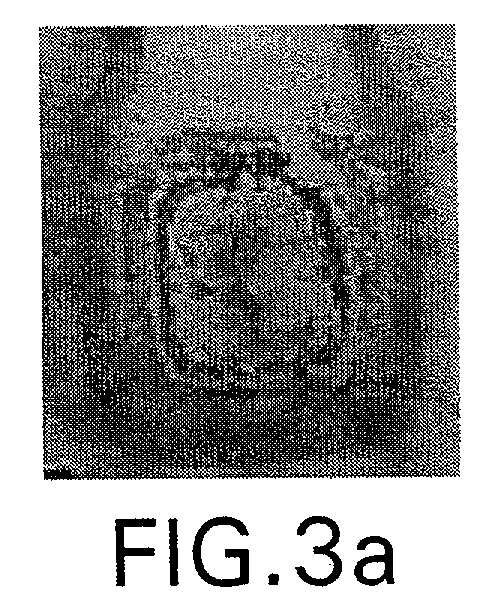
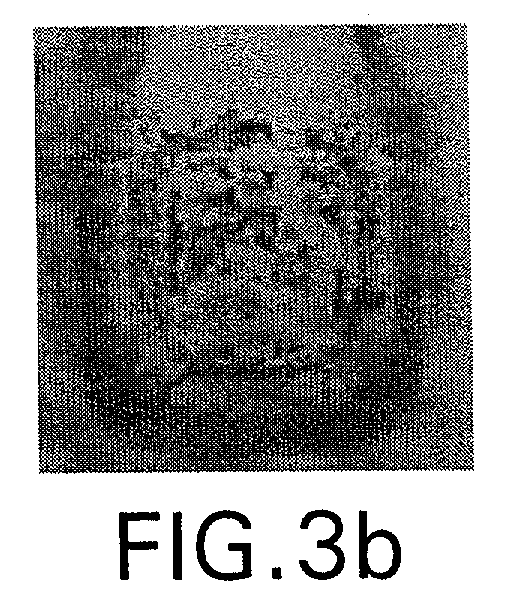
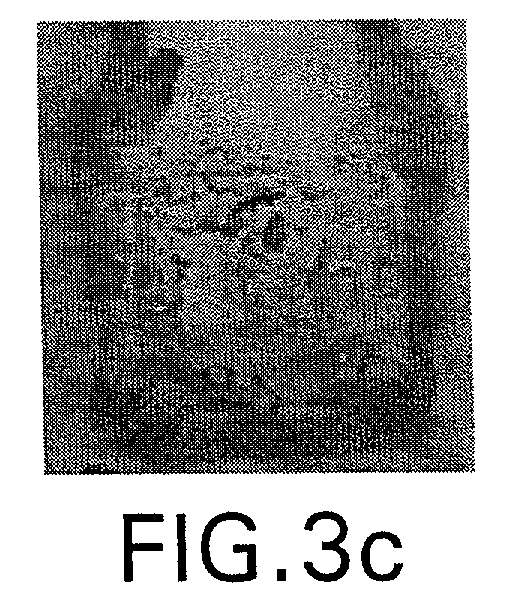
- FIGS. 3a-3c are microphotographs of images of resistors fired 100 million times with ink that contains 1.8 mM of (a) copper nitrate, (b) magnesium nitrate, and (c) sodium nitrate; and
- FIGS. 4a-4b are microphotographs of images of resistors fired 100 million times (a) with ink containing 100 ppm copper and (b) with ink not containing copper.
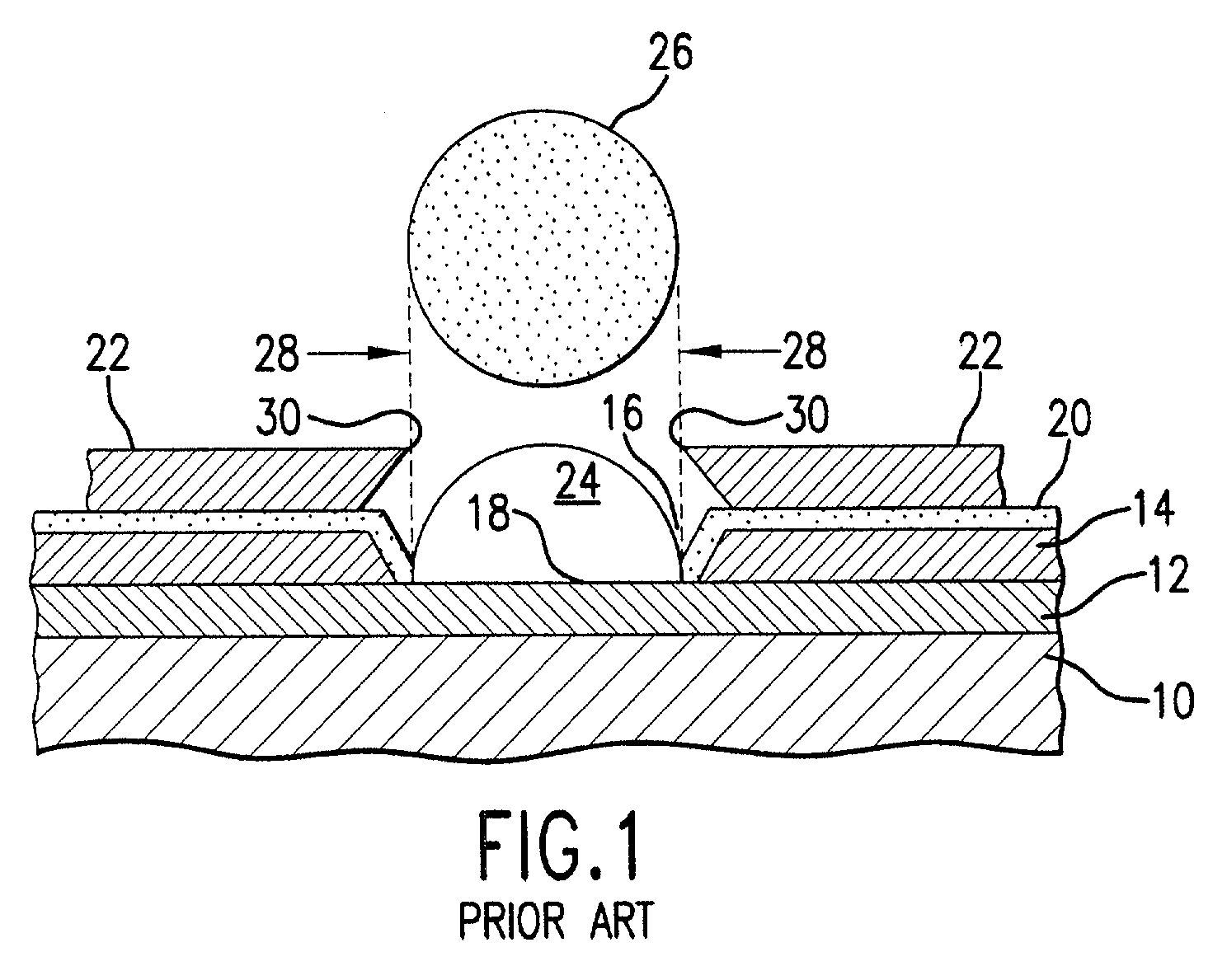
- FIG. 1 is a partial view of the print head of a thermal inkjet printer and illustrates an ink bubble on the surface of a firing resistor and the projected path of the ink drop (after explosive bubble formation) through the orifices found on the orifice plate of the inkjet printer.
- resistor substrate 10 contains resistor 12 and conductor 14.
- Conductor 14 is etched to form depression 16 whose bottom 18 is the resistor 12.
- the surface of the conductor 14 is covered with a passivation layer (not shown) which is generally a metal, such as gold.
- An aqueous ink composition 20 supplied from a reservoir (not shown), enters into the resistor area 18 along the surface of the conductor 14.
- the print head can contain more than one depression 16, which depressions can be separated by the use of barrier layers (not shown) which extend between conductor 14 and orifice plate 22.
- barrier materials include Vacrel, which is commercially available from DuPont de Nemours & Co. (Wilmington, DE).
- ink bubble 24 When the resistor 12 is heated, an ink bubble 24 will form on the surface of the ink 20.
- ink bubble 24 forms by passing a pulse or pulses of electric current through the resistor 12.
- sufficient current is pulsed through the resistor 12 so as to quickly raise the temperature of the ink in the depression 16 to near its superheat limit (e.g., about 300" to 400°C) in about 1 to 30 microseconds.
- the probability of homogeneous nucleation of a vapor bubble within the ink approaches unity.
- Such vapor bubble formation results in expulsion of an ink drop 26 along path 28-28 and through the orifice 30 formed in the orifice plate 22 and onto a substrate, e.g., paper (not shown).
- Kogation occurs at the bottom surface 18 of the depression 16, namely, on the portion of the resistor 12 exposed to the ink 20.
- the resistor 12 has a more complicated structure than shown in FIG. 1, which is intended as an instructional aid. However, the omission of such details has no bearing on the present invention. Further, it will be appreciated that the formation of koga is not necessarily uniform across the surface of the resistor 12 in the depression 16, but is typically affected by the presence of a thermal gradient across the resistor.
- Some metal ions may aid the oxidative removal of the koga.
- many divalent metal ions especially calcium and magnesium, typically have only a relatively weak influence on kogation, primarily by decreasing dye solubility in the ink.
- divalent copper ions are expected to only weakly decrease dye solubility.
- copper ions such as copper nitrate
- copper nitrate copper nitrate
- copper(B) in contrast to calcium and magnesium, is a transition metal ion and has other oxidation states, especially the copper(I) form, which are accessible. Therefore, copper can participate in reduction-oxidation (redox) reactions. Without prescribing to any particular theory, it is believed that through this redox behavior, copper acts as a catalyst on the tantalum surface for the oxidative removal of the graphitic koga.
- Copper is of environmental concern and either its concentration should be limited or the metal should be sequestered in an organic complex.
- a copper(B) salt or copper(B) organic complex is preferably employed in the practice of the present invention.
- the concentration of Cu(II) (as ion) ranges from about 30 to 1,000 ppm in the ink, preferably from about 50 to 200 ppm, based on the total ink composition.
- Cu(II) salts include, but are not limited to, carbonate, chloride, chlorate, hydroxide, nitrate, nitrite, oxide, oxychloride, perchlorate, sulfate, and thiosulfate, and the hydrated forms thereof.
- Cu(II) organic complexes include, but are not limited to, acetate, acetylacetonate, citrate, fox-mate, laurate, oleate, palmitate, salicylate, and tartrate, and the hydrated forms thereof.
- the use of copper(II) ion to reduce kogation is especially efficacious in printers that jet low drop volumes ( ⁇ 10 picoliters), called "low drop volume pens".
- Commercial examples of such a printer are Hewlett-Packard's DeskJet 2000C and 2200C printers.
- kogation has been found to be a problem with such low drop volume pens.
- the diameter of the orifice 30 is designed to be relatively small, on the order of 8 to 14 pm, to keep the drop volume at or below 10 p1; see, e.g., U.S.
- Patent 6,234,613 entitled “Apparatus for Generating Small Volume, High Velocity Ink Droplets in an Inkjet Printer", issued to J.A. Feinn et al on May 22, 2001, and assigned to the same assignee as the present invention, the contents of which are incorporated herein by reference. As discussed in that reference, there are additional elements whose dimensions are also altered from those for jetting larger drop volumes. The point here is to illustrate one element that is employed in jetting small drop volumes.
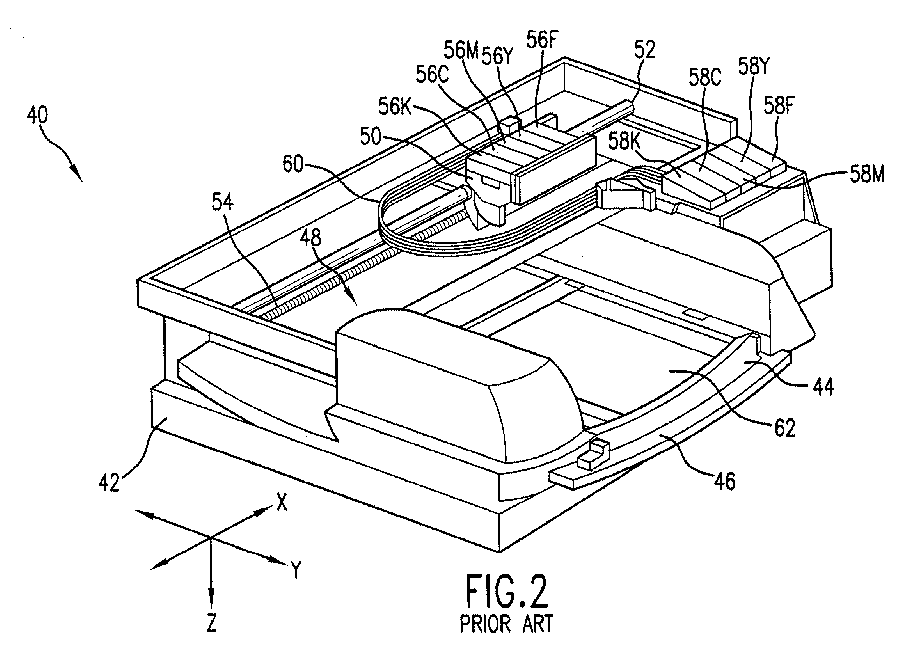
- FIG. 2 depicts an example of an off-axis printer 40.
- a housing 42 encloses the electrical and mechanical operating mechanisms of the printer 40. Operation is administrated by an internal electronic controller (usually a microprocessor or application-specific integrated circuit (“ASIC") controlled printed circuit board) connected by appropriate cabling (not shown) to the computer. It is well-known to program and execute imaging, printing, print media handling, control functions, and logic with firmware or software instructions for conventional or general purpose microprocessors or ASICs.
- Cut-sheet print medium 44 - referred to generically hereinafter simply as "paper,” regardless of actual medium selected by the end-user - is loaded by the end-user onto an input tray 46.
- Sheets of paper 44 are then sequentially fed by a suitable, internal, paper-path transport mechanism (not shown) to an internal printing station platen, or "print zone," 48 where graphical images or alphanumeric text are created using state of the art color imaging and text rendering using dot matrix manipulation techniques.
- a carriage 50 mounted on a slider 52, scans the paper sheet 44 delivered to the print zone 48.
- An encoder strip 54 and appurtenant position encoding devices on the carriage 50 and as part of the controller are provided for keeping track of the position of the carriage 50 at any given time.
- Each printhead mechanism is adapted for "jetting" minute droplets of ink or other fluids (see, e.g., U.S. Patent 5,635,969, entitled “Method and Apparatus for the Application of Multipart Ink-Jet Ink Chemistry", issued to Allen and assigned to the common assignee of the present invention, the contents of which are incorporated herein by reference) to form dots on adjacently positioned paper in the print zone 48.
- Refillable or replaceable ink supply cartridges, or "reservoirs”, 58K, 58C, 58M, 58Y are provided; generally, in a full color ink-jet system, inks for the subtractive primary colors, cyan, yellow, magenta (CYM) and a true black (K) ink are used; it will be appreciated, however, that additive primary colors - red, blue, green - or other colors can be used.
- a pen 56F and cartridge 58F for a clear fluid fixer "F” is also provided.
- the pens 56 are coupled to respective cartridges 58 by flexible tubing 60.
- ink pens While four ink pens (CYMK) are shown, it will appreciated that the invention is not limited to the number of inks used.
- CYMK ink pens
- a variation of the four pen CYMK print set is a six pen print set comprising light cyan, dark cyan, yellow, light magenta, dark magenta, and black. Such alternative variants may also be employed in the practice of the present invention.
- fixer (F) pen is shown, it will be appreciated that the invention is not limited to the number of fixer compositions used, nor the order of printing fixer and ink.
- the fixer may be printed first, thereby forming an under-mint, or the fixer may be printed last, thereby forming an over-print or overcoat, or one or more fixers may be both under-printed and over-printed. In this last instance, the fixer(s) may be the same or different in composition.
- the inkjet inks that are beneficially employed in the practice of the present invention comprise a vehicle and at least one colorant.
- co-solvents may be employed in the vehicle. These co-solvents are substantially water-miscible. Classes of co-solvents employed in the practice of this invention include, but are not limited to, aliphatic alcohols, aromatic alcohols, diols, glycol ethers, poly(glycol) ethers, caprolactams, formamides, acetamides, and long chain alcohols.
- Examples of compounds employed in the practice of this invention include, but are not limited to, primary aliphatic alcohols of 30 carbons or less, primary aromatic alcohols of 30 carbons or less, secondary aliphatic alcohols of 30 carbons or less, secondary aromatic alcohols of 30 carbons or less, 1,2-alcohols of 30 carbons or less, 1,3-alcohols of 30 carbons or less, 1,o-alcohols of 30 carbons or less, ethylene glycol alkyl ethers, propylene glycol alkyl ethers, poly(ethylene glycol) alkyl ethers, higher homologs of poly(ethylene glycol) alkyl ethers, poly(propylene glycol) alkyl ethers, higher homologs of poly(propylene glycol) alkyl ethers, N-alkyl caprolactams, unsubstituted caprolactams, substituted formamides, unsubstituted formamides, substituted acetamides, and unsubstituted ace
- co-solvents that are preferably employed in the practice of this invention include, but are not limited to, N-methyl pyrrolidone, 1 ,5-pentanediol, urea, 1,6-hexanediol, 2-pyrrolidone, diethylene glycol, 1,3-(2-methyl)-propanediol, 1,3,5-(2-methyl)-pentanetriol, tetramethylene sulfone, 3-methoxy-3-methylbutanol, glycerol, and 1,2-alkyldiols.
- the co-solvent concentration may range from 0 to about 30 wt%, with about 3 to 15 wt% being preferred.
- the balance of the ink composition comprises water.
- any of the following dyes may be used in the practice of the present invention; however, this listing is not intended to limit the invention.
- water-soluble dyes include the sulfonate and carboxylate dyes, specifically, those that are commonly employed in ink-jet printing.
- Sulforhodamine B (sulfonate), Acid Blue 113 (sulfonate), Acid Blue 29 (sulfonate), Acid Red 4 (sulfonate), Rose Bengal (carboxylate), Acid Yellow 17 (sulfonate), Acid Yellow 29 (sulfonate), Acid Yellow 42 (sulfonate), Acridine Yellow G (sulfonate), Nitro Blue Tetrazolium Chloride Monohydrate or Nitro BT, Rhodamine 6G, Rhodamine 123, Rhodamine B, Rhodamine B Isocyanate, Safranine 0, Azure B, Azure B Eosinate, Basic Blue 47, Basic Blue 66, Thioflacin T (Basic Yellow 1), and Auramine 0 (Basic Yellow 2), all available from Aldrich Chemical Company.
- any of the following pigments may also be used in the practice of the invention, alone or in combination with any of the aforementioned water-soluble dyes; however, this listing is not intended to limit the invention.
- the following pigments are available from BASF: Paliogen® Orange, Helio-gen® Blue L 6901F, HeliogenB Blue NBD 7010, HeliogenB Blue K 7090, Helio-gen® Blue L 7101F, Paliogen® Blue L 6470, HeliogenB Green K 8683, and Helio-gen® Green L 9140.
- the following pigments are available from Cabot: Monarch@ 1400, Monarch@ 1300, Monarch@ 1100, Monarch@ 1000, Monarch@ 900, Monarch8 880, Monarch® 800, and Monarch@ 700.
- the following pigments are available from Ciba-Geigy: Chromophtal® Yellow 3G, Chromophtal® Yellow GR, Chromophtal® Yellow 8G, Igrazin® Yellow 5GT, Igralite® Rubine 4BL, Monastral® Magenta, Monastral® Scarlet, Monastral® Violet R, Monastral® Red B, and Monastral® Violet Maroon B.
- the following pigments are available from Columbian: Raven 7000, Raven 5750, Raven 5250, Raven 5000, and Raven 3500.
- the following pigments are available from Degussa: Color Black FW 200, Color Black FW 2, Color Black FW 2V, Color Black FW 1, Color Black FW 18, Color Black S 160, Color Black S 170, Special Black 6, Special Black 5, Special Black 4A, Special Black 4, Printex U, Printex V, Printex 140U, and Printex 140V.
- the following pigment is available from DuPont: Tipure® R-101.
- the following pigments are available from Heubach: Dalamar® Yellow YT-858-D and Heucophthal® Blue G XBT-583D.
- the following pigments are available from Hoechst: Permanent Yellow GR, Permanent Yellow G, Permanent Yellow DHG, Permanent Yellow NCG-71, Permanent Yellow GG, Hansa Yellow RA, Hansa Brilliant Yellow 5GX-02, Hansa Yellow-X, Novoperm® Yellow HR, Novoperm® Yellow FGL, Hansa Brilliant Yellow 10GX, Permanent Yellow G3R-01, HostapermB Yellow H4G, HostapermB Yellow H3G, HostapermB Orange GR, HostapermB Scarlet GO, and Permanent Rubine F6B.
- the following pigments are available from Mobay: Quindo® Magenta, Indofast® Brilliant Scarlet, Quindo® Red R6700, Quindo® Red R6713, and Indofast® Violet.
- the following pigments are available from Sun Chemical: L74-1357 Yellow, L75-133 1 Yellow, L75-2577 Yellow, YGD 9374 Yellow, YHD 9123 Yellow, YCD 9296 Yellow, YFD 1100 Yellow, QHD6040 Magenta, QFD1180 Magenta, RFD32 17 Magenta, QFD 1146 Magenta, RFD9364 Magenta, QFD 9334 Magenta, BCD6 105 Cyan, BCD9448 Cyan, BCD6060 Cyan, BFD5002 Cyan, BFD1121 Cyan, and LHD9303 Black. Additional pigments useful in the practice of the present invention include Pigment Blue 15, Pigment Blue 60, Pigment Yellow 74, Pigment Yellow 17, and Pigment Red 220.
- a typical formulation for an ink useful in the practice of the present invention includes about 3 to 12 wt% of at least one water-miscible organic co-solvent, about 2 to 8 wt% of the colorant, and the balance water.
- various types of additives may be employed in the ink to optimize the properties of the ink composition for specific applications.
- biocides may be used in the ink composition to inhibit growth of microorganisms
- sequestering agents such as EDTA may be included to eliminate deleterious effects of heavy metal impurities
- buffering agents may be used to control the pH of the ink.
- concentration of the sequestering agent(s), if used, is(are) in the range of 0.01 to 2 wt%.
- additives such as viscosity modifiers and other acrylic or non-acrylic polymers may be added to improve various properties of the ink compositions as desired, such as conditioning the ejected ink droplets.
- concentration range of the additive(s) is from 0 to 5 wt% of the total ink composition.
- the above-mentioned ingredients are combined and stirred mechanically or mixed using low power sonication.
- FIGS. 3a-3c depict top plan view microphotographs of a resistor 12 fired 100 million times with ink comprised of 1.8 mM of copper nitrate (FIG. 3a), magnesium nitrate, (FIG. 3b), and sodium nitrate (FIG. 3c).
- 1.8 mM copper nitrate is approximately equivalent to 100 ppm of copper.
- This example shows the koga-removal effect of copper is concentration-dependent and decreases below 30 ppm.
- Copper nitrate was added in different amounts to ink formulation A (see Example 1) to yield inks with 100, 30, 10, 3, 1, and 0 ppm copper.
- Sets of resistors in the pens supplied with these inks were fired 25, 50 and 100 million drops per resistor and the resistor surfaces were observed under a light microscope.
- the observations of koga on the center, hot spot of the resistor are summarized in Table II below. Differences between the koga with 100 ppm copper and without copper are illustrated in FIGS. 4a-4b. The differences in koga distribution between the center areas and outer parts of the resistors 12 are clearly seen.
- FIGS. 4a-4b depict a top plan view microphotograph of resistors 12 fired 100 million times with ink spiked with 100 ppm Cu (FIG. 4a) and with ink not spiked with copper (FIG. 4b).
- the Figures clearly show the improvement in reduced kogation with the presence of copper ion.
Landscapes
- Chemical & Material Sciences (AREA)
- Life Sciences & Earth Sciences (AREA)
- Engineering & Computer Science (AREA)
- Materials Engineering (AREA)
- Wood Science & Technology (AREA)
- Organic Chemistry (AREA)
- Chemical Kinetics & Catalysis (AREA)
- Inks, Pencil-Leads, Or Crayons (AREA)
- Ink Jet Recording Methods And Recording Media Thereof (AREA)
- Ink Jet (AREA)
Abstract

Description
- The present invention is directed thermal ink jet inks, and, more particularly, to the reduction of kogation on the resistor surface by the addition of copper-containing ions to the ink.
- Small drop volumes, on the order of 10 picoliters (p1) or less, are advantageous for superior image and text quality. Smaller drops of ink on the paper (dots) are less visible and give printed images less of a grainy appearance. Because the colorant is in smaller "units", then gradients in color tones are more continuous. Because individual dots are less visible, color text is also improved with smaller drops.
- Long-life thermal inkjet print heads with replaceable ink supplies provide value to the customer because the need to replace expensive to manufacture print heads is minimized or eliminated. Replaceable ink supplies can be in the form of, but not limited to, off-axis ink reservoirs or ink tanks that snap onto the top of the print heads.
- Formulation of a color ink set for a printer with small drop volume, superior color image and text quality, long-life print heads, and high throughput is a challenge. Smaller drop volume means more drops need to be fired for a given volume of ink and the temperature of the resistor surfaces of the small drop volume pens tend to be higher. Therefore, kogation is more of a problem. 'In limited life print heads, which are replaced with the ink supply ("on-axis"), the print head can be replaced before kogation builds up to the point where it affects color image and text quality. In long-life print heads with replaceable ink supplied ("off-axis"), resistors must withstand hundreds-of-millions up to tens-of-billions of firings without kogation buildup.
- Kogation is thought to be a complex process in which organic material, typically dyes, in the ink forms a graphitic film that builds up on the resistor surface during repeated ejection of drops. The koga can also be inorganic in nature but these types of koga are outside of the range of discussion here. Along with the buildup process, removal processes are also thought to occur that help to clean the resistor surface. These removal processes can include mechanical breakup and chemical oxidation of the koga. Mechanical breakup during the stresses of drop generation and vapor bubble collapse is not necessarily desirable because a rough koga surface can result that act as a "boiling chip". The rough surface provides may low-energy nucleation sites for drive bubble formation early in the resistor pulse cycle. These premature vapor bubbles are associated with weak and erratic drop velocities and weights. More consistent and strong drop velocities and weights are associated with delayed drive bubble formation from smooth resistor surfaces.
- Because of conductive heat dissipation away from the resistor, there is a sharp temperature gradient or profile on the resistor surface with the highest temperature in the center of the resistor and lower temperatures towards the perimeter. The temperature gradient is revealed by the heavier koga or tantalum oxidation in the center "hot spots" of the resistors after several million firings.
- Metal ions can have a strong influence on kogation. Metal ions can be introduced into thermal inkjet inks through: (1) impurities and contamination in ink manufacture; (2) corrosion of metal parts in ink filling equipment; (3) corrosion of metal parts within the thermal inkjet pen such as stainless-steel springs and screens; (4) deliberate addition of metal salts or metal-organic complexes for, e.g., controlling bleed; and (5) metallized dyes, such as copper phthalocyanines.
- Kogation is also strongly affected by the metal type.
- There remains a need for a process of eliminating, or at least reducing, kogation on the firing resistor of an inkjet print head.
- In accordance with the present invention, a thermal inkjet ink for inkjet printing is provided, the ink comprising at least one colorant and a vehicle. The inkjet ink is provided with a copper ion concentration within a range of about 30 to 1,000 ppm, based on the total ink composition.
- The presence of the copper ion reduces kogation, and is especially effective in inkjet pens that either jet low drop volumes (≤ 10 picoliters) or have a prolonged resistor life, such as off-axis print cartridges.
- FIG. 1 is a cross-sectional view of a conventional inkjet print head, including a firing resistor;
- FIG. 2 is a perspective view of a generic off-axis ink jet printer of the type beneficially improved by the teachings of the present invention;
- FIGS. 3a-3c are microphotographs of images of resistors fired 100 million times with ink that contains 1.8 mM of (a) copper nitrate, (b) magnesium nitrate, and (c) sodium nitrate; and
- FIGS. 4a-4b are microphotographs of images of resistors fired 100 million times (a) with ink containing 100 ppm copper and (b) with ink not containing copper.
- Reference is now made in detail to a specific embodiment of the present invention, which illustrates the best mode presently contemplated by the inventor for practicing the invention. Alternative embodiments are also briefly described as applicable.
- FIG. 1 is a partial view of the print head of a thermal inkjet printer and illustrates an ink bubble on the surface of a firing resistor and the projected path of the ink drop (after explosive bubble formation) through the orifices found on the orifice plate of the inkjet printer. Specifically, in FIG. 1,
resistor substrate 10 containsresistor 12 andconductor 14.Conductor 14 is etched to formdepression 16 whosebottom 18 is theresistor 12. Optionally, the surface of theconductor 14 is covered with a passivation layer (not shown) which is generally a metal, such as gold. Anaqueous ink composition 20, supplied from a reservoir (not shown), enters into theresistor area 18 along the surface of theconductor 14. Optionally, the print head can contain more than onedepression 16, which depressions can be separated by the use of barrier layers (not shown) which extend betweenconductor 14 andorifice plate 22. Suitable barrier materials include Vacrel, which is commercially available from DuPont de Nemours & Co. (Wilmington, DE). - When the
resistor 12 is heated, anink bubble 24 will form on the surface of theink 20. In general,ink bubble 24 forms by passing a pulse or pulses of electric current through theresistor 12. Typically, sufficient current is pulsed through theresistor 12 so as to quickly raise the temperature of the ink in thedepression 16 to near its superheat limit (e.g., about 300" to 400°C) in about 1 to 30 microseconds. Under these conditions, the probability of homogeneous nucleation of a vapor bubble within the ink approaches unity. Such vapor bubble formation results in expulsion of anink drop 26 along path 28-28 and through theorifice 30 formed in theorifice plate 22 and onto a substrate, e.g., paper (not shown). Kogation occurs at thebottom surface 18 of thedepression 16, namely, on the portion of theresistor 12 exposed to theink 20. - The
resistor 12 has a more complicated structure than shown in FIG. 1, which is intended as an instructional aid. However, the omission of such details has no bearing on the present invention. Further, it will be appreciated that the formation of koga is not necessarily uniform across the surface of theresistor 12 in thedepression 16, but is typically affected by the presence of a thermal gradient across the resistor. - Some metal ions may aid the oxidative removal of the koga. On the other hand, many divalent metal ions, especially calcium and magnesium, typically have only a relatively weak influence on kogation, primarily by decreasing dye solubility in the ink. Similarly, divalent copper ions are expected to only weakly decrease dye solubility.
- In accordance with the present invention, the addition of copper ions, such as copper nitrate, to an otherwise kogating ink can almost completely remove the koga from the hotter portion of a tantalum resistor coating to leave a thin perimeter of koga on the more intermediate temperature part of the resistor. Copper(B), in contrast to calcium and magnesium, is a transition metal ion and has other oxidation states, especially the copper(I) form, which are accessible. Therefore, copper can participate in reduction-oxidation (redox) reactions. Without prescribing to any particular theory, it is believed that through this redox behavior, copper acts as a catalyst on the tantalum surface for the oxidative removal of the graphitic koga.
- Copper is of environmental concern and either its concentration should be limited or the metal should be sequestered in an organic complex. In any event, a copper(B) salt or copper(B) organic complex is preferably employed in the practice of the present invention. The concentration of Cu(II) (as ion) ranges from about 30 to 1,000 ppm in the ink, preferably from about 50 to 200 ppm, based on the total ink composition.
- Examples of Cu(II) salts include, but are not limited to, carbonate, chloride, chlorate, hydroxide, nitrate, nitrite, oxide, oxychloride, perchlorate, sulfate, and thiosulfate, and the hydrated forms thereof. Examples of Cu(II) organic complexes include, but are not limited to, acetate, acetylacetonate, citrate, fox-mate, laurate, oleate, palmitate, salicylate, and tartrate, and the hydrated forms thereof.
- The use of copper(II) ion to reduce kogation is especially efficacious in printers that jet low drop volumes (≤10 picoliters), called "low drop volume pens". Commercial examples of such a printer are Hewlett-Packard's DeskJet 2000C and 2200C printers. As explained above in the Background Art section, kogation has been found to be a problem with such low drop volume pens. In FIG. 1, the diameter of the
orifice 30 is designed to be relatively small, on the order of 8 to 14 pm, to keep the drop volume at or below 10 p1; see, e.g., U.S. Patent 6,234,613, entitled "Apparatus for Generating Small Volume, High Velocity Ink Droplets in an Inkjet Printer", issued to J.A. Feinn et al on May 22, 2001, and assigned to the same assignee as the present invention, the contents of which are incorporated herein by reference. As discussed in that reference, there are additional elements whose dimensions are also altered from those for jetting larger drop volumes. The point here is to illustrate one element that is employed in jetting small drop volumes. - The use of copper(II) ion to reduce kogation is also especially efficacious in printers that employ an off-axis reservoir. Such printers utilize replaceable reservoirs that are not part of the pen, as was the case with earlier printers. Commercial examples of such a printer are Hewlett-Packard's DeskJet 2000C and 2200C printers. As might be expected, long term use of such pens increases the likelihood of kogation on the resistors.
- FIG. 2 depicts an example of an off-
axis printer 40. Ahousing 42 encloses the electrical and mechanical operating mechanisms of theprinter 40. Operation is administrated by an internal electronic controller (usually a microprocessor or application-specific integrated circuit ("ASIC") controlled printed circuit board) connected by appropriate cabling (not shown) to the computer. It is well-known to program and execute imaging, printing, print media handling, control functions, and logic with firmware or software instructions for conventional or general purpose microprocessors or ASICs. Cut-sheet print medium 44 - referred to generically hereinafter simply as "paper," regardless of actual medium selected by the end-user - is loaded by the end-user onto aninput tray 46. Sheets ofpaper 44 are then sequentially fed by a suitable, internal, paper-path transport mechanism (not shown) to an internal printing station platen, or "print zone," 48 where graphical images or alphanumeric text are created using state of the art color imaging and text rendering using dot matrix manipulation techniques. Acarriage 50, mounted on aslider 52, scans thepaper sheet 44 delivered to theprint zone 48. Anencoder strip 54 and appurtenant position encoding devices on thecarriage 50 and as part of the controller are provided for keeping track of the position of thecarriage 50 at any given time. - A set of individual ink-jet writing instruments, or "pens", 56K, 56C, 56M, 56Y, 56F, each having ink jet printheads as would be known in the art (not seen in this perspective), are releasably mounted in fixed positions on the
carriage 50 for easy access and repair or replacement. Each printhead mechanism is adapted for "jetting" minute droplets of ink or other fluids (see, e.g., U.S. Patent 5,635,969, entitled "Method and Apparatus for the Application of Multipart Ink-Jet Ink Chemistry", issued to Allen and assigned to the common assignee of the present invention, the contents of which are incorporated herein by reference) to form dots on adjacently positioned paper in theprint zone 48. Refillable or replaceable ink supply cartridges, or "reservoirs", 58K, 58C, 58M, 58Y are provided; generally, in a full color ink-jet system, inks for the subtractive primary colors, cyan, yellow, magenta (CYM) and a true black (K) ink are used; it will be appreciated, however, that additive primary colors - red, blue, green - or other colors can be used. In this set, apen 56F andcartridge 58F for a clear fluid fixer "F" is also provided. The pens 56 are coupled to respective cartridges 58 byflexible tubing 60. Once a printed page is completed, the sheet of paper is ejected onto anoutput tray 62. It is common in the art to refer to the pen scanning direction as the x-axis, the paper feed direction as the y-axis, and the ink drop firing direction as the z-axis. - While four ink pens (CYMK) are shown, it will appreciated that the invention is not limited to the number of inks used. For example, a variation of the four pen CYMK print set is a six pen print set comprising light cyan, dark cyan, yellow, light magenta, dark magenta, and black. Such alternative variants may also be employed in the practice of the present invention.
- Further, while one fixer (F) pen is shown, it will be appreciated that the invention is not limited to the number of fixer compositions used, nor the order of printing fixer and ink. For example, the fixer may be printed first, thereby forming an under-mint, or the fixer may be printed last, thereby forming an over-print or overcoat, or one or more fixers may be both under-printed and over-printed. In this last instance, the fixer(s) may be the same or different in composition.
- The inkjet inks that are beneficially employed in the practice of the present invention comprise a vehicle and at least one colorant.
- In formulating the inkjet inks, one or more co-solvents may be employed in the vehicle. These co-solvents are substantially water-miscible. Classes of co-solvents employed in the practice of this invention include, but are not limited to, aliphatic alcohols, aromatic alcohols, diols, glycol ethers, poly(glycol) ethers, caprolactams, formamides, acetamides, and long chain alcohols. Examples of compounds employed in the practice of this invention include, but are not limited to, primary aliphatic alcohols of 30 carbons or less, primary aromatic alcohols of 30 carbons or less, secondary aliphatic alcohols of 30 carbons or less, secondary aromatic alcohols of 30 carbons or less, 1,2-alcohols of 30 carbons or less, 1,3-alcohols of 30 carbons or less, 1,o-alcohols of 30 carbons or less, ethylene glycol alkyl ethers, propylene glycol alkyl ethers, poly(ethylene glycol) alkyl ethers, higher homologs of poly(ethylene glycol) alkyl ethers, poly(propylene glycol) alkyl ethers, higher homologs of poly(propylene glycol) alkyl ethers, N-alkyl caprolactams, unsubstituted caprolactams, substituted formamides, unsubstituted formamides, substituted acetamides, and unsubstituted acetamides. Specific examples of co-solvents that are preferably employed in the practice of this invention include, but are not limited to, N-methyl pyrrolidone, 1 ,5-pentanediol, urea, 1,6-hexanediol, 2-pyrrolidone, diethylene glycol, 1,3-(2-methyl)-propanediol, 1,3,5-(2-methyl)-pentanetriol, tetramethylene sulfone, 3-methoxy-3-methylbutanol, glycerol, and 1,2-alkyldiols. The co-solvent concentration may range from 0 to about 30 wt%, with about 3 to 15 wt% being preferred. The balance of the ink composition comprises water.
- Any of the following dyes (water-soluble colorants) may be used in the practice of the present invention; however, this listing is not intended to limit the invention. Examples of water-soluble dyes include the sulfonate and carboxylate dyes, specifically, those that are commonly employed in ink-jet printing. Specific examples include: Sulforhodamine B (sulfonate), Acid Blue 113 (sulfonate), Acid Blue 29 (sulfonate), Acid Red 4 (sulfonate), Rose Bengal (carboxylate), Acid Yellow 17 (sulfonate), Acid Yellow 29 (sulfonate), Acid Yellow 42 (sulfonate), Acridine Yellow G (sulfonate), Nitro Blue Tetrazolium Chloride Monohydrate or Nitro BT, Rhodamine 6G, Rhodamine 123, Rhodamine B, Rhodamine B Isocyanate, Safranine 0, Azure B, Azure B Eosinate, Basic Blue 47, Basic Blue 66, Thioflacin T (Basic Yellow 1), and Auramine 0 (Basic Yellow 2), all available from Aldrich Chemical Company.
- Any of the following pigments (water-insoluble colorants) may also be used in the practice of the invention, alone or in combination with any of the aforementioned water-soluble dyes; however, this listing is not intended to limit the invention. The following pigments are available from BASF: Paliogen® Orange, Helio-gen® Blue L 6901F, HeliogenB Blue NBD 7010, HeliogenB Blue K 7090, Helio-gen® Blue L 7101F, Paliogen® Blue L 6470, HeliogenB Green K 8683, and Helio-gen® Green L 9140. The following pigments are available from Cabot: Monarch@ 1400, Monarch@ 1300, Monarch@ 1100, Monarch@ 1000, Monarch@ 900, Monarch8 880, Monarch® 800, and Monarch@ 700. The following pigments are available from Ciba-Geigy: Chromophtal® Yellow 3G, Chromophtal® Yellow GR, Chromophtal® Yellow 8G, Igrazin® Yellow 5GT, Igralite® Rubine 4BL, Monastral® Magenta, Monastral® Scarlet, Monastral® Violet R, Monastral® Red B, and Monastral® Violet Maroon B. The following pigments are available from Columbian: Raven 7000, Raven 5750, Raven 5250, Raven 5000, and Raven 3500. The following pigments are available from Degussa: Color Black FW 200, Color Black FW 2, Color Black FW 2V, Color Black FW 1,
Color Black FW 18, Color Black S 160, Color Black S 170, Special Black 6, Special Black 5, Special Black 4A, Special Black 4, Printex U, Printex V, Printex 140U, and Printex 140V. The following pigment is available from DuPont: Tipure® R-101. The following pigments are available from Heubach: Dalamar® Yellow YT-858-D and Heucophthal® Blue G XBT-583D. The following pigments are available from Hoechst: Permanent Yellow GR, Permanent Yellow G, Permanent Yellow DHG, Permanent Yellow NCG-71, Permanent Yellow GG, Hansa Yellow RA, Hansa Brilliant Yellow 5GX-02, Hansa Yellow-X, Novoperm® Yellow HR, Novoperm® Yellow FGL, Hansa Brilliant Yellow 10GX, Permanent Yellow G3R-01, HostapermB Yellow H4G, HostapermB Yellow H3G, HostapermB Orange GR, HostapermB Scarlet GO, and Permanent Rubine F6B. The following pigments are available from Mobay: Quindo® Magenta, Indofast® Brilliant Scarlet, Quindo® Red R6700, Quindo® Red R6713, and Indofast® Violet. The following pigments are available from Sun Chemical: L74-1357 Yellow, L75-133 1 Yellow, L75-2577 Yellow, YGD 9374 Yellow, YHD 9123 Yellow, YCD 9296 Yellow, YFD 1100 Yellow, QHD6040 Magenta, QFD1180 Magenta, RFD32 17 Magenta, QFD 1146 Magenta, RFD9364 Magenta, QFD 9334 Magenta, BCD6 105 Cyan, BCD9448 Cyan, BCD6060 Cyan, BFD5002 Cyan, BFD1121 Cyan, and LHD9303 Black. Additional pigments useful in the practice of the present invention include Pigment Blue 15,Pigment Blue 60, Pigment Yellow 74, Pigment Yellow 17, and Pigment Red 220. - A typical formulation for an ink useful in the practice of the present invention includes about 3 to 12 wt% of at least one water-miscible organic co-solvent, about 2 to 8 wt% of the colorant, and the balance water.
- Consistent with the requirements for this invention, various types of additives may be employed in the ink to optimize the properties of the ink composition for specific applications. For example, as is well-known to those skilled in the art, biocides may be used in the ink composition to inhibit growth of microorganisms, sequestering agents such as EDTA may be included to eliminate deleterious effects of heavy metal impurities, and buffering agents may be used to control the pH of the ink. The concentration of the sequestering agent(s), if used, is(are) in the range of 0.01 to 2 wt%. Other known additives such as viscosity modifiers and other acrylic or non-acrylic polymers may be added to improve various properties of the ink compositions as desired, such as conditioning the ejected ink droplets. The concentration range of the additive(s) is from 0 to 5 wt% of the total ink composition.
- In the fabrication of the ink, the above-mentioned ingredients are combined and stirred mechanically or mixed using low power sonication.
- This example demonstrates that copper(II) nitrate salt added to a kogating ink is observed to remove the koga from the hot spot of the resistor to leave only a perimeter of koga. The basic ink formulation is listed in Table I below.
Ink Formulation A Component Concentration M377 Ilford dye 0.10 absorbance units at 1: 10,000 dilution Copper phthalocyanine dye 0.12 absorbance units at 1: 10,000 dilution 2-pyrrolidinone 8% 1,5-pentanediol 8.75% EHPD* 1.88% Dowfax 8390 1% succinic acid 1.85% TERGITOL 15-S-5 0.94% TERGITOL 15-S-7 0.56% note: EHPD = ethylhydroxypropanediol - FIGS. 3a-3c depict top plan view microphotographs of a
resistor 12 fired 100 million times with ink comprised of 1.8 mM of copper nitrate (FIG. 3a), magnesium nitrate, (FIG. 3b), and sodium nitrate (FIG. 3c). 1.8 mM copper nitrate is approximately equivalent to 100 ppm of copper. - Because of the variable parasitic resistances from pen-to-pen, the energy delivered to the resistors was not necessarily consistent from pen-to-pen. Therefore, the total amount of koga between resistors in FIGS. 3a-3c is not reliable. What is stressed is the difference in koga between the center and the outer part of the resistor's hot spot. The circular ring on the resistor fired with copper-spiked ink (FIG. 3a) indicates the koga is "burned away" from the hotter center part of the resistor.
- This example shows the koga-removal effect of copper is concentration-dependent and decreases below 30 ppm. Copper nitrate was added in different amounts to ink formulation A (see Example 1) to yield inks with 100, 30, 10, 3, 1, and 0 ppm copper. Sets of resistors in the pens supplied with these inks were fired 25, 50 and 100 million drops per resistor and the resistor surfaces were observed under a light microscope. The observations of koga on the center, hot spot of the resistor are summarized in Table II below. Differences between the koga with 100 ppm copper and without copper are illustrated in FIGS. 4a-4b. The differences in koga distribution between the center areas and outer parts of the
resistors 12 are clearly seen. There is less koga on the hot spots of the resistor fired with the copper-spiked ink.Resistor Observations Copper Concentration (ppm) Koga on the Hot Spot 100 no koga 30 light koga 10 moderate koga 3 moderate koga 1 moderate koga 0 moderate koga - FIGS. 4a-4b depict a top plan view microphotograph of
resistors 12 fired 100 million times with ink spiked with 100 ppm Cu (FIG. 4a) and with ink not spiked with copper (FIG. 4b). The Figures clearly show the improvement in reduced kogation with the presence of copper ion. - The addition of copper ion to thermal inkjet inks, is expected to find use for reducing kogation in such inks.
Claims (8)
- A thermal inkjet ink for inkjet printing comprising at least one colorant and a vehicle, said inkjet ink provided with a copper ion concentration within a range of about 30 to 1,000 ppm, based on the total ink composition.
- The thermal inkjet ink of Claim 1 wherein said copper ion concentration is within a range of about 50 to 200 ppm.
- The thermal inkjet ink of Claim 1 wherein said copper ion is copper(II).
- The thermal inkjet ink of Claim 3 wherein said copper ion concentration is provided by at least one copper-containing species selected from the group consisting of copper salts and copper organic complexes.
- The thermal inkjet ink of Claim 4 wherein said copper salt comprises at least one copper(II) salt selected from the group consisting of carbonate, chloride, chlorate, hydroxide, nitrate, nitrite, oxide, oxychloride, perchlorate, sulfate, and thiosulfate, and the hydrated forms thereof.
- The thermal inkjet ink of Claim 4 wherein said at least one copper organic complex comprises at least one copper(II) organic complex selected from the group consisting of acetate, acetylacetonate, citrate, formate, laurate, oleate, palmitate, salicylate, and tarn-ate, and the hydrated forms thereof.
- In combination, (a) a low drop volume thermal inkjet pen for jetting ink drops having a volume of 10 picoliters or less and (b) said thermal inkjet ink of Claim .
- In combination, (a) a prolonged resistor life thermal inkjet pen for jetting ink drops, said thermal inkjet pen supplied with ink from a separate off-axis reservoir, and (b) said thermal inkjet ink of Claim 1.
Applications Claiming Priority (2)
| Application Number | Priority Date | Filing Date | Title |
|---|---|---|---|
| US10/105,490 US6616273B1 (en) | 2002-03-25 | 2002-03-25 | Addition of copper salts and copper complexes to thermal inkjet inks for kogation reduction |
| US105490 | 2002-03-25 |
Publications (2)
| Publication Number | Publication Date |
|---|---|
| EP1348744A1 true EP1348744A1 (en) | 2003-10-01 |
| EP1348744B1 EP1348744B1 (en) | 2006-10-18 |
Family
ID=27788404
Family Applications (1)
| Application Number | Title | Priority Date | Filing Date |
|---|---|---|---|
| EP03251296A Expired - Lifetime EP1348744B1 (en) | 2002-03-25 | 2003-03-04 | Addition of copper salts and copper complexes to thermal inkjet inks for kogation reduction |
Country Status (4)
| Country | Link |
|---|---|
| US (1) | US6616273B1 (en) |
| EP (1) | EP1348744B1 (en) |
| JP (1) | JP3920798B2 (en) |
| DE (1) | DE60309085T2 (en) |
Families Citing this family (10)
| Publication number | Priority date | Publication date | Assignee | Title |
|---|---|---|---|---|
| US7163577B2 (en) * | 2004-03-01 | 2007-01-16 | Hewlett-Packard Development Company, L.P. | Black pigmented ink-jet inks with improved frequency response |
| US20060187284A1 (en) * | 2005-02-24 | 2006-08-24 | Rehman Zia U | Ink-jet ink compositions for use in off-axis printers |
| WO2008055244A2 (en) | 2006-10-31 | 2008-05-08 | Sensient Colors Inc. | Modified pigments and methods for making and using the same |
| EP3483222A3 (en) | 2007-08-23 | 2019-08-07 | Sensient Colors LLC | Self-dispersed pigments and methods for making and using the same |
| EP2271719B1 (en) | 2008-04-29 | 2016-03-09 | Hewlett-Packard Development Company, L.P. | Inks and ink sets for improved performance and image quality |
| EP2417202A2 (en) | 2009-04-07 | 2012-02-15 | Sensient Colors LLC | Self-dispersing particles and methods for making and using the same |
| EP2534211B1 (en) | 2010-02-08 | 2016-04-20 | Memjet Technology Limited | Method of minimizing kogation in thermal inkjet printheads |
| JP2011195782A (en) * | 2010-03-23 | 2011-10-06 | Seiko Epson Corp | Ink composition |
| US20120156375A1 (en) | 2010-12-20 | 2012-06-21 | Brust Thomas B | Inkjet ink composition with jetting aid |
| US20130176368A1 (en) * | 2011-07-12 | 2013-07-11 | E I Du Pont De Nemours And Company | Ink-jet inks having improved corrosion resistance |
Citations (3)
| Publication number | Priority date | Publication date | Assignee | Title |
|---|---|---|---|---|
| EP0534634A1 (en) * | 1991-09-23 | 1993-03-31 | Hewlett-Packard Company | Method and compositions for producing stable, water-fast printed images |
| WO2000037574A1 (en) * | 1998-12-21 | 2000-06-29 | Avecia Limited | Chemical composition for ink |
| EP1029680A2 (en) * | 1999-02-19 | 2000-08-23 | Canon Kabushiki Kaisha | Method of reducing kogation on heater of ink-jet recording head, ink-jet recording process, ink-jet recording apparatus, recording unit, and method for lengthening the life of recording head |
Family Cites Families (11)
| Publication number | Priority date | Publication date | Assignee | Title |
|---|---|---|---|---|
| US5428383A (en) | 1992-08-05 | 1995-06-27 | Hewlett-Packard Corporation | Method and apparatus for preventing color bleed in a multi-ink printing system |
| US5387976A (en) | 1993-10-29 | 1995-02-07 | Hewlett-Packard Company | Method and system for measuring drop-volume in ink-jet printers |
| EP0657849B1 (en) | 1993-11-30 | 2000-01-05 | Hewlett-Packard Company | Method and apparatus for colour inkjet printing using a colourless precursor |
| JP3635376B2 (en) * | 1994-12-12 | 2005-04-06 | コニカミノルタホールディングス株式会社 | Ink and sheet for ink jet recording and ink jet recording method |
| US5746818A (en) * | 1995-08-31 | 1998-05-05 | Seiko Epson Corporation | Pigment ink composition capable of forming image having no significant bleeding or feathering |
| US6113221A (en) * | 1996-02-07 | 2000-09-05 | Hewlett-Packard Company | Method and apparatus for ink chamber evacuation |
| US6234613B1 (en) | 1997-10-30 | 2001-05-22 | Hewlett-Packard Company | Apparatus for generating small volume, high velocity ink droplets in an inkjet printer |
| WO1999027556A2 (en) * | 1997-11-20 | 1999-06-03 | Xacct Technologies, Inc. | Network accounting and billing system and method |
| US6059868A (en) | 1998-10-29 | 2000-05-09 | Hewlett-Packard Company | Ink-jet inks with improved performance |
| US6425659B1 (en) * | 1999-02-26 | 2002-07-30 | Canon Kabushiki Kaisha | Method for alleviating kogation on surface of heater of ink-jet recording head, method for ink-jet recording, ink-jet recording apparatus, recording unit, and method for prolonging ink-jet recording head life |
| US6607266B2 (en) * | 2000-09-25 | 2003-08-19 | Canon Kabushiki Kaisha | Liquid composition, ink for ink-jet, ink set for ink-jet recording, ink-jet recording method, recording unit, ink cartridge, and ink jet recording apparatus |
-
2002
- 2002-03-25 US US10/105,490 patent/US6616273B1/en not_active Expired - Fee Related
-
2003
- 2003-03-04 EP EP03251296A patent/EP1348744B1/en not_active Expired - Lifetime
- 2003-03-04 DE DE60309085T patent/DE60309085T2/en not_active Expired - Fee Related
- 2003-03-25 JP JP2003082295A patent/JP3920798B2/en not_active Expired - Fee Related
Patent Citations (3)
| Publication number | Priority date | Publication date | Assignee | Title |
|---|---|---|---|---|
| EP0534634A1 (en) * | 1991-09-23 | 1993-03-31 | Hewlett-Packard Company | Method and compositions for producing stable, water-fast printed images |
| WO2000037574A1 (en) * | 1998-12-21 | 2000-06-29 | Avecia Limited | Chemical composition for ink |
| EP1029680A2 (en) * | 1999-02-19 | 2000-08-23 | Canon Kabushiki Kaisha | Method of reducing kogation on heater of ink-jet recording head, ink-jet recording process, ink-jet recording apparatus, recording unit, and method for lengthening the life of recording head |
Also Published As
| Publication number | Publication date |
|---|---|
| JP3920798B2 (en) | 2007-05-30 |
| US6616273B1 (en) | 2003-09-09 |
| EP1348744B1 (en) | 2006-10-18 |
| JP2003292861A (en) | 2003-10-15 |
| DE60309085D1 (en) | 2006-11-30 |
| DE60309085T2 (en) | 2007-08-23 |
Similar Documents
| Publication | Publication Date | Title |
|---|---|---|
| EP1405882B1 (en) | Ink jet recording ink set | |
| EP0997505B1 (en) | Ink-jet inks with improved performance | |
| EP0877064B1 (en) | Dye set for improved color quality for ink-jet printers | |
| EP0953616B1 (en) | Black to color bleed control in ink-jet printing inks | |
| EP1767596B1 (en) | Cyan ink, ink set, set of ink and reactive liquid, and image forming method | |
| EP1925646B1 (en) | Ink jet recording apparatus and method | |
| EP0953614B1 (en) | Reactive ink set for ink-jet printing | |
| EP1992495B1 (en) | Ink jet printing method | |
| US6616273B1 (en) | Addition of copper salts and copper complexes to thermal inkjet inks for kogation reduction | |
| US6478418B2 (en) | Inkjet ink having improved directionality by controlling surface tension and wetting properties | |
| KR100495295B1 (en) | Recording Unit, Image Recording Apparatus and Image Recording Method | |
| JP2004168795A (en) | Ink composition, recording method and recorded image using the same, ink set and ink head | |
| JP2004175935A (en) | Ink composition, recording method and image using the same, and ink head using the same | |
| JP2010270287A (en) | Ink set, ink jet recording method, and ink jet recording apparatus | |
| EP1616916B1 (en) | Inkjet ink formulation | |
| JP4825806B2 (en) | Improvement of bleed property between black and color of amphoteric dispersed pigment ink with low pigment concentration | |
| JP4183236B2 (en) | Image recording method | |
| KR100743438B1 (en) | Image forming apparatus, image forming process, recording composition, and cartridge | |
| JP2004175934A (en) | Ink composition, recording method and image using the same, and ink head using the same | |
| JP2004338291A (en) | Recording medium, inkjet recording method and inkjet recording apparatus | |
| JP2004315670A (en) | Ink composition, ink set, image forming method and recorded image, and ink head | |
| JP4474129B2 (en) | Inkjet recording method | |
| JP2018171719A (en) | Inkjet recording method | |
| HK1027589A1 (en) | Ink compositions having superior smearfastness and reduced smudging and blot dry time | |
| JP2005298607A (en) | Ink jet ink, ink jet recording method, and ink jet recording apparatus |
Legal Events
| Date | Code | Title | Description |
|---|---|---|---|
| PUAI | Public reference made under article 153(3) epc to a published international application that has entered the european phase |
Free format text: ORIGINAL CODE: 0009012 |
|
| AK | Designated contracting states |
Kind code of ref document: A1 Designated state(s): AT BE BG CH CY CZ DE DK EE ES FI FR GB GR HU IE IT LI LU MC NL PT RO SE SI SK TR |
|
| AX | Request for extension of the european patent |
Extension state: AL LT LV MK |
|
| 17P | Request for examination filed |
Effective date: 20040311 |
|
| AKX | Designation fees paid |
Designated state(s): DE FR GB |
|
| 17Q | First examination report despatched |
Effective date: 20040625 |
|
| GRAP | Despatch of communication of intention to grant a patent |
Free format text: ORIGINAL CODE: EPIDOSNIGR1 |
|
| GRAS | Grant fee paid |
Free format text: ORIGINAL CODE: EPIDOSNIGR3 |
|
| GRAA | (expected) grant |
Free format text: ORIGINAL CODE: 0009210 |
|
| AK | Designated contracting states |
Kind code of ref document: B1 Designated state(s): DE FR GB |
|
| REG | Reference to a national code |
Ref country code: GB Ref legal event code: FG4D |
|
| REF | Corresponds to: |
Ref document number: 60309085 Country of ref document: DE Date of ref document: 20061130 Kind code of ref document: P |
|
| ET | Fr: translation filed | ||
| PLBE | No opposition filed within time limit |
Free format text: ORIGINAL CODE: 0009261 |
|
| STAA | Information on the status of an ep patent application or granted ep patent |
Free format text: STATUS: NO OPPOSITION FILED WITHIN TIME LIMIT |
|
| 26N | No opposition filed |
Effective date: 20070719 |
|
| PGFP | Annual fee paid to national office [announced via postgrant information from national office to epo] |
Ref country code: GB Payment date: 20080327 Year of fee payment: 6 |
|
| PGFP | Annual fee paid to national office [announced via postgrant information from national office to epo] |
Ref country code: DE Payment date: 20080430 Year of fee payment: 6 Ref country code: FR Payment date: 20080317 Year of fee payment: 6 |
|
| GBPC | Gb: european patent ceased through non-payment of renewal fee |
Effective date: 20090304 |
|
| REG | Reference to a national code |
Ref country code: FR Ref legal event code: ST Effective date: 20091130 |
|
| PG25 | Lapsed in a contracting state [announced via postgrant information from national office to epo] |
Ref country code: DE Free format text: LAPSE BECAUSE OF NON-PAYMENT OF DUE FEES Effective date: 20091001 |
|
| PG25 | Lapsed in a contracting state [announced via postgrant information from national office to epo] |
Ref country code: GB Free format text: LAPSE BECAUSE OF NON-PAYMENT OF DUE FEES Effective date: 20090304 Ref country code: FR Free format text: LAPSE BECAUSE OF NON-PAYMENT OF DUE FEES Effective date: 20091123 |