EP1348709A2 - Thiazolo (4,5-D) pyrimidine compounds - Google Patents

Thiazolo (4,5-D) pyrimidine compounds Download PDF

Info

Publication number
EP1348709A2
EP1348709A2 EP03015019A EP03015019A EP1348709A2 EP 1348709 A2 EP1348709 A2 EP 1348709A2 EP 03015019 A EP03015019 A EP 03015019A EP 03015019 A EP03015019 A EP 03015019A EP 1348709 A2 EP1348709 A2 EP 1348709A2
Authority
EP
European Patent Office
Prior art keywords
amino
pyrimidin
thio
thiazolo
methyl
Prior art date
Legal status (The legal status is an assumption and is not a legal conclusion. Google has not performed a legal analysis and makes no representation as to the accuracy of the status listed.)
Granted
Application number
EP03015019A
Other languages
German (de)
French (fr)
Other versions
EP1348709B1 (en
EP1348709A3 (en
Inventor
Roger c/o AstraZeneca R&D Bonnert
Simon Fraser c/o AstraZeneca R&D Hunt
Paul c/o AstraZeneca R&D Willis
Iain c/o AstraZeneca R&D Walthers
Current Assignee (The listed assignees may be inaccurate. Google has not performed a legal analysis and makes no representation or warranty as to the accuracy of the list.)
AstraZeneca UK Ltd
Original Assignee
AstraZeneca UK Ltd
Priority date (The priority date is an assumption and is not a legal conclusion. Google has not performed a legal analysis and makes no representation as to the accuracy of the date listed.)
Filing date
Publication date
Application filed by AstraZeneca UK Ltd filed Critical AstraZeneca UK Ltd
Publication of EP1348709A2 publication Critical patent/EP1348709A2/en
Publication of EP1348709A3 publication Critical patent/EP1348709A3/en
Application granted granted Critical
Publication of EP1348709B1 publication Critical patent/EP1348709B1/en
Anticipated expiration legal-status Critical
Expired - Lifetime legal-status Critical Current

Links

Classifications

    • CCHEMISTRY; METALLURGY
    • C07ORGANIC CHEMISTRY
    • C07DHETEROCYCLIC COMPOUNDS
    • C07D513/00Heterocyclic compounds containing in the condensed system at least one hetero ring having nitrogen and sulfur atoms as the only ring hetero atoms, not provided for in groups C07D463/00, C07D477/00 or C07D499/00 - C07D507/00
    • C07D513/02Heterocyclic compounds containing in the condensed system at least one hetero ring having nitrogen and sulfur atoms as the only ring hetero atoms, not provided for in groups C07D463/00, C07D477/00 or C07D499/00 - C07D507/00 in which the condensed system contains two hetero rings
    • C07D513/04Ortho-condensed systems
    • AHUMAN NECESSITIES
    • A61MEDICAL OR VETERINARY SCIENCE; HYGIENE
    • A61PSPECIFIC THERAPEUTIC ACTIVITY OF CHEMICAL COMPOUNDS OR MEDICINAL PREPARATIONS
    • A61P1/00Drugs for disorders of the alimentary tract or the digestive system
    • AHUMAN NECESSITIES
    • A61MEDICAL OR VETERINARY SCIENCE; HYGIENE
    • A61PSPECIFIC THERAPEUTIC ACTIVITY OF CHEMICAL COMPOUNDS OR MEDICINAL PREPARATIONS
    • A61P11/00Drugs for disorders of the respiratory system
    • AHUMAN NECESSITIES
    • A61MEDICAL OR VETERINARY SCIENCE; HYGIENE
    • A61PSPECIFIC THERAPEUTIC ACTIVITY OF CHEMICAL COMPOUNDS OR MEDICINAL PREPARATIONS
    • A61P11/00Drugs for disorders of the respiratory system
    • A61P11/06Antiasthmatics
    • AHUMAN NECESSITIES
    • A61MEDICAL OR VETERINARY SCIENCE; HYGIENE
    • A61PSPECIFIC THERAPEUTIC ACTIVITY OF CHEMICAL COMPOUNDS OR MEDICINAL PREPARATIONS
    • A61P17/00Drugs for dermatological disorders
    • AHUMAN NECESSITIES
    • A61MEDICAL OR VETERINARY SCIENCE; HYGIENE
    • A61PSPECIFIC THERAPEUTIC ACTIVITY OF CHEMICAL COMPOUNDS OR MEDICINAL PREPARATIONS
    • A61P17/00Drugs for dermatological disorders
    • A61P17/06Antipsoriatics
    • AHUMAN NECESSITIES
    • A61MEDICAL OR VETERINARY SCIENCE; HYGIENE
    • A61PSPECIFIC THERAPEUTIC ACTIVITY OF CHEMICAL COMPOUNDS OR MEDICINAL PREPARATIONS
    • A61P19/00Drugs for skeletal disorders
    • A61P19/02Drugs for skeletal disorders for joint disorders, e.g. arthritis, arthrosis
    • AHUMAN NECESSITIES
    • A61MEDICAL OR VETERINARY SCIENCE; HYGIENE
    • A61PSPECIFIC THERAPEUTIC ACTIVITY OF CHEMICAL COMPOUNDS OR MEDICINAL PREPARATIONS
    • A61P29/00Non-central analgesic, antipyretic or antiinflammatory agents, e.g. antirheumatic agents; Non-steroidal antiinflammatory drugs [NSAID]
    • AHUMAN NECESSITIES
    • A61MEDICAL OR VETERINARY SCIENCE; HYGIENE
    • A61PSPECIFIC THERAPEUTIC ACTIVITY OF CHEMICAL COMPOUNDS OR MEDICINAL PREPARATIONS
    • A61P35/00Antineoplastic agents
    • AHUMAN NECESSITIES
    • A61MEDICAL OR VETERINARY SCIENCE; HYGIENE
    • A61PSPECIFIC THERAPEUTIC ACTIVITY OF CHEMICAL COMPOUNDS OR MEDICINAL PREPARATIONS
    • A61P37/00Drugs for immunological or allergic disorders
    • AHUMAN NECESSITIES
    • A61MEDICAL OR VETERINARY SCIENCE; HYGIENE
    • A61PSPECIFIC THERAPEUTIC ACTIVITY OF CHEMICAL COMPOUNDS OR MEDICINAL PREPARATIONS
    • A61P37/00Drugs for immunological or allergic disorders
    • A61P37/08Antiallergic agents
    • AHUMAN NECESSITIES
    • A61MEDICAL OR VETERINARY SCIENCE; HYGIENE
    • A61PSPECIFIC THERAPEUTIC ACTIVITY OF CHEMICAL COMPOUNDS OR MEDICINAL PREPARATIONS
    • A61P43/00Drugs for specific purposes, not provided for in groups A61P1/00-A61P41/00
    • AHUMAN NECESSITIES
    • A61MEDICAL OR VETERINARY SCIENCE; HYGIENE
    • A61PSPECIFIC THERAPEUTIC ACTIVITY OF CHEMICAL COMPOUNDS OR MEDICINAL PREPARATIONS
    • A61P9/00Drugs for disorders of the cardiovascular system
    • AHUMAN NECESSITIES
    • A61MEDICAL OR VETERINARY SCIENCE; HYGIENE
    • A61PSPECIFIC THERAPEUTIC ACTIVITY OF CHEMICAL COMPOUNDS OR MEDICINAL PREPARATIONS
    • A61P9/00Drugs for disorders of the cardiovascular system
    • A61P9/10Drugs for disorders of the cardiovascular system for treating ischaemic or atherosclerotic diseases, e.g. antianginal drugs, coronary vasodilators, drugs for myocardial infarction, retinopathy, cerebrovascula insufficiency, renal arteriosclerosis

Definitions

  • the present invention relates to certain thiazolopyrimidinone compounds, processes and intermediates used in their preparation, pharmaceutical compositions containing them and their use in therapy.
  • WO 98/08847 and EP0778277 each disclose a series of 6,5-hetero bicyclic compounds said to be useful as CRF antagonists.
  • Chemokines play an important role in immune and inflammatory responses in various diseases and disorders, including asthma and allergic diseases, as well as autoimmune pathologies such as rheumatoid arthritis and atherosclerosis. These small secreted molecules are a growing superfamily of 8-14 kDa proteins characterised by a conserved four cysteine motif. The chemokine superfamily can be divided into two main groups exhibiting characteristic structural motifs, the Cys-X-Cys (C-X-C) and Cys-Cys (C-C) families. These are distinguished on the basis of a single amino acid insertion between the NH-proximal pair of cysteine residues and sequence similarity.
  • the C-X-C chemokines include several potent chemoattractants and activators of neutrophils such as interleukin-8 (IL-8) and neutrophil-activating peptide 2 (NAP-2).
  • IL-8 interleukin-8
  • NAP-2 neutrophil-activating peptide 2
  • the C-C chemokines include potent chemoattractants of monocytes and lymphocytes but not neutrophils such as human monocyte chemotactic proteins 1-3 (MCP-1, MCP-2 and MCP-3), RANTES (Regulated on Activation, Normal T Expressed and Secreted), eotaxin and the macrophage inflammatory proteins 1 ⁇ and 1 ⁇ (MIP-1 ⁇ and MIP-1 ⁇ ).
  • chemokines are mediated by subfamilies of G protein-coupled receptors, among which are the receptors designated CCR1, CCR2, CCR2A, CCR2B, CCR3, CCR4, CCR5, CCR6, CCR7, CCR8, CCR9, CCR10, CXCR1, CXCR2, CXCR3, CXCR4 and CX3CR1.
  • G protein-coupled receptors among which are the receptors designated CCR1, CCR2, CCR2A, CCR2B, CCR3, CCR4, CCR5, CCR6, CCR7, CCR8, CCR9, CCR10, CXCR1, CXCR2, CXCR3, CXCR4 and CX3CR1.
  • an alkyl or alkenyl group or an alkyl or alkenyl moiety in a substituent group may be linear or branched.
  • Aryl groups include phenyl and naphthyl.
  • Heteroaryl groups include 5- or 6-membered aromatic rings containing one or more heteroatoms selected from N, S, O. Examples include pyridine, pyrimidine, thiazole, oxazole, pyrazole, imidazole, furan.
  • Certain compounds of formula (I) are capable of existing in stereoisomeric forms. It will be understood that the invention encompasses all geometric and optical isomers of the compounds of formula (I) and mixtures thereof including racemates. Tautomers and mixtures thereof also form an aspect of the present invention.
  • the group R 1 represents a C 3 -C 7 carbocyclic, C 1 -C 8 alkyl, C 2 -C 6 alkenyl or C 2 -C 6 alkynyl group, each of the groups being optionally substituted by one or more substituent groups independently selected from halogen atoms, -OR 4 , -NR 5 R 6 , - CONR 5 R 6 , -COOR 7 , -NR 8 COR 9 , -SR 10 , -SO 2 R 10 , -SO 2 NR 5 R 6 , -NR 8 SO 2 R 9 or an aryl or heteroaryl group, both of which may be optionally substituted by one or more substituents independently selected from halogen atoms, cyano, nitro, -OR 4 , -NR 5 R 6 , -CONR 5 R 6 , - COOR 7 , -NR 8 COR 9 , -SR 10 , -SO 2 R 10 , ,
  • R 1 represents an optionally substituted benzyl group. More preferably R 1 represents benzyl or benzyl substituted by one or more C 1 -C 6 alkyl, C 1 -C 6 alkoxy or halogen atoms.
  • R 2 and R 3 represent a group substituted by one or more 3-8 membered rings optionally containing one or more atoms selected from O, S or NR 8 , examples of such groups include piperidine, pyrrolidine, piperazine and morpholine.
  • R 2 and R 3 is hydrogen and the other is C 1 -C 8 alkyl substituted by hydroxy and one or more methyl or ethyl groups. More preferably one of R 2 and R 3 is hydrogen and the other is CH(CH 3 )CH 2 OH, CH(Et)CH 2 OH, C(CH 3 ) 2 CH 2 OH or CH(CH 2 OH) 2 . When one of R 2 and R 3 is hydrogen and the other is CH(CH 3 )CH 2 OH or CH(Et)CH 2 OH the resulting compounds of formula (I) are preferably in the form of the (R) isomer.
  • Particularly preferred compounds of the invention include:
  • Compounds of formula (IIA) where R 1 , R 2 and R 3 are as defined in formula (I) may be prepared by treatment of compounds of formula (I) with a suitable oxidising agent such as oxone.
  • a suitable oxidising agent such as oxone.
  • the reaction may be carried out in a solvent such as acetonitrile at a temperature between 0°C and 100°C.
  • Compounds of formula (IIIA) where R 2 and R 3 are as defined in formula (I) and X is NH 2 may be prepared by treatment of a compound of formula (IIB) where R 2 and R 3 are as defined in formula (I), X is NH 2 and R 1 is a suitable benzyl group such as benzyl or 2,3-difluorobenzyl with a reducing medium such as sodium metal in liquid ammonia, or by treatment of a compound of formula (IIIB): where R 1 is as defined in formula (I) and L is a leaving group such as chlorine with an amine HNR 2 R 3 where R 2 and R 3 are as defined in formula (I).
  • the reaction may be carried out in a solvent such as N -methyl-pyrrolidine at a temperature between 0°C and 150°C.
  • Compounds of formula (IIIB) where R 1 is as defined in formula (I) and L is a halogen may be prepared by treating a compound of formula (IIIB) where R 1 is as defined in formula (I) and L is a hydroxyl group with a halogenating agent such as phosphorous oxychloride. The reaction may be carried out in the presence of dimethylaniline at reflux.
  • Compounds of formula (IIIB) where R 1 is as defined in formula (I) and L is a hydroxyl group may be formed either by treatment of a compound of formula (IVA) with a compound of formula R 1 X where R 1 is as defined above and X is a leaving group such as bromide in the presence of a base such as potassium tert -butoxide in an inert solvent such as DMSO at ambient temperature.
  • the reaction is preferably carried out in a suitable solvent such as DMF at elevated temperature, for example at about 120°C.
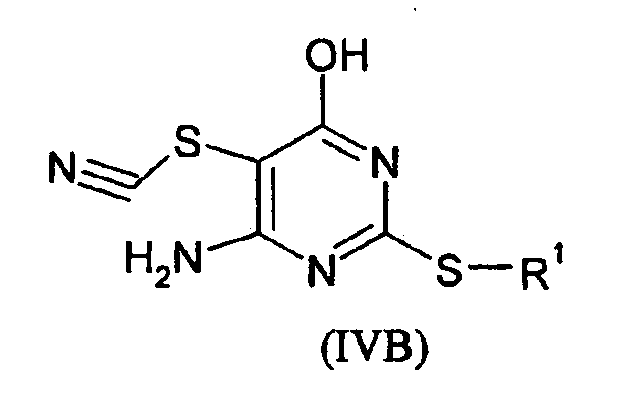
  • Compounds of formula (IVB) may be readily prepared by reacting a compound of general formula (V) wherein R 1 is as defined above, with potassium thiocyanate and bromine in an inert solvent such as dimethylformamide(pyridine.
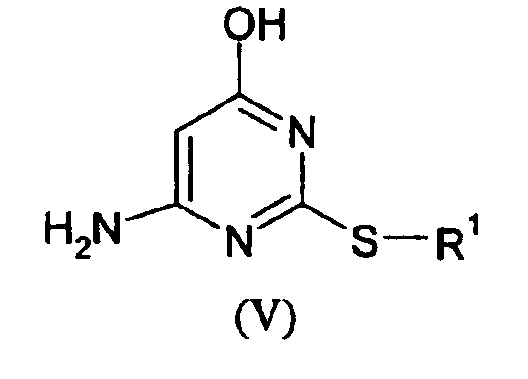
  • Compounds of formula (V) are suitably prepared by reacting a compound of formula (VI): with a compound of formula R 1 X where R 1 is as defined above and X is a leaving group such as bromide in the presence of a base such as sodium hydride in an inert solvent such as DMF at ambient temperature.
  • Novel intermediate compounds form a further aspect of the invention.
  • compounds of formula (IIA), (IIB) and (IIIA) are novel and form an aspect of the invention.
  • the compounds of formula (I) above may be converted to a pharmaceutically acceptable salt or solvate thereof, preferably a basic addition salt such as sodium, potassium, calcium, aluminium, lithium, magnesium, zinc, benzathine, chloroprocaine, choline, diethanolamine, ethanolamine, ethyldiamine, meglumine, tromethamine or procaine, or an acid addition salt such as a hydrochloride, hydrobromide, phosphate, acetate, fumarate, maleate, tartrate, citrate, oxalate, methanesulphonate or p-toluenesulphonate.
  • a basic addition salt such as sodium, potassium, calcium, aluminium, lithium, magnesium, zinc, benzathine, chloroprocaine, choline, diethanolamine, ethanolamine, ethyldiamine, meglumine, tromethamine or procaine
  • an acid addition salt such as a hydrochloride, hydrobromide, phosphat
  • the compounds of formula (I) have activity as pharmaceuticals, in particular as modulators of chemokine receptors, and may be used in the treatment (therapeutic or prophylactic) of conditions/diseases in human and non-human animals which are exacerbated or caused by excessive or unregulated production of chemokines.
  • conditions/diseases include:
  • the present invention provides a compound of formula (I), or a pharmaceutically-acceptable salt or solvate thereof, as hereinbefore defined for use in therapy.
  • the compounds of the invention are used to treat diseases in which the chemokine receptor belongs to the CXC chemokine receptor subfamily, more preferably the target chemokine receptor is the CXCR2 receptor,
  • Particular conditions which can be treated with the compounds of the invention are psoriasis, diseases in which angiogenesis is associated with raised CXCR2 chemokine levels, and COPD. It is preferred that the compounds of the invention are used to treat psoriasis.
  • the present invention provides the use of a compound of formula (I), or a pharmaceutically acceptable salt or solvate thereof, as hereinbefore defined in the manufacture of a medicament for use in therapy.
  • the present invention provides the use of a compound of formula (I), or a pharmaceutically acceptable salt or solvate thereof, as hereinbefore defined in the manufacture of a medicament for the treatment of human diseases or conditions in which modulation of chemokine receptor activity is beneficial.
  • the term “therapy” also includes “prophylaxis” unless there are specific indications to the contrary.
  • the terms “therapeutic” and “therapeutically” should be construed accordingly.
  • the invention still further provides a method of treating a chemokine mediated disease wherein the chemokine binds to a chemokine (especially CXCR2) receptor, which comprises administering to a patient a therapeutically effective amount of a compound of formula (1), or a pharmaceutically acceptable salt or solvate thereof, as hereinbefore defined.
  • a chemokine especially CXCR2
  • the invention also provides a method of treating an inflammatory disease, especially psoriasis, in a patient suffering from, or at risk of, said disease, which comprises administering to the patient a therapeutically effective amount of a compound of formula (I), or a pharmaceutically acceptable salt or solvate thereof, as hereinbefore defined.
  • the dosage administered will, of course, vary with the compound employed, the mode of administration, the treatment desired and the disorder indicated.
  • the compounds of formula (I) and pharmaceutically acceptable salts and solvates thereof may be used on their own but will generally be administered in the form of a pharmaceutical composition in which the formula (I) compound/salt/solvate (active ingredient) is in association with a pharmaceutically acceptable adjuvant, diluent or carrier.
  • the pharmaceutical composition will preferably comprise from 0.05 to 99 %w (per cent by weight), more preferably from 0.05 to 80 %w, still more preferably from 0.10 to 70 %w, and even more preferably from 0.10 to 50 %w, of active ingredient, all percentages by weight being based on total composition.
  • the present invention also provides a pharmaceutical composition
  • a pharmaceutical composition comprising a compound of formula (I), or a pharmaceutically acceptable salt or solvate thereof, as hereinbefore defined, in association with a pharmaceutically acceptable adjuvant, diluent or carrier.
  • the invention further provides a process for the preparation of a pharmaceutical composition of the invention which comprises mixing a compound of formula (I), or a pharmaceutically acceptable salt or solvate thereof, as hereinbefore defined, with a pharmaceutically acceptable adjuvant, diluent or carrier.
  • compositions may be administered topically (e.g. to the lung and/or airways or to the skin) in the form of solutions, suspensions, heptafluoroalkane aerosols and dry powder formulations; or systemically, e.g. by oral administration in the form of tablets, capsules, syrups, powders or granules, or by parenteral administration in the form of solutions or suspensions, or by subcutaneous administration or by rectal administration in the form of suppositories or transdermally.
  • the compounds of the invention are administered orally.
  • High pressure liquid chromatography purification was performed using either a Waters Micromass LCZ with a Waters 600 pump controller, Waters 2487 detector and Gilson FC024 fraction collector or a Waters Delta Prep 4000.
  • the abbreviations m.p. arid DMSO used in the examples stand for melting point and dimethyl sulphoxide respectively.
  • step a) The product of example 1 step a) (7.35g) was heated at 120°C in N,N -dimethylformamide (40ml)/water (10ml) for 10 hours. After cooling, the resulting solid was filtered off, washed with water, then ethyl acetate to give the subtitle compound. m.p. 325°C MS (APCI) 291 (M+H, 100%).
  • step a) To a solution of the product from example 15 step a) (4.4g) in ethanol (500 ml) was added sodium borohydride (1.56 g) and the mixture allowed to stir for 1 hour. Acidified with glacial acetic acid, evaporated to dryness and extracted into ethyl acetate, washed with water to give the subtitle compound (4.3g).
  • step c) To a solution of the product from example 15 step c)(1.0g) in methanol (50 ml) was added sodium hydroxide pellets (0.15 g) and the mixture stirred for 2 days. The mixture was diluted with water and the subtitle compound collected by filtration. (0.7 g). NMR ⁇ H ( d6 DMSO ) 7.44 (1H, s), 7.38 (1H, d), 7.21 (1H, dd ), 6.98(1H, d), 4.55 (2H, s), 3.76 (2H, s).
  • 3-chloro-4-methoxybenzenemethanethiol (0.128g, 0.68 mmol), prepared in example 16 step a), the product of example 15 step e) (0.130g, 0.349 mmol), and sodium borohydride (0.026g, 0.68 mmol) were refluxed at 50°C in a mixture of dimethylsulfoxide (6 ml) and ethanol (10 ml). After 3 hours and again after five hours reaction time, further portions of sodium borohydride (0.05g, 1.3 mmol) in ethanol (2 ml) were added to the reaction and reflux at 50°C was continued until conversion was complete by hplc ms (15 hours in total).
  • reaction mixture was neutralised by addition of concentrated hydrochloric acid and the ethanol removed in vacuo.
  • the residue was purified by reverse phase chromatography on Symmetry C8, eluting with a gradient of 25% to 95% acetonitrile in 0.1 M aqueous ammonium acetate over 10 minutes.
  • the product was freeze dried from methanol/water/acetonitrile to obtain the sub-title compound in 33% yield as a white lyophylate (0.046g).
  • step (a) The product from example 23 step (a) was taken up in DMSO (1.73ml), treated with potassium t- butoxide and divided into 3 portions. One portion was treated with 2-methylphenylmethyl mercaptan (0.053g), stirred at 50°C for 1h for 2h, neutralised with glacial acetic acid and subjected to preparative reverse phase HPLC on a 19 x 50mm symmetry C8 column using 10 to 60% acetonitrile in 0.1 % aqueous ammonium acetate over 6 min at 20 ml/min to give the titled compound. MS (APCI) 377 (M+H + , 100%).
  • the subtitled compound was prepared from the product of example 3 step d), using the method of example 23, step (a) MS (ES) 381 (M+H + , 100%).
  • the titled compound was prepared from the product of example 24 step (a), using the method of example 23, step (b) using furfuryl mercaptan MS (APCI) 339 (M+H + , 100%).
  • the subtitled compound was prepared according to example 2 step (a) using the product of example 4 step b) (2g, 6 mmol), 1-serinamide (0.66g, 6 mmol), NMP (80 ml), and diisopropylethylamine (2 ml) to give the subtitled compound (1.36g) Mp 145-151°C MS (APCI) 413 (M+H + , 100%).
  • Tin (IV) chloride (13.6ml, 0.116mol) was added to an ice-bath cooled solution of 1-methyl-2-(methylthio)benzene (10g, 0.073mol) in anhydrous dichloromethane (200ml) under nitrogen and stirred for a further 2 hours at 0°C.
  • ⁇ , ⁇ -Dichloromethyl methyl ether (6.56ml, 0.073mol) was introduced and the reaction stirred for 1 hour at ⁇ 10°C before the cooling was removed. After attaining room temperature, the reaction mixture was poured into ice/water (400ml), stirred and then extracted with dichloromethane (x3).
  • 3-chloroperoxybenzoic acid (57-86% grade, 20.4g) was stirred in dichloromethane (150ml), dried over anhydrous magnesium sulfate and then filtered. The filtrate was added dropwise over 1 hour to an ice-bath cooled, stirred solution of the product from example 28 step b) (5.67g, 0.034mol) in dichloromethane (50ml). The reaction mixture was filtered and the filtrate washed with aqueous sodium hydrogen carbonate solution followed by aqueous sodium dithionite solution (10g Na 2 O 4 S 2 in 150ml water).
  • the subtitle compound was prepared from 2-fluoro-(3-trifluoromethyl)benzylbromide (10 g) using the method of example 29 step a) NMR ⁇ H (CDCl 3 ) 7.68-7.18 (3H, m), 3.74 (2H, s), 1.98 (1H, s).
  • step (b) The product of example 4 step (b) (8.0g) was suspended in bromoform (200ml) followed by addition of tert-butyl nitrite (8ml) and the whole heated at 60°C for 30 minutes. The solvents were removed by reduced pressure and the residue purified by column chromatography (silica - 1:1 dichloromethane/isohexane) to give a yellow solid (5.6g). MS (APCI) 409/411 (M+H, 100%).
  • step a) The product of example 31 step a) (5.6g) was suspended in methanol (150ml) and potassium hydroxide powder (0.77g) added. The whole was stirred at room temperature for 2 hours. The mixture was adjusted to pH 7 with a few drops of concentrated hydrochloric acid before it was evaporated to dryness. Purified by column chromatography (silica - 3:2 to 1:1 isohexane/dichloromethane) to give white solid (2.0g). MS (APCI) 360/362 (M+H, 100%).
  • step (b) The product from example 31 step (b) (2.0g) was dissolved in dioxan (150ml) followed by addition of concentrated hydrochloric acid (1ml) and water (1 ml) and the whole heated at 40°C for 67 hours. The mixture was evaporated to dryness and purified by column chromatography (silica - dichloromethane) to give a white solid (1.4g). MS (APCI) 346/348 (M+H, 100%).
  • step (c) The product from example 31 step (c) (1.4g) was dissolved in dry tetrohydrofuran (Sml) and to the solution was added N,N-dimethylethylenediamine (0.25g) in a finger bomb which was heated at 80°C for 24 hours. The solvents were removed by reduced pressure and the residue partitioned between ethyl acetate and brine. The combined organic extracts were dried (sodium sulfate) and evaporated by reduced pressure for the ensuing residue to be purified by column chromatography (silica - 5:1 ethyl acetate/methanol) to give the free base as a sticky solid (0.095g).
  • [ 125 I]IL-8 (human, recombinant) was purchased from Amersham, U.K. with a specific activity of 2,000Ci/mmol. All other chemicals were of analytical grade. High levels of hrCXCR2 were expressed in HEK 293 cells (human embryo kidney 293 cells ECACC No. 85120602) (Lee et al. (1992) J. Biol. Chem. 267 pp16283-16291). hrCXCR2 cDNA was amplified and cloned from human neutrophil mRNA. The DNA was cloned into PCRScript (Stratagene) and clones were identified using DNA.
  • the coding sequence was sub-cloned into the eukaryotic expression vector RcCMV (Invitrogen). Plasmid DNA was prepared using Quiagen Megaprep 2500 and transfected into HEK 293 cells using Lipofectamine reagent (Gibco BRL). Cells of the highest expressing clone were harvested in phosphate-buffered saline containing 0.2%(w/v) ethylenediaminetetraacetic acid (EDTA) and centrifuged (200g, 5min.).
  • EDTA ethylenediaminetetraacetic acid
  • the cell pellet was resuspended in ice cold homogenisation buffer [10mM HEPES (pH 7.4), 1mM dithiothreitol, 1mM EDTA and a panel of protease inhibitors (1mM phenyl methyl sulphonyl fluoride, 2 ⁇ /ml soybean trypsin inhibitor, 3mM benzamidine, 0.5 ⁇ g/ml leupeptin and 100 ⁇ g/ml bacitracin)] and the cells left to swell for 10 minutes.
  • the cell preparation was disrupted using a hand held glass mortar/PTFE pestle homogeniser and cell membranes harvested by centrifugation (45 minutes, 100,000g, 4°C).
  • the membrane preparation was stored at -70°C in homogenisation buffer supplemented with Tyrode's salt solution (137mM NaCl, 2.7mM KCl, 0.4mM NaH 2 PO 4 ), 0.1%(w/v) gelatin and 10%(v/v) glycerol.
  • the assay was initiated with the addition of membranes and after 1.5 hours at room temperature the membranes were harvested by filtration using a Millipore MultiScreen vacuum manifold and washed twice with assay buffer (without bacitracin). The backing plate was removed from the MultiScreen plate assembly, the filters dried at room temperature, punched out and then counted on a Cobra ⁇ -counter.
  • Human neutrophils were prepared from EDTA-treated peripheral blood, as previously described (Baly et al. (1997) Methods in Enzymology 287 pp70-72), in storage buffer [Tyrode's salt solution (137mM NaCl, 2.7mM KCl, 0.4mM NaH 2 PO 4 ) supplemented with 5.7mM glucose and 10mM HEPES (pH 7.4)].
  • chemokine GRO ⁇ human, recombinant
  • R&D Systems Abingdon, U.K.
  • All other chemicals were of analytical grade. Changes in intracellular free calcium were measured fluorometrically by loading neutrophils with the calcium sensitive fluorescent dye, fluo-3, as described previously (Merritt et al. (1990) Biochem. J. 269, pp513-519).
  • FLIPR Fluorometric Imaging Plate Reader

Landscapes

  • Health & Medical Sciences (AREA)
  • Chemical & Material Sciences (AREA)
  • Organic Chemistry (AREA)
  • Life Sciences & Earth Sciences (AREA)
  • General Health & Medical Sciences (AREA)
  • Veterinary Medicine (AREA)
  • Public Health (AREA)
  • Animal Behavior & Ethology (AREA)
  • Chemical Kinetics & Catalysis (AREA)
  • General Chemical & Material Sciences (AREA)
  • Medicinal Chemistry (AREA)
  • Nuclear Medicine, Radiotherapy & Molecular Imaging (AREA)
  • Pharmacology & Pharmacy (AREA)
  • Bioinformatics & Cheminformatics (AREA)
  • Engineering & Computer Science (AREA)
  • Pulmonology (AREA)
  • Immunology (AREA)
  • Dermatology (AREA)
  • Rheumatology (AREA)
  • Heart & Thoracic Surgery (AREA)
  • Cardiology (AREA)
  • Pain & Pain Management (AREA)
  • Vascular Medicine (AREA)
  • Urology & Nephrology (AREA)
  • Orthopedic Medicine & Surgery (AREA)
  • Physical Education & Sports Medicine (AREA)
  • Nitrogen And Oxygen Or Sulfur-Condensed Heterocyclic Ring Systems (AREA)
  • Pharmaceuticals Containing Other Organic And Inorganic Compounds (AREA)
  • Plural Heterocyclic Compounds (AREA)
  • Nitrogen Condensed Heterocyclic Rings (AREA)

Abstract

The invention provides certain thiazolopyrimidine compounds of formula (I) or a pharmaceutically acceptable salt or solvate thereof; processes and intermediates used in their preparation, pharmaceutical compositions containing them and their use in therapy.

Description

The present invention relates to certain thiazolopyrimidinone compounds, processes and intermediates used in their preparation, pharmaceutical compositions containing them and their use in therapy.
WO 98/08847 and EP0778277 each disclose a series of 6,5-hetero bicyclic compounds said to be useful as CRF antagonists.
Chemokines play an important role in immune and inflammatory responses in various diseases and disorders, including asthma and allergic diseases, as well as autoimmune pathologies such as rheumatoid arthritis and atherosclerosis. These small secreted molecules are a growing superfamily of 8-14 kDa proteins characterised by a conserved four cysteine motif. The chemokine superfamily can be divided into two main groups exhibiting characteristic structural motifs, the Cys-X-Cys (C-X-C) and Cys-Cys (C-C) families. These are distinguished on the basis of a single amino acid insertion between the NH-proximal pair of cysteine residues and sequence similarity.
The C-X-C chemokines include several potent chemoattractants and activators of neutrophils such as interleukin-8 (IL-8) and neutrophil-activating peptide 2 (NAP-2).
The C-C chemokines include potent chemoattractants of monocytes and lymphocytes but not neutrophils such as human monocyte chemotactic proteins 1-3 (MCP-1, MCP-2 and MCP-3), RANTES (Regulated on Activation, Normal T Expressed and Secreted), eotaxin and the macrophage inflammatory proteins 1α and 1β (MIP-1α and MIP-1β).
Studies have demonstrated that the actions of the chemokines are mediated by subfamilies of G protein-coupled receptors, among which are the receptors designated CCR1, CCR2, CCR2A, CCR2B, CCR3, CCR4, CCR5, CCR6, CCR7, CCR8, CCR9, CCR10, CXCR1, CXCR2, CXCR3, CXCR4 and CX3CR1. These receptors represent good targets for drug development since agents which modulate these receptors would be useful in the treatment of disorders and diseases such as those mentioned above.
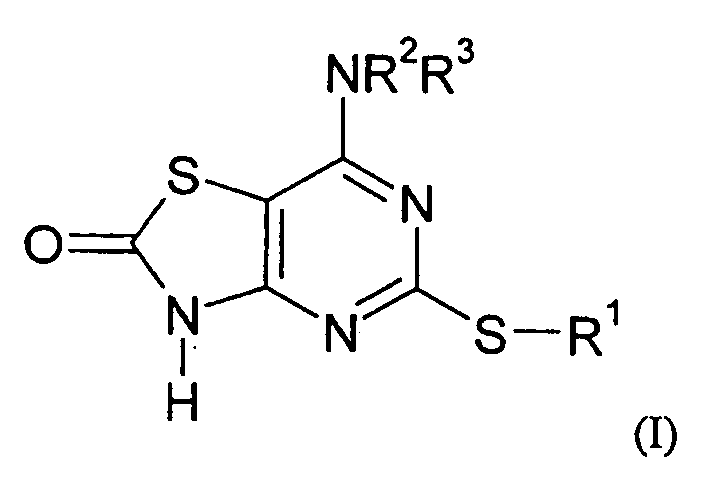
In accordance with the present invention, there is therefore provided a compound of formula (I) or a pharmaceutically acceptable salt or solvate thereof:
Figure 00020001
in which
  • R1 represents a C3-C7 carbocyclic, C1-C8 alkyl, C2-C6 alkenyl or C2-C6 alkynyl group, each of the groups being optionally substituted by one or more substituent groups independently selected from halogen atoms, -OR4, -NR5R6, -CONR5R6, -COOR7, -NR8COR9, -SR10, - SO2R10, -SO2NR5R6, -NR8SO2R9 or an aryl or heteroaryl group, both of which may be optionally substituted by one or more substituents independently selected from halogen atoms, cyano, nitro, -OR4, -NR5R6, -CONR5R6, -COOR7, -NR8COR9, -SR10, -SO2R10, SO2NR5R6, -NR8SO2R9, C1-C6 alkyl or trifluoromethyl groups;
  • R2 and R3 each independently represent a hydrogen atom, or a C3-C7 carbocyclic, C1-C8 alkyl, C2-C6 alkenyl or C2-C6 alkynyl group, the latter four groups may be optionally substituted by one or more substituent groups independently selected from:
  • (a) halogen atoms, -OR4, -NR5R6 -CONR5R6, -COOR7, -NR8COR9, -SR10, -SO2R10, -SO2NR5R6, -NR8SO2R9;
  • (b) a 3-8 membered ring optionally containing one or more atoms selected from O, S, NR8 and itself optionally substituted by C1-C3-alkyl or halogen; or
  • (c) an aryl group or heteroaryl group each of which may be optionally substituted by one or more substituents independently selected from halogen atoms, cyano, nitro, -OR4, -NR5R6, -CONR5R6, -NR8COR9, -SO2NR5R6, -NR8SO2R9, C1-C6 alkyl and trifluoromethyl groups;
  • R4 represents hydrogen, C1-C6 alkyl or a phenyl group the latter two of which may be optionally substituted by one or more substituent groups independently selected from halogen atoms, phenyl, -OR11 and -NR12R13
  • R5 and R6 independently represent a hydrogen atom or a C1-C6 alkyl or phenyl group the latter two of which may be optionally substituted by one or more substituent groups independently selected from halogen atoms, phenyl, -OR14 and -NR15R16, -CONR15R16, -NR15COR16, -SONR15R16, NR15SO2R16
    or
  • R5 and R6 together with the nitrogen atom to which they are attached form a 4- to 7-membered saturated heterocyclic ring system optionally containing a further heteroatom selected from oxygen and nitrogen atoms, which ring system may be optionally substituted by one or more substituent groups independently selected from phenyl, -OR14, -COOR14, -NR15R16, -CONR15R16, -NR15COR16, -SONR15R16, NR15SO2R16 or C1-C6 alkyl, itself optionally substituted by one or more substituents independently selected from halogen atoms and -NR15R16 and -OR17 groups;
  • R10 represents a hydrogen atom or a C1-C6-alkyl or a phenyl group, the latter two of which may be optionally substituted by one or more substituent groups independently selected from halogen atoms, phenyl, -OR17 and -NR15R16; and
  • each of R7, R8, R9, R11, R12, R13, R14 R15, R16, R17 independently represents a hydrogen atom or a C1-C6, alkyl, or a phenyl group.
  • In the context of the present specification, unless otherwise indicated, an alkyl or alkenyl group or an alkyl or alkenyl moiety in a substituent group may be linear or branched. Aryl groups include phenyl and naphthyl. Heteroaryl groups include 5- or 6-membered aromatic rings containing one or more heteroatoms selected from N, S, O. Examples include pyridine, pyrimidine, thiazole, oxazole, pyrazole, imidazole, furan.
    Certain compounds of formula (I) are capable of existing in stereoisomeric forms. It will be understood that the invention encompasses all geometric and optical isomers of the compounds of formula (I) and mixtures thereof including racemates. Tautomers and mixtures thereof also form an aspect of the present invention.
    In formula (I) above, the group R1 represents a C3-C7 carbocyclic, C1-C8 alkyl, C2-C6 alkenyl or C2-C6 alkynyl group, each of the groups being optionally substituted by one or more substituent groups independently selected from halogen atoms, -OR4, -NR5R6, - CONR5R6, -COOR7, -NR8COR9, -SR10, -SO2R10, -SO2NR5R6, -NR8SO2R9 or an aryl or heteroaryl group, both of which may be optionally substituted by one or more substituents independently selected from halogen atoms, cyano, nitro, -OR4, -NR5R6, -CONR5R6, - COOR7, -NR8COR9, -SR10, -SO2R10, -SO2NR5R6, -NR8SO2R9, C1-C6 alkyl or trifluoromethyl groups. Particularly advantageous compounds of formula (I) are those in which R1 represents an optionally substituted benzyl group. More preferably R1 represents benzyl or benzyl substituted by one or more C1-C6 alkyl, C1-C6 alkoxy or halogen atoms.
    When R2 and R3 represent a group substituted by one or more 3-8 membered rings optionally containing one or more atoms selected from O, S or NR8, examples of such groups include piperidine, pyrrolidine, piperazine and morpholine.
    Preferably one of R2 and R3 is hydrogen and the other is C1-C8 alkyl substituted by hydroxy and one or more methyl or ethyl groups. More preferably one of R2 and R3 is hydrogen and the other is CH(CH3)CH2OH, CH(Et)CH2OH, C(CH3)2CH2OH or CH(CH2OH)2. When one of R2 and R3 is hydrogen and the other is CH(CH3)CH2OH or CH(Et)CH2OH the resulting compounds of formula (I) are preferably in the form of the (R) isomer.
    Particularly preferred compounds of the invention include:
  • 7-[(2-Hydroxy-1,1-dimethylethyl)amino]-5-[(phenylmethyl)thio]thiazolo[4,5-d)pyrimidin-2(3H)-one,
  • (R)-7-[[1-(Hydroxymethyl)propyl]amino]-5-[(phenylmethyl)thio]thiazolo[4,5-d]pyrimidin-2(3H)-one,
  • (R)-7-[(2-Hydroxy-1-methylethyl)amino]-5-[(phenylmethyl)thio]thiazolo [4,5-d]pyrimidin-2(3H)-one,
  • 5-[[(2,3-Difluorophenyl)methyl]thio]-7-[(2-hydroxy-1,1-dimethylethyl)amino] thiazolo[4,5-d]pyrimidin-2(3H)-one,
  • 5-[[(2,3-Difluorophenyl)methyl]thio]-7-[[(1R)-2-hydroxy-1-methylethyl]amino] thiazolo[4,5-d]pyrimidin-2(3H)-one,
  • 5-[[(2,3-difluorophenyl)methyl]thio]-7-[[2-(hydroxyethoxy)ethyl]amino]thiazolo[4,5-d]pyrimidin-2(3H)-one,
  • 5-[[(2,3-difluorophenyl)methyl]thio]-7-[[2-hydroxy-1-(hydroxymethyl)ethyl]amino] thiazolo[4,5-d]pyrimidin-2(3H)-one,
  • 7-[(2-aminoethyl)amino]-5-[[(2,3-difluorophenyl)methyl]thio]thiazolo(4,5-d]pyrimidin-2(3H)-one,
  • 5-[[(2,3-difluorophenyl)methyl]thio]-7-[(2-hydroxyethyl)amino]thiazolo[4,5-d]pyrimidin-2(3H)-one,
  • N-[2-[[5-[[(2,3-difluorophenyl)methyl]thio]-2,3-dihydro-2-oxothiazolo[4,5-d]pyrimidin-7-yl]amino]ethyl]methanesulfonamide,
  • (+/-)-5-[[(2,3-difluorophenyl)methyl]thio]-7-[[2-(2-hydroxyethoxy)-1-methylethyl]amino]thiazolo[4,5-d]pyrimidin-2(3H)-one,
  • 7-[[(1R)-2-amino-1-methylethyl]amino]-5-[[(2,3-difluorophenyl)methyl]thio] thiazolo[4,5-d]pyrimidin-2(3H)-one,
  • 5-[[(2,3-difluorophenyl)methyl]thio]-7-[[(1R)-2-[(2-hydroxyethyl)amino]-1-methylethyl]amino]thiazolo[4,5-d]pyrimidin-2(3H)-one,
  • 5-[[(2,3-difluorophenyl)methyl]thio]-7-[[(1R)-2-(dimethylamino)-1-methylethyl]amino]thiazolo[4,5-d]pyrimidin-2(3H)-one,
  • 5-[[[4-(2-aminoethoxy)-3-chlorophenyl]methyl]thio]-7-[[(1R)-2-hydroxy-1-methylethyl]amino]thiazolo[4,5-d]pyrimidin-2(3H)-one,
  • 5-[[3-Chloro-4-methoxyphenyl)methyl]thio]-7-[[(1R)-2-hydroxy-1-methylethyl]amino]thiazolo[4,5-d]pyrimidin-2(3H)-one,
  • 5-[[3-Chloro-2-fluorophenyl)methyl]thio]-7-[[(1R)-2-hydroxy-1-methylethyl]amino] thiazolo[4,5-d]pyrimidin-2(3H)-one,
  • 5-[[(2,3-Difluorophenyl)methyl]thio]-7-[[(3R,4R)-4-hydroxypyirolidin-3-yl]amino]-thiazolo[4,5-d]pyrimidin-2(3H)-one,
  • 5-[[(2,3-Difluorophenyl)methyl]thio]-7-[(3R)-pyrrolidin-3-ylamino]thiazolo[4,5-d]pyrimidin-2(3H)-one,
  • 7-[[(1R)-2-Hydroxy-1-methylethyl]amino]-5-[[(2-methyl-4-thiazolyl)methyl]thio] thiazolo[4,5-d]pyrimidin-2(3H)-one,
  • 7-[[2-Hydroxy-1-(hydroxymethyl)ethyl]amino]-5-[[(2-methyl-4-thiazolyl)methyl] thio]thiazolo[4,5-d]pyrimidin-2(3H)-one,
  • 7-[(2-Hydroxy-1,1-dimethylethyl)amino]-5-[[(2-methyl-4-thiazolyl)methyl]thio] thiazolo[4,5-d]pyrimidin-2(3H)-one,
  • 7-[(2-Hydroxy-1,1-dimethylethyl)amino]-5-[[(2-methylphenyl)methyl)thio] thiazolo[4,5-d]pyrimidin-2(3H)-one,
  • 5-[(2-Furanylmethyl)thio]-7-[[(1R)-2-hydroxy-1-methylethyl]amino]thiazolo[4,5-d]pyrimidin-2(3H)-one,
  • 7-[[(1R)-2-Amino-1-methylethyl]amino]-5-[[(3-chloro-2-fluorophenyl)methyl]thio] thiazolo[4,5-d]pyrimidin-2(3H)-one
  • (2S)-2-[[5-[[(2,3-Difluorophenyl)methyl]thio]-2,3-dihydro-2-oxothiazolo[4,5-d]pyrimidin-7-yl]amino]-3-hydroxy-propanamide,
  • 7-[[(1R)-2-hydroxy-1-methylethyl]amino]-5-[(2-thienylmethyl)thio]thiazolo[4,5-d]pyrimidin-2(3H)-one,
  • 7-[[(1R)-2-hydroxy-1-methylethyl]amino]-5[[[3-methyl-4-(methylsulfonyl)phenyl]methyl]thio]thiazolo[4,5-d]pyrimidin-2(3H)-one,
  • 5-[[[3-chloro-4-(trilluoromethoxy)phenyl]methyl]thio]-7-[[(1R)-2-hydroxy-1-methylethyl]amino]thiazolo[4,5-d]pyrimidin-2(3H)-one;
  • 5-[[[2-fluoro-3-(trifluoromethyl)phenyl]methyl]thio]-7-[[(1R)-2-hydroxy-1-methylethyl]amino]thiazolo[4,5-d]pyrimidin-2(3H)-one,
  • 5-[[(2,3-dinuorophenyl)methyl]thio]-7-[2-[(dimethylamino)ethyl]amino]thiazolo[4,5-d]pyrimidin-2(3H)-one,
  • 5-[[(2-fluorophenyl)methyl]thio]-7-[[(1R)-2-hydroxy-1-methylethyl]amino]thiazolo[4,5-d]pyrimidin-2(3H)-one,
  • 7-[[(1R)-2-hydroxy-1-methylethyl]amino]-5-[[(2-methoxyphenyl)methyl]thio] thiazolo[4,5-d]pyrimidin-2(3H)one,
  • 7-[[(1R)-2-hydroxy-1-methylethyl]amino]-5-[(2-phenoxyethyl)thio]thiazolo[4,5-d]pyrimidin-2(3H)-one,
  • 7-[[(1R)-2-hydroxy-1-methylethyl]amino]-5-[[(3-methylphenyl)methyl]thio] thiazolo[4,5-d]pyrimidin-2(3H)-one,
  • 5-[[(2-fluoro-3-methylphenyl)methyl]thio]-7-[[(1R)-2-hydroxy-1-methylethyl]amino] thiazolo[4,5-d]pyrimidin-2(3H)-one,
  • 5-[[(3-chlorophenyl)methyl]thio]-7-[[(1R)-2-hydroxy-1-methylethyl]amino] thiazolo[4,5-d]pyrimidin-2(3H)-one,
  • 5-[[(3-bromophenyl)methyl]thio]-7-[[(1R)-2-hydroxy-1-methylethyl]amino] thiazolo[4,5-d]pyrimidin-2(3H)-one,
  • 5-[[[4-(difluoromethoxy)phenyl]methyl]thio]-7-[[(1R)-2-hydroxy-1-methylethyl]amino]thiazolo[4,5-d]pyrimidin-2(3H)-one,
  • (+/-)-5-[[(2,3-difluorophenyl)methyl]thio]-7-[[2-hydroxy-1-(methoxymethyl)ethyl]amino]thiazolo[4,5-d]pyrimidin-2(3H)-one,
  • 7-[[2-hydroxy-1-(hydroxymethyl)ethyl]amino]-5-[(phenylmethyl)thio]thiazolo[4,5-d]pyrimidin-2(3H)-one,
  • 5-[[(2-bromophenyl)methyl]thio]-7-[[(1R)-2-hydroxy-1-methylethyl]amino] thiazolo[4,5-d]pyrimidin-2(3H)-one,
  • 5-[[(2,3-Difluorophenyl)methyl]thio]-7-[[(1R)-2-hydroxy-1-methylethyl]amino] thiazolo[4,5-d]pyrimidin-2(3H)-one,
  • 5-[[3-Chloro-2-fluorophenyl)methyl]thio]-7-[[(1R)-2-hydroxy-1-methylethyl]amino] thiazolo[4,5-d]pyrimidin-2 (3H)-one,
  • (+/-)-5-[[(2,3-difluorophenyl)methyl]thio]-7-[[2-hydroxy-1-(methoxymethyl)ethyl]amino]thiazolo [4,5-d]pyrimidin-2(3H)-one,
  • 7-[[2-hydroxy-1-(hydroxymethyl)ethyl]amino]-5-[(phenylmethyl)thio]thiazolo[4,5-d]pyrimidin-2(3H)-one,
  • 7-([(1R)-2-Hydroxy-1-methylethyl]amino]-5-[(phenylmethyl)thio]thiazolo[4,5-d]pyrimidin-2(3H)-one,
  • 5-[(5-chloro-1,2,3-thiadiazol-4-yl)thio]-7-[[(1R)-2-hydroxy-1-methylethyl]amino]-thiazolo[4,5-d]pyrimidin-2(3H)-one,
  • and their pharmaceutically acceptable salts and solvates.
    Particular salts of compounds of formula (I) include:
  • 5-[[(2,3-Difluorophenyl)methyl]thio]-7-[[(1R)-2-hydroxy-1-methylethyl]amino] thiazolo[4,5-d]pyrimidin-2(3H)-one sodium salt,
  • 5-[[3-Chloro-2-fluorophenyl)methyl]thio]-7-[[(1R)2-hydroxy-1-methylethyl]amino] thiazolo[4,5-d]pyrimidin-2(3H)-one sodium salt,
  • (+/-)-5-[[(2,3-difluorophenyl)methyl]thio]-7-[[2-hydroxy-1-(methoxymethyl)ethyl]amino]thiazolo[4,5-d]pyrimidin-2(3H)-one sodium salt,
  • 7-[[2-hydroxy-1-(hydroxymethyl)ethyl]amino]-5-[(phenylmethyl)thio]thiazolo[4,5-d]pyrimidin-2(3H)-one sodium salt, or
  • 7-[[(1R)-2-Hydroxy-1-methylethyl]amino]-5-[(phenylmethyl)thio]thiazolo[4,5-d]pyrimidin-2(3H)-one sodium salt.
  • Further particular salts of compounds of formula (I) include:
  • 7-[[(1R)-2-amino-1-methylethyl]amino]-5-[[(2,3-difluorophenyl)methyl]thio] thiazolo[4,5-d]pyrimidin-2(3H)-one trifluoroacetate,
  • 5-[[(2,3-difluorophenyl)methyl]thio]-7-[[(1R)-2-[(2-hydroxyethyl)amino]-1-methylethyl]amino]thiazolo[4,5-d]pyrimidin-2(3H)-one trifluoroacetate,
  • 5-[[(2,3-difluorophenyl)methyl]thio]-7-[[(1R)-2-(dimethylamino)-1-methylethyl]amino]thiazolo[4,5-d]pyrimidin-2(3H)-one,
  • 5-[[[4-(2-aminoethoxy)-3-chlorophenyl]methyl]thio]-7-[[(1R)-2-hydroxy-1-methylethyl]amino]thiazolo[4,5-d]pyrimidin-2(3H)-one trifluoroacetate,
  • 5-[[(2,3-difluorophenyl)methyl]thio]-7-[2-[(dimethylamino)ethyl]amino]thiazolo[4,5-d]pyrimidin-2(3H)-one monohydrochloride, or
  • 5-[[(2,3-Difluorophenyl)methyl]thio]-7-[(3R)-pyrrolidin-3-ylamino]thiazolo[4,5-d]pyrimidin-2(3H)-one dihydrochloride.
  • According to the invention there is also provided a process for the preparation of a compound of formula (I) which comprises either:
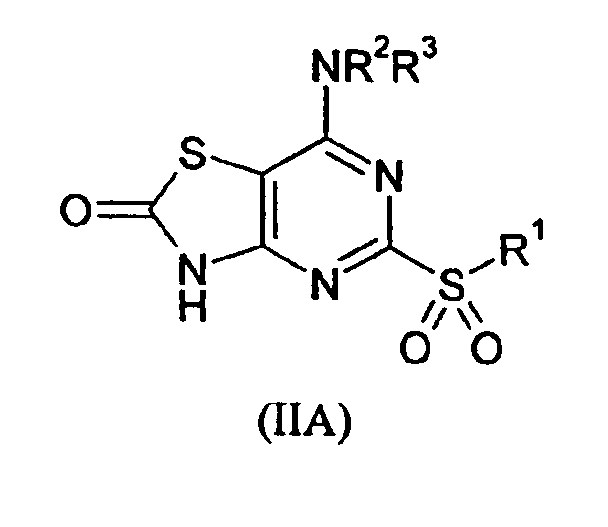
  • Treatment of a compound of formula (IIA)
    Figure 00080001
  • where R1, R2 and R3 are as defined in formula (I) with a thiol R1SH in the presence of a suitable base and optionally forming a pharmaceutically acceptable salt.. The reaction may be carried out in a mixed solvent of DMSO and ethanol at a temperature between 0°C and 100°C using sodium borohydride as the base.
    Compounds of formula (IIA) where R1, R2 and R3 are as defined in formula (I) may be prepared by treatment of compounds of formula (I) with a suitable oxidising agent such as oxone. The reaction may be carried out in a solvent such as acetonitrile at a temperature between 0°C and 100°C.
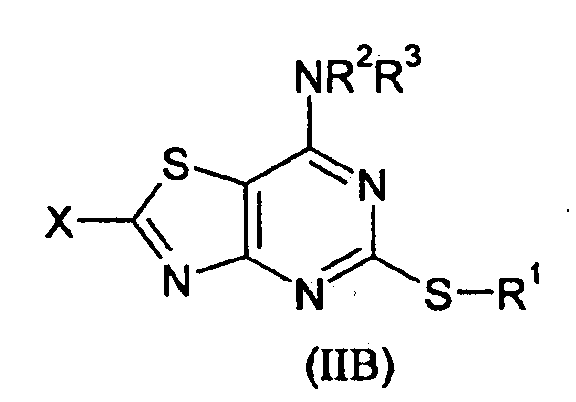
    Or treatment of a compound of formula (IIB):
    Figure 00090001
  • where R1, R2 and R3 are as defined in formula (I) and X is a leaving group with a metal alkoxide, followed by treatment with an acid or base and optionally forming a pharmaceutically acceptable salt.
  • X is any suitable leaving group such as halogen. The reaction may be carried out in an alcohol solvent such as methanol and the deprotection carried out in a solvent such as 1,4-dioxane. Examples of metal alkoxides include potassium methoxide. Examples of suitable acids include hydrochloric acid. Preferably the compound of formula (IIB) is treated with a metal alkoxide such as potassium methoxide followed by an acid such as conc. HCl in a solvent such as 1,4-dioxane.
  • Compounds of formula (IIB) where R1, R2 and R3 are as defined in formula (I) and X is a halogen, may be prepared from corresponding compounds (IIB) where R1, R2 and R3 are as defined in formula (I) and X is NH2 by treatment with a diazotizing agent such as isoamylnitrite and a halogenating agent such as bromoform.
    Compounds of formula (IIB) where R1, R2 and R3 are as defined in formula (I) and X is NH2 may be prepared either by treatment of a compound of formula (IIIA):
    Figure 00100001
    where R2 and R3 are as defined in formula (I) and X is NH2 with a compound of formula R1X where R1 is as defined above and X is a leaving group such as bromide in the presence of a base such as diisopropylethylamine in an inert solvent such as DMSO/N-methylpyrrolidinone at a temperature between 0°C and 100°C.
    Compounds of formula (IIIA) where R2 and R3 are as defined in formula (I) and X is NH2 may be prepared by treatment of a compound of formula (IIB) where R2 and R3 are as defined in formula (I), X is NH2 and R1 is a suitable benzyl group such as benzyl or 2,3-difluorobenzyl with a reducing medium such as sodium metal in liquid ammonia, or by treatment of a compound of formula (IIIB):
    Figure 00100002
    where R1 is as defined in formula (I) and L is a leaving group such as chlorine with an amine HNR2R3 where R2 and R3 are as defined in formula (I). The reaction may be carried out in a solvent such as N-methyl-pyrrolidine at a temperature between 0°C and 150°C.
    Compounds of formula (IIIB) where R1 is as defined in formula (I) and L is a halogen may be prepared by treating a compound of formula (IIIB) where R1 is as defined in formula (I) and L is a hydroxyl group with a halogenating agent such as phosphorous oxychloride. The reaction may be carried out in the presence of dimethylaniline at reflux.
    Compounds of formula (IIIB) where R1 is as defined in formula (I) and L is a hydroxyl group may be formed either by treatment of a compound of formula (IVA) with a compound of formula R1X where R1 is as defined above and X is a leaving group such as bromide in the presence of a base such as potassium tert-butoxide in an inert solvent such as DMSO at ambient temperature.
    Figure 00110001
    Or by heating a compound of formula (IVB) where R1 is as defined above.
    Figure 00110002
    The reaction is preferably carried out in a suitable solvent such as DMF at elevated temperature, for example at about 120°C.
    Compounds of formula (IVB) may be readily prepared by reacting a compound of general formula (V) wherein R1 is as defined above, with potassium thiocyanate and bromine in an inert solvent such as dimethylformamide(pyridine.
    Figure 00110003
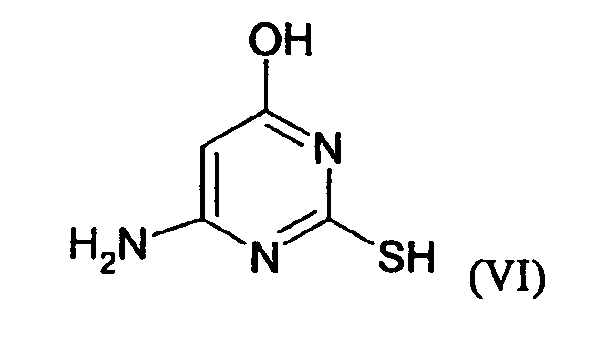
    Compounds of formula (V) are suitably prepared by reacting a compound of formula (VI):
    Figure 00110004
    with a compound of formula R1X where R1 is as defined above and X is a leaving group such as bromide in the presence of a base such as sodium hydride in an inert solvent such as DMF at ambient temperature.
    Compounds of formula (IVA) and (VI) are either commercially available or are well known in the literature.
    It will be appreciated by those skilled in the art that in the processes described above the functional groups (e.g. hydroxyl groups) of intermediate compounds may need to be protected by protecting groups. The final stage in the preparation of the compounds of the invention may involve the removal of one or more protecting groups. The protection and deprotection of functional groups is fully described in 'Protective Groups in Organic Chemistry', edited by J. W. F. McOmie, Plenum Press (1973), and 'Protective Groups in Organic Synthesis', 2nd edition, T. W. Greene & P. G. M. Wuts, Wiley-Interscience (1991).
    Novel intermediate compounds form a further aspect of the invention. In particular compounds of formula (IIA), (IIB) and (IIIA) are novel and form an aspect of the invention.
    The compounds of formula (I) above may be converted to a pharmaceutically acceptable salt or solvate thereof, preferably a basic addition salt such as sodium, potassium, calcium, aluminium, lithium, magnesium, zinc, benzathine, chloroprocaine, choline, diethanolamine, ethanolamine, ethyldiamine, meglumine, tromethamine or procaine, or an acid addition salt such as a hydrochloride, hydrobromide, phosphate, acetate, fumarate, maleate, tartrate, citrate, oxalate, methanesulphonate or p-toluenesulphonate.
    The compounds of formula (I) have activity as pharmaceuticals, in particular as modulators of chemokine receptors, and may be used in the treatment (therapeutic or prophylactic) of conditions/diseases in human and non-human animals which are exacerbated or caused by excessive or unregulated production of chemokines. Examples of such conditions/diseases include:
  • (1) (the respiratory tract) obstructive airways diseases including chronic obstructive pulmonary disease (COPD); asthma, such as bronchial, allergic, intrinsic, extrinsic and dust asthma, particularly chronic or inveterate asthma (e.g. late asthma and airways hyper-responsiveness); bronchitis; acute, allergic, atrophic rhinitis and chronic rhinitis including rhinitis caseosa, hypertrophic rhinitis, rhinitis purulenta, rhinitis sicca and rhinitis medicamentosa; membranous rhinitis including croupous, fibrinous and pseudomembranous rhinitis and scrofoulous rhinitis; seasonal rhinitis including rhinitis nervosa (hay fever) and vasomotor rhinitis; sarcoidosis, farmer's lung and related diseases, fibroid lung and idiopathic interstitial pneumonia;
  • (2) (bone and joints) rheumatoid arthritis, seronegative spondyloarthropathies (including ankylosing spondylitis, psoriatic arthritis and Reiter's disease), Behcet's disease, Sjogren's syndrome and systemic sclerosis;
  • (3) (skin) psoriasis, atopical dermatitis, contact dermatitis and other eczmatous dermitides, seborrhoetic dermatitis, Lichen planus, Pemphigus, bullous Pemphigus, Epidermolysis bullosa, urticaria, angiodermas, vasculitides, erythemas, cutancous eosinophilias, uveitis, Alopecia areata and vernal conjunctivitis;
  • (4) (gastrointestinal tract) Coeliac disease, proctitis, eosinopilic gastro-enteritis, mastocytosis, Crohn's disease, ulcerative colitis, food-related allergies which have effects remote from the gut, e.g., migraine, rhinitis and eczema;
  • (5) (other tissues and systemic disease) multiple sclerosis, atherosclerosis, Acquired Immunodeficiency Syndrome (AIDS), lupus erythematosus, systemic lupus, erythematosus, Hashimoto's thyroiditis, myasthenia gravis, type I diabetes, nephrotic syndrome, eosinophilia fascitis, hyper IgE syndrome, lepromatous leprosy, sezary syndrome and idiopathic thrombocytopenia pupura; post-operative adhesions, and sepsis.
  • (6) (allograft rejection) acute and chronic following, for example, transplantation of kidney, heart, liver, lung, bone marrow, skin and cornea; and chronic graft versus host disease;
  • (7) Cancers, especially non-small cell lung cancer (NSCLC), malignant melanoma, prostate cancer and squamous sarcoma, and tumour metastasis;
  • (8) Diseases in which angiogenesis is associated with raised CXCR2 chemokine levels (e.g. NSCLC, diabetic retinopathy).
  • (9) Cystic fibrosis, stroke, re-perfusion injury in the heart, brain, peripheral limbs and other organs.
  • (10) Burn wounds & chronic skin ulcers
  • (11) Reproductive Diseases (e.g. Disorders of ovulation, menstruation and implantation, Pre-term labour, Endometriosis)
  • Thus, the present invention provides a compound of formula (I), or a pharmaceutically-acceptable salt or solvate thereof, as hereinbefore defined for use in therapy.
    Preferably the compounds of the invention are used to treat diseases in which the chemokine receptor belongs to the CXC chemokine receptor subfamily, more preferably the target chemokine receptor is the CXCR2 receptor,
    Particular conditions which can be treated with the compounds of the invention are psoriasis, diseases in which angiogenesis is associated with raised CXCR2 chemokine levels, and COPD. It is preferred that the compounds of the invention are used to treat psoriasis.
    In a further aspect, the present invention provides the use of a compound of formula (I), or a pharmaceutically acceptable salt or solvate thereof, as hereinbefore defined in the manufacture of a medicament for use in therapy.
    In a still further aspect, the present invention provides the use of a compound of formula (I), or a pharmaceutically acceptable salt or solvate thereof, as hereinbefore defined in the manufacture of a medicament for the treatment of human diseases or conditions in which modulation of chemokine receptor activity is beneficial.
    In the context of the present specification, the term "therapy" also includes "prophylaxis" unless there are specific indications to the contrary. The terms "therapeutic" and "therapeutically" should be construed accordingly.
    The invention still further provides a method of treating a chemokine mediated disease wherein the chemokine binds to a chemokine (especially CXCR2) receptor, which comprises administering to a patient a therapeutically effective amount of a compound of formula (1), or a pharmaceutically acceptable salt or solvate thereof, as hereinbefore defined.
    The invention also provides a method of treating an inflammatory disease, especially psoriasis, in a patient suffering from, or at risk of, said disease, which comprises administering to the patient a therapeutically effective amount of a compound of formula (I), or a pharmaceutically acceptable salt or solvate thereof, as hereinbefore defined.
    For the above-mentioned therapeutic uses the dosage administered will, of course, vary with the compound employed, the mode of administration, the treatment desired and the disorder indicated.
    The compounds of formula (I) and pharmaceutically acceptable salts and solvates thereof may be used on their own but will generally be administered in the form of a pharmaceutical composition in which the formula (I) compound/salt/solvate (active ingredient) is in association with a pharmaceutically acceptable adjuvant, diluent or carrier. Depending on the mode of administration, the pharmaceutical composition will preferably comprise from 0.05 to 99 %w (per cent by weight), more preferably from 0.05 to 80 %w, still more preferably from 0.10 to 70 %w, and even more preferably from 0.10 to 50 %w, of active ingredient, all percentages by weight being based on total composition.
    The present invention also provides a pharmaceutical composition comprising a compound of formula (I), or a pharmaceutically acceptable salt or solvate thereof, as hereinbefore defined, in association with a pharmaceutically acceptable adjuvant, diluent or carrier.
    The invention further provides a process for the preparation of a pharmaceutical composition of the invention which comprises mixing a compound of formula (I), or a pharmaceutically acceptable salt or solvate thereof, as hereinbefore defined, with a pharmaceutically acceptable adjuvant, diluent or carrier.
    The pharmaceutical compositions may be administered topically (e.g. to the lung and/or airways or to the skin) in the form of solutions, suspensions, heptafluoroalkane aerosols and dry powder formulations; or systemically, e.g. by oral administration in the form of tablets, capsules, syrups, powders or granules, or by parenteral administration in the form of solutions or suspensions, or by subcutaneous administration or by rectal administration in the form of suppositories or transdermally. Preferably the compounds of the invention are administered orally.
    The invention will now be further illustrated by reference to the following examples. In the examples the Nuclear Magnetic Resonance (NMR) spectra were measured on a Varian Unity Inova 300 or 400 MHz spectrometer and the Mass Spectrometry (MS) spectra measured on a Finnigan Mat SSQ7000 or Micromass Platform spectrometer. Where necessary, the reactions were performed under an inert atmosphere of either nitrogen or argon. Chromatography was generally performed using Matrex Silica 60® (35-70 micron) or Prolabo Silica gel 60® (35-70 micron) suitable for flash silica gel chromatography. High pressure liquid chromatography purification was performed using either a Waters Micromass LCZ with a Waters 600 pump controller, Waters 2487 detector and Gilson FC024 fraction collector or a Waters Delta Prep 4000. The abbreviations m.p. arid DMSO used in the examples stand for melting point and dimethyl sulphoxide respectively.
    Example 1 7-[(2-Hydroxy-1,1-dimethylethyl) amino]-5-[(phenylmethyl)thio]thiazolo[4,5-d]pyrimidin-2(3H)-one (a) Thiocyanic acid, 6-amino-1,4-dihydro-4-oxo-2-[(phenylmethyl)thio]-5-pyrimidinyl ester
    6-Amino-2-[(phenylmethyl)thio]-4(1H)-pyrimidinone (10.5g)[ preparation as described in WO 9635678] and potassium thiocyanate (25g) in N,N-dimethylformamide (200ml) were heated together at 65°C. Pyridine (6.3ml) was added and the solution cooled to 5°C. Bromine (2.2ml) was added slowly and the reaction mixture stirred for 2 hours at 5-10°C. The reaction mixture was poured onto ice water, stirred for 1 hour and the solid was isolated by filtration. After washing with water and ether, a pure sample was obtained after trituration with hot methanol.
    MS (APCI) 291 (M+H, 100%).
    (b) 2-Amino-5-[(phenylmethyl)thio]thiazolo[4,5-d]pyrimidin-7(4H)-one
    The product of example 1 step a) (7.35g) was heated at 120°C in N,N-dimethylformamide (40ml)/water (10ml) for 10 hours. After cooling, the resulting solid was filtered off, washed with water, then ethyl acetate to give the subtitle compound.
    m.p. 325°C
    MS (APCI) 291 (M+H, 100%).
    (c) 7-Chloro-5-[(phenylmethyl)thio]thiazolo[4,5-d]pyrimidin-2-amine
    The product from example 1 step b) (0.89g), phosphorus oxychloride (12ml) and N,N-dimethylaniline (1.2ml) were heated at reflux for 2 hours. The cooled reaction mixture was poured onto ice water and stirred for 2 hours. Chromatography (SiO2, methanol/dichloromethane as eluant) gave the sub-title compound.
    m.p. 217-218.5°C
    MS (APCI) 309 (M+H, 100%).
    (d) 2-[[2-Amino-5-[(phenylmethyl)thio]thiazolo[4,5-d]pyrimidin-7-yl]amino]-2-methyl-1-propanol
    The product from example 1 step c) (0.6g) and 1-amino-2-methyl-propan-2-ol (1.1 g) in tetrahydrofuran (10ml) was heated in a sealed vessel at 100 °C for 18 hours. The mixture was evaporated to dryness and purified (SiO2, ethyl acetate as eluant) to give the subtitle compound (0.46g).
    MS (APCI) 362 (M+H+, 100%).
    (e) 2-[[2-Bromo-5-[(phenylmethyl)thio]thiazolo[4,5-d]pyrimidin-7-yl]amino]-2-methyl-1-propanol
    To a solution of the product from example 1 step d) (0.1 g) in bromoform (5ml) was added isoamylnitrite (0.13ml) and the mixture heated at 60°C for 10 mins. The mixture was evaporated to dryness and purified (SiO2, ethyl acetate: dichloromethane 1:9 as eluant) to give the subtitle compound as a colourless solid (0.043g).
    MS (APCI) 427 (M+H+, 100%).
    (f) 2-[[2-Methozy-5-[(phenylmethyl)thio]thiazolo[4,5-d]pyrimidin-7-yl]amino]-2-methyl-1-propanol
    To a solution of the product from example 1 step e) (0.36g) in methanol (5ml) was added potassium hydroxide (0.095g) and the mixture stirred for 30 mins. The mixture was neutralised with concentrated hydrochloric acid then evaporated to dryness and purified (SiO2, ethyl acetate: dichloromethane 1:9 as eluant) to give the subtitle compound as a colourless solid (0.245g).
    MS (APCI) 377 (M+H+, 100%).
    (g) 7-[(2-Hydroxy-1,1-dimethylethyl)amino]-5-[(phenylmethyl)thio]thiazolo[4,5-d]pyrimidin-2(3H)-one
    To a solution of the product from example 1 step f) (0.21g) in 1,4-dioxane (5ml) was added water (0.1ml) and concentrated hydrochloric acid (1 drop). The mixture heated at 45°C for 3 hours then evaporated to dryness. Recrystallisation (acetonitrile) gave the title compound (0.110g).
    M.P 207-8 °C
    MS (APCI) 363 (M+H+, 100%).
    NMR δH (d6 -DMSO) 12.37 (1H, s), 7.43-7.23 (5H, m), 6.61 (1H, bs), 4.81 (1H, t), 4.34 (2H, s), 3.55 (2H, bs), 1.32 (6H, s).
    EXAMPLE 2 (R)-7-[[1-(Hydroxymethyl)propyl]amino]-5-[(phenylmethyl)thio]thiazolo[4,5-d]pyrimidin-2(3H)-one (a) (R)-2-[[2-Amino-5-[(phenylmethyl)thio]thiazolo[4,5-d]pyrimidin-7-yl]amino]-1-butanol
    To a mixture of the product of example 1 step c) (2.5g) and (R)-(-)-2-amino-1-butanol (5g) in a solvent of N-methylpyrrolidinone (10 ml) was added N,N-diisopropylethylamine (5 ml) and the resultant mixture heated at 100°C for 10 hours. The mixture was poured into water and the product collected by filtration to give the subtitle compound (2.5g)
    MS (APCl) 362 (M+H+, 100%).
    (b) (R)-2-[[2-Bromo-5-[(phenylmethyl)thio]thiazolo[4,5,d]pyrimidin-7-yl]amino]-1-butanol
    Prepared by the method of example 1 step e), using the product of example 2 step a).
    MS (APCI) 427 (M+H+, 100%).
    (c) (R)-2-[[2-Methoxy-5-[(phenylmethyl)thio]thiazolo[4,5-d]pyrimidin-7-yl]amino]-1-butanol
    Prepared by the method of example 1 step f), using the product of example 2 step b).
    MS (APCI) 377 (M+H+, 100%).
    (d) (R)-7-[[1-(Hydroxmethyl)propyl]amino]-5-[(phenylmethyl)thio]thiazolo[4,5-d]pyrimidin-2(3H)-one
    Prepared by the method of example 1 step g), using the product of example 2 step c).
    M.P 217-8 °C
    MS (APCI) 363 (M+H+, 100%).
    NMR δH (d6 -DMSO) 12.37 (1H, s), 7.43-7.21 (6H, m), 4.68(1H, t), 4.32 (2H, q), 4.09 (1H, bs), 3.47-3.32 (2H, m), 1.69-1.59 (1H, m), 1.48-1.41 (1H, m), 0.82 (3H, t).
    EXAMPLE 3 (R)-7-[(2-Hydroxy-1-methylethyl)amino]-5-[(phenylmethyl)thio]thiazolo[4,5-d]pyrimidin-2(3H)-one (a) (R)-2-[[2-Amino-5-[(phenylmethyl)thio]thiazolo[4,5-d]pyrimidin-7-yl]amino]-1-propanol
    Prepared by the method of example 2 step a), using the product of example 1 step c) and (R)-(-)-2-amino-1-propanol.
    MS (APCI) 412 (M+H+, 100%).
    (b) (R)-2-[[2-Bromo-5-[(phenylmethyl)thio]thiazolo[4,5-d]pyrimidin-7-yl]amino]-1-propanol
    Prepared by the method of example 1 step e), using the product of example 3 step a)
    MS (APCI) 348 (M+H+, 100%).
    (c) (R)-2-[[2-Methoxy-5-[(phenylmethyl)thio]thiazolo[4,5-d]pyrimidin-7-yl]amino]-1-propanol
    Prepared by the method of example 1 step f), using the product of example 3 step b)
    MS (APCI) 363 (M+H+, 100%).
    (d) (R)-7-[(2-Hydroxy-1-methylethyl)amino]-5-[(phenylmethyl)thio]thiazolo[4,5-dlpyrimidin-2(3H)-one
    Prepared by the method of example 1 step g), using the product of example 3 step c).
    MS (APCI) 349 (M+H+, 100%).
    NMR δH (d6 -DMSO) 12.38 (1H, s), 7.44-7.20 (6H, m), 4.72 (1H, t), 4.32 (2H, m), 4.23 (1H, m), 3.49-3.29 (2H, m), 1.11(3H, d).
    EXAMPLE 4 5-[[(2,3-Difluorophenyl)methyl]thio]-7-[(2-hydroxy-1,1-dimethylethyl)amino] thiazolo[4,5-d]pyrimidin-2(3H)-one (a) 2-Amino-5-[[(2,3-difluorophenyl)methyl]thio]thiazolo[4,5-d]pyrimidin-7(4H)-one
    Potassium t-butoxide solution (0.45ml of 1M solution in tetrahydrofuran) was added to a stirred solution of 2-amino-5,6-dihydro-5-thioxo-thiazolo[4,5-d]pyrimidin-7(4H)-one (0.09g) [Cited: Indian J. Chem., Sect. B (1989), 28B(11), 964-5.] and 2,3-difluorobenzyl bromide in dimethyl sulphoxide (2ml). After stirring for 3 days, the reaction mixture was poured onto water to give and the subtitle compound, isolated by filtration.
    MS (APCI) 327 (M+H+, 100%).
    (b) 7-Chloro-5-[[(2,3-difluorophenyl)methyl]thio]thiazolo[4,5-d]pyrimidin-2-amine
    Prepared by the method of example 1 step c), using the product of example 4 step a).
    MS (APCI) 345 (M+H+, 100%).
    (c) 2-[[2-Amino-5-[[(2,3-difluorophenyl)methyl]thio]thiazolo[4,5-d]pyrimidin-7-yl]amino]-2-methyl-1-propanol
    Prepared by the method of example 2 step a), using the product of example 4, step b) and 2-amino-2-methylpropanol.
    MS (APCI) 398 (M+H+, 100%).
    (d) 2-[[2-Bromo-5-[[(2,3-difluorophenyl)methyl]thio]thiazolo[4,5-d]pyrimidin-7-yl]amino]-2-methyl-1-propanol
    Prepared by the method of example 1 step e), using the product of example 4 step c).
    MS (APCI) 462 (M+H+, 100%).
    (e) 2-[[5-[[(2,3-Difluorophenyl)methyl]thio]-2-methoxythiazolo[4,5-d]pyrimidin-7-yl]amino]-2-methyl-1-propanol
    Prepared by the method of example 1 step f), using the product of example 4 step d).
    MS (APCI) 413 (M+H+, 100%).
    (f) 5-[[(2,3-Difluorophenyl)methyl]thio]-7-[(2-hydroxy-1,1-dimethylethyl)amino] thiazolo[4,5-d]pyrimidin-2(3H)-one
    Prepared by the method of example 1 step f), using the product of example 4 step e).
    MS (APCI) 399 (M+H+, 100%).
    NMR δH (d6 -DMSO) 12.41 (1H, s), 7.41-7.30 (2H, m), 7.21-7.13 (1H, m), 6.64 (1H, bs), 4.79 (1H, t), 4.41 (2H, s), 3.53 (2H, d), 1.29 (6H, s).
    EXAMPLE 5 5-[[(2,3-Difluorophenyl)methyl]thio]-7-[[(1R)-2-hydroxy-1-methylethyl]amino] thiazolo[4,5-d]pyrimidin-2(3H)-one (a) (2R)-2-[[2-Amino-5-[[(2,3-difluorophenyl)methyl]thio]thiazolo[4,5-d]pyrimidin-7-yl]amino]-1-propanol
    Prepared by the method of example 2 step a), using the product of example 4 step b) and (R)-(-)-2-amino-1-propanol.
    MS (APCI) 384 (M+H+, 100%).
    (b) (2R)-2-[[2-Bromo-5-[[(2,3-difluorophenyl)methyl]thio]thiazolo[4,5-d)pyrimidin-7-yl]amino]-1-propanol
    Prepared by the method of example 1 step e), using the product of example 5 step a).
    MS (APCI) 448 (M+H+, 100%).
    (c) (2R)-2-[[5-[[(2,3-difluorophenyl)methyl]thio]-2-methoxythiazolo[4,5-d]pyrimidin-7-yl]amino]-1-propanol
    Prepared by the method of example 1 step f), using the product of example 5 step b)
    MS (APCI) 398 (M+H+, 100%).
    (d) 5-[[(2,3-Difluorophenyl)methyl]thio]-7-[[(1R)-2-hydroxy-1-methylethyl]amino] thiazolo[4,5-d]pyrimidin-2(3H)-one
    Prepared by the method of example 1 step g), using the product of example 5 step c).
    MS (APCI) 385 (M+H+, 100%).
    NMR δH (d6 -DMSO) 12.41 (1H, s), 7.41-7.11 (4H, m), 4.72 (1H, t), 4.39 (2H, m), 4.21 (1H, m), 3.47-3.29 (2H, m), 1.09 (3H, d).
    EXAMPLE 6 5-[[(2,3-difluorophenyl)methyl]thio]-7-[[2-(hydroxyethoxy)ethyl]amino]thiazolo[4,5-d]pyrimidin-2(3H)-one (a) 2-[2-[[2-amino-5-[[(2,3-difluorophenyl)methyl]thio]thiazolo[4,5-d]pyrimidin-7-yl]amino]ethoxy]ethanol,
    Prepared by the method of example 2 step a), using the product of example 4, step b) and 2-(2-aminoethoxy)-ethanol.
    MS (APCI) 414 (M+H+, 100%).
    (b) 2-[2-[[2-bromo-5-[[(2,3-difluorophenyl)methyl]thio]thiazolo[4,5-d]pyrimidin-7-yl]amino]ethoxy]ethanol,
    Prepared by the method of example 1 step e), using the product of example 6 step a).
    MS (APCI) 478 (M+H+, 100%).
    (c) 2-[2-[[5-[[(2,3-difluorophenyl)methyl]thio]-2-methoxythiazolo[4,5-d]pyrimidin-7-yl]amino]ethoxy]ethanol,
    Prepared by the method of example 1 step f), using the product of example 6 step b).
    MS (APCI) 429 (M+H+, 100%).
    (d) 5-[[(2,3-difluorophenyl)methyl]thio]-7-[[2-(2-hydroxyethoxy)ethyl]amino] thiazolo[4,5-d]pyrimidin-2(3H)-one
    Prepared by the method of example 1 step g), using the product of example 6 step c).
    M.P 213-4 °C
    MS (APCI) 415 (M+H+, 100%).
    NMR δH (d6 -DMSO) 12.41 (1H, s), 7.39-7.11 (4H, m), 4.57 (1H, t), 4.39 (2H, s), 3.57-3.38 (8H, m).
    EXAMPLE 7 5-[[(2,3-difluorophenyl)methyl]thio]-7-[[2-hydroxy-1-(hydroxymethyl)ethyl]amino] thiazolo[4,5-d]pyrimidin-2(3H)-one, (a) 2-[[2-amino-5-[[(2,3-difluorophenyl)methyl]thio]thiazolo[4,5-d]pyrimidin-7-yl]amino]-1,3-propanediol,
    Prepared by the method of example 2 step a), using the product of example 4, step b) and 2-amino- 1,3-propandiol.
    MS (APCI) 400 (M+H+, 100%).
    (b) 2-[[2-Bromo-5-[[(2,3-difluorophenyl)methyl]thio]thiazolo[4,5-d]pyrimidin-7-yl]amino]-1,3-propanediol,
    Prepared by the method of example 1 step e), using the product of example 7 step a).
    MS (APCI) 464 (M+H+, 100%).
    (c) 2-[[5-[[(2,3-difluorophenyl)methyl]thio]-2-methoxythiazolo[4,5-d]pyrimidin-7-yl]amino]-1,3-propanediol,
    Prepared by the method of example 1 step f), using the product of example 7 step b).
    MS (APCI) 415 (M+H+, 100%).
    d) 5-[[(2,3-difluorophenyl)methyl]thio]-7-[[2-hydroxy-1-(hydroxymethyl)ethyl]amino]thiazolo[4,5-d]pyrimidin-2(3H)-one,
    Prepared by the method of example 1 step g), using the product of example 7 step c).
    M.P 178-9°C
    MS (APCI) 401 (M+H+, 100%).
    NMR δH (d6 -DMSO) 12.41 (1H, s), 7.42-7.11 (4H, m), 4.66 (2H, s), 4.40 (2H, s), 4.19 (1H,m), 3.49 (4H, m).
    EXAMPLE 8 7-[(2-aminoethyl)amino]-5-[[(2,3-difluorophenyl)methyl]thio]thiazolo[4,5-d]pyrimidin-2(3H)-one, (a) [2-[[2-amino-5-[[(2,3-difluorophenyl)methyl]thio]thiazolo[4,5-d]pyrimidin-7-yl]amino]ethyl]-carbamic acid, 1,1-dimethylethyl ester
    Prepared by the method of example 2 step a), using the product of example 4, step b) and (2-aminoethyl)-carbamic acid, 1,1 -dimethylethyl ester.
    MS (APCI) 469 (M+H+, 100%).
    b) [2-[[2-bromo-5-[[(2,3-difluorophenyl)methyl]thio]thiazolo[4,5-d]pyrimidin-7-yl]amino]ethyl]-carbamic acid, 1,1-dimethylethyl ester
    Prepared by the method of example 1 step e), using the product of example 8 step a).
    MS (APCI) 533 (M+H+, 100%).
    c) [2-[[5-[[(2,3-difluorophenyl)methyl]thio]-2-methoxythiazolo[4,5-d]pyrimidin-7-yl]amino]ethyl]-carbamic acid, 1,1-dimethylethyl ester
    Prepared by the method of example 1 step f), using the product of example 8 step b).
    MS (APCI) 489 (M+H+, 100%).
    d) 7-[(2-aminoethyl)amino]-5-[[(2,3-difluorophenyl)methyl]thio]thiazolo(4,5-d]pyrimidin-2(3H)-one,
    Prepared by the method of example 1 step g), using the product of example 8 step c).
    M.P 215-6°C
    MS (APCI) 370 (M+H+, 100%).
    NMR δH (d6 -DMSO) 12.00 (1H, s), 7.45-7.11 (3H, m), 6.35 (1H,bs ),4.37 (2H, s), 3.48 (2H, m), 2.92 (2H,t),
    EXAMPLE 9 5-[[(2,3-difluorophenyl)methyl]thio]-7-[(2-hydroxyethyl)amino]thiazolo[4,5-d]pyrimidin-2(3H)-one, (a) 2-[[2-amino-5-[[(2,3-difluorophenyl)methyl]thio]thiazolo[4,5-d]pyrimidin-7-yl]amino]ethanol,
    Prepared by the method of example 2 step a), using the product of example 4, step b) and ethanolamine
    MS (APCI) 370 (M+H+, 100%).
    (b) 2-[[2-bromo-5-[[(2,3-difluorophenyl)methyl]thio]thiazolo(4,5-d]pyrimidin-7-yl]amino]ethanol,
    Prepared by the method of example 1 step e), using the product of example 9 step a).
    MS (APCI) 434 (M+H+, 100%).
    c) 2-[[5-[[(2,3-difluorophenyl)methyl]thio]-2-methoxythiazoIo(4,5-d]pyrimidin-7-yl]amino]ethanol,
    Prepared by the method of example 1 step f), using the product of example 9 step b).
    MS (APCI) 385 (M+H+, 100%).
    d) 5-[[(2,3-difluorophenyl)methyl]thio]-7-[(2-hydroxyethyl)amino]thiazolo[4,5-d]pyrimidin-2(3H)-one,
    Prepared by the method of example 1 step g), using the product of example 9 step c).
    M.P 217-9°C
    MS (APCI) 371 (M+H+, 100%).
    NMR δH (d6 -DMSO) 12.43 (1H, s), 7.67-7.64 (1H, m), 7.39-7.33 (2H,m), 7.16-7.12 (1H, m), 4.73 (1H, t), 4.40 (2H, s), 3.52-3.42 (4H, m).
    EXAMPLE 10 N-[2-[[5-[[(2,3-dinuorophenyl)methyl]thio]-2,3-dihydro-2-oxothiazolo[4,5-d]pyrimidin-7-yl]amino]ethyl]methanesulfonamide, (a) N-[2-[[2-amino-5-[[(2,3-difluorophenyl)methyl]thio]thiazolo[4,5-d]pyrimidin-7-yl]amino]ethyl]methanesulfonamide,
    Prepared by the method of example 2 step a), using the product of example 4, step b) and N-[2-aminoethyl]- methanesulfonamide,
    MS (APCI) 448 (M+H+, 100%).
    b) N-[2-[[2-bromo-5-[[(2,3-difluorophenyl)methyl]thio]thiazolo[4,5-d]pyrimidin-7-yl]amino]ethyl]methanesulfonamide,
    Prepared by the method of example 1 step e), using the product of example 10 step a).
    MS (APCI) 511 (M+H+, 100%).
    c) N-[2-[[5-[[(2,3-difluorophenyl)methyl]thio]-2-methoxythiazolo[4,5-d]pyrimidin-7-yl]amino]ethyl]methanesulfonamide,
    Prepared by the method of example 1 step f), using the product of example 10 step b).
    MS (APCI) 462 (M+H+, 100%).
    d) N-[2-[[5-[[(2,3-difluorophenyl)methyl]thio]-2,3-dihydro-2-oxothiazolo[4,5-d]pyrimidin-7-yl]amino]ethyl]methanesulfonamide,
    Prepared by the method of example 1 step g), using the product of example 10 step c).
    M.P 225-6 °C
    MS (APCI) 448 (M+H+, 100%).
    NMR δH (d6 -DMSO) 12.49 (1H, s), 7.72 (1H, t), 7.41-7.13 (4H, m), 4.43 (2H, bs), 3.49 (2H, m), 3.13 (2H, m), 2.89 (3H, s).
    EXAMPLE 11 (+/-)-5-[[(2,3-difluorophenyl)methyl]thio]-7-[[2-(2-hydroxyethoxy)-1-methylethyl]amino]thiazolo[4,5-d]pyrimidin-2(3H)-one, (a) (+/-)-2-[2-[[2-amino-5-[[(2,3-difluorophenyl)methyl]thio]thiazolo[4,5-d]pyrimidin-7-yl]amino]propoxy]ethanol,
    Prepared by the method of example 2 step a), using the product of example 4, step b) and (+/-)-2-[2-aminopropoxy]ethanol,
    MS (APCI) 428 (M+H+, 100%).
    b) (+/-)-2-[2-[[2-bromo-5-[[(2,3-difluorophenyl)methyl]thio]thiazolo[4,5-d]pyrimidin-7-yl]amino]propoxy]ethanol,
    Prepared by the method of example 1 step e), using the product of example 11 step a).
    MS (APCI) 492 (M+H+, 100%).
    c) (+/-)-2-[2-[[5-[[(2,3-difluorophenyl)methyl]thio]-2-methoxythiazolo[4,5-d]pyrimidin-7-yl]amino]propoxy]ethanol,
    Prepared by the method of example 1 step f), using the product of example 11 step b).
    MS (APCI) 443 (M+H+, 100%).
    d) (+/-)-5-[[(2,3-difluorophenyl)methyl]thio]-7-[[2-(2-hydroxyethoxy)-1-methylethyl]amino]thiazolo[4,5-d]pyrimidin-2(3H)-one,
    Prepared by the method of example 1 step g), using the product of example 11 step c).
    M.P 221-2 °C
    MS (APCI) 429 (M+H+, 100%).
    NMR δH (d6 -DMSO) 12.43 (1H, s), 7.47-7.30 (3H, m), 7.17-7.13 (1H, m), 4.56 (1H. t), 4.40 (2H, s), 4.35 (1H ,m), 3.49-3.32 (6H, m), 1.10 (3H, d).
    EXAMPLE 12 7-[[(1R)-2-amino-1-methylethyl]amino]-5-[[(2,3-difluorophenyl)methyl]thio] thiazolo[4,5-d]pyrimidin-2(3H)-one trifluoroacetate, (a) (2R)-2-[[2-amino-5-[[(2,3-difluorophenyl)methyl]thio]thiazolo[4,5-d]pyrimidin-7-yl]amino] propanamide,
    Prepared by the method of example 2 step a), using the product of example 4, step b) and (2R)- 2-amino-propanamide hydrochloride,
    MS (APCI) 397 (M+H+, 100%).
    (b) N 7-[(1R)-2-amino-1-methylethyl]-5-[[(2,3-difluorophenyl)methyl]-thio]thiazolo[4,5-d]pyrimidine-2,7-diamine
    To a solution of the product from example 12 step a) (0.3 g) in dry tetrahydrofuran (10 ml) was added 2M borane in THF( 10 ml) and the mixture heated under reflux for 6 hours. Quenched while hot with methanol (30 ml), evaporated to dryness and the residue taken up into methanol (30 ml) containing a few drops of concentrated hydrochloric acid. The mixture was then heated under reflux for a further 1 hour, evaporated to dryness to give a pale yellow solid.
    MS (APCI) 383 (M+H+, 100%).
    (c) [(2R)-2-[[2-amino-5-[[(2,3-difluorophenyl)methyl]thio]thiazolo[4,5-d]pyrimidin-7-yl]amino]propyl]carbamic acid, 1,1-dimethylethyl ester
    To a solution of the product from example 12 step b) (1.6 g) in THF (50 ml) was added ditert-butyldicarbonate (0.91 g) and the mixture stirred for 2 days. Evaporated to dryness to give 2.0 g.
    MS (APCI) 483 (M+H+, 100%).
    (d) [(2R)-2-[[2-bromo-5-[[(2,3-difluorophenyl)methyl]thio]thiazolo[4,5-d]pyrimidin-7-yl]amino]propyl]carbamic acid, 1,1-dimethylethyl ester
    Prepared by the method of example 1 step e), using the product of example 12 step c).
    MS (APCI) 547 (M+H+, 100%).
    (e) [(2R)-2-[[5-[[(2,3-difluorophenyl)methyl]thio]-2-methoxythiazolo[4,5-d]pyrimidin-7-yl]amino]propyl]carbamic acid, 1,1-dimethylethyl ester
    Prepared by the method of example 1 step f), using the product of example 12 step d).
    MS (APCI) 498 (M+H+, 100%).
    (f) 7-[[(1R)-2-amino-1-methylethyl]amino]-5-[[(2,3-difluorophenyl)methyl]thio] thiazolo[4,5-d]pyrimidin-2(3H)-one trifluoroacetate,
    Prepared by the method of example 1 step g), using the product of example 12 step e) and purified by the method of example 15 step f).
    MS (APCI) 384 (M+H+, 100%).
    NMR δH (d6 -DMSO) 12.55 (1H, s), 7.81 (3H, bs), 7.45-7.31 (4H, m ), 7.18-7.13 (1H,m), 4.51-4.34 (3H, m), 2.95 (2H, m), 1.14 (3H, d).
    EXAMPLE 13 5-[[(2,3-difluorophenyl)methyl]thio]-7-[[(1R)-2-[(2-hydroxyethyl)amino]-1-methylethyl]amino]thiazolo[4,5-d]pyrimidin-2(3H)-one trifluoroacetate,
    To a solution of the product from example 12 step f) (100 mg) in dry THF (5 ml) was added [[(1,1 -dimethylethyl)dimethylsilyl]oxy]-acetaldehyde (49 mg) followed by sodium triacetoxyborohydride (61 mg) and the mixture stirred for 1 hour. The mixture was acidified with concentrated hydrochloric acid, stirred at room temp for 1 hour then evaporated to dryness. The product was purified (HPLC, Novapak® C18 column, 0.1% aqueous TFA:acetonitrile, gradient elution 75:25 to 5:95 over 15 minutes) to afford the title compound (0.021g).
    MS (APCI) 428 (M+H+, 100%).
    NMR δH (d6 -DMSO) 7.39-7.29 (2H, m), 7.17-12 (1H, m), 6.92 (1H, m ), 4.91 (1H, s), 4.48-4.32 (3H, m), 3.54 (2H, m), 2.94-2.82 (4H, m), 1.12 (3H, m ).
    EXAMPLE 14 5-[[(2,3-difluorophenyl)methyl]thio]-7-[[(1R)-2-(dimethylamino)-1-methylethyl]amino]thiazolo[4,5-d]pyrimidin-2(3H)-one,
    Prepared by the method of example 13 using the product of example 12, step f) and 40 % aqueous formaldehyde solution.
    MS (APCI) 412 (M+H+, 100%).
    NMR δH (d6 -DMSO) 12.00 (1H, s), 7.39-7.31 (2H, m), 7.18-7.09 (2H, m), 4.39 (2H, q ), 4.30 (1H, m), 3.31 (6H, bs), 2.43-2.38 (1H, m), 2.24-20 (1H. m), 1.07 (3H, d ).
    EXAMPLE 15 5-[[[4-(2-aminoethoxy)-3-chlorophenyl]methyl]thio]-7-[[(1R)-2-hydroxy-1-methylethyl]amino]thiazolo [4,5-d]pyrimidin-2(3H)-one trifluoroacetate, (a) 2-(2-chloro-4-formylphenoxy)acetamide,
    To a solution of 3-chloro-4-hydroxybenzaldehyde (10g) in methanol (100 ml) was added 1.0 M potassium t-butoxide (64 ml). To the mixture was added 2-chloroacetamide (5.96 g) and the mixture heated under reflux overnight. The mixture was evaporated to the residue triturated with water (500 ml) and the solid collected to give the subtitle compound (4.4g).
    NMR δH (CDCI3) 9.89 (1H, s), 7.97 (1H, d), 7.82 (1H, dd ), 7.04 (1H, d), 6.73 (1H, s), 5.87 (1H, s), 4.63 (2H, s ).
    (b) 2-[2-chloro-4-(hydroxymethyl)phenoxy]acetamide,
    To a solution of the product from example 15 step a) (4.4g) in ethanol (500 ml) was added sodium borohydride (1.56 g) and the mixture allowed to stir for 1 hour. Acidified with glacial acetic acid, evaporated to dryness and extracted into ethyl acetate, washed with water to give the subtitle compound (4.3g).
    NMR δR (CDCl3) 7.44 (1H, d), 7.29 (1H. d), 6.90 (1H, d ), 6.81 (1H, s), 5.85 (1H, s), 4.63 (2H, s), 4.48 (2H, s ), 1.96 (1H, s).
    (c) 2-[4-[(acetylthio)methyl]-2-chlorophenoxy]acetamide,
    Diisopropylazocarboxylate (5.5 ml) was added to a stirred solution of triphenylphosphine (7.31 g) in THF at 0°C. Upon completion of addition a colourless precipitate deposited. To this suspension was added a mixture of the product from example 15 step b) (3.0 g) and thiolacetic acid (2.00 ml) in THF (30 ml) at 0°C. The mixture was allowed to attain room temp overnight, evaporated to dryness and the residue purified (SiO2, 10% ethyl acetate: 90% ether as eluant) to give the subtitle compound (3.5g).
    NMR δH (CDCl3) 7.35 (1H, d), 7.17 (1H, dd), 6.84 (1H, d ), 6.76 (1H, s), 5.81 (1H, s), 4.54 (2H, s), 4.04 (2H, s ), 2.35 (3H, s).
    (d) 2-[2-chloro-4-(mercaptomethyl)phenoxy]acetamide,
    To a solution of the product from example 15 step c)(1.0g) in methanol (50 ml) was added sodium hydroxide pellets (0.15 g) and the mixture stirred for 2 days. The mixture was diluted with water and the subtitle compound collected by filtration. (0.7 g).
    NMR δH (d6 DMSO) 7.44 (1H, s), 7.38 (1H, d), 7.21 (1H, dd ), 6.98(1H, d), 4.55 (2H, s), 3.76 (2H, s).
    (e) 7-[[(12R)-2-hydroxy-1-methylethyl]amino]-5-[(phenylmethyl)sulfonyl]thiazolo[4,5-d]pyrimidin-2(3H)-one,
    To a solution of the product from example 3 step d)(240 mg) in acetonitrile (100 ml) and water (100 ml) was added oxone (2.4 g) and the mixture heated at 40 deg for 2 hours. The acetonitrile was removed by rotary evaporation and the subtitle compound collected by filtration (235 mg)
    MS (APCI) 381 (M+H+, 100%).
    (f) 5-[[[4-(2-aminoethoxy)-3-chlorophenyl]methyl]thio]-7-[[(1R)-2-hydroxy-1-methylethyl]amino]thiazolo[4,5-d]pyrimidin-2(3H)-one trifluoroacetate,
    To a mixture of the product from example 15 step e) (100 mg), the product from example 15 step d) (329 mg) and sodium borohydride (50 mg) in a solution of DMSO (1 ml) and ethanol (10 ml) was heated at 55-60°C for 12 hours. The reaction mixture was evaporated to dryness and the residue purified (HPLC, Novapak® C18 column, 0.1% aqueous TFA:acetonitrile, gradient elution 95:5 to 5:95 over 15 minutes) to afford the title compound (0.023g).
    MS (APCI) 442 (M+H+, 100%).
    NMR δH (D20) 7.46 (1H, bs), 7.32 (1H, d), 7.00 (1H, d), 4.36-4.20 (5H, m), 3.61 (2H, m), 3.46 (2H, m), 1.20 (3H, d).
    EXAMPLE 16 5-[[3-Chloro-4-methoxyphenyl)methyl]thio]-7-[[(1R)-2-hydroxy-1-methylethyl]amino]thiazolo[4,5-d]pyrimidin-2(3H)-one a) 3-chloro-4-methoxybenzenemethanethiol
    Thiourea (3.04g, 0.04 mol) was added to a solution of 3-chloro-4-methoxybenzyl bromide (4.0g, 0.02 mol) in ethanol (200 ml) and refluxed for 16 hours. The reaction mixture was concentrated in vacuo and the residue was subsequently dissolved in aqueous sodium hydroxide solution (30g, 0.75 mol in 300 ml water) and heated at 80°C for one hour. The reaction mixture was cooled with an ice bath and acidified by addition of concentrated hydrochloric acid. The product was isolated by extraction three times into diethyl ether. The combined organic phases were dried over anhydrous magnesium sulfate, filtered and concentrated in vacuo, to give the sub-title compound as a colourless oil in 83% yield (3.0g).
    NMR δH (CDCI3) 7.34 (1H, m,), 7.18 (1H, dd,), 6.86 (1H, d), 3.89 (3H, s), 3.68 (2H, d), 1.76 (1H, t).
    b) 5-[[3-Chloro-4-methoxyphenyl)methyl]thio]-7-[[(1R)-2-hydroxy-1-methylethyl]amino]thiazolo[4,5-d]pyrimidin-2(3H)-one
    3-chloro-4-methoxybenzenemethanethiol (0.128g, 0.68 mmol), prepared in example 16 step a), the product of example 15 step e) (0.130g, 0.349 mmol), and sodium borohydride (0.026g, 0.68 mmol) were refluxed at 50°C in a mixture of dimethylsulfoxide (6 ml) and ethanol (10 ml). After 3 hours and again after five hours reaction time, further portions of sodium borohydride (0.05g, 1.3 mmol) in ethanol (2 ml) were added to the reaction and reflux at 50°C was continued until conversion was complete by hplc ms (15 hours in total). The reaction mixture was neutralised by addition of concentrated hydrochloric acid and the ethanol removed in vacuo. The residue was purified by reverse phase chromatography on Symmetry C8, eluting with a gradient of 25% to 95% acetonitrile in 0.1 M aqueous ammonium acetate over 10 minutes. The product was freeze dried from methanol/water/acetonitrile to obtain the sub-title compound in 33% yield as a white lyophylate (0.046g).
    MS (APCI) 413 (M+H+, 100%).
    NMR δH (d6 -DMSO) 12.39 (1H, bs), 7.47 (1H, m), 7.36 (1H, m), 7.25 (1H, d), 7.06 (1H, d), 4.72 (1H, t), 4.32-4.21 (3H, m), 3.82 (3H, s), 3.49-3.30 (2H, m), 1.11 (3H, d).
    EXAMPLE 17 5-[[3-Chloro-2-fluorophenyl)methyl]thio]-7-[[(1R)-2-hydroxy-1-methylethyl]amino] thiazolo[4,5-d]pyrimidin-2(3H)-one a) 3-chloro-2-fluorobenzenemethanethiol
    The sub-title compound was prepared as a colourless oil in 65% yield (2.51g) by the method described in example 16 step a) from 3-chloro-2-fluorobenzyl bromide (5.0g, 0.022 mol).
    NMR δH (CDCl3) 7.32-7.21 (2H, m), 7.04 (1H, t), 3.75 (2H, d), 1.90 (1H, t).
    b) 5-[[3-Chloro-2-fluorophenyl)methyl]thio]-7-[[(1R)-2-hydroxy-1-methylethyl]amino]thiazolo[4,5-d]pyrimidin-2(3H)-one
    The title compound was prepared by the method described in example 16 step b) from 3-chloro-2-fluorobenzenemethanethiol, prepared in example 17 step a), and the product of example 15 step e).
    The product was obtained in 12% yield as a white lyophylate (0.038g).
    M.P 234-5 °C
    MS (APCI) 401 (M+H+, 100%).
    NMR δH (d6 -DMSO) 12.4 (1H, bs), 7.55 (1H, m), 7.48 (1H, t), 7.26 (1H, d), 7.17 (1H, t), 4.72 (1H, bs), 4.38 (2H, m), 4.19 (1H, m), 3.3 (2H, m), 1.08 (3H, d).
    EXAMPLE 18 5-[[(2,3-Difluorophenyl)methyl]thio]-7-[[(3R,4R)-4-hydroxypyrrolidin-3-yl]amino]-thiazolo[4,5-d]pyrimidin-2(3H)-one (a) 3-[[2-amino-5-[[(2,3-difluorophenyl)methyl]thio]thiazolo[4,5-d]pyrimidin-7-yl]amino]-4-hydroxy-(3R,4R)-1-pyrrolidinecarboxylic acid, 1,1-dimethylethyl ester
    (3R,4R)- 3-Amino-4-hydroxy-1-pyrrolidinecarboxylic acid, 1,1-dimethylethyl ester (0.73g), diisopropylethylamine (1.0 ml) and the product of example 4 step b), were stirred in NMP (10ml) at 100°C for 28hrs. The cooled mixture was poured onto water and the solid produced collected, washed with water and air dried. The crude material was purified (SiO2, ethyl acetate as eluant) to give the subtitle compound as a colourless solid (0.58g). m.p. 182-5°C
    MS (APCI) 511 (M+H, 100%).
    (b) 3-[[2-Bromo-5-[[(2,3-difluorophenyl)methyl]thio]thiazolo[4,5-d]pyrimidin-7-yl]amino]-4-hydroxy-(3R,4R)-1-pyrrolidinecarboxylic acid, 1,1-dimethylethyl ester
    Prepared by the method of example 1 step e), using the product of example 18 step a).
    MS (APCI) 572 (M-H+, 100%).
    (c) 3-[[5-[[(2,3-Difluorophenyl)methyl]thio]-2-methoxythiazolo[4,5-d]pyrimidin-7-yl]amino]-4-hydroxy-(3R,4R)-1-pyrrolidinecarboxylic acid, 1,1-dimethylethyl ester
    Prepared by the method of example 1 step f), using the product of example 18 step b).
    MS (APCI) 526 (M+H+, 100%).
    (d) 5-[[(2,3-Difluorophenyl)methyl]thio]-7-[[(3R,4R)-4-hydroxypyrrolidin-3-yl]amino]thiazolo[4,5-d]pyrimidin-2(3H)-one
    Prepared by the method of example 1 step g), using the product of example 18 step c).
    m.p. 270°C(dec)
    MS (APCI) 412 (M+H+, 100%).
    NMR δH (d6 -DMSO) 7.32 (2H, m), 7.14 (1H, m), 6.46 (1H, d), 5.57 (1H, s), 4.39 (2H, s), 4.30 (2H, m), 3.39 (2H, m), 3.12 (1H, dd), 2.98 (1H, d).
    EXAMPLE 19 5-[[(2,3-Difluorophenyl)methyl]thio]-7-[(3R)-pyrrolidin-3-ylamino]thiazolo[4,5-d]pyrimidin-2(3H)-one dihydrochloride (a) 3-[[2-Amino-5-[[(2,3-difluorophenyl)methyl] thio]thiazolo[4,5-d]pyrimidin-7-yl]amino]-(3R)-1-pyrrolidinecarboxylic acid, 1,1-dimethylethyl ester
    Prepared by the method of example 18 step a) using (R)-3-amino- 1 -pyrrolidinecarboxylic acid, 1,1-dimethylethyl ester and the product of example 4 step b).
    MS (APCI) 495 (M+H+, 100%).
    (b) 3-[[2-Bromo-5-[[(2,3-difluorophenyl)methyl]thio]thiazolo[4,5-d]pyrimidin-7-yl]amino]-(3R)-1-pyrrolidinecarboxylic acid, 1,1-dimethylethyl ester
    Prepared by the method of example 1 step e), using the product ofexample 19 step a).
    MS (APCI) 559 (M+H+, 100%).
    (c) 3-[[5-[[(2,3-Difluorophenyl)methyl]thio]-2-methoxythiazolo[4,5-d]pyrimidin-7-yl]amino]-(3R)-1-pyrrolidinecarboxylic acid, 1,1-dimethylethyl ester
    Prepared by the method of example 1 step f), using the product of example 19 step b).
    MS (APCI) 510 (M+H+, 100%).
    (d) 5-[[(2,3-Difluorophenyl)methyl]thio]-7-[(3R)-pyrrolidin-3-ylamino]thiazolo[4,5-d]pyrimidin-2(3H)-one, dihydrochloride
    Prepared by the method of example 1 step g), using the product of example 19 step c) then converted to the salt.
    m.p. 178-181°C
    MS (APCI) 396 (M+H+, 100%).
    NMR δH (d6 -DMSO) 12.75 (1H,s), 9.19 (2H,bd), 7.91 (1H, d), 7.37 (2H,m), 7.17 (1H, m), 4.66 (1H, m), 4.43 (2H, dd), 3.10-3.50 (4H, m), 2.17 (1H, m), 1.96 (1H, m).
    EXAMPLE 20 7-[[(1R)-2-Hydroxy-1-methylethyl]amino]-5-[[(2-methyl-4-thiazolyl)methyl]thio] thiazolo[4,5-d]pyrimidin-2(3H)-one (a) 6-Amino-2-[[(2-methyl-4-thiazolyl)methyl]thio]-4(3H)-pyrimidinone
    4- Amino-6-hydroxy-2-mercaptopyrimidine hydrate (16.1g) and powdered sodium hydroxide (8.0g) was stirred in dry DMF (100ml) for 20 mins. 4-Chloromethyl-2-methylthiazole hydrochloride monohydrate (20g) was added portionwise and the resulting suspension stirred 18hrs. The mixture was poured onto water and the solid collected, washed with water and dried to afford the sub-title compound (24.3g)
    MS (APCI) 255 (M+H+, 100%).
    (b) 2-Amino-5-[[(2-methyl-4-thiazolyl)methyl]thio]thiazolo[4,5-d]pyrimidin-7(6H)-one
    The product from example 20 step a) (24.3g) and potassium thiocyanate (37.1 g) was stirred in dry DMF (400ml) with pyridine (13.1ml) at 0°C. Bromine (4.5ml) was added over 1hr. After stirring 2hrs the mixture was poured into water. The resulting solution was concentrated to low volume then water added. The resulting solid was collected, taken up in 2M hydrochloric acid and precipitated by the addition of saturated sodium bicarbonate solution. The solid was collected, washed with water and dried to give the sub-title compound, (8.7g).
    MS (APCI) 312 (M+H+, 100%).
    (c) 7-Chloro-5-[[(2-methyl-4-thiazolyl)methyl]thio]thiazolo[4,5-d]pyrimidin-2-amine
    Prepared by the method of example 1 step c), using the product of example 20 step b), (4.3g).
    MS (APCI) 330/332 (M+H+), 330 (100%).
    (d) (2R)-2-[[2-Amino-5-[[(2-methyl-4-thiazolyl)methyl]thio]thiazolo[4,5-d]pyrimidin-7-yl]amino]-1-propanol
    Prepared by the method of example 18 step a), using the product of example 20 step c),
    m.p. 220-2°C .
    MS (APCI) 369 (M+H, 100%).
    (e) (2R)-2-[[2-Bromo-5-[[(2-methyl-4-thiazolyl)methyl]thio]thiazolo[4,5-d]pyrimidin-7-yl]amino]-1-propanol
    Prepared by the method of example 1 step e), using the product of example 20 step d).
    MS (APCI) 433 (M+H+, 100%).
    (f) (2R)-2-[[2-Methoxy-5-[[(2-methyl-4-thiazolyl)methyl]thio]thiazolo[4,5-d]pyrimidin-7-yI]amino]-1-propanol
    Prepared by the method of example 1 step f), using the product of example 20 step e).
    MS (APCI) 384 (M+H+, 100%).
    (g) 7-[[(1R)-2-Hydroxy-1-methylethyl]amino]-5-[[(2-methyl-4-thiazolyl)methyl]thio] thiazolo[4,5-d]pyrimidin-2(3H)-one
    Prepared by the method of example 1 step g), using the product of example 20 step f).
    m.p. 208-9°C
    MS (APCI) 370 (M+H+, 100%).
    NMR δH (d6 -DMSO) 12.37 (1H,s), 7.35 (1H,s), 7.32 (1H, d), 4.73 (1H,t), 4.36 (2H, s), 4.21 (1H, m), 3.38 (2H, m), 2.62 (3H, s), 1.10 (3H, d).
    EXAMPLE 21 7-[[2-Hydroxy-1-(hydroxymethyl)ethyl]amino]-5-[[(2-methyl-4-thiazolyl)methyl]thio] thiazolo[4,5-d] pyrimidin-2 (3H)-one (a) 2-[[2-amino-5-[[(2-methyl-4-thiazolyl)methyl]thio]thiazolo[4,5-d]pyrimidin-7-yl]amino]-1,3-propanediol
    Prepared by the method of example 18 step a), using the product of example 20 step c) and 2-amino-1,3-propanediol
    m.p. 158-160°C
    MS (APCI) 385 (M+H, 100%).
    (b) 2-[[2-Bromo-5-[[(2-methyl-4-thiazolyl)methyl]thio]thiazolo[4,5-d)pyrimidin-7-yl]amino]-1,3-propanediol
    Prepared by the method of example 1 step e), using the product of example 21 step a).
    MS (APCI) 448 (M+H+, 100%).
    (c) 2-[[2-Methoxy-5-[[(2-methyl-4-thiazolyl)methyl]thio]thiazolo[4,5-d]pyrimidin-7-yl]amino]-1,3-propanediol
    Prepared by the method of example 1 step f), using the product of example 21 step b).
    MS (APCI) 400 (M+H+, 100%).
    (d) 7-[[2-Hydroxy-1-(hydroxymethyl)ethyl]amino]-5-[[(2-methyl-4-thiazolyl)methyl]thio]thiazolo[4,5-d]pyrimidin-2(3H)-one
    Prepared by the method of example 1 step g), using the product of example 21 step c).
    m.p. 239-243°C
    MS (APCI) 386 (M+H+, 100%).
    NMR δH (d6 -DMSO) 12.37 (1H,s), 7.38 (1H,s), 7.24 (1H, d), 4.67 (2H,t), 4.36 (2H, s), 4.20 (1H, m), 3.50 (4H, m), 2.62 (3H, s).
    EXAMPLE 22 7-[(2-Hydroxy-1,1-dimethylethyl)amino]-5-[[(2-methyl-4-thiazolyl)methyl]thio] thiazolo[4,5-d]pyrimidin-2(3H)-one (a) 2-[[2-Amino-5-[[(2-methyl-4-thiazolyl)methyl]thio]thiazolo[4,5-d]pyrimidin-7-yl]amino]-2-methyl-1-propanol
    Prepared by the method of example 18 step a), using the product of example 20 step c) and 2-amino-2-methylpropanol
    m.p. 250-252°C
    MS (APCI) 383 (M+H, 100%).
    (b) 2-[[2-Bromo-5-[[(2-methyl-4-thiazolyl)methyl]thio]thiazolo[4,5-d]pyrimidin-7-yl]amino]-2-methyl-1-propanol
    Prepared by the method of example 1 step e), using the product of example 22 step a).
    MS (APCI) 446 (M+H+, 100%).
    (c) 2-[[2-Methoxy-5-[[(2-methyl-4-thiazolyl)methyl]thio]thiazolo[4,5-d]pyrimidin-7-yl]amino]-2-methyl-1-propanol
    Prepared by the method of example 1 step f), using the product of example 22 step b).
    MS (APCI) 398 (M+H+, 100%).
    (d) 7-[(2-Hydroxy-1,1-dimethylethyl)amino]-5-[[(2-methyl-4-thiazolyl)methyl]thio] thiazolo[4,5-d]pyrimidin-2(3H)-one
    Prepared by the method of example 1 step g), using the product of example 22 step c).
    m.p. 231-2°C
    MS (APCI) 384 (M+H+, 100%).
    NMR δH (d6 -DMSO) 12.36 (1H,s), 7.37 (1H,s), 6.61 (1H, bs), 4.80 (1H, t), 4.37 (2H, s), 3.55 (2H, d), 2.62 (3H, s), 1.31 (6H, s).
    EXAMPLE 23 7-[(2-Hydroxy-1,1-dimethylethyl)amino]-5-[[(2-methylphenyl)methyl)thio] thiazolo[4,5-d]pyrimidin-2(3H)-one. (a) 7-[(2-Hydroxy-1,1-dimethylethyl)amino]-5-[(phenylmethyl)sulphonyl]thiazolo[4,5-d]pyrimidin-2(3H)-one.
    A stirred solution of the product from example 1 step g) (0.14g) in glacial acetic acid (30ml) was treated with peracetic acid (36/40 % in acetic acid, 2ml), stirred for 2h, then at 50°C for 1h. The solution was quenched with an excess of dimethyl sulphide and evaporated to give a gum.
    MS (APCI) 395 (M+H+, 100%).
    (b) 7-[(2-Hydroxy-1,1-dimethylethyl)amino]-5-[[(2-methylphenyl)methyl)thio] thiazolo[4,5-d]pyrimidin-2(3H)-one.
    The product from example 23 step (a) was taken up in DMSO (1.73ml), treated with potassium t-butoxide and divided into 3 portions. One portion was treated with 2-methylphenylmethyl mercaptan (0.053g), stirred at 50°C for 1h for 2h, neutralised with glacial acetic acid and subjected to preparative reverse phase HPLC on a 19 x 50mm symmetry C8 column using 10 to 60% acetonitrile in 0.1 % aqueous ammonium acetate over 6 min at 20 ml/min to give the titled compound.
    MS (APCI) 377 (M+H+, 100%).
    NMR δH (d6 -DMSO) 1.33 (s, 6H); 2.35 (s, 3H); 3.57 (d, 2H); 4.33 (s,2H); 4.82 (t, 1H); 6.57 (broad s, 1H); 7.12-7.20 (mult., 3H); 7.41 (d, 1H); 12.37 (broad s, 1H)
    EXAMPLE 24 5-[(2-Furanylmethyl)thio]-7-[[(1R)-2-hydroxy-1-methylethyl]amino]thiazolo[4,5-d]pyrimidin-2(3H)-one (a) 7-[[(1R)-2-Hydroxy-1-methylethyl]amino]-5-[(phenylmethyl)sulphonyl] thiazolo[4,5-d]pyrimidin-2(3H)-one.
    The subtitled compound was prepared from the product of example 3 step d), using the method of example 23, step (a)
    MS (ES) 381 (M+H+, 100%).
    (b) 5-[(2-Furanylmethyl)thio]-7-[[(1R)-2-hydroxy-1-methylethyl]amino]thiazolo[4,5-d]pyrimidin-2(3H)-one
    The titled compound was prepared from the product of example 24 step (a), using the method of example 23, step (b) using furfuryl mercaptan
    MS (APCI) 339 (M+H+, 100%).
    NMRδH (d4 -methanol) 1.12 (d, 3H); 3.41-3.45 (mult., 1H); 3.49-3.53 (mult., 1H); 4.24-4.32 (mult., 3H); 6.18-6.22 (mult., 2H); 7.29 (broad s, 1H).
    EXAMPLE 25 7-[[(1R)-2-Amino-1-methylethyl]amino]-5-[[(3-chloro-2-fluorophenyl]methyl]thio] thiazolo[4,5-d]pyrimidin-2(3H)-one (a) [(1R)-2-amino-1-methyl-2-oxoethyl]carbamic acid, 9H-fluoren-9-ylmethyl ester
    A solution of D-Alaninamide hydrochloride (3g) in 10% sodium carbonate solution (50 ml) and dioxan (50 ml) was treated with FMOC chloride (6.24g) in dioxane (40 ml) and allowed to stir overnight. The mixture was diluted with water (500 ml) and the product collected by filtration and dried in vacuo to give 9.0g of the subtitle compound.
    MS (ESI) BP 311 (+H)
    (b) [(1R)-2-amino-1-methylethyl]carbamic acid, 9H-fluoren-9-ylmethyl ester
    To a solution of the product from example 25 step a) (6.9g) in THF (100 ml) was added borane-methylsulfide complex (4.4 ml) and the mixture heated under reflux for 2 hours. The mixture was carefully quenched by the addition of methanol (100 ml), evaporated to dryness and the residue taken up into methanol (100 ml) and acidified to pH 1-2 with concentrated hydrochloric acid. Heated under reflux for 30 mins then evaporated to dryness. The residue was triturated with ether to give a solid, which was collected by filtration, dissolved in water and the free base precipitated by the addition of aqueous sodium bicarbonate solution to give the subtitle compound (3.1 g).
    MS (ESI) BP 297 (+H)
    (c) (2R)-[2-(9H-Fluoren-9-ylmethoxycarbonylamino)-propyl]carbamic acid, 1,1-dimethylethylester.
    To a stirred solution of the product from example 25 step b) (3.0g) in THF (100 ml) was added ditert-butyldicarbonate (2.2g) and the mixture stirred at room temp for 30 mins. The mixture was evaporated to dryness and the crude product purified (SiO2, dichloromethane as eluant) to give the subtitle compound (3.8 g).
    NMR δH (CDCl3) 7.76 (2H, m), 7.42 (2H, m), 7.39-26 (4H, s), 5.01 (1H, s), 4.85 (1H, s), 4.38 (2H, d), 4.19 (1H, t), 3.77 (1H, m), 3.18 (2H, m), 1.27 (9H, s).
    (d) [(2R)-2-aminopropyl]carbamic acid, 1,1-dimethylethyl ester
    To a solution of the product from example 25 step c) (3.8g) in THF (100 ml) was added piperidine (5 ml) and the mixture allowed to stand for 1 hour at room temp. The mixture was evaporated to dryness and the residue purified (SiO2, 5% methanol:dichloromethane as eluant) to give the subtitle compound as a colourless oil (1.7g).
    NMR δH (CDCl3) 4.95 (1H, s), 3.13 (1H, m), 2.99 (1H, m), 2.87 (1H, m), 1.38 (9H, s), 1.08 (3H, d).
    (e) [(2R)-2-[[2-amino-5-[(phenylmethyl)thio]thiazolo[4,5-d]pyrimidin-7-yl]amino]propyl]carbamic acid, 1,1-dimethylethyl ester
    The product from example 1 step c) (2.0g) and the product from example 25 step d) (1.3g) in a solvent of NMP (10ml) containing Hunigs base (3 ml) was heated at 110 °C for 10 hours. The mixture was evaporated to dryness and purified (SiO2, (1:1) dichloromethane:ethyl acetate as eluant) to give the subtitle compound (1.9g).
    MS (ESI) BP 447 (+H)
    (f) [(2R)-2-[[2-amino-5-[(phenylmethyl)sulfonyl]thiazolo[4,5-d]pyrimidin-7-yl]amino]propyl]carbamic acid, 1,1-dimethylethyl ester
    To a solution of OXONE (7.0g) in water (400 ml) was added sodium hydrogen carbonate until the pH was adjusted to 7.4. To this solution was added a solution of the product from example 25 step e) (1.9g) in acetonitrile (100 ml) and the mixture heated at 40 °C for 2 hours. Upon completion of the reaction the acetonitrile was removed by rotary evaporation to give the subtitle compound (1 .7g).
    MS (ESI) BP 479 (+H)
    (g) 3-chloro-2-fluoro-benzenemethanethiol,
    A mixture of 3-chloro-2-fluorobenzylbromide (5.0g), thiourea (3.4 g) in a solvent of ethanol (200 ml) was heated under reflux for 16 hours. The mixture was evaporated to dryness and to the residue was added a solution of sodium hydroxide (30 g) in water (300 ml) and the mixture heated under reflux for 1 hour. Allowed to cool to room temperature and acidified with concentrated hydrochloric acid, the product was extracted into ether to give the subtitle compound as an oil (2.51 g).
    NMR δH (CDCl3) 7.32-21 (2H, m), 7.04 (1H, t), 3.75 (2H, d), 1.90 (1H, t).
    (h) [(2R)-2-[[2-amino-5-[[(3-chloro-2-fluorophenyl)methyl]thio]thiazolo[4,5-d]pyrimidin-7-yl]amino]propyl]carbamic acid, 1,1-dimethylethyl ester
    To a mixture of the product from example 25 step f) (1.2g), the product from example 25 step g) (1.6 g) in a mixed solvent of ethanol (30 ml) and DMSO (5 ml) was added sodium borohydride (100 mg) and the mixture heated at 50°C for 2 hours. The ethanol was removed by rotary evaporation and the crude product extracted into ethyl acetate and washed with water. The subtitle compound was obtained by purification (SiO2, 1:1)dichloromethane :ethyl acetate as eluant) to give (1.95g).
    MS (ESI) BP 499 (+H)
    (i) [(2R)-2-[[2-bromo-5-[[(3-chloro-2-fluorophenyl)methyl]thio]thiazolo[4,5-d]pyrimidin-7-yl]amino]propyl]carbamic acid, 1,1-dimethylethyl ester
    Prepared by the method of example 1 step e), using the product of example 25 step h).
    MS (APCI) 562 (M+H+, 100%).
    (j) [(2R)-2-[[5-[[(3-chloro-2-fluorophenyl)methyl]thio]-2-methoxythiazolo[4,5-d]pyrimidin-7-yl]amino]propyl]carbamic acid, 1,1-dimethylethyl ester
    Prepared by the method of example 1 step f), using the product of example 25 step i).
    MS (APCI) 514 (M+H+, 100%).
    (k) 7-[[(1R)-2-Amino-1-methylethyl]amino]-5-[[(3-chloro-2-fluorophenyl)methyl] thio]-thiazolo[4,5-d]pyrimidin-2-(3H)-one
    Prepared by the method of example 1 step g), using the product of example 25 step j).
    M.P 241-3 °C
    MS (APCI) 400 (M+H+, 100%).
    NMR δH (d6 -DMSO) 7.56 (1H, m), 7.49 (1H, m), 7.17 (1H, m), 7.05 (1H, bs), 4.44 (1H, m), 4.39 (2H, ab), 2.92 (2H, d), 1.13 (3H, d).
    EXAMPLE 26 (2S)-2-[[5-[[(2,3-Difluorophenyl)methyl]thio]-2,3-dihydro-2-oxothiazolo[4,5-d]pyrimidin-7-yl]amino]-3-hydroxy-propanamide (a) (2S)-2-[[2-amino-5-[[(2,3-difluorophenyl)methyl]thio]thiazolo[4,5-d]pyrimidin-7-yl]amino]-3-hydroxy-propanamide
    The subtitled compound was prepared according to example 2 step (a) using the product of example 4 step b) (2g, 6 mmol), 1-serinamide (0.66g, 6 mmol), NMP (80 ml), and diisopropylethylamine (2 ml) to give the subtitled compound (1.36g)
    Mp 145-151°C
    MS (APCI) 413 (M+H+, 100%).
    NMR δH (d6 -DMSO) 8.10 (2H, brs), 7.40-7.07 (6H, m), 4.57 (1H, q), 4.43 (1H, d), 4.36 (1H, d), 3.71 (2H, d).
    (b) (2S)-2-[[5-[[(2,3-Difluorophenyl)methyl]thio]-2,3-dihydro-2-oxothiazolo[4,5-d]pyrimidin-7-yl]amino]-3-hydroxy-propanamide
    Prepared by consecutive use of the methods of example 1 steps e), f), and g), using the product of example 26 step (a). The compounds formed during the separate steps were not purified or characterised.
    MS (APCI) 414 (M+H+, 100%).
    NMR δH (d6 -DMSO) 12.47 (1H, br), 7.47 (1H, br), 7.42 (1H, s), 7.34 (2H, m), 7.13 (1H, m), 7.09 (1H, s), 4.90 (1H, t), 4.58 (1H, m), 4.39 (2H, m), 3.70 (2H, m).
    EXAMPLE 27 7-[[(1R)-2-hydroxy-1-methylethyl]amino]-5-[(2-thienylmethyl)thio]thiazolo[4,5-d]pyrimidin-2(3H)-one a) 7-[[(1R)-2-hydroxy-1-methylethyl]amino]-5-[(2-thienylmethyl)thio]thiazolo[4,5-d]pyrimidin-2(3H)-one
    The title compound was prepared by the method described in example 16 step b) from the product of example 15 step e) (0.300g, 0.79mmol) and 2-thiophenemethanethiol (0.32ml, 3.9mmol).
    The product was obtained in low 3% yield as a white lyophylate (0.010g).
    MS (APCI) 355 (M+H+, 100%).
    NMRδH (d6 -DMSO) 12.50 (1H, bs), 7.36 (1H, m), 7.16 (1H, bs), 7.07 (1H, m), 6.92 (1H, m), 4.72 (1H, bs), 4.55 (2H, d), 4.26 (1H, m), 3.44 (2H, m), 1.12 (3H, d).
    EXAMPLE 28 7-[[(1R)-2-hydroxy-1-methylethyl]amino]-5[[[3-methyl-4-(methylsulfonyl)phenyl]methyl]thio]thiazolo[4,5-d]pyrimidin-2(3H)-one a) 3-methyl-4-(methylthio)benzaldehyde
    Tin (IV) chloride (13.6ml, 0.116mol) was added to an ice-bath cooled solution of 1-methyl-2-(methylthio)benzene (10g, 0.073mol) in anhydrous dichloromethane (200ml) under nitrogen and stirred for a further 2 hours at 0°C. α,α-Dichloromethyl methyl ether (6.56ml, 0.073mol) was introduced and the reaction stirred for 1 hour at <10°C before the cooling was removed. After attaining room temperature, the reaction mixture was poured into ice/water (400ml), stirred and then extracted with dichloromethane (x3). The combined organic layers were dried over anhydrous magnesium sulfate, filtered, concentrated onto silica gel and purified by flash chromatography, eluting with diethyl ether/ isohexane (10:1) to yield the sub-title compound as a brown oil (6.54g) in 54% yield.
    GCMS 166 (M+, 100%).
    NMR δH (CDCl3) 9.91 (1H, s), 7.68 (1H, m), 7.62 (1H, s), 7.24 (1H, t), 2.54 (3H, s), 2.36 (3H, s).
    b) 3-methyl-4-(methylthio)benzenemethanol
    Sodium borohydride (1.40g, 0.037mol) was added to an ice-bath cooled solution of the product of example 28 step a) (6.16g, 0.037mol) in ethanol (50ml). After 1 hour, the reaction mixture was neutralised by careful addition of aqueous hydrochloric acid (2 molar) and concentrated in vacuo to remove the organic solvent. The remaining aqueous solution was then extracted with ethyl acetate (x3). The combined organic layers were dried over anhydrous magnesium sulfate, filtered, and concentrated in vacuo to yield the sub-title compound as a brown oil (6g) in quantitative yield.
    GCMS 168 (M+, 100%).
    NMR δH (CDCl3) 7.18 (3H, m), 4.62 (2H, bs), 2.46 (3H, s), 2.33 (3H, s).
    c) 3-methyl-4-(methylsulfonyl)benzenemethanol
    3-chloroperoxybenzoic acid (57-86% grade, 20.4g) was stirred in dichloromethane (150ml), dried over anhydrous magnesium sulfate and then filtered. The filtrate was added dropwise over 1 hour to an ice-bath cooled, stirred solution of the product from example 28 step b) (5.67g, 0.034mol) in dichloromethane (50ml). The reaction mixture was filtered and the filtrate washed with aqueous sodium hydrogen carbonate solution followed by aqueous sodium dithionite solution (10g Na2O4S2 in 150ml water). The organic layer was dried over anhydrous magnesium sulfate, filtered, and concentrated in vacuo before purification by flash chromatography, eluting with dichloromethane / methanol (100:2). The sub-title compound was obtained as a yellow oil (5.52g) in 82% yield.
    MS (APCI) 201.1 (M+H+, 94.3%).
    NMR δH (CDCl3) 7.87 (1H, d), 7.38 (2H, m), 5.40 (1H, q), 4.56 (2H, d), 3.18 (3H, s), 2.61 (3H, s).
    d) 3-methyl-4-(methylsulfonyl)benzenemethanethiol acetate
    Diethyl azodicarboxylate (4.33ml, 0.028mol) was added to an ice-bath cooled solution of triphenylphosphine (7.20g, 0.028mol) in tetrahydrofuran (40ml). To the resulting suspension was added a solution of the product from example 28 step c) (5.5g, 0.028mol) dissolved in tetrahydrofuran (20ml). After the precipitate had dissolved, thiolacetic acid was added to the reaction solution and the cooling was removed. After 16 hours at room temperature, the reaction was concentrated onto silica gel and purified by flash chromatography, eluting with isohexane / ethyl acetate (2:1). The sub-title compound was obtained as a pink solid (2.46g) in 35% yield.
    NMR δH (d6 -DMSO) 7.84 (1H, d), 7.36 (2H, m), 4.16 (2H, s), 3.19 (3H, s), 2.61(3H, s), 2.37 (3H, s).
    e) bis[[3-methyl-4-(methylsulfonyl)phenyl]methyl]disulfide
    A mixture of the product of example 28 step d) (1.98g, 7.66mmol) and 7 molar methanolic/ammonia (30ml) was stirred for 24 hours. The product precipitated out of solution as a white solid and was isolated by filtration and dried in vacuo. The filtrate was similarly treated with 7 molar ammonia in methanol and yielded a second crop of solid, white product. In total, the sub-title compound was obtained in 32% yield (0.534g).
    MS (APCI) 451 (M+NH4 +, 98.9%).
    NMR δH (d6 -DMSO) 7.88 (2H, s), 7.38-7.34 (4H, m), 3.88 (4H, s), 3.20 (6H, s), 2.64 (6H, s).
    f) 7-[[(1R)-2-hydroxy-1-methylethyl]amino]-5-[[[3-methyl-4-(methylsulfonyl)phenyl]methyl]thio]thiazolo[4,5-d]pyrimidin-2(3H)-one
    The title compound was prepared by the method described in example 16 step b) using the product from example 15 step e) (0.20g, 0.53mmol) and the product from example 28 step e) (0.34g, 0.79mmol) to yield 11% product as a white lyophylate (0.025g).
    MS (APCI) 441 (M+H+, 100%).
    NMR δH (d6 -DMSO) 12.40 (1H, s), 7.81 (1H, d), 7.52 (2H, m), 7.33 (1H, d), 4.74 (1H, t), 4.35 (2H, s), 4.19 (1H, m), 3.41 (1H, m), 3.34-3.28 (1H, m), 3.18 (3H, s), 2.61 (3H, s), 1.08 (3H, d).
    EXAMPLE 29 5-[[[3-chloro-4-(trifluoromethoxy)phenyl]methyl]thio]-7-[[(1R)-2-hydroxy-1-methylethyl]amino]thiazolo(4,5-d]pyrimidin-2(3H)-one a) 3-chloro-4-(trifluoromethoxy)benzenemethanethiol
    To a solution of 3-chloro-4-(trifluoromethoxy)benzylbromide (5g) in ethanol (100 ml) was added thiourea (5g) and the mixture heated under reflux for 2 hours. The mixture was evaporated to dryness and the residue taken up into water (100 ml). To this solution was added sodium hydroxide pellets (3 g) and the mixture heated under reflux for 1 hour. The mixture was allowed to cool to room temperature and acidified with concentrated hydrochloric acid, the mixture was extracted with ether, dried and evaporated to give the subtitle compound as a colourless waxy solid (3.5g).
    NMR δH (CDCl3) 7.35-7.09 (3H, m), 3.58 (2H, s).
    b) 5-[[[3-chloro-4-(trinuoromethoxy)phenyl]methyl]thio]-7-[[(1R)-2-hydroxy-1-methylethyl]amino]thiazolo[4,5-d]pyrimidin-2(3H)-one
    The title compound was prepared by the method described in example 16 step b) using the product from example 15 step e) (0.40g, 1.05mmol) and the product from example 29 step a) (0.71g, 1.5mmol) to yield 10% product as a white lyophylate (0.046g).
    MS (APCI) 467 (M+H+, 100%).
    NMR δH (d6 -DMSO) 12.42 (1H, s), 7.75 (1H, m), 7.52 (2H, m), 7.43 (1H, d), 4.72 (1H, t), 4.34 (2H, d), 4.18 (1H, quintet), 3.46-3.27 (2H, m), 1.07 (3H, d).
    EXAMPLE 30 5-[[[2-fluoro-3-(trifluoromethyl)phenyl]methyl]thio]-7-[[(1R)-2-hydroxy-1-methylethyl]amino]thiazolo[4,5-d]pyrimidin-2(3H)-one a) 2-fluoro-3-(trifluoromethyl)benzenemethanethiol
    The subtitle compound was prepared from 2-fluoro-(3-trifluoromethyl)benzylbromide (10 g) using the method of example 29 step a)
    NMR δH (CDCl3) 7.68-7.18 (3H, m), 3.74 (2H, s), 1.98 (1H, s).
    b) 5-[[[2-fluoro-3-(trifluoromethyl)phenyl]methyl]thio]-7-[[(1R)-2-hydroxy-1-methylethyl]amino]thiazolo[4,5-d]pyrimidin-2(3H)-one
    The title compound was prepared by the method described in example 16 step b) using the product of example 15 step e) (0.47g, 1.23mmol) and the product of example 30 step a) (0.775g, 3.7mmol) to yield 5% product as a white lyophylate (0.025g).
    MS (APCI) 435 (M+H+, 100%).
    NMR δH (d6 -DMSO) 12.42 (1H, s), 7.92 (1H, t), 7.68 (1H, t), 7.35 (2H, m), 4.71 (1H, bs), 4.42 (2H, m), 4.16 (1H, quintet), 3.40-3.30 (2H, m), 1.07 (3H, d).
    EXAMPLE 31 5-[[(2,3-difluorophenyl)methyl]thio]-7-[2-[(dimethylamino)ethyl]amino]thiazolo[4,5-d]pyrimidin-2(3H)-one monohydrochloride (a) 2-Bromo-7-chloro-5-[[(2,3-difluorophenyl)methyl]thio]thiazolo[4,5-d]pyrimidine
    The product of example 4 step (b) (8.0g) was suspended in bromoform (200ml) followed by addition of tert-butyl nitrite (8ml) and the whole heated at 60°C for 30 minutes. The solvents were removed by reduced pressure and the residue purified by column chromatography (silica - 1:1 dichloromethane/isohexane) to give a yellow solid (5.6g).
    MS (APCI) 409/411 (M+H, 100%).
    (b) 7-chloro-5-[(2,3-difluorophenylmethyl)thio]-2-methoxythiazolo[4,5-d] pyrimidine
    The product of example 31 step a) (5.6g) was suspended in methanol (150ml) and potassium hydroxide powder (0.77g) added. The whole was stirred at room temperature for 2 hours. The mixture was adjusted to pH 7 with a few drops of concentrated hydrochloric acid before it was evaporated to dryness. Purified by column chromatography (silica - 3:2 to 1:1 isohexane/dichloromethane) to give white solid (2.0g).
    MS (APCI) 360/362 (M+H, 100%).
    (c) 7-Chloro-5-[[(2,3-difluorophenyl)methyl]thio]thiazolo[4,5-d]pyrimidin-2(3H)-one
    The product from example 31 step (b) (2.0g) was dissolved in dioxan (150ml) followed by addition of concentrated hydrochloric acid (1ml) and water (1 ml) and the whole heated at 40°C for 67 hours. The mixture was evaporated to dryness and purified by column chromatography (silica - dichloromethane) to give a white solid (1.4g).
    MS (APCI) 346/348 (M+H, 100%).
    (d) 5-[[(2,3-difluorophenyl)methyl]thio]-7-[2-[(dimethylamino)ethyl]amino] thiazolo[4,5-d]pyrimidin-2(3H)-one monohydrochloride
    The product from example 31 step (c) (1.4g) was dissolved in dry tetrohydrofuran (Sml) and to the solution was added N,N-dimethylethylenediamine (0.25g) in a finger bomb which was heated at 80°C for 24 hours. The solvents were removed by reduced pressure and the residue partitioned between ethyl acetate and brine. The combined organic extracts were dried (sodium sulfate) and evaporated by reduced pressure for the ensuing residue to be purified by column chromatography (silica - 5:1 ethyl acetate/methanol) to give the free base as a sticky solid (0.095g). This was converted to the monohydrochloride by suspending the solid in methanol (10ml) followed by addition of concentrated hydrochloric acid (3 drops) to ensure dissolution then water (100ml) for the compound to be freeze dried to give a brown powder (0.080g).
    m.p. 263°C(dec.)
    MS (APCI) 398 (M+H, 100%).
    NMR δH (d6 -DMSO) 12.57 (1H,s), 10.22 (1H,s), 7.94(1H,t), 7.40(1H,m), 7.34(1H,m), 7.16(1H,m), 4.43(2H,s), 3.78(2H,s), 3.21(2H,m), 2.78(6H,d)
    EXAMPLE 32 5-[[(2-fluorophenyl)methyl]thio]-7-[[(1R)-2-hydroxy-1-methylethyl]amino] thiazolo[4,5-d]pyrimidin-2(3H)-one (a) 2-[[2-amino-5-[(phenylmethyl)thio]thiazolo[4,5-d]pyrimidin-7-yl]amino]-(2R)-1-propanol
    The product of example 1 step c) (25.0 g), D-Alaninol (12.3 g) and diisopropylethylamine (26.0 g) were diluted in N-methylpyrrolidinone (250 ml) and stirred at 100 °C for 24 h before cooling and pouring the reaction mixture into H2O (2.5 l). The precipitate was filtered and dried in vacuo before being preabsorped onto silica gel. Chromatography using EtOAc. 4 % MeOH / EtOAc as eluents afforded the desired product as a yellow solid (9.0 g, 32 %).
    MS (APCI) 347 (M+H, 100%).
    (b) 2-[(2-amino-5-mercaptothiazolo[4,5-d]pyrimidin-7-yl)amino]-(2R)-1-propanol
    Sodium metal was added portionwise to a solution of the product of example 32 step a) (5.0 g) in ammonia (150 ml) until a blue colouration persisted. Ammonium chloride was then added and the solvent allowed to evaporate. The residue was dissolved in H2O (200 ml) and filtered before neutralising with 2M HCl solution. The grey precipitate was filtered, washed with H2O (200 ml) and dried in vacuo for 48 h to yield the subtitle compound as a brown solid (3.0 g).
    MS (APCI) 258 (M+H, 100 %).
    (c) 2-[[2-amino-5-[[(2-fluorophenyl)methyI]thio]thiazolo[4,5-d]pyrimidin-7-yl]amino]-(2R)-1-propanol
    2-fluorobenzylbromide (0.369 g) was added portionwise to a solution of the product of example 32 step b) (0.5 g) and diisopropylethylamine (0.26 g) in DMSO / N-methylpyrrolidinone (4 ml / 0.5 ml) at 50 °C and stirring maintained for 1 h. The mixture was partitioned between H2O (200 ml) and EtOAc (120 ml). The organics were recovered and washed further with H2O (200 ml), dried over MgSO4 and concentrated onto silica gel. The subtitle compound was purified by flash chromatography using DCM then EtOAc as eluents to yield a white solid (245 mg, 35 %).
    MS (APCI) 366 (M+H, 100 %)
    (d) 2-[[2-bromo-5-[[(2-nuorophenyl)methyl]thio]thiazolo(4,5-d]pyrimidin-7-yl]amino]-(2R)-1-propanol
    Isoamyl nitrite (0.3 ml) was added to a suspension of the product of example 32 step c) (0.23 g) in bromoform (15 ml) and acetonitrile (15 ml) at 50 °C. Stirring was maintained for 10 min before concentrating to approximately. 3 ml. The residue was purified by column chromatography using 20 % EtOAc / DCM as eluent to yield the subtitle compound as a yellow solid (102 mg, 38 %).
    MS (APCI) 429 (M+H, 100 %).
    (e) 2-[[5-[[(2-fluorophenyl)methyl]thio]-2-methoxythiazolo[4,5-d]pyrimidin-7-yl]amino]-(2R)-1-propanol
    Potassium hydroxide (27 mg) was added to a solution of the product of example 32 step d) (0.1 g) in MeOH (10 ml). The mixture was stirred for 24 h before neutralising to pH 7 with 2M HCl solution. The volatiles were removed in vacuo and the product used directly in the following step.
    MS (APCI) 381 (M+H, 100 %).
    (f) 5-[[(2-tluorophenyl)methyl]thio]-7-[[(1R)-2-hydroxy-1-methylethyl]amino] thiazolo[4,5-d]pyrimidin-2(3H)-one
    The product of example 32 step e) was dissolved in 1,4-dioxane (50 ml), H2O (1 ml) and concentrated HCI solution (0.5 ml) and stirred for 20 h at 40 °C. The volatiles were removed under reduced pressure and the crude product purified by preparative HPLC to afford the subtitle compound as a white solid (21 mg).
    MS (APCI) 367 (M+H, 100 %)
    NMR δH (d6 -DMSO) 12.40 (1H, s), 8.14-7.11 (5H, m), 4.72 (1H, t), 4.35 (2H, m), 4.22 (1H, m), 3.47-3.29 (2H, m), 1.10 (3H, d)
    EXAMPLE 33 7-[[(1R)-2-hydroxy-1-methylethyl]amino]-5-[[(2-methoxyphenyl)methyl]thio] thiazolo[4,5-d] pyrimidin-2(3H)-one (a) 2-[[2-amino-5-[[(2-methoxyphenyl)methyl]thio]thiazolo[4,5-d]pyrimidin-7-yl]amino]-(2R)-1-propanol
    Prepared by the method of example 32 step c), using the product of example 32 step b).
    MS (APCI) 378 (M+H+, 100%).
    (b) 2-[[2-bromo-5-[[(2-methoxyphenyl)methyl]thio]thiazolo[4,5-d]pyrimidin-7-yl]amino]-(2R)-1-propanol
    Prepared by the method of example 32 step d), using the product of example 33 step a).
    MS (APCI) 441 (M+H+, 100%).
    (c) 2-[[2-methoxy-5-[[(2-methoxyphenyl)methyl]thio]thiazolo[4,5-d]pyrimidin-7-yl]amino]-(2R)-1-propanol
    Prepared by the method of example 32 step e), using the product of example 33 step b).
    MS (APCI) 393 (M+H+, 100%).
    (d) 7-[[(1R)-2-hydroxy-1-methylethyl]amino]-5-[[(2-methoxyphenyl)methyl]thio] thiazolo[4,5-d]pyrimidin-2(3H)-one
    Prepared by the method of example 32 step f), using the product of example 33 step c).
    MS (APCI) 379 (M+H+, 100%).
    NMR δH (d6 -DMSO) 7.40 (1H, dd), 7.22 (1H, dt), 6.97 (1H, d), 6.84 (1H, dt), 6.00(1H, d), 4.25 (2H, m), 4.15 (1H, m), 3.83 (3H, s), 3.48-3.31 (2H, m), 1.10 (3H, d).
    EXAMPLE 34 7-[[(1R)-2-hydroxy-1-methylethyl]amino]-5-[(2-phenoxyethyl)thio]thiazolo[4,5-d]pyrimidin-2(3H)-one (a) 2-[[2-amino-5-[(2-phenoxyethyl)thio]thiazolo[4,5-d]pyrimidin-7-yl]amino]-(2R)-1-propanol
    Prepared by the method of example 32 step c), using the product of example 32 step b).
    MS (APCI) 378 (M+H+, 100%).
    (b) 2-[[2-bromo-5-[(2-phenoxyethyl)thio]thiazolo[4,5-d]pyrimidin-7-yl]amino]-(2R)-1-propanol
    Prepared by the method of example 32 step d), using the product ofexample 34 step a).
    MS (APCI) 441 (M+H+, 100%).
    (c) 2-[[2-methoxy-5-[(2-phenoxyethyl)thio]thiazolo[4,5-d]pyrimidin-7-yl]amino]-(2R)-1-propanol
    Prepared by the method of example 32 step e), using the product of example 34 step b).
    MS (APCI) 393 (M+H+, 100%).
    (d) 7-[[(1R)-2-hydroxy-1-methylethyl)amino]-5-[(2-phenoxyethyl)thio]thiazolo[4,5-d]pyrimidin-2(3H)-one
    Prepared by the method of example 32 step f), using the product of example 34 step c).
    MS (APCI) 379 (M+H+, 100%).
    NMR δH (d6 -DMSO) 12.37 (1H, s), 7.30-7.26 (3H, m), 6.96-6.91 (3H, m), 4.71 (1H, t), 4.23-4.14 (3H, m), 3.46-3.28 (4H, m), 1.08 (3H, d)
    EXAMPLE 35 7-[[(1R)-2-hydroxy-1-methylethyl]amino]-5-[[(3-methylphenyl)methyl]thio] thiazolo[4,5-d]pyrimidin-2(3H)-one (a) 2-[[2-amino-5-[[(3-methylphenyl)methyl]thio]thiazolo[4,5-d]pyrimidin-7-yl]amino]-(2R)-1-propanol
    Prepared by the method of example 32 step c), using the product of example 32 step b).
    MS (APCI) 362 (M+H+, 100%).
    (b) 2-[[2-bromo-5-[[(3-methylphenyl)methyl]thio]thiazolo[4,5-d]pyrimidin-7-yl]amino]-(2R)-1-propanol
    Prepared by the method of example 32 step d), using the product of example 35 step a).
    MS (APCI) 425 (M+H+, 100%).
    (c) 2-[[2-methoxy-5-[[(3-methylphenyl)methyl]thio]thiazolo[4,5-d]pyrimidin-7-yl]amino]-(2R)-1-propanol
    Prepared by the method of example 32 step e), using the product of example 35 step b).
    MS (APCI) 377 (M+H+, 100%).
    (d) 7-[[(1R)-2-hydroxy-1-methylethyl]amino]-5-[[(3-methylphenyl)methyl]thio] thiazolo[4,5-d]pyrimidin-2(3H)-one
    Prepared by the method of example 32 step f), using the product of example 35 step c).
    MS (APCI) 363 (M+H+, 100%).
    NMR δH (d6 -DMSO) 12.37 (1H, s), 7.23-7.16 (4H, m), 7.04 (1H, d), 4.73 (1H, t), 4.28 (2H, m), 4.24 (1H, m), 3.48-3.30 (2H, m), 2.28 (3H, s), 1.11 (3H, d).
    EXAMPLE 36 5-[[(2-fluoro-3-methylphenyl)methyl]thio]-7-[[(1R)-2-hydroxy-1-methylethyl]amino] thiazolo[4,5-d]pyrimidin-2(3H)-one (a) 2-[[2-amino-5-[[(2-fluoro-3-methylphenyl)methyl]thio]thiazolo[4,5-d]pyrimidin-7-yl]amino]-(2R)-1-propanol
    Prepared by the method of example 32 step c), using the product of example 32 step b).
    MS (APCI) 380 (M+H+, 100%).
    (b) 2-[[2-bromo-5-[[(2-fluoro-3-methylphenyl)methyl]thio]thiazolo[4,5-d]pyrimidin-7-yl]amino]-(2R)-1-propanol
    Prepared by the method of example 32 step d), using the product of example 36 step a).
    MS (APCI) 443 (M+H+, 100%).
    (c) 2-[[5-[[(2-fluoro-3-methylphenyl)methyl]thio]-2-methoxythiazolo[4,5-d]pyrimidin-7-yl]amino]-(2R)-1-propanol
    Prepared by the method of example 32 step e), using the product of example 36 step b).
    MS (APCI) 395 (M+H+, 100%).
    (d) 5-[[(2-fluoro-3-methylphenyl)methyl]thio]-7-[[(1R)-2-hydroxy-1-methylethyl]amino]thiazolo[4,5-d]pyrimidin-2(3H)-one
    Prepared by the method of example 32 step f), using the product of example 36 step c).
    MS (APCI) 381 (M+H+, 100%).
    NMR δH (d6 -DMSO) 12.39 (1H, s), 7.37-7.00 (4H, m), 4.72 (1H, t), 4.33 (2H, m), 4.22 (1H, m), 3.47-3.30 (2H, m), 2.23 (3H,s), 1.11 (3H, d)
    EXAMPLE 37 5-[((3-chlorophenyl)methyl]thio]-7-[[(1R)-2-hydroxy-1-methylethyl]amino] thiazolo[4,5-d]pyrimidin-2(3H)-one (a) 2-[[2-amino-5-[[(3-chlorophenyl)methyl]thin]thiazolo[4,5-d]pyrimidin-7-yl]amino]-(2R)-1-propanol
    Prepared by the method of example 32 step c), using the product of example 32 step b).
    MS (APCI) 382 (M+H+, 100%).
    (b) 2-[[2-bromo-5-[[(3-chlorophenyl)methyl]thio]thiazolo[4,5-d]pyrimidin-7-yl]amino]-(2R)-1-propanol
    Prepared by the method of example 32 step d), using the product of example 37step a).
    MS (APCI) 445 (M+H+, 100%).
    (c) 2-[(5-[[(3-chlorophenyl)methyl]thio]-2-methoxythiazolo[4,5-d]pyrimidin-7-yl]amino]-(2R)-1-propanol
    Prepared by the method of example 32 step e), using the product of example 37 step b).
    MS (APCI) 397 (M+H+, 100%).
    (d) 5-[[(3-chlorophenyl)methyl]thio]-7-[[(1R)-2-hydroxy-1-methylethyl]amino] thiazolo[4,5-d]pyrimidin-2(3H)-one
    Prepared by the method of example 32 step f), using the product of example 37 step c).
    MS (APCI) 383 (M+H+, 100%).
    NMR δH (d6 -DMSO) 12.40 (1H, s), 7.49 (1H, d), 7.43-7.30 (4H, m), 4.72 (1H, t), 4.32 (2H, m), 4.21 (1H, m), 3.48-3.26 (2H, m), 1.09 (3H, d).
    EXAMPLE 38 5-[[(3-bromophenyl)methyl]thio]-7-[[(1R)-2-hydroxy-1-methylethyl]amino] thiazolo[4,5-d]pyrimidin-2(3H)-one (a) 2-[[2-amino-5-[[(3-bromophenyl)methyl]thio]thiazolo[4,5-d]pyrimidin-7-yl]amino]-(2R)-1-propanol
    Prepared by the method of example 32 step c), using the product of example 32 step b).
    MS (APCI) 426 (M+H+, 100%).
    (b) 2-[[2-bromo-5-[[(3-bromophenyl)methyl]thio]thiazolo[4,5-d]pyrimidin-7-yl]amino]-(2R)-1-propanol
    Prepared by the method of example 32 step d), using the product of example 38 step a).
    MS (APCI) 491 (M+H+, 100%).
    (c) 2-[[5-[[(3-bromophenyl)methyl]thio]-2-methoxythiazolo[4,5-d]pyrimidin-7-yl]amino]-(2R)-1-propanol
    Prepared by the method of example 32 step e), using the product of example 38 step b).
    MS (APCI) 443 (M+H+, 100%).
    (d) 5-[[(3-bromophenyl)methyl]thiol-7-[[(1R)-2-hydroxy-1-methylethyl]amino] thiazolo[4,5-d]pyrimidin-2(3H)-one
    Prepared by the method of example 32 step f), using the product of example 38 step c).
    MS (APCI) 427 (M+H+, 100%).
    NMR δH (d6 -DMSO) 12.40 (1H, s), 7.63 (1H, t), 7.46-7.24 (4H, m), 4.72 (1H, t); 4.31 (2H, m), 4.21 (1H, m), 3.48-3.26 (2H, m), 1.10 (3H, d)
    EXAMPLE 39 5-[[[4-(dinuoromethoxy)phenyl]methyl]thio]-7-[[(1R)-2-hydroxy-1-methylethyl]amino]thiazolo [4,5-d]pyrimidin-2(3H)-one (a) 2-[[2-amino-5-[[[4-(difluoromethoxy)phenyl]methyl]thio]thiazolo[4,5-d]pyrimidin-7-yl]amino]-(2R)-1-propanol
    Prepared by the method of example 32 step c), using the product of example 32 step b).
    MS (APCI) 414 (M+H+, 100%).
    (b) 2-[[2-bromo-5-[[[4-(difluoromethoxy)phenyl]methyl]thio]thiazolo[4,5-d]pyrimidin-7-yl]amino]-(2R)-1-propanol
    Prepared by the method of example 32 step d), using the product of example 39 step a).
    MS (APCI) 477 (M+H+, 100%).
    (c) 2-[[5-[[[4-(difluoromethoxy)phenyl]methyl]thio]-2-methoxythiazolo[4,5-d]pyrimidin-7-yl]amino]-(2R)-1-propanol
    Prepared by the method of example 32 step e), using the product of example 39 step b).
    MS (APCI) 429 (M+H+, 100%).
    (d) 5-[[[4-(difluoromethoxy)phenyl]methyl]thio]-7-[[(1R)-2-hydroxy-1-methylethyl]amino]thiazolo[4,5-d]pyrimidin-2(3H)-one
    Prepared by the method of example 32 step f), using the product of example 39 step c).
    MS (APCI) 415 (M+H+, 100%).
    NMR δH (d6 -DMSO) 12.38 (1H, s), 7.48 (2H, dt), 7.26 (1H, d), 7.19 ( 1H, t), 7.11 (2H, dd), 4.73 (1H, t), 4.31 (2H, m), 4.21 (1H, m), 3.47-3.30 (2H, m), 1.10 (3H, d)
    EXAMPLE 40 (+/-)-5-[[(2,3-difluorophenyl)methyl]thio]-7-[[2-hydroxy-1-(methoxymethyl)ethyl]amino]thiazolo[4,5-d]pyrimidin-2(3H)-one (a) (+/-)-2-amino-3-methoxy-1-propanol hydrochloride
    Toa suspension of DL- 3-methoxy-alanine (1.0g) in dry THF (100 ml) was added borane methylsulfide complex (10 ml) and the mixture heated under reflux for 16 hours. The mixture was then quenched with methanol while at reflux, evaporated to dryness and the residue taken up into methanolic hydrogen chloride (100 ml) and heated under reflux for a further 2 hours, evaporated to dryness to give the subtitle compound as a colourless gum (1.0g).
    NMR δH (D2O) 3.40 (3H, s), 3.53-3.74 (4H, m), 3.81 (1H, m)
    (b) (+/-)-2-[[2-amino-5-[[(2,3-difluorophenyl)methyl]thio]thiazolo[4,5-d]pyrimidin-7-yl]amino]-3-methoxy-1-propanol,
    Prepared by the method of example 12 step a) using the product of example 4 step b) and the product of example 40 step a).
    MS (APCI) 414 (M+H+, 100%).
    (c) (+/-)-2-[[2-chloro-5-[[(2,3-difluorophenyl)methyl]thio]thiazolo[4,5-d]pyrimidin-7-yl]amino]-3-methoxy-1-propanol,
    To a solution of the product from example 40 step b) (1.0g) in a mixture of concentrated hydrochloric acid (40 ml) and water (32 ml) cooled in ice water was added a solution of sodium nitrite (0.4 g) in water (5 mL), stirred at this temp for 2 hours. The mixture was then extracted into ethyl acetate, dried and evaporated to give the subtitle compound (0.6g).
    MS (APCI) 434 (M+H+, 100%).
    (d) (+/-)-2-[[5-[[(2,3-difluorophenyl)methyl]thio]-2-methoxythiazolo[4,5-d]pyrimidin-7-yl]amino]-3-methoxy-1-propanol,
    Prepared by the method of example 1 step f), using the product of example 40 step c).
    MS (APCI) 429 (M+H+, 100%).
    (e) (+/-)-5-[[(2,3-difluorophenyl)methyl]thio]-7-[[2-hydroxy-1-(methoxymethyl)ethyl]amino]thiazolo[4,5-d]pyrimidin-2(3H)-one
    Prepared by the method of example 1 step g), using the product of example 40 step d).
    MS (APCI) 415 (M+H+, 100%).
    EXAMPLE 41 7-[[2-hydroxy-1-(hydroxymethyl)ethyl]amino]-5-[(phenylmethyl)thio]thiazolo[4,5-d]pyrimidin-2(3H)-one, (a) 2-[[2-amino-5-[(phenylmethyl)thio]thiazolo[4,5-d]pyrimidin-7-yl]amino]-1,3-propanediol,
    Prepared by the method of example 12 step a) using the product of example 1 step c) and 2-amino-1,3-propanediol.
    MS (APCI) 364 (M+H+, 100%).
    NMR δH (d6 -DMSO) 7.42-7.38 (1H, m), 7.28 (1H, t), 7.22 (1H, t), 5.30 (1H, d), 4.63 (1H, bs), 4.28 (2H, s), 4.03 (1H, m), 3.54-3.40 (4H, m).
    (b) 2-[[2-chloro-5-[(phenylmethyl)thio]thiazolo[4,5-d]pyrimidin-7-yl]amino]-1,3-propanediol,
    Prepared by the method of example 40 step c) and the product of example 41 step a)
    MS (APCI) 384 (M+H+, 100%).
    (c) 2-[[2-methoxy-5-[(phenylmethyl)thio]thiazolo[4,5-d]pyrimidin-7-yl]amino]-1,3-propanediol,
    Prepared by the method of example 1 step f) and the product of example 41 step b)
    MS (APCI) 379 (M+H+, 100%).
    (d) 7-[[2-hydroxy-1-(hydroxymethyl)ethyl]amino]-5-[(phenylmethyl)thio] thiazolo[4,5-d]pyrimidin-2(3H)-one
    Prepared by the method of example 1 step g) and the product of example 41 step c) MS (APCI) 365 (M+H+, 100%).
    EXAMPLE 42 5-[[(2-bromophenyl)methyl]thio]-7-[[(1R)-2-hydroxy-1-methylethyl]amino] thiazolo[4,5-d]pyrimidin-2(3H)-one (a) 2-[[2-amino-5-[[(2-bromophenyl)methyl]thio]thiazolo[4,5-d]pyrimidin-7-yl]amino]-(2R)-1-propanol
    Prepared by the method of example 32 step c), using the product of example 32 step b).
    MS (APCI) 428 (M+H+, 100%).
    (b) 2-[[2-bromo-5-[[(2-bromophenyl)methyl]thio]thiazolo[4,5-d]pyrimidin-7-yl]amino]-(2R)-1-propanol
    Prepared by the method of example 1 step e), using the product of example 42 step a).
    MS (APCI) 491 (M+H+, 100%).
    (c) 2-[[5-[[(2-bromophenyl)methyl]thio]-2-methoxythiazolo[4,5-d]pyrimidin-7-yl]amino]-(2R)-1-propanol
    Prepared by the method of example 1 step f), using the product of example 42 step b).
    MS (APCI) 443 (M+H+, 100%).
    (d) 5-[[(2-bromophenyl)methyl]thio]-7-[[(1R)-2-hydroxy-1-methylethyl]amino] thiazolo[4,5-d]pyrimidin-2(3H)-one
    Prepared by the method of example 1 step g), using the product of example 42 step c).
    MS (APCI) 427 (M+H+, 100%).
    NMR δH (d 6-DMSO) 12.41 (1H, s), 7.65-7.14 (5H, m), 4.72 (1H, t), 4.42 (2H, s), 4.21 (1H, m), 3.47-3.30 (2H, m), 1.10 (3H, d)
    EXAMPLE 43 5-[[(2,3-Difluorophenyl)methyl]thio]-7-[[(1R)-2-hydroxy-1-methylethyl]amino] thiazolo[4,5-d]pyrimidin-2(3H)-one sodium salt
    The product from example 5 step d) was suspended in water and to this suspension was added 1 equivalent of 0.1 N sodium hydroxide solution, followed by the addition of a small aliquot of tetrahydrofuran to aid dissolution. The resultant solution was then lyopholised to give the title compound as a colourless solid.
    MP 218-220 °C
    MS (APCI) 385 (M+H+, 100%).
    NMR δH (d 6-DMSO) 7.39-7.09 (3H, m), 5.60 (1H, d), 4.65 (1H, m), 4.34 (2H, q), 4.09 (1H, m), 3.44-3.27 (2H, m), 1.06(3H, d).
    EXAMPLE 44 5-[[3-Chloro-2-fluorophenyl)methyl]thio]-7-[[(1R)-2-hydroxy-1-methylethyl]amino] thiazolo[4,5-d]pyrimidin-2(3H)-one sodium salt
    Prepared as in example 43 using the product of example 17 step b)
    MS (APCI) 401 (M+H+, 100%).
    EXAMPLE 45 (+/-)-5-[[(2,3-difluorophenyl)methyl]thio]-7-[[2-hydroxy-1-(methoxymethyl)ethyl]amino]thiazolo[4,5-d]pyrimidin-2(3H)-one sodium salt
    Prepared by the method of example 43 using the product of example 40 step e).
    MP >250°C
    MS (APCI) 415 (M+H+, 100%).
    NMR δH (d6 -DMSO) 7.39-7.04 (3H, m), 5.51 (1H, d), 4.68 (1H, t), 4.34 (2H, q), 4.22 (1H, m), 3.51-3.35 (4H, m), 3.32(3H, s).
    EXAMPLE 46 7-[[2-hydroxy-1-(hydroxymethyl)ethyl]amino]-5-[(phenylmethyl)thio]thiazolo[4,5-d]pyrimidin-2(3H)-one sodium salt
    Prepared by the method of example 43 using the product from example 41 step d)
    MP 231-2°C
    MS (APCI) 365 (M+H+, 100%).
    NMR δH (d6 -DMSO) 7.41-7.18 (5H,m), 5.30 (1H,d), 4.63 (2H, s), 4.28 (2H,s), 4.06 (1H, m), 3.50 (4H, m).
    EXAMPLE 47 7-[[(1R)-2-Hydroxy-1-methylethyl]amino]-5-[(phenylmethyl)thio]thiazolo[4,5-d]pyrimidin-2(3H)-one sodium salt
    Prepared by the method of example 43 using the product of example 3 step d).
    MP (shrinks 110) melts 221-225°C
    MS (APCI) 349 (M+H+, 100%).
    NMR δH (d6 -DMSO) 7.41-7.18 (5H, m), 5.58 (1H, d), 4.65 (1H, t), 4.28 (2H, q), 4.11 (1H, m), 3.49-3.31 (2H, m), 1.08 (3H, d).
    EXAMPLE 48 5-[(5-chloro-1,2,3-thiadiazol-4-yl)thio]-7-[[(1R)-2-hydroxy-1-methylethyl]amino]-thiazolo[4,5-d]pyrimidin-2(3H)-one, (a) (2R)-2-[[2-amino-5-[(5-chloro-1,2,3-thiadiazol-4-yl)thio]thiazolo[4,5-d]pyrimidin-7-yl]amino]-1-propanol
    Prepared by the method of example 32 step c), using the product of example 32 step b) and 5-chloro-4-(chloromethyl)-1,2,3-thiadiazole.
    MS (APCI) 390 (M+H+, 100%).
    (b) (2R)-2-[[2-chloro-5-[[(5-chloro-1,2,3-thiadiazol-4-yl)methyl]thio]thiazolo[4,5-d]pyrimidin-7-yl]amino]-1-propanol
    Prepared by the method of example 40 step c) and using the product of example 48 step a)
    MS (APCI) 409 (M+H+, 100%).
    (c) (2R)-2-[[5-[[(5-chloro-1,2,3-thiadiazol-4-yl)methyl]thio]-2-methoxythiazolo[4,5-d]pyrimidin-7-yl]amino]-1-propanol
    Prepared by the method of example 1 step f) and using the product of example 48 step b)
    MS (APCI) 405 (M+H+, 100%).
    (d) 5-[(5-chloro-1,2,3-thiadiazol-4-yl)thio]-7-[[(1R)-2-hydroxy-1-methylethyl]amino]-thiazolo[4,5-d]pyrimidin-2(3H)-one,
    Prepared by the method of example 1 step g) and using the product of example 48 step c)
    MS (APCI) 391(M+H+, 100%).
    NMR δH (d6 -DMSO) 12.39 (1H, s), 7.39 (1H, d), 4.76 (2H, AB), 4.70 (1H, t), 4.24 (1H, m), 3.48-3.30 (2H, m), 1.11 (3H, d)
    Pharmacological Data Ligand Binding Assay
    [125I]IL-8 (human, recombinant) was purchased from Amersham, U.K. with a specific activity of 2,000Ci/mmol. All other chemicals were of analytical grade. High levels of hrCXCR2 were expressed in HEK 293 cells (human embryo kidney 293 cells ECACC No. 85120602) (Lee et al. (1992) J. Biol. Chem. 267 pp16283-16291). hrCXCR2 cDNA was amplified and cloned from human neutrophil mRNA. The DNA was cloned into PCRScript (Stratagene) and clones were identified using DNA. The coding sequence was sub-cloned into the eukaryotic expression vector RcCMV (Invitrogen). Plasmid DNA was prepared using Quiagen Megaprep 2500 and transfected into HEK 293 cells using Lipofectamine reagent (Gibco BRL). Cells of the highest expressing clone were harvested in phosphate-buffered saline containing 0.2%(w/v) ethylenediaminetetraacetic acid (EDTA) and centrifuged (200g, 5min.). The cell pellet was resuspended in ice cold homogenisation buffer [10mM HEPES (pH 7.4), 1mM dithiothreitol, 1mM EDTA and a panel of protease inhibitors (1mM phenyl methyl sulphonyl fluoride, 2µ/ml soybean trypsin inhibitor, 3mM benzamidine, 0.5µg/ml leupeptin and 100µg/ml bacitracin)] and the cells left to swell for 10 minutes. The cell preparation was disrupted using a hand held glass mortar/PTFE pestle homogeniser and cell membranes harvested by centrifugation (45 minutes, 100,000g, 4°C). The membrane preparation was stored at -70°C in homogenisation buffer supplemented with Tyrode's salt solution (137mM NaCl, 2.7mM KCl, 0.4mM NaH2PO4), 0.1%(w/v) gelatin and 10%(v/v) glycerol.
    All assays were performed in a 96-well Multiscreen 0.45µm filtration plates (Millipore, U.K.). Each assay contained ~50pM [125I]IL-8 and membranes (equivalent to ~200,000 cells) in assay buffer [Tyrode's salt solution supplemented with 10mM HEPES (pH 7.4), 1.8mM CaCl2, 1mM MgCl2, 0.125mg/ml bacitracin and 0.1%(w/v) gelatin]. In addition, a compound of formula (I) according to the Examples was pre-dissolved in DMSO and added to reach a final concentration of 1%(v/v) DMSO. The assay was initiated with the addition of membranes and after 1.5 hours at room temperature the membranes were harvested by filtration using a Millipore MultiScreen vacuum manifold and washed twice with assay buffer (without bacitracin). The backing plate was removed from the MultiScreen plate assembly, the filters dried at room temperature, punched out and then counted on a Cobra γ-counter.
    The compounds of formula (I) according to the Examples were found to have IC50 values of less than (<) 10µM.
    Intracellular Calcium Mobilisation Assay
    Human neutrophils were prepared from EDTA-treated peripheral blood, as previously described (Baly et al. (1997) Methods in Enzymology 287 pp70-72), in storage buffer [Tyrode's salt solution (137mM NaCl, 2.7mM KCl, 0.4mM NaH2PO4) supplemented with 5.7mM glucose and 10mM HEPES (pH 7.4)].
    The chemokine GROα (human, recombinant) was purchased from R&D Systems (Abingdon, U.K.). All other chemicals were of analytical grade. Changes in intracellular free calcium were measured fluorometrically by loading neutrophils with the calcium sensitive fluorescent dye, fluo-3, as described previously (Merritt et al. (1990) Biochem. J. 269, pp513-519). Cells were loaded for 1 hour at 37°C in loading buffer (storage buffer with 0.1%(w/v) gelatin) containing 5µM fluo-3 AM ester, washed with loading buffer and then resuspended in Tyrode's salt solution supplemented with 5.7mM glucose, 0.1%(w/v) bovine serum albumin (BSA), 1.8mM CaCl2 and 1mM MgCl2. The cells were pipetted into black walled, clear bottom, 96 well micro plates (Costar, Boston, U.S.A.) and centrifuged (200g, 5 minutes, room temperature).
    A compound of formula (I) according to the Examples was pre-dissolved in DMSO and added to a final concentration of 0.1%(v/v) DMSO. Assays were initiated by the addition of an A50 concentration of GROα and the transient increase in fluo-3 fluorescence (λEx =490nm and λEm = 520nm) monitored using a FLIPR (Fluorometric Imaging Plate Reader, Molecular Devices, Sunnyvale, U.S.A.).
    The compounds of formula (I) according to the Examples were tested and found to be antagonists of the CXCR2 receptor in human neutrophils.

    Claims (19)

    1. A compound of formula (I) or a pharmaceutically acceptable salt or solvate thereof:
      Figure 00750001
      in which
      R1 represents a C3-C7 carbocyclic, C1-C8 alkyl, C2-C6 alkenyl or C2-C6 alkynyl group, each of the groups being optionally substituted by one or more substituent groups independently selected from halogen atoms, -OR4, -NR5R6, -CONR5R6, -COOR7,
      -NR8COR9, -SR10, -SO2R10, -SO2NR5R6, -NR8SO2R9 or an aryl or heteroaryl group, both of which may be optionally substituted by one or more substituents independently selected from halogen atoms, cyano, nitro, -OR4, -NR5R6, -CONR5R6, -COOR7, -NR8COR9, -SR10, - SO2R10, -SO2NR5R6, -NR8SO2R9, C1-C6 alkyl or trifluoromethyl groups;
      R2 and R3 each independently represent a hydrogen atom, or a C3-C7 carbocyclic, C1-C8 alkyl, C2-C6 alkenyl or C2-C6 alkynyl group, the latter four groups may be optionally substituted by one or more substituent groups independently selected from:
      (a) halogen atoms, -OR4, -NR5R6 -CONR5R6, -COOR7, -NR8COR9, -SR10, -SO2R10, -SO2NR5R6, -NR8SO2R9
      (b) a 3-8 membered ring optionally containing one or more atoms selected from O, S, NR8 and itself optionally substituted by C1-C3-alkyl or halogen,
      (c) an aryl group or heteroaryl group each of which may be optionally substituted by one or more substituents independently selected from halogen atoms, cyano, nitro, -OR4, -NR5R6, -CONR5R6, -NR8COR9, -SO2NR5R6, -NR8SO2R9, C1-C6 alkyl and trifluoromethyl groups;
      R4 represents hydrogen, C1-C6 alkyl or a phenyl group the latter two of which may be optionally substituted by one or more substituent groups independently selected from halogen atoms, phenyl, -OR11 and -NR12R13
      R5 and R6 independently represent a hydrogen atom or a C1-C6 alkyl or phenyl group the latter two of which may be optionally substituted by one or more substituent groups independently selected from halogen atoms, phenyl, -OR14 and -NR15R16, -CONR15R16, -NR15COR16, -SONR15R16, NR15SO2R16
      or
      R5 and R6 together with the nitrogen atom to which they are attached form a 4- to 7-membered saturated heterocyclic ring system optionally containing a further heteroatom selected from oxygen and nitrogen atoms, which ring system may be optionally substituted by one or more substituent groups independently selected from phenyl, -OR14, -COOR14, -NR15R16, -CONR15R16, -NR15COR16, -SONR15R16, NR15SO2R16 or C1-C6 alkyl, itself optionally substituted by one or more substituents independently selected from halogen atoms and -NR15R16 and -OR17 groups;
      R10 represents a hydrogen atom or a C1-C6-alkyl or a phenyl group, the latter two of which may be optionally substituted by one or more substituent groups independently selected from halogen atoms, phenyl, -OR17 and -NR15R16; and
      each of R7, R8, R9, R11, R12, R13, R14 R15, R16, R17 independently represents a hydrogen atom or a C1-C6, alkyl, or a phenyl group.
    2. A compound according to claim 1, wherein R1 represents an optionally substituted benzyl group.
    3. A compound according to claim 1 or claim 2, wherein one of R2 and R3 is hydrogen and the other is C1-C8 alkyl substituted by hydroxy and one or more methyl or ethyl groups.
    4. A compound according to claim 1 selected from:
      7-[(2-Hydroxy-1,1-dimethylethyl)amino]-5-[(phenylmethyl)thio]thiazolo[4,5-d]pyrimidin-2(3H)-one,
      (R)-7-[[1-(Hydroxymethyl)propyl]amino]-5-[(phenylmethyl)thio]thiazolo[4,5-d]pyrimidin-2(3H)-one,
      (R)-7-[(2-Hydroxy-1-methylethyl)amino]-5-[(phenylmethyl)thio]thiazolo[4,5-d]pyrimidin-2(3H)-one,
      5-[[(2,3-Difluorophenyl)methyl]thio]-7-[(2-hydroxy-1,1-dimethylethyl)amino] thiazolo[4,5-d]pyrimidin-2(3H)-one,
      5-[[(2,3-Difluorophenyl)methyl]thio]-7-[[(1R)-2-hydroxy-1-methylethyl]amino] thiazolo[4,5-d]pyrimidin-2(3H)-one,
      5-[[(2,3-difluorophenyl)methyl]thio]-7-[[2-(hydroxyethoxy)ethyl]amino]thiazolo[4,5-d]pyrimidin-2(3H)-one,
      5-[[(2,3-difluorophenyl)methyl]thio]-7-[[2-hydroxy-1-(hydroxymethyl)ethyl]amino] thiazolo[4,5-d]pyrimidin-2(3H)-one,
      7-[(2-aminoethyl)amino]-5-[[(2,3-difluorophenyl)methyl]thio]thiazolo[4,5-d]pyrimidin-2(3H)-one,
      5-[[(2,3-difluorophenyl)methyl]thio]-7-[(2-hydroxyethyl)amino]thiazolo[4,5-d]pyrimidin-2(3H)-one,
      N-[2-[[5-[[(2,3-difluorophenyl)methyl]thio]-2,3-dihydro-2-oxothiazolo[4,5-,d]pyrimidin-7-yl]amino]ethyl]methanesulfonamide,
      (+/-)-5-[[(2,3-dilluorophenyl)methyl]thio]-7-[[2-(2-hydroxyethoxy)-1-methylethyl]amino]thiazolo[4,5-d]pyrimidin-2(3H)-one,
      7-[[(1R)-2-amino-1-methylethyl]amino]-5-[[(2,3-difluorophenyl)methyl]thio]thiazolo[4,5-d]pyrimidin-2(3H)-one,
      5-[[(2,3-difluorophenyl)methyl]thio]-7-[[(1R)-2-[(2-hydroxyethyl)amino]-1-methylethyl]amino]thiazolo[4,5-d]pyrimidin-2(3H)-one,
      5-[[(2,3-difluorophenyl)methyl]thio]-7-[[(1R)-2-(dimethylamino)-1-methylethyl]amino]thiazolo[4,5-d]pyrimidin-2(3H)-one,
      5-[[[4-(2-aminoethoxy)-3-chlorophenyl]methyl]thio]-7-[[(1R)-2-hydroxy-1-methylethyl]amino]thiazolo[4,5-d]pyrimidin-2(3H)-one,
      5-[[3-Chloro-4-methoxyphenyl)methyl]thio]-7-[[(1R)-2-hydroxy-1-methylethyl]amino]thiazolo[4,5-d]pyrimidin-2(3H)-one,
      5-[[3-Chloro-2-fluorophenyl)methyl]thio]-7-[[(1R)-2-hydroxy-1-methylethyl]amino] thiazolo[4,5-d]pyrimidin-2(3H)-one,
      5-[[(2,3-Difluorophenyl)methyl]thio]-7-[(3R)-pyrrolidin-3-ylamino]thiazolo[4,5-d]pyrimidin-2(3H)-one,
      7-[[(1R)-2-Hydroxy-1-methylethyl]amino]-5-[[(2-methyl-4-thiazolyl)methyl]thio] thiazolo[4,5-d]pyrimidin-2(3H)-one,
      7-[[2-Hydroxy-1-(hydroxymethyl)ethyl]amino]-5-[[(2-methyl-4-thiazolyl)methyl] thio]thiazolo[4,5-d]pyrimidin-2(3H)-one,
      7-[(2-Hydroxy-1,1-dimethylethyl)amino]-5-[[(2-methyl-4-thiazolyl)methyl]thio] thiazolo[4,5-d]pyrimidin-2(3H)-one,
      7-[(2-Hydroxy-1,1-dimethylethyl)amino]-5-[[(2-methylphenyl)methyl)thio] thiazolo[4,5-d]pyrimidin-2(3H)-one,
      5-[(2-Furanylmethyl)thio]-7-[[(1R)-2-hydroxy-1-methylethyl]amino]thiazolo[4,5-d]pyrimidin-2(3H)-one,
      7-[[(1R)-2-Amino-1-methylethyl]amino]-5-[[(3-chloro-2-fluorophenyl)methyl]thio] thiazolo[4,5-d]pyrimidin-2(3H)-one
      (2S)-2-[[5-[[(2,3-Difluorophenyl)methyl]thio]-2,3-dihydro-2-oxothiazolo[4,5-d]pyrimidin-7-yl]amino]-3-hydroxy-propanamide,
      7-[[(1R)-2-hydroxy-1-methylethyl]amino]-5-[(2-thienylmethyl)thio]thiazolo[4,5-d]pyrimidin-2(3H)-one,
      7-[[(1R)-2-hydroxy-1-methylethyl]amino]-5[[[3-methyl-4-(methylsulfonyl)phenyl]methyl]thio]thiazolo[4,5-d]pyrimidin-2(3H)-one,
      5-[[[3-chloro-4-(trifluoromethoxy)phenyl]methyl]thio]-7-[[(1R)-2-hydroxy-1-methylethyl]amino]thiazolo[4,5-d]pyrimidin-2(3H)-one,
      5-[[[2-fluoro-3-(trifluoromethyl)phenyl]methyl]thio]-7-[[(1R)-2-hydroxy-1-methylethyl]amino]thiazolo[4,5-d]pyrimidin-2(3H)-one,
      5-[[(2,3-difluorophenyl)methyl]thio]-7-[2-[(dimethylamino)ethyl]amino]thiazolo[4,5-d]pyrimidin-2(3H)-one,
      5-[[(2-fluorophenyl)methyl]thio]-7-[[(1R)-2-hydroxy-1-methylethyl]amino]thiazolo[4,5-d]pyrimidin-2(3H)-one,
      7-[[(1R)-2-hydroxy-1-methylethyl]amino]-5-[[(2-methoxyphenyl)methyl]thio] thiazolo[4,5-d]pyrimidin-2(3H)-one,
      7-[[(1R)-2-hydroxy-1-methylethyl]amino]-5-[(2-phenoxyethyl)thio]thiazolo[4,5-d]pyrimidin-2(3H)-one,
      7-[[(1R)-2-hydroxy-1-methylethyl]amino]-5-[[(3-methylphenyl)methyl]thio] thiazolo[4,5-d]pyrimidin-2(3H)-one,
      5-[[(2-fluoro-3-methylphenyl)methyl]thio]-7-[[(1R)-2-hydroxy-1-methylethyl] amino] thiazolo[4,5-d]pyrimidin-2(3H)-one,
      5-[[(3-chlorophenyl)methyl]thio]-7-[[(1R)-2-hydroxy-1-methylethyl]amino]thiazolo [4,5-d]pyrimidin-2(3H)-one,
      5-[[(3-bromophenyl)methyl]thio]-7-[[(1R)-2-hydroxy-1-methylethyl]amino]thiazolo[4,5-d]pyrimidin-2(3H)-one,
      5-[[[4-(difluoromethoxy)phenyl]methyl]thio]-7-[[(1R)-2-hydroxy-1-methylethyl]amino]thiazolo[4,5-d]pyrimidin-2(3H)-one,
      (+/-)-5-[[(2,3-difluorophenyl)methyl]thio]-7-[[2-hydroxy-1-(methoxymethyl)ethyl]amino]thiazolo[4,5-d]pyrimidin-2(3H)-one,
      7-[[2-hydroxy-1-(hydroxymethyl)ethyl]amino]-5-[(phenylmethyl)thio]thiazolo[4,5-d]pyrimidin-2(3H)-one,
      5-[[(2-bromophenyl)methyl]thio]-7-[[(1R)-2-hydroxy-1-methylethyl] amino] thiazolo[4,5-d]pyrimidin-2(3H)-one,
      5-[[(2,3-Difluorophenyl)methyl]thio]-7-[[(1R)-2-hydroxy-1-methylethyl]amino] thiazolo[4,5-d]pyrimidin-2(3H)-one,
      5-[[3-Chloro-2-fluorophenyl)methyl]thio]-7-[[(1R)-2-hydroxy-1-methylethyl]amino] thiazolo[4,5-d]pyrimidin-2(3H)-one,
      (+/-)-5-[[(2,3-difluorophenyl)methyl]thio]-7-[[2-hydroxy-1-(methoxymethyl)ethyl]amino]thiazolo[4,5-d]pyrimidin-2(3H)-one,
      7-[[2-hydroxy-1-(hydroxymethyl)ethyl]amino]-5-[(phenylmethyl]thio]thiazolo[4,5-d]pyrimidin-2(3H)-one,
      7-[[(1R)-2-Hydroxy-1-methylethyl]amino]-5-[(phenylmethyl)thio]thiazolo [4,5-d]pyrimidin-2(3H)-one,
      5-[(5-chloro-1,2,3-thiadiazol4-yl)thio]-7-[[(1R)-2-hydroxy-1-methylethyl]amino]thiazolo[4,5-d]pyrimidin-2(3H)-one,
      and their pharmaceutically acceptable salts and solvates.
    5. A compound according to claim 1 selected from:
      5-[[(2,3-Difluorophenyl)methyl]thio]-7-[[(1R)-2-hydroxy-1 -methylethyl]amino] thiazolo[4,5-d]pyrimidin-2(3H)-one sodium salt,
      5-[[3-Chloro-2-fluorophenyl)methyl]thio]-7-[[(1R)-2-hydroxy-1-methylethyl]amino] thiazolo[4,5-d]pyrimidin-2(3H)-one sodium salt,
      (+/-)-5-[[(2,3-difluorophenyl)methyl]thio]-7-[[2-hydroxy-1-(methoxymethyl)ethyl]amino]thiazolo[4,5-d]pyrimidin-2(3H)-one sodium salt,
      7-[[2-hydroxy-1-(hydroxymethyl)ethyl]amino]-5-[(phenylmethyl)thio]thiazolo[4,5-d]pyrimidin-2(3H)-one sodium salt, or
      7-[[(1R)-2-Hydroxy-1-methylethyl]amino]-5-[(phenylmethyl)thio]thiazolo[4,5-d]pyrimidin-2(3H)-one sodium salt.
    6. A compound according to claim 1 selected from:
      7-[[(1R)-2-amino-1-methylethyl]amino]-5-[[(2,3-difluorophenyl)methyl]thio] thiazolo[4,5-d]pyrimidin-2(3H)-one trifluoroacetate,
      5-[[(2,3-difluorophenyl)methyl]thio]-7-[[(1R)-2-[(2-hydroxyethyl)amino]-1-methylethyl]amino]thiazolo[4,5-d]pyrimidin-2(3H)-one trifluoroacetate,
      5-[[(2,3-difluorophenyl)methyl]thio]-7-[[(1R)-2-(dimethylamino)-1-methylethyl]amino]thiazolo[4,5-d]pyrimidin-2(3H)-one,
      5-[[[4-(2-aminoethoxy)-3-chlorophenyl)methyl]thio]-7-[[(1R)-2-hydroxy-1-methylethyl]amino]thiazolo[4,5-d]pyrimidin-2(3H)-one trifluoroacetate,
      5-[[(2,3-difluorophenyl)methyl]thio]-7-[2-[(dimethylamino)ethyl]amino]thiazolo[4,5-d]pyrimidin-2(3H)-one monohydrochloride, or
      5-[[(2,3-Difluorophenyl)methyl]thio]-7-[(3R)-pyrrolidin-3-ylamino]thiazolo[4,5-d]pyrimidin-2(3H)-one dihydrochloride.
    7. A process for the preparation of a compound of formula (I) as defined in claim 1 which comprises:
      (a) treating a compound of formula (IIA):
      Figure 00810001
      where R1, R2 and R3 are as defined in formula (I) with a thiol R1SH in the presence of a suitable base, or
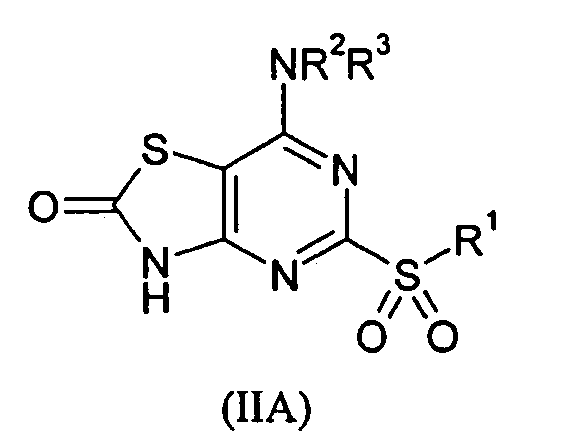
      (b) treatment of a compound of formula (IIB):
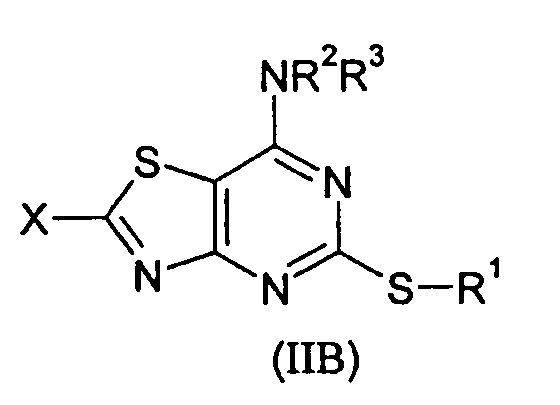
      Figure 00810002
      where R1, R2 and R3 are as defined in formula (I) and X is a leaving group with a metal alkoxide, followed by treatment with an acid or base,
      and optionally after (a) or (b) forming a pharmaceutically acceptable salt.
    8. A compound of formula (IIA) or (IIB) as defined in claim 7.
    9. A compound of formula (IIIA):
      Figure 00810003
      where R2 and R3 are as defined in formula (I) and X is NH2
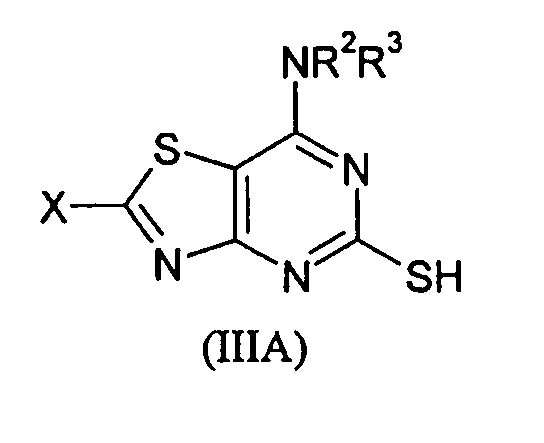
    10. A pharmaceutical composition comprising a compound of formula (I), or a pharmaceutically acceptable salt or solvate thereof, as claimed in any one of claims 1 to 6 in association with a pharmaceutically acceptable adjuvant, diluent or carrier.
    11. A process for the preparation of a pharmaceutical composition as claimed in claim 10 which comprises mixing a compound of formula (I), or a pharmaceutically acceptable salt or solvate thereof, as claimed in any one of claims 1 to 6 with a pharmaceutically acceptable adjuvant, diluent or carrier.
    12. A compound of formula (I), or a pharmaceutically-acceptable salt or solvate thereof, as claimed in any one of claims 1 to 6 for use in therapy.
    13. Use of a compound of formula (I), or a pharmaceutically acceptable salt or solvate thereof, as claimed in any one of claims 1 to 6 in the manufacture of a medicament for use in therapy.
    14. A method of treating a chemokine mediated disease wherein the chemokine binds to one or more chemokine receptors, which comprises administering to a patient a therapeutically effective amount of a compound of formula (I), or a pharmaceutically acceptable salt or solvate thereof, as claimed in any one of claims 1 to 6.
    15. A method according to claim 14 in which the chemokine receptor belongs to the CXC chemokine receptor subfamily.
    16. A method according to claim 14 or 15 in which the chemokine receptor is the CXCR2 receptor.
    17. A method of treating an inflammatory disease in a patient suffering from, or at risk of, said disease, which comprises administering to the patient a therapeutically effective amount of a compound of formula (I), or a pharmaceutically acceptable salt or solvate thereof, as claimed in any one of claims 1 to 6.
    18. A method according to claim 17, wherein the disease is psoriasis, a disease in which angiogenesis is associated with raised CXCR2 chemokine levels, or COPD.
    19. A method according to claim 15, wherein the disease is psoriasis.
    EP03015019A 1999-10-01 2000-09-26 Thiazolo[4,5-d]pyrimidine compounds for the treatment of rheumatoid arthritis Expired - Lifetime EP1348709B1 (en)

    Applications Claiming Priority (3)

    Application Number Priority Date Filing Date Title
    SE9903544A SE9903544D0 (en) 1999-10-01 1999-10-01 Novel compounds
    SE9903544 1999-10-01
    EP00960891A EP1222195B1 (en) 1999-10-01 2000-09-26 Novel thiazolo(4,5-d)pyrimidine compounds

    Related Parent Applications (1)

    Application Number Title Priority Date Filing Date
    EP00960891A Division EP1222195B1 (en) 1999-10-01 2000-09-26 Novel thiazolo(4,5-d)pyrimidine compounds

    Publications (3)

    Publication Number Publication Date
    EP1348709A2 true EP1348709A2 (en) 2003-10-01
    EP1348709A3 EP1348709A3 (en) 2003-11-19
    EP1348709B1 EP1348709B1 (en) 2008-01-16

    Family

    ID=20417218

    Family Applications (2)

    Application Number Title Priority Date Filing Date
    EP03015019A Expired - Lifetime EP1348709B1 (en) 1999-10-01 2000-09-26 Thiazolo[4,5-d]pyrimidine compounds for the treatment of rheumatoid arthritis
    EP00960891A Expired - Lifetime EP1222195B1 (en) 1999-10-01 2000-09-26 Novel thiazolo(4,5-d)pyrimidine compounds

    Family Applications After (1)

    Application Number Title Priority Date Filing Date
    EP00960891A Expired - Lifetime EP1222195B1 (en) 1999-10-01 2000-09-26 Novel thiazolo(4,5-d)pyrimidine compounds

    Country Status (26)

    Country Link
    US (3) US6790850B1 (en)
    EP (2) EP1348709B1 (en)
    JP (1) JP4824889B2 (en)
    KR (1) KR100765051B1 (en)
    CN (1) CN1210279C (en)
    AT (2) ATE384068T1 (en)
    AU (1) AU777872B2 (en)
    BR (1) BR0014334A (en)
    CA (1) CA2385269C (en)
    CZ (1) CZ20021113A3 (en)
    DE (2) DE60037836T2 (en)
    DK (1) DK1222195T3 (en)
    EE (1) EE05037B1 (en)
    ES (2) ES2213043T3 (en)
    HU (1) HUP0204246A3 (en)
    IL (2) IL148910A0 (en)
    IS (1) IS2229B (en)
    MX (1) MXPA02003263A (en)
    NO (1) NO327706B1 (en)
    NZ (1) NZ517880A (en)
    PT (1) PT1222195E (en)
    SE (1) SE9903544D0 (en)
    TW (1) TWI260324B (en)
    UA (1) UA73521C2 (en)
    WO (1) WO2001025242A1 (en)
    ZA (1) ZA200202380B (en)

    Cited By (2)

    * Cited by examiner, † Cited by third party
    Publication number Priority date Publication date Assignee Title
    WO2006064228A3 (en) * 2004-12-17 2007-02-08 Astrazeneca Ab Thiazolopyramidine compounds for the modulation of chemokine receptor activity
    US8143261B2 (en) 1999-10-01 2012-03-27 Astrazeneca Ab Thiazolo (4,5-D) pyrimidine compounds

    Families Citing this family (31)

    * Cited by examiner, † Cited by third party
    Publication number Priority date Publication date Assignee Title
    DE60101372T2 (en) * 2000-02-11 2004-10-14 Astrazeneca Ab PYRIMIDINE COMPOUNDS AND THEIR USE AS MODULATORS OF CHEMOKIN RECEPTOR ACTIVITY
    GB2359078A (en) 2000-02-11 2001-08-15 Astrazeneca Uk Ltd Pharmaceutically active pyrimidine derivatives
    GB2359081A (en) * 2000-02-11 2001-08-15 Astrazeneca Uk Ltd Pharmaceutically active thiazolopyrimidines
    GB2359551A (en) * 2000-02-23 2001-08-29 Astrazeneca Uk Ltd Pharmaceutically active pyrimidine derivatives
    SE0003828D0 (en) 2000-10-20 2000-10-20 Astrazeneca Ab Novel compounds
    SE0101322D0 (en) 2001-04-12 2001-04-12 Astrazeneca Ab Novel compounds
    SE0102716D0 (en) * 2001-08-14 2001-08-14 Astrazeneca Ab Novel compounds
    DE60232994D1 (en) 2001-12-06 2009-08-27 Merck & Co Inc INHIBITORS OF MITOTIC KINESINE
    ATE447577T1 (en) 2001-12-06 2009-11-15 Merck & Co Inc MITOTIC KINESIN INHIBITORS
    GB0217431D0 (en) 2002-07-27 2002-09-04 Astrazeneca Ab Novel compounds
    BR0313078A (en) 2002-08-06 2005-07-12 Astrazeneca Ab A compound or a pharmaceutically acceptable salt thereof, a pharmaceutical composition, and use of the compound or a pharmaceutically acceptable salt thereof.
    US7482355B2 (en) 2002-08-24 2009-01-27 Astrazeneca Ab Pyrimidine derivatives as modulators of chemokine receptor activity
    GB0221828D0 (en) 2002-09-20 2002-10-30 Astrazeneca Ab Novel compound
    GB0221829D0 (en) * 2002-09-20 2002-10-30 Astrazeneca Ab Novel compound
    JP2007507494A (en) * 2003-10-07 2007-03-29 アストラゼネカ・アクチエボラーグ Novel 2-substituted 4-amino-thiazolo [4,5-d] pyrimidines useful as chemokine receptor antagonists, particularly CX3CR1
    GB0328243D0 (en) * 2003-12-05 2004-01-07 Astrazeneca Ab Methods
    RS53145B (en) 2004-08-28 2014-06-30 Astrazeneca Ab. PIRIMIDINE SULFONAMIDE DERIVATIVES AS CHEMOKIN RECEPTOR MODULATORS
    US20090305321A1 (en) * 2005-03-23 2009-12-10 Astrazeneca Ab Assays for Allosteric Modulators of G-Protein Coupled Receptors (GPCRs)
    UA90707C2 (en) * 2005-04-06 2010-05-25 Астразенека Аб Novel 5-substituted 7-amino-[1,3]thiazolo[4,5-d]pyrimidine derivatives
    AR053347A1 (en) 2005-04-06 2007-05-02 Astrazeneca Ab DERIVATIVES OF [1,3] TIAZOLO [4,5-D] PYRIMIDIN-2 (3H) -ONA 5,7-SUBSTITUTED
    TW200820973A (en) * 2006-09-29 2008-05-16 Astrazeneca Ab Novel compounds 480
    AR071036A1 (en) * 2008-03-26 2010-05-19 Astrazeneca Ab DERIVATIVES 5, 7-DISUSTITUTES OF [1, 3] TIAZOLO [4, 5-D] PIRIMIDIN-2 (3H) -ONA, A PHARMACEUTICAL COMPOSITION THAT UNDERSTANDS AND ITS USE IN THE TREATMENT OF DISEASES MEDIATED BY THE CX3CR1 RECEIVER.
    CN101671336B (en) 2009-09-23 2013-11-13 辽宁利锋科技开发有限公司 Aromatic heterocyclic pyrimidine derivatives and analogs, preparation methods and uses thereof
    CN101899058B (en) * 2010-05-24 2012-05-23 中国人民解放军第四军医大学 Method for preparing thiazolopyrimidine compound, thiazolopyrimidine compound and application thereof
    US10301378B2 (en) 2013-06-18 2019-05-28 New York University Cellular factors involved in the cytotoxicity of Staphylococcus aureus leukocidins: novel therapeutic targets
    US10561676B2 (en) 2013-08-02 2020-02-18 Syntrix Biosystems Inc. Method for treating cancer using dual antagonists of CXCR1 and CXCR2
    EP3027627B1 (en) * 2013-08-02 2018-01-31 Syntrix Biosystems Inc. 2-[5-[n-(4-fluorophenyl)carbamoyl]pyrimidin-2-ylsulfanylmethyl]-4-(trifluoromethoxy)phenyl]boronic acid
    US8969365B2 (en) 2013-08-02 2015-03-03 Syntrix Biosystems, Inc. Thiopyrimidinecarboxamides as CXCR1/2 modulators
    US10046002B2 (en) 2013-08-02 2018-08-14 Syntrix Biosystems Inc. Method for treating cancer using chemokine antagonists
    WO2018073248A1 (en) 2016-10-17 2018-04-26 Icm (Institut Du Cerveau Et De La Moelle Épinière) Prognosis of demyelinating diseases patients and treatment thereof
    CN110172067B (en) * 2019-04-11 2021-06-15 河南科技大学第一附属医院 A kind of thiazole drug molecule with bactericidal activity and preparation method thereof

    Family Cites Families (77)

    * Cited by examiner, † Cited by third party
    Publication number Priority date Publication date Assignee Title
    US2924472A (en) 1957-06-27 1960-02-09 Gen Motors Corp Pipe joint seal
    GB1009477A (en) 1962-02-13 1965-11-10 Smith Kline French Lab Novel process for preparing heterocyclic compounds
    US3182062A (en) 1962-02-28 1965-05-04 Smith Kline French Lab Synthesis of quinoxalines and analogues thereof
    US3318900A (en) 1964-05-06 1967-05-09 Janssen Pharmaceutica Nv Derivatives of benzimidazolinyl piperidine
    BE668603A (en) 1964-08-20
    DE2331223C2 (en) 1972-06-19 1984-11-22 Kohjin Co., Ltd., Tokio / Tokyo S-substituted-2-thioadenosines, their 5'-monophosphates, processes for their preparation and pharmaceuticals containing them
    US4120521A (en) 1975-08-28 1978-10-17 Rieber & Son Plastic-Industri A/S Combined mould element and sealing ring
    EG12406A (en) 1976-08-12 1979-03-31 Janssen Pharmaceutica Nv Process for preparing of novel n-aryl-n-(1-l-4-piperidinyl)-arylacetamides
    GB1600293A (en) 1977-02-04 1981-10-14 British Oceanics Ltd Sealing arrangements
    US4188040A (en) 1977-04-06 1980-02-12 Firma WOCO Franz-Josef Wolf & Co. Sealing ring
    DE2726959A1 (en) 1977-06-15 1979-01-18 Arlt Christian SEALING INSERT FOR SEALING TWO TUBES
    FR2421899A1 (en) 1978-01-16 1979-11-02 Roussel Uclaf NEW TETRAHYDROPYRIDINYL-INDOLE DERIVATIVES AND THEIR SALTS, THE PREPARATION PROCESS AND THE MEDICINAL APPLICATION OF THESE NEW PRODUCTS
    US4410528A (en) 1980-05-16 1983-10-18 Kyowa Hakko Kogyo Co., Ltd. Hypotensive piperidine derivatives
    DE3219522A1 (en) 1981-10-28 1983-12-01 Denso-Chemie Wedekind Kg, 5090 Leverkusen CONNECTOR SEAL FOR PIPES
    FR2547888B1 (en) 1983-06-22 1985-12-13 Sabla Sa IMPLANT SEALING RING FOR INTERLOCKING PIPES
    CA1338012C (en) 1987-04-27 1996-01-30 John Michael Mccall Pharmaceutically active amines
    SE8800348L (en) 1988-02-03 1989-08-04 Forsheda Ab SEALING RING AND TOOLS FOR PRODUCING THEREOF
    FR2659656B1 (en) 1990-03-15 1994-09-09 Sanofi Sa PYRIMIDINEDIONE-2,4 DERIVATIVES AND MEDICINAL PRODUCTS CONTAINING THEM.
    DE4119767A1 (en) * 1991-06-15 1992-12-17 Dresden Arzneimittel Prepn. of (pyrimid-2-yl-thio- or seleno-) acetic acid derivs. - by reacting the corresp. chloro:alkanoyl-amino cpd. with a rhodanide and water or an alcohol
    US5169161A (en) 1991-09-19 1992-12-08 Hail Mary Rubber Co., Inc. Symmetrical gasket for pipe joints
    DE4134089C2 (en) 1991-10-15 1994-10-13 Dueker Eisenwerk Thrust-proof sleeve connection
    JPH05188994A (en) 1992-01-07 1993-07-30 Sony Corp Noise suppressor
    DE4229609C2 (en) 1992-09-04 2003-05-08 Forsheda Stefa Gmbh Sealing between two interlocking parts
    US5521197A (en) 1994-12-01 1996-05-28 Eli Lilly And Company 3-<1-alkylenearyl>-4-<1,2,3,6-tetrahydropyridinyl>-and 3-<1-alkylenearyl>-4-piperidinyl-1h-indoles: new 5-HT1F agonists
    EP0778277B1 (en) 1995-12-08 2003-06-25 Pfizer Inc. Substituted heterocyclic derivatives as CRF antagonists
    GB9624482D0 (en) 1995-12-18 1997-01-15 Zeneca Phaema S A Chemical compounds
    SE515033C2 (en) 1995-12-27 2001-06-05 Forsheda Ab sealing device
    AU719434B2 (en) 1996-02-13 2000-05-11 Astrazeneca Ab Quinazoline derivatives as VEGF inhibitors
    ES2169355T3 (en) 1996-03-05 2002-07-01 Astrazeneca Ab DERIVATIVES OF 4-ANILINOQUINAZOLINA.
    AU2388697A (en) 1996-04-19 1997-11-12 Neurosearch A/S 1-(4-piperidyl)-benzimidazoles having neurotrophic activity
    JP3621706B2 (en) * 1996-08-28 2005-02-16 ファイザー・インク Substituted 6,5-hetero-bicyclic derivatives
    GB9718972D0 (en) 1996-09-25 1997-11-12 Zeneca Ltd Chemical compounds
    WO1998025617A1 (en) 1996-12-13 1998-06-18 Merck & Co., Inc. Substituted aryl piperazines as modulators of chemokine receptor activity
    GB9714249D0 (en) 1997-07-08 1997-09-10 Angiogene Pharm Ltd Vascular damaging agents
    WO1999004794A1 (en) 1997-07-25 1999-02-04 Merck & Co., Inc. Cyclic amine modulators of chemokine receptor activity
    AR013669A1 (en) 1997-10-07 2001-01-10 Smithkline Beecham Corp COMPOUNDS AND METHODS
    US6329381B1 (en) 1997-11-28 2001-12-11 Sumitomo Pharmaceuticals Company, Limited Heterocyclic compounds
    ATE219772T1 (en) 1998-01-19 2002-07-15 Pfizer 4-(2-KETO-1-BENZIMIDAZOLINYL)PIPERIDINE DERIVATIVES AS ORL1 RECEPTOR AGONISTS
    KR20010042001A (en) 1998-03-19 2001-05-25 무라타 도시카즈 Arylpiperidine derivatives and use thereof
    EP1068212A1 (en) * 1998-04-03 2001-01-17 Bristol-Myers Squibb Pharma Company THIAZOLO 4,5-d]PYRIMIDINES AND PYRIDINES AS CORTICOTROPIN RELEASING FACTOR (CRF) ANTAGONISTS
    MA26659A1 (en) 1998-08-06 2004-12-20 Pfizer NOVEL BENZIMIDAZOLE DERIVATIVES, PHARMACEUTICAL COMPOSITIONS CONTAINING THEM AND PROCESS FOR THEIR PREPARATION.
    SE9802729D0 (en) * 1998-08-13 1998-08-13 Astra Pharma Prod Novel Compounds
    US5988695A (en) 1998-08-26 1999-11-23 S&B Technical Products, Inc. Pipe gasket with embedded ring
    PE20001420A1 (en) 1998-12-23 2000-12-18 Pfizer CCR5 MODULATORS
    ATE277929T1 (en) 1998-12-28 2004-10-15 4 Aza Bioscience Nv IMMUNOSUPRESSIVE EFFECTS OF PTERIDINE DERIVATIVES
    GB9900334D0 (en) 1999-01-07 1999-02-24 Angiogene Pharm Ltd Tricylic vascular damaging agents
    GB9900752D0 (en) 1999-01-15 1999-03-03 Angiogene Pharm Ltd Benzimidazole vascular damaging agents
    CA2361561A1 (en) 1999-02-02 2000-08-10 K.U. Leuven Research & Development Immunosurpressive effects of pteridine derivatives
    US6248755B1 (en) 1999-04-06 2001-06-19 Merck & Co., Inc. Pyrrolidine modulators of chemokine receptor activity
    US6142484A (en) 1999-04-15 2000-11-07 Vassallo Research & Development Corporation Composite multi-pressure gasket
    US6930101B1 (en) * 1999-05-17 2005-08-16 The Regents Of The University Of California Thiazolopyrimidines useful as TNFα inhibitors
    WO2000076514A1 (en) 1999-06-11 2000-12-21 Merck & Co., Inc. Cyclopentyl modulators of chemokine receptor activity
    US6340681B1 (en) 1999-07-16 2002-01-22 Pfizer Inc 2-benzimidazolylamine compounds as ORL-1-receptor agonists
    CN1373763A (en) 1999-09-15 2002-10-09 沃尼尔·朗伯公司 Pteridinones and kinase inhibitors
    AR025884A1 (en) 1999-10-01 2002-12-18 Takeda Pharmaceutical CYCLINE AMINE COMPOUNDS, ITS PRODUCTION AND USE
    SE9903544D0 (en) 1999-10-01 1999-10-01 Astra Pharma Prod Novel compounds
    EP1122257B1 (en) 2000-01-05 2005-10-12 Pfizer Inc. Benzimidazole compounds as ORL1-receptor agonists
    GB2359079A (en) 2000-02-11 2001-08-15 Astrazeneca Uk Ltd Pharmaceutically active pyrimidine derivatives
    GB2359081A (en) 2000-02-11 2001-08-15 Astrazeneca Uk Ltd Pharmaceutically active thiazolopyrimidines
    DE60101372T2 (en) 2000-02-11 2004-10-14 Astrazeneca Ab PYRIMIDINE COMPOUNDS AND THEIR USE AS MODULATORS OF CHEMOKIN RECEPTOR ACTIVITY
    GB2359078A (en) 2000-02-11 2001-08-15 Astrazeneca Uk Ltd Pharmaceutically active pyrimidine derivatives
    GB2359551A (en) 2000-02-23 2001-08-29 Astrazeneca Uk Ltd Pharmaceutically active pyrimidine derivatives
    GB0005642D0 (en) 2000-03-10 2000-05-03 Astrazeneca Uk Ltd Chemical compounds
    AU2001242744B2 (en) 2000-03-24 2005-07-21 Meiji Seika Kaisha Ltd Diphenylalkylamine derivatives useful as opioid delta receptor ligands
    EP1289952A1 (en) 2000-05-31 2003-03-12 AstraZeneca AB Indole derivatives with vascular damaging activity
    CA2411160A1 (en) 2000-07-07 2002-01-17 Angiogene Pharmaceuticals Limited Colchinol derivatives as vascular damaging agents
    MXPA02012903A (en) 2000-07-07 2004-07-30 Angiogene Pharm Ltd Colchinol derivatives as angiogenesis inhibitors.
    SE0003828D0 (en) 2000-10-20 2000-10-20 Astrazeneca Ab Novel compounds
    SE0004110L (en) 2000-11-10 2002-05-11 Forsheda Ab LUTE
    SE0101322D0 (en) 2001-04-12 2001-04-12 Astrazeneca Ab Novel compounds
    SE0102716D0 (en) 2001-08-14 2001-08-14 Astrazeneca Ab Novel compounds
    GB0221829D0 (en) 2002-09-20 2002-10-30 Astrazeneca Ab Novel compound
    GB0221828D0 (en) 2002-09-20 2002-10-30 Astrazeneca Ab Novel compound
    JP2007507494A (en) 2003-10-07 2007-03-29 アストラゼネカ・アクチエボラーグ Novel 2-substituted 4-amino-thiazolo [4,5-d] pyrimidines useful as chemokine receptor antagonists, particularly CX3CR1
    GB0328243D0 (en) 2003-12-05 2004-01-07 Astrazeneca Ab Methods
    WO2005082865A1 (en) 2004-02-27 2005-09-09 Astellas Pharma Inc. Fused bicyclic pyrimidine derivative
    JP2008524186A (en) 2004-12-17 2008-07-10 アストラゼネカ・アクチエボラーグ Thiazolopyramidine compounds for modulation of chemokine receptor activity

    Cited By (2)

    * Cited by examiner, † Cited by third party
    Publication number Priority date Publication date Assignee Title
    US8143261B2 (en) 1999-10-01 2012-03-27 Astrazeneca Ab Thiazolo (4,5-D) pyrimidine compounds
    WO2006064228A3 (en) * 2004-12-17 2007-02-08 Astrazeneca Ab Thiazolopyramidine compounds for the modulation of chemokine receptor activity

    Also Published As

    Publication number Publication date
    ES2213043T3 (en) 2004-08-16
    CN1210279C (en) 2005-07-13
    CA2385269C (en) 2010-08-17
    EE05037B1 (en) 2008-06-16
    CA2385269A1 (en) 2001-04-12
    IS6306A (en) 2002-03-18
    ES2298451T3 (en) 2008-05-16
    PL365778A1 (en) 2005-01-10
    NO20021448D0 (en) 2002-03-22
    US20090281123A1 (en) 2009-11-12
    UA73521C2 (en) 2005-08-15
    JP2003511384A (en) 2003-03-25
    EP1222195B1 (en) 2004-01-14
    TWI260324B (en) 2006-08-21
    CN1402730A (en) 2003-03-12
    WO2001025242A1 (en) 2001-04-12
    BR0014334A (en) 2002-06-11
    AU777872B2 (en) 2004-11-04
    PT1222195E (en) 2004-05-31
    KR20020032635A (en) 2002-05-03
    US6790850B1 (en) 2004-09-14
    HUP0204246A3 (en) 2006-01-30
    SE9903544D0 (en) 1999-10-01
    EE200200174A (en) 2003-04-15
    US8143261B2 (en) 2012-03-27
    EP1348709B1 (en) 2008-01-16
    IS2229B (en) 2007-04-15
    JP4824889B2 (en) 2011-11-30
    ATE384068T1 (en) 2008-02-15
    EP1222195A1 (en) 2002-07-17
    MXPA02003263A (en) 2002-09-30
    DE60037836T2 (en) 2009-01-15
    ZA200202380B (en) 2003-10-29
    NZ517880A (en) 2003-09-26
    DK1222195T3 (en) 2004-04-19
    KR100765051B1 (en) 2007-10-09
    NO327706B1 (en) 2009-09-14
    HK1052009A1 (en) 2003-08-29
    CZ20021113A3 (en) 2002-06-12
    EP1348709A3 (en) 2003-11-19
    IL148910A (en) 2006-10-31
    DE60007768D1 (en) 2004-02-19
    AU7304900A (en) 2001-05-10
    IL148910A0 (en) 2002-09-12
    US20040224961A1 (en) 2004-11-11
    ATE257838T1 (en) 2004-01-15
    DE60037836D1 (en) 2008-03-06
    HUP0204246A2 (en) 2003-04-28
    DE60007768T2 (en) 2004-12-02
    NO20021448L (en) 2002-05-22

    Similar Documents

    Publication Publication Date Title
    EP1222195B1 (en) Novel thiazolo(4,5-d)pyrimidine compounds
    US6875868B2 (en) Pteridine compounds for the treatment of psoriasis
    US6958344B2 (en) Pyrimidine compounds and their use as modulators of chemokine receptor activity
    EP1385854B1 (en) Thiazolopyrimidines and their use as modulators of chemokine receptor activity
    EP1257556B1 (en) Thiazolopyrimidines and their use as modulators of chemokine receptor activity
    PL203572B1 (en) A thiazolo [4,5-d] pyrimidine compound, its preparation method, intermediates, a pharmaceutical, and the use of this compound
    HK1050899B (en) Pteridine compounds for the treatment of psoriasis

    Legal Events

    Date Code Title Description
    PUAI Public reference made under article 153(3) epc to a published international application that has entered the european phase

    Free format text: ORIGINAL CODE: 0009012

    AC Divisional application: reference to earlier application

    Ref document number: 1222195

    Country of ref document: EP

    Kind code of ref document: P

    AK Designated contracting states

    Kind code of ref document: A2

    Designated state(s): AT BE CH CY DE DK ES FI FR GB GR IE IT LI LU MC NL PT SE

    AX Request for extension of the european patent

    Extension state: AL LT LV MK RO SI

    PUAL Search report despatched

    Free format text: ORIGINAL CODE: 0009013

    AK Designated contracting states

    Kind code of ref document: A3

    Designated state(s): AT BE CH CY DE DK ES FI FR GB GR IE IT LI LU MC NL PT SE

    AX Request for extension of the european patent

    Extension state: AL LT LV MK RO SI

    17P Request for examination filed

    Effective date: 20040519

    AKX Designation fees paid

    Designated state(s): AT BE CH CY DE DK ES FI FR GB GR IE IT LI LU MC NL PT SE

    AXX Extension fees paid

    Extension state: LT

    Payment date: 20040519

    Extension state: SI

    Payment date: 20040519

    Extension state: MK

    Payment date: 20040519

    Extension state: RO

    Payment date: 20040519

    Extension state: AL

    Payment date: 20040519

    Extension state: LV

    Payment date: 20040519

    17Q First examination report despatched

    Effective date: 20060131

    GRAP Despatch of communication of intention to grant a patent

    Free format text: ORIGINAL CODE: EPIDOSNIGR1

    RTI1 Title (correction)

    Free format text: THIAZOLO(4,5-D)PYRIMIDINE COMPOUNDS FOR THE TREATMENT OF RHEUMATOID ARTHRITIS

    RIC1 Information provided on ipc code assigned before grant

    Ipc: A61K 31/519 20060101ALI20070717BHEP

    Ipc: C07D 513/04 20060101AFI20070717BHEP

    Ipc: A61P 29/00 20060101ALI20070717BHEP

    GRAS Grant fee paid

    Free format text: ORIGINAL CODE: EPIDOSNIGR3

    GRAA (expected) grant

    Free format text: ORIGINAL CODE: 0009210

    AC Divisional application: reference to earlier application

    Ref document number: 1222195

    Country of ref document: EP

    Kind code of ref document: P

    AK Designated contracting states

    Kind code of ref document: B1

    Designated state(s): AT BE CH CY DE DK ES FI FR GB GR IE IT LI LU MC NL PT SE

    AX Request for extension of the european patent

    Extension state: AL LT LV MK RO SI

    REG Reference to a national code

    Ref country code: GB

    Ref legal event code: FG4D

    REG Reference to a national code

    Ref country code: CH

    Ref legal event code: EP

    REG Reference to a national code

    Ref country code: IE

    Ref legal event code: FG4D

    REF Corresponds to:

    Ref document number: 60037836

    Country of ref document: DE

    Date of ref document: 20080306

    Kind code of ref document: P

    REG Reference to a national code

    Ref country code: SE

    Ref legal event code: TRGR

    REG Reference to a national code

    Ref country code: ES

    Ref legal event code: FG2A

    Ref document number: 2298451

    Country of ref document: ES

    Kind code of ref document: T3

    PG25 Lapsed in a contracting state [announced via postgrant information from national office to epo]

    Ref country code: NL

    Free format text: LAPSE BECAUSE OF FAILURE TO SUBMIT A TRANSLATION OF THE DESCRIPTION OR TO PAY THE FEE WITHIN THE PRESCRIBED TIME-LIMIT

    Effective date: 20080116

    NLV1 Nl: lapsed or annulled due to failure to fulfill the requirements of art. 29p and 29m of the patents act
    PG25 Lapsed in a contracting state [announced via postgrant information from national office to epo]

    Ref country code: FI

    Free format text: LAPSE BECAUSE OF FAILURE TO SUBMIT A TRANSLATION OF THE DESCRIPTION OR TO PAY THE FEE WITHIN THE PRESCRIBED TIME-LIMIT

    Effective date: 20080116

    ET Fr: translation filed
    PG25 Lapsed in a contracting state [announced via postgrant information from national office to epo]

    Ref country code: AT

    Free format text: LAPSE BECAUSE OF FAILURE TO SUBMIT A TRANSLATION OF THE DESCRIPTION OR TO PAY THE FEE WITHIN THE PRESCRIBED TIME-LIMIT

    Effective date: 20080116

    PG25 Lapsed in a contracting state [announced via postgrant information from national office to epo]

    Ref country code: BE

    Free format text: LAPSE BECAUSE OF FAILURE TO SUBMIT A TRANSLATION OF THE DESCRIPTION OR TO PAY THE FEE WITHIN THE PRESCRIBED TIME-LIMIT

    Effective date: 20080116

    Ref country code: PT

    Free format text: LAPSE BECAUSE OF FAILURE TO SUBMIT A TRANSLATION OF THE DESCRIPTION OR TO PAY THE FEE WITHIN THE PRESCRIBED TIME-LIMIT

    Effective date: 20080616

    PG25 Lapsed in a contracting state [announced via postgrant information from national office to epo]

    Ref country code: DK

    Free format text: LAPSE BECAUSE OF FAILURE TO SUBMIT A TRANSLATION OF THE DESCRIPTION OR TO PAY THE FEE WITHIN THE PRESCRIBED TIME-LIMIT

    Effective date: 20080116

    PLBE No opposition filed within time limit

    Free format text: ORIGINAL CODE: 0009261

    STAA Information on the status of an ep patent application or granted ep patent

    Free format text: STATUS: NO OPPOSITION FILED WITHIN TIME LIMIT

    26N No opposition filed

    Effective date: 20081017

    PG25 Lapsed in a contracting state [announced via postgrant information from national office to epo]

    Ref country code: MC

    Free format text: LAPSE BECAUSE OF NON-PAYMENT OF DUE FEES

    Effective date: 20080930

    PG25 Lapsed in a contracting state [announced via postgrant information from national office to epo]

    Ref country code: CY

    Free format text: LAPSE BECAUSE OF FAILURE TO SUBMIT A TRANSLATION OF THE DESCRIPTION OR TO PAY THE FEE WITHIN THE PRESCRIBED TIME-LIMIT

    Effective date: 20080116

    Ref country code: IE

    Free format text: LAPSE BECAUSE OF NON-PAYMENT OF DUE FEES

    Effective date: 20080926

    PG25 Lapsed in a contracting state [announced via postgrant information from national office to epo]

    Ref country code: LU

    Free format text: LAPSE BECAUSE OF NON-PAYMENT OF DUE FEES

    Effective date: 20080926

    PG25 Lapsed in a contracting state [announced via postgrant information from national office to epo]

    Ref country code: GR

    Free format text: LAPSE BECAUSE OF FAILURE TO SUBMIT A TRANSLATION OF THE DESCRIPTION OR TO PAY THE FEE WITHIN THE PRESCRIBED TIME-LIMIT

    Effective date: 20080417

    PGFP Annual fee paid to national office [announced via postgrant information from national office to epo]

    Ref country code: CH

    Payment date: 20110729

    Year of fee payment: 12

    PGFP Annual fee paid to national office [announced via postgrant information from national office to epo]

    Ref country code: GB

    Payment date: 20120926

    Year of fee payment: 13

    Ref country code: SE

    Payment date: 20120911

    Year of fee payment: 13

    PGFP Annual fee paid to national office [announced via postgrant information from national office to epo]

    Ref country code: IT

    Payment date: 20120810

    Year of fee payment: 13

    Ref country code: DE

    Payment date: 20120919

    Year of fee payment: 13

    Ref country code: FR

    Payment date: 20120926

    Year of fee payment: 13

    PGFP Annual fee paid to national office [announced via postgrant information from national office to epo]

    Ref country code: ES

    Payment date: 20121004

    Year of fee payment: 13

    REG Reference to a national code

    Ref country code: SE

    Ref legal event code: EUG

    PG25 Lapsed in a contracting state [announced via postgrant information from national office to epo]

    Ref country code: SE

    Free format text: LAPSE BECAUSE OF NON-PAYMENT OF DUE FEES

    Effective date: 20130927

    REG Reference to a national code

    Ref country code: CH

    Ref legal event code: PL

    GBPC Gb: european patent ceased through non-payment of renewal fee

    Effective date: 20130926

    REG Reference to a national code

    Ref country code: DE

    Ref legal event code: R119

    Ref document number: 60037836

    Country of ref document: DE

    Effective date: 20140401

    REG Reference to a national code

    Ref country code: FR

    Ref legal event code: ST

    Effective date: 20140530

    PG25 Lapsed in a contracting state [announced via postgrant information from national office to epo]

    Ref country code: LI

    Free format text: LAPSE BECAUSE OF NON-PAYMENT OF DUE FEES

    Effective date: 20130930

    Ref country code: GB

    Free format text: LAPSE BECAUSE OF NON-PAYMENT OF DUE FEES

    Effective date: 20130926

    Ref country code: CH

    Free format text: LAPSE BECAUSE OF NON-PAYMENT OF DUE FEES

    Effective date: 20130930

    PG25 Lapsed in a contracting state [announced via postgrant information from national office to epo]

    Ref country code: DE

    Free format text: LAPSE BECAUSE OF NON-PAYMENT OF DUE FEES

    Effective date: 20140401

    Ref country code: FR

    Free format text: LAPSE BECAUSE OF NON-PAYMENT OF DUE FEES

    Effective date: 20130930

    Ref country code: IT

    Free format text: LAPSE BECAUSE OF NON-PAYMENT OF DUE FEES

    Effective date: 20130926

    REG Reference to a national code

    Ref country code: ES

    Ref legal event code: FD2A

    Effective date: 20141010

    PG25 Lapsed in a contracting state [announced via postgrant information from national office to epo]

    Ref country code: ES

    Free format text: LAPSE BECAUSE OF NON-PAYMENT OF DUE FEES

    Effective date: 20130927