EP1348238B1 - Vanadium oxide electrode materials and method for their production - Google Patents
Vanadium oxide electrode materials and method for their production Download PDFInfo
- Publication number
- EP1348238B1 EP1348238B1 EP01985435A EP01985435A EP1348238B1 EP 1348238 B1 EP1348238 B1 EP 1348238B1 EP 01985435 A EP01985435 A EP 01985435A EP 01985435 A EP01985435 A EP 01985435A EP 1348238 B1 EP1348238 B1 EP 1348238B1
- Authority
- EP
- European Patent Office
- Prior art keywords
- vanadium oxide
- weight
- oxide nanotubes
- carbon black
- electrode
- Prior art date
- Legal status (The legal status is an assumption and is not a legal conclusion. Google has not performed a legal analysis and makes no representation as to the accuracy of the status listed.)
- Expired - Lifetime
Links
- XHCLAFWTIXFWPH-UHFFFAOYSA-N [O-2].[O-2].[O-2].[O-2].[O-2].[V+5].[V+5] Chemical compound [O-2].[O-2].[O-2].[O-2].[O-2].[V+5].[V+5] XHCLAFWTIXFWPH-UHFFFAOYSA-N 0.000 title claims abstract description 53
- 229910001935 vanadium oxide Inorganic materials 0.000 title claims abstract description 53
- 238000000034 method Methods 0.000 title claims description 30
- 239000007772 electrode material Substances 0.000 title abstract description 5
- 238000004519 manufacturing process Methods 0.000 title abstract 2
- 239000002071 nanotube Substances 0.000 claims abstract description 48
- WHXSMMKQMYFTQS-UHFFFAOYSA-N Lithium Chemical compound [Li] WHXSMMKQMYFTQS-UHFFFAOYSA-N 0.000 claims abstract description 13
- 229910052744 lithium Inorganic materials 0.000 claims abstract description 13
- 229920002943 EPDM rubber Polymers 0.000 claims description 28
- 239000011230 binding agent Substances 0.000 claims description 26
- 239000006229 carbon black Substances 0.000 claims description 23
- 239000003792 electrolyte Substances 0.000 claims description 19
- 239000002904 solvent Substances 0.000 claims description 11
- 229910001415 sodium ion Inorganic materials 0.000 claims description 7
- FJLUATLTXUNBOT-UHFFFAOYSA-N 1-Hexadecylamine Chemical compound CCCCCCCCCCCCCCCCN FJLUATLTXUNBOT-UHFFFAOYSA-N 0.000 claims description 6
- 229910003002 lithium salt Inorganic materials 0.000 claims description 6
- 159000000002 lithium salts Chemical class 0.000 claims description 6
- 238000003756 stirring Methods 0.000 claims description 6
- JRBPAEWTRLWTQC-UHFFFAOYSA-N dodecylamine Chemical compound CCCCCCCCCCCCN JRBPAEWTRLWTQC-UHFFFAOYSA-N 0.000 claims description 5
- XKRFYHLGVUSROY-UHFFFAOYSA-N Argon Chemical compound [Ar] XKRFYHLGVUSROY-UHFFFAOYSA-N 0.000 claims description 4
- 238000001035 drying Methods 0.000 claims description 4
- 230000007480 spreading Effects 0.000 claims description 4
- 229910021645 metal ion Inorganic materials 0.000 claims description 3
- 229910052786 argon Inorganic materials 0.000 claims description 2
- 239000005030 aluminium foil Substances 0.000 claims 1
- 125000000113 cyclohexyl group Chemical group [H]C1([H])C([H])([H])C([H])([H])C([H])(*)C([H])([H])C1([H])[H] 0.000 claims 1
- 239000000463 material Substances 0.000 description 13
- 230000001351 cycling effect Effects 0.000 description 10
- QSZMZKBZAYQGRS-UHFFFAOYSA-N lithium;bis(trifluoromethylsulfonyl)azanide Chemical compound [Li+].FC(F)(F)S(=O)(=O)[N-]S(=O)(=O)C(F)(F)F QSZMZKBZAYQGRS-UHFFFAOYSA-N 0.000 description 10
- 229910001416 lithium ion Inorganic materials 0.000 description 9
- 239000000203 mixture Substances 0.000 description 9
- 239000000843 powder Substances 0.000 description 9
- 150000003839 salts Chemical class 0.000 description 8
- 239000011229 interlayer Substances 0.000 description 7
- 238000002441 X-ray diffraction Methods 0.000 description 6
- 230000015572 biosynthetic process Effects 0.000 description 6
- 230000007423 decrease Effects 0.000 description 6
- 239000010410 layer Substances 0.000 description 6
- 229910001496 lithium tetrafluoroborate Inorganic materials 0.000 description 6
- 238000005259 measurement Methods 0.000 description 6
- 238000003786 synthesis reaction Methods 0.000 description 6
- 229910052720 vanadium Inorganic materials 0.000 description 6
- LEONUFNNVUYDNQ-UHFFFAOYSA-N vanadium atom Chemical compound [V] LEONUFNNVUYDNQ-UHFFFAOYSA-N 0.000 description 6
- LFQSCWFLJHTTHZ-UHFFFAOYSA-N Ethanol Chemical compound CCO LFQSCWFLJHTTHZ-UHFFFAOYSA-N 0.000 description 5
- 229910001290 LiPF6 Inorganic materials 0.000 description 5
- 229910052782 aluminium Inorganic materials 0.000 description 5
- XAGFODPZIPBFFR-UHFFFAOYSA-N aluminium Chemical compound [Al] XAGFODPZIPBFFR-UHFFFAOYSA-N 0.000 description 5
- 238000011066 ex-situ storage Methods 0.000 description 5
- 238000011065 in-situ storage Methods 0.000 description 5
- 229910003473 lithium bis(trifluoromethanesulfonyl)imide Inorganic materials 0.000 description 5
- HBBGRARXTFLTSG-UHFFFAOYSA-N Lithium ion Chemical compound [Li+] HBBGRARXTFLTSG-UHFFFAOYSA-N 0.000 description 4
- 150000001412 amines Chemical class 0.000 description 4
- 239000002243 precursor Substances 0.000 description 4
- 150000003141 primary amines Chemical class 0.000 description 4
- 230000008707 rearrangement Effects 0.000 description 4
- XTHFKEDIFFGKHM-UHFFFAOYSA-N Dimethoxyethane Chemical compound COCCOC XTHFKEDIFFGKHM-UHFFFAOYSA-N 0.000 description 3
- KMTRUDSVKNLOMY-UHFFFAOYSA-N Ethylene carbonate Chemical compound O=C1OCCO1 KMTRUDSVKNLOMY-UHFFFAOYSA-N 0.000 description 3
- 239000002033 PVDF binder Substances 0.000 description 3
- 150000001768 cations Chemical class 0.000 description 3
- 238000005260 corrosion Methods 0.000 description 3
- 230000007797 corrosion Effects 0.000 description 3
- IEJIGPNLZYLLBP-UHFFFAOYSA-N dimethyl carbonate Chemical compound COC(=O)OC IEJIGPNLZYLLBP-UHFFFAOYSA-N 0.000 description 3
- VLKZOEOYAKHREP-UHFFFAOYSA-N n-Hexane Chemical compound CCCCCC VLKZOEOYAKHREP-UHFFFAOYSA-N 0.000 description 3
- 229920000642 polymer Polymers 0.000 description 3
- 229920002981 polyvinylidene fluoride Polymers 0.000 description 3
- RUOJZAUFBMNUDX-UHFFFAOYSA-N propylene carbonate Chemical compound CC1COC(=O)O1 RUOJZAUFBMNUDX-UHFFFAOYSA-N 0.000 description 3
- 238000006467 substitution reaction Methods 0.000 description 3
- OIFBSDVPJOWBCH-UHFFFAOYSA-N Diethyl carbonate Chemical compound CCOC(=O)OCC OIFBSDVPJOWBCH-UHFFFAOYSA-N 0.000 description 2
- FAPWRFPIFSIZLT-UHFFFAOYSA-M Sodium chloride Chemical class [Na+].[Cl-] FAPWRFPIFSIZLT-UHFFFAOYSA-M 0.000 description 2
- 238000003917 TEM image Methods 0.000 description 2
- 150000003973 alkyl amines Chemical class 0.000 description 2
- 239000012298 atmosphere Substances 0.000 description 2
- 239000010406 cathode material Substances 0.000 description 2
- 238000005341 cation exchange Methods 0.000 description 2
- 238000006243 chemical reaction Methods 0.000 description 2
- 239000002131 composite material Substances 0.000 description 2
- 239000002178 crystalline material Substances 0.000 description 2
- JBTWLSYIZRCDFO-UHFFFAOYSA-N ethyl methyl carbonate Chemical compound CCOC(=O)OC JBTWLSYIZRCDFO-UHFFFAOYSA-N 0.000 description 2
- 239000011888 foil Substances 0.000 description 2
- 238000011835 investigation Methods 0.000 description 2
- 238000011068 loading method Methods 0.000 description 2
- 229910052751 metal Inorganic materials 0.000 description 2
- 239000002184 metal Substances 0.000 description 2
- 238000001000 micrograph Methods 0.000 description 2
- 238000002360 preparation method Methods 0.000 description 2
- 230000005855 radiation Effects 0.000 description 2
- 230000002441 reversible effect Effects 0.000 description 2
- 229910052723 transition metal Inorganic materials 0.000 description 2
- 150000003624 transition metals Chemical class 0.000 description 2
- 238000004627 transmission electron microscopy Methods 0.000 description 2
- OKTJSMMVPCPJKN-UHFFFAOYSA-N Carbon Chemical group [C] OKTJSMMVPCPJKN-UHFFFAOYSA-N 0.000 description 1
- XDTMQSROBMDMFD-UHFFFAOYSA-N Cyclohexane Chemical compound C1CCCCC1 XDTMQSROBMDMFD-UHFFFAOYSA-N 0.000 description 1
- 229910001194 LixV2O5 Inorganic materials 0.000 description 1
- HPLXJFZCZSBAAH-UHFFFAOYSA-N [V+3].CC(C)[O-].CC(C)[O-].CC(C)[O-] Chemical compound [V+3].CC(C)[O-].CC(C)[O-].CC(C)[O-] HPLXJFZCZSBAAH-UHFFFAOYSA-N 0.000 description 1
- 239000004964 aerogel Substances 0.000 description 1
- 230000032683 aging Effects 0.000 description 1
- -1 alkaline Chemical class 0.000 description 1
- 229910052784 alkaline earth metal Inorganic materials 0.000 description 1
- 150000001342 alkaline earth metals Chemical class 0.000 description 1
- 238000013459 approach Methods 0.000 description 1
- 230000005540 biological transmission Effects 0.000 description 1
- 230000001413 cellular effect Effects 0.000 description 1
- 230000008859 change Effects 0.000 description 1
- 238000012512 characterization method Methods 0.000 description 1
- 239000003795 chemical substances by application Substances 0.000 description 1
- 238000002484 cyclic voltammetry Methods 0.000 description 1
- 238000000354 decomposition reaction Methods 0.000 description 1
- 230000003247 decreasing effect Effects 0.000 description 1
- 230000001419 dependent effect Effects 0.000 description 1
- 238000013461 design Methods 0.000 description 1
- 230000000694 effects Effects 0.000 description 1
- 238000002848 electrochemical method Methods 0.000 description 1
- 239000003365 glass fiber Substances 0.000 description 1
- 230000003301 hydrolyzing effect Effects 0.000 description 1
- 238000001027 hydrothermal synthesis Methods 0.000 description 1
- 150000003949 imides Chemical class 0.000 description 1
- 230000006872 improvement Effects 0.000 description 1
- 238000003780 insertion Methods 0.000 description 1
- 230000037431 insertion Effects 0.000 description 1
- 125000003253 isopropoxy group Chemical group [H]C([H])([H])C([H])(O*)C([H])([H])[H] 0.000 description 1
- 239000003446 ligand Substances 0.000 description 1
- MHCFAGZWMAWTNR-UHFFFAOYSA-M lithium perchlorate Chemical compound [Li+].[O-]Cl(=O)(=O)=O MHCFAGZWMAWTNR-UHFFFAOYSA-M 0.000 description 1
- 229910001486 lithium perchlorate Inorganic materials 0.000 description 1
- 239000008204 material by function Substances 0.000 description 1
- 230000003647 oxidation Effects 0.000 description 1
- 238000007254 oxidation reaction Methods 0.000 description 1
- 238000012856 packing Methods 0.000 description 1
- 238000004321 preservation Methods 0.000 description 1
- 230000008569 process Effects 0.000 description 1
- 230000002035 prolonged effect Effects 0.000 description 1
- 230000009467 reduction Effects 0.000 description 1
- 238000000926 separation method Methods 0.000 description 1
- 239000002002 slurry Substances 0.000 description 1
- 239000007787 solid Substances 0.000 description 1
- 239000007858 starting material Substances 0.000 description 1
- 239000004094 surface-active agent Substances 0.000 description 1
- 239000000725 suspension Substances 0.000 description 1
- 230000002194 synthesizing effect Effects 0.000 description 1
- 238000012360 testing method Methods 0.000 description 1
- 238000012546 transfer Methods 0.000 description 1
- LSGOVYNHVSXFFJ-UHFFFAOYSA-N vanadate(3-) Chemical compound [O-][V]([O-])([O-])=O LSGOVYNHVSXFFJ-UHFFFAOYSA-N 0.000 description 1
- XLYOFNOQVPJJNP-UHFFFAOYSA-N water Substances O XLYOFNOQVPJJNP-UHFFFAOYSA-N 0.000 description 1
Images



Classifications
-
- H—ELECTRICITY
- H01—ELECTRIC ELEMENTS
- H01M—PROCESSES OR MEANS, e.g. BATTERIES, FOR THE DIRECT CONVERSION OF CHEMICAL ENERGY INTO ELECTRICAL ENERGY
- H01M4/00—Electrodes
- H01M4/02—Electrodes composed of, or comprising, active material
-
- B—PERFORMING OPERATIONS; TRANSPORTING
- B82—NANOTECHNOLOGY
- B82Y—SPECIFIC USES OR APPLICATIONS OF NANOSTRUCTURES; MEASUREMENT OR ANALYSIS OF NANOSTRUCTURES; MANUFACTURE OR TREATMENT OF NANOSTRUCTURES
- B82Y30/00—Nanotechnology for materials or surface science, e.g. nanocomposites
-
- H—ELECTRICITY
- H01—ELECTRIC ELEMENTS
- H01M—PROCESSES OR MEANS, e.g. BATTERIES, FOR THE DIRECT CONVERSION OF CHEMICAL ENERGY INTO ELECTRICAL ENERGY
- H01M4/00—Electrodes
- H01M4/02—Electrodes composed of, or comprising, active material
- H01M4/04—Processes of manufacture in general
-
- H—ELECTRICITY
- H01—ELECTRIC ELEMENTS
- H01M—PROCESSES OR MEANS, e.g. BATTERIES, FOR THE DIRECT CONVERSION OF CHEMICAL ENERGY INTO ELECTRICAL ENERGY
- H01M4/00—Electrodes
- H01M4/02—Electrodes composed of, or comprising, active material
- H01M4/62—Selection of inactive substances as ingredients for active masses, e.g. binders, fillers
- H01M4/621—Binders
- H01M4/622—Binders being polymers
-
- Y—GENERAL TAGGING OF NEW TECHNOLOGICAL DEVELOPMENTS; GENERAL TAGGING OF CROSS-SECTIONAL TECHNOLOGIES SPANNING OVER SEVERAL SECTIONS OF THE IPC; TECHNICAL SUBJECTS COVERED BY FORMER USPC CROSS-REFERENCE ART COLLECTIONS [XRACs] AND DIGESTS
- Y02—TECHNOLOGIES OR APPLICATIONS FOR MITIGATION OR ADAPTATION AGAINST CLIMATE CHANGE
- Y02E—REDUCTION OF GREENHOUSE GAS [GHG] EMISSIONS, RELATED TO ENERGY GENERATION, TRANSMISSION OR DISTRIBUTION
- Y02E60/00—Enabling technologies; Technologies with a potential or indirect contribution to GHG emissions mitigation
- Y02E60/10—Energy storage using batteries
-
- Y—GENERAL TAGGING OF NEW TECHNOLOGICAL DEVELOPMENTS; GENERAL TAGGING OF CROSS-SECTIONAL TECHNOLOGIES SPANNING OVER SEVERAL SECTIONS OF THE IPC; TECHNICAL SUBJECTS COVERED BY FORMER USPC CROSS-REFERENCE ART COLLECTIONS [XRACs] AND DIGESTS
- Y10—TECHNICAL SUBJECTS COVERED BY FORMER USPC
- Y10S—TECHNICAL SUBJECTS COVERED BY FORMER USPC CROSS-REFERENCE ART COLLECTIONS [XRACs] AND DIGESTS
- Y10S977/00—Nanotechnology
- Y10S977/70—Nanostructure
- Y10S977/734—Fullerenes, i.e. graphene-based structures, such as nanohorns, nanococoons, nanoscrolls or fullerene-like structures, e.g. WS2 or MoS2 chalcogenide nanotubes, planar C3N4, etc.
-
- Y—GENERAL TAGGING OF NEW TECHNOLOGICAL DEVELOPMENTS; GENERAL TAGGING OF CROSS-SECTIONAL TECHNOLOGIES SPANNING OVER SEVERAL SECTIONS OF THE IPC; TECHNICAL SUBJECTS COVERED BY FORMER USPC CROSS-REFERENCE ART COLLECTIONS [XRACs] AND DIGESTS
- Y10—TECHNICAL SUBJECTS COVERED BY FORMER USPC
- Y10S—TECHNICAL SUBJECTS COVERED BY FORMER USPC CROSS-REFERENCE ART COLLECTIONS [XRACs] AND DIGESTS
- Y10S977/00—Nanotechnology
- Y10S977/902—Specified use of nanostructure
- Y10S977/932—Specified use of nanostructure for electronic or optoelectronic application
- Y10S977/948—Energy storage/generating using nanostructure, e.g. fuel cell, battery
Definitions
- This invention relates to the use of vanadium oxide nanotubes as electrode material in a rechargeable lithium battery.
- Vanadium oxides have a long history as potential electrode materials for rechargeable lithium batteries due to their ability to insert large amounts of lithium [Winter et. al., Adv Mater., 10, 725 (1998); Chung et. al., J. Power Sources, 84, 6 (1999); Shembel et. al., J. Power Sources, 81-82, 480 (1999); Lee et. al., J. Electrochem. Soc., 142, L102 (1995); Pistoia et. al., Solid State lonics, 13, 311 (1984)].
- Different synthesizing and preparation methods have been developed to achieve higher specific capacities and longer cycle life [Chung et. al., J.
- vanadium oxide nanotubes (VO x -NTs) by a ligand assisted templating approach has recently been described by Spahr et al. [Angew. Chem. lnt. Ed. Engl., 37, 1263 (1998)].
- the tubes consist of several vanadium oxide layers, commonly in a scroll-like arrangement, separated by structure-directing agents (templates).
- the tubes can be up to 15 ⁇ m long and consist of as many as 30 vanadium oxide layers.
- the outer and inner diameters vary between 15 to 100 nm and 5 to 50 nm respectively. The size depends on the precursors chosen for the synthesis and can therefore be controlled in a rough manner [Krumeich et. al., J. Am. Chem. Soc., 121, 8324 (1999)].
- the synthesis is performed with e.g. primary alkylamines as templating molecules.
- the embedded amine molecules can then readily be exchanged by various metal cations, i.e. alkaline, alkaline earth and transition metals, under preservation of the tubular morphology [Reinoso et. al., Helv. Chim. Acta., 83, 1724 (2000)].
- This property gives a unique opportunity to design tailor-made functional materials.
- attempts to substitute the amine by lithium-ions have so far not been successful [Reinoso et. al. , Helv. Chim. Acta., 83, 1724 (2000)].
- the present invention provides an improved vanadium oxide electrode, which employs improved methods of electrode synthesis, cation exchange, and choice of electrolytes than those taught in the prior art. Numerous differences exist between the present invention and the teachings of Spahr et. al. The present invention therefore, represents an improvement over the prior art.
- a method for preparing a vanadium oxide nanotube electrode comprising: admixing a particulate form of vanadium oxide nanotubes with carbon black and EPDM binder; stirring the particulate admixture of vanadium oxide nanotubes, carbon black and EPDM binder; spreading the stirred particulate admixture onto a surface; extracting electrodes from the spread particulate admixture; and drying the extracted electrodes.
- a vanadium oxide nanotube electrode prepared by a method, the method comprising: admixing a particulate form of vanadium oxide nanotubes with carbon black and EPDM binder; stirring the particulate admixture of vanadium oxide nanotubes, carbon black and EPDM binder; spreading the stirred particulate admixture onto a surface; extracting electrodes from the spread particulate admixture; and drying the extracted electrodes.
- a rechargeable lithium battery comprising at least one lithium anode, at least one vanadium oxide nanotube cathode, and an electrolyte comprising a solution of a lithium salt in a solvent, wherein said vanadium oxide nanotube cathode is prepared by the method of the first aspect.
- Figure 1 represents X-ray powder diffractograms for C16-VO x -NTs, C12-VO x- NTs and Na-VO x -NTs.
- the inset displays the inter-layer distances as derived from X-ray diffraction results.
- Figure 2 represents Transmission Electron Micrographs showing the tubular structure of the VO x -NTs.
- the micrograph on the left shows Na-VO x -NTs.
- the micrograph on the right shows a vanadium oxide nanotube with hexadecylamine as templating molecule.
- Figure 3 represents the discharge capacities for cells cycled with three different salt in the electrolytes; LiTFSI (o), LiBF 4 ( ⁇ ), LiPF 6 ( ⁇ ).
- the inset displays its first discharge/charge cycle for the cell cycled with LiTFSI-electrolyte. The potential is given vs. Li/Li + .
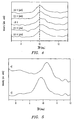
- Figure 4 represents the in situ X-ray diffractograms recorded during the first discharge (dch)/charge (cha) of a cell using LiBF4 in the electrolyte. The potentials are given vs. Li/Li + .
- Figure 5 represents ex situ X-ray diffractograms for: a) Na-VO x -NT cell cycled 100 times with LiTFSI salt in the electrolyte; b) original Na-VO x NT cell.
- Figure 6 represents a cycling curve of a vanadium oxide nanotube.
- Figure 7 represents the first 75 discharge/charge cycles obtained.
- the present invention relates to the study of vanadium oxide nanotubes (VO x- NTs) in a lithium-ion battery context. Without limiting its scope, the present invention relates generally to the use of VO x -NTs, and specifically to the use of as-synthesized (primary alkylamines as templating molecules) or cation-substituted VO x -NTs, as electrodes in a rechargeable lithium battery. In an earlier report VO x -NTs showed poor performance as cathode material with rapidly decreasing capacity [Spahr et. al., J. Electrochem. Soc., 146, 2780 (1999)]. The present invention overcomes this problem by providing stable or increasing capacity while cycling.
- the present invention improves on the prior art by employing improved methods of electrode synthesis, cation exchange, and choice of electrolytes than those taught by the prior art.
- the differences which exist between some embodiments of the present invention and the teachings of Spahr et. al. include, the use of hexadecylamine as templating molecule by Spahr. et. al., compared to dodecylamine used in the present invention, use of a higher percentage of vanadium oxide nanotubes in the electrode of the present invention compared to the teachings of Spahr et. al., and a choice of electrolyte different from the one taught by Spahr et. al.
- the present invention further improves on the prior art by displaying higher charge capacities, both initially and post-cycling.
- the VO x -NTs are prepared by the method of Krumeich et al. [ J . Am. Chem. Soc., 121, 8324 (1999)]. Specifically, Vanadium triisopropoxide ((CH 3 ) 2 CHO) 3 VO; (Aldrich)) is used as precursor, and the primary amines hexadecylamine, C 16 H 33 NH 2 , and dodecylamine, C 12 H 25 NH 2 (99%, Aldrich), are used as templating molecules.
- Vanadium triisopropoxide ((CH 3 ) 2 CHO) 3 VO; (Aldrich)
- the primary amines of the templating molecules can be readily exchanged by various metal cations without destroying the tubular structure.
- the metal ions that may be used in the exchange process are Mn 2+ , Mg 2+ , Ca 2+ , Fe 2+ , Fe 3+ , and Na + inter alia.
- the VO x -NT powder is admixed with carbon black (Shawinigan Black) and EPDM (Ethylene Propylene Diene Terpolymer) binder (5% by weight in solvent, a preferred solvent being cyclohexane).
- carbon black Shawinigan Black
- EPDM Ethylene Propylene Diene Terpolymer
- a preferred composition of the resulting admixture is 60-90% by weight of VO x -NT powder, 4-30% by weight of carbon black, and 2-20% by weight of EPDM binder.
- a second preferred composition of the resulting admixture is 70-85% by weight of VO x -NT powder, 5-20% by weight of carbon black, and 5-15% by weight of EPDM binder.
- a more preferred composition of the admixture is 80% by weight of VO x -NT powder, 10% by weight of carbon black, and 10% by weight of EPDM binder.
- the VO x -NT powder, carbon black, and EPDM binder can be admixed to give a final proportion of 80:15:5 by weight.
- EPDM binder can be substituted with polyvinylidene fluoride (PVDF). PVDF is a commonly used binder material for lithium-ion batteries, which can be substituted in place of EPDM without significantly affecting the performance of the electrode material.
- two-electrode cells are manufactured in a glove box, using VO x -NTs as working electrodes and lithium foil as counter electrodes.
- the electrode comprising VO x -NTs serves as a cathode, and an electrode comprising lithium serves as an anode.
- a glass fibre separator soaked in electrolyte separates the two electrodes.
- the electrolyte consists of a 1 M solution of lithium salt dissolved in solvents selected from a group consisting of ethylene carbonate (EC), dimethyl carbonate (DMC), propylene carbonate (PC), ethylmethyl carbonate (EMC), 1,2-dimethoxyethane (DME), diethyl carbonate (DEC), and mixtures thereof.
- solvents selected from a group consisting of ethylene carbonate (EC), dimethyl carbonate (DMC), propylene carbonate (PC), ethylmethyl carbonate (EMC), 1,2-dimethoxyethane (DME), diethyl carbonate (DEC), and mixtures thereof.
- the electrolyte is prepared by dissolving a 1 M solution of lithium salt in a mixture of ethylene carbonate and dimethyl carbonate, at a respective ratio of 2:1 by volume (Selectipur®, Merck).
- lithium salts are individually used namely, LiBF 4 (Battery grade, Tomiyama), LiPF 6 (Selectipur®, Merck) and the imide salt LiN(CF 3 SO 2 ) 2 (LiTFSI) (3M Industrial Chemistry Products Division).
- the solvents are used as received, while the salts are dried at 120°C under vacuum in the glove box prior to use.
- the laminates are packed in a polymer coated aluminum bag, evacuated and sealed.
- all two-electrode cells are galvanostatically cycled using a Digatron BTS-600 battery testing system.
- the cells are cycled between 1.8 and 3.5 V (vs. Li/Li + ) with a current loading ranging from 25 mA/g to 100 mA/g.
- the potential range is chosen on the basis of earlier reported cycling for V 2 O 5 [Winter t. al., Adv. Mater., 10, 725 (1998)].
- X-ray diffraction (XRD) on the powders is performed on a SIEMENS 5000 diffractometer (CuKx radiation).
- In situ and ex situ XRD measurements are made in transmission mode using a STOE & CIE GmbH STADI powder diffractometer (CuKx radiation), fitted with a position-sensitive detector.
- the in situ cell is charged and discharged potentiostatically using a MacPilellTM cycling system. The cell is allowed to equilibrate before each diffraction pattern was recorded.
- the ex situ measurements are made on electrodes that had been removed from the cells, rinsed in DMC and finally vacuum-sealed in a polymer coated aluminum bag.
- a diffractogram for a non-cycled electrode is also recorded as a reference.
- the morphology of the material is investigated by transmission electron microscopy (TEM). The characterization is performed on a JEOL 2000 FXll TEM with a 200kV working voltage.
- the rechargeable battery of the present invention may be used as a power source for any and all portable electronic devices, including without limitation, cellular phones, camcorders, lap top computers, radios, compact disc players, audio and video cassette players, pagers, and handheld personal digital assistant (PDA) devices.
- portable electronic devices including without limitation, cellular phones, camcorders, lap top computers, radios, compact disc players, audio and video cassette players, pagers, and handheld personal digital assistant (PDA) devices.
- PDA personal digital assistant
- the XRD patterns for the as-made materials showed regular OOl-type reflections at 28 ⁇ 20° generated by the regular interlayer distances of the tube walls as seen in Figure 1.
- the distances are directly related to the length of the carbon chain of the templating primary amine [Krumeich et al., J. Am. Chem. Soc., 121, 8324 (1999)].
- the 001-peak represents the peak at the lowest 2 ⁇ value.
- the 001-peak is shifted towards higher 2 ⁇ indicating a decrease in interlayer distance as seen in Figure 1.
- the layer separations for Na + -exchanged tubes Na-VO x -NTs, notation as in [Krumeich et al., J. Am. Chem.
- TEM micrographs confirm the tubular morphology of the material as seen in Figure 2. The images also confirm that the tubular structure is preserved after substitution by Na + -ion.
- Cells comprising both the as-synthesized (C12- and C16-VO x -NTs), and the Na-exchanged material show reversible charge and discharge cycles.
- the discharge/charge curves of the Na-exchanged materials are continuous with a tendency to a plateau at 2.5 V as seen in the inset of Figure 3.
- the absence of staging is common for amorphous and non-crystalline materials.
- the capacities are comparable to the theoretic capacities for other vanadium oxide materials.
- the materials with embedded amine molecules generally have lower capacities than the Na + -exchanged material, probably mostly due to their higher molecular weight.
- the cell performance is closely dependent on which salt is used in the electrolyte.
- Cells made with LiBF 4 and LiPF 6 containing electrolytes show increasing capacities over time as seen in Figure 3. The capacity seems to arrive at a maximum level at which point it levels off.
- the current loading used for this investigation (50 mA/g) corresponds to a discharge rate of 1.5-2 h initially and 3-4 h at the maximum capacity.
- a diagrammatic representation of the first 75 discharge/cycles is shown in Figure 7.
- LiTFSI salt has a superior thermal and hydrolytic stability.
- the practical use of LiTFSI salt has been limited since it has proved to cause severe corrosion of the aluminum current collector at high potentials.
- the salt has corrosion current pitting potential of 3.55 V (vs Li/Li + ). There may be a possibility that the decrease in capacity of the cells cycled with TFSI-electrolyte is due to corrosion of the current collector, although the cells were cycled above 3.5 V.
Landscapes
- Chemical & Material Sciences (AREA)
- Engineering & Computer Science (AREA)
- Chemical Kinetics & Catalysis (AREA)
- Electrochemistry (AREA)
- General Chemical & Material Sciences (AREA)
- Nanotechnology (AREA)
- General Physics & Mathematics (AREA)
- Condensed Matter Physics & Semiconductors (AREA)
- Composite Materials (AREA)
- Materials Engineering (AREA)
- Crystallography & Structural Chemistry (AREA)
- Physics & Mathematics (AREA)
- Manufacturing & Machinery (AREA)
- Secondary Cells (AREA)
- Battery Electrode And Active Subsutance (AREA)
- Inorganic Compounds Of Heavy Metals (AREA)
- Ceramic Capacitors (AREA)
Abstract
Description
- This invention relates to the use of vanadium oxide nanotubes as electrode material in a rechargeable lithium battery.
- Vanadium oxides have a long history as potential electrode materials for rechargeable lithium batteries due to their ability to insert large amounts of lithium [Winter et. al., Adv Mater., 10, 725 (1998); Chung et. al., J. Power Sources, 84, 6 (1999); Shembel et. al., J. Power Sources, 81-82, 480 (1999); Lee et. al., J. Electrochem. Soc., 142, L102 (1995); Pistoia et. al., Solid State lonics, 13, 311 (1984)]. Different synthesizing and preparation methods have been developed to achieve higher specific capacities and longer cycle life [Chung et. al., J. Power Sources, 84, 6 (1999); Shembel et. al., J. Power Sources, 81-82, 480 (1999)]. Promising results have been reported for amorphous low-crystalline
materials e.g. V 205 xerogels and aerogels [Lee et. al., J. Electrochem. Soc., 142, L102 (1995]. Another material that has demonstrated large capacities as a cathode material is the vanadate Lix+1V3O8 [Winter et. al., Adv. Mater., 10, 725 (1998); Shembel et. al., J. Power Sources, 81-82, 480 (1999)]. - The synthesis of vanadium oxide nanotubes (VOx-NTs) by a ligand assisted templating approach has recently been described by Spahr et al. [Angew. Chem. lnt. Ed. Engl., 37, 1263 (1998)]. The tubes consist of several vanadium oxide layers, commonly in a scroll-like arrangement, separated by structure-directing agents (templates). The tubes can be up to 15 µm long and consist of as many as 30 vanadium oxide layers. The outer and inner diameters vary between 15 to 100 nm and 5 to 50 nm respectively. The size depends on the precursors chosen for the synthesis and can therefore be controlled in a rough manner [Krumeich et. al., J. Am. Chem. Soc., 121, 8324 (1999)].
- The synthesis is performed with e.g. primary alkylamines as templating molecules. The embedded amine molecules can then readily be exchanged by various metal cations, i.e. alkaline, alkaline earth and transition metals, under preservation of the tubular morphology [Reinoso et. al., Helv. Chim. Acta., 83, 1724 (2000)]. This property gives a unique opportunity to design tailor-made functional materials. However, attempts to substitute the amine by lithium-ions have so far not been successful [Reinoso et. al., Helv. Chim. Acta., 83, 1724 (2000)].
- The investigations into these types of inorganic nanotubes, e.g. dichalchogenides and oxides, has increased rapidly over the last decade [W. Tremel, Angew. Chem. Int. Ed., 38, 2175 (1999)]. Redox-active tubes, containing transition metals, are naturally of fundamental interest for both catalytical and electrochemical purposes.
- A method for the preparation of separable vanadium oxide nanotubes is discussed in PCT publication, WO9826871 by Nesper et. al., which recently issued as US 6,210,800.
- Spahr et. al. [J. Electrochem. Soc., 146, 2780-83 (1999)] teach the electrochemical characteristics of vanadium oxide nanotubes, studied with electrodes consisting of a mixture of vanadium oxide nanotubes and teflonised carbon black, each representing 50% of the mixture. Cyclic voltammograms of templated vanadium oxide nanotubes recorded at 50 µV/s in 1 M LiClO4 in propylene carbonate, displayed a stable specific charge of about 120 mAh/g, obtained for the Li+ insertion during the first five cycles of voltammetric measurements. Thereafter, the specific charge gradually decreases with increasing cycle number to less than 100 mAh/g after ten cycles.
- The present invention provides an improved vanadium oxide electrode, which employs improved methods of electrode synthesis, cation exchange, and choice of electrolytes than those taught in the prior art. Numerous differences exist between the present invention and the teachings of Spahr et. al. The present invention therefore, represents an improvement over the prior art.
- According to a first aspect of the present invention, there is provided a method for preparing a vanadium oxide nanotube electrode, the method comprising: admixing a particulate form of vanadium oxide nanotubes with carbon black and EPDM binder; stirring the particulate admixture of vanadium oxide nanotubes, carbon black and EPDM binder; spreading the stirred particulate admixture onto a surface; extracting electrodes from the spread particulate admixture; and drying the extracted electrodes.
- According to a second aspect of the present invention, there is provided a vanadium oxide nanotube electrode prepared by a method, the method comprising: admixing a particulate form of vanadium oxide nanotubes with carbon black and EPDM binder; stirring the particulate admixture of vanadium oxide nanotubes, carbon black and EPDM binder; spreading the stirred particulate admixture onto a surface; extracting electrodes from the spread particulate admixture; and drying the extracted electrodes.
- According to a third aspect of the present invention, there is provided a rechargeable lithium battery comprising at least one lithium anode, at least one vanadium oxide nanotube cathode, and an electrolyte comprising a solution of a lithium salt in a solvent, wherein said vanadium oxide nanotube cathode is prepared by the method of the first aspect.
- The following drawings form part of the present specification and are included to further demonstrate certain aspects of the present invention. The invention may be better understood by reference to one or more of these drawings in combination with the detailed description of the invention presented herein.
- Figure 1 represents X-ray powder diffractograms for C16-VOx-NTs, C12-VOx-NTs and Na-VOx-NTs. The inset displays the inter-layer distances as derived from X-ray diffraction results.
- Figure 2 represents Transmission Electron Micrographs showing the tubular structure of the VOx-NTs. The micrograph on the left shows Na-VOx-NTs. The micrograph on the right shows a vanadium oxide nanotube with hexadecylamine as templating molecule.
- Figure 3 represents the discharge capacities for cells cycled with three different salt in the electrolytes; LiTFSI (o), LiBF4 (Δ), LiPF6 (□). The inset displays its first discharge/charge cycle for the cell cycled with LiTFSI-electrolyte. The potential is given vs. Li/Li+.
- Figure 4 represents the in situ X-ray diffractograms recorded during the first discharge (dch)/charge (cha) of a cell using LiBF4 in the electrolyte. The potentials are given vs. Li/Li+.
- Figure 5 represents ex situ X-ray diffractograms for: a) Na-VOx-NT cell cycled 100 times with LiTFSI salt in the electrolyte; b) original Na-VOx NT cell.
- Figure 6 represents a cycling curve of a vanadium oxide nanotube.
- Figure 7 represents the first 75 discharge/charge cycles obtained.
- The present invention relates to the study of vanadium oxide nanotubes (VOx-NTs) in a lithium-ion battery context. Without limiting its scope, the present invention relates generally to the use of VOx-NTs, and specifically to the use of as-synthesized (primary alkylamines as templating molecules) or cation-substituted VOx-NTs, as electrodes in a rechargeable lithium battery. In an earlier report VOx-NTs showed poor performance as cathode material with rapidly decreasing capacity [Spahr et. al., J. Electrochem. Soc., 146, 2780 (1999)]. The present invention overcomes this problem by providing stable or increasing capacity while cycling. In addition, the present invention improves on the prior art by employing improved methods of electrode synthesis, cation exchange, and choice of electrolytes than those taught by the prior art. Indeed, the differences which exist between some embodiments of the present invention and the teachings of Spahr et. al. include, the use of hexadecylamine as templating molecule by Spahr. et. al., compared to dodecylamine used in the present invention, use of a higher percentage of vanadium oxide nanotubes in the electrode of the present invention compared to the teachings of Spahr et. al., and a choice of electrolyte different from the one taught by Spahr et. al. As discussed in detail herein, the present invention further improves on the prior art by displaying higher charge capacities, both initially and post-cycling.
- In a preferred embodiment of the invention, the VOx-NTs are prepared by the method of Krumeich et al. [J. Am. Chem. Soc., 121, 8324 (1999)]. Specifically, Vanadium triisopropoxide ((CH3)2CHO)3VO; (Aldrich)) is used as precursor, and the primary amines hexadecylamine, C16H33 NH2, and dodecylamine, C12H25 NH2 (99%, Aldrich), are used as templating molecules. A solution of vanadium precursor and a primary amine in a molar ratio of 2:1 in absolute ethanol (3 mL/g) is stirred under inert atmosphere for 1 hour. The resulting yellow solution of the alkoxide-amine adduct was hydrolysed with water (5 mL/g of vanadium precursor) under vigorous stirring. After aging (12-96 hours), an orange composite of surfactant and hydrolyzed vanadium oxide component was obtained. The hydrothermal reaction of this composite in an autoclave at 180°C (2-7 days) results in a black powder, consisting of vanadium oxide nanotubes with embedded hexadecylamine or dodecylamine (C16-VOX-NTs or C12-VOX-NTs, notations as in [Krumeich et al., J. Am. Chem. Soc., 121, 8324 (1999)]). The resulting product is washed with ethanol and hexane to remove residues of unreacted amine or decomposition products and then dried under vacuum at 80°C for >12 h.
- In a preferred embodiment of the invention, the primary amines of the templating molecules can be readily exchanged by various metal cations without destroying the tubular structure. Without limiting the scope of the invention, the metal ions that may be used in the exchange process are Mn2+, Mg2+, Ca2+, Fe2+, Fe3+, and Na+ inter alia.
- Substitution by Na-ions is performed with C12-VOX-NTs which have proved to be the best starting material for exchange reactions. [Krumeich et al., J. Am. Chem. Soc., 121, 8324 (1999)]. The Na+exchange is performed as described by Krumeich et al. [J. Am. Chem. Soc., 121, 8324 (1999)] using NaCl salt (puriss., Kebo). Specifically, the exchange reactions are performed by stirring a suspension of nanotubes (about 100 mg) in 25 mL of ethanol with an excess of the exchanging NaCl salt for 12 hours at room temperature. Following substitution by Na-ions, the material is dried under vacuum at 80°C for 12 hours.
- In a preferred embodiment of the invention, the VOx-NT powder is admixed with carbon black (Shawinigan Black) and EPDM (Ethylene Propylene Diene Terpolymer) binder (5% by weight in solvent, a preferred solvent being cyclohexane). A preferred composition of the resulting admixture is 60-90% by weight of VOx-NT powder, 4-30% by weight of carbon black, and 2-20% by weight of EPDM binder. A second preferred composition of the resulting admixture is 70-85% by weight of VOx-NT powder, 5-20% by weight of carbon black, and 5-15% by weight of EPDM binder. A more preferred composition of the admixture is 80% by weight of VOx-NT powder, 10% by weight of carbon black, and 10% by weight of EPDM binder. In yet another embodiment of the invention, the VOx-NT powder, carbon black, and EPDM binder can be admixed to give a final proportion of 80:15:5 by weight. In one embodiment of the invention, EPDM binder can be substituted with polyvinylidene fluoride (PVDF). PVDF is a commonly used binder material for lithium-ion batteries, which can be substituted in place of EPDM without significantly affecting the performance of the electrode material. The mixture is stirred on a magnetic stirrer for twenty four (24) hours after which the slurry is spread evenly onto a graphitised aluminum foil. Circular electrodes (20 mm in diameter) are punched out and dried under vacuum at 120°C for >12 h in an argon-filled glove box (O2 /H2O <1 ppm) prior to use.
- In a preferred embodiment of the invention, two-electrode cells are manufactured in a glove box, using VOx-NTs as working electrodes and lithium foil as counter electrodes. In a preferred embodiment of the invention, the electrode comprising VOx-NTs serves as a cathode, and an electrode comprising lithium serves as an anode. A glass fibre separator soaked in electrolyte separates the two electrodes. In a preferred embodiment of the invention, the electrolyte consists of a 1 M solution of lithium salt dissolved in solvents selected from a group consisting of ethylene carbonate (EC), dimethyl carbonate (DMC), propylene carbonate (PC), ethylmethyl carbonate (EMC), 1,2-dimethoxyethane (DME), diethyl carbonate (DEC), and mixtures thereof. In a preferred embodiment of the invention, the electrolyte is prepared by dissolving a 1 M solution of lithium salt in a mixture of ethylene carbonate and dimethyl carbonate, at a respective ratio of 2:1 by volume (Selectipur®, Merck).
- In a preferred embodiment of the invention, three different lithium salts are individually used namely, LiBF4 (Battery grade, Tomiyama), LiPF6 (Selectipur®, Merck) and the imide salt LiN(CF3SO2)2 (LiTFSI) (3M Industrial Chemistry Products Division). The solvents are used as received, while the salts are dried at 120°C under vacuum in the glove box prior to use. The laminates are packed in a polymer coated aluminum bag, evacuated and sealed.
- In a preferred embodiment of the invention, all two-electrode cells are galvanostatically cycled using a Digatron BTS-600 battery testing system. The cells are cycled between 1.8 and 3.5 V (vs. Li/Li+) with a current loading ranging from 25 mA/g to 100 mA/g. The potential range is chosen on the basis of earlier reported cycling for V2 O5 [Winter t. al., Adv. Mater., 10, 725 (1998)].
- In a preferred embodiment of the invention, X-ray diffraction (XRD) on the powders is performed on a SIEMENS 5000 diffractometer (CuKx radiation). In situ and ex situ XRD measurements are made in transmission mode using a STOE & CIE GmbH STADI powder diffractometer (CuKx radiation), fitted with a position-sensitive detector. The in situ cell is charged and discharged potentiostatically using a MacPilell™ cycling system. The cell is allowed to equilibrate before each diffraction pattern was recorded. The ex situ measurements are made on electrodes that had been removed from the cells, rinsed in DMC and finally vacuum-sealed in a polymer coated aluminum bag. A diffractogram for a non-cycled electrode, is also recorded as a reference. The morphology of the material is investigated by transmission electron microscopy (TEM). The characterization is performed on a JEOL 2000 FXll TEM with a 200kV working voltage.
- Without limiting its scope, the rechargeable battery of the present invention may be used as a power source for any and all portable electronic devices, including without limitation, cellular phones, camcorders, lap top computers, radios, compact disc players, audio and video cassette players, pagers, and handheld personal digital assistant (PDA) devices.
- The XRD patterns for the as-made materials showed regular OOℓ-type reflections at 28<20° generated by the regular interlayer distances of the tube walls as seen in Figure 1. The distances are directly related to the length of the carbon chain of the templating primary amine [Krumeich et al., J. Am. Chem. Soc., 121, 8324 (1999)]. The 001-peak represents the peak at the lowest 2θ value. For cation substituted material the 001-peak is shifted towards higher 2θ indicating a decrease in interlayer distance as seen in Figure 1. The layer separations for Na+-exchanged tubes (Na-VOx-NTs, notation as in [Krumeich et al., J. Am. Chem. Soc., 121, 8324 (1999)]) vary between 9.6 Å and 11 Å. The variations can possibly be caused by small rearrangements of the structure within the VOx-layers that occurs over time. The tubular structure is, however, preserved.
- The peaks at 2θ>20°, probably corresponding to hk0 reflections, show no such shift for the three VOx-NT materials suggesting that the intralayer structure is the same, regardless of which molecules are embedded. The exact atomic structure within the layers has not yet been resolved.
- TEM micrographs confirm the tubular morphology of the material as seen in Figure 2. The images also confirm that the tubular structure is preserved after substitution by Na+-ion.
- Cells comprising both the as-synthesized (C12- and C16-VOx-NTs), and the Na-exchanged material show reversible charge and discharge cycles. The discharge/charge curves of the Na-exchanged materials are continuous with a tendency to a plateau at 2.5 V as seen in the inset of Figure 3. The absence of staging is common for amorphous and non-crystalline materials. The capacities are comparable to the theoretic capacities for other vanadium oxide materials. The materials with embedded amine molecules generally have lower capacities than the Na+-exchanged material, probably mostly due to their higher molecular weight.
- The cell performance is closely dependent on which salt is used in the electrolyte. Cells made with LiBF4 and LiPF6 containing electrolytes show increasing capacities over time as seen in Figure 3. The capacity seems to arrive at a maximum level at which point it levels off. The discharge/charge cycling curve for one cycle when using vanadium oxide nanotubes with LiTFSI is shown in Figure 6. After 15 cycles the specific capacities have reached 160 mAh/g for LiBF4 and 135 mAh/g for LiPF6 salt. After 30 cycles the capacities are 170 mAh/g and 155 mAh/g respectively. This can be compared to the theoretical capacity for LixV2O5 which is 147 mAh/g (x=1). The current loading used for this investigation (50 mA/g) corresponds to a discharge rate of 1.5-2 h initially and 3-4 h at the maximum capacity. A diagrammatic representation of the first 75 discharge/cycles is shown in Figure 7.
- Na-VOx-NT electrodes cycled with LiTFSI salt show a totally different behavior as seen in Figure 3. The capacity is initially at a high level, around 250 mAh/g, and then slowly decreases. After 100 cycles the capacities have dropped to approximately around 170 mAh/g, which corresponds to a decrease of approximately 30% from the initial value. A current load of 50 mA/g corresponds, in this case, to a discharge rate of approximately C/4 i.e., a discharge time of four (4) hours. Compared to LiPF6 salt, LiTFSI has a superior thermal and hydrolytic stability. However, the practical use of LiTFSI salt has been limited since it has proved to cause severe corrosion of the aluminum current collector at high potentials. The salt has corrosion current pitting potential of 3.55 V (vs Li/Li+). There may be a possibility that the decrease in capacity of the cells cycled with TFSI-electrolyte is due to corrosion of the current collector, although the cells were cycled above 3.5 V.
- The theoretical capacity for C12-VOx-NTs and Na-VOx-NTs can be roughly estimated based on the elemental compositions reported by Reinoso et. al. For C12-VOx-NTs the theoretical capacity, calculated for transfer of one electron per vanadium atom, would be approximately 191 mAh/g, when cycled with LiTFSI. Under the same conditions, the theoretical capacity for Nax-VOx-NTs would be 224 mAh/g . This implies that all of the vanadium in the oxide layers is involved in the origination of the capacity, or alternatively that more than one electron per vanadium atom is being transferred.
- The key to the successful cycling of VOx-NT electrodes can be partly attributed to the preparative procedure. Other possible reasons for the successful cycling are choice of voltage range, choice of salt and solvent in the electrolyte, and the relative proportions of the VOx-NT, carbon black and EPDM binder used in the synthesis of the electrodes. Packing the cells in the polymer coated aluminum bags simulates the environment in a real lithium-ion battery and securely separates the components from the normal atmosphere.
- According to the in situ XRD measurements of a Na-VOx-NT electrode during the first cycle, in LiBF4 electrolyte, no large structural changes occur during charge and discharge. The peak with highest intensity, that is the 001-reflection, was carefully studied at different potentials (Figure 4). The peak position did not shift significantly, indicating that the interlayer distances do not change notably during cycling. There seems to be a reversible peak appearing at around 10.5° in 2θ, reaching its maximum intensity at the fully discharged state as seen in Figure 4. This might be caused by small rearrangement in the interlayer structure due to the oxidation/reduction of vanadium.
- Diffraction measurements were also made ex situ on cells that had been used for 100 cycles. The diffractogram for a Na-VOx-NT electrode cycled with LiTFSI salt in the electrolyte is displayed in Figure 5, along with a diffractogram for an original Na-VOx-NT electrode (not cycled). The 001-reflection was clearly visible even after 100 cycles, indicating that the tubular structure remains intact, at least to a large extent. The peak shifted from 9.9° in 2θ for the original electrode to 10.3° in 2θ for the cycled electrode, corresponding to a decrease in interlayer distance of approximately 0.35 Å. This might again be an effect of small rearrangements in the interlayer structure while cycling. No additional peaks could be seen in the diffractograms, confirming that no large rearrangements of the structure occurs even after prolonged cycling.
Claims (24)
- A method for preparing a vanadium oxide nanotube electrode, the method comprising:admixing a particulate form of vanadium oxide nanotubes with carbon black and EPDM (Ethylene Propylene Diene Terpolymer) binder;stirring the particulate admixture of vanadium oxide nanotubes, carbon black and EPDM binder;spreading the stirred particulate admixture onto a surface;extracting electrodes from the spread particulate admixture; anddrying the extracted electrodes.
- The method of claim 1 wherein said particulate admixture comprises 60-90% by weight of vanadium oxide nanotubes, 4-30% by weight of carbon black, and 2-20% by weight of EPDM binder.
- The method of claim 1 wherein said particulate admixture comprises 70-85% by weight of vanadium oxide nanotubes, 5-20% by weight of carbon black, and 5-15% by weight of EPDM binder.
- The method of claim 3 wherein said particulate admixture preferably comprises 80% by weight of vanadium oxide nanotubes, 10% by weight of carbon black and 10% by weight of EPDM binder.
- The method of claim 3 wherein said particulate admixture preferably comprises 80% by weight of vanadium oxide nanotubes, 15% by weight of carbon black and 5% by weight of EPDM binder.
- The method of claim 1 wherein the EPDM binder is present in a solvent.
- The method of claim 6 wherein the concentration of said EPDM binder in said solvent is 5% by weight.
- The method of claim 6 wherein said solvent is cyclohexane.
- The method of claim 1 wherein said particulate admixture is stirred on a magnetic stirrer for twenty four hours, and spread onto graphitised aluminium foil.
- The method of claim 1 wherein said extracted electrodes are dried under vacuum.
- The method of claim 10 wherein said extracted electrodes are dried at about 120°C, for at least twelve hours in an argon-filled glove box.
- The method of claim 1 wherein said vanadium oxide nanotubes comprise metal ions selected from the group consisting of Mn2+, Mg2+, Ca2+, Fe2+, Fe3+, and Na+ ions.
- The method of claim 1 wherein said vanadium oxide nanotubes comprise hexadecylamine.
- The method of claim 1 wherein said vanadium oxide nanotubes comprise dodecylamine..
- A vanadium oxide nanotube electrode prepared by a method, the method comprising:admixing a particulate form of vanadium oxide nanotubes with carbon black and EPDM binder;stirring the particulate admixture of vanadium oxide nanotubes, carbon black and EPDM binder;spreading the stirred particulate admixture onto a surface;extracting electrodes from the spread particulate admixture; anddrying the extracted electrodes.
- The electrode of claim 15 wherein said particulate admixture comprises 60-90% by weight of vanadium oxide nanotubes, 4-30% by weight of carbon black, and 2-20% by weight of EPDM binder.
- The electrode of claim 15 wherein said particulate admixture comprises 70-85% by weight of vanadium oxide nanotubes, 5-20% by weight of carbon black, and 5-15% by weight of EPDM binder.
- The electrode of claim 15 wherein said particulate admixture comprises vanadium oxide nanotubes, carbon black and EPDM binder at 80:10:10 by weight respectively.
- The electrode of claim 15 wherein said particulate admixture comprises vanadium oxide nanotubes, carbon black and EPDM binder at 80:15:5 by weight respectively.
- The electrode of claim 15 wherein said vanadium oxide nanotubes comprise metal ions selected from the group consisting of Mn2+, Mg2+, Ca2+ , Fe2+, Fe3+, and Na+ ions.
- The electrode of claim 15 wherein said vanadium oxide nanotubes comprise hexadecylamine.
- The electrode of claim 15 wherein said vanadium oxide nanotubes comprise dodecylamine.
- A rechargeable lithium battery comprising at least one lithium anode, at least one vanadium oxide nanotube cathode, and an electrolyte comprising a solution of a lithium salt in a solvent, wherein said vanadium oxide nanotube cathode is prepared by the method of claim 1.
- A rechargeable lithium battery comprising at least one lithium anode, at least one vanadium oxide nanotube cathode, and an electrolyte comprising a solution of lithium salt in a solvent, wherein said vanadium oxide nanotube cathode is the electrode of claim 15.
Applications Claiming Priority (5)
| Application Number | Priority Date | Filing Date | Title |
|---|---|---|---|
| US872689 | 1997-06-11 | ||
| US25925500P | 2000-12-28 | 2000-12-28 | |
| US259255P | 2000-12-28 | ||
| US09/872,689 US6653022B2 (en) | 2000-12-28 | 2001-05-31 | Vanadium oxide electrode materials and methods |
| PCT/EP2001/015223 WO2002054508A2 (en) | 2000-12-28 | 2001-12-21 | Vanadium oxide electrode materials and method for their production |
Publications (2)
| Publication Number | Publication Date |
|---|---|
| EP1348238A2 EP1348238A2 (en) | 2003-10-01 |
| EP1348238B1 true EP1348238B1 (en) | 2006-05-17 |
Family
ID=26947190
Family Applications (1)
| Application Number | Title | Priority Date | Filing Date |
|---|---|---|---|
| EP01985435A Expired - Lifetime EP1348238B1 (en) | 2000-12-28 | 2001-12-21 | Vanadium oxide electrode materials and method for their production |
Country Status (6)
| Country | Link |
|---|---|
| US (1) | US6653022B2 (en) |
| EP (1) | EP1348238B1 (en) |
| AT (1) | ATE326771T1 (en) |
| AU (1) | AU2002234599A1 (en) |
| DE (1) | DE60119783D1 (en) |
| WO (1) | WO2002054508A2 (en) |
Cited By (1)
| Publication number | Priority date | Publication date | Assignee | Title |
|---|---|---|---|---|
| RU2522011C1 (en) * | 2013-01-09 | 2014-07-10 | Открытое акционерное общество "Энергопром-Новочеркасский электродный завод" (ООО "Энергопром-НЭЗ") | Method of producing graphitised articles and apparatus for realising said method |
Families Citing this family (15)
| Publication number | Priority date | Publication date | Assignee | Title |
|---|---|---|---|---|
| AU2002324420A1 (en) * | 2001-02-12 | 2002-12-23 | Elena Mardilovich | Precursors of engineered powders |
| US7341498B2 (en) * | 2001-06-14 | 2008-03-11 | Hyperion Catalysis International, Inc. | Method of irradiating field emission cathode having nanotubes |
| CA2531628A1 (en) * | 2003-07-09 | 2005-02-10 | Hyperion Catalysis International, Inc. | Field emission devices made with laser and/or plasma treated carbon nanotube mats, films or inks |
| CN100547707C (en) * | 2004-10-25 | 2009-10-07 | 中国科学院电工研究所 | A kind of supercapacitor and its manufacturing method |
| FR2880198B1 (en) * | 2004-12-23 | 2007-07-06 | Commissariat Energie Atomique | NANOSTRUCTURED ELECTRODE FOR MICROBATTERY |
| EP1858809A1 (en) * | 2005-03-02 | 2007-11-28 | St. Jude Medical AB | Metal-vanadium-oxide-product and producing process |
| CN100377395C (en) * | 2006-01-19 | 2008-03-26 | 同济大学 | A kind of preparation method of nanocomposite lithium ion battery cathode material |
| KR100806678B1 (en) | 2006-07-13 | 2008-02-26 | 연세대학교 산학협력단 | Method for manufacturing carbon nanotube / metal oxide nanocomposite electrode prepared by electrochemical method |
| US7816034B2 (en) * | 2007-08-09 | 2010-10-19 | Mcgervey Donald L | High-power battery |
| US8389157B2 (en) * | 2008-02-22 | 2013-03-05 | Alliance For Sustainable Energy, Llc | Oriented nanotube electrodes for lithium ion batteries and supercapacitors |
| US8225641B2 (en) * | 2008-08-20 | 2012-07-24 | Headwaters Technology Innovation, Llc | Nanofibers and methods of making same and using same in humidity sensors |
| CN103413916B (en) * | 2013-05-17 | 2015-05-20 | 安阳工学院 | Polypyrrole-modified lithium vanadium oxide nanotube of lithium-ion battery cathode material and preparation method of nanotube |
| US9887419B2 (en) | 2013-08-26 | 2018-02-06 | Samsung Electronics Co., Ltd. | Active material, method of preparing the active material electrode including the active material, and secondary battery including the electrode |
| US11251430B2 (en) | 2018-03-05 | 2022-02-15 | The Research Foundation For The State University Of New York | ϵ-VOPO4 cathode for lithium ion batteries |
| CN114901596B (en) * | 2020-08-26 | 2024-01-30 | 安比莱特 | Vanadium oxide with VOX molecular formula used as charge balancing material for electrochromic devices |
Family Cites Families (3)
| Publication number | Priority date | Publication date | Assignee | Title |
|---|---|---|---|---|
| CH690720A5 (en) | 1996-12-18 | 2000-12-29 | Eidgenoess Tech Hochschule | Nanotubes, use of such nanotubes as well as methods for their preparation. |
| US5895733A (en) | 1997-02-03 | 1999-04-20 | Medtronic, Inc. | Synthesis method for silver vanadium oxide |
| US5952125A (en) | 1997-07-21 | 1999-09-14 | Nanogram Corporation | Batteries with electroactive nanoparticles |
-
2001
- 2001-05-31 US US09/872,689 patent/US6653022B2/en not_active Expired - Lifetime
- 2001-12-21 EP EP01985435A patent/EP1348238B1/en not_active Expired - Lifetime
- 2001-12-21 AU AU2002234599A patent/AU2002234599A1/en not_active Abandoned
- 2001-12-21 AT AT01985435T patent/ATE326771T1/en not_active IP Right Cessation
- 2001-12-21 DE DE60119783T patent/DE60119783D1/en not_active Expired - Lifetime
- 2001-12-21 WO PCT/EP2001/015223 patent/WO2002054508A2/en not_active Ceased
Cited By (1)
| Publication number | Priority date | Publication date | Assignee | Title |
|---|---|---|---|---|
| RU2522011C1 (en) * | 2013-01-09 | 2014-07-10 | Открытое акционерное общество "Энергопром-Новочеркасский электродный завод" (ООО "Энергопром-НЭЗ") | Method of producing graphitised articles and apparatus for realising said method |
Also Published As
| Publication number | Publication date |
|---|---|
| US20020086212A1 (en) | 2002-07-04 |
| AU2002234599A1 (en) | 2002-07-16 |
| US6653022B2 (en) | 2003-11-25 |
| EP1348238A2 (en) | 2003-10-01 |
| WO2002054508A3 (en) | 2003-04-10 |
| WO2002054508A2 (en) | 2002-07-11 |
| DE60119783D1 (en) | 2006-06-22 |
| ATE326771T1 (en) | 2006-06-15 |
Similar Documents
| Publication | Publication Date | Title |
|---|---|---|
| EP2936590B1 (en) | Lmfp cathode materials with improved electrochemical performance | |
| EP1348238B1 (en) | Vanadium oxide electrode materials and method for their production | |
| JP5073164B2 (en) | Method for producing positive electrode active material for lithium secondary battery, and positive electrode active material for lithium secondary battery produced by the production method | |
| JP5843766B2 (en) | Positive electrode active material, positive electrode and non-aqueous secondary battery | |
| CA2778127C (en) | Hydrothermal process for the production of lifepo4 powder | |
| JP5682040B2 (en) | Pyrophosphate compound and method for producing the same | |
| JP6055761B2 (en) | Method for producing positive electrode active material for lithium secondary battery | |
| JP4186507B2 (en) | Carbon-containing lithium iron composite oxide for positive electrode active material of lithium secondary battery and method for producing the same | |
| JP4773964B2 (en) | Boron-substituted lithium insertion compounds, electrode active materials, batteries and electrochromic devices | |
| US20160164095A1 (en) | Positive Electrode Active Material for Secondary Battery | |
| KR20020077554A (en) | Positive active material composition for lithium secondary battery | |
| Chen et al. | Improved kinetics and stabilities in Mg-substituted LiMnPO 4 | |
| EP3534443A1 (en) | Positive electrode active material for potassium ion battery, positive electrode for potassium ion battery, and potassium ion battery | |
| WO2011118302A1 (en) | Active material for battery, and battery | |
| KR20140082635A (en) | Lithiated manganese phosphate and composite material comprising same | |
| KR101948549B1 (en) | Cathode Active Material for Secondary Battery | |
| JP5245201B2 (en) | Negative electrode, secondary battery | |
| KR101233410B1 (en) | Cathode active material for lithium secondary battery, method for preparing same, and lithium battery comprising same | |
| Rojas et al. | Rechargeable sodium-ion battery based on a cathode of copper hexacyanoferrate | |
| KR102075929B1 (en) | TiO2 based oxide composite for lithium secondary battery and manufacturing method the same | |
| JP2012084554A (en) | Anode, secondary battery, and method for manufacturing anode | |
| JP5725000B2 (en) | Battery active material and battery | |
| KR101681545B1 (en) | Positive electrode active material for rechargable lithium battery, method for manufacturing the same, and rechargable lithium battery including the same | |
| WO2025196822A1 (en) | A process of preparing spherical metal phosphates, and implementations thereof | |
| Liu et al. | LiFe 1-x Mn x PO 4/C COMPOSITE AS CATHODE MATERIAL FOR LITHIUM ION BATTERY |
Legal Events
| Date | Code | Title | Description |
|---|---|---|---|
| PUAI | Public reference made under article 153(3) epc to a published international application that has entered the european phase |
Free format text: ORIGINAL CODE: 0009012 |
|
| 17P | Request for examination filed |
Effective date: 20030723 |
|
| AK | Designated contracting states |
Kind code of ref document: A2 Designated state(s): AT BE CH CY DE DK ES FI FR GB GR IE IT LI LU MC NL PT SE TR |
|
| AX | Request for extension of the european patent |
Extension state: AL LT LV MK RO SI |
|
| RAP1 | Party data changed (applicant data changed or rights of an application transferred) |
Owner name: TELEFONAKTIEBOLAGET LM ERICSSON (PUBL) |
|
| 17Q | First examination report despatched |
Effective date: 20050614 |
|
| GRAP | Despatch of communication of intention to grant a patent |
Free format text: ORIGINAL CODE: EPIDOSNIGR1 |
|
| GRAS | Grant fee paid |
Free format text: ORIGINAL CODE: EPIDOSNIGR3 |
|
| GRAA | (expected) grant |
Free format text: ORIGINAL CODE: 0009210 |
|
| AK | Designated contracting states |
Kind code of ref document: B1 Designated state(s): AT BE CH CY DE DK ES FI FR GB GR IE IT LI LU MC NL PT SE TR |
|
| PG25 | Lapsed in a contracting state [announced via postgrant information from national office to epo] |
Ref country code: IT Free format text: LAPSE BECAUSE OF FAILURE TO SUBMIT A TRANSLATION OF THE DESCRIPTION OR TO PAY THE FEE WITHIN THE PRESCRIBED TIME-LIMIT;WARNING: LAPSES OF ITALIAN PATENTS WITH EFFECTIVE DATE BEFORE 2007 MAY HAVE OCCURRED AT ANY TIME BEFORE 2007. THE CORRECT EFFECTIVE DATE MAY BE DIFFERENT FROM THE ONE RECORDED. Effective date: 20060517 Ref country code: FI Free format text: LAPSE BECAUSE OF FAILURE TO SUBMIT A TRANSLATION OF THE DESCRIPTION OR TO PAY THE FEE WITHIN THE PRESCRIBED TIME-LIMIT Effective date: 20060517 Ref country code: CH Free format text: LAPSE BECAUSE OF FAILURE TO SUBMIT A TRANSLATION OF THE DESCRIPTION OR TO PAY THE FEE WITHIN THE PRESCRIBED TIME-LIMIT Effective date: 20060517 Ref country code: AT Free format text: LAPSE BECAUSE OF FAILURE TO SUBMIT A TRANSLATION OF THE DESCRIPTION OR TO PAY THE FEE WITHIN THE PRESCRIBED TIME-LIMIT Effective date: 20060517 Ref country code: BE Free format text: LAPSE BECAUSE OF FAILURE TO SUBMIT A TRANSLATION OF THE DESCRIPTION OR TO PAY THE FEE WITHIN THE PRESCRIBED TIME-LIMIT Effective date: 20060517 Ref country code: NL Free format text: LAPSE BECAUSE OF FAILURE TO SUBMIT A TRANSLATION OF THE DESCRIPTION OR TO PAY THE FEE WITHIN THE PRESCRIBED TIME-LIMIT Effective date: 20060517 Ref country code: LI Free format text: LAPSE BECAUSE OF FAILURE TO SUBMIT A TRANSLATION OF THE DESCRIPTION OR TO PAY THE FEE WITHIN THE PRESCRIBED TIME-LIMIT Effective date: 20060517 |
|
| REG | Reference to a national code |
Ref country code: GB Ref legal event code: FG4D |
|
| REG | Reference to a national code |
Ref country code: CH Ref legal event code: EP |
|
| REG | Reference to a national code |
Ref country code: IE Ref legal event code: FG4D |
|
| REF | Corresponds to: |
Ref document number: 60119783 Country of ref document: DE Date of ref document: 20060622 Kind code of ref document: P |
|
| PG25 | Lapsed in a contracting state [announced via postgrant information from national office to epo] |
Ref country code: DK Free format text: LAPSE BECAUSE OF FAILURE TO SUBMIT A TRANSLATION OF THE DESCRIPTION OR TO PAY THE FEE WITHIN THE PRESCRIBED TIME-LIMIT Effective date: 20060817 Ref country code: SE Free format text: LAPSE BECAUSE OF FAILURE TO SUBMIT A TRANSLATION OF THE DESCRIPTION OR TO PAY THE FEE WITHIN THE PRESCRIBED TIME-LIMIT Effective date: 20060817 |
|
| PG25 | Lapsed in a contracting state [announced via postgrant information from national office to epo] |
Ref country code: DE Free format text: LAPSE BECAUSE OF FAILURE TO SUBMIT A TRANSLATION OF THE DESCRIPTION OR TO PAY THE FEE WITHIN THE PRESCRIBED TIME-LIMIT Effective date: 20060818 |
|
| PG25 | Lapsed in a contracting state [announced via postgrant information from national office to epo] |
Ref country code: ES Free format text: LAPSE BECAUSE OF FAILURE TO SUBMIT A TRANSLATION OF THE DESCRIPTION OR TO PAY THE FEE WITHIN THE PRESCRIBED TIME-LIMIT Effective date: 20060828 |
|
| PG25 | Lapsed in a contracting state [announced via postgrant information from national office to epo] |
Ref country code: PT Free format text: LAPSE BECAUSE OF FAILURE TO SUBMIT A TRANSLATION OF THE DESCRIPTION OR TO PAY THE FEE WITHIN THE PRESCRIBED TIME-LIMIT Effective date: 20061017 |
|
| NLV1 | Nl: lapsed or annulled due to failure to fulfill the requirements of art. 29p and 29m of the patents act | ||
| REG | Reference to a national code |
Ref country code: CH Ref legal event code: PL |
|
| PG25 | Lapsed in a contracting state [announced via postgrant information from national office to epo] |
Ref country code: IE Free format text: LAPSE BECAUSE OF NON-PAYMENT OF DUE FEES Effective date: 20061221 |
|
| PG25 | Lapsed in a contracting state [announced via postgrant information from national office to epo] |
Ref country code: MC Free format text: LAPSE BECAUSE OF NON-PAYMENT OF DUE FEES Effective date: 20061231 |
|
| PLBE | No opposition filed within time limit |
Free format text: ORIGINAL CODE: 0009261 |
|
| STAA | Information on the status of an ep patent application or granted ep patent |
Free format text: STATUS: NO OPPOSITION FILED WITHIN TIME LIMIT |
|
| 26N | No opposition filed |
Effective date: 20070220 |
|
| EN | Fr: translation not filed | ||
| PG25 | Lapsed in a contracting state [announced via postgrant information from national office to epo] |
Ref country code: FR Free format text: LAPSE BECAUSE OF FAILURE TO SUBMIT A TRANSLATION OF THE DESCRIPTION OR TO PAY THE FEE WITHIN THE PRESCRIBED TIME-LIMIT Effective date: 20070309 Ref country code: GR Free format text: LAPSE BECAUSE OF FAILURE TO SUBMIT A TRANSLATION OF THE DESCRIPTION OR TO PAY THE FEE WITHIN THE PRESCRIBED TIME-LIMIT Effective date: 20060818 |
|
| PG25 | Lapsed in a contracting state [announced via postgrant information from national office to epo] |
Ref country code: LU Free format text: LAPSE BECAUSE OF NON-PAYMENT OF DUE FEES Effective date: 20061221 Ref country code: TR Free format text: LAPSE BECAUSE OF FAILURE TO SUBMIT A TRANSLATION OF THE DESCRIPTION OR TO PAY THE FEE WITHIN THE PRESCRIBED TIME-LIMIT Effective date: 20060517 |
|
| PG25 | Lapsed in a contracting state [announced via postgrant information from national office to epo] |
Ref country code: CY Free format text: LAPSE BECAUSE OF FAILURE TO SUBMIT A TRANSLATION OF THE DESCRIPTION OR TO PAY THE FEE WITHIN THE PRESCRIBED TIME-LIMIT Effective date: 20060517 Ref country code: FR Free format text: LAPSE BECAUSE OF FAILURE TO SUBMIT A TRANSLATION OF THE DESCRIPTION OR TO PAY THE FEE WITHIN THE PRESCRIBED TIME-LIMIT Effective date: 20060517 |
|
| PGFP | Annual fee paid to national office [announced via postgrant information from national office to epo] |
Ref country code: GB Payment date: 20081229 Year of fee payment: 8 |
|
| GBPC | Gb: european patent ceased through non-payment of renewal fee |
Effective date: 20091221 |
|
| PG25 | Lapsed in a contracting state [announced via postgrant information from national office to epo] |
Ref country code: GB Free format text: LAPSE BECAUSE OF NON-PAYMENT OF DUE FEES Effective date: 20091221 |