EP1347297A1 - Method of reusing dna-immobilization substrate - Google Patents
Method of reusing dna-immobilization substrate Download PDFInfo
- Publication number
- EP1347297A1 EP1347297A1 EP01272814A EP01272814A EP1347297A1 EP 1347297 A1 EP1347297 A1 EP 1347297A1 EP 01272814 A EP01272814 A EP 01272814A EP 01272814 A EP01272814 A EP 01272814A EP 1347297 A1 EP1347297 A1 EP 1347297A1
- Authority
- EP
- European Patent Office
- Prior art keywords
- dna
- substrate
- immobilization
- acid
- reusing
- Prior art date
- Legal status (The legal status is an assumption and is not a legal conclusion. Google has not performed a legal analysis and makes no representation as to the accuracy of the status listed.)
- Withdrawn
Links
Images
Classifications
-
- C—CHEMISTRY; METALLURGY
- C12—BIOCHEMISTRY; BEER; SPIRITS; WINE; VINEGAR; MICROBIOLOGY; ENZYMOLOGY; MUTATION OR GENETIC ENGINEERING
- C12N—MICROORGANISMS OR ENZYMES; COMPOSITIONS THEREOF; PROPAGATING, PRESERVING, OR MAINTAINING MICROORGANISMS; MUTATION OR GENETIC ENGINEERING; CULTURE MEDIA
- C12N15/00—Mutation or genetic engineering; DNA or RNA concerning genetic engineering, vectors, e.g. plasmids, or their isolation, preparation or purification; Use of hosts therefor
- C12N15/09—Recombinant DNA-technology
-
- C—CHEMISTRY; METALLURGY
- C07—ORGANIC CHEMISTRY
- C07H—SUGARS; DERIVATIVES THEREOF; NUCLEOSIDES; NUCLEOTIDES; NUCLEIC ACIDS
- C07H21/00—Compounds containing two or more mononucleotide units having separate phosphate or polyphosphate groups linked by saccharide radicals of nucleoside groups, e.g. nucleic acids
-
- C—CHEMISTRY; METALLURGY
- C40—COMBINATORIAL TECHNOLOGY
- C40B—COMBINATORIAL CHEMISTRY; LIBRARIES, e.g. CHEMICAL LIBRARIES
- C40B99/00—Subject matter not provided for in other groups of this subclass
-
- B—PERFORMING OPERATIONS; TRANSPORTING
- B01—PHYSICAL OR CHEMICAL PROCESSES OR APPARATUS IN GENERAL
- B01J—CHEMICAL OR PHYSICAL PROCESSES, e.g. CATALYSIS OR COLLOID CHEMISTRY; THEIR RELEVANT APPARATUS
- B01J2219/00—Chemical, physical or physico-chemical processes in general; Their relevant apparatus
- B01J2219/00274—Sequential or parallel reactions; Apparatus and devices for combinatorial chemistry or for making arrays; Chemical library technology
- B01J2219/00277—Apparatus
- B01J2219/00497—Features relating to the solid phase supports
- B01J2219/00527—Sheets
- B01J2219/00529—DNA chips
-
- B—PERFORMING OPERATIONS; TRANSPORTING
- B01—PHYSICAL OR CHEMICAL PROCESSES OR APPARATUS IN GENERAL
- B01J—CHEMICAL OR PHYSICAL PROCESSES, e.g. CATALYSIS OR COLLOID CHEMISTRY; THEIR RELEVANT APPARATUS
- B01J2219/00—Chemical, physical or physico-chemical processes in general; Their relevant apparatus
- B01J2219/00274—Sequential or parallel reactions; Apparatus and devices for combinatorial chemistry or for making arrays; Chemical library technology
- B01J2219/00583—Features relative to the processes being carried out
- B01J2219/00603—Making arrays on substantially continuous surfaces
- B01J2219/00605—Making arrays on substantially continuous surfaces the compounds being directly bound or immobilised to solid supports
- B01J2219/00608—DNA chips
Definitions
- the present invention relates to a method of reusing DNA-immobilization substrates.
- a DNA-immobilization substrate accepts a large number of DNA fragments and oligonucleotides aligned on the surface of its solid phase, and it is widely noticed in the field of biochemical, molecular biological and gene engineering studies or medical examinations, as making it possible to treat a large number minor samples and to analyze the reaction data through spectroscopy in a rapid and simplified manner.
- the present invention is to solve the above-mentioned problems and to provide a method of reusing once-used DNA-immobilization substrates for efficient utilization of expensive DNA-immobilization substrates, in which the reused DNA-immobilization substrates have the same performance as that of new substrates with no trouble in practical use, and the invention is to reduce the economical and technical load to DNA-immobilization substrate users.
- the present inventors have assiduously studied to attain the above-mentioned object and, as a result, have found out a method of completely removing DNA from a DNA-immobilized substrate that has been repeatedly used for PCR amplification and a possibility of DNA re-immobilization on the refreshed substrate.
- the invention of claim 1 provides a method of reusing a DNA-immobilization substrate, which comprises removing the immobilized DNA from a DNA-immobilization substrate having a DNA immobilized thereon through acid amido-bonding via an oligonucleotide to thereby refresh the substrate so that it can receive a new DNA to be immobilized thereon, and which is characterized in that the acid amido-bonding between the substrate-DNA is hydrolyzed with an acid or alkali.
- the invention of claim 2 provides a method of reusing a DNA-immobilization substrate, which comprises processing a DNA-immobilization substrate with a DNA immobilized thereon via an acid amido-bonding to thereby hydrolyze the acid amido-bonding between the substrate-DNA with an acid, and then dipping it in an alkali to remove anions so as to convert the substrate surface into an amino group-modified surface.
- the invention of claim 3 provides a method of reusing a DNA-immobilization substrate, which comprises processing a DNA-immobilization substrate with a DNA immobilized thereon via an acid amido-bonding to thereby hydrolyze the acid amido-bonding between the substrate-DNA with an alkali so as to convert the substrate surface into an amino group-modified surface.
- the acid for hydrolysis in the invention is preferably one or more acids of mineral acids and organic acids, as in claim 4.
- the alkali for hydrolysis is any of alkali metal hydroxides and/or an alkali metal salts as in claim 5.
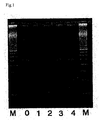
- Fig. 1 is a migration picture, showing the confirmation result of immobilization and re-immobilization.
- the method of reusing a DNA-immobilization substrate of the invention comprises removing the immobilized DNA from a DNA-immobilization substrate having a DNA immobilized thereon through acid amido-bonding via an oligonucleotide to thereby refresh the substrate so that it can receive a new DNA to be immobilized thereon, and is characterized in that the acid amido-bonding between the substrate-DNA is hydrolyzed with an acid or alkali.
- the DNA immobilization substrate which is to be processed in the reusing method of the invention has a DNA immobilized on the amino group-modified substrate surface via acid amido-bonding.
- the amino group-modified substrate is prepared by aminating the surface of a substrate of, for example, diamond, silicon, glass, or metals such as gold, silver, copper, aluminum, tungsten, molybdenum, or laminates of the metals with ceramics, or plastics such as polycarbonates, fluororesins.
- any other chemically-stable materials are usable for the substrate, for example, graphite and diamond-like carbon.
- mixtures of plastics with the above-mentioned metals, ceramics, diamond, etc.
- silicon, glass, metals, graphite, plastics and others coated with diamond or diamond-like carbon are also usable.
- Diamond is preferred in view of its thermal conductivity. Diamond has good thermal conductivity and accepts rapid heating and cooling. Therefore, the period of heat cycle for heating and cooling the substrate for bonding a DNA thereto can be effectively shortened.
- the thermal conductivity of the substrate material may be at least 0.1 W/cm ⁇ K, preferably at least 0.5 W/cm ⁇ K, more preferably at least 1.0 W/cm ⁇ K.
- diamond substrate For the material of the diamond substrate, usable are any of synthetic diamond, high-pressure molded diamond, natural diamond, etc. Their structures may have any form of single-crystal or polycrystal. From the viewpoint of productivity thereof, diamond is preferred that is produced through vapor-phase synthesis, for example, through microwave plasma-assisted CVD.
- the substrate may be formed in any known method.
- the method includes microwave plasma-assisted CVD, ECRCVD, IPC, DC sputtering, ECR sputtering, ion plating, arc ion plating, EB vapor deposition, resistance heating vapor deposition, etc.
- Metal powder, ceramic powder or the like may be mixed with a resin binder, and may be shaped into substrates for use herein.
- the starting material of metal powder, ceramic powder or the like may be pressed into a green compact by the use of a pressing machine and it may be sintered at high temperatures.
- the surface of the substrate is intentionally roughened.
- the roughened surface is favorable for immobilizing a large quantity of DNA or the like, since its surface area increases.
- the shape of the substrate is not specifically defined, and may be tabular, yarn-like, spherical, polygonal, powdery, etc.
- the size of the substrate is not also specifically defined.
- the diamond substrate for use in the invention may include a composite that comprises diamond and any other substance (for example, a two-phase composite of diamond or diamond-like carbon).
- the amino group modification of the substrate surface may be attained, for example, by irradiating a solid substrate with UV rays in chlorine gas to chlorinate the substrate surface followed by further irradiating it with UV rays in ammonia gas to aminate it.
- the amino group-modified substrate surface may be modified with a carboxylic acid by carboxylating it with a suitable acid chloride followed by dehydrating and condensing the terminal carboxyl group with carbodiimide or dicyclohexylcarbodiimide and N-hydroxysuccinimide.
- a solid substrate of which the surface has been modified to have a carboxyl group is dipped in a 1,4-dioxane solution with carbodiimide or dicyclohexylcarbodiimide, and N-hydroxysuccinimide or p-nitrophenol dissolved therein, then washed and dried.
- the substrate has a hydrocarbon group with an N-succinimide ester group or p-nitrophenol ester bonded to the terminal thereof.
- a primary amino group is previously formed on the diamond substrate, and this is processed with an activated diester so as to have one ester group of the diester bonded to the primary amino group through dehydrating condensation.
- the activated diester has two active ester groups such as those mentioned hereinabove.
- the ester groups are positioned at both terminals of the activated diester, and have from 0 to 12, more preferably from 0 to 6 carbon atoms each.
- the skeleton moiety except the ester groups is a linear saturated fatty acid.
- a substrate may be chlorinated in the same manner as above and then aminated, and thereafter the amino group in this may be reacted with an activated ester that is previously prepared through activating esterification of N-hydroxysuccinimide with succinic acid (dicarboxylic acid) to obtain the intended substrate.
- the substrate thus having a carboxylic acid-modified surface and having a DNA immobilized on the surface via an oligonucleotide is to be processed according to the invention for reusing it.
- the DNA to be immobilized on the substrate is not specifically defined, and may be any of a single-stranded cDNA (complementary DNA) or a double-stranded gDNA (genomic DNA, chromosomal DNA).
- the chain length of the DNA is not also specifically defined.
- the oligonucleotide shall be suitably selected, depending on the type of the DNA to be bonded to the substrate. In case where a single-stranded cDNA is immobilized on the substrate, it may take advantage of reverse transcription with mRNA for a template, and an oligo-dT or the like that may be a primer for the reverse transcription may be used for the oligonucleotide.
- immobilization of a double-stranded gDNA may be effected by the use of restriction enzyme cleavage sites.
- the oligonucleotide to be used shall have a restriction enzyme cleavage site on the DNA bonding side.
- used DNA-immobilization substrates that are useless are dipped in an acid or alkali solution whereby the acid amido-bonding between the substrate-DNA is hydrolyzed and cleaved, and the surfaces are thereby refreshed to have an amino group-modified surface.
- the acid to be used for the hydrolysis is preferably a mineral acid such as hydrochloric acid, but may be any other mineral acid or organic acid capable of hydrolyzing acid amido-bonding.
- an alkali is used for the hydrolysis, it is preferably an alkali metal hydroxide, but may be any other alkaline salts such as alkali metal carbonates.
- a DNA-immobilized substrate is put into 6 M hydrochloric acid and reacted at 80 to 100°C for a few hours to 24 hours to thereby completely hydrolyze the acid amido-bonding between the substrate-DNA.
- a DNA-immobilized substrate is put into 2 M NaOH and reacted at room temperature for a few hours to 24 hours to thereby hydrolyze the acid amido-bonding between the substrate-DNA.
- the substrate surface After the acid hydrolysis, the substrate surface has anions thereon. Preferably, therefore, it is dipped in an alkali to remove the anions and then washed with water.
- the alkali-hydrolyzed substrate may be washed with water, not requiring any additional treatment.
- the acid amido-bonding between the substrate-DNA in the DNA-immobilized substrate is hydrolyzed, and the amino group-modified surface of the substrate is thereby exposed out.
- the substrate may be reused for carboxylic acid modification, oligonucleotide immobilization and DNA immobilization in the manner as above.
- a diamond substrate was used.
- the substrate mentioned below is the diamond substrate.
- the substrate with a DNA immobilized thereon was put into 6 N hydrochloric acid and reacted at 95°C for 5 hours to hydrolyze it. Then, this was washed (about 3 times) . In this condition, the substrate had a hydrochloride. Therefore, this was dipped in a 0.1 N potassium hydroxide solution to remove the chloride ions from it. With that, the substrate was washed with water (about 3 to 5 times) to thereby make it have an amino group-modified surface.
- succinic acid chloride 0.1 mmols of succinic acid chloride was added to 1 ml of chloroform, and the reusable amino group-modified substrate was inserted into it and reacted at room temperature for 30 minutes. Next, the substrate was washed with chloroform, dried, then dipped in pure water for 1 hour, and then finally washed with pure water (about 3 to 5 times) to make it have a succinic acid-modified surface.
- the substrate was dipped in an aqueous solution of an oligonucleotide having a restriction enzyme (EcoRI) site and having (dA) 3 at the 5' terminal (concentration: 500 fmol/ ⁇ l, 50 ⁇ l per one substrate), and reacted at room temperature for 1 hour.
- EcoRI restriction enzyme
- the substrate was dipped in an EcoRI reaction liquid and reacted at 37°C for 1 hour. Then, the reaction mixture was cooled to 4°C, and the substrate was taken out of it. This was washed with germ-free water cooled at 4°C (about 3 to 5 times) and then with an aqueous 60 % ethanol solution cooled at 4°C, and thereafter lightly dried (for ethanol evaporation).
- the substrate was dipped in a ligase solution that contained a 21-kbp fragment obtained by processing ⁇ DNA with EcoRI, and reacted overnight at 4°C to thereby immobilize the DNA on the substrate.
- the hydrolysis and the DNA re-immobilization on the substrate was confirmed as follows:
- the substrate was subjected to PCR with a primer capable of amplifying the 500-bp fragment in the 21-kbp ⁇ DNA fragment, and checked for DNA amplification thereon.
- Fig. 1 shows the result.
- Fig. 1 is a migration picture, showing the confirmation result of immobilization and re-immobilization.
- the mark M described under the migration picture indicates a 100-bp lag marker;
- the lane 0 indicates the substrate before hydrolysis;
- the lanes 1 and 2 indicate the substrates after hydrolysis; and
- the lanes 3 and 4 indicate the substrates after re-immobilization.
- the DNA can be completely removed from DNA-immobilized substrates that are useless, and a new DNA can be bonded to the thus-refreshed substrates.
- the reusing method of the invention does not require any specific reagent and apparatus, it is simple and inexpensive.
- the invention promotes economical diagnoses and studies that use DNA-immobilization substrates for gene diagnosis, etc.
- the reusing method of the invention is useful in the field of medicine and other various fields of molecular biology, biochemistry and gene engineering technology.
Landscapes
- Chemical & Material Sciences (AREA)
- Organic Chemistry (AREA)
- Life Sciences & Earth Sciences (AREA)
- Health & Medical Sciences (AREA)
- Biochemistry (AREA)
- Molecular Biology (AREA)
- Genetics & Genomics (AREA)
- Engineering & Computer Science (AREA)
- Biotechnology (AREA)
- General Health & Medical Sciences (AREA)
- Medicinal Chemistry (AREA)
- Wood Science & Technology (AREA)
- Chemical Kinetics & Catalysis (AREA)
- Zoology (AREA)
- Biomedical Technology (AREA)
- General Chemical & Material Sciences (AREA)
- General Engineering & Computer Science (AREA)
- Bioinformatics & Cheminformatics (AREA)
- Plant Pathology (AREA)
- Microbiology (AREA)
- Biophysics (AREA)
- Physics & Mathematics (AREA)
- Apparatus Associated With Microorganisms And Enzymes (AREA)
- Measuring Or Testing Involving Enzymes Or Micro-Organisms (AREA)
Abstract
Description
Claims (5)
- A method of reusing a DNA-immobilization substrate, which comprises removing the immobilized DNA from a DNA-immobilization substrate having a DNA immobilized thereon through acid amido-bonding via an oligonucleotide to thereby refresh the substrate so that it can receive a new DNA to be immobilized thereon, and which is characterized in that the acid amido-bonding between the substrate-DNA is hydrolyzed with an acid or alkali.
- A method of reusing a DNA-immobilization substrate, which comprises processing a DNA-immobilization substrate with a DNA immobilized thereon via an acid amido-bonding to thereby hydrolyze the acid amido-bonding between the substrate-DNA with an acid, and then dipping it in an alkali to remove anions so as to convert the substrate surface into an amino group-modified surface.
- A method of reusing a DNA-immobilization substrate, which comprises processing a DNA-immobilization substrate with a DNA immobilized thereon via an acid amido-bonding to thereby hydrolyze the acid amido-bonding between the substrate-DNA with an alkali so as to convert the substrate surface into an amino group-modified surface.
- The method of reusing a DNA-immobilization substrate as claimed in claim 1 or 2, wherein the acid for hydrolysis is one or more acids of mineral acids and organic acids.
- The method of reusing a DNA-immobilization substrate as claimed in claim 1 or 3, wherein the alkali for hydrolysis is any of alkali metal hydroxides and/or an alkali metal salts.
Applications Claiming Priority (3)
| Application Number | Priority Date | Filing Date | Title |
|---|---|---|---|
| JP2000401624 | 2000-12-28 | ||
| JP2000401624A JP2002199881A (en) | 2000-12-28 | 2000-12-28 | Method for reusing dna immobilized carrier |
| PCT/JP2001/011027 WO2002054068A1 (en) | 2000-12-28 | 2001-12-17 | Method of reusing dna-immobilization substrate |
Publications (2)
| Publication Number | Publication Date |
|---|---|
| EP1347297A1 true EP1347297A1 (en) | 2003-09-24 |
| EP1347297A4 EP1347297A4 (en) | 2007-06-06 |
Family
ID=18866029
Family Applications (1)
| Application Number | Title | Priority Date | Filing Date |
|---|---|---|---|
| EP01272814A Withdrawn EP1347297A4 (en) | 2000-12-28 | 2001-12-17 | PROCESS FOR USING DNA IMMOBILIZATION SUBSTRATE |
Country Status (6)
| Country | Link |
|---|---|
| US (1) | US7078517B2 (en) |
| EP (1) | EP1347297A4 (en) |
| JP (1) | JP2002199881A (en) |
| KR (1) | KR100523720B1 (en) |
| CN (1) | CN1215330C (en) |
| WO (1) | WO2002054068A1 (en) |
Families Citing this family (7)
| Publication number | Priority date | Publication date | Assignee | Title |
|---|---|---|---|---|
| US7943388B2 (en) * | 2003-11-14 | 2011-05-17 | 3M Innovative Properties Company | Acoustic sensors and methods |
| US7169933B2 (en) * | 2003-11-14 | 2007-01-30 | 3M Innovative Properties Company | N-sulfonylaminocarbonyl containing compounds |
| US7423155B2 (en) * | 2003-11-14 | 2008-09-09 | 3M Innovative Properties Company | N-sulfonyldicarboximide containing tethering compounds |
| WO2005049590A2 (en) * | 2003-11-14 | 2005-06-02 | 3M Innovative Properties Company | N-sulfonylaminocarbonyl containing compounds |
| US7361767B2 (en) * | 2003-11-14 | 2008-04-22 | 3M Innovative Properties Company | N-sulfonyldicarboximide containing tethering compounds |
| US7544756B2 (en) | 2005-09-30 | 2009-06-09 | 3M Innovative Properties Company | Crosslinked polymers with amine binding groups |
| US7544754B2 (en) | 2005-09-30 | 2009-06-09 | 3M Innovative Properties Company | Crosslinked polymers with amine binding groups |
Family Cites Families (5)
| Publication number | Priority date | Publication date | Assignee | Title |
|---|---|---|---|---|
| US5112962A (en) * | 1989-04-19 | 1992-05-12 | Northwestern University | Labile anchors for solid phase polynucleotide synthesis |
| WO1997023497A1 (en) * | 1995-12-22 | 1997-07-03 | University Technologies International Inc. | Linker arm for solid support oligonucleotide synthesis and process for production thereof |
| US6043353A (en) * | 1995-12-22 | 2000-03-28 | University Technologies International, Inc. | Reusable solid support for oligonucleotide synthesis, process for production thereof and process for use thereof |
| JP2002519433A (en) * | 1998-07-02 | 2002-07-02 | ユニバーシティー・テクノロジーズ・インターナショナル・インコーポレイテッド | Reusable solid support for oligonucleotide synthesis |
| FR2826957B1 (en) * | 2001-07-09 | 2005-09-30 | Centre Nat Rech Scient | METHOD FOR FUNCTIONALIZING SOLID SUBSTRATES, FUNCTIONALIZED SOLID SUBSTRATES AND USES THEREOF |
-
2000
- 2000-12-28 JP JP2000401624A patent/JP2002199881A/en not_active Withdrawn
-
2001
- 2001-12-17 CN CNB018215513A patent/CN1215330C/en not_active Expired - Fee Related
- 2001-12-17 WO PCT/JP2001/011027 patent/WO2002054068A1/en not_active Ceased
- 2001-12-17 KR KR10-2003-7008230A patent/KR100523720B1/en not_active Expired - Fee Related
- 2001-12-17 US US10/451,399 patent/US7078517B2/en not_active Expired - Fee Related
- 2001-12-17 EP EP01272814A patent/EP1347297A4/en not_active Withdrawn
Also Published As
| Publication number | Publication date |
|---|---|
| US20040092005A1 (en) | 2004-05-13 |
| EP1347297A4 (en) | 2007-06-06 |
| CN1215330C (en) | 2005-08-17 |
| US7078517B2 (en) | 2006-07-18 |
| WO2002054068A1 (en) | 2002-07-11 |
| CN1484764A (en) | 2004-03-24 |
| JP2002199881A (en) | 2002-07-16 |
| KR20030064842A (en) | 2003-08-02 |
| KR100523720B1 (en) | 2005-10-26 |
Similar Documents
| Publication | Publication Date | Title |
|---|---|---|
| CN1189573C (en) | Microarray type analysis of polynucleotide sequence variation | |
| US20150141297A1 (en) | Methods and Compositions for Phototransfer | |
| US20030118987A1 (en) | Positional sequencing by hybridization | |
| WO2000061817A9 (en) | Multiplex amplification and separation of nucleic acid sequences on a bioelectronic microchip using asymmetric structures | |
| WO1999034214A1 (en) | Solid-phase tips and uses relating thereto | |
| US7078517B2 (en) | Method of reusing DNA-immobilization substrate | |
| JPWO1999040173A1 (en) | Substrate for immobilizing and amplifying DNA, DNA immobilized chip with DNA immobilized on the substrate, and method for amplifying DNA | |
| US20020048760A1 (en) | Use of mismatch cleavage to detect complementary probes | |
| CN1345328A (en) | cleavage of nucleotides from solid support | |
| JP3786248B2 (en) | Chemically modified substrate and method for producing the same | |
| US20070042367A1 (en) | Lab-on-chip system for analying nucleic acid | |
| US6905829B2 (en) | Method for detecting hybridized nucleic acid with improved sensitivity | |
| WO1997045554A2 (en) | Capture of single stranded nucleic acids | |
| US20030203384A1 (en) | Multiplex detection of biological materials in a sample | |
| JP4183256B2 (en) | Nucleic acid amplification reaction product strand separation method, nucleic acid amplification reaction product detection method | |
| JP2003172737A (en) | Solid support body, substrate, biosensor, and analysis method for biological substance using them | |
| JP4736439B2 (en) | Nucleic acid immobilization carrier | |
| JP2005065632A (en) | Multistage enzymatic reaction method and microreactor for multistage enzymatic reaction | |
| JP3868901B2 (en) | Chemically modified substrate and method for producing the same | |
| KR100509217B1 (en) | Supports for hybridization and method of immobilizing hybrid | |
| KR101233774B1 (en) | Probes targeting the ribosomal RNA for detecting pathogenic bacteria and method for detecting live pathogenic bacteria by using the same | |
| JPH03123500A (en) | Nucleic acid separation method | |
| JP2002202304A (en) | Method for manufacturing dna immobilizing substrate | |
| CN1580252A (en) | Artificial endo enzyme containing peptide nucleic acid recognition element, and its preparing method and use |
Legal Events
| Date | Code | Title | Description |
|---|---|---|---|
| PUAI | Public reference made under article 153(3) epc to a published international application that has entered the european phase |
Free format text: ORIGINAL CODE: 0009012 |
|
| 17P | Request for examination filed |
Effective date: 20030604 |
|
| AK | Designated contracting states |
Kind code of ref document: A1 Designated state(s): AT BE CH CY DE DK ES FI FR GB GR IE IT LI LU MC NL PT SE TR |
|
| AX | Request for extension of the european patent |
Extension state: AL LT LV MK RO SI |
|
| RBV | Designated contracting states (corrected) |
Designated state(s): BE DE FR GB IT NL |
|
| A4 | Supplementary search report drawn up and despatched |
Effective date: 20070507 |
|
| RIC1 | Information provided on ipc code assigned before grant |
Ipc: C12N 15/09 20060101ALI20070430BHEP Ipc: G01N 33/566 20060101ALI20070430BHEP Ipc: G01N 33/53 20060101ALI20070430BHEP Ipc: C07H 21/00 20060101AFI20070430BHEP |
|
| 17Q | First examination report despatched |
Effective date: 20071015 |
|
| STAA | Information on the status of an ep patent application or granted ep patent |
Free format text: STATUS: THE APPLICATION IS DEEMED TO BE WITHDRAWN |
|
| 18D | Application deemed to be withdrawn |
Effective date: 20080226 |