EP1346590B1 - Cellular channel allocation scheme with multi-user detection - Google Patents
Cellular channel allocation scheme with multi-user detection Download PDFInfo
- Publication number
- EP1346590B1 EP1346590B1 EP01271771A EP01271771A EP1346590B1 EP 1346590 B1 EP1346590 B1 EP 1346590B1 EP 01271771 A EP01271771 A EP 01271771A EP 01271771 A EP01271771 A EP 01271771A EP 1346590 B1 EP1346590 B1 EP 1346590B1
- Authority
- EP
- European Patent Office
- Prior art keywords
- cells
- channel
- cluster
- same
- user terminals
- Prior art date
- Legal status (The legal status is an assumption and is not a legal conclusion. Google has not performed a legal analysis and makes no representation as to the accuracy of the status listed.)
- Expired - Lifetime
Links
- 238000001514 detection method Methods 0.000 title claims abstract description 10
- 230000001413 cellular effect Effects 0.000 title description 8
- 238000000034 method Methods 0.000 claims abstract description 38
- 230000010267 cellular communication Effects 0.000 claims abstract description 7
- 230000005540 biological transmission Effects 0.000 claims description 22
- 238000001228 spectrum Methods 0.000 abstract description 12
- 238000002955 isolation Methods 0.000 abstract description 10
- 238000010586 diagram Methods 0.000 description 7
- 238000000926 separation method Methods 0.000 description 4
- 238000013461 design Methods 0.000 description 3
- 239000000969 carrier Substances 0.000 description 1
- 238000012937 correction Methods 0.000 description 1
- 230000001419 dependent effect Effects 0.000 description 1
- 238000011161 development Methods 0.000 description 1
- 230000018109 developmental process Effects 0.000 description 1
- 238000005516 engineering process Methods 0.000 description 1
- 238000010295 mobile communication Methods 0.000 description 1
Images



Classifications
-
- H—ELECTRICITY
- H04—ELECTRIC COMMUNICATION TECHNIQUE
- H04W—WIRELESS COMMUNICATION NETWORKS
- H04W16/00—Network planning, e.g. coverage or traffic planning tools; Network deployment, e.g. resource partitioning or cells structures
-
- H—ELECTRICITY
- H04—ELECTRIC COMMUNICATION TECHNIQUE
- H04W—WIRELESS COMMUNICATION NETWORKS
- H04W16/00—Network planning, e.g. coverage or traffic planning tools; Network deployment, e.g. resource partitioning or cells structures
- H04W16/02—Resource partitioning among network components, e.g. reuse partitioning
- H04W16/12—Fixed resource partitioning
-
- H—ELECTRICITY
- H04—ELECTRIC COMMUNICATION TECHNIQUE
- H04W—WIRELESS COMMUNICATION NETWORKS
- H04W72/00—Local resource management
- H04W72/04—Wireless resource allocation
-
- H—ELECTRICITY
- H04—ELECTRIC COMMUNICATION TECHNIQUE
- H04W—WIRELESS COMMUNICATION NETWORKS
- H04W84/00—Network topologies
- H04W84/02—Hierarchically pre-organised networks, e.g. paging networks, cellular networks, WLAN [Wireless Local Area Network] or WLL [Wireless Local Loop]
- H04W84/04—Large scale networks; Deep hierarchical networks
- H04W84/06—Airborne or Satellite Networks
Definitions
- the present invention relates to a method and apparatus for spectrum allocation and channel reception in a cellular mobile communications system.
- the MSS satellite designs have become progressively more complex, utilising a large number of spot beams, effectively overlaying the satellite coverage area with a large array of cells on the ground.
- Smaller spot beams increase the satellite power concentrated in a cell and therefore allow for smaller user terminals.
- a larger number of spot beams and corresponding cells in the coverage area allows for more effective spectrum utilisation and for higher frequency reuse factors to be achieved, since a carrier frequency may be re-allocated in nearby beams, provided that adequate isolation is achieved between those beams, thereby limiting inter-cell interference to an acceptable level.
- Multi-User Detection is another technological advancement that could contribute to maximising spectrum utilisation.
- MUD techniques were developed for Code Division Multiple Access (CDMA), utilising the discrimination in the signal code space for detecting individual user signals in a simultaneous reception of multi-user signals.
- CDMA Code Division Multiple Access
- Recent developments in MUD have found solutions for discriminating and detecting individual signals in a simultaneous reception of multi-user signals where those signals are not CDMA coded; see for example CA-A-2201460 which discloses a technique which relies on forward error correction (FEC).
- FEC forward error correction
- Recent satellite systems incorporate position location capabilities in the user terminal, utilising Global Positioning System (GPS) receivers or alternative global navigation satellite system (GNSS) receivers.
- GPS Global Positioning System
- GNSS global navigation satellite system
- a Time Division Multiple Access (TDMA) system may use the knowledge of user terminal position in optimising system performance and economising resources allocated to the user.
- TDMA Time Division Multiple Access
- One area of economising is in allowing new users to log on to the system in a narrow time window by making use of the precise position and time determination capabilities of GNSS systems such as GPS.
- the radio resource management (RRM) in a packet data system may include allocation of shared bearers to cells (which are served by spot beams in a satellite system) in response to aggregate capacity requests from users in the cells.
- Bearer allocation is based on a frequency plan that aims to maximise frequency reuse in the spectrum constraints of the system. In reusing a bearer frequency between cells the frequency plan takes into account the required isolation between cells to maintain interference at an acceptable level.
- the frequency plan may be implemented at a mobile switching centre, which is connected to base stations having RF transmitters and receivers which define the cell pattern of the system.
- the mobile switching centre stores frequency plan data and allocates channels to user terminals in accordance with the frequency plan and demand for channels by the user terminals.
- the frequency plan may be implemented on a satellite, or by one or more ground stations if the satellites are 'dumb' or repeater satellites.
- channel allocation may be performed by a Land Earth Station (LES) or Network Coordination Station (NCS).
- LES Land Earth Station
- NCS Network Coordination Station
- Figure 1 shows a frequency reuse pattern in a 5-cell array. Bearer frequencies are reused between cells 1 and 5 and between cells 2 and 4, taking advantage of the isolation between those cells.
- Figure 2 shows a frequency reuse pattern in a large cellular array, in which one hexagonal 7-cell cluster is highlighted.
- the cells within each cluster are numbered from 1 to 7.
- S between cell centres for achieving required isolation and limiting interference
- D the distance between adjacent cell centres
- a 7-cell reuse pattern can be applied, allowing for a bearer frequency to be used once in any hexagonal 7-cell cluster, and resulting with a reuse factor of 1/7.
- clusters of 3, 4, 6, 19 or other numbers of cells may be used, depending on the required separation distance D.
- the radio resource management (RRM) in a packet data system may also include allocation of return link shared bearer time slots to users in corresponding cells. Users in a given cell are allocated time slots in the shared bearer serving that cell, for example by transmitting an allocation message to a user terminal defining the frequency and time slot to be used by that user terminal.
- Initial access channels which are typically used by terminals to establish contact with the system and to transmit a channel allocation request, may have a fixed frequency and time slot known a priori by the mobile terminal or a variable frequency and time slot indicated on a fixed channel, such as a bulletin board channel.
- time slot allocation methods are:
- Figure 3 illustrates the time slot allocation function in the case of adjacent cells c1 and c2 with corresponding shared bearers f1 and f2.
- Users u1, u2 in c1 are allocated exclusive time slots f1-T1, f1-T2.
- Users u3, u4 are allocated contention time slot f1-Tc.
- Users u5, u6 are attempting initial access using time slot f1-Ta.
- users in cell c2 are using exclusive, contention and initial access time slots in shared bearer f2.
- the shared bearer frequencies allocated to the cells may be reused in the cell array in keeping with the isolation requirements for limiting inter-cell interference.
- each cell may be subdivided into a pair of sectors with carriers being shared between the pair of sectors.
- the document US-A-5613198 discloses a method of dynamically allocating channel bandwidth to cells, where groups of cells are defined such that the bandwidth of each channel is time divided between the cells of the group according to user demand.
- Embodiments of the invention include a spectrum allocation method in a cellular communication system, in which a cell pattern is divided into clusters each containing a plurality of cells having low inter-cell isolation. A pool of forward and return link bearers is allocated to each cluster and may be shared among cells within the cluster. Bearers are reused between clusters having a sufficiently high mutual isolation.
- This clustering arrangement allows a significantly higher reuse factor than the traditional method of allocating bearers to individual cells and reusing bearers between individual cells having sufficiently high mutual isolation.
- different time slots in a return link bearer are allocated to different user terminals within the corresponding cluster.
- the same time slot in a return link bearer may be allocated to one user within each cell of the cluster.
- the receiver of the shared return link bearer may use multi-user detection techniques to separately decode the signals from each user terminal sharing a time slot, using the spatial diversity of the individual cells.
- the user terminals may receive relative timing and/or position information and adjust the timing of their transmissions so as to synchronise their transmissions to a reference timing at a receiver. This allows initial access time slots to be shortened.
- Embodiments of the present invention involve sharing a common pool of bearers within a cluster of overlapping cells i.e. cells having a low isolation with respect to another cell in the cluster.
- cells c1 and c2 form one two-cell cluster C1 and share a bearer frequency f1
- cells c4 and c5 form another two-cell cluster C2 and share the bearer frequency f1
- the two clusters being substantially separate so that any interference between the two clusters within the bearer frequency f1 is below a given acceptable level.
- a cell c3 overlaps both clusters and is allocated a different bearer frequency f3.
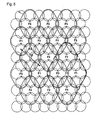
- the large cell array is divided into four-cell clusters C, and a diamond-shaped four-cluster reuse pattern R is defined for four bearer frequencies F1, F2, F3 and F4.
- the separation distance S between the centres of cells in different clusters is ⁇ 7D, as in the conventional example, where D is the distance between centres of adjacent cells.
- the frequency reuse factor (number of frequencies/number of cells) is 1 ⁇ 4, compared to 1/7 in the conventional example.
- Figure 6 shows allocation of time slots to user terminals at frequencies f1 and f2 of a frequency pool shared within a two-cell cluster C in a first embodiment of the present invention.
- the time slots include uniquely assigned time slots T1 and T2, contention-based time slots Tc and initial access time slots Ta.
- User terminals u1 and u2 in cell c1 are allocated slot T1 at frequencies f1 and f2 respectively.
- User terminals u3 and u4 are allocated the contention time slot Tc at frequencies f1 and f2 respectively.
- User terminals u5 and u6 attempt initial access in the initial access slot Ta in frequencies f1 and f2 respectively.
- user terminals u7 to u12 use exclusive, contention-based and initial time slots at the frequencies f1 and f2.
- the sharing of a pool of frequencies within a cluster gives greater flexibility in the loading of each bearer according to capacity demand from all the user terminals in the cluster, rather than from user terminals within each cell, thereby reducing inefficient capacity allocation due to partially loaded bearers.
- a possible disadvantage of frequency sharing within a cluster is the significantly higher number of sub-channels per cell, by a factor of the number of cells per cluster. This may require additional complexity in a multi-beam satellite or cellular base station using this scheme. The satellite will also require a greater feeder link capacity corresponding to the increased total number of sub-channels in use.
- Another disadvantage is that a larger time slot is required in an initial access channel, because user terminals attempting to use the channel may be distributed across the whole cluster rather than just one cell, giving greater timing uncertainty.
- this disadvantage may be overcome by the user terminals applying a timing adjustment to transmissions in the initial access channel, based on their position.
- the user terminals may include positioning (e.g. GPS or GNSS) receivers for determining their position, a data store containing information on the positions of the clusters and means for calculating a transmission timing offset as a function of the distance of the user terminal from the cluster centre.
- positioning e.g. GPS or GNSS
- each time slot of each shared bearer may support up to n simultaneous users.
- a receiver of the transmissions in each time slot receives a signal from each cell, each signal comprising up to n overlapping transmissions. Using the differences between the signals received from the different cells and applying multi-user detection techniques, the receiver separates and decodes each of the overlapping signals. Successful separation and decoding of the overlapping signals requires that the receiver is capable of separating the necessary number n of overlapping signals.
- the technique of the second embodiment is applicable to unique timeslot allocation, except that the time slot is only exclusively assigned to a user terminal the extent that transmissions from that terminal can be separated by the receiver from transmissions from other user terminals; for example, the time slot is exclusively assigned only within an individual cell within the cluster.
- contention-based allocation In contention-based allocation, a significantly higher capacity loading is permitted on a contention channel, since up to n users can transmit simultaneously in the same slot, dependent on their distribution among the cells within a cluster. Contention channel loading is limited by the need to ensure an acceptably low probability of more than n user terminals transmitting in the same time slot.
- a larger time slot is required as in the first embodiment, but up to n user terminals can use the time slot simultaneously, so greatly increasing the acceptable capacity loading.
- Transmission timing adjustment may be performed by the user terminals instead of increasing the time slot size, as in the first embodiment.
- each shared bearer can be loaded up to n times that of a shared bearer in the first embodiment and is therefore n times more efficient. Therefore the spectrum requirement for a given capacity is reduced by a factor of n.
- n -fold increase in the number of sub-channels per shared bearer in the first embodiment is fully compensated for in the second embodiment by an n -fold reduction in the average number of shared bearers per cell and per cluster.
- the only penalty in complexity is the requirement for multi-user detection at the receiver.
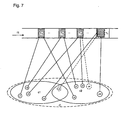
- Figure 7 shows a time slot allocation scheme in the second embodiment with a cluster of two cells c1 and c2, a shared bearer pool F including frequency f1 and a TDMA receiver capable of simultaneous detection of two user terminals.
- User terminals u1 and u2 in cell c1 are allocated unique time slots T1 and T2 respectively, as are user terminals u5 and u6 in c2.
- User terminals u3 in cell C1 and u8 and u9 in cell c2 are allocated the contention time slot Tc.
- User terminals u4 and u5 in cell c1 and user terminal u10 in c2 attempt initial access in time slot Ta.
- multi-user detection techniques may use the different diversity reception properties to separate signals from the two user terminals, even if they are nominally in the same cell, because the signals will also be received with a lower signal strength in adjacent cells.
- the present invention is applicable to different types of cellular communication system and is not limited to satellite or terrestrial cellular embodiments. Moreover, the present invention is not limited to TDMA but may also be applied to other multiple access schemes.
Landscapes
- Engineering & Computer Science (AREA)
- Computer Networks & Wireless Communication (AREA)
- Signal Processing (AREA)
- Mobile Radio Communication Systems (AREA)
- Radar Systems Or Details Thereof (AREA)
Applications Claiming Priority (3)
| Application Number | Priority Date | Filing Date | Title |
|---|---|---|---|
| GB0030978 | 2000-12-19 | ||
| GB0030978A GB2370452B (en) | 2000-12-19 | 2000-12-19 | Communication method and apparatus |
| PCT/GB2001/005521 WO2002051186A1 (en) | 2000-12-19 | 2001-12-14 | Cellular channel allocation scheme with multi-user detection |
Publications (2)
| Publication Number | Publication Date |
|---|---|
| EP1346590A1 EP1346590A1 (en) | 2003-09-24 |
| EP1346590B1 true EP1346590B1 (en) | 2004-06-30 |
Family
ID=9905400
Family Applications (1)
| Application Number | Title | Priority Date | Filing Date |
|---|---|---|---|
| EP01271771A Expired - Lifetime EP1346590B1 (en) | 2000-12-19 | 2001-12-14 | Cellular channel allocation scheme with multi-user detection |
Country Status (8)
| Country | Link |
|---|---|
| US (1) | US7818009B2 (da) |
| EP (1) | EP1346590B1 (da) |
| AU (1) | AU2002222204A1 (da) |
| DE (1) | DE60104144T2 (da) |
| DK (1) | DK1346590T3 (da) |
| GB (1) | GB2370452B (da) |
| NO (1) | NO327292B1 (da) |
| WO (1) | WO2002051186A1 (da) |
Families Citing this family (20)
| Publication number | Priority date | Publication date | Assignee | Title |
|---|---|---|---|---|
| US7515566B2 (en) * | 2004-12-09 | 2009-04-07 | Viasat, Inc. | Partial mesh communication in hub based system |
| US8599957B2 (en) | 2005-05-13 | 2013-12-03 | Ems Technologies, Inc. | Method and system for communicating information in a digital signal |
| US7536739B2 (en) * | 2005-08-10 | 2009-05-26 | Kreg Medical, Inc. | Therapeutic mattress |
| US8077693B2 (en) | 2007-09-19 | 2011-12-13 | Samsung Electronics Co., Ltd. | Resource remapping and regrouping in a wireless communication system |
| WO2010054395A2 (en) | 2008-11-10 | 2010-05-14 | Viasat, Inc. | Dynamic frequency assignment in a multi-beam system |
| WO2010054392A2 (en) | 2008-11-10 | 2010-05-14 | Viasat, Inc. | Dynamic resource allocation in a multi-beam system |
| US8311006B2 (en) | 2008-11-10 | 2012-11-13 | Viasat, Inc. | Resource fairness policies for allocation of resources in a satellite communications system |
| GB2466280A (en) * | 2008-12-18 | 2010-06-23 | Inmarsat Global Ltd | Multi-access communication in which plural transmissions share timing and frequency resources but have different waveforms or propagation characteristics |
| MY166138A (en) | 2009-02-18 | 2018-06-06 | Sun Patent Trust | Scheduling apparatus and scheduling method |
| WO2010148022A1 (en) | 2009-06-16 | 2010-12-23 | Viasat, Inc. | Dynamic bandwidth resource allocation for satellite downlinks |
| GB2495467B (en) | 2011-09-02 | 2017-12-13 | Skype | Video coding |
| GB2495468B (en) | 2011-09-02 | 2017-12-13 | Skype | Video coding |
| US9202370B2 (en) | 2012-07-17 | 2015-12-01 | Robert Bosch Gmbh | Method for robust wireless monitoring and tracking of solar trackers in commercial solar power plants |
| US9202369B2 (en) | 2012-07-17 | 2015-12-01 | Robert Bosch Gmbh | Method for robust wireless monitoring and tracking of solar trackers in commercial solar power plants |
| US9202371B2 (en) | 2012-07-17 | 2015-12-01 | Robert Bosch Gmbh | Method for robust data collection schemes for large grid wireless networks |
| US9088962B2 (en) * | 2013-03-28 | 2015-07-21 | Quantenna Communications Inc. | WAP supporting complementary subnets in a WLAN |
| EP3008936B1 (en) * | 2013-06-11 | 2017-08-09 | Nokia Solutions and Networks GmbH & Co. KG | Configuration of resource usage in communication systems |
| WO2015163014A1 (ja) * | 2014-04-24 | 2015-10-29 | ソニー株式会社 | 無線通信装置及び無線通信方法 |
| CN106973389B (zh) * | 2017-05-27 | 2020-05-12 | 中国联合网络通信集团有限公司 | 一种动态频谱共享方法及装置 |
| US11012147B1 (en) * | 2020-01-16 | 2021-05-18 | M2SL Corporation | Multi-mode communication adapter system with smartphone protector mechanism and method of operation thereof |
Family Cites Families (24)
| Publication number | Priority date | Publication date | Assignee | Title |
|---|---|---|---|---|
| GB8915863D0 (en) | 1989-07-11 | 1989-08-31 | Telecom Sec Cellular Radio Ltd | Cellular radio system |
| EP0917308A1 (en) * | 1992-04-17 | 1999-05-19 | TELEFONAKTIEBOLAGET L M ERICSSON (publ) | Mobile assisted handover using CDMA |
| CA2113750C (en) * | 1993-04-30 | 1999-08-24 | Hamid Ahmadi | A multiaccess scheme for mobile integrated local area networks |
| US6038455A (en) * | 1995-09-25 | 2000-03-14 | Cirrus Logic, Inc. | Reverse channel reuse scheme in a time shared cellular communication system |
| US6212387B1 (en) * | 1995-10-18 | 2001-04-03 | Sc-Wireless Inc. | Method and apparatus for collector arrays of directional antennas co-located with zone managers in wireless communications systems |
| US6020847A (en) * | 1996-04-25 | 2000-02-01 | Twr Inc. | Geolocation method and apparatus for satellite based telecommunications system |
| US5946625A (en) * | 1996-10-10 | 1999-08-31 | Ericsson, Inc. | Method for improving co-channel interference in a cellular system |
| JPH10173594A (ja) * | 1996-12-06 | 1998-06-26 | Hitachi Ltd | 符号分割多元接続通信システム及び送信電力制御方法 |
| US6069885A (en) * | 1996-12-30 | 2000-05-30 | At&T Corp | Method and apparatus for providing high speed services using a wireless communications system |
| CA2201460C (en) | 1997-04-01 | 2004-06-22 | Michael L. Moher | Joint detector for multiple coded digital signals |
| US5867478A (en) * | 1997-06-20 | 1999-02-02 | Motorola, Inc. | Synchronous coherent orthogonal frequency division multiplexing system, method, software and device |
| US6680928B1 (en) * | 1997-07-22 | 2004-01-20 | Ericsson Inc. | Communications system and method for multi-carrier orthogonal coding |
| US6055432A (en) * | 1997-08-15 | 2000-04-25 | Lucent Technologies Inc. | Dynamic channel allocation in macrocells with random exclusion for allowing underlaying autonomous microcells |
| RU2233031C2 (ru) * | 1998-03-26 | 2004-07-20 | Самсунг Электроникс Ко., Лтд. | Устройство и способ назначения кода расширения для сообщения обратного общего канала в системе связи множественного доступа с кодовым разделением каналов |
| JP3109504B2 (ja) * | 1998-03-27 | 2000-11-20 | 日本電気株式会社 | セルラシステムおよびセルラシステムの隣接周波数干渉回避方法と移動局 |
| US6697344B1 (en) * | 1999-03-16 | 2004-02-24 | Northrop Grumman Corporation | Onboard initial entry processor for facilitating a satellite communication |
| US6792276B1 (en) * | 1999-07-13 | 2004-09-14 | Telefonaktiebolaget Lm Ericsson (Publ) | Hot spot with tailored range for extra frequency to minimize interference |
| GB2356528A (en) * | 1999-11-17 | 2001-05-23 | Ericsson Telefon Ab L M | Channel allocation in telecommunication networks |
| US6430391B1 (en) * | 1999-11-29 | 2002-08-06 | Ericsson Inc. | Duplex satellite communication using a single frequency or pair |
| US6553234B1 (en) * | 2000-05-01 | 2003-04-22 | Alcatel Canada, Inc. | Method of frequency reuse in a fixed access wireless network |
| US6922546B1 (en) * | 2000-05-03 | 2005-07-26 | Lucent Technologies Inc. | GPS signal acquisition based on frequency-domain and time-domain processing |
| US6859652B2 (en) * | 2000-08-02 | 2005-02-22 | Mobile Satellite Ventures, Lp | Integrated or autonomous system and method of satellite-terrestrial frequency reuse using signal attenuation and/or blockage, dynamic assignment of frequencies and/or hysteresis |
| EP1316233B1 (en) * | 2000-08-02 | 2011-10-05 | ATC Technologies, LLC | Coordinated frequency reuse of a terrestrial and a satellite system. |
| US7058422B2 (en) * | 2000-09-20 | 2006-06-06 | Bae Systems Information And Electronic Systems Integration Inc. | Method for overusing frequencies to permit simultaneous transmission of signals from two or more users on the same frequency and time slot |
-
2000
- 2000-12-19 GB GB0030978A patent/GB2370452B/en not_active Expired - Lifetime
-
2001
- 2001-12-14 DK DK01271771T patent/DK1346590T3/da active
- 2001-12-14 DE DE60104144T patent/DE60104144T2/de not_active Expired - Lifetime
- 2001-12-14 US US10/450,782 patent/US7818009B2/en not_active Expired - Lifetime
- 2001-12-14 WO PCT/GB2001/005521 patent/WO2002051186A1/en not_active Ceased
- 2001-12-14 EP EP01271771A patent/EP1346590B1/en not_active Expired - Lifetime
- 2001-12-14 AU AU2002222204A patent/AU2002222204A1/en not_active Abandoned
-
2003
- 2003-06-18 NO NO20032777A patent/NO327292B1/no not_active IP Right Cessation
Also Published As
| Publication number | Publication date |
|---|---|
| NO20032777L (no) | 2003-06-18 |
| DE60104144D1 (de) | 2004-08-05 |
| EP1346590A1 (en) | 2003-09-24 |
| GB2370452B (en) | 2004-10-20 |
| DE60104144T2 (de) | 2005-07-28 |
| NO327292B1 (no) | 2009-06-02 |
| US7818009B2 (en) | 2010-10-19 |
| DK1346590T3 (da) | 2004-10-11 |
| GB0030978D0 (en) | 2001-01-31 |
| WO2002051186A1 (en) | 2002-06-27 |
| GB2370452A (en) | 2002-06-26 |
| US20050037764A1 (en) | 2005-02-17 |
| AU2002222204A1 (en) | 2002-07-01 |
| NO20032777D0 (no) | 2003-06-18 |
Similar Documents
| Publication | Publication Date | Title |
|---|---|---|
| EP1346590B1 (en) | Cellular channel allocation scheme with multi-user detection | |
| US7151937B2 (en) | Method and system for reducing wireless multi-cell interferences through segregated channel assignments and segregated antenna beams | |
| KR100450150B1 (ko) | 멀티-시스템셀룰러통신네트워크에서의주파수계획방법및장치 | |
| US8705560B2 (en) | Multi-beam cellular communication system | |
| US5678187A (en) | Method and apparatus for reducing interference in a radio communication link of a cellular communication system | |
| CN1319406C (zh) | 用于分扇区无线电通信系统的编码分配 | |
| US6175737B1 (en) | Method and apparatus for wireless communications for base station controllers | |
| US6370384B1 (en) | Frequency re-use planning for wireless communications system using wireless translating repeaters | |
| KR100902864B1 (ko) | 멀티 반송파 시분할 듀플렉스 이동 통신 시스템에서의유연한 비 대칭 서비스 지원 방법 | |
| US20030211831A1 (en) | Method and system for reducing wireless multi-cell interferences through segregated channel assignments and segregated antenna beams | |
| JP3116893B2 (ja) | セルラシステム | |
| CA2753882C (en) | Systems, methods and network components that provide different satellite spot beam return carrier groupings and reuse patterns | |
| US20070263576A1 (en) | Multicarrier radio communication system, control station, base station and method | |
| CA2264161A1 (en) | Radio frequency sharing methods for satellite systems | |
| WO1996007108A1 (en) | Method and apparatus for conveying a communication signal between a communication unit and a base site | |
| WO1997038501A2 (en) | Spread spectrum random access systems and methods for time division multiple access radiotelephone communications systems | |
| JPH10173585A (ja) | 無線通信システム | |
| WO2002041519A2 (en) | Method and system for reducing channel interference in a frame-synchronized wireless communication system | |
| US6212387B1 (en) | Method and apparatus for collector arrays of directional antennas co-located with zone managers in wireless communications systems | |
| US7046655B2 (en) | Wireless communication method and system for minimizing interference by determining mobile station zone locations and potential conflicts between cell zones | |
| US8830937B2 (en) | Method for multiple access to the radio resources in a mobile ad hoc network and system implementing the method | |
| CA2237483A1 (en) | Means of increasing capacity in cellular radio (mobile & fixed) systems | |
| US6131034A (en) | Method and apparatus for collector arrays in wireless communications systems | |
| Ilcev | Space division multiple access (SDMA) applicable for mobile satellite communications | |
| Kondo et al. | Frequency shared access control for multi-beam mobile satellite communication systems |
Legal Events
| Date | Code | Title | Description |
|---|---|---|---|
| PUAI | Public reference made under article 153(3) epc to a published international application that has entered the european phase |
Free format text: ORIGINAL CODE: 0009012 |
|
| 17P | Request for examination filed |
Effective date: 20030520 |
|
| AK | Designated contracting states |
Kind code of ref document: A1 Designated state(s): AT BE CH CY DE DK ES FI FR GB GR IE IT LI LU MC NL PT SE TR |
|
| AX | Request for extension of the european patent |
Extension state: AL LT LV MK RO SI |
|
| GRAP | Despatch of communication of intention to grant a patent |
Free format text: ORIGINAL CODE: EPIDOSNIGR1 |
|
| GRAS | Grant fee paid |
Free format text: ORIGINAL CODE: EPIDOSNIGR3 |
|
| GRAA | (expected) grant |
Free format text: ORIGINAL CODE: 0009210 |
|
| AK | Designated contracting states |
Kind code of ref document: B1 Designated state(s): DE DK FR IT |
|
| REG | Reference to a national code |
Ref country code: IE Ref legal event code: FG4D |
|
| REF | Corresponds to: |
Ref document number: 60104144 Country of ref document: DE Date of ref document: 20040805 Kind code of ref document: P |
|
| REG | Reference to a national code |
Ref country code: DK Ref legal event code: T3 |
|
| LTIE | Lt: invalidation of european patent or patent extension |
Effective date: 20040630 |
|
| ET | Fr: translation filed | ||
| PLBE | No opposition filed within time limit |
Free format text: ORIGINAL CODE: 0009261 |
|
| STAA | Information on the status of an ep patent application or granted ep patent |
Free format text: STATUS: NO OPPOSITION FILED WITHIN TIME LIMIT |
|
| 26N | No opposition filed |
Effective date: 20050331 |
|
| REG | Reference to a national code |
Ref country code: FR Ref legal event code: CD |
|
| REG | Reference to a national code |
Ref country code: FR Ref legal event code: PLFP Year of fee payment: 15 |
|
| REG | Reference to a national code |
Ref country code: FR Ref legal event code: PLFP Year of fee payment: 16 |
|
| REG | Reference to a national code |
Ref country code: FR Ref legal event code: PLFP Year of fee payment: 17 |
|
| PGFP | Annual fee paid to national office [announced via postgrant information from national office to epo] |
Ref country code: DK Payment date: 20201210 Year of fee payment: 20 Ref country code: DE Payment date: 20201201 Year of fee payment: 20 Ref country code: IT Payment date: 20201110 Year of fee payment: 20 Ref country code: FR Payment date: 20201112 Year of fee payment: 20 |
|
| REG | Reference to a national code |
Ref country code: DE Ref legal event code: R071 Ref document number: 60104144 Country of ref document: DE |
|
| REG | Reference to a national code |
Ref country code: DK Ref legal event code: EUP Expiry date: 20211214 |