EP1344775B1 - Preparation of fungicidal quinazolinones and useful intermediates - Google Patents
Preparation of fungicidal quinazolinones and useful intermediates Download PDFInfo
- Publication number
- EP1344775B1 EP1344775B1 EP03011148A EP03011148A EP1344775B1 EP 1344775 B1 EP1344775 B1 EP 1344775B1 EP 03011148 A EP03011148 A EP 03011148A EP 03011148 A EP03011148 A EP 03011148A EP 1344775 B1 EP1344775 B1 EP 1344775B1
- Authority
- EP
- European Patent Office
- Prior art keywords
- formula
- alkyl
- propyl
- quinazolinone
- preparation
- Prior art date
- Legal status (The legal status is an assumption and is not a legal conclusion. Google has not performed a legal analysis and makes no representation as to the accuracy of the status listed.)
- Expired - Lifetime
Links
- AVRPFRMDMNDIDH-UHFFFAOYSA-N 1h-quinazolin-2-one Chemical class C1=CC=CC2=NC(O)=NC=C21 AVRPFRMDMNDIDH-UHFFFAOYSA-N 0.000 title claims description 6
- 238000002360 preparation method Methods 0.000 title description 13
- 239000000543 intermediate Substances 0.000 title description 6
- 230000000855 fungicidal effect Effects 0.000 title description 2
- 150000001875 compounds Chemical class 0.000 claims description 37
- 238000000034 method Methods 0.000 claims description 20
- 125000000217 alkyl group Chemical group 0.000 claims description 9
- 125000003342 alkenyl group Chemical group 0.000 claims description 8
- 125000000304 alkynyl group Chemical group 0.000 claims description 8
- RWZYAGGXGHYGMB-UHFFFAOYSA-N anthranilic acid Chemical compound NC1=CC=CC=C1C(O)=O RWZYAGGXGHYGMB-UHFFFAOYSA-N 0.000 claims description 8
- 125000000753 cycloalkyl group Chemical group 0.000 claims description 8
- 229910052739 hydrogen Inorganic materials 0.000 claims description 8
- 125000001316 cycloalkyl alkyl group Chemical group 0.000 claims description 7
- 125000000008 (C1-C10) alkyl group Chemical group 0.000 claims description 6
- 229910052794 bromium Inorganic materials 0.000 claims description 6
- 125000005347 halocycloalkyl group Chemical group 0.000 claims description 6
- 239000001257 hydrogen Substances 0.000 claims description 6
- 125000004435 hydrogen atom Chemical group [H]* 0.000 claims description 6
- 229910052740 iodine Inorganic materials 0.000 claims description 6
- 125000006273 (C1-C3) alkyl group Chemical group 0.000 claims description 5
- GOLGILSVWFKZRQ-UHFFFAOYSA-N 2-amino-5-iodobenzoic acid Chemical compound NC1=CC=C(I)C=C1C(O)=O GOLGILSVWFKZRQ-UHFFFAOYSA-N 0.000 claims description 5
- 125000004461 halocycloalkylalkyl group Chemical group 0.000 claims description 5
- 125000004169 (C1-C6) alkyl group Chemical group 0.000 claims description 4
- 229910052801 chlorine Inorganic materials 0.000 claims description 4
- 150000002148 esters Chemical class 0.000 claims description 4
- 238000004519 manufacturing process Methods 0.000 claims description 4
- 239000002253 acid Substances 0.000 claims description 3
- 229910052736 halogen Chemical group 0.000 claims description 3
- 150000002367 halogens Chemical group 0.000 claims description 3
- 239000012442 inert solvent Substances 0.000 claims description 3
- 125000000066 S-methyl group Chemical group [H]C([H])([H])S* 0.000 claims 1
- 125000002496 methyl group Chemical group [H]C([H])([H])* 0.000 description 101
- 125000001495 ethyl group Chemical group [H]C([H])([H])C([H])([H])* 0.000 description 85
- 125000001449 isopropyl group Chemical group [H]C([H])([H])C([H])(*)C([H])([H])[H] 0.000 description 58
- 125000000999 tert-butyl group Chemical group [H]C([H])([H])C(*)(C([H])([H])[H])C([H])([H])[H] 0.000 description 48
- 125000004123 n-propyl group Chemical group [H]C([H])([H])C([H])([H])C([H])([H])* 0.000 description 46
- RMRFFCXPLWYOOY-UHFFFAOYSA-N allyl radical Chemical compound [CH2]C=C RMRFFCXPLWYOOY-UHFFFAOYSA-N 0.000 description 42
- 125000000959 isobutyl group Chemical group [H]C([H])([H])C([H])(C([H])([H])[H])C([H])([H])* 0.000 description 32
- 238000006243 chemical reaction Methods 0.000 description 21
- VLKZOEOYAKHREP-UHFFFAOYSA-N n-Hexane Chemical class CCCCCC VLKZOEOYAKHREP-UHFFFAOYSA-N 0.000 description 17
- RTZKZFJDLAIYFH-UHFFFAOYSA-N Diethyl ether Chemical compound CCOCC RTZKZFJDLAIYFH-UHFFFAOYSA-N 0.000 description 15
- KWYUFKZDYYNOTN-UHFFFAOYSA-M Potassium hydroxide Chemical compound [OH-].[K+] KWYUFKZDYYNOTN-UHFFFAOYSA-M 0.000 description 12
- -1 isothiocyanate esters Chemical class 0.000 description 12
- HEDRZPFGACZZDS-MICDWDOJSA-N Trichloro(2H)methane Chemical compound [2H]C(Cl)(Cl)Cl HEDRZPFGACZZDS-MICDWDOJSA-N 0.000 description 10
- 150000002540 isothiocyanates Chemical class 0.000 description 10
- BDERNNFJNOPAEC-UHFFFAOYSA-N propan-1-ol Chemical compound CCCO BDERNNFJNOPAEC-UHFFFAOYSA-N 0.000 description 10
- ZMANZCXQSJIPKH-UHFFFAOYSA-N Triethylamine Chemical compound CCN(CC)CC ZMANZCXQSJIPKH-UHFFFAOYSA-N 0.000 description 7
- XLYOFNOQVPJJNP-UHFFFAOYSA-N water Substances O XLYOFNOQVPJJNP-UHFFFAOYSA-N 0.000 description 7
- YMWUJEATGCHHMB-UHFFFAOYSA-N Dichloromethane Chemical compound ClCCl YMWUJEATGCHHMB-UHFFFAOYSA-N 0.000 description 6
- XEKOWRVHYACXOJ-UHFFFAOYSA-N Ethyl acetate Chemical compound CCOC(C)=O XEKOWRVHYACXOJ-UHFFFAOYSA-N 0.000 description 6
- FLVBXVXXXMLMOX-UHFFFAOYSA-N proquinazid Chemical compound C1=C(I)C=C2C(=O)N(CCC)C(OCCC)=NC2=C1 FLVBXVXXXMLMOX-UHFFFAOYSA-N 0.000 description 6
- 238000000746 purification Methods 0.000 description 6
- 239000002904 solvent Substances 0.000 description 6
- WOZBGWGZCICSGU-UHFFFAOYSA-N 1-propoxy-n-propylmethanimidoyl chloride Chemical compound CCCOC(Cl)=NCCC WOZBGWGZCICSGU-UHFFFAOYSA-N 0.000 description 5
- 238000005160 1H NMR spectroscopy Methods 0.000 description 5
- 239000000203 mixture Substances 0.000 description 5
- 239000004215 Carbon black (E152) Substances 0.000 description 4
- CSNNHWWHGAXBCP-UHFFFAOYSA-L Magnesium sulfate Chemical compound [Mg+2].[O-][S+2]([O-])([O-])[O-] CSNNHWWHGAXBCP-UHFFFAOYSA-L 0.000 description 4
- UIIMBOGNXHQVGW-UHFFFAOYSA-M Sodium bicarbonate Chemical compound [Na+].OC([O-])=O UIIMBOGNXHQVGW-UHFFFAOYSA-M 0.000 description 4
- 239000002168 alkylating agent Substances 0.000 description 4
- 229940100198 alkylating agent Drugs 0.000 description 4
- 229930195733 hydrocarbon Natural products 0.000 description 4
- 150000002430 hydrocarbons Chemical class 0.000 description 4
- BWHMMNNQKKPAPP-UHFFFAOYSA-L potassium carbonate Chemical compound [K+].[K+].[O-]C([O-])=O BWHMMNNQKKPAPP-UHFFFAOYSA-L 0.000 description 4
- 239000011541 reaction mixture Substances 0.000 description 4
- 125000001424 substituent group Chemical group 0.000 description 4
- LFQSCWFLJHTTHZ-UHFFFAOYSA-N Ethanol Chemical compound CCO LFQSCWFLJHTTHZ-UHFFFAOYSA-N 0.000 description 3
- KFZMGEQAYNKOFK-UHFFFAOYSA-N Isopropanol Chemical compound CC(C)O KFZMGEQAYNKOFK-UHFFFAOYSA-N 0.000 description 3
- VYPSYNLAJGMNEJ-UHFFFAOYSA-N Silicium dioxide Chemical compound O=[Si]=O VYPSYNLAJGMNEJ-UHFFFAOYSA-N 0.000 description 3
- 150000001298 alcohols Chemical class 0.000 description 3
- 239000000460 chlorine Substances 0.000 description 3
- 239000013058 crude material Substances 0.000 description 3
- 150000008282 halocarbons Chemical class 0.000 description 3
- 239000000047 product Substances 0.000 description 3
- 238000010898 silica gel chromatography Methods 0.000 description 3
- 239000000243 solution Substances 0.000 description 3
- 230000009466 transformation Effects 0.000 description 3
- SDQJTWBNWQABLE-UHFFFAOYSA-N 1h-quinazoline-2,4-dione Chemical class C1=CC=C2C(=O)NC(=O)NC2=C1 SDQJTWBNWQABLE-UHFFFAOYSA-N 0.000 description 2
- WYURNTSHIVDZCO-UHFFFAOYSA-N Tetrahydrofuran Chemical compound C1CCOC1 WYURNTSHIVDZCO-UHFFFAOYSA-N 0.000 description 2
- 150000001450 anions Chemical class 0.000 description 2
- 230000015572 biosynthetic process Effects 0.000 description 2
- 125000004432 carbon atom Chemical group C* 0.000 description 2
- 230000003197 catalytic effect Effects 0.000 description 2
- 238000004821 distillation Methods 0.000 description 2
- 238000003818 flash chromatography Methods 0.000 description 2
- 239000000417 fungicide Substances 0.000 description 2
- 238000010438 heat treatment Methods 0.000 description 2
- 229910052943 magnesium sulfate Inorganic materials 0.000 description 2
- 239000000463 material Substances 0.000 description 2
- VJGYEYDHADBDGB-UHFFFAOYSA-N o-propyl n-propylcarbamothioate Chemical compound CCCNC(=S)OCCC VJGYEYDHADBDGB-UHFFFAOYSA-N 0.000 description 2
- 229910000027 potassium carbonate Inorganic materials 0.000 description 2
- SVCOOLPGQOOKGY-UHFFFAOYSA-N propyl 1-methylsulfanyl-n-propylmethanimidate Chemical compound CCCOC(SC)=NCCC SVCOOLPGQOOKGY-UHFFFAOYSA-N 0.000 description 2
- 125000001436 propyl group Chemical group [H]C([*])([H])C([H])([H])C([H])([H])[H] 0.000 description 2
- 238000001953 recrystallisation Methods 0.000 description 2
- 238000010992 reflux Methods 0.000 description 2
- 229920006395 saturated elastomer Polymers 0.000 description 2
- 229910000030 sodium bicarbonate Inorganic materials 0.000 description 2
- 238000003786 synthesis reaction Methods 0.000 description 2
- DPKBAXPHAYBPRL-UHFFFAOYSA-M tetrabutylazanium;iodide Chemical compound [I-].CCCC[N+](CCCC)(CCCC)CCCC DPKBAXPHAYBPRL-UHFFFAOYSA-M 0.000 description 2
- VZGDMQKNWNREIO-UHFFFAOYSA-N tetrachloromethane Chemical compound ClC(Cl)(Cl)Cl VZGDMQKNWNREIO-UHFFFAOYSA-N 0.000 description 2
- ZWZVWGITAAIFPS-UHFFFAOYSA-N thiophosgene Chemical compound ClC(Cl)=S ZWZVWGITAAIFPS-UHFFFAOYSA-N 0.000 description 2
- CYISMMUFVOUBEN-UHFFFAOYSA-N 1,1-dichloro-n-propan-2-ylmethanimine Chemical compound CC(C)N=C(Cl)Cl CYISMMUFVOUBEN-UHFFFAOYSA-N 0.000 description 1
- KKASGUHLXWAKEZ-UHFFFAOYSA-N 1-isothiocyanatopropane Chemical compound CCCN=C=S KKASGUHLXWAKEZ-UHFFFAOYSA-N 0.000 description 1
- 125000006017 1-propenyl group Chemical group 0.000 description 1
- 125000000530 1-propynyl group Chemical group [H]C([H])([H])C#C* 0.000 description 1
- MGFCAPSQEXEYRO-UHFFFAOYSA-N 2-ethoxy-6-iodo-3-propylquinazolin-4-one 3-ethyl-6-iodo-2-propoxyquinazolin-4-one 6-iodo-2-methoxy-3-propylquinazolin-4-one 2-propoxy-3-propylquinazolin-4-one Chemical compound C1=C(I)C=C2C(=O)N(CCC)C(OC)=NC2=C1.C1=C(I)C=C2C(=O)N(CC)C(OCCC)=NC2=C1.C1=CC=C2C(=O)N(CCC)C(OCCC)=NC2=C1.C1=C(I)C=C2C(=O)N(CCC)C(OCC)=NC2=C1 MGFCAPSQEXEYRO-UHFFFAOYSA-N 0.000 description 1
- 125000003903 2-propenyl group Chemical group [H]C([*])([H])C([H])=C([H])[H] 0.000 description 1
- 125000001494 2-propynyl group Chemical group [H]C#CC([H])([H])* 0.000 description 1
- HLFLCJTZXQJYQI-UHFFFAOYSA-N 6-iodo-3-methyl-2-propoxyquinazolin-4-one 6-iodo-2-prop-2-enoxy-3-propylquinazolin-4-one 6-iodo-3-prop-2-enyl-2-propoxyquinazolin-4-one Chemical compound C1=C(I)C=C2C(=O)N(C)C(OCCC)=NC2=C1.C1=C(I)C=C2C(=O)N(CC=C)C(OCCC)=NC2=C1.C1=C(I)C=C2C(=O)N(CCC)C(OCC=C)=NC2=C1 HLFLCJTZXQJYQI-UHFFFAOYSA-N 0.000 description 1
- ZCYVEMRRCGMTRW-UHFFFAOYSA-N 7553-56-2 Chemical compound [I] ZCYVEMRRCGMTRW-UHFFFAOYSA-N 0.000 description 1
- HBAQYPYDRFILMT-UHFFFAOYSA-N 8-[3-(1-cyclopropylpyrazol-4-yl)-1H-pyrazolo[4,3-d]pyrimidin-5-yl]-3-methyl-3,8-diazabicyclo[3.2.1]octan-2-one Chemical class C1(CC1)N1N=CC(=C1)C1=NNC2=C1N=C(N=C2)N1C2C(N(CC1CC2)C)=O HBAQYPYDRFILMT-UHFFFAOYSA-N 0.000 description 1
- WKBOTKDWSSQWDR-UHFFFAOYSA-N Bromine atom Chemical compound [Br] WKBOTKDWSSQWDR-UHFFFAOYSA-N 0.000 description 1
- ZAMOUSCENKQFHK-UHFFFAOYSA-N Chlorine atom Chemical compound [Cl] ZAMOUSCENKQFHK-UHFFFAOYSA-N 0.000 description 1
- ZAKOWWREFLAJOT-CEFNRUSXSA-N D-alpha-tocopherylacetate Chemical compound CC(=O)OC1=C(C)C(C)=C2O[C@@](CCC[C@H](C)CCC[C@H](C)CCCC(C)C)(C)CCC2=C1C ZAKOWWREFLAJOT-CEFNRUSXSA-N 0.000 description 1
- PXGOKWXKJXAPGV-UHFFFAOYSA-N Fluorine Chemical compound FF PXGOKWXKJXAPGV-UHFFFAOYSA-N 0.000 description 1
- YGYAWVDWMABLBF-UHFFFAOYSA-N Phosgene Chemical compound ClC(Cl)=O YGYAWVDWMABLBF-UHFFFAOYSA-N 0.000 description 1
- PMZURENOXWZQFD-UHFFFAOYSA-L Sodium Sulfate Chemical compound [Na+].[Na+].[O-]S([O-])(=O)=O PMZURENOXWZQFD-UHFFFAOYSA-L 0.000 description 1
- OKJPEAGHQZHRQV-UHFFFAOYSA-N Triiodomethane Natural products IC(I)I OKJPEAGHQZHRQV-UHFFFAOYSA-N 0.000 description 1
- 238000010521 absorption reaction Methods 0.000 description 1
- 150000001336 alkenes Chemical class 0.000 description 1
- 150000001345 alkine derivatives Chemical class 0.000 description 1
- 125000004414 alkyl thio group Chemical group 0.000 description 1
- HSFWRNGVRCDJHI-UHFFFAOYSA-N alpha-acetylene Natural products C#C HSFWRNGVRCDJHI-UHFFFAOYSA-N 0.000 description 1
- 150000001408 amides Chemical class 0.000 description 1
- 150000001412 amines Chemical class 0.000 description 1
- 239000012267 brine Substances 0.000 description 1
- GDTBXPJZTBHREO-UHFFFAOYSA-N bromine Substances BrBr GDTBXPJZTBHREO-UHFFFAOYSA-N 0.000 description 1
- 125000004369 butenyl group Chemical group C(=CCC)* 0.000 description 1
- 125000000484 butyl group Chemical group [H]C([*])([H])C([H])([H])C([H])([H])C([H])([H])[H] 0.000 description 1
- 125000000480 butynyl group Chemical group [*]C#CC([H])([H])C([H])([H])[H] 0.000 description 1
- 239000003054 catalyst Substances 0.000 description 1
- 239000003153 chemical reaction reagent Substances 0.000 description 1
- 238000009833 condensation Methods 0.000 description 1
- 230000005494 condensation Effects 0.000 description 1
- 239000012043 crude product Substances 0.000 description 1
- 125000001995 cyclobutyl group Chemical group [H]C1([H])C([H])([H])C([H])(*)C1([H])[H] 0.000 description 1
- 125000000113 cyclohexyl group Chemical group [H]C1([H])C([H])([H])C([H])([H])C([H])(*)C([H])([H])C1([H])[H] 0.000 description 1
- 125000001511 cyclopentyl group Chemical group [H]C1([H])C([H])([H])C([H])([H])C([H])(*)C1([H])[H] 0.000 description 1
- 125000001559 cyclopropyl group Chemical group [H]C1([H])C([H])([H])C1([H])* 0.000 description 1
- 125000004186 cyclopropylmethyl group Chemical group [H]C([H])(*)C1([H])C([H])([H])C1([H])[H] 0.000 description 1
- 125000002704 decyl group Chemical group [H]C([H])([H])C([H])([H])C([H])([H])C([H])([H])C([H])([H])C([H])([H])C([H])([H])C([H])([H])C([H])([H])C([H])([H])* 0.000 description 1
- 125000002534 ethynyl group Chemical group [H]C#C* 0.000 description 1
- 239000000284 extract Substances 0.000 description 1
- 238000000605 extraction Methods 0.000 description 1
- 239000011737 fluorine Substances 0.000 description 1
- 229910052731 fluorine Inorganic materials 0.000 description 1
- 125000001188 haloalkyl group Chemical group 0.000 description 1
- 125000003187 heptyl group Chemical group [H]C([*])([H])C([H])([H])C([H])([H])C([H])([H])C([H])([H])C([H])([H])C([H])([H])[H] 0.000 description 1
- 125000006038 hexenyl group Chemical group 0.000 description 1
- 125000004051 hexyl group Chemical group [H]C([H])([H])C([H])([H])C([H])([H])C([H])([H])C([H])([H])C([H])([H])* 0.000 description 1
- 125000005980 hexynyl group Chemical group 0.000 description 1
- 150000002465 imidoyl halides Chemical class 0.000 description 1
- 239000011630 iodine Substances 0.000 description 1
- INQOMBQAUSQDDS-UHFFFAOYSA-N iodomethane Chemical compound IC INQOMBQAUSQDDS-UHFFFAOYSA-N 0.000 description 1
- 239000012948 isocyanate Substances 0.000 description 1
- 150000002513 isocyanates Chemical class 0.000 description 1
- 235000019341 magnesium sulphate Nutrition 0.000 description 1
- 125000001400 nonyl group Chemical group [H]C([*])([H])C([H])([H])C([H])([H])C([H])([H])C([H])([H])C([H])([H])C([H])([H])C([H])([H])C([H])([H])[H] 0.000 description 1
- 125000002347 octyl group Chemical group [H]C([*])([H])C([H])([H])C([H])([H])C([H])([H])C([H])([H])C([H])([H])C([H])([H])C([H])([H])[H] 0.000 description 1
- 239000012074 organic phase Substances 0.000 description 1
- 125000002255 pentenyl group Chemical group C(=CCCC)* 0.000 description 1
- 125000001147 pentyl group Chemical group C(CCCC)* 0.000 description 1
- 125000005981 pentynyl group Chemical group 0.000 description 1
- 150000004291 polyenes Chemical class 0.000 description 1
- AWDMDDKZURRKFG-UHFFFAOYSA-N potassium;propan-1-olate Chemical compound [K+].CCC[O-] AWDMDDKZURRKFG-UHFFFAOYSA-N 0.000 description 1
- 230000002035 prolonged effect Effects 0.000 description 1
- RUTGPBKHTLGPHQ-UHFFFAOYSA-N propyl 2-amino-5-iodobenzoate Chemical compound CCCOC(=O)C1=CC(I)=CC=C1N RUTGPBKHTLGPHQ-UHFFFAOYSA-N 0.000 description 1
- 239000000741 silica gel Substances 0.000 description 1
- 229910002027 silica gel Inorganic materials 0.000 description 1
- 239000000377 silicon dioxide Substances 0.000 description 1
- 229960001866 silicon dioxide Drugs 0.000 description 1
- 235000017557 sodium bicarbonate Nutrition 0.000 description 1
- HPALAKNZSZLMCH-UHFFFAOYSA-M sodium;chloride;hydrate Chemical compound O.[Na+].[Cl-] HPALAKNZSZLMCH-UHFFFAOYSA-M 0.000 description 1
- 239000007787 solid Substances 0.000 description 1
- 239000007858 starting material Substances 0.000 description 1
- 239000012258 stirred mixture Substances 0.000 description 1
- 238000003756 stirring Methods 0.000 description 1
- 150000003462 sulfoxides Chemical class 0.000 description 1
- YBBRCQOCSYXUOC-UHFFFAOYSA-N sulfuryl dichloride Chemical compound ClS(Cl)(=O)=O YBBRCQOCSYXUOC-UHFFFAOYSA-N 0.000 description 1
- YLQBMQCUIZJEEH-UHFFFAOYSA-N tetrahydrofuran Natural products C=1C=COC=1 YLQBMQCUIZJEEH-UHFFFAOYSA-N 0.000 description 1
- 238000000844 transformation Methods 0.000 description 1
- 125000000391 vinyl group Chemical group [H]C([*])=C([H])[H] 0.000 description 1
- 229920002554 vinyl polymer Polymers 0.000 description 1
- 238000010626 work up procedure Methods 0.000 description 1
Classifications
-
- C—CHEMISTRY; METALLURGY
- C07—ORGANIC CHEMISTRY
- C07C—ACYCLIC OR CARBOCYCLIC COMPOUNDS
- C07C271/00—Derivatives of carbamic acids, i.e. compounds containing any of the groups, the nitrogen atom not being part of nitro or nitroso groups
- C07C271/68—Compounds containing any of the groups
-
- C—CHEMISTRY; METALLURGY
- C07—ORGANIC CHEMISTRY
- C07C—ACYCLIC OR CARBOCYCLIC COMPOUNDS
- C07C331/00—Derivatives of thiocyanic acid or of isothiocyanic acid
- C07C331/16—Isothiocyanates
- C07C331/28—Isothiocyanates having isothiocyanate groups bound to carbon atoms of six-membered aromatic rings
-
- C—CHEMISTRY; METALLURGY
- C07—ORGANIC CHEMISTRY
- C07D—HETEROCYCLIC COMPOUNDS
- C07D239/00—Heterocyclic compounds containing 1,3-diazine or hydrogenated 1,3-diazine rings
- C07D239/70—Heterocyclic compounds containing 1,3-diazine or hydrogenated 1,3-diazine rings condensed with carbocyclic rings or ring systems
- C07D239/72—Quinazolines; Hydrogenated quinazolines
- C07D239/95—Quinazolines; Hydrogenated quinazolines with hetero atoms directly attached in positions 2 and 4
-
- C—CHEMISTRY; METALLURGY
- C07—ORGANIC CHEMISTRY
- C07D—HETEROCYCLIC COMPOUNDS
- C07D239/00—Heterocyclic compounds containing 1,3-diazine or hydrogenated 1,3-diazine rings
- C07D239/70—Heterocyclic compounds containing 1,3-diazine or hydrogenated 1,3-diazine rings condensed with carbocyclic rings or ring systems
- C07D239/72—Quinazolines; Hydrogenated quinazolines
- C07D239/95—Quinazolines; Hydrogenated quinazolines with hetero atoms directly attached in positions 2 and 4
- C07D239/96—Two oxygen atoms
Definitions
- This invention relates to compounds and processes for the preparation of fungicidal quinazolinones.
- WO 94/26722 generically discloses conversion of anthranilic acids to 2-thioquinazolinediones with isothiocyanates (see also: U.S. 3,755,582). WO 94/26722 discloses that the reaction is preferably performed in the presence of a base such as triethylamine.
- WO 94/26722 also discloses conversion of 2-thioquinazolinediones to 2-chloro-4(3H)-quinzolinones using sulfuryl chloride (see also: U.S. 3,867,384). No mention is made of using phosgene for this transformation.
- WO 94/26722 and U.S. 3,755,582 generically disclose 2-alkylthio-quinazolinones.
- WO 94/26722 generically discloses the condensation of anthranilic acid esters with thiophosgene to form isothiocyanate esters. Similar procedures are disclosed in
- EP-A-712849 discloses a process for the preparation of quinazoline-2,4-diones.
- This invention provides an advantageous process for preparing quinazolinones of Formula I wherein:
- the quinazolinones of Formula I are useful as fungicides and/or intermediates for preparing fungicides.
- the process for preparing the quinazolinones of Formula I provided herein is characterized by employing a process sequence (D) as described below.
- a process for preparing compounds of Formula I comprises treating an anthranilic acid or ester of Formula 1b wherein R 6 is hydrogen or C 1 -C 6 alkyl with a compound of Formula III wherein A is Cl or S(C 1 -C 6 alkyl) optionally in the presence of an acid or a base, and an inert solvent at a temperature of from about 0 to 100°C, and a pressure of from about 1 to 5 atmospheres (1.013 x 10 5 to 5.065 x 10 5 Pa).
- This invention further provides a compound of Formula IIIa wherein R 1 and R 2 are C 3 alkyl.
- Stereoisomers prepared by the method of this invention can exist as one or more stereoisomer.
- the various stereoisomers include enantiomers, diastereomers and geometric isomers.
- one stereoisomer may be more desirable and how to separate said stereoisomers.
- the present invention comprises preparation of mixtures, individual stereoisomers, and optically active mixtures of compounds of Formula I.
- alkyl used either alone or in compound words such as “alkylthio” or “haloalkyl” includes straight-chain or branched alkyl, such as, methyl, ethyl, n -propyl, i -propyl, or the different butyl, pentyl, hexyl, heptyl, octyl, nonyl, or decyl isomers.
- 1-2 alkyl indicates that one or two of the available positions for that substituent may be alkyl which are independently selected.
- Alkenyl includes straight-chain or branched alkenes such as vinyl, 1-propenyl, 2-propenyl, and the different butenyl, pentenyl and hexenyl isomers. "Alkenyl” also includes polyenes such as 1,2-propadienyl and 2,4-hexadienyl. "Alkynyl” includes straight-chain or branched alkynes such as ethynyl, 1-propynyl, 2-propynyl and the different butynyl, pentynyl and hexynyl isomers.
- Alkynyl can also include moieties comprised of multiple triple bonds such as 2,5-hexadiynyl.
- Cycloalkyl includes, for example, cyclopropyl, cyclobutyl, cyclopentyl, and cyclohexyl. Examples of “cycloalkylalkyl” include cyclopropylmethyl, cyclopentylethyl, and other cycloalkyl moieties bonded to straight-chain or branched alkyl groups.
- halogen includes fluorine, chlorine, bromine or iodine.
- C i -C j The total number of carbon atoms in a substituent group is indicated by the "C i -C j " prefix where i and j are numbers from 1 to 10.
- C 1 -C 3 alkyl designates methyl through propyl
- C 4 alkyl designates the various isomers of an alkyl group containing a total of four carbon atoms.
- R 1 is C 1 -C 10 alkyl, C 3 -C 10 alkenyl, C 4 -C 10 cycloalkylalkyl, C 4 -C 10 halocycloalkylalkyl, or C 3 -C 10 alkynyl; and R 2 is C 1 -C 10 alkyl, C 3 -C 10 alkenyl, C 4 -C 10 cycloalkylalkyl or C 3 -C 10 alkynyl.
- Preferred processes include processes to prepare compounds of Formula I wherein R 1 is C 1 -C 3 alkyl, R 2 is C 1 -C 3 alkyl, R 3 is Br or I, and R 4 is H, Br or I.
- Compounds of Formula I may be prepared by the sequence beginning with the reaction of the isothiocyanates of Formula 5 with alcohols of Formula 9 to produce intermediates of Formula 10.
- Isothiocyanates of Formula 5 are well-known in the art and can be prepared from the corresponding amines by treatment with thiophosgene (see e.g., J. Heterocycl. Chem., (1990) 27, 407).
- the conversion of isothiocyanates of Formula 5 to products of Formula 10 has been cited in the art as well ( J. Econ. Entomol., (1985)78, 599).
- the reaction requires prolonged heating of equimolar amounts of an isothiocyanate and alcohol in an inert solvent at elevated temperatures in a pressure bomb apparatus.
- a preferable alternative for preparing compounds of Formula 10 from isothiocyanates 5 involves reacting the isothiocyanates in neat alcohols of Formula 9 at temperatures ranging from about 50 to 200°C for about 0.5 to 24 h. Following concentration under reduced pressure, the crude material 10 may be purified by distillation at reduced pressure and/or silica gel chromatography; however, crude material of Formula 10 may be carried on without further purification.
- Conversion of the compounds of Formula 10 to intermediates of Formula 11 can be accomplished by reacting the compounds of Formula 10 (or anions thereof) with various alkylating agents in suitable solvents at ambient temperatures (Scheme 14).
- the alkylating agents (R 5 ) 3 O + BF 4 - are generally used in halocarbon or hydrocarbon solvents, (R 5 ) 2 SO 4 in halocarbon, ether, or hydrocarbon solvents, and R 5 -Y (where Y is I, Br, Cl) in alcohol, ether, halocarbon, hydrocarbon, amide, or sulfoxide solvents.
- bases which may be employed to optionally generate the anion of compounds of Formula 10 include NaH, NaOR 2 , and K 2 CO 3 .
- the reaction may be conducted for about 0.5 to 24 h at temperatures ranging from about ambient to 100°C.
- the mixture may then be subjected to aqueous extraction and concentration under reduced pressure to deliver the crude product of Formula 11 which may be suitable for further transformations. Additional purification, however, may be achieved by distillation at reduced pressure and/or silica gel chromatography.
- Reaction of the intermediates of Formula 11 with compounds of Formula 1b yields the targeted compounds of Formula I (Scheme 15).
- the reaction is conducted in the optional presence of a base (e.g.- Et 3 N) in an alcohol, ether, or hydrocarbon solvent at temperatures ranging from about 25 to 200°C for about 0.5 to 48 h.
- a base e.g.- Et 3 N
- Purification of the final products of Formula I can be accomplished by silica-gel chromatography and/or recrystallization.
- a preferable alternative for preparing compounds of Formula I from the isothiocyanates of Formula 5 involves the single-vessel preparation and utilization of compounds of Formula 11.
- the single-vessel preparation of materials similar to compounds of Formula 11 from isothiocyanates such as 5 and alkylating agents R 5 -Y has been documented in the art ( J. Am. Chem. Soc., (1983) 105, 6985 and Ann . Chem., (1980) 11 , 1751).
- reaction of isothiocyanates 5 in neat alcohols of Formula 9 generates the intermediates of Formula 10 after heating at temperatures between about 50 to 200°C for about 0.5 to 24 h.
- the resulting mixture is directly treated with base (e.g.
- propylcarbonimidoyl dichloride (H. Ulrich, The Chemistry of Imidoyl Halides, Chapter 2, Plenum Press, New York, 1968) in a suitable solvent such as methylene chloride with a base such as potassium hydroxide and propanol gives the propyl propylchloroformimidate IIIb, which is then contacted with 5-iodoanthranilic acid, a base such as potassium hydroxide and a catalytic amount of tetra-n-butylammonium iodide to give a 6-iodo-3-n-propyl-2-n-propyloxy-4(3H)-quinazolinone.
- the isopropyl analog of the compound IIIb can be prepared by using the analogous starting materials isopropylcarbonimidoyl dichloride and isopropyl alcohol.
- Step B Preparation of S-Methyl O-propyl propylcarbonimidothioate
- Step C Preparation of 6-Iodo-2-propoxy-3-propyl-4(3 H )-quinazolinone
- Step B Preparation of 6-Iodo-2-propoxy-3-propyl-4(3H)-quinazolinone from 5-Iodoanthranilic acid and Propyl propylchloroformimidate
- aqueous layer was separated and extracted with hexane (10 mL).
- Table I 3-propyl-2-(propyloxy)-4(3H)-quinazolinone 2-ethoxy-6-iodo-3-propyl-4(3H)-quinazolinone 6-iodo-2-methoxy-3-propyl-4(3H)-quinazolinone 3-ethyl-6-iodo-2-(propyloxy)-4(3H)-quinazolinone 6-iodo-3-methyl-2-(propyloxy)-4(3H)-quinazolinone 6-iodo-2-(2-propenyloxy)-3-(propyl)-4(3H)-quinazolinone 6-iodo-3-(2-propenyl)-2-(propyloxy)-4(3H)-quinazolinone 3-ethyl-1,2-di
- R 3 R 1 I CH 3 CH 3 2 I CH 2 CH 3 CH 3 3 I CH 2 CH 2 CH 3 CH 3 4 I CH 2 (CH 2 ) 2 CH 3 CH 3 5 I CH 3 CH 2 CH 3 6 I CH 2 CH 3 CH 2 CH 3 7 I CH 2 CH 2 CH 3 CH 2 CH 3 8 I CH 3 CH 2 CH 2 CH 3 9 I CH 2 CH 3 CH 2 CH 2 CH 3 10 I CH 3 CH 2 (CH 2 ) 2 CH 3 11 Br CH 3 CH 3 12 Br CH 2 CH 3 CH 3 13 Br CH 2 CH 2 CH 3 CH 3 14 Br CH 2 (CH 2 ) 2 CH 3 CH 3 15 Br CH 3 CH 2 CH 3 16 Br CH 2 CH 3 CH 2 CH 3 17 Br CH 2 CH 2 CH 3 CH 2 CH 3 18 Br CH 3 CH 2 CH 2 CH 3 19 Br CH 2 CH 3 CH 2 CH 2 CH 3 20 Br CH 3 CH 2 (CH 2 ) 2 CH 3 21 I CH(CH 3 ) 2 CH 3 22 I CH(CH 3 ) 2 CH 2 CH 3 23 I CH(CH 3 ) 2 CH(CH 3 ) 2 24
Landscapes
- Chemical & Material Sciences (AREA)
- Organic Chemistry (AREA)
- Organic Low-Molecular-Weight Compounds And Preparation Thereof (AREA)
- Agricultural Chemicals And Associated Chemicals (AREA)
Description
- This invention relates to compounds and processes for the preparation of fungicidal quinazolinones.
- WO 94/26722 generically discloses conversion of anthranilic acids to 2-thioquinazolinediones with isothiocyanates (see also: U.S. 3,755,582). WO 94/26722 discloses that the reaction is preferably performed in the presence of a base such as triethylamine.
- WO 94/26722 also discloses conversion of 2-thioquinazolinediones to 2-chloro-4(3H)-quinzolinones using sulfuryl chloride (see also: U.S. 3,867,384). No mention is made of using phosgene for this transformation.
- WO 94/26722 and U.S. 3,755,582 generically disclose 2-alkylthio-quinazolinones.
- WO 94/26722 generically discloses the condensation of anthranilic acid esters with thiophosgene to form isothiocyanate esters. Similar procedures are disclosed in
- The preparation of 2,4-(1H,3H)-quinazolinediones from anthranilic acid and esters plus isocyanates is cited in J. Heterocycl. Chem., (1982), 19, 269.
- EP-A-712849 discloses a process for the preparation of quinazoline-2,4-diones.
- This invention provides an advantageous process for preparing quinazolinones of Formula I

- R1 is C1-C10 alkyl; C3-C10 alkenyl; C3-C10 cycloalkyl; C3-C10 halocycloalkyl; C4-C10 cycloalkylalkyl; C4-C10 halocycloalkylalkyl; or C3-C10 alkynyl;
- R2 is C1-C10 alkyl; C3-C10 alkenyl; C3-C10 cycloalkyl; C3-C10 halocycloalkyl; C4-C10 cycloalkylalkyl; C4-C10 halocycloalkylalkyl; C4-C10 cycloalkyl; C4-C10 halocycloalkyl; or C3-C10 alkynyl; and R3 and R4 are each independently hydrogen or halogen; from compounds containing the moiety IIg

- The quinazolinones of Formula I are useful as fungicides and/or intermediates for preparing fungicides. The process for preparing the quinazolinones of Formula I provided herein is characterized by employing a process sequence (D) as described below.
- A process for preparing compounds of Formula I is provided which comprises treating an anthranilic acid or ester of Formula 1b


- This invention further provides a compound of Formula IIIa

- Compounds prepared by the method of this invention can exist as one or more stereoisomer. The various stereoisomers include enantiomers, diastereomers and geometric isomers. One skilled in the art will appreciate that one stereoisomer may be more desirable and how to separate said stereoisomers. Accordingly, the present invention comprises preparation of mixtures, individual stereoisomers, and optically active mixtures of compounds of Formula I.
- In the above recitations, the term "alkyl", used either alone or in compound words such as "alkylthio" or "haloalkyl" includes straight-chain or branched alkyl, such as, methyl, ethyl, n-propyl, i-propyl, or the different butyl, pentyl, hexyl, heptyl, octyl, nonyl, or decyl isomers. The term "1-2 alkyl" indicates that one or two of the available positions for that substituent may be alkyl which are independently selected. "Alkenyl" includes straight-chain or branched alkenes such as vinyl, 1-propenyl, 2-propenyl, and the different butenyl, pentenyl and hexenyl isomers. "Alkenyl" also includes polyenes such as 1,2-propadienyl and 2,4-hexadienyl. "Alkynyl" includes straight-chain or branched alkynes such as ethynyl, 1-propynyl, 2-propynyl and the different butynyl, pentynyl and hexynyl isomers. "Alkynyl" can also include moieties comprised of multiple triple bonds such as 2,5-hexadiynyl. "Cycloalkyl" includes, for example, cyclopropyl, cyclobutyl, cyclopentyl, and cyclohexyl. Examples of "cycloalkylalkyl" include cyclopropylmethyl, cyclopentylethyl, and other cycloalkyl moieties bonded to straight-chain or branched alkyl groups.
- The term "halogen" includes fluorine, chlorine, bromine or iodine.
- The total number of carbon atoms in a substituent group is indicated by the "Ci-Cj" prefix where i and j are numbers from 1 to 10. For example, C1-C3 alkyl designates methyl through propyl; and C4 alkyl designates the various isomers of an alkyl group containing a total of four carbon atoms.
- When a group contains a substituent which can be hydrogen, for example R3 or R4, then, when this substituent is taken as hydrogen, it is recognized that this is equivalent to said group being unsubstituted.
- The processes of the present invention and methods for the preparation of compounds of Formula I and Formula IIIa (see Scheme 16) are described below. One skilled in the art will recognize when the order of addition of reagents is important in the processes of this invention.
- Of note are processes wherein R1 is C1-C10 alkyl, C3-C10 alkenyl, C4-C10 cycloalkylalkyl, C4-C10 halocycloalkylalkyl, or C3-C10 alkynyl; and R2 is C1-C10 alkyl, C3-C10 alkenyl, C4-C10 cycloalkylalkyl or C3-C10 alkynyl. Preferred processes include processes to prepare compounds of Formula I wherein R1 is C1-C3 alkyl, R2 is C1-C3 alkyl, R3 is Br or I, and R4 is H, Br or I.
- Compounds of Formula I may be prepared by the sequence beginning with the reaction of the isothiocyanates of Formula 5 with alcohols of Formula 9 to produce intermediates of Formula 10.

- Isothiocyanates of Formula 5 are well-known in the art and can be prepared from the corresponding amines by treatment with thiophosgene (see e.g., J. Heterocycl. Chem., (1990) 27, 407). The conversion of isothiocyanates of Formula 5 to products of Formula 10 has been cited in the art as well (J. Econ. Entomol., (1985)78, 599). The reaction requires prolonged heating of equimolar amounts of an isothiocyanate and alcohol in an inert solvent at elevated temperatures in a pressure bomb apparatus. A preferable alternative for preparing compounds of Formula 10 from isothiocyanates 5 involves reacting the isothiocyanates in neat alcohols of Formula 9 at temperatures ranging from about 50 to 200°C for about 0.5 to 24 h. Following concentration under reduced pressure, the crude material 10 may be purified by distillation at reduced pressure and/or silica gel chromatography; however, crude material of Formula 10 may be carried on without further purification. Materials of Formula 10 are well-known in the art and the skilled practitioner realizes that these compounds can also be prepared by other established means (see JP 5,139,901=CA, 119:154014v; Yakhak Hoe Chi, (1982), 26, 91=CA, 97:162320; DE 2353976=CA, 83:78658; Chem. Zvesti, (1969) 23, 736=CA, 73:98568).
- Conversion of the compounds of Formula 10 to intermediates of Formula 11 can be accomplished by reacting the compounds of Formula 10 (or anions thereof) with various alkylating agents in suitable solvents at ambient temperatures (Scheme 14). For example, the alkylating agents (R5)3O+BF4 - are generally used in halocarbon or hydrocarbon solvents, (R5)2SO4 in halocarbon, ether, or hydrocarbon solvents, and R5-Y (where Y is I, Br, Cl) in alcohol, ether, halocarbon, hydrocarbon, amide, or sulfoxide solvents. Examples of bases which may be employed to optionally generate the anion of compounds of Formula 10 include NaH, NaOR2, and K2CO3.

- The reaction may be conducted for about 0.5 to 24 h at temperatures ranging from about ambient to 100°C. The mixture may then be subjected to aqueous extraction and concentration under reduced pressure to deliver the crude product of Formula 11 which may be suitable for further transformations. Additional purification, however, may be achieved by distillation at reduced pressure and/or silica gel chromatography.
- Reaction of the intermediates of Formula 11 with compounds of Formula 1b yields the targeted compounds of Formula I (Scheme 15).

- A preferable alternative for preparing compounds of Formula I from the isothiocyanates of Formula 5 involves the single-vessel preparation and utilization of compounds of Formula 11. The single-vessel preparation of materials similar to compounds of Formula 11 from isothiocyanates such as 5 and alkylating agents R5-Y has been documented in the art (J. Am. Chem. Soc., (1983) 105, 6985 and Ann. Chem., (1980) 11, 1751). Thus, reaction of isothiocyanates 5 in neat alcohols of Formula 9 generates the intermediates of Formula 10 after heating at temperatures between about 50 to 200°C for about 0.5 to 24 h. The resulting mixture is directly treated with base (e.g.- M+-OR2, K2CO3, NaH) followed by an alkylating agent R5-Y at ambient temperature to afford the compounds of Formula 11 after reaction for about 0.5 to 24 h at 23 to 100°C. Finally, addition of the acid or ester species 1b in the optional presence of the aforementioned catalyst ultimately provides the targeted species of Formula I after further reaction, workup, and purification.
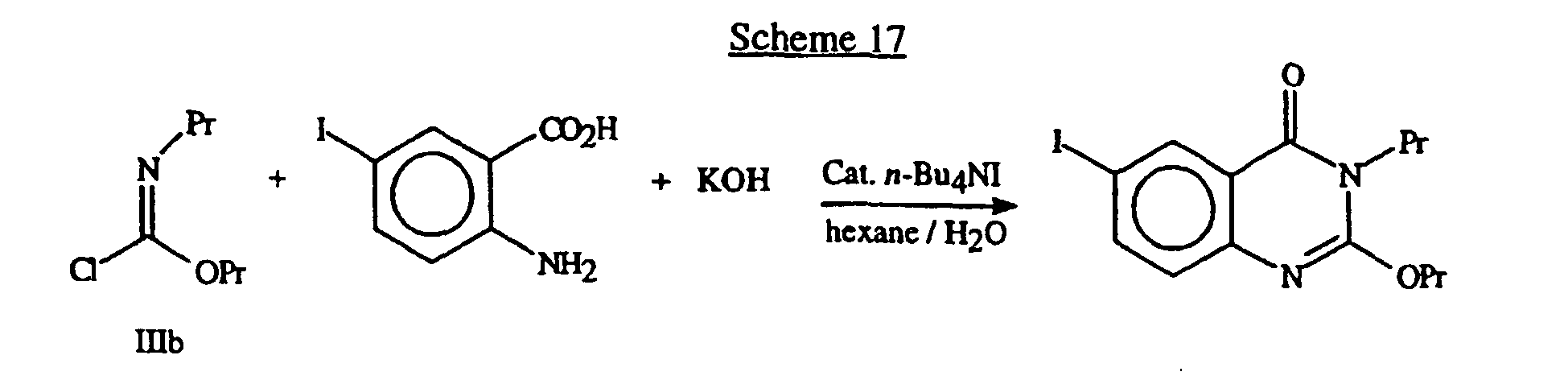
- An alternative method for preparing a compound of Formula I is described by Schemes 16, and 17. A specifically preferred compound of Formula I, 6-iodo-3-n-propyl-2-n-propyloxy-4(3H)-quinazolinone is illustrated.
- Contacting propylcarbonimidoyl dichloride, (H. Ulrich, The Chemistry of Imidoyl Halides, Chapter 2, Plenum Press, New York, 1968) in a suitable solvent such as methylene chloride with a base such as potassium hydroxide and propanol gives the propyl propylchloroformimidate IIIb, which is then contacted with 5-iodoanthranilic acid, a base such as potassium hydroxide and a catalytic amount of tetra-n-butylammonium iodide to give a 6-iodo-3-n-propyl-2-n-propyloxy-4(3H)-quinazolinone.

- The isopropyl analog of the compound IIIb can be prepared by using the analogous starting materials isopropylcarbonimidoyl dichloride and isopropyl alcohol.
- To 10 g (0.099 g) of propyl isothiocyanate was added 50 mL of n-propanol. The reaction mixture was heated to reflux for 3 h and cooled to room temperature. An aliquot was removed and concentrated under reduced pressure to give the title compound, 1H NMR (300 MHz, CDCl3): δ 0.94-1.02 (m,6H); 1.49-1.83 (m,4H); 3.22 (q), 3.51 (q,2H total); 4.37 (t), 4.45 (t,2H total), 6.25 (br s), 6.78 (br s,1H total). The remaining reaction mixture was concentrated under reduced pressure as above to provide 13.5 g of oil which was used without further purification.
- To a solution of 5 g (0.031 moles) of O-propyl propylcarbamothioate in 155 mL of tetrahydrofuran was added 1.37 g (0.034 moles) of 60% NaH at 0-5°C. After allowing the mixture to warm to room temperature, 2.49 mL (0.040 moles) of iodomethane was added and the reaction was stirred for 2 h. The reaction was partitioned between 200 mL each of diethyl ether and saturated aqueous sodium bicarbonate. The organic phase was separated, washed with water and brine, dried over anhydrous sodium sulfate, and concentrated under reduced pressure to deliver 5.9 g of the title compound, which was carried on without further purification, 1H NMR (400 MHz, CDCl3): δ 0.91-0.99 (m,6H); 1.56-1.62 (m,2H); 1.68-1.75 (m,2H); 2.38 (s,3H); 3.14 (t,2H); 4.09 (t,2H).
- To a solution of 0.38 g (1.44 mmoles) of 2-amino-5-iodobenzoic acid and 0.14 g (1.38 mmol) of triethylamine in 7.15 mL of n-propanol was added 0.25 g (1.143 mmol) of S-methyl O-propyl propylcarbonimidothioate. The reaction mixture was stirred at room temperature for 18 h, heated to 60°C for 24 h, and then heated to reflux for 6 h. The reaction was then concentrated under reduced pressure to give about 0.6 g of crude material, which was purified by flash chromatography on silica (93:7 hexanes:ethyl acetate) to give 0.21 g of the title compound, 1H NMR (400 MHz, CDCl3): δ 0.96 (t,3H); 1.06 (t,3H); 1.64-1.79 (m,2H); 1.81-1.92 (m,2H); 4.05 (t,2H); 4.43 (t,2H), 7.19 (d,1H); 7.85 (dd,1H); 8.49 (d,1H). In addition, 0.11g of propyl-5-iodoanthranilate was obtained from the flash chromatography, 1H NMR (400 MHz, CDCl3): δ 1.02 (t,3H); 1.76-1.86 (m,2H); 4.23 (t,2H); 5.8 (br s,2H); 6.45 (d,1H); 7.45 (dd, 1H); 8.13 (d,1H).
- To a stirred solution of propylcarbonimidoyl dichloride (1.2 g, 8.57 mmol) in dichloromethane (3 mL) cooled to -5-0°C, potassium propoxide (prepared from potassium hydroxide and propanol and removing water by azeotrope) in propanol was added dropwise, keeping the reaction temperature at about 0°C. The transformation of the C=N absorption at 1650 cm-1 for propylcarbonimidoyl dichloride to 1697 cm-1 for propyl propylchloroformimidate was monitored by IR. When the reaction was complete, the reaction mixture was poured into water (10 mL) and extracted with diethyl ether (3 times with 10 mL). The diethyl ether extracts were combined, dried (MgSO4), and concentrated under reduced pressure to give propyl propylchloroformimidate (1.35 g, 96%, oil; b.p. 61-62°C (1.3 x 10³ Pa). IR (CCl4): 2966.8, 1697.4, 1186.4 cm-1.
- To a vigorously stirred mixture of 5-iodoanthranilic acid (1 g, 3.8 mmol), potassium hydroxide (0.8 g, 14.3 mmol) and a catalytic amount of tetra-n-butylammonium iodide in water (8 mL) at 20°C, propyl propylchloroformimidate (1.37 g, 8.38 mmole) in hexane (4 mL) was added. The reaction was stirred vigorously and the reaction temperature was maintained between 20-25°C with the use of an external water bath. The reaction was monitored by TLC. After 15 min of stirring, hexane (10 mL) was added. The aqueous layer was separated and extracted with hexane (10 mL). The combined hexane layers were washed with HCl (5 mL), saturated aqueous NaHCO3 (5 mL), and water (5 mL); dried over magnesium sulfate; suction filtered; and concentrated under reduced pressure to an oil which was purified by silica gel column (eluted with ethyl acetate/hexane = 1/9) to provide the product (1.2 g, 85%). Recrystallization from 1-propanol/water gave a crystalline white solid (m.p. 51.5°C). 1H NMR (in CDCl3) δ: 0.97 (t,3H), 1.06 (t,3H), 1.66 (m,2H), 1.85 (m,2H), 4.06 (t,2H), 4.43 (t,2H), 7.18 (d,1H), 7.84 (dd,1H), 8.48 (d,1H).
- Using the procedures outlined in Schemes 13-17 and Examples 1-2, the compounds of Tables I, Ia, Ib, Ic and Id can be prepared.
Table I 3-propyl-2-(propyloxy)-4(3H)-quinazolinone 2-ethoxy-6-iodo-3-propyl-4(3H)-quinazolinone 6-iodo-2-methoxy-3-propyl-4(3H)-quinazolinone 3-ethyl-6-iodo-2-(propyloxy)-4(3H)-quinazolinone 6-iodo-3-methyl-2-(propyloxy)-4(3H)-quinazolinone 6-iodo-2-(2-propenyloxy)-3-(propyl)-4(3H)-quinazolinone 6-iodo-3-(2-propenyl)-2-(propyloxy)-4(3H)-quinazolinone 3-ethyl-1,2-dihydro-6-iodo-2-thioxo-4(3H)-quinazolinone 2-chloro-3-ethyl-6-iodo-4(3H)-quinazolinone 2-chloro-6-iodo-3-methyl-4(3H)-quinazolinone 3-ethyl-6-iodo-2,4-(1H,3H)-quinazolinedione 6-iodo-3-methyl-2,4-(1H,3H)-quinazolinedione 2-(ethylthio)-6-iodo-3-propyl-4(3H)-quinazolinone 3-ethyl-6-iodo-2-(methylthio)-4(3H)-quinazolinone 6,8-diiodo-3-propyl-2-propyloxy-4(3H)-quinazolinone 3-(cyclopropylmethyl)-6-iodo-2-propyloxy-4(3H)-quinazolinone Table Ia 
Compound No. R3 R1 R2 1 I CH3 CH3 2 I CH2CH3 CH3 3 I CH2CH2CH3 CH3 4 I CH2(CH2)2CH3 CH3 5 I CH3 CH2CH3 6 I CH2CH3 CH2CH3 7 I CH2CH2CH3 CH2CH3 8 I CH3 CH2CH2CH3 9 I CH2CH3 CH2CH2CH3 10 I CH3 CH2(CH2)2CH3 11 Br CH3 CH3 12 Br CH2CH3 CH3 13 Br CH2CH2CH3 CH3 14 Br CH2(CH2)2CH3 CH3 15 Br CH3 CH2CH3 16 Br CH2CH3 CH2CH3 17 Br CH2CH2CH3 CH2CH3 18 Br CH3 CH2CH2CH3 19 Br CH2CH3 CH2CH2CH3 20 Br CH3 CH2(CH2)2CH3 21 I CH(CH3)2 CH3 22 I CH(CH3)2 CH2CH3 23 I CH(CH3)2 CH(CH3)2 24 I CH3 CH(CH3)2 25 I CH2CH3 CH(CH3)2 26 I CH(CH3)2 CH(CH3)2 27 I C(CH3)3 CH3 28 I C(CH3)3 CH2CH3 29 I C(CH3)3 CH(CH3)2 30 I C(CH3)3 C(CH3)3 31 I CH3 C(CH3)3 32 I CH2CH3 C(CH3)3 33 I CH(CH3)2 C(CH3)3 34 I C(CH3)3 C(CH3)3 35 Br CH(CH3)2 CH3 36 Br CH(CH3)2 CH2CH3 37 Br CH(CH3)2 CH(CH3)2 38 Br CH3 CH(CH3)2 39 Br CH2CH3 CH(CH3)2 40 Br CH(CH3)2 CH(CH3)2 41 Br C(CH3)3 CH3 42 Br C(CH3)3 CH2CH3 43 Br C(CH3)3 CH(CH3)2 44 Br C(CH3)3 C(CH3)3 45 Br CH3 C(CH3)3 46 Br CH2CH3 C(CH3)3 47 Br CH(CH3)2 C(CH3)3 48 Br C(CH3)3 C(CH3)3 49 I CH2CH(CH3)2 CH3 50 I CH2CH(CH3)2 CH2CH3 51 I CH2CH(CH3)2 CH(CH3)2 52 I CH3 CH2CH(CH3)2 53 I CH2CH3 CH2CH(CH3)2 54 I CH(CH3)2 CH2CH(CH3)2 55 I CH2CH(CH3)2 CH2CH(CH3)2 56 I CH2C(CH3)3 CH3 57 I CH2C(CH3)3 CH2CH3 58 I CH2C(CH3)3 CH(CH3)2 59 I CH2C(CH3)3 C(CH3)3 60 I CH3 CH2C(CH3)3 61 I CH2CH3 CH2C(CH3)3 62 I CH(CH3)2 CH2C(CH3)3 63 I C(CH3)3 CH2C(CH3)3 64 Br CH2CH(CH3)2 CH3 65 Br CH2CH(CH3)2 CH2CH3 66 Br CH2CH(CH3)2 CH(CH3)2 67 Br CH3 CH2CH(CH3)2 68 Br CH2CH3 CH2CH(CH3)2 69 Br CH(CH3)2 CH2CH(CH3)2 70 Br CH2CH(CH3)2 CH2CH(CH3)2 71 Br CH2C(CH3)3 CH3 72 Br CH2C(CH3)3 CH2CH3 73 Br CH2C(CH3)3 CH(CH3)2 74 Br CH2C(CH3)3 C(CH3)3 75 Br CH3 CH2C(CH3)3 76 Br CH2CH3 CH2C(CH3)3 77 Br CH(CH3)2 CH2C(CH3)3 78 Br C(CH3)3 CH2C(CH3)3 79 I 
CH3 80 I 
CH2CH3 81 I 
CH2CH2CH3 82 I CH3 
83 I CH2CH3 
84 I CH2CH2 CH3 
85 I 
CH3 86 I 
CH2CH3 87 I 
CH2CH2CH3 88 I CH3 
89 I CH2CH3 
90 I CH2CH2CH3 
91 I 
CH3 92 I 
CH2CH3 93 I 
CH2CH2CH3 94 I CH3 
95 I CH2CH3 
96 I CH2CH2CH3 
Table Ib 
Compound No. R3 R4 R1 R2 97 I I CH3 CH3 98 I I CH2CH3 CH3 99 I I CH2CH2CH3 CH3 100 I I CH2(CH2)2CH3 CH3 101 I I CH3 CH2CH3 102 I I CH2CH3 CH2CH3 103 I I CH2CH2CH3 CH2CH3 104 I I CH3 CH2CH2CH3 105 I I CH2CH3 CH2CH2CH3 106 I I CH3 CH2(CH2)2CH3 107 Br Br CH3 CH3 108 Br Br CH2CH3 CH3 109 Br Br CH2CH2CH3 CH3 110 Br Br CH2(CH2)2CH3 CH3 111 Br Br CH3 CH2CH3 112 Br Br CH2CH3 CH2CH3 113 Br Br CH2CH2CH3 CH2CH3 114 Br Br CH3 CH2CH2CH3 115 Br Br CH2CH3 CH2CH2CH3 116 Br Br CH3 CH2(CH2)2CH3 117 I Br CH3 CH3 118 Br I CH3 CH3 119 I Br CH3 CH2CH2CH3 120 I I CH(CH3)2 CH3 121 I I CH(CH3)2 CH2CH3 122 I I CH(CH3)2 CH(CH3)2 123 I I CH3 CH(CH3)2 124 I I CH2CH3 CH(CH3)2 125 I I CH(CH3)2 CH(CH3)2 126 I I C(CH3)3 CH3 127 I I C(CH3)3 CH2CH3 128 I I C(CH3)3 CH(CH3)2 129 I I C(CH3)3 C(CH3)3 130 I I CH3 C(CH3)3 131 I I CH2CH3 C(CH3)3 132 I I CH(CH3)2 C(CH3)3 133 I I C(CH3)3 C(CH3)3 134 Br Br CH(CH3)2 CH3 135 Br Br CH(CH3)2 CH2CH3 136 Br Br CH(CH3)2 CH(CH3)2 137 Br Br CH3 CH(CH3)2 138 Br Br CH2CH3 CH(CH3)2 139 Br Br CH(CH3)2 CH(CH3)2 140 Br Br C(CH3)3 CH3 141 Br Br C(CH3)3 CH2CH3 142 Br Br C(CH3)3 CH(CH3)2 143 Br Br C(CH3)3 C(CH3)3 144 Br Br CH3 C(CH3)3 145 Br Br CH2CH3 C(CH3)3 146 Br Br CH(CH3)2 C(CH3)3 147 Br Br C(CH3)3 C(CH3)3 148 I I CH2CH(CH3)2 CH3 149 I I CH2CH(CH3)2 CH2CH3 150 I I CH2CH(CH3)2 CH(CH3)2 151 I I CH3 CH2CH(CH3)2 152 I I CH2CH3 CH2CH(CH3)2 153 I I CH(CH3)2 CH2CH(CH3)2 154 I I CH2CH(CH3)2 CH2CH(CH3)2 155 I I CH2C(CH3)3 CH3 156 I I CH2C(CH3)3 CH2CH3 157 I I CH2C(CH3)3 CH(CH3)2 158 I I CH2C(CH3)3 C(CH3)3 159 I I CH3 CH2C(CH3)3 160 I I CH2CH3 CH2C(CH3)3 161 I I CH(CH3)2 CH2C(CH3)3 162 I I C(CH3)3 CH2C(CH3)3 163 Br Br CH2CH(CH3)2 CH3 164 Br Br CH2CH(CH3)2 CH2CH3 165 Br Br CH2CH(CH3)2 CH(CH3)2 166 Br Br CH3 CH2CH(CH3)2 167 Br Br CH2CH3 CH2CH(CH3)2 168 Br Br CH(CH3)2 CH2CH(CH3)2 169 Br Br CH2CH(CH3)2 CH2CH(CH3)2 170 Br Br CH2C(CH3)3 CH3 171 Br Br CH2C(CH3)3 CH2CH3 172 Br Br CH2C(CH3)3 CH(CH3)2 173 Br Br CH2C(CH3)3 C(CH3)3 174 Br Br CH3 CH2C(CH3)3 175 Br Br CH2CH3 CH2C(CH3)3 176 Br Br CH(CH3)2 CH2C(CH3)3 177 Br Br C(CH3)3 CH2C(CH3)3 178 I I 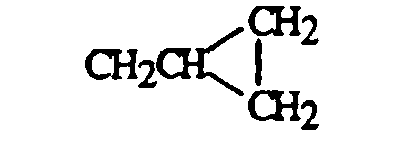
CH3 179 I I 
CH2CH3 180 I I 
CH2CH2CH3 181 I I CH3 
182 I I CH2CH3 
183 I I CH2CH2CH3 
184 I I 
CH3 185 I I 
CH2CH3 186 I I 
CH2CH2CH3 187 I I CH3 
188 I I CH2CH3 
189 I I CH2CH2CH3 
190 I I 
CH3 191 I I 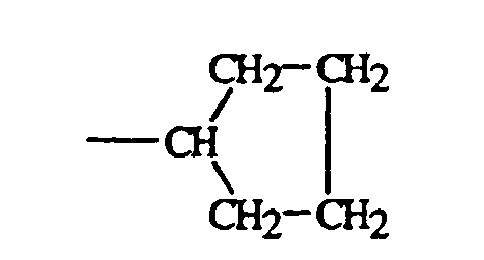
CH2CH3 192 I I 
CH2CH2CH3 193 I I CH3 
194 I I CH2CH3 
195 I I CH2CH2CH3 
Table Ic 
Compound No. R3 R1 R2 196 I CH3 CH=CH2 197 I CH2CH3 CH=CH2 198 I CH2CH2CH3 CH=CH2 199 I CH3 CH2CH=CH2 200 I CH2CH3 CH2CH=CH2 201 I CH2CH2CH3 CH2CH=CH2 202 I CH=CH2 CH3 203 I CH2CH=CH2 CH3 204 I CH=CH2 CH2CH3 205 I CH2CH=CH2 CH2CH3 206 I CH=CH2 CH2CH2CH3 207 I CH2CH=CH2 CH2CH2CH3 208 I CH=CH2 CH=CH2 209 I CH=CH2 CH2CH=CH2 210 I CH2CH=CH2 CH=CH2 211 I CH2CH=CH2 CH2CH=CH2 212 Br CH3 CH=CH2 213 Br CH2CH3 CH=CH2 214 Br CH2CH2CH3 CH=CH2 215 Br CH3 CH2CH=CH2 216 Br CH2CH3 CH2CH=CH2 217 Br CH2CH2CH3 CH2CH=CH2 218 Br CH=CH2 CH3 219 Br CH2CH=CH2 CH3 220 Br CH=CH2 CH2CH3 221 Br CH2CH=CH2 CH2CH3 222 Br CH=CH2 CH2CH2CH3 223 Br CH2CH=CH2 CH2CH2CH3 224 Br CH=CH2 CH=CH2 225 Br CH=CH2 CH2CH=CH2 226 Br CH2CH=CH2 CH=CH2 227 Br CH2CH=CH2 CH2CH=CH2 Table Id 
Compound No. R3 R4 R1 R2 228 I I CH3 CH=CH2 229 I I CH2CH3 CH=CH2 230 I I CH2CH2CH3 CH=CH2 231 I I CH3 CH2CH=CH2 232 I I CH2CH3 CH2CH=CH2 233 I I CH2CH2CH3 CH2CH=CH2 234 I I CH=CH2 CH3 235 I I CH2CH=CH2 CH3 236 I I CH=CH2 CH2CH3 237 I I CH2CH=CH2 CH2CH3 238 I I CH=CH2 CH2CH2CH3 239 I I CH2CH=CH2 CH2CH2CH3 240 I I CH=CH2 CH=CH2 241 I I CH=CH2 CH2CH=CH2 242 I I CH2CH=CH2 CH=CH2 243 I I CH2CH=CH2 CH2CH=CH2 244 Br Br CH3 CH=CH2 245 Br Br CH2CH3 CH=CH2 246 Br Br CH2CH2CH3 CH=CH2 247 Br Br CH3 CH2CH=CH2 248 Br Br CH2CH3 CH2CH=CH2 249 Br Br CH2CH2CH3 CH2CH=CH2 250 Br Br CH=CH2 CH3 251 Br Br CH2CH=CH2 CH3 252 Br Br CH=CH2 CH2CH3 253 Br Br CH2CH=CH2 CH2CH3 254 Br Br CH=CH2 CH2CH2CH3 255 Br Br CH2CH=CH2 CH2CH2CH3 256 Br Br CH=CH2 CH=CH2 257 Br Br CH=CH2 CH2CH=CH2 258 Br Br CH2CH=CH2 CH=CH2 259 Br Br CH2CH=CH2 CH2CH=CH2 260 I Br CH3 CH2CH=CH2 261 Br I CH3 CH2CH=CH2
Claims (4)
- A process for preparing a quinazolinone of Formula I
 R1 is C1-C10 alkyl; C3-C10 alkenyl; C3-C10 cycloalkyl; C3-C10 halocycloalkyl; C4-C10 cycloalkylalkyl; C4-C10 halocycloalkylalkyl; or C3-C10 alkynyl;R2 is C1-C10 alkyl; C3-C10 alkenyl; C3-C10 cycloalkyl; C3-C10 halocycloalkyl; C4-C10 cycloalkylalkyl; C4-C10 halocycloalkylalkyl; C4-C10 cycloalkyl; C4-C10 halocycloalkyl; or C3-C10 alkynyl; and R3 and R4 are each independently hydrogen or halogen; from compounds containing the moiety IIgcharacterized by employing a process sequence comprising treating an anthranilic acid or ester of Formula 1b


- A process of Claim 1 wherein R1 is C1-C3 alkyl, R2 is C1-C3 alkyl, R3 is Br or I, and R4 is H, Br or I.
- The process of Claim 2 wherein 2-amino-5-iodobenzoic acid is treated with S-methyl, O-propyl-propylcarbonimidothioate.
- A compound of Formula IIIa

Applications Claiming Priority (3)
| Application Number | Priority Date | Filing Date | Title |
|---|---|---|---|
| US2042396P | 1996-06-18 | 1996-06-18 | |
| US20423P | 1996-06-18 | ||
| EP97931152A EP0922037B1 (en) | 1996-06-18 | 1997-06-12 | Preparation of fungicidal quinazolinones and useful intermediates |
Related Parent Applications (1)
| Application Number | Title | Priority Date | Filing Date |
|---|---|---|---|
| EP97931152A Division EP0922037B1 (en) | 1996-06-18 | 1997-06-12 | Preparation of fungicidal quinazolinones and useful intermediates |
Publications (2)
| Publication Number | Publication Date |
|---|---|
| EP1344775A1 EP1344775A1 (en) | 2003-09-17 |
| EP1344775B1 true EP1344775B1 (en) | 2006-11-29 |
Family
ID=27767051
Family Applications (1)
| Application Number | Title | Priority Date | Filing Date |
|---|---|---|---|
| EP03011148A Expired - Lifetime EP1344775B1 (en) | 1996-06-18 | 1997-06-12 | Preparation of fungicidal quinazolinones and useful intermediates |
Country Status (1)
| Country | Link |
|---|---|
| EP (1) | EP1344775B1 (en) |
Families Citing this family (1)
| Publication number | Priority date | Publication date | Assignee | Title |
|---|---|---|---|---|
| CN113354592B (en) * | 2021-06-30 | 2022-06-21 | 赣南师范大学 | 2-thioquinazolinone compound and preparation method and application thereof |
Family Cites Families (1)
| Publication number | Priority date | Publication date | Assignee | Title |
|---|---|---|---|---|
| CN1050355C (en) * | 1993-05-12 | 2000-03-15 | 纳幕尔杜邦公司 | Fused bicyclic pyrimidinones, fungicidal compositions containing them, and applications thereof |
-
1997
- 1997-06-12 EP EP03011148A patent/EP1344775B1/en not_active Expired - Lifetime
Also Published As
| Publication number | Publication date |
|---|---|
| EP1344775A1 (en) | 2003-09-17 |
Similar Documents
| Publication | Publication Date | Title |
|---|---|---|
| ES2277627T3 (en) | PREPARATION OF FUNGICIDE QUINAZOLINONES AND USEFUL INTERMEDIARIES. | |
| KR960011384B1 (en) | Pyridinylpyrimidine derivatives, preparation methods thereof and fungicides containing them as active ingredients | |
| JPH07215921A (en) | Method for producing pest control agent and intermediate | |
| JPH02180873A (en) | Preparation of 4,5-dichloro-6-ethylpyrimidine | |
| JPH04275258A (en) | Racemization of optically active 1-aryl-alkylamine | |
| US6207828B1 (en) | Process for making 2-(trihaloacetyl)-3-(substituted amino)-2-propenoates | |
| JPH0450315B2 (en) | ||
| US20030153728A1 (en) | Modified safe and efficient process for the environmentally friendly synthesis of lmidoesters | |
| DE69911689T2 (en) | Process for the preparation of S-aryl-L-cysteine and derivatives | |
| US5312963A (en) | Process for preparing substituted cyclobutanes | |
| WO2011141414A1 (en) | Process for the preparation of 5-substituted 3-aryl-3-(trifluoromethyl)-3,4-dihydro-2h-pyrroles | |
| Atmani et al. | From oxazolines to precursors of aminoacids | |
| KR100971371B1 (en) | Process for preparing voriconazole by using new intermediates | |
| US20040030144A1 (en) | Optically active amine derivative and method of synthesis | |
| Prešeren et al. | Oxidative ring‐opening of rel‐(2R, 3R, 5S)‐5‐aryl‐2‐benzoylamino‐6, 7‐bis (methoxycarbonyl)‐2, 3‐dihydro‐1‐oxo‐3‐phenyl‐1H, 5H‐pyrazolo [1, 2‐a]‐pyrazoles. Synthesis of rel‐(2R, 3R)‐3‐phenyl‐3‐[5‐aryl‐3, 4‐bis (methoxycarbonyl) pyrazolyl‐1] alanine esters | |
| US5109020A (en) | Fluorinated cyclohexane derivatives, process and intermediates for their preparation and the use of the new fluorinated cyclohexane derivatives as fungicides and intermediates | |
| US6765109B1 (en) | Preparation of S-aryl-cysteine and its derivatives | |
| KR19990008411A (en) | Improvement method of 4-hydroxy-2-pyrrolidone | |
| US7115748B2 (en) | Method of making imidazole-2-thiones | |
| US20200207692A1 (en) | Process for the preparation of substituted phenoxyphenyl alcohols | |
| US5654461A (en) | Sulfamate compound containing carbamoyl group | |
| JP2006028154A (en) | Method for producing optically active compound | |
| PL210934B1 (en) | Optically active bisoxazoline compounds, process for production of the same and use thereof | |
| EP0722939A1 (en) | 4-iminooxazolidin-2-one derivative, process for producing the same, and herbicide containing the same as active ingredient | |
| EP0801642B1 (en) | Novel sulfamate compound containing n-substituted carbamoyl group and method for preparing the same |
Legal Events
| Date | Code | Title | Description |
|---|---|---|---|
| PUAI | Public reference made under article 153(3) epc to a published international application that has entered the european phase |
Free format text: ORIGINAL CODE: 0009012 |
|
| AC | Divisional application: reference to earlier application |
Ref document number: 0922037 Country of ref document: EP Kind code of ref document: P |
|
| AK | Designated contracting states |
Kind code of ref document: A1 Designated state(s): CH DE ES FR GB IT LI |
|
| RIN1 | Information on inventor provided before grant (corrected) |
Inventor name: SUN, KING-MO Inventor name: BEREZNAK, JAMES FRANCIS Inventor name: MARSHALL, ERIC ALLEN |
|
| 17P | Request for examination filed |
Effective date: 20040225 |
|
| AKX | Designation fees paid |
Designated state(s): CH DE ES FR GB IT LI |
|
| GRAP | Despatch of communication of intention to grant a patent |
Free format text: ORIGINAL CODE: EPIDOSNIGR1 |
|
| GRAS | Grant fee paid |
Free format text: ORIGINAL CODE: EPIDOSNIGR3 |
|
| GRAA | (expected) grant |
Free format text: ORIGINAL CODE: 0009210 |
|
| AC | Divisional application: reference to earlier application |
Ref document number: 0922037 Country of ref document: EP Kind code of ref document: P |
|
| AK | Designated contracting states |
Kind code of ref document: B1 Designated state(s): CH DE ES FR GB IT LI |
|
| REG | Reference to a national code |
Ref country code: GB Ref legal event code: FG4D |
|
| REG | Reference to a national code |
Ref country code: CH Ref legal event code: EP |
|
| REF | Corresponds to: |
Ref document number: 69737044 Country of ref document: DE Date of ref document: 20070111 Kind code of ref document: P |
|
| REG | Reference to a national code |
Ref country code: CH Ref legal event code: NV Representative=s name: RITSCHER & PARTNER AG |
|
| ET | Fr: translation filed | ||
| REG | Reference to a national code |
Ref country code: ES Ref legal event code: FG2A Ref document number: 2277627 Country of ref document: ES Kind code of ref document: T3 |
|
| PLBE | No opposition filed within time limit |
Free format text: ORIGINAL CODE: 0009261 |
|
| STAA | Information on the status of an ep patent application or granted ep patent |
Free format text: STATUS: NO OPPOSITION FILED WITHIN TIME LIMIT |
|
| 26N | No opposition filed |
Effective date: 20070830 |
|
| REG | Reference to a national code |
Ref country code: CH Ref legal event code: PCAR Free format text: RITSCHER & PARTNER AG;RESIRAIN 1;8125 ZOLLIKERBERG (CH) |
|
| REG | Reference to a national code |
Ref country code: CH Ref legal event code: PFA Owner name: E.I. DU PONT DE NEMOURS AND COMPANY, US Free format text: FORMER OWNER: E.I. DU PONT DE NEMOURS AND COMPANY, US |
|
| REG | Reference to a national code |
Ref country code: FR Ref legal event code: PLFP Year of fee payment: 20 |
|
| PGFP | Annual fee paid to national office [announced via postgrant information from national office to epo] |
Ref country code: ES Payment date: 20160511 Year of fee payment: 20 Ref country code: DE Payment date: 20160607 Year of fee payment: 20 Ref country code: GB Payment date: 20160608 Year of fee payment: 20 Ref country code: CH Payment date: 20160613 Year of fee payment: 20 |
|
| PGFP | Annual fee paid to national office [announced via postgrant information from national office to epo] |
Ref country code: FR Payment date: 20160516 Year of fee payment: 20 |
|
| PGFP | Annual fee paid to national office [announced via postgrant information from national office to epo] |
Ref country code: IT Payment date: 20160621 Year of fee payment: 20 |
|
| REG | Reference to a national code |
Ref country code: DE Ref legal event code: R071 Ref document number: 69737044 Country of ref document: DE |
|
| REG | Reference to a national code |
Ref country code: CH Ref legal event code: PL |
|
| REG | Reference to a national code |
Ref country code: GB Ref legal event code: PE20 Expiry date: 20170611 |
|
| PG25 | Lapsed in a contracting state [announced via postgrant information from national office to epo] |
Ref country code: GB Free format text: LAPSE BECAUSE OF EXPIRATION OF PROTECTION Effective date: 20170611 |
|
| REG | Reference to a national code |
Ref country code: ES Ref legal event code: FD2A Effective date: 20180508 |
|
| PG25 | Lapsed in a contracting state [announced via postgrant information from national office to epo] |
Ref country code: ES Free format text: LAPSE BECAUSE OF EXPIRATION OF PROTECTION Effective date: 20170613 |