EP1344772A1 - Arylbis (perfluoroalkylsulfonyl) methane, metal salt of the same, and processes for producing these - Google Patents
Arylbis (perfluoroalkylsulfonyl) methane, metal salt of the same, and processes for producing these Download PDFInfo
- Publication number
- EP1344772A1 EP1344772A1 EP01270523A EP01270523A EP1344772A1 EP 1344772 A1 EP1344772 A1 EP 1344772A1 EP 01270523 A EP01270523 A EP 01270523A EP 01270523 A EP01270523 A EP 01270523A EP 1344772 A1 EP1344772 A1 EP 1344772A1
- Authority
- EP
- European Patent Office
- Prior art keywords
- methane
- arylbis
- perfluoroalkylsulfonyl
- metallic salt
- producing
- Prior art date
- Legal status (The legal status is an assumption and is not a legal conclusion. Google has not performed a legal analysis and makes no representation as to the accuracy of the status listed.)
- Granted
Links
Classifications
-
- B—PERFORMING OPERATIONS; TRANSPORTING
- B01—PHYSICAL OR CHEMICAL PROCESSES OR APPARATUS IN GENERAL
- B01J—CHEMICAL OR PHYSICAL PROCESSES, e.g. CATALYSIS OR COLLOID CHEMISTRY; THEIR RELEVANT APPARATUS
- B01J31/00—Catalysts comprising hydrides, coordination complexes or organic compounds
- B01J31/02—Catalysts comprising hydrides, coordination complexes or organic compounds containing organic compounds or metal hydrides
- B01J31/0215—Sulfur-containing compounds
- B01J31/0225—Sulfur-containing compounds comprising sulfonic acid groups or the corresponding salts
- B01J31/0227—Sulfur-containing compounds comprising sulfonic acid groups or the corresponding salts being perfluorinated, i.e. comprising at least one perfluorinated moiety as substructure in case of polyfunctional compounds
-
- B—PERFORMING OPERATIONS; TRANSPORTING
- B01—PHYSICAL OR CHEMICAL PROCESSES OR APPARATUS IN GENERAL
- B01J—CHEMICAL OR PHYSICAL PROCESSES, e.g. CATALYSIS OR COLLOID CHEMISTRY; THEIR RELEVANT APPARATUS
- B01J31/00—Catalysts comprising hydrides, coordination complexes or organic compounds
- B01J31/02—Catalysts comprising hydrides, coordination complexes or organic compounds containing organic compounds or metal hydrides
- B01J31/12—Catalysts comprising hydrides, coordination complexes or organic compounds containing organic compounds or metal hydrides containing organo-metallic compounds or metal hydrides
- B01J31/122—Metal aryl or alkyl compounds
-
- C—CHEMISTRY; METALLURGY
- C07—ORGANIC CHEMISTRY
- C07C—ACYCLIC OR CARBOCYCLIC COMPOUNDS
- C07C317/00—Sulfones; Sulfoxides
- C07C317/02—Sulfones; Sulfoxides having sulfone or sulfoxide groups bound to acyclic carbon atoms
- C07C317/10—Sulfones; Sulfoxides having sulfone or sulfoxide groups bound to acyclic carbon atoms of an unsaturated carbon skeleton containing rings
-
- C—CHEMISTRY; METALLURGY
- C07—ORGANIC CHEMISTRY
- C07C—ACYCLIC OR CARBOCYCLIC COMPOUNDS
- C07C45/00—Preparation of compounds having >C = O groups bound only to carbon or hydrogen atoms; Preparation of chelates of such compounds
- C07C45/61—Preparation of compounds having >C = O groups bound only to carbon or hydrogen atoms; Preparation of chelates of such compounds by reactions not involving the formation of >C = O groups
- C07C45/67—Preparation of compounds having >C = O groups bound only to carbon or hydrogen atoms; Preparation of chelates of such compounds by reactions not involving the formation of >C = O groups by isomerisation; by change of size of the carbon skeleton
- C07C45/68—Preparation of compounds having >C = O groups bound only to carbon or hydrogen atoms; Preparation of chelates of such compounds by reactions not involving the formation of >C = O groups by isomerisation; by change of size of the carbon skeleton by increase in the number of carbon atoms
- C07C45/69—Preparation of compounds having >C = O groups bound only to carbon or hydrogen atoms; Preparation of chelates of such compounds by reactions not involving the formation of >C = O groups by isomerisation; by change of size of the carbon skeleton by increase in the number of carbon atoms by addition to carbon-to-carbon double or triple bonds
-
- C—CHEMISTRY; METALLURGY
- C07—ORGANIC CHEMISTRY
- C07C—ACYCLIC OR CARBOCYCLIC COMPOUNDS
- C07C67/00—Preparation of carboxylic acid esters
- C07C67/08—Preparation of carboxylic acid esters by reacting carboxylic acids or symmetrical anhydrides with the hydroxy or O-metal group of organic compounds
-
- B—PERFORMING OPERATIONS; TRANSPORTING
- B01—PHYSICAL OR CHEMICAL PROCESSES OR APPARATUS IN GENERAL
- B01J—CHEMICAL OR PHYSICAL PROCESSES, e.g. CATALYSIS OR COLLOID CHEMISTRY; THEIR RELEVANT APPARATUS
- B01J2231/00—Catalytic reactions performed with catalysts classified in B01J31/00
- B01J2231/10—Polymerisation reactions involving at least dual use catalysts, e.g. for both oligomerisation and polymerisation
- B01J2231/12—Olefin polymerisation or copolymerisation
- B01J2231/122—Cationic (co)polymerisation, e.g. single-site or Ziegler-Natta type
-
- B—PERFORMING OPERATIONS; TRANSPORTING
- B01—PHYSICAL OR CHEMICAL PROCESSES OR APPARATUS IN GENERAL
- B01J—CHEMICAL OR PHYSICAL PROCESSES, e.g. CATALYSIS OR COLLOID CHEMISTRY; THEIR RELEVANT APPARATUS
- B01J2231/00—Catalytic reactions performed with catalysts classified in B01J31/00
- B01J2231/30—Addition reactions at carbon centres, i.e. to either C-C or C-X multiple bonds
- B01J2231/32—Addition reactions to C=C or C-C triple bonds
- B01J2231/324—Cyclisations via conversion of C-C multiple to single or less multiple bonds, e.g. cycloadditions
- B01J2231/326—Diels-Alder or other [4+2] cycloadditions, e.g. hetero-analogues
-
- B—PERFORMING OPERATIONS; TRANSPORTING
- B01—PHYSICAL OR CHEMICAL PROCESSES OR APPARATUS IN GENERAL
- B01J—CHEMICAL OR PHYSICAL PROCESSES, e.g. CATALYSIS OR COLLOID CHEMISTRY; THEIR RELEVANT APPARATUS
- B01J2231/00—Catalytic reactions performed with catalysts classified in B01J31/00
- B01J2231/40—Substitution reactions at carbon centres, e.g. C-C or C-X, i.e. carbon-hetero atom, cross-coupling, C-H activation or ring-opening reactions
-
- B—PERFORMING OPERATIONS; TRANSPORTING
- B01—PHYSICAL OR CHEMICAL PROCESSES OR APPARATUS IN GENERAL
- B01J—CHEMICAL OR PHYSICAL PROCESSES, e.g. CATALYSIS OR COLLOID CHEMISTRY; THEIR RELEVANT APPARATUS
- B01J2231/00—Catalytic reactions performed with catalysts classified in B01J31/00
- B01J2231/40—Substitution reactions at carbon centres, e.g. C-C or C-X, i.e. carbon-hetero atom, cross-coupling, C-H activation or ring-opening reactions
- B01J2231/49—Esterification or transesterification
Definitions
- the present invention relates to a method for producing arylbis(perfluoroalkylsulfonyl)methane such as arylbis(triflyl)methane and the like, by using sodium trifluoromethane sulfinate and trifluoromethane sulfonic acid anhydride as an electrophilic reactant used as a triflyl source, and a novel arylbis(perfluoroalkylsulfonyl)methane such as pentafluorophenylbis(triflyl)methane, ⁇ 4-(pentafluorophenyl)-2,3,5,6-tetrafluorophenyl ⁇ bis(triflyl)methane and the like obtained from said method.
- the present invention relates to a metallic salt of arylbis(perfluoroalkylsulfonyl)methane, that is, a metallic arylbis(perfluoroalkylsulfonyl)methide, a method for producing said compound, catalysts such as Lewis acid catalyst which comprises said compound as an active ingredient, and a method for synthesizing organic compounds by using said catalysts.
- Trifluoromethane sulfonyl (-SO 2 CF 3 ; triflyl, Tf) group is known as one of the strongest electron-accepting group, which has an action to increase the protonic acidity of its ⁇ position (J. Am. Chem. Soc. 96, 2275, 1974; Synthesis, 691, 1997; J. Fluorine Chem. 66, 301, 1994).
- the other method is a method wherein light response between iodobenzene bis(triflylmethide) and benzene is conducted (61% yield) (Heteroatom Chem. 5, 9, 1994).
- arylbis(triflyl)methane is not formed when light response is conducted with allene, which has an electron-accepting group such as fluorobenzene.
- Lewis acid catalyst is known to be the most widely used catalyst in the aspect of organic synthesis. This Lewis acid catalyst associates with a specific functional group of an organic compound, forms a complex, and can be made to conduct a particular response only. The one that accepts an electron pair from which it reacts with is referred to as Lewis acid.
- Organic compounds generally have a functional group, and the functional group is usually a Lewis base, which attracts mutually with Lewis acid.
- the Lewis acid catalyst designed in this manner forms a complex with the functional group of the organic compound, and leads directly to the desired reaction. Due to this point, Lewis acid catalyst is also compared to an artificial enzyme. However, the reactivity and selectivity of the conventional Lewis acid catalyst was not so high compared to when enzyme was used, and was not sufficient. Therefore, a Lewis acid catalyst that has an excellent selectivity and reactivity, and further capable of reacting under warm condition has been required.
- a Lewis acid catalyst comprised of a compound shown by a general formula M[RfSO 2 -N-SO 2 Rf'] n or M[RfSO 2 -N-SO 2 Rf'] n ⁇ mH 2 O (wherein Rf and Rf' represent a perfluoroalkyl group having 1 to 8 carbon atoms, M represents an element selected from alkaline metal, alkaline earth metal, transition metal, rare earth, aluminum, gallium, iridium, thallium, silicon, germanium, tin, lead, arsenic, antimony, bismuth, selenium and tellurium, n represents an integer of the same number as the valence of the corresponding metal, and m represents a natural number from 0.5 to 20) (Japanese Laid Open Patent Application No.
- highly active acid catalysts including a highly active Lewis acid catalyst that can be used under the coexistence of water, comprising a metallic halide shown by a general formula M + (X 1 - )q (wherein M represents at least one metal selected from a group comprising elements from IIIA family to VB family of the periodic table, X 1 represents a halogen atom, and q represents an integer that is identical to the valence number of M) and a quaternary salt type anion exchange resin (Japanese Laid Open Patent Application No.
- an acid catalyst comprising a metallic salt of tris(perfluoroalkylsulfonyl)methide shown by the following formula [(RfSO 2 ) 3 C] n M 2 (however, Rf represents a perfluoroalkyl group having one or more carbon atoms, M 2 represents an element selected from alkaline metal, alkaline earth metal, transition metal including rare earth, zinc, cadmium, aluminum, gallium, indium, thallium, silicon, germanium, tin, lead, arsenic, antimony, bismuth, selenium or tellurium.
- n represents an integer of the same number as the valence of M 2 ) (Japanese Laid Open Patent Application No. 2000-219692).
- TfOH, Tf 2 NH, Tf 2 CH 2 and Tf 3 CH have already been known as an organic acid having a triflyl group.
- chemical modification to these molecules is not easy and therefore, it is difficult to make the molecules have a novel function. Due to this reason, they were not considered to be an appropriate material when producing pharmaceuticals, agricultural chemicals, asymmetric catalysts, various types of functional materials and the like.
- a catalyst capable of easily conducting asymmetric synthesis which is called chiral technology or chiral industry in the field of medicine and agricultural chemical, is expected for the development and application of pharmaceuticals, agricultural chemicals, various types of functional materials and the like.
- the object of the present invention is to provide: a method wherein an arylbis(perfluoroalkylsulfonyl)methane such as the various types of arylbis(triflyl)methane and the like having a bulky aryl group and an electron-accepting aryl group in which its synthesis was conventionally considered to be difficult, is produced easily and highly efficiently; a novel arylbis(perfluoroalkylsulfonyl)methane such as pentafluorophenylbis(triflyl)methane, ⁇ 4-(pentafluorophenyl)-2,3,5,6-tetrafluorophenyl ⁇ bis(triflyl)methane and the like, which can be widely applied to asymmetric catalyst, various types of functional materials and the like; a method for producing a metallic salt of arylbis(perfluoroalkylsulfonyl)methane that has excellent selectivity and reactivity, can
- arylbis(trifluoromethylsulfonyl)methane can be produced at a high yield by the following steps: an easily obtainable aryl halomethane was used as a starting material; sodium trifluoromethane sulfinate (TfNa) was used as an electrophilic reactant as a triflyl source; heating under reflux was conducted with the use of propionitrile as a solvent under the presence of 10 mol% tetrabutyl ammonium iodide catalyst to conduct nucleophilic substitution; arylmethyl trifluoromethylsulfone was produced at a high yield; and 2.2 equivalent weight of tert-butyl lithium (t-BuLi) and 1.1 equivalent weight of trifluoromethane sulfonic acid anhydride (Tf 2 O) were sequentially added to the arylmethyl trifluoromethylsulfone produced.
- TfNa sodium trifluoromethane sulfinate
- Tf 2 O triflu
- the present inventors conducted a keen study to elucidate the object mentioned above.
- TfNa and Tf 2 O were used to synthesize pentafluorophenylbis(triflyl)methane; the pentafluorophenylbis(triflyl)methane obtained was subjected to heating under reflux with scandium oxide (Sc 2 O 3 ) in water to produce scandium (III) pentafluorophenylbis(triflyl); said compound was used as a Lewis acid catalyst for benzoylation reaction with menthol and benzoic acid anhydride, and Diets-Alder reaction of methacrolein with cyclopentadiene; and it was confirmed that said compound has a better catalyst activity than the existing Lewis acids.
- the present invention has been completed.
- the present invention relates to an arylbis(perfluoroalkylsulfonyl)methane represented by the following general formula [1] (wherein R 1 shows a substituted or unsubstituted aryl group (however, phenyl group is excluded), Rf 1 and Rf 2 are independent to each other and show a perfluoroalkyl group) (claim 1); the arylbis(perfluoroalkylsulfonyl)methane represented by the general formula [1] according to claim 1, wherein R 1 is a naphthyl group, a 2,4,6-trimethylphenyl group, a 4-(trifluoromethyl)phenyl group, a 3,5-bis(trifluoromethyl)phenyl group, a pentafluorophenyl group or a perfluorobiphenyl group (claim 2); the arylbis(perfluoroalkylsulfonyl)methane represented by the general formula [1] according to
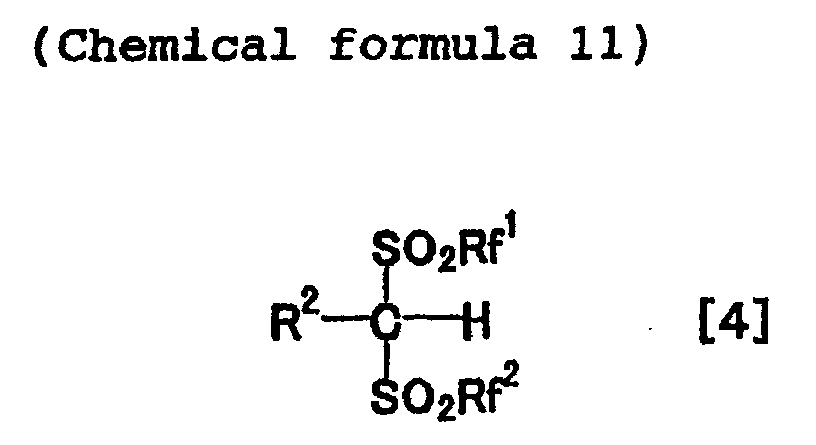
- the present invention relates to a method for producing an arylbis(perfluoroalkylsulfonyl)methane represented by general formula [4] (wherein R 2 shows a substituted or unsubstituted aryl group, Rf 1 and Rf 2 are independent to each other and show a perfluoroalkyl group),wherein an aryl halomethane is reacted with a perfluoroalkyl sulfinate, an arylmethylperfluoroalkylsulfone produced is reacted with a deprotonation agent comprised of an organic metal or a metallic salt, and a metallic salt of arylmethylperfluoroalkylsulfone obtained is reacted with a perfluoroalkyl sulfonic acid anhydride (claim 6); the method for producing the arylbis(perfluoroalkylsulfonyl)methane represented by the general formula [4] according to claim 6, wherein the ary
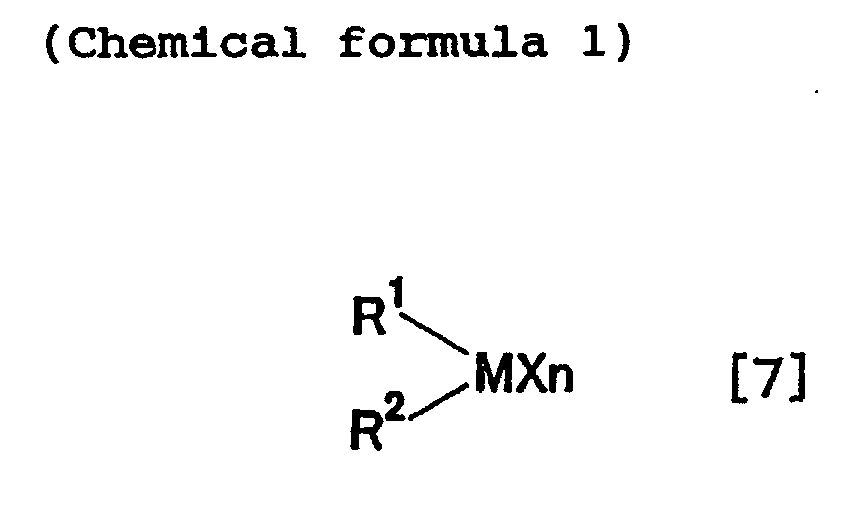
- the present invention relates to a metallic salt of arylbis(perfluoroalkylsulfonyl)methane represented by general formula [6] (wherein R 2 shows a substituted or unsubstituted aryl group , Rf 1 and Rf 2 are independent to each other and show a perfluoroalkyl group, M shows any one of the elements selected from alkaline metallic element, alkaline earth metallic element, transition metallic element, boron, silicon, aluminum, tin, zinc or bismuth, n shows a numeric value equal to the valence of M element) (claim 17); the metallic salt of arylbis(perfluoroalkylsulfonyl)methane according to claim 17, wherein the transition metallic element is any one of the metallic elements selected from scandium, yttrium, lanthanoid, copper, silver, titanium, zirconium or hafnium (claim 18); the metallic salt of arylbis(perfluoroalkylsulfony
- the present invention relates to a method for producing a metallic salt of arylbis(perfluoroalkylsulfonyl)methane, wherein the method is a method for producing a metallic salt of arylbis(perfluoroalkylsulfonyl)methane represented by general formula [6] (wherein R 2 shows a substituted or unsubstituted aryl group, Rf 1 and Rf 2 are independent to each other and show a perfluoroalkyl group, M shows any one of the elements selected from alkaline metallic element, alkaline earth metallic element, transition metallic element, boron, silicon, aluminum, tin, zinc or bismuth, n shows a numeric value equal to the valence of M element) wherein an arylbis(perfluoroalkylsulfonyl)methane represented by general formula [4] (wherein R 2 shows a substituted or unsubstituted aryl group, Rf 1 and Rf 2
- the present invention also relates to a method for producing a metallic salt of arylbis(perfluoroalkylsulfonyl)methane, wherein the method is a method for producing a metallic salt of arylbis(perfluoroalkylsulfonyl)methane represented by general formula [6] (wherein R 2 shows a substituted or unsubstituted aryl group, Rf 1 and Rf 2 are independent to each other and show a perfluoroalkyl group, M shows any one of the elements selected from alkaline metallic element, alkaline earth metallic element, transition metallic element, boron, silicon, aluminum, tin, zinc or bismuth, n shows a numeric value equal to the valence of M element) wherein a metallic salt of arylbis(perfluoroalkylsulfonyl)methane represented by general formula [4] (wherein R 2 shows a substituted or unsubstituted aryl group, Rf 1
- the present invention relates to a method for producing a metallic salt of arylbis(perfluoroalkylsulfonyl)methane, wherein the method is a method for producing a metallic salt of arylbis(perfluoroalkylsulfonyl)methane represented by general formula [6] (wherein R 2 shows a substituted or unsubstituted aryl group , Rf 1 and Rf 2 are independent to each other and show a perfluoroalkyl group, M shows any one of the elements selected from alkaline metallic element, alkaline earth metallic element, transition metallic element, boron, silicon, aluminum, tin, zinc or bismuth, n shows a numeric value equal to the valence of M element) wherein an arylbis(perfluoroalkylsulfonyl)methane represented by general formula [4] (wherein R 2 shows a substituted or unsubstituted aryl group, Rf 1 and Rf
- the present invention relates to a catalyst having a metallic salt of arylbis(perfluoroalkylsulfonyl)methane represented by general formula [6] (wherein R 2 shows a substituted or unsubstituted aryl group, Rf 1 and Rf 2 are independent to each other and show a perfluoroalkyl group, M shows any one of the elements selected from alkaline metallic element, alkaline earth metallic element, transition metallic element, boron, silicon, aluminum, tin, zinc or bismuth, n shows a numeric value equal to the valence of M element) as an active ingredient (claim 55); and the catalyst according to claim 55, wherein the catalyst is a Lewis acid catalyst (claim 56).
- R 2 shows a substituted or unsubstituted aryl group
- Rf 1 and Rf 2 are independent to each other and show a perfluoroalkyl group
- M shows any one of the elements selected from alkaline metallic element, alkaline earth metallic element, transition
- the present invention relates to a method for synthesizing an organic compound wherein the method is a method for synthesizing an organic compound by using a catalyst having a metallic salt of arylbis(perfluoroalkylsulfonyl)methane represented by general formula [6] (wherein R 2 shows a substituted or unsubstituted aryl group, Rf 1 and Rf 2 are independent to each other and show a perfluoroalkyl group, M shows any one of the elements selected from alkaline metallic element, alkaline earth metallic element, transition metallic element, boron, silicon, aluminum, tin, zinc or bismuth, n shows a numeric value equal to the valence of M element) as an active ingredient, and catalytic reaction is conducted under the presence of said catalyst in a solvent (claim 57); and the method for synthesizing an organic compound according to claim 57, wherein the catalytic reaction is a benzoylation reaction, a Diels-Alder reaction
- R 1 shows a substituted or unsubstituted aryl group (however, phenyl group is excluded), Rf 1 and Rf 2 are independent to each other and show a perfluoroalkyl group) of the present invention
- examples of R 1 include an aryl group having a substituent such as a phenyl group, a naphthyl group, a biphenyl group and the like having a substituent, and an unsubstituted aryl group excluding phenyl group such as an ⁇ -naphthyl group, a ⁇ -naphthyl group, a biphenyl group and the like.
- substituents for this case include a C1-C4 alkyl group such as methyl group and the like, a halogenated C1-C4 alkyl group such as trifluoromethyl group and the like, a halogen atom such as fluorine and the like, an alkoxy group, a sulfonyl group, an amino group and the like.
- R 1 examples include a naphthyl group, a 2,4,6-trimethylphenyl group, a 4-(trifluoromethyl)phenyl group, a 3,5-bis(trifluoromethyl)phenyl group, a pentafluorophenyl group, a p-tolyl group, an m-tolyl group, a mesityl group, a xylyl group, a biphenyl group, a perfluorobiphenyl group, a p-chlorophenyl group, an o-chlorophenyl group and the like.
- arylbis(perfluoroalkylsulfonyl)methane represented by the general formula [4] (wherein R 2 shows a substituted or unsubstituted aryl group, Rf 1 and Rf 2 are independent to each other and show a perfluoroalkyl group) of the present invention, as long as it is a method wherein an aryl halomethane is reacted with a perfluoroalkyl sulfinate, the arylmethylperfluoroalkylsulfone produced is reacted with a deprotonation agent comprised of an organic metal or a metallic salt, and the metallic salt of arylmethylperfluoroalkylsulfone obtained is reacted with an anhydrous perfluoroalkyl sulfonic acid.
- the method for producing an arylbis(perfluoroalkylsulfonyl)methane obtained by further reacting the arylbis(perfluoroalkylsulfonyl)methane obtained by the method mentioned above with alkyl anion such as alkyl lithium, alkoxy anion such as alkoxy lithium and the like is also included in the method of the present invention.
- alkyl anion such as alkyl lithium, alkoxy anion such as alkoxy lithium and the like
- R 2 in the formula [4] mentioned above include an aryl group such as a substituted or unsubstituted phenyl group, naphthyl group, biphenyl group and the like.
- substituents for this case include a C1-C4 alkyl group such as methyl group and the like, a halogenated C1-C4 alkyl group such as trifluoromethyl group and the like, a halogen atom such as fluorine and the like, an alkoxy group, a sulfonyl group, an amino group and the like.
- R 2 examples include a phenyl group, a naphthyl group, a 2,4,6-trimethylphenyl group, a 4-(trifluoromethyl)phenyl group, a 3,5-bis(trifluoromethyl)phenyl group, a pentafluorophenyl group, a p-tolyl group, a m-tolyl group, a mesityl group, a xylyl group, a biphenyl group, a perfluorobiphenyl group, a p-chlorophenyl group, an o-chlorophenyl group and the like.
- the Rf 1 and Rf 2 in the general formulae [1] and [4] mentioned above show a perfluoroalkyl group that may be the same or different from each other, preferably a C1-C8 perfluoroalkyl group.
- Specific examples of -SO 2 Rf 1 and -SO 2 Rf 2 containing these Rf 1 and Rf 2 include a trifluoromethylsulfonyl group, a perfluoroethylsulfonyl group, a perfluoropropylsulfonyl group, a perfluoroisopropylsulfonyl group, a perfluorobutylsulfonyl group, a perfluoroisobutylsulfonyl group, a perfluoropentylsulfonyl group, a perfluoroisopentylsulfonyl group, a perfluoroneopentylsulfonyl group and the like.
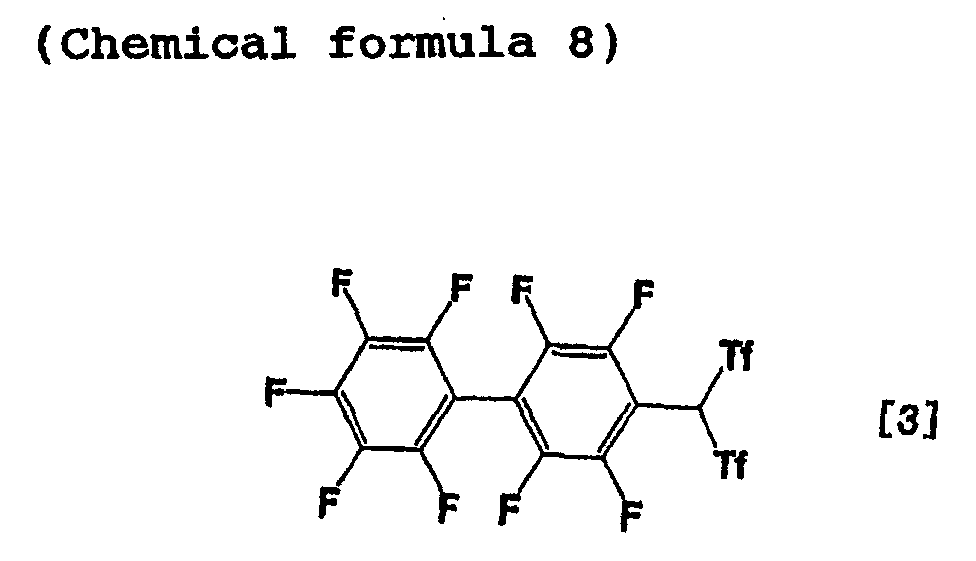
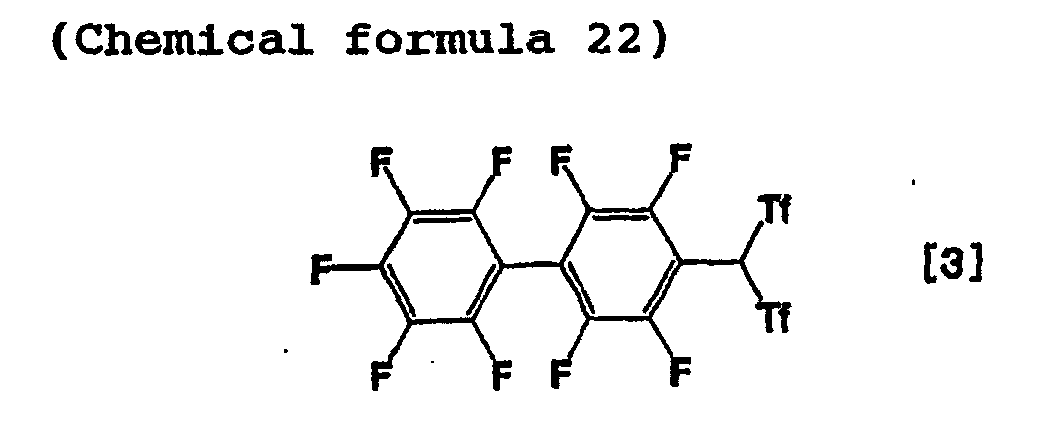
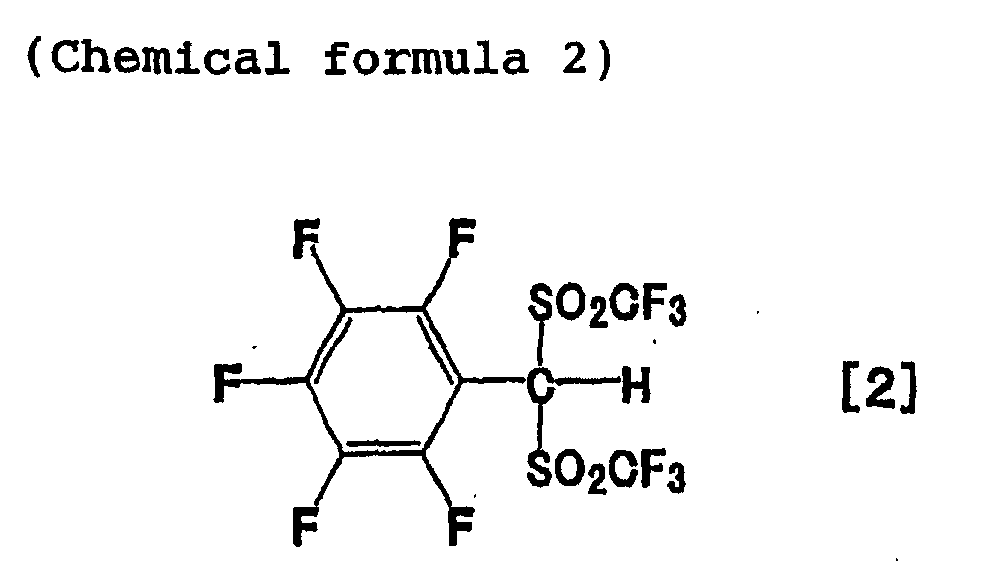
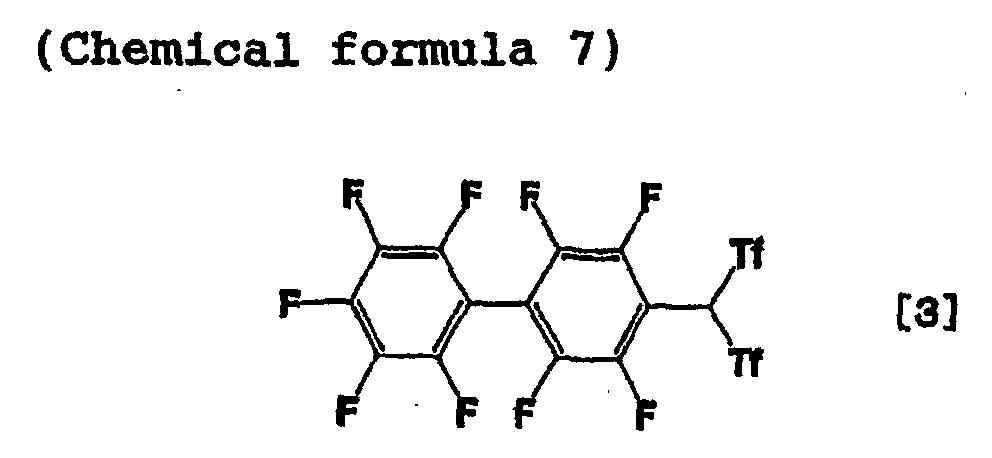
- arylbis(perfluoroalkylsulfonyl)methane represented by the general formula [1] of the present invention are, for example, a 2-naphthylbis(triflyl)methane, a 1-naphthylbis(triflyl)methane, a 2,4,6-trimethylphenylbis(triflyl)methane, a 4-(trifluoromethyl)phenylbis(triflyl)methane, a 3,5-bis(trifluoromethyl)phenylbis(triflyl)methane, the pentafluorophenylbis(triflyl)methane represented by the formula [2], the ⁇ 4-(pentafluorophenyl)-2,3,5,6-tetrafluorophenyl ⁇ bis(triflyl)methane represented by the formula [3] and the like.
- examples of the compound of the present invention include: a para position substituent of the pentafluorophenylbis(triflyl)methane represented by the formula [2] mentioned above, for example, a para position alkyl substituent such as a p-phenyl-2,3,5,6-tetrafluorophenyl-bis(triflyl) and the like, a para position alkoxy substituent such as p-hexanoxy-2,3,5,6-tetrafluorophenyl-bis(triflyl) and the like; a 4' position substituent of the ⁇ 4-(pentafluorophenyl)-2,3,5,6-tetrafluorophenyl ⁇ bis(triflyl)methane represented by the formula [3], for example, a 4' position alkyl substituent such as a [4-(4-phenyl-2,3,5,6-tetrafluorophenyl)-2,3,
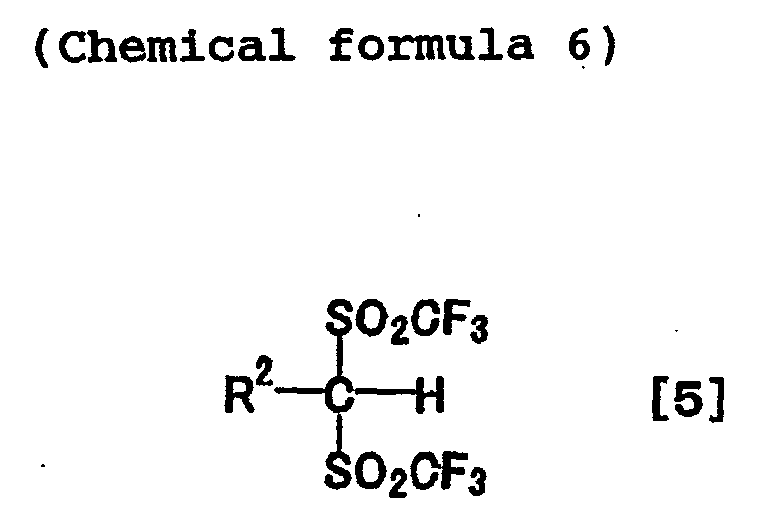
- a specific example of the arylbis(perfluoroalkylsulfonyl)methane represented by the general formula [4] in the method for producing the arylbis(perfluoroalkylsulfonyl)methane represented by the general formula [4] of the present invention is the arylbis(trifluoromethylsulfonyl)methane represented by the general formula [5] (wherein R 2 shows the aforementioned aryl group), which includes, for example, a phenylbis (triflyl)methane, a 2-naphthylbis(triflyl)methane, a 1-naphthylbis(triflyl)methane, a 2,4,6-trimethylphenylbis(triflyl)methane, a 4-(trifluoromethyl)phenylbis(triflyl)methane, a 3,5-bis(trifluoromethyl)phenylbis(triflyl)me
- aryl halomethane used in the method for producing the arylbis(perfluoroalkylsulfonyl)methane represented by the general formula [4] of the present invention, as long as it is a methane substituted by a substituted or unsubstituted aryl group and a halogen atom.
- benzyl bromide a 2-bromomethylnaphthalene, a 1-chloromethylnaphthalene, a 2,4,6-trimethylphenylmethylchloride, a 4-(trifluoromethyl)phenylmethylbromide, a 3,5-bis(trifluoromethyl)phenylmethylbromide, a pentafluorophenylmethylbromide, a 4-(bromomethyl)perfluorobiphenyl(perfluorobiphenylmethylbromi de) and the like.
- a preferable example of the perfluoroalkyl sulfinate used in the method for producing the arylbis(perfluoroalkylsulfonyl)methane represented by the general formula [4] of the present invention is a metallic salt of a C1-C8 perfluoroalkyl sulfinic acid including, for example, a trifluoromethyl sulfinic acid, a perfluoroethyl sulfinic acid, a perfluoropropyl sulfinic acid, a perfluoroisopropyl sulfinic acid, a perfluorobutyl sulfinic acid, a perfluoroisobutyl sulfinic acid, a perfluoropentyl sulfinic acid, a perfluoroisopentyl sulfinic acid, a perfluoroneopentyl sulfinic acid and the like.
- nucleophilic substitution reaction of the aryl halomethane and the perfluoroalkyl sulfinate in the method for producing the arylbis(perfluoroalkylsulfonyl)methane represented by the general formula [4] of the present invention is preferable for the nucleophilic substitution reaction of the aryl halomethane and the perfluoroalkyl sulfinate in the method for producing the arylbis(perfluoroalkylsulfonyl)methane represented by the general formula [4] of the present invention to be conducted in a condition wherein an arylmethylperfluoroalkylsulfone can be synthesized at a high efficiency, for example, by heating under reflux using a solvent with or without the presence of a catalyst.
- the molarity of the aryl halomethane in the reaction system mentioned above is 0.2 to 0.4 M, and for the perfluoroalkyl sulfinate such as sodium trifluoromethane sulfinate to be used 1.0 to 1.5 equivalent weight, especially about 1.3 equivalent weight, to the aryl halomethane.
- the use of a catalyst comprising an iodide such as tetrabutyl ammonium iodide, potassium iodide and the like is preferable.
- the amount of these catalysts to be used is, for example, 2 to 20 mol%, preferably 5 to 10 mol% to the aryl halomethane.
- acetonitrile, propionitrile, nitromethane, nitropropane and the like can be given as examples of the solvent, however, it is preferable to use propionitrile in view of the applicabiliity of the polarity and boiling point.
- the synthesis reaction mentioned above is preferable to be conducted by heating under reflux in a dry inert gas atmosphere, such as in an argon or nitrogen atmosphere. It is preferable for the reaction to be conducted by heating under reflux at 80 to 150°C, preferably 100°C to 120°C for 12 to 48 hours.
- Examples of the methods for purifying the arylmethyl triflone obtained by these synthesis reactions are, for example, a method wherein the reactant solution obtained by reacting under the condition mentioned above is filtrated to remove salt, followed by a silica gel column chromatography using hexane and ethyl acetate (EtOAc) as a developing solvent, and a recrystallization operation using hexane and toluene, or the like.
- the arylbis(perfluoroalkylsulfonyl)methane represented by the general formula [4] can be produced by the reaction of an arylmethylperfluoroalkylsulfone produced by the nucleophilic substitution reaction of aryl halomethane and perfluoroalkyl sulfinate with a deprotonation agent comprising an organic metal or a metallic salt, followed by the reaction of the metallic salt of arylmethylperfluoroalkylsulfone obtained with a perfluoroalkyl sulfonic acid anhydride.
- a deprotonation agent comprising an organic metal or a metallic salt
- deprotonation agent there is no particular limitation to the deprotonation agent mentioned above, as long as it is an organic metal or a metallic salt having a deprotonating action.
- An alkaline metallic salt and alkaline earth metallic salt of lower alkyl, more specifically, t-BuLi and t-BuMgCl can preferably be exemplified.
- a preferable example of the perfluoroalkyl sulfonic acid anhydride mentioned above is a C1-C8 perfluoroalkyl sulfonic acid anhydride including a trifluoromethane sulfonic acid anhydride (Tf 2 O), a perfluoroethane sulfonic acid anhydride, a perfluoropropane sulfonic acid anhydride, a perfluoroisopropane sulfonic acid anhydride, a perfluorobutane sulfonic acid anhydride, a perfluoroisobutane sulfonic acid anhydride, a perfluoropentane sulfonic acid anhydride, a perfluoroisopentane sulfonic acid anhydride, a perfluoroneopentane sulfonic acid anhydride and the like.
- Tf 2 O is especially preferable.
- arylmethylperfluoroalkylsulfone mentioned above is reacted with a deprotonation agent such as alkyl lithium, alkyl magnesium chloride and the like and a perfluoroalkyl sulfonic acid anhydride such as Tf 2 O and the like, as long as it is a method which can produce arylbis(perfluoroalkylsulfonyl)methane such as arylbis(trifluoromethylsulfonyl)methane and the like at a high yield.
- a deprotonation agent such as alkyl lithium, alkyl magnesium chloride and the like
- a perfluoroalkyl sulfonic acid anhydride such as Tf 2 O and the like
- arylmethylperfluoroalkylsulfone such as arylmethyl triflone and the like
- a solvent such as a diethylether and the like
- alkyl lithium is added at -78° C
- the solvent is reacted for 5 to 10 minutes
- Tf 2 O is added after the reaction to react for 1 to 2 hours at room temperature
- alkyl magnesium chloride is added at -78° C to react for 30 minutes, then reacted at 0° C for 30 minutes, and Tf 2 O is added at -78° C after the reaction to react for 1 to 2 hours at room temperature, and the like.
- an arylbis(perfluoroalkylsulfonyl)methane such as arylbis(trifluoromethylsulfonyl)methane at a high yield
- a pentafluorophenylbis(triflyl)methane is produced by using a pentafluoromethylbromide
- a pentafluorophenylbis(triflyl)methane and a 4-tert-butyl-2,3,5,6-tetrafluorophenylbis(triflyl)methane are both obtained at a ratio of 1:1 (45% yield, respectively).
- R 2 shows a substituted or unsubstituted aryl group
- Rf 1 and Rf 2 are independent to each other and show a perfluoroalkyl group
- M shows any one of the elements selected from alkaline metallic element, alkaline earth metallic element, transition metallic element, silicon, germanium, tin, lead, arsenic, antimony, bismuth or tellurium
- n shows a numeric value equal to the valence of M element.
- examples of the metal species of metallic arylbis(trifluoromethylsulfonyl)methide include, for example: alkaline metallic elements such as lithium, sodium, potassium, rubidium, cesium and francium; alkaline earth metallic element such as beryllium, magnesium, calcium, strontium, barium and radium; transition metallic elements such as scandium, yttrium, lanthanum, cerium, praseodymium, neodymium, promethium, samarium, europium, gadolinium, terbium, dysprosium, holmium, erbium, thulium, ytterbium, lutetium, titanium, zirconium, hafnium, vanadium, niobium, tantalum, chromium, molybdenum, tungsten, manganese, technetium, rhenium, iron, ruthenium, osmium, cobalt, rho
- the R 2 in the formula [6] mentioned above is the same as the R 2 represented by the general formula [4] in the method for producing the arylbis(perfluoroalkylsulfonyl)methane of the present invention.
- the Rf 1 and Rf 2 in the general formula [6] mentioned above is the same as Rf 1 and Rf 2 in the arylbis(perfluoroalkylsulfonyl)methane represented by the general formula [1] and [4] of the present invention.
- metallic arylbis(perfluoroalkylsulfonyl)methide of the present invention include, for example, a metallic salt of phenylbis(triflyl)methane, a metallic salt of 2-naphthylbis(triflyl)methane, a metallic salt of 1-naphthylbis(triflyl)methane, a metallic salt of 2,4,6-trimethylphenylbis(triflyl)methane, a metallic salt of 4-(trifluoromethyl)phenylbis(triflyl)methane, a metallic salt of 3,5-bis(trifluoromethyl)phenylbis(triflyl)methane, a metallic salt of pentafluorophenylbis(triflyl)methane, a metallic salt of ⁇ 4-(pentafluorophenyl)-2,3,5,6-tetrafluorophenyl ⁇ bis(triflyl)methane,
- the metallic salts such as lithium salt, scandium salt and the like are preferable, and the scandium salt and lithium salt of pentafluorophenylbis(triflyl)methane and ⁇ 4-(pentafluorophenyl)-2,3,5,6-tetrafluorophenyl ⁇ bis(triflyl)methane are especially preferable in view of the catalytic activity and the like.
- the reactions of the arylbis(trifluoromethylsulfonyl)methane of the present invention mentioned above can be given as follows: (1) neutralization with a hydroxide of a metal, (2) reaction by heating under reflux with a salt or an oxide of a transition metal, and (3) reaction with a silver carbonate under shade.
- a metallic salt such as a silver salt of the arylbis(perfluoroalkylsulfonyl)methane represented by the general formula [4]
- a halide of a metal of different metal species are reacted.
- the hydroxide of the metal in the neutralization in (1) mentioned above include the hydroxide of alkaline metal such as lithium hydroxide, sodium hydroxide and potassium hydroxide, and the hydroxide of alkaline earth metal such as calcium hydroxide.
- a method wherein said arylbis(trifluoromethylsulfonyl)methane of the present invention is reacted for 10 minutes to over 10 hours by using a solution wherein the hydroxides of these metals are dissolved in a solvent such as diethylether and the like, can be exemplified.
- Specific examples of the salt or the oxide of the transition metal in the reaction by heating under reflux in (2) mentioned above include the lanthanoid metallic salt such as the chloride and the like of lanthanum and cerium, and scandium oxide such as Sc 2 O 3 and the like.
- a method wherein heating under reflux in the aqueous solution is conducted for 10 minutes to over 10 hours can be exemplified.
- the R 2 and Rf 1 and Rf 2 in the arylbis(perfluoroalkylsulfonyl)methane represented by the general forumula [4] in the method for producing the metallic arylbis(trifluoromethylsulfonyl)methide of the present invention show the same group as that of R 2 and Rf 1 and Rf 2 in the general formula [6] mentioned above.
- the method for producing the arylbis(trifluoromethylsulfonyl)methane in the method for producing the arylbis(trifluoromethylsulfonyl)methane of the present invention can be applied.
- the catalyst such as Lewis acid catalyst and the like comprising the metallic salt of arylbis(perfluoroalkylsulfonyl)methane of the present invention, as long as it is a catalyst that at least comprises a metallic salt of arylbis(perfluoroalkylsulfonyl)methane as an active ingredient.
- a catalyst that is supported on a carrier, a catalyst that is fixed on a high polymer compound, and a catalyst having a surface active-ability by making a hydrophobic atomic group and a hydrophilic atomic group exist in the molecules can be given as specific examples.
- catalysts such as Lewis acid catalyst and the like comprising the metallic salt of arylbis(perfluoroalkylsulfonyl)methane have a catalytic activity that exceeds that of the existing Lewis acids, and therefore, they can be used for synthesis reaction of organic compounds in a high yield and with excellent selectivity.
- the use of the catalyst such as Lewis acid catalyst and the like comprising the metallic salt of the arylbis(perfluoroalkylsulfonyl)methane mentioned above makes it possible to synthesize organic compounds such as pharmaceuticals, agricultural chemical, asymmetric catalyst, various types of functional materials, and the like.
- a specific example of said method for synthesizing is a method wherein a catalytic reaction is conducted under the presence of a catalyst such as Lewis acid catalyst or the like comprising the metallic salt of arylbis(perfluoroalkylsulfonyl)methane mentioned above in an aqueous solution, in an organic solvent or in a mixed solvent of water and organic solvent.
- catalytic reaction examples include a benzoylation reaction, a Diels-Alder reaction, an aldol-type reaction, a Friedel-Crafts reaction, a Mannich reaction, a glycosilation reaction, an esterification reaction, an ene reaction, a cationic polymerization reaction, an allylation reaction, an interesterification reaction, a Mannich-type reaction, a Michael addition reaction, an acylation reaction, a conjugate addition reaction, a dehydration reaction, a dehydration/condensation reaction, a polymerization reaction and the like.
- the infrared radiation spectrum was determined by using a Shimadzu FTIR-9100.
- the 1 H NMR spectrum was determined by using a Varian Gemini-300 (300 MHz) nuclear magnetic resonance apparatus.
- the chemical shift of 1 H NMR was indicated by ppm wherein a solvent as an internal standard (tetramethylsilane at 0 ppm) was used.
- the division pattern was shown as singlet: s, doublet: d, triplet: t, quartet: q, multiplet: m and broad peak: br.
- the 13 C NMR spectrum was determined by using a Varian Gemini-300 (125 MHz) nuclear magnetic resonance apparatus, and was indicated by ppm wherein a solvent as an internal standard (CDCl 3 at 77.0 ppm) was used.
- the 19 F NMR spectrum was determined by using a Varian Gemini-300 (282 MHz) nuclear magnetic resonance apparatus, and was indicated by ppm wherein a solvent as an internal standard (CF 3 C 6 H 5 at -64.0 ppm) was used.
- High-performance liquid chromatography (HPLC) analysis was conducted with a Shimadzu LC-10AD instrument and an SPD-M10A UV detector by using a chiral column (Daicel, AS or OD-H). All of the following examples were conducted in a glass instrument dried in an oven, by using a magnetic stirrer. The reaction product was purified on a Silica Gel E. Merck 9385 or a Silica Gel 60 Extra Pure by flash chromatography.
- HRMS high resolution mass spectrometry
- each of the arylmethyl triflone is indicated in Table 1, and the physical property of each of the arylmethyl triflone is shown below.
- Table 1 showed that when sodium trifluoromethane sulfinate (TfNa) used as an electrophilic reactant as a triflyl source, and heating under reflux with aryl halomethane was conducted by using propionitrile as a solvent under the presence of a tetrabutyl ammonium iodide catalyst, arylmethyl triflone can be obtained at a high yield than the method of Hendrickson et al. (Synthesis, 691, 1997).
- Benzyl triflone (2-Benzyl Triflone; J. Fluorine Chem. 66, 301, 1994): IR (KBr) 1362, 1347, 1223, 1198, 1188, 1125, 776, 698, 640, 525, 507 cm -1 ; 1 H NMR (CDCl 3 , 300 MHz) ⁇ 4.48 (s, 2H), 7.42-7.47 (m, 5H); 19 F NMR (CDCl 3 , 282 MHz) ⁇ -77.6 (s, 3F, CF 3 ).
- Each of the arylmethyl triflone (0.5 mmol) obtained from Example 2 were dissolved in diethylether (3 mL), and their solutions were prepared, respectively. These solutions were cooled to -78°C, then added with 1.1 equivalent weight (0.55 mmol) of t-BuLi (0.34 mL, 1.6 M pentane solution), and were stirred for 10 minutes. Next, Tf 2 O (46 ⁇ L, 0.275 mmol) was added, the temperature of the reaction solution was raised to room temperature, and the solution was further stirred for 1 hour.
- the para position substituents of pentafluorophenylbis(triflyl)methane shown in Table 3 are obtained by washing the reaction product obtained by reacting pentafluorophenylbis(triflyl)methane with alkyl lithium reagent, with a hydrochloric solution.
- the "Bn" shown in Table 3 represents a benzyl group.
- a diethylether solution of methyl lithium (13 mL, 15 mmol) was dropped for 0.5 hour to a THF (50 mL) solution dissolved with perfluorobiphenyl (10 g, 30 mmol), at -78° C under argon atmosphere. Then, after the solution was stirred at the same temperature for 2 hours, it was further stirred at room temperature for 2 hours. Water was added to stop the reaction, diethylether was used for extraction, and its organic phase was dried with magnesium sulfate.
- a mixed solution of a mixture comprising the 4-methylperfluorobiphenyl mentioned above, an N-bromo succinic imide (NBS) (26.7g, 150 mmol), AIBN (0.99 g, 6 mmol) and a carbon tetrachloride (100 mL) was subjected to heating under reflux for 1 week. During this process, the progress of the reaction was confirmed by TLC, and NBS and AIBN were added on a timely basis. Ultimately, 285 mmol NBS and 15 mmol AIBN were added to the solution. After the reaction was completed, the solution was cooled to room temperature, and the solvent was removed under reduced pressure.
- a tert-butyl magnesium chloride (5 mL, 10 mmol, 2.0 M diethylether solution) was added to a diethylether (120 mL) solution dissolved with ⁇ 4-(pentafluorophenyl)-2,3,5,6-tetrafluorophenyl ⁇ (triflyl)methane (4.6 g, 10 mmol), at -78° C under argon atmosphere. After the reaction solution was stirred for 0.5 hour at -78° C, it was further stirred for 0.5 hour at 0°C.
- the crude product was sublimated (8 to 9 Pa, 150°C, and the aimed ⁇ 4-(pentafluorophenyl)-2,3,5,6-tetrafluorophenyl ⁇ bis(triflyl)methane (2.79 g, 4.7 mmol, 47% yield) was isolated.
- Phenyl lithium (0.28 mL, 0.3 mmol, 1.06 M cyclohexane-diethylether mixed solution) was added to a diethylether (1 mL) solution dissolved with ⁇ 4-(pentafluorophenyl)-2,3,5,6-tetrafluorophenyl ⁇ bis(triflyl)methane (59 mg,0.1 mmol), at -78° C. under argon atmosphere. The temperature of the reaction solution was slowly raised to -40° C, and the solution was stirred for 1 hour. Water was added to stop the reaction, the solution was neutralized with 1 M hydrochloric acid water, and the water phase was washed with hexane.
- Hexanol (1.5 mL, 12 mmol) was added to a pyridine (10 mL) solution dissolved with 60% sodium hydride containing mineral oil (0.56 g, 14 mmol) at 0°C, and the resultant solution was stirred for 1 hour at room temperature. After the solution was cooled to -20°C, ⁇ 4-(pentafluorophenyl)-2,3,5,6-tetrafluorophenyl ⁇ bis(triflyl)methane (1.2 g, 2 mmol) was added. The reaction solution was stirred at -20°C for 5 hours. After the reaction, the solution was acidified with 4 M hydrochloric acid water, and was extracted with diethylether.
- Hexanol (1.5 mL, 12 mmol) was added to a pyridine (10 mL) solution dissolved with 60% sodium hydride containing mineral oil (0.56 g, 14 mmol) at 0°C, and the resultant solution was stirred for 1 hour at room temperature. After the solution was cooled to -20° C, pentafluorophenylbis(triflyl)methane (0.89 g, 2 mmol) was added. The reaction solution was stirred at -20° C for 5 hours. After the reaction, the solution was acidified with 4 M hydrochloric acid water, and was extracted with diethylether. After drying with magnesium sulfate, the solution was filtrated, and the solvent was removed under reduced pressure.
- the crude product was purified by sublimation (0.2 to 0.3 torr, 65°C), and 4-hexanoxy-2,3,5,6-tetrafluorophenylbis(triflyl)methane was obtained at 99% yield (1.02 g, 1.98 mmol).
- the pentafluorophenylbis(triflyl)methane obtained from Example 4 (1 mmol) and LiOH ⁇ H 2 O (1 mmol) were dissolved in a diethylether (10 mL), the resultant solution was stirred at room temperature for 12 hours, then concentrated and dried to obtain a white powder, lithium pentafluorophenylbis(triflyl)methide (100% yield).
- the physical property of this lithium pentafluorophenylbis(triflyl)methlde obtained is as follows.
- the silver (I) pentafluorophenylbis(triflyl)methide obtained from Example 12 (0.19 g, 0.34 mmol) and Sc (III) Cl 3 ⁇ (H 2 O) 6 (29 mg, 0.11 mmol) were stirred in a diethylether (3 mL) at room temperature for 12 hours. Then, silver chloride was removed by filtration and condensation was conducted. The unreacted pentafluorophenylbis(triflyl)methane was removed, pressure was reduced by a vacuum pump, and then dried at 100° C to obtain a white powder of scandium (III) pentafluorophenylbis(triflyl)methide (50% yield).
- the physical property of the scandium (III) pentafluorophenylbis(triflyl)methide obtained from the present Example and Example 13 is as follows.
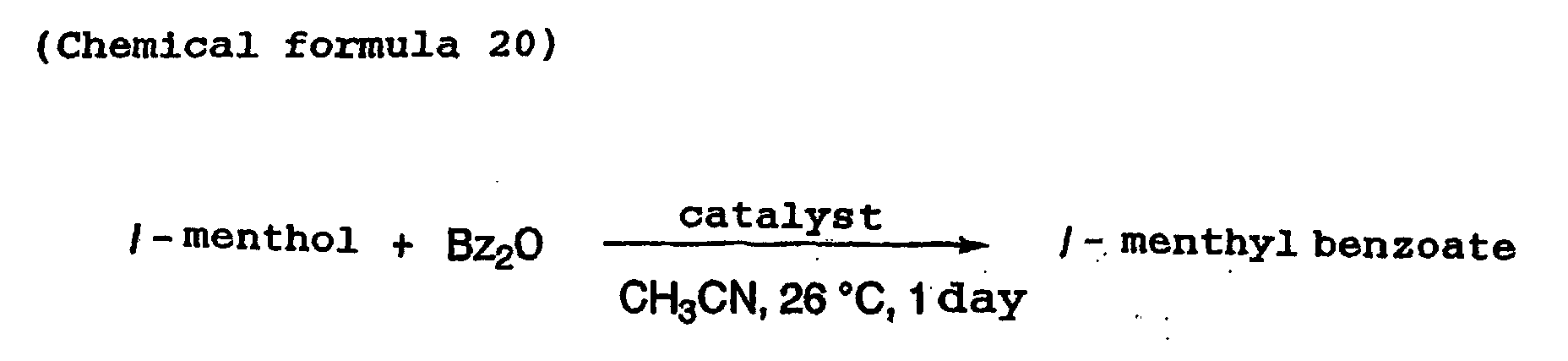
- Benzoylation reaction was conducted to a menthol wherein the scandium (III) pentafluorophenylbis(triflyl)methide obtained from Examples 13 and 14 was used as a Lewis acid catalyst (Chemical formula 38).
- 1-menthol (0.18 g, 1 mmol) and benzoic anhydride (0.34 g, 1.5 mmol) were reacted while stirring in acetonitrile (4.8 mL) at 26° C for 1 day, under the presence of the scandium (III) pentafluorophenylbis(triflyl)methide as 1 mol% of Lewis acid catalyst.
- alkyl lithium generates a nucleophilic substitution reaction specifically to the para position of pentafluorophenylbis(triflyl)methane, whereas a nucleophilic substitution reaction is generated selectively at the 4' position when reacted with ⁇ 4-(pentafluorophenyl)-2,3,5,6-tetrafluorophenyl ⁇ bis(triflyl)methane.
- a nucleophilic reactant not only limited to alkyl anion such as alkyl lithium and the like, alkoxy anion also shows the same reactivity.
- An arylbis(triflyl)methane having strong acidity can be produced efficiently and easily by the method for production according to the present invention. Since the pentafluorophenylbis(triflyl)methane and the like of the present invention are organic acids that are stronger than TfOH, their use as a novel type of conjugate base of protonic acid or metallic salt is expected. Moreover, since various types of aryl group can be introduced for an aryl group of arylbis(triflyl)methane, a wide application to asymmetric catalyst, functional material and the like is possible.
- the metallic arylbis(perfluoroalkylsulfonyl)methide such as scandium (III) pentafluorophenylbis(triflyl)methide and the like of the present invention shows a much better catalytic activity compared to that of the existing Lewis acid catalysts, and an organic compound can be easily synthesized at a high yield.
- the aryl group of metallic arylbis(perfluoroalkylsulfonyl)methide of the present invention can be introduced with various types of aryl group, and therefore, a wide application to asymmetric catalyst, functional material and the like is expected.
Landscapes
- Chemical & Material Sciences (AREA)
- Organic Chemistry (AREA)
- Chemical Kinetics & Catalysis (AREA)
- Engineering & Computer Science (AREA)
- Materials Engineering (AREA)
- Organic Low-Molecular-Weight Compounds And Preparation Thereof (AREA)
- Low-Molecular Organic Synthesis Reactions Using Catalysts (AREA)
- Catalysts (AREA)
Abstract
Description





wherein an arylbis(perfluoroalkylsulfonyl)methane represented by general formula [4]
is neutralized with a hydroxide of a metal (claim 24); the method for producing the metallic salt of arylbis(perfluoroalkylsulfonyl)methane according to claim 24, wherein the hydroxide of the metal is a hydroxide of a metal selected from alkaline metal or alkaline earth metal (claim 25); the method for producing the metallic salt of arylbis(perfluoroalkylsulfonyl)methane according to claim 24, wherein the arylbis(perfluoroalkylsulfonyl)methane represented by the general formula [4] is used, which is obtained by reacting an aryl halomethane with a perfluoroalkyl sulfinate, followed by reacting an arylmethylperfluoroalkylsulfone produced with a deprotonation agent comprised of an organic metal or an metallic salt, and a metallic salt of arylmethylperfluoroalkylsulfone obtained is reacted with a perfluoroalkyl sulfonic acid anhydride (claim 26); the method for producing the metallic salt of arylbis(perfluoroalkylsulfonyl)methane according to claim 26, wherein the aryl halomethane is reacted with the perfluoroalkyl sulfinate by heating under reflux using a solvent with or without the presence of a catalyst (claim 27); the method for producing the metallic salt of arylbis(perfluoroalkylsulfonyl)methane according to claim 27, wherein a tetrabutyl ammonium iodide is used as the catalyst (claim 28); the method for producing the metallic salt of arylbis(perfluoroalkylsulfonyl)methane according to claim 27, wherein a propionitrile is used as the solvent (claim 29); the method for producing the metallic salt of arylbis(perfluoroalkylsulfonyl)methane according to claim 26, wherein the perfluoroalkyl sulfinate is an alkaline metallic salt of trifluoromethane sulfinic acid (claim 30); the method for producing the metallic salt of arylbis(perfluoroalkylsulfonyl)methane according to claim 26, wherein the metallic salt of arylmethylperfluoroalkylsulfone is a lithium salt or a magnesium salt of arylmethylperfluoroalkylsulfone (claim 31); a method for producing a metallic salt of arylbis(perfluoroalkylsulfonyl)methane, wherein the method is a method for producing a metallic salt of arylbis(perfluoroalkylsulfonyl)methane represented by general formula [6],

wherein an arylbis(perfluoroalkylsulfonyl)methane represented by general formula [4]
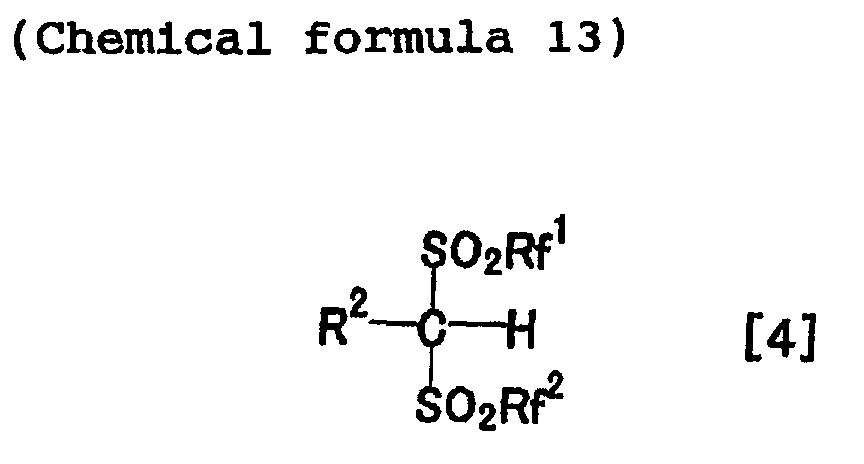
is reacted with a salt or an oxide of transition metal by heating under reflux (claim 32); the method for producing the metallic salt of arylbis(perfluoroalkylsulfonyl)methane according to claim 32, wherein the salt or the oxide of transition metal is a lanthanoid metallic salt or a scandium oxide (claim 33); the method for producing the metallic salt of arylbis(perfluoroalkylsulfonyl)methane according to claim 32, wherein the arylbis(perfluoroalkylsulfonyl)methane represented by the general formula [4] is used, which is obtained by reacting an aryl halomethane with a perfluoroalkyl sulfinate, followed by reacting an arylmethylperfluoroalkylsulfone produced with a deprotonation agent comprised of an organic metal or a metallic salt, and ametallic salt of arylmethylperfluoroalkylsulfone obtained is reacted with a perfluoroalkyl sulfonic acid anhydride (claim 34); the method for producing the metallic salt of arylbis(perfluoroalkylsulfonyl)methane according to claim 34, wherein the aryl halomethane is reacted with the perfluoroalkyl sulfinate by heating under reflux using a solvent with or without the presence of a catalyst (claim 35); the method for producing the metallic salt of arylbis(perfluoroalkylsulfonyl)methane according to claim 35, wherein a tetrabutyl ammonium iodide is used as the catalyst (claim 36); the method for producing the metallic salt of arylbis(perfluoroalkylsulfonyl)methane according to claim 35, wherein a propionitrile is used as the solvent (claim 37); the method for producing the metallic salt of arylbis(perfluoroalkylsulfonyl)methane according to claim 34, wherein the perfluoroalkyl sulfinate is an alkaline metallic salt of trifluoromethane sulfinic acid (claim 38); and the method for producing the metallic salt of arylbis(perfluoroalkylsulfonyl)methane according to claim 34, wherein the metallic salt of arylmethylperfluoroalkylsulfone is a lithium salt or a magnesium salt of arylmethylperfluoroalkylsulfone (claim 39).

wherein a metallic salt of arylbis(perfluoroalkylsulfonyl)methane represented by general formula [4]


is reacted with a halide of a metal having different metal species (claim 40); the method for producing the metallic salt of arylbis(perfluoroalkylsulfonyl)methane according to claim 40, wherein the metallic salt of arylbis(perfluoroalkylsulfonyl)methane represented by the general formula [6] is a silver salt of arylbis(perfluoroalkylsulfonyl)methane (claim 41); the method for producing the metallic salt of arylbis(perfluoroalkylsulfonyl)methane according to claim 40, wherein the arylbis(perfluoroalkylsulfonyl)methane represented by the general formula [4] is used, which is obtained by reacting an aryl halomethane with a perfluoroalkyl sulfinate, followed by reacting an arylmethylperfluoroalkylsulfone produced with a deprotonation agent comprised of an organic metal or a metallic salt, and a metallic salt of arylmethylperfluoroalkylsulfone obtained is reacted with a perfluoroalkyl sulfonic acid anhydride (claim 42); the method for producing the metallic salt of arylbis(perfluoroalkylsulfonyl)methane according to claim 42, wherein the aryl halomethane is reacted with the perfluoroalkyl sulfinate by heating under reflux using a solvent with or without the presence of a catalyst (claim 43); the method for producing the metallic salt of arylbis(perfluoroalkylsulfonyl)methane according to claim 43, wherein a tetrabutyl ammonium iodide is used as the catalyst (claim 44); the method for producing the metallic salt of arylbis(perfluoroalkylsulfonyl)methane according to claim 43, wherein a propionitrile is used as the solvent (claim 45); the method for producing the metallic salt of arylbis(perfluoroalkylsulfonyl)methane according to claim 42, wherein the perfluoroalkyl sulfinate is an alkaline metallic salt of trifluoromethane sulfinic acid (claim 46); and the method for producing the metallic salt of arylbis(perfluoroalkylsulfonyl)methane according to claim 42, wherein the metallic salt of arylmethylperfluoroalkylsulfone is a lithium salt or a magnesium salt of arylmethylperfluoroalkylsulfone (claim 47).


is reacted with a silver carbonate under shade (claim 48); the method for producing the metallic salt of arylbis(perfluoroalkylsulfonyl)methane according to claim 48, wherein the arylbis(perfluoroalkylsulfonyl)methane represented by the general formula [4] is used, which is obtained by reacting an aryl halomethane with a perfluoroalkyl sulfinate, followed by reacting an arylmethylperfluoroalkylsulfone produced with a deprotonation agent comprised of an organic metal or a metallic salt, and a metallic salt of arylmethylperfluoroalkylsulfone obtained is reacted with a perfluoroalkyl sulfonic acid anhydride (claim 49); the method for producing the metallic salt of arylbis(perfluoroalkylsulfonyl)methane according to claim 49, wherein the aryl halomethane is reacted with the perfluoroalkyl sulfinate by heating under reflux using a solvent with or without the presence of a catalyst (claim 50); the method for producing the metallic salt of arylbis(perfluoroalkylsulfonyl)methane according to claim 50, wherein a tetrabutyl ammonium iodide is used as the catalyst (claim 51); the method for producing the metallic salt of arylbis(perfluoroalkylsulfonyl)methane according to claim 50, wherein a propionitrile is used as the solvent (claim 52); the method for producing the metallic salt of arylbis(perfluoroalkylsulfonyl)methane according to claim 49, wherein the perfluoroalkyl sulfinate is an alkaline metallic salt of trifluoromethane sulfinic acid (claim 53); and the method for producing the metallic salt of arylbis(perfluoroalkylsulfonyl)methane according to claim 49, wherein the metallic salt of arylmethylperfluoroalkylsulfone is a lithium salt or a magnesium salt of arylmethylperfluoroalkylsulfone (claim 54).

as an active ingredient (claim 55); and the catalyst according to claim 55, wherein the catalyst is a Lewis acid catalyst (claim 56).

as an active ingredient, and catalytic reaction is conducted under the presence of said catalyst in a solvent (claim 57); and the method for synthesizing an organic compound according to claim 57, wherein the catalytic reaction is a benzoylation reaction, a Diels-Alder reaction, an aldol-type reaction, a Friedel-Crafts reaction, a Mannich reaction, a glycosilation reaction, an esterification reaction, an ene reaction, a cationic polymerization reaction or an allylation reaction (claim 58).
| aryl halomethane | arylmethyl triflone | [yield (%)] |
| PhCH2Br | PhCH2Tf | 94 |
| 2-NaphCH2Br | 2-NaphCH2Tf | >99 |
| 1-NaphCH2Cl | 1-NaphCH2Tf | 99 |
| 2,4,6-Me3C6H2CH2Cl | 2,4,6-Me3C6H2CH2Tf | 90 |
| 4-CF3C6H4CH2Br | 4-CF3C6H4CH2Tf | >99 |
| 3,5-(CF3)2C6H3CH2Br | 3,5-(CF3)2C6H3CH2Tf | 76 |
| C6F5CH2Br | C6F5CH2Tf | 89 |
| arylmethyl triflone | arylbis(triflyl)methane | [yield (%)] |
| 2-NaphOH2Tf | 2-NaphCHTf2 | 84 |
| 1-NaphCH2Tf | 1-NaphCHTf2 | 98 |
| 2,4,6-Me3C6H2CH2Tf | 2,4,6-Me3C6H2CHTf2 | 89 |
| 4-CF3C6H4CH2Tf | 4-CF3C6H4CHTf2 | 87 |
| 3,5-(CF3)2C6H3CH2Tf | 3,5-(CF3)2C6H3CHTf2 | 75 |
| C6F5CH2Tf | C6F5CHTf2 | 45 |

1H NMR (CDCl3, 300 MHz) δ4.58 (s, 2H, CH2Br); 19F NMR (CDCl3, 282 MHz) δ-138.02 (dd, J = 10.6, 19.8 Hz, 2F), -138.56 (dt, J = 9.1, 20.3 Hz, 2F), -142.36 (dd, J = 10.6, 19.8 Hz, 2F), -150.59 (t, J = 20.3 Hz, 1F), -161.08 (dt, J = 7.1, 20.3 Hz, 2F).
1H NMR (CDCl3, 300 MHz) δ4.75 (s, 2H, CH2Tf); 19F NMR (CDCl3, 282 MHz) δ-78.24 (s, 3F, CF3), -136.82 to -136.62 (m, 1F), -137.72 (dd, J = 10.7, 18.3 Hz, 2F), -138.84 (dd, J = 10.7, 18.3 Hz, 2F), -149.69 (t, J = 21.3 Hz, 1F), -160.63 (dt, J = 6.1, 21.3 Hz, 2F).
1H NMR (CDCl3, 300 MHz) δ 6.32 (s, 1H, CH), 19F NMR (CDCl3, 282 MHz) δ -75.1 (s, 6F, 2CF3), -127.72 to -127.58 (m, 1F), -133.43 (dt, J = 10.2, 21.3 Hz, 1F), -134.60 (dt, J = 9.4, 21.3 Hz, 1F), -137.08 to -137.35 (m, 2F), -140.07 (br, 1F), -148.38 (t, J = 21.3 Hz, 1F), -160.01 (dt, J = 6.2, 21.3 Hz, 2F).
1H NMR (CDCl3, 300 MHz) δ6.33 (s, 1H, CH), 7.54 (s, 5H, C6H5); 19F NMR (CDCl3, 282 MHz) δ-75.15 (s, 6F, 2CF3), -128.03 (dt, J = 10.5, 21.2 Hz. 1F), -133.35 (dt, J=10.5, 21.2Hz, 1F), -134.52 (dt, J = 10.5, 21,2 Hz, 1F), -138.73 to -138.53 (m, 2F), -140.42 (br, 1F), -142.66 to -142.53 (m, 2F).
1H NMR (CDCl3, 300 MHz) δ0.83 to 0.94 (m, 3H), 1.26 (br, 2H), 1.33 to 1.38 (m, 2H), 1.45 to 1.52 (m, 2H), 1.84 (5, J = 6.8 Hz, 2H), 4.38 (t, J = 6.8 Hz, 2H), 4.32 (s, 1H); 19F NMR (CDCl3, 282 MHz) δ-75.0 (s, 6F, 2CF3), -128.4 to -128.3 (m, 1F), -133.6 (dt, J = 9.1, 21.3 Hz, 1F), -134.8 (dt, J = 9.1, 21.3 Hz, 1F), -139.8 to -139.6 (m, 2F), -140.7 (br, 1F), -156.5 (d, J = 19.7 Hz, 2F).
1H NMR (CDCl3, 300 MHz) δ0.91 (t, J = 7.1 Hz, 3H), 1.32 to 1.37 (m, 4H), 1.43 to 1.51 (m, 2H), 1.83 (quintet, J = 6.8 Hz, 2H), 4.44 (t, J = 6.8 Hz, 2H), 6.19 (s, 1H); 19F NMR (CDCl3, 282 MHz) δ-75.35 (s, 6F, 2CF3), -130.64 (dt, J = 9.9, 21.2 Hz, 1F), -143.16 (br, 1F), -155.31 (d, J = 21.2 Hz, 1F).

Claims (58)
- An arylbis(perfluoroalkylsulfonyl)methane represented by the following general formula [1](wherein R1 shows a substituted or unsubstituted aryl group (however, phenyl group is excluded), Rf1 and Rf2 are independent to each other and show a perfluoroalkyl group).

- The arylbis(perfluoroalkylsulfonyl)methane represented by the general formula [1] according to claim 1, wherein R1 is a naphthyl group, a 2,4,6-trimethylphenyl group, a 4-(trifluoromethyl)phenyl group, a 3,5-bis(trifluoromethyl)phenyl group, a pentafluorophenyl group or a perfluorobiphenyl group.
- The arylbis(perfluoroalkylsulfonyl)methane represented by the general formula [1] according to claim 1, wherein Rf1 and Rf2 are both a trifluoromethyl group.
- A pentafluorophenylbis(trifluoromethylsulfonyl)methane represented by formula [2]or a para position substituent thereof.
- A {4-(pentafluorophenyl)-2,3,5,6-tetrafluorophenyl}bis(triflyl)methane represented by formula [3]or a 4' position substituent thereof.

- A method for producing an arylbis(perfluoroalkylsulfonyl)methane represented by general formula [4](wherein R2 shows a substituted or unsubstituted aryl group, Rf1 and Rf2 are independent to each other and show a perfluoroalkyl group),wherein an aryl halomethane is reacted with a perfluoroalkyl sulfinate, an arylmethylperfluoroalkylsulfone produced is reacted with a deprotonation agent comprised of an organic metal or a metallic salt, and a metallic salt of arylmethylperfluoroalkylsulfone obtained is reacted with a perfluoroalkyl sulfonic acid anhydride.
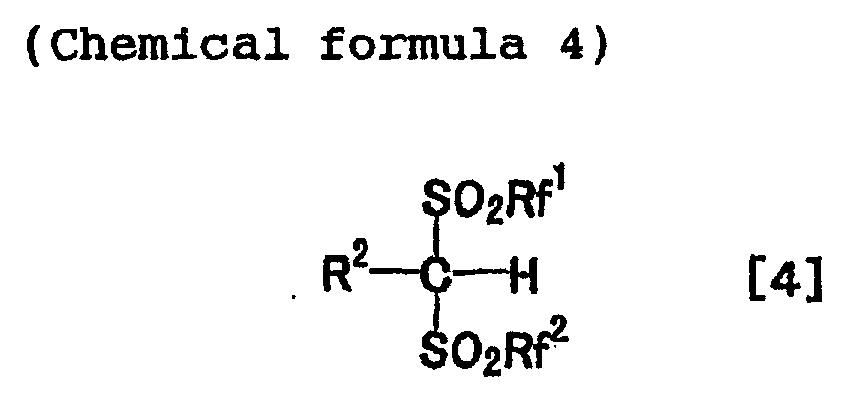
- The method for producing the arylbis(perfluoroalkylsulfonyl)methane represented by the general formula [4] according to claim 6, wherein the aryl halomethane is reacted with the perfluoroalkyl sulfinate by heating under reflux using a solvent with or without the presence of a catalyst.
- The method for producing the arylbis(perfluoroalkylsulfonyl)methane represented by the general formula [4] according to claim 7, wherein a tetrabutyl ammonium iodide is used as the catalyst.
- The method for producing the arylbis(perfluoroalkylsulfonyl)methane represented by the general formula [4] according to claim 7, wherein a propionitrile is used as the solvent.
- The method for producing the arylbis(perfluoroalkylsulfonyl)methane represented by the general formula [4] according to claim 6, wherein a deprotonation agent comprised of an organic metal or a metallic salt having an equivalent weight of 1.7 to 2.4 is reacted to the arylmethylperfluoroalkylsulfone.
- The method for producing the arylbis(perfluoroalkylsulfonyl)methane represented by the general formula [4] according to claim 6, wherein the aryl halomethane is a benzyl bromide, a 2-bromomethylnaphthalene, a 1-chloromethylnaphthalene, a 2,4,6-trimethylphenylmethylchloride, a 4-(trifluoromethyl)phenylmethylbromide, a 3,5-bis(trifluoromethyl)phenylmethylbromide, a pentafluorophenylmethylbromide or a 4-(bromomethyl)perfluorobiphenyl.
- The method for producing the arylbis(perfluoroalkylsulfonyl)methane represented by the general formula [4] according to claim 6, wherein the perfluoroalkyl sulfinate is an alkaline metallic salt of trifluoromethane sulfinic acid.
- The method for producing the arylbis(perfluoroalkylsulfonyl)methane represented by the general formula [4] according to claim 6, wherein the metallic salt of arylmethylperfluoroalkylsulfone is a lithium salt or a magnesium salt of arylmethylperfluoroalkylsulfone.
- The method for producing the arylbis(perfluoroalkylsulfonyl)methane represented by the general formula [4] according to claim 6, wherein the arylbis(perfluoroalkylsulfonyl)methane represented by the general formula [4] is an arylbis(trifluoromethylsulfonyl)methane represented by general formula [5](wherein R2 shows a substituted or unsubstituted aryl group).
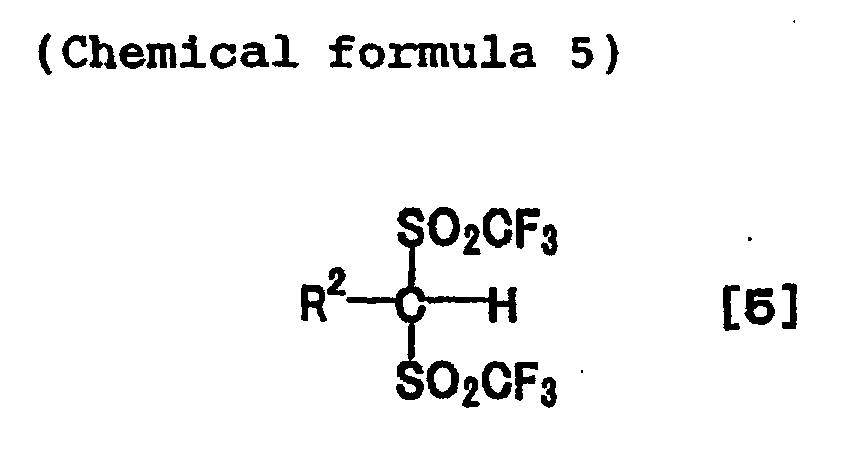
- The method for producing the arylbis(perfluoroalkylsulfonyl)methane represented by the general formula [4] according to claim 14, wherein the arylbis(trifluoromethylsulfonyl)methane represented by the general formula [5] is a pentafluorophenylbis(trifluoromethylsulfonyl)methane represented by formula [2].

- The method for producing the arylbis(perfluoroalkylsulfonyl)methane represented by the general formula [4] according to claim 14, wherein the arylbis(trifluoromethylsulfonyl)methane represented by the general formula [5] is a {4-(pentafluorophenyl)-2,3,5,6-tetrafluorophenyl}bis(triflyl)methane represented by formula [3].
- A metallic salt of arylbis(perfluoroalkylsulfonyl)methane represented by general formula [6](wherein R2 shows a substituted or unsubstituted aryl group , Rf1 and Rf2 are independent to each other and show a perfluoroalkyl group, M shows any one of the elements selected from alkaline metallic element, alkaline earth metallic element, transition metallic element, boron, silicon, aluminum, tin, zinc or bismuth, n shows a numeric value equal to the valence of M element).

- The metallic salt of arylbis(perfluoroalkylsulfonyl)methane according to claim 17, wherein the transition metallic element is any one of the metallic elements selected from scandium, yttrium, lanthanoid, copper, silver, titanium, zirconium or hafnium.
- The metallic salt of arylbis(perfluoroalkylsulfonyl)methane according to claim 17, wherein Rf1 and Rf2 are both a trifluoromethyl group.
- The metallic salt of arylbis(perfluoroalkylsulfonyl)methane according to claim 17, wherein R2 is a phenyl group, a naphthyl group, a 2,4,6-trimethylphenyl group, a 4-(trifluoromethyl)phenyl group, a 3,5-bis(trifluoromethyl)phenyl group, a pentafluorophenyl group or a perfluorobiphenyl group.
- The metallic salt of arylbis(perfluoroalkylsulfonyl)methane according to claim 17, wherein the metallic salt of arylbis(perfluoroalkylsulfonyl)methane is a metallic salt of phenylbis(triflyl)methane, a metallic salt of 2-naphthylbis(triflyl)methane, a metallic salt of 1-naphthylbis(triflyl)methane, a metallic salt of 2,4,6-trimethylphenylbis(triflyl)methane, a metallic salt of 4-(trifluoromethyl)phenylbis(triflyl)methane, a metallic salt of 3,5-bis(trifluoromethyl)phenylbis(triflyl)methane, a metallic salt of pentafluorophenylbis(triflyl)methane or a metallic salt of {4-(pentafluorophenyl)-2,3,5,6-tetrafluorophenyl}bis(triflyl)methane.
- The metallic salt of arylbis(perfluoroalkylsulfonyl)methane according to claim 21, wherein the metallic salt of pentafluorophenylbis(triflyl)methane is a scandium (III) pentafluorophenylbis(triflyl)methide or a lithium pentafluorophenylbis(triflyl)methide.
- The metallic salt of arylbis(perfluoroalkylsulfonyl)methane according to claim 21, wherein the metallic salt of {4-(pentafluorophenyl)-2,3,5,6-tetrafluorophenyl}bis(triflyl)methane is a scandium (III) {4-(pentafluorophenyl)-2,3,5,6-tetrafluorophenyl}bis(triflyl)methide or a lithium {4-(pentafluorophenyl)-2,3,5,6-tetrafluorophenyl}bis(triflyl)methide.
- A method for producing a metallic salt of arylbis(perfluoroalkylsulfonyl)methane, wherein the method is a method for producing a metallic salt of arylbis(perfluoroalkylsulfonyl)methane represented by general formula [6](wherein R2 shows a substituted or unsubstituted aryl group, Rf1 and Rf2 are independent to each other and show a perfluoroalkyl group, M shows any one of the elements selected from alkaline metallic element, alkaline earth metallic element, transition metallic element, boron, silicon, aluminum, tin, zinc or bismuth, n shows a numeric value equal to the valence of M element)

wherein an arylbis(perfluoroalkylsulfonyl)methane represented by general formula [4](wherein R2 shows a substituted or unsubstituted aryl group, Rf1 and Rf2 are independent to each other and show a perfluoroalkyl group)
is neutralized with a hydroxide of a metal. - The method for producing the metallic salt of arylbis(perfluoroalkylsulfonyl)methane according to claim 24, wherein the hydroxide of the metal is a hydroxide of a metal selected from alkaline metal or alkaline earth metal.
- The method for producing the metallic salt of arylbis(perfluoroalkylsulfonyl)methane according to claim 24, wherein the arylbis(perfluoroalkylsulfonyl)methane represented by the general formula [4] is used, which is obtained by reacting an aryl halomethane with a perfluoroalkyl sulfinate, followed by reacting an arylmethylperfluoroalkylsulfone produced with a deprotonation agent comprised of an organic metal or an metallic salt, and a metallic salt of arylmethylperfluoroalkylsulfone obtained is reacted with a perfluoroalkyl sulfonic acid anhydride.
- The method for producing the metallic salt of arylbis(perfluoroalkylsulfonyl)methane according to claim 26, wherein the aryl halomethane is reacted with the perfluoroalkyl sulfinate by heating under reflux using a solvent with or without the presence of a catalyst.
- The method for producing the metallic salt of arylbis(perfluoroalkylsulfonyl)methane according to claim 27, wherein a tetrabutyl ammonium iodide is used as the catalyst.
- The method for producing the metallic salt of arylbis(perfluoroalkylsulfonyl)methane according to claim 27, wherein a propionitrile is used as the solvent.
- The method for producing the metallic salt of arylbis(perfluoroalkylsulfonyl)methane according to claim 26, wherein the perfluoroalkyl sulfinate is an alkaline metallic salt of trifluoromethane sulfinic acid.
- The method for producing the metallic salt of arylbis(perfluoroalkylsulfonyl)methane according to claim 26, wherein the metallic salt of arylmethylperfluoroalkylsulfone is a lithium salt or a magnesium salt of arylmethylperfluoroalkylsulfone.
- A method for producing a metallic salt of arylbis(perfluoroalkylsulfonyl)methane, wherein the method is a method for producing a metallic salt of arylbis(perfluoroalkylsulfonyl)methane represented by general formula [6],(wherein R2 shows a substituted or unsubstituted aryl group, Rf1 and Rf2 are independent to each other and show a perfluoroalkyl group, M shows any one of the elements selected from alkaline metallic element, alkaline earth metallic element, transition metallic element, boron, silicon, aluminum, tin, zinc or bismuth, n shows a numeric value equal to the valence of M element)

wherein an arylbis(perfluoroalkylsulfonyl)methane represented by general formula [4](wherein R2 shows a substituted or unsubstituted aryl group, Rf1 and Rf2 are independent to each other and show a perfluoroalkyl group)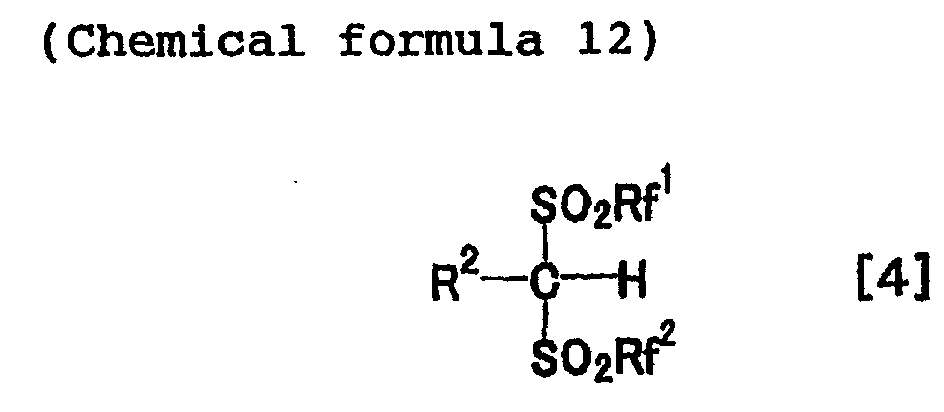
is reacted with a salt or an oxide of transition metal by heating under reflux. - The method for producing the metallic salt of arylbis(perfluoroalkylsulfonyl)methane according to claim 32, wherein the salt or the oxide of transition metal is a lanthanoid metallic salt or a scandium oxide.
- The method for producing the metallic salt of arylbis(perfluoroalkylsulfonyl)methane according to claim 32, wherein the arylbis(perfluoroalkylsulfonyl)methane represented by the general formula [4] is used, which is obtained by reacting an aryl halomethane with a perfluoroalkyl sulfinate, followed by reacting an arylmethylperfluoroalkylsulfone produced with a deprotonation agent comprised of an organic metal or a metallic salt, and a metallic salt of arylmethylperfluoroalkylsulfone obtained is reacted with a perfluoroalkyl sulfonic acid anhydride.
- The method for producing the metallic salt of arylbis(perfluoroalkylsulfonyl)methane according to claim 34, wherein the aryl halomethane is reacted with the perfluoroalkyl sulfinate by heating under reflux using a solvent with or without the presence of a catalyst.
- The method for producing the metallic salt of arylbis(perfluoroalkylsulfonyl)methane according to claim 35, wherein a tetrabutyl ammonium iodide is used as the catalyst.
- The method for producing the metallic salt of arylbis(perfluoroalkylsulfonyl)methane according to claim 35, wherein a propionitrile is used as the solvent.
- The method for producing the metallic salt of arylbis(perfluoroalkylsulfonyl)methane according to claim 34, wherein the perfluoroalkyl sulfinate is an alkaline metallic salt of trifluoromethane sulfinic acid.
- The method for producing the metallic salt of arylbis(perfluoroalkylsulfonyl)methane according to claim 34, wherein the metallic salt of arylmethylperfluoroalkylsulfone is a lithium salt or a magnesium salt of arylmethylperfluoroalkylsulfone.
- A method for producing a metallic salt of arylbis(perfluoroalkylsulfonyl)methane, wherein the method is a method for producing a metallic salt of arylbis(perfluoroalkylsulfonyl)methane represented by general formula [6](wherein R2 shows a substituted or unsubstituted aryl group, Rf1 and Rf2 are independent to each other and show a perfluoroalkyl group, M shows any one of the elements selected from alkaline metallic element, alkaline earth metallic element, transition metallic element, boron, silicon, aluminum, tin, zinc or bismuth, n shows a numeric value equal to the valence of M element)

wherein a metallic salt of arylbis(perfluoroalkylsulfonyl)methane represented by general formula [4](wherein R2 shows a substituted or unsubstituted aryl group, Rf1 and Rf2 are independent to each other and show a perfluoroalkyl group)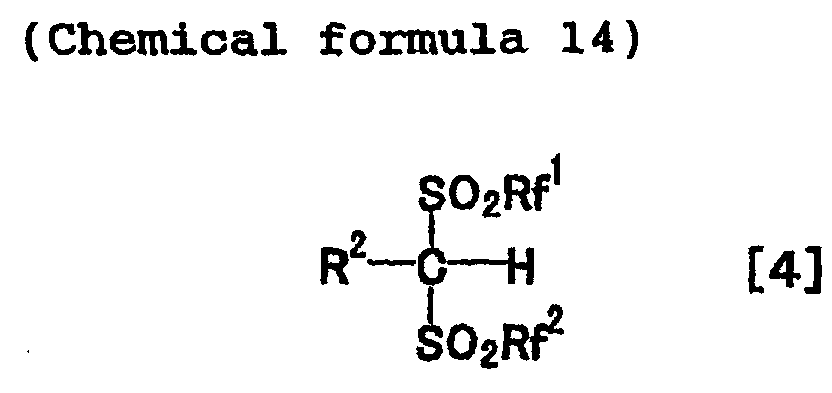
is reacted with a halide of a metal having different metal species. - The method for producing the metallic salt of arylbis(perfluoroalkylsulfonyl)methane according to claim 40, wherein the metallic salt of arylbis(perfluoroalkylsulfonyl)methane represented by the general formula [6] is a silver salt of arylbis(perfluoroalkylsulfonyl)methane.
- The method for producing the metallic salt of arylbis(perfluoroalkylsulfonyl)methane according to claim 40, wherein the arylbis(perfluoroalkylsulfonyl)methane represented by the general formula [4] is used, which is obtained by reacting an aryl halomethane with a perfluoroalkyl sulfinate, followed by reacting an arylmethylperfluoroalkylsulfone produced with a deprotonation agent comprised of an organic metal or a metallic salt, and a metallic salt of arylmethylperfluoroalkylsulfone obtained is reacted with a perfluoroalkyl sulfonic acid anhydride.
- The method for producing the metallic salt of arylbis(perfluoroalkylsulfonyl)methane according to claim 42, wherein the aryl halomethane is reacted with the perfluoroalkyl sulfinate by heating under reflux using a solvent with or without the presence of a catalyst.
- The method for producing the metallic salt of arylbis(perfluoroalkylsulfonyl)methane according to claim 43, wherein a tetrabutyl ammonium iodide is used as the catalyst.
- The method for producing the metallic salt of arylbis(perfluoroalkylsulfonyl)methane according to claim 43, wherein a propionitrile is used as the solvent.
- The method for producing the metallic salt of arylbis(perfluoroalkylsulfonyl)methane according to claim 42, wherein the perfluoroalkyl sulfinate is an alkaline metallic salt of trifluoromethane sulfinic acid.
- The method for producing the metallic salt of arylbis(perfluoroalkylsulfonyl)methane according to claim 42, wherein the metallic salt of arylmethylperfluoroalkylsulfone is a lithium salt or a magnesium salt of arylmethylperfluoroalkylsulfone.
- A method for producing a metallic salt of arylbis(perfluoroalkylsulfonyl)methane, wherein the method is a method for producing a metallic salt of arylbis(perfluoroalkylsulfonyl)methane represented by general formula [6](wherein R2 shows a substituted or unsubstituted aryl group , Rf1 and Rf2 are independent to each other and show a perfluoroalkyl group, M shows any one of the elements selected from alkaline metallic element, alkaline earth metallic element, transition metallic element, boron, silicon, aluminum, tin, zinc or bismuth, n shows a numeric value equal to the valence of M element)
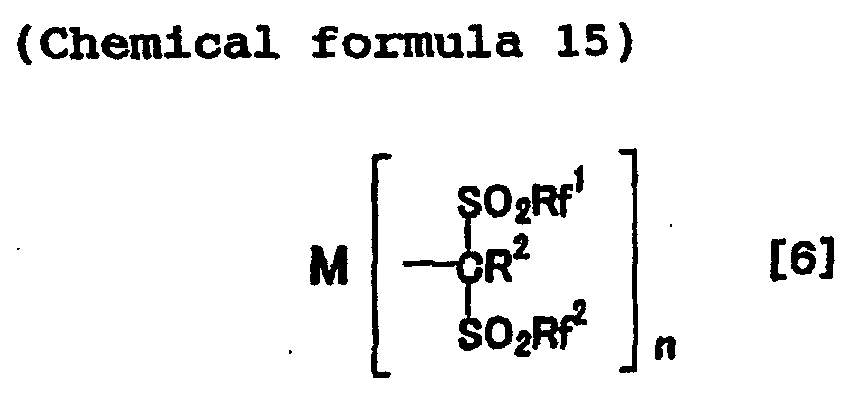
wherein an arylbis(perfluoroalkylsulfonyl)methane represented by general formula [4](wherein R2 shows a substituted or unsubstituted aryl group, Rf1 and Rf2 are independent to each other and show a perfluoroalkyl group)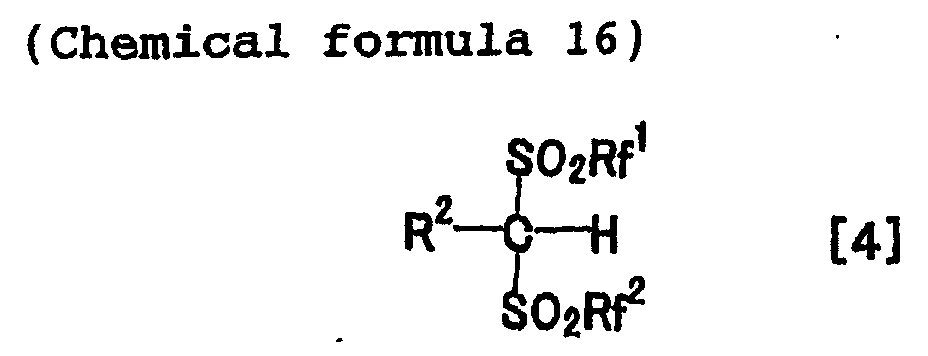
is reacted with a silver carbonate under shade. - The method for producing the metallic salt of arylbis(perfluoroalkylsulfonyl)methane according to claim 48, wherein the arylbis(perfluoroalkylsulfonyl)methane represented by the general formula [4] is used, which is obtained by reacting an aryl halomethane with a perfluoroalkyl sulfinate, followed by reacting an arylmethylperfluoroalkylsulfone produced with a deprotonation agent comprised of an organic metal or a metallic salt, and a metallic salt of arylmethylperfluoroalkylsulfone obtained is reacted with a perfluoroalkyl sulfonic acid anhydride.
- The method for producing the metallic salt of arylbis(perfluoroalkylsulfonyl)methane according to claim 49, wherein the aryl halomethane is reacted with the perfluoroalkyl sulfinate by heating under reflux using a solvent with or without the presence of a catalyst.
- The method for producing the metallic salt of arylbis(perfluoroalkylsulfonyl)methane according to claim 50, wherein a tetrabutyl ammonium iodide is used as the catalyst.
- The method for producing the metallic salt of arylbis(perfluoroalkylsulfonyl)methane according to claim 50, wherein a propionitrile is used as the solvent.
- The method for producing the metallic salt of arylbis(perfluoroalkylsulfonyl)methane according to claim 49, wherein the perfluoroalkyl sulfinate is an alkaline metallic salt of trifluoromethane sulfinic acid.
- The method for producing the metallic salt of arylbis(perfluoroalkylsulfonyl)methane according to claim 49, wherein the metallic salt of arylmethylperfluoroalkylsulfone is a lithium salt or a magnesium salt of arylmethylperfluoroalkylsulfone.
- A catalyst having a metallic salt of arylbis(perfluoroalkylsulfonyl)methane represented by general formula [6](wherein R2 shows a substituted or unsubstituted aryl group, Rf1 and Rf2 are independent to each other and show a perfluoroalkyl group, M shows any one of the elements selected from alkaline metallic element, alkaline earth metallic element, transition metallic element, boron, silicon, aluminum, tin, zinc or bismuth, n shows a numeric value equal to the valence of M element)
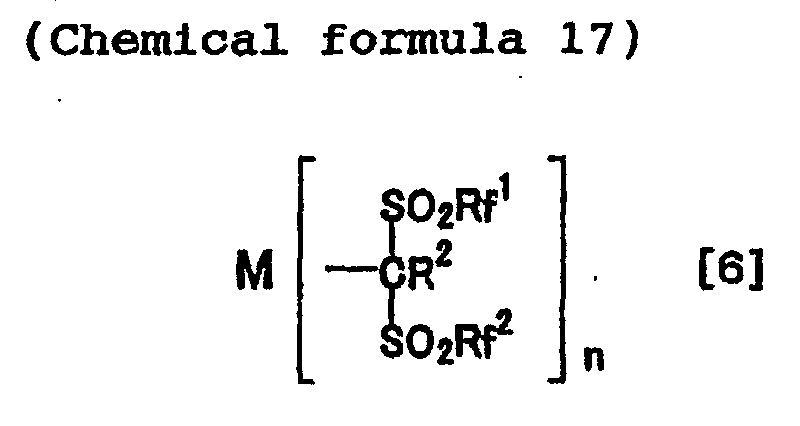
as an active ingredient. - The catalyst according to claim 55, wherein the catalyst is a Lewis acid catalyst.
- A method for synthesizing an organic compound wherein the method is a method for synthesizing an organic compound by using a catalyst having a metallic salt of arylbis(perfluoroalkylsulfonyl)methane represented by general formula [6](wherein R2 shows a substituted or unsubstituted aryl group, Rf1 and Rf2 are independent to each other and show a perfluoroalkyl group, M shows any one of the elements selected from alkaline metallic element, alkaline earth metallic element, transition metallic element, boron, silicon, aluminum, tin, zinc or bismuth, n shows a numeric value equal to the valence of M element)
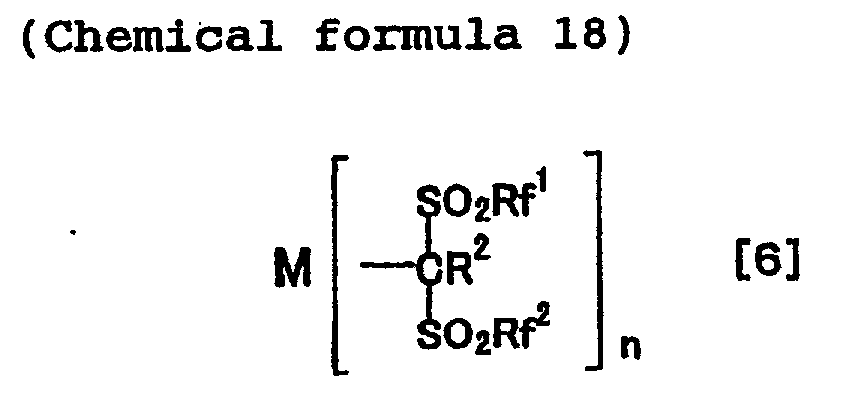
as an active ingredient, and catalytic reaction is conducted under the presence of said catalyst in a solvent. - The method for synthesizing an organic compound according to claim 57, wherein the catalytic reaction is a benzoylation reaction, a Diels-Alder reaction, an aldol-type reaction, a Friedel-Crafts reaction, a Mannich reaction, a glycosilation reaction, an esterification reaction, an ene reaction, a cationic polymerization reaction or an allylation reaction.
Applications Claiming Priority (9)
| Application Number | Priority Date | Filing Date | Title |
|---|---|---|---|
| JP2000381539 | 2000-12-15 | ||
| JP2000381537 | 2000-12-15 | ||
| JP2000381539 | 2000-12-15 | ||
| JP2000381537 | 2000-12-15 | ||
| JP2001283217 | 2001-09-18 | ||
| JP2001283216 | 2001-09-18 | ||
| JP2001283217 | 2001-09-18 | ||
| JP2001283216 | 2001-09-18 | ||
| PCT/JP2001/010978 WO2002048098A1 (en) | 2000-12-15 | 2001-12-14 | Arylbis (perfluoroalkylsulfonyl) methane, metal salt of the same, and processes for producing these |
Publications (3)
| Publication Number | Publication Date |
|---|---|
| EP1344772A1 true EP1344772A1 (en) | 2003-09-17 |
| EP1344772A4 EP1344772A4 (en) | 2005-03-16 |
| EP1344772B1 EP1344772B1 (en) | 2009-07-22 |
Family
ID=27481872
Family Applications (1)
| Application Number | Title | Priority Date | Filing Date |
|---|---|---|---|
| EP01270523A Expired - Lifetime EP1344772B1 (en) | 2000-12-15 | 2001-12-14 | Arylbis (perfluoroalkylsulfonyl) methane, metal salt of the same, and processes for producing these |
Country Status (9)
| Country | Link |
|---|---|
| EP (1) | EP1344772B1 (en) |
| JP (1) | JP3957635B2 (en) |
| KR (1) | KR100570235B1 (en) |
| CN (1) | CN100569746C (en) |
| AU (1) | AU2002222644A1 (en) |
| CA (1) | CA2431616C (en) |
| DE (1) | DE60139341D1 (en) |
| TW (1) | TWI239945B (en) |
| WO (1) | WO2002048098A1 (en) |
Cited By (4)
| Publication number | Priority date | Publication date | Assignee | Title |
|---|---|---|---|---|
| WO2004041978A1 (en) * | 2002-11-04 | 2004-05-21 | Solutia Inc. | Functional fluid compositions containing erosion inhibitors |
| US9314782B2 (en) | 2010-12-17 | 2016-04-19 | Central Glass Company, Limited | Bis(trifluoromethanesulfonyl)ethyl-bearing compound and acid catalyst, and method for preparing same |
| WO2017050425A1 (en) * | 2015-09-23 | 2017-03-30 | Merck Patent Gmbh | Perfluoroalkyl group-containing bismuth compounds as lewis acid catalysts |
| DE102018118278B4 (en) | 2018-07-27 | 2025-02-20 | Novaled Gmbh | Electronic device, display device, method for producing the same and a connection |
Families Citing this family (7)
| Publication number | Priority date | Publication date | Assignee | Title |
|---|---|---|---|---|
| BRPI0412808A (en) | 2003-07-24 | 2006-09-26 | Euro Celtique Sa | piperidine compounds and pharmaceutical compositions containing them |
| EP2604599A1 (en) | 2007-04-27 | 2013-06-19 | Purdue Pharma LP | TRPV1 antagonists and uses thereof |
| JP5469841B2 (en) * | 2008-09-01 | 2014-04-16 | 東京応化工業株式会社 | Resist composition, resist pattern forming method, novel compound, and acid generator |
| JP5678552B2 (en) * | 2010-09-29 | 2015-03-04 | 日立化成株式会社 | Polymerization initiator and organic electronics material, organic thin film using the same and method for producing the same, ink composition, organic electronics element, organic electroluminescence element, lighting device, display element, and display device |
| WO2017212560A1 (en) | 2016-06-08 | 2017-12-14 | 日立化成株式会社 | Organic electronic material and organic electronic element |
| CN111349030A (en) * | 2018-12-21 | 2020-06-30 | 石家庄圣泰化工有限公司 | Synthesis method of bis [ (trifluoromethyl) sulfonyl ] methane |
| CN115557862A (en) * | 2022-10-25 | 2023-01-03 | 广州天赐高新材料股份有限公司 | Preparation method of tris(perfluoroalkylsulfonyl)methane and lithium salt thereof |
Family Cites Families (5)
| Publication number | Priority date | Publication date | Assignee | Title |
|---|---|---|---|---|
| US4049861A (en) * | 1975-03-07 | 1977-09-20 | Minnesota Mining And Manufacturing Company | Abrasion resistant coatings |
| US4431845A (en) * | 1980-12-04 | 1984-02-14 | Minnesota Mining And Manufacturing Company | Method for the preparation of hydroxyl-terminated poly(haloalkylene ethers) |
| JPH03254697A (en) * | 1990-03-05 | 1991-11-13 | Konica Corp | Analysis and reagent and analytical element used therefor |
| JP3166959B2 (en) * | 1994-03-11 | 2001-05-14 | セントラル硝子株式会社 | Lewis acid catalyst |
| JP3773824B2 (en) * | 2001-03-12 | 2006-05-10 | 独立行政法人科学技術振興機構 | Polymer-supported arylbis (perfluoroalkylsulfonyl) methane |
-
2001
- 2001-12-14 AU AU2002222644A patent/AU2002222644A1/en not_active Abandoned
- 2001-12-14 KR KR1020037007816A patent/KR100570235B1/en not_active Expired - Fee Related
- 2001-12-14 TW TW090131076A patent/TWI239945B/en not_active IP Right Cessation
- 2001-12-14 CN CNB018205712A patent/CN100569746C/en not_active Expired - Fee Related
- 2001-12-14 EP EP01270523A patent/EP1344772B1/en not_active Expired - Lifetime
- 2001-12-14 DE DE60139341T patent/DE60139341D1/en not_active Expired - Lifetime
- 2001-12-14 JP JP2002549631A patent/JP3957635B2/en not_active Expired - Lifetime
- 2001-12-14 WO PCT/JP2001/010978 patent/WO2002048098A1/en not_active Ceased
- 2001-12-14 CA CA2431616A patent/CA2431616C/en not_active Expired - Fee Related
Cited By (6)
| Publication number | Priority date | Publication date | Assignee | Title |
|---|---|---|---|---|
| WO2004041978A1 (en) * | 2002-11-04 | 2004-05-21 | Solutia Inc. | Functional fluid compositions containing erosion inhibitors |
| US7255808B2 (en) | 2002-11-04 | 2007-08-14 | Solutia, Inc. | Functional fluid compositions containing erosion inhibitors |
| US9314782B2 (en) | 2010-12-17 | 2016-04-19 | Central Glass Company, Limited | Bis(trifluoromethanesulfonyl)ethyl-bearing compound and acid catalyst, and method for preparing same |
| WO2017050425A1 (en) * | 2015-09-23 | 2017-03-30 | Merck Patent Gmbh | Perfluoroalkyl group-containing bismuth compounds as lewis acid catalysts |
| US10328423B2 (en) | 2015-09-23 | 2019-06-25 | Merck Patent Gmbh | Perfluoroalkyl group-containing bismuth compounds as lewis acid catalysts |
| DE102018118278B4 (en) | 2018-07-27 | 2025-02-20 | Novaled Gmbh | Electronic device, display device, method for producing the same and a connection |
Also Published As
| Publication number | Publication date |
|---|---|
| AU2002222644A1 (en) | 2002-06-24 |
| EP1344772A4 (en) | 2005-03-16 |
| CA2431616C (en) | 2010-02-09 |
| CN1481357A (en) | 2004-03-10 |
| EP1344772B1 (en) | 2009-07-22 |
| JP3957635B2 (en) | 2007-08-15 |
| DE60139341D1 (en) | 2009-09-03 |
| WO2002048098A1 (en) | 2002-06-20 |
| JPWO2002048098A1 (en) | 2004-04-15 |
| TWI239945B (en) | 2005-09-21 |
| CA2431616A1 (en) | 2002-06-20 |
| CN100569746C (en) | 2009-12-16 |
| KR20030061434A (en) | 2003-07-18 |
| KR100570235B1 (en) | 2006-04-12 |
Similar Documents
| Publication | Publication Date | Title |
|---|---|---|
| Roembke et al. | Application of (phosphine) gold (I) carboxylates, sulfonates and related compounds as highly efficient catalysts for the hydration of alkynes | |
| EP1344772B1 (en) | Arylbis (perfluoroalkylsulfonyl) methane, metal salt of the same, and processes for producing these | |
| US7026409B2 (en) | Polymer-supported arylbis(perfluoroalkylsulfonyl)-methane | |
| US8871668B2 (en) | Immobilized lewis acid catalysts coated with ionic liquids and use thereof | |
| US7339082B2 (en) | Arylbis (perfluoroalkylsulfonyl)methane and metallic salt thereof, and methods for producing the same | |
| US6992199B2 (en) | Method for sulphonylating a hydroxylated organic compound | |
| JP3166959B2 (en) | Lewis acid catalyst | |
| US6780812B2 (en) | Chiral lead catalyst and method of asymmetric aldol reaction | |
| JP4234307B2 (en) | Acid catalyst composition | |
| JP4234461B2 (en) | Immobilized Lewis acid catalyst | |
| JPH06234668A (en) | Production of 9,9-dialkylfulorene | |
| EP4321499A1 (en) | Method for preparing deuterated chemical by means of deuteration reaction of carbon-hydrogen bond with deuterium gas under catalysis of alkali | |
| JPH09169690A (en) | Production of acyl compounds | |
| JP2001039896A (en) | Lewis acid catalyst composition | |
| JPS5849536B2 (en) | Method for producing alkenyl ester of polycarboxylic acid | |
| JP2003334449A (en) | Lewis acid catalyst composition | |
| JPS6147819B2 (en) | ||
| JP2003159530A (en) | Lewis acid catalyst composition | |
| JP2017222637A (en) | Method for producing optically active carboxylic acid ester |
Legal Events
| Date | Code | Title | Description |
|---|---|---|---|
| PUAI | Public reference made under article 153(3) epc to a published international application that has entered the european phase |
Free format text: ORIGINAL CODE: 0009012 |
|
| 17P | Request for examination filed |
Effective date: 20030612 |
|
| AK | Designated contracting states |
Kind code of ref document: A1 Designated state(s): AT BE CH CY DE DK ES FI FR GB GR IE IT LI LU MC NL PT SE TR |
|
| AX | Request for extension of the european patent |
Extension state: AL LT LV MK RO SI |
|
| RBV | Designated contracting states (corrected) |
Designated state(s): AT BE CH DE FR GB LI |
|
| RAP1 | Party data changed (applicant data changed or rights of an application transferred) |
Owner name: JAPAN SCIENCE AND TECHNOLOGY AGENCY |
|
| RIC1 | Information provided on ipc code assigned before grant |
Ipc: 7C 07F 1/02 B Ipc: 7C 07F 1/10 B Ipc: 7C 07C 45/69 B Ipc: 7C 07C 67/08 B Ipc: 7C 07C 47/445 B Ipc: 7C 07C 317/10 A Ipc: 7C 07C 69/78 B Ipc: 7B 01J 31/02 B Ipc: 7C 07F 5/00 B Ipc: 7B 01J 31/22 B Ipc: 7C 07C 315/00 B |
|
| A4 | Supplementary search report drawn up and despatched |
Effective date: 20050127 |
|
| 17Q | First examination report despatched |
Effective date: 20051026 |
|
| GRAP | Despatch of communication of intention to grant a patent |
Free format text: ORIGINAL CODE: EPIDOSNIGR1 |
|
| RBV | Designated contracting states (corrected) |
Designated state(s): DE FR GB |
|
| GRAS | Grant fee paid |
Free format text: ORIGINAL CODE: EPIDOSNIGR3 |
|
| GRAA | (expected) grant |
Free format text: ORIGINAL CODE: 0009210 |
|
| AK | Designated contracting states |
Kind code of ref document: B1 Designated state(s): DE FR GB |
|
| REG | Reference to a national code |
Ref country code: GB Ref legal event code: FG4D |
|
| REF | Corresponds to: |
Ref document number: 60139341 Country of ref document: DE Date of ref document: 20090903 Kind code of ref document: P |
|
| PLBE | No opposition filed within time limit |
Free format text: ORIGINAL CODE: 0009261 |
|
| STAA | Information on the status of an ep patent application or granted ep patent |
Free format text: STATUS: NO OPPOSITION FILED WITHIN TIME LIMIT |
|
| 26N | No opposition filed |
Effective date: 20100423 |
|
| PGFP | Annual fee paid to national office [announced via postgrant information from national office to epo] |
Ref country code: GB Payment date: 20121220 Year of fee payment: 12 |
|
| PGFP | Annual fee paid to national office [announced via postgrant information from national office to epo] |
Ref country code: DE Payment date: 20121220 Year of fee payment: 12 Ref country code: FR Payment date: 20130130 Year of fee payment: 12 |
|
| REG | Reference to a national code |
Ref country code: DE Ref legal event code: R119 Ref document number: 60139341 Country of ref document: DE |
|
| GBPC | Gb: european patent ceased through non-payment of renewal fee |
Effective date: 20131214 |
|
| REG | Reference to a national code |
Ref country code: DE Ref legal event code: R119 Ref document number: 60139341 Country of ref document: DE Effective date: 20140701 |
|
| REG | Reference to a national code |
Ref country code: FR Ref legal event code: ST Effective date: 20140829 |
|
| PG25 | Lapsed in a contracting state [announced via postgrant information from national office to epo] |
Ref country code: DE Free format text: LAPSE BECAUSE OF NON-PAYMENT OF DUE FEES Effective date: 20140701 |
|
| PG25 | Lapsed in a contracting state [announced via postgrant information from national office to epo] |
Ref country code: FR Free format text: LAPSE BECAUSE OF NON-PAYMENT OF DUE FEES Effective date: 20131231 Ref country code: GB Free format text: LAPSE BECAUSE OF NON-PAYMENT OF DUE FEES Effective date: 20131214 |