EP1344525A1 - Aniline derivatives or salts thereof and cytokine production inhibitors containing the same - Google Patents
Aniline derivatives or salts thereof and cytokine production inhibitors containing the same Download PDFInfo
- Publication number
- EP1344525A1 EP1344525A1 EP01271863A EP01271863A EP1344525A1 EP 1344525 A1 EP1344525 A1 EP 1344525A1 EP 01271863 A EP01271863 A EP 01271863A EP 01271863 A EP01271863 A EP 01271863A EP 1344525 A1 EP1344525 A1 EP 1344525A1
- Authority
- EP
- European Patent Office
- Prior art keywords
- group
- substitutable
- substituted
- salt
- alkyl
- Prior art date
- Legal status (The legal status is an assumption and is not a legal conclusion. Google has not performed a legal analysis and makes no representation as to the accuracy of the status listed.)
- Withdrawn
Links
- 0 C*c1cc([N+]([O-])=O)ccc1* Chemical compound C*c1cc([N+]([O-])=O)ccc1* 0.000 description 1
Classifications
-
- C—CHEMISTRY; METALLURGY
- C07—ORGANIC CHEMISTRY
- C07D—HETEROCYCLIC COMPOUNDS
- C07D213/00—Heterocyclic compounds containing six-membered rings, not condensed with other rings, with one nitrogen atom as the only ring hetero atom and three or more double bonds between ring members or between ring members and non-ring members
- C07D213/02—Heterocyclic compounds containing six-membered rings, not condensed with other rings, with one nitrogen atom as the only ring hetero atom and three or more double bonds between ring members or between ring members and non-ring members having three double bonds between ring members or between ring members and non-ring members
- C07D213/04—Heterocyclic compounds containing six-membered rings, not condensed with other rings, with one nitrogen atom as the only ring hetero atom and three or more double bonds between ring members or between ring members and non-ring members having three double bonds between ring members or between ring members and non-ring members having no bond between the ring nitrogen atom and a non-ring member or having only hydrogen or carbon atoms directly attached to the ring nitrogen atom
- C07D213/24—Heterocyclic compounds containing six-membered rings, not condensed with other rings, with one nitrogen atom as the only ring hetero atom and three or more double bonds between ring members or between ring members and non-ring members having three double bonds between ring members or between ring members and non-ring members having no bond between the ring nitrogen atom and a non-ring member or having only hydrogen or carbon atoms directly attached to the ring nitrogen atom with substituted hydrocarbon radicals attached to ring carbon atoms
- C07D213/36—Radicals substituted by singly-bound nitrogen atoms
- C07D213/40—Acylated substituent nitrogen atom
-
- A—HUMAN NECESSITIES
- A61—MEDICAL OR VETERINARY SCIENCE; HYGIENE
- A61K—PREPARATIONS FOR MEDICAL, DENTAL OR TOILETRY PURPOSES
- A61K31/00—Medicinal preparations containing organic active ingredients
- A61K31/04—Nitro compounds
-
- A—HUMAN NECESSITIES
- A61—MEDICAL OR VETERINARY SCIENCE; HYGIENE
- A61K—PREPARATIONS FOR MEDICAL, DENTAL OR TOILETRY PURPOSES
- A61K31/00—Medicinal preparations containing organic active ingredients
- A61K31/13—Amines
- A61K31/15—Oximes (>C=N—O—); Hydrazines (>N—N<); Hydrazones (>N—N=) ; Imines (C—N=C)
-
- A—HUMAN NECESSITIES
- A61—MEDICAL OR VETERINARY SCIENCE; HYGIENE
- A61K—PREPARATIONS FOR MEDICAL, DENTAL OR TOILETRY PURPOSES
- A61K31/00—Medicinal preparations containing organic active ingredients
- A61K31/16—Amides, e.g. hydroxamic acids
- A61K31/165—Amides, e.g. hydroxamic acids having aromatic rings, e.g. colchicine, atenolol, progabide
- A61K31/167—Amides, e.g. hydroxamic acids having aromatic rings, e.g. colchicine, atenolol, progabide having the nitrogen of a carboxamide group directly attached to the aromatic ring, e.g. lidocaine, paracetamol
-
- A—HUMAN NECESSITIES
- A61—MEDICAL OR VETERINARY SCIENCE; HYGIENE
- A61K—PREPARATIONS FOR MEDICAL, DENTAL OR TOILETRY PURPOSES
- A61K31/00—Medicinal preparations containing organic active ingredients
- A61K31/16—Amides, e.g. hydroxamic acids
- A61K31/18—Sulfonamides
-
- A—HUMAN NECESSITIES
- A61—MEDICAL OR VETERINARY SCIENCE; HYGIENE
- A61K—PREPARATIONS FOR MEDICAL, DENTAL OR TOILETRY PURPOSES
- A61K31/00—Medicinal preparations containing organic active ingredients
- A61K31/33—Heterocyclic compounds
- A61K31/395—Heterocyclic compounds having nitrogen as a ring hetero atom, e.g. guanethidine or rifamycins
- A61K31/41—Heterocyclic compounds having nitrogen as a ring hetero atom, e.g. guanethidine or rifamycins having five-membered rings with two or more ring hetero atoms, at least one of which being nitrogen, e.g. tetrazole
- A61K31/425—Thiazoles
- A61K31/428—Thiazoles condensed with carbocyclic rings
-
- A—HUMAN NECESSITIES
- A61—MEDICAL OR VETERINARY SCIENCE; HYGIENE
- A61K—PREPARATIONS FOR MEDICAL, DENTAL OR TOILETRY PURPOSES
- A61K31/00—Medicinal preparations containing organic active ingredients
- A61K31/33—Heterocyclic compounds
- A61K31/395—Heterocyclic compounds having nitrogen as a ring hetero atom, e.g. guanethidine or rifamycins
- A61K31/435—Heterocyclic compounds having nitrogen as a ring hetero atom, e.g. guanethidine or rifamycins having six-membered rings with one nitrogen as the only ring hetero atom
- A61K31/44—Non condensed pyridines; Hydrogenated derivatives thereof
-
- A—HUMAN NECESSITIES
- A61—MEDICAL OR VETERINARY SCIENCE; HYGIENE
- A61K—PREPARATIONS FOR MEDICAL, DENTAL OR TOILETRY PURPOSES
- A61K31/00—Medicinal preparations containing organic active ingredients
- A61K31/33—Heterocyclic compounds
- A61K31/395—Heterocyclic compounds having nitrogen as a ring hetero atom, e.g. guanethidine or rifamycins
- A61K31/435—Heterocyclic compounds having nitrogen as a ring hetero atom, e.g. guanethidine or rifamycins having six-membered rings with one nitrogen as the only ring hetero atom
- A61K31/44—Non condensed pyridines; Hydrogenated derivatives thereof
- A61K31/4427—Non condensed pyridines; Hydrogenated derivatives thereof containing further heterocyclic ring systems
- A61K31/4439—Non condensed pyridines; Hydrogenated derivatives thereof containing further heterocyclic ring systems containing a five-membered ring with nitrogen as a ring hetero atom, e.g. omeprazole
-
- A—HUMAN NECESSITIES
- A61—MEDICAL OR VETERINARY SCIENCE; HYGIENE
- A61K—PREPARATIONS FOR MEDICAL, DENTAL OR TOILETRY PURPOSES
- A61K31/00—Medicinal preparations containing organic active ingredients
- A61K31/33—Heterocyclic compounds
- A61K31/395—Heterocyclic compounds having nitrogen as a ring hetero atom, e.g. guanethidine or rifamycins
- A61K31/435—Heterocyclic compounds having nitrogen as a ring hetero atom, e.g. guanethidine or rifamycins having six-membered rings with one nitrogen as the only ring hetero atom
- A61K31/44—Non condensed pyridines; Hydrogenated derivatives thereof
- A61K31/4427—Non condensed pyridines; Hydrogenated derivatives thereof containing further heterocyclic ring systems
- A61K31/444—Non condensed pyridines; Hydrogenated derivatives thereof containing further heterocyclic ring systems containing a six-membered ring with nitrogen as a ring heteroatom, e.g. amrinone
-
- A—HUMAN NECESSITIES
- A61—MEDICAL OR VETERINARY SCIENCE; HYGIENE
- A61K—PREPARATIONS FOR MEDICAL, DENTAL OR TOILETRY PURPOSES
- A61K31/00—Medicinal preparations containing organic active ingredients
- A61K31/33—Heterocyclic compounds
- A61K31/395—Heterocyclic compounds having nitrogen as a ring hetero atom, e.g. guanethidine or rifamycins
- A61K31/435—Heterocyclic compounds having nitrogen as a ring hetero atom, e.g. guanethidine or rifamycins having six-membered rings with one nitrogen as the only ring hetero atom
- A61K31/44—Non condensed pyridines; Hydrogenated derivatives thereof
- A61K31/445—Non condensed piperidines, e.g. piperocaine
- A61K31/4523—Non condensed piperidines, e.g. piperocaine containing further heterocyclic ring systems
- A61K31/4545—Non condensed piperidines, e.g. piperocaine containing further heterocyclic ring systems containing a six-membered ring with nitrogen as a ring hetero atom, e.g. pipamperone, anabasine
-
- A—HUMAN NECESSITIES
- A61—MEDICAL OR VETERINARY SCIENCE; HYGIENE
- A61K—PREPARATIONS FOR MEDICAL, DENTAL OR TOILETRY PURPOSES
- A61K31/00—Medicinal preparations containing organic active ingredients
- A61K31/33—Heterocyclic compounds
- A61K31/395—Heterocyclic compounds having nitrogen as a ring hetero atom, e.g. guanethidine or rifamycins
- A61K31/495—Heterocyclic compounds having nitrogen as a ring hetero atom, e.g. guanethidine or rifamycins having six-membered rings with two or more nitrogen atoms as the only ring heteroatoms, e.g. piperazine or tetrazines
- A61K31/496—Non-condensed piperazines containing further heterocyclic rings, e.g. rifampin, thiothixene or sparfloxacin
-
- A—HUMAN NECESSITIES
- A61—MEDICAL OR VETERINARY SCIENCE; HYGIENE
- A61K—PREPARATIONS FOR MEDICAL, DENTAL OR TOILETRY PURPOSES
- A61K31/00—Medicinal preparations containing organic active ingredients
- A61K31/33—Heterocyclic compounds
- A61K31/395—Heterocyclic compounds having nitrogen as a ring hetero atom, e.g. guanethidine or rifamycins
- A61K31/495—Heterocyclic compounds having nitrogen as a ring hetero atom, e.g. guanethidine or rifamycins having six-membered rings with two or more nitrogen atoms as the only ring heteroatoms, e.g. piperazine or tetrazines
- A61K31/505—Pyrimidines; Hydrogenated pyrimidines, e.g. trimethoprim
-
- A—HUMAN NECESSITIES
- A61—MEDICAL OR VETERINARY SCIENCE; HYGIENE
- A61K—PREPARATIONS FOR MEDICAL, DENTAL OR TOILETRY PURPOSES
- A61K31/00—Medicinal preparations containing organic active ingredients
- A61K31/33—Heterocyclic compounds
- A61K31/395—Heterocyclic compounds having nitrogen as a ring hetero atom, e.g. guanethidine or rifamycins
- A61K31/535—Heterocyclic compounds having nitrogen as a ring hetero atom, e.g. guanethidine or rifamycins having six-membered rings with at least one nitrogen and one oxygen as the ring hetero atoms, e.g. 1,2-oxazines
- A61K31/5375—1,4-Oxazines, e.g. morpholine
-
- A—HUMAN NECESSITIES
- A61—MEDICAL OR VETERINARY SCIENCE; HYGIENE
- A61P—SPECIFIC THERAPEUTIC ACTIVITY OF CHEMICAL COMPOUNDS OR MEDICINAL PREPARATIONS
- A61P11/00—Drugs for disorders of the respiratory system
- A61P11/06—Antiasthmatics
-
- A—HUMAN NECESSITIES
- A61—MEDICAL OR VETERINARY SCIENCE; HYGIENE
- A61P—SPECIFIC THERAPEUTIC ACTIVITY OF CHEMICAL COMPOUNDS OR MEDICINAL PREPARATIONS
- A61P17/00—Drugs for dermatological disorders
- A61P17/04—Antipruritics
-
- A—HUMAN NECESSITIES
- A61—MEDICAL OR VETERINARY SCIENCE; HYGIENE
- A61P—SPECIFIC THERAPEUTIC ACTIVITY OF CHEMICAL COMPOUNDS OR MEDICINAL PREPARATIONS
- A61P19/00—Drugs for skeletal disorders
- A61P19/02—Drugs for skeletal disorders for joint disorders, e.g. arthritis, arthrosis
-
- A—HUMAN NECESSITIES
- A61—MEDICAL OR VETERINARY SCIENCE; HYGIENE
- A61P—SPECIFIC THERAPEUTIC ACTIVITY OF CHEMICAL COMPOUNDS OR MEDICINAL PREPARATIONS
- A61P21/00—Drugs for disorders of the muscular or neuromuscular system
- A61P21/04—Drugs for disorders of the muscular or neuromuscular system for myasthenia gravis
-
- A—HUMAN NECESSITIES
- A61—MEDICAL OR VETERINARY SCIENCE; HYGIENE
- A61P—SPECIFIC THERAPEUTIC ACTIVITY OF CHEMICAL COMPOUNDS OR MEDICINAL PREPARATIONS
- A61P27/00—Drugs for disorders of the senses
- A61P27/02—Ophthalmic agents
-
- A—HUMAN NECESSITIES
- A61—MEDICAL OR VETERINARY SCIENCE; HYGIENE
- A61P—SPECIFIC THERAPEUTIC ACTIVITY OF CHEMICAL COMPOUNDS OR MEDICINAL PREPARATIONS
- A61P27/00—Drugs for disorders of the senses
- A61P27/02—Ophthalmic agents
- A61P27/14—Decongestants or antiallergics
-
- A—HUMAN NECESSITIES
- A61—MEDICAL OR VETERINARY SCIENCE; HYGIENE
- A61P—SPECIFIC THERAPEUTIC ACTIVITY OF CHEMICAL COMPOUNDS OR MEDICINAL PREPARATIONS
- A61P27/00—Drugs for disorders of the senses
- A61P27/16—Otologicals
-
- A—HUMAN NECESSITIES
- A61—MEDICAL OR VETERINARY SCIENCE; HYGIENE
- A61P—SPECIFIC THERAPEUTIC ACTIVITY OF CHEMICAL COMPOUNDS OR MEDICINAL PREPARATIONS
- A61P29/00—Non-central analgesic, antipyretic or antiinflammatory agents, e.g. antirheumatic agents; Non-steroidal antiinflammatory drugs [NSAID]
-
- A—HUMAN NECESSITIES
- A61—MEDICAL OR VETERINARY SCIENCE; HYGIENE
- A61P—SPECIFIC THERAPEUTIC ACTIVITY OF CHEMICAL COMPOUNDS OR MEDICINAL PREPARATIONS
- A61P3/00—Drugs for disorders of the metabolism
- A61P3/08—Drugs for disorders of the metabolism for glucose homeostasis
- A61P3/10—Drugs for disorders of the metabolism for glucose homeostasis for hyperglycaemia, e.g. antidiabetics
-
- A—HUMAN NECESSITIES
- A61—MEDICAL OR VETERINARY SCIENCE; HYGIENE
- A61P—SPECIFIC THERAPEUTIC ACTIVITY OF CHEMICAL COMPOUNDS OR MEDICINAL PREPARATIONS
- A61P37/00—Drugs for immunological or allergic disorders
- A61P37/02—Immunomodulators
- A61P37/06—Immunosuppressants, e.g. drugs for graft rejection
-
- A—HUMAN NECESSITIES
- A61—MEDICAL OR VETERINARY SCIENCE; HYGIENE
- A61P—SPECIFIC THERAPEUTIC ACTIVITY OF CHEMICAL COMPOUNDS OR MEDICINAL PREPARATIONS
- A61P37/00—Drugs for immunological or allergic disorders
- A61P37/08—Antiallergic agents
-
- A—HUMAN NECESSITIES
- A61—MEDICAL OR VETERINARY SCIENCE; HYGIENE
- A61P—SPECIFIC THERAPEUTIC ACTIVITY OF CHEMICAL COMPOUNDS OR MEDICINAL PREPARATIONS
- A61P43/00—Drugs for specific purposes, not provided for in groups A61P1/00-A61P41/00
-
- C—CHEMISTRY; METALLURGY
- C07—ORGANIC CHEMISTRY
- C07C—ACYCLIC OR CARBOCYCLIC COMPOUNDS
- C07C233/00—Carboxylic acid amides
- C07C233/64—Carboxylic acid amides having carbon atoms of carboxamide groups bound to carbon atoms of six-membered aromatic rings
- C07C233/65—Carboxylic acid amides having carbon atoms of carboxamide groups bound to carbon atoms of six-membered aromatic rings having the nitrogen atoms of the carboxamide groups bound to hydrogen atoms or to carbon atoms of unsubstituted hydrocarbon radicals
-
- C—CHEMISTRY; METALLURGY
- C07—ORGANIC CHEMISTRY
- C07C—ACYCLIC OR CARBOCYCLIC COMPOUNDS
- C07C233/00—Carboxylic acid amides
- C07C233/64—Carboxylic acid amides having carbon atoms of carboxamide groups bound to carbon atoms of six-membered aromatic rings
- C07C233/66—Carboxylic acid amides having carbon atoms of carboxamide groups bound to carbon atoms of six-membered aromatic rings having the nitrogen atom of at least one of the carboxamide groups bound to a carbon atom of a hydrocarbon radical substituted by halogen atoms or by nitro or nitroso groups
-
- C—CHEMISTRY; METALLURGY
- C07—ORGANIC CHEMISTRY
- C07C—ACYCLIC OR CARBOCYCLIC COMPOUNDS
- C07C233/00—Carboxylic acid amides
- C07C233/64—Carboxylic acid amides having carbon atoms of carboxamide groups bound to carbon atoms of six-membered aromatic rings
- C07C233/67—Carboxylic acid amides having carbon atoms of carboxamide groups bound to carbon atoms of six-membered aromatic rings having the nitrogen atom of at least one of the carboxamide groups bound to a carbon atom of a hydrocarbon radical substituted by singly-bound oxygen atoms
- C07C233/75—Carboxylic acid amides having carbon atoms of carboxamide groups bound to carbon atoms of six-membered aromatic rings having the nitrogen atom of at least one of the carboxamide groups bound to a carbon atom of a hydrocarbon radical substituted by singly-bound oxygen atoms with the substituted hydrocarbon radical bound to the nitrogen atom of the carboxamide group by a carbon atom of a six-membered aromatic ring
-
- C—CHEMISTRY; METALLURGY
- C07—ORGANIC CHEMISTRY
- C07C—ACYCLIC OR CARBOCYCLIC COMPOUNDS
- C07C233/00—Carboxylic acid amides
- C07C233/64—Carboxylic acid amides having carbon atoms of carboxamide groups bound to carbon atoms of six-membered aromatic rings
- C07C233/76—Carboxylic acid amides having carbon atoms of carboxamide groups bound to carbon atoms of six-membered aromatic rings having the nitrogen atom of at least one of the carboxamide groups bound to a carbon atom of a hydrocarbon radical substituted by doubly-bound oxygen atoms
-
- C—CHEMISTRY; METALLURGY
- C07—ORGANIC CHEMISTRY
- C07C—ACYCLIC OR CARBOCYCLIC COMPOUNDS
- C07C233/00—Carboxylic acid amides
- C07C233/64—Carboxylic acid amides having carbon atoms of carboxamide groups bound to carbon atoms of six-membered aromatic rings
- C07C233/77—Carboxylic acid amides having carbon atoms of carboxamide groups bound to carbon atoms of six-membered aromatic rings having the nitrogen atom of at least one of the carboxamide groups bound to a carbon atom of a hydrocarbon radical substituted by amino groups
- C07C233/80—Carboxylic acid amides having carbon atoms of carboxamide groups bound to carbon atoms of six-membered aromatic rings having the nitrogen atom of at least one of the carboxamide groups bound to a carbon atom of a hydrocarbon radical substituted by amino groups with the substituted hydrocarbon radical bound to the nitrogen atom of the carboxamide group by a carbon atom of a six-membered aromatic ring
-
- C—CHEMISTRY; METALLURGY
- C07—ORGANIC CHEMISTRY
- C07C—ACYCLIC OR CARBOCYCLIC COMPOUNDS
- C07C235/00—Carboxylic acid amides, the carbon skeleton of the acid part being further substituted by oxygen atoms
- C07C235/42—Carboxylic acid amides, the carbon skeleton of the acid part being further substituted by oxygen atoms having carbon atoms of carboxamide groups bound to carbon atoms of six-membered aromatic rings and singly-bound oxygen atoms bound to the same carbon skeleton
- C07C235/44—Carboxylic acid amides, the carbon skeleton of the acid part being further substituted by oxygen atoms having carbon atoms of carboxamide groups bound to carbon atoms of six-membered aromatic rings and singly-bound oxygen atoms bound to the same carbon skeleton with carbon atoms of carboxamide groups and singly-bound oxygen atoms bound to carbon atoms of the same non-condensed six-membered aromatic ring
- C07C235/56—Carboxylic acid amides, the carbon skeleton of the acid part being further substituted by oxygen atoms having carbon atoms of carboxamide groups bound to carbon atoms of six-membered aromatic rings and singly-bound oxygen atoms bound to the same carbon skeleton with carbon atoms of carboxamide groups and singly-bound oxygen atoms bound to carbon atoms of the same non-condensed six-membered aromatic ring having the nitrogen atom of at least one of the carboxamide groups bound to a carbon atom of a six-membered aromatic ring
-
- C—CHEMISTRY; METALLURGY
- C07—ORGANIC CHEMISTRY
- C07C—ACYCLIC OR CARBOCYCLIC COMPOUNDS
- C07C235/00—Carboxylic acid amides, the carbon skeleton of the acid part being further substituted by oxygen atoms
- C07C235/42—Carboxylic acid amides, the carbon skeleton of the acid part being further substituted by oxygen atoms having carbon atoms of carboxamide groups bound to carbon atoms of six-membered aromatic rings and singly-bound oxygen atoms bound to the same carbon skeleton
- C07C235/44—Carboxylic acid amides, the carbon skeleton of the acid part being further substituted by oxygen atoms having carbon atoms of carboxamide groups bound to carbon atoms of six-membered aromatic rings and singly-bound oxygen atoms bound to the same carbon skeleton with carbon atoms of carboxamide groups and singly-bound oxygen atoms bound to carbon atoms of the same non-condensed six-membered aromatic ring
- C07C235/58—Carboxylic acid amides, the carbon skeleton of the acid part being further substituted by oxygen atoms having carbon atoms of carboxamide groups bound to carbon atoms of six-membered aromatic rings and singly-bound oxygen atoms bound to the same carbon skeleton with carbon atoms of carboxamide groups and singly-bound oxygen atoms bound to carbon atoms of the same non-condensed six-membered aromatic ring with carbon atoms of carboxamide groups and singly-bound oxygen atoms, bound in ortho-position to carbon atoms of the same non-condensed six-membered aromatic ring
- C07C235/64—Carboxylic acid amides, the carbon skeleton of the acid part being further substituted by oxygen atoms having carbon atoms of carboxamide groups bound to carbon atoms of six-membered aromatic rings and singly-bound oxygen atoms bound to the same carbon skeleton with carbon atoms of carboxamide groups and singly-bound oxygen atoms bound to carbon atoms of the same non-condensed six-membered aromatic ring with carbon atoms of carboxamide groups and singly-bound oxygen atoms, bound in ortho-position to carbon atoms of the same non-condensed six-membered aromatic ring having the nitrogen atom of at least one of the carboxamide groups bound to a carbon atom of a six-membered aromatic ring
-
- C—CHEMISTRY; METALLURGY
- C07—ORGANIC CHEMISTRY
- C07C—ACYCLIC OR CARBOCYCLIC COMPOUNDS
- C07C245/00—Compounds containing chains of at least two nitrogen atoms with at least one nitrogen-to-nitrogen multiple bond
- C07C245/02—Azo compounds, i.e. compounds having the free valencies of —N=N— groups attached to different atoms, e.g. diazohydroxides
- C07C245/06—Azo compounds, i.e. compounds having the free valencies of —N=N— groups attached to different atoms, e.g. diazohydroxides with nitrogen atoms of azo groups bound to carbon atoms of six-membered aromatic rings
- C07C245/08—Azo compounds, i.e. compounds having the free valencies of —N=N— groups attached to different atoms, e.g. diazohydroxides with nitrogen atoms of azo groups bound to carbon atoms of six-membered aromatic rings with the two nitrogen atoms of azo groups bound to carbon atoms of six-membered aromatic rings, e.g. azobenzene
-
- C—CHEMISTRY; METALLURGY
- C07—ORGANIC CHEMISTRY
- C07C—ACYCLIC OR CARBOCYCLIC COMPOUNDS
- C07C255/00—Carboxylic acid nitriles
- C07C255/49—Carboxylic acid nitriles having cyano groups bound to carbon atoms of six-membered aromatic rings of a carbon skeleton
- C07C255/57—Carboxylic acid nitriles having cyano groups bound to carbon atoms of six-membered aromatic rings of a carbon skeleton containing cyano groups and carboxyl groups, other than cyano groups, bound to the carbon skeleton
-
- C—CHEMISTRY; METALLURGY
- C07—ORGANIC CHEMISTRY
- C07C—ACYCLIC OR CARBOCYCLIC COMPOUNDS
- C07C311/00—Amides of sulfonic acids, i.e. compounds having singly-bound oxygen atoms of sulfo groups replaced by nitrogen atoms, not being part of nitro or nitroso groups
- C07C311/15—Sulfonamides having sulfur atoms of sulfonamide groups bound to carbon atoms of six-membered aromatic rings
- C07C311/21—Sulfonamides having sulfur atoms of sulfonamide groups bound to carbon atoms of six-membered aromatic rings having the nitrogen atom of at least one of the sulfonamide groups bound to a carbon atom of a six-membered aromatic ring
-
- C—CHEMISTRY; METALLURGY
- C07—ORGANIC CHEMISTRY
- C07C—ACYCLIC OR CARBOCYCLIC COMPOUNDS
- C07C311/00—Amides of sulfonic acids, i.e. compounds having singly-bound oxygen atoms of sulfo groups replaced by nitrogen atoms, not being part of nitro or nitroso groups
- C07C311/30—Sulfonamides, the carbon skeleton of the acid part being further substituted by singly-bound nitrogen atoms, not being part of nitro or nitroso groups
- C07C311/45—Sulfonamides, the carbon skeleton of the acid part being further substituted by singly-bound nitrogen atoms, not being part of nitro or nitroso groups at least one of the singly-bound nitrogen atoms being part of any of the groups, X being a hetero atom, Y being any atom, e.g. N-acylaminosulfonamides
- C07C311/46—Y being a hydrogen or a carbon atom
-
- C—CHEMISTRY; METALLURGY
- C07—ORGANIC CHEMISTRY
- C07C—ACYCLIC OR CARBOCYCLIC COMPOUNDS
- C07C311/00—Amides of sulfonic acids, i.e. compounds having singly-bound oxygen atoms of sulfo groups replaced by nitrogen atoms, not being part of nitro or nitroso groups
- C07C311/50—Compounds containing any of the groups, X being a hetero atom, Y being any atom
- C07C311/51—Y being a hydrogen or a carbon atom
-
- C—CHEMISTRY; METALLURGY
- C07—ORGANIC CHEMISTRY
- C07C—ACYCLIC OR CARBOCYCLIC COMPOUNDS
- C07C323/00—Thiols, sulfides, hydropolysulfides or polysulfides substituted by halogen, oxygen or nitrogen atoms, or by sulfur atoms not being part of thio groups
- C07C323/23—Thiols, sulfides, hydropolysulfides or polysulfides substituted by halogen, oxygen or nitrogen atoms, or by sulfur atoms not being part of thio groups containing thio groups and nitrogen atoms, not being part of nitro or nitroso groups, bound to the same carbon skeleton
- C07C323/39—Thiols, sulfides, hydropolysulfides or polysulfides substituted by halogen, oxygen or nitrogen atoms, or by sulfur atoms not being part of thio groups containing thio groups and nitrogen atoms, not being part of nitro or nitroso groups, bound to the same carbon skeleton at least one of the nitrogen atoms being part of any of the groups, X being a hetero atom, Y being any atom
- C07C323/40—Y being a hydrogen or a carbon atom
- C07C323/42—Y being a carbon atom of a six-membered aromatic ring
-
- C—CHEMISTRY; METALLURGY
- C07—ORGANIC CHEMISTRY
- C07D—HETEROCYCLIC COMPOUNDS
- C07D213/00—Heterocyclic compounds containing six-membered rings, not condensed with other rings, with one nitrogen atom as the only ring hetero atom and three or more double bonds between ring members or between ring members and non-ring members
- C07D213/02—Heterocyclic compounds containing six-membered rings, not condensed with other rings, with one nitrogen atom as the only ring hetero atom and three or more double bonds between ring members or between ring members and non-ring members having three double bonds between ring members or between ring members and non-ring members
- C07D213/04—Heterocyclic compounds containing six-membered rings, not condensed with other rings, with one nitrogen atom as the only ring hetero atom and three or more double bonds between ring members or between ring members and non-ring members having three double bonds between ring members or between ring members and non-ring members having no bond between the ring nitrogen atom and a non-ring member or having only hydrogen or carbon atoms directly attached to the ring nitrogen atom
- C07D213/60—Heterocyclic compounds containing six-membered rings, not condensed with other rings, with one nitrogen atom as the only ring hetero atom and three or more double bonds between ring members or between ring members and non-ring members having three double bonds between ring members or between ring members and non-ring members having no bond between the ring nitrogen atom and a non-ring member or having only hydrogen or carbon atoms directly attached to the ring nitrogen atom with hetero atoms or with carbon atoms having three bonds to hetero atoms with at the most one bond to halogen, e.g. ester or nitrile radicals, directly attached to ring carbon atoms
- C07D213/61—Halogen atoms or nitro radicals
-
- C—CHEMISTRY; METALLURGY
- C07—ORGANIC CHEMISTRY
- C07D—HETEROCYCLIC COMPOUNDS
- C07D213/00—Heterocyclic compounds containing six-membered rings, not condensed with other rings, with one nitrogen atom as the only ring hetero atom and three or more double bonds between ring members or between ring members and non-ring members
- C07D213/02—Heterocyclic compounds containing six-membered rings, not condensed with other rings, with one nitrogen atom as the only ring hetero atom and three or more double bonds between ring members or between ring members and non-ring members having three double bonds between ring members or between ring members and non-ring members
- C07D213/04—Heterocyclic compounds containing six-membered rings, not condensed with other rings, with one nitrogen atom as the only ring hetero atom and three or more double bonds between ring members or between ring members and non-ring members having three double bonds between ring members or between ring members and non-ring members having no bond between the ring nitrogen atom and a non-ring member or having only hydrogen or carbon atoms directly attached to the ring nitrogen atom
- C07D213/60—Heterocyclic compounds containing six-membered rings, not condensed with other rings, with one nitrogen atom as the only ring hetero atom and three or more double bonds between ring members or between ring members and non-ring members having three double bonds between ring members or between ring members and non-ring members having no bond between the ring nitrogen atom and a non-ring member or having only hydrogen or carbon atoms directly attached to the ring nitrogen atom with hetero atoms or with carbon atoms having three bonds to hetero atoms with at the most one bond to halogen, e.g. ester or nitrile radicals, directly attached to ring carbon atoms
- C07D213/62—Oxygen or sulfur atoms
- C07D213/63—One oxygen atom
- C07D213/64—One oxygen atom attached in position 2 or 6
-
- C—CHEMISTRY; METALLURGY
- C07—ORGANIC CHEMISTRY
- C07D—HETEROCYCLIC COMPOUNDS
- C07D213/00—Heterocyclic compounds containing six-membered rings, not condensed with other rings, with one nitrogen atom as the only ring hetero atom and three or more double bonds between ring members or between ring members and non-ring members
- C07D213/02—Heterocyclic compounds containing six-membered rings, not condensed with other rings, with one nitrogen atom as the only ring hetero atom and three or more double bonds between ring members or between ring members and non-ring members having three double bonds between ring members or between ring members and non-ring members
- C07D213/04—Heterocyclic compounds containing six-membered rings, not condensed with other rings, with one nitrogen atom as the only ring hetero atom and three or more double bonds between ring members or between ring members and non-ring members having three double bonds between ring members or between ring members and non-ring members having no bond between the ring nitrogen atom and a non-ring member or having only hydrogen or carbon atoms directly attached to the ring nitrogen atom
- C07D213/60—Heterocyclic compounds containing six-membered rings, not condensed with other rings, with one nitrogen atom as the only ring hetero atom and three or more double bonds between ring members or between ring members and non-ring members having three double bonds between ring members or between ring members and non-ring members having no bond between the ring nitrogen atom and a non-ring member or having only hydrogen or carbon atoms directly attached to the ring nitrogen atom with hetero atoms or with carbon atoms having three bonds to hetero atoms with at the most one bond to halogen, e.g. ester or nitrile radicals, directly attached to ring carbon atoms
- C07D213/62—Oxygen or sulfur atoms
- C07D213/63—One oxygen atom
- C07D213/64—One oxygen atom attached in position 2 or 6
- C07D213/643—2-Phenoxypyridines; Derivatives thereof
-
- C—CHEMISTRY; METALLURGY
- C07—ORGANIC CHEMISTRY
- C07D—HETEROCYCLIC COMPOUNDS
- C07D213/00—Heterocyclic compounds containing six-membered rings, not condensed with other rings, with one nitrogen atom as the only ring hetero atom and three or more double bonds between ring members or between ring members and non-ring members
- C07D213/02—Heterocyclic compounds containing six-membered rings, not condensed with other rings, with one nitrogen atom as the only ring hetero atom and three or more double bonds between ring members or between ring members and non-ring members having three double bonds between ring members or between ring members and non-ring members
- C07D213/04—Heterocyclic compounds containing six-membered rings, not condensed with other rings, with one nitrogen atom as the only ring hetero atom and three or more double bonds between ring members or between ring members and non-ring members having three double bonds between ring members or between ring members and non-ring members having no bond between the ring nitrogen atom and a non-ring member or having only hydrogen or carbon atoms directly attached to the ring nitrogen atom
- C07D213/60—Heterocyclic compounds containing six-membered rings, not condensed with other rings, with one nitrogen atom as the only ring hetero atom and three or more double bonds between ring members or between ring members and non-ring members having three double bonds between ring members or between ring members and non-ring members having no bond between the ring nitrogen atom and a non-ring member or having only hydrogen or carbon atoms directly attached to the ring nitrogen atom with hetero atoms or with carbon atoms having three bonds to hetero atoms with at the most one bond to halogen, e.g. ester or nitrile radicals, directly attached to ring carbon atoms
- C07D213/62—Oxygen or sulfur atoms
- C07D213/70—Sulfur atoms
-
- C—CHEMISTRY; METALLURGY
- C07—ORGANIC CHEMISTRY
- C07D—HETEROCYCLIC COMPOUNDS
- C07D213/00—Heterocyclic compounds containing six-membered rings, not condensed with other rings, with one nitrogen atom as the only ring hetero atom and three or more double bonds between ring members or between ring members and non-ring members
- C07D213/02—Heterocyclic compounds containing six-membered rings, not condensed with other rings, with one nitrogen atom as the only ring hetero atom and three or more double bonds between ring members or between ring members and non-ring members having three double bonds between ring members or between ring members and non-ring members
- C07D213/04—Heterocyclic compounds containing six-membered rings, not condensed with other rings, with one nitrogen atom as the only ring hetero atom and three or more double bonds between ring members or between ring members and non-ring members having three double bonds between ring members or between ring members and non-ring members having no bond between the ring nitrogen atom and a non-ring member or having only hydrogen or carbon atoms directly attached to the ring nitrogen atom
- C07D213/60—Heterocyclic compounds containing six-membered rings, not condensed with other rings, with one nitrogen atom as the only ring hetero atom and three or more double bonds between ring members or between ring members and non-ring members having three double bonds between ring members or between ring members and non-ring members having no bond between the ring nitrogen atom and a non-ring member or having only hydrogen or carbon atoms directly attached to the ring nitrogen atom with hetero atoms or with carbon atoms having three bonds to hetero atoms with at the most one bond to halogen, e.g. ester or nitrile radicals, directly attached to ring carbon atoms
- C07D213/62—Oxygen or sulfur atoms
- C07D213/70—Sulfur atoms
- C07D213/71—Sulfur atoms to which a second hetero atom is attached
-
- C—CHEMISTRY; METALLURGY
- C07—ORGANIC CHEMISTRY
- C07D—HETEROCYCLIC COMPOUNDS
- C07D213/00—Heterocyclic compounds containing six-membered rings, not condensed with other rings, with one nitrogen atom as the only ring hetero atom and three or more double bonds between ring members or between ring members and non-ring members
- C07D213/02—Heterocyclic compounds containing six-membered rings, not condensed with other rings, with one nitrogen atom as the only ring hetero atom and three or more double bonds between ring members or between ring members and non-ring members having three double bonds between ring members or between ring members and non-ring members
- C07D213/04—Heterocyclic compounds containing six-membered rings, not condensed with other rings, with one nitrogen atom as the only ring hetero atom and three or more double bonds between ring members or between ring members and non-ring members having three double bonds between ring members or between ring members and non-ring members having no bond between the ring nitrogen atom and a non-ring member or having only hydrogen or carbon atoms directly attached to the ring nitrogen atom
- C07D213/60—Heterocyclic compounds containing six-membered rings, not condensed with other rings, with one nitrogen atom as the only ring hetero atom and three or more double bonds between ring members or between ring members and non-ring members having three double bonds between ring members or between ring members and non-ring members having no bond between the ring nitrogen atom and a non-ring member or having only hydrogen or carbon atoms directly attached to the ring nitrogen atom with hetero atoms or with carbon atoms having three bonds to hetero atoms with at the most one bond to halogen, e.g. ester or nitrile radicals, directly attached to ring carbon atoms
- C07D213/72—Nitrogen atoms
- C07D213/74—Amino or imino radicals substituted by hydrocarbon or substituted hydrocarbon radicals
-
- C—CHEMISTRY; METALLURGY
- C07—ORGANIC CHEMISTRY
- C07D—HETEROCYCLIC COMPOUNDS
- C07D213/00—Heterocyclic compounds containing six-membered rings, not condensed with other rings, with one nitrogen atom as the only ring hetero atom and three or more double bonds between ring members or between ring members and non-ring members
- C07D213/02—Heterocyclic compounds containing six-membered rings, not condensed with other rings, with one nitrogen atom as the only ring hetero atom and three or more double bonds between ring members or between ring members and non-ring members having three double bonds between ring members or between ring members and non-ring members
- C07D213/04—Heterocyclic compounds containing six-membered rings, not condensed with other rings, with one nitrogen atom as the only ring hetero atom and three or more double bonds between ring members or between ring members and non-ring members having three double bonds between ring members or between ring members and non-ring members having no bond between the ring nitrogen atom and a non-ring member or having only hydrogen or carbon atoms directly attached to the ring nitrogen atom
- C07D213/60—Heterocyclic compounds containing six-membered rings, not condensed with other rings, with one nitrogen atom as the only ring hetero atom and three or more double bonds between ring members or between ring members and non-ring members having three double bonds between ring members or between ring members and non-ring members having no bond between the ring nitrogen atom and a non-ring member or having only hydrogen or carbon atoms directly attached to the ring nitrogen atom with hetero atoms or with carbon atoms having three bonds to hetero atoms with at the most one bond to halogen, e.g. ester or nitrile radicals, directly attached to ring carbon atoms
- C07D213/72—Nitrogen atoms
- C07D213/75—Amino or imino radicals, acylated by carboxylic or carbonic acids, or by sulfur or nitrogen analogues thereof, e.g. carbamates
-
- C—CHEMISTRY; METALLURGY
- C07—ORGANIC CHEMISTRY
- C07D—HETEROCYCLIC COMPOUNDS
- C07D213/00—Heterocyclic compounds containing six-membered rings, not condensed with other rings, with one nitrogen atom as the only ring hetero atom and three or more double bonds between ring members or between ring members and non-ring members
- C07D213/02—Heterocyclic compounds containing six-membered rings, not condensed with other rings, with one nitrogen atom as the only ring hetero atom and three or more double bonds between ring members or between ring members and non-ring members having three double bonds between ring members or between ring members and non-ring members
- C07D213/04—Heterocyclic compounds containing six-membered rings, not condensed with other rings, with one nitrogen atom as the only ring hetero atom and three or more double bonds between ring members or between ring members and non-ring members having three double bonds between ring members or between ring members and non-ring members having no bond between the ring nitrogen atom and a non-ring member or having only hydrogen or carbon atoms directly attached to the ring nitrogen atom
- C07D213/60—Heterocyclic compounds containing six-membered rings, not condensed with other rings, with one nitrogen atom as the only ring hetero atom and three or more double bonds between ring members or between ring members and non-ring members having three double bonds between ring members or between ring members and non-ring members having no bond between the ring nitrogen atom and a non-ring member or having only hydrogen or carbon atoms directly attached to the ring nitrogen atom with hetero atoms or with carbon atoms having three bonds to hetero atoms with at the most one bond to halogen, e.g. ester or nitrile radicals, directly attached to ring carbon atoms
- C07D213/72—Nitrogen atoms
- C07D213/76—Nitrogen atoms to which a second hetero atom is attached
-
- C—CHEMISTRY; METALLURGY
- C07—ORGANIC CHEMISTRY
- C07D—HETEROCYCLIC COMPOUNDS
- C07D239/00—Heterocyclic compounds containing 1,3-diazine or hydrogenated 1,3-diazine rings
- C07D239/02—Heterocyclic compounds containing 1,3-diazine or hydrogenated 1,3-diazine rings not condensed with other rings
- C07D239/24—Heterocyclic compounds containing 1,3-diazine or hydrogenated 1,3-diazine rings not condensed with other rings having three or more double bonds between ring members or between ring members and non-ring members
- C07D239/28—Heterocyclic compounds containing 1,3-diazine or hydrogenated 1,3-diazine rings not condensed with other rings having three or more double bonds between ring members or between ring members and non-ring members with hetero atoms or with carbon atoms having three bonds to hetero atoms with at the most one bond to halogen, directly attached to ring carbon atoms
- C07D239/46—Two or more oxygen, sulphur or nitrogen atoms
- C07D239/47—One nitrogen atom and one oxygen or sulfur atom, e.g. cytosine
-
- C—CHEMISTRY; METALLURGY
- C07—ORGANIC CHEMISTRY
- C07D—HETEROCYCLIC COMPOUNDS
- C07D241/00—Heterocyclic compounds containing 1,4-diazine or hydrogenated 1,4-diazine rings
- C07D241/36—Heterocyclic compounds containing 1,4-diazine or hydrogenated 1,4-diazine rings condensed with carbocyclic rings or ring systems
- C07D241/38—Heterocyclic compounds containing 1,4-diazine or hydrogenated 1,4-diazine rings condensed with carbocyclic rings or ring systems with only hydrogen or carbon atoms directly attached to the ring nitrogen atoms
- C07D241/40—Benzopyrazines
- C07D241/44—Benzopyrazines with hetero atoms or with carbon atoms having three bonds to hetero atoms with at the most one bond to halogen, e.g. ester or nitrile radicals, directly attached to carbon atoms of the hetero ring
-
- C—CHEMISTRY; METALLURGY
- C07—ORGANIC CHEMISTRY
- C07D—HETEROCYCLIC COMPOUNDS
- C07D277/00—Heterocyclic compounds containing 1,3-thiazole or hydrogenated 1,3-thiazole rings
- C07D277/02—Heterocyclic compounds containing 1,3-thiazole or hydrogenated 1,3-thiazole rings not condensed with other rings
- C07D277/20—Heterocyclic compounds containing 1,3-thiazole or hydrogenated 1,3-thiazole rings not condensed with other rings having two or three double bonds between ring members or between ring members and non-ring members
- C07D277/32—Heterocyclic compounds containing 1,3-thiazole or hydrogenated 1,3-thiazole rings not condensed with other rings having two or three double bonds between ring members or between ring members and non-ring members with hetero atoms or with carbon atoms having three bonds to hetero atoms with at the most one bond to halogen, e.g. ester or nitrile radicals, directly attached to ring carbon atoms
- C07D277/38—Nitrogen atoms
- C07D277/44—Acylated amino or imino radicals
- C07D277/46—Acylated amino or imino radicals by carboxylic acids, or sulfur or nitrogen analogues thereof
-
- C—CHEMISTRY; METALLURGY
- C07—ORGANIC CHEMISTRY
- C07D—HETEROCYCLIC COMPOUNDS
- C07D277/00—Heterocyclic compounds containing 1,3-thiazole or hydrogenated 1,3-thiazole rings
- C07D277/02—Heterocyclic compounds containing 1,3-thiazole or hydrogenated 1,3-thiazole rings not condensed with other rings
- C07D277/20—Heterocyclic compounds containing 1,3-thiazole or hydrogenated 1,3-thiazole rings not condensed with other rings having two or three double bonds between ring members or between ring members and non-ring members
- C07D277/32—Heterocyclic compounds containing 1,3-thiazole or hydrogenated 1,3-thiazole rings not condensed with other rings having two or three double bonds between ring members or between ring members and non-ring members with hetero atoms or with carbon atoms having three bonds to hetero atoms with at the most one bond to halogen, e.g. ester or nitrile radicals, directly attached to ring carbon atoms
- C07D277/38—Nitrogen atoms
- C07D277/50—Nitrogen atoms bound to hetero atoms
- C07D277/52—Nitrogen atoms bound to hetero atoms to sulfur atoms, e.g. sulfonamides
-
- C—CHEMISTRY; METALLURGY
- C07—ORGANIC CHEMISTRY
- C07D—HETEROCYCLIC COMPOUNDS
- C07D277/00—Heterocyclic compounds containing 1,3-thiazole or hydrogenated 1,3-thiazole rings
- C07D277/60—Heterocyclic compounds containing 1,3-thiazole or hydrogenated 1,3-thiazole rings condensed with carbocyclic rings or ring systems
- C07D277/62—Benzothiazoles
-
- C—CHEMISTRY; METALLURGY
- C07—ORGANIC CHEMISTRY
- C07D—HETEROCYCLIC COMPOUNDS
- C07D277/00—Heterocyclic compounds containing 1,3-thiazole or hydrogenated 1,3-thiazole rings
- C07D277/60—Heterocyclic compounds containing 1,3-thiazole or hydrogenated 1,3-thiazole rings condensed with carbocyclic rings or ring systems
- C07D277/62—Benzothiazoles
- C07D277/64—Benzothiazoles with only hydrocarbon or substituted hydrocarbon radicals attached in position 2
- C07D277/66—Benzothiazoles with only hydrocarbon or substituted hydrocarbon radicals attached in position 2 with aromatic rings or ring systems directly attached in position 2
-
- C—CHEMISTRY; METALLURGY
- C07—ORGANIC CHEMISTRY
- C07D—HETEROCYCLIC COMPOUNDS
- C07D277/00—Heterocyclic compounds containing 1,3-thiazole or hydrogenated 1,3-thiazole rings
- C07D277/60—Heterocyclic compounds containing 1,3-thiazole or hydrogenated 1,3-thiazole rings condensed with carbocyclic rings or ring systems
- C07D277/62—Benzothiazoles
- C07D277/68—Benzothiazoles with hetero atoms or with carbon atoms having three bonds to hetero atoms with at the most one bond to halogen, e.g. ester or nitrile radicals, directly attached in position 2
- C07D277/82—Nitrogen atoms
-
- C—CHEMISTRY; METALLURGY
- C07—ORGANIC CHEMISTRY
- C07D—HETEROCYCLIC COMPOUNDS
- C07D295/00—Heterocyclic compounds containing polymethylene-imine rings with at least five ring members, 3-azabicyclo [3.2.2] nonane, piperazine, morpholine or thiomorpholine rings, having only hydrogen atoms directly attached to the ring carbon atoms
- C07D295/04—Heterocyclic compounds containing polymethylene-imine rings with at least five ring members, 3-azabicyclo [3.2.2] nonane, piperazine, morpholine or thiomorpholine rings, having only hydrogen atoms directly attached to the ring carbon atoms with substituted hydrocarbon radicals attached to ring nitrogen atoms
- C07D295/12—Heterocyclic compounds containing polymethylene-imine rings with at least five ring members, 3-azabicyclo [3.2.2] nonane, piperazine, morpholine or thiomorpholine rings, having only hydrogen atoms directly attached to the ring carbon atoms with substituted hydrocarbon radicals attached to ring nitrogen atoms substituted by singly or doubly bound nitrogen atoms
- C07D295/135—Heterocyclic compounds containing polymethylene-imine rings with at least five ring members, 3-azabicyclo [3.2.2] nonane, piperazine, morpholine or thiomorpholine rings, having only hydrogen atoms directly attached to the ring carbon atoms with substituted hydrocarbon radicals attached to ring nitrogen atoms substituted by singly or doubly bound nitrogen atoms with the ring nitrogen atoms and the substituent nitrogen atoms separated by carbocyclic rings or by carbon chains interrupted by carbocyclic rings
-
- C—CHEMISTRY; METALLURGY
- C07—ORGANIC CHEMISTRY
- C07D—HETEROCYCLIC COMPOUNDS
- C07D401/00—Heterocyclic compounds containing two or more hetero rings, having nitrogen atoms as the only ring hetero atoms, at least one ring being a six-membered ring with only one nitrogen atom
- C07D401/02—Heterocyclic compounds containing two or more hetero rings, having nitrogen atoms as the only ring hetero atoms, at least one ring being a six-membered ring with only one nitrogen atom containing two hetero rings
- C07D401/12—Heterocyclic compounds containing two or more hetero rings, having nitrogen atoms as the only ring hetero atoms, at least one ring being a six-membered ring with only one nitrogen atom containing two hetero rings linked by a chain containing hetero atoms as chain links
-
- C—CHEMISTRY; METALLURGY
- C07—ORGANIC CHEMISTRY
- C07C—ACYCLIC OR CARBOCYCLIC COMPOUNDS
- C07C2601/00—Systems containing only non-condensed rings
- C07C2601/12—Systems containing only non-condensed rings with a six-membered ring
- C07C2601/14—The ring being saturated
-
- C—CHEMISTRY; METALLURGY
- C07—ORGANIC CHEMISTRY
- C07C—ACYCLIC OR CARBOCYCLIC COMPOUNDS
- C07C2602/00—Systems containing two condensed rings
- C07C2602/02—Systems containing two condensed rings the rings having only two atoms in common
- C07C2602/04—One of the condensed rings being a six-membered aromatic ring
- C07C2602/08—One of the condensed rings being a six-membered aromatic ring the other ring being five-membered, e.g. indane
-
- C—CHEMISTRY; METALLURGY
- C07—ORGANIC CHEMISTRY
- C07C—ACYCLIC OR CARBOCYCLIC COMPOUNDS
- C07C2603/00—Systems containing at least three condensed rings
- C07C2603/56—Ring systems containing bridged rings
- C07C2603/58—Ring systems containing bridged rings containing three rings
- C07C2603/70—Ring systems containing bridged rings containing three rings containing only six-membered rings
- C07C2603/74—Adamantanes
Definitions
- the present invention relates to aniline derivatives or salts thereof, and cytokine production inhibitors containing the same as an active ingredient.
- the cytokine production inhibitors of the present invention are useful as preventive or therapeutic medicines for diseases accompanied by hyperactivated immune functions, such as allergic diseases, systemic autoimmune diseases and organ specific autoimmune diseases, or as preventive or therapeutic medicines for graft rejection in organ transplantation.
- Th1 type cells are known to produce mainly e.g. interleukin 2 (IL-2) and interferon ⁇ (IFN- ⁇ ) and to be concerned with cellular immunity such as protection of infection against e.g. virus and bacteria.
- Th2 type cells are known to produce mainly e.g.
- interleukin 4 interleukin 4
- IL-5 interleukin 5
- IL-6 interleukin 6
- IL-10 interleukin 10
- IL-13 interleukin 13
- Immune response of Th2 type induces or activates, due to its hyperactivation, allergic inflammation reactions such as immediate type allergy with which IgE antibody or mast cells are mainly concerned, and delayed-type allergy with which eosinophils are mainly concerned, and is deeply concerned with induction or deterioration of various allergic diseases such as urticaria, food allergy, anaphylactic shock, hypereosinophilic syndrome, asthma, allergic rhinitis, allergic conjunctivitis and atopic dermatitis. Further, abnormal hyperactivation of immune reaction of Th2 type is deeply concerned also with systemic autoimmune diseases in a pathophysiologic state where antibody production or humoral immunity is hyperactivated, such as systemic lupus erythematosus.
- immune response of Th1 type induces or activates cellular immune responses due to its hyperactivation, and is deeply concerned with induction or deterioration of organ specific autoimmune diseases such as chronic rheumatoid arthritis, type I diabetes, Hashimoto's thyroiditis, myasthenia gravis and multiple sclerosis. Further, cellular immune response of Th1 type is deeply concerned also with graft rejection accompanying organ transplantation. It is considered to be important to control immune response of Th1 type in order to prevent or treat such autoimmune diseases or graft rejection after transplantation.
- aniline derivatives having chemical structures which are totally different from those of active ingredients in existing agents have cytokine production inhibitory effects, and the present invention has been accomplished on the basis of this discovery.
- the aniline derivatives suppress production of Th2 type cytokine, whereby they are useful as preventive or therapeutic medicines for various allergic diseases such as urticaria, food allergy, anaphylactic shock, hypereosinophilic syndrome, asthma, allergic rhinitis, allergic conjunctivitis and atopic dermatitis; and systemic autoimmune diseases in which antibody production or humoral immunity is hyperactivated, such as systemic lupus erythematosus.
- Th1 type cytokine suppress production of Th1 type cytokine, whereby they are useful as preventive or therapeutic medicines for organ specific autoimmune diseases such as chronic rheumatoid arthritis, type I diabetes, Hashimoto's thyroiditis, myasthenia gravis and multiple sclerosis; and graft rejection accompanying organ transplantation.
- the present invention relates to a cytokine production inhibitor containing as an active ingredient an aniline derivative of the formula (I) or a salt thereof: [wherein A is CO or SO 2 ; Cy is an aryl group or a heterocyclic group; each of R 1 and R 2 which are independent of each other, is a halogen atom, a cyano group, a nitro group, an alkyl group which may be substituted, an alkenyl group which may be substituted, an alkynyl group which may be substituted, a cycloalkyl group which may be substituted, a cycloalkenyl group which may be substituted, an aryl group which may be substituted, a heterocyclic group which may be substituted, an amino group which may be substituted or a -B-Q group (wherein B is O, CO, COO, OCO, S
- the salt of the aniline derivative of the above formula (I) may be any pharmaceutically acceptable salt, and it may, for example, be a mineral acid salt such as a hydrochloride, a sulfate or a nitrate; an organic acid salt such as a p-toluene sulfonate, a propane sulfonate or a methane sulfonate; an alkali metal salt such as a potassium salt or a sodium salt; an alkaline earth metal salt such as a calcium salt; or an organic amine salt such as a triethanol amine salt or a tris(hydroxymethyl)aminomethane salt. Some of these salts have crystal water.
- a mineral acid salt such as a hydrochloride, a sulfate or a nitrate
- an organic acid salt such as a p-toluene sulfonate, a propane sulfonate or a methane sulfonate
- Each of the alkyl group which may be substituted represented by each of R 1 , R 2 , R 4 , R 6 and Q, and the alkyl moiety in each of the secondary substituent and the tertiary substituent as described hereinafter, may be usually one having a carbon number of from 1 to 18, and it may, for example, be a methyl group, an ethyl group, a propyl group, a butyl group, a pentyl group, a hexyl group, a heptyl group, an octyl group, a decyl group or a nonadecyl group, and they include linear or branched aliphatic structural isomers.
- Each of the alkenyl group which may be substituted represented by each of R 1 , R 2 and Q, and the alkenyl moiety in each of the secondary substituent and the tertiary substituent as described hereinafter, may be usually one having a carbon number of from 2 to 18, and it may, for example, be a vinyl group, a propenyl group, a butenyl group, a pentenyl group, a hexenyl group, a decenyl group or a nonadecenyl group, and they include linear or branched aliphatic structural isomers.
- Each of the alkynyl group which may be substituted represented by each of R 1 , R 2 and Q, and the alkynyl moiety in each of the secondary substituent and the tertiary substituent as described hereinafter, may be usually one having a carbon number of from 2 to 18, and it may, for example, be an ethynyl group, a propynyl group, a butynyl group, a pentynyl group, a hexynyl group, a decynyl group or a nonadecynyl group, and they include linear or branched aliphatic structural isomers.
- Each of the cycloalkyl group which may be substituted represented by each of R 1 , R 2 , R 5 and Q and the cycloalkyl moiety in each of the secondary substituent and the tertiary substituent as described hereinafter, may be usually one having a carbon number of from 3 to 10, and it may, for example, be a monocyclic group such as a cyclopropyl group, a cyclobutyl group, a cyclopentyl group, a cyclohexyl group or a cyclooctyl group; a fused-polycyclic group; or a crosslinked polycyclic group such as an adamantyl group, a noradamantyl group, a norbornanyl group or a norbornanonyl group.
- Each of the cycloalkenyl group which may be substituted represented by each of R 1 , R 2 and Q and the cycloalkenyl moiety in each of the secondary substituent and the tertiary substituent as described hereinafter, may be usually one having a carbon number of from 3 to 10, and it may, for example, be a monocyclic group such as a cyclopentenyl group, a cyclohexenyl group or a cyclooctenyl group, a fused-polycyclic group or a crosslinked polycyclic group.
- Each of the aryl group which may be substituted represented by each of R 1 , R 2 , R 5 and Q, the aryl group represented by Cy and the aryl moiety in each of the secondary substituent and the tertiary substituent as described hereinafter, may be a fused-polycyclic group such as a naphthyl group, as well as a phenyl group.
- Each of the heterocyclic group which may be substituted represented by each of R 1 , R 2 , R 5 and Q, the heterocyclic group represented by Cy and the heterocyclic moiety in each of the secondary substituent and the tertiary substituent as described hereinafter, may, for example, be a five-membered monocyclic heterocyclic group such as a pyrrolyl group, a pyrrolinyl group, a pyrrolidinyl group, a furanyl group, a dihydrofuranyl group, a tetrahydrofuranyl group, a thienyl group, a dihydrothienyl group, a tetrahydrothienyl group, a pyrazolyl group, a pyrazolinyl group, a pyrazolidinyl group, an imidazolyl group, an imidazolinyl group, an imidazolidinyl group, an oxazolyl group, an ox
- each of the alkyl group which may be substituted, the alkenyl group which may be substituted and the alkynyl group which may be substituted may, for example, be a halogen atom, a hydroxyl group, a mercapto group, an alkoxy group, a substitutable alkylthio group, a substitutable alkenyloxy group, a substitutable alkenylthio group, a substitutable alkynyloxy group, a substitutable alkynylthio group, a substitutable cycloalkyl group, a substitutable cycloalkenyl group, a substitutable cycloalkoxy group, a substitutable cycloalkylthio group, a substitutable cycloalkenyloxy group, a substitutable cycloalkenylthio group, a substitutable alkoxycarbonyl group, a substitutable alkylcarbonyl group, a substitutable alkylcarbonyloxy group,
- each of the cycloalkyl group which may be substituted, the cycloalkenyl group which may be substituted, the aryl group which may be substituted and the heterocyclic group which may be substituted may, for example, be a halogen atom, a hydroxyl group, a mercapto group, a substitutable alkyl group, a substitutable alkenyl group, a substitutable alkynyl group, a substitutable alkoxy group, a substitutable alkylthio group, a substitutable alkenyloxy group, a substitutable alkenylthio group, a substitutable alkynyloxy group, a substitutable alkynylthio group, a substitutable cycloalkyl group, a substitutable cycloalkenyl group, a substitutable cycloalkoxy group, a substitutable cycloalkylthio group, a substitutable cycloalkenyloxy group, a substitutable cycloalkoxy
- the secondary substituent of the amino group which may be substituted represented by each of R 1 , R 2 and Q may, for example, be a hydroxyl group, a substitutable alkyl group, a substitutable alkenyl group, a substitutable alkynyl group, a substitutable alkoxy group, a substitutable alkenyloxy group, a substitutable alkynyloxy group, a substitutable cycloalkyl group, a substitutable cycloalkenyl group, a substitutable cycloalkoxy group, a substitutable cycloalkenyloxy group, a substitutable alkoxycarbonyl group, a substitutable alkylcarbonyl group, a substitutable alkenyloxycarbonyl group, a substitutable alkenylcarbonyl group, a substitutable alkynyloxycarbonyl group, a substitutable alkynylcarbonyl group, a substitutable cycloalkoxycarbonyl group, a substitutable cycloal
- the tertiary substituent of each of substitutable groups among the above secondary substituents may, for example, be a halogen atom, a hydroxyl group, a mercapto group, a cyano group, a nitro group, a carboxyl group, an amino group, an alkyl group, an alkenyl group, an alkynyl group, a cycloalkyl group, a cycloalkenyl group, an aryl group, a heterocyclic group, an alkoxy group, an alkenyloxy group, an alkynyloxy group, a cycloalkyloxy group, a cycloalkenyloxy group, an aryloxy group, a heterocyclyloxy group, an alkylthio group, an alkenylthio group, an alkynylthio group, a cycloalkylthio group, a cycloalkenylthio group, an arylthio group, a hetero
- the number of such tertiary substituents may be one or two or more, and when the number is two or more, such substituents may be the same or different. Further, when the secondary substituent is an amino group substituted with two tertiary substituents, such tertiary substituents together may form a ring containing or not containing a heteroatom.
- each of the alkyl moiety, the alkenyl moiety, the alkynyl moiety, the cycloalkyl moiety, the cycloalkenyl moiety, the aryl moiety and the heterocyclic moiety of each of such tertiary substituents may further be substituted with a quaternary substituent such as a halogen atom, a hydroxyl group, a mercapto group, a cyano group, a nitro group, a carboxyl group, an amino group, an alkyl group, a haloalkyl group, an alkoxy group, a haloalkoxy group, an alkylthio group, a haloalkylthio group, an alkoxycarbonyl group, an aminocarbonyl group, an alkylaminocarbonyl group, a dialkylaminocarbonyl group, an aminosulfonyl group, an alkylaminosulfonyl group, a dialky
- the compounds of the above formula (I) are compounds useful as an active ingredient of cytokine production inhibitors, and are useful as preventive or therapeutic medicines for diseases accompanied by hyperactivated immune functions as listed below.
- the compounds of the above formula (I) and salts thereof can be produced by a process for producing known analogous compounds, or a method in accordance therewith, and as preferred embodiments, the following Preparation Methods [1] and [2] will be exemplified.
- the leaving group represented by L may, for example, be a halogen atom.
- the reaction of the Preparation Method 1 may be carried out in the presence of a proper solvent.
- the specific solvent used may, for example, be an aromatic hydrocarbon such as benzene, toluene or xylene; an aliphatic hydrocarbon such as pentane, hexane, heptane, petroleum ether, ligroin or petroleum benzine; an ether such as diethyl ether, dipropyl ether, dibutyl ether, tetrahydrofuran or dioxane; a nitrile such as acetonitrile or propionitrile; an acid amide such as dimethylformamide or dimethylacetamide; a sulfoxide such as dimethylsulfoxide; a sulfone such as sulfolane; a phosphate amide such as hexamethylphosphoramide; or a halogenated hydrocarbon such as chloroform, dichloromethane, carbon tetrachloride
- the reaction is carried out preferably in the presence of a base in some cases.
- the specific base used may, for example, be an organic base such as triethylamine, pyridine, N-methylmorpholine, 1,8-diazabicyclo[5,4,0]-7-undecene or N,N-dimethylaniline; an alkali metal such as lithium, sodium or potassium; a carbonate of an alkali metal such as lithium carbonate, sodium carbonate or potassium carbonate; a hydrogencarbonate of an alkali metal such as lithium hydrogencarbonate, sodium hydrogencarbonate or potassium hydrogencarbonate; a hydride of an alkali metal such as lithium hydride, sodium hydride or potassium hydride; or n-butylithium, lithium diisopropylamide or sodium amide.
- the reaction of the Preparation Method 1 is carried out usually at a reaction temperature of from -70 to 150°C, preferably at a reaction temperature of from -10 to 100°C.
- the reaction time is usually from 0.1 to 48 hours.
- the compound of the formula (III) may be used in an amount of from 0.8 to 2 equivalents, preferably from 1 to 1.5 equivalents, per 1 mol of the compound of the above formula (II).
- reaction conditions may optionally be combined with one another. Further, such various reaction conditions include reaction conditions in a usual range and reaction conditions in a preferred range, and they may also be optionally selected and combined with one another.
- the reaction of the Preparation Method 2 may be carried out in the presence of a proper solvent.
- the specific solvent used may, for example, be an aromatic hydrocarbon such as benzene, toluene or xylene; an aliphatic hydrocarbon such as pentane, hexane, heptane, petroleum ether, ligroin or petroleum benzine; an ether such as diethyl ether, dipropyl ether, dibutyl ether, tetrahydrofuran or dioxane; a nitrile such as acetonitrile or propionitrile; an acid amide such as dimethylformamide or dimethylacetamide; a sulfoxide such as dimethylsulfoxide; a sulfone such as sulfolane; a phosphate amide such as hexamethylphosphoramide; or a halogenated hydrocarbon such as chloroform, dichloromethane, carbon tetrachloride
- the reaction is carried out preferably in the presence of a base, so as to carry out the reaction efficiently.
- the specific base used may, for example, be an organic base such as triethylamine, pyridine, N-methylmorpholine, 1,8-diazabicyclo[5,4,0]-7-undecene or N,N-dimethylaniline; an alkali metal such as lithium, sodium or potassium; a carbonate of an alkali metal such as lithium carbonate, sodium carbonate or potassium carbonate; a hydrogencarbonate of an alkali metal such as lithium hydrogencarbonate, sodium hydrogencarbonate or potassium hydrogencarbonate; a hydride of an alkali metal such as lithium hydride, sodium hydride or potassium hydride; or n-butylithium, lithium diisopropylamide or sodium amide.
- the reaction of the Preparation Method 2 is carried out usually at a reaction temperature of from -70 to 150°C, preferably at a reaction temperature of from -10 to 100°C.
- the reaction time is usually from 0.1 to 48 hours.
- the compound of the formula (IV) may be used in an amount of from 0.8 to 2 equivalents, preferably from 1 to 1.5 equivalents, per 1 mol of the compound of the above formula (I-1).
- reaction conditions may optionally be combined with one another. Further, such various reaction conditions include reaction conditions in a usual range and reaction conditions in a preferred range, and they may also be optionally selected and combined with one another.
- the compounds of the above formula (I) obtained by each of the above Preparation Methods 1 and 2 and methods in accordance therewith, may be isolated and purified by means of a known method such as concentration, concentration under reduced pressure, distillation, fractionation, redistribution, solvent extraction, crystallization, recrystallization or chromatography.
- a salt may be formed by a conventional method. Further, the compound of the above formula (I) or a salt thereof or a stereoisomer thereof has a cytokine production inhibitory effect by itself or as mixed.
- the compounds of the formula (I') and salts thereof may be produced by the following Preparation Method [A] or [B] or a combination of these Preparation Methods, in accordance with the above Preparation Method 1 and 2.
- the Preparation Method [B] is in accordance with the Preparation Method 2, and reaction conditions in the Preparation Method 2 can be applied.
- the compounds of the formula [I] of the present invention are usually used in the form of a common pharmaceutical preparation (such as a method as defined in the Japanese Pharmacopoeia Twelfth Edition).
- the pharmaceutical preparation is prepared by using a commonly used diluent or excipient such as a bulking agent, an extender, a binding agent, a moisture-imparting agent, a disintegrator, a surfactant or a lubricant.
- various forms may be selected depending upon the purpose of treatment, and a tablet, a pill, a powder, a dust, a granule, a capsule, a suppository, a solution, a suspension, an emulsion, an injection (such as a solution or a suspension), a spray, an aerosol, a cream, an ointment, a lotion or a transdermal agent (a patch, a matrix or a tape) may be mentioned as examples.
- carriers which have conventionally been known in this field can be used widely, and they may, for example, be excipients such as lactose, sucrose, sodium chloride, glucose, urea, starch, calcium carbonate, kaolin, crystalline cellulose and silicic acid, binding agents such as water, ethanol, propanol, simple syrup, a glucose solution, a starch solution, a gelatin solution, carboxymethyl cellulose, Shellac, methyl cellulose, potassium phosphate and polyvinyl pyrrolidone, disintegrators such as dried starch, sodium alginate, an agar powder, a laminaran powder, sodium hydrogencarbonate, calcium carbonate, polyoxyethylene sorbitan fatty acid esters, sodium lauryl sulfate, monoglyceryl stearate, starch and lactose, disintegration inhibitors such as sucrose, stearin, cacao butter and hydrogenated oil, absorption stimulators such as a quaternary am
- a tablet may be a tablet having a common coating applied thereto as the case requires, such as a sugar-coated tablet, a gelatin-coated tablet, an enteric-coated tablet or a film-coated tablet, or a double tablet or a multilayer tablet.
- carriers which have conventionally been known in this field can be used widely, and they may, for example, be excipients such as glucose, lactose, starch, cacao butter, hydrogenated vegetable oil, kaolin and talc, binding agents such as powdered acacia, powdered tragacanth, gelatin and ethanol and disintegrators such as laminaran agar.
- conventionally known carriers can be used widely, and they may, for example, be polyethylene glycol, cacao butter, higher alcohols, higher alcohol esters, gelatin and semi-synthetic glyceride.
- a solution, an emulsion or a suspension is sterilized, and is preferably isotonic with the blood, and to form the medicine into a solution, an emulsion or a suspension
- all the diluents which are commonly used in this field can be used, and they may, for example, be water, a lactic acid aqueous solution, ethyl alcohol, propylene glycol, ethoxylated isostearyl alcohol, polyoxylated isostearyl alcohol and polyoxyethylene sorbitan fatty acid esters.
- sodium chloride salt, glucose or glycerin in an amount adequate to prepare an isotonic solution may be incorporated in the pharmaceutical preparation, and a common solubilizing agent, buffer, soothing agent or the like may be added thereto.
- a colorant, a preservative, a fragrant material, a flavoring agent, a sweetener or another pharmaceutical agent may be incorporated in the pharmaceutical preparation.
- the amount of the compound of the formula (I) of the present invention is not particularly limited and may optionally be selected from a wide range, but it is usually from 1 to 70 wt%, preferably from 5 to 50 wt% in the entire composition.
- the administration method of the compounds of the formula (I) of the present invention is not particularly limited, and they are orally or parenterally administered by a method depending upon the form of the preparation, the age, the sex or other conditions of the patient and the degree of the disease.
- a tablet, a pill, a solution, a suspension, an emulsion, a granule or a capsule may, for example, be mentioned as a preferred form.
- the medicine may be administered in the form of e.g. a topical agent, an injection, a transdermal agent, nasal drops, an inhalant or a suppository.
- the medicine is intravenously administered by itself or as mixed with a conventional fluid replacement such as glucose or amino acids, or as the case requires, it is intramuscularly, intradermally, subcutaneously or intraperitoneally administered by itself. Further, in the case of a suppository, it is preferred that the medicine is administered in rectum.
- the dose of the compound of the formula (I) of the present invention is optionally selected depending upon e.g. the dose regimen, the age, the sex or other conditions of the patient and the degree of disease, and usually the amount of the compound of the above formula (I) as an active ingredient is preferably from about 0.05 to about 50 mg per kg of the body weight per day, and the medicine may be administered once or several times a day. Further, it is preferred that the active ingredient is contained in an amount of from 1 to 1,000 mg in the administration unit form.
- Murine spleen cells were treated with anti-mouse CD3 antibody and IL-2 to induce cytokine production.
- the test compounds were added to the cytokine production system to evaluate their inhibitory effect. Namely, anti-mouse CD3 antibody adjusted to from 10 to 20 ⁇ g/ml with borate buffered physiological saline (pH 8.5) was pipetted into a 96-well cell culture plate in an amount of 50 ⁇ l/well and left to stand at 4°C for 18 hours.
- the unreacted solution was removed, washing with Hank's buffer solution was carried out once, and IL-2 adjusted to 10 ng/ml with a RPMI liquid containing 10% fetal bovine serum (FCS) was pipetted in an amount of 50 ⁇ l/well.
- FCS fetal bovine serum
- a solution alone without anti-CD3 antibody nor IL-2 was applied.
- the diluted solution of each of the test compounds (concentration: 100 ppm unless otherwise specified) was pipetted in an amount of 50 ⁇ l/well/ and a cell suspension of 1 ⁇ 10 7 cells/ml, prepared from spleen of Balb/c mice (female, 7 to 10 week old) was pipetted thereinto in an amount of 100 ⁇ l/well.
- an incubator 37°C, 5% carbon dioxide gas
- IL-5 interleukin 5
- IFN- ⁇ interferon ⁇
- the plate was subjected to blocking at 37°C for 2 hours by phosphate buffered physiological saline containing 10% FCS (pH 7.2) (blocking buffer solution) (250 ⁇ l/well).
- the plate was washed with PBS (washing buffer) containing 0.05% Tween 20 (Nacalai Tesque, Code No. 281-51) four times, and a diluted liquid of the culture supernatant was spread in an amount of 50 ⁇ l/well, followed by incubation at room temperature for 1 hour.
- PBS washing buffer
- Tween 20 Nacalai Tesque, Code No. 281-5
- the plate was washed with a washing buffer four times, and biotin-labeled rat anti-mouse IL-5 antibody (Pharmingen, Code No. 18062D) as a secondary antibody diluted to 0.5 ⁇ g/ml with a blocking buffer containing 0.05% Tween 20 was added thereto (50 ⁇ l/well), followed by incubation at room temperature for 1 hour.
- the plate was washed with a washing buffer four times, strept avidin-labeled peroxidase (Prozyme, Code No. CJ30H001) diluted 800 times with a blocking buffer containing 0.05% Tween 20 was added thereto (50 ⁇ l/well), followed by reaction at room temperature for 15 minutes.
- the plate was washed with a washing buffer four times, and a TNB substrate solution (SIGMA, Code No. T-8665) was added thereto in an amount of 100 ⁇ l/well for color developing for from 10 to 20 minutes.
- a 1M sulfuric acid solution was added thereto in an amount of 100 ⁇ l/well to terminate the reaction, and absorption (wavelength 450 nm) was measured by means of micro plate reader (SPECTRA max, Wako Pure Chemicals Industries, Ltd.).
- Quantitative determination of IFN- ⁇ was carried out in the same manner as the measurement of IL-5, employing rat anti-mouse IFN-Y antibody (Pharmingen, Code No.
- Inhibitory ratio (%) ⁇ 1-(T-N)/(P-N) ⁇ ⁇ 100 T: average value of the test compound group, N: average value of the negative control group, and P: average value of the positive control group.
- No. IL-5 production inhibitory ratio (%) IFN- ⁇ production inhibitory ratio (%) 1 96 90 5 76 83 2 74 (2 ppm) 84 (2 ppm) 6 100 100 3 79 92 7 100 100 4 47 76 8 58 (10 ppm) 67 (10 ppm)
- IL-5 production inhibitory ratio (%) IFN- ⁇ production inhibitory ratio (%) 9 96 100 32 99 98 10 100 100 33 100 100 11 37 34 88 97 12 33 35 100 100 13 36 36 81 85 14 46 37 97 100 15 99 100 38 86 93 16 100 39 97 100 17 100 100 40 100 100 18 100 100 41 99 100 19 96 88 42 56 81 20 100 100 43 98 98 21 96 89 44 93 100 22 100 100 45 99 99 23 100 100 46 100 98 24 100 47 89 95 25 89 93 48 100 100 26 82 30 49 100 100 27 96 99 50 95 98 28 100 100 51 99 100 29 98 100 52 75 96 30 100 100 53 94 93 31 62 63 54 62 78 No.
- IL-5 production inhibitory ratio (%) IFN- ⁇ production inhibitory ratio (%) No. IL-5 production inhibitory ratio (%) IFN- ⁇ production inhibitory ratio (%) 55 96 100 77 74 50 56 100 100 78 78 91 57 90 98 79 62 90 58 97 .
- IFN- ⁇ production inhibitory ratio (%) 101 100 100 125 100 100 102 100 100 126 100 100 103 100 100 127 100 100 104 100 100 128 . 96 93 105 55 25 129 86 67 106 83 96 130 100 99 107 99 97 131 100 100 108 100 100 132 99 100 109 100 95 133 99 100 110 99 100 134 97 98 111 99 99 135 62 33 112 100 100 136 98 100 113 96 97 137 98 98 114 100 100 138 99 100 115 100 100 139 89 50 116 100 99 140 100 100 117 100 100 141 100 100 118 78 47 142 95 99 119 100 99 143 97 100 120 84 35 144 99 100 121 97 100 145 100 100 122 100 100 146 62 43 123 100 100 147 99 100 124 100 100 148 94 81
- the present invention provides cytokine production inhibitors useful as preventive or therapeutic medicines for diseases accompanied by hyperactivated immune functions.
Landscapes
- Chemical & Material Sciences (AREA)
- Organic Chemistry (AREA)
- Health & Medical Sciences (AREA)
- General Health & Medical Sciences (AREA)
- Medicinal Chemistry (AREA)
- Pharmacology & Pharmacy (AREA)
- Life Sciences & Earth Sciences (AREA)
- Animal Behavior & Ethology (AREA)
- Public Health (AREA)
- Veterinary Medicine (AREA)
- Epidemiology (AREA)
- Chemical Kinetics & Catalysis (AREA)
- General Chemical & Material Sciences (AREA)
- Nuclear Medicine, Radiotherapy & Molecular Imaging (AREA)
- Bioinformatics & Cheminformatics (AREA)
- Engineering & Computer Science (AREA)
- Immunology (AREA)
- Pain & Pain Management (AREA)
- Diabetes (AREA)
- Pulmonology (AREA)
- Physical Education & Sports Medicine (AREA)
- Rheumatology (AREA)
- Orthopedic Medicine & Surgery (AREA)
- Ophthalmology & Optometry (AREA)
- Dermatology (AREA)
- Endocrinology (AREA)
- Emergency Medicine (AREA)
- Hematology (AREA)
- Obesity (AREA)
- Transplantation (AREA)
- Neurology (AREA)
- Pharmaceuticals Containing Other Organic And Inorganic Compounds (AREA)
- Acyclic And Carbocyclic Compounds In Medicinal Compositions (AREA)
- Pyridine Compounds (AREA)
Abstract
The present invention provides a cytokine production
inhibitor containing as an active ingredient an aniline
derivative of the formula (I) or a salt thereof:
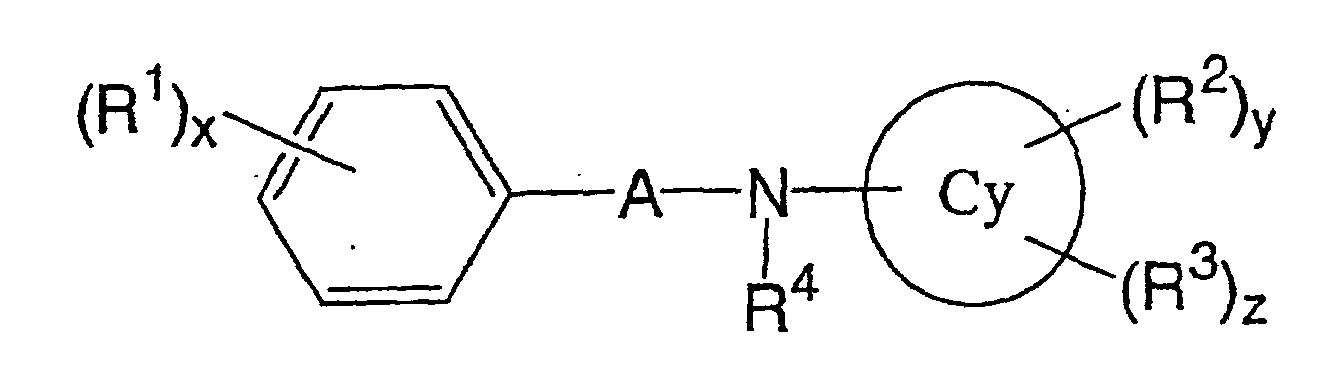 [wherein A is CO or SO2; Cy is an aryl group or a
heterocyclic group; each of R1 and R2 which are
independent of each other, is a halogen atom, a cyano
group, a nitro group, an alkyl group which may be
substituted, an alkenyl group which may be substituted,
an alkynyl group which may be substituted, a cycloalkyl
group which may be substituted, a cycloalkenyl group
which may be substituted, an aryl group which may be
substituted, a heterocyclic group which may be
substituted, an amino group which may be substituted or a
- B-Q group; R3 is a -M1-M2-R5 group; R4 is a hydrogen atom
or an alkyl group which may be substituted; x is an
integer of from 0 to 5; y is an integer of from 0 to 4;
and z is an integer of from 0 to 1].
[wherein A is CO or SO2; Cy is an aryl group or a
heterocyclic group; each of R1 and R2 which are
independent of each other, is a halogen atom, a cyano
group, a nitro group, an alkyl group which may be
substituted, an alkenyl group which may be substituted,
an alkynyl group which may be substituted, a cycloalkyl
group which may be substituted, a cycloalkenyl group
which may be substituted, an aryl group which may be
substituted, a heterocyclic group which may be
substituted, an amino group which may be substituted or a
- B-Q group; R3 is a -M1-M2-R5 group; R4 is a hydrogen atom
or an alkyl group which may be substituted; x is an
integer of from 0 to 5; y is an integer of from 0 to 4;
and z is an integer of from 0 to 1].
Description
The present invention relates to aniline derivatives
or salts thereof, and cytokine production inhibitors
containing the same as an active ingredient. The
cytokine production inhibitors of the present invention
are useful as preventive or therapeutic medicines for
diseases accompanied by hyperactivated immune functions,
such as allergic diseases, systemic autoimmune diseases
and organ specific autoimmune diseases, or as preventive
or therapeutic medicines for graft rejection in organ
transplantation.
In immune reactions in the body, cytokines produced
from various immunocytes control direction of the immune
responses. In this regulation of immune responses, it is
helper T cells that play a central role, and they are
classified into subsets Th1 and Th2 depending upon the
type of cytokines they produce. Th1 type cells are known
to produce mainly e.g. interleukin 2 (IL-2) and
interferon γ (IFN-γ) and to be concerned with cellular
immunity such as protection of infection against e.g.
virus and bacteria. Th2 type cells are known to produce
mainly e.g. interleukin 4 (IL-4), interleukin 5 (IL-5),
interleukin 6 (IL-6), interleukin 10 (IL-10) and
interleukin 13 (IL-13) and to be concerned with humoral
immunity such as protection of infection against
parasites and antibody production from B cells. However,
it has been clarified that if control of such
biophylactic mechanism dysfunctions or deteriorates for
some reason, hyperactivation or imbalance of immune
function may occur, thus inducing or deteriorating
various diseases.
Immune response of Th2 type induces or activates,
due to its hyperactivation, allergic inflammation
reactions such as immediate type allergy with which IgE
antibody or mast cells are mainly concerned, and delayed-type
allergy with which eosinophils are mainly concerned,
and is deeply concerned with induction or deterioration
of various allergic diseases such as urticaria, food
allergy, anaphylactic shock, hypereosinophilic syndrome,
asthma, allergic rhinitis, allergic conjunctivitis and
atopic dermatitis. Further, abnormal hyperactivation of
immune reaction of Th2 type is deeply concerned also with
systemic autoimmune diseases in a pathophysiologic state
where antibody production or humoral immunity is
hyperactivated, such as systemic lupus erythematosus. It
is considered to be important to control the immune
response of Th2 type in order to treat or prevent such
allergic diseases. On the other hand, immune response of
Th1 type induces or activates cellular immune responses
due to its hyperactivation, and is deeply concerned with
induction or deterioration of organ specific autoimmune
diseases such as chronic rheumatoid arthritis, type I
diabetes, Hashimoto's thyroiditis, myasthenia gravis and
multiple sclerosis. Further, cellular immune response of
Th1 type is deeply concerned also with graft rejection
accompanying organ transplantation. It is considered to
be important to control immune response of Th1 type in
order to prevent or treat such autoimmune diseases or
graft rejection after transplantation.
As compounds which are analogous in chemical
structures to the aniline derivative or a salt thereof as
an active ingredient of the cytokine production
inhibitors.of the present invention, compounds as
disclosed in WO95/146, WO98/27081 WO98/27058
WO99/15164, WO99/51580 and w000/40235 may, for example,
be mentioned. However, such compounds and the compounds
of the present invention are different in their chemical
structures.
At the present time, it is difficult to treat such
serious immune or allergic diseases by specifically
regulating immune response of Th1 or Th2 type, and
immunosuppressant agents which strongly suppress
production of both Th1 and Th2 type cytokines, such as
cyclosporin and FK506, in addition to steroids, are
mainly used as therapeutic medicines for such diseases.
However, various side effects such as dysfunction of
adrenal cortex, diabetes, peptic ulcer and glaucoma have
been problematic with respect to steroids, and serious
side effects such as damages in kidney and central
nervous system have been problematic with respect to
cyclosporin and FK506, and development of a new type of
cytokine production inhibitors which are different from
the above agents, has been desired.
The present inventors have found that aniline
derivatives having chemical structures which are totally
different from those of active ingredients in existing
agents have cytokine production inhibitory effects, and
the present invention has been accomplished on the basis
of this discovery. The aniline derivatives suppress
production of Th2 type cytokine, whereby they are useful
as preventive or therapeutic medicines for various
allergic diseases such as urticaria, food allergy,
anaphylactic shock, hypereosinophilic syndrome, asthma,
allergic rhinitis, allergic conjunctivitis and atopic
dermatitis; and systemic autoimmune diseases in which
antibody production or humoral immunity is
hyperactivated, such as systemic lupus erythematosus.
Further, they suppress production of Th1 type cytokine,
whereby they are useful as preventive or therapeutic
medicines for organ specific autoimmune diseases such as
chronic rheumatoid arthritis, type I diabetes,
Hashimoto's thyroiditis, myasthenia gravis and multiple
sclerosis; and graft rejection accompanying organ
transplantation.
The present inventors have conducted extensive
studies to find more excellent cytokine production
inhibitors and as a result, have accomplished the present
invention. Namely, the present invention relates to a
cytokine production inhibitor containing as an active
ingredient an aniline derivative of the formula (I) or a
salt thereof:
 [wherein A is CO or SO2; Cy is an aryl group or a
heterocyclic group; each of R1 and R2 which are
independent of each other, is a halogen atom, a cyano
group, a nitro group, an alkyl group which may be
substituted, an alkenyl group which may be substituted,
an alkynyl group which may be substituted, a cycloalkyl
group which may be substituted, a cycloalkenyl group
which may be substituted, an aryl group which may be
substituted, a heterocyclic group which may be
substituted, an amino group which may be substituted or a
-B-Q group (wherein B is O, CO, COO, OCO, S, SO or SO2;
and Q is a hydrogen atom, an alkyl group which may be
substituted, an alkenyl group which may be substituted,
an alkynyl group which may be substituted, a cycloalkyl
group which may be substituted, a cycloalkenyl group
which may be substituted, an aryl group which may be
substituted, a heterocyclic group which may be
substituted or an amino group which may be substituted);
R3 is a -M1-M2-R5 group {wherein each of M1 and M2 which
are independent of each other, is O, S, a NR6 group
(wherein R6 is a hydrogen atom or an alkyl group which
may be substituted), a single bond, a C1-2 alkylene chain,
CO, SO or SO2, or M1 and M2 together may form -N=N-; and
R5 is a cycloalkyl group which may be substituted, an
aryl group which may be substituted or a heterocyclic
group which may be substituted}; R4 is a hydrogen atom or
an alkyl group which may be substituted; x is an integer
of from 0 to 5; y is an integer of from 0 to 4; and z is
an integer of from 0 to 1; provided that (1) a case where
Cy is a phenyl group, and the substituent at the 4-position
of the phenyl group is a pyrazole group which
may be substituted or a triazole group which may be
substituted, and (2) a case where Cy is a phenyl group,
the substituent at the 2-position of the phenyl group is
an alkyl group, and the substituent at the 5-position is
a -NHCO-(CH2)q-R group (wherein q is an integer of from 1
to 4, and R is an aryl group or a cycloalkyl group) are
excluded].
[wherein A is CO or SO2; Cy is an aryl group or a
heterocyclic group; each of R1 and R2 which are
independent of each other, is a halogen atom, a cyano
group, a nitro group, an alkyl group which may be
substituted, an alkenyl group which may be substituted,
an alkynyl group which may be substituted, a cycloalkyl
group which may be substituted, a cycloalkenyl group
which may be substituted, an aryl group which may be
substituted, a heterocyclic group which may be
substituted, an amino group which may be substituted or a
-B-Q group (wherein B is O, CO, COO, OCO, S, SO or SO2;
and Q is a hydrogen atom, an alkyl group which may be
substituted, an alkenyl group which may be substituted,
an alkynyl group which may be substituted, a cycloalkyl
group which may be substituted, a cycloalkenyl group
which may be substituted, an aryl group which may be
substituted, a heterocyclic group which may be
substituted or an amino group which may be substituted);
R3 is a -M1-M2-R5 group {wherein each of M1 and M2 which
are independent of each other, is O, S, a NR6 group
(wherein R6 is a hydrogen atom or an alkyl group which
may be substituted), a single bond, a C1-2 alkylene chain,
CO, SO or SO2, or M1 and M2 together may form -N=N-; and
R5 is a cycloalkyl group which may be substituted, an
aryl group which may be substituted or a heterocyclic
group which may be substituted}; R4 is a hydrogen atom or
an alkyl group which may be substituted; x is an integer
of from 0 to 5; y is an integer of from 0 to 4; and z is
an integer of from 0 to 1; provided that (1) a case where
Cy is a phenyl group, and the substituent at the 4-position
of the phenyl group is a pyrazole group which
may be substituted or a triazole group which may be
substituted, and (2) a case where Cy is a phenyl group,
the substituent at the 2-position of the phenyl group is
an alkyl group, and the substituent at the 5-position is
a -NHCO-(CH2)q-R group (wherein q is an integer of from 1
to 4, and R is an aryl group or a cycloalkyl group) are
excluded].
The salt of the aniline derivative of the above
formula (I) may be any pharmaceutically acceptable salt,
and it may, for example, be a mineral acid salt such as a
hydrochloride, a sulfate or a nitrate; an organic acid
salt such as a p-toluene sulfonate, a propane sulfonate
or a methane sulfonate; an alkali metal salt such as a
potassium salt or a sodium salt; an alkaline earth metal
salt such as a calcium salt; or an organic amine salt
such as a triethanol amine salt or a
tris(hydroxymethyl)aminomethane salt. Some of these
salts have crystal water.
Each of the alkyl group which may be substituted
represented by each of R1, R2, R4, R6 and Q, and the alkyl
moiety in each of the secondary substituent and the
tertiary substituent as described hereinafter, may be
usually one having a carbon number of from 1 to 18, and
it may, for example, be a methyl group, an ethyl group, a
propyl group, a butyl group, a pentyl group, a hexyl
group, a heptyl group, an octyl group, a decyl group or a
nonadecyl group, and they include linear or branched
aliphatic structural isomers.
Each of the alkenyl group which may be substituted
represented by each of R1, R2 and Q, and the alkenyl
moiety in each of the secondary substituent and the
tertiary substituent as described hereinafter, may be
usually one having a carbon number of from 2 to 18, and
it may, for example, be a vinyl group, a propenyl group,
a butenyl group, a pentenyl group, a hexenyl group, a
decenyl group or a nonadecenyl group, and they include
linear or branched aliphatic structural isomers.
Each of the alkynyl group which may be substituted
represented by each of R1, R2 and Q, and the alkynyl
moiety in each of the secondary substituent and the
tertiary substituent as described hereinafter, may be
usually one having a carbon number of from 2 to 18, and
it may, for example, be an ethynyl group, a propynyl
group, a butynyl group, a pentynyl group, a hexynyl
group, a decynyl group or a nonadecynyl group, and they
include linear or branched aliphatic structural isomers.
Each of the cycloalkyl group which may be
substituted represented by each of R1, R2, R5 and Q and
the cycloalkyl moiety in each of the secondary
substituent and the tertiary substituent as described
hereinafter, may be usually one having a carbon number of
from 3 to 10, and it may, for example, be a monocyclic
group such as a cyclopropyl group, a cyclobutyl group, a
cyclopentyl group, a cyclohexyl group or a cyclooctyl
group; a fused-polycyclic group; or a crosslinked
polycyclic group such as an adamantyl group, a
noradamantyl group, a norbornanyl group or a
norbornanonyl group.
Each of the cycloalkenyl group which may be
substituted represented by each of R1, R2 and Q and the
cycloalkenyl moiety in each of the secondary substituent
and the tertiary substituent as described hereinafter,
may be usually one having a carbon number of from 3 to
10, and it may, for example, be a monocyclic group such
as a cyclopentenyl group, a cyclohexenyl group or a
cyclooctenyl group, a fused-polycyclic group or a
crosslinked polycyclic group.
Each of the aryl group which may be substituted
represented by each of R1, R2, R5 and Q, the aryl group
represented by Cy and the aryl moiety in each of the
secondary substituent and the tertiary substituent as
described hereinafter, may be a fused-polycyclic group
such as a naphthyl group, as well as a phenyl group.
Each of the heterocyclic group which may be
substituted represented by each of R1, R2, R5 and Q, the
heterocyclic group represented by Cy and the heterocyclic
moiety in each of the secondary substituent and the
tertiary substituent as described hereinafter, may, for
example, be a five-membered monocyclic heterocyclic group
such as a pyrrolyl group, a pyrrolinyl group, a
pyrrolidinyl group, a furanyl group, a dihydrofuranyl
group, a tetrahydrofuranyl group, a thienyl group, a
dihydrothienyl group, a tetrahydrothienyl group, a
pyrazolyl group, a pyrazolinyl group, a pyrazolidinyl
group, an imidazolyl group, an imidazolinyl group, an
imidazolidinyl group, an oxazolyl group, an oxazolinyl
group, an oxazolidinyl group, an isoxazolyl group, an
isoxazolinyl group, an isoxazolidinyl group, a thiazolyl
group, a thiazolinyl group, a thiazolidinyl group, an
isothiazolyl group, an isothiazolinyl group, an
isothiazolidinyl group, an oxadiazolyl group, an
oxadiazolinyl group, an oxadiazolidinyl group, a
thiadiazolyl group, a thiadiazolinyl group, a
thiadiazolidinyl group, a triazolyl group, a triazolinyl
group, a triazolidinyl group, a tetrazolyl group, a
tetrazolinyl group, a tetrazolidinyl group, a dioxolyl
group, a dioxolanyl group, a dithiolyl group or a
dithiolanyl group; a six-membered monocyclic heterocyclic
group such as a pyridyl group, a dihydropyridyl group, a
tetrahydropyridyl group, a piperidinyl group, a pyrimidyl
group, a dihydropyrimidyl group, a tetrahydropyrimidyl
group, a hexahydropyrimidyl group, a pyridazinyl group, a
dihydropyridazinyl group, a tetrahydropyridazinyl group,
a hexahydropyridazinyl group, a pyrazinyl group, a
dihydropyrazinyl group, a tertahydropyrazinyl group, a
piperazinyl group, a triazinyl group, a dihydrotriazinyl
group, a tetrahydrotriazinyl group, a hexahydrotriazinyl
group, a pyranyl group, a dihydropyranyl group, a
tetrahydropyranyl group, a dioxinyl group, a dioxenyl
group, a dioxanyl group, a dithianyl group or a
morpholinyl group; a fused-polycyclic heterocyclic group
such as a thienothienyl group, a dihydrocyclopentathienyl
group, an indolyl group, a tetrahydroindolyl group, an
isoindolyl group, a tetrahydroisoindolyl group, a
benzothienyl group, a tetrahydrobenzothienyl group, a
benzofuranyl group, a tetrahydrobenzofuranyl group, a
benzoxazolyl group, a tetrahydrobenzoxazolyl group, a
benzisoxazolyl group, a tetrahydrobenzisoxazolyl group, a
benzothiazolyl group, a tetrahydrobenzothiazolyl group, a
benzisothiazolyl group, a tetrahydrobenzisothiazolyl
group, a benzimidazolyl group, a tetrahydrobenzimidazolyl
group, a benzodioxolyl group, a benzodithiolyl group, a
benzodioxanyl group, a benzodithianyl group, a quinolinyl
group, an isoquinolinyl group, a quinazolinyl group, a
quinoxalinyl group, a phthalazinyl group, a
naphthylidinyl group or a purinyl group; or a crosslinked
polycyclic heterocyclic group such as a quinuclidinyl
group.
The secondary substituent of each of the alkyl group
which may be substituted, the alkenyl group which may be
substituted and the alkynyl group which may be
substituted, may, for example, be a halogen atom, a
hydroxyl group, a mercapto group, an alkoxy group, a
substitutable alkylthio group, a substitutable alkenyloxy
group, a substitutable alkenylthio group, a substitutable
alkynyloxy group, a substitutable alkynylthio group, a
substitutable cycloalkyl group, a substitutable
cycloalkenyl group, a substitutable cycloalkoxy group, a
substitutable cycloalkylthio group, a substitutable
cycloalkenyloxy group, a substitutable cycloalkenylthio
group, a substitutable alkoxycarbonyl group, a
substitutable alkylcarbonyl group, a substitutable
alkylcarbonyloxy group, a substitutable
alkenyloxycarbonyl group, a substitutable alkenylcarbonyl
group, a substitutable alkenylcarbonyloxy group, a
substitutable alkynyloxycarbonyl group, a substitutable
alkynylcarbonyl group, a substitutable alkynylcarbonyloxy
group, a substitutable cycloalkoxycarbonyl group, a
substitutable cycloalkylcarbonyl group, a substitutable
cycloalkylcarbonyloxy group, a substitutable
cycloalkenyloxycarbonyl group, a substitutable
cycloalkenylcarbonyl group, a substitutable
cycloalkenylcarbonyloxy group, a substitutable aryl
group, a substitutable aryloxy group, a substitutable
arylthio group, a substitutable aryloxycarbonyl group, a
substitutable arylcarbonyl group, a substitutable
arylcarbonyloxy group, a substitutable heterocyclic
group, a substitutable heterocyclyloxy group, a
substitutable heterocyclylthio group, a substitutable
heterocyclyloxycarbonyl group, a substitutable
heterocyclylcarbonyl group, a substitutable
heterocyclylcarbonyloxy group, a substitutable amino
group, a cyano group, a nitro group, a carboxyl group, a
substitutable aminocarbonyl group, a substitutable
alkylsulfonyl group, a substitutable alkenylsulfonyl
group, a substitutable alkynylsulfonyl group, a
substitutable cycloalkylsulfonyl group, a substitutable
cycloalkenylsulfonyl group, a substitutable arylsulfonyl
group, a substitutable heterocyclylsulfonyl group or a
substitutable aminosulfonyl group. The number of such
substituents may be one or two or more, and such
substituents may be the same or different.
The secondary substituent of each of the cycloalkyl
group which may be substituted, the cycloalkenyl group
which may be substituted, the aryl group which may be
substituted and the heterocyclic group which may be
substituted, may, for example, be a halogen atom, a
hydroxyl group, a mercapto group, a substitutable alkyl
group, a substitutable alkenyl group, a substitutable
alkynyl group, a substitutable alkoxy group, a
substitutable alkylthio group, a substitutable alkenyloxy
group, a substitutable alkenylthio group, a substitutable
alkynyloxy group, a substitutable alkynylthio group, a
substitutable cycloalkyl group, a substitutable
cycloalkenyl group, a substitutable cycloalkoxy group, a
substitutable cycloalkylthio group, a substitutable
cycloalkenyloxy group, a substitutable cycloalkenylthio
group, a substitutable alkoxycarbonyl group, a
substitutable alkylcarbonyl group, a substitutable
alkylcarbonyloxy group, a substitutable
alkenyloxycarbonyl group, a substitutable alkenylcarbonyl
group, a substitutable alkenylcarbonyloxy group, a
substitutable alkynyloxycarbonyl group, a substitutable
alkynylcarbonyl group, a substitutable alkynylcarbonyloxy
group, a substitutable cycloalkoxycarbonyl group, a
substitutable cycloalkylcarbonyl group, a substitutable
cycloalkylcarbonyloxy group, a substitutable
cycloalkenyloxycarbonyl group, a substitutable
cycloalkenylcarbonyl group, a substitutable
cycloalkenylcarbonyloxy group, a substitutable aryl
group, a substitutable aryloxy group, a substitutable
arylthio group, a substitutable aryloxycarbonyl group, a
substitutable arylcarbonyl group, a substitutable
arylcarbonyloxy group, a substitutable heterocyclic
group, a substitutable heterocyclyloxy group, a
substitutable heterocyclylthio group, a substitutable
heterocyclyloxycarbonyl group, a substitutable
heterocyclylcarbonyl group, a substitutable
heterocyclylcarbonyloxy group, a substitutable amino
group, a cyano group, a nitro group, a carboxyl group, a
substitutable aminocarbonyl group, a substitutable
alkylsulfonyl group, a substitutable alkenylsulfonyl
group, a substitutable alkynylsulfonyl group, a
substitutable cycloalkylsulfonyl group, a substitutable
cycloalkenylsulfonyl group, a substitutable arylsulfonyl
group, a substitutable heterocyclylsulfonyl group or a
substitutable aminosulfonyl group. The number of such
substituents may be one or two or more, and such
substituents may be the same or different.
The secondary substituent of the amino group which
may be substituted represented by each of R1, R2 and Q,
may, for example, be a hydroxyl group, a substitutable
alkyl group, a substitutable alkenyl group, a
substitutable alkynyl group, a substitutable alkoxy
group, a substitutable alkenyloxy group, a substitutable
alkynyloxy group, a substitutable cycloalkyl group, a
substitutable cycloalkenyl group, a substitutable
cycloalkoxy group, a substitutable cycloalkenyloxy group,
a substitutable alkoxycarbonyl group, a substitutable
alkylcarbonyl group, a substitutable alkenyloxycarbonyl
group, a substitutable alkenylcarbonyl group, a
substitutable alkynyloxycarbonyl group, a substitutable
alkynylcarbonyl group, a substitutable
cycloalkoxycarbonyl group, a substitutable
cycloalkylcarbonyl group, a substitutable
cycloalkenyloxycarbonyl group, a substitutable
cycloalkenylcarbonyl group, a substitutable aryl group, a
substitutable aryloxy group, a substitutable
aryloxycarbonyl group, a substitutable arylcarbonyl
group, a substitutable heterocyclic group, a
substitutable heterocyclyloxy group, a substitutable
heterocyclyloxycarbonyl group, a substitutable
heterocyclylcarbonyl group, a substitutable aminocarbonyl
group, a substitutable alkylsulfonyl group, a
substitutable alkenylsulfonyl group, a substitutable
alkynylsulfonyl group, a substitutable cycloalkylsulfonyl
group, a substitutable cycloalkenylsulfonyl group, a
substitutable arylsulfonyl group, a substitutable
heterocyclylsulfonyl group or a substitutable
aminosulfonyl group. The number of such secondary
substituents may be one or two or more, and such
secondary substituents may be the same or different.
Further, the two secondary substituents may form a ring
containing or not containing a heteroatom.
The tertiary substituent of each of substitutable
groups among the above secondary substituents may, for
example, be a halogen atom, a hydroxyl group, a mercapto
group, a cyano group, a nitro group, a carboxyl group, an
amino group, an alkyl group, an alkenyl group, an alkynyl
group, a cycloalkyl group, a cycloalkenyl group, an aryl
group, a heterocyclic group, an alkoxy group, an
alkenyloxy group, an alkynyloxy group, a cycloalkyloxy
group, a cycloalkenyloxy group, an aryloxy group, a
heterocyclyloxy group, an alkylthio group, an alkenylthio
group, an alkynylthio group, a cycloalkylthio group, a
cycloalkenylthio group, an arylthio group, a
heterocyclylthio group, an alkylsulfonyl group, an
alkenylsulfonyl group, an alkynylsulfonyl group, a
cycloalkylsulfonyl group, a cycloalkenylsulfonyl group,
an arylsulfonyl group, a heterocyclylsulfonyl group, an
alkylcarbonyl group, an alkenylcarbonyl group, an
alkynylcarbonyl group, a cycloalkylcarbonyl group, a
cycloalkenylcarbonyl group, an arylcarbonyl group, a
heterocyclylcarbonyl group, an alkyloxycarbonyl group, an
alkenyloxycarbonyl group, an alkynyloxycarbonyl group,
a cycloalkyloxycarbonyl group, a cycloalkenyloxycarbonyl
group, an aryloxycarbonyl group, a
heterocyclyloxycarbonyl group, an aminocarbonyl group, an
alkylaminocarbonyl group, a dialkylaminocarbonyl group,
an alkenylaminocarbonyl group, an alkynylaminocarbonyl
group, a cycloalkylaminocarbonyl group, a
cycloalkenylaminocarbonyl group, an arylaminocarbonyl
group, a heterocyclylaminocarbonyl group, an
aminosulfonyl group, an alkylaminosulfonyl group, a
dialkylaminosulfonyl group, an alkenylaminosulfonyl
group, an alkynylaminosulfonyl group, a
cycloalkylaminosulfonyl group, a
cycloalkenylaminosulfonyl group, an arylaminosulfonyl
group, a heterocyclylaminosulfonyl group, an alkylamino
group, a dialkylamino group, an alkenylamino group, an
alkynylamino group, a cycloalkylamino group, a
cycloalkenylamino group, an arylamino group, a
heterocyclylamino group, an alkylcarbonylamino group, an
alkenylcarbonylamino group, an alkynylcarbonylamino
group, a cycloalkylcarbonylamino group, a
cycloalkenylcarbonylamino group, an arylcarbonylamino
group, a heterocyclylcarbonylamino group, an
alkylsulfonylamino group, an alkenylsulfonylamino group,
an alkynylsulfonylamino group, a cycloalkylsulfonylamino
group, a cycloalkenylsulfonylamino group, an
arylsulfonylamino group or a heterocyclylsulfonylamino
group. The number of such tertiary substituents may be
one or two or more, and when the number is two or more,
such substituents may be the same or different. Further,
when the secondary substituent is an amino group
substituted with two tertiary substituents, such tertiary
substituents together may form a ring containing or not
containing a heteroatom.
Further, each of the alkyl moiety, the alkenyl
moiety, the alkynyl moiety, the cycloalkyl moiety, the
cycloalkenyl moiety, the aryl moiety and the heterocyclic
moiety of each of such tertiary substituents may further
be substituted with a quaternary substituent such as a
halogen atom, a hydroxyl group, a mercapto group, a cyano
group, a nitro group, a carboxyl group, an amino group,
an alkyl group, a haloalkyl group, an alkoxy group, a
haloalkoxy group, an alkylthio group, a haloalkylthio
group, an alkoxycarbonyl group, an aminocarbonyl group,
an alkylaminocarbonyl group, a dialkylaminocarbonyl
group, an aminosulfonyl group, an alkylaminosulfonyl
group, a dialkylaminosulfonyl group, an alkylamino group,
a dialkylamino group, an alkylcarbonylamino group, an
alkylsulfonylamino group, a cycloalkyl group, an aryl
group or a heterocyclic group. The number of such
substituents may be one or two or more, and when the
number of the substituents is two or more, such
substituents may be the same or different.
Now, some of preferred embodiments of the present
invention will be explained, however, the present
invention is by no means restricted thereto.
The compounds of the above formula (I) are compounds
useful as an active ingredient of cytokine production
inhibitors, and are useful as preventive or therapeutic
medicines for diseases accompanied by hyperactivated
immune functions as listed below.
Among the compounds of the above formula (I) and
salts thereof, compounds wherein Cy is a phenyl group or
a six-membered monocyclic heterocyclic group or salts
thereof are preferred as an active ingredient of the
cytokine production inhibitors, and among them, more
preferred compounds are listed below.
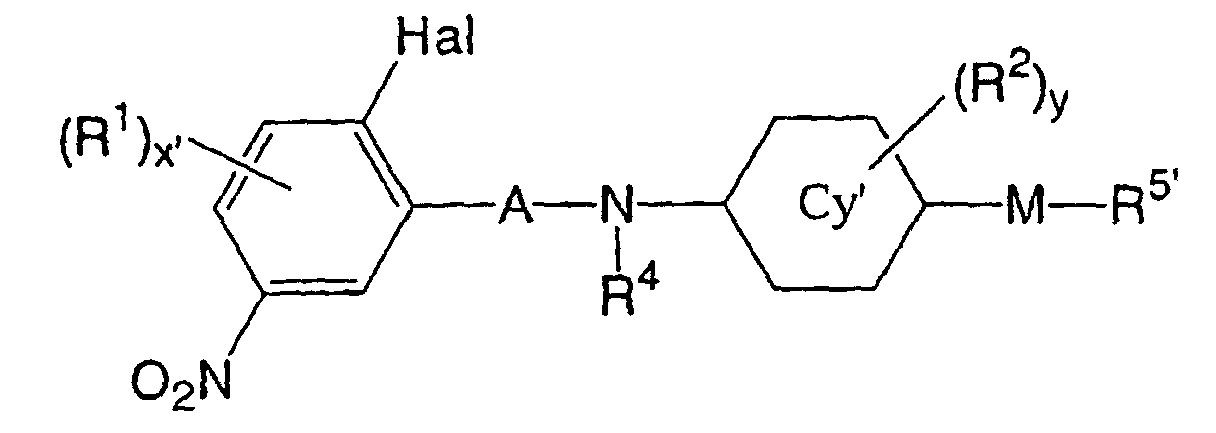
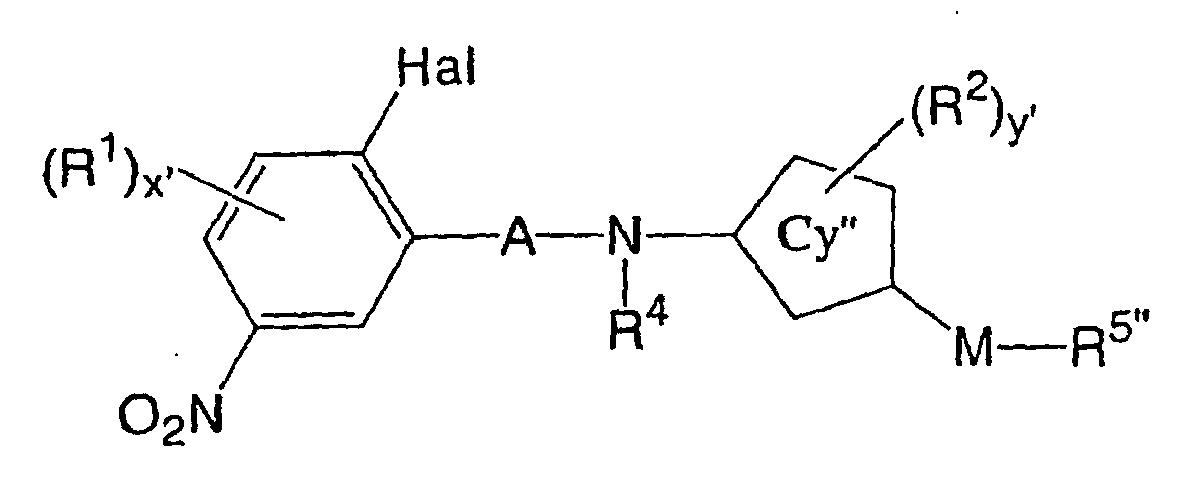
The compounds of the above formula (I) and salts
thereof can be produced by a process for producing known
analogous compounds, or a method in accordance therewith,
and as preferred embodiments, the following Preparation
Methods [1] and [2] will be exemplified.
A method for producing the aniline derivative of the
above formula (I) or a salt thereof, by reacting a
compound of the formula (IV):
 [wherein A, R1 and x are as defined above, and L is a
leaving group] with a compound of the formula (V):
[wherein A, R1 and x are as defined above, and L is a
leaving group] with a compound of the formula (V):
 [wherein Cy, R2, R3, R4, y and z are as defined above] .
As the leaving group represented by L may, for example,
be a halogen atom.
[wherein Cy, R2, R3, R4, y and z are as defined above] .
As the leaving group represented by L may, for example,
be a halogen atom.
The reaction of the Preparation Method 1 may be
carried out in the presence of a proper solvent. The
specific solvent used may, for example, be an aromatic
hydrocarbon such as benzene, toluene or xylene; an
aliphatic hydrocarbon such as pentane, hexane, heptane,
petroleum ether, ligroin or petroleum benzine; an ether
such as diethyl ether, dipropyl ether, dibutyl ether,
tetrahydrofuran or dioxane; a nitrile such as
acetonitrile or propionitrile; an acid amide such as
dimethylformamide or dimethylacetamide; a sulfoxide such
as dimethylsulfoxide; a sulfone such as sulfolane; a
phosphate amide such as hexamethylphosphoramide; or a
halogenated hydrocarbon such as chloroform,
dichloromethane, carbon tetrachloride or 1,2-dichloroethane,
or a mixed solvent thereof.
In the Preparation Method 1, the reaction is carried
out preferably in the presence of a base in some cases.
The specific base used may, for example, be an organic
base such as triethylamine, pyridine, N-methylmorpholine,
1,8-diazabicyclo[5,4,0]-7-undecene or N,N-dimethylaniline;
an alkali metal such as lithium, sodium
or potassium; a carbonate of an alkali metal such as
lithium carbonate, sodium carbonate or potassium
carbonate; a hydrogencarbonate of an alkali metal such as
lithium hydrogencarbonate, sodium hydrogencarbonate or
potassium hydrogencarbonate; a hydride of an alkali metal
such as lithium hydride, sodium hydride or potassium
hydride; or n-butylithium, lithium diisopropylamide or
sodium amide.
The reaction of the Preparation Method 1 is carried
out usually at a reaction temperature of from -70 to
150°C, preferably at a reaction temperature of from -10
to 100°C. The reaction time is usually from 0.1 to 48
hours.
In the Preparation Method 1, the compound of the
formula (III) may be used in an amount of from 0.8 to 2
equivalents, preferably from 1 to 1.5 equivalents, per 1
mol of the compound of the above formula (II).
In the Preparation Method 1, various reaction
conditions may optionally be combined with one another.
Further, such various reaction conditions include
reaction conditions in a usual range and reaction
conditions in a preferred range, and they may also be
optionally selected and combined with one another.
A method for producing an aniline derivative of the
formula (I-2):
 [wherein A, Cy, R1, R2, R3, R4', x, y and z are as defined
above], by reacting a compound of the formula (I-1):
[wherein A, Cy, R1, R2, R3, R4', x, y and z are as defined
above], by reacting a compound of the formula (I-1):
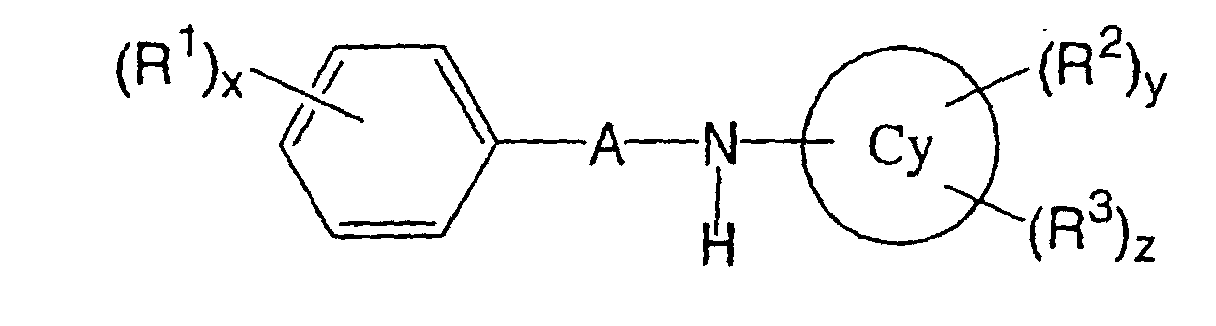 [wherein A, Cy, R1, R2, R3, x, y and z are as defined
above] with a compound of the formula (VI): R4'-L
[wherein R4' is an alkyl group which may be substituted,
and L is as defined above].
[wherein A, Cy, R1, R2, R3, x, y and z are as defined
above] with a compound of the formula (VI): R4'-L
[wherein R4' is an alkyl group which may be substituted,
and L is as defined above].
The reaction of the Preparation Method 2 may be
carried out in the presence of a proper solvent. The
specific solvent used may, for example, be an aromatic
hydrocarbon such as benzene, toluene or xylene; an
aliphatic hydrocarbon such as pentane, hexane, heptane,
petroleum ether, ligroin or petroleum benzine; an ether
such as diethyl ether, dipropyl ether, dibutyl ether,
tetrahydrofuran or dioxane; a nitrile such as
acetonitrile or propionitrile; an acid amide such as
dimethylformamide or dimethylacetamide; a sulfoxide such
as dimethylsulfoxide; a sulfone such as sulfolane; a
phosphate amide such as hexamethylphosphoramide; or a
halogenated hydrocarbon such as chloroform,
dichloromethane, carbon tetrachloride or 1,2-dichloroethane,
or a mixed solvent thereof.
In the Preparation Method 2, the reaction is carried
out preferably in the presence of a base, so as to carry
out the reaction efficiently. The specific base used
may, for example, be an organic base such as
triethylamine, pyridine, N-methylmorpholine, 1,8-diazabicyclo[5,4,0]-7-undecene
or N,N-dimethylaniline; an
alkali metal such as lithium, sodium or potassium; a
carbonate of an alkali metal such as lithium carbonate,
sodium carbonate or potassium carbonate; a
hydrogencarbonate of an alkali metal such as lithium
hydrogencarbonate, sodium hydrogencarbonate or potassium
hydrogencarbonate; a hydride of an alkali metal such as
lithium hydride, sodium hydride or potassium hydride; or
n-butylithium, lithium diisopropylamide or sodium amide.
The reaction of the Preparation Method 2 is carried
out usually at a reaction temperature of from -70 to
150°C, preferably at a reaction temperature of from -10
to 100°C. The reaction time is usually from 0.1 to 48
hours.
In the Preparation Method 2, the compound of the
formula (IV) may be used in an amount of from 0.8 to 2
equivalents, preferably from 1 to 1.5 equivalents, per 1
mol of the compound of the above formula (I-1).
In the Preparation Method 2, various reaction
conditions may optionally be combined with one another.
Further, such various reaction conditions include
reaction conditions in a usual range and reaction
conditions in a preferred range, and they may also be
optionally selected and combined with one another.
The compounds of the above formula (I) obtained by
each of the above Preparation Methods 1 and 2 and methods
in accordance therewith, may be isolated and purified by
means of a known method such as concentration,
concentration under reduced pressure, distillation,
fractionation, redistribution, solvent extraction,
crystallization, recrystallization or chromatography.
In a case where the compound of the above formula
(I) is obtained as a free form, a salt may be formed by a
conventional method. Further, the compound of the above
formula (I) or a salt thereof or a stereoisomer thereof
has a cytokine production inhibitory effect by itself or
as mixed.
Among the compounds of the above formula (I) and
salts thereof, the compounds of the formula (I') and
salts thereof may be produced by the following
Preparation Method [A] or [B] or a combination of these
Preparation Methods, in accordance with the above
Preparation Method 1 and 2.
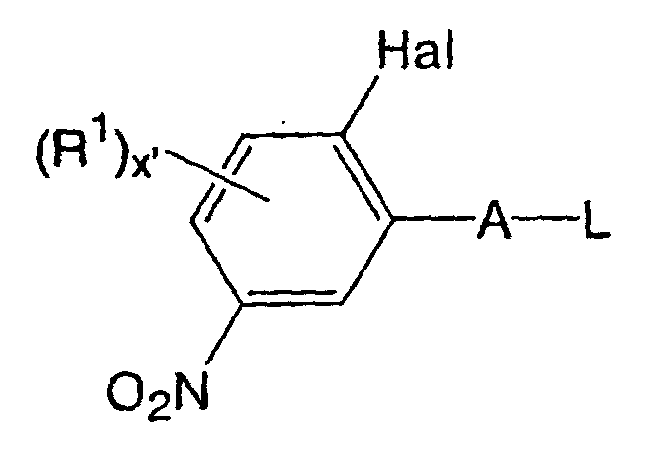

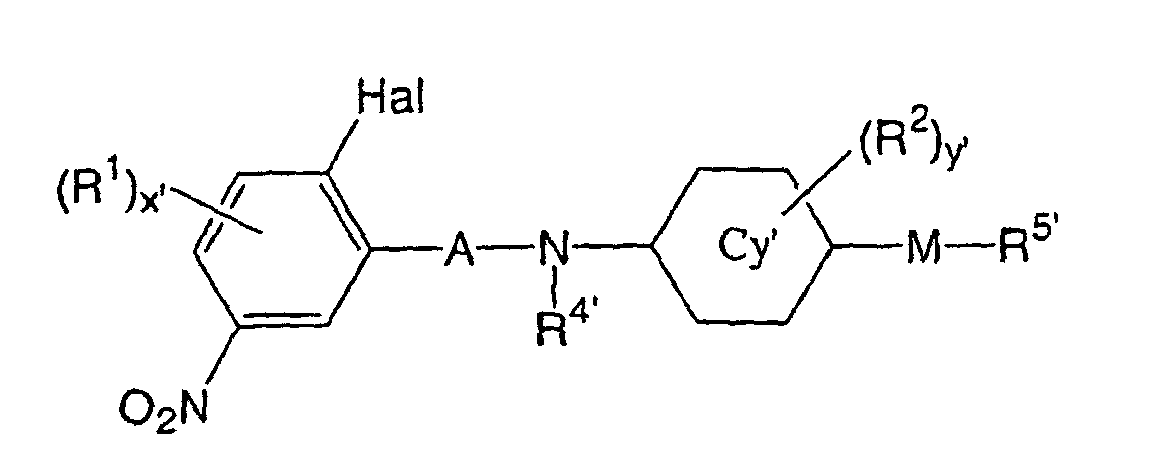

The Preparation Method [B] is in accordance with the
Preparation Method 2, and reaction conditions in the
Preparation Method 2 can be applied.
The compounds of the formula [I] of the present
invention are usually used in the form of a common
pharmaceutical preparation (such as a method as defined
in the Japanese Pharmacopoeia Twelfth Edition). The
pharmaceutical preparation is prepared by using a
commonly used diluent or excipient such as a bulking
agent, an extender, a binding agent, a moisture-imparting
agent, a disintegrator, a surfactant or a lubricant. As
the pharmaceutical preparation, various forms may be
selected depending upon the purpose of treatment, and a
tablet, a pill, a powder, a dust, a granule, a capsule, a
suppository, a solution, a suspension, an emulsion, an
injection (such as a solution or a suspension), a spray,
an aerosol, a cream, an ointment, a lotion or a
transdermal agent (a patch, a matrix or a tape) may be
mentioned as examples.
To form the medicine into a tablet, carriers which
have conventionally been known in this field can be used
widely, and they may, for example, be excipients such as
lactose, sucrose, sodium chloride, glucose, urea, starch,
calcium carbonate, kaolin, crystalline cellulose and
silicic acid, binding agents such as water, ethanol,
propanol, simple syrup, a glucose solution, a starch
solution, a gelatin solution, carboxymethyl cellulose,
Shellac, methyl cellulose, potassium phosphate and
polyvinyl pyrrolidone, disintegrators such as dried
starch, sodium alginate, an agar powder, a laminaran
powder, sodium hydrogencarbonate, calcium carbonate,
polyoxyethylene sorbitan fatty acid esters, sodium lauryl
sulfate, monoglyceryl stearate, starch and lactose,
disintegration inhibitors such as sucrose, stearin, cacao
butter and hydrogenated oil, absorption stimulators such
as a quaternary ammonium base and sodium lauryl sulfate,
moisturizers such as glycerin and starch, absorbents such
as starch, lactose, kaolin, bentonite and colloidal
silicate, and lubricants such as purified talc, a
stearate, a boric acid powder and polyethylene glycol.
Further, a tablet may be a tablet having a common coating
applied thereto as the case requires, such as a sugar-coated
tablet, a gelatin-coated tablet, an enteric-coated
tablet or a film-coated tablet, or a double tablet or a
multilayer tablet.
To form the medicine into a pill, carriers which
have conventionally been known in this field can be used
widely, and they may, for example, be excipients such as
glucose, lactose, starch, cacao butter, hydrogenated
vegetable oil, kaolin and talc, binding agents such as
powdered acacia, powdered tragacanth, gelatin and ethanol
and disintegrators such as laminaran agar.
To form the medicine into a suppository,
conventionally known carriers can be used widely, and
they may, for example, be polyethylene glycol, cacao
butter, higher alcohols, higher alcohol esters, gelatin
and semi-synthetic glyceride.
To prepare an injection, a solution, an emulsion or
a suspension is sterilized, and is preferably isotonic
with the blood, and to form the medicine into a solution,
an emulsion or a suspension, all the diluents which are
commonly used in this field can be used, and they may,
for example, be water, a lactic acid aqueous solution,
ethyl alcohol, propylene glycol, ethoxylated isostearyl
alcohol, polyoxylated isostearyl alcohol and
polyoxyethylene sorbitan fatty acid esters. In this
case, sodium chloride salt, glucose or glycerin in an
amount adequate to prepare an isotonic solution may be
incorporated in the pharmaceutical preparation, and a
common solubilizing agent, buffer, soothing agent or the
like may be added thereto. Further, as the case
requires, a colorant, a preservative, a fragrant
material, a flavoring agent, a sweetener or another
pharmaceutical agent may be incorporated in the
pharmaceutical preparation.
The amount of the compound of the formula (I) of the
present invention is not particularly limited and may
optionally be selected from a wide range, but it is
usually from 1 to 70 wt%, preferably from 5 to 50 wt% in
the entire composition.
The administration method of the compounds of the
formula (I) of the present invention is not particularly
limited, and they are orally or parenterally administered
by a method depending upon the form of the preparation,
the age, the sex or other conditions of the patient and
the degree of the disease. For example, for oral
administration, a tablet, a pill, a solution, a
suspension, an emulsion, a granule or a capsule may, for
example, be mentioned as a preferred form. For
parenteral administration, the medicine may be
administered in the form of e.g. a topical agent, an
injection, a transdermal agent, nasal drops, an inhalant
or a suppository. In the case of an injection, it is
preferred that the medicine is intravenously administered
by itself or as mixed with a conventional fluid
replacement such as glucose or amino acids, or as the
case requires, it is intramuscularly, intradermally,
subcutaneously or intraperitoneally administered by
itself. Further, in the case of a suppository, it is
preferred that the medicine is administered in rectum.
The dose of the compound of the formula (I) of the
present invention is optionally selected depending upon
e.g. the dose regimen, the age, the sex or other
conditions of the patient and the degree of disease, and
usually the amount of the compound of the above formula
(I) as an active ingredient is preferably from about 0.05
to about 50 mg per kg of the body weight per day, and the
medicine may be administered once or several times a day.
Further, it is preferred that the active ingredient is
contained in an amount of from 1 to 1,000 mg in the
administration unit form.
Now, Examples (Preparation Examples and Test
Examples) of the present invention will be described,
however, the present invention is by no means restricted
thereto.
Into 5 mL of a tetrahydrofuran solution comprising
420 mg of 4-phenoxyaniline and 250 mg of triethylamine, 5
mL of a tetrahydrofuran solution comprising 500 mg of 2-chloro-5-nitrobenzoylchloride
was dropwise added under
cooling with ice. After stirring for about 30 minutes,
water was added thereto, and precipitated crystals were
collected by filtration. The collected crystals were
washed with water and then dried to obtain 730 mg of N-(4-phenoxyphenyl)
-2-chloro-5-nitrobenzamide (Compound No.
27) having a melting point of 128°C.
To 5 mL of a tetrahydrofuran solution comprising 300
mg of 4- (1-adamantyl) -2-methylaniline hydrochloride and
120 mg of triethylamine, 5 mL of a tetrahydrofuran
solution comprising 290 mg of 2-bromo-5-nitrobenzoylchloride
was dropwise added under cooling
with ice. After stirring for about 30 minutes, water was
added thereto, and the precipitated crystals were
collected by filtration. The collected crystals were
washed with water and then dried to obtain 310 mg of N-(4-(1-adamantyl)-2-methylphenyl)-2-bromo-5-nitrobenzamide
(Compound No. 46) having a melting point of 229°C.
To 5 mL of a tetrahydrofuran solution comprising 250
mg of 4-(1-adamantyl)-2-methylaniline hydrochloride and
200 mg of triethylamine, 5 mL of a tetrahydrofuran
solution comprising 230 mg of 2-chloro-5-nitrobenzenesulfonylchloride
was dropwise added, followed
by stirring at about 40°C for about 7 hours. After the
mixture was left to stand for cooling, water was added
thereto, extraction with chloroform, drying over salt
cake and concentration under reduced pressure were
carried out to obtain crude crystals. The crude crystals
were recrystalized from ether to obtain 150 mg of N-(4-(1-adamantyl)-2-methylphenyl)-2-chloro-5-nitrobenzenesulfonamide
(Compound No. 48) having a
melting point of 238°C.
To 5 mL of a tetrahydrofuran solution comprising 670
mg of 4-(3-chloro-5-trifluoromethyl-2-pyridyloxy)-3-methylaniline
and 270 mg of triethylamine, 5 mL of a
tetrahydrofuran solution comprising 490 mg of 2-chloro-5-nitrobenzoylchloride
was dropwise added, followed by
stirring for about 30 minutes, and then water was added,
and the precipitated crystals were collected by
filtration. The collected crystals were washed with
water and then dried to obtain 700 mg of N-(4-(3-chloro-5-trifluoromethyl-2-pyridyloxy)-3-methylphenyl)-2-chloro-5-nitrobenzamide
(Compound No. 106) having a melting
point of from 230 to 232°C.
To 5 mL of a tetrahydrofuran solution comprising 290
mg of 5-amino-2-(1-adamantyloxy)pyridine) and 150 mg of
triethylamine, 5 mL of a tetrahydrofuran solution
comprising 260 mg of 2-chloro-5-nitrobenzoylchloride was
dropwise added, followed by stirring for about 30
minutes, and then water was added, and the precipitated
crystals were collected by filtration. The collected
crystals were washed with water and then dried to obtain
330 mg of N-(2-(1-adamantyloxy)-5-pyridyl)-2-chloro-5-nitrobenzamide
(Compound No. 123) having a melting point
of from 98 to 105°C.
To 5 mL of a tetrahydrofuran solution comprising 320
mg of 4-(3-chloro-5-trifluoromethyl-2-pyridyloxy)-3-(1-pyrrolyl)aniline
and 110 mg of triethylamine, 5 mL of a
tetrahydrofuran solution comprising 200 mg of 2-chloro-5-nitrobenzoylchloride
was dropwise added, followed by
stirring for about 30 minutes, and then water was added,
and the precipitated crystals were collected by
filtration. The collected crystals were washed with
water and then dried to obtain 260 mg of N-(4-(3-chloro-5-trifluoromethyl-2-pyridyloxy)-3-(1-pyrrolyl)phenyl)-2-chloro-5-nitrobenzamide
(Compound No. 127) having a
melting point of from 165 to 167°C.
To 5 mL of a tetrahydrofuran solution comprising 300
mg of 4-(3-chloro-5-trifluoromethyl-2-pyridylmethyloxy)aniline
and 120 mg of triethylamine, 5
mL of a tetrahydrofuran solution comprising 220 mg of 2-chloro-5-nitrobenzoylchloride
was dropwise added,
followed by stirring for about 30 minutes, and then water
was added thereto, and the precipitated crystals were
collected by filtration. The collected crystals were
washed with water and then dried to obtain 380 mg of N-(4-(3-chloro-5-trifluoromethyl-2-pyridylmethyloxy)phenyl)-2-chloro-5-nitrobenzamide
(Compound No. 135) having a melting point of from 193 to
195°C.
Compounds of the above formula (I) produced in
Preparation Examples 1 to 7 and by methods in accordance
with the above Preparation Methods 1 and 2 are shown in
the following Tables 1 to 20.
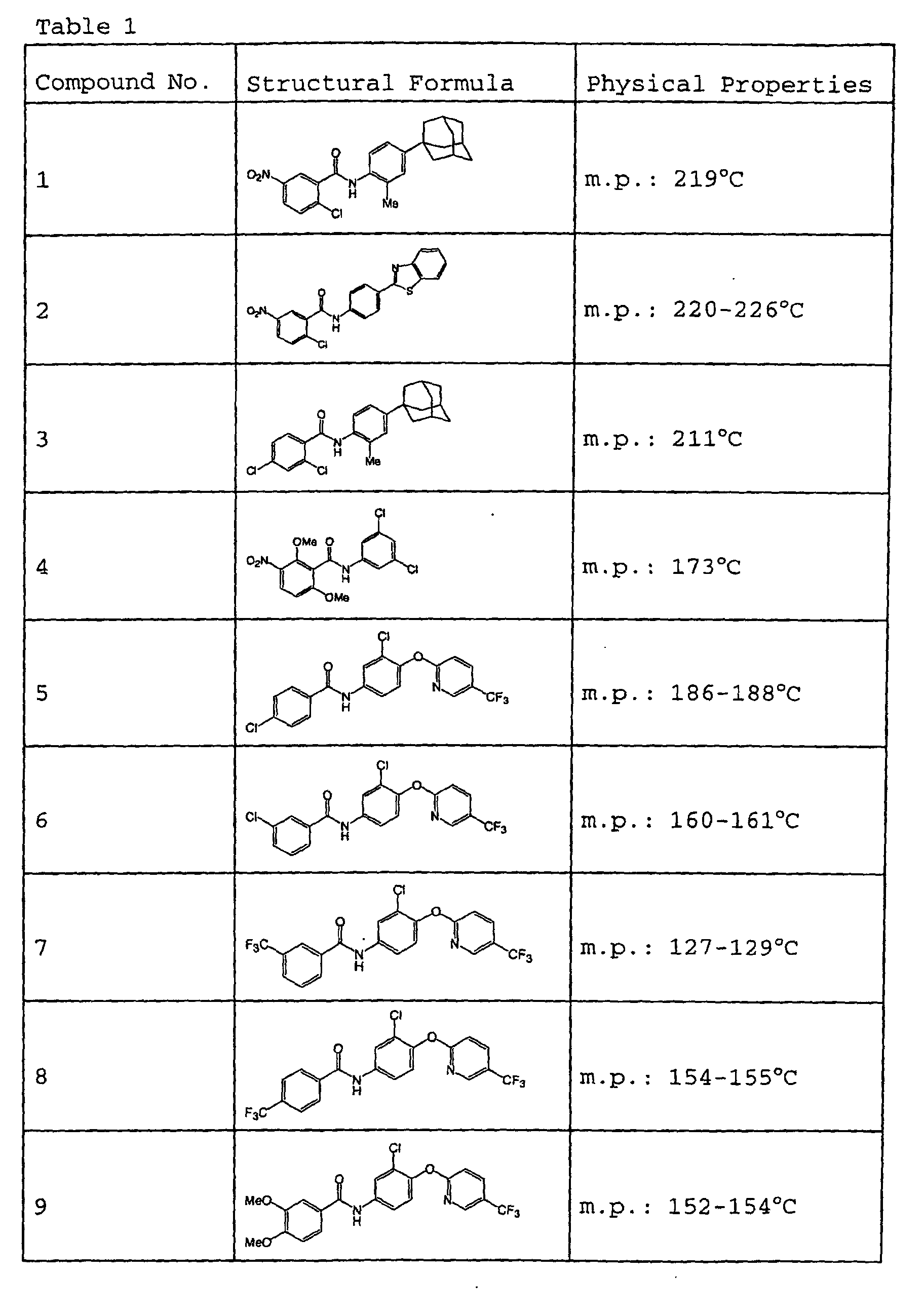

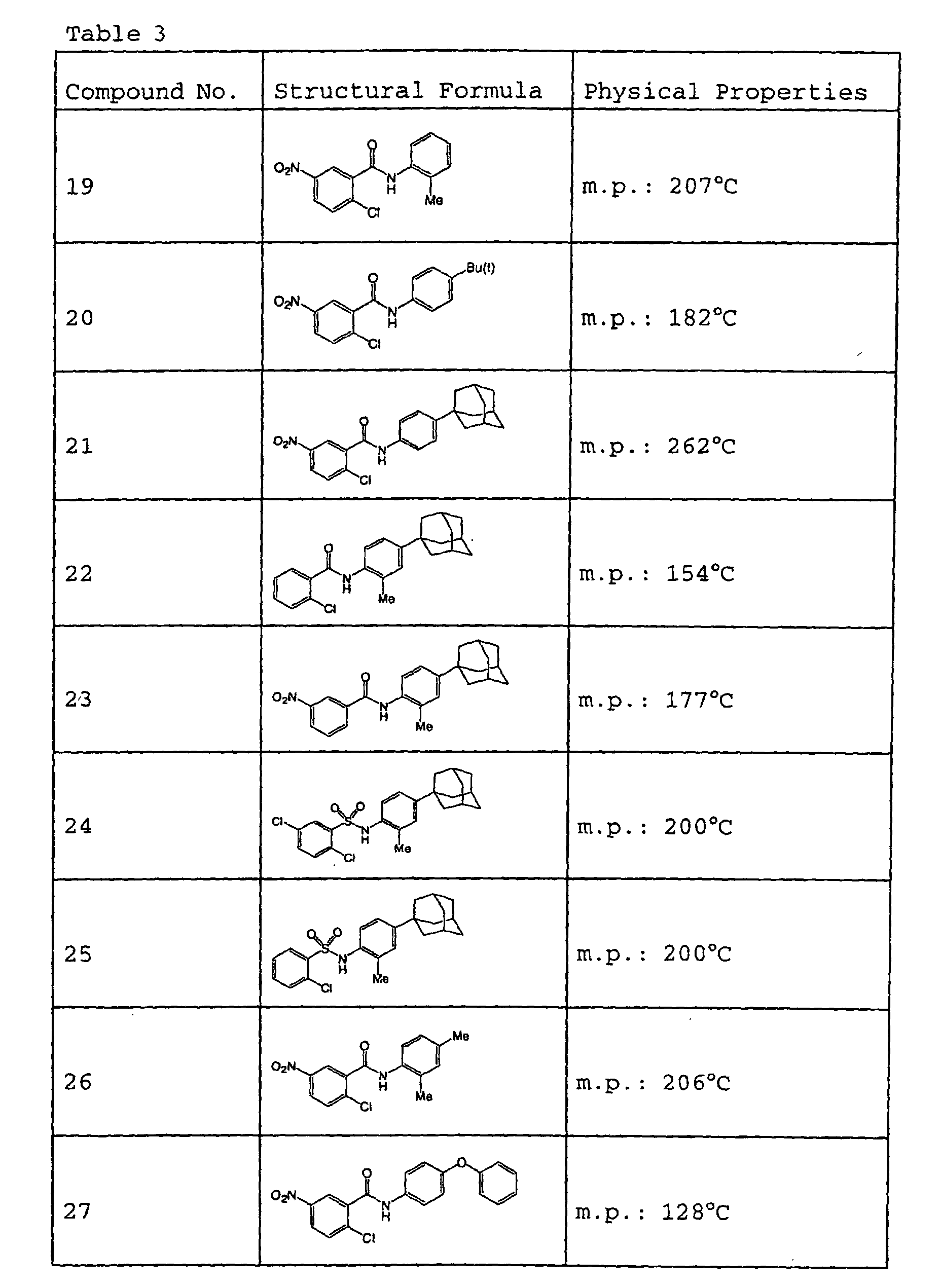
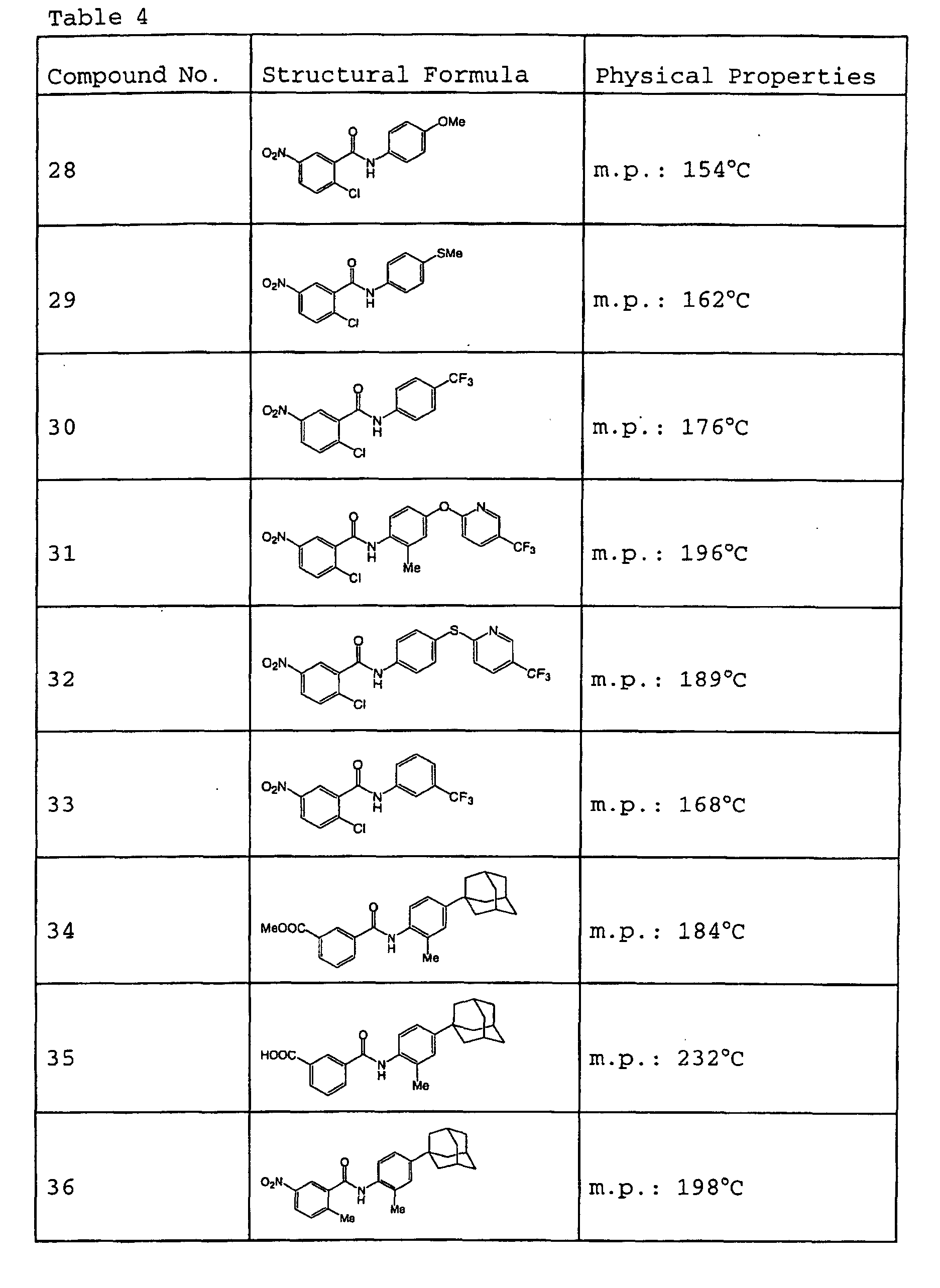
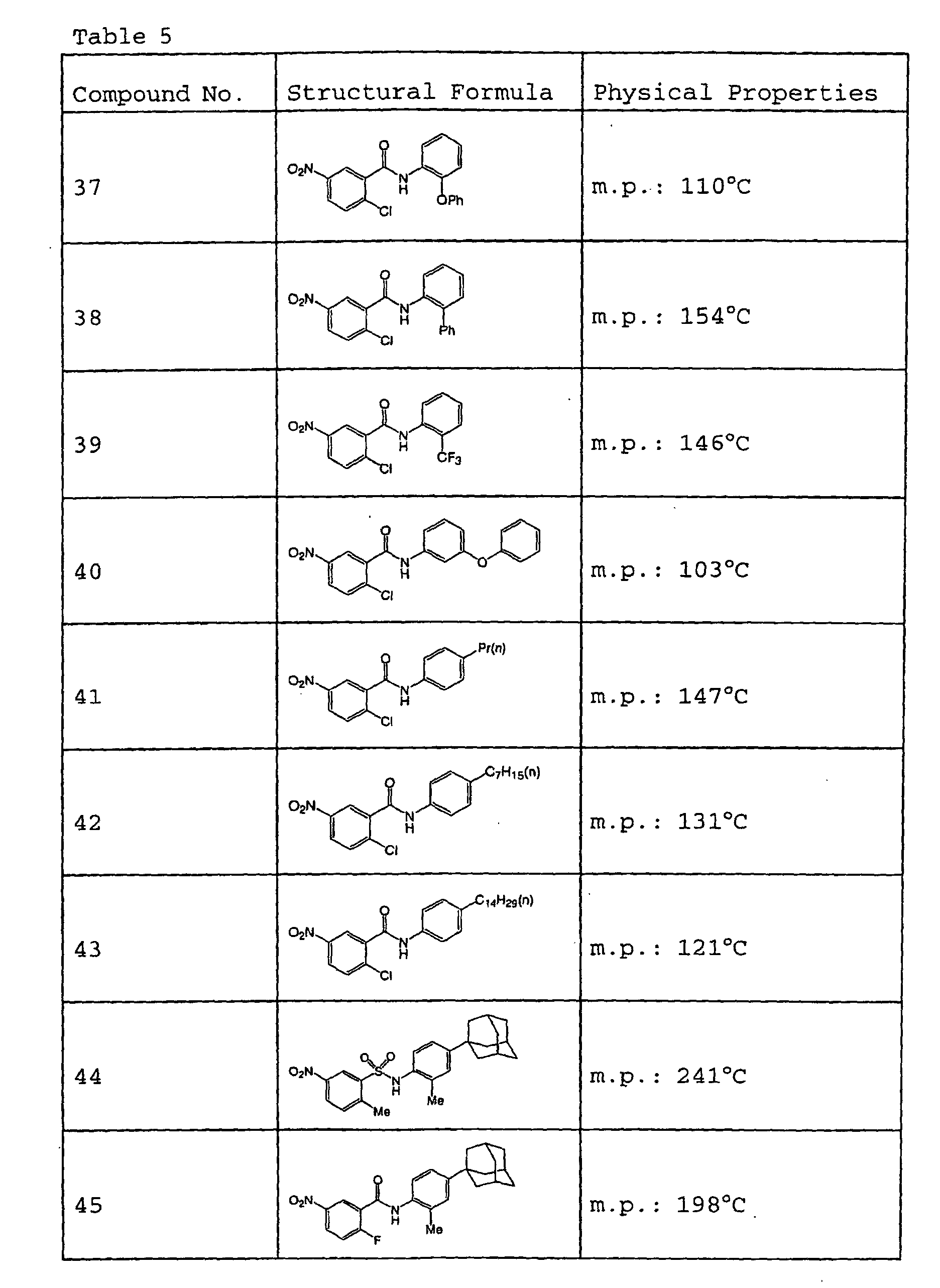
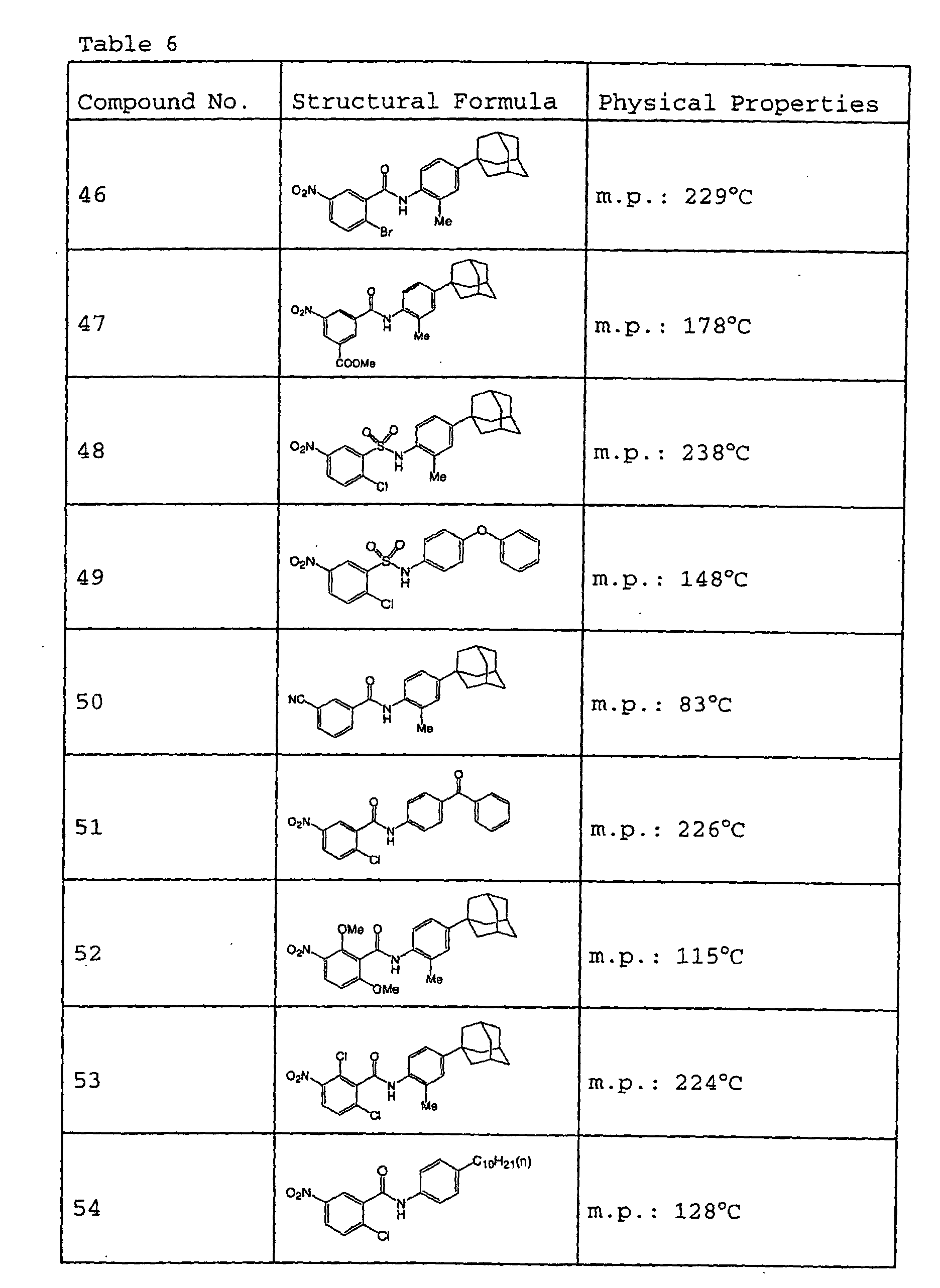


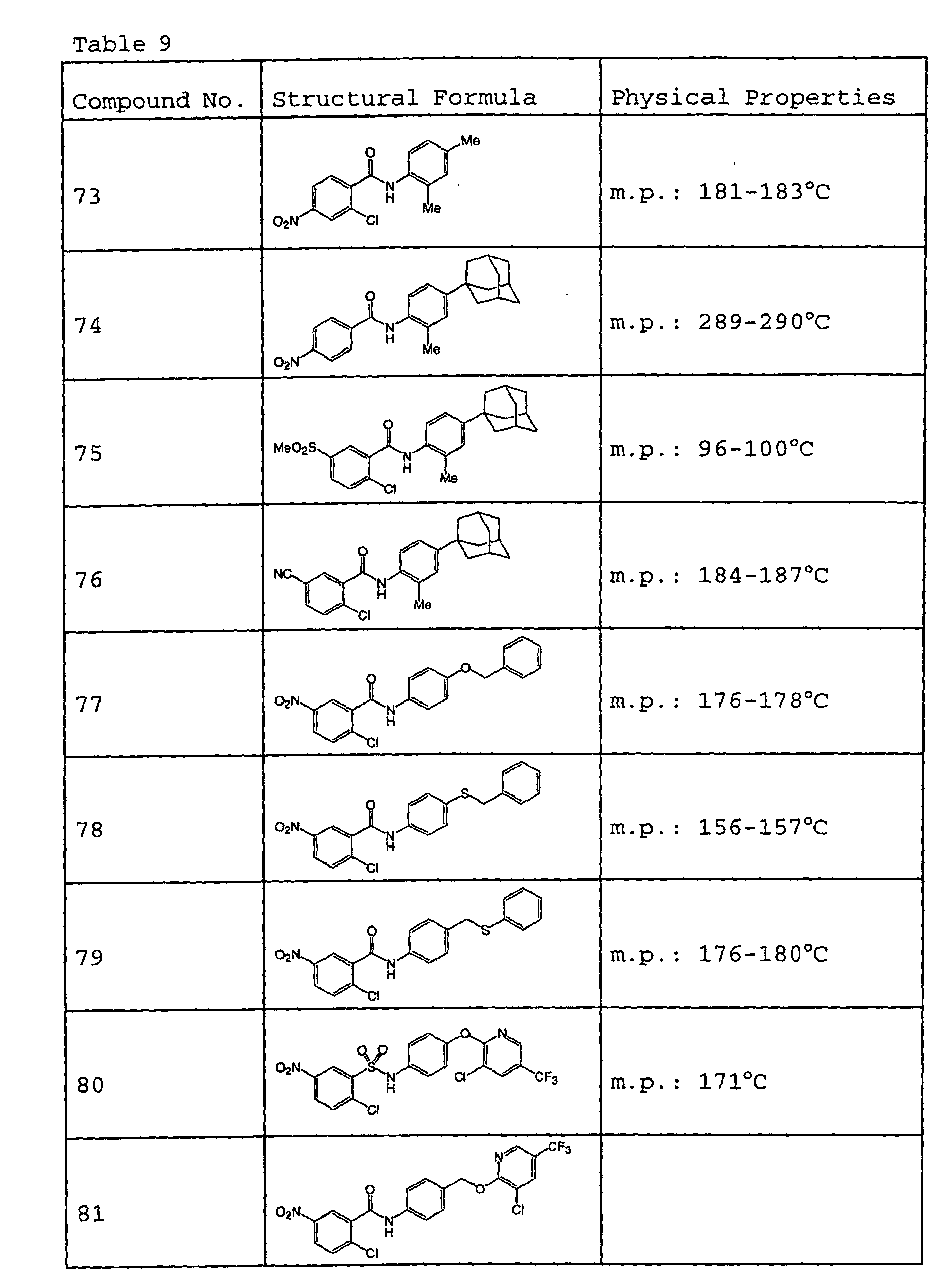
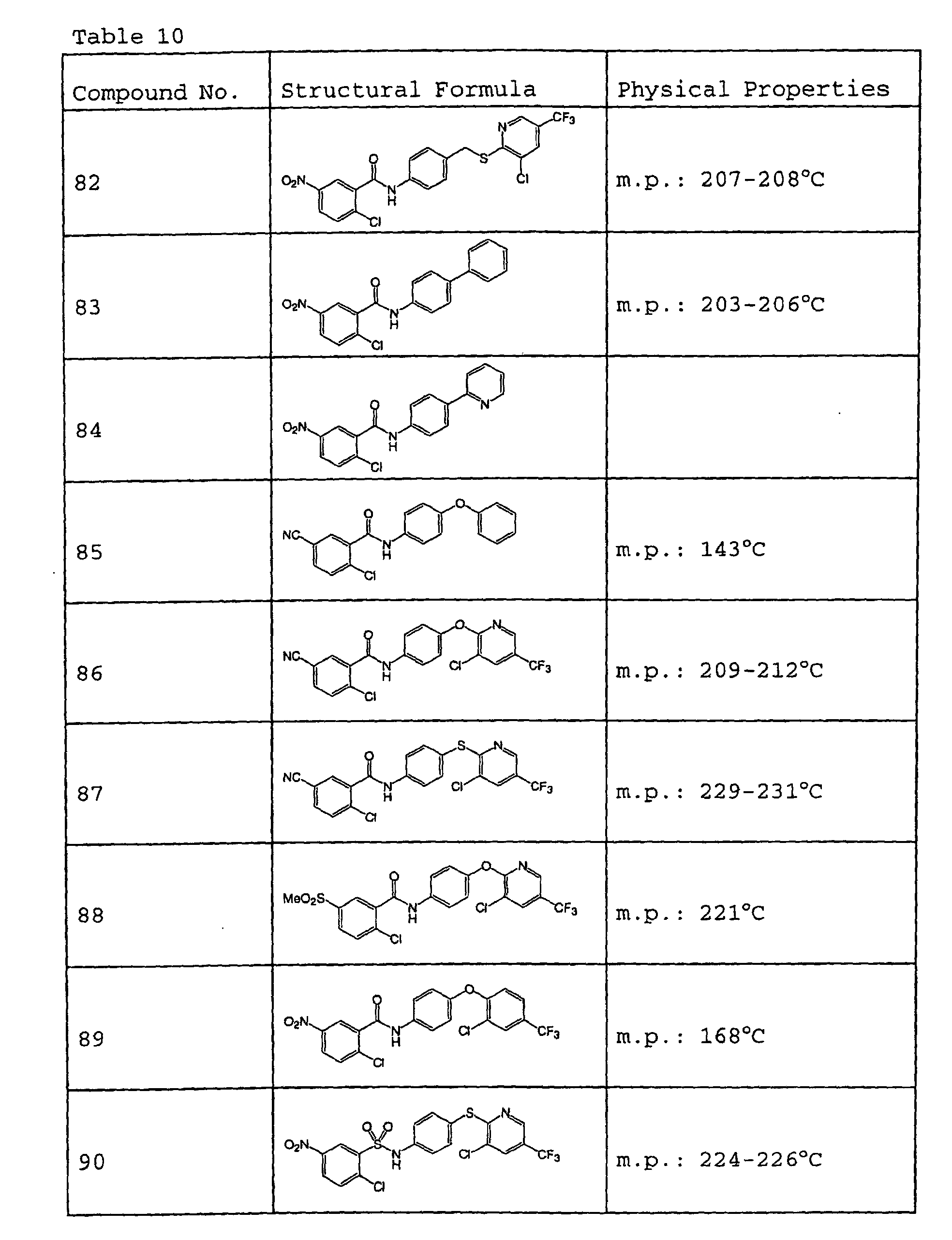
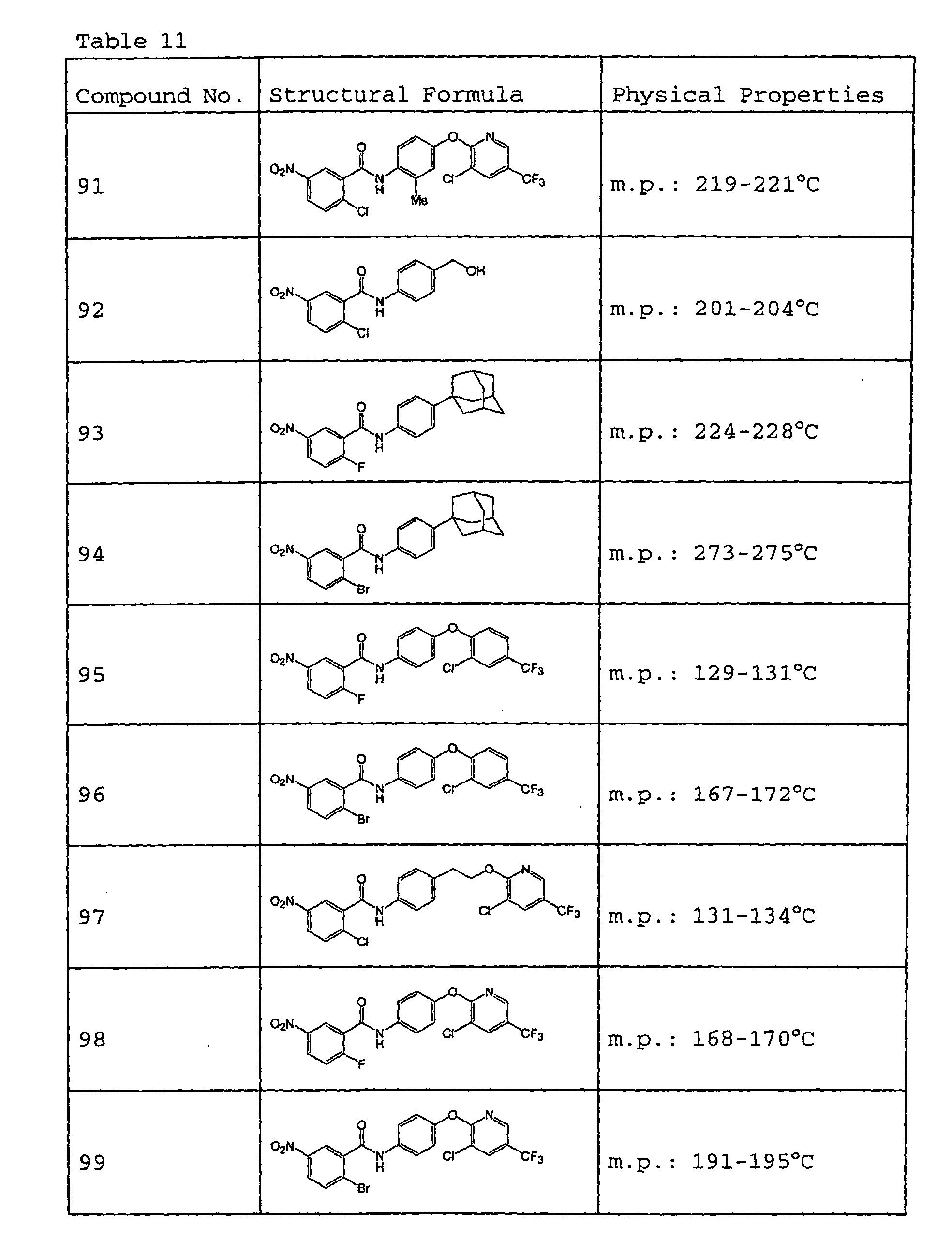
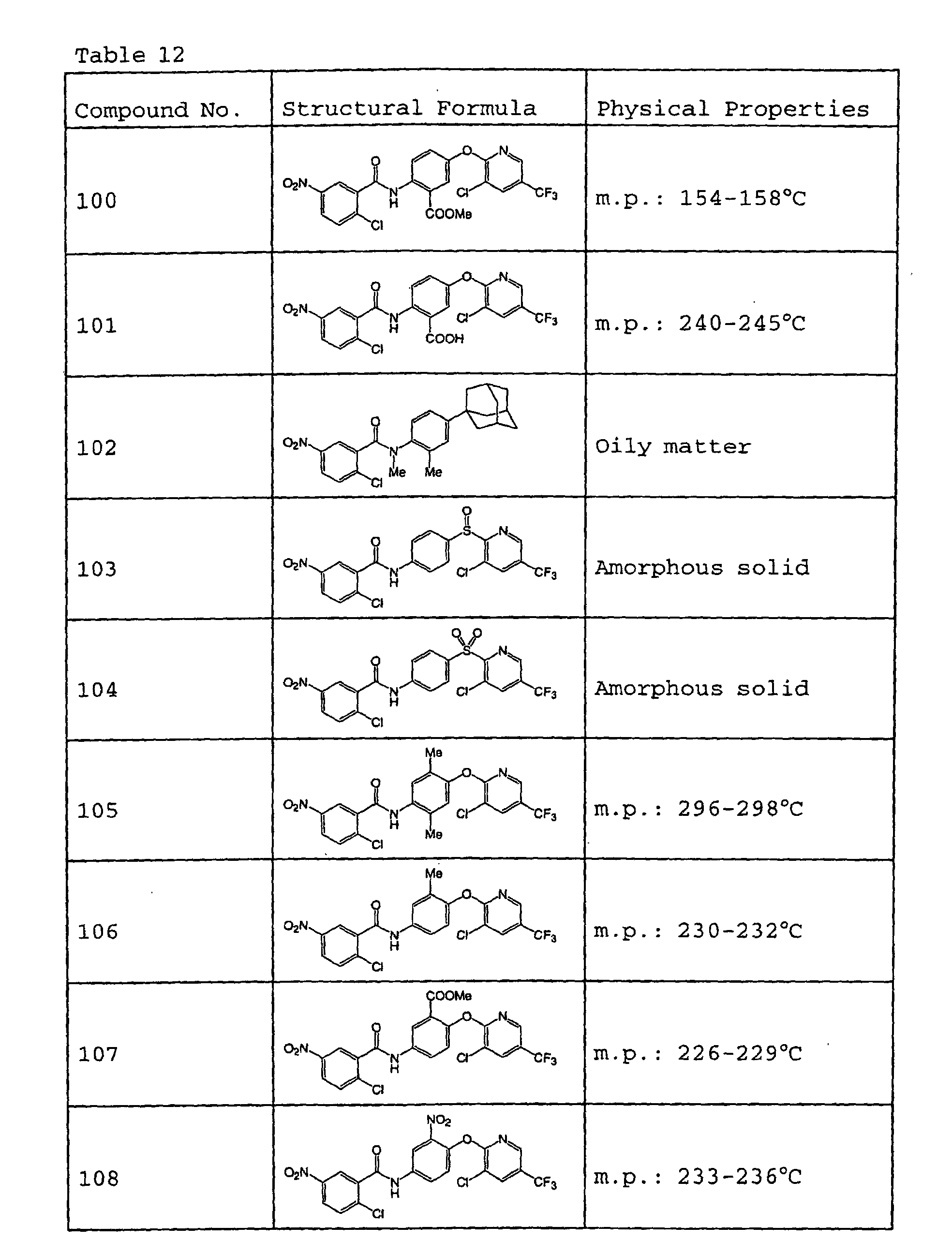
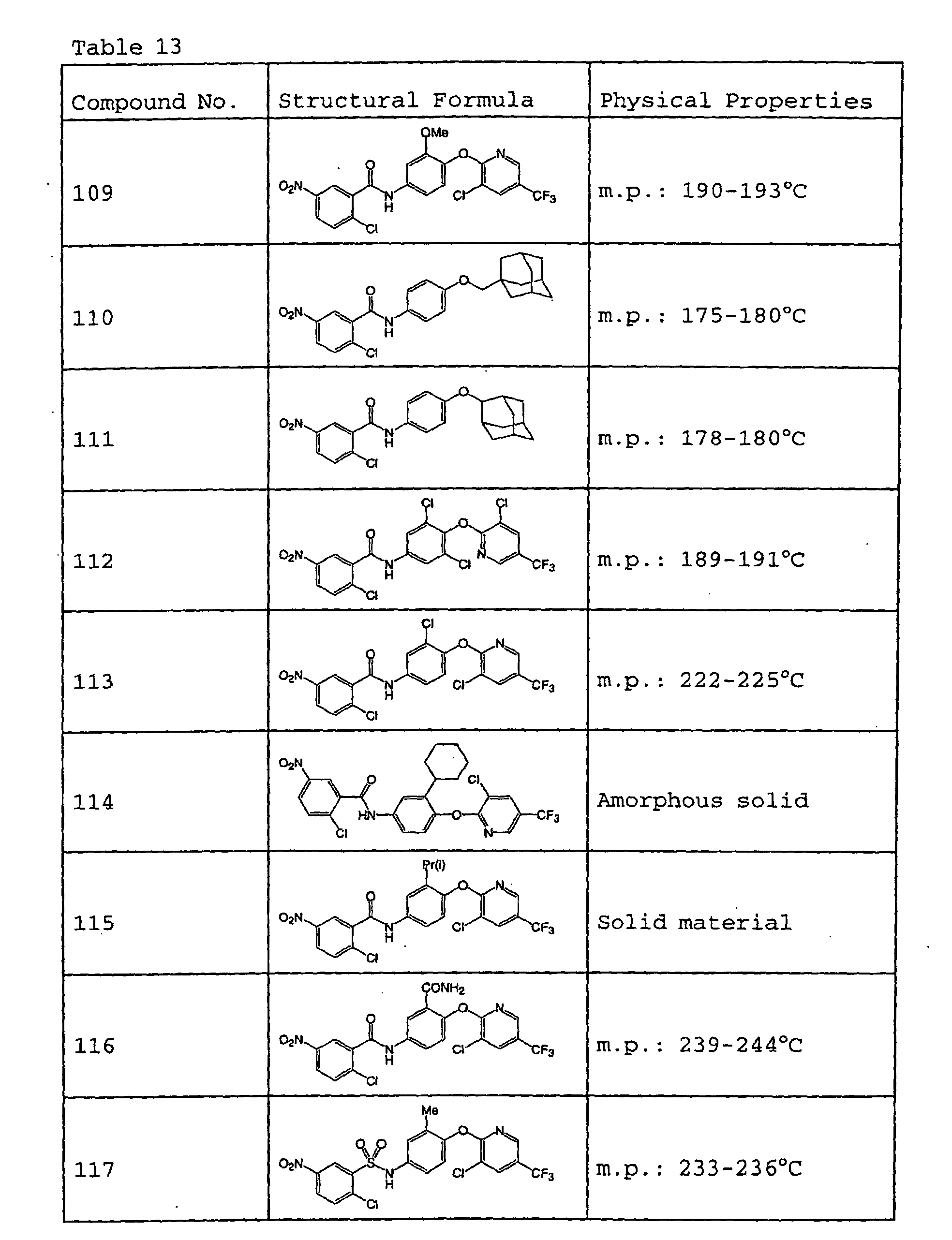
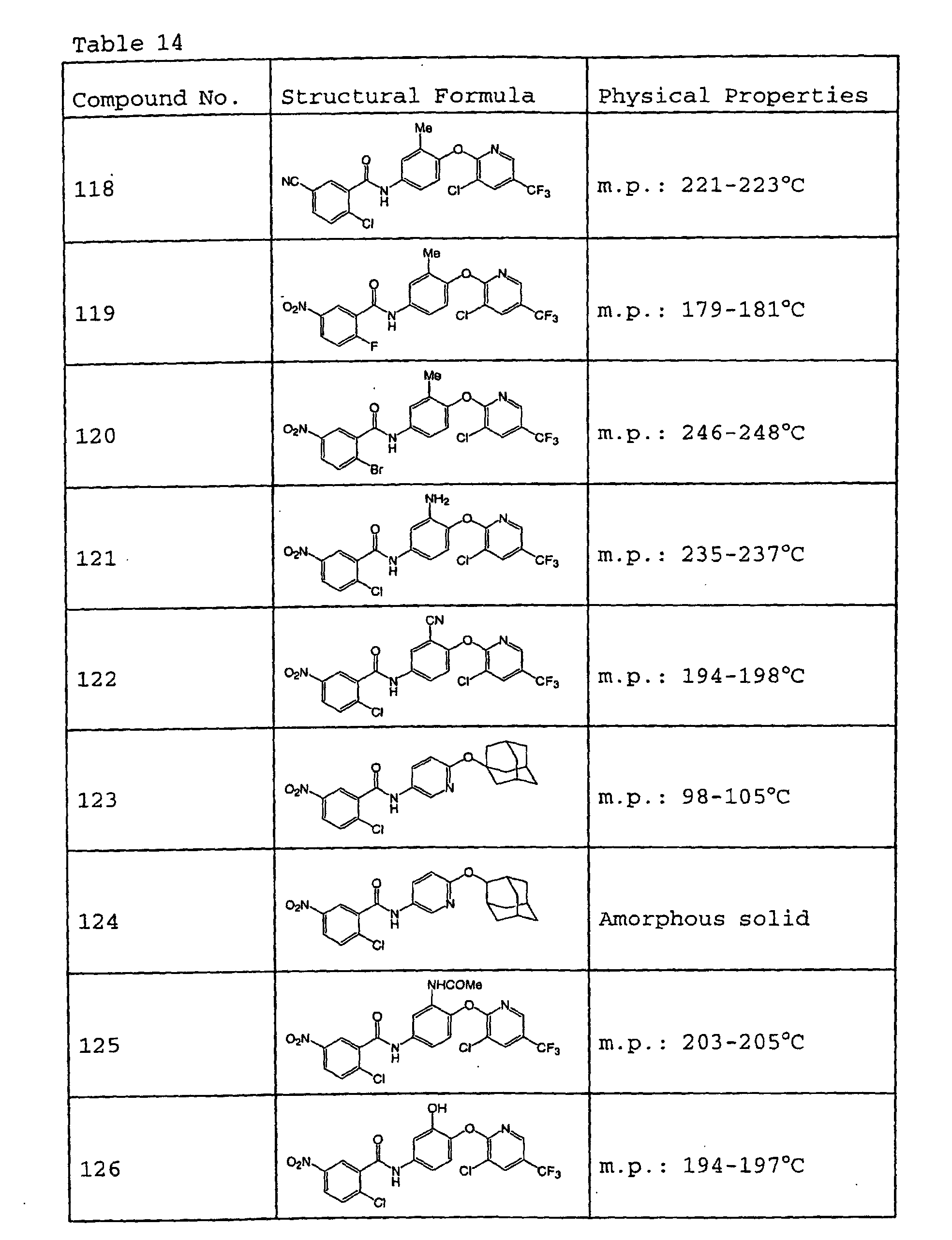
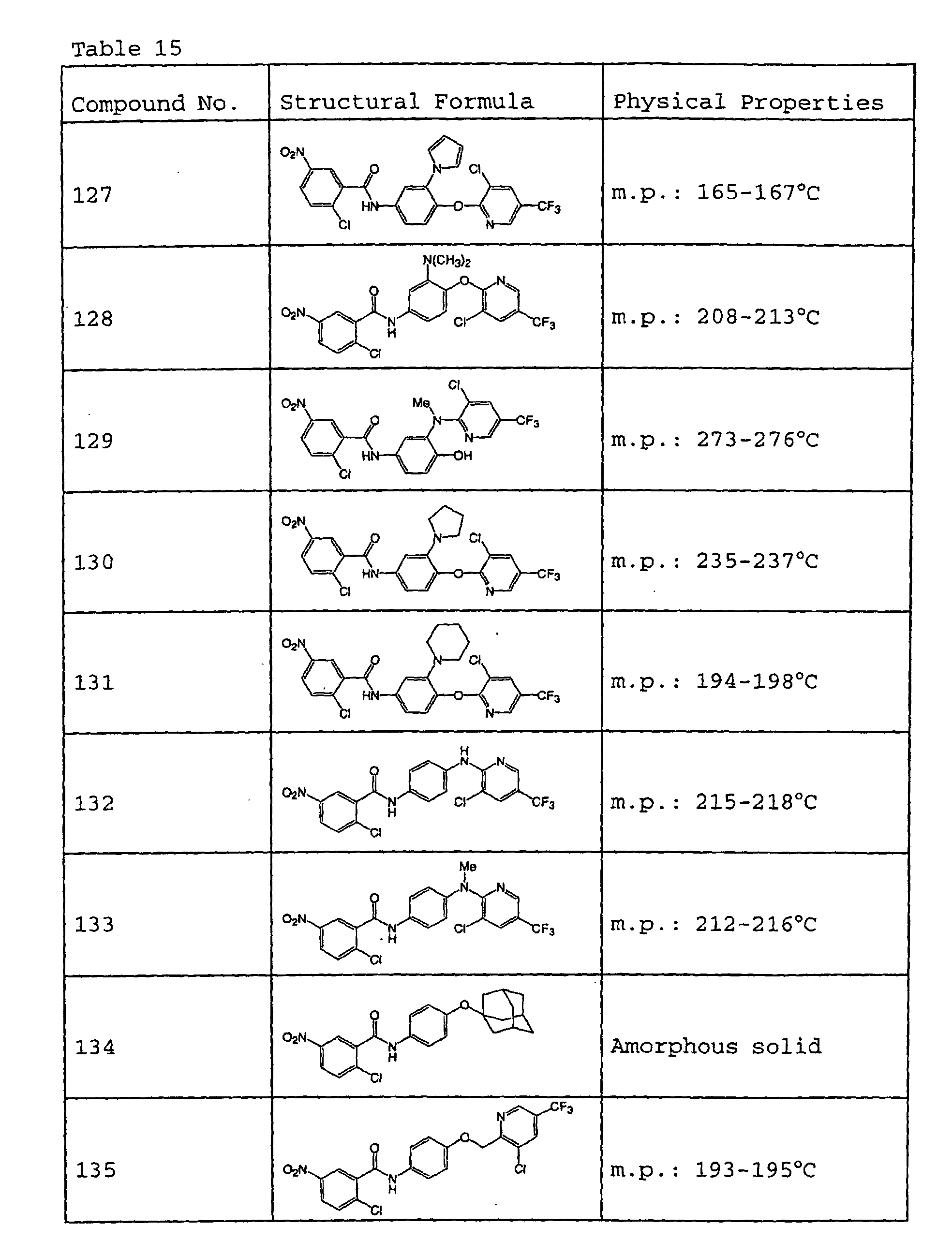


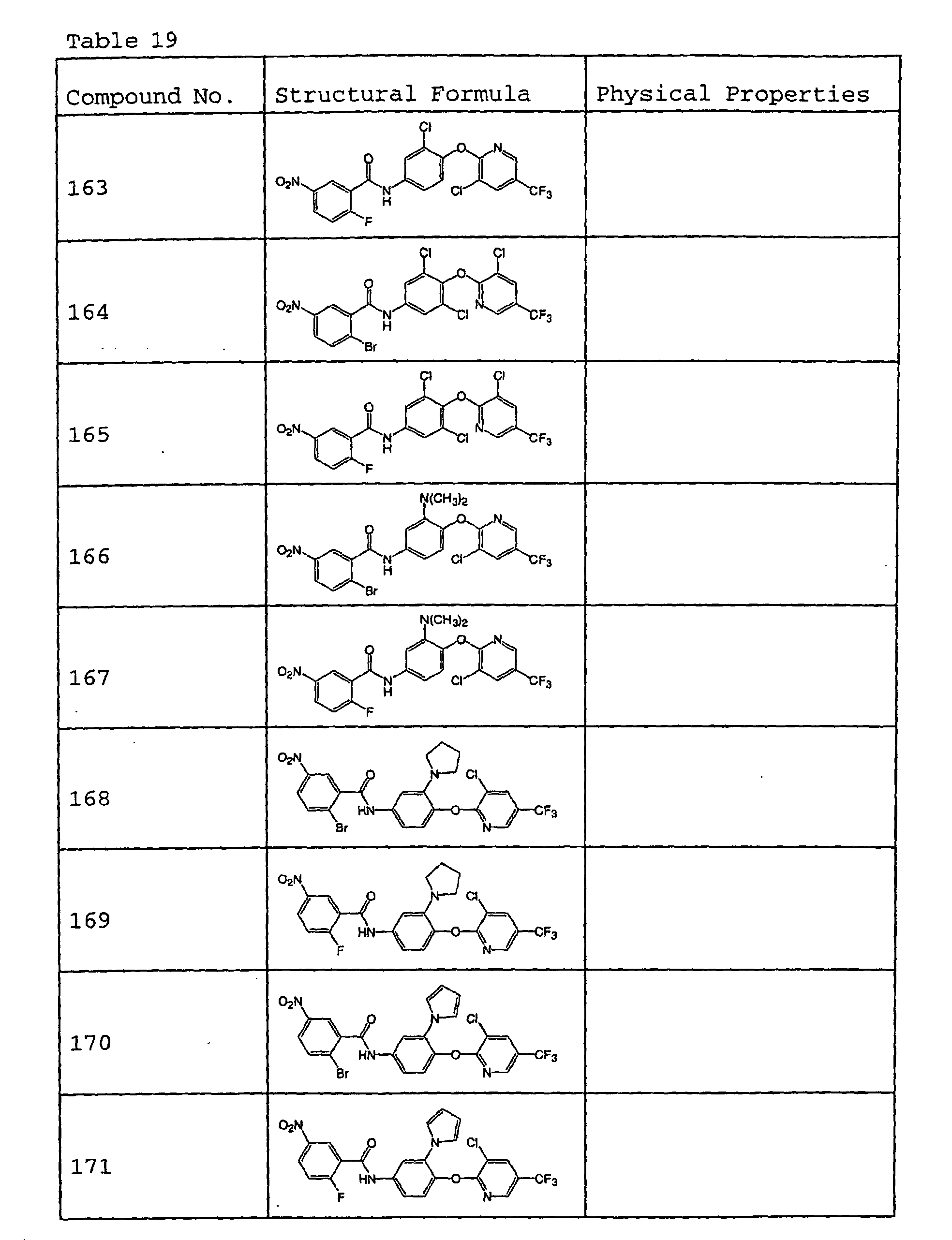

Murine spleen cells were treated with anti-mouse CD3
antibody and IL-2 to induce cytokine production. The
test compounds were added to the cytokine production
system to evaluate their inhibitory effect. Namely,
anti-mouse CD3 antibody adjusted to from 10 to 20 µg/ml
with borate buffered physiological saline (pH 8.5) was
pipetted into a 96-well cell culture plate in an amount
of 50 µl/well and left to stand at 4°C for 18 hours. The
unreacted solution was removed, washing with Hank's
buffer solution was carried out once, and IL-2 adjusted
to 10 ng/ml with a RPMI liquid containing 10% fetal
bovine serum (FCS) was pipetted in an amount of 50
µl/well. For the negative control group, a solution
alone without anti-CD3 antibody nor IL-2 was applied.
Then, the diluted solution of each of the test compounds
(concentration: 100 ppm unless otherwise specified) was
pipetted in an amount of 50 µl/well/ and a cell
suspension of 1 × 10⁷ cells/ml, prepared from spleen of
Balb/c mice (female, 7 to 10 week old) was pipetted
thereinto in an amount of 100 µl/well. After cultivation
in an incubator (37°C, 5% carbon dioxide gas) for from 40
to 48 hours, the culture supernatant was recovered to
measure the cytokine production amount by ELISA method.
With respect to interleukin 5 (IL-5) as a typical
Th2 type cytokine and interferon γ (IFN-γ) as a typical
Th1 type cytokine, measurements were carried out by the
following methods, respectively. Namely, quantitative
determination of IL-5 was carried out by the following
ELISA method. First, rat anti-mouse IL-5 antibody
(Endogen Code No. MM-550C) as a primary antibody was
diluted with carbonate buffer solution (pH 9.5) to 1
µg/ml, and spread in a 96 well plate (IWAKI, Code No.
3860-096) in an amount of 50 µl/well for coating at 4°C
overnight (16 to 24 hours). Then, the plate was
subjected to blocking at 37°C for 2 hours by phosphate
buffered physiological saline containing 10% FCS (pH 7.2)
(blocking buffer solution) (250 µl/well). The plate was
washed with PBS (washing buffer) containing 0.05% Tween
20 (Nacalai Tesque, Code No. 281-51) four times, and a
diluted liquid of the culture supernatant was spread in
an amount of 50 µl/well, followed by incubation at room
temperature for 1 hour. For preparation of a standard
line, recombinant mouse IL-5 (R&D systems, Code No. 405-ML)
was employed. The plate was washed with a washing
buffer four times, and biotin-labeled rat anti-mouse IL-5
antibody (Pharmingen, Code No. 18062D) as a secondary
antibody diluted to 0.5 µg/ml with a blocking buffer
containing 0.05% Tween 20 was added thereto (50 µl/well),
followed by incubation at room temperature for 1 hour.
The plate was washed with a washing buffer four times,
strept avidin-labeled peroxidase (Prozyme, Code No.
CJ30H001) diluted 800 times with a blocking buffer
containing 0.05% Tween 20 was added thereto (50 µl/well),
followed by reaction at room temperature for 15 minutes.
The plate was washed with a washing buffer four times,
and a TNB substrate solution (SIGMA, Code No. T-8665) was
added thereto in an amount of 100 µl/well for color
developing for from 10 to 20 minutes. A 1M sulfuric acid
solution was added thereto in an amount of 100 µl/well to
terminate the reaction, and absorption (wavelength 450
nm) was measured by means of micro plate reader (SPECTRA
max, Wako Pure Chemicals Industries, Ltd.). Quantitative
determination of IFN-γ was carried out in the same manner
as the measurement of IL-5, employing rat anti-mouse IFN-Y
antibody (Pharmingen, Code No. 18181D) and biotin
labeled rat anti-mouse IFN-γ antibody (Pharmingen, Code
NO. 18112D), as a primary antibody and a secondary
antibody, respectively. For preparation of a standard
line, recombinant mouse IFN-γ (GENZYME, Code No. 3485)
was employed. The experiment was carried out in
duplicate, and the average of the cytokine production
amount was obtained. From the average value, the
inhibitory ratio (%) was obtained from the following
formula, and the results are shown in Tables 21 to 24.
With respect to the inhibitory ratio in a case where the
concentration of the test compound was not 100 ppm, the
concentration of the test compound is shown in ( ) after
each inhibitory ratio.
Inhibitory ratio (%) ={1-(T-N)/(P-N)} × 100
T: average value of the test compound group, N:
average value of the negative control group, and P:
average value of the positive control group.
| No. | IL-5 production inhibitory ratio (%) | IFN-γ production inhibitory ratio (%) | No. | IL-5 production inhibitory ratio (%) | IFN-γ production inhibitory ratio (%) |
| 1 | 96 | 90 | 5 | 76 | 83 |
| 2 | 74 (2 ppm) | 84 (2 ppm) | 6 | 100 | 100 |
| 3 | 79 | 92 | 7 | 100 | 100 |
| 4 | 47 | 76 | 8 | 58 (10 ppm) | 67 (10 ppm) |
| No. | IL-5 production inhibitory ratio (%) | IFN-γ production inhibitory ratio (%) | No. | IL-5 production inhibitory ratio (%) | IFN-γ production inhibitory ratio (%) |
| 9 | 96 | 100 | 32 | 99 | 98 |
| 10 | 100 | 100 | 33 | 100 | 100 |
| 11 | 37 | 34 | 88 | 97 | |
| 12 | 33 | 35 | 100 | 100 | |
| 13 | 36 | 36 | 81 | 85 | |
| 14 | 46 | 37 | 97 | 100 | |
| 15 | 99 | 100 | 38 | 86 | 93 |
| 16 | 100 | 39 | 97 | 100 | |
| 17 | 100 | 100 | 40 | 100 | 100 |
| 18 | 100 | 100 | 41 | 99 | 100 |
| 19 | 96 | 88 | 42 | 56 | 81 |
| 20 | 100 | 100 | 43 | 98 | 98 |
| 21 | 96 | 89 | 44 | 93 | 100 |
| 22 | 100 | 100 | 45 | 99 | 99 |
| 23 | 100 | 100 | 46 | 100 | 98 |
| 24 | 100 | 47 | 89 | 95 | |
| 25 | 89 | 93 | 48 | 100 | 100 |
| 26 | 82 | 30 | 49 | 100 | 100 |
| 27 | 96 | 99 | 50 | 95 | 98 |
| 28 | 100 | 100 | 51 | 99 | 100 |
| 29 | 98 | 100 | 52 | 75 | 96 |
| 30 | 100 | 100 | 53 | 94 | 93 |
| 31 | 62 | 63 | 54 | 62 | 78 |
| No. | IL-5 production inhibitory ratio (%) | IFN-γ production inhibitory ratio (%) | No. | IL-5 production inhibitory ratio (%) | IFN-γ production inhibitory ratio (%) |
| 55 | 96 | 100 | 77 | 74 | 50 |
| 56 | 100 | 100 | 78 | 78 | 91 |
| 57 | 90 | 98 | 79 | 62 | 90 |
| 58 | 97 . | 96 | 80 | 100 | 100 |
| 59 | 100 | 100 | 82 | 90 | 99 |
| 60 | 96 | 93 | 83 | 90 | 76 |
| 61 | 79 | 89 | 85 | 91 | 86 |
| 62 | 100 | 100 | 86 | 87 | 29 |
| 63 | 100 | 100 | 87 | 100 | 100 |
| 64 | 98 | 99 | 88 | 72 | 17 |
| 65 | 100 | 100 | 89 | 87 | 99 |
| 66 | 95 | 91 | 90 | 100 | 100 |
| 67 | 99 | 100 | 91 | 53 | 1 |
| 68 | 92 | 99 | 92 | 99 | 100 |
| 69 | 100 | 100 | 93 | 100 | 100 |
| 70 | 98 | 99 | 94 | 85 | 53 |
| 71 | 89 | 95 | 100 | 100 | |
| 72 | 51 | 96 | 100 | 100 | |
| 73 | 64 | 28 | 97 | 77 | 84 |
| 74 | 43 | 10 | 98 | 96 | 99 |
| 75 | 100 | 100 | 99 | 100 | 89 |
| 76 | 96 | 96 | 100 | 92 | 93 |
| No. | IL-5 production inhibitory ratio (%) | IFN-γ production inhibitory ratio (%) | No. | IL-5 production inhibitory ratio (%) | IFN-γ production inhibitory ratio (%) |
| 101 | 100 | 100 | 125 | 100 | 100 |
| 102 | 100 | 100 | 126 | 100 | 100 |
| 103 | 100 | 100 | 127 | 100 | 100 |
| 104 | 100 | 100 | 128 . 96 | 93 | |
| 105 | 55 | 25 | 129 | 86 | 67 |
| 106 | 83 | 96 | 130 | 100 | 99 |
| 107 | 99 | 97 | 131 | 100 | 100 |
| 108 | 100 | 100 | 132 | 99 | 100 |
| 109 | 100 | 95 | 133 | 99 | 100 |
| 110 | 99 | 100 | 134 | 97 | 98 |
| 111 | 99 | 99 | 135 | 62 | 33 |
| 112 | 100 | 100 | 136 | 98 | 100 |
| 113 | 96 | 97 | 137 | 98 | 98 |
| 114 | 100 | 100 | 138 | 99 | 100 |
| 115 | 100 | 100 | 139 | 89 | 50 |
| 116 | 100 | 99 | 140 | 100 | 100 |
| 117 | 100 | 100 | 141 | 100 | 100 |
| 118 | 78 | 47 | 142 | 95 | 99 |
| 119 | 100 | 99 | 143 | 97 | 100 |
| 120 | 84 | 35 | 144 | 99 | 100 |
| 121 | 97 | 100 | 145 | 100 | 100 |
| 122 | 100 | 100 | 146 | 62 | 43 |
| 123 | 100 | 100 | 147 | 99 | 100 |
| 124 | 100 | 100 | 148 | 94 | 81 |
The present invention provides cytokine production
inhibitors useful as preventive or therapeutic medicines
for diseases accompanied by hyperactivated immune
functions.
Claims (19)
- A cytokine production inhibitor containing as an active ingredient an aniline derivative of the formula (I) or a salt thereof:[wherein A is CO or SO2; Cy is an aryl group or a heterocyclic group; each of R1 and R2 which are independent of each other, is a halogen atom, a cyano group, a nitro group, an alkyl group which may be substituted, an alkenyl group which may be substituted, an alkynyl group which may be substituted, a cycloalkyl group which may be substituted, a cycloalkenyl group which may be substituted, an aryl group which may be substituted, a heterocyclic group which may be substituted, an amino group which may be substituted or a -B-Q group (wherein B is O, CO, COO, OCO, S, SO or SO2; and Q is a hydrogen atom, an alkyl group which may be substituted, an alkenyl group which may be substituted, an alkynyl group which may be substituted, a cycloalkyl group which may be substituted, a cycloalkenyl group which may be substituted, an aryl group which may be substituted, a heterocyclic group which may be substituted or an amino group which may be substituted); R3 is a -M1-M2-R5 group (wherein each of M1 and M2 which are independent of each other, is O, S, a NR6 group (wherein R6 is a hydrogen atom or an alkyl group which may be substituted), a single bond, a C1-2 alkylene chain, CO, SO or SO2, or M1 and M2 together may form -N=N-; and R5 is a cycloalkyl group which may be substituted, an aryl group which may be substituted or a heterocyclic group which may be substituted}; R4 is a hydrogen atom or an alkyl group which may be substituted; x is an integer of from O to 5; y is an integer of from O to 4; and z is an integer of from 0 to 1; provided that (1) a case where Cy is a phenyl group, and the substituent at the 4-position of the phenyl group is a pyrazole group which may be substituted or a triazole group which may be substituted, and (2) a case where Cy is a phenyl group, the substituent at the 2-position of the phenyl group is an alkyl group, and the substituent at the 5-position is a -NHCO-(CH2)q-R group (wherein q is an integer of from 1 to 4, and R is an aryl group or a cycloalkyl group) are excluded].

- The cytokine production inhibitor according to Claim 1, wherein Cy is a phenyl group or a six-membered monocyclic heterocyclic group.
- The cytokine production inhibitor according to Claim 1, wherein the cytokine is Th1 type cytokine.
- The cytokine production inhibitor according to Claim 1, wherein the cytokine is interferon γ.
- The cytokine production inhibitor according to Claim 1, wherein the cytokine is Th2 type cytokine.
- The cytokine production inhibitor according to Claim 1, wherein the cytokine is interleukin 5.
- A preventive or therapeutic medicine for diseases accompanied by hyperactivated immune functions, which contains the compound or a salt thereof as defined in Claim 1 as an active ingredient.
- The preventive or therapeutic medicine according to Claim 7, wherein the disease accompanied by hyperactivated immune functions, is at least one allergic disease selected from urticaria, food allergy, anaphylactic shock, hypereosinophilic syndrome, asthma, allergic rhinitis, allergic conjunctivitis and atopic dermatitis.
- The preventive or therapeutic medicine according to Claim 7, wherein the disease accompanied by hyperactivated immune functions is a systemic autoimmune disease.
- The preventive or therapeutic medicine according to Claim 9, wherein the disease accompanied by hyperactivated immune functions is at least one organ specific autoimmune disease selected from chronic rheumatoid arthritis, type I diabetes, Hashimoto's thyroiditis, myasthenia gravis and multiple sclerosis.
- An aniline derivative of the formula (I') or a salt thereof:[wherein A is CO or SO2; each of R1 and R2 which are independent of each other, is a halogen atom, a cyano group, a nitro group, an alkyl group which may be substituted, an alkenyl group which may be substituted, an alkynyl group which may be substituted, a cycloalkyl group which may be substituted, a cycloalkenyl group which may be substituted, an aryl group which may be substituted, a heterocyclic group which may be substituted, an amino group which may be substituted or a -B-Q group (wherein B is O, CO, COO, OCO, S, SO or SO2; Q is a hydrogen atom, an alkyl group which may be substituted, an alkenyl group which may be substituted, an alkynyl group which may be substituted, a cycloalkyl group which may be substituted, a cycloalkenyl group which may be substituted, an aryl group which may be substituted, a heterocyclic group which may be substituted or an amino group which may be substituted); R4 is a hydrogen atom or an alkyl group which may be substituted; y is an integer of from 0 to 4; Hal is a halogen atom; Cy' is a phenyl group or a six-membered monocyclic heterocyclic group; M is O, S, a NR6 group (wherein R6 is a hydrogen atom or an alkyl group which may be substituted), -OCH2-, -OCH2CH2-, -CH2O-, -CH2CH2O-, - SCH2-, -SCH2CH2-, -CH2S-, -CH2CH2S- or a single bond; R5' is a pyridyl group which may be substituted or an adamantyl group which may be substituted; x' is an integer of from 0 to 3; provided that a case where A is CO, and R5' is an adamantyl group substituted with a (CRaRa)d-NCRbRc group (wherein Ra is a hydrogen atom or an alkyl group; Rb is a hydrogen atom, an alkyl group or an acyl group, Rc is a hydrogen atom or an alkyl group, and d is an integer of from 0 to 3 is excluded).

- The aniline derivative or a salt thereof according to Claim 11, wherein A is CO.
- The aniline derivative or a salt thereof according to Claim 11, wherein A is CO, and R5' is a pyridyl group which may be substituted.
- The aniline derivative or a salt thereof according to Claim 11, wherein A is CO, and R5' is a pyridyl group substituted with a haloalkyl group (provided that the pyridyl group may be substituted with at least one substituent selected from the group consisting of a halogen atom, a hydroxyl group, a mercapto group, a substitutable alkyl group, a substitutable alkenyl group, a substitutable alkynyl group, a substitutable alkoxy group, a substitutable alkylthio group, a substitutable alkenyloxy group, a substitutable alkenylthio group, a substitutable alkynyloxy group, a substitutable alkynylthio group, a substitutable cycloalkyl group, a substitutable cycloalkenyl group, a substitutable cycloalkoxy group, a substitutable cycloalkylthio group, a substitutable cycloalkenyloxy group, a substitutable cycloalkenylthio group, a substitutable alkoxycarbonyl group, a substitutable alkylcarbonyl group, a substitutable alkylcarbonyloxy group, a substitutable alkenyloxycarbonyl group, a substitutable alkenylcarbonyl group, a substitutable alkenylcarbonyloxy group, a substitutable alkynyloxycarbonyl group, a substitutable alkynylcarbonyl group, a substitutable alkynylcarbonyloxy group, a substitutable cycloalkoxycarbonyl group, a substitutable cycloalkylcarbonyl group, a substitutable cycloalkylcarbonyloxy group, a substitutable cycloalkenyloxycarbonyl group, a substitutable cycloalkenylcarbonyl group, a substitutable cycloalkenylcarbonyloxy group, a substitutable aryl group, a substitutable aryloxy group, a substitutable arylthio group, a substitutable aryloxycarbonyl group, a substitutable arylcarbonyl group, a substitutable arylcarbonyloxy group, a substitutable heterocyclic group, a substitutable heterocyclyloxy group, a substitutable heterocyclylthio group, a substitutable heterocyclyloxycarbonyl group, a substitutable heterocyclylcarbonyl group, a substitutable heterocyclylcarbonyloxy group, a substitutable amino group, a cyano group, a nitro group, a carboxyl group, a substitutable aminocarbonyl group, a substitutable alkylsulfonyl group, a substitutable alkenylsulfonyl group, a substitutable alkynylsulfonyl group, a substitutable cycloalkylsulfonyl group, a substitutable cycloalkenylsulfonyl group, a substitutable arylsulfonyl group, a substitutable heterocyclylsulfonyl group and a substitutable aminosulfonyl group).
- The aniline derivative or a salt thereof according to Claim 11, wherein A is CO, and R5' is a 3-chloro-5-trifluoromethyl-2-pyridyl group.
- The aniline derivative or a salt thereof according to Claim 11, wherein A is CO, and R5' is an adamantyl group which may be substituted.
- The aniline derivative or a salt thereof according to Claim 11, wherein A is CO; Hal is a fluorine atom, a bromine atom or an iodine atom; and R5' is an adamantyl group which may be substituted.
- The aniline derivative or a salt thereof according to Claim 11, wherein A is SO2.
- A method for producing the aniline derivative of the above formula (I') or a salt thereof as defined in Claim 11, which comprises reacting a compound of the formula (II):[wherein A, R1, Hal and x' are as defined in Claim 11, and L is a leaving group], with a compound of the formula (III):
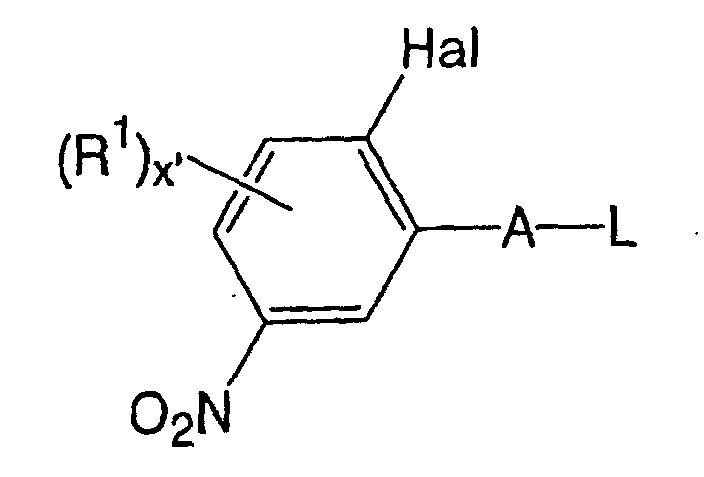 [wherein Cy', R2, R4, R5', M and y are as defined in Claim 11].
Applications Claiming Priority (3)
| Application Number | Priority Date | Filing Date | Title |
|---|---|---|---|
| JP2000391175 | 2000-12-22 | ||
| JP2000391175 | 2000-12-22 | ||
| PCT/JP2001/011282 WO2002051397A1 (en) | 2000-12-22 | 2001-12-21 | Aniline derivatives or salts thereof and cytokine production inhibitors containing the same |
Publications (2)
| Publication Number | Publication Date |
|---|---|
| EP1344525A1 true EP1344525A1 (en) | 2003-09-17 |
| EP1344525A4 EP1344525A4 (en) | 2005-05-25 |
Family
ID=18857381
Family Applications (1)
| Application Number | Title | Priority Date | Filing Date |
|---|---|---|---|
| EP01271863A Withdrawn EP1344525A4 (en) | 2000-12-22 | 2001-12-21 | Aniline derivatives or salts thereof and cytokine production inhibitors containing the same |
Country Status (6)
| Country | Link |
|---|---|
| US (1) | US7132546B2 (en) |
| EP (1) | EP1344525A4 (en) |
| KR (1) | KR20030064852A (en) |
| CN (1) | CN1289072C (en) |
| CA (1) | CA2432713C (en) |
| WO (1) | WO2002051397A1 (en) |
Cited By (14)
| Publication number | Priority date | Publication date | Assignee | Title |
|---|---|---|---|---|
| FR2854158A1 (en) * | 2003-04-25 | 2004-10-29 | Sanofi Synthelabo | New 2-phenylcarbonylamino-4-phenyl-thiazole derivatives, useful for treating e.g. immunoinflammatory diseases and angiogenesis, are inhibitors of chemokine receptors |
| FR2876692A1 (en) * | 2004-10-19 | 2006-04-21 | Sanofi Aventis Sa | 2-AMIDO-4-PHENYLTHIAZOLE DERIVATIVES, THEIR PREPARATION AND THEIR THERAPEUTIC USE |
| EP1539151A4 (en) * | 2002-08-02 | 2006-10-11 | Genesoft Pharmaceuticals Inc | Biaryl compounds having anti-infective activity |
| WO2007077394A1 (en) * | 2006-01-06 | 2007-07-12 | Sanofi-Aventis | 2-carbamide-4-phenylthiazole derivatives, preparation thereof and therapeutic use thereof |
| CN100467447C (en) * | 2004-02-17 | 2009-03-11 | 石原产业株式会社 | Thioamide compounds or salts thereof, and cytokine production inhibitors comprising them |
| US7626042B2 (en) | 2002-06-06 | 2009-12-01 | Institute Of Medicinal Molecular Design, Inc. | O-substituted hydroxyaryl derivatives |
| US7671058B2 (en) | 2006-06-21 | 2010-03-02 | Institute Of Medicinal Molecular Design, Inc. | N-(3,4-disubstituted phenyl) salicylamide derivatives |
| US7700655B2 (en) | 2002-06-06 | 2010-04-20 | Institute Of Medicinal Molecular Design, Inc. | Antiallergic agents |
| US7767681B2 (en) | 2004-07-09 | 2010-08-03 | Sanofi-Aventis | 2-Carbamide-4-phenylthiazole derivatives, preparation thereof and therapeutic use thereof |
| US8097759B2 (en) | 2000-12-18 | 2012-01-17 | Institute Of Medicinal Molecular Design, Inc. | Inflammatory cytokine release inhibitor |
| US9278961B2 (en) | 2004-09-02 | 2016-03-08 | Genentech, Inc. | Pyridyl inhibitors of hedgehog signalling |
| EP3937943A4 (en) * | 2019-03-15 | 2022-12-07 | The General Hospital Corporation | NEW SMALL MOLECULE INHIBITORS OF TEAD TRANSCRIPTION FACTORS |
| US11607419B2 (en) | 2017-06-06 | 2023-03-21 | Inserm (Institut National De La Sante Et De La Recherche Medicale) | Inhibitors of RAC1 and uses thereof for inducing bronchodilatation |
| WO2023172846A1 (en) * | 2022-03-08 | 2023-09-14 | Flare Therapeutics Inc. | Pparg inverse agonists and uses thereof |
Families Citing this family (76)
| Publication number | Priority date | Publication date | Assignee | Title |
|---|---|---|---|---|
| WO1999038845A1 (en) | 1998-01-29 | 1999-08-05 | Tularik Inc. | Ppar-gamma modulators |
| US7041691B1 (en) | 1999-06-30 | 2006-05-09 | Amgen Inc. | Compounds for the modulation of PPARγ activity |
| WO2001082916A2 (en) | 2000-05-03 | 2001-11-08 | Tularik Inc. | Combination therapeutic compositions and methods of use |
| US20030171399A1 (en) * | 2000-06-28 | 2003-09-11 | Tularik Inc. | Quinolinyl and benzothiazolyl modulators |
| SE0102764D0 (en) * | 2001-08-17 | 2001-08-17 | Astrazeneca Ab | Compounds |
| WO2003035602A1 (en) * | 2001-10-25 | 2003-05-01 | Sankyo Company, Limited | Lipid modulators |
| WO2003068744A1 (en) * | 2002-02-18 | 2003-08-21 | Ishihara Sangyo Kaisha, Ltd. | Pyridine derivatives or salts thereof and cytokine production inhibitors containing the same |
| EA009523B1 (en) * | 2002-06-05 | 2008-02-28 | Инститьют Оф Медисинал Молекьюлар Дизайн. Инк. | INHIBITORS FOR THE ACTIVATION OF AP-1 AND NFAT |
| EA008622B1 (en) * | 2002-06-05 | 2007-06-29 | Инститьют Оф Медисинал Молекьюлар Дизайн. Инк. | Immunity-related protein kinase inhibitors |
| EA008769B1 (en) * | 2002-06-05 | 2007-08-31 | Инститьют Оф Медисинал Молекьюлар Дизайн. Инк. | Therapeutic drug for diabetes |
| US20060089395A1 (en) * | 2002-06-10 | 2006-04-27 | Susumu Muto | Nf-kb activation inhibitors |
| AU2003242108B2 (en) * | 2002-06-10 | 2008-09-11 | Institute Of Medicinal Molecular Design, Inc. | Medicament for treatment of cancer |
| CA2488979A1 (en) * | 2002-06-11 | 2003-12-18 | Institute Of Medicinal Molecular Design, Inc. | Medicament for treatment of neurodegenerative diseases |
| WO2004018410A1 (en) * | 2002-08-26 | 2004-03-04 | Nissan Chemical Industries, Ltd. | Substituted benzanilide compound and pest control agent |
| CN100417847C (en) * | 2002-11-12 | 2008-09-10 | Nok株式会社 | Rubber-like Elastic Parts |
| GB0226930D0 (en) | 2002-11-19 | 2002-12-24 | Astrazeneca Ab | Chemical compounds |
| KR20060054308A (en) * | 2003-07-16 | 2006-05-22 | 가부시키가이샤 이야쿠 분지 셋케이 겐쿠쇼 | Skin pigmentation treatment |
| EP1653968A4 (en) * | 2003-07-23 | 2006-09-06 | Synta Pharmaceuticals Corp | Method for modulating calcium ion-release-activated calcium ion channels |
| ZA200601765B (en) * | 2003-08-29 | 2008-03-26 | Mitsui Chemicals Inc | Insecticide for agricultural or horticultural use and method of use thereof |
| US7223761B2 (en) * | 2003-10-03 | 2007-05-29 | Amgen Inc. | Salts and polymorphs of a potent antidiabetic compound |
| US7432281B2 (en) | 2003-10-07 | 2008-10-07 | Renovis, Inc. | Amide derivatives as ion-channel ligands and pharmaceutical compositions and methods of using the same |
| TW200529812A (en) * | 2003-12-26 | 2005-09-16 | Chugai Pharmaceutical Co Ltd | Benzamide derivatives |
| BRPI0507746A (en) * | 2004-02-18 | 2007-07-10 | Astrazeneca Ab | compound or a salt, prodrug or solvate thereof, pharmaceutical composition, method of treating glk-mediated diseases, and process for the preparation of a compound |
| CA2554686A1 (en) * | 2004-02-18 | 2005-09-01 | Astrazeneca Ab | Compounds |
| US20050250820A1 (en) * | 2004-03-08 | 2005-11-10 | Amgen Inc. | Therapeutic modulation of PPARgamma activity |
| US7459562B2 (en) * | 2004-04-23 | 2008-12-02 | Bristol-Myers Squibb Company | Monocyclic heterocycles as kinase inhibitors |
| TW200538453A (en) | 2004-04-26 | 2005-12-01 | Bristol Myers Squibb Co | Bicyclic heterocycles as kinase inhibitors |
| TW200600086A (en) * | 2004-06-05 | 2006-01-01 | Astrazeneca Ab | Chemical compound |
| WO2006115509A2 (en) | 2004-06-24 | 2006-11-02 | Novartis Vaccines And Diagnostics Inc. | Small molecule immunopotentiators and assays for their detection |
| US7439246B2 (en) * | 2004-06-28 | 2008-10-21 | Bristol-Myers Squibb Company | Fused heterocyclic kinase inhibitors |
| US7432373B2 (en) | 2004-06-28 | 2008-10-07 | Bristol-Meyers Squibb Company | Processes and intermediates useful for preparing fused heterocyclic kinase inhibitors |
| US20050288290A1 (en) * | 2004-06-28 | 2005-12-29 | Borzilleri Robert M | Fused heterocyclic kinase inhibitors |
| CA2574228A1 (en) * | 2004-07-20 | 2006-01-26 | Vasogen Ireland Limited | Acute inflammatory condition treatment |
| WO2006040527A1 (en) * | 2004-10-16 | 2006-04-20 | Astrazeneca Ab | Process for making phenoxy benzamide compounds |
| GB0423043D0 (en) * | 2004-10-16 | 2004-11-17 | Astrazeneca Ab | Compounds |
| US7576099B2 (en) | 2005-02-28 | 2009-08-18 | Renovis, Inc. | Amide derivatives as ion-channel ligands and pharmaceutical compositions and methods of using the same |
| WO2006099410A2 (en) * | 2005-03-14 | 2006-09-21 | Renovis, Inc. | Amide derivatives as ion-channel ligands and pharmaceutical compositions and methods of using the same |
| US20110059941A1 (en) * | 2005-05-24 | 2011-03-10 | Peter William Rodney Caulkett | 2-phenyl substituted imidazol [4,5b] pyridine/pyrazine and purine derivatives as glucokinase modulators |
| TW200714597A (en) * | 2005-05-27 | 2007-04-16 | Astrazeneca Ab | Chemical compounds |
| NZ564608A (en) * | 2005-07-09 | 2009-09-25 | Astrazeneca Ab | Heteroaryl benzamide derivatives for use as GLK activators in the treatment of diabetes |
| EP2027113A1 (en) * | 2005-07-09 | 2009-02-25 | AstraZeneca AB | Heteroaryl benzamide derivatives for use as glk activators in the treatment of diabetes |
| US20110053910A1 (en) * | 2005-07-09 | 2011-03-03 | Mckerrecher Darren | 2 -heterocyclyloxybenzoyl amino heterocyclyl compounds as modulators of glucokinase for the treatment of type 2 diabetes |
| US9202182B2 (en) * | 2005-08-11 | 2015-12-01 | International Business Machines Corporation | Method and system for analyzing business architecture |
| GB2431927B (en) | 2005-11-04 | 2010-03-17 | Amira Pharmaceuticals Inc | 5-Lipoxygenase-activating protein (FLAP) inhibitors |
| US7977359B2 (en) | 2005-11-04 | 2011-07-12 | Amira Pharmaceuticals, Inc. | 5-lipdxygenase-activating protein (FLAP) inhibitors |
| US8399666B2 (en) | 2005-11-04 | 2013-03-19 | Panmira Pharmaceuticals, Llc | 5-lipoxygenase-activating protein (FLAP) inhibitors |
| TW200738621A (en) * | 2005-11-28 | 2007-10-16 | Astrazeneca Ab | Chemical process |
| TW200808709A (en) | 2006-03-31 | 2008-02-16 | Glaxo Group Ltd | Novel compounds |
| TW200825063A (en) * | 2006-10-23 | 2008-06-16 | Astrazeneca Ab | Chemical compounds |
| SA07280576B1 (en) * | 2006-10-26 | 2011-06-22 | استرازينيكا ايه بي | Benzoyl amino heterocyclyl compounds as glucokinase (GLK) activators |
| BRPI0721143A2 (en) | 2006-12-21 | 2014-03-11 | Astrazeneca Ab | CRYSTALINE FORM OF THE COMPOUND PROCESS FOR FORMATION OF THEREOF, USE OF A COMPOUND, METHOD FOR TREATING DISEASES MEDIATED BY GLYCKINASE ACTIVATOR |
| US8558000B2 (en) | 2008-01-23 | 2013-10-15 | Bristol-Myers Squibb Company | 4-pyridinone compounds and their use for cancer |
| CN102137858B (en) | 2008-05-23 | 2014-07-23 | 潘米拉制药有限责任公司 | 5-lipoxygenase-activating protein inhibitor |
| MX2011001333A (en) | 2008-08-04 | 2011-03-15 | Astrazeneca Ab | Pyrazolo [3,4] pyrimidin-4-yl derivatives and their uses to treat diabetes and obesity. |
| US8546431B2 (en) | 2008-10-01 | 2013-10-01 | Panmira Pharmaceuticals, Llc | 5-lipoxygenase-activating protein (FLAP) inhibitors |
| GB0902434D0 (en) * | 2009-02-13 | 2009-04-01 | Astrazeneca Ab | Chemical process |
| GB0902406D0 (en) * | 2009-02-13 | 2009-04-01 | Astrazeneca Ab | Crystalline polymorphic form |
| WO2010116177A1 (en) | 2009-04-09 | 2010-10-14 | Astrazeneca Ab | A pyrazolo [4,5-e] pyrimidine derivative and its use to treat diabetes and obesity |
| WO2010116176A1 (en) | 2009-04-09 | 2010-10-14 | Astrazeneca Ab | Pyrazolo [4, 5-e] pyrimidine derivative and its use to treat diabetes and obesity |
| CA2779107C (en) | 2009-10-30 | 2017-05-30 | Steven J. Coats | Pyrimidine compounds as delta opioid receptor modulators |
| JP2013532688A (en) | 2010-07-26 | 2013-08-19 | ブリストル−マイヤーズ スクイブ カンパニー | Sulfonamide compounds useful as CYP17 inhibitors |
| TW201512171A (en) | 2013-04-19 | 2015-04-01 | Pfizer Ltd | Chemical compounds |
| CN104341316B (en) * | 2013-07-31 | 2017-07-28 | 中国科学院上海药物研究所 | Aryl amide derivative of one class two and preparation method thereof, pharmaceutical composition and purposes |
| CN103585977B (en) * | 2013-11-22 | 2015-10-14 | 珠海健帆生物科技股份有限公司 | Cell factor adsorbent of blood perfusion and preparation method thereof |
| EP3140298A1 (en) | 2014-05-07 | 2017-03-15 | Pfizer Inc. | Tropomyosin-related kinase inhibitors |
| AU2016315852B2 (en) | 2015-09-01 | 2023-06-15 | First Wave Bio, Inc. | Methods and compositions for treating conditions associated with an abnormal inflammatory responses |
| KR101815193B1 (en) * | 2015-12-29 | 2018-01-30 | (주)스파크바이오파마 | INHIBITOR FOR PPARγ PHOSPHORYLATION AND PHARMACEUTICAL COMPOSITION COMPRISING THE SAME |
| CA3069720A1 (en) | 2017-07-11 | 2019-01-17 | Vertex Pharmaceuticals Incorporated | Carboxamides as modulators of sodium channels |
| CN108250219B (en) * | 2017-12-25 | 2019-01-29 | 佳木斯大学附属第一医院 | A kind of drug and preparation method thereof for treating thyroiditis |
| WO2020106741A1 (en) * | 2018-11-19 | 2020-05-28 | Ifm Due, Inc. | Compounds and compositions for treating conditions associated with sting activity |
| WO2020146612A1 (en) | 2019-01-10 | 2020-07-16 | Vertex Pharmaceuticals Incorporated | Esters and carbamates as modulators of sodium channels |
| WO2020146682A1 (en) | 2019-01-10 | 2020-07-16 | Vertex Pharmaceuticals Incorporated | Carboxamides as modulators of sodium channels |
| US20230102999A1 (en) | 2020-01-10 | 2023-03-30 | First Wave Bio, Inc. | Deuterated niclosamide |
| US20230049822A1 (en) | 2020-01-10 | 2023-02-16 | First Wave Bio, Inc. | Compositions comprising niclosamide for use in treating conditions associated with an abnormal inflammatory response |
| US10980756B1 (en) | 2020-03-16 | 2021-04-20 | First Wave Bio, Inc. | Methods of treatment |
| CN120737025B (en) * | 2025-08-28 | 2025-12-23 | 山东第一医科大学附属省立医院(山东省立医院) | An aniline skeleton compound with antitumor activity, its preparation method and application |
Family Cites Families (11)
| Publication number | Priority date | Publication date | Assignee | Title |
|---|---|---|---|---|
| EP0420804A3 (en) * | 1989-09-26 | 1991-11-27 | Ciba-Geigy Ag | Anthelmintic compounds |
| US5395846A (en) | 1993-06-25 | 1995-03-07 | Rhone-Poulenc Rorer Pharmaceuticals Inc. | Amino Bi- and tri-carbocyclic aklane bis-aryl squalene synthase inhibitors |
| DZ2376A1 (en) | 1996-12-19 | 2002-12-28 | Smithkline Beecham Plc | New sulfonamide derivatives process for their preparation and pharmaceutical compositions containing them. |
| JP2001506995A (en) | 1996-12-19 | 2001-05-29 | スミスクライン・ビーチャム・パブリック・リミテッド・カンパニー | N-piperazin-1-ylphenyl-benzamide derivatives |
| JPH10251144A (en) | 1997-03-11 | 1998-09-22 | Iyaku Bunshi Sekkei Kenkyusho:Kk | Interleukin-6 production inhibitor |
| CN1271279A (en) | 1997-09-23 | 2000-10-25 | 普尼卡有限公司 | Amide derivatives for the treatment of diseases mediated by cytokines |
| AU751139B2 (en) | 1997-10-13 | 2002-08-08 | Astellas Pharma Inc. | Amide derivative |
| EP1068187A1 (en) | 1998-04-08 | 2001-01-17 | Abbott Laboratories | Pyrazole inhibitors of cytokine production |
| ATE264100T1 (en) | 1998-12-30 | 2004-04-15 | Smithkline Beecham Corp | COMPOSITION AND METHOD |
| DE69924641D1 (en) | 1999-01-07 | 2005-05-12 | Warner Lambert Company Llc Mor | TREATMENT OF ASTHMA ON THE BASIS OF MEK INHIBITORS |
| MXPA02010651A (en) | 2000-04-28 | 2003-03-10 | Sankyo Co | PPARggr; MODULATORS. |
-
2001
- 2001-12-21 US US10/451,101 patent/US7132546B2/en not_active Expired - Fee Related
- 2001-12-21 WO PCT/JP2001/011282 patent/WO2002051397A1/en not_active Ceased
- 2001-12-21 KR KR10-2003-7008329A patent/KR20030064852A/en not_active Ceased
- 2001-12-21 EP EP01271863A patent/EP1344525A4/en not_active Withdrawn
- 2001-12-21 CN CNB018208657A patent/CN1289072C/en not_active Expired - Fee Related
- 2001-12-21 CA CA002432713A patent/CA2432713C/en not_active Expired - Fee Related
Cited By (26)
| Publication number | Priority date | Publication date | Assignee | Title |
|---|---|---|---|---|
| US8097759B2 (en) | 2000-12-18 | 2012-01-17 | Institute Of Medicinal Molecular Design, Inc. | Inflammatory cytokine release inhibitor |
| US8263657B2 (en) | 2000-12-18 | 2012-09-11 | Institute Of Medicinal Molecular Design, Inc. | Inhibitors against the production and release of inflammatory cytokines |
| US7626042B2 (en) | 2002-06-06 | 2009-12-01 | Institute Of Medicinal Molecular Design, Inc. | O-substituted hydroxyaryl derivatives |
| US7700655B2 (en) | 2002-06-06 | 2010-04-20 | Institute Of Medicinal Molecular Design, Inc. | Antiallergic agents |
| EP1539151A4 (en) * | 2002-08-02 | 2006-10-11 | Genesoft Pharmaceuticals Inc | Biaryl compounds having anti-infective activity |
| US7498349B2 (en) | 2002-08-02 | 2009-03-03 | Genesoft Pharmaceuticals, Inc. | Biaryl compounds having anti-infective activity |
| WO2004096798A3 (en) * | 2003-04-25 | 2006-01-26 | Sanofi Aventis | Derivatives of 2-acylamino-4-phenylthiazole, preparation method thereof and use of same as chemokine antagonists |
| US7777041B2 (en) | 2003-04-25 | 2010-08-17 | Sanofi-Aventis | 2-acylamino-4-phenylthiazole derivatives, preparation thereof and therapeutic application thereof |
| FR2854158A1 (en) * | 2003-04-25 | 2004-10-29 | Sanofi Synthelabo | New 2-phenylcarbonylamino-4-phenyl-thiazole derivatives, useful for treating e.g. immunoinflammatory diseases and angiogenesis, are inhibitors of chemokine receptors |
| US7504511B2 (en) | 2003-04-25 | 2009-03-17 | Sanofi-Aventis | 2-acylamino-4-phenylthiazole derivatives, preparation thereof and therapeutic application thereof |
| CN100467447C (en) * | 2004-02-17 | 2009-03-11 | 石原产业株式会社 | Thioamide compounds or salts thereof, and cytokine production inhibitors comprising them |
| US7767681B2 (en) | 2004-07-09 | 2010-08-03 | Sanofi-Aventis | 2-Carbamide-4-phenylthiazole derivatives, preparation thereof and therapeutic use thereof |
| US9321761B2 (en) | 2004-09-02 | 2016-04-26 | Curis, Inc. | Pyridyl inhibitors of hedgehog signalling |
| US9790183B2 (en) | 2004-09-02 | 2017-10-17 | Genentech, Inc. | Pyridyl inhibitors of hedgehog signalling |
| US9278961B2 (en) | 2004-09-02 | 2016-03-08 | Genentech, Inc. | Pyridyl inhibitors of hedgehog signalling |
| US7598392B2 (en) | 2004-10-19 | 2009-10-06 | Sanofi-Aventis | 2-amido-4-phenylthiazole derivatives, the preparation and the therapeutic use thereof |
| WO2006042954A1 (en) | 2004-10-19 | 2006-04-27 | Sanofi-Aventis | 2-amido-4-phenylthiazole derivatives, the preparation and the therapeutic use thereof |
| FR2876692A1 (en) * | 2004-10-19 | 2006-04-21 | Sanofi Aventis Sa | 2-AMIDO-4-PHENYLTHIAZOLE DERIVATIVES, THEIR PREPARATION AND THEIR THERAPEUTIC USE |
| FR2895989A1 (en) * | 2006-01-06 | 2007-07-13 | Sanofi Aventis Sa | 2-CARBAMID-4-PHENYLTHIAZOLE DERIVATIVES, THEIR PREPARATION AND THEIR THERAPEUTIC USE |
| US7825112B2 (en) | 2006-01-06 | 2010-11-02 | Sanofi-Aventis | 2-carbamide-4-phenylthiazole derivatives, preparation thereof and therapeutic use thereof |
| WO2007077394A1 (en) * | 2006-01-06 | 2007-07-12 | Sanofi-Aventis | 2-carbamide-4-phenylthiazole derivatives, preparation thereof and therapeutic use thereof |
| US7671058B2 (en) | 2006-06-21 | 2010-03-02 | Institute Of Medicinal Molecular Design, Inc. | N-(3,4-disubstituted phenyl) salicylamide derivatives |
| US11607419B2 (en) | 2017-06-06 | 2023-03-21 | Inserm (Institut National De La Sante Et De La Recherche Medicale) | Inhibitors of RAC1 and uses thereof for inducing bronchodilatation |
| EP3937943A4 (en) * | 2019-03-15 | 2022-12-07 | The General Hospital Corporation | NEW SMALL MOLECULE INHIBITORS OF TEAD TRANSCRIPTION FACTORS |
| US12187722B2 (en) | 2019-03-15 | 2025-01-07 | The General Hospital Corporation | Small molecule inhibitors of TEAD transcription factors |
| WO2023172846A1 (en) * | 2022-03-08 | 2023-09-14 | Flare Therapeutics Inc. | Pparg inverse agonists and uses thereof |
Also Published As
| Publication number | Publication date |
|---|---|
| WO2002051397A1 (en) | 2002-07-04 |
| US7132546B2 (en) | 2006-11-07 |
| CN1481238A (en) | 2004-03-10 |
| US20040048891A1 (en) | 2004-03-11 |
| CN1289072C (en) | 2006-12-13 |
| CA2432713A1 (en) | 2002-07-04 |
| CA2432713C (en) | 2009-10-27 |
| KR20030064852A (en) | 2003-08-02 |
| EP1344525A4 (en) | 2005-05-25 |
Similar Documents
| Publication | Publication Date | Title |
|---|---|---|
| US7132546B2 (en) | Aniline derivatives or salts thereof and cytokine production inhibitors containing the same | |
| US20040043998A1 (en) | Preventive or therapeutic medicines for diabetes containing fused-heterocyclic compounds or their salts | |
| EP1716851B1 (en) | Thioamides and salts thereof and cytokine production inhibitors containing both | |
| AU2006203828B2 (en) | CXCR4 antagonists for the treatment of medical disorders | |
| JP4083422B2 (en) | Aniline derivatives or salts thereof, and cytokine production inhibitors containing them | |
| JP6096673B2 (en) | Pyrazolylguanidine F1F0-ATPase inhibitor and therapeutic use thereof | |
| CN105492426B (en) | N-(4-hydroxy-4-methyl-cyclohexyl)-4-phenyl-benzenesulfonamide and N-(4-hydroxy-4-methyl-cyclohexyl)-4-(2-pyridyl)benzene Sulfonamides and their therapeutic uses | |
| AU2022253683A1 (en) | Deuterated dhodh inhibitors | |
| WO2004110454A1 (en) | COMPOSITION FOR TREATMENT FOR OR PREVENTION OF DISEASE NECESSITATING ADMINISTRATION OF ADENOSINE A2a RECEPTOR AGONIST | |
| RU2648242C2 (en) | Imidazopyridine derivative used in treatment of diabetes | |
| CN110035745B (en) | Small molecule AMPK activators | |
| JP2006160628A (en) | COMPOSITION FOR TREATING OR PREVENTING DISEASE REQUIRING ADMINISTRATION OF ADENOSINE A2a RECEPTOR AGONIST | |
| JP2003306433A (en) | Pyridine derivative or its salt and cytokine production inhibitor comprising the same | |
| JP2004018465A (en) | Cytokine production depressant characterized by selectively controlling il-5 production | |
| JP2002212076A (en) | Prophylactic or therapeutic agent for diabetes comprising condensed heterocyclic compound or its salt | |
| JP2005023064A (en) | COMPOSITION FOR TREATING OR PREVENTING DISEASE REQUIRING ADMINISTRATION OF ADENOSINE A2a-RECEPTOR AGONIST | |
| US6451792B1 (en) | Medical composition containing nitroetheneamine derivative or salt thereof as active constituent | |
| JP2005060274A (en) | Cytokinin production inhibitor | |
| AU5612400A (en) | Cyclohexenyl-ethyl-thiourea compounds and use | |
| WO2001072718A1 (en) | Pharmaceutical compositions containing as the active ingredient nitropyrimidine derivatives or salts thereof |
Legal Events
| Date | Code | Title | Description |
|---|---|---|---|
| PUAI | Public reference made under article 153(3) epc to a published international application that has entered the european phase |
Free format text: ORIGINAL CODE: 0009012 |
|
| 17P | Request for examination filed |
Effective date: 20030616 |
|
| AK | Designated contracting states |
Kind code of ref document: A1 Designated state(s): AT BE CH CY DE DK ES FI FR GB GR IE IT LI LU MC NL PT SE TR |
|
| AX | Request for extension of the european patent |
Extension state: AL LT LV MK RO SI |
|
| A4 | Supplementary search report drawn up and despatched |
Effective date: 20050408 |
|
| 17Q | First examination report despatched |
Effective date: 20061025 |
|
| STAA | Information on the status of an ep patent application or granted ep patent |
Free format text: STATUS: THE APPLICATION IS DEEMED TO BE WITHDRAWN |
|
| 18D | Application deemed to be withdrawn |
Effective date: 20121120 |