EP1341102A1 - Service providing method - Google Patents
Service providing method Download PDFInfo
- Publication number
- EP1341102A1 EP1341102A1 EP01970286A EP01970286A EP1341102A1 EP 1341102 A1 EP1341102 A1 EP 1341102A1 EP 01970286 A EP01970286 A EP 01970286A EP 01970286 A EP01970286 A EP 01970286A EP 1341102 A1 EP1341102 A1 EP 1341102A1
- Authority
- EP
- European Patent Office
- Prior art keywords
- advertising
- frequency
- contents
- client terminal
- terminal unit
- Prior art date
- Legal status (The legal status is an assumption and is not a legal conclusion. Google has not performed a legal analysis and makes no representation as to the accuracy of the status listed.)
- Withdrawn
Links
Images



Classifications
-
- H—ELECTRICITY
- H04—ELECTRIC COMMUNICATION TECHNIQUE
- H04N—PICTORIAL COMMUNICATION, e.g. TELEVISION
- H04N21/00—Selective content distribution, e.g. interactive television or video on demand [VOD]
- H04N21/20—Servers specifically adapted for the distribution of content, e.g. VOD servers; Operations thereof
- H04N21/25—Management operations performed by the server for facilitating the content distribution or administrating data related to end-users or client devices, e.g. end-user or client device authentication, learning user preferences for recommending movies
- H04N21/262—Content or additional data distribution scheduling, e.g. sending additional data at off-peak times, updating software modules, calculating the carousel transmission frequency, delaying a video stream transmission, generating play-lists
- H04N21/26208—Content or additional data distribution scheduling, e.g. sending additional data at off-peak times, updating software modules, calculating the carousel transmission frequency, delaying a video stream transmission, generating play-lists the scheduling operation being performed under constraints
- H04N21/26225—Content or additional data distribution scheduling, e.g. sending additional data at off-peak times, updating software modules, calculating the carousel transmission frequency, delaying a video stream transmission, generating play-lists the scheduling operation being performed under constraints involving billing parameters, e.g. priority for subscribers of premium services
-
- G—PHYSICS
- G06—COMPUTING OR CALCULATING; COUNTING
- G06Q—INFORMATION AND COMMUNICATION TECHNOLOGY [ICT] SPECIALLY ADAPTED FOR ADMINISTRATIVE, COMMERCIAL, FINANCIAL, MANAGERIAL OR SUPERVISORY PURPOSES; SYSTEMS OR METHODS SPECIALLY ADAPTED FOR ADMINISTRATIVE, COMMERCIAL, FINANCIAL, MANAGERIAL OR SUPERVISORY PURPOSES, NOT OTHERWISE PROVIDED FOR
- G06Q30/00—Commerce
- G06Q30/02—Marketing; Price estimation or determination; Fundraising
-
- G—PHYSICS
- G06—COMPUTING OR CALCULATING; COUNTING
- G06Q—INFORMATION AND COMMUNICATION TECHNOLOGY [ICT] SPECIALLY ADAPTED FOR ADMINISTRATIVE, COMMERCIAL, FINANCIAL, MANAGERIAL OR SUPERVISORY PURPOSES; SYSTEMS OR METHODS SPECIALLY ADAPTED FOR ADMINISTRATIVE, COMMERCIAL, FINANCIAL, MANAGERIAL OR SUPERVISORY PURPOSES, NOT OTHERWISE PROVIDED FOR
- G06Q30/00—Commerce
- G06Q30/02—Marketing; Price estimation or determination; Fundraising
- G06Q30/0241—Advertisements
- G06Q30/0273—Determination of fees for advertising
-
- H—ELECTRICITY
- H04—ELECTRIC COMMUNICATION TECHNIQUE
- H04N—PICTORIAL COMMUNICATION, e.g. TELEVISION
- H04N21/00—Selective content distribution, e.g. interactive television or video on demand [VOD]
- H04N21/20—Servers specifically adapted for the distribution of content, e.g. VOD servers; Operations thereof
- H04N21/25—Management operations performed by the server for facilitating the content distribution or administrating data related to end-users or client devices, e.g. end-user or client device authentication, learning user preferences for recommending movies
- H04N21/254—Management at additional data server, e.g. shopping server, rights management server
- H04N21/2543—Billing, e.g. for subscription services
-
- H—ELECTRICITY
- H04—ELECTRIC COMMUNICATION TECHNIQUE
- H04N—PICTORIAL COMMUNICATION, e.g. TELEVISION
- H04N21/00—Selective content distribution, e.g. interactive television or video on demand [VOD]
- H04N21/20—Servers specifically adapted for the distribution of content, e.g. VOD servers; Operations thereof
- H04N21/25—Management operations performed by the server for facilitating the content distribution or administrating data related to end-users or client devices, e.g. end-user or client device authentication, learning user preferences for recommending movies
- H04N21/254—Management at additional data server, e.g. shopping server, rights management server
- H04N21/2543—Billing, e.g. for subscription services
- H04N21/25435—Billing, e.g. for subscription services involving characteristics of content or additional data, e.g. video resolution or the amount of advertising
-
- H—ELECTRICITY
- H04—ELECTRIC COMMUNICATION TECHNIQUE
- H04N—PICTORIAL COMMUNICATION, e.g. TELEVISION
- H04N21/00—Selective content distribution, e.g. interactive television or video on demand [VOD]
- H04N21/20—Servers specifically adapted for the distribution of content, e.g. VOD servers; Operations thereof
- H04N21/25—Management operations performed by the server for facilitating the content distribution or administrating data related to end-users or client devices, e.g. end-user or client device authentication, learning user preferences for recommending movies
- H04N21/262—Content or additional data distribution scheduling, e.g. sending additional data at off-peak times, updating software modules, calculating the carousel transmission frequency, delaying a video stream transmission, generating play-lists
- H04N21/26266—Content or additional data distribution scheduling, e.g. sending additional data at off-peak times, updating software modules, calculating the carousel transmission frequency, delaying a video stream transmission, generating play-lists for determining content or additional data repetition rate, e.g. of a file in a DVB carousel according to its importance
-
- H—ELECTRICITY
- H04—ELECTRIC COMMUNICATION TECHNIQUE
- H04N—PICTORIAL COMMUNICATION, e.g. TELEVISION
- H04N21/00—Selective content distribution, e.g. interactive television or video on demand [VOD]
- H04N21/80—Generation or processing of content or additional data by content creator independently of the distribution process; Content per se
- H04N21/81—Monomedia components thereof
- H04N21/812—Monomedia components thereof involving advertisement data
-
- H—ELECTRICITY
- H04—ELECTRIC COMMUNICATION TECHNIQUE
- H04N—PICTORIAL COMMUNICATION, e.g. TELEVISION
- H04N7/00—Television systems
- H04N7/16—Analogue secrecy systems; Analogue subscription systems
- H04N7/162—Authorising the user terminal, e.g. by paying; Registering the use of a subscription channel, e.g. billing
- H04N7/165—Centralised control of user terminal ; Registering at central
Definitions
- the present invention relates to a method of providing services, a program for providing services, a computer-readable recording medium recorded a program for providing services, an apparatus for executing a program, a contents distribution system, a contents distribution program, and a computer-readable recording medium recorded a contents distribution program, that are suitable for application to toll viewer services of television broadcasting like ground wave broadcasting, satellite broadcasting, and cable televisions, connection services and contents distribution services for a communication line network like the Internet, and product distribution services.
- the viewers can watch programs free of charge as the sponsors pay for the commercial fees, the viewers are substantially forced to watch the commercial of the sponsors.
- the frequency of commercial during a program is high, the flow of a series of the program is interrupted, and the viewers find difficulty in enjoying the program.
- the quantity of broadcasting commercial during a program becomes large, the program is interrupted for a long time. Therefore, the viewers also find difficulty in enjoying the program.
- This kind of subject relating to the provision of services and the quantity of advertising similarly applies to a case of the contents that users observe via the communication line network like the Internet, for example, and banner advertising inserted (displayed) in the contents.
- the present invention has been achieved in the light of the above problems. Therefore it has an object of providing a method of providing services, a program for providing services, a computer-readable recording medium recorded a program for providing services, an apparatus for executing a program, a contents distribution system, a contents distribution program, and a computer-readable recording medium recorded a contents distribution program, that are capable of providing services at fees and in an advertising mode selected by service beneficiaries.
- the present invention sets a fee to be charged to service beneficiaries according to the frequency (and/or quantity) of advertising added to the services provided. With this arrangement, it is possible to provide services at the fee and in the advertising mode that the service beneficiaries want.
- the present invention can be applied to a contents distribution system for broadcasting various kinds of programs such as, for example, news programs, sports programs, and variety shows.
- Fig. 1 is a block diagram of a contents distribution system according to an embodiment of the present invention.
- a contents distribution system of this embodiment has a client terminal unit 2 and a server system 3 at a broadcasting station side that transmits contents of various kinds of programs to this client terminal unit 2.
- the client terminal unit 2 and the server system 3 are connected to each other via a network 1.
- the network 1 means a total communication network that utilizes an electric communications technique.
- This network 1 includes, for example, a communication line network like the Internet using the TCP (Transmission Control Protocol) / IP (Internet Protocol) as a base, a WAN (Wide Area Network) and a LAN (Local Area Network), and other networks like a television broadcasting network using a ground wave, a satellite communications network, and a cable communications network.
- TCP Transmission Control Protocol
- IP Internet Protocol
- WAN Wide Area Network
- LAN Local Area Network
- the client terminal unit 2 When the contents are distributed from the server system 3 to the broadcasting station side via the Internet, for example, the client terminal unit 2 becomes a personal computer having a Web browser and a contents processing function. When the contents are distributed using a ground wave from the server system 3, the client terminal unit 2 becomes a television image receiver.
- the client terminal unit 2 is a personal computer, and this client terminal unit 2 receives the distribution services of various kinds of contents that are distributed from the server system 3 at the broadcasting station side via the Internet as the network 1.
- the server system 3 has a router 31, a gateway 32, a switcher 33, an advertising transmission quantity adjuster 34, an advertising transmission frequency adjuster 35, a controller 36, an advertising server 37, and a contents server 38.
- the router 31 has a function of connecting the server system 3 to the client terminal unit 2 via the network 1.
- the router 31 can be replaced with the gateway 32 to be explained below.
- the gateway 32 basically has a function of connecting the server system 3 to the client terminal unit 2 via the network 1 in a similar manner to that of the router 31.
- the router 31 makes a mutual connection in a network layer (a third layer) of an OSI (Open Systems Interconnection) basic reference model
- the gateway 32 can correspond to the protocols of all the layers of the OSI basic reference model. Therefore, by using the gateway 32, it becomes possible to realize a network connection processing for wider application.
- the advertising server 37 stores advertising information like commercial, character advertising, and banner advertising.
- the contents server 38 stores program information (contents) like news programs, sports programs, and variety shows, for example.
- the advertising information and the contents are compressed and encoded according to the compressing and encoding technique like the MPEG2 (MPEG: Moving Picture Experts Group), and the compressed and encoded results are stored in the servers 37 and 38.
- MPEG2 Moving Picture Experts Group
- the advertising transmission quantity adjuster 34 thins the advertising information output from the advertising server 37 for a predetermined period of time according to an instruction from the controller 36, thereby to adjust the transmission quantity of the advertising information per time.
- This advertising information transmission quantity shows a transmission time of the advertising information.
- the advertising transmission frequency adjuster 35 adjusts the transmission frequency of the advertising information output from the advertising server 37 according to an instruction from the controller 36.
- the frequency of the advertising information shows the number of advertising information transmitted per unit time.
- the switcher 33 inserts the advertising information of the frequency and the quantity adjusted by the advertising transmission quantity adjuster 34 and the advertising transmission frequency adjuster 35 into the contents output from the contents server 38, or combines the advertising information with the contents. Then, the switcher 33 distributes this advertising information to the client terminal unit 2 via the gateway 32 and the network 1.
- the switcher 33 When the user does not want the distribution of this advertising (that is, when the user pays the viewing fee for the contents distribution services without advertising), the switcher 33 operates so as not to insert the advertising information into the contents from the contents server 38 or combine the advertising information with the contents.
- the controller 36 has a user information database 39, and stores the frequency and the quantity of advertising assigned by each user, into this user information database 39. At the time of distributing the contents, the controller 36 reads each user information showing the frequency and the quantity of advertising assigned by the corresponding user, forms contents that are inserted or combined with the advertising information of the frequency and the quantity corresponding to this information, and distributes the resultant information to the client terminal unit 2. The controller 36 also performs timing processing with a timer 40, and monitors the time of distributing the advertising.
- the client terminal unit 2 has a structure of a personal computer in this case.
- the client terminal unit 2 has a display unit 21 like a cathode ray tube (CRT) or a liquid crystal display (LCD) for displaying the contents (and the advertising information) distributed from the server system 3, a input section 22 like a keyboard and a mouse for assigning a selection of desired contents, and the transmission frequency and transmission quantity of the advertising information, and a communications controller 23 for carrying out the control of communication between the client terminal unit 2 and the server system 3.
- a display unit 21 like a cathode ray tube (CRT) or a liquid crystal display (LCD)
- LCD liquid crystal display
- a communications controller 23 for carrying out the control of communication between the client terminal unit 2 and the server system 3.
- the contents distribution system selects the frequency and the quantity of advertising in advance when the viewer receives the contents of a desired program.
- the contents distribution system forms and distributes the contents inserted by the advertising of which frequency and the quantity are selected by the viewer. Then, the contents distribution system charges the viewer for the viewing fee corresponding to the frequency and the quantity of advertising added to the contents.
- the explanation will be progressed below based on the assumption that each time when the viewer watches a program, the viewer selects the frequency and the quantity of advertising added to this program.
- This may be arranged as follows.
- the viewer assigns the desired frequency and quantity of advertising that the viewer wants, to the broadcasting station in advance.
- the broadcasting station adds the adverting of which the frequency and the quantity are assigned in advance by the viewer, and then distributes the contents of the program, without asking the viewer to assign the frequency and the quantity of advertising at the time of distributing the contents of the program.
- a flowchart in Fig. 2 shows a flow of operation that the viewer registers the frequency and the quantity of advertising that the viewer wants, to the broadcasting station.
- steps S1, S3, S6, S9, and S11 to S13 show the operation of the viewer at the client terminal unit 2 side
- steps S2, S4, S5, S7, S8, and S10 show the operation of the broadcasting station at the server system 3 side.
- the viewer who is going to receive the distribution of desired contents from the broadcasting station selects the frequency and the quantity of advertising to be inserted into the contents.
- the viewer when the viewer is about to receive the distribution of desired contents from the broadcasting station, the viewer turns on the main power source of the own client terminal unit 2.
- the main power source of this client terminal unit 2 When the main power source of this client terminal unit 2 is turned on, the flowchart shown in Fig. 2 starts, and the process proceeds to step S1.
- step S1 the viewer starts the Web browser of the client terminal unit 2, and operates the input section 22 to try to connect the client terminal unit 2 to the server system 3 at the broadcasting station side.
- the client terminal unit 2 is connected to the server system 3 via the network 1, and the processing routine of this flowchart proceeds to step S2.
- step S2 the controller 36 of the server system 3 requests the client terminal unit 2 that has established the connection to the server system 3, to input a user name and a password. Then, the processing routine of this flowchart proceeds to step S3.
- step S3 the viewer at the client terminal unit 2 side operates the input section 22 to input the user name and the password allocated to each user.
- the client terminal unit 2 transmits the user name and the password to the server system 3. Then, the processing routine of this flowchart proceeds to step S4.
- step S4 the controller 36 of the server system 3 collates the user name and the password input by this viewer with a user name and a password stored in the user information database 39, and proceeds to step S5.
- step S5 the system server 3 carries out the authentication processing for making a decision about whether the viewer who wants the distribution of the contents at present is a proper member of this system or not.
- the controller 36 When a decision is made that the viewer who wants the distribution of the contents at present is a proper member of this system (in the case of Yes), the controller 36 requests the viewer to assign the frequency and the quantity of advertising. When a decision is made that the viewer who wants the distribution of the contents at present is not a proper member of this system (in the case of No), at step S7, the controller 36 transmits an error message of "The input user name or password is not correct", for example, to the client terminal unit 2, and prohibits the execution of subsequent processing.
- step S6 and step S9 the viewer operates the input section 22 of the client terminal unit 2 to assign the frequency and the quantity of advertising to be added to the contents of which distribution the viewer wants.
- the client terminal unit 2 transmits the information on the assigned frequency and quantity of advertising to the server system 3.
- Fig. 3 is a diagram showing a charged fee of contents corresponding to the frequency and the quantity of advertising assigned by the user.
- a desired level of frequency is selected from among 0 time to 6 times per contents.
- a desired quantity is selected from among 15 seconds, 30 seconds, and 60 seconds per time.
- the viewing fee is a maximum amount of 3,000 yen, for example.
- the viewing fee is discounted to 2,700 yen by deducting 300 yen that corresponds to the adverting time of 15 seconds from the maximum amount.
- the viewing fee is discounted to 1,800 yen by deducting 1,200 yen that corresponds to the adverting time of 60 seconds x two times from the maximum amount.
- the viewing fee becomes zero yen (free of charge) as a result of deducting 3,000 yen that corresponds to the adverting time of 60 seconds x six times from the maximum amount.
- viewing fees of the contents have been determined at stages corresponding to the frequency and the quantity of advertising to be selected by the viewer. Therefore, the viewer selects the desired frequency and quantity of advertising by referring to these viewing fees.
- the controller 36 at the server side stores the frequency and the quantity of advertising selected by the user, into the user information database 39, at step S8 and step S10.
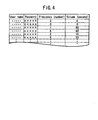
- Fig. 4 is a diagram showing one example of information on the frequency and the quantity of adverting stored for each user in the user information database 39.
- the user information database 39 stores the information on the frequency and the quantity of adverting selected by each user, such as the frequency of advertising zero time and the quantity zero second, or the frequency of advertising one time and the quantity 60 seconds, for example, together with the user name and the password of each user.
- the information that shows the frequency and the quantity of advertising for each user stored and controlled in the user information database 39 is read by the controller 36 at the time of distributing advertising. Then, the controller 36 transmits the advertising information to the client terminal unit 2 of each user, based on the frequency and the quantity of adverting selected by each user.
- the communications controller 23 at the client terminal unit 2 side displays on the display unit 21 a message of asking whether the distribution of the contents is to be started or not such as "Do you want the distribution of the contents to be started?", for example.
- the server system 3 decides whether the distribution of the contents has been assigned from the user or not.
- the operation shifts to the flowchart in Fig. 5 that shows the distribution of the contents and the advertising information.
- the process proceeds to step S12.
- the communications controller 23 at the client terminal unit 2 side displays on the display unit 21 a message of asking whether the connection status of the communication line between the client terminal unit 2 and the server system 3 is to be maintained or not such as "Do you want the connection line to be disconnected?", for example.
- the server system 3 considers that there is a correction in the assignment of the frequency and the quantity of advertising, then returns to step S6. Then, each routine at step S6 to step S11 is executed repeatedly.
- the communication controller 23 disconnects the communication line between the client terminal unit 2 and the server system 3 at step S13. As a result, all the routines of the flowchart shown in Fig. 2 are finished.
- the client terminal unit 2 transmits information showing the contents assigned by the user to the server system 3 at step S21.
- the controller 36 loads the contents assigned by the user from the contents server 38 at step S22.
- the server system 3 distributes the contents to the client terminal unit 2 via the switcher 33 and the gateway 32. Based on this, at the client terminal unit 2 side, it becomes possible to watch the desired contents as shown at step S24.
- the server system 3 monitors the time of distributing the advertising by timing with the timer 40 while distributing the contents.
- the controller 36 makes a decision about whether the current time has reached the time of distributing the advertising or not, based on the time counted with the timer 40.
- the process returns to step S23, and the controller 36 continues to control the distribution of the contents.
- the process proceeds to step S26.
- step S26 as the current time has reached the time of distributing the advertising, the controller 36 loads the user information of the user to whom the contents are being distributed, from the user information database 39. With this arrangement, the controller 36 detects the frequency and the quantity of advertising assigned by the user.
- the controller 36 makes a decision about whether the user wants non-distribution of the advertising information (no advertising) or not, based on the loaded user information.
- the process returns to step S23, and the controller 36 continues to control the distribution of the contents. With this arrangement, the user can watch the contents continuously without being interrupted by advertising, as desired.
- the controller 36 reads the predetermined advertising information from the advertising server 37, and loads this advertising information to the advertising transmission frequency adjuster 35 and the advertising transmission quantity adjuster 34 respectively.
- the controller 36 controls the advertising transmission frequency adjuster 35 and the advertising transmission quantity adjuster 34 to form the advertising information of the frequency and the quantity assigned in advance by the user. Then, the controller 36 interrupts the transmission of the contents from the contents server 38, and controls the change-over of the switcher 33 to distribute the advertising information adjusted by the advertising transmission frequency adjuster 35 and the advertising transmission quantity adjuster 34.
- This advertising information is transmitted to the client terminal unit 2 via the gateway 32. As a result, the user watches the advertising information of the frequency and the quantity assigned by the user himself or herself (step S30).
- the controller 36 controls the change-over of the switcher 33 to re-start the distribution of the contents so far interrupted, after the distribution of this advertising information. As a result, the user can watch the rest of the contents continuously after watching the advertising.
- step S31 the controller 36 makes a decision about whether the distribution of the contents has been finished or not.
- the process returns to step S23, and the controller 36 continues to control the distribution of the contents.
- the process proceeds to step S32, and the controller 36 charges the user for the viewing fee of the contents.
- the viewing fees of the contents are decided at stages based on the frequency and the quantity of advertising. Therefore, at step S32, the controller 36 charges the user for the viewing fee corresponding to the frequency and the quantity of advertising selected by the user from among the frequencies and quantity of advertising determined at stages.
- the contents distribution system of this embodiment makes the user select in advance the frequency and the quantity (or the frequency or the quantity) of advertising to be added to the contents. Then, the contents distribution system charges the user for the viewing fee corresponding to the frequency and the quantity of advertising selected by the user. With this arrangement, it is possible to distribute the contents in the form of the viewing fee and the advertising quantity desired by the user.
- the advertising information of the frequency and the quantity selected in advance by the user is inserted.
- the user operates the input section 22 of the client terminal unit 2 to assign the change in the frequency and the quantity of advertising.
- the server system 3 distributes the advertising information of the frequency and the quantity that have been changed, and charges the user for the viewing fee corresponding to the frequency and the quantity of advertising changed by the user.
- the above embodiment shows an example of the case where the present invention is applied to the contents distribution system that distributes the contents via the communication line. It is also possible to apply the present invention to a connection service like the toll broadcasting using the ground wave or the satellite wave and the Internet.
- the connection service like the Internet
- the user is made to select the frequency and the quantity of banner advertising that is displayed on the display screen, and the user is charged for the connection fee corresponding to the frequency and the quantity of advertising selected by the user.
- the present invention may be applied to an object distribution system.
- an object is wrapped with a wrapping paper and distributed. Therefore, the user is charged for a distribution fee corresponding to the position and quantity of advertising attached to the wrapping paper.
- the present invention can be applied to a toll broadcasting services of television broadcasting like ground wave broadcasting, satellite broadcasting, and cable televisions, connection services and contents distribution services for a communication line network like Internet, and product distribution services.
Landscapes
- Engineering & Computer Science (AREA)
- Business, Economics & Management (AREA)
- Signal Processing (AREA)
- Multimedia (AREA)
- Finance (AREA)
- Accounting & Taxation (AREA)
- Strategic Management (AREA)
- Development Economics (AREA)
- Databases & Information Systems (AREA)
- Marketing (AREA)
- Theoretical Computer Science (AREA)
- General Business, Economics & Management (AREA)
- General Physics & Mathematics (AREA)
- Entrepreneurship & Innovation (AREA)
- Physics & Mathematics (AREA)
- Economics (AREA)
- Game Theory and Decision Science (AREA)
- Computer Security & Cryptography (AREA)
- Two-Way Televisions, Distribution Of Moving Picture Or The Like (AREA)
- Management, Administration, Business Operations System, And Electronic Commerce (AREA)
- Financial Or Insurance-Related Operations Such As Payment And Settlement (AREA)
Abstract
Setting fees of service beneficiaries according to the
frequency (and or the quantity) of advertising to be added
to services provided. With this arrangement, it is possible
to provide services in the mode added with the fee and
advertising that the service beneficiaries want.
(Fig. 1)
(Fig. 1)
Description
- The present invention relates to a method of providing services, a program for providing services, a computer-readable recording medium recorded a program for providing services, an apparatus for executing a program, a contents distribution system, a contents distribution program, and a computer-readable recording medium recorded a contents distribution program, that are suitable for application to toll viewer services of television broadcasting like ground wave broadcasting, satellite broadcasting, and cable televisions, connection services and contents distribution services for a communication line network like the Internet, and product distribution services.
- Nowadays, various kinds of television broadcasting like a ground wave broadcasting using a ground wave, a satellite broadcasting using a satellite and a cable broadcasting using cables are known. And various kinds of programs like sports, movies, news, etc. have been broadcast.
- There are mainly two types of programs regarding the costs for broadcasting these programs and for making the programs. That is, programs whose costs are borne by the viewers and programs whose costs are borne by program sponsors . For example, in the case of national broadcasting, a fixed viewing fee is charged to each viewer every month. The national broadcasting station broadcasts programs and makes programs based on the fees collected from the viewers.
- On the other hand, in the case of private broadcasting, program sponsors are invited. Commercial fees are charged to the sponsors on condition that the commercial of the sponsors is inserted while the programs are broadcast. A private broadcasting station broadcasts programs and makes programs based on the commercial fees collected from the sponsors. In the case of this private broadcasting, the sponsors pay the viewing fees for the viewers. Therefore, the viewers can watch the programs basically without paying the viewing fees.
- However, in the case of the private broadcasting, while the viewers can watch programs free of charge as the sponsors pay for the commercial fees, the viewers are substantially forced to watch the commercial of the sponsors. When the frequency of commercial during a program is high, the flow of a series of the program is interrupted, and the viewers find difficulty in enjoying the program. Further, when the quantity of broadcasting commercial during a program becomes large, the program is interrupted for a long time. Therefore, the viewers also find difficulty in enjoying the program.
- Under these circumstances, some viewers feel that they can pay viewing fee if the quantity of broadcasting commercial was to be decreased. On the other hand, it is also a fact that some viewers can accept the broadcasting of commercial if the viewing fees can be reduced or free of charge.
- This kind of subject relating to the provision of services and the quantity of advertising similarly applies to a case of the contents that users observe via the communication line network like the Internet, for example, and banner advertising inserted (displayed) in the contents.
- The present invention has been achieved in the light of the above problems. Therefore it has an object of providing a method of providing services, a program for providing services, a computer-readable recording medium recorded a program for providing services, an apparatus for executing a program, a contents distribution system, a contents distribution program, and a computer-readable recording medium recorded a contents distribution program, that are capable of providing services at fees and in an advertising mode selected by service beneficiaries.
- To solve the foregoing problems, the present invention sets a fee to be charged to service beneficiaries according to the frequency (and/or quantity) of advertising added to the services provided. With this arrangement, it is possible to provide services at the fee and in the advertising mode that the service beneficiaries want.
-
- Fig. 1 is a block diagram of a contents distribution system according to an embodiment of the present invention.
- Fig. 2 is a flowchart for explaining the operation of registering the frequency and the quantity of advertising in the contents distribution system according to the embodiment.
- Fig. 3 is a diagram for explaining a charged fee corresponding to the frequency and the quantity of advertising.
- Fig. 4 is a diagram for explaining user information stored in a user information database of a server system that constitutes the contents distribution system according to this embodiment.
- Fig. 5 is a flowchart for explaining a distribution operation of contents and advertising information in the contents distribution system according to this embodiment.
-
- The present invention can be applied to a contents distribution system for broadcasting various kinds of programs such as, for example, news programs, sports programs, and variety shows.
- Fig. 1 is a block diagram of a contents distribution system according to an embodiment of the present invention. In Fig. 1, a contents distribution system of this embodiment has a
client terminal unit 2 and aserver system 3 at a broadcasting station side that transmits contents of various kinds of programs to thisclient terminal unit 2. Theclient terminal unit 2 and theserver system 3 are connected to each other via anetwork 1. - The
network 1 means a total communication network that utilizes an electric communications technique. Thisnetwork 1 includes, for example, a communication line network like the Internet using the TCP (Transmission Control Protocol) / IP (Internet Protocol) as a base, a WAN (Wide Area Network) and a LAN (Local Area Network), and other networks like a television broadcasting network using a ground wave, a satellite communications network, and a cable communications network. - When the contents are distributed from the
server system 3 to the broadcasting station side via the Internet, for example, theclient terminal unit 2 becomes a personal computer having a Web browser and a contents processing function. When the contents are distributed using a ground wave from theserver system 3, theclient terminal unit 2 becomes a television image receiver. - In the following explanation, in order to facilitate the understanding, it is assumed that the
client terminal unit 2 is a personal computer, and thisclient terminal unit 2 receives the distribution services of various kinds of contents that are distributed from theserver system 3 at the broadcasting station side via the Internet as thenetwork 1. - In this case, the
server system 3 has arouter 31, agateway 32, aswitcher 33, an advertising transmission quantity adjuster 34, an advertising transmission frequency adjuster 35, acontroller 36, anadvertising server 37, and acontents server 38. - The
router 31 has a function of connecting theserver system 3 to theclient terminal unit 2 via thenetwork 1. For example, it is possible to use an ISDN router corresponding to an ISDN (Integrated Services Digital Network) line, and a software router for realizing a router function with software. Thisrouter 31 can be replaced with thegateway 32 to be explained below. - The
gateway 32 basically has a function of connecting theserver system 3 to theclient terminal unit 2 via thenetwork 1 in a similar manner to that of therouter 31. However, while therouter 31 makes a mutual connection in a network layer (a third layer) of an OSI (Open Systems Interconnection) basic reference model, thegateway 32 can correspond to the protocols of all the layers of the OSI basic reference model. Therefore, by using thegateway 32, it becomes possible to realize a network connection processing for wider application. - The
advertising server 37 stores advertising information like commercial, character advertising, and banner advertising. The contents server 38 stores program information (contents) like news programs, sports programs, and variety shows, for example. The advertising information and the contents are compressed and encoded according to the compressing and encoding technique like the MPEG2 (MPEG: Moving Picture Experts Group), and the compressed and encoded results are stored in theservers - The advertising transmission quantity adjuster 34 thins the advertising information output from the
advertising server 37 for a predetermined period of time according to an instruction from thecontroller 36, thereby to adjust the transmission quantity of the advertising information per time. This advertising information transmission quantity shows a transmission time of the advertising information. - The advertising transmission frequency adjuster 35 adjusts the transmission frequency of the advertising information output from the
advertising server 37 according to an instruction from thecontroller 36. The frequency of the advertising information shows the number of advertising information transmitted per unit time. - The
switcher 33 inserts the advertising information of the frequency and the quantity adjusted by the advertisingtransmission quantity adjuster 34 and the advertising transmission frequency adjuster 35 into the contents output from thecontents server 38, or combines the advertising information with the contents. Then, theswitcher 33 distributes this advertising information to theclient terminal unit 2 via thegateway 32 and thenetwork 1. - When the user does not want the distribution of this advertising (that is, when the user pays the viewing fee for the contents distribution services without advertising), the
switcher 33 operates so as not to insert the advertising information into the contents from thecontents server 38 or combine the advertising information with the contents. - The
controller 36 has auser information database 39, and stores the frequency and the quantity of advertising assigned by each user, into thisuser information database 39. At the time of distributing the contents, thecontroller 36 reads each user information showing the frequency and the quantity of advertising assigned by the corresponding user, forms contents that are inserted or combined with the advertising information of the frequency and the quantity corresponding to this information, and distributes the resultant information to theclient terminal unit 2. Thecontroller 36 also performs timing processing with atimer 40, and monitors the time of distributing the advertising. - The
client terminal unit 2 has a structure of a personal computer in this case. Theclient terminal unit 2 has adisplay unit 21 like a cathode ray tube (CRT) or a liquid crystal display (LCD) for displaying the contents (and the advertising information) distributed from theserver system 3, ainput section 22 like a keyboard and a mouse for assigning a selection of desired contents, and the transmission frequency and transmission quantity of the advertising information, and acommunications controller 23 for carrying out the control of communication between theclient terminal unit 2 and theserver system 3. - According to this embodiment, the contents distribution system selects the frequency and the quantity of advertising in advance when the viewer receives the contents of a desired program. At the broadcasting station side, the contents distribution system forms and distributes the contents inserted by the advertising of which frequency and the quantity are selected by the viewer. Then, the contents distribution system charges the viewer for the viewing fee corresponding to the frequency and the quantity of advertising added to the contents.
- The explanation will be progressed below based on the assumption that each time when the viewer watches a program, the viewer selects the frequency and the quantity of advertising added to this program. This may be arranged as follows. The viewer assigns the desired frequency and quantity of advertising that the viewer wants, to the broadcasting station in advance. The broadcasting station adds the adverting of which the frequency and the quantity are assigned in advance by the viewer, and then distributes the contents of the program, without asking the viewer to assign the frequency and the quantity of advertising at the time of distributing the contents of the program.
- A flowchart in Fig. 2 shows a flow of operation that the viewer registers the frequency and the quantity of advertising that the viewer wants, to the broadcasting station. In the flowchart shown in Fig. 2, steps S1, S3, S6, S9, and S11 to S13 show the operation of the viewer at the
client terminal unit 2 side, and steps S2, S4, S5, S7, S8, and S10 show the operation of the broadcasting station at theserver system 3 side. - According to this contents distribution system, first, the viewer who is going to receive the distribution of desired contents from the broadcasting station selects the frequency and the quantity of advertising to be inserted into the contents.
- Namely, when the viewer is about to receive the distribution of desired contents from the broadcasting station, the viewer turns on the main power source of the own
client terminal unit 2. When the main power source of thisclient terminal unit 2 is turned on, the flowchart shown in Fig. 2 starts, and the process proceeds to step S1. - At step S1, the viewer starts the Web browser of the
client terminal unit 2, and operates theinput section 22 to try to connect theclient terminal unit 2 to theserver system 3 at the broadcasting station side. As a result, theclient terminal unit 2 is connected to theserver system 3 via thenetwork 1, and the processing routine of this flowchart proceeds to step S2. - At step S2, the
controller 36 of theserver system 3 requests theclient terminal unit 2 that has established the connection to theserver system 3, to input a user name and a password. Then, the processing routine of this flowchart proceeds to step S3. - At step S3, the viewer at the
client terminal unit 2 side operates theinput section 22 to input the user name and the password allocated to each user. When the user name and the password are input, theclient terminal unit 2 transmits the user name and the password to theserver system 3. Then, the processing routine of this flowchart proceeds to step S4. - At step S4, the
controller 36 of theserver system 3 collates the user name and the password input by this viewer with a user name and a password stored in theuser information database 39, and proceeds to step S5. At step S5, thesystem server 3 carries out the authentication processing for making a decision about whether the viewer who wants the distribution of the contents at present is a proper member of this system or not. - When a decision is made that the viewer who wants the distribution of the contents at present is a proper member of this system (in the case of Yes), the
controller 36 requests the viewer to assign the frequency and the quantity of advertising. When a decision is made that the viewer who wants the distribution of the contents at present is not a proper member of this system (in the case of No), at step S7, thecontroller 36 transmits an error message of "The input user name or password is not correct", for example, to theclient terminal unit 2, and prohibits the execution of subsequent processing. - Next, at step S6 and step S9, the viewer operates the
input section 22 of theclient terminal unit 2 to assign the frequency and the quantity of advertising to be added to the contents of which distribution the viewer wants. When the viewer has assigned the frequency and the quantity of advertising, theclient terminal unit 2 transmits the information on the assigned frequency and quantity of advertising to theserver system 3. - Fig. 3 is a diagram showing a charged fee of contents corresponding to the frequency and the quantity of advertising assigned by the user. In the example shown in Fig. 3, regarding the frequency of advertising, a desired level of frequency is selected from among 0 time to 6 times per contents. Regarding the quantity of advertising, a desired quantity is selected from among 15 seconds, 30 seconds, and 60 seconds per time.
- When the frequency of advertising has been assigned to 0 (zero) time (= no advertising. In this case, the quantity is zero second), for example, the user must bear the total amount of the viewing fee of the contents. Therefore, the viewing fee is a maximum amount of 3,000 yen, for example. When the viewer has assigned the frequency of advertising to one time, and has also assigned the advertising time to 15 seconds per time, the viewing fee is discounted to 2,700 yen by deducting 300 yen that corresponds to the adverting time of 15 seconds from the maximum amount. Similarly, when the viewer has assigned the frequency of advertising to two times, and has also assigned the advertising time to 60 seconds per time, the viewing fee is discounted to 1,800 yen by deducting 1,200 yen that corresponds to the adverting time of 60 seconds x two times from the maximum amount. Further, when the viewer has assigned the frequency of advertising to six times, and has also assigned the advertising time to 60 seconds per time, the viewing fee becomes zero yen (free of charge) as a result of deducting 3,000 yen that corresponds to the adverting time of 60 seconds x six times from the maximum amount.
- As explained above, according to the contents distribution system of this embodiment, viewing fees of the contents have been determined at stages corresponding to the frequency and the quantity of advertising to be selected by the viewer. Therefore, the viewer selects the desired frequency and quantity of advertising by referring to these viewing fees.
- Next, when the desired frequency and quantity of advertising have been selected by the user, the
controller 36 at the server side stores the frequency and the quantity of advertising selected by the user, into theuser information database 39, at step S8 and step S10. - Fig. 4 is a diagram showing one example of information on the frequency and the quantity of adverting stored for each user in the
user information database 39. As understood from Fig. 4, theuser information database 39 stores the information on the frequency and the quantity of adverting selected by each user, such as the frequency of advertising zero time and the quantity zero second, or the frequency of advertising one time and thequantity 60 seconds, for example, together with the user name and the password of each user. The information that shows the frequency and the quantity of advertising for each user stored and controlled in theuser information database 39 is read by thecontroller 36 at the time of distributing advertising. Then, thecontroller 36 transmits the advertising information to theclient terminal unit 2 of each user, based on the frequency and the quantity of adverting selected by each user. - Next, when the frequency and the quantity of adverting have been assigned, the
communications controller 23 at theclient terminal unit 2 side displays on the display unit 21 a message of asking whether the distribution of the contents is to be started or not such as "Do you want the distribution of the contents to be started?", for example. Then, at step S11, theserver system 3 decides whether the distribution of the contents has been assigned from the user or not. When the distribution of the contents has been assigned from the user, the operation shifts to the flowchart in Fig. 5 that shows the distribution of the contents and the advertising information. When the distribution of the contents has not been assigned from the user, the process proceeds to step S12. - At step S12, the
communications controller 23 at theclient terminal unit 2 side displays on the display unit 21 a message of asking whether the connection status of the communication line between theclient terminal unit 2 and theserver system 3 is to be maintained or not such as "Do you want the connection line to be disconnected?", for example. When the connection is not to be disconnected, theserver system 3 considers that there is a correction in the assignment of the frequency and the quantity of advertising, then returns to step S6. Then, each routine at step S6 to step S11 is executed repeatedly. - On the other hand, when the user has assigned the disconnection of the communication line, the
communication controller 23 disconnects the communication line between theclient terminal unit 2 and theserver system 3 at step S13. As a result, all the routines of the flowchart shown in Fig. 2 are finished. - Next, when the user has assigned the distribution of the contents at step S11 in the flowchart shown in Fig. 2, the operation of the system shifts to the operation of the flowchart shown in Fig. 5 that shows the flow of the distribution of the contents and advertising.
- In the flowchart shown in Fig. 5, when the user has assigned desired contents, the
client terminal unit 2 transmits information showing the contents assigned by the user to theserver system 3 at step S21. - At the
server system 3 side, thecontroller 36 loads the contents assigned by the user from thecontents server 38 at step S22. At step S23, theserver system 3 distributes the contents to theclient terminal unit 2 via theswitcher 33 and thegateway 32. Based on this, at theclient terminal unit 2 side, it becomes possible to watch the desired contents as shown at step S24. - Next, the
server system 3 monitors the time of distributing the advertising by timing with thetimer 40 while distributing the contents. At step S25, thecontroller 36 makes a decision about whether the current time has reached the time of distributing the advertising or not, based on the time counted with thetimer 40. When the current time has not reached the time of distributing the advertising, the process returns to step S23, and thecontroller 36 continues to control the distribution of the contents. When the current time has reached the time of distributing the advertising, the process proceeds to step S26. - At step S26, as the current time has reached the time of distributing the advertising, the
controller 36 loads the user information of the user to whom the contents are being distributed, from theuser information database 39. With this arrangement, thecontroller 36 detects the frequency and the quantity of advertising assigned by the user. - At step S27, the
controller 36 makes a decision about whether the user wants non-distribution of the advertising information (no advertising) or not, based on the loaded user information. When the user wants no advertising, the process returns to step S23, and thecontroller 36 continues to control the distribution of the contents. With this arrangement, the user can watch the contents continuously without being interrupted by advertising, as desired. - Next, when the user has permitted the distribution of the advertising information, at step S28, the
controller 36 reads the predetermined advertising information from theadvertising server 37, and loads this advertising information to the advertisingtransmission frequency adjuster 35 and the advertisingtransmission quantity adjuster 34 respectively. - At step S29, the
controller 36 controls the advertisingtransmission frequency adjuster 35 and the advertisingtransmission quantity adjuster 34 to form the advertising information of the frequency and the quantity assigned in advance by the user. Then, thecontroller 36 interrupts the transmission of the contents from thecontents server 38, and controls the change-over of theswitcher 33 to distribute the advertising information adjusted by the advertisingtransmission frequency adjuster 35 and the advertisingtransmission quantity adjuster 34. This advertising information is transmitted to theclient terminal unit 2 via thegateway 32. As a result, the user watches the advertising information of the frequency and the quantity assigned by the user himself or herself (step S30). - The
controller 36 controls the change-over of theswitcher 33 to re-start the distribution of the contents so far interrupted, after the distribution of this advertising information. As a result, the user can watch the rest of the contents continuously after watching the advertising. - Next, at step S31, the
controller 36 makes a decision about whether the distribution of the contents has been finished or not. When the distribution of the contents has not yet been finished, the process returns to step S23, and thecontroller 36 continues to control the distribution of the contents. When the distribution of the contents has been finished, the process proceeds to step S32, and thecontroller 36 charges the user for the viewing fee of the contents. - As described with reference to the example shown in Fig. 3, the viewing fees of the contents are decided at stages based on the frequency and the quantity of advertising. Therefore, at step S32, the
controller 36 charges the user for the viewing fee corresponding to the frequency and the quantity of advertising selected by the user from among the frequencies and quantity of advertising determined at stages. - Next, when the user has finished the watching of the contents, the user disconnects the communication line connected between the
client terminal unit 2 and theserver system 3, at step S33. As a result, all the routines of the flowchart shown in Fig. 5 are finished. - As is apparent from the above explanation, the contents distribution system of this embodiment makes the user select in advance the frequency and the quantity (or the frequency or the quantity) of advertising to be added to the contents. Then, the contents distribution system charges the user for the viewing fee corresponding to the frequency and the quantity of advertising selected by the user. With this arrangement, it is possible to distribute the contents in the form of the viewing fee and the advertising quantity desired by the user.
- In the above explanation of the embodiment, the advertising information of the frequency and the quantity selected in advance by the user is inserted. However, it is also possible to change the frequency and the quantity of adverting in the middle of the distribution of the contents. In this case, the user operates the
input section 22 of theclient terminal unit 2 to assign the change in the frequency and the quantity of advertising. Then, theserver system 3 distributes the advertising information of the frequency and the quantity that have been changed, and charges the user for the viewing fee corresponding to the frequency and the quantity of advertising changed by the user. - Further, the above embodiment shows an example of the case where the present invention is applied to the contents distribution system that distributes the contents via the communication line. It is also possible to apply the present invention to a connection service like the toll broadcasting using the ground wave or the satellite wave and the Internet. When the present invention is applied to the connection service like the Internet, the user is made to select the frequency and the quantity of banner advertising that is displayed on the display screen, and the user is charged for the connection fee corresponding to the frequency and the quantity of advertising selected by the user.
- The present invention may be applied to an object distribution system. In the case of the object distribution system, an object is wrapped with a wrapping paper and distributed. Therefore, the user is charged for a distribution fee corresponding to the position and quantity of advertising attached to the wrapping paper.
- The above-described embodiment is one example of the present invention. Therefore, it should be noted that the present invention is not limited to the above embodiment, and it is of course possible to carry out various modifications according to designs or the like within the range not deviating from the technical idea of the present invention.
- The present invention can be applied to a toll broadcasting services of television broadcasting like ground wave broadcasting, satellite broadcasting, and cable televisions, connection services and contents distribution services for a communication line network like Internet, and product distribution services.
Claims (17)
- A method of providing services, comprising the steps of:making service beneficiaries select at least either the frequency or the quantity of advertising to be added to the services provided; andsetting a fee for the provision of services to the service beneficiaries, according to at least either the frequency or the quantity of advertising selected.
- The method of providing services according to Claim 1, wherein
the fees including free of charge for the services to be provided to the service beneficiaries are set at stages, according to at least either the frequency or the quantity of advertising selected. - The method of providing services according to Claim 1 or 2, wherein
at least either the frequency or the quantity of advertising selected can be changed during the provision of the services. - A computer-readable recording medium having recorded therein a service-providing program to be executed by a computer, wherein the service-providing program comprising the steps of:making service beneficiaries select at least either the frequency or the quantity of advertising to be added to the services provided; andsetting a fee for the provision of services to the service beneficiaries, according to at least either the frequency or the quantity of advertising selected.
- The computer-readable recording medium having recorded therein a service-providing program according to Claim 4, wherein
the fees including free of charge for the services to be provided to the service beneficiaries are set at stages, according to at least either the frequency or the quantity of advertising selected. - The computer-readable recording medium having recorded therein a service-providing program according to Claim 4 or 5, wherein
at least either the frequency or the quantity of advertising selected can be changed during the provision of the services. - A program-executing apparatus for executing a computer program, wherein the computer program comprising the steps of:making service beneficiaries select at least either the frequency or the quantity of advertising to be added to the services provided; andsetting a fee for the provision of services to the service beneficiaries, according to at least either the frequency or the quantity of advertising selected.
- The program-executing apparatus for executing a computer program according to Claim 7, wherein
the fees including free of charge for the services to be provided to the service beneficiaries are set at stages, according to at least either the frequency or the quantity of advertising selected. - The program-executing apparatus for executing a computer program according to Claim 7 or 8, wherein
at least either the frequency or the quantity of advertising selected can be changed during the provision of the services. - A contents distribution system, comprising:a client terminal unit connected to a predetermined network, and having selecting means for selecting at least either the frequency or the quantity of advertising to be added to the contents to be distributed; anda distribution unit having distribution means for distributing the contents added with the advertising corresponding to at least either the frequency or the quantity selected by the selecting means of the client terminal unit, to the client terminal unit via the predetermined network, and charging means for charging a fee for the contents distributed to the client terminal unit, according to at least either the frequency or the quantity of advertising selected by the selecting means of the client terminal unit.
- The contents distribution system according to Claim 10, wherein
the charging means sets the fees including free of charge at stages for the services to be provided, according to at least either the frequency or the quantity of advertising selected by the selecting means of the client terminal unit. - The contents distribution system according to Claim 10 or 11, wherein
the client terminal unit has changing means for assigning a change in at least either the frequency or the quantity of advertising during the reception of the contents, and
the distribution means of the distribution unit adds the advertising according to at least either the frequency or the quantity changed by the changing means of the client terminal unit, and distributes the contents added with the advertising to the client terminal unit. - A computer-readable recording medium having recorded therein a contents distribution program to be executed by a computer, wherein the contents distribution program comprising the steps of:making a client terminal unit connected to a predetermined network select at least either the frequency or the quantity of advertising to be added to the contents to be distributed;making a distribution unit connected to the predetermined network add the advertising corresponding to at least either the frequency or the quantity selected by the client terminal unit to the contents, and distribute the contents added with the advertising to the client terminal unit; andmaking the distribution unit charge a fee for the contents distributed to the client terminal unit, according to at least either the frequency or the quantity of advertising selected by the client terminal unit.
- The computer-readable recording medium having recorded therein a contents distribution program to be executed by a computer according to Claim 13, wherein the contents distribution program further comprising the step of:making the distribution unit set fees including free of charge for the contents at stages, according to at least either the frequency or the quantity of advertising selected by the client terminal unit.
- The computer-readable recording medium having recorded therein a contents distribution program to be executed by a computer according to Claim 13 or 14, wherein the contents distribution program further comprising the steps of:specifying a change in at least either the frequency or the quantity of advertising at the client terminal unit side during the reception of the contents, andmaking the distribution unit add the advertising according to at least either the frequency or the quantity changed by the client terminal unit, and distribute the contents added with the advertising to the client terminal unit.
- A service-providing program to be executed by a computer, comprising the steps of:making service beneficiaries select at least either the frequency or the quantity of advertising to be added to the services provided; andsetting a fee for the provision of services to the service beneficiaries, according to at least either the frequency or the quantity of advertising selected.
- A contents distribution program to be executed by a computer, comprising the steps of:making a client terminal unit connected to a predetermined network select at least either the frequency or the quantity of advertising to be added to the contents to be distributed;making a distribution unit connected to the predetermined network add the advertising corresponding to at least either the frequency or the quantity selected by the client terminal unit to the contents, and distribute the contents added with the advertising to the client terminal unit; andmaking the distribution unit charge a fee for the contents distributed to the client terminal unit, according to at least either the frequency or the quantity of advertising selected by the client terminal unit.
Applications Claiming Priority (5)
| Application Number | Priority Date | Filing Date | Title |
|---|---|---|---|
| JP2000372359 | 2000-12-07 | ||
| JP2000372359 | 2000-12-07 | ||
| JP2001256709 | 2001-08-27 | ||
| JP2001256709A JP2002238045A (en) | 2000-12-07 | 2001-08-27 | Service providing method, computer-readable recording medium for recording service providing program, program execution device, contents distribution system, computer- readable recording medium for recording contents distribution program, the service providing program and the contents distribution program |
| PCT/JP2001/008553 WO2002046993A1 (en) | 2000-12-07 | 2001-09-28 | Service providing method |
Publications (2)
| Publication Number | Publication Date |
|---|---|
| EP1341102A1 true EP1341102A1 (en) | 2003-09-03 |
| EP1341102A4 EP1341102A4 (en) | 2006-02-01 |
Family
ID=26605390
Family Applications (1)
| Application Number | Title | Priority Date | Filing Date |
|---|---|---|---|
| EP01970286A Withdrawn EP1341102A4 (en) | 2000-12-07 | 2001-09-28 | Service providing method |
Country Status (7)
| Country | Link |
|---|---|
| US (1) | US20020072973A1 (en) |
| EP (1) | EP1341102A4 (en) |
| JP (1) | JP2002238045A (en) |
| KR (1) | KR20030065302A (en) |
| AU (1) | AU2001290313A1 (en) |
| TW (1) | TW552540B (en) |
| WO (1) | WO2002046993A1 (en) |
Families Citing this family (9)
| Publication number | Priority date | Publication date | Assignee | Title |
|---|---|---|---|---|
| US20040044567A1 (en) * | 2002-09-03 | 2004-03-04 | Daniel Willis | Gaming service provider advertising system |
| US20040225560A1 (en) * | 2003-05-06 | 2004-11-11 | International Business Machines Corporation | Method and system for including advertisements in output tasks |
| US9166813B2 (en) * | 2006-03-06 | 2015-10-20 | Rtem Innovations Corp. | System for simultaneous delivery of digital television and interactive broadband service |
| WO2008036757A2 (en) * | 2006-09-19 | 2008-03-27 | Howard Lutnick | Products and processes for providing information services |
| US20080091607A1 (en) * | 2006-10-13 | 2008-04-17 | Cantor Fitzgerald Lp/Espeed, Inc. | Commercial web |
| US8429015B2 (en) * | 2006-11-30 | 2013-04-23 | Toshiba Global Commerce Solutions Holdings Corporation | Method and apparatus for varying the amount of advertising content |
| ES2319367B1 (en) | 2007-07-03 | 2010-01-12 | Kao Corporation, S.A. | ANTIAPELMAZANTES COMPOSITIONS FOR FERTILIZERS. |
| US10134043B2 (en) * | 2007-08-13 | 2018-11-20 | Excalibur Ip, Llc | Method and system for wirelessly accessing a network |
| US11741997B2 (en) | 2019-02-28 | 2023-08-29 | Xi'an Novastar Tech Co., Ltd. | Method, device and system for generating media playback sequence |
Family Cites Families (6)
| Publication number | Priority date | Publication date | Assignee | Title |
|---|---|---|---|---|
| US4850007A (en) * | 1987-06-25 | 1989-07-18 | American Telephone And Telegraph Company | Telephone toll service with advertising |
| US5774869A (en) * | 1995-06-06 | 1998-06-30 | Interactive Media Works, Llc | Method for providing sponsor paid internet access and simultaneous sponsor promotion |
| JP3983853B2 (en) * | 1997-07-31 | 2007-09-26 | 松下電器産業株式会社 | Broadcast receiver |
| JP3844026B2 (en) * | 1997-08-15 | 2006-11-08 | ソニー株式会社 | Information communication method, information communication system, communication terminal, and server apparatus |
| JPH1188521A (en) * | 1997-09-05 | 1999-03-30 | Sony Corp | Information communication system, information communication terminal, server device, and information communication method |
| JP2000201229A (en) * | 1999-01-08 | 2000-07-18 | Mitsubishi Electric Corp | Communication network having communication service function with advertisement and communication terminal having communication service function with advertisement |
-
2001
- 2001-08-27 JP JP2001256709A patent/JP2002238045A/en active Pending
- 2001-09-28 KR KR1020027010845A patent/KR20030065302A/en not_active Ceased
- 2001-09-28 WO PCT/JP2001/008553 patent/WO2002046993A1/en not_active Ceased
- 2001-09-28 EP EP01970286A patent/EP1341102A4/en not_active Withdrawn
- 2001-09-28 AU AU2001290313A patent/AU2001290313A1/en not_active Abandoned
- 2001-10-09 US US09/973,671 patent/US20020072973A1/en not_active Abandoned
- 2001-10-25 TW TW090126391A patent/TW552540B/en not_active IP Right Cessation
Non-Patent Citations (2)
| Title |
|---|
| No Search * |
| See also references of WO0246993A1 * |
Also Published As
| Publication number | Publication date |
|---|---|
| US20020072973A1 (en) | 2002-06-13 |
| KR20030065302A (en) | 2003-08-06 |
| AU2001290313A1 (en) | 2002-06-18 |
| JP2002238045A (en) | 2002-08-23 |
| TW552540B (en) | 2003-09-11 |
| WO2002046993A1 (en) | 2002-06-13 |
| EP1341102A4 (en) | 2006-02-01 |
Similar Documents
| Publication | Publication Date | Title |
|---|---|---|
| JP3797564B2 (en) | System and method for optimizing subscriber program preferences | |
| CA2177153C (en) | Network manager for cable television system headends | |
| US8002617B1 (en) | Sponsored network games | |
| EP1111922B1 (en) | Providing multiple levels of interactive television service using triggers and trigger filters | |
| EP1217565A2 (en) | Computer implemented method and system for negotiating broadcast of a programme content | |
| EP1341102A1 (en) | Service providing method | |
| Dixit et al. | TVCCCS: Television Viewer’s Channel Cost Calculation System On Per Second Usage | |
| US6816841B1 (en) | Program providing apparatus and method, program receiving apparatus and method | |
| AU2004288303B2 (en) | System and method to broadcast video with clear sound and picture using the internet | |
| EP1143637A2 (en) | Apparatus and method for information providing and delivering | |
| US6175378B1 (en) | Process for controlling the communication flow within an interactive network | |
| US20030046688A1 (en) | Video distributing method and system | |
| US20050246733A1 (en) | Method and system for directing interactive tv game shows | |
| JP4603232B2 (en) | Pay TV broadcast viewing method and pay TV broadcast viewing system | |
| WO2016093588A1 (en) | Broadcast advertisement control system and method therefor | |
| KR20000049367A (en) | Broadcasting channel link server and broadcasting channel link method using the same | |
| Cawley | European aspects of the regulation of pay television | |
| US20030061608A1 (en) | Content delivery system | |
| KR20030010192A (en) | System for providing broadcasting contents via network and method for thereof | |
| JP2002034024A (en) | Data distribution system and data distribution method | |
| JP2001285839A (en) | Communication line connection charge free system on transmission of viewer information in digital television | |
| JP2002232604A (en) | System for reducing subscriber communication charge by ground wave digital broadcasted advertisement viewing in next generation portable telephone terminal or the like | |
| JP2004056666A (en) | Digital content distribution system and digital content distribution method | |
| KR20030006666A (en) | The private broadcasting method using the internet | |
| JPH06178017A (en) | Video distribution billing method |
Legal Events
| Date | Code | Title | Description |
|---|---|---|---|
| PUAI | Public reference made under article 153(3) epc to a published international application that has entered the european phase |
Free format text: ORIGINAL CODE: 0009012 |
|
| 17P | Request for examination filed |
Effective date: 20020715 |
|
| AK | Designated contracting states |
Kind code of ref document: A1 Designated state(s): AT BE CH CY DE DK ES FI FR GB GR IE IT LI LU MC NL PT SE TR |
|
| A4 | Supplementary search report drawn up and despatched |
Effective date: 20051220 |
|
| 17Q | First examination report despatched |
Effective date: 20101223 |
|
| STAA | Information on the status of an ep patent application or granted ep patent |
Free format text: STATUS: THE APPLICATION IS DEEMED TO BE WITHDRAWN |
|
| 18D | Application deemed to be withdrawn |
Effective date: 20110503 |