TECHNICAL FIELD
The present invention relates to a solid polymer
electrolyte and a gel-like solid polymer electrolyte, which
are useful in lithium ion cells, lithium metal cells, electric
double layer condensers, electrochromic elements and solar
cells and, more particularly, to a solid polymer electrolyte
made of a photopolymerizable composition containing a specific
maleimide derivative which is polymerized by irradiation with
a practical amount of ultraviolet light in the absence of a
general-purpose photopolymerization initiator, and to a cell
produced by using the solid polymer electrolyte.
BACKGROUND ART
Heretofore, liquid electrolytes have been used in
electrochemical elements such as primary cells, secondary
cells, condensers, electrochromic displays and wet solar
cells. However, the liquid electrolyte has problems such as
occurrence of liquid leakage and poor long-term reliability.
Due to size-reduction requirements, a whole solid electrolyte
has been studied. Thus, a solid electrolyte has attracted
special interest recently as a new ionic conductor to replace
conventional electrolyte solutions, and tests of applying the
solid electrolyte to entire solid primary cells, secondary
cells and electric double layer condensers have been actively
carried out (Japanese Unexamined Patent Application, First
Publication No. Sho 55-98480).
Japanese Unexamined Patent Application, First Publication
No. Sho 55-35420 discloses a gel-like solid polymer
electrolyte wherein an electrolyte solution is entrapped in a
polymer matrix for the purpose of improving the ionic
conductivity. As methods of producing the gel-like solid
polymer electrolyte, Japanese Unexamined Patent Application,
First Publication No. Sho 63-94501, Japanese Patent
Application, First Publication No. Sho 63-94563 and Japanese
Patent Application, First Publication No. Hei 5-109310
disclose a method of mixing a polymer with an electrolyte and
dissolving the polymer, a method of adding an electrolyte or
an electrolyte solution in a composition containing a general-purpose
radical polymerization initiator, a polymerizable
monomer and/or an oligomer and thermally polymerizing the
mixture and a method of adding an electrolyte or an
electrolyte solution in a general-purpose photoradical
polymerization initiator, a polymerizable monomer and/or an
oligomer and subjecting the mixture to ultraviolet light
polymerization, respectively.
However, the solid polymer electrolyte has a problem in
that rapid reduction in the charge-discharge capacity is
caused by the polymerization initiator when the charge-discharge
operation is repeated. As a means for solving the
problem, Japanese Patent Application, First Publication No.
Hei 10-158418 discloses a method of removing the residual
polymerization initiator by a heat treatment or an ultrasonic
treatment. However, this method has problems such as poor
productivity because the solid polymer electrolyte obtained by
the polymerization is subjected to ultrasonic cleaning or a
heat treatment at a temperature within a range from 100 to
300°C.
The gel-like solid polymer electrolyte is generally
formed by a method of polymerizing a polymerizable composition
containing a polymerizable compound, an electrolyte solution
and a general-purpose thermal polymerization or
photopolymerization initiator using heat or energy rays to
form a crosslinked network, thereby to obtain a gel-like solid
polymer electrolyte (Japanese Patent Application, First
Publication No. Hei 10-251318) and interposing the gel-like
solid polymer electrolyte between two kinds of electrodes or
forming it on one electrode, thereby to form a cell. It is
difficult to insert the step of removing the residual
polymerization initiator by the method disclosed in Japanese
Patent Application, First Publication No. Hei 10-158418 after
polymerizing the polymerizable composition using heat or
energy rays to form a crosslinked network.
As the method of forming the solid polymer electrolyte
without using a polymerization initiator, Japanese Patent
Application, First Publication No. Hei 5-290885, Japanese
Patent Application, First Publication No. Hei 5-326019,
Japanese Patent Application, First Publication No. Hei 9-17449,
Japanese Patent Application, First Publication No. Hei
9-17450 and Japanese Patent Application, First Publication No.
Hei 10-112321 disclose a method of polymerizing and
crosslinking by irradiation with an electron beam to form an
electrolyte. The polymerizable composition can be polymerized
and crosslinked by irradiation with electron beam without
using a thermal polymerization or photopolymerization
initiator and drawbacks contributing to the initiator can be
solved. When using electron beam, there arise problems such
as limitation of manufacturing conditions and security of
safety during the operation.
The methods of adding an electrolyte or an electrolyte
solution to a polymerizable monomer or oligomer containing a
conventionally known thermal polymerization or
photopolymerization initiator and subjecting the mixture to
thermal polymerization or ultraviolet light polymerization to
obtain a solid electrolyte disclosed in Japanese Patent
Application, First Publication No. Sho 55-35420, Japanese
Patent Application, First Publication No. Sho 63-94501,
Japanese Patent Application, First Publication No. Sho 63-94563
and Japanese Patent Application, First Publication No.
Hei 5-109310 had a problem in that rapid reduction in the
charge-discharge capacity which is caused by the
polymerization initiator when the charge-discharge operation
is repeated.
The method of removing the residual polymerization
initiator by a heat treatment or an ultrasonic treatment after
polymerization disclosed in Japanese Patent Application, First
Publication No. Hei 10-158418 has problems such as poor
productivity and poor applicability to a gel-like solid
polymer electrolyte.
As the method of forming a solid polymer electrolyte
without using a polymerization initiator, Japanese Patent
Application, First Publication No. Hei 5-290885, Japanese
Patent Application, First Publication No. Hei 5-326019,
Japanese Patent Application, First Publication No. Hei 9-17449,
Japanese Patent Application, First Publication No. Hei
9-17450 and Japanese Patent Application, First Publication No.
Hei 10-112321 propose a method of polymerizing and
crosslinking by irradiation with electron beam and the above
drawbacks can be solved. However, when using electron beam,
there arise problems such as limitation of manufacturing
conditions and security of safety during the operation.
DISCLOSURE OF INVENTION
Objects of the present invention are to provide a solid
polymer electrolyte made of a polymer of a liquid
photopolymerizable composition, which is polymerized by
irradiation with light at practical light intensity and amount
without using a general-purpose photopolymerization initiator
contributing to an efflux from the polymer and is also liquid
at normal temperature, and to provide a cell using the
electrolyte.
The present inventors disclosed, in EP-A-0 878 482, that
(i) a maleimide derivative having a specific structure is
polymerized by irradiation with ultraviolet light at practical
light intensity and (ii) the maleimide derivative is
copolymerized with (meth)acrylate or vinyl ether, without
using a general-purpose photopolymerization initiator.
The present inventors have intensively researched to
achieve the above objects and found that it is possible to
form a solid electrolyte by using a photopolymerizable
maleimide, which exhibits ionic conductivity at a practical
level in charge-discharge characteristics as compared with a
solid electrolyte obtained by polymerizing using a general-purpose
photopolymerization initiator. Thus, the present
invention has been completed.
To achieve the above objects, the present invention
provides (I) a solid polymer electrolyte made of a solid
obtained by photopolymerizing a photopolymerizable composition
(hereinafter referred to as a "photopolymerizable composition
used in the present invention") comprising (a) an electrolyte
and (b) a polymerizable compound having a polyoxyalkylene
chain, wherein the photopolymerizable composition contains a
photopolymerizable maleimide compound.
To achieve the above objects, the present invention
provides (II) a cell comprising electrodes and the solid
polymer electrolyte interposed between the electrodes.
BRIEF DESCRIPTION OF DRAWING
Fig. 1 is a schematic sectional view of a lithium ion
secondary cell using a solid polymer electrolyte of the
present invention. In Fig. 1, the reference symbol 1 denotes
a positive electrode, 2 denotes a solid polymer electrolyte, 3
denotes a negative electrode, 4 denotes a current collector, 5
denotes a spacer, 6 denotes an insulating resin sealing agent,
7 denotes an insulating resin sealing agent, and 8 denotes a
lead wire.
BEST MODE FOR CARRYING OUT THE INVENTION
The photopolymerizable maleimide compound used to form
the solid polymer electrolyte of the present invention is not
specifically limited, as long as it is a maleimide which
exhibits photopolymerizability, but it is preferably a
compound having an N-alkylmaleimide structure or an N-cycloalkylmaleimide
structure, and particularly preferably, a
compound having a polyoxyalkylene chain.
The compound having an N-alkylmaleimide structure or an
N-cycloalkylmaleimide structure is preferably a compound
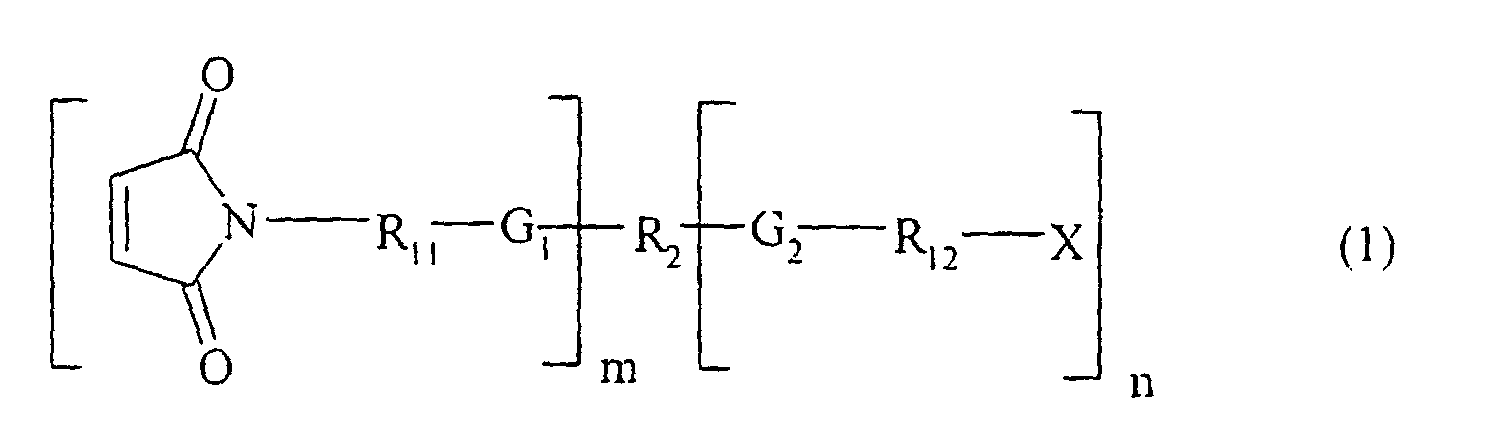
having a maleimide group, which is represented by the general
formula (1):
wherein m represents an integer of 1 to 6; n represents an
integer of 0 to 5 and the sum of m and n is an integer of 1 to
6; R
11 and R
12 each independently represents a straight-chain
or branched aliphatic hydrocarbon group, or an alicyclic
hydrocarbon group; G
1 and G
2 each independently represents at
least one group selected from the group consisting of a single
bond, a straight-chain or branched aliphatic hydrocarbon
group, an alicyclic hydrocarbon group, an ether group, an
ester group, a urethane group, and a carbonate group; when m +
n = 1, R
2 represents at least one group selected from the
group consisting of a hydrogen atom, a straight-chain or
branched aliphatic hydrocarbon group, an alicyclic hydrocarbon
group, and a polyoxyalkylene chain having a hydroxyl group or
an alkyl group at the end and, when m + n ≥ 2, R
2 represents
at least one group selected from the group consisting of a
hydrogen atom, a straight-chain or branched aliphatic
hydrocarbon group, an alicyclic hydrocarbon group, and a
polyoxyalkylene chain; and X represents a polymerizable
functional group.
R11 and R12 each independently represents a straight-chain
or branched aliphatic hydrocarbon group, or an alicyclic
hydrocarbon group.
Examples of the aliphatic hydrocarbon group include, but
are not limited to, straight-chain alkylene groups such as a
methylene group, ethylene group, trimethylene group,
tetramethylene group, pentamethylene group, hexamethylene
group, heptamethylene group, octamethylene group,
nonamethylene group, decamethylene group, undecamethylene
group, and dodecamethylene group; and alkylene groups having a
branched alkyl group, such as a 1-methylethylene group, 1-methyl-trimethylene
group, 2-methyl-trimethylene group, 1-methyl-tetramethylene
group, 2-methyl-tetramethylene group, 1-methyl-pentamethylene
group, 2-methyl-pentamethylene group, 3-methyl-pentamethylene
group, and neopentyl group. Examples of
the alicyclic hydrocarbon group include, but are not limited
to, cycloalkylene groups such as cyclopentylene groups or
cyclohexylene groups; and cycloalkyl-alkylene groups having a
cycloalkyl group on a main chain or side chain, such as a
cyclohexylmethylene group, 1-cyclohexyl-ethylene group, 1-cyclohexyl-tetraethylene
group, and 2-cyclohexyl-tetraethylene
group.
In the monofunctional maleimide compounds represented by
the general formula (1), G1 and G2 each independently
represents at least one group selected from the group
consisting of a single bond, a straight-chain or branched
aliphatic hydrocarbon group, an alicyclic hydrocarbon group,
an ether group, an ester group, a urethane group, and a
carbonate group. Herein, G1 as a single bond means that R11
and R2 are directly bonded through a single bond. Examples of
the aliphatic hydrocarbon group and the alicyclic hydrocarbon
group in G1 and G2 include those listed in R11 and R12.
In the maleimide compounds represented by the general
formula (1), when m + n = 1, that is, in the case of a
compound having a maleimide group in a molecule (hereinafter
referred to as a "monofunctional maleimide compound"), R2
represents at least one group selected from the group
consisting of a hydrogen atom, a straight-chain or branched
aliphatic hydrocarbon group, an alicyclic hydrocarbon group,
and a polyoxyalkylene chain having a hydroxyl group or an
alkyl group at the end.
Examples of the aliphatic hydrocarbon group in R2 include
straight-chain alkyl groups such as a methyl group, ethyl
group, propyl group, butyl group, pentyl group, hexyl group,
heptyl group, octyl group, nonyl group, decanyl group,
undecanyl group, and dodecanyl group; and branched alkyl
groups such as an isopropyl group, isobutyl group, sec-butyl
group, isopentyl group, and neopentyl group. Examples of the
alicyclic hydrocarbon group in R2 include cycloalkyl groups
such as a cyclopentyl group and cyclohexyl group; and
cycloalkyl-alkylene groups having a cycloalkyl group on the
main chain or side chain, such as a cyclohexylmethylene group,
1-cyclohexyl-ethylene group, 1-cyclohexyl-tetraethylene group,
and 2-cyclohexyl-tetraethylene group.
Examples of the polyoxyalkylene chain in R2 include
polyoxyalkylene chains having a unit in which a straight-chain
alkylene group and/or a branched alkylene group each having 1
to 6 carbon atoms are bonded through an ether bond or a
repeating unit thereof. Examples of the polyoxy chain include
polyoxyethylene chains, polyoxypropylene chains, and
polyoxybutylene chains. The polyoxyalkylene chain preferably
has a number-average molecular weight of 44 to 10000.
In the maleimide compounds represented by the general
formula (1), when m + n ≥ 2, that is, in the case of a
compound having a maleimide group and a polymerizable
functional group totaling 2 or more in a molecule (hereinafter
referred to as a "polyfunctional maleimide compound"), R11 and
R12 each independently represents a straight-chain or branched
aliphatic hydrocarbon group, or an alicyclic hydrocarbon
group. Examples of R11 and R12 include those listed as R11 when
m = 1 and n = 0.
In the polyfunctional maleimide compounds represented by
the general formula (1), G1 and G2 each independently
represents at least one group selected from the group
consisting of a single bond, a straight-chain or branched
aliphatic hydrocarbon group, an alicyclic hydrocarbon group,
an ether group, an ester group, a urethane group, and a
carbonate group. Herein, G1 or G2 as a single bond means that
R11 and R2 are directly bonded through a single bond. In G1 or
G2, examples of the aliphatic hydrocarbon group and the
alicyclic hydrocarbon group include those listed as R11 in the
monofunctional maleimide compounds.
In the polyfunctional maleimide compounds represented by
the general formula (1), R2 represents a straight-chain or
branched aliphatic hydrocarbon group, an alicyclic hydrocarbon
group or a polyoxyalkylene chain, and X represents a
polymerizable functional group.
Examples of the aliphatic hydrocarbon group in R2
include, but are not limited to, straight-chain alkylene
groups such as a methylene group, ethylene group, trimethylene
group, tetramethylene group, pentamethylene group,
hexamethylene group, heptamethylene group, octamethylene
group, nonamethylene group, decamethylene group,
undecamethylene group, and dodecamethylene group; and alkylene
groups having a branched alkyl group, such as a 1-methylethylene
group, 1-methyl-trimethylene group, 2-methyl-trimethylene
group, 1-methyl-tetramethylene group, 2-methyl-tetramethylene
group, 1-methyl-pentamethylene group, 2-methyl-pentamethylene
group, 3-methyl-pentamethylene group, and
neopentyl group. Examples of the alicyclic hydrocarbon group
in R2 include, but are not limited to, cycloalkylene groups
such as cyclopentylene groups and cyclohexylene groups; and
cycloalkyl-alkylene groups having a cycloalkyl group on the
main chain or side chain, such as a cyclohexylmethylene group,
1-cyclohexyl-ethylene group, 1-cyclohexyl-tetraethylene group,
and 2-cyclohexyl-tetraethylene group.
Examples of the polyoxyalkylene chain in R2 include those
listed in R2 of the monofunctional maleimide compounds.
In the maleimide compounds represented by the general
formula (1), examples of the polymerizable functional group
represented by X include vinyl functional groups. Among the
vinyl functional groups, maleimide group, (meth)acryl group or
vinyl ether group is preferred and maleimide group is
particularly preferred.
Among the compounds having a maleimide group represented
by the general formula (1), examples of the compound having a
polyoxyalkylene chain include, but are not limited to, ether-type
compounds such as ethoxy-(3-maleimidopropioxy)ethane,
ethoxy-(3-maleimidopropioxy)butane, diethylene glycol (3-maleimidopropyl)methyl
ether, polyethylene glycol (number-average
molecular weight: 400) methyl(3-maleimidopropyl)
ether, diethylene glycol (3-maleimidopropyl)methyl ether,
polyethylene glycol (number-average molecular weight: 400)
methyl(3-maleimidopropyl) ether, trimethylolpropanetri(3-maleimidopropyl
ether), polyethylene glycol (number-average
molecular weight: 400) bis(3-maleimidopropyl) ether, and
polyethylene glycol (number-average molecular weight: 400)
mono(3-maleimidopropyl)vinyl ether; maleimide ester-type
compounds such as diethylene glycol bismaleimidoacetate,
diethylene glycol monomaleimidocetate acrylate, polyethylene
glycol (number-average molecular weight: 400)
bismaleimidoacetate, polytetramethylene glycol (number-average
molecular weight: 250) bismaleimidoacetate, polyethylene
glycol (number-average molecular weight: 400)
monomaleimidocapronate acrylate, trimethylolpropane
trimaleimidoacetate, ethylene oxide-modified
trimethylolpropane trimaleimidoacetate, ethylene oxide-modified
trimethylolpropane dimaleimidoacetate monoacrylate,
pentaerythritol tetramaleimidoacetate, ethylene oxide-modified
pentaerythritol tetramaleimidoacetate, and ethylene oxide-modified
pentaerythritol dimaleimidoacetate diacrylate;
urethane compounds as a reaction product of an equivalent
mixture of isophorone diisocyanate and (poly)alkylene polyol
with 2-maleimide ethanol; and carbonate-type compounds such as
tetraethylene glycol bis(3-maleimidopropylcarbonate).
Among the maleimide compounds represented by the general
formula (1), examples of the compound having no
polyoxyalkylene chain include, but are not limited to,
aliphatic hydrocarbon-type maleimide compounds such as N-methylmaleimide,
N-ethylmaleimide, N-propylmaleimide, N-n-butylmaleimide,
N-tert-butylmaleimide, N-pentylmaleimide, N-hexylmaleimide,
N-laurylmaleimide, and N-cyclohexylmaleimide;
maleimide ethers such as methyl(3-maleimidopropyl) ether and
tetrahydrofuryl-3-maleimidopropyl ether; maleimide esters such
as methyl maleimidoacetate, ethyl maleimidocapronate, ethylene
glycol monomethyl ether maleimidoacetate or tetrahydrofuryl
maleimidoacetate; maleimidourethanes such as N-ethyl-(2-maleimidoethyl)carbamate;
maleimide carbonates such as 2-maleimidoethyl-ethyl
carbonate and 2-maleimidoethyl-isopropyl
carbonate; aliphatic hydrocarbon-type maleimide compounds such
as 1,1-bismaleimidomethane, 1,2-bismaleimidoethane, 1,6-bismaleimidohexane,
and 1,3-bismaleimidocyclohexane; ether
compounds such as 1,2-bis(3-maleimidopropioxy)ethane, 4,9-dioxa-1,12-bismaleimidododecane,
and trimethylolpropanetri(3-maleimidopropyl
ether); maleimide ester-type compounds such as
ethylene glycol bismaleimidoacetate; and carbonate-type
compounds such as bis(2-maleimidoethyl)carbonate and bis(3-maleimidopropyl)
carbonate.
These maleimide compounds can be easily synthesized using
a known technique such as a method described in EP-A-0 878
482.
In the photopolymerizable compositions used in the
present invention, a compound having a polyoxyalkylene chain
and a polymerizable functional group such as a (meth)acryl
group, vinyl ether group, (meth)acrylamide group, vinyl
carboxylate group, styryl group, and unsaturated dicarboxylic
acid residue can be used, in addition to the maleimide
compounds. Among these compounds, a compound having a
(meth)acryl group and a vinyl ether group is preferred.
Examples of the compound having a polyoxyalkylene chain
and a (meth)acryl group include, but are not limited to,
monofunctional (poly)ether (meth)acrylates such as
butoxytriethylene glycol (meth)acrylate, epichlorohydrin-modified
butyl (meth)acrylate, 2-ethoxyethyl (meth)acrylate,
ethylcarbitol (meth)acrylate, 2-methoxy(poly)ethylene glycol
(meth)acrylate, methoxy(poly)propylene glycol (meth)acrylate,
nonylphenoxypolyethylene glycol (meth)acrylate,
nonylphenoxypolypropylene glycol (meth)acrylate,
phenoxyhydroxypropyl (meth)acrylate, phenoxy(poly)ethylene
glycol (meth)acrylate, polyethylene glycol mono(meth)acrylate,
polypropylene glycol mono(meth)acrylate, and polyethylene
glycol /polypropylene glycol mono(meth)acrylate; alkylene
glycol di(meth)acrylates such as (poly)ethylene glycol
di(meth)acrylate, (poly)propylene glycol di(meth)acrylate,
(poly)butylene glycol di(meth)acrylate, and
(poly)tetramethylene glycol di(meth)acrylate; polyfunctional
(meth)acrylates derived from a copolymer of ethylene oxide and
propylene oxide, copolymer of propylene glycol and
tetrahydrofuran, copolymer of ethylene glycol and
tetrahydrofuran, hydrocarbon-type polyols such as polyisoprene
glycol, hydrogenated polyisoprene glycol, polybutadiene glycol
and hydrogenated polybutadiene glycol, and polyhydric hydroxyl
group compound such as polytetramethylene hexaglyceryl ether
(tetrahydrofuran-modified compound of hexaglycerin) with
(meth)acrylic acid; di(meth)acrylates of diols obtained by
adding 1 mol or more of ethylene oxide, propylene oxide,
butylene oxide and/or a cyclic ether such as tetrahydrofuran
to 1 mol of neopentyl glycol; di(meth)acrylates of alkylene
oxide modified compounds of bisphenols such as bisphenol A,
bisphenol F, and bisphenol S; di(meth)acrylates of alkylene
oxide modified compounds of hydrogenated bisphenols such as
hydrogenated bisphenol A, hydrogenated bisphenol F, and
hydrogenated bisphenol S; di(meth)acrylates of alkylene oxide
modified compounds of tris phenols; di(meth)acrylates of
alkylene oxide modified compounds of hydrogenated tris
phenols; di(meth)acrylates of alkylene oxide modified
compounds of p,p'-bisphenols; di(meth)acrylates of alkylene
oxide modified compounds of hydrogenated bisphenols;
di(meth)acrylates of alkylene oxide modified compounds of
p,p'-dihydroxybenzophenones; mono-, di-, or tri(meth)acrylates
of triols obtained by adding 1 mol or more of ethylene oxide,
propylene oxide, butylene oxide and/or a cyclic ether compound
such as tetrahydrofuran to 1 mol of trimethylolpropane or
glycerin; mono-, di-, tri-, or tetra(meth)acrylates of triols
obtained by adding 1 mol or more of ethylene oxide, propylene
oxide, butylene oxide and/or a cyclic ether compound such as
tetrahydrofuran to 1 mol of pentaerythritol or
ditrimethylolpropane; monofunctional (poly)ether
(meth)acrylates or polyfunctional (poly)ether (meth)acrylates
of polyhydric alcohols such as triols, tetraols, pentaols, and
hexaols derived from mono- or poly(meth)acrylates of triols
obtained by adding 1 mol or more of ethylene oxide, propylene
oxide, butylene oxide and/or a cyclic ether compound such as
tetrahydrofuran to 1 mol of dipentaerythritol; (meth)acrylates
of polyester polyols composed of a diol component such as
(poly)ethylene glycol, (poly)propylene glycol,
(poly)tetramethylene glycol, (poly)butylene glycol,
(poly)pentanediol, (poly)methylpentanediol, and
(poly)hexanediol, and a polybasic acid such as maleic acid,
fumaric acid, succinic acid, adipic acid, phthalic acid,
hexahydrophthalic acid, tetrahydrophthalic acid, itaconic
acid, citraconic acid, Het acid, himic acid, chlorendic acid,
dimer acid, alkenylsuccinic acid, sebacic acid, azelaic acid,
2,2,4-trimethyladipic acid, 1,4-cyclohexanedicarboxylic acid,
terephthalic acid, 2-sodium sulfoterephthalic acid, 2-potassium
sulfoterephthalic acid, isophthalic acid, 5-sodiumsulfoisophthalic
acid, 5-potassium sulfoisophthalic
acid, orthophthalic acid, 4-sulfophthalic acid, 1,10-decamethylenedicarboxylic
acid, muconic acid, oxalic acid,
malonic acid, glutaric acid, trimellitic acid, and
pyromellitic acid; (poly)ester (meth)acrylates such as
(meth)acrylates of cyclic lactone-modified polyester diols
composed of a diol component, a polybasic acid, and ε-caprolactone,
γ-butyrolactone, δ-valerolactone, or
methylvalerolactone; urethane (meth)acrylates composed of a
polyol and a polyisocyanate, examples of the polyol including
(poly)alkylene glycols such as (poly)ethylene glycol,
(poly)propylene glycol, (poly)butylene glycol, and
(poly)tetramethylene glycol, ethylene oxide-modified
compounds, propylene oxide-modified compounds, butylene oxide-modified
compounds, and tetrahydrofuran-modified compounds of
alkylene glycols such as ethylene glycol, propanediol,
propylene glycol, tetramethylene glycol, pentamethylene
glycol, hexanediol, neopentyl glycol, glycerin,
trimethylolpropane, pentaerythritol, diglycerin,
ditrimethylolpropane, and dipentaerythritol, copolymers of
ethylene oxide and propylene oxide, and copolymers of
propylene glycol and tetrahydrofuran, and exmples of the
polyisocyanate including p-phenylene diisocyanate, m-phenylene
diisocyanate, p-xylene diisocyanate, m-xylene diisocyanate,
2,4-tolylene diisocyanate, 2,6-tolylene diisocyanate, 4,4'-diphenylmethane
diisocyanate, 3,3'-dimethyldiphenyl-4,4'-diisocyanate,
3,3'-diethyldiphenyl-4,4'-diisocyanate,
naphthalene diisocyanate, isophorone diisocyanate,
hexamethylene diisocyanate, 4,4'-dicyclohexylmethane
diisocyanate, hydrogenated xylene diisocyanate, norbornene
diisocyanate, lysine diisocyanate, biuret compounds of one or
more types of isocyanate monomers, and isocyanurate compounds
obtained by trimerizing the above diisocyanate compound; epoxy
(meth)acrylates obtained by reacting an alkylene type epoxide
such as (poly)glycidyl ethers of glycols such as
(poly)ethylene glycol, (poly)propylene glycol, (poly)butylene
glycol, (poly)tetramethylene glycol, and neopentyl glycol,
(poly)glycidyl ethers of alkylene oxide modified compounds of
glycols, (poly)glycidyl ethers of aliphatic polyhydric
alcohols such as trimethylolpropane, trimethylolethane,
glycerin, diglycerin, erythritol, pentaerythritol, sorbitol,
1,4-butanediol, and 1,6-hexanediol, and (poly)glycidyl ethers
of alkylene oxide modified compound of an aliphatic polyhydric
alcohol.
Examples of the compound having a polyoxyalkylene chain
and vinyl ether groups include, but are not limited to, divinyl
ethers such as diethylene glycol divinyl ether, triethylene
glycol divinyl ether, polyethylene glycol divinyl ether,
dipropylene glycol divinyl ether, tripropylene glycol divinyl
ether, polypropylene glycol divinyl ether, di(tetramethylene
glycol) divinyl ether, tri(tetramethylene glycol) divinyl ether,
poly(tetramethylene glycol) divinyl ether,
di(hexamethylene glycol) divinyl ether, tri(hexamethylene glycol)
divinyl ether, poly(hexamethylene glycol) divinyl ether;
monovinyl ethers having a hydroxyl group, such as ethylene
glycol methyl vinyl ether, diethylene glycol methyl vinyl ether,
triethylene glycol methyl vinyl ether, polyethylene glycol
methyl vinyl ether, propylene glycol methyl vinyl ether,
dipropylene glycol methyl vinyl ether, tripropylene glycol methyl
vinyl ether, polypropylene glycol methyl vinyl ether,
tetramethylene glycol methyl vinyl ether, di(tetramethylene
glycol) methyl vinyl ether, tri(tetramethylene glycol) methyl
vinyl ether, poly(tetramethylene glycol) methyl vinyl ether,
1,6-hexanediolmethyl vinyl ether, di(hexamethylene glycol) methyl
vinyl ether, tri(hexamethylene glycol) methyl vinyl ether,
poly(hexamethylene glycol) methyl vinyl ether, diethylene
glycol monovinyl ether, polyethylene glycol monovinyl ether,
3-hydroxypropyl vinyl ether, 2-hydroxy-2-methylethyl vinyl
ether, dipropylene glycol monovinyl ether, polypropylene
glycol monovinyl ether, 4-hydroxybutyl vinyl ether, and 1,6-hexanediol
monovinyl ether; vinyl ethers having a urethane
bond obtained by the urethanization reaction of the monovinyl
ether having a hydroxyl group listed above and isocyanate such
as m-isopropenyl-α,α-dimethylbenzyl isocyanate, p-phenylene
diisocyanate, m-phenylene diisocyanate, p-xylene diisocyanate,
m-xylene diisocyanate, 2,4-tolylene diisocyanate, 2,6-tolylene
diisocyanate, 4,4'-diphenylmethane diisocyanate, 3,3'-dimethyldiphenyl-4,4'-diisocyanate,
3,3'-diethyldiphenyl-4,4'-diisocyanate,
naphthalene diisocyanate, propyl isocyanate,
isophorone diisocyanate, hexamethylene diisocyanate, 4,4'-dicyclohexylmethane
diisocyanate, hydrogenated xylene
diisocyanate, norbornene diisocyanate, and lysine
diisocyanate; vinyl ethers having an ester bond obtained by
the esterification reaction of the monovinyl ether having a
hydroxyl group with a carboxylic acid or an acid anhydride
thereof, such as formic acid, acetic acid, propionic acid,
valeric acid, benzoic acid, maleic acid, fumaric acid,
itaconic acid, citraconic acid, tetrahydrophthalic acid, Het
acid, himic acid, chlorendic acid, dimer acid, adipic acid,
succinic acid, alkenylsuccinic acid, sebacic acid, azelaic
acid, 2,2,4-trimethyladipic acid, 1,4-cyclohexanedicarboxylic
acid, terephthalic acid, 2-sodiumsulfoterephthalic acid, 2-potassium
sulfoterephthalic acid, isophthalic acid, 5-sodium
sulfoisophthalic acid, or 5-potassium sulfoisophthalic acid,
di-lower alkyl esters of 5-sodium-sulfoisophthalic acid, such
as a dimethyl or diethyl ester of 5-sodium-sulfoisophthalic
acid, and orthophthalic acid, 4-sulfophthalic acid, 1,10-decamethylenedicarboxylic
acid, muconic acid, oxalic acid,
malonic acid, glutaric acid, trimellitic acid,
hexahydrophthalic acid, tetrabromophthalic acid,
methylcyclohexenetricarboxylic acid, or pyromellitic acid, or
an acid anhydride thereof.
Examples of the compound having a polyoxyalkylene chain
and a (meth)acrylamide group include N-ethoxyethyl(meth)acrylamide
and N-ethoxyethoxy(meth)acrylamide.
Examples of the compound having a polyoxyalkylene chain
and a vinyl carboxylate group include vinyl
ethoxyethoxyacetate.
Examples of the compound having a polyoxyalkylene chain
and a styryl group include 4-(ethoxyethoxy)styrene.
Examples of the compound having a polyoxyalkylene chain
and an unsaturated dicarboxylic acid residue include maleates
such as di(ethoxyethoxy) maleate; fumarates such as
di(ethoxyethoxy) fumarate; and esterification reaction of
polyhydric unsaturated carboxylic acid such as maleic acid or
fumaric acid and (poly)alkylene polyol.
Examples of the polymerizable compound having a
polyoxyalkylene chain used in the present invention are not
limited to the compounds listed above. These compounds can be
used alone, or plural kinds of them can be used in
combination.
In the photopolymerizable composition used in the present
invention, a general-purpose polymerizable compound having no
polyoxyalkylene chain can be used in combination with the
polymerizable compound having a maleimide compound and a
polyoxyalkylene chain listed above. Examples of the compound
include maleimide compounds, (meth)acrylates, vinyl ether
compounds, (meth)acrylamide derivatives, vinyl carboxylate
derivatives, styrene derivatives, and unsaturated polyesters.
Among these compounds, (meth)acrylates and vinyl ether
compounds are preferred.
The amount of the photopolymerizable maleimide compound
in the composition comprising an electrolyte, a polymerizable
compound having a polyoxyalkylene chain and a
photopolymerizable maleimide compound is not specifically
limited, but is preferably 10% by weight or more, and
particularly preferably 20% by weight or more, based on the
entire polymerizable compound in view of the polymerization
rate.
In that case, the amount of the photopolymerizable
compound having a polyoxyalkylene chain in the
photopolymerizable composition used in the present invention
is preferably 20% by weight or more, and particularly
preferably 50% by weight or more, based on the entire
polymerizable compound in view of the ionic conductivity.
When using the photopolymerizable maleimide compound
having a polyoxyalkylene chain, the amount of the
photopolymerizable maleimide compound having a polyoxyalkylene
chain in the composition is preferably 20% by weight or more,
and particularly preferably 50% by weight or more, based on
the entire polymerizable compound in view of the
polymerization rate and ionic conductivity.
When using the general-purpose polymerizable compound
having no polyoxyalkylene chain in combination, the amount is
preferably 50% by weight or less, and particularly preferably
20% by weight or less, based on the entire polymerizable
compound because the ionic conductivity is reduced when the
amount is too large.
When using the photopolymerizable maleimide compound
having a polyoxyalkylene chain, the monofunctional maleimide
compound having a polyoxyalkylene chain is preferably used in
combination with the polyfunctional maleimide compound having
a polyoxyalkylene chain in view of an improvement in ionic
conductivity. In this case, the amount of the monofunctional
maleimide compound is preferably within a range from 5 to 50%
by weight based on the entire polymerizable compound in order
to satisfy rigidity of a solid polymer electrolyte and to
completely separate a negative electrode from a positive
electrode. A tri- or polyfunctional maleimide compound is
useful to form a three-dimensional matrix and the amount is
preferably within a range from 2 to 30% by weight based on the
entire polymerizable compound from the same point of view.
When using the polymerizable compound having a polyoxyalkylene
chain, the amount is the same.
The electrolyte used in the solid polymer electrolyte of
the present invention is not specifically limited, as long as
it is an electrolyte which is conventionally used as the
electrolyte, and examples thereof include alkali metal salts,
quaternary ammonium salts, quaternary phosphonium salts, and
transition metal salts.
When using the solid polymer electrolyte of the present
invention in lithium ion cells or lithium metal cells, a salt
containing lithium ions is preferred. Examples of the salt
containing lithium ions include LiPF6, LiSbF6, LiAsF6, LiBF4,
LiClO4, CF3SO3Li, (CF3SO2)2NLi, C4F9SO3Li, C8F17SO3Li, and LiAlCl4.
When using the solid polymer electrolyte of the present
invention in electric double layer condensers, electrochromic
elements and solar cells, it may contain ions which serve as a
carrier as a result of application of electric charges, and
examples thereof include NaClO4, NaI, KClO4, KI, (CH3)4NBF4,
(CH3)4PBF4 and AgClO4, in addition to the lithium salts listed
above.
In the case in which the solid polymer electrolyte is in
the form of a gel, a solvent can be added to the
photopolymerizable composition used in the present invention.
Examples of the solvent include carbonate-type solvents such
as ethylene carbonate, propylene carbonate, butylene
carbonate, dimethyl carbonate, and diethyl carbonate; lactone-type
solvents such as γ-butyrolactone, γ-valerolactone, δ-valerolactone,
and 3-methyl-1,3-oxazolin-2-one; and ether-type
solvents such as methylal, 1,2-dimethoxyethane, 1,2-diethoxyethane,
diethylene glycol diethyl ether,
alkoxypolyalkylene glycol, tetrahydrofuran, and 2-methyl
tetrahydrofuran.
The electrolyte can be used as long as the solubility
does not exceed the solubility in the polymerizable compound
such as maleimide compound and the solvent, which constitute
the photopolymerizable composition used in the present
invention. Although the solubility varies depending on the
polymerizable compound and the solvent, which constitute the
composition, and cannot be defined unconditionately, critical
solubility of the electrolyte is commonly used to maximize the
ionic conductivity. The amount of the electrolyte is
preferably within a range from 0.5 to 50% by weight, and
particularly preferably from 1 to 20% by weight, based on the
polymerizable compound and solvent which constitute the
composition.
When using as a solvent-free solid polymer electrolyte,
the solid polymer electrolyte of the present invention can be
obtained by dissolving an electrolyte and a polymerizable
compound into a low-boiling point solvent among the above
solvents, casting the solution into one electrode or a
releasable polymer film and distilling off the solvent under
reduced pressure, followed by irradiation with light. In this
case, after distilling off the solvent, the concentration must
be adjusted so that the electrolyte is not deposited. Also
the electrolyte can be dissolved in the polymerizable compound
without using the solvent.
When using as a gel-like solid polymer electrolyte, the
greater the amount of the electrolyte solution, the more the
ionic conductivity is improved. Too large an amount is not
preferred because the mechanical strength of the solid polymer
electrolyte tends to be reduced. The amount of the
electrolyte solution is preferably 12 times, and particularly
8 times, by weight, smaller than that of the polymerizable
compound.
When using the solid polymer electrolyte of the present
invention in electric double layer condensers and lithium
cells, low redox potential electrode material containing
alkali metal ions as a carrier, such as alkali metal, alkali
metal alloy, or carbon material; lithium metal, lithium-aluminum
alloy, lithium-lead alloy, lithium-antimony alloy,
carbon material; and fullerenes, such as those of natural
graphite, artificial graphite, gas phase method graphite,
petroleum coke, coal coke, pitch-type carbon, polyacene or C60
are used as a negative electrode active material.
When using the solid polymer electrolyte of the present
invention in electric double layer condensers and lithium
cells, a high redox potential electrode material such as metal
oxide, metal sulfide, conductive polymer or carbon material;
and cobalt oxide, manganese oxide, vanadium oxide, nickel
oxide, molybdenum oxide, molybdenum sulfide, titanium sulfate
or vanadium sulfide are used as a positive electrode active
material.
Also a conductive polymer can be used as positive and/or
negative electrode active materials. Examples of the
conductive polymer, which can be used for the purposes,
include polyacetylenes and derivatives thereof,
polyparaphenylenes and derivatives thereof,
polyparaphenylenevinylenes and derivatives thereof,
polypyrroles and derivatives thereof, polythiophenes and
derivatives thereof, polyanilines and derivatives thereof, and
polyacenes.
When using the solid polymer electrolyte of the present
invention in electrochromic displays, tungsten oxide,
methylviologen and derivative thereof, and polypyrrole and
derivative thereof can be used as one electrode active
material.
When using the solid polymer electrolyte of the present
invention in wet solar cells, an inorganic semiconductor such
as silicon, zinc oxide, titanium oxide or cadmium sulfide, the
inorganic semiconductor sensitized with an organic pigment
such as methylviologen, ruthenium bipyridyl complex, porphyrin
or phthalocyanine, a thin film containing an organic pigment
such as perylene and derivative thereof, porphyrin and
derivative thereof or phthalocyanine and derivative thereof,
and the above conductive polymer can be used as one electrode
active material.
As the method of constructing these devices using the
solid polymer electrolyte of the present invention include (1)
a method of coating a photopolymerizable composition used in
the present invention on a positive electrode active material,
thereby polymerizing the photopolymerizable composition by
irradiation with light and laminating a negative electrode
active material layer to construct a device, (2) a method of
coating a photopolymerizable composition used in the present
invention on a negative electrode active material, thereby
polymerizing the photopolymerizable composition by irradiation
with light and laminating a positive electrode active material
layer to construct a device, (3) a method of impregnating a
nonwoven fabric or a polyethylene mesh with a
photopolymerizable composition used in the present invention,
thereby polymerizing the photopolymerizable composition by
irradiation with light and laminating positive and negative
electrode active material layers to construct a device, (4) a
method of facing positive and negative electrode active
material layers with each other at a fixed distance, injecting
a photopolymerizable composition used in the present invention
therebetween, thereby polymerizing the photopolymerizable
composition used in the present invention by irradiation with
light through the positive or negative electrode active
material layer to construct a device, and (5) a method of
casting on a releasable film, thereby polymerizing a
photopolymerizable composition used in the present invention
by irradiation with light and interposing the polymerized
composition between positive and negative electrode active
material layers to construct a device.
As the method of coating the photopolymerizable
composition used in the present invention, for example,
conventionally known methods such as doctor blade methods,
spin coating methods, impregnation methods, injection methods,
and casting methods can be used.
The photopolymerizable composition used in the present
invention has a peculiar spectral sensitivity at a wavelength
within a range from 200 to 400 nm and can be polymerized by
irradiating with ultraviolet light or visible light having a
wavelength within a range from 180 to 500 nm in the absence of
a general-purpose photopolymerization initiator and light
having a wavelength of 254 nm, 308 nm, 313 nm or 365 nm is
particularly effective to polymerize the photopolymerizable
composition used in the present invention. Also, the
photopolymerizable composition used in the present invention
can be polymerized in air and/or an inert gas.
Examples of a source for emitting ultraviolet light or
visible light having a wavelength within a range from 180 to
500 nm include a low pressure mercury lamp, medium pressure
mercury lamp, high pressure mercury lamp, metal halide lamp,
chemical lamp, black light lamp, mercury-xenon lamp, excimer
lamp, short arc lamp, helium-cadmium laser, argon laser,
excimer laser and sunlight.
In the photopolymerizable composition used in the present
invention, various non-reactive compounds can be appropriately
used in combination.
A lithium ion secondary cell as an example of a device
constructed using the solid polymer electrolyte of the present
invention will now be described. A schematic sectional view
shown in Fig. 1 is an example of a thin type lithium secondary
cell and has a structure obtained by polymerizing a
photopolymerizable composition 2 used in the present invention
by irradiation with ultraviolet light and interposing the
polymerized composition between a positive electrode active
material 1 and a negative electrode active material 3. The
positive and negative electrode active material are formed on
a current collector 4 and, furthermore, a film thickness of an
electrolyte is controlled to 0.1 mm by a spacer 5 and the
electrolyte is sealed with an insulating resin sealing agent
6. The lithium ion secondary cell thus constructed is sealed
with the insulating resin sealing agent 7. The reference
symbol 8 denotes a lead wire. This example is an example of
the entire solid device constructed by using the solid polymer
electrolyte of the present invention and the scope of
application of the present invention is not limited.
The photopolymerizable composition used in the present
invention can form a polymer without using a general-purpose
photopolymerization initiator. Therefore, by using the solid
polymer electrolyte of the present invention, deterioration of
device characteristics caused by a conventional general-purpose
photopolymerization initiator can be prevented.
Therefore, the solid polymer electrolyte can be used
electrochemical devices such as primary cells, secondary
cells, condensers, electrochromic displays and wet solar
cells.
EXAMPLES
The following Examples and Comparative Examples further
illustrate the present invention in detail, but the present
invention is not limited to the scope of the Examples. In the
following Examples and Comparative Examples, percentages are
by weight unless otherwise specified.
(Example 1)
Polyethylene glycol (number-average molecular weight:
400) bismaleimidoacetate (abbreviated to MIAPEG400) as a
photopolymerizable compound and the same amount of
LiPF6/ethylenecarbonate-propylenecarbonate (volume ratio:
50/50) solution having a concentration of 0.5 mol/L was added
to form a uniform solution and the solution was coated on a
polyethylene terephthalate film (hereinafter referred to as a
PET film) in a thickness of 100 µm.
This composition was irradiated with ultraviolet light at
an amount of 900 J/m2 from a 120 W/cm medium pressure mercury
lamp to obtain a transparent self-supporting film made of a
gel-like solid polymer electrolyte having a thickness of about
50 µm.
(Example 2)
In the same manner as in Example 1, except that
polytetramethylene glycol (number-average molecular weight
250) bismaleimidoacetate (abbreviated to MIAPTMG250) was used
in place of MIAPEG400 in Example 1, a transparent self-supporting
film made of a gel-like solid polymer electrolyte
having a thickness of about 50 µm was obtained.
(Example 3)
In the same manner as in Example 1, except that
polytetramethylene glycol (number-average molecular weight
650) bismaleimidoacetate (abbreviated to MIAPTMG650) was used
in place of MIAPEG400 in Example 1, a transparent self-supporting
film made of a gel-like solid polymer electrolyte
having a thickness of about 50 µm was obtained.
(Example 4)
In the same manner as in Example 1, except that a mixture
of MIAPEG400 and polyethylene glycol (number-average molecular
weight 400) diacrylate (abbreviated to PEG400DA) at a weight
ratio of 1/1 was used in place of MIAPEG400 in Example 1, a
transparent self-supporting film made of a gel-like solid
polymer electrolyte having a thickness of about 50 µm was
obtained.
(Example 5)
In the same manner as in Example 1, except that a mixture
of tetrahydrofuryl maleimidoacetate (abbreviated to MIATHF)
and polyethylene glycol (number-average molecular weight 400)
diacrylate (abbreviated to PEG400DA) at a weight ratio of 1/2
was used in place of MIAPEG400 in Example 1, a transparent
self-supporting film made of a gel-like solid polymer
electrolyte having a thickness of about 50 µm was obtained.
(Comparative Example 1)
In the same manner as in Example 1, except that PEG400DA
was used in place of MIAPEG400 in Example 1, irradiation with
ultraviolet light was conducted, however, the polymerization
did not occur and a self-supporting film could not be
obtained.
As is apparent from Example 1 to 5 and Comparative
Example 1, when using the photopolymerizable composition used
in the present invention, a gel-like solid polymer electrolyte
is obtained and the material of the present invention is
excellent.
(Example 6)
Using a glass substrate having a deposited film made of a
0.1 µm thick indiumtin oxide (ITO) as an electrode, a cell was
produced via a 0.14 mm thick spacer. Using a polyethylene
glycol (number-average molecular weight: 400)
bismaleimidoacetate (abbreviated to MIAPEG400) as a
photopolymerizable compound, a solution was prepared by
dissolving the same weight of the photopolymerizable compound
in a solution of LiPF6/ethylenecarbonate-propylenecarbonate
(volume ratio: 50/50) having a concentration of 0.5 mol/L and
then injected into the cell.
Using a 120 W/cm medium pressure mercury lamp, the
photopolymerizable compound was polymerized by irradiating
with ultraviolet light at an amount of 24000 J/m2 through a
glass with ITO and the cell was placed in a glove box filled
with dry argon. Then, the conductivity at a frequency of 1
KHz was measured at 25°C by applying 100 mV according to an
impedance method. The conductivity at a frequency of a solid
polymer electrolyte (wherein a resistance value of an ITO
electrode is corrected) of 1 KHz is shown in Table 1.
(Example 7)
In the same manner as in Example 6, except that
polytetramethylene glycol (number-average molecular weight:
250) bismaleimidoacetate (abbreviated to MIAPTMG250) was used
in place of MIAPEG400 in Example 6, the conductivity of the
solid polymer electrolyte was measured. The results are shown
in Table 1.
(Example 8)
In the same manner as in Example 6, polytetramethylene
glycol (number-average molecular weight: 650)
bismaleimidoacetate (abbreviated to MIAPTMG650) was used in
place of MIAPEG400 in Example 6, the conductivity of the solid
polymer electrolyte was measured. The results are shown in
Table 1.
(Example 9)
In the same manner as in Example 6, except that a mixture
of MIAPTMG250 and polyethylene glycol (number-average
molecular weight: 400) diacrylate (abbreviated to PEG400DA) at
a weight ratio of 1/1 was used in place of MIAPEG400 in
Example 6, the conductivity of the solid polymer electrolyte
was measured. The results are shown in Table 1.
(Example 10)
In the same manner as in Example 6, except that a mixture
of tetrahydrofurylmaleimide acetate (abbreviated to MIATHF)
and polyethylene glycol (number-average molecular weight: 400)
diacrylate (abbreviated to PEG400DA) at a weight ratio of 1/2
was used in place of MIAPEG400 in Example 6, the conductivity
of the solid polymer electrolyte was measured. The results
are shown in Table 1.
(Comparative Example 2)
In the same manner as in Example 6, except that PEG400DA
containing 2% by weight of "Irgacure 184" (photopolymerization
initiator) was used in place of MIAPEG400 in Example 6, the
conductivity of the solid polymer electrolyte was measured.
The results are shown in Table 1.
| | Photopolymerizable compound | Conductivity (S/cm) |
| Example 6 | MIAPEG400 | 1.6 × 10⁻⁴ |
| Example 7 | MIAPTMG250 | 8.2 × 10⁻⁵ |
| Example 8 | MIAPTMG650 | 1.3 × 10⁻⁴ |
| Example 9 | MIAPTMG250/PEG400DA | 7.6 × 10⁻⁵ |
| Example 10 | MIATHF/PEG400DA | 5.3 × 10⁻⁵ |
| Comparative Example 2 | PEG400DA (using Irgacure 184) | 2.2 × 10⁻⁵ |
As is apparent from the results shown in Table 1, the
conductivity of the solid electrolyte obtained by polymerizing
the photopolymerizable composition used in the present
invention under irradiation of ultraviolet light is higher
than that of the solid electrolyte obtained by using a
composition containing polyethylene glycol (number-average
molecular weight 400) diacrylate as a polymerization component
and a general-purpose photopolymerization initiator.
(Examples 11 to 15 and Comparative Example 3)
In place of the measurment of the change of the
electrolyte during the repeating of the charge-discharge
cycle, the change of the conductivity during the application
of alternating current was observed.
The cells obtained in the same manner as in Examples 6 to
10 and Comparative Example 2 were placed in a glove box filled
with dry argon maintained at 25°C and 100 mV was applied at 1
KHz, and then the conductivity after 24 hours was measured.
The results are summarized in Table 2.
| | Photopolymerizable compound | Conductivity (S/cm) |
| | | Upon beginning of measurement | After 24 hours |
| Example 11 | MIAPEG400 | 1.6 × 10⁻⁴ | 1.5 × 10⁻⁴ |
| Example 12 | MIAPTMG250 | 8.2 × 10⁻⁵ | 8.1 × 10⁻⁵ |
| Example 13 | MIAPTMG650 | 1.3 × 10⁻⁴ | 1.1 × 10⁻⁴ |
| Example 14 | MIAPTMG250/PEG400DA | 7.6 × 10⁻⁵ | 7.3 × 10⁻⁵ |
| Example 15 | MIATHF/PEG400DA | 5.3 × 10⁻⁵ | 4.7 × 10⁻⁵ |
| Comparative Example 3 | PEG400DA (using Irgacure 184) | 2.2 × 10⁻⁵ | 3.5 × 10⁻⁶ |
As is apparent from the results shown in Table 2, the
conductivity of the cells formed by using the
photopolymerizable composition used in the present invention
after 24 hours is almost theasame of that of the beginning.
On the other hand, the conductivity of the cell of Comparative
Example 3 formed by using the general-purpose
photopolymerization initiator after 24 hours was reduced by
approximately 1/10 of the beginnning.
Therefore, it is believed that, since the lithium ion
secondary cell formed by using the photopolymerizable
composition used in the present invention is superior in
conductive characteristics during repeating of the charge-discharge
cycle, the charge-discharge capacity is not reduced.
Also, it is believed that the other electrochemical
elements formed by using the photopolymerizable composition
used in the present invention are superior in stability.
INDUSTRIAL APPLICABILITY
The solid polymer electrolyte of the present invention
exhibits ionic conductivity at the practical level, and
moreover, has such an advantage that charge-discharge capacity
of the solid polymer electrolyte is less likely to be reduced
even when the charge-discharge operation is repeated because
the solid polymer electrolyte uses no photopolymerization
initiator.