EP1338647A2 - Yeast used for making bread - Google Patents
Yeast used for making bread Download PDFInfo
- Publication number
- EP1338647A2 EP1338647A2 EP03250954A EP03250954A EP1338647A2 EP 1338647 A2 EP1338647 A2 EP 1338647A2 EP 03250954 A EP03250954 A EP 03250954A EP 03250954 A EP03250954 A EP 03250954A EP 1338647 A2 EP1338647 A2 EP 1338647A2
- Authority
- EP
- European Patent Office
- Prior art keywords
- dough
- yeast
- bread
- minutes
- strain
- Prior art date
- Legal status (The legal status is an assumption and is not a legal conclusion. Google has not performed a legal analysis and makes no representation as to the accuracy of the status listed.)
- Withdrawn
Links
Images

Classifications
-
- C—CHEMISTRY; METALLURGY
- C12—BIOCHEMISTRY; BEER; SPIRITS; WINE; VINEGAR; MICROBIOLOGY; ENZYMOLOGY; MUTATION OR GENETIC ENGINEERING
- C12N—MICROORGANISMS OR ENZYMES; COMPOSITIONS THEREOF; PROPAGATING, PRESERVING, OR MAINTAINING MICROORGANISMS; MUTATION OR GENETIC ENGINEERING; CULTURE MEDIA
- C12N1/00—Microorganisms; Compositions thereof; Processes of propagating, maintaining or preserving microorganisms or compositions thereof; Processes of preparing or isolating a composition containing a microorganism; Culture media therefor
- C12N1/14—Fungi; Culture media therefor
- C12N1/16—Yeasts; Culture media therefor
- C12N1/18—Baker's yeast; Brewer's yeast
-
- A—HUMAN NECESSITIES
- A21—BAKING; EDIBLE DOUGHS
- A21D—TREATMENT OF FLOUR OR DOUGH FOR BAKING, e.g. BY ADDITION OF MATERIALS; BAKING; BAKERY PRODUCTS
- A21D8/00—Methods for preparing or baking dough
- A21D8/02—Methods for preparing dough; Treating dough prior to baking
- A21D8/04—Methods for preparing dough; Treating dough prior to baking treating dough with microorganisms or enzymes
- A21D8/047—Methods for preparing dough; Treating dough prior to baking treating dough with microorganisms or enzymes with yeasts
Definitions
- the present invention relates to yeast, a method of screening for yeast, bread dough, a process for making bread, and bread.
- anti-mold measures such as promotion of the environmental cleanliness and addition of various anti-mold agents are generally taken in the production of bread.
- the anti-mold agents generally employed include those containing an acidulant such as acetic acid, an additive such as sodium acetate and a bactericide such as propionic acid or ethanol.
- an acidulant such as acetic acid
- an additive such as sodium acetate
- a bactericide such as propionic acid or ethanol.
- the addition of such anti-mold agents has the undesirable effect of deteriorating the flavor of bread.
- An object of the present invention is to provide yeast used for making bread having an anti-mold effect, a method of screening for the yeast, bread dough containing the yeast, a process for making bread which comprises adding the yeast to bread dough, and bread obtained by the process.
- the present invention relates to the following (1) to (14).
- the yeast of the present invention includes those which generate, in dough containing 5% sugar, carbon dioxide gas in an amount of not less than 2.0 ml, preferably not less than 2.4 ml, more preferably not less than 3.0 ml per g of the dough and not less than 1.20 ml, preferably not less than 1.40 ml per ml of volume expansion of the dough at 38°C in 60 minutes, when the volume expansion of the dough is measured by 7 sequent steps of the following (i) to (vii) and the amount of generated carbon dioxide gas is measured by 7 sequent steps of the following (i) to (iv) and (viii) to (x) using the yeast cells obtained according to the following steps (a) to (d) :
- step (d) the ratio of the weight of dry yeast cells (hereinafter referred to as the dry weight) to the weight of yeast cells is adjusted to 25 to 40% (w/w).
- the ratio of the dry weight to the weight of yeast cells can be calculated in the following manner.
- the volume expansion of dough per g of dough can be calculated from the volume expansion of dough measured by 7 sequent steps of the above steps (i) to (vii).
- the amount of carbon dioxide gas generated per g of dough can be calculated from the amount of generated carbon dioxide gas measured by 7 sequent steps of the above steps (i) to (iv) and (viii) to (x).
- the amount of carbon dioxide gas generated per ml of volume expansion of dough can be calculated from the amount of carbon dioxide gas generated per g of dough and the volume expansion per g of dough.
- the yeast of the present invention can be obtained, for example, by screening yeasts isolated from nature, preferably those belonging to the genus Saccharomyces , more preferably those belonging to Saccharomyces cerevisiae , for strains having the above characteristics.
- the yeast of the present invention can also be obtained by subjecting yeasts such as baker's yeast, sake yeast, wine yeast, beer yeast and miso and soy sauce yeast, preferably those belonging to the genus Saccharomyces to known mutagenesis such as ultraviolet irradiation, X-radiation, treatment with mutagens such as ethyl methanesulfonate and N-methyl-N'-nitro-N-nitrosoguanidine, gene manipulation and hybridization breeding, and then screening the obtained mutants for strains having the above characteristics.
- yeasts such as baker's yeast, sake yeast, wine yeast, beer yeast and miso and soy sauce yeast, preferably those belonging to the genus Saccharomyces to known mutagenesis such as ultraviolet irradiation, X-radiation, treatment with mutagens such as ethyl methanesulfonate and N-methyl-N'-nitro-N-nitrosoguanidine, gene manipulation and hybridization breeding, and then screening the obtained mutants for
- yeast of the present invention are Saccharomyces cerevisiae YHK1923 (FERM BP-7901, hereinafter referred to as YHK1923 strain), Saccharomyces cerevisiae YHK2766 (hereinafter referred to as YHK2766 strain) and Saccharomyces cerevisiae YHK2931 (FERM BP-8046, hereinafter referred to as YHK2931 strain).
- the yeast of the present invention can be cultured under ordinary culturing conditions for yeast, for example, in a medium containing carbon sources, nitrogen sources, inorganic substances, amino acids, vitamins, etc. under aerobic conditions at 27 to 32°C.
- Examples of the carbon sources are glucose, sucrose, starch hydrolyzate and molasses, and preferred is molasses.
- nitrogen sources are ammonia, ammonium chloride, ammonium sulfate, ammonium carbonate, ammonium acetate, ammonium phosphate, urea, yeast extract and corn steep liquor.
- Examples of the inorganic substances are magnesium phosphate and potassium phosphate.
- An example of the amino acids is glutamic acid, and examples of the vitamins are pantothenic acid and thiamine. Culturing is preferably carried out by fed batch culture.
- yeast cells are separated from the culture and washed by an ordinary method, and then suspended in water to prepare a yeast suspension useful for the production of bread dough and bread.
- the cells may be recovered from the obtained yeast suspension and dehydrated using a filter such as a rotary vacuum dehydrator or a filter press to prepare compressed yeast cells having the water content of 60 to 75% (w/w) (hereinafter referred to as compressed yeast), or the compressed yeast may further be dried with a dryer to prepare dried yeast cells having the water content of 2 to 12% (w/w).
- compressed yeast and dried yeast cells can also be used for the production of bread dough and bread.
- the bread dough of the present invention can be obtained by adding to grain flour, usually wheat flour, the yeast of the present invention, salt and water, and if necessary sugar, skim milk, eggs, yeast food, shortening, butter, etc., followed by mixing and kneading.
- Production of bread according to the present invention can be carried out by ordinary breadmaking methods using the yeast of the present invention.
- the former is a method in which all the ingredients of dough are mixed at a time.
- the latter is a method in which at first a sponge is made by kneading a part of grain flour with yeast and water, and then, after fermentation, the remaining ingredients are added to the sponge.
- the straight dough method all the ingredients of dough are mixed and kneaded, and the kneaded mixture is fermented at 25 to 30°C.
- the fermented dough is subjected to the following steps: dividing, benching, molding, proofing (35 to 42°C) and baking (200 to 240°C).
- the sponge and dough method about 70% of the grain flour to be used, yeast and yeast food are mixed and kneaded with water.
- the kneaded mixture is fermented at 25 to 35°C for 2 to 5 hours, and then mixed and kneaded with the remaining ingredients such as grain flour, water, salt, sugar, skim milk and shortening (dough mixing).
- the obtained dough is subjected to the following steps: floor time, dividing, benching, molding, proofing (35 to 42°C) and baking (200 to 240°C).
- the term “having a high ethanol content” means "containing ethanol at a concentration high enough to exert a sufficient anti-mold effect”.
- the ethanol concentration is preferably 0.8% (w/w) or higher, more preferably 0.9% (w/w) or higher, further preferably 1.0% (w/w) or higher in the case of one-loaf bread. It is also preferable that the ethanol concentration is below 1.5% (w/w) to avoid deterioration of flavor.
- Saccharomyces cerevisiae YFR-291 was inoculated into 50 ml of YPD medium (1% (w/v) yeast extract, 2% (w/v) polypeptone and 2% (w/v) glucose), followed by shaking culture at 30°C for 16 hours.
- the resulting culture was centrifuged to collect cells, and the collected cells were washed twice with sterile water and suspended in 27.6 ml of a 0.2 mol/l phosphate buffer.
- To the resulting suspension were added 1.5 ml of a 40% (w/v) glucose solution and 0.9 ml of ethyl methanesulfonate, followed by gentle shaking at 30°C for 180 minutes.
- the cells were collected from the cell suspension and neutralized with a 5% (w/v) solution of sodium thiosulfate for 10 minutes. After being washed three times with sterile water, the cells were suspended in 10 ml of sterile water. The resulting cell suspension was spread on YPD plate medium and cultured at 30°C for 48 hours to grow colonies. Yeast cells were obtained from one of the colonies according to the above steps (a) to (d). The volume expansion of the dough prepared using the obtained yeast cells was measured according to 7 sequent steps of the above steps (i) to (vii), and the amount of generated carbon dioxide gas was measured according to 7 sequent steps of the above steps (i) to (iv) and (viii) to (x).
- a strain was obtained which generated, in dough containing 5% sugar, carbon dioxide gas in an amount of not less than 2.0 ml per g of the dough and not less than 1.20 ml per ml of volume expansion of the dough at 38°C in 60 minutes.
- the obtained strain was named YHK1923 strain and was deposited with International Patent Organism Depositary, National Institute of Advanced Industrial Science and Technology, Central 6, 1-1, Higashi 1-chome, Tsukuba-shi, Ibaraki 305-8566, Japan, on February 18, 2002 under the Budapest Treaty with accession No. FERM BP-7901.
- Saccharomyces cerevisiae YHK2021 and Saccharomyces cerevisiae FSC6012 were respectively inoculated into 5 ml of YPD medium, followed by shaking culture at 28°C for one day.
- Each of the resulting cultures (100 ⁇ l) was inoculated into 5 ml of YPA medium (1% (w/v) potassium acetate, 0.5% (w/v) yeast extract and 1% (w/v) peptone, pH 7.0), followed by shaking culture at 28°C for 4 days to form spores.
- the resulting culture was centrifuged to collect cells, and the collected cells were washed with sterile water and suspended in 5 ml of a solution of Zymolyase [0.1% (w/v) Zymolyase-20T (Seikagaku Corporation), 0.02% (w/v) 2-mercaptoethanol and 100 mmol/l phosphate buffer (pH 7.0)].
- the resulting suspension was incubated at 30°C for 30 minutes and then at 55°C for 10 minutes. Thereafter, the cell suspension was diluted with sterile water and spread on YPD plate medium, followed by culturing at 30°C for 2 days. By the culturing, spore clones of YHK2021 strain and FSC6012 strain were respectively obtained.
- yeast strains shown in Table 1 [YHK1923 strain, YHK2766 strain, YFR-291 strain and 8 commercial baker's yeast strains (commercial yeasts 1 to 8)] were respectively inoculated on 8 ml of YM slant medium [1 1 of water, 10 g of glucose (Kishida Chemical Co., Ltd.), 5 g of peptone (Difco Laboratories Inc.), 3 g of yeast extract (Difco Laboratories Inc.), 3 g of malt extract (Difco Laboratories Inc.) and 20 g of agar (Kishida Chemical Co., Ltd.), pH 6] in a test tube (diameter: 16.5 mm) previously sterilized at 120°C for 20 minutes, followed by culturing at 30°C for 2 days.
- YM slant medium 1 1 of water, 10 g of glucose (Kishida Chemical Co., Ltd.), 5 g of peptone (Difco Laboratories Inc.), 3 g
- the commercial baker's yeast strains used above were prepared by suspending each commercial baker's yeast in sterile water, spreading the resulting suspension on YPD plate medium, culturing the yeast at 30°C for 48 hours to grow colonies, and then separating the strain from the obtained colonies.
- YPD medium 30 ml of water, 0.3 g of yeast extract, 0.6 g of polypeptone (Nihon Pharmaceutical Co., Ltd.) and 0.6 g of glucose
- YPD medium 30 ml of water, 0.3 g of yeast extract, 0.6 g of polypeptone (Nihon Pharmaceutical Co., Ltd.) and 0.6 g of glucose
- the whole of the obtained culture was inoculated into a molasses medium [300 ml of water, molasses in the amount corresponding to 3% (w/v) sugar, 0.579 g of urea (Kishida Chemical Co., Ltd.), 0.138 g of potassium dihydrogenphosphate (Kishida Chemical Co., Ltd.) and 2 drops of defoaming agent] in a 2-1 Erlenmeyer flask with an inclined baffle previously sterilized at 120°C for 20 minutes, followed by shaking culture at 220 rpm at 30°C for 24 hours (TB-128RL, Takasaki Scientific Instruments Corp.).
- a molasses medium [300 ml of water, molasses in the amount corresponding to 3% (w/v) sugar, 0.579 g of urea (Kishida Chemical Co., Ltd.), 0.138 g of potassium dihydrogenphosphate (Kishida Chemical Co., Ltd.) and 2 drops of defoaming agent
- the obtained culture was centrifuged at 3,000 rpm at 4°C for 5 minutes (CR22E, Hitachi Koki Co., Ltd.) to collect cells.
- the collected cells were washed three times with deionized water, followed by suction filtration using a Nutsche funnel to obtain yeast cells.
- Strong flour 100 g, Camellia flour, Nisshin Flour Milling Inc.
- a yeast suspension comprising 2 g of the yeast cells obtained above and 20 ml of water
- an aqueous solution comprising 5 g of sugar, 2 g of salt and 42 ml of water were mixed and kneaded using National Complete Mixer at 100 rpm for 2 minutes so that the temperature of the resultant dough became 28 to 30°C.
- the obtained dough was rounded and packed into a 600-ml glass cylinder [diameter (inner diameter): 5.7 cm, height: 24 cm, thickness: 0.5 cm, with both ends open] which had been previously warmed at 30°C and whose inside was coated with lubricant oil (Runner, Kyowa Hakko Kogyo Co., Ltd.), from the bottom with the smooth side up. Then, the cylinder was put on a dish previously warmed at 30°C, and after the surface of the dough was flattened with a rolling pin, the upper end of the cylinder was covered with a wet cloth, followed by incubation at 30°C at 85% relative humidity for 2.5 hours. After the incubation, the dough was taken out and subjected to punching, and two pieces (100 g and 20 g) were divided from the dough.
- lubricant oil Runner, Kyowa Hakko Kogyo Co., Ltd.
- One of the obtained pieces of dough (100 g) was rounded and packed into the glass cylinder used above from the bottom with the smooth side up. Then, the cylinder was put on the dish used above, and after the surface of the dough was flattened with a rolling pin, the height of the top of the dough was measured and the upper end of the cylinder was covered with a wet cloth, followed by incubation at 38°C at 85% relative humidity for 60 minutes. After the incubation, the height of the top of the dough was measured again. The volume expansion of the dough was calculated from the difference between the height of the top of the dough before incubation and that after incubation.
- the other piece of the dough (20 g) was put in a 225-ml sample bottle, and the bottle was capped with a cap having a tube connected to Fermograph II (ATTO Corporation) and kept at 38°C for 5 minutes. Then, the sample bottle was kept at 38°C for 60 minutes to measure the amount of carbon dioxide gas generated from the dough by using the Fermograph.
- Table 1 below shows the amount of carbon dioxide gas generated per g of dough, the volume expansion per g of dough and the amount of carbon dioxide gas generated per ml of the volume expansion of dough for each of the strains used.
- yeast 1 2.64 2.40 1.10 Com. yeast 2 2.51 2.25 1.12 Com. yeast 3 2.60 2.25 1.16 Com. yeast 4 2.57 2.40 1.07 Com. yeast 5 2.41 2.25 1.07 Com. yeast 6 2.51 2.25 1.12 Com. yeast 7 2.65 2.25 1.18 Com. yeast 8 2.54 2.35 1.08
- the obtained suspension (2.5 ml) was inoculated into a molasses medium (300 ml of water, molasses in the amount corresponding to 3% (w/v) sugar, 0.33 g of potassium dihydrogenphosphate and 0.135 g of urea) in a 2-1 Erlenmeyer flask with an inclined baffle previously sterilized at 120°C for 20 minutes, followed by shaking culture at 220 rpm at 30°C for 24 hours (TB-128RL, Takasaki Scientific Instruments Corp.).
- a molasses medium 300 ml of water, molasses in the amount corresponding to 3% (w/v) sugar, 0.33 g of potassium dihydrogenphosphate and 0.135 g of urea
- the whole of the obtained culture was added to a medium (43.2 g of ammonium sulfate, 14 g of potassium dihydrogenphosphate, 2.2 g of magnesium sulfate and 1.8 l of water) in a 5-1 jar fermenter previously sterilized at 120°C for 20 minutes, and the resulting mixture was subjected to fed batch culture at 30°C for 30 hours using 800 ml of a molasses medium (total sugar content: 48% (w/v)) previously sterilized at 120°C for 5 minutes.
- the medium was adjusted to pH 5.0 with aqueous ammonia.
- the cells were collected from the culture by centrifugation and washed, followed by suction filtration using a Nutsche funnel to obtain yeast cells.
- Strong flour (1050 g, Camellia flour, Nisshin Flour Milling Inc.), 30 g of the yeast cells obtained above, 1.5 g of yeast food (PAN DIA C-500, Kyowa Hakko Kogyo Co., Ltd.) and 630 g of water were mixed and kneaded using a bread mixer (SS-151, Kanto Kongoki Kogyo Co., Ltd.) at a low speed for 3 minutes and at a medium low speed for 2 minutes so that the temperature of the resultant dough became 24°C. The obtained dough was fermented at 28°C for 4 hours.
- the obtained dough was allowed to stand at 20 to 25°C for 20 minutes and a piece of dough (450 g) was divided therefrom.
- the piece of dough was rounded and allowed to stand at 20 to 25°C for 20 minutes, followed by punching.
- the dough was put in a one-loaf bread mold and fermented (proofing) at 38°C at 85% relative humidity until the top of the dough reached the height of 1.5 cm above the rim of the mold.
- the obtained dough was sealed up in a vinyl bag and quickly put in a freezer (-20°C) for freezing.
- the amount of the yeast cells used above is that employed when the ratio of the dry weight is 33% (w/w).
- the yeast cells were used in an amount calculated by the following equation in place of that when the ratio of the dry weight is 33% (w/w).
- Amount of yeast cells (g) 30 x 33 / ratio of the dry weight to the weight of yeast cells
- the core of the frozen dough was scraped out in an amount of ca. 1 g and weighed.
- cold water (4°C) in an amount (weight) of nine times that of the dough, followed by extraction using a homogenizer (Polytron, KINEMATICA AG, output: 3, one minute) under ice-cooling.
- the obtained extract was filtered and diluted 10 times to measure the amount of ethanol with a gas chromatograph under the following conditions.
- Table 2 below shows the concentration of ethanol in the dough and the time taken for the top of the dough to reach the height of 1.5 cm above the rim of the mold (proofing time) for each of the strains used.
- Strain Concentration of ethanol in dough (%(w/w)/g of dough) Proofing time (minute) YHK1923 1.47 58 YFR-291 1.30 52
- Strong flour (1050 g, Camellia flour, Nisshin Flour Milling Inc.), 30 g of the yeast cells of each strain obtained in Example 4 (YHK1923 strain, YFR-291 strain and commercial yeast 2), 1.5 g of yeast food (PAN DIA C-500, Kyowa Hakko Kogyo Co., Ltd.) and 630 g of water were mixed and kneaded using a bread mixer (SS-151, Kanto Kongoki Kogyo Co., Ltd.) at a low speed for 3 minutes and at a medium low speed for 2 minutes so that the temperature of the resultant dough became 24°C. The obtained dough was fermented at 28°C for 4 hours.
- the pieces of dough were rounded and allowed to stand at 20 to 25°C for 20 minutes, followed by punching. Then, each dough was put in a two-loaf bread mold (pullman) and fermented at 38°C at 85% relative humidity until the volume of the dough reached 80% of that of the mold. The obtained dough was baked in an oven (Reel Oven ER-6-401, Fujisawa Seisakusho Co., Ltd.) at 210°C for 28 minutes to make bread.
- the obtained bread was sealed up in a vinyl bag, stored at room temperature for one day, and then cut into slices 1.8 cm thick.
- the core of a slice of bread was sampled (ca. 1 g) and the concentration of ethanol in the bread was measured according to the method described in Example 4. The results were as follows: bread obtained using YHK1923 strain, 0.84% (w/w); bread obtained using YFR-291 strain, 0.78% (w/w); and bread obtained using commercial yeast 2, 0.76% (w/w).
- the time (days) required for mold sporulation on the bread was measured in the following manner using two slices of bread for each test group. Onto one side of each slice was inoculated a suspension of mold spores prepared by suspending mold spores in a 0.1% (v/v) Tween 80 solution at a density of 5 x 10 2 spores/ml. The spore suspension was inoculated onto 25 spots on each slice in an amount of 10 ⁇ l per spot. The growth of mold at 25°C was observed and the time (days) required for sporulation was measured. Observation of mold was carried out twice a day (morning and evening) and the number of spots where sporulation was confirmed was counted.
- the suspension of mold spores was prepared in the following manner.
- Penicillium expansum ATCC-1117, Rhizopus stolonifer ATCC-24862 and Aspergillus niger ATCC-6275 were respectively inoculated on a slant medium prepared by adding 20 g of malt extract, 20 g of glucose, 1 g of peptone and 20 g of agar to 1 l of water and sterilizing this mixture at 120°C for 20 minutes, followed by culturing at 25°C for 7 days. To the slant medium was added 5 ml of a 0.1% (v/v) Tween 80 solution to suspend spores.
- the resulting suspension was centrifuged to collect the spores, and the collected spores were washed twice with a 0.1% (v/v) Tween 80 solution.
- To the washed spores was added 5 ml of a 0.1% (v/v) Tween 80 solution to suspend the spores, and the obtained suspension was passed through a 40 ⁇ m cell strainer (FALCON) twice.
- the obtained spore suspension was added to a 15% (v/v) glycerol solution to a density of 5 x 10 6 spores/ml and stored in a freeze at -80°C until the time of use.
- a hybrid strain of YHK2021 strain and FSC6012 strain was obtained from their spore clones in the same manner as in Example 2, and its yeast cells were obtained according to the above steps (a) to (d). Then, the volume expansion of dough was measured according to 7 sequent steps of the above steps (i) to (vii), and the amount of generated carbon dioxide gas was measured according to 7 sequent steps of the above steps (i) to (iv) and (viii) to (x). As a result, two strains were obtained which generated, in dough containing 5% sugar, carbon dioxide gas in an amount of not less than 2.0 ml per g of the dough and not less than 1.20 ml per ml of volume expansion of the dough at 38°C in 60 minutes.
- strains were named YHK2931 strain and was deposited with International Patent Organism Depositary, National Institute of Advanced Industrial Science and Technology, Central 6, 1-1, Higashi 1-chome, Tsukuba-shi, Ibaraki 305-8566, Japan, on May 21, 2002 under the Budapest Treaty with accession No. FERM BP-8046.
- Loaves of bread were made respectively using YHK2931 strain and commercial yeast 2 in the same manner as in Example 5.
- Each bread was sealed up in a vinyl bag, stored at room temperature for one day, and then cut into slices 1.8 cm thick.
- the core of a slice of bread was sampled (ca. 1 g) and the concentration of ethanol in the bread was measured according to the method described in Example 4.
- the concentration of ethanol in the loaves of bread obtained using YHK2931 strain and commercial yeast 2 was 1.0% (w/w) and 0.8% (w/w), respectively.
- the time required for mold sporulation on the bread was measured in the same manner as in Example 5.
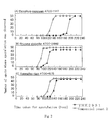
- the number of spots where sporulation was confirmed at each observation with respect to each of the molds is shown in Fig. 2.
Landscapes
- Life Sciences & Earth Sciences (AREA)
- Engineering & Computer Science (AREA)
- Mycology (AREA)
- Health & Medical Sciences (AREA)
- Chemical & Material Sciences (AREA)
- Bioinformatics & Cheminformatics (AREA)
- Genetics & Genomics (AREA)
- Organic Chemistry (AREA)
- Zoology (AREA)
- Wood Science & Technology (AREA)
- Biotechnology (AREA)
- Microbiology (AREA)
- Botany (AREA)
- Biomedical Technology (AREA)
- Virology (AREA)
- Tropical Medicine & Parasitology (AREA)
- Biochemistry (AREA)
- General Engineering & Computer Science (AREA)
- General Health & Medical Sciences (AREA)
- Medicinal Chemistry (AREA)
- Food Science & Technology (AREA)
- Bakery Products And Manufacturing Methods Therefor (AREA)
- Micro-Organisms Or Cultivation Processes Thereof (AREA)
Abstract
Description
| Strain | Amount of carbon dioxide gas generated (ml/g of dough) | Volume expansion of dough (ml/g of dough) | Amount of carbon dioxide gas generated per ml of volume expansion (ml) |
| YHK1923 | 2.67 | 2.15 | 1.24 |
| YHK2766 | 2.94 | 2.15 | 1.37 |
| YFR-291 | 2.60 | 2.20 | 1.18 |
| Com. | 2.64 | 2.40 | 1.10 |
| Com. | 2.51 | 2.25 | 1.12 |
| Com. yeast 3 | 2.60 | 2.25 | 1.16 |
| Com. yeast 4 | 2.57 | 2.40 | 1.07 |
| Com. yeast 5 | 2.41 | 2.25 | 1.07 |
| Com. yeast 6 | 2.51 | 2.25 | 1.12 |
| Com. yeast 7 | 2.65 | 2.25 | 1.18 |
| Com. yeast 8 | 2.54 | 2.35 | 1.08 |
| Strain | Concentration of ethanol in dough (%(w/w)/g of dough) | Proofing time (minute) |
| YHK1923 | 1.47 | 58 |
| YFR-291 | 1.30 | 52 |
| | 1.34 | 58 |
As a result, two strains were obtained which generated, in dough containing 5% sugar, carbon dioxide gas in an amount of not less than 2.0 ml per g of the dough and not less than 1.20 ml per ml of volume expansion of the dough at 38°C in 60 minutes. One of the obtained strains was named YHK2931 strain and was deposited with International Patent Organism Depositary, National Institute of Advanced Industrial Science and Technology, Central 6, 1-1, Higashi 1-chome, Tsukuba-shi, Ibaraki 305-8566, Japan, on May 21, 2002 under the Budapest Treaty with accession No. FERM BP-8046.
| Strain | Amount of carbon dioxide gas generated (ml/g of dough) | Volume expansion of dough (ml/g of dough) | Amount of carbon dioxide gas generated per ml of volume expansion (ml) |
| YHK2931 | 3.20 | 2.25 | 1.42 |
| Com. | 2.62 | 2.25 | 1.16 |
| Strain | Concentration of ethanol in dough (%(w/w)/g of dough) | Proofing time (minute) |
| YHK2931 | 1.88 | 49 |
| | 1.41 | 58 |
Claims (14)
- Yeast belonging to the genus Saccharomyces, which generates, in dough containing 5% sugar, carbon dioxide gas in an amount of not less than 2.0 ml per g of the dough and not less than 1.20 ml per ml of volume expansion of the dough at 38°C in 60 minutes.
- The yeast according to Claim 1, wherein the yeast belongs to Saccharomyces cerevisiae.
- The yeast according to Claim 1 or 2, wherein the yeast is Saccharomyces cerevisiae YHK1923 (FERM BP-7901) or Saccharomyces cerevisiae YHK2931 (FERM BP-8046).
- Bread dough containing the yeast according to any of Claims 1 to 3.
- A process for making bread which comprises using the yeast according to any of Claims 1 to 3.
- A process for making bread which comprises using the bread dough according to Claim 4.
- Bread obtained by the process according to Claim 5 or 6.
- A method of screening for yeast which comprises selecting yeast which generates, in dough containing 5% sugar, carbon dioxide gas in an amount of not less than 2.0 ml per g of the dough and not less than 1.20 ml per ml of volume expansion of the dough at 38°C in 60 minutes.
- Yeast obtained by the method according to Claim 8.
- Bread dough containing the yeast according to Claim 9.
- A process for making bread which comprises using the yeast according to Claim 9.
- A process for making bread which comprises using the bread dough according to Claim 10.
- Bread obtained by the process according to Claim 11 or 12.
- The bread according to Claim 7 or 13, which has a high ethanol content.
Applications Claiming Priority (4)
| Application Number | Priority Date | Filing Date | Title |
|---|---|---|---|
| JP2002044331 | 2002-02-21 | ||
| JP2002044331 | 2002-02-21 | ||
| JP2002153853 | 2002-05-28 | ||
| JP2002153853 | 2002-05-28 |
Publications (2)
| Publication Number | Publication Date |
|---|---|
| EP1338647A2 true EP1338647A2 (en) | 2003-08-27 |
| EP1338647A3 EP1338647A3 (en) | 2003-09-17 |
Family
ID=27667550
Family Applications (1)
| Application Number | Title | Priority Date | Filing Date |
|---|---|---|---|
| EP03250954A Withdrawn EP1338647A3 (en) | 2002-02-21 | 2003-02-17 | Yeast used for making bread |
Country Status (5)
| Country | Link |
|---|---|
| US (1) | US7198810B2 (en) |
| EP (1) | EP1338647A3 (en) |
| KR (1) | KR20030069845A (en) |
| CN (1) | CN100572523C (en) |
| AU (1) | AU2003200589A1 (en) |
Cited By (2)
| Publication number | Priority date | Publication date | Assignee | Title |
|---|---|---|---|---|
| EP1498477A1 (en) * | 2003-07-18 | 2005-01-19 | B.F.L. Bakery Future Lines S.r.l. | New active yeast in dry granular or powder form obtained through treatment of a mixture of known yeasts and its use in a pre-packed long-life preparation to be completed with the addition of water |
| WO2018015660A1 (en) * | 2016-07-20 | 2018-01-25 | Lesaffre Et Compagnie | Enhanced bread-making yeasts |
Families Citing this family (3)
| Publication number | Priority date | Publication date | Assignee | Title |
|---|---|---|---|---|
| CN101980612B (en) | 2008-01-28 | 2015-05-13 | 拉曼公司 | A method for extending mold-free shelf life and improving flavor characteristics of baked goods |
| CN106399137B (en) * | 2016-12-05 | 2019-07-02 | 江南大学 | A strain of Saccharomyces cerevisiae and its application |
| FR3103354B1 (en) | 2019-11-26 | 2022-11-18 | Lesaffre & Cie | Process for preserving cooked bakery products |
Family Cites Families (7)
| Publication number | Priority date | Publication date | Assignee | Title |
|---|---|---|---|---|
| EP0588426B1 (en) * | 1992-09-17 | 2000-12-27 | Dsm N.V. | Yeast derivative to improve bread quality |
| US5997914A (en) * | 1994-02-09 | 1999-12-07 | Kyowa Hakko Kogo Co., Ltd. | Process for making bread |
| AU682236B2 (en) * | 1994-03-16 | 1997-09-25 | Societe Des Produits Nestle S.A. | Low-temperature inactive industrial baker's yeast |
| CA2211685A1 (en) * | 1995-12-28 | 1997-07-10 | Kyowa Hakko Kogyo Co., Ltd. | Novel yeast gene |
| JP4357007B2 (en) * | 1997-01-09 | 2009-11-04 | 株式会社カネカ | Novel yeast and dough containing the yeast |
| JP2001321160A (en) * | 2000-05-12 | 2001-11-20 | Kyowa Hakko Kogyo Co Ltd | Bread making method |
| US6660311B2 (en) * | 2001-06-08 | 2003-12-09 | The Pillsbury Company | Pre-proofed freezer-to-oven dough compositions, and methods |
-
2003
- 2003-02-17 EP EP03250954A patent/EP1338647A3/en not_active Withdrawn
- 2003-02-19 KR KR10-2003-0010315A patent/KR20030069845A/en not_active Withdrawn
- 2003-02-20 AU AU2003200589A patent/AU2003200589A1/en not_active Abandoned
- 2003-02-21 US US10/369,715 patent/US7198810B2/en not_active Expired - Fee Related
- 2003-02-21 CN CNB031054501A patent/CN100572523C/en not_active Expired - Fee Related
Cited By (3)
| Publication number | Priority date | Publication date | Assignee | Title |
|---|---|---|---|---|
| EP1498477A1 (en) * | 2003-07-18 | 2005-01-19 | B.F.L. Bakery Future Lines S.r.l. | New active yeast in dry granular or powder form obtained through treatment of a mixture of known yeasts and its use in a pre-packed long-life preparation to be completed with the addition of water |
| WO2018015660A1 (en) * | 2016-07-20 | 2018-01-25 | Lesaffre Et Compagnie | Enhanced bread-making yeasts |
| FR3054242A1 (en) * | 2016-07-20 | 2018-01-26 | Lesaffre Et Compagnie | OPTIMIZED BREADING YEASTS |
Also Published As
| Publication number | Publication date |
|---|---|
| KR20030069845A (en) | 2003-08-27 |
| CN1439712A (en) | 2003-09-03 |
| US7198810B2 (en) | 2007-04-03 |
| EP1338647A3 (en) | 2003-09-17 |
| CN100572523C (en) | 2009-12-23 |
| US20030161911A1 (en) | 2003-08-28 |
| AU2003200589A1 (en) | 2003-09-04 |
Similar Documents
| Publication | Publication Date | Title |
|---|---|---|
| EP1541671B1 (en) | Novel baker's yeast strains and bread using the same | |
| JP3305529B2 (en) | How to choose baker's yeast | |
| EP0667099B1 (en) | Baking process | |
| US10015972B2 (en) | Breadmaking yeast strains which are effective on non-sweetened or slightly sweetened doughs | |
| US7198810B2 (en) | Yeast | |
| JP4578059B2 (en) | New yeast | |
| US20010055634A1 (en) | Process for producing bread | |
| CA1306960C (en) | Yeast strains, method of production and use in baking | |
| US5801049A (en) | Freeze-resistant baker's yeast strain having sugar resistance | |
| HK1058688A (en) | Yeast used for making bread | |
| US5997914A (en) | Process for making bread | |
| US6077550A (en) | Process for making bread | |
| Gardner et al. | Effect of yeast extracts containing propionic acid on bread dough fermentation and bread properties | |
| EP0744127B1 (en) | Method of manufacturing bread | |
| JP2013172739A (en) | Bread yeast | |
| CA2153559C (en) | Freeze-resistant baker's yeast having sugar resistance | |
| US6905869B2 (en) | Method for introducing recessive properties into the genetic background of industrial baker's yeast | |
| CA2146245C (en) | Process for making bread | |
| US5543161A (en) | Yeast strain | |
| AU682019B2 (en) | Novel yeast strains | |
| JP3266708B2 (en) | Manufacturing method of fat and oil folded bread | |
| JP3821507B2 (en) | Baker's yeast | |
| JP3006886B2 (en) | Bread making method | |
| HK1074220B (en) | Novel baker's yeast strains and bread using the same | |
| JP2001078655A (en) | Bread recipe |
Legal Events
| Date | Code | Title | Description |
|---|---|---|---|
| PUAI | Public reference made under article 153(3) epc to a published international application that has entered the european phase |
Free format text: ORIGINAL CODE: 0009012 |
|
| PUAL | Search report despatched |
Free format text: ORIGINAL CODE: 0009013 |
|
| AK | Designated contracting states |
Designated state(s): AT BE BG CH CY CZ DE DK EE ES FI FR GB GR HU IE IT LI LU MC NL PT SE SI SK TR |
|
| AX | Request for extension of the european patent |
Extension state: AL LT LV MK RO |
|
| AK | Designated contracting states |
Kind code of ref document: A3 Designated state(s): AT BE BG CH CY CZ DE DK EE ES FI FR GB GR HU IE IT LI LU MC NL PT SE SI SK TR |
|
| AX | Request for extension of the european patent |
Extension state: AL LT LV MK RO |
|
| 17P | Request for examination filed |
Effective date: 20040315 |
|
| REG | Reference to a national code |
Ref country code: HK Ref legal event code: DE Ref document number: 1058688 Country of ref document: HK |
|
| AKX | Designation fees paid |
Designated state(s): AT BE BG CH CY CZ DE DK EE ES FI FR GB GR HU IE IT LI LU MC NL PT SE SI SK TR |
|
| RAP1 | Party data changed (applicant data changed or rights of an application transferred) |
Owner name: KYOWA HAKKO FOOD SPECIALTIES CO., LTD. |
|
| STAA | Information on the status of an ep patent application or granted ep patent |
Free format text: STATUS: THE APPLICATION HAS BEEN WITHDRAWN |
|
| 18W | Application withdrawn |
Effective date: 20071129 |
|
| REG | Reference to a national code |
Ref country code: HK Ref legal event code: WD Ref document number: 1058688 Country of ref document: HK |