EP1336611A1 - Dehalogeno compounds - Google Patents
Dehalogeno compounds Download PDFInfo
- Publication number
- EP1336611A1 EP1336611A1 EP01996540A EP01996540A EP1336611A1 EP 1336611 A1 EP1336611 A1 EP 1336611A1 EP 01996540 A EP01996540 A EP 01996540A EP 01996540 A EP01996540 A EP 01996540A EP 1336611 A1 EP1336611 A1 EP 1336611A1
- Authority
- EP
- European Patent Office
- Prior art keywords
- group
- salts
- hydrates
- cyclopropyl
- carbon atoms
- Prior art date
- Legal status (The legal status is an assumption and is not a legal conclusion. Google has not performed a legal analysis and makes no representation as to the accuracy of the status listed.)
- Granted
Links
- 0 CC(CNC1=C2N)*1c(nc(C)c(I)c1*)c1C2=O Chemical compound CC(CNC1=C2N)*1c(nc(C)c(I)c1*)c1C2=O 0.000 description 5
- MLGPNGAFFNCPIR-LNYGYJLXSA-N CCNC1(CC1)[C@H](CC1)CN1c(c(C)c1C(CCC=C2C(O)=O)[C@H](C3)[C@H]3F)ccc1C2=O Chemical compound CCNC1(CC1)[C@H](CC1)CN1c(c(C)c1C(CCC=C2C(O)=O)[C@H](C3)[C@H]3F)ccc1C2=O MLGPNGAFFNCPIR-LNYGYJLXSA-N 0.000 description 1
- JGQJHYWIXBPRDH-POMWDINJSA-N CNC1(CC1)[C@H](CC1)CN1c(ccc1c2N(C(C3C4)C3F)C=C(C(O)=O)C1=O)c2C4=O Chemical compound CNC1(CC1)[C@H](CC1)CN1c(ccc1c2N(C(C3C4)C3F)C=C(C(O)=O)C1=O)c2C4=O JGQJHYWIXBPRDH-POMWDINJSA-N 0.000 description 1
- CHJBKIBZQUTECQ-AIMZMQLPSA-N Cc(c(N(CC1)C[C@@H]1C1(CC1)N)ccc12)c1N(C(C1)[C@H]1F)C=C(C(O)=O)C2=O Chemical compound Cc(c(N(CC1)C[C@@H]1C1(CC1)N)ccc12)c1N(C(C1)[C@H]1F)C=C(C(O)=O)C2=O CHJBKIBZQUTECQ-AIMZMQLPSA-N 0.000 description 1
- NYPJKEVOUFNOGB-VJCHLYOQSA-N NC1(CC1)[C@H](CC1)CN1c(c(Cl)c1N(C(C2)[C@H]2F)C=C2C(O)=O)ccc1C2=O Chemical compound NC1(CC1)[C@H](CC1)CN1c(c(Cl)c1N(C(C2)[C@H]2F)C=C2C(O)=O)ccc1C2=O NYPJKEVOUFNOGB-VJCHLYOQSA-N 0.000 description 1
Classifications
-
- C—CHEMISTRY; METALLURGY
- C07—ORGANIC CHEMISTRY
- C07D—HETEROCYCLIC COMPOUNDS
- C07D401/00—Heterocyclic compounds containing two or more hetero rings, having nitrogen atoms as the only ring hetero atoms, at least one ring being a six-membered ring with only one nitrogen atom
- C07D401/02—Heterocyclic compounds containing two or more hetero rings, having nitrogen atoms as the only ring hetero atoms, at least one ring being a six-membered ring with only one nitrogen atom containing two hetero rings
- C07D401/04—Heterocyclic compounds containing two or more hetero rings, having nitrogen atoms as the only ring hetero atoms, at least one ring being a six-membered ring with only one nitrogen atom containing two hetero rings directly linked by a ring-member-to-ring-member bond
-
- A—HUMAN NECESSITIES
- A61—MEDICAL OR VETERINARY SCIENCE; HYGIENE
- A61P—SPECIFIC THERAPEUTIC ACTIVITY OF CHEMICAL COMPOUNDS OR MEDICINAL PREPARATIONS
- A61P31/00—Antiinfectives, i.e. antibiotics, antiseptics, chemotherapeutics
-
- A—HUMAN NECESSITIES
- A61—MEDICAL OR VETERINARY SCIENCE; HYGIENE
- A61P—SPECIFIC THERAPEUTIC ACTIVITY OF CHEMICAL COMPOUNDS OR MEDICINAL PREPARATIONS
- A61P31/00—Antiinfectives, i.e. antibiotics, antiseptics, chemotherapeutics
- A61P31/04—Antibacterial agents
-
- C—CHEMISTRY; METALLURGY
- C07—ORGANIC CHEMISTRY
- C07D—HETEROCYCLIC COMPOUNDS
- C07D471/00—Heterocyclic compounds containing nitrogen atoms as the only ring hetero atoms in the condensed system, at least one ring being a six-membered ring with one nitrogen atom, not provided for by groups C07D451/00 - C07D463/00
- C07D471/02—Heterocyclic compounds containing nitrogen atoms as the only ring hetero atoms in the condensed system, at least one ring being a six-membered ring with one nitrogen atom, not provided for by groups C07D451/00 - C07D463/00 in which the condensed system contains two hetero rings
- C07D471/04—Ortho-condensed systems
Definitions
- This invention relates to a synthetic quinolone antibacterial agent which is useful as medicaments, veterinary drugs, drugs for fishery use, or antibacterial preservatives.
- Quinolone derivatives having a pyrrolidinyl group having an aminomethyl group at the 3-position, as the substituent at the 7-position of the quinolone mother skeleton, are known to exhibit strong antibacterial activity against gram-negative and gram-positive bacteria.
- there are 7-[3-(1-aminomethyl)pyrrolidin-1-yl]quinolone carboxylic acid derivatives [Journal of Medicinal Chemistry, vol. 29, p. 445 (1986)].
- quinolone carboxylic acid derivatives having a substituent on the carbon atom of the aminomethyl group of the 3-(1-aminomethyl)pyrrolidin-1-yl group include 7-[3-(1-aminoethyl)pyrrolidin-1-yl]quinolone carboxylic acid derivatives [Journal of Medicinal Chemistry, vol. 36, p. 871 (1993)]; 7-[3-(1-amino-1-methylethyl)pyrrolidin-1-yl]quinolone carboxylic acid derivatives [Journal of Medicinal Chemistry, vol. 37, p.
- quinolone carboxylic acid derivatives which have a 3-(1-aminocycloalkyl)pyrrolidin-1-yl group as a substituent and are relevant to the present invention, have been described in the form of a broad concept in PCT/JP96/00208, which provides a description of compounds with the structure shown in formula A or formula B. That is, with a quinolone compound of formula A, the substituent (X 1 ) at the 6-position is defined as being a halogen atom or a hydrogen atom.
- the substituent (X 1 ) at the 6-position is defined as being a halogen atom or a hydrogen atom.
- quinolone carboxylic acids wherein the fluorine atom or other halogen atom is the substituent at the 6-position are disclosed specifically in the abovementioned patent application.
- PCT/JP96/00208 does not provide a specific description concerning quinolone carboxylic acids wherein hydrogen is substituted at the 6-position. Furthermore, this publication does not provide any specific disclosure as embodiments of 3-(1-aminocycloalkyl)pyrrolidinyl- substituted-6-hydrogen-substituted-quinolone carboxylic acids, wherein the present invention is concerned.
- X 1 represents a halogen atom or a hydrogen atom and X 2 represents a halogen atom.
- X 1 represents a halogen atom or a hydrogen atom
- X 2 represents a halogen atom.
- R 2 is represented by formula B:
- PCT/WO99/14214 indicates a 6-hydrogen-substituted-quinolone carboxylic acid derivative, in which a nitrogen-containing heterocyclic substituent, for example, the 3-(1-aminoethyl)pyrrolidin-1-yl group, is introduced via a carbon-nitrogen bond into the 7-position of the quinolone skeleton and which is relevant to this invention.
- a nitrogen-containing heterocyclic substituent for example, the 3-(1-aminoethyl)pyrrolidin-1-yl group
- This application describes compounds represented by the formulas C and D. However, this application does not contain any description whatsoever concerning a 3-(1-aminocycloalkyl)pyrrolidin-1-yl group, which is relevant to the present invention, as a substituent at the 7-position of the quinolone skeleton shown in formula C.
- R1 represents a cyclic alkyl group having 3 to 6 carbon atoms, an alkyl group having 1 or 2 carbon atoms, a straight-chain alkenyl group having 2 to 3 carbon atoms, or a branched-chain alkyl group or alkenyl group having 3 to 4 carbon atoms, this alkyl group or cyclic alkyl group may be unsubstituted or the alkyl group or cyclic alkyl group may be substituted by 1 to 3 fluorine atoms or by a phenyl group which is unsubstituted or is substituted by 1 to 3 fluorine atoms or is substituted at the 4-position by a single hydroxyl group
- R6 represents a hydrogen atom, a hydroxyl group, an aminocarbonyl group, a bromine atom, a cyano group, an alkyl group having 1 or 2 carbon atoms, or an alkenyl group or alkynyl group having 2 to 4 carbon
- R7 represents an amino group, which is bonded to a carbon that is not adjacent the nitrogen atom of the pyrrolidine ring and may be unsubstituted or substituted by one or two alkyl groups with 1 to 3 carbon atoms, or an aminoalkyl group, which is bonded to a carbon on the pyrrolidine ring and may be unsubstituted or substituted by an alkyl group having 1 to 3 carbon atoms
- R9 represents a group selected from among the group comprised of a hydrogen atom, an alkyl group having 1 to 4 carbon atoms, an alkenyl group and alkynyl group having 2 to 6 carbon atoms, and fused and spiroalkyl group having 3 to 6 carbon atoms, the alkyl group portions of these groups may be unsubstituted or substituted by 1 to 3 fluorine atoms, and the abovementioned substituents R7 and R9 may be integrated to form a fused or spiro
- the compounds of this invention are excellent both in terms of safety and pharmacokinetics and thus enable use in clinical situations, which could not be achieved with compounds prior to this invention which have substituents of the same structure at the 7-position of the quinolone mother skeleton.
- the present invention has been achieved based on these findings.
- a comparison of the 6-hydrogen-substituted-quinolone carboxylic acid derivatives represented by formula (I), its salts and hydrates thereof according to the present invention with quinolone compounds wherein the hydrogen at the 6-position of a compound of this invention is substituted by a fluorine atom shows that both types of compounds exhibit excellent antibacterial activity upon a broad range of both gram-negative bacteria and gram-positive bacteria, including drug-resistant bacteria.
- the 6-hydrogen-substituted-quinolone derivatives which are the compounds of this invention, are compounds that, in comparison to the 6-fluorine-substituted-quinolone derivatives, are compounds of excellent safety that are reduced in acute toxicity and significantly reduced in micronuclus induction, and also exhibit good pharmacokinetics, such as improved urinary recovery, etc.
- a quinolone compound which has a 3-(1-aminocycloalkyl)pyrrolidin-1-yl group having a cyclic alkyl group as a substituent on the methyl group of the 3-(aminomethyl)pyrrolidin-1-yl group and which as has been mentioned above is known to be low in selective toxicity, will unexpectedly be a compound with excellent selective toxicity and be a compound of excellent pharmacokinetics as long as it is a quinolone compound with the structure of the present invention.
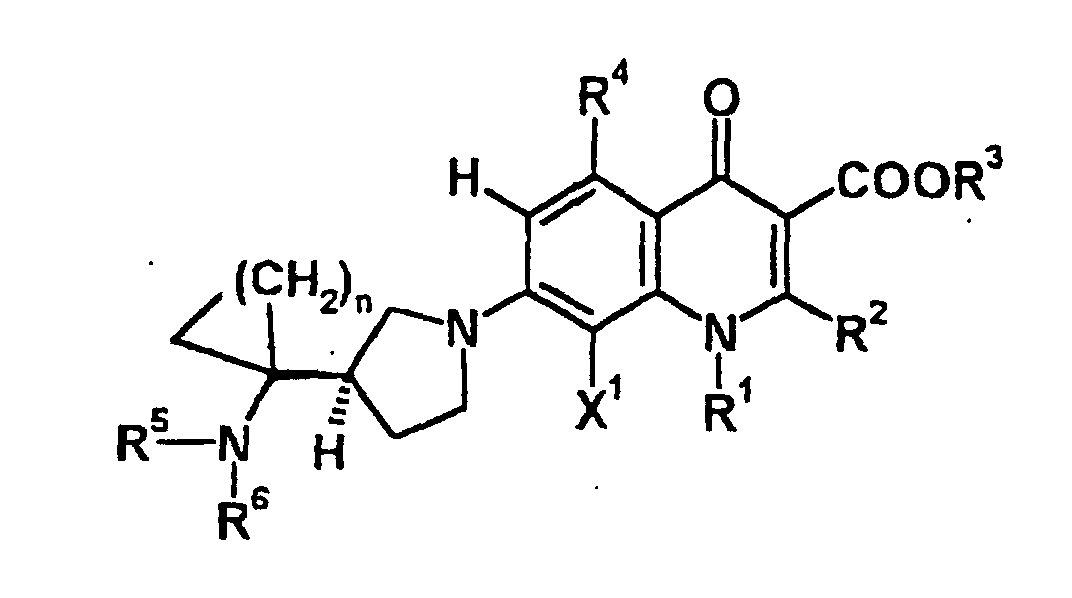
- the present invention concerns compounds represented by the following general formula (I), its salts, and hydrates thereof:
- R 1 represents an alkyl group having 1 to 6 carbon atoms, an alkenyl group having 2 to 6 carbon atoms, a halogenoalkyl group having 1 to 6 carbon atoms, a cyclic alkyl group having 3 to 6 carbon atoms, which may have a substituent, an aryl group, which may have a substituent, a heteroaryl group, which may have a substituent, an alkoxy group having 1 to 6 carbon atoms, or an alkylamino group having 1 to 6 carbon atoms;
- R 2 represents an alkylthio group having 1 to 6 carbon atoms or a hydrogen atom, wherein R 2 and the abovementioned R 1 may be integrated to form a ring structure by incorporating a part of the mother skeleton, the thus formed ring may contain a sulfur atom as a ring-constituent atom, and
- the present invention also relates to each of the following:
- the substituent R 1 is an alkyl group having 1 to 6 carbon atoms, an alkenyl group having 2 to 6 carbon atoms, a halogenoalkyl group having 1 to 6 carbon atoms, a cyclic alkyl group having 3 to 6 carbon atoms, which may have a substituent, an aryl group, which may have a substituent, a heteroaryl group, which may have a substituent, an alkoxy group having 1 to 6 carbon atoms, or an alkylamino group having 1 to 6 carbon atoms.
- an alkyl group having 1 to 6 carbon atoms may be a straight-chain or branched-chain alkyl group, preferably an alkyl group having 1 to 4 carbon atoms, more preferably an ethyl group.
- an alkenyl group having 2 to 6 carbon atoms a vinyl group or a 1-isopropenyl group is preferable.
- a halogenoalkyl group having 1 to 6 carbon atoms a 2-fluoroethyl group is preferable.
- a cyclic alkyl group a cyclopropyl group is especially preferable.
- the cyclic alkyl group may have a substituent, and a halogen atom is preferable as the substituent.
- a halogenocyclopropyl group is preferable as the cyclic alkyl group, which may have a substituent, and a fluorine atom is especially preferable as the halogen atom in this group.
- a halogenocyclopropyl group a monohalogenocyclopropyl group is preferable and a cis-substituted group is even more preferable.
- Examples of an aryl group, which may have a substituent include a phenyl group, etc., which may have 1 to 3 substituents selected from the group consisting of an alkyl group having 1 to 6 carbon atoms, an alkoxy group having 1 to 6 carbon atoms, a halogen atom such as fluorine atom, chlorine atom and bromine atom, a hydroxyl group, an amino group, a nitro group, etc. (in the case where the aryl group has a plurality of substituents, the substituents may be of a single type or may be of a plurality of types).
- a phenyl group, a 2-fluorophenyl group, a 4-fluorophenyl group, a 2,4-difluorophenyl group, a 2-fluoro-4-hydroxyphenyl group, a 3-amino-4,6-difluorophenyl group, and a 4,6-difluoro-3-methylaminophenyl group are preferable.
- aryl group a group that is derived from an aromatic hydrocarbon compound is referred to.
- the aryl group may also be a naphthyl group or a tricyclic aryl group having more rings.
- a heteroaryl group is a group that is derived from a pentacyclic or hexacyclic aromatic heterocyclic compound that contains one or more heteroatoms selected from among the nitrogen atom, oxygen atom, and sulfur atom.
- a pentacyclic or hexacyclic nitrogen-containing heterocyclic substituent that contains 1 or 2 nitrogen atoms is especially preferable.
- a pyridyl group, pyrimidyl group, etc are cired.
- An alkyl group, a halogen atom, etc. are preferable as substituents on these rings.
- a 6-amino-3,5-difluoro-2-pyridyl group is especially preferable.
- an alkoxy group having 1 to 6 carbon atoms an alkoxy group that is derived from an abovementioned alkyl group is preferable and among these, the methoxy group is preferable.
- the alkyl portion may be an abovementioned alkyl group.
- a methylamino group is preferable as the alkylamino group.
- a cyclic alkyl group or a halogenocycloalkyl group is preferable.
- a cyclopropyl group or a 2-halogenocyclopropyl group is preferable.
- a halogen atom in the 2-halogenocyclopropyl group a fluorine atom is preferable.
- the substituent R 2 represents an alkylthio group having 1 to 6 carbon atoms or a hydrogen atom
- R 1 and R 2 may be integrated to form a ring structure comprised of a polymethylene chain by incorporating a part of the mother skeleton (that is, so as to contain the nitrogen atom to which R 1 is bonded and the carbon atom to which R 2 is bonded).
- the thus formed ring may contain a sulfur atom as a ring constituent atom, and this ring may also have an alkyl group or halogenoalkyl group having 1 to 6 carbon atoms as a substituent.
- the formed ring may be tetracyclic to hexacyclic in size and this ring may be also saturated or unsaturated.
- Amethyl group or a fluoromethyl group is preferable as the substituent on the formed ring.
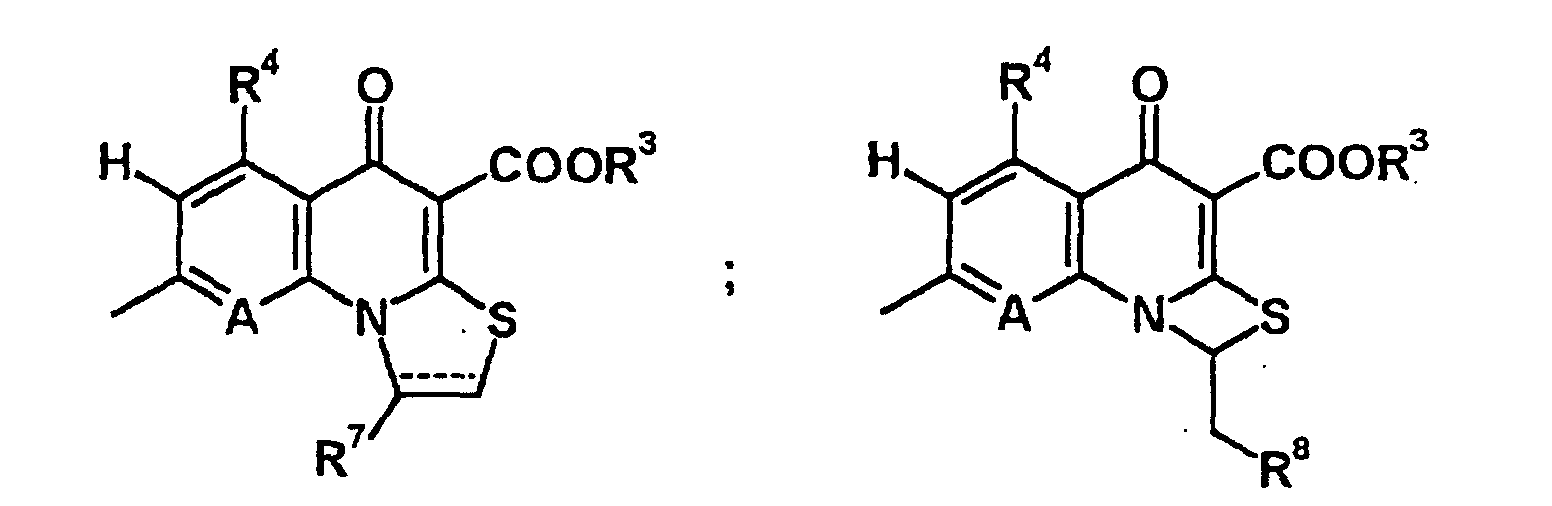
- the fused ring structure formed in this manner include the following: (In the above formula, R 7 represents an alkyl group having 1 to 6 carbon atoms, such as a methyl group, a halogenoalkyl group having 1 to 6 carbon atoms, such as a fluoromethyl group, or a hydrogen atom, and R 8 represents a halogen atom, such as a fluorine atom, or a hydrogen atom.)
- a hydrogen atom is preferable as the substituent R 2 of the compound of formula (I).
- the substituent R 3 is a phenylalkyl group (aralkyl group) composed of an alkylene group having 1 to 6 carbon atoms and a phenyl group, or an alkyl group having 1 to 6 carbon atoms, an alkoxymethyl group having 2 to 7 carbon atoms, a hydrogen atom, a phenyl group, an acetoxymethyl group, apivaloyloxymethyl group, an ethoxycarbonyl group, a choline group, a dimethylaminoethyl group, a 5-indanyl group, a phthalidinyl group, a 5-alkyl-2-oxo-1,3-dioxole-4-ylmethyl group, or a 3-acetoxy-2-oxobutyl group.
- aralkyl group composed of an alkylene group having 1 to 6 carbon atoms and a phenyl group, or an alkyl group having 1 to 6 carbon atoms, an alkoxy
- a compound of this invention is to be used for antibacterial purposes, it is preferable to use a carboxylic acid compound wherein R 3 is a hydrogen atom.
- a quinolone derivative wherein the carboxylic acid moiety has been made an ester is useful as a synthesis intermediate or as a prodrug.
- R 4 represents an alkyl group having 1 to 6 carbon atoms, an alkenyl group having 2 to 6 carbon atoms, an alkynyl group having 2 to 6 carbon atoms, an alkoxy group having 1 to 6 carbon atoms, a hydrogen atom, an amino group, a hydroxyl group, a thiol group, or an halogenomethyl group, and among the above, the amino group may have one ore more substituents selected from the group consisting of an alkyl group having 1 to 6 carbon atoms, an acyl group having 2 to 5 carbon atoms, and a formyl group. In the case where there are a plurality of substituent groups, the substituents may all be of the same type or may be of a plurality of different types.
- alkyl group which may either be a straight-chain or branched-chain group having 1 to 6 carbon atoms, a methyl group, an ethyl group, a normal propyl group, or an isopropyl group is preferable.
- alkenyl group which may either be a straight-chain or branched-chain group having 2 to 6 carbon atoms
- vinyl group is preferable.
- alkynyl group which may be a straight-chain or branched-chain group having 2 to 6 carbon atoms
- an ethynyl group is preferable.
- the halogen of a halogenomethyl group a fluorine atom is especially preferable and the number thereof may be 1 to 3.
- alkoxy group which may have 1 to 6 carbon atoms, a methoxy group is preferable.
- the substituent R 4 is preferably a hydrogen atom, an alkyl group, or an amino group, and among these, a hydrogen atom, a methyl group, or unsubstituted amino group (-NH 2 ) is especially preferable.
- R 4 is an amino group, a hydroxyl group, or a thiol group, it may be protected by a protective group that is normally used in the relevant fields.
- protective groups include (substituted) alkoxycarbonyl groups, such as tert-butoxycarbonyl group, 2,2,2-trichloroethoxycarbonyl group, etc.; (substituted) aralkyloxycarbonyl groups, such as benzyloxycarbonyl group, paramethoxybenzyloxycarbonyl group, paranitrobenzyloxycarbonyl group, etc.; (substituted) acyl groups, such as acetyl group, methoxyacetyl group, trifluoroacetyl group, chloroacetyl group, pivaloyl group, formyl group, benzoyl group, etc.; (substituted) alkyl groups or (substituted) aralkyl groups, such as tert-butyl group, benzyl group, paranitrobenzyl group, paramethoxybenzyl group, triphenylmethyl group, etc.; (substituted)
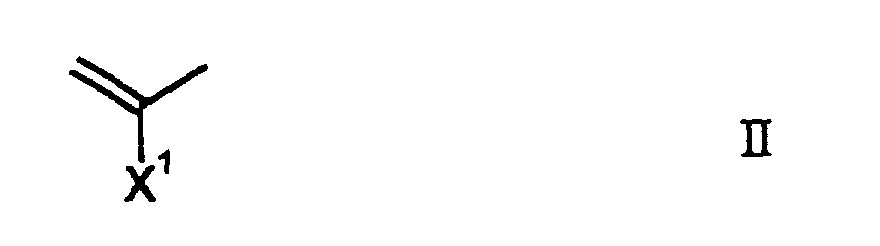
- A represents a nitrogen atom or a partial structure expressed by formula (II):
- X 1 represents an alkyl group having 1 to 6 carbon atoms, an alkenyl group having 2 to 6 carbon atoms, an alkynyl group having 2 to 6 carbon atoms, an alkoxy group having 1 to 6 carbon atoms, a hydrogen atom, an amino group, a halogen atom, a cyano group, a halogenomethyl group, or a halogenomethoxy group, and among the above, the amino group may have one ore more substituents selected from the group consisting of an alkyl group having 1 to 6 carbon atoms, an acyl group having 2 to 5 carbon atoms, and a formyl group.
- halogen atom a fluorine atom, a chlorine atom, and a bromine atom are preferable and the fluorine atom and chlorine atom are especially preferable.
- alkyl group which may be a straight-chain or branched-chain group having 1 to 6 carbon atoms, a methyl group, an ethyl group, a normal propyl group, or an isopropyl group is preferable.
- alkenyl group which may either be a straight-chain or branched-chain group having 2 to 6 carbon atoms, a vinyl group is preferable.
- an alkynyl group which may be a straight-chain or branched-chain group having 2 to 6 carbon atoms
- an ethynyl group is preferable.
- a fluorine atom is especially preferable and the number thereof may be 1 to 3.
- an alkoxy group which may have 1 to 6 carbon atoms
- a methoxy group is preferable.
- a fluorine atom is especially preferable and the number thereof may be 1 to 3.
- an alkyl group or an alkoxy group is preferable.
- a methyl group, an ethyl group, a methoxy group, or a difluoromethoxy group is especially preferable.
- this X 1 and the abovementioned R 1 may be integrated to form a ring structure comprised of a polymethylene ring by incorporating a part of the mother skeleton (so as to contain the carbon atom to which X 1 is bonded and the nitrogen atom to which R 1 is bonded).
- the thus formed ring may contain an oxygen atom, a nitrogen atom, or a sulfur atom as a ring constituent atom, and this ring may also have as a substituent an alkyl group having 1 to 6 carbon atoms, which may have a substituent in turn.
- the formed ring may be pentacyclic to heptacyclic in size and the ring constituent atoms are not limited to a carbon atom and may include an oxygen atom, a nitrogen atom, or a sulfur atom. Further, this ring may be saturated or unsaturated.
- the thus formed ring may have an alkyl group having 1 to 6 carbon atoms as a substituent. This alkyl group may be considered to be the same as the above-described alkyl group and is preferably a methyl group. This alkyl group may be substituted by a halogen atom, an alkoxy group, etc.
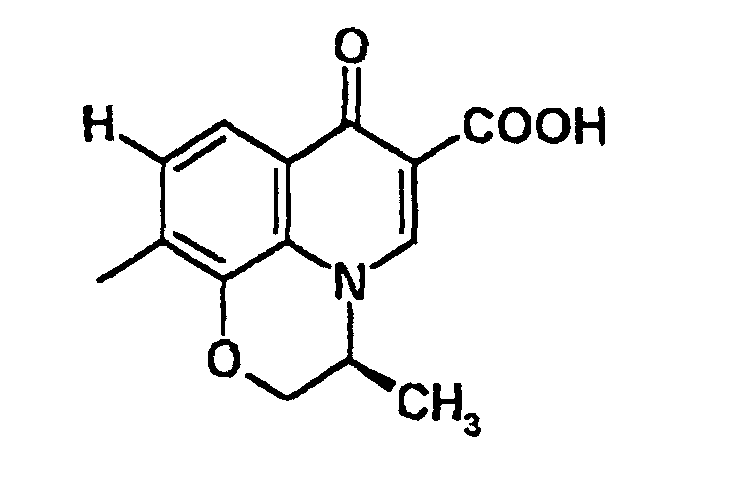
- a structure of the following formula: -O-CH 2 -CH (-CH 3 ) - is preferable (the right end of the above is bonded to a nitrogen atom), and especially, the quinolone skeleton of the following structure is preferable:
- R 4 and X 1 are those in which R 4 is an alkyl group having 1 to 6 carbon atoms, an amino group, a hydrogen atom, or a hydroxyl group and X 1 is an alkyl group having 1 to 6 carbon atoms, an alkoxy group 1 to 6 carbon atoms, a halogenomethoxy group, or a hydrogen atom.
- R 4 is an amino group, a hydrogen atom, a hydroxyl group, or a methyl group and X 1 is a methyl group, a methoxy group, a difluoromethoxy group, or a hydrogen atom.
- R 4 is a hydrogen atom, a hydroxyl group, or a methyl group and X 1 is a methyl group or a methoxy group.
- Each of substituent R 5 and R 6 independently represents an alkyl group having 1 to 6 carbon atoms, a hydrogen atom, or a substituted carboxyl group derived from an amino acid, a dipeptide, or a tripeptide.
- This alkyl group may have one ore more substituents selected from the group consisting of an alkylthio group having 1 to 6 carbon atoms, an alkoxy group having 1 to 6 carbon atoms, a hydroxyl group, and a halogen atom.
- alkyl group which may either be a straight-chain or branched-chain group having 1 to 6 carbon atoms, a methyl group, an ethyl group, a normal propyl group, or an isopropyl group is preferable.
- the alkyl group may be a straight-chain or branched-chain group having 1 to 6 carbon atoms, and the hydroxyl group is more preferably substituted on the terminal carbon atom of the alkyl group.
- the alkyl group having a hydroxyl group those with up to 3 carbon atoms is preferable and a hydroxymethyl group, a 2-hydroxyethyl group, a 2-hydroxypropyl group, a 3-hydroxypropyl group, etc. are preferable.
- the alkyl group may be a straight-chain or branched-chain group having 1 to 6 carbon atoms, and the halogen atom is preferably a fluorine atom.
- the number of fluorine atoms may correspond to a mono-substituted condition to a perfluoro-substituted condition. Examples thereof include a monofluoromethyl group, a difluoromethyl group, a trifluoromethyl group, a 2,2,2-trifluoroethyl group, etc.
- the alkyl group may be a straight-chain or branched-chain group having 1 to 6 carbon atoms, and the alkylthio group may also be a straight-chain or branched-chain group having 1 to 6 carbon atoms.
- an alkyl group having an alkylthio group an alkylthiomethyl group, an alkylthioethyl group, or an alkylthiopropyl group is preferable and it is more preferable for the alkylthio group to be a group having 1 to 3 carbon atoms as well. More preferable examples thereof include a methylthiomethyl group, an ethylthioethyl group, and a methylthioethyl group.
- the alkyl group may be a straight-chain or branched-chain group having 1 to 6 carbon atoms, and the alkoxy group may also be straight-chain or branched-chain group having 1 to 6 carbon atoms.
- an alkyl group having an alkoxy group an alkoxymethyl group, an alkoxyethyl group, or an alkoxypropyl group is preferable and it is more preferable for the alkoxy group to be a group having up to 3 carbon atoms as well. More preferable examples thereof include a methoxymethyl group, an ethoxymethyl group, and a methoxyethyl group.
- R 5 and R 6 are those in which one is a hydrogen atom and the other is a hydrogen atom, an alkyl group, or a substituted carboxyl group derived from an amino acid, a dipeptide, or a tripeptide.
- a combination in which one of either R 5 or R 6 is a hydrogen atom and the other is a hydrogen atom or an alkyl group is more preferable.
- an alkyl group a methyl group or an ethyl group is preferable and a methyl group is especially preferable.
- R 5 and R 6 are hydrogen atoms or a combination in which one of either R 5 or R 6 is a hydrogen atom and the other is a methyl group is especially preferable.
- a compound of this combination can especially express favorable physiological activity as an antibacterial agent.
- a quinolone derivative wherein one of either substituent R 5 or R 6 is a hydrogen atom and the other is a substituted carboxyl group derived from an amino acid, a dipeptide, or a tripeptide is especially useful as a prodrug. Specific examples regarding this shall be described below.
- the substituent halogen atom is preferably a fluorine atom or a chlorine atom and a fluorine atom is especially preferable.
- the halogen atom and the quinolone carboxylic acid moiety have cis-configuration on the cyclopropane ring.
- the cis-configuration substituent in this case may take the form of a 2-(S)-halogeno-1-(R)-cyclopropyl group or a 2-(R)-halogeno-1-(S)-cyclopropyl group, the former is preferable.
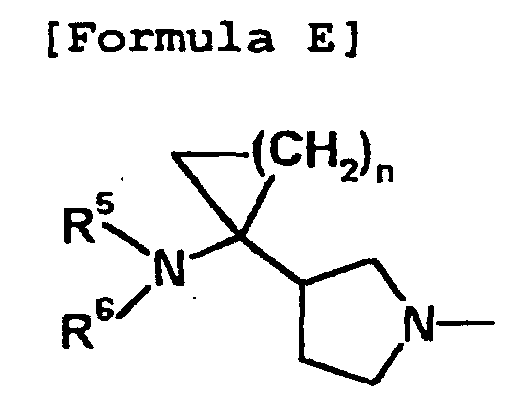
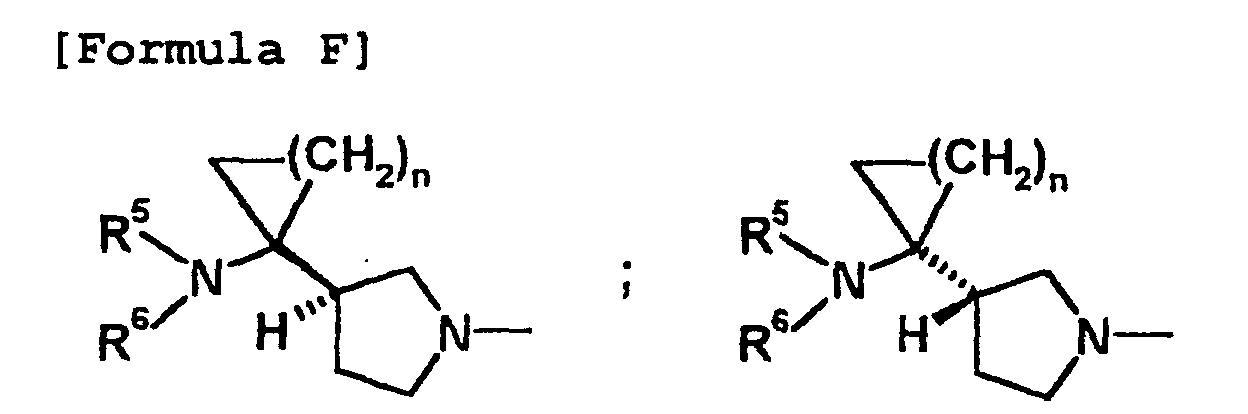
- a compound of this invention exhibits excellent characteristics when there is a substituent of the structure represented by the following formula E at the 7-position of a quinolone mother skeleton, in particular, a 1-[2-(S)-fluoro-1-(R)-cyclopropyl]-1,4-dihydro-4-oxoquinoline-3-carboxylic acid skeleton having a 2-(S)-halogeno-1-(R)-cyclopropyl group.
- a more preferable compound of the compounds of this invention has the structure represented by the following formula:
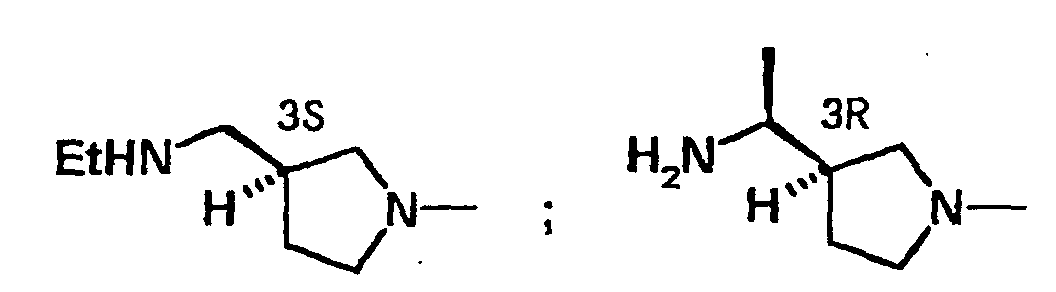
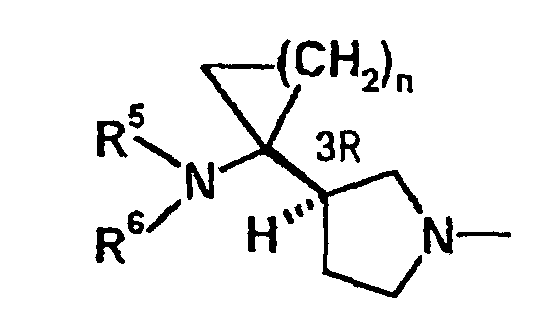
- 3-(1-aminocycloalkyl)pyrrolidinyl substituted-6-hydrogen-substituted-quinolone carboxylic acids represented by formula (I), its salts, and hydrates thereof (especially compounds having the structure where the 3-position of the above pyrrolidine ring is R-configuration, its salts, and hydrates thereof) exhibit potent antibacterial activity against a wide range of gram-negative bacteria and gram-positive bacteria
- a characteristic of these compounds of this invention is that they exhibit potent antibacterial activity against resistant bacteria as represented by gram-positive cocci, including MRSA, PRSP, and VRE.
- the characteristics of the compounds of this invention are that they exhibit excellent safety and good pharmacokinetics that enable the compounds to be used in clinical situations, which could not be achieved with compounds prior to this invention even if they had substituents of the same structures.
- Such excellent properties of the compounds of this invention are exhibited by compounds in which the n in the above-described substituent is an integer of 1 or 2, and the excellent effects are seen especially with compounds for which n is an integer 1. That is, compounds wherein the cyclic part is a tricyclic ring are preferable compounds.
- a compound comprised of a single diastereomer is preferably administered when the compound of this invention is administered to human or animals.
- the term, "comprised of a single diastereomer” as used herein means not only a case in which it is completely free from the other diastereomer but also a case in which it is in a chemically pure degree. That is, it may be interpreted that the other diastereomer may be contained as long as there are no influences on the physical constants and physiological activities of the compound.
- stereochemicallypure means that, in the case where a compound or the like exists in a plurality of isomer forms due to the bpresence of asymmetric carbon atoms, the compound is comprised of only one of them.
- pure in this case can also be considered in the same manner as described above.
- the quinolone carboxylic acid derivative of this invention may be used either in its free form or as an acid addition salt or a salt of its carboxyl group.
- the acid addition salt include inorganic acid salts, such as hydrochlorides, sulfates, nitrates, hydrobromides, hydroiodides, phosphates, etc.; and organic acid salts, such as methanesulfonates, benzenesulfonates, toluenesulfonates (and other sulfonates) , acetates, citrates, maleates, fumarates lactates (and other carboxylates), etc.
- salts of the carboxyl group include alkali metal salts, such as lithium salts, sodium salts, potassium salts etc.; alkaline earth metal salts, such as magnesium salts, calcium salts, etc.; ammonium salts, triethylamine salts, N-methylglucamine salts, tris-(hydroxymethyl)aminomethane salts; etc., and these could either be inorganic salts or organic salts.
- these free form, acid addition salts and salts of carboxyl group of the quinolone carboxylic acid derivative may be present as hydrates.
- a carboxylic acid compound wherein the substituent R 3 is a hydrogen atom is preferably used
- a quinolone derivative whose carboxylic acid moiety is an ester is useful as a synthesis intermediate or a prodrug.
- alkyl esters, benzyl esters, alkoxyalkyl esters, phenylalkyl esters, andphenyl esters are useful as synthesis intermediates.
- the ester to be used as a prodrug is an ester which is easily hydrolyzed in the living body and form free form of carboxylic acid
- its examples include oxoalkyl esters, such as acetoxymethyl ester, pivaloyloxymethyl ester, ethoxycarbonyl ester, choline ester, dimethylaminoethyl ester, 5-indanyl ester, phthalidinyl ester, 5-alkyl-2-oxo-1,3-dioxole-4-ylmethyl esters, and 3-acetoxy-2-oxobutyl ester.
- oxoalkyl esters such as acetoxymethyl ester, pivaloyloxymethyl ester, ethoxycarbonyl ester, choline ester, dimethylaminoethyl ester, 5-indanyl ester, phthalidinyl ester, 5-alkyl-2-oxo-1,3-dioxole
- quinolone derivative wherein one of either of the substituents R 5 and R 6 is a hydrogen atom and the other is a substituted carboxyl group derived from an amino acid, a dipeptide, or a tripeptide, is useful as a prodrug.
- An amino acid, a dipeptide, or a tripeptide to be used for obtaining such a prodrug is one wherein the peptide bond, which is formed by the carboxyl group derived from the amino acid, dipeptide, or tripeptide and the amino group that exists on the substituent at the 7-position of the quinolone carboxylic acid derivative, can be easily hydrolyzed in the living body and form free form of amine, and its examples include those derived from glycine, alanine, aspartic acid, and other amino acids, glycine-glycine, glycine-alanine, alanine-alanine, and other dipeptides, and glycine-glycine-alanine, glycine-alanine-alanine, and other tripeptides.
- the compound of this invention represented by the formula (I) can be produced by various methods, and in a preferred example, such a compound can be produced for example by reacting a compound represented by formula (III): [wherein X 2 represents a substituent which functions as a leaving group, such as a substituted or unsubstituted phenylsulfonyl group, a substituted or unsubstituted alkylsulfonyl group having 1 to 3 carbon atoms, a fluorine atom, a chlorine atom or a bromine atom; R 31 is the R 3 defined in the formula (I) or a boron-containing group represented by formula (IV): (wherein Y 32 and Y 33 may be the same or different from each other with each being a fluorine atom or an alkylcarbonyloxy group having 2 to 4 carbon atoms); and R 1 , R 2 , R 4 , R 5 , R 6 , and A are as defined in the formula (I)] with
- the acid addition salts include inorganic acid salts, such as hydrochlorides, sulfates, nitrates, hydrobromides, hydroiodides, phosphates, etc.; and organic acid salts, such as methanesulfonates, benzenesulfonates, toluenesulfonates (and other sulfonates), acetates, citrates, maleates, fumarates, lactates (and other carboxylates); etc.
- inorganic acid salts such as hydrochlorides, sulfates, nitrates, hydrobromides, hydroiodides, phosphates, etc.
- organic acid salts such as methanesulfonates, benzenesulfonates, toluenesulfonates (and other sulfonates), acetates, citrates, maleates, fumarates, lactates (and other carboxylates); etc.
- the reaction may be carried out using a solvent or without using a solvent.
- a solvent to be used in the reaction may be any solvent which have no an adverse effect on the reaction, and its examples include dimethyl sulfoxide, pyridine, acetonitrile, ethanol, chloroform, dimethylformamide, dimethylacetamide, N-methylpyrrolidone, tetrahydrofuran, water, 3-methoxybutanol, or a mixture of thereof.
- the reaction is preferably carried out under the presence of an acid receptor, such as an inorganic base or an organic base, for example, an inorganic basic compound, such as a carbonate or bicarbonate of an alkaline metal or an alkaline earth metal, or an organic basic compound, such as triethylamine, pyridine, 1,8-diazobicycloundecene, N-methyl piperidene, N,N-diisopropylethylamine, etc.
- an acid receptor such as an inorganic base or an organic base
- an inorganic basic compound such as a carbonate or bicarbonate of an alkaline metal or an alkaline earth metal
- organic basic compound such as triethylamine, pyridine, 1,8-diazobicycloundecene, N-methyl piperidene, N,N-diisopropylethylamine, etc.
- the reaction temperature should normally be in the temperature range of room temperature to 200°C and preferably in the range of 25 to 150°C.
- the reaction time should be in the range of 30 minutes to 48 hours, and the reaction is normally completed in approximately 30 minutes to 8 hours.
- the protective group of an amino group may be any protective group that is generally used in the relevant field, and its examples include alkoxycarbonyl groups, which may have a substituent, such as tert-butoxycarbonyl group, 2,2,2-trichloroethoxycarbonyl group, etc.; aralkyloxycarbonyl groups, which may have a substituent, such as benzyloxycarbonyl group, para-methoxybenzyloxycarbonyl group, para-nitrobenzyloxycarbonyl group, etc.; acyl groups, which may have a substituent, such as acetyl group, methoxyacetyl group, trifluoroacetyl group, chloroacetyl group, pivaloyl group, formyl group, benzoyl group, etc.; alkyl groups, which may have a substituent, and aralkyl groups, which may have a substituent, such as tert-butyl group, benzyl group, para-nitrobenzyl
- each of R 3 and R 31 is an alkyl group having from 1 to 6 carbon atoms, an alkoxymethyl group having from 2 to 7 carbon atoms or a phenylalkyl group (aralkyl group) composed of an alkylene group having 1 to 6 carbon atoms and a phenyl group, it can be converted into a corresponding carboxylic acid by treatment under acidic or basic conditions which are generally used for the hydrolysis of carboxylic acid esters.
- R 31 has a structure of the formula (IV), it can be converted into a corresponding carboxylic acid by subjecting it to hydrolysis under acidic or basic conditions after allowing the compound (V) to react with the compound (III).
- the compound of interest represented by the formula (I) can be obtained by removing the protective group under appropriate conditions suitable for the protective group.
- a compound of the formula (V) may be produced by various methods, and though a method shown in PCT/JP96/00208 may be given as an example, the method of production is not limited to thereto.
- a compound of the formula (V) can be produced by removing Q from a compound represented by the following formula (VI):
- R 512 is the same as the R 5 defined in the formula (I) or represents a protective group of an amino group
- R 6 and n are the same as defined in the formula (I)
- Q is a protective group of an amino group, wherein the protective group of an amino group may be selected from the group consisting of a (substituted) alkoxycarbonyl group, a (substituted) aralkyloxycarbonyl group, a (substituted) acyl group, a (substituted) alkyl group, a (substituted) aralkyl group and a substituted silyl group.]
- An above-described compound may be present in the form of a salt thereof, a hydrate thereof, or a hydrate of the salt.
- the acid addition salt include inorganic acid salts and organic acid salts. Specific examples thereof include inorganic acid salts, such as hydrochlorides, sulfates, hydrobromides, hydroiodides, phosphates, etc.; and organic acid salts, such as methanesulfonates, benzenesulfonates, toluenesulfonates (sulfonic acid salts); acetates, citrates, maleates, fumarates, lactates (carboxylic acid salts); etc.
- R 512 and Q are protective groups of an amino group, they may be the same or different from each other. However, it is more favorable for the production of compound (I) that each is cut off under different reaction conditions.
- R 512 and Q which are protective groups of amino groups, include the following. That is, examples thereof include a (substituted) alkoxycarbonyl group, a (substituted) aralkyloxycarbonyl group, a (substituted) acyl group, a (substituted) alkyl group, a (substituted) aralkyl group, and a (substituted) silyl group.
- alkoxycarbonyl groups such as tert-butoxycarbonyl group, 2,2,2-trichloroethoxycarbonyl group, etc.
- aralkyloxycarbonyl groups such as benzyloxycarbonyl group, para-methoxybenzyloxycarbonyl group, para-nitrobenzyloxycarbonyl group, etc.
- acyl groups such as acetyl group, methoxyacetyl group, trifluoroacetyl group, chloroacetyl group, pivaloyl group, formyl group, benzoyl group, etc.
- alkyl groups or (substituted) aralkyl groups such as tert-butyl group, benzyl group, para-nitrobenzyl group, para-methoxybenzyl group, triphenylmethyl group, etc.
- substituted alkoxycarbonyl groups such as tert-butoxycarbonyl group, 2,2,2-trichloroethoxycarbonyl group,
- a compound of the formula (VI) can be produced by various methods, and though a method described in PCT/JP96/00208 may be given as an example, the production method is not limited thereto.
- Cis-2-fluorocyclopropylamine comprised of a single isomer which is desirable for the synthesis of a compound of the formula (I) comprised of a single isomer, may synthesized for example by the method described in JP-A-2-231475 (the term "JP-A" as used herein means an unexamined published Japanese patent appliction").
- Synthesis of the compound of formula (I) comprised of a single isomer using an optically active cis-2-fluorocyclopropylamine derivative obtained in the manner described above as a raw material may be carried out for example in accordance with the method described for example in JP-A-2-231475.
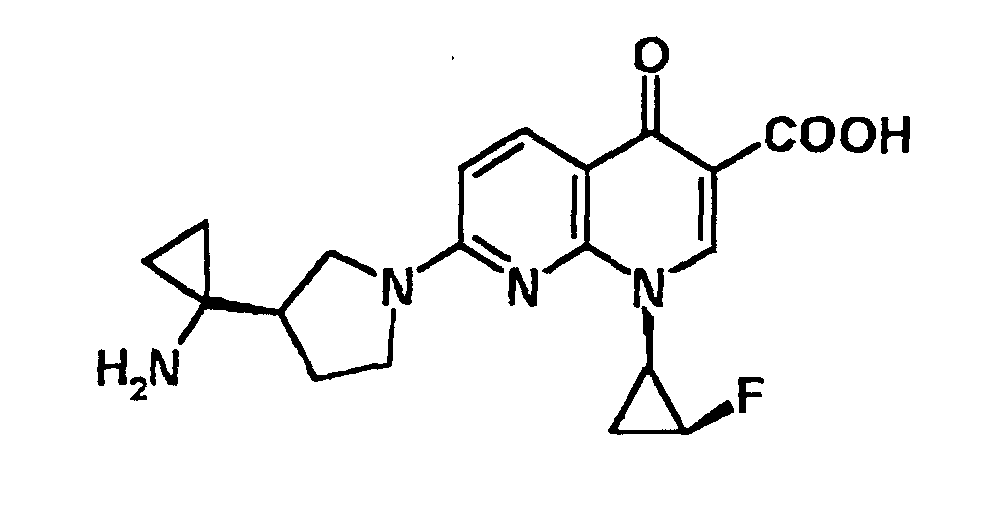
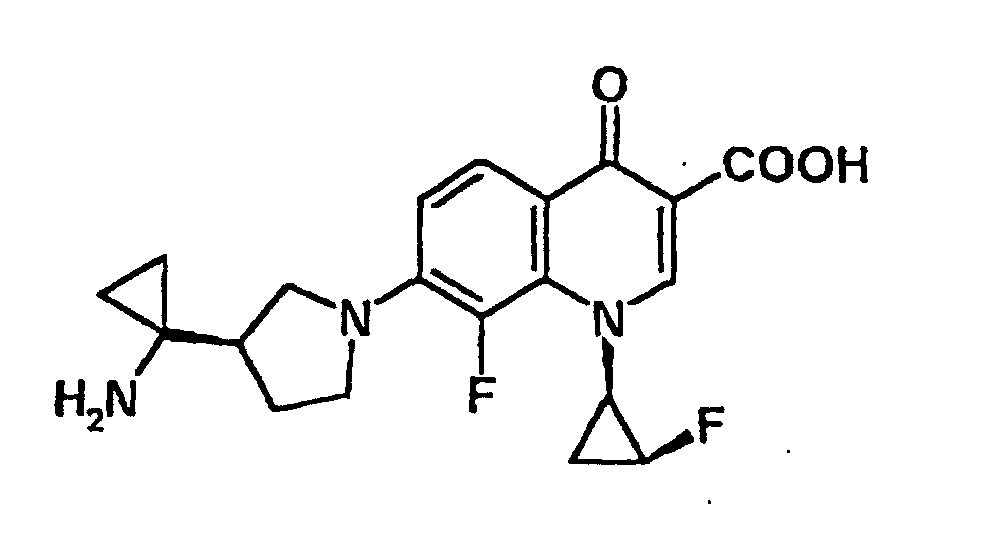
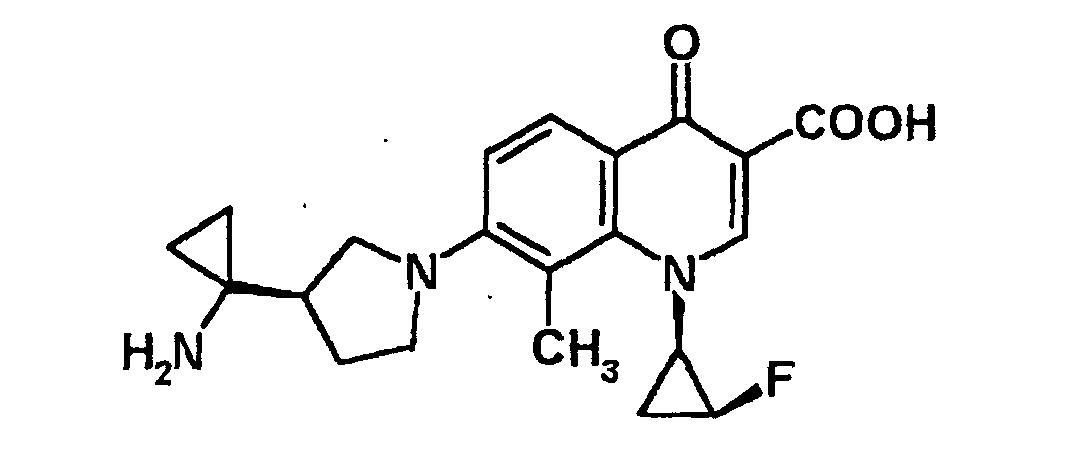
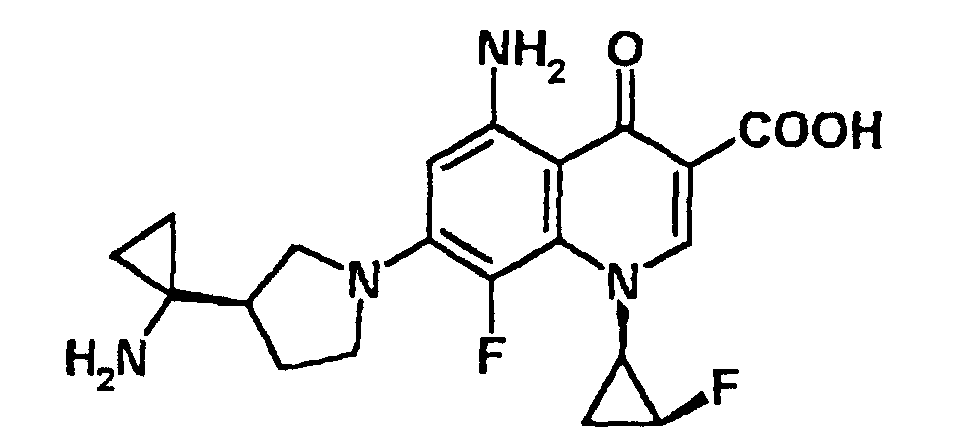
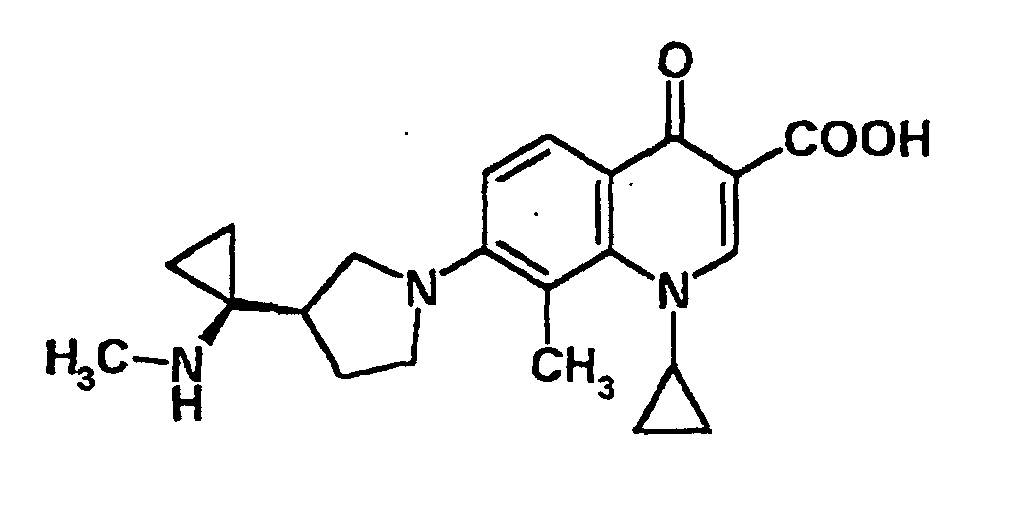
- compounds of this invention include the following: 7-[3-(R)-(1-aminocyclopropyl)pyrrolidin-1-yl]-1-[2-(S)-fluoro-1-(R)-cyclopropyl]-1,4-dihydro-4-oxo-1,8-naphthyridine-3-carboxylic acid [shown in the following formula]; 7-[3-(R)-(1-aminocyclopropyl)pyrrolidin-1-yl]-1-[2-(S)-fluoro-1-(R)-cyclopropyl]-1,4-dihydro-4-oxoquinoline-3-carboxylic acid [shown in the following formula]; 7-[3-(R)-(1-aminocyclopropyl)pyrrolidin-1-yl]-1-[2-(S)-fluoro-1-(R)-cyclopropyl]-8-chloro-1,4-dihydro
- the compound of this invention Since the compound of this invention has potent antibacterial actions, it can be used as medicaments for use in human bodies, animals, and fishes or as preservatives of agricultural chemicals and food.
- the compound of this invention is used as a medicament for human bodies, its dose is within the range of from 50mg to 1g, preferably from 100mg to 500mg, per day per adult.
- its dose varies depending on the purpose of its administration (treatment or prevention), kind and size of each animal to be treated, kind and degree of each infected pathogenic bacterium, but is within the range of generally from 1mg to 200mg, preferably from 5mg to 100mg, per 1kg body weight of each animal as a daily dose.
- the daily dose is administered once a day or by dividing it into two to four doses per day. As occasion demands, the daily dose may exceed the abovementioned amounts.
- the compounds of this invention are active against a broad range of microorganisms which cause various infectious diseases, it can treat, prevent or alleviate diseases caused by such pathogens.
- bacteria and bacterioid microorganisms on which the compounds of this invention are effective include the genus Staphylococcus, Streptococcus pyogenes, hemolytic streptococcus, enterococcus, pneumococcus, the genus Peptostreptococcus, Neisseria gonorrhoeae, Escherichia coli, the genera Citrobacter, the genus Shigella, Klebsiella pneumoniae, the genera Enterobacter, the genus Serratia, the genus Proteus, Pseudomonas aeruginosa, Haemophilus influenzae, the genus Acinetobacter, the genus Campylobacter, Chlamydia trachomatis, and the like.
- diseases caused by the above pathogens include folliculitis, furuncle, carbuncle, erysipelas, phlegmon, lymphangitis (lymphadenitis), panaritium, subcutaneous abscess, hidrosadenitis, aggregated acne, infectious atheroma, anal abscess, mastitis, superficial secondary infections of traumatic wounds, burn wounds, operative wounds, etc., pharyngolaryngitis, acute bronchitis, tonsillitis, chronic bronchitis, bronchiectasis, diffuse panbronchiolitis, secondary infections of chronic respiratory diseases, pneumonia, pyelonephritis, cystitis, prostatitis, epididymitis, gonococcal urethritis, non-gonococcal urethritis, cholecystitis, cholangitis, bacillary dysentery, enteritis, inflammation of the uterine appendages, intrauterine
- acid-fast bacteria on which the compounds of this invention are effective include tubercle bacilli [Mycobacterium (abbreviated as "M.” hereinafter) tuberculosis, M. bovis, M. africanum], atypical acid-fast bacteria [M. kansasii, M. marinum, M. scrofulaceum, M. avium, M. intracellulare, M. xenopi, M. fortuitum, M. chelonae], etc.
- tubercle bacilli Mycobacterium (abbreviated as "M.” hereinafter) tuberculosis, M. bovis, M. africanum]
- atypical acid-fast bacteria M. kansasii, M. marinum, M. scrofulaceum, M. avium, M. intracellulare, M. xenopi, M. fortuitum, M. chelonae
- tubercle bacilli infections may be seen in the thoracic cavity, trachea / bronchus, lymph nodes, in a generally disseminated manner, in the bones and joints, meninges / brain, digestive organs (intestines, liver), skin, mammary glands, eyes, middle ear / throat, urinary tract, male genitals, female genitals, etc.
- the lungs are the main affected parts of atypical acid-fast bacteria infections (non-tubercle acid-fast bacteria infections), and other examples of atypical acid-fast bacteria infections include local lymphadenitis, soft skin tissue infections, articular infections, general dissemination type infections, etc.
- the compounds of this invention are also effective against various microorganisms that cause infections in animals.
- microorganisms include Escherichia, Salmonella, Pasturella, Haemophilus, Bordetella, Staphylococcus, Mycoplasma, etc.
- fowl diseases include escherichiosis, pullorum disease, fowl paratyphoid fever, fowl cholera, infectious coryza, staphylococcal infection, Mycoplasma infection, etc.
- specific examples of pig diseases include escherichiosis, salmonellosis, pasturellosis, Haemophilis infection, atrophic rhinitis, exudative epidermitis, Mycoplasma infection, etc.
- cattle diseases include escherichiosis, salmonellosis, hemorrhagic septicemia, Mycoplasma infection, contagious bovine pleuropneumonia, mastitis, etc.
- specific examples of dog diseases include coliemia, Salmonella infection, hemorrhagic septicemia, pyometra, cystitis, etc.
- specific examples of cat diseases include exudative pleurisy, cystitis, chronic rhinitis, Haemophilus infection, kitten diarrhea
- An antibacterial preparation which comprises the compound of this invention can be prepared by selecting an appropriate pharmaceutical preparation in accordance to the method of administration and using any of the generally used methods of preparing various pharmaceutical preparations.
- dosage forms of antibacterial preparations having the compound of this invention as its principle agent tablets, powders, granules, capsules, solutions, syrups, elixirs, oily or aqueous suspensions, etc. can be given as examples of forms of oral pharmaceutical preparations.
- a stabilizing agent, an antiseptic agent, a solubilizing agent, etc. may be used in the preparation, or a solution which may contain these auxiliary agents may be contained in a container and thereafter made into a solid preparation by freeze-drying or the like means to be re-dissloved when used.
- a single dose may be contained in a single container or multiple doses may be contained in the same container.
- Examples of forms of external-use preparations include solutions, suspensions, emulsions, ointments, gels, creams, lotions, sprays, etc.
- a solid preparation may contain pharmaceutically acceptable additives together with the active compound.
- pharmaceutically acceptable additives for example, fillers, extenders, binders, disintegrators, solubilization enhancing agents, moistening agents, lubricating agents, etc. may be selected and mixed as necessary to form a preparation.
- liquid preparations examples include solutions, suspensions, emulsions, and these may contain suspending agents, emulsifying agents, etc. as additives.
- Examples of methods of administering the compound of this invention to an animal include a method of direct oral administration or oral administration by mixing it with feed, a method of preparing a solution and then performing oral administration of the solution directly or upon addition of the solution to drinking water or feed, a method of injection administration, etc.
- a pharmaceutical preparation for administering the compound of this invention to an animal can be prepared optionally as powders, fine granules, soluble powders, syrups, solutions, or injections by the techniques generally used in the relevant field.
- Formulation examples of pharmaceutical preparations are shown below.
- Formulation Example 1 Capsule: Compound of Example 1 100.0mg Corn starch 23.0mg CMC calcium 22.5mg Hydroxymethyl cellulose 3.0mg Magnesium stearate 1.5mg Total 150.0mg
- Formulation Example 2 (Solution): Compound of Example 1 1 to 10g Acetic acid or sodium hydroxide 0.5 to 2g Ethyl para-hydroxybenzoate 0.1g Purified water 88.9 to 98.4g Total 100g
- Formulation Example 3 (Powder to be mixed in feed) Compound of Example 1 1 to 10g Corn starch 98.5 to 89.5g Light silicic anhydride 0.5g Total 100g
- 2,4-Difluoro-3-methylbenzoate (4.97g, 28.9mmol) was dissolved in toluene (50ml), and after adding N,N-dimethylformamide (0.1ml) and thionyl chloride (3.16ml, 43.4mmol) thereto, it was stirred for 14 hours in an oil bath of 80°C. The reaction solution was then cooled and thereafter concentrated under a reduced pressure. After adding toluene to the residue and repeating concentration under a reduced pressure, the residue obtained was dissolved in tetrahydrofuran (10ml).
- Ethyl 2-(2,4-difluoro-3-methylbenzoyl)-3-dimethylaminoacrylate (1.06g, 3.57mmol) was dissolved in tetrahydrofuran (15ml), and after adding the para-toluenesulfonic acid salt of (1R, 2S)-2-fluorocyclopropylamine (970mg, 3.93mmol), a solution, in which triethylamine (552 ⁇ l, 3.96mmol) was dissolved in tetrahydrofuran (5ml), was added dropwise under stirring at -15°C.
- Ethyl 7-fluoro-1-[2-(S)-fluoro-1-(R)-cyclopropyl]-1,4-dihydro-8-methyl-4-oxoquinoline-3-carboxylate (1.40g, 4.56mmol) was dissolved in acetic acid (4ml), and after adding concentrated hydrochloric acid (4ml) thereto, it was heated under reflux for 3 hours. After cooling, the reaction solution was poured into ice water (50ml) and the precipitated crystals were filtered out.
- the yellow extract obtained was then dissolved in toluene (800ml), the para-toluenesulfonic acid salt of (1R, 2S)-2-fluorocyclopropylamine (60.1g, 246mmol)was added, and while stirring at -15°C, a solution, in which triethylamine (40.8ml, 293mmol) was dissolved in toluene (200ml), was added dropwise thereto. After stirring the reaction solution for 4 hours at room temperature, water (500ml) was added, and the organic layer was separated. After washing the organic layer with saturated saline solution (500ml ⁇ 2), it was dried over anhydrous sodium sulfate.
- Monoethyl malonate (6.61g, 50.0mmol) was dissolved in anhydrous tetrahydrofuran (100ml), and after adding magnesium ethoxide (3.15g, 28.0mmol) thereto while cooling with ice, it was stirred at room temperature for 3 hours. The reaction solution was then concentrated under a reduced pressure, thereby preparing a magnesium salt of monoethyl malonate.
- 2,6-dichloronicotinicacid (3.84g,20.0mmol) was then dissolved in anhydrous tetrahydrofuran (80ml), and after adding 1,1-carbonyldiimidazole (4.87g. 30.0mmol) while cooling with ice, it was stirred at room temperature for 1.5 hours.
- Ethyl 2-(2,6-dichloronicotinoyl)acetate (7.03g, 26.8mmol) was dissolved in acetic anhydride (30ml), and after adding triethyl orthoformate (60ml) thereto, it was stirred in an oil bath of 140°C for 2 hours. After letting the reaction solution cool, it was concentrated under a reduced pressure, and after adding toluene (50ml) to the residue obtained, a concentration operation under a reduced pressure was performed. This operation was repeated 3 times, and the residue obtained was dried under a reduced pressure. 8.42g of ethyl 2-(2,6-dichloronicotinoyl)-3-ethoxyacrylate was thereby obtained in the form of a yellow oily substance.
- the residue was dissolved in a mixed solvent of ethyl acetate (100ml) and dichloromethane (50ml), and after washing the organic layer with a 10% aqueous citric acid solution (50ml) and saturated saline solution (50ml) in that order, the organic layer was dried over anhydrous sodium sulfate. After filtering, the filtrate was concentrated under a reduced pressure, and after adding dropwise concentrated hydrochloric acid (15ml) to the residue while cooling with ice, it was stirred at the same temperature for 30 minutes.
- Ethyl 6,7-difluoro-1-[2-(S)-fluoro-1-(R)-cyclopropyl]-1, 4-dihydro-8-methyl-5-nitro-4-oxoquinoline-3-carboxylate (10.04g, 27.12mmol) was dissolved in dimethylformamide (150ml), and 28% ammonia water (32.1ml) was added dropwise thereto while stirring and cooling with ice. While sealing the reaction solution in a sealed tube, it was stirred at room temperature for 4 hours. The reaction solution was then dissolved inmethanol (200ml) and concentrated under a reduced pressure.
- Ethyl 7-fluoro-1-[2-(S)-fluoro-1-(R)-cyclopropyl]-1,4-dihydro-8-methyl-5-nitro-4-oxoquinoline-3-carboxylate (2.50g, 7.10mmol) was dissolved in acetonitrile (20ml), and after adding a 5% palladium carbon catalyst (water content: 50%, 1.0g) thereto, it was stirred at room temperature for 20 hours under a hydrogen atmosphere at atmospheric pressure. After removing the catalyst by filtering (methanol washing), the filtrate was concentrated under a reduced pressure, and the residue obtained was dissolved in ethyl acetate (10ml) and heated under reflux for 30 minutes.
- n-hexane (10ml) was then added, and after performing heated refluxing for 30 minutes, the reaction solution was allowed to stand under room temperature. The precipitated crystals were then filtered out, washed with a 1:1 mixed solution of n-hexane:ethyl acetate and dried under a reduced pressure at 60°C for 16 hours. 869mg (38%) of the title compound was thereby obtained as a yellow powder.
- Ethyl 5-amino-7-fluoro-1-[2-(S)-fluoro-1-(R)-cyclopropyl]-1,4-dihydro-8-methyl-4-oxoquinoline-3-carboxyl ate (735mg, 2.28mmol) was dissolved in a 1:1 mixed solution (8ml) of acetic acid:water, and after adding concentrated sulfuric acid (90 ⁇ l) thereto, it was stirred for 4 hours in an oil bath of 120°C. After cooling the reaction solution with ice, water (20ml) was poured therein, and the mixed reaction solution was stirred at room temperature for 2 hours.
- the precipitated crystals were filtered out, washed with excess water, a small amount of cold ethanol and excess diethyl ether in that order, and then dried under a reduced pressure at 80°C for 17 hours. 552mg (82%) of the title compound was thereby obtained in the form of yellow crystals.
- Ethyl 6,7-difluoro-1-[2-(S)-fluoro-1-(R)-cyclopropyl]-1,4-dihydro-8-methoxy-5-nitro-4-oxoquinoline-3-carboxylate (13.96g, 36.14mmol) was dissolved in dimethylformamide (180ml), and 28% ammonia water (60ml) was added dropwise in while stirring and cooling with ice. After stirring the reaction solution at room temperature for 64 hours, water (100ml) was added to the reaction solution and then concentrated under a reduced pressure.
- Isoamyl nitrite (3.81g, 32.5mmol) was added to dimethylformamide (60ml) , and while stirring at 70°C, a solution, wherein ethyl 6-amino-7-fluoro-1-[2-(S)-fluoro-1-(R)-cyclopropyl]-1,4-dihydro-8-methoxy-5-nitro-4-oxoquinoline-3-carboxylate (8.90g, 23.2mmol) was dissolved in dimethylformamide (120ml), was added dropwise thereto over a period of 3 hours. After completion of dripping, the reaction solution was stirred at 70°C for 1 hour, allowed to cool, and then poured into water (500ml).
- Ethyl 7-fluoro-1-[2-(S)-fluoro-1-(R)-cyclopropyl]-1,4-dihydro-8-methoxy-5-nitro-4-oxoquinoline-3-carboxylate (3.71g, 10.1mmol) was dissolved in acetonitrile (50ml), and after adding a 5% palladium carbon catalyst (water content: 50%, 1.5g) thereto, it was stirred at room temperature for 20 hours under a hydrogen atmosphere at atmospheric pressure.
- Ethyl 3-dimethylamino-2-(2,3,4-trifluorobenzoyl)acrylate (15.0g, 49.8mmol) was dissolved in ethanol (30ml), and to this solution, an ethanol (10ml) solution of (S)-2-amino-1-propanol (4.50g, 59.8mmol) was added dropwise while stirring and cooling with ice. After completion of dripping, the reaction solution was stirred for 1 hour at room temperature and then concentrated under a reduced pressure. The residue obtained was dissolved in dimethyl sulfoxide (50ml), and after adding spray-dried calcium fluoride (16g) thereto, it was stirred at 120°C for 26 hours.
- Ethyl 1-acetylcyclopropanecarboxylate (200g, 1.28mol) was dissolved in ethanol (1000ml), and bromine (72.7ml, 1.41mol) was added dropwise while stirring and cooling with ice. After completion of dripping, the temperature of the reaction solution was raised to 30°C and stirring was performed for 2 hours. After adding water (1000ml) to the reaction solution while cooling with ice, it was concentrated under a reduced pressure was performed.
- Ethyl diethylphosphonoacetate (100g, 446mmol) was dissolved in ethanol (275ml), and after adding dropwise a 2mol/l aqueous sodium hydroxide solution (275ml, 550mmol) while stirring and cooling with ice, it was stirred at room temperature for 1 hour. The reaction solution was then concentrated under a reduced pressure, and the concentrate was made acidic by concentrated hydrochloric acid while cooling with ice. Extractions into ethyl acetate (200ml ⁇ 4), chloroform (100ml ⁇ 2) and 5% methanol/chloroform (250ml ⁇ 2) were then performed.
- Diethylphosphonoacetic acid (15.1g, 76.8mmol) was dissolved in anhydrous tetrahydrofuran (120ml), and after adding 1,1'-carbonyldiimidazole (13.7g, 84.5mmol) while cooling with ice, it was stirred at room temperature for 1 hour.
- Diethylphosphonoacetic acid (15.1g, 76.8mmol) was dissolved in anhydrous tetrahydrofuran (120ml), and after adding 1,1'-carbonyldiimidazole (13.7g, 84.5mmol) while cooling with ice, it was stirred at room temperature for 1 hour.
- Diethylphosphonoacetic acid (32.8g, 166mmol) was dissolved in anhydrous benzene (700ml) , and after adding N,N'-dimethylformamide (1ml), thionyl chloride (18.2ml, 250mmol) was added thereto and heated under reflux for 1.5 hours. After letting the reaction solution cool, it was concentrated under a reduced pressure, and after adding dried toluene (100ml) thereto, its concentration under a reduced pressure was performed again.
- the concentrate was dissolved in anhydrous tetrahydrofuran (300ml) and after adding dropwise an anhydrous tetrahydrofuran (300ml) solution of ethyl 1-[2-[N-[1-(S)-phenylethyl]amino]acetyl]cyclopropanecarboxylate (45.7g, 166mmol) and triethylamine (25.1ml, 183mmol) while stirring and cooling with ice, it was stirred while cooling with ice for 1.5 hours and then stirred at room temperature for 2 hours.
- the instrumental analysis data for this resulting compound agreed with the data indicated in PCT/JP96/00208.
- the instrumental analysis data for this resulting compound agreed with the data indicated in PCT/JP96/00208.
- the aqueous layer was then made acidic by concentrated hydrochloric acid while cooling with ice and then subjected to extraction with chloroform (70ml ⁇ 3).
- the organic layer was then dried over anhydrous sodium sulfate, and after filtering, the filtrate was concentrated under a reduced pressure. 9.40g (99%) of the title compound was thereby obtained as white solids.
- Atoluene (15ml) solutionoftriethylamine (9.6ml, 69mmol) and diphenylphosphoric acid azide (DPPA; 10.4g, 37.9mmol) was added to a toluene (80ml) suspension of 1-[1-[1-(S)-phenylethyl]-2-one-4-(S)-pyrrolidin-4-yl]-1-cyclopropanecarboxylic acid (9.4g, 34.4mmol), and after stirring at room temperature for 1 hour under a nitrogen atmosphere, it was heated under reflux for 1.5 hours. After cooling the reaction solution to room temperature, tert-butyl alcohol (95ml) was added thereto and heated under reflux for 15 hours.
- DPPA diphenylphosphoric acid azide
- the reaction solution was concentrated under a reduced pressure and ethyl acetate (95ml) and water (95ml) were added to the concentrate.
- the organic layer was separated and the aqueous layer was subjected to extraction with ethyl acetate (95ml).
- the combined organic layer was then washed with saturated saline solution (95ml) and then dried over anhydrous sodium sulfate.
- the reaction solution was then filtered through cellite (ethyl acetate washing) and the filtrate was then diluted with ethyl acetate (100ml)
- the organic layer was then washed with water (50ml ⁇ 3) and saturated saline solution (50ml) in that order, and dried over anhydrous sodium sulfate.
- the instrumental analysis data for this resulting compound agreed with the data indicated in PCT/JP96/00208.
- 2,3,4-trichlorobenzoic acid (4.51g/ 20.0mmol) was dissolved in tetrahydrofuran (80ml), carbonyldiimidazole (3.89g/ 24.0mmol) was added thereto while cooling with ice, and then stirred at room temperature for 3 hours (solution A). Meanwhile, malonicacidmonoethylestermonopotassiumsalt (6.81g, 40.0mmol) was suspended in ethyl acetate, and while cooling with ice, triethylamine (13.9ml, 100.0mmol) and magnesium chloride (5.71g, 60.0mmol) were added thereto.
- reaction solution After stirring at room temperature for 3 hours, the reaction solution was cooled with ice and the above-described solution A was dripped into this reaction solution over a period of 10 minutes. After then washing solution A into the reaction solution using tetrahydrofuran (10ml), it was stirred at room temperature for 14 hours, and then the reaction solution was poured into a 10% aqueous citric acidsolution (200ml) . This was then extractedwithethyl acetate (200ml), washed with saturated saline solution (200ml), and then dried over anhydrous sodium sulfate.
- Ethyl acetate (200ml) was added to the reaction solution, and after washing with 10%aqueous citric acid solution (80ml ⁇ 2), saturated aqueous sodium bicarbonate solution (80ml) and saturated saline solution (80ml), it was dried over anhydrous sodium sulfate. After then removing the drying agent by filtration, the solvent was evapotated under a reduced pressure to obtain a crude ethyl 3-[2-(S)-fluoro-1-(R)-cyclopropyl]amino-2-(2,3,4-trichlorobenzoyl)acrylate (3.59g) as a pale-orange, gum-like substance.
- Ethyl 5-amino-7-fluoro-1-[2-(S)-fluoro-1-(R)-cyclopropyl] -8-methyl-1,4-dihydro-4-oxoquinoline-3-carboxylate (1.414g, 4.39mmol) was suspended in 35% aqueous sulfuric acid solution (15ml), and while cooling with ice, an aqueous sodium nitrite solution (394mg, 5.70mmol/4.5ml) was dripped therein over a period of 5 minutes.
- 3-cyano-2,4-difluorobenzoic acid (29.6g, 162mmol) was dissolved in dried toluene (250ml), and after adding a catalytic amount of N,N-dimethylformamide, thionyl chloride (17.7ml, 243mmol) was dripped in while stirring at room temperature. Upon completion of dripping, the reaction solution was stirred for 1 hour in an oil bath at 80°C. Then after letting the reaction solution cool, the reaction solution was concentrated under a reduced pressure, toluene (100ml) was added to the residue, and vacuum concentration was performed again. This operation was repeated 3 times.
- Antibacterial activities of the compounds of this invention were measured in accordance to the standard method designated by the Japan Society of Chemotherapy, with the results shown as MIC values (microgram/ml) units in the following table.
- Example 1 of this invention the micronucleus test in bone marrow of mice was performed by the following method.
- mice groups each consisting of five, six-week-old, Slc:ddY male mice, were used.
- the 0.1mol/l NaOH/saline solvent was used as a control, and as a positive Reference drug, a drug solution, prepared by dissolving and diluting cyclophosphamide (CP) in saline solution, was used. All drug solutions were disinfected by filtration through Mylex GS 0.22 ⁇ m filters. With each drug solution, a single intravenous dose of 10ml/k was administered at an administration rate of 0.2ml/min. 24 hours after administration, myeloma cells were collected from the femur bone, the smear preparations were prepared, and these were dyed with acrylic orange.
- CP cyclophosphamide
- Example 1 As a result, a significant difference in the micronucleus induction rate was not seen between the control and any of the 25, 50, and 100mg/ administration groups for the compound described as Example 1 and the judgment result was thus negative. That is, the compound described as Example 1 was found to be extremely weak in micronucleus induction and high in safety.
- Example 1 of this invention wherein a fluorine atom of the 6-position of the comparison compound, 7-[3-(R)-(1-aminocyclopropyl)pyrrolidin-1-yl]-6-fluoro-1-[2-(S)-fluoro -1-(R)-cyclopropyl]-8-methyl-1,4-dihydro-4-oxoquinoline-3-carboxylic acid described in PCT/JP96/00208 is replaced by a hydrogen atom, exhibits a potent antibacterial action upon a broad range of both gram-negative bacteria and gram-positive bacteria, including resistant bacteria, and yet is high in safety.
- Example 1 For the compound of this invention described as Example 1, the blood concentration and organ concentration after oral administration were determined by the following methods. Measurements were also made by the same methods for Reference drug 1.
- An administration solution was prepared by dissolving a tested compound to a concentration of 2mg/ml (as free compound) in distilled water, and using a 2.5ml disposable syringe or a metal oral probe, the solution was orally administered at a dose of 20mg/kg to fasting rats (Crj: CD IGS;male; 7-week-old; Charles River Japan, Inc.).
- the absorption test groups (4 rats per group; total of 6 groups) were killed by exsanguination while under ether anesthetization 0.25, 0.5, 1, 2, 4, or 6 hours after drug administration, and the blood, liver, kidneys, and lungs were sampled. With the blood, serum was sampled by centrifugation (3000rpm ⁇ 15 minutes, 4°C) after coagulation. Tissues were homogenized after adding 3 to 5ml of 0.1M phosphate buffer solution (pH7.0) and the centrifugation supernatants (3000rmpm ⁇ 15 minutes, 4°C) were collected.
- the excretion test groups (4 rats per group) were put in a metabolic cage after drug administration, and collected urine samples for 0 to 4 hours and 4 to 24 hours were sampled while cooling with ice, and at the time of sampling, the interior of the cage was washed with approximately 15ml of 0.1mol/l phosphate buffer solution (pH 7.0) to recover the urine attached to the interior of the cage. Also in order to examine glucuronide and other conjugated compounds, a part of the sample was separated, hydrolyzed with an equivalent amount of 1mol/l aqueous sodium hydroxide solution, and thereafter neutralized with 0.5mol/l hydrochloric acid, and concentration measurements were made on samples prepared in this manner.
- test medium was prepared by inoculating a suspension containing 5 ⁇ 10 7 CFU/ml of spores of the test bacteria at a proportion of 1% into an nutrient agar (Eiken Kagaku) that was sterilized at 121°C for 15 minutes and then cooled to approximately 50°C. After placing 10ml each of this medium in a sterilized Petri dish and solidifying horizontally, four holes of 8mm diameter were made to prepare a test plate medium. The Bioassay System TDA-1 (Dainippon Seiki) was used for preparation of the test plate media.
- test samples diluted with serum or phosphate buffer solution as necessary
- serial dilutions of the drug solutions for calibration two-fold serial dilutions prepared so that the inhibition ring diameter will be approximately 10 to 30mm
- a reference drug solution a drug solution of given concentration for correction of the error among plates; normally, a concentration of forming an inhibition ring of approximately 20mm is used
- 50 ⁇ L of the test sample or the drug solution for calibration
- 50 ⁇ L of the reference solution was placed in each of the other two holes.
- the plate medium was set still for 1 hour at 4°C to perform preliminary dispersion and then culturing at 37°C was performed for approximately 18 hours, and the inhibition ring diameters were measured using CA-400 (Dainippon Seiki).
- the concentrations of the test samples were measured using a calibration curve determined by second-order regression from the logarithmic values of the drug concentration of the calibration curve serial dilutions and the inhibition ring diameters.
- tissue concentration [Homogenate concentration] ⁇ ([Tissue weight] + [Buffer solution amount])/[Tissue weight]
- the pharmacokinetic parameters in rats were calculated based on mean concentration, by non-compartmental analysis, and using the pharmacodynamics analysis software, PSAG-CP (Asmedica).
- the compound of this invention was found to be distributed at higher concentrations, for both serum and tissue, in comparison to Reference drug 1. It is thus apparent that the compound of this invention is excellent in oral absorption. It is also apparent that the compound of this invention is excellent in tissue penetration.
- Compounds of this invention exhibit excellent antibacterial action upon a broad range of both gram-negative and gram-positive bacteria and, in particular, exhibit potent antibacterial activity even against resistant gram-positive bacteria, such as methicillin-resistant Staphylococcus aureus (MRSA), penicillin-resistant Streptococcus pneumoniae (PRSP), vancomycin-resistant Enterococcus (VRE), etc., and quinolone-resistant bacteria, and yet are excellent in safety characteristics, such as being negative in micronucleus tests, and excellent in pharmacokinetics, such as being improved in urinary recovery rates and being excellent in oral absorption and tissue penetration, etc.
- MRSA methicillin-resistant Staphylococcus aureus
- PRSP penicillin-resistant Streptococcus pneumoniae
- VRE vancomycin-resistant Enterococcus
- quinolone-resistant bacteria and yet are excellent in safety characteristics, such as being negative in micronucleus tests, and excellent in pharmacokinetics, such as being improved in urinary
Landscapes
- Chemical & Material Sciences (AREA)
- Organic Chemistry (AREA)
- Health & Medical Sciences (AREA)
- Life Sciences & Earth Sciences (AREA)
- General Health & Medical Sciences (AREA)
- General Chemical & Material Sciences (AREA)
- Medicinal Chemistry (AREA)
- Nuclear Medicine, Radiotherapy & Molecular Imaging (AREA)
- Oncology (AREA)
- Pharmacology & Pharmacy (AREA)
- Communicable Diseases (AREA)
- Animal Behavior & Ethology (AREA)
- Chemical Kinetics & Catalysis (AREA)
- Public Health (AREA)
- Veterinary Medicine (AREA)
- Pharmaceuticals Containing Other Organic And Inorganic Compounds (AREA)
- Nitrogen Condensed Heterocyclic Rings (AREA)
- Plural Heterocyclic Compounds (AREA)
- Nitrogen And Oxygen Or Sulfur-Condensed Heterocyclic Ring Systems (AREA)
- Agricultural Chemicals And Associated Chemicals (AREA)
Abstract
Description


R2 represents an alkylthio group having 1 to 6 carbon atoms or a hydrogen atom,
wherein R2 and the abovementioned R1 may be integrated to form a ring structure by incorporating a part of the mother skeleton, the thus formed ring may contain a sulfur atom as a ring-constituent atom, and the ring may be substituted by an alkyl group having 1 to 6 carbon atoms, which may have a substituent;
R3 represents a phenylalkyl group composed of an alkylene group having 1 to 6 carbon atoms and a phenyl group, an alkyl group having 1 to 6 carbon atoms, an alkoxymethyl group having 2 to 7 carbon atoms, a hydrogen atom, a phenyl group, an acetoxymethyl group, a pivaloyloxymethyl group, an ethoxycarbonyl group, a choline group, a dimethylaminoethyl group, a 5-indanyl group, a phthalidinyl group, a 5-alkyl-2-oxo-1,3-dioxole-4-ylmethyl group, or a 3-acetoxy-2-oxobutyl group;
R4 represents an alkyl group having 1 to 6 carbon atoms, an alkenyl group having 2 to 6 carbon atoms, an alkynyl group having 2 to 6 carbon atoms, an alkoxy group having 1 to 6 carbon atoms, a hydrogen atom, an amino group, a hydroxyl group, a thiol group, or a halogenomethyl group, and
among the above, the amino group may have one or more substituents selected from among the group consisting of an alkyl group having 1 to 6 carbon atoms, an acyl group having 2 to 5 carbon atoms, and a formyl group;
A represents a nitrogen atom or a partial structure represented by formula (II):

among the above, the amino group may have one ore more substituents selected from the group consisting of an alkyl group having 1 to 6 carbon atoms, an acyl group having 2 to 5 carbon atoms, and a formyl group,
wherein X1 and the aforementioned R1 may be integrated to form a ring structure by incorporating a part of the mother skeleton, the thus formed ring may contain an oxygen atom, a nitrogen atom, or a sulfur atom as a ring constituent atom, and this ring may be substituted by an alkyl group having 1 to 6 carbon atoms, which may have a substituent);
each of R5 and R6 independently represents an alkyl group having 1 to 6 carbon atoms, a hydrogen atom, or a substituted carboxyl group derived from an amino acid, dipeptide, or tripeptide,
wherein the alkyl group may have one ore more substituents selected from the group consisting of an alkylthio group having 1 to 6 carbon atoms, an alkoxy group having 1 to 6 carbon atoms, a hydroxyl group, and a halogen atom; and
n represents an integer 1 or 2].


R31 is the R3 defined in the formula (I) or a boron-containing group represented by formula (IV):

R1, R2, R4, R5, R6, and A are as defined in the formula (I)] with a compound of the following formula (V) or an addtion salt thereof:

this alkyl group may have a substituent selected from the group consisting of an alkylthio group having 1 to 6 carbon atoms, an alkoxy group having 1 to 6 carbon atoms, a hydroxyl group, and a halogen atom, and
n is the same as defined in the formula (I)]
(in the case where an addition salt is used, the reaction is carried out under the presence of reagents that cause the addition salt to become a free form).

wherein the protective group of an amino group may be selected from the group consisting of a (substituted) alkoxycarbonyl group, a (substituted) aralkyloxycarbonyl group, a (substituted) acyl group, a (substituted) alkyl group, a (substituted) aralkyl group and a substituted silyl group.]
7-[3-(R)-(1-aminocyclopropyl)pyrrolidin-1-yl]-1-[2-(S)-fluoro-1-(R)-cyclopropyl]-1,4-dihydro-4-oxo-1,8-naphthyridine-3-carboxylic acid [shown in the following formula];





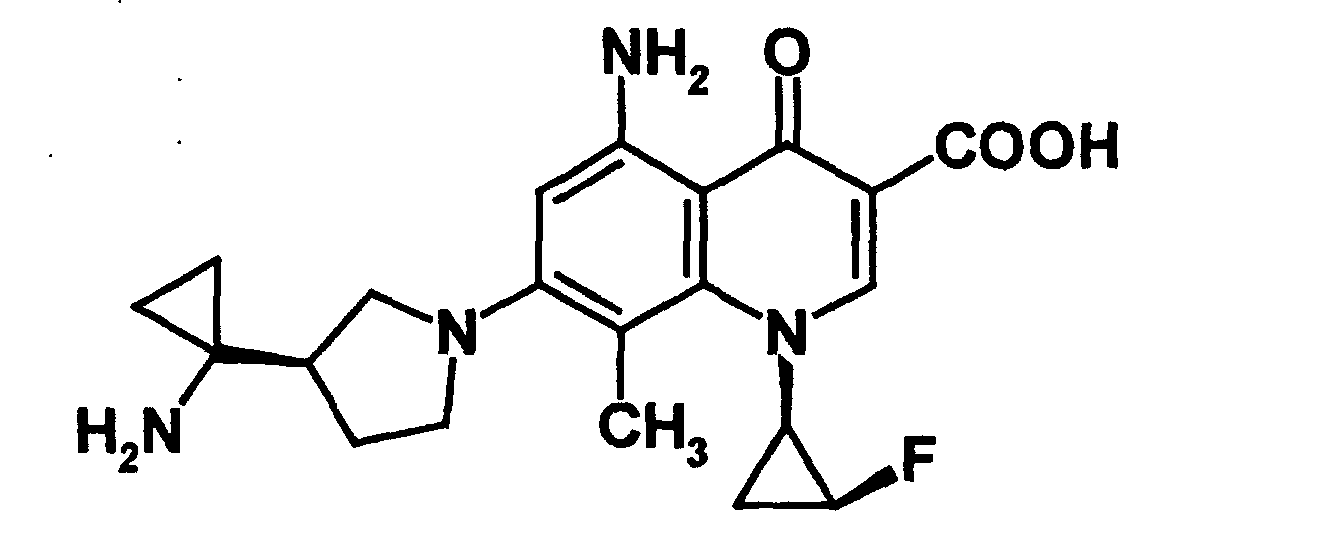


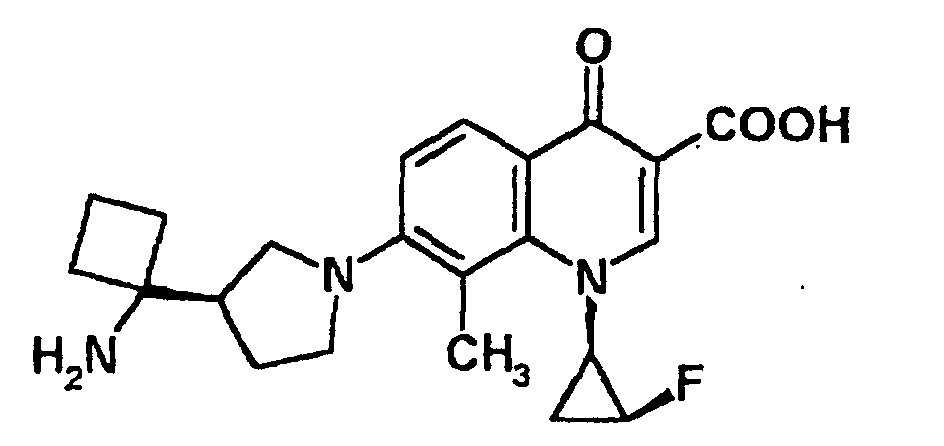

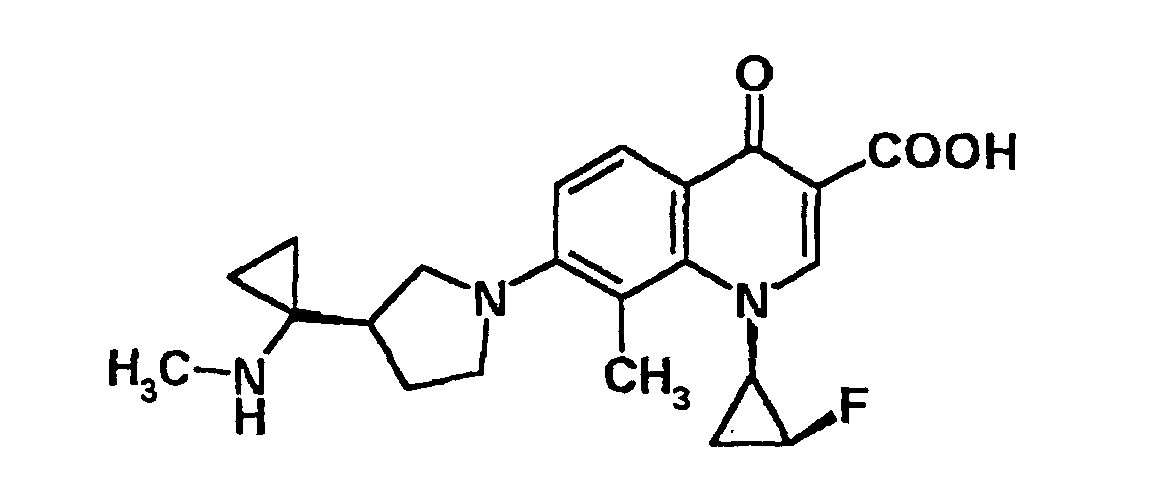
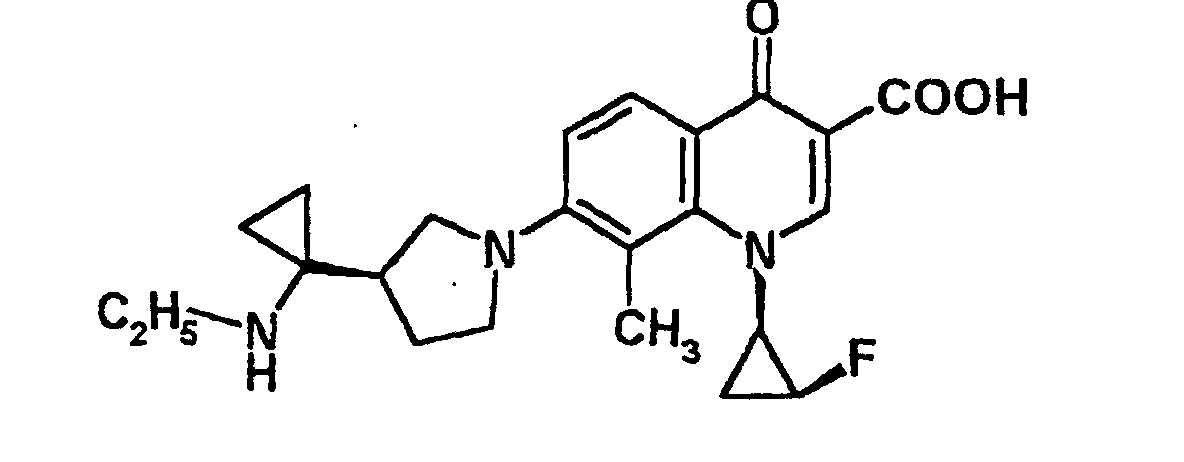


| Formulation Example 1 (Capsule): | |
| Compound of Example 1 | 100.0mg |
| Corn starch | 23.0mg |
| CMC calcium | 22.5mg |
| Hydroxymethyl cellulose | 3.0mg |
| Magnesium stearate | 1.5mg |
| Total | 150.0mg |
| Formulation Example 2 (Solution): | |
| Compound of Example 1 | 1 to 10g |
| Acetic acid or sodium hydroxide | 0.5 to 2g |
| Ethyl para-hydroxybenzoate | 0.1g |
| Purified water | 88.9 to 98.4g |
| Total | 100g |
| Formulation Example 3 (Powder to be mixed in feed) | |
| Compound of Example 1 | 1 to 10g |
| Corn starch | 98.5 to 89.5g |
| Light silicic anhydride | 0.5g |
| Total | 100g |
1H-NMR (400MHz, CDCl3) δ: 0.95 (3H, t, J=7.08Hz), 2.18 (3H, t, J=1.95Hz), 2.92-3.24 (6H, m), 3.99 (2H, q, J=7.08Hz), 6.86 (1H, dt, J=1.22, 8.55Hz), 7.43 (1H, brs), 7.75 (1H, s).
IR (KBr, disk) : 3055, 2985, 2933, 2875, 2814, 1942, 1693, 1630, 1593, 1477, 1431, 1379, 1277, 1255, 1221cm1.
Melting point: 82 to 84°C
| Elemental analysis: As C15H17F2NO3; | |||
| Calcd. | C, 60.60; | H, 5.76; | N, 4.71 |
| Found | C, 60.31; | H, 5.73; | N, 4.73 |
1H-NMR (400MHz, CDCl3) δ: 1.41 (3H, t, J=7.08Hz) , 1.56-1.62 (2H, m), 2.66 (3H, d, J=2.69Hz), 3.85-3.89 (1H, m), 4.39 (2H, q, J=7.08Hz), 4.78-4.79 and 4.94-4.95 (1H, dm, J=62.74Hz), 7.13 (1H, t, J=8.91Hz), 8.36 (1H, dd, J=6.71, 8.91Hz), 8.56 (1H, d, J=2.93Hz).
IR (KBr, disk) : 3438, 3097, 2983, 2939, 2902, 1907, 1720, 1630, 1593, 1566, 1460, 1429, 1387, 1367, 1311, 1250cm-1.
Melting point: 187 to 188°C
| Elemental analysis: As C16H15F2NO3; | |||
| Calcd. | C, 62.54; | H, 4.92; | N, 4.56 |
| Found | C, 62.41; | H, 4.87; | N, 4.53 |
1H-NMR(400MHz,CDCl3) δ: 1.48-1.72 (2H,m) ,2.75 (3H, t, J=2.56Hz), 4.01 (1H, dd, J=2.81, 5.25Hz), 4.83-4.84 and 4.98-5.00 (1H, dm, J=62.74Hz), 7.31 (1H, dd, J=2.20, 8.79Hz), 8.40-8.44 (1H, m), 8.84 (1H, d, J=2.69Hz), 14.50 (1H, brs).
IR (KBr, disk): 3097, 3014, 2956, 2642, 1957, 1728, 1618, 1566, 1508, 1469, 1435, 1389, 1321, 1254, 1200cm-1.
Melting point: 250 to 253°C
[α]D 24.3 = -50.00° (c 0.145, 0.1mol/l NaOH)
| Elemental analysis: As C14H11F2NO3; | |||
| Calcd. | C, 60.22; | H, 3.97; | N, 5.02 |
| Found | C, 59.92; | H, 3.98; | N, 4.92 |
1H-NMR (400MHz, 0.1mol/1 NaOD) δ: 0.54 (4H, d, J=5.61Hz), 1.19-1.21 (1H, m), 1.58-1.62 (1H, m), 1.66-1.69 (1H, m), 2.00-2.01 (1H, m), 2.16-2.17 (1H, m), 2.35 (3H, s), 3.16-3.23 (2H, m), 3.37-3.42 (1H, m), 3.54-3.55 (1H, m), 4.04-4.05 (1H, m) , 4.94-4.95 and 5.10-5.11 (1H, dm, J=62.16Hz), 7.01 (1H, d, J=8.78Hz), 7.95 (1H, d, J=8.78Hz), 8.43 (1H, s).
IR (KBr, disk): 3375, 3062, 3006, 2925, 2864, 1728, 1610, 1508, 1475, 1431, 1394, 1348, 1315, 1257cm-1.
Melting point: 228 to 230°C
[α]D 24.7= -235.09° (c 0.285, 0.1mol/l NaOH)
| Elemental analysis: As C21H24FN3O3; | |||
| Calcd. | C, 65.44; | H, 6.28; | N, 10.90 |
| Found | C, 65.10; | H, 6.32; | N, 10.76 |
1H-NMR (400MHz, CDCl3) δ: 1.42 (3H, t, J=7.08Hz), 1.55-1.64 (2H, m), 3.88-3.93 (1H, m), 4.04 (3H, d, J=1.96Hz), 4.39 (2H, q, J=7.08Hz), 4.78-4.79 and 4.94-4.95 (1H, dm, J=62.61Hz), 7.22 (1H, t, J=8.79Hz), 8.24 (1H, dd, J=5.86, 8.79Hz), 8.60 (1H, s).
Melting point: 190 to 193°C (decomposed)
1HNMR (400MHz, CDCl3) δ: 1.45-1.75 (2H, m), 3.87-3.95 (1H, m), 4.03 (3H, d, J=1.95Hz), 4.79-4.81 and 4.97-4.99 (1H, dm, J=62.68Hz), 7.30 (1H, t, J=8.79Hz), 8.27 (1H, dd, J=5.86, 8.79Hz), 8.76 (1H, s).
Melting point: 261 - 263°C (decomposed)
1H-NMR (400MHz, 0.1mol/l NaOD) δ: 0.56 (4H, brs), 1.31-1.37 (1H, m), 1.50-1.56 (1H, m), 1.77-1.78 (1H, m), 2.02-2.04 (1H, m), 2.19-2.21 (1H, m), 3.31-3.32 (1H, m) , 3.49-3.51 (3H, m), 3.50 (3H, s), 4.00-4.02 (1H, m), 4.93-4.94 and 5.09-5.10 (1H, dm, J=62.87Hz), 7.01 (1H, s), 7.90 (1H, d, J=9.03Hz), 8.39 (1H, d, J=3.17Hz)
IR (KBr, disk): 3373, 3315, 3091, 3003, 2976, 2935, 2856, 1903, 1714, 1618, 1518, 1439, 1371, 1313, 1261, 1219cm-1.
Melting point: 189 to 192°C
[α]D 24.7 = -50.83° (c 0.240, 0.1mol/l NaOH)
| Elemental analysis: As C21H24FN3O3; | |||
| Calcd. | C, 62.83; | H, 6.03; | N, 10.47 |
| Found: | C, 62.50; | H, 6.04; | N, 10.26 |
1H-NMR (400MHz, 0.1mol/l NaOD) δ: 0.55-0.57 (4H, m), 0.74-0.76 (1H, m), 0.90-0.92 (1H, m), 1.11-1.13 (1H, m), 1.24-1.26 (1H, m), 1.75-1.77 (1H, m), 2.03-2.05 (1H, m) , 2.21-2.24 (1H, m), 2.48 (3H, s), 3.29-3.38 (3H, m), 3.53-3.55 (1H, m), 4.10-4.12 (1H, m), 7.07 (1H, s), 7.96 (1H, s), 8.57 (1H, s).
Melting point: 230 to 233°C
Specific rotation: [α]D 24.7 = -169.35° (c 0.385, 0.1mol/l NaOH)
| Elemental analysis: As C21H25N3O3; | |||
| Calcd. | C 68.48%; | H 6.86%; | N 11.44% |
| Found | C 68.46%; | H 6.71%; | N 11.38% |
1H-NMR (400MHz, CHCl3) δ: 1.12-1.40 (3H, m), 4.08 (1H, s), 4.15-4.35 (2H, m), 5.72 (0.5H, s), 7.37 (1H, dd, J=14.5, 8.1Hz), 9.49 (1H, dd, J=16.4, 8.1Hz), 12.52 (0.5H, s).
1H-NMR (400MHz, CHCl3) δ: 0.85-0.89 (0.7H, m), 1.00-1.04 (2.3H, m),1.23-1.38 (2H,m),3.01 (1H,m),3.94-4.05 (2H,m),4.65-4.84 (1H, m), 7.27-7.31 (1H, m), 7.50-7.57 (1H, m), 8.29-8.38 (1H, m), 11.02 (0.8H, brd, J=12.5Hz).
1H-NMR (400MHz, CHCl3) δ: 1.41 (3H, t, J=7.1Hz), 1.59-1.72 (2H, m), 3.58-3.63 (1H, m), 4.41 (2H, q, J=7.1Hz), 4.93-5.12 (1H, m), 7.39-7.41 (1H, m), 8.65-8.68 (2H, m).
MS (m/z): 310 (M+)
1H-NMR (400MHz, CHCl3) δ: 1.70-1.80 (2H, m), 3.73-3.79 (1H, m), 4.98-5.17 (1H, m) , 7.56 (1H, d, J=8.3Hz), 8.73 (1H, d, J=8.5Hz), 8.97 (1H, s), 14.11 (1H, brs).
Melting point: 215 to 220°C
Specific rotation: [α]D 24.5 = +26.90° (c 0.422, 0.1mol/l NaOH)
| Elemental analysis: As C12H8ClFN2O3; | |||
| Calcd. | C 50.99%; | H 2.85%; | N 9.91% |
| Found | C 50.90%; | H 2.71%; | N 9.91% |
| MS (m/z) | 282(M+) |
1H-NMR (400MHz, 0.1mol/l NaOD) δ: 0.49-0.55 (4H, m), 1.50-1.75 (3H, m), 1.95-2.15 (2H, m), 3.00-3.80 (5H, m), 4.90-5.15 (1H, m), 6.38 (1H, dm, J=9.1Hz), 8.01 (1H, d, J=9.1Hz) 8.31 (1H, s) .
IR (KBr, disk) ν: 3089, 3008, 2871, 1712, 1624, 1566, 1508, 1446, 1379, 1333, 1257, 1187, 1136, 1095, 1024, 985cm-1.
Melting point: 216 to 218°C
Specific rotation: [α]D 24.5 = +63.50° (c 0.310, 0.1mol/l NaOH)
| Elemental analysis: As C19H21FN4O3; | |||
| Calcd. | C 61.28%; | H 5.68%; | N 15.04% |
| Found: | C 61.17%; | H 5.66%; | N 15.04% |
1H-NMR (400MHz, CHCl3) δ: 1.24-1.36 (3H, m), 3.95 (2H×2/3, d, J=3.66Hz), 4.20-4.30 (2H, m), 5.80 (1H×1/3, s), 6.86-7.02 (2H, m), 7.88-8.04 (1H, m), 12.72 (1H×1/3, s).
1H-NMR (400MHz, CHCl3) δ: 1.41-1.43 (3H, m), 1.69-1.76 (2H, m), 3.39 (1H, brs), 4.37-4.43 (2H, m), 5.09 (1H, dm, J=62.46Hz), 7.16-7.22 (1H, m), 7.41-7.44 (1H, m), 8.49-8.57 (2H, m).
Melting point: 227 to 230°C
1H-NMR (400MHz, CDCI3) δ: 1.78-1.84 (2H, m), 3.52-3.53 (1H, m), 5.13 (1H, dm, J=64.59Hz), 7.31-7.36 (1H, m), 7.59 (1H, d, J=9.26Hz), 8.54-8.53 (1H, m), 14.55 (1H, s).
Melting point: 302 to 305°C
Specific rotation: [α]D 24.3 = +0.38° (c 0.560, 0.1mol/l NaOH)
1H-NMR (400MHz, 0.1mol/l NaOD) δ: 0.50-0.54 (4H, m), 1.63-1.68 (3H, m), 2.00-2.12 (2H, m), 2.94-2.97 (1H, m), 3.16-3.36 (4H, m),5.16 (1H, dm, J=62.40Hz), 6.43 (1H, 5), 6.67 (1H, d, J=9.02Hz), 7.97 (1H, d, J=9.02Hz), 8.32 (1H, s).
IR (KBr, disk) ν: 3087, 3008, 2951, 2858, 1699, 1681, 1520, 1471, 1458, 1396, 1363, 1371, 1250cm-1.
Melting point: 251 to 253°C
Specific rotation: [α]D24.3 = +41.90° (c 0.160, 1mol/l NaOH)
| Elemental analysis: As C20H22FN3O3; | |||
| Calcd. | C 64.68%; | H 5.97%; | N 11.31% |
| Found | C 64.69%; | H 5.96%; | N 11.25% |
1H-NMR (400MHz, d6-DMSO) δ: 1.15-1.30 (4H, m), 4.43 (1H, m), 7.20 (1H, t, J=71.9Hz), 8.25 (1H, d, J=8.8Hz), 8.38 (1H, d, J=8.8Hz), 9.36 (1H, s).
1H-NMR (400MHz, 0.1mol/l NaOD) δ: 0.57 (4H, brs), 0.81 (1H, m), 1.03 (1H, m), 1.11 (1H, m), 1.25 (1H, m), 1.78 (1H, m), 2.05 (1H, m), 2.22 (1H, m), 3.35-3.60 (4H, m), 4.08 (1H, m), 6.45 (1H, dd, J=76.3, 73.8Hz), 7.07 (1H, d, J=9.3Hz), 8.00 (1H, d, J=9.3Hz), 8.46 (1H, s).
Melting point: 206 to 207.5°C
Specific rotation: [α]D 24.5 = -67.70° (c 0.295, 0.1mol/l NaOH)
| Elemental analysis: As C21H23F2N3O4·0.25CH3CH2OH; | |||
| Calcd. | C 59.92%; | H 5.73%; | N 9.75% |
| Found | C 59.85%; | H 5.62%; | N 9.68% |
1H-NMR (400MHz, CDCl3) δ: 1.35-1.44 (5H,m), 2.67 (3H, d, J=3.41Hz), 3.81-3.87 (1H, m), 4.33-4.41 (3H, m), 4.75-4.78 (0.5H, m), 4.90-4.94 (0.5H, m), 8.47 (1H, d, J=3.41Hz).
| Elemental analysis: As C16H15F2N3O5; | |||
| Calcd. | C 52.32%; | H 4.12%; | N 11.44% |
| Found | C 52.62%; | H 4.16%; | N 11.12% |
1H-NMR (400MHz, CDCl3) δ: 1.37 (3H, t, J=7.08Hz), 1.40-1.67 (2H, m), 2.70 (3H, d, J=2.93Hz), 3.89-3.93 (1H, m), 4.34-4.40 (2H, m), 4.79-4.83 (0.5H, m), 4.95-4.98 (0.5H, m), 8.55 (1H, d, J=2.93Hz).
1H-NMR (400MHz, CDCl3) δ: 1.23-1.36 (1H, m), 1.38 (3H, t, J=7.08Hz) , 1.43-1.56 (1H, m), 2.39 (3H, d, J=2.20Hz), 3.70-3.77 (1H, m), 4.37 (2H, q, J=7.08Hz), 4.71-4.75 (0.5H, m), 4.87-4.90 (0.5H, m), 6.20 (1H, d, J=11.96Hz), 8.37 (1H, d, J=3.42Hz).
1H-NMR (400MHz, DMSO-d6) δ: 1.23-1.38 (1H, m), 1.56-1.66 (1H, m), 2.39 (3H, d, J=2.20Hz), 4.14-4.22 (1H, m), 4.96-5.00 (0.5H m), 5.12-5.16 (0.5H, m), 6.50 (1H, d, J=12.70Hz), 8.60 (1H, d, J=3.17Hz).
Specific rotation: [α]D 24.3= -111.00° (c 0.510, 0.1mol/l NaOH)
1H-NMR (400MHz, 0.1mol/l NaOD) δ: 0.54-0.57 (1H, m), 0.60-0.67 (1H, m), 1.23-1.55 (3H, m), 1.74-1.85 (1H, m), 1.97-2.17 (2H, m) , 2.33 (3H, s), 3.18-3.27 (2H, m), 3.43-3.47 (1H, m), 3.54-3.63 (1H,m), 3.71-3.78 (1H, m), 4.77-4.79 (0.5H, m), 4.93-4.96 (0.5H, m), 6.00 (1H, s), 8.56 (1H, d, J=3.66Hz).
IR (KBr, disk) ν: 3402, 3344, 3276, 3097, 2918, 2864, 1724, 1616, 1548, 1506, 1477, 1441, 1408cm-1.
Melting point: 240 to 242°C (decomposed)
Specific rotation: [α]D 23.5 = -225.91° (c 0.525, 0.1mol/l NaOH)
| Elemental analysis: As C21H25FN4O3; | |||
| Calcd. | C 62.99%; | H 6.29%; | N 13.99% |
| Found | C 62.86%; | H 6.38%; | N 13.76% |
1H-NMR (400MHz, CDCI3) δ: 1.37 (3H, t, J=7.0Hz), 1.49 (1H, ddd, J=9.5, 6.0, 3.5Hz), 1.53-1.58 (1H, m), 3.68 (1H, dt, J=8.5, 5.5Hz) , 4.11 (3H, d, J=2.5Hz), 4.36 (2H, dq, J=7.0, 1.5Hz), 4.51 (2H, br), 4.83 (1H ddt, J=63.3, 5.5, 3.5Hz), 8.47 (1H, s).
IR (KBr, disk) ν: 3379, 1724, 1608, 1525, 1471, 1323, 1259, 1063cm-1.
| HRMS (FAB): As C16H16F2N3O6 (M++1) ; | |
| Calcd. | 384.1007 |
| Found | 384.0974 |
1H-NMR 400MHz, CDCl3) δ: 1.37 (3H, t, J=7.0Hz), 1.55 (1H, ddd, J=9.5, 6.0, 3.5Hz), 1.59-1.69 (1H, m), 3. 93 (1H, dt, J=8.5, 5.5Hz), 4.11 (3H, t, J=2.5Hz), 4.37 (2H, dq, J=7.0, 1.5Hz), 4.86 (1H, dddd, J=63.0, 6.0, 5.5, 3.5Hz), 7.20 (1H, d, J=10.0Hz), 8.55 (1H, d, J=1.5Hz).
IR (KBr, disk) ν: 3062, 1722, 1639, 1602, 1544, 1425, 1328, 1259, 1057cm-1.
Melting point: 167 to 170°C (decomposed)
| Elemental analysis: As C16H14F2N2O6; | |||
| Calcd. | C 52.18%; | H 3.89%; | N 7.61% |
| Found | C 51.97%; | H 3.78%; | N 7.56% |
1H-NMR (400MHz, CDCl3) δ: 1.38 (3H, t, J=7.0Hz), 1.43-1.57 (2H, m), 3.75-3.82 (4H, m), 4.37 (2H, q, J=7.0Hz), 4.81 (1H, ddt, J=62.5, 6.5, 3.5Hz), 6.24 (1H, d, J=13.0Hz), 8.37 (1H, d, J=2.0Hz).
| HRMS (FAB): As C16H17F2N2O4 (M++1) ; | |
| Calcd. | 339.1156 |
| Found | 339.1150 |
1H-NMR (400MHz, DMSO-d6) δ: 1.54-1.64 (2H, m), 3.76 (3H, s), 4.02-4.07 (1H, m), 4.89-5.10 (1H, m), 6.59 (1H, d, J=14.0Hz), 7.73 (2H, br), 8.57 (1H, d, J=1.SHz).
IR (KBr, disk) ν: 3432, 3328, 1699, 1576, 1518, 1281, 1236cm-1. Melting point: 291 to 298°C (decomposed)
Specific rotation: [α]D 25.0 = +40.01° (c 0.305, 0.1mol/l NaOH)
| Elemental analysis: As C14H12F2N2O4; | |||
| Calcd. | C 54.20%; | H 3.90%; | N 9.03% |
| Found | C 54.10%; | H 3.86%; | N 9.02% |
1H-NMR (400MHz, 0.1mol/l NaOD) δ: 0.48-0.53 (4H, m), 1.09-1.21 (1H, m), 1.32-1.43 (1H, m), 1.64-1.75 (1H, m), 1.93-2.01 (1H, m), 2.10-2.23 (1H, m), 3.21-3.23 (1H, m), 3.21-2.27 (1H, m), 3.36-3.43 (6H, m), 3.79-3.84 (1H, m), 4.85-4.84 (1H, m), 4.85-5.04 (1H, m), 6.06 (1H, s), 8.01 (1H, d, J=3.5Hz).
IR (KBr. disk) ν: 3454, 3410, 1716, 1617, 1577, 1548, 1511, 1232. 1016cm-1.
Melting point: 172 to 178°C (decomposed)
| Elemental analysis: As C21H25FN4O4·0.75H2O; | |||
| Calcd. | C 58.66%; | H 6.21%; | N 13.03% |
| Found | C 58.58%; | H 6.02%; | N 12.76% |
1H-NMR (400MHz, CDCl3) δ: 1.00 (3H, t, J=7.1Hz), 2.88 (3H, brs), 3.33 (3H, brs), 4.01 (2H, q, J=7.1Hz), 6.95-7.01 (1H, m), 7.34 (1H, brs), 7.80 (1H, s).
1H-NMR (400MHz, CDCI3) δ: 1.41 (3H, t, J=7.1Hz), 1.61 (3H, d, J=7.1Hz), 4.33-4.44 (5H, m), 7.18 (1H, t, J=l0.0Hz), 8.06 (1H, dd, J=10.0, 5.4Hz), 8.39 (1H, s).
1H-NMR (400MHz, DMSO-d6) δ: 1.47 (3H, d, J=6.8Hz), 4.44 (1H, d, J=9.6Hz), 4.62 (1H, d, J=9.6Hz), 4.99 (1H, q-like, J=6.8Hz), 7.59 (1H, t, J=9.1Hz) 7.95 (1H, dd, J=9.1, 5.4Hz, 9.07 (1H, s) .
| Elemental analysis: As C13H10FNO4; | |||
| Calcd | C 59.32%; | H 3.83%; | N 7.22% |
| Found | C 59.60%; | H 3.95%; | N 6.99% |
1H-NMR (400MHz, 0.1mol/l NaOD) δ: 0.57 (4H, s), 1.54 (3H, d, J=6.80Hz), 1.66-1.78 (1H, m), 2.01-2.11 (1H, m), 2.19-2.30 (1H, m), 3.38-3.60 (4H, m), 4.25 (1H, d, J=11.0Hz), 4.47 (1H, d, J=11.0Hz), 4.55-4.63 (1H, m), 7.11 (1H, d, J=9.03Hz) , 7.81 (1H, d, J=9.03Hz), 8.32 (1H, s).
IR (KBr, disk) ν: 1634, 1529, 1446, 1429, 1363, 1269, 1227, 798cm-1.
Melting point: 249 to 252°C (decomposed)
| Elemental analysis: As C20H23N3O4·HCl·0.5H2O | |||
| Calcd. | C 57.90%; | H 6.07%; | N 10.13% |
| Found | C 57.65%; | H 5.87%; | N 9.97% |
1H-NMR (400MHz, 0.1mol/l NaOD) δ: 0.59-0.64 (4H, m), 1.21-1.27 (1H, m), 1.50-1.64 (2H, m), 1.99-2.01 (1H, m), 2.34 (3H, s), 2.42 (3H, s), 2.87-2.89 (1H, m) , 3.27-3.29 (3H, m), 3.63-3.65 (1H, m), 4.06-4.07 (1H, m), 5.05 (1H, dm, J=63.72Hz), 7.09 (1H, m), 8.00 (1H, s), 8.44 (1H, s).
IR (Kbr, disk) ν: 3348, 3086, 2939, 2844, 2789, 1711, 1614, 1518, 1435, 1354, 1315, 1257, 1221cm-1.
Melting point: 223 to 224°C
Specific rotation: [α]D 24.7 =-119.66° (c 0.295, 0.1mol/l NaOH)
| Elemental analysis: As C22H26FN3O3; | |||
| Calcd. | C 66.15%; | H 6.56%; | N 10.52% |
| Found | C 65.92%; | H 6.52%; | N 10.40% |
1H-NMR (400MHz, 0.1mol/l NaOD) δ: 0.57-0.61 (4H, m), 1.33-1.40 (1H, m), 1.56-1.58 (2H, m), 1.99-2.01 (1H, m), 2.34 (3H, s), 2.87-2.89 (1H, m), 3.15-3.17 (1H, m), 3.52-3.54 (3H, m), 3.53 (3H, s), 4.00-4.02 (1H, m), 5.02 (1H, dm, J=64.45Hz), 7.03 (1H, s), 7.92 (1H, d, J=7.03Hz), 8.39 (1H, s).
IR (KBr, disk) ν: 3352, 3095, 3051, 2939, 2837, 2787, 1716, 1699, 1616, 1520, 1439, 1358, 1319, 1259, 1221cm-1.
Melting point: 213 to 215°C
Specific rotation: [α]D 24.7 = -38.46° (c 0.195, 0.1mol/l NaOH)
| Elemental analysis: As C22H26FN3O4; | |||
| Calcd. | C 63.60%; | H 6.31%; | N 10.11% |
| Found | C 63.36%; | H 6.31%; | N 9.97% |
IR (KBr, disk) ν: 3440, 3329, 3082, 3005, 2964, 2937, 2877, 1716, 1620, 1549, 1506, 1437, 1404cm-1.
Melting point: 129 to 131°C
Specific rotation: [α]D 22.6 = -291.90° (c 0.285, 0.1mol/l NaOH)
| Elemental analysis: As C21H25FN4O3·0.25H2O; | |||
| Calcd. | C 63.07%; | H 6.62%; | N 13.37% |
| Found | C 62.89%; | H 6.42%; | N 13.27% |
1H-NMR (400MHz, 0.1mol/l NaOD) δ: 0.56-0.60 (4H, m), 1.45-1.50 (1H, m), 1.52 (3H, d, J=6.59Hz), 1.99-2.01 (1H, m), 2.32 (3H, s), 2.86-2.88 (1H, m), 3.21-3.55 (4H, m), 4.22, 4.45 (each 1H, ABq, J=11.36Hz), 4.57-4.59 (1H, m), 7.04-7.08 (1H, m), 7.80 (1H, d, J=9.03Hz), 8.32 (1H, s).
Melting point: 227 to 229°C
Specific rotation: [α]D 24.7= -131.00° (c 0.200, 0.1mol/l NaOH)
| Elemental analysis: As C21H25N3O4; | |||
| Calcd. | C 65.78%; | H 6.57%; | N 10.96% |
| Found | C 65.49%; | H 6.55%; | N 10.82% |
1H-NMR (400MHz, 0.1mol/l NaOD) δ: 0.57-0.63 (4H, m), 1.04 (3H, t, J=6.95Hz), 1.19-1.25 (1H, m), 1.47-1.64 (2H, m), 1.97-1.98 (1H, m), 2.40 (3H, s), 2.70-2.73 (2H, m), 2.86-2.87 (1H, m), 3.26-3.28 (3H, m), 3.61-3.63 (1H, m), 4.02-4.05 (1H, m), 5.03 (1H, dm, J=64.11Hz) , 7.07 (1H, d, J=9.26Hz), 7.98 (1H, d, J=9.26Hz), 8.43 (1H, d, J=3.41Hz).
IR (KBr, disk) ν: 3294, 2964, 2848, 1699, 1612, 1508, 1473, 1431, 1396, 1389, 1350, 1308, 1261cm-1.
Melting point: 191 to 194°C
Specific rotation: [α]D 24.3 = -236.55° (c 0.145, 0.1mol/l NaOH)
| Elemental analysis: As C23H28FN3O3; | |||
| Calcd. | C 66.81%; | H 6.83%; | N 10.16% |
| Found | C 66.52%; | H 6.86%; | N 10.03% |
1H-NMR (400MHz, CDCl3) δ: 0.57-0.65 (1H, m), 0.87-0.92 (1H, m), 0.97-1.04 (1H, m), 1.11-1.18 (1H, m), 1.28-1.34 (1H, m), 1.64-1.71 (1H, m), 1.99-2.021H, m), 2.45 (3H, s), 2.50 (3H, s), 2.71-2.76 (1H, m), 3.32-3.36 (3H, m), 3.64-3.70 (1H, m), 4.01-4.05 (1H, m), 6.99 (1H, d, J=9.06Hz), 8.131H, d, J=9.06Hz), 8.85 (1H, s).
Melting point: 190 to 192°C
| Elemental analysis: As C22H27N3O3; | |||
| Calcd. | C 69.27%; | H 7.13%; | N 11.02% |
| Found | C 69.00%; | H 7.16%; | N 10.96% |
1H-NMR (400MHz, CDCl3) δ: 1.30 (3H, t, J=7.1Hz), 1.60-1.63 (4H, m), 4.22 (2H, q, J=7.1Hz), 4.49 (2H, s).
TLC: Rf = 0.7 (n-hexane:ethyl acetate = 3:1)
1H-NMR (400MHz, CDCl3) δ: 1.35 (6H, t, J=6.8Hz), 2.98 (2H, d, J=21.7Hz), 4.19 (4H, q, J=6.8Hz).
TLC: Rf = 0.1 (chloroform:methanol = 9:1)
1H-NMR (400MHz, CDCI3) δ: 1.17 (3H, t, J=7.1Hz), 1.38 (3H, d, J=6.6Hz), 1.48 (4H, s), 3.71 (1H, q, J=6.6Hz), 3.86 (2H, d, J=2.0Hz), 4.10 (2H, q, J=7.1Hz).
TLC: Rf = 0.6 (n-hexane:ethyl acetate = 1:1)
1H-NMR (400MHz, CDCl3) δ: 1.14, 1.20 (3H, t, J=7.1Hz), 1.29-1.68 (13H, m), 2.85, 4.69 (2H, dd, J=9.5, 20.7 Hz), 3.18, 4.55 (2H, d, J=22.2Hz), 4.06-4.22 (6H, m), 5.42, 6.05 (1H, q, J=7.1Hz), 7.26-7.37 (5H, m).
MS (m/z): 454 ([M+H])+
TLC: Rf = 0.1 (n-hexane:ethyl acetate = 1:1)
1H-NMR (400MHz, CDCI3) δ: 1.18, (3H, t, J=7.2Hz), 1.60-1.63 (7H, m), 3.80 (1H, dd, J=1.5, 9.0Hz), 4.07-4.11 (2H, m), 4.13 (1H, d, J=9.0Hz), 5.55 (1H, q, J=7.1Hz), 5.84 (1H, t, J=1.5Hz), 7.24-7.36 (5H, m).
MS (m/z): 300 ([M+H])+
TLC: Rf = 0.5 (n-hexane:ethyl acetate = 1:1)
4-(S)-isomer:
1H-NMR (400MHz, CDCI3) δ:0.63-0.65 (2H, m), 1.13 (3H, t, J=7.1Hz), 1.12-1.19 (2H, m), 1.52 (3H, d, J=7.3Hz), 2.17 (1H, dd, J=9.0, 16.8Hz), 2.46 (1H, dd, J=9.3, 16.3Hz), 2.67-2.76 (2H, m), 3.47 (1H, t, J=8.3Hz), 3.96-4.11 (2H, m), 5.51 (1H, q, J=7.3Hz), 7.26-7.35 (5H, m).
TLC: Rf = 0.45 (n-hexane:ethyl acetate = 1:1)
4-(R)-isomer:
1H-NMR (400MHz, CDCI3) δ: 0.72-0.76 (2H, m), 1.18-1.24 (2H, m), 1.21 (3H, t, J=7.1Hz), 1.52 (3H, d, J=7.1Hz), 2.27-2.32 (1H, m),2.44-2.52(2H,m),3.14 (2H,d,J=8.0Hz), 4.10(2H,q,J=7.1Hz), 5.50 (1H, q, J=7.1Hz), 7.26-7.35 (5H, m).
TLC: Rf = 0.5 (n-hexane:ethyl acetate = 1:1)
1H-NMR (400MHz, CDCI3) δ: 0.72-0.74 (2H, m), 1.21-1.23 (2H, m), 1.52 (3H, d, J=7.3Hz), 2.17 (1H, dd, J=8.8, 16.8Hz), 2.48 (1H, dd, J=9.5, 16.8Hz), 2.66-2.78 (2H, m) , 3.50 (1H, t, J=9.3Hz), 5.51 (1H, q, J=7.3Hz), 7.25-7.34 (5H, m).
1H-NMR (400MHz, CDCI3) δ: 0.56-0.85 (4H, m), 1.37 (9H, s), 1.51 (3H, d, J=7.3Hz), 2.32-2.44 (3H, m), 2.79(1H, dd, J=7.3, 10.0Hz), 3.36 (1H, m), 4.66 (1H, brs), 5.50 (1H/ q, J=7.3Hz), 7.26-7.34 (5H, m).
TLC: Rf = 0.15 (n-hexane:ethyl acetate = 1:1)
1H-NMR (400MHz, CDCI3) δ: 0.62 (2H, brs), 0.75-0.88 (2H, m), 1.35 (3H, d, J=6.6Hz), 1.41 (9H, s), 1.63 (2H, m), 1.88-1.92 (1H, m), 2.14-2.17 (1H, m), 2.27-2.34 (2H, m), 2.63 (1H, brs), 3.15 (1H, t-like, J=6.6Hz), 5.10 (1H, brs), 7.23-7.33 (5H, m). MS (m/z): 331 ([M+H])+
TLC: Rf = 0.4 (chloroform:methanol = 9:1)
1H-NMR (400MHz, CDCI3) δ: 0.69 (2H, brs), 0.79 (2H, brs), 1.42 (9H, s) , 1.43-1.50 (1H, m), 1.86-1.88 (1H, m), 2.15-2.19 (1H, m), 2.68-2.72 (1H, m), 2.90-3.07 (3H, m), 4.92 (1H, brs).
1H-NMR (400MHz, CDCI3) δ: 0.70 (2H, brs), 0.80 (2H, brs), 1.41 (9H, s), 1.63 (1H, m), 1.92 (1H, m), 2.25 (1H, m), 3.07-3.12 (1H, m), 3.29-3.31 (1H, m), 3.56 (2H, m) , 4.85 (1H, brs), 5.12 (2H, s), 7.33-7.36 (5H, m).
TLC: Rf = 0.4 (n-hexane:ethyl acetate = 1:1)
1H-NMR (400MHz, CDCI3) δ: 0.83 (4H, brs), 1.42 (9H, s), 1.55 (1H, m), 1.88 (1H, m), 2.28-2.43 (1H, m), 2.83 (3H, s), 3.02-3.04 (1H, m), 3.25-3.33 (1H, m), 3.55 (2H, m), 5.12 (2H, s), 7.32-7.35 (5H, m).
MS (m/Z): 374 ([M+H])+
TLC: Rf = 0.4 (n-hexane:ethyl acetate = 1:1)
1H-NMR (400MHz, CDCI3) δ: 0.80 (4H, brs), 1.46 (9H, s), 1.81 (1H, m), 2.04 (1H, brs), 2.28-2.42 (1H, m), 2.54 (1H, brs), 2.84 (3H, s), 2.88-2.96 (3H, m).
TLC: Rf = 0.1 (chloroform:methanol = 9:1)
1H-NMR (400MHz, CDCI3) δ: 0.83 (4H, m), 1.32 (6H, s), 1.38 (3H, s), 1.51 (3H, d, J=7.1Hz), 1.61 (3H, d, J=16.6Hz), 2.43 (1H, m), 2.68-2.81 (3H, m), 3.21 (1H, m), 5.48-5.50 (1H, m), 7.26-7.36 (5H, m).
1H-NMR (400MHz, CDCI3) δ: 0.73 (4H, m), 1.35 (9H, s), 1.36 (3H, s), 1.61 (1H, m), 1.85 (1H, m), 1.97 (1H, m), 2.27 (1H, m), 2.50-2.58 (2H, m), 2.79 (3H, s), 2.99 (1H, m), 3.14-3.19 (1H, m), 7.27-7.30 (5H, m).
1H-NMR (400MHz, CDCI3) δ: 0.80 (4H, brs), 1.46 (9H, s), 1.81 (1H, m), 2.04 (1H, brs), 2.28-2.42 (1H, m), 2.54 (1H, brs), 2.84 (3H, s), 2.88-2.96 (3H, m).
TLC: Rf = 0.1 (chloroform:methanol = 9:1)
1H-NMR (400MHz, CDCI3) δ: 0.49-0.80 (4H, m), 1.02-1.04 (3H, m), 1.37 (9H, s), 1.49-1.51 (3H, m), 1.92-1.94 (1H, m), 2.04-2.06 (1H, m), 2.36-2.38 (1H, m), 2.67-2.70 (2H, m), 3.20-4.23 (2H, m), 5.48-5.50 (1H, m), 7.26-7.52 (5H, m).
1H-NMR (400MHz CDCI3) δ: 0.54-0.78 (4H, m), 1.09-1.11 (3H, m), 1.33-1.43 (13H, m), 1.84-1.97 (2H, m), 2.26-2.28 (2H, m), 2.56-2.57 (2H, m), 2.86-2.96 (1H, m), 3.13-3.18 (2H, m), 7.21-7.30 (5H, m).
1H-NMR (400MHz, CDCI3) δ: 0.83-0.85 (4H, m), 1.46 (9H, s), 1.74-1.82 (1H, m), 2.16-2.18 (2H, m), 2.43-2.52 (2H, m), 2.90-2.99 (2H, m), 3.21-3.24 (2H, m).
1H-NMR (400MHz, CDCI3) δ: 7.58 (1H, d, J=8.3Hz), 7.70 (1H, d, J=8.6Hz)
1H-NMR (400MHz, CDCI3) δ: 1.25 (1.5H, t, J=7.2Hz), 1.34 (1.5H, t, J=7.0Hz), 3.99 (1H, s), 4.19 (1H, q, J=7.2Hz), 4.28 (1H, q, J=7.0Hz), 5.47 (0.5H, s), 7.37-7.49 (2H, m), 12.45 (0.5H, m)
1H-NMR (400MHz, CDCI3) δ: 1.35-1.50 (1H.m), 1.41 (3H, t, J=7.1Hz), 1.55-1.75 (1H, m), 4.08-4.13 (1H, m), 4.39 (2H, q, J=7.1Hz), 4.80-4.98 (1H, m), 7.53 (1H, d, J=8.5Hz), 8.34 (1H, d, J= 6.8Hz), 8.57 (1H, d, J=2.7Hz).
MS (m/z): 344 (M+).
1H-NMR (400MHz, CDCI3) δ: 1.40-1.80 (2H, m), 4.23-4.28 (1H, m), 4.83-5.02(1H, m), 7.67 (1H, d, J=8.8Hz), 8.38 (1H, d, J=8.6Hz), 8.86 (1H, d, J=2.7Hz)
Melting point: 198 to 201°C
Specific rotation: [α]D 24.5 = -24.0°
| Elemental analysis: As C13H8Cl2FNO3; | |||
| Calcd. | C 49.39%; | H 2.55%; | N 4.43% |
| Found | C 49.14%; | H 2.40%; | N 4.33% |
Melting point: 128 to 130°C
Specific rotation: [α]D24.5 = -193.0°
| Elemental analysis: As C20H21ClFN3O31.5H2O: | |||
| Calcd. | C 55.49%; | H 5.59%; | N 9.71% |
| Found | C 55.74%; | H 5.45%; | N 9.57% |
1H-NMR (400MHz,CDCI3) δ: 1.36-1.47 (1H, m), 1.40 (3H, t, J=7.1Hz), 1.53-1.63 (1H, m), 2.51 (3H, t, J=2.4Hz), 3.85-3.90 (1H, m), 4.39 (2H, q, J=7.2Hz), 4.77-4.96 (1H, m), 6.58 (1H, d, J=11.5Hz), 8.52 (1H, d, J=3.2Hz).
MS (m/z): 324 [(M+H)+]
1H-NMR (400MHz, CDCl3) δ: 1.40-1.75 (2H, m) , 2.58 (3H, t, J=2.5Hz), 3.99-4.04 (1H, m), 4.80-5.05 (1H, m), 6.70 (1H, d, J=11.3Hz), 8.76 (1H, d, J=3.2Hz), 13.17 (0.7H, d, J=1.0Hz), 13.34 (0.7H, brs).
Melting point: 209 to 213°C
Specific rotation: [α]D 24.7 = -111.6°
| Elemental analysis: As C14H11F2NO4: | |||
| Calcd. | C 56.95%; | H 3.76%; | N 4.74% |
| Found: | C 56.90%; | H 3.74%; | N 4.68% |
1H-NMR (400MHz, 0.1mol/l NaOD/D2O) δ: 0.45-0.55 (4H, m), 1.05-1.20 (1H, m), 1.45-1.70 (2H, m), 1.90-2.00 (1H, m), 2.05-2.20 (1H, m) , 2.16 (3H, s) , 3.05-3.20 (2H, m), 3.25-3.35 (1H, m), 3.40-3.50 (1H, m), 3.90-3.95 (1H, m), 4.90-5.10 (1H, m), 6.16 (1H, s), 8.33 (1H, d, J=3.4Hz).
Melting point: 203 - 206°C
Specific rotation: [α]D 25.1 = -274.4°
| Elemental analysis: As C21H24FN3O41.5H2O: | |||
| Calcd | C 58.87%; | H 6.35%; | N 9.81% |
| Found | C 59.23%; | H 6.20%; | N 9.48% |
1H-NMR (400MHz, DMSO-d6) δ: 0.48-0.51 (4H, m), 1.66-1.90 (3H, m), 1.99-2.03 (1H, m), 2.03-2.09 (1H, m), 3.57-3.70 (3H, m), 3.79-3.83 (1H, m), 4.03-4.08 (1H, m), 5.18-5.35 (1H, m), 7.14 (1H, d, J=9.3Hz), 8.16 (1H, d, J=9.3Hz), 8.61 (1H, d, J=3.9Hz). Melting point: 138 to 140°C
Specific rotation: [α]D 24.5 = +19.16°
| Elemental analysis: As C21H21FN4O3·1 .25H2O: | |||
| Calcd | C 60.21%; | H 5.65%; | N 13.07% |
| Found | C 60.42%; | H 5.62%; | N 12.72% |
1H-NMR (400MHz, d6-DMSO) δ: 1.30-1.45 (1H, m), 1.45-1.60 (1H, m), 1.60-1.70(1H, m), 1.70-2.50 (8H, m), 3.30-3.40 (1H, m), 3.40-3.50 (1H, m), 3.50 (3H, s), 3.56-3.60 (2H,m), 4.03-4.09 (1H, m), 5.00-5.22 (1H, m), 7.09 (1H, d, J = 9.1Hz), 7.92 (1H, d, J=9.1Hz), 8.57(1H, d, J=3.4Hz).
Melting point: 174°C
| Elemental analysis: As C22H26FN3O40.25H2O: | |||
| Calcd | C 62.92%; | H 6.36%; | N 10.01% |
| Found | C 63.20%; | H 6.22%; | N 10.10% |
1H-NMR (400MHz, CDCI3) δ: 7.10 (1H, m), 8.32 (1H, m)
Melting point: 172 to 177°C (decomposed)
1H-NMR (400MHz, CDCI3) δ: 1.23-1.30 (1H, m), 1.41 (3H, t, J=7.1Hz), 1.61-1.99 (1H, m), 4.00 (1H, m), 4.40 (2H, q, J=7.1Hz), 5.10 (1H, dm, J=63.5Hz), 7.31 (1H, m), 8.52 (1H, d, J=2.6Hz), 8.77 (1H, m)
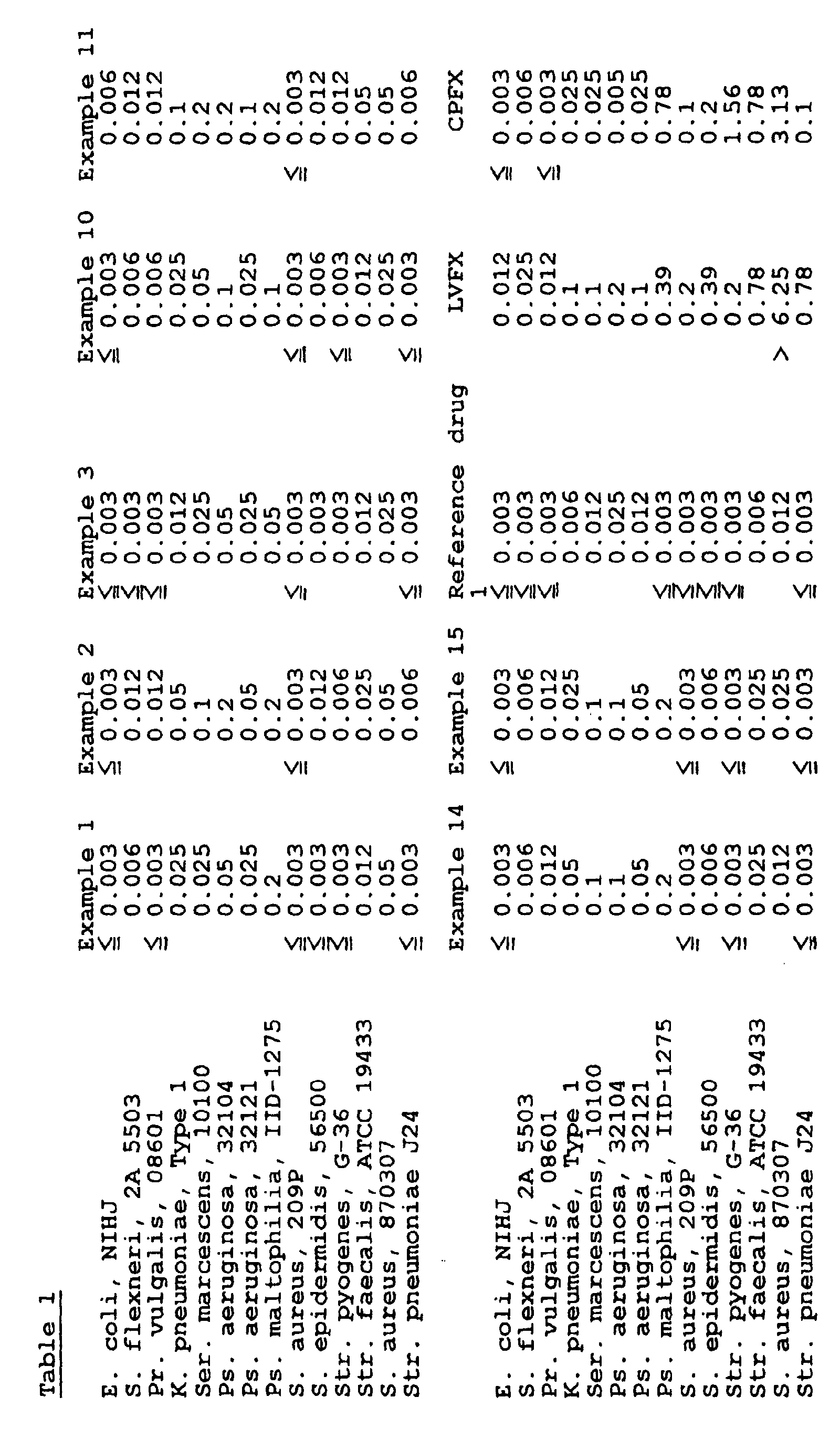

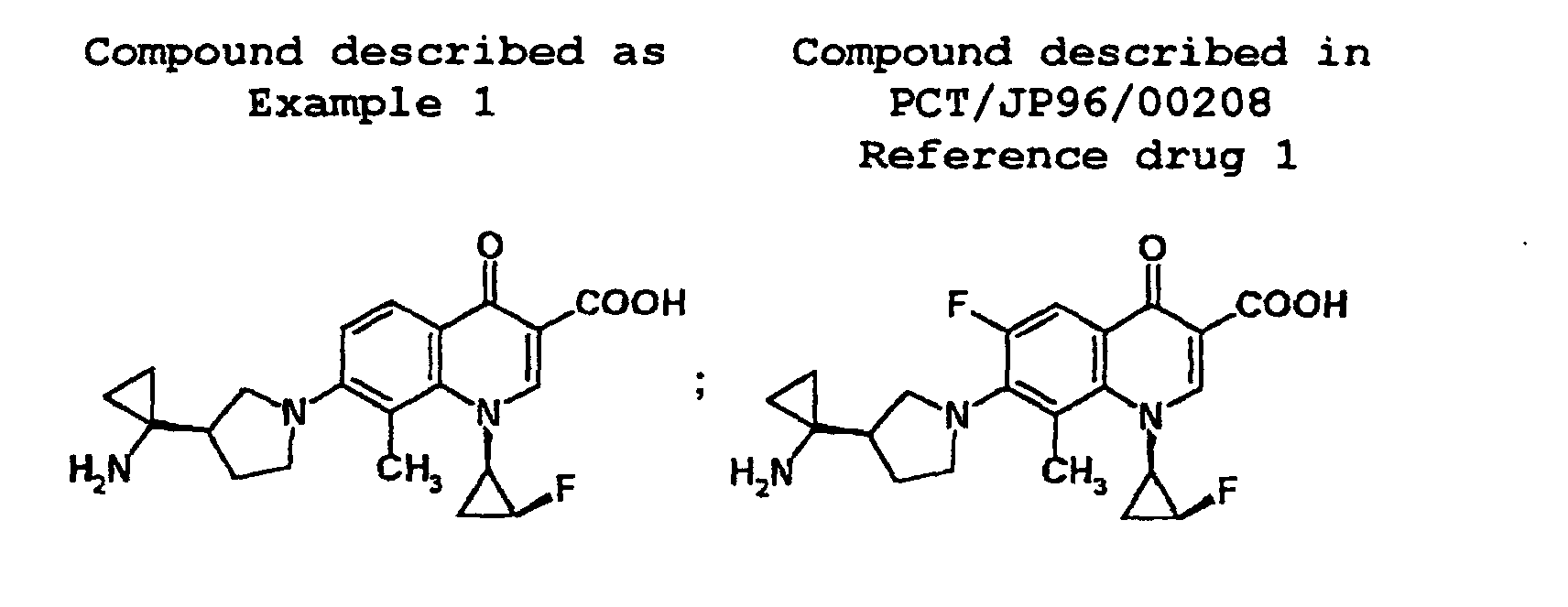
Claims (44)
- A compound represented by the following general formula (I), its salts, and hydrates thereof:[wherein R1 represents an alkyl group having 1 to 6 carbon atoms, an alkenyl group having 2 to 6 carbon atoms, a halogenoalkyl group having 1 to 6 carbon atoms, a cyclic alkyl group having 3 to 6 carbon atoms, which may have a substituent, an aryl group, which may have a substituent, a heteroaryl group, which may have a substituent, an alkoxy group having 1 to 6 carbon atoms, or an alkylamino group having 1 to 6 carbon atoms;
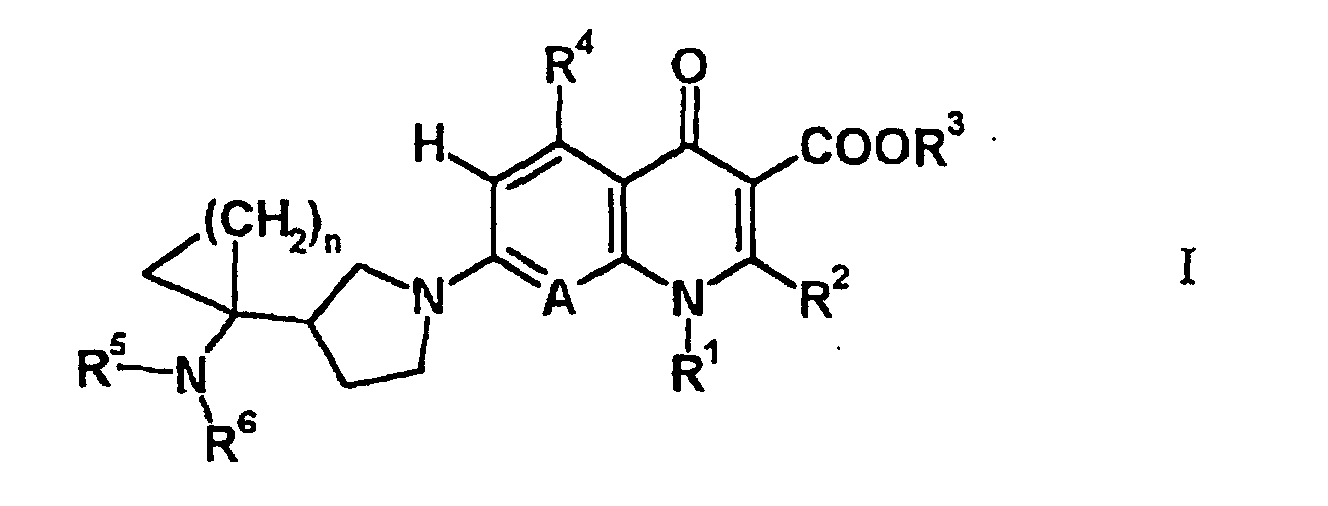
R2 represents an alkylthio group having 1 to 6 carbon atoms or a hydrogen atom,
wherein R2 and the abovementioned R1 may be integrated to form a ring structure by incorporating a part of the mother skeleton, the thus formed ring may contain a sulfur atom as a ring-constituent atom, and the ring may be substituted by an alkyl group having 1 to 6 carbon atoms, which may have a substituent;
R3 represents a phenylalkyl group composed of an alkylene group having 1 to 6 carbon atoms and a phenyl group, an alkyl group having 1 to 6 carbon atoms, an alkoxymethyl group having 2 to 7 carbon atoms, a hydrogen atom, a phenyl group, an acetoxymethyl group, a pivaloyloxymethyl group, an ethoxycarbonyl group, a choline group, a dimethylaminoethyl group, a 5-indanyl group, a phthalidinyl group, a 5-alkyl-2-oxo-1,3-dioxole-4-ylmethyl group, or a 3-acetoxy-2-oxobutyl group;
R4 represents an alkyl group having 1 to 6 carbon atoms, an alkenyl group having 2 to 6 carbon atoms, an alkynyl group having 2 to 6 carbon atoms, an alkoxy group having 1 to 6 carbon atoms, a hydrogen atom, an amino group, a hydroxyl group, a thiol group, or a halogenomethyl group, and
among the above, the amino group may have one or more substituents selected from among the group consisting of an alkyl group having 1 to 6 carbon atoms, an acyl group having 2 to 5 carbon atoms, and a formyl group;
A represents a nitrogen atom or a partial structure represented by formula (II):(wherein X1 represents an alkyl group having 1 to 6 carbon atoms, an alkenyl group having 2 to 6 carbon atoms, an alkynyl group having 2 to 6 carbon atoms, an alkoxy group having 1 to 6 carbon atoms, a hydrogen atom, an amino group, a halogen atom, a cyano group, a halogenomethyl group, or a halogenomethoxy group,
among the above, the amino group may have one ore more substituents selected from the group consisting of an alkyl group having 1 to 6 carbon atoms, an acyl group having 2 to 5 carbon atoms, and a formyl group,
wherein X1 and the aforementioned R1 may be integrated to form a ring structure by incorporating a part of the mother skeleton , the thus formed ring may contain an oxygen atom, a nitrogen atom, or a sulfur atom as a ring constituent atom, and this ring may be substituted by an alkyl group having 1 to 6 carbon atoms, which may have a substituent);
each of R5 and R6 independently represents an alkyl group having 1 to 6 carbon atoms, a hydrogen atom, or a substituted carboxyl group derived from an amino acid, dipeptide, or tripeptide,
wherein the alkyl group may have one ore more substituents selected from the group consisting of an alkylthio group having 1 to 6 carbon atoms, an alkoxy group having 1 to 6 carbon atoms, a hydroxyl group, and a halogen atom; and
n represents an integer 1 or 2]. - The compound according to claim 1, its salts or hydrates thereof, wherein the compound of formula (I) is a stereochemically pure compound.
- The compound according to claim 1 or 2, its salts or hydrates thereof, wherein n in the formula (I) is 1.
- The compound according to any one of claims 1 to 3, its salts or hydrates thereof, wherein R3 in the formula (I) is a hydrogen atom.
- The compound according to any one of claims 1 to 4, its salts or hydrates thereof, wherein R2 in the formula (I) is a hydrogen atom.
- The compound according to any one of claims 1 to 5, its salts or hydrates thereof, wherein R4 in the formula (I) is a hydrogen atom.
- The compound according to any one of claims 1 to 6, its salts or hydrates thereof, wherein A in the formula (I) is a partial structure represented by the formula (II).
- The compound according to claim 7, its salts or hydrates thereof, wherein X1 in the formula (II) is a methoxy group, a methyl group, a difluoromethoxy group, a fluorine atom, or a chlorine atom.
- The compound according to claim 7, its salts or hydrates thereof, wherein X1 in the formula (II) is a methoxy group or a methyl group.
- The compound according to any one of claims 1 to 9, its salts or hydrates thereof, wherein each of R5 and R6 in the formula (I) is a hydrogen atom.
- The compound according to any one of claims 1 to 9, its salts or hydrates thereof, wherein one of either R5 or R6 in the formula (I) is a hydrogen atom and the other is a methyl group.
- The compound according to any one of claims 1 to 9, its salts or hydrates thereof, wherein one of either R5 or R6 in formula (I) is a hydrogen atom and the other is a substituted carboxyl group derived from an amino acid, a dipeptide, or a tripeptide.
- The compound according to any one of claims 1 to 12, its salts or hydrates thereof, wherein the cyclic alkyl group having 3 to 6 carbon atoms, which may have a substituent, in R1 is a halogenocyclopropyl group.
- The compound according to claim 13, its salts or hydrates thereof, wherein the halogenocyclopropyl group is a 1,2-cis-2-halogenocyclopropyl group.
- The compound according to claim 14, its salts or hydrates thereof, wherein the halogenocyclopropyl group is a stereochemically pure substituent.
- The compound according to claim 15, its salts or hydrates thereof, wherein the halogenocyclopropyl group is a (1R, 2S)-2-halogenocyclopropyl group.
- The compound according to any one of claims 13 to 16, its salts or hydrates thereof, wherein the halogen atom of the halogenocyclopropyl group is a fluorine atom.
- 7-[3-(R)-(1-aminocyclopropyl)pyrrolidin-1-yl]-1-[2-(S)-fluoro-1-(R)-cyclopropyl]-1,4-dihydro-4-oxo-1,8-naphthyridine-3-carboxylic acid, its salts or hydrates thereof.
- 7-[3-(R)-(1-aminocyclopropyl)pyrrolidin-1-yl]-1-[2-(S)-fluoro-1-(R)-cyclopropyl]-1,4-dihydro-4-oxoquinoline-3-carboxylic acid, its salts or hydrates thereof.
- 7-[3-(R)-(1-aminocyclopropyl)pyrrolidin-1-yl]-1-[2-(S)-fluoro-1-(R)-cyclopropyl]-8-chloro-1,4-dihydro-4-oxoquinoline-3-carboxylic acid, its salts or hydrates thereof.
- 7-[3-(R)-(1-aminocyclopropyl)pyrrolidin-1-yl]-1-[2-(S)-fluoro-1-(R)-cyclopropyl]-8-fluoro-1,4-dihydro-4-oxoquinoline-3-carboxylic acid, its salts or hydrates thereof.
- 7-[3-(R)-(1-aminocyclopropyl)pyrrolidin-1-yl]-1-[2-(S)-fluoro-1-(R)-cyclopropyl]-8-difluoromethoxy-1,4-dihydro-4-oxoquinoline-3-carboxylic acid, its salts or hydrates thereof.
- 7-[3-(R)-(1-aminocyclopropyl)pyrrolidin-1-yl]-1-[2-(S)-fluoro-1-(R)-cyclopropyl]-1,4-dihydro-8-methoxy-4-oxoquinoline-3-carboxylic acid, its salts or hydrates thereof.
- 7-[3-(R)-[1-(methylamino)cyclopropyl]pyrrolidin-1-yl]-1-[2-(S)-fluoro-1-(R)-cyclopropyl]-1,4-dihydro-8-methoxy-4-oxoquinoline-3-carboxylic acid, its salts or hydrates thereof.
- 7-[3-(R)-(1-aminocyclopropyl)pyrrolidin-1-yl]-1-[2-(S)-fluoro-1-(R)-cyclopropyl]-1,4-dihydro-8-methyl-4-oxoquinoline-3-carboxylicacid, its salts or hydrates thereof.
- 7-[3-(R)-[1-(methylamino)cyclopropyl]pyrrolidin-1-yl]-1-[2-(S)-fluoro-1-(R)-cyclopropyl]-1,4-dihydro-8-methyl-4-oxoquinoline-3-carboxylic acid, its salts or hydrates thereof.
- 7-(3-(R)-[1-(ethylamino)cyclopropyl]pyrrolidin-1-yl]-1-[2-(S)-fluoro-1-(R)-cyclopropyl]-1,4-dihydro-8-methyl-4-oxoquinoline-3-carboxylic acid, its salts or hydrates thereof.
- 5-amino-7-[3-(R)-(1-aminocyclopropyl)pyrrolidin-1-yl]-1-[2-(S)-fluoro-1-(R)-cyclopropyl]-1,4-dihydro-8-fluoro-4-oxoquinoline-3-carboxy lic acid, its salts or hydrates thereof.
- 5-amino-7-[3-(R)-(1-aminocyclopropyl)pyrrolidin-1-yl]-1-[2-(S)-fluoro-1-(R)-cyclopropyl]-1,4-dihydro-8-methoxy-4-oxoquinoline-3-carboxylic acid, its salts or hydrates thereof.
- 5-amino-7-[3-(R)-(1-aminocyclopropyl)pyrrolidin-1-yl]-1-[2-(S)-fluoro-1-(R)-cyclopropyl]-1,4-dihydro-8-methyl-4-oxoquinoline-3-carboxylic acid, its salts or hydrates thereof.
- 5-amino-7-[3-(R)-[1-(methylamino)cyclopropyl]pyrrolidin-1-yl]-1-[2-(S)-fluoro-1-(R)-cyclopropyl]-1,4-dihydro-8-methoxy-4-oxoquinoline-3-carboxylic acid, its salts or hydrates thereof.
- 10-[3-(R)-(1-aminocyclopropyl)pyrrolidin-1-yl]-2,3-dihydro-3-(S)-methyl-7-oxo-7H-pyrido[1,2,3-de][1,4]benzoxazine-6-carboxylic acid, its salts or hydrates thereof.
- 1-(cyclopropyl)-8-methyl-7-[3-(R)-[1-(methylamino)cyclopropyl]pyrrolidin-1-yl]-1,4-dihydro-4-oxoquinoline-3-carboxylic acid, its salts or hydrates thereof.
- A medicament, which comprises the compound described in any one of claims 1 to 33, its salts or hydrates thereof as an active ingredient.
- An antibacterial agent, which comprises the compound described in any of claims 1 to 33, its salts or hydrates thereof, as an active ingredient.
- A therapeutic agent for an infectious disease, which comprises the compound described in any of claims 1 to 33, its salts or hydrates thereof, as an active ingredient.
- A method for treating a disease, which comprises administrating the compound described in any of claims 1 to 33, its salts or hydrates thereof, as an active ingredient.
- A method for treating an infectious disease, which comprises administrating the compound described in any of claims 1 to 33, its salts or hydrates thereof, as an active ingredient.
- A method for producing a medicament, which comprises formulating the compound described in any of claims 1 to 33, its salts or hydrates thereof, as an active ingredient.
- Amethod for producing an antibacterial agent, which comprises formulating the compound described in any of claims 1 to 33, its salts or hydrates thereof, as an active ingredient.
- A method for producing an infectious disease treating agent, which comprises formulating the compound described in any of claims 1 to 33, its salts or hydrates thereof, as an active ingredient.
- Use of the compound described in any of claims 1 to 33, its salts or hydrates thereof, for the production of a medicament.
- Use of the compound described in any of claims 1 to 33, its salts or hydrates thereof for the production of an antibacterial agent.
- Use of the compound described in any of claims 1 to 33, its salts or hydrates thereof for the production of an infectious disease treating agent.
Applications Claiming Priority (5)
| Application Number | Priority Date | Filing Date | Title |
|---|---|---|---|
| JP2000352269 | 2000-11-20 | ||
| JP2000352269 | 2000-11-20 | ||
| JP2001248822 | 2001-08-20 | ||
| JP2001248822 | 2001-08-20 | ||
| PCT/JP2001/010086 WO2002040478A1 (en) | 2000-11-20 | 2001-11-19 | Dehalogeno compounds |
Publications (3)
| Publication Number | Publication Date |
|---|---|
| EP1336611A1 true EP1336611A1 (en) | 2003-08-20 |
| EP1336611A4 EP1336611A4 (en) | 2004-07-21 |
| EP1336611B1 EP1336611B1 (en) | 2007-09-05 |
Family
ID=26604261
Family Applications (1)
| Application Number | Title | Priority Date | Filing Date |
|---|---|---|---|
| EP01996540A Expired - Lifetime EP1336611B1 (en) | 2000-11-20 | 2001-11-19 | Dehalogeno compounds |
Country Status (19)
| Country | Link |
|---|---|
| US (2) | US20040063754A1 (en) |
| EP (1) | EP1336611B1 (en) |
| JP (3) | JP3711108B2 (en) |
| KR (1) | KR100777149B1 (en) |
| CN (1) | CN1269817C (en) |
| AR (1) | AR035599A1 (en) |
| AT (1) | ATE372338T1 (en) |
| AU (1) | AU2405002A (en) |
| BR (1) | BR0115326A (en) |
| CA (1) | CA2429440C (en) |
| DE (1) | DE60130359T2 (en) |
| ES (1) | ES2292642T3 (en) |
| IL (2) | IL155976A0 (en) |
| MX (1) | MXPA03004437A (en) |
| MY (1) | MY136916A (en) |
| NO (1) | NO326157B1 (en) |
| PT (1) | PT1336611E (en) |
| TW (1) | TWI315308B (en) |
| WO (1) | WO2002040478A1 (en) |
Cited By (3)
| Publication number | Priority date | Publication date | Assignee | Title |
|---|---|---|---|---|
| EP1634879A4 (en) * | 2003-06-19 | 2007-09-05 | Daiichi Seiyaku Co | Method of selectively introducing amino substituent |
| EP1632482A4 (en) * | 2003-06-06 | 2009-10-28 | Daiichi Seiyaku Co | Intermediates and process for the production of optically active quinolonecarboxylic acid derivatives |
| EP1930006A4 (en) * | 2005-09-28 | 2010-10-13 | Daiichi Sankyo Co Ltd | PROCESS FOR PRODUCING LYOPHILIZED PREPARATION CONTAINING QUINOLONE |
Families Citing this family (8)
| Publication number | Priority date | Publication date | Assignee | Title |
|---|---|---|---|---|
| PT1336611E (en) | 2000-11-20 | 2007-12-06 | Daiichi Sankyo Co Ltd | Dehalogeno compounds |
| JP4629973B2 (en) * | 2003-09-22 | 2011-02-09 | 第一三共株式会社 | Optically active cyclopropylamine derivative and method for producing the same |
| WO2005030752A1 (en) * | 2003-09-29 | 2005-04-07 | Daiichi Pharmaceutical Co., Ltd. | 8-cyanoquinolonecarboxylic acid derivative |
| EP1693364B1 (en) | 2003-12-12 | 2015-05-20 | Daiichi Sankyo Company, Limited | Intermediates for the production of optically active cyclopropylamine derivatives and process for the production of the intermediates |
| TW200612941A (en) * | 2004-07-02 | 2006-05-01 | Daiichi Seiyaku Co | Quinorone-containing pharmaceutical composition |
| CN100441580C (en) * | 2006-07-14 | 2008-12-10 | 中山大学 | Quinolinedione derivatives and their application in the preparation of antibacterial drugs |
| BRPI0715095B8 (en) * | 2006-08-11 | 2021-05-25 | Northern Antibiotics Oy | polymyxin derivative of the general formula (i); combination product; pharmaceutical composition; method of sensitizing gram-negative bacteria to an antibacterial agent; method for developing antibiotics; method for reducing the toxicity of polymyxins, natural octapeptins and their derivatives during their application in the treatment of infections in an individual; method to improve the pharmacokinetic properties of polymyxins, natural octapeptins and their derivatives; method for sensitizing clinically important gram-negative bacteria to a complement defense mechanism present in serum; use of a derivative; and process for preparing a polymyxin derivative of formula (I). |
| JP5174365B2 (en) * | 2007-03-23 | 2013-04-03 | 第一三共株式会社 | Method for producing lyophilized preparation containing quinolone |
Family Cites Families (17)
| Publication number | Priority date | Publication date | Assignee | Title |
|---|---|---|---|---|
| ATE75740T1 (en) * | 1985-06-26 | 1992-05-15 | Daiichi Seiyaku Co | PYRIDONECARBONIC ACID DERIVATIVES. |
| DE69531305T2 (en) | 1994-10-20 | 2004-05-13 | Wakunaga Seiyaku K.K. | PYRIDONE CARBOXYLATE DERIVATIVES OR SALTS THEREOF AND ANTIBACTERIAL COMPOSITIONS CONTAINING THEM AS AN ACTIVE COMPONENT |
| PT807630E (en) * | 1995-02-02 | 2003-08-29 | Daiichi Seiyaku Co | HETEROCYCLIC COMPOUNDS |
| ES2200439T3 (en) | 1995-09-22 | 2004-03-01 | Wakunaga Pharmaceutical Co., Ltd. | INTERMEDIATES TO USE IN THE PREPARATION OF NEW DERIVATIVES OF THE PYRIDONOCARBOXILIC ACID OR ITS SALTS. |
| US6121285A (en) * | 1995-11-22 | 2000-09-19 | Daiichi Pharmaceutical Co., Ltd. | Substituted aminocycloalkylpyrrolidine derivatives and cis-substituted aminocycloalkylpyrrolidine derivatives |
| JP4040091B2 (en) | 1995-11-22 | 2008-01-30 | 第一三共株式会社 | Substituted aminocycloalkylpyrrolidine derivatives |
| AU3459797A (en) | 1996-07-12 | 1998-02-09 | Daiichi Pharmaceutical Co., Ltd. | Cis-substituted aminocyclopropane derivatives |
| JPH1081682A (en) | 1996-07-12 | 1998-03-31 | Dai Ichi Seiyaku Co Ltd | Cis-substituted aminocyclopropane derivative |
| TW519542B (en) * | 1996-09-27 | 2003-02-01 | Daiichi Seiyaku Co | Bicyclic amine derivative |
| CN1263527A (en) | 1997-05-21 | 2000-08-16 | 第一制药株式会社 | Cis-disubstituted aminocycloalykyl-pyrrolidine derivatives |
| MY119816A (en) * | 1997-05-30 | 2005-07-29 | Daiichi Seiyaku Co | Substituted cyclobutylamine derivatives |
| KR20010014209A (en) * | 1997-06-24 | 2001-02-26 | 스즈키 다다시 | Cis-substituted fluoromethylpyrrolidine derivatives |
| CN1264837C (en) * | 1997-09-15 | 2006-07-19 | 普罗克特和甘保尔公司 | Quinolones antimicrobials, compositions and uses thereof |
| JP2000023709A (en) * | 1998-07-16 | 2000-01-25 | Shimano Inc | Long shoes |
| DE19834202A1 (en) | 1998-07-29 | 2000-02-10 | Coherent Luebeck Gmbh | Low-noise, frequency-multiplied laser with beam separator |
| ATE297912T1 (en) | 1998-11-24 | 2005-07-15 | Daiichi Seiyaku Co | CYCLOALKYL-SUBSTITUTED AMINOMETHYLPYRROLIDINE DERIVATIVES |
| PT1336611E (en) | 2000-11-20 | 2007-12-06 | Daiichi Sankyo Co Ltd | Dehalogeno compounds |
-
2001
- 2001-11-19 PT PT01996540T patent/PT1336611E/en unknown
- 2001-11-19 CA CA002429440A patent/CA2429440C/en not_active Expired - Fee Related
- 2001-11-19 AT AT01996540T patent/ATE372338T1/en active
- 2001-11-19 CN CNB018220746A patent/CN1269817C/en not_active Expired - Fee Related
- 2001-11-19 MX MXPA03004437A patent/MXPA03004437A/en active IP Right Grant
- 2001-11-19 BR BR0115326-9A patent/BR0115326A/en active Search and Examination
- 2001-11-19 EP EP01996540A patent/EP1336611B1/en not_active Expired - Lifetime
- 2001-11-19 IL IL15597601A patent/IL155976A0/en unknown
- 2001-11-19 KR KR1020037006835A patent/KR100777149B1/en not_active Expired - Fee Related
- 2001-11-19 DE DE60130359T patent/DE60130359T2/en not_active Expired - Lifetime
- 2001-11-19 WO PCT/JP2001/010086 patent/WO2002040478A1/en not_active Ceased
- 2001-11-19 AU AU2405002A patent/AU2405002A/en not_active Withdrawn
- 2001-11-19 US US10/432,043 patent/US20040063754A1/en not_active Abandoned
- 2001-11-19 JP JP2002543488A patent/JP3711108B2/en not_active Expired - Fee Related
- 2001-11-19 AR ARP010105401A patent/AR035599A1/en active IP Right Grant
- 2001-11-19 ES ES01996540T patent/ES2292642T3/en not_active Expired - Lifetime
- 2001-11-20 MY MYPI20015301A patent/MY136916A/en unknown
- 2001-11-20 TW TW090128688A patent/TWI315308B/en not_active IP Right Cessation
-
2003
- 2003-05-19 NO NO20032255A patent/NO326157B1/en not_active IP Right Cessation
- 2003-05-19 IL IL155976A patent/IL155976A/en not_active IP Right Cessation
-
2004
- 2004-05-26 JP JP2004156517A patent/JP2004269544A/en active Pending
- 2004-12-28 JP JP2004379455A patent/JP3760172B2/en not_active Expired - Fee Related
-
2006
- 2006-12-26 US US11/644,901 patent/US7902226B2/en not_active Expired - Fee Related
Cited By (6)
| Publication number | Priority date | Publication date | Assignee | Title |
|---|---|---|---|---|
| EP1632482A4 (en) * | 2003-06-06 | 2009-10-28 | Daiichi Seiyaku Co | Intermediates and process for the production of optically active quinolonecarboxylic acid derivatives |
| US7915418B2 (en) | 2003-06-06 | 2011-03-29 | Daiichi Pharmaceutical Co., Ltd. | Intermediates and process for the production of optically active quinolonecarboxylic acid derivatives |
| EP1634879A4 (en) * | 2003-06-19 | 2007-09-05 | Daiichi Seiyaku Co | Method of selectively introducing amino substituent |
| US7626029B2 (en) | 2003-06-19 | 2009-12-01 | Daiichi Pharmaceutical Co., Ltd. | Method of selectively introducing amino substituent |
| EP1930006A4 (en) * | 2005-09-28 | 2010-10-13 | Daiichi Sankyo Co Ltd | PROCESS FOR PRODUCING LYOPHILIZED PREPARATION CONTAINING QUINOLONE |
| US8129533B2 (en) | 2005-09-28 | 2012-03-06 | Dalichi Sankyo Company, Limited | Method for production of quinolone-containing lyophilized preparation |
Also Published As
Similar Documents
| Publication | Publication Date | Title |
|---|---|---|
| US5849757A (en) | Pyridonecarboxylic acid derivatives substituted by a bicyclic amino group as antibacterials | |
| EP1336611B1 (en) | Dehalogeno compounds | |
| AU2006248354B2 (en) | Tri- or tetra-substituted-3-aminopyrrolidine derivatives | |
| JP4040091B2 (en) | Substituted aminocycloalkylpyrrolidine derivatives | |
| RU2248970C2 (en) | Cycloalkyl-substituted derivatives of aminomethylpyrrolidine and antibacterial agent based on thereof | |
| US8455482B2 (en) | Substituted pyrrolidine derivative | |
| JPWO1998002431A1 (en) | Cis-substituted aminocyclopropane derivatives | |
| EP0995744A1 (en) | Cis-substituted fluoromethylpyrrolidine derivatives | |
| JPWO1998054169A1 (en) | Substituted cyclobutylamine derivatives | |
| HK1056729B (en) | Dehalogeno compounds | |
| RU2298006C2 (en) | Dehalogenated compounds, antibacterial agent and therapeutic agent based on thereof, method for preparing antibacterial or medicinal agent, using dehalogenated compounds for preparing antibacterial or medicinal agent | |
| EP1712554A1 (en) | Pyridobenzoxazine derivative | |
| EP0816355B1 (en) | Heterocyclic spiro derivatives | |
| JP4926723B2 (en) | Fluoroalkylpyrrolidine derivatives | |
| US7723524B2 (en) | 8-cyanoquinolonecarboxylic acid derivative | |
| HK1113571A (en) | Fluoroalkylpyrrolidine derivative | |
| MXPA99011056A (en) | Substituted cyclobutylamine derivatives |
Legal Events
| Date | Code | Title | Description |
|---|---|---|---|
| PUAI | Public reference made under article 153(3) epc to a published international application that has entered the european phase |
Free format text: ORIGINAL CODE: 0009012 |
|
| 17P | Request for examination filed |
Effective date: 20030521 |
|
| AK | Designated contracting states |
Designated state(s): AT BE CH CY DE DK ES FI FR GB GR IE IT LI LU MC NL PT SE TR |
|
| AX | Request for extension of the european patent |
Extension state: AL LT LV MK RO SI |
|
| A4 | Supplementary search report drawn up and despatched |
Effective date: 20040604 |
|
| RIC1 | Information provided on ipc code assigned before grant |
Ipc: 7C 07D 498/06 B Ipc: 7A 61P 31/04 B Ipc: 7C 07D 471/04 A Ipc: 7A 61K 31/4741 B Ipc: 7A 61K 31/4709 B Ipc: 7C 07D 401/04 B |
|
| 17Q | First examination report despatched |
Effective date: 20040921 |
|
| GRAP | Despatch of communication of intention to grant a patent |
Free format text: ORIGINAL CODE: EPIDOSNIGR1 |
|
| GRAS | Grant fee paid |
Free format text: ORIGINAL CODE: EPIDOSNIGR3 |
|
| GRAA | (expected) grant |
Free format text: ORIGINAL CODE: 0009210 |
|
| AK | Designated contracting states |
Kind code of ref document: B1 Designated state(s): AT BE CH CY DE DK ES FI FR GB GR IE IT LI LU MC NL PT SE TR |
|
| REG | Reference to a national code |
Ref country code: GB Ref legal event code: FG4D |
|
| REG | Reference to a national code |
Ref country code: CH Ref legal event code: EP |
|
| REF | Corresponds to: |
Ref document number: 60130359 Country of ref document: DE Date of ref document: 20071018 Kind code of ref document: P |
|
| REG | Reference to a national code |
Ref country code: IE Ref legal event code: FG4D |
|
| RAP2 | Party data changed (patent owner data changed or rights of a patent transferred) |
Owner name: DAIICHI SANKYO COMPANY, LIMITED |
|
| REG | Reference to a national code |
Ref country code: GB Ref legal event code: 732E |
|
| REG | Reference to a national code |
Ref country code: PT Ref legal event code: SC4A Free format text: AVAILABILITY OF NATIONAL TRANSLATION Effective date: 20071127 |
|
| BECA | Be: change of holder's address |
Owner name: DAIICHI SANKO CY LTD3-5-1, NIHONBASHI HONCHO, CHUO Effective date: 20070905 |
|
| BECH | Be: change of holder |
Owner name: DAIICHI SANKO CY LTD Effective date: 20070905 |
|
| NLT2 | Nl: modifications (of names), taken from the european patent patent bulletin |
Owner name: DAIICHI SANKYO COMPANY, LIMITED Effective date: 20071107 |
|
| REG | Reference to a national code |
Ref country code: GR Ref legal event code: EP Ref document number: 20070403478 Country of ref document: GR |
|
| PG25 | Lapsed in a contracting state [announced via postgrant information from national office to epo] |
Ref country code: FI Free format text: LAPSE BECAUSE OF FAILURE TO SUBMIT A TRANSLATION OF THE DESCRIPTION OR TO PAY THE FEE WITHIN THE PRESCRIBED TIME-LIMIT Effective date: 20070905 |
|
| REG | Reference to a national code |
Ref country code: HK Ref legal event code: GR Ref document number: 1056729 Country of ref document: HK |
|
| REG | Reference to a national code |
Ref country code: CH Ref legal event code: NV Representative=s name: BOVARD AG PATENTANWAELTE |
|
| NLV1 | Nl: lapsed or annulled due to failure to fulfill the requirements of art. 29p and 29m of the patents act | ||
| REG | Reference to a national code |
Ref country code: ES Ref legal event code: FG2A Ref document number: 2292642 Country of ref document: ES Kind code of ref document: T3 |
|
| REG | Reference to a national code |
Ref country code: FR Ref legal event code: TP |
|
| PG25 | Lapsed in a contracting state [announced via postgrant information from national office to epo] |
Ref country code: NL Free format text: LAPSE BECAUSE OF FAILURE TO SUBMIT A TRANSLATION OF THE DESCRIPTION OR TO PAY THE FEE WITHIN THE PRESCRIBED TIME-LIMIT Effective date: 20070905 |
|
| EN | Fr: translation not filed | ||
| PG25 | Lapsed in a contracting state [announced via postgrant information from national office to epo] |
Ref country code: SE Free format text: LAPSE BECAUSE OF FAILURE TO SUBMIT A TRANSLATION OF THE DESCRIPTION OR TO PAY THE FEE WITHIN THE PRESCRIBED TIME-LIMIT Effective date: 20071205 Ref country code: MC Free format text: LAPSE BECAUSE OF NON-PAYMENT OF DUE FEES Effective date: 20071130 |
|
| PLBE | No opposition filed within time limit |
Free format text: ORIGINAL CODE: 0009261 |
|
| STAA | Information on the status of an ep patent application or granted ep patent |
Free format text: STATUS: NO OPPOSITION FILED WITHIN TIME LIMIT |
|
| PG25 | Lapsed in a contracting state [announced via postgrant information from national office to epo] |
Ref country code: DK Free format text: LAPSE BECAUSE OF FAILURE TO SUBMIT A TRANSLATION OF THE DESCRIPTION OR TO PAY THE FEE WITHIN THE PRESCRIBED TIME-LIMIT Effective date: 20070905 |
|
| ET | Fr: translation filed | ||
| REG | Reference to a national code |
Ref country code: FR Ref legal event code: EERR Free format text: CORRECTION DE BOPI 08/18 - BREVETS EUROPEENS DONT LA TRADUCTION N A PAS ETE REMISE A L INPI. IL Y A LIEU DE SUPPRIMER : LA MENTION DE LA NON-REMISE. LA REMISE DE LA TRADUCTION EST PUBLIEE DANS LE PRESENT BOPI. |
|
| 26N | No opposition filed |
Effective date: 20080606 |
|
| PG25 | Lapsed in a contracting state [announced via postgrant information from national office to epo] |
Ref country code: FR Free format text: LAPSE BECAUSE OF FAILURE TO SUBMIT A TRANSLATION OF THE DESCRIPTION OR TO PAY THE FEE WITHIN THE PRESCRIBED TIME-LIMIT Effective date: 20080502 |
|
| PG25 | Lapsed in a contracting state [announced via postgrant information from national office to epo] |
Ref country code: CY Free format text: LAPSE BECAUSE OF FAILURE TO SUBMIT A TRANSLATION OF THE DESCRIPTION OR TO PAY THE FEE WITHIN THE PRESCRIBED TIME-LIMIT Effective date: 20070905 |
|
| PG25 | Lapsed in a contracting state [announced via postgrant information from national office to epo] |
Ref country code: LU Free format text: LAPSE BECAUSE OF NON-PAYMENT OF DUE FEES Effective date: 20071119 |
|
| REG | Reference to a national code |
Ref country code: CH Ref legal event code: PFA Owner name: DAIICHI SANKYO COMPANY, LIMITED Free format text: DAIICHI SANKYO COMPANY, LIMITED#3-5-1, NIHONBASHI HONCHO#CHUO-KU TOKYO (JP) -TRANSFER TO- DAIICHI SANKYO COMPANY, LIMITED#3-5-1, NIHONBASHI HONCHO#CHUO-KU TOKYO (JP) |
|
| REG | Reference to a national code |
Ref country code: FR Ref legal event code: PLFP Year of fee payment: 15 |
|
| PGFP | Annual fee paid to national office [announced via postgrant information from national office to epo] |
Ref country code: CH Payment date: 20151111 Year of fee payment: 15 Ref country code: TR Payment date: 20151021 Year of fee payment: 15 Ref country code: IE Payment date: 20151109 Year of fee payment: 15 Ref country code: GR Payment date: 20151015 Year of fee payment: 15 |
|
| PGFP | Annual fee paid to national office [announced via postgrant information from national office to epo] |
Ref country code: AT Payment date: 20151027 Year of fee payment: 15 Ref country code: BE Payment date: 20151111 Year of fee payment: 15 Ref country code: PT Payment date: 20151117 Year of fee payment: 15 |
|
| REG | Reference to a national code |
Ref country code: FR Ref legal event code: PLFP Year of fee payment: 16 |
|
| PGFP | Annual fee paid to national office [announced via postgrant information from national office to epo] |
Ref country code: GB Payment date: 20161116 Year of fee payment: 16 Ref country code: FR Payment date: 20161014 Year of fee payment: 16 Ref country code: DE Payment date: 20161116 Year of fee payment: 16 |
|
| PG25 | Lapsed in a contracting state [announced via postgrant information from national office to epo] |
Ref country code: BE Free format text: LAPSE BECAUSE OF NON-PAYMENT OF DUE FEES Effective date: 20161130 |
|
| PGFP | Annual fee paid to national office [announced via postgrant information from national office to epo] |
Ref country code: IT Payment date: 20161122 Year of fee payment: 16 Ref country code: ES Payment date: 20161011 Year of fee payment: 16 |
|
| REG | Reference to a national code |
Ref country code: CH Ref legal event code: PL |
|
| REG | Reference to a national code |
Ref country code: AT Ref legal event code: MM01 Ref document number: 372338 Country of ref document: AT Kind code of ref document: T Effective date: 20161119 |
|
| PG25 | Lapsed in a contracting state [announced via postgrant information from national office to epo] |
Ref country code: GR Free format text: LAPSE BECAUSE OF NON-PAYMENT OF DUE FEES Effective date: 20170612 Ref country code: LI Free format text: LAPSE BECAUSE OF NON-PAYMENT OF DUE FEES Effective date: 20161130 Ref country code: CH Free format text: LAPSE BECAUSE OF NON-PAYMENT OF DUE FEES Effective date: 20161130 |
|
| REG | Reference to a national code |
Ref country code: IE Ref legal event code: MM4A |
|
| PG25 | Lapsed in a contracting state [announced via postgrant information from national office to epo] |
Ref country code: AT Free format text: LAPSE BECAUSE OF NON-PAYMENT OF DUE FEES Effective date: 20161119 Ref country code: PT Free format text: LAPSE BECAUSE OF NON-PAYMENT OF DUE FEES Effective date: 20170519 |
|
| PG25 | Lapsed in a contracting state [announced via postgrant information from national office to epo] |
Ref country code: IE Free format text: LAPSE BECAUSE OF NON-PAYMENT OF DUE FEES Effective date: 20161119 |
|
| REG | Reference to a national code |
Ref country code: BE Ref legal event code: MM Effective date: 20161130 |
|
| REG | Reference to a national code |
Ref country code: DE Ref legal event code: R119 Ref document number: 60130359 Country of ref document: DE |
|
| GBPC | Gb: european patent ceased through non-payment of renewal fee |
Effective date: 20171119 |
|
| REG | Reference to a national code |
Ref country code: FR Ref legal event code: ST Effective date: 20180731 |
|
| PG25 | Lapsed in a contracting state [announced via postgrant information from national office to epo] |
Ref country code: DE Free format text: LAPSE BECAUSE OF NON-PAYMENT OF DUE FEES Effective date: 20180602 Ref country code: IT Free format text: LAPSE BECAUSE OF NON-PAYMENT OF DUE FEES Effective date: 20171119 Ref country code: FR Free format text: LAPSE BECAUSE OF NON-PAYMENT OF DUE FEES Effective date: 20171130 |
|
| PG25 | Lapsed in a contracting state [announced via postgrant information from national office to epo] |
Ref country code: GB Free format text: LAPSE BECAUSE OF NON-PAYMENT OF DUE FEES Effective date: 20171119 |
|
| PG25 | Lapsed in a contracting state [announced via postgrant information from national office to epo] |
Ref country code: ES Free format text: LAPSE BECAUSE OF NON-PAYMENT OF DUE FEES Effective date: 20171120 |
|
| PG25 | Lapsed in a contracting state [announced via postgrant information from national office to epo] |
Ref country code: TR Free format text: LAPSE BECAUSE OF NON-PAYMENT OF DUE FEES Effective date: 20161119 |