EP1335466A2 - Self-powered apparatus and method for optically detecting arcing faults in electric power systems in the presence of other light sources - Google Patents
Self-powered apparatus and method for optically detecting arcing faults in electric power systems in the presence of other light sources Download PDFInfo
- Publication number
- EP1335466A2 EP1335466A2 EP03002695A EP03002695A EP1335466A2 EP 1335466 A2 EP1335466 A2 EP 1335466A2 EP 03002695 A EP03002695 A EP 03002695A EP 03002695 A EP03002695 A EP 03002695A EP 1335466 A2 EP1335466 A2 EP 1335466A2
- Authority
- EP
- European Patent Office
- Prior art keywords
- light
- signal
- electrical signal
- photovoltaic
- arcing
- Prior art date
- Legal status (The legal status is an assumption and is not a legal conclusion. Google has not performed a legal analysis and makes no representation as to the accuracy of the status listed.)
- Granted
Links
- 238000000034 method Methods 0.000 title claims description 13
- 239000000835 fiber Substances 0.000 claims abstract description 21
- 239000000463 material Substances 0.000 abstract description 7
- 230000003287 optical effect Effects 0.000 description 7
- 238000010586 diagram Methods 0.000 description 6
- 229910052751 metal Inorganic materials 0.000 description 6
- 239000002184 metal Substances 0.000 description 6
- RYGMFSIKBFXOCR-UHFFFAOYSA-N Copper Chemical compound [Cu] RYGMFSIKBFXOCR-UHFFFAOYSA-N 0.000 description 5
- 239000010949 copper Substances 0.000 description 5
- 229910052802 copper Inorganic materials 0.000 description 5
- 239000004020 conductor Substances 0.000 description 4
- 238000001514 detection method Methods 0.000 description 4
- 230000000694 effects Effects 0.000 description 3
- 238000002955 isolation Methods 0.000 description 3
- 230000035945 sensitivity Effects 0.000 description 2
- 230000003595 spectral effect Effects 0.000 description 2
- 230000003213 activating effect Effects 0.000 description 1
- 238000013459 approach Methods 0.000 description 1
- 239000003990 capacitor Substances 0.000 description 1
- 238000004891 communication Methods 0.000 description 1
- 230000001419 dependent effect Effects 0.000 description 1
- 238000013461 design Methods 0.000 description 1
- 230000009977 dual effect Effects 0.000 description 1
- 239000007789 gas Substances 0.000 description 1
- 238000012986 modification Methods 0.000 description 1
- 230000004048 modification Effects 0.000 description 1
- 238000012544 monitoring process Methods 0.000 description 1
- 230000001681 protective effect Effects 0.000 description 1
- 238000001228 spectrum Methods 0.000 description 1
- WFKWXMTUELFFGS-UHFFFAOYSA-N tungsten Chemical compound [W] WFKWXMTUELFFGS-UHFFFAOYSA-N 0.000 description 1
- 229910052721 tungsten Inorganic materials 0.000 description 1
- 239000010937 tungsten Substances 0.000 description 1
Images


Classifications
-
- H—ELECTRICITY
- H02—GENERATION; CONVERSION OR DISTRIBUTION OF ELECTRIC POWER
- H02H—EMERGENCY PROTECTIVE CIRCUIT ARRANGEMENTS
- H02H1/00—Details of emergency protective circuit arrangements
- H02H1/0007—Details of emergency protective circuit arrangements concerning the detecting means
- H02H1/0015—Using arc detectors
- H02H1/0023—Using arc detectors sensing non electrical parameters, e.g. by optical, pneumatic, thermal or sonic sensors
Definitions
- This invention relates to detecting arcing faults in electric power systems utilizing the light emitted by the arcing even in the presence of other light sources. More particularly, it relates to such apparatus and method energized by the emitted light without external power and uses a low-cost optic fiber for communication to central electronics.
- Electric power systems incorporate switches for control and protection purposes.
- Distribution systems which form part of the overall electric power system include main and branch power buses and circuit breakers mounted in metal cabinets to form switchgear. Interruption of current flow in the buses of the distribution system by a circuit breaker creates an arc as the contacts of the circuit breaker open. These arcs caused by interruption are contained and extinguished in the normal course of operation of the circuit breaker.
- U.S. Patent No. 6,229,680 discloses apparatus and a method for optically detecting arcing faults in electric power systems in the presence of other light sources.
- Light from components in the electric power system is gathered and split into two light beams.
- the first beam is passed through a first narrow band filter to extract a wavelength characteristic of arcing in the material, such as copper in switchgear conductors.
- the second beam of light is passed through a second filter having a narrow bandwidth, not including the characteristic wavelength.
- the extracted light signals are converted to a sensed light electrical signal and a background light electrical signal, respectively, by photodiodes and compared. If the sensed light electrical signal exceeds the background light electrical signal by a selected threshold, an output device such as a trip solenoid is actuated.
- a sensor unit includes first photovoltaic means that is responsive to incedent light in a first wavelength band including the predetermined wavelength of light produced by an arcing fault to generate a sensed light electrical signal. Second photovoltaic means of the sensor unit generates a background light electrical signal from incedent light including light from the component in a second wavelength band not including the predetermined wavelength.
- Circuit means connects the first photovoltaic means and the second photovoltaic means to an electrically activated light-emitting device with the sensed light electrical signal and the background light electrical signal in opposition to activate the light-emitting device to emit a light signal when the sensed light electrical signal exceeds the background light electrical signal by a selected threshold amount indicative of an arcing fault.
- a response unit includes an optic fiber transmitting the light signal from the light-emitting device of the sensor unit, and photoelectric means responsive substantially only to the light signal transmitted by the optic fiber for generating an arcing signal in response to the light signal. As the optic fiber is primarily transmitting a digital light signal and providing electrical isolation between the sensor unit and the output arcing signal, it can be a low-cost device.
- the sensor unit which can be duplicated throughout the electric power system is self-energizing thereby eliminating the need for the distribution of activating power.
- the photovoltaic means have a wide field of view thereby eliminating the need for optics to gather light, or alternatively, reducing the number of sensor units required.
- Each of the photovoltaic means can comprise at least one photovoltaic cell and filter means, the first photovoltaic means having a filter with a passband equal to the first wavelength band containing the predetermined wavelength generated by an arcing fault, and the filter for the second photovoltaic means having a passband equal to the second wavelength which does not include the predetermined wavelength of an arcing fault.
- a bias electrical signal is added to the signal generated by the first photovoltaic cell.
- This bias electrical signal can be generated by one or more additional photovoltaic cells which add their electrical output to the electrical output of the first photovoltaic cell so that the light-emitting device is biased towards its operating point, and therefore, the size or number of filtered photovoltaic cells can be reduced to reduce costs.
- the method in accordance with the invention comprises extracting from light from the component, light in a first wavelength band including the predetermined wavelength generated by an arcing fault and applying the light in this first wavelength band to a first photovoltaic cell to generate a sensed light electrical signal.
- Light in a second wavelength band not including the predetermined wavelength is also extracted from light from the component and applied to at least one second photovoltaic cell to generate a background light electrical signal.
- the background light electrical signal is subtracted from the sensed light electrical signal and a detector light signal is generated when the sensed light signal exceeds the background light electrical signal by a predetermined threshold amount.
- a photoelectric device is exposed to the detector light signal to generate an arc fault signal.
- the invention relies upon the fact that arcing faults in electric power systems generate light characteristic of the arcing material.
- this material is typically the copper used in the conductors.
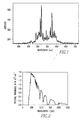
- An example of the spectrum of a copper arc is illustrated in Figure 1. As shown, there are several emission lines with a strong peak occurring at 521.820 nm. There are other relatively strong emission lines between about 490 nm and 590 nm; however, there is relatively little activity at 600 nm and above. Unfortunately, other sources of light that could be present in the environment being monitored also emit light including some of the same wavelengths.
- sunlight has a rather broad spectrum, and while it has a strong emission line at about 520 nm, it still has a strong emission at around 600 nm.
- Other sources of light such as, for instance, fluorescent light, a tungsten lamp, a flashlight, and a photoflash, have substantial irradiance at 600 nm and relatively little radiance at about 520 nm.
- two bandwidths of light are selected to detect the presence of arcing and to discriminate arcing from other light sources.
- filters with selected passbands are utilized.
- the first filter is selected to have a passband which includes a wavelength characteristic of the arcing material, copper in the example.
- the first filter is selected to have a passband which includes 521.82 nm.
- the second filter is selected to have a passband which includes a wavelength not including the characteristic wavelength.
- this filter is selected to have a passband centered at about 600 nm.
- the widths of each of the passbands is selected to produce a suitable compromise between sensitivity and discrimination.
- This bandwidth can be up to about 25 nm, but is preferably about 5 to 10 nm. The narrower the bandwidth, the more discriminating is the detection, but the sensitivity is reduced as the bandwidth narrows.
- the arcing fault detector of the invention utilizes photovoltaic cells in a sensor unit.
- One form of the sensor unit 1 is illustrated in Figure 3.
- the sensor unit 1 includes the first photovoltaic device 3 including at least one, or a plurality of series connected photovoltaic cells 5, and a first filter 7 which filters light incedent upon the photovoltaic cells 5.
- This first filter 7 has a passband centered on the characteristic wavelength, e.g ., 521.820 nm, of the arcing material.
- the sensor 1 includes a second photovoltaic device 9 which also includes one or more series connected photovoltaic cells 11 and a second filter 13 which filters light incedent upon the photovoltaic cells 11 and has a passband that does not include the characteristic wavelength of the arcing material, e.g ., centered on about 600 nm in the exemplary system.
- the first photovoltaic device 3 generates a sensed light electrical signal in response to the filtered incedent light, and similarly, the second photovoltaic device 9 generates a background light electrical signal with an amplitude dependent upon the irradiance of light in the passband of the second filter 13.
- a light-emitting device such as a light-emitting diode (LED) 17.
- the sensed light electrical signal generated by the first photovoltaic device 3 exceeds the background light electrical signal generated by the second photovoltaic device 9 by a threshold amount sufficient to turn on the LED 17. While in the absence of arcing, the first photovoltaic device 3 will generate a sensed light electrical signal due to some irradiance in the passband of the first filter 7, it will be insufficient to overcome the reverse bias effect of the background light signal generated by the second photovoltaic device 9 on the LED 17.
- the background light is fluorescent, from an incandescent bulb or a flashlight all of which have very low irradiance in the passband of the first filter 7, but significant irradiance in the passband of the second filter 13, the background light electrical signal will significantly exceed the sensed light electrical signal and strongly reverse bias the LED 17.
- the filters 7 and 13 can be interference filters, although lower cost bandpass filters could also be utilized.
- An alternate embodiment of the sensor unit 1' shown in Figure 4A adds a bias generator 19 in the form of one or more additional photovoltaic cells 21 connected in series with the first photovoltaic device 3 in the first branch 15 1 of the electrical circuit 15. This puts a forward bias on the LED 17 so that fewer or smaller filtered photovoltaic cells 5 and 11 can be used. This also reduces the size and therefore the cost of the filters 7 and 13. As the additional photovoltaic cells 21 are not provided with filters, the total cost of the sensor is reduced.
- the embodiment of Figure 4A can be modified as shown in Figure 4B to place the bias generating cells 21 of the sensor 1" in series with both filtered photovoltaic cells 5 and 11, but still provide the same effect of forward biasing the LED 17.
- the sensors 1 and 1' of Figures 3 and 4 are self-energized.
- the photovoltaic cells have a larger field of view, even without optics, than the bifurcated fiber optic cables used in the earlier optical arcing detector discussed above in the Background Information section.
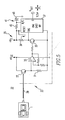
- FIG. 5 illustrates the arcing fault detector 22 of the invention.
- the sensor unit 1 (or 1') is connected to a response device 23 which includes a photoelectric circuit 25.
- This photoelectric circuit includes a photo diode 27 which is activated by the light signal generated by the sensor 1.
- the light signal is transmitted from the sensor 1 to the photo detector 27 by an optic fiber 29.
- the optic fiber 29 provides electrical isolation for the photoelectric circuit 25.
- the light signal generated by the sensor 1 is essentially a digital signal, that is it is on when an arcing fault is detected and off in the absence of arcing
- a low-cost optic fiber is suitable for performing the dual functions of transmitting this digital optical signal and providing electrical isolation for the photoelectric circuit 25.
- the photodetector 27 is energized by a suitable dc supply voltage such as +V cc .
- the light signal generated by the LED 17 in the presence of arcing turns on the photo detector 27 which causes current to flow through the resistor 31.
- the voltage across this resistor 31 generated by the current is amplified by the op amp 33 sufficiently to turn on a transistor 35.
- the transistor 35 provides the trigger signal to a one-shot multi-vibrator 37. Normally, the transistor 35 is off so that a pull-up resistor 39 applies +V s to the trigger input of the one-shot multi-vibrator 37.
- the transistor 35 When the sensor provides a light signal through the optic fiber 29 to turn on the photodetector 27, the transistor 35 is turned on pulling the trigger input of the one-shot multi-vibrator 37 essentially down to ground. This causes the output Q of the multi-vibrator V out to go high.
- An RC circuit 41 formed by the capacitor 43 and resistor 45 resets the one-shot multi-vibrator 37 to go low again so that V out is a pulse signal.
- the arcing fault signal represented by V out can be used to set an alarm, and/or trip a circuit breaker, or otherwise initiate protective or notification action.
- the time constant of the RC circuit 41 is selected to produce a pulse of sufficient duration to actuate the desired output device.
- FIG. 6 illustrates schematically an application of the optical arcing fault detector 22 of the invention to distribution systems switchgear.
- the switchgear 47 includes a metal switchgear cabinet 49.
- the cabinet 49 is divided into a forward-compartment 51, a middle compartment 53, and a rear compartment 55.
- Forward compartment 51 is divided vertically in to cells 57 in which are housed electrical switching apparatus such as circuit breakers 59.
- the middle compartment 53 houses rigid buses including a horizontal three-phase bus 61 which is connected to a set of vertical buses (only one visible) 63.
- the vertical buses are connected to the circuit breakers 59 through upper quick disconnects 65.
- Lower quick disconnects 67 connect the circuit breakers through runbacks 69 to cables 71 extending from the rear compartment 55.
- the optical arcing fault detector 22 of the invention can be used to protect the switchgear 47 from arcing faults which can occur between any of the conductors 61-71 or between such conductors and the metal cabinet 49.
- sensors 1 can be inserted into the cells 57, the middle compartment 53 and the rear compartment 55 where they can monitor for arcing faults.
- Each of the sensors 1 is connected by an optic fiber 29 to the photoelectric circuit 25 that can be contained in the top-most cell 57 of the forward compartment 51 or any other convenient location.
- the arc signal generated by the photoelectric circuit 25 can be applied as a trip signal through a trip lead 73 to each of the circuit breakers 59 or to a high-speed shorting switch (not shown).
- the arcing signal can also be sent as a trip signal to a main circuit breaker (not shown) which would de-energize the incoming bus 61 and/or to a remote monitoring station (also not shown).
Landscapes
- Photometry And Measurement Of Optical Pulse Characteristics (AREA)
- Photovoltaic Devices (AREA)
- Testing Of Short-Circuits, Discontinuities, Leakage, Or Incorrect Line Connections (AREA)
- Testing Relating To Insulation (AREA)
- Testing Of Individual Semiconductor Devices (AREA)
Abstract
Description
Claims (11)
- Apparatus (22) for detecting an arcing fault at a component of an electric power system where the arcing fault generates light at a predetermined wavelength in the presence of light from other sources which may include the predetermined wavelength, the apparatus comprising:a sensor unit (1,1') comprising:first photovoltaic means (3) for generating a sensed light electrical signal from incedent light including light from the component in a first wavelength band including the predetermined wavelength;second photovoltaic means (9) for generating a background light electrical signal from incedent light including light from the component in a second wavelength band not including the predetermined wavelength;an electrically activated light-emitting device (17) for emitting a light signal when electrically activated; and,circuit means (15) connecting the first photovoltaic means (3) and the second photovoltaic means (9) to the light-emitting device (17) with the sensed light electrical signal and the 'background light electrical signal in opposition to electrically activate the light-emitting device (17) to emit the light signal when the sensed light electrical signal exceeds the background light electrical signal by a threshold amount indicative of an arcing fault; anda response unit (23) comprising:an optic fiber (29) transmitting the light signal from the light-emitting device (17); andphotoelectric means (25) responsive substantially only to the light signal transmitted by the optic fiber (29) for generating an arcing signal in response to the light signal.
- The apparatus (22) of Claim 1, wherein the first photovoltaic means (3) comprises at least one photovoltaic cell (5) and first filter means (7) between the at least one first photovoltaic cell (5) and the component and having a pass band equal to the first wavelength band, and wherein the second photovoltaic means (9) comprises at least one second photovoltaic cell (11) and second filter means (13) between the at least one second photovoltaic cell (11) and the component and having a pass band equal to the second wavelength band.
- The apparatus (22) of Claim 2, wherein the at least one first photovoltaic cell (5) comprises a plurality of photovoltaic cells, the at least one second photovoltaic cell (11) comprises a plurality of second photovoltaic cells, and the circuit means (15) comprises a first branch (151) connecting the plurality of first photovoltaic cells (5) in series and a second branch (152) connecting the plurality of second photovoltaic cells (11) in series with the first and second branches (151, 152) connected in parallel to the light-emitting device (17).
- The apparatus (22) of Claim 2, wherein the sensor unit (1') further includes bias means (21) for generating a bias electrical signal in response to ambient light and the circuit means (15) connects the bias means (21) to add the bias electrical signal to the sensed light electrical signal.
- The apparatus (22) of Claim 4, wherein the bias means (21) comprises at least one third photovoltaic cell.
- A method of detecting an arcing fault at a component in an electric power system where the arcing fault generates light at a predetermined wavelength in the presence of light from other sources which may include the predetermined wavelength, the method comprising:extracting from light from the component and any of the other sources present, light in a first wavelength band including the predetermined wavelength and applying the light in the first wavelength band to at least one first photovoltaic cell (5) to generate a sensed light electrical signal;extracting from light from the component and any of the other sources present, light in a second wavelength band not including the predetermined wavelength and applying the light in the second wavelength band to at least one second photovoltaic cell (11) to generate a background light electrical signal;subtracting the background light electrical signal from the sensed light electrical signal;generating a detector light signal when the sensed light electrical signal exceeds the background light electrical signal by a predetermined threshold amount; andexposing a photoelectric device (27) to the detector light signal to generate an arc fault signal.
- The method of Claim 6, wherein exposing the photoelectric device to the detector light signal comprises transmitting the detector light signal to the photoelectric device (27) through an optic fiber (29).
- Apparatus (22) for detecting an arcing fault at a component of an electric power system where the arcing fault generates light at a predetermined wavelength in the presence of light from other sources which may include the predetermined wavelength, the apparatus comprising:a sensor unit (1, 1') responsive to incedent light including light from the component generating a light signal when the incedent light contains light in a first passband including the predetermined wavelength that exceeds light in the incedent light in a second passband not including the predetermine wavelength by a selected amount, the sensor unit being powered only from the incedent light; andresponse means (23) comprising a photoelectric device (27) responsive to the light signal to generate an electrical arcing fault signal.
- The apparatus (22) of Claim 8 wherein the response means (23) further includes an optic fiber (29) transmitting the light signal from the sensor unit (1, 1') to the photoelectric device (27).
- The apparatus (22) of Claim 9 including a plurality of sensor units (1, 1') each responsive to light from a different component within the electric power system, and a plurality of optic fibers (29) each transmitting the light signal generated by a sensor unit (1, 1') to the photo electric device (27) which is operated to generate the arcing signal in response to the light signal from any of the plurality of sensor units (1, 1').
- The apparatus (22) of Claim 10 wherein the sensor unit (1, 1') comprises:first photovoltaic means (3) for generating a sensed light electrical signal from incedent light including light from the component in a first wavelength band including the predetermined wavelength;second photovoltaic means (9) for generating a background light electrical signal from incedent light including light from the component in a second wavelength band not including the predetermined wavelength;an electrically activated light-emitting device (17) for emitting a light signal when electrically activated; andcircuit means (15) connecting the first photovoltaic means (3) and the second photovoltaic means (9) to the light-emitting device (17) with the sensed light electrical signal and the background light electrical signal in opposition to electrically activate the light-emitting device (17) to emit the light signal when the sensed light electrical signal exceeds the background light electrical signal by a threshold amount indicative of an arcing fault.
Applications Claiming Priority (2)
| Application Number | Priority Date | Filing Date | Title |
|---|---|---|---|
| US80040 | 2002-02-12 | ||
| US10/080,040 US6693438B2 (en) | 2002-02-12 | 2002-02-12 | Self-powered apparatus and method for optically detecting arcing faults in electric power systems in the presence of other light sources |
Publications (3)
| Publication Number | Publication Date |
|---|---|
| EP1335466A2 true EP1335466A2 (en) | 2003-08-13 |
| EP1335466A3 EP1335466A3 (en) | 2006-05-03 |
| EP1335466B1 EP1335466B1 (en) | 2013-04-03 |
Family
ID=27610594
Family Applications (1)
| Application Number | Title | Priority Date | Filing Date |
|---|---|---|---|
| EP03002695A Expired - Lifetime EP1335466B1 (en) | 2002-02-12 | 2003-02-12 | Self-powered apparatus and method for optically detecting arcing faults in electric power systems in the presence of other light sources |
Country Status (6)
| Country | Link |
|---|---|
| US (1) | US6693438B2 (en) |
| EP (1) | EP1335466B1 (en) |
| CN (1) | CN1438489A (en) |
| BR (1) | BR0300350A (en) |
| CA (1) | CA2417693A1 (en) |
| MX (1) | MXPA03001127A (en) |
Cited By (2)
| Publication number | Priority date | Publication date | Assignee | Title |
|---|---|---|---|---|
| WO2013124248A1 (en) * | 2012-02-20 | 2013-08-29 | Dehn + Söhne Gmbh + Co. Kg | Arrangement for protecting systems and individuals |
| WO2015084359A1 (en) | 2013-12-05 | 2015-06-11 | Schneider Electric USA, Inc. | Retracting mechanism for sensing components in a switchgear cabinet |
Families Citing this family (37)
| Publication number | Priority date | Publication date | Assignee | Title |
|---|---|---|---|---|
| US9791910B1 (en) | 2005-05-30 | 2017-10-17 | Invent.Ly, Llc | Predictive power management in a wireless sensor network using presence detection |
| US7539882B2 (en) | 2005-05-30 | 2009-05-26 | Rambus Inc. | Self-powered devices and methods |
| US9846479B1 (en) | 2005-05-30 | 2017-12-19 | Invent.Ly, Llc | Smart security device with monitoring mode and communication mode |
| US9721210B1 (en) | 2013-11-26 | 2017-08-01 | Invent.ly LLC | Predictive power management in a wireless sensor network |
| US9946571B1 (en) | 2005-05-30 | 2018-04-17 | Invent.Ly, Llc | Predictive power management in a wireless sensor network using activity costs |
| US7536914B2 (en) * | 2005-07-18 | 2009-05-26 | The Johns Hopkins University | Sensor for detecting arcing faults |
| WO2008148727A1 (en) * | 2007-06-07 | 2008-12-11 | Abb Technology Ag | Voltage measurements of electrically conducting elements in systems for controlling electrical processes |
| CA2736007C (en) | 2008-09-19 | 2014-11-18 | Schweitzer Engineering Laboratories, Inc. | Protective device with metering and oscillography |
| CA2736137C (en) * | 2008-09-19 | 2015-03-03 | Schweitzer Engineering Laboratories, Inc. | Validation of arc flash detection systems |
| US8803069B2 (en) * | 2008-09-19 | 2014-08-12 | Schweitzer Engineering Laboratories, Inc. | Electro-optical radiation collector for arc flash detection |
| US8319173B2 (en) | 2008-09-19 | 2012-11-27 | Schweitzer Engineering Laboratories Inc | Arc flash protection with self-test |
| MX2011002462A (en) * | 2008-09-19 | 2011-04-05 | Schweitzer Engineering Lab Inc | Secure arc flash detection. |
| US8054594B2 (en) * | 2009-06-18 | 2011-11-08 | General Electric Company | ARC flash detection system |
| US8040517B1 (en) * | 2010-04-30 | 2011-10-18 | General Electric Company | Arc flash detection system and method |
| US8228652B2 (en) | 2010-06-02 | 2012-07-24 | Eaton Corporation | Arc flash detection apparatus and electrical system including the same |
| GB2485527B (en) * | 2010-11-09 | 2012-12-19 | Solaredge Technologies Ltd | Arc detection and prevention in a power generation system |
| US9043039B2 (en) * | 2011-02-24 | 2015-05-26 | Tigo Energy, Inc. | System and method for arc detection and intervention in solar energy systems |
| US8963555B2 (en) | 2011-05-13 | 2015-02-24 | General Electric Company | Methods, systems, and apparatus for detecting light and acoustic waves |
| WO2013004295A1 (en) * | 2011-07-04 | 2013-01-10 | Sma Solar Technology Ag | Method and system for detecting an arc fault in a photovoltaic power system |
| US8492672B2 (en) | 2011-08-05 | 2013-07-23 | Eaton Corporation | Insulated arc flash arrester |
| US8576521B2 (en) | 2011-08-16 | 2013-11-05 | Schneider Electric USA, Inc. | Adaptive light detection for arc mitigation systems |
| US8861144B2 (en) | 2011-11-15 | 2014-10-14 | Eaton Corporation | Triggered arc flash arrester and switchgear system including the same |
| CN102589689B (en) * | 2012-03-12 | 2013-10-09 | 南京五石金传感技术有限公司 | Optical fiber electric arc optical detection device with self-checking function and detection method thereof |
| JP5889143B2 (en) * | 2012-08-21 | 2016-03-22 | 三菱電機株式会社 | Photovoltaic power generation system and arc detection protection device |
| US9053881B2 (en) | 2012-08-24 | 2015-06-09 | Schneider Electric USA, Inc. | Arc detection with resistance to nuisance activation through light subtraction |
| US9438028B2 (en) | 2012-08-31 | 2016-09-06 | Schweitzer Engineering Laboratories, Inc. | Motor relay with integrated arc-flash detection |
| EP2706364A1 (en) * | 2012-09-06 | 2014-03-12 | Alstom Technology Ltd | Electrode line monitoring unit |
| WO2015140773A2 (en) * | 2014-03-21 | 2015-09-24 | Ansaldo Energia S.P.A. | Alternator, preferably for an electric power plant, and method for monitoring the conditions of at least one sliding contact of an alternator |
| CN106324381B (en) * | 2015-07-09 | 2019-07-02 | 深圳先进技术研究院 | An arc light detection device |
| US10804689B2 (en) | 2016-11-18 | 2020-10-13 | Schweitzer Engineering Laboratories, Inc. | Methods and systems for evaluating arc flash exposure hazard |
| US10535988B2 (en) | 2017-08-03 | 2020-01-14 | Eaton Intelligent Power Limited | Arc flash detection apparatus and electrical system including the same |
| EP4207523A1 (en) * | 2018-11-29 | 2023-07-05 | Abb Schweiz Ag | Remote activation of communication modules of self-powered intelligent electronic devices |
| JP2020153900A (en) * | 2019-03-22 | 2020-09-24 | 東京電力ホールディングス株式会社 | Partial discharge diagnostic device |
| US11837862B2 (en) | 2020-10-09 | 2023-12-05 | Schweitzer Engineering Laboratories, Inc. | Arc-flash sensor using optical fiber |
| US11862944B1 (en) * | 2022-06-17 | 2024-01-02 | Jst Power Equipment, Inc. | Switchgear device with grounding device and related methods |
| CN115453257A (en) * | 2022-08-03 | 2022-12-09 | 国网浙江义乌市供电有限公司 | Power line lightning stroke local recorder and operation method thereof |
| EP4462462A1 (en) * | 2023-05-12 | 2024-11-13 | Abb Schweiz Ag | Circuit breaker system with reduced own time: fault protection |
Family Cites Families (14)
| Publication number | Priority date | Publication date | Assignee | Title |
|---|---|---|---|---|
| GB1573080A (en) * | 1978-03-22 | 1980-08-13 | Ellis T | Voltage detectors and electrical continuity testers |
| DE2856188C2 (en) | 1978-12-27 | 1985-09-05 | Brown, Boveri & Cie Ag, 6800 Mannheim | Device for the detection of arcing faults in switchgear |
| US4287405A (en) * | 1979-10-02 | 1981-09-01 | Mitsubishi Jukogyo Kabushiki Kaisha | Process and apparatus for exhausting fumes produced by arc welding |
| DE3129041A1 (en) | 1981-07-23 | 1983-02-03 | BBC Aktiengesellschaft Brown, Boveri & Cie., 5401 Baden, Aargau | FIBER OPTICAL SENSOR FOR DETECTING ELECTRIC ARCH DISCHARGE |
| DD215431A1 (en) * | 1983-05-12 | 1984-11-07 | Elektroprojekt Anlagenbau Veb | CIRCUIT ARRANGEMENT FOR STOER ARC FLASH MONITORING IN ELECTRIC EQUIPMENT AND PRODUCTS |
| US4791518A (en) | 1986-06-09 | 1988-12-13 | Bbc Brown Boveri Ag | Device for detecting interfering arcs |
| FR2621748B1 (en) | 1987-10-09 | 1996-07-05 | Merlin Gerin | STATIC TRIGGER OF A MOLDED CASE CIRCUIT BREAKER |
| FR2668294B1 (en) | 1990-10-22 | 1993-09-24 | Alsthom Gec | ARC DETECTION CIRCUIT BREAKER. |
| DE4345170A1 (en) | 1993-09-21 | 1995-03-23 | Kloeckner Moeller Gmbh | Arc fault protection device for switchgear for the distribution of electrical energy |
| DE29502452U1 (en) * | 1995-02-15 | 1996-06-13 | Klöckner-Moeller GmbH, 53115 Bonn | Arrangement for room-selective detection of arcing faults in switchgear |
| US5933308A (en) * | 1997-11-19 | 1999-08-03 | Square D Company | Arcing fault protection system for a switchgear enclosure |
| JP2000065887A (en) * | 1998-08-20 | 2000-03-03 | Takaoka Electric Mfg Co Ltd | Fault location system for power equipment |
| US6229680B1 (en) | 1999-08-16 | 2001-05-08 | Eaton Corporation | Apparatus and method for optically detecting arcing faults in electric power systems in the presence of other light sources |
| US6433976B1 (en) * | 1999-09-24 | 2002-08-13 | Square D Company | Instantaneous arc fault light detector with resistance to false tripping |
-
2002
- 2002-02-12 US US10/080,040 patent/US6693438B2/en not_active Expired - Lifetime
-
2003
- 2003-01-30 CA CA002417693A patent/CA2417693A1/en not_active Abandoned
- 2003-02-04 MX MXPA03001127A patent/MXPA03001127A/en active IP Right Grant
- 2003-02-10 BR BR0300350-7A patent/BR0300350A/en not_active IP Right Cessation
- 2003-02-12 CN CN03102387A patent/CN1438489A/en active Pending
- 2003-02-12 EP EP03002695A patent/EP1335466B1/en not_active Expired - Lifetime
Cited By (5)
| Publication number | Priority date | Publication date | Assignee | Title |
|---|---|---|---|---|
| WO2013124248A1 (en) * | 2012-02-20 | 2013-08-29 | Dehn + Söhne Gmbh + Co. Kg | Arrangement for protecting systems and individuals |
| DE102013001612B4 (en) * | 2012-02-20 | 2021-07-01 | Dehn Se + Co Kg | Arrangement for system and personal protection |
| WO2015084359A1 (en) | 2013-12-05 | 2015-06-11 | Schneider Electric USA, Inc. | Retracting mechanism for sensing components in a switchgear cabinet |
| EP3078247A4 (en) * | 2013-12-05 | 2017-07-05 | Schneider Electric USA, Inc. | Retracting mechanism for sensing components in a switchgear cabinet |
| US9912127B2 (en) | 2013-12-05 | 2018-03-06 | Schneider Electric USA, Inc. | Retracting mechanism for sensing components in a switchgear cabinet |
Also Published As
| Publication number | Publication date |
|---|---|
| US20030151414A1 (en) | 2003-08-14 |
| EP1335466B1 (en) | 2013-04-03 |
| CA2417693A1 (en) | 2003-08-12 |
| EP1335466A3 (en) | 2006-05-03 |
| CN1438489A (en) | 2003-08-27 |
| MXPA03001127A (en) | 2003-08-21 |
| US6693438B2 (en) | 2004-02-17 |
| BR0300350A (en) | 2004-09-08 |
Similar Documents
| Publication | Publication Date | Title |
|---|---|---|
| US6693438B2 (en) | Self-powered apparatus and method for optically detecting arcing faults in electric power systems in the presence of other light sources | |
| EP1077518B1 (en) | Apparatus and method for optically detecting arcing faults in electric power systems in the presence of other light sources | |
| EP1538722B1 (en) | Apparatus and method employing an optical fiber for closed-loop feedback detection of arcing faults | |
| JP5571782B2 (en) | Arc flash detection system | |
| US6839209B2 (en) | Shorting switch and system to eliminate arcing faults in power distribution equipment | |
| US7536914B2 (en) | Sensor for detecting arcing faults | |
| US8040517B1 (en) | Arc flash detection system and method | |
| AU680549B2 (en) | Switching installation for distributing electric power protected against arc interference | |
| US20090161272A1 (en) | Arc detection system and method | |
| US10958061B2 (en) | Method and device for protection from internal arcs in an electrical distribution system, and electrical cabinet including such a device | |
| US6633009B1 (en) | Shorting switch and system to eliminate arcing faults in low voltage power distribution equipment | |
| CA2717953A1 (en) | String and system employing direct current electrical generating modules and a number of string protectors | |
| Pagare et al. | Simulation and performance analysis of arc guard systems | |
| KR101936038B1 (en) | Methods, systems, and apparatus for detecting light and acoustic waves | |
| SE452664B (en) | DEVICE FOR MONITORING OF ELECTRICAL DEVICES WITH REGARD TO THE RISE OF ONE OR MORE LIGHT BAGS | |
| WO2002021657A1 (en) | Fiber optic light sensor system | |
| CN106602500A (en) | Novel protection grounding live-line alarm and protection circuit | |
| MXPA00007949A (en) | Apparatus and method for optically detecting arcing faults in electric power systems in the presence of other light sources | |
| CN217406183U (en) | Intelligent electric arc light protection system | |
| EP0274326B1 (en) | Arc detection at a set of bars of an electric panel or of a switching cabinet | |
| NO319243B1 (en) | Switching installations for distribution of electrical power protected against arc interference | |
| HU180318B (en) | Circuit array for light-controlled electronic switch | |
| HK123793A (en) | Static tripping device for a circuit breaker in a cast case |
Legal Events
| Date | Code | Title | Description |
|---|---|---|---|
| PUAI | Public reference made under article 153(3) epc to a published international application that has entered the european phase |
Free format text: ORIGINAL CODE: 0009012 |
|
| AK | Designated contracting states |
Designated state(s): AT BE BG CH CY CZ DE DK EE ES FI FR GB GR HU IE IT LI LU MC NL PT SE SI SK TR |
|
| AX | Request for extension of the european patent |
Extension state: AL LT LV MK RO |
|
| PUAL | Search report despatched |
Free format text: ORIGINAL CODE: 0009013 |
|
| AK | Designated contracting states |
Kind code of ref document: A3 Designated state(s): AT BE BG CH CY CZ DE DK EE ES FI FR GB GR HU IE IT LI LU MC NL PT SE SI SK TR |
|
| AX | Request for extension of the european patent |
Extension state: AL LT LV MK RO |
|
| 17P | Request for examination filed |
Effective date: 20061030 |
|
| AKX | Designation fees paid |
Designated state(s): DE FR GB IT |
|
| 17Q | First examination report despatched |
Effective date: 20070725 |
|
| GRAP | Despatch of communication of intention to grant a patent |
Free format text: ORIGINAL CODE: EPIDOSNIGR1 |
|
| RIN1 | Information on inventor provided before grant (corrected) |
Inventor name: SHEA, JOHN JOSEPH |
|
| GRAS | Grant fee paid |
Free format text: ORIGINAL CODE: EPIDOSNIGR3 |
|
| GRAA | (expected) grant |
Free format text: ORIGINAL CODE: 0009210 |
|
| AK | Designated contracting states |
Kind code of ref document: B1 Designated state(s): DE FR GB IT |
|
| REG | Reference to a national code |
Ref country code: GB Ref legal event code: FG4D |
|
| REG | Reference to a national code |
Ref country code: DE Ref legal event code: R096 Ref document number: 60343650 Country of ref document: DE Effective date: 20130529 |
|
| PLBE | No opposition filed within time limit |
Free format text: ORIGINAL CODE: 0009261 |
|
| STAA | Information on the status of an ep patent application or granted ep patent |
Free format text: STATUS: NO OPPOSITION FILED WITHIN TIME LIMIT |
|
| 26N | No opposition filed |
Effective date: 20140106 |
|
| REG | Reference to a national code |
Ref country code: DE Ref legal event code: R097 Ref document number: 60343650 Country of ref document: DE Effective date: 20140106 |
|
| REG | Reference to a national code |
Ref country code: FR Ref legal event code: PLFP Year of fee payment: 14 |
|
| REG | Reference to a national code |
Ref country code: FR Ref legal event code: PLFP Year of fee payment: 15 |
|
| REG | Reference to a national code |
Ref country code: FR Ref legal event code: PLFP Year of fee payment: 16 |
|
| PGFP | Annual fee paid to national office [announced via postgrant information from national office to epo] |
Ref country code: DE Payment date: 20180122 Year of fee payment: 16 |
|
| REG | Reference to a national code |
Ref country code: GB Ref legal event code: 732E Free format text: REGISTERED BETWEEN 20181115 AND 20181130 |
|
| REG | Reference to a national code |
Ref country code: DE Ref legal event code: R082 Ref document number: 60343650 Country of ref document: DE Ref country code: DE Ref legal event code: R081 Ref document number: 60343650 Country of ref document: DE Owner name: EATON INTELLIGENT POWER LIMITED, IE Free format text: FORMER OWNER: EATON CORPORATION, CLEVELAND, OHIO, US |
|
| REG | Reference to a national code |
Ref country code: DE Ref legal event code: R119 Ref document number: 60343650 Country of ref document: DE |
|
| PG25 | Lapsed in a contracting state [announced via postgrant information from national office to epo] |
Ref country code: DE Free format text: LAPSE BECAUSE OF NON-PAYMENT OF DUE FEES Effective date: 20190903 |
|
| PGFP | Annual fee paid to national office [announced via postgrant information from national office to epo] |
Ref country code: GB Payment date: 20200123 Year of fee payment: 18 |
|
| GBPC | Gb: european patent ceased through non-payment of renewal fee |
Effective date: 20210212 |
|
| PG25 | Lapsed in a contracting state [announced via postgrant information from national office to epo] |
Ref country code: GB Free format text: LAPSE BECAUSE OF NON-PAYMENT OF DUE FEES Effective date: 20210212 |
|
| PGFP | Annual fee paid to national office [announced via postgrant information from national office to epo] |
Ref country code: IT Payment date: 20220119 Year of fee payment: 20 Ref country code: FR Payment date: 20220119 Year of fee payment: 20 |
|
| P01 | Opt-out of the competence of the unified patent court (upc) registered |
Effective date: 20230521 |