EP1334971A1 - Benzimidazole compounds, process for producing the same and use thereof - Google Patents
Benzimidazole compounds, process for producing the same and use thereof Download PDFInfo
- Publication number
- EP1334971A1 EP1334971A1 EP01974795A EP01974795A EP1334971A1 EP 1334971 A1 EP1334971 A1 EP 1334971A1 EP 01974795 A EP01974795 A EP 01974795A EP 01974795 A EP01974795 A EP 01974795A EP 1334971 A1 EP1334971 A1 EP 1334971A1
- Authority
- EP
- European Patent Office
- Prior art keywords
- group
- compound
- methyl
- salt
- halogen
- Prior art date
- Legal status (The legal status is an assumption and is not a legal conclusion. Google has not performed a legal analysis and makes no representation as to the accuracy of the status listed.)
- Withdrawn
Links
- 0 C/C1=C(/C[S@@](c2nc(cccc3)c3[n]2COC(**)=O)=O)\C(C23)*2/C3=C/C=C1/OCC(F)(F)F Chemical compound C/C1=C(/C[S@@](c2nc(cccc3)c3[n]2COC(**)=O)=O)\C(C23)*2/C3=C/C=C1/OCC(F)(F)F 0.000 description 2
Classifications
-
- C—CHEMISTRY; METALLURGY
- C07—ORGANIC CHEMISTRY
- C07D—HETEROCYCLIC COMPOUNDS
- C07D401/00—Heterocyclic compounds containing two or more hetero rings, having nitrogen atoms as the only ring hetero atoms, at least one ring being a six-membered ring with only one nitrogen atom
- C07D401/02—Heterocyclic compounds containing two or more hetero rings, having nitrogen atoms as the only ring hetero atoms, at least one ring being a six-membered ring with only one nitrogen atom containing two hetero rings
- C07D401/12—Heterocyclic compounds containing two or more hetero rings, having nitrogen atoms as the only ring hetero atoms, at least one ring being a six-membered ring with only one nitrogen atom containing two hetero rings linked by a chain containing hetero atoms as chain links
-
- A—HUMAN NECESSITIES
- A61—MEDICAL OR VETERINARY SCIENCE; HYGIENE
- A61P—SPECIFIC THERAPEUTIC ACTIVITY OF CHEMICAL COMPOUNDS OR MEDICINAL PREPARATIONS
- A61P1/00—Drugs for disorders of the alimentary tract or the digestive system
- A61P1/04—Drugs for disorders of the alimentary tract or the digestive system for ulcers, gastritis or reflux esophagitis, e.g. antacids, inhibitors of acid secretion, mucosal protectants
-
- A—HUMAN NECESSITIES
- A61—MEDICAL OR VETERINARY SCIENCE; HYGIENE
- A61P—SPECIFIC THERAPEUTIC ACTIVITY OF CHEMICAL COMPOUNDS OR MEDICINAL PREPARATIONS
- A61P31/00—Antiinfectives, i.e. antibiotics, antiseptics, chemotherapeutics
- A61P31/04—Antibacterial agents
-
- A—HUMAN NECESSITIES
- A61—MEDICAL OR VETERINARY SCIENCE; HYGIENE
- A61P—SPECIFIC THERAPEUTIC ACTIVITY OF CHEMICAL COMPOUNDS OR MEDICINAL PREPARATIONS
- A61P35/00—Antineoplastic agents
Definitions
- the present invention relates to a benzimidazole compound, which is converted to a proton pump inhibitor in living organisms and shows an anti-ulcer activity and the like, a production method thereof and use thereof.
- a proton pump inhibitor, 2-[[[3-methyl-4-(2,2,2-trifluoroethoxy)-2-pyridyl]methyl]sulfinyl]-1H-benzimidazole, and a salt thereof having an anti-ulcer activity are reported in JP-A-61-50978 and the like.
- the above-mentioned compounds are unstable to acids, for oral administration, they are formulated into an enteric-coated preparation, filled in a capsule and administered to prevent decomposition by gastric acid.
- prodrug of the above-mentioned compound which is stable to acid and resists decomposition by gastric acid, has been desired, and such prodrug has been reported in US Patent No. 6,093,734.
- prodrugs of proton pump inhibitors other than the above-mentioned prodrugs have been disclosed in US Patent Nos. 4,045,563, 4,686,230, 4,873,337, 4,965,269, 5,021,433 and the like.
- the present inventors have first synthesized a compound represented by the following formula (I) and first found that this compound has unexpectedly superior stability to acid, gradually eliminates the substituent on the nitrogen atom of benzimidazole ring and affords a sustained acid secretion-suppressive action. Further studies based on these findings have resulted in the completion of the present invention.
- 2-[[[3-methyl-4-(2,2,2-trifluoroethoxy)-2-pyridyl]methyl]sulfinyl]-1H-benzimidazole is modified to give a prodrug (the compound of the formula (I)) stable to acid, which enables oral administration of the compound as a conventional tablet and the like without formulating an enteric-coated preparation.
- a prodrug the compound of the formula (I)
- the cost for formulating an enteric-coated preparation can be eliminated and the preparation of tablet and the like can be made smaller.
- a smaller preparation is advantageous in that it is easily swallowed by patients having difficulty in swallowing, particularly the elderly and children.
- the present invention provides the following.
- the "aryl group” is a monocyclic or condensed polycyclic aromatic hydrocarbon group, preferably an aromatic hydrocarbon group having 6 to 14 carbon atoms ("C 6-14 aryl group”).
- aromatic hydrocarbon group having 6 to 14 carbon atoms C 6-14 aryl group
- examples thereof include phenyl, naphthyl, anthryl, phenanthryl and acenaphthylenyl, and preferred is an aromatic hydrocarbon group having 6 to 10 carbon atoms, and for R, phenyl is particularly preferable.
- halogen is fluorine, chlorine, bromine or iodine.
- the halogen as a substituent of the hydrocarbon group represented by R in the formula (I) is preferably fluorine or chlorine.
- the "C 1-6 alkoxy group optionally substituted by halogen” is a linear or branched chain alkoxy group having 1 to 6 carbon atoms, which is optionally substituted by halogen (as defined above); preferably 1 to 5, more preferably 1 to 3, halogens.
- halogen as defined above
- Examples of the C 1-6 alkoxy group include methoxy, ethoxy, n-propoxy, isopropoxy, n-butoxy, isobutoxy, sec-butoxy, tert-butoxy and the like, with preference given to an alkoxy group having 1 to 4 carbon atoms.
- C 1-6 alkoxy group optionally substituted by halogen, methoxy, ethoxy, methoxy, ethoxy, n-propoxy, isopropoxy, trifluoromethoxy and 2,2,2-trifluoroethoxy are preferable.
- the "alkyl group” means a linear or branched chain alkyl group, preferably an alkyl group having 1 to 6 carbon atoms ("C 1-6 alkyl group”). Examples thereof include methyl, ethyl, n-propyl, isopropyl, n-butyl, isobutyl, sec-butyl, tert-butyl, n-pentyl, isopentyl, neopentyl, 1-methylpropyl, n-hexyl, isohexyl, 1,1-dimethylbutyl, 2,2-dimethylbutyl, 3,3-dimethylbutyl, 3,3-dimethylpropyl, 2-ethylbutyl and the like, more preferably alkyl having 1 to 4 carbon atoms.
- R methyl, ethyl, isopropyl and tert-butyl are preferable, and tert-butyl is particularly preferable.
- the "C 7-12 aralkyloxy group” is an aralkyloxy group having 7 to 12 carbon atoms wherein aryl group is as defined for the above-mentioned aryl group (preferably phenyl group) and the alkyl moiety is as defined for the above-mentioned "C 1-6 alkyl group". Examples thereof include benzyloxy, 1-naphthylmethyloxy, 2-naphthylmethyloxy and the like. Preferred is an aralkyloxy group having 7 to 11 carbon atoms, more preferably phenyl-C 1-4 alkyloxy group and particularly preferably benzyloxy.
- the "C 1-5 alkoxy-carbonyl group” is an alkoxycarbonyl group wherein the alkoxy moiety is a linear or branched chain alkoxy group having 1 to 5 carbon atoms, which is exemplified by methoxycarbonyl, ethoxycarbonyl, propoxycarbonyl, isopropoxycarbonyl and the like.
- Preferred is an alkoxycarbonyl group wherein the alkoxy moiety has 1 to 4 carbon atoms, and particularly preferred are methoxycarbonyl and ethoxycarbonyl.
- C 1-6 alkyl group optionally substituted by halogen is a C 1-6 alkyl group (as defined above) optionally substituted by halogen(s) (preferably 1 to 5, more preferably 1 to 3), which is preferably methyl, ethyl, propyl, isopropyl or trifluoromethyl.
- the "C 2-6 alkenyl group” is a linear or branched chain alkenyl group having 2 to 6 carbon atoms, which is exemplified by vinyl, n-propenyl, isopropenyl, n-butenyl, isobutenyl, sec-butenyl, tert-butenyl, n-pentenyl, isopentenyl, neopentenyl, 1-methylpropenyl, n-hexenyl, isohexenyl, 1,1-dimethylbutenyl, 2,2-dimethylbutenyl, 3,3-dimethylbutenyl, 3,3-dimethylpropenyl, 2-ethylbutenyl and the like.
- Preferred is an alkenyl group having 2 to 4 carbon atoms, and particularly preferred are vinyl, n-propenyl and isopropenyl.
- the "C 2-6 alkynyl group” is a linear or branched chain alkynyl group having 2 to 6 carbon atoms, which is exemplified by ethynyl, n-propynyl(1-propynyl), isopropynyl(2-propynyl), n-butynyl, isobutynyl, sec-butynyl, tert-butynyl, n-pentynyl, isopentynyl, neopentynyl, 1-methylpropynyl, n-hexynyl, isohexynyl, 1,1-dimethylbutynyl, 2,2-dimethylbutynyl, 3,3-dimethylbutynyl, 3,3-dimethylpropynyl, 2-ethylbutynyl and the like.
- Preferred is an alkynyl group having 2 or 3 carbon
- the "C 3-8 cycloalkyl group” is a linear or branched chain cycloalkyl group having 3 to 8 carbon atoms, which is exemplified by cyclopropyl, cyclobutyl, cyclopentyl, cyclohexyl, cycloheptyl, cyclooctyl and the like.
- Preferred is a cycloalkyl group having 5 to 7 carbon atoms, more preferred are cyclopentyl, cyclohexyl and cycloheptyl, and particularly preferred is cyclohexyl.
- the "hydrocarbon group” encompasses an aliphatic or aromatic hydrocarbon group, wherein the aliphatic hydrocarbon group means a saturated or unsaturated linear, branched chain or cyclic hydrocarbon group.
- a hydrocarbon group having 1 to 14 carbon atoms is preferable, which is exemplified by C 1-6 alkyl group, C 2-6 alkenyl group, C 2-6 alkynyl group, C 3-8 cycloalkyl group and C 6-14 aryl group.
- Preferred are C 1-6 alkyl group, C 3-8 cycloalkyl group and C 6-14 aryl group and more preferred are C 1-6 alkyl group and C 3-8 cycloalkyl group.
- the "acylamino group” is preferably alkanoylamino wherein the alkanoyl moiety preferably has 1 to 6 carbon atoms, such as acetylamino, formylamino, propionylamino, butylamino, isobutylamino, pentanoylamino, hexanoylamino and the like, alkenoylamino wherein the alkenoyl moiety preferably has 3 to 6 carbon atoms, such as propenoylamino, 1-butenoylamino, 2-butenoylamino, 1-pentenoylamino, 1-hexenoylamino and the like, cycloalkanoylamino preferably having 4 to 8 carbon atoms, such as cyclopropanoylamino, cyclobutanoylamino, cyclopentanoylamino, cyclohexanoylamino, cyclo
- the "metal cation" is exemplified by alkali metal ion (e.g., Na + , K + , Li + , Cs + and the like), with preference given to Na + and Cs + .
- alkali metal ion e.g., Na + , K + , Li + , Cs + and the like
- the "quaternary ammonium ion" is exemplified by tetramethylammonium, tetraethylammonium, tetrapropylammonium, tetrabutylammonium and the like, with preference given to tetrabutylammonium.
- hydrocarbon group may be substituted, wherein the substituent is exemplified by C 6-14 aryl group, hydroxyl group, halogen, C 1-6 alkoxy group optionally substituted by halogen, C 7-12 aralkyloxy group, C 1-5 alkoxy-carbonyl group, C 1-6 alkyl group optionally substituted by halogen, amino group optionally substituted by C 1-6 alkyl group and the like.
- the substituent for the "alkyl group optionally having substituents” is exemplified by aryl group, hydroxyl group, halogen, alkoxy group optionally substituted by 1 to 5 halogens, C 7-12 aralkyloxy group, C 1-5 alkoxy-carbonyl group and the like.
- the number of the substituents is 1 to 5, preferably 1 to 3.
- the substituent for the "aryl group optionally having substituents” is exemplified by halogen, alkyl group optionally substituted by 1 to 5 halogens, aryl group, hydroxyl group, alkoxy group optionally substituted by 1 to 5 halogens, C 7-12 aralkyloxy group, C 1-5 alkoxy-carbonyl group and the like.
- the number of the substituents is 1 to 5, preferably 1 to 3.
- C 1-6 alkyl group C 2-6 alkenyl group
- C 2-6 alkynyl group may be substituted, and the substituent is exemplified by (i) a C 6-14 aryl group, (ii) a hydroxyl group, (iii) a halogen, (iv) a C 1-6 alkoxy group optionally substituted by halogen, (v) a C 7-12 aralkyloxy group, (vi) a C 1-5 alkoxy-carbonyl group, (vii) an acylamino group, (viii) an amino group optionally substituted by C 1-6 alkyl group and the like. Of these, (i) to (vii) are preferable.
- the number of the substituents is 1 to 5, preferably 1 to 3.
- C 3-8 cycloalkyl group” and "C 6-14 aryl group” may be substituted, wherein the substituent is exemplified by (i) a C 6-14 aryl group, (ii) a hydroxyl group, (iii) a halogen, (iv) a C 1-6 alkoxy group optionally substituted by halogen, (v) a C 7-12 aralkyloxy group, (vi) a C 1-5 alkoxy-carbonyl group, (vii) a C 1-6 alkyl group optionally substituted by halogen, (viii) an amino group optionally substituted by C 1-6 alkyl group and the like. Of these, (i)-(vii) are preferable.
- the number of the substituents is 1 to 5, preferably 1 to 3.
- R is preferably a C 1-6 alkyl group, a C 2-6 alkenyl group or a C 2-6 alkynyl group, which optionally has substituents selected from the group consisting of (i) a C 6-14 aryl group, (ii) a hydroxyl group, (iii) a halogen, (iv) a C 1-6 alkoxy group optionally substituted by halogen, (v) a C 7-12 aralkyloxy group, (vi) a C 1-5 alkoxy-carbonyl group and (vii) an acylamino group, or a C 3-8 cycloalkyl group or a C 6-14 aryl group, which optionally has substituents selected from the group consisting of (i) a C 6-14 aryl group, (ii) a hydroxyl group, (iii) a halogen, (iv) a C 1-6 alkoxy group optionally substituted by halogen, (v)
- a pharmacologically acceptable basic salt can be formed between an acidic group in a molecule and an inorganic base or an organic base etc
- a pharmacologically acceptable acid addition salt can be formed between a basic group in a molecule and an inorganic acid or an organic acid etc.
- One of the preferable embodiments of compound (I) of the present invention is a compound wherein D is a bond and R is an alkyl group optionally having substituents or an aryl group optionally having substituents.
- Examples of the inorganic basic salt of compound (I) include salt with alkali metal (e.g., sodium, potassium and the like), alkaline earth metal (e.g., calcium and the like), ammonia and the like, and the like, and examples of the organic basic salt of compound (I) include salt with dimethylamine, triethylamine, piperazine, pyrrolidine, piperidine, 2-phenylethylamine, benzylamine, ethanolamine, diethanolamine, pyridine, collidine and the like, and the like.
- Examples of the acid addition salt of compound (I) include inorganic acid salt (e.g., hydrochloride, sulfate, hydrobromide, phosphate and the like), organic acid salt (e.g., acetate, trifluoroacetate, succinate, maleate, fumarate, propionate, citrate, tartrate, lactate, oxalate, methanesulfonate, p-toluenesulfonate and the like) and the like.
- inorganic acid salt e.g., hydrochloride, sulfate, hydrobromide, phosphate and the like
- organic acid salt e.g., acetate, trifluoroacetate, succinate, maleate, fumarate, propionate, citrate, tartrate, lactate, oxalate, methanesulfonate, p-toluenesulfonate and the like
- the compound (I) of the present invention encompasses hydrates.
- examples of the "hydrate” include 0.5 hydrate - 5.0 hydrate. Of these, 0.5 hydrate, 1.0 hydrate, 1.5 hydrate and 2.0 hydrate are preferable.
- the compound (I) of the present invention encompasses racemates and optically active compounds.
- optically active compound such compound wherein one enantiomer is in enantiomer excess (e.e.) of not less than 90% is preferable, more preferably in enantiomer excess (e.e.) of not less than 99%.
- an optically active form an (R)-form represented by the formula wherein each symbol is as defined above, is preferable.
- the compound (I) can be produced by a method known per se, such as the methods described in US Patent Nos. 4,873,337 and 5,021,433, or a similar method, such as the following methods A to C.
- compound (II) or a salt thereof is condensed with compound (III), whereby compound (I) or a salt thereof can be obtained.
- M is a hydrogen atom, a metal cation or a quaternary ammonium ion
- X is a halogen, and other symbols are as defined above.
- the Method A is performed by reacting compound (II) or a salt thereof with compound (III) in the presence of a base.
- abase is added to a mixed solution of compound (II) or a salt thereof and compound (III), and the mixture is stirred.
- the salt of compound (II) here is exemplified by the above-mentioned salts of compound (I), which are acid addition salts such as inorganic acid salt (e.g., hydrochloride, sulfate, hydrobromide, phosphate and the like), organic acid salt (e.g., acetate, trifluoroacetate, succinate, maleate, fumarate, propionate, citrate, tartrate, lactate, oxalate, methanesulfonate, p-toluenesulfonate and the like), and the like.
- inorganic acid salt e.g., hydrochloride, sulfate, hydrobromide, phosphate and the like
- organic acid salt e.g., acetate, trifluoroacetate, succinate, maleate, fumarate, propionate, citrate, tartrate, lactate, oxalate, methanesulfonate, p-toluene
- the reaction of Method A is generally conducted in a solvent, and a solvent that does not inhibit the above-mentioned reaction is selected as appropriate.
- solvent include alcohols (e.g., methanol, ethanol, propanol, isopropanol, butanol, tert-butanol and the like), ethers (e.g., dioxane, tetrahydrofuran, diethyl ether, tert-butyl methyl ether, diisopropyl ether, ethylene glycol dimethyl ether and the like), esters (e.g., ethyl formate, ethyl acetate, n-butyl acetate and the like), halogenated hydrocarbons (e.g., dichloromethane, chloroform, carbon tetrachloride, trichlene, 1,2-dichloroethane and the like), hydrocarbons (e.g., n-hexane, benzen
- the base in Method A is, for example, an inorganic base such as C 1-6 alkyl lithium or C 6-10 aryl lithium (e.g., methyl lithium, ethyl lithium, n-butyl lithium, sec-butyl lithium, tert-butyl lithium, phenyl lithium and the like), lithium C 2-6 alkylamides (e.g., lithium dimethylamide, lithium diethylamide, lithium diisopropylamide and the like), metal hydrides (e.g., lithium hydride, sodium hydride and the like), alkali metal C 1-6 alkoxides (e.g., lithium ethoxide, lithium tert-butoxide, sodium methoxide, sodium ethoxide, potassium tert-butoxide and the like), alkali metal amides (e.g., lithium amide, potassium amide, sodium amide and the like), alkali metal hydroxide (e.g., lithium hydroxide, potassium hydroxide,
- the reaction temperature is generally from about -80°C to 100°C, preferably 0°C to 60°C.
- reaction time varies depending on the kind of compounds (II) and (III) and solvent, reaction temperature and the like, but it is generally 1 min. - 72 hrs., preferably 15 min. - 24 hrs.
- the ⁇ -halomethyl ester reagent represented by the formula (III) can be obtained by reacting the corresponding acyl halides with formaldehyde (L.H. Ulich and R. Adams, J. Am. Chem. Soc., vol. 43, p. 660 (1921)). For higher yield of the reaction, bromomethyl esters are more preferable.
- the compound (II) can be produced according to the method described in JP-A-61-50978, USP 4,628,098 and the like or a method similar thereto.
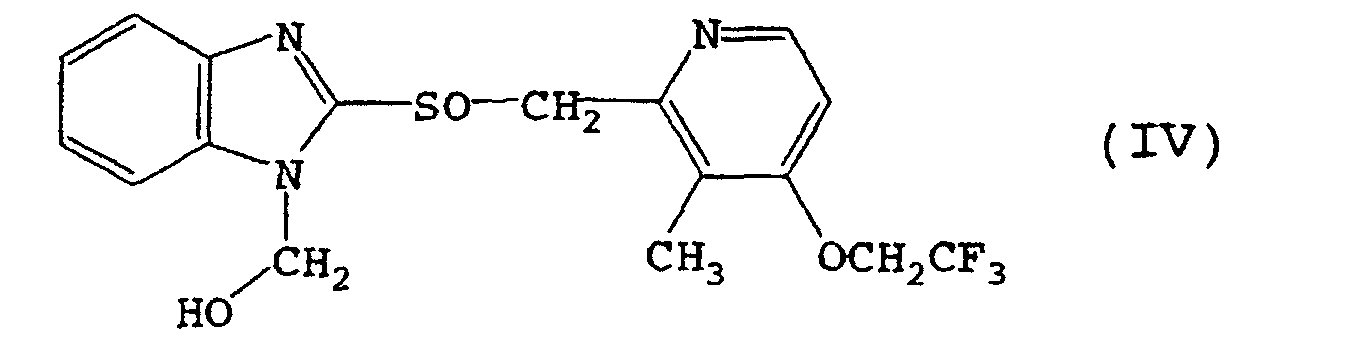
- the compound (I) or a salt thereof can be obtained by condensing [2-[[[3-methyl-4-(2,2,2-trifluoroethoxy)-2-pyridyl]methyl]sulfinyl]-1H-benzimidazol-1-yl]methanol represented by the formula (IV) with carboxylic acid represented by the formula: R-D-COOH [the symbols in the formula are as defined above] or a reactive derivative thereof. wherein each symbol is as defined above.
- condensation can be conducted using a condensation agent.
- the condensation agent include N,N'-carbodiimidazole, N,N'-dicyclohexylcarbodiimide, N,N'-diisopropylcarbodiimide, 1-ethyl-3-(3-dimethylaminopropyl)carbodiimide, N-ethoxycarbonyl-2-ethoxy-1,2-dihydroquinoline, diethyl phosphorocyanidate, diphenyl phosphoryl azide, 2-(1H-benzotriazol-1-yl)-1,1,3,3-tetramethyluronium tetrafluoroborate, 2-(1H-benzotriazol-1-yl)-1,1,3,3-tetramethyluronium hexafluorophosphate, benzotriazol-1-yl-oxy-tris(dimethylamino)phosphonium hexafluoro
- Examples of the reactive derivative of the carboxylic acid include acid halide, acid azide, acid anhydride, mixed acid anhydride, active amide, active ester, active thioester and the like.
- Examples of the above-mentioned acid halide include acid chloride, acid bromide and the like.
- Examples of the mixed acid anhydride include mixed acid anhydride of mono-C 1-4 alkyl carbonic acid (e.g., mixed acid anhydride of the carboxylic acid with mono-methyl carbonic acid, mono-ethyl carbonic acid, mono-isopropyl carbonic acid, monoisobutyl carbonic acid, mono-tert-butyl carbonic acid, monobenzyl carbonic acid, mono(p-nitrobenzyl) carbonic acid, monoallyl carbonic acid and the like), mixed acid anhydride of C 1-6 aliphatic carboxylic acid (e.g., mixed acid anhydride of the carboxylic acid with acetic acid, cyanoacetic acid, propionic acid, lactic acid, isolactic acid, valeric acid, isovaleric acid, pivalic acid, trifluoroacetic acid, trichloroacetic acid, acetoacetic acid and the like), mixed acid anhydride of C 7-11 aromatic carboxylic acid (e.g., mixed acid anhydride
- the active amide examples include amide with nitrogen-containing heterocyclic compound [e.g., acid amide of the carboxylic acid with pyrazole, imidazole, benzotriazole and the like; the nitrogen-containing heterocyclic compounds are optionally substituted by C 1-4 alkyl group (e.g., methyl, ethyl, propyl, isopropyl, butyl, isobutyl, sec-butyl, tert-butyl and the like), C 1-6 alkoxy group (e.g., methoxy, ethoxy, propoxy, isopropoxy, butoxy, tert-butoxy and the like), halogen (e.g., fluorine, chlorine, bromine and the like), oxo group, thioxo group, C 1-6 alkylthio group (e.g., methylthio, ethylthio, propylthio, butylthio and the like) and the like], and the like.
- the active ester examples include organic phosphoric acid esters (e.g., diethoxyphosphoric acid ester, diphenoxyphosphoric acid ester and the like), p-nitrophenyl ester, 2;4-dinitrophenyl ester, cyanomethyl ester, pentachlorophenyl ester, N-hydroxysuccinimide ester, N-hydroxyphthalimide ester, 1-hydroxybenzotriazole ester, 6-chloro-1-hydroxybenzotriazole ester, 1-hydroxy-1H-2-pyridone ester and the like.
- organic phosphoric acid esters e.g., diethoxyphosphoric acid ester, diphenoxyphosphoric acid ester and the like
- p-nitrophenyl ester e.g., 2;4-dinitrophenyl ester, cyanomethyl ester
- pentachlorophenyl ester N-hydroxysuccinimide ester, N-hydroxyphthalimide ester
- the active thioester examples include esters [e.g., 2-pyridylthiol ester, 2-benzothiazolylthiol ester] with aromatic heterocyclyl-thiol compound [the heterocycle is optionally substituted by C 1-4 alkyl group (e.g., methyl, ethyl, propyl, isopropyl, butyl, isobutyl, sec-butyl, tert-butyl and the like), C 1-6 alkoxy group (e.g., methoxy, ethoxy, propoxy, isopropoxy, butoxy, tert-butoxy and the like), halogen (e.g., fluorine, chlorine, bromine and the like), C 1-6 alkylthio group (e.g., methylthio, ethylthio, propylthio, butylthio and the like) and the like], and the like.
- esters e.g., 2-pyridylthi
- the reaction of Method B is generally conducted in a solvent, and a solvent that does not inhibit the reaction of Method B is selected as appropriate.
- the solvent include ethers (e.g., dioxane, tetrahydrofuran, diethyl ether, tert-butyl methyl ether, diisopropyl ether, ethylene glycol dimethyl ether and the like), esters (e.g., ethyl formate, ethyl acetate, butyl acetate and the like), halogenated hydrocarbons (e.g., dichloromethane, chloroform, carbon tetrachloride, trichlene, 1,2-dichloroethane and the like), hydrocarbons (e.g., n-hexane, benzene, toluene and the like), amides (e.g., formamide, N,N-dimethylformamide, N,N-dimethylacetamide and the like), ketones
- the amount of the solvent to be used is not particularly limited as long as the reaction mixture can be stirred, which is generally 2- to 100-fold amount by weight, preferably 5- to 50-fold amount by weight, of 1 mole of compound (IV) or a salt thereof.
- the amount of carboxylic acid or a reactive derivative thereof to-be used is generally 1 mole - 10 mole, preferably 1 mole - 5 mole, relative to 1 mole of compound (IV).
- Method B is carried out in the temperature range of generally from -80°C to 200°C, preferably from -40°C to 150°C, most preferably from -30°C to 100°C.
- the reaction time of Method B varies depending on the kind of carboxylic acid, a reactive derivative thereof and the solvent (and mixing ratio in the case of a mixed solvent), reaction temperature and the like, which is generally 1 min.-72 hrs., preferably 15 min. - 24 hrs.
- the reaction can be carried out in the presence of a deoxidation agent to remove the eliminated hydrogen halide from the reaction system.
- a deoxidation agent examples include inorganic base (e.g., sodium carbonate, potassium carbonate, calcium carbonate, sodium hydrogencarbonate and the like), tertiary amine (e.g., triethylamine, tripropylamine, tributylamine, cyclohexyldimethylamine, pyridine, lutidine, ⁇ -collidine, N,N-dimethylaniline, N-methylpiperidine, N-methylpyrrolidine, N-methylmorpholine, 4-dimethylaminopyridine and the like), alkylene oxides (e.g., propylene oxide, epichlorohydrin and the like) and the like.
- the amount of the "deoxidation agent" to be used is generally 1 mole - 10 mole, preferably 1 mole - 3 mole, relative
- the compound (I) or a salt thereof can be obtained by subjecting compound (V) or a salt thereof to oxidation reaction. wherein each symbol is as defined above.
- the reaction in Method C can be carried out using an oxidant such as nitric acid, hydrogen peroxide, peroxy acid, peroxy acid ester, ozone, dinitrogen tetraoxide, iodosobenzene, N-halosuccinimide, 1-chlorobenzotriazole, tert-butyl hypochlorite, diazabicyclo[2.2.2]octane-bromine complex, sodium metaperiodate, selenium dioxide, manganese dioxide, chromic acid, cerium ammonium nitrate, bromine, chlorine, sulfuryl chloride and the like.
- the amount of the oxidant to be used is generally 0.5 mole - 2 mole, preferably 0.8 mole - 1.2 mole, per 1 mole of compound (I).
- the reaction of Method C is generally carried out in a solvent inert to the above-mentioned oxidation reaction.
- the "inert solvent” include water, alcohols (e.g., methanol, ethanol, 1-propanol, 2-propanol and the like), ketones (e.g., acetone, methyl ethyl ketone and the like), nitriles (e.g., acetonitrile, propionitrile and the like), amides (e.g., formamide, N,N-dimethylformamide and the like), ethers (e.g., diethyl ether, tert-butyl methyl ether, diisopropyl ether, dioxane, tetrahydrofuran and the like), sulfoxides (e.g., dimethyl sulfoxide and the like) and polar solvents (e.g., sulfolane, hexamethylphosphoramide and the like),
- the reaction temperature is generally from -80°C to 80°C, preferably from 15°C to 30°C.
- the reaction time is generally 1 min. - 6 hrs., preferably 15 min. - 1 hr.
- the compound (V), which is a starting material of Method C, can be obtained by subjecting 2-[[[3-methyl-4-(2,2,2-trifluoroethoxy)-2-pyridyl]methyl]thio]-1H-benzimidazole to the reaction similar to the reaction in Method A or Method B.
- the salt of compound (V) is exemplified by the above-mentioned salts of the compound (I), which are acid addition salts such as inorganic acid salt (e.g., hydrochloride, sulfate, hydrobromide, phosphate and the like), organic acid salt (e.g., acetate, trifluoroacetate, succinate, maleate, fumarate, propionate, citrate, tartrate, lactate, oxalate, methanesulfonate, p-toluenesulfonate and the like) and the like.
- inorganic acid salt e.g., hydrochloride, sulfate, hydrobromide, phosphate and the like
- organic acid salt e.g., acetate, trifluoroacetate, succinate, maleate, fumarate, propionate, citrate, tartrate, lactate, oxalate, methanesulfonate, p-toluenes
- the compound (I) or a salt thereof obtained by the above-mentioned methods A - C can be isolated and purified from the reaction mixture by a separation means known per se (e.g., concentration, concentration under reduced pressure, solvent extraction, crystallization, recrystallization, phase transfer, chromatography and the like).
- a separation means known per se e.g., concentration, concentration under reduced pressure, solvent extraction, crystallization, recrystallization, phase transfer, chromatography and the like.
- (R)-2-[[[3-Methyl-4-(2,2,2-trifluoroethoxy)-2-pyridyl]methyl]sulfinyl]-1H-benzimidazole can be produced by, for example, subjecting 2-[[[3-methyl-4-(2,2,2-trifluoroethoxy)-2-pyridyl]methyl]sulfinyl]-1H-benzimidazole or a salt thereof to optical resolution, or by asymmetric oxidation of 2-[[[3-methyl-4-(2,2,2-trifluoroethoxy)-2-pyridyl]methyl]thio]-1H-benzimidazole.
- the method of optical resolution includes methods known per se, such as a fractional recrystallization method, a chiral column method, a diastereomer method, and so forth.
- Asymmetric oxidation includes methods known per se, such as the method described in WO96/02535 and the like.
- the “fractional recrystallization method” includes a method in which a salt is formed between a racemate and an optically active compound [e.g., (+)-mandelic acid, (-)-mandelic acid, (+)-tartaric acid, (-)-tartaric acid, (+)-1-phenethylamine, (-)-1-phenethylamine, cinchonine, (-)-cinchonidine, brucine, etc.], which salt is separated by fractional recrystallization etc., and, if desired, subjected to a neutralization process to give a free optical isomer.
- an optically active compound e.g., (+)-mandelic acid, (-)-mandelic acid, (+)-tartaric acid, (-)-tartaric acid, (+)-1-phenethylamine, (-)-1-phenethylamine, cinchonine, (-)-cinchonidine, brucine, etc.
- the "chiral column method” includes a method in which a racemate or a salt thereof is applied to a column for optical isomer separation (chiral column).
- a racemate for example, optical isomers are separated by adding a racemate to a chiral column such as ENANTIO-OVM (produced by Tosoh Corporation), the DAICEL CHIRAL series (produced by Daicel Corporation) and the like, and developing the racemate in water, a buffer (e.g., phosphate buffer), an organic solvent (e.g., hexane, ethanol, methanol, isopropanol, acetonitrile, trifluoroacetic acid, diethylamine, triethylamine, etc.), or a solvent mixture thereof.
- a chiral column such as CP-Chirasil-DeX CB (produced by GL Science) and the like is used to separate optical isomers.
- the "diastereomer method” includes a method in which a racemate and an optically active reagent are reacted (preferably, an optically active reagent is reacted with the group at the 1-position of the benzimidazole group) to give a diastereomeric mixture, which is then subjected to ordinary separation means (e.g., fractional recrystallization, chromatography, etc.) to obtain either diastereomer, which is subjected to a chemical reaction (e.g., acid hydrolysis, base hydrolysis, hydrogenolysis, etc.) to cut off the optically active reagent moiety, whereby the desired optical isomer is obtained.
- a chemical reaction e.g., acid hydrolysis, base hydrolysis, hydrogenolysis, etc.
- Said "optically active reagent” includes, for example, optically active organic acids such as MTPA [ ⁇ -methoxy- ⁇ -(trifluoromethyl)phenylacetic acid], (-)-menthoxyacetic acid and the like, optically active alkoxymethyl halides such as (1R-endo)-2-(chloromethoxy)-1,3,3-trimethylbicyclo[2.2.1]heptane and the like, and the like.
- optically active organic acids such as MTPA [ ⁇ -methoxy- ⁇ -(trifluoromethyl)phenylacetic acid], (-)-menthoxyacetic acid and the like
- optically active alkoxymethyl halides such as (1R-endo)-2-(chloromethoxy)-1,3,3-trimethylbicyclo[2.2.1]heptane and the like, and the like.
- the compound (I) and a salt thereof of the present invention are useful as a pharmaceutical agent, because they have a superior anti-ulcer activity, a gastric acid secretion-suppressive action, a mucosa-protecting action, an anti- Helicobacter pylori action and the like, and show low toxicity.
- they since they are stable to acid, they do not require formulation into an enteric-coated preparation for oral administration, which in turn eliminates the cost for formulating enteric-coated preparation.
- the tablet can be made smaller, which is easily swallowed by patients having difficulty in swallowing, particularly the elderly and children.
- absorption is faster than in enteric-coated preparations, expression of gastric acid secretion-suppressive action is rapid. The preparation is long-acting because it is gradually converted to the original compound in living organisms. Consequently, the compounds are useful as anti-ulcer agents and the like.
- the compound (I) and a salt thereof of the present invention are useful for the prophylaxis or treatment of digestive ulcer (e.g., gastric ulcer, gastric ulcer due to post-operative stress, duodenal ulcer, anastomotic ulcer, Zollinger-Ellison syndrome, ulcer caused by nonsteroidal antiinflammatory etc.); gastritis; reflux esophagitis; NUD (Non Ulcer Dyspepsia); gastric cancer (including gastric cancer due to promoted production of interleukin-1 ⁇ caused by genetic polymorphism of interleukin-1); gastric MALT lymphoma; gastric hyperacidity (e.g.
- gastric hyperacidity due to post-operative stress due to post-operative stress
- hemorrhage of upper gastrointestinal tract caused by acute stress ulcer hemorrhagic gastritis
- invasion stress stress due to major surgery requiring intensive management after operation and cerebrovascular disorder, external injury in the head, multiple organ failure and extensive burn requiring intensive treatment
- pre-anesthetic administration eradication of Helicobacter pylori, in mammals (e.g., human, simian, sheep, cattle, horse, dog, cat, rabbit, rat, mouse etc.).
- the compound (I) and a salt thereof of the present invention show low toxicity and can be safely administered orally or parenterally (e.g., topical, rectal, intravenous administrations and the like) as they are or as a preparation containing a pharmaceutical composition containing a pharmacologically acceptable carrier admixed according to a method known per se, such as tablets (including sugar-coated tablets and film-coated tablets), powder, granule, capsule (including soft capsule), orally disintegrating tablet, liquid, injection, suppository, sustained-release preparation, plaster and the like.
- a pharmaceutical composition containing a pharmacologically acceptable carrier admixed according to a method known per se, such as tablets (including sugar-coated tablets and film-coated tablets), powder, granule, capsule (including soft capsule), orally disintegrating tablet, liquid, injection, suppository, sustained-release preparation, plaster and the like.
- the content of compound (I) or a salt thereof of the present invention in the pharmaceutical composition of the present invention is about 0.01 to 100% by weight relative to the entire composition.
- its dose is about 0.5 to 1,500 mg/day, preferably about 5 to 150 mg/day, based on the active ingredient, when, for example, the compound is orally administered as an anti-ulcer agent to an adult human (60 kg).
- the compound (I) or a salt thereof of the present invention may be administered once daily or in 2 or 3 divided portions per day.
- the pharmacologically acceptable carrier that may be used to produce the pharmaceutical composition of the present invention includes various organic or inorganic carrier substances in common use as pharmaceutical materials, including excipients, lubricants, binders, disintegrants, water-soluble polymers and basic inorganic salts for solid preparations; and solvents, dissolution aids, suspending agents, isotonizing agents, buffers and soothing agents for liquid preparations and the like.
- Other ordinary pharmaceutical additives such as preservatives, anti-oxidants, coloring agents, sweetening agents, souring agents, bubbling agents and flavorings may also be used as necessary.
- excipients include, for example, lactose, sucrose, D-mannitol, starch, cornstarch, crystalline cellulose, light silicic anhydride, titanium oxide and the like.
- Such “lubricants” include, for example, magnesium stearate, sucrose fatty acid esters, polyethylene glycol, talc, stearic acid and the like.
- binder include, for example, hydroxypropyl cellulose, hydroxypropylmethyl cellulose, crystalline cellulose, starch, polyvinylpyrrolidone, gum arabic powder, gelatin, pullulan, low-substituted hydroxypropyl cellulose and the like.
- Such “disintegrants” include (1) crosslinked povidone, (2) what is called super-disintegrants such as crosslinked carmellose sodium (FMC-Asahi Chemical) and carmellose calcium (Gotoku Yakuhin) etc, (3) carboxymethyl starch sodium (e.g., product of Matsutani Chemical), (4) low-substituted hydroxypropyl cellulose (e.g., product of Shin-Etsu Chemical), (5) corn starch, and so forth.
- super-disintegrants such as crosslinked carmellose sodium (FMC-Asahi Chemical) and carmellose calcium (Gotoku Yakuhin) etc
- carboxymethyl starch sodium e.g., product of Matsutani Chemical
- low-substituted hydroxypropyl cellulose e.g., product of Shin-Etsu Chemical
- Said "crosslinked povidone” may be any crosslinked polymer having the chemical name 1-ethenyl-2-pyrrolidinone homopolymer, including polyvinylpyrrolidone (PVPP) and 1-vinyl-2-pyrrolidinone homopolymer, and is exemplified by Colidon CL (produced by BASF), Polyplasdon XL (produced by ISP), Polyplasdon XL-10 (produced by ISP), Polyplasdon INF-10 (produced by ISP) and the like.
- PVPP polyvinylpyrrolidone
- Colidon CL produced by BASF
- Polyplasdon XL produced by ISP
- Polyplasdon XL-10 produced by ISP
- Polyplasdon INF-10 produced by ISP
- water-soluble polymers include, for example, ethanol-soluble water-soluble polymers [e.g., cellulose derivatives such as hydroxypropyl cellulose (hereinafter also referred to as HPC) etc, polyvinylpyrrolidone and the like], ethanol-insoluble water-soluble polymers [e.g., cellulose derivatives such as hydroxypropylmethyl cellulose (hereinafter also referred to as HPMC) etc., methyl cellulose, carboxymethyl cellulose sodium and the like, sodium polyacrylate, polyvinyl alcohol, sodium alginate, guar gum and the like] and the like.
- HPC hydroxypropyl cellulose
- HPMC hydroxypropylmethyl cellulose
- Such “basic inorganic salts” include, for example, basic inorganic salts of sodium, potassium, magnesium and/or calcium. Preferred are basic inorganic salts of magnesium and/or calcium. More preferred are basic inorganic salts of magnesium. Such basic inorganic salts of sodium include, for example, sodium carbonate, sodium hydrogencarbonate, disodium hydrogenphosphate and the like. Such basic inorganic salts of potassium include, for example, potassium carbonate, potassium hydrogencarbonate and the like.
- Such basic inorganic salts of magnesium include, for example, heavy magnesium carbonate, magnesium carbonate, magnesium oxide, magnesium hydroxide, magnesium metasilicate aluminate, magnesium silicate, magnesium aluminate, synthetic hydrotalcite [Mg 6 Al 2 (OH) 16 CO 3 4H 2 O], and alumina hydroxide magnesium.
- Preferred are heavy magnesium carbonate, magnesium carbonate, magnesium oxide, magnesium hydroxide and the like.
- Such basic inorganic salts of calcium include, for example, precipitated calcium carbonate, calcium hydroxide, etc.
- solvents include, for example, water for injection, alcohol, propylene glycol, macrogol, sesame oil, corn oil, olive oil and the like.
- dissolution aids include, for example, polyethylene glycol, propylene glycol, D-mannitol, benzyl benzoate, ethanol, trisaminomethane, cholesterol, triethanolamine, sodium carbonate, sodium citrate and the like.
- Such “suspending agents” include, for example, surfactants such as stearyltriethanolamine, sodium lauryl sulfate, laurylaminopropionic acid, lecithin, benzalkonium chloride, benzethonium chloride, monostearic glycerol etc; hydrophilic polymers such as polyvinyl alcohol, polyvinylpyrrolidone, carboxymethyl cellulose sodium, methyl cellulose, hydroxymethyl cellulose, hydroxyethyl cellulose, hydroxypropyl cellulose etc., and the like.
- surfactants such as stearyltriethanolamine, sodium lauryl sulfate, laurylaminopropionic acid, lecithin, benzalkonium chloride, benzethonium chloride, monostearic glycerol etc
- hydrophilic polymers such as polyvinyl alcohol, polyvinylpyrrolidone, carboxymethyl cellulose sodium, methyl cellulose, hydroxymethyl cellulose,
- Such “isotonizing agents” include, for example, glucose, D-sorbitol, sodium chloride, glycerol, D-mannitol and the like.
- buffers include, for example, buffer solutions of phosphates, acetates, carbonates, citrates etc, and the like.
- Such “soothing agents” include, for example, benzyl alcohol and the like.
- Such “preservatives” include, for example, p-oxybenzoic acid esters, chlorobutanol, benzyl alcohol, phenethyl alcohol, dehydroacetic acid, sorbic acid and the like.
- antioxidants include, for example, sulfites, ascorbic acid, ⁇ -tocopherol and the like.
- Such “coloring agents” include, for example, food colors such as Food Color Yellow No. 5, Food Color Red No. 2, Food Color Blue No. 2 etc; food lake colors, red oxide and the like.
- sweetening agents include, for example, saccharin sodium, dipotassium glycyrrhizinate, aspartame, stevia, thaumatin and the like.
- Such “souring agents” include, for example, citric acid (citric anhydride), tartaric acid, malic acid and the like.
- Such “bubbling agents” include, for example, sodium bicarbonate and the like.
- Such “flavorings” may be synthetic substances or naturally occurring substances, and include, for example, lemon, lime, orange, menthol, strawberry and the like.
- the compound of the present invention may be prepared as a preparation for oral administration in accordance with a commonly-known method, by, for example, compression-shaping in the presence of a carrier such as an excipient, a disintegrant, a binder, a lubricant, or the like, and subsequently coating the preparation as necessary by a commonly known method for the purpose of taste masking, enteric dissolution or sustained release.
- a carrier such as an excipient, a disintegrant, a binder, a lubricant, or the like
- an intermediate layer may be provided by a commonly known method between the enteric layer and the drug-containing layer for the purpose of separation of the two layers.
- available methods include, for example, a method in which a core containing crystalline cellulose and lactose is coated with the compound (I) or a salt thereof of the present invention and, where necessary, a basic inorganic salt, and then further coated with a coating layer containing a water-soluble polymer to give a composition, which is coated with an enteric coating layer containing polyethylene glycol, further coated with an enteric coating layer containing triethyl citrate, still further coated with an enteric coating layer containing polyethylene glycol, and finally coated with mannitol to give fine granules, which are mixed with additives and shaped.
- enteric coating layer includes, for example, a layer consisting of a mixture of one or more kinds from aqueous enteric polymer substrates such as cellulose acetate phthalate (CAP), hydroxypropylmethyl cellulose phthalate, hydroxymethyl cellulose acetate succinate, methacrylic acid copolymers (e.g., Eudragit L30D-55 (trade name; produced by Rohm), Colicoat MAE30DP (trade name; produced by BASF), Polyquid PA30 (trade name; produced by San-yo Chemical) etc), carboxymethylethyl cellulose, shellac and the like; sustained-release substrates such as methacrylic acid copolymers (e.g., Eudragit NE30D (trade name), Eudragit RL30D (trade name), Eudragit RS30D (trade name), etc.) and the like; water-soluble polymers; plasticizers such as triethyl citrate, polyethylene glycol, acetylated
- additive includes, for example, water-soluble sugar alcohols (e.g., sorbitol, mannitol, maltitol, reduced starch saccharides, xylitol, reduced palatinose, erythritol, etc.), crystalline cellulose (e.g., Ceolas KG 801, Avicel PH 101, Avicel PH 102, Avicel PH 301, Avicel PH 302, Avicel RC-591 (crystalline cellulose carmellose sodium) etc), low-substituted hydroxypropyl cellulose (e.g., LH-22, LH-32, LH-23, LH-33 (Shin-Etsu Chemical), mixtures thereof etc) and the like.
- binders, souring agents, bubbling agents, sweetening agents, flavorings, lubricants, coloring agents, stabilizers, excipients, disintegrants etc. are also used.
- the compound of the present invention may be used in combination with 1 to 3 other active ingredients.
- Such “other active ingredients” include, for example, anti- Helicobacter pylori active substances, imidazole compounds, bismuth salts, quinolone compounds, and so forth. Of these substances, preferred are anti- Helicobacter pylori active substances, imidazole compounds etc.
- antibiotic penicillins e.g., amoxicillin, benzylpenicillin, piperacillin, mecillinam, etc.
- antibiotic cefems e.g., cefixime, cefaclor, etc.
- antibiotic macrolides e.g., erythromycin, clarithromycin, etc.
- antibiotic tetracyclines e.g., tetracycline, minocycline, streptomycin, etc.
- antibiotic aminoglycosides e.g., gentamicin, amikacin, etc.
- imipenem imipenem and so forth.
- antibiotic penicillins e.g., amoxicillin, benzylpenicillin, piperacillin, mecillinam, etc.
- antibiotic cefems e.g., cefixime, cefaclor, etc.
- antibiotic macrolides e.g., erythromycin, clarithromycin, etc.
- antibiotic tetracyclines
- imidazole compounds include, for example, metronidazole, miconazole and the like.
- bismuth salts include, for example, bismuth acetate, bismuth citrate and the like.
- quinolone compounds include, for example, ofloxacin, ciploxacin and the like.
- a combination therapy of compound (I) or a salt thereof of the present invention with antibiotic penicillin e.g., amoxicillin and the like
- antibiotic erythromycin e.g., clarithromycin and the like
- Such “other active ingredients” and the compound (I) or a salt thereof of the present invention may be mixed, prepared as a single pharmaceutical composition [e.g., tablets, powders, granules, capsules (including soft capsules), liquids, injectable preparations, suppositories, sustained-release preparations, etc.], in accordance with a commonly known method, and used in combination, and may also be prepared as separate preparations and administered to the same subject simultaneously or at a time interval.
- a single pharmaceutical composition e.g., tablets, powders, granules, capsules (including soft capsules), liquids, injectable preparations, suppositories, sustained-release preparations, etc.
- room temperature indicates about 15 to 30°C.
- Optical rotation [ ⁇ ] D was determined at 20°C, using the DIP-370 Digital polarimeter (produced by JASCO).
- Diisopropylethylamine (0.733 L, 4.44 mol) was added to the obtained mixture at room temperature under a nitrogen stream, and cumene hydroperoxide (6.88 L, content 82%, 37.5 mol) was added at -5°C to 5°C. The mixture was stirred at -5°C to 5°C for 1.5 hrs. to give a reaction mixture. 30% Aqueous sodium thiosulfate solution (17 L) was added to the reaction mixture under a nitrogen stream, and the remaining cumene hydroperoxide was decomposed.
- the wet crystals were dissolved in ethyl acetate (45 L) and water (3 L), and the solution was partitioned.
- the trace amount of the insoluble material in the organic layer was filtered off, and triethylamine (0.2 L) was added.
- the mixture was concentrated under reduced pressure until the liquid amount became about 7 L.
- Methanol (2.3 L) ca. 12.5% aqueous ammonia (23 L, ca. 50°C) and t-butyl methyl ether (22 L, ca. 50°C) were added to the concentrate, and the mixture was partitioned.
- To the organic layer was added ca. 12.5% aqueous ammonia (11 L), and the mixture was partitioned (this step was repeated once).
- aqueous layers were combined, and ethyl acetate (22 L) was added. Acetic acid was added dropwise under cooling, and pH was adjusted to about 8. After partitioning, the aqueous layer was extracted with ethyl acetate (11 L). The organic layers were combined and washed with ca. 20% brine (11 L). After addition of triethylamine (0.2 L), the organic layer was concentrated under reduced pressure. Acetone (5 L) was added to the concentrate, and the mixture was concentrated under reduced pressure. The concentrate was dissolved in acetone (9 L), and the solution was added dropwise to a mixture of acetone (4.5 L) and water (22.5 L), and water (18 L) was added dropwise to the obtained mixture.
- the wet crystals were dissolved in ethyl acetate (32 L).
- the separated aqueous layer was separated by partitioning, and the obtained organic layer was concentrated under reduced pressure until the liquid amount became about 14 L.
- Ethyl acetate (36 L) and activated carbon (270 g) were added to the residual liquid and, after stirring, the activated carbon was filtered off. The filtrate was concentrated under reduced pressure until the liquid amount became about 14 L.
- Heptane (90 L) was added dropwise to the remaining liquid at about 40°C.
- N-acetylglycine (1.89 g) in N,N-dimethylformamide was added N,N'-dicyclohexylcarbodiimide (1.67 g), and the mixture was stirred at room temperature for 1 hr.
- the mixture was stirred under ice-cooling for 5 hrs.
- the reaction mixture was concentrated under reduced pressure, and ethyl acetate (50 mL) was added.
- the mixture was washed with aqueous sodium hydrogencarbonate (30 mL), dried over anhydrous magnesium sulfate and concentrated under reduced pressure.
- the residue was dissolved in methanol (50 mL), and aqueous sodium hydrogencarbonate (1 mL) was added.
- the mixture was stirred for 0.5 hr.
- the solvent was concentrated under reduced pressure, and ethyl acetate (50 mL) was added.
- the mixture was washed with water (30 mL), dried over anhydrous magnesium sulfate and concentrated under reduced pressure.
- LPZ production rate was calculated based on the area of non-converted compound immediately after the start of incubation as 100% (absorption rate unamended). Conversion to lansoprazole by liver S9 and small intestine S9 Compound Animal species Liver S9 Small intestine S9 LPZ production (%) LPZ production (%) compound of Example 1 rat 60.9 63.6 human 80.3 97.4 compound of Example 2 rat 64.4 51.9 human 88.6 100.0
- the compound of the present invention is converted to lansoprazole, which is a proton pump inhibitor, in living organisms and shows a superior anti-ulcer activity, a gastric acid secretion-suppressive action, a mucosa-protecting action, an anti- Helicobacter pylori action and the like.
- the compound shows low toxicity and is useful as a pharmaceutical product.
- the compound since the compound is stable to acid, it does not need to be formulated into an enteric-coated preparation, thereby eliminating the cost for formulating enteric-coated preparation.
- the tablet becomes small it is easy to take for patients with weak swallowing capability, particularly the elderly and children.
Landscapes
- Chemical & Material Sciences (AREA)
- Organic Chemistry (AREA)
- Health & Medical Sciences (AREA)
- Chemical Kinetics & Catalysis (AREA)
- Life Sciences & Earth Sciences (AREA)
- General Chemical & Material Sciences (AREA)
- Medicinal Chemistry (AREA)
- Nuclear Medicine, Radiotherapy & Molecular Imaging (AREA)
- Veterinary Medicine (AREA)
- Pharmacology & Pharmacy (AREA)
- Public Health (AREA)
- Animal Behavior & Ethology (AREA)
- General Health & Medical Sciences (AREA)
- Engineering & Computer Science (AREA)
- Bioinformatics & Cheminformatics (AREA)
- Communicable Diseases (AREA)
- Oncology (AREA)
- Pharmaceuticals Containing Other Organic And Inorganic Compounds (AREA)
Abstract
A compound represented by the formula (I)
 wherein each symbol is as defined in the specification, or a
salt thereof (1) shows a superior anti-ulcer activity, a
gastric acid secretion-suppressive action, a mucosa-protecting
action, an anti-Helicobacter pylori action and the like in
living organisms, (2) shows low toxicity, (3) is stable to acid
(which obviates the need to formulate an enteric-coated
preparation, thereby lowering the cost, and reduces the size of
preparation to facilitate swallowing for patients having
difficulty in swallowing), (4) shows faster absorption than
enteric-coated preparations (rapid expression of gastric acid
secretion-suppressive action), and (5) is sustainable.
wherein each symbol is as defined in the specification, or a
salt thereof (1) shows a superior anti-ulcer activity, a
gastric acid secretion-suppressive action, a mucosa-protecting
action, an anti-Helicobacter pylori action and the like in
living organisms, (2) shows low toxicity, (3) is stable to acid
(which obviates the need to formulate an enteric-coated
preparation, thereby lowering the cost, and reduces the size of
preparation to facilitate swallowing for patients having
difficulty in swallowing), (4) shows faster absorption than
enteric-coated preparations (rapid expression of gastric acid
secretion-suppressive action), and (5) is sustainable.
According to the present invention, a benzimidazole compound, which has superior stability to acid and which is converted to a proton pump inhibitor in living organisms to show an anti-ulcer activity and the like, can be provided.
According to the present invention, a benzimidazole compound, which has superior stability to acid and which is converted to a proton pump inhibitor in living organisms to show an anti-ulcer activity and the like, can be provided.
Description
The present invention relates to a benzimidazole compound,
which is converted to a proton pump inhibitor in living
organisms and shows an anti-ulcer activity and the like, a
production method thereof and use thereof.
A proton pump inhibitor, 2-[[[3-methyl-4-(2,2,2-trifluoroethoxy)-2-pyridyl]methyl]sulfinyl]-1H-benzimidazole,
and a salt thereof having an anti-ulcer activity are reported
in JP-A-61-50978 and the like.
However, since the above-mentioned compounds are unstable
to acids, for oral administration, they are formulated into an
enteric-coated preparation, filled in a capsule and
administered to prevent decomposition by gastric acid.
Therefore, the development of a prodrug of the above-mentioned
compound, which is stable to acid and resists
decomposition by gastric acid, has been desired, and such
prodrug has been reported in US Patent No. 6,093,734. In
addition, prodrugs of proton pump inhibitors other than the
above-mentioned prodrugs have been disclosed in US Patent Nos.
4,045,563, 4,686,230, 4,873,337, 4,965,269, 5,021,433 and the
like.
In view of the above situation, the development of a
prodrug of a proton pump inhibitor having superior stability to
acid has been desired.
It is therefore an object of the present invention to
provide a benzimidazole compound having superior stability to
acid, which is converted to 2-[[[3-methyl-4-(2,2,2-trifluoroethoxy)-2-pyridyl]methyl]sulfinyl]-1H-benzimidazole
in
living organisms and shows an anti-ulcer activity and the like,
a production method thereof and use thereof.
The present inventors have first synthesized a compound
represented by the following formula (I) and first found that
this compound has unexpectedly superior stability to acid,
gradually eliminates the substituent on the nitrogen atom of
benzimidazole ring and affords a sustained acid secretion-suppressive
action. Further studies based on these findings
have resulted in the completion of the present invention.
According to the present invention, 2-[[[3-methyl-4-(2,2,2-trifluoroethoxy)-2-pyridyl]methyl]sulfinyl]-1H-benzimidazole
is modified to give a prodrug (the compound of
the formula (I)) stable to acid, which enables oral
administration of the compound as a conventional tablet and the
like without formulating an enteric-coated preparation. This
has a consequence that the cost for formulating an enteric-coated
preparation can be eliminated and the preparation of
tablet and the like can be made smaller. A smaller preparation
is advantageous in that it is easily swallowed by patients
having difficulty in swallowing, particularly the elderly and
children. In addition, absorption is rapid due to the absence
of a sustained release effect afforded by enteric-coated
preparations, expression of a gastric acid secretion-suppressive
action is rapid, and alleviation of symptoms such
as pain and the like is rapid. Furthermore, because the
compound is gradually converted to a proton pump inhibitor in
living organisms, a sustainable anti-ulcer agent and the like
can be provided.
Accordingly, the present invention provides the following.



In the present invention, the "aryl group" is a
monocyclic or condensed polycyclic aromatic hydrocarbon group,
preferably an aromatic hydrocarbon group having 6 to 14 carbon
atoms ("C6-14 aryl group"). Examples thereof include phenyl,
naphthyl, anthryl, phenanthryl and acenaphthylenyl, and
preferred is an aromatic hydrocarbon group having 6 to 10
carbon atoms, and for R, phenyl is particularly preferable.
In the present invention, the "halogen" is fluorine,
chlorine, bromine or iodine. The halogen as a substituent of
the hydrocarbon group represented by R in the formula (I) is
preferably fluorine or chlorine.
In the present invention, the "C1-6 alkoxy group
optionally substituted by halogen" is a linear or branched
chain alkoxy group having 1 to 6 carbon atoms, which is
optionally substituted by halogen (as defined above);
preferably 1 to 5, more preferably 1 to 3, halogens. Examples
of the C1-6 alkoxy group include methoxy, ethoxy, n-propoxy,
isopropoxy, n-butoxy, isobutoxy, sec-butoxy, tert-butoxy and
the like, with preference given to an alkoxy group having 1 to
4 carbon atoms. As the C1-6 alkoxy group optionally substituted
by halogen, methoxy, ethoxy, methoxy, ethoxy, n-propoxy,
isopropoxy, trifluoromethoxy and 2,2,2-trifluoroethoxy are
preferable.
In the present invention, the "alkyl group" means a
linear or branched chain alkyl group, preferably an alkyl group
having 1 to 6 carbon atoms ("C1-6 alkyl group"). Examples
thereof include methyl, ethyl, n-propyl, isopropyl, n-butyl,
isobutyl, sec-butyl, tert-butyl, n-pentyl, isopentyl, neopentyl,
1-methylpropyl, n-hexyl, isohexyl, 1,1-dimethylbutyl, 2,2-dimethylbutyl,
3,3-dimethylbutyl, 3,3-dimethylpropyl, 2-ethylbutyl
and the like, more preferably alkyl having 1 to 4
carbon atoms. For R, methyl, ethyl, isopropyl and tert-butyl
are preferable, and tert-butyl is particularly preferable.
In the present invention, the "C7-12 aralkyloxy group" is
an aralkyloxy group having 7 to 12 carbon atoms wherein aryl
group is as defined for the above-mentioned aryl group
(preferably phenyl group) and the alkyl moiety is as defined
for the above-mentioned "C1-6 alkyl group". Examples thereof
include benzyloxy, 1-naphthylmethyloxy, 2-naphthylmethyloxy and
the like. Preferred is an aralkyloxy group having 7 to 11
carbon atoms, more preferably phenyl-C1-4 alkyloxy group and
particularly preferably benzyloxy.
In the present invention, the "C1-5 alkoxy-carbonyl group"
is an alkoxycarbonyl group wherein the alkoxy moiety is a
linear or branched chain alkoxy group having 1 to 5 carbon
atoms, which is exemplified by methoxycarbonyl, ethoxycarbonyl,
propoxycarbonyl, isopropoxycarbonyl and the like. Preferred is
an alkoxycarbonyl group wherein the alkoxy moiety has 1 to 4
carbon atoms, and particularly preferred are methoxycarbonyl
and ethoxycarbonyl.
In the present invention, the "C1-6 alkyl group optionally
substituted by halogen" is a C1-6 alkyl group (as defined above)
optionally substituted by halogen(s) (preferably 1 to 5, more
preferably 1 to 3), which is preferably methyl, ethyl, propyl,
isopropyl or trifluoromethyl.
In the present invention, the "C2-6 alkenyl group" is a
linear or branched chain alkenyl group having 2 to 6 carbon
atoms, which is exemplified by vinyl, n-propenyl, isopropenyl,
n-butenyl, isobutenyl, sec-butenyl, tert-butenyl, n-pentenyl,
isopentenyl, neopentenyl, 1-methylpropenyl, n-hexenyl,
isohexenyl, 1,1-dimethylbutenyl, 2,2-dimethylbutenyl, 3,3-dimethylbutenyl,
3,3-dimethylpropenyl, 2-ethylbutenyl and the
like. Preferred is an alkenyl group having 2 to 4 carbon atoms,
and particularly preferred are vinyl, n-propenyl and
isopropenyl.
In the present invention, the "C2-6 alkynyl group" is a
linear or branched chain alkynyl group having 2 to 6 carbon
atoms, which is exemplified by ethynyl, n-propynyl(1-propynyl),
isopropynyl(2-propynyl), n-butynyl, isobutynyl, sec-butynyl,
tert-butynyl, n-pentynyl, isopentynyl, neopentynyl, 1-methylpropynyl,
n-hexynyl, isohexynyl, 1,1-dimethylbutynyl,
2,2-dimethylbutynyl, 3,3-dimethylbutynyl, 3,3-dimethylpropynyl,
2-ethylbutynyl and the like. Preferred is an alkynyl group
having 2 or 3 carbon atoms, and particularly preferred are
ethynyl, 1-propynyl and 2-propynyl.
In the present invention, the "C3-8 cycloalkyl group" is a
linear or branched chain cycloalkyl group having 3 to 8 carbon
atoms, which is exemplified by cyclopropyl, cyclobutyl,
cyclopentyl, cyclohexyl, cycloheptyl, cyclooctyl and the like.
Preferred is a cycloalkyl group having 5 to 7 carbon atoms,
more preferred are cyclopentyl, cyclohexyl and cycloheptyl, and
particularly preferred is cyclohexyl.
In the present invention, the "hydrocarbon group"
encompasses an aliphatic or aromatic hydrocarbon group, wherein
the aliphatic hydrocarbon group means a saturated or
unsaturated linear, branched chain or cyclic hydrocarbon group.
As the hydrocarbon group, a hydrocarbon group having 1 to 14
carbon atoms is preferable, which is exemplified by C1-6 alkyl
group, C2-6 alkenyl group, C2-6 alkynyl group, C3-8 cycloalkyl
group and C6-14 aryl group. Preferred are C1-6 alkyl group, C3-8
cycloalkyl group and C6-14 aryl group and more preferred are C1-6
alkyl group and C3-8 cycloalkyl group.
In the present invention, for example, the "acylamino
group" is preferably alkanoylamino wherein the alkanoyl moiety
preferably has 1 to 6 carbon atoms, such as acetylamino,
formylamino, propionylamino, butylamino, isobutylamino,
pentanoylamino, hexanoylamino and the like, alkenoylamino
wherein the alkenoyl moiety preferably has 3 to 6 carbon atoms,
such as propenoylamino, 1-butenoylamino, 2-butenoylamino, 1-pentenoylamino,
1-hexenoylamino and the like,
cycloalkanoylamino preferably having 4 to 8 carbon atoms, such
as cyclopropanoylamino, cyclobutanoylamino, cyclopentanoylamino,
cyclohexanoylamino, cycloheptanoylamino and the like, and the
like. The acylamino group is preferably alkanoylamino,
particularly preferably acetylamino.
In the present invention, the "metal cation" is
exemplified by alkali metal ion (e.g., Na+, K+, Li+, Cs+ and the
like), with preference given to Na+ and Cs+.
In the present invention, the "quaternary ammonium ion"
is exemplified by tetramethylammonium, tetraethylammonium,
tetrapropylammonium, tetrabutylammonium and the like, with
preference given to tetrabutylammonium.
The above-mentioned "hydrocarbon group" may be
substituted, wherein the substituent is exemplified by C6-14
aryl group, hydroxyl group, halogen, C1-6 alkoxy group
optionally substituted by halogen, C7-12 aralkyloxy group, C1-5
alkoxy-carbonyl group, C1-6 alkyl group optionally substituted
by halogen, amino group optionally substituted by C1-6 alkyl
group and the like.
The substituent for the "alkyl group optionally having
substituents" is exemplified by aryl group, hydroxyl group,
halogen, alkoxy group optionally substituted by 1 to 5 halogens,
C7-12 aralkyloxy group, C1-5 alkoxy-carbonyl group and the like.
The number of the substituents is 1 to 5, preferably 1 to 3.
The substituent for the "aryl group optionally having
substituents" is exemplified by halogen, alkyl group optionally
substituted by 1 to 5 halogens, aryl group, hydroxyl group,
alkoxy group optionally substituted by 1 to 5 halogens, C7-12
aralkyloxy group, C1-5 alkoxy-carbonyl group and the like. The
number of the substituents is 1 to 5, preferably 1 to 3.
The above-mentioned "C1-6 alkyl group", "C2-6 alkenyl
group" and "C2-6 alkynyl group" may be substituted, and the
substituent is exemplified by (i) a C6-14 aryl group, (ii) a
hydroxyl group, (iii) a halogen, (iv) a C1-6 alkoxy group
optionally substituted by halogen, (v) a C7-12 aralkyloxy group,
(vi) a C1-5 alkoxy-carbonyl group, (vii) an acylamino group,
(viii) an amino group optionally substituted by C1-6 alkyl group
and the like. Of these, (i) to (vii) are preferable. The
number of the substituents is 1 to 5, preferably 1 to 3.
The above-mentioned "C3-8 cycloalkyl group" and "C6-14 aryl
group" may be substituted, wherein the substituent is
exemplified by (i) a C6-14 aryl group, (ii) a hydroxyl group,
(iii) a halogen, (iv) a C1-6 alkoxy group optionally substituted
by halogen, (v) a C7-12 aralkyloxy group, (vi) a C1-5 alkoxy-carbonyl
group, (vii) a C1-6 alkyl group optionally substituted
by halogen, (viii) an amino group optionally substituted by C1-6
alkyl group and the like. Of these, (i)-(vii) are preferable.
The number of the substituents is 1 to 5, preferably 1 to 3.
In the present invention, R is preferably a C1-6 alkyl
group, a C2-6 alkenyl group or a C2-6 alkynyl group, which
optionally has substituents selected from the group consisting
of (i) a C6-14 aryl group, (ii) a hydroxyl group, (iii) a
halogen, (iv) a C1-6 alkoxy group optionally substituted by
halogen, (v) a C7-12 aralkyloxy group, (vi) a C1-5 alkoxy-carbonyl
group and (vii) an acylamino group, or
a C3-8 cycloalkyl group or a C6-14 aryl group, which optionally
has substituents selected from the group consisting of (i) a
C6-14 aryl group, (ii) a hydroxyl group, (iii) a halogen, (iv) a
C1-6 alkoxy group optionally substituted by halogen, (v) a C7-12
aralkyloxy group, (vi) a C1-5 alkoxy-carbonyl group and (vii) a
C1-6 alkyl group optionally substituted by halogen,
more preferably (1) a C1-6 alkyl group optionally having 1 to 5
substituents selected from the group consisting of (i) a C6-14
aryl group, (ii) a hydroxyl group, (iii) a halogen, (iv) a C1-6
alkoxy group optionally substituted by 1 to 5 halogens, (v) a
C7-12 aralkyloxy group and (vi) a C1-5 alkoxy-carbonyl group, or
(2) a C6-14 aryl group optionally having 1 to 5 substituents
selected from the group consisting of (i) a halogen, (ii) a C1-6
alkyl group optionally substituted by 1 to 5 halogens, (iii) a
C6-14 aryl group, (iv) a hydroxyl group, (v) a C1-6 alkoxy group
optionally substituted by 1 to 5 halogens, (vi) a C7-12
aralkyloxy group and (vii) a C1-5 alkoxy-carbonyl group,
still more preferably a C1-6 alkyl group optionally having
substituents selected from the group consisting of (i) a C6-14
aryl group, (ii) a hydroxyl group, (iii) a halogen, (iv) a C1-6
alkoxy group optionally substituted by halogen, (v) a C7-12
aralkyloxy group, (vi) a C1-5 alkoxy-carbonyl group and (vii) an
acylamino group, or
a C3-8 cycloalkyl group or a C6-14 aryl group, which optionally has substituents selected from the group consisting of (i) a C6-14 aryl group, (ii) a hydroxyl group, (iii) a halogen, (iv) a C1-6 alkoxy group optionally substituted by halogen, (v) a C7-12 aralkyloxy group, (vi) a C1-5 alkoxy-carbonyl group and (vii) a C1-6 alkyl group optionally substituted by halogen, and among them, R is preferably a C1-6 alkyl group optionally substituted by C6-14 aryl group or a C6-14 aryl group, particularly a phenyl group, or methyl or tert-butyl group.
a C3-8 cycloalkyl group or a C6-14 aryl group, which optionally has substituents selected from the group consisting of (i) a C6-14 aryl group, (ii) a hydroxyl group, (iii) a halogen, (iv) a C1-6 alkoxy group optionally substituted by halogen, (v) a C7-12 aralkyloxy group, (vi) a C1-5 alkoxy-carbonyl group and (vii) a C1-6 alkyl group optionally substituted by halogen, and among them, R is preferably a C1-6 alkyl group optionally substituted by C6-14 aryl group or a C6-14 aryl group, particularly a phenyl group, or methyl or tert-butyl group.
In the compound (I), a pharmacologically acceptable basic
salt can be formed between an acidic group in a molecule and an
inorganic base or an organic base etc, and a pharmacologically
acceptable acid addition salt can be formed between a basic
group in a molecule and an inorganic acid or an organic acid
etc.
One of the preferable embodiments of compound (I) of the
present invention is a compound wherein D is a bond and R is an
alkyl group optionally having substituents or an aryl group
optionally having substituents.
Examples of the inorganic basic salt of compound (I)
include salt with alkali metal (e.g., sodium, potassium and the
like), alkaline earth metal (e.g., calcium and the like),
ammonia and the like, and the like, and examples of the organic
basic salt of compound (I) include salt with dimethylamine,
triethylamine, piperazine, pyrrolidine, piperidine, 2-phenylethylamine,
benzylamine, ethanolamine, diethanolamine,
pyridine, collidine and the like, and the like.
Examples of the acid addition salt of compound (I)
include inorganic acid salt (e.g., hydrochloride, sulfate,
hydrobromide, phosphate and the like), organic acid salt (e.g.,
acetate, trifluoroacetate, succinate, maleate, fumarate,
propionate, citrate, tartrate, lactate, oxalate,
methanesulfonate, p-toluenesulfonate and the like) and the like.
The compound (I) of the present invention encompasses
hydrates. Examples of the "hydrate" include 0.5 hydrate - 5.0
hydrate. Of these, 0.5 hydrate, 1.0 hydrate, 1.5 hydrate and
2.0 hydrate are preferable.
The compound (I) of the present invention encompasses
racemates and optically active compounds. As the optically
active compound, such compound wherein one enantiomer is in
enantiomer excess (e.e.) of not less than 90% is preferable,
more preferably in enantiomer excess (e.e.) of not less than
99%. As an optically active form, an (R)-form represented by
the formula
 wherein each symbol is as defined above, is preferable.
The compound (I) can be produced by a method known per se,
such as the methods described in US Patent Nos. 4,873,337 and
5,021,433, or a similar method, such as the following methods A
to C.
The compound (II) or a salt thereof is condensed with
compound (III), whereby compound (I) or a salt thereof can be
obtained.
 wherein M is a hydrogen atom, a metal cation or a quaternary
ammonium ion, X is a halogen, and other symbols are as defined
above.
wherein M is a hydrogen atom, a metal cation or a quaternary
ammonium ion, X is a halogen, and other symbols are as defined
above.
For example, the Method A is performed by reacting
compound (II) or a salt thereof with compound (III) in the
presence of a base. To be specific, for example, abase is
added to a mixed solution of compound (II) or a salt thereof
and compound (III), and the mixture is stirred.
The salt of compound (II) here is exemplified by the
above-mentioned salts of compound (I), which are acid addition
salts such as inorganic acid salt (e.g., hydrochloride, sulfate,
hydrobromide, phosphate and the like), organic acid salt (e.g.,
acetate, trifluoroacetate, succinate, maleate, fumarate,
propionate, citrate, tartrate, lactate, oxalate,
methanesulfonate, p-toluenesulfonate and the like), and the
like.
The reaction of Method A is generally conducted in a
solvent, and a solvent that does not inhibit the above-mentioned
reaction is selected as appropriate. Examples of
such solvent include alcohols (e.g., methanol, ethanol,
propanol, isopropanol, butanol, tert-butanol and the like),
ethers (e.g., dioxane, tetrahydrofuran, diethyl ether, tert-butyl
methyl ether, diisopropyl ether, ethylene glycol dimethyl
ether and the like), esters (e.g., ethyl formate, ethyl acetate,
n-butyl acetate and the like), halogenated hydrocarbons (e.g.,
dichloromethane, chloroform, carbon tetrachloride, trichlene,
1,2-dichloroethane and the like), hydrocarbons (e.g., n-hexane,
benzene, toluene and the like), amides (e.g., formamide, N,N-dimethylformamide,
N,N-dimethylacetamide and the like), ketones
(e.g., acetone, methyl ethyl ketone, methyl isobutyl ketone and
the like), nitriles (e.g., acetonitrile, propionitrile and the
like) and the like, as well as dimethyl sulfoxide, sulfolane,
hexamethylphosphoramide, water and the like, which may be used
alone or as a mixed solvent. The amount of the solvent to be
used is not particularly limited as long as the reaction
mixture can be stirred, which is generally 2- to 100-fold
amount by weight of compound (II).
The base in Method A is, for example, an inorganic base
such as C1-6 alkyl lithium or C6-10 aryl lithium (e.g., methyl
lithium, ethyl lithium, n-butyl lithium, sec-butyl lithium,
tert-butyl lithium, phenyl lithium and the like), lithium C2-6
alkylamides (e.g., lithium dimethylamide, lithium diethylamide,
lithium diisopropylamide and the like), metal hydrides (e.g.,
lithium hydride, sodium hydride and the like), alkali metal C1-6
alkoxides (e.g., lithium ethoxide, lithium tert-butoxide,
sodium methoxide, sodium ethoxide, potassium tert-butoxide and
the like), alkali metal amides (e.g., lithium amide, potassium
amide, sodium amide and the like), alkali metal hydroxide (e.g.,
lithium hydroxide, potassium hydroxide, sodium hydroxide and
the like), carbonate or bicarbonate of alkali metal (e.g.,
sodium carbonate, potassium carbonate, sodium hydrogencarbonate
and the like) and the like; organic base such as tertiary amine
(e.g., triethylamine, tri(n-propyl)amine, tri(n-butyl)amine,
diisopropylethylamine, cyclohexyldimethylamine, pyridine,
lutidine, γ-collidine, N,N-dimethylaniline, N-methylpiperidine,
N-methylpyrrolidine, N-methylmorpholine and the like); and the
like. The amount of the base to be used is generally 1 mole-10
mole, preferably 1 mole - 3 mole, relative to 1 mole of
compound (II) or a salt thereof.
In this reaction, generally 1 - 5 mole, preferably 1 - 3
mole, of compound (III) can be used per 1 mole of compound (II).
The reaction temperature is generally from about -80°C to
100°C, preferably 0°C to 60°C.
The reaction time varies depending on the kind of
compounds (II) and (III) and solvent, reaction temperature and
the like, but it is generally 1 min. - 72 hrs., preferably 15
min. - 24 hrs.
The α-halomethyl ester reagent represented by the
formula (III) can be obtained by reacting the corresponding
acyl halides with formaldehyde (L.H. Ulich and R. Adams, J. Am.
Chem. Soc., vol. 43, p. 660 (1921)). For higher yield of the
reaction, bromomethyl esters are more preferable.
The compound (II) can be produced according to the method
described in JP-A-61-50978, USP 4,628,098 and the like or a
method similar thereto.
The compound (I) or a salt thereof can be obtained by
condensing [2-[[[3-methyl-4-(2,2,2-trifluoroethoxy)-2-pyridyl]methyl]sulfinyl]-1H-benzimidazol-1-yl]methanol
represented by the formula (IV) with carboxylic acid
represented by the formula: R-D-COOH [the symbols in the
formula are as defined above] or a reactive derivative thereof.
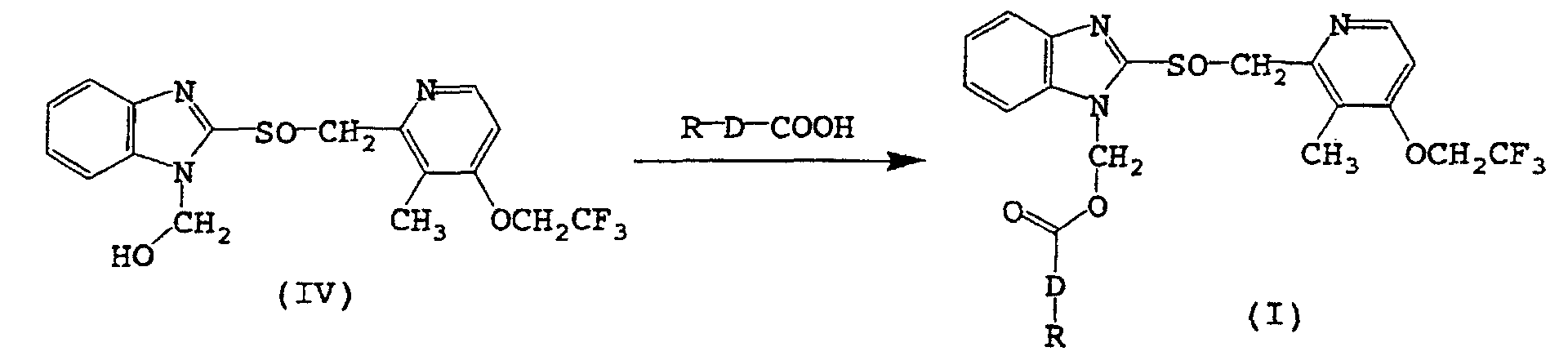 wherein each symbol is as defined above.
When a free carboxylic acid is reacted, condensation can
be conducted using a condensation agent. Examples of the
condensation agent include N,N'-carbodiimidazole, N,N'-dicyclohexylcarbodiimide,
N,N'-diisopropylcarbodiimide, 1-ethyl-3-(3-dimethylaminopropyl)carbodiimide,
N-ethoxycarbonyl-2-ethoxy-1,2-dihydroquinoline,
diethyl phosphorocyanidate,
diphenyl phosphoryl azide, 2-(1H-benzotriazol-1-yl)-1,1,3,3-tetramethyluronium
tetrafluoroborate, 2-(1H-benzotriazol-1-yl)-1,1,3,3-tetramethyluronium
hexafluorophosphate, benzotriazol-1-yl-oxy-tris(dimethylamino)phosphonium
hexafluorophosphate,
benzotriazol-1-yl-oxy-tris-pyrrolidino-phosphonium
hexafluorophosphate, bromo-tris-pyrrolidino-phosphonium
hexafluorophosphate, 2-(5-norbornene-2,3-dicarboximido)-tetramethyluronium
tetrafluoroborate and the like. The amount
of the condensation agent to be used is generally 1 mole - 10
mole, preferably 1 mole - 2 mole, relative to 1 mole of
compound (IV) or a salt thereof.
Examples of the reactive derivative of the carboxylic
acid include acid halide, acid azide, acid anhydride, mixed
acid anhydride, active amide, active ester, active thioester
and the like.
Examples of the above-mentioned acid halide include acid
chloride, acid bromide and the like.
Examples of the mixed acid anhydride include mixed acid
anhydride of mono-C1-4 alkyl carbonic acid (e.g., mixed acid
anhydride of the carboxylic acid with mono-methyl carbonic acid,
mono-ethyl carbonic acid, mono-isopropyl carbonic acid, monoisobutyl
carbonic acid, mono-tert-butyl carbonic acid, monobenzyl
carbonic acid, mono(p-nitrobenzyl) carbonic acid, monoallyl
carbonic acid and the like), mixed acid anhydride of C1-6
aliphatic carboxylic acid (e.g., mixed acid anhydride of the
carboxylic acid with acetic acid, cyanoacetic acid, propionic
acid, lactic acid, isolactic acid, valeric acid, isovaleric
acid, pivalic acid, trifluoroacetic acid, trichloroacetic acid,
acetoacetic acid and the like), mixed acid anhydride of C7-11
aromatic carboxylic acid (e.g., mixed acid anhydride of the
carboxylic acid with benzoic acid, p-toluic acid, p-chlorobenzoic
acid and the like), mixed acid anhydride of
organic sulfonic acid (e.g., mixed acid anhydride of the
carboxylic acid with methanesulfonic acid, ethanesulfonic acid,
benzenesulfonic acid, p-toluenesulfonic acid and the like) and
the like.
Examples of the active amide include amide with nitrogen-containing
heterocyclic compound [e.g., acid amide of the
carboxylic acid with pyrazole, imidazole, benzotriazole and the
like; the nitrogen-containing heterocyclic compounds are
optionally substituted by C1-4 alkyl group (e.g., methyl, ethyl,
propyl, isopropyl, butyl, isobutyl, sec-butyl, tert-butyl and
the like), C1-6 alkoxy group (e.g., methoxy, ethoxy, propoxy,
isopropoxy, butoxy, tert-butoxy and the like), halogen (e.g.,
fluorine, chlorine, bromine and the like), oxo group, thioxo
group, C1-6 alkylthio group (e.g., methylthio, ethylthio,
propylthio, butylthio and the like) and the like], and the like.
Examples of the active ester include organic phosphoric
acid esters (e.g., diethoxyphosphoric acid ester,
diphenoxyphosphoric acid ester and the like), p-nitrophenyl
ester, 2;4-dinitrophenyl ester, cyanomethyl ester,
pentachlorophenyl ester, N-hydroxysuccinimide ester, N-hydroxyphthalimide
ester, 1-hydroxybenzotriazole ester, 6-chloro-1-hydroxybenzotriazole
ester, 1-hydroxy-1H-2-pyridone
ester and the like.
Examples of the active thioester include esters [e.g., 2-pyridylthiol
ester, 2-benzothiazolylthiol ester] with aromatic
heterocyclyl-thiol compound [the heterocycle is optionally
substituted by C1-4 alkyl group (e.g., methyl, ethyl, propyl,
isopropyl, butyl, isobutyl, sec-butyl, tert-butyl and the like),
C1-6 alkoxy group (e.g., methoxy, ethoxy, propoxy, isopropoxy,
butoxy, tert-butoxy and the like), halogen (e.g., fluorine,
chlorine, bromine and the like), C1-6 alkylthio group (e.g.,
methylthio, ethylthio, propylthio, butylthio and the like) and
the like], and the like.
The reaction of Method B is generally conducted in a
solvent, and a solvent that does not inhibit the reaction of
Method B is selected as appropriate. Examples of the solvent
include ethers (e.g., dioxane, tetrahydrofuran, diethyl ether,
tert-butyl methyl ether, diisopropyl ether, ethylene glycol
dimethyl ether and the like), esters (e.g., ethyl formate,
ethyl acetate, butyl acetate and the like), halogenated
hydrocarbons (e.g., dichloromethane, chloroform, carbon
tetrachloride, trichlene, 1,2-dichloroethane and the like),
hydrocarbons (e.g., n-hexane, benzene, toluene and the like),
amides (e.g., formamide, N,N-dimethylformamide, N,N-dimethylacetamide
and the like), ketones (e.g., acetone, methyl
ethyl ketone, methyl isobutyl ketone and the like), nitriles
(e.g., acetonitrile, propionitrile and the like) and the like,
as well as dimethyl sulfoxide, sulfolane,
hexamethylphosphoramide, water and the like. These may be used
alone or as a mixed solvent. The amount of the solvent to be
used is not particularly limited as long as the reaction
mixture can be stirred, which is generally 2- to 100-fold
amount by weight, preferably 5- to 50-fold amount by weight, of
1 mole of compound (IV) or a salt thereof.
The amount of carboxylic acid or a reactive derivative
thereof to-be used is generally 1 mole - 10 mole, preferably 1
mole - 5 mole, relative to 1 mole of compound (IV).
The reaction of Method B is carried out in the
temperature range of generally from -80°C to 200°C, preferably
from -40°C to 150°C, most preferably from -30°C to 100°C.
The reaction time of Method B varies depending on the
kind of carboxylic acid, a reactive derivative thereof and the
solvent (and mixing ratio in the case of a mixed solvent),
reaction temperature and the like, which is generally 1 min.-72
hrs., preferably 15 min. - 24 hrs.
When acid halide is used as the reactive derivative of
carboxylic acid, the reaction can be carried out in the presence
of a deoxidation agent to remove the eliminated hydrogen halide
from the reaction system. Examples of the deoxidation agent
include inorganic base (e.g., sodium carbonate, potassium
carbonate, calcium carbonate, sodium hydrogencarbonate and the
like), tertiary amine (e.g., triethylamine, tripropylamine,
tributylamine, cyclohexyldimethylamine, pyridine, lutidine, γ-collidine,
N,N-dimethylaniline, N-methylpiperidine, N-methylpyrrolidine,
N-methylmorpholine, 4-dimethylaminopyridine
and the like), alkylene oxides (e.g., propylene oxide,
epichlorohydrin and the like) and the like. The amount of the
"deoxidation agent" to be used is generally 1 mole - 10 mole,
preferably 1 mole - 3 mole, relative to 1 mole of compound (IV).
The compound of the formula (IV), [2-[[[3-methyl-4-(2,2,2-trifluoroethoxy)-2-pyridyl]methyl]sulfinyl]-1H-benzimidazol-1-yl]methanol
which is a starting material, can be
obtained according to the means known in this field [Varma et
al., Eur. J. Med. Chem., vol. 15, p. 536 (1980) and Haugwitz et
al., J. Med. Chem., vol. 22, p. 1113 (1979)], by, for example,
hydroxymethylation of 2-[[[3-methyl-4-(2,2,2-trifluoroethoxy)-2-pyridyl]methyl]sulfinyl]-1H-benzimidazole
by a treatment with
formaldehyde in a solvent (e.g., acetonitrile, ethyl acetate
and the like).
The compound (I) or a salt thereof can be obtained by
subjecting compound (V) or a salt thereof to oxidation reaction.
 wherein each symbol is as defined above.
The reaction in Method C can be carried out using an
oxidant such as nitric acid, hydrogen peroxide, peroxy acid,
peroxy acid ester, ozone, dinitrogen tetraoxide, iodosobenzene,
N-halosuccinimide, 1-chlorobenzotriazole, tert-butyl
hypochlorite, diazabicyclo[2.2.2]octane-bromine complex, sodium
metaperiodate, selenium dioxide, manganese dioxide, chromic
acid, cerium ammonium nitrate, bromine, chlorine, sulfuryl
chloride and the like. The amount of the oxidant to be used is
generally 0.5 mole - 2 mole, preferably 0.8 mole - 1.2 mole,
per 1 mole of compound (I).
The reaction of Method C is generally carried out in a
solvent inert to the above-mentioned oxidation reaction.
Examples of the "inert solvent" include water, alcohols (e.g.,
methanol, ethanol, 1-propanol, 2-propanol and the like),
ketones (e.g., acetone, methyl ethyl ketone and the like),
nitriles (e.g., acetonitrile, propionitrile and the like),
amides (e.g., formamide, N,N-dimethylformamide and the like),
ethers (e.g., diethyl ether, tert-butyl methyl ether,
diisopropyl ether, dioxane, tetrahydrofuran and the like),
sulfoxides (e.g., dimethyl sulfoxide and the like) and polar
solvents (e.g., sulfolane, hexamethylphosphoramide and the
like), which may be used alone or as a mixed solvent thereof.
The "inert solvent" is used in generally 1- to 100-fold amount
by weight of compound (V) or a salt thereof.
The reaction temperature is generally from -80°C to 80°C,
preferably from 15°C to 30°C.
The reaction time is generally 1 min. - 6 hrs.,
preferably 15 min. - 1 hr.
The compound (V), which is a starting material of Method
C, can be obtained by subjecting 2-[[[3-methyl-4-(2,2,2-trifluoroethoxy)-2-pyridyl]methyl]thio]-1H-benzimidazole
to the
reaction similar to the reaction in Method A or Method B.
The salt of compound (V) is exemplified by the above-mentioned
salts of the compound (I), which are acid addition
salts such as inorganic acid salt (e.g., hydrochloride, sulfate,
hydrobromide, phosphate and the like), organic acid salt (e.g.,
acetate, trifluoroacetate, succinate, maleate, fumarate,
propionate, citrate, tartrate, lactate, oxalate,
methanesulfonate, p-toluenesulfonate and the like) and the like.
The compound (I) or a salt thereof obtained by the above-mentioned
methods A - C can be isolated and purified from the
reaction mixture by a separation means known per se (e.g.,
concentration, concentration under reduced pressure, solvent
extraction, crystallization, recrystallization, phase transfer,
chromatography and the like).
(R)-2-[[[3-Methyl-4-(2,2,2-trifluoroethoxy)-2-pyridyl]methyl]sulfinyl]-1H-benzimidazole
can be produced by,
for example, subjecting 2-[[[3-methyl-4-(2,2,2-trifluoroethoxy)-2-pyridyl]methyl]sulfinyl]-1H-benzimidazole
or
a salt thereof to optical resolution, or by asymmetric
oxidation of 2-[[[3-methyl-4-(2,2,2-trifluoroethoxy)-2-pyridyl]methyl]thio]-1H-benzimidazole.
The method of optical resolution includes methods known
per se, such as a fractional recrystallization method, a chiral
column method, a diastereomer method, and so forth. Asymmetric
oxidation includes methods known per se, such as the method
described in WO96/02535 and the like.
The "fractional recrystallization method" includes a
method in which a salt is formed between a racemate and an
optically active compound [e.g., (+)-mandelic acid, (-)-mandelic
acid, (+)-tartaric acid, (-)-tartaric acid, (+)-1-phenethylamine,
(-)-1-phenethylamine, cinchonine, (-)-cinchonidine,
brucine, etc.], which salt is separated by
fractional recrystallization etc., and, if desired, subjected
to a neutralization process to give a free optical isomer.
The "chiral column method" includes a method in which a
racemate or a salt thereof is applied to a column for optical
isomer separation (chiral column). In the case of liquid
chromatography, for example, optical isomers are separated by
adding a racemate to a chiral column such as ENANTIO-OVM
(produced by Tosoh Corporation), the DAICEL CHIRAL series
(produced by Daicel Corporation) and the like, and developing
the racemate in water, a buffer (e.g., phosphate buffer), an
organic solvent (e.g., hexane, ethanol, methanol, isopropanol,
acetonitrile, trifluoroacetic acid, diethylamine, triethylamine,
etc.), or a solvent mixture thereof. In the case of gas
chromatography, for example, a chiral column such as CP-Chirasil-DeX
CB (produced by GL Science) and the like is used
to separate optical isomers.
The "diastereomer method" includes a method in which a
racemate and an optically active reagent are reacted
(preferably, an optically active reagent is reacted with the
group at the 1-position of the benzimidazole group) to give a
diastereomeric mixture, which is then subjected to ordinary
separation means (e.g., fractional recrystallization,
chromatography, etc.) to obtain either diastereomer, which is
subjected to a chemical reaction (e.g., acid hydrolysis, base
hydrolysis, hydrogenolysis, etc.) to cut off the optically
active reagent moiety, whereby the desired optical isomer is
obtained. Said "optically active reagent" includes, for
example, optically active organic acids such as MTPA [α-methoxy-α-(trifluoromethyl)phenylacetic
acid], (-)-menthoxyacetic
acid and the like, optically active alkoxymethyl
halides such as (1R-endo)-2-(chloromethoxy)-1,3,3-trimethylbicyclo[2.2.1]heptane
and the like, and the like.
The compound (I) and a salt thereof of the present
invention are useful as a pharmaceutical agent, because they
have a superior anti-ulcer activity, a gastric acid secretion-suppressive
action, a mucosa-protecting action, an anti-Helicobacter
pylori action and the like, and show low toxicity.
In addition, since they are stable to acid, they do not require
formulation into an enteric-coated preparation for oral
administration, which in turn eliminates the cost for
formulating enteric-coated preparation. Moreover, the tablet
can be made smaller, which is easily swallowed by patients
having difficulty in swallowing, particularly the elderly and
children. Furthermore, since absorption is faster than in
enteric-coated preparations, expression of gastric acid
secretion-suppressive action is rapid. The preparation is
long-acting because it is gradually converted to the original
compound in living organisms. Consequently, the compounds are
useful as anti-ulcer agents and the like.
The compound (I) and a salt thereof of the present
invention are useful for the prophylaxis or treatment of
digestive ulcer (e.g., gastric ulcer, gastric ulcer due to
post-operative stress, duodenal ulcer, anastomotic ulcer,
Zollinger-Ellison syndrome, ulcer caused by nonsteroidal antiinflammatory
etc.); gastritis; reflux esophagitis; NUD (Non
Ulcer Dyspepsia); gastric cancer (including gastric cancer due
to promoted production of interleukin-1β caused by genetic
polymorphism of interleukin-1); gastric MALT lymphoma; gastric
hyperacidity (e.g. gastric hyperacidity due to post-operative
stress); hemorrhage of upper gastrointestinal tract caused by
acute stress ulcer, hemorrhagic gastritis, invasion stress
(stress due to major surgery requiring intensive management
after operation and cerebrovascular disorder, external injury
in the head, multiple organ failure and extensive burn
requiring intensive treatment), and the like, pre-anesthetic
administration, eradication of Helicobacter pylori, in mammals
(e.g., human, simian, sheep, cattle, horse, dog, cat, rabbit,
rat, mouse etc.).
The compound (I) and a salt thereof of the present
invention show low toxicity and can be safely administered
orally or parenterally (e.g., topical, rectal, intravenous
administrations and the like) as they are or as a preparation
containing a pharmaceutical composition containing a
pharmacologically acceptable carrier admixed according to a
method known per se, such as tablets (including sugar-coated
tablets and film-coated tablets), powder, granule, capsule
(including soft capsule), orally disintegrating tablet, liquid,
injection, suppository, sustained-release preparation, plaster
and the like.
The content of compound (I) or a salt thereof of the
present invention in the pharmaceutical composition of the
present invention is about 0.01 to 100% by weight relative to
the entire composition. Though subject to change depending on
the administration target, administration route, target disease
and the like, its dose is about 0.5 to 1,500 mg/day, preferably
about 5 to 150 mg/day, based on the active ingredient, when,
for example, the compound is orally administered as an anti-ulcer
agent to an adult human (60 kg). The compound (I) or a
salt thereof of the present invention may be administered once
daily or in 2 or 3 divided portions per day.
The pharmacologically acceptable carrier that may be used
to produce the pharmaceutical composition of the present
invention includes various organic or inorganic carrier
substances in common use as pharmaceutical materials, including
excipients, lubricants, binders, disintegrants, water-soluble
polymers and basic inorganic salts for solid preparations; and
solvents, dissolution aids, suspending agents, isotonizing
agents, buffers and soothing agents for liquid preparations and
the like. Other ordinary pharmaceutical additives such as
preservatives, anti-oxidants, coloring agents, sweetening
agents, souring agents, bubbling agents and flavorings may also
be used as necessary.
Such "excipients" include, for example, lactose, sucrose,
D-mannitol, starch, cornstarch, crystalline cellulose, light
silicic anhydride, titanium oxide and the like.
Such "lubricants" include, for example, magnesium
stearate, sucrose fatty acid esters, polyethylene glycol, talc,
stearic acid and the like.
Such "binders" include, for example, hydroxypropyl
cellulose, hydroxypropylmethyl cellulose, crystalline cellulose,
starch, polyvinylpyrrolidone, gum arabic powder, gelatin,
pullulan, low-substituted hydroxypropyl cellulose and the like.
Such "disintegrants" include (1) crosslinked povidone,
(2) what is called super-disintegrants such as crosslinked
carmellose sodium (FMC-Asahi Chemical) and carmellose calcium
(Gotoku Yakuhin) etc, (3) carboxymethyl starch sodium (e.g.,
product of Matsutani Chemical), (4) low-substituted
hydroxypropyl cellulose (e.g., product of Shin-Etsu Chemical),
(5) corn starch, and so forth. Said "crosslinked povidone" may
be any crosslinked polymer having the chemical name 1-ethenyl-2-pyrrolidinone
homopolymer, including polyvinylpyrrolidone
(PVPP) and 1-vinyl-2-pyrrolidinone homopolymer, and is
exemplified by Colidon CL (produced by BASF), Polyplasdon XL
(produced by ISP), Polyplasdon XL-10 (produced by ISP),
Polyplasdon INF-10 (produced by ISP) and the like.
Such "water-soluble polymers" include, for example,
ethanol-soluble water-soluble polymers [e.g., cellulose
derivatives such as hydroxypropyl cellulose (hereinafter also
referred to as HPC) etc, polyvinylpyrrolidone and the like],
ethanol-insoluble water-soluble polymers [e.g., cellulose
derivatives such as hydroxypropylmethyl cellulose (hereinafter
also referred to as HPMC) etc., methyl cellulose, carboxymethyl
cellulose sodium and the like, sodium polyacrylate, polyvinyl
alcohol, sodium alginate, guar gum and the like] and the like.
Such "basic inorganic salts" include, for example, basic
inorganic salts of sodium, potassium, magnesium and/or calcium.
Preferred are basic inorganic salts of magnesium and/or calcium.
More preferred are basic inorganic salts of magnesium. Such
basic inorganic salts of sodium include, for example, sodium
carbonate, sodium hydrogencarbonate, disodium hydrogenphosphate
and the like. Such basic inorganic salts of potassium include,
for example, potassium carbonate, potassium hydrogencarbonate
and the like. Such basic inorganic salts of magnesium include,
for example, heavy magnesium carbonate, magnesium carbonate,
magnesium oxide, magnesium hydroxide, magnesium metasilicate
aluminate, magnesium silicate, magnesium aluminate, synthetic
hydrotalcite [Mg6Al2(OH)16CO34H2O], and alumina hydroxide
magnesium. Preferred are heavy magnesium carbonate, magnesium
carbonate, magnesium oxide, magnesium hydroxide and the like.
Such basic inorganic salts of calcium include, for example,
precipitated calcium carbonate, calcium hydroxide, etc.
Such "solvents" include, for example, water for injection,
alcohol, propylene glycol, macrogol, sesame oil, corn oil,
olive oil and the like.
Such "dissolution aids" include, for example,
polyethylene glycol, propylene glycol, D-mannitol, benzyl
benzoate, ethanol, trisaminomethane, cholesterol,
triethanolamine, sodium carbonate, sodium citrate and the like.
Such "suspending agents" include, for example,
surfactants such as stearyltriethanolamine, sodium lauryl
sulfate, laurylaminopropionic acid, lecithin, benzalkonium
chloride, benzethonium chloride, monostearic glycerol etc;
hydrophilic polymers such as polyvinyl alcohol,
polyvinylpyrrolidone, carboxymethyl cellulose sodium, methyl
cellulose, hydroxymethyl cellulose, hydroxyethyl cellulose,
hydroxypropyl cellulose etc., and the like.
Such "isotonizing agents" include, for example, glucose,
D-sorbitol, sodium chloride, glycerol, D-mannitol and the like.
Such "buffers" include, for example, buffer solutions of
phosphates, acetates, carbonates, citrates etc, and the like.
Such "soothing agents" include, for example, benzyl
alcohol and the like.
Such "preservatives" include, for example, p-oxybenzoic
acid esters, chlorobutanol, benzyl alcohol, phenethyl alcohol,
dehydroacetic acid, sorbic acid and the like.
Such "antioxidants" include, for example, sulfites,
ascorbic acid, α-tocopherol and the like.
Such "coloring agents" include, for example, food colors
such as Food Color Yellow No. 5, Food Color Red No. 2, Food
Color Blue No. 2 etc; food lake colors, red oxide and the like.
Such "sweetening agents" include, for example, saccharin
sodium, dipotassium glycyrrhizinate, aspartame, stevia,
thaumatin and the like.
Such "souring agents" include, for example, citric acid
(citric anhydride), tartaric acid, malic acid and the like.
Such "bubbling agents" include, for example, sodium
bicarbonate and the like.
Such "flavorings" may be synthetic substances or
naturally occurring substances, and include, for example, lemon,
lime, orange, menthol, strawberry and the like.
The compound of the present invention may be prepared as
a preparation for oral administration in accordance with a
commonly-known method, by, for example, compression-shaping in
the presence of a carrier such as an excipient, a disintegrant,
a binder, a lubricant, or the like, and subsequently coating
the preparation as necessary by a commonly known method for the
purpose of taste masking, enteric dissolution or sustained
release. For an enteric preparation, an intermediate layer may
be provided by a commonly known method between the enteric
layer and the drug-containing layer for the purpose of
separation of the two layers.
For preparing the compound (I) or a salt thereof of the
present invention as an orally disintegrating tablet, available
methods include, for example, a method in which a core
containing crystalline cellulose and lactose is coated with the
compound (I) or a salt thereof of the present invention and,
where necessary, a basic inorganic salt, and then further
coated with a coating layer containing a water-soluble polymer
to give a composition, which is coated with an enteric coating
layer containing polyethylene glycol, further coated with an
enteric coating layer containing triethyl citrate, still
further coated with an enteric coating layer containing
polyethylene glycol, and finally coated with mannitol to give
fine granules, which are mixed with additives and shaped.
The above-mentioned "enteric coating layer" includes, for
example, a layer consisting of a mixture of one or more kinds
from aqueous enteric polymer substrates such as cellulose
acetate phthalate (CAP), hydroxypropylmethyl cellulose
phthalate, hydroxymethyl cellulose acetate succinate,
methacrylic acid copolymers (e.g., Eudragit L30D-55 (trade
name; produced by Rohm), Colicoat MAE30DP (trade name; produced
by BASF), Polyquid PA30 (trade name; produced by San-yo
Chemical) etc), carboxymethylethyl cellulose, shellac and the
like; sustained-release substrates such as methacrylic acid
copolymers (e.g., Eudragit NE30D (trade name), Eudragit RL30D
(trade name), Eudragit RS30D (trade name), etc.) and the like;
water-soluble polymers; plasticizers such as triethyl citrate,
polyethylene glycol, acetylated monoglycerides, triacetin,
castor oil and the like; and the like, and the like.
The above-mentioned "additive" includes, for example,
water-soluble sugar alcohols (e.g., sorbitol, mannitol,
maltitol, reduced starch saccharides, xylitol, reduced
palatinose, erythritol, etc.), crystalline cellulose (e.g.,
Ceolas KG 801, Avicel PH 101, Avicel PH 102, Avicel PH 301,
Avicel PH 302, Avicel RC-591 (crystalline cellulose carmellose
sodium) etc), low-substituted hydroxypropyl cellulose (e.g.,
LH-22, LH-32, LH-23, LH-33 (Shin-Etsu Chemical), mixtures
thereof etc) and the like. Furthermore, binders, souring
agents, bubbling agents, sweetening agents, flavorings,
lubricants, coloring agents, stabilizers, excipients,
disintegrants etc. are also used.
The compound of the present invention may be used in
combination with 1 to 3 other active ingredients.
Such "other active ingredients" include, for example,
anti-Helicobacter pylori active substances, imidazole compounds,
bismuth salts, quinolone compounds, and so forth. Of these
substances, preferred are anti-Helicobacter pylori active
substances, imidazole compounds etc.
Such "anti-Helicobacter pylori active substances" include,
for example, antibiotic penicillins (e.g., amoxicillin,
benzylpenicillin, piperacillin, mecillinam, etc.), antibiotic
cefems (e.g., cefixime, cefaclor, etc.), antibiotic macrolides
(e.g., erythromycin, clarithromycin, etc.), antibiotic
tetracyclines (e.g., tetracycline, minocycline, streptomycin,
etc.), antibiotic aminoglycosides (e.g., gentamicin, amikacin,
etc.), imipenem and so forth. Of these substances, preferred
are antibiotic penicillins, antibiotic macrolides and the like.
Such "imidazole compounds" include, for example,
metronidazole, miconazole and the like.
Such "bismuth salts" include, for example, bismuth
acetate, bismuth citrate and the like.
Such "quinolone compounds" include, for example,
ofloxacin, ciploxacin and the like.
For eradication of Helicobacter pylori, a combination
therapy of compound (I) or a salt thereof of the present
invention with antibiotic penicillin (e.g., amoxicillin and the
like) and antibiotic erythromycin (e.g., clarithromycin and the
like) is particularly preferable.
Such "other active ingredients" and the compound (I) or a
salt thereof of the present invention may be mixed, prepared as
a single pharmaceutical composition [e.g., tablets, powders,
granules, capsules (including soft capsules), liquids,
injectable preparations, suppositories, sustained-release
preparations, etc.], in accordance with a commonly known method,
and used in combination, and may also be prepared as separate
preparations and administered to the same subject
simultaneously or at a time interval.
The present invention is explained in more detail by
referring to Reference Examples and Examples, which are not to
be construed as limitative.
In the following Reference Example and Examples, the term
"room temperature" indicates about 15 to 30°C.
1H-NMR spectra were determined with CDCl3 as the solvent
using Varian Gemini-200 and Mercury-300; data are shown in
chemical shift δ(ppm) from the internal standard
tetramethylsilane.
Optical rotation [α]D was determined at 20°C, using the
DIP-370 Digital polarimeter (produced by JASCO).
The enantiomer excess (%ee) was measured by high
performance liquid chromatography using an optically active
column under the following conditions.
high performance liquid chromatography conditions (A);
column: CHIRALCEL OD (manufactured by Daicel Chemical Industries, Ltd.)
mobile phase: hexane/ethanol=90/10
flow rate: 1.0 mL/min.
detection: UV 285 nm
The other symbols used herein have the following definitions:
high performance liquid chromatography conditions (A);
column: CHIRALCEL OD (manufactured by Daicel Chemical Industries, Ltd.)
mobile phase: hexane/ethanol=90/10
flow rate: 1.0 mL/min.
detection: UV 285 nm
The other symbols used herein have the following definitions:
2-[[[3-Methyl-4-(2,2,2-trifluoroethoxy)-2-pyridinyl]methyl]thio]-1H-benzimidazole
(4.5 kg, 12.7 mol,
containing water 1.89 g), toluene (22 L), water (25 g, 1.39
mol, 1.49 mol as total water content) and (+)-diethyl tartrate
(0.958 L, 5.60 mol) were mixed under a nitrogen stream.
Titanium(IV) isopropoxide (0.747 L, 2.53 mol) was added to the
mixture at 50 - 60°C under a nitrogen stream, and the mixture
was stirred at the same temperature for 30 min.
Diisopropylethylamine (0.733 L, 4.44 mol) was added to the
obtained mixture at room temperature under a nitrogen stream,
and cumene hydroperoxide (6.88 L, content 82%, 37.5 mol) was
added at -5°C to 5°C. The mixture was stirred at -5°C to 5°C
for 1.5 hrs. to give a reaction mixture. 30% Aqueous sodium
thiosulfate solution (17 L) was added to the reaction mixture
under a nitrogen stream, and the remaining cumene hydroperoxide
was decomposed. After partitioning, water (4.5 L), heptane
(13.5 L), t-butyl methyl ether (18 L) and heptane (27 L) were
added successively to the obtained organic layer, and crystals
were precipitated under stirring. The crystals were separated
and washed with t-butyl methyl ether-toluene (t-butyl methyl
ether:toluene=4:1)(4 L). A suspension of the wet crystal in
acetone (20 L) was added dropwise with stirring to a mixture of
acetone (7 L) and water (34 L), and water (47 L) was added.
The precipitated crystals were separated and washed with
acetone-water (acetone:water=1:3)(4 L) and water (12 L). The
wet crystals were dissolved in ethyl acetate (45 L) and water
(3 L), and the solution was partitioned. The trace amount of
the insoluble material in the organic layer was filtered off,
and triethylamine (0.2 L) was added. The mixture was
concentrated under reduced pressure until the liquid amount
became about 7 L. Methanol (2.3 L), ca. 12.5% aqueous ammonia
(23 L, ca. 50°C) and t-butyl methyl ether (22 L, ca. 50°C) were
added to the concentrate, and the mixture was partitioned. To
the organic layer was added ca. 12.5% aqueous ammonia (11 L),
and the mixture was partitioned (this step was repeated once).
The aqueous layers were combined, and ethyl acetate (22 L) was
added. Acetic acid was added dropwise under cooling, and pH
was adjusted to about 8. After partitioning, the aqueous layer
was extracted with ethyl acetate (11 L). The organic layers
were combined and washed with ca. 20% brine (11 L). After
addition of triethylamine (0.2 L), the organic layer was
concentrated under reduced pressure. Acetone (5 L) was added
to the concentrate, and the mixture was concentrated under
reduced pressure. The concentrate was dissolved in acetone (9
L), and the solution was added dropwise to a mixture of acetone
(4.5 L) and water (22.5 L), and water (18 L) was added dropwise
to the obtained mixture. The precipitated crystals were
separated and washed successively with cooled acetone-water
(acetone:water=1:3)(3 L) and water (12 L). The wet crystals
were dissolved in ethyl acetate (32 L). The separated aqueous
layer was separated by partitioning, and the obtained organic
layer was concentrated under reduced pressure until the liquid
amount became about 14 L. Ethyl acetate (36 L) and activated
carbon (270 g) were added to the residual liquid and, after
stirring, the activated carbon was filtered off. The filtrate
was concentrated under reduced pressure until the liquid amount
became about 14 L. Heptane (90 L) was added dropwise to the
remaining liquid at about 40°C. After stirring at the same
temperature for about 30 min., the crystals were separated and
washed with ethyl acetate - heptane (ethyl acetate:heptane=1:8,
6 L, ca. 40°C). Drying gave the title compound (3.4 kg). The
enantiomer excess of this compound was 100% ee.
To a mixture of 2-[[[3-methyl-4-(2,2,2-trifluoroethoxy)-2-pyridinyl]methyl]sulfinyl]-1H-benzimidazole
(3.69 g),
dichloromethane (50 mL) and 4-dimethylaminopyridine (0.12 g)
was added a solution of 37% formaldehyde solution (3.75 mL)
diluted with water (6.25 mL) at room temperature. This mixture
was stirred vigorously at room temperature for 8 min, and the
dichloromethane layer was separated and dried over sodium
sulfate. After filtration, concentration under reduced
pressure gave the title compound (3.99 g) as an amorphous
compound.
1H-NMR(CDCl3): 2.34(3H,s), 4.38(2H,q,J=7.8Hz), 4.98(2H,s), 5.76(1H,d,J=11.3Hz), 6.12(1H,d,J=11.3Hz), 6.60(1H,d,J=5.8Hz), 7.29-7.47(2H,m), 7.59(1H,d,J=7.8Hz), 7.74(1H,d,J=7.6Hz), 8.10(1H,d,J=5.8Hz).
1H-NMR(CDCl3): 2.34(3H,s), 4.38(2H,q,J=7.8Hz), 4.98(2H,s), 5.76(1H,d,J=11.3Hz), 6.12(1H,d,J=11.3Hz), 6.60(1H,d,J=5.8Hz), 7.29-7.47(2H,m), 7.59(1H,d,J=7.8Hz), 7.74(1H,d,J=7.6Hz), 8.10(1H,d,J=5.8Hz).
To a solution of (R)-2-[[[3-methyl-4-(2,2,2-trifluoroethoxy)-2-pyridinyl]methyl]sulfinyl]-1H-benzimidazole
(1.0 g) in dichloromethane (10 mL) was added a solution of 4-dimethylaminopyridine
(33 mg) and 37% aqueous formalin solution
(1.5 mL) diluted with water (2 mL), and the mixture was stirred
at room temperature for 1 hr. The reaction mixture was
extracted with dichloromethane-water, and the organic layer was
washed with saturated brine, dried over anhydrous sodium
sulfate and concentrated under reduced pressure. The residue
was crystallized from dichloromethane-isopropyl ether to give
the title compound as a pale-brown solid (0.75 g).
1H-NMR(CDCl3): 2.40(3H,s), 4.39(2H,q,J=8.0Hz), 4.98(2H,s), 5.75(1H,d,J=11.4Hz), 6.12(1H,d,J=11.4Hz), 6.60(1H,d,J=5.8Hz), 7.30-7.50(2H,m), 7.59(1H,dd,J=1.2,7.8Hz),
7.74(1H,dd,J=1.0,7.6Hz), 8.10(1H,d,J=5.8Hz)
1H-NMR(CDCl3): 2.40(3H,s), 4.39(2H,q,J=8.0Hz), 4.98(2H,s), 5.75(1H,d,J=11.4Hz), 6.12(1H,d,J=11.4Hz), 6.60(1H,d,J=5.8Hz), 7.30-7.50(2H,m), 7.59(1H,dd,J=1.2,7.8Hz),
7.74(1H,dd,J=1.0,7.6Hz), 8.10(1H,d,J=5.8Hz)

To a solution (10 mL) of [2-[[[3-methyl-4-(2,2,2-trifluoroethoxy)-2-pyridinyl]methyl]sulfinyl]-1H-benzimidazol-1-yl]methanol
(1.99 g) in tetrahydrofuran were added
triethylamine (1.4 mL) and benzoyl chloride (0.7 mL) under ice-cooling.
The mixture was stirred under ice-cooling for 4.5 hrs.
Ethyl acetate (60 mL) was added, and the mixture was washed
with water (30 mL) and saturated brine (15 mL), and dried over
anhydrous magnesium sulfate. After concentration under reduced
pressure, diethyl ether (30 mL) was added to the residue to
allow solidification, which was collected by filtration and
washed with diethyl ether. The title compound (1.13 g) was
obtained as a colorless solid by drying under reduced pressure.
1H-NMR(CDCl3): 2.29(3H,s), 4.37(2H,q,J=7.8Hz), 5.03(1H,d,J=13.8Hz), 5.11(1H,d,J=13.8Hz), 6.63(1H,d,J=5.7Hz), 6.76(2H,s), 7.33-7.50(4H,m), 7.58(1H,m), 7.73-7.85(2H,m), 8.03-8.10(2H,m), 8.28(1H,d,J=5.7Hz)
1H-NMR(CDCl3): 2.29(3H,s), 4.37(2H,q,J=7.8Hz), 5.03(1H,d,J=13.8Hz), 5.11(1H,d,J=13.8Hz), 6.63(1H,d,J=5.7Hz), 6.76(2H,s), 7.33-7.50(4H,m), 7.58(1H,m), 7.73-7.85(2H,m), 8.03-8.10(2H,m), 8.28(1H,d,J=5.7Hz)
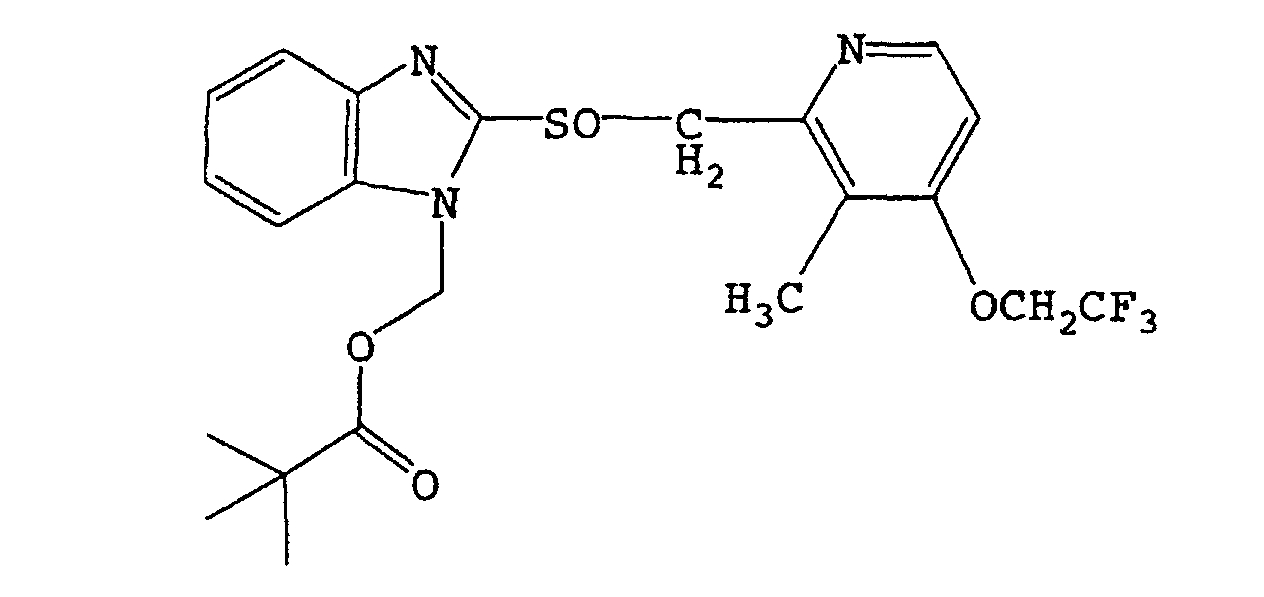
To a solution (25 mL) of [2-[[[3-methyl-4-(2,2,2-trifluoroethoxy)-2-pyridinyl]methyl]sulfinyl]-1H-benzimidazol-1-yl]methanol
(1.99 g) in tetrahydrofuran were added
triethylamine (1.4 mL) and trimethylacetyl chloride (0.924 mL)
under ice-cooling. The mixture was stirred under ice-cooling
for 2.5 hrs. Ethyl acetate (60 mL) was added, and the mixture
was washed with water (30 mL), aqueous sodium hydrogencarbonate
(30 mL) and saturated brine (30 mL) and dried over anhydrous
magnesium sulfate. After concentration under reduced pressure,
a mixed solution of diethyl ether and diisopropyl ether was
added to the residue to allow solidification, which was
collected by filtration. The solid (1.06 g) obtained by drying
under reduced pressure was washed with ethyl acetate-diisopropyl
ether and dried under reduced pressure to give the
title compound (0.432 g) as a colorless solid.
1H-NMR(CDCl3): 1.18(9H,s), 2.30(3H,s), 4.38(2H,q,J=7.8Hz), 4.99(1H,d,J=13.7Hz), 5.07(1H,d,J=13.7Hz) 6.48(1H,d,J=11.3Hz), 6.55(1H,d,J=11.3Hz), 6.65(1H,d,J=5.7Hz), 7.32-7.48(2H,m), 7.62(1H,m), 7.82(1H,m), 8.29(1H,d,J=5.7Hz)
1H-NMR(CDCl3): 1.18(9H,s), 2.30(3H,s), 4.38(2H,q,J=7.8Hz), 4.99(1H,d,J=13.7Hz), 5.07(1H,d,J=13.7Hz) 6.48(1H,d,J=11.3Hz), 6.55(1H,d,J=11.3Hz), 6.65(1H,d,J=5.7Hz), 7.32-7.48(2H,m), 7.62(1H,m), 7.82(1H,m), 8.29(1H,d,J=5.7Hz)
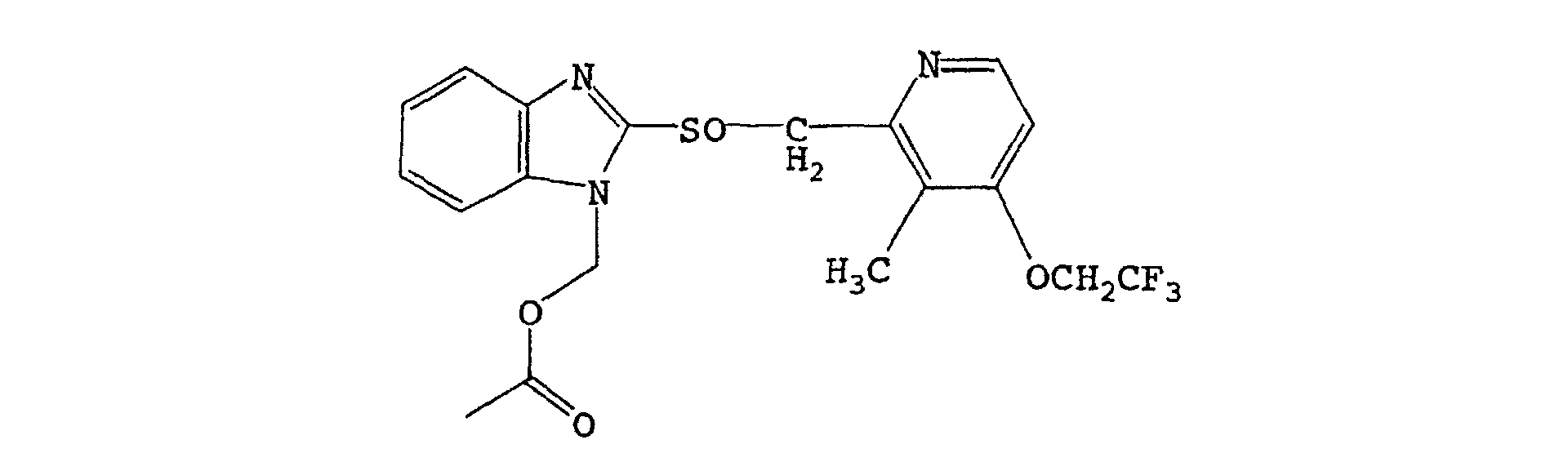
To a solution (10 mL) of [2-[[[3-methyl-4-(2,2,2-trifluoroethoxy)-2-pyridinyl]methyl]sulfinyl]-1H-benzimidazol-1-yl]methanol
(1.99 g) in tetrahydrofuran were added
triethylamine (1.4 mL) and acetyl chloride (0.354 mL) under
ice-cooling. The mixture was stirred under ice-cooling for 2.5
hrs. Ethyl acetate (60 mL) was added, and the mixture was
washed with water (30 mL) and saturated brine (10 mL) and dried
over anhydrous magnesium sulfate. The mixture was concentrated
under reduced pressure, and diethyl ether (30 mL) was added to
the residue to allow solidification, which was collected by
filtration and washed with diethyl ether. The title compound
(1.46 g) was obtained as a colorless solid by drying under
reduced pressure.
1H-NMR(CDCl3): 2.12(3H,s), 2.31(3H,s), 4.39(2H,q,J=8.0Hz), 4.96(1H,d,J=13.8Hz), 5.07(1H,d,J=13.8Hz), 6.51(2H,s), 6.65(1H,d,J=5.6Hz), 7.33-7.48(2H,m), 7.64(1H,m), 7.82(1H,m) 8.29(1H,d,J=5.6Hz)
1H-NMR(CDCl3): 2.12(3H,s), 2.31(3H,s), 4.39(2H,q,J=8.0Hz), 4.96(1H,d,J=13.8Hz), 5.07(1H,d,J=13.8Hz), 6.51(2H,s), 6.65(1H,d,J=5.6Hz), 7.33-7.48(2H,m), 7.64(1H,m), 7.82(1H,m) 8.29(1H,d,J=5.6Hz)
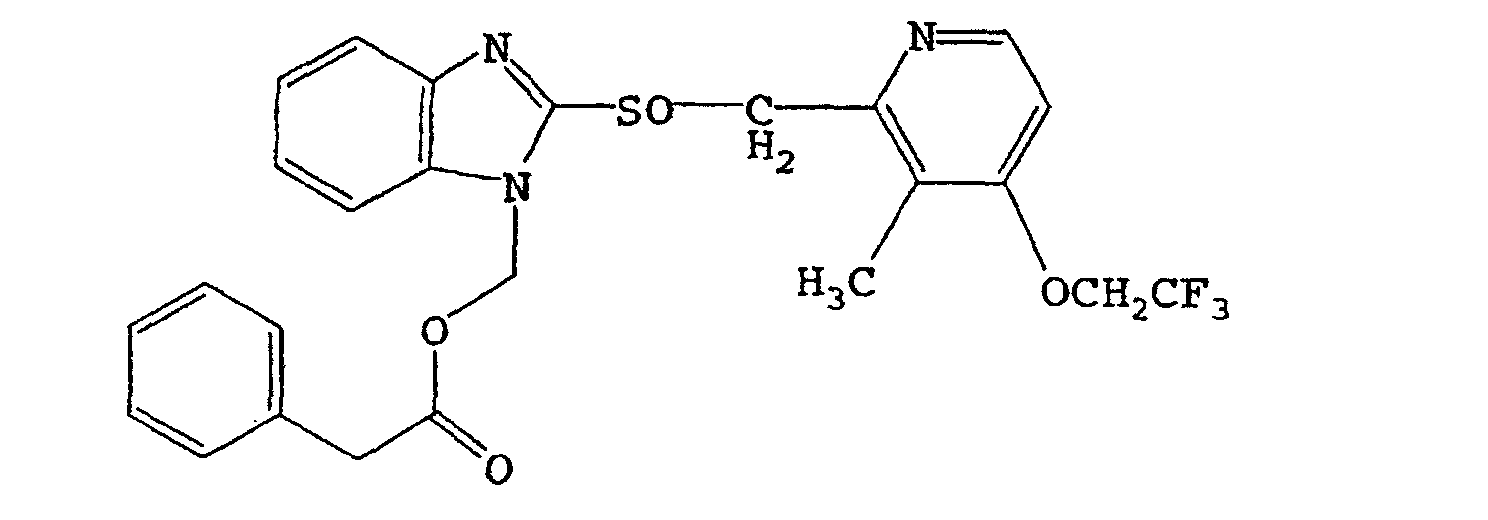
To a solution (40 mL) of [2-[[[3-methyl-4-(2,2,2-trifluoroethoxy)-2-pyridinyl]methyl]sulfinyl]-1H-benzimidazol-1-yl]methanol
(1.99 g) in tetrahydrofuran were added
triethylamine (1.4 mL) and phenylacetyl chloride (0.8 mL) under
ice-cooling. The mixture was stirred under ice-cooling for 9
hrs. Ethyl acetate (60 mL) was added, and the mixture was
washed with water (30 mL), aqueous sodium hydrogencarbonate (30
mL) and saturated brine (30 mL) and dried over anhydrous
magnesium sulfate. The mixture was concentrated under reduced
pressure, and the residue was purified by silica gel column
chromatography (eluted with ethyl acetate:hexane=1:1, then with
ethyl acetate). The obtained solid was washed with diethyl
ether and dried under reduced pressure to give the title
compound (1.28 g) as a colorless solid.
1H-NMR(CDCl3): 2.28(3H,s), 3.68(2H,s), 4.38(2H,q,J=7.9Hz), 4.90(1H,d,J=13.8Hz), 5.00(1H,d,J=13.8Hz), 6.49(1H,d,J=11.0Hz), 6.56(1H,d,J=11.0Hz), 6.63(1H,d,J=5.5Hz), 7.15-7.30(5H,m), 7.31-7.44(2H,m), 7.58(1H,m), 7.80(1H,m), 8.26(1H,d,J=5.5Hz)
1H-NMR(CDCl3): 2.28(3H,s), 3.68(2H,s), 4.38(2H,q,J=7.9Hz), 4.90(1H,d,J=13.8Hz), 5.00(1H,d,J=13.8Hz), 6.49(1H,d,J=11.0Hz), 6.56(1H,d,J=11.0Hz), 6.63(1H,d,J=5.5Hz), 7.15-7.30(5H,m), 7.31-7.44(2H,m), 7.58(1H,m), 7.80(1H,m), 8.26(1H,d,J=5.5Hz)

To a mixture of (R)-2-[[[3-methyl-4-(2,2,2-trifluoroethoxy)-2-pyridinyl]methyl]sulfinyl]-1H-benzimidazole
(3.69 g), ethyl acetate (50 mL) and 4-dimethylaminopyridine
(0.12 g) was added a 37% formaldehyde solution (3.76 mL) at
room temperature. This mixture was vigorously stirred at room
temperature for 1 hr., and the reaction mixture was washed with
water (10 mL) and dried over anhydrous magnesium sulfate. The
residue was treated with activated carbon and, after filtration,
concentrated under reduced pressure. The obtained residue was
dissolved in tetrahydrofuran (10 mL), and triethylamine (1.5
mL) and benzoyl chloride (1.27 mL) were added under ice-cooling.
The mixture was stirred under ice-cooling for 1 hr. Ethyl
acetate (50 mL) was added, and the mixture was washed with
water (30 mL), aqueous sodium hydrogencarbonate (30 mL) and
saturated brine (15 mL) and dried over anhydrous magnesium
sulfate. The residue was treated with activated carbon and
filtrated, and the filtrate was concentrated under reduced
pressure. The residue was purified by silica gel column
chromatography (eluted with ethyl acetate:hexane=1:1, then with
ethyl acetate). The obtained solid was recrystallized from
ethyl acetate-hexane. Then, recrystallization from
tetrahydrofuran-diethyl ether gave the title compound (1.60 g)
as a colorless solid.
1H-NMR(CDCl3): 2.30(3H,s), 4.37(2H,q,J=7.9Hz), 5.03(1H,d,J=14.2Hz), 5.10(1H,d,J=14.2Hz), 6.63(1H,d,J=5.6Hz), 6.76(2H,s), 7.34-7.49(4H,m), 7.54-7.61(1H,m), 7.74-7.86(2H,m), 8.03-8.08(2H,m), 8.28(1H,d,J=5.6Hz)
[α]D=+105.3° (c=1.002% in CHCl3)
1H-NMR(CDCl3): 2.30(3H,s), 4.37(2H,q,J=7.9Hz), 5.03(1H,d,J=14.2Hz), 5.10(1H,d,J=14.2Hz), 6.63(1H,d,J=5.6Hz), 6.76(2H,s), 7.34-7.49(4H,m), 7.54-7.61(1H,m), 7.74-7.86(2H,m), 8.03-8.08(2H,m), 8.28(1H,d,J=5.6Hz)
[α]D=+105.3° (c=1.002% in CHCl3)

To a solution (25 mL) of [2-[[[3-methyl-4-(2,2,2-trifluoroethoxy)-2-pyridinyl]methyl]sulfinyl]-1H-benzimidazol-1-yl]methanol
(1.99 g) in tetrahydrofuran were added
triethylamine (1.4 mL) and 4-methylbenzoyl chloride (0.8 mL)
under ice-cooling. The mixture was stirred under ice-cooling
for 3 hrs. Ethyl acetate (60 mL) was added, and the mixture
was washed with water (30 mL), aqueous sodium hydrogencarbonate
(30 mL) and saturated brine (30 mL) and dried over anhydrous
magnesium sulfate. The mixture was concentrated under reduced
pressure, and the obtained solid was washed with diethyl ether
and dried under reduced pressure. The residue was washed with
ethyl acetate-diisopropyl ether and dried under reduced
pressure to give the title compound (1.04 g) as a colorless
solid.
1H-NMR(CDCl3): 2.29(3H,s), 2.39(3H,s), 4.37(2H,q,J=7.8Hz), 5.01(1H,d,J=13.6Hz), 5.10(1H,d,J=13.6Hz), 6.63(1H,d,J=5.7Hz), 6.74(2H,s), 7.21(2H,d,J=8.0Hz), 7.33-7.48(2H,m), 7.75(1H,d,J=7.0Hz), 7.83(1H,d,J=8.8Hz), 7.94(2H,d,J=8.0Hz) 8.29(1H,d,J=5.7Hz)
1H-NMR(CDCl3): 2.29(3H,s), 2.39(3H,s), 4.37(2H,q,J=7.8Hz), 5.01(1H,d,J=13.6Hz), 5.10(1H,d,J=13.6Hz), 6.63(1H,d,J=5.7Hz), 6.74(2H,s), 7.21(2H,d,J=8.0Hz), 7.33-7.48(2H,m), 7.75(1H,d,J=7.0Hz), 7.83(1H,d,J=8.8Hz), 7.94(2H,d,J=8.0Hz) 8.29(1H,d,J=5.7Hz)
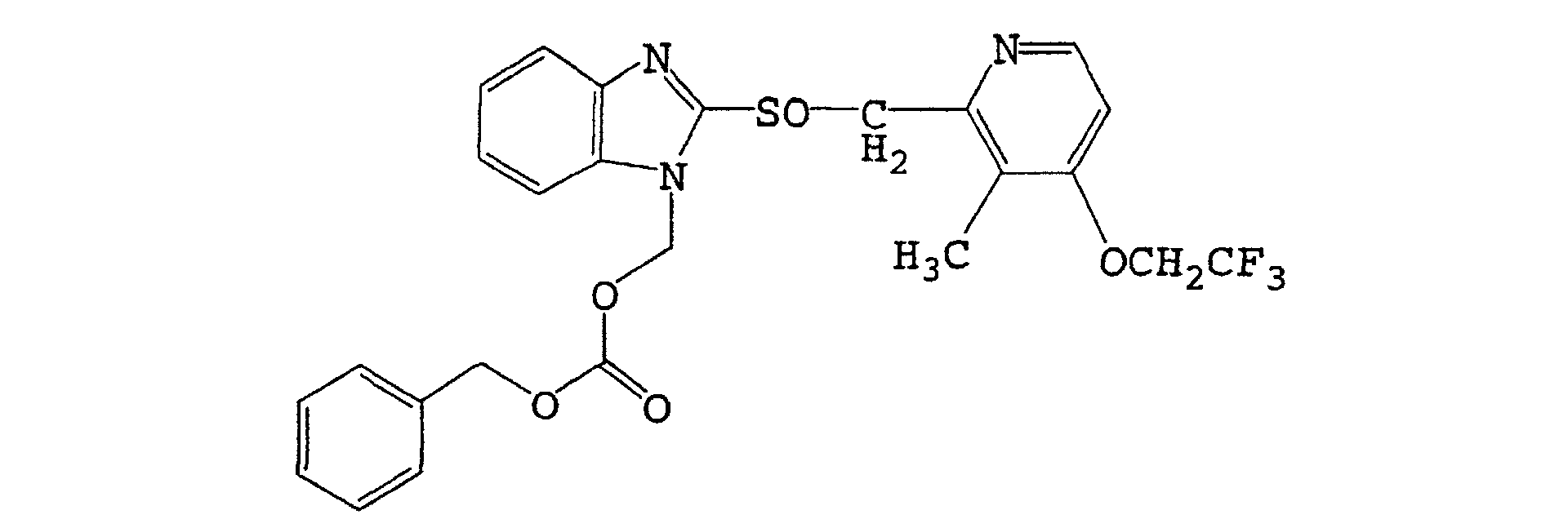
To a solution (20 mL) of [2-[[[3-methyl-4-(2,2,2-trifluoroethoxy)-2-pyridinyl]methyl]sulfinyl]-1H-benzimidazol-1-yl]methanol
(1.99 g) in tetrahydrofuran were added
triethylamine (1.4 mL) and benzyl chloroformate (0.86 mL). The
mixture was stirred at room temperature for 3 hrs. Benzyl
chloroformate (0.60 mL) was added, and the mixture was stirred
at room temperature for 14.5 hrs. Ethyl acetate (150 mL) was
added, and the mixture was washed with water (100 mL) and
saturated brine (30 mL) and dried over anhydrous magnesium
sulfate. The mixture was concentrated under reduced pressure,
and the obtained solid was washed with diisopropyl ether and
dried under reduced pressure to give the title compound (2.37
g) as a colorless solid.
1H-NMR(CDCl3): 2.25(3H,s), 4.35(2H,q,J=7.8Hz), 4.93(1H,d,J=13.8Hz), 5.06(1H,d,J=13.8Hz), 5.18(2H,s), 6.49(1H,d,J=11.2Hz), 6.61(1H,d,J=5.7Hz), 6.64(1H,d,J=11.2Hz), 7.34(5H,s), 7.34-7.49(2H,m), 7.66(1H,m), 7.82(1H,m), 8.28(1H,d,J=5.7Hz)
1H-NMR(CDCl3): 2.25(3H,s), 4.35(2H,q,J=7.8Hz), 4.93(1H,d,J=13.8Hz), 5.06(1H,d,J=13.8Hz), 5.18(2H,s), 6.49(1H,d,J=11.2Hz), 6.61(1H,d,J=5.7Hz), 6.64(1H,d,J=11.2Hz), 7.34(5H,s), 7.34-7.49(2H,m), 7.66(1H,m), 7.82(1H,m), 8.28(1H,d,J=5.7Hz)

To a solution (20 mL) of [2-[[[3-methyl-4-(2,2,2-trifluoroethoxy)-2-pyridinyl]methyl]sulfinyl]-1H-benzimidazol-1-yl]methanol
(1.99 g) in tetrahydrofuran were added
triethylamine (1.4 mL) and ethyl chlorocarbonate (0.60 mL).
The mixture was stirred at room temperature for 1 hr. Ethyl
chlorocarbonate (0.40 mL) was added, and the mixture was
stirred at room temperature for 16 hrs. Ethyl acetate (50 mL)
was added, and the mixture was washed with water (60 mL). The
aqueous layer was extracted with ethyl acetate (30 mL), and the
ethyl acetate layers were combined, washed with saturated brine
(20 mL) and dried over anhydrous magnesium sulfate. After
concentration under reduced pressure, the residue was purified
by silica gel column chromatography (eluted with ethyl
acetate:hexane=1:3-1:2). The obtained solid was washed with
diisopropyl ether and dried under reduced pressure to give the
title compound (1.01 g) as a colorless solid.
1H-NMR(CDCl3): 1.29(3H,t,J=7.2Hz), 2.29(3H,s), 4.23(2H,q,J=7.2Hz), 4.38(2H,q,J=7.8Hz), 4.93(1H,d,J=13.7Hz), 5.08(1H,d,J=13.7Hz), 6.49(1H,d,J=11.1Hz), 6.61(1H,d,J=11.1Hz), 6.65(1H,d,J=5.5Hz), 7.33-7.48(2H,m)7.68(1H,m), 7.82(1H,m), 8.31(1H,d,J=5.5Hz)
1H-NMR(CDCl3): 1.29(3H,t,J=7.2Hz), 2.29(3H,s), 4.23(2H,q,J=7.2Hz), 4.38(2H,q,J=7.8Hz), 4.93(1H,d,J=13.7Hz), 5.08(1H,d,J=13.7Hz), 6.49(1H,d,J=11.1Hz), 6.61(1H,d,J=11.1Hz), 6.65(1H,d,J=5.5Hz), 7.33-7.48(2H,m)7.68(1H,m), 7.82(1H,m), 8.31(1H,d,J=5.5Hz)

To a solution (15 mL) of (R)-2-[[[3-methyl-4-(2,2,2-trifluoroethoxy)-2-pyridinyl]methyl]sulfinyl]-1H-benzimidazole
(1.5 g) in dichloromethane were added 4-dimethylaminopyridine
(49.6 mg) and a solution of 37% aqueous formalin solution (1.5
mL) diluted with water (1.5 mL). The mixture was stirred at
room temperature for 5 min. The reaction mixture was extracted
with dichloromethane-water, and the organic layer was washed
with saturated brine, dried over anhydrous sodium sulfate and
concentrated under reduced pressure. The residue was dissolved
in tetrahydrofuran (20 mL), and pivaloyl chloride (0.6 mL) and
triethylamine (0.68 mL) were added. The mixture was stirred at
room temperature for 1 hr., and the reaction mixture was
extracted with ethyl acetate-water. The organic layer was
washed with saturated brine, dried over anhydrous sodium
sulfate and concentrated under reduced pressure. The residue
was purified by silica gel column chromatography (eluted with
ethyl acetate:hexane=2:1), and the purified product was
crystallized from ethyl acetate-isopropyl ether to give the
title compound as a colorless solid (0.32 g).
1H-NMR(CDCl3): 1.18(9H,s), 2.31(3H,s), 4.38(2H,q,J=7.8Hz), 4.98(1H,d,J=13.6Hz), 5.07(1H,d,J=13.6Hz), 6.50(1H,d,J=11.2Hz), 6.54(1H,d,J=11.2Hz), 6.64(1H,d,J=6.0Hz), 7.30-7.50(2H,m), 7.60-7.70(1H,m), 7.80-7.90(1H,m), 8.29(1H,d,J=6.0Hz)
1H-NMR(CDCl3): 1.18(9H,s), 2.31(3H,s), 4.38(2H,q,J=7.8Hz), 4.98(1H,d,J=13.6Hz), 5.07(1H,d,J=13.6Hz), 6.50(1H,d,J=11.2Hz), 6.54(1H,d,J=11.2Hz), 6.64(1H,d,J=6.0Hz), 7.30-7.50(2H,m), 7.60-7.70(1H,m), 7.80-7.90(1H,m), 8.29(1H,d,J=6.0Hz)

To a solution (20 mL) of [(R)-2-[[[3-methyl-4-(2,2,2-trifluoroethoxy)-2-pyridinyl]methyl]sulfinyl]-1H-benzimidazol-1-yl]methanol
(2.16 g) obtained in Reference Example 3 in
dichloromethane were added triethylamine (1.13 mL) and ethyl
chloroformate (0.669 mL) under ice-cooling, and the mixture was
stirred for 1 hr. The reaction mixture was extracted with
dichloromethane-water, and the organic layer was washed with
saturated brine, dried over anhydrous sodium sulfate and
concentrated under reduced pressure. The residue was
recrystallized from ethyl acetate to give the title compound as
a colorless solid (1.0 g).
1H-NMR(CDCl3): 1.29(3H,t,J=7.8Hz), 2.29(3H,s), 4.23(2H,q,J=7.0Hz), 4.38(2H,q,J=7.8Hz), 4.93(1H,d,J=14.0Hz), 5.07(1H,d,J=14.0Hz), 6.49(1H,d,J=11.4Hz), 6.64(1H,d,J=11.4Hz), 6.66(1H,d,J=5.4Hz), 7.30-7.50(2H,m), 7.68(1H,dd,J=1.4,7.8Hz), 7.82(1H,dd,J=1.4,8.2Hz), 8.30(1H,d,J=5.4Hz)
1H-NMR(CDCl3): 1.29(3H,t,J=7.8Hz), 2.29(3H,s), 4.23(2H,q,J=7.0Hz), 4.38(2H,q,J=7.8Hz), 4.93(1H,d,J=14.0Hz), 5.07(1H,d,J=14.0Hz), 6.49(1H,d,J=11.4Hz), 6.64(1H,d,J=11.4Hz), 6.66(1H,d,J=5.4Hz), 7.30-7.50(2H,m), 7.68(1H,dd,J=1.4,7.8Hz), 7.82(1H,dd,J=1.4,8.2Hz), 8.30(1H,d,J=5.4Hz)
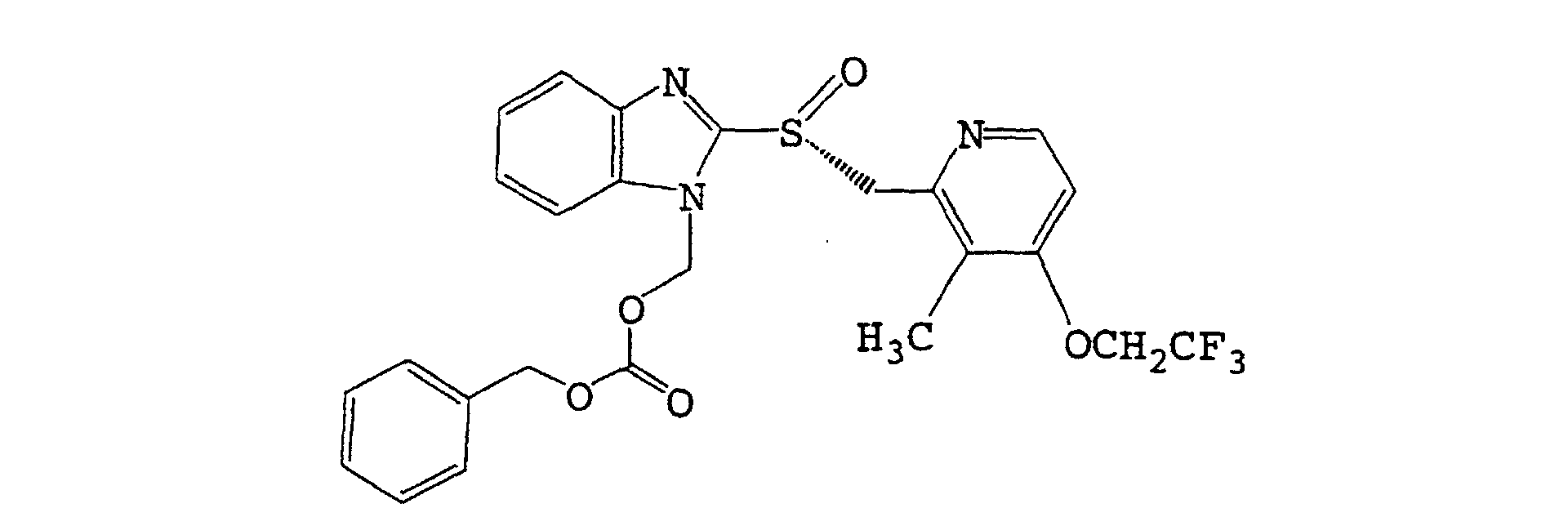
Using [(R)-2-[[[3-methyl-4-(2,2,2-trifluoroethoxy)-2-pyridinyl]methyl]sulfinyl]-1H-benzimidazol-1-yl]methanol
(2.16
g) obtained in Reference Example 3 and benzyl chloroformate
(0.999 mL), a similar process as in Example 10 was conducted to
give the title compound as a colorless solid (1.08 g).
1H-NMR(CDCl3): 2.25(3H,s), 4.35(2H,q,J=8.2Hz), 4.93(1H,d,J=13.8Hz 5.05(1H,d,J=13.8Hz) 5.18(2H,s), 6.48(1H,d,J=11.0Hz), 6.59(1H,d,J=5.8Hz) 6.63(1H,d,J=11.0Hz), 7.30-7.50(7H,m), 7.66(1H,dd,J=1.4,7.4Hz), 7.81(1H,dd,J=2.0,7.0Hz), 8.27(1H,d,J=5.8Hz)
1H-NMR(CDCl3): 2.25(3H,s), 4.35(2H,q,J=8.2Hz), 4.93(1H,d,J=13.8Hz 5.05(1H,d,J=13.8Hz) 5.18(2H,s), 6.48(1H,d,J=11.0Hz), 6.59(1H,d,J=5.8Hz) 6.63(1H,d,J=11.0Hz), 7.30-7.50(7H,m), 7.66(1H,dd,J=1.4,7.4Hz), 7.81(1H,dd,J=2.0,7.0Hz), 8.27(1H,d,J=5.8Hz)
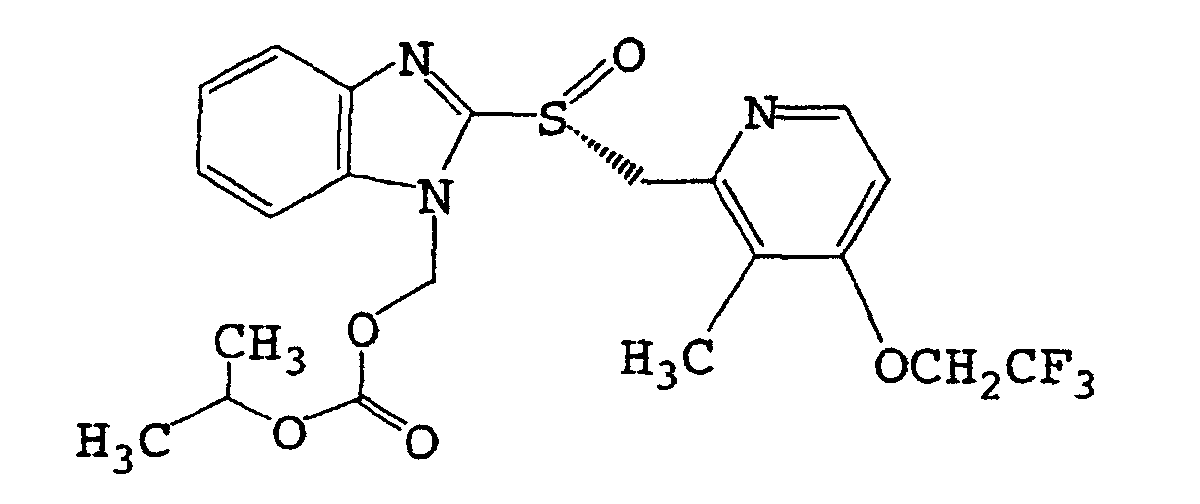
Using [(R)-2-[[[3-methyl-4-(2,2,2-trifluoroethoxy)-2-pyridinyl]methyl]sulfinyl]-1H-benzimidazol-1-yl]methanol
(2.16
g) obtained in Reference Example 3 and isopropyl chloroformate
(0.858 mg), a similar process as in Example 10 was conducted to
give the title compound as a colorless solid (0.75 g).
1H-NMR(CDCl3): 1.20-1.40(6H,m), 2.28(3H,s), 4.38(2H,q,J=8.0Hz), 4.80-5.00(1H,m), 4.97(1H,d,J=13.6Hz), 5.07(1H,d,J=13.6Hz), 6.48(1H,d,J=11.4Hz), 6.60(1H,d,J=11.4Hz), 6.63(1H,d,J=6.0Hz), 7.30-7.50(2H,m), 7.68(1H,d,J=7-4Hz), 7.82(1H,dd,J=1.4,6.6Hz), 8.30(1H,d,J=6.0Hz)
1H-NMR(CDCl3): 1.20-1.40(6H,m), 2.28(3H,s), 4.38(2H,q,J=8.0Hz), 4.80-5.00(1H,m), 4.97(1H,d,J=13.6Hz), 5.07(1H,d,J=13.6Hz), 6.48(1H,d,J=11.4Hz), 6.60(1H,d,J=11.4Hz), 6.63(1H,d,J=6.0Hz), 7.30-7.50(2H,m), 7.68(1H,d,J=7-4Hz), 7.82(1H,dd,J=1.4,6.6Hz), 8.30(1H,d,J=6.0Hz)

Using [(R)-2-[[[3-methyl-4-(2,2,2-trifluoroethoxy)-2-pyridinyl]methyl]sulfinyl]-1H-benzimidazol-1-yl]methanol
(2.16
g) obtained in Reference Example 3 and butyl chloroformate
(0.894 mL), a similar process as in Example 10 was conducted to
give the title compound as a colorless solid (1.37 g).
1H-NMR(CDCl3): 0.90(3H,t,J=7.4Hz), 1.20-1.50(2H,m), 1.55-1.75(2H,m), 2.29(3H,s), 4.17(2H,t,J=6.6Hz), 4.38(2H,q,J=7.8Hz), 4.93(1H,d,J=13.8Hz), 5.07(1H,d,J=13.8Hz), 6.49(1H,d,J=11.4Hz), 6.64(1H,d,J=11.4Hz), 6.65(1H,d,J=5.6Hz), 7.30-7.50(2H,m), 7.68(1H,dd,J=2.0,7.0Hz), 7.82(1H,dd,J=1.4,7.0Hz), 8.31(1H,d,J=5.6Hz)
1H-NMR(CDCl3): 0.90(3H,t,J=7.4Hz), 1.20-1.50(2H,m), 1.55-1.75(2H,m), 2.29(3H,s), 4.17(2H,t,J=6.6Hz), 4.38(2H,q,J=7.8Hz), 4.93(1H,d,J=13.8Hz), 5.07(1H,d,J=13.8Hz), 6.49(1H,d,J=11.4Hz), 6.64(1H,d,J=11.4Hz), 6.65(1H,d,J=5.6Hz), 7.30-7.50(2H,m), 7.68(1H,dd,J=2.0,7.0Hz), 7.82(1H,dd,J=1.4,7.0Hz), 8.31(1H,d,J=5.6Hz)
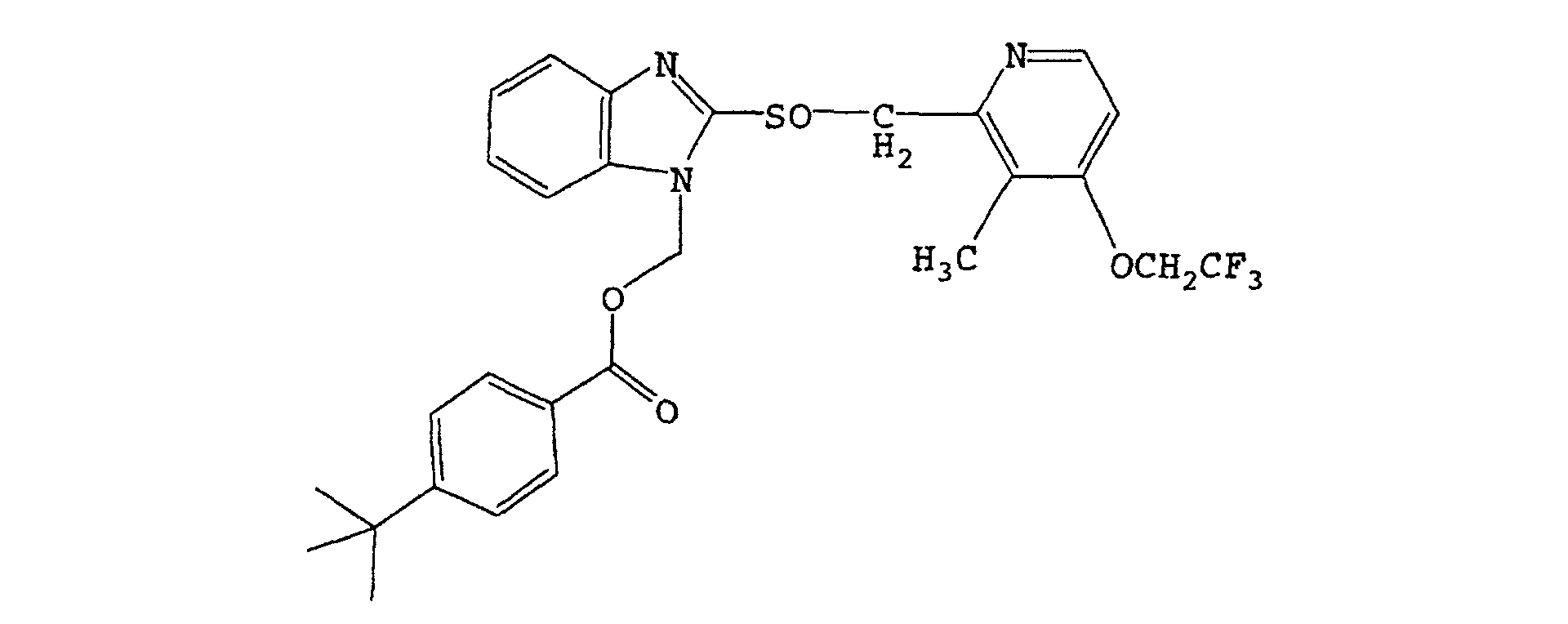
To a solution (10 mL) of [2-[[[3-methyl-4-(2,2,2-trifluoroethoxy)-2-pyridinyl]methyl]sulfinyl]-1H-benzimidazol-1-yl]methanol
(0.5 g) obtained in Reference Example 2 in
tetrahydrofuran were added triethylamine (0.348 mL) and 4-tert-butylbenzoyl
chloride (271 mg) under ice-cooling, and the
mixture was stirred at room temperature for 3 hrs. The
reaction mixture was extracted with ethyl acetate-water, and
the organic layer was washed with saturated brine, dried over
anhydrous sodium sulfate and concentrated under reduced
pressure. The residue was recrystallized from ethyl acetate to
give the title compound as a colorless solid (0.282 g).
1H-NMR(CDCl3): 1.30(9H,s), 2.29(3H,s), 4.37(2H,q,J=8.0Hz), 5.01(1H,d,J=14.2Hz 5.09(1H,d,J=14.2Hz), 6.63(1H,d,J=5.4Hz), 6.75(2H,s), 7.30-7.50(4H,m), 7.70-7.90(2H,m), 7.98(2H,d,J=8.4Hz), 8.29(1H,d,J=5.4Hz)
1H-NMR(CDCl3): 1.30(9H,s), 2.29(3H,s), 4.37(2H,q,J=8.0Hz), 5.01(1H,d,J=14.2Hz 5.09(1H,d,J=14.2Hz), 6.63(1H,d,J=5.4Hz), 6.75(2H,s), 7.30-7.50(4H,m), 7.70-7.90(2H,m), 7.98(2H,d,J=8.4Hz), 8.29(1H,d,J=5.4Hz)
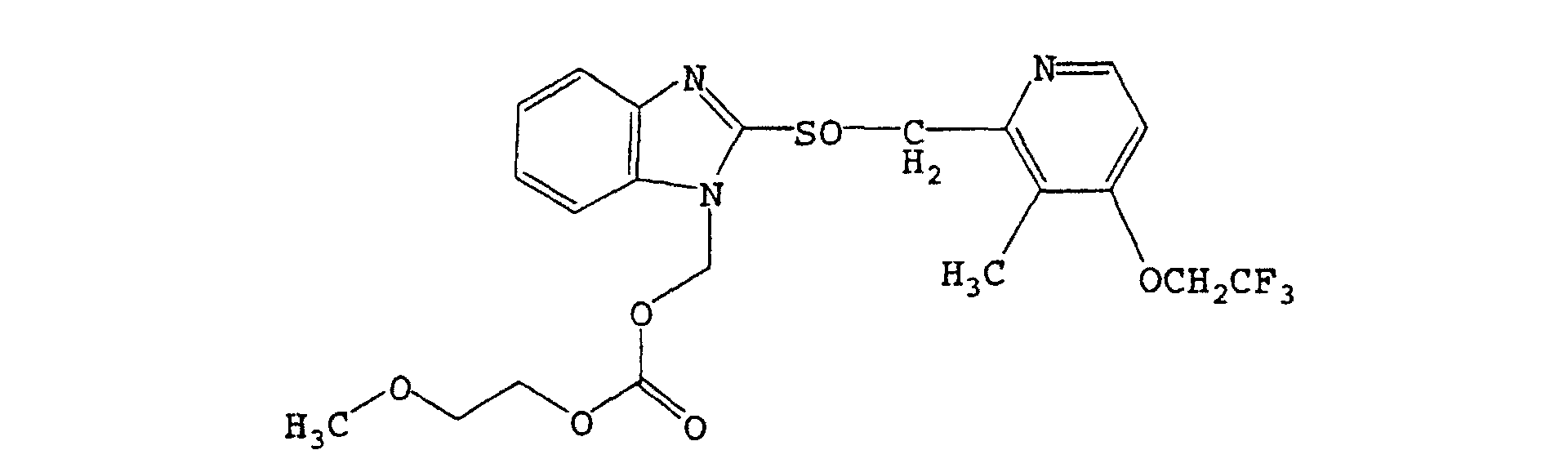
To a solution (10 mL) of [2-[[[3-methyl-4-(2,2,2-trifluoroethoxy)-2-pyridinyl]methyl]sulfinyl]-1H-benzimidazol-1-yl]methanol
(1.0 g) obtained in Reference Example 2 in
tetrahydrofuran were added triethylamine (0.533 mL) and 2-methoxyethyl
chloroformate (0.346 mL) under ice-cooling, and
the mixture was stirred at 0°C for 1 hr. The reaction mixture
was extracted with ethyl acetate-water, and the organic layer
was washed with saturated brine, dried over anhydrous sodium
sulfate and concentrated under reduced pressure. The residue
was recrystallized from ethyl acetate to give the title
compound as a colorless solid (0.20 g).
1H-NMR(CDCl3): 2.28(3H,s), 3.34(3H,s), 3.58(2H,t,J=4.8Hz), 4.31(2H,t,J=4.8Hz), 4.38(2H,q,J=7.0Hz), 4.94(1H,d,J=13.8Hz), 5.06(1H,d,J=13.8Hz), 6.49(1H,d,J=11.4Hz), 6.63(1H,d,J=11.4Hz), 6.64(1H,d,J=5.8Hz), 7.30-7.50(2H,m), 7.66(1H,dd,J=1.4,7.4Hz), 7.82(1H,dd,J=1.4,7.4Hz), 8.30(1H,d,J=5.8Hz)
1H-NMR(CDCl3): 2.28(3H,s), 3.34(3H,s), 3.58(2H,t,J=4.8Hz), 4.31(2H,t,J=4.8Hz), 4.38(2H,q,J=7.0Hz), 4.94(1H,d,J=13.8Hz), 5.06(1H,d,J=13.8Hz), 6.49(1H,d,J=11.4Hz), 6.63(1H,d,J=11.4Hz), 6.64(1H,d,J=5.8Hz), 7.30-7.50(2H,m), 7.66(1H,dd,J=1.4,7.4Hz), 7.82(1H,dd,J=1.4,7.4Hz), 8.30(1H,d,J=5.8Hz)

To a solution (15 mL) of [2-[[[3-methyl-4-(2,2,2-trifluoroethoxy)-2-pyridinyl]methyl]sulfinyl]-1H-benzimidazol-1-yl]methanol
(2.16 g) obtained in Reference Example 2 in
dichloromethane were added triethylamine (1.13 mL) and
isobutyryl chloride (0.731 mL) under ice-cooling, and the
mixture was stirred at 0°C for 1.5 hrs. The reaction mixture
was extracted with dichloromethane-water, and the organic layer
was washed with saturated brine, dried over anhydrous sodium
sulfate and concentrated under reduced pressure. The residue
was purified by silica gel column chromatography (ethyl
acetate), and the purified product was recrystallized from
ethyl acetate to give the title compound as a colorless solid
(0.90 g).
1H-NMR(CDCl3): 1.10-1.20(6H,m), 2.30(3H,s), 2.50-2.70(1H,m), 4.38(2H,q,J=7.8Hz), 4.98(1H,d,J=13.6Hz), 5.07(1H,d,J=13.6Hz), 6.52(2H,s), 6.65(1H,d,J=6.0Hz) 7.30-7.50(2H,m), 7.63(1H,dd,J=2.2,7.4Hz), 7.81(1H,dd,J=1.4,7.0Hz), 8.28(1H,d,J=6.0Hz)
1H-NMR(CDCl3): 1.10-1.20(6H,m), 2.30(3H,s), 2.50-2.70(1H,m), 4.38(2H,q,J=7.8Hz), 4.98(1H,d,J=13.6Hz), 5.07(1H,d,J=13.6Hz), 6.52(2H,s), 6.65(1H,d,J=6.0Hz) 7.30-7.50(2H,m), 7.63(1H,dd,J=2.2,7.4Hz), 7.81(1H,dd,J=1.4,7.0Hz), 8.28(1H,d,J=6.0Hz)
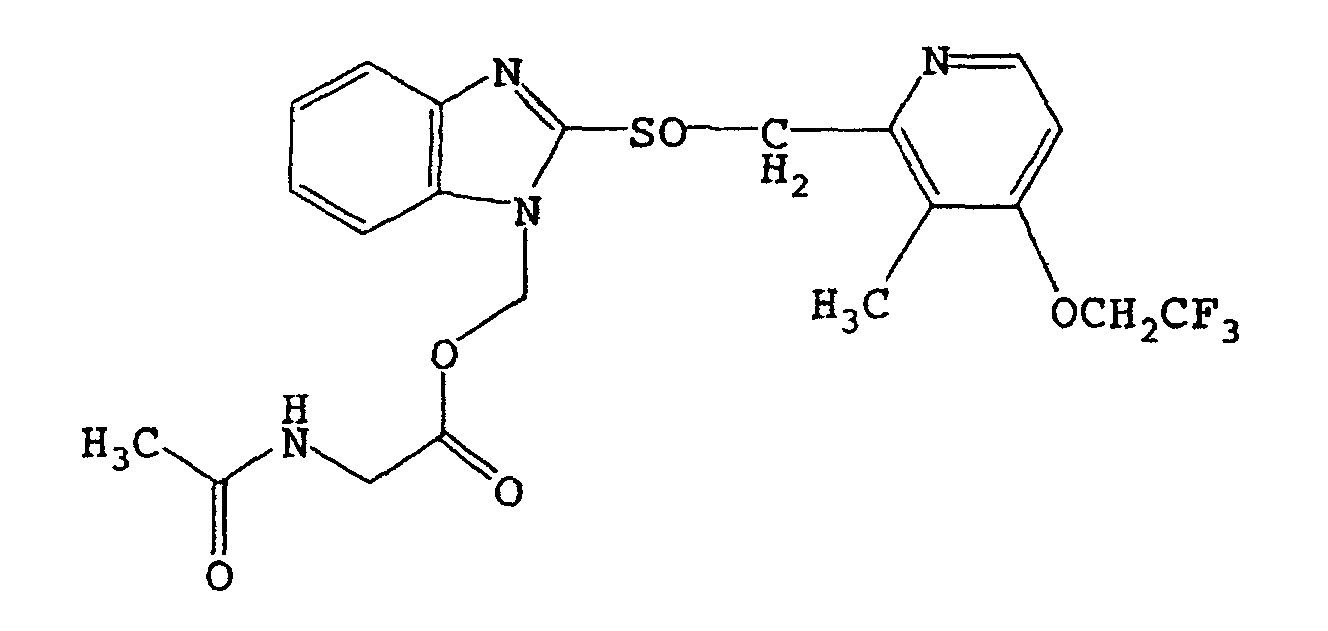
To a solution (15 mL) of N-acetylglycine (1.89 g) in
N,N-dimethylformamide was added N,N'-dicyclohexylcarbodiimide
(1.67 g), and the mixture was stirred at room temperature for 1
hr. The reaction mixture was filtered, and the filtrate was
added to a solution (15 mL) of [2-[[[3-methyl-4-(2,2,2-trifluoroethoxy)-2-pyridinyl]methyl]sulfinyl]-1H-benzimidazol-1-yl]methanol
(2.16 g) obtained in Reference Example 2 and
triethylamine (1.88 mL) in dichloromethane under ice-cooling,
and the mixture was stirred at 0°C for 1.5 hrs. The reaction
mixture was extracted with ethyl acetate-water, and the organic
layer was washed with saturated brine, dried over anhydrous
sodium sulfate and concentrated under reduced pressure. The
residue was recrystallized from ethyl acetate to give the title
compound as a colorless solid (1.50 g).
1H-NMR(CDCl3): 1.99(3H,s), 2.33(3H,s), 4.00-4.25(2H,m), 4.39(2H,q,J=7.8Hz), 5.02(2H,s), 6.30-6.40(1H,bs), 6.51(1H,d,J=11.0Hz), 6.59(1H,d,J=11.0Hz), 6.64(1H,d,J=5.4Hz), 7.30-7.50(2H,m), 7.62(1H,d,J=7.4Hz), 7.79(1H,dd,J=1.6,6.6Hz), 8.22(1H,d,J=5.4Hz)
1H-NMR(CDCl3): 1.99(3H,s), 2.33(3H,s), 4.00-4.25(2H,m), 4.39(2H,q,J=7.8Hz), 5.02(2H,s), 6.30-6.40(1H,bs), 6.51(1H,d,J=11.0Hz), 6.59(1H,d,J=11.0Hz), 6.64(1H,d,J=5.4Hz), 7.30-7.50(2H,m), 7.62(1H,d,J=7.4Hz), 7.79(1H,dd,J=1.6,6.6Hz), 8.22(1H,d,J=5.4Hz)
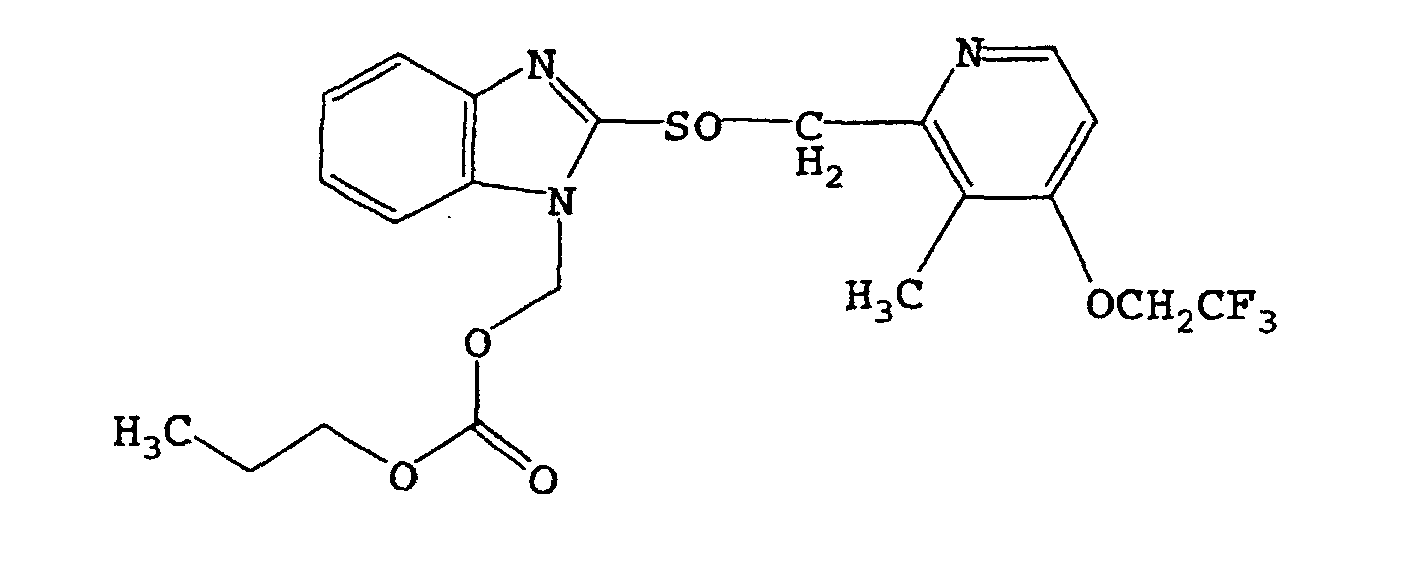
To a solution (15 mL) of [2-[[[3-methyl-4-(2,2,2-trifluoroethoxy)-2-pyridinyl]methyl]sulfinyl]-1H-benzimidazol-1-yl]methanol
(2.16 g) obtained in Reference Example 2 in
dichloromethane were added triethylamine (1.13 mL) and propyl
chloroformate (0.787 mL) under ice-cooling, and the mixture was
stirred at 0°C for 1.5 hrs. The reaction mixture was extracted
with dichloromethane-water, and the organic layer was washed
with saturated brine, dried over anhydrous sodium sulfate and
concentrated under reduced pressure. The residue was
recrystallized from ethyl acetate to give the title compound as
a colorless solid (1.10 g).
1H-NMR(CDCl3): 0.92(3H,t,J=7.6Hz), 1.55-1.80(2H,m), 2.29(3H,s), 4.13(2H,t,J=6.6Hz), 4.38(2H,q,J=7.8Hz), 4.93(1H,d,J=13.8Hz), 5.08(1H,d,J=13.8Hz) 6.48(1H,d,J=11.0Hz), 6.61(1H,d,J=11.0Hz), 6.63(1H,d,J=5.8Hz), 7.30-7.50(2H,m), 7.68(1H,dd,J=1.4,7.8Hz), 7.82(1H,dd,J=1.8,8.4Hz), 8.31(1H,d,J=5.8Hz)
1H-NMR(CDCl3): 0.92(3H,t,J=7.6Hz), 1.55-1.80(2H,m), 2.29(3H,s), 4.13(2H,t,J=6.6Hz), 4.38(2H,q,J=7.8Hz), 4.93(1H,d,J=13.8Hz), 5.08(1H,d,J=13.8Hz) 6.48(1H,d,J=11.0Hz), 6.61(1H,d,J=11.0Hz), 6.63(1H,d,J=5.8Hz), 7.30-7.50(2H,m), 7.68(1H,dd,J=1.4,7.8Hz), 7.82(1H,dd,J=1.8,8.4Hz), 8.31(1H,d,J=5.8Hz)
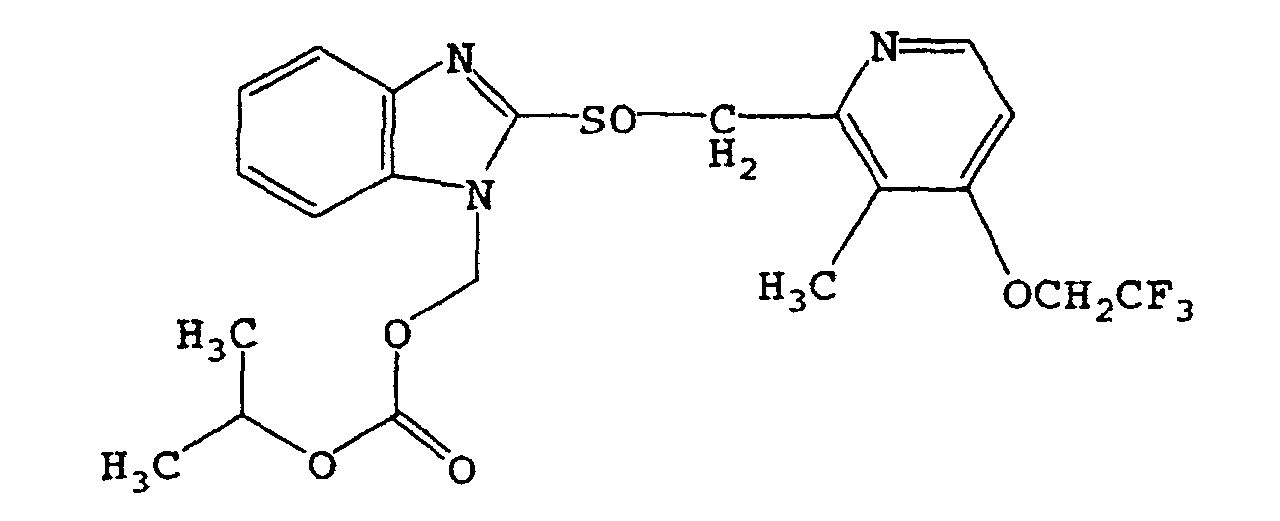
Using [2-[[[3-methyl-4-(2,2,2-trifluoroethoxy)-2-pyridinyl]methyl]sulfinyl]-1H-benzimidazol-1-yl]methanol
(1.0
g) obtained in Reference Example 2 and isopropyl chloroformate
(0.47 g), a similar process as in Example 10 was conducted to
give the title compound as a colorless solid (0.50 g).
1H-NMR(CDCl3): 1.20-1.35(6H,m), 2.28(3H,s), 4.38(2H,q,J=7.8Hz), 4.80-5.00(1H,m), 4.93(1H,d,J=13.8Hz), 5.08(1H,d,J=13.8Hz), 6.48(1H,d,J=11.0Hz), 6.60(1H,d,J=11.0Hz), 6.64(1H,d,J=5.4Hz), 7.30-7.50(2H,m), 7.68(1H,dd,J=1.8,7.0Hz),
7.82(1H,dd,J=1.4,6.6Hz), 8.32(1H,d,J=5.4Hz)
1H-NMR(CDCl3): 1.20-1.35(6H,m), 2.28(3H,s), 4.38(2H,q,J=7.8Hz), 4.80-5.00(1H,m), 4.93(1H,d,J=13.8Hz), 5.08(1H,d,J=13.8Hz), 6.48(1H,d,J=11.0Hz), 6.60(1H,d,J=11.0Hz), 6.64(1H,d,J=5.4Hz), 7.30-7.50(2H,m), 7.68(1H,dd,J=1.8,7.0Hz),
7.82(1H,dd,J=1.4,6.6Hz), 8.32(1H,d,J=5.4Hz)
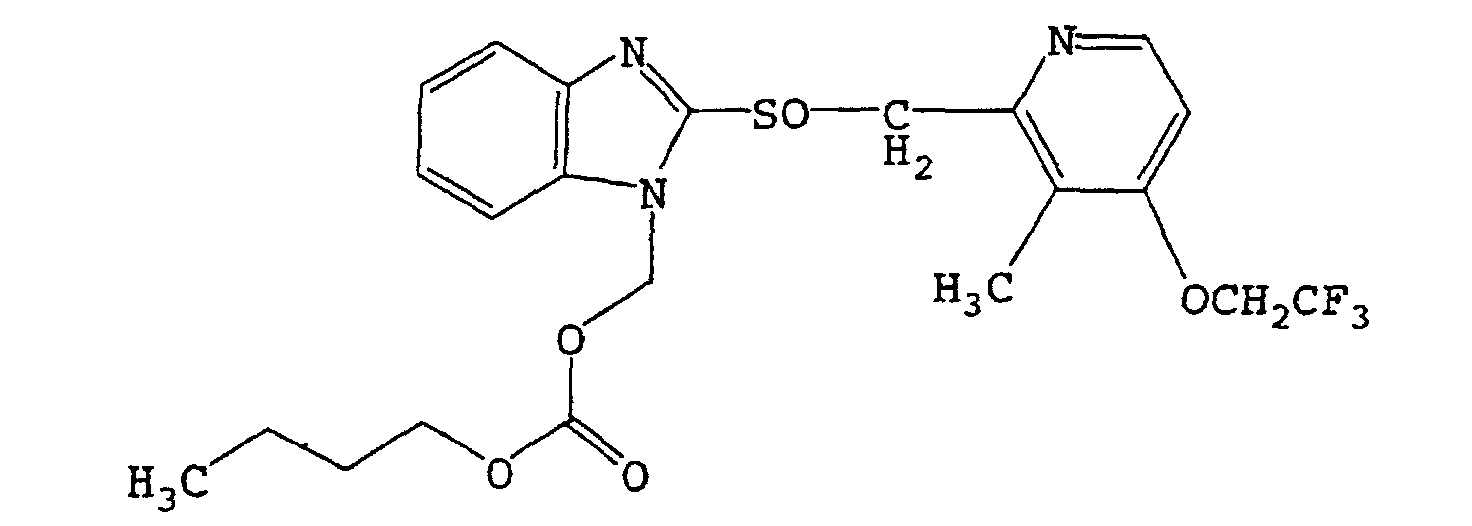
To a mixture of 2-[[[3-methyl-4-(2,2,2-trifluoroethoxy)-2-pyridinyl]methyl]sulfinyl]-1H-benzimidazole
(739 mg),
dichloromethane (10 mL) and 4-dimethylaminopyridine (24 mg) was
added a 37% formaldehyde solution (0.745 mL) at room
temperature. This mixture was stirred vigorously at room
temperature for 30 min., and water (5 mL) was added. The
dichloromethane layer was separated and dried over sodium
sulfate. After filtration, triethylamine (0.558 mL) and butyl
chloroformate (0.382 mL) were added under ice-cooling. The
mixture was stirred under ice-cooling for 5 hrs. The reaction
mixture was concentrated under reduced pressure, and ethyl
acetate (50 mL) was added. The mixture was washed with aqueous
sodium hydrogencarbonate (30 mL), dried over anhydrous
magnesium sulfate and concentrated under reduced pressure. The
residue was dissolved in methanol (50 mL), and aqueous sodium
hydrogencarbonate (1 mL) was added. The mixture was stirred
for 0.5 hr. The solvent was concentrated under reduced
pressure, and ethyl acetate (50 mL) was added. The mixture was
washed with water (30 mL), dried over anhydrous magnesium
sulfate and concentrated under reduced pressure. The residue
was purified by silica gel column chromatography (eluted with
ethyl acetate:hexane=1:1 and then with ethyl acetate). The
obtained solid was washed with a mixed solution of ethyl
acetate and diisopropyl ether and dried under reduced pressure
to give the title compound (421 mg) as a colorless solid.
1H-NMR(CDCl3): 0.90(3H,t,J=7.4Hz), 1.28-1.42(2H,m), 1.57-1.68(2H,m), 2.29(3H,s), 4.17(2H,t,J=6.8Hz), 4.38(2H,q,J=7.8Hz), 4.93(1H,d,J=13.8Hz), 5.08(1H,d,J=13.8Hz), 6.49(1H,d,J=11.3Hz), 6.61(1H,d,J=11.3Hz) 6.64(1H,d,J=5.9Hz), 7.34-7.48(2H,m), 7.65-7.70(1H,m), 7.80-7.85(1H,m), 8.31(1H,d,J=5.9Hz).
1H-NMR(CDCl3): 0.90(3H,t,J=7.4Hz), 1.28-1.42(2H,m), 1.57-1.68(2H,m), 2.29(3H,s), 4.17(2H,t,J=6.8Hz), 4.38(2H,q,J=7.8Hz), 4.93(1H,d,J=13.8Hz), 5.08(1H,d,J=13.8Hz), 6.49(1H,d,J=11.3Hz), 6.61(1H,d,J=11.3Hz) 6.64(1H,d,J=5.9Hz), 7.34-7.48(2H,m), 7.65-7.70(1H,m), 7.80-7.85(1H,m), 8.31(1H,d,J=5.9Hz).

Using [(R)-2-[[[3-methyl-4-(2,2,2-trifluoroethoxy)-2-pyridinyl]methyl]sulfinyl]-1H-benzimidazol-1-yl]methanol
(2.16
g) obtained in Reference Example 3 and acetyl chloride (0.498
mL), a similar process as in Example 10 was conducted to give
the title compound as a colorless solid (0.87 g).
1H-NMR(CDCl3): 2.13(3H,s), 2.31(3H,s), 4.39(2H,q,J=8.0Hz), 4.96(1H,d,J=13.8Hz) 5.07(1H,d,J=13.8Hz), 6.51(2H,s), 6.65(1H,d,J=5.6Hz), 7.30-7.50(2H,m), 7.65(1H,dd,J=1.4,6.6Hz), 7.82(1H,dd,J=2.2,7.0Hz), 8.29(1H,d,J=5.6Hz).
1H-NMR(CDCl3): 2.13(3H,s), 2.31(3H,s), 4.39(2H,q,J=8.0Hz), 4.96(1H,d,J=13.8Hz) 5.07(1H,d,J=13.8Hz), 6.51(2H,s), 6.65(1H,d,J=5.6Hz), 7.30-7.50(2H,m), 7.65(1H,dd,J=1.4,6.6Hz), 7.82(1H,dd,J=2.2,7.0Hz), 8.29(1H,d,J=5.6Hz).

Using [(R)-2-[[[3-methyl-4-(2,2,2-trifluoroethoxy)-2-pyridinyl]methyl]sulfinyl]-1H-benzimidazol-1-yl]methanol
(2.16
g) obtained in Reference Example 3 and propyl chloroformate
(0.787 mL), a similar process as in Example 10 was conducted to
give the title compound as a colorless solid (0.89 g).
1H-NMR(CDCl3): 0.92(3H,t,J=7.2Hz), 1.50-1.80(2H,m), 2.29(3H,s), 4.12(2H,t,J=6.2Hz), 4.38(2H,q,J=7.6Hz), 4.93(1H,d,J=14.0Hz), 5.09(1H,d,J=14.0Hz), 6.49(1H,d,J=11.4Hz), 6.61(1H,d,J=11.4Hz), 6.64(1H,d,J=5.4Hz), 7.30-7.50(2H,m), 7.68(1H,dd,J=1.4,8.8Hz), 7.82(1H,dd,J=1.6,6.6Hz), 8.30(1H,d,J=5.4Hz).
1H-NMR(CDCl3): 0.92(3H,t,J=7.2Hz), 1.50-1.80(2H,m), 2.29(3H,s), 4.12(2H,t,J=6.2Hz), 4.38(2H,q,J=7.6Hz), 4.93(1H,d,J=14.0Hz), 5.09(1H,d,J=14.0Hz), 6.49(1H,d,J=11.4Hz), 6.61(1H,d,J=11.4Hz), 6.64(1H,d,J=5.4Hz), 7.30-7.50(2H,m), 7.68(1H,dd,J=1.4,8.8Hz), 7.82(1H,dd,J=1.6,6.6Hz), 8.30(1H,d,J=5.4Hz).
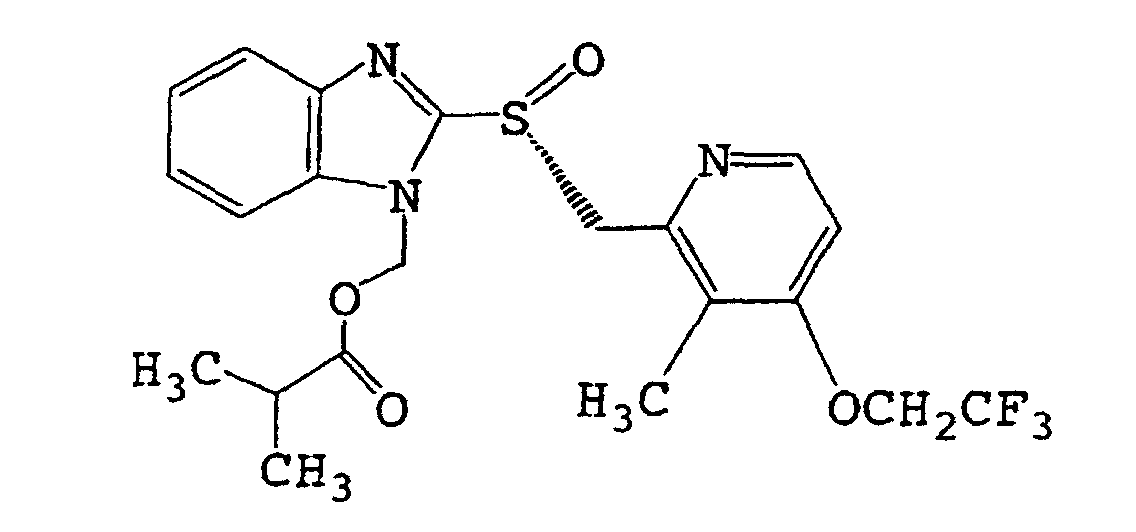
Using [(R)-2-[[[3-methyl-4-(2,2,2-trifluoroethoxy)-2-pyridinyl]methyl]sulfinyl]-1H-benzimidazol-1-yl]methanol
(2.16
g) obtained in Reference Example 3 and isobutyryl chloride
(0.731 mL), a similar process as in Example 10 was conducted to
give the title compound as a colorless solid (0.87 g).
1H-NMR(CDCl3): 1.10-1.20(6H,m), 2.31(3H,s), 2.50-2.70(1H,m), 4.38(2H,q,J=8.1Hz), 4.99(1H,d,J=14.1Hz), 5.06(1H,d,J=14.1Hz), 6.50(1H,d,J=11.1Hz), 6.54(1H,d,J=11.1Hz), 6.64(1H,d,J=5.4Hz), 7.30-7.50(2H,m), 7.63(1H,d,J=8.1Hz), 7.82(1H,d,J=6.9Hz), 8.29(1H,d,J=5.4Hz).
1H-NMR(CDCl3): 1.10-1.20(6H,m), 2.31(3H,s), 2.50-2.70(1H,m), 4.38(2H,q,J=8.1Hz), 4.99(1H,d,J=14.1Hz), 5.06(1H,d,J=14.1Hz), 6.50(1H,d,J=11.1Hz), 6.54(1H,d,J=11.1Hz), 6.64(1H,d,J=5.4Hz), 7.30-7.50(2H,m), 7.63(1H,d,J=8.1Hz), 7.82(1H,d,J=6.9Hz), 8.29(1H,d,J=5.4Hz).

Using [(R)-2-[[[3-methyl-4-(2,2,2-trifluoroethoxy)-2-pyridinyl]methyl]sulfinyl]-1H-benzimidazol-1-yl]methanol
(2.16
g) obtained in Reference Example 3 and propanoyl chloride
(0.608 mL), a similar process as in Example 10 was conducted to
give the title compound as a colorless solid (0.89 g).
1H-NHR(CDCl3): 1.13(3H,t,J=7.5Hz), 2.31(3H,s), 2.39(2H,q,J=7.5Hz), 4.38(2H,q,J=7.8Hz), 4.97(1H,d,J=13.8Hz), 5.06(1H,d,J=13.8Hz), 6.50(1H,d,J=11.4Hz), 6.54(1H,d,J=11.4Hz), 6.64(1H,d,J=5.7Hz), 7.30-7.50(2H,m), 7.65(1H,dt,J=1.2,8.7Hz), 7.81(1H,dt,J=1.0,7.8Hz), 8.28(1H,d,J=5.7Hz).
1H-NHR(CDCl3): 1.13(3H,t,J=7.5Hz), 2.31(3H,s), 2.39(2H,q,J=7.5Hz), 4.38(2H,q,J=7.8Hz), 4.97(1H,d,J=13.8Hz), 5.06(1H,d,J=13.8Hz), 6.50(1H,d,J=11.4Hz), 6.54(1H,d,J=11.4Hz), 6.64(1H,d,J=5.7Hz), 7.30-7.50(2H,m), 7.65(1H,dt,J=1.2,8.7Hz), 7.81(1H,dt,J=1.0,7.8Hz), 8.28(1H,d,J=5.7Hz).
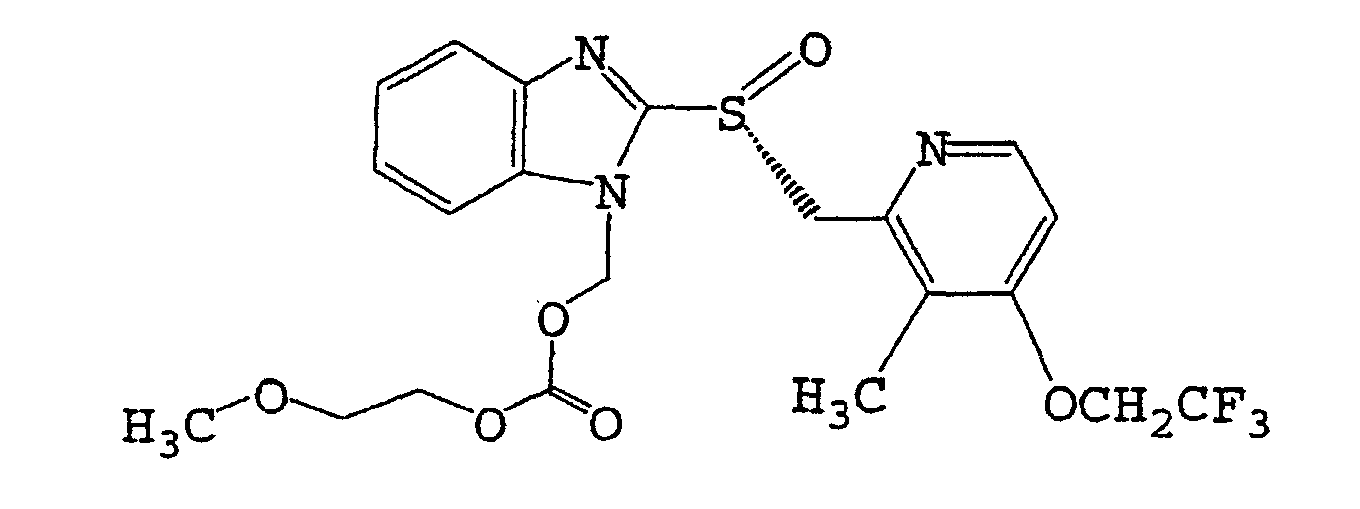
Using [(R)-2-[[[3-methyl-4-(2,2,2-trifluoroethoxy)-2-pyridinyl]methyl]sulfinyl]-1H-benzimidazol-1-yl]methanol
(2.16
g) obtained in Reference Example 3 and 2-methoxyethyl
chloroformate (0.970 mL), a similar process as in Example 10
was conducted to give the title compound as a colorless solid
(1.00 g).
1H-NMR(CDCl3): 2.28(3H,s), 3.34(3H,s), 3.55-3.60(2H,m), 4.29-4.35(2H,m), 4.38(2H,q,J=7.8Hz), 4.95(1H,d,J=13.8Hz), 5.06(1H,d,J=13.8Hz), 6.49(1H,d,J=11.1Hz), 6.62(1H,d,J=11.1Hz), 6.64(1H,d,J=5.4Hz), 7.30-7.50(2H,m), 7.66(1H,dd,J=1.5,7.8Hz), 7.82(1H,dd,J=1.5,7.5Hz), 8.30(1H,d,J=5.4Hz).
1H-NMR(CDCl3): 2.28(3H,s), 3.34(3H,s), 3.55-3.60(2H,m), 4.29-4.35(2H,m), 4.38(2H,q,J=7.8Hz), 4.95(1H,d,J=13.8Hz), 5.06(1H,d,J=13.8Hz), 6.49(1H,d,J=11.1Hz), 6.62(1H,d,J=11.1Hz), 6.64(1H,d,J=5.4Hz), 7.30-7.50(2H,m), 7.66(1H,dd,J=1.5,7.8Hz), 7.82(1H,dd,J=1.5,7.5Hz), 8.30(1H,d,J=5.4Hz).
2-[[[3-Methyl-4-(2,2,2-trifluoroethoxy)-2-pyridyl]methyl]sulfinyl]-1H-benzimidazole(lansoprazole)
and the
compounds (ca. 1 - 2 mg) of Examples 1, 2 and 18 were
respectively dissolved in acetonitrile (1 mL). To each
solution (0.2 mL) were added acetonitrile (1 mL) and artificial
gastric juice (3 mL, a solution prepared by dissolving sodium
chloride (2.0 g) in hydrochloric acid (7.0 mL) and adding water
to the amount of 1000 mL, pH ca. 1.2), and the stability of
each compound after preservation at 37°C was examined. Samples
were taken immediately after addition of acetonitrile and
artificial gastric juice, and 4, 8, 12, 16 and 20 hours
thereafter, analyzed under the following HPLC analysis
conditions, and the half-life was calculated on the assumption
that the decomposition of the compound was a pseudo-first-order
reaction. The results are shown in Table 1.
HPLC analysis conditions
detection wavelength: UV 285 nm
column: YMC Pro C18 75 mm × 4.6 mm I.D.
mobile phase: the proportion of mobile phase A (0.01 mol/L aqueous ammonium acetate solution) and mobile phase B (acetonitrile) was changed with the lapse of time as in the following.
10 min. from immediately after addition: mobile phase
A/mobile phase B = 60/40→10/90
10 min. to 15 min.: mobile phase A/mobile phase B = 10/90
15.1 min. to 20 min.: mobile phase A/mobile phase B = 60/40
flow rate: 1.0 mL/min.
column temperature: 25°C
feed amount: 10 µL
HPLC analysis conditions
detection wavelength: UV 285 nm
column: YMC Pro C18 75 mm × 4.6 mm I.D.
mobile phase: the proportion of mobile phase A (0.01 mol/L aqueous ammonium acetate solution) and mobile phase B (acetonitrile) was changed with the lapse of time as in the following.
10 min. from immediately after addition: mobile phase
A/mobile phase B = 60/40→10/90
10 min. to 15 min.: mobile phase A/mobile phase B = 10/90
15.1 min. to 20 min.: mobile phase A/mobile phase B = 60/40
flow rate: 1.0 mL/min.
column temperature: 25°C
feed amount: 10 µL
| Stability of compound in artificial gastric juice | |
| Compound | half-life (hr) |
| lansoprazole | <0.03 |
| compound of Example 1 | 4.8 |
| compound of Example 2 | 13.8 |
| compound of Example 18 | 6.4 |
The half-life of lansoprazole was less than 0.03 hr., and
lansoprazole was quickly decomposed by the artificial gastric
juice. In contrast, the compounds of Examples 1, 2 and 18
showed a half-life of not less than 4 hrs., and were stable to
acid. Therefore, it is clear that an enteric-coated
preparation does not need to be formulated when the compound of
the present invention is orally administered.
Various S9s shown in Table 2 were prepared in 50 mM
phosphate buffer (pH 7.4) to a final concentration of 1 mg
protein/mL. To this solution (99 µL) were added 1 µL of 1 mM
solution of each compound (compounds of Examples 1 and 2),
wherein the 1 mM solution was prepared by dissolving each
compound in methanol containing dimethyl sulfoxide in ca. 20%
to give a 10 mM solution and diluting 10-fold with methanol.
The mixture was incubated (reacted) at 37°C. The reaction was
quenched by adding acetonitrile (100 µL) immediately after the
start of the incubation and 5 min thereafter. After quenching,
the reaction mixture was subjected to centrifugal separation
(2500 rpm × 10 min), and the obtained supernatant was applied
to HPLC. The HPLC analysis conditions then are shown in the
following.
HPLC analysis conditions
detection wavelength: UV 280 nm
column: CAPCELL PAK C18 MG (4.6 mm I.D. × 75 mm)
mobile phase: the proportion of mobile phase A (0.01 mol/L aqueous ammonium acetate solution) and mobile phase B (acetonitrile) was changed with the lapse of time as in the following.
7 min. from immediately after addition: mobile phase A/mobile phase B = 60/40→10/90
7 min. to 10 min.: mobile phase A/mobile phase B = 10/90
10 min. to 15 min.: mobile phase A/mobile phase B = 60/40
flow rate: 1 mL/min.
column temperature: 40°C
feed amount: 50 µL
| Animal species | Maker | Product | Lot | |
| Liver S9 | IGS/SD rat (male) | XenoTech | R4000.S9 | 0010147 |
| Liver S9 | human | XenoTech | H0610.S9 | 063099A |
| Small intestine S9 | IGS/SD rat (male) | XenoTech | R1000.IS9 | 0110077 |
| Small intestine S9 | human | XenoTech | H0610.IS9 | 0110085 |
detection wavelength: UV 280 nm
column: CAPCELL PAK C18 MG (4.6 mm I.D. × 75 mm)
mobile phase: the proportion of mobile phase A (0.01 mol/L aqueous ammonium acetate solution) and mobile phase B (acetonitrile) was changed with the lapse of time as in the following.
7 min. from immediately after addition: mobile phase A/mobile phase B = 60/40→10/90
7 min. to 10 min.: mobile phase A/mobile phase B = 10/90
10 min. to 15 min.: mobile phase A/mobile phase B = 60/40
flow rate: 1 mL/min.
column temperature: 40°C
feed amount: 50 µL
With regard to the lansoprazole (LPZ) peak area, LPZ
production rate was calculated based on the area of non-converted
compound immediately after the start of incubation as
100% (absorption rate unamended).
| Conversion to lansoprazole by liver S9 and small intestine S9 | |||
| Compound | Animal species | Liver S9 | Small intestine S9 |
| LPZ production (%) | LPZ production (%) | ||
| compound of Example 1 | rat | 60.9 | 63.6 |
| human | 80.3 | 97.4 | |
| compound of Example 2 | rat | 64.4 | 51.9 |
| human | 88.6 | 100.0 |
From Table 3, the treatment of the compound of the
present invention with rat and human liver S9 and small
intestine S9 led to the rapid conversion to lansoprazole. Thus,
the compound of the present invention is suggested to function
as a prodrug of lansoprazole.
The compound of the present invention is converted to
lansoprazole, which is a proton pump inhibitor, in living
organisms and shows a superior anti-ulcer activity, a gastric
acid secretion-suppressive action, a mucosa-protecting action,
an anti-Helicobacter pylori action and the like. In addition,
the compound shows low toxicity and is useful as a
pharmaceutical product. Moreover, since the compound is stable
to acid, it does not need to be formulated into an enteric-coated
preparation, thereby eliminating the cost for
formulating enteric-coated preparation. In addition, since the
tablet becomes small, it is easy to take for patients with weak
swallowing capability, particularly the elderly and children.
Furthermore, since absorption is faster than in enteric-coated
preparations, expression of a gastric acid secretion-suppressive
action is rapid. The preparation is sustainable
because it is gradually converted to a conventionally-known
proton pump inhibitor in living organisms. Consequently, the
compound is useful as anti-ulcer agent and the like.
This application is based on a patent application No.
316864/2000 filed in Japan, the contents of which are all
hereby incorporated by reference.
Claims (21)
- A benzimidazole compound represented by the formula (I)wherein D is an oxygen atom or a bond, and R is a hydrocarbon group optionally having substituents, or a salt thereof.

- The compound of claim 1, wherein R is a C1-6 alkyl group, a C2-6 alkenyl group or a C2-6 alkynyl group, which optionally has substituents selected from the group consisting of (i) a C6-14 aryl group, (ii) a hydroxyl group, (iii) a halogen, (iv) a C1-6 alkoxy group optionally substituted by a halogen, (v) a C7-12 aralkyloxy group, (vi) a C1-5 alkoxy-carbonyl group and (vii) an acylamino group, or a C3-8 cycloalkyl group or a C6-14 aryl group, which optionally has substituents selected from the group consisting of (i) a C6-14 aryl group, (ii) a hydroxyl group, (iii) a halogen, (iv) a C1-6 alkoxy group optionally substituted by a halogen, (v) a C7-12 aralkyloxy group, (vi) a C1-5 alkoxy-carbonyl group and (vii) a C1-6 alkyl group optionally substituted by a halogen, or a salt thereof.
- The compound of claim 1, wherein R is a C1-6 alkyl group optionally having substituents selected from the group consisting of (i) a C6-14 aryl group, (ii) a hydroxyl group, (iii) a halogen and (iv) a C1-6 alkoxy group optionally substituted by a halogen, (v) a C7-12 aralkyloxy group, (vi) a C1-5 alkoxy-carbonyl group and (vii) an acylamino group, or a C3-8 cycloalkyl group or a C6-14 aryl group, which optionally has substituents selected from the group consisting of (i) a C6-14 aryl group, (ii) a hydroxyl group, (iii) a halogen, (iv) a C1-6 alkoxy group optionally substituted by a halogen, (v) a C7-12 aralkyloxy group, (vi) a C1-5 alkoxy-carbonyl group and (vii) a C1-6 alkyl group optionally substituted by a halogen, or a salt thereof.
- The compound of claim 1, wherein D is a bond and R is an alkyl group optionally having substituents or an aryl group optionally having substituents, or a salt thereof.
- The compound of claim 4, wherein R is (1) a C1-6 alkyl group optionally having 1 to 5 substituents selected from the group consisting of (i) a C6-14 aryl group, (ii) a hydroxyl group, (iii) a halogen, (iv) a C1-6 alkoxy group optionally substituted by 1 to 5 halogens, (v) a C7-12 aralkyloxy group and (vi) a C1-5 alkoxy-carbonyl group, or (2) a C6-14 aryl group optionally having 1 to 5 substituents selected from the group consisting of (i) a halogen, (ii) a C1-6 alkyl group optionally substituted by 1 to 5 halogens, (iii) a C6-14 aryl group, (iv) a hydroxyl group, (v) a C1-6 alkoxy group optionally substituted by 1 to 5 halogens, (vi) a C7-12 aralkyloxy group and (vii) a C1-5 alkoxy-carbonyl group, or a salt thereof.
- The compound of claim 4, wherein R is (1) a C1-6 alkyl group optionally substituted by a C6-14 aryl group or (2) a C6-14 aryl group, or a salt thereof.
- The compound of claim 4, wherein R is a phenyl group, or a salt thereof.
- The compound of claim 4, wherein R is a methyl group or a tert-butyl group, or a salt thereof.
- The compound of claim 1, which is an (R)-form represented by the formulawherein each symbol is as defined in claim 1, or a salt thereof.

- A production method for the compound of claim 1 or a salt thereof, which comprises (1) condensing a compound represented by the formula (II)wherein M is a hydrogen atom, a metal cation or a quaternary ammonium ion, or a salt thereof, with a compound represented by the formula (III): R-D-C(=O)-O-CH2-X wherein X is a halogen, D is an oxygen atom or a bond, and R is a hydrocarbon group optionally having substituents, or (2) condensing a compound represented by the formula (IV)
 with carboxylic acid represented by the formula: R-D-COOH wherein each symbol is as defined above or a reactive derivative thereof, or
(3) subjecting a compound represented by the formula (V)wherein each symbol is as defined above, or a salt thereof, to oxidation reaction.
- A pharmaceutical composition comprising the compound of claim 1 or 4.
- The pharmaceutical composition of claim 11, which is an agent for the prophylaxis or treatment of digestive ulcer, gastritis, reflux esophagitis, NUD, gastric cancer, gastric MALT lymphoma, gastric hyperacidity or upper gastrointestinal hemorrhage.
- A commercial package comprising a pharmaceutical composition of claim 12 and written matter associated therewith, the written matter stating that the pharmaceutical composition can or should be used for the prophylaxis or treatment of digestive ulcer, gastritis, reflux esophagitis, NUD, gastric cancer, gastric MALT lymphoma, gastric hyperacidity or upper gastrointestinal hemorrhage.
- The pharmaceutical composition of claim 11, which is an agent for the eradication of Helicobacter pylori.
- A commercial package comprising a pharmaceutical composition of claim 14 and written matter associated therewith, the written matter stating that the pharmaceutical composition can or should be used for eradicating Helicobacter pylori.
- An agent for the prophylaxis or treatment of digestive ulcer, gastritis, reflux esophagitis, NUD, gastric cancer, gastric MALT lymphoma, gastric hyperacidity or upper gastrointestinal hemorrhage, which comprises the compound of claim 1 as an active ingredient.
- An agent for the eradication of Helicobacter pylori, which comprises the compound of claim 1 as an active ingredient.
- A method for the prophylaxis or treatment of digestive ulcer, gastritis, reflux esophagitis, NUD, gastric cancer, gastric MALT lymphoma, gastric hyperacidity or upper gastrointestinal hemorrhage, which comprises administering the compound of claim 1.
- A method for eradicating Helicobacter pylori, which comprises administering the compound of claim 1.
- Use of the compound of claim 1 for the production of an agent for the prophylaxis or therapy of digestive ulcer, gastritis, reflux esophagitis, NUD, gastric cancer, gastric MALT lymphoma, gastric hyperacidity or upper gastrointestinal hemorrhage.
- Use of the compound of claim 1 for the production of an agent for the eradication of Helicobacter pylori.
Applications Claiming Priority (3)
| Application Number | Priority Date | Filing Date | Title |
|---|---|---|---|
| JP2000316864 | 2000-10-12 | ||
| JP2000316864 | 2000-10-12 | ||
| PCT/JP2001/008943 WO2002030920A1 (en) | 2000-10-12 | 2001-10-11 | Benzimidazole compounds, process for producing the same and use thereof |
Publications (2)
| Publication Number | Publication Date |
|---|---|
| EP1334971A1 true EP1334971A1 (en) | 2003-08-13 |
| EP1334971A4 EP1334971A4 (en) | 2004-05-12 |
Family
ID=18795752
Family Applications (1)
| Application Number | Title | Priority Date | Filing Date |
|---|---|---|---|
| EP01974795A Withdrawn EP1334971A4 (en) | 2000-10-12 | 2001-10-11 | Benzimidazole compounds, process for producing the same and use thereof |
Country Status (5)
| Country | Link |
|---|---|
| US (1) | US20040039027A1 (en) |
| EP (1) | EP1334971A4 (en) |
| AU (1) | AU2001294228A1 (en) |
| CA (1) | CA2425363A1 (en) |
| WO (1) | WO2002030920A1 (en) |
Cited By (5)
| Publication number | Priority date | Publication date | Assignee | Title |
|---|---|---|---|---|
| WO2004009583A3 (en) * | 2002-07-19 | 2004-03-18 | Michael E Garst | Benzimidazole derivatives and their use as prodrugs of proton pump inhibitor |
| WO2005040415A1 (en) * | 2003-10-06 | 2005-05-06 | Novartis Ag | Use of genetic polymorphisms to predict drug-induced hepatotoxicity |
| US7410981B2 (en) | 2002-06-14 | 2008-08-12 | Takeda Pharmaceutical Company Limited | Prodrugs of imidazole derivatives, for use as proton pump inhibitors in the treatment of e.g. peptic ulcers |
| CN102399212A (en) * | 2010-08-23 | 2012-04-04 | 江苏豪森医药集团有限公司 | Dexlansoprazole crystal form and preparation method thereof |
| CN105017216A (en) * | 2014-04-16 | 2015-11-04 | 天津药物研究院 | Dexlansoprazole crystal form III and preparation method and application thereof |
Families Citing this family (15)
| Publication number | Priority date | Publication date | Assignee | Title |
|---|---|---|---|---|
| EP1437352A4 (en) * | 2001-09-25 | 2004-12-08 | Takeda Chemical Industries Ltd | BENZYMIDAZOLE COMPOUND, PROCESS FOR PRODUCING AND USING THE SAME |
| MY148805A (en) | 2002-10-16 | 2013-05-31 | Takeda Pharmaceutical | Controlled release preparation |
| US20050220870A1 (en) * | 2003-02-20 | 2005-10-06 | Bonnie Hepburn | Novel formulation, omeprazole antacid complex-immediate release for rapid and sustained suppression of gastric acid |
| MXPA06000524A (en) * | 2003-07-18 | 2006-08-11 | Santarus Inc | Pharmaceutical formulation and method for treating acid-caused gastrointestinal disorders. |
| CA2531564C (en) * | 2003-07-18 | 2016-01-19 | Santarus, Inc. | Pharmaceutical composition for inhibiting acid secretion |
| US8993599B2 (en) * | 2003-07-18 | 2015-03-31 | Santarus, Inc. | Pharmaceutical formulations useful for inhibiting acid secretion and methods for making and using them |
| US20070292498A1 (en) * | 2003-11-05 | 2007-12-20 | Warren Hall | Combinations of proton pump inhibitors, sleep aids, buffers and pain relievers |
| WO2005076987A2 (en) * | 2004-02-10 | 2005-08-25 | Santarus, Inc. | Combination of proton pump inhibitor, buffering agent, and nonsteroidal anti-inflammatory agent |
| EP1742630A4 (en) * | 2004-04-16 | 2010-01-20 | Santarus Inc | Combination of proton pump inhibitor, buffering agent, and prokinetic agent |
| US8815916B2 (en) * | 2004-05-25 | 2014-08-26 | Santarus, Inc. | Pharmaceutical formulations useful for inhibiting acid secretion and methods for making and using them |
| US8906940B2 (en) * | 2004-05-25 | 2014-12-09 | Santarus, Inc. | Pharmaceutical formulations useful for inhibiting acid secretion and methods for making and using them |
| US8871273B2 (en) | 2005-02-25 | 2014-10-28 | Takeda Pharmaceutical Company Limited | Method for producing granules |
| US20090092658A1 (en) * | 2007-10-05 | 2009-04-09 | Santarus, Inc. | Novel formulations of proton pump inhibitors and methods of using these formulations |
| KR101605063B1 (en) | 2009-07-09 | 2016-03-21 | 라퀄리아 파마 인코포레이티드 | Acid pump antagonist for the treatment of diseases involved in abnormal gastrointestinal motility |
| EP2521545B1 (en) * | 2010-01-07 | 2019-11-27 | Alkermes Pharma Ireland Limited | Prodrugs of heteroaromatic compounds |
Family Cites Families (4)
| Publication number | Priority date | Publication date | Assignee | Title |
|---|---|---|---|---|
| AU568441B2 (en) * | 1984-09-24 | 1987-12-24 | Upjohn Company, The | 2-(pyridylalkenesulfinyl) benzimidazole derivatives |
| SE8505112D0 (en) * | 1985-10-29 | 1985-10-29 | Haessle Ab | NOVEL PHARMACOLOGICAL COMPOUNDS |
| NZ234564A (en) * | 1986-11-21 | 1991-04-26 | Haessle Ab | 1-substituted benzimidazoles and pharmaceutical compositions |
| US5504082A (en) * | 1992-06-01 | 1996-04-02 | Yoshitomi Pharmaceutical Industries, Ltd. | Pyridine compound and pharmaceutical compostions |
-
2001
- 2001-10-11 CA CA002425363A patent/CA2425363A1/en not_active Abandoned
- 2001-10-11 US US10/398,820 patent/US20040039027A1/en not_active Abandoned
- 2001-10-11 EP EP01974795A patent/EP1334971A4/en not_active Withdrawn
- 2001-10-11 WO PCT/JP2001/008943 patent/WO2002030920A1/en not_active Ceased
- 2001-10-11 AU AU2001294228A patent/AU2001294228A1/en not_active Abandoned
Cited By (7)
| Publication number | Priority date | Publication date | Assignee | Title |
|---|---|---|---|---|
| US7410981B2 (en) | 2002-06-14 | 2008-08-12 | Takeda Pharmaceutical Company Limited | Prodrugs of imidazole derivatives, for use as proton pump inhibitors in the treatment of e.g. peptic ulcers |
| WO2004009583A3 (en) * | 2002-07-19 | 2004-03-18 | Michael E Garst | Benzimidazole derivatives and their use as prodrugs of proton pump inhibitor |
| WO2005040415A1 (en) * | 2003-10-06 | 2005-05-06 | Novartis Ag | Use of genetic polymorphisms to predict drug-induced hepatotoxicity |
| AU2004283234B2 (en) * | 2003-10-06 | 2007-08-30 | Novartis Ag | Use of genetic polymorphisms to predict drug-induced hepatotoxicity |
| CN102399212A (en) * | 2010-08-23 | 2012-04-04 | 江苏豪森医药集团有限公司 | Dexlansoprazole crystal form and preparation method thereof |
| CN102399212B (en) * | 2010-08-23 | 2014-07-16 | 江苏豪森医药集团有限公司 | Dexlansoprazole crystal form and preparation method thereof |
| CN105017216A (en) * | 2014-04-16 | 2015-11-04 | 天津药物研究院 | Dexlansoprazole crystal form III and preparation method and application thereof |
Also Published As
| Publication number | Publication date |
|---|---|
| EP1334971A4 (en) | 2004-05-12 |
| US20040039027A1 (en) | 2004-02-26 |
| CA2425363A1 (en) | 2003-04-10 |
| WO2002030920A1 (en) | 2002-04-18 |
| AU2001294228A1 (en) | 2002-04-22 |
Similar Documents
| Publication | Publication Date | Title |
|---|---|---|
| US20040039027A1 (en) | Benzimidazole compounds, process for producing the same and use thereof | |
| EP1129088B1 (en) | Crystalline form of (r)-2-[[[3-methyl-4-(2,2,2-trifluoroethoxy)-2-pyridinyl]methyl]sulfinyl]-1h-benzimidazole | |
| JP5412023B2 (en) | Salts of benzimidazole compounds and uses thereof | |
| US7410981B2 (en) | Prodrugs of imidazole derivatives, for use as proton pump inhibitors in the treatment of e.g. peptic ulcers | |
| US20040248941A1 (en) | Benzimidazone compound, process for producing the same, and use thereof | |
| JP2002187890A (en) | Benzimidazole compound, method for producing the same and use thereof | |
| JP2003313186A (en) | Benzimidazole compound, method for producing the same, and application of the same | |
| HK1038227B (en) | Crystalline form of (r)-2-[[[3-methyl-4-(2,2,2-trifluoroethoxy)-2-pyridinyl]methyl]sulfinyl]-1h-benzimidazole | |
| HK1123985B (en) | Amorphous (r)-2-[[[3-methyl-4-(2,2,2-trifluoroethoxy)-2-pyridinyl]methyl]sulfinyl]-1h-benzimidazole as anti-ulcer agent | |
| HK1159634A (en) | Amorphous(r)-2-[[[3-methyl-4-(2,2,2-trifluoroethoxy)-2-pyridinyl]methyl]sulfinyl]-1h-benzimidazole as anti-ulcer agent | |
| JP2004307457A (en) | Imidazole compound, method for producing the same and use thereof |
Legal Events
| Date | Code | Title | Description |
|---|---|---|---|
| PUAI | Public reference made under article 153(3) epc to a published international application that has entered the european phase |
Free format text: ORIGINAL CODE: 0009012 |
|
| 17P | Request for examination filed |
Effective date: 20030507 |
|
| AK | Designated contracting states |
Designated state(s): AT BE CH CY DE DK ES FI FR GB GR IE IT LI LU MC NL PT SE TR |
|
| AX | Request for extension of the european patent |
Extension state: AL LT LV MK RO SI |
|
| A4 | Supplementary search report drawn up and despatched |
Effective date: 20040331 |
|
| STAA | Information on the status of an ep patent application or granted ep patent |
Free format text: STATUS: THE APPLICATION IS DEEMED TO BE WITHDRAWN |
|
| 18D | Application deemed to be withdrawn |
Effective date: 20040603 |