EP1334965A1 - Process to prepare alkyl-ureas from O,S-dimethyl dithiocarbonate - Google Patents
Process to prepare alkyl-ureas from O,S-dimethyl dithiocarbonate Download PDFInfo
- Publication number
- EP1334965A1 EP1334965A1 EP03100248A EP03100248A EP1334965A1 EP 1334965 A1 EP1334965 A1 EP 1334965A1 EP 03100248 A EP03100248 A EP 03100248A EP 03100248 A EP03100248 A EP 03100248A EP 1334965 A1 EP1334965 A1 EP 1334965A1
- Authority
- EP
- European Patent Office
- Prior art keywords
- thiocarbamate
- methyl
- reaction
- alkylic
- hours
- Prior art date
- Legal status (The legal status is an assumption and is not a legal conclusion. Google has not performed a legal analysis and makes no representation as to the accuracy of the status listed.)
- Granted
Links
Classifications
-
- C—CHEMISTRY; METALLURGY
- C07—ORGANIC CHEMISTRY
- C07C—ACYCLIC OR CARBOCYCLIC COMPOUNDS
- C07C273/00—Preparation of urea or its derivatives, i.e. compounds containing any of the groups, the nitrogen atoms not being part of nitro or nitroso groups
- C07C273/18—Preparation of urea or its derivatives, i.e. compounds containing any of the groups, the nitrogen atoms not being part of nitro or nitroso groups of substituted ureas
- C07C273/1809—Preparation of urea or its derivatives, i.e. compounds containing any of the groups, the nitrogen atoms not being part of nitro or nitroso groups of substituted ureas with formation of the N-C(O)-N moiety
-
- C—CHEMISTRY; METALLURGY
- C07—ORGANIC CHEMISTRY
- C07C—ACYCLIC OR CARBOCYCLIC COMPOUNDS
- C07C333/00—Derivatives of thiocarbamic acids, i.e. compounds containing any of the groups, the nitrogen atom not being part of nitro or nitroso groups
- C07C333/02—Monothiocarbamic acids; Derivatives thereof
- C07C333/04—Monothiocarbamic acids; Derivatives thereof having nitrogen atoms of thiocarbamic groups bound to hydrogen atoms or to acyclic carbon atoms
-
- C—CHEMISTRY; METALLURGY
- C07—ORGANIC CHEMISTRY
- C07C—ACYCLIC OR CARBOCYCLIC COMPOUNDS
- C07C333/00—Derivatives of thiocarbamic acids, i.e. compounds containing any of the groups, the nitrogen atom not being part of nitro or nitroso groups
- C07C333/02—Monothiocarbamic acids; Derivatives thereof
- C07C333/06—Monothiocarbamic acids; Derivatives thereof having nitrogen atoms of thiocarbamic groups bound to carbon atoms of rings other than six-membered aromatic rings
Definitions
- the present invention relates to a process for the preparation of alkyl-ureas, starting from O,S-dimethyl dithiocarbonate.
- Alkyl-ureas are a family of well-known compounds. They are important intermediates in the production of isocyanates, drugs, phytomedicines and are used in colouring agents' chemistry, as plasticizers and stabilisers (see Ulmann's Encyclopaedia of Industrial Chemistry, Fifth Edition, 1996, Vol. A27, 355).
- the starting materials used in the first four processes are fairly expensive, highly toxic and/or difficult to obtain.
- the fifth process does not exhibit the same disadvantages of the first four processes.
- the transamidation of urea with amines is carried out under pressure in an aqueous or anhydrous medium, as described in DE-C-8 555 551 and in U.S.-A-3 937 727, or, more easily, in a solvent at atmospheric pressure (see U.S.-A-4 310 692).
- the transamidation reaction uses, as a starting material, urea, which is an innocuous, non-toxic and inexpensive compound.
- the yields of the reaction products are fairly limited (they normally reach about 80%) and, at the same time, as results from their physical properties (melting point), their purity is low.
- the main processes for synthesising di- and tri-alkyl-ureas may be related to the above-described processes for monoalkyl-substituted ureas, i.e.: (i) the reaction of a suitable amine with a suitable carbamoyle chloride, obtainable by phosgenation of a suitable amine; (ii) the reaction of a suitable isocyanate with a suitable amine; (iii) the transamidation reaction of the ureas with suitable amines.
- Symmetric and asymmetric N,N'-dialkyl-ureas have been recently prepared also starting from S,S-dimethyl dithiocarbonate (see Man-kit Leung et al, J. Org. Chem., 1996, 61, 4175).
- O,S dimethyl dithiocarbonate is an industrially accessible compound (I. Degani, R. Fochi, V. Regondi, Synthesis, 1980, 375 and I. Degani, R. Fochi, V.
- the object of the present invention is a process for preparing mono-, di- and trisubstituted ureas that may solve the disadvantages of the known processes, i.e. a process which may provide high yields of the said ureas, in fair conditions and at a low cost.
- Such an object is brilliantly solved by the present invention, which relates to a process for preparing alkyl-ureas starting from O,S-dimethyl dithiocarbonate, represented by the following formula (1): characterised in that is provides the following steps:
- the present invention relates to the preparation of monoalkyl-ureas (4), N,N'-dialkyl-ureas (5) and trialkyl-ureas (6) starting from O,S-dimethyl dithiocarbonate (1), through the intermediate formation of O-methyl thiocarbamates (2) and S-methyl thiocarbamates (3), wherein R 1 , R 2 and R 3 represent alkylic, cyclo-alkylic or aryl-alkylic radicals which may be equal or different one in respect of the other and wherein R 2 and R 3 may also be H.
- the first step provides causing the O,S-dimethyl dithiocarbonate (1) to react with a primary amine R 1 NH 2 , wherein an alkylic, cyclo-alkylic or aryl-alkylic radical is bound to the nitrogen atom, which reaction results in yields between 99% and 99.9% of O-methyl thiocarbamate (2), wherein R 1 represents the same radicals of the primary amine; the molar ratio R 1 NH 2 /(1) lies between 1.1 and 1.2; the reaction temperature is between 20°C and 30°C; the reaction time is between 2 and 3 hours.
- the 0-methyl thiocarbamate (2) thus obtained is highly pure and may be employed directly in the following step.
- the second step consists in isomerising the O-methyl thiocarbamate (2) into S-methyl thiocarbamate (3), wherein R 1 represents the same radicals of the primary amine and of the corresponding O-methyl thiocarbamate (2).
- the isomerisation reaction is made at a temperature between 40°C and 60°C, in an organic solvent, preferably toluene, in amounts between 0.05 and 4.50 parts in weight per part in weight of (2), using, as initiator, a quantity of dimethyl sulphate between 4% and 8% of the weight of the reagent; the reaction time is between 0.5 and 4 hours; the reaction yields are between 94% and 98%.
- Dimethyl sulphate may be replaced by a protic organic acid, preferably by methansulphonic acid, used as catalyst.
- a protic organic acid preferably by methansulphonic acid
- the reaction temperature is about 100°C; the reaction time is between 2 and 3.5 hours; yields are around 98%.
- the S-methyl thiocarbamate (3) thus obtained is extremely pure and may be employed directly in the following step.
- the third step provides causing the S-methyl thiocarbamate (3), wherein R 1 represents the same radicals of the primary amine R 1 NH 2 and of the corresponding 0-methyl thiocarbamate (2), to react with a compound of general formula R'R"NH, wherein R' and R" may be equal or different one in respect of the other and they may be H or an alkylic, cyclo-alkylic or aryl-alkylic group.
- the reaction is carried out at a temperature between 60°C and 70°C; the reaction time is between 3 and 6 hours; the reaction yields are between 93% and 96%.
- the alkyl-urea (4) thus obtained is extremely pure and does not require further purification steps in order to be employed for the intended purposes.
- a mole of methanthiol is produced, which product has - as mentioned before - a good industrial value and which is therefore recovered under the form of sodium salt in aqueous solution, with a 95% yield.
- the reaction is carried out at a temperature between 30°C and 60°C; the reaction time is between 4 and 8 hours; the reaction yields are between 93% and 96%.
- the dialkyl-urea (5) thus obtained is extremely pure and may be employed directly for the intended purposes. Also during the formation of the N,N'-disubstituted urea (5), a mole of methanthiol is produced, which is recovered under the form of sodium salt in aqueous solution, with a 95% yield.
- the present process also has the important advantage of producing sodium methanthiolate, by completely exploiting the O,S-dimethyl dithiocarbonate (1) used as a starting compound.
- a 40% methylamine aqueous solution (g 13.95; moles 0.180) is dropwise added, during 10-15 minutes, into the O,S-dimethyl dithiocarbonate (g 20.00; moles 0.164) placed into a 100 ml flask, while stirring.
- the mixture temperature is maintained at about 20°C by means of a refrigerating bath.
- the reaction is exothermic and produces methanthiol, which is absorbed by a sodium hydroxide aqueous solution.
- the course of the reaction is monitored through GC and 1 H NMR analysis. After 2 hours the reaction is completed.
- reaction mixture is then extracted with methylene chloride and the gathered organic extracts are washed in little water, made anhydrous with anhydrous sodium sulphate and made to evaporate by means of a rotating evaporator.
- the residue is constituted by g 17.21 (99.9% yield) of virtually pure (CG, CG-MS, 1 H NMR analysis) O,N-dimethyl thiocarbamate: colourless oil, b.p.
- the mixture is heated to 50°C by means of an oil bath, while stirring. The course of the reaction is monitored through GC and 1 H NMR analysis. After 2.5 hours the reaction is completed. After cooling the mixture to room temperature, it is neutralised with 30% aqueous ammonia and the stirring is maintained for 10-15 minutes.
- the reaction mixture is then extracted with methylene chloride and the gathered organic extracts are washed in little water, anhydrated with anhydrous sodium sulphate and made to evaporate by means of a rotating evaporator.
- a quantity of anhydrous methansulphonic acid equal to 5% of the thiocarbamate weight (g 0.95) is added to the S-methyl N-ethyl thiocarbamate (g 19.04, moles 0.16), while stirring.
- the mixture is then heated to 100°C by means of an oil bath.
- the course of the reaction, which is completed in 2 hours, is monitored through GC and 1 H NMR analysis. After cooling the mixture to room temperature, it is extracted with methylene chloride and the gathered organic extracts are washed in little water, anhydrated with anhydrous sodium sulphate and made to evaporate by means of a rotating evaporator.
- a quantity of 30% aqueous ammonia (g 102, moles.1.80) is added, while stirring, to the N,S-dimethyl thiocarbamate (g 15.75, moles 0.15) and the mixture is heated to 65°C, still stirring it.
- the reaction produces methanthiol, which is absorbed by a sodium hydroxide aqueous solution.
- the course of the reaction is monitored through thin layer chromatography (SiO 2 ; eluent: CHCl 3 / CH 3 OH, 9.8 : 0.2).
- the reaction is completed in 3 hours.
- the water is distilled by means of a rotating evaporator, the solid product is then completely dried by adding chloroform and subsequently distilling it.
- the reaction mixture constituted by N-ethyl, S-methyl thiocarbamate (g 8.45, moles 0.071) and methylamine (g 6.6, moles 0.213; g 16.5 of 40% aqueous solution) is continuously stirred and heated to 50-55°C.
- the freed methanthiol is absorbed by a sodium hydroxide aqueous solution.
- GC monitoring shows that the reaction is completed in 1 hour.
- the methanthiol is completely removed from the reaction mixture through an air flow.
- the methylamine that is still present and the water are removed by means of a rotating evaporator, with the possible help of an azeotrope-producing solvent.
- the reaction mixture constituted by N-ethyl, S-methyl thiocarbamate (g 4.6, moles 0.039) and ethylamine (g 3.8, moles 0.086; g 5.53 of 70% aqueous solution) is continuously stirred and heated to 40°C.
- the freed methanthiol is absorbed by a sodium hydroxide aqueous solution.
- the process continues until the starting thiocarbamate is over (chromatographic analyses: about 8 hours).
- the methanthiol is completely removed from the reaction mixture through an air flow.
- the methylamine that is still present and the water are removed by means of a rotating evaporator, possibly with the help of an azeotrope-producing solvent.
- the reaction mixture constituted by N,S-dimethyl thiocarbamate (g 15.75, moles 0.15) and dibutylamine (g 23.22, moles 0.18) is continuously stirred and heated to 65-70°C.
- the reaction produces methanthiol, which is absorbed by a sodium hydroxide aqueous solution.
- the course of the reaction is monitored through GC and MS analysis.
- the reaction is completed in 2 hours.
- 1 st step - A 500 ml flask is arranged, provided with a bottom discharge, mechanical stirrer, dripping funnel with pressure compensator, reflux refrigerant connected to a tube drawing from a 12.8% sodium hydroxide aqueous solution (g. 512.5) contained into a first trap, which in turn is connected to a trapping system comprising a series of traps, a sodium hydroxide one, a diluted sulphuric acid one, a hypochlorite one and an active carbons one.
- a trapping system comprising a series of traps, a sodium hydroxide one, a diluted sulphuric acid one, a hypochlorite one and an active carbons one.
- the aqueous solution of the first sodium hydroxide trap contains g 108.65 (yield 94%) of sodium methanthiolate.
- 2 nd step - g 193.1 of 0-methyl N-ethyl thiocarbamate obtained in the 1 st step is introduced into a 2000 ml flask, provided with a distillation head connected to a condenser and to a collector, and diluted with g 1120 of toluene.
- the solution is made anhydrous through distillation with the azeotrope water/toluene.
- the residual solution (g 1051.6) is brought to 45°C and the distillation head is replaced with a reflux refrigerant.
- g 9.6 of dimethyl sulphate is added at such a speed that the maximum reaction temperature does not exceed 47°C.
- the mass is conditioned to 45°C for 4 hours and then cooled to room temperature.
- g 8.6 of a 30% ammonium hydroxide aqueous solution is added, the mixture is stirred for 30 minutes and the organic phase is separated.
- the aqueous phase is deeply extracted with toluene.
- the organic extracts are gathered, washed in little water and dried.
- g 196 of 96.5% S-methyl N-ethyl thiocarbamate is obtained.
- 3 rd step - A 1000 ml flask, provided with mechanical stirrer, dripping funnel with pressure compensator, reflux refrigerant connected to a trap system equal to that described in the 1 st step is arranged. Under a weak nitrogen flow, g 196 of raw S-methyl N-ethyl thiocarbamate obtained in the 2 nd step is placed inside and, while stirring, g 762 of a 30% aqueous ammonia solution (9 eq.) is added. The mixture is heated to 60°C and the reaction is continued for 4 hours. The reflux refrigerant is replaced by a distillation head connected to a condenser and a collector, which collector is in turn connected to the trap system. g 237 of water is distilled.
- g 389 of 33.2% ethyl urea aqueous solution is obtained, the dry residue of which being 98.5% pure (GC area %).
- the aqueous solution of the first sodium hydroxide trap contains g 109.8 (yield 95%) of sodium methanthiolate.
- the sulphuric acid trap trapped g 202 of ammonia (i.e. 99% of the non-reacted part).
Landscapes
- Chemical & Material Sciences (AREA)
- Organic Chemistry (AREA)
- Organic Low-Molecular-Weight Compounds And Preparation Thereof (AREA)
Abstract
Description
- The present invention relates to a process for the preparation of alkyl-ureas, starting from O,S-dimethyl dithiocarbonate.
- Alkyl-ureas are a family of well-known compounds. They are important intermediates in the production of isocyanates, drugs, phytomedicines and are used in colouring agents' chemistry, as plasticizers and stabilisers (see Ulmann's Encyclopaedia of Industrial Chemistry, Fifth Edition, 1996, Vol. A27, 355).
- There are various processes for preparing monoalkyl-ureas. Among these, the main, long-known processes are the following reactions: i) the reaction of ammonia with a suitable carbamoyle chloride, obtainable by phosgenation of a suitable amine; ii) the reaction of a salt of a suitable amine with a cyanate of an alkaline metal; iii) the reaction of a suitable isocyanate with ammonia; iv) the reaction of a suitable amine with nitro-urea; v) the reaction of transamidation of urea with a suitable amine (see Houben-Weyl, Georg Thieme Verlag, Stuttgart 1952, Vol. VIII, 153). The starting materials used in the first four processes are fairly expensive, highly toxic and/or difficult to obtain. The fifth process does not exhibit the same disadvantages of the first four processes. The transamidation of urea with amines is carried out under pressure in an aqueous or anhydrous medium, as described in DE-C-8 555 551 and in U.S.-A-3 937 727, or, more easily, in a solvent at atmospheric pressure (see U.S.-A-4 310 692). The transamidation reaction uses, as a starting material, urea, which is an innocuous, non-toxic and inexpensive compound. However, the yields of the reaction products are fairly limited (they normally reach about 80%) and, at the same time, as results from their physical properties (melting point), their purity is low.
- Similarly, the main processes for synthesising di- and tri-alkyl-ureas may be related to the above-described processes for monoalkyl-substituted ureas, i.e.: (i) the reaction of a suitable amine with a suitable carbamoyle chloride, obtainable by phosgenation of a suitable amine; (ii) the reaction of a suitable isocyanate with a suitable amine; (iii) the transamidation reaction of the ureas with suitable amines. The disadvantages of all these processes are the same as those mentioned above, i.e.: as regards the synthetic processes (i) and (ii), the toxicity, difficulty to obtain and/or very high costs of the raw materials; as regards process (iii), the yield and purity problems; on this subject, see for example U.S.-A-6 281 170, wherein the preparation of N,N,N'-trialkyl-ureas starting from N,N'-dimethyl-urea, with a yield of only 61% is disclosed.
- Symmetric and asymmetric N,N'-dialkyl-ureas have been recently prepared also starting from S,S-dimethyl dithiocarbonate (see Man-kit Leung et al, J. Org. Chem., 1996, 61, 4175). O,S dimethyl dithiocarbonate is an industrially accessible compound (I. Degani, R. Fochi, V. Regondi, Synthesis, 1980, 375 and I. Degani, R. Fochi, V. Regondi, Synthesis, 1980, 149); however, the processes described for its conversion into symmetric and asymmetric N,N'-dialkyl-ureas are not suitable for industrial exploitation, due to the long reaction times, the usually poor yield and, referring in particular to asymmetric ureas, due to the sophisticated operation conditions and the fairly high cost of the reagents.
- Concerning symmetric dialkyl-ureas only, it is also possible to synthesise them from carbon dioxide and a suitable monoalkyl-amine at high temperatures and pressures, but with no more than a 75% conversion, which implies the need to recover and purify the gaseous effluents before being able to recycle them in the reaction, as described by U.S.-A-4 178 309.
- The object of the present invention is a process for preparing mono-, di- and trisubstituted ureas that may solve the disadvantages of the known processes, i.e. a process which may provide high yields of the said ureas, in fair conditions and at a low cost. Such an object is brilliantly solved by the present invention, which relates to a process for preparing alkyl-ureas starting from O,S-dimethyl dithiocarbonate, represented by the following formula (1):characterised in that is provides the following steps:

- A) causing the O,S-dimethyl dithiocarbonate (1) to react with a primary amine of general formula R1NH2 in order to obtain an 0-methyl thiocarbamate of formula (2), wherein R1 is an alkylic, cyclo-alkylic or aryl-alkylic radical
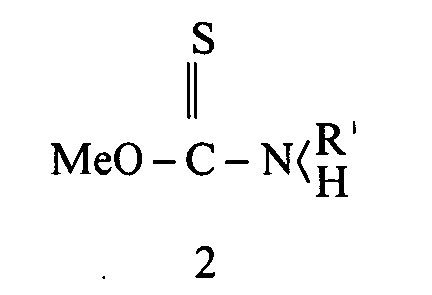
- B) isomerising the O-methyl thiocarbamate of formula (2) in order to obtain a S-methyl thiocarbamate of formula (3)
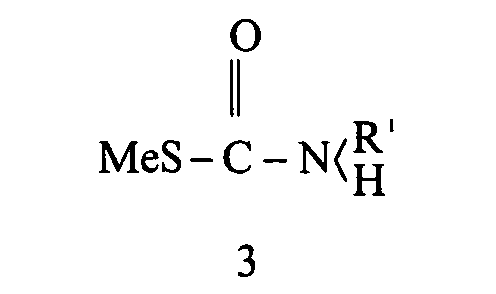
- C) causing the S-methyl thiocarbamate of formula (3) to react with a compound of general formula R'R"NH, wherein R' and R" may be equal or different one in respect of the other and may be H, R2 and R3, wherein R2 and R3 are alkylic, cyclo-alkylic or aryl-alkylic radicals and may be equal to or different from R1, in order to obtain one of the alkyl-ureas (4), (5) or (6)

- The present invention relates to the preparation of monoalkyl-ureas (4), N,N'-dialkyl-ureas (5) and trialkyl-ureas (6) starting from O,S-dimethyl dithiocarbonate (1), through the intermediate formation of O-methyl thiocarbamates (2) and S-methyl thiocarbamates (3), wherein R1, R2 and R3 represent alkylic, cyclo-alkylic or aryl-alkylic radicals which may be equal or different one in respect of the other and wherein R2 and R3 may also be H.
- The first step provides causing the O,S-dimethyl dithiocarbonate (1) to react with a primary amine R1NH2, wherein an alkylic, cyclo-alkylic or aryl-alkylic radical is bound to the nitrogen atom, which reaction results in yields between 99% and 99.9% of O-methyl thiocarbamate (2), wherein R1 represents the same radicals of the primary amine; the molar ratio R1NH2/(1) lies between 1.1 and 1.2; the reaction temperature is between 20°C and 30°C; the reaction time is between 2 and 3 hours. The 0-methyl thiocarbamate (2) thus obtained is highly pure and may be employed directly in the following step. During the formation of the O-methyl thiocarbamate (2), a mole of methanthiol is produced, which is a product of a certain industrial value and is recovered under the form of sodium salt in aqueous solution, with a 94-98% yield.
- The second step consists in isomerising the O-methyl thiocarbamate (2) into S-methyl thiocarbamate (3), wherein R1 represents the same radicals of the primary amine and of the corresponding O-methyl thiocarbamate (2). The isomerisation reaction is made at a temperature between 40°C and 60°C, in an organic solvent, preferably toluene, in amounts between 0.05 and 4.50 parts in weight per part in weight of (2), using, as initiator, a quantity of dimethyl sulphate between 4% and 8% of the weight of the reagent; the reaction time is between 0.5 and 4 hours; the reaction yields are between 94% and 98%. Dimethyl sulphate may be replaced by a protic organic acid, preferably by methansulphonic acid, used as catalyst. When the reaction is carried out using a protic organic acid, the reaction temperature is about 100°C; the reaction time is between 2 and 3.5 hours; yields are around 98%. The S-methyl thiocarbamate (3) thus obtained is extremely pure and may be employed directly in the following step.
- The third step provides causing the S-methyl thiocarbamate (3), wherein R1 represents the same radicals of the primary amine R1NH2 and of the corresponding 0-methyl thiocarbamate (2), to react with a compound of general formula R'R"NH, wherein R' and R" may be equal or different one in respect of the other and they may be H or an alkylic, cyclo-alkylic or aryl-alkylic group. In case a monoalkyl-urea of formula (4) is to be obtained, R' = R" = H and the compound reacting with the S-methyl thiocarbamate is aqueous ammonia. The reaction is carried out at a temperature between 60°C and 70°C; the reaction time is between 3 and 6 hours; the reaction yields are between 93% and 96%. The alkyl-urea (4) thus obtained is extremely pure and does not require further purification steps in order to be employed for the intended purposes. During the formation of the monosubstituted urea (4), a mole of methanthiol is produced, which product has - as mentioned before - a good industrial value and which is therefore recovered under the form of sodium salt in aqueous solution, with a 95% yield.
- Alternatively, if a dialkyl-urea of formula (5) is to be obtained, R' = H, R" = R2 (which may also correspond to R1) and the compound with which the 0-methyl thiocarbamate (3) is made to react is a primary amine R2NH2. The reaction is carried out at a temperature between 30°C and 60°C; the reaction time is between 4 and 8 hours; the reaction yields are between 93% and 96%. The dialkyl-urea (5) thus obtained is extremely pure and may be employed directly for the intended purposes. Also during the formation of the N,N'-disubstituted urea (5), a mole of methanthiol is produced, which is recovered under the form of sodium salt in aqueous solution, with a 95% yield.
- Furthermore, if a trialkyl-urea of formula (6) is to be obtained, R' = R2, R" = R3 and the S-methyl thiocarbamate (3) is to react with a secondary amine R2R3NH. The reaction is carried out at a temperature between 60°C and 70°C; the reaction time is between 1 and 2 hours; the. reaction yields are between 93% and 96%. The trialkyl-urea (6) thus obtained is extremely pure and may be employed without any further purification for the intended purposes. During the formation of the N,N,N'-trisubstituted urea (6), a mole of methanthiol is produced, which is recovered under the form of sodium salt in aqueous solution, with a 95% yield.
- The process constituted by the steps A-C as described above, which employs, as a starting compound, the O,S-dimethyl dithiocarbonate, an easily accessible, safe and inexpensive compound, provides, in mild and easily obtainable conditions and with usually very high yields, mono-, di- and trialkyl-substituted ureas, respectively of formulae (4), (5) and (6), wherein the substituents R1, R2 and R3, which may be equal or different one in respect of the other, are highly pure and, in most cases, immediately usable alkylic, cyclo-alkylic or aryl-alkylic radicals. The present process also has the important advantage of producing sodium methanthiolate, by completely exploiting the O,S-dimethyl dithiocarbonate (1) used as a starting compound.
- The present invention will now be described more in detail, with reference to some examples, which are only provided for purposes of illustration and are not intended to be limiting.
- A 40% methylamine aqueous solution (g 13.95; moles 0.180) is dropwise added, during 10-15 minutes, into the O,S-dimethyl dithiocarbonate (g 20.00; moles 0.164) placed into a 100 ml flask, while stirring. The mixture temperature is maintained at about 20°C by means of a refrigerating bath. The reaction is exothermic and produces methanthiol, which is absorbed by a sodium hydroxide aqueous solution. The course of the reaction is monitored through GC and 1H NMR analysis. After 2 hours the reaction is completed. The reaction mixture is then extracted with methylene chloride and the gathered organic extracts are washed in little water, made anhydrous with anhydrous sodium sulphate and made to evaporate by means of a rotating evaporator. The residue is constituted by g 17.21 (99.9% yield) of virtually pure (CG, CG-MS, 1H NMR analysis) O,N-dimethyl thiocarbamate: colourless oil, b.p. 122-123°C/45 mm Hg; MS: m/e 105 (M+); 1H NMR (CDCl3), cis- and trans- rotamers: δ = 2.81 and 3.03 (2 d, J = 5.12 Hz, 3 H, N-CH3), 3.92 and 4.01 (2 s, 3 H, O-CH3), 6.45 and 7.12 ppm (2 enlarged s, 1H, NH).
- The process described in example 1 is repeated, with the difference that the 40% methylamine aqueous solution is replaced by 70% ethylamine aqueous solution (g 12.66; moles 0.197). The reaction is completed in 3 hours. g 19.50 (99.9% yield) of virtually pure (CG, CG-MS, 1H NMR analysis) 0-methyl N-ethyl thiocarbamate is obtained: colourless oil, b.p. 130-131°C/50 mm Hg; MS: m/e 119 (M+); 1H NMR (CDCl3), cis- and trans- rotamers: δ = 1.10 and 1.18 (2t, J = 8.00 Hz, 3 H, CH2-CH 3), 3.02-3.72 (m, 2H, CH2), 3.90 and 4.00 (2 s, 3 H, O-CH3), 6.82 and 7.50 ppm (2 enlarged s, 1H, NH).
- The process described in example 1 is repeated, with the difference that the 40% methylamine aqueous solution is replaced by butylamine (g 14.38; moles 0.197). The reaction is completed in 3 hours. g 23.89 (99.1% yield) of virtually pure (CG, CG-MS, 1H NMR analysis) 0-methyl N-butyl thiocarbamate is obtained: colourless oil, b.p. 118-120°C/65 mm Hg; MS: m/e 147 (M+); 1H NMR (CDCl3), cis- and trans- rotamers: δ = 0.85 (q, J= 7.48 Hz, 3 H, CH2-CH 3), 1.21-1.35 and 1.39-1.55 (2 m, 4 H, CH2-(CH 2)2-CH3), 3.19 and 3.46 (2 td, J = 7.16, 2 H, N-CH2), 3.89 and 3.98 (2 s, 3 H, O-CH3), 6.45 and 7.23 ppm (2 enlarged s, 1H, NH).
- The process described in example 1 is repeated, with the difference that the 40% methylamine aqueous solution is replaced by cyclohexilamine (g 19.50; moles 0.197). The reaction is completed in 4.5 hours. g 28.34 (99.9% yield) of virtually pure (CG, CG-MS, 1H NMR analysis) 0-methyl N-cyclohexil thiocarbamate is obtained: crystallised from pentane, it has m.p. 39-40°C; MS: m/e 173 (M+); 1H NMR (CDCl3), cis- and trans- rotamers: δ = 0.92-1.30, 1.37-1.65 and 1.65-1.95 (3 m, 5:3:2, 10 H, 5 CH2), 3.45-3.55 (m, 1 H, CH), 3.78 and 3.88 (2 s, 3 H, O-CH3), 6.43 and 7.30 ppm (2 enlarged s, 1H, NH).
- The process described in example 1 is repeated, with the difference that the 40% methylamine aqueous solution is replaced by benzylamine (g 19.26; moles 0.180). The reaction is completed in 3.5 hours. g 29.38 (99% yield) of virtually pure (CG, CG-MS, 1H NMR analysis) 0-methyl N-benzyl thiocarbamate is obtained: crystallised from petroleum ether, it has m.p. 45.6-46.1°C; MS: m/e 181 (M+); 1H NMR (CDCl3), cis- and trans-rotamers: δ = 4.00 and 4.07 (2 s, 3 H, O-CH3), 4.41 and 4.73 (2 d, J = 5.00 and 6.00 Hz, 2 H, N-CH2), 6.56 ppm (enlarged s, 1H, NH), 7.19-7.45 (m, 5H, phenyl).
- A quantity of toluene and dimethyl sulphate, each of which equal to 5% of the thiocarbamate weight (g 0.84), is added to the O,S dimethyl thiocarbamate (g 16.80, moles 0.16). The mixture is heated to 50°C by means of an oil bath, while stirring. The course of the reaction is monitored through GC and 1H NMR analysis. After 2.5 hours the reaction is completed. After cooling the mixture to room temperature, it is neutralised with 30% aqueous ammonia and the stirring is maintained for 10-15 minutes. The reaction mixture is then extracted with methylene chloride and the gathered organic extracts are washed in little water, anhydrated with anhydrous sodium sulphate and made to evaporate by means of a rotating evaporator. The residue is g 15.96 (95% yield) of virtually pure (CG, CG-MS, 1H NMR analysis) N,S-dimethyl thiocarbamate: colourless oil, b.p. 81-82°C/45 mm Hg; MS: m/e 105 (M+); 1H NMR (CDCl3) : δ = 2.31 (s, 3 H, S-CH3), 2.84 ( d, J = 4.76 Hz, 3 H, N-CH3), 5.65 ppm (enlarged s, 1H, NH).
- The process described in example 6 is repeated, with the difference that the O,S dimethyl thiocarbamate is replaced by an equal quantity of 0-methyl N-ethyl thiocarbamate (g 19.04; moles 0.16). The reaction is completed in 4 hours at 40°C. g 18.22 (95.7% yield) of virtually pure (CG, CG-MS, 1H NMR analysis) S-methyl N-ethyl thiocarbamate is obtained: colourless oil, b.p. 82-84°C/50 mm Hg; MS: m/e 119 (M+); 1H NMR (CDCl3): δ = 1.20 (t, J = 6.40 Hz, 3 H, CH2-CH 3), 2.36 (s, 3 H, S-CH3), 3.35 (dq, J = 6.00 Hz, 2 H, CH2), 6.32 ppm (enlarged s, 1H, NH).
- A quantity of anhydrous methansulphonic acid equal to 5% of the thiocarbamate weight (g 0.95) is added to the S-methyl N-ethyl thiocarbamate (g 19.04, moles 0.16), while stirring. The mixture is then heated to 100°C by means of an oil bath. The course of the reaction, which is completed in 2 hours, is monitored through GC and 1H NMR analysis. After cooling the mixture to room temperature, it is extracted with methylene chloride and the gathered organic extracts are washed in little water, anhydrated with anhydrous sodium sulphate and made to evaporate by means of a rotating evaporator. The residue is g 18.61 (97.7% yield) of virtually pure (CG, CG-MS, 1H NMR analysis) S-methyl N-ethyl thiocarbamate. The spectroscopic characteristics thereof are identical to those of the product obtained in example 7.
- The process described in example 6 is repeated, with the difference that the O,S-dimethyl thiocarbamate is replaced by an equal quantity of O-methyl N-butyl thiocarbamate (g 23.52; moles 0.16). The reaction is completed in 4 hours at 50°C. g 22.10 (94% yield) of virtually pure (CG, CG-MS, 1H NMR analysis) S-methyl N-butyl thiocarbamate is obtained: crystallised from pentane, it has m.p. 34.8-35.4°C; MS: m/e 147 (M+); 1H NMR (CDCl3) : δ = 0.80-1.10 (m, 3 H, CH2-CH 3), 1.20-1.70 (m, 4 H, CH2-(CH 2)2-CH3), 2.35 (s, 3 H, S-CH3), 3.05-3.45 (m, 2 H, N-CH2), 6.18 ppm (enlarged s, 1H, NH).
- The process described in example 6 is repeated, with the difference that the O,S dimethyl thiocarbamate is replaced by an equal quantity of O-methyl N-cyclohexil thiocarbamate (g 27.68; moles 0.16). The reaction is completed in 30 minutes at 60°C. g 26.99 (97.5% yield) of virtually pure (CG, CG-MS, 1H NMR analysis) S-methyl N-cyclohexil thiocarbamate is obtained: crystallised from petroleum ether-ethanol, it has m.p. 111-111.3°C; MS: m/e 173 (M+) ; 1H NMR (CDCl3): δ = 0.96-2.09 (m, 10 H, 5 CH2), 2.31 (s, 3 H, SCH3), 3.39-3.99 (m, 1 H, CH), 5.52 ppm (enlarged s, 1H, NH).
- The process described in example 8 is repeated, with the difference that the S-methyl N-ethyl thiocarbamate is replaced by an equal quantity of O-methyl N-cyclohexil thiocarbamate (g 27.68; moles 0.16). The reaction is completed in 3.5 hours at 100°C. g 27.29 (98.6% yield) of virtually pure (CG, CG-MS, 1H NMR analysis) S-methyl N-cyclohexil thiocarbamate is obtained. The spectroscopic characteristics thereof are identical to those of the product obtained in example 11.
- The process described in example 6 is repeated, with the difference that the O,S dimethyl thiocarbamate is replaced by an equal quantity of O-methyl N-benzyl thiocarbamate (g 28.96; moles 0.16). The reaction is completed in 60 minutes at 50°C. g 28.38 (98% yield) of virtually pure (CG, CG-MS, 1H NMR analysis) S-methyl N-benzyl thiocarbamate is obtained: crystallised from ethanol, it has m.p. 75.7-76.7°C; MS: m/e 181 (M+); 1H NMR (CDCl3): δ = 2.35 (s, 3 H, S-CH3), 4.45 (d, J= 6.0 Hz, 2 H, N-CH2), 5.90 ppm (enlarged s, 1H, NH), 7.22-7.39 (m, 5 H, phenyl).
- A quantity of 30% aqueous ammonia (g 102, moles.1.80) is added, while stirring, to the N,S-dimethyl thiocarbamate (g 15.75, moles 0.15) and the mixture is heated to 65°C, still stirring it. The reaction produces methanthiol, which is absorbed by a sodium hydroxide aqueous solution. The course of the reaction is monitored through thin layer chromatography (SiO2; eluent: CHCl3 / CH3OH, 9.8 : 0.2). The reaction is completed in 3 hours. The water is distilled by means of a rotating evaporator, the solid product is then completely dried by adding chloroform and subsequently distilling it. g 10.99 of product is obtained, which is 97% pure. After washing the raw residue at 0°C in 4-5 ml of anhydrous dioxane, g 10.66 (yield 96%) of pure (TLC, GC, GC-MS, 1H NMR) methyl urea is obtained: m.p. 101.9-102.1°C; MS: m/e 74; 1H NMR (DMSO-d6): δ = 2.46 (d, J = 5.00 Hz, 3 H, CH3), 5.49 (enlarged s, 2H, NH2), 5.85 ppm (enlarged s, 1 H, NH).
- The process described in example 13 is repeated, with the difference that the N,S dimethyl thiocarbamate is replaced by an equal quantity of S-methyl N-ethyl thiocarbamate (g 17.85; moles 0.15) and that the 30% ammonia aqueous solution is g 127.5 (moles 2.25). The reaction is completed in 6 hours at 70°C. g 12.54 of 98% pure, solid product is obtained. From the raw residue, after washing it at 0°C in 4-5 ml ethyl acetate, g 12.28 (yield 93%) of pure (TLC, GC, GC-MS, 1H NMR) ethyl urea is obtained: m.p. 93.3°C; MS: m/e 88; 1H NMR (CDCl33): δ = 1.16 (t, J = 7.00 Hz, 3 H, CH3), 3.20 (dq, J = 7.00, 2 H, N-CH2), 5.01 (enlarged s, 2 H, NH2), 5.55 ppm (enlarged s, 1H, NH).
- The process described in example 13 is repeated, with the difference that the N,S-dimethyl thiocarbamate is replaced by an equal quantity of S-methyl N-butyl thiocarbamate (g 22.05; moles 0.15). The 30% ammonia aqueous solution is g 102 (moles 1.80). The reaction is completed in 4 hours at 70°C. g 17.23 of 96% pure, solid product is obtained. From the raw residue, after washing it at 0°C in 4-5 ml ethyl acetate, g 16.53 (yield 95%) of pure (TLC, GC, GC-MS, 1H NMR) butyl urea is obtained: m.p. 96.8°C; MS: m/e 116; 1H NMR (CDCl3): δ = 0.75-1.15 (m, 3 H, CH2-CH 3), 1.20-1.72 (m, 4 H, CH2-(CH 2)2-CH3), 2.96-3.38 (m, 2 H, N-CH2), 5.00 (enlarged s, 2 H, NH2), 5.75 ppm (enlarged s, 1H, NH).
- The process described in example 13 is repeated, with the difference that the N,S dimethyl thiocarbamate is replaced by an equal quantity of S-methyl N-cyclohexil thiocarbamate (g 25.95; moles 0.15) and that the 30% ammonia aqueous solution is g 76.5 (moles 1.35). In this example, about 3 g per g of thiocarbamate (ml 78) ethylic alcohol is also added. The reaction is completed in 6 hours at 70°C. g 20.66 of pure (TLC, GC, GC-MS, 1H NMR) cyclohexil urea is obtained: m.p. 193.8-194.5°C; MS: m/e 142; 1H NMR (DMSO-d6): δ = 0.51-0.70, 0.70-0.83, 0.99-1.08, 1.10-1.20 and 1.20-1.30 (5 m, 3:2:1:2:2, 10 H, 5 CH2), 2.75-2.89 (m, 1 H, CH), 4.88 (enlarged s, 2H, NH2), 5.39 ppm (d, J = 7.88 Hz, 1 H, NH).
- The process described in example 13 is repeated, with the difference that the N,S-dimethyl thiocarbamate is replaced by an equal quantity of S-methyl N-benzyl thiocarbamate (g 27.15; moles 0.15) and that the 30% ammonia aqueous solution is g 76.5 (moles 1.35). In this example, as in example 16, about 3 g per g of thiocarbamate (ml 81) ethylic alcohol or dioxane, alternatively, is also added. The reaction is completed in 6 hours at 60°C. g 22.05 of 97% pure solid product is obtained. From the raw residue, after washing it at room temperature in toluene (50-60 ml), g 21.38 (yield 95%) of pure (TLC, GC, GC-MS, 1H NMR) benzyl urea is obtained: m.p. 149°C; MS: m/e 150; 1H NMR (DMSO-d3) : δ = 4.15 (d, J = 6.00 Hz, 2 H, CH2), 5.42 (enlarged s, 2 H, NH2), 6.35 (enlarged s, 1H, NH), 7.05-7.25 ppm (m, 5H, phenyl).
- The reaction mixture constituted by N-ethyl, S-methyl thiocarbamate (g 8.45, moles 0.071) and methylamine (g 6.6, moles 0.213; g 16.5 of 40% aqueous solution) is continuously stirred and heated to 50-55°C. The freed methanthiol is absorbed by a sodium hydroxide aqueous solution. GC monitoring shows that the reaction is completed in 1 hour. The methanthiol is completely removed from the reaction mixture through an air flow. The methylamine that is still present and the water are removed by means of a rotating evaporator, with the possible help of an azeotrope-producing solvent. g 7.24 (quantitative yield) of virtually pure (TLC, GC, GC-MS verified) N-ethyl-N-methyl urea is produced; after drying it with chloroform and subsequently crystallising it from ethylic ether, it has m.p. 50.5-51.0°C; MS: m/e 102 (M+); 1H NMR (CDCl3), d = 1.12 (t, J = 7.00 Hz, 3 H, CH2-CH 3), 2.75 (d, J = 5.00 Hz, 3 H, NH-CH 3), 3.17 (dq, J= 7.00 Hz, 2H, CH2), 5.53 (enlarged s, 1H, NH).
- The reaction mixture constituted by N-ethyl, S-methyl thiocarbamate (g 4.6, moles 0.039) and ethylamine (g 3.8, moles 0.086; g 5.53 of 70% aqueous solution) is continuously stirred and heated to 40°C. The freed methanthiol is absorbed by a sodium hydroxide aqueous solution. The process continues until the starting thiocarbamate is over (chromatographic analyses: about 8 hours). The methanthiol is completely removed from the reaction mixture through an air flow. The methylamine that is still present and the water are removed by means of a rotating evaporator, possibly with the help of an azeotrope-producing solvent. g 4.52 (quantitative yield) of virtually pure (TLC, GC, GC-MS) N,N'-diethyl urea is produced; after drying it with chloroform and crystallising it from toluene, it has m.p. 111-112°C; MS: m/e 116 (M+); 1H NMR (CDCl3), d = 1.05 (t, J = 7.00 Hz, 6 H, 2 CH3), 3.09 (dq, J = 7.00 Hz, 4H, 2 CH 2), 5.40 ppm (enlarged s, 2H, 2NH).
- The reaction mixture constituted by N,S-dimethyl thiocarbamate (g 15.75, moles 0.15) and dibutylamine (g 23.22, moles 0.18) is continuously stirred and heated to 65-70°C. The reaction produces methanthiol, which is absorbed by a sodium hydroxide aqueous solution. The course of the reaction is monitored through GC and MS analysis. The reaction is completed in 2 hours. The dibutylamine in excess is removed through distillation by means of a rotating evaporator. g 26.51 (95% yield) of virtually pure (TLC, GC, GC-MS) N,N-dibutyl-N'methyl urea is produced: crystallised from pentane it has m.p. 46.0-46.2°C; MS: m/e 185 (M+); 1H NMR (CDCl3), d = 0.98 (t, J = 6.00 Hz, 6 H, 2 CH2-CH 3), 1.12-1.75 (m, 8 H, CH2-(CH 2)2CH3), 2.84 (d, J = 5.00 Hz, 3 H, NH-CH 3), 3.20 (t, J= 7.20 Hz, 4H N[CH2-(CH 2)2CH3)2), 4.35 ppm (enlarged s, 1H, NH).
- 1st step - A 500 ml flask is arranged, provided with a bottom discharge, mechanical stirrer, dripping funnel with pressure compensator, reflux refrigerant connected to a tube drawing from a 12.8% sodium hydroxide aqueous solution (g. 512.5) contained into a first trap, which in turn is connected to a trapping system comprising a series of traps, a sodium hydroxide one, a diluted sulphuric acid one, a hypochlorite one and an active carbons one. g 200 (moles 1.64) of O,S-dimethyl dithiocarbonate is placed into the flask, which kept under a weak nitrogen flow and, while mechanically stirring, g 144.5 of 61.3 % (moles 1.97) ethylamine is poured at such a speed that the maximum reaction temperature does not exceed 45°C (about 1 hour). The mass is then conditioned to 50-55°C for 1 hour at atmospheric pressure and then for a further hour at reduced pressure (400 mm Hg ca.). The mass is brought back to ordinary temperature and pressure, g 50 of water is added and the stirring is stopped; as a lower phase, g 193.1 (yield 98.9%) of 0-methyl N-ethyl thiocarbamate, under the form of colourless oil, is separated.
- The aqueous solution of the first sodium hydroxide trap contains g 108.65 (yield 94%) of sodium methanthiolate.
- 2nd step - g 193.1 of 0-methyl N-ethyl thiocarbamate obtained in the 1st step is introduced into a 2000 ml flask, provided with a distillation head connected to a condenser and to a collector, and diluted with g 1120 of toluene. The solution is made anhydrous through distillation with the azeotrope water/toluene. After the distillation, the residual solution (g 1051.6) is brought to 45°C and the distillation head is replaced with a reflux refrigerant. Then, while mechanically stirring, g 9.6 of dimethyl sulphate is added at such a speed that the maximum reaction temperature does not exceed 47°C. The mass is conditioned to 45°C for 4 hours and then cooled to room temperature. g 8.6 of a 30% ammonium hydroxide aqueous solution is added, the mixture is stirred for 30 minutes and the organic phase is separated. The aqueous phase is deeply extracted with toluene. The organic extracts are gathered, washed in little water and dried. After the distillation with toluene, g 196 of 96.5% S-methyl N-ethyl thiocarbamate is obtained.
- 3rd step - A 1000 ml flask, provided with mechanical stirrer, dripping funnel with pressure compensator, reflux refrigerant connected to a trap system equal to that described in the 1st step is arranged. Under a weak nitrogen flow, g 196 of raw S-methyl N-ethyl thiocarbamate obtained in the 2nd step is placed inside and, while stirring, g 762 of a 30% aqueous ammonia solution (9 eq.) is added. The mixture is heated to 60°C and the reaction is continued for 4 hours. The reflux refrigerant is replaced by a distillation head connected to a condenser and a collector, which collector is in turn connected to the trap system. g 237 of water is distilled. g 389 of 33.2% ethyl urea aqueous solution is obtained, the dry residue of which being 98.5% pure (GC area %). The aqueous solution of the first sodium hydroxide trap contains g 109.8 (yield 95%) of sodium methanthiolate. The sulphuric acid trap trapped g 202 of ammonia (i.e. 99% of the non-reacted part).
Claims (24)
- Process to prepare alkyl-ureas, starting from O,S-dimethyl dithiocarbonate, having the following formula (1):characterised in that it includes the following steps:
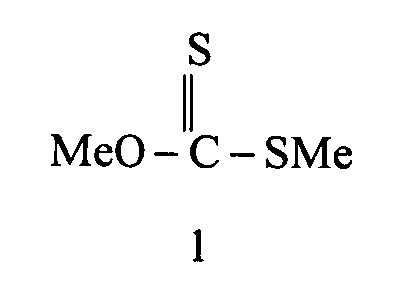 A) Causing the O,S-dimethyl dithiocarbonate (1) to react with a primary amine of general formula R1NH2, where R1 is an alkylic, cyclo-alkylic or aryl-alkylic radical, so as to obtain an 0-methyl thiocarbamate of formula (2):
 B) Isomerising the O-methyl thiocarbamate of formula (2), so as to obtain an S-methyl thiocarbamate of formula (3):
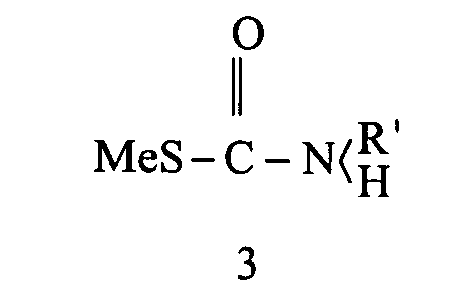 C) Causing the S-methyl thiocarbamate of formula (3) to react with a compound of general formula R'R"NH, where R' and R" can be H, R2 or R3, where R2 and R3 are an alkylic, cyclo-alkylic or aryl-alkylic radical and can be equal or different one in respect of the other and equal or different in respect of R1, so as to obtain one of the alkyl-ureas (4), (5) or (6):
- Process as in claim 1), characterised in that, in step A), the molar ratio R1NH2/(1) is between 1.1 and 1.2.
- Process as in claim 1) or 2), characterised in that the reaction temperature of step A) is between 20°C and 30°C.
- Process as in any one of the previous claims, characterised in that the reaction time for step A) is between 2 and 3 hours.
- Process as in any one of the previous claims, characterised in that the temperature of step B) is between 40°C and 60°C.
- Process as in any one of the previous claims, characterised in that step B) is carried out in an organic solvent.
- Process as in claim 6), characterised in that said organic solvent is toluene.
- Process as in claim 6) or 7), characterised in that said organic solvent is present in amounts between 0.05 and 4.50 parts in weight per part in weight of (2).
- Process as in any one of the previous claims, characterised in that use is made, as an initiator for step B), of dimethyl-sulphate in amounts between 4 and 8% by weight in respect of the weight of the reactant.
- Process as in any one of the previous claims, characterised in that the reaction time for step B) is between 0.5 and 4 hours.
- Process as in any one of claims 1) to 8), characterised in that, as an initiatior for step B), a protic organic acid is used.
- Process as in claim 11), wherein said acid is methansulphonic acid.
- Process as in claims 11) and 12), characterised in that the reaction temperature of step B) is of about 100°C.
- Process as in any of claims 11) to 13), characterised in that the reaction time is between 0.5 and 1 hour.
- Process as in any one of the previous claims, characterised in that, in step C), R' = R" = H, and the compound reacting with S-methyl thiocarbamate is aqueous ammonia.
- Process as in claim 15), characterised in that the reaction temperature of step C) is between 60°C and 70°C.
- Process as in claims 15) and 16), characterised in that the reaction time for step C) is between 3 and 6 hours.
- Process as in any one of claims 1) to 14), characterised in that, in step C), R' = H, R" = R2, and the compound reacting with S-methyl thiocarbamate (3) is a primary aliphatic amine R2NH2.
- Process as in claim 18), characterised in that the reaction temperature of step C) is between 30°C and 60°C.
- Process as in claims 18) and 19), characterised in that the reaction time is between 4 and 8 hours.
- Process as in any one of claims 1) to 14), characterised in that, in step C), R' = R2, R" = R3, and the S-methyl thiocarbamate (3) is caused to react with a secondary aliphatic amine R2R3NH.
- Process as in claim 21), characterised in that the reaction temperature of step C) is between 60°C and 70°C.
- Process as in claims 21) and 22), characterised in that the reaction time for step C) is between 1 and 2 hours.
- Process as in any one of the previous claims, for the production of methanthiol.
Applications Claiming Priority (3)
| Application Number | Priority Date | Filing Date | Title |
|---|---|---|---|
| IT2002MI000227 IT1338456B1 (en) | 2002-02-07 | 2002-02-07 | PROCEDURE FOR THE PREPARATION OF ALCHILUREE DA O, D-DIMETHYL DICIOCARBONATE |
| ITMI20020227 | 2002-02-07 | ||
| ITMI20000227 | 2002-02-07 |
Publications (3)
| Publication Number | Publication Date |
|---|---|
| EP1334965A1 true EP1334965A1 (en) | 2003-08-13 |
| EP1334965B1 EP1334965B1 (en) | 2005-12-28 |
| EP1334965B9 EP1334965B9 (en) | 2006-07-05 |
Family
ID=34586984
Family Applications (1)
| Application Number | Title | Priority Date | Filing Date |
|---|---|---|---|
| EP03100248A Expired - Lifetime EP1334965B9 (en) | 2002-02-07 | 2003-02-05 | Process to prepare alkyl-ureas from O,S-dimethyl dithiocarbonate |
Country Status (4)
| Country | Link |
|---|---|
| US (1) | US6723875B1 (en) |
| EP (1) | EP1334965B9 (en) |
| DE (1) | DE60302911D1 (en) |
| IT (1) | IT1338456B1 (en) |
Cited By (3)
| Publication number | Priority date | Publication date | Assignee | Title |
|---|---|---|---|---|
| CN102942507A (en) * | 2012-11-30 | 2013-02-27 | 迈克斯(如东)化工有限公司 | Novel method for preparing linuron |
| US11958823B2 (en) | 2017-08-17 | 2024-04-16 | Basf Se | Process for the manufacturing of a polymer with urethane groups |
| US12486438B2 (en) | 2018-07-04 | 2025-12-02 | Basf Se | Adhesive method using two-component adhesives based on compounds having cyclothiocarbonate units |
Families Citing this family (1)
| Publication number | Priority date | Publication date | Assignee | Title |
|---|---|---|---|---|
| US8481796B2 (en) * | 2005-01-31 | 2013-07-09 | Exxonmobil Chemical Patents Inc. | Olefin oligomerization and compositions therefrom |
Family Cites Families (4)
| Publication number | Priority date | Publication date | Assignee | Title |
|---|---|---|---|---|
| JPS59101443A (en) * | 1982-12-03 | 1984-06-12 | Nippon Tokushu Noyaku Seizo Kk | Substituted benzyl-cycloalkenylurea derivative, its intermediate, its preparation, and fungicide for agriculture and horticulture |
| FR2559766B1 (en) * | 1984-02-16 | 1986-05-16 | Poudres & Explosifs Ste Nale | PROCESS FOR THE PREPARATION OF CARBAMIC ACID DERIVATIVES |
| AU7235287A (en) * | 1986-03-28 | 1987-10-20 | Janus Farmaceutici S.R.L | Synthesis of antiulcer compounds |
| US5925762A (en) * | 1996-09-17 | 1999-07-20 | Boehringer Ingelheim (Canada) Ltd. | Practical synthesis of urea derivatives |
-
2002
- 2002-02-07 IT IT2002MI000227 patent/IT1338456B1/en active
-
2003
- 2003-02-05 EP EP03100248A patent/EP1334965B9/en not_active Expired - Lifetime
- 2003-02-05 DE DE60302911T patent/DE60302911D1/en not_active Expired - Lifetime
- 2003-02-06 US US10/359,121 patent/US6723875B1/en not_active Expired - Fee Related
Non-Patent Citations (2)
| Title |
|---|
| LEUNG MAN-KIT ET AL: "S,S-Dimethyl Dithiocarbonate: A Convenient Reagent for the Synthesis of Symmetrical and Unsymmetrical Ureas", JOURNAL OF ORGANIC CHEMISTRY, AMERICAN CHEMICAL SOCIETY. EASTON, US, vol. 61, no. 12, 1996, pages 4175 - 4179, XP002217935, ISSN: 0022-3263 * |
| TANDEL ET AL.: "Conversion of Thiocarbamates to Carbamates", TETRAHEDRON, vol. 49, no. 34, 1993, pages 7479 - 7486, XP001152611 * |
Cited By (3)
| Publication number | Priority date | Publication date | Assignee | Title |
|---|---|---|---|---|
| CN102942507A (en) * | 2012-11-30 | 2013-02-27 | 迈克斯(如东)化工有限公司 | Novel method for preparing linuron |
| US11958823B2 (en) | 2017-08-17 | 2024-04-16 | Basf Se | Process for the manufacturing of a polymer with urethane groups |
| US12486438B2 (en) | 2018-07-04 | 2025-12-02 | Basf Se | Adhesive method using two-component adhesives based on compounds having cyclothiocarbonate units |
Also Published As
| Publication number | Publication date |
|---|---|
| US6723875B1 (en) | 2004-04-20 |
| DE60302911D1 (en) | 2006-02-02 |
| EP1334965B9 (en) | 2006-07-05 |
| IT1338456B1 (en) | 2007-03-12 |
| ITMI20020227A1 (en) | 2003-08-07 |
| EP1334965B1 (en) | 2005-12-28 |
| ITMI20020227A0 (en) | 2002-02-07 |
Similar Documents
| Publication | Publication Date | Title |
|---|---|---|
| AU645935B2 (en) | Production of fluoxetine and new intermediates | |
| NO172536B (en) | ANALOGY PROCEDURE FOR THE PREPARATION OF THERAPEUTIC ACTIVE CARBOXYLIC ACID AND SULPHONIC ACID AMIDS | |
| JPH0115498B2 (en) | ||
| US5124451A (en) | Process for the n-alkylation or ureas | |
| US4659853A (en) | Process for the production of isothiocyanate derivatives | |
| EP1334965B1 (en) | Process to prepare alkyl-ureas from O,S-dimethyl dithiocarbonate | |
| CZ280732B6 (en) | Process for separating isocyanic acid from a mixture of said acid with ammonia | |
| US5043444A (en) | Process for the preparation of asymmetrically substituted ureas | |
| Gaylord et al. | The reactions of carbamates with alcohols | |
| JPH0617355B2 (en) | Method for producing carbamic acid derivative | |
| EP0539092A1 (en) | Process for preparation of halopropargyl carbamates | |
| US5395945A (en) | Synthesis of 3,3-dinitroazetidine | |
| JPH06345709A (en) | Method for producing iodopropargyl carbamate | |
| US4321402A (en) | Carbamate process | |
| JPH0415223B2 (en) | ||
| KR100402055B1 (en) | A process for preparing Glibenclamide | |
| JP2790855B2 (en) | Method for producing aliphatic O-aryl urethane | |
| CA2399598C (en) | Process for preparing aryl-iminomethyl-carbamino acid esters | |
| EP0612740B1 (en) | Methods of producing pantothenic acid derivative and its starting materials for producing the same | |
| Aizina et al. | N-(2, 2, 2-trichloroethylidene)-and N-(1-hydroxy-2, 2, 2-trichloroethyl) amides in C-amidoalkylation reaction of functionally-substituted aromatic compounds | |
| Lee et al. | A general synthesis of functionalized primary t-alkylamines | |
| US5223635A (en) | Preparation of organic compounds using as a reactant an adduct of isocyanic acid and a tertiary amine or an ether | |
| CN118812395A (en) | A method for synthesizing a lacosamide intermediate | |
| JPH0316338B2 (en) | ||
| JPS61207370A (en) | Production of 4-(methanesulfonyloxy)thiophenol |
Legal Events
| Date | Code | Title | Description |
|---|---|---|---|
| PUAI | Public reference made under article 153(3) epc to a published international application that has entered the european phase |
Free format text: ORIGINAL CODE: 0009012 |
|
| AK | Designated contracting states |
Designated state(s): AT BE BG CH CY CZ DE DK EE ES FI FR GB GR HU IE IT LI LU MC NL PT SE SI SK TR |
|
| AX | Request for extension of the european patent |
Extension state: AL LT LV MK RO |
|
| 17P | Request for examination filed |
Effective date: 20040128 |
|
| AKX | Designation fees paid |
Designated state(s): AT BE BG CH CY CZ DE DK EE ES FI FR GB GR HU IE IT LI LU MC NL PT SE SI SK TR |
|
| GRAP | Despatch of communication of intention to grant a patent |
Free format text: ORIGINAL CODE: EPIDOSNIGR1 |
|
| GRAS | Grant fee paid |
Free format text: ORIGINAL CODE: EPIDOSNIGR3 |
|
| GRAA | (expected) grant |
Free format text: ORIGINAL CODE: 0009210 |
|
| AK | Designated contracting states |
Kind code of ref document: B1 Designated state(s): AT BE BG CH CY CZ DE DK EE ES FI FR GB GR HU IE IT LI LU MC NL PT SE SI SK TR |
|
| PG25 | Lapsed in a contracting state [announced via postgrant information from national office to epo] |
Ref country code: NL Free format text: LAPSE BECAUSE OF FAILURE TO SUBMIT A TRANSLATION OF THE DESCRIPTION OR TO PAY THE FEE WITHIN THE PRESCRIBED TIME-LIMIT Effective date: 20051228 Ref country code: CH Free format text: LAPSE BECAUSE OF FAILURE TO SUBMIT A TRANSLATION OF THE DESCRIPTION OR TO PAY THE FEE WITHIN THE PRESCRIBED TIME-LIMIT Effective date: 20051228 Ref country code: SI Free format text: LAPSE BECAUSE OF FAILURE TO SUBMIT A TRANSLATION OF THE DESCRIPTION OR TO PAY THE FEE WITHIN THE PRESCRIBED TIME-LIMIT Effective date: 20051228 Ref country code: AT Free format text: LAPSE BECAUSE OF FAILURE TO SUBMIT A TRANSLATION OF THE DESCRIPTION OR TO PAY THE FEE WITHIN THE PRESCRIBED TIME-LIMIT Effective date: 20051228 Ref country code: FI Free format text: LAPSE BECAUSE OF FAILURE TO SUBMIT A TRANSLATION OF THE DESCRIPTION OR TO PAY THE FEE WITHIN THE PRESCRIBED TIME-LIMIT Effective date: 20051228 Ref country code: CZ Free format text: LAPSE BECAUSE OF FAILURE TO SUBMIT A TRANSLATION OF THE DESCRIPTION OR TO PAY THE FEE WITHIN THE PRESCRIBED TIME-LIMIT Effective date: 20051228 Ref country code: SK Free format text: LAPSE BECAUSE OF FAILURE TO SUBMIT A TRANSLATION OF THE DESCRIPTION OR TO PAY THE FEE WITHIN THE PRESCRIBED TIME-LIMIT Effective date: 20051228 Ref country code: BE Free format text: LAPSE BECAUSE OF FAILURE TO SUBMIT A TRANSLATION OF THE DESCRIPTION OR TO PAY THE FEE WITHIN THE PRESCRIBED TIME-LIMIT Effective date: 20051228 Ref country code: LI Free format text: LAPSE BECAUSE OF FAILURE TO SUBMIT A TRANSLATION OF THE DESCRIPTION OR TO PAY THE FEE WITHIN THE PRESCRIBED TIME-LIMIT Effective date: 20051228 |
|
| REG | Reference to a national code |
Ref country code: GB Ref legal event code: FG4D |
|
| REG | Reference to a national code |
Ref country code: CH Ref legal event code: EP |
|
| REG | Reference to a national code |
Ref country code: IE Ref legal event code: FG4D |
|
| REF | Corresponds to: |
Ref document number: 60302911 Country of ref document: DE Date of ref document: 20060202 Kind code of ref document: P |
|
| PG25 | Lapsed in a contracting state [announced via postgrant information from national office to epo] |
Ref country code: IE Free format text: LAPSE BECAUSE OF NON-PAYMENT OF DUE FEES Effective date: 20060206 |
|
| PG25 | Lapsed in a contracting state [announced via postgrant information from national office to epo] |
Ref country code: LU Free format text: LAPSE BECAUSE OF NON-PAYMENT OF DUE FEES Effective date: 20060228 Ref country code: MC Free format text: LAPSE BECAUSE OF NON-PAYMENT OF DUE FEES Effective date: 20060228 |
|
| PG25 | Lapsed in a contracting state [announced via postgrant information from national office to epo] |
Ref country code: SE Free format text: LAPSE BECAUSE OF FAILURE TO SUBMIT A TRANSLATION OF THE DESCRIPTION OR TO PAY THE FEE WITHIN THE PRESCRIBED TIME-LIMIT Effective date: 20060328 Ref country code: DK Free format text: LAPSE BECAUSE OF FAILURE TO SUBMIT A TRANSLATION OF THE DESCRIPTION OR TO PAY THE FEE WITHIN THE PRESCRIBED TIME-LIMIT Effective date: 20060328 Ref country code: BG Free format text: LAPSE BECAUSE OF FAILURE TO SUBMIT A TRANSLATION OF THE DESCRIPTION OR TO PAY THE FEE WITHIN THE PRESCRIBED TIME-LIMIT Effective date: 20060328 Ref country code: GR Free format text: LAPSE BECAUSE OF FAILURE TO SUBMIT A TRANSLATION OF THE DESCRIPTION OR TO PAY THE FEE WITHIN THE PRESCRIBED TIME-LIMIT Effective date: 20060328 |
|
| PG25 | Lapsed in a contracting state [announced via postgrant information from national office to epo] |
Ref country code: DE Free format text: LAPSE BECAUSE OF FAILURE TO SUBMIT A TRANSLATION OF THE DESCRIPTION OR TO PAY THE FEE WITHIN THE PRESCRIBED TIME-LIMIT Effective date: 20060329 |
|
| PG25 | Lapsed in a contracting state [announced via postgrant information from national office to epo] |
Ref country code: ES Free format text: LAPSE BECAUSE OF FAILURE TO SUBMIT A TRANSLATION OF THE DESCRIPTION OR TO PAY THE FEE WITHIN THE PRESCRIBED TIME-LIMIT Effective date: 20060408 |
|
| PG25 | Lapsed in a contracting state [announced via postgrant information from national office to epo] |
Ref country code: PT Free format text: LAPSE BECAUSE OF FAILURE TO SUBMIT A TRANSLATION OF THE DESCRIPTION OR TO PAY THE FEE WITHIN THE PRESCRIBED TIME-LIMIT Effective date: 20060529 |
|
| NLV1 | Nl: lapsed or annulled due to failure to fulfill the requirements of art. 29p and 29m of the patents act | ||
| PG25 | Lapsed in a contracting state [announced via postgrant information from national office to epo] |
Ref country code: HU Free format text: LAPSE BECAUSE OF FAILURE TO SUBMIT A TRANSLATION OF THE DESCRIPTION OR TO PAY THE FEE WITHIN THE PRESCRIBED TIME-LIMIT Effective date: 20060629 |
|
| REG | Reference to a national code |
Ref country code: CH Ref legal event code: PL |
|
| PLBE | No opposition filed within time limit |
Free format text: ORIGINAL CODE: 0009261 |
|
| STAA | Information on the status of an ep patent application or granted ep patent |
Free format text: STATUS: NO OPPOSITION FILED WITHIN TIME LIMIT |
|
| REG | Reference to a national code |
Ref country code: IE Ref legal event code: MM4A |
|
| 26N | No opposition filed |
Effective date: 20060929 |
|
| EN | Fr: translation not filed | ||
| GBPC | Gb: european patent ceased through non-payment of renewal fee |
Effective date: 20070205 |
|
| PG25 | Lapsed in a contracting state [announced via postgrant information from national office to epo] |
Ref country code: GB Free format text: LAPSE BECAUSE OF NON-PAYMENT OF DUE FEES Effective date: 20070205 Ref country code: FR Free format text: LAPSE BECAUSE OF FAILURE TO SUBMIT A TRANSLATION OF THE DESCRIPTION OR TO PAY THE FEE WITHIN THE PRESCRIBED TIME-LIMIT Effective date: 20070216 |
|
| PG25 | Lapsed in a contracting state [announced via postgrant information from national office to epo] |
Ref country code: EE Free format text: LAPSE BECAUSE OF FAILURE TO SUBMIT A TRANSLATION OF THE DESCRIPTION OR TO PAY THE FEE WITHIN THE PRESCRIBED TIME-LIMIT Effective date: 20051228 |
|
| PG25 | Lapsed in a contracting state [announced via postgrant information from national office to epo] |
Ref country code: TR Free format text: LAPSE BECAUSE OF FAILURE TO SUBMIT A TRANSLATION OF THE DESCRIPTION OR TO PAY THE FEE WITHIN THE PRESCRIBED TIME-LIMIT Effective date: 20051228 |
|
| PG25 | Lapsed in a contracting state [announced via postgrant information from national office to epo] |
Ref country code: FR Free format text: LAPSE BECAUSE OF FAILURE TO SUBMIT A TRANSLATION OF THE DESCRIPTION OR TO PAY THE FEE WITHIN THE PRESCRIBED TIME-LIMIT Effective date: 20060228 |
|
| PG25 | Lapsed in a contracting state [announced via postgrant information from national office to epo] |
Ref country code: FR Free format text: LAPSE BECAUSE OF FAILURE TO SUBMIT A TRANSLATION OF THE DESCRIPTION OR TO PAY THE FEE WITHIN THE PRESCRIBED TIME-LIMIT Effective date: 20051228 Ref country code: CY Free format text: LAPSE BECAUSE OF FAILURE TO SUBMIT A TRANSLATION OF THE DESCRIPTION OR TO PAY THE FEE WITHIN THE PRESCRIBED TIME-LIMIT Effective date: 20051228 |
|
| PGFP | Annual fee paid to national office [announced via postgrant information from national office to epo] |
Ref country code: IT Payment date: 20141222 Year of fee payment: 13 |
|
| PG25 | Lapsed in a contracting state [announced via postgrant information from national office to epo] |
Ref country code: IT Free format text: LAPSE BECAUSE OF NON-PAYMENT OF DUE FEES Effective date: 20160205 |